Museo de Arte Precolombino – Cusco, Peru
The remarkable Museo de Arte Precolombino is located in the historic center of Cusco within a beautifully restored colonial building constructed atop ancient Inca foundations. The museum presents an exceptional collection of artifacts created by the civilizations that flourished in Peru long before the arrival of the Spanish.
Exhibits display ceramics, gold objects, textiles, and sculptures produced by cultures such as the Moche, Nazca, Chimú, and Inca. Each gallery highlights the artistic and technological achievements of these early societies.
The museum offers visitors a deeper understanding of the rich cultural traditions that shaped the history of the Andes.

Three circular silver-colored ornaments are arranged as a small ensemble. The larger upper piece uses an open central cutout and dense border punching, while the two smaller discs carry raised paired spirals. Together they show several approaches to working sheet metal—cutting, punching, embossing, and surface patterning—within compact objects intended for personal or ceremonial display.
Caption
Three circular silver-colored ornaments are arranged as a small ensemble. The larger upper piece uses an open central cutout and dense border punching, while the two smaller discs carry raised paired spirals. Together they show several approaches to working sheet metal—cutting, punching, embossing, and surface patterning—within compact objects intended for personal or ceremonial display.
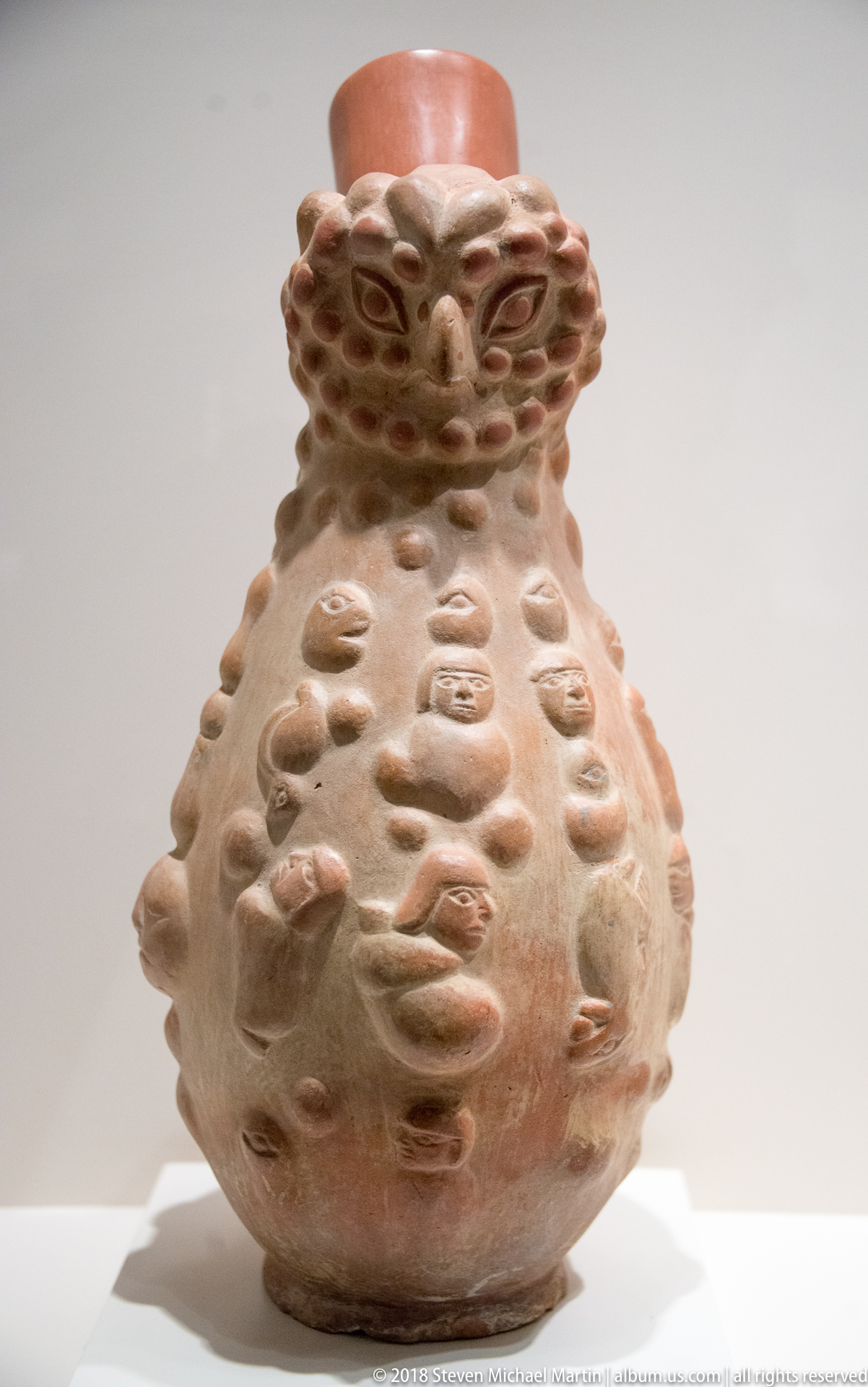
A globular Mochica vessel is densely covered with applied human faces and modeled heads that project from the clay surface in layered rows. Repetition turns the container into a crowded field of human imagery, while a reddish cylindrical neck rises above the sculptural mass. The unusual surface treatment demonstrates the Moche ability to combine vessel form with complex figural modeling and rhythmic repetition.
Caption
A globular Mochica vessel is densely covered with applied human faces and modeled heads that project from the clay surface in layered rows. Repetition turns the container into a crowded field of human imagery, while a reddish cylindrical neck rises above the sculptural mass. The unusual surface treatment demonstrates the Moche ability to combine vessel form with complex figural modeling and rhythmic repetition.

A broad fan-shaped collar is constructed from a series of long, flat shell plaques, each pierced near its upper edge for suspension. Their graduated placement creates a dense fringe that would have spread across the chest when worn. The pale material, regular cutting, and repeated drilling demonstrate the careful transformation of marine shell into high-status personal ornament.
Caption
A broad fan-shaped collar is constructed from a series of long, flat shell plaques, each pierced near its upper edge for suspension. Their graduated placement creates a dense fringe that would have spread across the chest when worn. The pale material, regular cutting, and repeated drilling demonstrate the careful transformation of marine shell into high-status personal ornament.

A globular Mochica bottle carries the painted creature identified by the museum as the lunar animal, its curving body and appendages organized across the rounded ceramic surface. The vessel follows the interpretive label immediately preceding it, which explains this recurring supernatural motif. Read together, label and object show how Mochica painters adapted a complex mythic figure to the contours of a ceremonial container.
Caption
A globular Mochica bottle carries the painted creature identified by the museum as the lunar animal, its curving body and appendages organized across the rounded ceramic surface. The vessel follows the interpretive label immediately preceding it, which explains this recurring supernatural motif. Read together, label and object show how Mochica painters adapted a complex mythic figure to the contours of a ceremonial container.

A broad anthropomorphic vessel presents a frontal figure with a large flattened head, outstretched arms, and sturdy separated legs. Painted geometric bands and dotted textures organize the torso and lower body, while modeled facial features project from the rounded surface. Its wide stance and emphatic symmetry give the vessel a monumental presence within the case despite its portable scale.
Caption
A broad anthropomorphic vessel presents a frontal figure with a large flattened head, outstretched arms, and sturdy separated legs. Painted geometric bands and dotted textures organize the torso and lower body, while modeled facial features project from the rounded surface. Its wide stance and emphatic symmetry give the vessel a monumental presence within the case despite its portable scale.

A standing Nasca ceramic figure extends both arms from a broad hollow body, with a square head, short feet, and dark painted details across the face and shoulders. The simplified anatomy produces a striking frontal silhouette. Displayed at the end of the object sequence immediately before the Nasca introductory panel, the figure belongs to the museum’s South Gallery presentation of Nasca ceramic art.
Caption
A standing Nasca ceramic figure extends both arms from a broad hollow body, with a square head, short feet, and dark painted details across the face and shoulders. The simplified anatomy produces a striking frontal silhouette. Displayed at the end of the object sequence immediately before the Nasca introductory panel, the figure belongs to the museum’s South Gallery presentation of Nasca ceramic art.

A matched pair of large circular metal hoops is displayed against a dark background, their smooth surfaces emphasizing mass and symmetry rather than applied decoration. Such oversized ornaments transformed precious metal into a striking marker of bodily display. The restrained geometry also makes the material itself—its color, polish, and reflectivity—the principal visual effect.
Caption
A matched pair of large circular metal hoops is displayed against a dark background, their smooth surfaces emphasizing mass and symmetry rather than applied decoration. Such oversized ornaments transformed precious metal into a striking marker of bodily display. The restrained geometry also makes the material itself—its color, polish, and reflectivity—the principal visual effect.

Three slender pins rise against a dark background, each topped by a small modeled bird. Their elongated shafts contrast with the lively silhouettes of the finials, where beaks, wings, and bodies have been reduced to compact metal forms. The group demonstrates how utilitarian dress fasteners could also carry miniature animal imagery and display skilled casting or shaping at a very small scale.
Caption
Three slender pins rise against a dark background, each topped by a small modeled bird. Their elongated shafts contrast with the lively silhouettes of the finials, where beaks, wings, and bodies have been reduced to compact metal forms. The group demonstrates how utilitarian dress fasteners could also carry miniature animal imagery and display skilled casting or shaping at a very small scale.

Two ceramic figures stand beside tall open vessels to which they are structurally joined. Conical headgear, modeled faces, and compact bodies give each figure an individual presence, while the adjoining container preserves the object’s functional character. Their side-by-side display reveals a repeated sculptural formula and invites comparison of slight differences in modeling, scale, and surface tone.
Caption
Two ceramic figures stand beside tall open vessels to which they are structurally joined. Conical headgear, modeled faces, and compact bodies give each figure an individual presence, while the adjoining container preserves the object’s functional character. Their side-by-side display reveals a repeated sculptural formula and invites comparison of slight differences in modeling, scale, and surface tone.

A museum wall combines Spanish and English interpretive quotations with a small sculptural head or figure seen from behind in the foreground. The angled installation uses text as part of the visual experience, placing reflections on collecting, survival, and the meaning of ancient objects alongside a physical artifact or sculptural element within the gallery.
Caption
A museum wall combines Spanish and English interpretive quotations with a small sculptural head or figure seen from behind in the foreground. The angled installation uses text as part of the visual experience, placing reflections on collecting, survival, and the meaning of ancient objects alongside a physical artifact or sculptural element within the gallery.

A wide corner view reveals the Museo de Arte Precolombino courtyard as a two-story space wrapped by an upper balcony with decorative railings. The stone fountain sits left of center amid planters and outdoor seating, while rows of potted plants line the ground-floor wall. The composition conveys the courtyard as both an architectural core and a visitor gathering space.
Caption
A wide corner view reveals the Museo de Arte Precolombino courtyard as a two-story space wrapped by an upper balcony with decorative railings. The stone fountain sits left of center amid planters and outdoor seating, while rows of potted plants line the ground-floor wall. The composition conveys the courtyard as both an architectural core and a visitor gathering space.
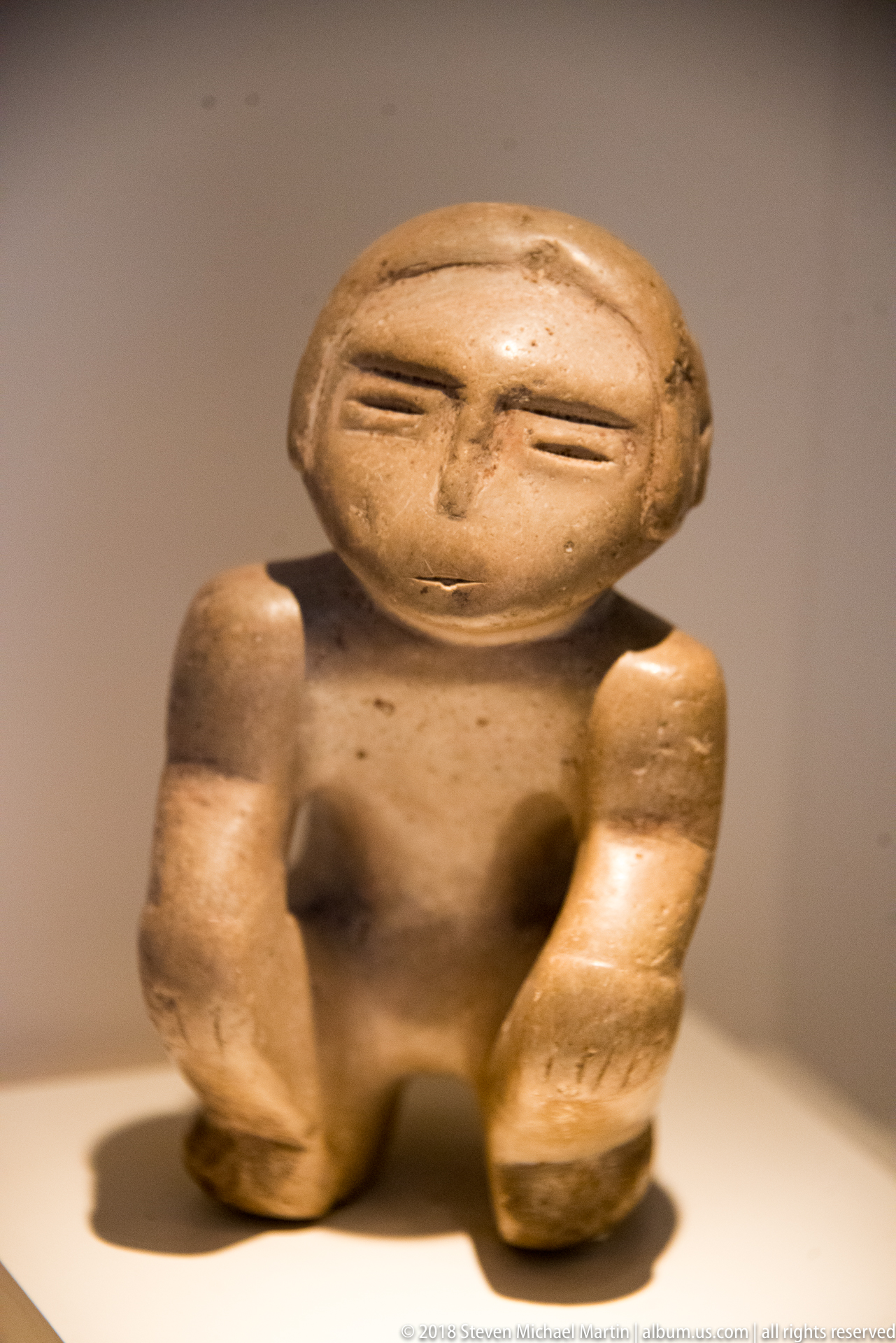
A compact seated ceramic figure is modeled with a broad head, slit-like eyes, projecting arms, and abbreviated legs. The frontal pose and deliberately simplified anatomy give the object a powerful sculptural presence despite its small scale. Displayed alone under museum lighting, the piece emphasizes how ancient Peruvian potters could transform the human body into a concise, expressive three-dimensional form.
Caption
A compact seated ceramic figure is modeled with a broad head, slit-like eyes, projecting arms, and abbreviated legs. The frontal pose and deliberately simplified anatomy give the object a powerful sculptural presence despite its small scale. Displayed alone under museum lighting, the piece emphasizes how ancient Peruvian potters could transform the human body into a concise, expressive three-dimensional form.
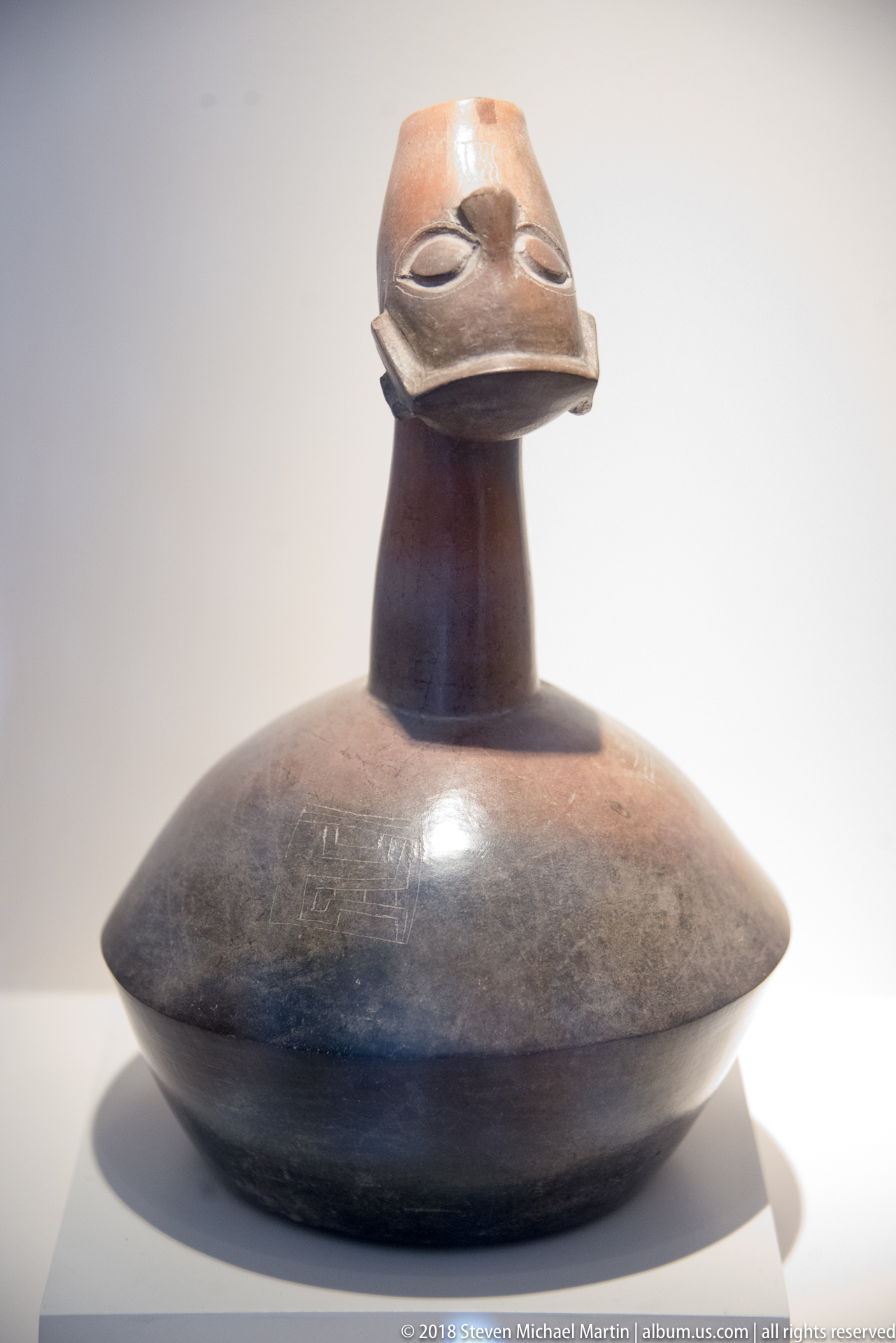
A dark burnished ceramic bottle combines a broad, flattened globular body with a tall neck modeled as a human head. The vessel’s restrained surface treatment directs attention to its silhouette: a low, expansive container rising abruptly into a sculptural face. This union of functional vessel and figural image is characteristic of the inventive ceramic traditions represented in the MAP Cusco collection.
Caption
A dark burnished ceramic bottle combines a broad, flattened globular body with a tall neck modeled as a human head. The vessel’s restrained surface treatment directs attention to its silhouette: a low, expansive container rising abruptly into a sculptural face. This union of functional vessel and figural image is characteristic of the inventive ceramic traditions represented in the MAP Cusco collection.
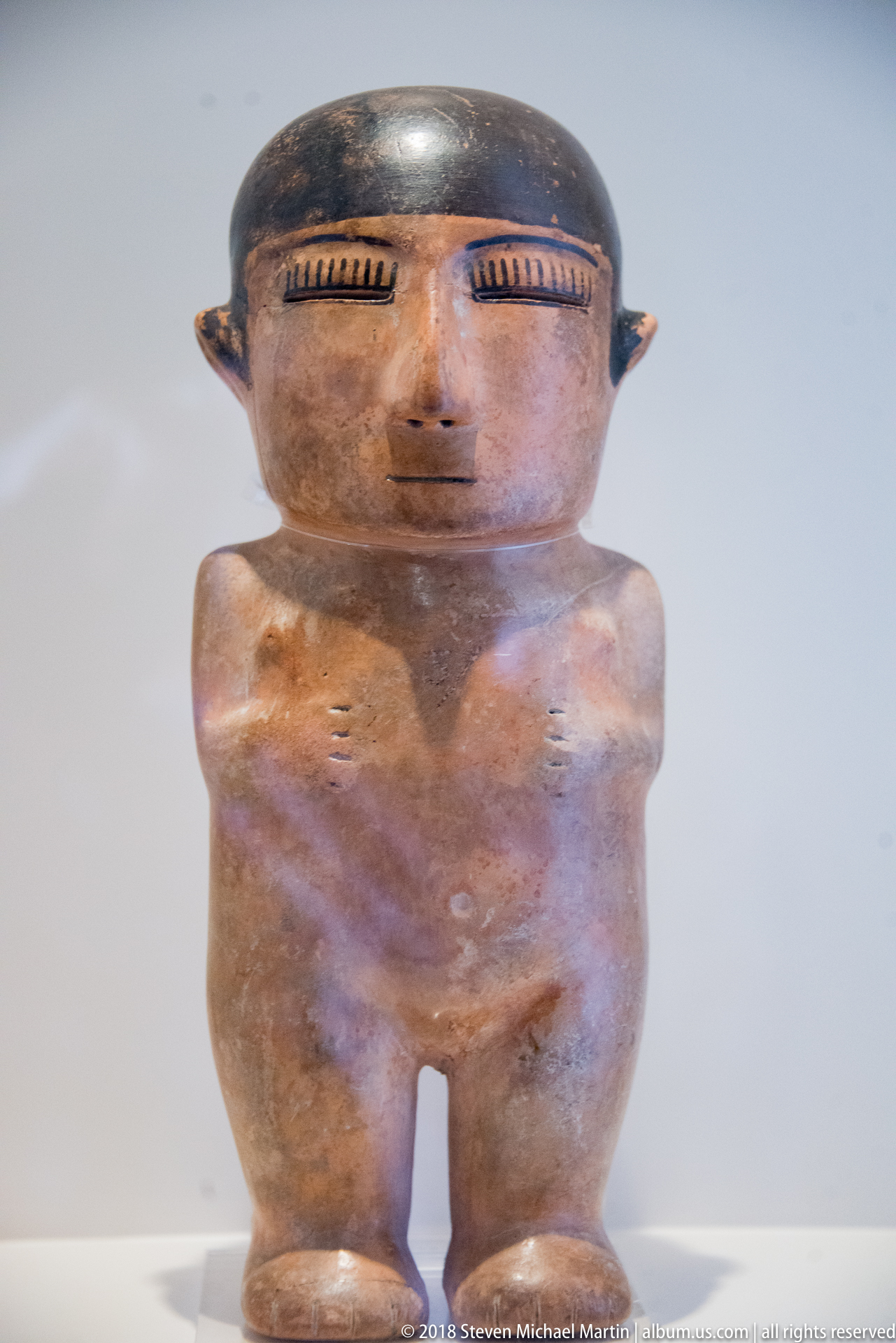
A standing ceramic figure is built from a tall cylindrical body topped by an enlarged head with painted or incised brows, ears, and a small mouth. Subtle modeled arms and legs preserve the human identity while the body retains the mass of a vessel-like form. The object illustrates the close relationship between sculpture and pottery in ancient Peruvian visual culture.
Caption
A standing ceramic figure is built from a tall cylindrical body topped by an enlarged head with painted or incised brows, ears, and a small mouth. Subtle modeled arms and legs preserve the human identity while the body retains the mass of a vessel-like form. The object illustrates the close relationship between sculpture and pottery in ancient Peruvian visual culture.

A circular necklace is assembled from dozens of small shell elements whose natural spiral interiors remain visible. Arranged edge to edge, the pale and warm orange pieces create a rhythmic band that turns marine material into personal adornment. The display highlights the importance of shell in ancient Andean exchange networks and in objects valued for color, rarity, and symbolic association.
Caption
A circular necklace is assembled from dozens of small shell elements whose natural spiral interiors remain visible. Arranged edge to edge, the pale and warm orange pieces create a rhythmic band that turns marine material into personal adornment. The display highlights the importance of shell in ancient Andean exchange networks and in objects valued for color, rarity, and symbolic association.

A necklace or pectoral of tapered shell pendants spreads outward in a dramatic radial pattern. Each element is individually drilled for stringing, while differences in length and angle create a spiked silhouette around the neck opening. The design exploits both the light color and the rigid, workable character of shell to create an ornament with strong visual movement.
Caption
A necklace or pectoral of tapered shell pendants spreads outward in a dramatic radial pattern. Each element is individually drilled for stringing, while differences in length and angle create a spiked silhouette around the neck opening. The design exploits both the light color and the rigid, workable character of shell to create an ornament with strong visual movement.

Rows of small round metal elements cover a group of vertical rectangular panels, producing a shimmering field of repeated discs. The installation demonstrates how ancient Andean metalworkers used multiplication, rhythm, and reflected light to create visual impact beyond the value of the material itself. Differences in tone across the panels suggest varied metals, alloys, or surface treatments within the display.
Caption
Rows of small round metal elements cover a group of vertical rectangular panels, producing a shimmering field of repeated discs. The installation demonstrates how ancient Andean metalworkers used multiplication, rhythm, and reflected light to create visual impact beyond the value of the material itself. Differences in tone across the panels suggest varied metals, alloys, or surface treatments within the display.

An interpretive panel in the MAP Cusco Silver Gallery explains the elite and ceremonial use of gold and silver and describes silver’s symbolic association with feminine elements of nature. It also notes a long Andean tradition of silverworking and names techniques including rolling, embossing, hammering, chiseling, and alloying, providing context for the metal objects displayed nearby.
Caption
An interpretive panel in the MAP Cusco Silver Gallery explains the elite and ceremonial use of gold and silver and describes silver’s symbolic association with feminine elements of nature. It also notes a long Andean tradition of silverworking and names techniques including rolling, embossing, hammering, chiseling, and alloying, providing context for the metal objects displayed nearby.

A long metal pin terminates in an elegant open spiral that coils upward above a narrow shaft. The contrast between the slender stem and the animated finial makes the object both functional and sculptural. Pins of this general type were used in Andean dress and adornment, while elaborate terminals provided an opportunity for metalworkers to add status and visual distinction.
Caption
A long metal pin terminates in an elegant open spiral that coils upward above a narrow shaft. The contrast between the slender stem and the animated finial makes the object both functional and sculptural. Pins of this general type were used in Andean dress and adornment, while elaborate terminals provided an opportunity for metalworkers to add status and visual distinction.

A ceramic pedestal vessel rises from a tall flaring support to a broad, shallow rim. Modeled protrusions under the edge and a small central relief or incised motif animate the otherwise restrained surface. The low viewpoint emphasizes its unusual engineering, showing how potters combined a broad serving or ceremonial form with a high hollow foot for visual prominence.
Caption
A ceramic pedestal vessel rises from a tall flaring support to a broad, shallow rim. Modeled protrusions under the edge and a small central relief or incised motif animate the otherwise restrained surface. The low viewpoint emphasizes its unusual engineering, showing how potters combined a broad serving or ceremonial form with a high hollow foot for visual prominence.

A burnished black ceramic bottle carries a large frontal face or supernatural figure across its broad shoulder. Fine incised lines radiate outward from the central image, turning the vessel’s flattened body into a patterned field. The dark polished surface and low-relief drawing work together so that the decoration emerges through reflected light rather than strong color contrast.
Caption
A burnished black ceramic bottle carries a large frontal face or supernatural figure across its broad shoulder. Fine incised lines radiate outward from the central image, turning the vessel’s flattened body into a patterned field. The dark polished surface and low-relief drawing work together so that the decoration emerges through reflected light rather than strong color contrast.

A trio of ceremonial-looking pins is crowned by small birds in different poses, including one with an extended wing. Seen together, the finials reveal how ancient metalworkers varied a shared avian theme while retaining the same basic shaft-and-terminal format. The black display isolates their silhouettes and makes the birds’ long beaks, bodies, and perched stances especially legible.
Caption
A trio of ceremonial-looking pins is crowned by small birds in different poses, including one with an extended wing. Seen together, the finials reveal how ancient metalworkers varied a shared avian theme while retaining the same basic shaft-and-terminal format. The black display isolates their silhouettes and makes the birds’ long beaks, bodies, and perched stances especially legible.

A long gallery at MAP Cusco is lined with large framed paintings on vivid red walls, creating a strong perspectival view toward a single work at the far end. Track lighting and a polished herringbone floor emphasize the symmetry of the corridor. The scene documents the museum’s architectural and display setting rather than a single pre-Columbian object.
Caption
A long gallery at MAP Cusco is lined with large framed paintings on vivid red walls, creating a strong perspectival view toward a single work at the far end. Track lighting and a polished herringbone floor emphasize the symmetry of the corridor. The scene documents the museum’s architectural and display setting rather than a single pre-Columbian object.

Two related groups of ceramic vessels combine tall cylindrical containers with smaller anthropomorphic forms joined by handles or connecting elements. Incised geometric patterns, modeled heads, and contrasting vessel shapes turn each group into a small sculptural composition. The paired display makes it possible to compare repeated design ideas while noticing differences in scale, surface, and figural treatment.
Caption
Two related groups of ceramic vessels combine tall cylindrical containers with smaller anthropomorphic forms joined by handles or connecting elements. Incised geometric patterns, modeled heads, and contrasting vessel shapes turn each group into a small sculptural composition. The paired display makes it possible to compare repeated design ideas while noticing differences in scale, surface, and figural treatment.

Three globular anthropomorphic vessels stand together, each turning the rounded body of a jar into a human torso. Large modeled faces, headdresses, arms, and costume details vary from object to object while preserving a shared compact format. The arrangement highlights the ancient Andean practice of merging container and figure so that a vessel could function simultaneously as object, image, and ritual presence.
Caption
Three globular anthropomorphic vessels stand together, each turning the rounded body of a jar into a human torso. Large modeled faces, headdresses, arms, and costume details vary from object to object while preserving a shared compact format. The arrangement highlights the ancient Andean practice of merging container and figure so that a vessel could function simultaneously as object, image, and ritual presence.

Three round-bodied bottles are displayed as a coordinated group, each covered with bold painted geometry. The central vessel centers a radiating face or solar-like emblem, while the flanking bottles use dense concentric and crossed patterns. Their repeated circular bodies and loop handles make the different decorative systems easy to compare, showing how painters organized complex motifs across compact ceramic surfaces.
Caption
Three round-bodied bottles are displayed as a coordinated group, each covered with bold painted geometry. The central vessel centers a radiating face or solar-like emblem, while the flanking bottles use dense concentric and crossed patterns. Their repeated circular bodies and loop handles make the different decorative systems easy to compare, showing how painters organized complex motifs across compact ceramic surfaces.

A pair of small standing ceramic figures is modeled with large heads, prominent eyes, bent arms, and patterned torsos. Painted facial details and black geometric bands enliven the warm clay surfaces, while differences in facial expression and body proportion distinguish the two companions. Their direct frontal presentation gives the figures an engaging, almost portrait-like immediacy within the display case.
Caption
A pair of small standing ceramic figures is modeled with large heads, prominent eyes, bent arms, and patterned torsos. Painted facial details and black geometric bands enliven the warm clay surfaces, while differences in facial expression and body proportion distinguish the two companions. Their direct frontal presentation gives the figures an engaging, almost portrait-like immediacy within the display case.

A pair of Mochica ceramic vessels gives each tall, flaring neck an animal-like head, turning the container into a compact sculptural presence. Modeled eyes, snouts, and ears animate the upper bodies while the rounded lower chambers remain comparatively restrained. Seen within the museum’s North Gallery sequence, the vessels belong to the Mochica ceramic tradition of Peru’s north coast, where functional forms frequently carried naturalistic or supernatural imagery.
Caption
A pair of Mochica ceramic vessels gives each tall, flaring neck an animal-like head, turning the container into a compact sculptural presence. Modeled eyes, snouts, and ears animate the upper bodies while the rounded lower chambers remain comparatively restrained. Seen within the museum’s North Gallery sequence, the vessels belong to the Mochica ceramic tradition of Peru’s north coast, where functional forms frequently carried naturalistic or supernatural imagery.

Two rounded Mochica vessels are modeled as compact animal effigies, with projecting heads and incised or impressed patterning spread across their bodies. Their low, swelling silhouettes contrast with the more vertical vessels nearby, while the repeated animal format makes the pair read as a deliberate comparison. The North Gallery context securely places these ceramics within the Mochica tradition of Peru’s north coast without requiring a speculative species identification.
Caption
Two rounded Mochica vessels are modeled as compact animal effigies, with projecting heads and incised or impressed patterning spread across their bodies. Their low, swelling silhouettes contrast with the more vertical vessels nearby, while the repeated animal format makes the pair read as a deliberate comparison. The North Gallery context securely places these ceramics within the Mochica tradition of Peru’s north coast without requiring a speculative species identification.

An interpretive panel introduces Mochica ceramic sculptural heads from Peru’s north coast, dated approximately 1–800 CE. The text explains the remarkable realism of so-called portrait huacos, describing them as modeled human heads or faces that may represent members of political and religious elites and noting their likely funerary role as offerings associated with remembrance and the dead.
Caption
An interpretive panel introduces Mochica ceramic sculptural heads from Peru’s north coast, dated approximately 1–800 CE. The text explains the remarkable realism of so-called portrait huacos, describing them as modeled human heads or faces that may represent members of political and religious elites and noting their likely funerary role as offerings associated with remembrance and the dead.

Three Mochica portrait vessels present individualized male faces beneath tall stirrup-spout or tube-like ceramic necks. Variations in skin tone, expression, facial structure, and head treatment underscore the realism for which Moche portrait huacos are renowned. Displayed immediately after the museum panel on sculptural heads, the group illustrates how North Coast potters transformed recognizable human physiognomy into highly finished ritual ceramic containers.
Caption
Three Mochica portrait vessels present individualized male faces beneath tall stirrup-spout or tube-like ceramic necks. Variations in skin tone, expression, facial structure, and head treatment underscore the realism for which Moche portrait huacos are renowned. Displayed immediately after the museum panel on sculptural heads, the group illustrates how North Coast potters transformed recognizable human physiognomy into highly finished ritual ceramic containers.

Two Mochica sculptural bottles transform ceramic containers into birds, combining rounded vessel bodies with modeled heads, beaks, and compact avian forms. Their side-by-side display emphasizes variations in posture and modeling while preserving the naturalistic treatment characteristic of the North Gallery ceramics. MAP identifies this gallery with Mochica culture, whose artists used animal imagery extensively in ceremonial vessels from Peru’s north coast.
Caption
Two Mochica sculptural bottles transform ceramic containers into birds, combining rounded vessel bodies with modeled heads, beaks, and compact avian forms. Their side-by-side display emphasizes variations in posture and modeling while preserving the naturalistic treatment characteristic of the North Gallery ceramics. MAP identifies this gallery with Mochica culture, whose artists used animal imagery extensively in ceremonial vessels from Peru’s north coast.

A Mochica sculptural vessel depicts a seated human figure gripping a long reddish object diagonally across the body. The potter carefully modeled the face, hands, feet, broad shoulders, and layered garments, using contrasting cream, dark, and red slips to separate anatomical and costume details. The vessel exemplifies the Moche preference for narrative human imagery rendered with strong three-dimensional presence.
Caption
A Mochica sculptural vessel depicts a seated human figure gripping a long reddish object diagonally across the body. The potter carefully modeled the face, hands, feet, broad shoulders, and layered garments, using contrasting cream, dark, and red slips to separate anatomical and costume details. The vessel exemplifies the Moche preference for narrative human imagery rendered with strong three-dimensional presence.

A striking Mochica effigy vessel merges a deer’s spotted body, antlered head, and large ears with a seated human posture and articulated arms and hands. The figure sits cross-legged and holds its hands together at the abdomen, creating an intentionally hybrid being rather than a naturalistic animal. Carefully painted white spots and contrasting cream fields sharpen the supernatural or performative character of the image.
Caption
A striking Mochica effigy vessel merges a deer’s spotted body, antlered head, and large ears with a seated human posture and articulated arms and hands. The figure sits cross-legged and holds its hands together at the abdomen, creating an intentionally hybrid being rather than a naturalistic animal. Carefully painted white spots and contrasting cream fields sharpen the supernatural or performative character of the image.

An introductory gallery panel maps the north coast of Peru and explains Mochica ceramic production, including the development of fine mold-made vessels and their role in communicating religious and social ideas. The panel provides interpretive context for the ceramic objects displayed nearby, linking their imagery to the broader visual language of ancient north-coast cultures.
Caption
An introductory gallery panel maps the north coast of Peru and explains Mochica ceramic production, including the development of fine mold-made vessels and their role in communicating religious and social ideas. The panel provides interpretive context for the ceramic objects displayed nearby, linking their imagery to the broader visual language of ancient north-coast cultures.

A museum label identifies a ceramic pitcher from Peru’s north coast, dated approximately A.D. 1–800, and explains the “lunar animal” motif. The text describes a hybrid zoomorphic being combining features associated with felines, foxes, birds, and snakes, shown in relation to a crescent moon and the nocturnal mythology of pre-Columbian north-coast cultures.
Caption
A museum label identifies a ceramic pitcher from Peru’s north coast, dated approximately A.D. 1–800, and explains the “lunar animal” motif. The text describes a hybrid zoomorphic being combining features associated with felines, foxes, birds, and snakes, shown in relation to a crescent moon and the nocturnal mythology of pre-Columbian north-coast cultures.

A gallery text panel introduces the long history of pottery in ancient Peru, describing vessels used in ceremonies and funerary rituals and noting the Quechua term huaco for sacred-place objects. It also summarizes pottery making as the modeling of clay mixed with water and other materials, followed by firing, while emphasizing symbolic motifs, animals, plants, and human portraits.
Caption
A gallery text panel introduces the long history of pottery in ancient Peru, describing vessels used in ceremonies and funerary rituals and noting the Quechua term huaco for sacred-place objects. It also summarizes pottery making as the modeling of clay mixed with water and other materials, followed by firing, while emphasizing symbolic motifs, animals, plants, and human portraits.
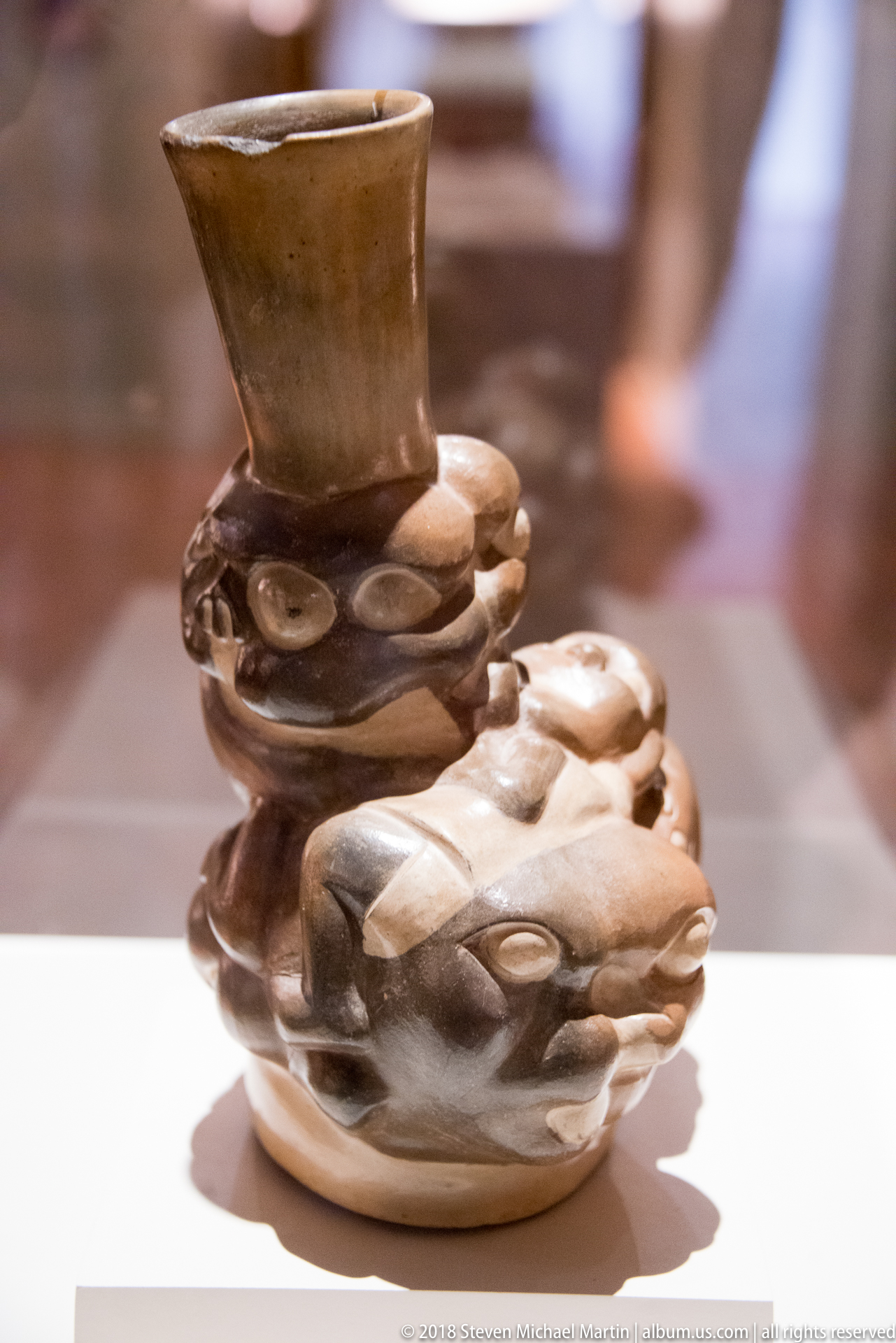
A Mochica sculptural vessel builds a vertical composition from stacked human and animal forms, making the container read almost like a miniature narrative sculpture. Modeled heads, limbs, and projecting features break up the vessel’s mass and encourage viewing from several angles. Its placement in the museum’s Mochica sequence supports the cultural attribution, while the exact identities of the represented beings are left open rather than forced from the small-scale view.
Caption
A Mochica sculptural vessel builds a vertical composition from stacked human and animal forms, making the container read almost like a miniature narrative sculpture. Modeled heads, limbs, and projecting features break up the vessel’s mass and encourage viewing from several angles. Its placement in the museum’s Mochica sequence supports the cultural attribution, while the exact identities of the represented beings are left open rather than forced from the small-scale view.

A cream-colored globular vessel is organized around broad red-brown painted spirals that expand across the rounded body. A narrow neck carries a geometric band, while a central vertical element divides the sweeping curvilinear composition. The strong contrast between light slip and dark pigment gives the vessel a highly graphic surface distinct from the figural ceramics on the same gallery wall.
Caption
A cream-colored globular vessel is organized around broad red-brown painted spirals that expand across the rounded body. A narrow neck carries a geometric band, while a central vertical element divides the sweeping curvilinear composition. The strong contrast between light slip and dark pigment gives the vessel a highly graphic surface distinct from the figural ceramics on the same gallery wall.

A Nasca bridge-handled vessel centers a frontal supernatural face beneath the connecting handle, using strong symmetry and painted or modeled features to turn the container into an emblematic image. The compact form belongs to the South Gallery sequence devoted to Nasca art, where ceramic surfaces carry dense symbolic imagery. Its precise deity or supernatural identity is not named here because the photographed view does not securely establish it.
Caption
A Nasca bridge-handled vessel centers a frontal supernatural face beneath the connecting handle, using strong symmetry and painted or modeled features to turn the container into an emblematic image. The compact form belongs to the South Gallery sequence devoted to Nasca art, where ceramic surfaces carry dense symbolic imagery. Its precise deity or supernatural identity is not named here because the photographed view does not securely establish it.

A Nasca bowl sets a stylized frontal face against black-on-cream decoration, with bird forms and geometric elements distributed around the interior. The shallow vessel turns its open surface into a carefully organized pictorial field. Within MAP Cusco’s South Gallery, the piece demonstrates the Nasca preference for combining figural imagery, repeated motifs, and strong color contrast on ceremonial ceramics.
Caption
A Nasca bowl sets a stylized frontal face against black-on-cream decoration, with bird forms and geometric elements distributed around the interior. The shallow vessel turns its open surface into a carefully organized pictorial field. Within MAP Cusco’s South Gallery, the piece demonstrates the Nasca preference for combining figural imagery, repeated motifs, and strong color contrast on ceremonial ceramics.

A stack of shallow Nasca bowls reveals repeated painted curves and geometric motifs along their visible interiors and rims. Displayed together, the vessels emphasize serial variation: similar forms receive different arrangements of line, color, and pattern. The grouping belongs to MAP Cusco’s South Gallery, where Nasca ceramics demonstrate the culture’s highly developed command of painted design.
Caption
A stack of shallow Nasca bowls reveals repeated painted curves and geometric motifs along their visible interiors and rims. Displayed together, the vessels emphasize serial variation: similar forms receive different arrangements of line, color, and pattern. The grouping belongs to MAP Cusco’s South Gallery, where Nasca ceramics demonstrate the culture’s highly developed command of painted design.

A Nasca red ceramic jar presents a frontal anthropomorphic face framed by dotted and linear ornament. The rounded body becomes both container and image, with the facial features commanding the center while smaller marks animate the surrounding surface. Its place in the South Gallery sequence identifies it with Nasca ceramic art of Peru’s south coast.
Caption
A Nasca red ceramic jar presents a frontal anthropomorphic face framed by dotted and linear ornament. The rounded body becomes both container and image, with the facial features commanding the center while smaller marks animate the surrounding surface. Its place in the South Gallery sequence identifies it with Nasca ceramic art of Peru’s south coast.

Two small Nasca bowls carry compact zoomorphic motifs inside their open interiors, surrounded by painted bands and geometric accents. Their side-by-side display encourages comparison of the creatures’ simplified outlines and the way each design is fitted to a circular field. The exact species is not certain from the photograph, but the South Gallery context securely identifies the vessels as Nasca ceramics.
Caption
Two small Nasca bowls carry compact zoomorphic motifs inside their open interiors, surrounded by painted bands and geometric accents. Their side-by-side display encourages comparison of the creatures’ simplified outlines and the way each design is fitted to a circular field. The exact species is not certain from the photograph, but the South Gallery context securely identifies the vessels as Nasca ceramics.

A blue-gray gallery wall is punctuated by a grid of illuminated display niches, each holding a single decorated ceramic vessel. Cylindrical beakers and other upright forms show contrasting geometric and figurative painted designs. The installation presents the vessels as a comparative series, allowing changes in shape, palette, and ornament to be read across the display.
Caption
A blue-gray gallery wall is punctuated by a grid of illuminated display niches, each holding a single decorated ceramic vessel. Cylindrical beakers and other upright forms show contrasting geometric and figurative painted designs. The installation presents the vessels as a comparative series, allowing changes in shape, palette, and ornament to be read across the display.

Two Nasca face vessels use black triangular cheek markings and strongly frontal features to turn compact ceramic forms into human images. Differences in expression and painted detail individualize the pair, while their repeated format links them visually. The vessels belong to MAP Cusco’s South Gallery sequence devoted to Nasca and Paracas art.
Caption
Two Nasca face vessels use black triangular cheek markings and strongly frontal features to turn compact ceramic forms into human images. Differences in expression and painted detail individualize the pair, while their repeated format links them visually. The vessels belong to MAP Cusco’s South Gallery sequence devoted to Nasca and Paracas art.

A seated Nasca anthropomorphic figure is modeled with broad shoulders, a painted face, and a compact frontal body. The strong symmetry and direct gaze give the figure a self-contained sculptural presence, while painted details articulate the face and costume. Its position immediately before the museum’s Nasca introductory panel supports identification within the South Gallery’s Nasca ceramic sequence.
Caption
A seated Nasca anthropomorphic figure is modeled with broad shoulders, a painted face, and a compact frontal body. The strong symmetry and direct gaze give the figure a self-contained sculptural presence, while painted details articulate the face and costume. Its position immediately before the museum’s Nasca introductory panel supports identification within the South Gallery’s Nasca ceramic sequence.

A gallery panel introduces the Nasca culture of Peru’s south coast and outlines themes used to interpret the ceramics displayed nearby. The text discusses desert settlement, water management, ritual landscapes, and the famous geoglyphs, while a regional map situates the culture geographically. The panel provides the historical and environmental frame for the following Nasca objects.
Caption
A gallery panel introduces the Nasca culture of Peru’s south coast and outlines themes used to interpret the ceramics displayed nearby. The text discusses desert settlement, water management, ritual landscapes, and the famous geoglyphs, while a regional map situates the culture geographically. The panel provides the historical and environmental frame for the following Nasca objects.

A richly carved wooden door or shutter fills the frame with a strict grid of rectangular panels. Each panel contains a repeating raised floral or scroll-like motif, while broader horizontal bands and paired central fields organize the composition. Weathering and varied surface tones reveal the depth of the carving and the object’s long material history within the museum setting.
Caption
A richly carved wooden door or shutter fills the frame with a strict grid of rectangular panels. Each panel contains a repeating raised floral or scroll-like motif, while broader horizontal bands and paired central fields organize the composition. Weathering and varied surface tones reveal the depth of the carving and the object’s long material history within the museum setting.

A carved wooden figure stands frontally on separated legs, with a broad head and compact arms folded or crossed across the torso. Deep horizontal incisions define the neck, waist, and lower body, while the rough grain and weathered surface remain prominent. The simplified geometry gives the figure a restrained, almost architectural silhouette.
Caption
A carved wooden figure stands frontally on separated legs, with a broad head and compact arms folded or crossed across the torso. Deep horizontal incisions define the neck, waist, and lower body, while the rough grain and weathered surface remain prominent. The simplified geometry gives the figure a restrained, almost architectural silhouette.

A compact wooden figure is assembled visually from broad, block-like masses: an oval head, rectangular shoulders, and a segmented lower body. Incised eyes and a small projecting nose form a minimal face, while deep vertical cracks accent the aged wood. The object’s heavy proportions and frontal symmetry distinguish it from the more elongated figures nearby.
Caption
A compact wooden figure is assembled visually from broad, block-like masses: an oval head, rectangular shoulders, and a segmented lower body. Incised eyes and a small projecting nose form a minimal face, while deep vertical cracks accent the aged wood. The object’s heavy proportions and frontal symmetry distinguish it from the more elongated figures nearby.

A weathered wooden figure has an oversized broad head above a short, angular body with bent or splayed legs. Shallow facial features and linear incisions are softened by age and abrasion, leaving the silhouette and massing more legible than fine details. The compact pose contrasts strongly with the tall standing figures in the surrounding display.
Caption
A weathered wooden figure has an oversized broad head above a short, angular body with bent or splayed legs. Shallow facial features and linear incisions are softened by age and abrasion, leaving the silhouette and massing more legible than fine details. The compact pose contrasts strongly with the tall standing figures in the surrounding display.

A tall carved wooden object hangs from a large circular opening at the top and divides below into two long parallel strips. Each strip is patterned with repeated triangular notches or serrations, ending in a narrow crosspiece. The strong bilateral symmetry and carefully repeated cuts suggest a specialized ceremonial or ornamental function rather than an ordinary utilitarian implement.
Caption
A tall carved wooden object hangs from a large circular opening at the top and divides below into two long parallel strips. Each strip is patterned with repeated triangular notches or serrations, ending in a narrow crosspiece. The strong bilateral symmetry and carefully repeated cuts suggest a specialized ceremonial or ornamental function rather than an ordinary utilitarian implement.

An elaborate carved wooden figure is mounted above a vertical support, combining a crescent-like headdress, broad facial mask, projecting arms, and layered body elements. The stacked construction creates a complex silhouette, while pierced spaces and strong horizontal bands separate the head, torso, and base. Its ceremonial appearance differs markedly from the simpler freestanding wooden idols nearby.
Caption
An elaborate carved wooden figure is mounted above a vertical support, combining a crescent-like headdress, broad facial mask, projecting arms, and layered body elements. The stacked construction creates a complex silhouette, while pierced spaces and strong horizontal bands separate the head, torso, and base. Its ceremonial appearance differs markedly from the simpler freestanding wooden idols nearby.

A large wooden figure stands frontally with both hands clasped or folded at the center of the chest. A broad head and heavy brow frame simplified facial features, while bent elbows, a rectangular lower garment, and short legs give the body a monumental blockiness. Strong side lighting throws a crisp shadow onto the museum wall, emphasizing the depth of the carving.
Caption
A large wooden figure stands frontally with both hands clasped or folded at the center of the chest. A broad head and heavy brow frame simplified facial features, while bent elbows, a rectangular lower garment, and short legs give the body a monumental blockiness. Strong side lighting throws a crisp shadow onto the museum wall, emphasizing the depth of the carving.

A tall, narrow wooden figure stands against the gallery wall with a rounded head, slit-like eyes, and a simple horizontal mouth. Small arms fold across the upper chest while the long rectangular body tapers only slightly toward the base. The sparse carving and pronounced vertical grain make the surviving wood itself a major part of the figure’s visual character.
Caption
A tall, narrow wooden figure stands against the gallery wall with a rounded head, slit-like eyes, and a simple horizontal mouth. Small arms fold across the upper chest while the long rectangular body tapers only slightly toward the base. The sparse carving and pronounced vertical grain make the surviving wood itself a major part of the figure’s visual character.

A dark wooden figure combines an oversized head with lateral ear-like projections, a compact torso, and bent arms resting across the front. Short legs descend into a rough, irregular lower extension that may preserve part of the original mounting or support. Dramatic gallery lighting projects an enlarged silhouette onto the wall, reinforcing the figure’s distinctive outline.
Caption
A dark wooden figure combines an oversized head with lateral ear-like projections, a compact torso, and bent arms resting across the front. Short legs descend into a rough, irregular lower extension that may preserve part of the original mounting or support. Dramatic gallery lighting projects an enlarged silhouette onto the wall, reinforcing the figure’s distinctive outline.

A carved wooden figure has a broad rectangular head with long incised eyes, a small smiling mouth, and rounded side projections. Bent arms bring the hands toward a small rectangular object held at the chest. The lower body is heavily weathered and partly lost, giving the sculpture an irregular base while preserving the carefully organized upper figure.
Caption
A carved wooden figure has a broad rectangular head with long incised eyes, a small smiling mouth, and rounded side projections. Bent arms bring the hands toward a small rectangular object held at the chest. The lower body is heavily weathered and partly lost, giving the sculpture an irregular base while preserving the carefully organized upper figure.

A front-facing wooden figure is defined by a deep vertical split running through its broad head. Large eyes, a projecting nose or mouth, and compact arms crossed at the waist remain legible despite the damage. Geometric bands and block-like legs structure the lower body, while the cracked surface makes age and material fragility especially prominent.
Caption
A front-facing wooden figure is defined by a deep vertical split running through its broad head. Large eyes, a projecting nose or mouth, and compact arms crossed at the waist remain legible despite the damage. Geometric bands and block-like legs structure the lower body, while the cracked surface makes age and material fragility especially prominent.

A compact zoomorphic sculpture takes the form of a crouching four-legged animal with a projecting head, short muzzle, and small incised eye. The body is reduced to broad stepped masses, creating a sturdy geometric profile rather than naturalistic anatomy. Its weathered surface and simplified modeling make species identification uncertain, but the animal form is unmistakable.
Caption
A compact zoomorphic sculpture takes the form of a crouching four-legged animal with a projecting head, short muzzle, and small incised eye. The body is reduced to broad stepped masses, creating a sturdy geometric profile rather than naturalistic anatomy. Its weathered surface and simplified modeling make species identification uncertain, but the animal form is unmistakable.

A museum panel explains why ancient wooden objects are rarely preserved and notes that dry environmental conditions could allow wood to survive for centuries. It describes carved wooden benches, oars, poles, idols, ancestor effigies, and figurative posts associated with ceremonial enclosures, emphasizing wood as both a practical and ritual material in the ancient Andean world.
Caption
A museum panel explains why ancient wooden objects are rarely preserved and notes that dry environmental conditions could allow wood to survive for centuries. It describes carved wooden benches, oars, poles, idols, ancestor effigies, and figurative posts associated with ceremonial enclosures, emphasizing wood as both a practical and ritual material in the ancient Andean world.

An interpretive panel introduces Virú ceramic bottles from Peru’s north coast and the museum’s theme of “Jug people.” The text describes recurring linear patterns around vessel necks and explains that modeled faces may represent warriors or priests, emphasizing earrings, face paint, and patterned garments as distinguishing features of these anthropomorphic containers.
Caption
An interpretive panel introduces Virú ceramic bottles from Peru’s north coast and the museum’s theme of “Jug people.” The text describes recurring linear patterns around vessel necks and explains that modeled faces may represent warriors or priests, emphasizing earrings, face paint, and patterned garments as distinguishing features of these anthropomorphic containers.

A Virú globular bottle turns the upper vessel into a human presence through a modeled face, projecting ears, and compact features. The rounded chamber remains visually dominant while the facial details animate its front. The adjacent museum interpretation identifies this group with Virú “jug people,” allowing the cultural attribution to be made securely while leaving the object’s precise catalogue title unstated.
Caption
A Virú globular bottle turns the upper vessel into a human presence through a modeled face, projecting ears, and compact features. The rounded chamber remains visually dominant while the facial details animate its front. The adjacent museum interpretation identifies this group with Virú “jug people,” allowing the cultural attribution to be made securely while leaving the object’s precise catalogue title unstated.

A rounded Virú ceramic vessel is organized by painted linear motifs that follow the swelling body rather than by heavy modeled ornament. Its compact silhouette and restrained decoration contrast with the anthropomorphic Virú bottle displayed nearby. The cultural attribution is supported by the museum’s adjacent Virú interpretive sequence, while the exact vessel type remains conservatively described.
Caption
A rounded Virú ceramic vessel is organized by painted linear motifs that follow the swelling body rather than by heavy modeled ornament. Its compact silhouette and restrained decoration contrast with the anthropomorphic Virú bottle displayed nearby. The cultural attribution is supported by the museum’s adjacent Virú interpretive sequence, while the exact vessel type remains conservatively described.

A museum label titled “Sculpture Jug” explains the expressive possibilities of modeled clay in a Virú vessel representing a semi-naked male figure. The text calls attention to carefully rendered facial and bodily details, including fingers and the navel, presenting the work as an example of highly plastic ceramic modeling within the society’s stylistic conventions.
Caption
A museum label titled “Sculpture Jug” explains the expressive possibilities of modeled clay in a Virú vessel representing a semi-naked male figure. The text calls attention to carefully rendered facial and bodily details, including fingers and the navel, presenting the work as an example of highly plastic ceramic modeling within the society’s stylistic conventions.

A Virú sculptural jug models a semi-nude standing man with carefully articulated facial features, hands, navel, and body. The human form is integrated into the rounded ceramic container rather than merely applied to its surface. The museum’s adjacent label identifies this Virú sculpture jug tradition and emphasizes its unusually detailed naturalism, making the cultural and object-type attribution substantially firmer than a generic figurine description.
Caption
A Virú sculptural jug models a semi-nude standing man with carefully articulated facial features, hands, navel, and body. The human form is integrated into the rounded ceramic container rather than merely applied to its surface. The museum’s adjacent label identifies this Virú sculpture jug tradition and emphasizes its unusually detailed naturalism, making the cultural and object-type attribution substantially firmer than a generic figurine description.

A small modeled face emerges from the shoulder of this broad ceramic bottle beneath a wide, dark flaring neck. Repeated black-and-red bands descend over the rounded body, framing the face and reinforcing the vessel’s symmetry. The combination of painted geometry and anthropomorphic modeling closely echoes the “Jug people” theme explained in the adjacent Virú gallery text.
Caption
A small modeled face emerges from the shoulder of this broad ceramic bottle beneath a wide, dark flaring neck. Repeated black-and-red bands descend over the rounded body, framing the face and reinforcing the vessel’s symmetry. The combination of painted geometry and anthropomorphic modeling closely echoes the “Jug people” theme explained in the adjacent Virú gallery text.

A low, rounded ceramic bottle is covered with bold black and reddish painted arcs, bands, and stepped shapes. At the shoulder, a small modeled animal- or bird-like head projects beneath the flaring neck, creating a focal point amid the painted geometry. The vessel’s compressed profile and dense surface design distinguish it from the more explicitly human-faced bottles nearby.
Caption
A low, rounded ceramic bottle is covered with bold black and reddish painted arcs, bands, and stepped shapes. At the shoulder, a small modeled animal- or bird-like head projects beneath the flaring neck, creating a focal point amid the painted geometry. The vessel’s compressed profile and dense surface design distinguish it from the more explicitly human-faced bottles nearby.

This ceramic face mask presents a bald, rounded head with deeply arched brows, pierced eye openings, prominent ears, a long nose, and an open mouth fitted with contrasting tooth-like inserts. A projecting chin or tongue-like element extends below the mouth. The direct frontal composition heightens the mask’s expressive character and makes each modeled facial feature easy to compare.
Caption
This ceramic face mask presents a bald, rounded head with deeply arched brows, pierced eye openings, prominent ears, a long nose, and an open mouth fitted with contrasting tooth-like inserts. A projecting chin or tongue-like element extends below the mouth. The direct frontal composition heightens the mask’s expressive character and makes each modeled facial feature easy to compare.

A second ceramic mask repeats the basic human face format but varies the modeling: the brow arches are heavier, the nose is narrower, and the mouth exposes a row of alternating dark and light teeth. Open eye sockets and projecting ears give the mask a strongly sculptural silhouette, while the reddish-brown surface preserves subtle traces of wear and firing variation.
Caption
A second ceramic mask repeats the basic human face format but varies the modeling: the brow arches are heavier, the nose is narrower, and the mouth exposes a row of alternating dark and light teeth. Open eye sockets and projecting ears give the mask a strongly sculptural silhouette, while the reddish-brown surface preserves subtle traces of wear and firing variation.

Two tall ceramic vessels are displayed side by side, each built from cylindrical or slightly rounded bodies with loop handles. The right-hand bottle has a long vertical spout and blocky painted fields, while the left is shorter and more restrained in decoration. Their paired installation highlights variation in neck, handle, and surface treatment within related vessel forms.
Caption
Two tall ceramic vessels are displayed side by side, each built from cylindrical or slightly rounded bodies with loop handles. The right-hand bottle has a long vertical spout and blocky painted fields, while the left is shorter and more restrained in decoration. Their paired installation highlights variation in neck, handle, and surface treatment within related vessel forms.

A dark ceramic ring-shaped vessel and a tall narrow-necked bottle form a contrasting pair in the display case. The circular vessel carries incised curvilinear motifs around its broad rim, while the bottle’s tapering body is marked by a large raised or painted spiral-like design. Their silhouettes emphasize experimentation with hollow, enclosed, and elongated container forms.
Caption
A dark ceramic ring-shaped vessel and a tall narrow-necked bottle form a contrasting pair in the display case. The circular vessel carries incised curvilinear motifs around its broad rim, while the bottle’s tapering body is marked by a large raised or painted spiral-like design. Their silhouettes emphasize experimentation with hollow, enclosed, and elongated container forms.

An interpretive panel on ceramic bowls explains a symbolic relationship between stepped motifs and owls in an Andean worldview of upper, inner or subterranean, and terrestrial realms. The text presents owls as mediators because of their association with birds and night, while stepped designs articulate the interaction among these conceptual planes.
Caption
An interpretive panel on ceramic bowls explains a symbolic relationship between stepped motifs and owls in an Andean worldview of upper, inner or subterranean, and terrestrial realms. The text presents owls as mediators because of their association with birds and night, while stepped designs articulate the interaction among these conceptual planes.

A dark gray ceramic bowl rises into a stepped central crest along one side of its rim, with additional raised points continuing toward the corners. The otherwise plain, gently curved body directs attention to this architectural rim profile. Its silhouette resembles the stepped visual vocabulary discussed in the adjacent gallery interpretation of Andean ceramic forms.
Caption
A dark gray ceramic bowl rises into a stepped central crest along one side of its rim, with additional raised points continuing toward the corners. The otherwise plain, gently curved body directs attention to this architectural rim profile. Its silhouette resembles the stepped visual vocabulary discussed in the adjacent gallery interpretation of Andean ceramic forms.

Two large circular eyes, incised feather-like arcs, and a small projecting beak transform the front of this shallow dark ceramic bowl into an owl face. The rim dips between raised side lobes, strengthening the birdlike silhouette. The object gives concrete form to the nearby gallery theme that associates owls with movement between different realms in Andean thought.
Caption
Two large circular eyes, incised feather-like arcs, and a small projecting beak transform the front of this shallow dark ceramic bowl into an owl face. The rim dips between raised side lobes, strengthening the birdlike silhouette. The object gives concrete form to the nearby gallery theme that associates owls with movement between different realms in Andean thought.

A museum panel titled “The snake” explains a carved stone slab bearing a fanged serpent and predatory attributes. The text links the snake with the underworld and with communication to the terrestrial realm, noting that comparable imagery appears in Formative-period ceramic designs and carved stone decoration used in ceremonial settings.
Caption
A museum panel titled “The snake” explains a carved stone slab bearing a fanged serpent and predatory attributes. The text links the snake with the underworld and with communication to the terrestrial realm, noting that comparable imagery appears in Formative-period ceramic designs and carved stone decoration used in ceremonial settings.

A broken dark stone slab carries a deeply incised, highly abstract figure with large eyes, a broad mouth, and curling or fanged elements arranged symmetrically around the face. The surviving fragment is mounted flat so the carved lines can be read clearly. Nearby interpretation identifies the motif as a fanged snake associated with Formative-period ceremonial imagery.
Caption
A broken dark stone slab carries a deeply incised, highly abstract figure with large eyes, a broad mouth, and curling or fanged elements arranged symmetrically around the face. The surviving fragment is mounted flat so the carved lines can be read clearly. Nearby interpretation identifies the motif as a fanged snake associated with Formative-period ceremonial imagery.

This dark ceramic pitcher is built from stacked convex bands and a sharply projecting upper shoulder beneath a narrow flaring neck. A large smooth oval panel interrupts the body, creating a deliberate contrast between filled mass and recessed or open-looking surface. The unusual geometry exemplifies the gallery’s interest in how Andean potters manipulated complementary concave and convex forms.
Caption
This dark ceramic pitcher is built from stacked convex bands and a sharply projecting upper shoulder beneath a narrow flaring neck. A large smooth oval panel interrupts the body, creating a deliberate contrast between filled mass and recessed or open-looking surface. The unusual geometry exemplifies the gallery’s interest in how Andean potters manipulated complementary concave and convex forms.
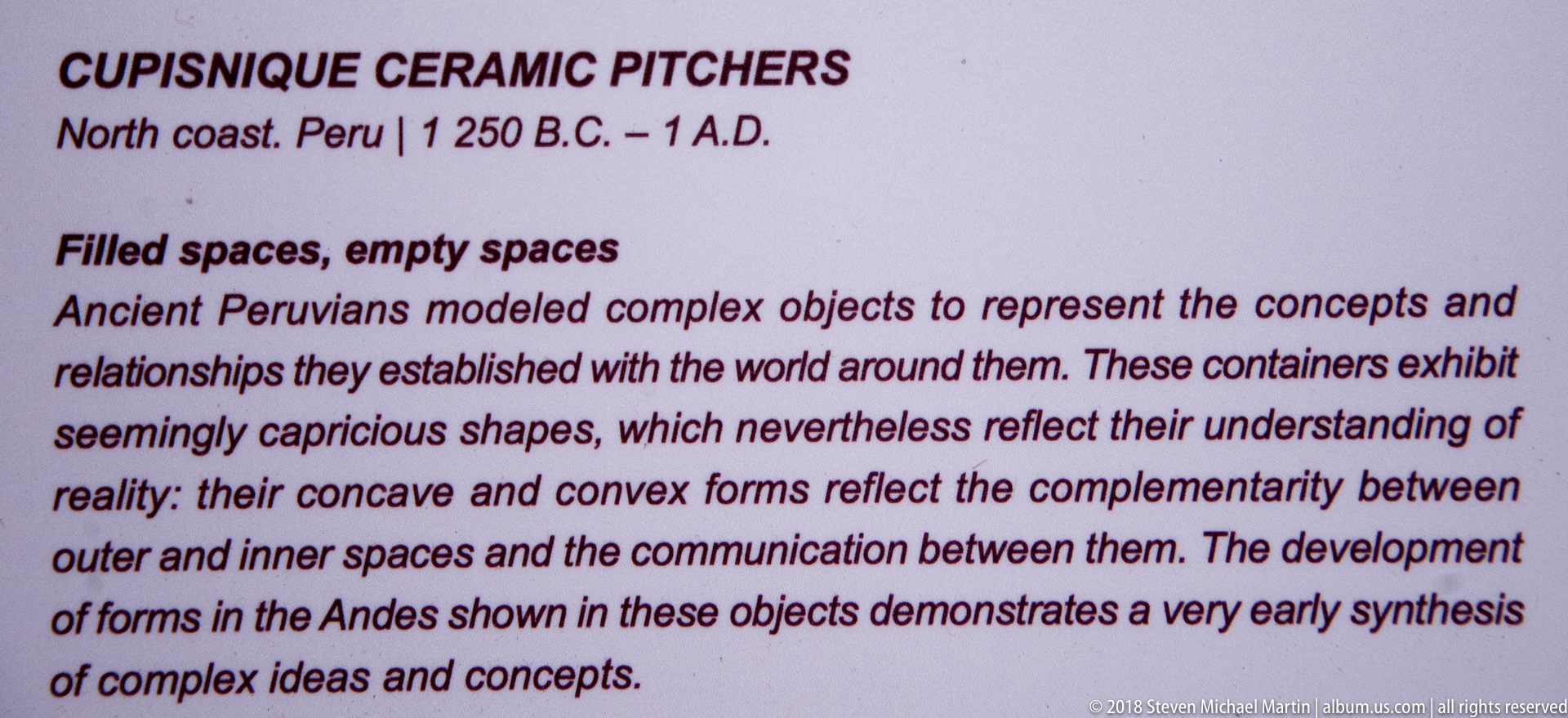
An interpretive panel titled “Filled spaces, empty spaces” discusses how ancient Peruvian potters modeled complex containers to express relationships within the world around them. It draws attention to seemingly capricious but carefully resolved concave and convex shapes, presenting vessel form as an early synthesis of ideas about outer and inner space and communication between them.
Caption
An interpretive panel titled “Filled spaces, empty spaces” discusses how ancient Peruvian potters modeled complex containers to express relationships within the world around them. It draws attention to seemingly capricious but carefully resolved concave and convex shapes, presenting vessel form as an early synthesis of ideas about outer and inner space and communication between them.

A dark burnished vessel rises from a broad stepped body into a tall, tapering neck with a flared lip. Three projecting horizontal tiers give the lower half a strongly architectural profile, while the neck narrows smoothly above them. The controlled alternation of convex bands and constricted transitions makes the vessel read as a study in sculptural volume as much as a container.
Caption
A dark burnished vessel rises from a broad stepped body into a tall, tapering neck with a flared lip. Three projecting horizontal tiers give the lower half a strongly architectural profile, while the neck narrows smoothly above them. The controlled alternation of convex bands and constricted transitions makes the vessel read as a study in sculptural volume as much as a container.

A gallery text on stone describes its pervasive presence in Cusco and its wider symbolic role in the Andes. The panel discusses stone as a living or powerful material used for architecture, carved forms, boundary markers, and ritual objects, and connects it with water, containment, order, and communication among different realms of the Andean world.
Caption
A gallery text on stone describes its pervasive presence in Cusco and its wider symbolic role in the Andes. The panel discusses stone as a living or powerful material used for architecture, carved forms, boundary markers, and ritual objects, and connects it with water, containment, order, and communication among different realms of the Andean world.

An interpretive label for a Cupisnique stone mortar explains the relationship between stone and water in ancient Peruvian ritual thought. The text describes a finely carved and polished mortar with deep geometric incisions evoking ditches and bends, suggesting ceremonial use connected with the availability of rain and water and with stone’s own symbolic association with river flow.
Caption
An interpretive label for a Cupisnique stone mortar explains the relationship between stone and water in ancient Peruvian ritual thought. The text describes a finely carved and polished mortar with deep geometric incisions evoking ditches and bends, suggesting ceremonial use connected with the availability of rain and water and with stone’s own symbolic association with river flow.

A Cupisnique cylindrical stone mortar is carved with geometric relief that wraps around its compact body, giving a utilitarian form a strongly ordered sculptural surface. The piece follows the museum’s interpretation of stone as a material associated with containment, water, order, and harmony in ancient Andean thought. Its Cupisnique attribution is supported by the adjacent gallery label rather than inferred from form alone.
Caption
A Cupisnique cylindrical stone mortar is carved with geometric relief that wraps around its compact body, giving a utilitarian form a strongly ordered sculptural surface. The piece follows the museum’s interpretation of stone as a material associated with containment, water, order, and harmony in ancient Andean thought. Its Cupisnique attribution is supported by the adjacent gallery label rather than inferred from form alone.

A museum label introduces a Cupisnique stone figurine from Peru’s north coast and places the object within a broader tradition of representing human beings in small sculptural form. The text notes that such figures may portray socially prominent individuals, priests, or dignitaries and may also have served votive or ritual roles in temples and ceremonies.
Caption
A museum label introduces a Cupisnique stone figurine from Peru’s north coast and places the object within a broader tradition of representing human beings in small sculptural form. The text notes that such figures may portray socially prominent individuals, priests, or dignitaries and may also have served votive or ritual roles in temples and ceremonies.

A large wall panel summarizes the rise and expansion of the Inca Empire, noting that its political growth incorporated diverse peoples, identities, and artistic traditions across a wide Andean territory. A map and small diagrammatic illustrations accompany the text, framing the museum’s objects within a broader regional history of exchange, incorporation, and symbolic continuity.
Caption
A large wall panel summarizes the rise and expansion of the Inca Empire, noting that its political growth incorporated diverse peoples, identities, and artistic traditions across a wide Andean territory. A map and small diagrammatic illustrations accompany the text, framing the museum’s objects within a broader regional history of exchange, incorporation, and symbolic continuity.

A large rectangular window with an ornate black iron grille punctuates the whitewashed courtyard wall of the Museo de Arte Precolombino. Terracotta pots with flowering and leafy plants soften the base of the façade, while the restrained stone-colored window surround and symmetrical grille pattern bring a formal architectural accent to the intimate courtyard setting.
Caption
A large rectangular window with an ornate black iron grille punctuates the whitewashed courtyard wall of the Museo de Arte Precolombino. Terracotta pots with flowering and leafy plants soften the base of the façade, while the restrained stone-colored window surround and symmetrical grille pattern bring a formal architectural accent to the intimate courtyard setting.

A carved stone fountain rises from the museum courtyard, its broad circular basin supported on a robust central pedestal above an octagonal pool. A projecting face-shaped spout is centered on the near side, while a smaller upper bowl crowns the composition. Weathered stone surfaces and the surrounding arcaded courtyard reinforce the fountain’s role as the visual center of the open space.
Caption
A carved stone fountain rises from the museum courtyard, its broad circular basin supported on a robust central pedestal above an octagonal pool. A projecting face-shaped spout is centered on the near side, while a smaller upper bowl crowns the composition. Weathered stone surfaces and the surrounding arcaded courtyard reinforce the fountain’s role as the visual center of the open space.

Two paneled doorways and an open passage line the whitewashed courtyard wall, with a row of terracotta pots carefully arranged between them. The timber ceiling beams above and stone-paved floor below create a quiet architectural frame for the plants. This view emphasizes the museum’s domestic-scale courtyard circulation rather than its gallery displays.
Caption
Two paneled doorways and an open passage line the whitewashed courtyard wall, with a row of terracotta pots carefully arranged between them. The timber ceiling beams above and stone-paved floor below create a quiet architectural frame for the plants. This view emphasizes the museum’s domestic-scale courtyard circulation rather than its gallery displays.

The street façade of the Museo de Arte Precolombino presents a white plaster upper wall above a rusticated stone base, with a carved stone entrance at left and a projecting balcony to the right. The museum name is painted directly on the façade, making this the clearest exterior establishing view of the institution and its historic urban setting in Cusco.
Caption
The street façade of the Museo de Arte Precolombino presents a white plaster upper wall above a rusticated stone base, with a carved stone entrance at left and a projecting balcony to the right. The museum name is painted directly on the façade, making this the clearest exterior establishing view of the institution and its historic urban setting in Cusco.

Seen from farther back, the stone fountain occupies the center of an octagonal pool within a two-story arcaded courtyard. White plaster walls, stone columns, an upper gallery, and potted plants define the perimeter, allowing the fountain to be read in architectural context. This wider view clarifies the courtyard’s circulation and the relationship between the water feature and surrounding galleries.
Caption
Seen from farther back, the stone fountain occupies the center of an octagonal pool within a two-story arcaded courtyard. White plaster walls, stone columns, an upper gallery, and potted plants define the perimeter, allowing the fountain to be read in architectural context. This wider view clarifies the courtyard’s circulation and the relationship between the water feature and surrounding galleries.