Iceland Platinum Circle – Iceland
The Platinum Circle is one of the most scenic travel routes in western Iceland, connecting several of the country’s most dramatic natural landmarks within a short distance of Reykjavík. The route highlights the powerful geological forces that shape the island, where volcanic activity, geothermal energy, and glacial rivers create a landscape unlike anywhere else in Europe.
Along the route visitors encounter erupting geysers, powerful waterfalls, and volcanic craters that illustrate the dynamic nature of Iceland’s geology. Sites such as Þingvellir National Park, where the North American and Eurasian tectonic plates slowly separate, also reveal the deep historical significance of the region, as it was the meeting place of Iceland’s early parliament more than a thousand years ago.
The Platinum Circle offers a remarkable introduction to Iceland’s dramatic natural environment and its unique geological history.

Two travelers stand in the foreground beside fast, white water, dwarfed by a long line of dark, grass-topped cliffs. The river breaks over low rock shelves and spreads across the middle distance, linking the people to the canyon’s scale. Their full-length placement provides a clear human measure for the broad landscape.
Caption
Two travelers stand in the foreground beside fast, white water, dwarfed by a long line of dark, grass-topped cliffs. The river breaks over low rock shelves and spreads across the middle distance, linking the people to the canyon’s scale. Their full-length placement provides a clear human measure for the broad landscape.

A broad front of Breiðamerkurjökull descends between dark mountain slopes beyond Jökulsárlón glacier lagoon. Blue-white ice fills the upper view while the dark lagoon forms a quiet horizontal foreground beneath low cloud. The distant framing connects the outlet glacier to the lagoon and the icebergs photographed immediately afterward in the sequence.
Caption
A broad front of Breiðamerkurjökull descends between dark mountain slopes beyond Jökulsárlón glacier lagoon. Blue-white ice fills the upper view while the dark lagoon forms a quiet horizontal foreground beneath low cloud. The distant framing connects the outlet glacier to the lagoon and the icebergs photographed immediately afterward in the sequence.

A traveler in a red plaid shirt sits beside a high-volume waterfall, its broad white flow dropping past dark rock ledges into a turbulent river. Mist softens the cliff behind him, and his small scale makes the height of the cascade immediately legible. The portrait keeps the person distinct while preserving the waterfall’s force and setting.
Caption
A traveler in a red plaid shirt sits beside a high-volume waterfall, its broad white flow dropping past dark rock ledges into a turbulent river. Mist softens the cliff behind him, and his small scale makes the height of the cascade immediately legible. The portrait keeps the person distinct while preserving the waterfall’s force and setting.

A panoramic view shows Goðafoss spreading across the Skjálfandafljót River in multiple channels over dark basalt shelves. Mist softens the lower water while the flat green plateau forms a strong horizon above the broad horseshoe-shaped cascade.
Caption
A panoramic view shows Goðafoss spreading across the Skjálfandafljót River in multiple channels over dark basalt shelves. Mist softens the lower water while the flat green plateau forms a strong horizon above the broad horseshoe-shaped cascade.

A broad white waterfall drops from a high plateau into a dark river channel enclosed by steep, grass-covered cliffs. Mist softens the lower fall and partly veils the left wall, while the near-black gravel foreground anchors the scale. The frontal viewpoint stresses the vertical plunge and the narrow, enclosed gorge.
Caption
A broad white waterfall drops from a high plateau into a dark river channel enclosed by steep, grass-covered cliffs. Mist softens the lower fall and partly veils the left wall, while the near-black gravel foreground anchors the scale. The frontal viewpoint stresses the vertical plunge and the narrow, enclosed gorge.

A sculpted iceberg rises in a sweeping arc from Jökulsárlón glacier lagoon, its smooth white upper surface edged by a deep blue band. Broken ice in the foreground creates layered depth and emphasizes the curved profile and color transition of the floating mass.
Caption
A sculpted iceberg rises in a sweeping arc from Jökulsárlón glacier lagoon, its smooth white upper surface edged by a deep blue band. Broken ice in the foreground creates layered depth and emphasizes the curved profile and color transition of the floating mass.

A traveler stands on rough dark stones before Goðafoss, where the broad waterfall divides around low basalt outcrops. White water fills the background from edge to edge, balancing the full-length portrait against the landmark’s sweeping horizontal cascade.
Caption
A traveler stands on rough dark stones before Goðafoss, where the broad waterfall divides around low basalt outcrops. White water fills the background from edge to edge, balancing the full-length portrait against the landmark’s sweeping horizontal cascade.

Several narrow waterfalls descend from a green plateau over a tall, horizontally layered cliff. The main stream divides into bright ribbons before reaching the dark basin, and tiny visitors along the base reveal the scale of the wall. This broad view distinguishes the site’s multiple channels and visitor paths from a single, isolated waterfall portrait.
Caption
Several narrow waterfalls descend from a green plateau over a tall, horizontally layered cliff. The main stream divides into bright ribbons before reaching the dark basin, and tiny visitors along the base reveal the scale of the wall. This broad view distinguishes the site’s multiple channels and visitor paths from a single, isolated waterfall portrait.

Goðafoss drops in several distinct curtains behind a solitary dark boulder in the Skjálfandafljót River. Pale fast-moving channels spread through the foreground while low green banks frame the segmented cascade, presenting a tighter variation on the landmark’s broad horseshoe form.
Caption
Goðafoss drops in several distinct curtains behind a solitary dark boulder in the Skjálfandafljót River. Pale fast-moving channels spread through the foreground while low green banks frame the segmented cascade, presenting a tighter variation on the landmark’s broad horseshoe form.

A pale, sediment-laden river bends through a deep gorge beneath long, flat-topped basalt walls. Vertical fractures divide the near cliff into columnlike faces, while green strips trace the canyon rim. The elevated viewpoint follows the water downstream and shows how the broad, level plateau contrasts with the steep eroded sides.
Caption
A pale, sediment-laden river bends through a deep gorge beneath long, flat-topped basalt walls. Vertical fractures divide the near cliff into columnlike faces, while green strips trace the canyon rim. The elevated viewpoint follows the water downstream and shows how the broad, level plateau contrasts with the steep eroded sides.

A dark basalt headland rises directly from the North Atlantic, its face patterned with stacked, blocklike columns and horizontal bands. Loose angular rocks fringe the waterline, while the grassy summit forms a narrow green cap. The oblique view makes the cliff’s geological structure and abrupt meeting with the sea the central subject.
Caption
A dark basalt headland rises directly from the North Atlantic, its face patterned with stacked, blocklike columns and horizontal bands. Loose angular rocks fringe the waterline, while the grassy summit forms a narrow green cap. The oblique view makes the cliff’s geological structure and abrupt meeting with the sea the central subject.

Two white sheep rest several feet apart in a short, flower-speckled meadow. One faces the camera while the other turns toward the right, making their different orientations the defining feature of this quiet wildlife study. Their heavy fleece contrasts with the dark, softly focused ground, which isolates the animals without removing their rural setting.
Caption
Two white sheep rest several feet apart in a short, flower-speckled meadow. One faces the camera while the other turns toward the right, making their different orientations the defining feature of this quiet wildlife study. Their heavy fleece contrasts with the dark, softly focused ground, which isolates the animals without removing their rural setting.

A smiling traveler stands centered against a low, dark coastal headland and the pale bands of an overcast sky. The waist-up framing gives the portrait equal weight with the open shoreline behind him; subdued light keeps the setting quiet rather than dramatic. The diagonal camera strap is the only strong foreground line.
Caption
A smiling traveler stands centered against a low, dark coastal headland and the pale bands of an overcast sky. The waist-up framing gives the portrait equal weight with the open shoreline behind him; subdued light keeps the setting quiet rather than dramatic. The diagonal camera strap is the only strong foreground line.

A close portrait places a smiling traveler against a nearly featureless pale sky, with a narrow strip of blue-gray sea at the lower edge. His dark jacket and diagonal shoulder strap provide the composition’s strongest contrast. Unlike the earlier coastal portrait, this tighter crop removes most of the landform and makes expression and clothing the focus.
Caption
A close portrait places a smiling traveler against a nearly featureless pale sky, with a narrow strip of blue-gray sea at the lower edge. His dark jacket and diagonal shoulder strap provide the composition’s strongest contrast. Unlike the earlier coastal portrait, this tighter crop removes most of the landform and makes expression and clothing the focus.

A compact cascade spills over a low rock ledge beneath a dark, horizontally layered cliff. A broad strip of vivid grass and small yellow flowers fills the foreground, contrasting with the shaded rock wall and white water. This low viewpoint makes the seasonal meadow as prominent as the cascade, unlike the more enclosed waterfall view nearby.
Caption
A compact cascade spills over a low rock ledge beneath a dark, horizontally layered cliff. A broad strip of vivid grass and small yellow flowers fills the foreground, contrasting with the shaded rock wall and white water. This low viewpoint makes the seasonal meadow as prominent as the cascade, unlike the more enclosed waterfall view nearby.

A black-faced sheep stands squarely in the meadow, looking directly into the lens. Its pale curled horns, dark muzzle, and dense two-toned fleece distinguish it from the resting sheep nearby in the sequence. The shallow background of green grass and scattered flowers keeps attention on the animal’s frontal stance and distinctive head.
Caption
A black-faced sheep stands squarely in the meadow, looking directly into the lens. Its pale curled horns, dark muzzle, and dense two-toned fleece distinguish it from the resting sheep nearby in the sequence. The shallow background of green grass and scattered flowers keeps attention on the animal’s frontal stance and distinctive head.

A broad natural arch opens through the dark volcanic headland of Dyrhólaey, with detached rock stacks rising offshore beyond it. The rough basalt shelf in the foreground and calm North Atlantic water emphasize the headland’s wave-cut geology. The wider view places the famous sea arch within the larger Dyrhólaey coastal formation.
Caption
A broad natural arch opens through the dark volcanic headland of Dyrhólaey, with detached rock stacks rising offshore beyond it. The rough basalt shelf in the foreground and calm North Atlantic water emphasize the headland’s wave-cut geology. The wider view places the famous sea arch within the larger Dyrhólaey coastal formation.

Two men stand shoulder to shoulder for a portrait, both facing the camera; one wears a light gray sweater and carries a camera, the other a dark zip jacket. The neutral studio-like sky behind them is actually an open, pale outdoor backdrop. Their contrasting clothing and the visible camera identify this as a travel companionship portrait.
Caption
Two men stand shoulder to shoulder for a portrait, both facing the camera; one wears a light gray sweater and carries a camera, the other a dark zip jacket. The neutral studio-like sky behind them is actually an open, pale outdoor backdrop. Their contrasting clothing and the visible camera identify this as a travel companionship portrait.

A photographer raises his camera toward the offshore formations from a chain-protected viewpoint at Dyrhólaey. The massive natural arch frames the left side while a narrow sea stack and open horizon appear beyond him. The human figure and barrier provide scale for Dyrhólaey’s eroded basalt headland.
Caption
A photographer raises his camera toward the offshore formations from a chain-protected viewpoint at Dyrhólaey. The massive natural arch frames the left side while a narrow sea stack and open horizon appear beyond him. The human figure and barrier provide scale for Dyrhólaey’s eroded basalt headland.

A narrow ribbon of water descends from above frame and spreads across a low, rounded rock shelf into a shallow pool. Dark cliffs and saturated green moss enclose the scene, while the long exposure softens the water into a pale vertical veil. The close framing isolates the water’s stepped path rather than presenting a full landscape.
Caption
A narrow ribbon of water descends from above frame and spreads across a low, rounded rock shelf into a shallow pool. Dark cliffs and saturated green moss enclose the scene, while the long exposure softens the water into a pale vertical veil. The close framing isolates the water’s stepped path rather than presenting a full landscape.

A tall, tapering structure rises above a low roofline, its exposed steel grid filled with bright red, blue, green, and yellow panels. The open framework narrows toward the top and stands against a plain gray sky, making its geometry and color the primary evidence. The proof sheet does not establish whether this is a building façade, installation, or tower feature.
Caption
A tall, tapering structure rises above a low roofline, its exposed steel grid filled with bright red, blue, green, and yellow panels. The open framework narrows toward the top and stands against a plain gray sky, making its geometry and color the primary evidence. The proof sheet does not establish whether this is a building façade, installation, or tower feature.

A close view isolates the tower’s crossing steel members and translucent colored panels. Red, blue, yellow, and green rectangles overlap behind the pale structural grid, creating a dense geometric pattern with little surrounding context. The shift from the previous exterior view to this detail foregrounds the construction and the way the panels animate the framework with color.
Caption
A close view isolates the tower’s crossing steel members and translucent colored panels. Red, blue, yellow, and green rectangles overlap behind the pale structural grid, creating a dense geometric pattern with little surrounding context. The shift from the previous exterior view to this detail foregrounds the construction and the way the panels animate the framework with color.

Several isolated rock stacks stand in a calm expanse of blue-gray water, separated by broad stretches of empty horizon. The central formation is tallest and blocklike, while the smaller stacks at either side emphasize distance and scale. With no shoreline in frame, the photograph reads as a study of offshore volcanic forms against open sea.
Caption
Several isolated rock stacks stand in a calm expanse of blue-gray water, separated by broad stretches of empty horizon. The central formation is tallest and blocklike, while the smaller stacks at either side emphasize distance and scale. With no shoreline in frame, the photograph reads as a study of offshore volcanic forms against open sea.

A traveler stands on a rough shore with low sea stacks spread across the water behind him. The dark jacket and diagonal strap separate clearly from the cool, muted background, while the cropped lower body keeps the portrait intimate. The distant formations remain small contextual accents rather than competing with the centered figure.
Caption
A traveler stands on a rough shore with low sea stacks spread across the water behind him. The dark jacket and diagonal strap separate clearly from the cool, muted background, while the cropped lower body keeps the portrait intimate. The distant formations remain small contextual accents rather than competing with the centered figure.

A pale square tower with red trim rises from the grassy headland at Dyrhólaey. The lighthouse’s compact attached building, red-framed openings, and small lantern room stand above the North Atlantic, linking the architectural landmark directly to the surrounding sea-cliff sequence.
Caption
A pale square tower with red trim rises from the grassy headland at Dyrhólaey. The lighthouse’s compact attached building, red-framed openings, and small lantern room stand above the North Atlantic, linking the architectural landmark directly to the surrounding sea-cliff sequence.

A smiling traveler is framed from the chest up, with the pale sea and a few low offshore rocks behind him. The tighter crop foregrounds his face and dark outerwear; the crossbody strap still signals an active day of photography or touring. Soft, even light and a level horizon keep the portrait direct and unembellished.
Caption
A smiling traveler is framed from the chest up, with the pale sea and a few low offshore rocks behind him. The tighter crop foregrounds his face and dark outerwear; the crossbody strap still signals an active day of photography or touring. Soft, even light and a level horizon keep the portrait direct and unembellished.

A rugged basalt escarpment fills the right foreground, its horizontal ledges broken by vertical fractures and patches of green turf. Beyond the cliff edge, a broad lowland basin opens toward distant water and hazy mountains. This elevated view records the relationship between the near rock face and the expansive Icelandic landscape beyond.
Caption
A rugged basalt escarpment fills the right foreground, its horizontal ledges broken by vertical fractures and patches of green turf. Beyond the cliff edge, a broad lowland basin opens toward distant water and hazy mountains. This elevated view records the relationship between the near rock face and the expansive Icelandic landscape beyond.

A narrow river threads through a deep canyon whose dark rock walls are topped with vivid green turf. Pale gravel bars divide the water into shallow channels along the canyon floor, drawing the eye toward the distant bend. The centered view emphasizes the corridor’s depth and the contrast between vertical walls and flat, water-worn ground.
Caption
A narrow river threads through a deep canyon whose dark rock walls are topped with vivid green turf. Pale gravel bars divide the water into shallow channels along the canyon floor, drawing the eye toward the distant bend. The centered view emphasizes the corridor’s depth and the contrast between vertical walls and flat, water-worn ground.

A narrow paved road runs straight through a dark, treeless plain toward a distant range of blue mountains. Low storm clouds obscure the peaks, leaving a thin bright break along the horizon. Repeated center markings and roadside posts create strong perspective lines, turning the road itself into the route through a vast, weather-heavy landscape.
Caption
A narrow paved road runs straight through a dark, treeless plain toward a distant range of blue mountains. Low storm clouds obscure the peaks, leaving a thin bright break along the horizon. Repeated center markings and roadside posts create strong perspective lines, turning the road itself into the route through a vast, weather-heavy landscape.

A traveler smiles in the foreground while large white and blue icebergs crowd Jökulsárlón glacier lagoon behind him. The close portrait contrasts with the fractured floating ice and turquoise shadows, while the dense iceberg field unmistakably establishes the celebrated southeast Iceland lagoon as the setting.
Caption
A traveler smiles in the foreground while large white and blue icebergs crowd Jökulsárlón glacier lagoon behind him. The close portrait contrasts with the fractured floating ice and turquoise shadows, while the dense iceberg field unmistakably establishes the celebrated southeast Iceland lagoon as the setting.

Angular icebergs drift across the gray water of Jökulsárlón glacier lagoon, with a large white mass near center and smaller blue-shadowed pieces scattered behind it. The low horizon and absence of shoreline turn the scene into a quiet study of the lagoon’s constantly changing floating ice.
Caption
Angular icebergs drift across the gray water of Jökulsárlón glacier lagoon, with a large white mass near center and smaller blue-shadowed pieces scattered behind it. The low horizon and absence of shoreline turn the scene into a quiet study of the lagoon’s constantly changing floating ice.

A towering iceberg at Jökulsárlón fills the frame, exposing a smooth blue face crossed by a dark slanted fissure. White ridges crest the mass above the waterline while only a narrow strip of lagoon remains visible below, making color, fracture, and glacial texture the subject.
Caption
A towering iceberg at Jökulsárlón fills the frame, exposing a smooth blue face crossed by a dark slanted fissure. White ridges crest the mass above the waterline while only a narrow strip of lagoon remains visible below, making color, fracture, and glacial texture the subject.

A traveler wearing a blue cap stands close to the camera with a broad field of pale icebergs across Jökulsárlón glacier lagoon behind him. The dark fleece and bright cap stand out against the cool lagoon while the floating ice firmly identifies the setting.
Caption
A traveler wearing a blue cap stands close to the camera with a broad field of pale icebergs across Jökulsárlón glacier lagoon behind him. The dark fleece and bright cap stand out against the cool lagoon while the floating ice firmly identifies the setting.

A dispersed flock of white swans occupies a broad, dark lake, with smaller birds scattered across the upper water and a denser group near the lower center. Their reflections are faint in the textured surface, while a distant mountain ridge forms a blue band at the horizon. The elevated viewpoint stresses the flock’s distribution rather than an individual bird.
Caption
A dispersed flock of white swans occupies a broad, dark lake, with smaller birds scattered across the upper water and a denser group near the lower center. Their reflections are faint in the textured surface, while a distant mountain ridge forms a blue band at the horizon. The elevated viewpoint stresses the flock’s distribution rather than an individual bird.

A narrow white waterfall drops between towering, fractured rock walls into a small dark pool, then escapes over uneven ledges at the bottom of the frame. Moss and grass soften the cliff edges without hiding their vertical structure. The elevated viewpoint follows the cascade down through the fissure, emphasizing its confined course and stepped outflow.
Caption
A narrow white waterfall drops between towering, fractured rock walls into a small dark pool, then escapes over uneven ledges at the bottom of the frame. Moss and grass soften the cliff edges without hiding their vertical structure. The elevated viewpoint follows the cascade down through the fissure, emphasizing its confined course and stepped outflow.

A small red house with a pale roof sits alone near the center of a wide, muted valley. Low, rounded hills fade into haze beyond the open grassland, while a dark fence line crosses the foreground as a repeated series of narrow posts. The distant placement makes the building a scale marker within the expansive, sparsely settled landscape.
Caption
A small red house with a pale roof sits alone near the center of a wide, muted valley. Low, rounded hills fade into haze beyond the open grassland, while a dark fence line crosses the foreground as a repeated series of narrow posts. The distant placement makes the building a scale marker within the expansive, sparsely settled landscape.

An Atlantic puffin stands in profile among low coastal plants, its orange bill and feet sharply visible against black-and-white plumage. A small white flower rises near the right edge, and the dark, blurred background isolates the bird from the nesting ground. The close framing records its compact body and distinctive bill rather than a colony-wide scene.
Caption
An Atlantic puffin stands in profile among low coastal plants, its orange bill and feet sharply visible against black-and-white plumage. A small white flower rises near the right edge, and the dark, blurred background isolates the bird from the nesting ground. The close framing records its compact body and distinctive bill rather than a colony-wide scene.

A narrow river runs between steep, vertically fractured canyon walls, passing beneath a simple pedestrian bridge that spans the gorge near the upper center. The clear turquoise water contrasts with dark stone and green turf along the rim. The elevated viewpoint makes the bridge’s crossing and the canyon’s depth legible in one compact landscape.
Caption
A narrow river runs between steep, vertically fractured canyon walls, passing beneath a simple pedestrian bridge that spans the gorge near the upper center. The clear turquoise water contrasts with dark stone and green turf along the rim. The elevated viewpoint makes the bridge’s crossing and the canyon’s depth legible in one compact landscape.

A traveler in a red plaid shirt stands against a treeless upland of dark gravel, shallow ridges, and distant blue-gray mountains. He looks off-frame rather than toward the camera, lending the portrait an observational quality. Low cloud and muted earth tones make the open, sparsely vegetated terrain as important as the figure.
Caption
A traveler in a red plaid shirt stands against a treeless upland of dark gravel, shallow ridges, and distant blue-gray mountains. He looks off-frame rather than toward the camera, lending the portrait an observational quality. Low cloud and muted earth tones make the open, sparsely vegetated terrain as important as the figure.

Dozens of small stone cairns punctuate a broad, barren plain, with one taller stack rising above the irregular field. Their varied shapes and spacing lead the eye toward the low horizon and distant blue mountains. The image records the cairns as a repeated human-made pattern within an otherwise open volcanic landscape, without assigning a specific purpose to them.
Caption
Dozens of small stone cairns punctuate a broad, barren plain, with one taller stack rising above the irregular field. Their varied shapes and spacing lead the eye toward the low horizon and distant blue mountains. The image records the cairns as a repeated human-made pattern within an otherwise open volcanic landscape, without assigning a specific purpose to them.

A traveler sits on a low rock before Goðafoss, where the Skjálfandafljót River sweeps across a broad horseshoe-shaped cascade divided by dark basalt outcrops. The gravelly riverbank gives the portrait depth while the curved wall of white water provides the unmistakable landmark setting.
Caption
A traveler sits on a low rock before Goðafoss, where the Skjálfandafljót River sweeps across a broad horseshoe-shaped cascade divided by dark basalt outcrops. The gravelly riverbank gives the portrait depth while the curved wall of white water provides the unmistakable landmark setting.
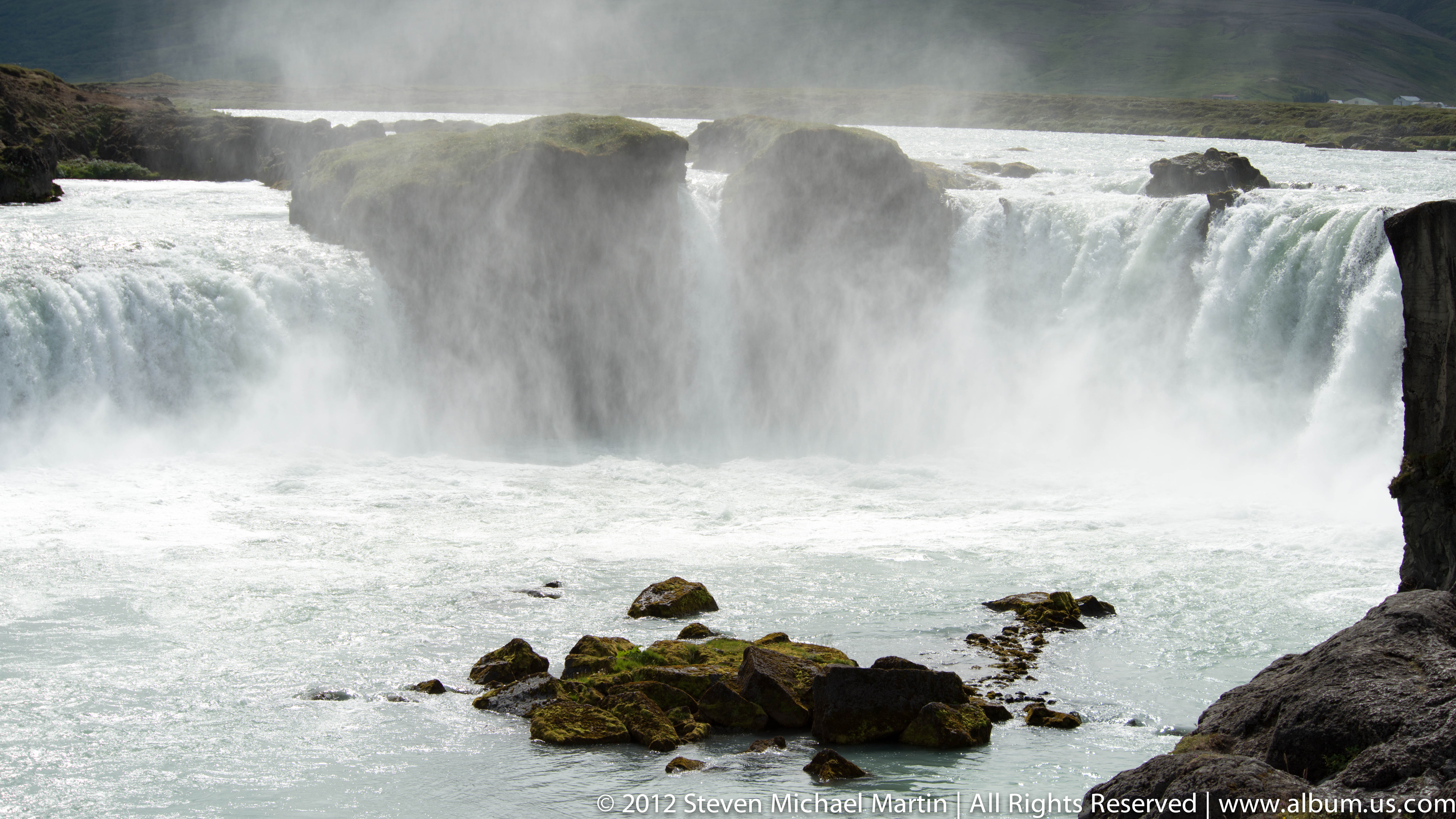
White water pours over the uneven basalt lip of Goðafoss into a mist-filled basin, with dark rock shelves interrupting the broad curtain. The close, low viewpoint emphasizes the waterfall’s breadth and the contrast between luminous water and volcanic rock.
Caption
White water pours over the uneven basalt lip of Goðafoss into a mist-filled basin, with dark rock shelves interrupting the broad curtain. The close, low viewpoint emphasizes the waterfall’s breadth and the contrast between luminous water and volcanic rock.

Rows of Playboy magazine covers and promotional posters fill a brightly lit display wall, while a darker adjoining lounge with tables and pendant lights opens to the right. The dense arrangement turns printed material into an interior feature, contrasting sharply with the otherwise restrained seating area. No venue name is legible to establish the room’s function.
Caption
Rows of Playboy magazine covers and promotional posters fill a brightly lit display wall, while a darker adjoining lounge with tables and pendant lights opens to the right. The dense arrangement turns printed material into an interior feature, contrasting sharply with the otherwise restrained seating area. No venue name is legible to establish the room’s function.

A cushion of vivid pink flowers grows from a narrow strip of green vegetation between rough, dark rocks. The very shallow focus leaves the stone background soft and directs attention to the dense blossoms and tiny leaves. The close botanical view contrasts with the surrounding Icelandic landscapes by concentrating on a small patch of life in the stony terrain.
Caption
A cushion of vivid pink flowers grows from a narrow strip of green vegetation between rough, dark rocks. The very shallow focus leaves the stone background soft and directs attention to the dense blossoms and tiny leaves. The close botanical view contrasts with the surrounding Icelandic landscapes by concentrating on a small patch of life in the stony terrain.

A traveler stands on a flat, rock-strewn headland above calm blue-gray water, with a dark, horizontally layered cliff stretching across the distant shore. His gray pullover and dark trousers are clearly separated from the pale sea, while the full-length framing preserves the sparse, open setting. The image balances a solitary figure against the long coastal line.
Caption
A traveler stands on a flat, rock-strewn headland above calm blue-gray water, with a dark, horizontally layered cliff stretching across the distant shore. His gray pullover and dark trousers are clearly separated from the pale sea, while the full-length framing preserves the sparse, open setting. The image balances a solitary figure against the long coastal line.

A long dark cliff curves toward the horizon above a narrow, wave-edged shoreline. The flat grassy top contrasts with the layered, broken rock face, while open blue-gray water fills most of the foreground. A small light-colored vehicle on the distant rim provides scale. The oblique view traces the cliff’s length and its abrupt drop to the sea.
Caption
A long dark cliff curves toward the horizon above a narrow, wave-edged shoreline. The flat grassy top contrasts with the layered, broken rock face, while open blue-gray water fills most of the foreground. A small light-colored vehicle on the distant rim provides scale. The oblique view traces the cliff’s length and its abrupt drop to the sea.

A slender yellow lighthouse stands alone against a level blue sea and clear sky. Its red lantern room caps a simple rectangular tower, while dark grass and a narrow band of water divide the composition into horizontal layers. The distant, centered placement makes the bright tower the clear focal point; no sign or distinctive landmark feature is legible to confirm a named lighthouse.
Caption
A slender yellow lighthouse stands alone against a level blue sea and clear sky. Its red lantern room caps a simple rectangular tower, while dark grass and a narrow band of water divide the composition into horizontal layers. The distant, centered placement makes the bright tower the clear focal point; no sign or distinctive landmark feature is legible to confirm a named lighthouse.

A steep, dark rock mound rises abruptly from a flat green field, its upper surface capped and streaked with grass. A small opening or recess punctuates the shadowed face, while a fence line runs low across the foreground. The isolated landform is presented from a distance, emphasizing its solitary profile within cultivated or grazed ground.
Caption
A steep, dark rock mound rises abruptly from a flat green field, its upper surface capped and streaked with grass. A small opening or recess punctuates the shadowed face, while a fence line runs low across the foreground. The isolated landform is presented from a distance, emphasizing its solitary profile within cultivated or grazed ground.

A broad cascade curves across a rocky basin, its white water divided by several dark outcrops before spreading into a pale pool. Low grassy banks and basalt walls frame the falls on both sides. The slightly elevated viewpoint makes the arc and the separate channels legible, giving the water’s shape more emphasis than its height.
Caption
A broad cascade curves across a rocky basin, its white water divided by several dark outcrops before spreading into a pale pool. Low grassy banks and basalt walls frame the falls on both sides. The slightly elevated viewpoint makes the arc and the separate channels legible, giving the water’s shape more emphasis than its height.

Gljúfrabúi descends through a narrow cleft in the dark cliff near Seljalandsfoss, with the stream flowing toward the camera over flat stones. The green rim caps the nearly vertical rock walls, while the confined channel distinguishes this hidden South Coast waterfall from the broad open curtain of nearby Skógafoss.
Caption
Gljúfrabúi descends through a narrow cleft in the dark cliff near Seljalandsfoss, with the stream flowing toward the camera over flat stones. The green rim caps the nearly vertical rock walls, while the confined channel distinguishes this hidden South Coast waterfall from the broad open curtain of nearby Skógafoss.

A traveler stands on the black gravel plain before Skógafoss, whose broad white curtain plunges from the former sea cliffs of Iceland’s South Coast. Mist veils the base while green ledges frame the 60-meter drop, and the full-length figure provides a clear measure of the waterfall’s scale.
Caption
A traveler stands on the black gravel plain before Skógafoss, whose broad white curtain plunges from the former sea cliffs of Iceland’s South Coast. Mist veils the base while green ledges frame the 60-meter drop, and the full-length figure provides a clear measure of the waterfall’s scale.

A solitary, angular sea stack rises from the water beside the shadowed edge of a larger cliff. Its layered silhouette and narrow base stand out against the smooth blue sea, while the adjacent headland creates a dark frame along the left. The isolated composition focuses on the stack’s profile rather than the broader arch-and-cliff formation.
Caption
A solitary, angular sea stack rises from the water beside the shadowed edge of a larger cliff. Its layered silhouette and narrow base stand out against the smooth blue sea, while the adjacent headland creates a dark frame along the left. The isolated composition focuses on the stack’s profile rather than the broader arch-and-cliff formation.

A dense patch of pink flowers grows among low green leaves on a rocky ledge above the sea. The blue-gray water and far shoreline soften into the background, while the near stones remain sharply visible. The shallow depth of field makes the small flowering patch the subject and records the vegetation’s exposed coastal setting.
Caption
A dense patch of pink flowers grows among low green leaves on a rocky ledge above the sea. The blue-gray water and far shoreline soften into the background, while the near stones remain sharply visible. The shallow depth of field makes the small flowering patch the subject and records the vegetation’s exposed coastal setting.

A dark, level-topped cliff runs from the near right toward several offshore rock stacks, while a narrow black beach curves below it. Small white waves mark the shoreline, and pale cloud softens the far horizon. The elevated viewpoint sets the cliff, beach, and isolated sea pillars in one connected coastal scene without forcing a specific named formation.
Caption
A dark, level-topped cliff runs from the near right toward several offshore rock stacks, while a narrow black beach curves below it. Small white waves mark the shoreline, and pale cloud softens the far horizon. The elevated viewpoint sets the cliff, beach, and isolated sea pillars in one connected coastal scene without forcing a specific named formation.

Dyrhólaey’s basalt headland projects into the North Atlantic with its great natural arch cut through the dark rock and a smaller opening nearby. A detached sea stack beyond the headland echoes the eroded silhouette, making the famous wave-cut arch the central geological feature.
Caption
Dyrhólaey’s basalt headland projects into the North Atlantic with its great natural arch cut through the dark rock and a smaller opening nearby. A detached sea stack beyond the headland echoes the eroded silhouette, making the famous wave-cut arch the central geological feature.

From a wider shoreline angle, Dyrhólaey’s broad sea arch opens beneath the flat-topped basalt headland while a narrow stack rises offshore. Broken brown rock in the foreground leads toward blue-green water inside the arch and clarifies the formation’s position within the larger headland.
Caption
From a wider shoreline angle, Dyrhólaey’s broad sea arch opens beneath the flat-topped basalt headland while a narrow stack rises offshore. Broken brown rock in the foreground leads toward blue-green water inside the arch and clarifies the formation’s position within the larger headland.

Several seabirds cross the shadowed underside of Dyrhólaey’s massive sea arch, their pale bodies visible against the dark basalt ceiling. A bright strip of sea and surf opens below, turning the famous arch into a sheltered flight corridor as well as a monumental coastal landform.
Caption
Several seabirds cross the shadowed underside of Dyrhólaey’s massive sea arch, their pale bodies visible against the dark basalt ceiling. A bright strip of sea and surf opens below, turning the famous arch into a sheltered flight corridor as well as a monumental coastal landform.

A traveler stands on a grassy bank beside a broad, shallow cascade, with white water breaking around dark boulders across the foreground. A long grass-topped cliff spans the background and ties the river to the surrounding plateau. The full-length figure is placed to the right, leaving the flowing water and its repeated channels dominant.
Caption
A traveler stands on a grassy bank beside a broad, shallow cascade, with white water breaking around dark boulders across the foreground. A long grass-topped cliff spans the background and ties the river to the surrounding plateau. The full-length figure is placed to the right, leaving the flowing water and its repeated channels dominant.

Water divides into shallow white channels over a bed of dark, rounded rocks, with bright green moss and low plants filling the near bank. A continuous ledge of small falls crosses the middle distance beneath a long green hillside. The close landscape view draws attention to the river’s many small drops and the vegetation that clings to its margins.
Caption
Water divides into shallow white channels over a bed of dark, rounded rocks, with bright green moss and low plants filling the near bank. A continuous ledge of small falls crosses the middle distance beneath a long green hillside. The close landscape view draws attention to the river’s many small drops and the vegetation that clings to its margins.

Three white sheep stand at different distances across a stony pasture, one close in the foreground and two farther back. Small violet flowers punctuate the short grass between scattered dark rocks. Their staggered positions create depth and distinguish this pastoral view from a close animal portrait; the open field remains visible around each sheep.
Caption
Three white sheep stand at different distances across a stony pasture, one close in the foreground and two farther back. Small violet flowers punctuate the short grass between scattered dark rocks. Their staggered positions create depth and distinguish this pastoral view from a close animal portrait; the open field remains visible around each sheep.
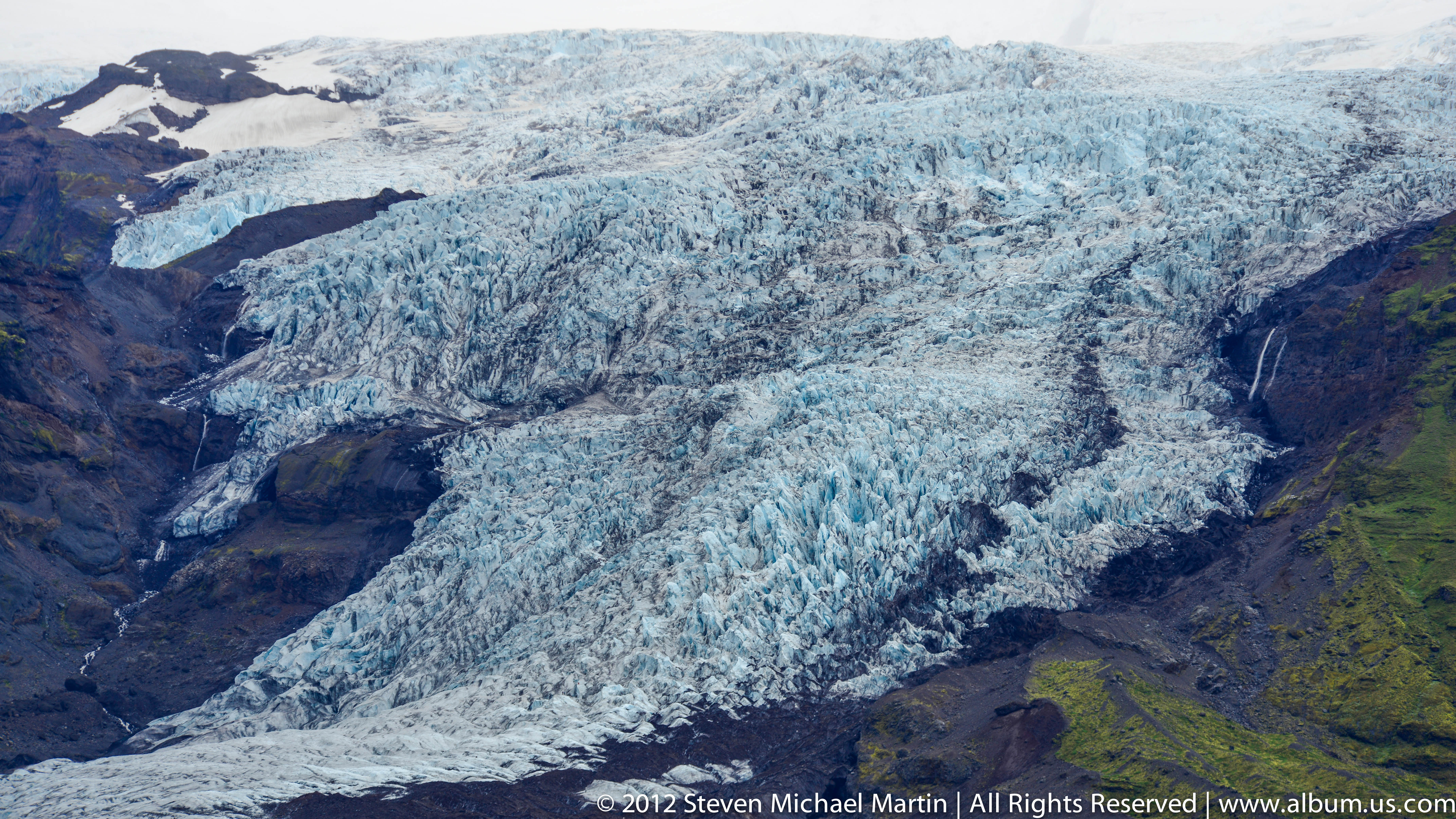
A close view of a glacier reveals a rough, fractured surface streaked with deep blue crevasses and dark debris bands. The irregular ice fills nearly the entire frame, with only a narrow glimpse of the surrounding valley at the edge. This detail foregrounds texture, fracture, and the glacier’s layered flow rather than presenting the ice front or mountain setting.
Caption
A close view of a glacier reveals a rough, fractured surface streaked with deep blue crevasses and dark debris bands. The irregular ice fills nearly the entire frame, with only a narrow glimpse of the surrounding valley at the edge. This detail foregrounds texture, fracture, and the glacier’s layered flow rather than presenting the ice front or mountain setting.

A cluster of roofless stone buildings stands on a low rise in a broad, treeless field. Their broken gables form an uneven silhouette beneath a gray sky, while a horse grazes alone in the right foreground. The distance preserves the ruins’ relationship to the surrounding pasture; the proof sheet does not provide enough detail to name the farm or date the structures.
Caption
A cluster of roofless stone buildings stands on a low rise in a broad, treeless field. Their broken gables form an uneven silhouette beneath a gray sky, while a horse grazes alone in the right foreground. The distance preserves the ruins’ relationship to the surrounding pasture; the proof sheet does not provide enough detail to name the farm or date the structures.

Four white swans occupy a broad gray lake, spaced in a loose diagonal from the distant upper left to the foreground. Their yellow-and-black bills and long upright necks are clear against the subdued water, while two birds lower their heads to feed. The framing isolates the group and makes their differing postures the principal detail.
Caption
Four white swans occupy a broad gray lake, spaced in a loose diagonal from the distant upper left to the foreground. Their yellow-and-black bills and long upright necks are clear against the subdued water, while two birds lower their heads to feed. The framing isolates the group and makes their differing postures the principal detail.

The white side of a small vessel fills the frame, with the place-name “BORGARFJÖRÐUR” painted in large red capitals. A metal boarding ladder and circular fittings interrupt the smooth hull, while ropes and dark equipment appear above it. The tight crop preserves the legible lettering as evidence and avoids assuming whether it names the vessel or its route.
Caption
The white side of a small vessel fills the frame, with the place-name “BORGARFJÖRÐUR” painted in large red capitals. A metal boarding ladder and circular fittings interrupt the smooth hull, while ropes and dark equipment appear above it. The tight crop preserves the legible lettering as evidence and avoids assuming whether it names the vessel or its route.

A puffin stands nearly front-on in a patch of coastal grass, its orange bill angled slightly left and bright feet visible below its white breast. The dark background falls out of focus, isolating the bird’s compact body and upright stance. Unlike the horizontal profile view, this portrait emphasizes the bird’s frontal gaze and the contrast of its plumage.
Caption
A puffin stands nearly front-on in a patch of coastal grass, its orange bill angled slightly left and bright feet visible below its white breast. The dark background falls out of focus, isolating the bird’s compact body and upright stance. Unlike the horizontal profile view, this portrait emphasizes the bird’s frontal gaze and the contrast of its plumage.

An Atlantic puffin stands in side profile among short coastal grasses, its orange bill, dark eye patch, and white breast sharply outlined against the blurred blue-gray background. The low camera angle brings the bird close to the viewer and keeps most of its legs hidden by vegetation. The composition is a single-bird portrait, distinct from the group studies nearby.
Caption
An Atlantic puffin stands in side profile among short coastal grasses, its orange bill, dark eye patch, and white breast sharply outlined against the blurred blue-gray background. The low camera angle brings the bird close to the viewer and keeps most of its legs hidden by vegetation. The composition is a single-bird portrait, distinct from the group studies nearby.

Hallgrímskirkja’s stepped concrete tower rises above a broad Reykjavík street, its narrow vertical windows and cross visible against the subdued sky. Low buildings, parked cars, and wet pavement frame the approach, emphasizing how the landmark church dominates the surrounding cityscape.
Caption
Hallgrímskirkja’s stepped concrete tower rises above a broad Reykjavík street, its narrow vertical windows and cross visible against the subdued sky. Low buildings, parked cars, and wet pavement frame the approach, emphasizing how the landmark church dominates the surrounding cityscape.

Two puffins stand close together in a shallow grassy hollow, the nearer bird turned partly away while the second looks toward the camera from behind. Their orange bills and white facial patches remain visible above the vegetation. The staggered arrangement creates depth and shows the birds sharing the same patch of nesting ground rather than presenting a solitary portrait.
Caption
Two puffins stand close together in a shallow grassy hollow, the nearer bird turned partly away while the second looks toward the camera from behind. Their orange bills and white facial patches remain visible above the vegetation. The staggered arrangement creates depth and shows the birds sharing the same patch of nesting ground rather than presenting a solitary portrait.

A larger puffin stands upright at right while a second bird at left turns toward it from the grass. The pair’s contrasting postures and the space between their orange bills create a small exchange within the frame. Fine stalks and earth-colored vegetation establish the nesting habitat, while the green background keeps the birds’ black-and-white plumage distinct.
Caption
A larger puffin stands upright at right while a second bird at left turns toward it from the grass. The pair’s contrasting postures and the space between their orange bills create a small exchange within the frame. Fine stalks and earth-colored vegetation establish the nesting habitat, while the green background keeps the birds’ black-and-white plumage distinct.

A red timber house with white trim stands partly sheltered by a steep grassy bank, with a smaller red outbuilding to the left and a dark fence across the lawn. A tall red chimney rises behind the turf-covered slope. The view records the close relationship between painted wooden structures and the green rooflike landform without assigning a specific historic site.
Caption
A red timber house with white trim stands partly sheltered by a steep grassy bank, with a smaller red outbuilding to the left and a dark fence across the lawn. A tall red chimney rises behind the turf-covered slope. The view records the close relationship between painted wooden structures and the green rooflike landform without assigning a specific historic site.

Goðafoss pours over a dark basalt rim into the gorge of the Skjálfandafljót River, where spray rises and partly obscures the lower channel. Angular rock lines the near edge and the opposite bank slopes into a green plateau, emphasizing the waterfall’s abrupt break through the broad upland riverbed.
Caption
Goðafoss pours over a dark basalt rim into the gorge of the Skjálfandafljót River, where spray rises and partly obscures the lower channel. Angular rock lines the near edge and the opposite bank slopes into a green plateau, emphasizing the waterfall’s abrupt break through the broad upland riverbed.

Visitors stand along the rim near Goðafoss as the Skjálfandafljót River spills over the cliff beside them. Tiny figures on the grassy edge reveal the scale of the drop and the close relationship between the public viewpoint and the waterfall’s basalt gorge.
Caption
Visitors stand along the rim near Goðafoss as the Skjálfandafljót River spills over the cliff beside them. Tiny figures on the grassy edge reveal the scale of the drop and the close relationship between the public viewpoint and the waterfall’s basalt gorge.

A low shoreline of wet sand and shallow water opens beneath a long, dark escarpment. Small figures stand far apart near the waterline, their scale emphasizing the broad, exposed coast. The cliff’s flat top and broken face stretch from the left foreground toward the distant horizon, while a band of brighter sky opens above the sea.
Caption
A low shoreline of wet sand and shallow water opens beneath a long, dark escarpment. Small figures stand far apart near the waterline, their scale emphasizing the broad, exposed coast. The cliff’s flat top and broken face stretch from the left foreground toward the distant horizon, while a band of brighter sky opens above the sea.

Rows of wooden pews lead through Hallgrímskirkja’s pale nave toward the altar beneath a high pointed vault. Narrow windows admit cool daylight while the centered aisle creates strong symmetry and conveys the monumental vertical scale of Reykjavík’s landmark church.
Caption
Rows of wooden pews lead through Hallgrímskirkja’s pale nave toward the altar beneath a high pointed vault. Narrow windows admit cool daylight while the centered aisle creates strong symmetry and conveys the monumental vertical scale of Reykjavík’s landmark church.

Seen from behind, the bronze statue of Leif Erikson rises on its stone plinth before Hallgrímskirkja’s tapering stepped tower. The low-angle composition directly links the monument, a gift from the United States to Iceland, with Reykjavík’s landmark church behind it.
Caption
Seen from behind, the bronze statue of Leif Erikson rises on its stone plinth before Hallgrímskirkja’s tapering stepped tower. The low-angle composition directly links the monument, a gift from the United States to Iceland, with Reykjavík’s landmark church behind it.

A man sits with folded arms in an orange upholstered booth inside a vividly lit bar or lounge. A long strip of framed images runs along the wall above the seating, while saturated red, purple, and blue lighting colors the ceiling and back wall. Tables, glasses, and the visitor’s centered position make this an interior scene rather than a simple decorative detail.
Caption
A man sits with folded arms in an orange upholstered booth inside a vividly lit bar or lounge. A long strip of framed images runs along the wall above the seating, while saturated red, purple, and blue lighting colors the ceiling and back wall. Tables, glasses, and the visitor’s centered position make this an interior scene rather than a simple decorative detail.

A narrow interior passage is lined with oversized orange and yellow circular motifs, while vivid blue and violet lights color the ceiling and doorways. A chair sits near the right wall and the tiled floor leads toward a darker room at the far end. The empty corridor’s graphic surfaces and saturated lighting make the architecture itself the subject.
Caption
A narrow interior passage is lined with oversized orange and yellow circular motifs, while vivid blue and violet lights color the ceiling and doorways. A chair sits near the right wall and the tiled floor leads toward a darker room at the far end. The empty corridor’s graphic surfaces and saturated lighting make the architecture itself the subject.

A row of narrow urban façades combines red, dark green, blue, yellow, and white trim beneath steep rooflines. A black Guinness sign marks the ground-floor business, while a few pedestrians and small street signs establish the sidewalk as an active commercial frontage. The oblique viewpoint shows the buildings continuing down the block and highlights their contrasting colors and window details.
Caption
A row of narrow urban façades combines red, dark green, blue, yellow, and white trim beneath steep rooflines. A black Guinness sign marks the ground-floor business, while a few pedestrians and small street signs establish the sidewalk as an active commercial frontage. The oblique viewpoint shows the buildings continuing down the block and highlights their contrasting colors and window details.
⭐ Highlights
- Golden Circle Core: Includes Þingvellir National Park, Geysir geothermal area, and Gullfoss waterfall.
- Expanded Route: Additional stops beyond the classic loop create a more complete Iceland experience.
- Geothermal Activity: Geysers, hot springs, and steaming earth reflect Iceland’s volcanic nature.
- Waterfalls and Rivers: Powerful cascades and glacial rivers define the landscape.
- Tectonic Landscape: Þingvellir sits between two continental plates.
- Volcanic Features: Craters, lava fields, and rugged terrain appear throughout the extended route.
🌋 Iceland “Platinum Circle” Field Guide
Major features observed during this visit:
The Golden Circle is Iceland’s most famous scenic route, forming a loop of approximately 300 kilometers from Reykjavík into the southern uplands and back. It connects three of the country’s most important natural sites: Þingvellir National Park, the Geysir geothermal area, and Gullfoss waterfall.
This extended “Platinum Circle” route builds on the classic Golden Circle by continuing beyond the main stops to include additional landscapes, viewpoints, and geological features. The result is a broader and more complete experience of Iceland’s natural environment, combining volcanic activity, glacial water systems, and dramatic terrain into a single continuous journey.
🏛️ Signature Features
- Þingvellir National Park – A rift valley where tectonic plates meet and a site of historical significance.
- Geysir Geothermal Area – A landscape of erupting geysers, hot springs, and geothermal activity.
- Gullfoss Waterfall – A powerful two-tiered waterfall plunging into a deep canyon.
- Kerið Crater – A volcanic crater lake with vivid color contrasts.
- Additional Stops – Lesser-known viewpoints, waterfalls, and geothermal areas beyond the standard route.
🧠 Geological & Cultural Significance
- Volcanic Formation – Iceland’s landscape is shaped by ongoing geothermal and volcanic processes.
- Tectonic Activity – Þingvellir lies between the North American and Eurasian plates.
- Historic Importance – Þingvellir was the site of Iceland’s early parliament.
- Modern Exploration – The route has become the country’s most popular introduction to its natural environment.
🌄 Landscape & Setting
- Southern Uplands – Open terrain shaped by volcanic activity and glacial forces.
- Geothermal Fields – Steam vents, boiling pools, and active geysers define parts of the route.
- Glacial Rivers – Meltwater from glaciers feeds waterfalls and river systems.
- Changing Terrain – The landscape transitions between plains, craters, valleys, and cliffs.