Chobe National Park – Botswana
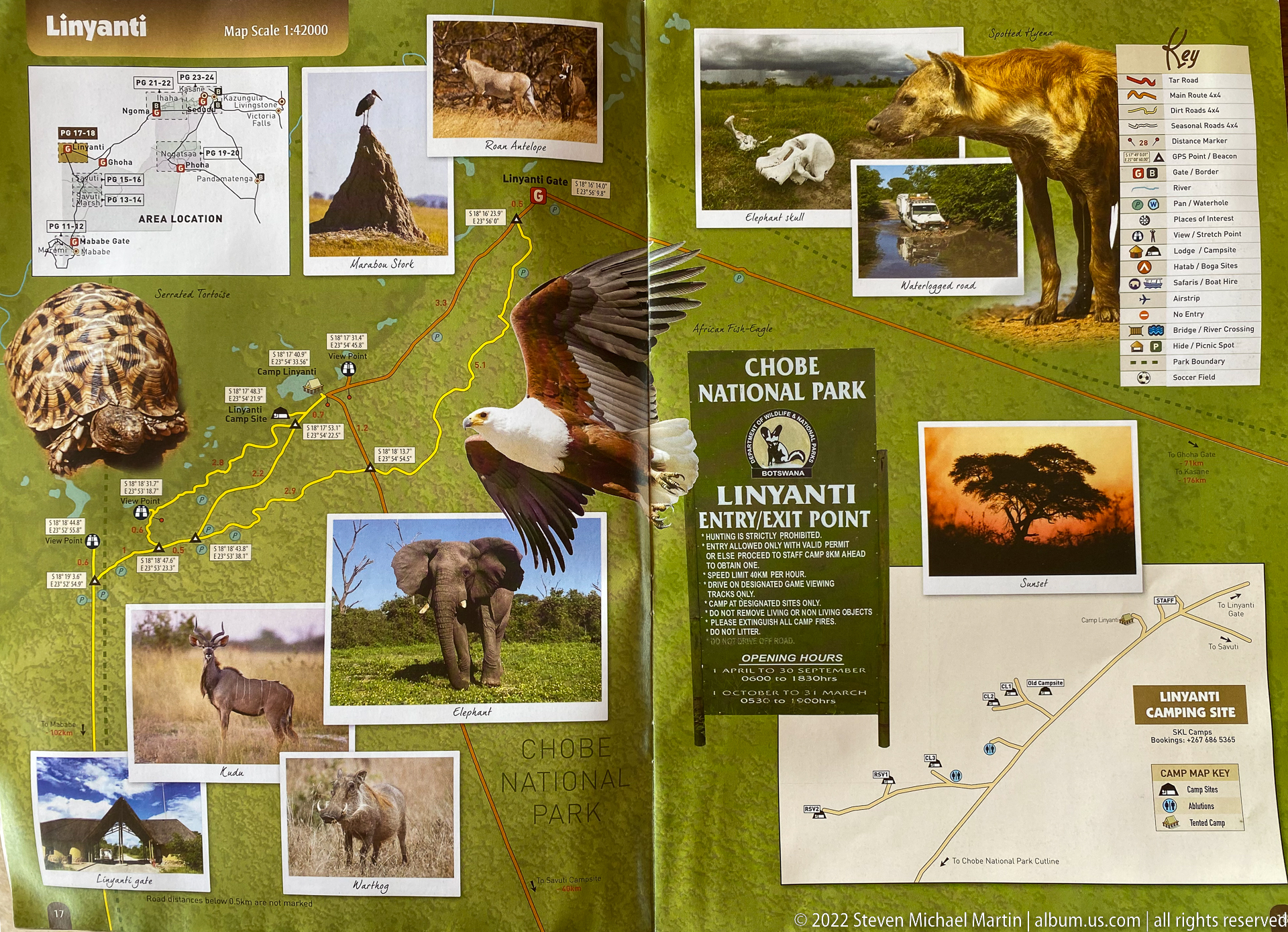
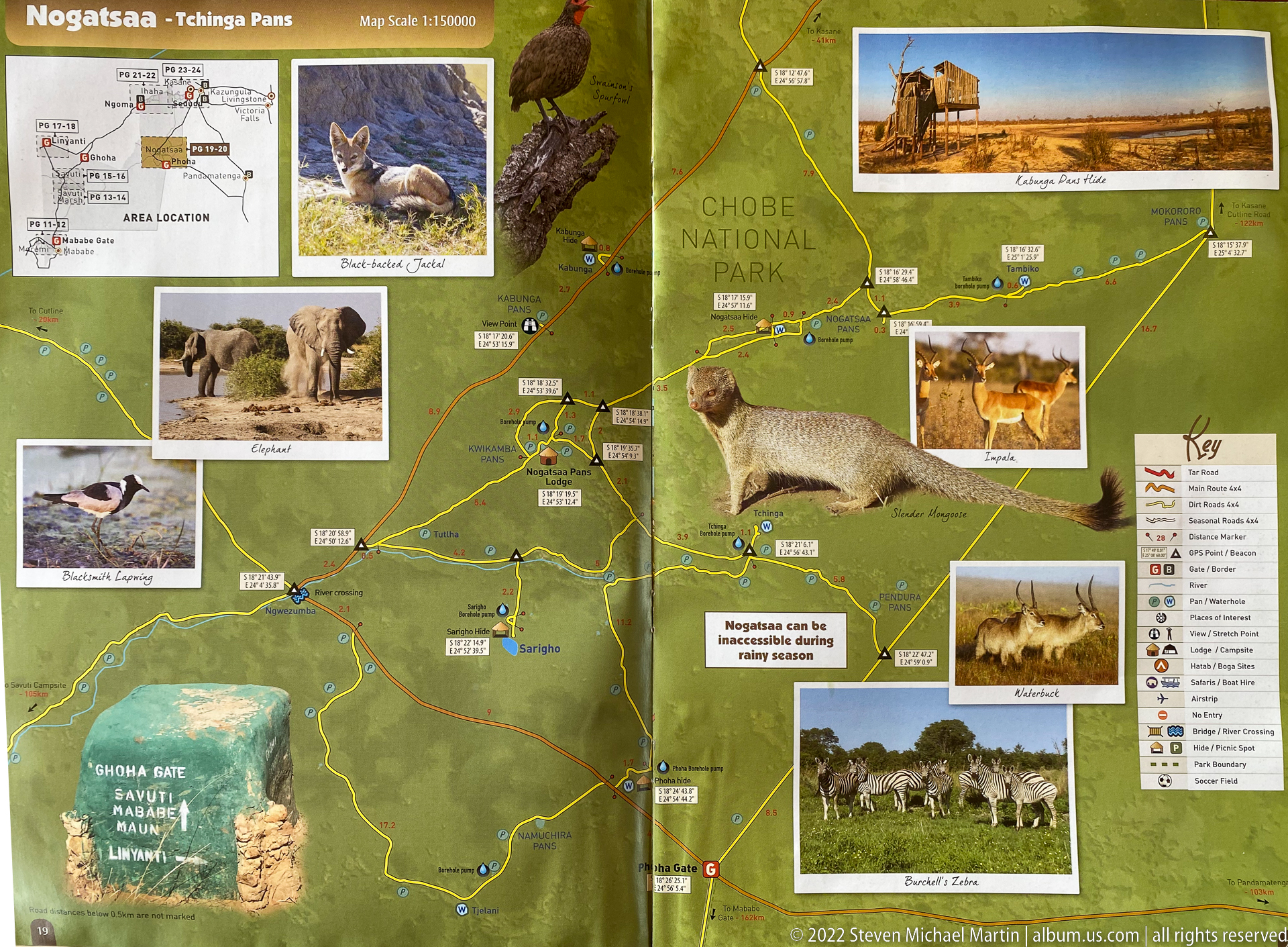
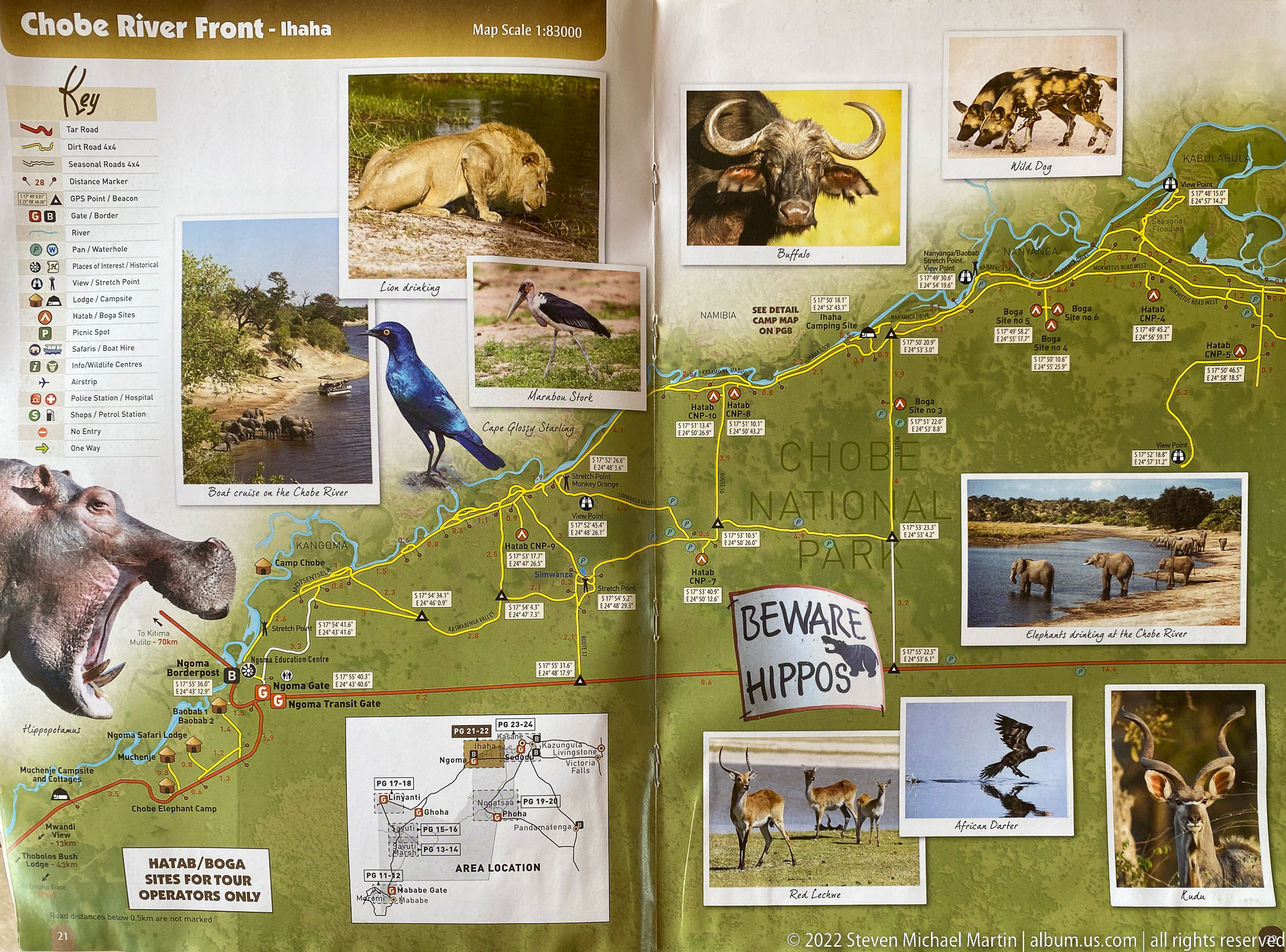
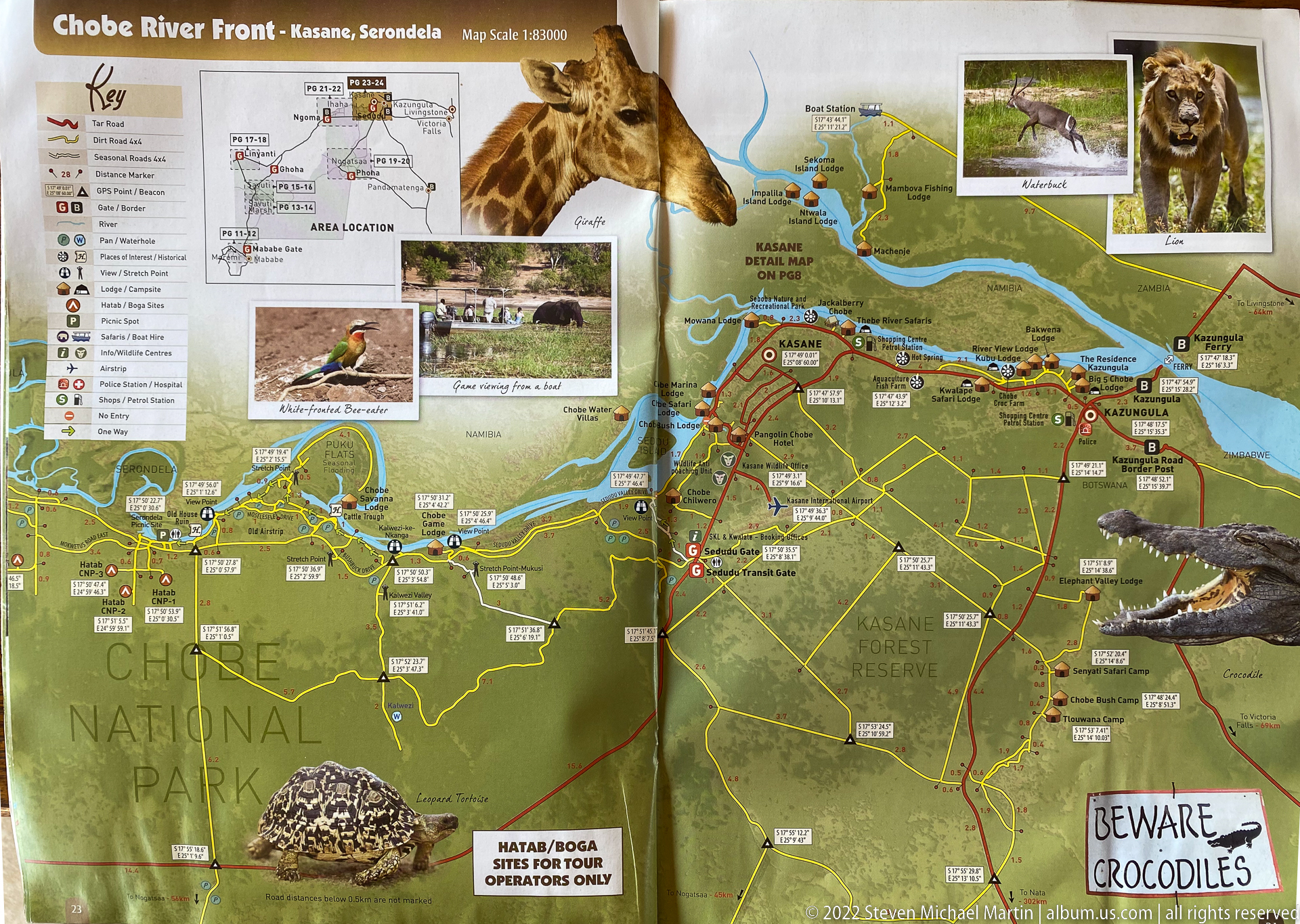
The expansive wilderness of Chobe National Park lies along the northern border of Botswana. The park is especially famous for its enormous population of African elephants, one of the largest concentrations found anywhere on the continent.
Along the Chobe River, animals gather in large numbers to drink and feed, creating some of the most impressive wildlife viewing opportunities in Africa. Herds of buffalo, antelope, and elephants move across the floodplains while predators such as lions and hyenas patrol the surrounding savanna.
Chobe National Park remains one of Botswana’s premier safari destinations.
Photos:
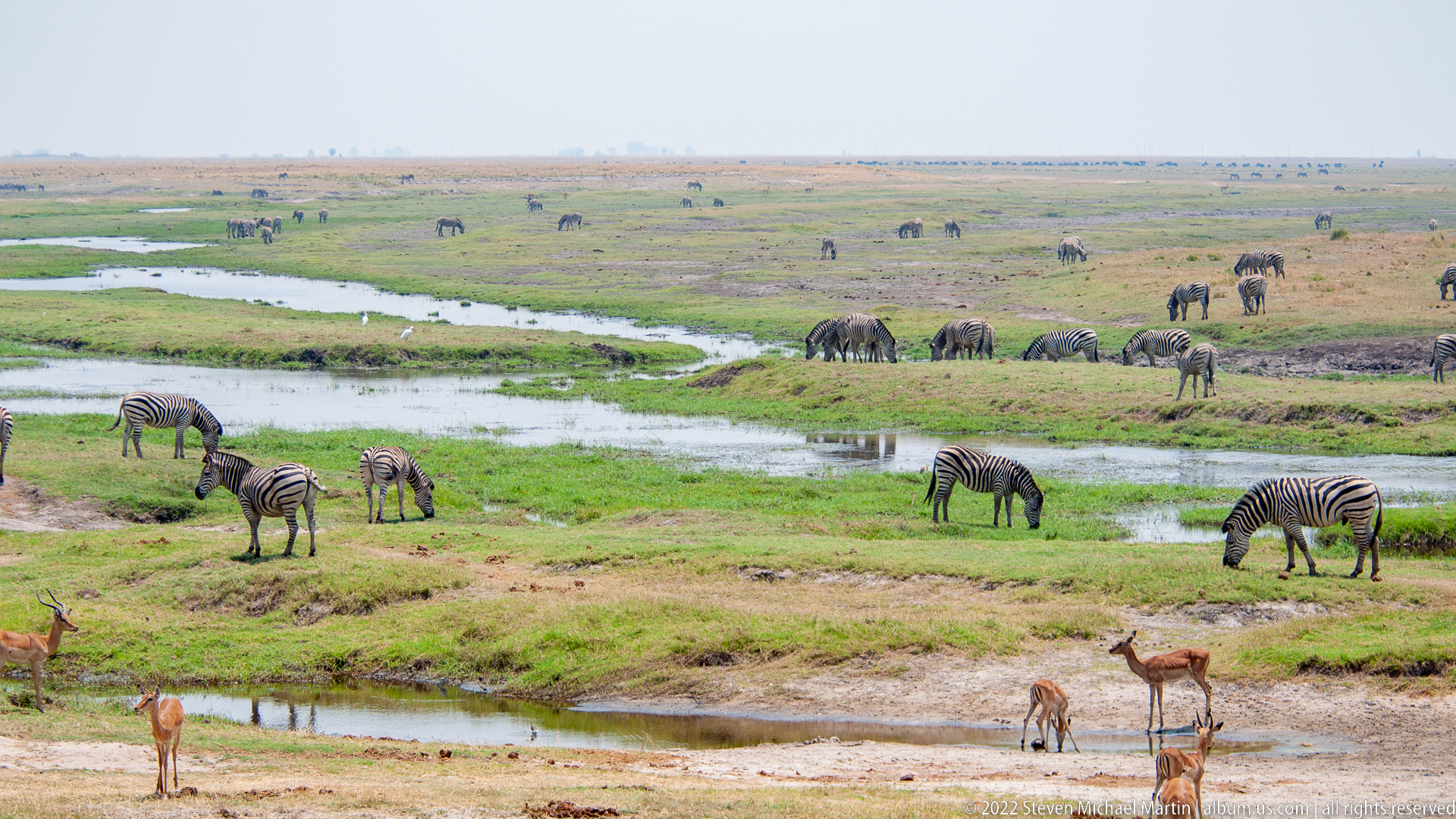
Plains zebras graze across a green floodplain cut by shallow water channels, while numerous African bush elephants feed and move across the more distant flats. Slender antelope stand near the foreground water. This broad ecological view contrasts with the preceding predator portraits, showing the open, water-dependent grazing landscape and mixed large-mammal assemblage characteristic of the Chobe River system.
Caption
Plains zebras graze across a green floodplain cut by shallow water channels, while numerous African bush elephants feed and move across the more distant flats. Slender antelope stand near the foreground water. This broad ecological view contrasts with the preceding predator portraits, showing the open, water-dependent grazing landscape and mixed large-mammal assemblage characteristic of the Chobe River system.
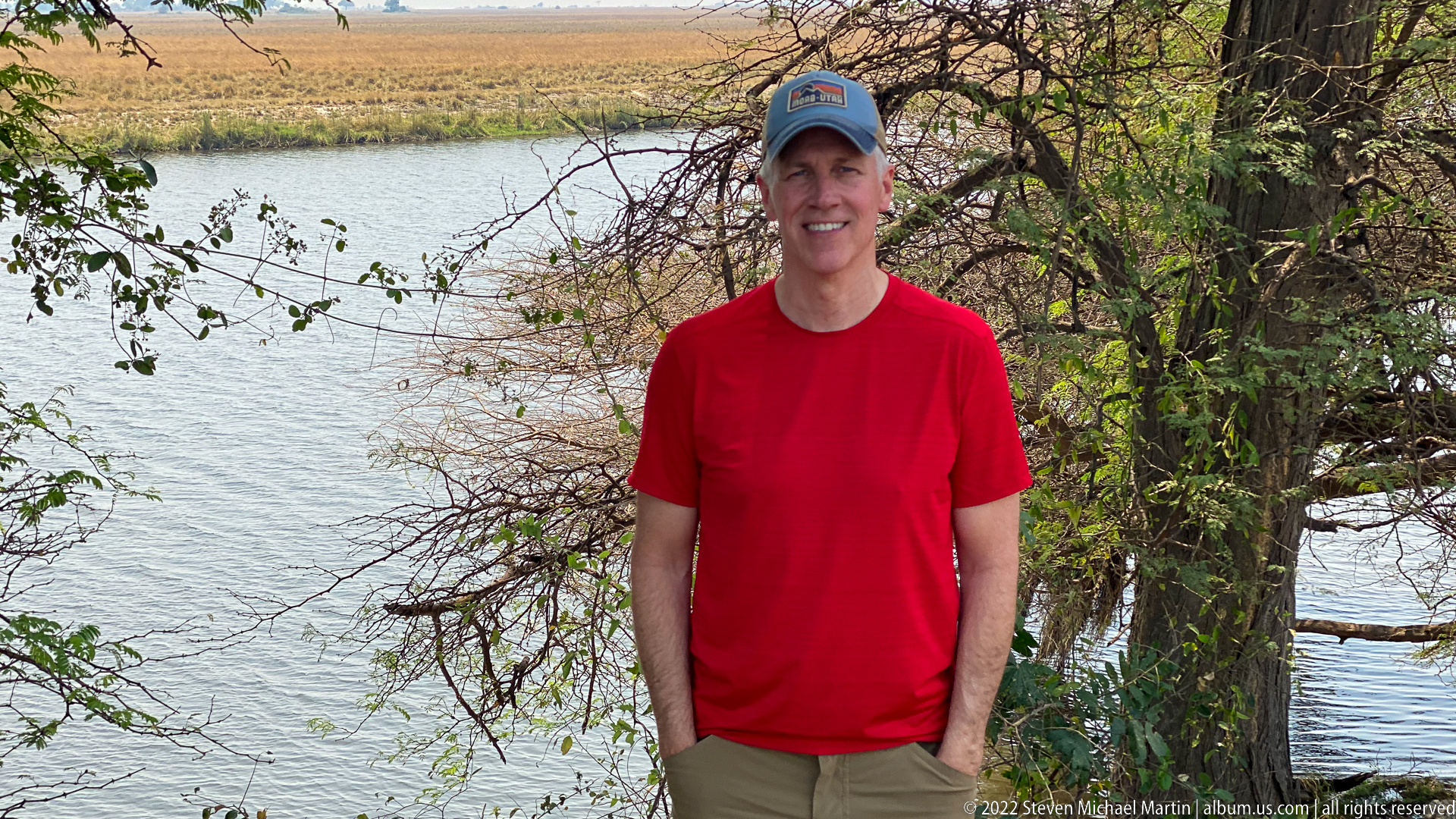
A traveler in a bright red shirt stands beneath riverbank trees with the broad water of the Chobe system behind. The portrait places a human figure within the park’s riparian landscape, where open water, floodplain, and woodland converge. Branches frame the figure while the distant opposite bank remains low on the horizon.
Caption
A traveler in a bright red shirt stands beneath riverbank trees with the broad water of the Chobe system behind. The portrait places a human figure within the park’s riparian landscape, where open water, floodplain, and woodland converge. Branches frame the figure while the distant opposite bank remains low on the horizon.

Plains zebras are scattered across a broad Chobe floodplain, with a dense cluster grazing near the water and smaller groups extending far into the hazy background. Repeated black-and-white bodies mark the open landscape at multiple distances. The panoramic view emphasizes both habitat scale and the concentration of grazers around productive riverine grasslands.
Caption
Plains zebras are scattered across a broad Chobe floodplain, with a dense cluster grazing near the water and smaller groups extending far into the hazy background. Repeated black-and-white bodies mark the open landscape at multiple distances. The panoramic view emphasizes both habitat scale and the concentration of grazers around productive riverine grasslands.
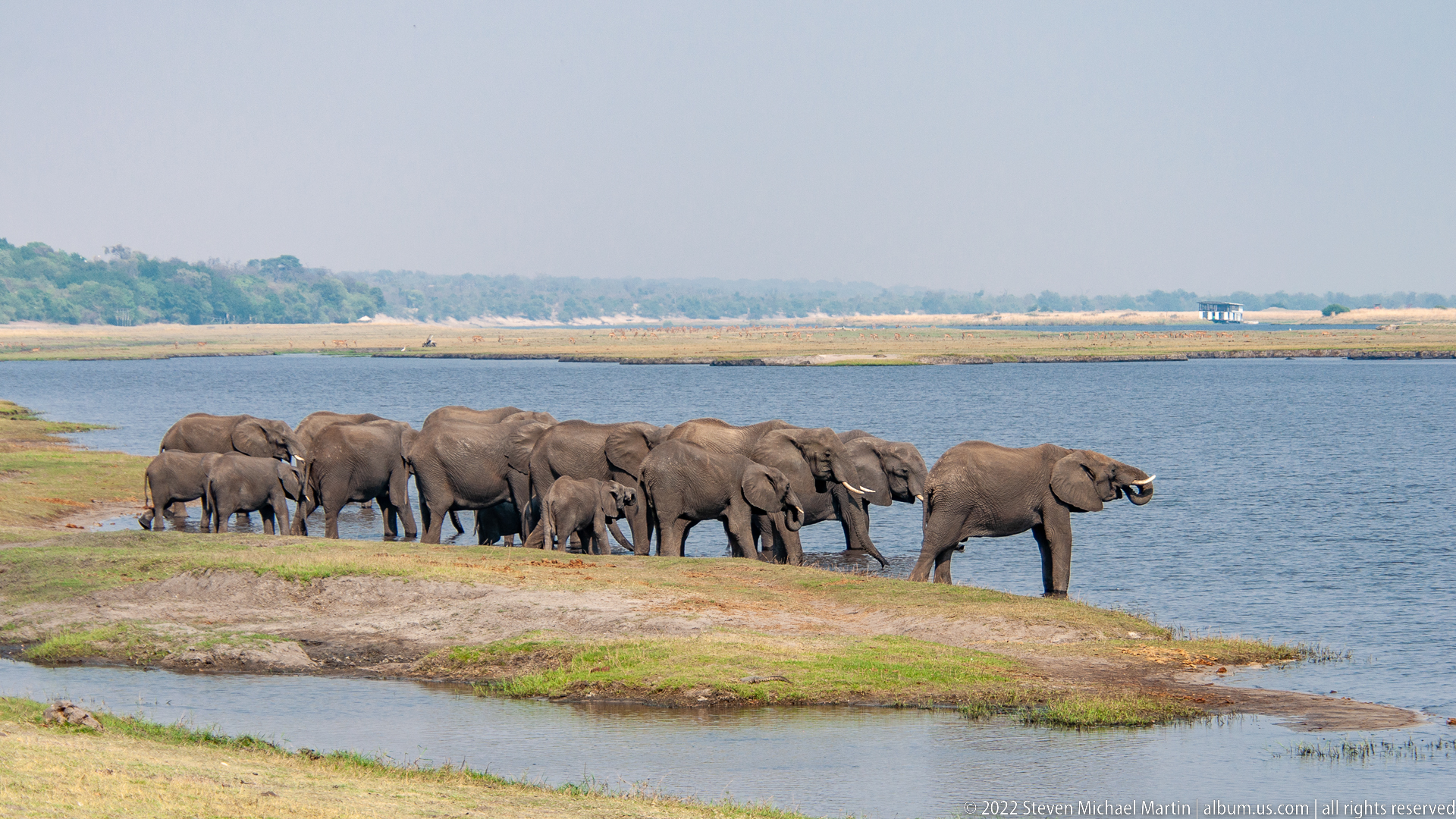
A herd of African bush elephants gathers along a low grassy island at the edge of the Chobe River floodplain. Adults and younger animals stand tightly grouped near the water, while one elephant at right extends its trunk forward. The broad wetland setting places the herd within the riverine habitat that makes Chobe National Park an important dry-season refuge for elephants.
Caption
A herd of African bush elephants gathers along a low grassy island at the edge of the Chobe River floodplain. Adults and younger animals stand tightly grouped near the water, while one elephant at right extends its trunk forward. The broad wetland setting places the herd within the riverine habitat that makes Chobe National Park an important dry-season refuge for elephants.
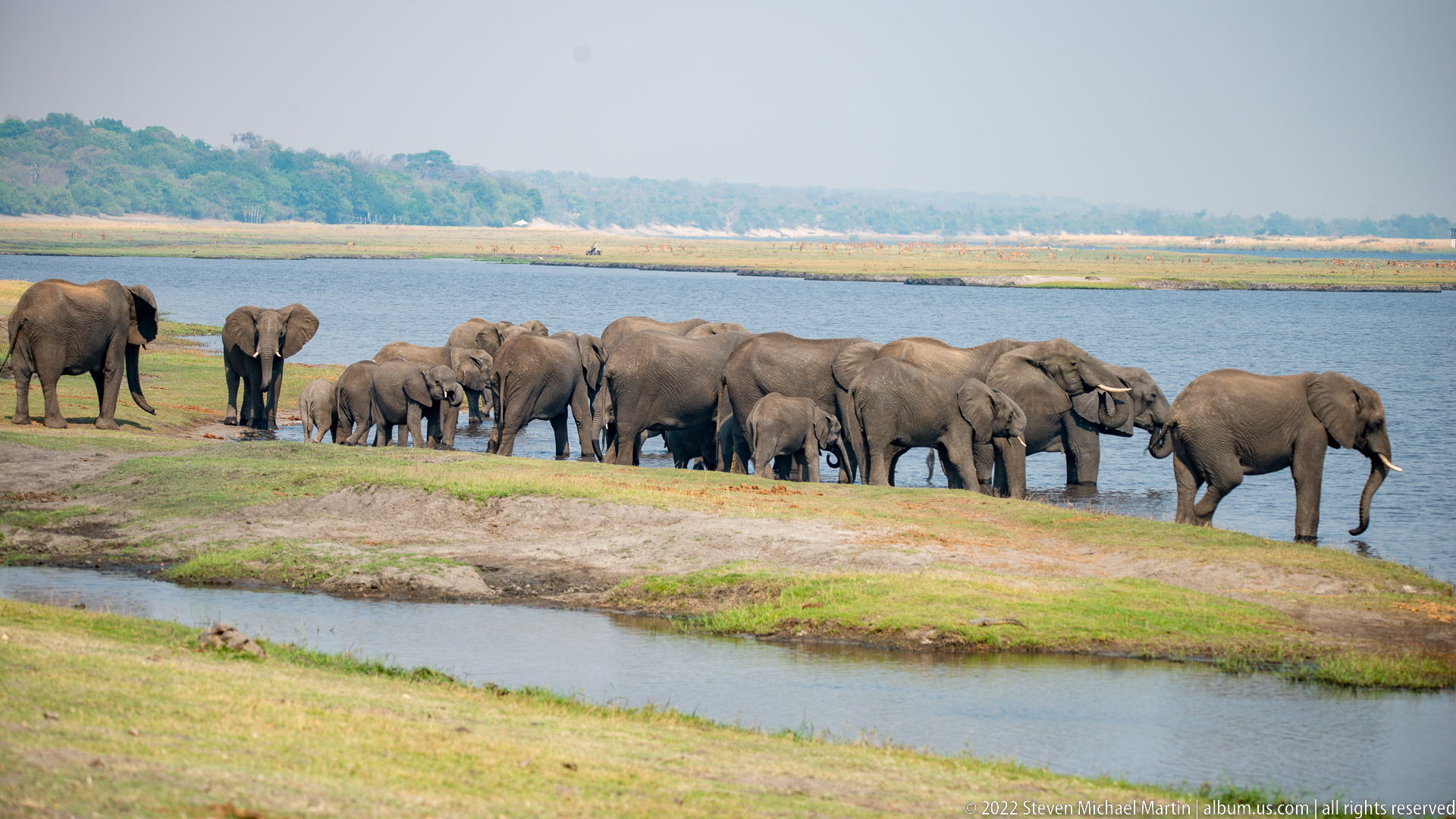
A large herd of African bush elephants gathers along a low riverbank, with adults and calves spread between the water and exposed grass. Their varied sizes reveal a multi-generational group using the river margin for drinking and cooling. The broad Chobe floodplain and open water place the herd within one of the park’s most characteristic wildlife habitats.
Caption
A large herd of African bush elephants gathers along a low riverbank, with adults and calves spread between the water and exposed grass. Their varied sizes reveal a multi-generational group using the river margin for drinking and cooling. The broad Chobe floodplain and open water place the herd within one of the park’s most characteristic wildlife habitats.
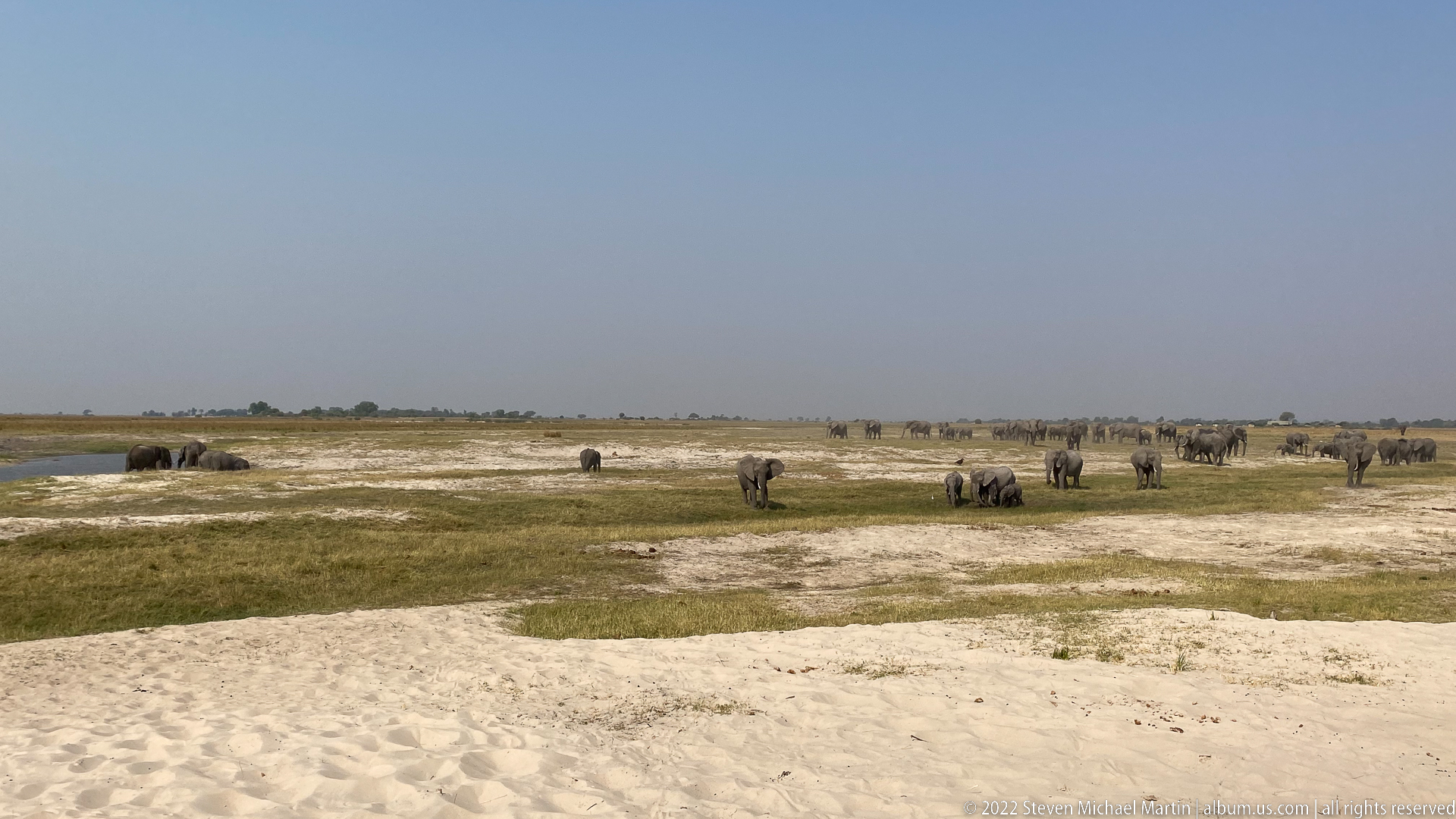
Numerous African bush elephants are scattered across a broad, pale floodplain, with animals grazing or walking at several distances from the camera. White sand and short green vegetation form alternating bands beneath a hazy sky. The wide view emphasizes the extraordinary spatial scale of Chobe’s elephant habitat rather than the behavior of any single animal.
Caption
Numerous African bush elephants are scattered across a broad, pale floodplain, with animals grazing or walking at several distances from the camera. White sand and short green vegetation form alternating bands beneath a hazy sky. The wide view emphasizes the extraordinary spatial scale of Chobe’s elephant habitat rather than the behavior of any single animal.
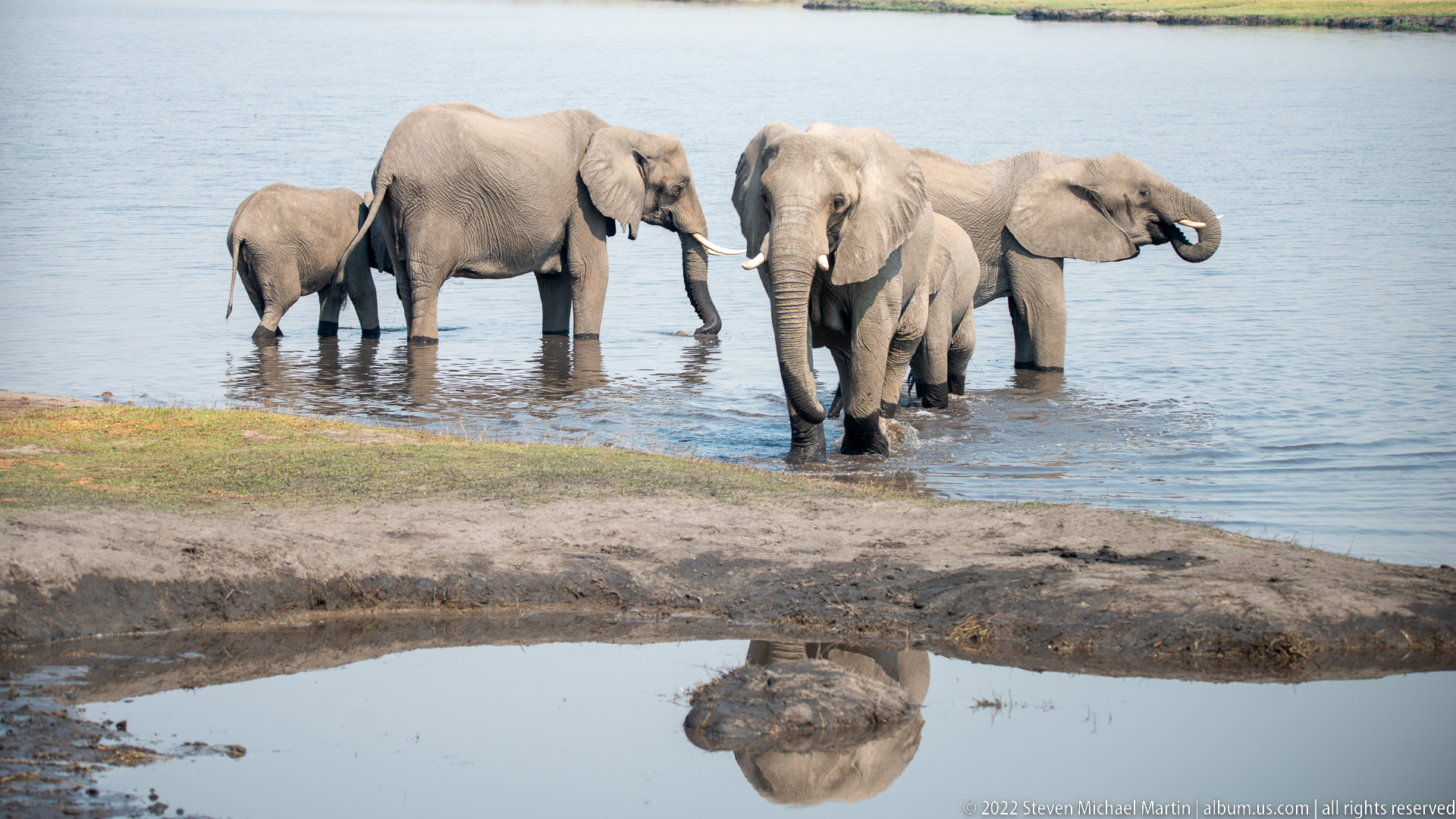
Several African bush elephants wade in shallow water while another adult steps toward the muddy bank, its reflection visible in a foreground pool. The group includes animals of different ages and orientations, emphasizing the social use of Chobe’s river edge. Calm water and exposed mud create a layered view of elephants moving between aquatic and terrestrial habitat.
Caption
Several African bush elephants wade in shallow water while another adult steps toward the muddy bank, its reflection visible in a foreground pool. The group includes animals of different ages and orientations, emphasizing the social use of Chobe’s river edge. Calm water and exposed mud create a layered view of elephants moving between aquatic and terrestrial habitat.

A mixed group of scavenging birds gathers on dry ground beside a wetland channel. A tall marabou stork stands at the rear while several vultures occupy the foreground and right side, some with bare heads suited to feeding on carrion. The assemblage reflects the scavenger community that rapidly exploits carcasses and other food resources across Chobe’s floodplain.
Caption
A mixed group of scavenging birds gathers on dry ground beside a wetland channel. A tall marabou stork stands at the rear while several vultures occupy the foreground and right side, some with bare heads suited to feeding on carrion. The assemblage reflects the scavenger community that rapidly exploits carcasses and other food resources across Chobe’s floodplain.
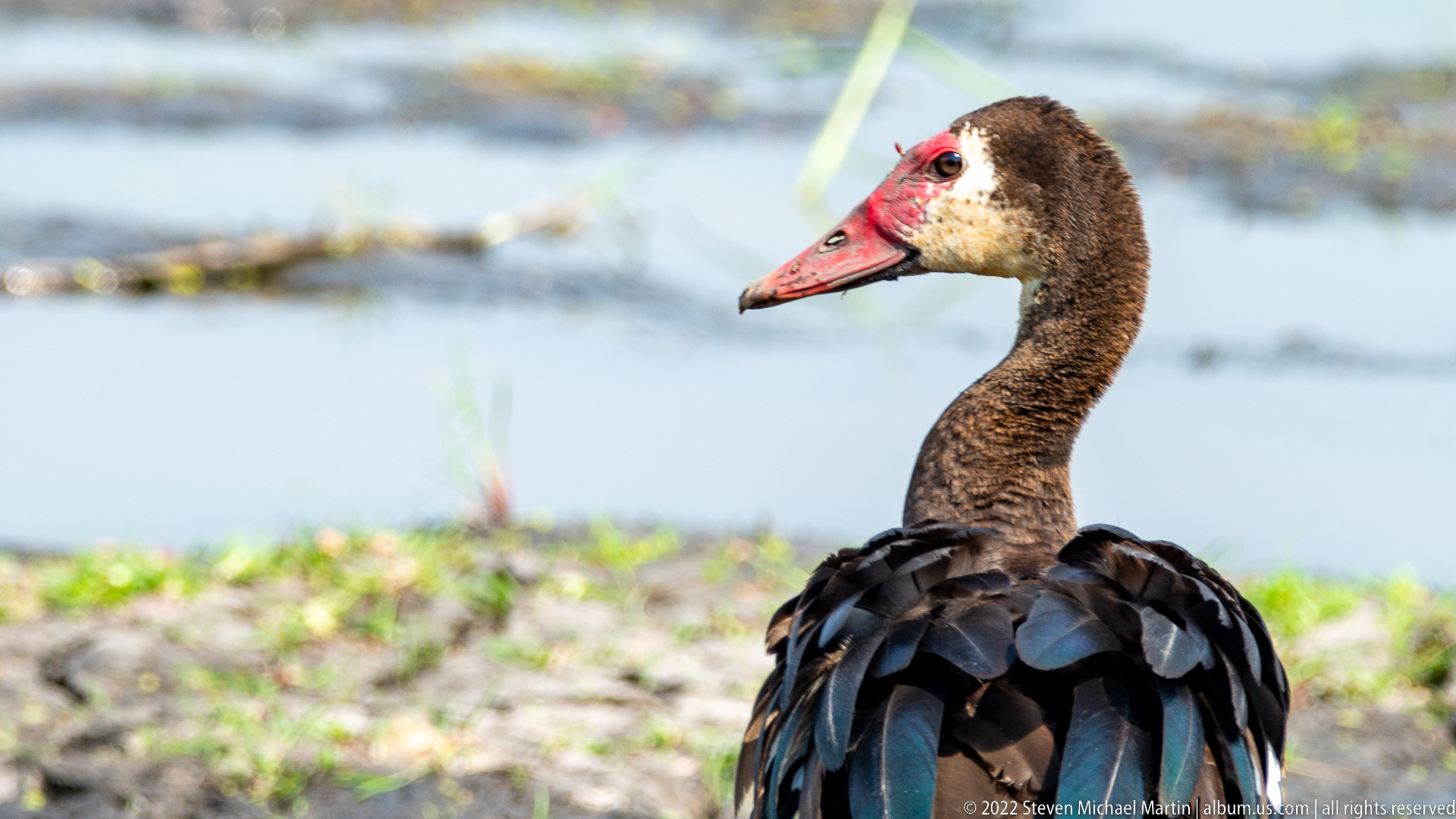
A close portrait isolates the head and upper body of a spur-winged goose, revealing the red bill and facial skin, pale cheek and throat, and fine brown feathering of the neck. The cropped composition provides a field-guide study of facial features that are less obvious in wider views. Wetland vegetation and water remain softly visible behind the bird.
Caption
A close portrait isolates the head and upper body of a spur-winged goose, revealing the red bill and facial skin, pale cheek and throat, and fine brown feathering of the neck. The cropped composition provides a field-guide study of facial features that are less obvious in wider views. Wetland vegetation and water remain softly visible behind the bird.
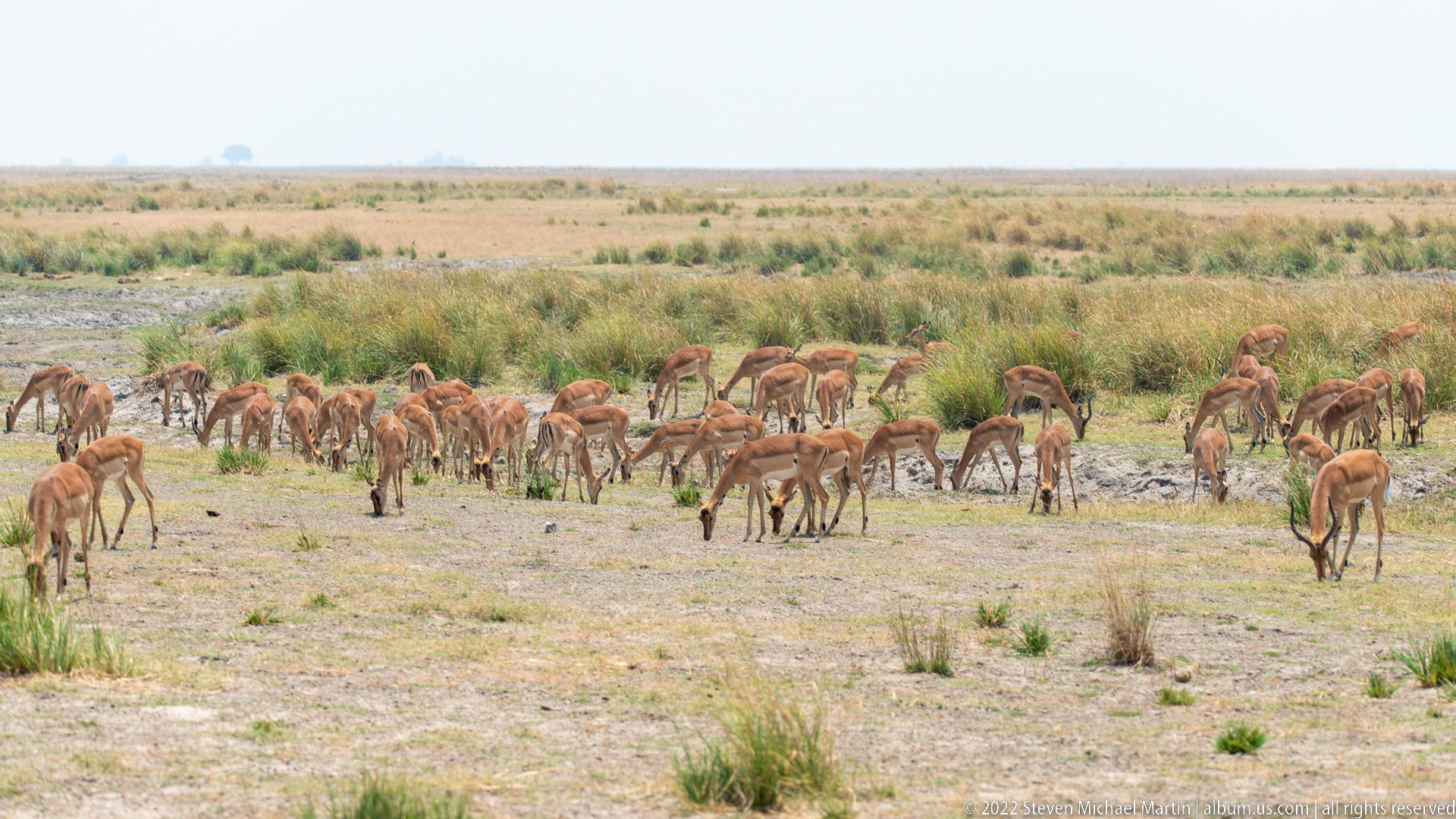
A large herd of impalas spreads across a pale floodplain, with dozens of animals grazing or standing among low clumps of vegetation. Their tawny coats create a dense field of repeated forms against the open wetland ground. The wide view emphasizes herd size and collective feeding behavior rather than individual animals, showing the abundance of antelope in Chobe’s grazing areas.
Caption
A large herd of impalas spreads across a pale floodplain, with dozens of animals grazing or standing among low clumps of vegetation. Their tawny coats create a dense field of repeated forms against the open wetland ground. The wide view emphasizes herd size and collective feeding behavior rather than individual animals, showing the abundance of antelope in Chobe’s grazing areas.
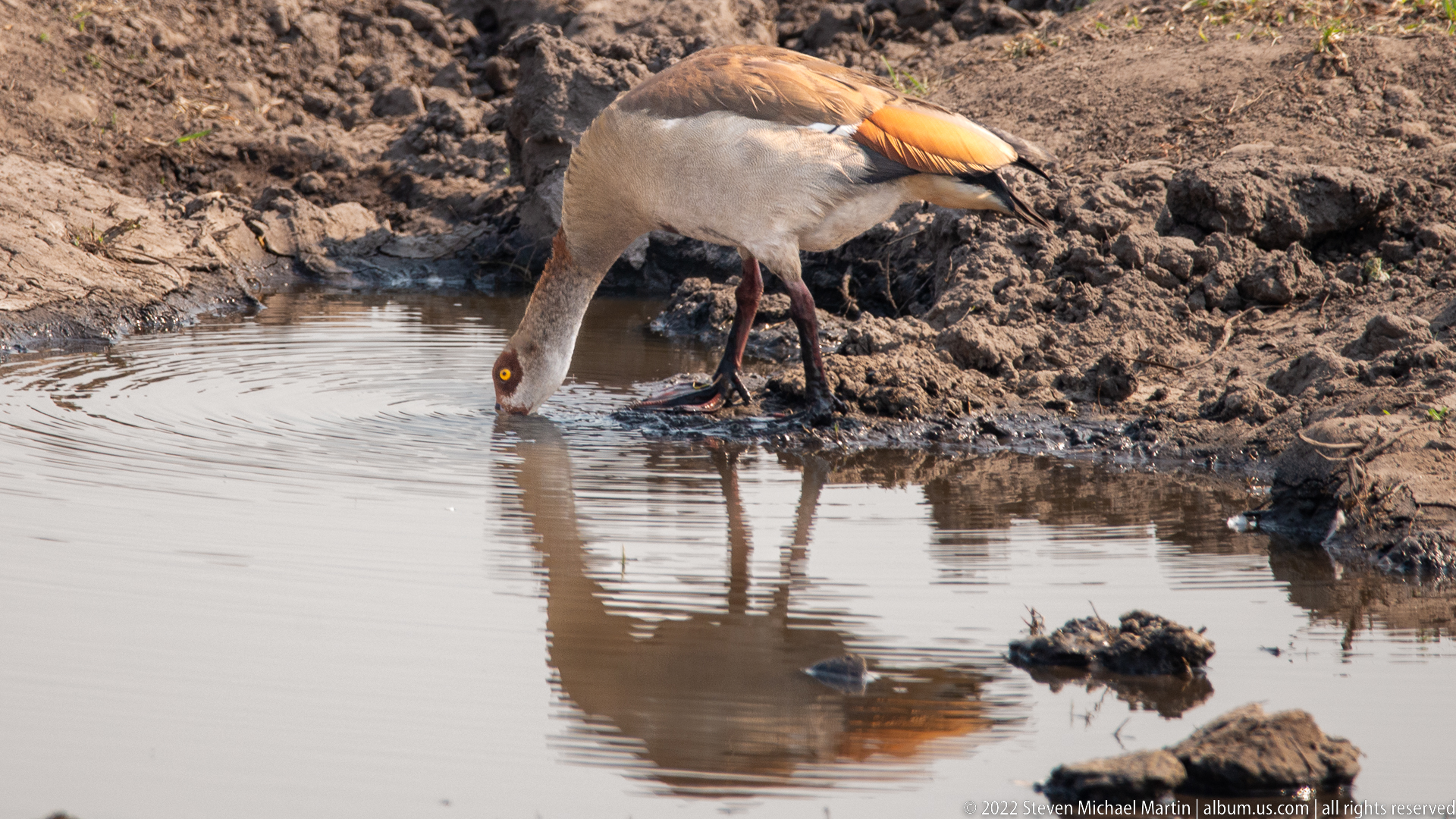
An Egyptian goose lowers its head to drink at the edge of a muddy pool, its body angled steeply toward the water. The chestnut wing patch, pale buff body, pink legs, and dark eye marking remain visible while the bird’s reflection fills the foreground shallows.
Caption
An Egyptian goose lowers its head to drink at the edge of a muddy pool, its body angled steeply toward the water. The chestnut wing patch, pale buff body, pink legs, and dark eye marking remain visible while the bird’s reflection fills the foreground shallows.
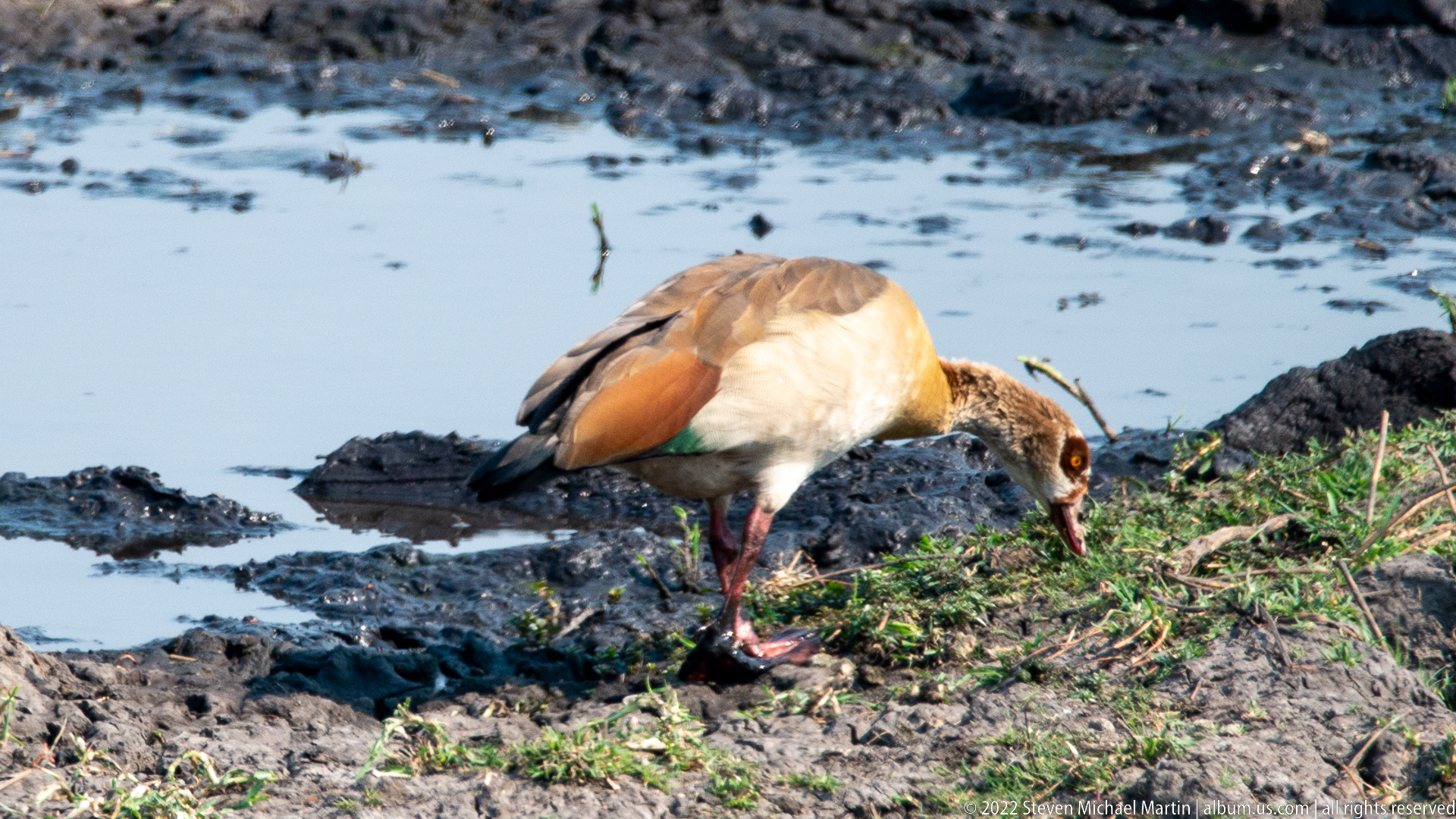
An Egyptian goose bends to feed along a muddy wetland margin, showing its pale head, chestnut eye patch, warm brown wings, and pink legs. The close ground-level view links the bird’s distinctive plumage with the saturated mud and shallow water of the Chobe floodplain.
Caption
An Egyptian goose bends to feed along a muddy wetland margin, showing its pale head, chestnut eye patch, warm brown wings, and pink legs. The close ground-level view links the bird’s distinctive plumage with the saturated mud and shallow water of the Chobe floodplain.
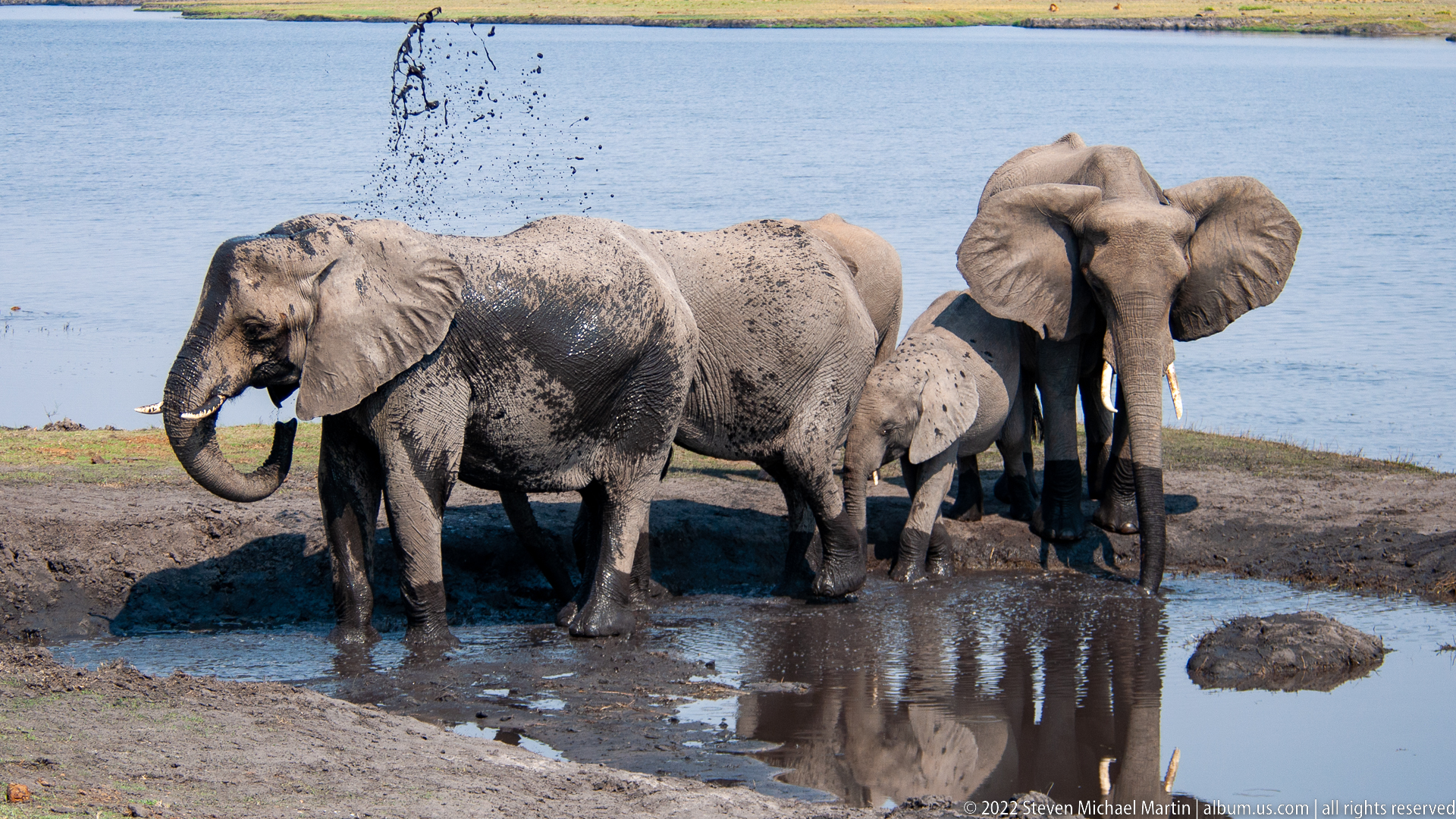
African bush elephants crowd a muddy drinking place beside open water, their bodies darkened by wet mud. One adult curls its trunk toward its mouth while another faces the camera with ears spread, and a smaller elephant is partly sheltered between them. Mud bathing and drinking help elephants cool themselves and protect their skin in Chobe National Park’s hot, seasonally dry environment.
Caption
African bush elephants crowd a muddy drinking place beside open water, their bodies darkened by wet mud. One adult curls its trunk toward its mouth while another faces the camera with ears spread, and a smaller elephant is partly sheltered between them. Mud bathing and drinking help elephants cool themselves and protect their skin in Chobe National Park’s hot, seasonally dry environment.

A mud-coated African bush elephant raises its trunk high while standing at the water’s edge. Wet skin glistens across the shoulder and flank, and the lifted trunk creates a strong behavioral portrait against the pale river surface. The close view emphasizes the elephant’s deeply folded skin, broad ear, short visible tusk, and the flexible trunk used for breathing, smelling, drinking, feeding, and social communication.
Caption
A mud-coated African bush elephant raises its trunk high while standing at the water’s edge. Wet skin glistens across the shoulder and flank, and the lifted trunk creates a strong behavioral portrait against the pale river surface. The close view emphasizes the elephant’s deeply folded skin, broad ear, short visible tusk, and the flexible trunk used for breathing, smelling, drinking, feeding, and social communication.

An adult African bush elephant and a smaller juvenile stride through shallow water as mud sprays behind the adult’s back. Their parallel movement gives the scene a sense of urgency and scale, with the youngster tucked close below the larger animal’s shoulder line. The wet shoreline and open floodplain water illustrate the intimate connection between Chobe’s elephant population and the park’s riverine habitats.
Caption
An adult African bush elephant and a smaller juvenile stride through shallow water as mud sprays behind the adult’s back. Their parallel movement gives the scene a sense of urgency and scale, with the youngster tucked close below the larger animal’s shoulder line. The wet shoreline and open floodplain water illustrate the intimate connection between Chobe’s elephant population and the park’s riverine habitats.
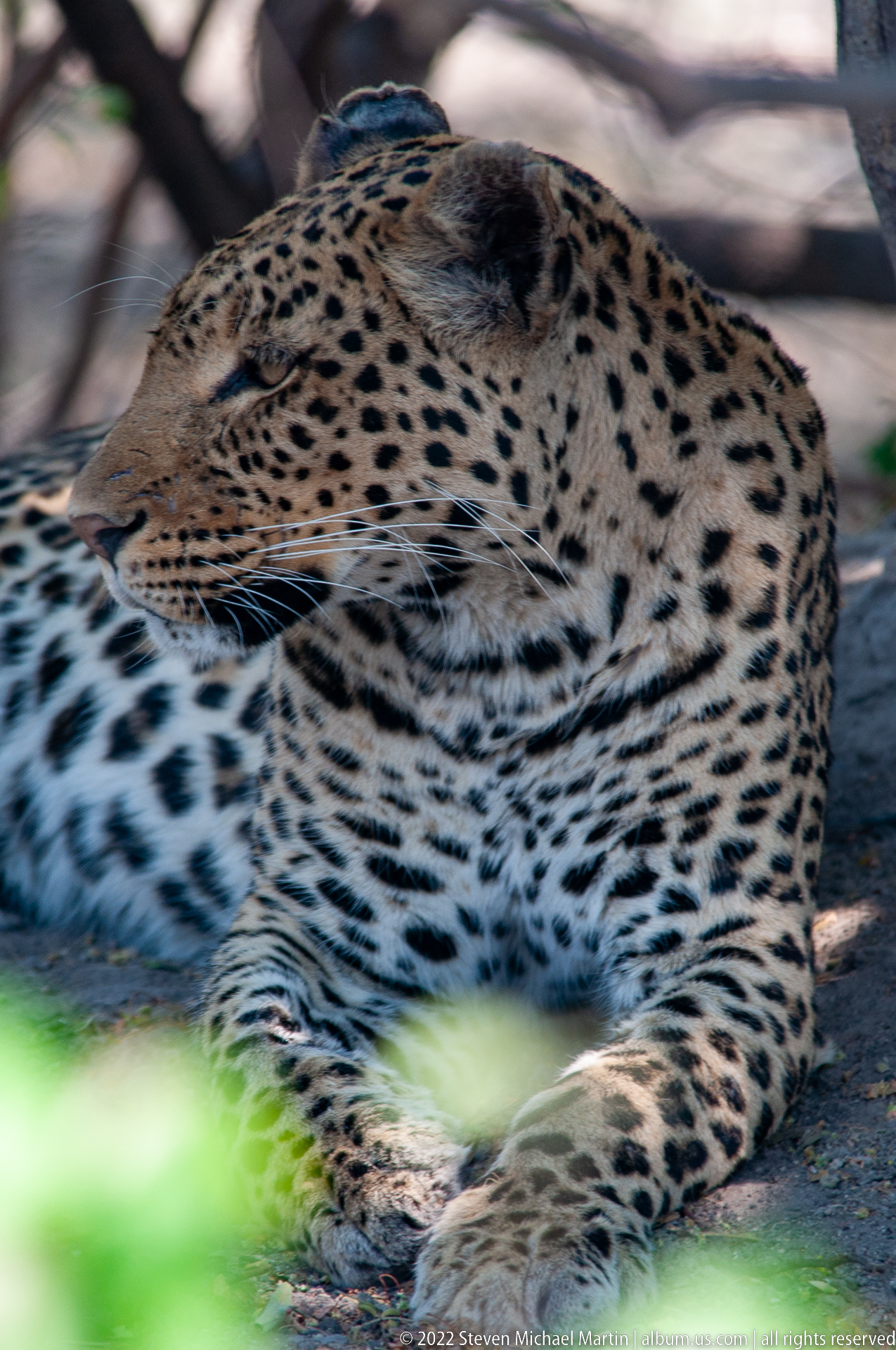
A leopard rests in profile with its head lowered toward its spotted forequarters. The side view emphasizes the rounded ear, long white whiskers, powerful neck, and dense rosette pattern across the shoulder. Foreground leaves partly mask the lower frame, reinforcing the concealment provided by Chobe’s wooded habitats, where a resting leopard can become difficult to detect even at relatively close range.
Caption
A leopard rests in profile with its head lowered toward its spotted forequarters. The side view emphasizes the rounded ear, long white whiskers, powerful neck, and dense rosette pattern across the shoulder. Foreground leaves partly mask the lower frame, reinforcing the concealment provided by Chobe’s wooded habitats, where a resting leopard can become difficult to detect even at relatively close range.
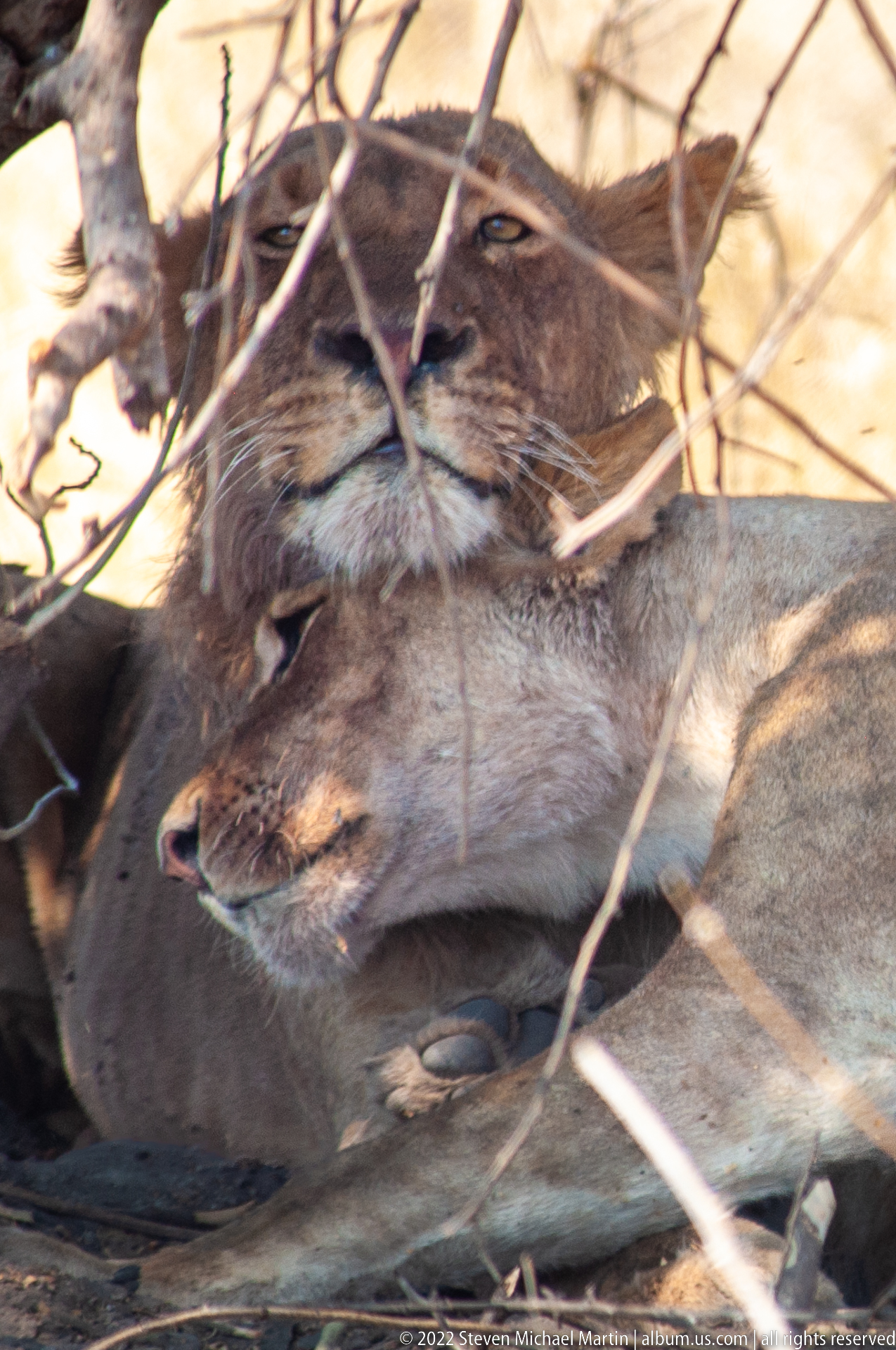
Two lionesses rest pressed closely together beneath branches, their heads overlapping in a compact social portrait. One female’s face is seen in profile while the other lies just behind, both with eyes partly closed and bodies relaxed. The intimate spacing is characteristic of the strong social bonds within a lion pride and contrasts with the solitary leopard shown earlier in the sequence.
Caption
Two lionesses rest pressed closely together beneath branches, their heads overlapping in a compact social portrait. One female’s face is seen in profile while the other lies just behind, both with eyes partly closed and bodies relaxed. The intimate spacing is characteristic of the strong social bonds within a lion pride and contrasts with the solitary leopard shown earlier in the sequence.
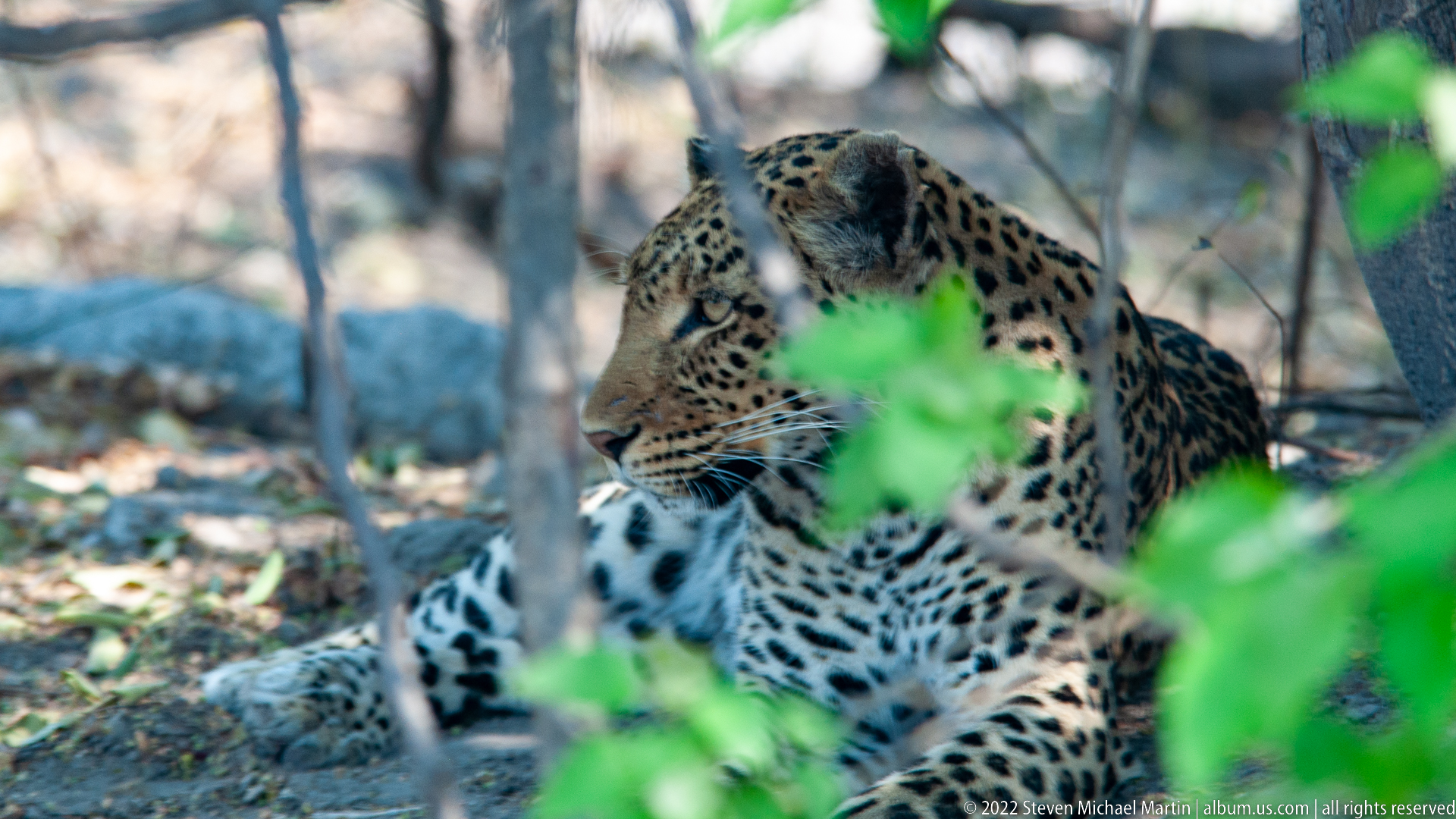
A leopard rests low on the ground beneath dense woodland cover, its rosetted coat broken by trunks, branches, and bright foreground leaves. The partially screened view demonstrates how effectively the cat’s pattern blends with dappled shade and dry vegetation. Its head is raised and alert even while the body remains relaxed, a characteristic posture for a leopard resting during the heat of the day.
Caption
A leopard rests low on the ground beneath dense woodland cover, its rosetted coat broken by trunks, branches, and bright foreground leaves. The partially screened view demonstrates how effectively the cat’s pattern blends with dappled shade and dry vegetation. Its head is raised and alert even while the body remains relaxed, a characteristic posture for a leopard resting during the heat of the day.
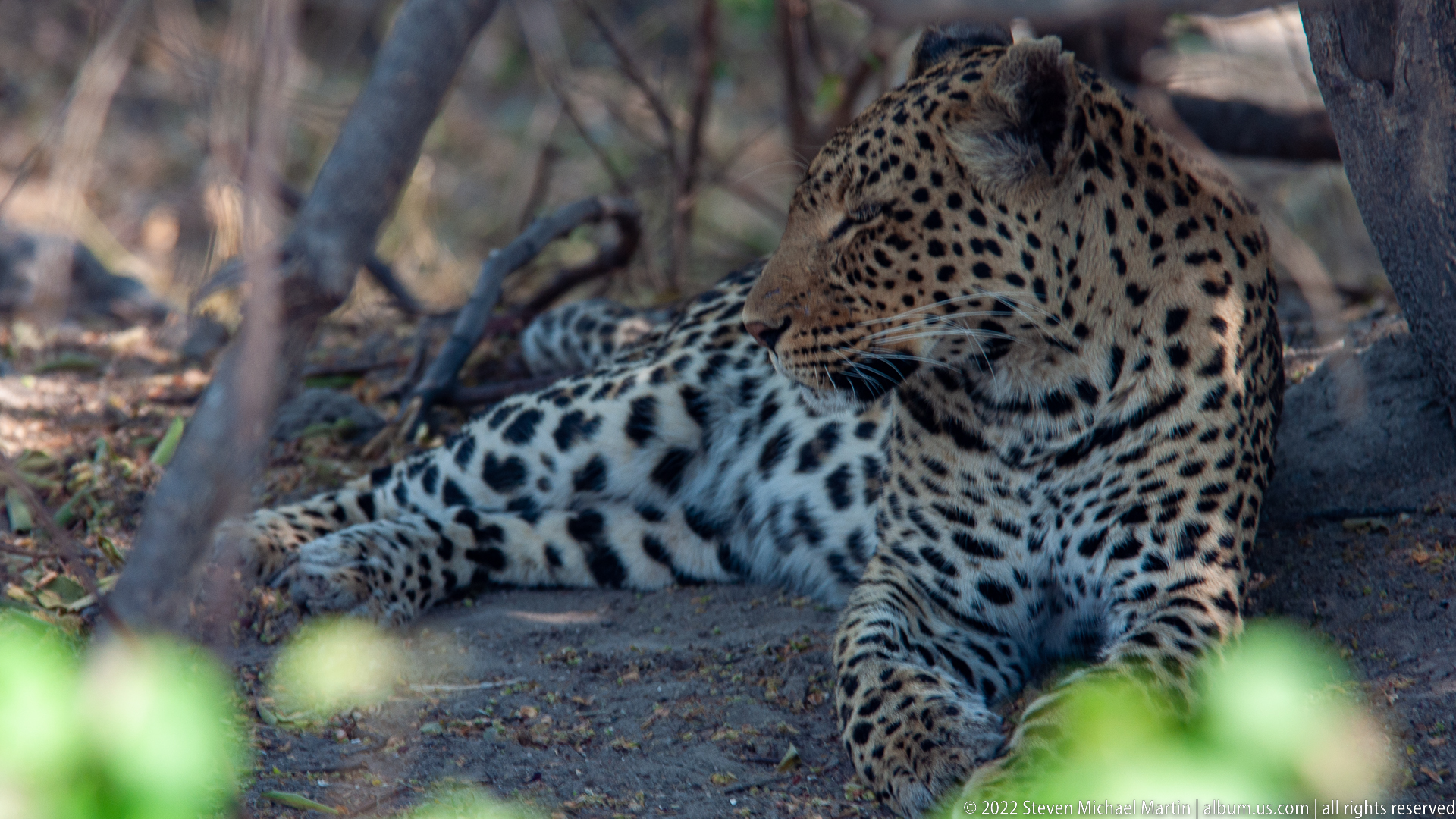
A reclining leopard turns its head to the side while resting on bare soil beneath trees. The unobstructed torso reveals the contrast between small solid spots on the head and larger rosettes across the body and limbs. Soft woodland shade reduces glare on the coat, while blurred green leaves in the foreground frame the cat without concealing its powerful forelegs and attentive profile.
Caption
A reclining leopard turns its head to the side while resting on bare soil beneath trees. The unobstructed torso reveals the contrast between small solid spots on the head and larger rosettes across the body and limbs. Soft woodland shade reduces glare on the coat, while blurred green leaves in the foreground frame the cat without concealing its powerful forelegs and attentive profile.
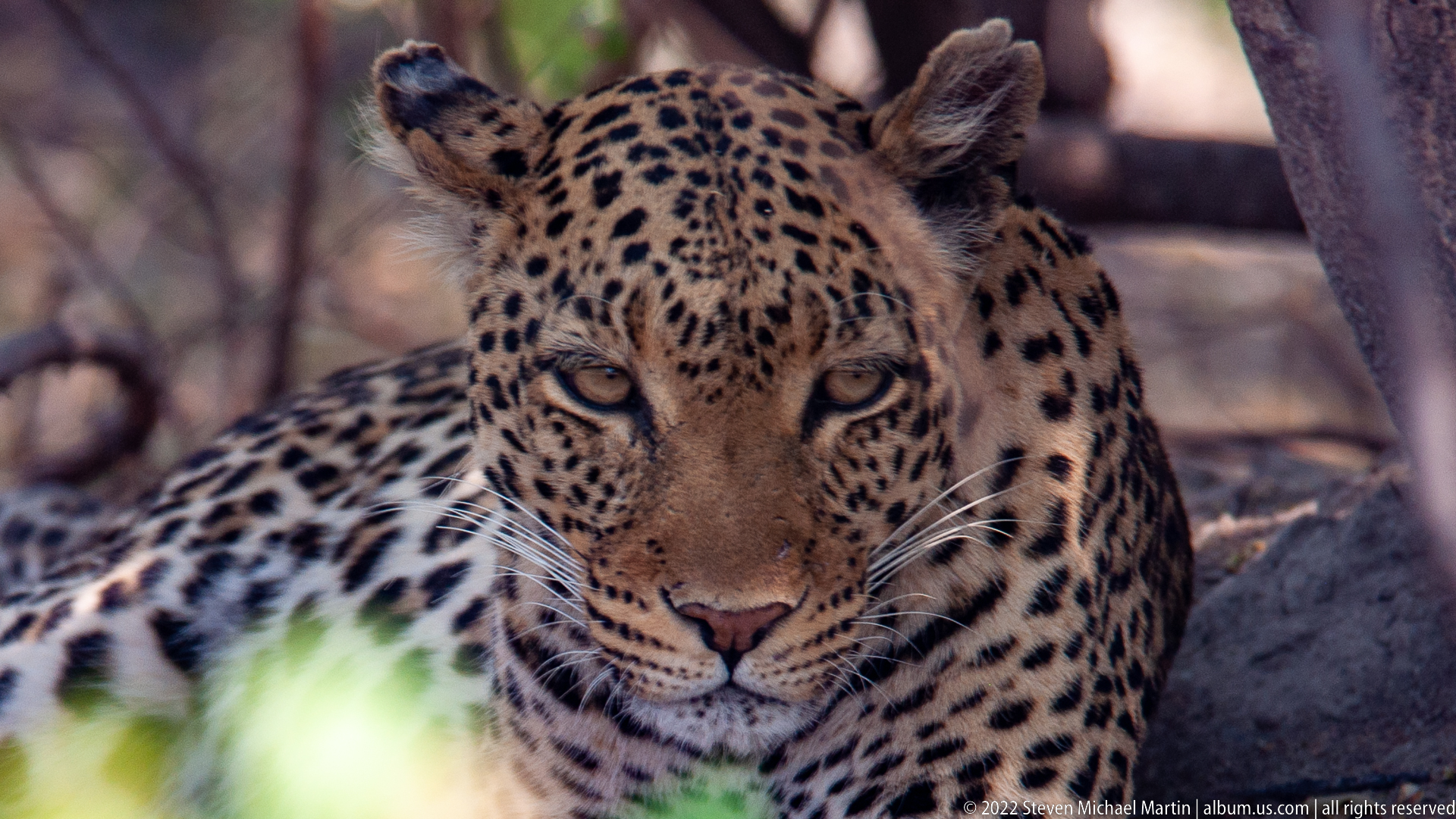
A leopard faces the camera from deep shade, its pale eyes, whiskers, and densely spotted muzzle sharply defined above blurred green leaves. The close framing concentrates attention on the cat’s facial symmetry and the transition from small head spots to rosettes along the shoulders. Although resting, the direct gaze gives the portrait an alert quality characteristic of a predator closely watching activity around its daytime shelter.
Caption
A leopard faces the camera from deep shade, its pale eyes, whiskers, and densely spotted muzzle sharply defined above blurred green leaves. The close framing concentrates attention on the cat’s facial symmetry and the transition from small head spots to rosettes along the shoulders. Although resting, the direct gaze gives the portrait an alert quality characteristic of a predator closely watching activity around its daytime shelter.
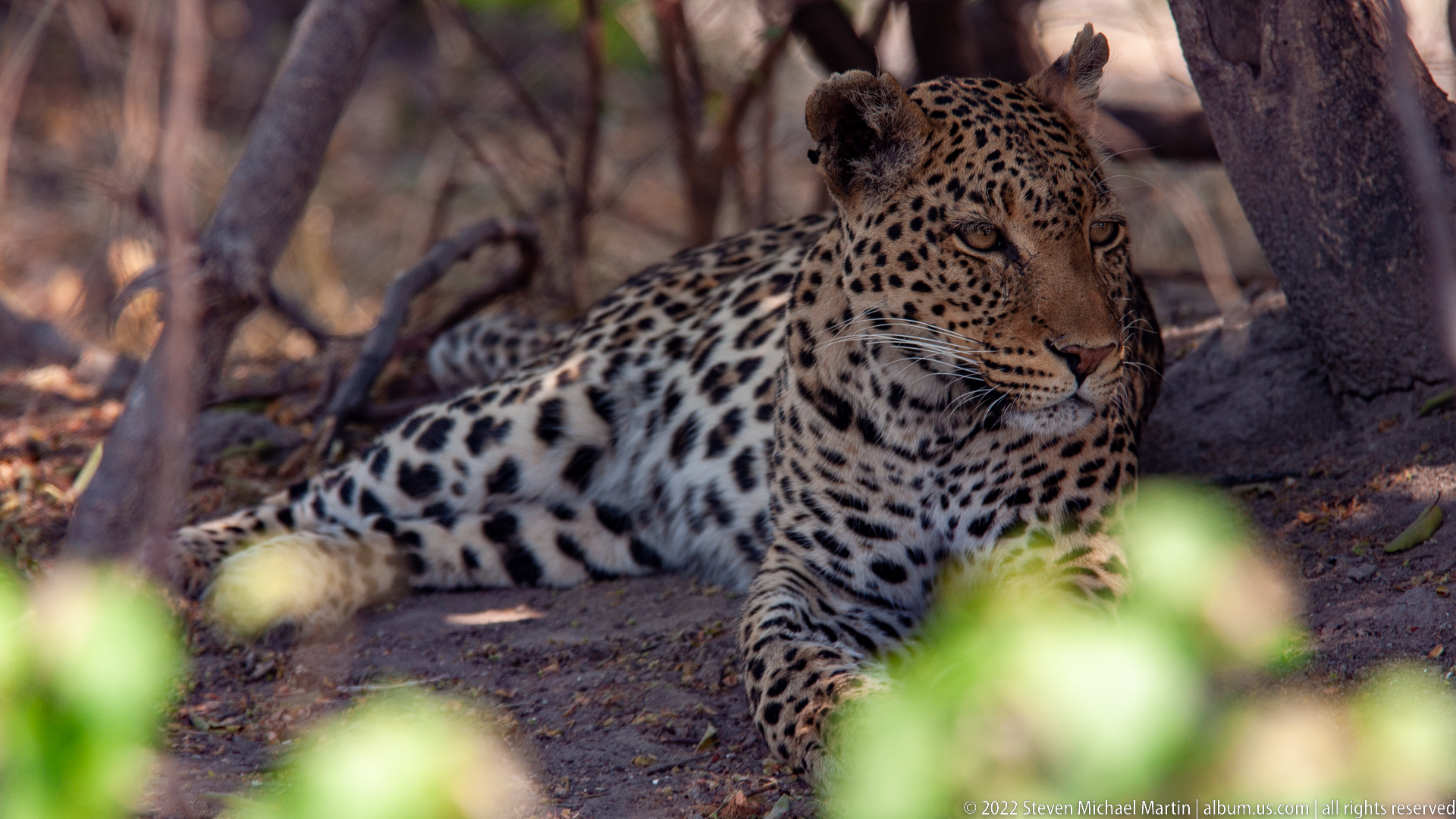
A leopard lies beneath trees with its forelegs extended and head turned slightly toward the open woodland. Rosettes across the shoulder and flank remain clearly visible despite soft green foliage in the foreground. The relaxed body posture contrasts with the raised head and focused eyes, showing the cat resting while continuing to monitor its surroundings from a shaded daytime refuge.
Caption
A leopard lies beneath trees with its forelegs extended and head turned slightly toward the open woodland. Rosettes across the shoulder and flank remain clearly visible despite soft green foliage in the foreground. The relaxed body posture contrasts with the raised head and focused eyes, showing the cat resting while continuing to monitor its surroundings from a shaded daytime refuge.
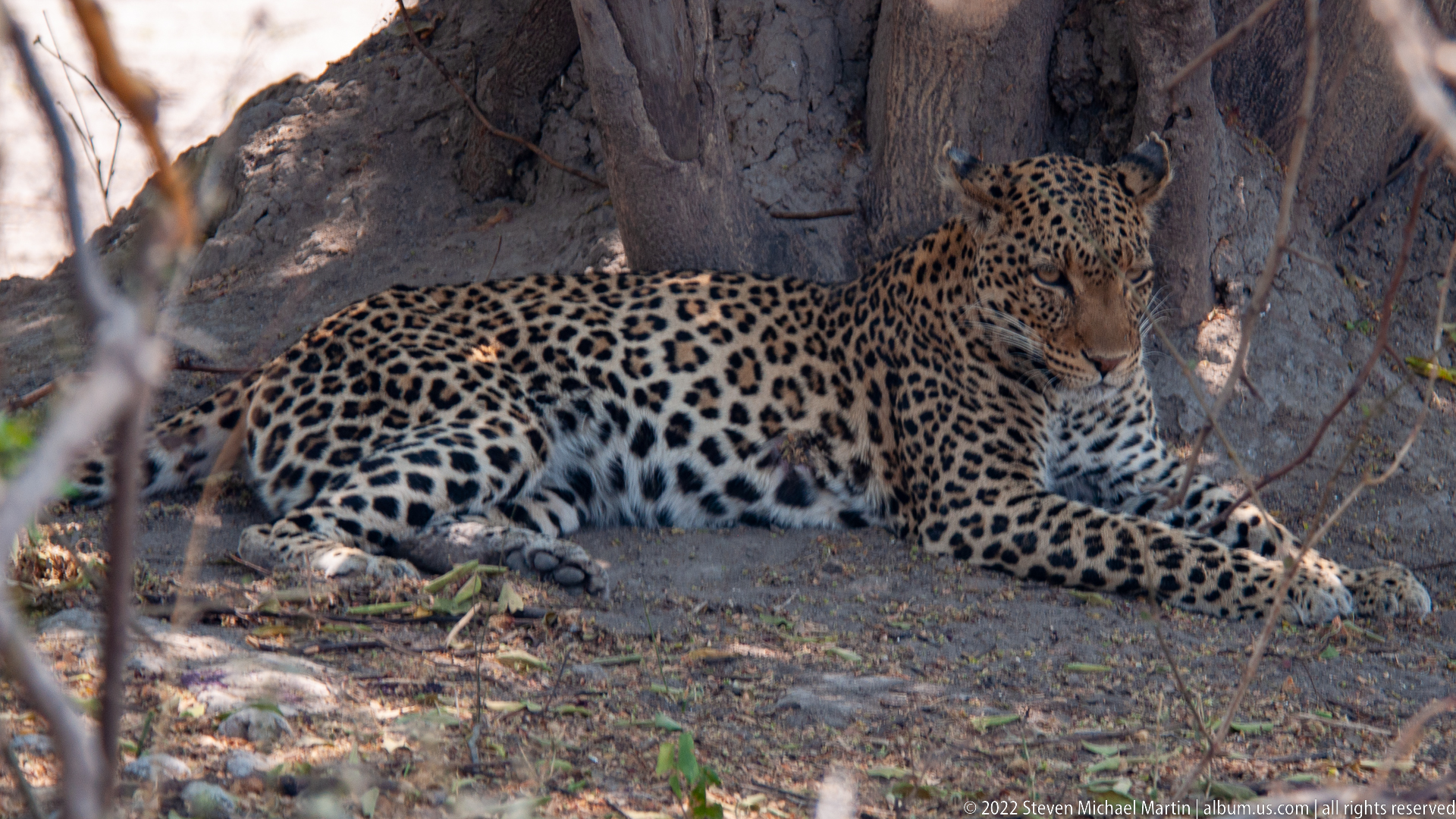
A leopard stretches along the base of a large tree, using deep shade as a daytime resting place. Its long body, extended forelegs, and patterned tail region are visible against bare earth, while the head remains upright and directed toward the camera. The wider composition shows how the cat’s rosettes merge with bark, leaf litter, and broken shadow in dry woodland.
Caption
A leopard stretches along the base of a large tree, using deep shade as a daytime resting place. Its long body, extended forelegs, and patterned tail region are visible against bare earth, while the head remains upright and directed toward the camera. The wider composition shows how the cat’s rosettes merge with bark, leaf litter, and broken shadow in dry woodland.
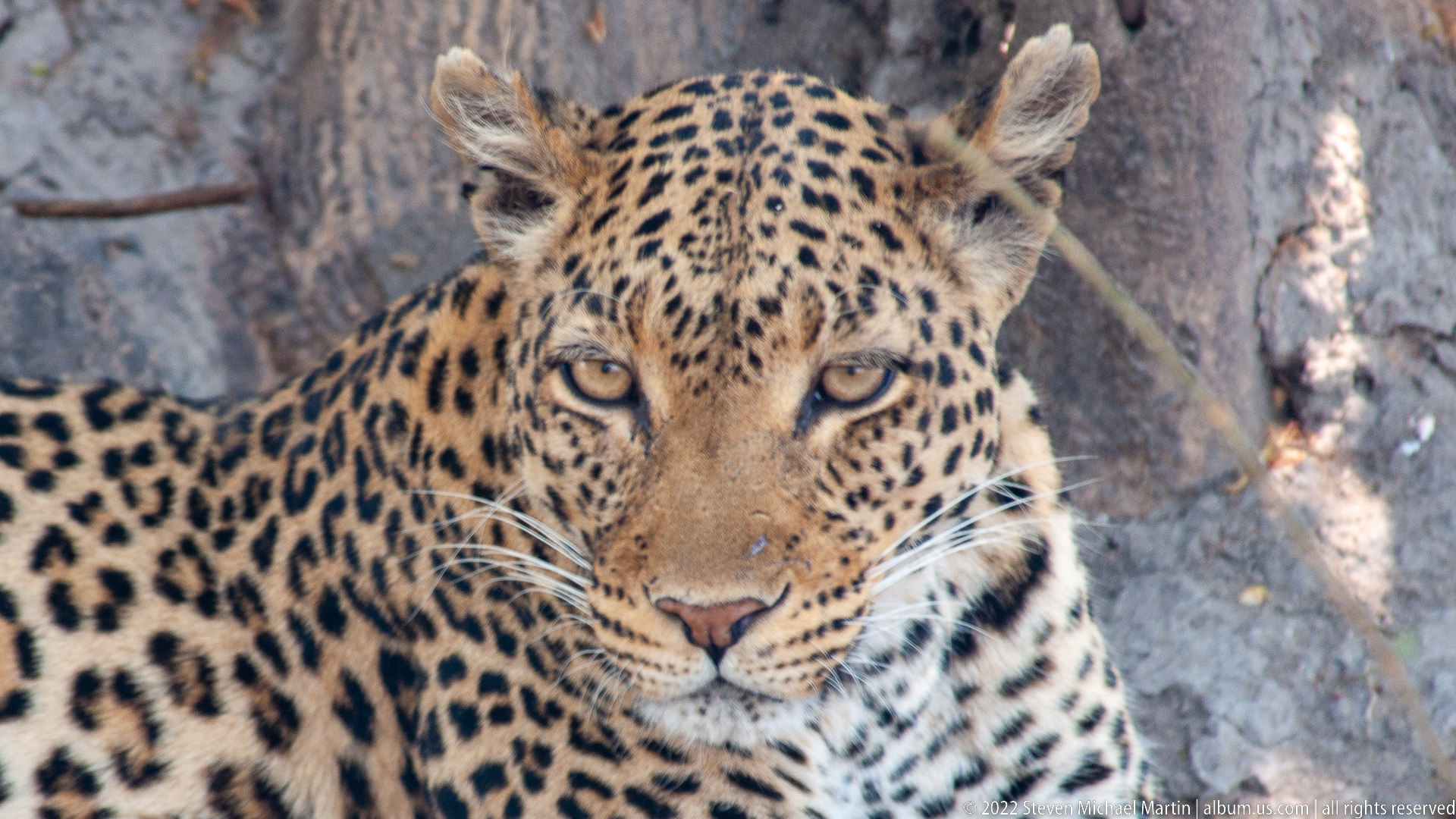
A close frontal view isolates a leopard’s face and upper body against rough tree bark. The cat’s amber-pale eyes look directly forward, framed by small black facial spots, white whisker pads, and larger rosettes on the shoulders. The compressed composition makes the leopard’s alert expression the dominant feature while retaining enough woodland context to show the shaded resting site.
Caption
A close frontal view isolates a leopard’s face and upper body against rough tree bark. The cat’s amber-pale eyes look directly forward, framed by small black facial spots, white whisker pads, and larger rosettes on the shoulders. The compressed composition makes the leopard’s alert expression the dominant feature while retaining enough woodland context to show the shaded resting site.
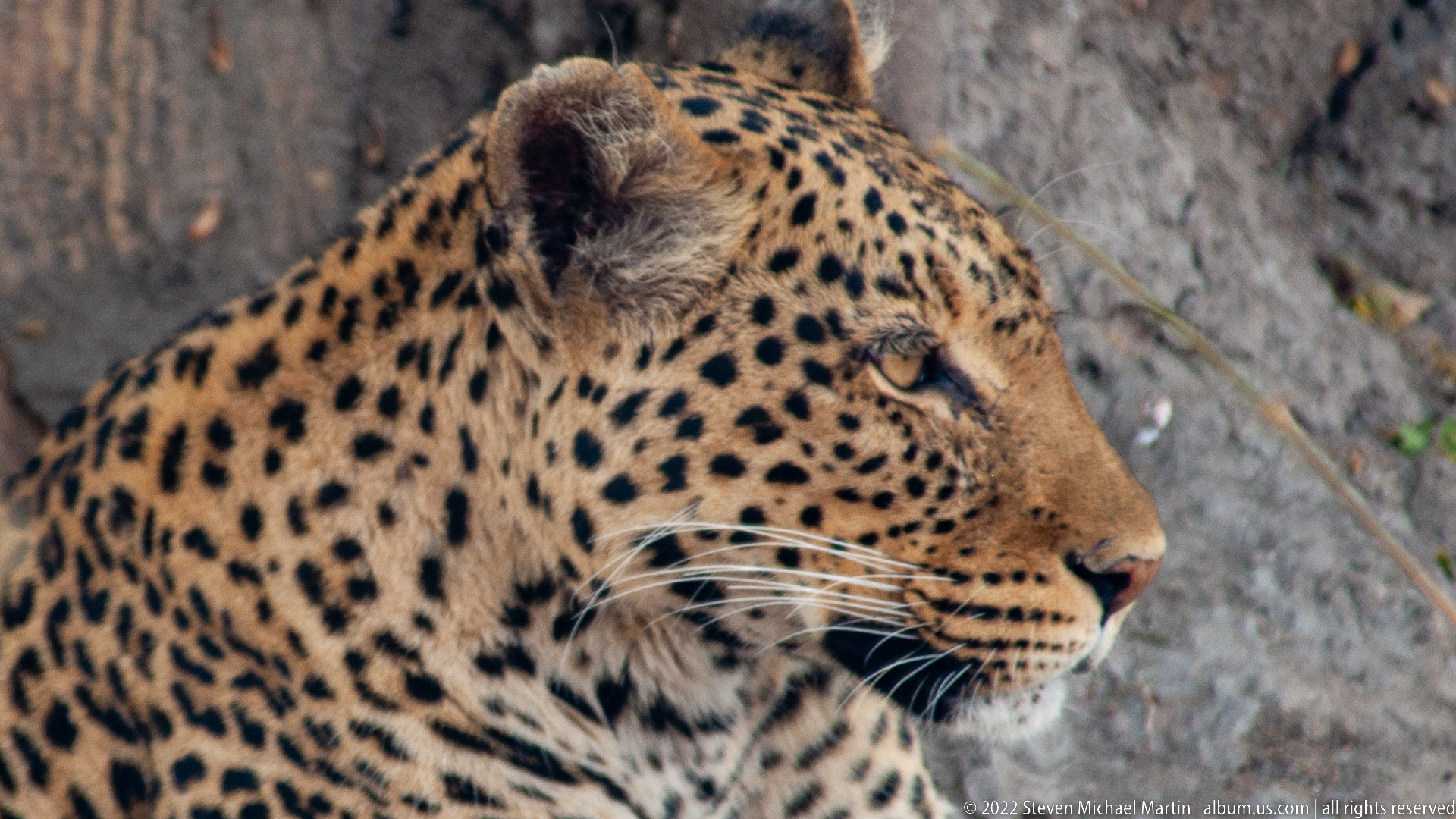
A leopard turns into a clean side profile beside a tree trunk, revealing the short rounded ear, strong muzzle, long whiskers, and layered spotting across the cheek and neck. The tight crop separates the head from the more diffuse rosettes of the shoulder, offering a detailed study of the markings and facial structure that distinguish the species.
Caption
A leopard turns into a clean side profile beside a tree trunk, revealing the short rounded ear, strong muzzle, long whiskers, and layered spotting across the cheek and neck. The tight crop separates the head from the more diffuse rosettes of the shoulder, offering a detailed study of the markings and facial structure that distinguish the species.
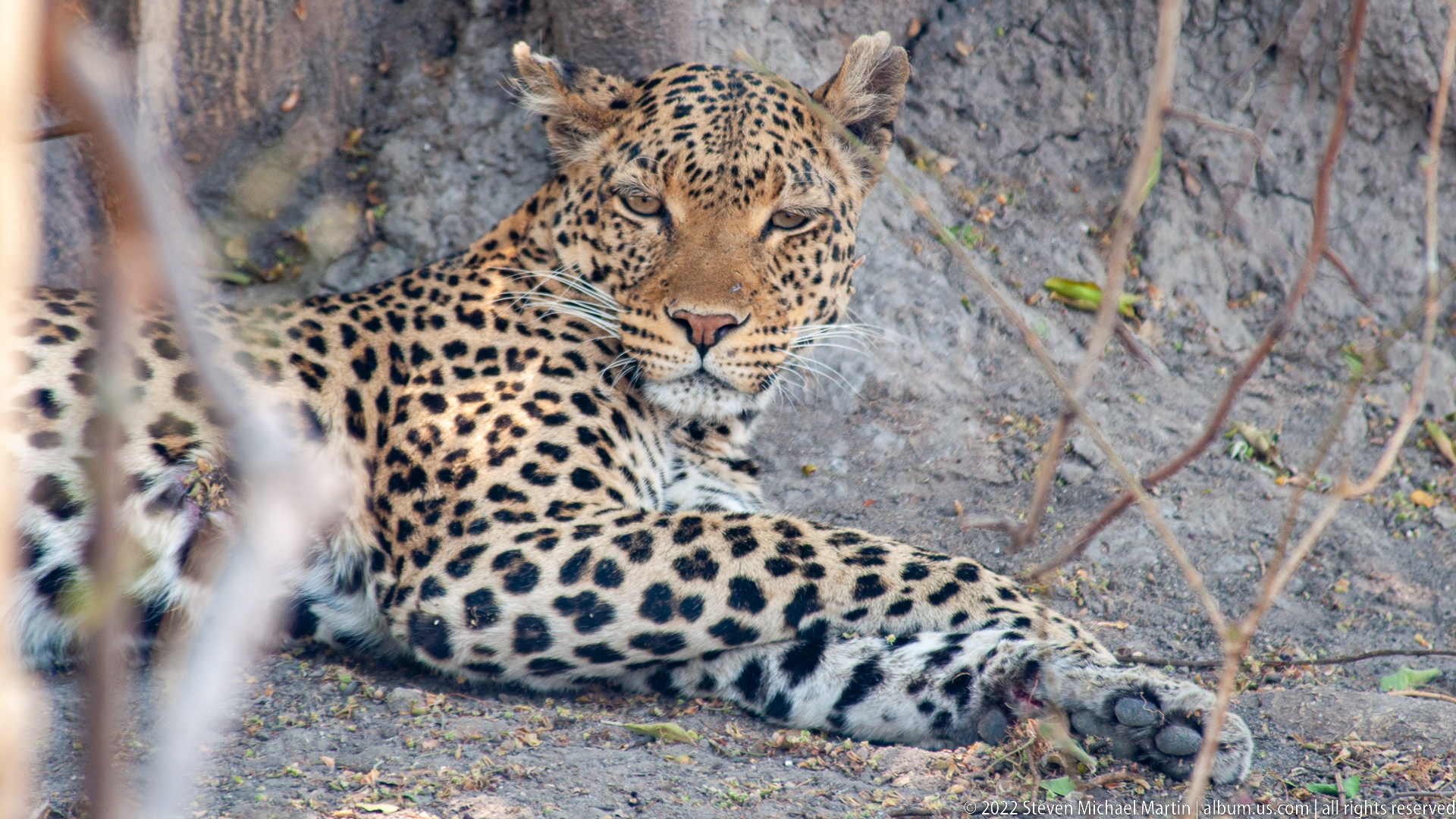
A leopard reclines on sandy soil with one foreleg stretched diagonally across the frame and its head held upright. Sparse twigs interrupt the foreground, but the cat’s rosettes, broad paws, and steady gaze remain clear. The posture combines rest with vigilance, while the muted earth and bark tones show how naturally the patterned coat blends into Chobe’s dry woodland floor.
Caption
A leopard reclines on sandy soil with one foreleg stretched diagonally across the frame and its head held upright. Sparse twigs interrupt the foreground, but the cat’s rosettes, broad paws, and steady gaze remain clear. The posture combines rest with vigilance, while the muted earth and bark tones show how naturally the patterned coat blends into Chobe’s dry woodland floor.

A leopard lies with its head close to the ground and one heavy forepaw folded prominently in front. Its eyes remain open despite the deeply relaxed posture, and the rosettes across the shoulder and forelimb are sharply visible in the shade. The low viewpoint creates an intimate study of a resting predator conserving energy during the warmer part of the day.
Caption
A leopard lies with its head close to the ground and one heavy forepaw folded prominently in front. Its eyes remain open despite the deeply relaxed posture, and the rosettes across the shoulder and forelimb are sharply visible in the shade. The low viewpoint creates an intimate study of a resting predator conserving energy during the warmer part of the day.

A leopard rests beneath a tree with its forelegs crossed and head turned to the left. The broad side of the body displays a dense field of rosettes, while the face is caught in profile as the cat watches beyond the frame. Alternating patches of sun and shade across the ground emphasize the sheltered woodland setting selected for daytime rest.
Caption
A leopard rests beneath a tree with its forelegs crossed and head turned to the left. The broad side of the body displays a dense field of rosettes, while the face is caught in profile as the cat watches beyond the frame. Alternating patches of sun and shade across the ground emphasize the sheltered woodland setting selected for daytime rest.
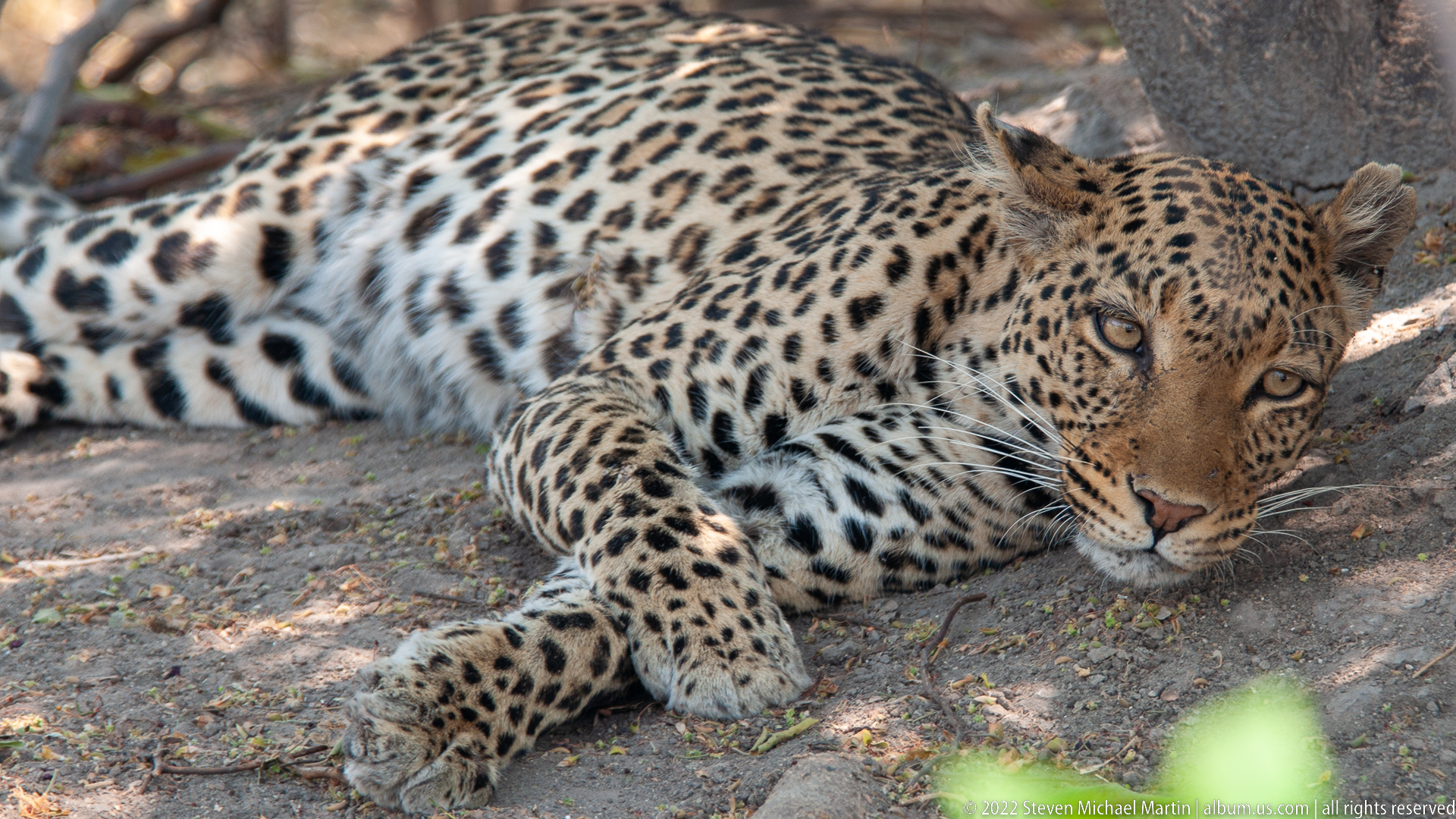
A leopard remains stretched on the ground but angles its face toward the camera, eyes open beneath a lowered brow. One foreleg reaches forward while the body recedes into shade behind it. The low, direct gaze and relaxed limbs create a distinct portrait of watchful rest, with the spotted coat standing out against gray-brown soil and tree bark.
Caption
A leopard remains stretched on the ground but angles its face toward the camera, eyes open beneath a lowered brow. One foreleg reaches forward while the body recedes into shade behind it. The low, direct gaze and relaxed limbs create a distinct portrait of watchful rest, with the spotted coat standing out against gray-brown soil and tree bark.
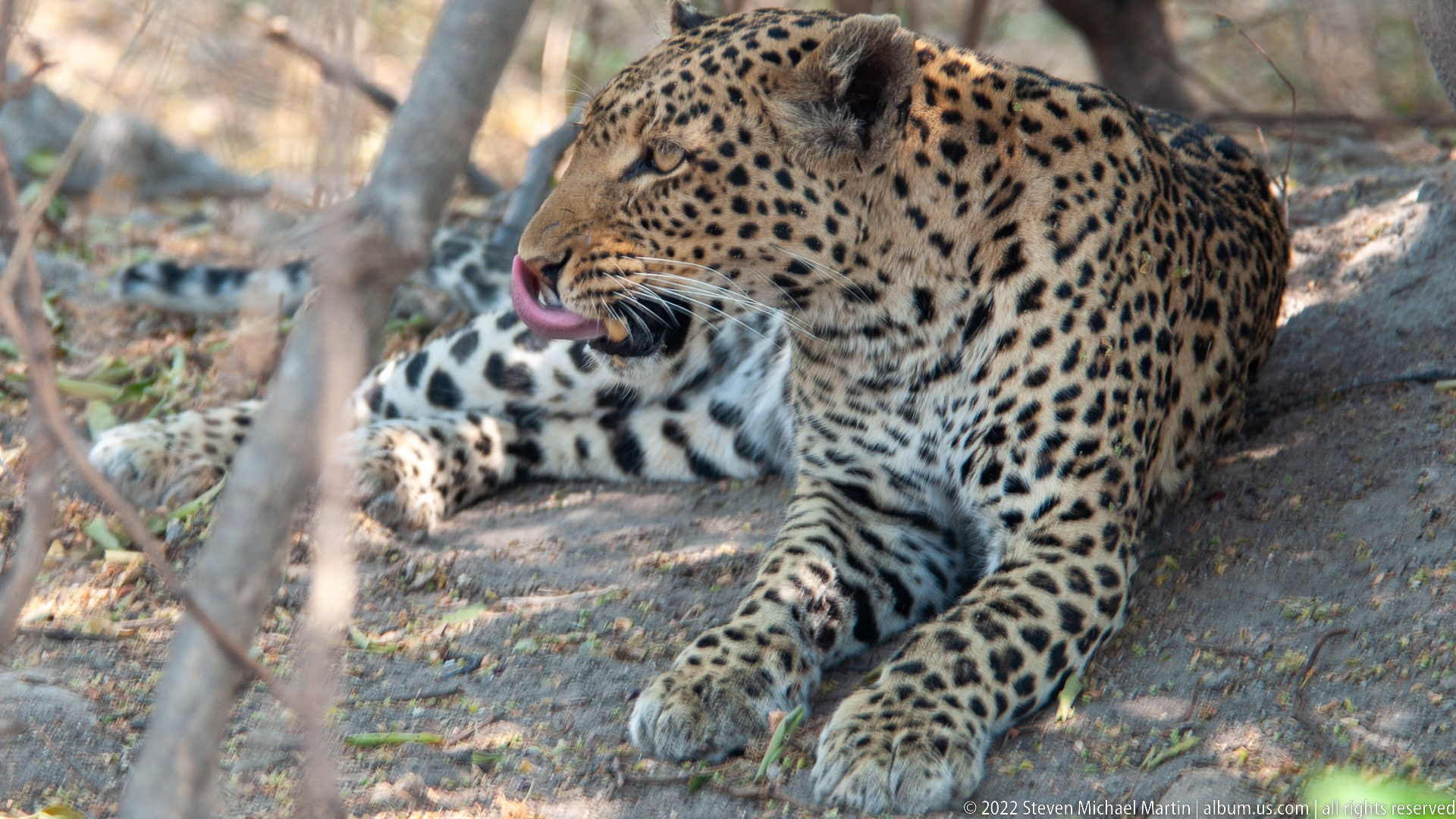
A seated-up leopard briefly licks its nose, the pink tongue visible against the spotted muzzle. Its forepaws are planted together on the ground while the body remains partly reclined beneath trees. The grooming gesture distinguishes this moment from the surrounding resting portraits and offers a close view of the cat’s whiskers, facial spots, muscular forequarters, and attentive ears.
Caption
A seated-up leopard briefly licks its nose, the pink tongue visible against the spotted muzzle. Its forepaws are planted together on the ground while the body remains partly reclined beneath trees. The grooming gesture distinguishes this moment from the surrounding resting portraits and offers a close view of the cat’s whiskers, facial spots, muscular forequarters, and attentive ears.

A leopard opens its jaws in a broad yawn while sitting partly upright in woodland shade. The open mouth exposes the tongue and large canine teeth, contrasting with the otherwise relaxed posture of the body behind. Yawning commonly accompanies transitions between rest and activity in big cats, and here the moment provides a striking anatomical view without suggesting aggression or a threat display.
Caption
A leopard opens its jaws in a broad yawn while sitting partly upright in woodland shade. The open mouth exposes the tongue and large canine teeth, contrasting with the otherwise relaxed posture of the body behind. Yawning commonly accompanies transitions between rest and activity in big cats, and here the moment provides a striking anatomical view without suggesting aggression or a threat display.
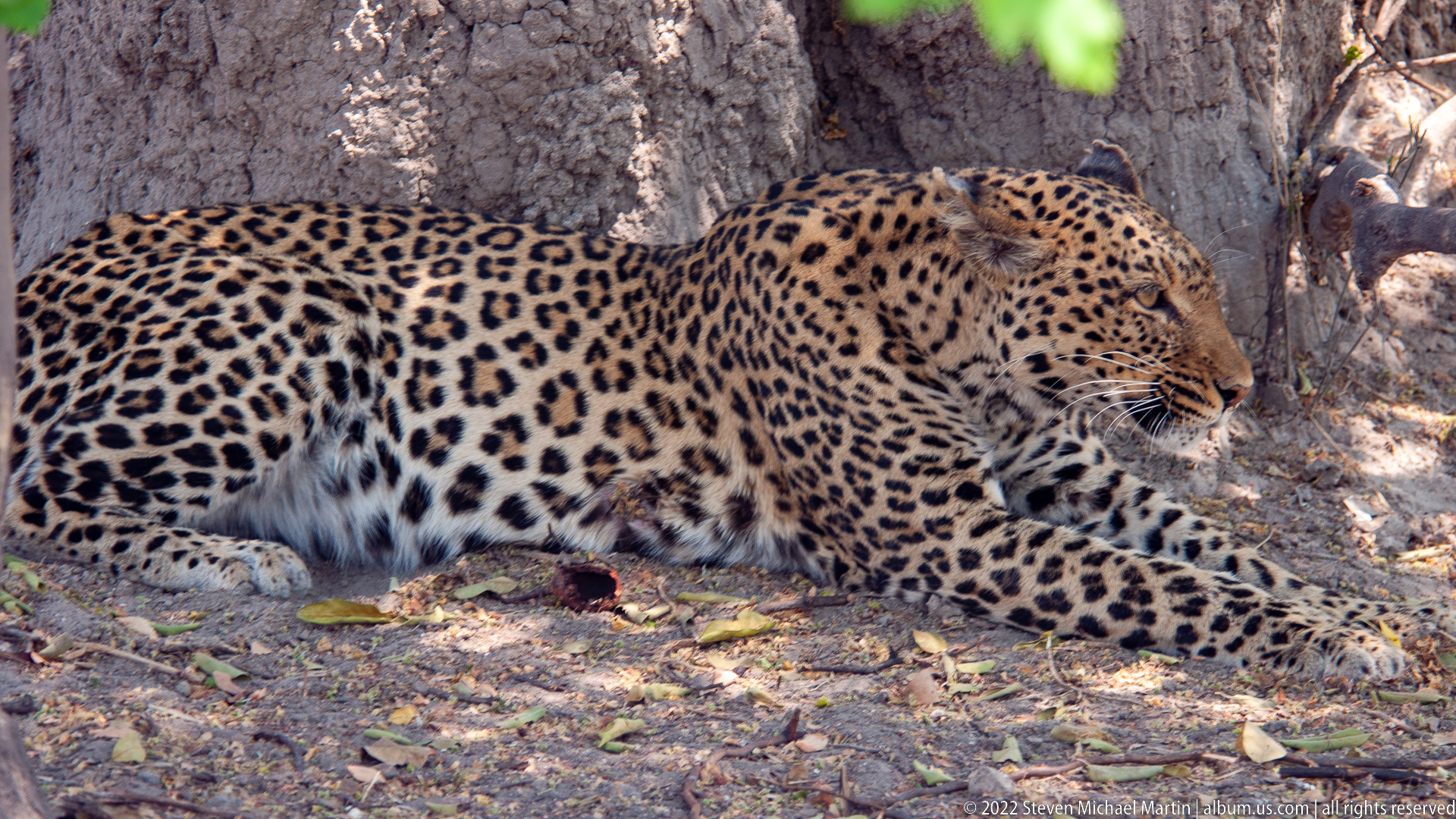
A leopard lies fully stretched beneath a tree, its long rosetted body parallel to the shaded ground and forelegs extended ahead. The head turns slightly right as if following movement beyond the frame. Compared with the tighter portraits in the sequence, this wider view shows the cat’s full resting posture and the protective shade, leaf litter, and bare soil of its dry woodland shelter.
Caption
A leopard lies fully stretched beneath a tree, its long rosetted body parallel to the shaded ground and forelegs extended ahead. The head turns slightly right as if following movement beyond the frame. Compared with the tighter portraits in the sequence, this wider view shows the cat’s full resting posture and the protective shade, leaf litter, and bare soil of its dry woodland shelter.

A leopard curls its tongue broadly across its muzzle in a close behavioral portrait. The tight crop reveals the pink tongue, white whiskers, spotted cheeks, and one visible canine, while the rosetted shoulder fills the background. The gesture is consistent with routine grooming or licking around the mouth and provides a sharply different moment from the cat’s prolonged resting poses beneath the trees.
Caption
A leopard curls its tongue broadly across its muzzle in a close behavioral portrait. The tight crop reveals the pink tongue, white whiskers, spotted cheeks, and one visible canine, while the rosetted shoulder fills the background. The gesture is consistent with routine grooming or licking around the mouth and provides a sharply different moment from the cat’s prolonged resting poses beneath the trees.
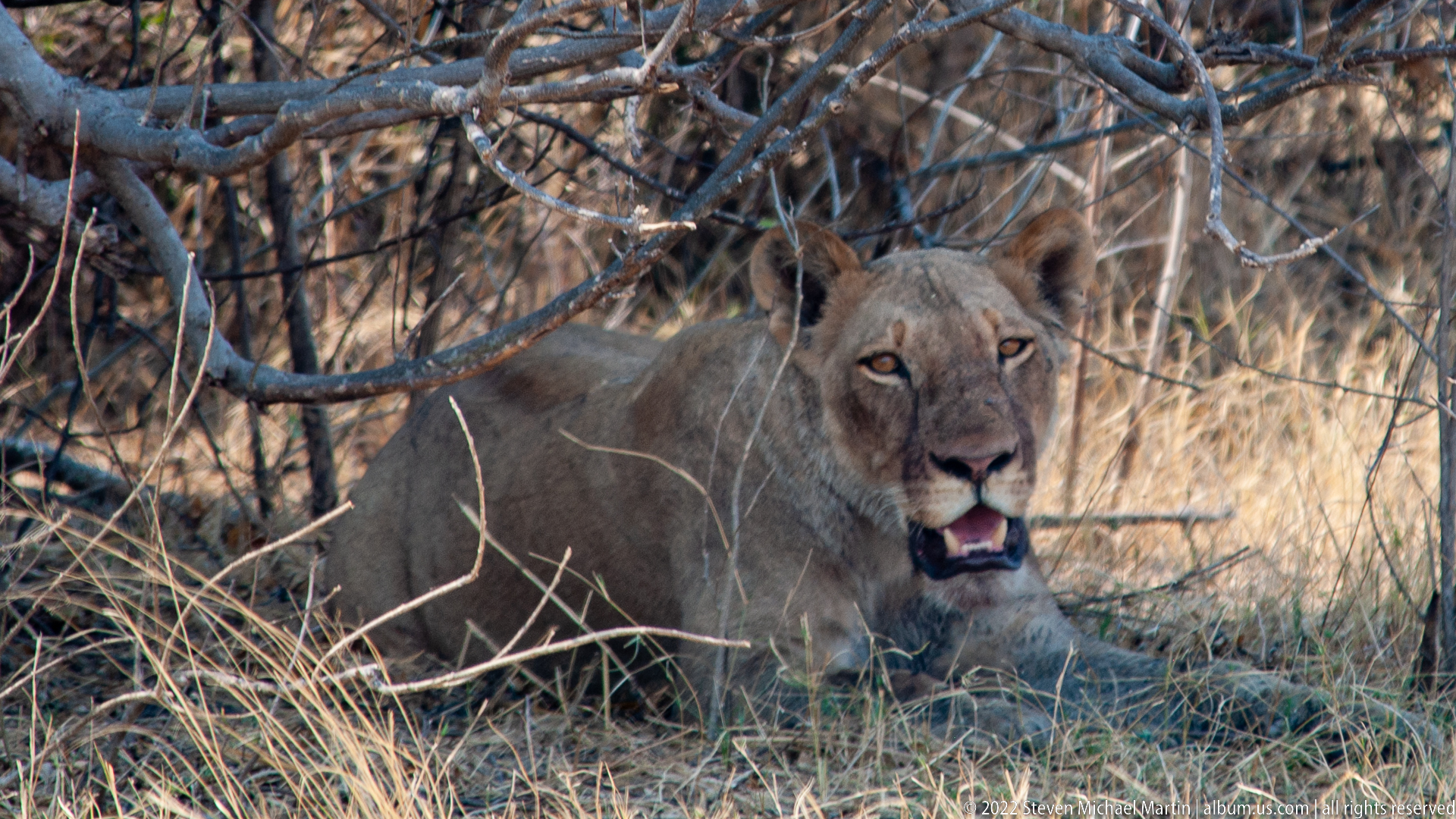
A lioness rests beneath tangled woody branches at the edge of dry grass, facing directly toward the camera with her mouth slightly open. The tawny coat closely matches the surrounding vegetation, while the shaded thicket provides concealment from the open grassland. Her rounded ears, broad muzzle, and lack of a mane identify an adult female African lion rather than a male.
Caption
A lioness rests beneath tangled woody branches at the edge of dry grass, facing directly toward the camera with her mouth slightly open. The tawny coat closely matches the surrounding vegetation, while the shaded thicket provides concealment from the open grassland. Her rounded ears, broad muzzle, and lack of a mane identify an adult female African lion rather than a male.
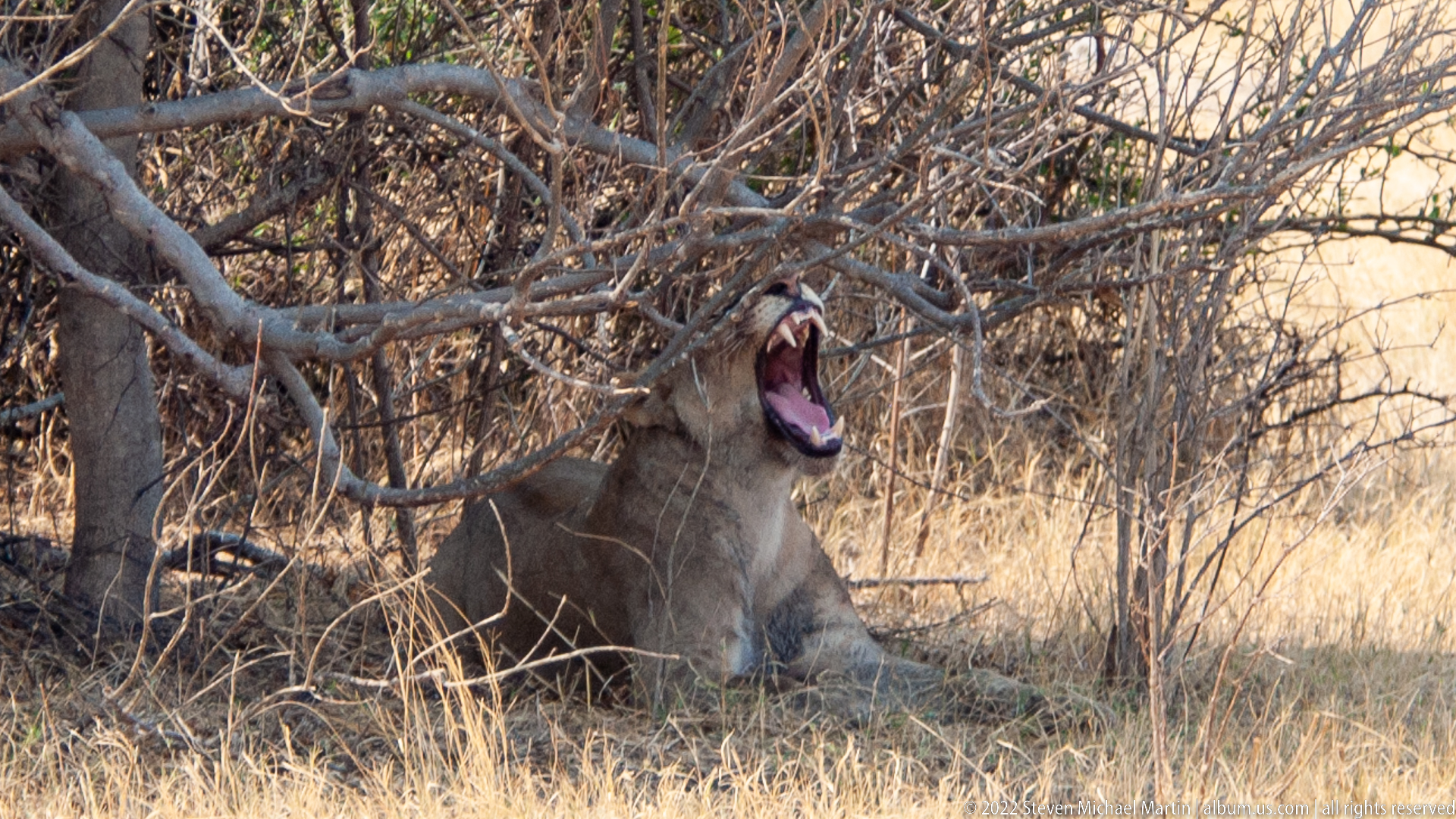
A lioness throws her head back in a wide yawn beneath a dense thicket, exposing her tongue and teeth while the rest of her body remains seated in shade. The open jaws are part of a relaxed resting sequence rather than an aggressive display. Dry golden grass beyond the branches contrasts with the dark shelter, emphasizing how lions use shaded cover during the hottest hours.
Caption
A lioness throws her head back in a wide yawn beneath a dense thicket, exposing her tongue and teeth while the rest of her body remains seated in shade. The open jaws are part of a relaxed resting sequence rather than an aggressive display. Dry golden grass beyond the branches contrasts with the dark shelter, emphasizing how lions use shaded cover during the hottest hours.

A lioness walks across open, sunlit dry grass with her body shown in profile and head angled slightly away. The unobstructed view reveals the muscular shoulders, tawny coat, rounded ears, and long tail ending in a dark tuft. Moving out from shaded cover, she appears against the pale seasonal grassland that provides both hunting terrain and effective camouflage in Chobe National Park.
Caption
A lioness walks across open, sunlit dry grass with her body shown in profile and head angled slightly away. The unobstructed view reveals the muscular shoulders, tawny coat, rounded ears, and long tail ending in a dark tuft. Moving out from shaded cover, she appears against the pale seasonal grassland that provides both hunting terrain and effective camouflage in Chobe National Park.
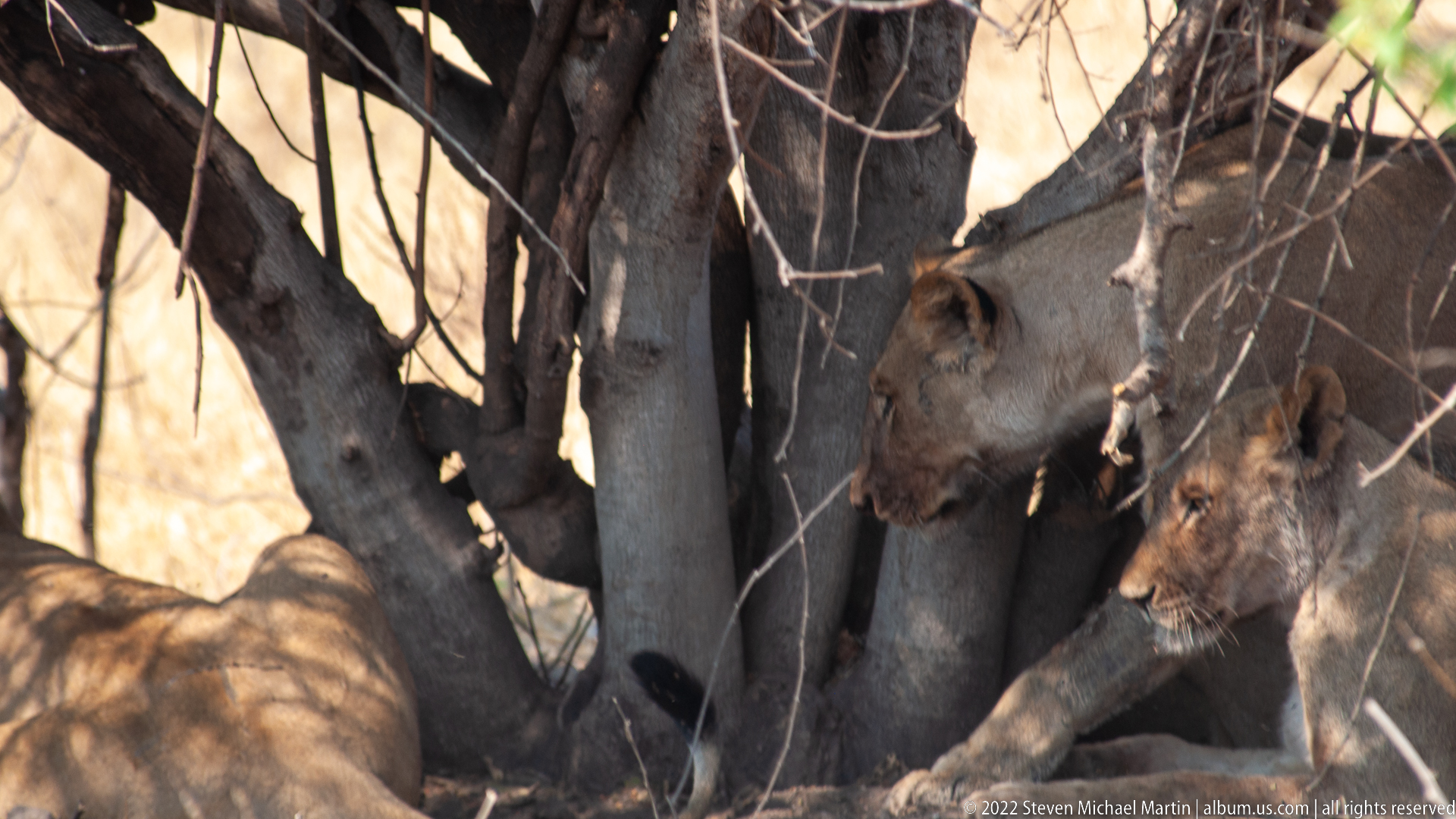
Several lionesses cluster tightly beneath a multi-trunked tree, their tawny bodies overlapping in deep shade. Two heads are visible near the center and right, while another lion’s back fills the lower foreground. The crowded resting arrangement reflects the social nature of African lions, whose pride members often rest together during daylight and become more active as temperatures fall.
Caption
Several lionesses cluster tightly beneath a multi-trunked tree, their tawny bodies overlapping in deep shade. Two heads are visible near the center and right, while another lion’s back fills the lower foreground. The crowded resting arrangement reflects the social nature of African lions, whose pride members often rest together during daylight and become more active as temperatures fall.
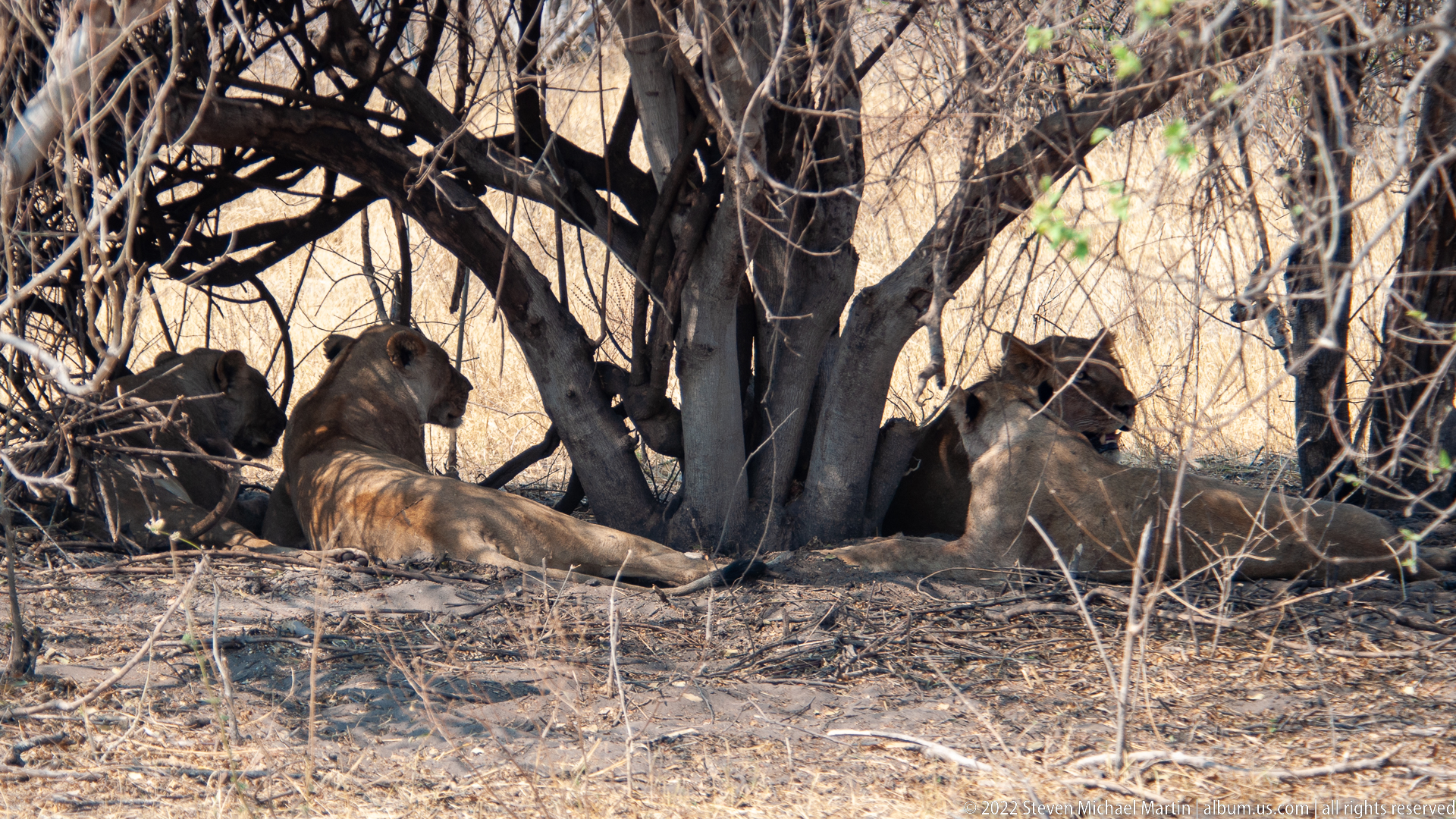
A small group of lionesses lies beneath the spreading base of a tree, using its dense canopy and trunks for shade. One female reclines lengthwise at center while another sits more upright at right, both oriented toward the open grass beyond. The wider composition places the pride members within their dry woodland refuge and shows the social spacing of resting lions.
Caption
A small group of lionesses lies beneath the spreading base of a tree, using its dense canopy and trunks for shade. One female reclines lengthwise at center while another sits more upright at right, both oriented toward the open grass beyond. The wider composition places the pride members within their dry woodland refuge and shows the social spacing of resting lions.
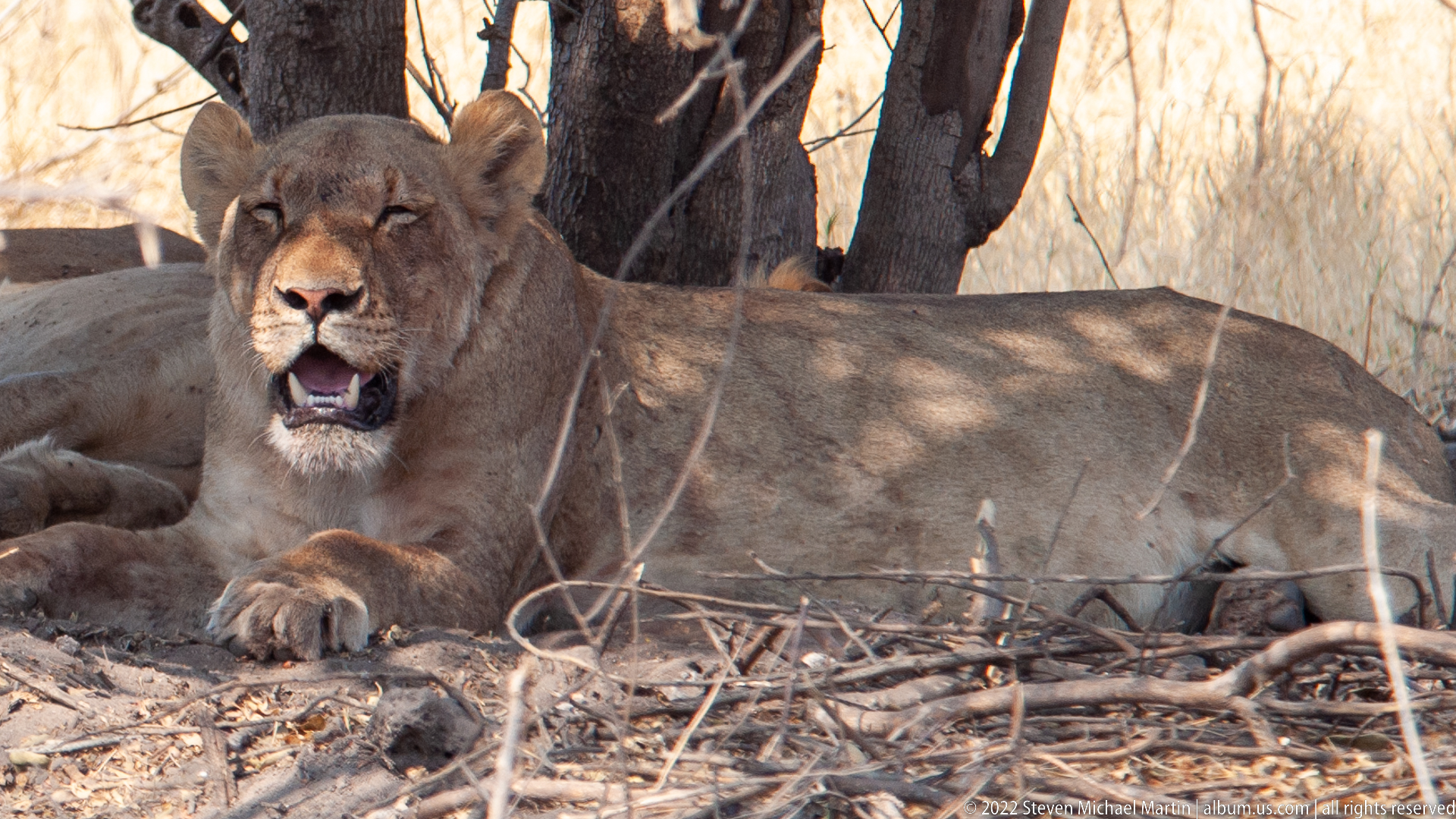
A lioness lies in the shade beneath a tree with her head raised and mouth open, likely panting as she rests during the heat of the day. Her forepaws extend forward and another lion is partly visible behind her. The dappled light across her tawny coat and the dry grass beyond the tree reinforce the hot, seasonal conditions of Chobe’s woodland and savanna habitats.
Caption
A lioness lies in the shade beneath a tree with her head raised and mouth open, likely panting as she rests during the heat of the day. Her forepaws extend forward and another lion is partly visible behind her. The dappled light across her tawny coat and the dry grass beyond the tree reinforce the hot, seasonal conditions of Chobe’s woodland and savanna habitats.
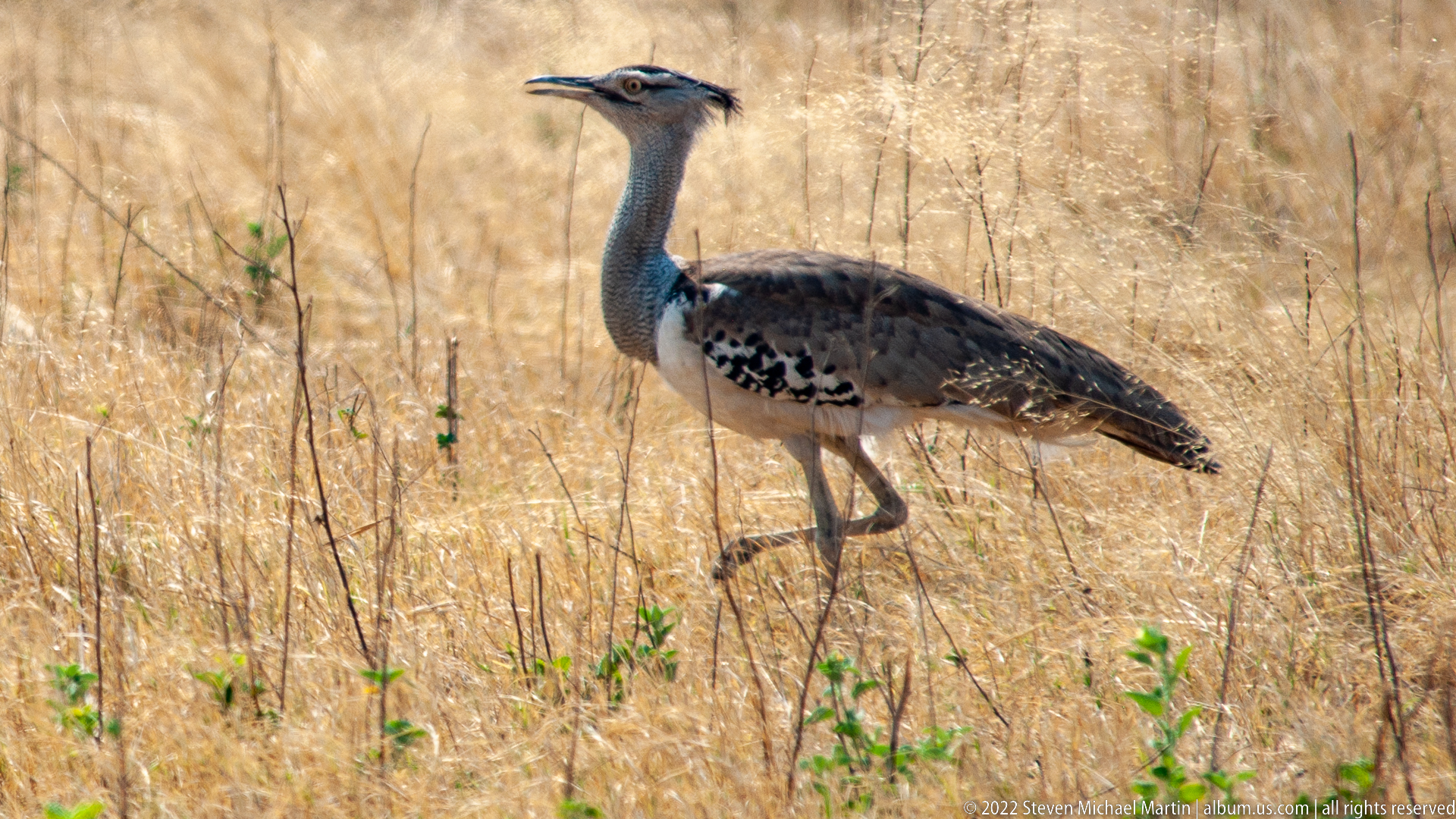
A kori bustard walks through dry golden grass, its long gray neck held upright above a heavy brown-and-white body. The bird’s large size, long legs, finely barred neck, dark crown, and contrasting black-and-white wing markings support identification as southern Africa’s kori bustard. This ground-dwelling species forages across open savanna and grassland, moving deliberately through vegetation rather than relying on frequent flight.
Caption
A kori bustard walks through dry golden grass, its long gray neck held upright above a heavy brown-and-white body. The bird’s large size, long legs, finely barred neck, dark crown, and contrasting black-and-white wing markings support identification as southern Africa’s kori bustard. This ground-dwelling species forages across open savanna and grassland, moving deliberately through vegetation rather than relying on frequent flight.
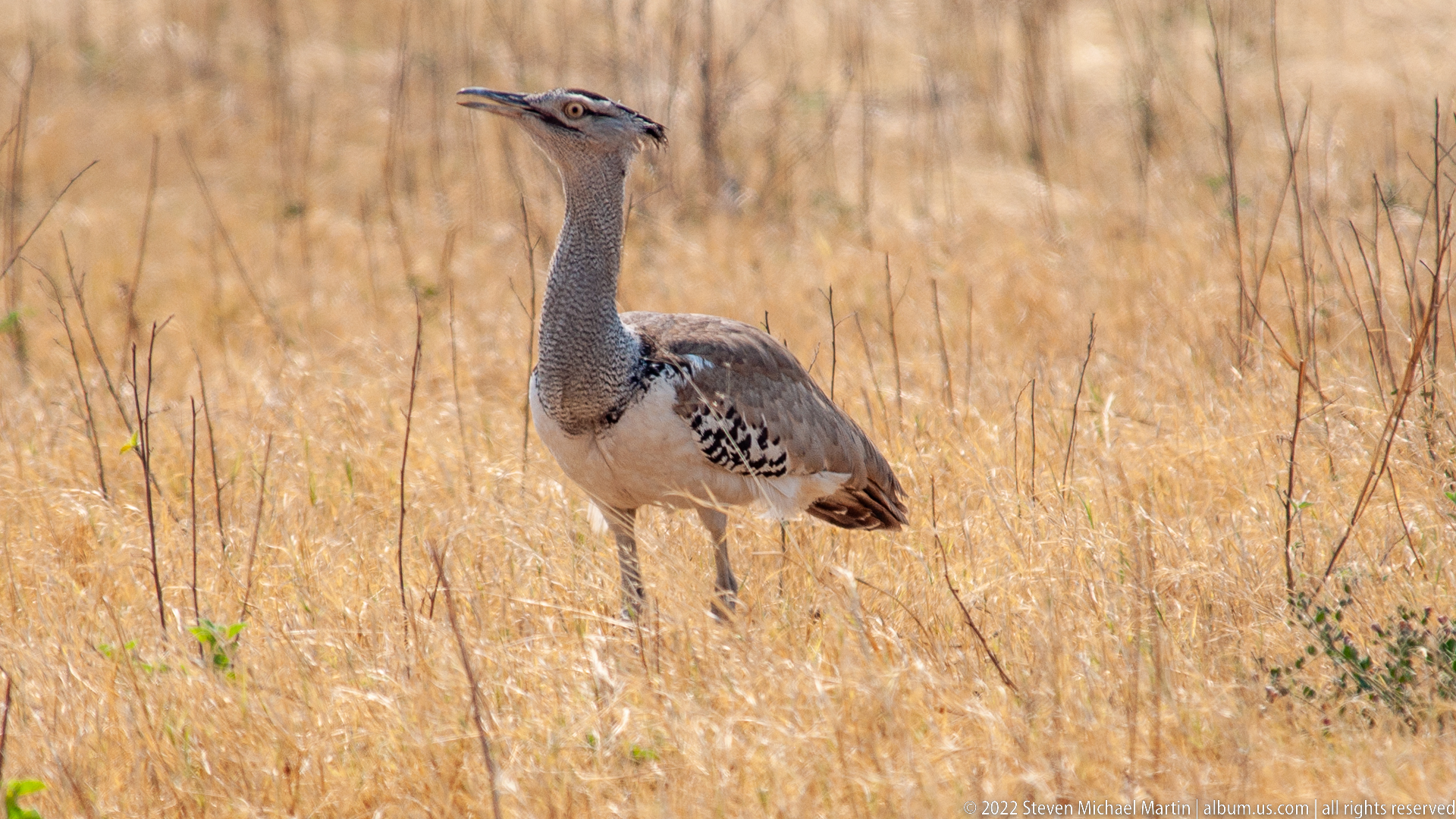
A kori bustard pauses upright in dry grass, presenting a clear three-quarter view of its long neck, sturdy legs, pale underparts, and intricately patterned wings. The raised head and open sightline give this frame a more alert character than the preceding walking view. Kori bustards are among Africa’s heaviest flying birds, but they spend much of their time foraging terrestrially in open savanna.
Caption
A kori bustard pauses upright in dry grass, presenting a clear three-quarter view of its long neck, sturdy legs, pale underparts, and intricately patterned wings. The raised head and open sightline give this frame a more alert character than the preceding walking view. Kori bustards are among Africa’s heaviest flying birds, but they spend much of their time foraging terrestrially in open savanna.
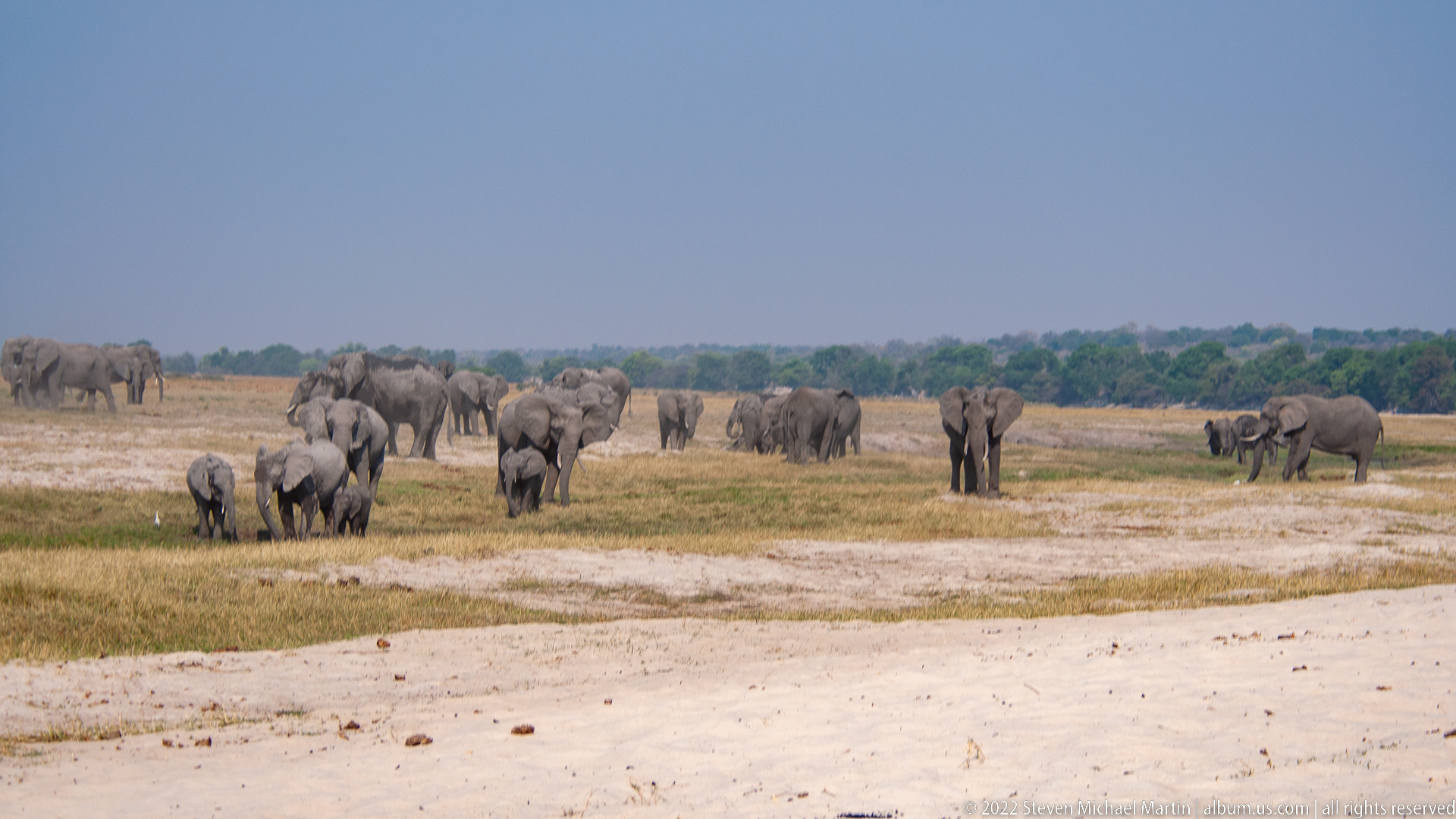
African bush elephants spread across a broad, dry-season floodplain in Chobe National Park, with adults and calves moving and feeding in loose groups. The wide view records the herd at landscape scale, showing how elephants use the open grassland and sandy margins near the Chobe River system.
Caption
African bush elephants spread across a broad, dry-season floodplain in Chobe National Park, with adults and calves moving and feeding in loose groups. The wide view records the herd at landscape scale, showing how elephants use the open grassland and sandy margins near the Chobe River system.
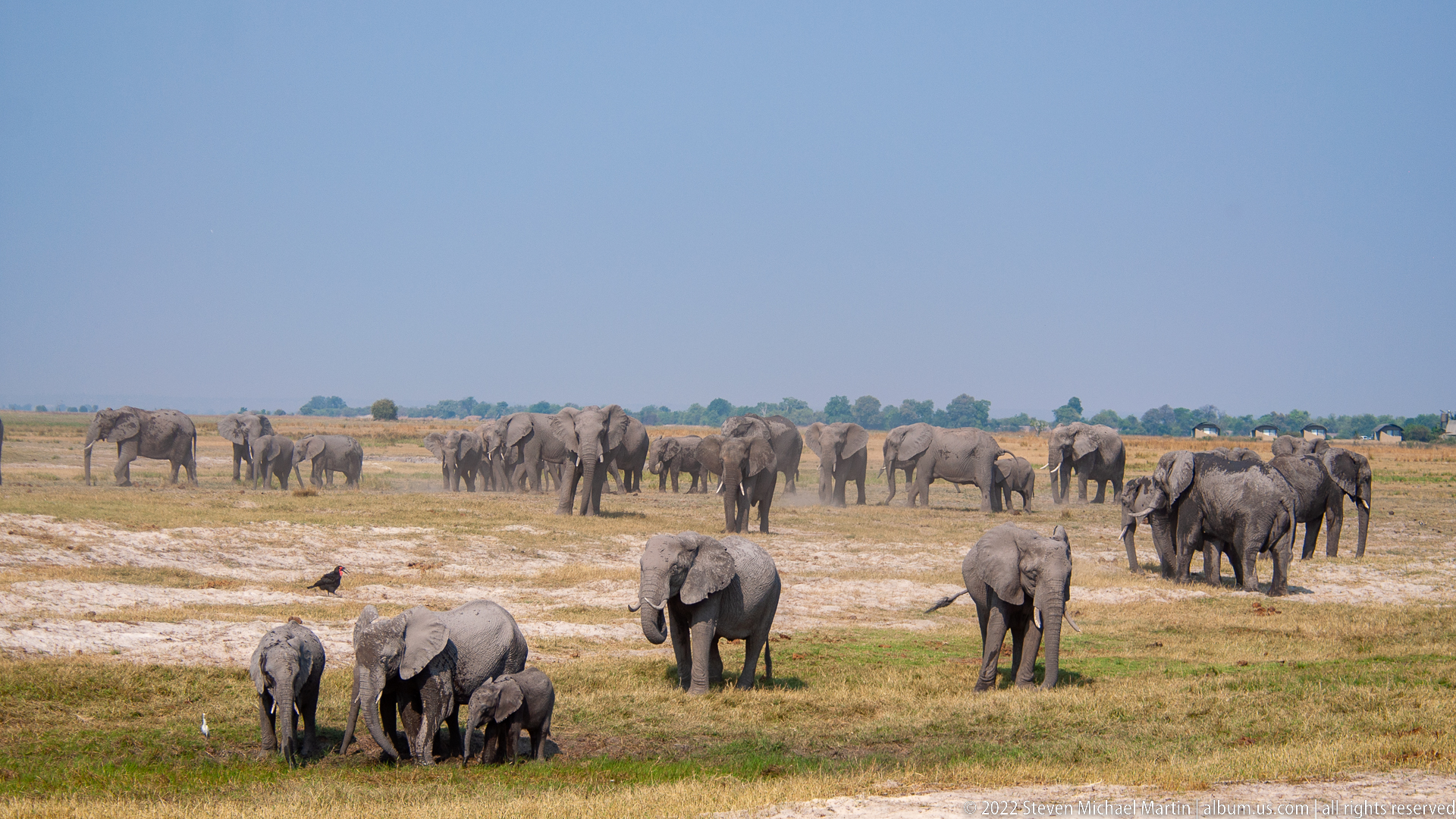
Several African bush elephant family groups occupy the open floodplain, including small calves closely accompanied by adults. Their dispersed arrangement gives a clear view of herd structure and the dry, grassy habitat that supports large concentrations of elephants in the Chobe landscape.
Caption
Several African bush elephant family groups occupy the open floodplain, including small calves closely accompanied by adults. Their dispersed arrangement gives a clear view of herd structure and the dry, grassy habitat that supports large concentrations of elephants in the Chobe landscape.
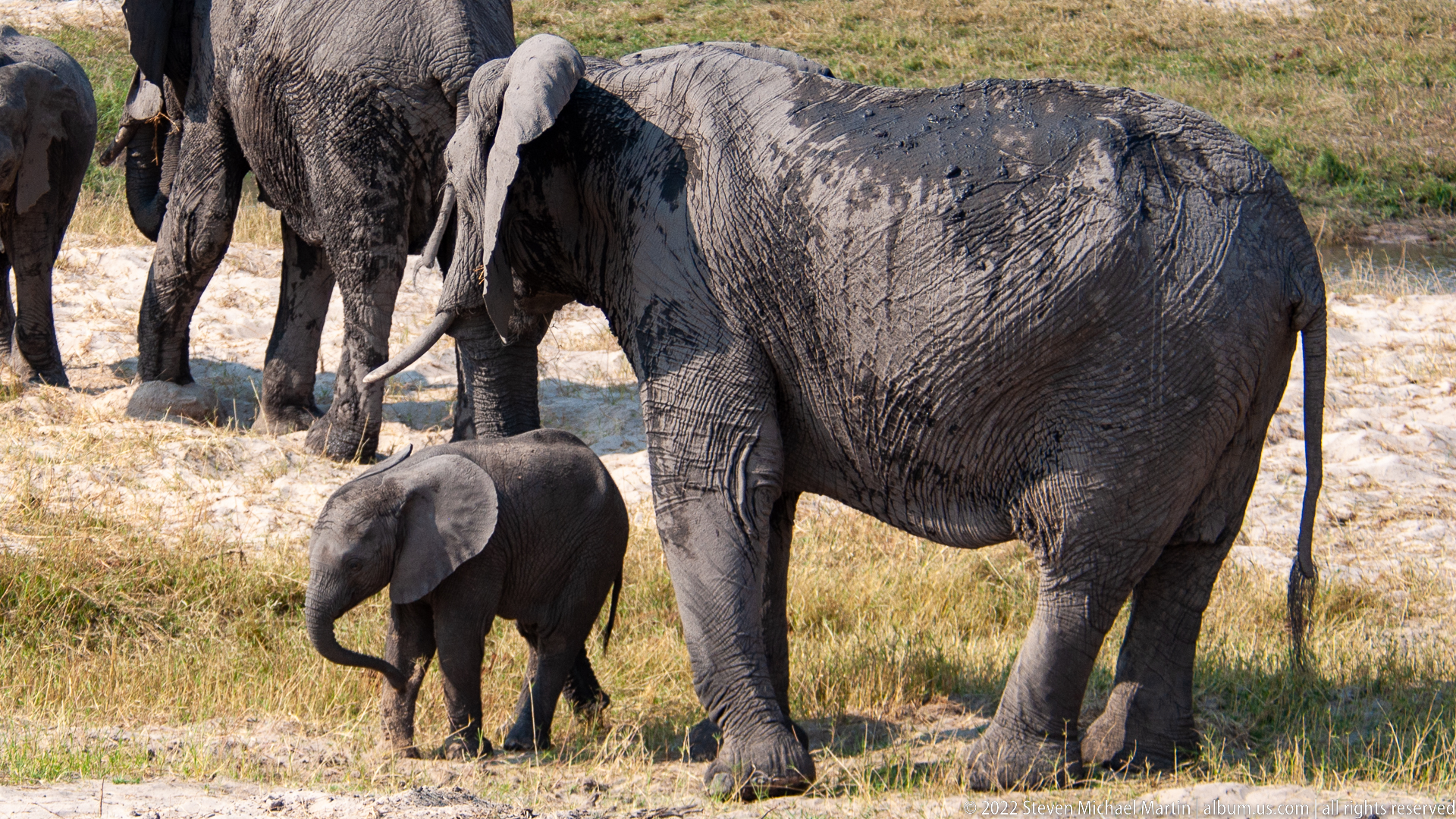
A young African bush elephant walks close beside a much larger adult, whose mud-streaked hide and tusk are prominent in the frame. The close pairing illustrates the calf’s small scale and its protected position beside an adult within a larger herd on the Chobe floodplain.
Caption
A young African bush elephant walks close beside a much larger adult, whose mud-streaked hide and tusk are prominent in the frame. The close pairing illustrates the calf’s small scale and its protected position beside an adult within a larger herd on the Chobe floodplain.
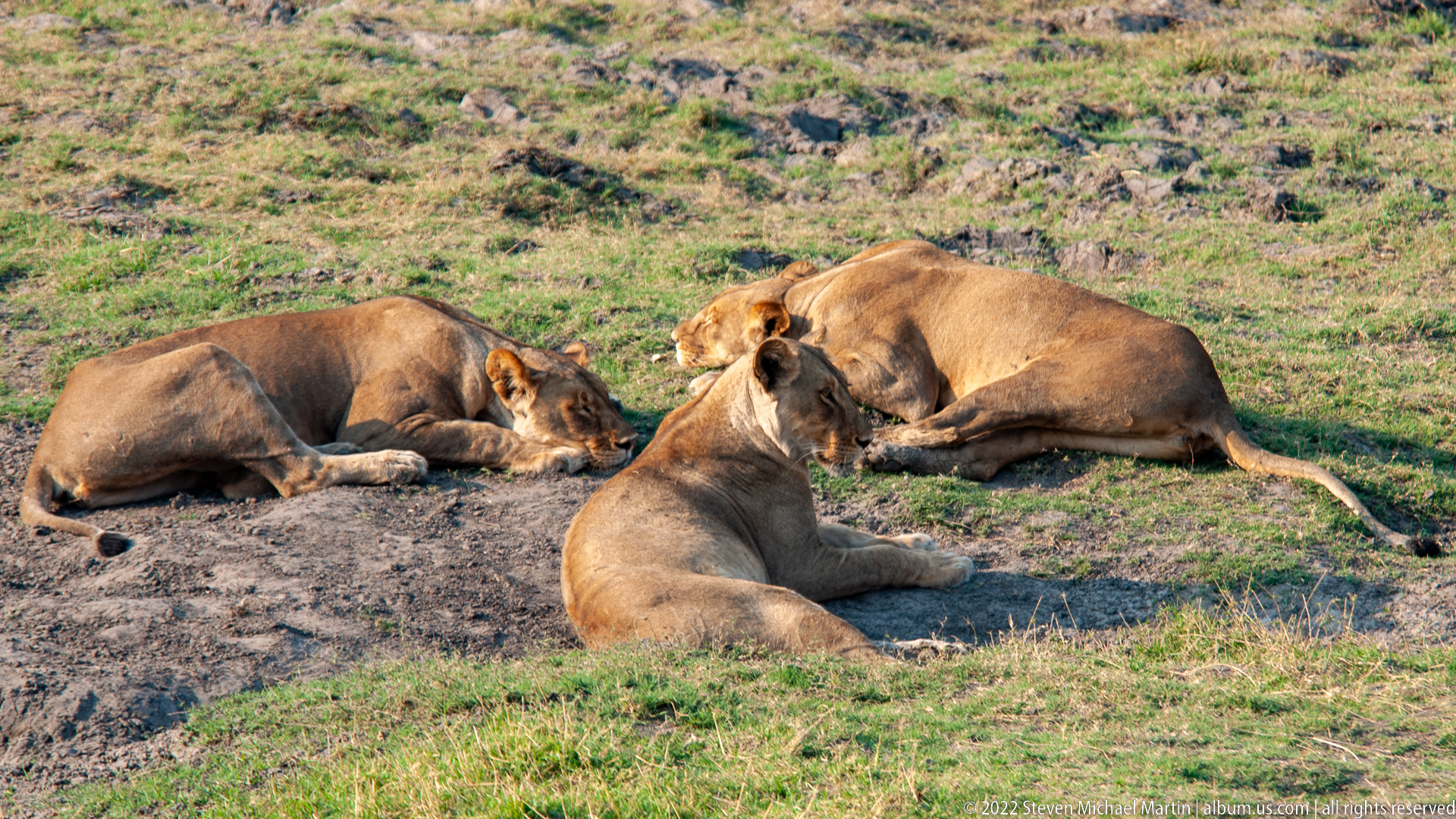
Three adult lionesses rest in a loose triangle on bare earth and short grass, their tawny coats closely matching the dry ground. Two lie facing one another while the third reclines in the foreground, a quiet social grouping characteristic of lions resting between periods of activity.
Caption
Three adult lionesses rest in a loose triangle on bare earth and short grass, their tawny coats closely matching the dry ground. Two lie facing one another while the third reclines in the foreground, a quiet social grouping characteristic of lions resting between periods of activity.
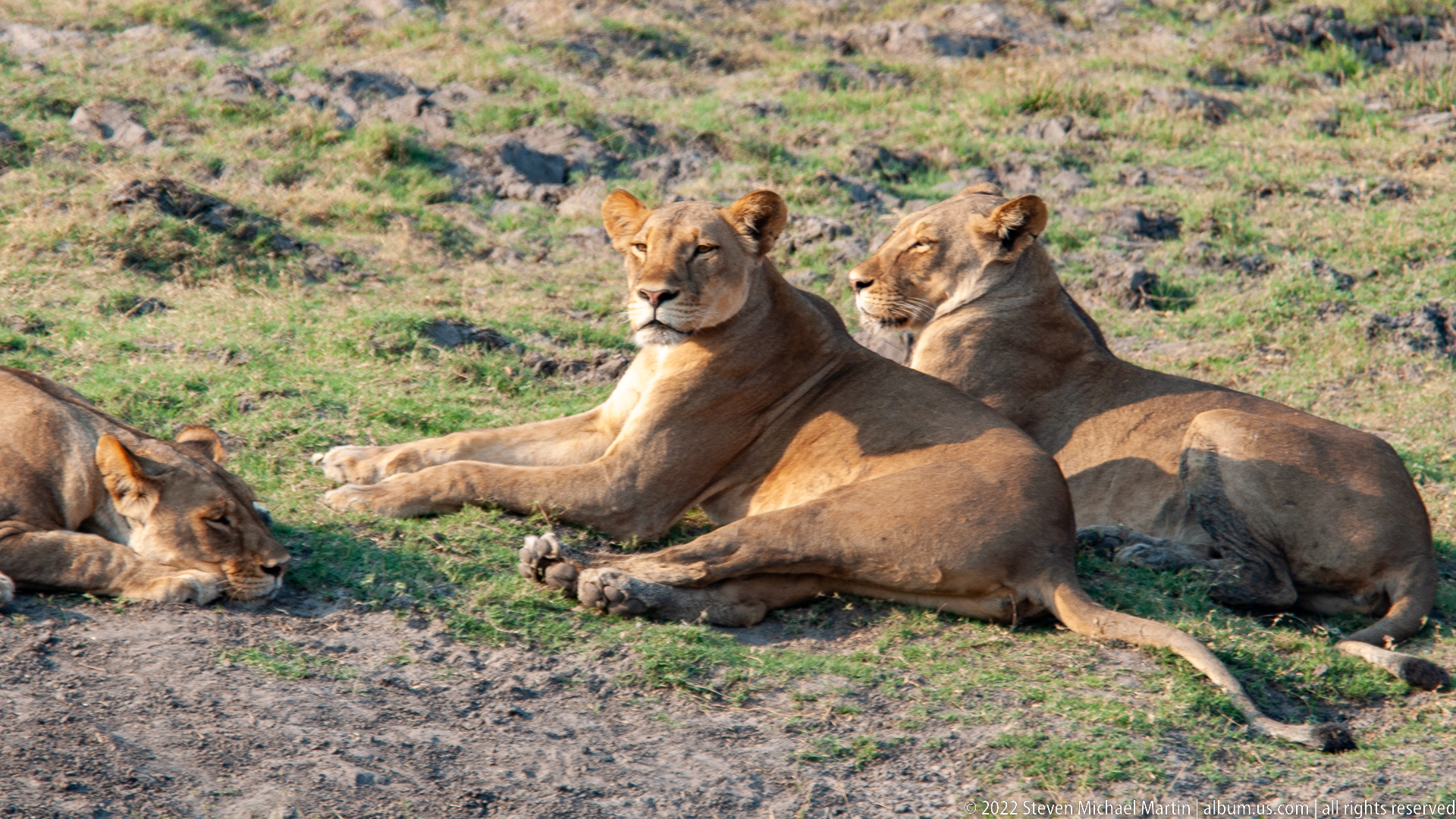
Two lionesses sit upright shoulder to shoulder while another rests partly visible at left, creating a close study of the pride at rest. Their alert ears and raised heads contrast with relaxed bodies stretched across the ground, suggesting watchfulness during an otherwise inactive period.
Caption
Two lionesses sit upright shoulder to shoulder while another rests partly visible at left, creating a close study of the pride at rest. Their alert ears and raised heads contrast with relaxed bodies stretched across the ground, suggesting watchfulness during an otherwise inactive period.
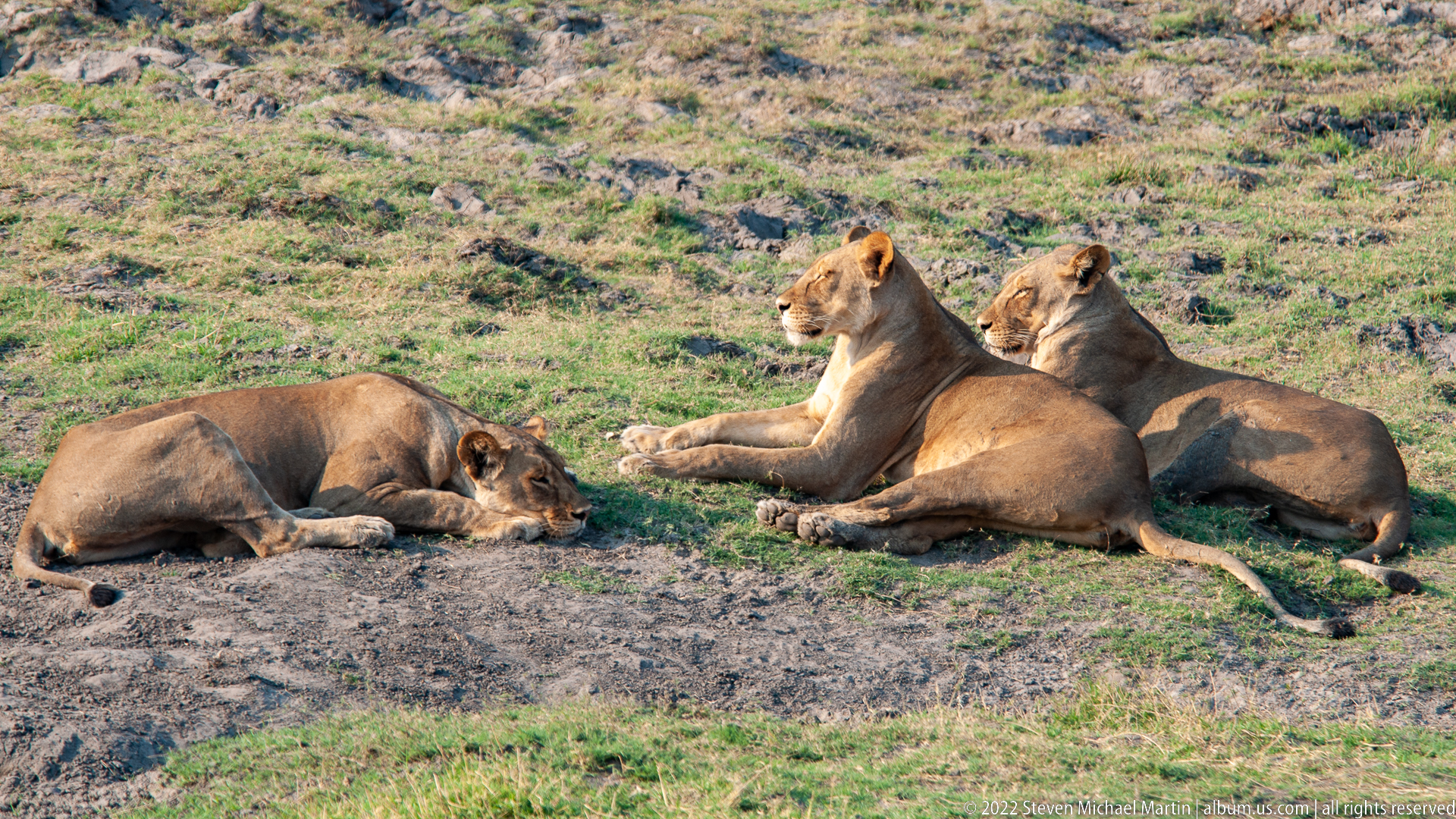
A wider view places three resting lionesses within patchy grass and bare soil. One lies apart with her head down while two sit together facing the same direction, preserving both the social spacing of the group and the muted savanna setting around them.
Caption
A wider view places three resting lionesses within patchy grass and bare soil. One lies apart with her head down while two sit together facing the same direction, preserving both the social spacing of the group and the muted savanna setting around them.
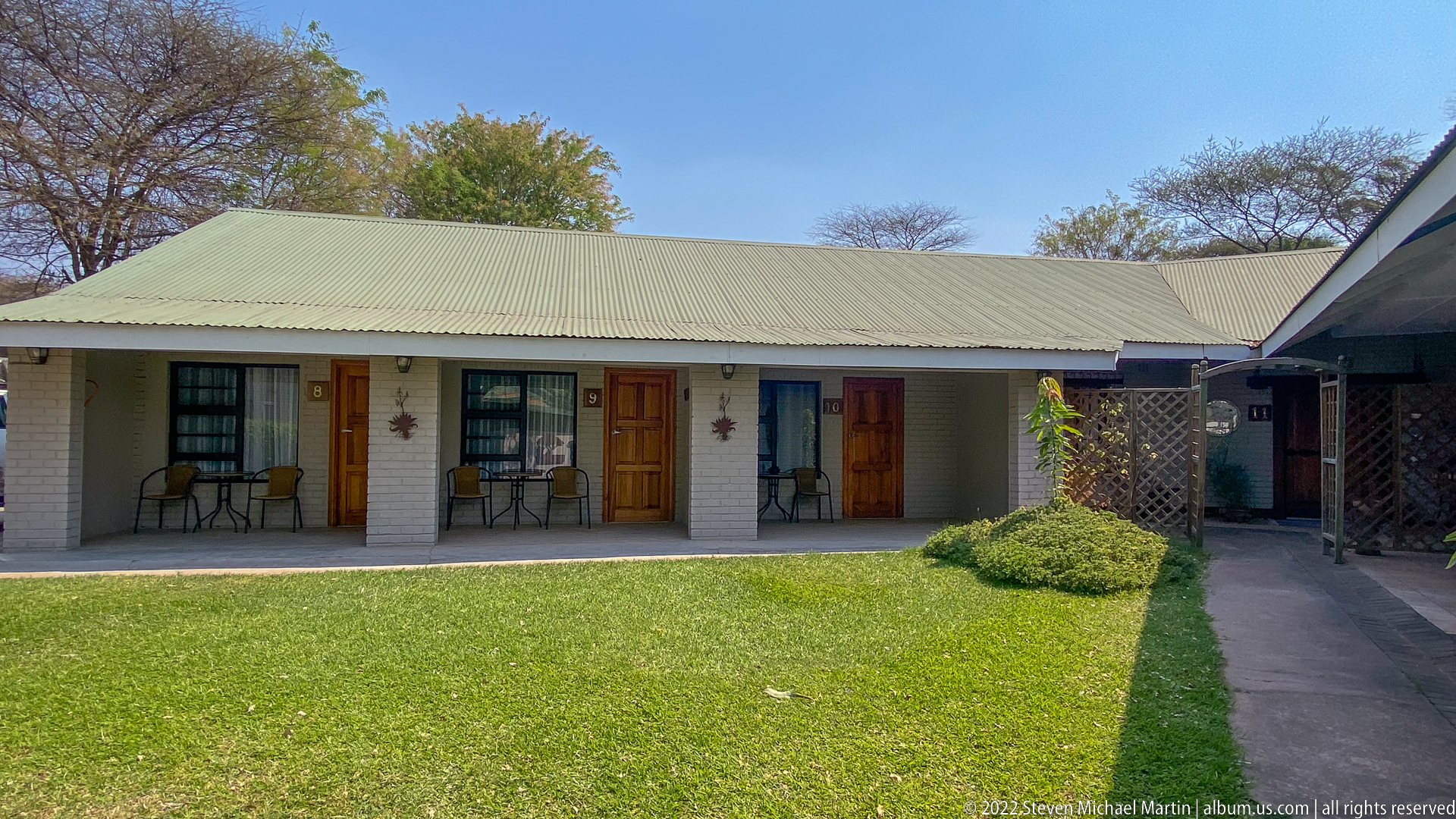
Low guest-room buildings face a neatly maintained lawn, with shaded chairs outside individual doors and mature trees rising beyond the corrugated roof. The orderly courtyard provides a human-scale counterpoint to the wildlife sequences, documenting safari accommodation associated with the Chobe visit.
Caption
Low guest-room buildings face a neatly maintained lawn, with shaded chairs outside individual doors and mature trees rising beyond the corrugated roof. The orderly courtyard provides a human-scale counterpoint to the wildlife sequences, documenting safari accommodation associated with the Chobe visit.
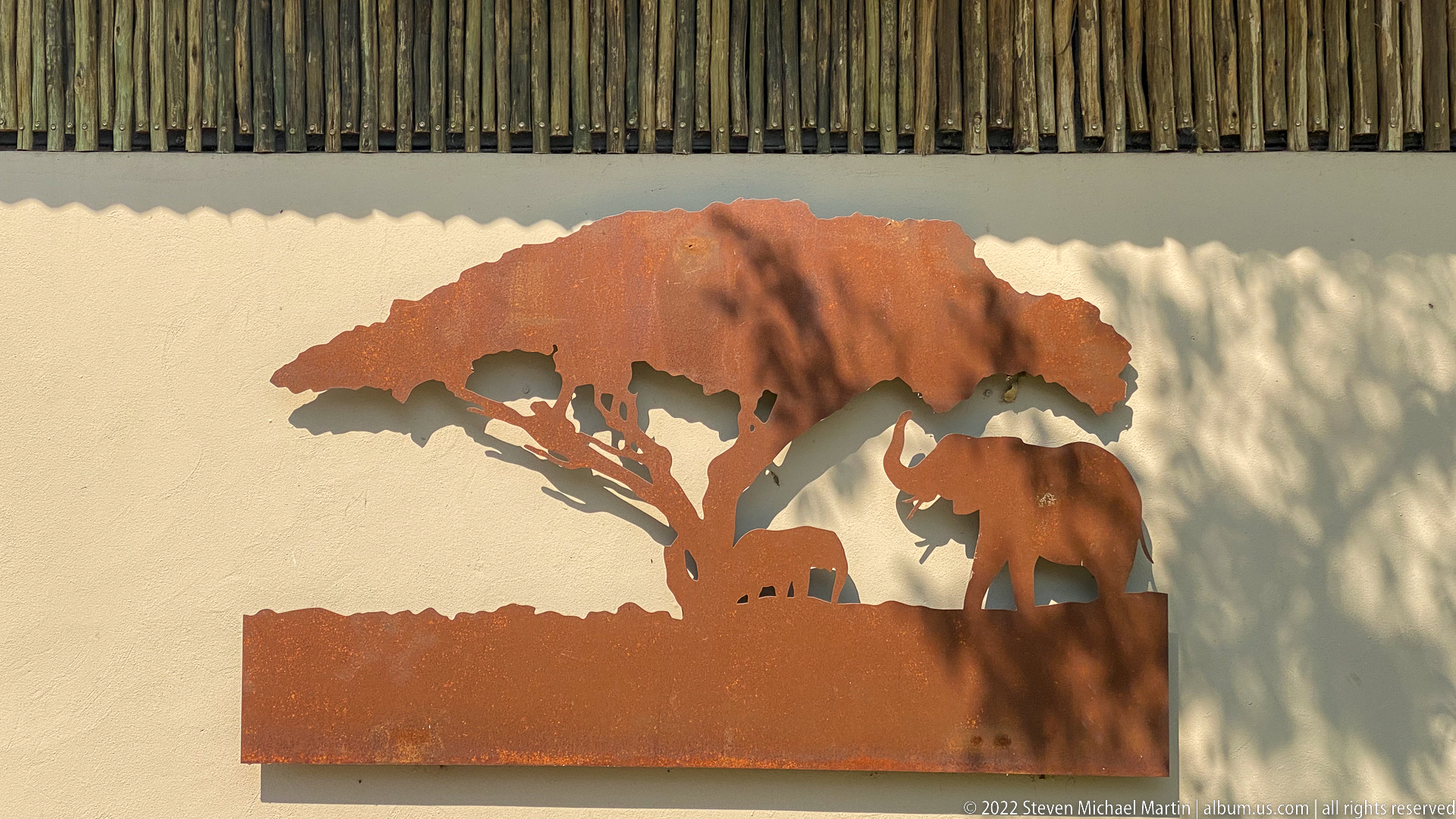
A rust-colored metal wall panel reduces the Chobe landscape to a graphic silhouette: an elephant stands beneath a spreading acacia-like tree with another animal form nearby. Warm sunlight and cast foliage shadows animate the decorative safari motif against a pale wall.
Caption
A rust-colored metal wall panel reduces the Chobe landscape to a graphic silhouette: an elephant stands beneath a spreading acacia-like tree with another animal form nearby. Warm sunlight and cast foliage shadows animate the decorative safari motif against a pale wall.
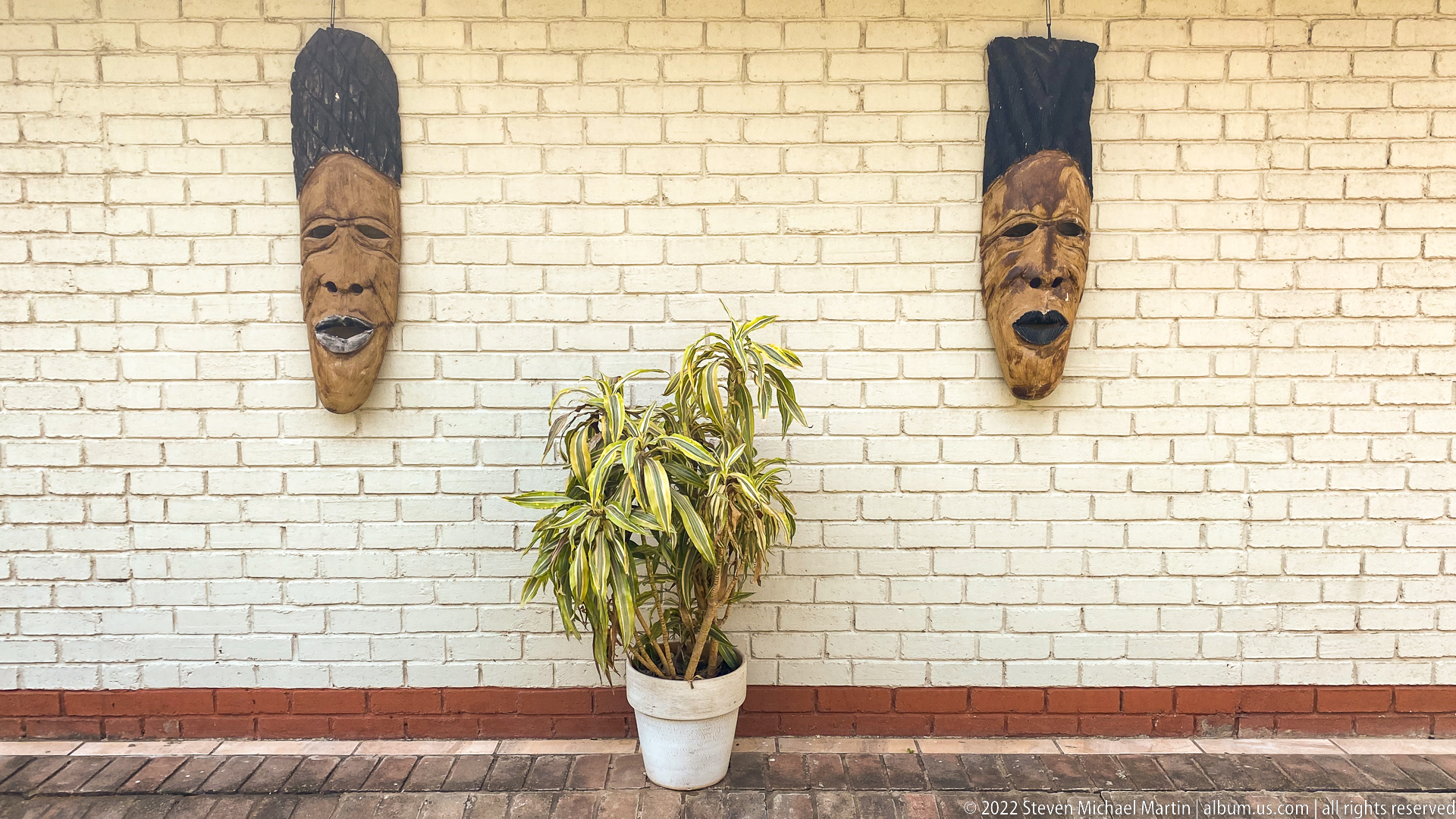
Two elongated carved wooden masks hang on a white-painted brick wall above a potted plant. Their dark and natural wood tones, stylized facial features, and vertical placement create a decorative lodge display; the photograph does not provide enough evidence to assign a specific cultural origin.
Caption
Two elongated carved wooden masks hang on a white-painted brick wall above a potted plant. Their dark and natural wood tones, stylized facial features, and vertical placement create a decorative lodge display; the photograph does not provide enough evidence to assign a specific cultural origin.
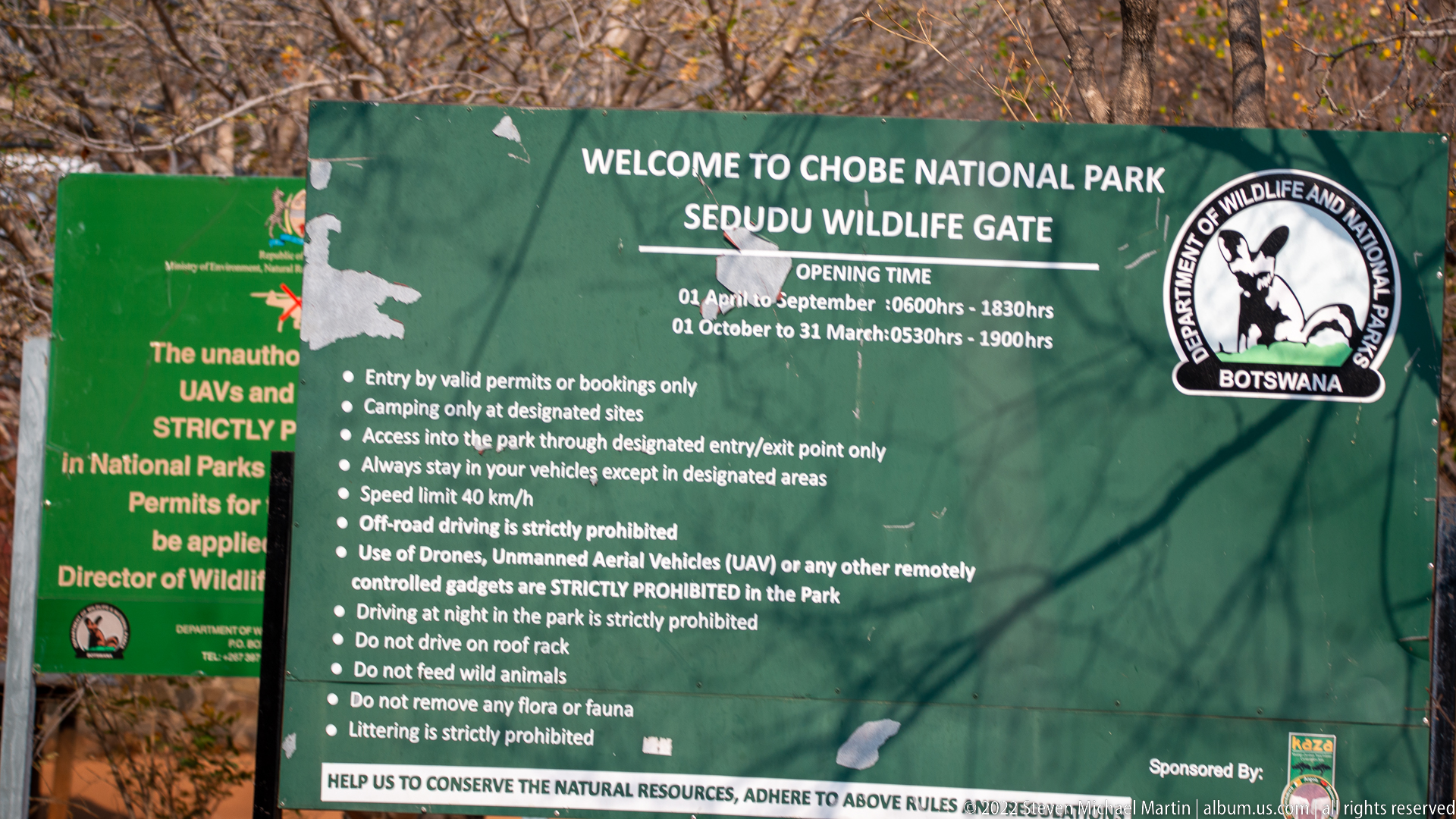
A large green sign welcomes visitors to Chobe National Park at Sedudu Wildlife Gate and lists opening times and park rules. Botswana’s Department of Wildlife and National Parks emblem and conservation messaging make the board both an entrance marker and a practical statement of visitor responsibilities inside the protected area.
Caption
A large green sign welcomes visitors to Chobe National Park at Sedudu Wildlife Gate and lists opening times and park rules. Botswana’s Department of Wildlife and National Parks emblem and conservation messaging make the board both an entrance marker and a practical statement of visitor responsibilities inside the protected area.

The circular emblem of Botswana’s Department of Wildlife and National Parks appears prominently on a green park sign. A stylized animal occupies the blue center above the word “BOTSWANA,” providing a close documentary detail of the government authority responsible for national parks and wildlife management.
Caption
The circular emblem of Botswana’s Department of Wildlife and National Parks appears prominently on a green park sign. A stylized animal occupies the blue center above the word “BOTSWANA,” providing a close documentary detail of the government authority responsible for national parks and wildlife management.
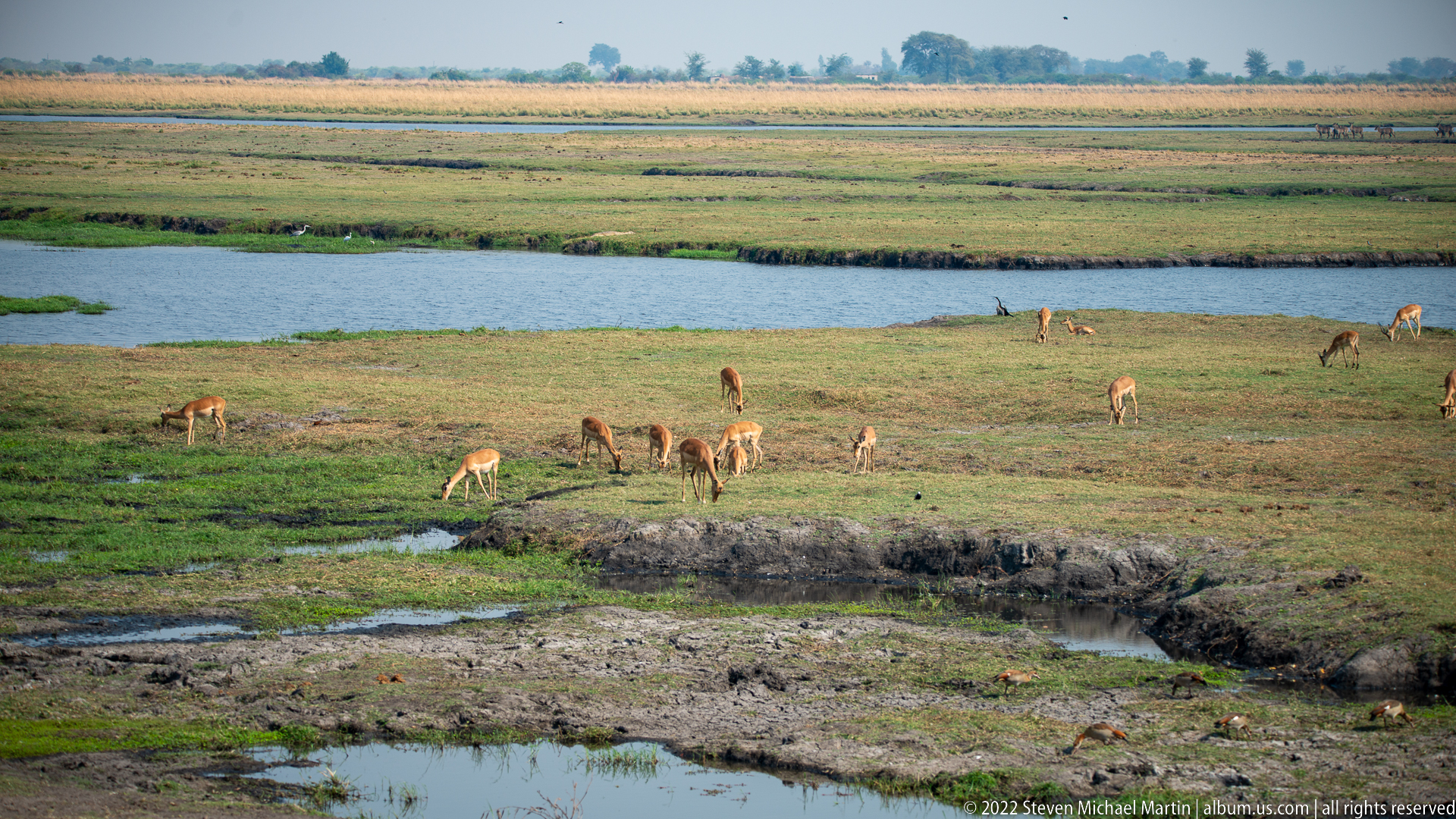
A scattered herd of slender, reddish-brown antelope grazes across low floodplain vegetation between shallow channels. The elevated view emphasizes the mosaic of water, mud, and grass that structures wildlife habitat along the Chobe River; species-level identification is not fully secure at proof-sheet scale.
Caption
A scattered herd of slender, reddish-brown antelope grazes across low floodplain vegetation between shallow channels. The elevated view emphasizes the mosaic of water, mud, and grass that structures wildlife habitat along the Chobe River; species-level identification is not fully secure at proof-sheet scale.
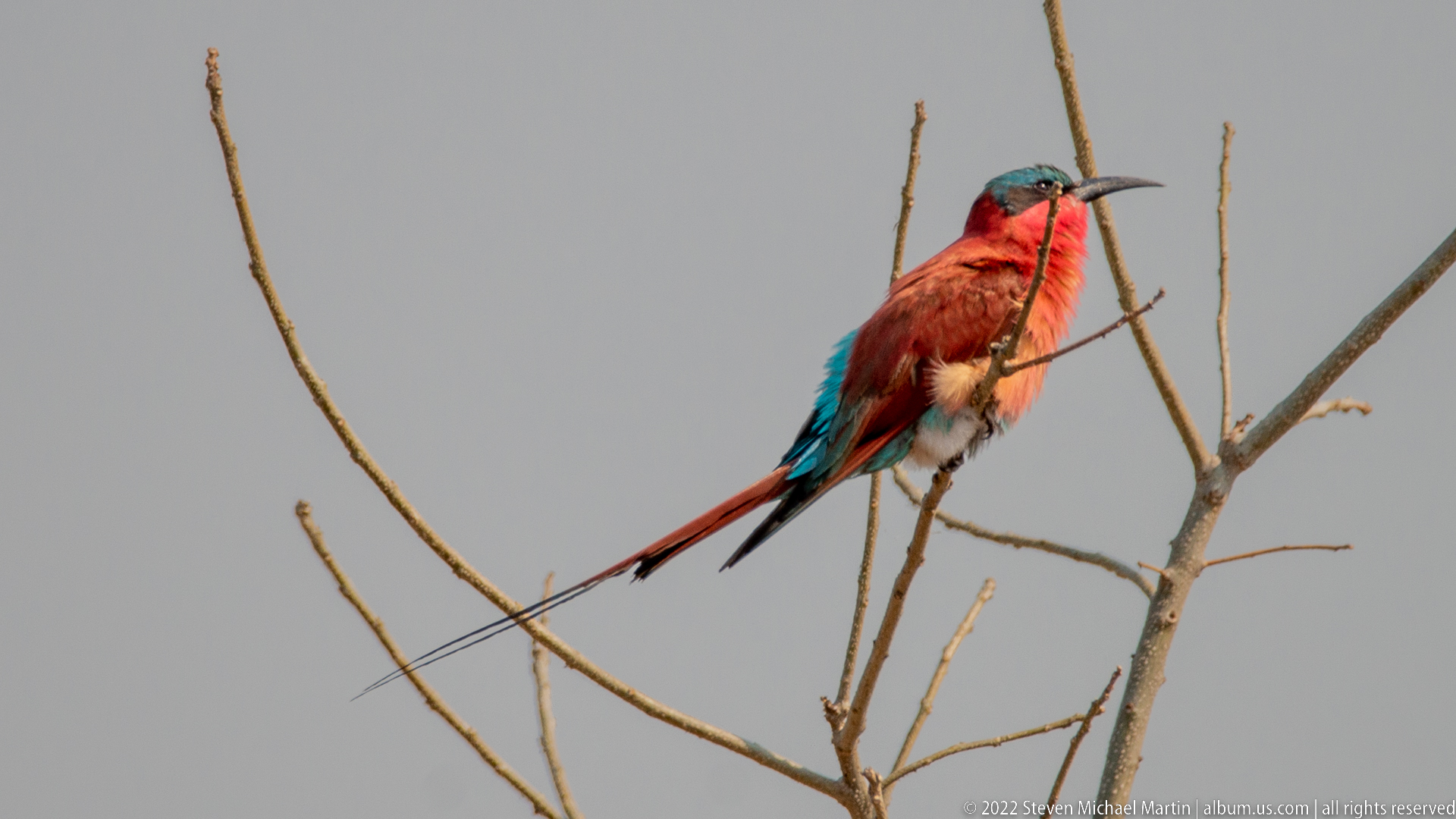
A southern carmine bee-eater perches high on bare twigs, its vivid carmine body, turquoise-blue crown and rump, dark eye stripe, and elongated central tail feathers sharply outlined against a neutral sky. The uncluttered perch provides a clear field-guide view of the species’ diagnostic colors and proportions.
Caption
A southern carmine bee-eater perches high on bare twigs, its vivid carmine body, turquoise-blue crown and rump, dark eye stripe, and elongated central tail feathers sharply outlined against a neutral sky. The uncluttered perch provides a clear field-guide view of the species’ diagnostic colors and proportions.

A large brown vulture stands upright on the exposed crown of a dead tree, silhouetted against a pale sky. Its heavy body, bare-looking head and neck, hooked bill, and broad folded wings identify it securely as a vulture, though the proof-sheet view does not support a confident species-level determination.
Caption
A large brown vulture stands upright on the exposed crown of a dead tree, silhouetted against a pale sky. Its heavy body, bare-looking head and neck, hooked bill, and broad folded wings identify it securely as a vulture, though the proof-sheet view does not support a confident species-level determination.

A southern carmine bee-eater balances on the tip of a slender bare stem, isolated against a soft gray sky. Seen at greater distance than the preceding portrait, the bird’s red body, blue-green crown, dark mask, and exceptionally long tail streamers remain distinctive.
Caption
A southern carmine bee-eater balances on the tip of a slender bare stem, isolated against a soft gray sky. Seen at greater distance than the preceding portrait, the bird’s red body, blue-green crown, dark mask, and exceptionally long tail streamers remain distinctive.
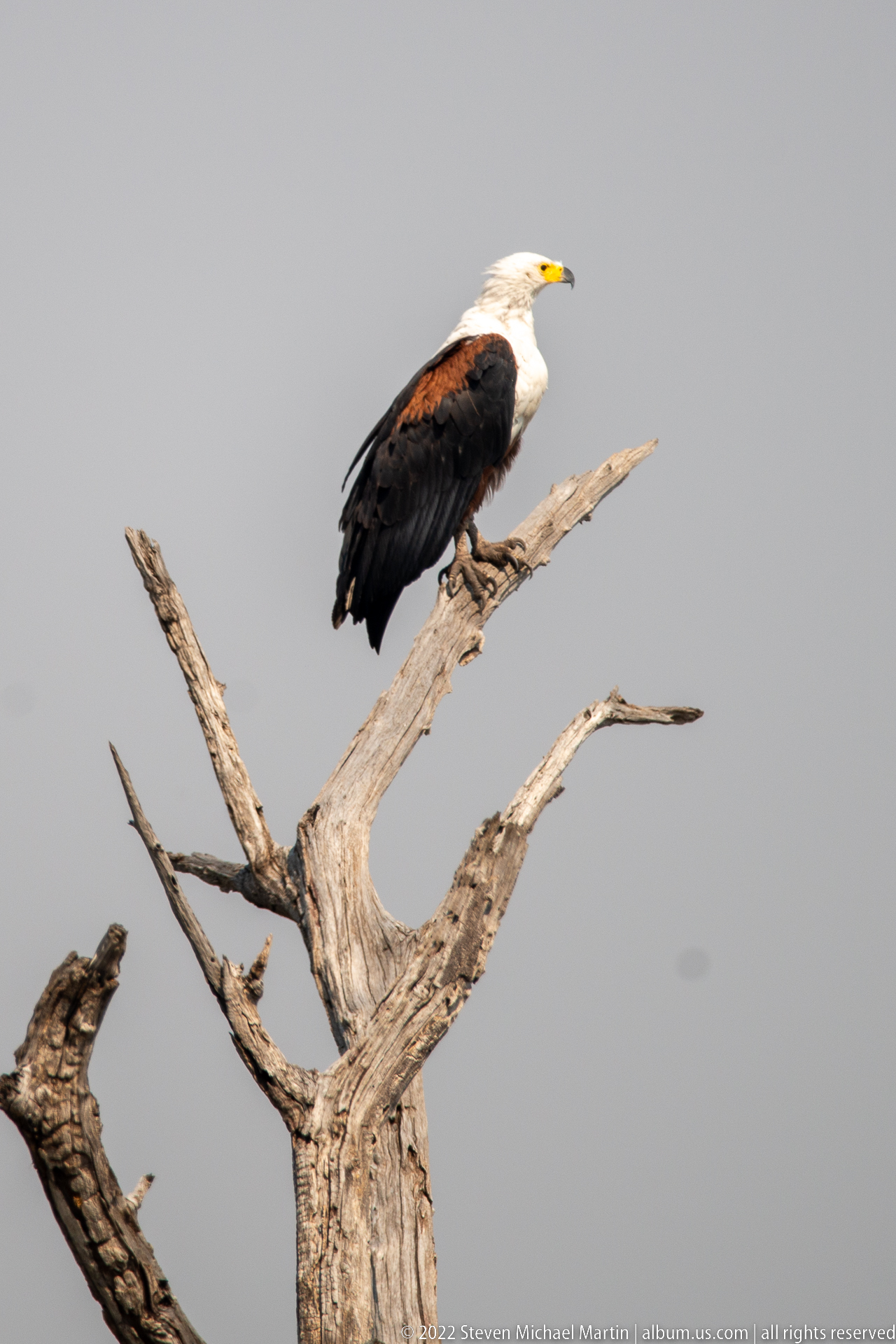
An adult African fish eagle surveys the surroundings from a weathered dead tree, its white head and breast contrasting strongly with chestnut shoulders and dark wings. The open perch and unmistakable plumage create a classic field-guide profile of one of southern Africa’s prominent waterside raptors.
Caption
An adult African fish eagle surveys the surroundings from a weathered dead tree, its white head and breast contrasting strongly with chestnut shoulders and dark wings. The open perch and unmistakable plumage create a classic field-guide profile of one of southern Africa’s prominent waterside raptors.

A closer view isolates an adult African fish eagle on a bleached branch against blue sky. The white head, yellow cere and bill, chestnut upper body, and black flight feathers are especially clear, while the bird’s forward-facing posture conveys the alert vigilance of a hunting raptor near water.
Caption
A closer view isolates an adult African fish eagle on a bleached branch against blue sky. The white head, yellow cere and bill, chestnut upper body, and black flight feathers are especially clear, while the bird’s forward-facing posture conveys the alert vigilance of a hunting raptor near water.

A black-winged stilt strides through shallow water in side profile, displaying the extreme leg length, needle-like bill, white head and underparts, and contrasting black back that distinguish the species. The smooth surface produces a soft reflection beneath the moving bird.
Caption
A black-winged stilt strides through shallow water in side profile, displaying the extreme leg length, needle-like bill, white head and underparts, and contrasting black back that distinguish the species. The smooth surface produces a soft reflection beneath the moving bird.
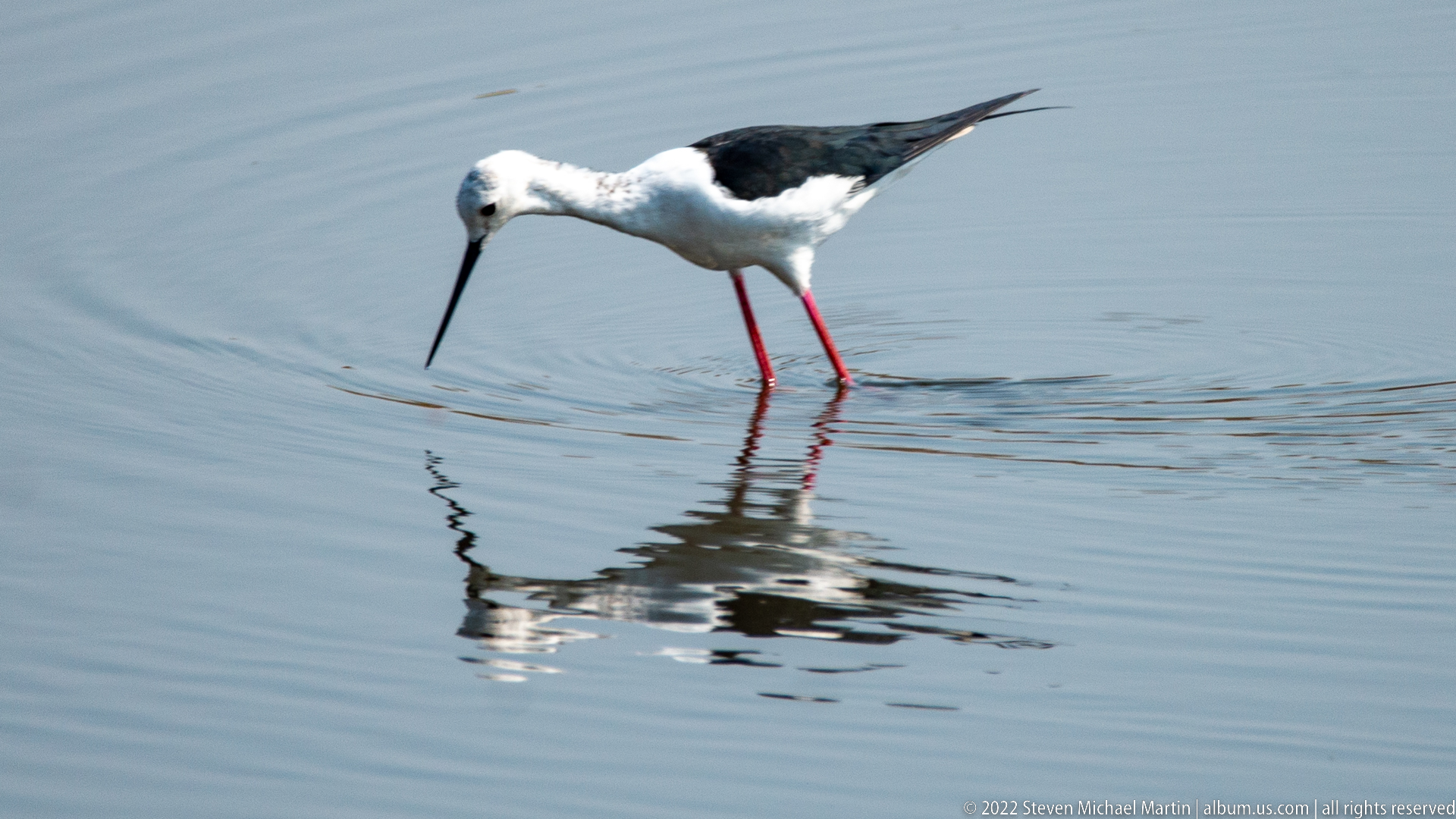
A black-winged stilt probes the shallows with its fine straight bill, standing on exceptionally long pink-red legs. Its crisp white body and black wings reflect in calm water, while small ripples around the bill record active foraging in the Chobe wetland.
Caption
A black-winged stilt probes the shallows with its fine straight bill, standing on exceptionally long pink-red legs. Its crisp white body and black wings reflect in calm water, while small ripples around the bill record active foraging in the Chobe wetland.
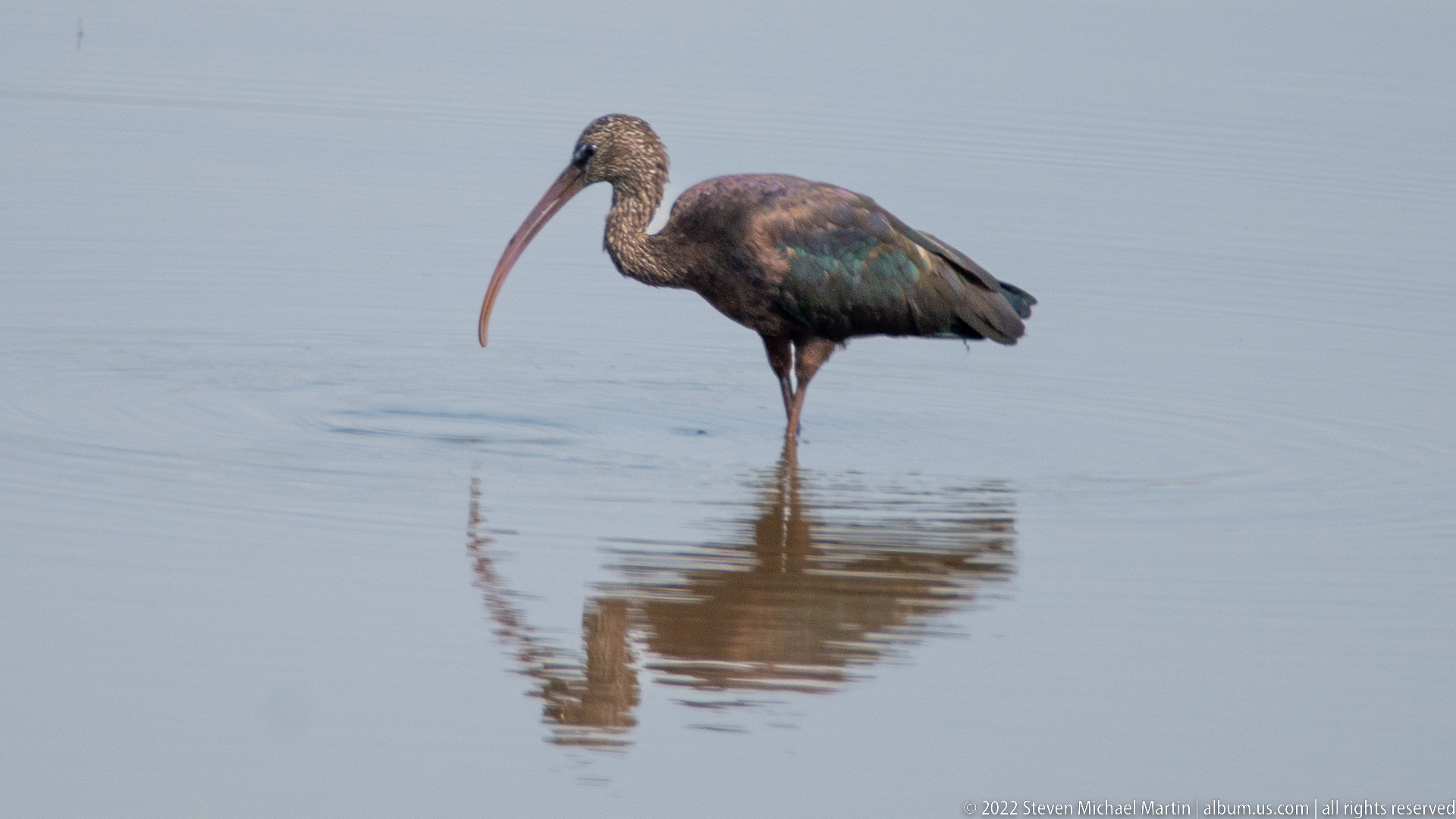
A glossy ibis stands nearly motionless in shallow water, its long down-curved bill and dark iridescent plumage forming a clean silhouette against the pale surface. Green and bronze highlights show across the folded wings, with a soft reflection extending beneath its legs.
Caption
A glossy ibis stands nearly motionless in shallow water, its long down-curved bill and dark iridescent plumage forming a clean silhouette against the pale surface. Green and bronze highlights show across the folded wings, with a soft reflection extending beneath its legs.
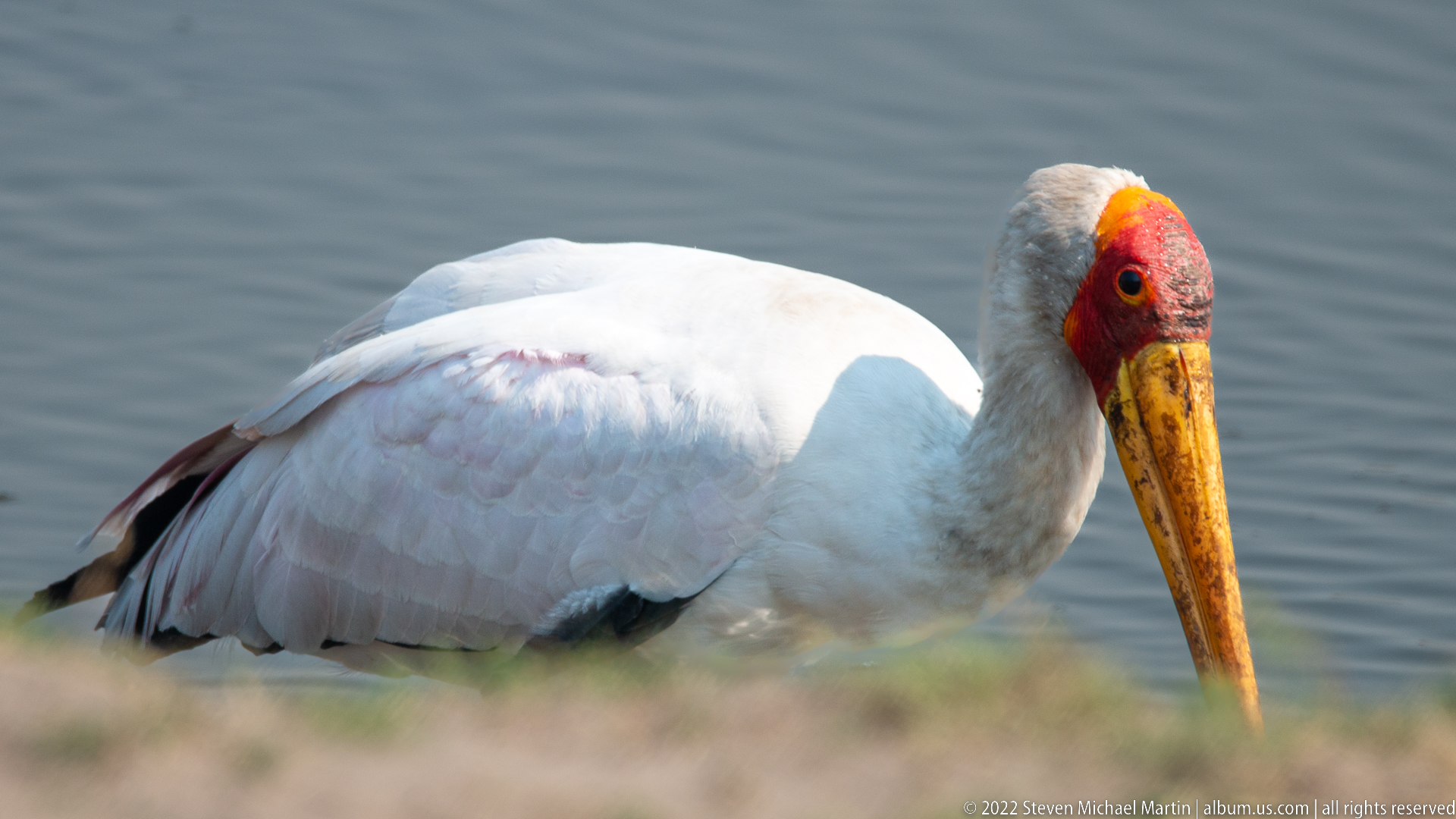
A yellow-billed stork rests low beside the water, its white body filling the frame beneath a grayish head, vivid red facial skin, and long yellow bill. The close portrait emphasizes the adult bird’s diagnostic head pattern and massive feeding bill rather than the surrounding wetland.
Caption
A yellow-billed stork rests low beside the water, its white body filling the frame beneath a grayish head, vivid red facial skin, and long yellow bill. The close portrait emphasizes the adult bird’s diagnostic head pattern and massive feeding bill rather than the surrounding wetland.

A yellow-billed stork leans forward at the water’s edge with its long bill pointed down beside sparse twigs. White plumage and black flight feathers contrast with the red face and yellow bill, while the grassy foreground places the bird within the shallow shoreline feeding zone.
Caption
A yellow-billed stork leans forward at the water’s edge with its long bill pointed down beside sparse twigs. White plumage and black flight feathers contrast with the red face and yellow bill, while the grassy foreground places the bird within the shallow shoreline feeding zone.
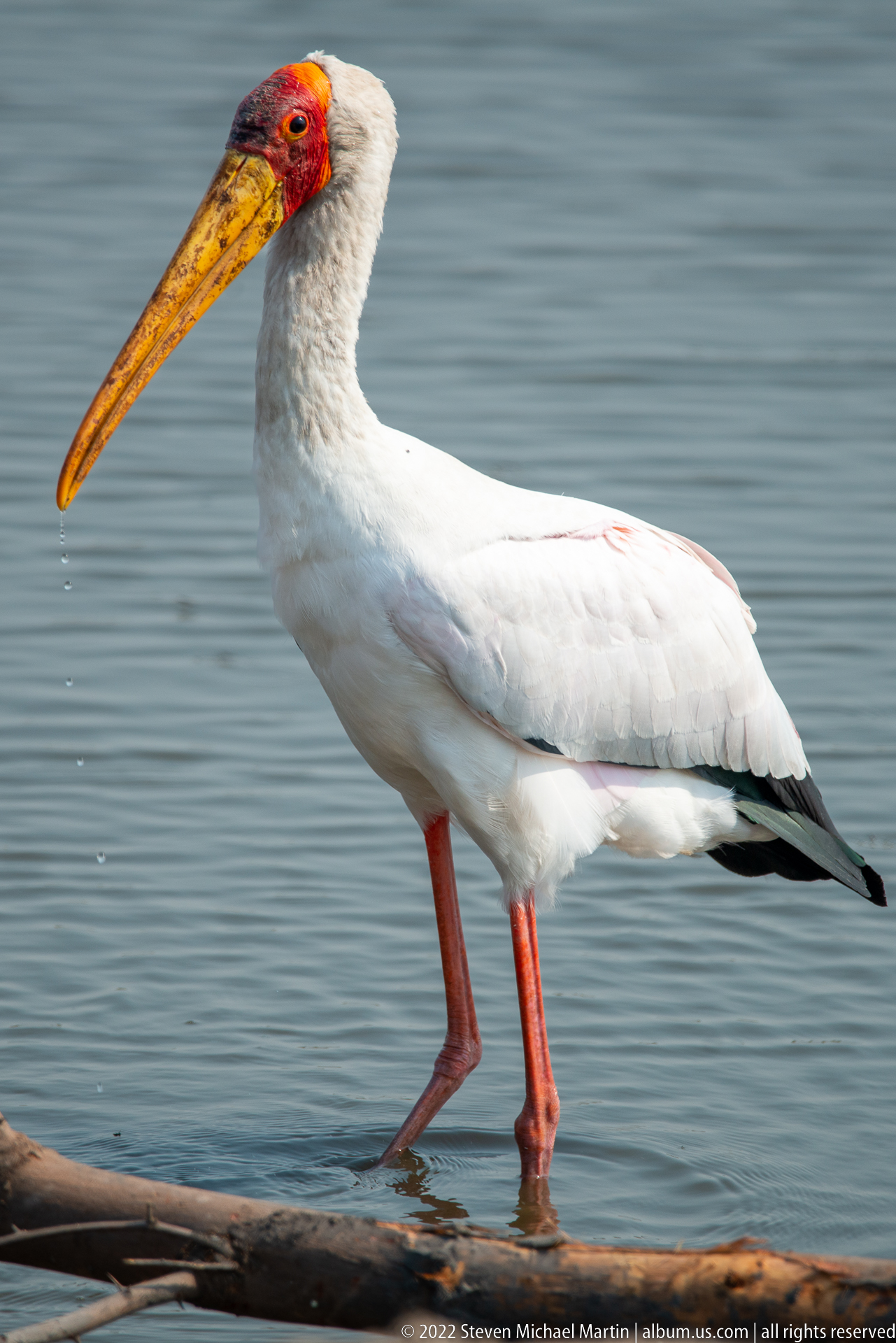
An adult yellow-billed stork walks through shallow water in full side profile, showing its long orange-yellow bill, red facial skin and legs, white body, and black flight feathers. The unobstructed view clearly records the species’ proportions and wading adaptation against the smooth river surface.
Caption
An adult yellow-billed stork walks through shallow water in full side profile, showing its long orange-yellow bill, red facial skin and legs, white body, and black flight feathers. The unobstructed view clearly records the species’ proportions and wading adaptation against the smooth river surface.
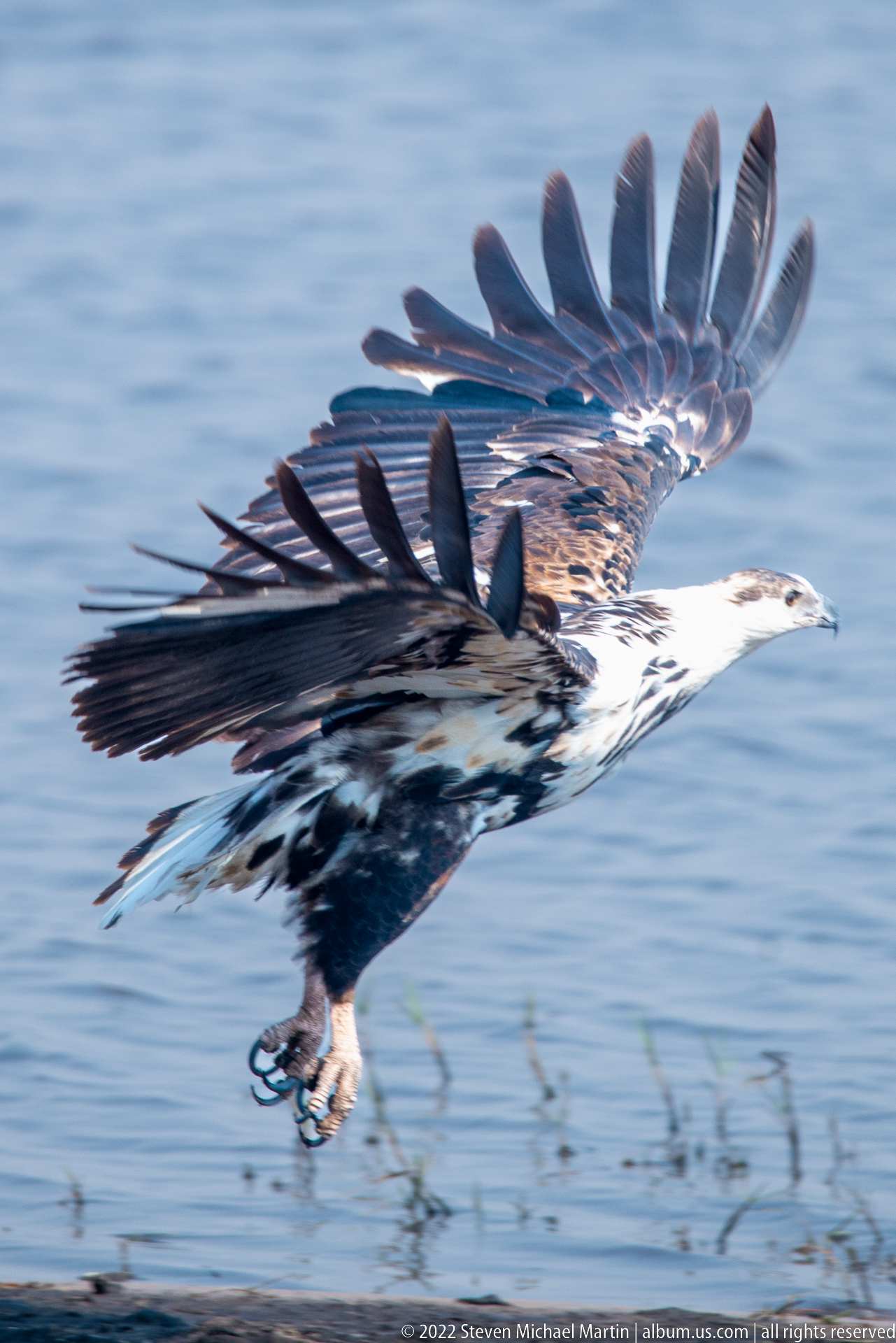
With wings swept through a powerful downstroke, an immature African fish eagle flies only a short distance above the water. The long primary feathers separate clearly along the wing tips, and the mottled brown-and-white juvenile plumage remains visible despite the speed of the pass.
Caption
With wings swept through a powerful downstroke, an immature African fish eagle flies only a short distance above the water. The long primary feathers separate clearly along the wing tips, and the mottled brown-and-white juvenile plumage remains visible despite the speed of the pass.
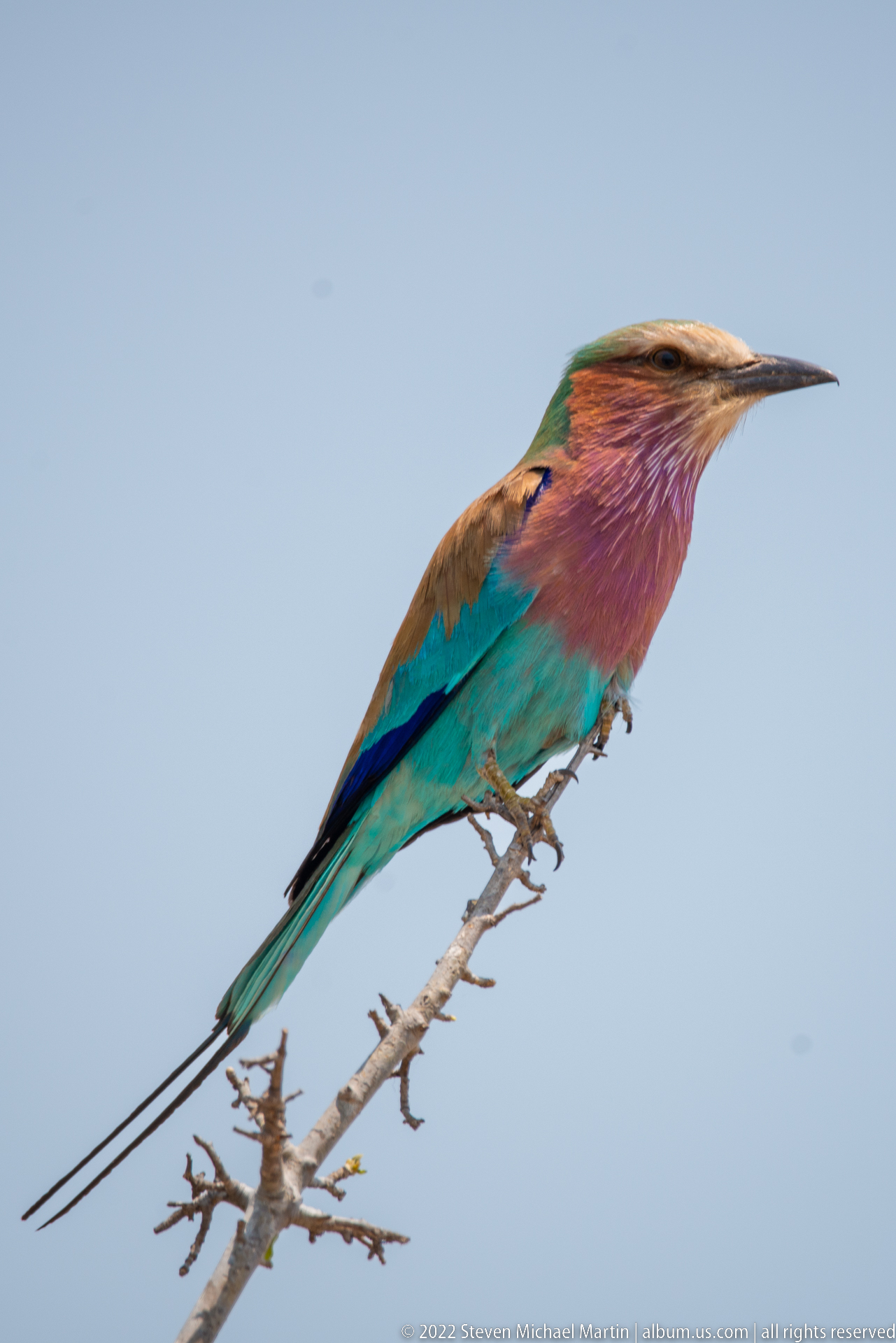
A lilac-breasted roller perches horizontally on a bare twig, displaying turquoise underparts, lilac breast, warm brown crown, blue wing panels, and elongated outer tail feathers. The clean sky isolates its vivid plumage and distinctive long-tailed silhouette. This side view provides a classic field-guide profile of one of southern Africa’s most recognizable savanna birds.
Caption
A lilac-breasted roller perches horizontally on a bare twig, displaying turquoise underparts, lilac breast, warm brown crown, blue wing panels, and elongated outer tail feathers. The clean sky isolates its vivid plumage and distinctive long-tailed silhouette. This side view provides a classic field-guide profile of one of southern Africa’s most recognizable savanna birds.
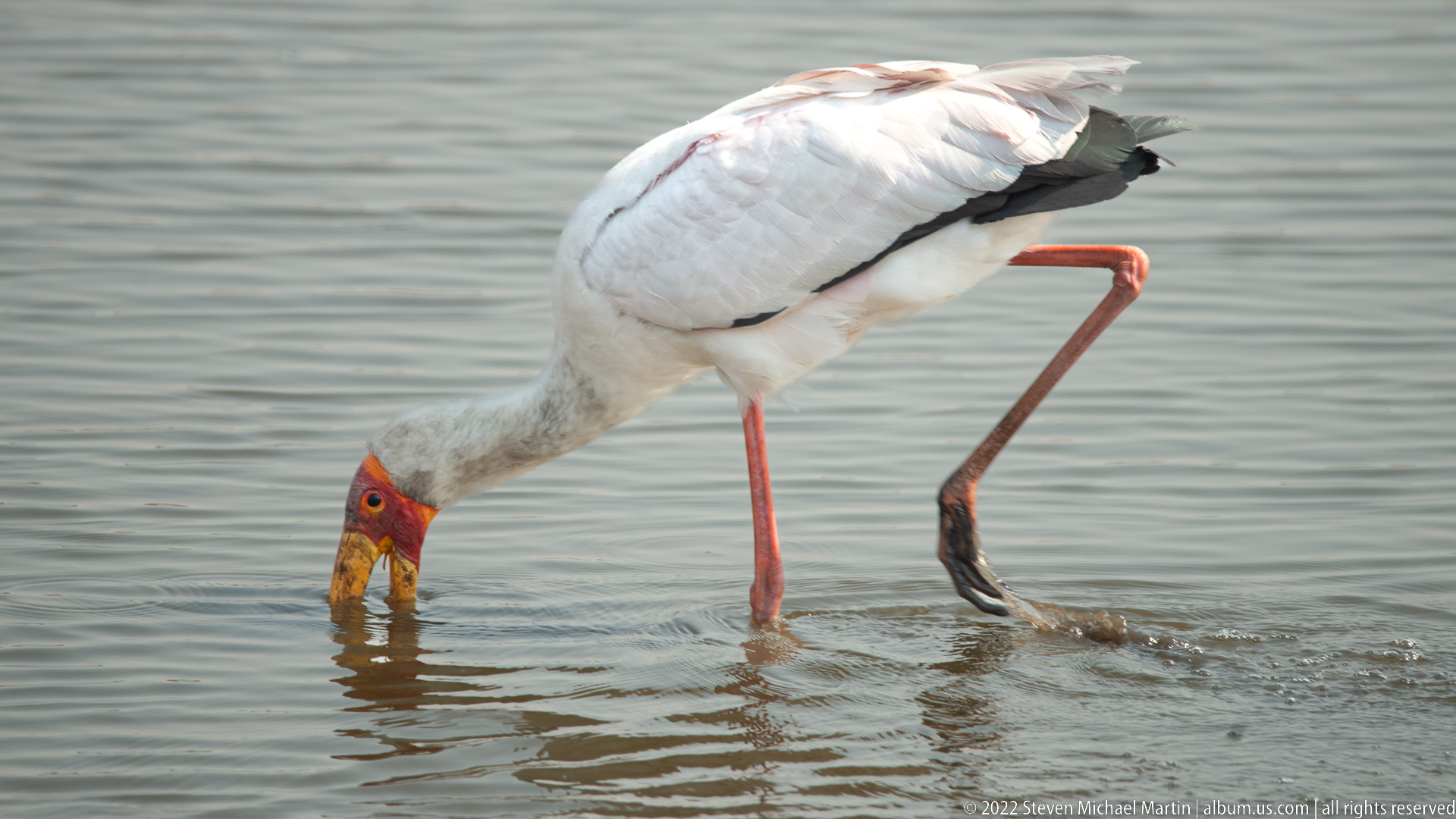
A yellow-billed stork bends deeply into the shallows with its bill submerged, one leg stepping forward through disturbed water. The feeding posture highlights how the long bill and legs are used at close range along wetland margins, while black wing tips remain folded over the white body.
Caption
A yellow-billed stork bends deeply into the shallows with its bill submerged, one leg stepping forward through disturbed water. The feeding posture highlights how the long bill and legs are used at close range along wetland margins, while black wing tips remain folded over the white body.
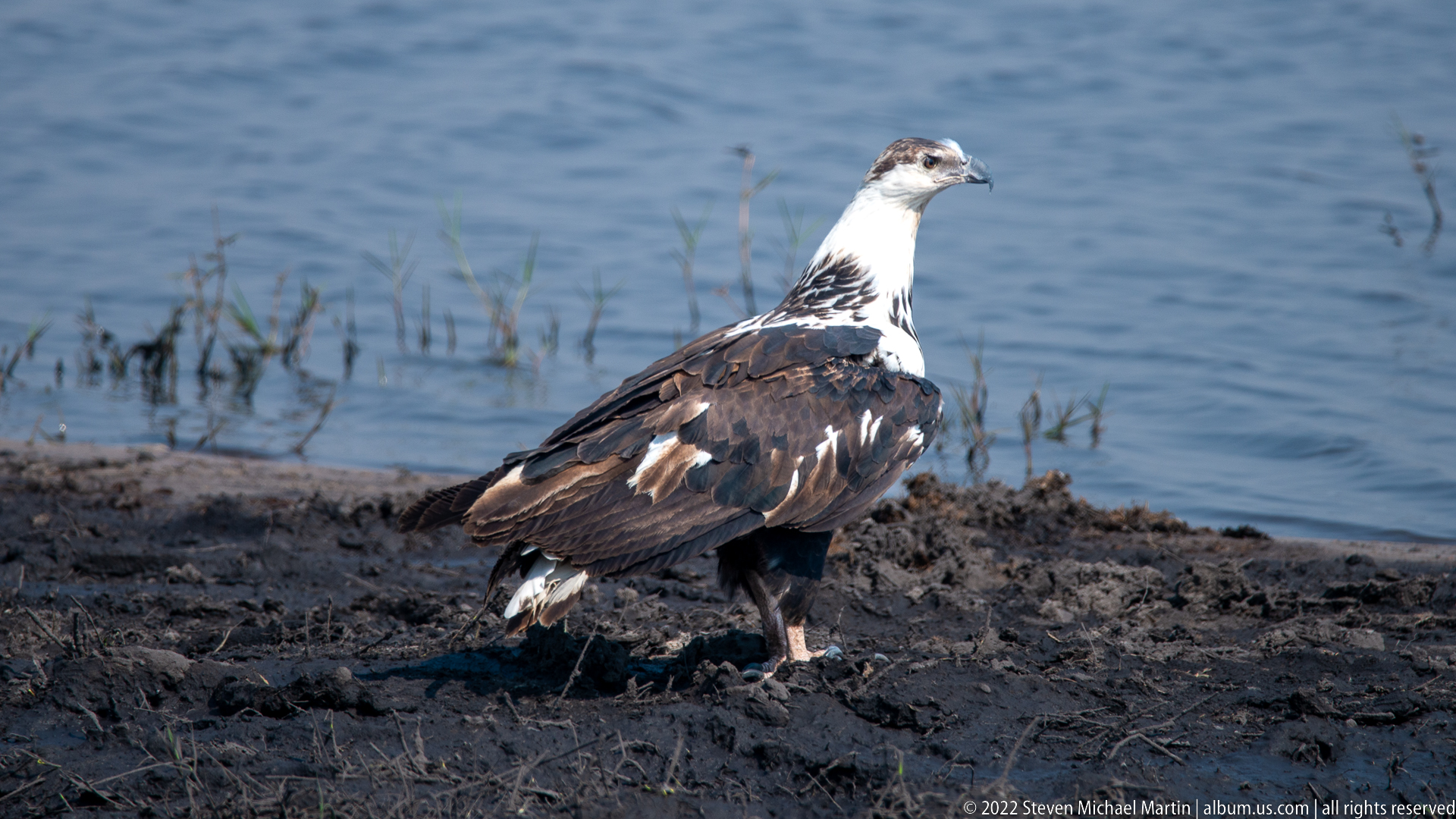
An immature African fish eagle stands on dark mud beside open water, its mottled brown-and-white plumage contrasting with the clean pattern of an adult. The heavy hooked bill, powerful legs, and eagle-like stance are clear, while the juvenile coloration documents an earlier stage in the species’ development.
Caption
An immature African fish eagle stands on dark mud beside open water, its mottled brown-and-white plumage contrasting with the clean pattern of an adult. The heavy hooked bill, powerful legs, and eagle-like stance are clear, while the juvenile coloration documents an earlier stage in the species’ development.
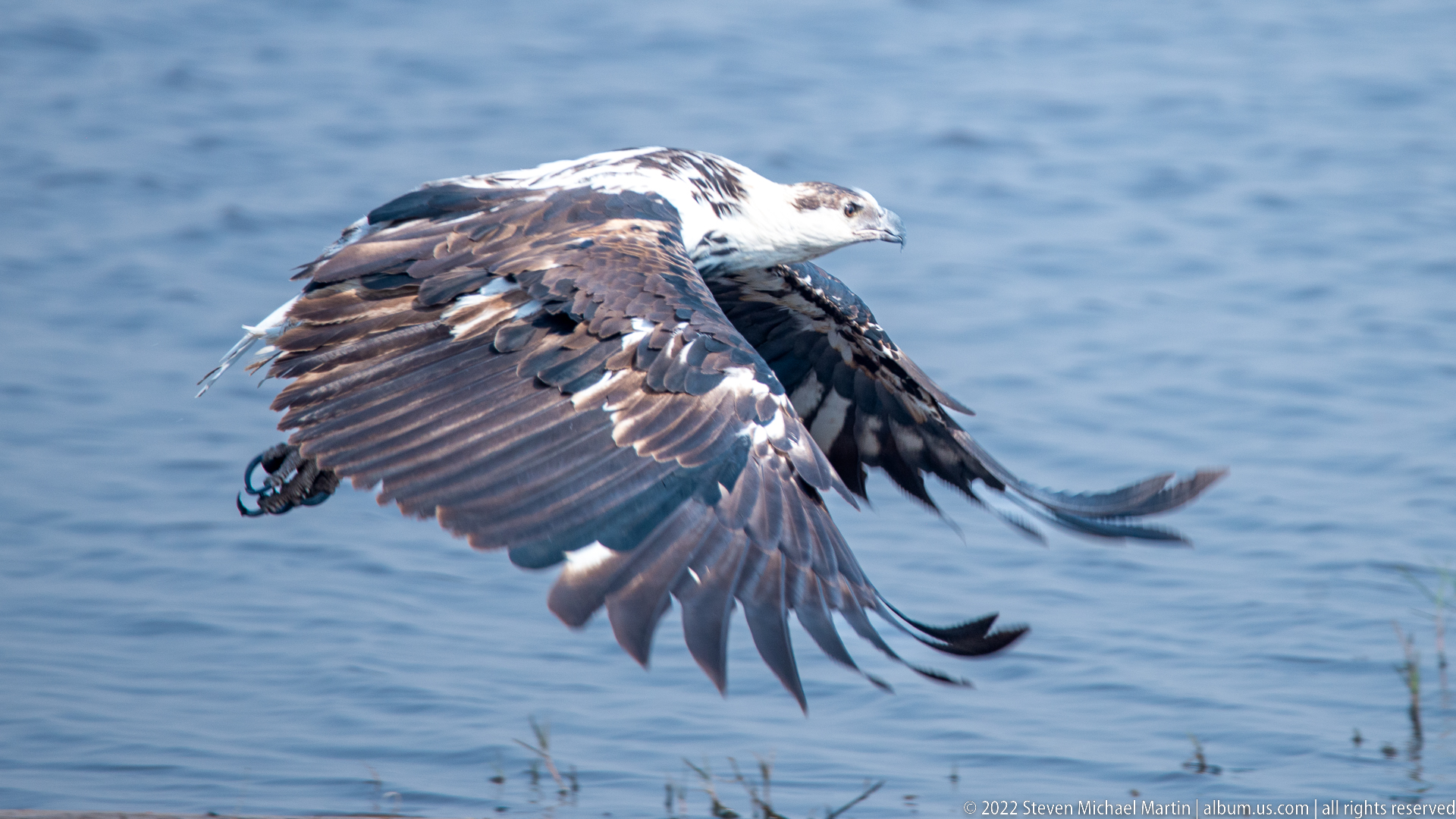
An immature African fish eagle launches low over the water with broad wings fully spread and legs trailing beneath the body. Mottled juvenile plumage is visible across the back and wing coverts, while the dynamic posture freezes the transition from shoreline perch to flight.
Caption
An immature African fish eagle launches low over the water with broad wings fully spread and legs trailing beneath the body. Mottled juvenile plumage is visible across the back and wing coverts, while the dynamic posture freezes the transition from shoreline perch to flight.
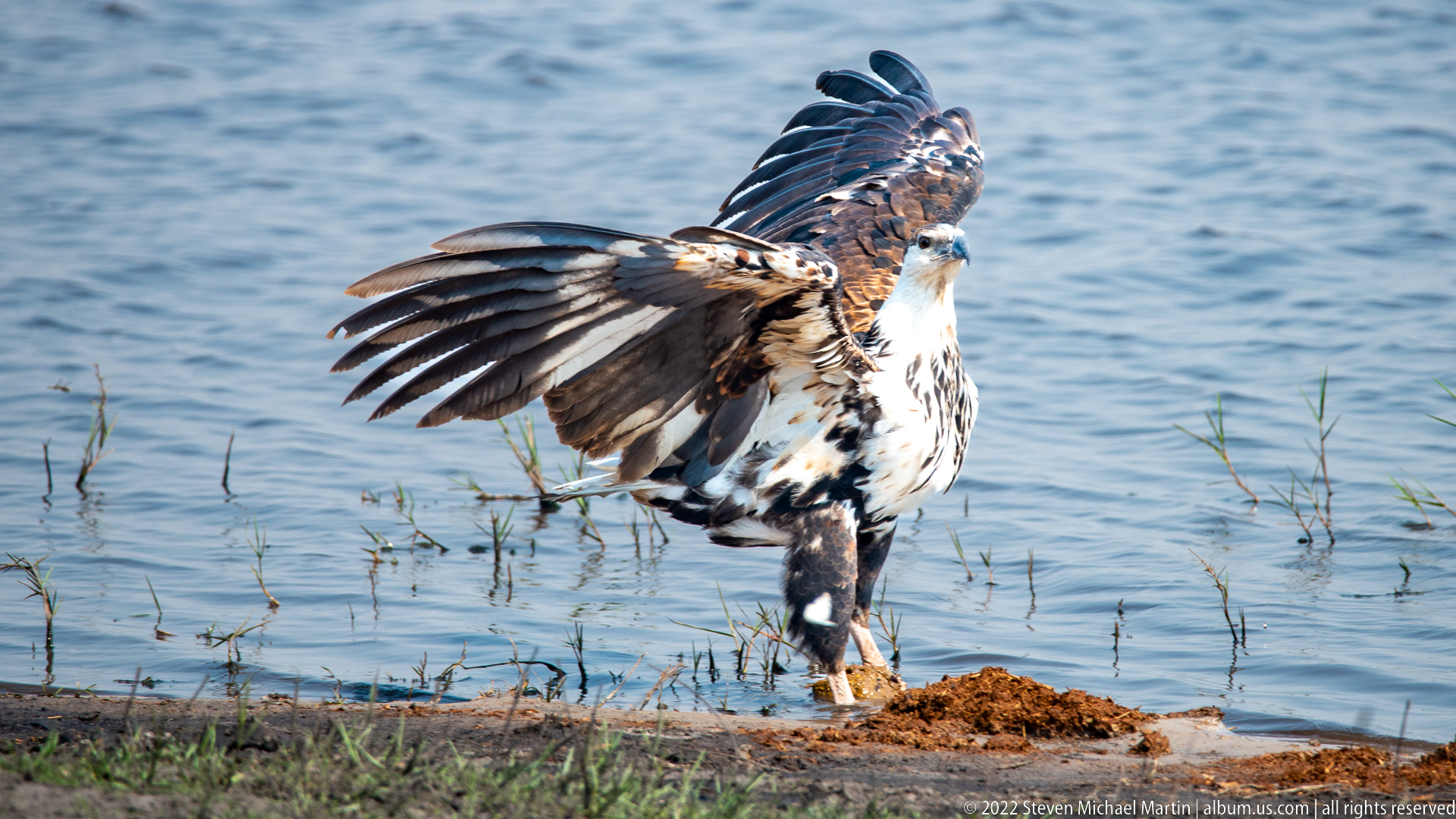
An immature African fish eagle stands at the water’s edge with both wings raised and partly spread, exposing the layered flight feathers and strongly mottled underparts. The frontal posture gives a different view of juvenile plumage and wing structure as the bird balances on the muddy shoreline.
Caption
An immature African fish eagle stands at the water’s edge with both wings raised and partly spread, exposing the layered flight feathers and strongly mottled underparts. The frontal posture gives a different view of juvenile plumage and wing structure as the bird balances on the muddy shoreline.

A juvenile African fish eagle stands at the water’s edge, its pale, heavily streaked head and mottled brown plumage contrasting with the blue surface behind it. The hooked bill, powerful legs, and waterside setting are characteristic of this large African eagle. Immature birds lack the crisp white head and chestnut body of adults, acquiring the familiar adult pattern only as they mature.
Caption
A juvenile African fish eagle stands at the water’s edge, its pale, heavily streaked head and mottled brown plumage contrasting with the blue surface behind it. The hooked bill, powerful legs, and waterside setting are characteristic of this large African eagle. Immature birds lack the crisp white head and chestnut body of adults, acquiring the familiar adult pattern only as they mature.
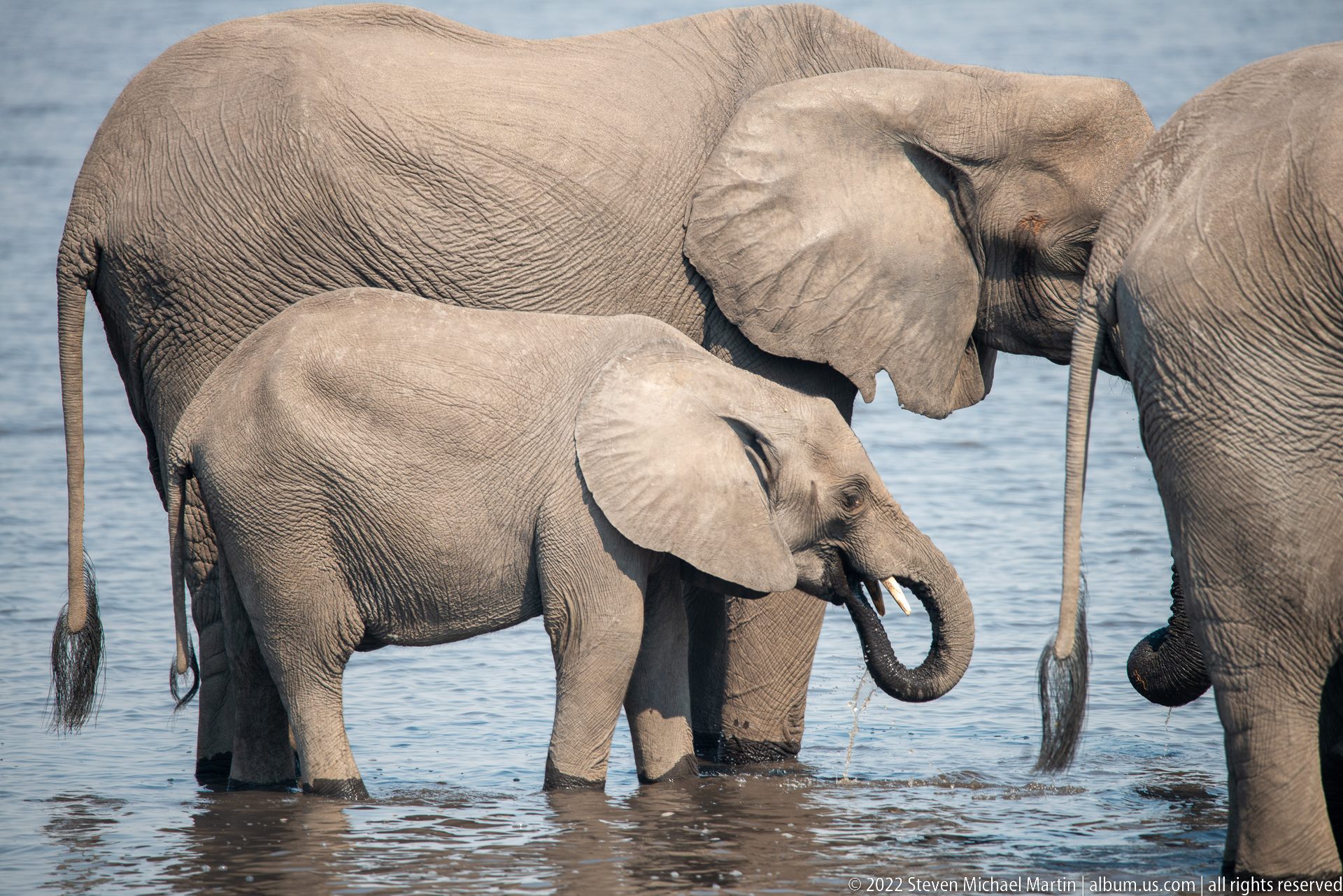
An African elephant calf stands knee-deep in shallow water beside two adults, curling its trunk upward as the family group drinks. The close view shows the calf’s smaller ears, compact body, and developing trunk control against the massive legs and torsos of the adults. The scene documents the dependence of young elephants on family groups at Chobe’s river margins.
Caption
An African elephant calf stands knee-deep in shallow water beside two adults, curling its trunk upward as the family group drinks. The close view shows the calf’s smaller ears, compact body, and developing trunk control against the massive legs and torsos of the adults. The scene documents the dependence of young elephants on family groups at Chobe’s river margins.
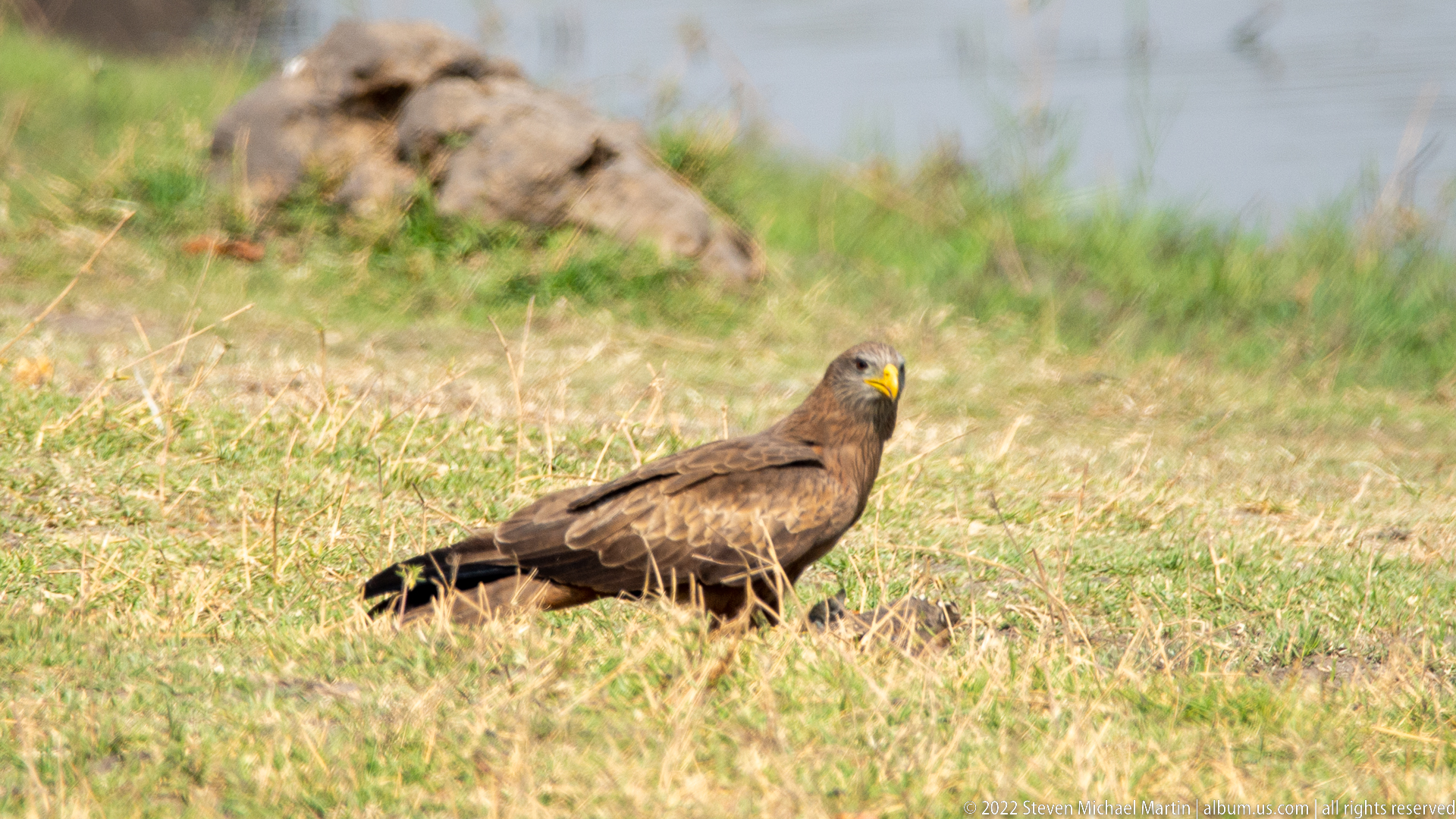
A yellow-billed kite stands on short floodplain grass near the water, showing a slender hooked yellow bill, brown plumage, and long tail. The bird’s upright posture and open riverside setting provide a clear field-guide view of this widespread African raptor. Its relatively light build distinguishes it from the heavier eagles photographed nearby.
Caption
A yellow-billed kite stands on short floodplain grass near the water, showing a slender hooked yellow bill, brown plumage, and long tail. The bird’s upright posture and open riverside setting provide a clear field-guide view of this widespread African raptor. Its relatively light build distinguishes it from the heavier eagles photographed nearby.
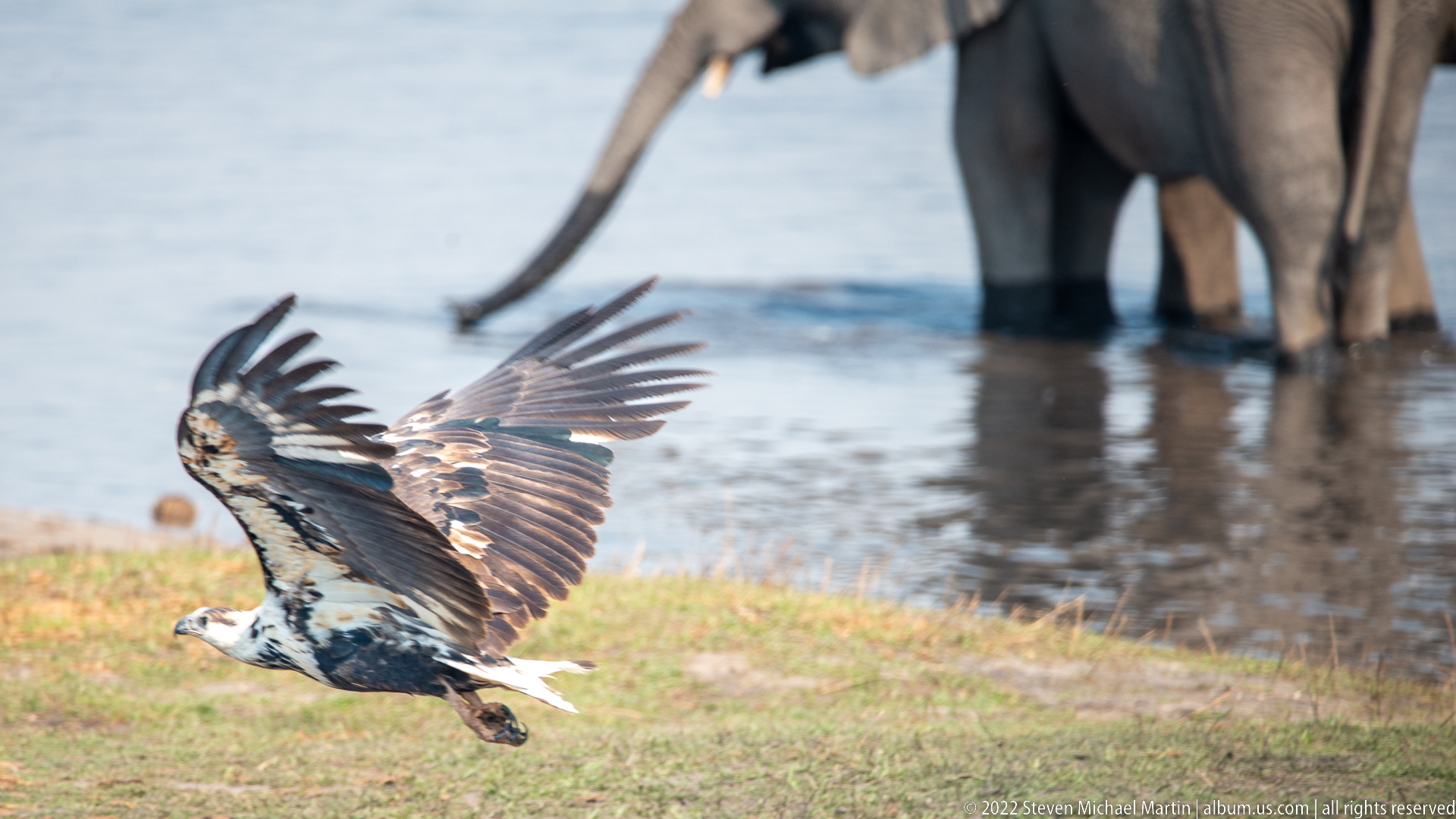
A juvenile African fish eagle lifts low over the riverbank with wings fully spread, revealing mottled pale-and-dark flight feathers and a pale streaked head. An elephant stands out of focus in the water behind it, linking predator and megafauna within the same Chobe river habitat. The low flight gives a useful view of the immature eagle’s broad wings and developing plumage.
Caption
A juvenile African fish eagle lifts low over the riverbank with wings fully spread, revealing mottled pale-and-dark flight feathers and a pale streaked head. An elephant stands out of focus in the water behind it, linking predator and megafauna within the same Chobe river habitat. The low flight gives a useful view of the immature eagle’s broad wings and developing plumage.
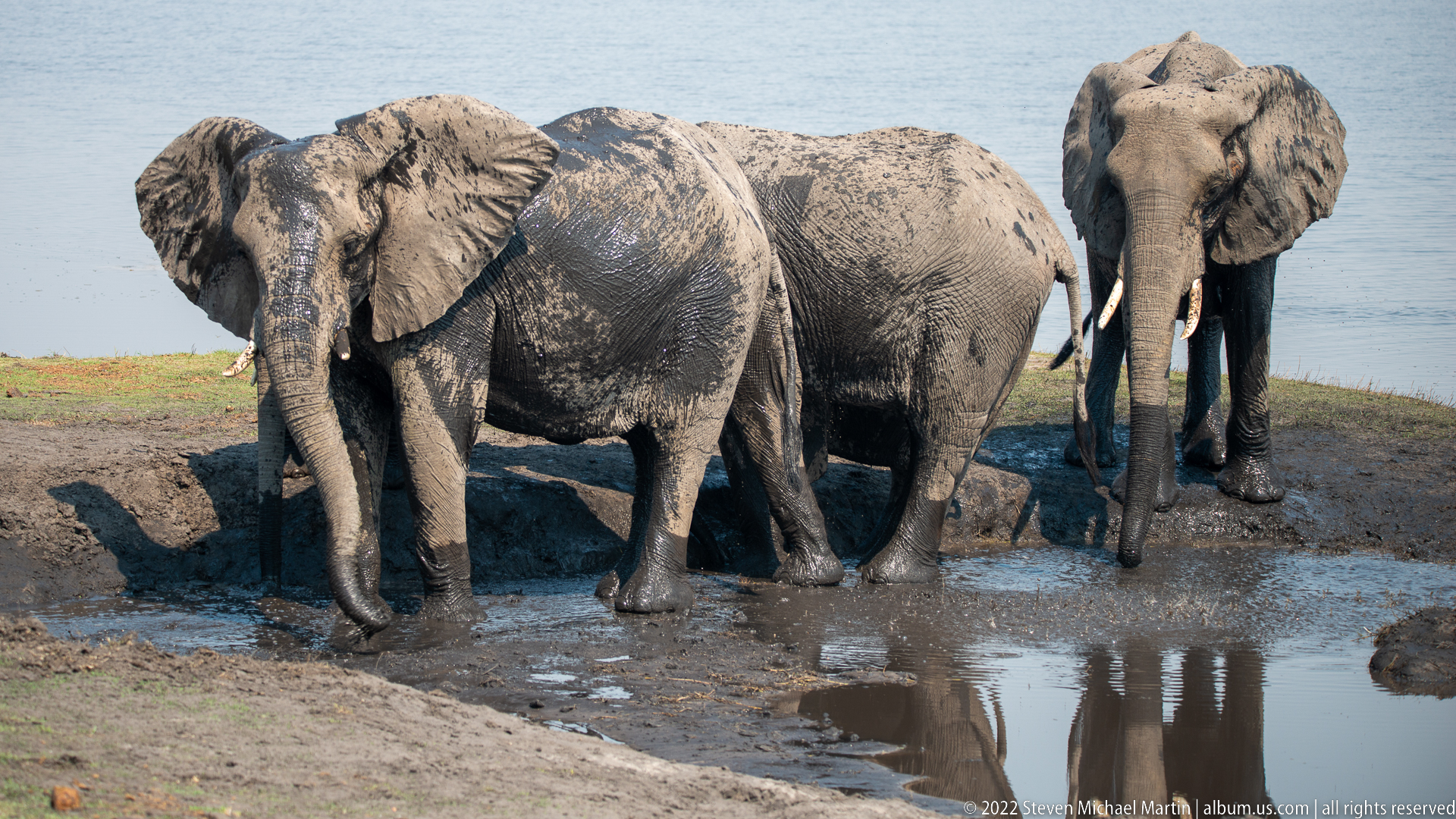
Two African bush elephants stand beside a muddy wallow, their flanks heavily coated with wet and drying mud. The darker patches across the skin record recent bathing and dusting behavior used for cooling and skin protection. Water immediately behind them places the scene at the river margin, where Chobe’s elephants repeatedly move between drinking, bathing, and grazing areas.
Caption
Two African bush elephants stand beside a muddy wallow, their flanks heavily coated with wet and drying mud. The darker patches across the skin record recent bathing and dusting behavior used for cooling and skin protection. Water immediately behind them places the scene at the river margin, where Chobe’s elephants repeatedly move between drinking, bathing, and grazing areas.
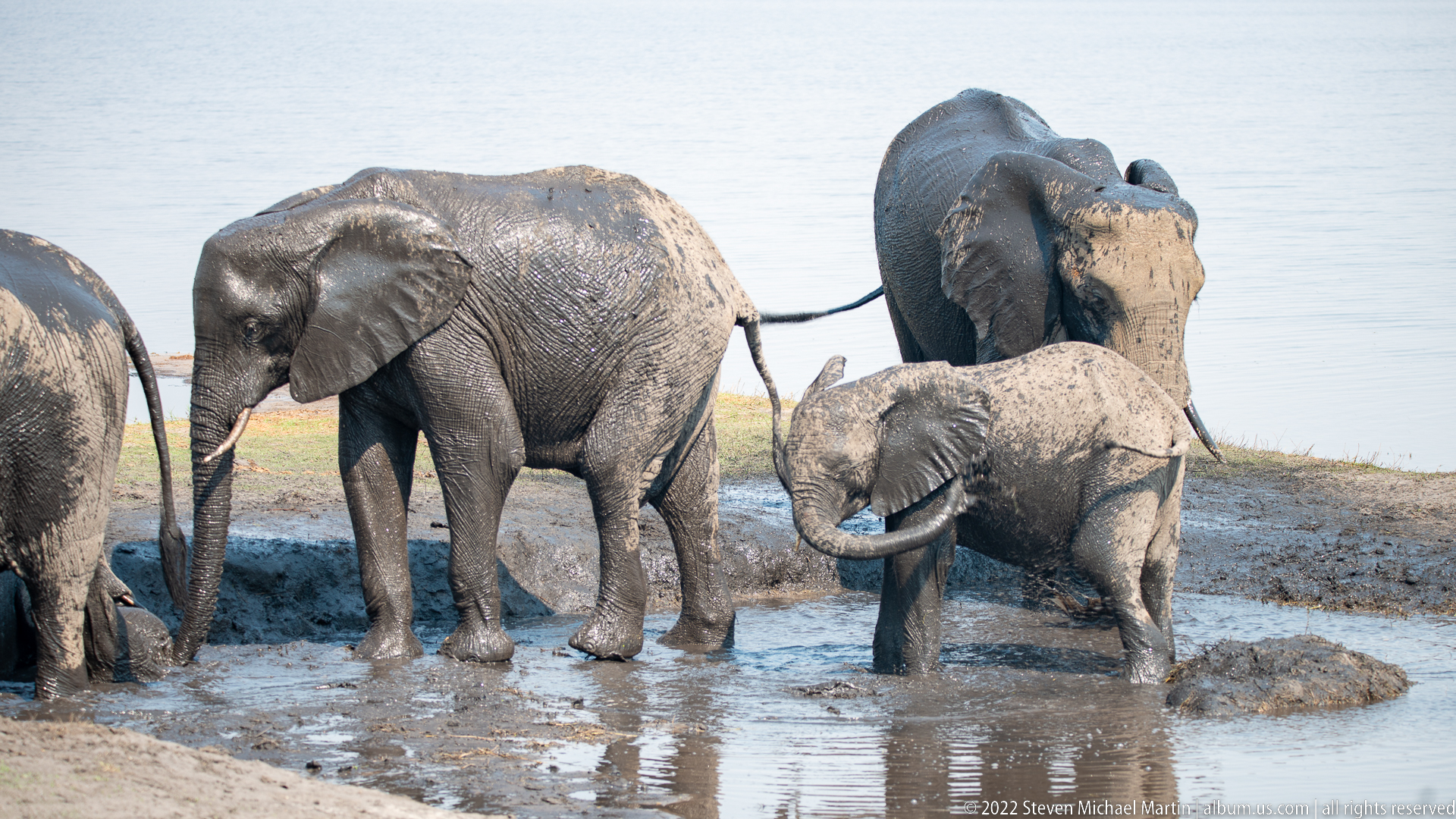
A young African elephant splashes and leans into a muddy wallow while adults stand around it, their own bodies darkened by wet mud. The calf’s raised trunk and angled stance suggest active play or bathing rather than simple drinking. This close family scene shows how Chobe’s shallow river-edge pools serve both practical and social roles for elephant groups.
Caption
A young African elephant splashes and leans into a muddy wallow while adults stand around it, their own bodies darkened by wet mud. The calf’s raised trunk and angled stance suggest active play or bathing rather than simple drinking. This close family scene shows how Chobe’s shallow river-edge pools serve both practical and social roles for elephant groups.
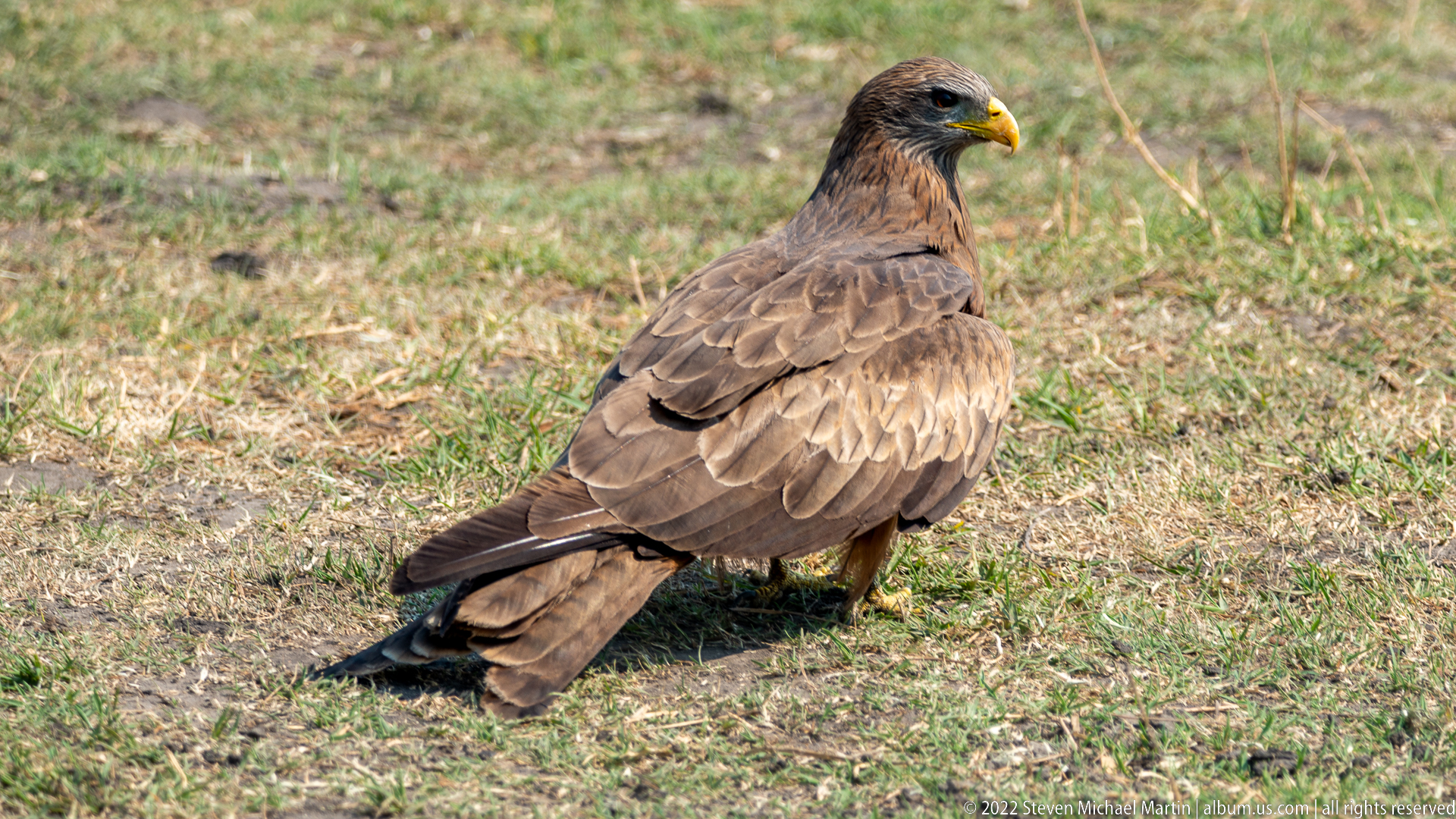
A yellow-billed kite rests on short grass with its body angled away and head turned in profile. The close view shows layered brown wing coverts, a long dark tail, and the species’ conspicuous yellow bill and cere. Compared with the more distant riverside view on the preceding page, this photograph emphasizes plumage texture and head shape for field identification.
Caption
A yellow-billed kite rests on short grass with its body angled away and head turned in profile. The close view shows layered brown wing coverts, a long dark tail, and the species’ conspicuous yellow bill and cere. Compared with the more distant riverside view on the preceding page, this photograph emphasizes plumage texture and head shape for field identification.
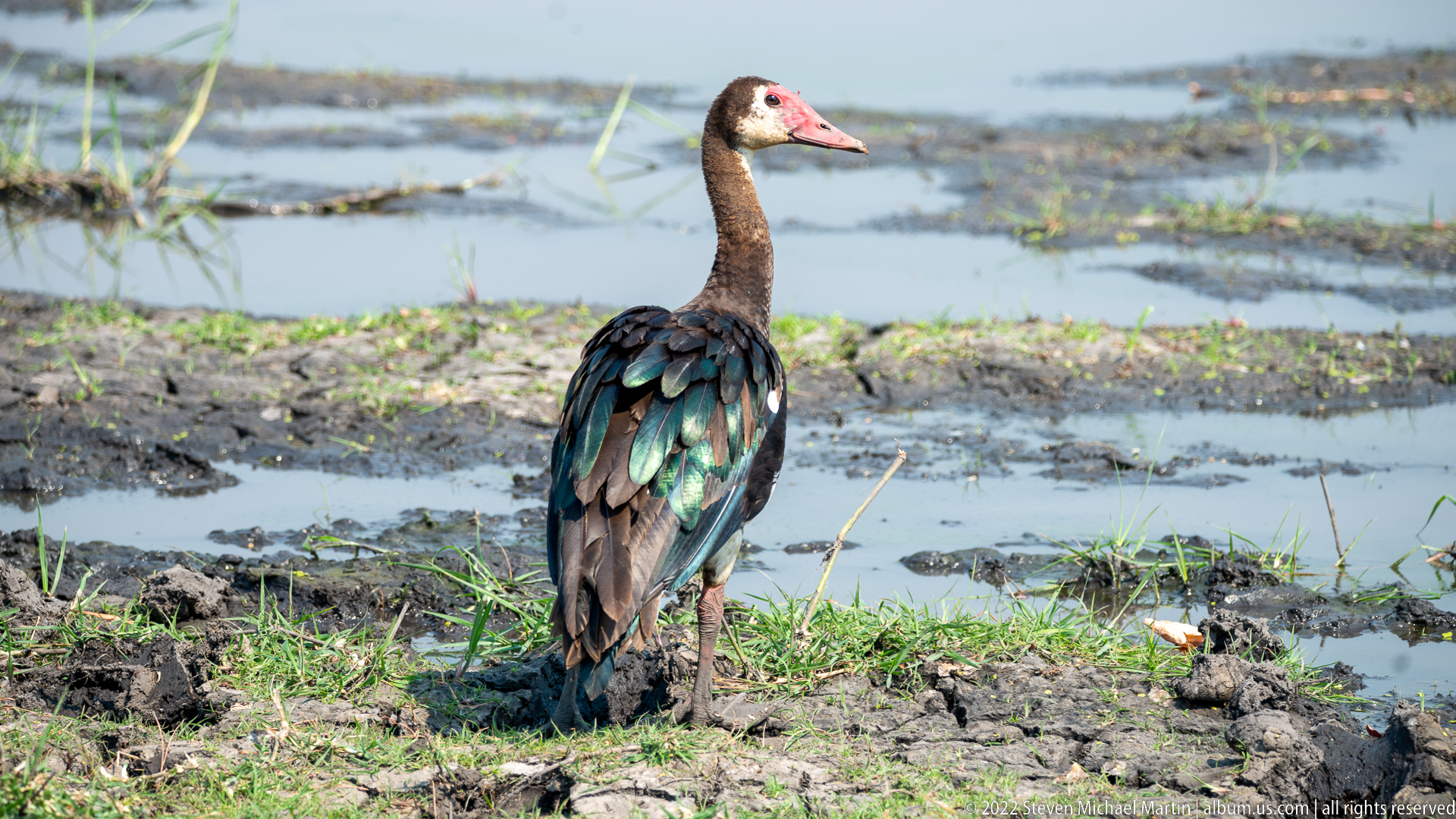
A spur-winged goose stands upright on a muddy wetland margin, its dark brown body flashing green iridescence across the folded wing. The pale face contrasts with the red facial skin and bill, while long legs keep the bird high above the soft ground. The combination of large size, bare red facial areas, and glossy wing feathers is distinctive of this African waterfowl.
Caption
A spur-winged goose stands upright on a muddy wetland margin, its dark brown body flashing green iridescence across the folded wing. The pale face contrasts with the red facial skin and bill, while long legs keep the bird high above the soft ground. The combination of large size, bare red facial areas, and glossy wing feathers is distinctive of this African waterfowl.
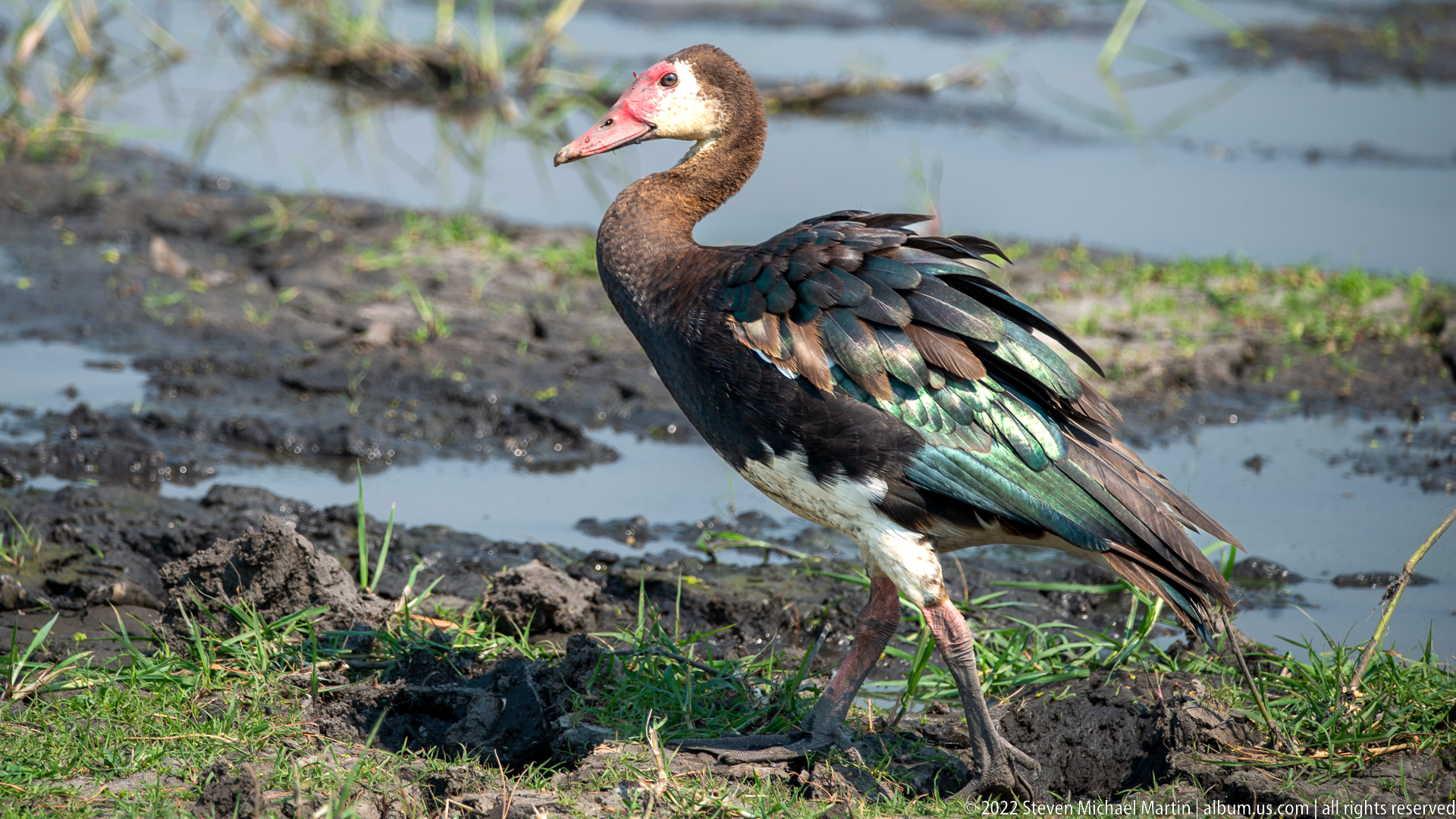
A spur-winged goose walks across the muddy edge of a wetland, exposing its long legs, white lower flanks, and glossy green wing coverts. Its pale face and red bill stand out against the dark body. This full-body view complements the preceding portrait by showing the bird’s heavy build and terrestrial posture along Chobe’s shallow-water habitat.
Caption
A spur-winged goose walks across the muddy edge of a wetland, exposing its long legs, white lower flanks, and glossy green wing coverts. Its pale face and red bill stand out against the dark body. This full-body view complements the preceding portrait by showing the bird’s heavy build and terrestrial posture along Chobe’s shallow-water habitat.

A male greater kudu crosses a sandy track, displaying the species’ tall spiral horns, gray-brown coat, narrow white flank stripes, and dark throat fringe. The open side view clearly shows the long-legged build and dramatic horn structure of an adult bull. Dry woodland and pale sand provide the typical Chobe setting for this large browsing antelope.
Caption
A male greater kudu crosses a sandy track, displaying the species’ tall spiral horns, gray-brown coat, narrow white flank stripes, and dark throat fringe. The open side view clearly shows the long-legged build and dramatic horn structure of an adult bull. Dry woodland and pale sand provide the typical Chobe setting for this large browsing antelope.

A small group of greater kudus rests beneath dense woodland cover, including a horned adult male in the foreground and smaller animals behind. White flank stripes remain visible even in deep shade, while the male’s spiral horns rise through the surrounding branches. Their quiet, concealed posture reflects the species’ preference for browsing habitat with woody cover.
Caption
A small group of greater kudus rests beneath dense woodland cover, including a horned adult male in the foreground and smaller animals behind. White flank stripes remain visible even in deep shade, while the male’s spiral horns rise through the surrounding branches. Their quiet, concealed posture reflects the species’ preference for browsing habitat with woody cover.
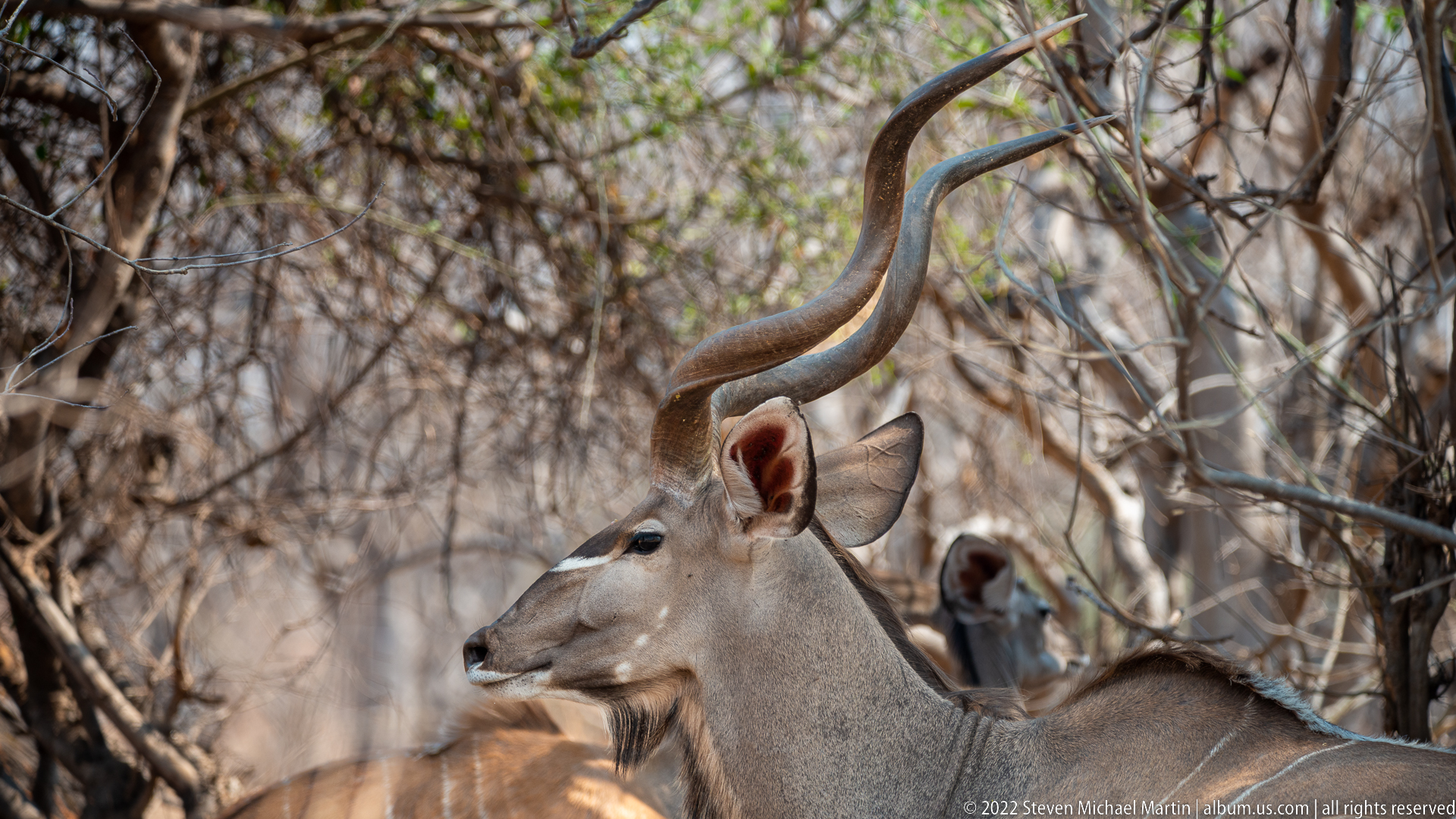
The head and shoulders of a male greater kudu fill the frame, emphasizing the extraordinary corkscrew horns and large mobile ears. Fine white facial markings and the gray-brown coat are visible beneath the woodland canopy. The portrait isolates the features used to distinguish mature males, whose horns become increasingly twisted and massive with age.
Caption
The head and shoulders of a male greater kudu fill the frame, emphasizing the extraordinary corkscrew horns and large mobile ears. Fine white facial markings and the gray-brown coat are visible beneath the woodland canopy. The portrait isolates the features used to distinguish mature males, whose horns become increasingly twisted and massive with age.
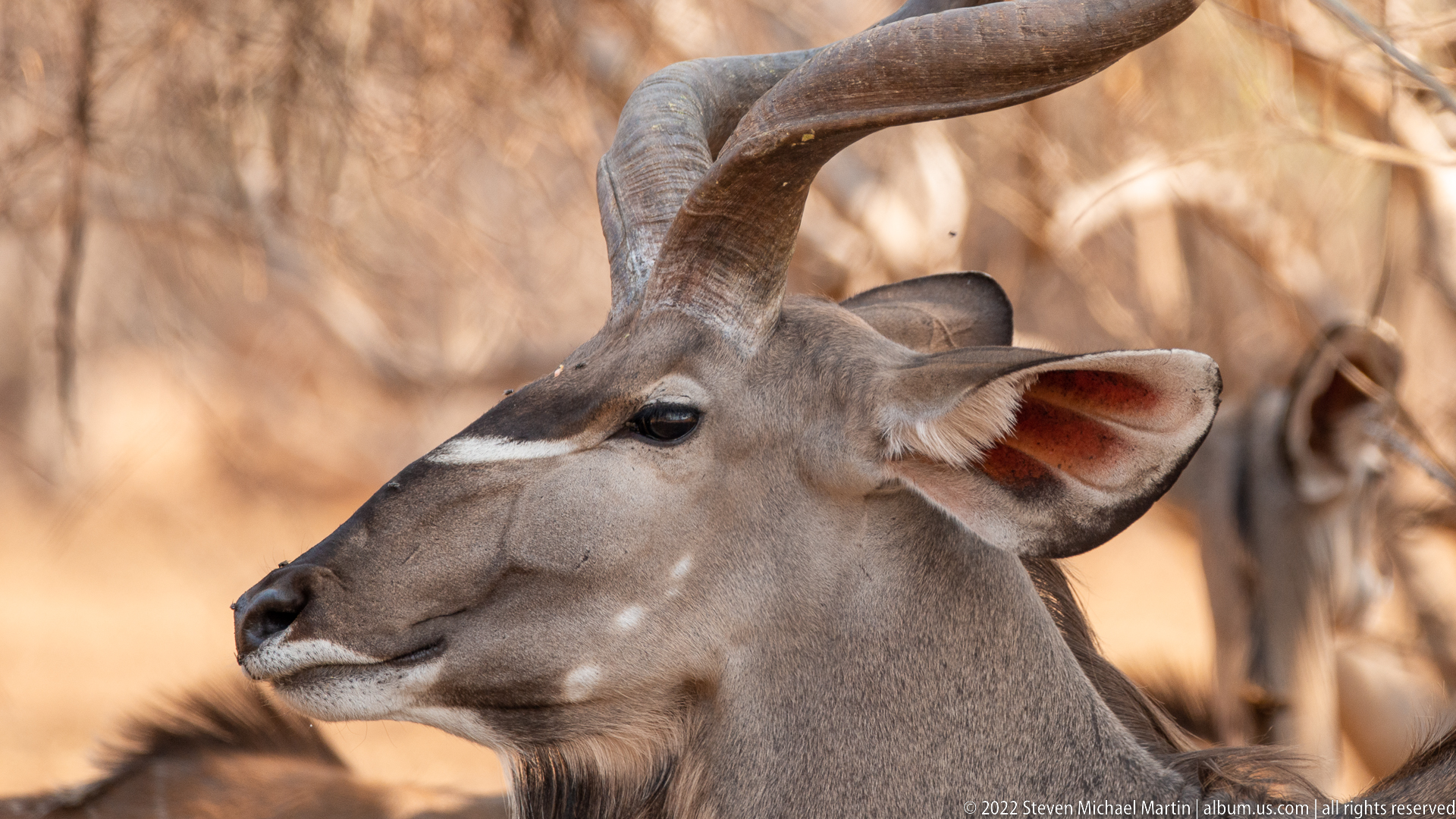
A close profile of a male greater kudu concentrates on the face, broad ears, and one sweeping turn of the spiral horns. Soft gray fur, pale cheek markings, and the dark muzzle are rendered in detail against a warm, blurred woodland background. The compressed composition turns the animal’s elaborate horn geometry into the dominant visual element.
Caption
A close profile of a male greater kudu concentrates on the face, broad ears, and one sweeping turn of the spiral horns. Soft gray fur, pale cheek markings, and the dark muzzle are rendered in detail against a warm, blurred woodland background. The compressed composition turns the animal’s elaborate horn geometry into the dominant visual element.
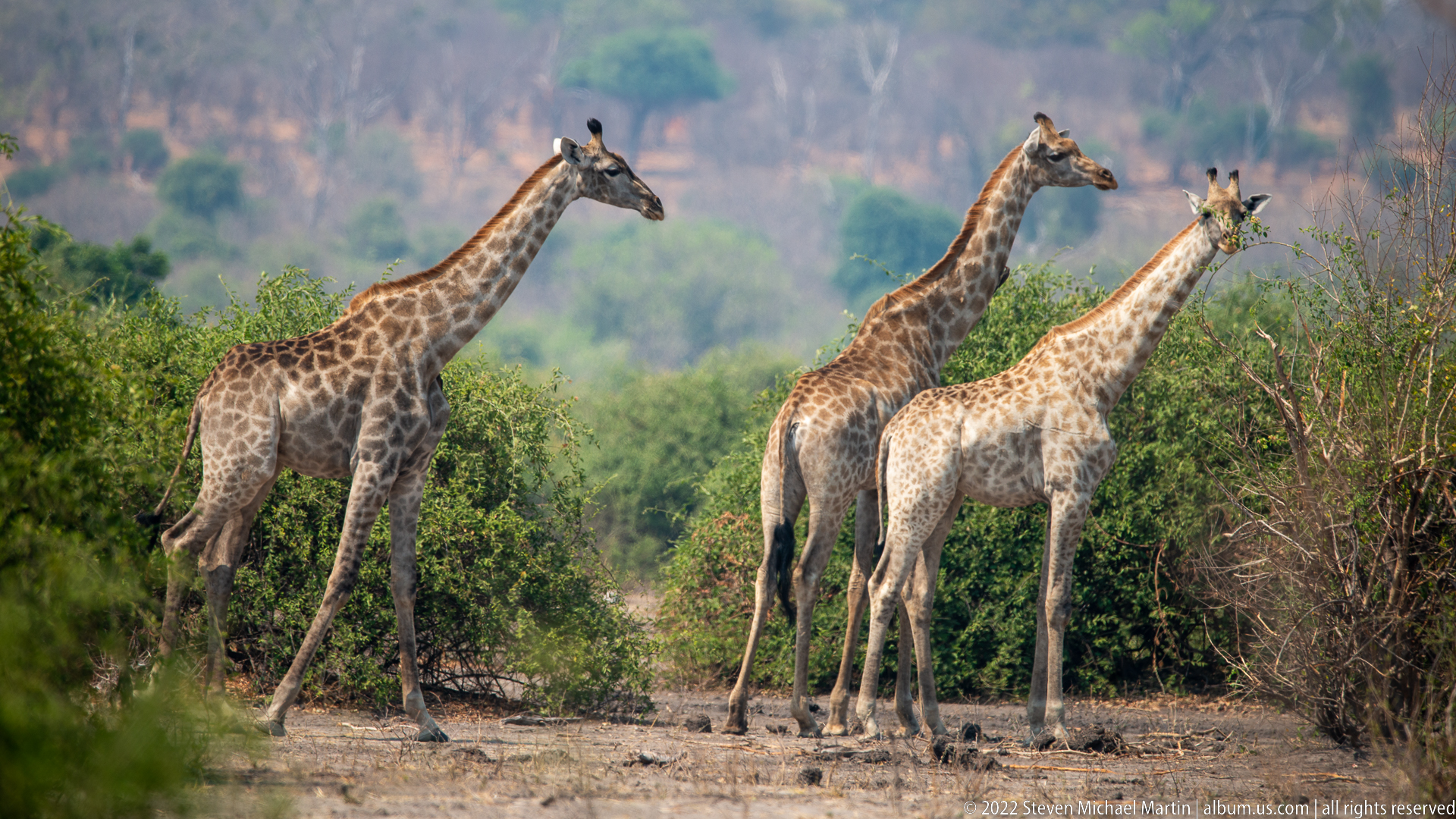
Three giraffes stand at the edge of low woodland, their long necks rising above the surrounding shrubs while they look in different directions. The patterned coats and tall silhouettes are sharply separated from the hazy green background. As a group portrait, the scene emphasizes both their height and the vigilance that allows giraffes to survey broad stretches of Chobe’s woodland-savanna mosaic.
Caption
Three giraffes stand at the edge of low woodland, their long necks rising above the surrounding shrubs while they look in different directions. The patterned coats and tall silhouettes are sharply separated from the hazy green background. As a group portrait, the scene emphasizes both their height and the vigilance that allows giraffes to survey broad stretches of Chobe’s woodland-savanna mosaic.
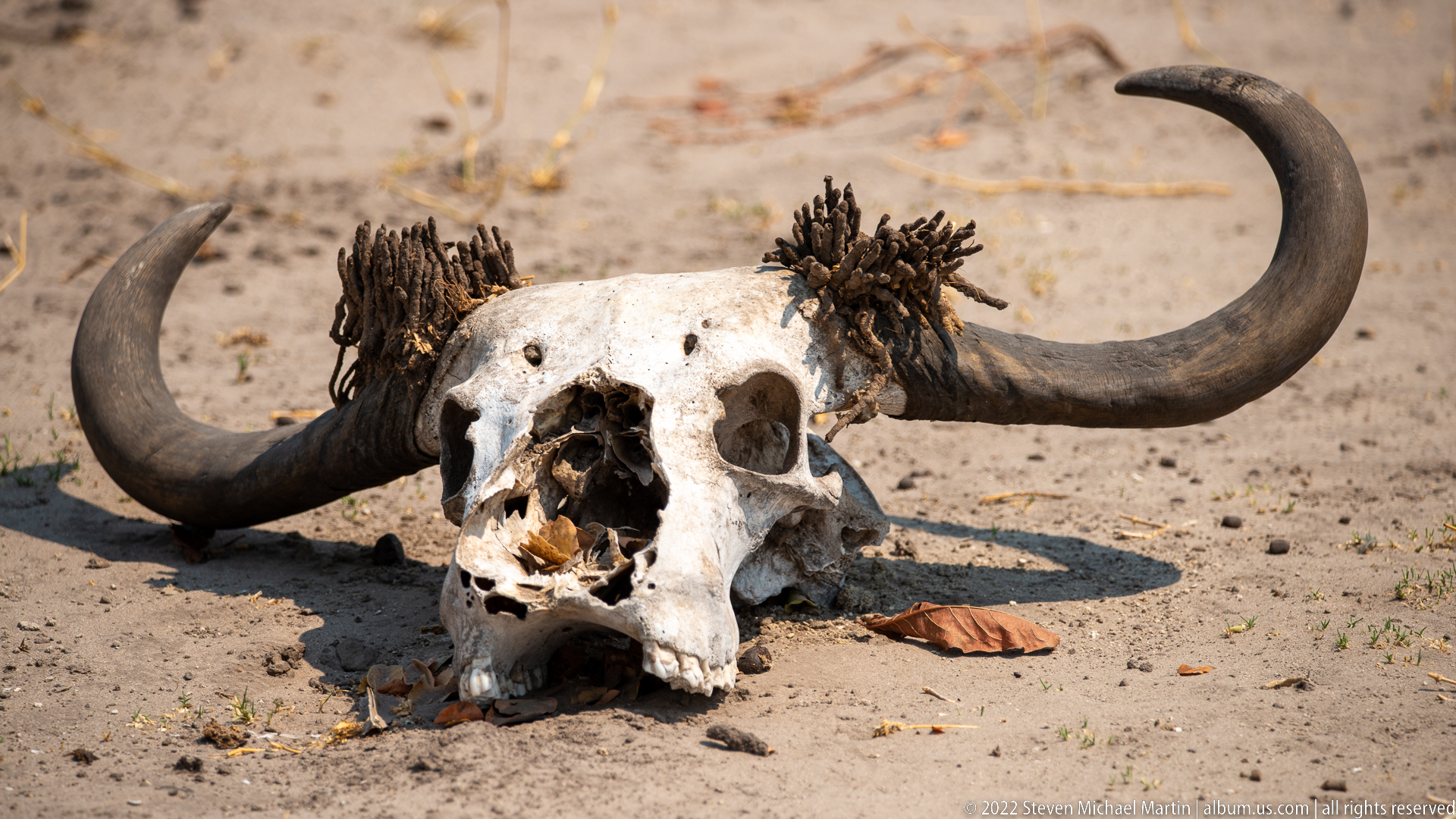
A weathered African buffalo skull lies on bare sand, its heavy horn bosses and sweeping curved horns still intact. Sun bleaching has whitened much of the bone while dark remnants cling around the horn bases, emphasizing the skull’s massive structure. The isolated remains provide a natural-history detail within the predator-and-herbivore landscape of Chobe National Park.
Caption
A weathered African buffalo skull lies on bare sand, its heavy horn bosses and sweeping curved horns still intact. Sun bleaching has whitened much of the bone while dark remnants cling around the horn bases, emphasizing the skull’s massive structure. The isolated remains provide a natural-history detail within the predator-and-herbivore landscape of Chobe National Park.
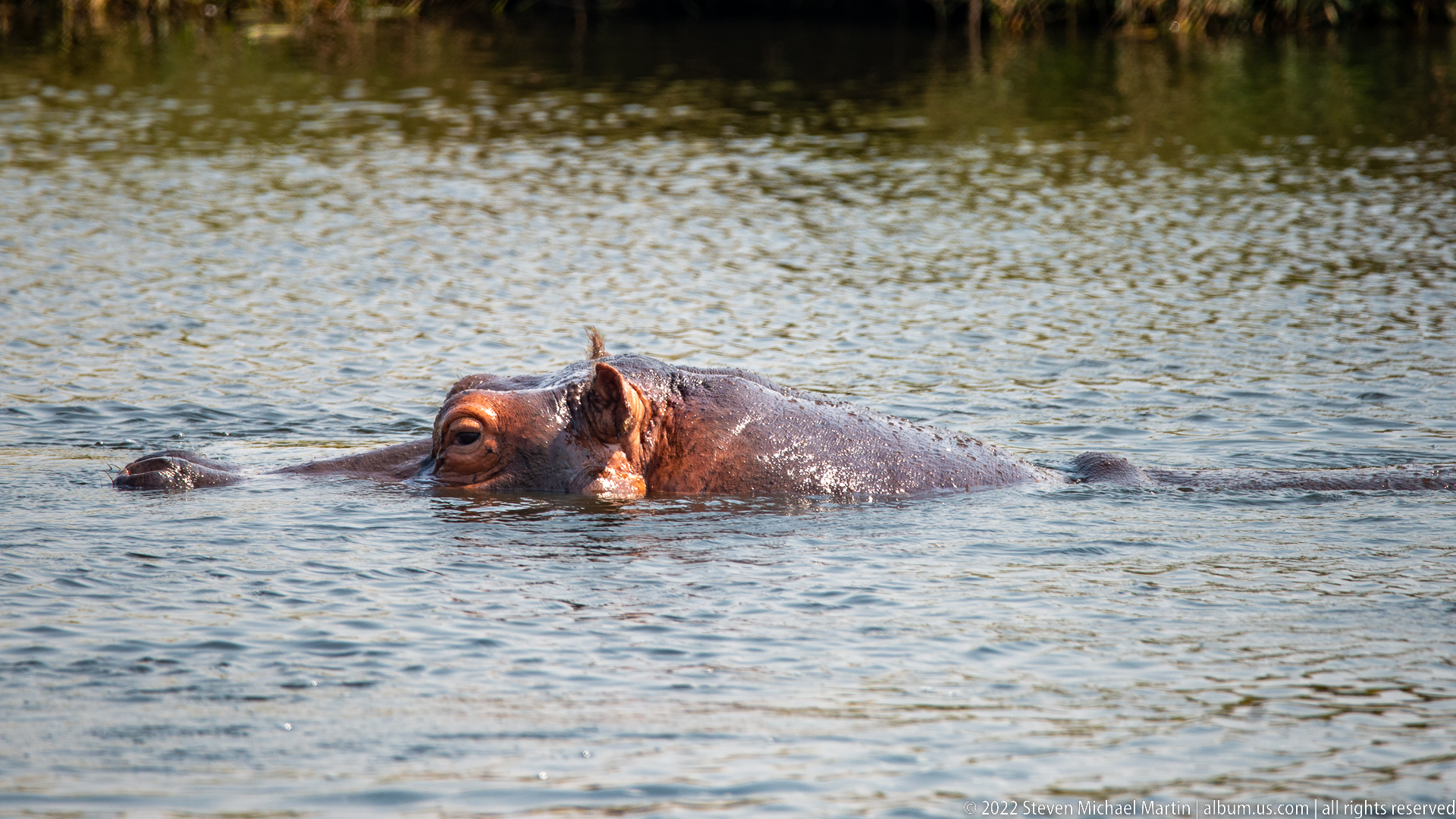
A common hippopotamus moves almost fully submerged through calm water, with only the eyes, ears, nostrils, and upper back breaking the surface. This low profile is typical of hippos traveling or resting in deep water, where their sensory organs remain above the surface while most of the body stays concealed. Ripples spread gently around the animal’s broad head.
Caption
A common hippopotamus moves almost fully submerged through calm water, with only the eyes, ears, nostrils, and upper back breaking the surface. This low profile is typical of hippos traveling or resting in deep water, where their sensory organs remain above the surface while most of the body stays concealed. Ripples spread gently around the animal’s broad head.
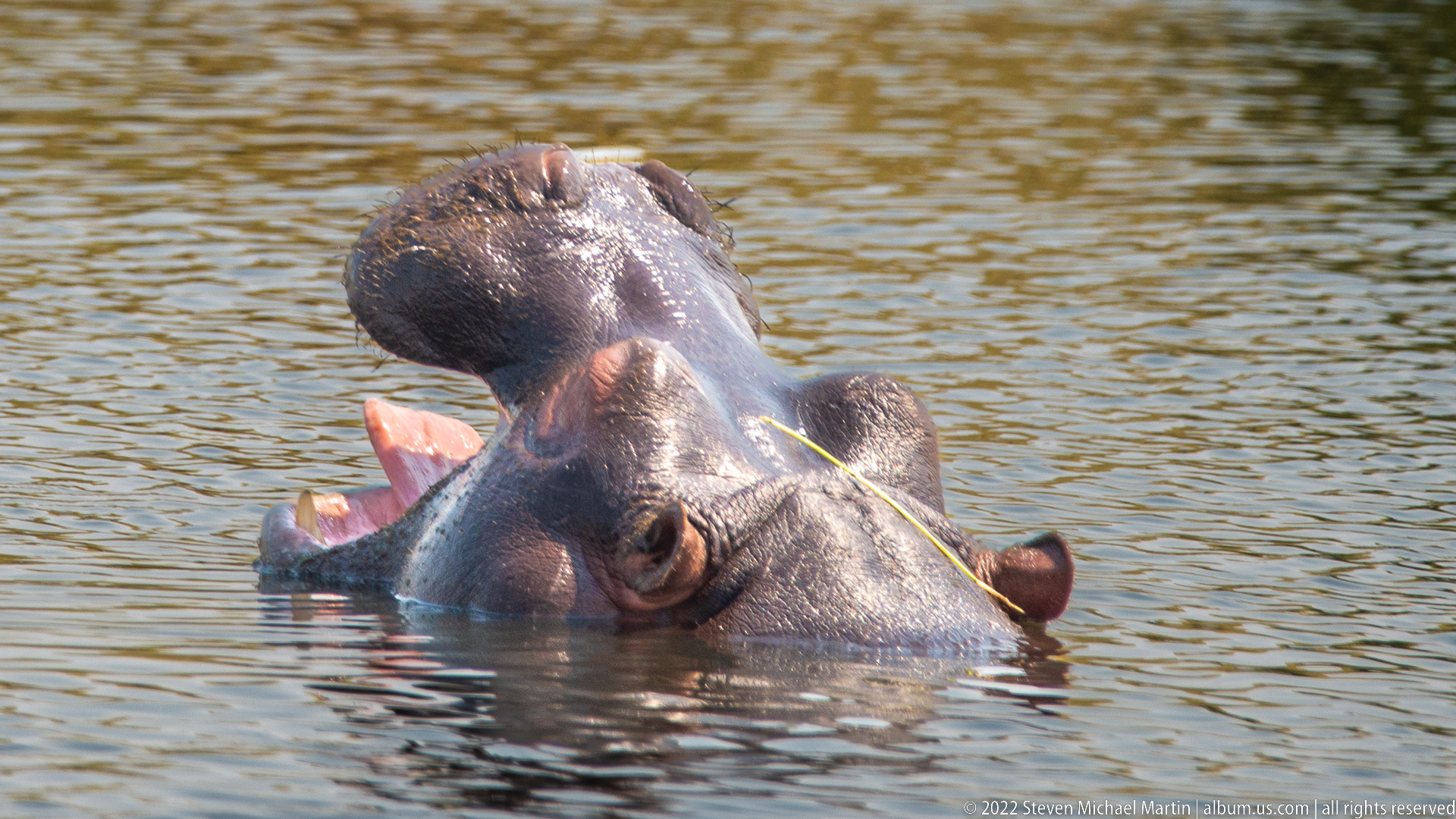
A hippopotamus opens its mouth widely at the water’s surface, exposing the pink interior and large canine teeth while another hippo’s head rises nearby. The dramatic gape is a common display used in social and territorial interactions as well as routine jaw stretching. Sunlight on the wet skin and open mouth makes the animal’s formidable head structure especially clear.
Caption
A hippopotamus opens its mouth widely at the water’s surface, exposing the pink interior and large canine teeth while another hippo’s head rises nearby. The dramatic gape is a common display used in social and territorial interactions as well as routine jaw stretching. Sunlight on the wet skin and open mouth makes the animal’s formidable head structure especially clear.
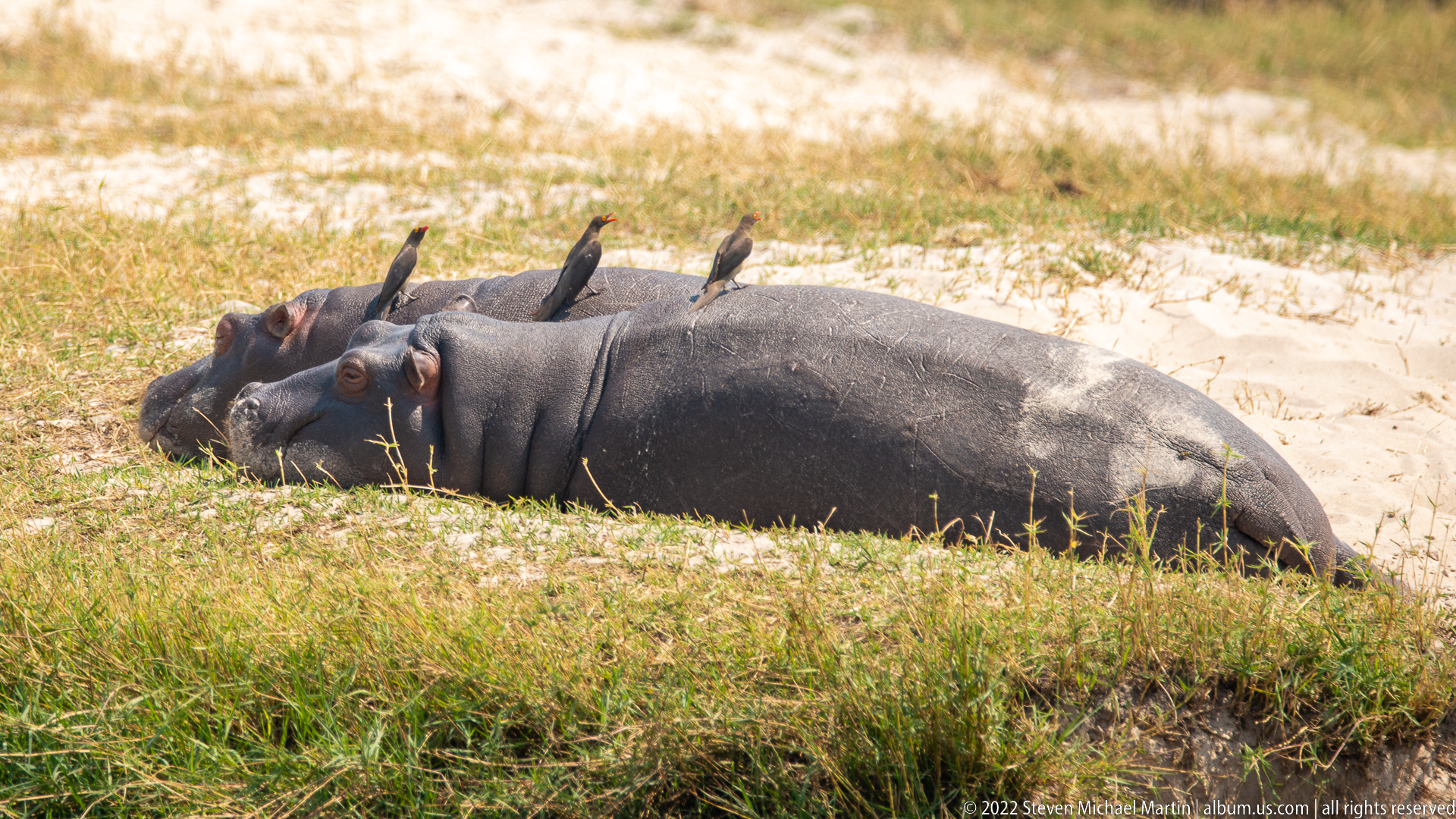
Several hippopotamuses rest shoulder-to-shoulder on a grassy, sandy bank, their dark bodies glistening after time in the water. A few small birds perch on their backs, using the large mammals as elevated resting points. The scene contrasts the hippo’s aquatic reputation with its regular emergence onto land for rest and grazing.
Caption
Several hippopotamuses rest shoulder-to-shoulder on a grassy, sandy bank, their dark bodies glistening after time in the water. A few small birds perch on their backs, using the large mammals as elevated resting points. The scene contrasts the hippo’s aquatic reputation with its regular emergence onto land for rest and grazing.

A broad view shows hippopotamuses occupying both sides of the waterline: one animal rests on the grassy bank while several others float with only their heads exposed. The composition makes the species’ amphibious routine especially clear, linking terrestrial resting space with the cooling refuge of the channel below.
Caption
A broad view shows hippopotamuses occupying both sides of the waterline: one animal rests on the grassy bank while several others float with only their heads exposed. The composition makes the species’ amphibious routine especially clear, linking terrestrial resting space with the cooling refuge of the channel below.
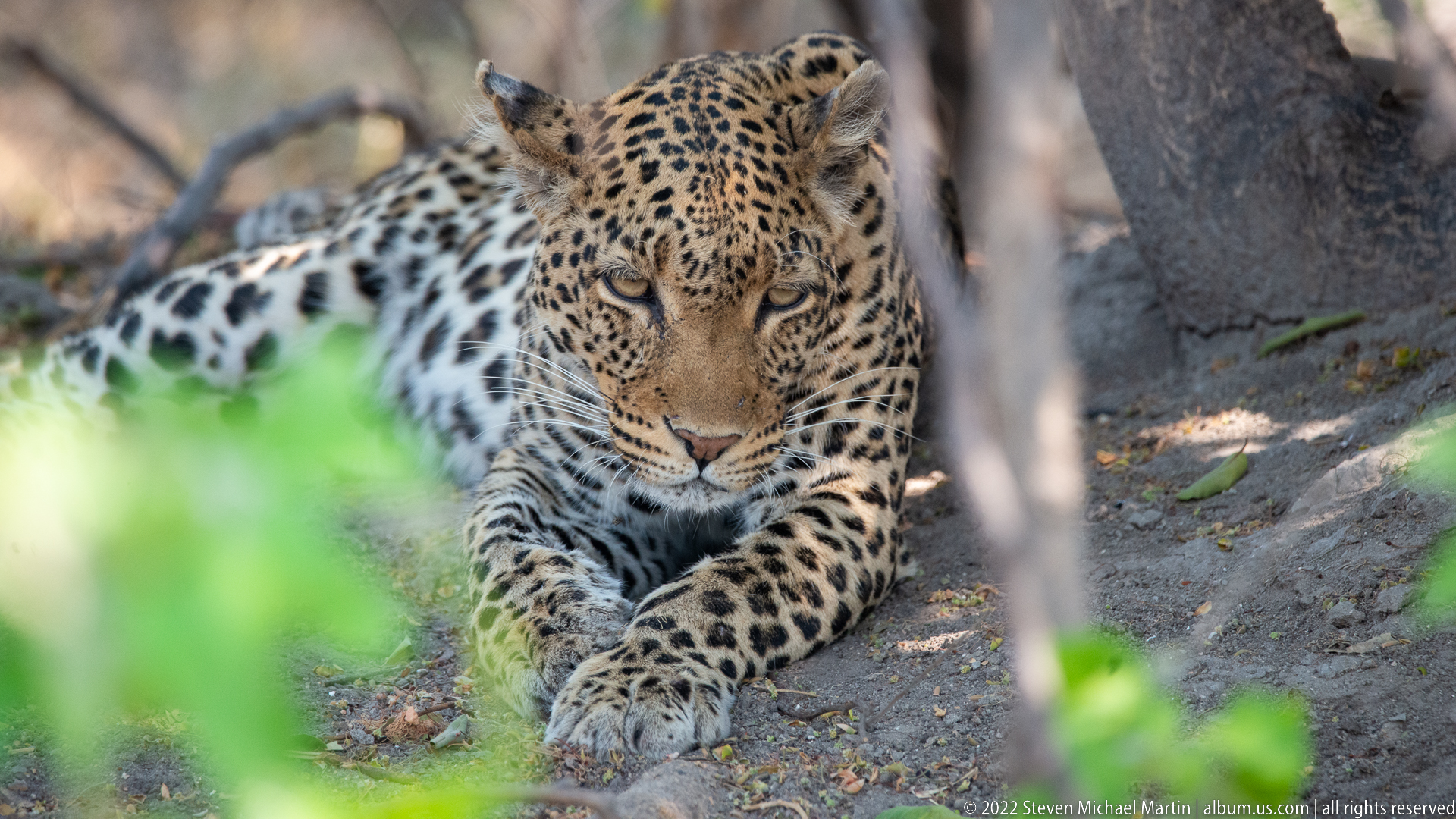
An African leopard rests in deep shade beneath trees, facing the camera through a screen of branches and blurred foliage. The golden coat, black rosettes, pale underparts, and powerful forepaws are visible despite the concealment. The partially obstructed view evokes the cat’s characteristic use of cover, where broken light and vegetation help its patterned coat blend into woodland shadows.
Caption
An African leopard rests in deep shade beneath trees, facing the camera through a screen of branches and blurred foliage. The golden coat, black rosettes, pale underparts, and powerful forepaws are visible despite the concealment. The partially obstructed view evokes the cat’s characteristic use of cover, where broken light and vegetation help its patterned coat blend into woodland shadows.
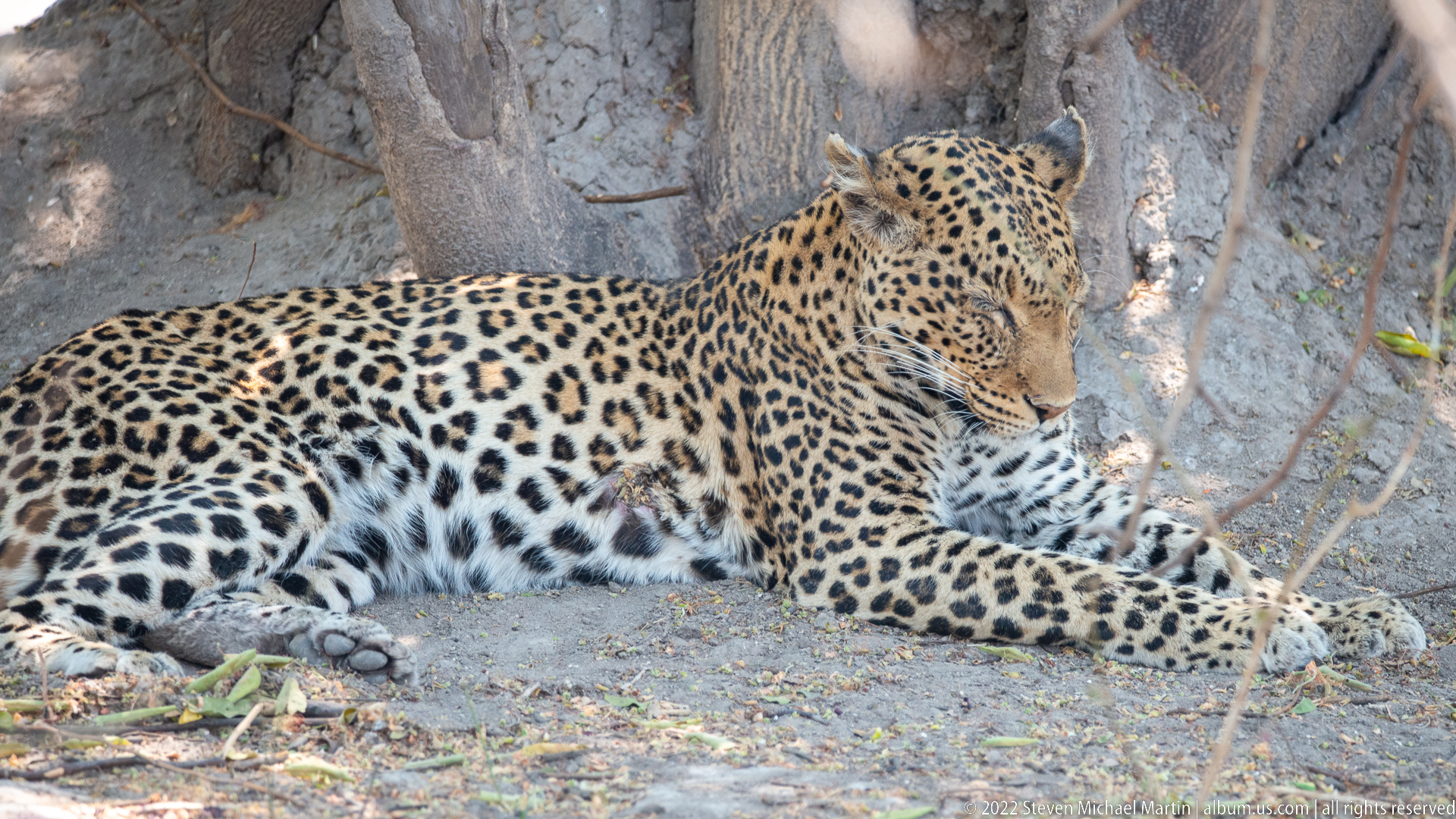
A leopard reclines on bare soil at the base of a large tree, its full torso, extended forelegs, and dense pattern of black rosettes visible in open shade. The cat’s relaxed posture contrasts with its alert, slightly raised head. This wider portrait records how woodland cover provides cool daytime resting sites for Chobe’s solitary big cats.
Caption
A leopard reclines on bare soil at the base of a large tree, its full torso, extended forelegs, and dense pattern of black rosettes visible in open shade. The cat’s relaxed posture contrasts with its alert, slightly raised head. This wider portrait records how woodland cover provides cool daytime resting sites for Chobe’s solitary big cats.

A tight profile of a leopard’s head and shoulders reveals the fine structure of its spotted coat: solid black spots on the face transition to larger rosettes across the neck and body. White whiskers, rounded ears, and the pale muzzle stand out against the shaded tree trunk behind. The close crop offers a detailed field portrait of one of Chobe’s most elusive predators.
Caption
A tight profile of a leopard’s head and shoulders reveals the fine structure of its spotted coat: solid black spots on the face transition to larger rosettes across the neck and body. White whiskers, rounded ears, and the pale muzzle stand out against the shaded tree trunk behind. The close crop offers a detailed field portrait of one of Chobe’s most elusive predators.
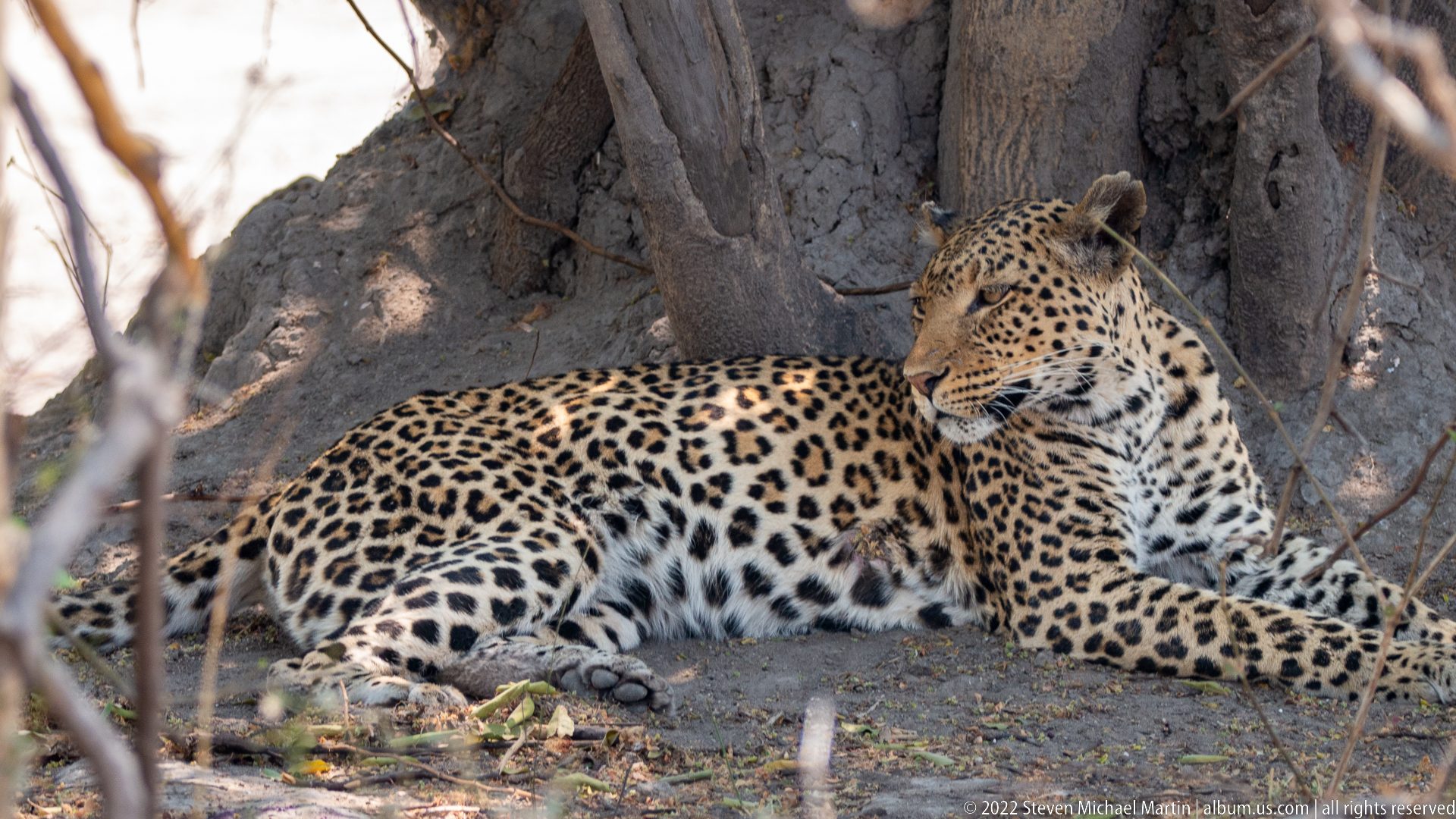
A leopard lies lengthwise in the shade at the base of a tree, head lifted and turned to the side while the body remains relaxed. The broad view shows the cat’s muscular shoulders, long torso, pale belly, and dense rosettes. Tree roots and dry leaf litter form a sheltered daytime resting place within Chobe’s woodland.
Caption
A leopard lies lengthwise in the shade at the base of a tree, head lifted and turned to the side while the body remains relaxed. The broad view shows the cat’s muscular shoulders, long torso, pale belly, and dense rosettes. Tree roots and dry leaf litter form a sheltered daytime resting place within Chobe’s woodland.
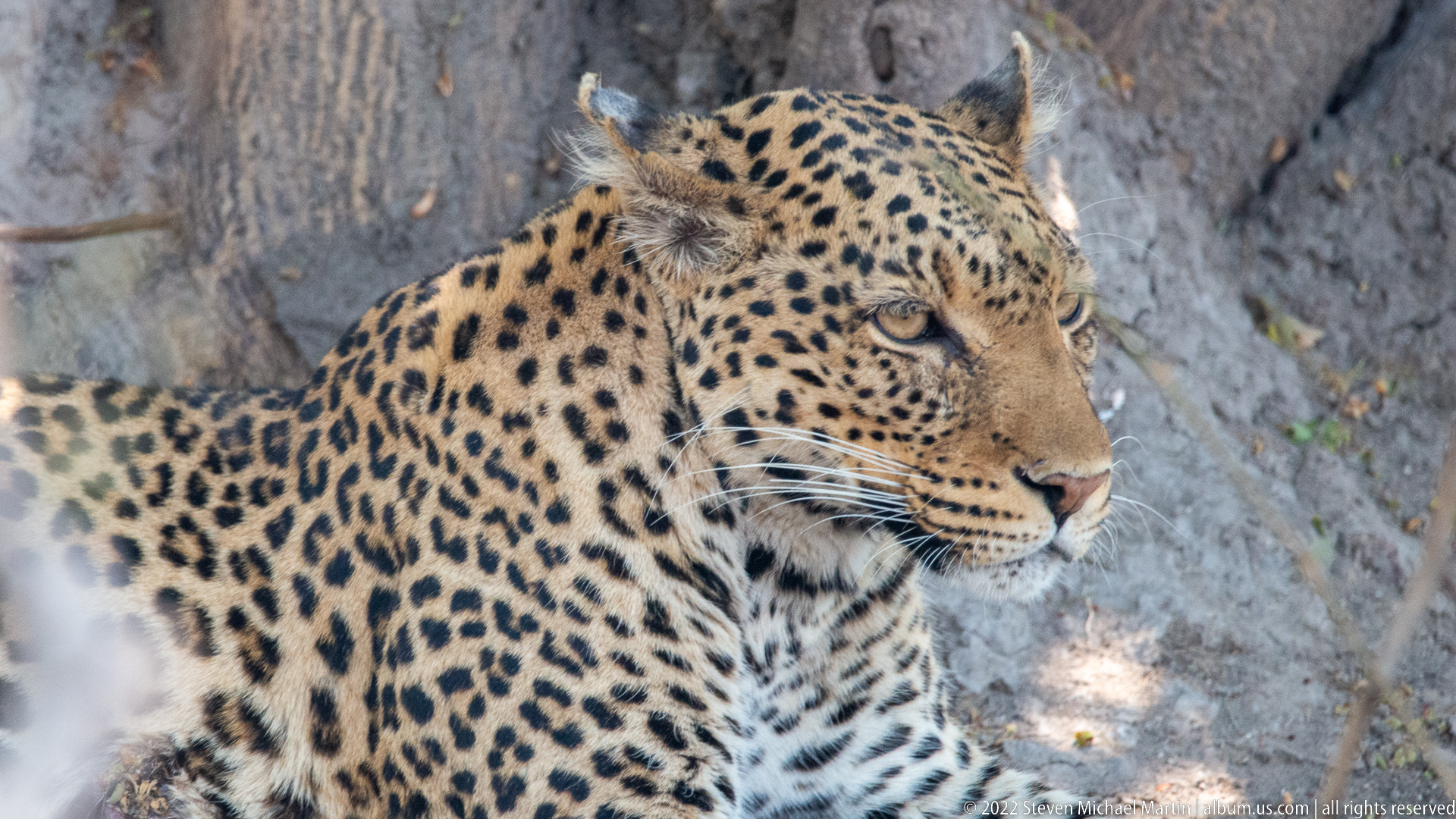
A resting leopard raises its head and looks intently to the side, ears angled forward and eyes open. The close framing emphasizes alertness without showing any overt movement, while the shaded coat retains crisp black rosettes against warm golden fur. The cat’s poised expression suggests watchfulness even during a period of rest.
Caption
A resting leopard raises its head and looks intently to the side, ears angled forward and eyes open. The close framing emphasizes alertness without showing any overt movement, while the shaded coat retains crisp black rosettes against warm golden fur. The cat’s poised expression suggests watchfulness even during a period of rest.
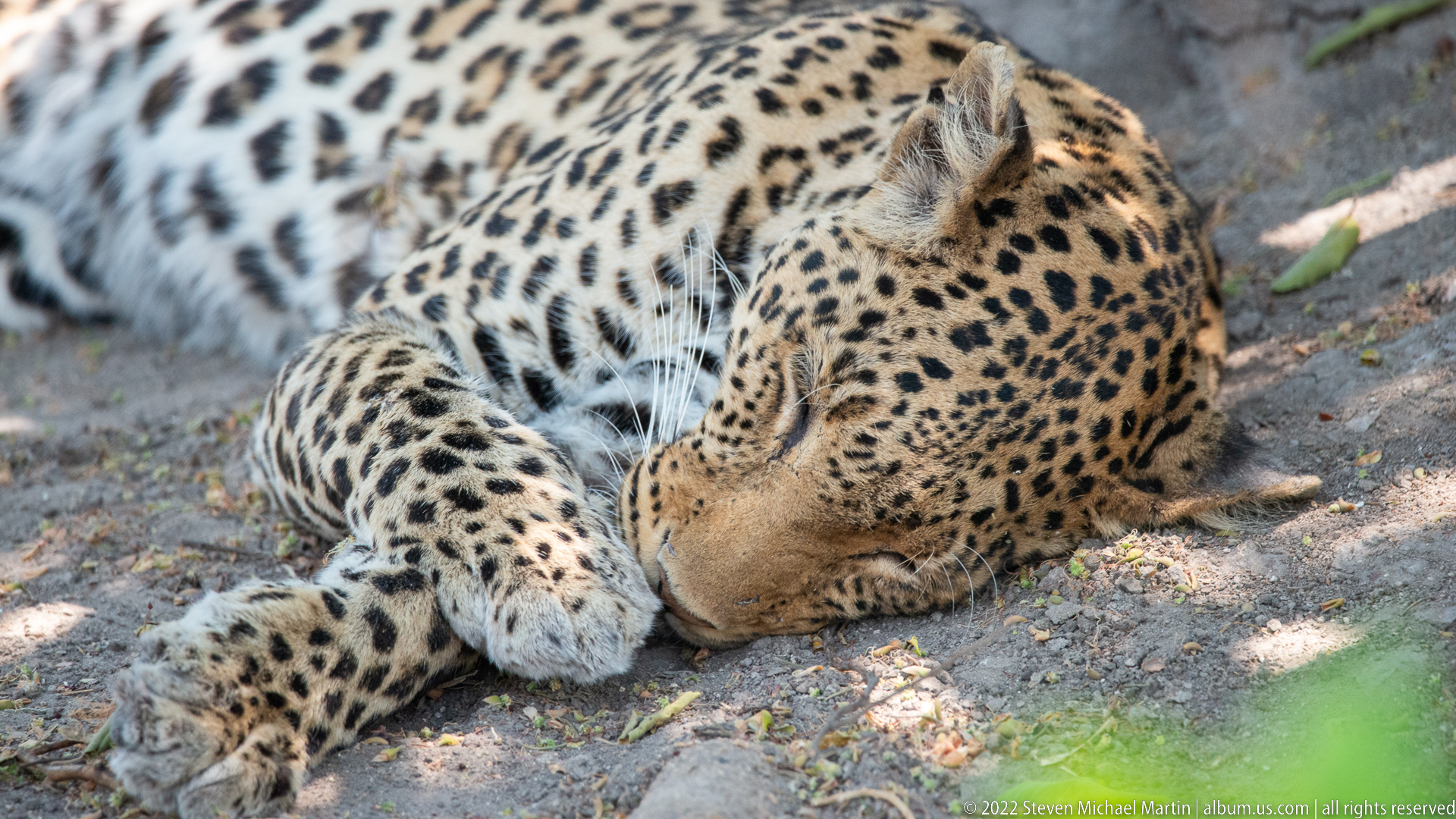
A leopard bends its head toward a foreleg while resting on the ground, appearing to groom or lick the paw and lower limb. The curled posture brings the spotted forelegs, muzzle, and whiskers together in a compact behavioral study. Dappled woodland light falls across the rosetted coat while the cat remains sheltered in shade.
Caption
A leopard bends its head toward a foreleg while resting on the ground, appearing to groom or lick the paw and lower limb. The curled posture brings the spotted forelegs, muzzle, and whiskers together in a compact behavioral study. Dappled woodland light falls across the rosetted coat while the cat remains sheltered in shade.
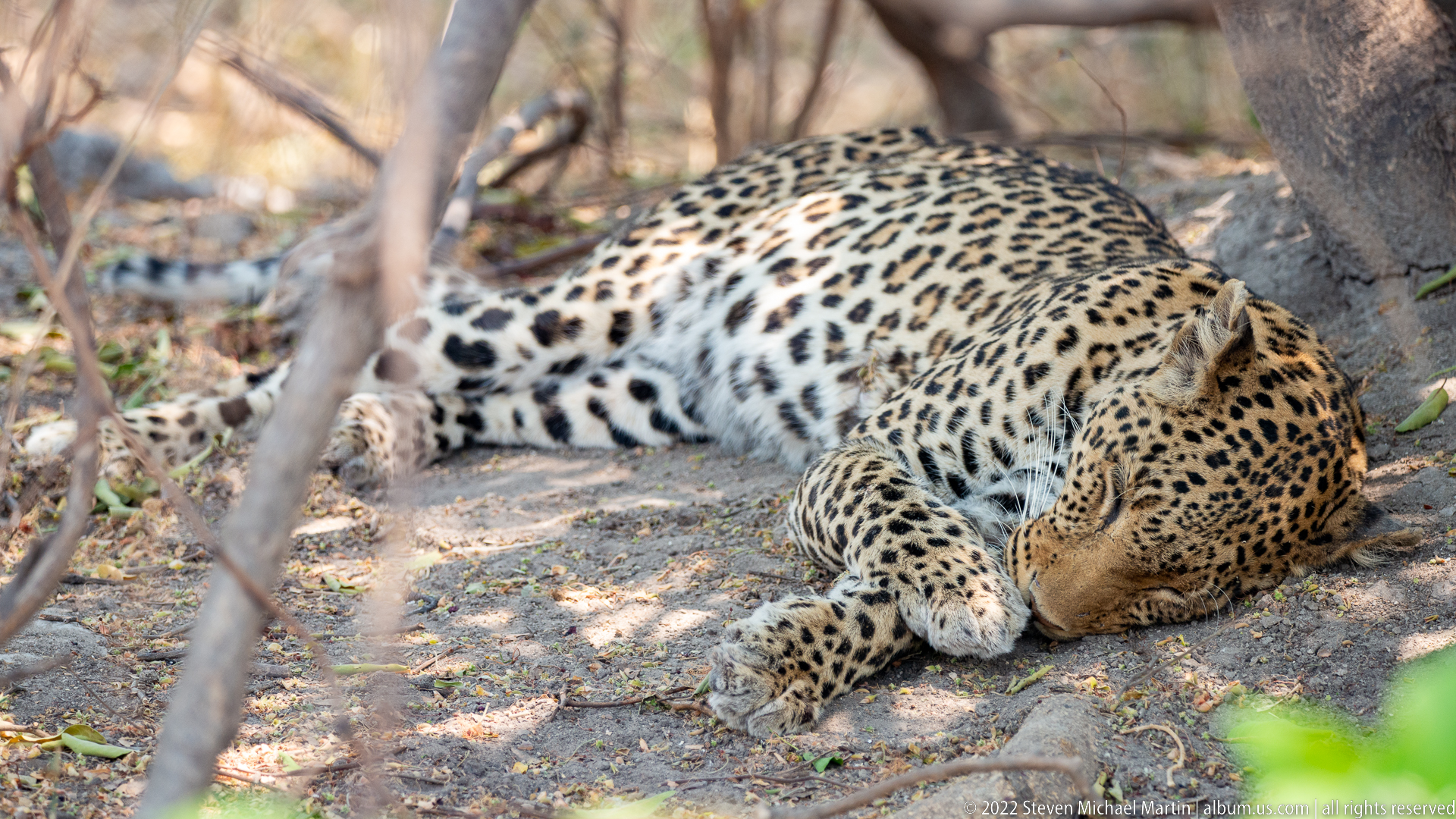
A leopard lies fully relaxed on the woodland floor with its head lowered onto crossed forepaws and eyes closed. The wider composition shows the long, rosetted body stretched beneath thin branches and mottled shade. Unlike the alert portraits nearby, this frame documents a quiet resting phase, when the predator conserves energy during the heat of the day.
Caption
A leopard lies fully relaxed on the woodland floor with its head lowered onto crossed forepaws and eyes closed. The wider composition shows the long, rosetted body stretched beneath thin branches and mottled shade. Unlike the alert portraits nearby, this frame documents a quiet resting phase, when the predator conserves energy during the heat of the day.
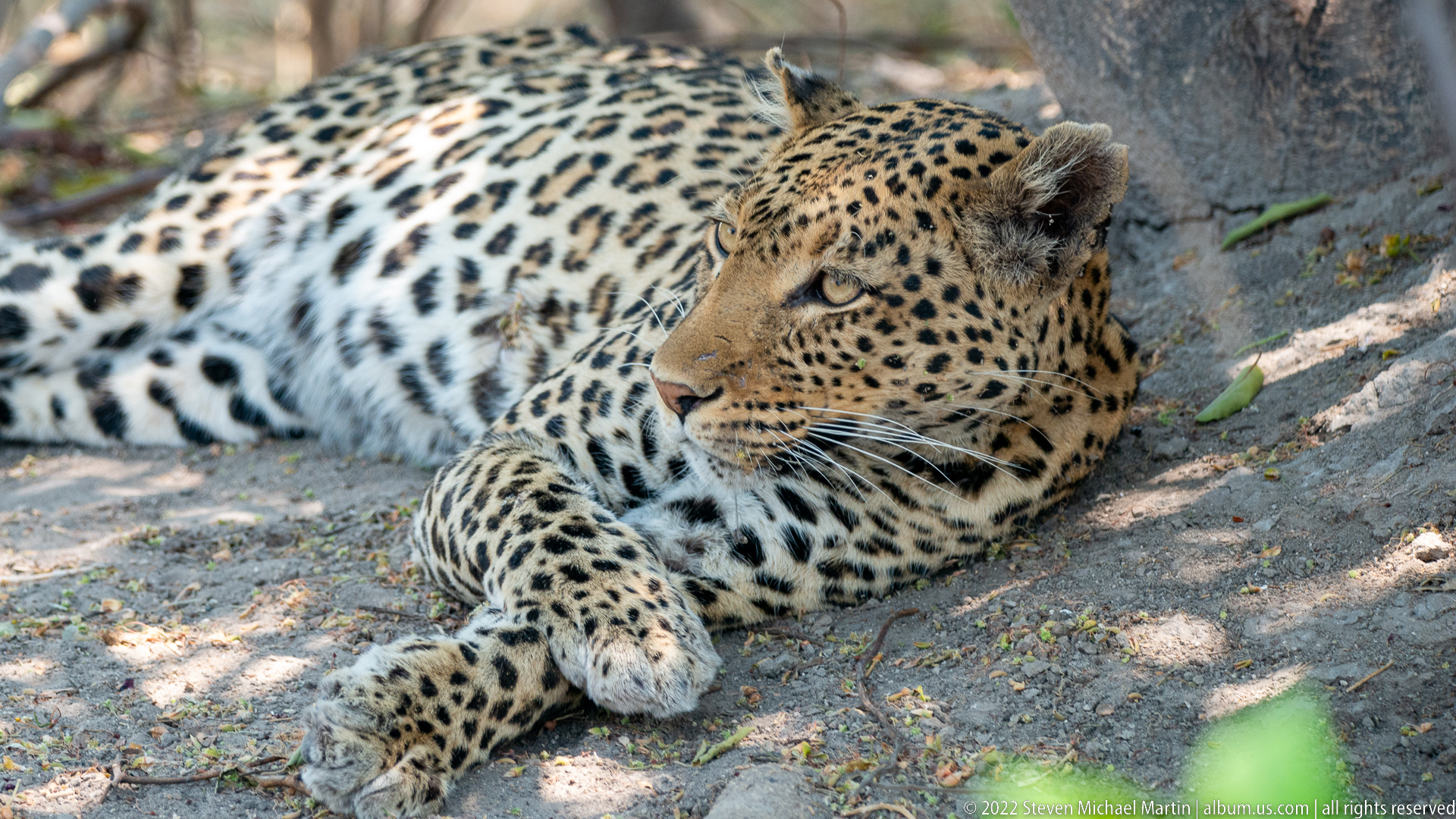
A leopard rests on folded forelegs while lifting its head to watch something beyond the frame. The close view combines a relaxed body with an attentive gaze, showing the cat’s pale eyes, long whiskers, rounded ears, and densely rosetted shoulders. Soft shade from the surrounding woodland reduces glare and brings the coat pattern into sharp relief.
Caption
A leopard rests on folded forelegs while lifting its head to watch something beyond the frame. The close view combines a relaxed body with an attentive gaze, showing the cat’s pale eyes, long whiskers, rounded ears, and densely rosetted shoulders. Soft shade from the surrounding woodland reduces glare and brings the coat pattern into sharp relief.
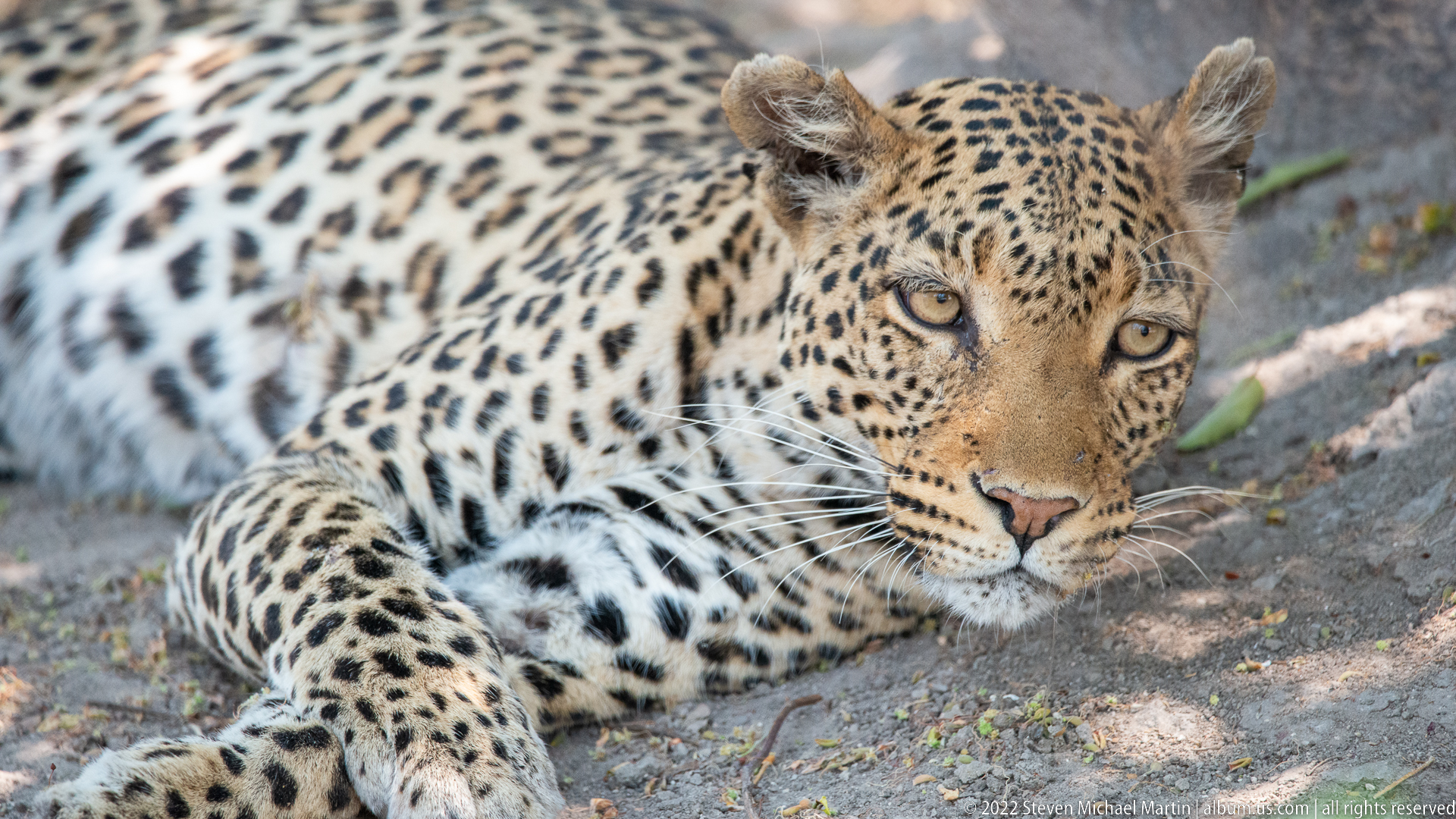
A leopard rests on the ground in dappled woodland shade, one foreleg extended toward the camera and the head held upright. The close view shows pale golden eyes, long white whiskers, and the transition from solid facial spots to larger black rosettes across the shoulders and body. Its relaxed posture contrasts with the attentive forward gaze.
Caption
A leopard rests on the ground in dappled woodland shade, one foreleg extended toward the camera and the head held upright. The close view shows pale golden eyes, long white whiskers, and the transition from solid facial spots to larger black rosettes across the shoulders and body. Its relaxed posture contrasts with the attentive forward gaze.
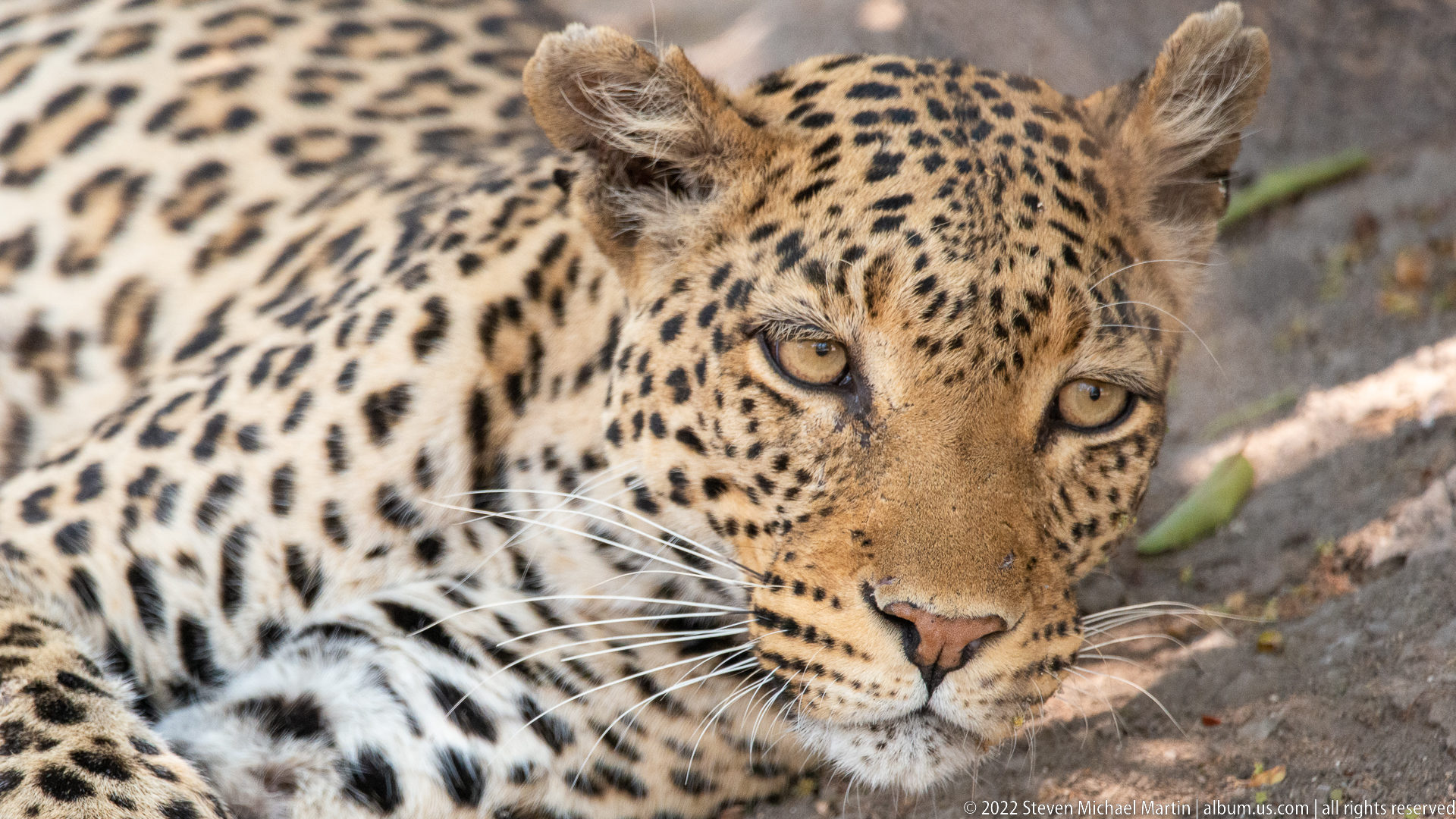
A tightly framed leopard portrait concentrates on the face, eyes, muzzle, and upper shoulders. Black spots and rosettes form a dense pattern across the golden coat, while white whiskers fan from the pale muzzle. The cat looks directly toward the camera, producing a field-guide view that emphasizes facial structure and individual coat markings rather than the surrounding habitat.
Caption
A tightly framed leopard portrait concentrates on the face, eyes, muzzle, and upper shoulders. Black spots and rosettes form a dense pattern across the golden coat, while white whiskers fan from the pale muzzle. The cat looks directly toward the camera, producing a field-guide view that emphasizes facial structure and individual coat markings rather than the surrounding habitat.
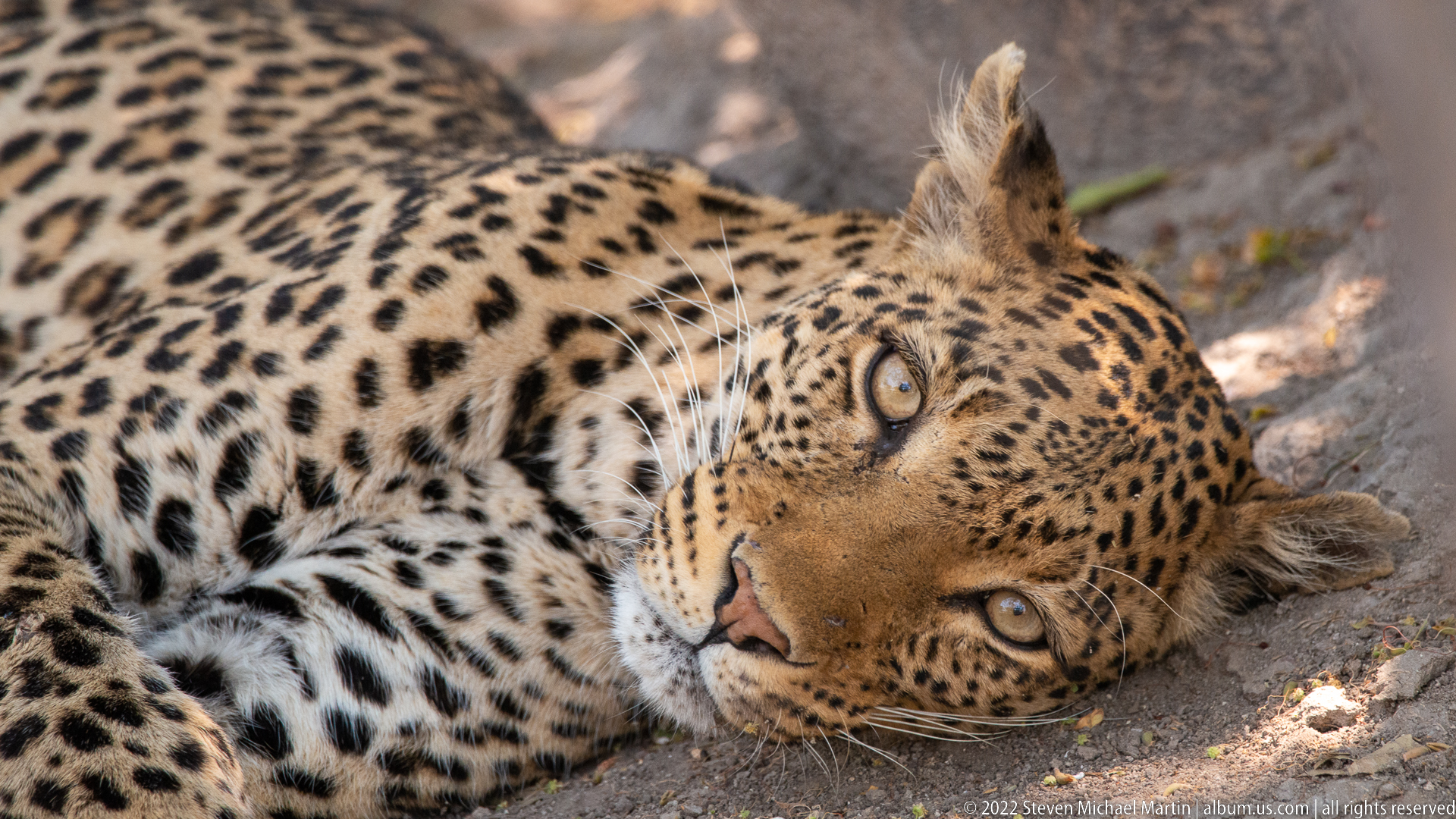
A leopard lies on its side with the head resting against sandy soil, eyes open and directed toward the camera. The low angle brings the cat’s face, whiskers, and rosetted forequarters into sharp detail while the body recedes softly behind. This intimate resting posture differs from the upright portraits nearby, recording a quieter phase of daytime repose.
Caption
A leopard lies on its side with the head resting against sandy soil, eyes open and directed toward the camera. The low angle brings the cat’s face, whiskers, and rosetted forequarters into sharp detail while the body recedes softly behind. This intimate resting posture differs from the upright portraits nearby, recording a quieter phase of daytime repose.
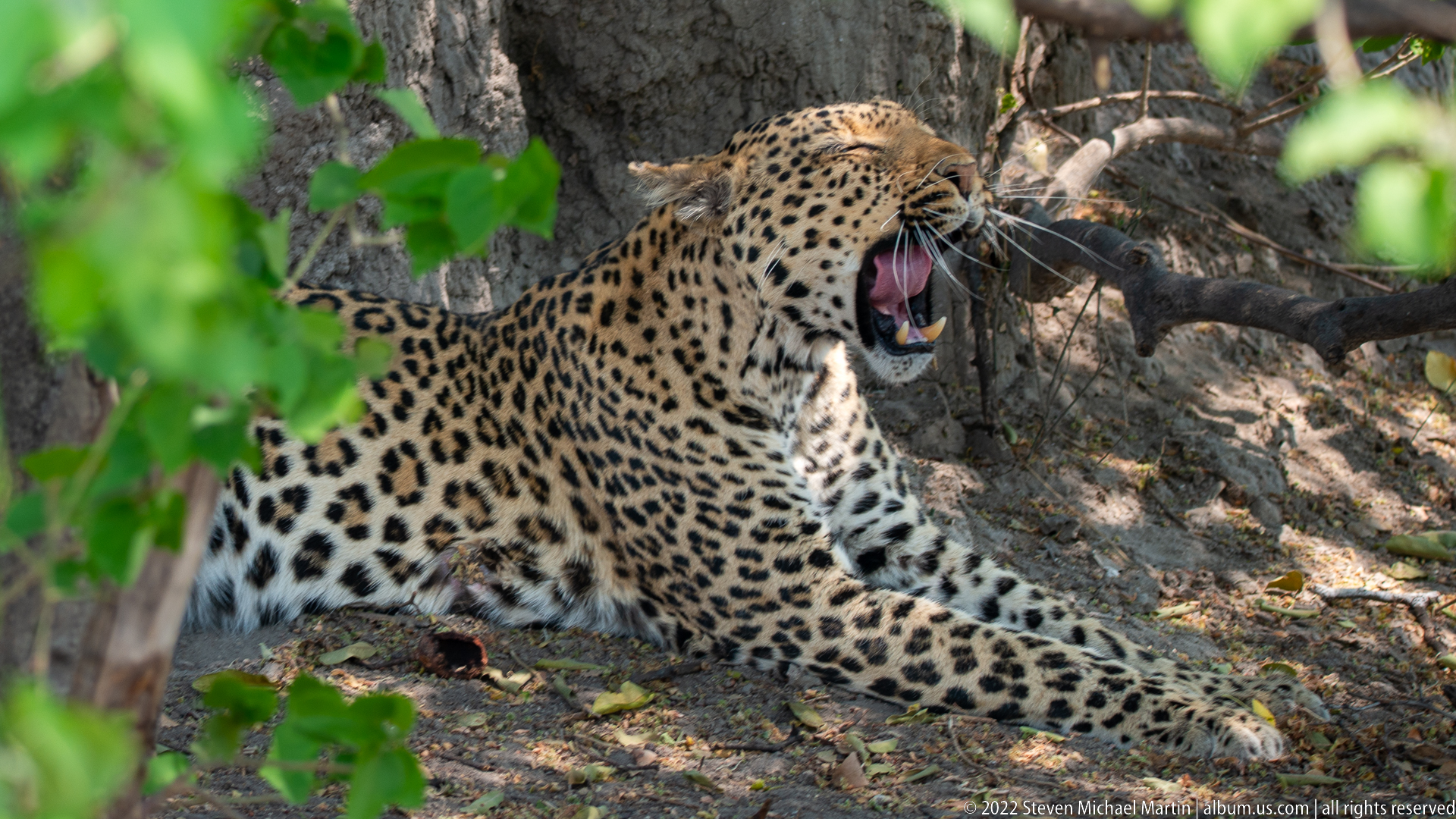
A leopard opens its jaws in a broad yawn while reclining beneath trees, exposing the tongue and large canine teeth. Its body remains stretched along the shaded ground as leafy branches frame the scene. The wide gape offers a clear anatomical view of the mouth and dentition while the relaxed body language indicates a resting animal rather than active aggression.
Caption
A leopard opens its jaws in a broad yawn while reclining beneath trees, exposing the tongue and large canine teeth. Its body remains stretched along the shaded ground as leafy branches frame the scene. The wide gape offers a clear anatomical view of the mouth and dentition while the relaxed body language indicates a resting animal rather than active aggression.
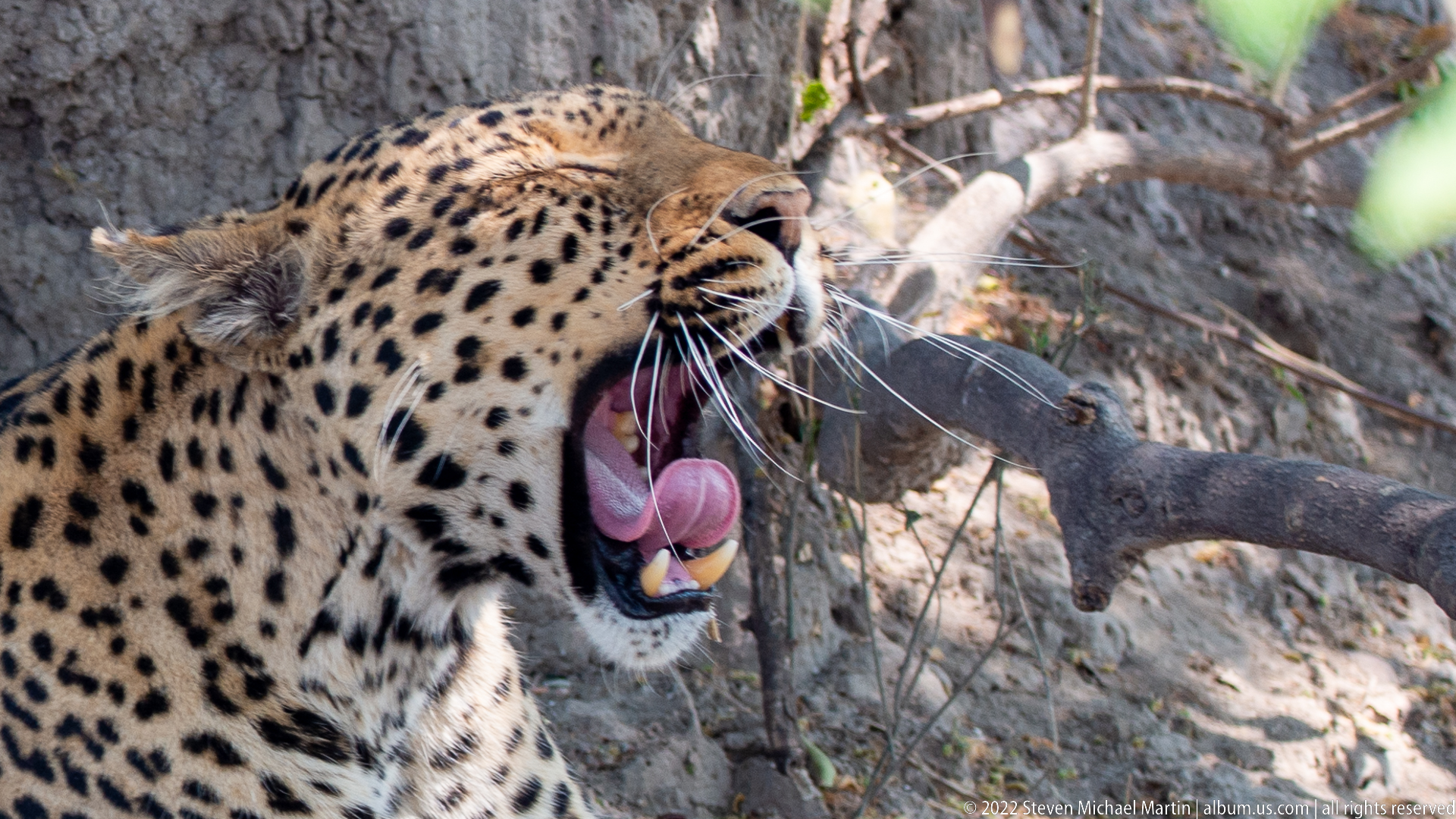
The leopard’s open mouth fills the frame in a close behavioral portrait, revealing a curled pink tongue, long canines, and the dark interior of the jaws. Whiskers sweep forward from the pale muzzle as the head tilts upward beside a tree branch. The tighter crop makes the mechanics of the yawn and the cat’s formidable dentition the principal subject.
Caption
The leopard’s open mouth fills the frame in a close behavioral portrait, revealing a curled pink tongue, long canines, and the dark interior of the jaws. Whiskers sweep forward from the pale muzzle as the head tilts upward beside a tree branch. The tighter crop makes the mechanics of the yawn and the cat’s formidable dentition the principal subject.

A leopard bends over one forepaw and licks the pads while lying in the shade. The raised paw exposes the dark pads and soft underside, contrasting with the spotted foreleg and rosetted body. Grooming is an important maintenance behavior for felids, and this close view records the precise tongue-to-paw contact rather than merely a resting posture.
Caption
A leopard bends over one forepaw and licks the pads while lying in the shade. The raised paw exposes the dark pads and soft underside, contrasting with the spotted foreleg and rosetted body. Grooming is an important maintenance behavior for felids, and this close view records the precise tongue-to-paw contact rather than merely a resting posture.

A giraffe stretches into the crown of a leafy tree, browsing above the surrounding dry woodland and tawny grass. Its long neck rises nearly vertical against the pale sky while the head disappears partly among green leaves. The scene illustrates how giraffes exploit foliage beyond the reach of most other large herbivores in Chobe’s woodland-savanna mosaic.
Caption
A giraffe stretches into the crown of a leafy tree, browsing above the surrounding dry woodland and tawny grass. Its long neck rises nearly vertical against the pale sky while the head disappears partly among green leaves. The scene illustrates how giraffes exploit foliage beyond the reach of most other large herbivores in Chobe’s woodland-savanna mosaic.
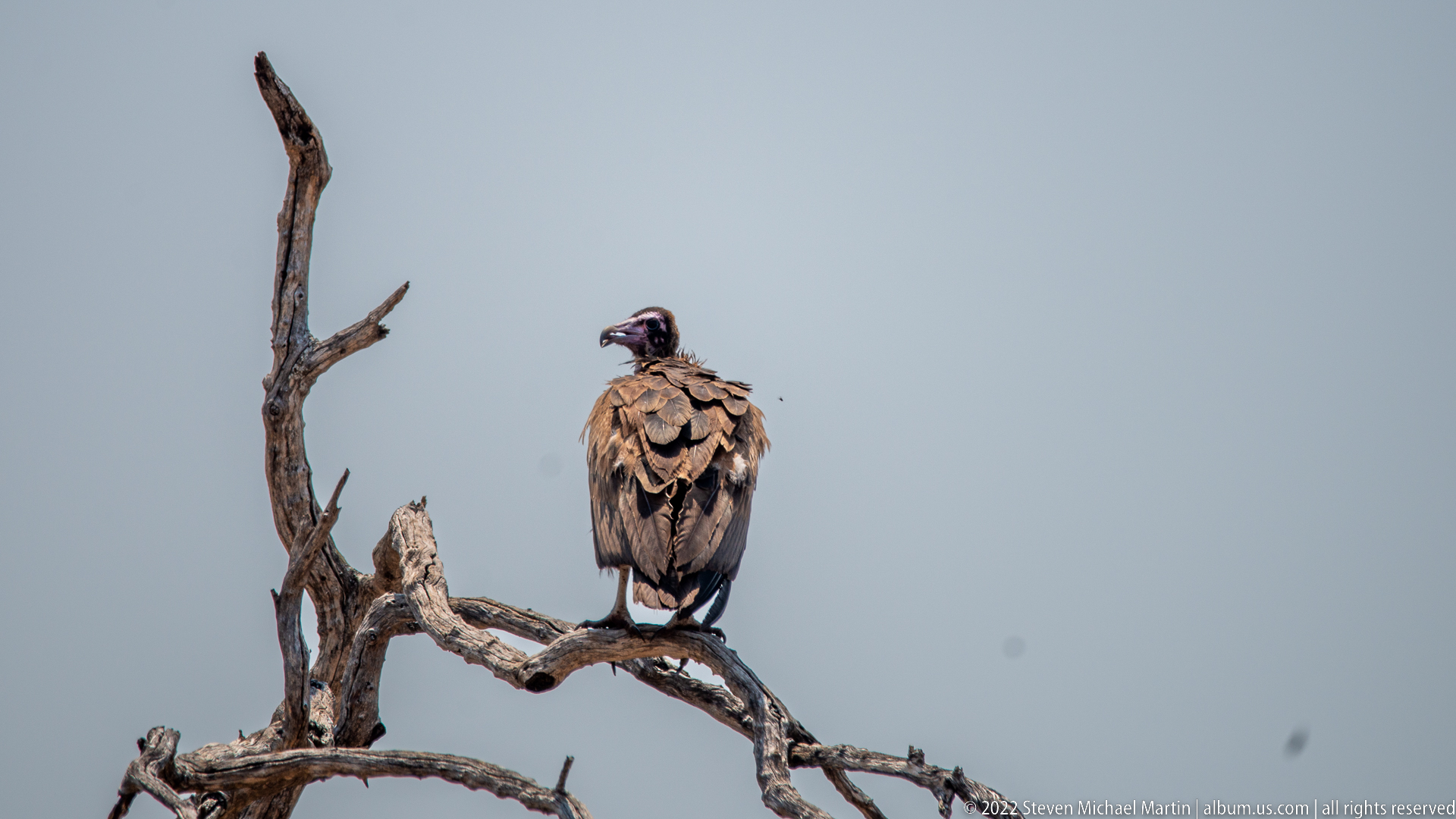
A hooded vulture perches on the bare limb of a dead tree against an open blue-gray sky. Its compact build, dark brown plumage, pale bare face, and slender bill distinguish it from larger, heavier vultures. The isolated perch provides a clear field-guide profile of a scavenger that often searches riverine and savanna habitats for carrion.
Caption
A hooded vulture perches on the bare limb of a dead tree against an open blue-gray sky. Its compact build, dark brown plumage, pale bare face, and slender bill distinguish it from larger, heavier vultures. The isolated perch provides a clear field-guide profile of a scavenger that often searches riverine and savanna habitats for carrion.

A line of plains zebras moves across an open floodplain, the alternating black-and-white stripes repeating rhythmically through the herd. Sparse grass and low wetland vegetation stretch toward a hazy horizon, giving the animals a broad, unobstructed grazing landscape. The distant composition emphasizes herd movement and the scale of Chobe’s river-associated plains.
Caption
A line of plains zebras moves across an open floodplain, the alternating black-and-white stripes repeating rhythmically through the herd. Sparse grass and low wetland vegetation stretch toward a hazy horizon, giving the animals a broad, unobstructed grazing landscape. The distant composition emphasizes herd movement and the scale of Chobe’s river-associated plains.
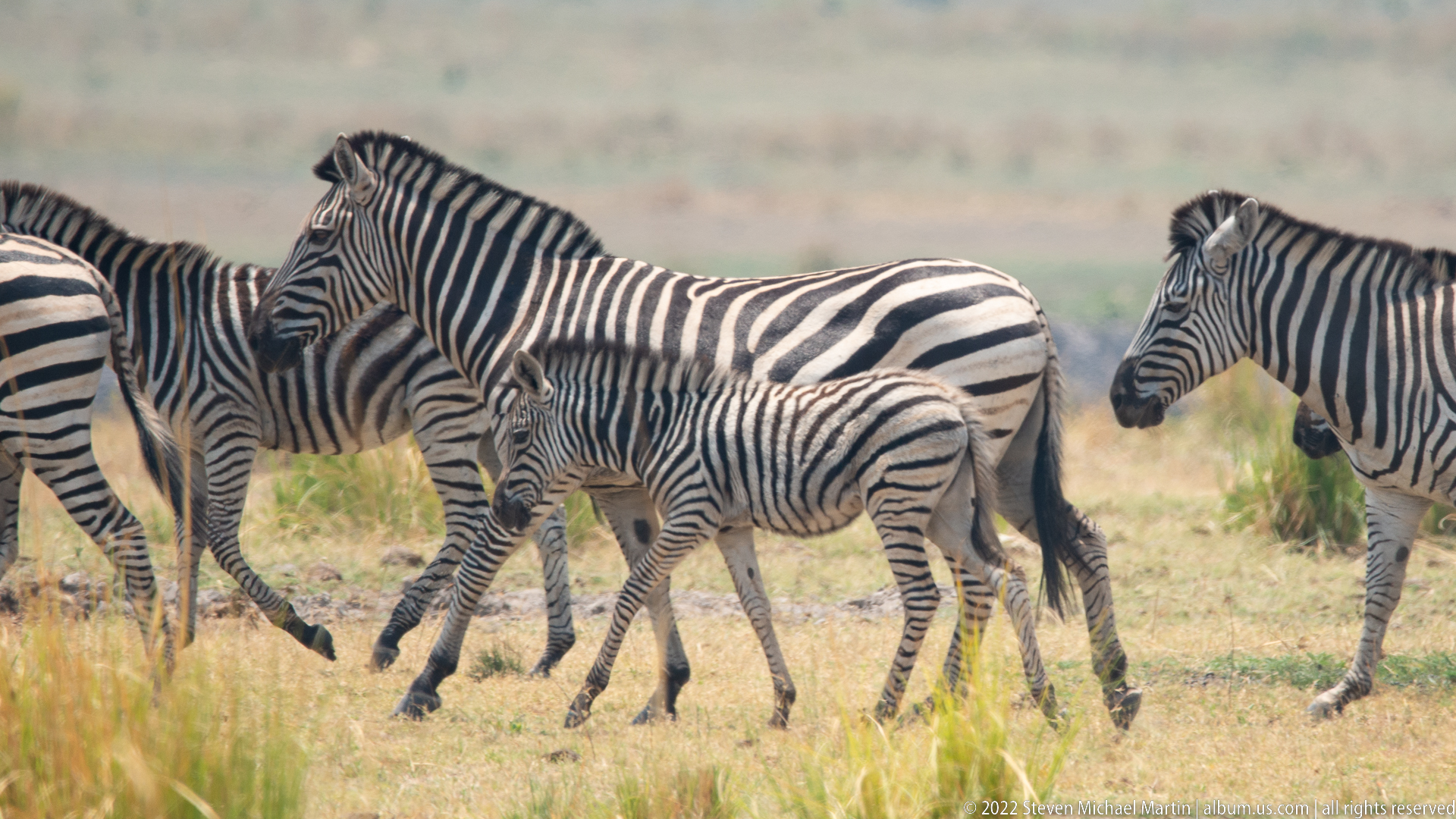
Adult plains zebras walk together through short grass while a foal keeps close to a larger animal near the center. The juvenile’s smaller body, shorter legs, and finer stripes distinguish it from the surrounding adults. The close herd view records the family structure of zebras using Chobe’s open floodplain for grazing and movement.
Caption
Adult plains zebras walk together through short grass while a foal keeps close to a larger animal near the center. The juvenile’s smaller body, shorter legs, and finer stripes distinguish it from the surrounding adults. The close herd view records the family structure of zebras using Chobe’s open floodplain for grazing and movement.

An adult male impala walks across short grass with a herd feeding behind him. Long, lyre-shaped ridged horns curve upward and outward above the narrow face, while the reddish-tan coat grades to a pale belly. The side view provides a clear field-guide study of a mature ram and separates his horned profile from the mostly hornless females in the background.
Caption
An adult male impala walks across short grass with a herd feeding behind him. Long, lyre-shaped ridged horns curve upward and outward above the narrow face, while the reddish-tan coat grades to a pale belly. The side view provides a clear field-guide study of a mature ram and separates his horned profile from the mostly hornless females in the background.
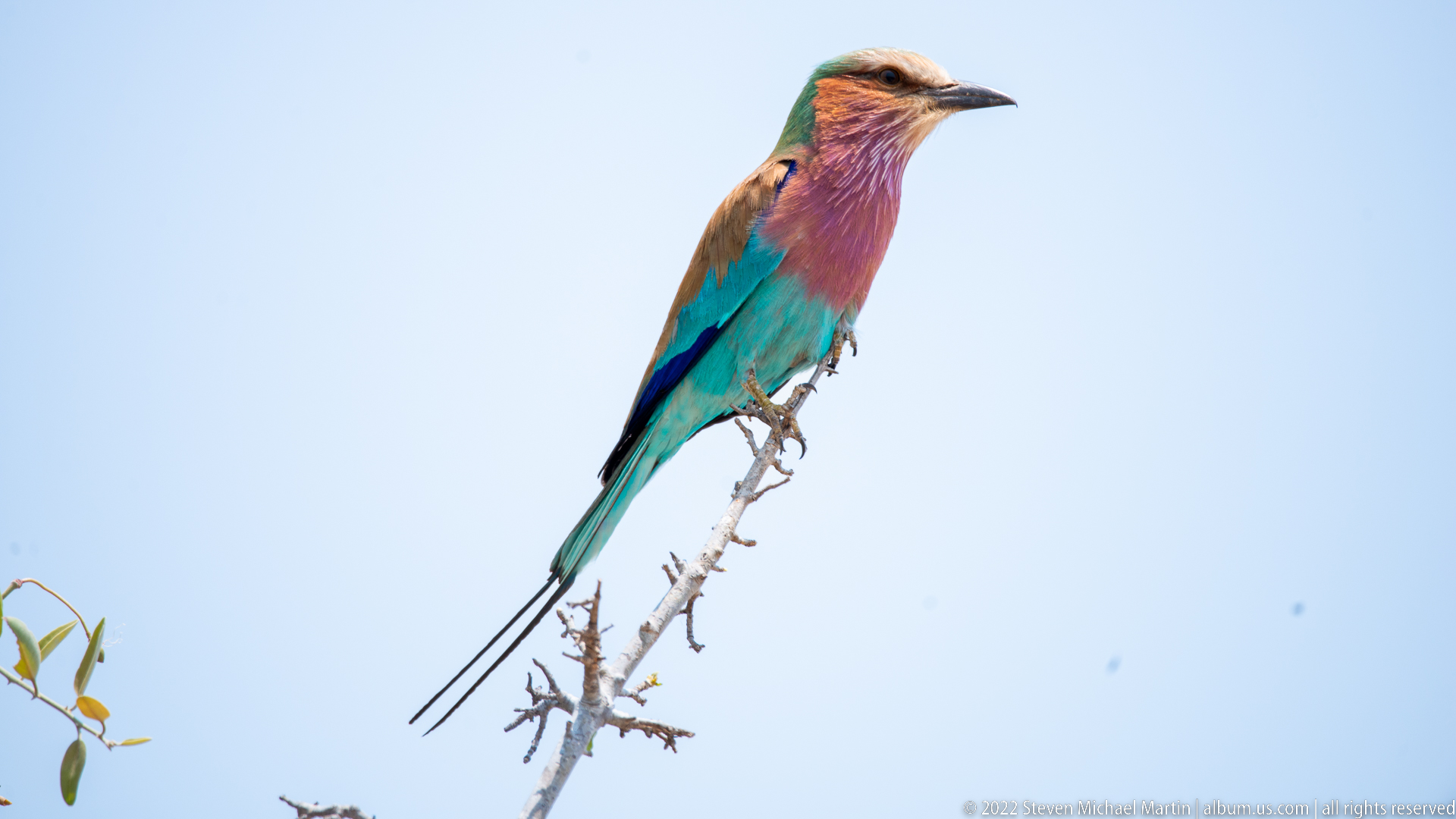
A lilac-breasted roller sits upright at the tip of a thin branch, its turquoise belly and wings contrasting strongly with the purple-lilac throat and breast. Long tail streamers drop below the perch while the bird scans the open surroundings. The vertical pose reveals the compact body and broad-headed profile typical of rollers.
Caption
A lilac-breasted roller sits upright at the tip of a thin branch, its turquoise belly and wings contrasting strongly with the purple-lilac throat and breast. Long tail streamers drop below the perch while the bird scans the open surroundings. The vertical pose reveals the compact body and broad-headed profile typical of rollers.
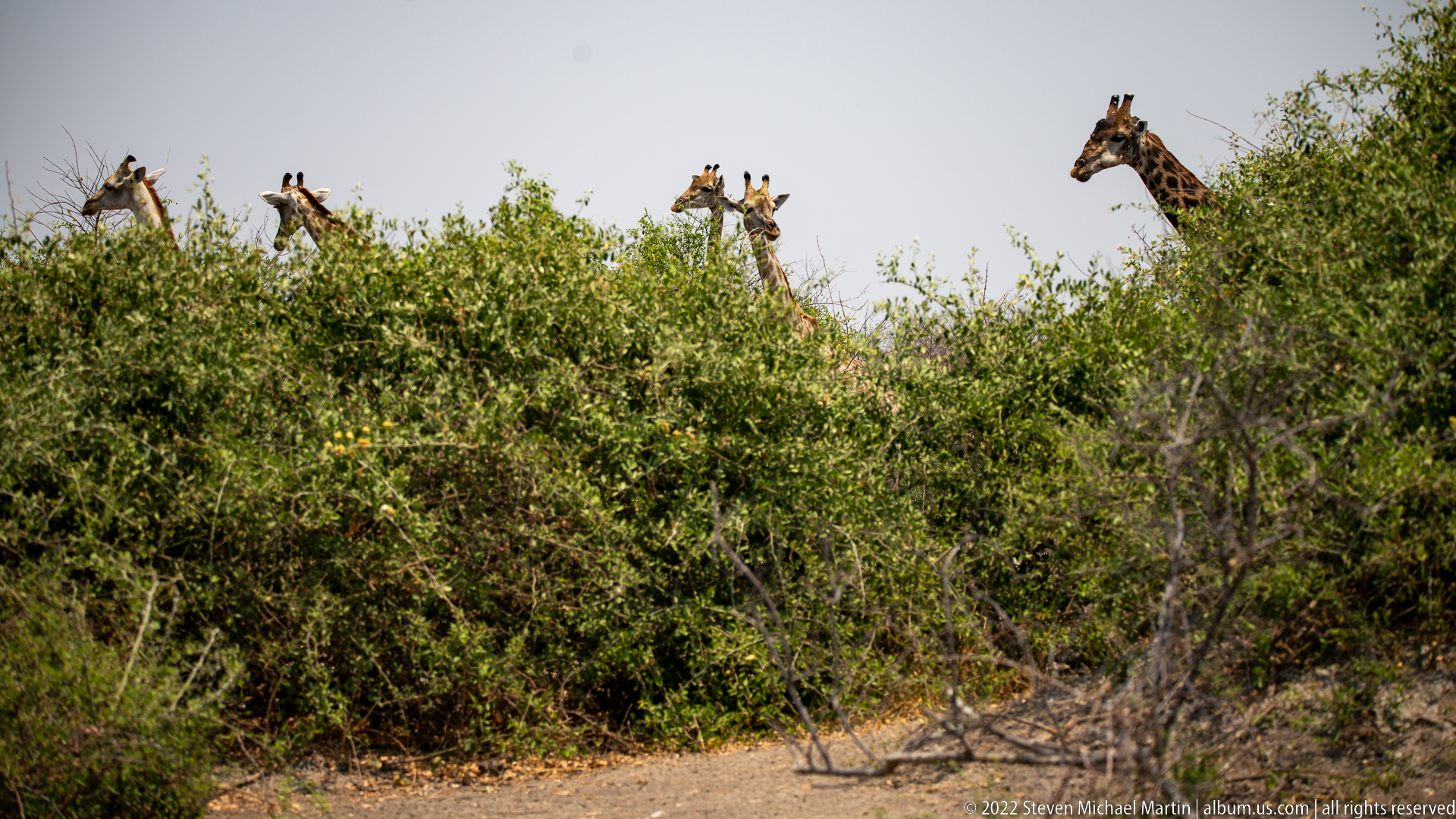
Several giraffe heads and necks rise above a dense wall of green shrubs, with most of their bodies concealed by vegetation. The scattered animals appear to browse within the thicket, their patterned necks and ossicones emerging at different heights. The partially hidden composition shows how effectively giraffes can disappear into wooded habitat despite their exceptional stature.
Caption
Several giraffe heads and necks rise above a dense wall of green shrubs, with most of their bodies concealed by vegetation. The scattered animals appear to browse within the thicket, their patterned necks and ossicones emerging at different heights. The partially hidden composition shows how effectively giraffes can disappear into wooded habitat despite their exceptional stature.
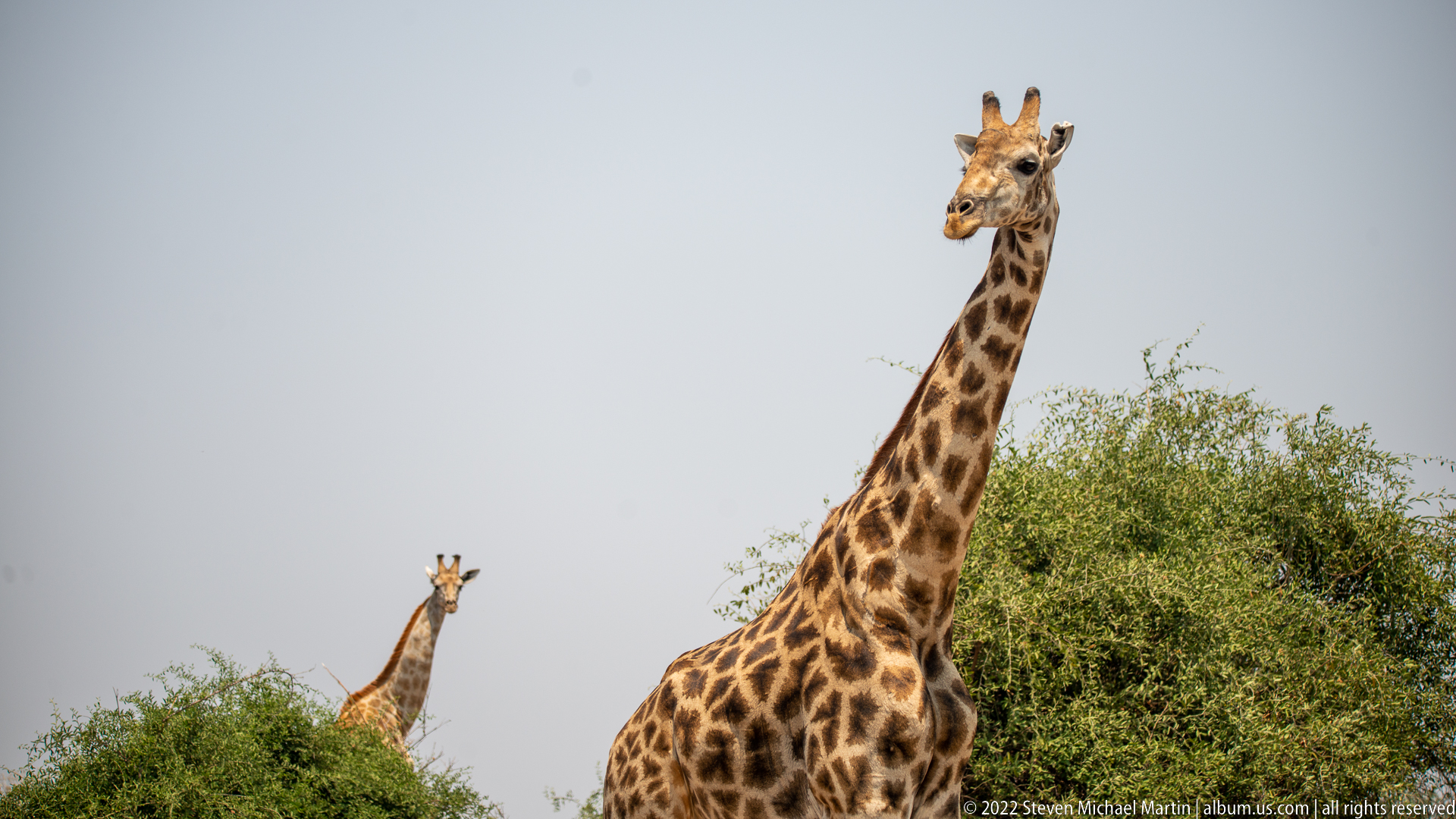
An adult giraffe stands above low scrub with its neck and shoulders fully exposed, while a second giraffe appears much smaller in the background. The foreground animal’s irregular brown patches, long neck, and ossicones are sharply defined against the pale sky. The depth between the two animals gives the portrait a strong sense of scale across the open woodland.
Caption
An adult giraffe stands above low scrub with its neck and shoulders fully exposed, while a second giraffe appears much smaller in the background. The foreground animal’s irregular brown patches, long neck, and ossicones are sharply defined against the pale sky. The depth between the two animals gives the portrait a strong sense of scale across the open woodland.
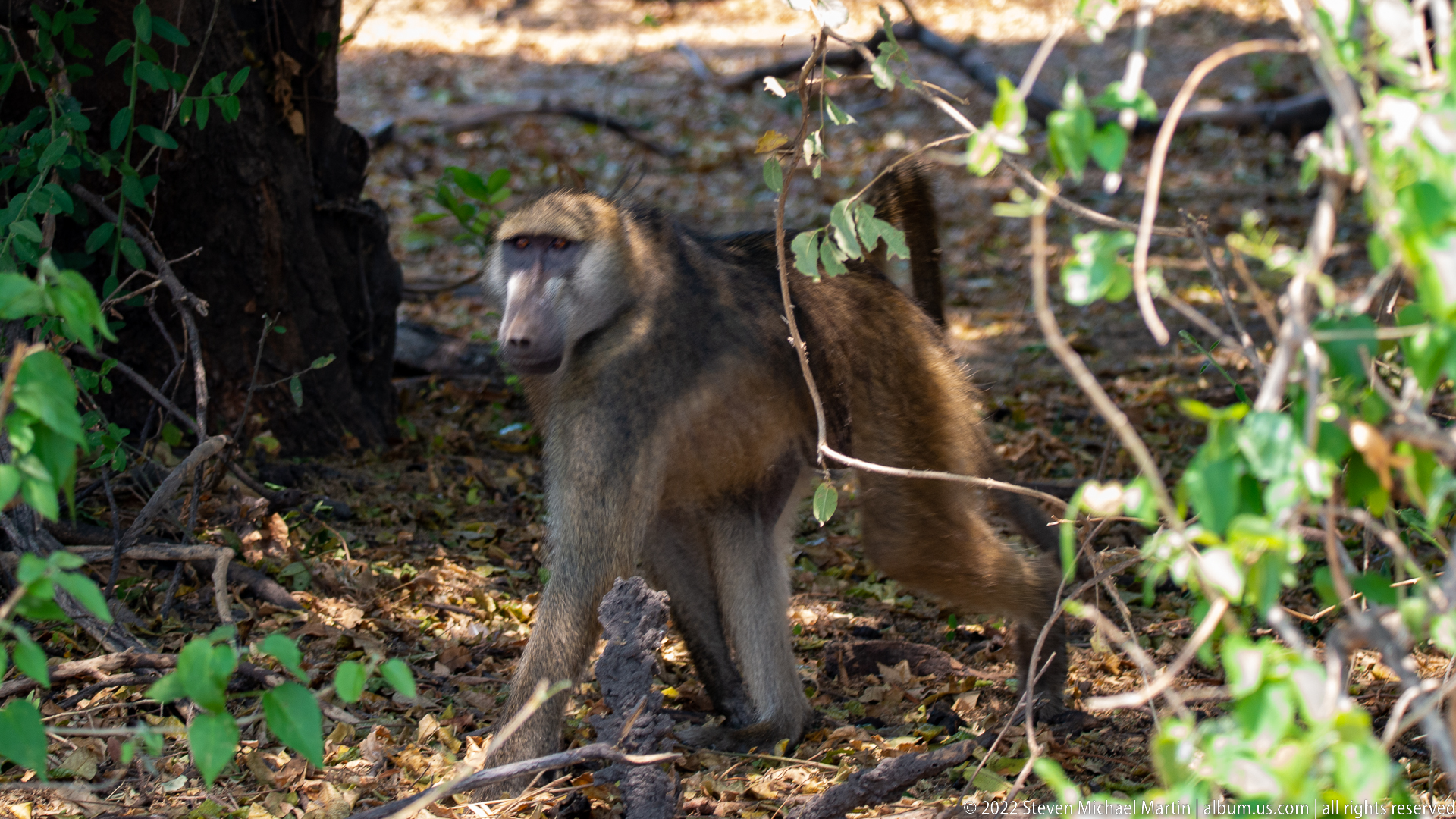
A chacma baboon stands beneath tangled woodland branches, its gray-brown coat, long muzzle, dark face, and powerful limbs visible in broken shade. The animal pauses on the forest floor with the body angled forward, surrounded by leaf litter and green vines. The portrait introduces a primate commonly encountered in social troops across southern African savannas and woodlands.
Caption
A chacma baboon stands beneath tangled woodland branches, its gray-brown coat, long muzzle, dark face, and powerful limbs visible in broken shade. The animal pauses on the forest floor with the body angled forward, surrounded by leaf litter and green vines. The portrait introduces a primate commonly encountered in social troops across southern African savannas and woodlands.

A giraffe strides across bare, dusty ground beside low green scrub, one foreleg extended in mid-step. Its long torso and patterned neck are seen in full profile, while a second giraffe is partly visible beyond the vegetation. The open composition emphasizes gait and body proportions, contrasting with the more concealed browsing views elsewhere on the page.
Caption
A giraffe strides across bare, dusty ground beside low green scrub, one foreleg extended in mid-step. Its long torso and patterned neck are seen in full profile, while a second giraffe is partly visible beyond the vegetation. The open composition emphasizes gait and body proportions, contrasting with the more concealed browsing views elsewhere on the page.
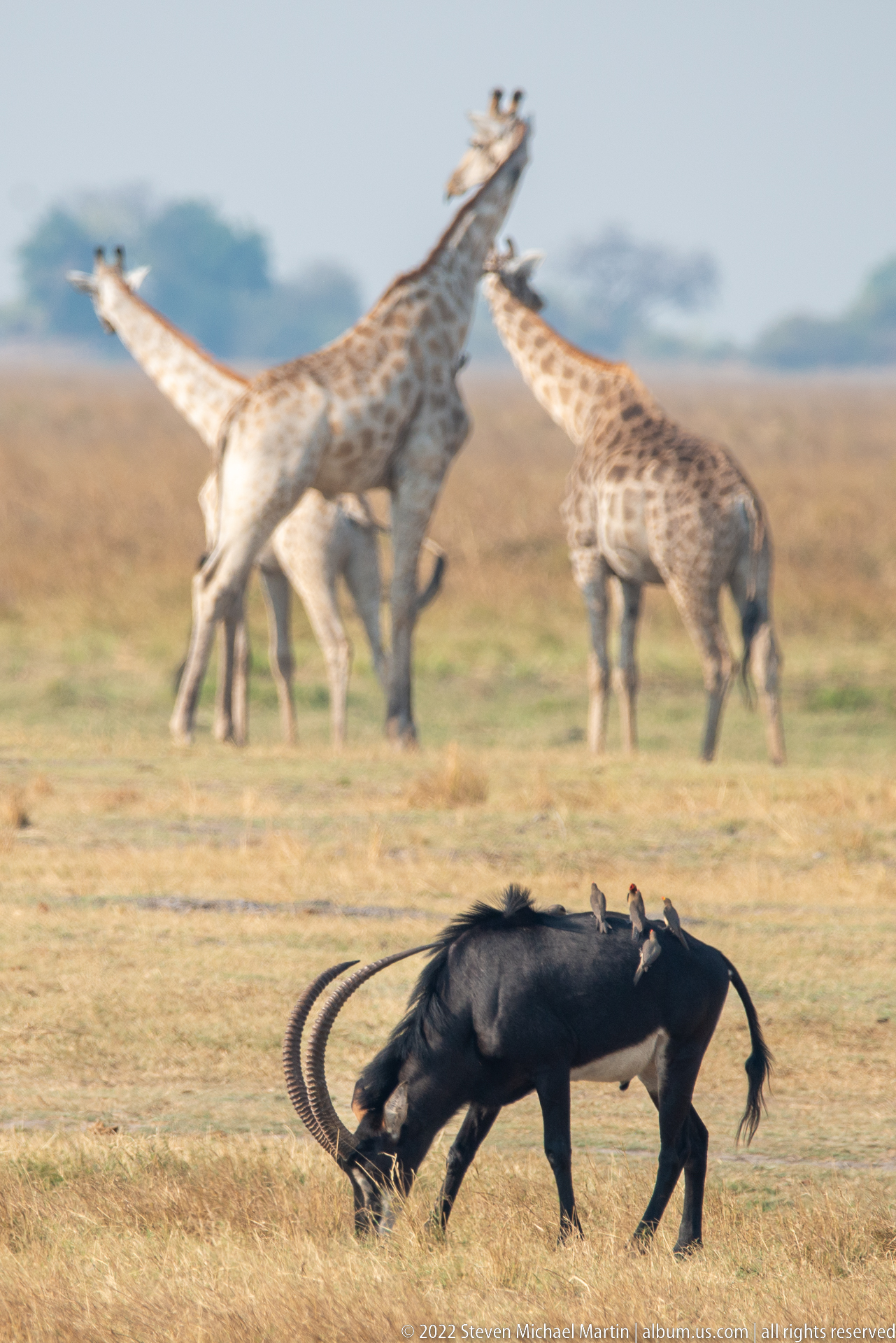
Two male sable antelopes lock their sweeping horns low to the ground in a sparring contest while giraffes stand and feed across the floodplain behind them. The sable bulls lean forward with dark bodies nearly parallel, concentrating the action in the foreground. The unusual layered scene combines antelope social competition with the broader mixed-herbivore community of Chobe’s open plains.
Caption
Two male sable antelopes lock their sweeping horns low to the ground in a sparring contest while giraffes stand and feed across the floodplain behind them. The sable bulls lean forward with dark bodies nearly parallel, concentrating the action in the foreground. The unusual layered scene combines antelope social competition with the broader mixed-herbivore community of Chobe’s open plains.
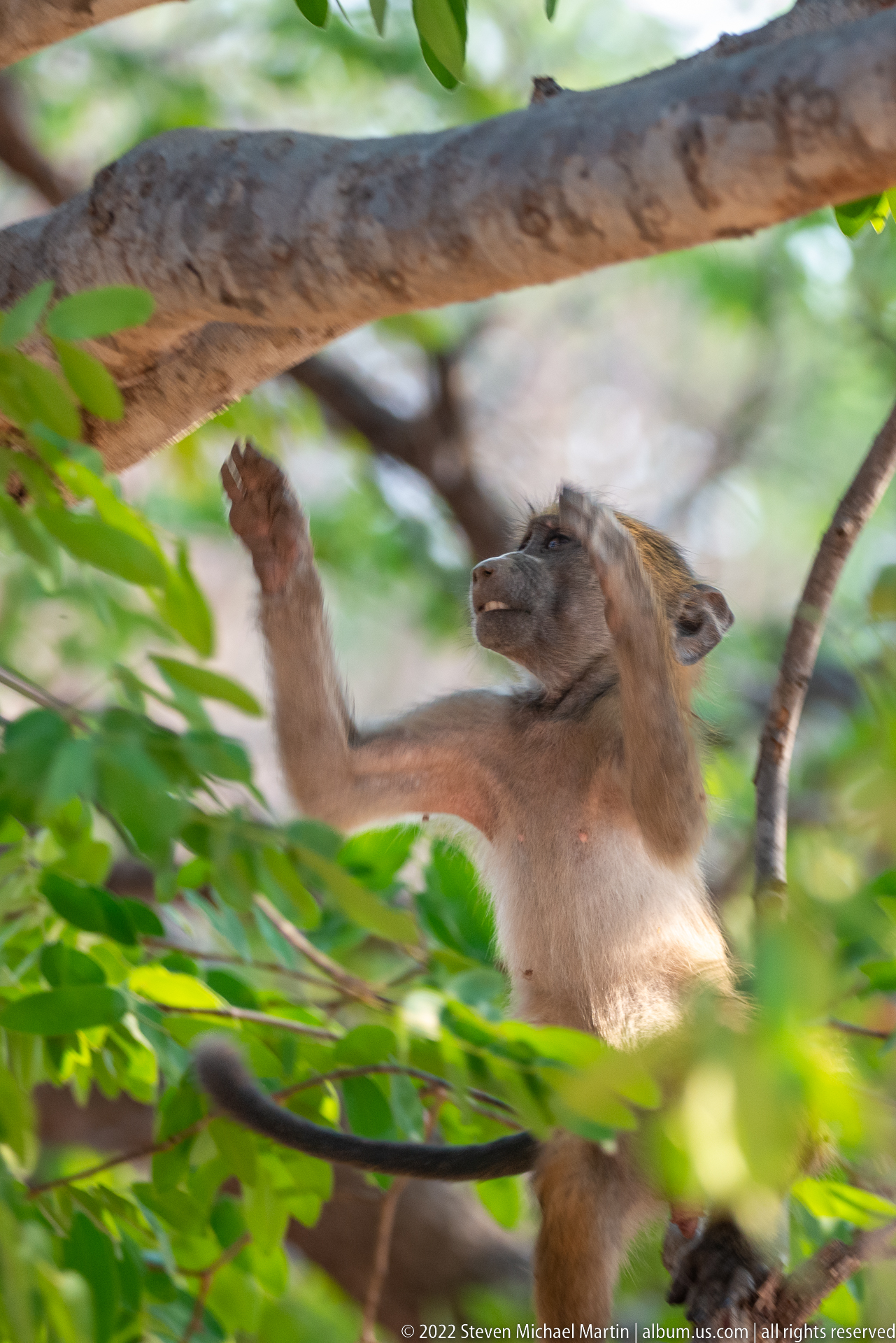
A chacma baboon reaches upward through leafy branches, one arm extended toward the canopy while its long muzzle and brown-gray coat remain visible between limbs. The elevated, partly concealed position shows the species using woodland trees as readily as the ground. Foreground leaves and crossing branches create a close sense of the dense riverine cover available within Chobe National Park.
Caption
A chacma baboon reaches upward through leafy branches, one arm extended toward the canopy while its long muzzle and brown-gray coat remain visible between limbs. The elevated, partly concealed position shows the species using woodland trees as readily as the ground. Foreground leaves and crossing branches create a close sense of the dense riverine cover available within Chobe National Park.

A chacma baboon sits upright on a thick horizontal branch, forearms relaxed across its lap as it looks into the surrounding woodland. The elevated perch reveals the animal’s long muzzle, gray-brown coat, and dark hands and feet. Branches and leaves partly screen the background, emphasizing the baboon’s use of both ground and trees within Chobe’s riverine woodland.
Caption
A chacma baboon sits upright on a thick horizontal branch, forearms relaxed across its lap as it looks into the surrounding woodland. The elevated perch reveals the animal’s long muzzle, gray-brown coat, and dark hands and feet. Branches and leaves partly screen the background, emphasizing the baboon’s use of both ground and trees within Chobe’s riverine woodland.
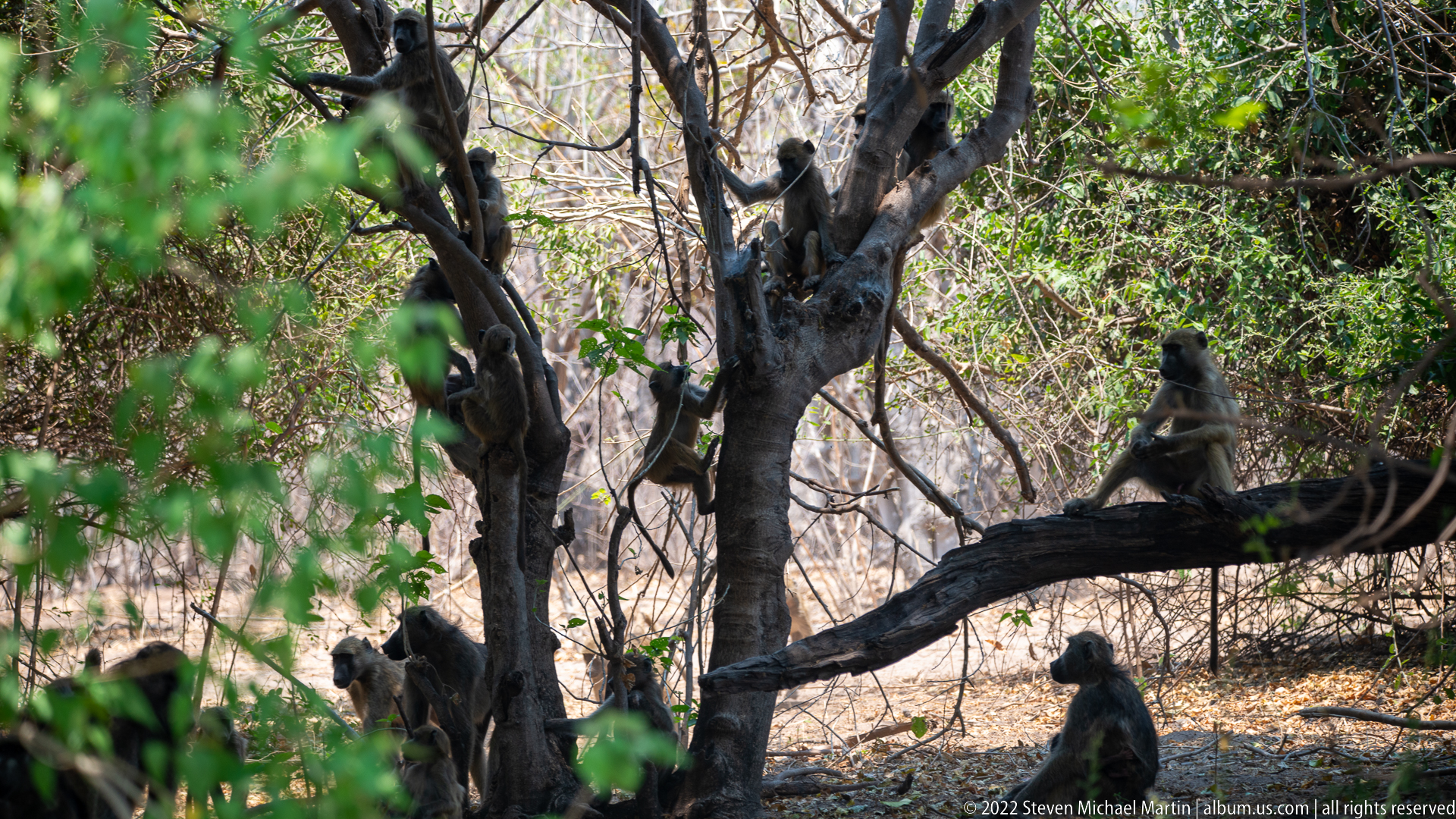
Several chacma baboons occupy different levels of a woodland scene, with one animal seated on a large horizontal branch and others moving or resting near the ground. The layered composition shows the troop’s flexible use of trees for vantage, refuge, and social spacing. Trunks, vines, and dense foliage partially conceal the animals, giving a contextual view rather than a single portrait.
Caption
Several chacma baboons occupy different levels of a woodland scene, with one animal seated on a large horizontal branch and others moving or resting near the ground. The layered composition shows the troop’s flexible use of trees for vantage, refuge, and social spacing. Trunks, vines, and dense foliage partially conceal the animals, giving a contextual view rather than a single portrait.
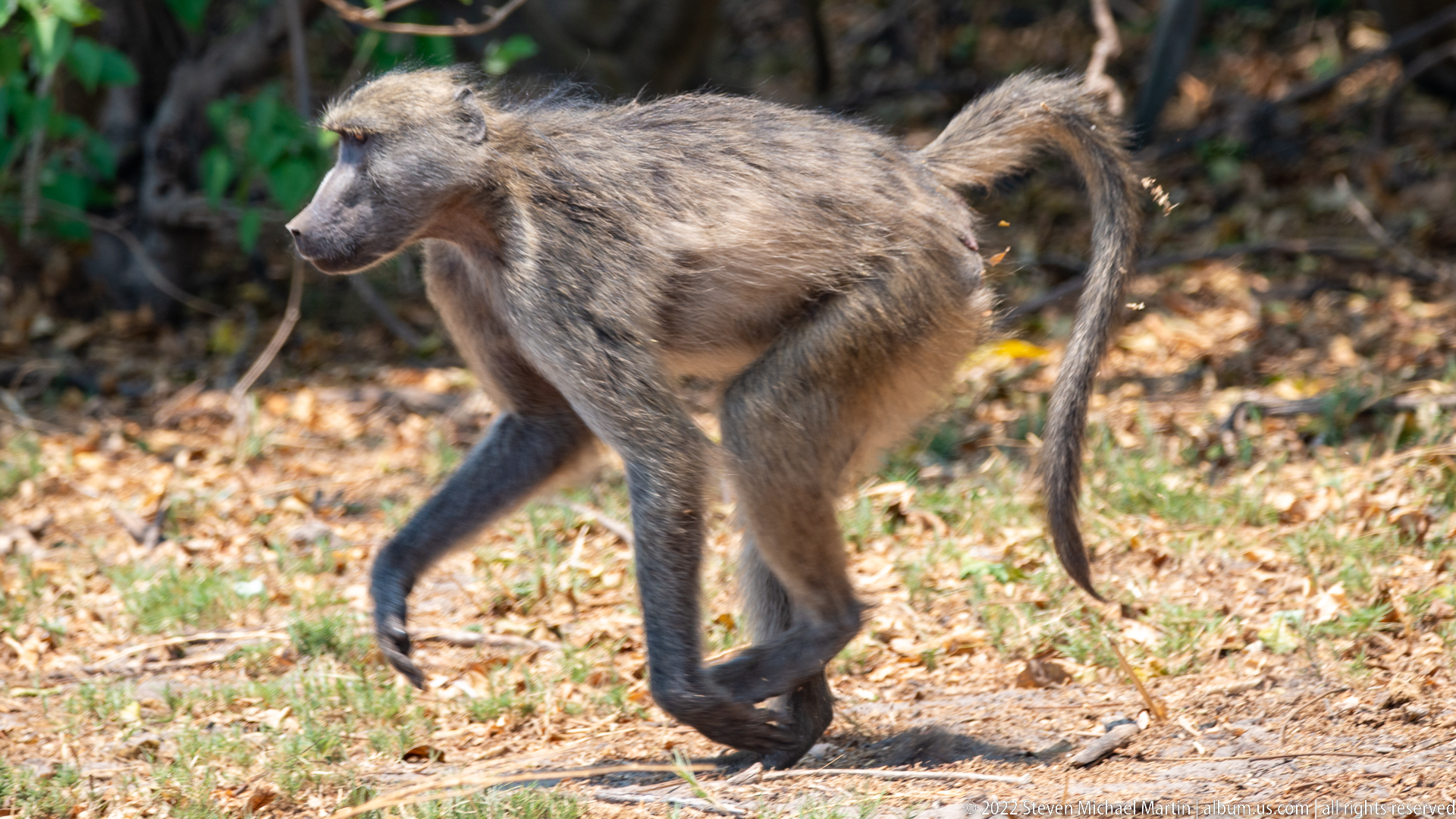
A chacma baboon walks across leaf-strewn ground at the woodland edge, one forelimb and opposite hind limb extended in stride. Its long tail curves upward and then down behind the body, while the elongated muzzle and gray-brown coat remain visible in profile. The photograph emphasizes terrestrial locomotion, a major part of daily troop movement and foraging.
Caption
A chacma baboon walks across leaf-strewn ground at the woodland edge, one forelimb and opposite hind limb extended in stride. Its long tail curves upward and then down behind the body, while the elongated muzzle and gray-brown coat remain visible in profile. The photograph emphasizes terrestrial locomotion, a major part of daily troop movement and foraging.
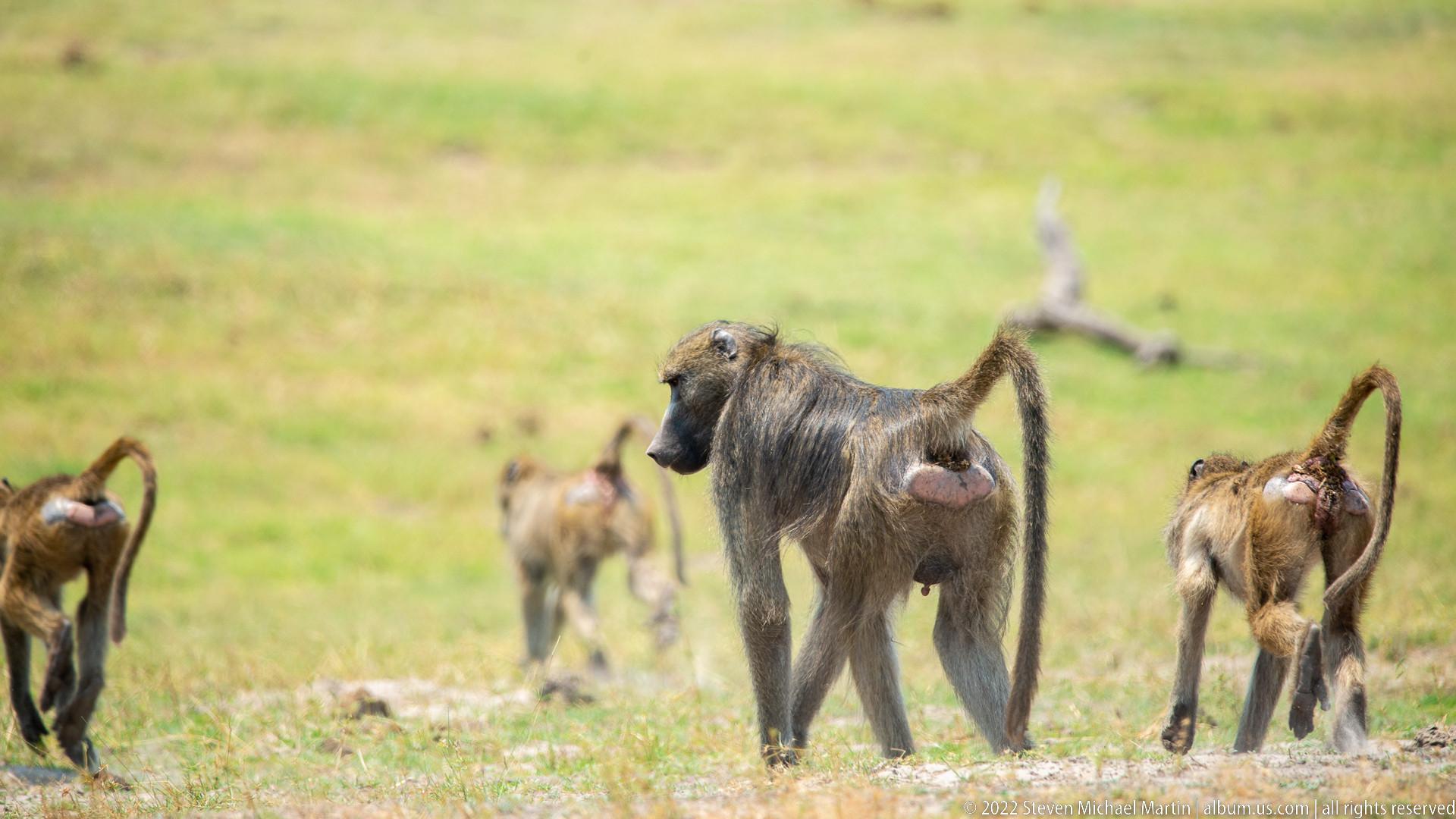
A troop of chacma baboons moves away across open grass, several animals presenting their backs and long tails to the camera. The central adult pauses briefly while others continue ahead, creating a loose procession across the floodplain. The wide, sunlit setting contrasts with the shaded woodland scenes nearby and shows the troop traveling between habitat patches.
Caption
A troop of chacma baboons moves away across open grass, several animals presenting their backs and long tails to the camera. The central adult pauses briefly while others continue ahead, creating a loose procession across the floodplain. The wide, sunlit setting contrasts with the shaded woodland scenes nearby and shows the troop traveling between habitat patches.

A plains zebra grazes on bright green grass beside a narrow water channel while an impala walks nearby. More zebras feed across the far bank, creating a mixed-herbivore scene within the floodplain. The juxtaposition of striped zebra and tawny antelope illustrates how multiple grazing and browsing species share Chobe’s productive river-edge habitats.
Caption
A plains zebra grazes on bright green grass beside a narrow water channel while an impala walks nearby. More zebras feed across the far bank, creating a mixed-herbivore scene within the floodplain. The juxtaposition of striped zebra and tawny antelope illustrates how multiple grazing and browsing species share Chobe’s productive river-edge habitats.

A giraffe spreads its forelegs widely on open ground beside a wetland channel, lowering the front of its body while keeping the neck upright. Giraffes use this characteristic splayed stance when they need to bring the head closer to water or the ground because their long forelegs cannot bend sufficiently for a normal drinking posture. The photograph freezes the awkward but highly adapted movement.
Caption
A giraffe spreads its forelegs widely on open ground beside a wetland channel, lowering the front of its body while keeping the neck upright. Giraffes use this characteristic splayed stance when they need to bring the head closer to water or the ground because their long forelegs cannot bend sufficiently for a normal drinking posture. The photograph freezes the awkward but highly adapted movement.

An adult male greater kudu stands broadside on sandy ground before dense green scrub. Massive corkscrew horns rise above the head, while narrow white stripes cross the gray-brown torso and a pale chevron marks the face. The unobstructed profile provides a classic field-guide view of the kudu bull’s long-legged build and elaborate horn structure.
Caption
An adult male greater kudu stands broadside on sandy ground before dense green scrub. Massive corkscrew horns rise above the head, while narrow white stripes cross the gray-brown torso and a pale chevron marks the face. The unobstructed profile provides a classic field-guide view of the kudu bull’s long-legged build and elaborate horn structure.
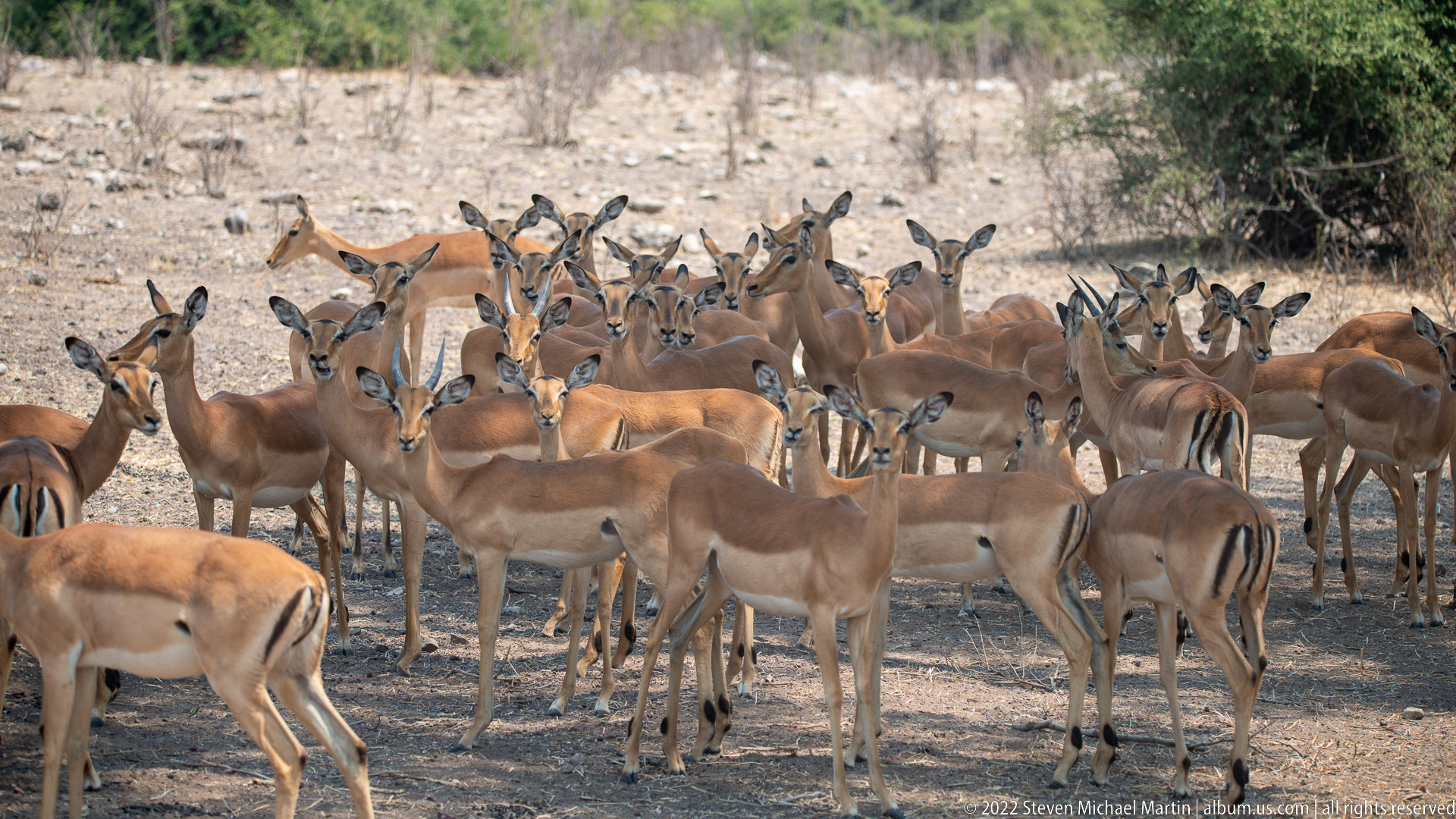
A dense herd of impalas stands tightly grouped on pale ground at the edge of scrub, many animals facing the camera with large ears held alert. Tawny bodies overlap across the frame, while a few horned males rise above the predominantly female group. The crowded composition emphasizes vigilance and social cohesion within one of Chobe’s most abundant antelope species.
Caption
A dense herd of impalas stands tightly grouped on pale ground at the edge of scrub, many animals facing the camera with large ears held alert. Tawny bodies overlap across the frame, while a few horned males rise above the predominantly female group. The crowded composition emphasizes vigilance and social cohesion within one of Chobe’s most abundant antelope species.

A plains zebra runs across a red sandy road, hooves kicking up a cloud of dust behind its hind legs. The body is captured in mid-stride with the forelegs extended and mane upright, turning a familiar field-guide subject into a study of motion. Scrub vegetation along the road places the action within Chobe’s dry savanna woodland.
Caption
A plains zebra runs across a red sandy road, hooves kicking up a cloud of dust behind its hind legs. The body is captured in mid-stride with the forelegs extended and mane upright, turning a familiar field-guide subject into a study of motion. Scrub vegetation along the road places the action within Chobe’s dry savanna woodland.
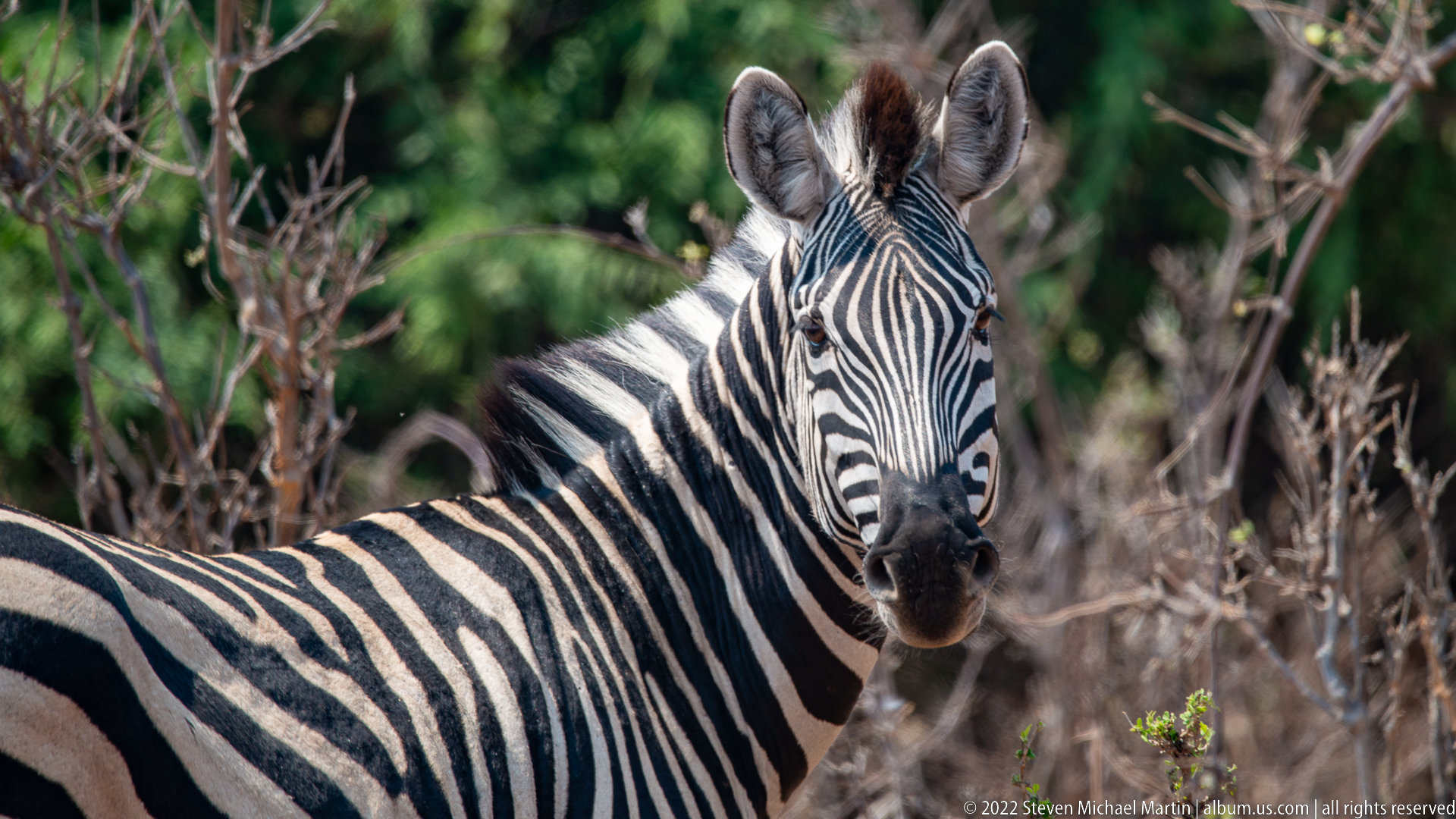
A plains zebra turns its head toward the camera in a close portrait framed by woodland vegetation. Narrow facial stripes converge around the dark muzzle and eyes, while broader bands wrap the neck and shoulder. The upright mane and large rounded ears are sharply defined, making this a useful field-guide study of zebra patterning and head structure.
Caption
A plains zebra turns its head toward the camera in a close portrait framed by woodland vegetation. Narrow facial stripes converge around the dark muzzle and eyes, while broader bands wrap the neck and shoulder. The upright mane and large rounded ears are sharply defined, making this a useful field-guide study of zebra patterning and head structure.

A large eagle stands upright on a weathered tree trunk, its pale head and heavily streaked cream breast contrasting with dark brown wings and flanks. The hooked bill and powerful feet identify a substantial raptor, but the proof-sheet view does not resolve enough fine plumage detail for a fully secure species-level identification. The elevated perch gives the bird a commanding view over the surrounding woodland.
Caption
A large eagle stands upright on a weathered tree trunk, its pale head and heavily streaked cream breast contrasting with dark brown wings and flanks. The hooked bill and powerful feet identify a substantial raptor, but the proof-sheet view does not resolve enough fine plumage detail for a fully secure species-level identification. The elevated perch gives the bird a commanding view over the surrounding woodland.
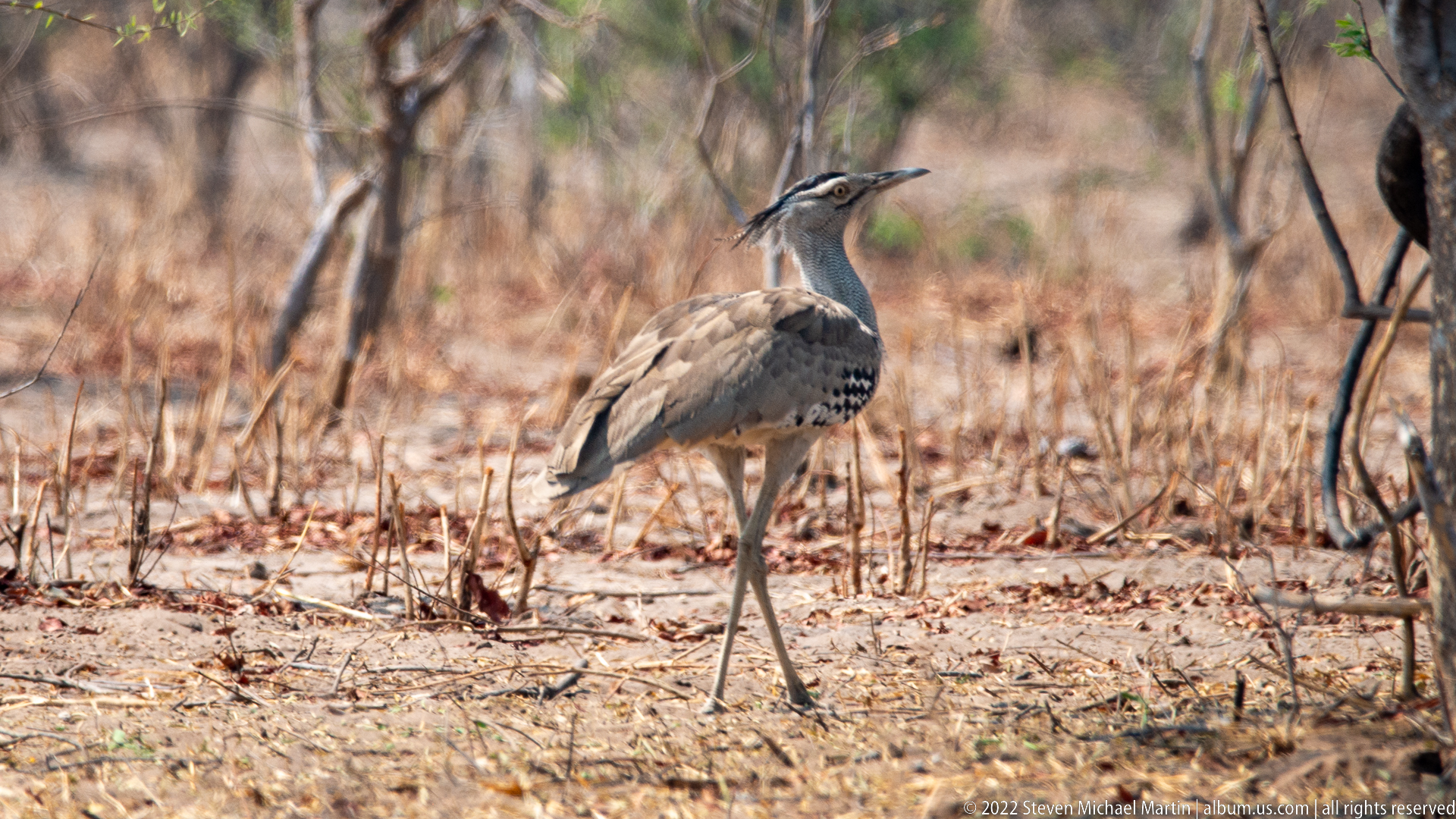
A kori bustard walks through dry open woodland, its long pale legs carrying a heavy gray-brown body above sparse grass and leaf litter. The bird shows a long neck, dark crown stripe, pale face, and finely patterned back and flanks. Its great size and ground-dwelling posture distinguish this characteristic southern African bustard from the smaller terrestrial birds of the savanna.
Caption
A kori bustard walks through dry open woodland, its long pale legs carrying a heavy gray-brown body above sparse grass and leaf litter. The bird shows a long neck, dark crown stripe, pale face, and finely patterned back and flanks. Its great size and ground-dwelling posture distinguish this characteristic southern African bustard from the smaller terrestrial birds of the savanna.
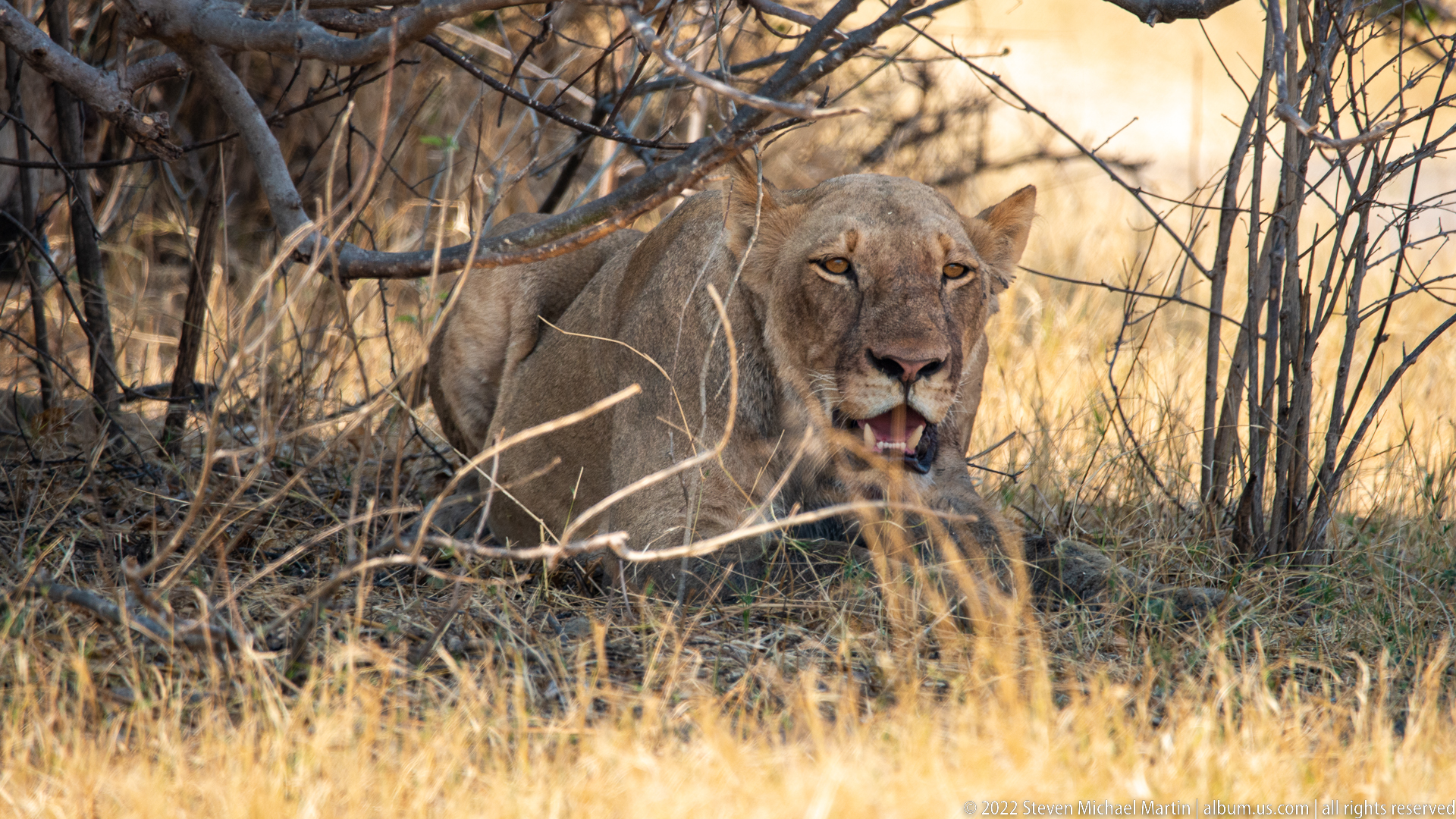
A lioness lies in dry grass beneath a screen of thin branches, her tawny coat blending closely with the sunlit woodland floor. The head remains raised and the eyes half open, while the forequarters rest in shade. The partially concealed setting illustrates how effectively a large predator can disappear into Chobe’s dry-season vegetation despite its size.
Caption
A lioness lies in dry grass beneath a screen of thin branches, her tawny coat blending closely with the sunlit woodland floor. The head remains raised and the eyes half open, while the forequarters rest in shade. The partially concealed setting illustrates how effectively a large predator can disappear into Chobe’s dry-season vegetation despite its size.
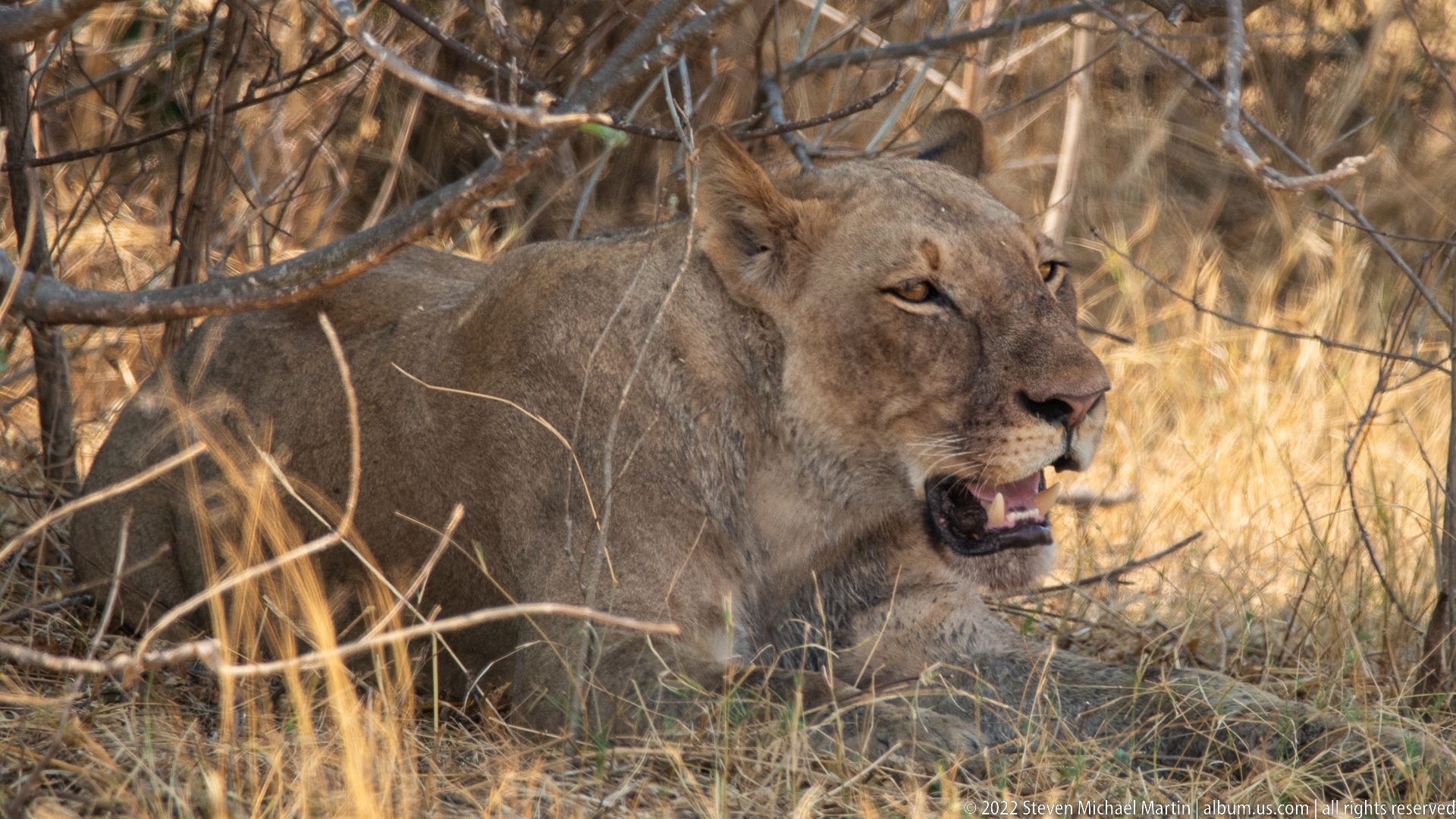
A lioness rests under tangled branches with her jaws opened in a broad yawn, exposing the tongue and canine teeth. Her body remains relaxed on the ground while the head turns slightly to the side. The open-mouth moment adds a behavioral detail to the shaded resting sequence, distinguishing a routine yawn from an aggressive display.
Caption
A lioness rests under tangled branches with her jaws opened in a broad yawn, exposing the tongue and canine teeth. Her body remains relaxed on the ground while the head turns slightly to the side. The open-mouth moment adds a behavioral detail to the shaded resting sequence, distinguishing a routine yawn from an aggressive display.
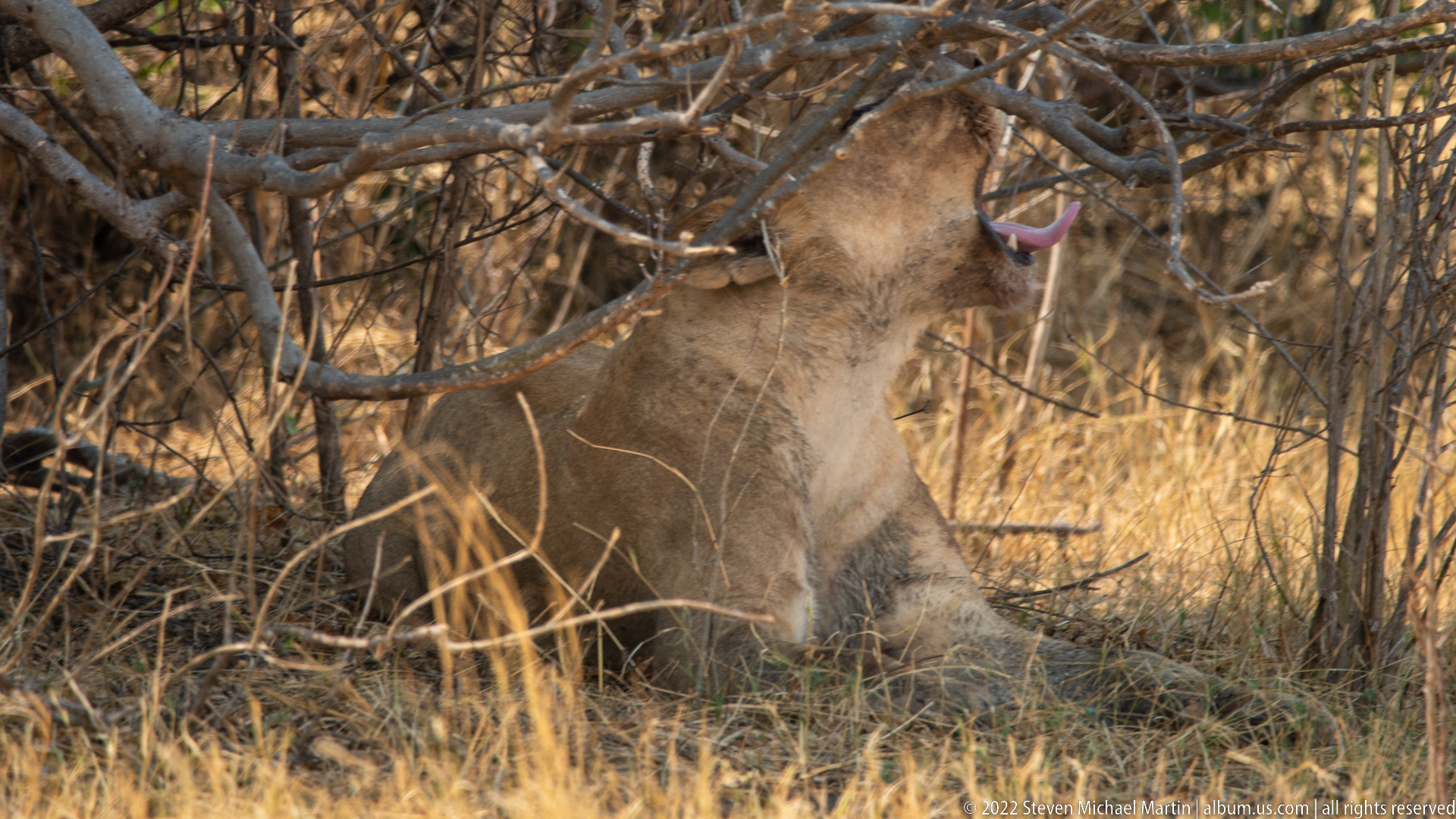
A seated lioness lifts her head beneath low branches and extends her tongue across the muzzle. Her upright chest and forelegs are partly obscured by twigs, while warm late-day light picks out the tawny face and throat. The brief grooming gesture provides a close behavioral counterpoint to the neighboring resting and yawning views of the same pride.
Caption
A seated lioness lifts her head beneath low branches and extends her tongue across the muzzle. Her upright chest and forelegs are partly obscured by twigs, while warm late-day light picks out the tawny face and throat. The brief grooming gesture provides a close behavioral counterpoint to the neighboring resting and yawning views of the same pride.

Several lionesses rest together beneath dense trees, one stretched asleep across the foreground while another lies upright in deeper shade. The overlapping bodies and shared shelter identify a social resting group rather than a solitary cat. Dappled light across the tawny coats shows how the pride uses woodland shade during the hotter part of the day.
Caption
Several lionesses rest together beneath dense trees, one stretched asleep across the foreground while another lies upright in deeper shade. The overlapping bodies and shared shelter identify a social resting group rather than a solitary cat. Dappled light across the tawny coats shows how the pride uses woodland shade during the hotter part of the day.
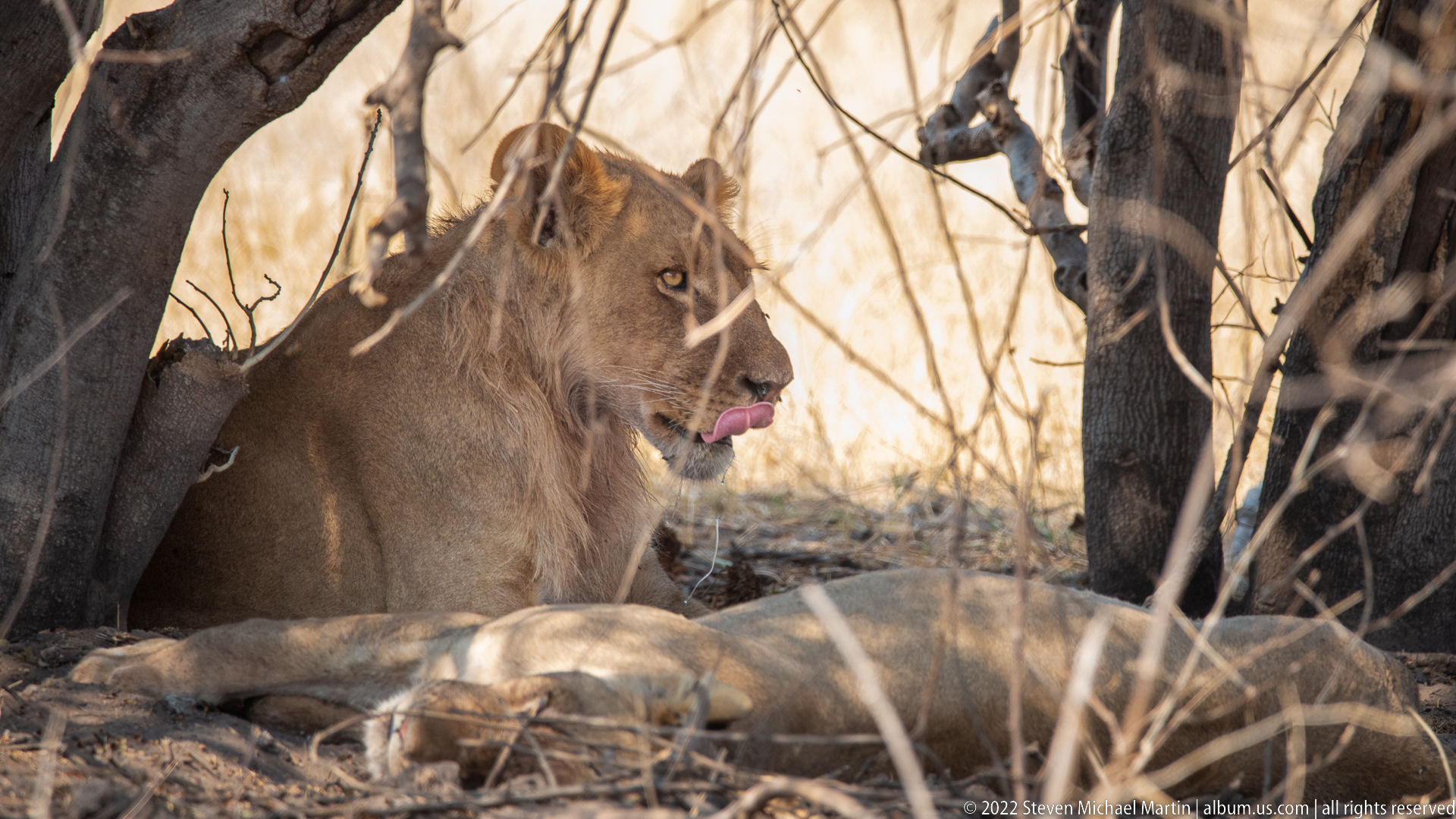
A lioness sits upright in deep shade with her tongue briefly visible, while another lioness lies stretched across the foreground. Tree trunks frame the pair and additional tawny forms appear behind them, suggesting a larger resting pride. The scene emphasizes social proximity and the importance of dense shade as a daytime refuge in Chobe’s dry woodland.
Caption
A lioness sits upright in deep shade with her tongue briefly visible, while another lioness lies stretched across the foreground. Tree trunks frame the pair and additional tawny forms appear behind them, suggesting a larger resting pride. The scene emphasizes social proximity and the importance of dense shade as a daytime refuge in Chobe’s dry woodland.
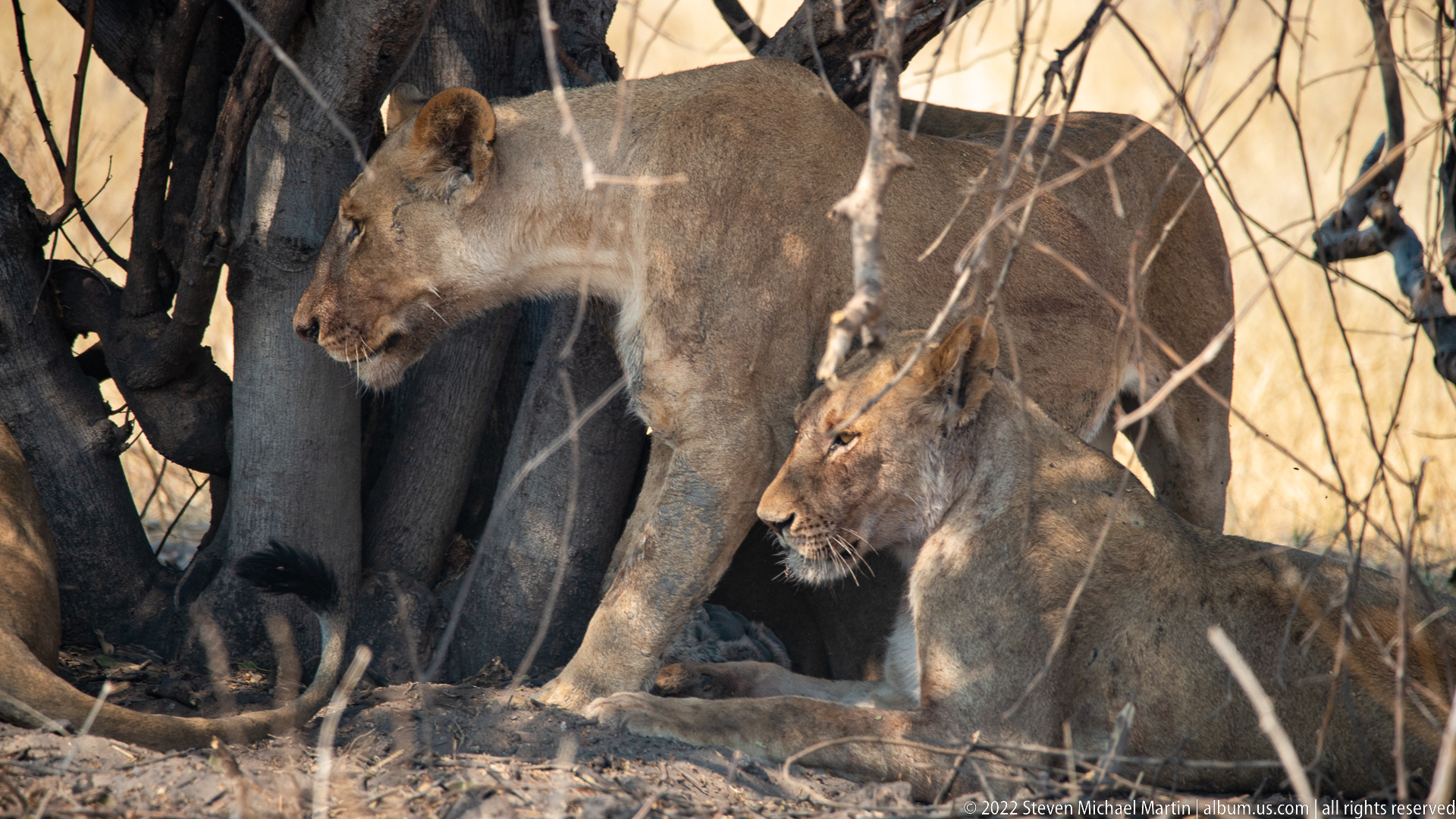
Two lionesses occupy the base of a dense tree cluster, one standing and stepping forward while another remains seated or reclining beside her. Their overlapping bodies and close spacing show movement within a resting pride rather than active pursuit. Strong backlight beyond the trunks contrasts with the cool shelter used by the cats.
Caption
Two lionesses occupy the base of a dense tree cluster, one standing and stepping forward while another remains seated or reclining beside her. Their overlapping bodies and close spacing show movement within a resting pride rather than active pursuit. Strong backlight beyond the trunks contrasts with the cool shelter used by the cats.
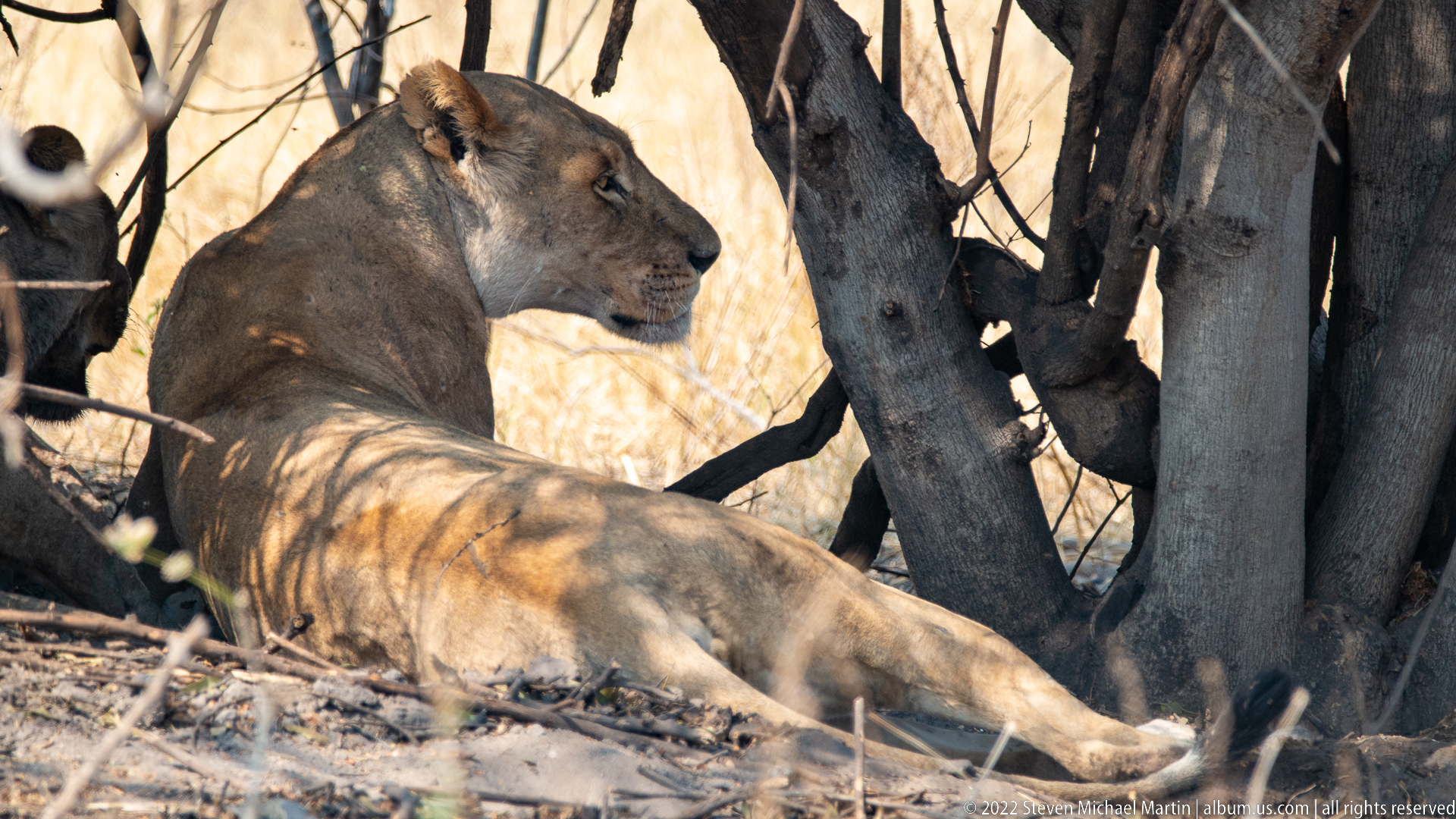
A lioness reclines at the base of closely grouped tree trunks, her body extended along the ground and head raised in profile. Bands of filtered sunlight cross the tawny flank, while the face remains largely in shade. The side view provides a quieter portrait of a resting pride member after the more active interaction shown in the preceding frame.
Caption
A lioness reclines at the base of closely grouped tree trunks, her body extended along the ground and head raised in profile. Bands of filtered sunlight cross the tawny flank, while the face remains largely in shade. The side view provides a quieter portrait of a resting pride member after the more active interaction shown in the preceding frame.

The entrance structure at Sedudu Wildlife Gate spans the roadway into Chobe National Park, its tall timber-framed gable and thatched roofs forming a prominent arrival point. Vehicles pass beneath the open central canopy while a red stop sign controls entry. The architecture and gate layout provide a documentary view of the park’s managed access infrastructure.
Caption
The entrance structure at Sedudu Wildlife Gate spans the roadway into Chobe National Park, its tall timber-framed gable and thatched roofs forming a prominent arrival point. Vehicles pass beneath the open central canopy while a red stop sign controls entry. The architecture and gate layout provide a documentary view of the park’s managed access infrastructure.
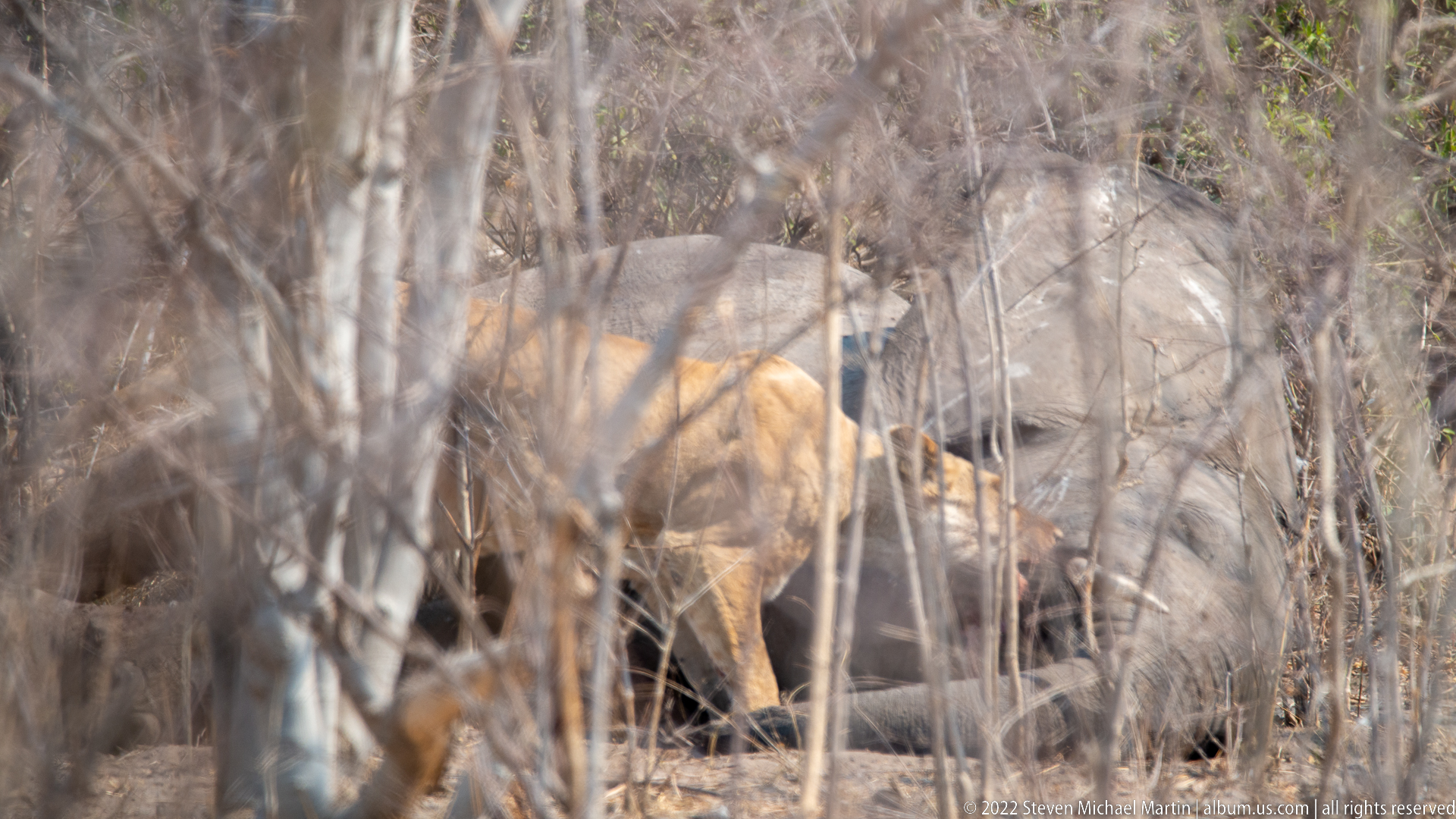
A tawny lion stands or pauses behind a dense screen of gray trunks and dry branches, its head and shoulder visible through a narrow opening. The heavily obstructed view demonstrates how woodland structure can conceal a large cat at surprisingly short range. Warm coat color and rounded feline head remain visible despite the layered vegetation.
Caption
A tawny lion stands or pauses behind a dense screen of gray trunks and dry branches, its head and shoulder visible through a narrow opening. The heavily obstructed view demonstrates how woodland structure can conceal a large cat at surprisingly short range. Warm coat color and rounded feline head remain visible despite the layered vegetation.
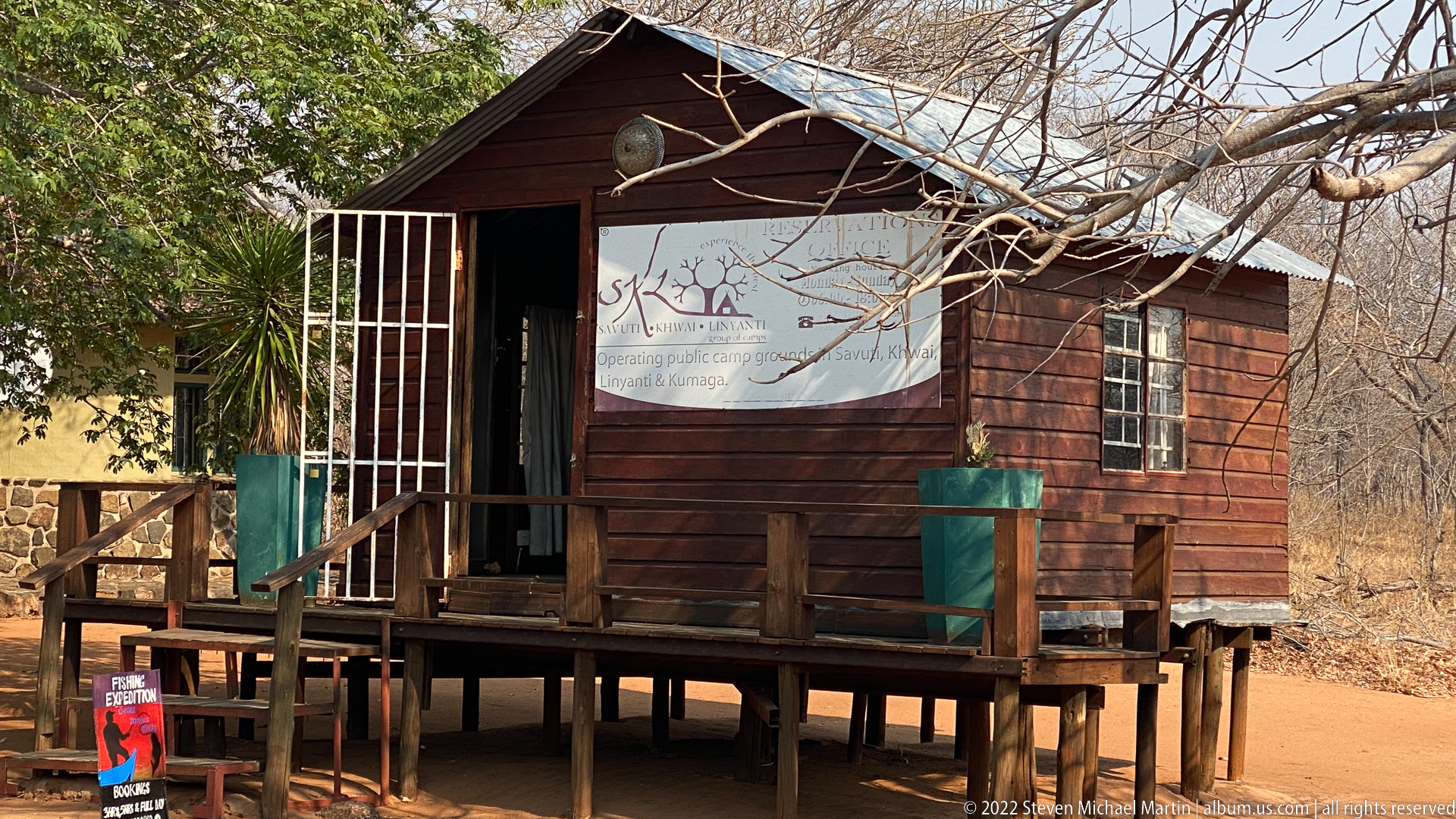
A small raised timber building stands beside the Chobe access area, with a covered porch, steps, barred doorway, and a large commercial sign attached to the front wall. Dry woodland surrounds the structure. Because the sign is not fully legible at proof-sheet scale, the building is best treated as a park-side tourism or service kiosk rather than assigned a specific operator.
Caption
A small raised timber building stands beside the Chobe access area, with a covered porch, steps, barred doorway, and a large commercial sign attached to the front wall. Dry woodland surrounds the structure. Because the sign is not fully legible at proof-sheet scale, the building is best treated as a park-side tourism or service kiosk rather than assigned a specific operator.
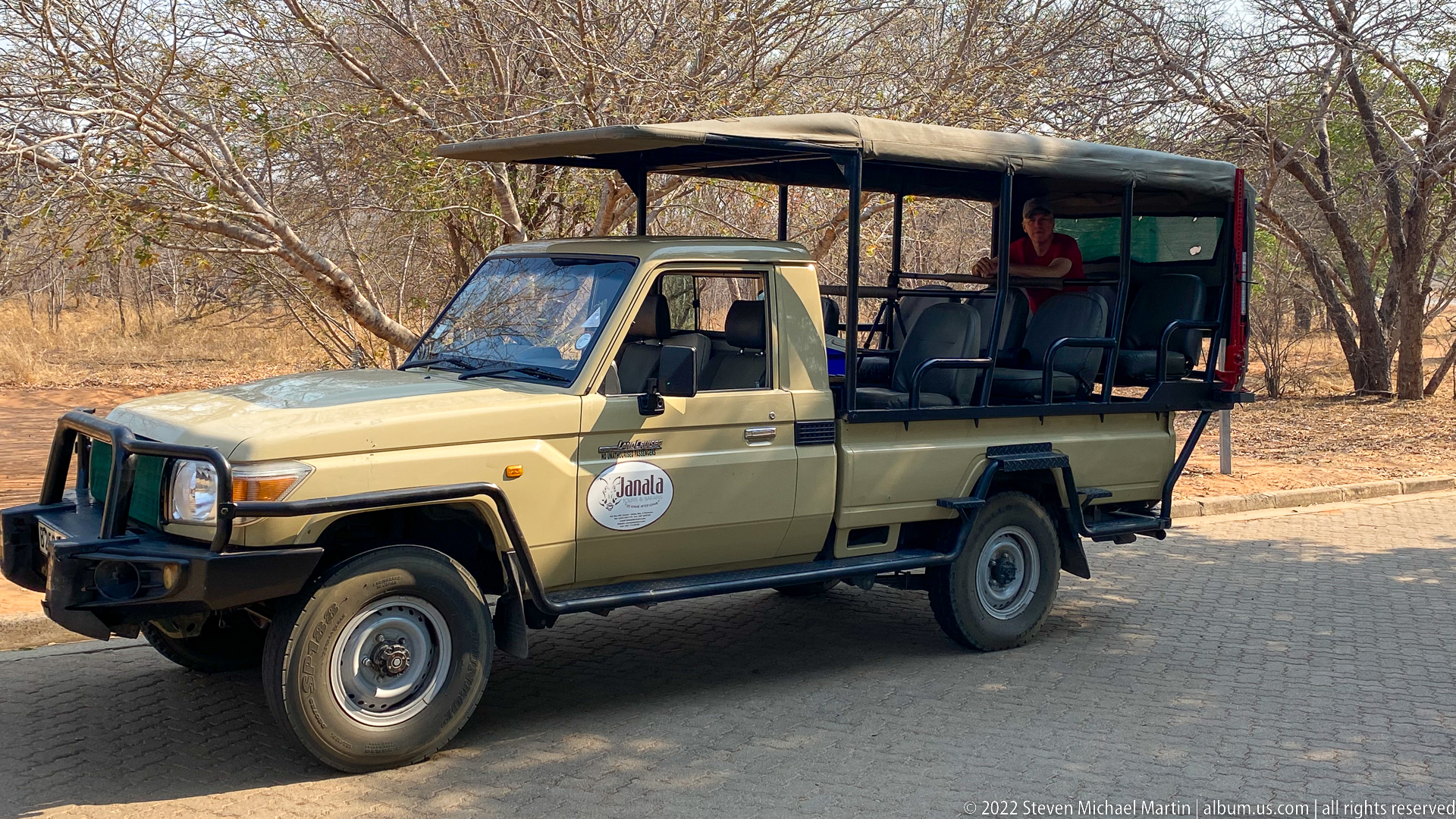
An open-sided Toyota safari vehicle waits near the Chobe entrance area, fitted with elevated passenger seating, a canvas roof, front bull bar, and rear access step. The modified four-wheel-drive configuration is designed to give visitors high sightlines and unobstructed views during wildlife drives. Dry woodland and paved access infrastructure place the vehicle at the transition between visitor facilities and the park.
Caption
An open-sided Toyota safari vehicle waits near the Chobe entrance area, fitted with elevated passenger seating, a canvas roof, front bull bar, and rear access step. The modified four-wheel-drive configuration is designed to give visitors high sightlines and unobstructed views during wildlife drives. Dry woodland and paved access infrastructure place the vehicle at the transition between visitor facilities and the park.

A large green sign welcomes visitors to Chobe National Park at Sedudu Wildlife Gate and lists opening hours, permit requirements, speed limits, road restrictions, and wildlife-protection rules. The Botswana Department of Wildlife and National Parks emblem appears at upper right. As a documentary record, the sign makes visible the regulations governing visitor access and conservation management at the gate.
Caption
A large green sign welcomes visitors to Chobe National Park at Sedudu Wildlife Gate and lists opening hours, permit requirements, speed limits, road restrictions, and wildlife-protection rules. The Botswana Department of Wildlife and National Parks emblem appears at upper right. As a documentary record, the sign makes visible the regulations governing visitor access and conservation management at the gate.

An open safari vehicle is photographed from the rear as it approaches the Sedudu Wildlife Gate entrance. Bench seats, canvas roof, spare tire, and rear step identify the game-drive conversion, while the gate canopy and green regulations sign appear ahead. The frame links tourism transport directly with the controlled entry point into Chobe National Park.
Caption
An open safari vehicle is photographed from the rear as it approaches the Sedudu Wildlife Gate entrance. Bench seats, canvas roof, spare tire, and rear step identify the game-drive conversion, while the gate canopy and green regulations sign appear ahead. The frame links tourism transport directly with the controlled entry point into Chobe National Park.
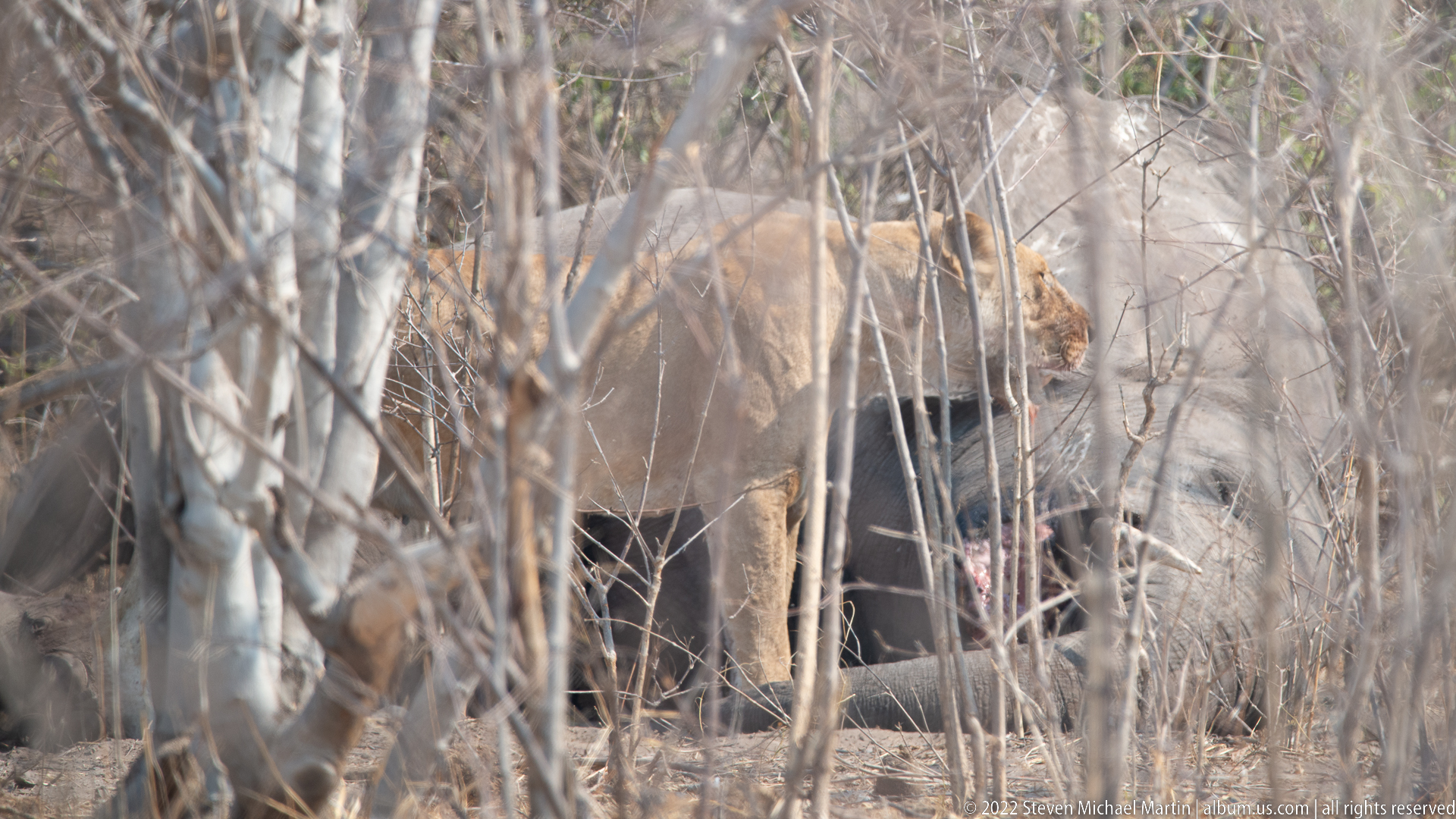
A lion is almost hidden in a thicket of slender gray trunks, with only the tawny head, shoulder, and part of the body visible through the gaps. The compressed view makes the vegetation itself central to the composition, showing how woodland cover disrupts the outline of a large predator. The animal appears stationary within the shade rather than actively moving.
Caption
A lion is almost hidden in a thicket of slender gray trunks, with only the tawny head, shoulder, and part of the body visible through the gaps. The compressed view makes the vegetation itself central to the composition, showing how woodland cover disrupts the outline of a large predator. The animal appears stationary within the shade rather than actively moving.
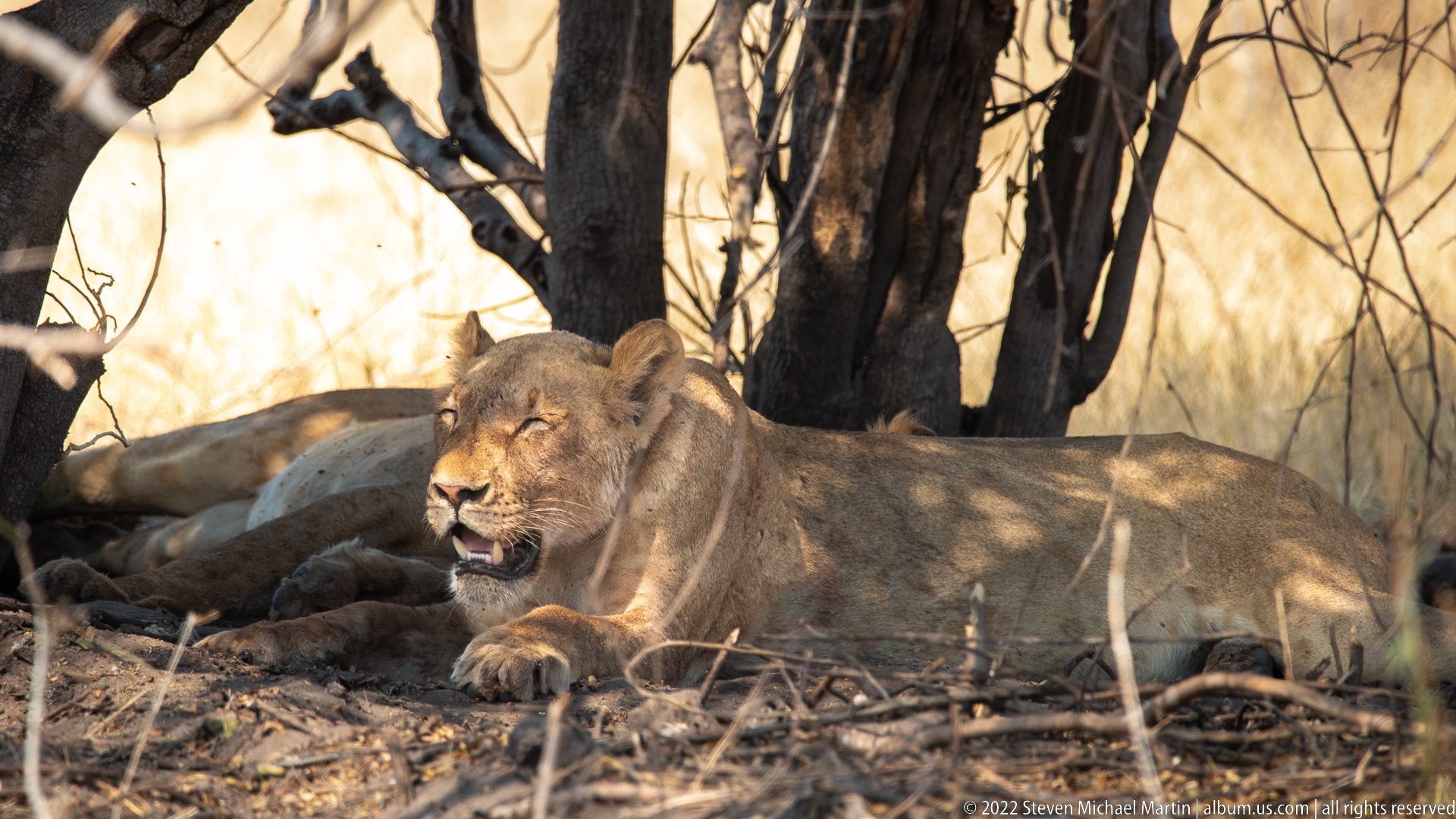
A lioness lies under a tree with her forepaws crossed neatly in front and her head held upright. Dappled sunlight marks the face and tawny flank while most of the body remains in cool shade. The open, relaxed pose provides a clear portrait of a pride member resting close to the same tree cluster seen throughout this sequence.
Caption
A lioness lies under a tree with her forepaws crossed neatly in front and her head held upright. Dappled sunlight marks the face and tawny flank while most of the body remains in cool shade. The open, relaxed pose provides a clear portrait of a pride member resting close to the same tree cluster seen throughout this sequence.

A lioness reclines beneath dark tree trunks and faces almost directly toward the camera, mouth slightly open as she rests. Warm sunlight illuminates the face, chest, and one forepaw while the torso remains patterned by shade. The frontal angle emphasizes the broad muzzle, rounded ears, and powerful forequarters of an adult female lion.
Caption
A lioness reclines beneath dark tree trunks and faces almost directly toward the camera, mouth slightly open as she rests. Warm sunlight illuminates the face, chest, and one forepaw while the torso remains patterned by shade. The frontal angle emphasizes the broad muzzle, rounded ears, and powerful forequarters of an adult female lion.
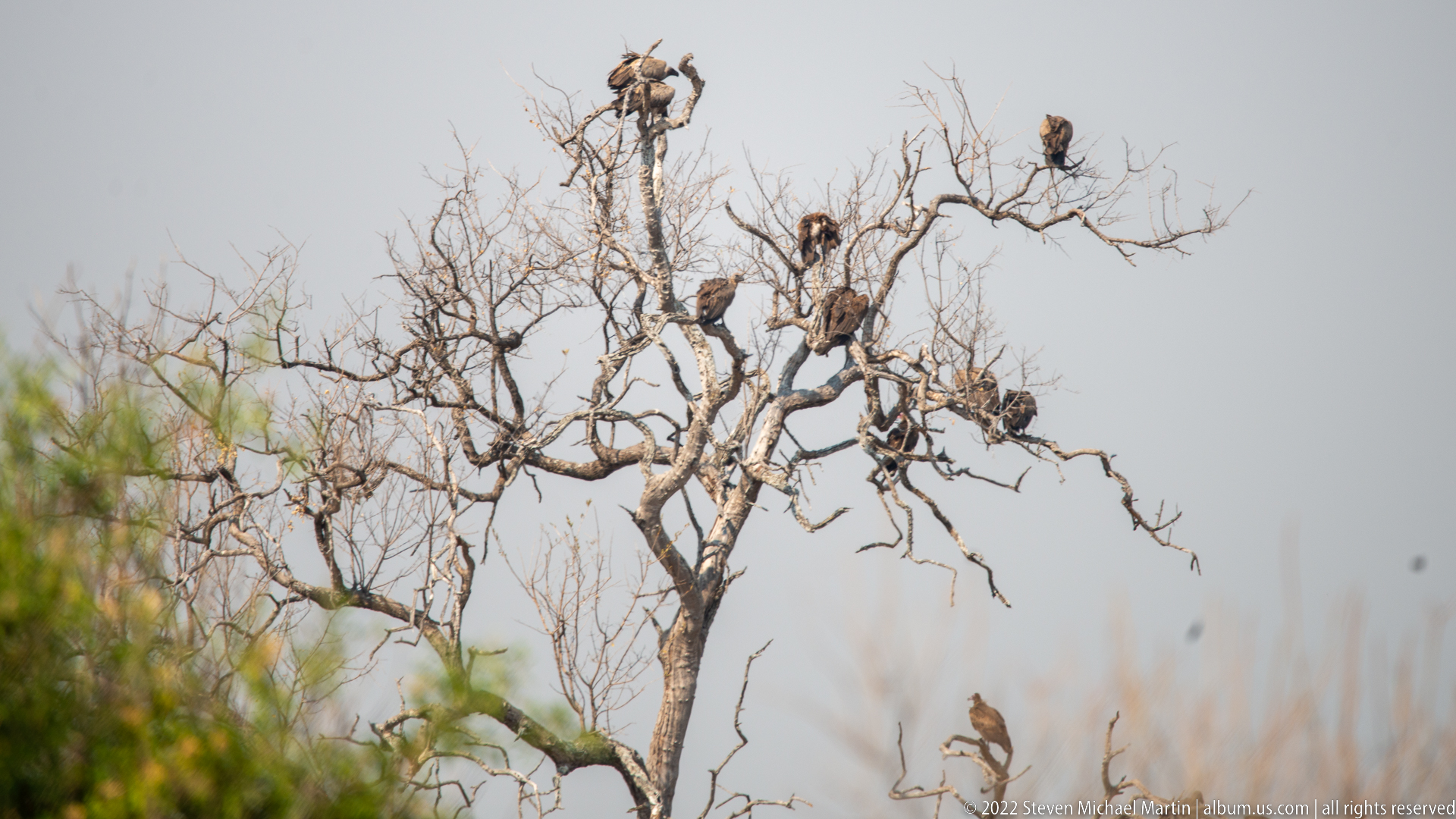
Numerous vultures occupy the bare branches of a dead tree, with birds perched at several heights and others clustered near the crown. The skeletal tree creates an open roost with broad views over the surrounding savanna. At this distance individual species cannot be assigned reliably, but the gathering itself documents the communal resting and surveillance behavior typical of large scavenging birds.
Caption
Numerous vultures occupy the bare branches of a dead tree, with birds perched at several heights and others clustered near the crown. The skeletal tree creates an open roost with broad views over the surrounding savanna. At this distance individual species cannot be assigned reliably, but the gathering itself documents the communal resting and surveillance behavior typical of large scavenging birds.
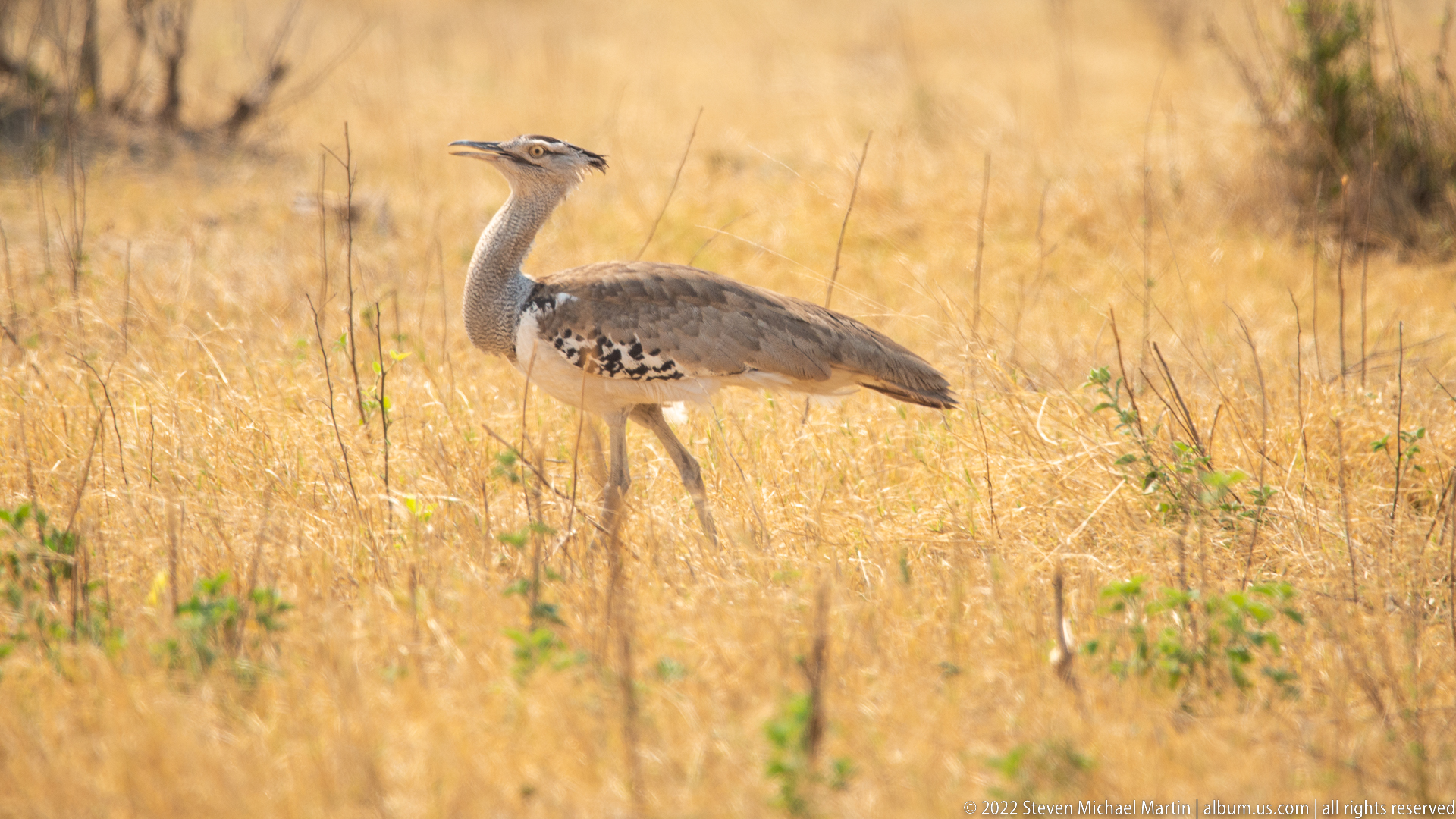
A kori bustard stands in sunlit dry grass, its tall neck and long legs rising above the tawny vegetation. The side profile reveals a gray neck, dark crown line, pale head, mottled brown back, and bold dark markings along the lower breast and flank. The open setting provides a clean field-guide view of this exceptionally large terrestrial bird.
Caption
A kori bustard stands in sunlit dry grass, its tall neck and long legs rising above the tawny vegetation. The side profile reveals a gray neck, dark crown line, pale head, mottled brown back, and bold dark markings along the lower breast and flank. The open setting provides a clean field-guide view of this exceptionally large terrestrial bird.

An adult African bush elephant crosses the foreground while a large herd gathers behind it on the open Chobe floodplain. Adults and younger animals form a dense gray band across pale sand and short grass. The layered composition emphasizes both the scale of an individual elephant and the exceptional herd concentrations for which the Chobe river system is renowned.
Caption
An adult African bush elephant crosses the foreground while a large herd gathers behind it on the open Chobe floodplain. Adults and younger animals form a dense gray band across pale sand and short grass. The layered composition emphasizes both the scale of an individual elephant and the exceptional herd concentrations for which the Chobe river system is renowned.
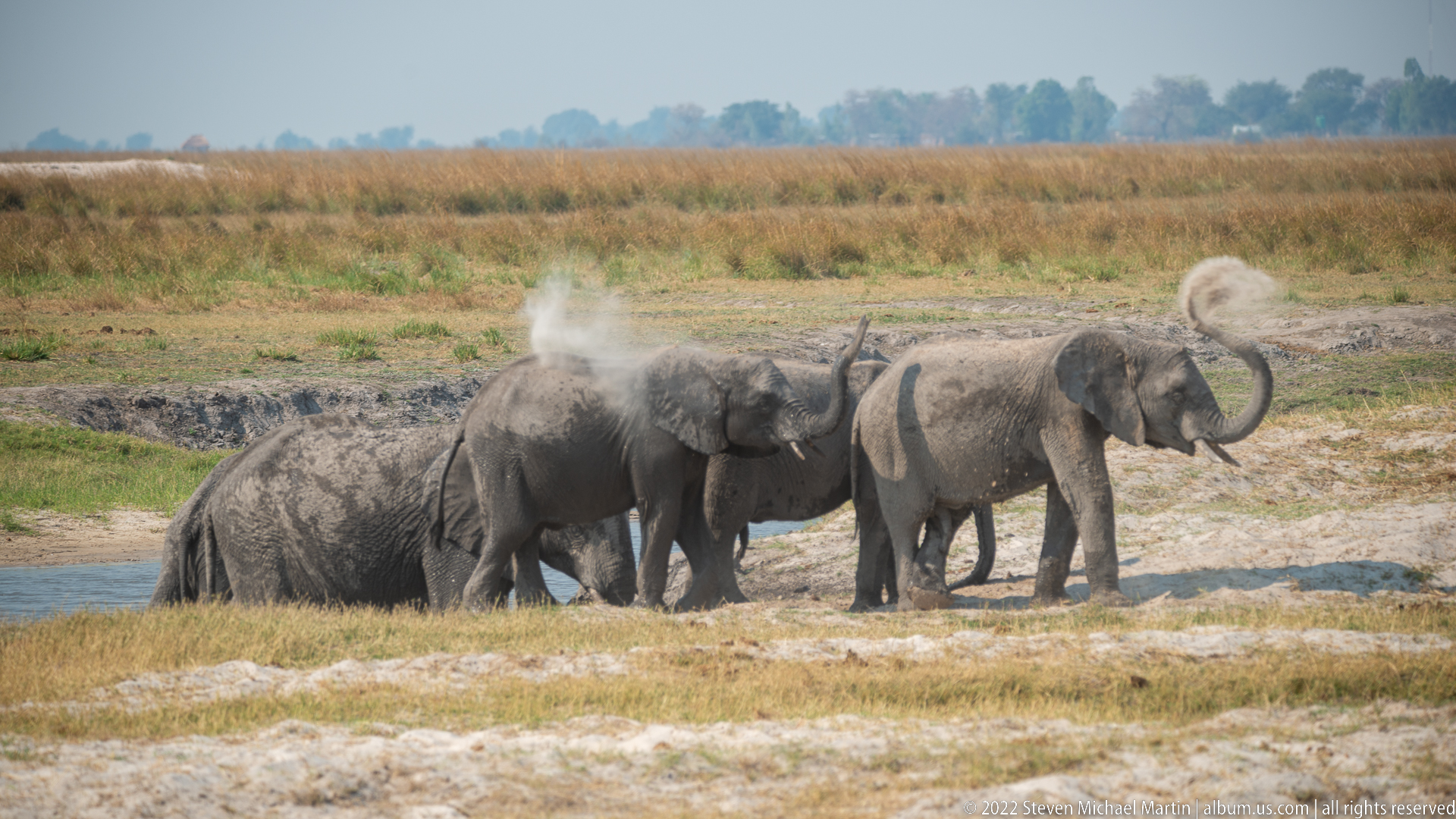
Several African bush elephants stand beside a shallow channel while one throws a pale cloud of dust over its back with its trunk. Another animal is heavily coated in dark wet mud, recording an earlier wallow. Together the dusting and mud-covered bodies show two complementary behaviors elephants use for cooling, skin care, and protection in Chobe’s hot floodplain environment.
Caption
Several African bush elephants stand beside a shallow channel while one throws a pale cloud of dust over its back with its trunk. Another animal is heavily coated in dark wet mud, recording an earlier wallow. Together the dusting and mud-covered bodies show two complementary behaviors elephants use for cooling, skin care, and protection in Chobe’s hot floodplain environment.
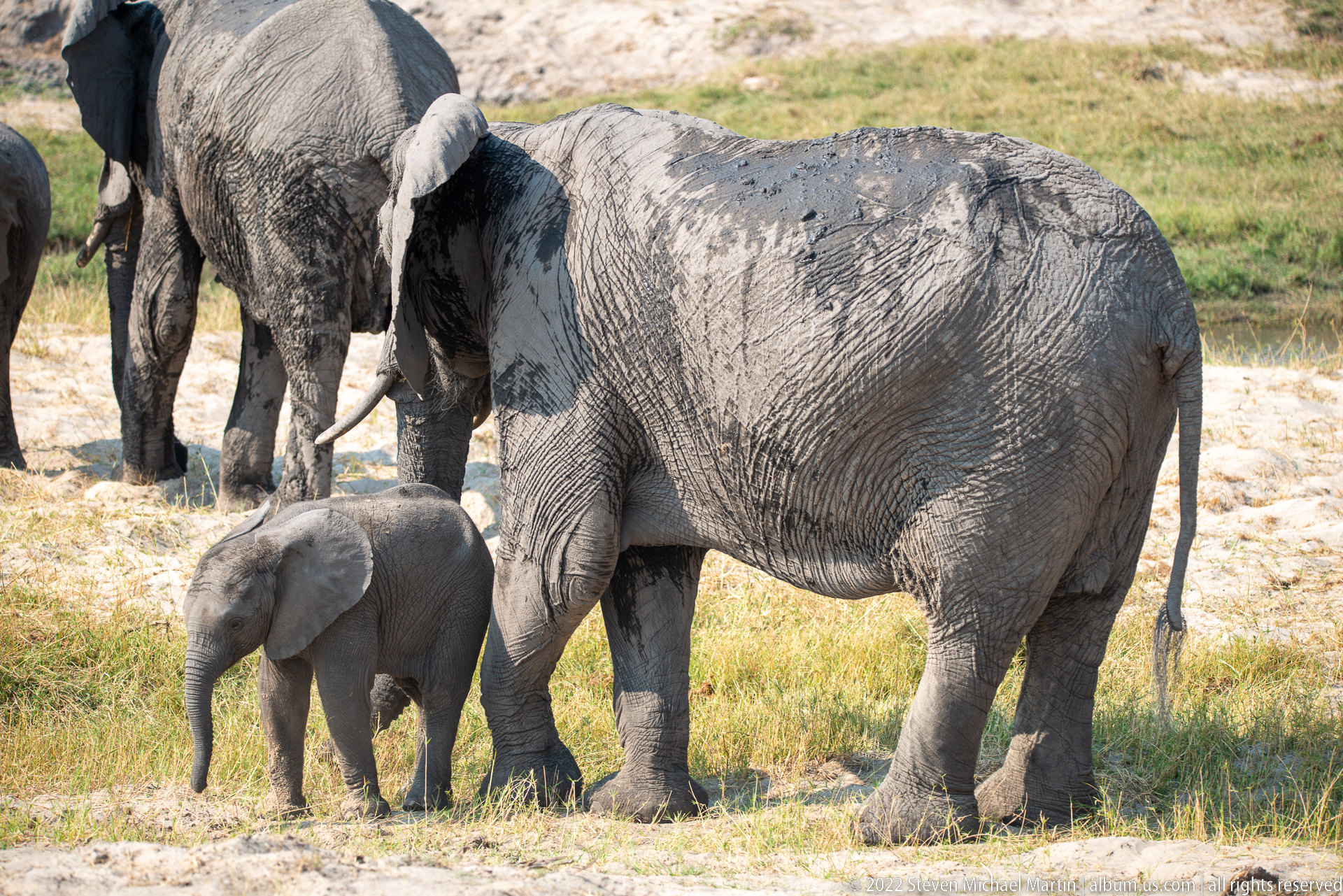
A mud-coated adult elephant stands beside a small calf on the floodplain, both facing left near a wet, churned area of ground. Dark patches of drying mud cover much of the adult’s flank and shoulder, while the calf remains comparatively clean. The close pairing emphasizes the size difference and protective proximity typical of elephant family groups.
Caption
A mud-coated adult elephant stands beside a small calf on the floodplain, both facing left near a wet, churned area of ground. Dark patches of drying mud cover much of the adult’s flank and shoulder, while the calf remains comparatively clean. The close pairing emphasizes the size difference and protective proximity typical of elephant family groups.
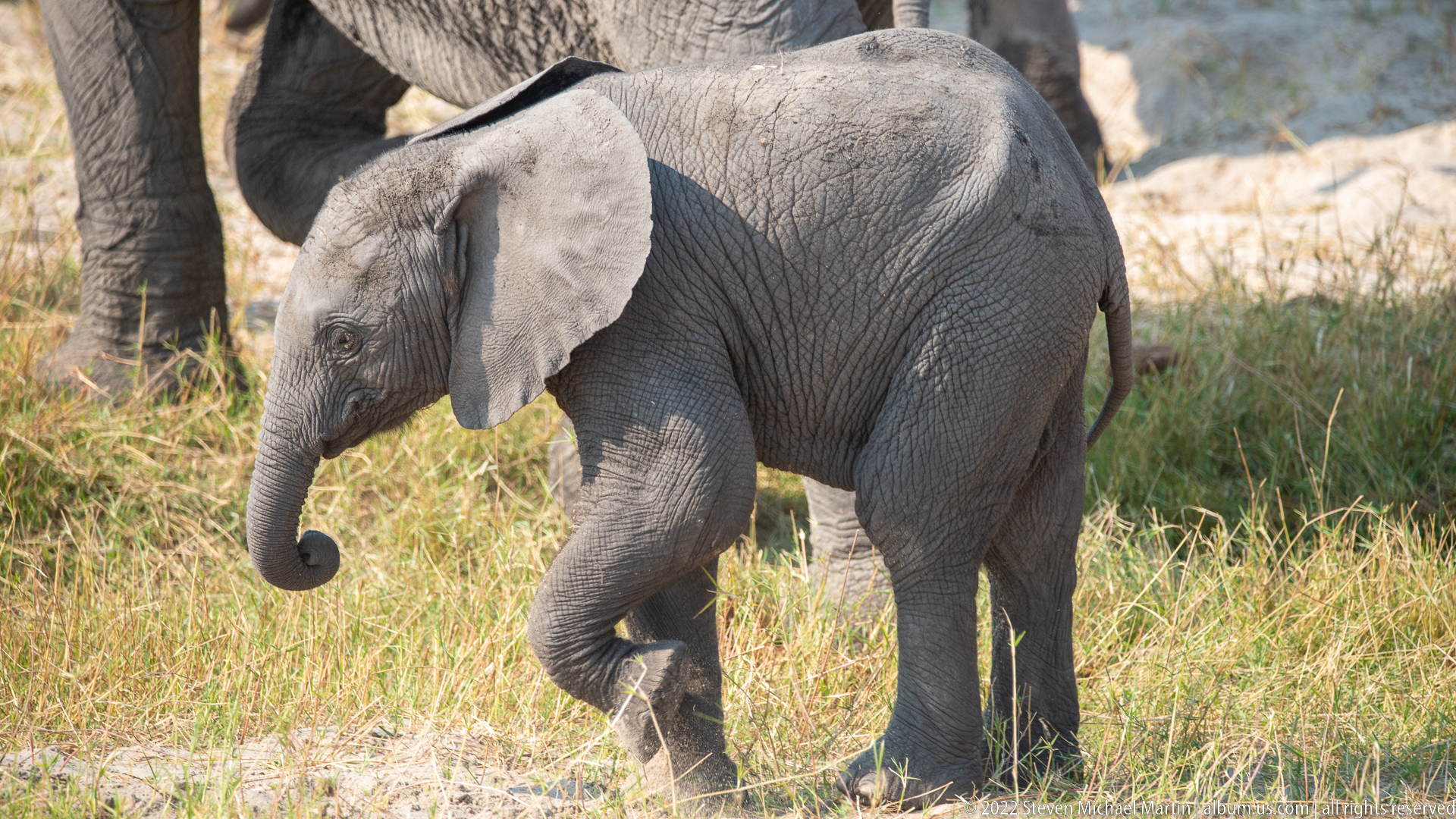
A young African elephant walks through short grass, one foreleg lifted and its small trunk curled gently inward. Large ears appear oversized relative to the compact body, reinforcing the animal’s juvenile proportions. The isolated full-body view provides a field-guide portrait of a calf moving independently but within the larger herd visible around the floodplain.
Caption
A young African elephant walks through short grass, one foreleg lifted and its small trunk curled gently inward. Large ears appear oversized relative to the compact body, reinforcing the animal’s juvenile proportions. The isolated full-body view provides a field-guide portrait of a calf moving independently but within the larger herd visible around the floodplain.
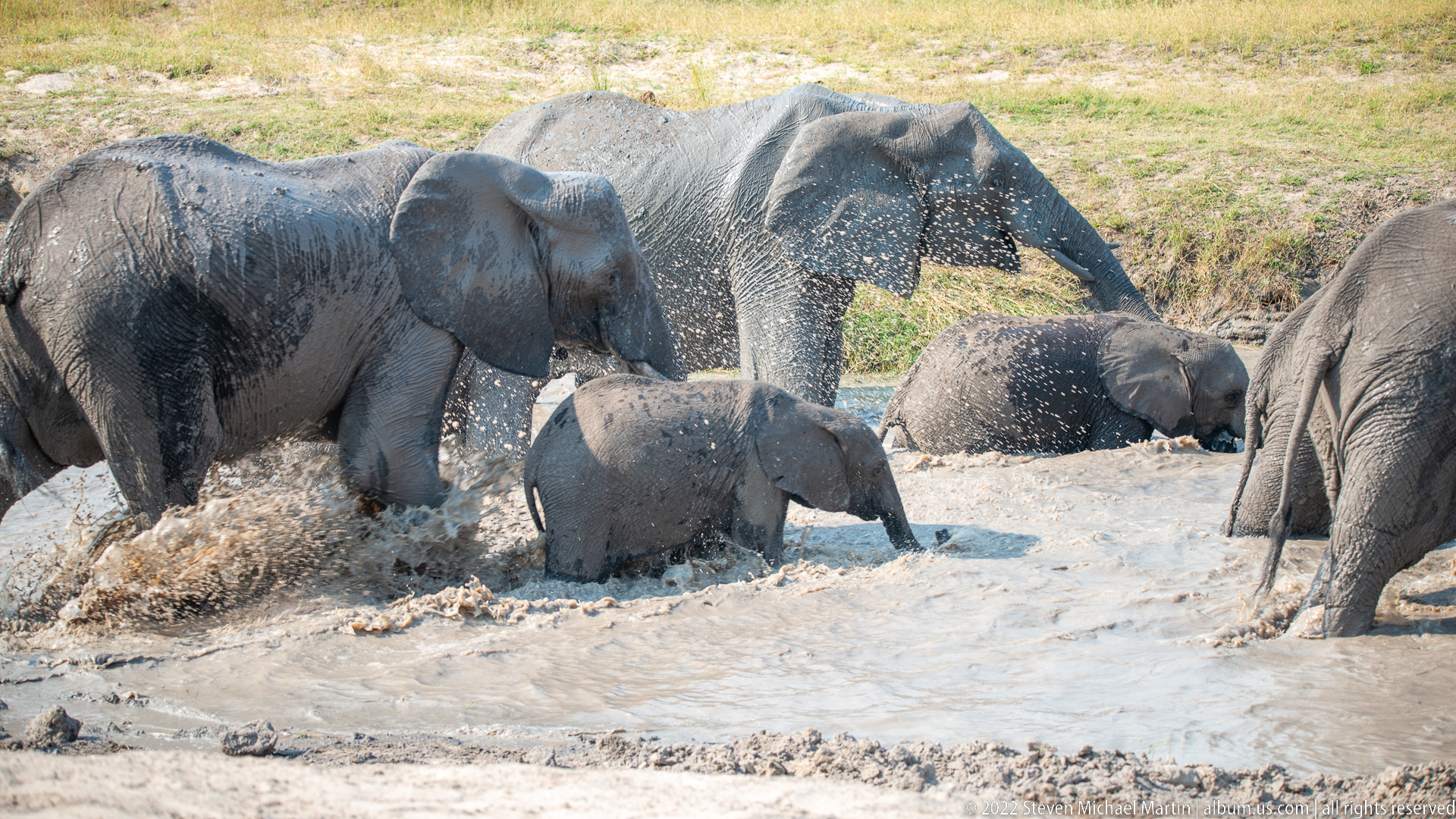
A family group of African bush elephants churns through a shallow muddy pool, with adults and calves wading shoulder-deep in splashing water. One adult swings its trunk while muddy droplets scatter across the scene. The vigorous group bath shows how Chobe’s elephants use floodplain pools for cooling, play, and coating their skin with protective mud.
Caption
A family group of African bush elephants churns through a shallow muddy pool, with adults and calves wading shoulder-deep in splashing water. One adult swings its trunk while muddy droplets scatter across the scene. The vigorous group bath shows how Chobe’s elephants use floodplain pools for cooling, play, and coating their skin with protective mud.

A mature male sable antelope stands alone on open grassland, its nearly black coat contrasting with pale facial markings and long, strongly curved horns. The horns sweep backward in a high arc well beyond the shoulders, a defining feature of adult males. The isolated stance provides a striking field-guide view against the layered Chobe floodplain.
Caption
A mature male sable antelope stands alone on open grassland, its nearly black coat contrasting with pale facial markings and long, strongly curved horns. The horns sweep backward in a high arc well beyond the shoulders, a defining feature of adult males. The isolated stance provides a striking field-guide view against the layered Chobe floodplain.
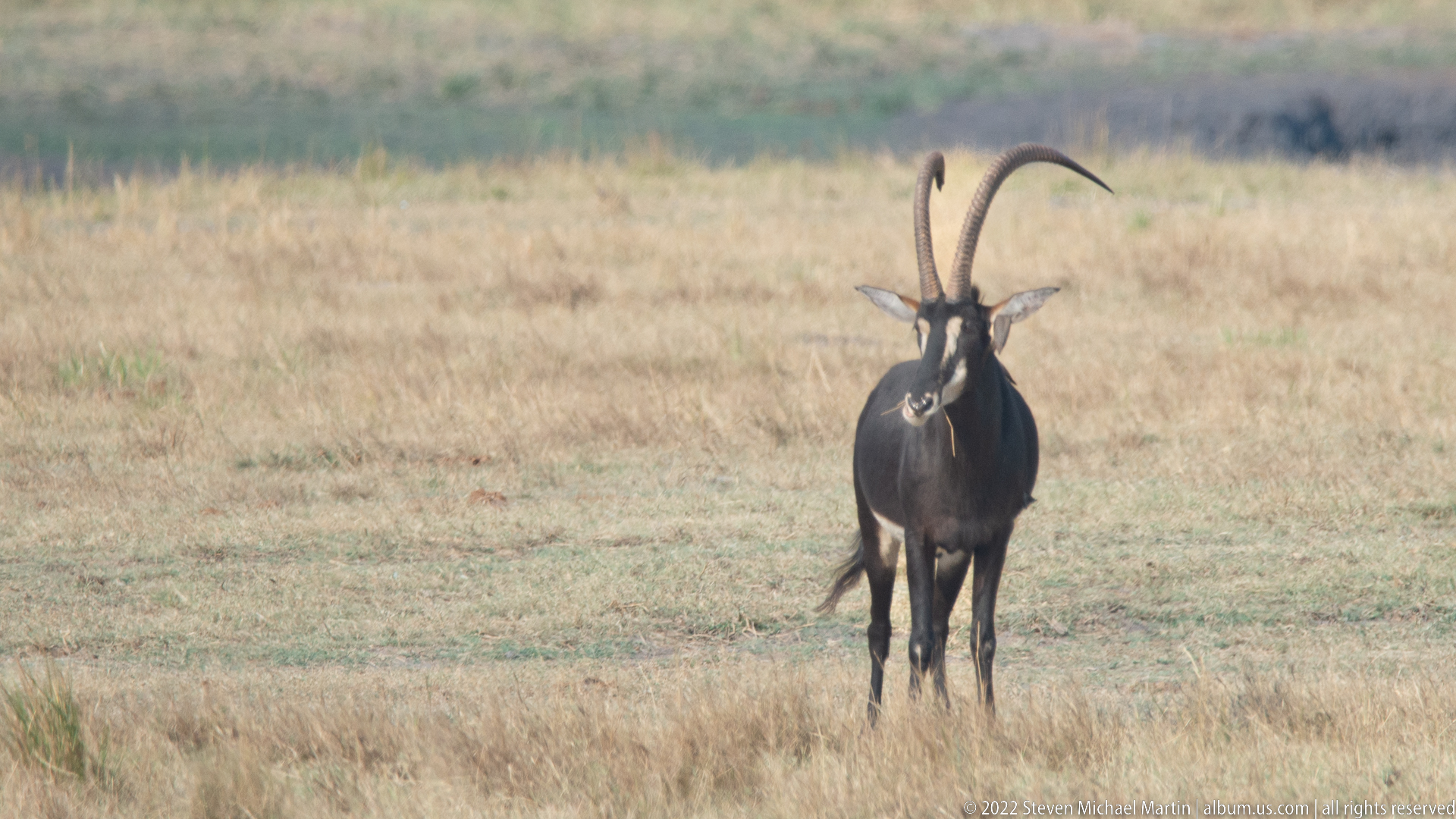
A male sable antelope faces the camera on open grassland, displaying the symmetrical sweep of its long ringed horns. Pale facial stripes and muzzle markings stand out against the dark head and body, while the ears project laterally beneath the horn bases. The frontal angle emphasizes the imposing horn geometry that distinguishes mature sable bulls.
Caption
A male sable antelope faces the camera on open grassland, displaying the symmetrical sweep of its long ringed horns. Pale facial stripes and muzzle markings stand out against the dark head and body, while the ears project laterally beneath the horn bases. The frontal angle emphasizes the imposing horn geometry that distinguishes mature sable bulls.
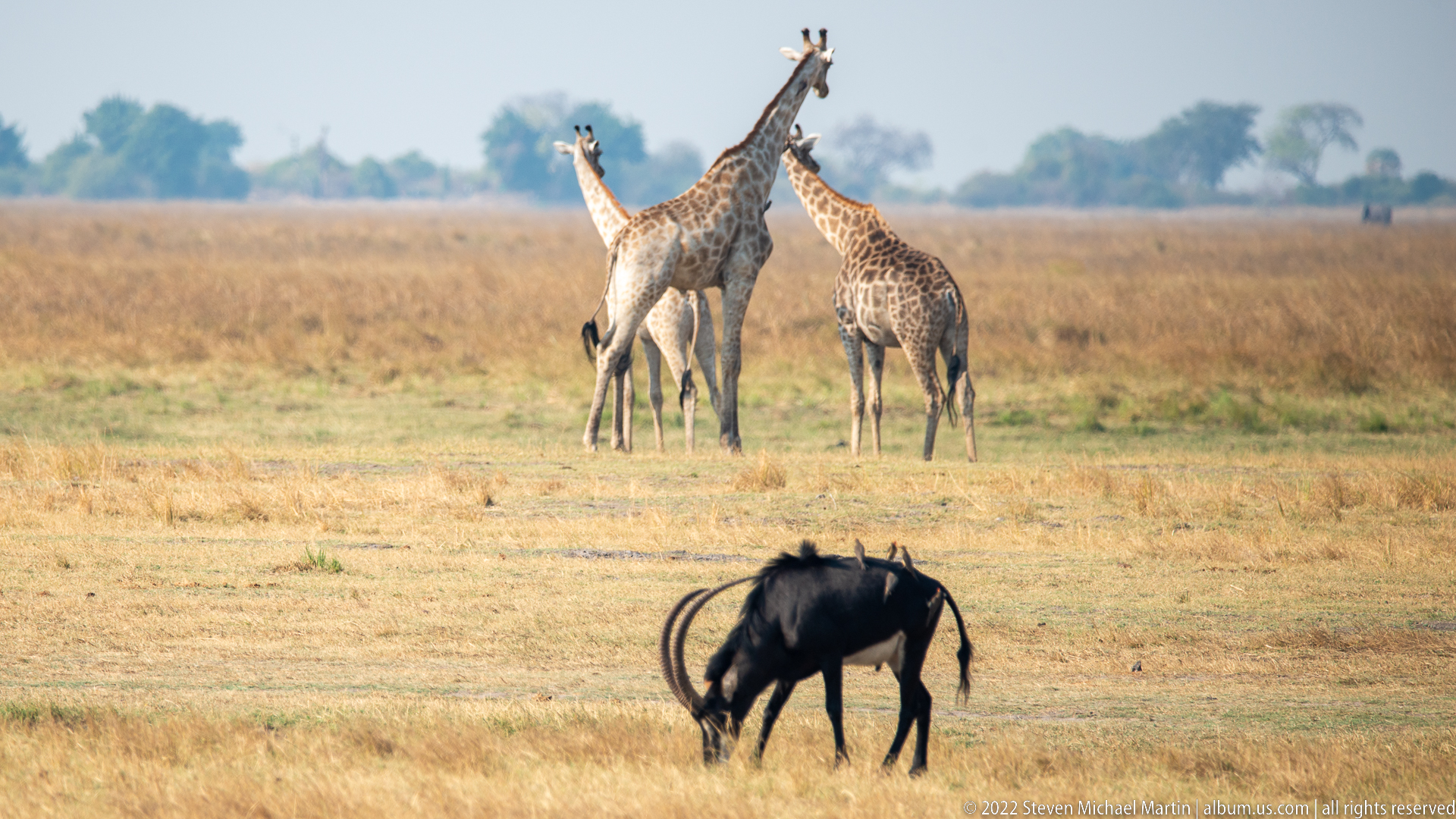
Two sable antelopes continue their horn-locking contest in the foreground as a pair of giraffes stands close together in the middle distance. The lower viewpoint separates the dark, arched sable horns from the tall patterned giraffes, creating a striking comparison of body form and scale. The photograph documents simultaneous social and feeding activity among large herbivores on the Chobe floodplain.
Caption
Two sable antelopes continue their horn-locking contest in the foreground as a pair of giraffes stands close together in the middle distance. The lower viewpoint separates the dark, arched sable horns from the tall patterned giraffes, creating a striking comparison of body form and scale. The photograph documents simultaneous social and feeding activity among large herbivores on the Chobe floodplain.
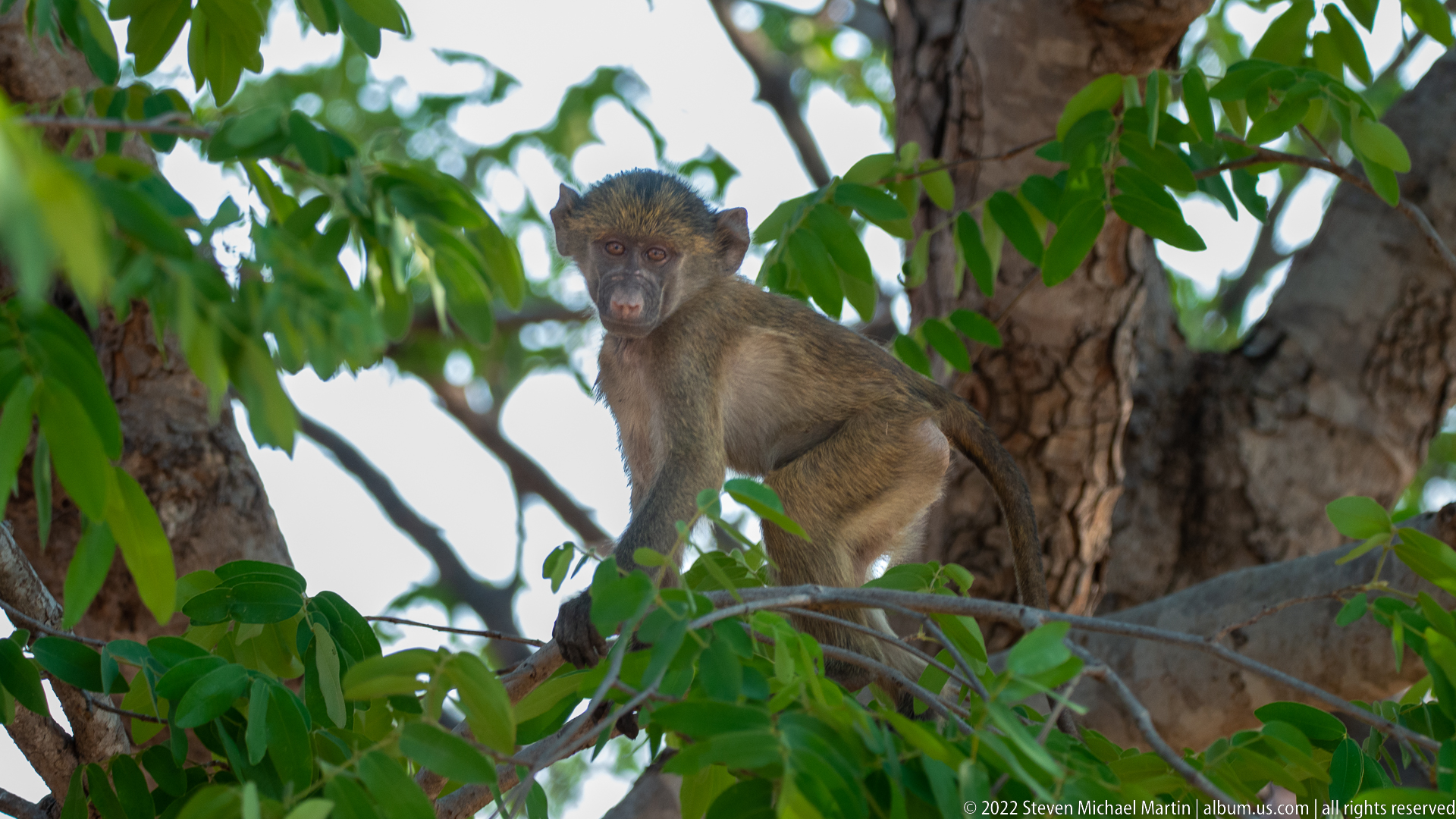
A juvenile chacma baboon perches among green leaves beside a thick tree trunk, one hand gripping a branch as it looks toward the camera. The small body, relatively large ears, short muzzle, and youthful facial proportions distinguish it from the larger adults photographed earlier. The arboreal setting shows how young baboons use branches for refuge, play, and observation.
Caption
A juvenile chacma baboon perches among green leaves beside a thick tree trunk, one hand gripping a branch as it looks toward the camera. The small body, relatively large ears, short muzzle, and youthful facial proportions distinguish it from the larger adults photographed earlier. The arboreal setting shows how young baboons use branches for refuge, play, and observation.
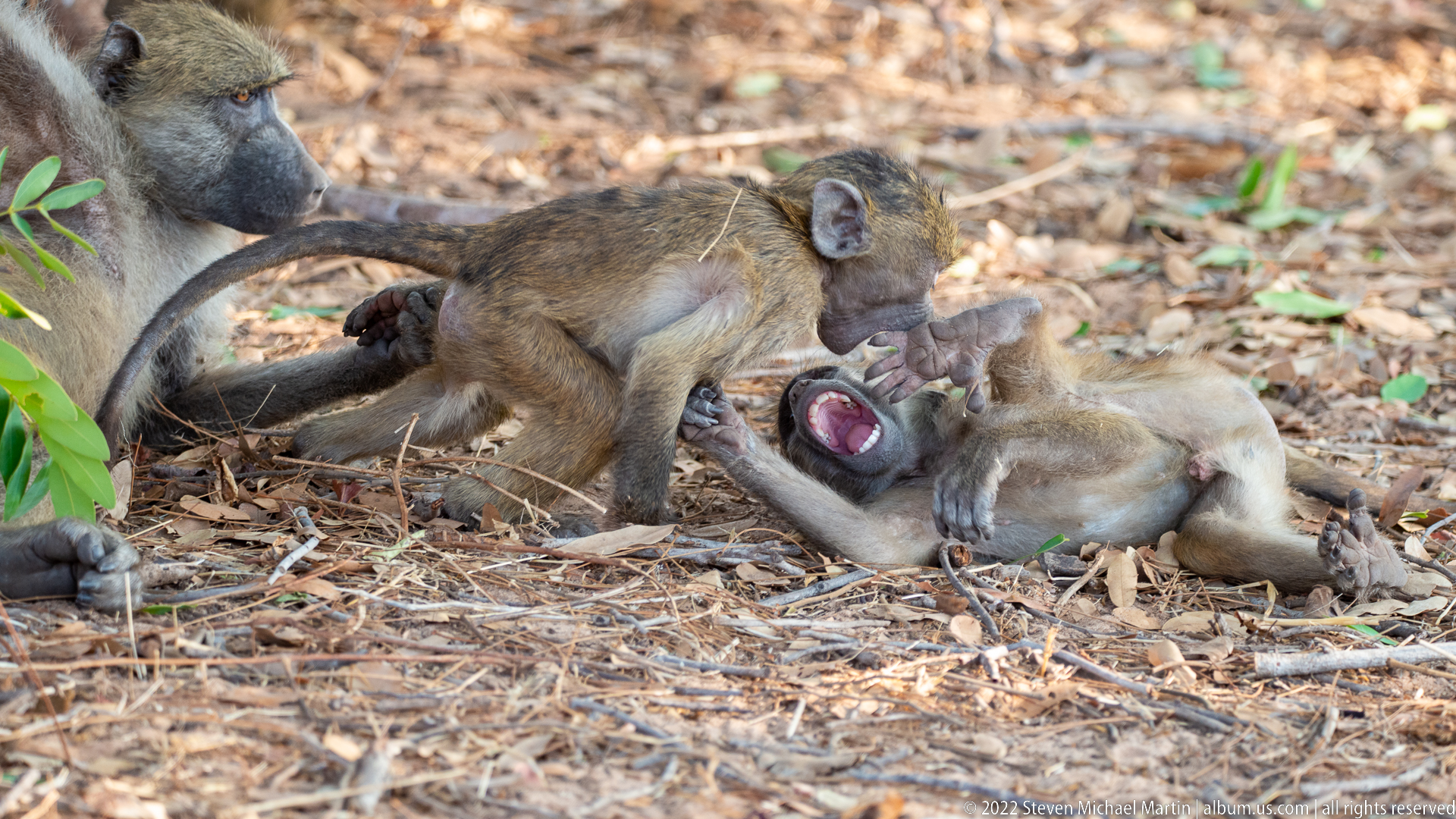
Young chacma baboons wrestle on the leaf-littered woodland floor, one leaning over another that lies on its back with mouth open. A larger baboon is partly visible at the edge of the frame. The energetic interaction records juvenile social play, an important part of developing coordination and relationships within a baboon troop.
Caption
Young chacma baboons wrestle on the leaf-littered woodland floor, one leaning over another that lies on its back with mouth open. A larger baboon is partly visible at the edge of the frame. The energetic interaction records juvenile social play, an important part of developing coordination and relationships within a baboon troop.

A cluster of lions rests closely together on a bare patch of earth, with adult lionesses surrounding several pale, smaller cubs. One lioness sits upright and alert while others sleep or lie pressed against the young. The compact arrangement provides a clear view of pride sociality, with adults and cubs sharing a shaded resting site.
Caption
A cluster of lions rests closely together on a bare patch of earth, with adult lionesses surrounding several pale, smaller cubs. One lioness sits upright and alert while others sleep or lie pressed against the young. The compact arrangement provides a clear view of pride sociality, with adults and cubs sharing a shaded resting site.
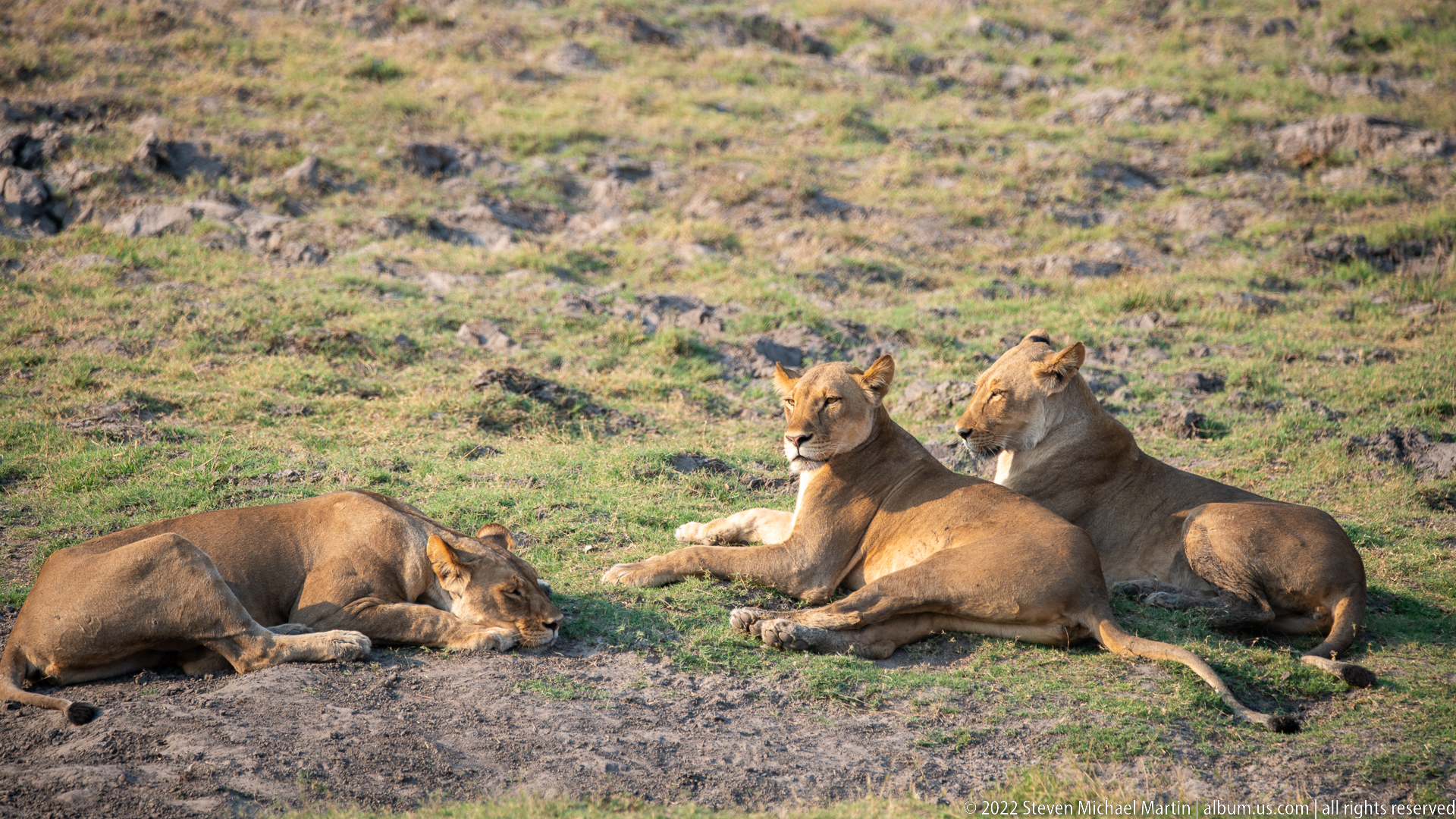
Three lionesses rest on a patch of open ground surrounded by short grass, two sitting upright while a third lies with her head lowered. Their bodies form a loose triangle, allowing each animal’s posture and orientation to remain distinct. The unobstructed setting contrasts with the denser woodland resting sites seen elsewhere in the portfolio.
Caption
Three lionesses rest on a patch of open ground surrounded by short grass, two sitting upright while a third lies with her head lowered. Their bodies form a loose triangle, allowing each animal’s posture and orientation to remain distinct. The unobstructed setting contrasts with the denser woodland resting sites seen elsewhere in the portfolio.
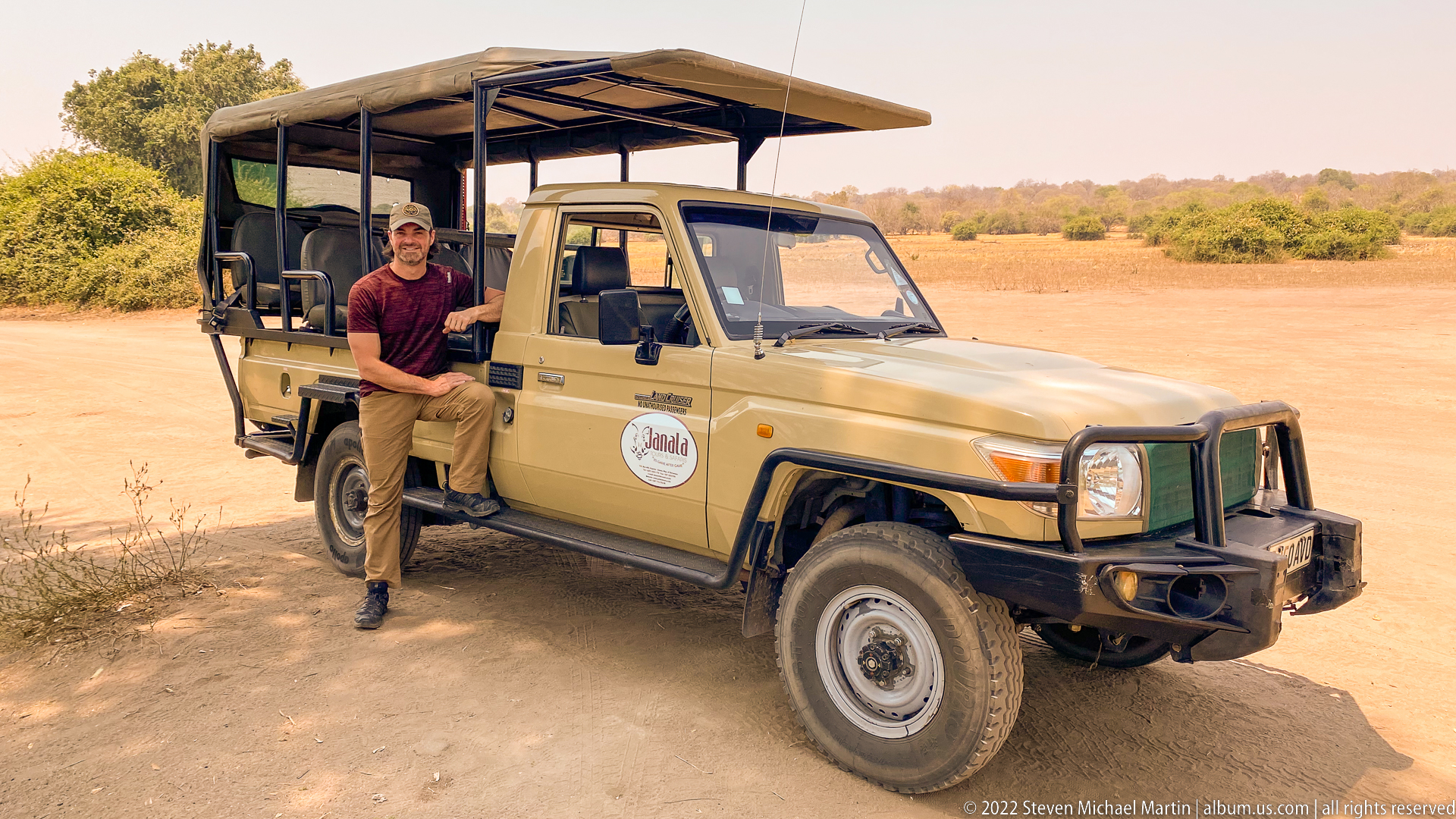
A safari traveler stands beside an open-sided game-drive vehicle on a sandy track in Chobe National Park. The vehicle has elevated passenger benches, a canvas canopy, heavy front protection, and high-clearance tires suited to wildlife-viewing routes. The portrait records the human side of the safari experience while keeping the specialized field vehicle prominent in the composition.
Caption
A safari traveler stands beside an open-sided game-drive vehicle on a sandy track in Chobe National Park. The vehicle has elevated passenger benches, a canvas canopy, heavy front protection, and high-clearance tires suited to wildlife-viewing routes. The portrait records the human side of the safari experience while keeping the specialized field vehicle prominent in the composition.

A close safari portrait shows a smiling traveler beside the open passenger compartment of a game-drive vehicle. The shallow depth of field keeps the face sharp while the canvas-covered seating and vehicle body soften behind. Rather than documenting wildlife directly, the frame records the personal experience and transport infrastructure associated with exploring Chobe National Park.
Caption
A close safari portrait shows a smiling traveler beside the open passenger compartment of a game-drive vehicle. The shallow depth of field keeps the face sharp while the canvas-covered seating and vehicle body soften behind. Rather than documenting wildlife directly, the frame records the personal experience and transport infrastructure associated with exploring Chobe National Park.

A close portrait isolates a smiling traveler in a red shirt and cap against softly blurred river water and floodplain vegetation. The shallow focus removes most environmental detail but retains enough of the waterside setting to connect the portrait with the Chobe landscape. Warm daylight and direct eye contact make this a personal counterpoint to the surrounding wildlife studies.
Caption
A close portrait isolates a smiling traveler in a red shirt and cap against softly blurred river water and floodplain vegetation. The shallow focus removes most environmental detail but retains enough of the waterside setting to connect the portrait with the Chobe landscape. Warm daylight and direct eye contact make this a personal counterpoint to the surrounding wildlife studies.
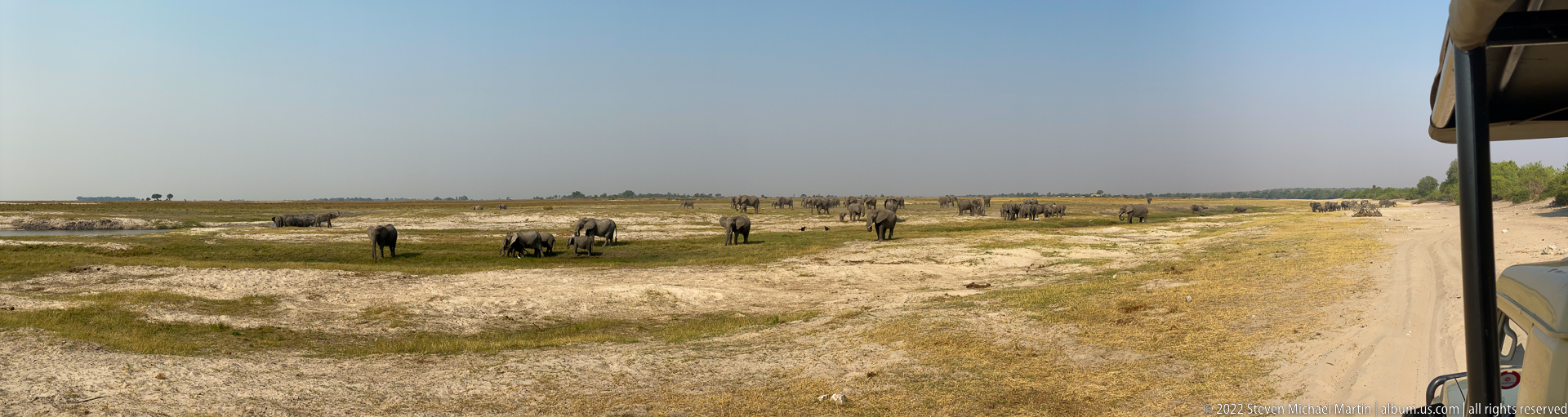
Elephants feed and move across the floodplain beside a sandy game-drive track, seen from the open side of a safari vehicle at the right edge of the frame. Adults and younger animals are dispersed through short green grass. Including the vehicle turns the wildlife scene into a contextual view of how visitors encounter Chobe’s large elephant concentrations from designated routes.
Caption
Elephants feed and move across the floodplain beside a sandy game-drive track, seen from the open side of a safari vehicle at the right edge of the frame. Adults and younger animals are dispersed through short green grass. Including the vehicle turns the wildlife scene into a contextual view of how visitors encounter Chobe’s large elephant concentrations from designated routes.
Two safari travelers sit inside an open game-drive vehicle, one close to the camera and another leaning forward from the rear bench. The padded rail, canvas canopy, and open sides reveal the vehicle’s wildlife-viewing configuration. The informal portrait records the shared experience of a Chobe game drive between encounters with animals.
Caption
Two safari travelers sit inside an open game-drive vehicle, one close to the camera and another leaning forward from the rear bench. The padded rail, canvas canopy, and open sides reveal the vehicle’s wildlife-viewing configuration. The informal portrait records the shared experience of a Chobe game drive between encounters with animals.

A safari traveler turns from the rear bench to watch African elephants passing close beside the vehicle on a sandy track. Several elephants, including a large adult near the open side, fill the background. The composition links observer and wildlife in the same frame, conveying the proximity possible during carefully managed game drives in Chobe National Park.
Caption
A safari traveler turns from the rear bench to watch African elephants passing close beside the vehicle on a sandy track. Several elephants, including a large adult near the open side, fill the background. The composition links observer and wildlife in the same frame, conveying the proximity possible during carefully managed game drives in Chobe National Park.
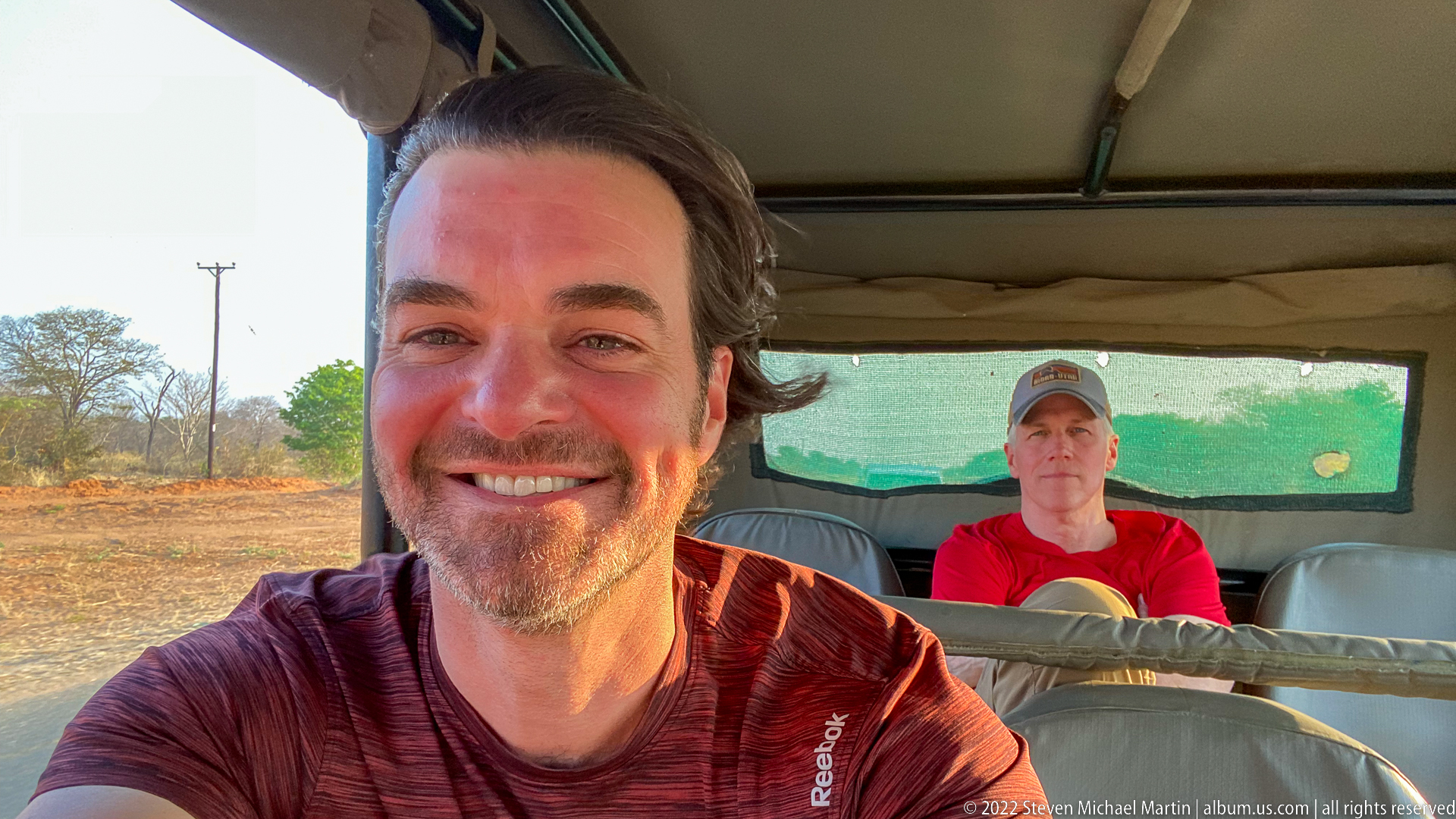
A close portrait inside an open safari vehicle shows one smiling traveler in the foreground and a second passenger seated on the rear bench. Warm low-angle light falls across the foreground face while the vehicle’s canvas roof, padded rail, and screened rear opening define the interior. The frame closes the wildlife sequence with a personal record of the Chobe game-drive experience.
Caption
A close portrait inside an open safari vehicle shows one smiling traveler in the foreground and a second passenger seated on the rear bench. Warm low-angle light falls across the foreground face while the vehicle’s canvas roof, padded rail, and screened rear opening define the interior. The frame closes the wildlife sequence with a personal record of the Chobe game-drive experience.
Chobe National Park felt different from the other safari stops almost immediately. The landscape opened wider, wildlife gathered more densely, and the presence of the river seemed to shape nearly everything — from elephant movement to birdlife concentration to where predators chose to rest.
What made Chobe memorable was its abundance. Elephant herds moved along the shoreline, lions rested in open view, leopard encounters unfolded in shaded woodland, and birds animated the river margins between the larger wildlife sightings. The result was a safari experience defined by both scale and variety.
Highlights
- Large elephant herds gathering along the Chobe River
- Strong predator sightings including both lion and leopard
- Rich birdlife along riverbanks, floodplains, and open grassland
- Classic plains game including giraffe, zebra, kudu, impala, and sable
- A powerful sense of wildlife density shaped by the river ecosystem
Field Guide
📍 Location
Chobe National Park lies in northern Botswana and is one of the country’s best-known wildlife areas. The park is centered around the Chobe River, whose permanent water draws animals from surrounding dry landscapes and creates one of the most concentrated safari environments in southern Africa.
🌍 Landscape
The defining feature of Chobe is the river itself. Floodplains, sandy tracks, riverbanks, and patches of woodland combine to create a landscape that feels both open and dynamic. In some places the visibility stretches for long distances across the plain, while in others woodland shade provides cover for predators and smaller animals.
🦁 Wildlife
Chobe offers one of the highest concentrations of wildlife in Botswana, largely influenced by the permanent water of the Chobe River. The diversity of habitats supports large herds, frequent predator sightings, and a wide variety of birdlife throughout the park.
- Elephants: Large family groups frequently gather along the riverbank, often moving between water and open floodplain in impressive numbers.
- Predators: Lions are commonly seen resting in open grassland or shaded woodland, while leopard sightings offer more intimate moments in quieter areas of cover.
- River Species: Hippos remain partially submerged along river edges, contributing to the constant presence of wildlife around the water.
- Plains Game: Giraffe, zebra, impala, kudu, sable, and other grazing animals move across open grassland and transitional woodland.
- Primates: Baboons are occasionally seen foraging or resting near woodland edges.
🦅 Birdlife
Birdlife is an essential part of the Chobe experience. Fish eagles, rollers, storks, ibises, bustards, bee-eaters, hornbills, and other species appear throughout the river corridor and surrounding grassland. They provide movement, color, and contrast between the larger mammal sightings.
🚙 Experience
Game drives in Chobe often feel active from beginning to end. The concentration of wildlife means sightings can come one after another, but the park also rewards slower observation — watching how elephants interact at the water, how predators rest in the heat, and how birds use the shifting edge between land and river.
Story & Experience
First Impressions of Scale
One of the first impressions of Chobe was scale. Elephant herds stretched along the shoreline and across the floodplain, making the landscape feel immediately full of life. The river was not simply background scenery; it was the organizing force of the entire experience.
Predators in Open View
Predator encounters added another dimension to the portfolio. Lions rested in warm light and open grass, sometimes barely moving beyond a yawn or small change in posture. Leopard sightings in shaded woodland felt more intimate and concentrated, with close portraits revealing texture, stillness, and quiet alertness.
River Life and Constant Movement
The river environment gave Chobe much of its character. Hippos remained partly submerged along the banks, elephants crossed or gathered at the edge, and birdlife animated the shallows. These overlapping scenes made the ecosystem feel connected rather than divided into separate subjects.
Birds, Color, and Rhythm
Birdlife provided important visual variety throughout the gallery. Fish eagles, rollers, storks, ibises, bee-eaters, and bustards helped pace the sequence, offering both quiet moments and flashes of color between the larger mammals. They also reinforced how rich the Chobe River corridor is beyond its famous elephant herds.
Plains Game and Wider Context
Giraffe, zebra, kudu, impala, sable, and baboons expanded the story beyond the riverbank itself. Together they gave the portfolio a fuller ecological range, showing how Chobe supports both concentrated river wildlife and classic savanna species across the surrounding landscape.
Personal Moments Along the Way
The candid photos, vehicles, park entrance, and quiet pauses between sightings help complete the page. They make the experience feel lived rather than simply observed. In that way, Chobe becomes not only a wildlife destination, but part of the larger memory of the safari itself.
Photography Notes
- River scenes work well for showing wildlife density and layered compositions
- Elephant herds benefit from slightly wider framing to preserve scale
- Predator portraits are strongest when balanced with habitat context
- Birdlife adds color and pacing between mammal-heavy sequences
- Personal travel and vehicle images help keep the page narrative and human
Quick Facts
- Country: Botswana
- Region: Chobe River ecosystem
- Landscape: Riverfront floodplain, woodland, and open grassland
- Key Wildlife: Elephant, lion, leopard, hippo, giraffe, zebra, kudu, sable, impala, baboons, and rich birdlife
- Experience Style: River-focused safari defined by abundance, scale, and diversity