Ho Chi Minh City
Ho Chi Minh City developed as a major commercial center influenced by French colonial administration and regional trade networks in Southeast Asia. The city’s location along the Saigon River contributed to its importance as a transportation hub connecting inland regions with maritime routes. Urban development reflects the influence of both European colonial planning and local cultural traditions.
Colonial-era buildings illustrate architectural styles introduced during French governance in the nineteenth century. Boulevards, civic structures, and religious buildings demonstrate how European planning principles were applied within Southeast Asian urban environments. The city’s growth reflects economic connections linking the region with global markets.
Ho Chi Minh City illustrates the interaction between European colonial influence and Southeast Asian cultural identity. Its preserved architecture reflects the historical transition from colonial administration to modern national development.

A formal yellow-and-cream gateway stands at the end of a shaded park avenue lined with mature trees and globe lamps. Trimmed shrubs and flowering beds organize the central approach, while pedestrians gather near the entrance pavilion. The axial view emphasizes the contrast between the dense tree canopy and the brightly painted architectural focal point.
Caption
A formal yellow-and-cream gateway stands at the end of a shaded park avenue lined with mature trees and globe lamps. Trimmed shrubs and flowering beds organize the central approach, while pedestrians gather near the entrance pavilion. The axial view emphasizes the contrast between the dense tree canopy and the brightly painted architectural focal point.

Mature trees frame a long cream-colored institutional building with red tiled roofs, repeated arches, and an upper balcony. A formal garden strip and gated frontage soften the street edge, while the building’s proportions and ornament suggest a colonial-era civic or educational complex.
Caption
Mature trees frame a long cream-colored institutional building with red tiled roofs, repeated arches, and an upper balcony. A formal garden strip and gated frontage soften the street edge, while the building’s proportions and ornament suggest a colonial-era civic or educational complex.

The main hall of Saigon Central Post Office extends beneath a high barrel vault articulated by dark green iron ribs and orange-and-cream bands. Service counters line both sides, while a portrait of Ho Chi Minh anchors the far end of the axial interior.
Caption
The main hall of Saigon Central Post Office extends beneath a high barrel vault articulated by dark green iron ribs and orange-and-cream bands. Service counters line both sides, while a portrait of Ho Chi Minh anchors the far end of the axial interior.
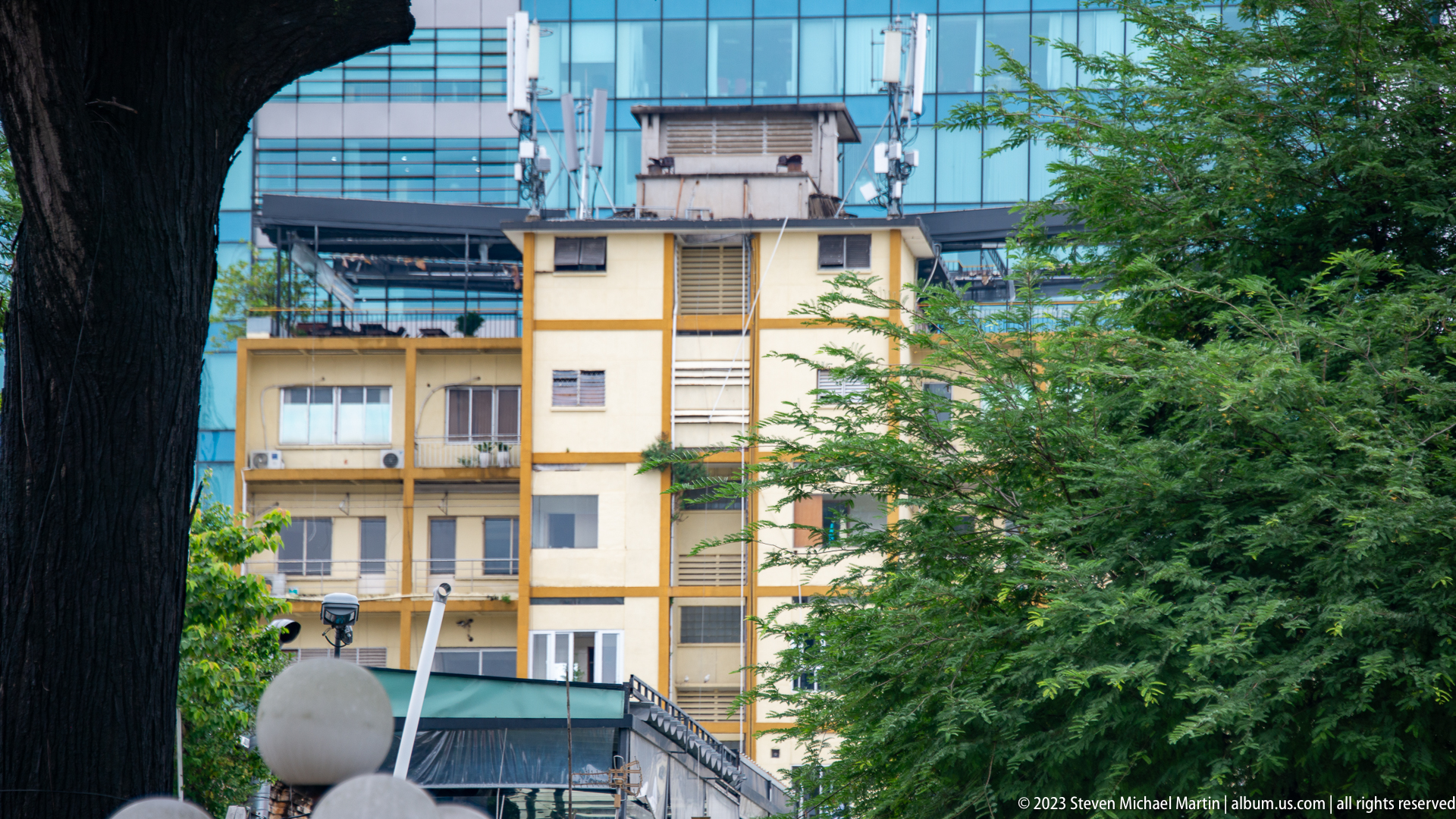
A massive tree trunk and leafy canopy partially screen an aging yellow mid-rise, while blue-glass towers rise behind it. The compressed view layers vegetation, older urban housing, and contemporary development into a single frame, illustrating the rapid vertical transformation of central Ho Chi Minh City.
Caption
A massive tree trunk and leafy canopy partially screen an aging yellow mid-rise, while blue-glass towers rise behind it. The compressed view layers vegetation, older urban housing, and contemporary development into a single frame, illustrating the rapid vertical transformation of central Ho Chi Minh City.

A steep high-angle view looks down onto a tree-lined city street illuminated by pools of warm light. Cars and motorbikes move through the intersection while low buildings and taller towers recede toward a brightly lit commercial district. The tilted composition conveys the vertiginous perspective of a rooftop or upper-story terrace and emphasizes the layered vertical growth of central Ho Chi Minh City.
Caption
A steep high-angle view looks down onto a tree-lined city street illuminated by pools of warm light. Cars and motorbikes move through the intersection while low buildings and taller towers recede toward a brightly lit commercial district. The tilted composition conveys the vertiginous perspective of a rooftop or upper-story terrace and emphasizes the layered vertical growth of central Ho Chi Minh City.

A broad rooftop view shows Ho Chi Minh City’s dense urban fabric, where narrow low-rise buildings cluster around newer office and residential towers. The overcast light flattens the skyline into layers, emphasizing the city’s mixture of building ages, scales, and construction patterns.
Caption
A broad rooftop view shows Ho Chi Minh City’s dense urban fabric, where narrow low-rise buildings cluster around newer office and residential towers. The overcast light flattens the skyline into layers, emphasizing the city’s mixture of building ages, scales, and construction patterns.
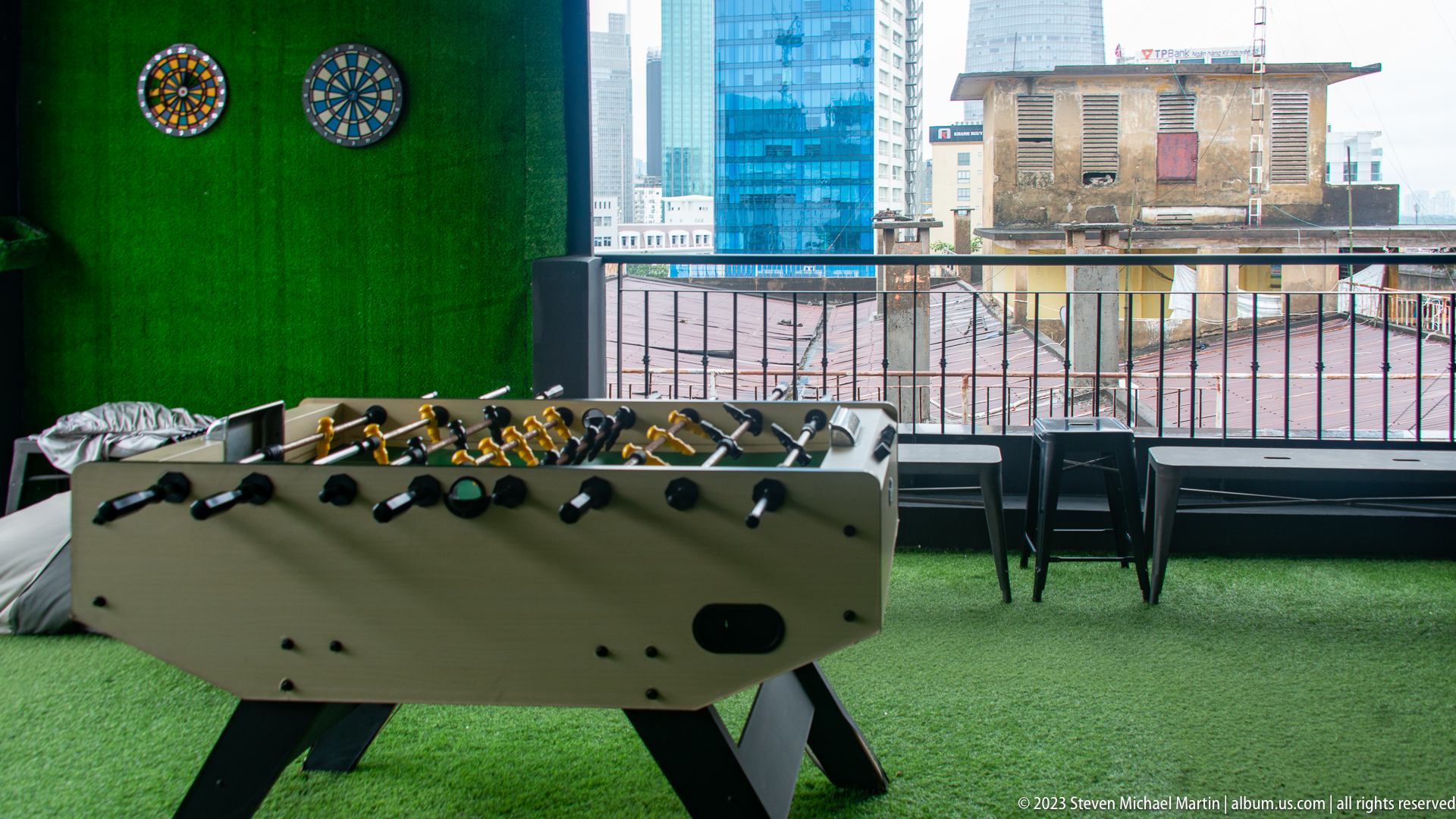
A foosball table occupies a rooftop recreation area surfaced with artificial turf. Beyond the railing, tightly packed urban buildings and a weathered neighboring structure place the playful amenity within Ho Chi Minh City’s layered central skyline.
Caption
A foosball table occupies a rooftop recreation area surfaced with artificial turf. Beyond the railing, tightly packed urban buildings and a weathered neighboring structure place the playful amenity within Ho Chi Minh City’s layered central skyline.

A street vendor wearing a nón lá conical hat pushes a two-wheeled cart loaded with containers, bags, and working supplies across the roadway. Seen from behind, her patterned clothing and practical footwear stand out against the broad gray pavement. The image records the physical labor and mobile economy that remain visible within Ho Chi Minh City’s fast-moving streets.
Caption
A street vendor wearing a nón lá conical hat pushes a two-wheeled cart loaded with containers, bags, and working supplies across the roadway. Seen from behind, her patterned clothing and practical footwear stand out against the broad gray pavement. The image records the physical labor and mobile economy that remain visible within Ho Chi Minh City’s fast-moving streets.

Three people ride together on a single motorbike through Ho Chi Minh City traffic. Helmets, casual clothing, and the compact seating arrangement convey the practical role of scooters in everyday urban mobility. The elevated viewpoint and slight motion blur isolate the family group against wet pavement, curbside drainage, and the muted textures of the street.
Caption
Three people ride together on a single motorbike through Ho Chi Minh City traffic. Helmets, casual clothing, and the compact seating arrangement convey the practical role of scooters in everyday urban mobility. The elevated viewpoint and slight motion blur isolate the family group against wet pavement, curbside drainage, and the muted textures of the street.
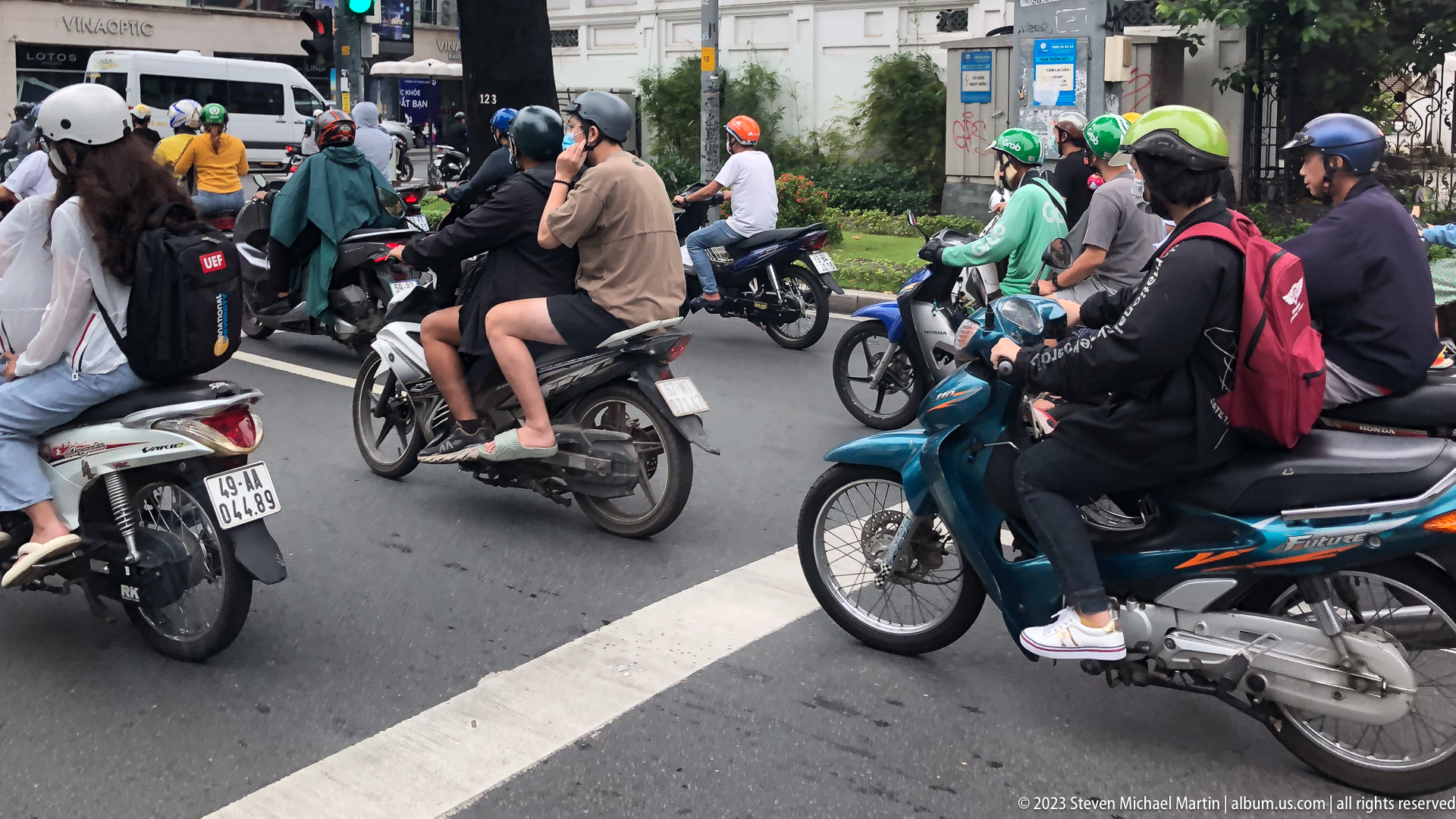
Motorcyclists cluster shoulder to shoulder at a city intersection, many wearing helmets and several carrying passengers. The close side view reveals the variety of scooters, clothing, delivery gear, and everyday travel arrangements that make two-wheeled transport central to Ho Chi Minh City’s street life. Painted lane markings and a compressed crowd convey the density and coordination of urban movement.
Caption
Motorcyclists cluster shoulder to shoulder at a city intersection, many wearing helmets and several carrying passengers. The close side view reveals the variety of scooters, clothing, delivery gear, and everyday travel arrangements that make two-wheeled transport central to Ho Chi Minh City’s street life. Painted lane markings and a compressed crowd convey the density and coordination of urban movement.
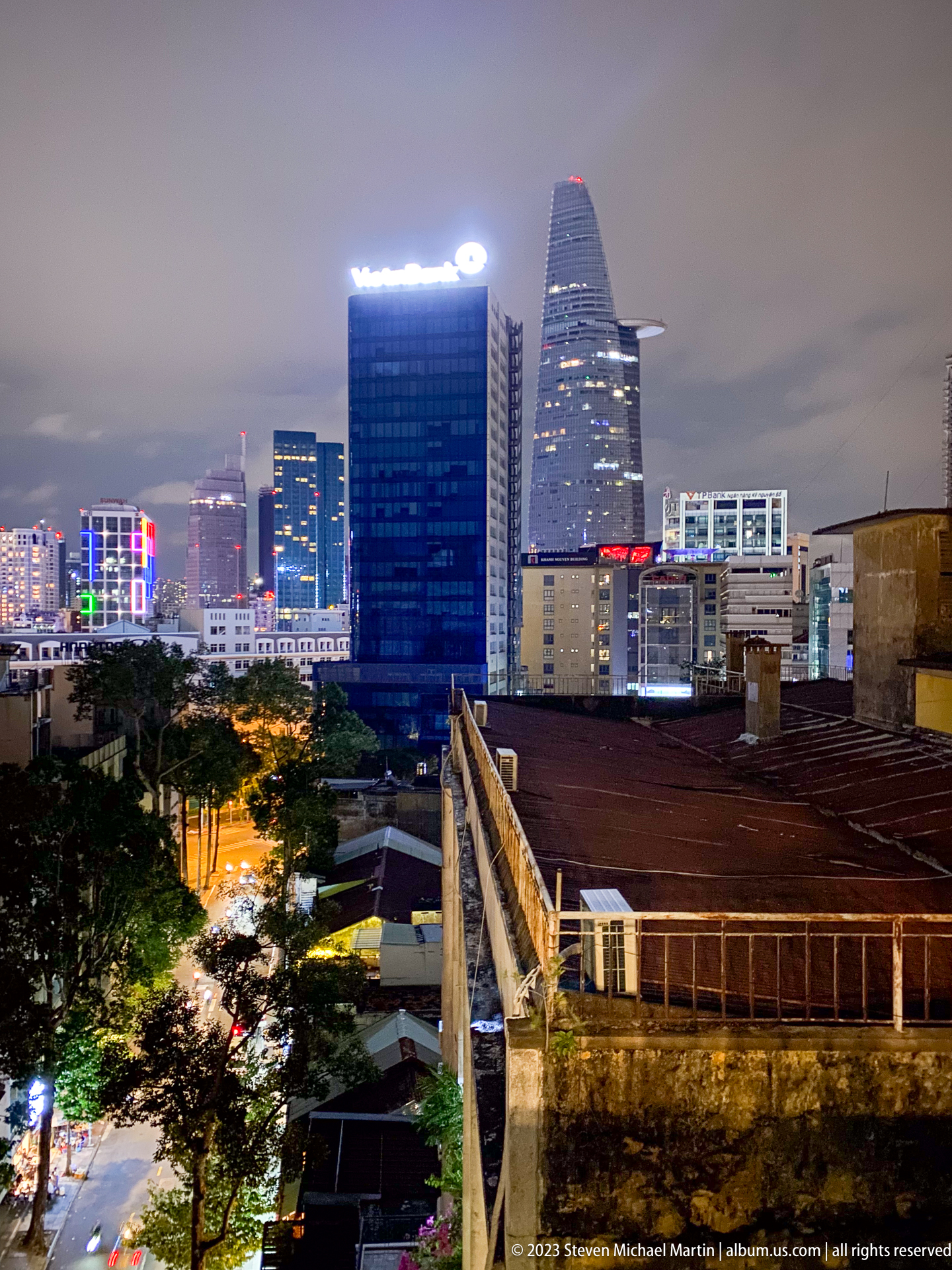
Ho Chi Minh City’s illuminated skyline rises beyond a lower layer of aging roofs and tree-lined streets. The tapering Bitexco Financial Tower, recognizable by its projecting helipad, anchors the right side of the view, while newer glass towers glow across the horizon. The elevated viewpoint brings contrasting urban fabrics into one frame: dense historic blocks in the foreground and the expanding commercial skyline beyond.
Caption
Ho Chi Minh City’s illuminated skyline rises beyond a lower layer of aging roofs and tree-lined streets. The tapering Bitexco Financial Tower, recognizable by its projecting helipad, anchors the right side of the view, while newer glass towers glow across the horizon. The elevated viewpoint brings contrasting urban fabrics into one frame: dense historic blocks in the foreground and the expanding commercial skyline beyond.

A sharply angled, illuminated entrance structure rises beside a busy Ho Chi Minh City street, framed by national and ceremonial flags. Motorbikes and cars pass beneath warm streetlights, while the structure’s pale ribs and dark central panels create a distinctly contemporary counterpoint to the surrounding trees and traffic.
Caption
A sharply angled, illuminated entrance structure rises beside a busy Ho Chi Minh City street, framed by national and ceremonial flags. Motorbikes and cars pass beneath warm streetlights, while the structure’s pale ribs and dark central panels create a distinctly contemporary counterpoint to the surrounding trees and traffic.

An illustrated city map gathers recognizable buildings, museums, markets, waterways, and transport references into a compact visual guide to Ho Chi Minh City. The black-and-white linework is accented with muted color, while labels and landmark sketches create an informal orientation tool rather than a measured street plan.
Caption
An illustrated city map gathers recognizable buildings, museums, markets, waterways, and transport references into a compact visual guide to Ho Chi Minh City. The black-and-white linework is accented with muted color, while labels and landmark sketches create an informal orientation tool rather than a measured street plan.

A handwritten note reading “I LOVE STEVE!!!” is centered on a plain white sheet clipped to a wooden display board. Its informal lettering and emphatic punctuation suggest a personal welcome or playful message encountered inside the lodging.
Caption
A handwritten note reading “I LOVE STEVE!!!” is centered on a plain white sheet clipped to a wooden display board. Its informal lettering and emphatic punctuation suggest a personal welcome or playful message encountered inside the lodging.

A yellow motorbike anchors the foreground of a rooftop view dominated by contemporary office architecture. The sharply angled white tower and taller blue-glass block behind it emphasize the scale and geometric variety of Ho Chi Minh City’s expanding business district.
Caption
A yellow motorbike anchors the foreground of a rooftop view dominated by contemporary office architecture. The sharply angled white tower and taller blue-glass block behind it emphasize the scale and geometric variety of Ho Chi Minh City’s expanding business district.

A white fabric hammock hangs indoors beside a large window, arranged with bold black-and-white chevron cushions and tasselled edges. The setup combines casual lodging design with a compact reading or resting corner, using the window light and graphic textiles as the main visual features.
Caption
A white fabric hammock hangs indoors beside a large window, arranged with bold black-and-white chevron cushions and tasselled edges. The setup combines casual lodging design with a compact reading or resting corner, using the window light and graphic textiles as the main visual features.

A vivid mural marked “Hammock Hotel” forms the backdrop to an eclectic lounge furnished with bright wire chairs, small tables, and upholstered seating. Layered graffiti graphics, angular color blocks, and hanging lights give the communal interior a youthful, deliberately informal character.
Caption
A vivid mural marked “Hammock Hotel” forms the backdrop to an eclectic lounge furnished with bright wire chairs, small tables, and upholstered seating. Layered graffiti graphics, angular color blocks, and hanging lights give the communal interior a youthful, deliberately informal character.

A weathered rooftop house stands in sharp contrast to Ho Chi Minh City’s modern high-rise skyline. The tapered Bitexco Financial Tower and neighboring glass office blocks rise behind the small, aged structure, creating a compact study in the city’s uneven pace of redevelopment.
Caption
A weathered rooftop house stands in sharp contrast to Ho Chi Minh City’s modern high-rise skyline. The tapered Bitexco Financial Tower and neighboring glass office blocks rise behind the small, aged structure, creating a compact study in the city’s uneven pace of redevelopment.

A covered rooftop terrace combines a gray sectional sofa, low tables, string lights, and suspended swing frames on artificial turf. Open railings reveal nearby construction and dense mid-rise development, giving the lounge a direct visual connection to the surrounding city.
Caption
A covered rooftop terrace combines a gray sectional sofa, low tables, string lights, and suspended swing frames on artificial turf. Open railings reveal nearby construction and dense mid-rise development, giving the lounge a direct visual connection to the surrounding city.
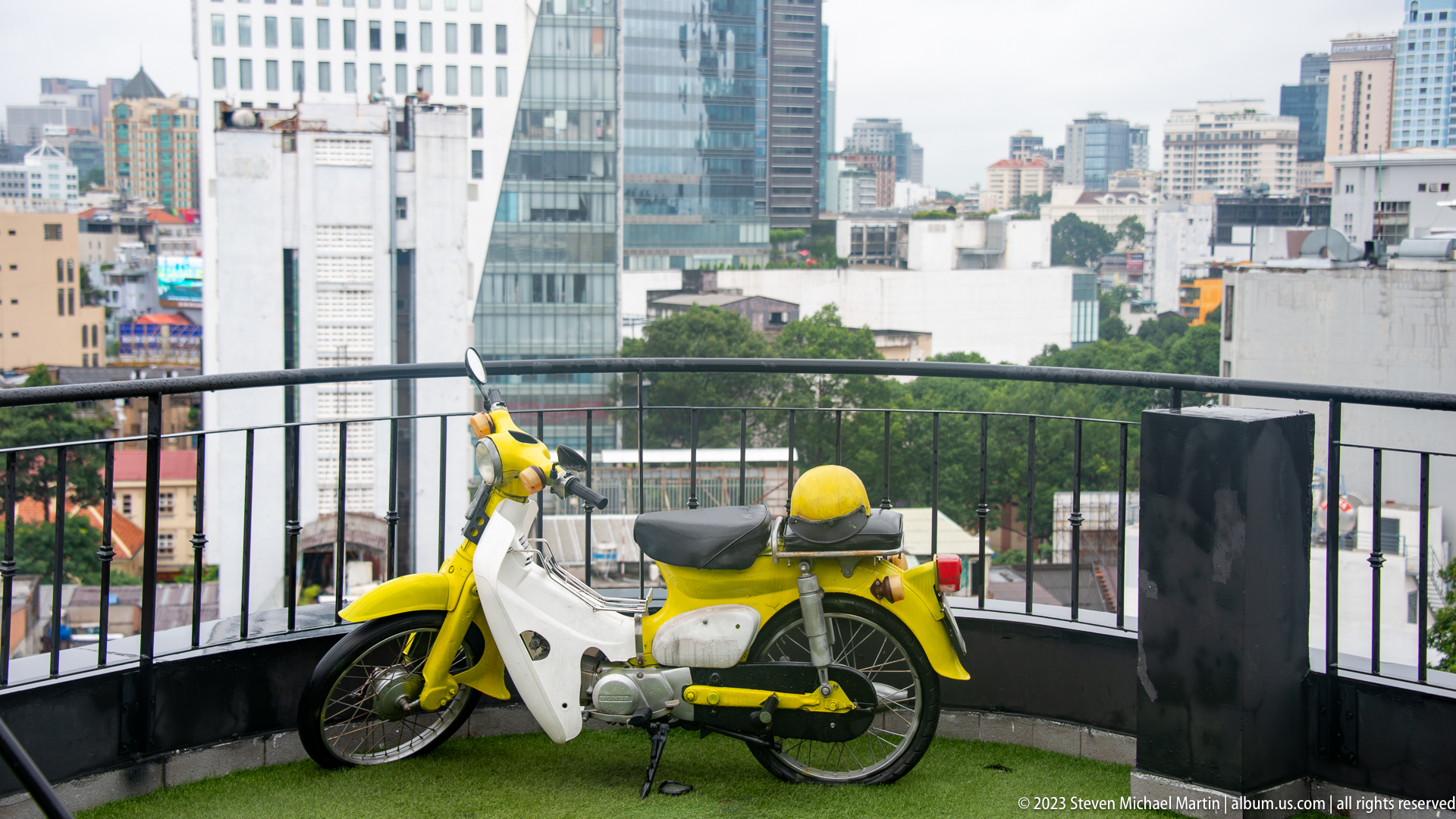
A yellow-and-white step-through motorbike is staged on artificial turf beside a rooftop railing, turning a familiar form of Vietnamese urban transport into decorative display. Mid- and high-rise buildings fill the background, linking the object to the cityscape beyond.
Caption
A yellow-and-white step-through motorbike is staged on artificial turf beside a rooftop railing, turning a familiar form of Vietnamese urban transport into decorative display. Mid- and high-rise buildings fill the background, linking the object to the cityscape beyond.

A cream-colored historic hotel rises beneath a broad red-tile roof, its façade organized by pilasters, arched openings, and shallow balconies. Seen from above, the building’s restrained classical detailing contrasts with the unfinished concrete high-rise immediately behind it.
Caption
A cream-colored historic hotel rises beneath a broad red-tile roof, its façade organized by pilasters, arched openings, and shallow balconies. Seen from above, the building’s restrained classical detailing contrasts with the unfinished concrete high-rise immediately behind it.

A red-roofed historic hotel occupies the foreground while an unfinished concrete high-rise rises immediately behind it. The juxtaposition compresses two phases of Ho Chi Minh City’s architecture into one frame: an ornate, low-rise heritage building and rapid vertical redevelopment.
Caption
A red-roofed historic hotel occupies the foreground while an unfinished concrete high-rise rises immediately behind it. The juxtaposition compresses two phases of Ho Chi Minh City’s architecture into one frame: an ornate, low-rise heritage building and rapid vertical redevelopment.

A white tower with a sharply angled façade rises above tightly packed low-rise buildings in central Ho Chi Minh City. Older rooftops, mid-rise commercial blocks, and newer glass towers overlap across the frame, illustrating the compressed density of the city center.
Caption
A white tower with a sharply angled façade rises above tightly packed low-rise buildings in central Ho Chi Minh City. Older rooftops, mid-rise commercial blocks, and newer glass towers overlap across the frame, illustrating the compressed density of the city center.
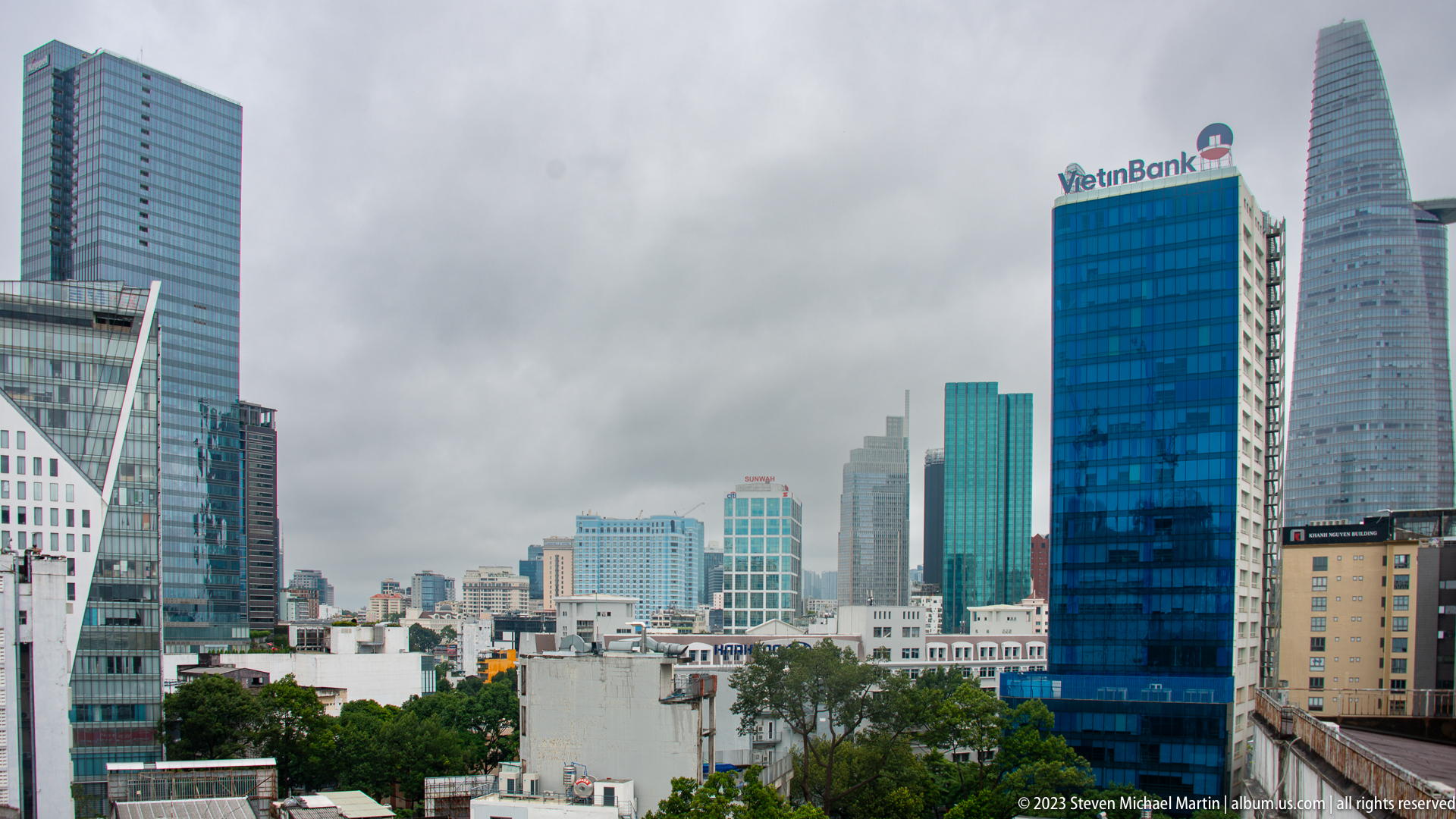
The tapered Bitexco Financial Tower rises behind the blue-glass VietinBank building in a layered view of central Ho Chi Minh City. Lower rooftops and trees form a horizontal base beneath the office towers, balancing older urban fabric with prominent contemporary landmarks.
Caption
The tapered Bitexco Financial Tower rises behind the blue-glass VietinBank building in a layered view of central Ho Chi Minh City. Lower rooftops and trees form a horizontal base beneath the office towers, balancing older urban fabric with prominent contemporary landmarks.

Two brightly colored Oishi snack bags sit on a wooden shelf, labeled “Snack Bắp Vị Phô Mai,” or cheese-flavored corn snack. Their graphic packaging and Vietnamese text provide a close view of everyday commercial food culture rather than a formal market display.
Caption
Two brightly colored Oishi snack bags sit on a wooden shelf, labeled “Snack Bắp Vị Phô Mai,” or cheese-flavored corn snack. Their graphic packaging and Vietnamese text provide a close view of everyday commercial food culture rather than a formal market display.
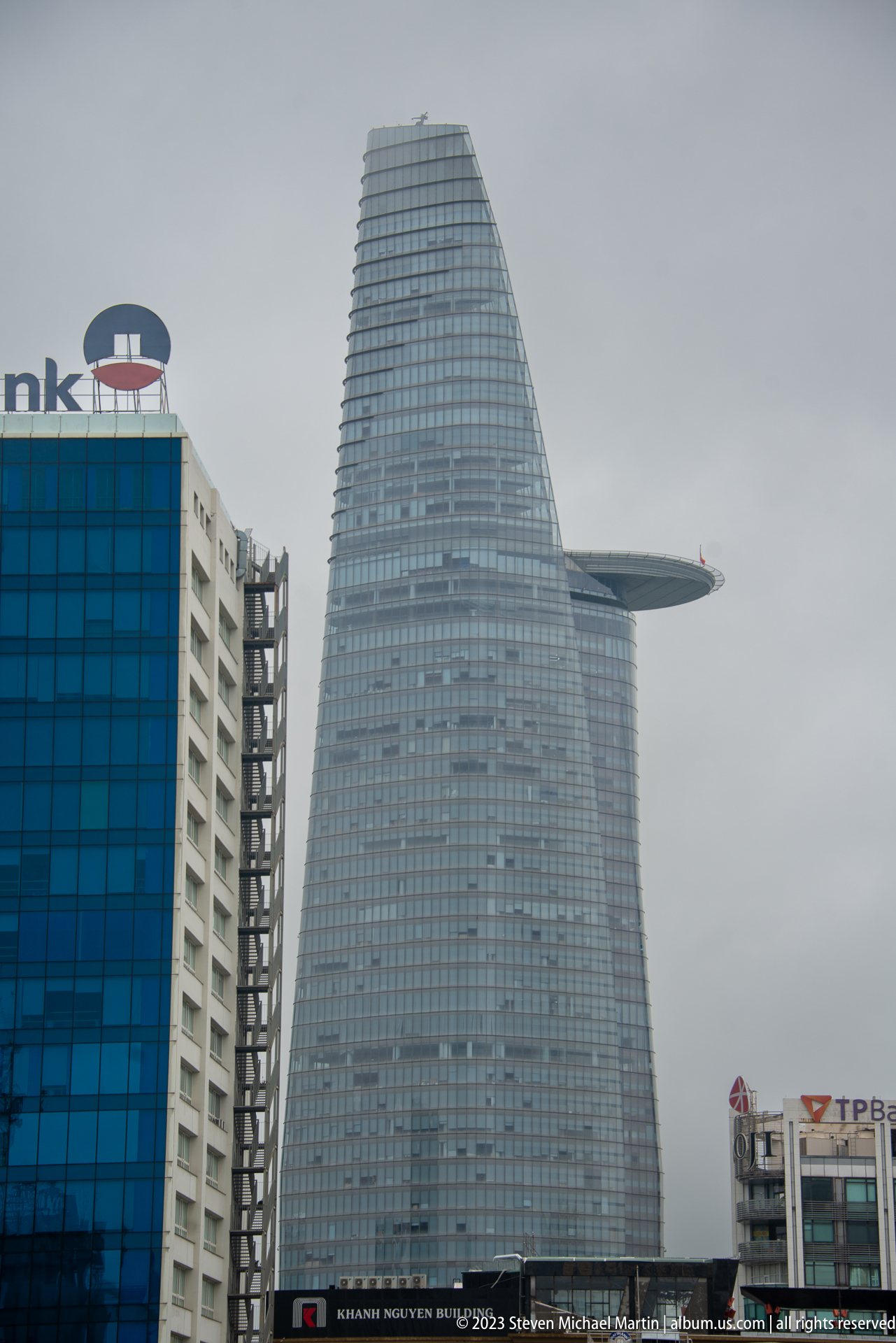
The glass-clad Bitexco Financial Tower fills the frame, its narrowing profile and projecting helipad making the building immediately recognizable. Nearby office blocks are cropped at the edges, keeping attention on the tower’s distinctive silhouette against the gray sky.
Caption
The glass-clad Bitexco Financial Tower fills the frame, its narrowing profile and projecting helipad making the building immediately recognizable. Nearby office blocks are cropped at the edges, keeping attention on the tower’s distinctive silhouette against the gray sky.

A large cream-colored high-rise stands incomplete, with exposed floor plates and open bays still visible behind a decorative façade of arches and classical motifs. Cranes and unfinished edges reveal the construction phase beneath an architecture designed to appear formal and monumental.
Caption
A large cream-colored high-rise stands incomplete, with exposed floor plates and open bays still visible behind a decorative façade of arches and classical motifs. Cranes and unfinished edges reveal the construction phase beneath an architecture designed to appear formal and monumental.
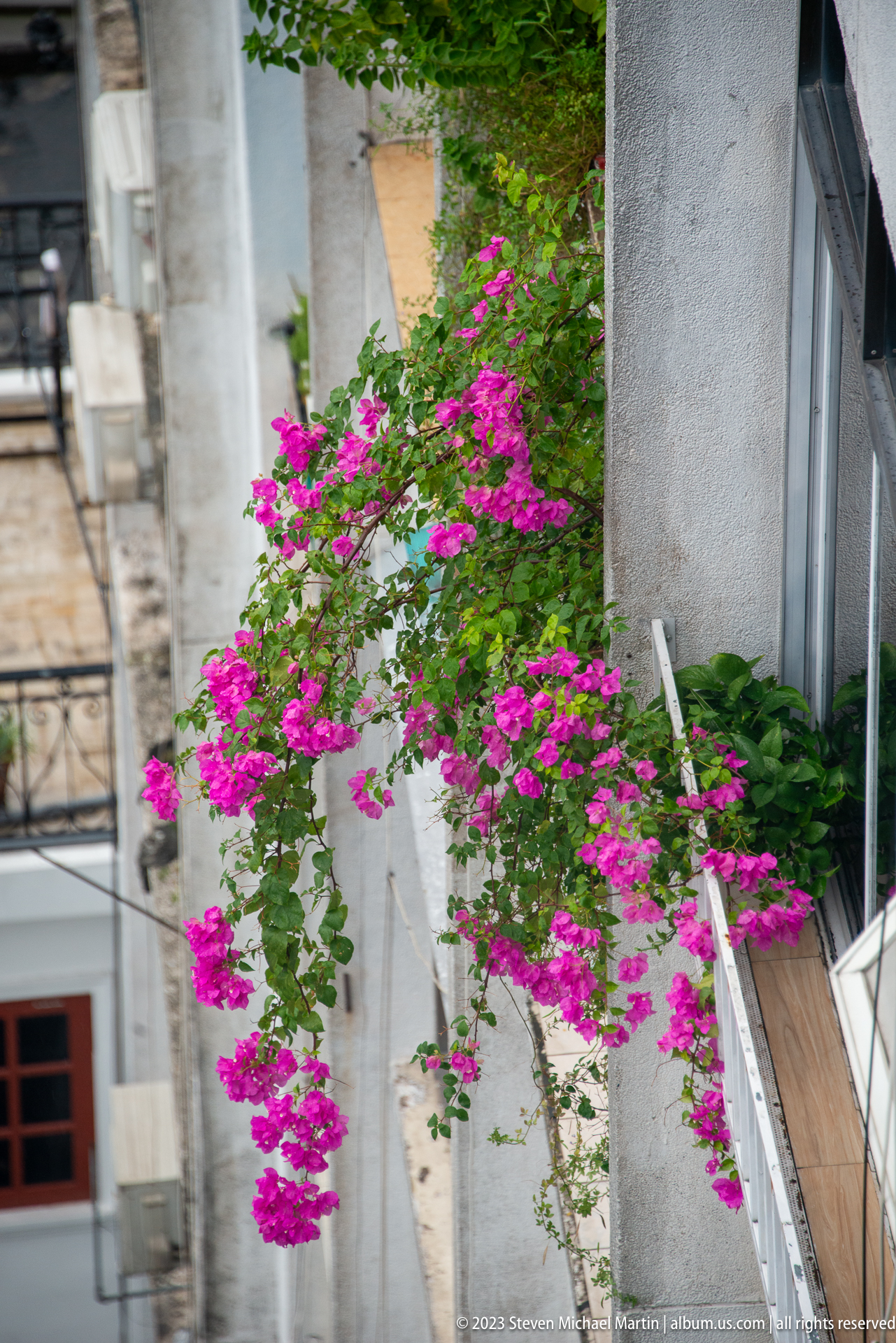
Pink bougainvillea cascades from a balcony against a weathered urban façade, bringing vivid color to the narrow residential setting. Windows, concrete walls, and neighboring structures frame the flowering vine as a small domestic garden within the dense city.
Caption
Pink bougainvillea cascades from a balcony against a weathered urban façade, bringing vivid color to the narrow residential setting. Windows, concrete walls, and neighboring structures frame the flowering vine as a small domestic garden within the dense city.

A group of potted succulents is arranged against a dark wall with a small astronaut figurine and a tall pale vase. The playful display combines natural forms, pastel ceramics, and novelty décor in a carefully staged interior vignette.
Caption
A group of potted succulents is arranged against a dark wall with a small astronaut figurine and a tall pale vase. The playful display combines natural forms, pastel ceramics, and novelty décor in a carefully staged interior vignette.
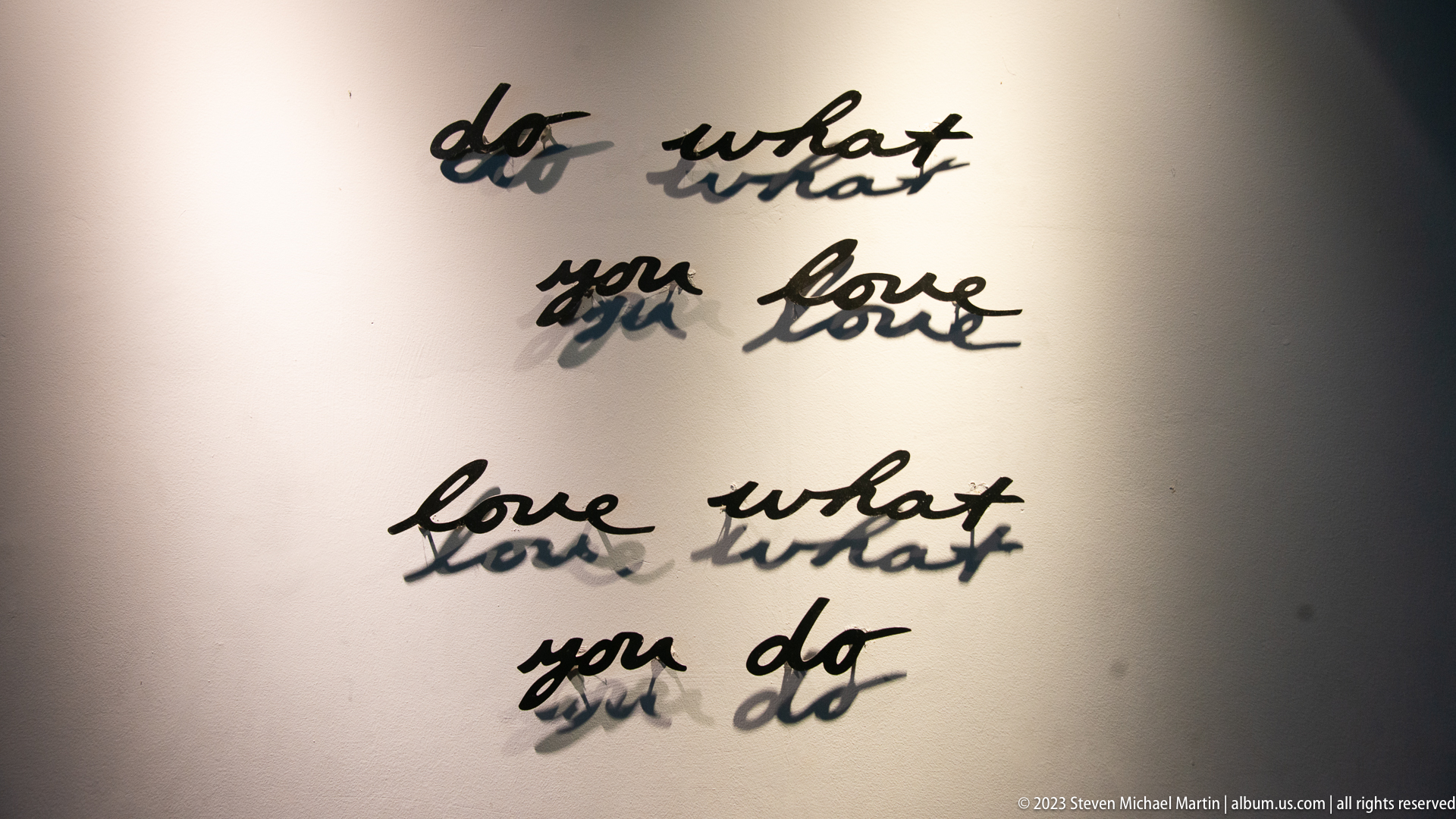
A black script installation spells out “do what you love, love what you do” across a light-colored wall. Strong side lighting casts doubled shadows behind the letters, turning the motivational phrase into a graphic interplay of text and silhouette.
Caption
A black script installation spells out “do what you love, love what you do” across a light-colored wall. Strong side lighting casts doubled shadows behind the letters, turning the motivational phrase into a graphic interplay of text and silhouette.

A small weathered rooftop structure occupies the center of a skyline framed by the Bitexco Financial Tower and glass office buildings. The aging concrete, shuttered openings, and improvised rooftop setting contrast sharply with the polished towers behind it.
Caption
A small weathered rooftop structure occupies the center of a skyline framed by the Bitexco Financial Tower and glass office buildings. The aging concrete, shuttered openings, and improvised rooftop setting contrast sharply with the polished towers behind it.
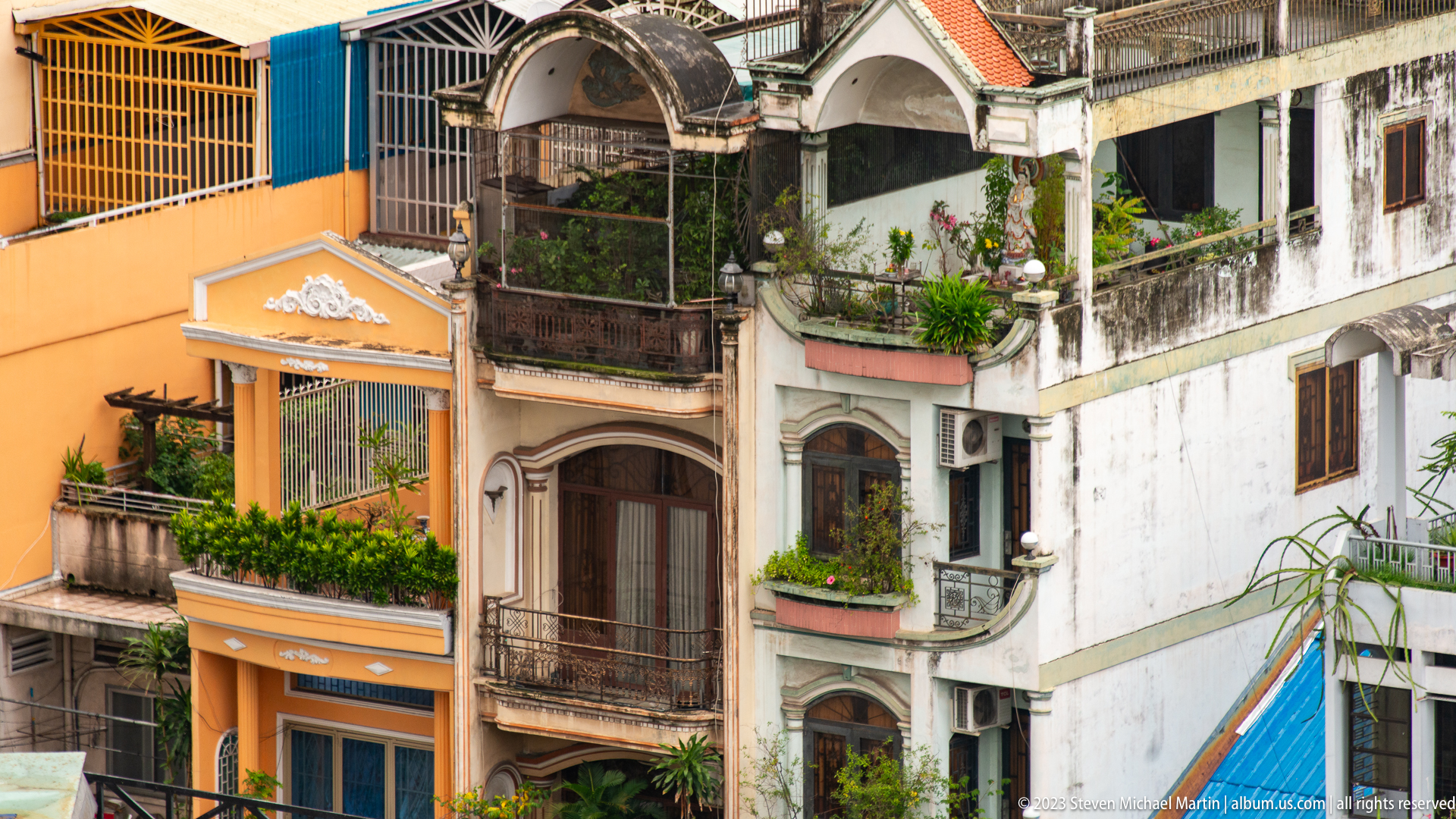
Closely spaced residential façades display contrasting layers of urban ornament: an orange house with decorative trim, a white building with arched balconies, and abundant potted greenery. Weathered plaster and varied window treatments reveal individual adaptation within a dense streetscape.
Caption
Closely spaced residential façades display contrasting layers of urban ornament: an orange house with decorative trim, a white building with arched balconies, and abundant potted greenery. Weathered plaster and varied window treatments reveal individual adaptation within a dense streetscape.

A bright blue corrugated awning cuts diagonally across a cluster of closely packed residential buildings. Balconies, shutters, plants, and varied roof materials surround it, highlighting the improvised layers of shade and enclosure common in dense urban housing.
Caption
A bright blue corrugated awning cuts diagonally across a cluster of closely packed residential buildings. Balconies, shutters, plants, and varied roof materials surround it, highlighting the improvised layers of shade and enclosure common in dense urban housing.

A tight architectural detail focuses on the projecting helipad of the Bitexco Financial Tower. The circular platform extends from the tower’s curved glass façade, while a small Vietnamese flag adds scale and a national marker to the landmark’s distinctive profile.
Caption
A tight architectural detail focuses on the projecting helipad of the Bitexco Financial Tower. The circular platform extends from the tower’s curved glass façade, while a small Vietnamese flag adds scale and a national marker to the landmark’s distinctive profile.

A steep downward view isolates the rear wall of an aging urban building. Dark moisture stains, patched surfaces, exposed pipes, small windows, and overlapping roof edges reveal the service side of a structure shaped by weather and incremental repair.
Caption
A steep downward view isolates the rear wall of an aging urban building. Dark moisture stains, patched surfaces, exposed pipes, small windows, and overlapping roof edges reveal the service side of a structure shaped by weather and incremental repair.

A graffiti-style mural spelling “The Hammock Hotel” dominates a compact lounge furnished with low chairs, small tables, and a patterned rug. Strong oranges, blues, pinks, and purples animate the wall and ceiling, creating an informal social space that merges hospitality branding with street-art vocabulary. The carefully coordinated furniture extends the mural’s graphic energy into the room.
Caption
A graffiti-style mural spelling “The Hammock Hotel” dominates a compact lounge furnished with low chairs, small tables, and a patterned rug. Strong oranges, blues, pinks, and purples animate the wall and ceiling, creating an informal social space that merges hospitality branding with street-art vocabulary. The carefully coordinated furniture extends the mural’s graphic energy into the room.

Electric-blue neon letters spell “IF YOU LOVE ME LET ME KNOW” against a black background. Arranged in a compact rectangular frame, the repeated block capitals transform an intimate request into a bold graphic statement. The darkness surrounding the sign isolates its glow and emphasizes the tension between personal sentiment and public display.
Caption
Electric-blue neon letters spell “IF YOU LOVE ME LET ME KNOW” against a black background. Arranged in a compact rectangular frame, the repeated block capitals transform an intimate request into a bold graphic statement. The darkness surrounding the sign isolates its glow and emphasizes the tension between personal sentiment and public display.

A pale glass tower rises through haze in a stepped composition of staggered setbacks. Its narrow vertical rooftop element and repeated grid façade create a sculptural silhouette, while cropped neighboring towers suggest a dense modern business district.
Caption
A pale glass tower rises through haze in a stepped composition of staggered setbacks. Its narrow vertical rooftop element and repeated grid façade create a sculptural silhouette, while cropped neighboring towers suggest a dense modern business district.

A large VPBank sign dominates a compressed view of central Ho Chi Minh City, surrounded by billboards, hotels, offices, and tightly packed rooftops. The layered commercial signage shows how corporate branding occupies the upper levels of the dense urban streetscape.
Caption
A large VPBank sign dominates a compressed view of central Ho Chi Minh City, surrounded by billboards, hotels, offices, and tightly packed rooftops. The layered commercial signage shows how corporate branding occupies the upper levels of the dense urban streetscape.
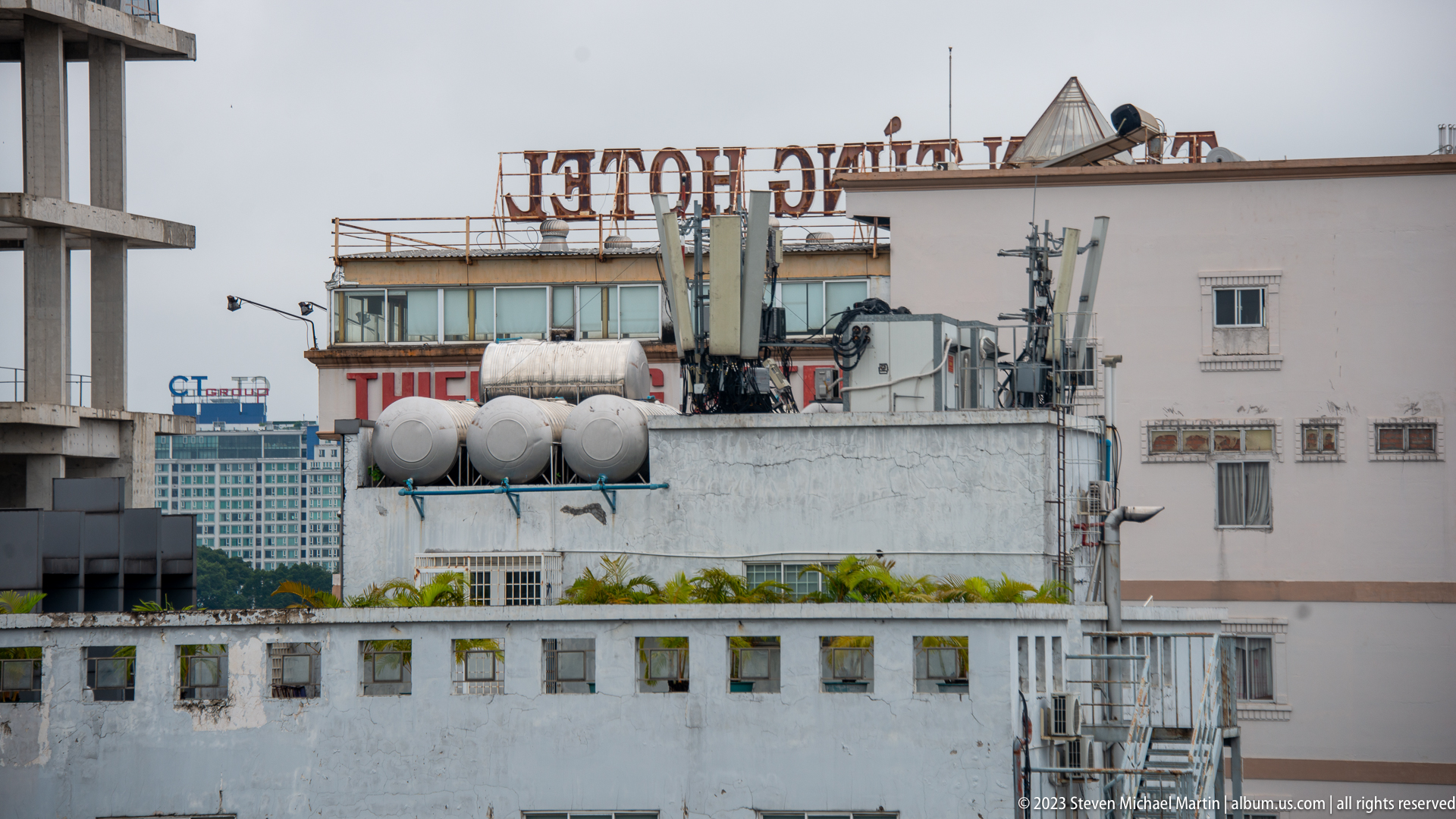
Water tanks, antennas, pipes, and mechanical equipment crowd the roof of a white urban building. Reversed hotel lettering rises behind the equipment, creating a utilitarian rooftop scene where building services and commercial identity share the same limited space.
Caption
Water tanks, antennas, pipes, and mechanical equipment crowd the roof of a white urban building. Reversed hotel lettering rises behind the equipment, creating a utilitarian rooftop scene where building services and commercial identity share the same limited space.
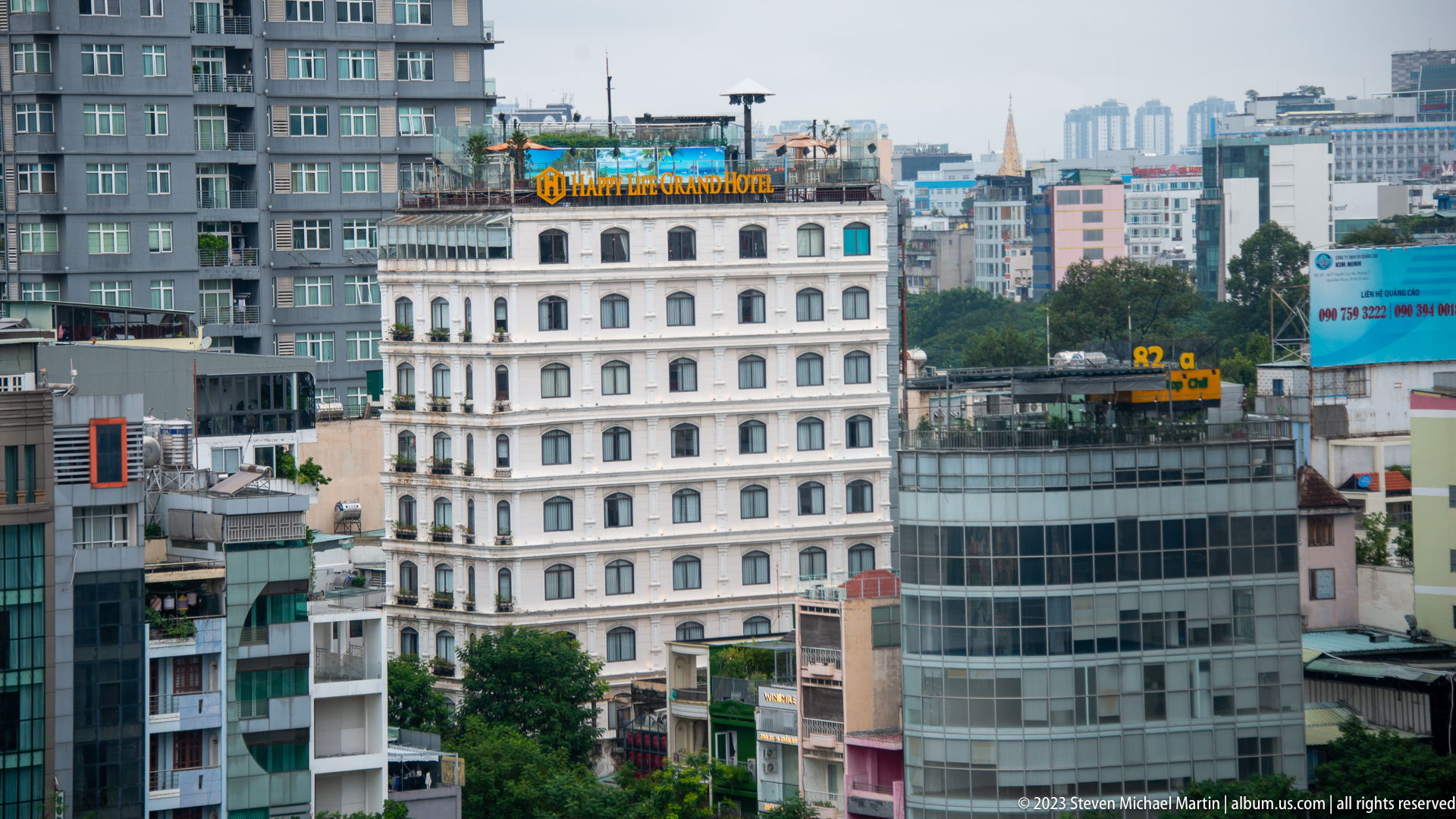
A white multi-story hotel with rhythmic arched windows stands amid glassy commercial towers, rooftop signs, and dense central-city development. Its more traditional façade treatment contrasts with the surrounding modern buildings, producing a layered view of hospitality and office architecture.
Caption
A white multi-story hotel with rhythmic arched windows stands amid glassy commercial towers, rooftop signs, and dense central-city development. Its more traditional façade treatment contrasts with the surrounding modern buildings, producing a layered view of hospitality and office architecture.

Pastel-painted apartment and commercial blocks fill the frame in a tightly packed urban cluster. External stairs, rooftop terraces, water tanks, improvised additions, and varied façades reveal the layered adaptation of buildings within Ho Chi Minh City’s dense central neighborhoods.
Caption
Pastel-painted apartment and commercial blocks fill the frame in a tightly packed urban cluster. External stairs, rooftop terraces, water tanks, improvised additions, and varied façades reveal the layered adaptation of buildings within Ho Chi Minh City’s dense central neighborhoods.

A layered commercial building rises above central Ho Chi Minh City, its older concrete façade supporting dark-glazed upper floors, rooftop planting, service equipment, and a large spherical structure. Signs for CarePlus Holdings and The One Saigon identify contemporary businesses occupying the property, while the accumulated additions illustrate the dense vertical adaptation common to the city’s urban core.
Caption
A layered commercial building rises above central Ho Chi Minh City, its older concrete façade supporting dark-glazed upper floors, rooftop planting, service equipment, and a large spherical structure. Signs for CarePlus Holdings and The One Saigon identify contemporary businesses occupying the property, while the accumulated additions illustrate the dense vertical adaptation common to the city’s urban core.
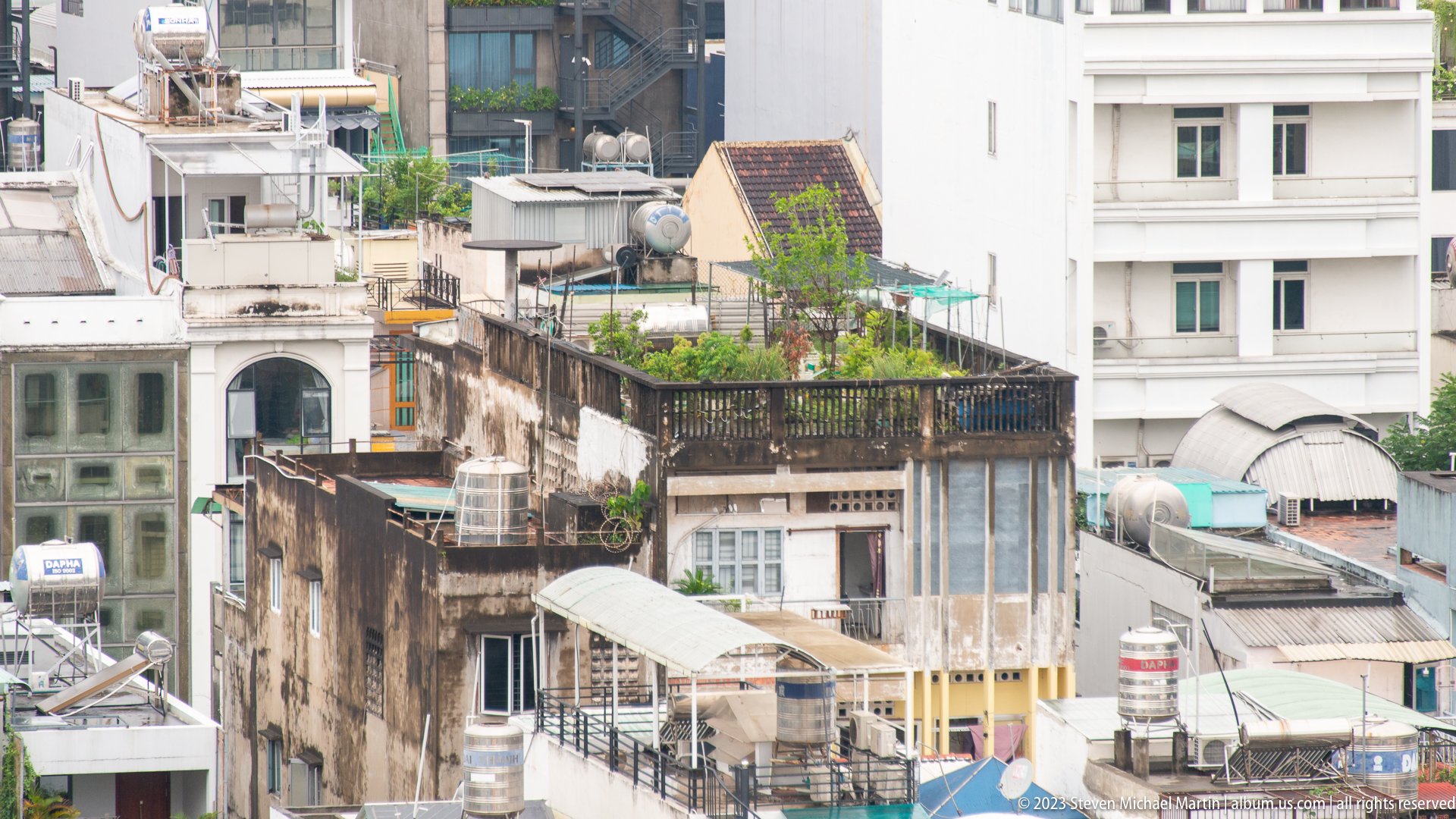
Closely packed rear façades and rooftops reveal the improvised infrastructure of central Ho Chi Minh City. Water tanks, corrugated awnings, balconies, pipes, plants, and small terraces occupy nearly every available surface. The view records a less formal side of the city’s built environment, where domestic space, utility systems, and incremental construction overlap within a compact urban block.
Caption
Closely packed rear façades and rooftops reveal the improvised infrastructure of central Ho Chi Minh City. Water tanks, corrugated awnings, balconies, pipes, plants, and small terraces occupy nearly every available surface. The view records a less formal side of the city’s built environment, where domestic space, utility systems, and incremental construction overlap within a compact urban block.

Blue raised lettering across a weathered modernist façade reads “Sài Gòn Công Thương Ngân Hàng,” the Vietnamese institutional name associated with Saigonbank. Mature foliage obscures the lower level, while horizontal louvers and pale cladding frame the sign. The photograph preserves a visible layer of the city’s commercial identity through typography embedded directly in the architecture.
Caption
Blue raised lettering across a weathered modernist façade reads “Sài Gòn Công Thương Ngân Hàng,” the Vietnamese institutional name associated with Saigonbank. Mature foliage obscures the lower level, while horizontal louvers and pale cladding frame the sign. The photograph preserves a visible layer of the city’s commercial identity through typography embedded directly in the architecture.

Two glass-front beverage coolers glow with purple interior lighting beneath blunt English slogans: “Life Is Short” and “Drink Faster.” Rows of bottles and cans are arranged behind the doors, turning ordinary refrigeration into a theatrical display. The saturated light, symmetrical framing, and humorous text give this commercial interior a deliberately playful nightlife aesthetic.
Caption
Two glass-front beverage coolers glow with purple interior lighting beneath blunt English slogans: “Life Is Short” and “Drink Faster.” Rows of bottles and cans are arranged behind the doors, turning ordinary refrigeration into a theatrical display. The saturated light, symmetrical framing, and humorous text give this commercial interior a deliberately playful nightlife aesthetic.

A narrow café interior combines an espresso counter, dark pendant lights, wall-mounted pictures, and an illustrated mural of leaves, cups, and coffee-related words. The long perspective draws the eye from foreground tables toward the service bar, while restrained furniture and white walls keep attention on the graphic decoration and compact hospitality layout.
Caption
A narrow café interior combines an espresso counter, dark pendant lights, wall-mounted pictures, and an illustrated mural of leaves, cups, and coffee-related words. The long perspective draws the eye from foreground tables toward the service bar, while restrained furniture and white walls keep attention on the graphic decoration and compact hospitality layout.

The Hammock Hotel reception area uses black metal grids and asymmetrical wooden display boxes to organize plants, decorative objects, maps, and guest information. A tan leather sofa softens the industrial framework, while multilingual notices and playful graphics create an informal arrival space. The composition shows branding expressed through furniture, greenery, and modular storage rather than a conventional front desk alone.
Caption
The Hammock Hotel reception area uses black metal grids and asymmetrical wooden display boxes to organize plants, decorative objects, maps, and guest information. A tan leather sofa softens the industrial framework, while multilingual notices and playful graphics create an informal arrival space. The composition shows branding expressed through furniture, greenery, and modular storage rather than a conventional front desk alone.
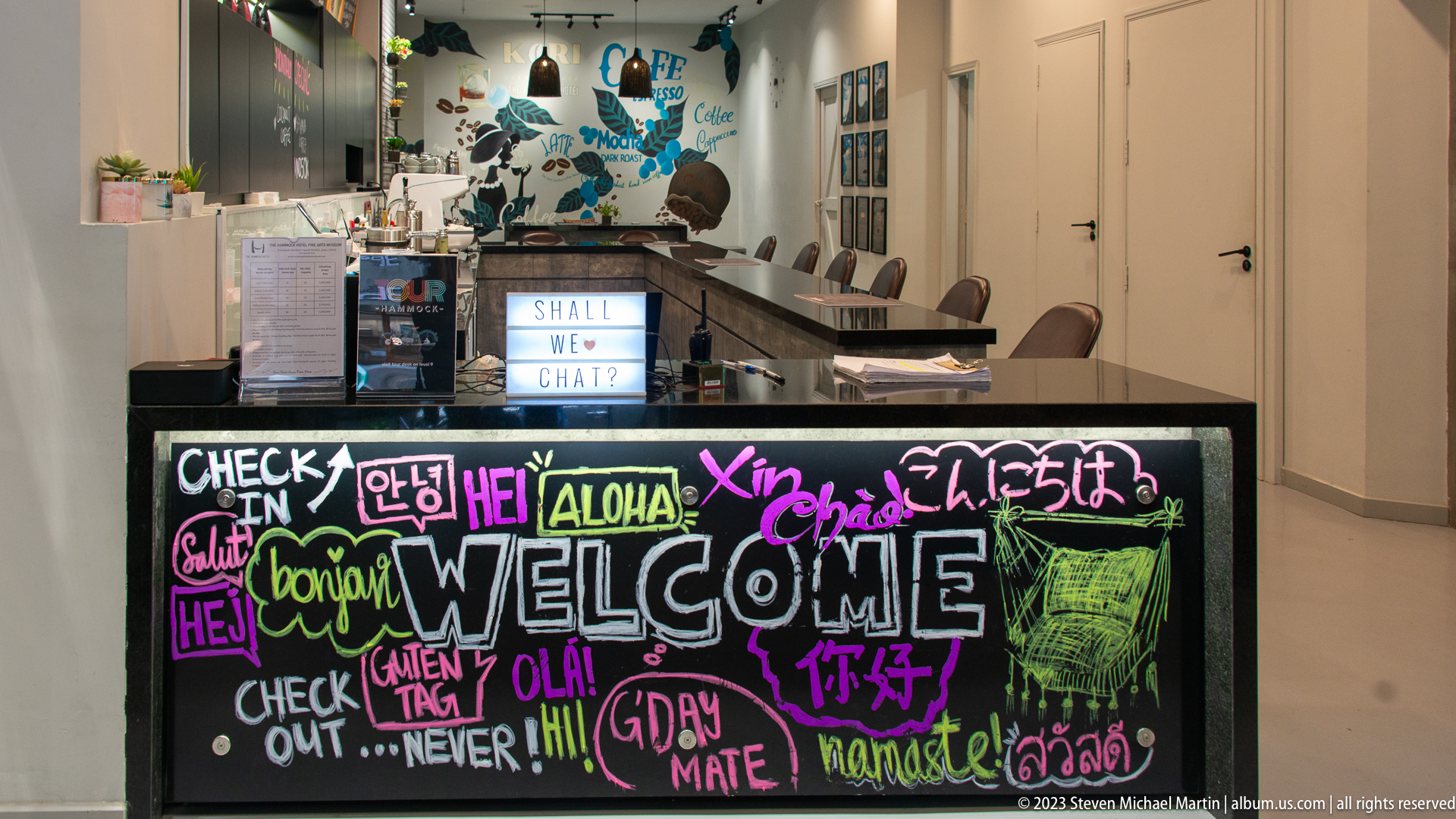
A black reception counter is covered with brightly colored handwritten greetings, including “Welcome,” “Bonjour,” “Hola,” and other salutations in multiple languages. The dense chalk-like lettering turns the desk into an interactive graphic surface, while the café counter and corridor behind it retain the compact scale of the hotel interior. The design presents hospitality through direct, playful language.
Caption
A black reception counter is covered with brightly colored handwritten greetings, including “Welcome,” “Bonjour,” “Hola,” and other salutations in multiple languages. The dense chalk-like lettering turns the desk into an interactive graphic surface, while the café counter and corridor behind it retain the compact scale of the hotel interior. The design presents hospitality through direct, playful language.

A slim upholstered bench sits beneath raised lettering for The Hammock Hotel, illuminated by a continuous strip of warm light. Cylindrical bolsters and blue end cushions add a playful accent to the otherwise restrained composition of gray wall, pale upholstery, black metal legs, and adjacent glass partition. The carefully staged alcove functions as both seating and a branded interior vignette.
Caption
A slim upholstered bench sits beneath raised lettering for The Hammock Hotel, illuminated by a continuous strip of warm light. Cylindrical bolsters and blue end cushions add a playful accent to the otherwise restrained composition of gray wall, pale upholstery, black metal legs, and adjacent glass partition. The carefully staged alcove functions as both seating and a branded interior vignette.
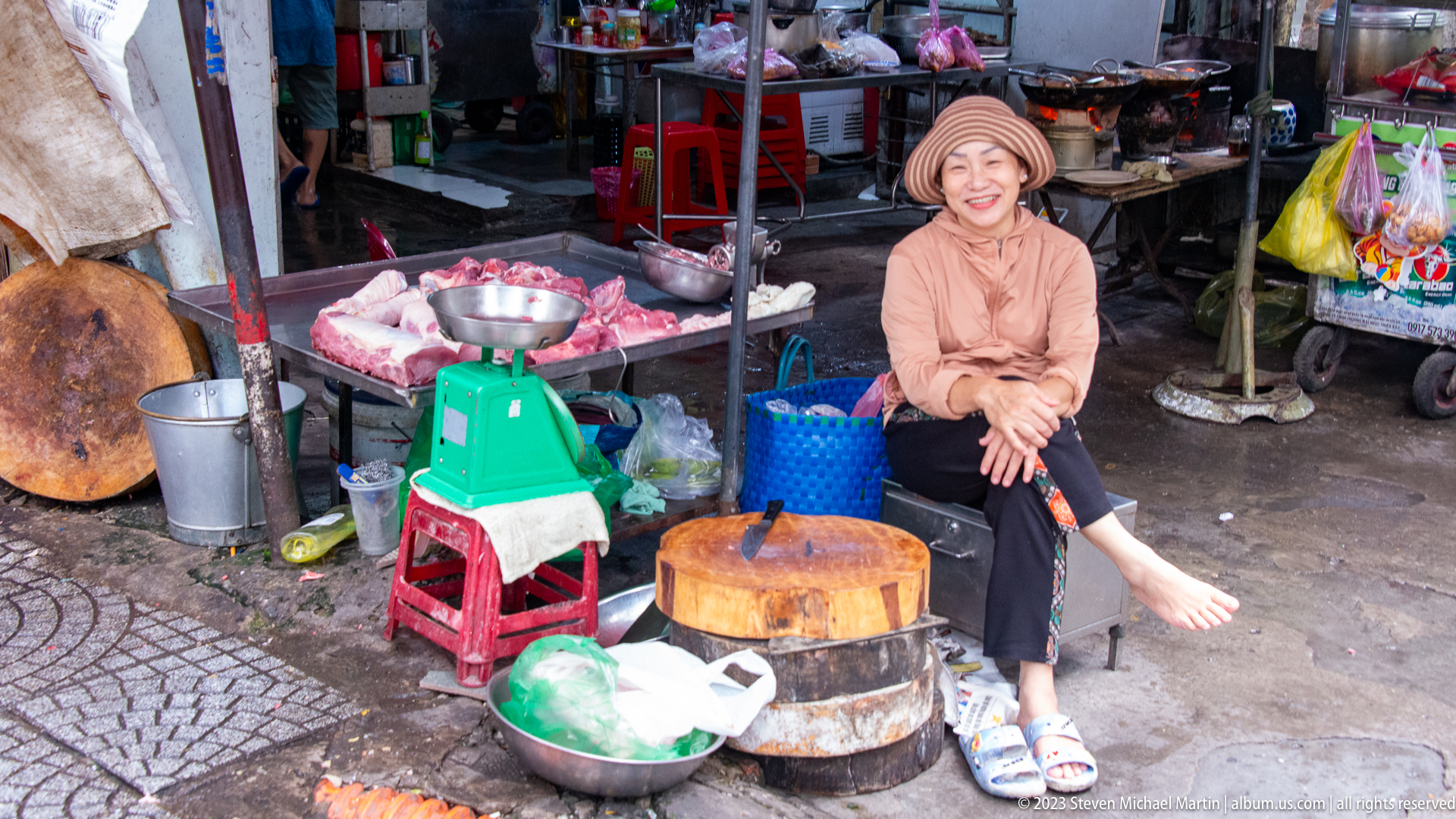
A smiling vendor sits at the edge of a compact sidewalk meat stall surrounded by heavy wooden chopping blocks, metal basins, a green mechanical scale, plastic baskets, and cuts of raw meat. The tightly packed tools show how preparation, weighing, display, and sales share the same small workspace within Ho Chi Minh City’s street-market economy.
Caption
A smiling vendor sits at the edge of a compact sidewalk meat stall surrounded by heavy wooden chopping blocks, metal basins, a green mechanical scale, plastic baskets, and cuts of raw meat. The tightly packed tools show how preparation, weighing, display, and sales share the same small workspace within Ho Chi Minh City’s street-market economy.

An older woman in patterned clothing gestures beside a black portable speaker placed on the pavement. Her bent stance and extended arm suggest an active street performance or dance, while a closed metal storefront and small wall niche form a modest backdrop. The photograph focuses on an individual moment of public expression within an otherwise ordinary sidewalk setting.
Caption
An older woman in patterned clothing gestures beside a black portable speaker placed on the pavement. Her bent stance and extended arm suggest an active street performance or dance, while a closed metal storefront and small wall niche form a modest backdrop. The photograph focuses on an individual moment of public expression within an otherwise ordinary sidewalk setting.

A vendor works behind a compact street-side food counter whose signs advertise “Cơm Mặn” and “Cơm Chay,” distinguishing meat-based and vegetarian rice meals. Trays of prepared dishes, condiments, stools, and passing customers compress everyday commerce and dining into a narrow sidewalk space.
Caption
A vendor works behind a compact street-side food counter whose signs advertise “Cơm Mặn” and “Cơm Chay,” distinguishing meat-based and vegetarian rice meals. Trays of prepared dishes, condiments, stools, and passing customers compress everyday commerce and dining into a narrow sidewalk space.
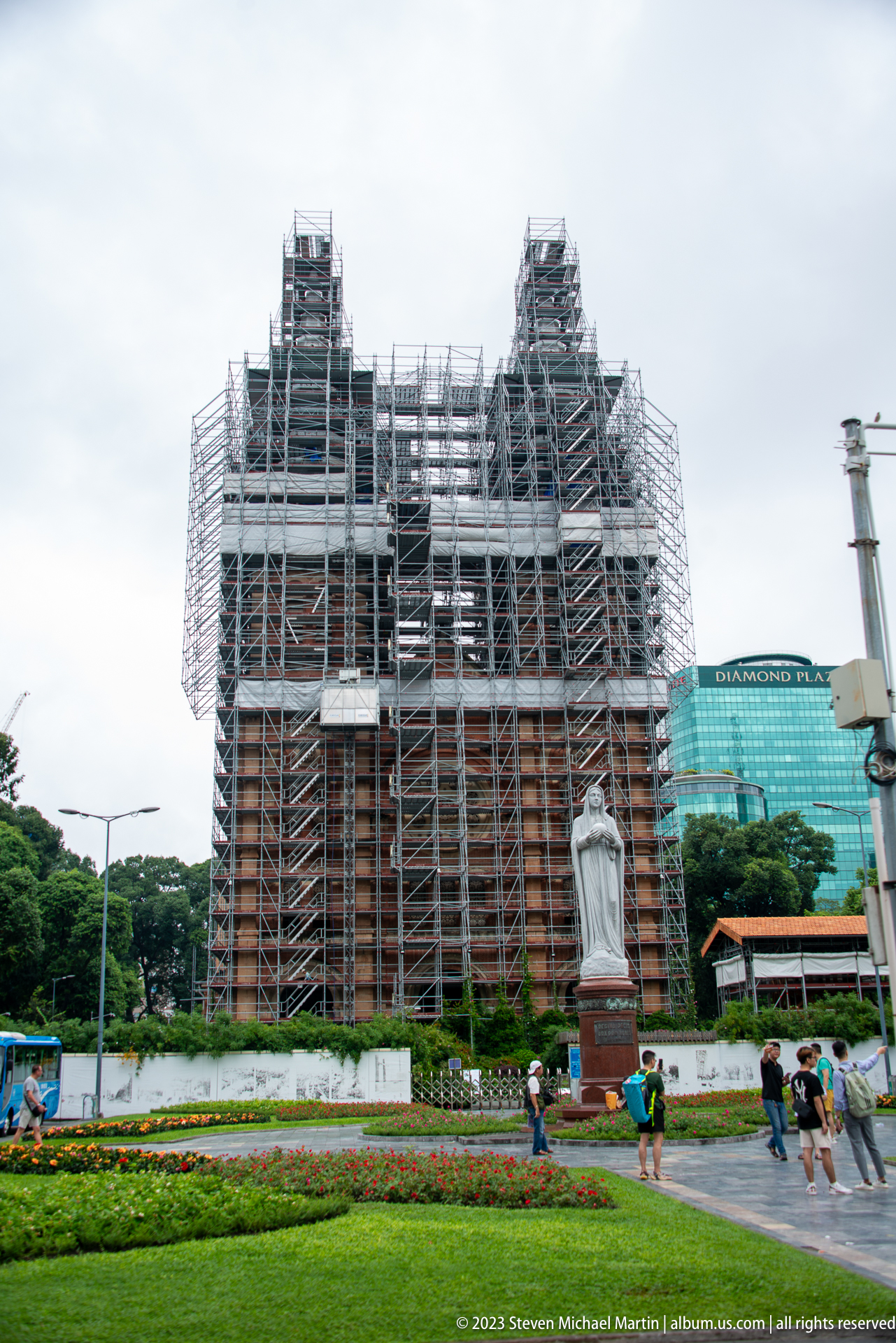
Notre-Dame Cathedral Basilica of Saigon is almost entirely enclosed by a dense grid of restoration scaffolding, with the twin tower masses still legible beneath the temporary structure. The construction screen transforms the familiar cathedral silhouette into a record of long-term conservation in the center of Ho Chi Minh City.
Caption
Notre-Dame Cathedral Basilica of Saigon is almost entirely enclosed by a dense grid of restoration scaffolding, with the twin tower masses still legible beneath the temporary structure. The construction screen transforms the familiar cathedral silhouette into a record of long-term conservation in the center of Ho Chi Minh City.

A compact sidewalk shop presents bottled drinks, jars, condiments, packaged foods, and handwritten or printed Vietnamese notices on a densely arranged table. Red plastic stools and chairs extend the business into the pedestrian space, while a seated woman occupies the shaded interior edge. The layered display records the informal retail patterns that animate neighborhood streets.
Caption
A compact sidewalk shop presents bottled drinks, jars, condiments, packaged foods, and handwritten or printed Vietnamese notices on a densely arranged table. Red plastic stools and chairs extend the business into the pedestrian space, while a seated woman occupies the shaded interior edge. The layered display records the informal retail patterns that animate neighborhood streets.

Two women meet beside a sidewalk food stall, one wearing a conical hat and carrying a shoulder pole while the other steadies large transparent bags filled with round dried products. Chopping blocks, bowls, and a scale remain visible behind them. The overlapping figures, merchandise, and equipment convey the close physical choreography of buying, carrying, and selling in a street market.
Caption
Two women meet beside a sidewalk food stall, one wearing a conical hat and carrying a shoulder pole while the other steadies large transparent bags filled with round dried products. Chopping blocks, bowls, and a scale remain visible behind them. The overlapping figures, merchandise, and equipment convey the close physical choreography of buying, carrying, and selling in a street market.

An ornate cream-and-yellow building is framed by trees and a foreground exhibition panel. Arched openings, paired columns, balustraded balconies, sculpted moldings, and a red-tiled roof express the eclectic classical vocabulary associated with Ho Chi Minh City’s colonial-era civic architecture. The partially screened view emphasizes the façade’s vertical rhythm while preserving the contemporary public setting around it.
Caption
An ornate cream-and-yellow building is framed by trees and a foreground exhibition panel. Arched openings, paired columns, balustraded balconies, sculpted moldings, and a red-tiled roof express the eclectic classical vocabulary associated with Ho Chi Minh City’s colonial-era civic architecture. The partially screened view emphasizes the façade’s vertical rhythm while preserving the contemporary public setting around it.

Bến Thành Market’s south façade stretches across the frame beneath its familiar central clock tower. Cream walls, red roofs, repeated market bays, and the arched entrance establish the building’s strong civic presence, while broad traffic lanes and barriers separate the viewpoint from the plaza edge. The wider city skyline rises behind this enduring commercial landmark.
Caption
Bến Thành Market’s south façade stretches across the frame beneath its familiar central clock tower. Cream walls, red roofs, repeated market bays, and the arched entrance establish the building’s strong civic presence, while broad traffic lanes and barriers separate the viewpoint from the plaza edge. The wider city skyline rises behind this enduring commercial landmark.

A crowded row of narrow shopfronts combines restaurant signs, upper-floor balconies, awnings, parked motorbikes, plastic seating, and dense utility wiring. English and Vietnamese business names compete across the façades, while traffic signs organize the street edge. The layered frontage illustrates how commerce, lodging, food service, and circulation overlap within a compact central block.
Caption
A crowded row of narrow shopfronts combines restaurant signs, upper-floor balconies, awnings, parked motorbikes, plastic seating, and dense utility wiring. English and Vietnamese business names compete across the façades, while traffic signs organize the street edge. The layered frontage illustrates how commerce, lodging, food service, and circulation overlap within a compact central block.
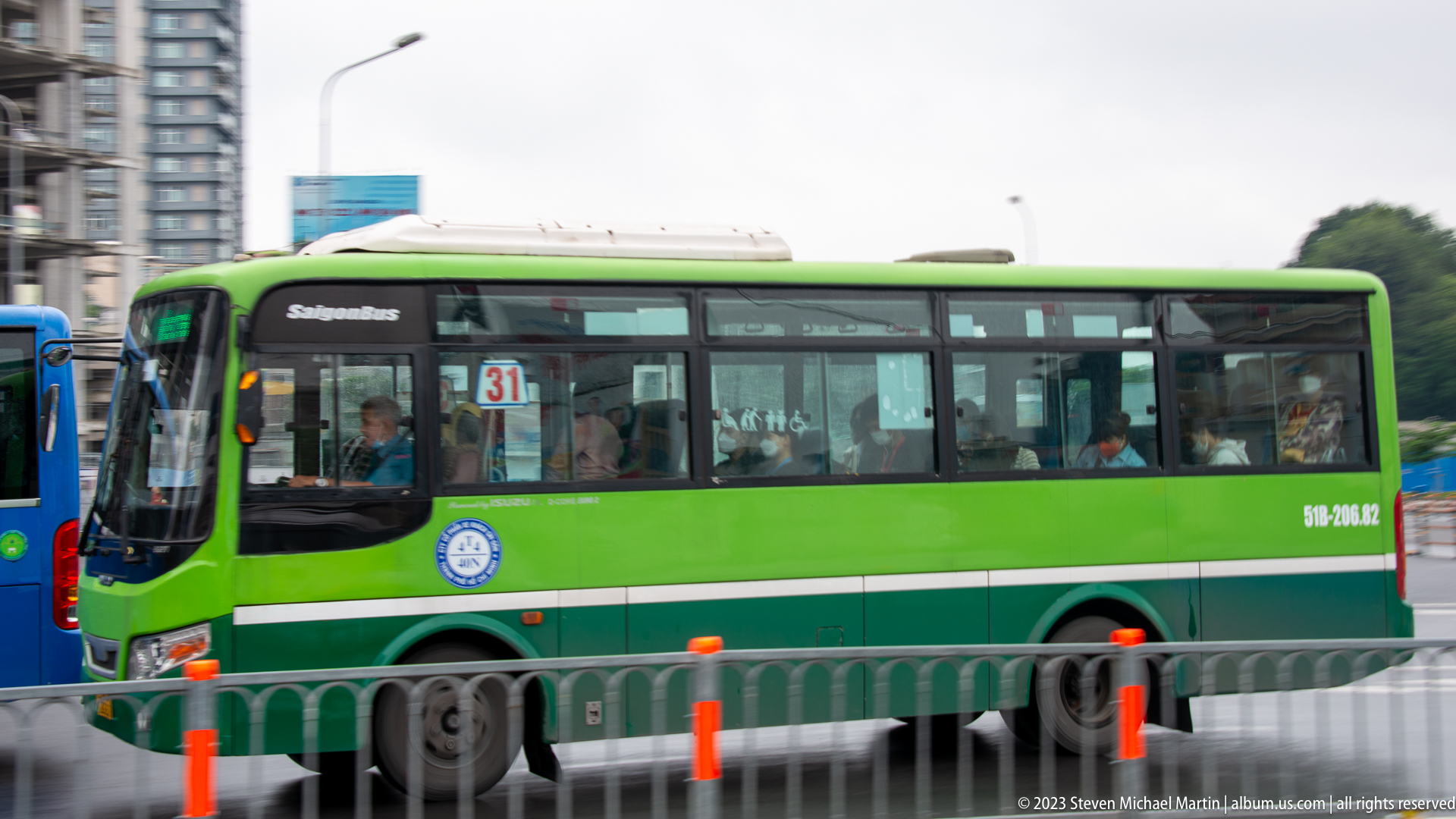
A green SaigonBus marked route 31 passes through a divided urban roadway with passengers visible through the windows. The side profile shows the vehicle’s practical city-bus form, route placard, fleet markings, and high window line. Barriers and orange delineators in the foreground emphasize the managed traffic corridor through which public transport moves.
Caption
A green SaigonBus marked route 31 passes through a divided urban roadway with passengers visible through the windows. The side profile shows the vehicle’s practical city-bus form, route placard, fleet markings, and high window line. Barriers and orange delineators in the foreground emphasize the managed traffic corridor through which public transport moves.

A broad line of motorbike riders gathers at a city intersection, nearly filling the roadway from curb to curb. Helmets, face masks, varied scooters, and a public bus behind them convey the scale and diversity of everyday transport in Ho Chi Minh City. A zebra crossing anchors the foreground, while commercial signs and roadside greenery frame the traffic corridor.
Caption
A broad line of motorbike riders gathers at a city intersection, nearly filling the roadway from curb to curb. Helmets, face masks, varied scooters, and a public bus behind them convey the scale and diversity of everyday transport in Ho Chi Minh City. A zebra crossing anchors the foreground, while commercial signs and roadside greenery frame the traffic corridor.

The Hà Tâm storefront fills a busy corner with large red-letter signs advertising jewelry, gold, and currency exchange. Customers gather beneath blue awnings while motorbikes and passing vehicles compress the foreground. Weathered upper floors, balconies, neighboring signs, and the intense street activity situate the business within the dense commercial fabric surrounding central market districts.
Caption
The Hà Tâm storefront fills a busy corner with large red-letter signs advertising jewelry, gold, and currency exchange. Customers gather beneath blue awnings while motorbikes and passing vehicles compress the foreground. Weathered upper floors, balconies, neighboring signs, and the intense street activity situate the business within the dense commercial fabric surrounding central market districts.

Motorbike riders sweep across the frame at close range, their faces partly obscured by helmets, masks, and motion blur. The compressed viewpoint turns the traffic flow into overlapping bands of color and movement, with only brief glimpses of the green streetscape beyond. The photograph conveys the speed, proximity, and visual intensity of scooter travel in Ho Chi Minh City.
Caption
Motorbike riders sweep across the frame at close range, their faces partly obscured by helmets, masks, and motion blur. The compressed viewpoint turns the traffic flow into overlapping bands of color and movement, with only brief glimpses of the green streetscape beyond. The photograph conveys the speed, proximity, and visual intensity of scooter travel in Ho Chi Minh City.

A large Casper air-conditioner billboard dominates a layered commercial streetscape of mid-rise buildings, rooftop signs, narrow façades, and street-level businesses. The oversized appliance image and Vietnamese advertising text contrast with the irregular architecture beneath it. Traffic at the bottom edge reinforces the scene’s character as a busy urban corridor shaped as much by commercial graphics as by buildings.
Caption
A large Casper air-conditioner billboard dominates a layered commercial streetscape of mid-rise buildings, rooftop signs, narrow façades, and street-level businesses. The oversized appliance image and Vietnamese advertising text contrast with the irregular architecture beneath it. Traffic at the bottom edge reinforces the scene’s character as a busy urban corridor shaped as much by commercial graphics as by buildings.
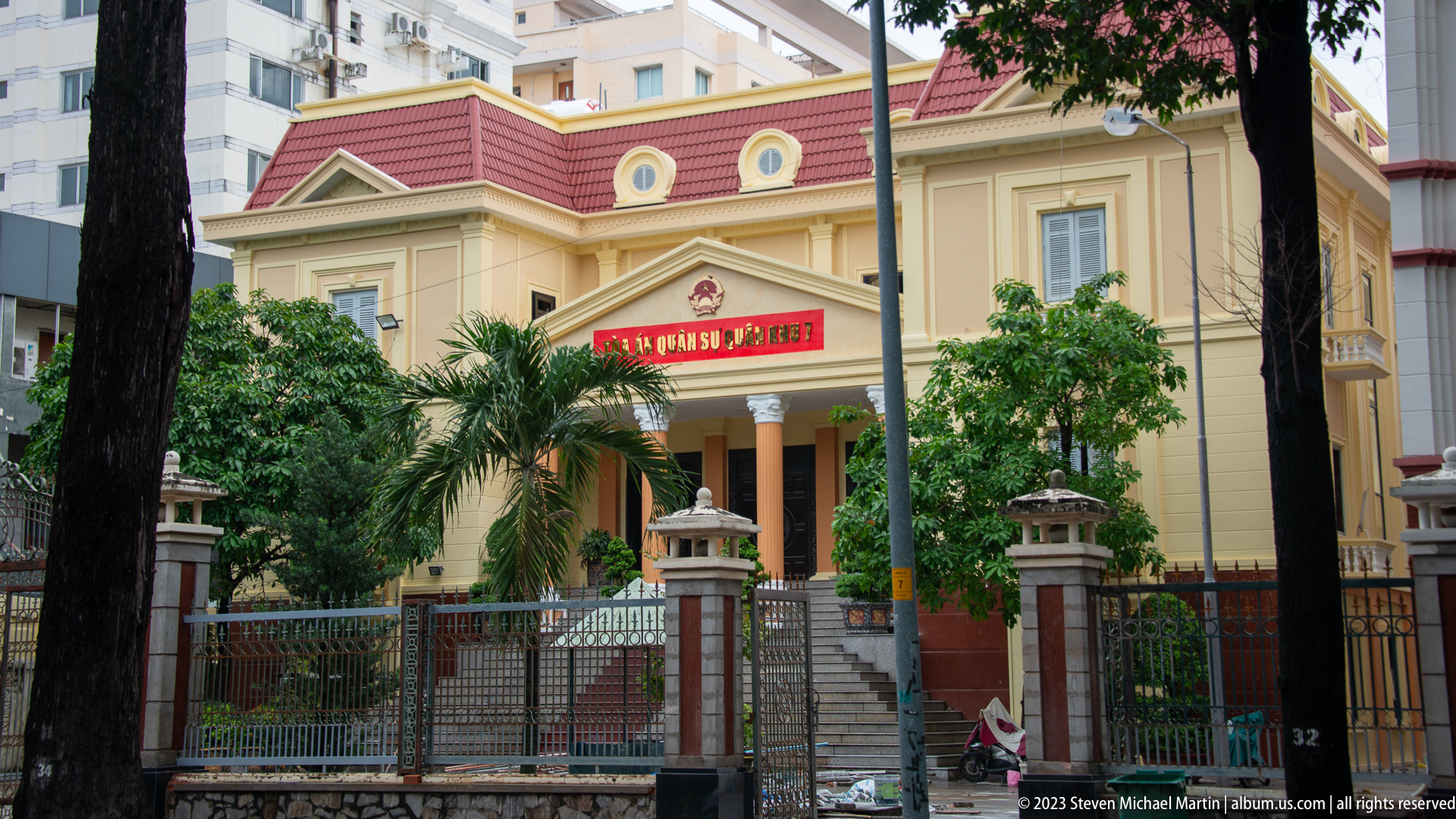
A formal yellow institutional building stands behind a metal fence and mature landscaping. The symmetrical façade uses a red-tiled roof, triangular pediment, circular attic windows, paired columns, and a broad entrance stair, drawing on a restrained classical vocabulary. A red Vietnamese sign marks the central portico, though the wording is too small to confirm the institution from the proof sheet.
Caption
A formal yellow institutional building stands behind a metal fence and mature landscaping. The symmetrical façade uses a red-tiled roof, triangular pediment, circular attic windows, paired columns, and a broad entrance stair, drawing on a restrained classical vocabulary. A red Vietnamese sign marks the central portico, though the wording is too small to confirm the institution from the proof sheet.

Curved balconies project from a residential building shaded by large street trees. Vertical wooden or metal slats screen several levels, while vines, potted plants, and flowering greenery soften the pale concrete and brick surfaces. The design demonstrates how balconies in Ho Chi Minh City function simultaneously as outdoor rooms, privacy filters, and supports for urban vegetation.
Caption
Curved balconies project from a residential building shaded by large street trees. Vertical wooden or metal slats screen several levels, while vines, potted plants, and flowering greenery soften the pale concrete and brick surfaces. The design demonstrates how balconies in Ho Chi Minh City function simultaneously as outdoor rooms, privacy filters, and supports for urban vegetation.
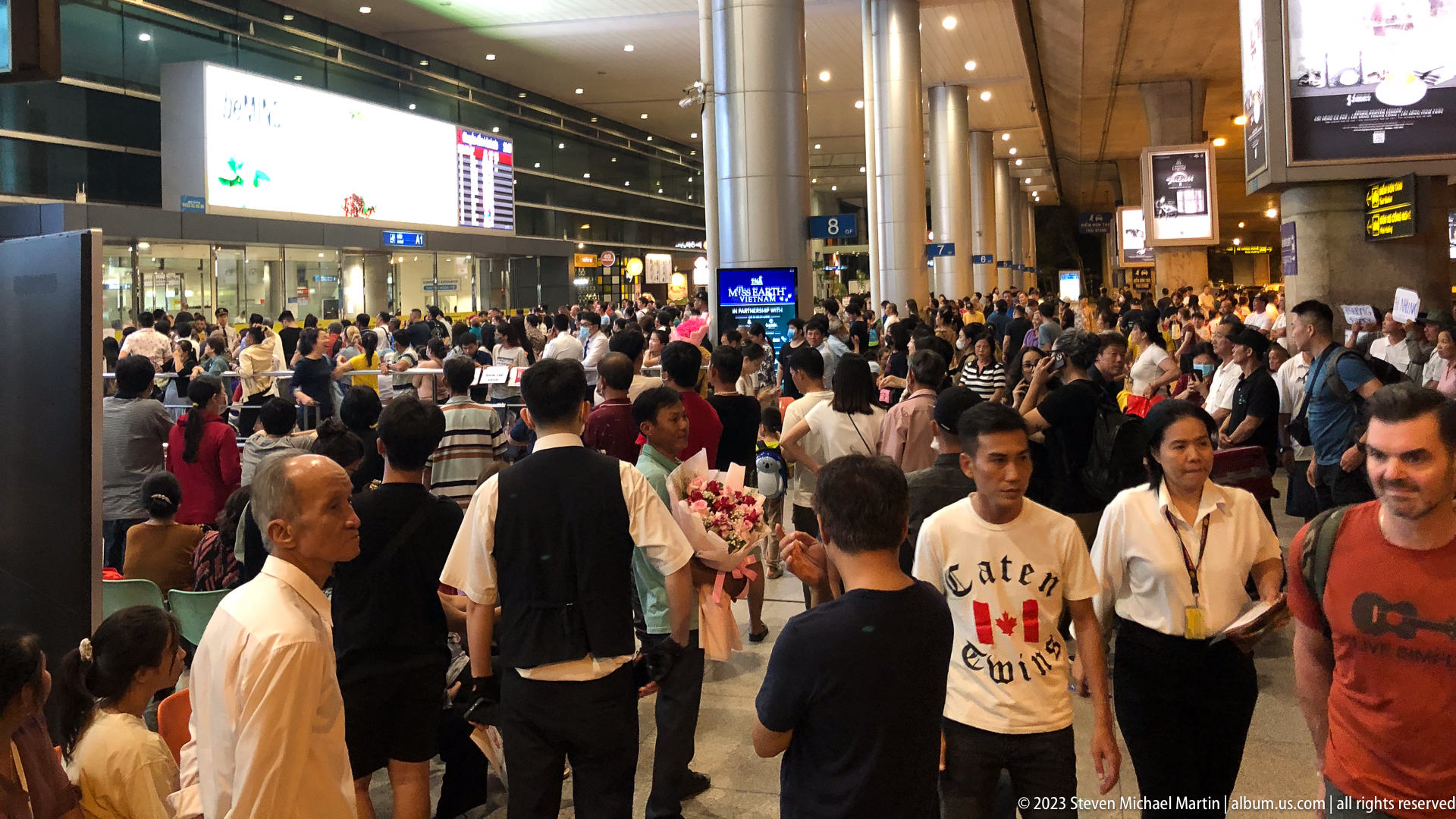
A dense crowd fills an airport arrivals hall beneath illuminated signs, structural columns, and high ceiling lights. Waiting families, greeters holding flowers, arriving passengers, and terminal staff overlap across the frame, creating a vivid record of reunion and movement. The compressed composition emphasizes the intensity of the public reception area rather than the architecture of the terminal itself.
Caption
A dense crowd fills an airport arrivals hall beneath illuminated signs, structural columns, and high ceiling lights. Waiting families, greeters holding flowers, arriving passengers, and terminal staff overlap across the frame, creating a vivid record of reunion and movement. The compressed composition emphasizes the intensity of the public reception area rather than the architecture of the terminal itself.

Three male travelers pause together in an airport terminal with rolling suitcases and shoulder bags. Their relaxed expressions and casual clothing suggest the moment just after arrival or before departure, while flight-information screens and other passengers remain visible behind them. The portrait adds a personal travel narrative to the broader documentation of Ho Chi Minh City’s transportation spaces.
Caption
Three male travelers pause together in an airport terminal with rolling suitcases and shoulder bags. Their relaxed expressions and casual clothing suggest the moment just after arrival or before departure, while flight-information screens and other passengers remain visible behind them. The portrait adds a personal travel narrative to the broader documentation of Ho Chi Minh City’s transportation spaces.

Bright nighttime signs mark the entrance to the domestic-terminal parking area, with Vietnamese text reading “Nhà để xe ga quốc nội” and blue lane panels directing taxis, cars, and other vehicles. Large real-estate advertisements rise above the angular façade, turning the transport entrance into a dense field of commercial light, directional information, and architectural illumination.
Caption
Bright nighttime signs mark the entrance to the domestic-terminal parking area, with Vietnamese text reading “Nhà để xe ga quốc nội” and blue lane panels directing taxis, cars, and other vehicles. Large real-estate advertisements rise above the angular façade, turning the transport entrance into a dense field of commercial light, directional information, and architectural illumination.

Dense carved reliefs crowd the façade around a central panel labeled “Ngũ Điện,” flanked by vertical lines of gilded Chinese characters. Seated guardian-like figures, clouds, animals, and scrolling ornament create a layered devotional surface in which text and sculpture are integrated into the architecture.
Caption
Dense carved reliefs crowd the façade around a central panel labeled “Ngũ Điện,” flanked by vertical lines of gilded Chinese characters. Seated guardian-like figures, clouds, animals, and scrolling ornament create a layered devotional surface in which text and sculpture are integrated into the architecture.

A small gray-and-black dog sleeps curled on a thick cushion inside a vehicle, seemingly undisturbed by the traffic beyond the windshield. Headlights, cars, and motorbikes fill the roadway outside, turning the intimate resting scene into an unexpected counterpoint to Ho Chi Minh City’s evening congestion.
Caption
A small gray-and-black dog sleeps curled on a thick cushion inside a vehicle, seemingly undisturbed by the traffic beyond the windshield. Headlights, cars, and motorbikes fill the roadway outside, turning the intimate resting scene into an unexpected counterpoint to Ho Chi Minh City’s evening congestion.

Neon lighting traces the windows and roofline of a red-and-yellow coach marked “LIMOUSINE PREMIUM” as it moves through nighttime traffic. The intense blue, red, and magenta illumination turns the vehicle into a vivid mobile landmark against the darker street.
Caption
Neon lighting traces the windows and roofline of a red-and-yellow coach marked “LIMOUSINE PREMIUM” as it moves through nighttime traffic. The intense blue, red, and magenta illumination turns the vehicle into a vivid mobile landmark against the darker street.
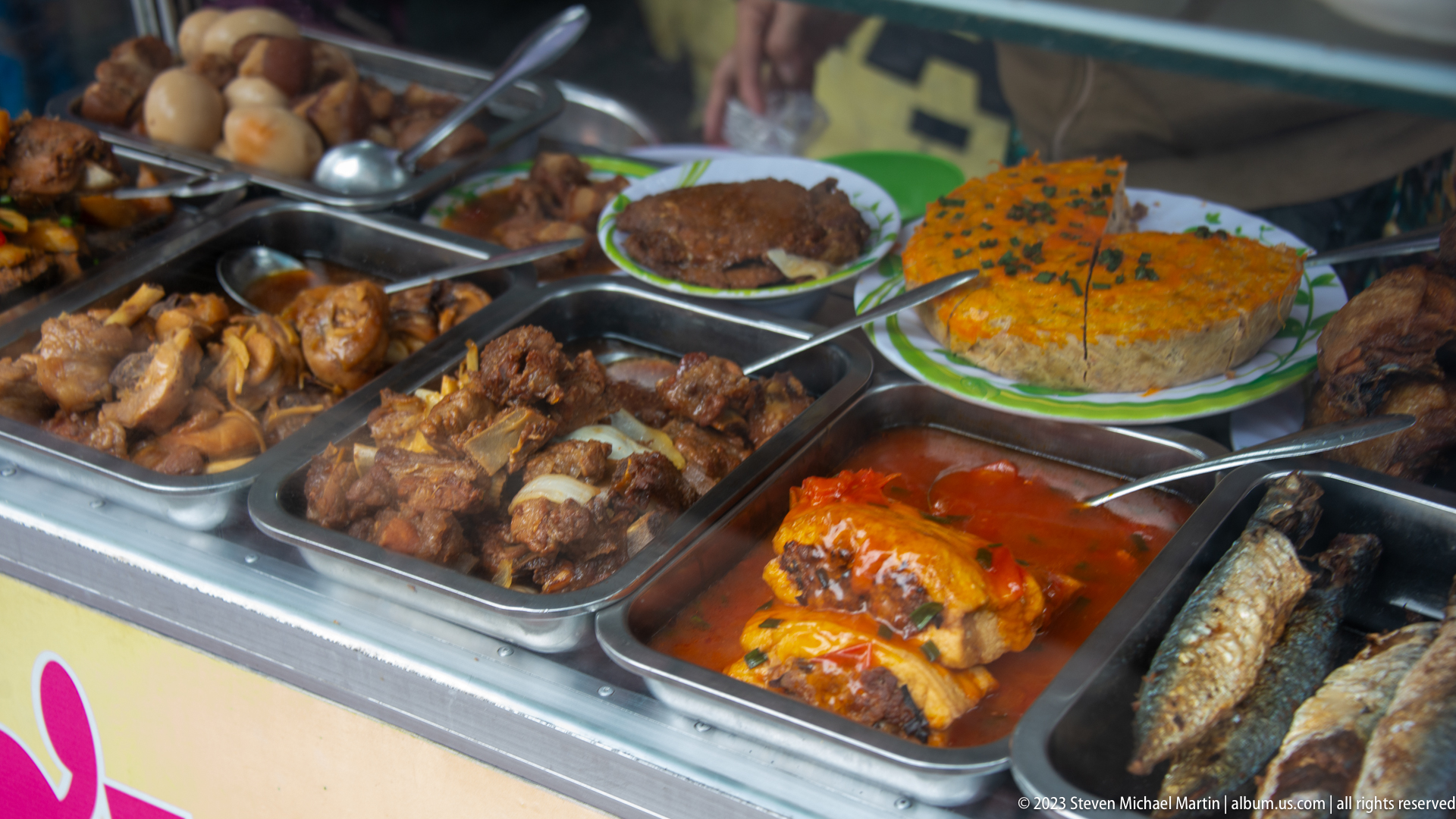
Metal trays present a varied selection of prepared foods, including braised meats, grilled fish, stuffed vegetables, and plated rice portions. The close view emphasizes the abundance and visual organization of a Vietnamese food counter, where customers can select individual dishes to accompany rice.
Caption
Metal trays present a varied selection of prepared foods, including braised meats, grilled fish, stuffed vegetables, and plated rice portions. The close view emphasizes the abundance and visual organization of a Vietnamese food counter, where customers can select individual dishes to accompany rice.

An olive-drab open-top jeep with a white star on its hood is parked tightly between motorbikes and a modern car. Its vertical grille, round headlights, rugged tires, and utilitarian body evoke mid-twentieth-century military vehicle design, although the photograph does not establish its exact make or service history.
Caption
An olive-drab open-top jeep with a white star on its hood is parked tightly between motorbikes and a modern car. Its vertical grille, round headlights, rugged tires, and utilitarian body evoke mid-twentieth-century military vehicle design, although the photograph does not establish its exact make or service history.

Traffic moves along a broad divided avenue lined with narrow shops, apartment façades, and newer commercial buildings. In the distance, high-rise towers rise above the older street wall, illustrating the close coexistence of long-established urban fabric and rapid contemporary development in central Ho Chi Minh City.
Caption
Traffic moves along a broad divided avenue lined with narrow shops, apartment façades, and newer commercial buildings. In the distance, high-rise towers rise above the older street wall, illustrating the close coexistence of long-established urban fabric and rapid contemporary development in central Ho Chi Minh City.

A tightly packed row of narrow mixed-use buildings combines enclosed balconies, projecting windows, rooftop additions, shop signs, and small planted terraces. The irregular façades reveal successive adaptations to limited urban plots, while ground-floor cafés and businesses keep the street edge active.
Caption
A tightly packed row of narrow mixed-use buildings combines enclosed balconies, projecting windows, rooftop additions, shop signs, and small planted terraces. The irregular façades reveal successive adaptations to limited urban plots, while ground-floor cafés and businesses keep the street edge active.
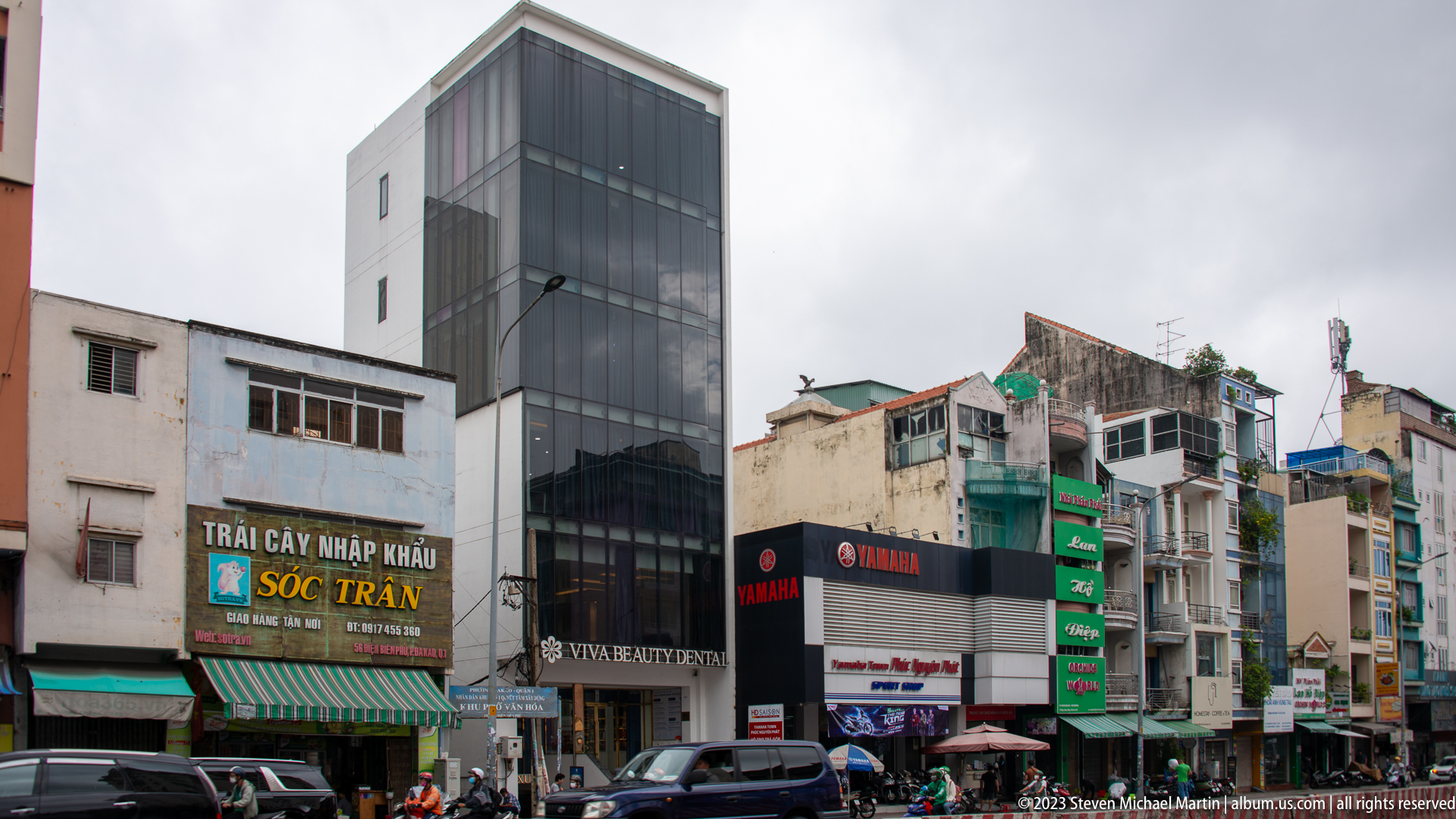
A dark-glass mid-rise stands between older, weathered commercial buildings whose narrow façades carry restaurants, retail signs, and upper-floor windows. The contrast in height, materials, and finish makes the block a concise record of incremental redevelopment within Ho Chi Minh City’s dense center.
Caption
A dark-glass mid-rise stands between older, weathered commercial buildings whose narrow façades carry restaurants, retail signs, and upper-floor windows. The contrast in height, materials, and finish makes the block a concise record of incremental redevelopment within Ho Chi Minh City’s dense center.

A woman in a conical hat and face mask steps across the street near a compact sidewalk café, where diners sit on low red stools. Her warm-toned clothing and hat stand out against parked vehicles, curbside utility boxes, and the everyday bustle of the neighborhood.
Caption
A woman in a conical hat and face mask steps across the street near a compact sidewalk café, where diners sit on low red stools. Her warm-toned clothing and hat stand out against parked vehicles, curbside utility boxes, and the everyday bustle of the neighborhood.

A formal yellow civic building with arched windows and a red tile roof stands beyond a landscaped square filled with flowers, trees, tour vehicles, and pedestrians. The ordered façade and garden setting place the building within the ceremonial urban landscape surrounding central Ho Chi Minh City’s major colonial-era monuments.
Caption
A formal yellow civic building with arched windows and a red tile roof stands beyond a landscaped square filled with flowers, trees, tour vehicles, and pedestrians. The ordered façade and garden setting place the building within the ceremonial urban landscape surrounding central Ho Chi Minh City’s major colonial-era monuments.

The main façade of Saigon Central Post Office centers on a large arched entrance surmounted by a clock and framed by pilasters, decorative bands, and green shutters. Crowds gather below the richly modeled yellow façade, emphasizing the building’s continued role as both working public infrastructure and a major heritage destination.
Caption
The main façade of Saigon Central Post Office centers on a large arched entrance surmounted by a clock and framed by pilasters, decorative bands, and green shutters. Crowds gather below the richly modeled yellow façade, emphasizing the building’s continued role as both working public infrastructure and a major heritage destination.

A white stucco female head emerges from radiating leaves and scrollwork above an opening on Saigon Central Post Office. The sculpted mascaron is set against mustard-yellow walls and a green ornamental frieze, revealing the building’s layered classical and decorative vocabulary at close range.
Caption
A white stucco female head emerges from radiating leaves and scrollwork above an opening on Saigon Central Post Office. The sculpted mascaron is set against mustard-yellow walls and a green ornamental frieze, revealing the building’s layered classical and decorative vocabulary at close range.

Steep red tile roofs and weathered low-rise walls occupy the foreground beneath a broad blue-glass tower. The sharp contrast in scale, material, and age compresses two phases of Ho Chi Minh City’s built environment into one view, with older roof forms surviving beneath the expanding modern skyline.
Caption
Steep red tile roofs and weathered low-rise walls occupy the foreground beneath a broad blue-glass tower. The sharp contrast in scale, material, and age compresses two phases of Ho Chi Minh City’s built environment into one view, with older roof forms surviving beneath the expanding modern skyline.

The statue of Our Lady of Peace stands on its red stone pedestal before Notre-Dame Cathedral Basilica of Saigon, whose twin towers are obscured by scaffolding. The juxtaposition isolates the calm devotional figure against the dense geometry of an active restoration campaign.
Caption
The statue of Our Lady of Peace stands on its red stone pedestal before Notre-Dame Cathedral Basilica of Saigon, whose twin towers are obscured by scaffolding. The juxtaposition isolates the calm devotional figure against the dense geometry of an active restoration campaign.

Three stylized bronze figures lean and reach upward in a compact public sculpture, their linked gestures producing a strong sense of collective movement. Palm fronds and a pale colonial-style façade form the backdrop, placing the work within a landscaped civic setting.
Caption
Three stylized bronze figures lean and reach upward in a compact public sculpture, their linked gestures producing a strong sense of collective movement. Palm fronds and a pale colonial-style façade form the backdrop, placing the work within a landscaped civic setting.

Two mannequins display brightly colored Vietnamese áo dài, one yellow with a floral lower panel and the other lavender, both paired with conical hats. The shop presentation turns traditional dress into a vivid retail display within the busy visitor environment of central Ho Chi Minh City.
Caption
Two mannequins display brightly colored Vietnamese áo dài, one yellow with a floral lower panel and the other lavender, both paired with conical hats. The shop presentation turns traditional dress into a vivid retail display within the busy visitor environment of central Ho Chi Minh City.

A towering white inflatable mascot with oversized eyes, small horns, and a blue neck detail fills the frame outside a historic building. Its playful scale and polished character design contrast sharply with the arched windows, palm trees, and formal architecture behind it.
Caption
A towering white inflatable mascot with oversized eyes, small horns, and a blue neck detail fills the frame outside a historic building. Its playful scale and polished character design contrast sharply with the arched windows, palm trees, and formal architecture behind it.
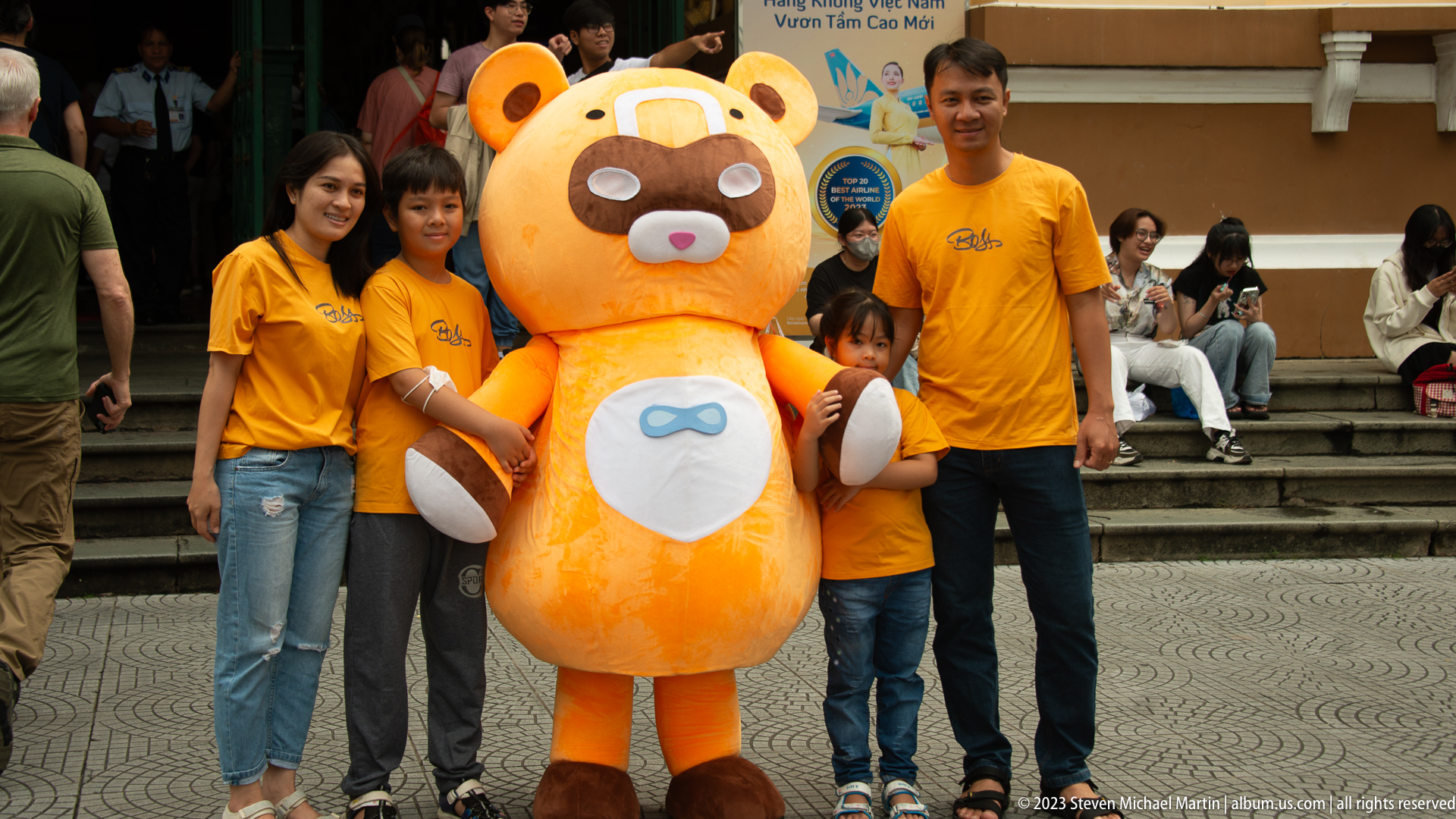
A family group in matching yellow shirts poses beside a large orange bear-like mascot on the steps of a public building. The coordinated clothing, children at the center, and relaxed smiles suggest an organized community or promotional event unfolding within the city’s historic core.
Caption
A family group in matching yellow shirts poses beside a large orange bear-like mascot on the steps of a public building. The coordinated clothing, children at the center, and relaxed smiles suggest an organized community or promotional event unfolding within the city’s historic core.

A large historical map of southern Vietnam and adjoining regions fills an arched wall panel inside Saigon Central Post Office. Set within layered cream-and-orange moldings, the map links the building’s decorative interior to the geographic networks once served by postal and telegraphic communication.
Caption
A large historical map of southern Vietnam and adjoining regions fills an arched wall panel inside Saigon Central Post Office. Set within layered cream-and-orange moldings, the map links the building’s decorative interior to the geographic networks once served by postal and telegraphic communication.
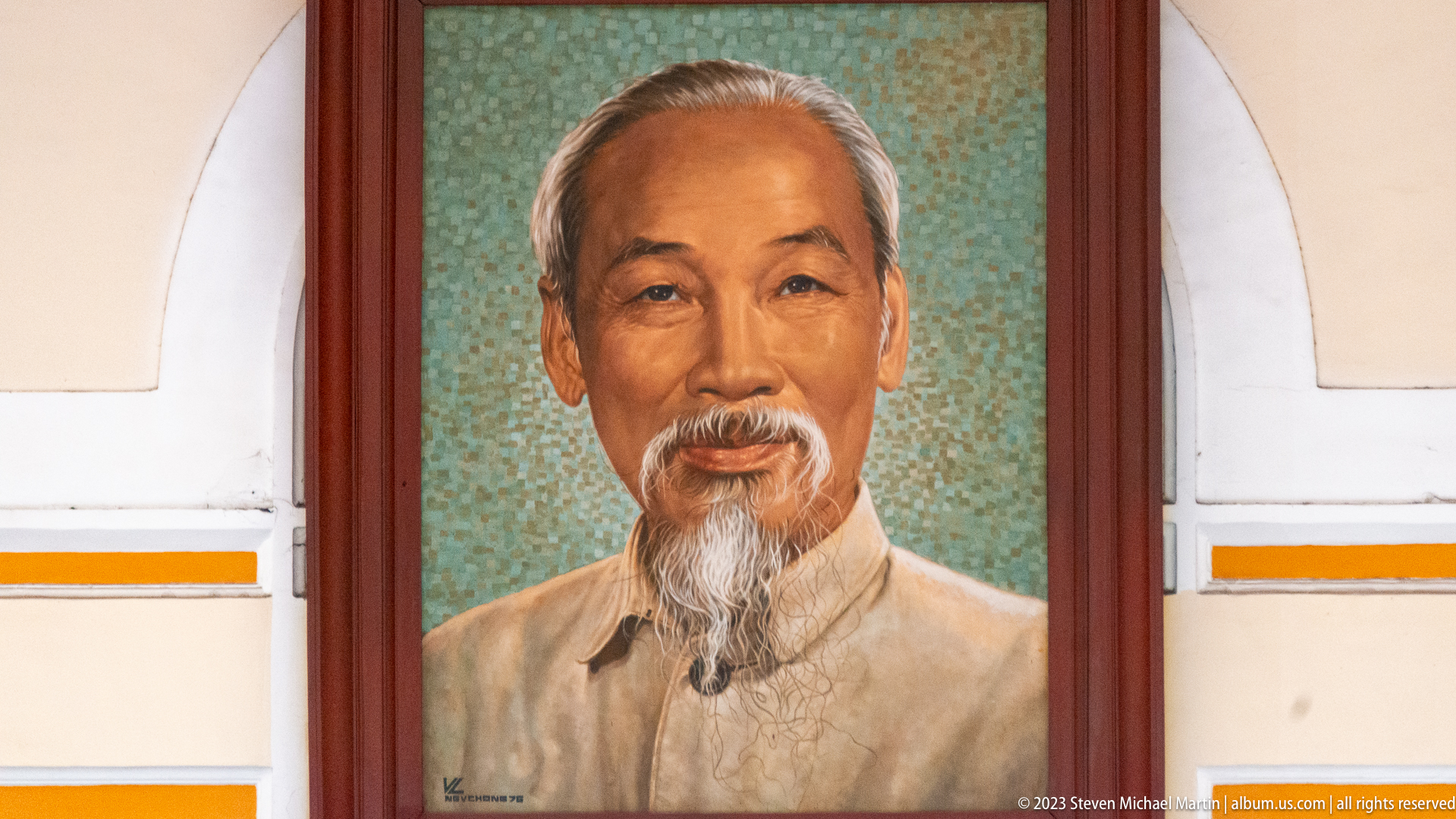
A formal portrait of Ho Chi Minh occupies a tall arched panel inside Saigon Central Post Office. The closely framed image emphasizes his white beard, composed expression, and pale tunic, while the surrounding green, cream, and orange architectural trim integrates the national figure into the building’s ceremonial axis.
Caption
A formal portrait of Ho Chi Minh occupies a tall arched panel inside Saigon Central Post Office. The closely framed image emphasizes his white beard, composed expression, and pale tunic, while the surrounding green, cream, and orange architectural trim integrates the national figure into the building’s ceremonial axis.

A row of richly stained red wooden telephone booths lines the interior of Saigon Central Post Office, each bay numbered above its glass door. World clocks labeled for cities including Paris, Canberra, and London reinforce the building’s historic role in connecting Ho Chi Minh City to international communications networks.
Caption
A row of richly stained red wooden telephone booths lines the interior of Saigon Central Post Office, each bay numbered above its glass door. World clocks labeled for cities including Paris, Canberra, and London reinforce the building’s historic role in connecting Ho Chi Minh City to international communications networks.
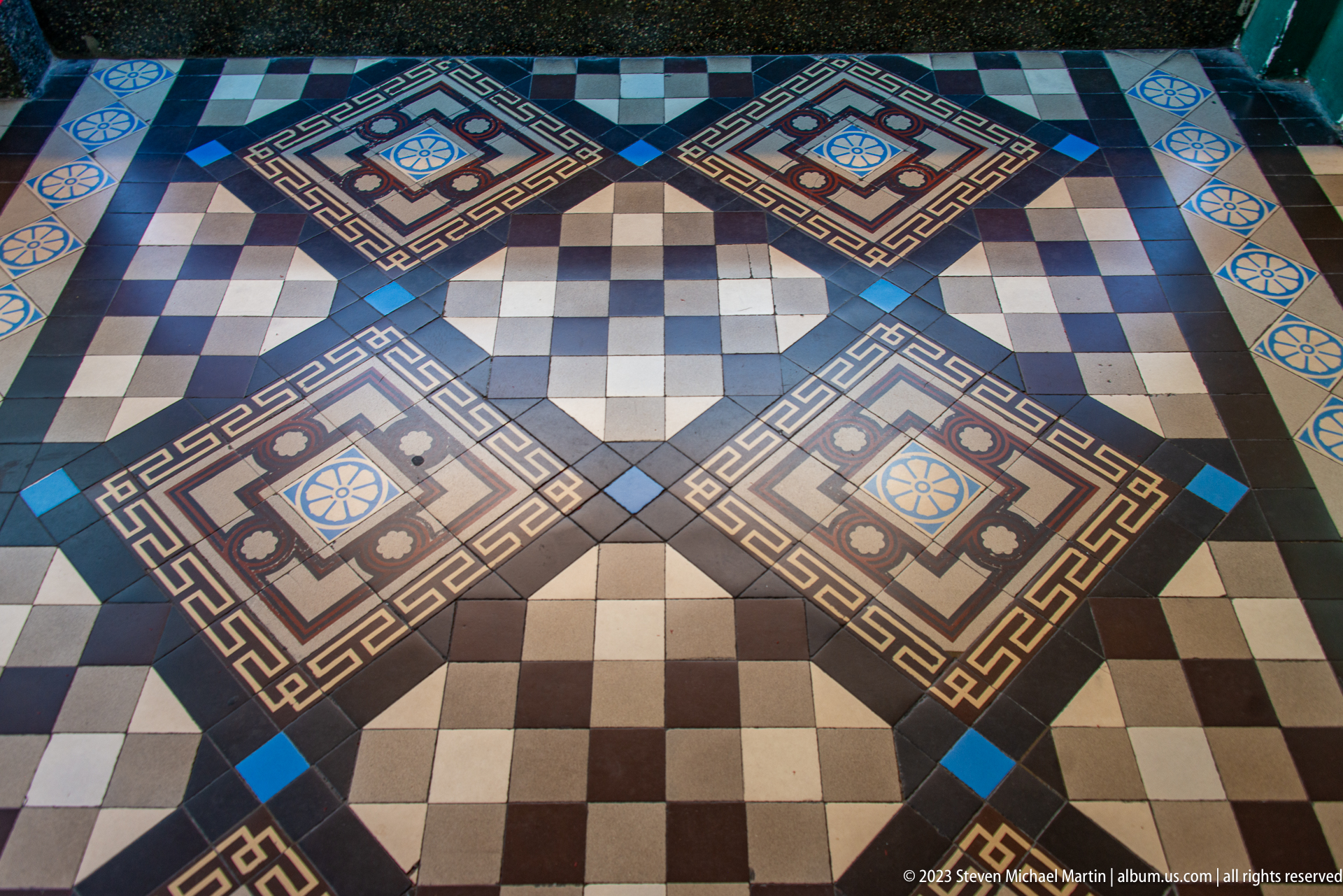
Blue, brown, cream, and white tiles form a dense geometric floor pattern of checkerboards, rosettes, framed diamonds, and Greek-key borders. The close detail highlights the ornamental richness of Saigon Central Post Office beyond its vaulted architecture and major wall features.
Caption
Blue, brown, cream, and white tiles form a dense geometric floor pattern of checkerboards, rosettes, framed diamonds, and Greek-key borders. The close detail highlights the ornamental richness of Saigon Central Post Office beyond its vaulted architecture and major wall features.
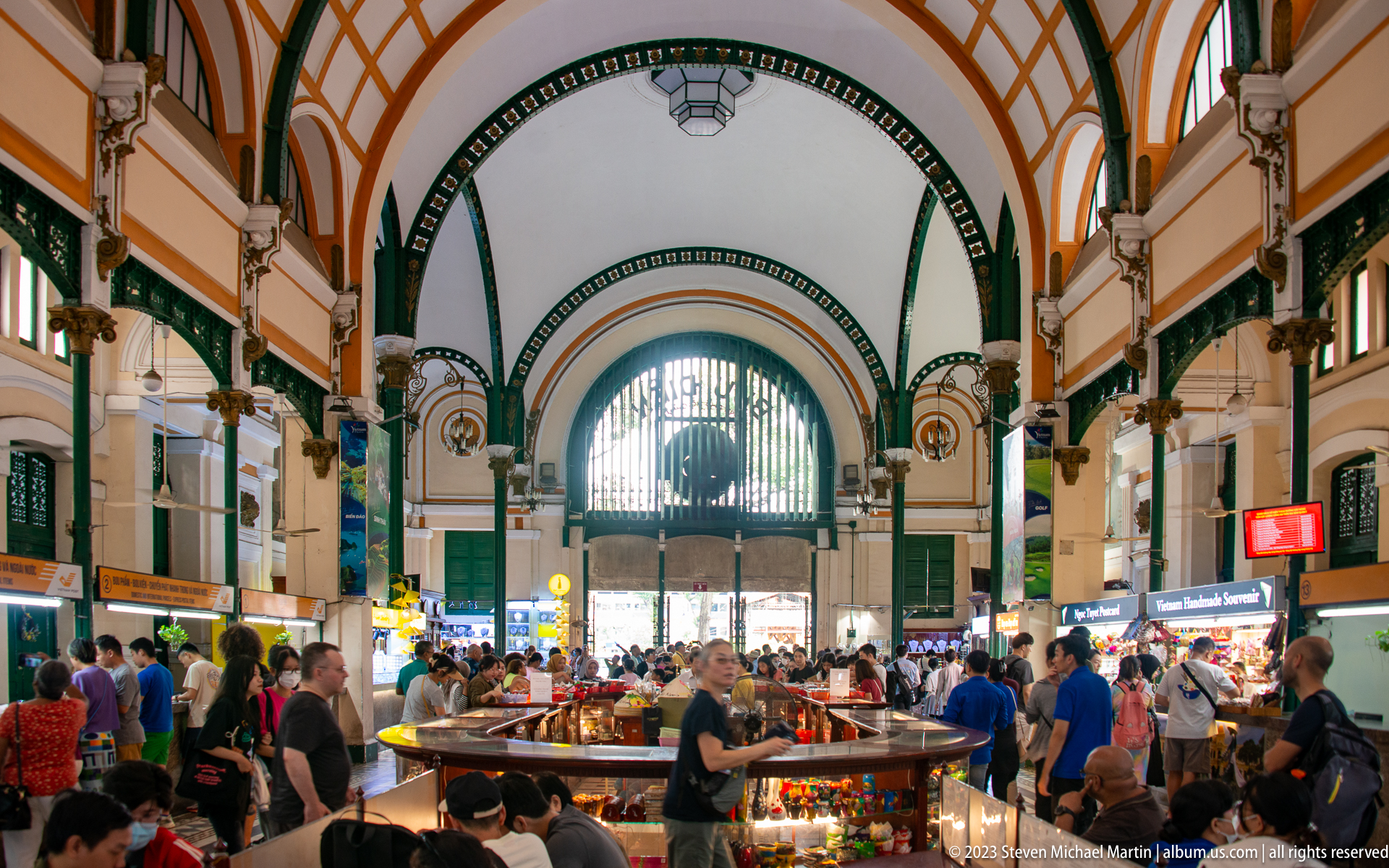
Visitors fill the central hall of Saigon Central Post Office beneath broad white vaults edged with green and orange trim. Seen toward the luminous arched entrance, the interior remains both a functioning public space and a heavily visited heritage site, with service areas and souvenir displays occupying the floor.
Caption
Visitors fill the central hall of Saigon Central Post Office beneath broad white vaults edged with green and orange trim. Seen toward the luminous arched entrance, the interior remains both a functioning public space and a heavily visited heritage site, with service areas and souvenir displays occupying the floor.

A street vendor pauses beside a brightly decorated mobile ice-cream cart marked “Kem,” the Vietnamese word for ice cream. Packaged cones and product graphics crowd the small display box, while parked motorbikes and pedestrians fill the shaded sidewalk behind him. The compact, movable cart illustrates how small-scale food vending adapts to Ho Chi Minh City’s dense streets and motorcycle-centered mobility.
Caption
A street vendor pauses beside a brightly decorated mobile ice-cream cart marked “Kem,” the Vietnamese word for ice cream. Packaged cones and product graphics crowd the small display box, while parked motorbikes and pedestrians fill the shaded sidewalk behind him. The compact, movable cart illustrates how small-scale food vending adapts to Ho Chi Minh City’s dense streets and motorcycle-centered mobility.
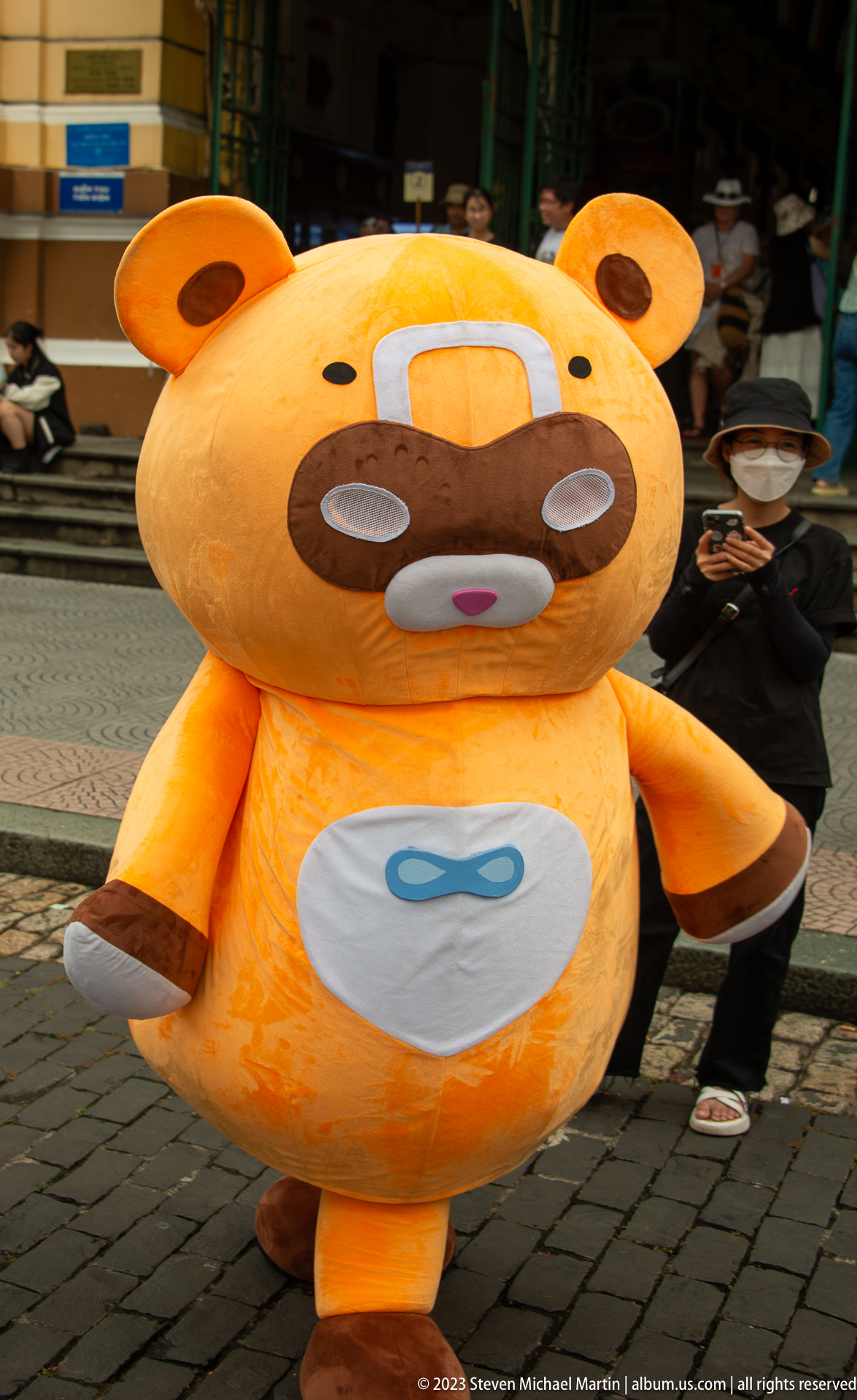
A large orange bear-like mascot walks through a public gathering, its oversized head, rounded ears, and white belly emblem dominating the frame. People seated and standing nearby reinforce the festive event setting, while the costume’s scale gives the figure a comic, animated presence.
Caption
A large orange bear-like mascot walks through a public gathering, its oversized head, rounded ears, and white belly emblem dominating the frame. People seated and standing nearby reinforce the festive event setting, while the costume’s scale gives the figure a comic, animated presence.

A bronze sculptural group presents an armed man standing protectively beside a woman and child, linking military service with the civilian family. The compact arrangement, forward-facing figures, and prominently modeled rifle create a commemorative image of vigilance, sacrifice, and collective endurance. Tropical foliage and a low institutional building place the monument within an urban garden setting in Ho Chi Minh City.
Caption
A bronze sculptural group presents an armed man standing protectively beside a woman and child, linking military service with the civilian family. The compact arrangement, forward-facing figures, and prominently modeled rifle create a commemorative image of vigilance, sacrifice, and collective endurance. Tropical foliage and a low institutional building place the monument within an urban garden setting in Ho Chi Minh City.

A visitor stands beside a blue neon text installation spelling “IF YOU LOVE ME LET ME KNOW.” The saturated electric lettering washes the wall and the sitter’s face with cool light, turning a direct romantic phrase into an immersive photographic backdrop. The informal pose and reflective surface suggest a contemporary hospitality, retail, or exhibition interior rather than a conventional historic display.
Caption
A visitor stands beside a blue neon text installation spelling “IF YOU LOVE ME LET ME KNOW.” The saturated electric lettering washes the wall and the sitter’s face with cool light, turning a direct romantic phrase into an immersive photographic backdrop. The informal pose and reflective surface suggest a contemporary hospitality, retail, or exhibition interior rather than a conventional historic display.

Two cans of Bia Saigon Lager stand side by side on a white tabletop, their cream-and-green labels dominated by a gold dragon and the words “Bia Saigon Lager.” The carefully paired presentation treats an everyday beverage package as a graphic design object, emphasizing brand identity, symmetry, and the beer’s association with the city whose historic name it carries.
Caption
Two cans of Bia Saigon Lager stand side by side on a white tabletop, their cream-and-green labels dominated by a gold dragon and the words “Bia Saigon Lager.” The carefully paired presentation treats an everyday beverage package as a graphic design object, emphasizing brand identity, symmetry, and the beer’s association with the city whose historic name it carries.

Two Bia Saigon Lager cans are staged beneath oversized lettering that reads “IT STARTS TOMORROW.” Strong contrast isolates the pale cans against a nearly black background, transforming the familiar beverage into a theatrical promotional still life. The composition depends on scale: the slogan looms above the small paired products, creating anticipation while withholding the event or campaign being announced.
Caption
Two Bia Saigon Lager cans are staged beneath oversized lettering that reads “IT STARTS TOMORROW.” Strong contrast isolates the pale cans against a nearly black background, transforming the familiar beverage into a theatrical promotional still life. The composition depends on scale: the slogan looms above the small paired products, creating anticipation while withholding the event or campaign being announced.

A yellow-and-cream step-through motorcycle is parked on artificial turf beside a rooftop railing, with Ho Chi Minh City’s evening skyline behind it. The machine’s rounded fuel tank, spoked wheels, and exposed mechanical frame evoke a familiar mid-twentieth-century utility design. Presented as a decorative object above the city, it connects Vietnam’s enduring motorcycle culture with a deliberately nostalgic leisure setting.
Caption
A yellow-and-cream step-through motorcycle is parked on artificial turf beside a rooftop railing, with Ho Chi Minh City’s evening skyline behind it. The machine’s rounded fuel tank, spoked wheels, and exposed mechanical frame evoke a familiar mid-twentieth-century utility design. Presented as a decorative object above the city, it connects Vietnam’s enduring motorcycle culture with a deliberately nostalgic leisure setting.

A closer frontal view isolates the Saigon Opera House’s central entrance bay. Paired columns frame the recessed arch, while sculpted figures, floral ornament, curved pediments, and a painted decorative panel concentrate attention above the doors. The tighter composition reveals the theater’s layered façade as a carefully staged architectural spectacle, with balconies and ornament announcing the building’s civic and cultural function.
Caption
A closer frontal view isolates the Saigon Opera House’s central entrance bay. Paired columns frame the recessed arch, while sculpted figures, floral ornament, curved pediments, and a painted decorative panel concentrate attention above the doors. The tighter composition reveals the theater’s layered façade as a carefully staged architectural spectacle, with balconies and ornament announcing the building’s civic and cultural function.

An elevated daytime view spreads across a dense patchwork of corrugated roofs, rooftop tanks, weathered walls, and closely packed commercial buildings. Bank and hotel signs rise above the lower fabric, while red-tiled roofs mark older structures within the modern city. The compressed perspective reveals how multiple building generations coexist within central Ho Chi Minh City.
Caption
An elevated daytime view spreads across a dense patchwork of corrugated roofs, rooftop tanks, weathered walls, and closely packed commercial buildings. Bank and hotel signs rise above the lower fabric, while red-tiled roofs mark older structures within the modern city. The compressed perspective reveals how multiple building generations coexist within central Ho Chi Minh City.

An older traveler smiles directly toward the camera from a tan leather seat inside a vehicle. Soft daylight enters from the side and isolates his face against the blurred interior, producing an informal portrait between destinations. The close framing shifts the portfolio from public streets and architecture to the personal experience of travel, recording the human presence behind the wider documentation of Ho Chi Minh City.
Caption
An older traveler smiles directly toward the camera from a tan leather seat inside a vehicle. Soft daylight enters from the side and isolates his face against the blurred interior, producing an informal portrait between destinations. The close framing shifts the portfolio from public streets and architecture to the personal experience of travel, recording the human presence behind the wider documentation of Ho Chi Minh City.

A large red-and-yellow public display marks “2/9,” Vietnam’s National Day, with portraits, flags, historic photographs, and celebratory graphics. Installed along a landscaped sidewalk, the panels combine revolutionary imagery with documentary scenes and patriotic color. Pedestrians passing in front reveal how official commemoration is integrated into the everyday streetscape rather than confined to a museum or ceremonial square.
Caption
A large red-and-yellow public display marks “2/9,” Vietnam’s National Day, with portraits, flags, historic photographs, and celebratory graphics. Installed along a landscaped sidewalk, the panels combine revolutionary imagery with documentary scenes and patriotic color. Pedestrians passing in front reveal how official commemoration is integrated into the everyday streetscape rather than confined to a museum or ceremonial square.

The Municipal Theatre of Ho Chi Minh City, commonly called the Saigon Opera House, presents an ornate cream-colored façade to the surrounding commercial district. A deep arched entrance, sculptural ornament, pilasters, and a balustraded upper level organize the symmetrical composition. Pedestrians and nearby high-rises show the French colonial-era theater embedded within the dense contemporary center of the city.
Caption
The Municipal Theatre of Ho Chi Minh City, commonly called the Saigon Opera House, presents an ornate cream-colored façade to the surrounding commercial district. A deep arched entrance, sculptural ornament, pilasters, and a balustraded upper level organize the symmetrical composition. Pedestrians and nearby high-rises show the French colonial-era theater embedded within the dense contemporary center of the city.

A cable-stayed bridge pylon and its radiating white cables cut diagonally across Ho Chi Minh City’s expanding skyline. Landmark 81 rises in the distance beyond palms and clustered residential towers, pairing a piece of transport infrastructure with the city’s most prominent contemporary skyscraper. The compressed view underscores how bridges, high-rise housing, and commercial landmarks are reshaping the metropolitan horizon.
Caption
A cable-stayed bridge pylon and its radiating white cables cut diagonally across Ho Chi Minh City’s expanding skyline. Landmark 81 rises in the distance beyond palms and clustered residential towers, pairing a piece of transport infrastructure with the city’s most prominent contemporary skyscraper. The compressed view underscores how bridges, high-rise housing, and commercial landmarks are reshaping the metropolitan horizon.
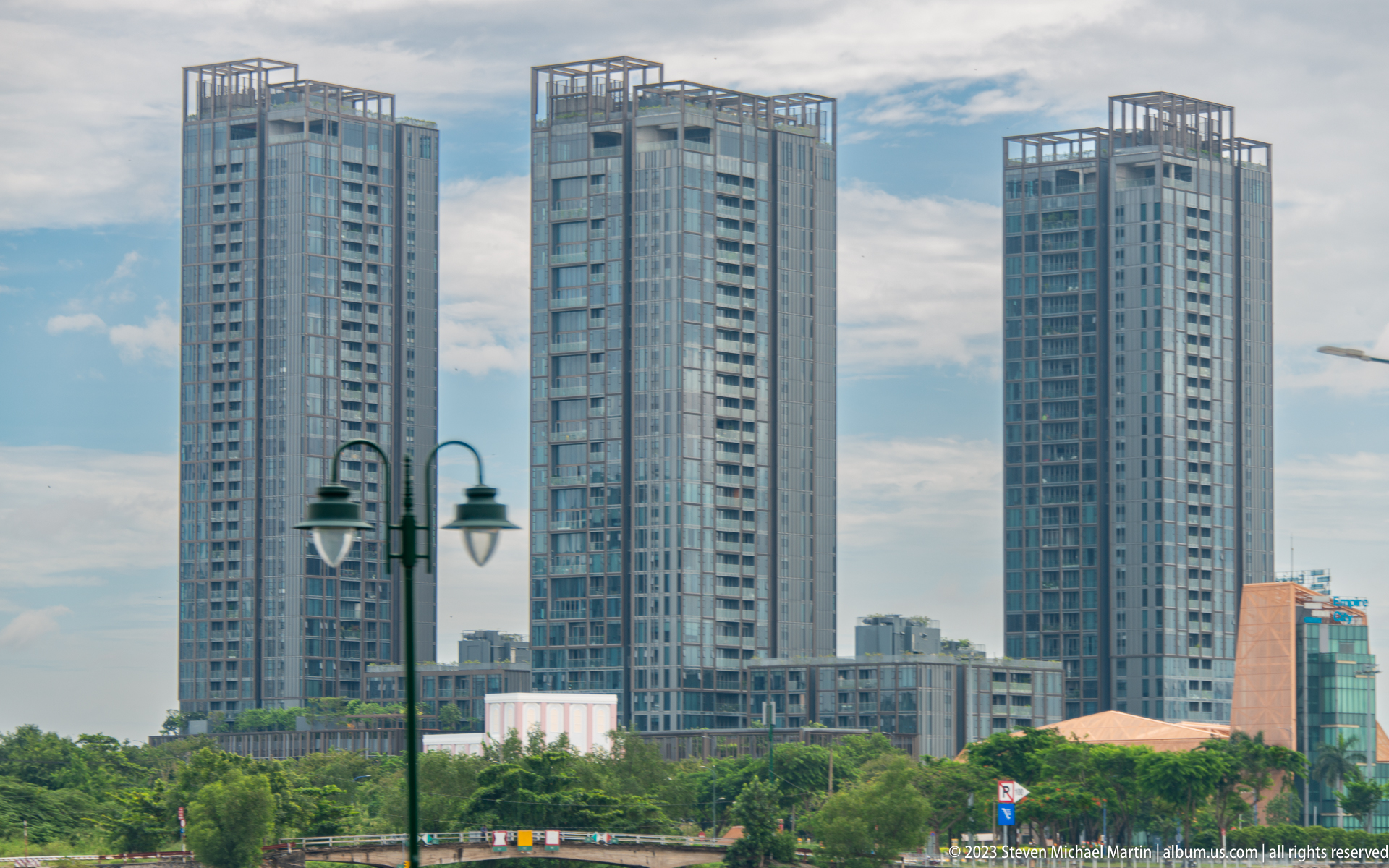
Three tall residential towers rise in a closely spaced group above trees and lower construction. Their repetitive balcony grids and exposed rooftop frames create a disciplined vertical rhythm, while traditional-style street lamps in the foreground establish the view from a public road or park. The photograph records the large-scale apartment development accompanying Ho Chi Minh City’s rapid outward and upward expansion.
Caption
Three tall residential towers rise in a closely spaced group above trees and lower construction. Their repetitive balcony grids and exposed rooftop frames create a disciplined vertical rhythm, while traditional-style street lamps in the foreground establish the view from a public road or park. The photograph records the large-scale apartment development accompanying Ho Chi Minh City’s rapid outward and upward expansion.

Landmark 81 stands at the center of a dense cluster of pale apartment towers, its stepped crown rising well above the surrounding skyline. Bridge cables enter from the lower left, adding a second layer of contemporary infrastructure to the composition. The combination of supertall tower, mass housing, and transport engineering presents a concentrated view of metropolitan development in Ho Chi Minh City.
Caption
Landmark 81 stands at the center of a dense cluster of pale apartment towers, its stepped crown rising well above the surrounding skyline. Bridge cables enter from the lower left, adding a second layer of contemporary infrastructure to the composition. The combination of supertall tower, mass housing, and transport engineering presents a concentrated view of metropolitan development in Ho Chi Minh City.

A low historic masonry structure with arched openings and a stepped central parapet survives at the edge of a broad modern roadway. High-rise apartment blocks loom immediately behind it, creating a sharp contrast in scale, material, and age. The roadside context suggests an isolated remnant or preserved urban feature now surrounded by the infrastructure and vertical construction of contemporary Ho Chi Minh City.
Caption
A low historic masonry structure with arched openings and a stepped central parapet survives at the edge of a broad modern roadway. High-rise apartment blocks loom immediately behind it, creating a sharp contrast in scale, material, and age. The roadside context suggests an isolated remnant or preserved urban feature now surrounded by the infrastructure and vertical construction of contemporary Ho Chi Minh City.
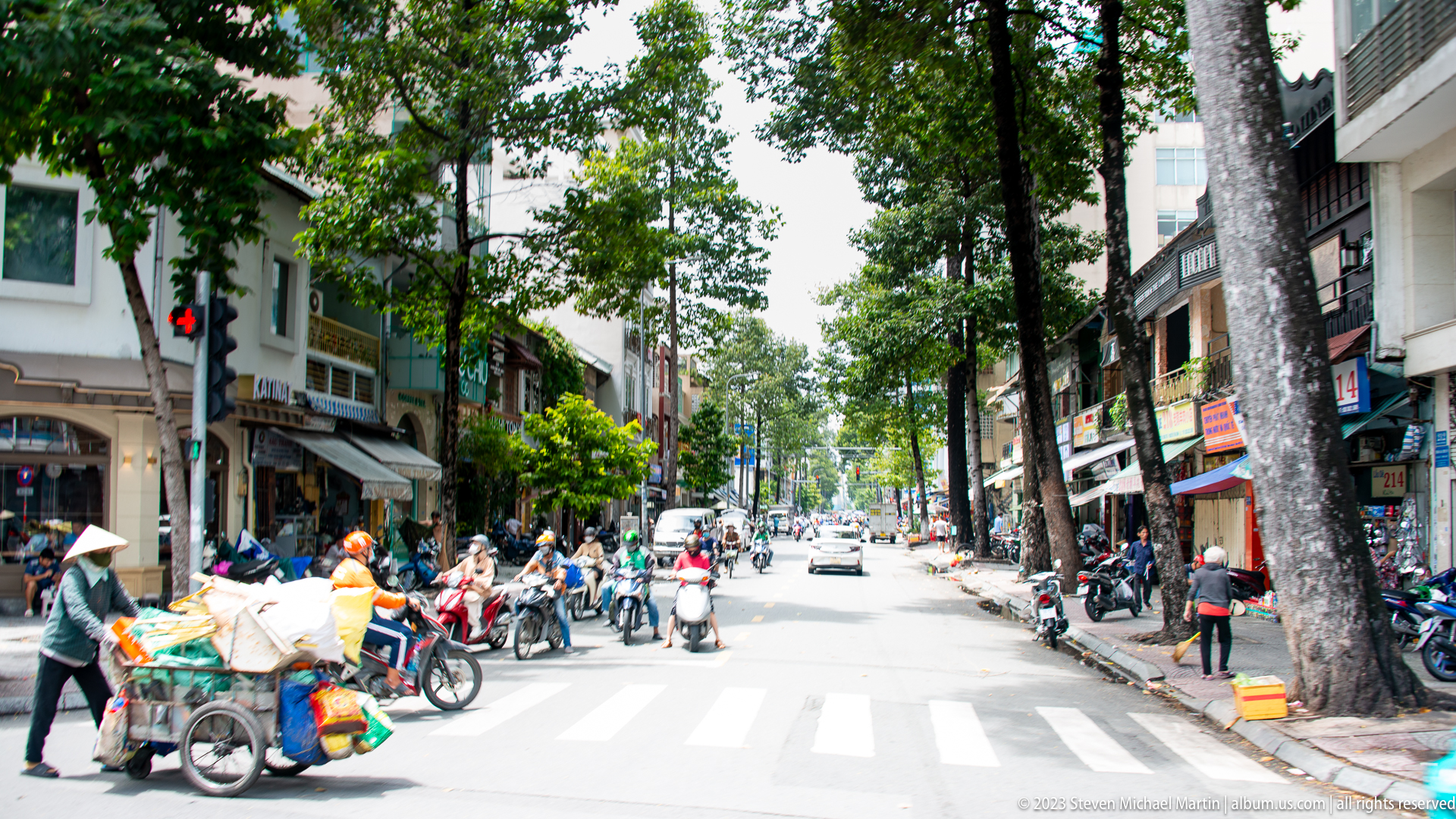
A tree-lined neighborhood street combines motorbike traffic, compact shopfronts, sidewalk vendors, and low-rise mixed-use buildings. A conical hat, handcarts, parked scooters, and hanging signs create a dense record of daily commerce at street level. Unlike the nearby skyline views, this scene emphasizes the fine-grained urban fabric through which residents work, shop, and move.
Caption
A tree-lined neighborhood street combines motorbike traffic, compact shopfronts, sidewalk vendors, and low-rise mixed-use buildings. A conical hat, handcarts, parked scooters, and hanging signs create a dense record of daily commerce at street level. Unlike the nearby skyline views, this scene emphasizes the fine-grained urban fabric through which residents work, shop, and move.

A hand raises a can of Bia Saigon Lager against a blurred rooftop night scene. The can’s gold dragon, cream field, and green label remain sharply legible while city lights and the yellow motorcycle seen earlier dissolve into the background. The personal gesture converts a commercial package into a travel memento, linking a locally branded drink with an evening above Ho Chi Minh City.
Caption
A hand raises a can of Bia Saigon Lager against a blurred rooftop night scene. The can’s gold dragon, cream field, and green label remain sharply legible while city lights and the yellow motorcycle seen earlier dissolve into the background. The personal gesture converts a commercial package into a travel memento, linking a locally branded drink with an evening above Ho Chi Minh City.

A large reinforced-concrete high-rise rises under construction behind a yellow, red-roofed institutional building. Exposed columns, floor slabs, cranes, and temporary cladding contrast with the older building’s symmetrical façade and shaded grounds. Seen through haze or rain-streaked glass, the scene records the pressure of vertical redevelopment on Ho Chi Minh City’s surviving colonial-era urban fabric.
Caption
A large reinforced-concrete high-rise rises under construction behind a yellow, red-roofed institutional building. Exposed columns, floor slabs, cranes, and temporary cladding contrast with the older building’s symmetrical façade and shaded grounds. Seen through haze or rain-streaked glass, the scene records the pressure of vertical redevelopment on Ho Chi Minh City’s surviving colonial-era urban fabric.

The tapering Bitexco Financial Tower rises behind a blue VietinBank office building and an elevated concrete structure. Its projecting helipad remains visible despite the overcast light, making the tower immediately recognizable. The layered composition places a landmark skyscraper behind utilitarian infrastructure and corporate architecture, showing how Ho Chi Minh City’s signature skyline is encountered through the dense foreground of everyday development.
Caption
The tapering Bitexco Financial Tower rises behind a blue VietinBank office building and an elevated concrete structure. Its projecting helipad remains visible despite the overcast light, making the tower immediately recognizable. The layered composition places a landmark skyscraper behind utilitarian infrastructure and corporate architecture, showing how Ho Chi Minh City’s signature skyline is encountered through the dense foreground of everyday development.

A printed guidebook page introduces Ho Chi Minh City with a compact historical and travel overview, a small regional map, and a list of highlights. The photograph records the interpretive material used alongside the journey, showing how printed travel literature frames the city before or during direct observation. Its dense typography contrasts with the visual immediacy of the surrounding street and architectural photographs.
Caption
A printed guidebook page introduces Ho Chi Minh City with a compact historical and travel overview, a small regional map, and a list of highlights. The photograph records the interpretive material used alongside the journey, showing how printed travel literature frames the city before or during direct observation. Its dense typography contrasts with the visual immediacy of the surrounding street and architectural photographs.

A weathered rooftop service building fills the foreground, its patched walls, exposed stair, and utilitarian openings set against modern high-rises. The Bitexco Financial Tower appears partially at left, while another residential tower rises at right. By placing an aging, improvised structure directly beneath the city’s celebrated skyline, the photograph emphasizes the uneven material realities of rapid urban transformation.
Caption
A weathered rooftop service building fills the foreground, its patched walls, exposed stair, and utilitarian openings set against modern high-rises. The Bitexco Financial Tower appears partially at left, while another residential tower rises at right. By placing an aging, improvised structure directly beneath the city’s celebrated skyline, the photograph emphasizes the uneven material realities of rapid urban transformation.

A displayed photograph shows a woman in a conical hat and pink clothing paddling a round woven basket boat, or coracle, across blue water. The visible border and reflective surface indicate that this is an image encountered within an interior display rather than the original outdoor scene. The subject evokes coastal and riverine transport traditions associated with central and southern Vietnam.
Caption
A displayed photograph shows a woman in a conical hat and pink clothing paddling a round woven basket boat, or coracle, across blue water. The visible border and reflective surface indicate that this is an image encountered within an interior display rather than the original outdoor scene. The subject evokes coastal and riverine transport traditions associated with central and southern Vietnam.
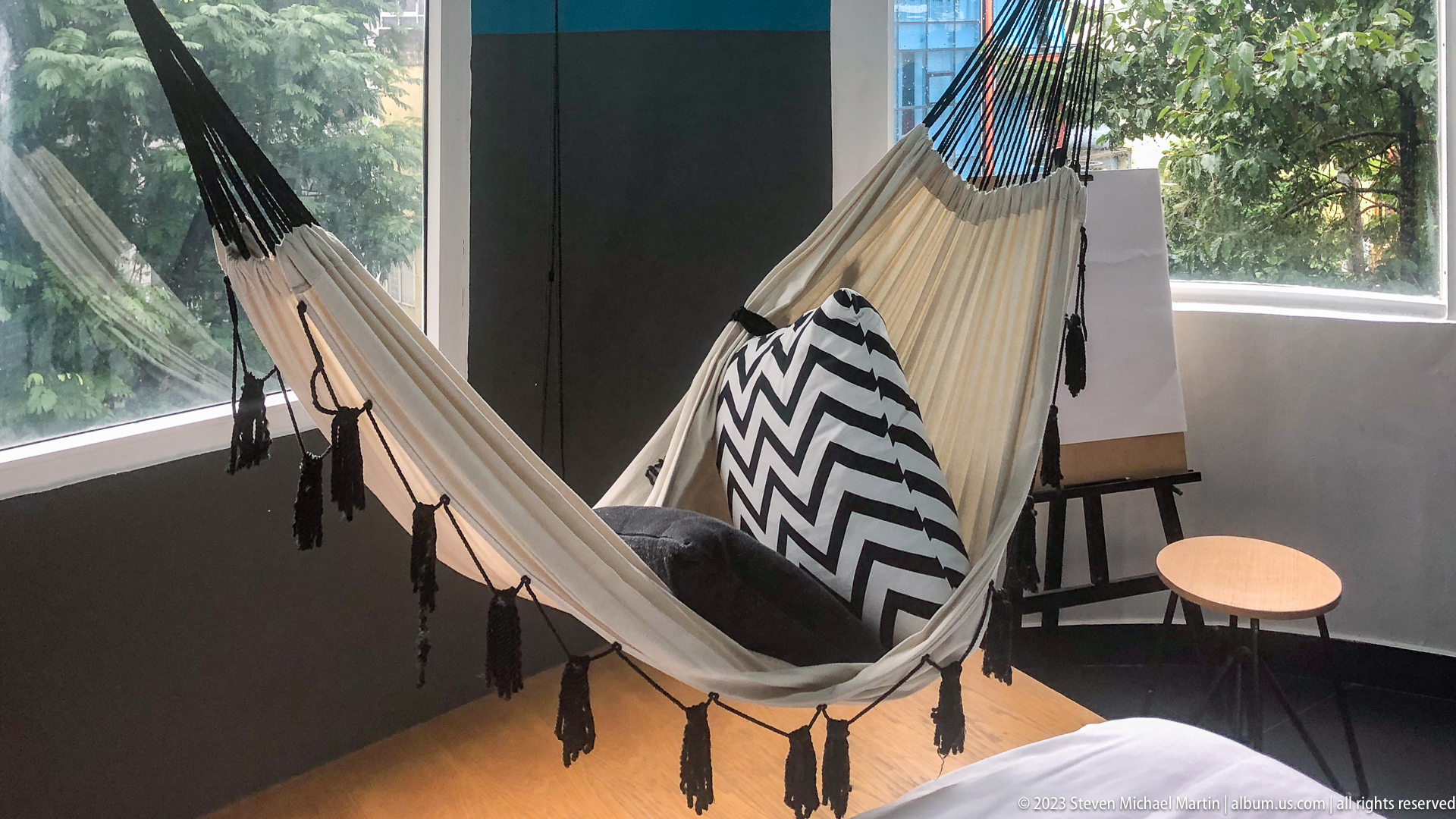
A cream fabric hammock with black tassels hangs diagonally across a bright contemporary interior. Layered cushions, a small round table, and a large window give the room the relaxed character of a hotel or apartment lounge. Bringing a suspended resting place indoors turns a familiar tropical object into a deliberate element of modern interior design.
Caption
A cream fabric hammock with black tassels hangs diagonally across a bright contemporary interior. Layered cushions, a small round table, and a large window give the room the relaxed character of a hotel or apartment lounge. Bringing a suspended resting place indoors turns a familiar tropical object into a deliberate element of modern interior design.

A broad stream of scooters fills nearly every visible lane, with riders advancing toward the camera in a tightly packed formation. Brightly colored motorcycles, helmets, masks, and clothing turn the traffic into a moving cross-section of the city’s population. The frontal viewpoint conveys both the scale of motorcycle use and the visual intensity of rush-hour movement in Ho Chi Minh City.
Caption
A broad stream of scooters fills nearly every visible lane, with riders advancing toward the camera in a tightly packed formation. Brightly colored motorcycles, helmets, masks, and clothing turn the traffic into a moving cross-section of the city’s population. The frontal viewpoint conveys both the scale of motorcycle use and the visual intensity of rush-hour movement in Ho Chi Minh City.
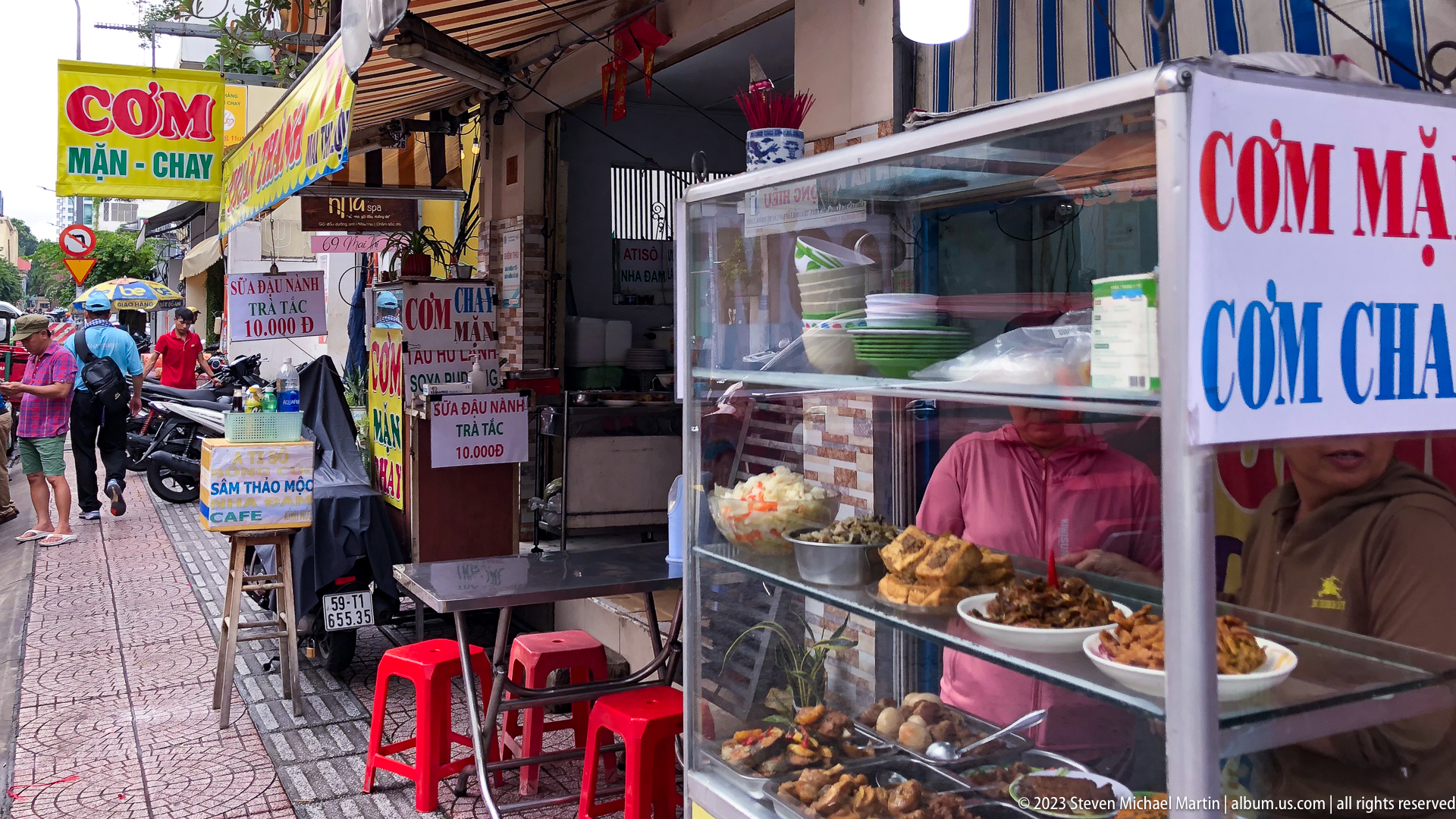
A compact sidewalk food stall advertises “Cơm Mặn” and “Cơm Chay,” offering meat-based and vegetarian rice meals. Prepared dishes are arranged behind glass, with bowls, stools, handwritten signs, and neighboring vendors packed into the narrow frontage. The scene demonstrates how inexpensive meals, specialized menus, and pedestrian commerce are compressed into the limited space of a Ho Chi Minh City sidewalk.
Caption
A compact sidewalk food stall advertises “Cơm Mặn” and “Cơm Chay,” offering meat-based and vegetarian rice meals. Prepared dishes are arranged behind glass, with bowls, stools, handwritten signs, and neighboring vendors packed into the narrow frontage. The scene demonstrates how inexpensive meals, specialized menus, and pedestrian commerce are compressed into the limited space of a Ho Chi Minh City sidewalk.

An olive-drab vintage jeep drives past shops and parked motorbikes, its upright grille, round headlights, flat hood, and white star recalling mid-twentieth-century military vehicle design. The vehicle’s polished presentation and modern license plate suggest commemorative, tour, or private use rather than active service. Seen in ordinary traffic, it introduces a conspicuous historical reference into the contemporary streetscape.
Caption
An olive-drab vintage jeep drives past shops and parked motorbikes, its upright grille, round headlights, flat hood, and white star recalling mid-twentieth-century military vehicle design. The vehicle’s polished presentation and modern license plate suggest commemorative, tour, or private use rather than active service. Seen in ordinary traffic, it introduces a conspicuous historical reference into the contemporary streetscape.

A cream perimeter wall curves around a leafy urban compound, punctuated by a small green-roofed guard pavilion and roadside security markings. A motorcyclist passes through the intersection while office towers rise beyond the trees. The understated boundary architecture separates a low, protected institutional site from the dense commercial city around it, but no visible sign securely identifies the compound.
Caption
A cream perimeter wall curves around a leafy urban compound, punctuated by a small green-roofed guard pavilion and roadside security markings. A motorcyclist passes through the intersection while office towers rise beyond the trees. The understated boundary architecture separates a low, protected institutional site from the dense commercial city around it, but no visible sign securely identifies the compound.

The yellow French colonial façade of the Saigon Central Post Office is centered on its monumental clock above the principal entrance. Arcaded windows, decorative stucco, and crowds gathered outside emphasize the building's continuing role as both an architectural landmark and active civic space in Ho Chi Minh City.
Caption
The yellow French colonial façade of the Saigon Central Post Office is centered on its monumental clock above the principal entrance. Arcaded windows, decorative stucco, and crowds gathered outside emphasize the building's continuing role as both an architectural landmark and active civic space in Ho Chi Minh City.
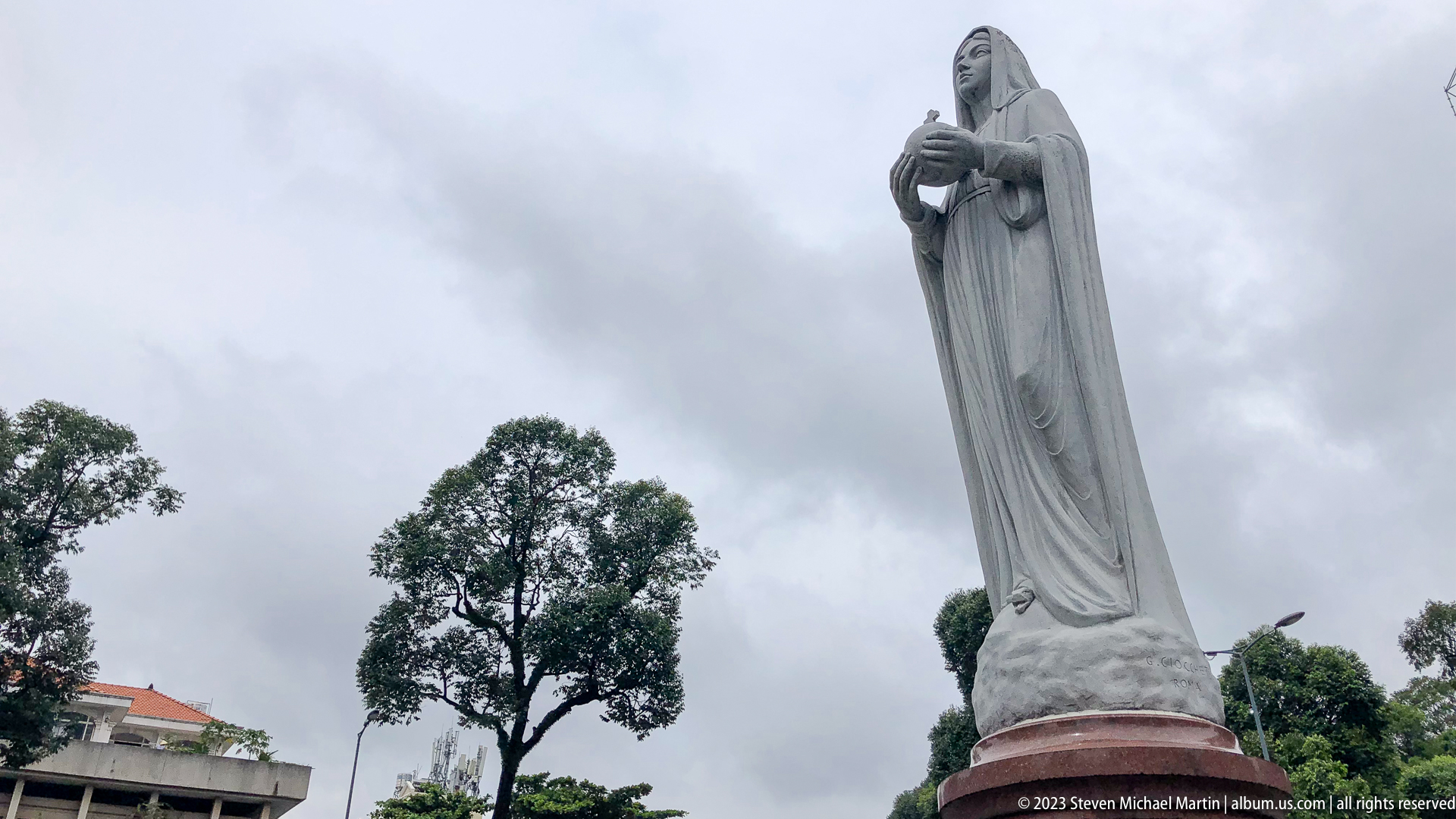
A tall white statue of the Virgin Mary stands on a pedestal with hands gathered in prayerful contemplation. Trees and cloudy skies isolate the monument, emphasizing its devotional character within an urban religious setting.
Caption
A tall white statue of the Virgin Mary stands on a pedestal with hands gathered in prayerful contemplation. Trees and cloudy skies isolate the monument, emphasizing its devotional character within an urban religious setting.

Bright orange, yellow, and red hibiscus blossoms fill a landscaped flower bed. The close botanical view contrasts with the portfolio's architecture by focusing on ornamental planting within the city.
Caption
Bright orange, yellow, and red hibiscus blossoms fill a landscaped flower bed. The close botanical view contrasts with the portfolio's architecture by focusing on ornamental planting within the city.
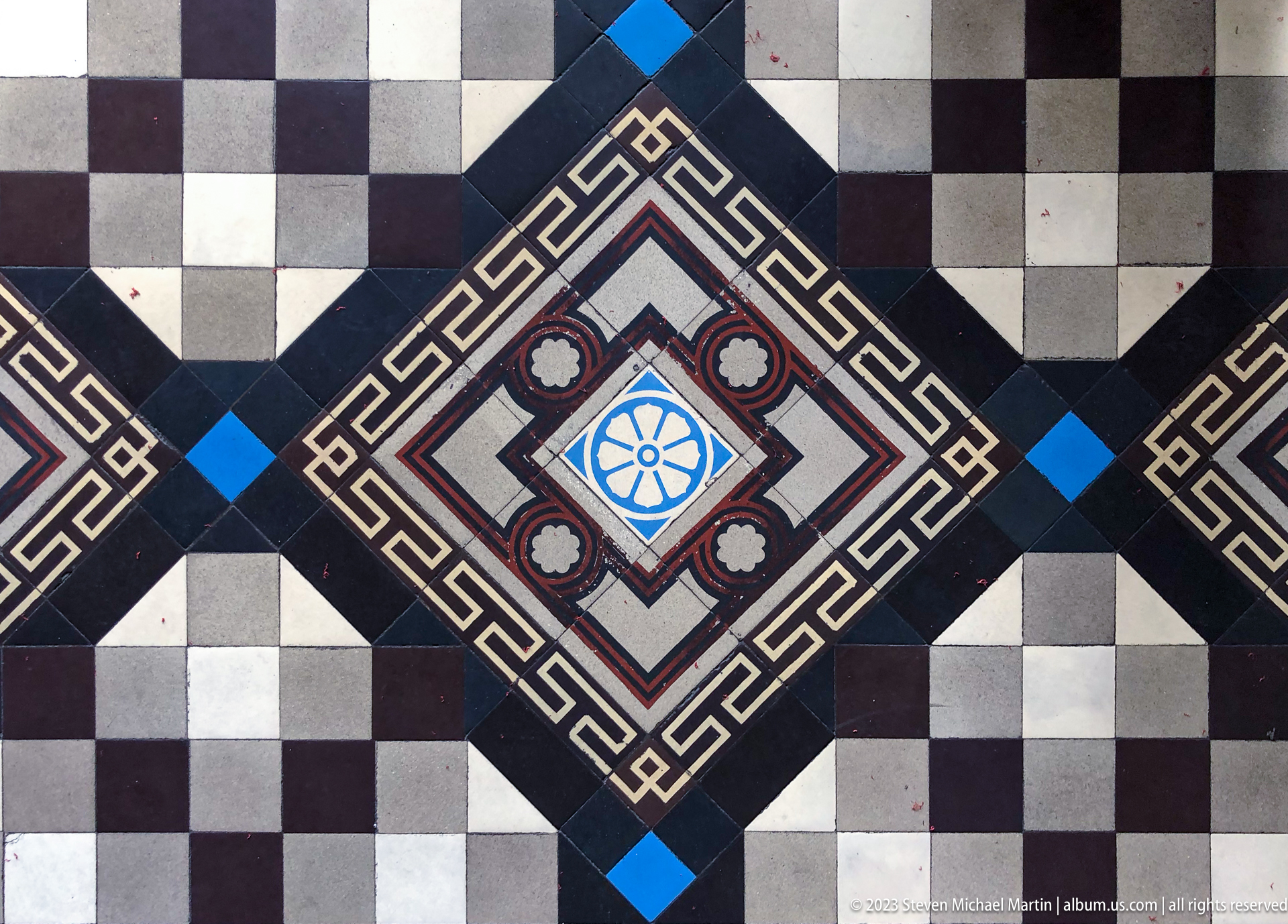
A geometric tiled floor combines black-and-white checkerboard fields with colorful ornamental diamonds. The carefully preserved paving illustrates the decorative craftsmanship associated with historic civic interiors.
Caption
A geometric tiled floor combines black-and-white checkerboard fields with colorful ornamental diamonds. The carefully preserved paving illustrates the decorative craftsmanship associated with historic civic interiors.

The soaring barrel-vaulted hall of the Saigon Central Post Office is defined by green iron columns, arched arcades, and a long skylight. The symmetrical perspective highlights the building's celebrated nineteenth-century interior.
Caption
The soaring barrel-vaulted hall of the Saigon Central Post Office is defined by green iron columns, arched arcades, and a long skylight. The symmetrical perspective highlights the building's celebrated nineteenth-century interior.

An angled perspective across the Central Post Office emphasizes the sweeping iron roof structure and rhythmic arches while preserving the sense of scale created by the long central nave.
Caption
An angled perspective across the Central Post Office emphasizes the sweeping iron roof structure and rhythmic arches while preserving the sense of scale created by the long central nave.

Visitors occupy benches and service counters beneath the monumental interior of the Saigon Central Post Office, demonstrating the building's continuing public function.
Caption
Visitors occupy benches and service counters beneath the monumental interior of the Saigon Central Post Office, demonstrating the building's continuing public function.
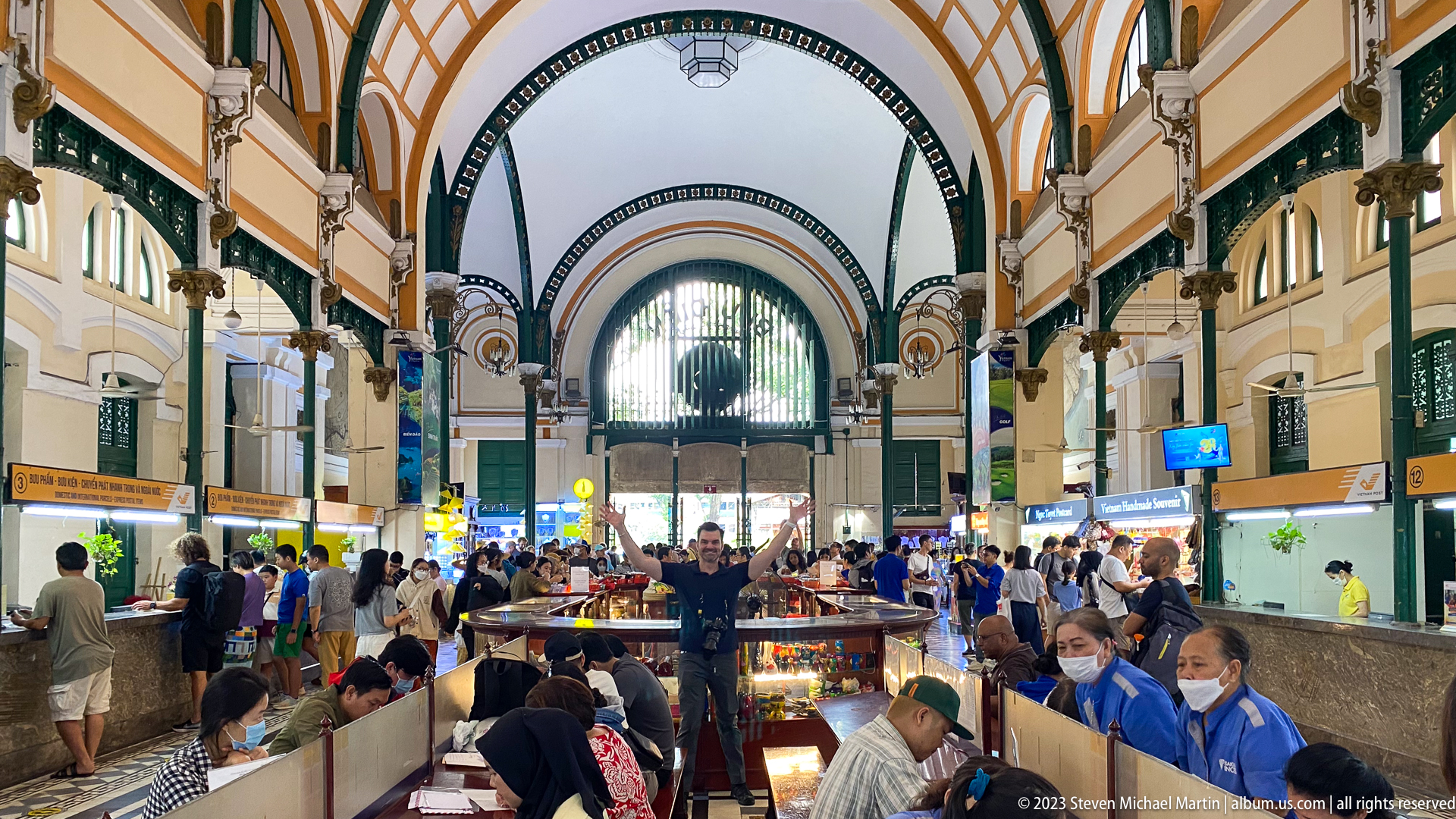
A wider interior view captures the busy public hall with travelers and local visitors framed by the building's monumental architecture.
Caption
A wider interior view captures the busy public hall with travelers and local visitors framed by the building's monumental architecture.

A bronze sculpture of a powerful bull interacting with a human figure stands before a white-columned institutional building. The work contrasts dynamic animal movement with the formal architecture behind it.
Caption
A bronze sculpture of a powerful bull interacting with a human figure stands before a white-columned institutional building. The work contrasts dynamic animal movement with the formal architecture behind it.

A multi-tiered East Asian-style pagoda rises among palms and modern apartment towers, illustrating the coexistence of traditional religious architecture and contemporary urban development.
Caption
A multi-tiered East Asian-style pagoda rises among palms and modern apartment towers, illustrating the coexistence of traditional religious architecture and contemporary urban development.