Neuschwanstein Castle – Bavaria, Germany
Neuschwanstein Castle stands high above the village of Hohenschwangau in the foothills of the Bavarian Alps near the border with Austria. Built in the 19th century by King Ludwig II of Bavaria, the castle was designed as a romantic interpretation of a medieval knight’s castle.
Perched on a rugged hill surrounded by forested mountains and alpine valleys, the castle’s towers and white limestone walls create one of the most recognizable architectural landmarks in Europe. During the winter months, snow-covered forests and mountain landscapes give the castle an especially dramatic and storybook-like appearance.
The castle’s setting in the Bavarian Alps forms a fitting conclusion to the Christmas Markets journey through southern Germany.
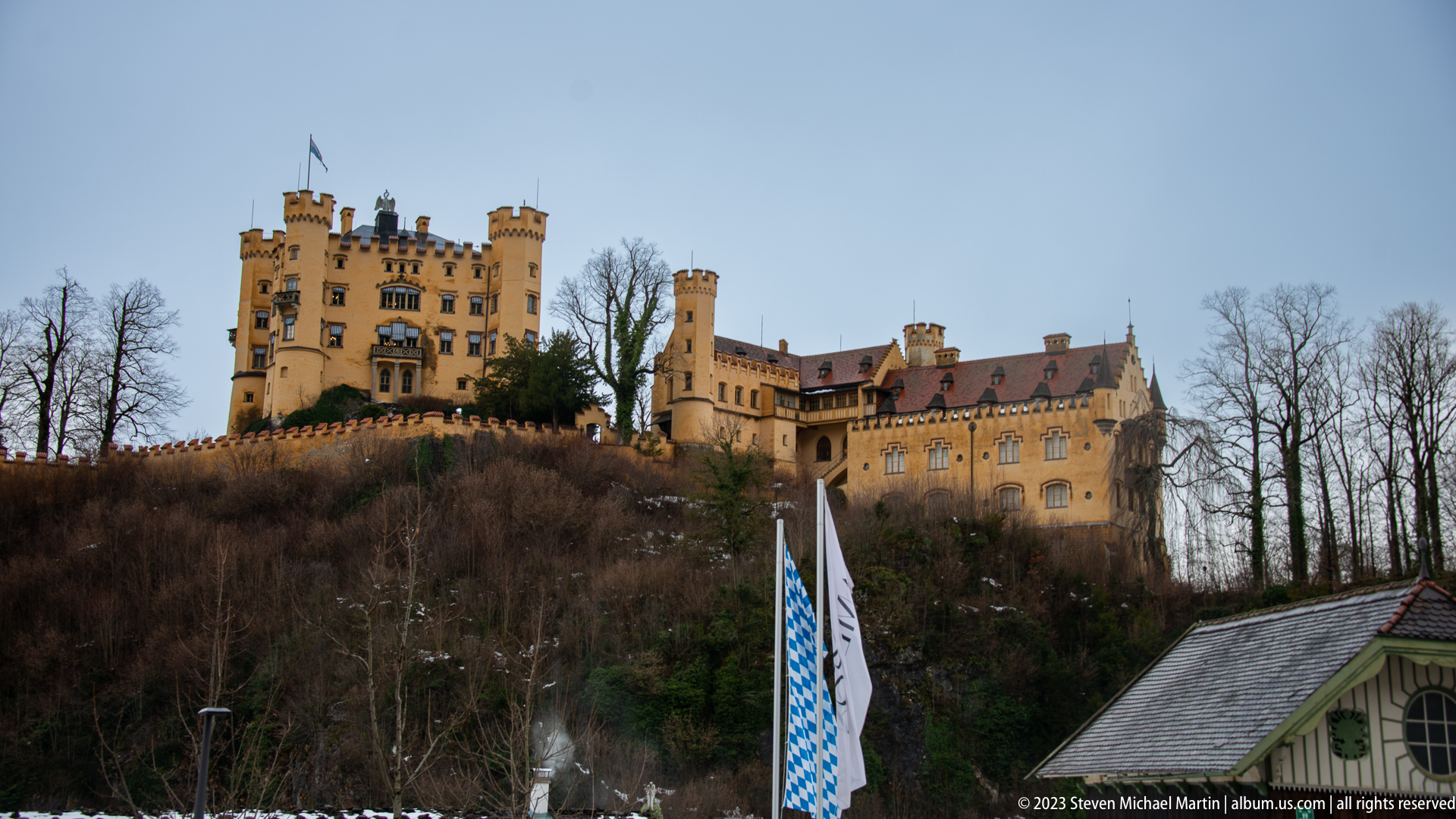
Hohenschwangau Castle rises above a wooded slope in a broad contextual view, its ochre façades, crenellated towers, and long residential wings silhouetted against the winter sky. Flags and roadside elements in the foreground establish the visitor approach, while the elevated position makes clear how the 19th-century royal residence commands the surrounding landscape.
Caption
Hohenschwangau Castle rises above a wooded slope in a broad contextual view, its ochre façades, crenellated towers, and long residential wings silhouetted against the winter sky. Flags and roadside elements in the foreground establish the visitor approach, while the elevated position makes clear how the 19th-century royal residence commands the surrounding landscape.
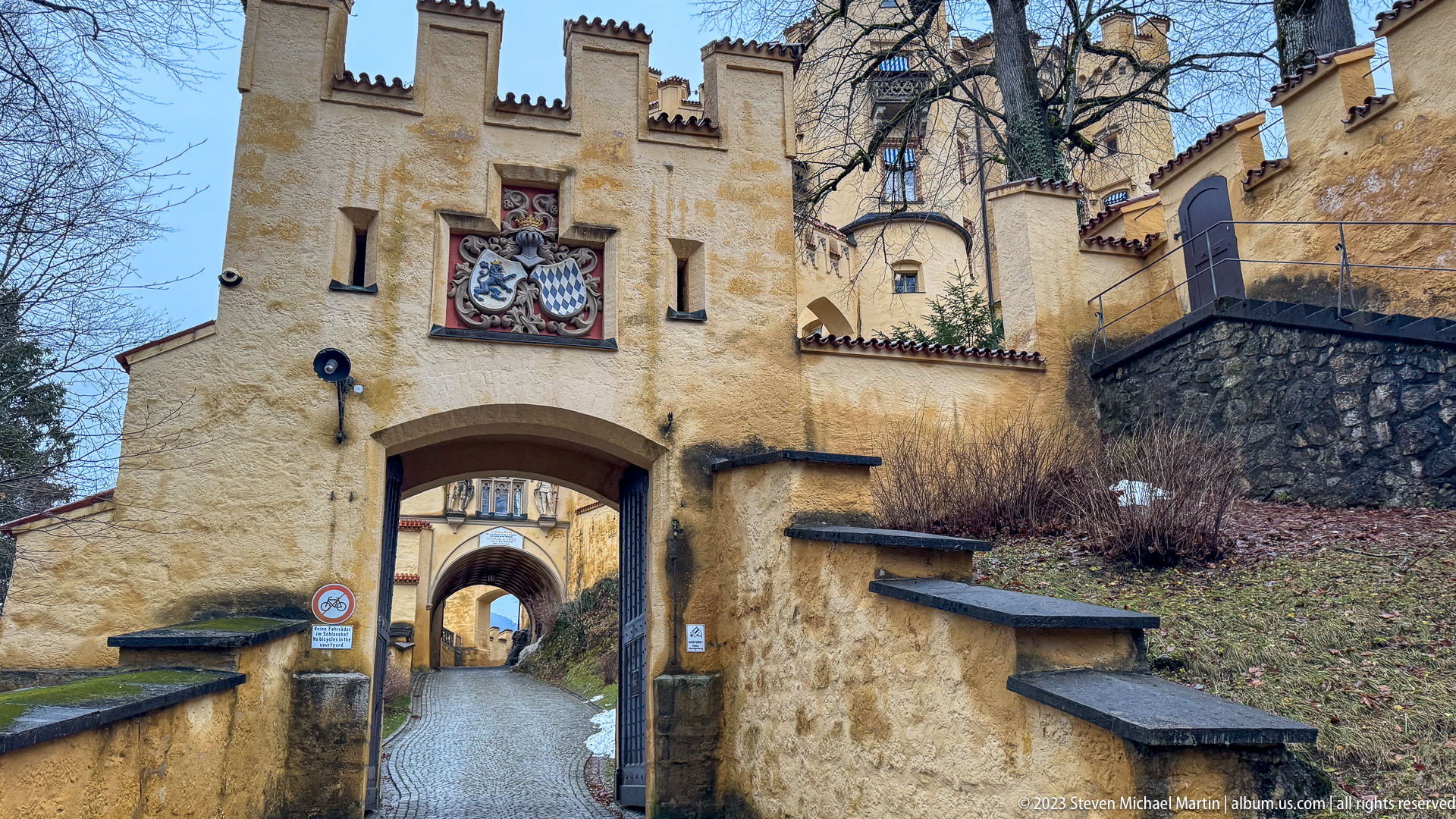
An ochre crenellated gateway at Hohenschwangau Castle carries a large painted heraldic panel above its round-arched opening. A cobbled path continues through a sequence of arches beyond, creating a strong sense of layered access control. The steep walls and narrow approach recall defensive architecture even though the complex functioned primarily as a royal residence.
Caption
An ochre crenellated gateway at Hohenschwangau Castle carries a large painted heraldic panel above its round-arched opening. A cobbled path continues through a sequence of arches beyond, creating a strong sense of layered access control. The steep walls and narrow approach recall defensive architecture even though the complex functioned primarily as a royal residence.
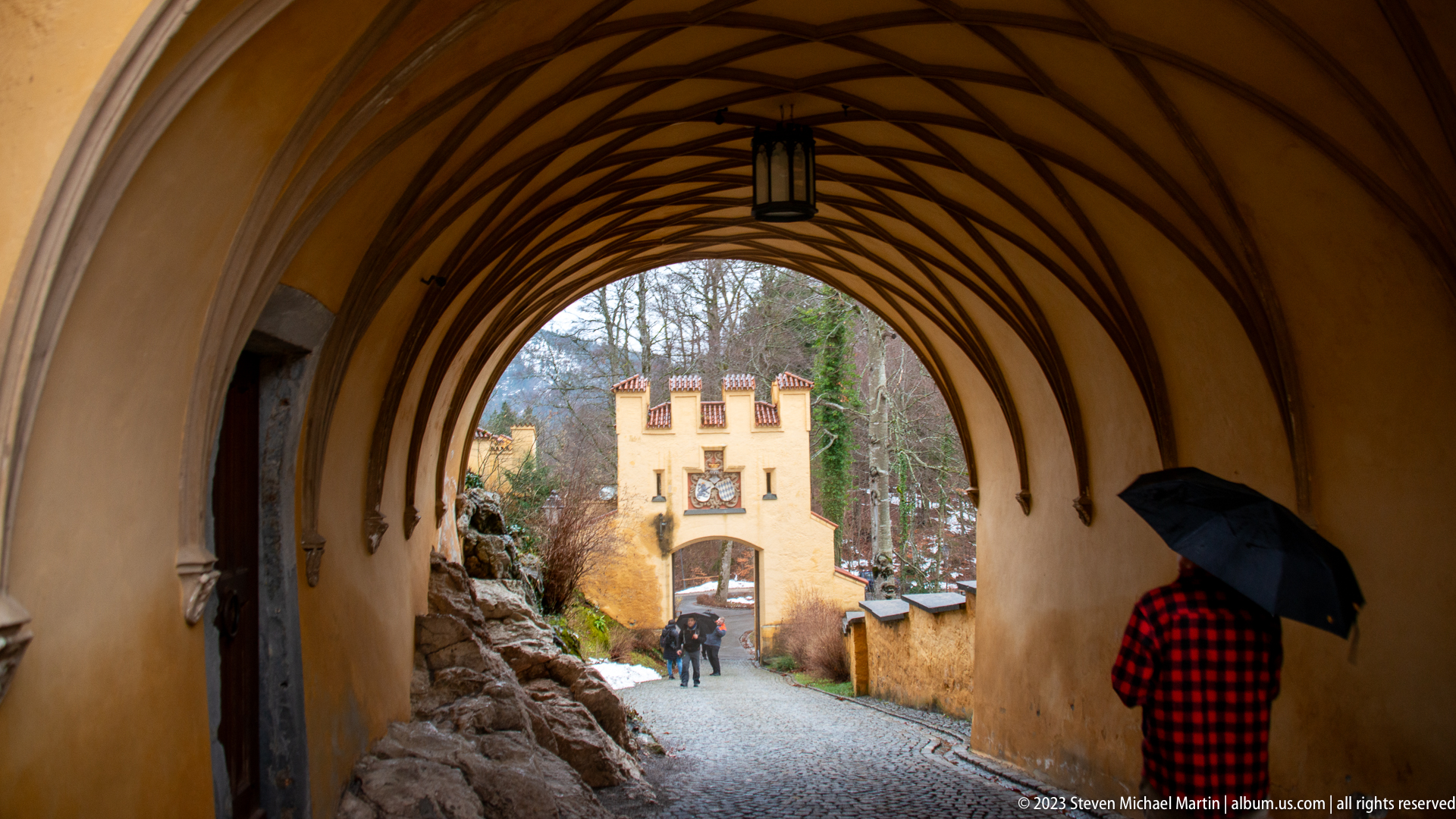
A ribbed vaulted passage opens toward an ochre crenellated gate deeper within Hohenschwangau Castle. The curving ribs and hanging lantern create a sheltered tunnel-like approach, while a visitor holding an umbrella at right reinforces the wet winter conditions outside. The composition emphasizes the layered circulation system through the complex rather than a distant exterior view.
Caption
A ribbed vaulted passage opens toward an ochre crenellated gate deeper within Hohenschwangau Castle. The curving ribs and hanging lantern create a sheltered tunnel-like approach, while a visitor holding an umbrella at right reinforces the wet winter conditions outside. The composition emphasizes the layered circulation system through the complex rather than a distant exterior view.

A cobbled road passes beneath a broad ochre arch at Hohenschwangau Castle, with a second gateway visible beyond and a heraldic panel centered over the outer opening. The crenellated parapet and thick masonry give the entrance a fortified appearance, while the sequential arches show how the approach is visually compressed before entering the inner complex.
Caption
A cobbled road passes beneath a broad ochre arch at Hohenschwangau Castle, with a second gateway visible beyond and a heraldic panel centered over the outer opening. The crenellated parapet and thick masonry give the entrance a fortified appearance, while the sequential arches show how the approach is visually compressed before entering the inner complex.

A narrow side approach climbs beside Hohenschwangau Castle toward a small pointed-arched doorway set in a pale stone surround. Ochre walls, exterior stairs, iron railings, and mature conifers create an enclosed, less ceremonial view of the complex. The photograph shifts attention from heraldic gateways to the practical circulation and secondary architectural details of the residence.
Caption
A narrow side approach climbs beside Hohenschwangau Castle toward a small pointed-arched doorway set in a pale stone surround. Ochre walls, exterior stairs, iron railings, and mature conifers create an enclosed, less ceremonial view of the complex. The photograph shifts attention from heraldic gateways to the practical circulation and secondary architectural details of the residence.

A cobbled lane climbs beneath a broad arch in the ochre walls of Hohenschwangau Castle. Crenellated parapets, small towers, shuttered windows, and rough stone retaining walls create a layered approach through the complex. The low viewpoint emphasizes the transition from the outer passage toward the inner castle spaces rather than presenting the residence as a distant silhouette.
Caption
A cobbled lane climbs beneath a broad arch in the ochre walls of Hohenschwangau Castle. Crenellated parapets, small towers, shuttered windows, and rough stone retaining walls create a layered approach through the complex. The low viewpoint emphasizes the transition from the outer passage toward the inner castle spaces rather than presenting the residence as a distant silhouette.
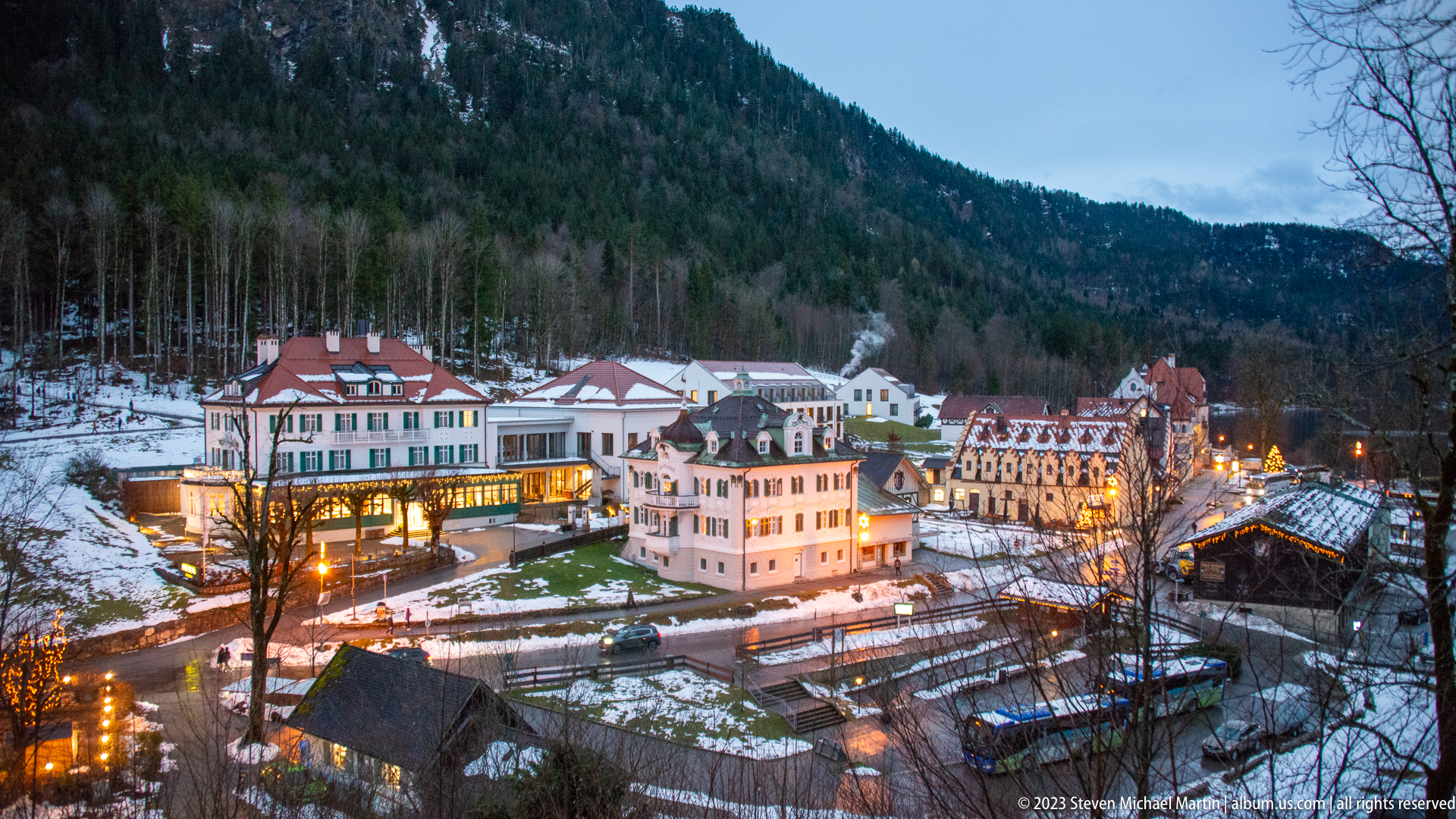
Lights begin to glow across the Hohenschwangau visitor district as evening settles over the snowy valley. Hotels and service buildings cluster below a dark forested mountain, while roads and walkways thread between patches of snow. The elevated view records the built landscape that supports the two castle sites and contrasts warm artificial light with the cold alpine setting.
Caption
Lights begin to glow across the Hohenschwangau visitor district as evening settles over the snowy valley. Hotels and service buildings cluster below a dark forested mountain, while roads and walkways thread between patches of snow. The elevated view records the built landscape that supports the two castle sites and contrasts warm artificial light with the cold alpine setting.
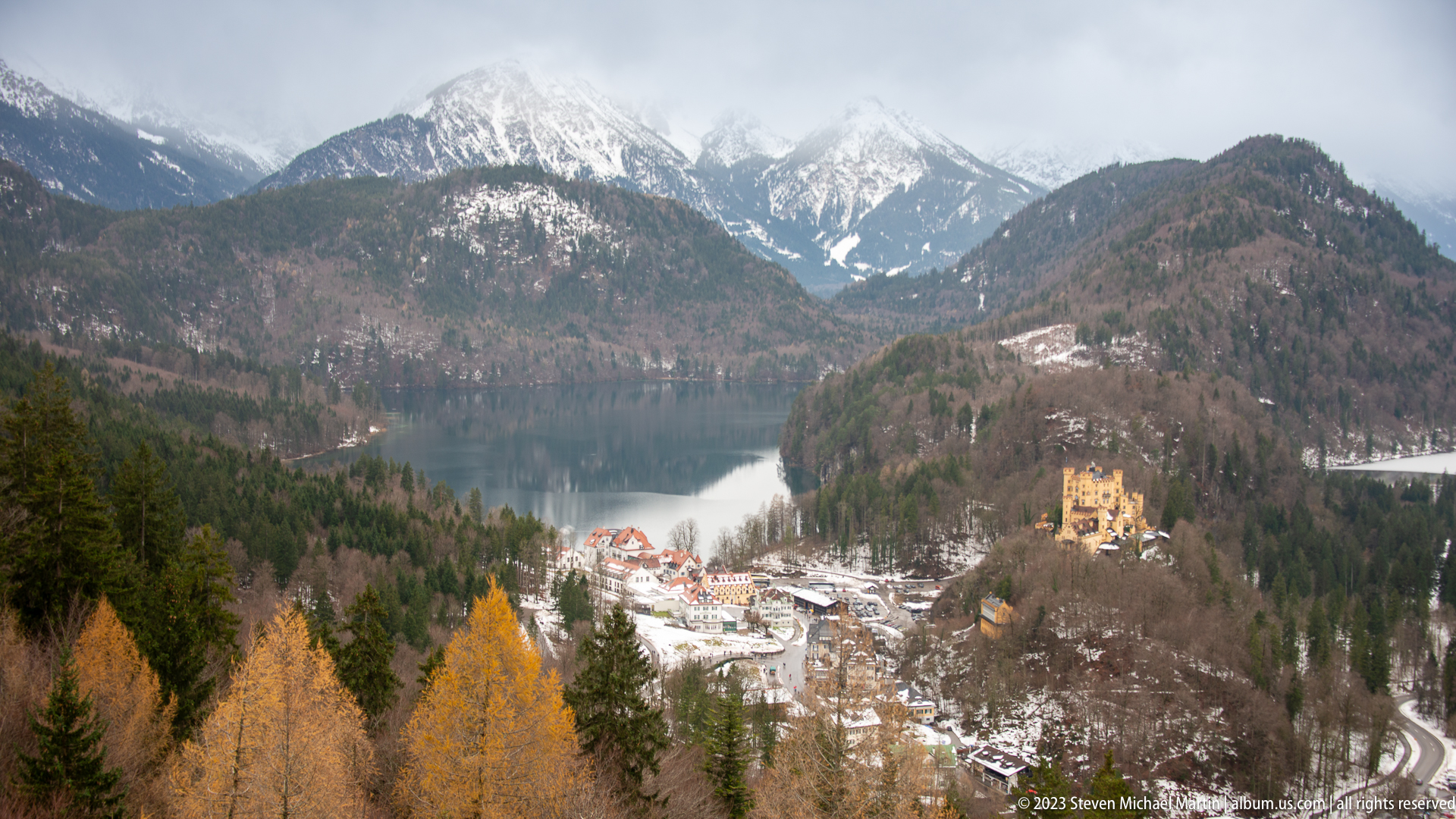
A high panoramic viewpoint looks across the Hohenschwangau settlement toward Alpsee and the snow-streaked Bavarian Alps. Hohenschwangau Castle stands in ochre on a wooded rise near the lower right, while dark conifers and bare winter trees lead the eye toward the lake basin and steep mountain walls beyond.
Caption
A high panoramic viewpoint looks across the Hohenschwangau settlement toward Alpsee and the snow-streaked Bavarian Alps. Hohenschwangau Castle stands in ochre on a wooded rise near the lower right, while dark conifers and bare winter trees lead the eye toward the lake basin and steep mountain walls beyond.
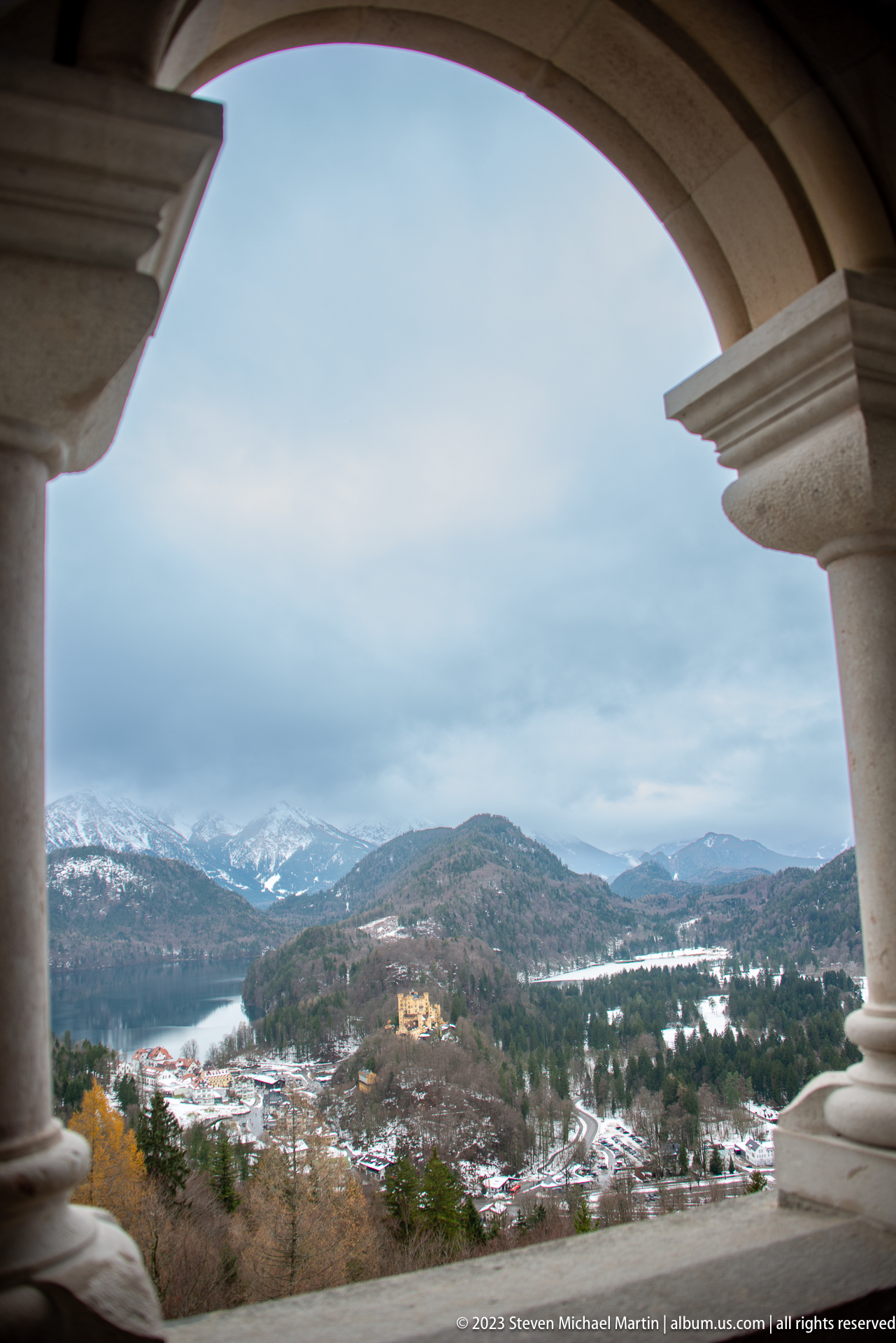
A broad stone arch and column frame a winter panorama over the Hohenschwangau valley, with low mountains, snow-patched fields, and Hohenschwangau Castle visible on its wooded hill. The architectural framing creates a strong transition from Neuschwanstein's masonry to the open landscape and emphasizes the close visual relationship between the two royal sites.
Caption
A broad stone arch and column frame a winter panorama over the Hohenschwangau valley, with low mountains, snow-patched fields, and Hohenschwangau Castle visible on its wooded hill. The architectural framing creates a strong transition from Neuschwanstein's masonry to the open landscape and emphasizes the close visual relationship between the two royal sites.
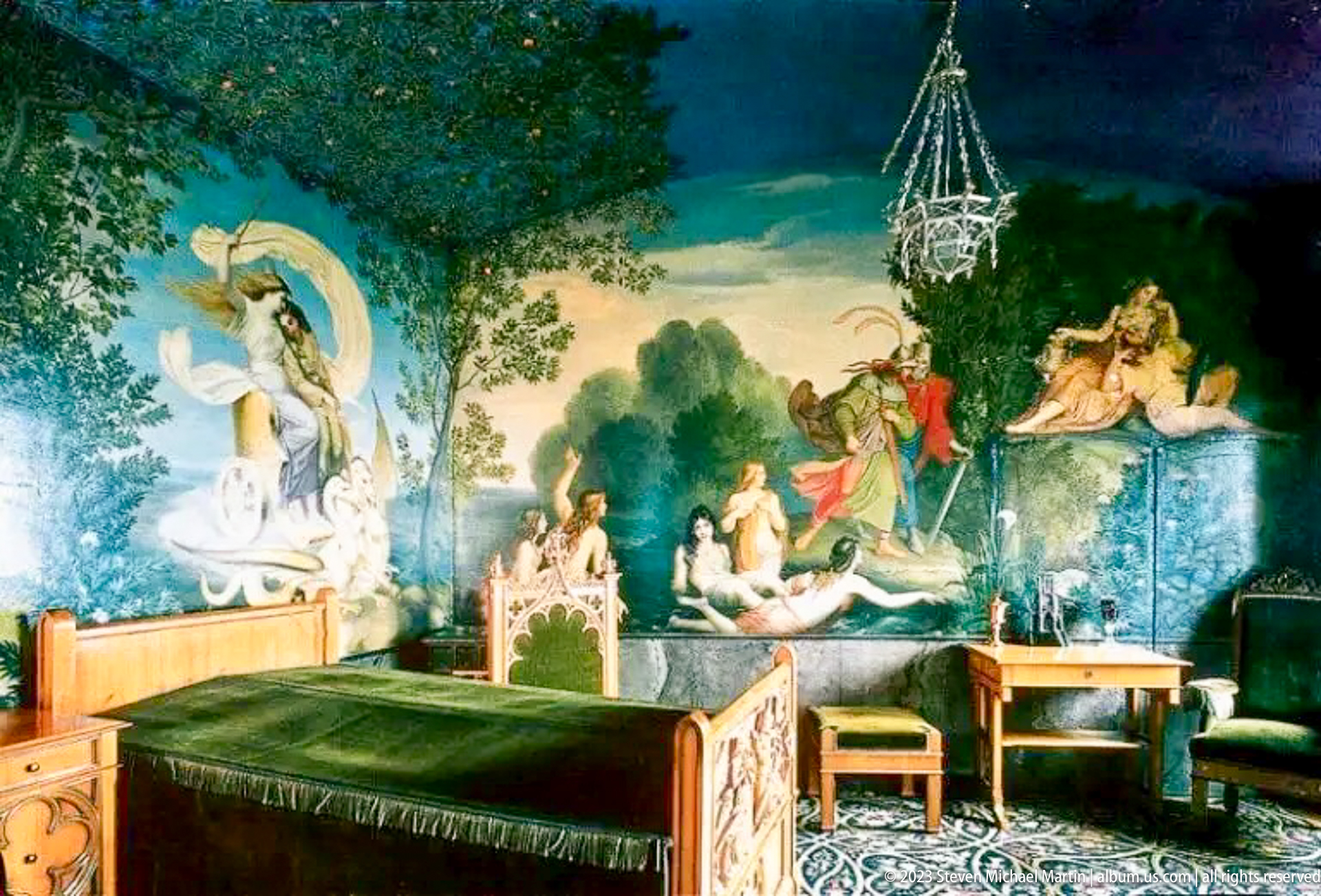
A dark green-covered bed stands before a panoramic mythological mural populated by reclining figures, riders, and airborne forms in an idealized landscape. A hanging light fixture, patterned floor, and small side furniture complete the Hohenschwangau Castle bedroom. The wider framing gives the mural greater dominance than the preceding close views of the same decorative ensemble.
Caption
A dark green-covered bed stands before a panoramic mythological mural populated by reclining figures, riders, and airborne forms in an idealized landscape. A hanging light fixture, patterned floor, and small side furniture complete the Hohenschwangau Castle bedroom. The wider framing gives the mural greater dominance than the preceding close views of the same decorative ensemble.
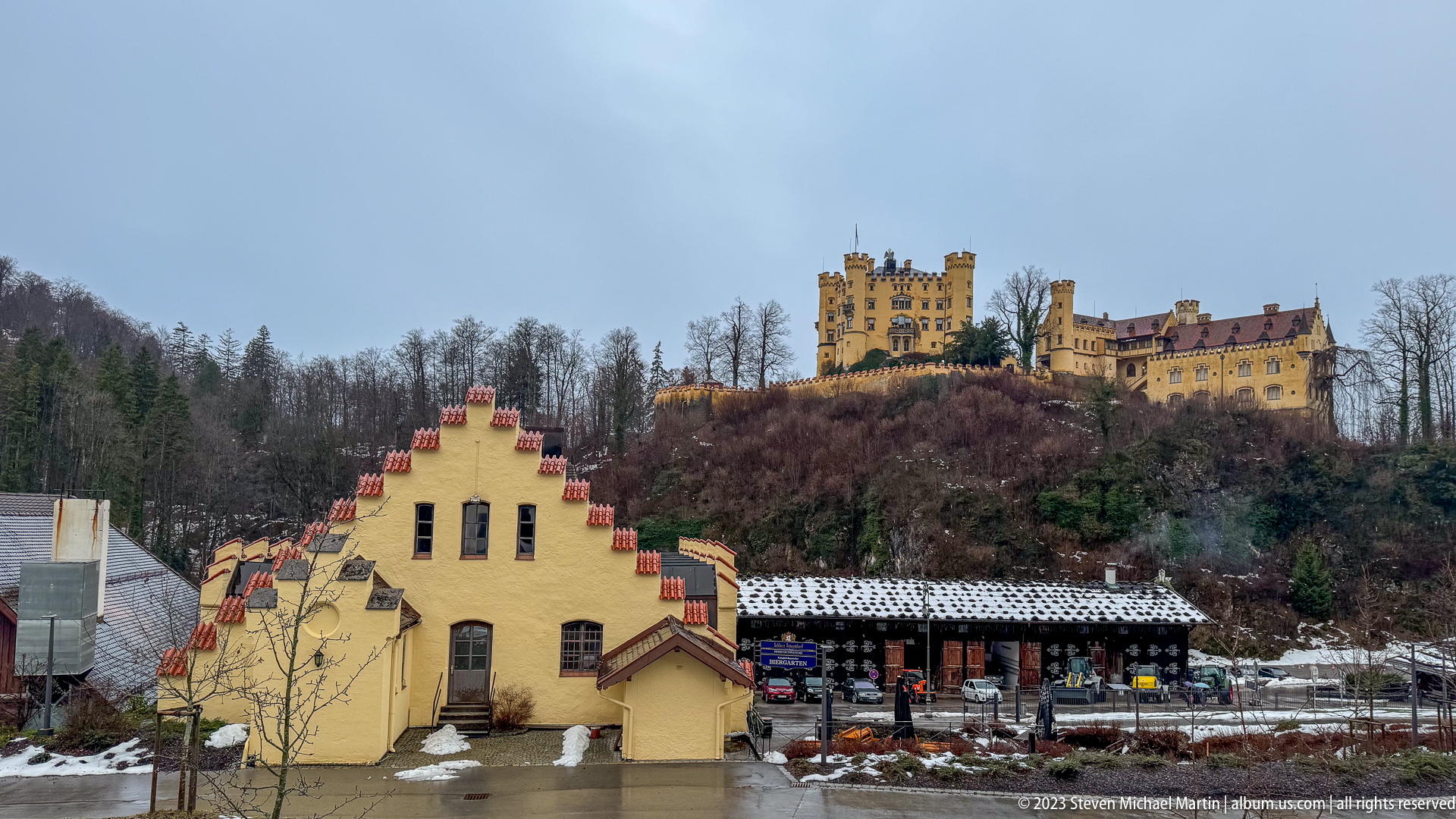
Hohenschwangau Castle rises on its wooded ridge above low village buildings and patches of snow. The ochre castle complex is clearly separated from the foreground by the slope, while its crenellated towers and long residential wings stand against a pale winter sky. The composition connects the royal residence with the service and visitor buildings below.
Caption
Hohenschwangau Castle rises on its wooded ridge above low village buildings and patches of snow. The ochre castle complex is clearly separated from the foreground by the slope, while its crenellated towers and long residential wings stand against a pale winter sky. The composition connects the royal residence with the service and visitor buildings below.
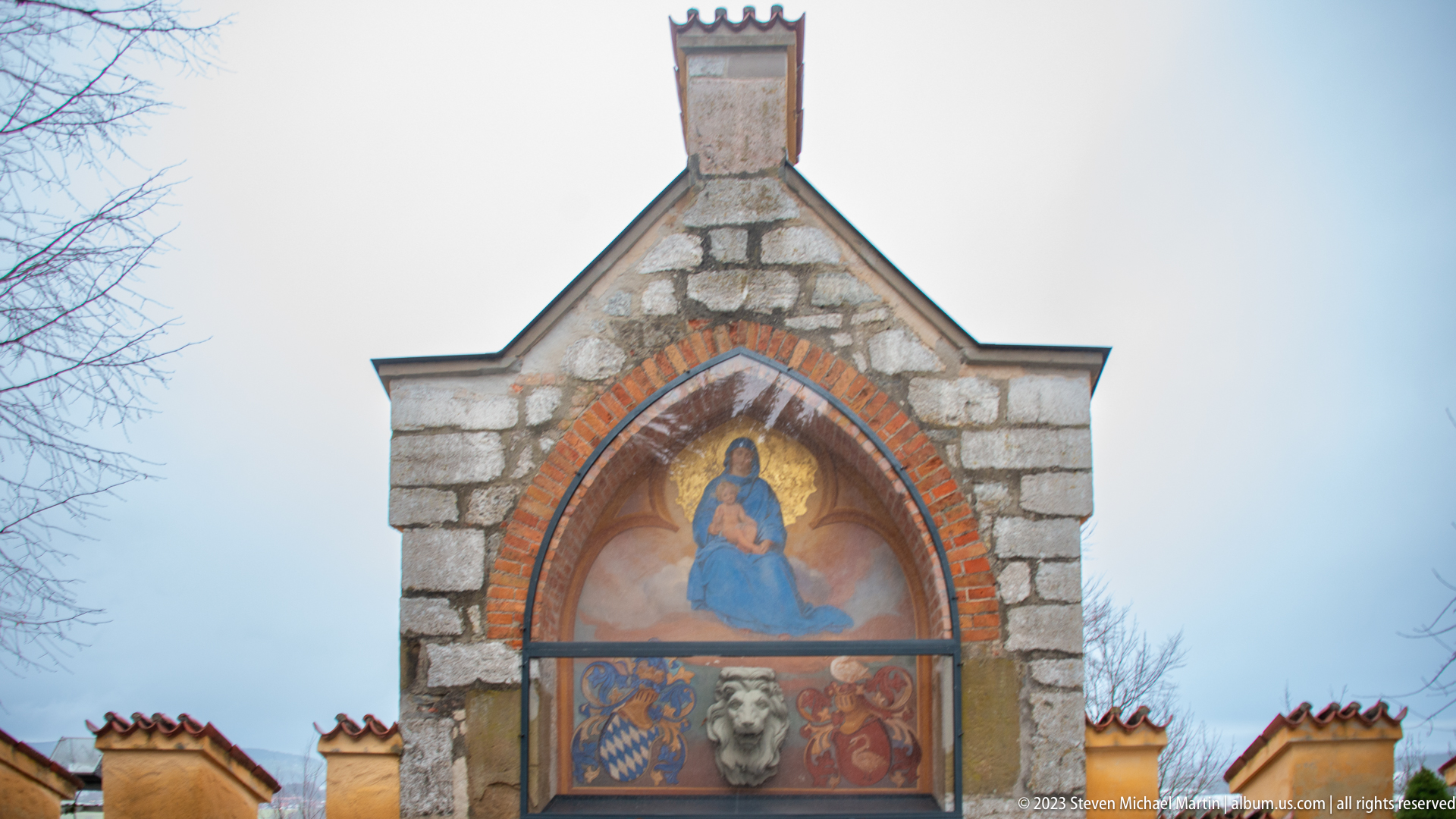
A pointed painted panel set within a small stone gable depicts the Virgin and Child above a row of heraldic imagery. The central sacred figure is framed by warm brick and pale stone, while colorful shields and a sculpted head occupy the lower register. The photograph isolates this religious and dynastic decorative ensemble from the surrounding castle architecture.
Caption
A pointed painted panel set within a small stone gable depicts the Virgin and Child above a row of heraldic imagery. The central sacred figure is framed by warm brick and pale stone, while colorful shields and a sculpted head occupy the lower register. The photograph isolates this religious and dynastic decorative ensemble from the surrounding castle architecture.
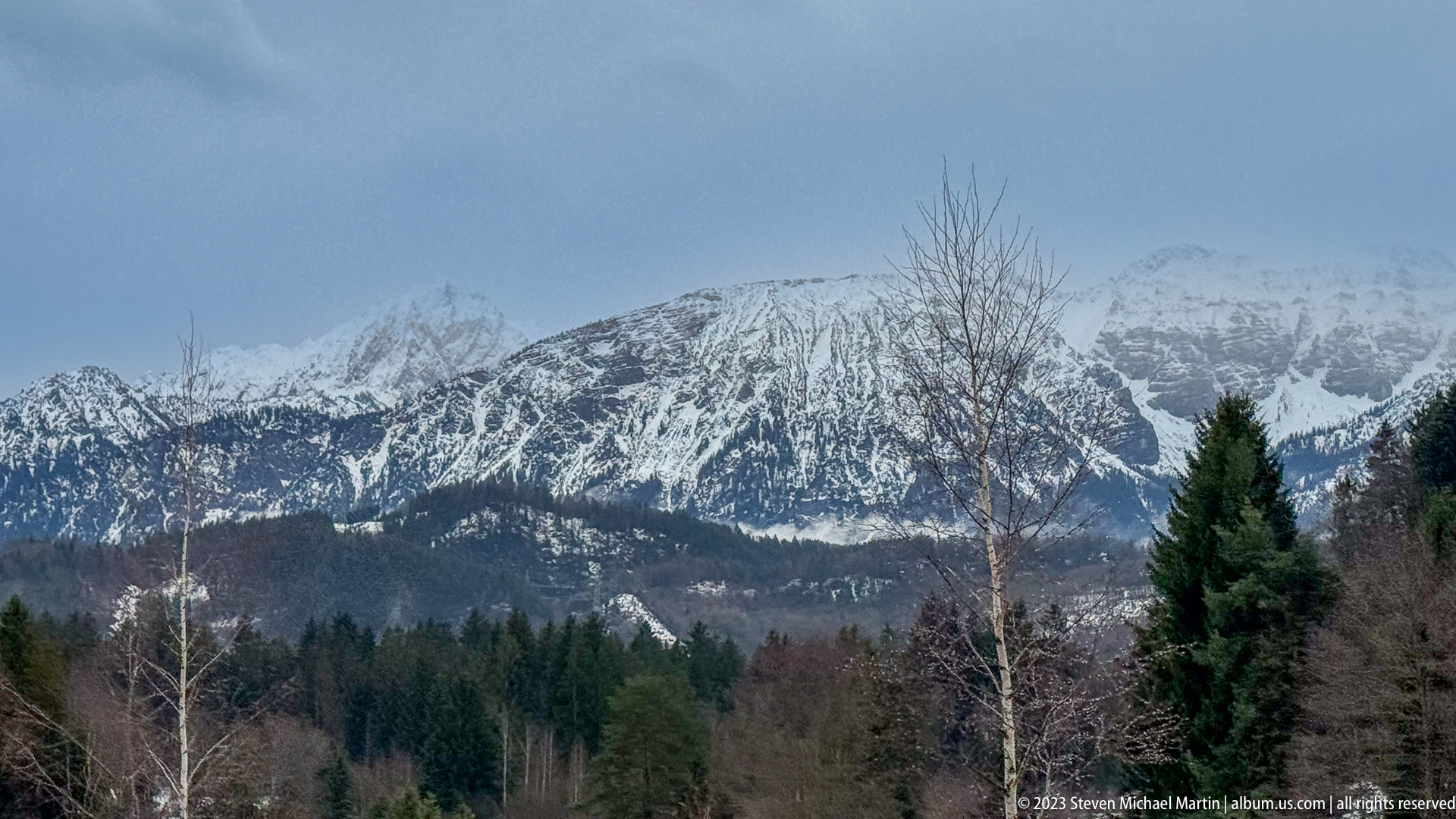
A broad winter view across dark conifer and leafless woodland toward the snow-covered Bavarian Alps near Füssen. Layered ridges and pale, cloud-softened summits establish the mountainous setting surrounding the royal castles, with the lower forested slopes forming a strong contrast to the white high country.
Caption
A broad winter view across dark conifer and leafless woodland toward the snow-covered Bavarian Alps near Füssen. Layered ridges and pale, cloud-softened summits establish the mountainous setting surrounding the royal castles, with the lower forested slopes forming a strong contrast to the white high country.
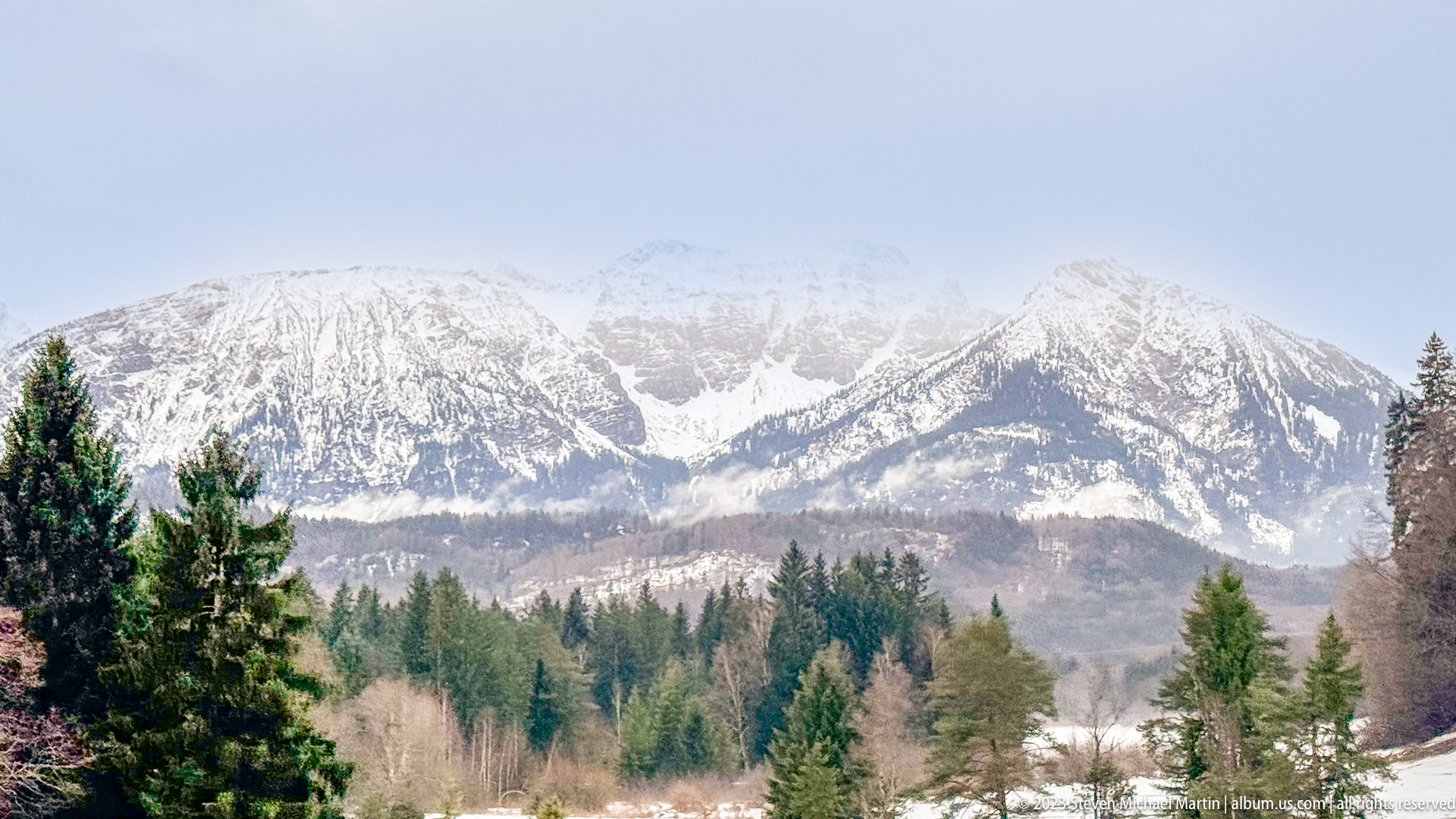
A luminous winter panorama frames a snow-covered mountain massif above mixed forest and scattered patches of snow. The broad, craggy slopes dominate the composition, while evergreen trees in the foreground provide scale and place the view within the Alpine foothills around Füssen.
Caption
A luminous winter panorama frames a snow-covered mountain massif above mixed forest and scattered patches of snow. The broad, craggy slopes dominate the composition, while evergreen trees in the foreground provide scale and place the view within the Alpine foothills around Füssen.
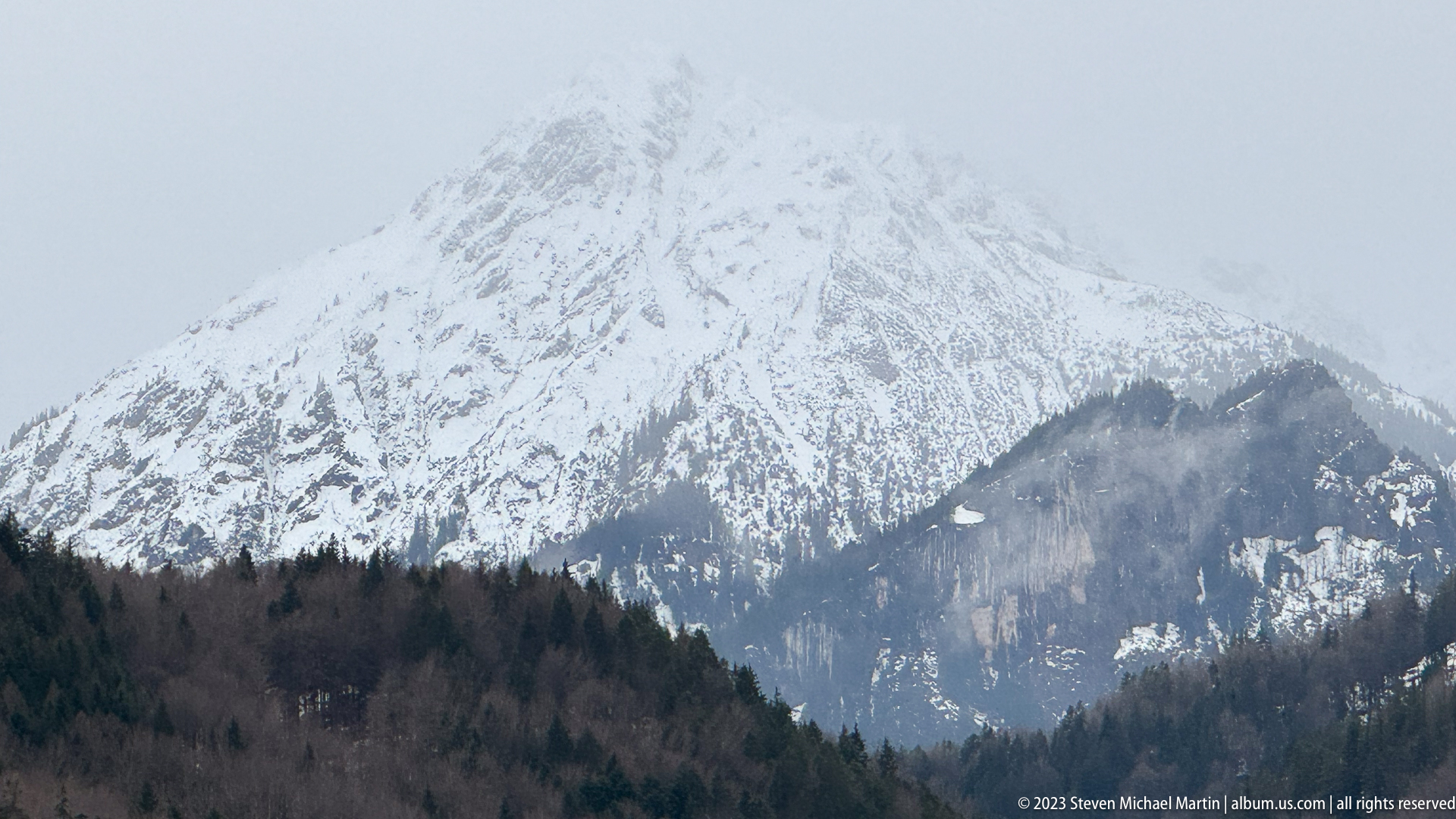
Low cloud wraps a steep, snow-covered Alpine peak above dark wooded foothills. The partially veiled summit and streaks of exposed rock emphasize the abrupt rise of the mountains immediately south of Füssen, where winter weather can obscure even prominent peaks.
Caption
Low cloud wraps a steep, snow-covered Alpine peak above dark wooded foothills. The partially veiled summit and streaks of exposed rock emphasize the abrupt rise of the mountains immediately south of Füssen, where winter weather can obscure even prominent peaks.
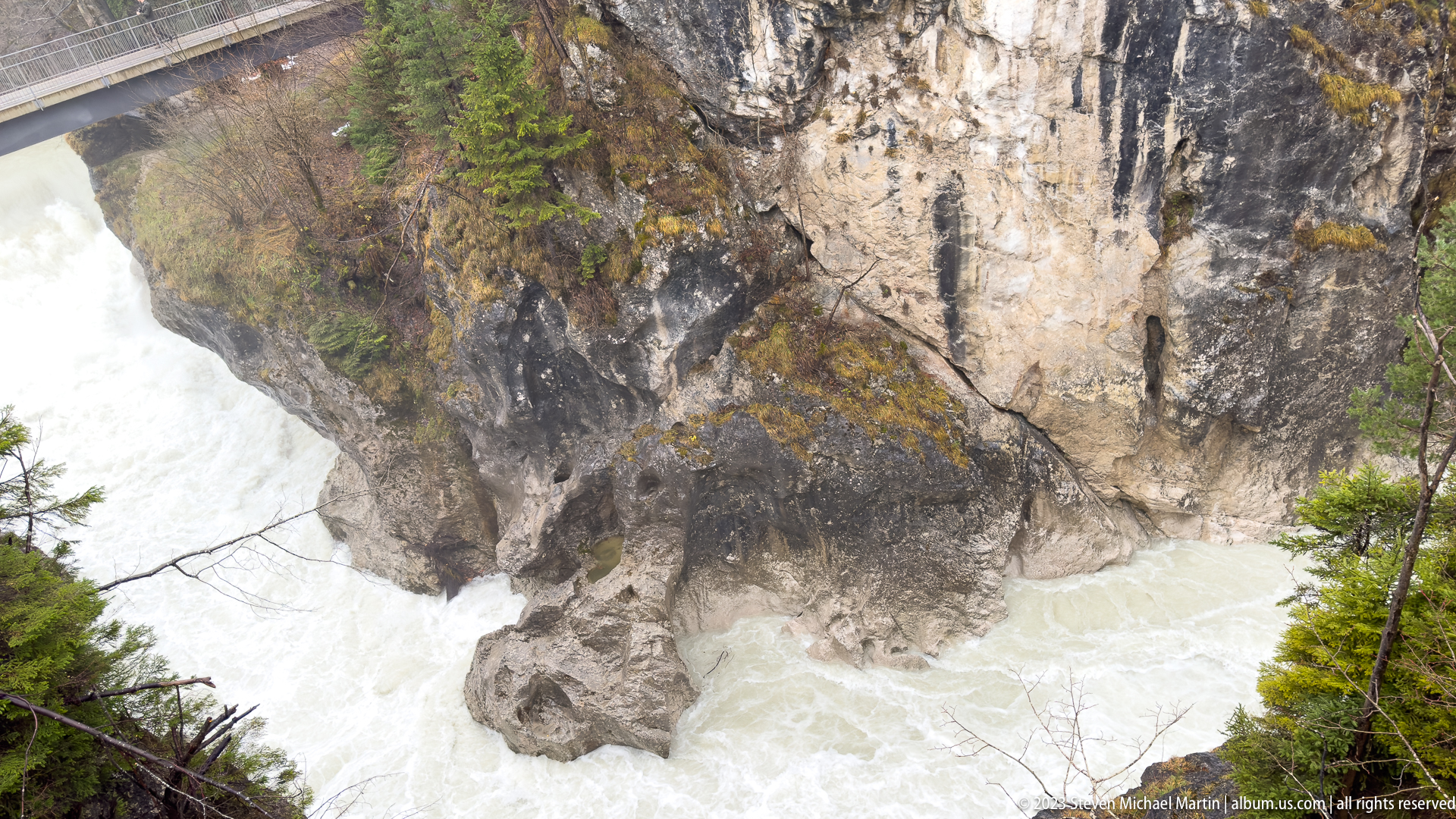
A sheer limestone wall drops into churning, pale-green water in a close view of the gorge near Füssen. Weathered rock surfaces, moss, and sparse vegetation fill most of the frame, shifting attention from the broader landscape to the force of the river at the cliff base.
Caption
A sheer limestone wall drops into churning, pale-green water in a close view of the gorge near Füssen. Weathered rock surfaces, moss, and sparse vegetation fill most of the frame, shifting attention from the broader landscape to the force of the river at the cliff base.
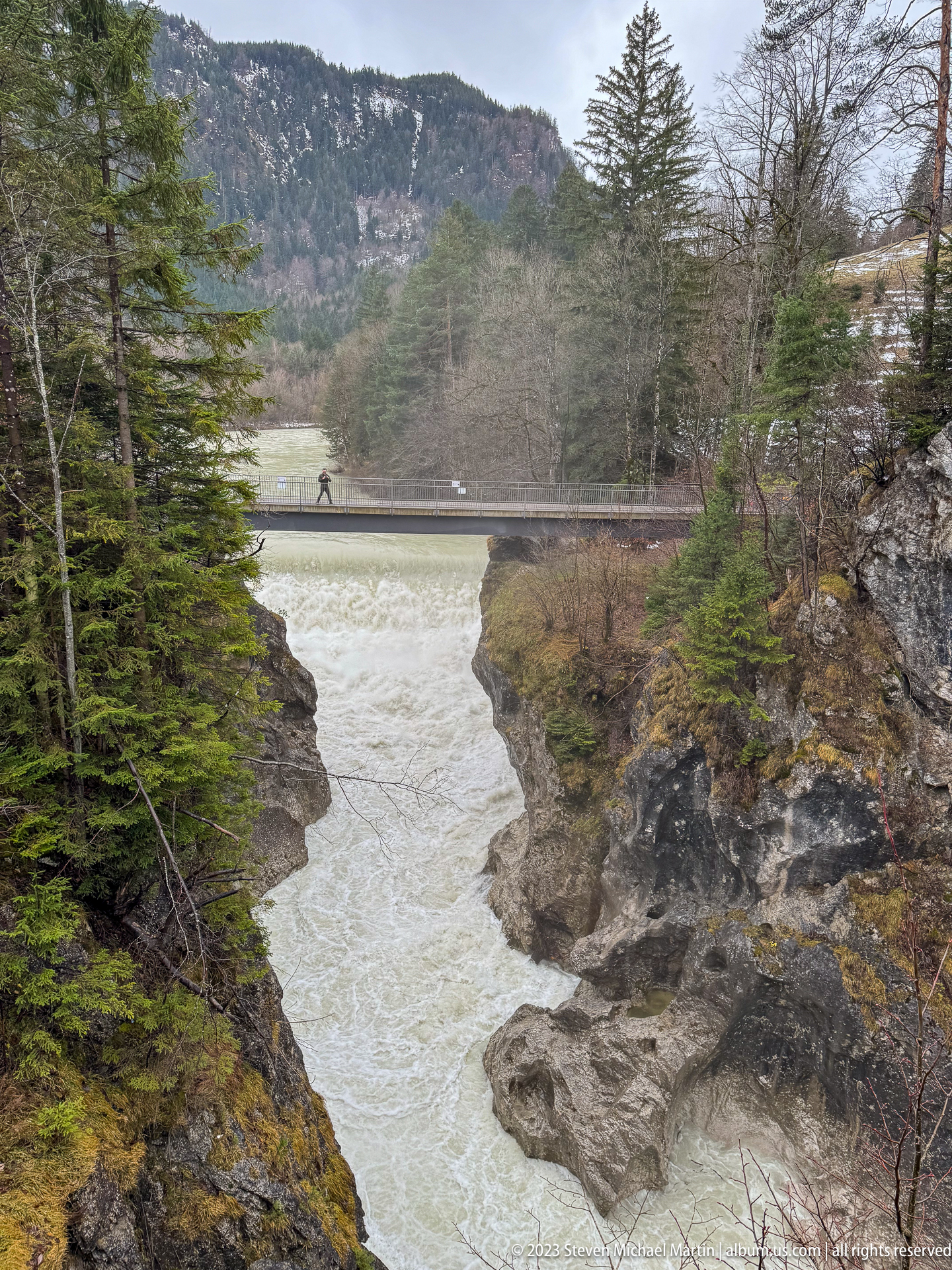
Fast, pale water courses through a narrow rock gorge beneath a low bridge near Füssen. Steep exposed rock, evergreen trees, and leafless woodland confine the river channel, creating a compact view of the Lech as it cuts through the landscape below the Alpine foothills.
Caption
Fast, pale water courses through a narrow rock gorge beneath a low bridge near Füssen. Steep exposed rock, evergreen trees, and leafless woodland confine the river channel, creating a compact view of the Lech as it cuts through the landscape below the Alpine foothills.
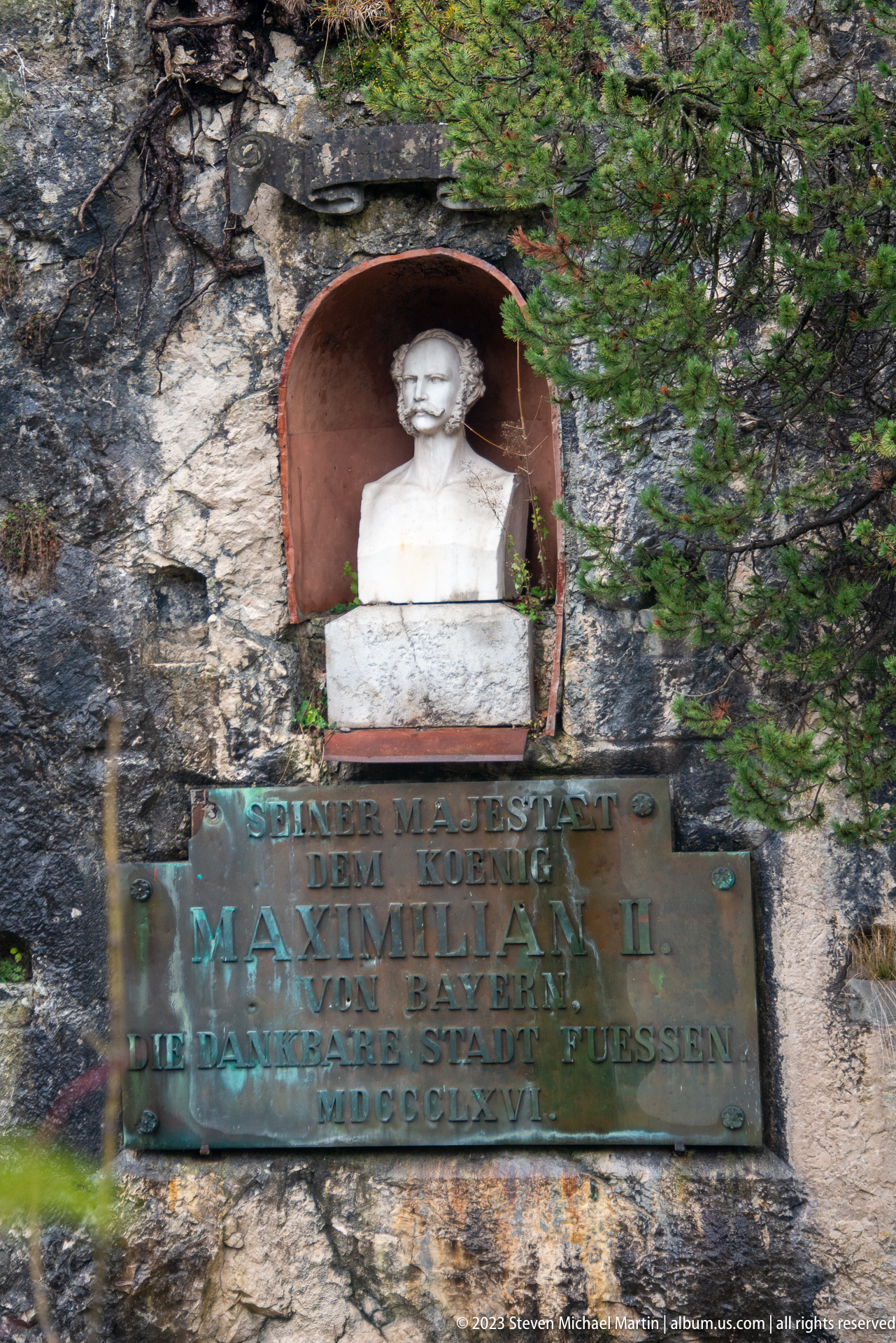
A white marble bust is set into a shallow rock niche above a bronze inscription plaque honoring Maximilian II, King of Bavaria. The memorial is embedded directly into the cliff, combining royal commemoration with the rugged landscape near Füssen.
Caption
A white marble bust is set into a shallow rock niche above a bronze inscription plaque honoring Maximilian II, King of Bavaria. The memorial is embedded directly into the cliff, combining royal commemoration with the rugged landscape near Füssen.
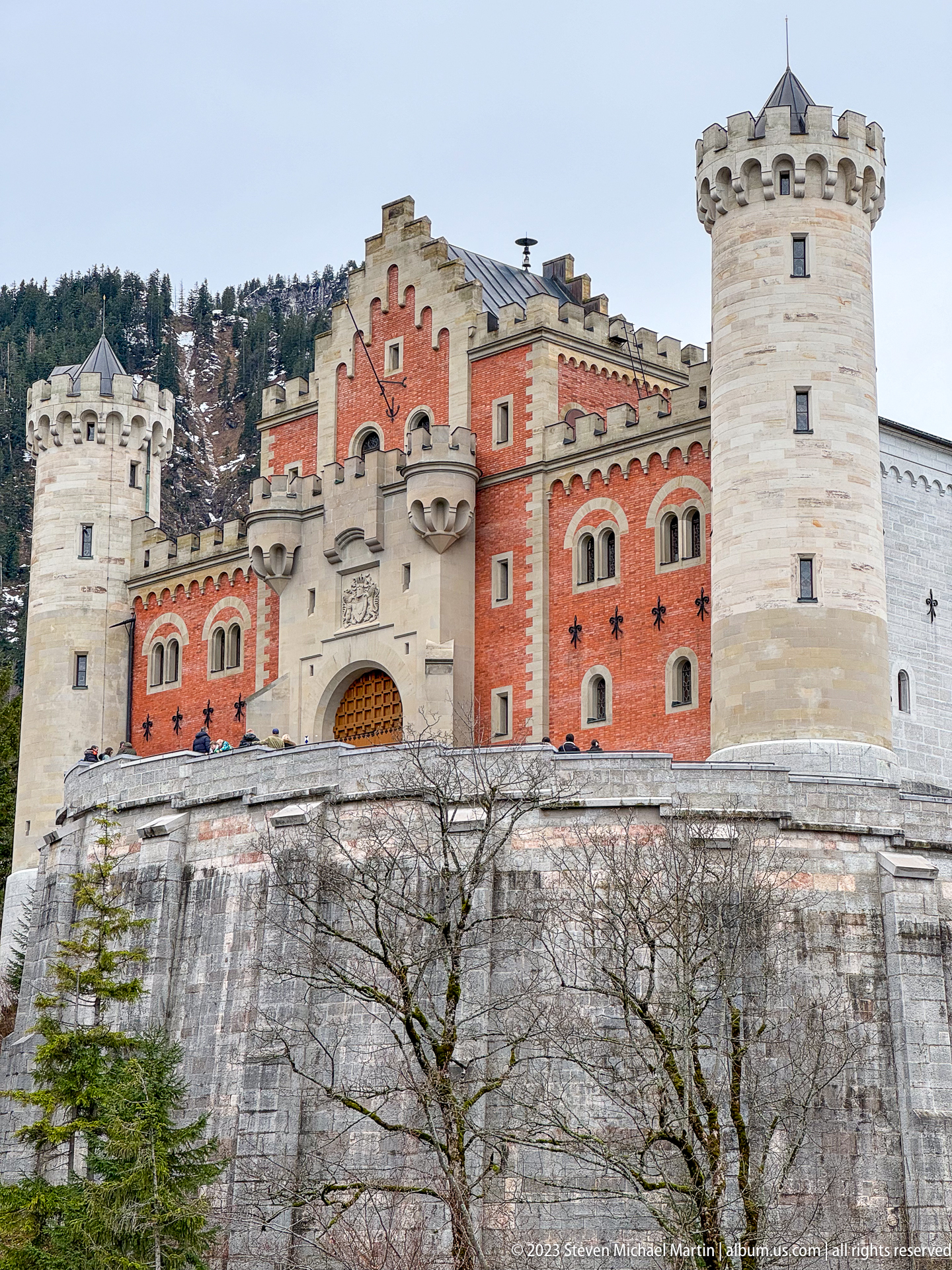
Neuschwanstein’s red gatehouse and pale stone towers rise above the steep retaining wall on the castle’s western approach. Romanesque-inspired arches, crenellated tower crowns, and contrasting masonry create a theatrical entrance composition against the wooded mountain slope.
Caption
Neuschwanstein’s red gatehouse and pale stone towers rise above the steep retaining wall on the castle’s western approach. Romanesque-inspired arches, crenellated tower crowns, and contrasting masonry create a theatrical entrance composition against the wooded mountain slope.
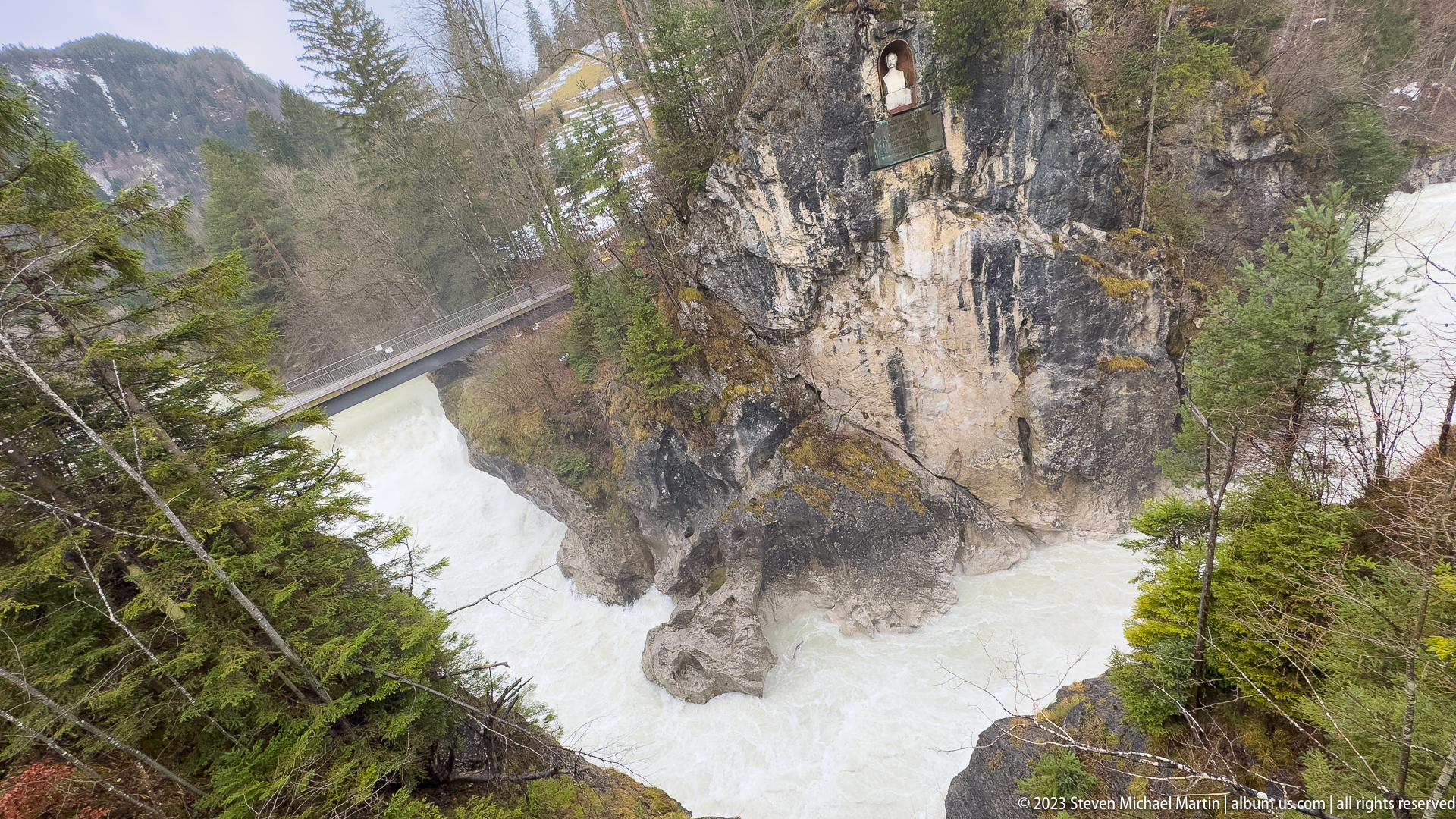
Viewed obliquely through trees, a bridge crosses the gorge while turbulent water sweeps around the base of a prominent rock outcrop. A small niche or opening high in the cliff adds a human-made detail to the otherwise rugged river landscape.
Caption
Viewed obliquely through trees, a bridge crosses the gorge while turbulent water sweeps around the base of a prominent rock outcrop. A small niche or opening high in the cliff adds a human-made detail to the otherwise rugged river landscape.
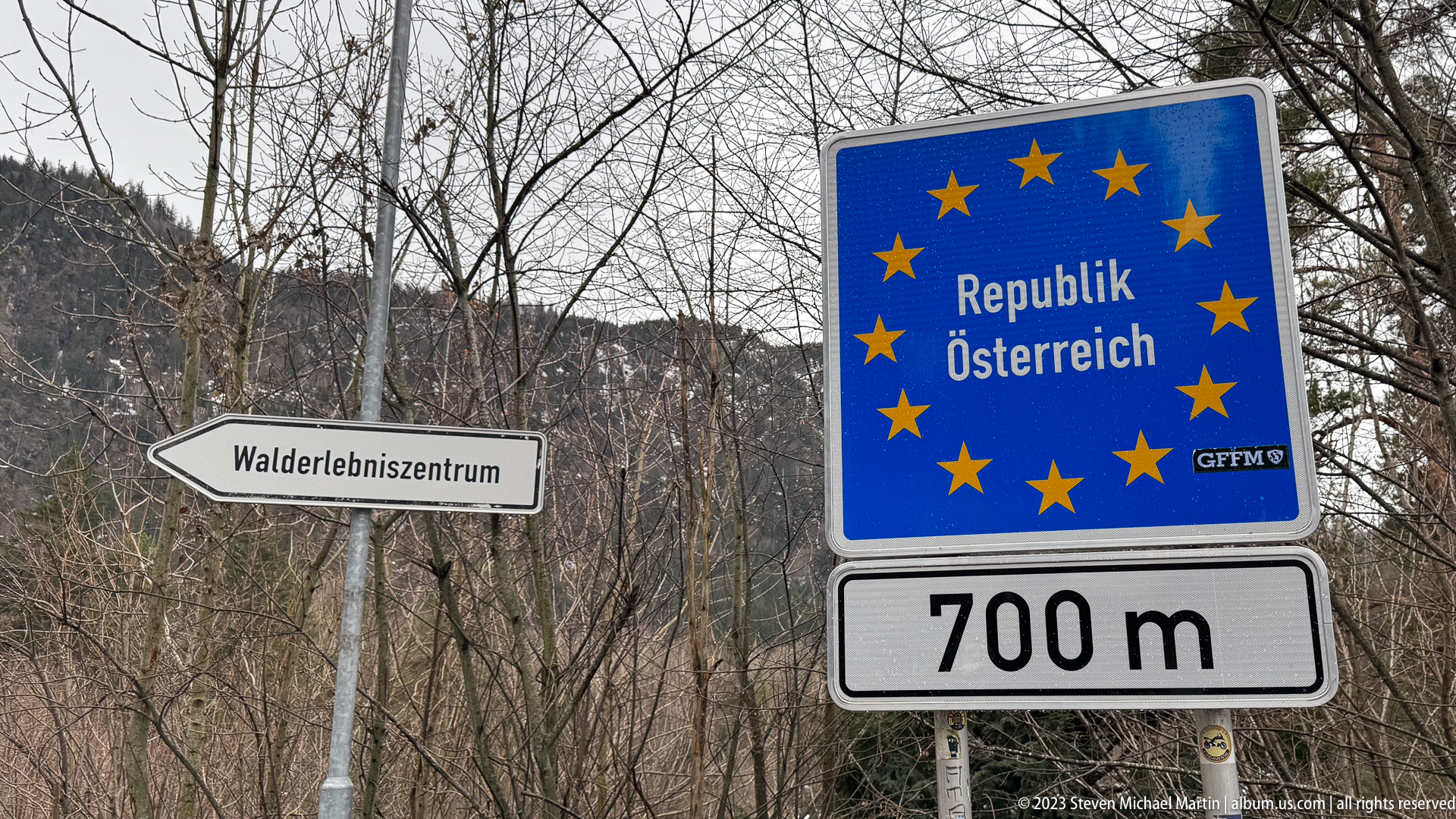
A blue European Union border sign marks entry into the Republic of Austria, with a separate plaque reading “700 m” and a directional sign for the Walderlebniszentrum. The roadside scene documents the international border area immediately south of Füssen in a wooded Alpine valley.
Caption
A blue European Union border sign marks entry into the Republic of Austria, with a separate plaque reading “700 m” and a directional sign for the Walderlebniszentrum. The roadside scene documents the international border area immediately south of Füssen in a wooded Alpine valley.
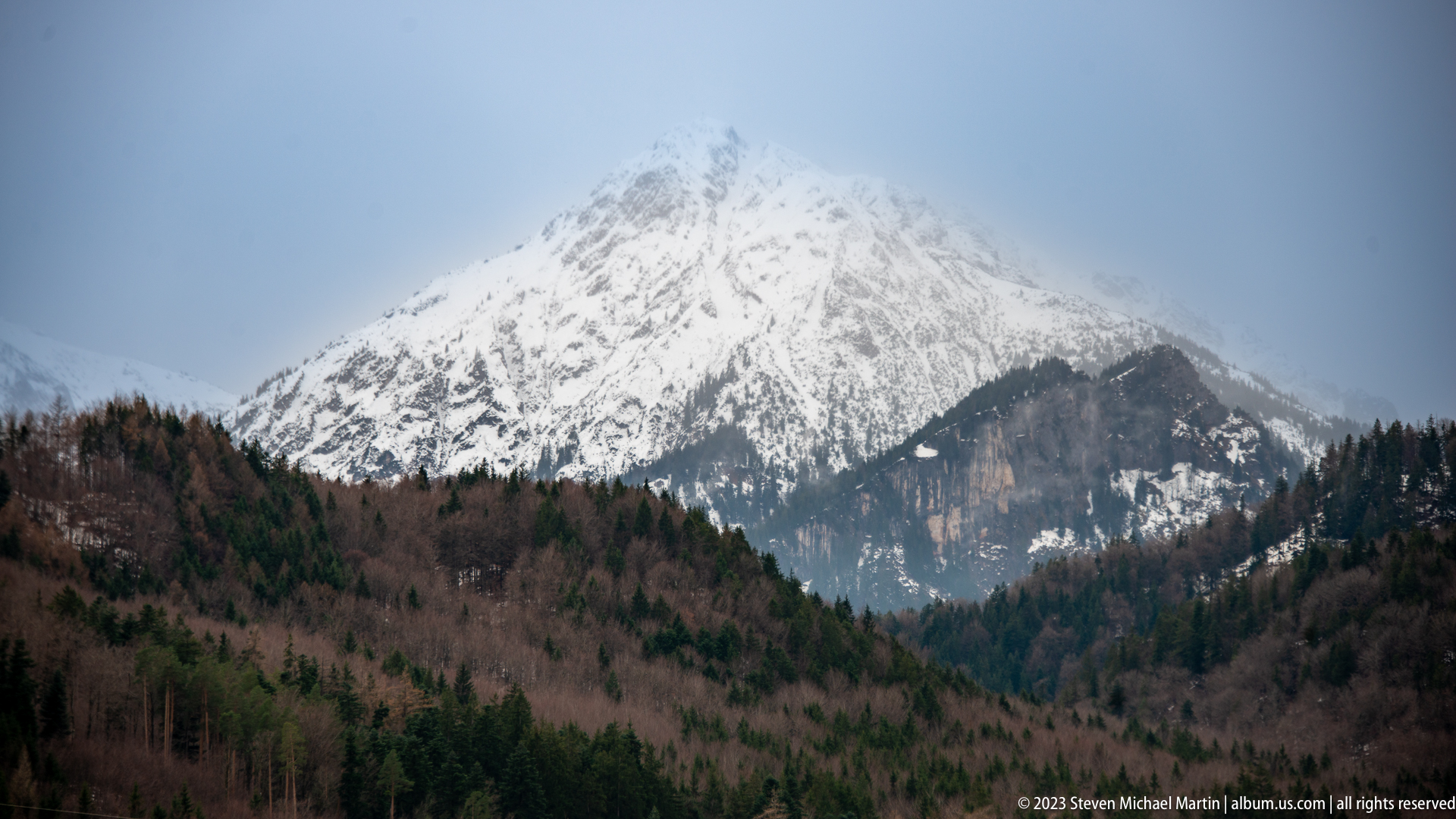
A steep snow-covered mountain rises behind dark forested foothills, its upper slopes softened by cloud. This tighter winter view isolates the peak from the broader Alpine panorama and emphasizes its sharply rising profile above the wooded valley.
Caption
A steep snow-covered mountain rises behind dark forested foothills, its upper slopes softened by cloud. This tighter winter view isolates the peak from the broader Alpine panorama and emphasizes its sharply rising profile above the wooded valley.

A rugged, pyramidal Alpine summit stands sharply against a pale sky, with snow highlighting gullies and ledges across its dark rock faces. The isolated composition emphasizes the peak’s craggy form above the lower forest belt south of Füssen.
Caption
A rugged, pyramidal Alpine summit stands sharply against a pale sky, with snow highlighting gullies and ledges across its dark rock faces. The isolated composition emphasizes the peak’s craggy form above the lower forest belt south of Füssen.
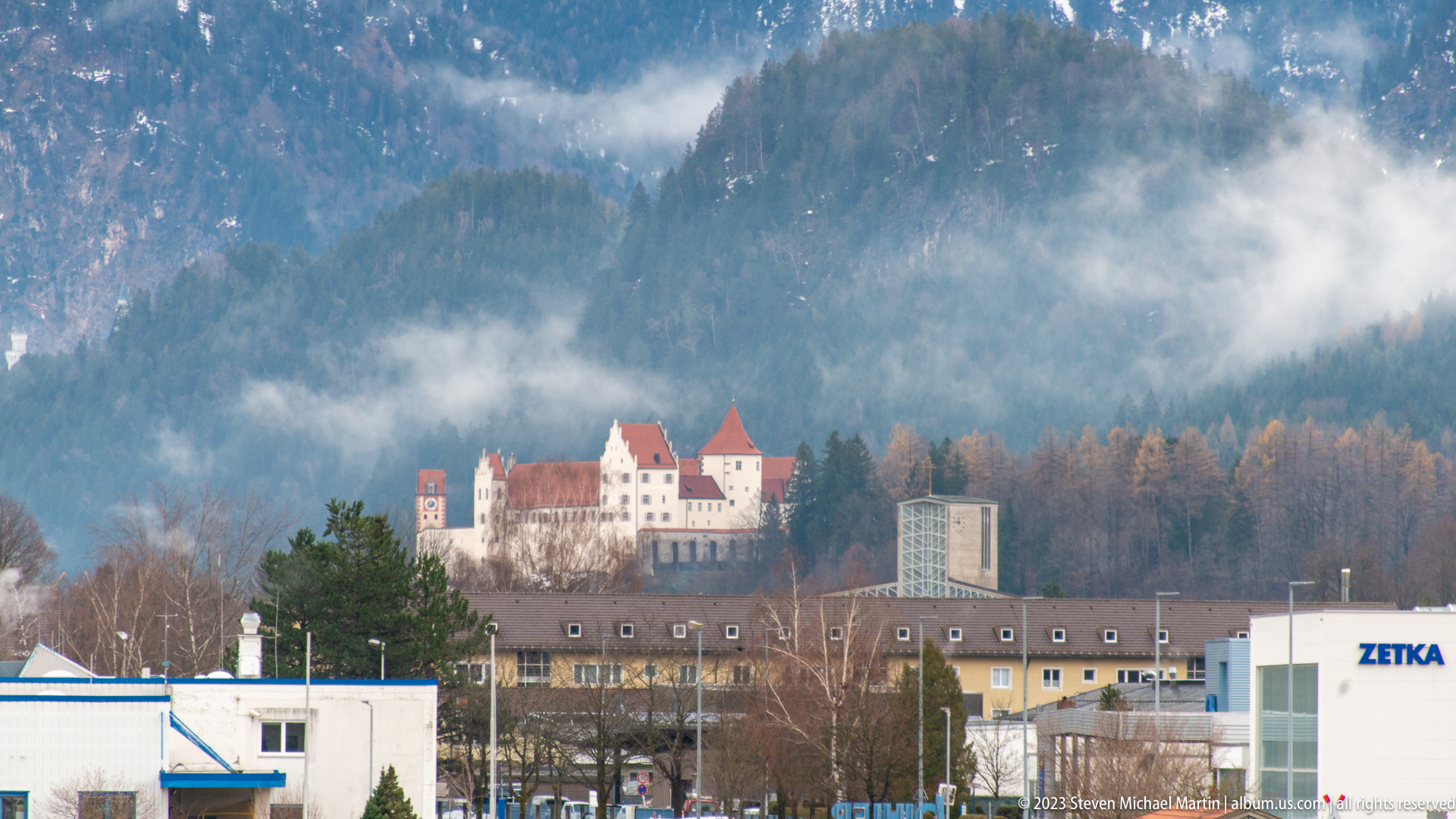
The High Castle of Füssen stands on its wooded hill above modern commercial buildings, its pale walls, red roofs, and towers visible through low drifting cloud. The view contrasts the historic hilltop complex with the contemporary townscape at the base of the Alps.
Caption
The High Castle of Füssen stands on its wooded hill above modern commercial buildings, its pale walls, red roofs, and towers visible through low drifting cloud. The view contrasts the historic hilltop complex with the contemporary townscape at the base of the Alps.
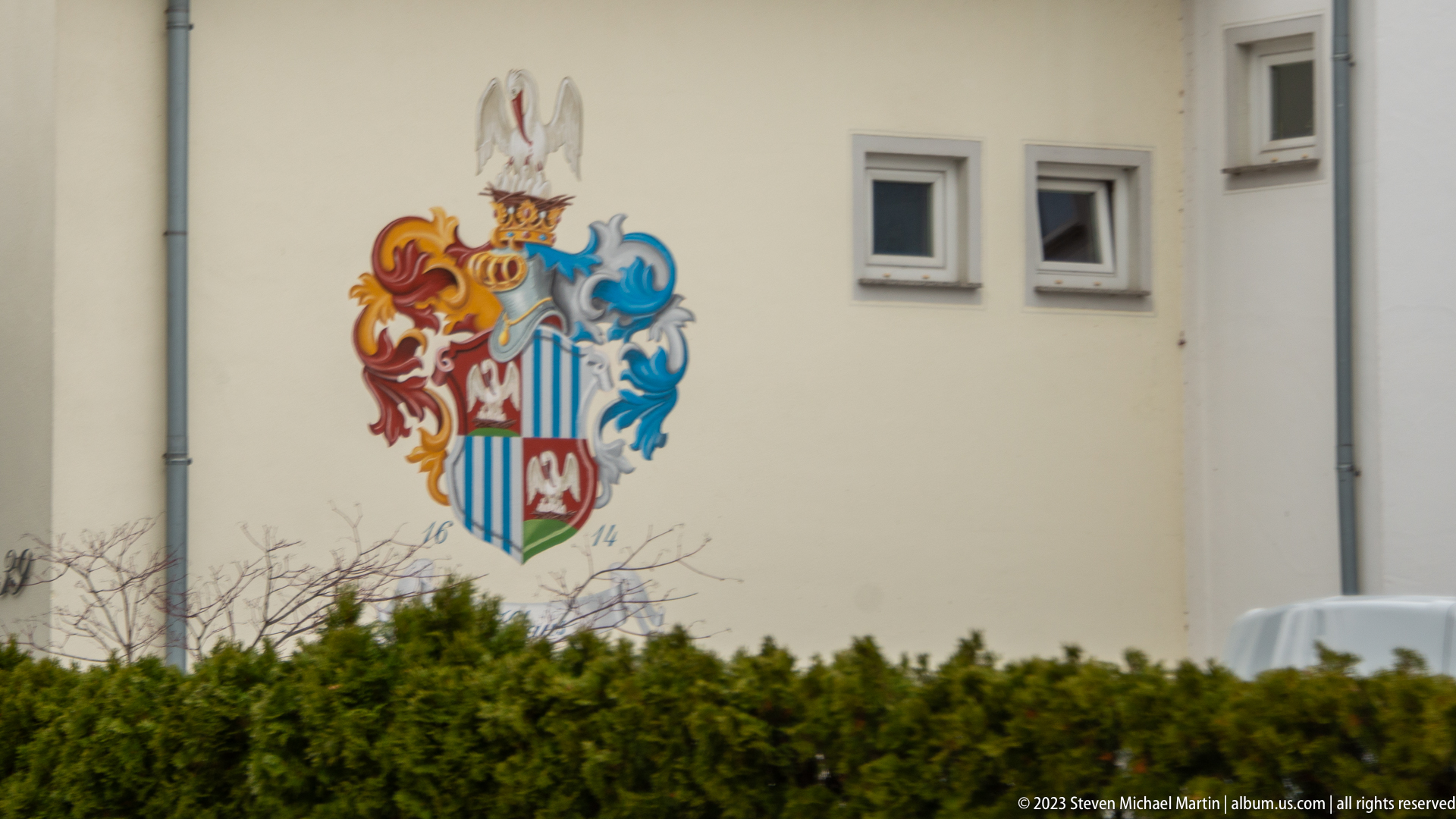
A brightly painted heraldic coat of arms decorates a plain cream-colored façade. The shield, helmet, crest, and red-and-blue mantling provide a concentrated architectural detail amid the town’s otherwise restrained wall surface.
Caption
A brightly painted heraldic coat of arms decorates a plain cream-colored façade. The shield, helmet, crest, and red-and-blue mantling provide a concentrated architectural detail amid the town’s otherwise restrained wall surface.

A narrow street in Füssen is lined with pastel façades, shopfronts, and painted details, with a historic tower rising in the distance against the wooded slopes. Contemporary vehicles and signage share the scene with the compact urban fabric of the old town.
Caption
A narrow street in Füssen is lined with pastel façades, shopfronts, and painted details, with a historic tower rising in the distance against the wooded slopes. Contemporary vehicles and signage share the scene with the compact urban fabric of the old town.
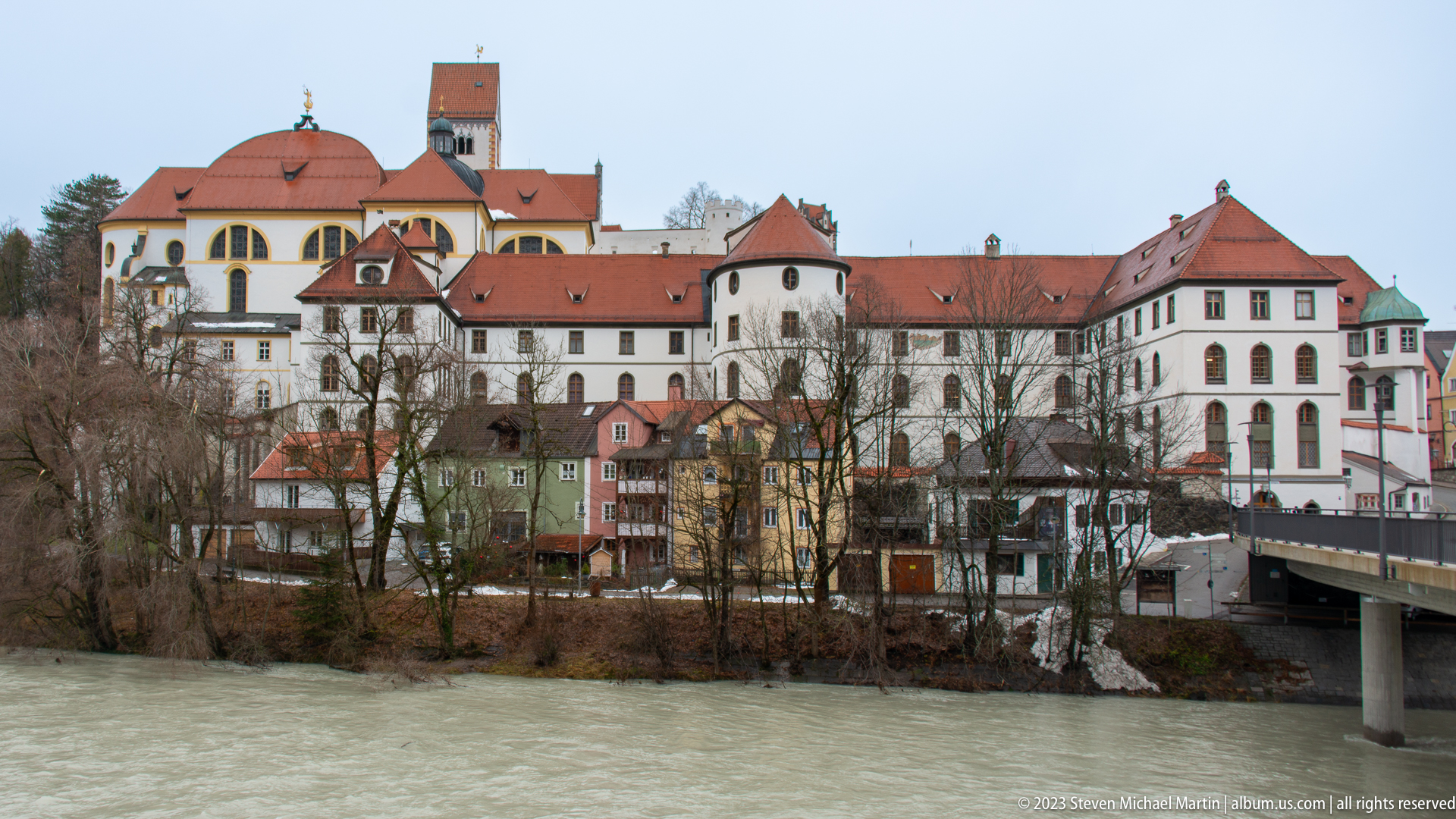
The former Benedictine Abbey of St. Mang stretches along the Lech in Füssen, its pale Baroque façades and red roofs rising above the riverbank. Rounded and rectangular wings form a substantial architectural ensemble, with the river and bridge establishing its close relationship to the historic town center.
Caption
The former Benedictine Abbey of St. Mang stretches along the Lech in Füssen, its pale Baroque façades and red roofs rising above the riverbank. Rounded and rectangular wings form a substantial architectural ensemble, with the river and bridge establishing its close relationship to the historic town center.
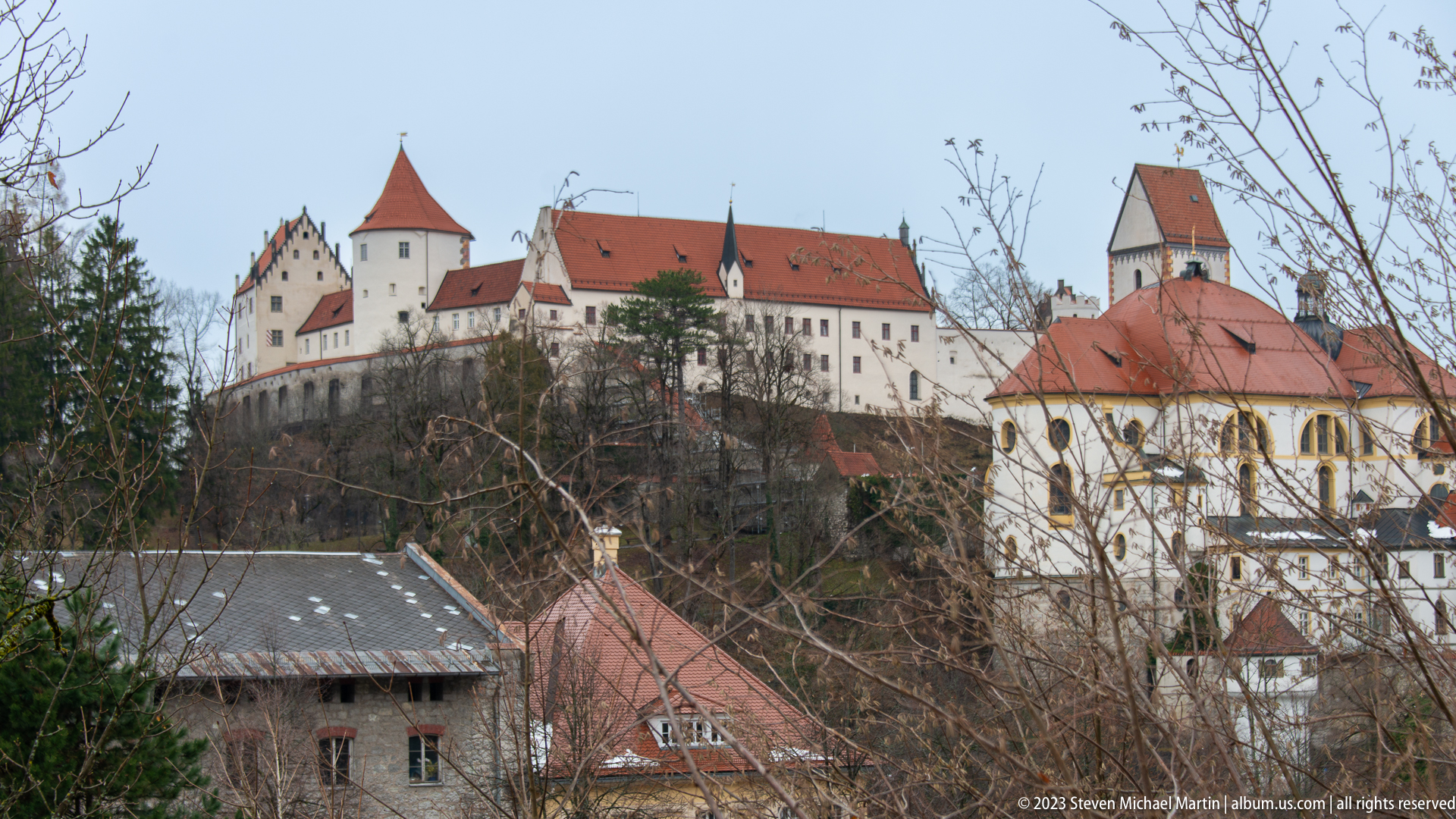
The High Castle of Füssen crowns the hill above the old town, with steep red roofs, pale walls, towers, and gabled wings visible through bare branches. A nearby church-like building in the foreground reinforces the dense layering of ecclesiastical and secular monuments around the historic center.
Caption
The High Castle of Füssen crowns the hill above the old town, with steep red roofs, pale walls, towers, and gabled wings visible through bare branches. A nearby church-like building in the foreground reinforces the dense layering of ecclesiastical and secular monuments around the historic center.
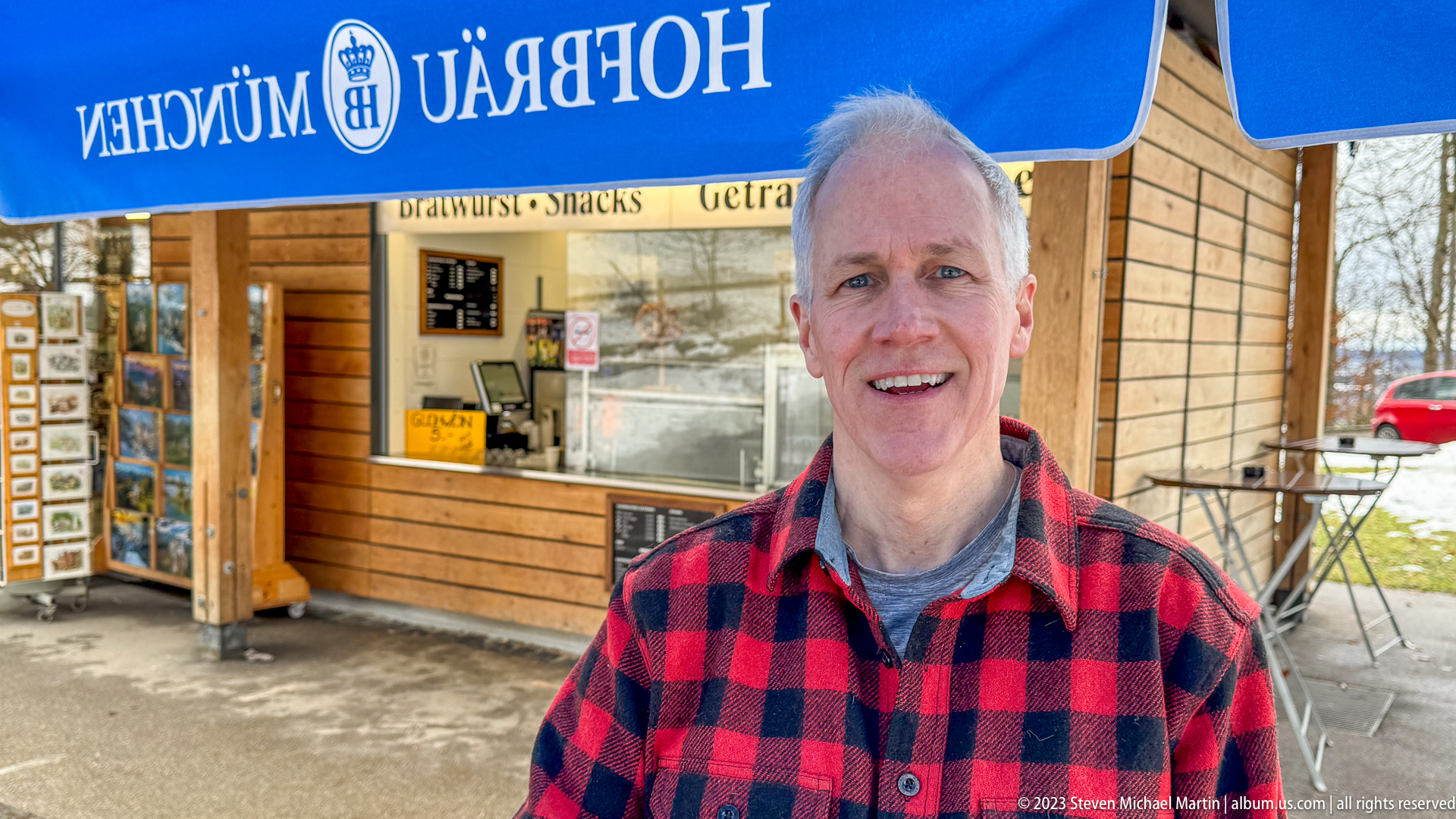
A smiling man in a red-and-black plaid jacket stands outside a small wooden snack kiosk beneath a blue umbrella. The informal roadside setting and winter clothing provide a human-scale travel moment amid the broader architectural and landscape sequence.
Caption
A smiling man in a red-and-black plaid jacket stands outside a small wooden snack kiosk beneath a blue umbrella. The informal roadside setting and winter clothing provide a human-scale travel moment amid the broader architectural and landscape sequence.
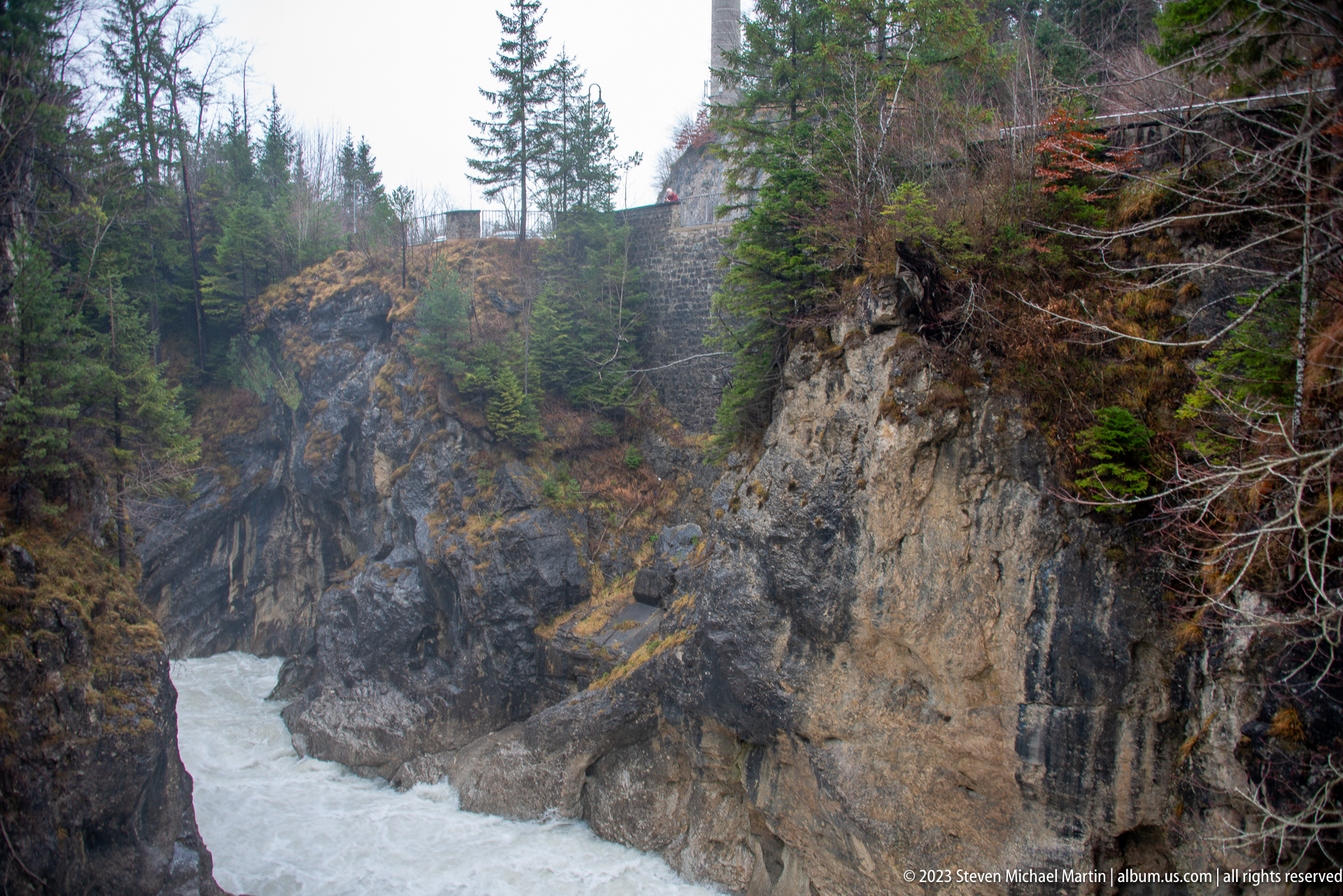
A narrow gorge channels fast water between steep, wooded rock walls. Exposed gray-brown cliff faces, moss, and conifers create a confined, vertical composition that emphasizes the river’s passage through the rocky terrain near Füssen.
Caption
A narrow gorge channels fast water between steep, wooded rock walls. Exposed gray-brown cliff faces, moss, and conifers create a confined, vertical composition that emphasizes the river’s passage through the rocky terrain near Füssen.
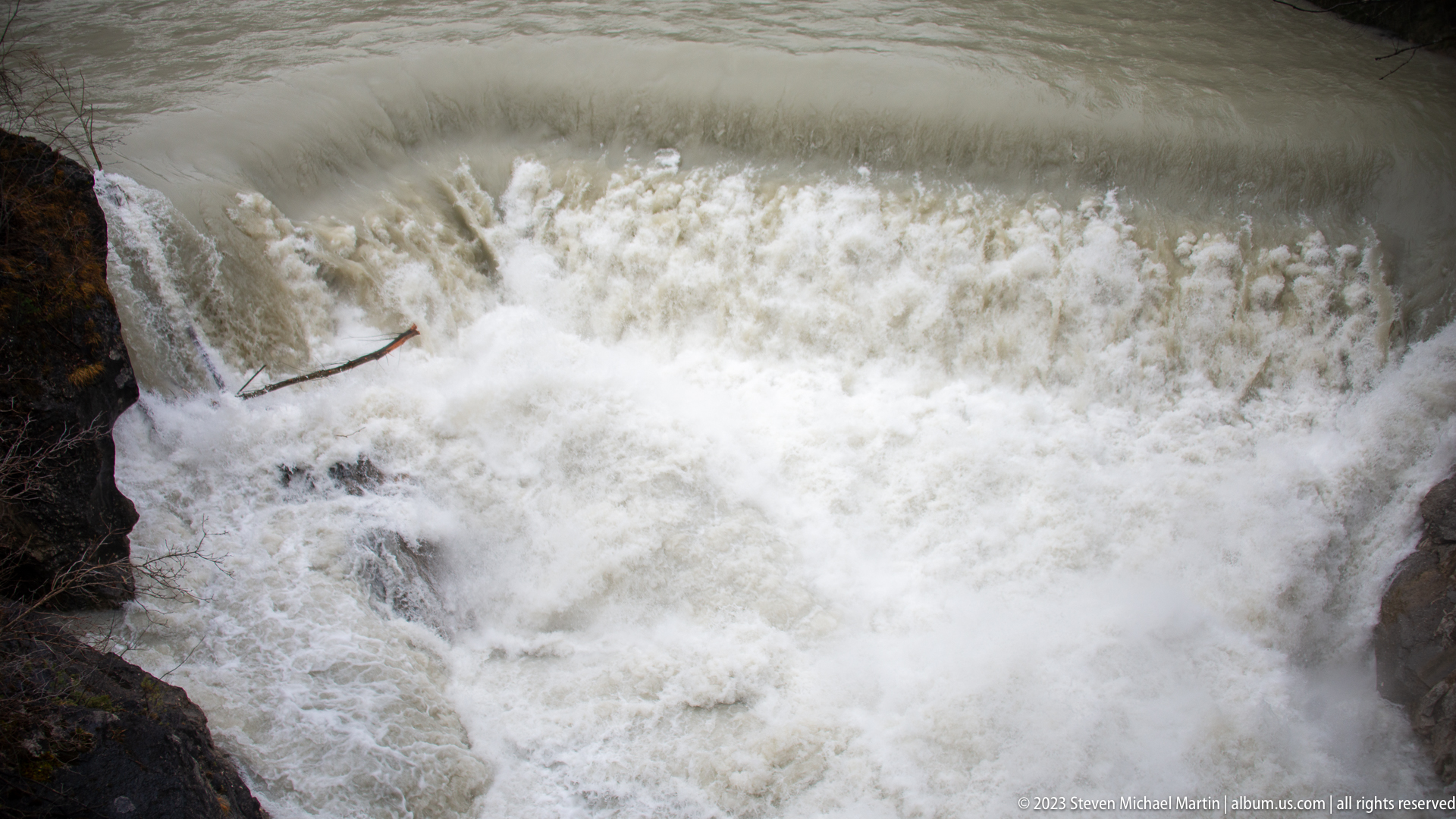
Foaming white water plunges over a low rocky drop, filling the frame with turbulence and spray. The close composition removes most surrounding context and concentrates on the force and texture of the Lech as it descends through the gorge near Füssen.
Caption
Foaming white water plunges over a low rocky drop, filling the frame with turbulence and spray. The close composition removes most surrounding context and concentrates on the force and texture of the Lech as it descends through the gorge near Füssen.
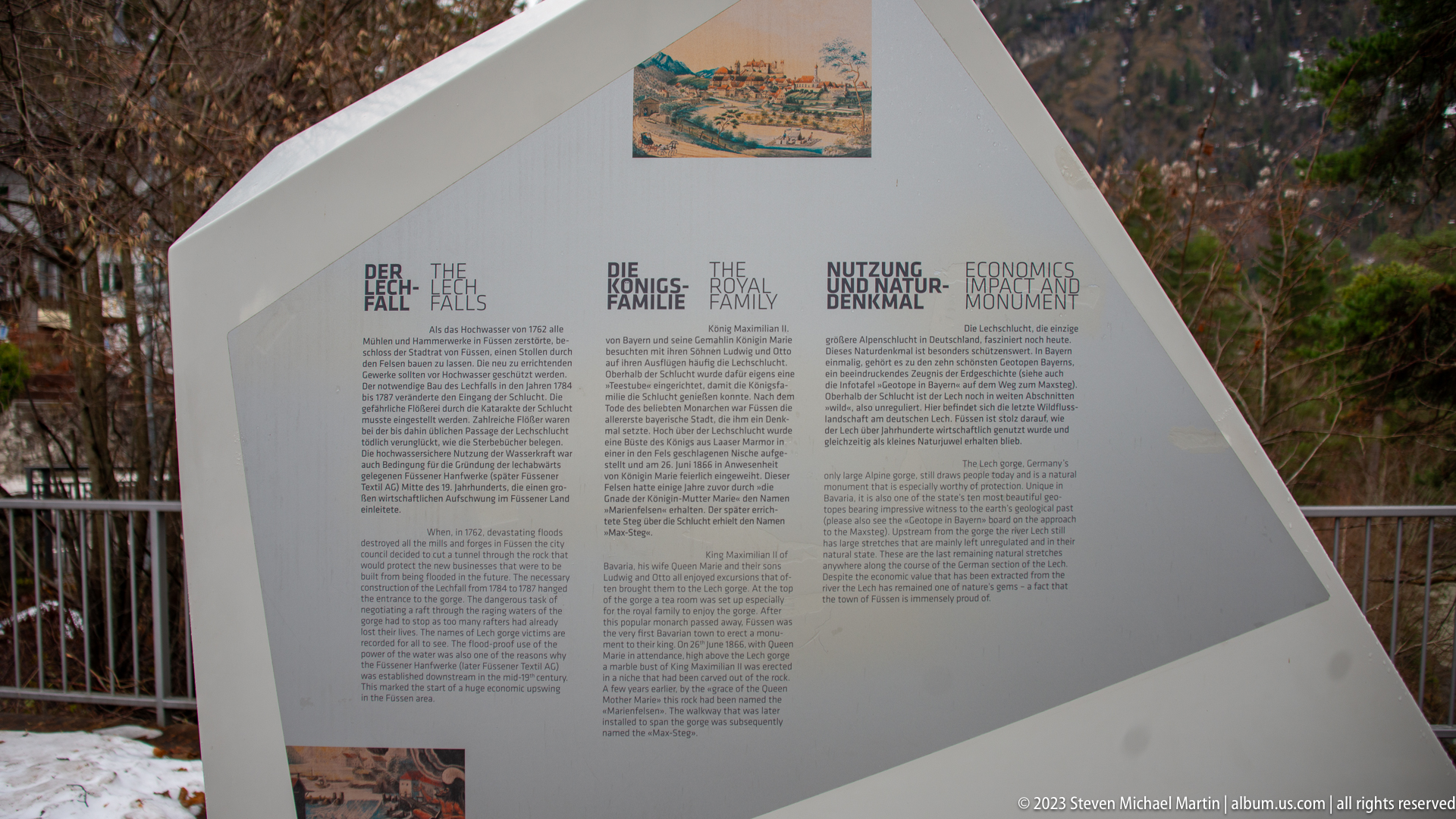
An outdoor interpretive panel explains a rockfall or slope-stability feature through sections headed “The Facts,” “The Economics,” and “The Management.” Historical illustrations and bilingual text connect the visible mountain landscape to engineering, maintenance, and public-safety concerns.
Caption
An outdoor interpretive panel explains a rockfall or slope-stability feature through sections headed “The Facts,” “The Economics,” and “The Management.” Historical illustrations and bilingual text connect the visible mountain landscape to engineering, maintenance, and public-safety concerns.
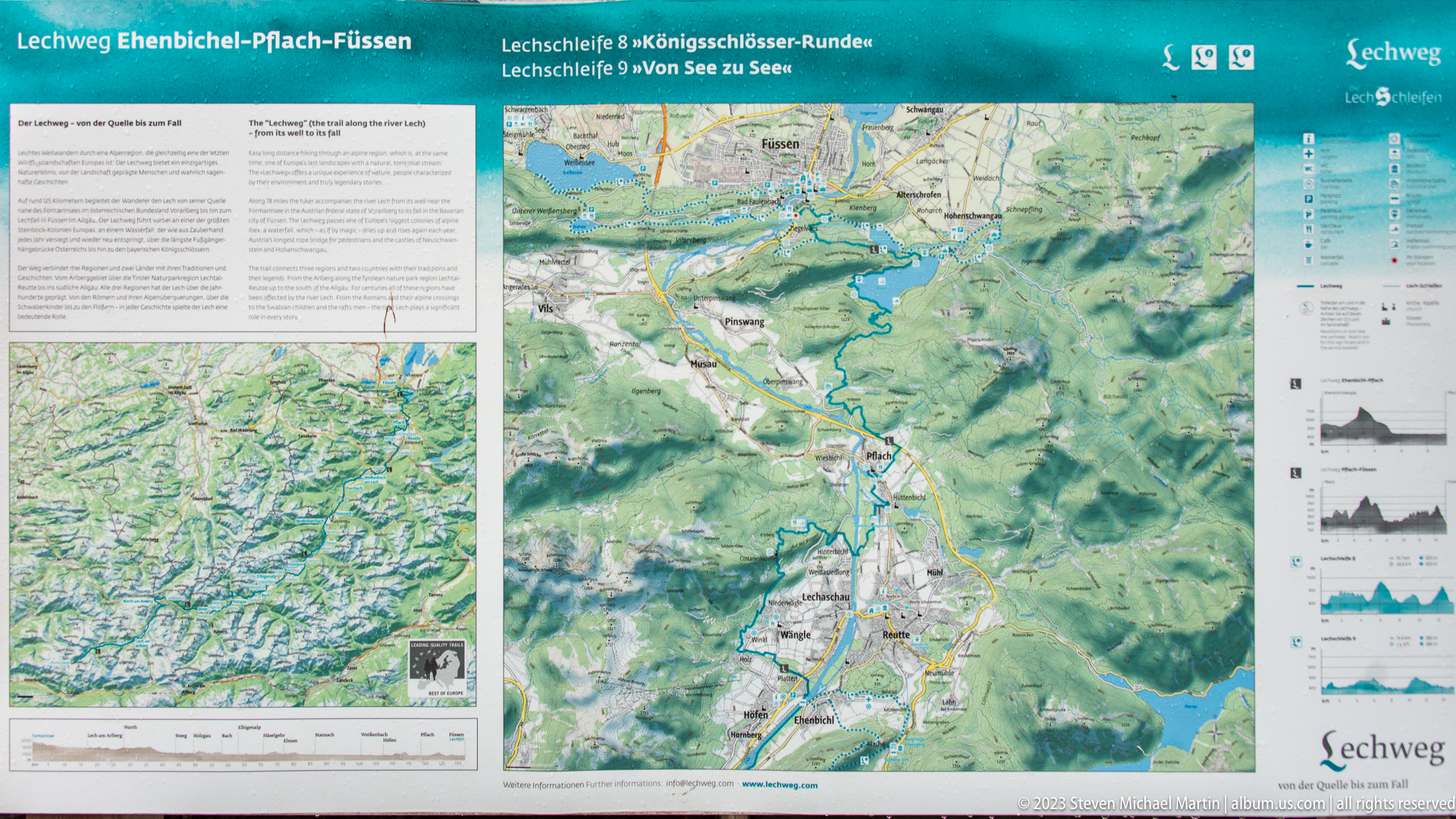
A large trail map presents the Lechschleife routes around Füssen and the surrounding lakes and mountains. The panel combines a regional map, detailed route diagram, elevation profiles, and visitor information for walking in the Alpine foothills.
Caption
A large trail map presents the Lechschleife routes around Füssen and the surrounding lakes and mountains. The panel combines a regional map, detailed route diagram, elevation profiles, and visitor information for walking in the Alpine foothills.

A close architectural view isolates Neuschwanstein’s pale western towers, including the tall square tower with its projecting upper stage and circular crown. Smaller crenellated towers and the long white wall emphasize the castle’s deliberately medievalizing silhouette.
Caption
A close architectural view isolates Neuschwanstein’s pale western towers, including the tall square tower with its projecting upper stage and circular crown. Smaller crenellated towers and the long white wall emphasize the castle’s deliberately medievalizing silhouette.
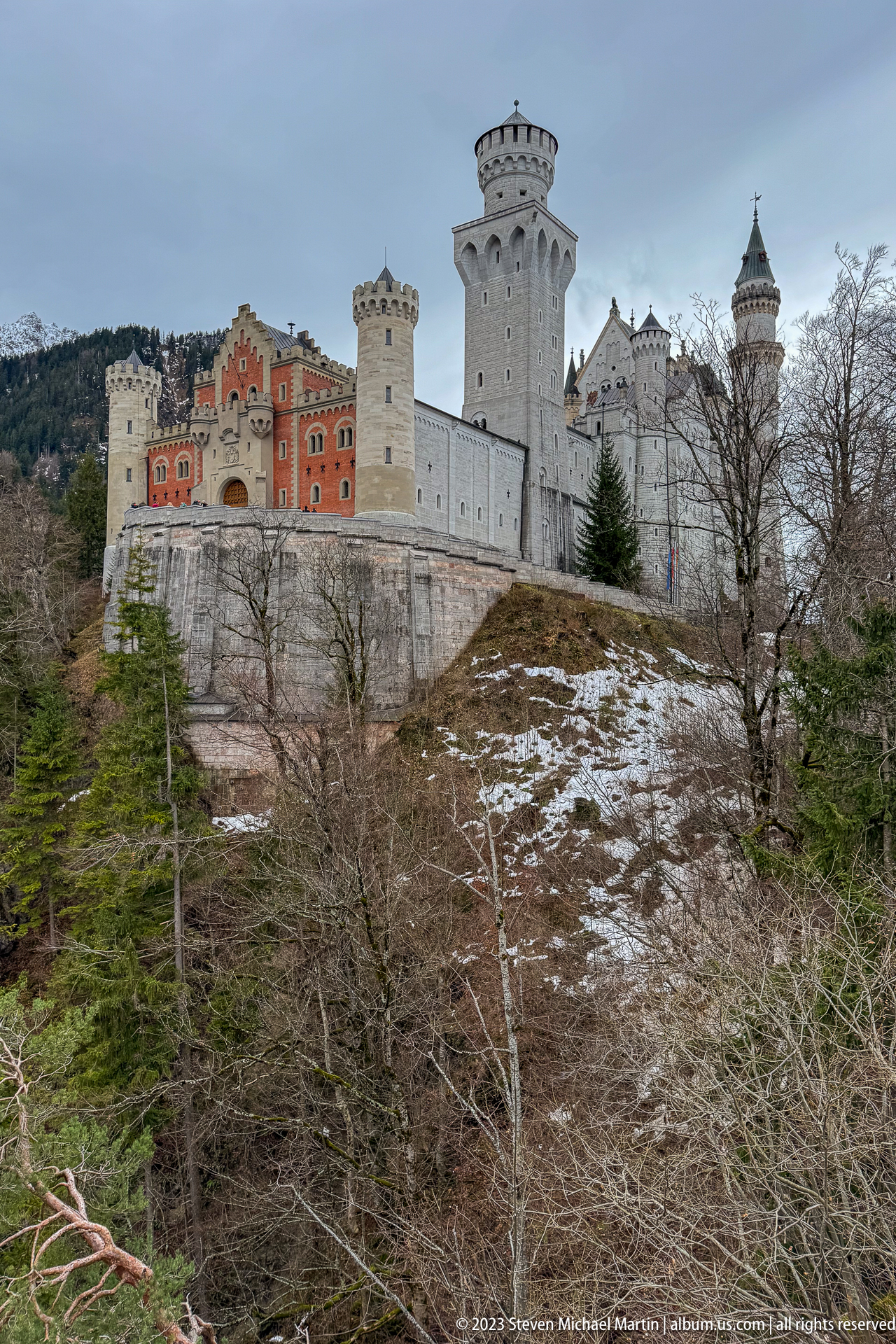
Neuschwanstein stands above a steep, partly snow-dusted slope, its red gatehouse and pale towers stepping along the crest. This more distant view reveals how the castle’s walls and towers are composed to command the rocky hill while remaining closely framed by conifer forest and mountain terrain.
Caption
Neuschwanstein stands above a steep, partly snow-dusted slope, its red gatehouse and pale towers stepping along the crest. This more distant view reveals how the castle’s walls and towers are composed to command the rocky hill while remaining closely framed by conifer forest and mountain terrain.

A close view of Neuschwanstein’s Palas focuses on the pale gabled façade, flanking turrets, arcaded windows, and large painted heraldic lions. The decorative program softens the mass of the stonework and shows the castle’s fusion of architectural revivalism with richly symbolic exterior ornament.
Caption
A close view of Neuschwanstein’s Palas focuses on the pale gabled façade, flanking turrets, arcaded windows, and large painted heraldic lions. The decorative program softens the mass of the stonework and shows the castle’s fusion of architectural revivalism with richly symbolic exterior ornament.
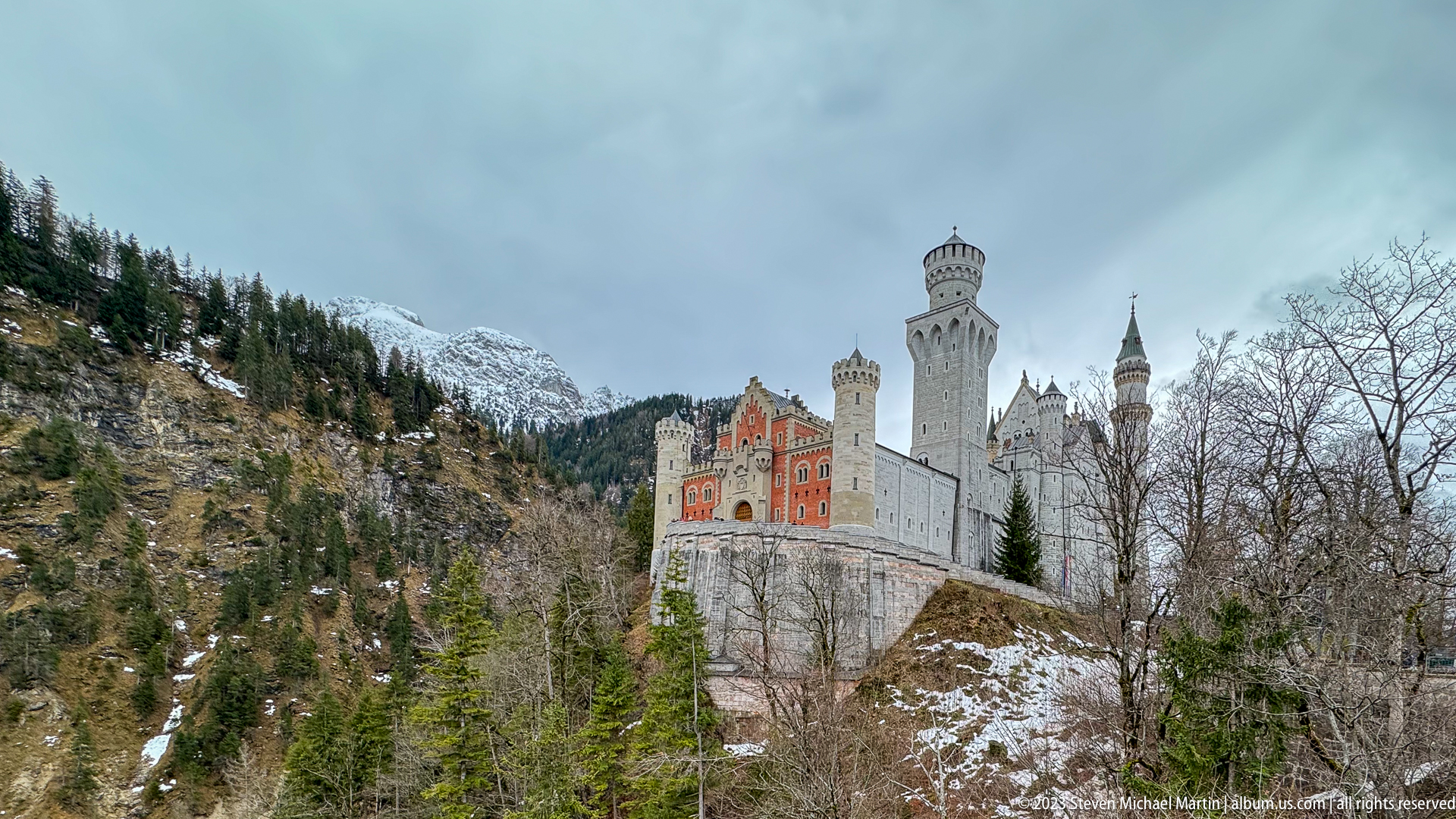
Neuschwanstein rises above bare trees and conifers with the snow-streaked Alps behind it. The red gatehouse, tall white towers, and steeply pitched roofs stand out against the darker forest, placing the castle within the dramatic mountain landscape that shaped its visual identity.
Caption
Neuschwanstein rises above bare trees and conifers with the snow-streaked Alps behind it. The red gatehouse, tall white towers, and steeply pitched roofs stand out against the darker forest, placing the castle within the dramatic mountain landscape that shaped its visual identity.
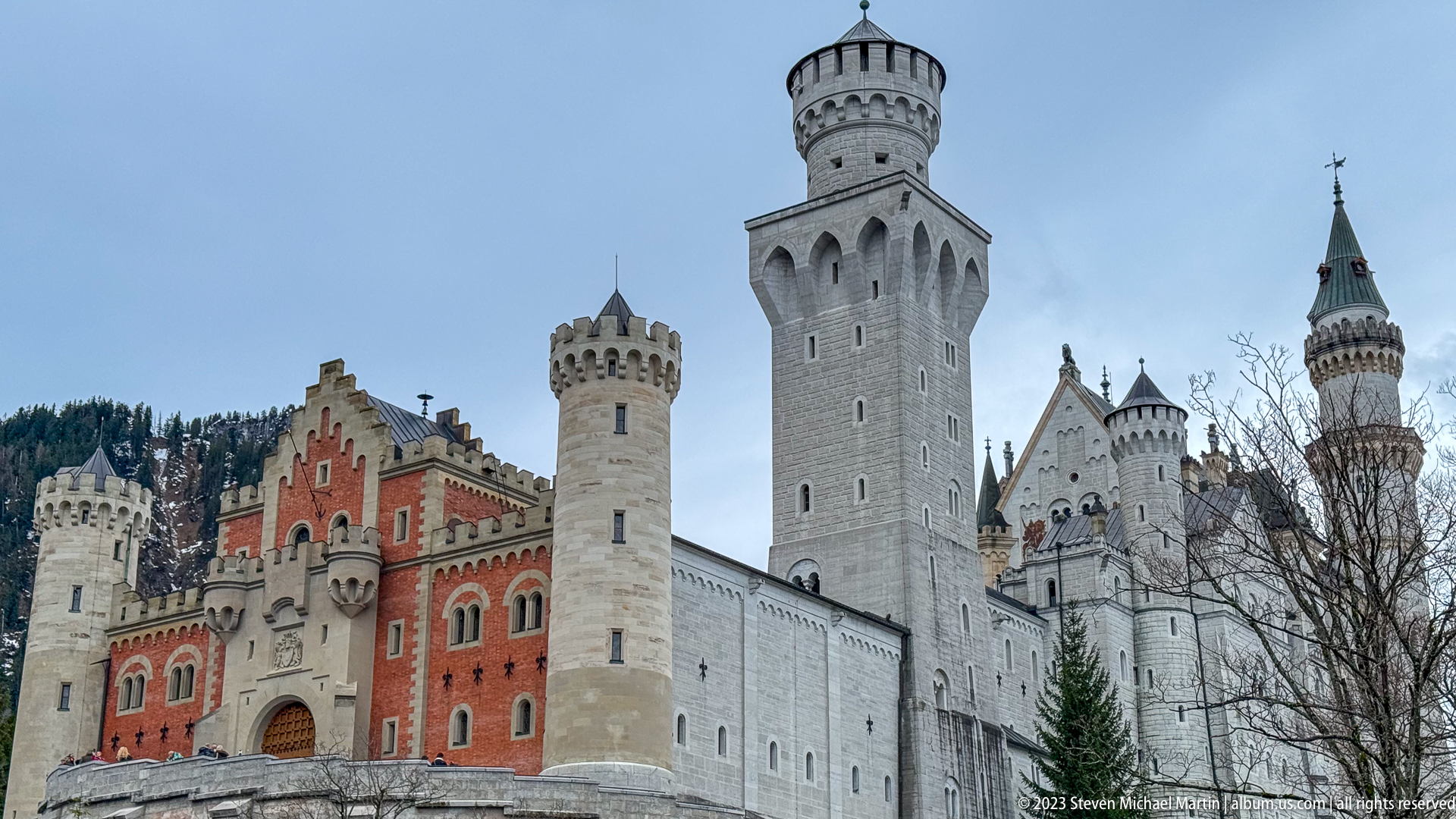
The richly contrasted western ensemble of Neuschwanstein fills the frame: red gatehouse walls, pale crenellated turrets, the tall square tower, and more ornate rooflines behind. The close view emphasizes the castle’s layered vertical silhouette and deliberate evocation of medieval architecture.
Caption
The richly contrasted western ensemble of Neuschwanstein fills the frame: red gatehouse walls, pale crenellated turrets, the tall square tower, and more ornate rooflines behind. The close view emphasizes the castle’s layered vertical silhouette and deliberate evocation of medieval architecture.
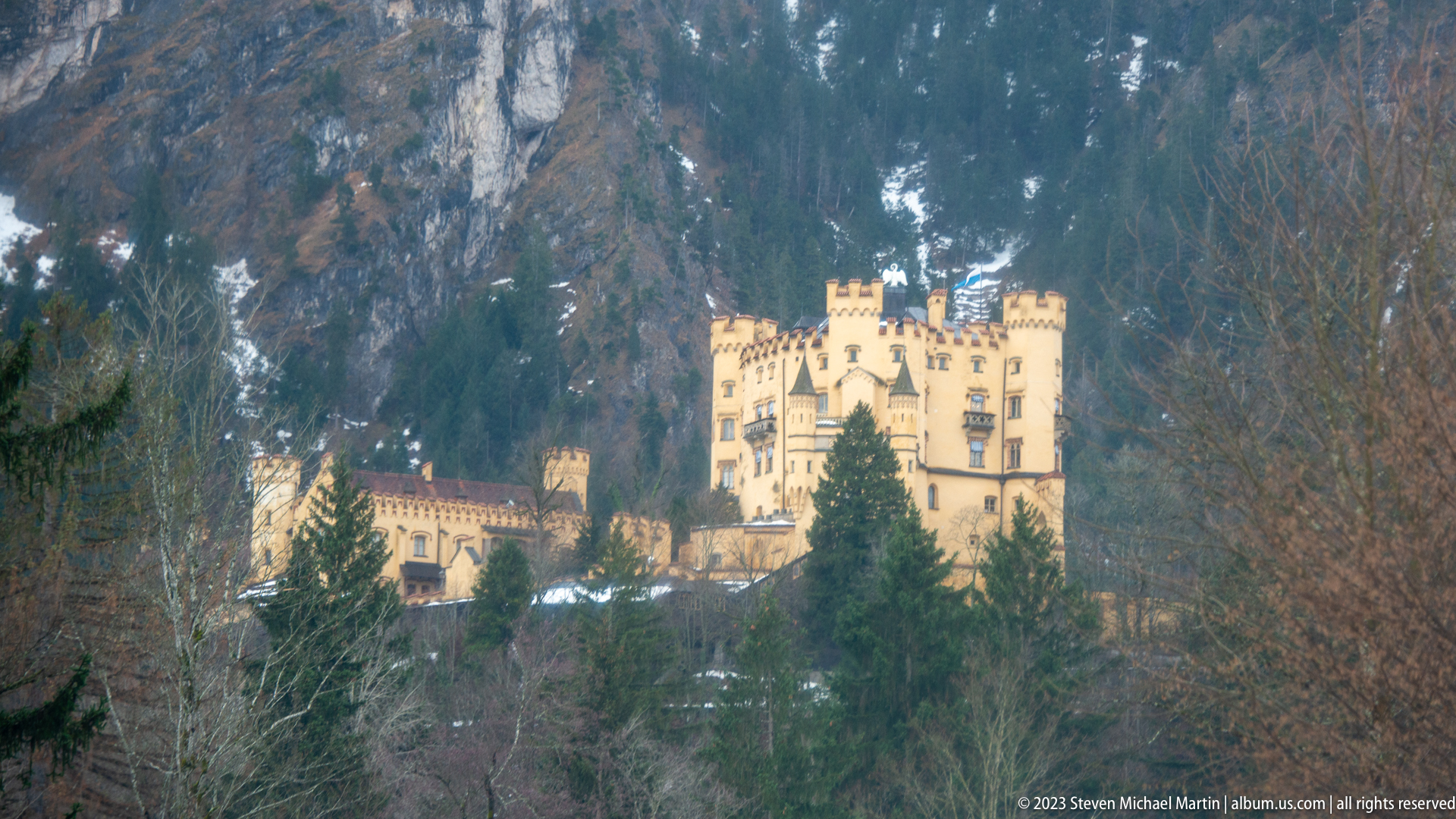
Hohenschwangau Castle appears across the valley on a wooded slope, its warm yellow walls and crenellated towers standing out against dark forest and exposed rock. The telephoto view emphasizes the castle’s compact, castellated silhouette within its steep Alpine setting.
Caption
Hohenschwangau Castle appears across the valley on a wooded slope, its warm yellow walls and crenellated towers standing out against dark forest and exposed rock. The telephoto view emphasizes the castle’s compact, castellated silhouette within its steep Alpine setting.
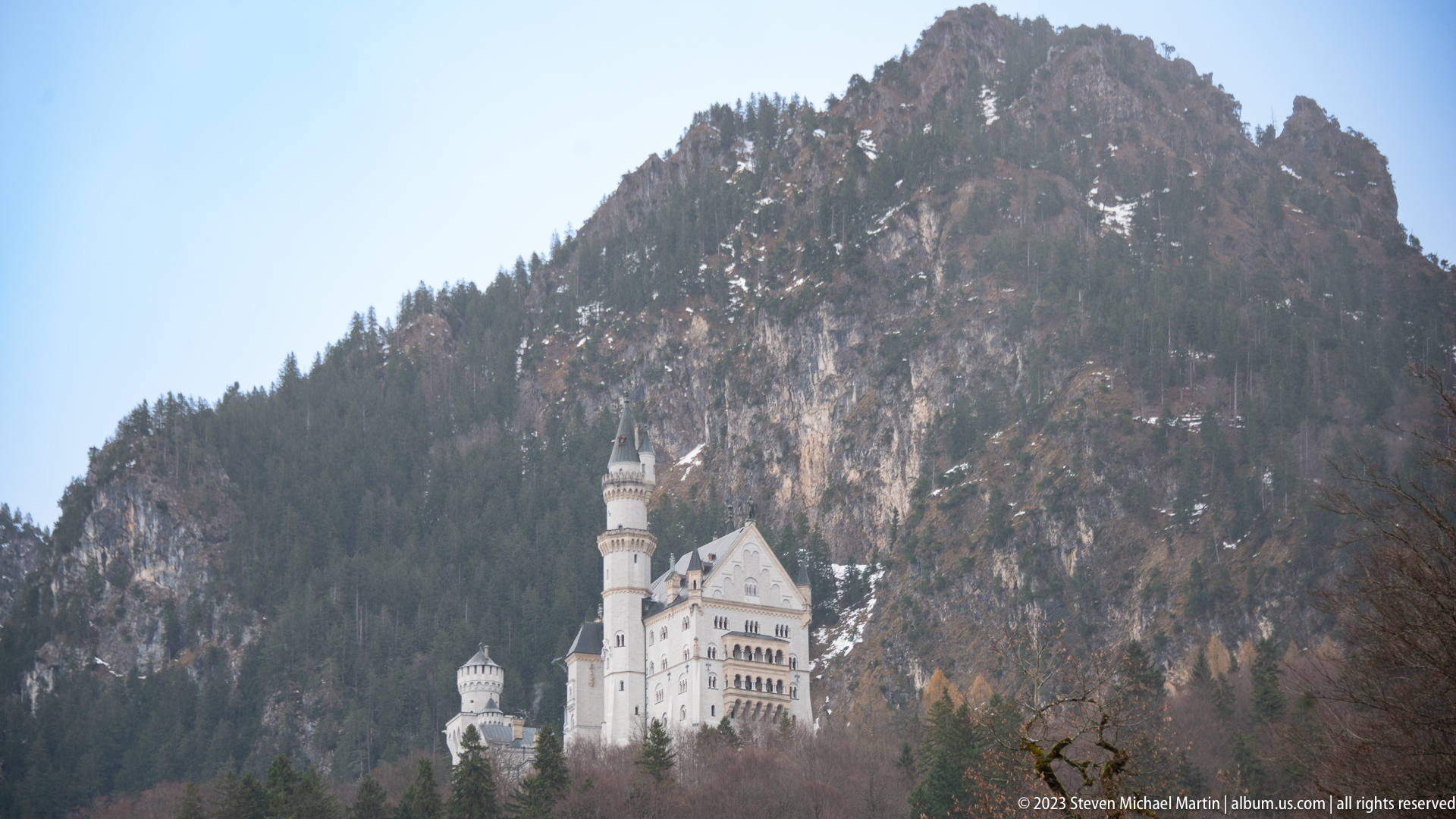
Neuschwanstein appears small beneath a massive forested and rocky mountain slope, its white walls and slender towers emerging from the lower trees. The long view reverses the usual hierarchy, making the castle a human-made accent within the much larger Alpine landscape.
Caption
Neuschwanstein appears small beneath a massive forested and rocky mountain slope, its white walls and slender towers emerging from the lower trees. The long view reverses the usual hierarchy, making the castle a human-made accent within the much larger Alpine landscape.
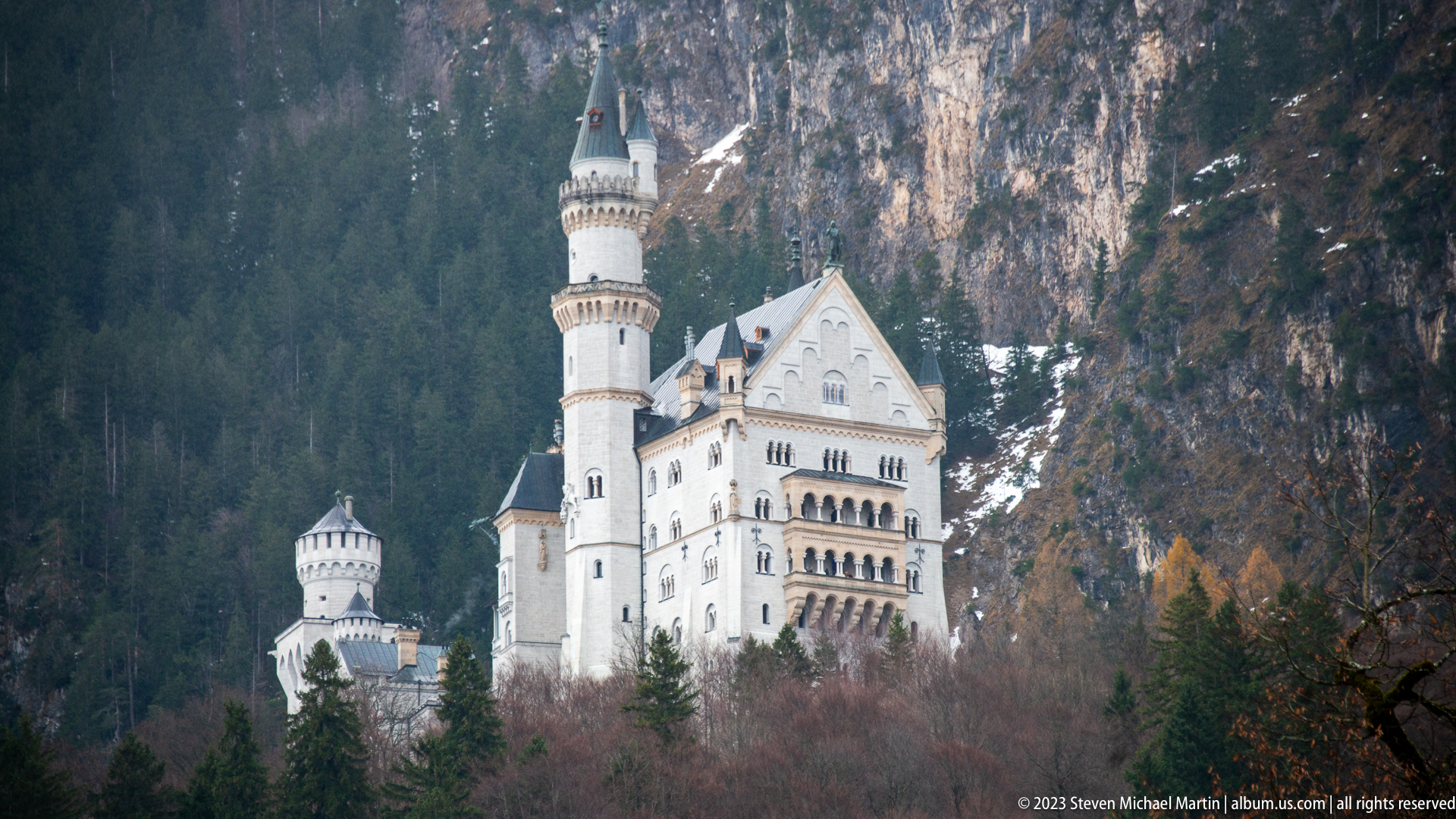
A telephoto valley view centers Neuschwanstein’s white Palas and its cluster of towers against dark forest and a sheer rocky mountain face. Rows of arched windows, steep roofs, and the tall corner tower reveal the castle’s vertical, palace-like composition more clearly than the distant landscape views.
Caption
A telephoto valley view centers Neuschwanstein’s white Palas and its cluster of towers against dark forest and a sheer rocky mountain face. Rows of arched windows, steep roofs, and the tall corner tower reveal the castle’s vertical, palace-like composition more clearly than the distant landscape views.
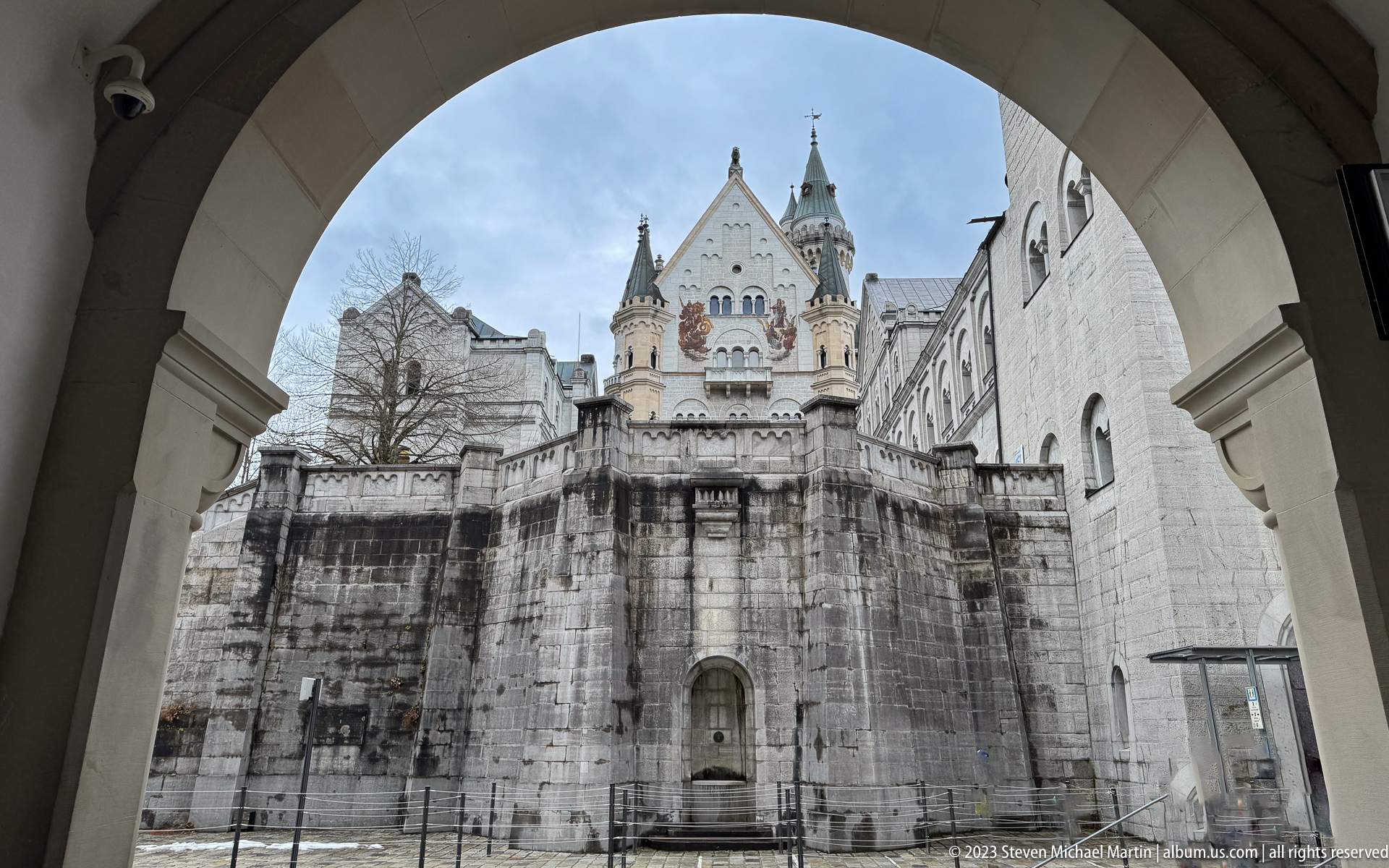
An arch frames the inner approach toward Neuschwanstein’s Palas, where the ornate gable and towers rise above a massive, weather-darkened retaining or courtyard wall. The framing turns the passageway itself into part of the composition and emphasizes the castle’s sequence of enclosed architectural spaces.
Caption
An arch frames the inner approach toward Neuschwanstein’s Palas, where the ornate gable and towers rise above a massive, weather-darkened retaining or courtyard wall. The framing turns the passageway itself into part of the composition and emphasizes the castle’s sequence of enclosed architectural spaces.
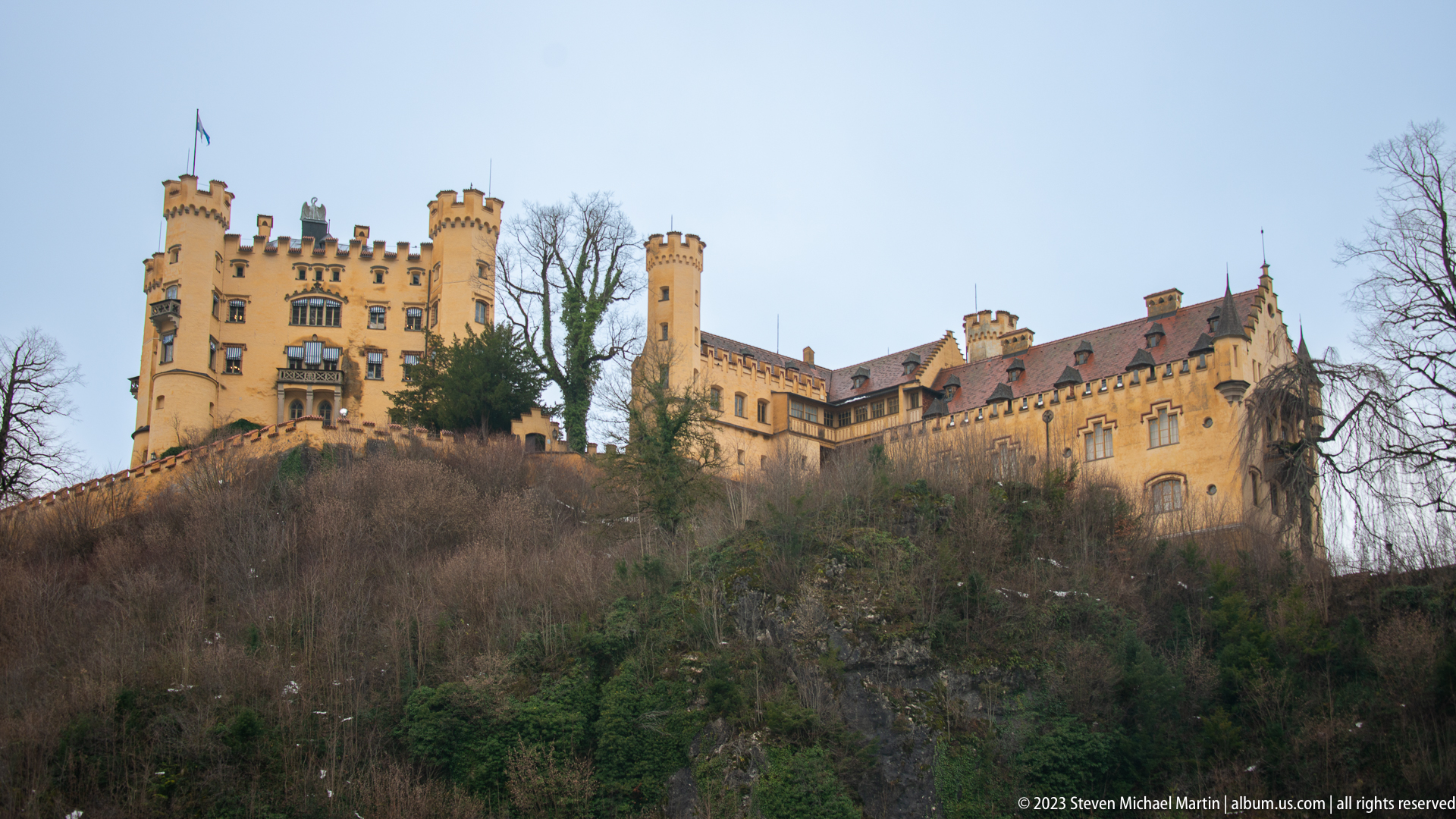
Seen from lower on the hillside, Hohenschwangau Castle stretches laterally across the ridge, linking its tall crenellated keep-like tower to smaller corner towers and residential ranges. The leafless winter trees expose more of the masonry than summer foliage would, revealing the relationship between the fortified visual language of the exterior and the steep natural setting.
Caption
Seen from lower on the hillside, Hohenschwangau Castle stretches laterally across the ridge, linking its tall crenellated keep-like tower to smaller corner towers and residential ranges. The leafless winter trees expose more of the masonry than summer foliage would, revealing the relationship between the fortified visual language of the exterior and the steep natural setting.
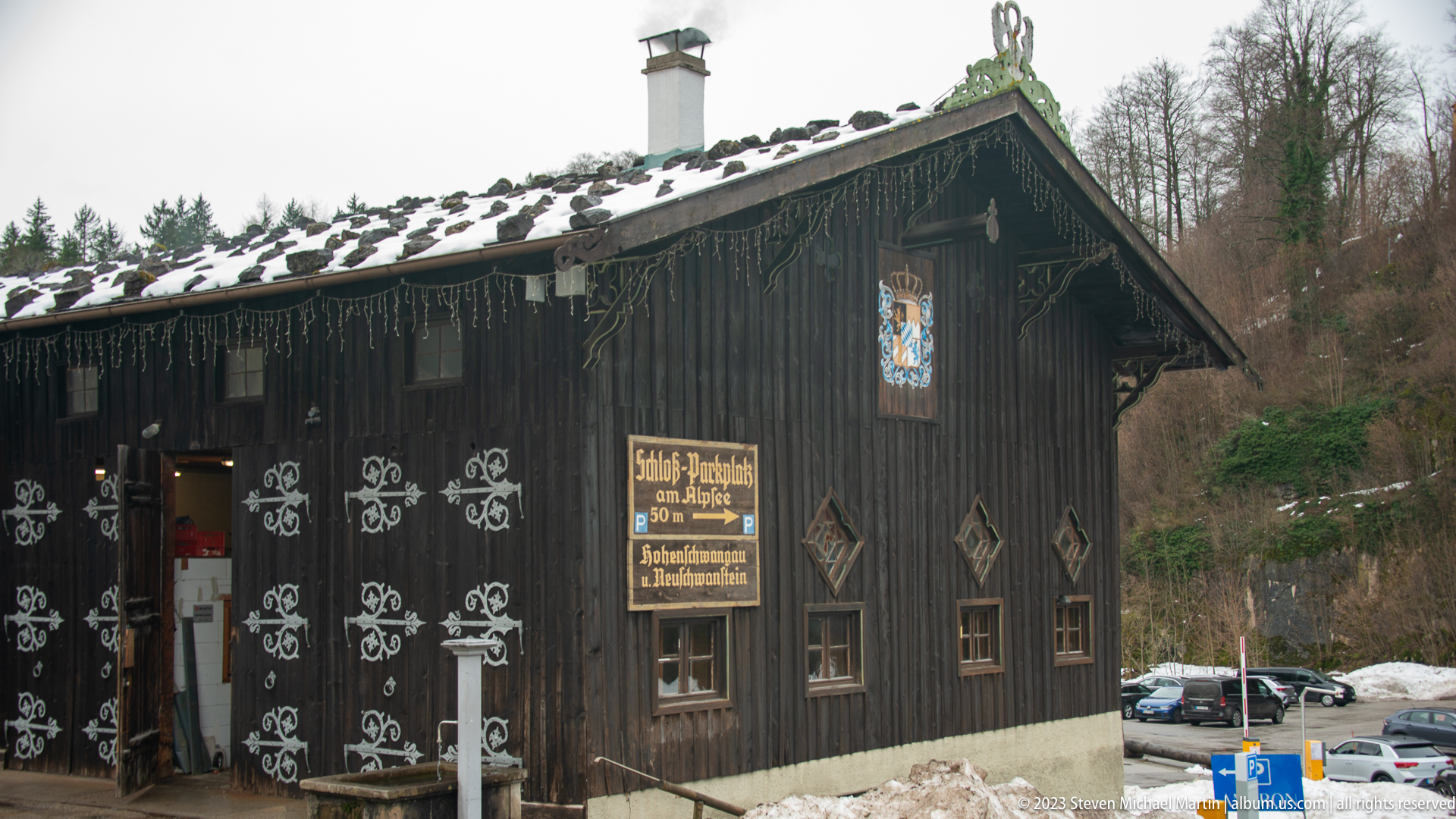
A dark timber building along the visitor route is decorated with white painted motifs, carved trim, and a Bavarian shield near the gable. Snow clings to the low roof and ground, while a traditional signboard beside the doorway adds to the regional character. The close street-level view records vernacular commercial architecture associated with the castle approach rather than the royal buildings themselves.
Caption
A dark timber building along the visitor route is decorated with white painted motifs, carved trim, and a Bavarian shield near the gable. Snow clings to the low roof and ground, while a traditional signboard beside the doorway adds to the regional character. The close street-level view records vernacular commercial architecture associated with the castle approach rather than the royal buildings themselves.
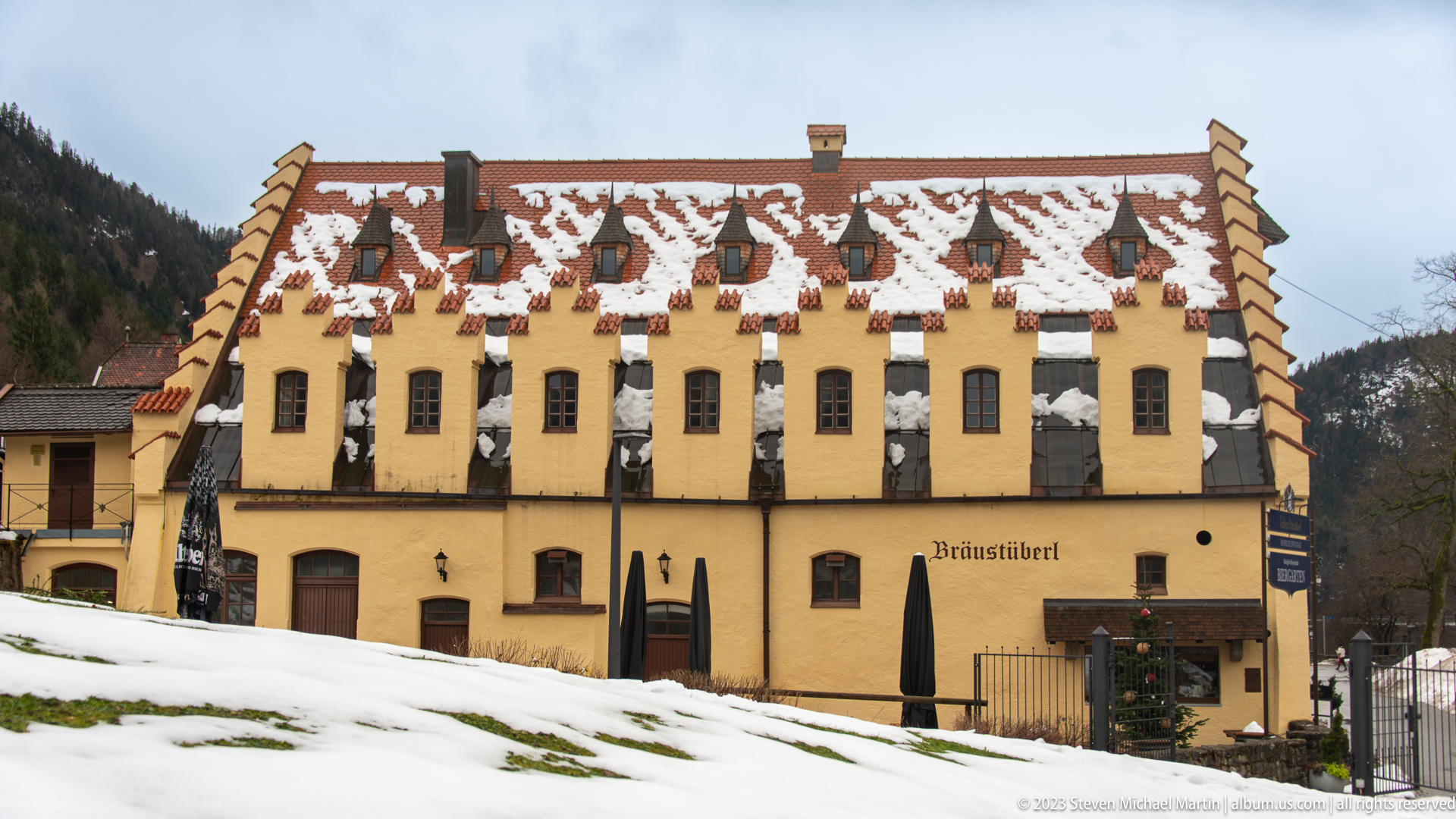
The Bräustüberl presents a long pale-yellow façade beneath a steep roof punctuated by evenly spaced dormers and capped by stepped end gables. Snow outlines the roof geometry and foreground slope, emphasizing the building's strong horizontal rhythm. The sign on the façade identifies the establishment, which forms part of the developed visitor landscape below the royal castles.
Caption
The Bräustüberl presents a long pale-yellow façade beneath a steep roof punctuated by evenly spaced dormers and capped by stepped end gables. Snow outlines the roof geometry and foreground slope, emphasizing the building's strong horizontal rhythm. The sign on the façade identifies the establishment, which forms part of the developed visitor landscape below the royal castles.
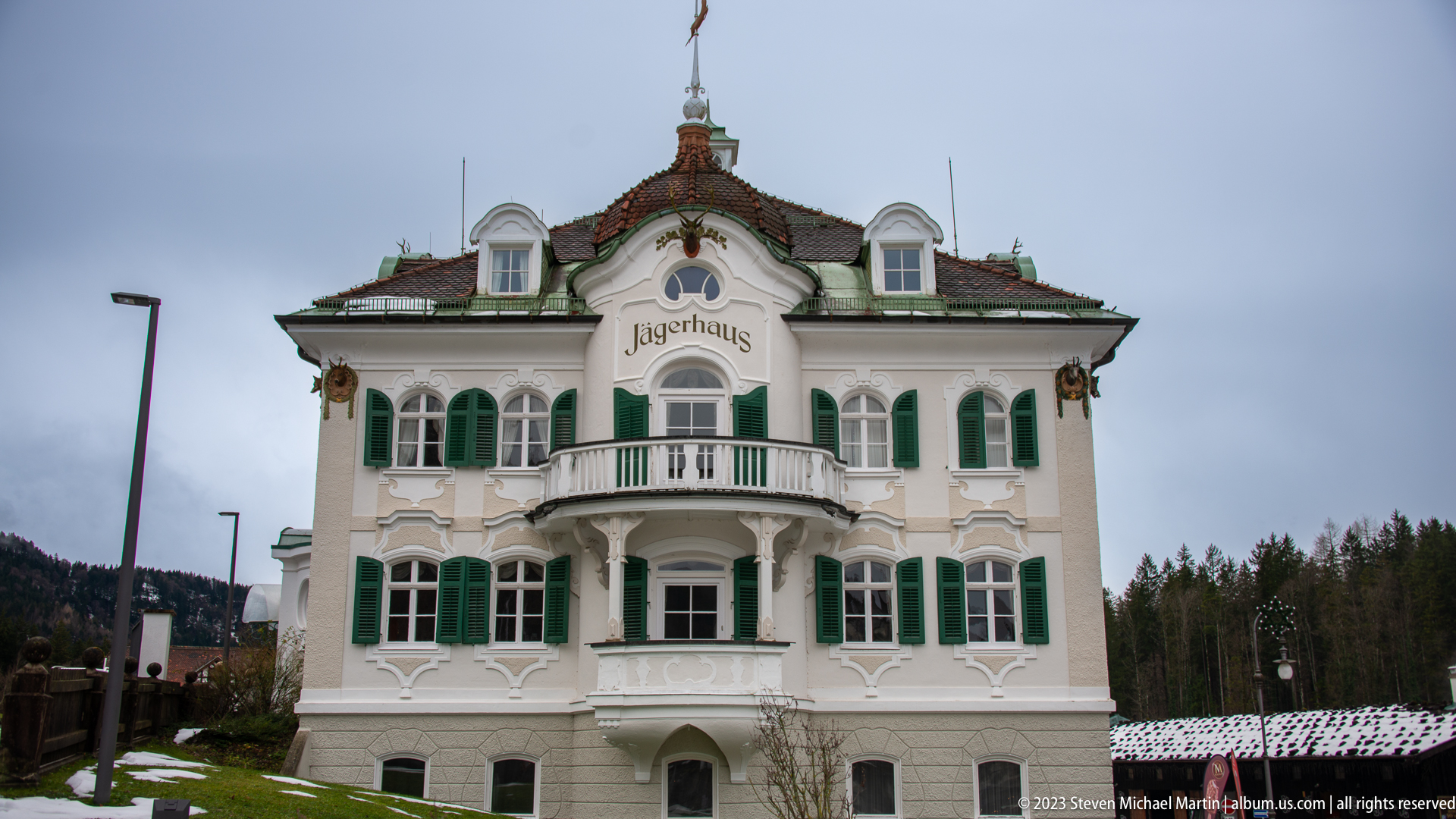
The Jägerhaus is shown frontally as a symmetrical villa with green shutters, a projecting central balcony, curved gables, and a decorative roof crest. Its white stucco façade and ornamental detailing contrast with the darker forest behind. The name 'Jägerhaus' is visible above the balcony, allowing a specific identification of this historic-looking building in the Schwangau castle district.
Caption
The Jägerhaus is shown frontally as a symmetrical villa with green shutters, a projecting central balcony, curved gables, and a decorative roof crest. Its white stucco façade and ornamental detailing contrast with the darker forest behind. The name 'Jägerhaus' is visible above the balcony, allowing a specific identification of this historic-looking building in the Schwangau castle district.

Two dark draft horses pull a covered visitor carriage along a wet mountain road bordered by snow. Passengers sit beneath a green canopy while the team advances toward the camera, illustrating the traditional carriage transport still associated with the steep access routes near the castles. Harness fittings, heavy feathering on the horses' lower legs, and the winter setting dominate the composition.
Caption
Two dark draft horses pull a covered visitor carriage along a wet mountain road bordered by snow. Passengers sit beneath a green canopy while the team advances toward the camera, illustrating the traditional carriage transport still associated with the steep access routes near the castles. Harness fittings, heavy feathering on the horses' lower legs, and the winter setting dominate the composition.
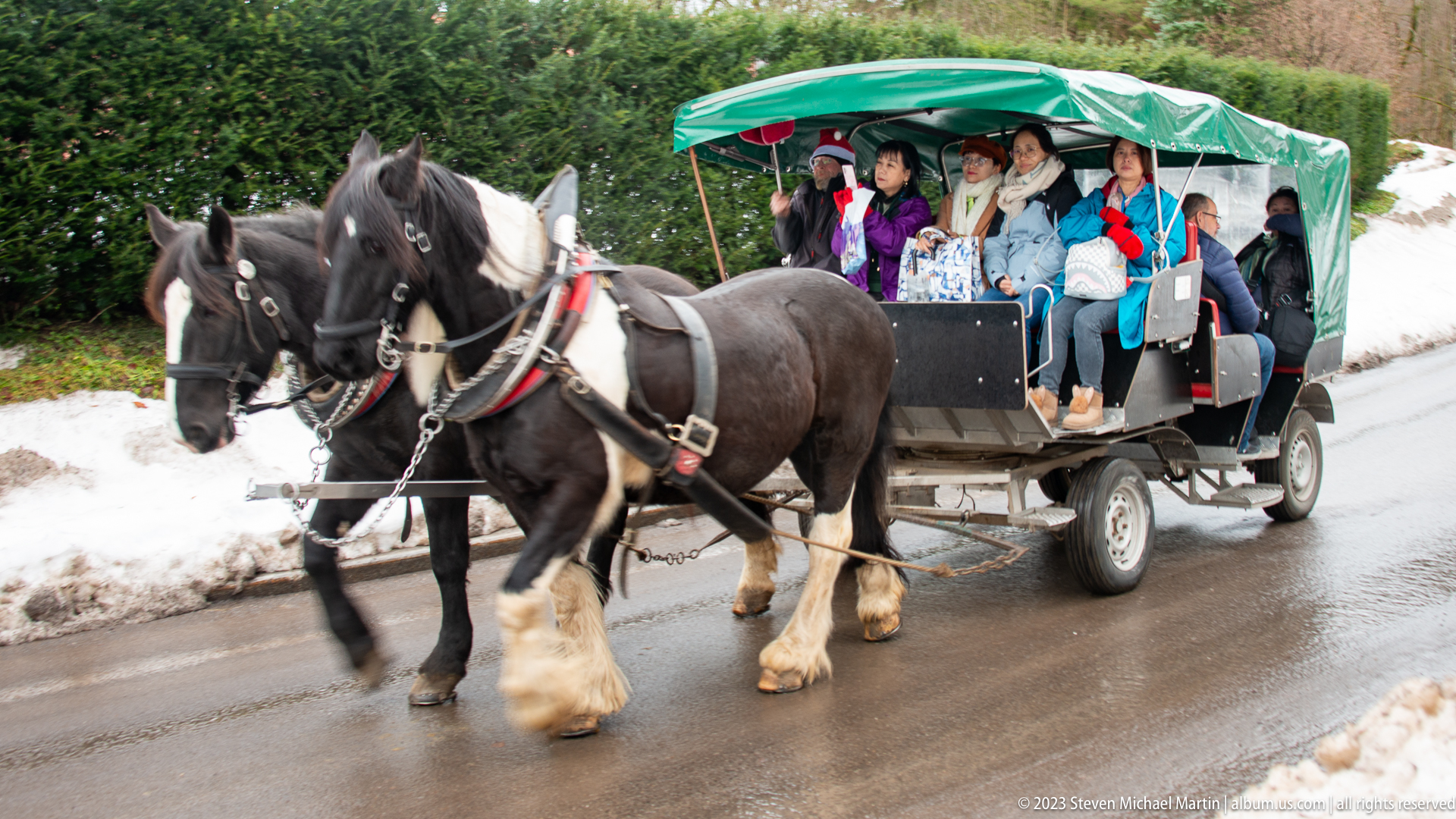
A side view brings the working horse team into close focus as two dark draft horses pull a green-canopied carriage past roadside snow. Several bundled passengers are visible inside, while the wet pavement reflects the thawing winter conditions. The frame emphasizes the scale of the horses, leather harness, and practical carriage used for visitor transport on the castle approach.
Caption
A side view brings the working horse team into close focus as two dark draft horses pull a green-canopied carriage past roadside snow. Several bundled passengers are visible inside, while the wet pavement reflects the thawing winter conditions. The frame emphasizes the scale of the horses, leather harness, and practical carriage used for visitor transport on the castle approach.
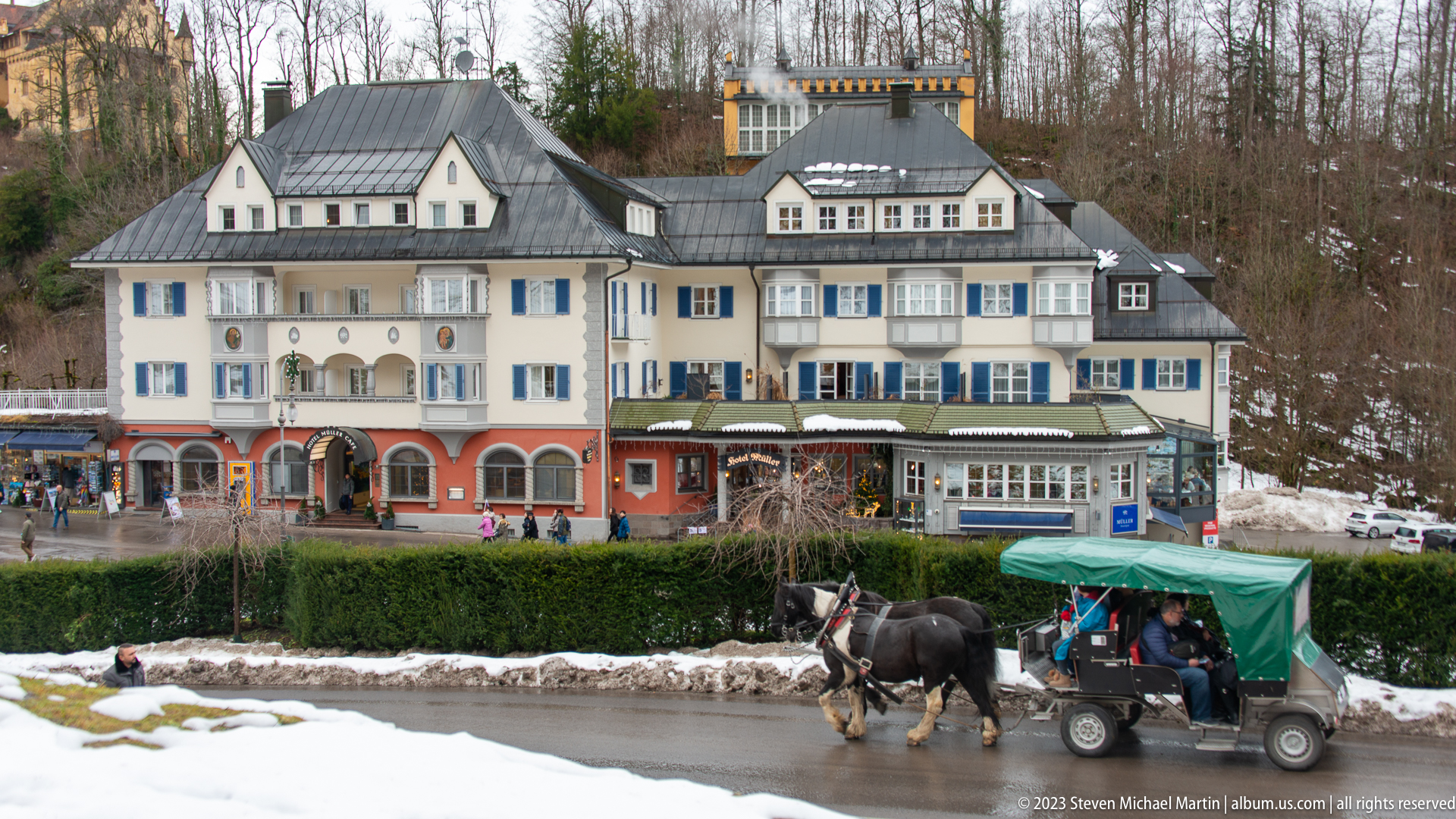
A large multiwing lodging complex with pale façades, blue shutters, steep dark roofs, and arched ground-floor openings fills the background while a horse-drawn carriage passes below. The composition places visitor infrastructure and traditional transport in the same winter scene, showing the developed settlement at the base of the royal-castle landscape rather than the castles themselves.
Caption
A large multiwing lodging complex with pale façades, blue shutters, steep dark roofs, and arched ground-floor openings fills the background while a horse-drawn carriage passes below. The composition places visitor infrastructure and traditional transport in the same winter scene, showing the developed settlement at the base of the royal-castle landscape rather than the castles themselves.
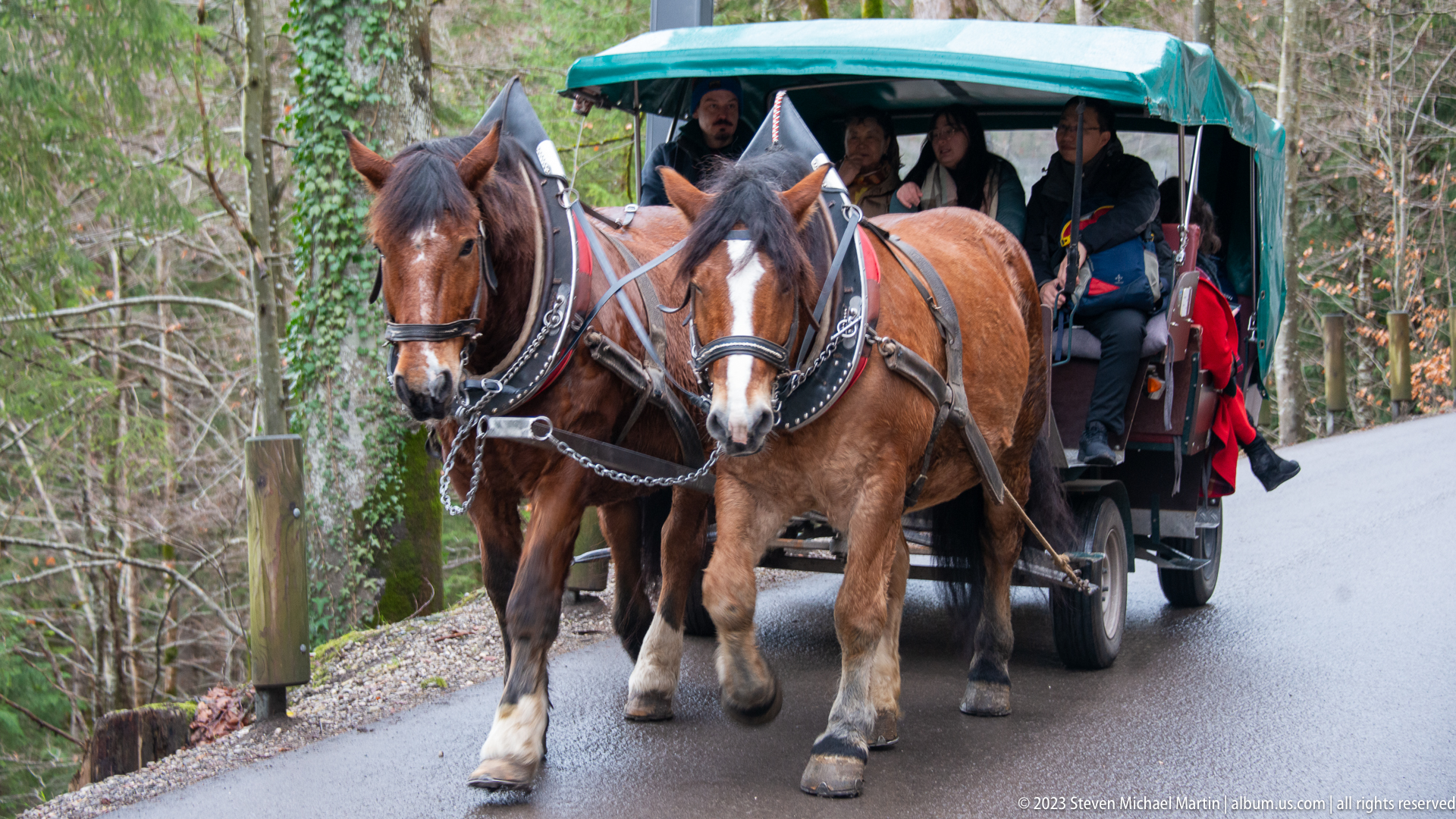
Two chestnut draft horses pull a covered passenger carriage uphill through the wooded castle approach. The close frontal angle highlights their bridles, collars, and heavy harness, while passengers sit beneath the green canopy behind them. Bare trees and damp pavement reinforce the cool-season setting and the practical role of horse transport on the steep route.
Caption
Two chestnut draft horses pull a covered passenger carriage uphill through the wooded castle approach. The close frontal angle highlights their bridles, collars, and heavy harness, while passengers sit beneath the green canopy behind them. Bare trees and damp pavement reinforce the cool-season setting and the practical role of horse transport on the steep route.
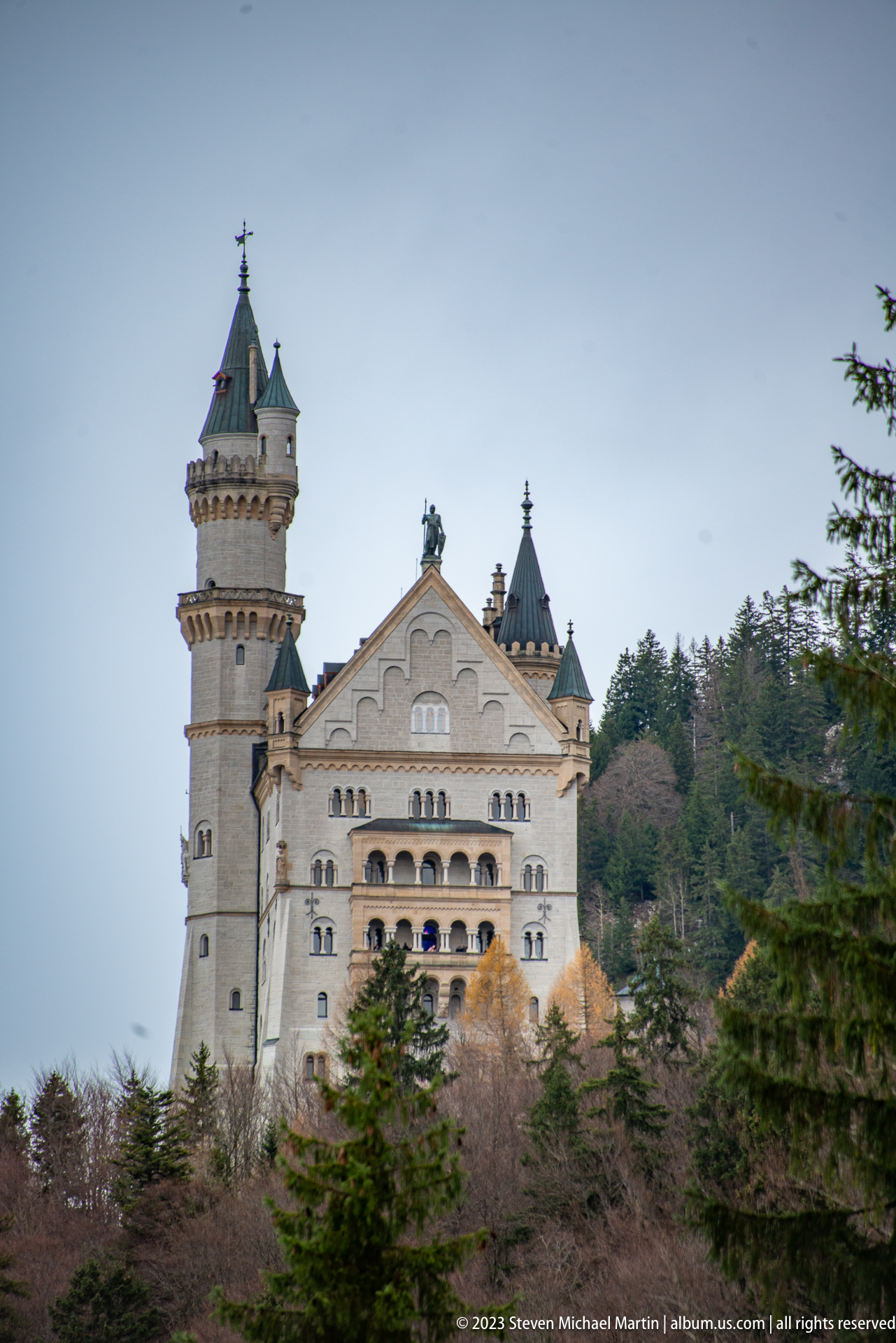
Neuschwanstein Castle appears from below through the surrounding trees, with a tall cylindrical tower and the pale Romanesque Revival palace mass rising above the wooded slope. The compressed view isolates the castle's vertical silhouette and layered roofline, offering an early architectural glimpse before the closer gatehouse and courtyard views that follow.
Caption
Neuschwanstein Castle appears from below through the surrounding trees, with a tall cylindrical tower and the pale Romanesque Revival palace mass rising above the wooded slope. The compressed view isolates the castle's vertical silhouette and layered roofline, offering an early architectural glimpse before the closer gatehouse and courtyard views that follow.
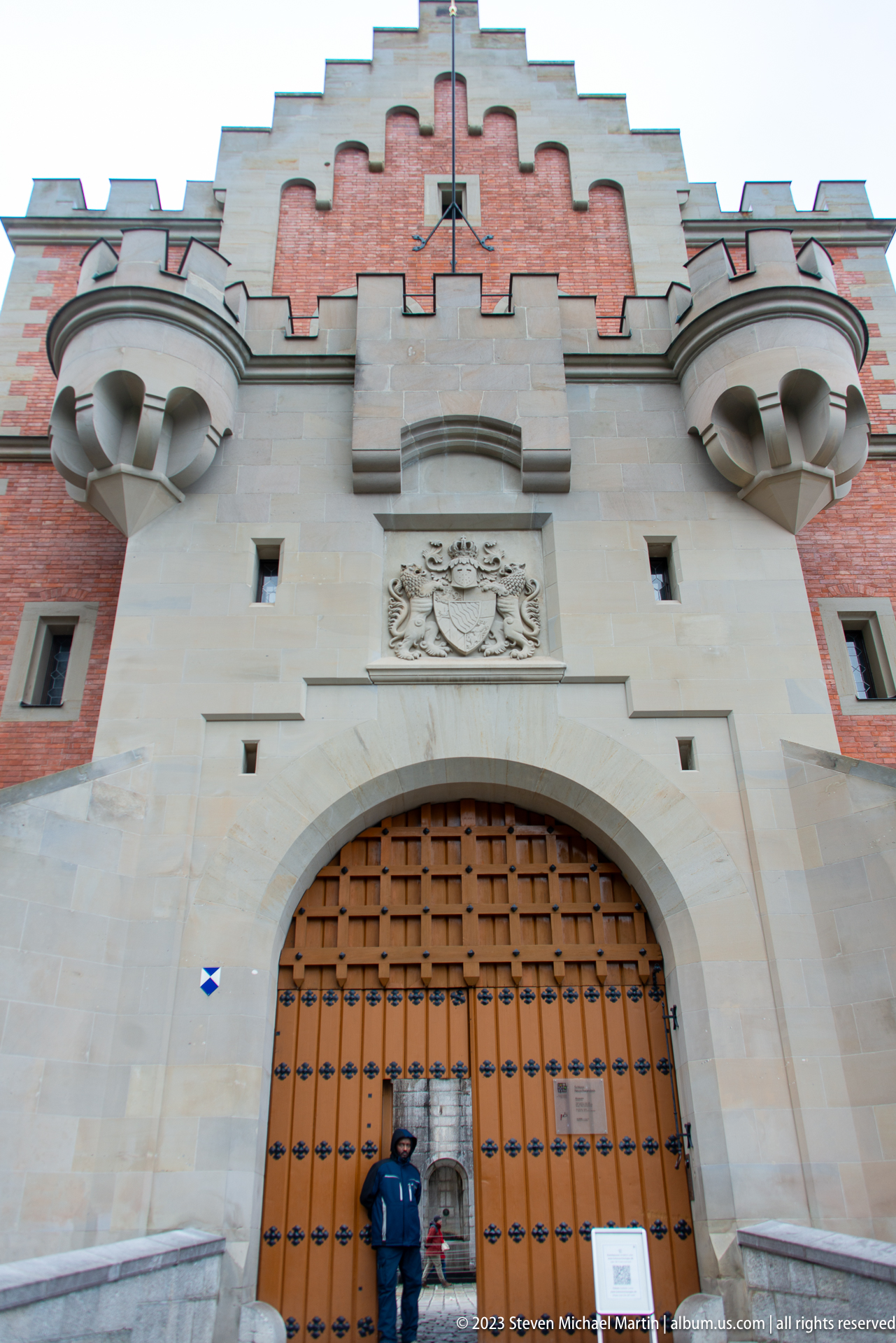
A massive studded timber gate sits beneath a broad stone arch in Neuschwanstein Castle's red-and-pale gatehouse façade. Above it, a carved heraldic panel and projecting corner oriels animate the otherwise weighty entrance composition. A visitor at the base provides scale, underscoring the monumental proportions of the gate and masonry surround.
Caption
A massive studded timber gate sits beneath a broad stone arch in Neuschwanstein Castle's red-and-pale gatehouse façade. Above it, a carved heraldic panel and projecting corner oriels animate the otherwise weighty entrance composition. A visitor at the base provides scale, underscoring the monumental proportions of the gate and masonry surround.
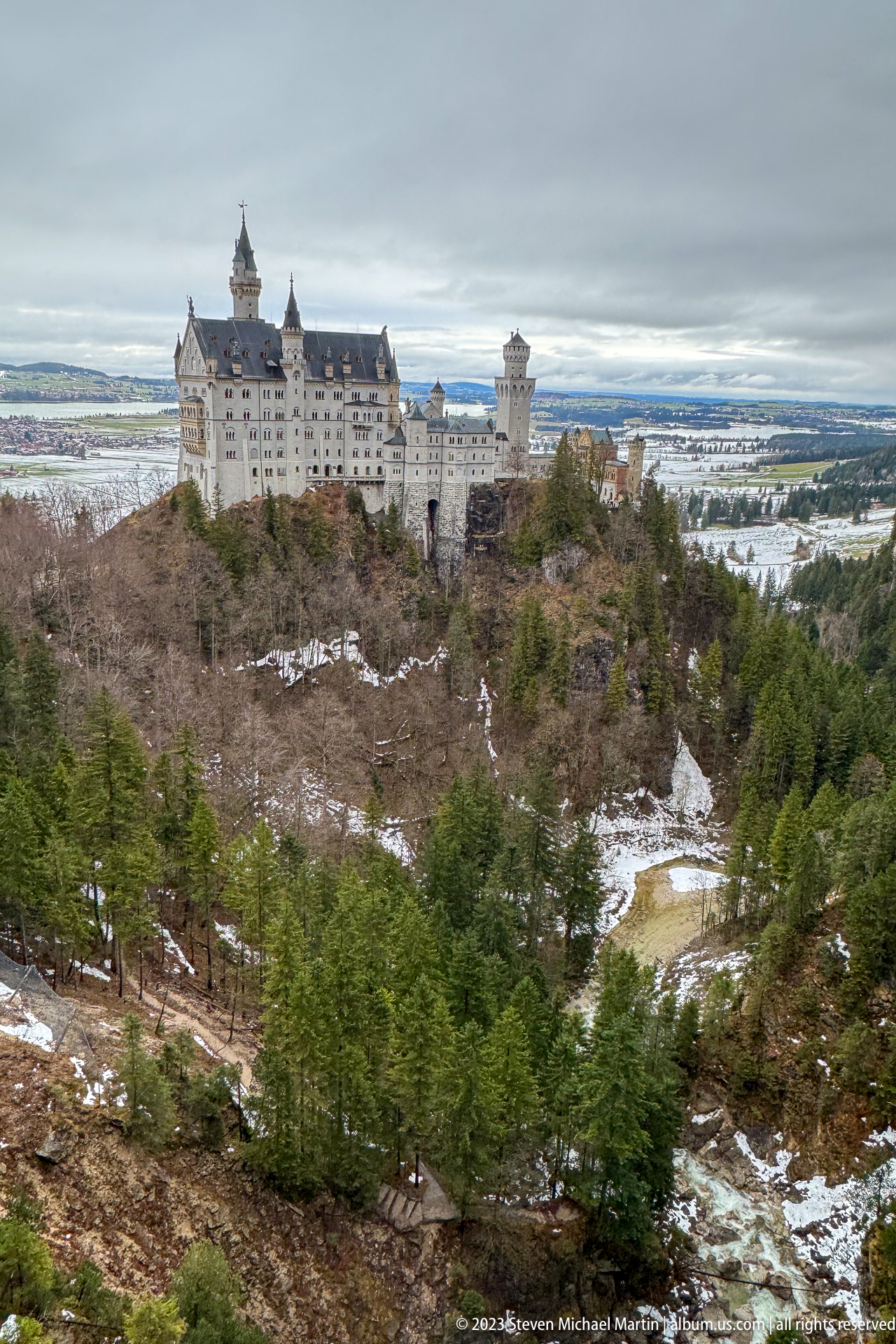
Neuschwanstein Castle stands across a wooded ravine with the broad Bavarian plain stretching behind it under a gray winter sky. Snow lies in patches among the trees and fields, while the castle's pale façades and towers form a compact silhouette on the ridge. The distant viewpoint emphasizes the site's commanding relationship to the surrounding lowlands.
Caption
Neuschwanstein Castle stands across a wooded ravine with the broad Bavarian plain stretching behind it under a gray winter sky. Snow lies in patches among the trees and fields, while the castle's pale façades and towers form a compact silhouette on the ridge. The distant viewpoint emphasizes the site's commanding relationship to the surrounding lowlands.
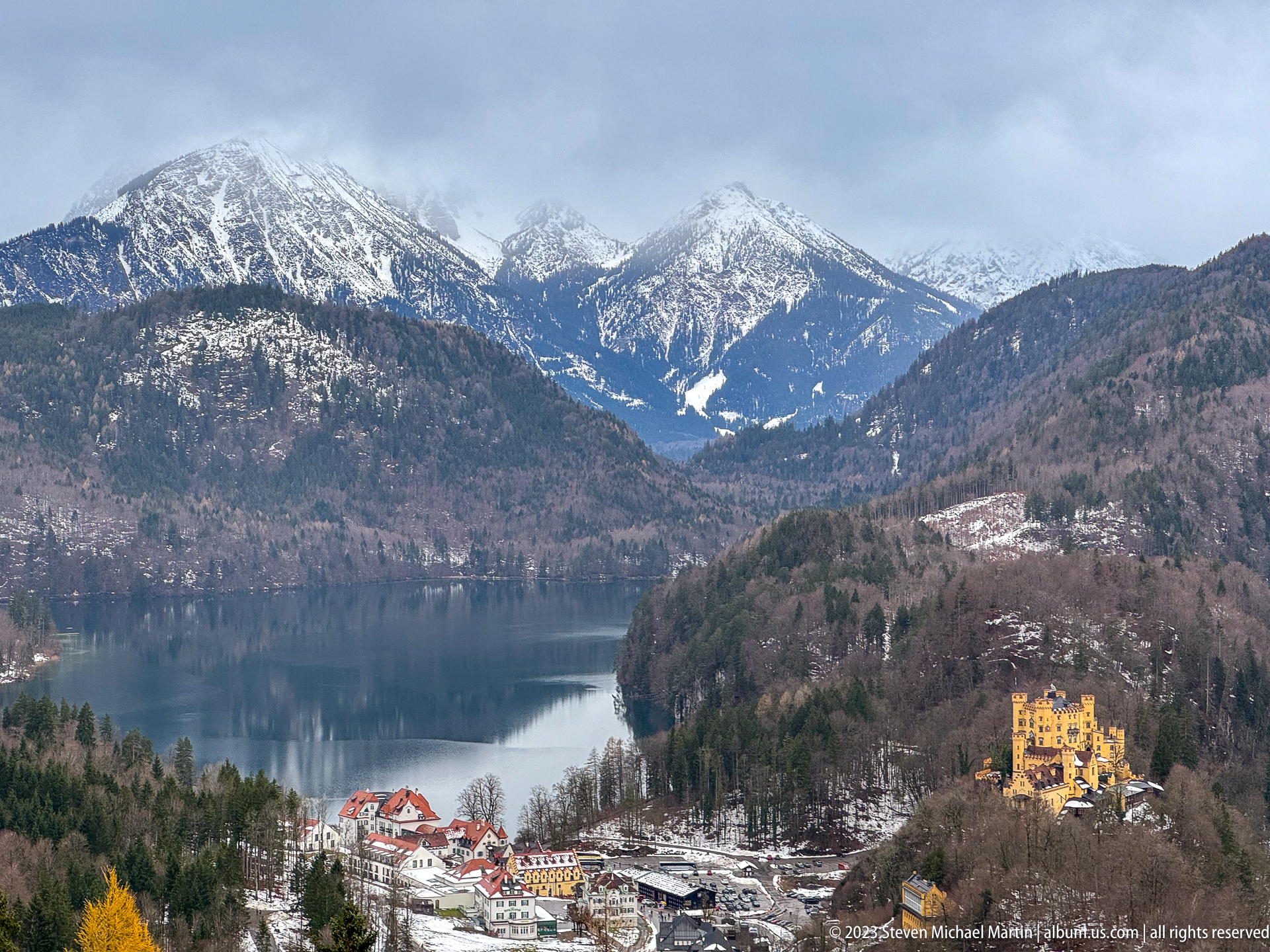
A broad alpine panorama looks across Alpsee toward snow-dusted mountains, with Hohenschwangau Castle glowing ochre on a wooded knoll above the settlement. The elevated viewpoint ties the royal residence to the lake basin and mountain backdrop, making the landscape setting as important as the architecture. Winter snow traces the higher ridges and open ground.
Caption
A broad alpine panorama looks across Alpsee toward snow-dusted mountains, with Hohenschwangau Castle glowing ochre on a wooded knoll above the settlement. The elevated viewpoint ties the royal residence to the lake basin and mountain backdrop, making the landscape setting as important as the architecture. Winter snow traces the higher ridges and open ground.
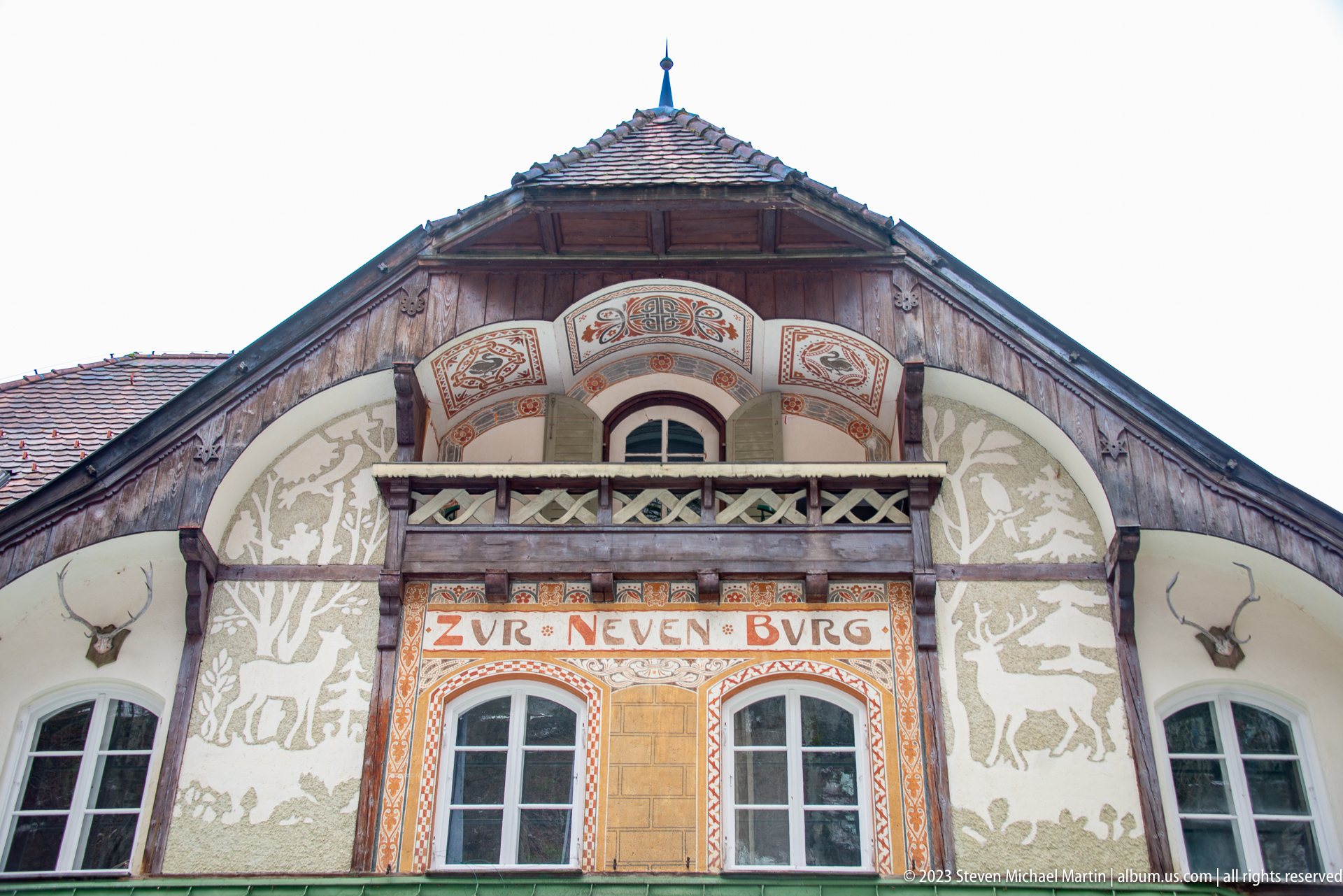
A richly decorated gable combines painted scrolling ornament, figurative motifs, timber trim, and the inscription 'ZUR NEUEN BURG' across the center. The symmetrical façade detail uses historicizing imagery and patterned borders to create a theatrical regional character. Framed tightly against the roof peak, the photograph functions as an architectural-detail study rather than an establishing view of the building.
Caption
A richly decorated gable combines painted scrolling ornament, figurative motifs, timber trim, and the inscription 'ZUR NEUEN BURG' across the center. The symmetrical façade detail uses historicizing imagery and patterned borders to create a theatrical regional character. Framed tightly against the roof peak, the photograph functions as an architectural-detail study rather than an establishing view of the building.
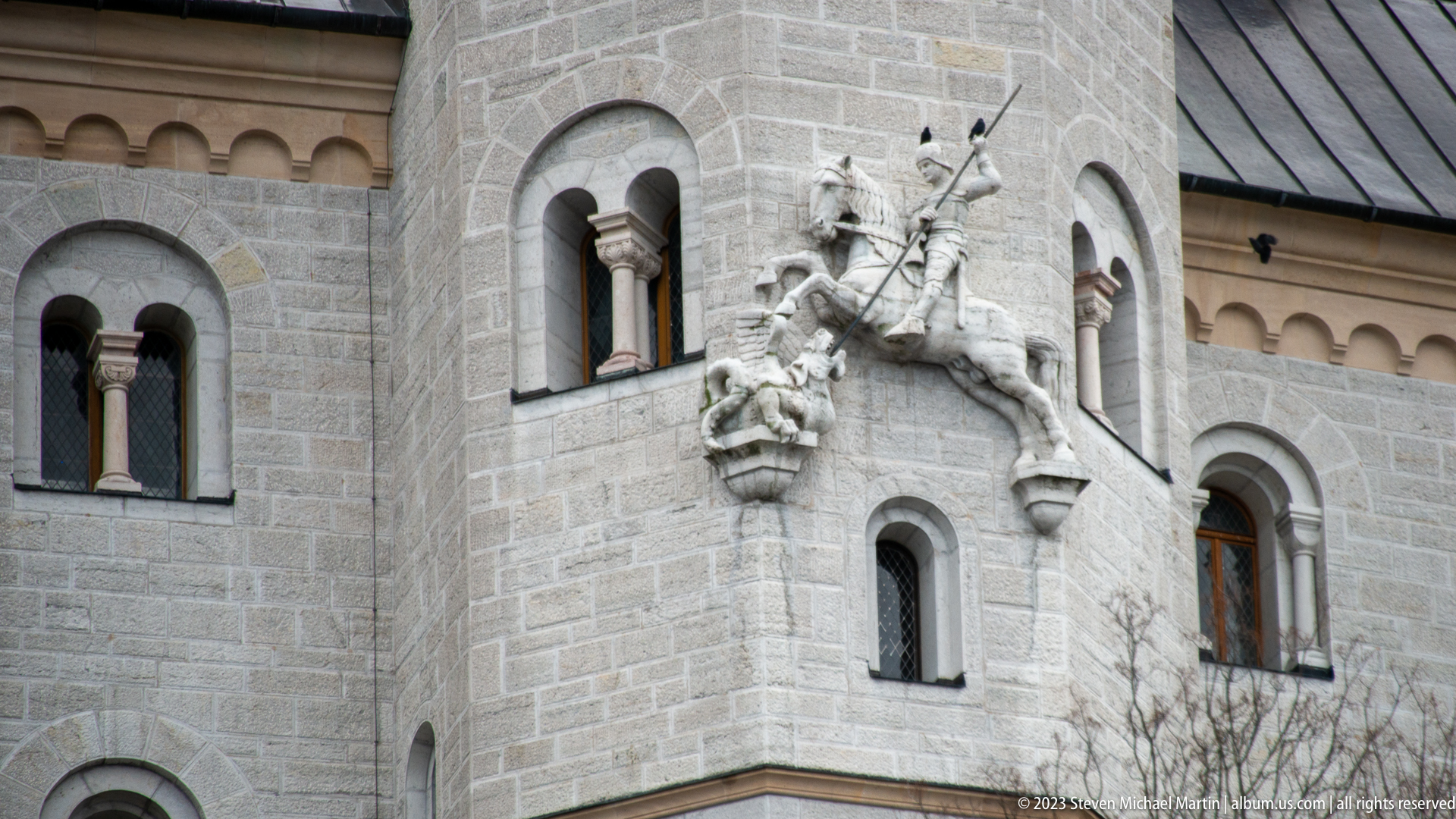
A mounted knight in high relief projects from the pale masonry of Neuschwanstein Castle beside paired round-arched windows. The sculptural group is integrated directly into the façade, where its medievalizing imagery reinforces the castle's 19th-century historicist program. The tight composition reveals carved stonework, columned openings, and the contrast between sculpture and rusticated wall surface.
Caption
A mounted knight in high relief projects from the pale masonry of Neuschwanstein Castle beside paired round-arched windows. The sculptural group is integrated directly into the façade, where its medievalizing imagery reinforces the castle's 19th-century historicist program. The tight composition reveals carved stonework, columned openings, and the contrast between sculpture and rusticated wall surface.

Neuschwanstein Castle rises dramatically above its rocky foundation in a three-quarter view that brings together the red gatehouse, pale towers, and taller palace structures behind. Snow patches remain on the slope and mountains beyond, while leafless trees open the view through the winter woods. The image clearly shows the castle's layered construction and adaptation to the steep ridge.
Caption
Neuschwanstein Castle rises dramatically above its rocky foundation in a three-quarter view that brings together the red gatehouse, pale towers, and taller palace structures behind. Snow patches remain on the slope and mountains beyond, while leafless trees open the view through the winter woods. The image clearly shows the castle's layered construction and adaptation to the steep ridge.
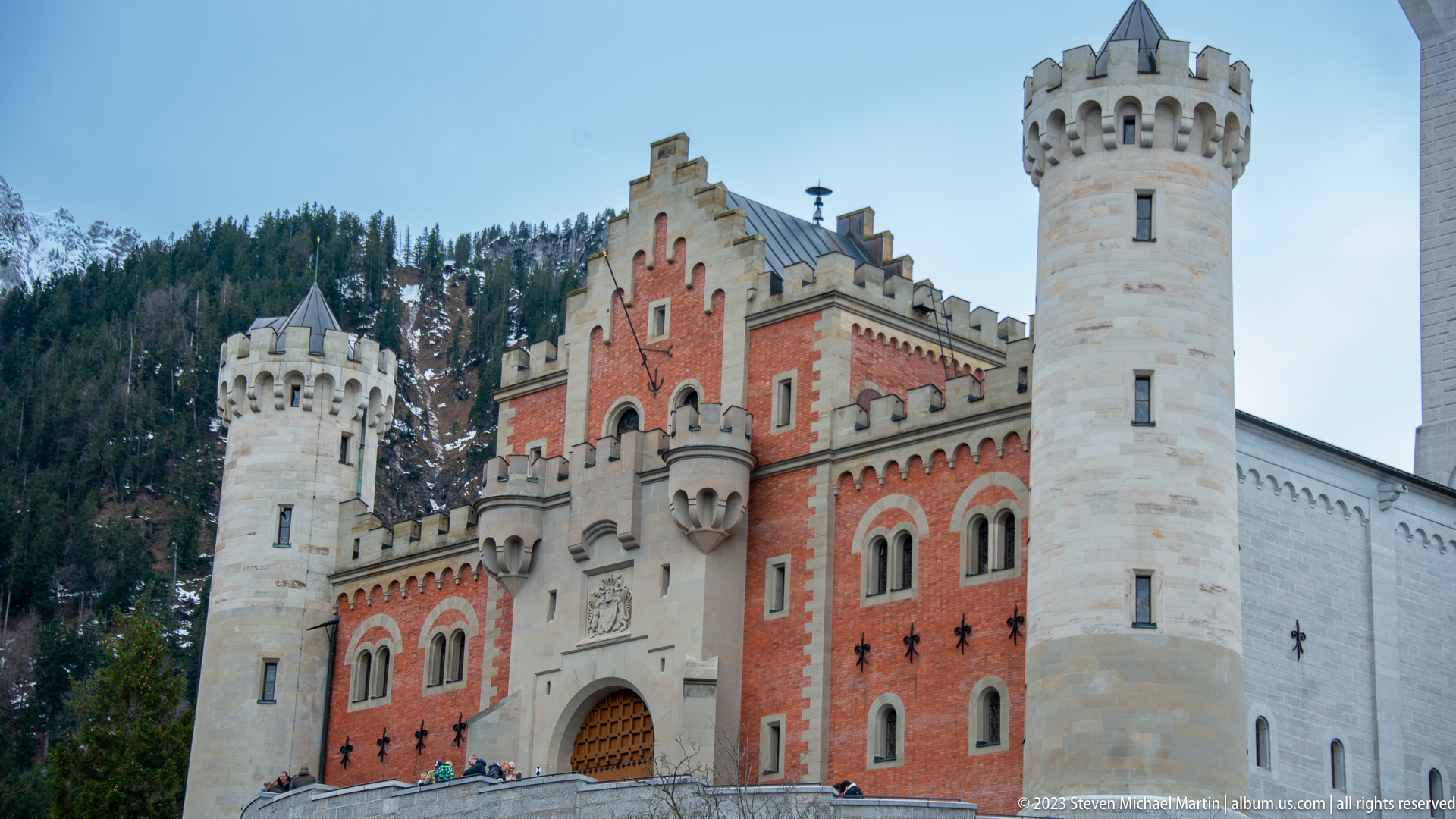
The red-and-white gatehouse of Neuschwanstein Castle fills the frame, flanked by cylindrical pale-stone towers with crenellated crowns. Round-arched windows, decorative corbels, and a central arched entrance give the façade its strongly historicizing character. Seen from close range, the view emphasizes the contrast between red masonry surfaces and light stone architectural trim.
Caption
The red-and-white gatehouse of Neuschwanstein Castle fills the frame, flanked by cylindrical pale-stone towers with crenellated crowns. Round-arched windows, decorative corbels, and a central arched entrance give the façade its strongly historicizing character. Seen from close range, the view emphasizes the contrast between red masonry surfaces and light stone architectural trim.
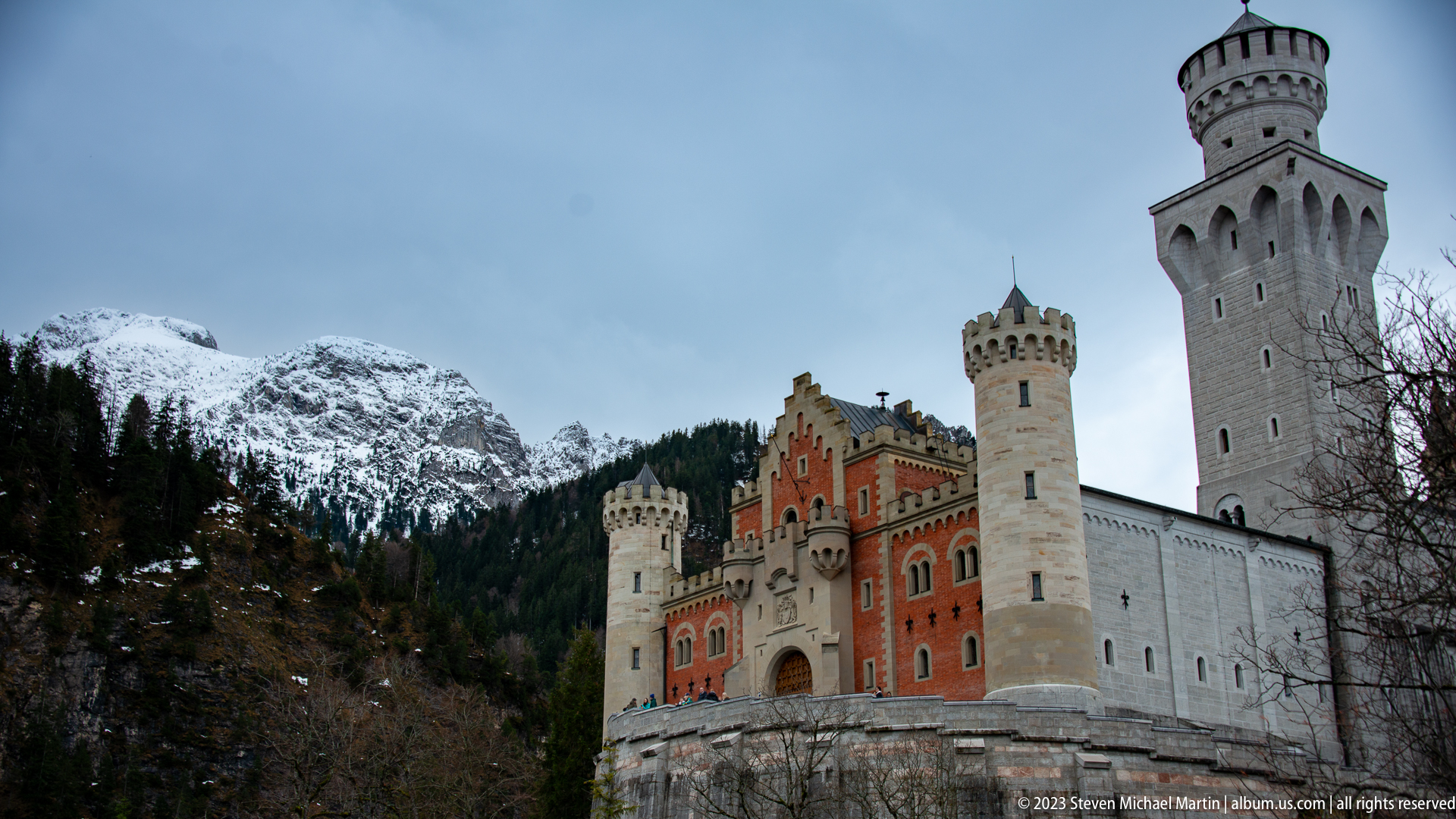
A low vantage point frames Neuschwanstein's red gatehouse and pale towers against a snow-dusted alpine ridge. The tall cylindrical tower at right dominates the vertical composition, while the gatehouse's red façade anchors the lower center. Winter vegetation and dark conifers surround the masonry, strengthening the visual contrast between designed architecture and the rugged mountain setting.
Caption
A low vantage point frames Neuschwanstein's red gatehouse and pale towers against a snow-dusted alpine ridge. The tall cylindrical tower at right dominates the vertical composition, while the gatehouse's red façade anchors the lower center. Winter vegetation and dark conifers surround the masonry, strengthening the visual contrast between designed architecture and the rugged mountain setting.
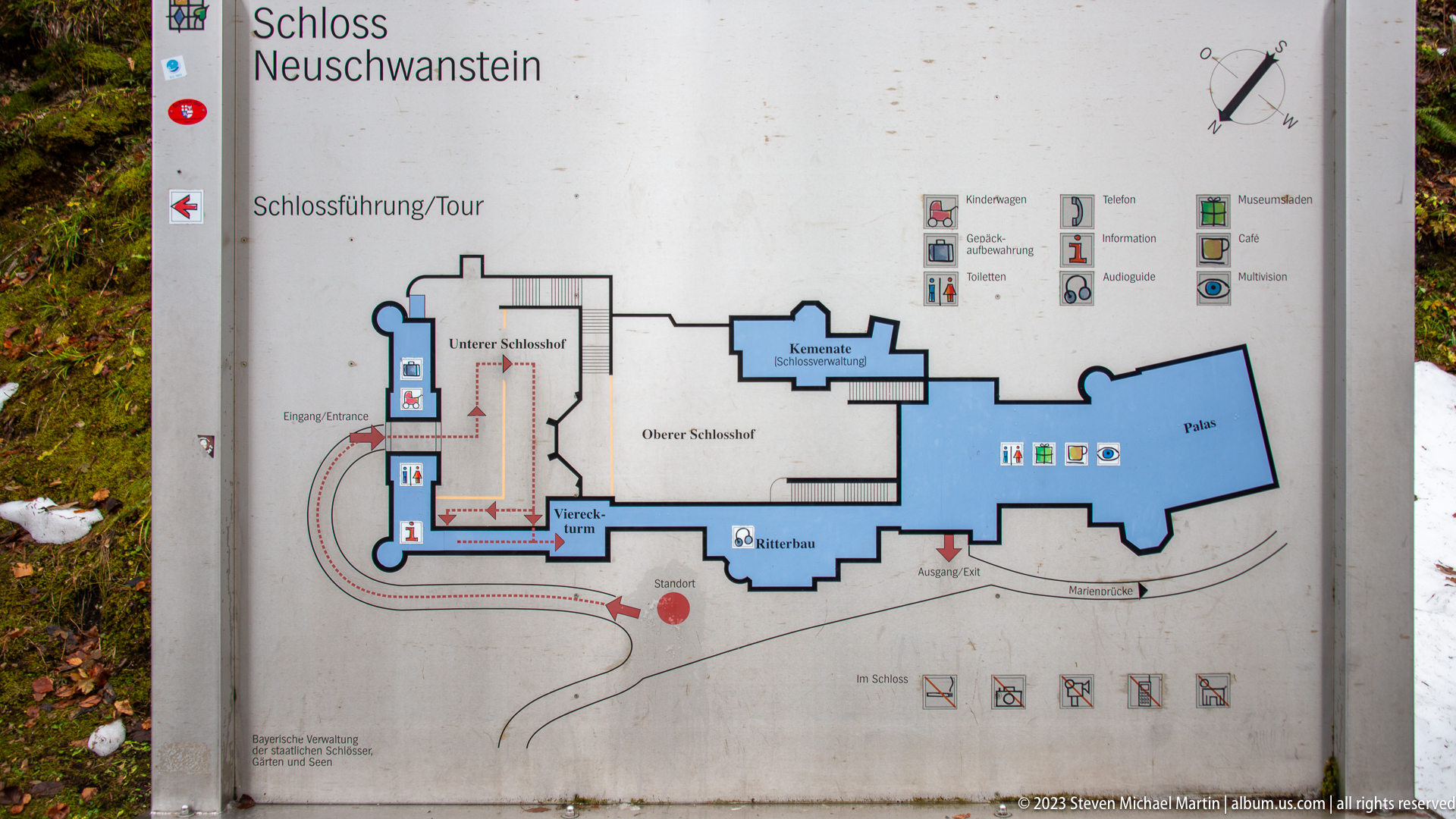
A posted visitor map diagrams the Neuschwanstein Castle tour route, with rooms and circulation paths shown in contrasting colors and directional arrows. The sign includes the castle name and labels for interior spaces, making it a useful documentary record of visitor movement through the complex. The photograph focuses on interpretation and access rather than architecture itself.
Caption
A posted visitor map diagrams the Neuschwanstein Castle tour route, with rooms and circulation paths shown in contrasting colors and directional arrows. The sign includes the castle name and labels for interior spaces, making it a useful documentary record of visitor movement through the complex. The photograph focuses on interpretation and access rather than architecture itself.
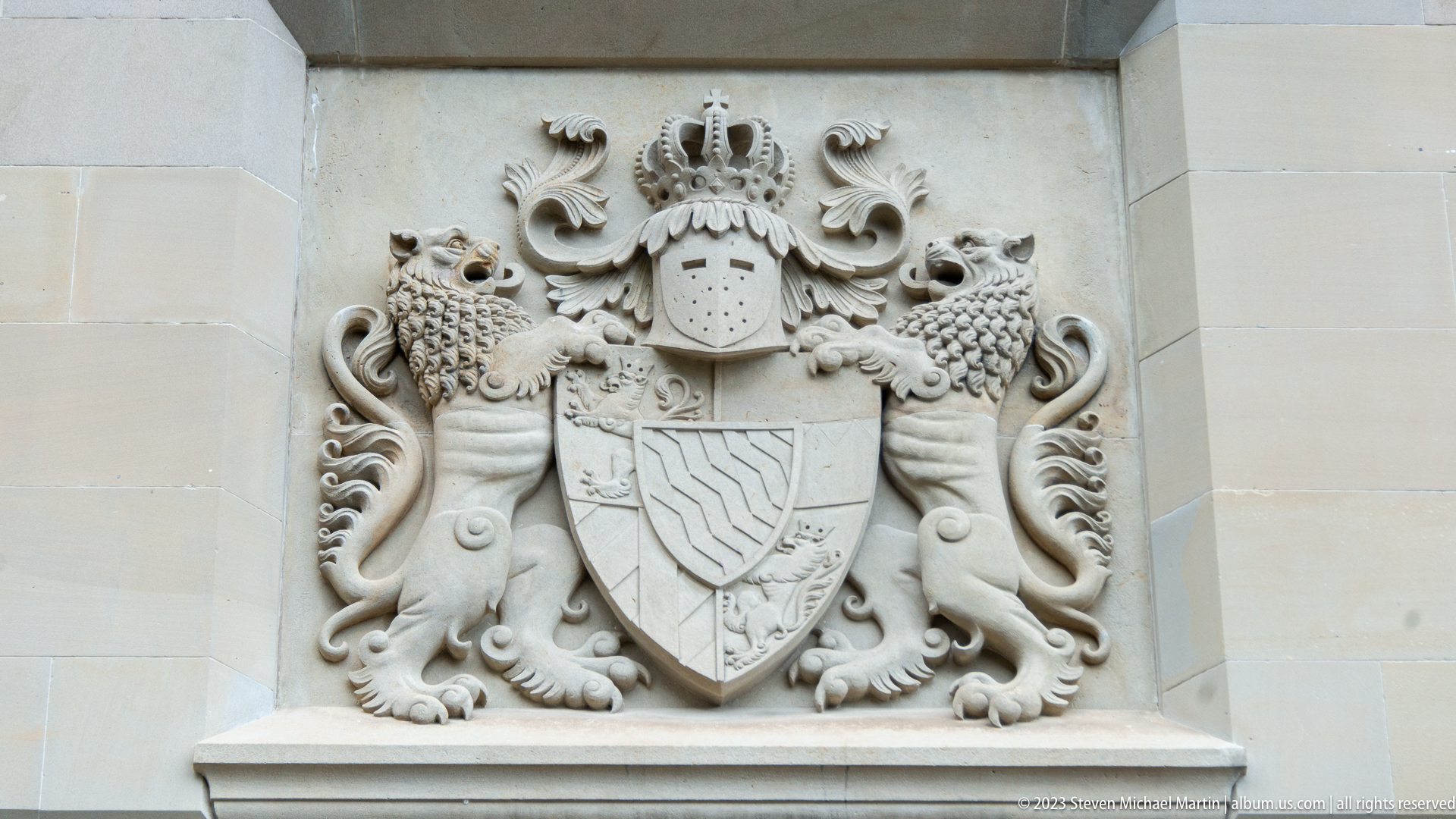
A pale stone heraldic relief presents a quartered shield beneath a crowned helmet, flanked by two rampant lions and surrounded by elaborate mantling. The symmetrical carving is set into the castle wall as a formal dynastic emblem. Fine details in the fur, crown, shield, and scrolling ornament remain legible despite the monochrome stone surface.
Caption
A pale stone heraldic relief presents a quartered shield beneath a crowned helmet, flanked by two rampant lions and surrounded by elaborate mantling. The symmetrical carving is set into the castle wall as a formal dynastic emblem. Fine details in the fur, crown, shield, and scrolling ornament remain legible despite the monochrome stone surface.
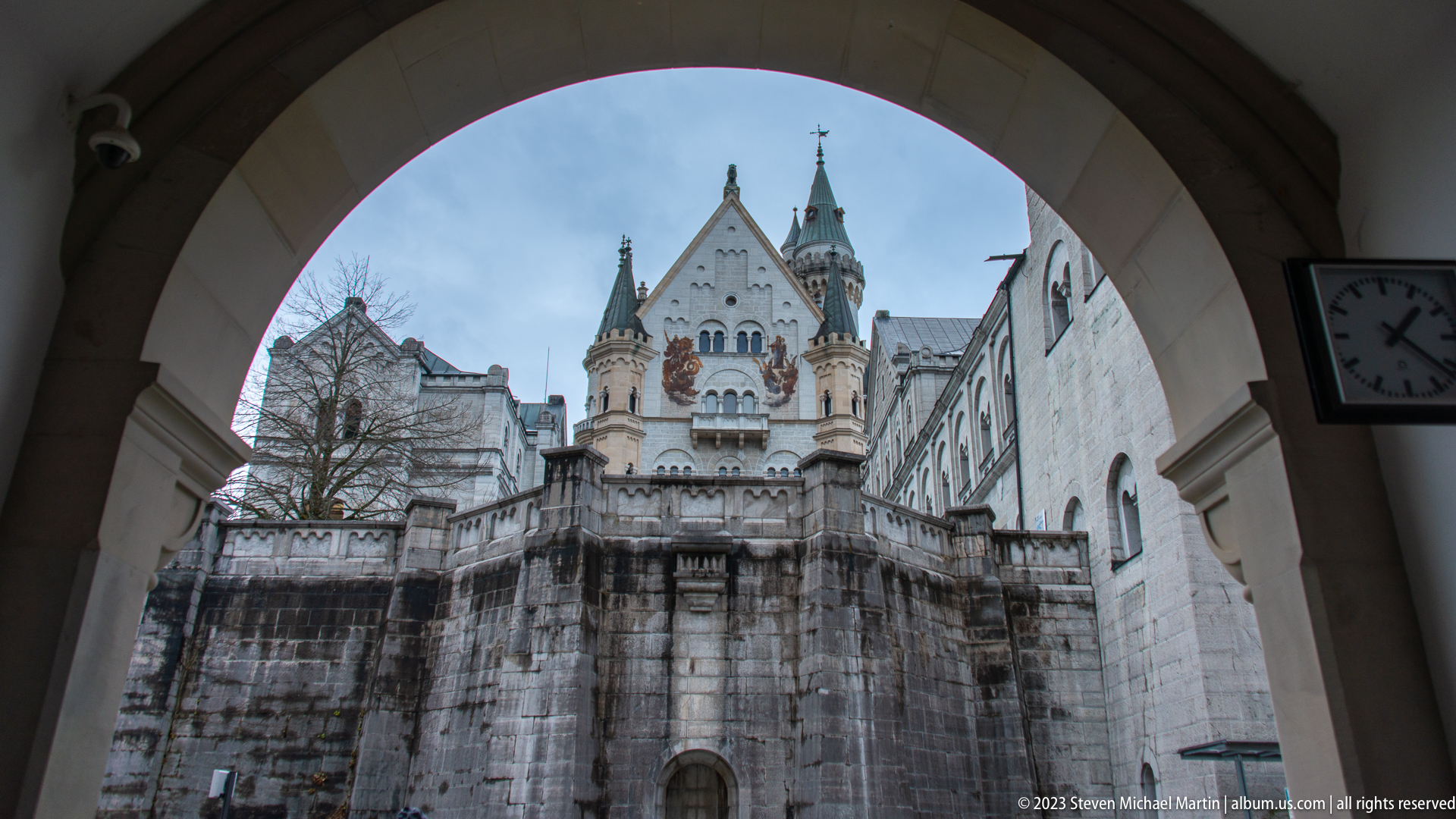
An arched passage frames the ornate Palas façade inside Neuschwanstein Castle, turning the opening itself into a visual border around pointed gables, towers, balconies, and mural decoration. The viewpoint from shadow into the brighter courtyard accentuates depth and the transition from the gate complex to the inner residential architecture.
Caption
An arched passage frames the ornate Palas façade inside Neuschwanstein Castle, turning the opening itself into a visual border around pointed gables, towers, balconies, and mural decoration. The viewpoint from shadow into the brighter courtyard accentuates depth and the transition from the gate complex to the inner residential architecture.
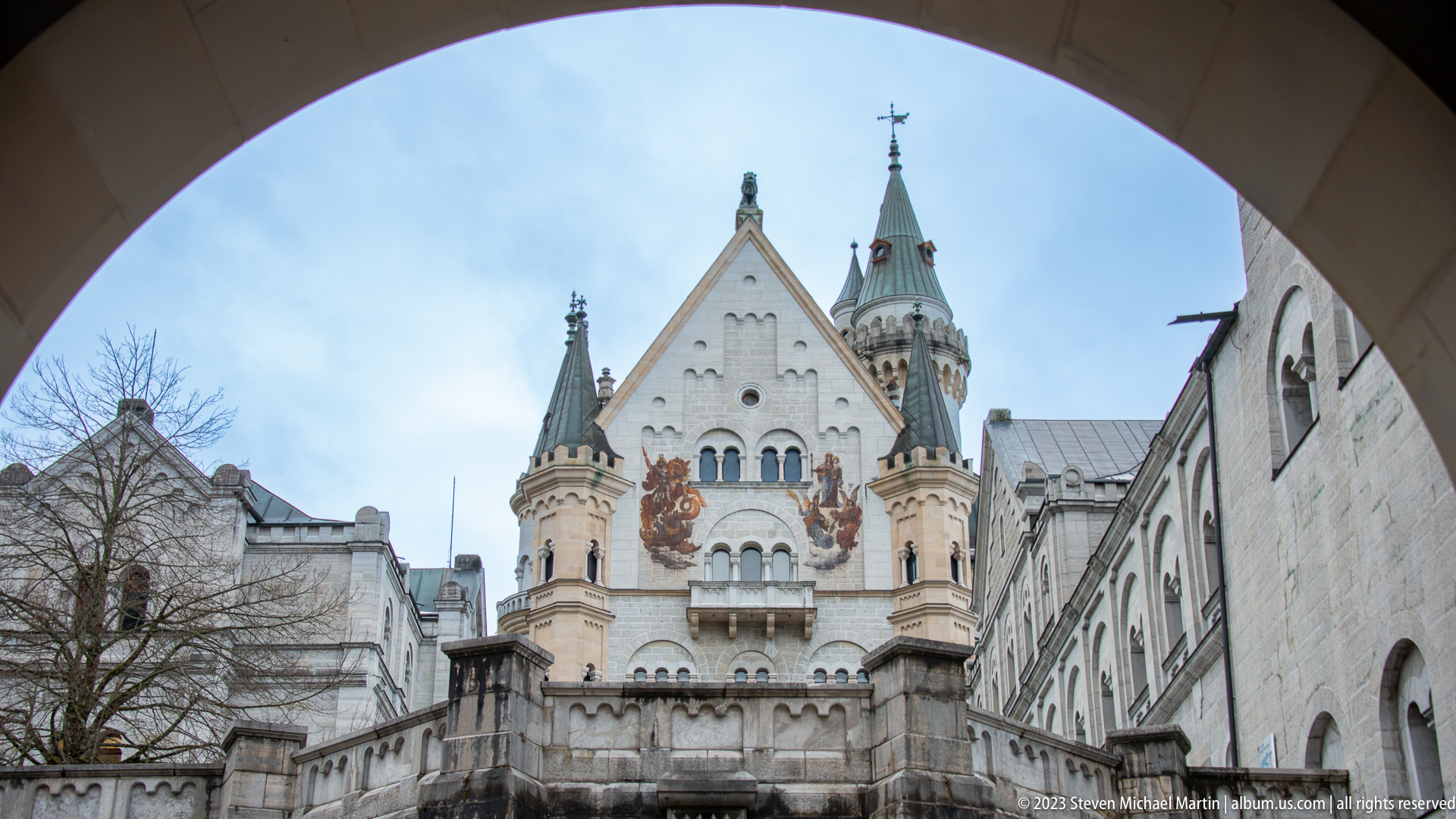
A closer view through the courtyard arch isolates Neuschwanstein's Palas, with its steep central gable, flanking turrets, arcaded balconies, and painted historical scenes. The curved arch remains visible along the top edge, emphasizing the layered approach into the inner court. Repeated round-arched openings and pale masonry create a dense, vertically organized façade.
Caption
A closer view through the courtyard arch isolates Neuschwanstein's Palas, with its steep central gable, flanking turrets, arcaded balconies, and painted historical scenes. The curved arch remains visible along the top edge, emphasizing the layered approach into the inner court. Repeated round-arched openings and pale masonry create a dense, vertically organized façade.
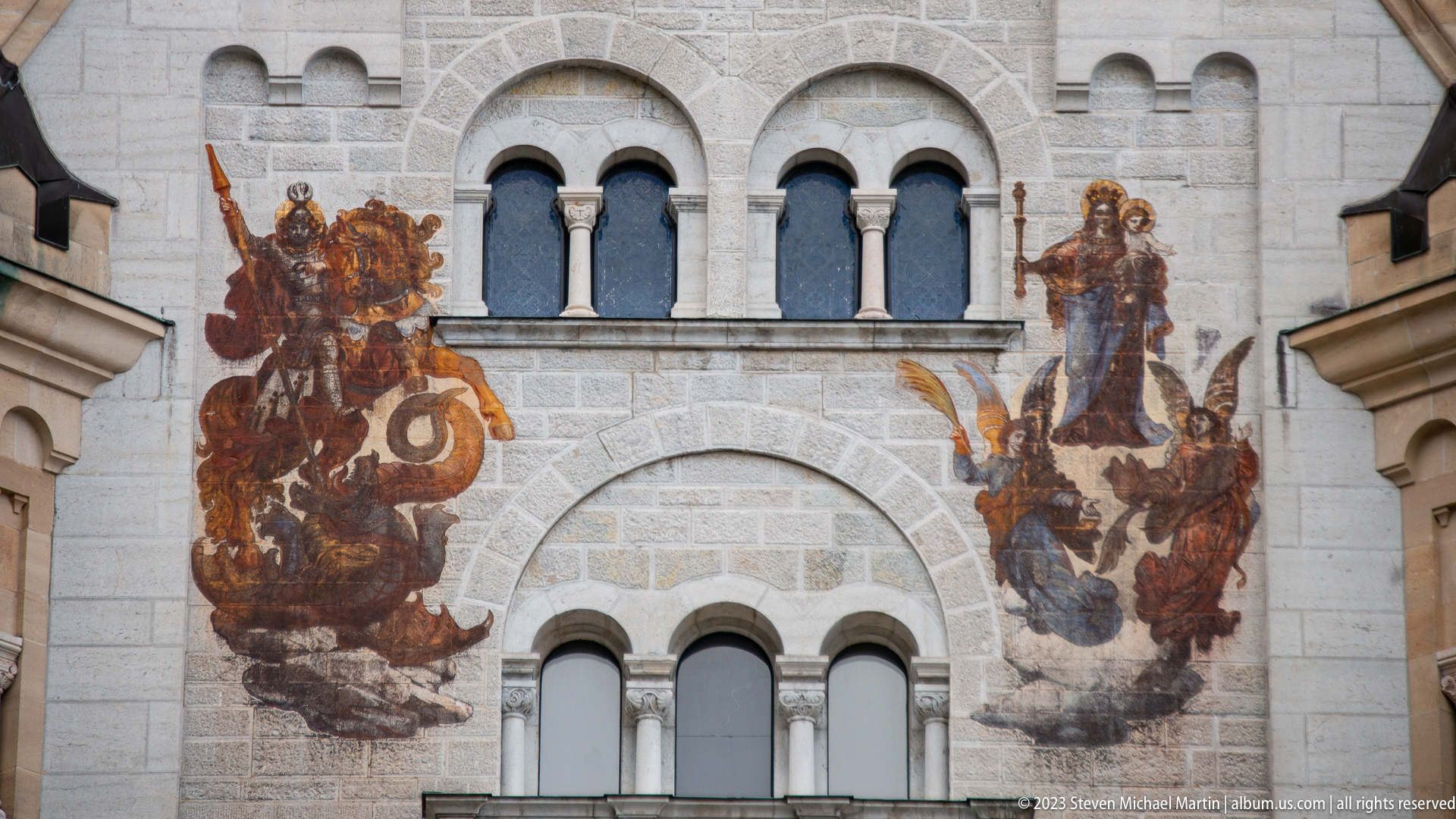
Painted figures flank the arched windows of Neuschwanstein Castle's Palas, creating a theatrical historicizing program across the pale stone façade. Armored and robed figures appear in vertical groupings between and beside the windows, while the masonry's round arches reinforce the medievalizing setting. The close view documents decorative narrative painting as an integral element of the exterior architecture.
Caption
Painted figures flank the arched windows of Neuschwanstein Castle's Palas, creating a theatrical historicizing program across the pale stone façade. Armored and robed figures appear in vertical groupings between and beside the windows, while the masonry's round arches reinforce the medievalizing setting. The close view documents decorative narrative painting as an integral element of the exterior architecture.
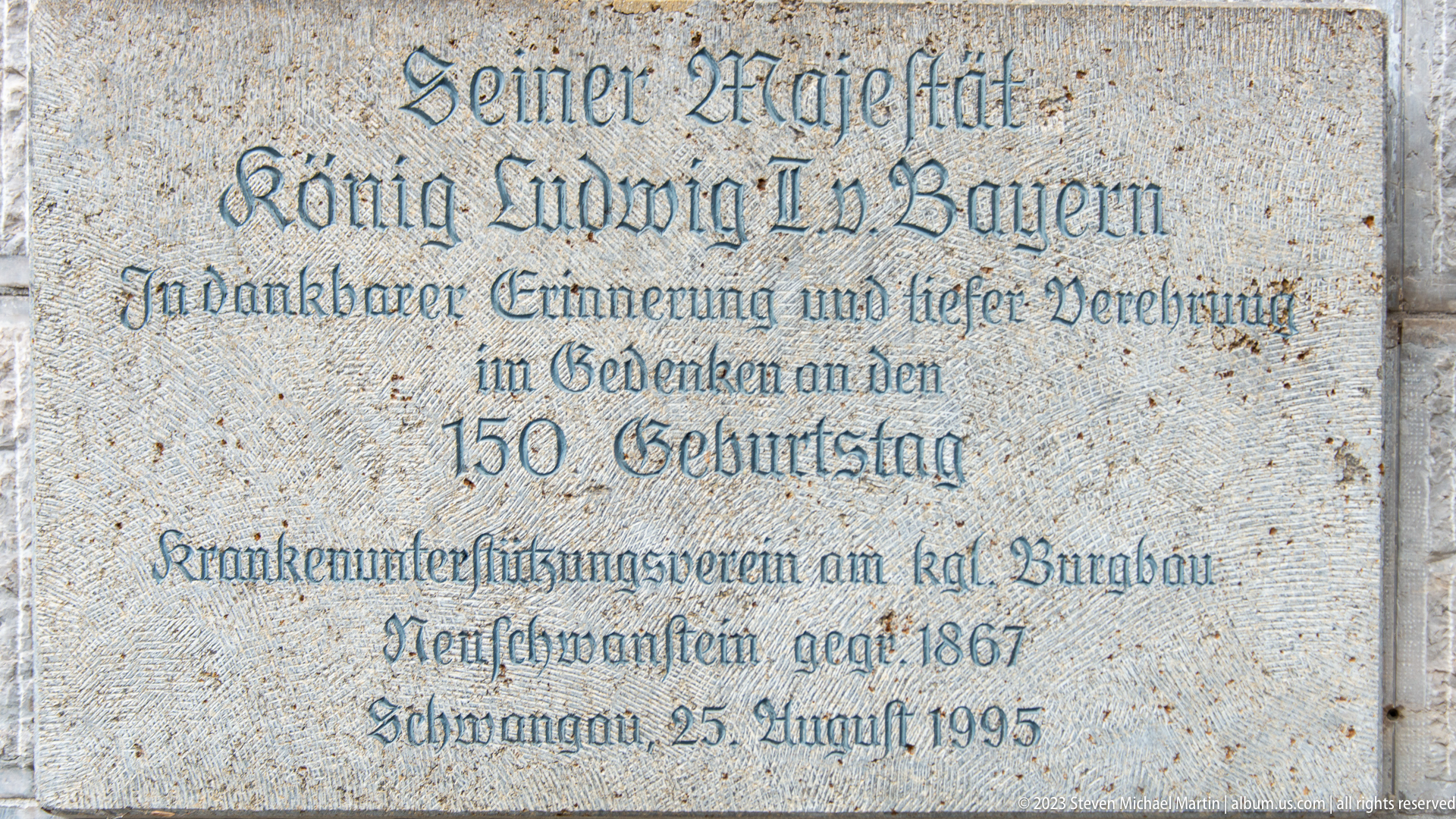
A stone plaque commemorates King Ludwig II of Bavaria on the 150th anniversary of his birth. The German inscription names the king, gives his birth year as 1845, and records a dedication at Neuschwanstein dated 25 August 1995. Weathering and small surface stains remain visible across the incised lettering, giving the memorial a documentary character.
Caption
A stone plaque commemorates King Ludwig II of Bavaria on the 150th anniversary of his birth. The German inscription names the king, gives his birth year as 1845, and records a dedication at Neuschwanstein dated 25 August 1995. Weathering and small surface stains remain visible across the incised lettering, giving the memorial a documentary character.
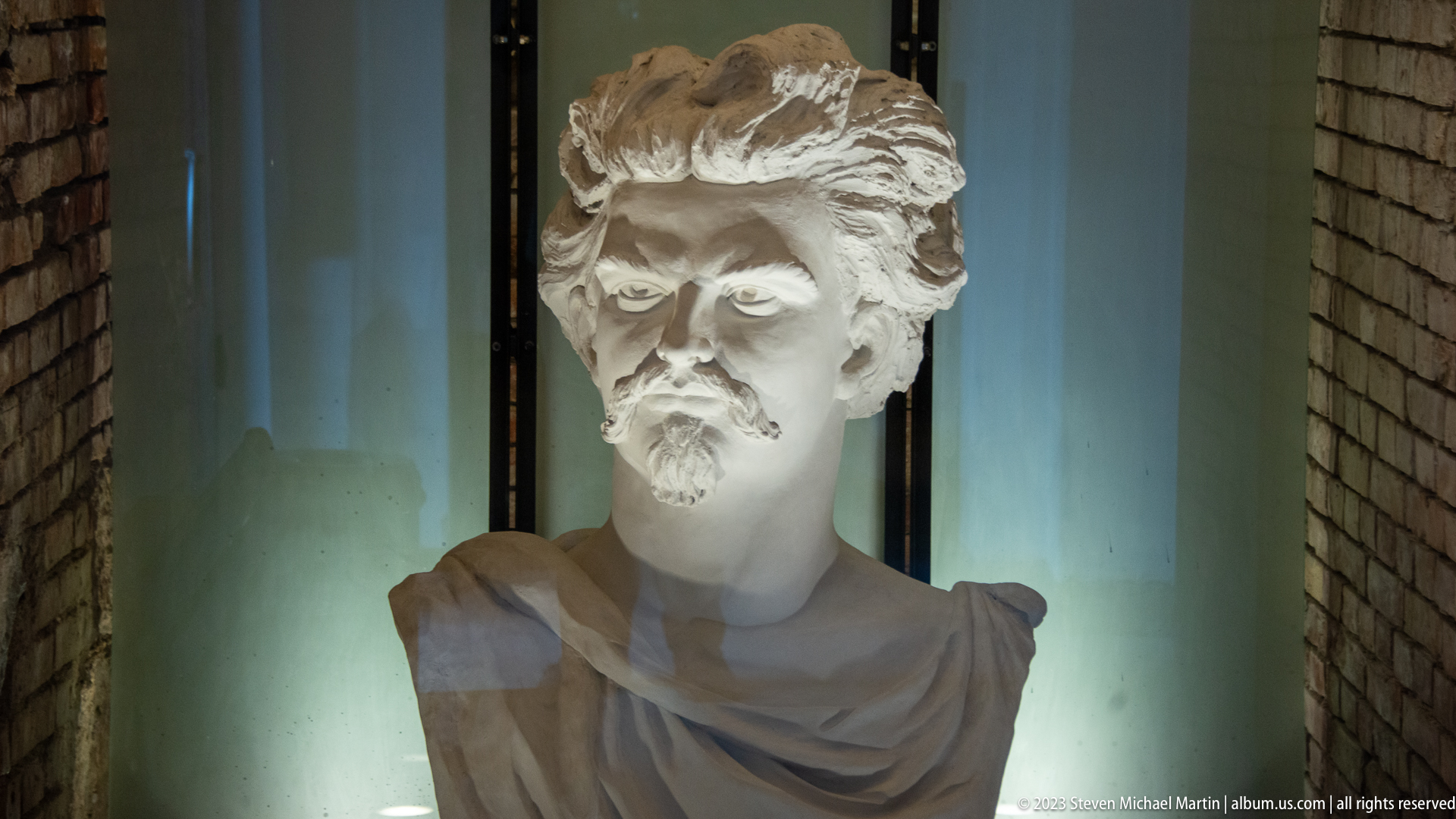
A sculpted bust of a young moustached man is displayed behind glass near Neuschwanstein Castle, lit from below against a dark interior. The swept hair, moustache, and draped shoulders create a romanticized royal portrait consistent with imagery associated with King Ludwig II. Because the proof sheet does not show an identifying label, the sitter's identity should be treated cautiously.
Caption
A sculpted bust of a young moustached man is displayed behind glass near Neuschwanstein Castle, lit from below against a dark interior. The swept hair, moustache, and draped shoulders create a romanticized royal portrait consistent with imagery associated with King Ludwig II. Because the proof sheet does not show an identifying label, the sitter's identity should be treated cautiously.
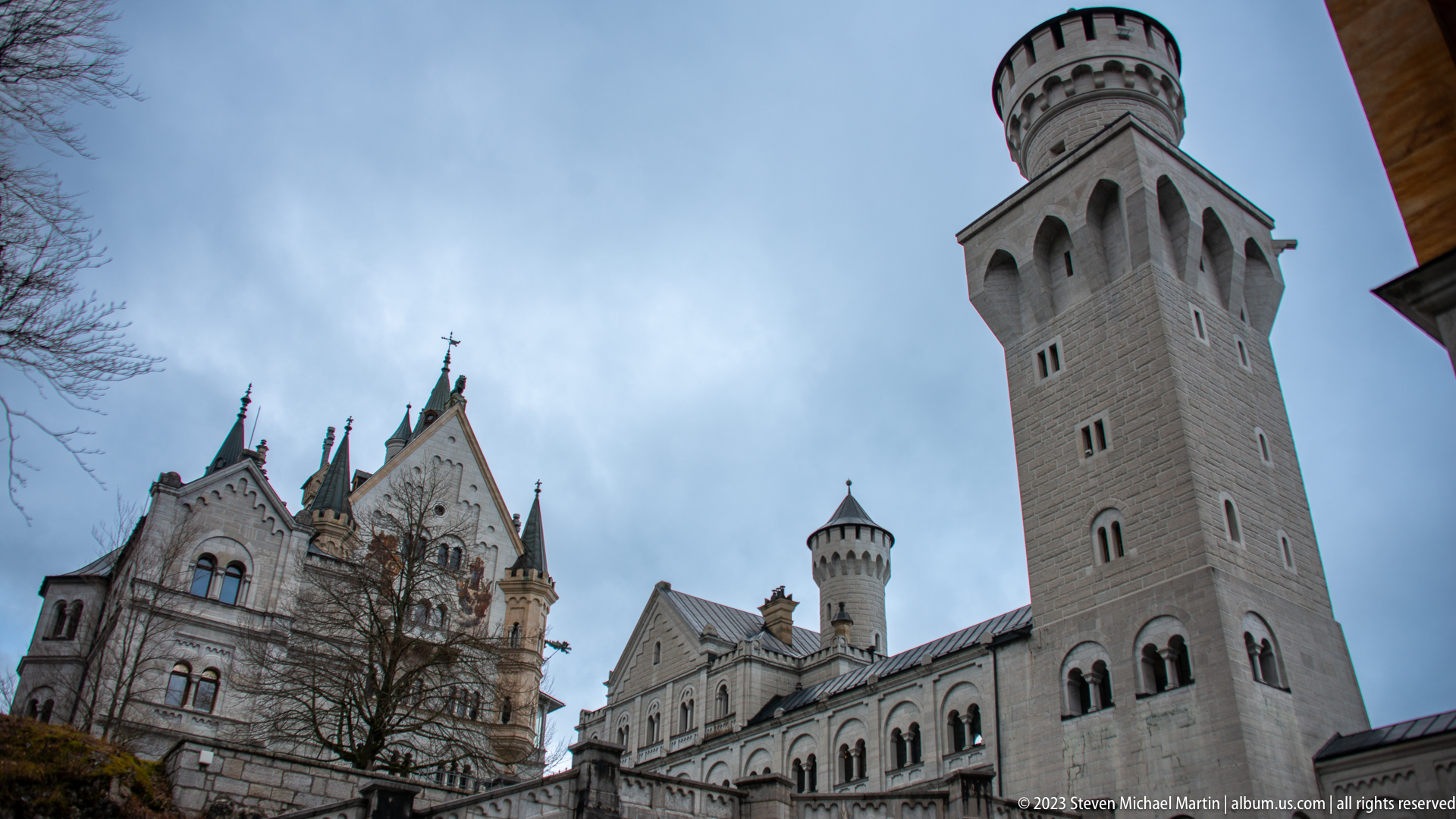
A low-angle courtyard view sets Neuschwanstein's ornate Palas at left against the soaring cylindrical tower at right. Round-arched galleries, steep gables, mural decoration, and the tower's open upper arcade create a complex vertical composition. The tight framing conveys the deliberately monumental scale experienced from within the castle rather than from distant landscape viewpoints.
Caption
A low-angle courtyard view sets Neuschwanstein's ornate Palas at left against the soaring cylindrical tower at right. Round-arched galleries, steep gables, mural decoration, and the tower's open upper arcade create a complex vertical composition. The tight framing conveys the deliberately monumental scale experienced from within the castle rather than from distant landscape viewpoints.
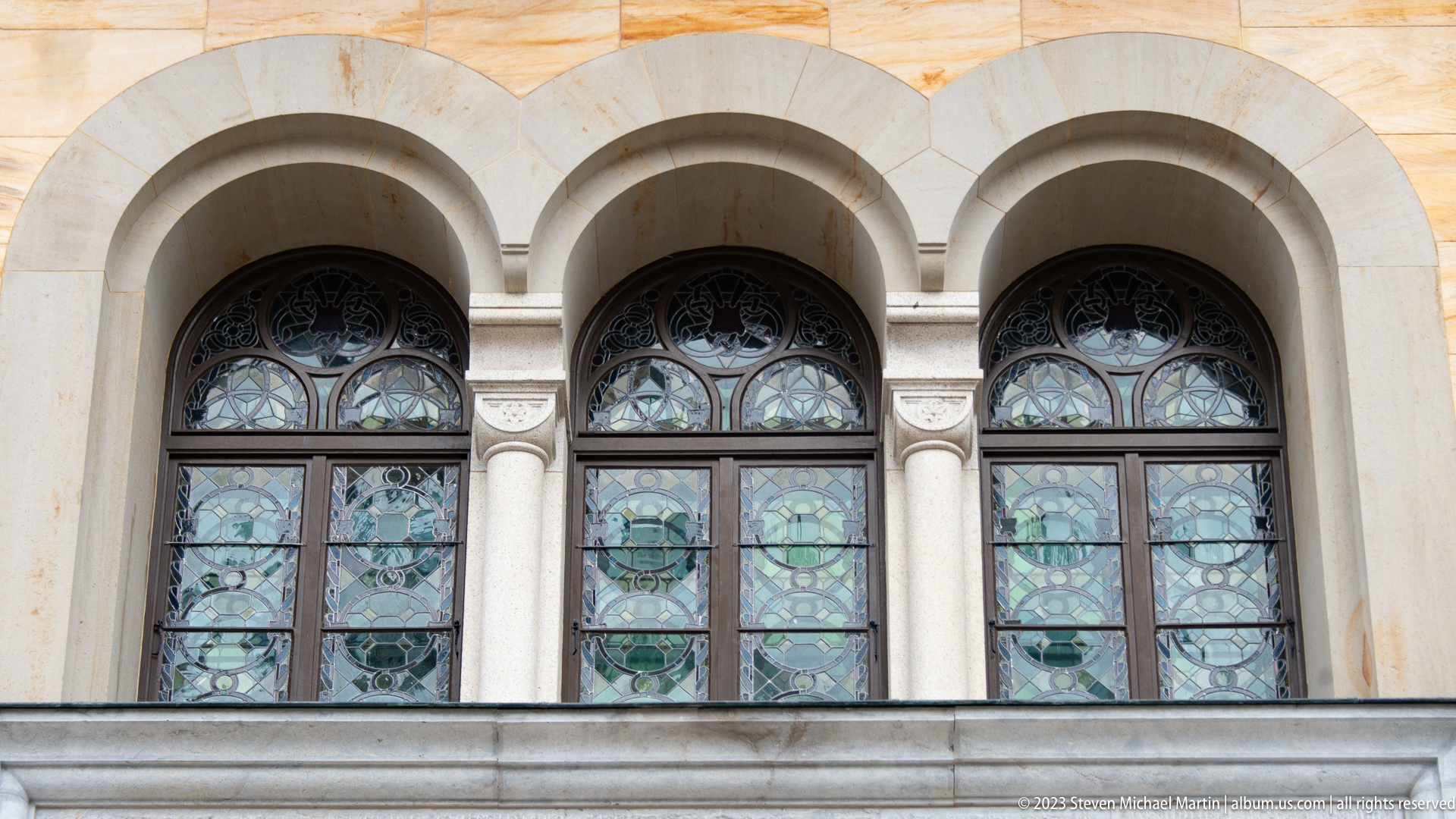
Three tall round-arched windows are set side by side within a pale stone arcade, each filled with patterned stained glass and dark tracery. Slender columns separate the openings, while the repeated arches create a restrained Romanesque Revival rhythm. The close crop emphasizes glazing, masonry, and window design rather than the larger castle façade.
Caption
Three tall round-arched windows are set side by side within a pale stone arcade, each filled with patterned stained glass and dark tracery. Slender columns separate the openings, while the repeated arches create a restrained Romanesque Revival rhythm. The close crop emphasizes glazing, masonry, and window design rather than the larger castle façade.
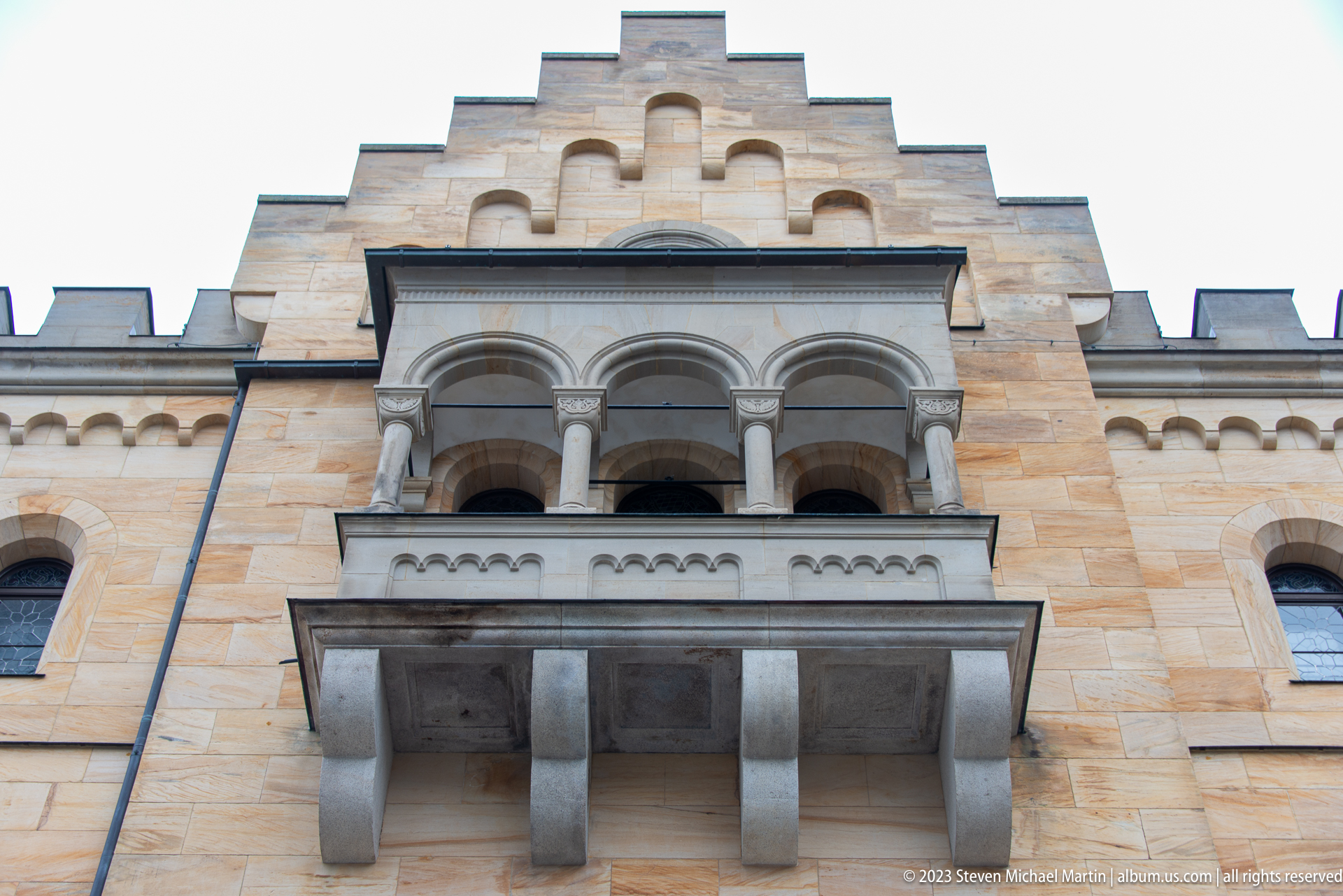
A projecting stone balcony with triple arches and heavy supports occupies the center of a stepped pale-stone gable. Above and around it, shallow arched recesses and horizontal bands give the façade a layered Romanesque Revival character. The upward-looking composition isolates the balcony as a sculptural architectural element and highlights its depth against the flat wall plane.
Caption
A projecting stone balcony with triple arches and heavy supports occupies the center of a stepped pale-stone gable. Above and around it, shallow arched recesses and horizontal bands give the façade a layered Romanesque Revival character. The upward-looking composition isolates the balcony as a sculptural architectural element and highlights its depth against the flat wall plane.
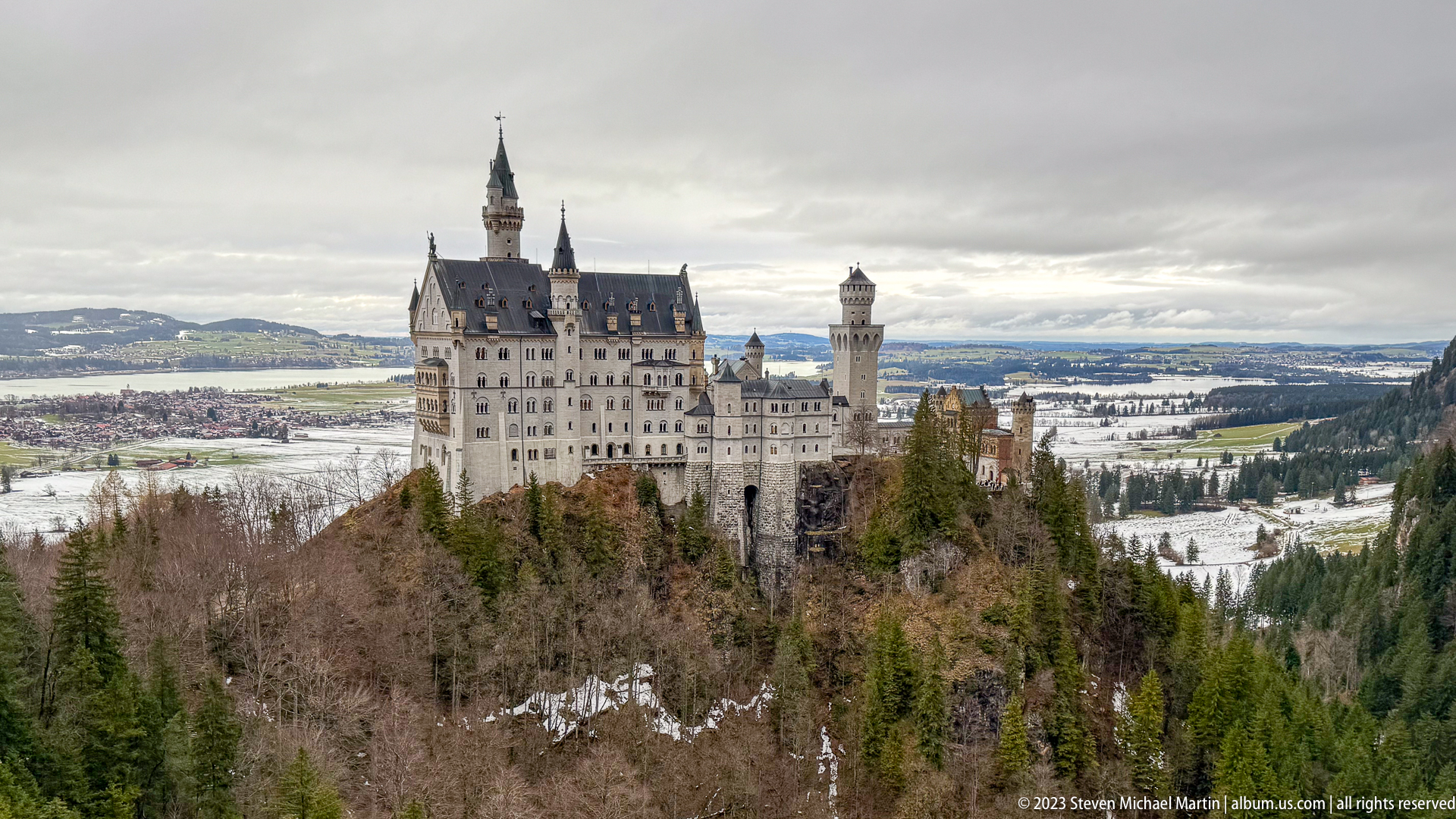
An elevated three-quarter view presents Neuschwanstein Castle as a complete architectural ensemble above the winter forest. The principal palace block, clustered towers, steep dark roofs, and outer structures stand clearly against the open Bavarian landscape beyond. Patches of snow on the slopes and distant fields sharpen the contrast between the pale castle and its rugged wooded site.
Caption
An elevated three-quarter view presents Neuschwanstein Castle as a complete architectural ensemble above the winter forest. The principal palace block, clustered towers, steep dark roofs, and outer structures stand clearly against the open Bavarian landscape beyond. Patches of snow on the slopes and distant fields sharpen the contrast between the pale castle and its rugged wooded site.
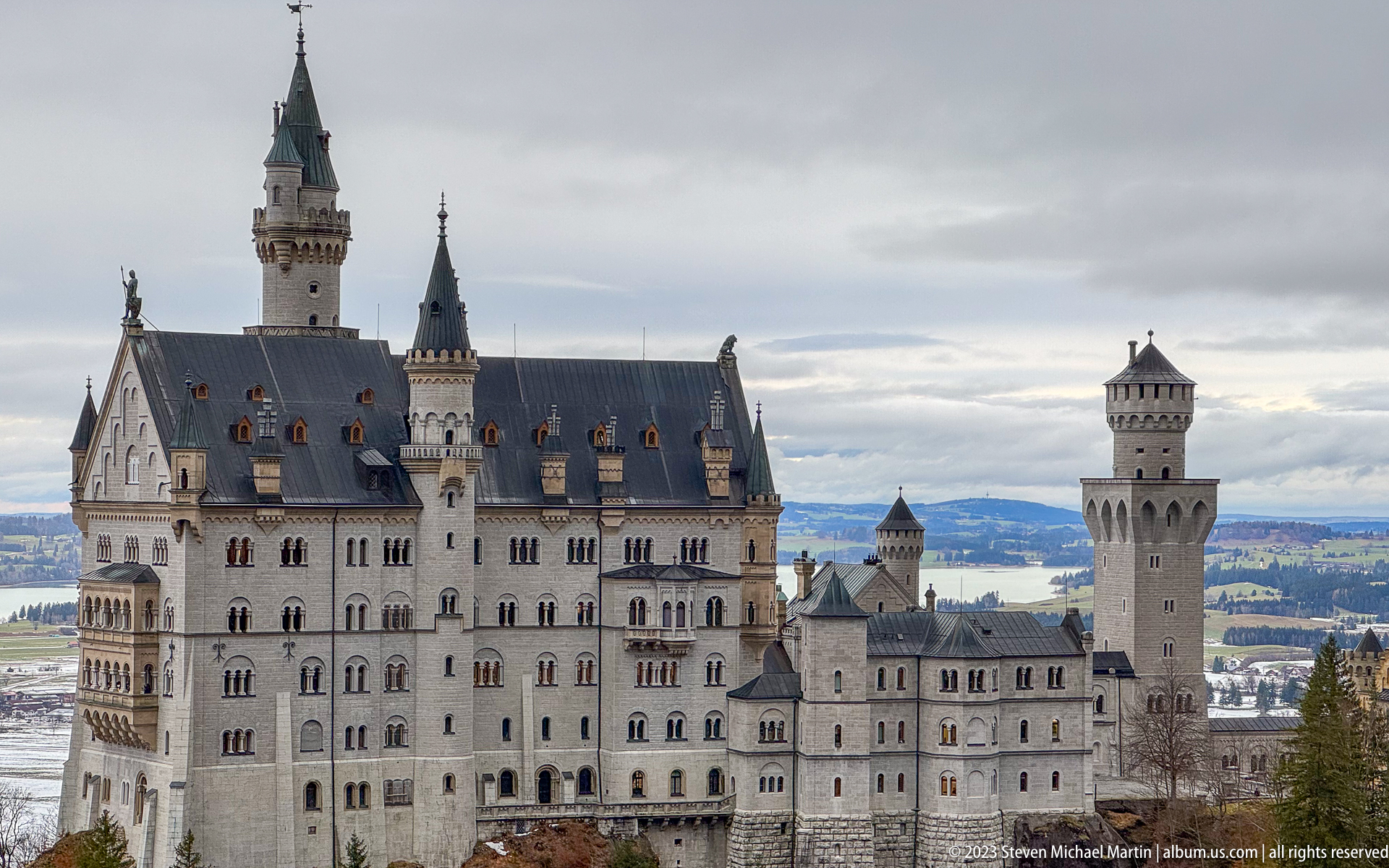
A closer elevated view concentrates on Neuschwanstein's pale palace block, steep slate roofs, gables, and tall cylindrical tower. Rows of arched windows and projecting balconies articulate the long façade, while the winter plain remains visible beyond. By reducing the surrounding forest, the photograph gives greater emphasis to the castle's massing and intricate roofline.
Caption
A closer elevated view concentrates on Neuschwanstein's pale palace block, steep slate roofs, gables, and tall cylindrical tower. Rows of arched windows and projecting balconies articulate the long façade, while the winter plain remains visible beyond. By reducing the surrounding forest, the photograph gives greater emphasis to the castle's massing and intricate roofline.
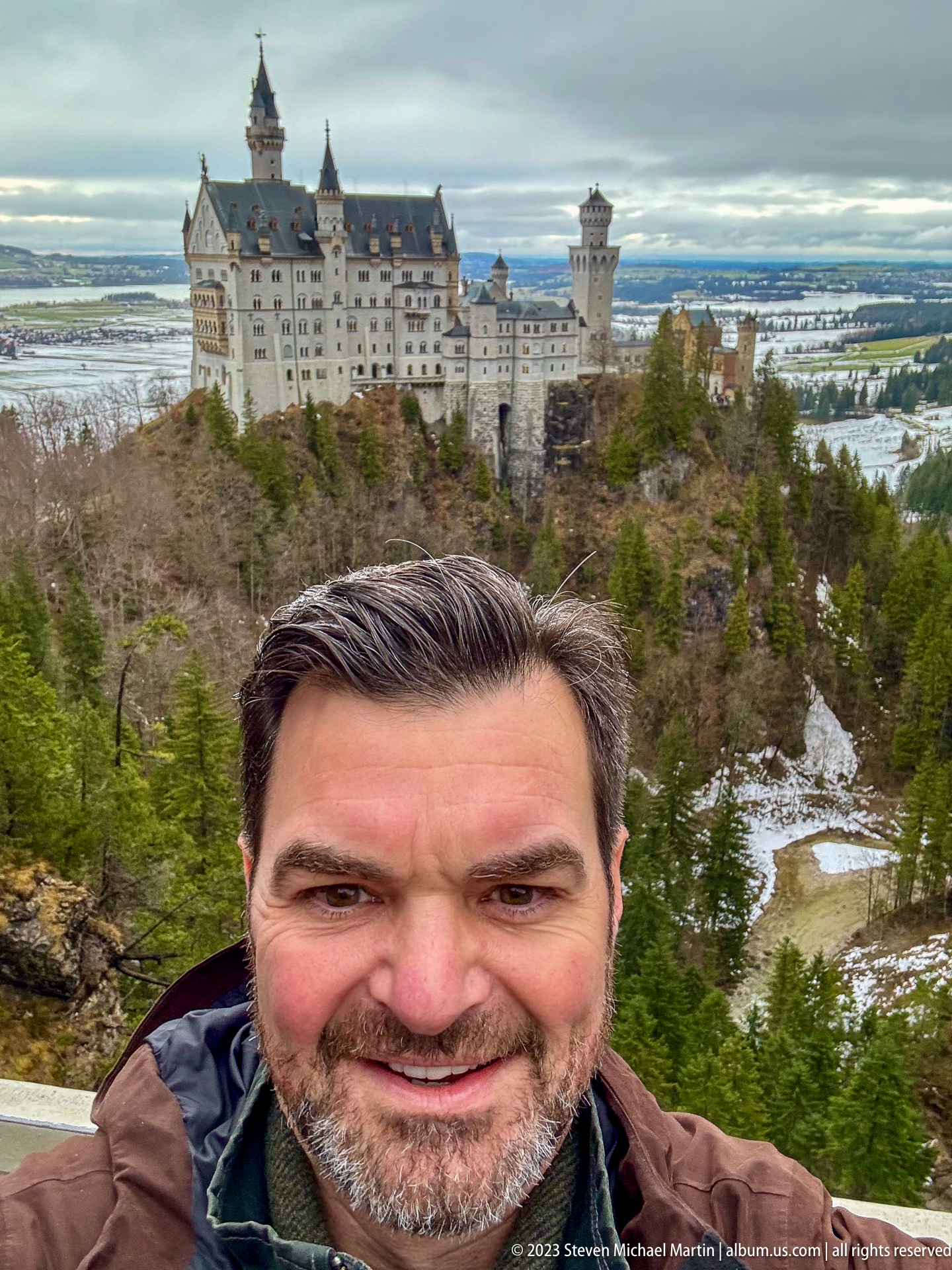
A close visitor portrait fills the foreground while Neuschwanstein Castle rises across the wooded ridge behind him. The pale palace block, towers, steep roofs, and winter landscape remain clearly legible despite the emphasis on the person, making the photograph both a travel portrait and a contextual record of the castle's elevated position above the Bavarian plain.
Caption
A close visitor portrait fills the foreground while Neuschwanstein Castle rises across the wooded ridge behind him. The pale palace block, towers, steep roofs, and winter landscape remain clearly legible despite the emphasis on the person, making the photograph both a travel portrait and a contextual record of the castle's elevated position above the Bavarian plain.
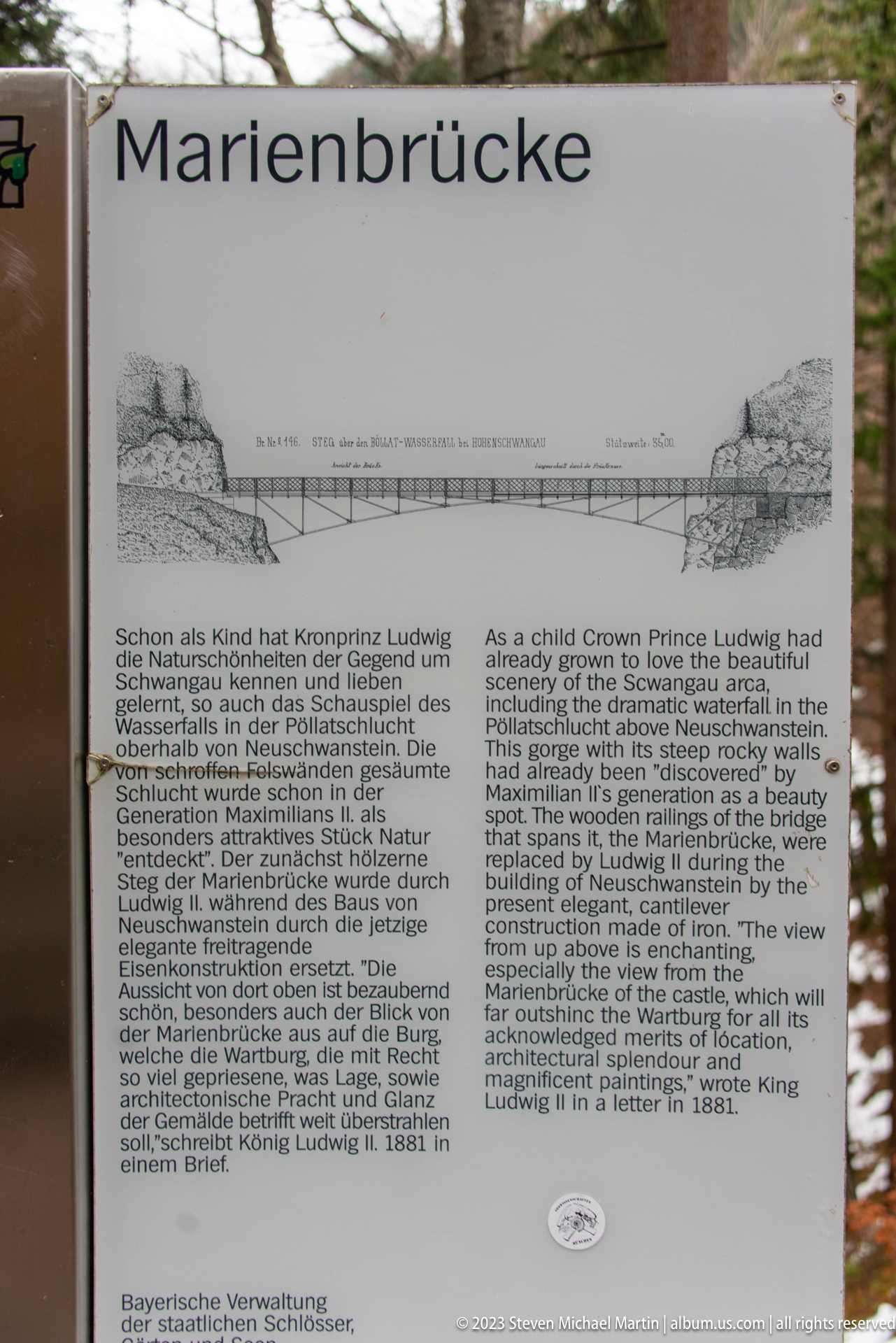
An interpretive panel at Marienbrücke combines a historical drawing of the bridge with German and English text about its association with Crown Prince Ludwig and the crossing of the Pöllat Gorge. The bilingual sign functions as a documentary record of the visitor route linking the famous bridge viewpoint with the Neuschwanstein landscape.
Caption
An interpretive panel at Marienbrücke combines a historical drawing of the bridge with German and English text about its association with Crown Prince Ludwig and the crossing of the Pöllat Gorge. The bilingual sign functions as a documentary record of the visitor route linking the famous bridge viewpoint with the Neuschwanstein landscape.
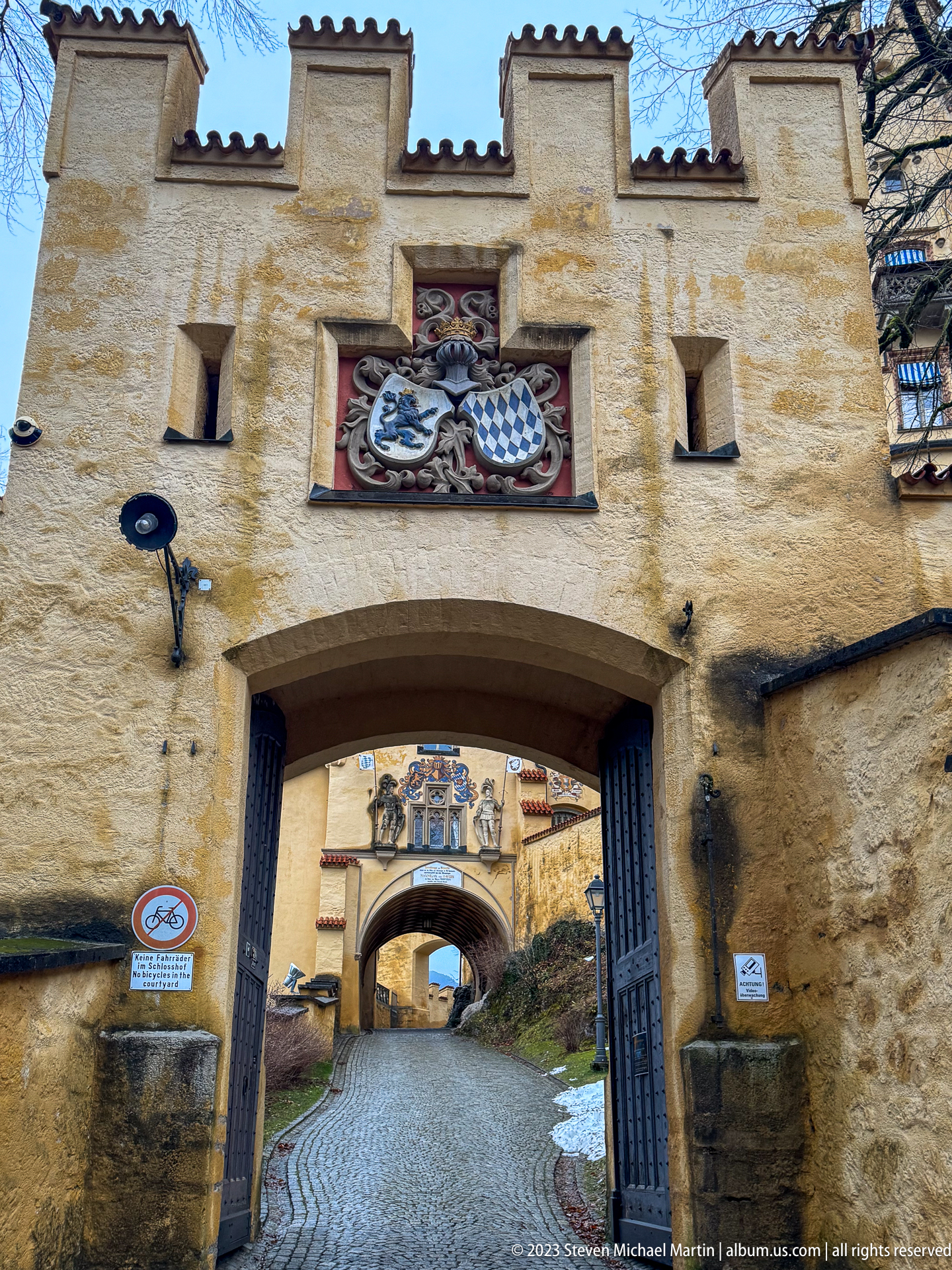
A frontal close view centers the heraldic gate of Hohenschwangau Castle, with the painted shield and supporters set above the broad arched opening. The crenellated parapet, ochre stucco, dark timber gate leaves, and cobbled roadway emphasize the gateway's material character. A second decorated arch is visible deeper inside, underscoring the sequence of entrances through the complex.
Caption
A frontal close view centers the heraldic gate of Hohenschwangau Castle, with the painted shield and supporters set above the broad arched opening. The crenellated parapet, ochre stucco, dark timber gate leaves, and cobbled roadway emphasize the gateway's material character. A second decorated arch is visible deeper inside, underscoring the sequence of entrances through the complex.
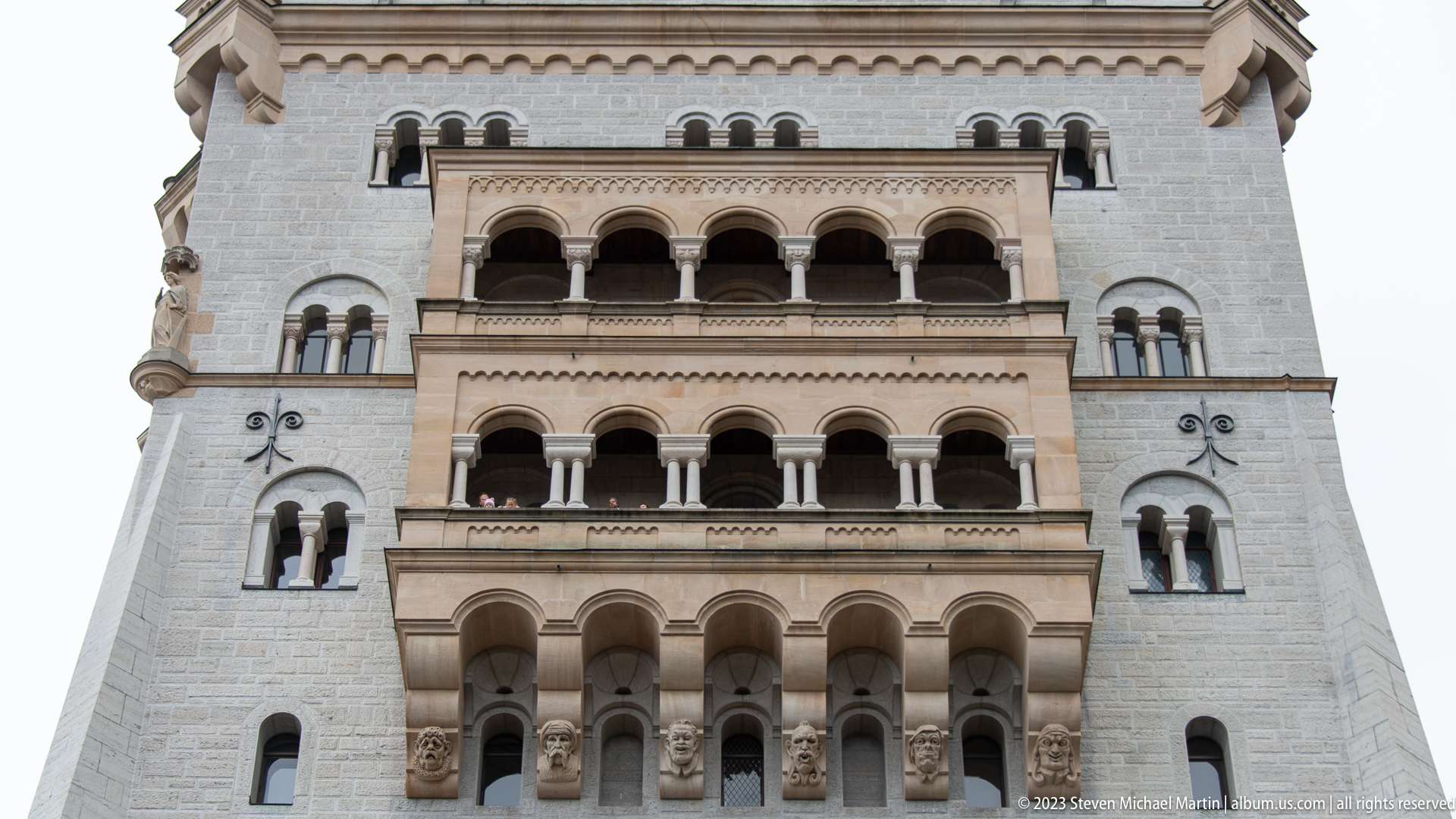
Stacked arcaded loggias form a richly modeled section of Neuschwanstein Castle's pale stone façade. Rows of round arches, paired columns, recessed openings, and sculptural details produce a strong vertical rhythm, while the tight upward view isolates the historicist architectural vocabulary from the larger palace complex.
Caption
Stacked arcaded loggias form a richly modeled section of Neuschwanstein Castle's pale stone façade. Rows of round arches, paired columns, recessed openings, and sculptural details produce a strong vertical rhythm, while the tight upward view isolates the historicist architectural vocabulary from the larger palace complex.
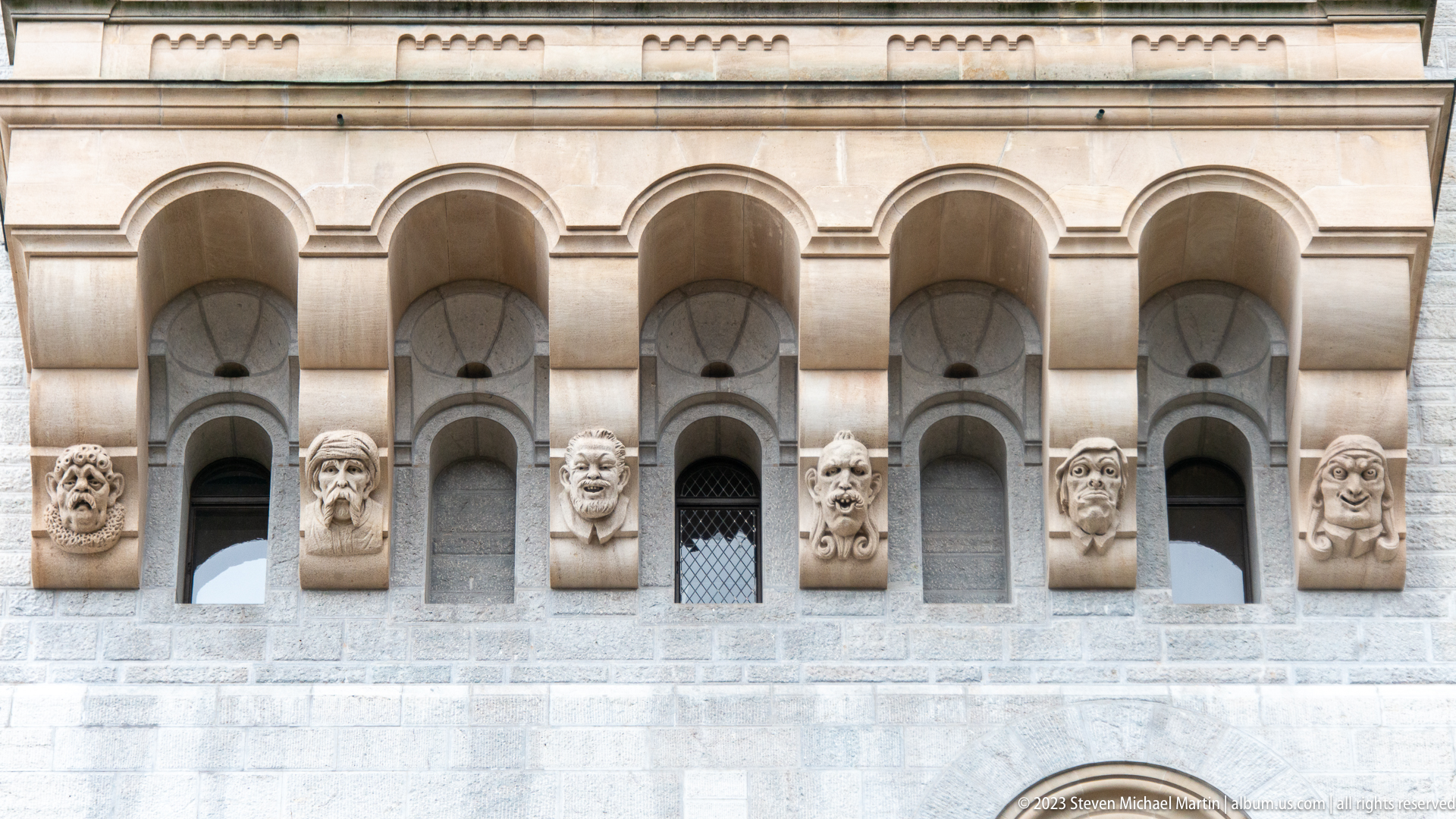
A close view of Neuschwanstein Castle's arcade reveals carved grotesque and mask-like heads projecting between the lower arches. Their expressive faces contrast with the regular rhythm of pale stone columns and recessed openings. The photograph concentrates on ornamental sculpture that is easily missed in broader façade views and documents the castle's highly detailed 19th-century decorative program.
Caption
A close view of Neuschwanstein Castle's arcade reveals carved grotesque and mask-like heads projecting between the lower arches. Their expressive faces contrast with the regular rhythm of pale stone columns and recessed openings. The photograph concentrates on ornamental sculpture that is easily missed in broader façade views and documents the castle's highly detailed 19th-century decorative program.
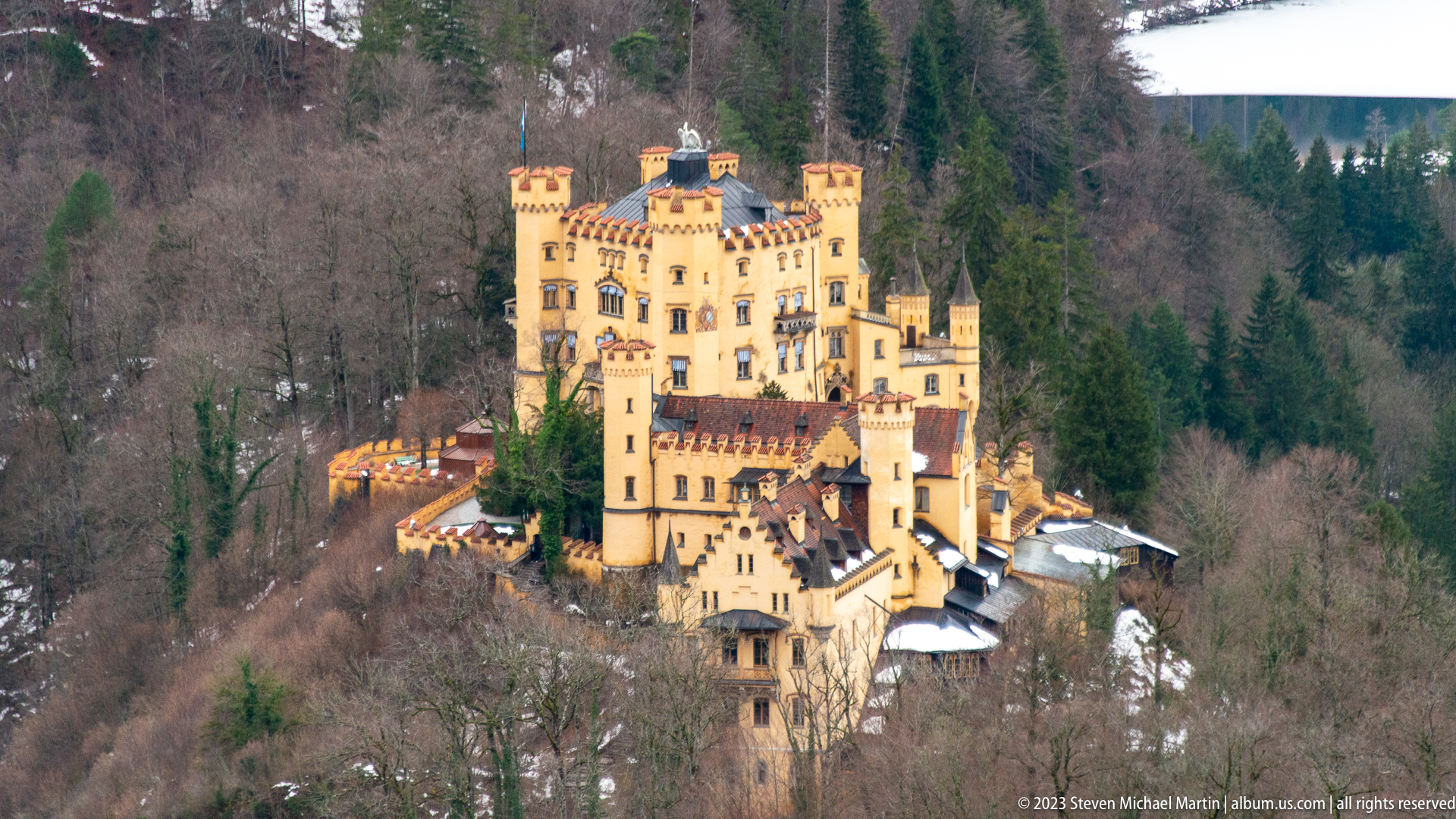
Hohenschwangau Castle appears in a tight telephoto view above the winter woods, its ochre walls, crenellated towers, red-tiled roofs, and irregular residential wings sharply separated from the dark forest. The compressed perspective highlights the picturesque massing of the royal residence and its commanding placement on the ridge below the surrounding mountains.
Caption
Hohenschwangau Castle appears in a tight telephoto view above the winter woods, its ochre walls, crenellated towers, red-tiled roofs, and irregular residential wings sharply separated from the dark forest. The compressed perspective highlights the picturesque massing of the royal residence and its commanding placement on the ridge below the surrounding mountains.
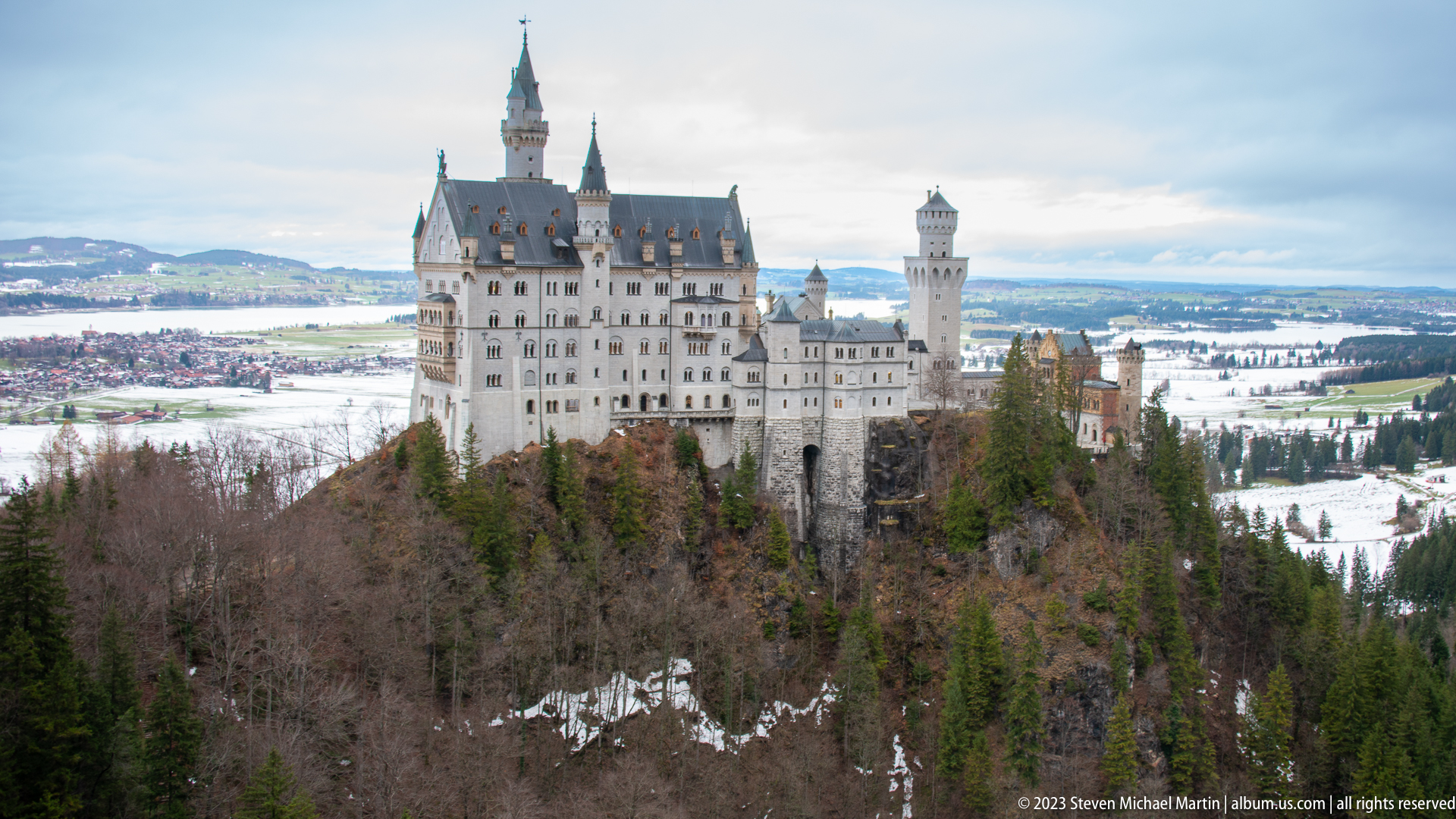
Neuschwanstein Castle stands dramatically on its rocky ridge in the classic distant view from the Marienbrücke area. The main palace block, clustered towers, and steep roofs rise above winter forest, while snow-dusted fields and the broad Bavarian plain extend behind. The elevated perspective reveals both the complete architectural ensemble and its strategic-looking mountain setting.
Caption
Neuschwanstein Castle stands dramatically on its rocky ridge in the classic distant view from the Marienbrücke area. The main palace block, clustered towers, and steep roofs rise above winter forest, while snow-dusted fields and the broad Bavarian plain extend behind. The elevated perspective reveals both the complete architectural ensemble and its strategic-looking mountain setting.

A tighter telephoto composition isolates Neuschwanstein Castle's principal palace block and its varied tower forms against the pale winter sky. Rows of arched windows, steep slate roofs, corner turrets, and the tall square tower are presented with minimal landscape, allowing the 19th-century historicist architecture to dominate the frame.
Caption
A tighter telephoto composition isolates Neuschwanstein Castle's principal palace block and its varied tower forms against the pale winter sky. Rows of arched windows, steep slate roofs, corner turrets, and the tall square tower are presented with minimal landscape, allowing the 19th-century historicist architecture to dominate the frame.
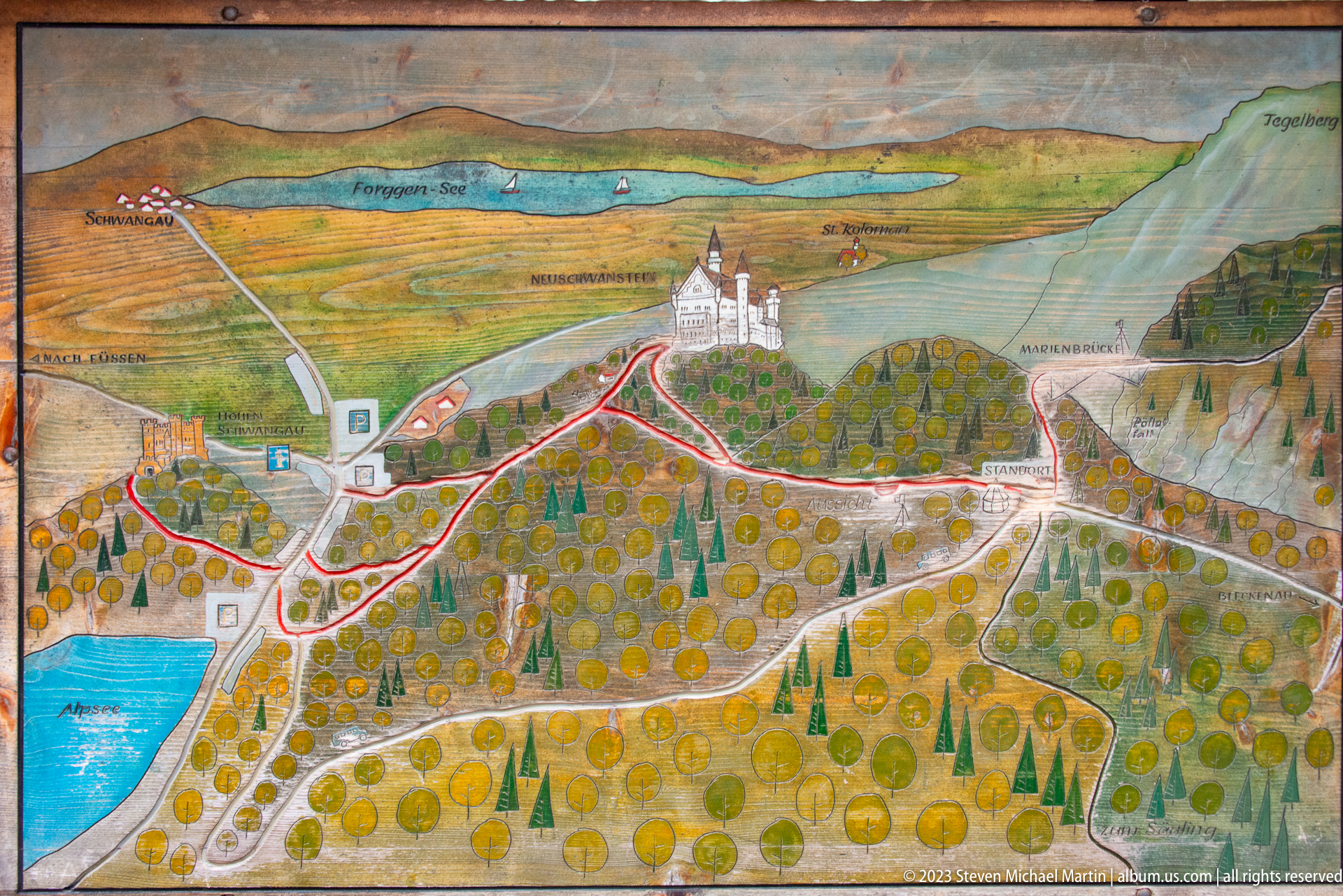
A hand-painted map diagrams the Hohenschwangau castle landscape with roads, woodland, lakes, and the two royal residences rendered in pictorial form. Neuschwanstein appears near the upper center, while Hohenschwangau and the surrounding visitor area are connected by highlighted routes. The illustration documents how the sites relate spatially within the alpine terrain.
Caption
A hand-painted map diagrams the Hohenschwangau castle landscape with roads, woodland, lakes, and the two royal residences rendered in pictorial form. Neuschwanstein appears near the upper center, while Hohenschwangau and the surrounding visitor area are connected by highlighted routes. The illustration documents how the sites relate spatially within the alpine terrain.
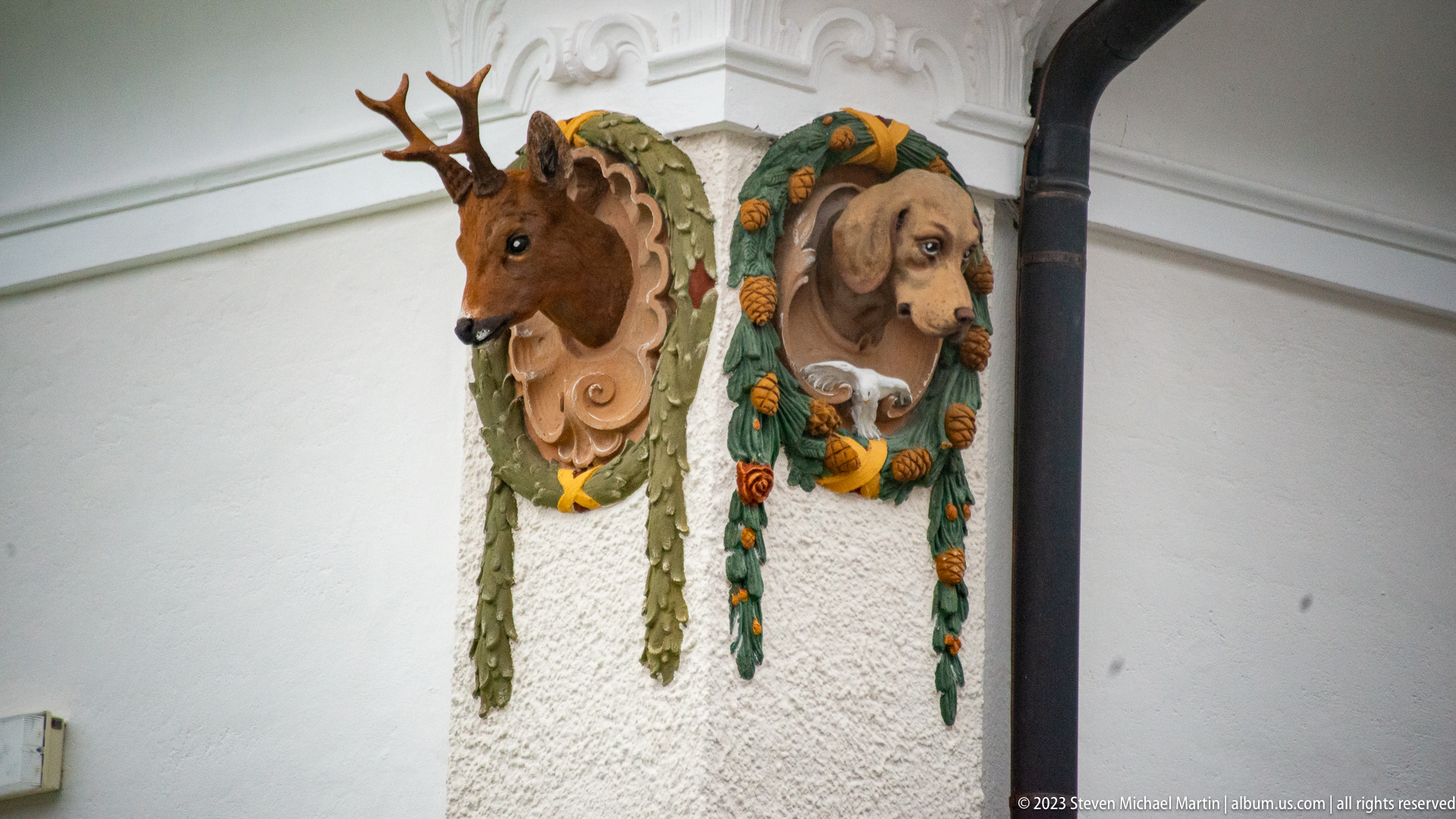
Sculpted animal heads project from decorative oval mounts at a corner of Hohenschwangau Castle. A deer head with antlers is paired with a hound-like head, both surrounded by stylized foliage and garlands. The hunting imagery forms part of a broader decorative program associated with aristocratic sporting culture and is presented here as a close architectural detail.
Caption
Sculpted animal heads project from decorative oval mounts at a corner of Hohenschwangau Castle. A deer head with antlers is paired with a hound-like head, both surrounded by stylized foliage and garlands. The hunting imagery forms part of a broader decorative program associated with aristocratic sporting culture and is presented here as a close architectural detail.
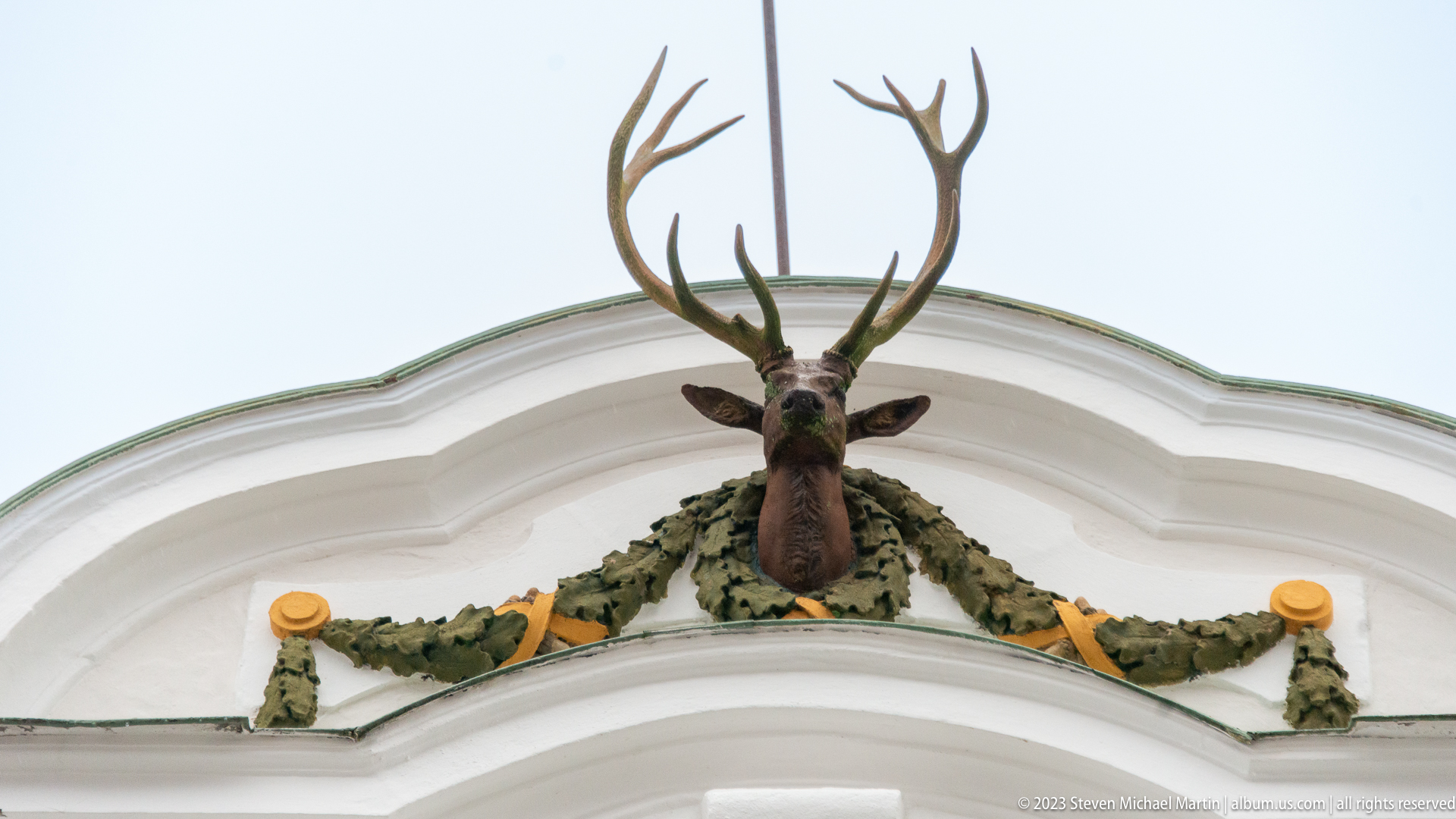
A large stag head with branching antlers crowns a curved white gable, framed by sculpted foliage and hunting-themed ornament. The symmetrical placement makes the trophy-like motif a dominant architectural focal point rather than a freestanding object. The tight upward view records the strong hunting imagery used in the decoration of Hohenschwangau Castle.
Caption
A large stag head with branching antlers crowns a curved white gable, framed by sculpted foliage and hunting-themed ornament. The symmetrical placement makes the trophy-like motif a dominant architectural focal point rather than a freestanding object. The tight upward view records the strong hunting imagery used in the decoration of Hohenschwangau Castle.
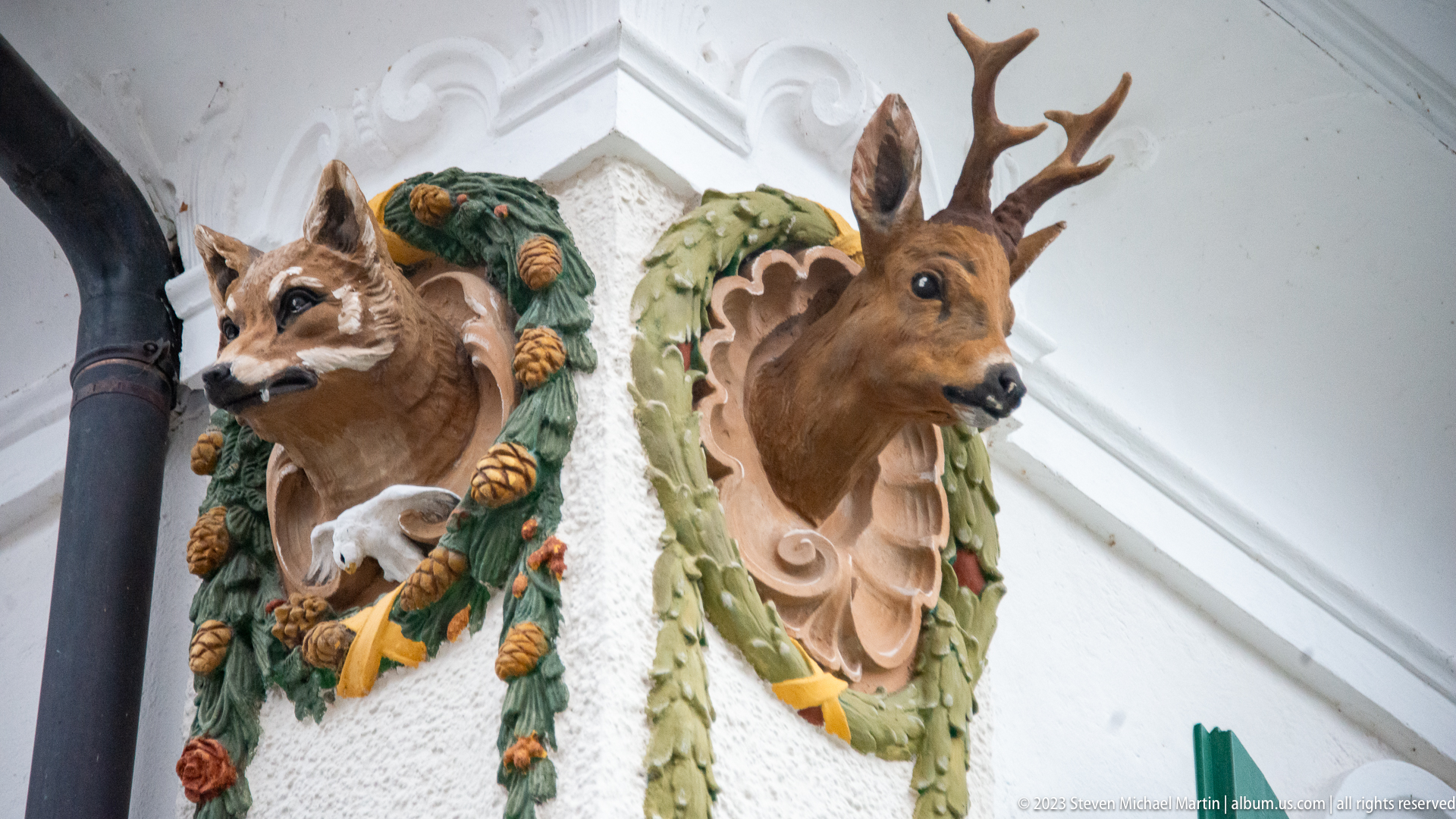
A fox-like head and a small antlered deer head project from adjacent decorative mounts on the white exterior of Hohenschwangau Castle. Pinecone-like ornaments, leaves, and scrolling forms surround the animals, integrating hunting trophies into the architectural surface. The close composition emphasizes craftsmanship and the varied species represented in the castle's sporting iconography.
Caption
A fox-like head and a small antlered deer head project from adjacent decorative mounts on the white exterior of Hohenschwangau Castle. Pinecone-like ornaments, leaves, and scrolling forms surround the animals, integrating hunting trophies into the architectural surface. The close composition emphasizes craftsmanship and the varied species represented in the castle's sporting iconography.
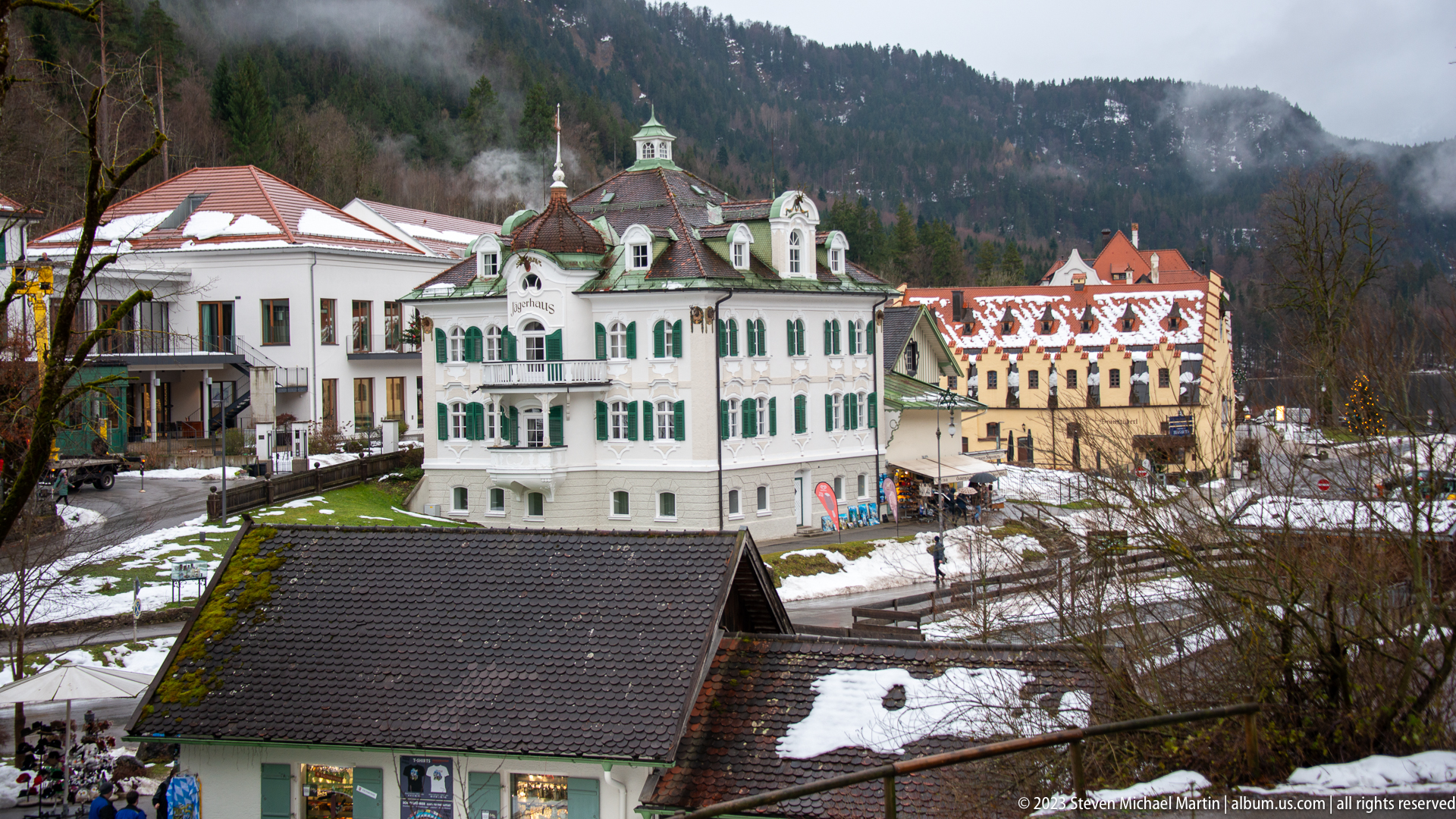
A winter view across the Hohenschwangau settlement centers on the white Jägerhaus with green shutters, decorative gables, and a small roof lantern. Snow lies on roofs and ground, while neighboring buildings cluster against the wooded mountain slope. The broader composition places the ornate villa within the developed visitor district below the two castles.
Caption
A winter view across the Hohenschwangau settlement centers on the white Jägerhaus with green shutters, decorative gables, and a small roof lantern. Snow lies on roofs and ground, while neighboring buildings cluster against the wooded mountain slope. The broader composition places the ornate villa within the developed visitor district below the two castles.
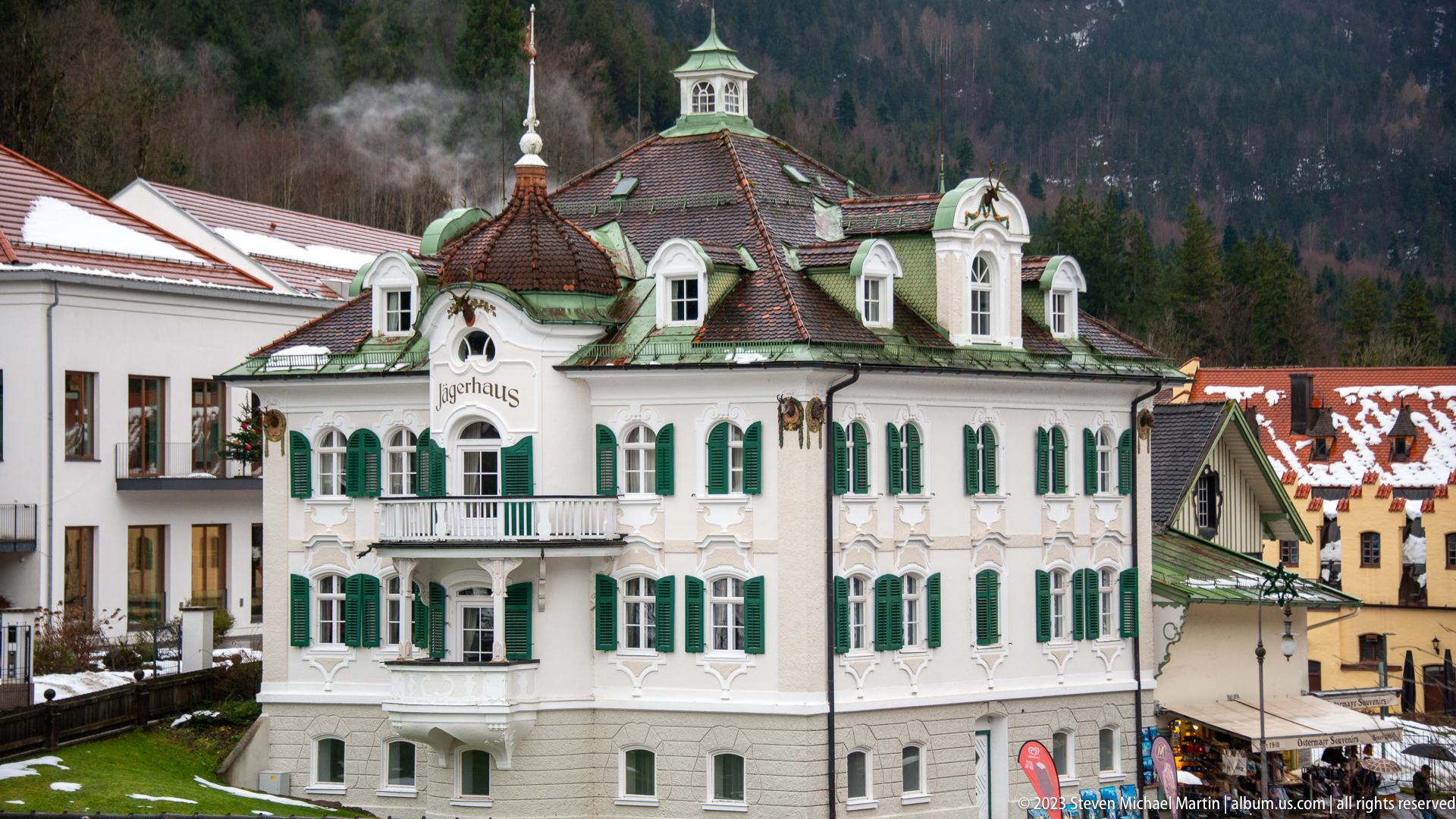
The Jägerhaus fills the frame in a detailed architectural view, showing its white stucco walls, dark-green shutters, curved dormers, corner pilasters, balcony, and polygonal roof lantern. The building name is visible on the façade beneath the central gable. Snow on the roof and surrounding landscape reinforces the winter setting of the Hohenschwangau visitor district.
Caption
The Jägerhaus fills the frame in a detailed architectural view, showing its white stucco walls, dark-green shutters, curved dormers, corner pilasters, balcony, and polygonal roof lantern. The building name is visible on the façade beneath the central gable. Snow on the roof and surrounding landscape reinforces the winter setting of the Hohenschwangau visitor district.
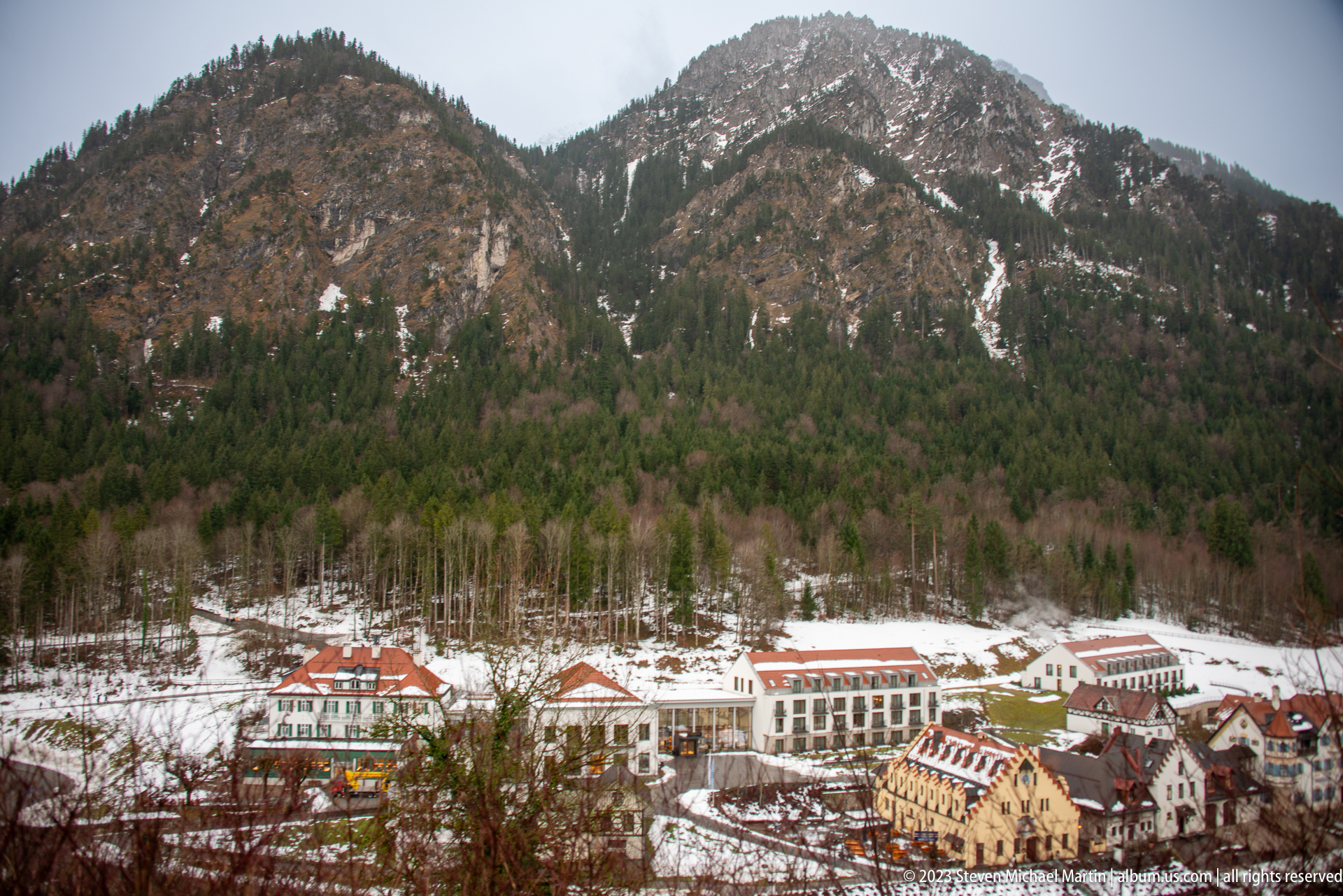
A broad winter landscape looks over the Hohenschwangau settlement toward a steep forested mountain dusted with snow. Hotels and visitor buildings cluster at the base of the slope, their red and pale roofs standing out against the dark conifers. The elevated perspective records the alpine setting that surrounds the castle district rather than focusing on either royal residence.
Caption
A broad winter landscape looks over the Hohenschwangau settlement toward a steep forested mountain dusted with snow. Hotels and visitor buildings cluster at the base of the slope, their red and pale roofs standing out against the dark conifers. The elevated perspective records the alpine setting that surrounds the castle district rather than focusing on either royal residence.
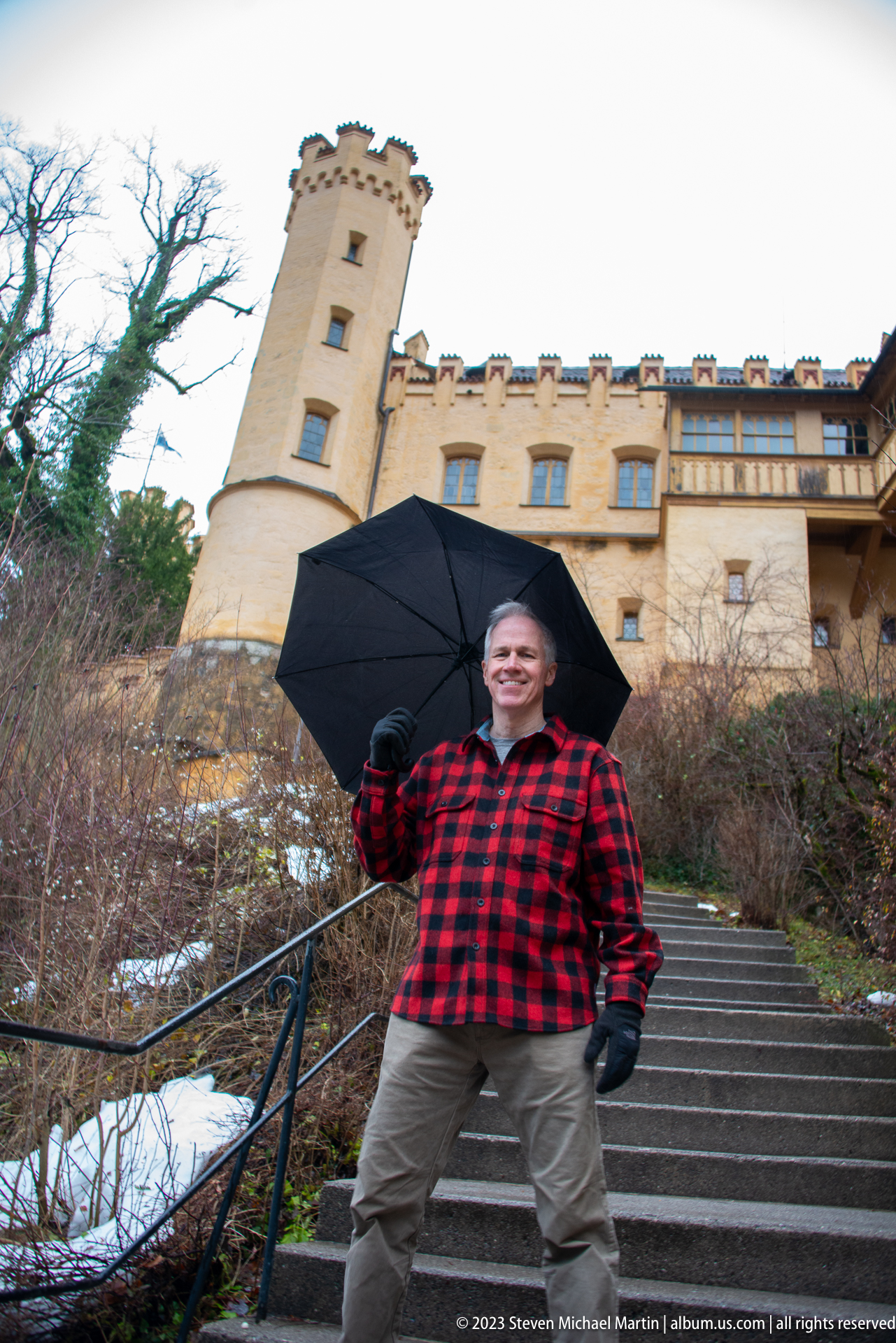
A visitor in a red-and-black checked jacket stands on the castle steps beneath an umbrella, with Hohenschwangau Castle rising immediately behind. The low-angle portrait brings the ochre walls, crenellated parapets, and corner tower into the same frame as the human subject, while scattered snow and wet stone steps convey the wintry weather.
Caption
A visitor in a red-and-black checked jacket stands on the castle steps beneath an umbrella, with Hohenschwangau Castle rising immediately behind. The low-angle portrait brings the ochre walls, crenellated parapets, and corner tower into the same frame as the human subject, while scattered snow and wet stone steps convey the wintry weather.
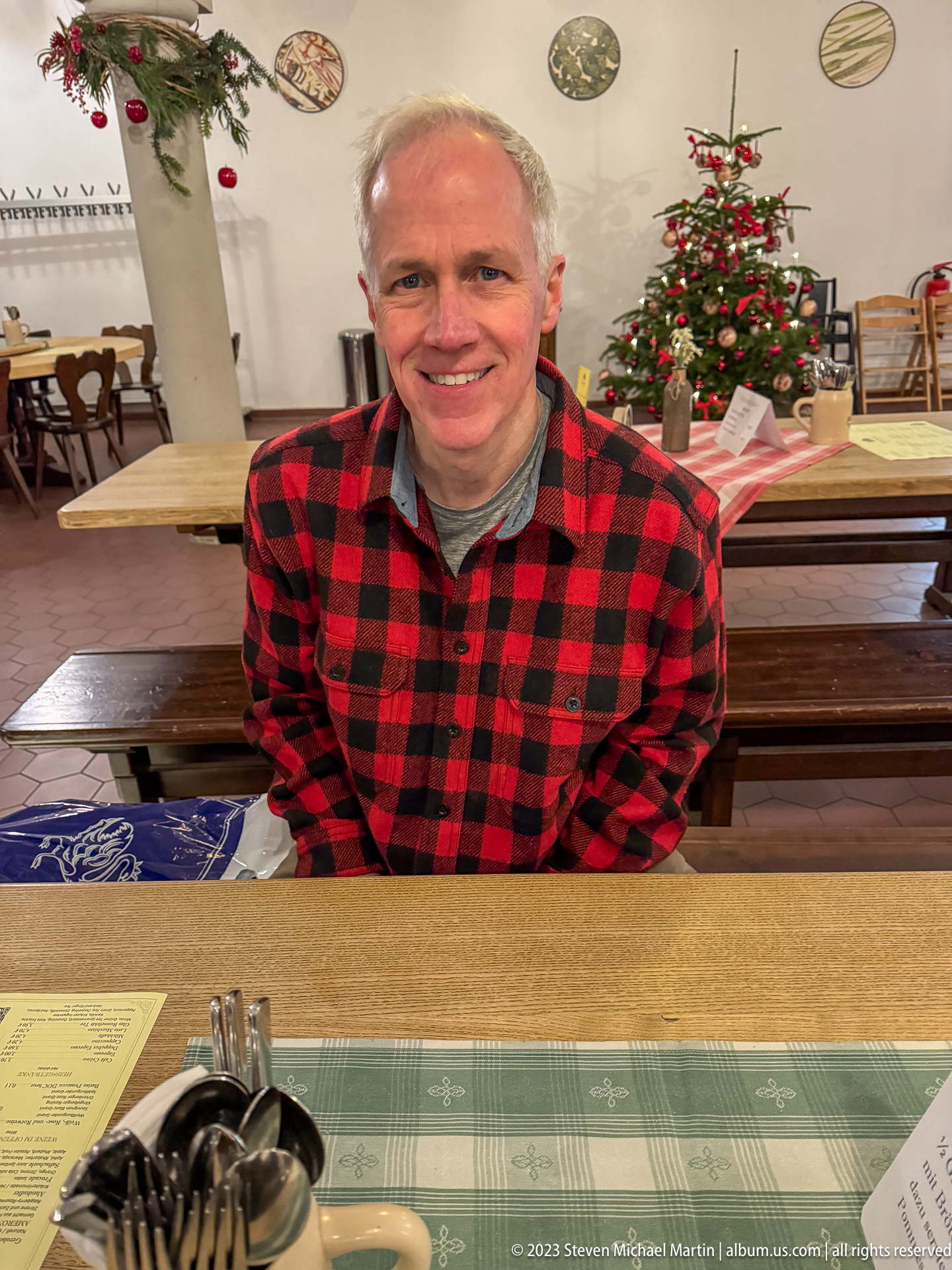
A visitor in a red-and-black checked jacket sits at a long table in a bright dining room decorated for Christmas. A lit tree, hanging ornaments, garlands, and wooden furniture create a festive interior atmosphere, while place settings and serving utensils in the foreground suggest a restaurant or communal dining space in the castle district.
Caption
A visitor in a red-and-black checked jacket sits at a long table in a bright dining room decorated for Christmas. A lit tree, hanging ornaments, garlands, and wooden furniture create a festive interior atmosphere, while place settings and serving utensils in the foreground suggest a restaurant or communal dining space in the castle district.
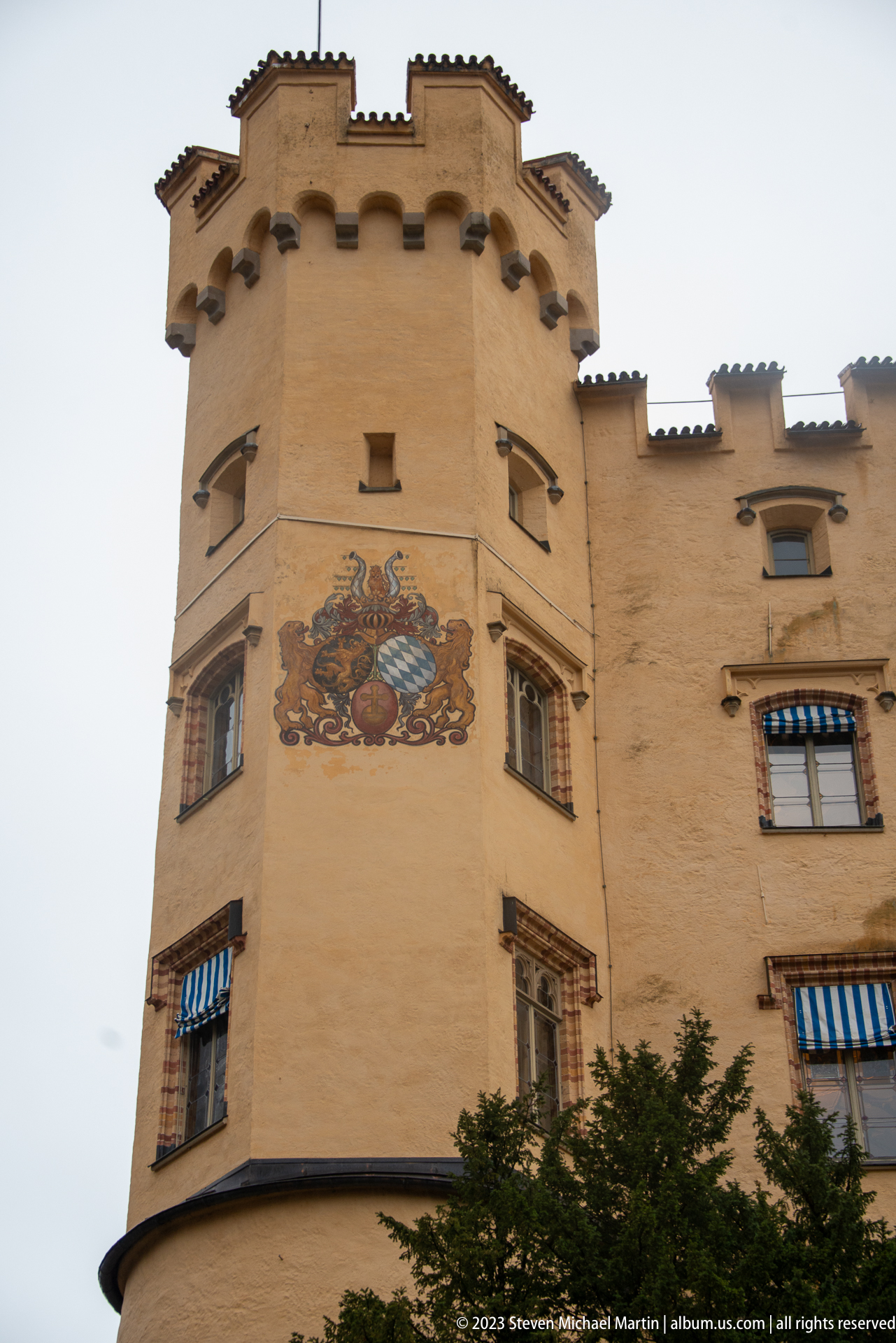
A painted heraldic composition occupies the rounded ochre tower of Hohenschwangau Castle, positioned between shuttered windows beneath a crenellated crown. The close upward view highlights the contrast between the colorful arms and the warm stucco wall, while striped awnings and masonry details add to the façade's layered historicist character.
Caption
A painted heraldic composition occupies the rounded ochre tower of Hohenschwangau Castle, positioned between shuttered windows beneath a crenellated crown. The close upward view highlights the contrast between the colorful arms and the warm stucco wall, while striped awnings and masonry details add to the façade's layered historicist character.
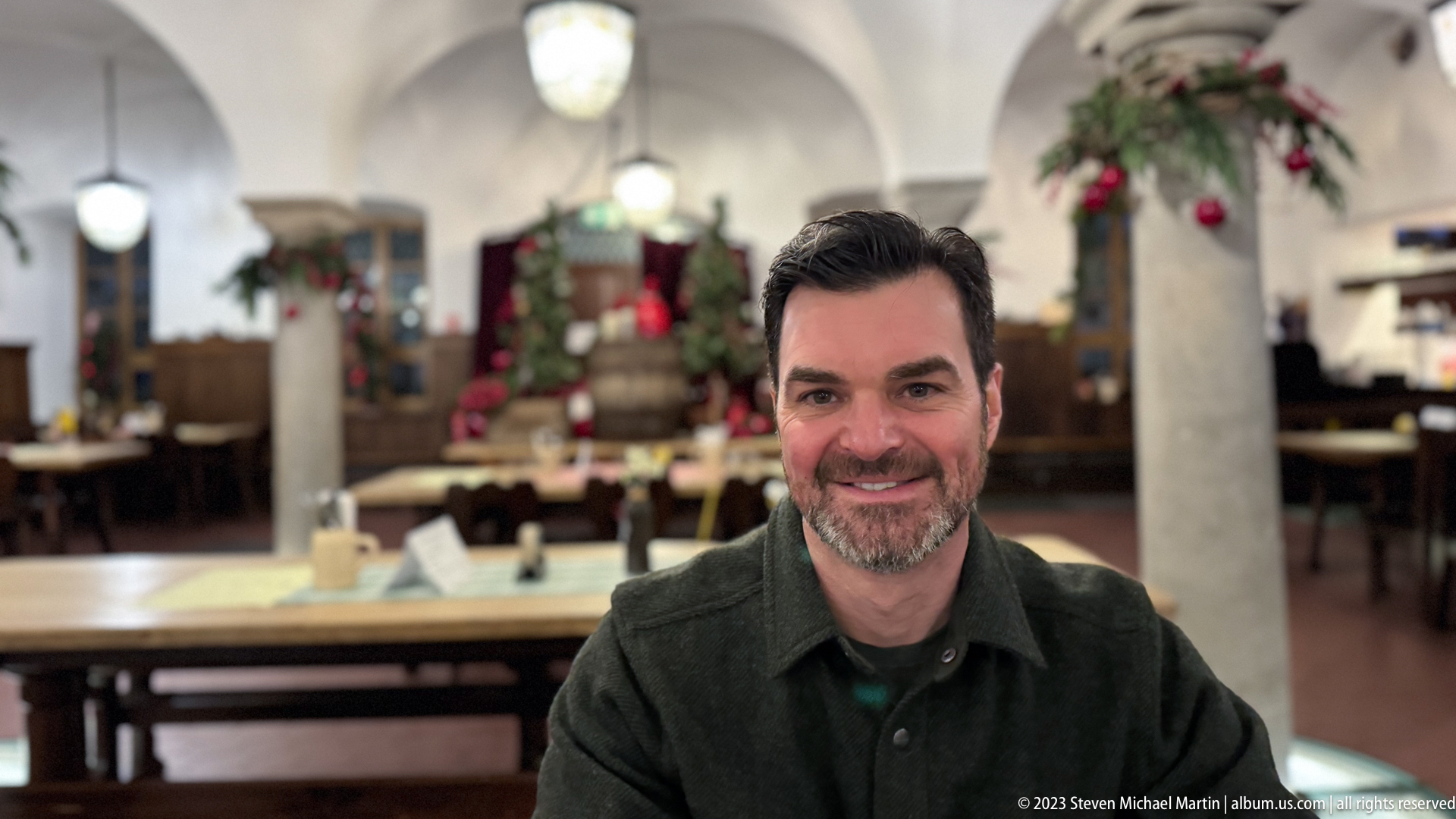
A smiling visitor is photographed at a table inside a restaurant decorated with Christmas greenery and hanging ornaments. Arched columns and long wooden tables recede softly into the background, while the shallow depth of field isolates the portrait. The image records the seasonal visitor experience associated with the Hohenschwangau castle district rather than an architectural detail of the castles.
Caption
A smiling visitor is photographed at a table inside a restaurant decorated with Christmas greenery and hanging ornaments. Arched columns and long wooden tables recede softly into the background, while the shallow depth of field isolates the portrait. The image records the seasonal visitor experience associated with the Hohenschwangau castle district rather than an architectural detail of the castles.
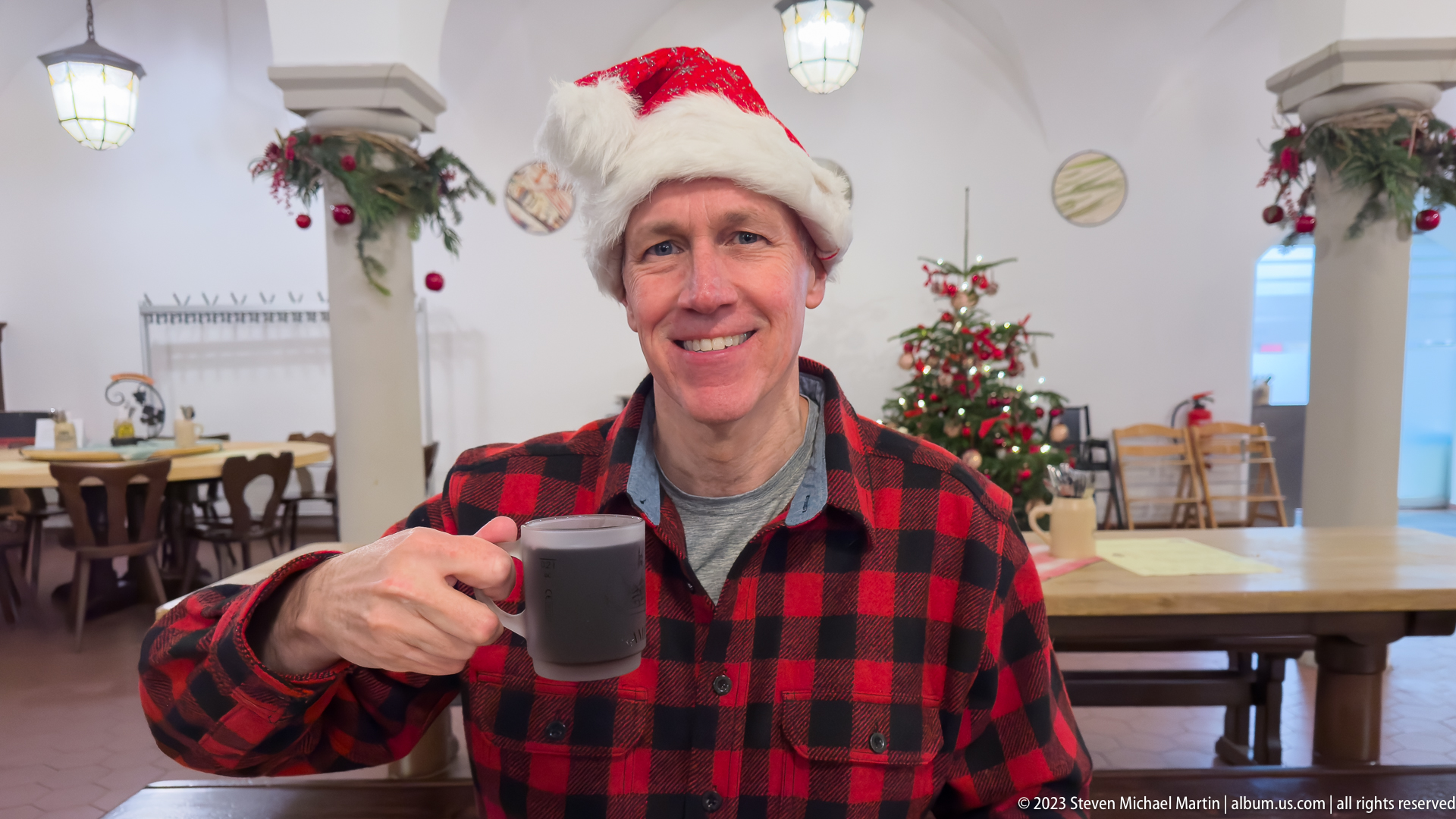
A visitor wearing a red-and-white Santa hat raises a dark hot drink in a mug inside a Christmas-decorated dining room. The nearby tree, hanging greenery, and ornaments create a strong seasonal context, while the raised cup gives the portrait an informal celebratory quality. The scene documents the holiday atmosphere around the castle visit.
Caption
A visitor wearing a red-and-white Santa hat raises a dark hot drink in a mug inside a Christmas-decorated dining room. The nearby tree, hanging greenery, and ornaments create a strong seasonal context, while the raised cup gives the portrait an informal celebratory quality. The scene documents the holiday atmosphere around the castle visit.
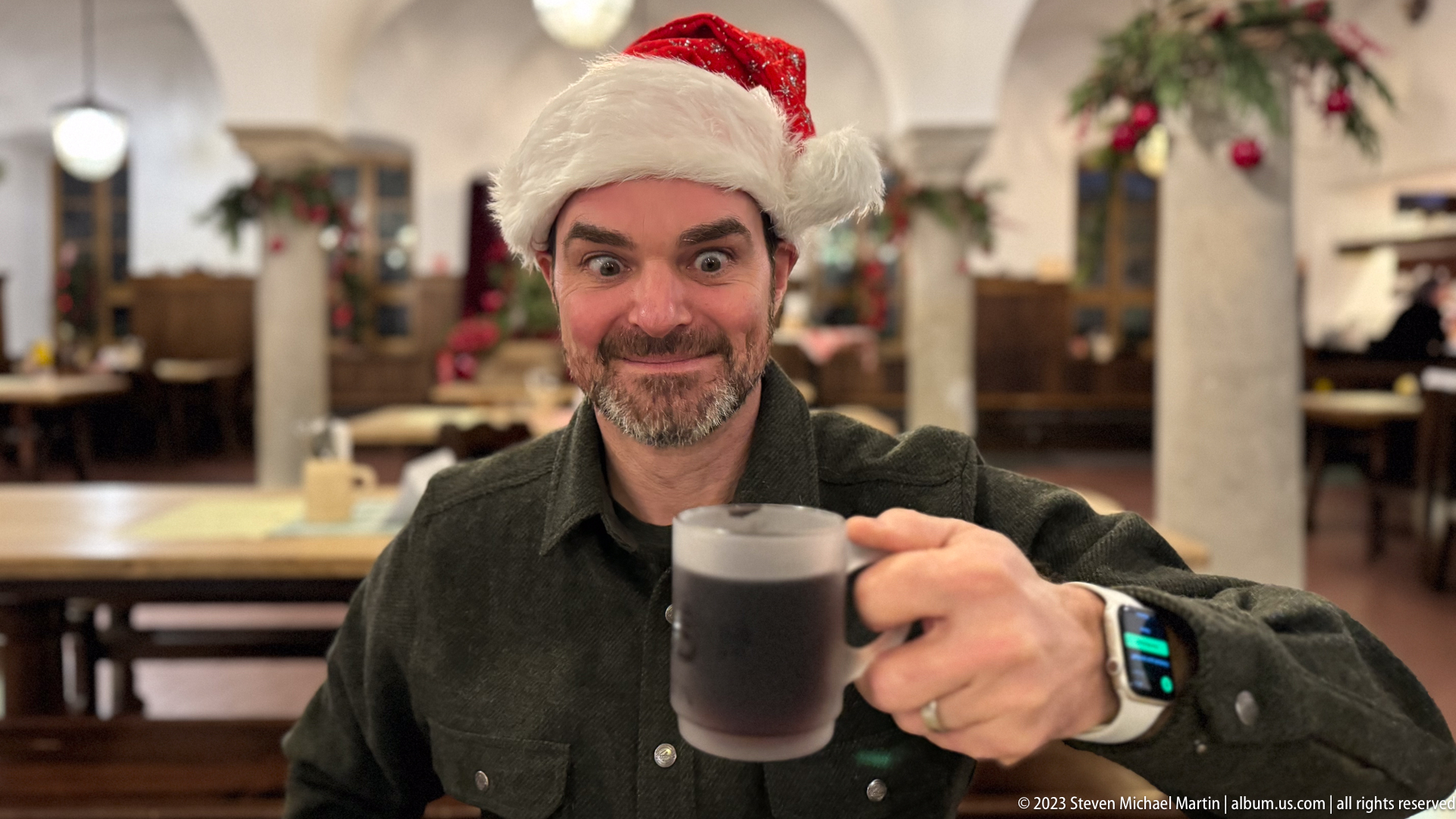
A visitor in a dark jacket leans toward the camera with an exaggerated smile while raising a mug of dark hot drink. Christmas greenery, ornaments, arched columns, and dining tables blur behind him, making the gesture and expression the dominant elements. The playful portrait continues the sequence of seasonal dining scenes from the Hohenschwangau visit.
Caption
A visitor in a dark jacket leans toward the camera with an exaggerated smile while raising a mug of dark hot drink. Christmas greenery, ornaments, arched columns, and dining tables blur behind him, making the gesture and expression the dominant elements. The playful portrait continues the sequence of seasonal dining scenes from the Hohenschwangau visit.

Two visitors stand on either side of a decorated Christmas tree, each holding a dark hot drink in a mug. Red ribbons, baubles, and metallic ornaments fill the tree between them, while one visitor wears a Santa hat and checked jacket. The symmetrical composition turns a casual refreshment stop into a deliberately festive travel portrait.
Caption
Two visitors stand on either side of a decorated Christmas tree, each holding a dark hot drink in a mug. Red ribbons, baubles, and metallic ornaments fill the tree between them, while one visitor wears a Santa hat and checked jacket. The symmetrical composition turns a casual refreshment stop into a deliberately festive travel portrait.
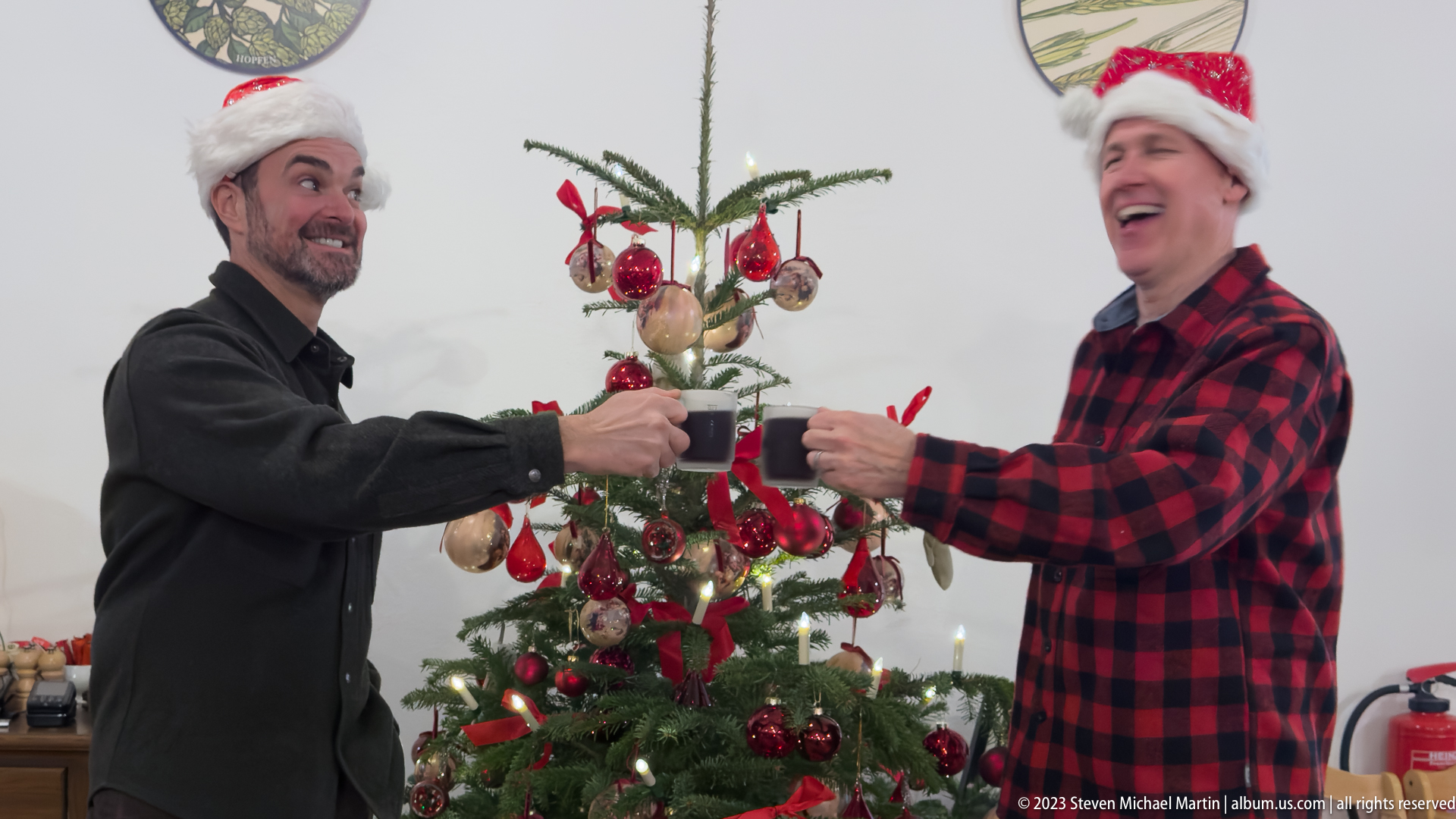
Two visitors laugh as they bring their mugs together for a toast beside a Christmas tree decorated with red ribbons and traditional ornaments. Their animated expressions and opposing dark and red-checked clothing create a lively human moment within the otherwise static holiday setting. The image emphasizes shared experience and seasonal atmosphere rather than the nearby castles.
Caption
Two visitors laugh as they bring their mugs together for a toast beside a Christmas tree decorated with red ribbons and traditional ornaments. Their animated expressions and opposing dark and red-checked clothing create a lively human moment within the otherwise static holiday setting. The image emphasizes shared experience and seasonal atmosphere rather than the nearby castles.
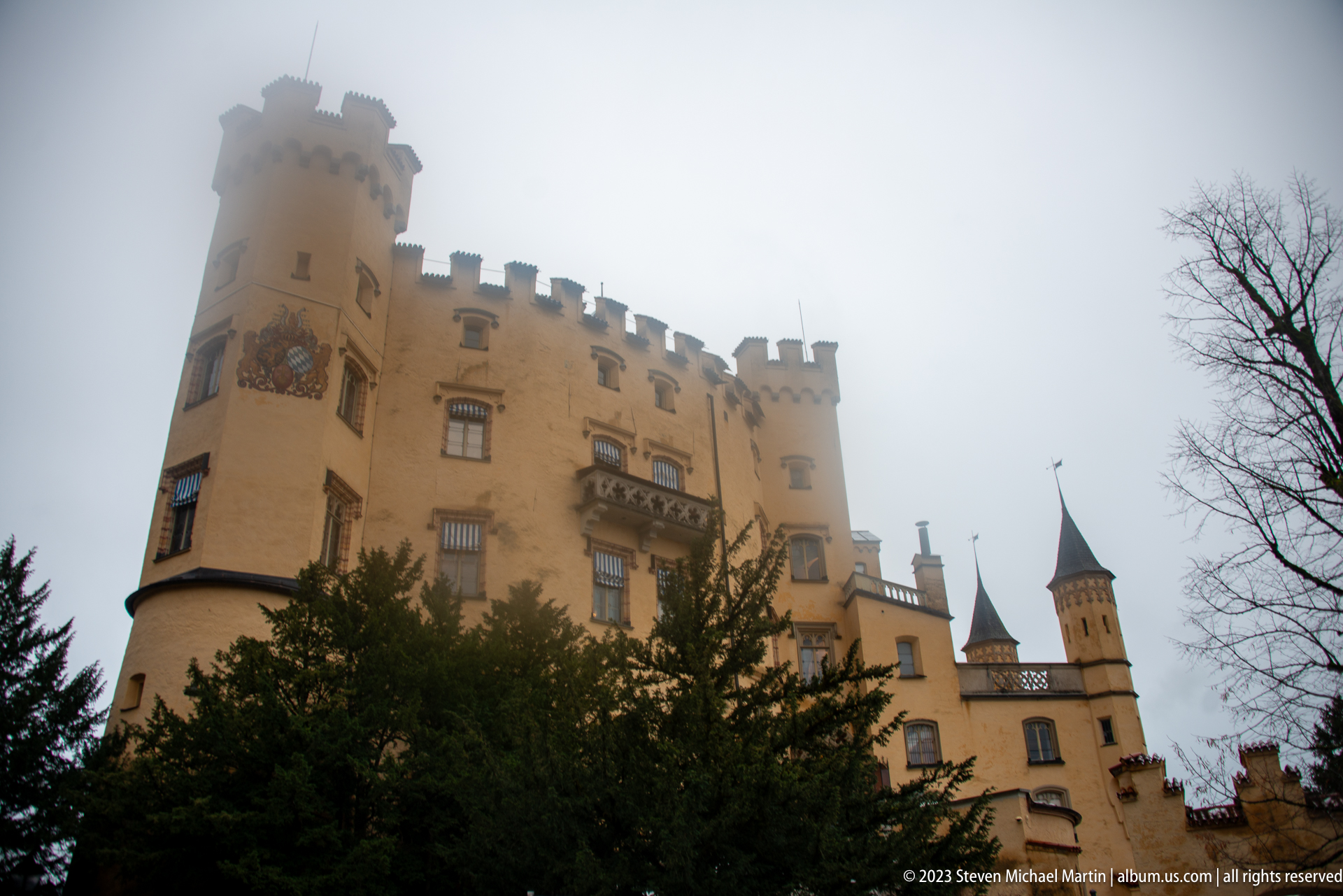
Hohenschwangau Castle rises above trees in a steep low-angle view, emphasizing its ochre stucco, crenellated parapets, projecting balcony, and irregular tower forms. Mist softens the upper portions of the structure and sky, lending the photograph a subdued winter atmosphere. The close vantage point concentrates on vertical massing rather than the castle's wider hilltop setting.
Caption
Hohenschwangau Castle rises above trees in a steep low-angle view, emphasizing its ochre stucco, crenellated parapets, projecting balcony, and irregular tower forms. Mist softens the upper portions of the structure and sky, lending the photograph a subdued winter atmosphere. The close vantage point concentrates on vertical massing rather than the castle's wider hilltop setting.
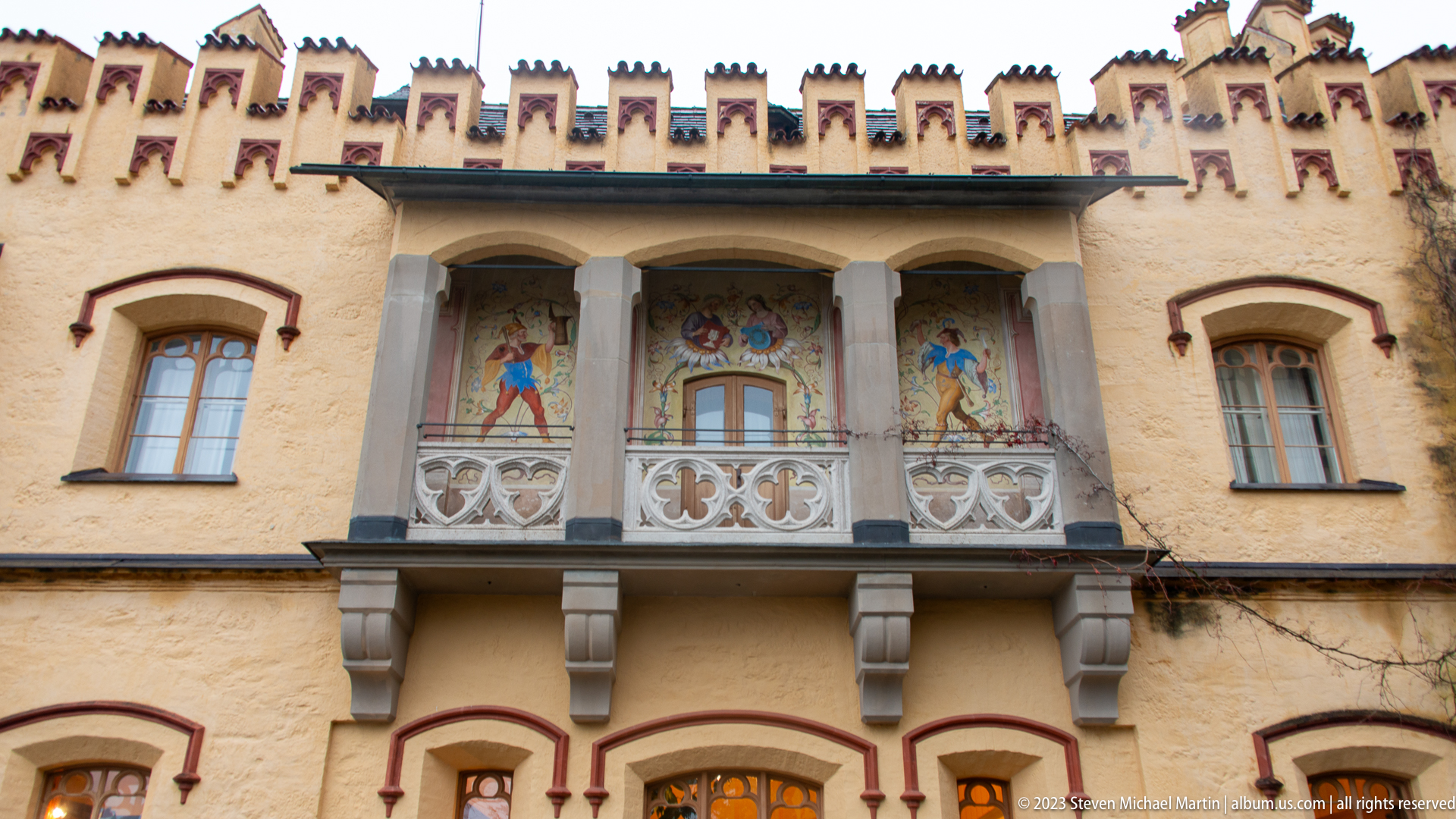
A projecting balcony on Hohenschwangau Castle combines pale stone supports, pierced Gothic-style tracery, and brightly painted heraldic and figurative panels. The ochre wall and crenellated parapet above provide the unmistakable architectural setting, while the tight frontal view reveals how color, sculpture, and medievalizing ornament were integrated into the 19th-century royal residence.
Caption
A projecting balcony on Hohenschwangau Castle combines pale stone supports, pierced Gothic-style tracery, and brightly painted heraldic and figurative panels. The ochre wall and crenellated parapet above provide the unmistakable architectural setting, while the tight frontal view reveals how color, sculpture, and medievalizing ornament were integrated into the 19th-century royal residence.
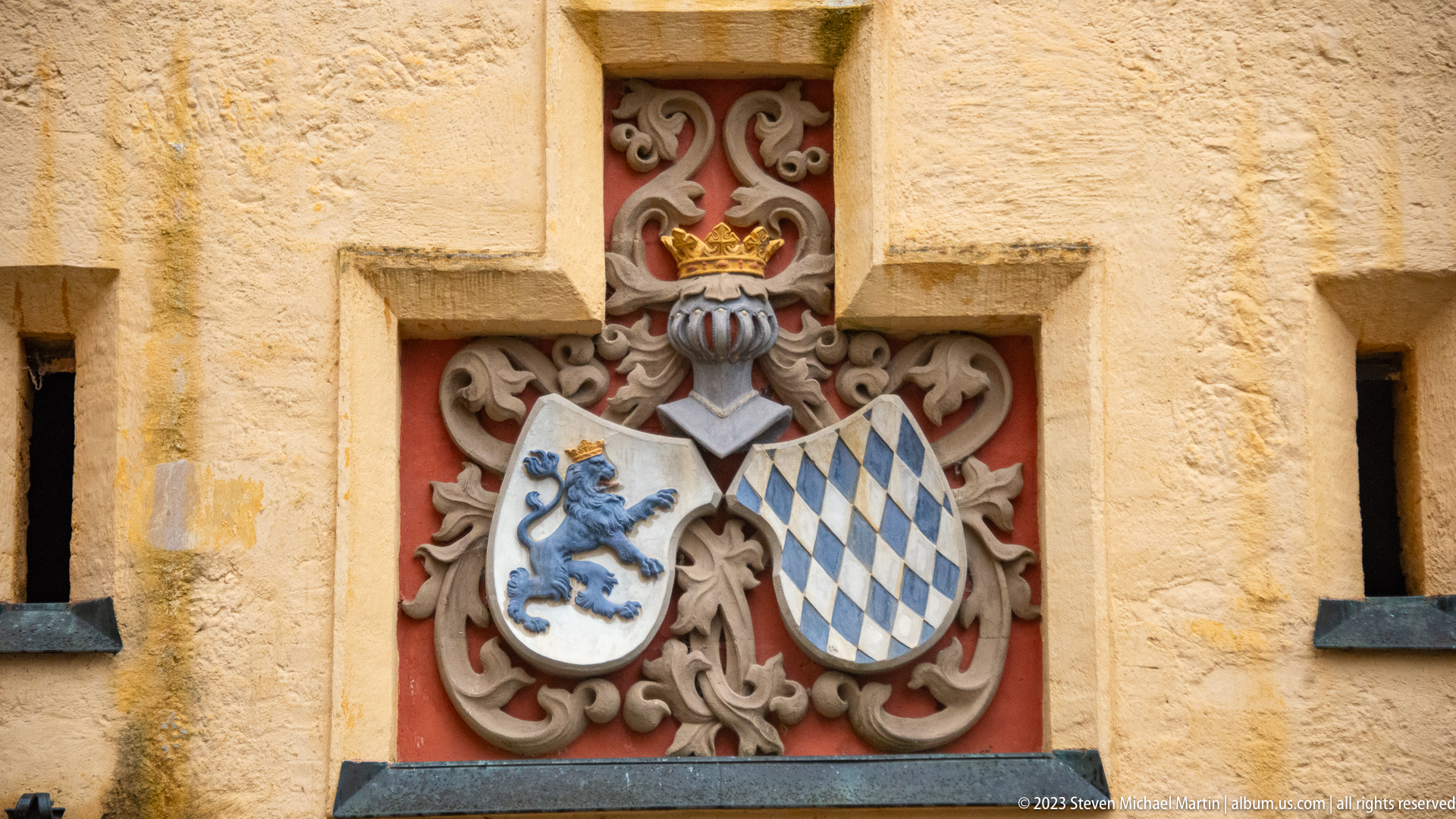
A carved heraldic panel displays two shields beneath a crowned helmet and scrolling mantling. One shield bears the blue-and-white Bavarian lozenges, while the other carries a rampant lion, linking the decorative program to Bavarian royal heraldry. The relief is set directly into the ochre masonry, where its red backing sharply separates the carved forms from the wall.
Caption
A carved heraldic panel displays two shields beneath a crowned helmet and scrolling mantling. One shield bears the blue-and-white Bavarian lozenges, while the other carries a rampant lion, linking the decorative program to Bavarian royal heraldry. The relief is set directly into the ochre masonry, where its red backing sharply separates the carved forms from the wall.
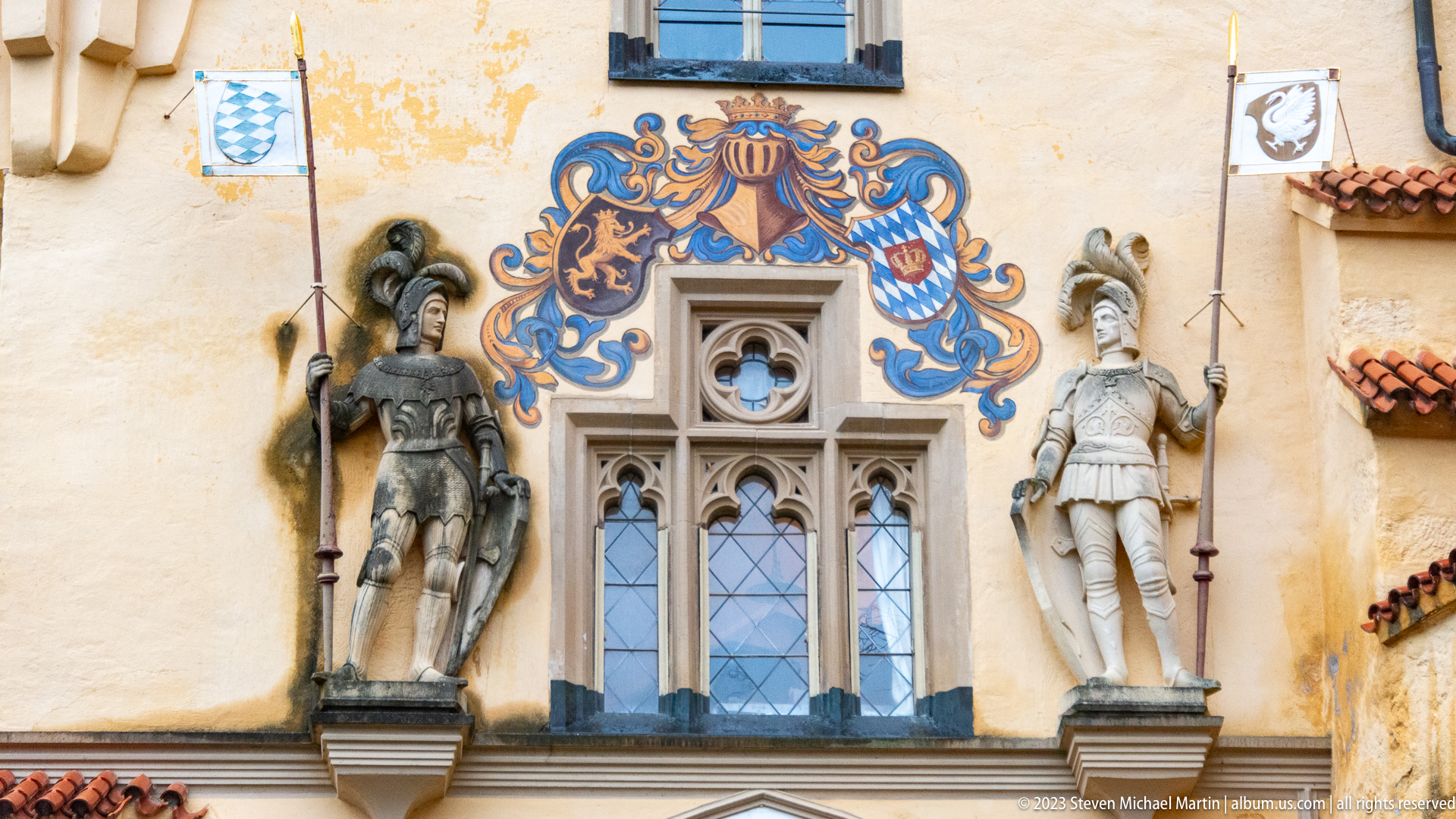
Two full-length armored figures stand on projecting consoles beside a narrow Gothic-style window on Hohenschwangau Castle. Above the opening, blue-and-gold painted heraldic ornament surrounds a helmet and shield motif. The combination of sculpture, tracery, and polychrome decoration gives this section of the ochre facade an overtly medievalizing, ceremonial character.
Caption
Two full-length armored figures stand on projecting consoles beside a narrow Gothic-style window on Hohenschwangau Castle. Above the opening, blue-and-gold painted heraldic ornament surrounds a helmet and shield motif. The combination of sculpture, tracery, and polychrome decoration gives this section of the ochre facade an overtly medievalizing, ceremonial character.
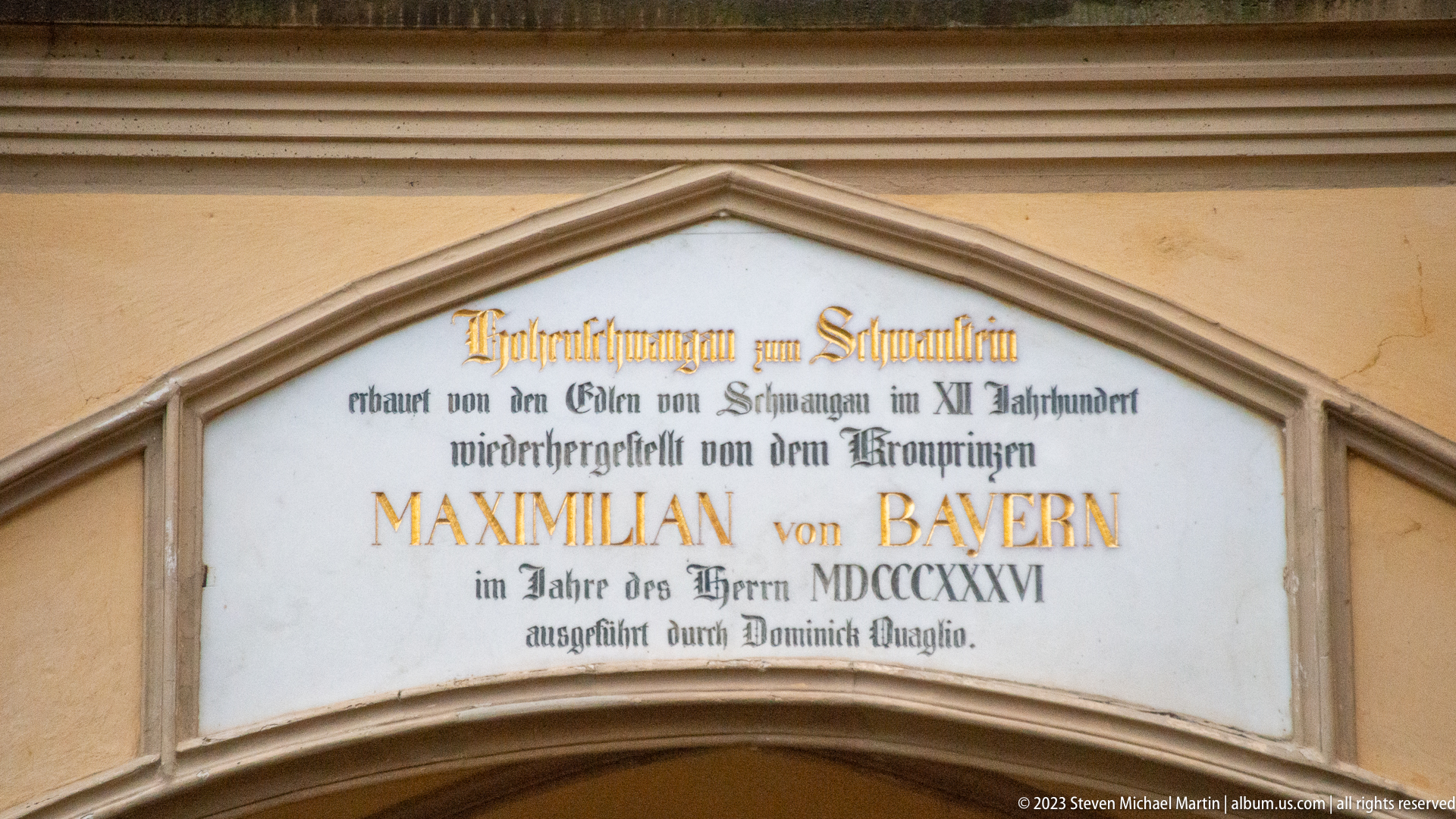
A painted German inscription in a pointed architectural panel records the rebuilding of Hohenschwangau under Crown Prince Maximilian of Bavaria. Gold lettering highlights his name and the dates, while black Gothic-script text supplies the surrounding statement. The panel functions as a documentary architectural inscription connecting the restored castle directly with its 19th-century royal patron.
Caption
A painted German inscription in a pointed architectural panel records the rebuilding of Hohenschwangau under Crown Prince Maximilian of Bavaria. Gold lettering highlights his name and the dates, while black Gothic-script text supplies the surrounding statement. The panel functions as a documentary architectural inscription connecting the restored castle directly with its 19th-century royal patron.
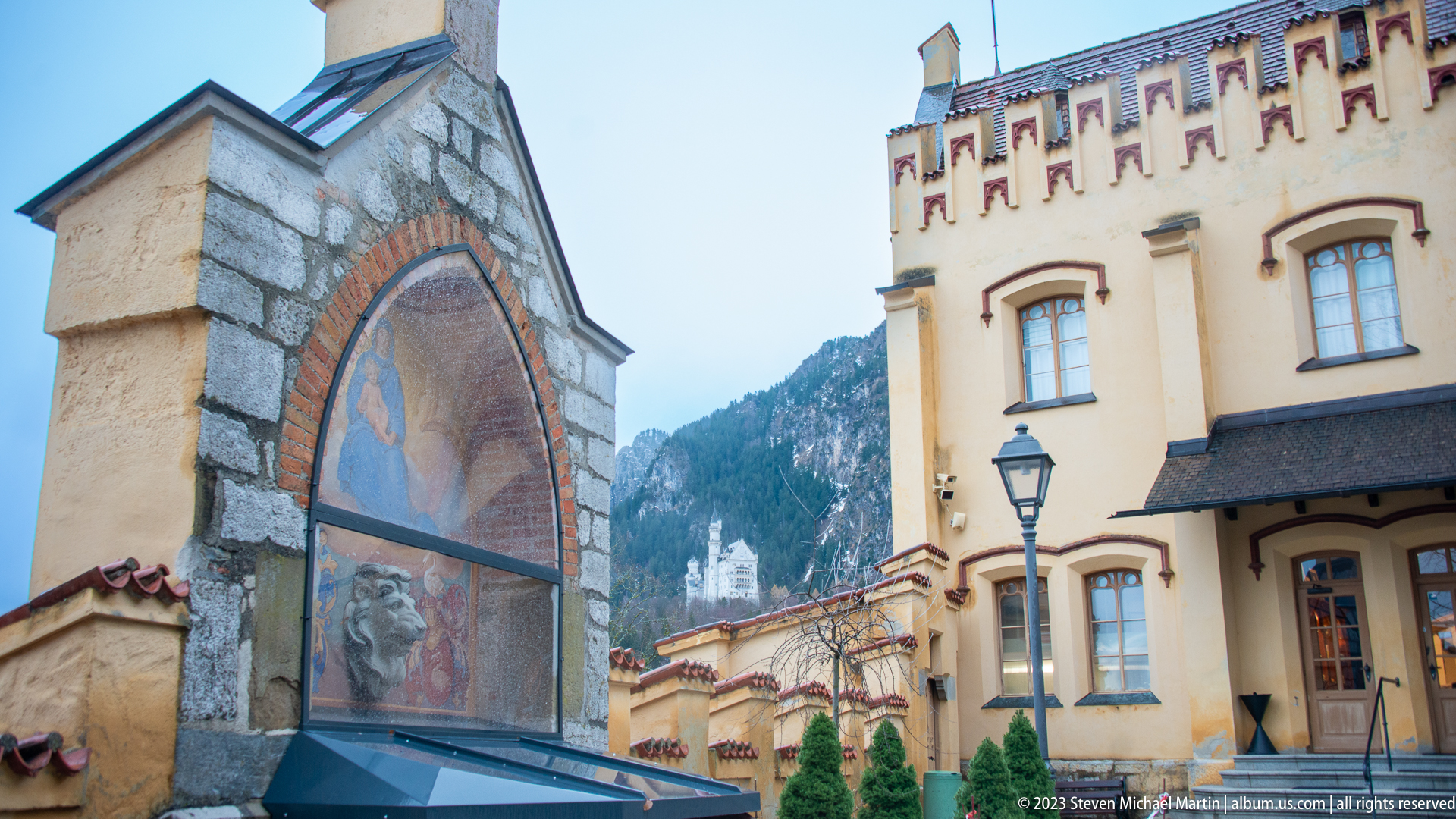
A tall pointed wall niche carries a painted sacred scene beside the crenellated ochre buildings of Hohenschwangau Castle. The masonry frame, tiled coping, lantern, and mountain slope beyond create a layered courtyard composition, while Neuschwanstein Castle is faintly visible in the distance through the opening between structures.
Caption
A tall pointed wall niche carries a painted sacred scene beside the crenellated ochre buildings of Hohenschwangau Castle. The masonry frame, tiled coping, lantern, and mountain slope beyond create a layered courtyard composition, while Neuschwanstein Castle is faintly visible in the distance through the opening between structures.
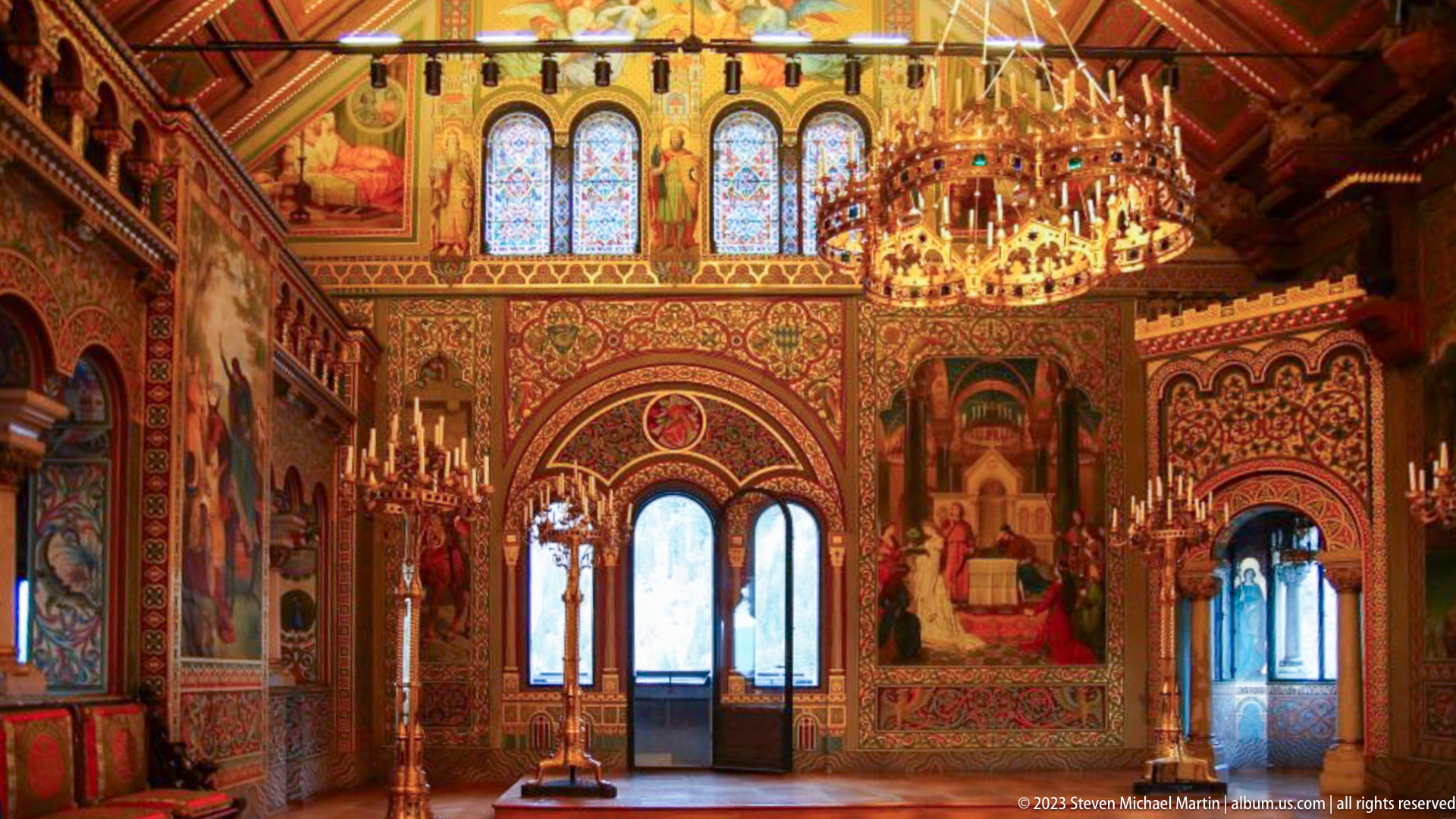
An opulent room inside Hohenschwangau Castle is covered with dense painted ornament, murals, patterned wall surfaces, and stained glass. A large multi-tier chandelier hangs from the dark timber ceiling above arched doorways and richly decorated wall panels. The interior demonstrates the castle's highly theatrical historicist decoration, extending medievalizing imagery from the exterior into its royal rooms.
Caption
An opulent room inside Hohenschwangau Castle is covered with dense painted ornament, murals, patterned wall surfaces, and stained glass. A large multi-tier chandelier hangs from the dark timber ceiling above arched doorways and richly decorated wall panels. The interior demonstrates the castle's highly theatrical historicist decoration, extending medievalizing imagery from the exterior into its royal rooms.

A richly furnished chamber at Hohenschwangau Castle combines narrative wall paintings with carved woodwork, a decorative tiled stove, desk, lamps, and a high-backed chair. The murals wrap around the upper walls in continuous scenes, while patterned lower panels and ornamental arches unify the room. The view records domestic furnishing within the castle's broader historicist decorative program.
Caption
A richly furnished chamber at Hohenschwangau Castle combines narrative wall paintings with carved woodwork, a decorative tiled stove, desk, lamps, and a high-backed chair. The murals wrap around the upper walls in continuous scenes, while patterned lower panels and ornamental arches unify the room. The view records domestic furnishing within the castle's broader historicist decorative program.
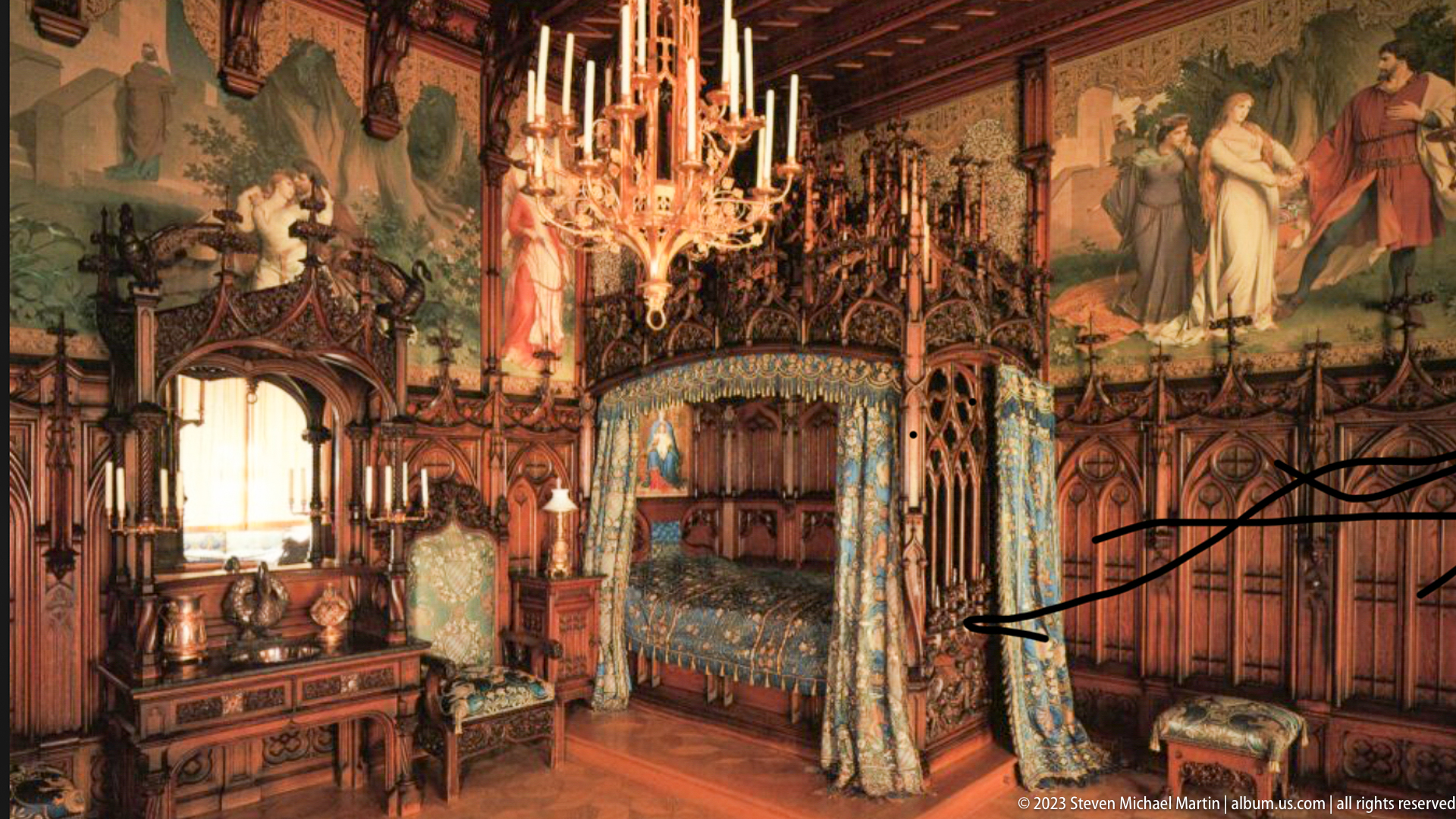
A canopied bed with blue patterned textiles stands against richly carved wood paneling in a Hohenschwangau Castle bedroom. Large narrative murals extend across the upper walls, while an elaborate chandelier, mirror, and small tables add to the dense furnishing. The room's combination of medievalizing imagery and domestic luxury conveys the romantic historicism of the royal residence.
Caption
A canopied bed with blue patterned textiles stands against richly carved wood paneling in a Hohenschwangau Castle bedroom. Large narrative murals extend across the upper walls, while an elaborate chandelier, mirror, and small tables add to the dense furnishing. The room's combination of medievalizing imagery and domestic luxury conveys the romantic historicism of the royal residence.
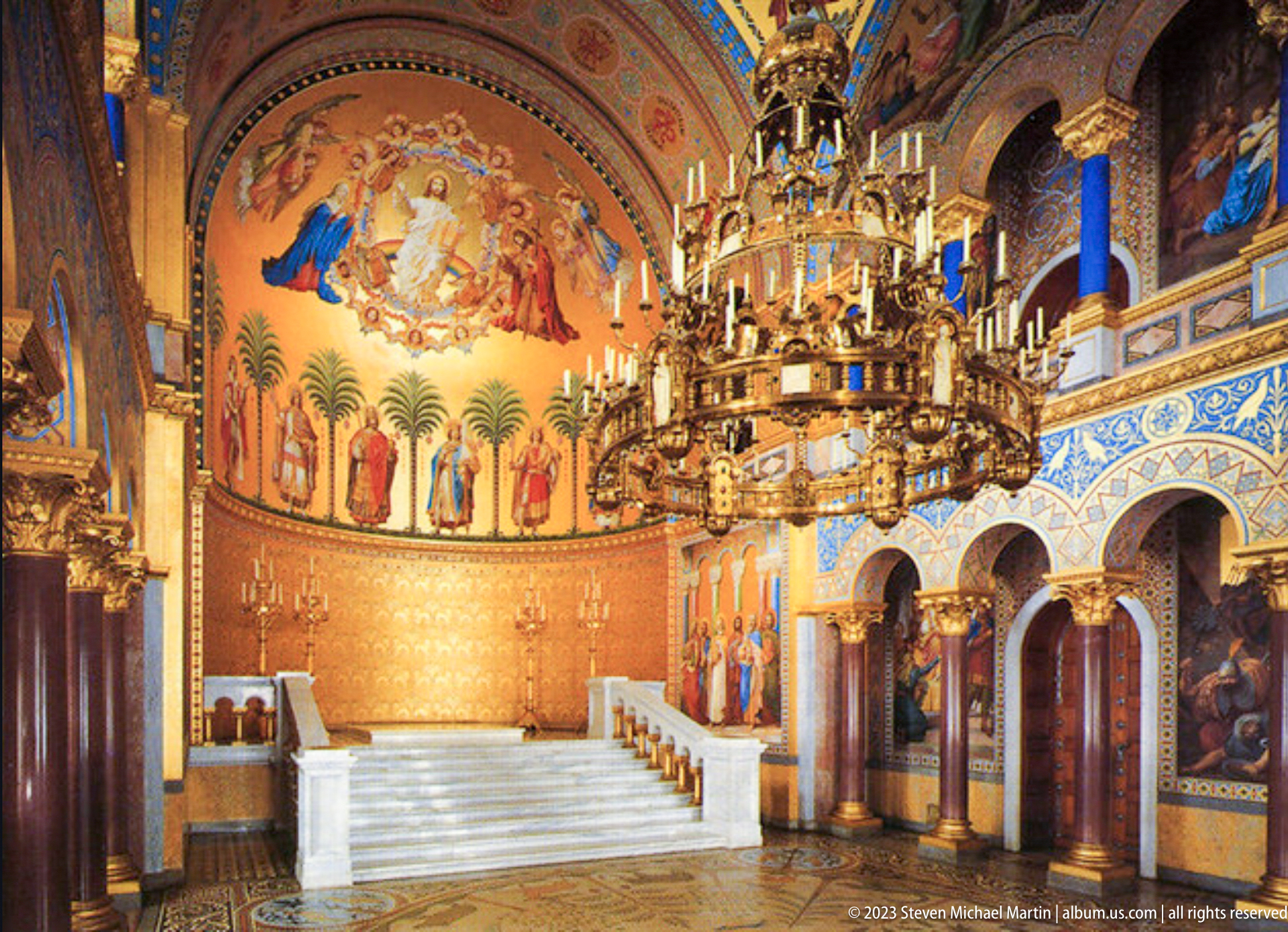
A grand hall at Hohenschwangau Castle is organized around broad white steps, blue columns, gilded ornament, painted arcades, and monumental wall murals. A large chandelier dominates the upper center, while the richly patterned surfaces create a theatrical architectural setting. The symmetrical composition emphasizes ceremony and display rather than domestic use.
Caption
A grand hall at Hohenschwangau Castle is organized around broad white steps, blue columns, gilded ornament, painted arcades, and monumental wall murals. A large chandelier dominates the upper center, while the richly patterned surfaces create a theatrical architectural setting. The symmetrical composition emphasizes ceremony and display rather than domestic use.
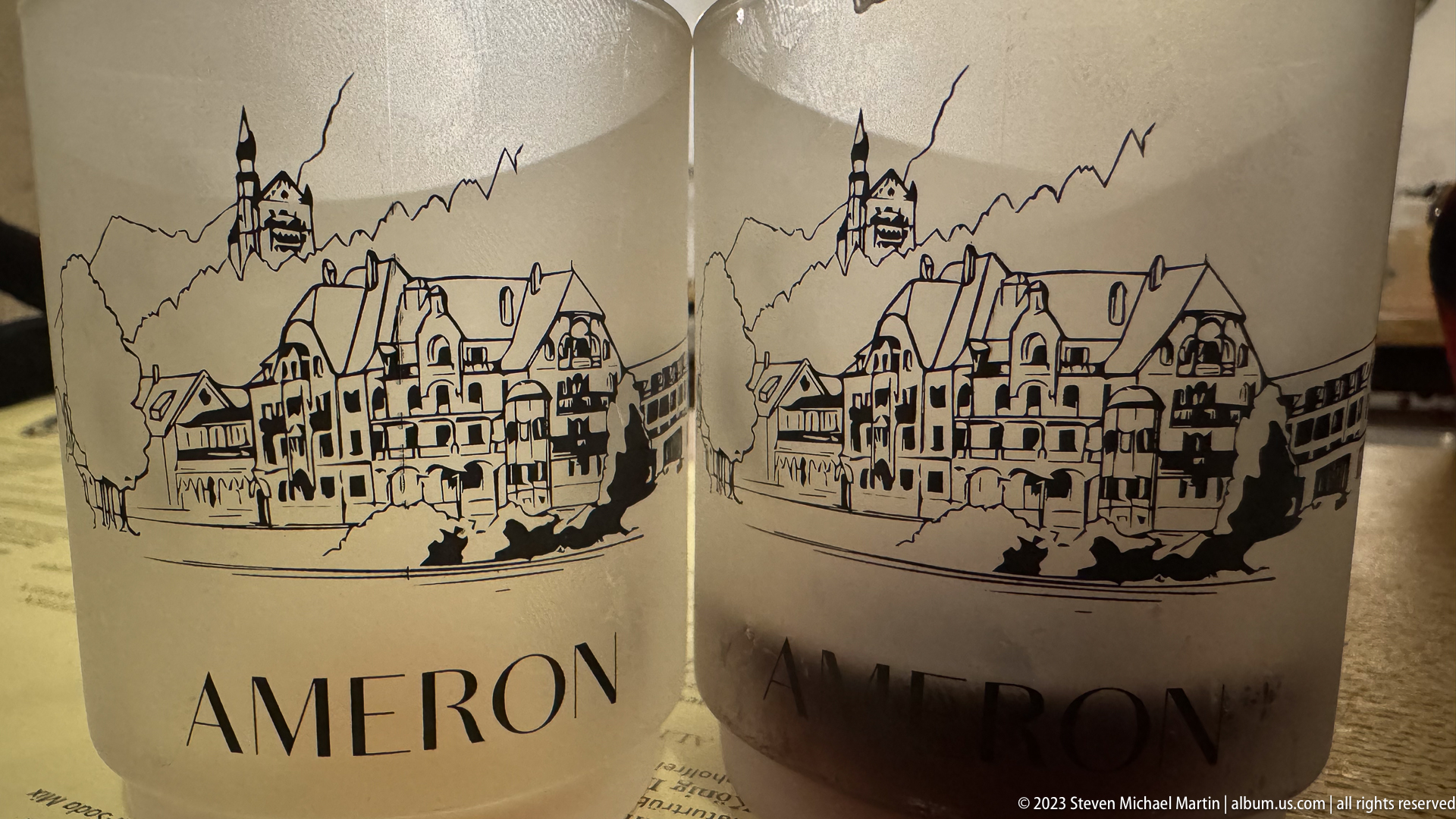
Two white mugs printed with the word 'AMERON' and a black line drawing of an alpine castle-and-village scene sit side by side. The simplified illustration wraps around both vessels, showing towers, clustered roofs, and a mountain outline. The close still-life view records branded hospitality merchandise associated with the Hohenschwangau visitor area.
Caption
Two white mugs printed with the word 'AMERON' and a black line drawing of an alpine castle-and-village scene sit side by side. The simplified illustration wraps around both vessels, showing towers, clustered roofs, and a mountain outline. The close still-life view records branded hospitality merchandise associated with the Hohenschwangau visitor area.

Hohenschwangau Castle glows in warm floodlighting above a dark wooded ridge, its crenellated towers and long walls sharply outlined against the black night sky. The illuminated masonry creates a dramatic silhouette while the lower slope remains largely in shadow. This night view transforms the familiar ochre daytime facade into a luminous landmark above the village.
Caption
Hohenschwangau Castle glows in warm floodlighting above a dark wooded ridge, its crenellated towers and long walls sharply outlined against the black night sky. The illuminated masonry creates a dramatic silhouette while the lower slope remains largely in shadow. This night view transforms the familiar ochre daytime facade into a luminous landmark above the village.

A large pale hotel building with green shutters and a red roof is illuminated from within at the edge of the snowy Hohenschwangau settlement. A glassy or arcaded lower dining level glows warmly beneath the darker upper floors, while bare trees cross the foreground. The view emphasizes hospitality architecture serving visitors to the nearby castles.
Caption
A large pale hotel building with green shutters and a red roof is illuminated from within at the edge of the snowy Hohenschwangau settlement. A glassy or arcaded lower dining level glows warmly beneath the darker upper floors, while bare trees cross the foreground. The view emphasizes hospitality architecture serving visitors to the nearby castles.

Neuschwanstein Castle appears across the valley in cool dusk light, with its pale palace block and tall cylindrical tower standing against the dark forested slope. Warm interior lights punctuate several windows, while a nearer roof intrudes at lower left and establishes the view from the village below. The contrast between lit windows and blue evening tones emphasizes the castle's vertical profile.
Caption
Neuschwanstein Castle appears across the valley in cool dusk light, with its pale palace block and tall cylindrical tower standing against the dark forested slope. Warm interior lights punctuate several windows, while a nearer roof intrudes at lower left and establishes the view from the village below. The contrast between lit windows and blue evening tones emphasizes the castle's vertical profile.
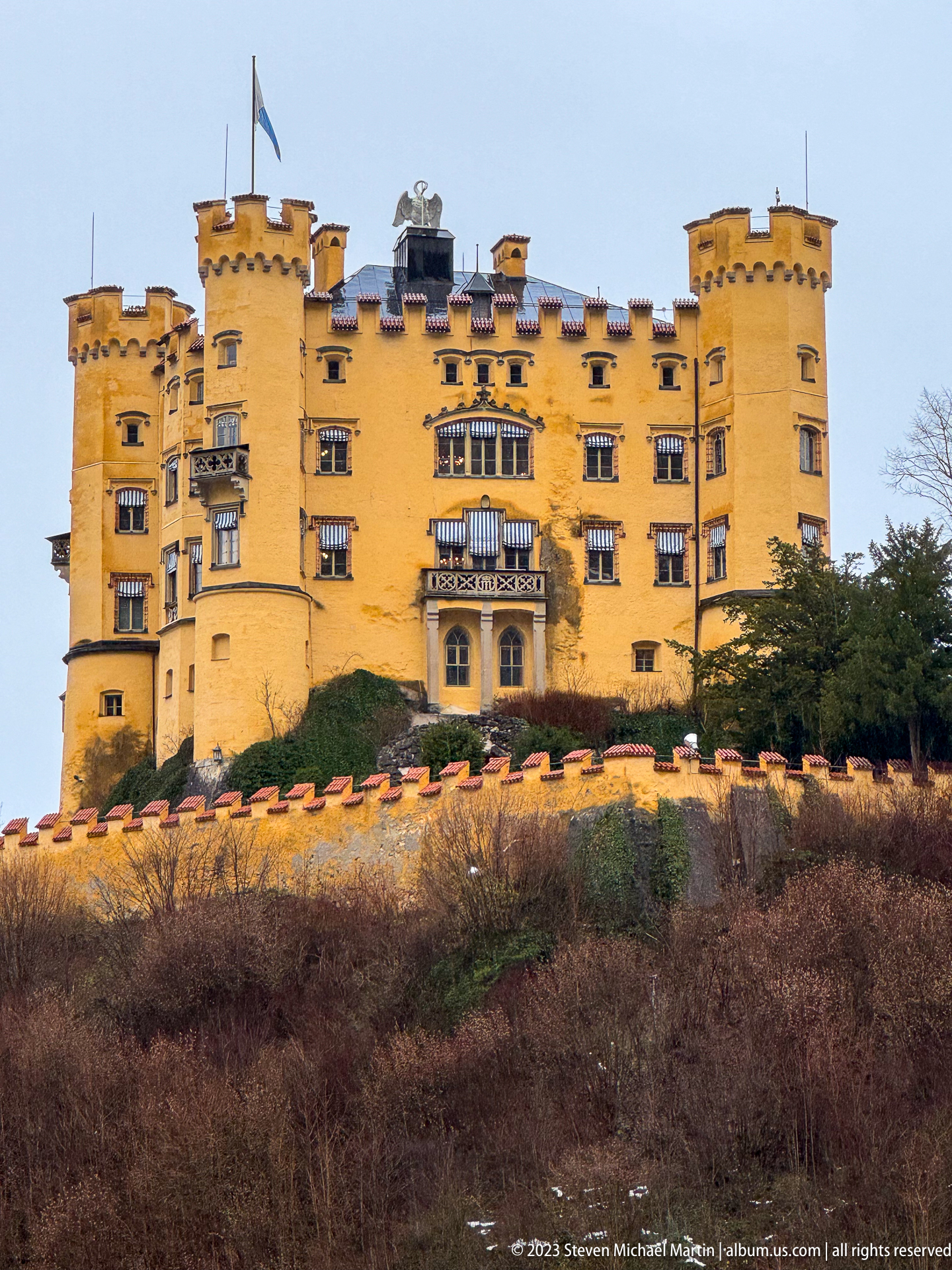
A closer exterior view isolates Hohenschwangau Castle's broad ochre façade, crenellated roofline, square corner towers, balconies, and rows of windows. Bare winter vegetation covers the slope below, while the pale sky provides a clean backdrop for the irregular massing. The tighter composition emphasizes architectural detail rather than the surrounding valley.
Caption
A closer exterior view isolates Hohenschwangau Castle's broad ochre façade, crenellated roofline, square corner towers, balconies, and rows of windows. Bare winter vegetation covers the slope below, while the pale sky provides a clean backdrop for the irregular massing. The tighter composition emphasizes architectural detail rather than the surrounding valley.
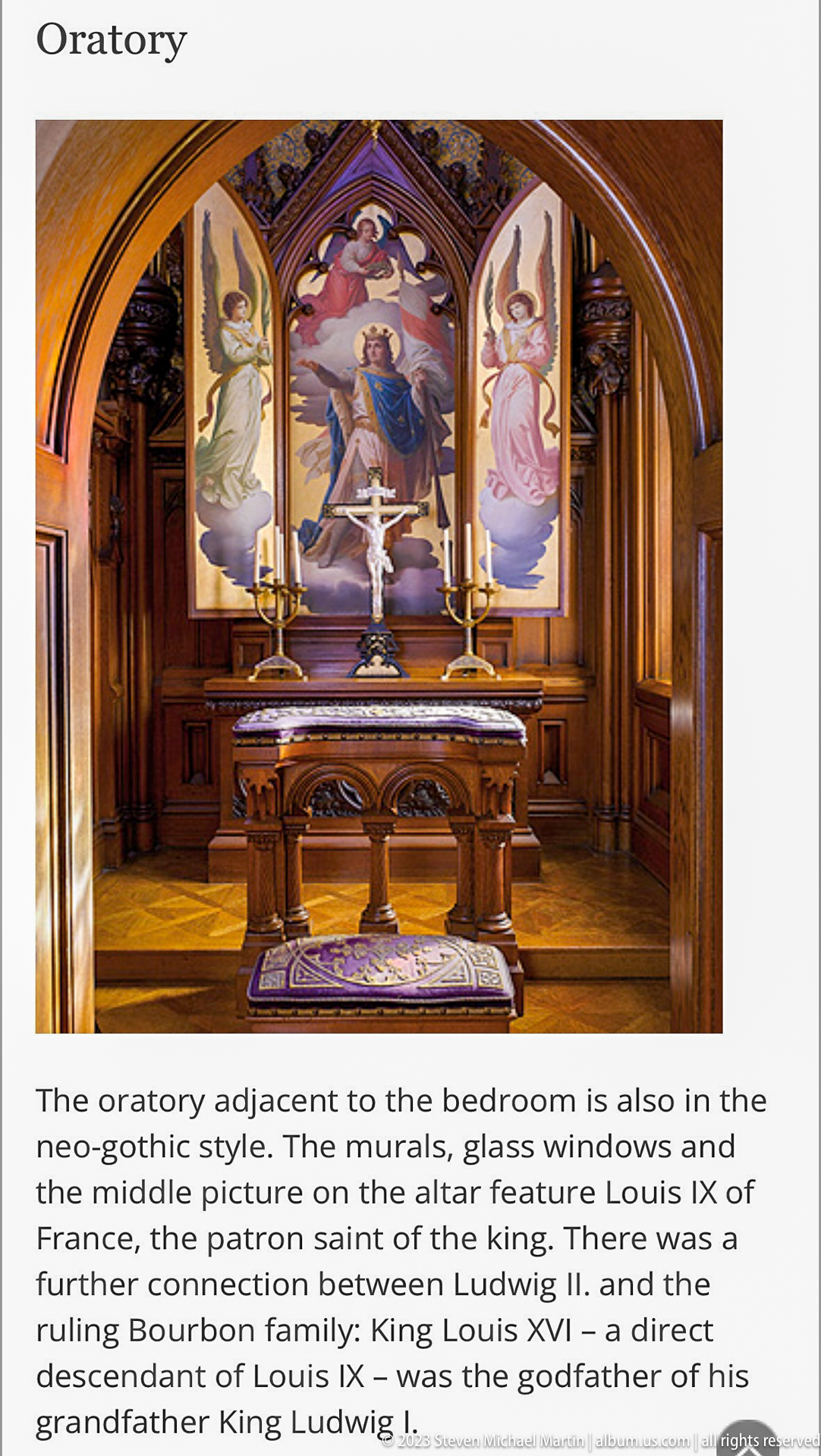
A museum-style interpretive panel titled 'Oratory' reproduces a richly paneled chapel interior with painted religious figures above an altar. The accompanying English text explains the room's relationship to the bedroom and identifies Saint Louis IX of France in the central image. The panel documents both the appearance and historical interpretation of the castle's small devotional space.
Caption
A museum-style interpretive panel titled 'Oratory' reproduces a richly paneled chapel interior with painted religious figures above an altar. The accompanying English text explains the room's relationship to the bedroom and identifies Saint Louis IX of France in the central image. The panel documents both the appearance and historical interpretation of the castle's small devotional space.
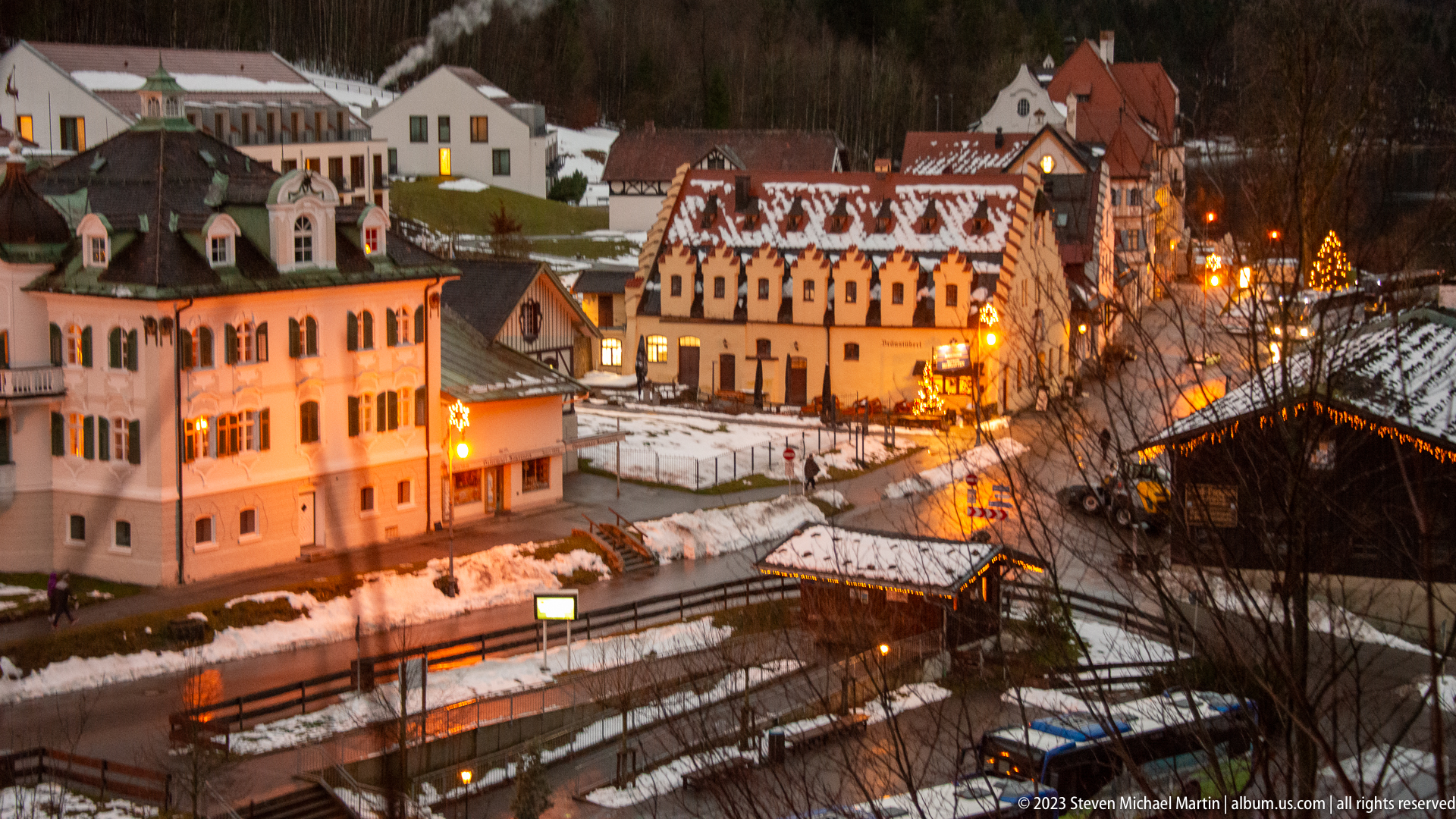
Warm streetlamps and interior lights pick out a cluster of Hohenschwangau buildings against the dark winter hillside. Snow lies on roofs and along paths, while a pale corner building at left and a larger gabled structure beyond form the main architectural anchors. The elevated night view captures the transition from daytime tourism to the quieter illuminated village after dark.
Caption
Warm streetlamps and interior lights pick out a cluster of Hohenschwangau buildings against the dark winter hillside. Snow lies on roofs and along paths, while a pale corner building at left and a larger gabled structure beyond form the main architectural anchors. The elevated night view captures the transition from daytime tourism to the quieter illuminated village after dark.
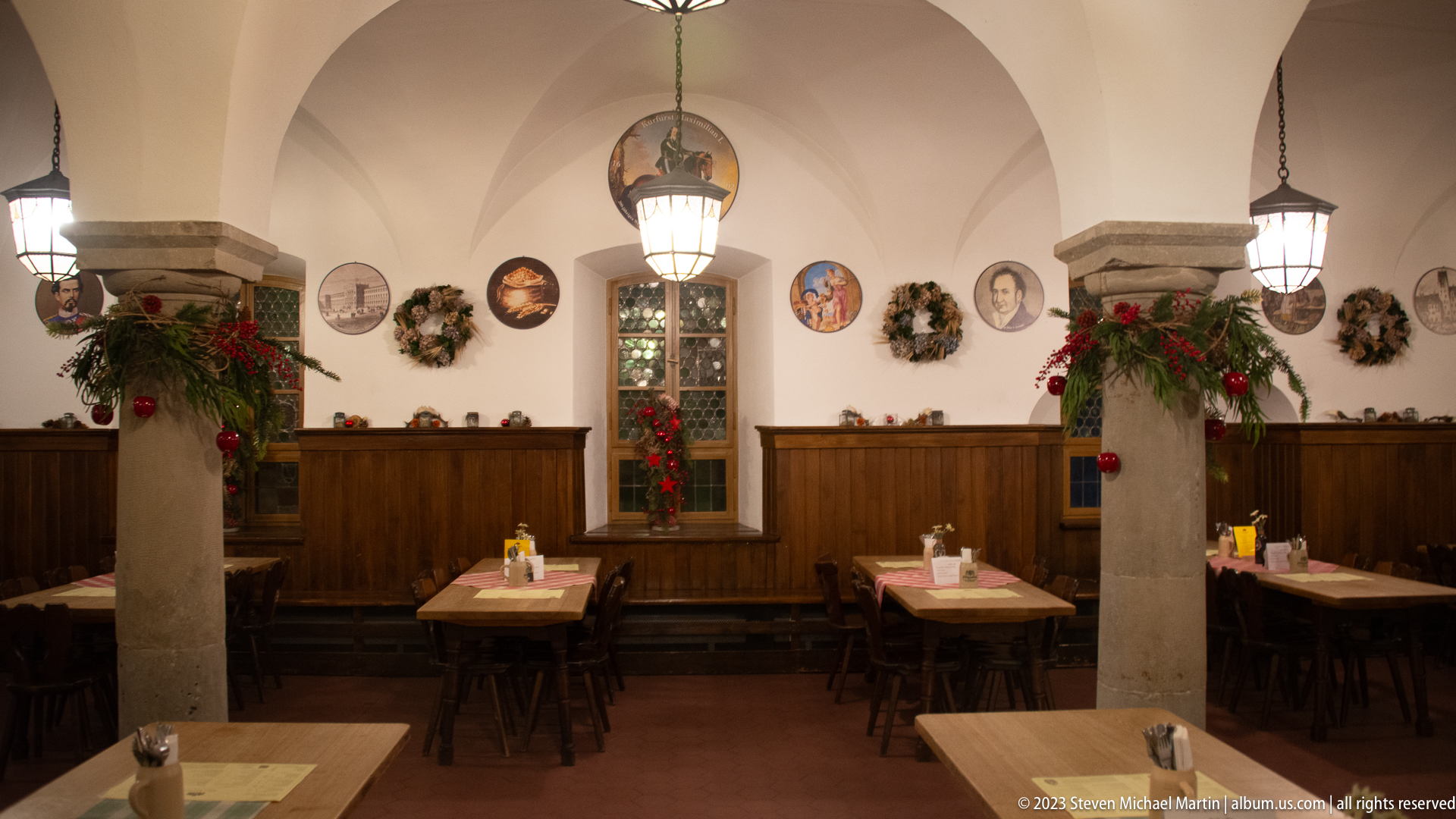
A dining room with white vaulted ceilings, stone columns, dark wood wainscoting, and simple wooden tables is decorated with evergreen wreaths and red holiday accents. Hanging lanterns provide warm light, while small wall medallions and framed decoration reinforce the traditional interior character. The room presents a restrained Christmas atmosphere compared with the more elaborate castle interiors.
Caption
A dining room with white vaulted ceilings, stone columns, dark wood wainscoting, and simple wooden tables is decorated with evergreen wreaths and red holiday accents. Hanging lanterns provide warm light, while small wall medallions and framed decoration reinforce the traditional interior character. The room presents a restrained Christmas atmosphere compared with the more elaborate castle interiors.
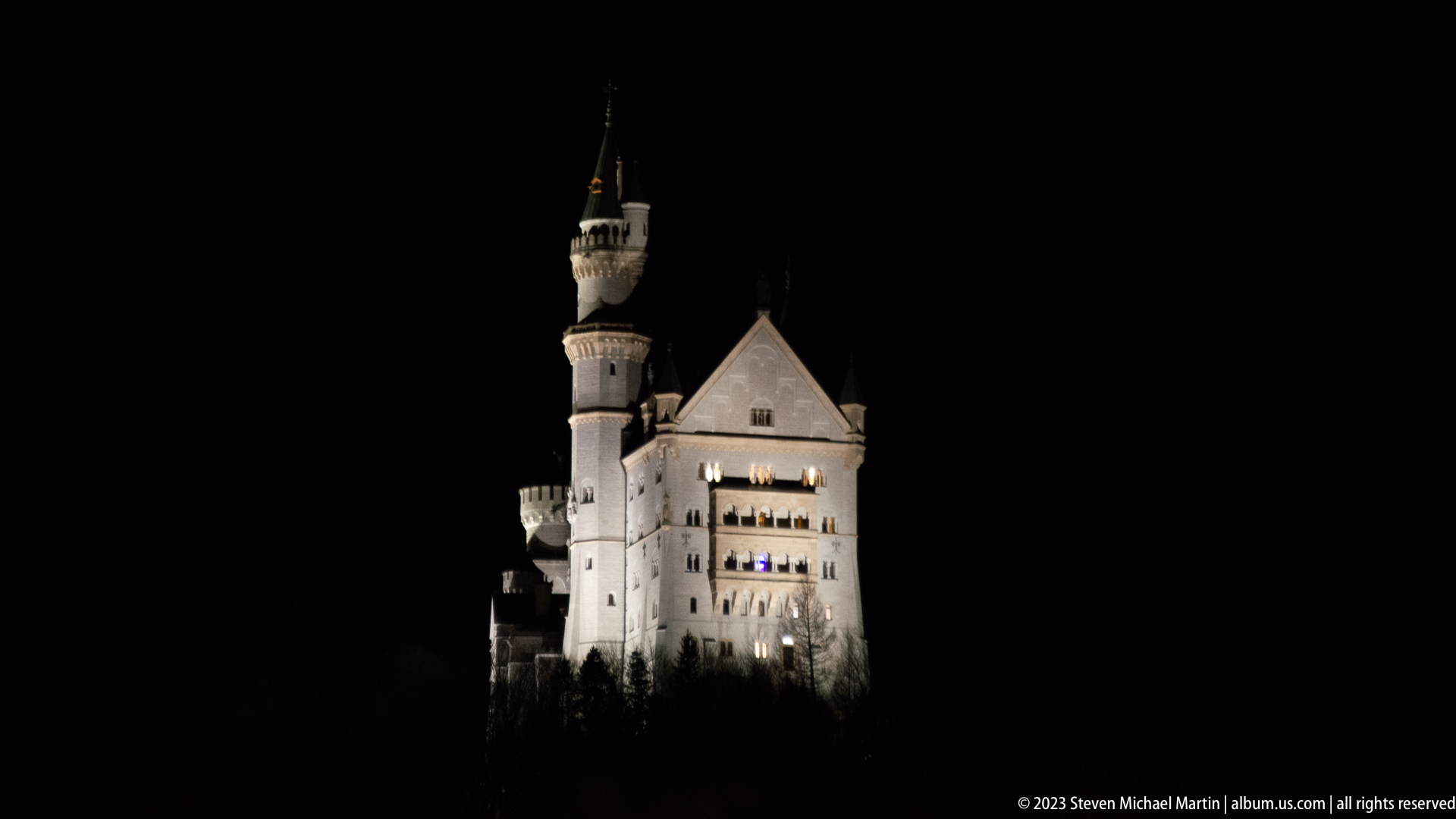
Neuschwanstein Castle rises alone from the darkness in a tightly framed night view, its pale walls and tall cylindrical tower picked out by exterior lighting. The black sky and almost invisible hillside strip away the broader landscape, reducing the composition to the castle's recognizable vertical silhouette and glowing windows.
Caption
Neuschwanstein Castle rises alone from the darkness in a tightly framed night view, its pale walls and tall cylindrical tower picked out by exterior lighting. The black sky and almost invisible hillside strip away the broader landscape, reducing the composition to the castle's recognizable vertical silhouette and glowing windows.
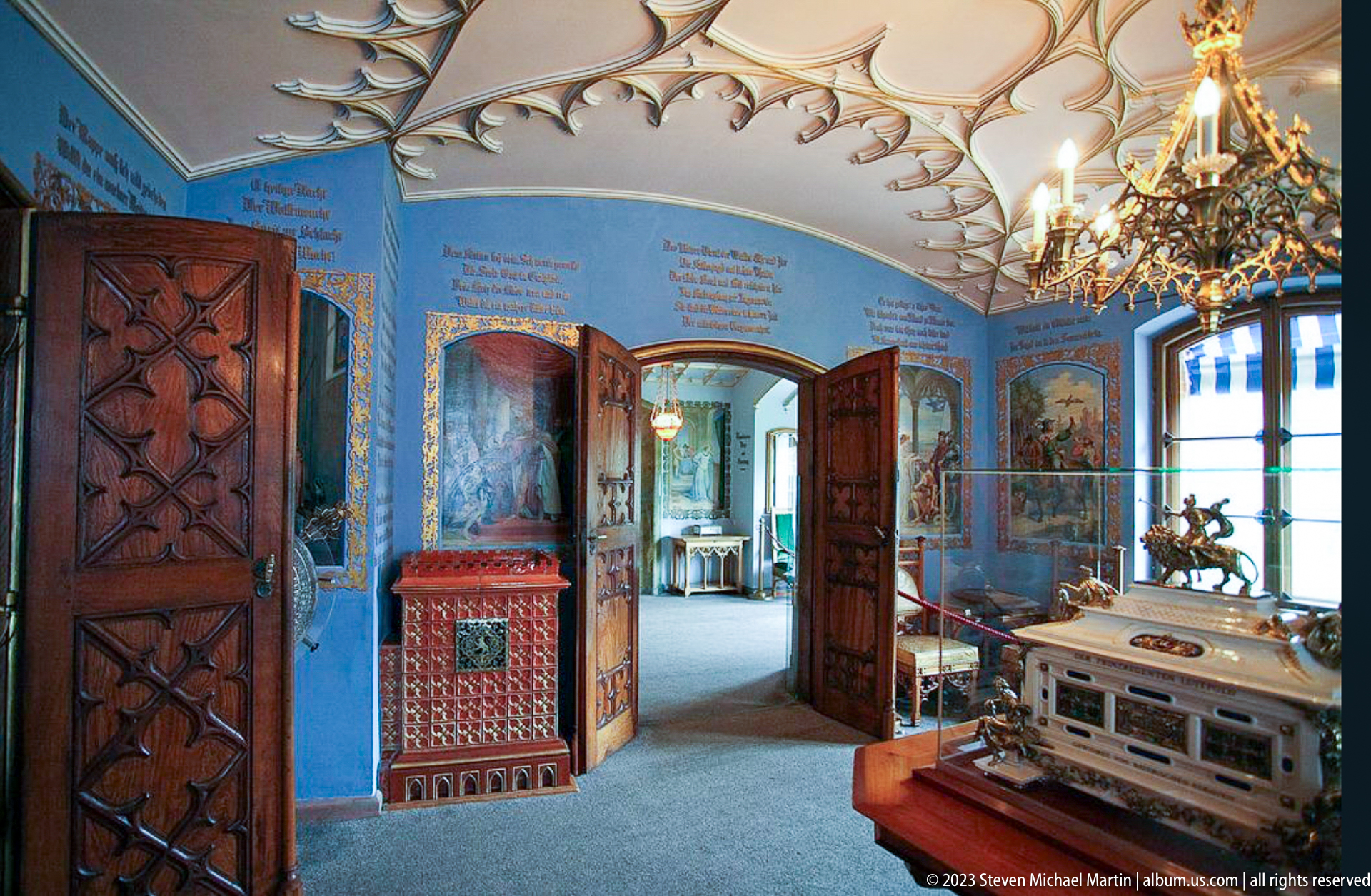
A blue-painted room in Hohenschwangau Castle combines carved wooden doors, painted inscriptions, narrative wall scenes, and an ornate ceramic stove. A chandelier hangs from a ribbed decorative ceiling, while glass barriers indicate the room's current museum presentation. The layered interior decoration blends domestic furnishing with the castle's romantic historicist imagery.
Caption
A blue-painted room in Hohenschwangau Castle combines carved wooden doors, painted inscriptions, narrative wall scenes, and an ornate ceramic stove. A chandelier hangs from a ribbed decorative ceiling, while glass barriers indicate the room's current museum presentation. The layered interior decoration blends domestic furnishing with the castle's romantic historicist imagery.
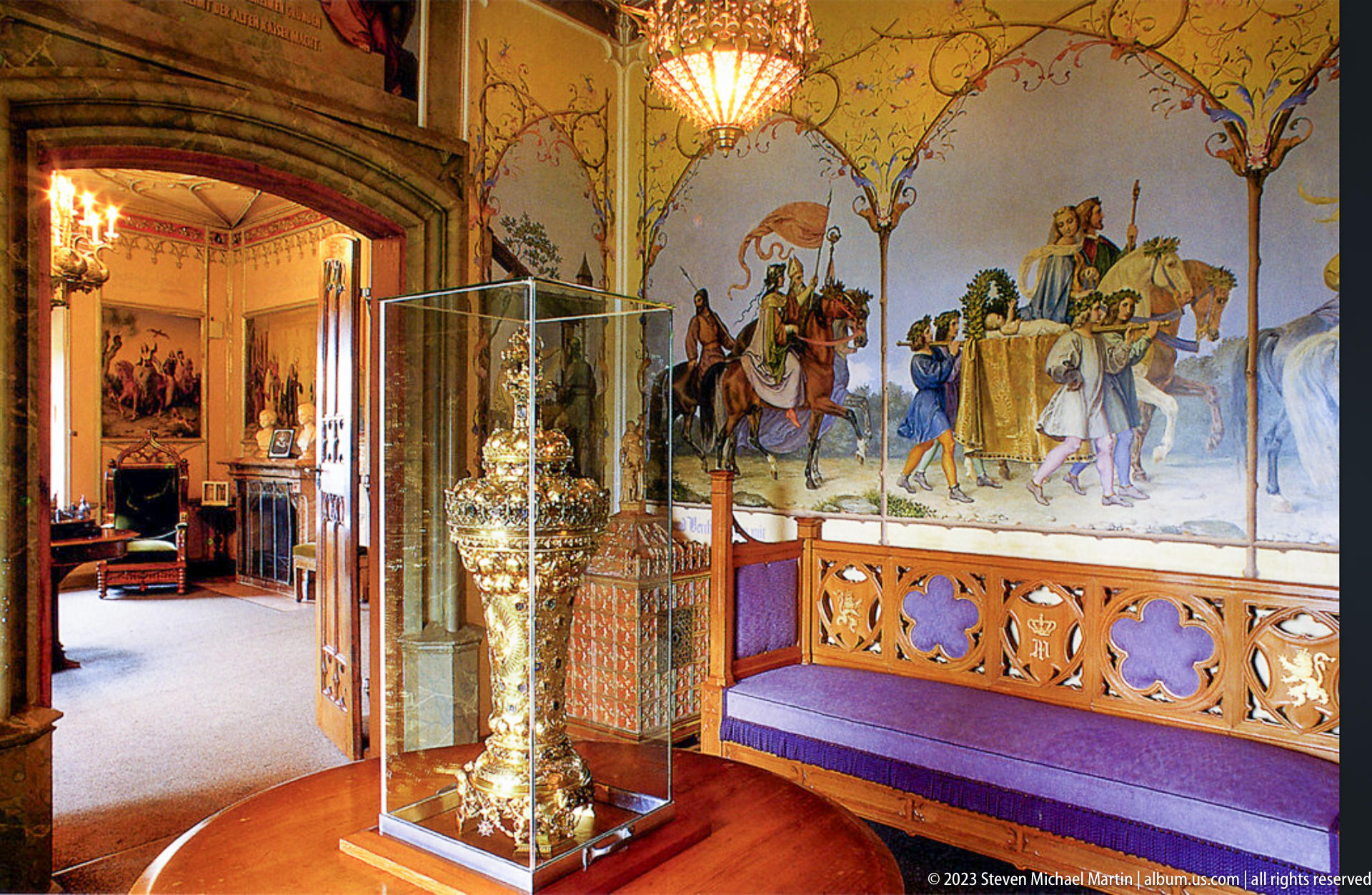
A tall silver-colored decorative object stands inside a glass case before a large narrative mural in Hohenschwangau Castle. A carved bench with purple upholstery runs beneath the painting, while an adjoining furnished room is visible through the doorway at left. The composition juxtaposes a displayed decorative object with the castle's painted and carved interior surfaces.
Caption
A tall silver-colored decorative object stands inside a glass case before a large narrative mural in Hohenschwangau Castle. A carved bench with purple upholstery runs beneath the painting, while an adjoining furnished room is visible through the doorway at left. The composition juxtaposes a displayed decorative object with the castle's painted and carved interior surfaces.
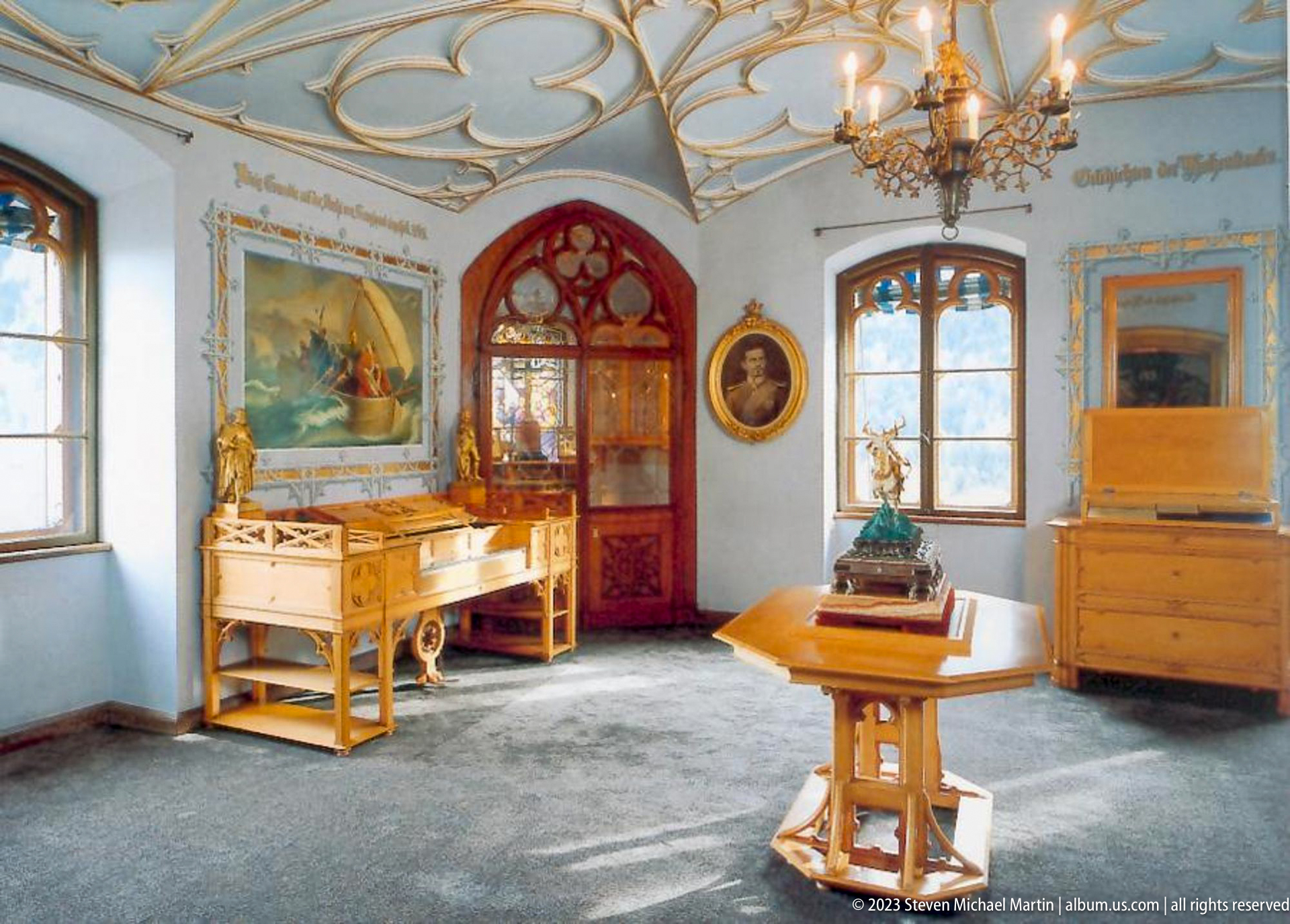
A light-blue chamber in Hohenschwangau Castle is furnished with small tables, chairs, a writing cabinet, and decorative objects beneath a painted ribbed ceiling. Framed paintings and inscriptions line the walls, while an arched red-trimmed doorway provides a strong focal point. The restrained furnishing allows the room's color and ornamental ceiling to dominate.
Caption
A light-blue chamber in Hohenschwangau Castle is furnished with small tables, chairs, a writing cabinet, and decorative objects beneath a painted ribbed ceiling. Framed paintings and inscriptions line the walls, while an arched red-trimmed doorway provides a strong focal point. The restrained furnishing allows the room's color and ornamental ceiling to dominate.
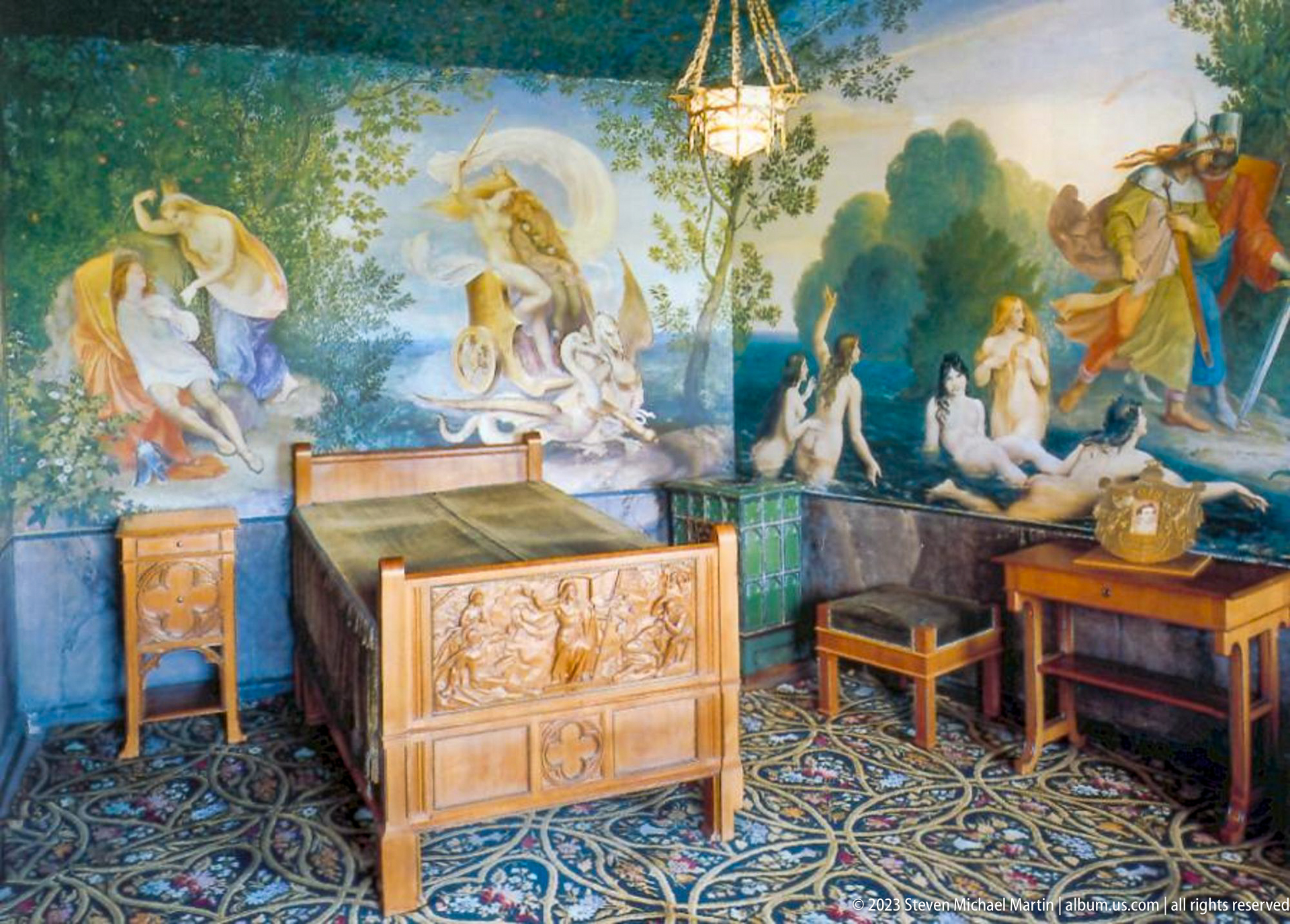
A carved wooden bed stands beneath expansive wall paintings of reclining and airborne figures in a richly decorated Hohenschwangau Castle bedroom. The colorful patterned floor, small tables, and suspended lantern add to the room's theatrical effect. The mural cycle wraps the sleeping area in an idealized landscape, making painted narrative the dominant decorative element.
Caption
A carved wooden bed stands beneath expansive wall paintings of reclining and airborne figures in a richly decorated Hohenschwangau Castle bedroom. The colorful patterned floor, small tables, and suspended lantern add to the room's theatrical effect. The mural cycle wraps the sleeping area in an idealized landscape, making painted narrative the dominant decorative element.
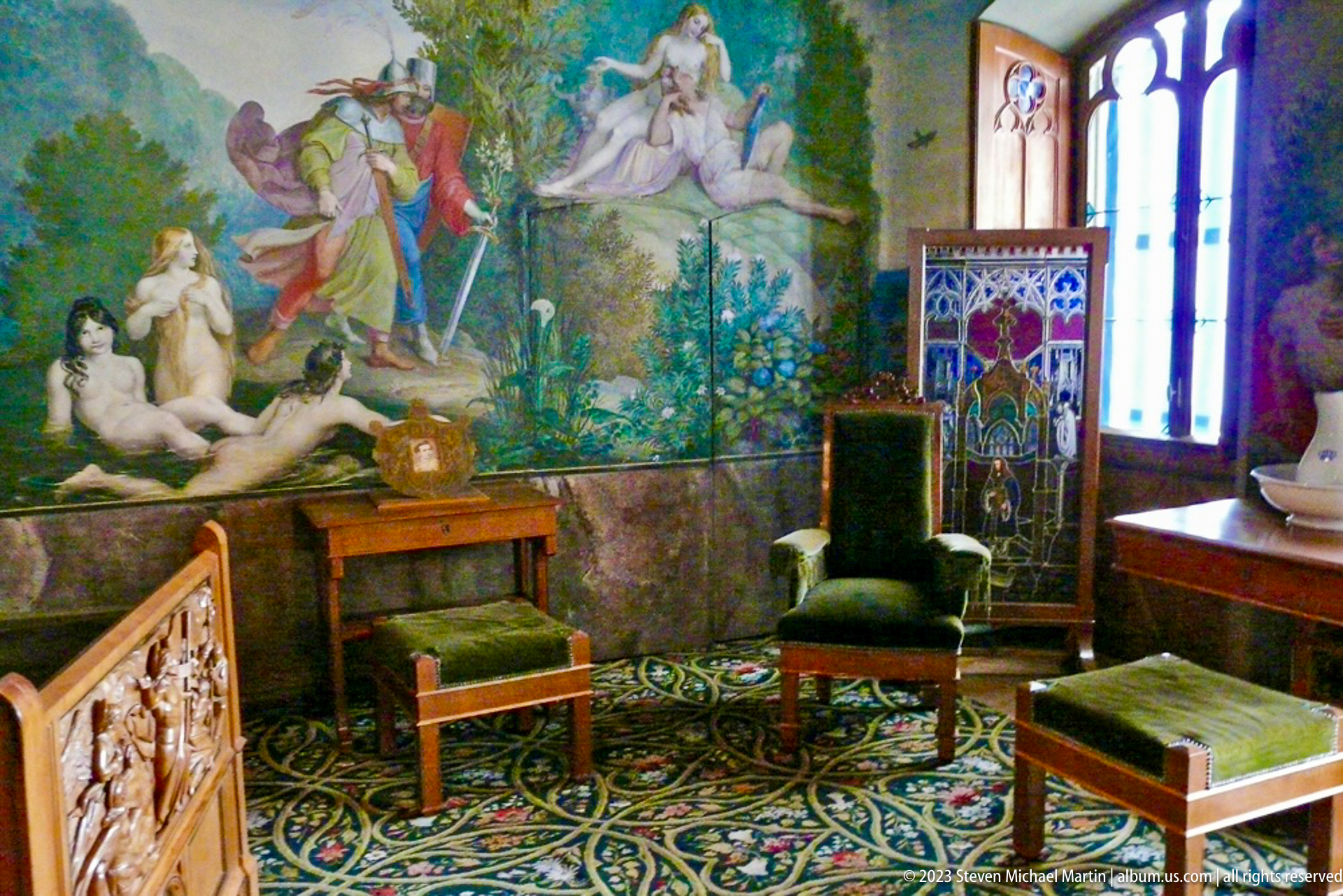
A second view of the mural-lined chamber shifts attention from the bed to a Gothic-style window, green upholstered chair, and small writing furniture. Mythological figures move across the painted landscape that covers the wall, while the patterned floor extends the room's dense decorative scheme. The angle reveals how furniture and architecture sit within the continuous painted environment.
Caption
A second view of the mural-lined chamber shifts attention from the bed to a Gothic-style window, green upholstered chair, and small writing furniture. Mythological figures move across the painted landscape that covers the wall, while the patterned floor extends the room's dense decorative scheme. The angle reveals how furniture and architecture sit within the continuous painted environment.
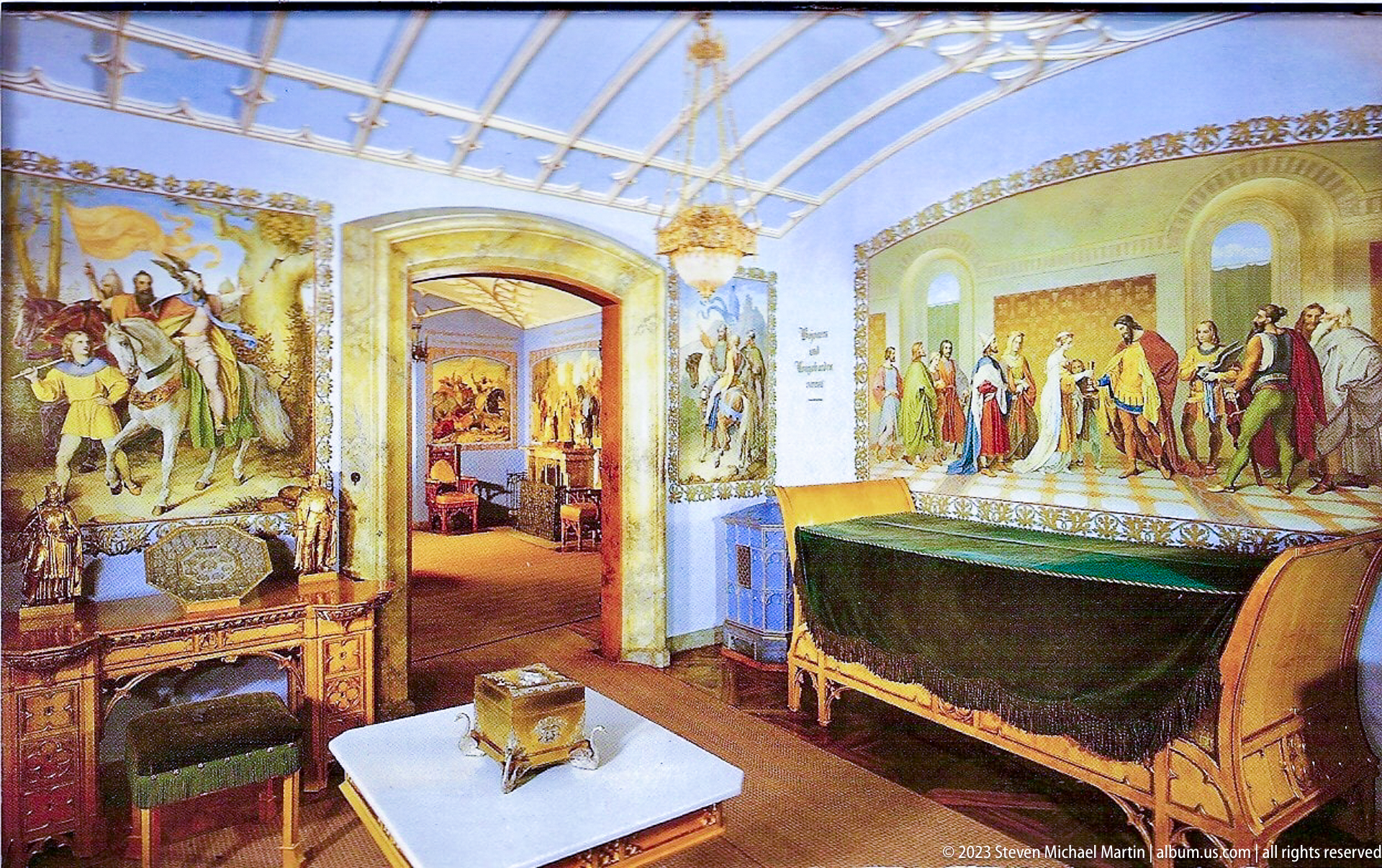
A broad view of a Hohenschwangau Castle bedroom combines a carved bed draped in dark green fabric with large historical murals, painted borders, and period furniture. An open doorway reveals another richly decorated room beyond, creating a layered interior vista. The composition emphasizes how narrative painting surrounds the bed and integrates furnishings into a continuous historicist environment.
Caption
A broad view of a Hohenschwangau Castle bedroom combines a carved bed draped in dark green fabric with large historical murals, painted borders, and period furniture. An open doorway reveals another richly decorated room beyond, creating a layered interior vista. The composition emphasizes how narrative painting surrounds the bed and integrates furnishings into a continuous historicist environment.
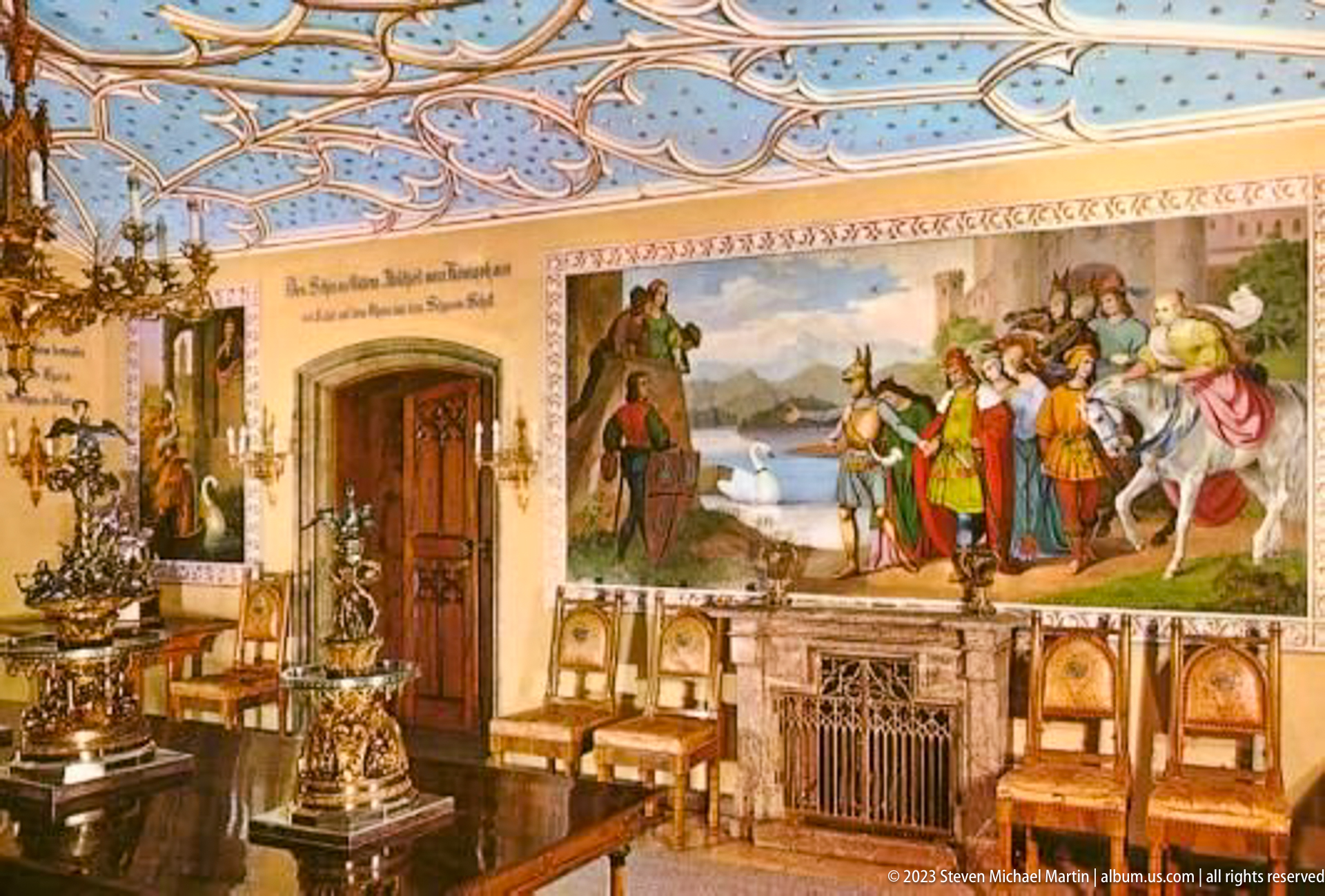
A large historical wall painting dominates this Hohenschwangau Castle interior, depicting a mounted figure and attendants in a landscape. Below it, a row of carved high-backed chairs lines the wall beside ornamental metalwork and period furnishings. Painted ceiling ribs and inscriptions continue the room's dense narrative and decorative program above.
Caption
A large historical wall painting dominates this Hohenschwangau Castle interior, depicting a mounted figure and attendants in a landscape. Below it, a row of carved high-backed chairs lines the wall beside ornamental metalwork and period furnishings. Painted ceiling ribs and inscriptions continue the room's dense narrative and decorative program above.
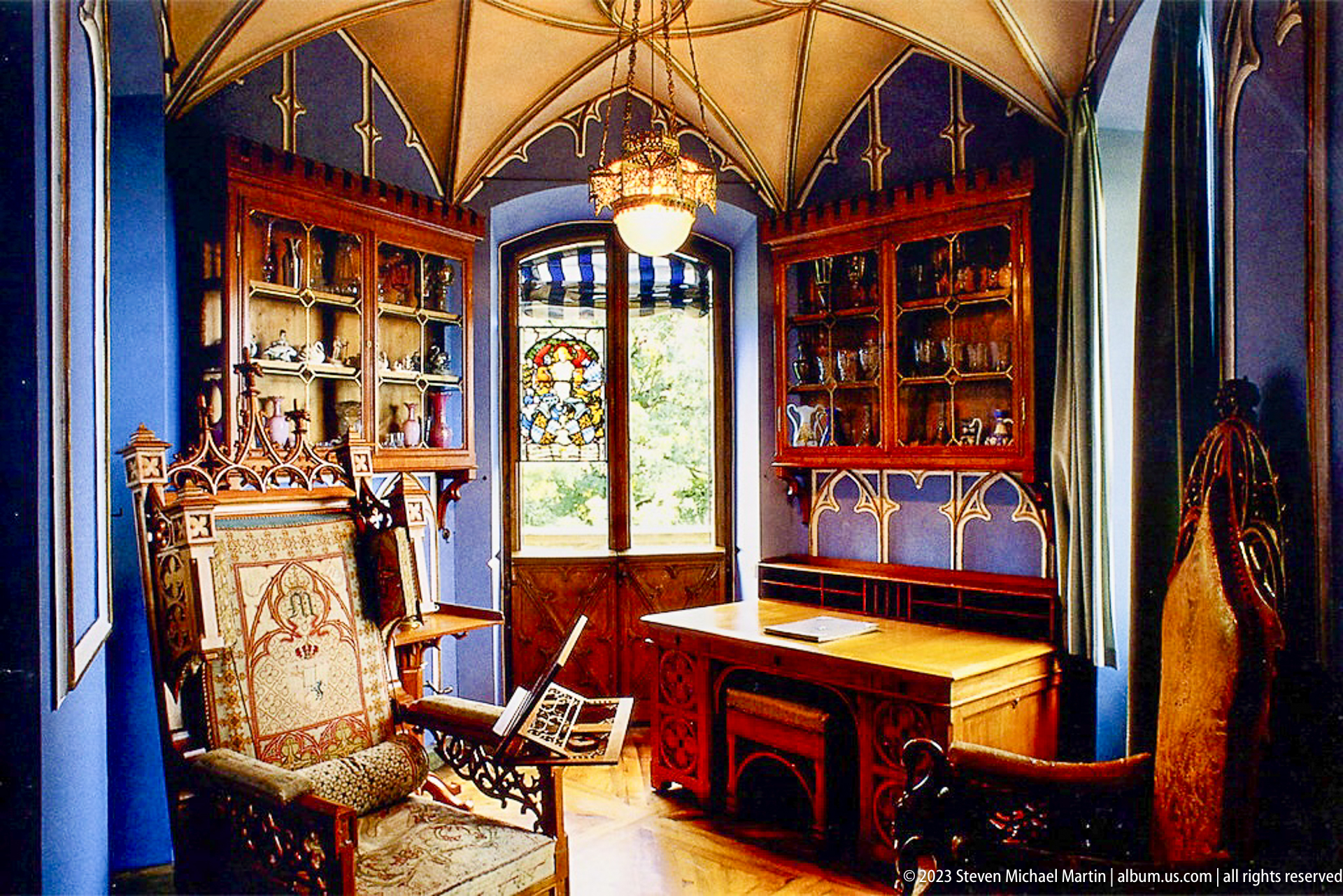
A compact study at Hohenschwangau Castle is finished in deep blue and dark carved wood, with built-in shelves, a writing desk, upholstered chair, and a stained-glass window. Pointed and cusped Gothic-style details organize the cabinetry and ceiling, creating an intimate working space distinct from the castle's brighter mural rooms.
Caption
A compact study at Hohenschwangau Castle is finished in deep blue and dark carved wood, with built-in shelves, a writing desk, upholstered chair, and a stained-glass window. Pointed and cusped Gothic-style details organize the cabinetry and ceiling, creating an intimate working space distinct from the castle's brighter mural rooms.
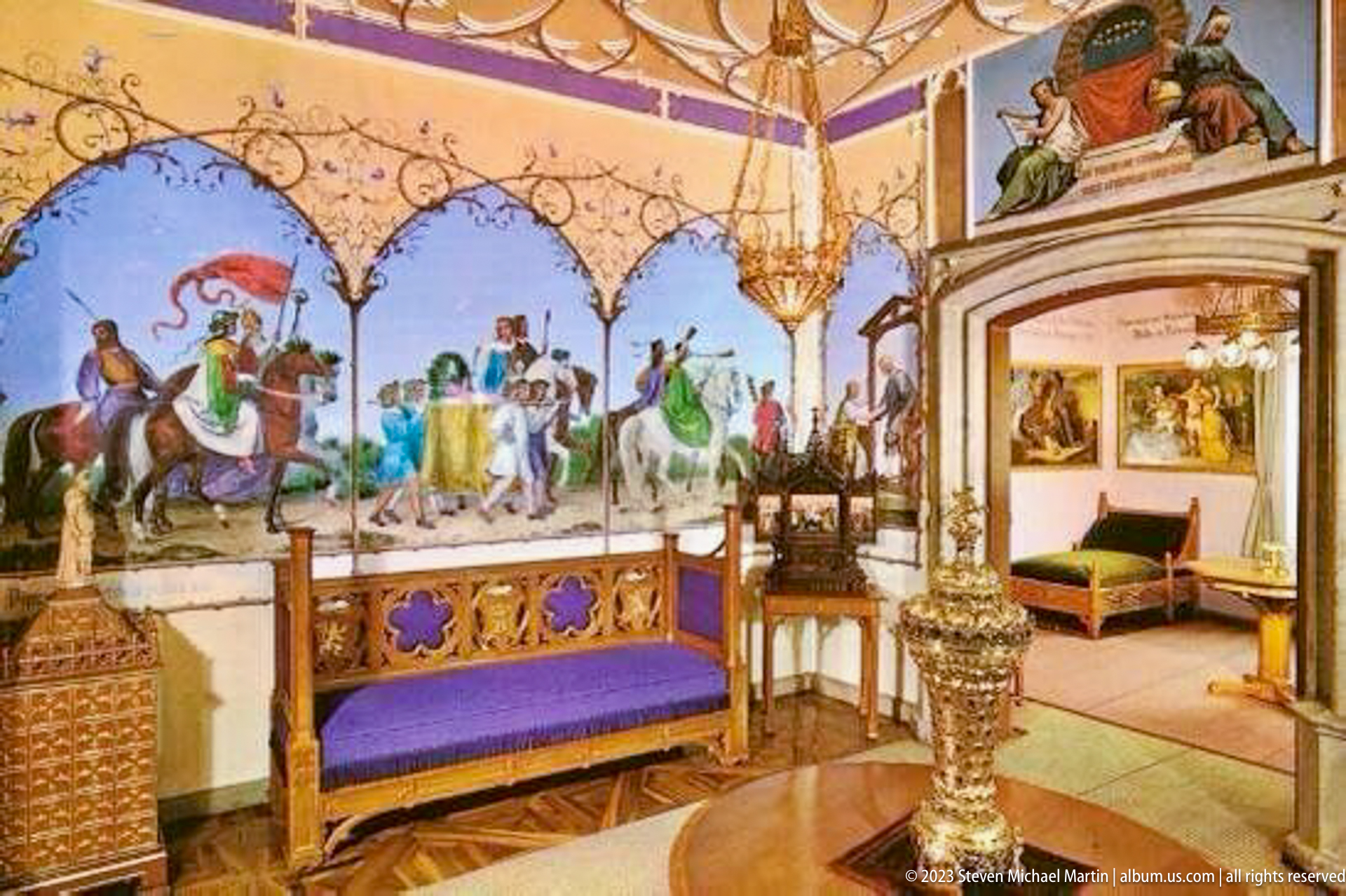
A long carved bench upholstered in purple sits beneath expansive equestrian and courtly murals in Hohenschwangau Castle. Decorative metalwork and a hanging lantern occupy the foreground, while an open doorway reveals another furnished chamber beyond. The view emphasizes the continuity of painted narrative across rooms and the deliberate coordination of furniture, color, and wall decoration.
Caption
A long carved bench upholstered in purple sits beneath expansive equestrian and courtly murals in Hohenschwangau Castle. Decorative metalwork and a hanging lantern occupy the foreground, while an open doorway reveals another furnished chamber beyond. The view emphasizes the continuity of painted narrative across rooms and the deliberate coordination of furniture, color, and wall decoration.
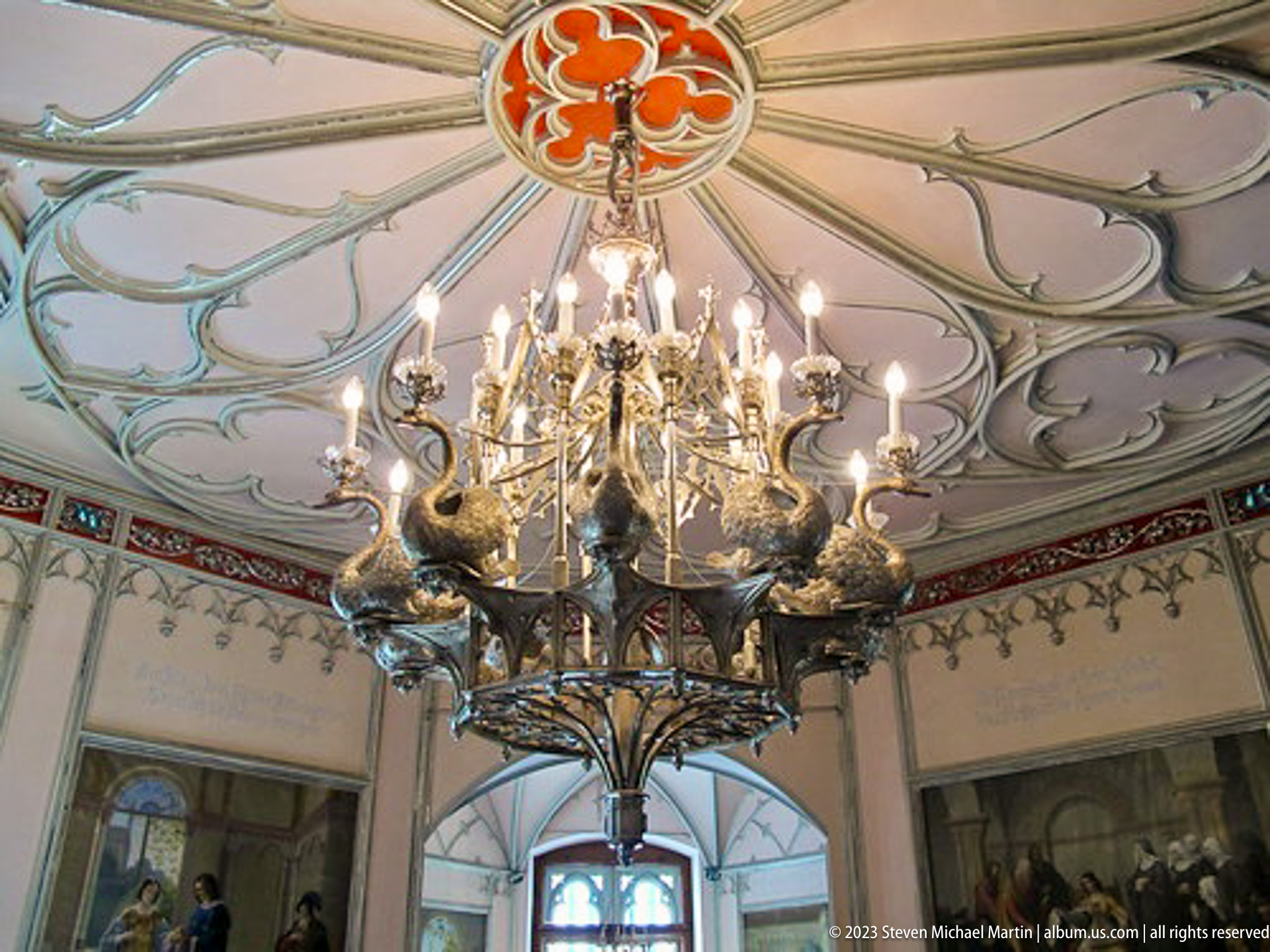
An elaborate metal chandelier hangs beneath a pale painted ceiling in Hohenschwangau Castle. Multiple candle-like lights rise above sculptural animal forms arranged around the central ring, while delicate painted ribs radiate across the ceiling toward a red floral medallion. The upward view isolates the lighting fixture as a decorative artwork within the historic interior.
Caption
An elaborate metal chandelier hangs beneath a pale painted ceiling in Hohenschwangau Castle. Multiple candle-like lights rise above sculptural animal forms arranged around the central ring, while delicate painted ribs radiate across the ceiling toward a red floral medallion. The upward view isolates the lighting fixture as a decorative artwork within the historic interior.

A piano occupies the foreground of a bright blue historic room, beneath a large maritime mural and beside a pointed-arched stained-glass window. Carved wood furniture, a framed male portrait, and a magenta-upholstered chair complete the richly layered interior. The composition emphasizes music, painted narrative, and Gothic-style architectural detailing within the royal residence.
Caption
A piano occupies the foreground of a bright blue historic room, beneath a large maritime mural and beside a pointed-arched stained-glass window. Carved wood furniture, a framed male portrait, and a magenta-upholstered chair complete the richly layered interior. The composition emphasizes music, painted narrative, and Gothic-style architectural detailing within the royal residence.
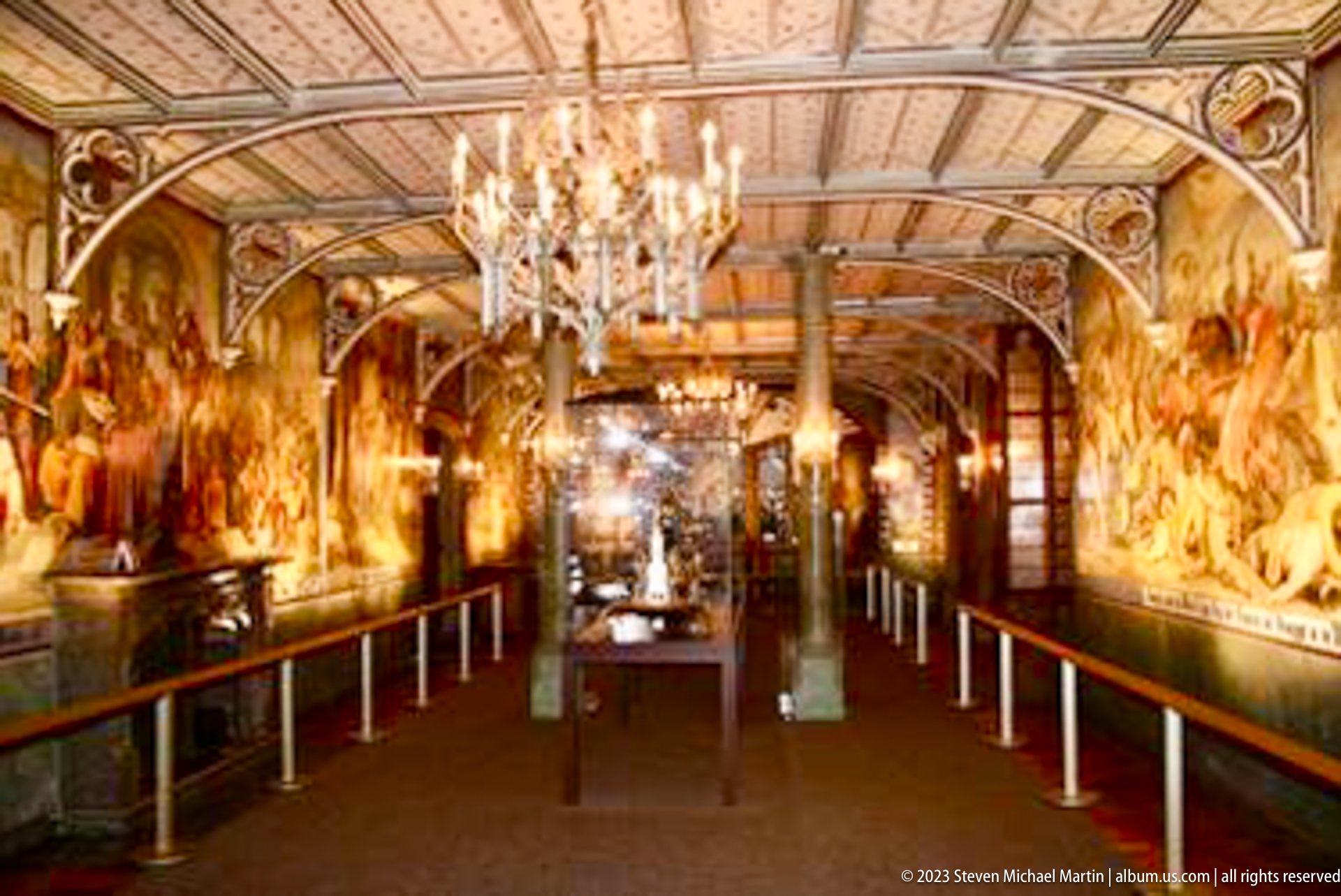
A long ceremonial gallery stretches beneath a richly patterned ceiling, its walls almost continuously covered by large historical murals. Crystal chandeliers hang along the central axis above a narrow visitor path, while columns, carved trim, and dark wood details reinforce the room's theatrical historicist character. The deep perspective draws attention to the scale and narrative density of the interior.
Caption
A long ceremonial gallery stretches beneath a richly patterned ceiling, its walls almost continuously covered by large historical murals. Crystal chandeliers hang along the central axis above a narrow visitor path, while columns, carved trim, and dark wood details reinforce the room's theatrical historicist character. The deep perspective draws attention to the scale and narrative density of the interior.
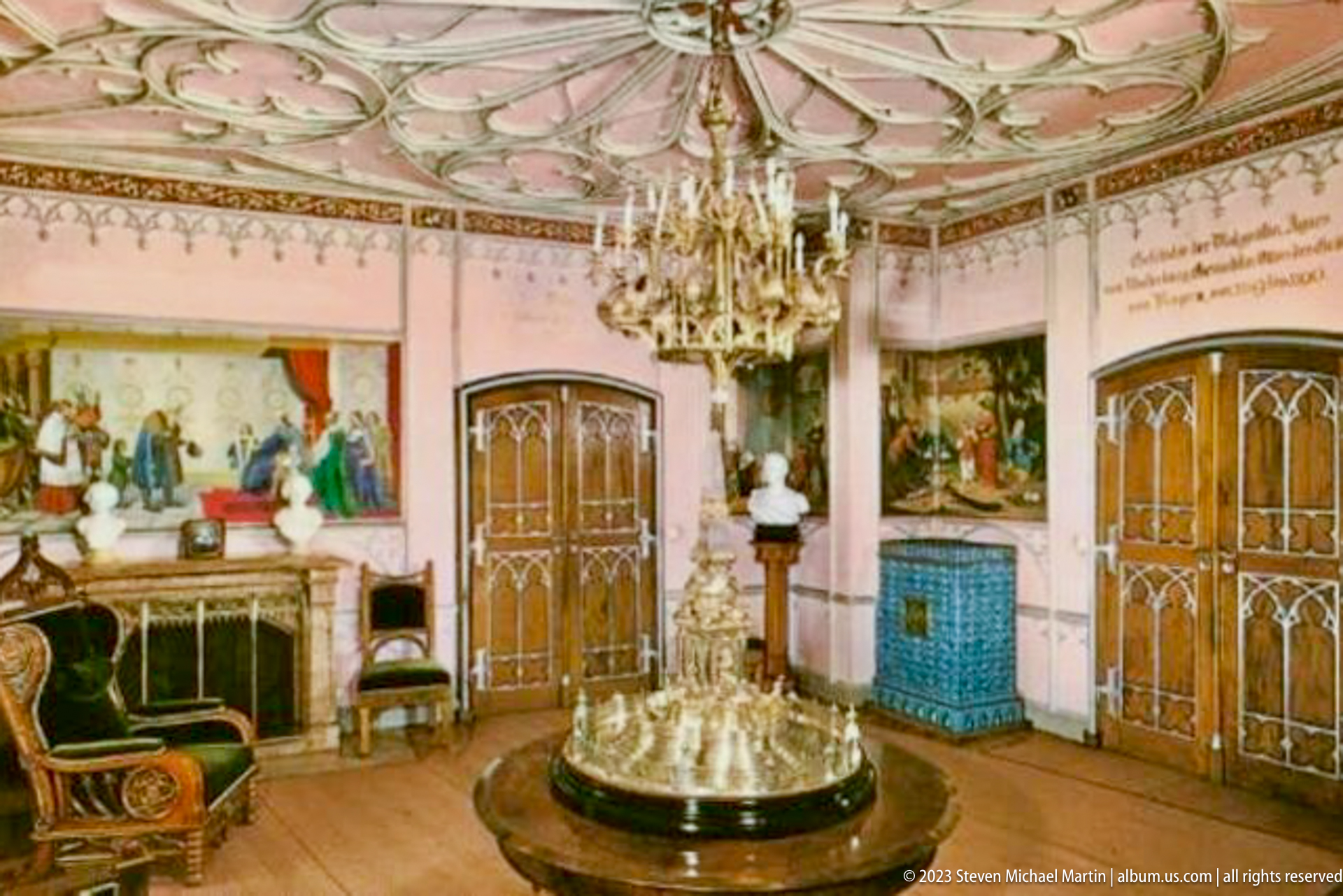
A pale pink sitting room combines a crystal chandelier, narrative wall paintings, carved double doors, a blue ceramic stove, and formal upholstered seating. A round central table displays silver-colored decorative objects, while painted ceiling ornament frames the room overhead. The coordinated palette and furnishings create a refined domestic interior within the castle's larger romantic decorative program.
Caption
A pale pink sitting room combines a crystal chandelier, narrative wall paintings, carved double doors, a blue ceramic stove, and formal upholstered seating. A round central table displays silver-colored decorative objects, while painted ceiling ornament frames the room overhead. The coordinated palette and furnishings create a refined domestic interior within the castle's larger romantic decorative program.
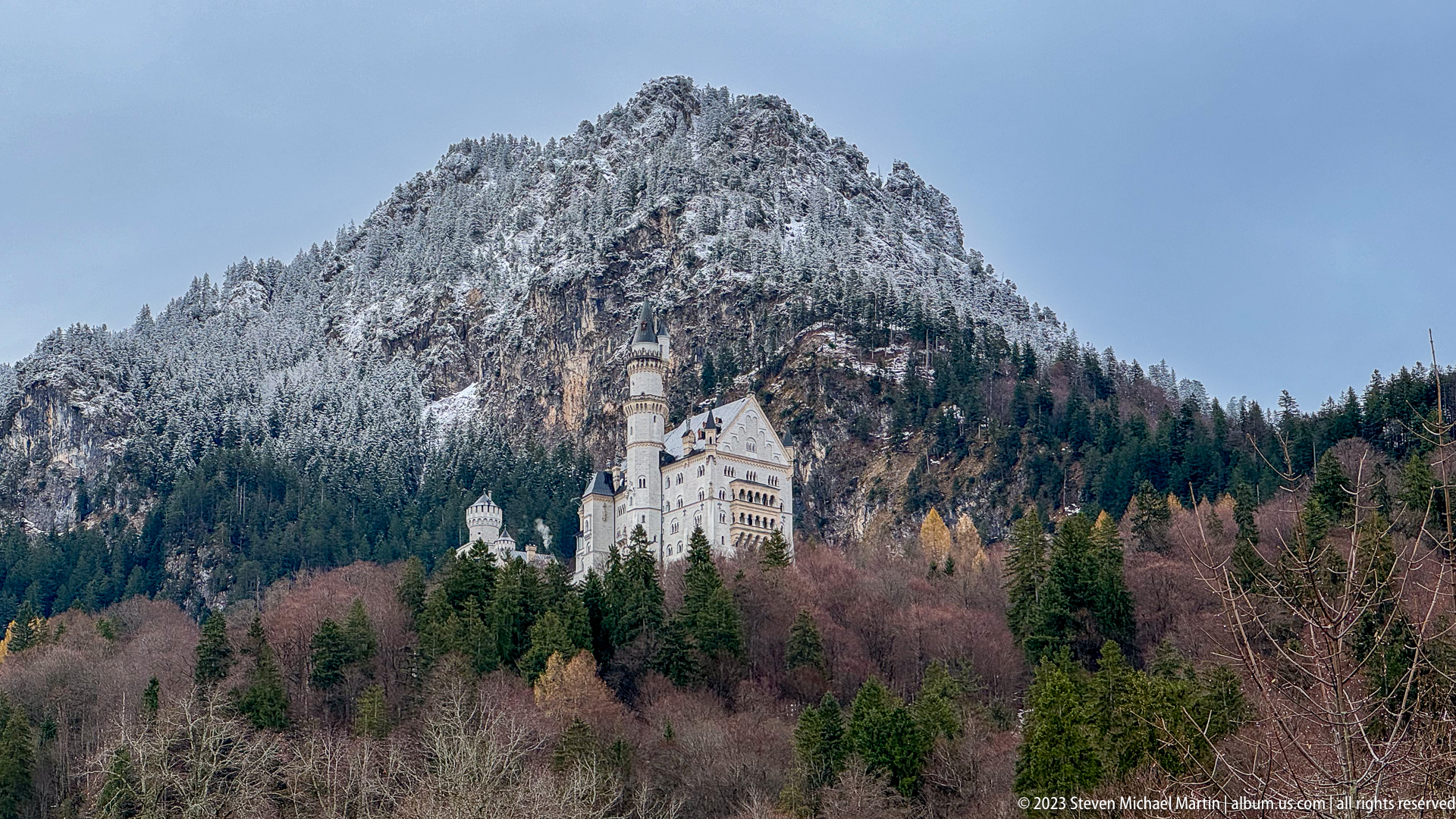
Neuschwanstein Castle stands on a wooded slope beneath a steep snow-dusted mountain, its pale walls and towers sharply visible against dark conifers and winter foliage. The distant perspective gives equal weight to architecture and terrain, showing how the castle is embedded within the dramatic alpine setting rather than isolated from it.
Caption
Neuschwanstein Castle stands on a wooded slope beneath a steep snow-dusted mountain, its pale walls and towers sharply visible against dark conifers and winter foliage. The distant perspective gives equal weight to architecture and terrain, showing how the castle is embedded within the dramatic alpine setting rather than isolated from it.
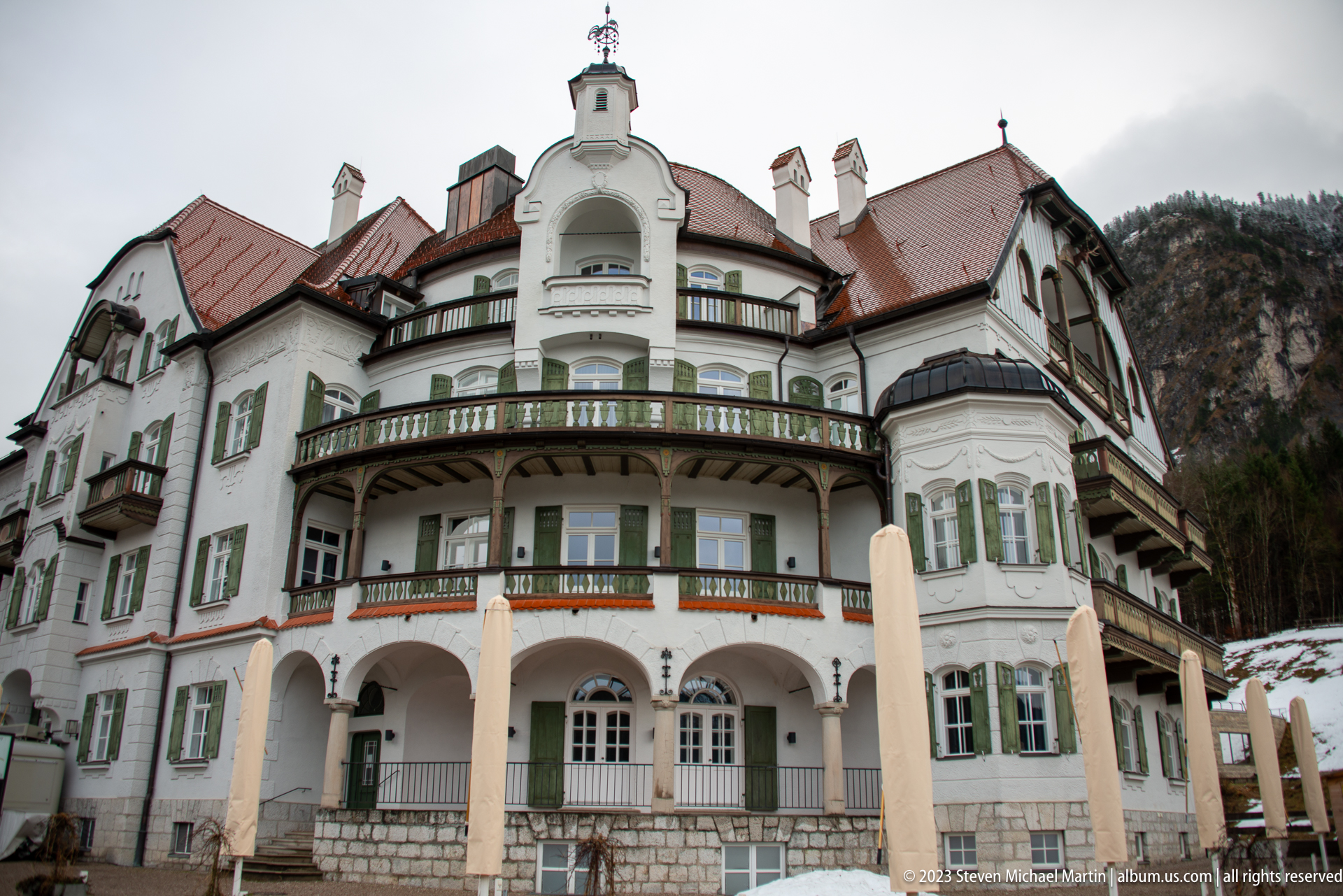
A large white multi-story building combines curved balconies, bay windows, green shutters, arched ground-floor openings, and steep red roofs. Its asymmetrical massing and decorative stucco create a villa-like resort character suited to the Hohenschwangau visitor district. The close architectural view records lodging or hospitality infrastructure rather than either royal castle.
Caption
A large white multi-story building combines curved balconies, bay windows, green shutters, arched ground-floor openings, and steep red roofs. Its asymmetrical massing and decorative stucco create a villa-like resort character suited to the Hohenschwangau visitor district. The close architectural view records lodging or hospitality infrastructure rather than either royal castle.
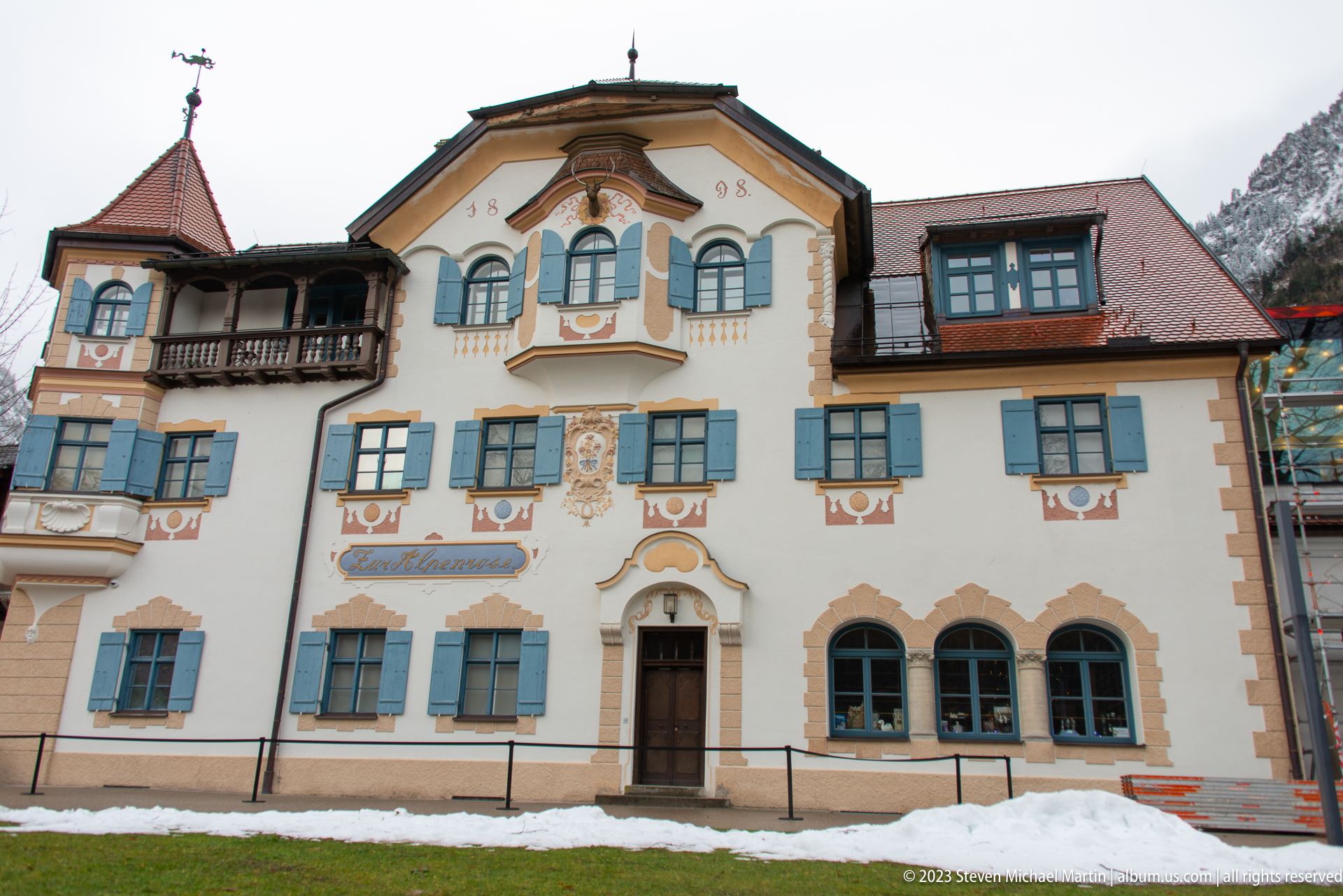
A cream-colored lodging building is embellished with ochre painted ornament, blue shutters, decorative window surrounds, and a central gable inscribed with dates near its peak. A script sign appears across the façade above the entrance, while snow remains along the base. The building's folk-inspired decoration and symmetry distinguish it from the nearby royal castles.
Caption
A cream-colored lodging building is embellished with ochre painted ornament, blue shutters, decorative window surrounds, and a central gable inscribed with dates near its peak. A script sign appears across the façade above the entrance, while snow remains along the base. The building's folk-inspired decoration and symmetry distinguish it from the nearby royal castles.
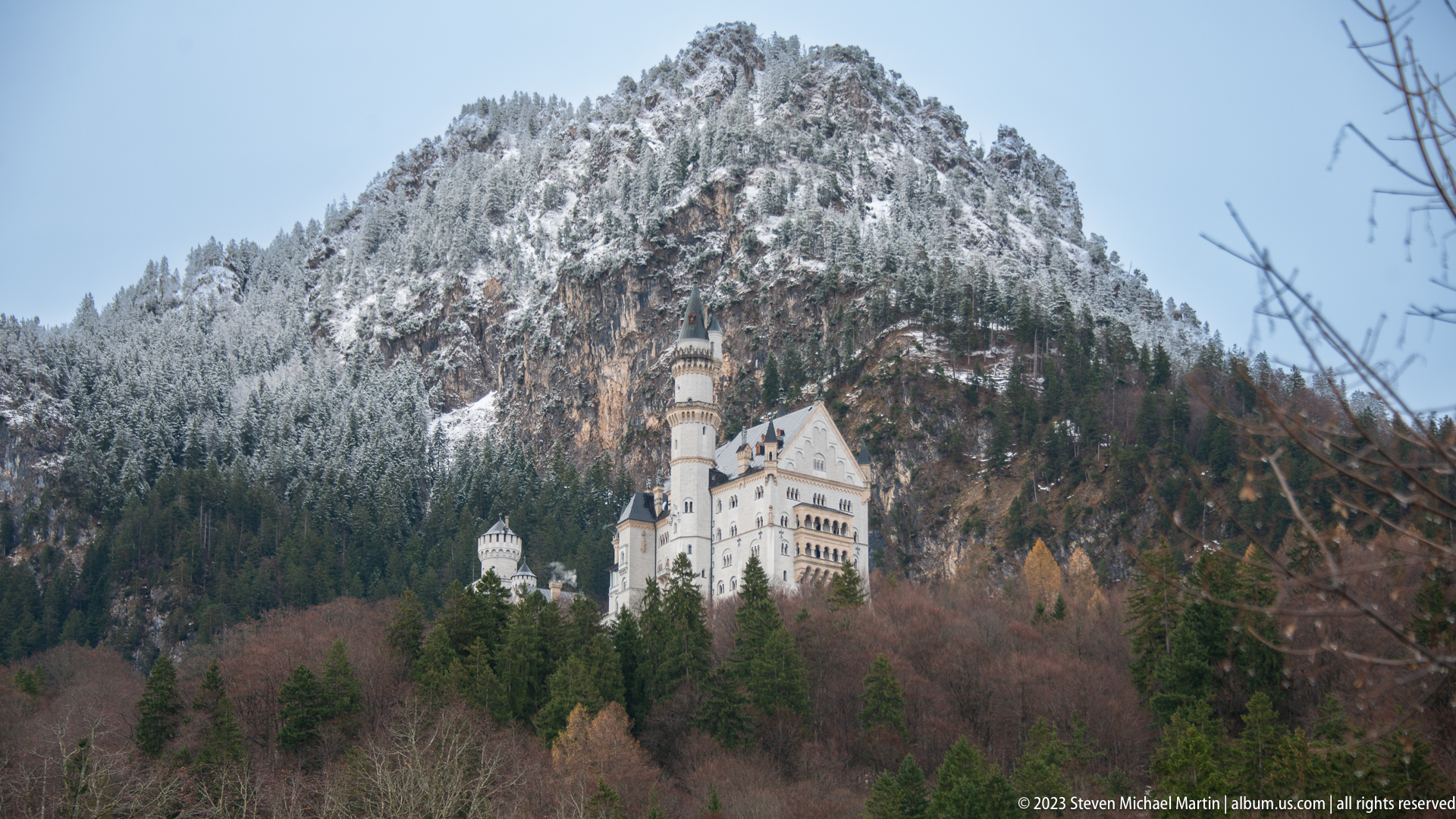
Neuschwanstein Castle appears from a broad landscape viewpoint below a rugged mountain dusted with snow. Pale towers and the main palace block rise from a patchwork of dark conifers and bare winter trees, while the steep rock face dominates the upper half of the composition. The view emphasizes the castle's dramatic relationship to the alpine terrain.
Caption
Neuschwanstein Castle appears from a broad landscape viewpoint below a rugged mountain dusted with snow. Pale towers and the main palace block rise from a patchwork of dark conifers and bare winter trees, while the steep rock face dominates the upper half of the composition. The view emphasizes the castle's dramatic relationship to the alpine terrain.
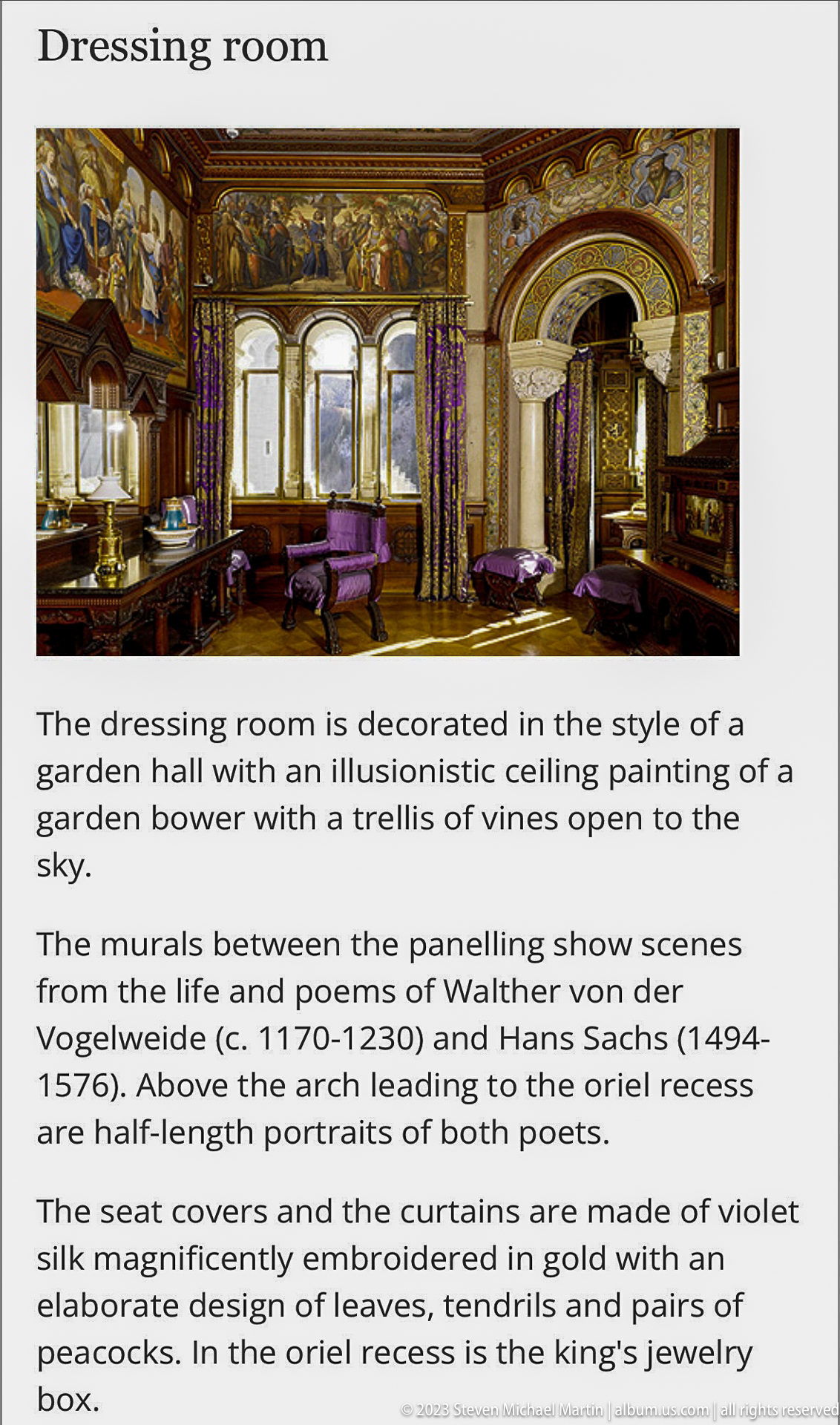
A museum panel describing the 'Dressing room' shows an opulent interior with patterned walls, purple textiles, arched woodwork, and a richly decorated ceiling. The English text notes a garden-hall concept, scenes from the lives and poems of Walther von der Vogelweide and Hans Sachs, and a king's jewellery box in the oriel recess.
Caption
A museum panel describing the 'Dressing room' shows an opulent interior with patterned walls, purple textiles, arched woodwork, and a richly decorated ceiling. The English text notes a garden-hall concept, scenes from the lives and poems of Walther von der Vogelweide and Hans Sachs, and a king's jewellery box in the oriel recess.
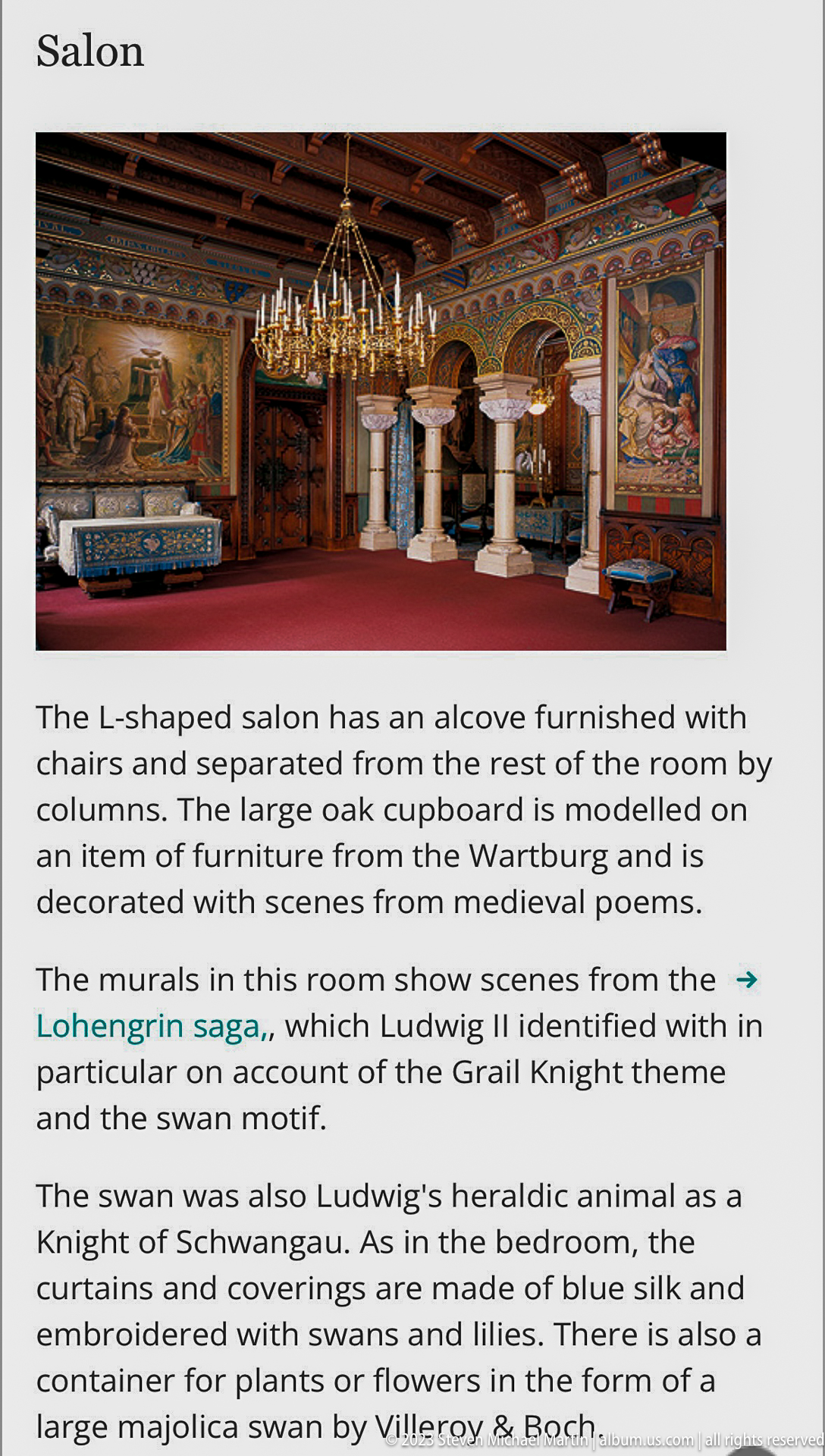
A museum panel titled for the salon illustrates an L-shaped room with carved wood, columns, chandeliers, murals, and blue-green furnishings. The English text links the wall paintings to the Lohengrin saga and notes swan imagery in the room. The panel provides a concise interpretive summary of one of Neuschwanstein's richly theatrical interiors.
Caption
A museum panel titled for the salon illustrates an L-shaped room with carved wood, columns, chandeliers, murals, and blue-green furnishings. The English text links the wall paintings to the Lohengrin saga and notes swan imagery in the room. The panel provides a concise interpretive summary of one of Neuschwanstein's richly theatrical interiors.

An interpretive panel titled 'Conservatory' describes a small grotto between the salon and study, inspired by Tannhäuser and designed as an artificial dripstone cave. The accompanying photograph shows a rock-lined interior with a fountain basin, plants, furniture, and a hanging light fixture. The panel explains one of Neuschwanstein's most unusual theatrical interior spaces.
Caption
An interpretive panel titled 'Conservatory' describes a small grotto between the salon and study, inspired by Tannhäuser and designed as an artificial dripstone cave. The accompanying photograph shows a rock-lined interior with a fountain basin, plants, furniture, and a hanging light fixture. The panel explains one of Neuschwanstein's most unusual theatrical interior spaces.
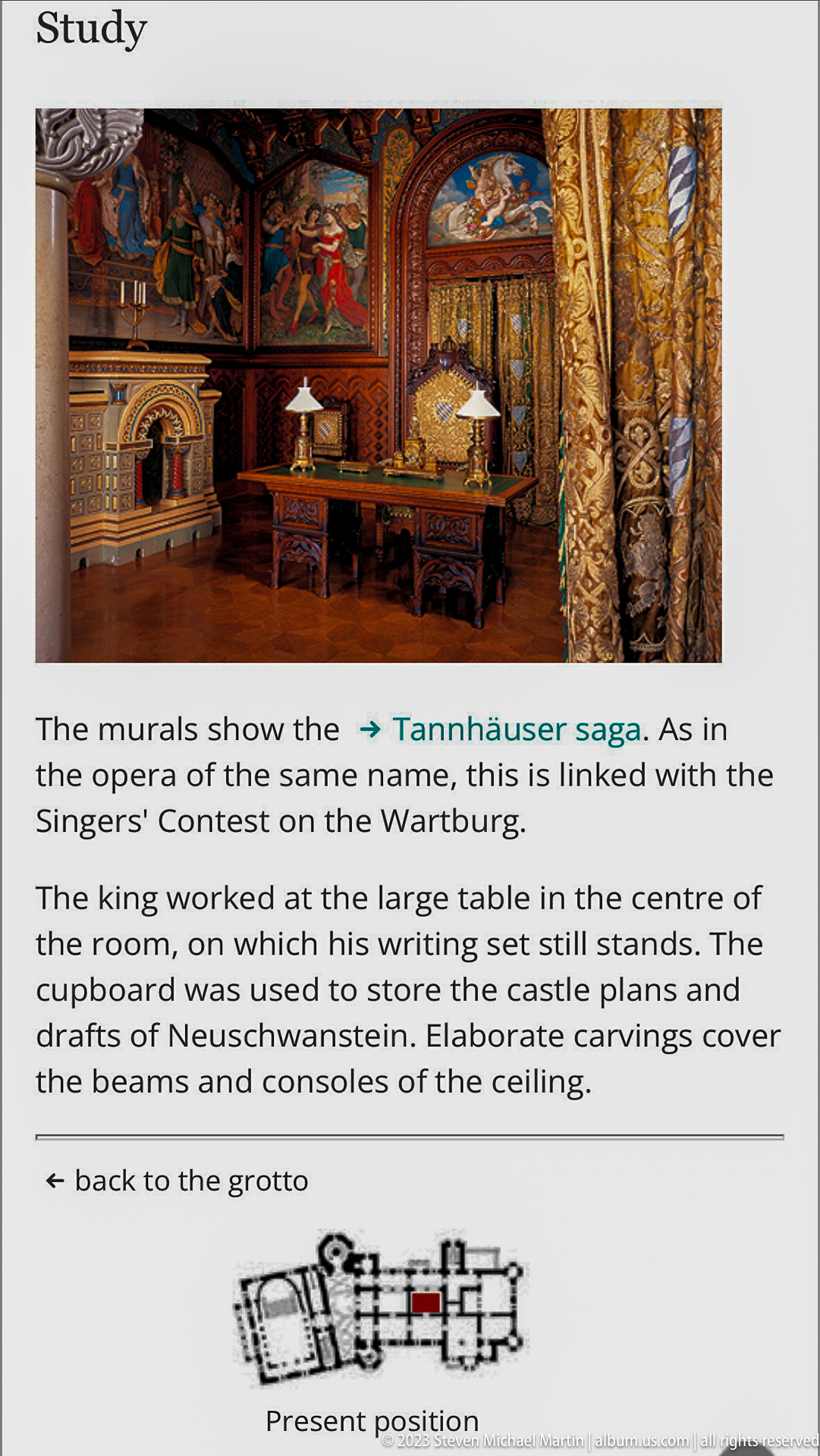
A panel titled 'Study' shows a richly carved room with murals, desk, lamp, and heavy patterned curtains. The English text identifies the Tannhäuser saga as the mural theme, notes the Wartburg singers' contest connection, and explains that the king worked at the central desk. A small floor-plan diagram marks the room's position within the castle.
Caption
A panel titled 'Study' shows a richly carved room with murals, desk, lamp, and heavy patterned curtains. The English text identifies the Tannhäuser saga as the mural theme, notes the Wartburg singers' contest connection, and explains that the king worked at the central desk. A small floor-plan diagram marks the room's position within the castle.
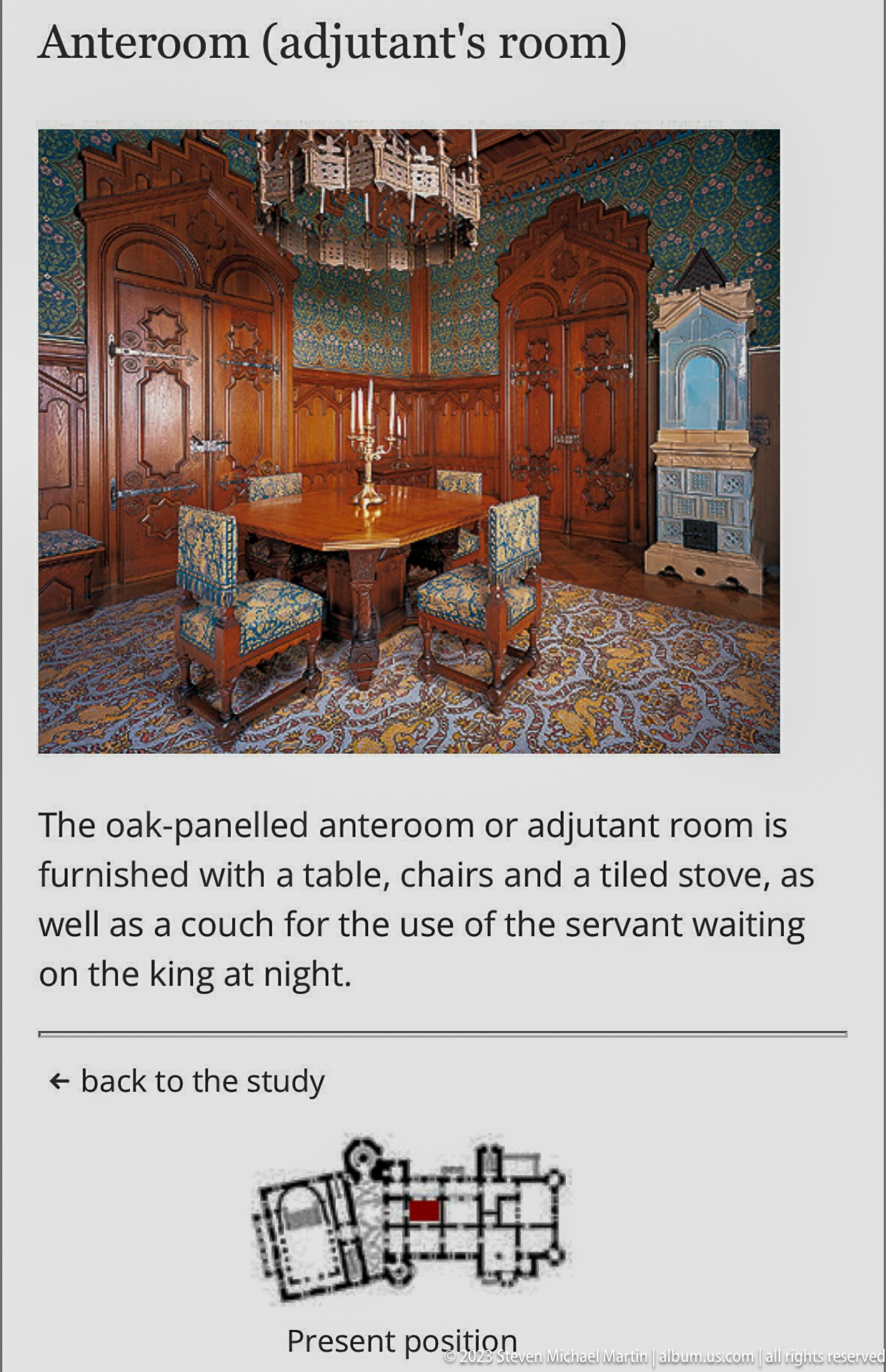
An interpretive panel identifies the 'Anteroom (adjutant's room)' and illustrates an oak-paneled interior furnished with a table, chairs, tiled stove, and patterned carpet. The text explains that the space was designed for the adjutant waiting on the king at night. A small floor-plan diagram below locates the room near the study.
Caption
An interpretive panel identifies the 'Anteroom (adjutant's room)' and illustrates an oak-paneled interior furnished with a table, chairs, tiled stove, and patterned carpet. The text explains that the space was designed for the adjutant waiting on the king at night. A small floor-plan diagram below locates the room near the study.
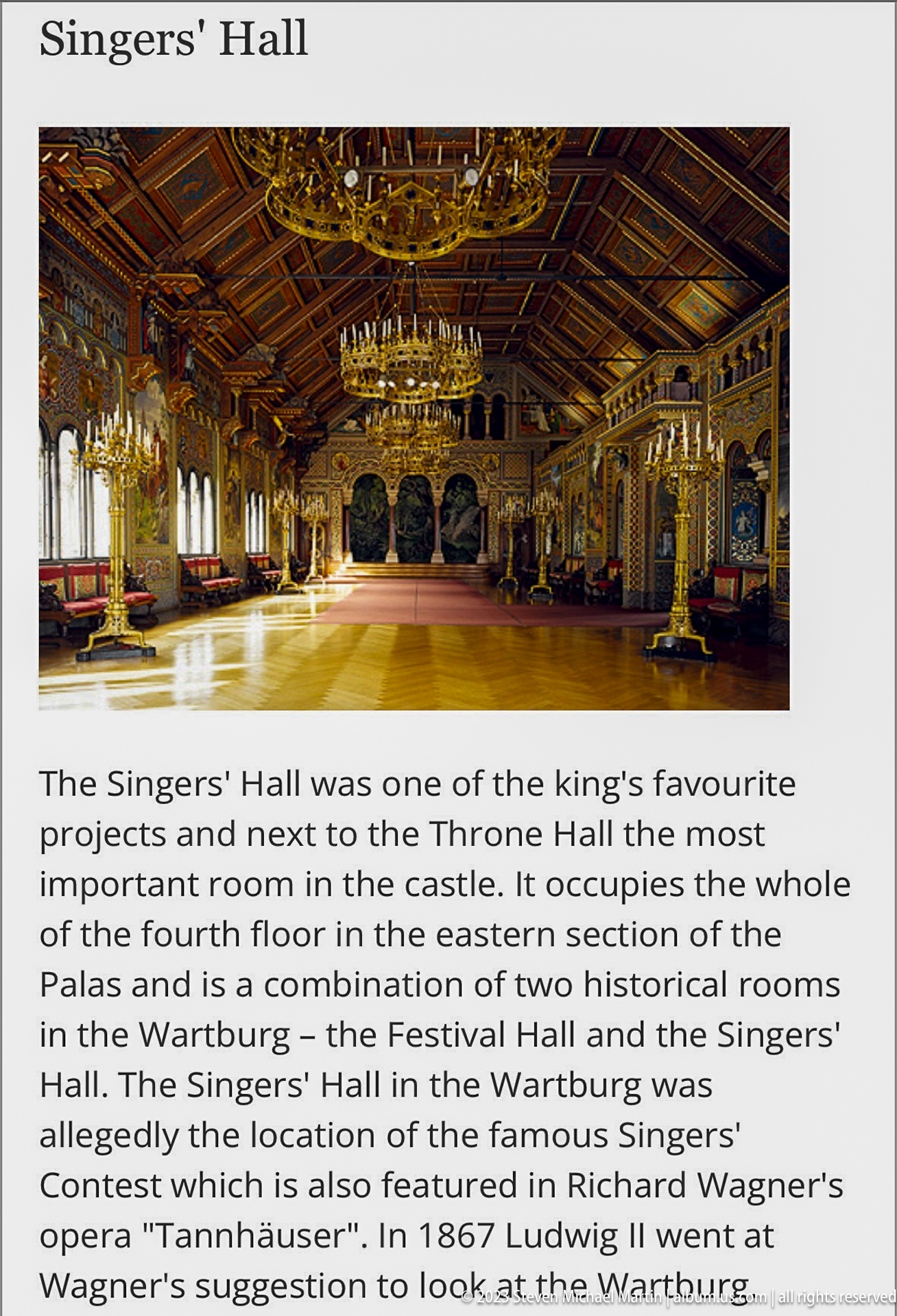
A panel titled 'Singers' Hall' presents a broad view of Neuschwanstein's monumental fourth-floor ceremonial room, with chandeliers, painted walls, patterned ceiling, and a large open central floor. The text explains that Ludwig II combined elements of the Wartburg's Festival Hall and Singers' Hall and linked the room to Wagner's Tannhäuser.
Caption
A panel titled 'Singers' Hall' presents a broad view of Neuschwanstein's monumental fourth-floor ceremonial room, with chandeliers, painted walls, patterned ceiling, and a large open central floor. The text explains that Ludwig II combined elements of the Wartburg's Festival Hall and Singers' Hall and linked the room to Wagner's Tannhäuser.
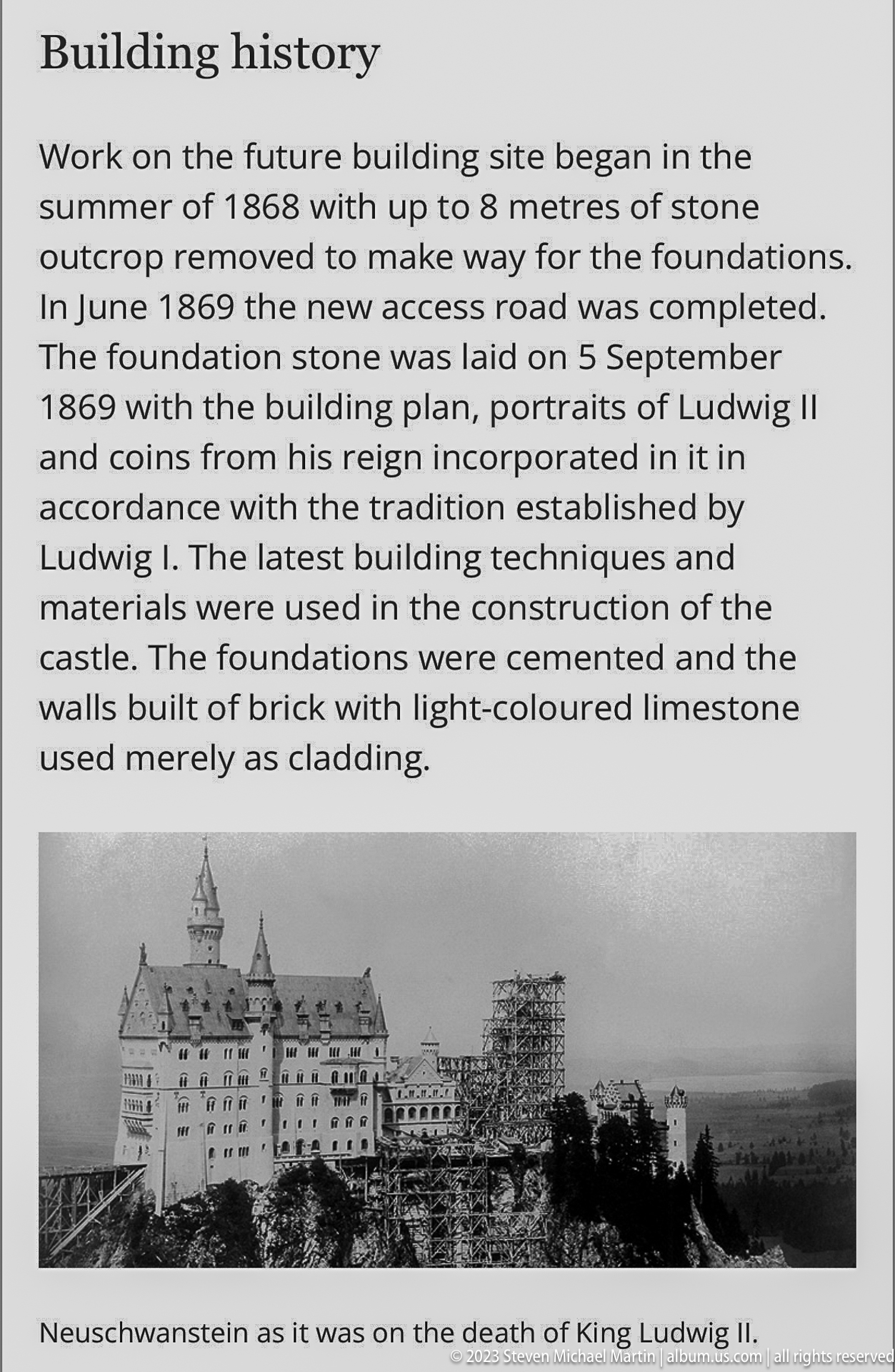
A building-history panel explains the early construction phases of Neuschwanstein Castle and illustrates the structure with a historic black-and-white photograph. Readable text mentions the 1868 start of the building site, a foundation stone laid in September 1869, and construction methods using brick with lighter limestone cladding. The photograph records the castle during an incomplete stage.
Caption
A building-history panel explains the early construction phases of Neuschwanstein Castle and illustrates the structure with a historic black-and-white photograph. Readable text mentions the 1868 start of the building site, a foundation stone laid in September 1869, and construction methods using brick with lighter limestone cladding. The photograph records the castle during an incomplete stage.
⭐ Highlights
- Neuschwanstein Castle: King Ludwig II’s famous “fairy-tale” castle rising above the alpine landscape.
- Hohenschwangau Castle: The restored lower castle where Ludwig II spent much of his youth.
- Royal Bavarian Story: The two castles together reveal the personal world and imagination of Ludwig II.
- Alpine Setting: Mountains, lakes, and forested slopes create one of the most dramatic castle landscapes in Europe.
- Romantic Historicism: Neuschwanstein reflects a 19th-century idealized vision of the medieval past.
- Contrasting Experiences: Neuschwanstein feels theatrical and visionary, while Hohenschwangau feels more intimate and lived-in.
🏰 Neuschwanstein & Hohenschwangau Field Guide
Major features observed during this visit:
Neuschwanstein and Hohenschwangau form one of the most recognizable royal landscapes in Europe. Hohenschwangau, rebuilt by Crown Prince Maximilian in the 19th century on the site of an older castle, became the childhood residence of Ludwig II. Nearby, Ludwig later commissioned Neuschwanstein as an idealized royal retreat inspired by medieval legend, Wagnerian imagination, and romantic architecture. Together, the two castles offer a striking contrast between lived royal history and visionary fantasy.
🏛️ Signature Landmarks
- Neuschwanstein Castle – A dramatic hilltop palace designed as an idealized medieval-inspired royal residence.
- Hohenschwangau Castle – The lower castle associated with Ludwig’s childhood and family life.
- Gatehouse and Towers – Architectural elements that give Neuschwanstein its theatrical silhouette.
- Interior State Rooms – Spaces shaped by myth, monarchy, and Wagnerian themes.
- Castle Views – Elevated viewpoints reveal the relationship between the two castles and the surrounding alpine landscape.
🧠 Historical Significance
- King Ludwig II – Both castles are closely tied to the life and imagination of Bavaria’s most famous king.
- 19th-Century Romanticism – Neuschwanstein embodies a modern reimagining of medieval kingship and legend.
- Childhood and Vision – Hohenschwangau reflects Ludwig’s early life, while Neuschwanstein reflects his later artistic ambitions.
- Enduring Cultural Influence – Neuschwanstein became one of the most recognizable castles in the world and has influenced popular ideas of the fairy-tale castle.
🌄 Landscape & Setting
- Alpine Backdrop – Mountains, cliffs, and forested slopes frame both castles.
- Lake District – Nearby lakes add openness and reflection to the setting.
- Elevated Composition – Neuschwanstein rises above Hohenschwangau, creating a dramatic visual hierarchy.
- Royal Landscape – The castles are best understood not as isolated buildings, but as part of a carefully experienced mountain setting.