Esslingen Christmas Market – Esslingen am Neckar, Germany
The Christmas market in Esslingen am Neckar takes place in one of the most beautifully preserved medieval towns in southern Germany. Located along the Neckar River near Stuttgart, Esslingen’s historic center is filled with half-timbered houses, narrow streets, and stone towers that create an ideal setting for a traditional holiday market.
What makes the Esslingen market particularly unique is its medieval-themed section, where vendors wear period clothing and demonstrate traditional crafts such as blacksmithing, woodworking, and candle making. Visitors can experience the atmosphere of a historic market while sampling seasonal foods and warm drinks.
Surrounded by the town’s medieval architecture and festive decorations, Esslingen offers one of the most distinctive Christmas market experiences in Germany.

Esslingen's Altes Rathaus fills the end of the square beneath a clear blue sky, its red façade rising through stacked gables to clock faces and an open bell tower. Half-timbered and plastered buildings flank the civic landmark, while a small metal animal sculpture appears near the lower right. This broader frontal view places the town hall within its architectural setting rather than isolating its façade details.
Caption
Esslingen's Altes Rathaus fills the end of the square beneath a clear blue sky, its red façade rising through stacked gables to clock faces and an open bell tower. Half-timbered and plastered buildings flank the civic landmark, while a small metal animal sculpture appears near the lower right. This broader frontal view places the town hall within its architectural setting rather than isolating its façade details.

From a low angle beside the nave, Stadtkirche St. Dionys rises dramatically above the surrounding old town. Its square belfry tower, dark pyramidal roof, and elevated bridge to the second tower stand out against a bright winter sky, while pointed windows and pale stonework mark the church below. A half-timbered house at the edge of the frame reinforces the dense historic setting.
Caption
From a low angle beside the nave, Stadtkirche St. Dionys rises dramatically above the surrounding old town. Its square belfry tower, dark pyramidal roof, and elevated bridge to the second tower stand out against a bright winter sky, while pointed windows and pale stonework mark the church below. A half-timbered house at the edge of the frame reinforces the dense historic setting.

Two adult men pose closely for a selfie in Esslingen’s Christmas market, smiling toward the camera with half-timbered buildings and illuminated stalls behind them. Winter clothing and the busy square establish the seasonal setting, while the close framing turns the surrounding architecture into context rather than the principal subject. The photograph records personal participation in the market rather than a formal architectural view.
Caption
Two adult men pose closely for a selfie in Esslingen’s Christmas market, smiling toward the camera with half-timbered buildings and illuminated stalls behind them. Winter clothing and the busy square establish the seasonal setting, while the close framing turns the surrounding architecture into context rather than the principal subject. The photograph records personal participation in the market rather than a formal architectural view.

The fortified line of Esslinger Burg stretches across the hillside above dormant vineyard rows, linking a square tower at left with a long red-roofed covered wall and a polygonal tower at right. Seen from below, the defensive complex follows the slope rather than occupying a detached mountaintop. The vineyard foreground makes the close relationship between the old town's fortifications and Esslingen's wine-growing landscape especially clear.
Caption
The fortified line of Esslinger Burg stretches across the hillside above dormant vineyard rows, linking a square tower at left with a long red-roofed covered wall and a polygonal tower at right. Seen from below, the defensive complex follows the slope rather than occupying a detached mountaintop. The vineyard foreground makes the close relationship between the old town's fortifications and Esslingen's wine-growing landscape especially clear.

The setting sun hangs just beside the twin towers of Stadtkirche St. Dionys, turning Esslingen's tiled roofs and church silhouette into dark layers against a gold-and-blue winter sky. Viewed from higher ground, the scene establishes the church's visual dominance within the old town while distant hills close the horizon. Bare vegetation and long evening light give the cityscape a distinctly late-season atmosphere.
Caption
The setting sun hangs just beside the twin towers of Stadtkirche St. Dionys, turning Esslingen's tiled roofs and church silhouette into dark layers against a gold-and-blue winter sky. Viewed from higher ground, the scene establishes the church's visual dominance within the old town while distant hills close the horizon. Bare vegetation and long evening light give the cityscape a distinctly late-season atmosphere.

A square tower of the Esslinger Burg stands directly above the massive hillside wall, its stone lower levels and darker timber-clad upper story pierced by rows of small windows. A steep red-tiled roof and tiny rooftop bell structure crown the tower, while the covered wall extends horizontally on both sides. Bare vineyard stakes fill the lower slope and reinforce the fortification’s elevated setting.
Caption
A square tower of the Esslinger Burg stands directly above the massive hillside wall, its stone lower levels and darker timber-clad upper story pierced by rows of small windows. A steep red-tiled roof and tiny rooftop bell structure crown the tower, while the covered wall extends horizontally on both sides. Bare vineyard stakes fill the lower slope and reinforce the fortification’s elevated setting.

The Esslinger Burg stretches laterally across the hillside, with a long red-roofed defensive passage linking two towers above rows of winter-bare vines. A square masonry-and-timber tower anchors the left end, while the polygonal tower at right carries a pointed roof. Soft sunlight catches the stone wall and vineyard terraces beneath a dramatic blue-gray winter sky.
Caption
The Esslinger Burg stretches laterally across the hillside, with a long red-roofed defensive passage linking two towers above rows of winter-bare vines. A square masonry-and-timber tower anchors the left end, while the polygonal tower at right carries a pointed roof. Soft sunlight catches the stone wall and vineyard terraces beneath a dramatic blue-gray winter sky.

A closer view centers the square tower of Esslinger Burg above the vineyard slope. Rough stone masonry forms the lower fortification wall, while the tower combines stone and timbered upper stories beneath a red-tiled roof with a small bell turret. Vineyard posts and bare vines rise through the foreground, emphasizing the steep cultivated terrain immediately below the castle.
Caption
A closer view centers the square tower of Esslinger Burg above the vineyard slope. Rough stone masonry forms the lower fortification wall, while the tower combines stone and timbered upper stories beneath a red-tiled roof with a small bell turret. Vineyard posts and bare vines rise through the foreground, emphasizing the steep cultivated terrain immediately below the castle.

Two reusable ceramic cups stand side by side on a wooden counter, both finished in reddish brown with dark blue rims. One bears the Esslingen am Neckar crest, while the other carries a relief figure and German lettering. Their sturdy form and decorative local branding identify them as seasonal market drinkware rather than disposable service vessels.
Caption
Two reusable ceramic cups stand side by side on a wooden counter, both finished in reddish brown with dark blue rims. One bears the Esslingen am Neckar crest, while the other carries a relief figure and German lettering. Their sturdy form and decorative local branding identify them as seasonal market drinkware rather than disposable service vessels.

Colorful pennant flags stretch above Christmas-market stalls set against a row of historic houses with steep tiled roofs, dormers, and shuttered windows. A slender church spire rises behind the roofline, while warm stall lighting glows beneath canvas awnings in the foreground. The view layers temporary market structures, civic decoration, and the vertical accents of Esslingen’s historic skyline.
Caption
Colorful pennant flags stretch above Christmas-market stalls set against a row of historic houses with steep tiled roofs, dormers, and shuttered windows. A slender church spire rises behind the roofline, while warm stall lighting glows beneath canvas awnings in the foreground. The view layers temporary market structures, civic decoration, and the vertical accents of Esslingen’s historic skyline.

A tall temporary timber gateway or scaffold-like market structure rises above the square, fitted with platforms, ladders, flags, and suspended elements. Beyond it, the red stepped gable and clock of the Altes Rathaus remain visible between neighboring historic buildings. The juxtaposition creates a theatrical medieval-market atmosphere while preserving a clear visual link to Esslingen’s civic landmark.
Caption
A tall temporary timber gateway or scaffold-like market structure rises above the square, fitted with platforms, ladders, flags, and suspended elements. Beyond it, the red stepped gable and clock of the Altes Rathaus remain visible between neighboring historic buildings. The juxtaposition creates a theatrical medieval-market atmosphere while preserving a clear visual link to Esslingen’s civic landmark.

Esslinger Burg spans the upper edge of a steep vineyard, with its long covered defensive passage running between a square masonry tower and the rounded, timbered tower at right. This slightly wider view gives more space to the regimented vine rows and small vineyard shelter below, showing how the fortification forms a continuous architectural horizon above the cultivated slope.
Caption
Esslinger Burg spans the upper edge of a steep vineyard, with its long covered defensive passage running between a square masonry tower and the rounded, timbered tower at right. This slightly wider view gives more space to the regimented vine rows and small vineyard shelter below, showing how the fortification forms a continuous architectural horizon above the cultivated slope.

A row of violins fills a shop window in Esslingen am Neckar, their warm varnished bodies layered with reflections of half-timbered façades and the cobbled street outside. The display links a contemporary commercial interior with the historic streetscape through the glass, while differences in instrument size, wood tone, fittings, and placement give the arrangement the character of a working music shop rather than a decorative installation.
Caption
A row of violins fills a shop window in Esslingen am Neckar, their warm varnished bodies layered with reflections of half-timbered façades and the cobbled street outside. The display links a contemporary commercial interior with the historic streetscape through the glass, while differences in instrument size, wood tone, fittings, and placement give the arrangement the character of a working music shop rather than a decorative installation.

A small cast-metal equine figure stands on a stone pedestal beside a half-timbered building, its rigid profile and textured surface silhouetted against masonry and plaster. The raised tail, pointed ears, and compact proportions make the sculpture a distinctive piece of street ornament in Esslingen's historic center, where public details appear at close range against layered medieval and later building fabric.
Caption
A small cast-metal equine figure stands on a stone pedestal beside a half-timbered building, its rigid profile and textured surface silhouetted against masonry and plaster. The raised tail, pointed ears, and compact proportions make the sculpture a distinctive piece of street ornament in Esslingen's historic center, where public details appear at close range against layered medieval and later building fabric.

Visitors gather around the rustic wooden 'Zum Wilden Hahn' stall beneath a hand-painted Glühwein sign at Esslingen's seasonal market. Rough-hewn posts, bunting, hanging vessels, and timber counters create a deliberately medievalizing setting, while the active service counter and winter clothing make the photograph as much about contemporary market use as historical pageantry.
Caption
Visitors gather around the rustic wooden 'Zum Wilden Hahn' stall beneath a hand-painted Glühwein sign at Esslingen's seasonal market. Rough-hewn posts, bunting, hanging vessels, and timber counters create a deliberately medievalizing setting, while the active service counter and winter clothing make the photograph as much about contemporary market use as historical pageantry.

Deep red curtains frame a compact market stage furnished with a simple wooden table and stool. A large heraldic banner hangs at center beneath decorative trim, establishing a theatrical setting suited to Esslingen's medieval-market program. With no performers present, the empty platform foregrounds the temporary scenery itself: textile drapery, painted arms, exposed timber framing, and portable furnishings assembled within the historic town center.
Caption
Deep red curtains frame a compact market stage furnished with a simple wooden table and stool. A large heraldic banner hangs at center beneath decorative trim, establishing a theatrical setting suited to Esslingen's medieval-market program. With no performers present, the empty platform foregrounds the temporary scenery itself: textile drapery, painted arms, exposed timber framing, and portable furnishings assembled within the historic town center.

Esslingen's Altes Rathaus rises above the square in a steep, richly articulated red façade, with green shutters, paired clock faces, stepped gable, and an open bell stage crowning the tower. Seen from below, the composition compresses the building's vertical sequence and emphasizes the civic landmark's ornamental front rather than the surrounding market. The contrasting red wall surface and pale architectural trim make its layered Renaissance-era façade especially legible.
Caption
Esslingen's Altes Rathaus rises above the square in a steep, richly articulated red façade, with green shutters, paired clock faces, stepped gable, and an open bell stage crowning the tower. Seen from below, the composition compresses the building's vertical sequence and emphasizes the civic landmark's ornamental front rather than the surrounding market. The contrasting red wall surface and pale architectural trim make its layered Renaissance-era façade especially legible.

Dense foot traffic fills a narrow square in Esslingen's old town, where timber market stalls sit beneath strings of triangular pennants. Historic plastered façades enclose the scene, and the edge of the red Altes Rathaus appears at left. The view establishes how the Christmas and medieval markets occupy the existing urban fabric, turning the streets between civic buildings into pedestrian market corridors.
Caption
Dense foot traffic fills a narrow square in Esslingen's old town, where timber market stalls sit beneath strings of triangular pennants. Historic plastered façades enclose the scene, and the edge of the red Altes Rathaus appears at left. The view establishes how the Christmas and medieval markets occupy the existing urban fabric, turning the streets between civic buildings into pedestrian market corridors.

A large sloping, fabric-covered wooden construction dominates this medieval-market display beneath a sign reading 'Sternentaler.' Timber slats, hides, rough materials, and evergreen branches reinforce the event's historical staging. The exact function of the reconstructed apparatus is not fully visible from this close angle, but its scale and deliberately rustic construction distinguish it from the surrounding sales stalls.
Caption
A large sloping, fabric-covered wooden construction dominates this medieval-market display beneath a sign reading 'Sternentaler.' Timber slats, hides, rough materials, and evergreen branches reinforce the event's historical staging. The exact function of the reconstructed apparatus is not fully visible from this close angle, but its scale and deliberately rustic construction distinguish it from the surrounding sales stalls.

A square tower of Esslinger Burg anchors the ridge above a long red-roofed wall, seen here across a rough, partly eroded hillside rather than the orderly vineyard foreground of neighboring views. Bare branches frame the fortification and expose the steep terrain beneath it. The angle emphasizes the Burg's elevated relationship to the city and the physical slope that separates the defensive complex from lower Esslingen.
Caption
A square tower of Esslinger Burg anchors the ridge above a long red-roofed wall, seen here across a rough, partly eroded hillside rather than the orderly vineyard foreground of neighboring views. Bare branches frame the fortification and expose the steep terrain beneath it. The angle emphasizes the Burg's elevated relationship to the city and the physical slope that separates the defensive complex from lower Esslingen.

The west end of Stadtkirche St. Dionys is organized around a large pipe organ set above a wooden gallery. Pale stone arcades open to either side, while a broad timber ceiling spans the nave overhead and rows of pews lead toward the gallery. The frontal composition emphasizes the contrast between medieval masonry, dark wood furnishings, and the ornate organ case.
Caption
The west end of Stadtkirche St. Dionys is organized around a large pipe organ set above a wooden gallery. Pale stone arcades open to either side, while a broad timber ceiling spans the nave overhead and rows of pews lead toward the gallery. The frontal composition emphasizes the contrast between medieval masonry, dark wood furnishings, and the ornate organ case.

Inside a dark timber market stall, customers cluster around a service counter while a hand-painted menu on the door lists 'Herkules,' 'Rostbratwurst,' 'Rote Wurst,' 'Bio Öhringer' and 'Bio Rinderwurst.' The rough boards, suspended lamps and painted lettering create a consciously archaic atmosphere, but the legible menu anchors the scene in the practical business of serving hot food to winter market visitors.
Caption
Inside a dark timber market stall, customers cluster around a service counter while a hand-painted menu on the door lists 'Herkules,' 'Rostbratwurst,' 'Rote Wurst,' 'Bio Öhringer' and 'Bio Rinderwurst.' The rough boards, suspended lamps and painted lettering create a consciously archaic atmosphere, but the legible menu anchors the scene in the practical business of serving hot food to winter market visitors.

The twin towers of Esslingen's Stadtkirche St. Dionys rise behind a dark timber market structure, creating a layered silhouette of permanent sacred architecture and temporary festival construction. The low viewpoint gives the rough wooden platform and braces unusual visual weight, while the church's unequal tower profiles and connecting roofline remain visible against the bright winter sky.
Caption
The twin towers of Esslingen's Stadtkirche St. Dionys rise behind a dark timber market structure, creating a layered silhouette of permanent sacred architecture and temporary festival construction. The low viewpoint gives the rough wooden platform and braces unusual visual weight, while the church's unequal tower profiles and connecting roofline remain visible against the bright winter sky.

A tall temporary timber structure spans the market route in front of Esslingen's historic center, with ladders, platforms, flags, and a narrow elevated walkway assembled from heavy wooden members. The red Altes Rathaus appears at right, fixing the installation within the central market area. Its intentionally rough construction and heraldic flags contribute to the medieval-market setting without disguising its temporary festival character.
Caption
A tall temporary timber structure spans the market route in front of Esslingen's historic center, with ladders, platforms, flags, and a narrow elevated walkway assembled from heavy wooden members. The red Altes Rathaus appears at right, fixing the installation within the central market area. Its intentionally rough construction and heraldic flags contribute to the medieval-market setting without disguising its temporary festival character.

A multi-tiered wooden Christmas pyramid rises above a busy Esslingen market stall, its stacked figures and broad rotor forming a vertical counterpoint to the church spires beyond. Warm lights trace the stall canopy while visitors circulate around its base. The structure adapts the traditional German candle-pyramid form to monumental outdoor scale, functioning as both seasonal decoration and a conspicuous landmark within the market.
Caption
A multi-tiered wooden Christmas pyramid rises above a busy Esslingen market stall, its stacked figures and broad rotor forming a vertical counterpoint to the church spires beyond. Warm lights trace the stall canopy while visitors circulate around its base. The structure adapts the traditional German candle-pyramid form to monumental outdoor scale, functioning as both seasonal decoration and a conspicuous landmark within the market.

A steep-roofed timber tavern stall, wrapped in red-and-blue fabric and evergreen branches, advertises 'Feuerzangenbowle' across its front. The deliberately irregular boards, exterior stair, lanterns, and hanging signs give the temporary structure the appearance of a small medieval house. Its signage identifies the drink service, while the theatrical architecture illustrates how Esslingen's market builds an immersive historical streetscape from portable structures.
Caption
A steep-roofed timber tavern stall, wrapped in red-and-blue fabric and evergreen branches, advertises 'Feuerzangenbowle' across its front. The deliberately irregular boards, exterior stair, lanterns, and hanging signs give the temporary structure the appearance of a small medieval house. Its signage identifies the drink service, while the theatrical architecture illustrates how Esslingen's market builds an immersive historical streetscape from portable structures.

A massive wooden wheel mounted in a heavy timber frame occupies the foreground of a crowded market area. Chains, a central axle, braces, and a suspended metal fitting suggest a demonstration of preindustrial mechanical power or lifting technology. Visitors watch from the surrounding walkway, turning the reconstructed mechanism into a public interpretive object within Esslingen's medieval-market setting.
Caption
A massive wooden wheel mounted in a heavy timber frame occupies the foreground of a crowded market area. Chains, a central axle, braces, and a suspended metal fitting suggest a demonstration of preindustrial mechanical power or lifting technology. Visitors watch from the surrounding walkway, turning the reconstructed mechanism into a public interpretive object within Esslingen's medieval-market setting.

A broad wooden tavern stall draws a crowd beneath a red canopy, with painted shields, hanging vessels, and a carved animal head decorating the façade. Bare winter branches cross the upper frame while church towers and old-town roofs recede along the street. The scene combines theatrical medieval styling with contemporary social use, showing the stall as an active gathering point rather than an isolated display.
Caption
A broad wooden tavern stall draws a crowd beneath a red canopy, with painted shields, hanging vessels, and a carved animal head decorating the façade. Bare winter branches cross the upper frame while church towers and old-town roofs recede along the street. The scene combines theatrical medieval styling with contemporary social use, showing the stall as an active gathering point rather than an isolated display.

A bearded interpreter sits before a compact wooden boat fitted with mast, rigging, oars, and round painted shields. Displayed on land beside historic buildings, the craft functions as a reenactment or educational installation rather than a working vessel. Its assembled maritime details introduce another strand of staged historical material culture into Esslingen's medieval market, contrasting with the urban masonry surrounding it.
Caption
A bearded interpreter sits before a compact wooden boat fitted with mast, rigging, oars, and round painted shields. Displayed on land beside historic buildings, the craft functions as a reenactment or educational installation rather than a working vessel. Its assembled maritime details introduce another strand of staged historical material culture into Esslingen's medieval market, contrasting with the urban masonry surrounding it.

Bright concentric archery targets are propped against stacked straw bales beside small sculpted boars and bundles of colorful arrows. Evergreen branches soften the temporary range backdrop, while the repeated circular targets make the activity immediately legible. The display presents archery as a participatory medieval-market attraction, using durable straw bosses and animal forms to create a compact practice area.
Caption
Bright concentric archery targets are propped against stacked straw bales beside small sculpted boars and bundles of colorful arrows. Evergreen branches soften the temporary range backdrop, while the repeated circular targets make the activity immediately legible. The display presents archery as a participatory medieval-market attraction, using durable straw bosses and animal forms to create a compact practice area.

A woman in layered medieval-style clothing stands at a small craft stall, speaking with two visitors beside a work surface and hanging natural materials. Her green shoulder cape, belted tunic, and head covering distinguish her role from the modern winter clothing around her. The close view centers the human interpretation that gives Esslingen's medieval market its living-history character.
Caption
A woman in layered medieval-style clothing stands at a small craft stall, speaking with two visitors beside a work surface and hanging natural materials. Her green shoulder cape, belted tunic, and head covering distinguish her role from the modern winter clothing around her. The close view centers the human interpretation that gives Esslingen's medieval market its living-history character.

A hand-painted sign reading 'Burgbelagerung' and 'Trau dich' hangs above a tabletop castle and rows of small wooden siege devices. The model's crenellated walls, towers, painted landscape, and repeated launchers transform military imagery into a market game or demonstration. Presented beneath canvas and evergreen trim, the installation uses playful scale to evoke a castle siege within Esslingen's medieval-market program.
Caption
A hand-painted sign reading 'Burgbelagerung' and 'Trau dich' hangs above a tabletop castle and rows of small wooden siege devices. The model's crenellated walls, towers, painted landscape, and repeated launchers transform military imagery into a market game or demonstration. Presented beneath canvas and evergreen trim, the installation uses playful scale to evoke a castle siege within Esslingen's medieval-market program.

A narrow half-timbered house closes the view down a tight Esslingen street, its steep triangular gable patterned with ochre timbers and pale infill panels. Rows of small windows, projecting upper stories, and the constricted lane emphasize the vertical proportions typical of dense historic urban building. The adjoining plastered façades show how timber construction survives as part of a varied, continuously occupied streetscape.
Caption
A narrow half-timbered house closes the view down a tight Esslingen street, its steep triangular gable patterned with ochre timbers and pale infill panels. Rows of small windows, projecting upper stories, and the constricted lane emphasize the vertical proportions typical of dense historic urban building. The adjoining plastered façades show how timber construction survives as part of a varied, continuously occupied streetscape.

A narrow descending street channels visitors and canvas-roofed stalls toward the ornate red façade of Esslingen's Altes Rathaus. A hanging 'Mittelaltermarkt' sign identifies the medieval market, while closely spaced plastered houses create a strong architectural corridor around the crowd. The elevated viewpoint shows the event fitted tightly into the old-town street network rather than isolated in an open fairground.
Caption
A narrow descending street channels visitors and canvas-roofed stalls toward the ornate red façade of Esslingen's Altes Rathaus. A hanging 'Mittelaltermarkt' sign identifies the medieval market, while closely spaced plastered houses create a strong architectural corridor around the crowd. The elevated viewpoint shows the event fitted tightly into the old-town street network rather than isolated in an open fairground.

A large calligraphic 'Mittelaltermarkt' sign projects into the foreground above a packed street of canvas and timber stalls, while Esslingen's Altes Rathaus rises beyond. From this higher vantage, the market appears as a dense temporary layer within the permanent old-town architecture. Pennants, awnings, winter crowds, and the town hall's clocks and tower combine the festival's medieval theme with one of Esslingen's most recognizable civic landmarks.
Caption
A large calligraphic 'Mittelaltermarkt' sign projects into the foreground above a packed street of canvas and timber stalls, while Esslingen's Altes Rathaus rises beyond. From this higher vantage, the market appears as a dense temporary layer within the permanent old-town architecture. Pennants, awnings, winter crowds, and the town hall's clocks and tower combine the festival's medieval theme with one of Esslingen's most recognizable civic landmarks.

Two children pause on the cobbled market street, one wearing a black pirate hat and red-and-black costume while eating a snack, the other facing him in a bright plaid winter jacket. Their modern play costume and casual interaction provide a human-scale counterpoint to the historical staging around them, showing how the medieval market functions as a family event as well as a themed commercial fair.
Caption
Two children pause on the cobbled market street, one wearing a black pirate hat and red-and-black costume while eating a snack, the other facing him in a bright plaid winter jacket. Their modern play costume and casual interaction provide a human-scale counterpoint to the historical staging around them, showing how the medieval market functions as a family event as well as a themed commercial fair.

Dense rows of dyed cords, textiles, wooden spoons, small tools, leather goods, and hanging ornaments surround a costumed vendor inside a medieval-market stall. The abundance of handwork nearly fills the frame, leaving only a narrow opening onto the seller. Unlike the larger architectural market scenes, this close view emphasizes the material variety and visual clutter of craft retail within Esslingen's themed fair.
Caption
Dense rows of dyed cords, textiles, wooden spoons, small tools, leather goods, and hanging ornaments surround a costumed vendor inside a medieval-market stall. The abundance of handwork nearly fills the frame, leaving only a narrow opening onto the seller. Unlike the larger architectural market scenes, this close view emphasizes the material variety and visual clutter of craft retail within Esslingen's themed fair.

Two men stand in conversation inside a canvas market tent, one in contemporary outdoor clothing and the other wearing a vivid red cap and red garment. A long-necked string instrument hangs vertically behind them beside a patterned textile, while a dog is partly visible at the lower edge. The intimate scene shifts attention from market architecture to the social exchanges taking place within individual stalls.
Caption
Two men stand in conversation inside a canvas market tent, one in contemporary outdoor clothing and the other wearing a vivid red cap and red garment. A long-necked string instrument hangs vertically behind them beside a patterned textile, while a dog is partly visible at the lower edge. The intimate scene shifts attention from market architecture to the social exchanges taking place within individual stalls.

A costumed man in a red hat and dark coat stands behind a small wooden work surface, with boxes and a metal vessel arranged in front of a large heraldic banner. Red curtains frame the scene like a compact demonstration stage. His period-inspired clothing and presentation setup suggest an interpretive or performance role within the medieval market, though the exact demonstration is not evident in this single frame.
Caption
A costumed man in a red hat and dark coat stands behind a small wooden work surface, with boxes and a metal vessel arranged in front of a large heraldic banner. Red curtains frame the scene like a compact demonstration stage. His period-inspired clothing and presentation setup suggest an interpretive or performance role within the medieval market, though the exact demonstration is not evident in this single frame.

Timber Christmas-market stalls and a small shingled kiosk fill the foreground beneath the pale stone façade of a formal civic building in Esslingen am Neckar. Flags, sculpted window surrounds, a clocked pediment, and the building’s orderly rows of tall windows contrast with the temporary market structures and clustered visitors below, placing seasonal commerce directly within the historic urban center.
Caption
Timber Christmas-market stalls and a small shingled kiosk fill the foreground beneath the pale stone façade of a formal civic building in Esslingen am Neckar. Flags, sculpted window surrounds, a clocked pediment, and the building’s orderly rows of tall windows contrast with the temporary market structures and clustered visitors below, placing seasonal commerce directly within the historic urban center.

The stone exterior of Stadtkirche St. Dionys rises above Esslingen’s winter market, its tall Gothic choir windows and massive square tower defining the view. A second tower appears behind the roofline, linked high above by the church’s distinctive connecting bridge. Bare branches and a small decorated Christmas tree frame the masonry against a clear blue sky.
Caption
The stone exterior of Stadtkirche St. Dionys rises above Esslingen’s winter market, its tall Gothic choir windows and massive square tower defining the view. A second tower appears behind the roofline, linked high above by the church’s distinctive connecting bridge. Bare branches and a small decorated Christmas tree frame the masonry against a clear blue sky.

Decorated Christmas-market roofs, evergreen garlands, red ornaments, and whimsical animal figures fill the lower frame while Esslingen’s historic buildings rise behind them. Warm plaster façades, steep tiled roofs, a round tower, and a green-patinated cupola create a layered urban composition beneath dramatic winter clouds, showing how the seasonal market occupies the city’s architectural core.
Caption
Decorated Christmas-market roofs, evergreen garlands, red ornaments, and whimsical animal figures fill the lower frame while Esslingen’s historic buildings rise behind them. Warm plaster façades, steep tiled roofs, a round tower, and a green-patinated cupola create a layered urban composition beneath dramatic winter clouds, showing how the seasonal market occupies the city’s architectural core.

A broad, steeply gabled half-timbered house dominates this sunlit view in Esslingen am Neckar. Dense red framing divides white infill into geometric panels across several stories, while rows of windows emphasize the building’s width and symmetry. Adjacent plastered houses and tiled roofs situate the richly patterned façade within the compact historic townscape.
Caption
A broad, steeply gabled half-timbered house dominates this sunlit view in Esslingen am Neckar. Dense red framing divides white infill into geometric panels across several stories, while rows of windows emphasize the building’s width and symmetry. Adjacent plastered houses and tiled roofs situate the richly patterned façade within the compact historic townscape.

A tight upward view isolates the twin masonry towers of Stadtkirche St. Dionys and the elevated enclosed bridge spanning between them. Paired round-arched belfry openings repeat across the tower faces, while the timber-clad passage creates an unusual horizontal link against the blue sky. The compressed framing concentrates attention on the church’s distinctive tower relationship rather than the full building.
Caption
A tight upward view isolates the twin masonry towers of Stadtkirche St. Dionys and the elevated enclosed bridge spanning between them. Paired round-arched belfry openings repeat across the tower faces, while the timber-clad passage creates an unusual horizontal link against the blue sky. The compressed framing concentrates attention on the church’s distinctive tower relationship rather than the full building.

Late-afternoon light warms the stone walls of Stadtkirche St. Dionys, seen from below with its steep gable, pointed-arch windows, and twin towers. The elevated bridge between the towers is clearly visible at right, while the nearer tower’s dark pyramidal roof rises behind the nave. The oblique viewpoint brings the church’s layered medieval massing into a single composition.
Caption
Late-afternoon light warms the stone walls of Stadtkirche St. Dionys, seen from below with its steep gable, pointed-arch windows, and twin towers. The elevated bridge between the towers is clearly visible at right, while the nearer tower’s dark pyramidal roof rises behind the nave. The oblique viewpoint brings the church’s layered medieval massing into a single composition.

A narrow waterway passes through Esslingen’s historic center beneath a metal pedestrian bridge crowded with winter visitors. Bare trees and closely set buildings line the channel, while stone retaining walls and riverside walkways compress the scene into a layered urban corridor. The view records the intimate relationship between water, circulation, and built fabric in the old town.
Caption
A narrow waterway passes through Esslingen’s historic center beneath a metal pedestrian bridge crowded with winter visitors. Bare trees and closely set buildings line the channel, while stone retaining walls and riverside walkways compress the scene into a layered urban corridor. The view records the intimate relationship between water, circulation, and built fabric in the old town.

Pointed arches frame the chancel of Stadtkirche St. Dionys, where an illuminated altar stands beyond seasonal Advent arrangements. At right, an elevated carved pulpit projects from a pier; musical equipment and chairs occupy the foreground. The view records the church as an active worship and performance space while preserving the vertical rhythm of its Gothic interior.
Caption
Pointed arches frame the chancel of Stadtkirche St. Dionys, where an illuminated altar stands beyond seasonal Advent arrangements. At right, an elevated carved pulpit projects from a pier; musical equipment and chairs occupy the foreground. The view records the church as an active worship and performance space while preserving the vertical rhythm of its Gothic interior.

A weathered stone capital is carved with curling foliage and a compact animal or fantastic creature at its center. The shallow relief wraps around the architectural block beneath layered moldings, its softened edges revealing age and surface wear. Seen at close range, the carving provides a detailed record of medieval ornamental stonework within Esslingen’s historic church architecture.
Caption
A weathered stone capital is carved with curling foliage and a compact animal or fantastic creature at its center. The shallow relief wraps around the architectural block beneath layered moldings, its softened edges revealing age and surface wear. Seen at close range, the carving provides a detailed record of medieval ornamental stonework within Esslingen’s historic church architecture.

A pointed stained-glass window combines vivid figurative scenes, scrolling foliage, ribbon inscriptions, and a prominent Christogram at the center. Angels and human figures occupy the upper and side panels, while dense decorative borders bind the composition together. The saturated reds, blues, greens, and golds stand sharply against the dark interior wall surrounding the window.
Caption
A pointed stained-glass window combines vivid figurative scenes, scrolling foliage, ribbon inscriptions, and a prominent Christogram at the center. Angels and human figures occupy the upper and side panels, while dense decorative borders bind the composition together. The saturated reds, blues, greens, and golds stand sharply against the dark interior wall surrounding the window.

A tall pointed window lights a narrow interior stair passage within the church. Slender stone tracery forms a cross-like pattern above three lancets filled with pale patterned glazing, while metal railings and the angled stair rise along both sides. The restrained composition focuses on the practical circulation space and the filtered daylight entering through Gothic stonework.
Caption
A tall pointed window lights a narrow interior stair passage within the church. Slender stone tracery forms a cross-like pattern above three lancets filled with pale patterned glazing, while metal railings and the angled stair rise along both sides. The restrained composition focuses on the practical circulation space and the filtered daylight entering through Gothic stonework.

A close view of Gothic window tracery centers on a luminous cross-shaped motif formed within the upper stonework. Blue, green, yellow, and pale violet glass fills surrounding trefoils and lancets, with repeated circular panes below. The tight framing isolates the geometry of the tracery and the restrained color scheme from the larger architectural setting.
Caption
A close view of Gothic window tracery centers on a luminous cross-shaped motif formed within the upper stonework. Blue, green, yellow, and pale violet glass fills surrounding trefoils and lancets, with repeated circular panes below. The tight framing isolates the geometry of the tracery and the restrained color scheme from the larger architectural setting.

A deeply molded pointed portal opens through the church’s stone wall, its heavy wooden door standing partly ajar. Above, a carved tympanum occupies the arched field beneath successive bands of masonry molding. The oblique sunlight reveals the depth of the jambs and weathering of the stone, emphasizing the portal as both sculptural façade element and entrance.
Caption
A deeply molded pointed portal opens through the church’s stone wall, its heavy wooden door standing partly ajar. Above, a carved tympanum occupies the arched field beneath successive bands of masonry molding. The oblique sunlight reveals the depth of the jambs and weathering of the stone, emphasizing the portal as both sculptural façade element and entrance.

Vertical bands of stained glass contain repeated narrative medallions and standing figures framed by intense red, blue, yellow, and white borders. A dark hanging light fixture interrupts the center of the composition, emphasizing that the glass is seen in its active architectural setting rather than as an isolated artwork. Individual scenes remain compact within a larger ordered program.
Caption
Vertical bands of stained glass contain repeated narrative medallions and standing figures framed by intense red, blue, yellow, and white borders. A dark hanging light fixture interrupts the center of the composition, emphasizing that the glass is seen in its active architectural setting rather than as an isolated artwork. Individual scenes remain compact within a larger ordered program.

A broad Gothic stained-glass window combines multiple lancets and ornate upper tracery into a unified field of color. Rows of figurative scenes occupy the lower panels, framed by strong red and blue borders, while floral and geometric motifs fill the curving tracery above. The dark surrounding wall heightens the luminous effect of the glass.
Caption
A broad Gothic stained-glass window combines multiple lancets and ornate upper tracery into a unified field of color. Rows of figurative scenes occupy the lower panels, framed by strong red and blue borders, while floral and geometric motifs fill the curving tracery above. The dark surrounding wall heightens the luminous effect of the glass.

A carved tympanum presents Saint George on horseback driving a lance toward a dragon beneath the horse, while a standing female figure appears at the right. Architectural and landscape details fill the background under the pointed arch. The relief’s narrative composition transforms the church entrance into a compact devotional scene rendered in pale stone.
Caption
A carved tympanum presents Saint George on horseback driving a lance toward a dragon beneath the horse, while a standing female figure appears at the right. Architectural and landscape details fill the background under the pointed arch. The relief’s narrative composition transforms the church entrance into a compact devotional scene rendered in pale stone.

The chancel rises in a luminous vertical composition of slender stone piers and tall stained-glass windows. A large crucifix stands before the central glazing, with colorful textile panels and liturgical furnishings below; the dark carved pulpit projects at right. Warm artificial light intensifies the gold tones around the altar against the cooler gray masonry.
Caption
The chancel rises in a luminous vertical composition of slender stone piers and tall stained-glass windows. A large crucifix stands before the central glazing, with colorful textile panels and liturgical furnishings below; the dark carved pulpit projects at right. Warm artificial light intensifies the gold tones around the altar against the cooler gray masonry.

Rows of dark wooden pews lead down the central aisle toward the brightly illuminated chancel, giving a clear sense of the church’s length and vertical scale. Ribbed vaults, clustered stone supports, tall windows, wall monuments, and sculptural furnishings line the nave. The distant golden light around the altar creates a strong visual terminus for the otherwise cool-toned interior.
Caption
Rows of dark wooden pews lead down the central aisle toward the brightly illuminated chancel, giving a clear sense of the church’s length and vertical scale. Ribbed vaults, clustered stone supports, tall windows, wall monuments, and sculptural furnishings line the nave. The distant golden light around the altar creates a strong visual terminus for the otherwise cool-toned interior.

A tall stained-glass window fills a narrow pointed opening in the church wall, its dense sequence of colorful figures glowing within the shadowed stone interior. Circular wall-mounted artworks or memorials appear to the left, while the angled masonry reveals the depth of the window bay. The composition contrasts saturated glass with the subdued surfaces surrounding it.
Caption
A tall stained-glass window fills a narrow pointed opening in the church wall, its dense sequence of colorful figures glowing within the shadowed stone interior. Circular wall-mounted artworks or memorials appear to the left, while the angled masonry reveals the depth of the window bay. The composition contrasts saturated glass with the subdued surfaces surrounding it.

A contemporary textile panel hangs between slender Gothic stone shafts, its deep blue, teal, green, and burgundy forms creating an energetic abstract composition. The irregular shapes and heavy woven surface contrast sharply with the pale, precisely cut medieval masonry around it. The installation introduces modern color and texture into the historic church interior.
Caption
A contemporary textile panel hangs between slender Gothic stone shafts, its deep blue, teal, green, and burgundy forms creating an energetic abstract composition. The irregular shapes and heavy woven surface contrast sharply with the pale, precisely cut medieval masonry around it. The installation introduces modern color and texture into the historic church interior.

An abstract textile dominated by dark green, turquoise, ochre, and brown hangs within a narrow stone architectural bay. Layered organic and angular forms suggest a heraldic or symbolic arrangement without resolving into a clearly identifiable subject. The vivid woven surface is tightly framed by vertical Gothic moldings, emphasizing the dialogue between contemporary fiber art and historic masonry.
Caption
An abstract textile dominated by dark green, turquoise, ochre, and brown hangs within a narrow stone architectural bay. Layered organic and angular forms suggest a heraldic or symbolic arrangement without resolving into a clearly identifiable subject. The vivid woven surface is tightly framed by vertical Gothic moldings, emphasizing the dialogue between contemporary fiber art and historic masonry.

A vivid red and magenta textile panel forms the backdrop to a lectern holding an open book. Interlocking curving shapes, orange accents, and darker outlines create a dense abstract design contained between pale Gothic stone supports. The placement beside liturgical furniture makes the textile part of the church’s present-day visual environment rather than a detached gallery display.
Caption
A vivid red and magenta textile panel forms the backdrop to a lectern holding an open book. Interlocking curving shapes, orange accents, and darker outlines create a dense abstract design contained between pale Gothic stone supports. The placement beside liturgical furniture makes the textile part of the church’s present-day visual environment rather than a detached gallery display.

A long central aisle divides rows of wooden pews beneath a sequence of pointed ribbed vaults. Tall clustered columns and high windows draw the eye toward the darker west end, where an organ is visible above the distant gallery. Side-wall memorials and furnishings punctuate the pale stone interior, while the symmetrical viewpoint clarifies the nave’s measured architectural rhythm.
Caption
A long central aisle divides rows of wooden pews beneath a sequence of pointed ribbed vaults. Tall clustered columns and high windows draw the eye toward the darker west end, where an organ is visible above the distant gallery. Side-wall memorials and furnishings punctuate the pale stone interior, while the symmetrical viewpoint clarifies the nave’s measured architectural rhythm.

A monumental crucifix stands directly before the tall stained-glass windows of the chancel, silhouetted against densely colored narrative glazing. Slender stone ribs and pointed window openings rise around the figure, while lower textile panels add additional color at altar level. The upward viewpoint concentrates attention on the vertical relationship between sculpture, glass, and Gothic architecture.
Caption
A monumental crucifix stands directly before the tall stained-glass windows of the chancel, silhouetted against densely colored narrative glazing. Slender stone ribs and pointed window openings rise around the figure, while lower textile panels add additional color at altar level. The upward viewpoint concentrates attention on the vertical relationship between sculpture, glass, and Gothic architecture.

Several registers of carved figures fill the pointed tympanum above a church portal. Seated and standing figures, attendants, and narrative groups are arranged beneath a smaller upper scene, all framed by concentric molded arches. Weathering softens faces and drapery but leaves the carefully tiered organization legible, making the portal a concentrated display of figurative stone sculpture.
Caption
Several registers of carved figures fill the pointed tympanum above a church portal. Seated and standing figures, attendants, and narrative groups are arranged beneath a smaller upper scene, all framed by concentric molded arches. Weathering softens faces and drapery but leaves the carefully tiered organization legible, making the portal a concentrated display of figurative stone sculpture.

The richly articulated tower of Esslingen’s Frauenkirche rises sharply against a clear blue sky. Openwork stone tracery, pinnacles, crocketed details, projecting buttress elements, and tall arched openings create a highly vertical silhouette. Seen from immediately below, the close perspective compresses the upper stages and foreground roofline into a dense study of late Gothic stone craftsmanship.
Caption
The richly articulated tower of Esslingen’s Frauenkirche rises sharply against a clear blue sky. Openwork stone tracery, pinnacles, crocketed details, projecting buttress elements, and tall arched openings create a highly vertical silhouette. Seen from immediately below, the close perspective compresses the upper stages and foreground roofline into a dense study of late Gothic stone craftsmanship.

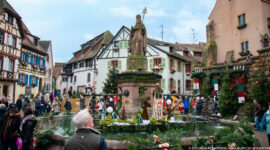
A stone fountain occupies the foreground, its basin reflecting the twin-towered silhouette of Stadtkirche St. Dionys across the square. Ripples spread through the water beneath the fountain structure, while winter market lights and bare trees line the middle distance. The low viewpoint uses the reflection to connect civic space, seasonal activity, water, and the church landmark.
Caption
A stone fountain occupies the foreground, its basin reflecting the twin-towered silhouette of Stadtkirche St. Dionys across the square. Ripples spread through the water beneath the fountain structure, while winter market lights and bare trees line the middle distance. The low viewpoint uses the reflection to connect civic space, seasonal activity, water, and the church landmark.

A large illuminated Christmas pyramid stands in front of a red-and-white half-timbered house in Esslingen’s market area. Tiered wooden platforms carry small figures beneath a broad propeller-like rotor, while electric candles outline the structure. The pairing of seasonal folk decoration with the patterned timber façade creates a distinctly architectural view of the Christmas market at dusk.
Caption
A large illuminated Christmas pyramid stands in front of a red-and-white half-timbered house in Esslingen’s market area. Tiered wooden platforms carry small figures beneath a broad propeller-like rotor, while electric candles outline the structure. The pairing of seasonal folk decoration with the patterned timber façade creates a distinctly architectural view of the Christmas market at dusk.

Esslingen’s Altes Rathaus rises above a busy Christmas-market street, its red stepped Renaissance gable, paired clock faces, and delicate roof lantern forming the architectural focus. Timber stalls and a banner reading “Holzofen Bäckerei” occupy the foreground, while pastel townhouses close in on the narrow urban space. The scene places the city’s celebrated civic façade within the seasonal market activity of the old town.
Caption
Esslingen’s Altes Rathaus rises above a busy Christmas-market street, its red stepped Renaissance gable, paired clock faces, and delicate roof lantern forming the architectural focus. Timber stalls and a banner reading “Holzofen Bäckerei” occupy the foreground, while pastel townhouses close in on the narrow urban space. The scene places the city’s celebrated civic façade within the seasonal market activity of the old town.

A sharply angular contemporary public building occupies the street edge in Esslingen, its pale stone cladding and projecting upper volume contrasting with the historic cityscape nearby. A recessed lower story, exterior stairs, and bands of windows give the structure a layered, asymmetrical profile. Late-afternoon light catches the upper surfaces while parked cars and bare trees establish its everyday urban setting.
Caption
A sharply angular contemporary public building occupies the street edge in Esslingen, its pale stone cladding and projecting upper volume contrasting with the historic cityscape nearby. A recessed lower story, exterior stairs, and bands of windows give the structure a layered, asymmetrical profile. Late-afternoon light catches the upper surfaces while parked cars and bare trees establish its everyday urban setting.

A small bronze animal sculpture projects horizontally from a stone wall, its elongated body, pointed muzzle, and extended tail silhouetted against mixed masonry. Below it, a separate metal ornament with flowing, flame-like forms marks the wall surface. The close framing isolates these unusual sculptural details from their broader architectural context, emphasizing their patina, modeling, and relationship to the historic fabric.
Caption
A small bronze animal sculpture projects horizontally from a stone wall, its elongated body, pointed muzzle, and extended tail silhouetted against mixed masonry. Below it, a separate metal ornament with flowing, flame-like forms marks the wall surface. The close framing isolates these unusual sculptural details from their broader architectural context, emphasizing their patina, modeling, and relationship to the historic fabric.

A rustic timber market booth fills the foreground beneath suspended wrought-iron signage and strings of colorful flags. A short exterior staircase climbs to an upper platform beneath a red-and-gold canopy, while the lower counter displays bottles and service equipment. The layered construction and theatrical detailing give the temporary structure the appearance of a small timber pavilion within the market square.
Caption
A rustic timber market booth fills the foreground beneath suspended wrought-iron signage and strings of colorful flags. A short exterior staircase climbs to an upper platform beneath a red-and-gold canopy, while the lower counter displays bottles and service equipment. The layered construction and theatrical detailing give the temporary structure the appearance of a small timber pavilion within the market square.

A close view isolates the paired time displays on the Altes Rathaus: a large Roman-numeral clock below and a richly colored astronomical or calendar dial above. White architectural framing, gilded details, and red wall surfaces surround the instruments, while decorative columns and moldings emphasize their ceremonial placement on the façade. The photograph concentrates on the precision and ornament of the town hall’s timekeeping ensemble.
Caption
A close view isolates the paired time displays on the Altes Rathaus: a large Roman-numeral clock below and a richly colored astronomical or calendar dial above. White architectural framing, gilded details, and red wall surfaces surround the instruments, while decorative columns and moldings emphasize their ceremonial placement on the façade. The photograph concentrates on the precision and ornament of the town hall’s timekeeping ensemble.

A narrow cobblestone lane runs between tightly packed historic houses in Esslingen’s old town, drawing the eye toward a cluster of pedestrians in the distance. Plastered façades, projecting upper stories, shutters, arched doorways, and tiled roofs create an irregular street wall on both sides. The pedestrian scale and compressed perspective convey the intimate grain of the medieval urban core.
Caption
A narrow cobblestone lane runs between tightly packed historic houses in Esslingen’s old town, drawing the eye toward a cluster of pedestrians in the distance. Plastered façades, projecting upper stories, shutters, arched doorways, and tiled roofs create an irregular street wall on both sides. The pedestrian scale and compressed perspective convey the intimate grain of the medieval urban core.

Seen from below and slightly to one side, the Altes Rathaus presents its red stepped gable, ornate clock zone, green shutters, and roof lantern against a bright winter sky. Market awnings and strings of pennants cut across the lower façade, while adjacent half-timbered buildings appear along the left edge. The oblique perspective emphasizes the town hall’s tall, narrow profile within Esslingen’s dense center.
Caption
Seen from below and slightly to one side, the Altes Rathaus presents its red stepped gable, ornate clock zone, green shutters, and roof lantern against a bright winter sky. Market awnings and strings of pennants cut across the lower façade, while adjacent half-timbered buildings appear along the left edge. The oblique perspective emphasizes the town hall’s tall, narrow profile within Esslingen’s dense center.

A wooden Glühwein stall serves a dense crowd in Esslingen’s Christmas market, its roofline decorated with heraldic flags, evergreen trim, and hanging signs. Visitors gather around the counter in winter coats while timber framing and a neighboring half-timbered building enclose the square behind. The composition records the social life of the market as much as its temporary architecture.
Caption
A wooden Glühwein stall serves a dense crowd in Esslingen’s Christmas market, its roofline decorated with heraldic flags, evergreen trim, and hanging signs. Visitors gather around the counter in winter coats while timber framing and a neighboring half-timbered building enclose the square behind. The composition records the social life of the market as much as its temporary architecture.

A steeply tilted low-angle view makes the Altes Rathaus appear to surge upward from the market edge. The long red façade, green shutters, stepped clock gable, and ornate lantern remain clearly legible despite the dynamic perspective, while adjacent half-timbered buildings and market roofs crowd the lower frame. The photograph turns Esslingen’s civic landmark into a study of verticality and urban compression.
Caption
A steeply tilted low-angle view makes the Altes Rathaus appear to surge upward from the market edge. The long red façade, green shutters, stepped clock gable, and ornate lantern remain clearly legible despite the dynamic perspective, while adjacent half-timbered buildings and market roofs crowd the lower frame. The photograph turns Esslingen’s civic landmark into a study of verticality and urban compression.

A compact wooden food stall serves visitors beneath hand-painted signs advertising waffles and Camembert. Warm lamps illuminate the counter and hanging greenery, while customers in winter clothing queue directly in front. Canvas coverings and neighboring storefronts press closely around the booth, showing how temporary food vendors fit into the tight pedestrian fabric of Esslingen’s seasonal market.
Caption
A compact wooden food stall serves visitors beneath hand-painted signs advertising waffles and Camembert. Warm lamps illuminate the counter and hanging greenery, while customers in winter clothing queue directly in front. Canvas coverings and neighboring storefronts press closely around the booth, showing how temporary food vendors fit into the tight pedestrian fabric of Esslingen’s seasonal market.

A pale stone civic building presents a formal symmetrical façade of tall sash windows, sculpted surrounds, pilasters, and a triangular pediment containing a clock. Above the red-tiled roof, a green-patinated clock turret rises against the blue sky. Seasonal banners and market structures partially obscure the lower level, linking the dignified architecture to the Christmas-market setting in the square.
Caption
A pale stone civic building presents a formal symmetrical façade of tall sash windows, sculpted surrounds, pilasters, and a triangular pediment containing a clock. Above the red-tiled roof, a green-patinated clock turret rises against the blue sky. Seasonal banners and market structures partially obscure the lower level, linking the dignified architecture to the Christmas-market setting in the square.

A market vendor stands inside a rustic timber Glühwein booth framed by carved posts, garlands, and hand-lettered signs. Menu boards list hot drinks while bottles line the service counter behind her. The red backdrop and warm interior light contrast with the cool cobblestone street outside, making the small stall a vivid portrait of seasonal trade in Esslingen’s Christmas market.
Caption
A market vendor stands inside a rustic timber Glühwein booth framed by carved posts, garlands, and hand-lettered signs. Menu boards list hot drinks while bottles line the service counter behind her. The red backdrop and warm interior light contrast with the cool cobblestone street outside, making the small stall a vivid portrait of seasonal trade in Esslingen’s Christmas market.

Market roofs and a tall temporary timber structure frame a view toward Stadtkirche St. Dionys, whose twin towers and connecting bridge rise beyond the square. Historic gabled houses occupy the left side, while a glowing lantern beneath a canvas canopy warms the foreground. The layered composition brings together temporary market architecture and one of Esslingen’s most distinctive church silhouettes.
Caption
Market roofs and a tall temporary timber structure frame a view toward Stadtkirche St. Dionys, whose twin towers and connecting bridge rise beyond the square. Historic gabled houses occupy the left side, while a glowing lantern beneath a canvas canopy warms the foreground. The layered composition brings together temporary market architecture and one of Esslingen’s most distinctive church silhouettes.

A compact rooftop clock turret rises above a classical cornice, its green-patinated metal cladding carrying clock faces on adjacent sides. Gilded Roman numerals and hands contrast with the weathered copper surface, while a slender finial crowns the curved roof. The tight crop separates this civic timepiece from the larger building and turns it into a study of metalwork, patina, and urban detail.
Caption
A compact rooftop clock turret rises above a classical cornice, its green-patinated metal cladding carrying clock faces on adjacent sides. Gilded Roman numerals and hands contrast with the weathered copper surface, while a slender finial crowns the curved roof. The tight crop separates this civic timepiece from the larger building and turns it into a study of metalwork, patina, and urban detail.

A broad half-timbered gabled building dominates the square, its dense red-brown framing creating a regular lattice across multiple stories. Painted signage stretches across the lower façade, while Christmas-market roofs, evergreen garlands, and visitors fill the foreground. Warm low sunlight catches the timberwork and emphasizes the building’s scale relative to the temporary stalls clustered at its base.
Caption
A broad half-timbered gabled building dominates the square, its dense red-brown framing creating a regular lattice across multiple stories. Painted signage stretches across the lower façade, while Christmas-market roofs, evergreen garlands, and visitors fill the foreground. Warm low sunlight catches the timberwork and emphasizes the building’s scale relative to the temporary stalls clustered at its base.

A substantial wooden market booth advertises Feuerzangenbowle across its front beam, with red-and-blue flags mounted above the roof. Warm lamps illuminate the counter, bottles, and serving area, while visitors gather beneath the broad overhang. The rustic carpentry, heraldic colors, and prominent drink signage make the stall a distinctive feature of Esslingen’s festive market landscape.
Caption
A substantial wooden market booth advertises Feuerzangenbowle across its front beam, with red-and-blue flags mounted above the roof. Warm lamps illuminate the counter, bottles, and serving area, while visitors gather beneath the broad overhang. The rustic carpentry, heraldic colors, and prominent drink signage make the stall a distinctive feature of Esslingen’s festive market landscape.

A pedestrian market lane runs between temporary stalls and a long dark-red half-timbered building, with a richly patterned gabled house closing the view ahead. Shoppers move through the narrow passage beneath strings of small flags, while warm stall lights spill from beneath canvas roofs. The scene emphasizes the close integration of Esslingen’s Christmas market with its historic timber architecture.
Caption
A pedestrian market lane runs between temporary stalls and a long dark-red half-timbered building, with a richly patterned gabled house closing the view ahead. Shoppers move through the narrow passage beneath strings of small flags, while warm stall lights spill from beneath canvas roofs. The scene emphasizes the close integration of Esslingen’s Christmas market with its historic timber architecture.

Three adjoining historic houses fill the frame with contrasting timber patterns, plaster colors, steep gables, and rows of small-paned windows. The nearest façade uses pale infill and ochre framing, while the long building at right is painted a deeper rose tone with dark structural timbers. The tight composition treats Esslingen’s Fachwerk architecture as a study in geometry, color, and roofline variation.
Caption
Three adjoining historic houses fill the frame with contrasting timber patterns, plaster colors, steep gables, and rows of small-paned windows. The nearest façade uses pale infill and ochre framing, while the long building at right is painted a deeper rose tone with dark structural timbers. The tight composition treats Esslingen’s Fachwerk architecture as a study in geometry, color, and roofline variation.

A large vertical wooden wheel dominates a themed market stall, mounted beside stairs and timber platforms beneath painted signs and heraldic decoration. Visitors stand around the installation while colored light glows from the booth interior. The mechanism’s oversized scale and rustic construction contribute to the medievalizing theatrical character of this section of Esslingen’s seasonal market.
Caption
A large vertical wooden wheel dominates a themed market stall, mounted beside stairs and timber platforms beneath painted signs and heraldic decoration. Visitors stand around the installation while colored light glows from the booth interior. The mechanism’s oversized scale and rustic construction contribute to the medievalizing theatrical character of this section of Esslingen’s seasonal market.

A close architectural view fills the frame with a long salmon-pink half-timbered façade. Dark structural members form repeated braces and posts around rows of white-framed windows, while small colored glazing panels punctuate the lower story. Dormers and red roof tiles appear above the deep eaves, revealing the layered construction and decorative rhythm of the historic building.
Caption
A close architectural view fills the frame with a long salmon-pink half-timbered façade. Dark structural members form repeated braces and posts around rows of white-framed windows, while small colored glazing panels punctuate the lower story. Dormers and red roof tiles appear above the deep eaves, revealing the layered construction and decorative rhythm of the historic building.

A painted sundial occupies a white plaster wall beside a green shutter, its oval scale marked with Roman numerals and red hour points. A metal gnomon projects from the center, casting a sharp geometric shadow across the dial. Decorative bands and weathering give the instrument a handmade historic character, while the close framing clearly records its functional markings and placement on the façade.
Caption
A painted sundial occupies a white plaster wall beside a green shutter, its oval scale marked with Roman numerals and red hour points. A metal gnomon projects from the center, casting a sharp geometric shadow across the dial. Decorative bands and weathering give the instrument a handmade historic character, while the close framing clearly records its functional markings and placement on the façade.

The Esslinger Burg crowns the hillside above rows of winter-bare vines, with a long stone defensive wall and covered red-tiled walkway extending toward a square tower. The tower’s timbered upper level, small windows, and rooftop bell structure stand clearly against the sky. The view links the fortification directly to the vineyard slopes that rise above Esslingen’s historic center.
Caption
The Esslinger Burg crowns the hillside above rows of winter-bare vines, with a long stone defensive wall and covered red-tiled walkway extending toward a square tower. The tower’s timbered upper level, small windows, and rooftop bell structure stand clearly against the sky. The view links the fortification directly to the vineyard slopes that rise above Esslingen’s historic center.

An interpretive panel mounted on a rough stone wall introduces the Esslinger Burg and the tradition of wine cultivation on the surrounding slopes. The heading “Tradition in Weinkultur” and a small site diagram are visible beneath the castle name, with blocks of German explanatory text below. The sign documents how the fortification and vineyard landscape are interpreted together for visitors.
Caption
An interpretive panel mounted on a rough stone wall introduces the Esslinger Burg and the tradition of wine cultivation on the surrounding slopes. The heading “Tradition in Weinkultur” and a small site diagram are visible beneath the castle name, with blocks of German explanatory text below. The sign documents how the fortification and vineyard landscape are interpreted together for visitors.

A narrow stone stair climbs steeply through winter-bare vineyard rows toward the Esslinger Burg, visible at the crest of the slope. Wooden and metal vine posts create a vertical rhythm on both sides, while moss softens the retaining walls and stair edges. The uphill perspective emphasizes the direct physical connection between the cultivated terraces and the hilltop fortification.
Caption
A narrow stone stair climbs steeply through winter-bare vineyard rows toward the Esslinger Burg, visible at the crest of the slope. Wooden and metal vine posts create a vertical rhythm on both sides, while moss softens the retaining walls and stair edges. The uphill perspective emphasizes the direct physical connection between the cultivated terraces and the hilltop fortification.

An ornate open-sided rooftop pavilion rises above red-tiled roofs, its green-patinated metal canopy carried on slender supports and crowned by stacked circular ornaments and a star-like finial. Small sculptural figures or terminals project around the roof edge. A distant church spire punctuates the skyline at right, placing the decorative cupola within Esslingen’s layered historic roofscape.
Caption
An ornate open-sided rooftop pavilion rises above red-tiled roofs, its green-patinated metal canopy carried on slender supports and crowned by stacked circular ornaments and a star-like finial. Small sculptural figures or terminals project around the roof edge. A distant church spire punctuates the skyline at right, placing the decorative cupola within Esslingen’s layered historic roofscape.

An older woman in period-inspired dress stands amid textiles and handmade goods at a medieval-themed market stall, holding a translucent blue mug. Her patterned headscarf, dark bodice, layered clothing, jewelry, and leather belt reinforce the costumed presentation, while baskets of colorful merchandise crowd the foreground. The portrait foregrounds the human character of Esslingen’s Mittelaltermarkt rather than its architecture.
Caption
An older woman in period-inspired dress stands amid textiles and handmade goods at a medieval-themed market stall, holding a translucent blue mug. Her patterned headscarf, dark bodice, layered clothing, jewelry, and leather belt reinforce the costumed presentation, while baskets of colorful merchandise crowd the foreground. The portrait foregrounds the human character of Esslingen’s Mittelaltermarkt rather than its architecture.

A costumed market worker leans forward at a food stall beside a box-like cooking or warming vessel glowing orange through its opening. His pale tunic and soft cap echo the medievalizing dress of neighboring vendors, while wooden boards and canvas walls define the temporary workspace. Motion in the figure gives the frame an immediate, behind-the-counter sense of food preparation.
Caption
A costumed market worker leans forward at a food stall beside a box-like cooking or warming vessel glowing orange through its opening. His pale tunic and soft cap echo the medievalizing dress of neighboring vendors, while wooden boards and canvas walls define the temporary workspace. Motion in the figure gives the frame an immediate, behind-the-counter sense of food preparation.

Esslingen’s Altes Rathaus appears at the end of a narrow old-town street, its red Renaissance gable, paired clocks, green shutters, and ornate roof lantern framed tightly by neighboring plastered houses. The compressed viewpoint turns the street into a visual corridor toward the civic landmark, while traffic signs, shuttered windows, and winter-bare plantings preserve the everyday character of the historic center.
Caption
Esslingen’s Altes Rathaus appears at the end of a narrow old-town street, its red Renaissance gable, paired clocks, green shutters, and ornate roof lantern framed tightly by neighboring plastered houses. The compressed viewpoint turns the street into a visual corridor toward the civic landmark, while traffic signs, shuttered windows, and winter-bare plantings preserve the everyday character of the historic center.

A round, timber-crowned tower of the Esslinger Burg rises above a steep vineyard, connected to a long covered defensive wall with a red-tiled roof. Low winter sun illuminates the fortification and rows of bare vine stakes while dark clouds gather behind the hill. The composition emphasizes the castle’s commanding position above Esslingen and its close physical relationship with cultivated vineyard terraces.
Caption
A round, timber-crowned tower of the Esslinger Burg rises above a steep vineyard, connected to a long covered defensive wall with a red-tiled roof. Low winter sun illuminates the fortification and rows of bare vine stakes while dark clouds gather behind the hill. The composition emphasizes the castle’s commanding position above Esslingen and its close physical relationship with cultivated vineyard terraces.

A crowded market lane leads toward the red-gabled Altes Rathaus, with a large sign reading “Mittelaltermarkt” suspended above stalls in the foreground. Canvas roofs, timber booths, evergreen decoration, and strings of flags narrow the passage as visitors move through the scene. The historic town hall remains visible at the end of the street, linking Esslingen’s medieval-themed market directly to its civic center.
Caption
A crowded market lane leads toward the red-gabled Altes Rathaus, with a large sign reading “Mittelaltermarkt” suspended above stalls in the foreground. Canvas roofs, timber booths, evergreen decoration, and strings of flags narrow the passage as visitors move through the scene. The historic town hall remains visible at the end of the street, linking Esslingen’s medieval-themed market directly to its civic center.

A woman in period-inspired clothing works behind a richly colored wooden market counter decorated with pointed Moorish-style panels. Woven textiles, hanging goods, baskets, and small craft items fill the stall, while warm lamps glow beneath the canvas roof. The frontal composition concentrates on the vendor and the handcrafted theatrical setting of Esslingen’s medieval-themed Christmas market.
Caption
A woman in period-inspired clothing works behind a richly colored wooden market counter decorated with pointed Moorish-style panels. Woven textiles, hanging goods, baskets, and small craft items fill the stall, while warm lamps glow beneath the canvas roof. The frontal composition concentrates on the vendor and the handcrafted theatrical setting of Esslingen’s medieval-themed Christmas market.

A bearded market worker in a dark leather cap and red tunic looks downward inside a timber stall. The close portrait isolates his face, long gray-brown beard, layered clothing, and shoulder strap against a red fabric backdrop, with hooks and simple utensils around him. His period-inspired costume contributes to the staged medieval character of Esslingen’s seasonal market.
Caption
A bearded market worker in a dark leather cap and red tunic looks downward inside a timber stall. The close portrait isolates his face, long gray-brown beard, layered clothing, and shoulder strap against a red fabric backdrop, with hooks and simple utensils around him. His period-inspired costume contributes to the staged medieval character of Esslingen’s seasonal market.

Three costumed vendors stand inside a rustic timber booth stocked with jars, bottles, baskets, wooden bowls, and hanging signs. A central work counter displays small containers and serving implements, while shelves and rough-hewn beams crowd the compact interior. The scene records the deliberately preindustrial visual language used throughout Esslingen’s medieval-themed market, from clothing to furnishings and packaging.
Caption
Three costumed vendors stand inside a rustic timber booth stocked with jars, bottles, baskets, wooden bowls, and hanging signs. A central work counter displays small containers and serving implements, while shelves and rough-hewn beams crowd the compact interior. The scene records the deliberately preindustrial visual language used throughout Esslingen’s medieval-themed market, from clothing to furnishings and packaging.

A young man in a loose cream tunic and soft cap works at a wooden food counter beneath a chalkboard menu. Handwritten words including “Schafskäse” and “Waffel” are visible behind him, while another costumed worker prepares food farther back. The close view emphasizes the active preparation and period-inspired dress of a medieval-themed food stall.
Caption
A young man in a loose cream tunic and soft cap works at a wooden food counter beneath a chalkboard menu. Handwritten words including “Schafskäse” and “Waffel” are visible behind him, while another costumed worker prepares food farther back. The close view emphasizes the active preparation and period-inspired dress of a medieval-themed food stall.

The front of a large rustic food booth is crowded with hand-painted menu boards, hanging garlic, cooking pots, and decorative timberwork. A prominent Gothic-style sign identifies the stall as a Kartoffelhaus, while smaller boards advertise potato dishes and other offerings. Vendors stand behind the counter beneath the deep roof, creating a richly layered view of Esslingen’s theatrical medieval-market food culture.
Caption
The front of a large rustic food booth is crowded with hand-painted menu boards, hanging garlic, cooking pots, and decorative timberwork. A prominent Gothic-style sign identifies the stall as a Kartoffelhaus, while smaller boards advertise potato dishes and other offerings. Vendors stand behind the counter beneath the deep roof, creating a richly layered view of Esslingen’s theatrical medieval-market food culture.

A smiling young vendor leans on the counter of a medieval-themed drink stall, framed by rows of metal cups, a large copper vessel, hanging bells, and wooden barrels. His loose lavender shirt and apron-like straps complement the rustic presentation. Warm interior light and dense equipment create an intimate working portrait inside one of Esslingen’s temporary market booths.
Caption
A smiling young vendor leans on the counter of a medieval-themed drink stall, framed by rows of metal cups, a large copper vessel, hanging bells, and wooden barrels. His loose lavender shirt and apron-like straps complement the rustic presentation. Warm interior light and dense equipment create an intimate working portrait inside one of Esslingen’s temporary market booths.

A broad view across Esslingen’s Christmas market shows visitors moving among timber stalls beneath a row of colorful gabled houses. Pale cream, white, green, and patterned façades form a rhythmic backdrop, while the red stepped edge of the Altes Rathaus appears at far right. The scene emphasizes the market’s integration with the architectural enclosure of the historic square.
Caption
A broad view across Esslingen’s Christmas market shows visitors moving among timber stalls beneath a row of colorful gabled houses. Pale cream, white, green, and patterned façades form a rhythmic backdrop, while the red stepped edge of the Altes Rathaus appears at far right. The scene emphasizes the market’s integration with the architectural enclosure of the historic square.

Two compact wooden Christmas-market booths glow with strings of warm lights and evergreen garlands against Esslingen’s historic buildings. One stall has a broad gabled roof and shuttered serving openings; the smaller pavilion beside it is crowned by a dark tiled roof. Seasonal greenery, ornaments, and the intimate scale of the structures create a traditional market vignette at dusk.
Caption
Two compact wooden Christmas-market booths glow with strings of warm lights and evergreen garlands against Esslingen’s historic buildings. One stall has a broad gabled roof and shuttered serving openings; the smaller pavilion beside it is crowned by a dark tiled roof. Seasonal greenery, ornaments, and the intimate scale of the structures create a traditional market vignette at dusk.

Several thick slices of rustic bread sit on a wooden counter, topped with melted cheese and varied savory garnishes. One portion carries bright red and yellow peppers, another pale cheese, and another a layer of shredded meat or cured topping. Printed price sheets below identify the setting as Esslingen’s Weihnachtsmarkt, making this a close record of ready-to-serve seasonal market food.
Caption
Several thick slices of rustic bread sit on a wooden counter, topped with melted cheese and varied savory garnishes. One portion carries bright red and yellow peppers, another pale cheese, and another a layer of shredded meat or cured topping. Printed price sheets below identify the setting as Esslingen’s Weihnachtsmarkt, making this a close record of ready-to-serve seasonal market food.

A small sweets stall is almost completely wrapped in fresh evergreen branches and trimmed with red and gold ornaments. A garlanded roofline frames the open service window, where packaged confections and baked goods are arranged beneath warm lights. Set directly against a pale stone church façade, the booth contrasts temporary seasonal greenery with permanent Gothic masonry.
Caption
A small sweets stall is almost completely wrapped in fresh evergreen branches and trimmed with red and gold ornaments. A garlanded roofline frames the open service window, where packaged confections and baked goods are arranged beneath warm lights. Set directly against a pale stone church façade, the booth contrasts temporary seasonal greenery with permanent Gothic masonry.

A richly decorated wooden market stall displays rows of hanging heart-shaped ornaments, small gifts, and craft goods beneath dense evergreen branches. White and red baubles, flowers, berries, and warm string lights crown the roof, while a tall Gothic church spire rises in the background. The dense floral and holiday decoration makes the stall itself the principal visual attraction.
Caption
A richly decorated wooden market stall displays rows of hanging heart-shaped ornaments, small gifts, and craft goods beneath dense evergreen branches. White and red baubles, flowers, berries, and warm string lights crown the roof, while a tall Gothic church spire rises in the background. The dense floral and holiday decoration makes the stall itself the principal visual attraction.

Late sunlight warms a row of historic gabled houses above a crowded Christmas market in Esslingen. A prominent red-and-white half-timbered façade anchors the center, while evergreen-roofed stalls, red ornaments, and groups of visitors fill the square below. Darkening clouds heighten the contrast between the illuminated architecture and the busy seasonal foreground.
Caption
Late sunlight warms a row of historic gabled houses above a crowded Christmas market in Esslingen. A prominent red-and-white half-timbered façade anchors the center, while evergreen-roofed stalls, red ornaments, and groups of visitors fill the square below. Darkening clouds heighten the contrast between the illuminated architecture and the busy seasonal foreground.

Decorated market roofs and tightly grouped historic houses fill the lower half of the frame, while a tower of the Esslinger Burg appears on the hillside beyond. Red-and-white half-timbering, pale plaster façades, steep tiled roofs, evergreen garlands, and red ornaments create a densely layered townscape. The elevated castle tower provides a visual link between the market square and Esslingen’s fortified hillside.
Caption
Decorated market roofs and tightly grouped historic houses fill the lower half of the frame, while a tower of the Esslinger Burg appears on the hillside beyond. Red-and-white half-timbering, pale plaster façades, steep tiled roofs, evergreen garlands, and red ornaments create a densely layered townscape. The elevated castle tower provides a visual link between the market square and Esslingen’s fortified hillside.

The pale stone mass of Stadtkirche St. Dionys rises dramatically from a low oblique viewpoint, with a tall pointed window dominating the gabled wall. One square tower stands to the left, and the church’s elevated bridge crosses toward the second tower behind the roofline. Warm sunlight rakes across the masonry, bringing out the varied stone tones and vertical Gothic proportions.
Caption
The pale stone mass of Stadtkirche St. Dionys rises dramatically from a low oblique viewpoint, with a tall pointed window dominating the gabled wall. One square tower stands to the left, and the church’s elevated bridge crosses toward the second tower behind the roofline. Warm sunlight rakes across the masonry, bringing out the varied stone tones and vertical Gothic proportions.

A broad gabled end of Stadtkirche St. Dionys faces the street, pierced by a tall central Gothic window and smaller pointed openings below. The square tower at left rises behind the wall, with the elevated connecting bridge visible near its upper stage. A leafless tree and street furniture establish the church within the winter city rather than isolating it as a monument.
Caption
A broad gabled end of Stadtkirche St. Dionys faces the street, pierced by a tall central Gothic window and smaller pointed openings below. The square tower at left rises behind the wall, with the elevated connecting bridge visible near its upper stage. A leafless tree and street furniture establish the church within the winter city rather than isolating it as a monument.

A multi-story half-timbered building rises sharply above the street in a low-angle view. Dark structural beams divide pale plaster panels around projecting window bays, while red shutters and small-paned glazing animate the upper floors. Modern shopfronts and illuminated signs occupy the stone base, showing the continued commercial use of Esslingen’s historic timber architecture.
Caption
A multi-story half-timbered building rises sharply above the street in a low-angle view. Dark structural beams divide pale plaster panels around projecting window bays, while red shutters and small-paned glazing animate the upper floors. Modern shopfronts and illuminated signs occupy the stone base, showing the continued commercial use of Esslingen’s historic timber architecture.

A richly ornamented altarpiece combines painted narrative panels, sculpted figures, gilded scrollwork, and architectural framing beneath stained glass. The central lower panels present religious scenes, while small standing figures occupy niches at the sides and an elaborate crest rises above. The close view concentrates on the layered craftsmanship of painting, carving, and gilding rather than the wider church interior.
Caption
A richly ornamented altarpiece combines painted narrative panels, sculpted figures, gilded scrollwork, and architectural framing beneath stained glass. The central lower panels present religious scenes, while small standing figures occupy niches at the sides and an elaborate crest rises above. The close view concentrates on the layered craftsmanship of painting, carving, and gilding rather than the wider church interior.

A tall pointed window is divided into three vertical lights filled largely with pale circular quarries, bordered by narrow bands of red, green, and yellow glass. Trefoil-like tracery and colored roundels occupy the upper section, glowing against the dark interior wall. The restrained design contrasts with the more densely figurative stained glass elsewhere in the church.
Caption
A tall pointed window is divided into three vertical lights filled largely with pale circular quarries, bordered by narrow bands of red, green, and yellow glass. Trefoil-like tracery and colored roundels occupy the upper section, glowing against the dark interior wall. The restrained design contrasts with the more densely figurative stained glass elsewhere in the church.

Warm lamps illuminate a market stall densely arranged with pottery, bowls, lanterns, small sculptures, and hanging decorative objects. Evergreen garlands frame the booth, while a star-shaped light hangs above the display. The careful rows of handcrafted goods and layered shelving create a still-life-like view of seasonal retail within Esslingen’s Christmas market.
Caption
Warm lamps illuminate a market stall densely arranged with pottery, bowls, lanterns, small sculptures, and hanging decorative objects. Evergreen garlands frame the booth, while a star-shaped light hangs above the display. The careful rows of handcrafted goods and layered shelving create a still-life-like view of seasonal retail within Esslingen’s Christmas market.

From close below, the two towers of Stadtkirche St. Dionys rise above the nave, joined high overhead by the church’s distinctive enclosed bridge. Romanesque-style arched belfry openings mark the tower stages, while steep roofs and pale sandstone masonry catch warm winter light. The tight upward composition makes the unusual tower connection the dominant architectural feature.
Caption
From close below, the two towers of Stadtkirche St. Dionys rise above the nave, joined high overhead by the church’s distinctive enclosed bridge. Romanesque-style arched belfry openings mark the tower stages, while steep roofs and pale sandstone masonry catch warm winter light. The tight upward composition makes the unusual tower connection the dominant architectural feature.

Visitors move through a dense medieval-themed market filled with canvas tents, rustic timber booths, heraldic shields, and brightly colored awnings. Bare trees rise above the temporary structures, while a circular elevated platform or pavilion appears in the background. The scene emphasizes the immersive, theatrical character of Esslingen’s Mittelaltermarkt and its separation from more conventional Christmas-market stalls.
Caption
Visitors move through a dense medieval-themed market filled with canvas tents, rustic timber booths, heraldic shields, and brightly colored awnings. Bare trees rise above the temporary structures, while a circular elevated platform or pavilion appears in the background. The scene emphasizes the immersive, theatrical character of Esslingen’s Mittelaltermarkt and its separation from more conventional Christmas-market stalls.

Rows of dark wooden pews lead through the tall nave of Stadtkirche St. Dionys toward the illuminated chancel. Pointed arcades, massive stone piers, timber ceiling surfaces, and a high screen or gallery create strong depth, while stained glass glows at the far end. The centered viewpoint presents the church’s interior as a carefully ordered sequence of structural bays.
Caption
Rows of dark wooden pews lead through the tall nave of Stadtkirche St. Dionys toward the illuminated chancel. Pointed arcades, massive stone piers, timber ceiling surfaces, and a high screen or gallery create strong depth, while stained glass glows at the far end. The centered viewpoint presents the church’s interior as a carefully ordered sequence of structural bays.

The chancel of Stadtkirche St. Dionys is framed by pointed arches beneath a traceried gallery, with warm light concentrated around the altar. A richly carved pulpit stands on the right pier, while flowers, liturgical furnishings, and stained-glass windows add color to the pale stone interior. The slightly closer viewpoint clarifies the layered relationship between nave, screen, altar, and pulpit.
Caption
The chancel of Stadtkirche St. Dionys is framed by pointed arches beneath a traceried gallery, with warm light concentrated around the altar. A richly carved pulpit stands on the right pier, while flowers, liturgical furnishings, and stained-glass windows add color to the pale stone interior. The slightly closer viewpoint clarifies the layered relationship between nave, screen, altar, and pulpit.

A dark Gothic window opening frames a modern stained-glass composition dominated by saturated blue, red, white, and green. Large figurative forms occupy the upper and lower panels, broken into angular pieces that contrast with the older stone tracery surrounding them. The exposure isolates the luminous glass against the nearly black interior, emphasizing color and graphic design over architectural context.
Caption
A dark Gothic window opening frames a modern stained-glass composition dominated by saturated blue, red, white, and green. Large figurative forms occupy the upper and lower panels, broken into angular pieces that contrast with the older stone tracery surrounding them. The exposure isolates the luminous glass against the nearly black interior, emphasizing color and graphic design over architectural context.

A rustic market booth labeled with an “Alchemie” sign is built from rough timber, branches, wagon wheels, and canvas. A bearded vendor stands behind a counter crowded with jars, small bottles, candles, and crafted goods, while costumed visitors pass at the side. The deliberately improvised materials and apothecary-like display reinforce the theatrical medieval character of Esslingen’s Mittelaltermarkt.
Caption
A rustic market booth labeled with an “Alchemie” sign is built from rough timber, branches, wagon wheels, and canvas. A bearded vendor stands behind a counter crowded with jars, small bottles, candles, and crafted goods, while costumed visitors pass at the side. The deliberately improvised materials and apothecary-like display reinforce the theatrical medieval character of Esslingen’s Mittelaltermarkt.

A large sculpted crucifix dominates the foreground of this church interior, set directly before an elaborate painted and gilded altar structure. Stained-glass windows rise on either side, while carved architectural details and religious figures recede into the softly focused background. The shallow depth of field isolates the figure of Christ and gives the devotional sculpture visual priority over the surrounding sanctuary furnishings.
Caption
A large sculpted crucifix dominates the foreground of this church interior, set directly before an elaborate painted and gilded altar structure. Stained-glass windows rise on either side, while carved architectural details and religious figures recede into the softly focused background. The shallow depth of field isolates the figure of Christ and gives the devotional sculpture visual priority over the surrounding sanctuary furnishings.

An elaborate pipe organ fills the west gallery of a historic church, its tall silver pipes grouped within a richly carved and gilded case. Curving ornament, sculptural figures, and a crowned central crest rise beneath a dark timber ceiling, while a Gothic window glows behind the instrument. The frontal viewpoint emphasizes the organ’s symmetrical arrangement and its commanding position above the nave.
Caption
An elaborate pipe organ fills the west gallery of a historic church, its tall silver pipes grouped within a richly carved and gilded case. Curving ornament, sculptural figures, and a crowned central crest rise beneath a dark timber ceiling, while a Gothic window glows behind the instrument. The frontal viewpoint emphasizes the organ’s symmetrical arrangement and its commanding position above the nave.

A rustic market booth glows under warm lanterns and strings of small lights, with shelves of pale handmade objects arranged beneath a canvas canopy. Wreaths, branches, baskets, and rough timber supports give the stall a deliberately medieval or woodland character. The low evening light and dense display create an intimate view of craft retail within Esslingen’s seasonal market.
Caption
A rustic market booth glows under warm lanterns and strings of small lights, with shelves of pale handmade objects arranged beneath a canvas canopy. Wreaths, branches, baskets, and rough timber supports give the stall a deliberately medieval or woodland character. The low evening light and dense display create an intimate view of craft retail within Esslingen’s seasonal market.

A narrow street in Esslingen’s old town is strung with rows of warm Christmas lights, drawing the eye toward half-timbered and plastered buildings at the far end. Closely spaced façades, projecting bays, shutters, and tiled roofs compress the pedestrian corridor, while evening light softens the sky. The decorations transform an ordinary historic lane into part of the city’s seasonal setting.
Caption
A narrow street in Esslingen’s old town is strung with rows of warm Christmas lights, drawing the eye toward half-timbered and plastered buildings at the far end. Closely spaced façades, projecting bays, shutters, and tiled roofs compress the pedestrian corridor, while evening light softens the sky. The decorations transform an ordinary historic lane into part of the city’s seasonal setting.

Heavy bronze doors fill a pointed Gothic portal, each leaf decorated with a vertical series of oval narrative reliefs. A small crucifix is mounted above the doors beneath the glazed tympanum, while deeply molded stone archivolts frame the entrance. The frontal view emphasizes the contrast between dark metalwork, pale masonry, and the carefully ordered sequence of figurative panels.
Caption
Heavy bronze doors fill a pointed Gothic portal, each leaf decorated with a vertical series of oval narrative reliefs. A small crucifix is mounted above the doors beneath the glazed tympanum, while deeply molded stone archivolts frame the entrance. The frontal view emphasizes the contrast between dark metalwork, pale masonry, and the carefully ordered sequence of figurative panels.

A large rectangular bronze plaque is mounted directly onto a pale stone wall, densely filled with lines of German text beneath an ornate crest-like header. The green-blue patina and raised lettering reveal age and weather exposure, while the close composition preserves the plaque as an architectural document rather than part of the surrounding façade. The exact commemorative subject is not legible enough here for a secure attribution.
Caption
A large rectangular bronze plaque is mounted directly onto a pale stone wall, densely filled with lines of German text beneath an ornate crest-like header. The green-blue patina and raised lettering reveal age and weather exposure, while the close composition preserves the plaque as an architectural document rather than part of the surrounding façade. The exact commemorative subject is not legible enough here for a secure attribution.

A lively timber market stall identified by the sign “Zum Wilden Hahn” is crowned with rustic branches, a sculpted bird, pennant flags, and red canvas awnings. Visitors crowd around the counter beneath warm lantern light, while hand-painted signs and rough wooden construction reinforce the deliberately medieval atmosphere. The booth functions as both refreshment stand and theatrical centerpiece within Esslingen’s Mittelaltermarkt.
Caption
A lively timber market stall identified by the sign “Zum Wilden Hahn” is crowned with rustic branches, a sculpted bird, pennant flags, and red canvas awnings. Visitors crowd around the counter beneath warm lantern light, while hand-painted signs and rough wooden construction reinforce the deliberately medieval atmosphere. The booth functions as both refreshment stand and theatrical centerpiece within Esslingen’s Mittelaltermarkt.

A small half-timbered house projects into a narrow cobbled lane, its dark framing and white infill sharply contrasting with the long rough-stone wall opposite. Warm street lamps and a modest Christmas tree add evening color, while additional timber-framed façades recede beyond the bend. The quiet composition shows the intimate scale and mixed construction materials of Esslingen’s historic center.
Caption
A small half-timbered house projects into a narrow cobbled lane, its dark framing and white infill sharply contrasting with the long rough-stone wall opposite. Warm street lamps and a modest Christmas tree add evening color, while additional timber-framed façades recede beyond the bend. The quiet composition shows the intimate scale and mixed construction materials of Esslingen’s historic center.

A street performer in an elaborate white costume stands on a cobbled lane with arms extended, wearing a pale mask or heavily painted face, layered skirt, fitted bodice, and long gauzy fabric trailing from the sleeves. The monochrome costume gives the figure a sculptural, almost spectral appearance against the ordinary façades behind. Motion in the fabric suggests an active performance rather than a static pose.
Caption
A street performer in an elaborate white costume stands on a cobbled lane with arms extended, wearing a pale mask or heavily painted face, layered skirt, fitted bodice, and long gauzy fabric trailing from the sleeves. The monochrome costume gives the figure a sculptural, almost spectral appearance against the ordinary façades behind. Motion in the fabric suggests an active performance rather than a static pose.

The nave extends in a clear axial view beneath high ribbed vaults, with rows of dark wooden pews converging toward the brightly illuminated chancel. Tall stone piers and pointed arches establish a measured vertical rhythm, while stained glass adds color at the far end. Compared with the closer sanctuary views, this wider composition stresses the full spatial depth of the church.
Caption
The nave extends in a clear axial view beneath high ribbed vaults, with rows of dark wooden pews converging toward the brightly illuminated chancel. Tall stone piers and pointed arches establish a measured vertical rhythm, while stained glass adds color at the far end. Compared with the closer sanctuary views, this wider composition stresses the full spatial depth of the church.

A tighter view of the church glazing reveals individual narrative scenes populated by robed figures, angels, and expressive gestures. Deep blue borders and jewel-toned reds, greens, and ambers divide the compositions into repeating arched panels. The enlarged scale makes the painterly treatment of faces and drapery more visible than in the broader window view, while the exact episodes remain too small for certain identification.
Caption
A tighter view of the church glazing reveals individual narrative scenes populated by robed figures, angels, and expressive gestures. Deep blue borders and jewel-toned reds, greens, and ambers divide the compositions into repeating arched panels. The enlarged scale makes the painterly treatment of faces and drapery more visible than in the broader window view, while the exact episodes remain too small for certain identification.

A long Gothic nave leads toward an illuminated chancel framed by pointed arches and tall stained-glass windows. Wooden pews line the central aisle, while clustered stone piers, a carved pulpit, and dark furnishings articulate the sides. The centered view emphasizes the church’s height, linear perspective, and concentration of light around the altar at the far end.
Caption
A long Gothic nave leads toward an illuminated chancel framed by pointed arches and tall stained-glass windows. Wooden pews line the central aisle, while clustered stone piers, a carved pulpit, and dark furnishings articulate the sides. The centered view emphasizes the church’s height, linear perspective, and concentration of light around the altar at the far end.

A large pale crucifix stands against the tall windows of the chancel, elevated above floral arrangements and colorful textile panels. Slender Gothic window openings filled with stained glass rise behind the figure, while the surrounding stone walls remain comparatively subdued. The close frontal composition gives the crucifix a commanding devotional presence within the vertical architecture of the sanctuary.
Caption
A large pale crucifix stands against the tall windows of the chancel, elevated above floral arrangements and colorful textile panels. Slender Gothic window openings filled with stained glass rise behind the figure, while the surrounding stone walls remain comparatively subdued. The close frontal composition gives the crucifix a commanding devotional presence within the vertical architecture of the sanctuary.

A wider sanctuary view places the crucifix within a fan of tall stained-glass lancets rising toward the vault. Colorful modern textile panels line the lower chancel wall, while flowers and dark furnishings cluster near the altar. The photograph balances sculpture, glass, and vertical stonework, revealing how the crucifix is integrated into the larger architectural composition rather than isolated as an object.
Caption
A wider sanctuary view places the crucifix within a fan of tall stained-glass lancets rising toward the vault. Colorful modern textile panels line the lower chancel wall, while flowers and dark furnishings cluster near the altar. The photograph balances sculpture, glass, and vertical stonework, revealing how the crucifix is integrated into the larger architectural composition rather than isolated as an object.

Nine stained-glass panels arranged in three vertical lancets present a sequence of figurative scenes in saturated blues, reds, greens, and browns. Each compartment is framed by architectural borders, creating a compact visual narrative within the tall stone opening. The close crop removes most surrounding architecture and allows the figures, gestures, and repeated panel structure to dominate the composition.
Caption
Nine stained-glass panels arranged in three vertical lancets present a sequence of figurative scenes in saturated blues, reds, greens, and browns. Each compartment is framed by architectural borders, creating a compact visual narrative within the tall stone opening. The close crop removes most surrounding architecture and allows the figures, gestures, and repeated panel structure to dominate the composition.

An elaborate wooden pulpit projects from a stone pier, supported on a clustered carved base and reached by a curving stair. Gothic-inspired tracery, statuettes, relief panels, and miniature architectural forms cover the polygonal body, while a broad sounding board hangs above. The close low-angle view highlights the density of the wood carving and the pulpit’s sculptural presence within the church.
Caption
An elaborate wooden pulpit projects from a stone pier, supported on a clustered carved base and reached by a curving stair. Gothic-inspired tracery, statuettes, relief panels, and miniature architectural forms cover the polygonal body, while a broad sounding board hangs above. The close low-angle view highlights the density of the wood carving and the pulpit’s sculptural presence within the church.

A large pipe organ spans the west end of the church above an ornate stone gallery and a broad glazed screen. Multiple ranks of dark organ pipes rise beneath a pointed vault, while carved tracery and sculptural details enrich the gallery front. Rows of pews and the central aisle lead directly toward the ensemble, clarifying the relationship between the organ loft and the nave below.
Caption
A large pipe organ spans the west end of the church above an ornate stone gallery and a broad glazed screen. Multiple ranks of dark organ pipes rise beneath a pointed vault, while carved tracery and sculptural details enrich the gallery front. Rows of pews and the central aisle lead directly toward the ensemble, clarifying the relationship between the organ loft and the nave below.

A tall three-light window rises through pale stone masonry, each lancet filled with stacked figurative scenes in vivid reds, blues, greens, and golds. Strong vertical mullions divide the narrative sequence while the upward camera angle emphasizes the window’s height. The close architectural framing records both the luminous glass and the massive wall surface that contains it.
Caption
A tall three-light window rises through pale stone masonry, each lancet filled with stacked figurative scenes in vivid reds, blues, greens, and golds. Strong vertical mullions divide the narrative sequence while the upward camera angle emphasizes the window’s height. The close architectural framing records both the luminous glass and the massive wall surface that contains it.

A richly painted rib vault centers on a gilded boss from which four decorated ribs radiate across a deep blue ceiling. Four winged symbolic figures occupy the circular field around the boss, accompanied by flowing inscription bands and dense geometric ornament. Gold stars, red borders, and multicolored patterns turn the vault surface into an integrated program of architecture and sacred imagery.
Caption
A richly painted rib vault centers on a gilded boss from which four decorated ribs radiate across a deep blue ceiling. Four winged symbolic figures occupy the circular field around the boss, accompanied by flowing inscription bands and dense geometric ornament. Gold stars, red borders, and multicolored patterns turn the vault surface into an integrated program of architecture and sacred imagery.

Painted ribs converge beneath an elaborately patterned vault surface, where bands of red, blue, gold, and green ornament follow the architectural geometry. A small circular medallion marks the meeting point above, while repeated stars and foliage-like motifs fill the surrounding blue ground. The angled close view emphasizes how color was applied directly to ribs, webs, and moldings as a unified decorative system.
Caption
Painted ribs converge beneath an elaborately patterned vault surface, where bands of red, blue, gold, and green ornament follow the architectural geometry. A small circular medallion marks the meeting point above, while repeated stars and foliage-like motifs fill the surrounding blue ground. The angled close view emphasizes how color was applied directly to ribs, webs, and moldings as a unified decorative system.

A contemporary glass façade exposes a brightly lit multi-level public interior, where angular staircases and diagonal structural members cross behind a transparent curtain wall. Warm wood and pale interior surfaces contrast with the cool blue evening outside. The open lobby and visible circulation create a distinctly modern counterpoint to the medieval and Gothic architecture documented elsewhere in Esslingen.
Caption
A contemporary glass façade exposes a brightly lit multi-level public interior, where angular staircases and diagonal structural members cross behind a transparent curtain wall. Warm wood and pale interior surfaces contrast with the cool blue evening outside. The open lobby and visible circulation create a distinctly modern counterpoint to the medieval and Gothic architecture documented elsewhere in Esslingen.

A weathered winged creature projects from the exterior of a Gothic church, carved with a long snout, folded wings, and clawed feet. Openwork stone tracery and crocketed pinnacles surround the figure, while the pale masonry behind it emphasizes its darker surface. The close upward view isolates the grotesque as both sculptural ornament and projecting architectural feature.
Caption
A weathered winged creature projects from the exterior of a Gothic church, carved with a long snout, folded wings, and clawed feet. Openwork stone tracery and crocketed pinnacles surround the figure, while the pale masonry behind it emphasizes its darker surface. The close upward view isolates the grotesque as both sculptural ornament and projecting architectural feature.

An owl-like stone grotesque perches on the exterior of a Gothic church, its large round eyes, layered feather carving, and compact body clearly visible against openwork tracery. Crocketed pinnacles rise in the foreground, creating a dense frame of sculptural stone. The close composition emphasizes the creature’s expressive face and finely cut plumage rather than the larger building.
Caption
An owl-like stone grotesque perches on the exterior of a Gothic church, its large round eyes, layered feather carving, and compact body clearly visible against openwork tracery. Crocketed pinnacles rise in the foreground, creating a dense frame of sculptural stone. The close composition emphasizes the creature’s expressive face and finely cut plumage rather than the larger building.

A seated cat-like stone grotesque projects from the church façade, with pointed ears, rounded eyes, prominent paws, and an upright body. Behind it, interlaced openwork tracery forms a patterned stone screen, while crocketed pinnacles flank the lower edge. The frontal view gives the animal an almost portrait-like presence within the surrounding Gothic ornament.
Caption
A seated cat-like stone grotesque projects from the church façade, with pointed ears, rounded eyes, prominent paws, and an upright body. Behind it, interlaced openwork tracery forms a patterned stone screen, while crocketed pinnacles flank the lower edge. The frontal view gives the animal an almost portrait-like presence within the surrounding Gothic ornament.

A slender long-necked animal grotesque stands upright on the church exterior, its narrow head and elongated body silhouetted against looping openwork tracery. Its front paws rest close together above the projecting ledge, while clustered crockets frame the base. The unusual proportions distinguish this creature from the heavier, more compact gargoyles nearby.
Caption
A slender long-necked animal grotesque stands upright on the church exterior, its narrow head and elongated body silhouetted against looping openwork tracery. Its front paws rest close together above the projecting ledge, while clustered crockets frame the base. The unusual proportions distinguish this creature from the heavier, more compact gargoyles nearby.

A crouching stone creature with a broad muzzle, rounded ears, and muscular forelegs projects from a Gothic ledge. Openwork tracery fills the background while sharply carved crockets and pinnacles rise at the sides. The oblique viewpoint reveals the figure’s projecting body and reinforces its function as part of the church’s richly sculpted exterior rather than a freestanding statue.
Caption
A crouching stone creature with a broad muzzle, rounded ears, and muscular forelegs projects from a Gothic ledge. Openwork tracery fills the background while sharply carved crockets and pinnacles rise at the sides. The oblique viewpoint reveals the figure’s projecting body and reinforces its function as part of the church’s richly sculpted exterior rather than a freestanding statue.

A long-bodied stone grotesque extends dramatically from the church wall beneath openwork tracery, viewed steeply from below. The creature’s head and forequarters project outward while its body merges into the masonry support, emphasizing the cantilevered form typical of exterior Gothic grotesques. Nearby pinnacles and leaf-like crockets provide scale and connect the sculpture to the surrounding façade decoration.
Caption
A long-bodied stone grotesque extends dramatically from the church wall beneath openwork tracery, viewed steeply from below. The creature’s head and forequarters project outward while its body merges into the masonry support, emphasizing the cantilevered form typical of exterior Gothic grotesques. Nearby pinnacles and leaf-like crockets provide scale and connect the sculpture to the surrounding façade decoration.

An open-mouthed stone gargoyle thrusts outward from the church corner, its rounded head, gaping jaws, and compact body silhouetted against blue sky and pale masonry. Deeply cut Gothic tracery frames the figure above and behind. The tight low-angle crop makes the expressive mouth and strongly projecting form the defining features of this individual exterior carving.
Caption
An open-mouthed stone gargoyle thrusts outward from the church corner, its rounded head, gaping jaws, and compact body silhouetted against blue sky and pale masonry. Deeply cut Gothic tracery frames the figure above and behind. The tight low-angle crop makes the expressive mouth and strongly projecting form the defining features of this individual exterior carving.

A monumental stone fountain occupies the foreground, its sculpted central pier rising from a broad basin where ripples reflect evening light. Behind it, the twin towers and long roofline of Stadtkirche St. Dionys anchor the historic skyline. Market lights glow beneath the church, linking civic water feature, seasonal activity, and one of Esslingen’s most recognizable architectural silhouettes.
Caption
A monumental stone fountain occupies the foreground, its sculpted central pier rising from a broad basin where ripples reflect evening light. Behind it, the twin towers and long roofline of Stadtkirche St. Dionys anchor the historic skyline. Market lights glow beneath the church, linking civic water feature, seasonal activity, and one of Esslingen’s most recognizable architectural silhouettes.

A large wooden Weihnachtspyramide rises above the market, built as stacked circular tiers supported by turned posts and topped by a broad rotor of wooden blades. Candle-like lights ring the levels, while small carved figures populate the platforms. Seen from below against the evening sky, the structure becomes a monumental seasonal centerpiece rather than a tabletop Christmas decoration.
Caption
A large wooden Weihnachtspyramide rises above the market, built as stacked circular tiers supported by turned posts and topped by a broad rotor of wooden blades. Candle-like lights ring the levels, while small carved figures populate the platforms. Seen from below against the evening sky, the structure becomes a monumental seasonal centerpiece rather than a tabletop Christmas decoration.

A costumed street performer strides across the cobbled street in layered white garments covered by a translucent pale-green overskirt and cape. A stylized pale mask or heavily made-up face and green headpiece complete the theatrical appearance, while motion blur catches the flowing fabric mid-step. Ordinary residential façades and passersby behind the figure heighten the contrast between performance and everyday street life.
Caption
A costumed street performer strides across the cobbled street in layered white garments covered by a translucent pale-green overskirt and cape. A stylized pale mask or heavily made-up face and green headpiece complete the theatrical appearance, while motion blur catches the flowing fabric mid-step. Ordinary residential façades and passersby behind the figure heighten the contrast between performance and everyday street life.

A Christmas-market stall advertising “Wildspezialitäten” is crowned by evergreen branches, strings of lights, and sculpted wild-boar figures. Small fir trees rise behind the roofline, while a half-timbered house and a slender Gothic church spire appear in the background. The combination of game-food signage, animal decoration, and festive greenery gives the booth a distinctive thematic identity.
Caption
A Christmas-market stall advertising “Wildspezialitäten” is crowned by evergreen branches, strings of lights, and sculpted wild-boar figures. Small fir trees rise behind the roofline, while a half-timbered house and a slender Gothic church spire appear in the background. The combination of game-food signage, animal decoration, and festive greenery gives the booth a distinctive thematic identity.

A brightly lit food booth labeled “Curles Culinarium” presents a broad open counter lined with bottles, cups, and serving equipment. Handwritten blackboard menus flank the service opening, while evergreen garlands and strings of warm bulbs trim the roof. A vendor in a red top stands inside, making this a direct record of contemporary food service within Esslingen’s seasonal market.
Caption
A brightly lit food booth labeled “Curles Culinarium” presents a broad open counter lined with bottles, cups, and serving equipment. Handwritten blackboard menus flank the service opening, while evergreen garlands and strings of warm bulbs trim the roof. A vendor in a red top stands inside, making this a direct record of contemporary food service within Esslingen’s seasonal market.

The tall wooden Christmas pyramid stands between two historic façades, with its illuminated tiers and rotor rising in front of a richly patterned red-and-white half-timbered gable. A pale neighboring house with shutters completes the backdrop. This more contextual view shows how the seasonal structure is staged within Esslingen’s old-town architecture, combining folk decoration with Fachwerk geometry.
Caption
The tall wooden Christmas pyramid stands between two historic façades, with its illuminated tiers and rotor rising in front of a richly patterned red-and-white half-timbered gable. A pale neighboring house with shutters completes the backdrop. This more contextual view shows how the seasonal structure is staged within Esslingen’s old-town architecture, combining folk decoration with Fachwerk geometry.

Visitors fill a narrow market area beneath bare winter trees, moving between canvas-roofed stalls and timber booths illuminated with warm light. Historic plastered and half-timbered houses rise behind the crowd, while lanterns and seasonal greenery punctuate the scene. The wide view records the density and social character of Esslingen’s Christmas market at the transition from daylight to evening.
Caption
Visitors fill a narrow market area beneath bare winter trees, moving between canvas-roofed stalls and timber booths illuminated with warm light. Historic plastered and half-timbered houses rise behind the crowd, while lanterns and seasonal greenery punctuate the scene. The wide view records the density and social character of Esslingen’s Christmas market at the transition from daylight to evening.

A hand-painted wooden sign hangs from a rough tree branch, advertising “Glühweine,” beer, mead, hot juice, and children’s punch in decorative red lettering. Behind it, strings of pennants and a half-timbered gabled house establish the medieval-market setting. The close framing turns the rustic sign into a concise record of the hot and alcoholic drinks offered during Esslingen’s winter market.
Caption
A hand-painted wooden sign hangs from a rough tree branch, advertising “Glühweine,” beer, mead, hot juice, and children’s punch in decorative red lettering. Behind it, strings of pennants and a half-timbered gabled house establish the medieval-market setting. The close framing turns the rustic sign into a concise record of the hot and alcoholic drinks offered during Esslingen’s winter market.

A medieval-themed beverage booth displays rows of ceramic bottles and glass bottles across a red-draped counter beneath a painted “Beerenweine” banner. Rustic timber framing, hanging lanterns, faux cobweb fabric, and hand-lettered flavor signs create a theatrical interior around the merchandise. The tightly organized display foregrounds fruit wines and their presentation within Esslingen’s seasonal market.
Caption
A medieval-themed beverage booth displays rows of ceramic bottles and glass bottles across a red-draped counter beneath a painted “Beerenweine” banner. Rustic timber framing, hanging lanterns, faux cobweb fabric, and hand-lettered flavor signs create a theatrical interior around the merchandise. The tightly organized display foregrounds fruit wines and their presentation within Esslingen’s seasonal market.

A narrow cobbled alley curves through Esslingen’s old town beneath strands of small warm-white lights. Plastered façades, shutters, projecting eaves, and a parked bicycle line the passage, while brighter market activity appears at the far end. The intimate evening view shows how seasonal lighting extends beyond the main square into the city’s smaller pedestrian streets.
Caption
A narrow cobbled alley curves through Esslingen’s old town beneath strands of small warm-white lights. Plastered façades, shutters, projecting eaves, and a parked bicycle line the passage, while brighter market activity appears at the far end. The intimate evening view shows how seasonal lighting extends beyond the main square into the city’s smaller pedestrian streets.

A broad fabric banner reading “Mittelalter auf dem Hafenmarkt” spans the entrance to a market street lined with canvas tents, timber booths, and strings of pennants. Visitors move toward illuminated stalls beneath bare winter trees, while historic houses enclose the square. The sign clearly marks this area as the medieval-themed portion of Esslingen’s seasonal market.
Caption
A broad fabric banner reading “Mittelalter auf dem Hafenmarkt” spans the entrance to a market street lined with canvas tents, timber booths, and strings of pennants. Visitors move toward illuminated stalls beneath bare winter trees, while historic houses enclose the square. The sign clearly marks this area as the medieval-themed portion of Esslingen’s seasonal market.

A rustic Glühwein booth glows beneath a red canopy, its signs reading “Glühwein” and “Zum Wilden Hahn.” Colorful pennants cross the foreground while a pale historic building with arched upper windows rises immediately behind. The low upward viewpoint layers temporary timber construction, seasonal drink signage, and permanent civic architecture into a compact evening composition.
Caption
A rustic Glühwein booth glows beneath a red canopy, its signs reading “Glühwein” and “Zum Wilden Hahn.” Colorful pennants cross the foreground while a pale historic building with arched upper windows rises immediately behind. The low upward viewpoint layers temporary timber construction, seasonal drink signage, and permanent civic architecture into a compact evening composition.

An interpretive panel introduces the medieval stained-glass windows of Esslingen am Neckar, explaining that more than 400 panes from the thirteenth and fourteenth centuries have been preserved in the city’s churches. The text identifies the windows of the City/Parish Church St. Dionysius, dated between 1280 and 1330, as a central focus and notes their restoration and exhibition history.
Caption
An interpretive panel introduces the medieval stained-glass windows of Esslingen am Neckar, explaining that more than 400 panes from the thirteenth and fourteenth centuries have been preserved in the city’s churches. The text identifies the windows of the City/Parish Church St. Dionysius, dated between 1280 and 1330, as a central focus and notes their restoration and exhibition history.

A circular medieval stained-glass medallion presents a dramatic biblical narrative in saturated red, blue, green, and yellow glass. A robed figure is forced toward the open mouth of a large fish-like creature, surrounded by a scrolling inscription band and dense ornamental foliage. The scene corresponds to the Jonah subject identified elsewhere in the accompanying exhibition material.
Caption
A circular medieval stained-glass medallion presents a dramatic biblical narrative in saturated red, blue, green, and yellow glass. A robed figure is forced toward the open mouth of a large fish-like creature, surrounded by a scrolling inscription band and dense ornamental foliage. The scene corresponds to the Jonah subject identified elsewhere in the accompanying exhibition material.

A medieval stained-glass roundel contains several robed figures arranged around a central seated or standing figure, rendered in deep cobalt blue, red, green, amber, and white glass. A narrow inscription band encircles the scene, while surrounding foliage and geometric fragments fill the border. The compact composition is clearly narrative, though the exact episode is not legible enough here for secure identification.
Caption
A medieval stained-glass roundel contains several robed figures arranged around a central seated or standing figure, rendered in deep cobalt blue, red, green, amber, and white glass. A narrow inscription band encircles the scene, while surrounding foliage and geometric fragments fill the border. The compact composition is clearly narrative, though the exact episode is not legible enough here for secure identification.

An exhibition panel identifies an “Eagle and Lion” stained-glass design from the Animal Cycle, Speyer, about 1280, associated with the City Church St. Dionysius in Esslingen. The accompanying text explains medieval symbolic readings of good and evil animals and connects lions and eagles with strength. A reproduced stained-glass panel appears alongside the yellow explanatory text.
Caption
An exhibition panel identifies an “Eagle and Lion” stained-glass design from the Animal Cycle, Speyer, about 1280, associated with the City Church St. Dionysius in Esslingen. The accompanying text explains medieval symbolic readings of good and evil animals and connects lions and eagles with strength. A reproduced stained-glass panel appears alongside the yellow explanatory text.

An exhibition panel identifies the Jonah scene from the Steinhövel window, Speyer, dated about 1280 and associated with the City Church St. Dionysius. The text recounts Jonah’s three days in the fish and notes the scene’s combination with surrounding banderoles and plant arabesques. A reproduction of the stained-glass medallion appears beside the explanatory text.
Caption
An exhibition panel identifies the Jonah scene from the Steinhövel window, Speyer, dated about 1280 and associated with the City Church St. Dionysius. The text recounts Jonah’s three days in the fish and notes the scene’s combination with surrounding banderoles and plant arabesques. A reproduction of the stained-glass medallion appears beside the explanatory text.

A circular medieval stained-glass scene shows a robed figure leaning toward an open book or manuscript set on a tall lectern or reading desk. Red, blue, green, yellow, and white glass define the figure and furnishings within a compact architectural frame, while an inscription band follows the roundel’s edge. The exact identity of the reader is not securely legible from this reproduction.
Caption
A circular medieval stained-glass scene shows a robed figure leaning toward an open book or manuscript set on a tall lectern or reading desk. Red, blue, green, yellow, and white glass define the figure and furnishings within a compact architectural frame, while an inscription band follows the roundel’s edge. The exact identity of the reader is not securely legible from this reproduction.