Bremen – Germany
The city of Bremen lies along the Weser River in northern Germany and was one of the important members of the Hanseatic League, the powerful alliance of merchant cities that dominated trade across the Baltic and North Seas during the Middle Ages.
The historic center of Bremen contains one of the most beautiful market squares in Germany, surrounded by remarkable buildings including the Bremen Town Hall, a masterpiece of Gothic and Renaissance architecture and now a UNESCO World Heritage Site. Nearby stands the famous statue of the Bremen Town Musicians, inspired by the well-known Grimm fairy tale.
The narrow medieval streets of the Schnoor Quarter, with their small houses and winding lanes, preserve the atmosphere of Bremen’s historic past.

Bremen’s Rathaus fills the view with an elaborate pale-stone façade, steep roof, decorative gables, and a tall corner tower, seen from the cathedral side of the historic center. The richly modeled civic architecture contrasts with the darker cathedral masonry at the edge of the frame, underscoring the close physical relationship between Bremen’s principal civic and religious monuments.
Caption
Bremen’s Rathaus fills the view with an elaborate pale-stone façade, steep roof, decorative gables, and a tall corner tower, seen from the cathedral side of the historic center. The richly modeled civic architecture contrasts with the darker cathedral masonry at the edge of the frame, underscoring the close physical relationship between Bremen’s principal civic and religious monuments.

A dimly lit museum gallery presents historic cathedral objects in glass cases arranged around a central display. Directional lighting isolates metalwork, manuscripts, and small artifacts against dark backgrounds, while the vaulted room remains visible above the cases. The view documents the cathedral’s interpretive environment rather than a single object, showing how surviving material culture is exhibited for visitors.
Caption
A dimly lit museum gallery presents historic cathedral objects in glass cases arranged around a central display. Directional lighting isolates metalwork, manuscripts, and small artifacts against dark backgrounds, while the vaulted room remains visible above the cases. The view documents the cathedral’s interpretive environment rather than a single object, showing how surviving material culture is exhibited for visitors.

The Church of Our Lady rises above the market edge with a tall, steeply roofed tower and lower stone nave volumes. A red-and-white striped stall and passing pedestrians animate the foreground, creating a layered view in which one of Bremen’s medieval churches is seen as part of the contemporary market district rather than in isolation.
Caption
The Church of Our Lady rises above the market edge with a tall, steeply roofed tower and lower stone nave volumes. A red-and-white striped stall and passing pedestrians animate the foreground, creating a layered view in which one of Bremen’s medieval churches is seen as part of the contemporary market district rather than in isolation.

A small ensemble performs within Bremen Cathedral, with a keyboard player seated at a brightly painted harpsichord or similar instrument and string players arranged nearby. Music stands, bows, and a double bass establish the performance setting, while the cathedral’s stone piers and Gothic arches create a resonant historic backdrop for the live music.
Caption
A small ensemble performs within Bremen Cathedral, with a keyboard player seated at a brightly painted harpsichord or similar instrument and string players arranged nearby. Music stands, bows, and a double bass establish the performance setting, while the cathedral’s stone piers and Gothic arches create a resonant historic backdrop for the live music.

Children sit and climb along a low stone wall beside a stylized metal horse sculpture in a landscaped urban setting. The horse’s simplified form and smooth surface contrast with bare tree branches and the ornate historic building behind it, creating a candid view of public art being used as part of everyday city space.
Caption
Children sit and climb along a low stone wall beside a stylized metal horse sculpture in a landscaped urban setting. The horse’s simplified form and smooth surface contrast with bare tree branches and the ornate historic building behind it, creating a candid view of public art being used as part of everyday city space.

Looking upward through the nave, the church organ occupies a wooden gallery beneath soaring brick vaults and pale stone arches. A circular stained-glass window glows beyond the loft, while the vertical organ pipes echo the upward movement of the surrounding architecture and emphasize the height of the medieval interior.
Caption
Looking upward through the nave, the church organ occupies a wooden gallery beneath soaring brick vaults and pale stone arches. A circular stained-glass window glows beyond the loft, while the vertical organ pipes echo the upward movement of the surrounding architecture and emphasize the height of the medieval interior.

A monumental wall memorial combines architectural columns, sculpted figures, a dense central inscription panel, and a projecting lower plaque. Painted and gilded details survive across the complex frame, while the symmetrical Renaissance- or Baroque-style composition distinguishes the work from the surrounding medieval brick. It functions as both a funerary memorial and an elaborate piece of interior architecture.
Caption
A monumental wall memorial combines architectural columns, sculpted figures, a dense central inscription panel, and a projecting lower plaque. Painted and gilded details survive across the complex frame, while the symmetrical Renaissance- or Baroque-style composition distinguishes the work from the surrounding medieval brick. It functions as both a funerary memorial and an elaborate piece of interior architecture.

A circular stained-glass rose fills the dark wall with radiating petals of blue, turquoise, yellow, red, and violet. The strong radial geometry contrasts with the irregular abstract color fields inside each segment, turning the window into a concentrated burst of light within the otherwise shadowed church interior.
Caption
A circular stained-glass rose fills the dark wall with radiating petals of blue, turquoise, yellow, red, and violet. The strong radial geometry contrasts with the irregular abstract color fields inside each segment, turning the window into a concentrated burst of light within the otherwise shadowed church interior.

A long Gothic arcade recedes in rhythmic perspective beneath pointed vaults richly accented in red, blue, and patterned ornament. Slender columns divide the bays, while carved memorial slabs and statues line the wall. The corridor-like view emphasizes repetition, color, and depth, revealing a more decorative side of Bremen Cathedral’s historic interior precinct.
Caption
A long Gothic arcade recedes in rhythmic perspective beneath pointed vaults richly accented in red, blue, and patterned ornament. Slender columns divide the bays, while carved memorial slabs and statues line the wall. The corridor-like view emphasizes repetition, color, and depth, revealing a more decorative side of Bremen Cathedral’s historic interior precinct.

The Bremen Roland is shown in full against the surrounding market-square architecture, enclosed by a low protective iron fence. The tall stone knight stands beneath his elaborate canopy with shield and sword, while pedestrians, bicycles, and café activity place the medieval civic symbol within the everyday life of central Bremen.
Caption
The Bremen Roland is shown in full against the surrounding market-square architecture, enclosed by a low protective iron fence. The tall stone knight stands beneath his elaborate canopy with shield and sword, while pedestrians, bicycles, and café activity place the medieval civic symbol within the everyday life of central Bremen.

A man smiles for a portrait in front of Bremen Town Hall, with two green-patinated equestrian sculptures and a carved Gothic doorway visible behind him. The shallow depth of field keeps the sitter prominent while retaining enough architectural detail to link the portrait to Bremen’s civic center.
Caption
A man smiles for a portrait in front of Bremen Town Hall, with two green-patinated equestrian sculptures and a carved Gothic doorway visible behind him. The shallow depth of field keeps the sitter prominent while retaining enough architectural detail to link the portrait to Bremen’s civic center.

A compact urban fountain combines a dark stone or bronze canopy with small green-patinated animal or creature figures projecting around its base. Set against modern storefronts and brick buildings, the fountain is presented as a sculptural street detail whose playful figures contrast with the surrounding commercial architecture.
Caption
A compact urban fountain combines a dark stone or bronze canopy with small green-patinated animal or creature figures projecting around its base. Set against modern storefronts and brick buildings, the fountain is presented as a sculptural street detail whose playful figures contrast with the surrounding commercial architecture.

An ornate historic façade in central Bremen combines carved stone surrounds, multicolored leaded-glass windows, red brickwork, and an arched entrance. Sculpted figures and gilded accents frame the doorway and upper windows, while the narrow frontage suggests one of the richly embellished merchant or civic buildings that characterize Bremen’s historic center.
Caption
An ornate historic façade in central Bremen combines carved stone surrounds, multicolored leaded-glass windows, red brickwork, and an arched entrance. Sculpted figures and gilded accents frame the doorway and upper windows, while the narrow frontage suggests one of the richly embellished merchant or civic buildings that characterize Bremen’s historic center.

At street level, the Stadtwaage’s brick façade is articulated by two large arched openings edged with patterned stone and heraldic decoration. Modern shop and venue signage now occupies the historic openings, creating a clear contrast between contemporary use and the surviving Renaissance-era fabric of Bremen’s former municipal weigh house.
Caption
At street level, the Stadtwaage’s brick façade is articulated by two large arched openings edged with patterned stone and heraldic decoration. Modern shop and venue signage now occupies the historic openings, creating a clear contrast between contemporary use and the surviving Renaissance-era fabric of Bremen’s former municipal weigh house.

Bremen’s Stadtwaage presents a broad brick façade crowned by a steep stepped gable and patterned with horizontal bands of pale stone. Large ground-floor arches open beneath rows of small rectangular windows, preserving the visual character of the city’s historic weigh-house while the surrounding streetscape places it firmly within Bremen’s old commercial quarter.
Caption
Bremen’s Stadtwaage presents a broad brick façade crowned by a steep stepped gable and patterned with horizontal bands of pale stone. Large ground-floor arches open beneath rows of small rectangular windows, preserving the visual character of the city’s historic weigh-house while the surrounding streetscape places it firmly within Bremen’s old commercial quarter.

A heavily weathered stone carving projects from a brick wall, its human or creature-like form softened by centuries of surface loss. Deep undercutting and remnants of drapery or anatomy remain visible despite erosion, making this close detail less about exact iconography than about the material age and sculptural texture of Bremen’s historic architecture.
Caption
A heavily weathered stone carving projects from a brick wall, its human or creature-like form softened by centuries of surface loss. Deep undercutting and remnants of drapery or anatomy remain visible despite erosion, making this close detail less about exact iconography than about the material age and sculptural texture of Bremen’s historic architecture.

The west front of Bremen’s St. Peter’s Cathedral rises behind a busy square filled with bicycles and pedestrians. Twin square towers with green copper roofs flank a richly articulated central façade, while the low urban activity in the foreground provides a strong sense of scale for one of the historic center’s principal medieval landmarks.
Caption
The west front of Bremen’s St. Peter’s Cathedral rises behind a busy square filled with bicycles and pedestrians. Twin square towers with green copper roofs flank a richly articulated central façade, while the low urban activity in the foreground provides a strong sense of scale for one of the historic center’s principal medieval landmarks.

A finely worked wrought-iron bracket projects from the Stadtwaage’s red-brick wall, curling into symmetrical scrolls around a small gilded emblem. Above it, the painted date band and decorative masonry provide a close study of the building’s ornamental program, showing how metalwork, brick, stone, and color combine across the historic façade.
Caption
A finely worked wrought-iron bracket projects from the Stadtwaage’s red-brick wall, curling into symmetrical scrolls around a small gilded emblem. Above it, the painted date band and decorative masonry provide a close study of the building’s ornamental program, showing how metalwork, brick, stone, and color combine across the historic façade.

St. Peter’s Cathedral closes the view along a lively pedestrian street in central Bremen, its twin green-roofed towers rising between historic façades. Bicycles, pedestrians, shopfronts, and street furniture create an urban foreground that emphasizes how the medieval cathedral remains visually embedded in the everyday life of Bremen’s historic center.
Caption
St. Peter’s Cathedral closes the view along a lively pedestrian street in central Bremen, its twin green-roofed towers rising between historic façades. Bicycles, pedestrians, shopfronts, and street furniture create an urban foreground that emphasizes how the medieval cathedral remains visually embedded in the everyday life of Bremen’s historic center.

Inside Bremen’s Church of Our Lady, slender stone piers support pointed arches and a high ribbed vault above exposed brick walls. Brilliant modern stained-glass windows punctuate the otherwise restrained interior, drawing the eye toward the east end and creating a vivid dialogue between medieval spatial form and later artistic intervention.
Caption
Inside Bremen’s Church of Our Lady, slender stone piers support pointed arches and a high ribbed vault above exposed brick walls. Brilliant modern stained-glass windows punctuate the otherwise restrained interior, drawing the eye toward the east end and creating a vivid dialogue between medieval spatial form and later artistic intervention.

The pipe organ is shown head-on from below, its ranks of polished metal pipes arranged symmetrically within a warm wooden case. Brick walls, pale stone piers, and pointed vaulting frame the instrument, emphasizing how the modern organ occupies and visually responds to the tall medieval interior.
Caption
The pipe organ is shown head-on from below, its ranks of polished metal pipes arranged symmetrically within a warm wooden case. Brick walls, pale stone piers, and pointed vaulting frame the instrument, emphasizing how the modern organ occupies and visually responds to the tall medieval interior.

A tall stained-glass window fills a pointed opening in the brick wall of the Church of Our Lady. Interlocking fields of saturated blue, red, yellow, green, and white replace traditional figurative storytelling with an abstract composition, producing a luminous modern accent within the medieval architectural shell.
Caption
A tall stained-glass window fills a pointed opening in the brick wall of the Church of Our Lady. Interlocking fields of saturated blue, red, yellow, green, and white replace traditional figurative storytelling with an abstract composition, producing a luminous modern accent within the medieval architectural shell.

A broad multi-light stained-glass window glows in the dim brick interior of Bremen’s Church of Our Lady. Dense bands of blue, green, yellow, red, and white sweep across the separate lancets, while the dark stone framing preserves the vertical rhythm of the Gothic opening and intensifies the color of the glass.
Caption
A broad multi-light stained-glass window glows in the dim brick interior of Bremen’s Church of Our Lady. Dense bands of blue, green, yellow, red, and white sweep across the separate lancets, while the dark stone framing preserves the vertical rhythm of the Gothic opening and intensifies the color of the glass.

A wall-mounted interpretive panel combines German text with a historic black-and-white illustration of a vaulted interior. Displayed within the church, the panel provides documentary context for the building’s architectural history while contrasting modern museum-style interpretation with the surviving medieval fabric nearby.
Caption
A wall-mounted interpretive panel combines German text with a historic black-and-white illustration of a vaulted interior. Displayed within the church, the panel provides documentary context for the building’s architectural history while contrasting modern museum-style interpretation with the surviving medieval fabric nearby.

A bright market stall advertises nuts and Dutch licorice beneath red-and-white awnings, with shoppers gathered across the counter and bicycles parked nearby. The commercial scene adds a contemporary layer to Bremen’s historic center, documenting the everyday market activity that continues around the city’s monumental architecture.
Caption
A bright market stall advertises nuts and Dutch licorice beneath red-and-white awnings, with shoppers gathered across the counter and bicycles parked nearby. The commercial scene adds a contemporary layer to Bremen’s historic center, documenting the everyday market activity that continues around the city’s monumental architecture.

Freshly cut daffodils lie in long bundled rows on a market table, their bright yellow blossoms clustered against dense green stems. A handwritten price card at the edge of the display reinforces the informal seasonal character of the scene and shifts the portfolio briefly from monuments to the everyday textures of Bremen’s street market.
Caption
Freshly cut daffodils lie in long bundled rows on a market table, their bright yellow blossoms clustered against dense green stems. A handwritten price card at the edge of the display reinforces the informal seasonal character of the scene and shifts the portfolio briefly from monuments to the everyday textures of Bremen’s street market.

A round brick tower rises from a dense cluster of historic buildings, capped by a broad green-patinated copper roof and a slender weather vane. Alternating brick and pale-stone details articulate the upper stories, while neighboring masonry walls partially frame the view and emphasize the tower’s compact urban setting.
Caption
A round brick tower rises from a dense cluster of historic buildings, capped by a broad green-patinated copper roof and a slender weather vane. Alternating brick and pale-stone details articulate the upper stories, while neighboring masonry walls partially frame the view and emphasize the tower’s compact urban setting.

Otto von Bismarck is represented on horseback in the large bronze monument beside Bremen Cathedral, the green patina standing out against the cathedral’s dark stone wall. The elevated equestrian composition gives the statesman a commanding profile while its placement directly beside the medieval church makes the monument a conspicuous element of Bremen’s civic landscape.
Caption
Otto von Bismarck is represented on horseback in the large bronze monument beside Bremen Cathedral, the green patina standing out against the cathedral’s dark stone wall. The elevated equestrian composition gives the statesman a commanding profile while its placement directly beside the medieval church makes the monument a conspicuous element of Bremen’s civic landscape.

Large dark stone animal sculptures lie along the steps of an ornate arched entrance at Bremen Cathedral. Their elongated bodies and alert heads create a protective, almost guardian-like presence at the threshold, while columns, carved capitals, and layered arches behind them place the figures within the cathedral’s richly sculpted exterior program.
Caption
Large dark stone animal sculptures lie along the steps of an ornate arched entrance at Bremen Cathedral. Their elongated bodies and alert heads create a protective, almost guardian-like presence at the threshold, while columns, carved capitals, and layered arches behind them place the figures within the cathedral’s richly sculpted exterior program.

The long side elevation of St. Peter’s Cathedral reveals the building’s layered medieval masonry in a sequence of tall pointed windows, buttresses, gables, and tower forms. Seen from street level, the façade emphasizes the cathedral’s substantial length and the vertical rhythm of its Gothic additions rather than the familiar twin-towered west front.
Caption
The long side elevation of St. Peter’s Cathedral reveals the building’s layered medieval masonry in a sequence of tall pointed windows, buttresses, gables, and tower forms. Seen from street level, the façade emphasizes the cathedral’s substantial length and the vertical rhythm of its Gothic additions rather than the familiar twin-towered west front.

A small grotesque head emerges from a circular stone boss at the edge of the masonry, its deeply cut eyes, nose, and open mouth creating an expressive mask-like face. Weathering has softened the surface, but the carving remains a vivid close study of the figurative ornament embedded in Bremen’s medieval ecclesiastical architecture.
Caption
A small grotesque head emerges from a circular stone boss at the edge of the masonry, its deeply cut eyes, nose, and open mouth creating an expressive mask-like face. Weathering has softened the surface, but the carving remains a vivid close study of the figurative ornament embedded in Bremen’s medieval ecclesiastical architecture.

An elaborate stone portal is crowned by Bremen’s key-bearing coat of arms and flanked by sculpted figures. A Latin inscription runs across the entablature above the arch, while masks, scrollwork, and heraldic ornament crowd the surrounding stonework, creating a dense ceremonial entrance detail within the historic cathedral precinct.
Caption
An elaborate stone portal is crowned by Bremen’s key-bearing coat of arms and flanked by sculpted figures. A Latin inscription runs across the entablature above the arch, while masks, scrollwork, and heraldic ornament crowd the surrounding stonework, creating a dense ceremonial entrance detail within the historic cathedral precinct.

A richly carved round-arched portal frames a pair of dark metal doors covered with relief panels and decorative bosses. Concentric stone arches, column shafts, capitals, and sculpted ornament create a dense architectural surround, while the relief doors form a visually distinct later layer at the center of Bremen Cathedral’s entrance composition.
Caption
A richly carved round-arched portal frames a pair of dark metal doors covered with relief panels and decorative bosses. Concentric stone arches, column shafts, capitals, and sculpted ornament create a dense architectural surround, while the relief doors form a visually distinct later layer at the center of Bremen Cathedral’s entrance composition.

A powerful carved lion forms the focus of this cathedral portal detail, its broad paws resting over a smaller human or creature-like figure. Deeply cut mane, rounded muzzle, and compact frontal pose give the sculpture a forceful guardian quality, while surface wear and darkened stone emphasize the age and tactile character of the carving.
Caption
A powerful carved lion forms the focus of this cathedral portal detail, its broad paws resting over a smaller human or creature-like figure. Deeply cut mane, rounded muzzle, and compact frontal pose give the sculpture a forceful guardian quality, while surface wear and darkened stone emphasize the age and tactile character of the carving.

A standing stone figure holds a harp against his body, a conventional attribute of the biblical King David. Draped robes, long hair, and the musical instrument identify the figure as a sacred architectural sculpture, while the dark masonry and engaged column behind it show its placement within the exterior sculptural program of Bremen Cathedral.
Caption
A standing stone figure holds a harp against his body, a conventional attribute of the biblical King David. Draped robes, long hair, and the musical instrument identify the figure as a sacred architectural sculpture, while the dark masonry and engaged column behind it show its placement within the exterior sculptural program of Bremen Cathedral.

A second close view of the cathedral’s animal sculpture shows a lion bending over a smaller creature held between its paws. The lion’s stylized mane and broad muzzle are carved in heavy, rhythmic grooves, while the compact prey figure introduces a narrative element that distinguishes this detail from the neighboring frontal lion view.
Caption
A second close view of the cathedral’s animal sculpture shows a lion bending over a smaller creature held between its paws. The lion’s stylized mane and broad muzzle are carved in heavy, rhythmic grooves, while the compact prey figure introduces a narrative element that distinguishes this detail from the neighboring frontal lion view.

A gold-ground mosaic fills a rounded portal lunette at Bremen Cathedral, centering on Christ carrying the cross amid a tightly grouped procession of robed figures. The shimmering tesserae, patterned border, and monumental arched setting give the biblical scene a ceremonial prominence at the entrance, while the varied gestures of the surrounding figures create a strong narrative rhythm across the composition.
Caption
A gold-ground mosaic fills a rounded portal lunette at Bremen Cathedral, centering on Christ carrying the cross amid a tightly grouped procession of robed figures. The shimmering tesserae, patterned border, and monumental arched setting give the biblical scene a ceremonial prominence at the entrance, while the varied gestures of the surrounding figures create a strong narrative rhythm across the composition.

A monumental stone beast reclines beside the cathedral entrance, combining a muscular animal body with a broad, expressive head and richly curled mane. Its forepaws grip the base while the weathered surface and darkened masonry emphasize the sculpture’s age. Seen at close range, the figure functions as a forceful threshold ornament within Bremen Cathedral’s elaborate exterior program.
Caption
A monumental stone beast reclines beside the cathedral entrance, combining a muscular animal body with a broad, expressive head and richly curled mane. Its forepaws grip the base while the weathered surface and darkened masonry emphasize the sculpture’s age. Seen at close range, the figure functions as a forceful threshold ornament within Bremen Cathedral’s elaborate exterior program.

A seated crowned figure occupies a niche on Bremen Cathedral’s exterior, holding a long staff or scepter while resting on an ornate throne. Heavy drapery, a jeweled-looking crown, and the rigid frontal pose give the sculpture a formal ruler-like character. The close view isolates the figure from the broader façade and emphasizes its ceremonial costume and carved stone detail.
Caption
A seated crowned figure occupies a niche on Bremen Cathedral’s exterior, holding a long staff or scepter while resting on an ornate throne. Heavy drapery, a jeweled-looking crown, and the rigid frontal pose give the sculpture a formal ruler-like character. The close view isolates the figure from the broader façade and emphasizes its ceremonial costume and carved stone detail.

A powerful griffin-like creature crouches against the cathedral masonry, combining an eagle’s hooked beak and feathered head with the muscular body and paws of a quadruped. A smaller coiling creature lies beneath its forelimbs. The carving’s compact mass and deeply cut feathers make it one of the more dramatic animal details along Bremen Cathedral’s exterior.
Caption
A powerful griffin-like creature crouches against the cathedral masonry, combining an eagle’s hooked beak and feathered head with the muscular body and paws of a quadruped. A smaller coiling creature lies beneath its forelimbs. The carving’s compact mass and deeply cut feathers make it one of the more dramatic animal details along Bremen Cathedral’s exterior.

A standing bearded figure in layered robes is set against the dark stone of Bremen Cathedral, holding a closed book against his body. The carefully modeled drapery and formal frontal stance give the sculpture the character of a saint, apostle, or church teacher, while the close framing records the individual figure without forcing an unsupported personal identification.
Caption
A standing bearded figure in layered robes is set against the dark stone of Bremen Cathedral, holding a closed book against his body. The carefully modeled drapery and formal frontal stance give the sculpture the character of a saint, apostle, or church teacher, while the close framing records the individual figure without forcing an unsupported personal identification.

A gold-ground mosaic presents the Crucifixion beneath a rounded portal arch, with Christ on the cross at center and groups of standing figures arranged symmetrically to either side. The brilliant background and jewel-like border contrast with the muted stone surround, making the scene a vivid focal point in Bremen Cathedral’s entrance decoration.
Caption
A gold-ground mosaic presents the Crucifixion beneath a rounded portal arch, with Christ on the cross at center and groups of standing figures arranged symmetrically to either side. The brilliant background and jewel-like border contrast with the muted stone surround, making the scene a vivid focal point in Bremen Cathedral’s entrance decoration.

The nave of Bremen’s St. Peter’s Cathedral stretches toward the distant sanctuary beneath a sequence of pointed vaults and alternating brick and stone supports. A large chandelier hangs over the central aisle, while side monuments and dark wooden furnishings line the route. The long perspective emphasizes the cathedral’s scale, verticality, and richly articulated medieval interior.
Caption
The nave of Bremen’s St. Peter’s Cathedral stretches toward the distant sanctuary beneath a sequence of pointed vaults and alternating brick and stone supports. A large chandelier hangs over the central aisle, while side monuments and dark wooden furnishings line the route. The long perspective emphasizes the cathedral’s scale, verticality, and richly articulated medieval interior.

From a slightly different angle, the griffin-like cathedral sculpture reveals the breadth of its feathered head, hooked beak, and massive clawed forepaws. Traces of green biological growth mark the weathered stone, while a smaller carved creature remains pressed beneath the larger figure. The view emphasizes surface condition and sculptural volume more strongly than the preceding frontal detail.
Caption
From a slightly different angle, the griffin-like cathedral sculpture reveals the breadth of its feathered head, hooked beak, and massive clawed forepaws. Traces of green biological growth mark the weathered stone, while a smaller carved creature remains pressed beneath the larger figure. The view emphasizes surface condition and sculptural volume more strongly than the preceding frontal detail.

A narrow stone panel is filled with tightly organized scrolls, pointed leaves, circular forms, and a central diamond-shaped motif. The low-relief carving is symmetrical from top to bottom, creating a compact ornamental field that contrasts with the larger figural sculptures nearby. Weathering and small cracks remain visible across the pale stone surface.
Caption
A narrow stone panel is filled with tightly organized scrolls, pointed leaves, circular forms, and a central diamond-shaped motif. The low-relief carving is symmetrical from top to bottom, creating a compact ornamental field that contrasts with the larger figural sculptures nearby. Weathering and small cracks remain visible across the pale stone surface.

A bronze lion head projects from a richly ornamented cathedral door, gripping a large circular ring in its mouth. Stylized curls of the mane spread across the surrounding plate, and the dark metal retains traces of green patina around recessed details. The close view isolates a functional object transformed into an emphatic piece of sculptural metalwork.
Caption
A bronze lion head projects from a richly ornamented cathedral door, gripping a large circular ring in its mouth. Stylized curls of the mane spread across the surrounding plate, and the dark metal retains traces of green patina around recessed details. The close view isolates a functional object transformed into an emphatic piece of sculptural metalwork.

A rectangular bronze relief panel depicts Christ and the apostles gathered around a table, with Christ seated centrally and disciples arranged in two tiers around him. Decorative borders frame the scene, while shallow modeling and dense figure groupings create a compact narrative image suited to the larger door program of Bremen Cathedral.
Caption
A rectangular bronze relief panel depicts Christ and the apostles gathered around a table, with Christ seated centrally and disciples arranged in two tiers around him. Decorative borders frame the scene, while shallow modeling and dense figure groupings create a compact narrative image suited to the larger door program of Bremen Cathedral.

A large stained-glass window fills a pointed opening with saturated fields of blue, red, yellow, green, and white. Figurative forms emerge within the abstracted composition across the central lancets, while the upper tracery gathers the design into smaller geometric sections. The window brings a distinctly modern color language into Bremen Cathedral’s historic masonry.
Caption
A large stained-glass window fills a pointed opening with saturated fields of blue, red, yellow, green, and white. Figurative forms emerge within the abstracted composition across the central lancets, while the upper tracery gathers the design into smaller geometric sections. The window brings a distinctly modern color language into Bremen Cathedral’s historic masonry.

An elaborate carved wooden pulpit projects from a cathedral pier beneath a polygonal sounding board supported by columns and populated with sculpted figures. Scrollwork, relief ornament, and a curving staircase create a dense sculptural mass that contrasts with the surrounding brick and stone. The close view highlights the pulpit as a major furnishing within Bremen Cathedral’s historic interior.
Caption
An elaborate carved wooden pulpit projects from a cathedral pier beneath a polygonal sounding board supported by columns and populated with sculpted figures. Scrollwork, relief ornament, and a curving staircase create a dense sculptural mass that contrasts with the surrounding brick and stone. The close view highlights the pulpit as a major furnishing within Bremen Cathedral’s historic interior.

An elaborate pale-stone relief shows two richly robed ecclesiastical figures facing one another while supporting a miniature church between them. Slender Gothic canopies and small attendant figures frame the scene. The model building, complete with twin towers, turns the relief into a visual statement about patronage, foundation, or ecclesiastical stewardship within Bremen Cathedral.
Caption
An elaborate pale-stone relief shows two richly robed ecclesiastical figures facing one another while supporting a miniature church between them. Slender Gothic canopies and small attendant figures frame the scene. The model building, complete with twin towers, turns the relief into a visual statement about patronage, foundation, or ecclesiastical stewardship within Bremen Cathedral.

A pale stone altar stands before a tall sculpted saint in a side chapel of Bremen Cathedral, flanked by flower arrangements and candles. Stained-glass windows and framed artworks rise behind the figure, while a carved stone screen separates the chapel from the surrounding interior. The balanced arrangement gives the space an intimate devotional focus.
Caption
A pale stone altar stands before a tall sculpted saint in a side chapel of Bremen Cathedral, flanked by flower arrangements and candles. Stained-glass windows and framed artworks rise behind the figure, while a carved stone screen separates the chapel from the surrounding interior. The balanced arrangement gives the space an intimate devotional focus.

A modern pipe organ is mounted high against Bremen Cathedral’s masonry wall, its polished metal pipes arranged in angular groups within red, green, and gray housings. The asymmetrical case responds to the vertical church architecture while remaining visually distinct from the historic stone and brick around it. The photograph emphasizes the instrument’s sculptural modern design.
Caption
A modern pipe organ is mounted high against Bremen Cathedral’s masonry wall, its polished metal pipes arranged in angular groups within red, green, and gray housings. The asymmetrical case responds to the vertical church architecture while remaining visually distinct from the historic stone and brick around it. The photograph emphasizes the instrument’s sculptural modern design.

A rectangular polychrome relief presents several robed figures grouped around a central seated woman beneath a broad architectural or draped backdrop. Remnants of green, red, cream, and gold coloring survive on the carved surface, while a long inscription runs beneath the scene. The work records both devotional imagery and the persistence of historic paint on cathedral sculpture.
Caption
A rectangular polychrome relief presents several robed figures grouped around a central seated woman beneath a broad architectural or draped backdrop. Remnants of green, red, cream, and gold coloring survive on the carved surface, while a long inscription runs beneath the scene. The work records both devotional imagery and the persistence of historic paint on cathedral sculpture.

A small heraldic panel is set within leaded glass, centering on a shield and helmet beneath scrolling mantling. The name “David Dusing” is visibly painted across the lower section, while pale blue and green glazing surrounds the armorial composition. The close view preserves a personalized heraldic detail that might otherwise be overlooked within the cathedral’s larger windows.
Caption
A small heraldic panel is set within leaded glass, centering on a shield and helmet beneath scrolling mantling. The name “David Dusing” is visibly painted across the lower section, while pale blue and green glazing surrounds the armorial composition. The close view preserves a personalized heraldic detail that might otherwise be overlooked within the cathedral’s larger windows.

Three tall stained-glass windows rise beneath pointed arches, each densely packed with narrative figures, heraldic forms, and colored panels. The central window dominates the group with a larger standing figure, while the flanking lights mirror its vertical scale. Warm stone and red architectural ribs frame the glass, concentrating attention on the cathedral’s richly figurative glazing.
Caption
Three tall stained-glass windows rise beneath pointed arches, each densely packed with narrative figures, heraldic forms, and colored panels. The central window dominates the group with a larger standing figure, while the flanking lights mirror its vertical scale. Warm stone and red architectural ribs frame the glass, concentrating attention on the cathedral’s richly figurative glazing.

A stone altar stands before three tall arched wall panels, each topped by a painted meal scene and divided below into muted rectangular fields. A crucifix rises centrally behind the altar between candles and flowers. The composition creates a restrained liturgical focal point within Bremen Cathedral, with the repeated painted scenes forming a strong horizontal counterpoint to the surrounding vertical architecture.
Caption
A stone altar stands before three tall arched wall panels, each topped by a painted meal scene and divided below into muted rectangular fields. A crucifix rises centrally behind the altar between candles and flowers. The composition creates a restrained liturgical focal point within Bremen Cathedral, with the repeated painted scenes forming a strong horizontal counterpoint to the surrounding vertical architecture.

Christ sits at the center of a gold-ground mosaic of the Last Supper, blessing the meal as disciples lean inward across a long white-covered table. The semicircular composition compresses the group into an intimate exchange, while candles and decorative textile motifs add ceremonial detail. The mosaic’s warm gold surface stands out sharply against the surrounding masonry.
Caption
Christ sits at the center of a gold-ground mosaic of the Last Supper, blessing the meal as disciples lean inward across a long white-covered table. The semicircular composition compresses the group into an intimate exchange, while candles and decorative textile motifs add ceremonial detail. The mosaic’s warm gold surface stands out sharply against the surrounding masonry.

A delicately carved stone gallery spans a series of pointed arches inside Bremen Cathedral, its balustrade filled with repeating tracery and small sculptural details. A staircase rises at the left and a chandelier hangs nearby, while modern visitor facilities occupy the space below. The view demonstrates how later circulation and interpretation are inserted beneath historic architectural fabric.
Caption
A delicately carved stone gallery spans a series of pointed arches inside Bremen Cathedral, its balustrade filled with repeating tracery and small sculptural details. A staircase rises at the left and a chandelier hangs nearby, while modern visitor facilities occupy the space below. The view demonstrates how later circulation and interpretation are inserted beneath historic architectural fabric.

A painted stone relief shows a crowned, bearded figure above two smaller robed figures, framed by rays and architectural ornament. Traces of turquoise, red, gold, and cream survive across the carving, while a blue band below carries a Latin inscription in gold lettering. The relief’s layered imagery and surviving color make it a particularly vivid medieval or early modern devotional object.
Caption
A painted stone relief shows a crowned, bearded figure above two smaller robed figures, framed by rays and architectural ornament. Traces of turquoise, red, gold, and cream survive across the carving, while a blue band below carries a Latin inscription in gold lettering. The relief’s layered imagery and surviving color make it a particularly vivid medieval or early modern devotional object.

A richly colored liturgical staff head combines gilded metalwork with turquoise-green enamel and a curling dragon- or serpent-like body. Within the oval opening, two small gilded standing figures face one another beneath a decorative upper arc. The object’s jewel-like materials and complex figurative design mark it as a high-status piece of ecclesiastical metalwork in the cathedral museum collection.
Caption
A richly colored liturgical staff head combines gilded metalwork with turquoise-green enamel and a curling dragon- or serpent-like body. Within the oval opening, two small gilded standing figures face one another beneath a decorative upper arc. The object’s jewel-like materials and complex figurative design mark it as a high-status piece of ecclesiastical metalwork in the cathedral museum collection.

A large historic iron key is displayed horizontally against a dark museum background. Its broad bow contains a painted or enamelled heraldic motif, while the shaft and bit retain the heavy proportions of functional architectural hardware. The surviving decorative insert transforms an everyday locking device into an object carrying institutional or personal identity.
Caption
A large historic iron key is displayed horizontally against a dark museum background. Its broad bow contains a painted or enamelled heraldic motif, while the shaft and bit retain the heavy proportions of functional architectural hardware. The surviving decorative insert transforms an everyday locking device into an object carrying institutional or personal identity.

Interpretive panels in the cathedral museum trace Bremen Cathedral’s wider historical role through German-language text, maps, manuscripts, artworks, and photographs. Headings address the cathedral as a missionary church and Bremen’s broader significance, while a timeline runs along the bottom. The installation shifts the portfolio from architectural observation to the site’s curated historical interpretation.
Caption
Interpretive panels in the cathedral museum trace Bremen Cathedral’s wider historical role through German-language text, maps, manuscripts, artworks, and photographs. Headings address the cathedral as a missionary church and Bremen’s broader significance, while a timeline runs along the bottom. The installation shifts the portfolio from architectural observation to the site’s curated historical interpretation.

Three highly polished silver vessels stand together in a museum case, each with a tall handle, hinged lid, and repoussé or engraved decoration. Their differing proportions—from slender pitcher to broad-bellied ewer—allow comparison of form and craftsmanship. Reflections across the metal surfaces emphasize their ceremonial character while the neutral display isolates each object for close study.
Caption
Three highly polished silver vessels stand together in a museum case, each with a tall handle, hinged lid, and repoussé or engraved decoration. Their differing proportions—from slender pitcher to broad-bellied ewer—allow comparison of form and craftsmanship. Reflections across the metal surfaces emphasize their ceremonial character while the neutral display isolates each object for close study.

A pair of heavily worn historic shoes is displayed side by side in the Bremen Cathedral museum, their softened leather uppers and rounded toes showing extensive age and deformation. The close presentation emphasizes material survival rather than ornament, preserving a rare, intimate object type that connects the cathedral’s broader history to the everyday clothing of past inhabitants.
Caption
A pair of heavily worn historic shoes is displayed side by side in the Bremen Cathedral museum, their softened leather uppers and rounded toes showing extensive age and deformation. The close presentation emphasizes material survival rather than ornament, preserving a rare, intimate object type that connects the cathedral’s broader history to the everyday clothing of past inhabitants.

A large rectangular textile hangs vertically in the museum gallery, its surface covered with a faint, time-softened figural composition and ornamental border. Nearby liturgical objects provide scale and context, while the worn colors and irregular surface emphasize the textile’s age. The photograph records the object as a surviving devotional or ceremonial fabric rather than attempting a specific scene identification.
Caption
A large rectangular textile hangs vertically in the museum gallery, its surface covered with a faint, time-softened figural composition and ornamental border. Nearby liturgical objects provide scale and context, while the worn colors and irregular surface emphasize the textile’s age. The photograph records the object as a surviving devotional or ceremonial fabric rather than attempting a specific scene identification.

An elaborately embroidered ecclesiastical garment is displayed upright in the Bremen Cathedral museum, its broad shoulders and long hanging front panels covered with geometric bands, small figurative motifs, and patterned textile work. The garment’s ceremonial form and dense decoration distinguish it from ordinary clothing and point to its use within the cathedral’s liturgical hierarchy.
Caption
An elaborately embroidered ecclesiastical garment is displayed upright in the Bremen Cathedral museum, its broad shoulders and long hanging front panels covered with geometric bands, small figurative motifs, and patterned textile work. The garment’s ceremonial form and dense decoration distinguish it from ordinary clothing and point to its use within the cathedral’s liturgical hierarchy.

Christ stands bound and nearly full-length in a devotional painting, wearing a crown of thorns and a white loincloth while holding instruments associated with the Passion. Clouds surround the figure against a dark background, focusing attention on suffering and physical vulnerability. The compact framed work belongs to the cathedral museum’s collection of religious art.
Caption
Christ stands bound and nearly full-length in a devotional painting, wearing a crown of thorns and a white loincloth while holding instruments associated with the Passion. Clouds surround the figure against a dark background, focusing attention on suffering and physical vulnerability. The compact framed work belongs to the cathedral museum’s collection of religious art.

A large framed drawing presents a crowded biblical interior beneath pointed vaults, rendered in brown and black lines with multiple clustered figures and architectural details. The unfinished, sketch-like quality suggests a preparatory or study function, allowing the viewer to see compositional development rather than a fully painted surface.
Caption
A large framed drawing presents a crowded biblical interior beneath pointed vaults, rendered in brown and black lines with multiple clustered figures and architectural details. The unfinished, sketch-like quality suggests a preparatory or study function, allowing the viewer to see compositional development rather than a fully painted surface.

A large iron key with a circular bow and boldly toothed bit is presented in a museum case beside an interpretive label. Its exaggerated scale and simple forged construction make it visually commanding despite the utilitarian form. The nearby German-language caption identifies the object within the institutional history of the church, turning a practical piece of hardware into a symbolic artifact.
Caption
A large iron key with a circular bow and boldly toothed bit is presented in a museum case beside an interpretive label. Its exaggerated scale and simple forged construction make it visually commanding despite the utilitarian form. The nearby German-language caption identifies the object within the institutional history of the church, turning a practical piece of hardware into a symbolic artifact.

A richly carved heraldic plaque combines multiple shields with scrolling foliage, helmeted crests, and animal or figure supporters. Traces of red, gold, black, and green pigment survive across the deeply carved wood or stone surface. The dense composition presents family or institutional identity through layered heraldic symbols rather than a single emblem.
Caption
A richly carved heraldic plaque combines multiple shields with scrolling foliage, helmeted crests, and animal or figure supporters. Traces of red, gold, black, and green pigment survive across the deeply carved wood or stone surface. The dense composition presents family or institutional identity through layered heraldic symbols rather than a single emblem.

Christ stands at the left of a crowded interior scene, gesturing toward a group of men who lean forward in debate or attention. Rich red, green, and dark garments create a dense, dramatic composition, while expressive faces and hands carry the narrative. The painting presents a New Testament teaching or disputation scene without enough visible evidence to assign a narrower subject securely.
Caption
Christ stands at the left of a crowded interior scene, gesturing toward a group of men who lean forward in debate or attention. Rich red, green, and dark garments create a dense, dramatic composition, while expressive faces and hands carry the narrative. The painting presents a New Testament teaching or disputation scene without enough visible evidence to assign a narrower subject securely.

A highly polished silver bowl rests on four small feet and is fitted with two elegant handles shaped with scrolling terminals. Dense floral and repoussé decoration runs around the rim and base, while a central shield-like cartouche punctuates the side. The vessel’s scale and elaborate finish suggest ceremonial or commemorative use rather than ordinary tableware.
Caption
A highly polished silver bowl rests on four small feet and is fitted with two elegant handles shaped with scrolling terminals. Dense floral and repoussé decoration runs around the rim and base, while a central shield-like cartouche punctuates the side. The vessel’s scale and elaborate finish suggest ceremonial or commemorative use rather than ordinary tableware.

An elaborate gilded vessel rises from a broad foot to an openwork bowl and domed lid, crowned by a small cross. Pierced scrolling metalwork creates a lace-like effect across the base and upper body, while the reflective gold surface reinforces the object’s ceremonial character. The form belongs to the decorative vocabulary of Christian liturgical metalwork.
Caption
An elaborate gilded vessel rises from a broad foot to an openwork bowl and domed lid, crowned by a small cross. Pierced scrolling metalwork creates a lace-like effect across the base and upper body, while the reflective gold surface reinforces the object’s ceremonial character. The form belongs to the decorative vocabulary of Christian liturgical metalwork.

Two vertically framed painted panels depict violent martyrdom scenes set in wooded landscapes. In the left panel, an armed figure attacks a kneeling victim; in the right, a nearly nude bound man is struck beside a tree. The paired format and graphic narrative treatment suggest devotional storytelling centered on the suffering of saints.
Caption
Two vertically framed painted panels depict violent martyrdom scenes set in wooded landscapes. In the left panel, an armed figure attacks a kneeling victim; in the right, a nearly nude bound man is struck beside a tree. The paired format and graphic narrative treatment suggest devotional storytelling centered on the suffering of saints.

A deeply carved wooden figure sits reading from an open book within the architectural framework of a choir stall or similar church furnishing. Above the reader, scrolling foliage and grotesque faces project from the wood, while slender columns and pointed details frame the niche. The combination of scholarly figure and fantastical ornament makes the carving both functional decoration and narrative sculpture.
Caption
A deeply carved wooden figure sits reading from an open book within the architectural framework of a choir stall or similar church furnishing. Above the reader, scrolling foliage and grotesque faces project from the wood, while slender columns and pointed details frame the niche. The combination of scholarly figure and fantastical ornament makes the carving both functional decoration and narrative sculpture.

An open historic book lies in a museum case, displaying dense blackletter text beneath rectangular woodcut-style illustrations on both pages. The worn binding, browned paper, and irregular page edges emphasize age and repeated use, while the combination of text and image places the volume within the early printed devotional or instructional tradition.
Caption
An open historic book lies in a museum case, displaying dense blackletter text beneath rectangular woodcut-style illustrations on both pages. The worn binding, browned paper, and irregular page edges emphasize age and repeated use, while the combination of text and image places the volume within the early printed devotional or instructional tradition.

Christ stands partially stripped at the center of a crowded Passion scene while surrounding figures gesture, strike, or gather around him. A monumental architectural backdrop and strong contrasts of red, black, and pale flesh tones intensify the drama. The painting focuses on humiliation and public spectacle within the Passion narrative.
Caption
Christ stands partially stripped at the center of a crowded Passion scene while surrounding figures gesture, strike, or gather around him. A monumental architectural backdrop and strong contrasts of red, black, and pale flesh tones intensify the drama. The painting focuses on humiliation and public spectacle within the Passion narrative.

Christ is shown in close view bent forward beneath the weight of the cross, his face lowered and one hand braced near the ground. Two figures crowd behind him, intensifying the compressed, intimate composition. Warm red and dark tones focus attention on Christ’s physical strain and the emotional gravity of the Passion.
Caption
Christ is shown in close view bent forward beneath the weight of the cross, his face lowered and one hand braced near the ground. Two figures crowd behind him, intensifying the compressed, intimate composition. Warm red and dark tones focus attention on Christ’s physical strain and the emotional gravity of the Passion.

A handwritten parchment document is displayed flat with two pendant seals attached below by cords. Dense script fills the sheet, while a separate smaller text fragment is mounted nearby. The red and brown seals provide both authentication and visual evidence of administrative practice, linking the cathedral’s history to written legal or institutional records.
Caption
A handwritten parchment document is displayed flat with two pendant seals attached below by cords. Dense script fills the sheet, while a separate smaller text fragment is mounted nearby. The red and brown seals provide both authentication and visual evidence of administrative practice, linking the cathedral’s history to written legal or institutional records.

A tall stained-glass window presents a dense narrative scene centered on a reclining figure in blue, surrounded by standing attendants in white, red, and green garments. Strong black leading organizes the composition into vertical panels, while fragments of architecture and additional figures fill the surrounding space. The image reads as a devotional narrative rather than purely decorative glazing.
Caption
A tall stained-glass window presents a dense narrative scene centered on a reclining figure in blue, surrounded by standing attendants in white, red, and green garments. Strong black leading organizes the composition into vertical panels, while fragments of architecture and additional figures fill the surrounding space. The image reads as a devotional narrative rather than purely decorative glazing.

Two small nude winged figures perch within a dense composition of carved scrolls, leaves, masks, and circular openings. The richly undercut woodwork creates deep shadows and a lace-like surface, transforming the structural corner of the furnishing into an exuberant decorative display. The close view foregrounds craftsmanship over the larger architectural function of the object.
Caption
Two small nude winged figures perch within a dense composition of carved scrolls, leaves, masks, and circular openings. The richly undercut woodwork creates deep shadows and a lace-like surface, transforming the structural corner of the furnishing into an exuberant decorative display. The close view foregrounds craftsmanship over the larger architectural function of the object.

A carved male figure stands in a shallow niche beneath an inscribed name panel, dressed in short tunic, cloak, and period footwear. Twisted foliage, grotesque heads, and miniature columns surround the figure, tying it into the elaborate sculptural program of the choir stalls. The image emphasizes costume, posture, and the individualized character of the carving.
Caption
A carved male figure stands in a shallow niche beneath an inscribed name panel, dressed in short tunic, cloak, and period footwear. Twisted foliage, grotesque heads, and miniature columns surround the figure, tying it into the elaborate sculptural program of the choir stalls. The image emphasizes costume, posture, and the individualized character of the carving.

Two tall wooden panels are divided into stacked narrative scenes framed by carved borders and topped by pointed Gothic canopies. Crowded groups of figures, animals, and architectural details animate each register, while the dark wood and vertical format suggest their original integration into a larger ecclesiastical furnishing. The paired display allows direct comparison of the sequential carved narratives.
Caption
Two tall wooden panels are divided into stacked narrative scenes framed by carved borders and topped by pointed Gothic canopies. Crowded groups of figures, animals, and architectural details animate each register, while the dark wood and vertical format suggest their original integration into a larger ecclesiastical furnishing. The paired display allows direct comparison of the sequential carved narratives.

A broad stained-glass window centers on heraldic imagery beneath dark Gothic tracery, with shields, patterned fields, and a large central emblem distributed across the lower lights. Bright reds, blues, greens, and yellows contrast with the heavy black window framework, giving the composition a formal civic or institutional character within the cathedral interior.
Caption
A broad stained-glass window centers on heraldic imagery beneath dark Gothic tracery, with shields, patterned fields, and a large central emblem distributed across the lower lights. Bright reds, blues, greens, and yellows contrast with the heavy black window framework, giving the composition a formal civic or institutional character within the cathedral interior.

A group of standing carved figures occupies niches between columns in Bremen Cathedral’s richly ornamented choir-stall woodwork. Draped saints or clerics alternate with smaller figures and scrolling ornament, creating a layered sculptural façade. The oblique angle reveals how the figures are integrated into the furniture’s architecture rather than treated as freestanding statues.
Caption
A group of standing carved figures occupies niches between columns in Bremen Cathedral’s richly ornamented choir-stall woodwork. Draped saints or clerics alternate with smaller figures and scrolling ornament, creating a layered sculptural façade. The oblique angle reveals how the figures are integrated into the furniture’s architecture rather than treated as freestanding statues.

A modern stained-glass composition presents several robed standing figures amid angular fields of red, green, blue, yellow, and white. Heavy black leading breaks the scene into geometric fragments while preserving recognizable human forms. The result balances abstraction and figuration, creating a vivid contemporary intervention within the cathedral’s historic setting.
Caption
A modern stained-glass composition presents several robed standing figures amid angular fields of red, green, blue, yellow, and white. Heavy black leading breaks the scene into geometric fragments while preserving recognizable human forms. The result balances abstraction and figuration, creating a vivid contemporary intervention within the cathedral’s historic setting.

Four brightly colored narrative paintings are mounted together in a two-by-two arrangement, each showing a different biblical episode with crowded figures, architectural settings, and strong red, blue, and green garments. The grouped display encourages sequential reading across the panels and preserves the sense of a larger narrative cycle rather than isolated devotional images.
Caption
Four brightly colored narrative paintings are mounted together in a two-by-two arrangement, each showing a different biblical episode with crowded figures, architectural settings, and strong red, blue, and green garments. The grouped display encourages sequential reading across the panels and preserves the sense of a larger narrative cycle rather than isolated devotional images.

A pale vaulted ceiling is divided by slender ribs painted in red and gold, with small gilded floral or foliate motifs distributed across each bay. Hanging fixtures descend from the intersections, while the repeated geometry creates a calm, ordered rhythm overhead. The photograph isolates the ceiling decoration from the rest of the church architecture.
Caption
A pale vaulted ceiling is divided by slender ribs painted in red and gold, with small gilded floral or foliate motifs distributed across each bay. Hanging fixtures descend from the intersections, while the repeated geometry creates a calm, ordered rhythm overhead. The photograph isolates the ceiling decoration from the rest of the church architecture.

A painted male figure stands high on a roofline or architectural ledge, holding a large brass instrument against his shoulder. The sculpture combines green-patinated surfaces with warmer painted details and is silhouetted against the sky, allowing the unusual costume and oversized instrument to read clearly from below.
Caption
A painted male figure stands high on a roofline or architectural ledge, holding a large brass instrument against his shoulder. The sculpture combines green-patinated surfaces with warmer painted details and is silhouetted against the sky, allowing the unusual costume and oversized instrument to read clearly from below.

Intersecting red-painted ribs form a dense diamond lattice across the vault, while the pale fields between them are filled with repeating gold and green foliate motifs. The close view turns the ceiling into an almost textile-like pattern, emphasizing surface decoration and geometry rather than the broader spatial volume of the church.
Caption
Intersecting red-painted ribs form a dense diamond lattice across the vault, while the pale fields between them are filled with repeating gold and green foliate motifs. The close view turns the ceiling into an almost textile-like pattern, emphasizing surface decoration and geometry rather than the broader spatial volume of the church.

A substantial rectangular brick building faces an open square, its long symmetrical façade articulated by rows of tall windows and a central arched entrance. A broad green copper roof with dormers and a small tower crowns the structure. Pedestrians and bicycles at street level emphasize its urban civic scale within central Bremen.
Caption
A substantial rectangular brick building faces an open square, its long symmetrical façade articulated by rows of tall windows and a central arched entrance. A broad green copper roof with dormers and a small tower crowns the structure. Pedestrians and bicycles at street level emphasize its urban civic scale within central Bremen.

A polychrome male figure in historical dress stands on a rooftop balustrade, one hand raised near his chest and the other at his side. Striped tunic, boots, and headgear give the figure the appearance of a guard, soldier, or civic character. Seen against the open sky, the sculpture functions as a lively element of Bremen’s architectural skyline.
Caption
A polychrome male figure in historical dress stands on a rooftop balustrade, one hand raised near his chest and the other at his side. Striped tunic, boots, and headgear give the figure the appearance of a guard, soldier, or civic character. Seen against the open sky, the sculpture functions as a lively element of Bremen’s architectural skyline.

Bremen’s Roland stands beneath a decorative canopy, his long sword at his side and the imperial eagle displayed prominently on the shield held before him. The monumental stone figure is framed by historic façades of the market square, emphasizing its civic role and strong visual presence within the UNESCO-listed ensemble.
Caption
Bremen’s Roland stands beneath a decorative canopy, his long sword at his side and the imperial eagle displayed prominently on the shield held before him. The monumental stone figure is framed by historic façades of the market square, emphasizing its civic role and strong visual presence within the UNESCO-listed ensemble.

The west front of Bremen’s St. Peter’s Cathedral fills the frame with its paired square towers, green copper roofs, round-arched openings, and central rose window. Seen from the market-square side, the symmetrical façade emphasizes the building’s massive Romanesque character and its dominant place in Bremen’s historic skyline.
Caption
The west front of Bremen’s St. Peter’s Cathedral fills the frame with its paired square towers, green copper roofs, round-arched openings, and central rose window. Seen from the market-square side, the symmetrical façade emphasizes the building’s massive Romanesque character and its dominant place in Bremen’s historic skyline.

Two green-patinated equestrian sculptures stand on stone pedestals beside an elaborate pointed-arch doorway in Bremen’s historic center. Their armored riders, heraldic posture, and prominent placement create a ceremonial approach to the brick façade, while carved stone archivolts and tracery provide a richly textured architectural backdrop.
Caption
Two green-patinated equestrian sculptures stand on stone pedestals beside an elaborate pointed-arch doorway in Bremen’s historic center. Their armored riders, heraldic posture, and prominent placement create a ceremonial approach to the brick façade, while carved stone archivolts and tracery provide a richly textured architectural backdrop.

A close architectural view of Bremen Town Hall shows tall pointed windows set into a richly patterned brick wall, with sculpted figures positioned between the openings. Decorative brickwork, stone tracery, and the projecting statues emphasize the Gothic fabric that survives within the larger civic complex.
Caption
A close architectural view of Bremen Town Hall shows tall pointed windows set into a richly patterned brick wall, with sculpted figures positioned between the openings. Decorative brickwork, stone tracery, and the projecting statues emphasize the Gothic fabric that survives within the larger civic complex.

The Schütting faces Bremen’s market square with a pale, highly ornamented Renaissance façade, tall windows, sculpted gables, and a steep dark roof. The building’s balanced frontage and dense stone decoration mark it as one of the principal civic-commercial monuments opposite the Rathaus in the historic center.
Caption
The Schütting faces Bremen’s market square with a pale, highly ornamented Renaissance façade, tall windows, sculpted gables, and a steep dark roof. The building’s balanced frontage and dense stone decoration mark it as one of the principal civic-commercial monuments opposite the Rathaus in the historic center.

A richly ornamented gable on Bremen Town Hall rises above the roofline, combining sculpted figures, scrollwork, colored panels, and a prominently displayed date. A green-patinated weather vane projects beside it, adding another layer of civic ornament to the complex Renaissance roofscape.
Caption
A richly ornamented gable on Bremen Town Hall rises above the roofline, combining sculpted figures, scrollwork, colored panels, and a prominently displayed date. A green-patinated weather vane projects beside it, adding another layer of civic ornament to the complex Renaissance roofscape.

Bremen Town Hall presents its richly articulated Renaissance façade across the market square, with tall windows, arcaded lower level, sculpted figures, and multiple decorative gables. A large blue-and-yellow Ukrainian flag hangs prominently from the central section, adding a contemporary political gesture to the historic civic landmark.
Caption
Bremen Town Hall presents its richly articulated Renaissance façade across the market square, with tall windows, arcaded lower level, sculpted figures, and multiple decorative gables. A large blue-and-yellow Ukrainian flag hangs prominently from the central section, adding a contemporary political gesture to the historic civic landmark.

A closer view isolates the central gable of Bremen Town Hall, where layered stone ornament, sculpted figures, pilasters, and a small clock or emblem rise above the façade. A large Ukrainian flag billows across the center, partly concealing the architectural details and recording the landmark’s appearance at the time of the visit.
Caption
A closer view isolates the central gable of Bremen Town Hall, where layered stone ornament, sculpted figures, pilasters, and a small clock or emblem rise above the façade. A large Ukrainian flag billows across the center, partly concealing the architectural details and recording the landmark’s appearance at the time of the visit.

The principal entrance of Bremen Town Hall is framed by a richly carved stone portal, fluted columns, circular grilles, heraldic emblems, and gilded sculptural details. A short balustraded stair leads to the wooden doorway, creating a formal ceremonial threshold within the otherwise rhythmic Renaissance façade.
Caption
The principal entrance of Bremen Town Hall is framed by a richly carved stone portal, fluted columns, circular grilles, heraldic emblems, and gilded sculptural details. A short balustraded stair leads to the wooden doorway, creating a formal ceremonial threshold within the otherwise rhythmic Renaissance façade.

A tightly framed frontal view of Bremen Town Hall’s entrance emphasizes symmetry: the central wooden door is flanked by tall windows, paired circular grilles, and carved columns, while an elaborate heraldic crest crowns the composition. The photograph concentrates on architectural proportion and decorative hierarchy rather than the full façade.
Caption
A tightly framed frontal view of Bremen Town Hall’s entrance emphasizes symmetry: the central wooden door is flanked by tall windows, paired circular grilles, and carved columns, while an elaborate heraldic crest crowns the composition. The photograph concentrates on architectural proportion and decorative hierarchy rather than the full façade.

Gilded and dark sculptural ornament crowns the entrance to Bremen Town Hall, centering on a round heraldic shield beneath scrolling forms and flanked by standing figures and animal supporters. The Latin or Low German motto below the crest adds a textual layer to the ceremonial portal and reinforces the civic character of the decoration.
Caption
Gilded and dark sculptural ornament crowns the entrance to Bremen Town Hall, centering on a round heraldic shield beneath scrolling forms and flanked by standing figures and animal supporters. The Latin or Low German motto below the crest adds a textual layer to the ceremonial portal and reinforces the civic character of the decoration.

Bremen Town Hall extends across the market square in a nearly full frontal view, revealing the arcaded ground floor, richly sculpted Renaissance façade, steep roof, and clustered decorative gables. Pedestrians crossing the square provide scale, while the Ukrainian flag hanging at center records a contemporary layer on the historic civic landmark.
Caption
Bremen Town Hall extends across the market square in a nearly full frontal view, revealing the arcaded ground floor, richly sculpted Renaissance façade, steep roof, and clustered decorative gables. Pedestrians crossing the square provide scale, while the Ukrainian flag hanging at center records a contemporary layer on the historic civic landmark.

A panoramic view of Bremen’s market square brings together ornate merchant façades, the Renaissance Town Hall, St. Peter’s Cathedral towers, and a broad pedestrian foreground. The sweep of the square shows how the city’s principal civic, religious, and commercial monuments form a tightly integrated historic urban ensemble.
Caption
A panoramic view of Bremen’s market square brings together ornate merchant façades, the Renaissance Town Hall, St. Peter’s Cathedral towers, and a broad pedestrian foreground. The sweep of the square shows how the city’s principal civic, religious, and commercial monuments form a tightly integrated historic urban ensemble.

A carved head identified by its plaque as St. Petrus, patron of Bremen, projects from a Gothic niche in the stone wall. The figure wears an elaborate papal tiara, linking the sculpture to Saint Peter’s ecclesiastical iconography, while the modern plaque below provides direct interpretive confirmation of the subject.
Caption
A carved head identified by its plaque as St. Petrus, patron of Bremen, projects from a Gothic niche in the stone wall. The figure wears an elaborate papal tiara, linking the sculpture to Saint Peter’s ecclesiastical iconography, while the modern plaque below provides direct interpretive confirmation of the subject.

Bernhard Hoetger’s gilded relief commonly known as Der Lichtbringer dominates the gateway into Böttcherstraße, showing an airborne or plunging figure stretched diagonally above a writhing creature. The dynamic modeling and brilliant gold surface create a striking modern expressionist contrast with the brick architecture surrounding the passage.
Caption
Bernhard Hoetger’s gilded relief commonly known as Der Lichtbringer dominates the gateway into Böttcherstraße, showing an airborne or plunging figure stretched diagonally above a writhing creature. The dynamic modeling and brilliant gold surface create a striking modern expressionist contrast with the brick architecture surrounding the passage.

The entrance to Bremen’s Böttcherstraße is marked by the large gilded Der Lichtbringer relief mounted above a narrow brick passage. Visitors stream beneath the sculpture into the pedestrian lane, while the surrounding red-brick and painted façades frame one of the historic center’s most distinctive urban thresholds.
Caption
The entrance to Bremen’s Böttcherstraße is marked by the large gilded Der Lichtbringer relief mounted above a narrow brick passage. Visitors stream beneath the sculpture into the pedestrian lane, while the surrounding red-brick and painted façades frame one of the historic center’s most distinctive urban thresholds.

A large clock in a green-patinated metal frame projects from the upper façade of a richly ornamented Bremen building. Carved stone scrolls, masks, cornices, and patterned brickwork surround the timepiece, creating a dense decorative composition that rewards a close architectural reading.
Caption
A large clock in a green-patinated metal frame projects from the upper façade of a richly ornamented Bremen building. Carved stone scrolls, masks, cornices, and patterned brickwork surround the timepiece, creating a dense decorative composition that rewards a close architectural reading.

A whimsical metal sculpture stretches across a white wall above a low circular stone well, combining a seated or reclining human figure with an elongated framework of rods and wheel-like forms. The assemblage has the playful, handmade character of public art embedded within the intimate courtyards of Bremen’s Schnoor Quarter.
Caption
A whimsical metal sculpture stretches across a white wall above a low circular stone well, combining a seated or reclining human figure with an elongated framework of rods and wheel-like forms. The assemblage has the playful, handmade character of public art embedded within the intimate courtyards of Bremen’s Schnoor Quarter.

A bilingual visitor panel maps the buildings and numbered sites of Bremen’s Böttcherstraße, using red block diagrams to explain the compact pedestrian complex. German and English text flank the central map, turning the sign into a practical interpretive key for understanding the street’s individual buildings and attractions.
Caption
A bilingual visitor panel maps the buildings and numbered sites of Bremen’s Böttcherstraße, using red block diagrams to explain the compact pedestrian complex. German and English text flank the central map, turning the sign into a practical interpretive key for understanding the street’s individual buildings and attractions.

A narrow pedestrian lane winds between red-brick buildings in Bremen’s Böttcherstraße, with curved walls, projecting upper stories, small shop windows, and ornamental ironwork compressing the view. Pedestrians moving through the passage emphasize the intimate scale and carefully designed expressionist character of the historic street.
Caption
A narrow pedestrian lane winds between red-brick buildings in Bremen’s Böttcherstraße, with curved walls, projecting upper stories, small shop windows, and ornamental ironwork compressing the view. Pedestrians moving through the passage emphasize the intimate scale and carefully designed expressionist character of the historic street.

A monumental historic building in central Bremen combines striped stone and brickwork, rounded corner turrets, a tall tower, and a deeply recessed arched entrance. The long façade is animated by Romanesque- and Renaissance-inspired details, while pedestrians and transit infrastructure situate the building within a busy urban intersection.
Caption
A monumental historic building in central Bremen combines striped stone and brickwork, rounded corner turrets, a tall tower, and a deeply recessed arched entrance. The long façade is animated by Romanesque- and Renaissance-inspired details, while pedestrians and transit infrastructure situate the building within a busy urban intersection.

A stone elephant head projects downward from the springing of an arch, its long trunk extending over a blocky capital while broad ears and tusk-like forms merge into surrounding foliage. The unexpected animal motif transforms a structural junction into a sculptural focal point and illustrates the eclectic ornament found on Bremen’s historic façades.
Caption
A stone elephant head projects downward from the springing of an arch, its long trunk extending over a blocky capital while broad ears and tusk-like forms merge into surrounding foliage. The unexpected animal motif transforms a structural junction into a sculptural focal point and illustrates the eclectic ornament found on Bremen’s historic façades.

A broad stone relief combines fragmented human figures, tools, architectural fragments, and sweeping diagonal lines across a rough, layered surface. The composition reads as a modern narrative or commemorative work rather than a conventional monument, inviting close attention to the relationships between scattered figures and symbolic forms.
Caption
A broad stone relief combines fragmented human figures, tools, architectural fragments, and sweeping diagonal lines across a rough, layered surface. The composition reads as a modern narrative or commemorative work rather than a conventional monument, inviting close attention to the relationships between scattered figures and symbolic forms.

A bright interior courtyard is enclosed by pale façades beneath a glass roof, with climbing plants, green wall panels, staircases, and tropical planting filling the space. A large suspended artwork depicting a leafless black tree dominates the center, giving the contemporary atrium a strong sculptural focus.
Caption
A bright interior courtyard is enclosed by pale façades beneath a glass roof, with climbing plants, green wall panels, staircases, and tropical planting filling the space. A large suspended artwork depicting a leafless black tree dominates the center, giving the contemporary atrium a strong sculptural focus.

The Kunsthalle Bremen presents a restrained stone façade organized around a central pedimented projection and tall arched upper windows. Broad steps lead to the main entrance, while the long horizontal wings and formal symmetry distinguish the museum from the denser medieval and Renaissance architecture elsewhere in the historic center.
Caption
The Kunsthalle Bremen presents a restrained stone façade organized around a central pedimented projection and tall arched upper windows. Broad steps lead to the main entrance, while the long horizontal wings and formal symmetry distinguish the museum from the denser medieval and Renaissance architecture elsewhere in the historic center.

The Theater am Goetheplatz is identified directly across its white neoclassical façade, where the building name spans the entablature above a tall colonnade. Palm trees, café umbrellas, and performance posters animate the foreground, adding contemporary street life to the formal theater architecture.
Caption
The Theater am Goetheplatz is identified directly across its white neoclassical façade, where the building name spans the entablature above a tall colonnade. Palm trees, café umbrellas, and performance posters animate the foreground, adding contemporary street life to the formal theater architecture.

A highly ornamented historic building turns a street corner with a rounded central bay, arcaded lower story, striped stonework, and dense sculptural decoration around the upper windows. Modern glass architecture at the left creates a sharp contrast with the historicist façade, highlighting Bremen’s layered urban fabric around Goetheplatz.
Caption
A highly ornamented historic building turns a street corner with a rounded central bay, arcaded lower story, striped stonework, and dense sculptural decoration around the upper windows. Modern glass architecture at the left creates a sharp contrast with the historicist façade, highlighting Bremen’s layered urban fabric around Goetheplatz.

A narrow lane in Bremen’s Schnoor Quarter bends between closely packed houses painted red, white, and pale blue. Small hanging signs, shopfronts, plants, and irregular façades create an intimate pedestrian environment, preserving the compact scale that distinguishes this historic neighborhood from Bremen’s broader civic squares.
Caption
A narrow lane in Bremen’s Schnoor Quarter bends between closely packed houses painted red, white, and pale blue. Small hanging signs, shopfronts, plants, and irregular façades create an intimate pedestrian environment, preserving the compact scale that distinguishes this historic neighborhood from Bremen’s broader civic squares.

A cobblestone lane runs through Bremen’s Schnoor Quarter between compact half-timbered and brick houses, many converted to small shops and cafés. Hanging signs, pedestrians, and irregular rooflines create a lively street scene while preserving the neighborhood’s tight medieval-scale street pattern.
Caption
A cobblestone lane runs through Bremen’s Schnoor Quarter between compact half-timbered and brick houses, many converted to small shops and cafés. Hanging signs, pedestrians, and irregular rooflines create a lively street scene while preserving the neighborhood’s tight medieval-scale street pattern.

A pale carved stone arch frames a narrow pedestrian passage between compact historic buildings, its surface filled with shallow relief ornament, scrolls, and geometric motifs. The low opening turns the lane beyond into a tightly composed urban vignette, while half-timbering, plaster walls, and shopfront details reinforce the intimate scale of Bremen’s older residential streets.
Caption
A pale carved stone arch frames a narrow pedestrian passage between compact historic buildings, its surface filled with shallow relief ornament, scrolls, and geometric motifs. The low opening turns the lane beyond into a tightly composed urban vignette, while half-timbering, plaster walls, and shopfront details reinforce the intimate scale of Bremen’s older residential streets.

A painted statue labeled “JACOBUS MAJOR” occupies a deep niche in a red façade, showing Saint James the Greater in pilgrim-like dress with a broad hat and staff. Gilded lettering below identifies the figure directly, while the shell-like ornament and formal niche surround give the small streetside sculpture a distinctly devotional character.
Caption
A painted statue labeled “JACOBUS MAJOR” occupies a deep niche in a red façade, showing Saint James the Greater in pilgrim-like dress with a broad hat and staff. Gilded lettering below identifies the figure directly, while the shell-like ornament and formal niche surround give the small streetside sculpture a distinctly devotional character.

A lively pedestrian lane in Bremen’s historic quarter is enclosed by tightly packed houses in red, ocher, white, and half-timbered finishes. Café seating, hanging signs, gallery windows, and passing visitors animate the compressed street, giving the scene the intimate scale associated with Bremen’s preserved old-town lanes.
Caption
A lively pedestrian lane in Bremen’s historic quarter is enclosed by tightly packed houses in red, ocher, white, and half-timbered finishes. Café seating, hanging signs, gallery windows, and passing visitors animate the compressed street, giving the scene the intimate scale associated with Bremen’s preserved old-town lanes.

A smiling man poses for a street portrait in a narrow pedestrian lane, with softly blurred historic façades, shop signs, and other visitors receding behind him. The shallow depth of field separates the subject from the colorful old-town setting while still retaining enough context to place the portrait within Bremen’s compact historic streets.
Caption
A smiling man poses for a street portrait in a narrow pedestrian lane, with softly blurred historic façades, shop signs, and other visitors receding behind him. The shallow depth of field separates the subject from the colorful old-town setting while still retaining enough context to place the portrait within Bremen’s compact historic streets.

A dense cluster of dark sculpted heads projects dramatically from the corner of a colorful Bremen façade, combining snarling animal forms and grotesque humanlike features. The overlapping faces create a theatrical, almost mask-like composition, while the projecting installation turns a narrow wall surface into an unexpected piece of street sculpture.
Caption
A dense cluster of dark sculpted heads projects dramatically from the corner of a colorful Bremen façade, combining snarling animal forms and grotesque humanlike features. The overlapping faces create a theatrical, almost mask-like composition, while the projecting installation turns a narrow wall surface into an unexpected piece of street sculpture.

Plush versions of the Bremen Town Musicians are arranged in a shop basket, stacking donkey, dog, cat, and rooster motifs into playful souvenir forms. Bright red and yellow rooster figures contrast with darker animal toys below, turning the city’s famous folktale ensemble into an immediately recognizable piece of visitor merchandise.
Caption
Plush versions of the Bremen Town Musicians are arranged in a shop basket, stacking donkey, dog, cat, and rooster motifs into playful souvenir forms. Bright red and yellow rooster figures contrast with darker animal toys below, turning the city’s famous folktale ensemble into an immediately recognizable piece of visitor merchandise.

A rust-colored metal silhouette renders the Bremen Town Musicians as the familiar stack of donkey, dog, cat, and rooster. Mounted beside a shop window, the flat cut-metal design reduces the folktale characters to a crisp profile while remaining immediately legible as a local Bremen emblem.
Caption
A rust-colored metal silhouette renders the Bremen Town Musicians as the familiar stack of donkey, dog, cat, and rooster. Mounted beside a shop window, the flat cut-metal design reduces the folktale characters to a crisp profile while remaining immediately legible as a local Bremen emblem.

A steep brick church gable rises beside a tall green-patinated copper spire, combining patterned masonry, pale inset arches, a clock face, and a small cross at the roof peak. Bare tree branches frame the upper architecture against a bright sky, emphasizing the vertical profile and material contrast between red brick and weathered copper.
Caption
A steep brick church gable rises beside a tall green-patinated copper spire, combining patterned masonry, pale inset arches, a clock face, and a small cross at the roof peak. Bare tree branches frame the upper architecture against a bright sky, emphasizing the vertical profile and material contrast between red brick and weathered copper.

The bronze Bremen Town Musicians sculpture stacks the four Grimm folktale animals vertically, with donkey at the base, dog above, cat next, and rooster at the top. Green patina softens the bronze surfaces, while the upward-pointing composition gives the compact monument a strong silhouette against the surrounding stone architecture.
Caption
The bronze Bremen Town Musicians sculpture stacks the four Grimm folktale animals vertically, with donkey at the base, dog above, cat next, and rooster at the top. Green patina softens the bronze surfaces, while the upward-pointing composition gives the compact monument a strong silhouette against the surrounding stone architecture.

A close view of Bremen Town Hall’s arcade reveals a dense program of sculpted figures, heraldic shields, painted and gilded ornament, and repeated round arches. Slender columns and layered relief carving create a highly articulated civic façade, while the oblique angle shows how the decorative bays extend rhythmically along the building.
Caption
A close view of Bremen Town Hall’s arcade reveals a dense program of sculpted figures, heraldic shields, painted and gilded ornament, and repeated round arches. Slender columns and layered relief carving create a highly articulated civic façade, while the oblique angle shows how the decorative bays extend rhythmically along the building.

Two large gold-ground mosaics fill adjacent arched lunettes on Bremen Cathedral’s west front, each presenting a crowded biblical scene above a dark wooden doorway. The left composition centers on Christ amid figures, while the right shows the Crucifixion. Their brilliant surfaces form a vivid narrative band across the otherwise gray stone façade.
Caption
Two large gold-ground mosaics fill adjacent arched lunettes on Bremen Cathedral’s west front, each presenting a crowded biblical scene above a dark wooden doorway. The left composition centers on Christ amid figures, while the right shows the Crucifixion. Their brilliant surfaces form a vivid narrative band across the otherwise gray stone façade.

A low-angle view of Bremen Cathedral emphasizes the massive twin west towers rising on either side of the central gable and rose window. Repeated round-arched openings climb the dark stone towers, while green copper roofs cap the pair against the sky, reinforcing the cathedral’s monumental Romanesque profile.
Caption
A low-angle view of Bremen Cathedral emphasizes the massive twin west towers rising on either side of the central gable and rose window. Repeated round-arched openings climb the dark stone towers, while green copper roofs cap the pair against the sky, reinforcing the cathedral’s monumental Romanesque profile.
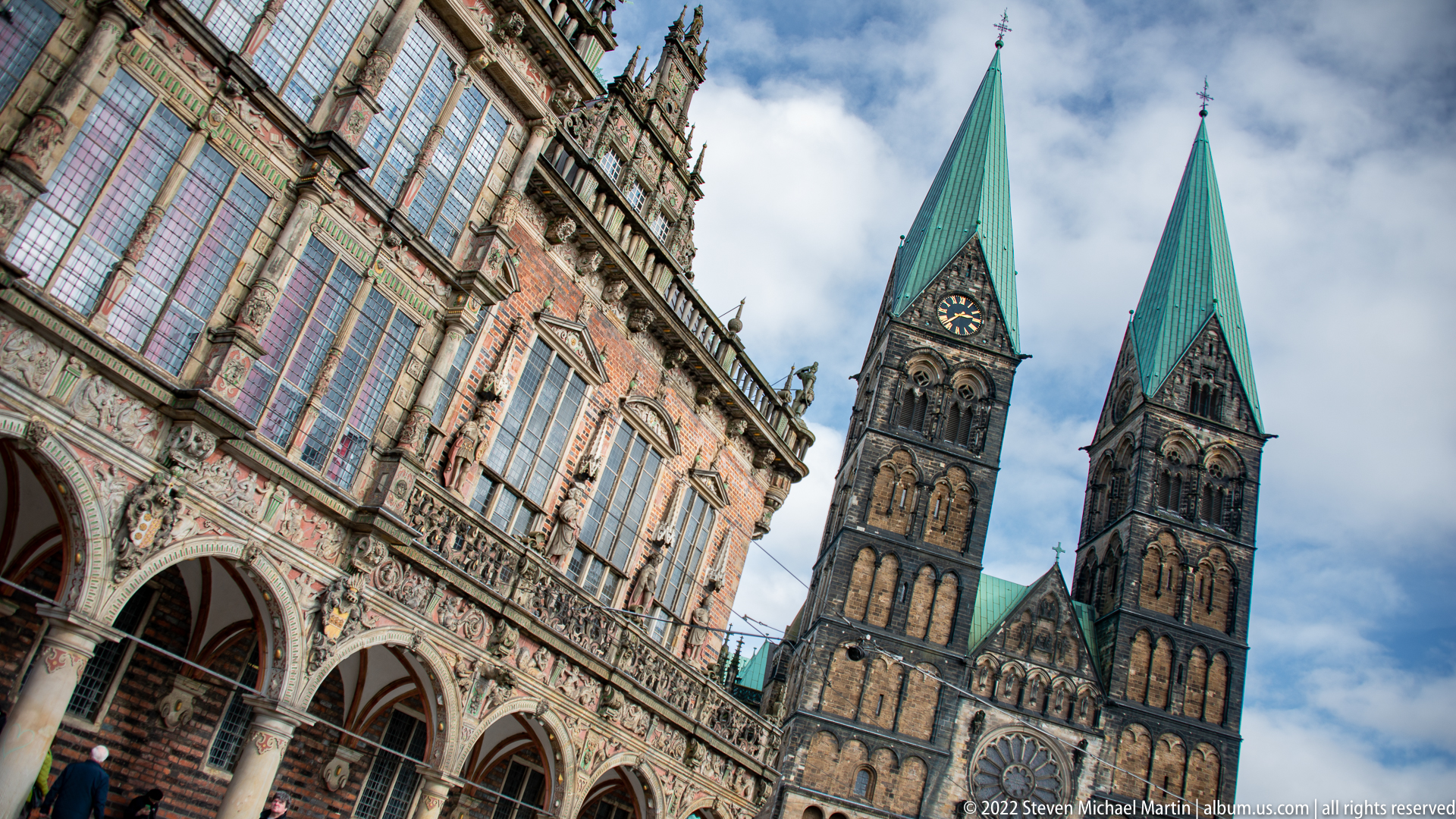
Bremen Town Hall and St. Peter’s Cathedral share a dramatic upward composition, pairing the Rathaus’s colorful arcaded façade at left with the cathedral’s twin green-roofed towers at right. The close juxtaposition shows how Bremen’s principal civic and religious monuments define the architectural character of the market square.
Caption
Bremen Town Hall and St. Peter’s Cathedral share a dramatic upward composition, pairing the Rathaus’s colorful arcaded façade at left with the cathedral’s twin green-roofed towers at right. The close juxtaposition shows how Bremen’s principal civic and religious monuments define the architectural character of the market square.

A close portrait isolates a smiling dark-haired man against a softly blurred brick and stone architectural background. His navy quilted jacket and red shirt fill most of the frame, while traces of the historic civic setting remain visible behind him without distracting from the informal travel portrait.
Caption
A close portrait isolates a smiling dark-haired man against a softly blurred brick and stone architectural background. His navy quilted jacket and red shirt fill most of the frame, while traces of the historic civic setting remain visible behind him without distracting from the informal travel portrait.

The Bremen Roland towers above the market square in a dramatic low-angle view, holding the imperial eagle shield across his body while a richly decorated canopy rises above his head. The protective iron fence and surrounding façades anchor the monumental stone figure within the civic space it has long dominated.
Caption
The Bremen Roland towers above the market square in a dramatic low-angle view, holding the imperial eagle shield across his body while a richly decorated canopy rises above his head. The protective iron fence and surrounding façades anchor the monumental stone figure within the civic space it has long dominated.

A tight upward view of Bremen Roland concentrates on the enormous shield with its black imperial eagle, the long sword gripped at the figure’s side, and the stylized face beneath the canopy. Gilded edging around the shield stands out against weathered gray stone, emphasizing the monument’s heraldic symbolism and monumental scale.
Caption
A tight upward view of Bremen Roland concentrates on the enormous shield with its black imperial eagle, the long sword gripped at the figure’s side, and the stylized face beneath the canopy. Gilded edging around the shield stands out against weathered gray stone, emphasizing the monument’s heraldic symbolism and monumental scale.

A dark bronze cathedral door is divided into stacked narrative relief panels framed by patterned borders, with a projecting lion-head ring handle interrupting the sequence near the center. Small biblical scenes unfold across the rectangular fields, turning the functional door into a dense program of sculptural storytelling.
Caption
A dark bronze cathedral door is divided into stacked narrative relief panels framed by patterned borders, with a projecting lion-head ring handle interrupting the sequence near the center. Small biblical scenes unfold across the rectangular fields, turning the functional door into a dense program of sculptural storytelling.

A close study of Bremen Cathedral’s bronze door reveals finely modeled biblical scenes arranged in rectangular compartments around a projecting lion-head ring handle. Figures kneel, stand, gesture, and gather in tightly composed episodes, while punched borders and small rosettes organize the surface into a disciplined narrative grid.
Caption
A close study of Bremen Cathedral’s bronze door reveals finely modeled biblical scenes arranged in rectangular compartments around a projecting lion-head ring handle. Figures kneel, stand, gesture, and gather in tightly composed episodes, while punched borders and small rosettes organize the surface into a disciplined narrative grid.