Banff Moraine Lake
Moraine Lake lies high in the mountains above Lake Louise, where a glacially carved valley narrows beneath the immense walls of the Valley of the Ten Peaks. The lake’s extraordinary blue-green color comes from fine rock flour carried in meltwater from the surrounding glaciers, while the steep peaks rising almost directly from the shoreline give the landscape an enclosed, almost amphitheatrical scale. Moraine Lake and the Valley of the Ten Peaks have become among the defining images of Banff National Park and the Canadian Rockies.
The classic view unfolds from the Rockpile, a natural accumulation of boulders at the lake’s outlet that provides an elevated perspective across the water toward the Ten Peaks. From here, the lake stretches into the valley beneath successive ridges of gray limestone, patches of lingering snow, and dense subalpine forest. At water level, the character changes: the lakeshore trail passes through spruce and fir forest close to the brilliant water, while trails climbing toward Larch Valley, Sentinel Pass, Eiffel Lake, and Consolation Lakes reveal how Moraine Lake sits within a much larger alpine landscape.
Its fame has also changed the experience of reaching Moraine Lake. Years of increasing visitation eventually overwhelmed the small mountain road and parking area, and Moraine Lake Road is now closed year-round to personal vehicles, with most visitors arriving by shuttle or other authorized transportation. Yet beyond the logistics of arrival, the essential experience remains remarkably simple: water, stone, forest, and ice compressed into one dramatic view. Even among the celebrated landscapes of Banff, Moraine Lake possesses an intensity of color and mountain scale that makes the Valley of the Ten Peaks feel less like a scenic backdrop than the architecture of the lake itself.
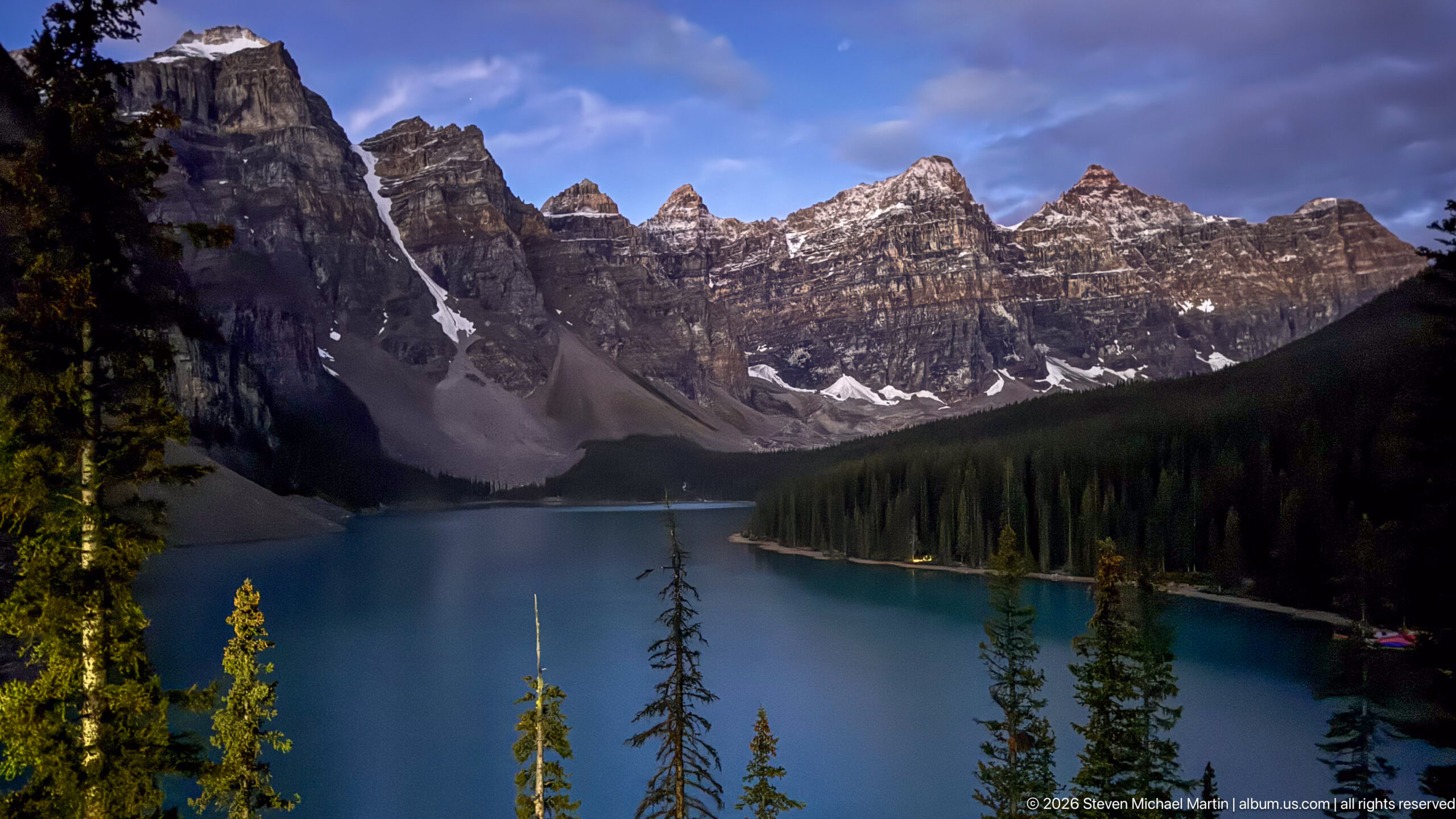
Broken light reaches the forest and upper ridges around Moraine Lake while much of the basin remains in cool shadow. From the elevated Rockpile viewpoint, the lake narrows toward the center of the Valley of the Ten Peaks, with dark conifers, pale scree fans, snow patches, and layered cliffs creating successive bands from foreground to skyline.
Caption
Broken light reaches the forest and upper ridges around Moraine Lake while much of the basin remains in cool shadow. From the elevated Rockpile viewpoint, the lake narrows toward the center of the Valley of the Ten Peaks, with dark conifers, pale scree fans, snow patches, and layered cliffs creating successive bands from foreground to skyline.
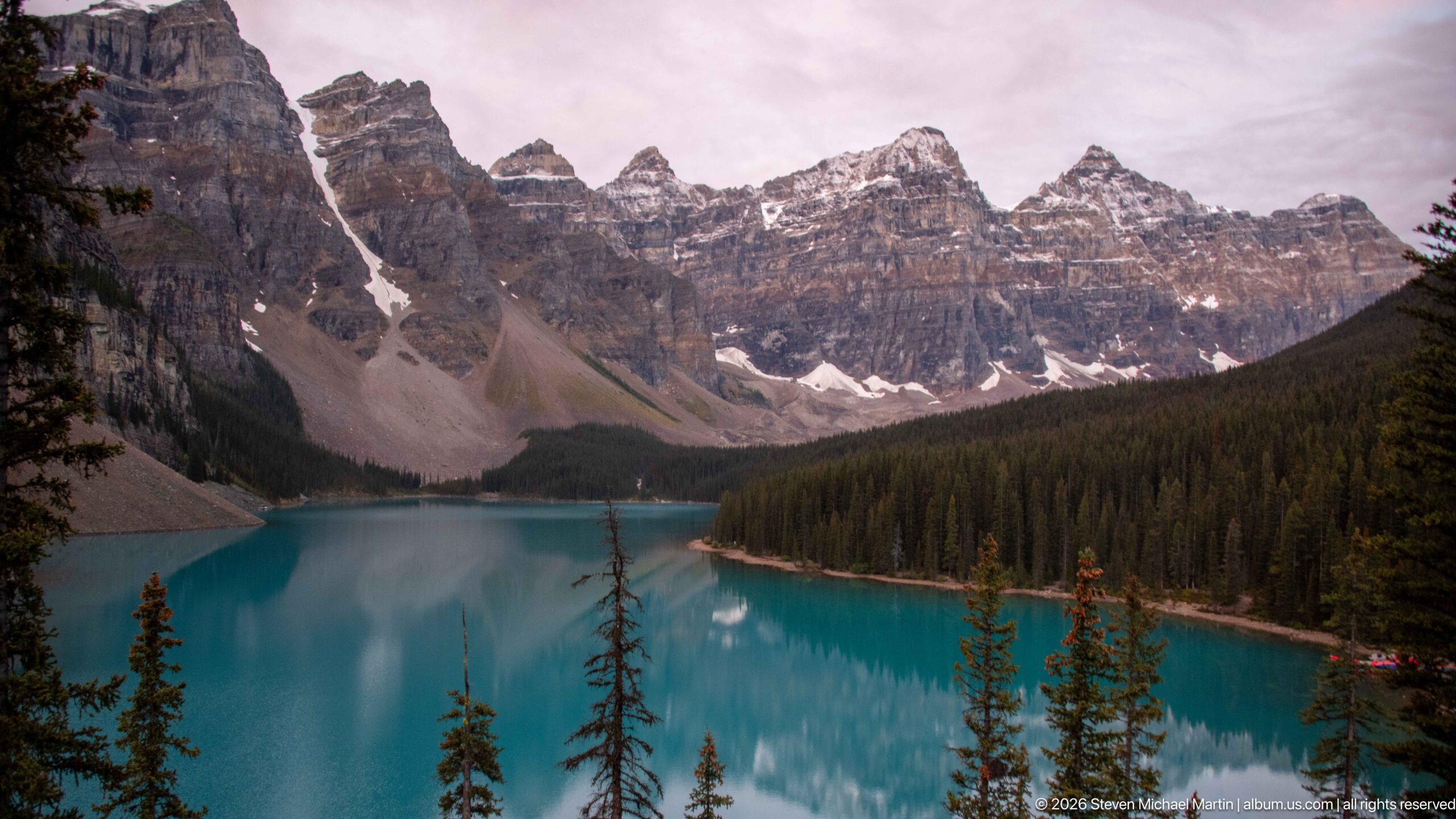
From the elevated Rockpile area, Moraine Lake spreads across the foreground in luminous turquoise beneath the rugged Valley of the Ten Peaks. Dark conifers rise from the near slope and form a continuous band along the shore, while scree fans and small snowfields mark the base of the cliffs. The balanced view presents the lake’s classic relationship of water, forest, and rock.
Caption
From the elevated Rockpile area, Moraine Lake spreads across the foreground in luminous turquoise beneath the rugged Valley of the Ten Peaks. Dark conifers rise from the near slope and form a continuous band along the shore, while scree fans and small snowfields mark the base of the cliffs. The balanced view presents the lake’s classic relationship of water, forest, and rock.
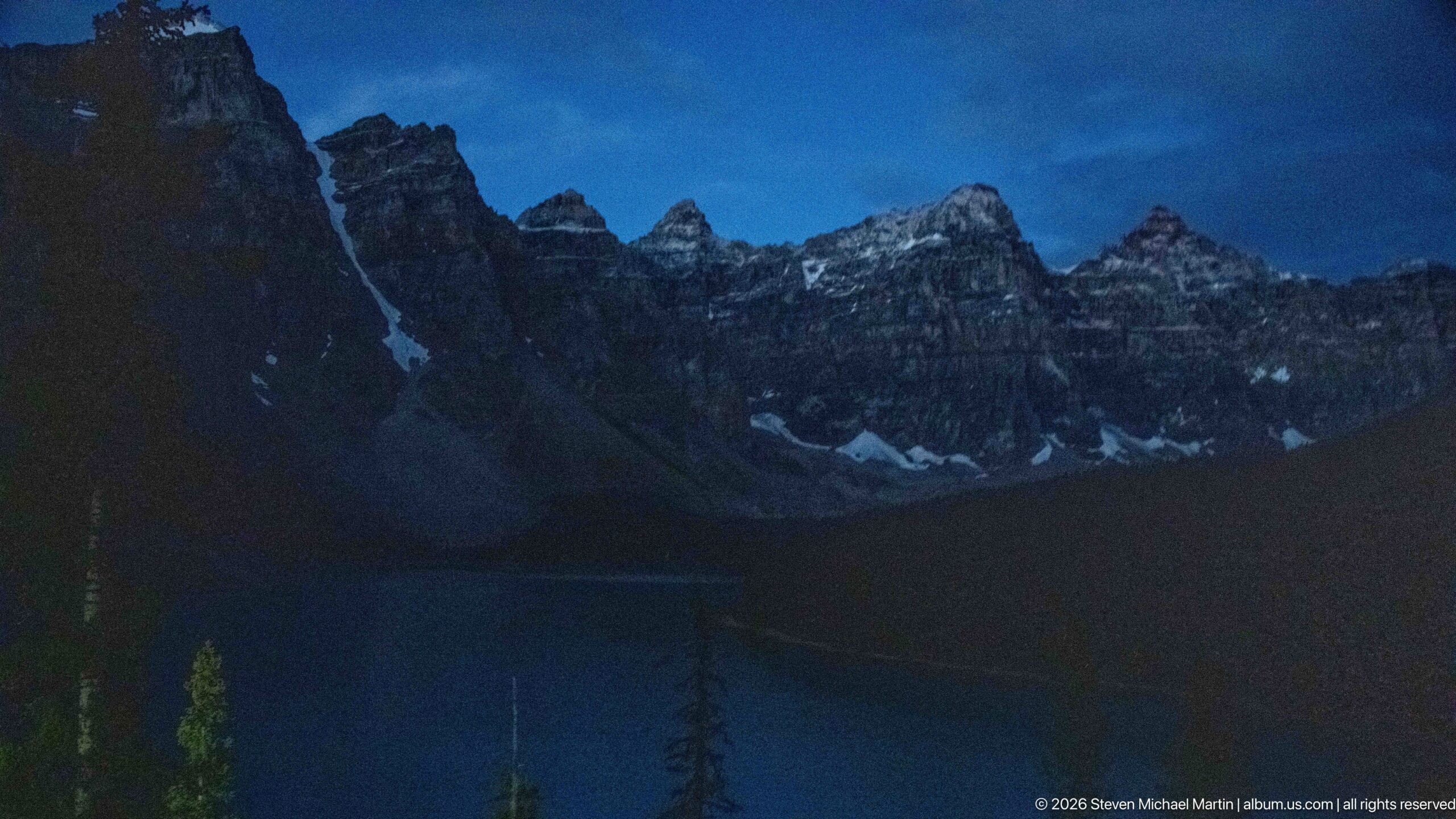
Deep blue twilight reduces Moraine Lake and its surrounding forest to dark tonal bands beneath the jagged skyline of the Valley of the Ten Peaks. Residual snow remains visible in high gullies even as the lake surface falls into shadow. The subdued light shifts attention from the lake’s familiar turquoise color toward the silhouette and mass of the enclosing mountains.
Caption
Deep blue twilight reduces Moraine Lake and its surrounding forest to dark tonal bands beneath the jagged skyline of the Valley of the Ten Peaks. Residual snow remains visible in high gullies even as the lake surface falls into shadow. The subdued light shifts attention from the lake’s familiar turquoise color toward the silhouette and mass of the enclosing mountains.
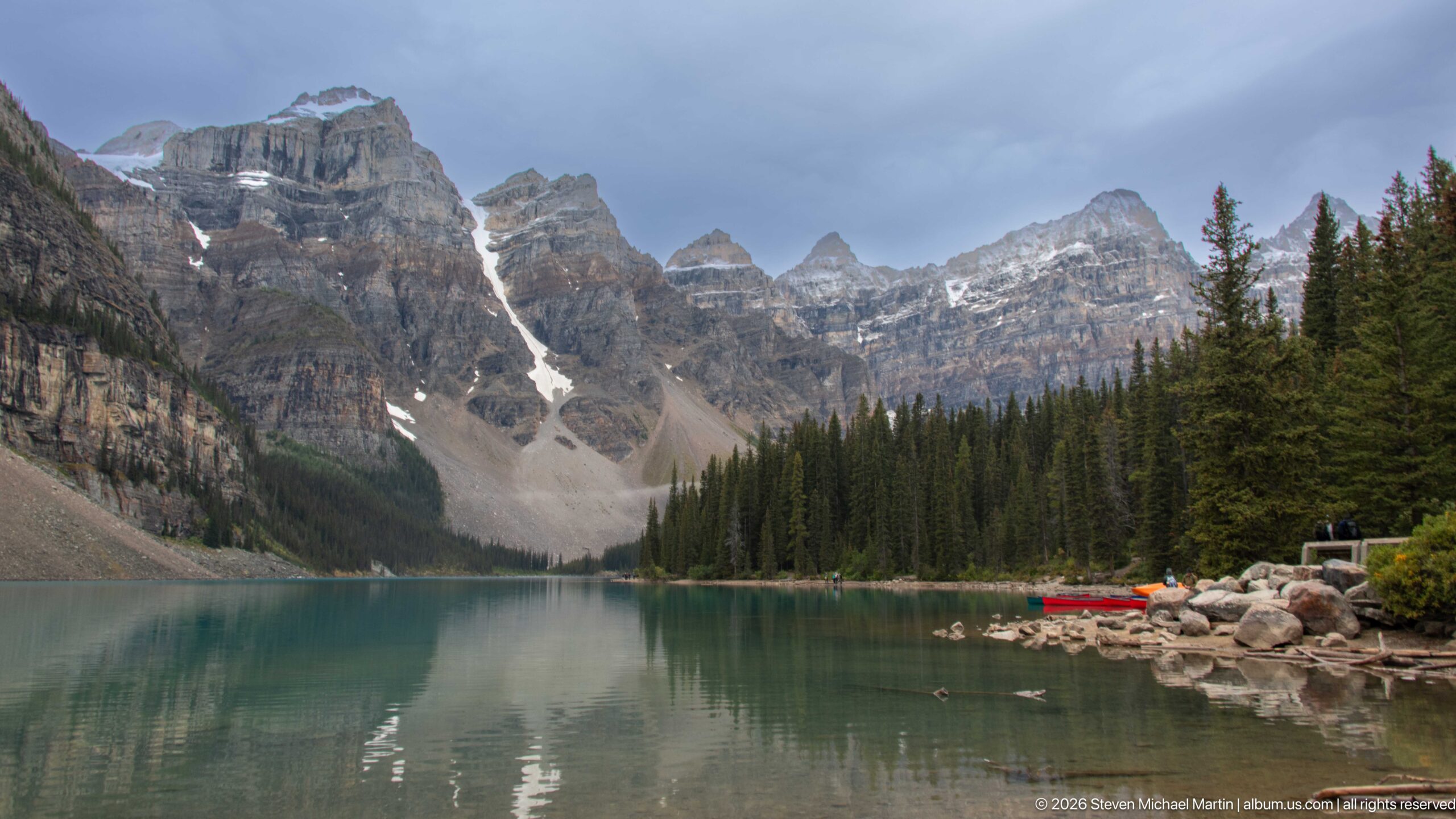
Moraine Lake fills the foreground beneath the serrated skyline of the Valley of the Ten Peaks, its muted turquoise surface reflecting the overcast sky and dark conifer margins. A small red canoe at the far right supplies scale to the broad basin, while snow-filled gullies and pale talus fans trace the steep mountain walls above the water.
Caption
Moraine Lake fills the foreground beneath the serrated skyline of the Valley of the Ten Peaks, its muted turquoise surface reflecting the overcast sky and dark conifer margins. A small red canoe at the far right supplies scale to the broad basin, while snow-filled gullies and pale talus fans trace the steep mountain walls above the water.
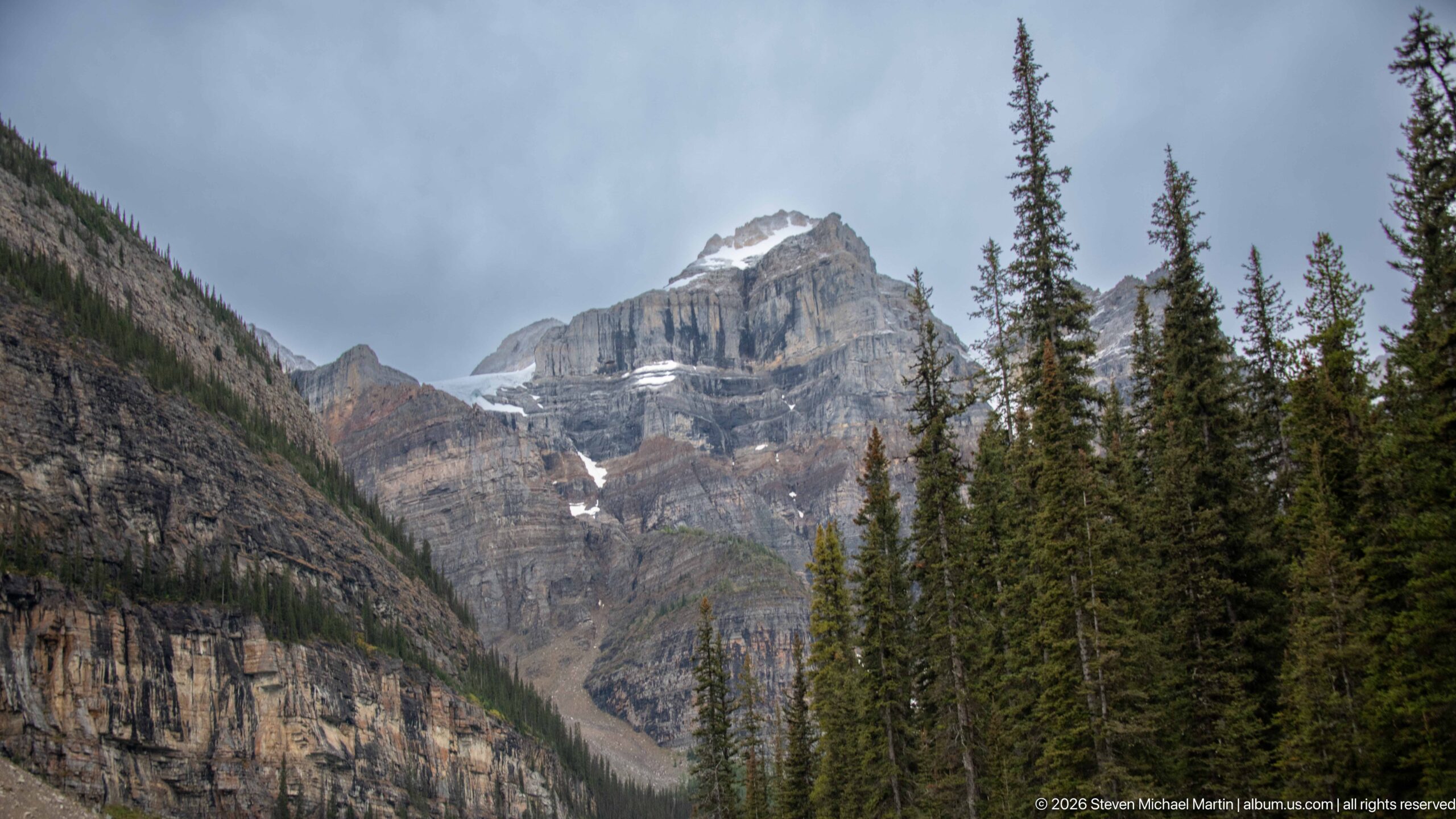
Steep, horizontally bedded rock walls rise behind a screen of dark conifers near Moraine Lake, with remnant snow occupying gullies high on the mountain. The exposed strata reveal the strongly layered sedimentary geology characteristic of this part of the Canadian Rockies, while low cloud softens the summit skyline.
Caption
Steep, horizontally bedded rock walls rise behind a screen of dark conifers near Moraine Lake, with remnant snow occupying gullies high on the mountain. The exposed strata reveal the strongly layered sedimentary geology characteristic of this part of the Canadian Rockies, while low cloud softens the summit skyline.
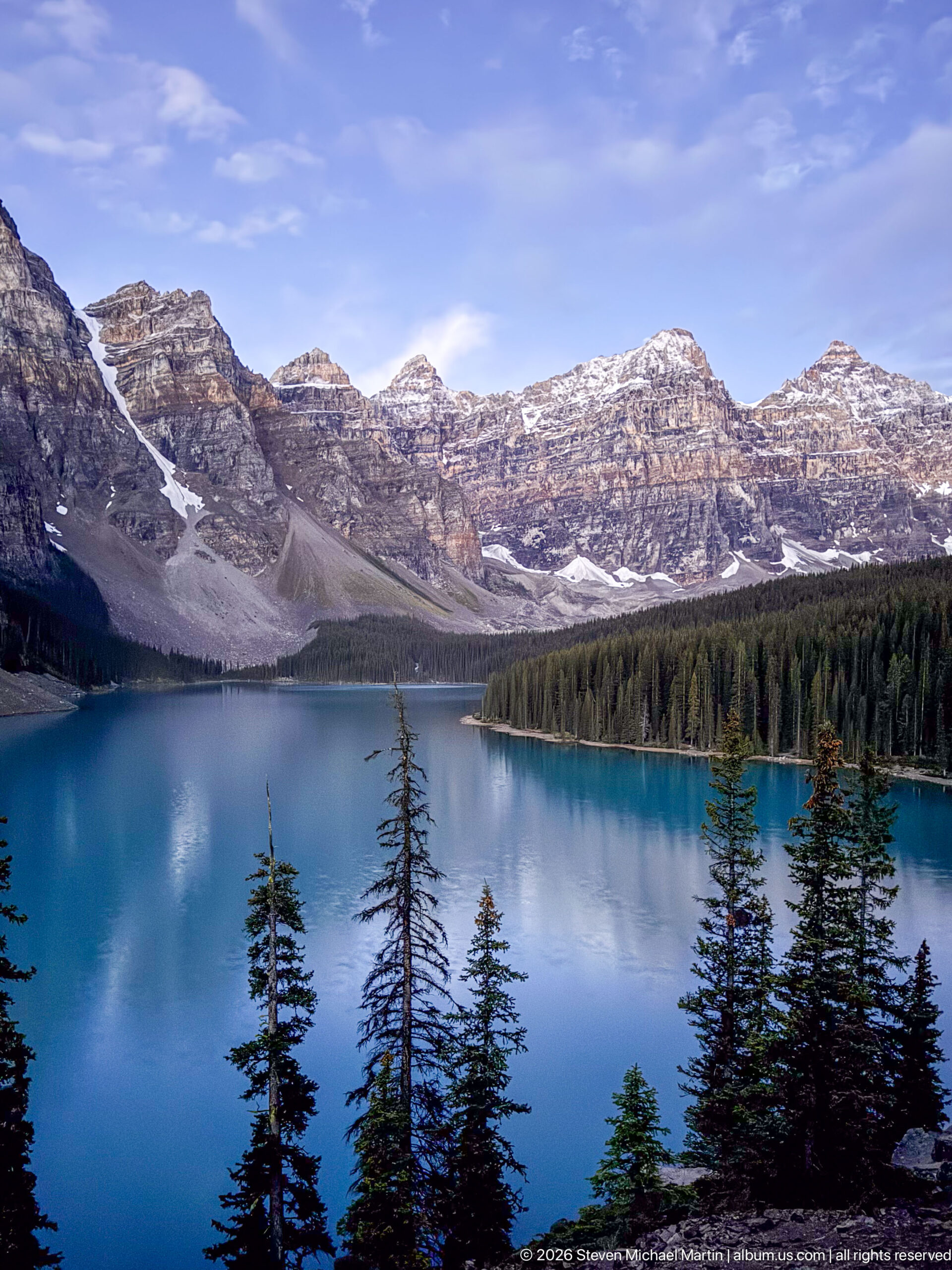
Blue water fills the foreground beneath a broad, horizontally layered mountain ridge, with scattered conifers rising from the elevated viewing slope. The far shore forms a dense dark-green band, while scree and persistent snow occupy the open alpine terrain above. This angle shifts away from the most serrated part of the Ten Peaks to emphasize the lake’s long shoreline and stratified rock walls.
Caption
Blue water fills the foreground beneath a broad, horizontally layered mountain ridge, with scattered conifers rising from the elevated viewing slope. The far shore forms a dense dark-green band, while scree and persistent snow occupy the open alpine terrain above. This angle shifts away from the most serrated part of the Ten Peaks to emphasize the lake’s long shoreline and stratified rock walls.
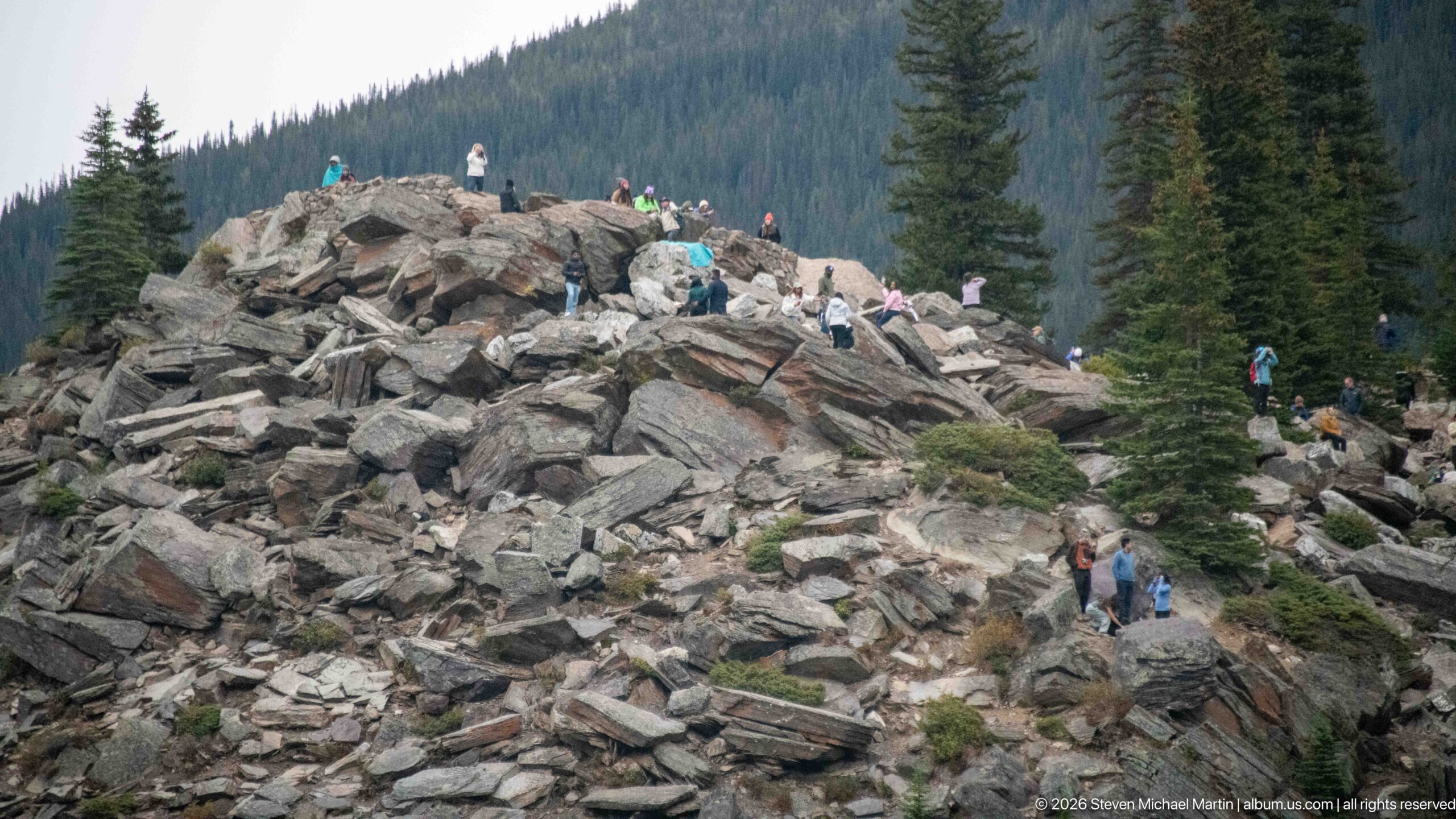
Visitors climb across the angular boulders of the Rockpile at Moraine Lake, the natural debris ridge that forms the lake’s famous elevated viewpoint. Scattered conifers root among the rocks while a forested slope fills the background, emphasizing the rough, uneven terrain encountered before the classic panorama of the lake and Valley of the Ten Peaks opens above.
Caption
Visitors climb across the angular boulders of the Rockpile at Moraine Lake, the natural debris ridge that forms the lake’s famous elevated viewpoint. Scattered conifers root among the rocks while a forested slope fills the background, emphasizing the rough, uneven terrain encountered before the classic panorama of the lake and Valley of the Ten Peaks opens above.
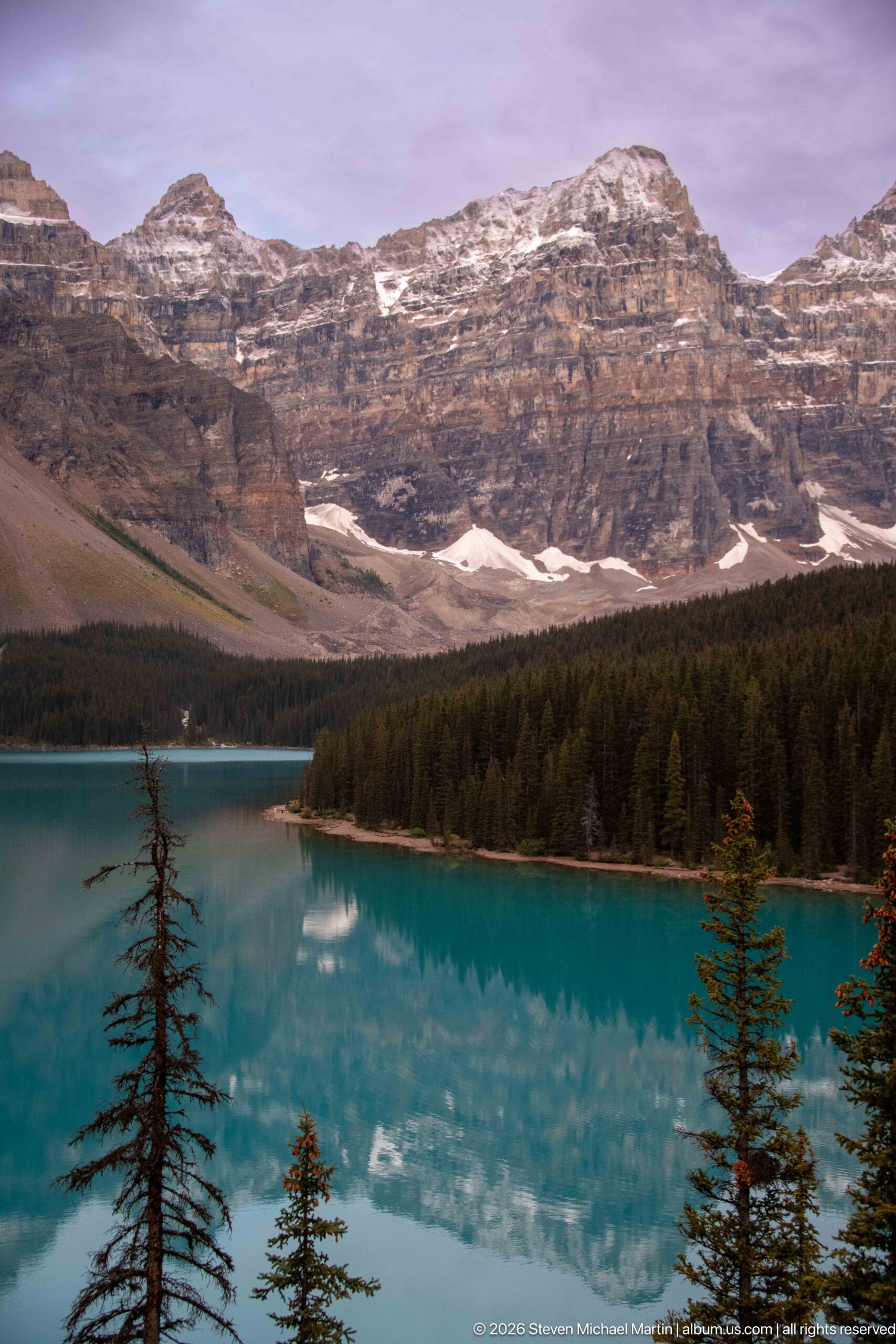
A broad sweep of Moraine Lake reflects pale clouds beneath a long, horizontally layered mountain wall. Sparse foreground conifers punctuate the elevated viewpoint, while a continuous band of forest separates the turquoise water from talus and lingering snow above. The view emphasizes the basin’s geological layering and the sharp ecological transition from subalpine forest to exposed rock.
Caption
A broad sweep of Moraine Lake reflects pale clouds beneath a long, horizontally layered mountain wall. Sparse foreground conifers punctuate the elevated viewpoint, while a continuous band of forest separates the turquoise water from talus and lingering snow above. The view emphasizes the basin’s geological layering and the sharp ecological transition from subalpine forest to exposed rock.
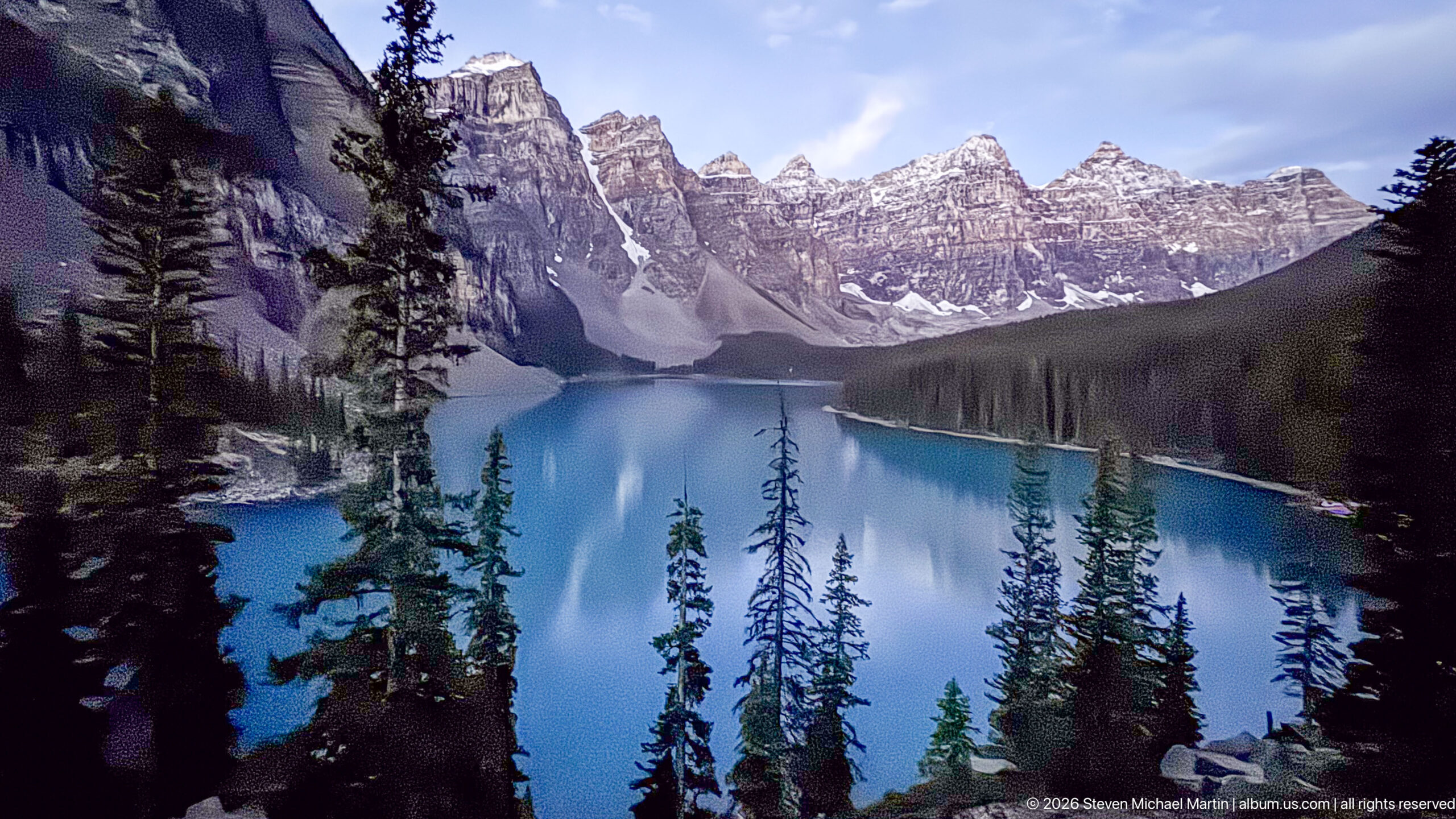
Tall spruce and fir frame a high view over Moraine Lake, drawing the eye from the dark foreground into blue water and the pale, snow-flecked mountain wall beyond. The trees partially screen the lake rather than opening into an unobstructed panorama, giving this composition a stronger sense of looking outward from within the subalpine forest of the Rockpile.
Caption
Tall spruce and fir frame a high view over Moraine Lake, drawing the eye from the dark foreground into blue water and the pale, snow-flecked mountain wall beyond. The trees partially screen the lake rather than opening into an unobstructed panorama, giving this composition a stronger sense of looking outward from within the subalpine forest of the Rockpile.
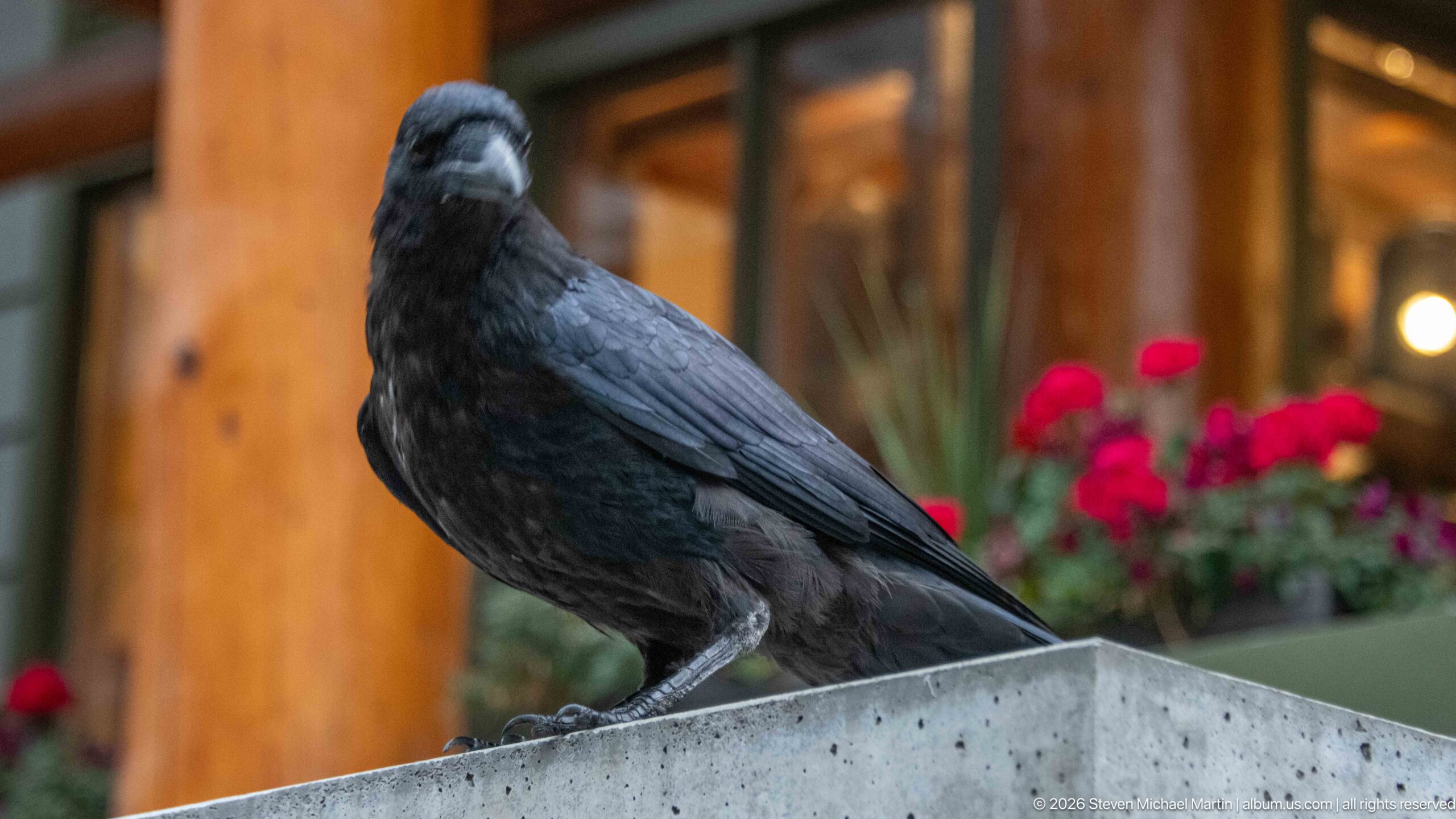
A common raven stands alert on a concrete ledge beside the lodge, its glossy black plumage catching cool blue highlights against the warm timber walls and red flowers behind it. Ravens are conspicuous residents of the Canadian Rockies, thriving around both wild landscapes and developed visitor areas where their intelligence and adaptability are readily apparent.
Caption
A common raven stands alert on a concrete ledge beside the lodge, its glossy black plumage catching cool blue highlights against the warm timber walls and red flowers behind it. Ravens are conspicuous residents of the Canadian Rockies, thriving around both wild landscapes and developed visitor areas where their intelligence and adaptability are readily apparent.
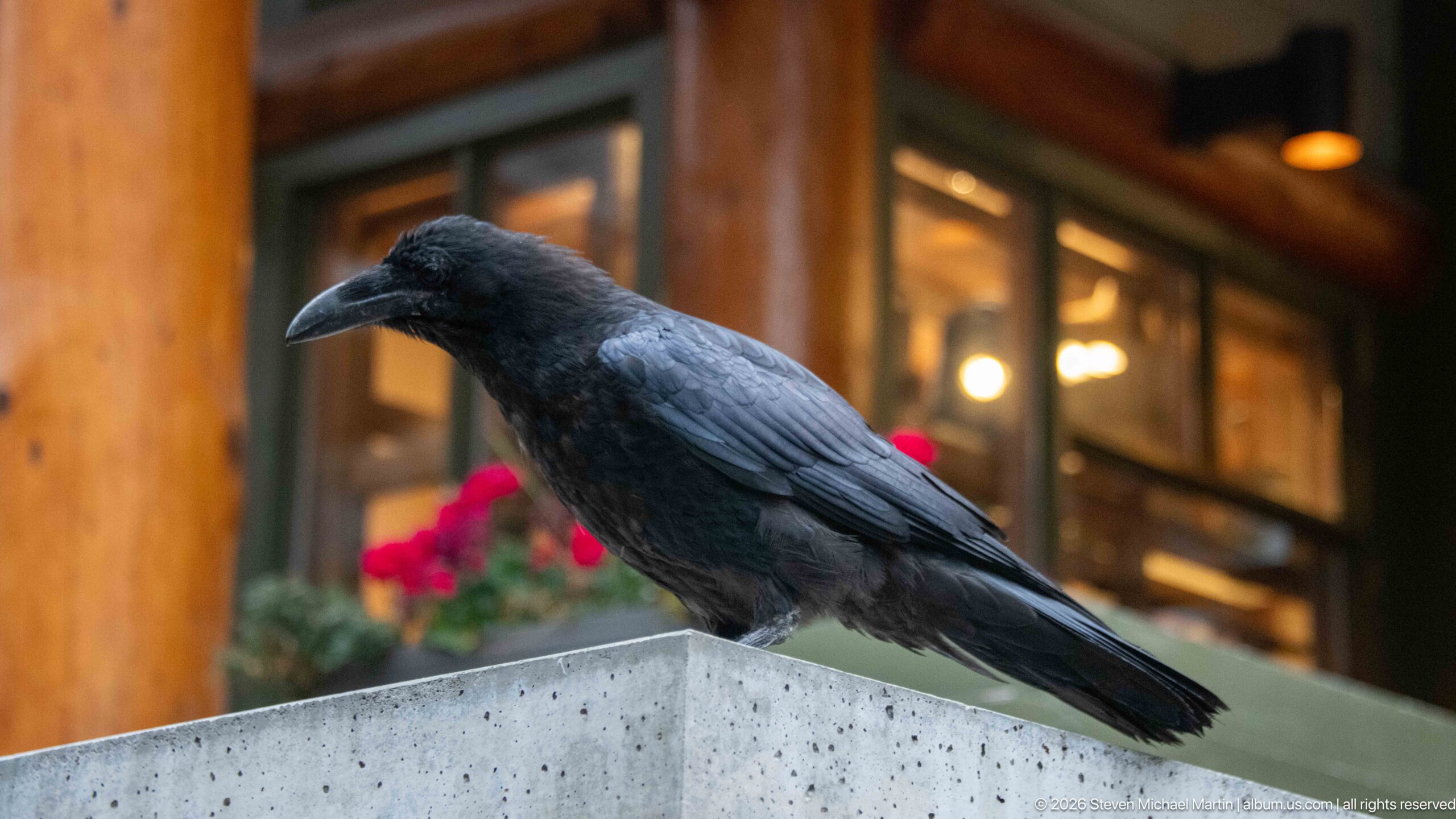
Seen in profile, a common raven balances on the corner of a concrete wall outside the lodge. The side view emphasizes the bird’s massive bill, layered wing feathers, and long tapered form, while the softly focused timber-and-glass building places this adaptable mountain species directly within Moraine Lake’s developed visitor area.
Caption
Seen in profile, a common raven balances on the corner of a concrete wall outside the lodge. The side view emphasizes the bird’s massive bill, layered wing feathers, and long tapered form, while the softly focused timber-and-glass building places this adaptable mountain species directly within Moraine Lake’s developed visitor area.
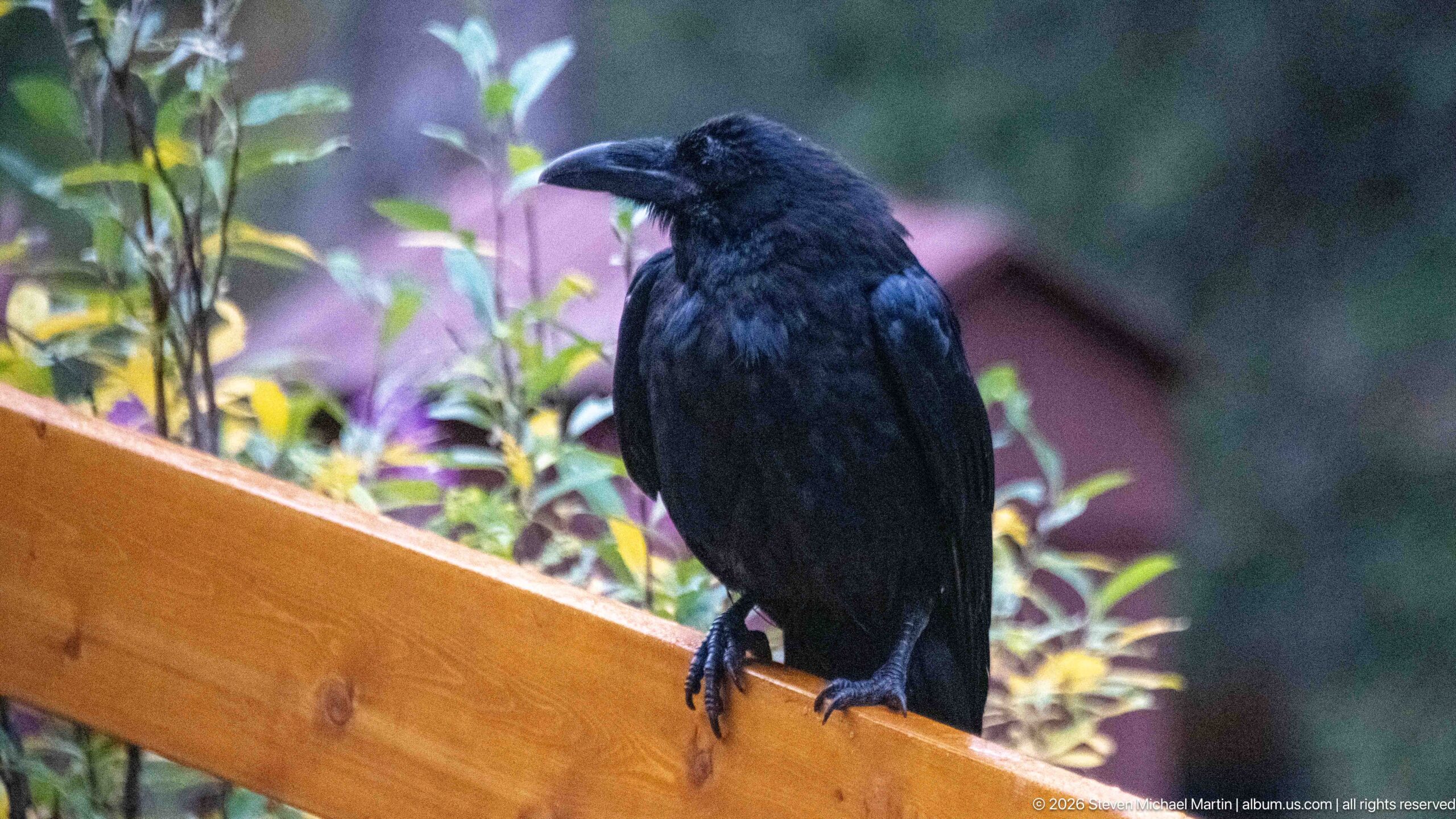
A common raven faces the camera from a wooden railing, its feet wrapped around the narrow edge and its throat feathers forming the slightly shaggy texture characteristic of the species. Shallow focus isolates the bird from the forested lodge surroundings, producing a more intimate wildlife portrait than the broader contextual views nearby.
Caption
A common raven faces the camera from a wooden railing, its feet wrapped around the narrow edge and its throat feathers forming the slightly shaggy texture characteristic of the species. Shallow focus isolates the bird from the forested lodge surroundings, producing a more intimate wildlife portrait than the broader contextual views nearby.
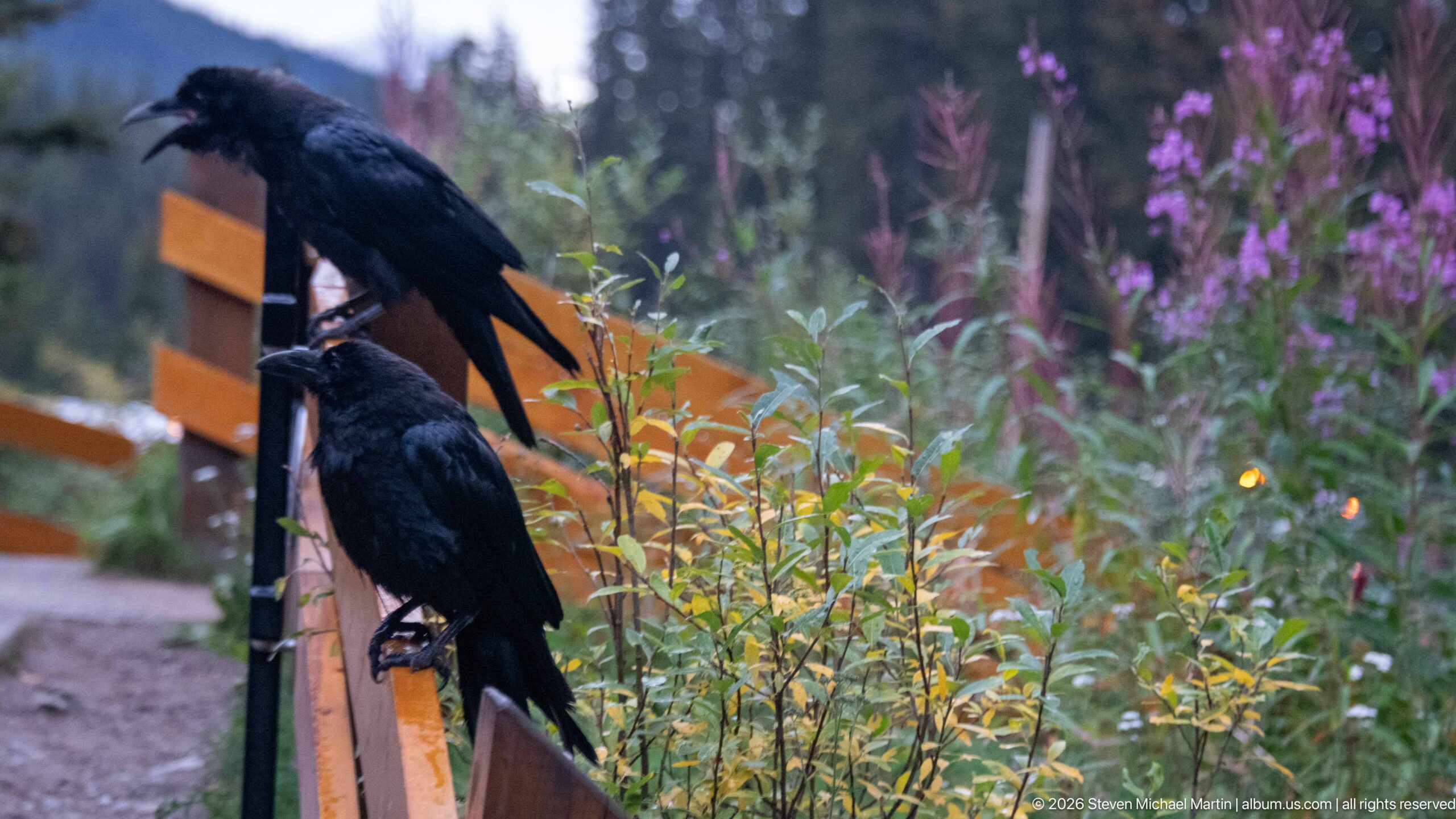
Two common ravens occupy a wooden railing beside dense late-summer vegetation, one perched above the other. The paired composition shows the birds using the built environment at the forest edge, with purple fireweed and yellowing shrubs adding seasonal color to the otherwise dark forms of the ravens.
Caption
Two common ravens occupy a wooden railing beside dense late-summer vegetation, one perched above the other. The paired composition shows the birds using the built environment at the forest edge, with purple fireweed and yellowing shrubs adding seasonal color to the otherwise dark forms of the ravens.
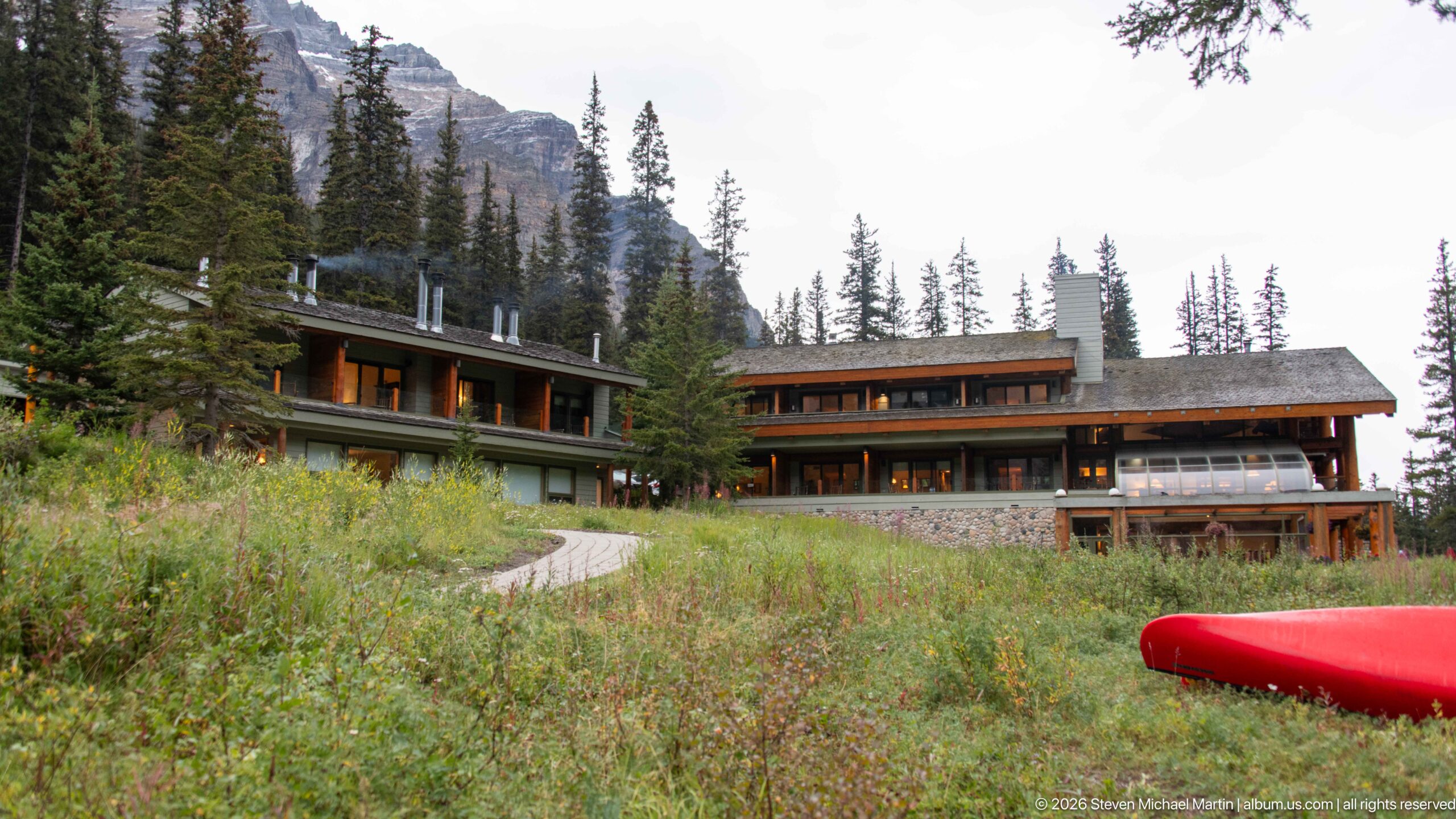
Moraine Lake Lodge stretches across a forest clearing beneath steep mountain walls, its low timber buildings and stonework designed to sit close to the surrounding subalpine landscape. A red canoe in the foreground introduces the lake’s recreational character even though the water itself is out of view, linking the lodge directly to the Moraine Lake experience.
Caption
Moraine Lake Lodge stretches across a forest clearing beneath steep mountain walls, its low timber buildings and stonework designed to sit close to the surrounding subalpine landscape. A red canoe in the foreground introduces the lake’s recreational character even though the water itself is out of view, linking the lodge directly to the Moraine Lake experience.
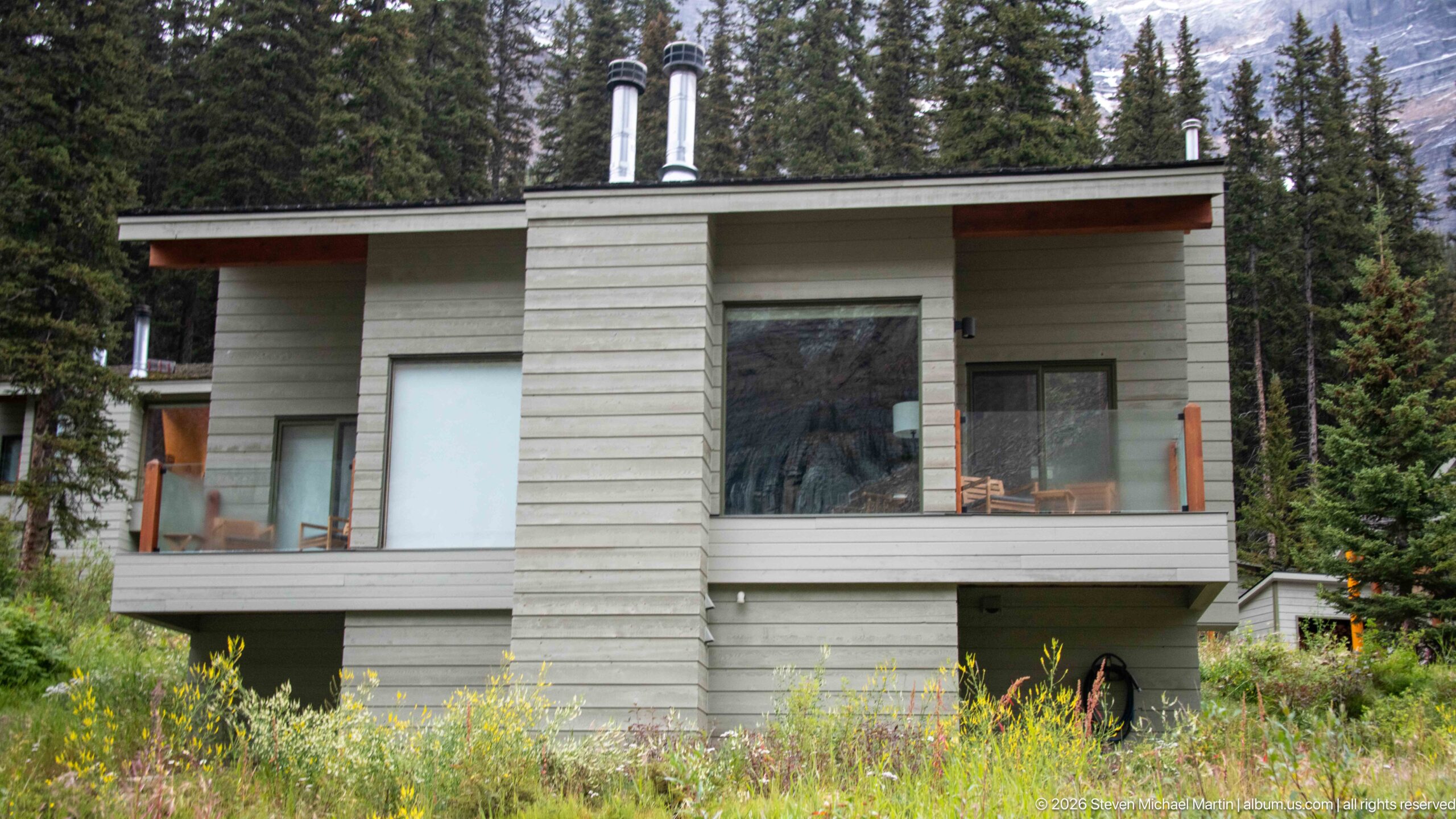
A compact guest building at Moraine Lake Lodge combines horizontal siding, large picture windows, and a tall central chimney against a dense wall of conifers. The restrained exterior and broad glazing orient the accommodation toward its mountain setting, while meadow vegetation grows close to the structure.
Caption
A compact guest building at Moraine Lake Lodge combines horizontal siding, large picture windows, and a tall central chimney against a dense wall of conifers. The restrained exterior and broad glazing orient the accommodation toward its mountain setting, while meadow vegetation grows close to the structure.
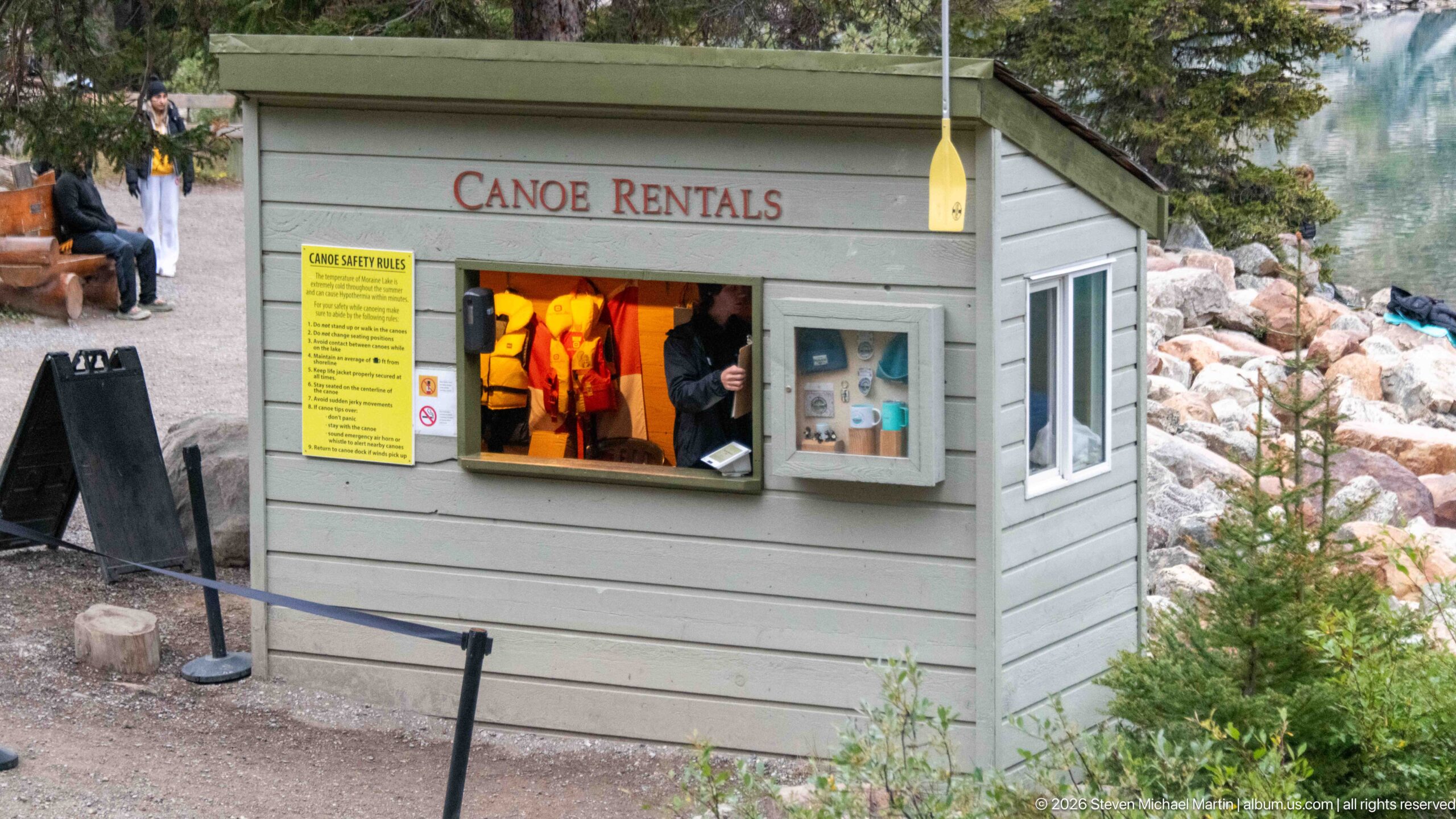
The Moraine Lake canoe-rental kiosk stands beside the lakeshore, its service window framed by paddling gear and a prominently lettered “Canoe Rentals” sign. The modest utilitarian building reflects one of the lake’s longstanding visitor activities, providing direct access to paddling on the turquoise glacial water just beyond the rocky shore.
Caption
The Moraine Lake canoe-rental kiosk stands beside the lakeshore, its service window framed by paddling gear and a prominently lettered “Canoe Rentals” sign. The modest utilitarian building reflects one of the lake’s longstanding visitor activities, providing direct access to paddling on the turquoise glacial water just beyond the rocky shore.
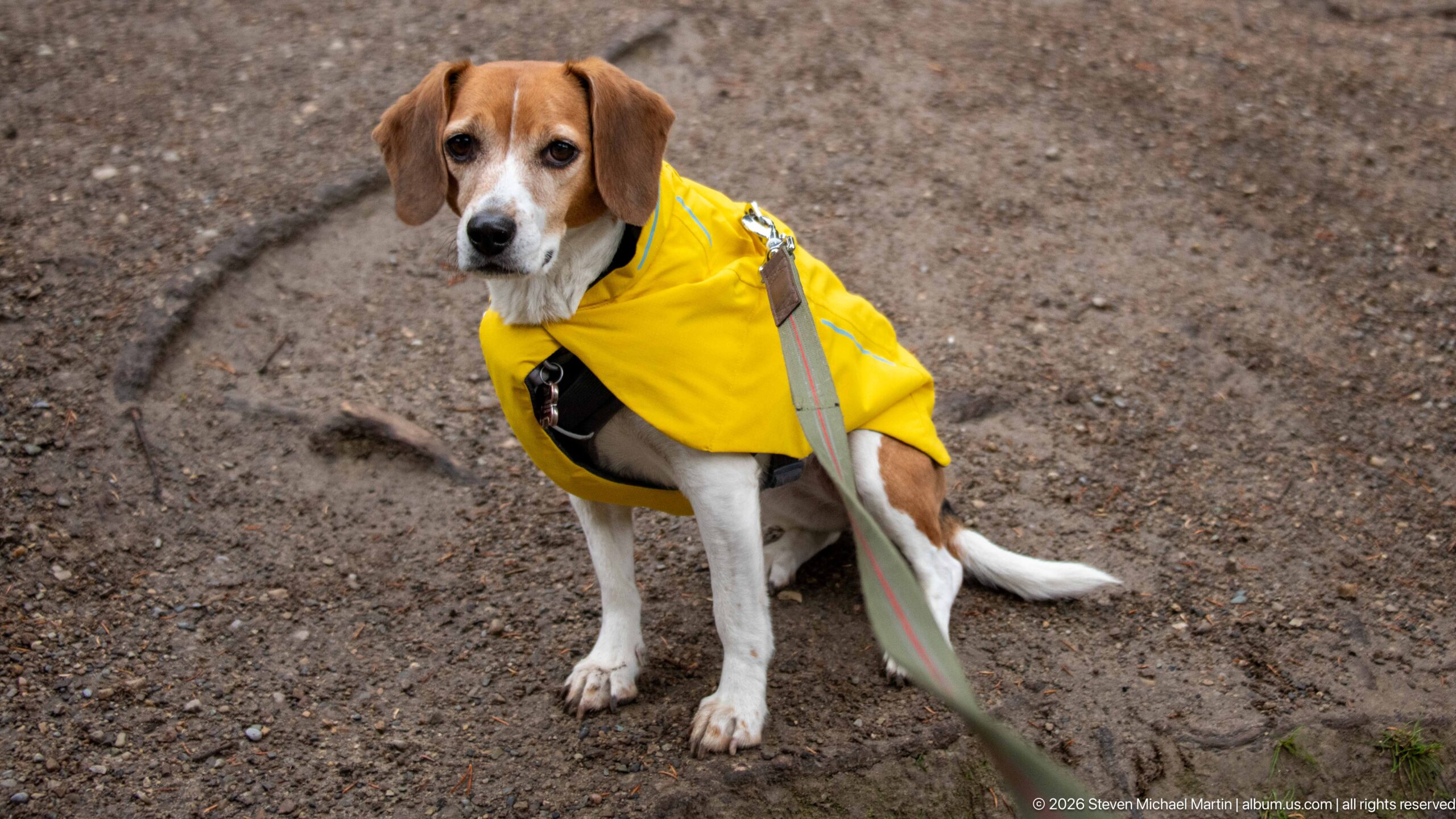
A beagle pauses on the damp forest trail wearing a bright yellow raincoat, an apt detail for a cool, overcast visit to Moraine Lake. The close portrait shifts attention from the monumental landscape to the practical experience of walking the lakeshore and forest paths in changeable mountain weather.
Caption
A beagle pauses on the damp forest trail wearing a bright yellow raincoat, an apt detail for a cool, overcast visit to Moraine Lake. The close portrait shifts attention from the monumental landscape to the practical experience of walking the lakeshore and forest paths in changeable mountain weather.
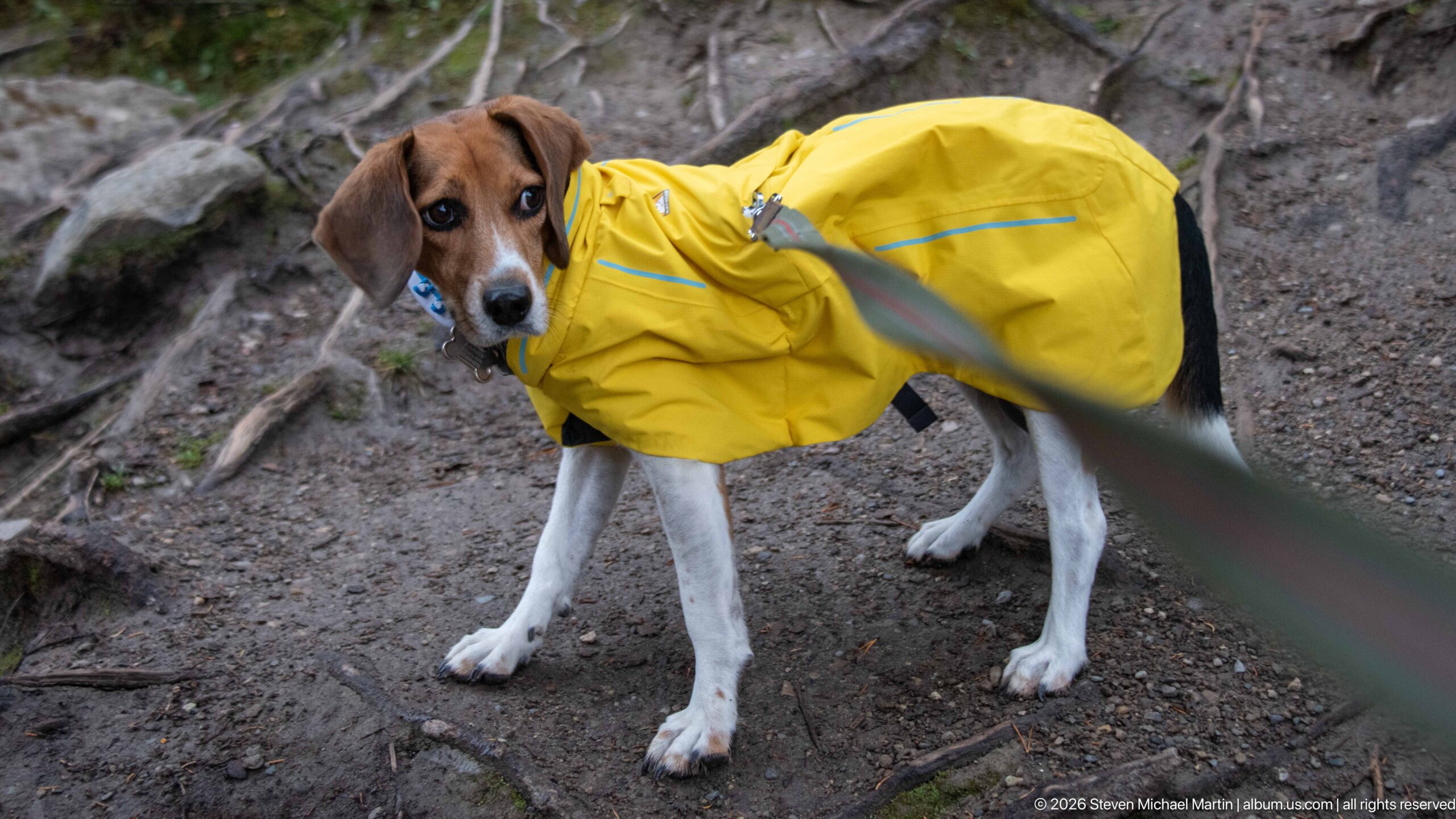
Standing among exposed roots and dark forest soil, a beagle looks toward the camera from beneath a yellow waterproof coat. The low viewpoint records the uneven trail surface as well as the dog’s compact scale, conveying the close, wooded character of the walking routes around Moraine Lake.
Caption
Standing among exposed roots and dark forest soil, a beagle looks toward the camera from beneath a yellow waterproof coat. The low viewpoint records the uneven trail surface as well as the dog’s compact scale, conveying the close, wooded character of the walking routes around Moraine Lake.
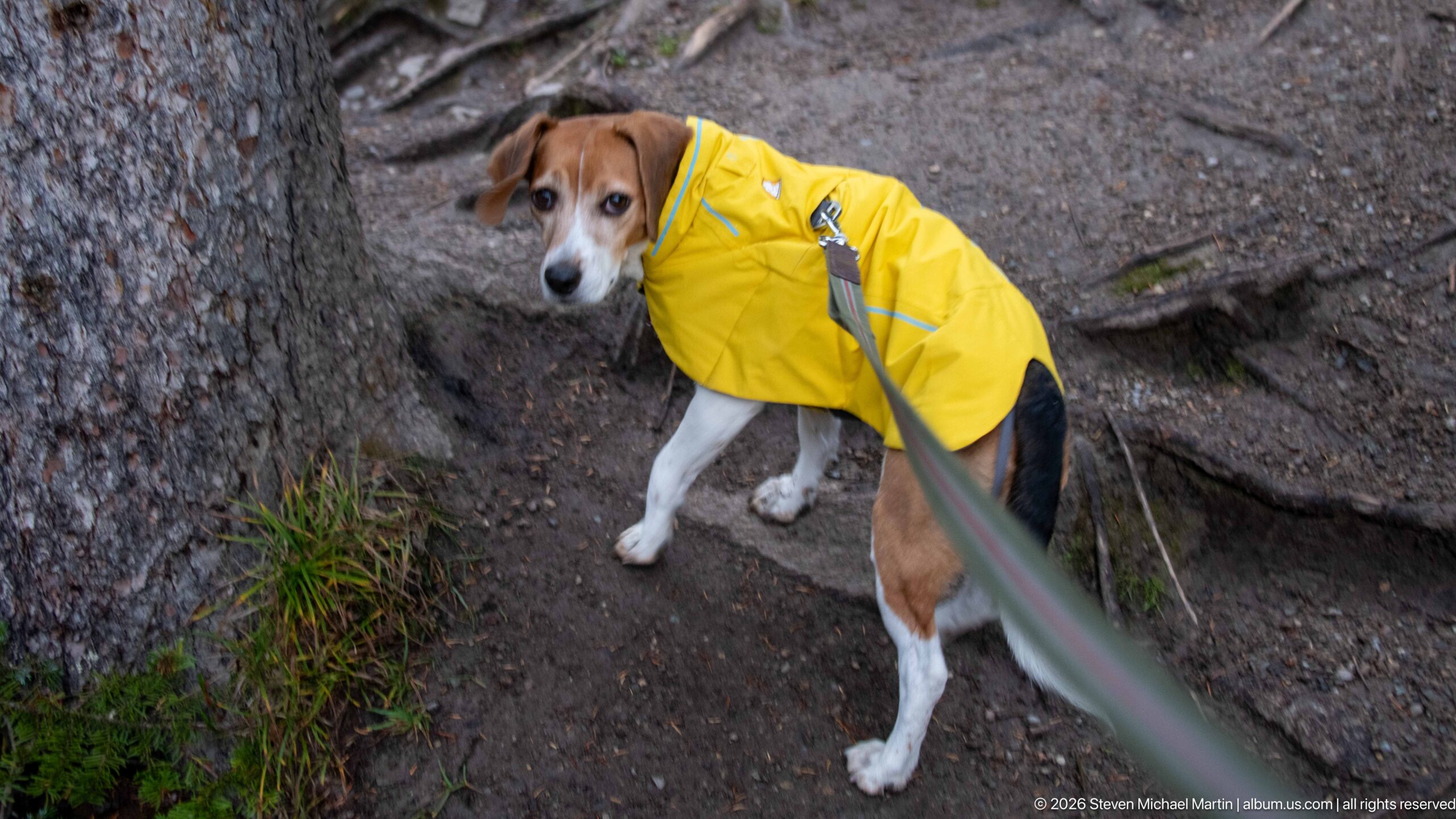
A leashed beagle edges around the base of a large conifer, its yellow raincoat standing out against bark, roots, and wet earth. Unlike the more formal seated portraits, this frame records the dog negotiating the confined trail space and gives a ground-level sense of the forest immediately surrounding Moraine Lake.
Caption
A leashed beagle edges around the base of a large conifer, its yellow raincoat standing out against bark, roots, and wet earth. Unlike the more formal seated portraits, this frame records the dog negotiating the confined trail space and gives a ground-level sense of the forest immediately surrounding Moraine Lake.
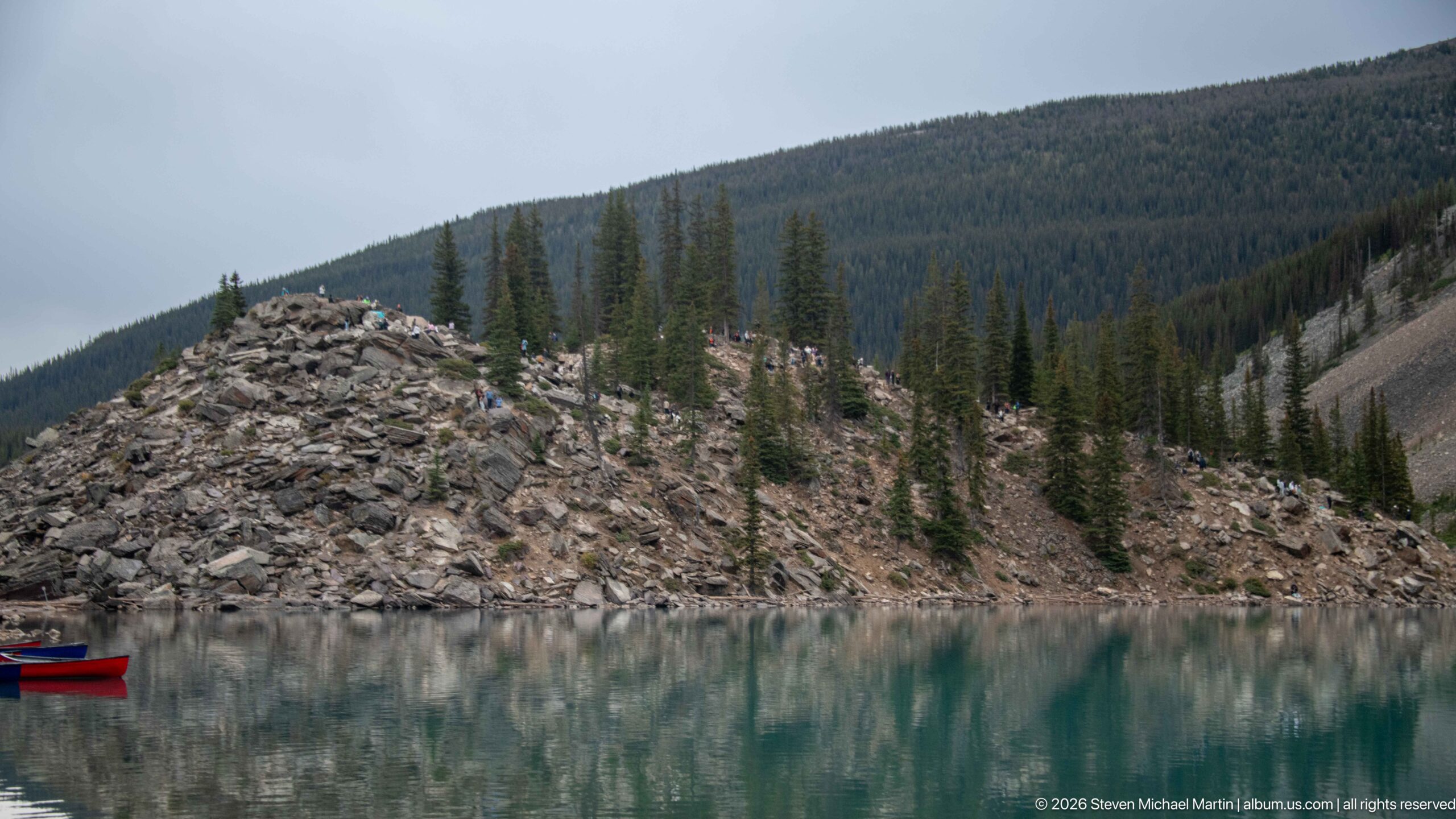
The Rockpile rises directly from the turquoise edge of Moraine Lake, its jumble of angular blocks punctuated by scattered spruce and fir. Seen from water level rather than from its summit, the feature reads as a substantial natural barrier separating the developed lakeshore from the elevated viewpoint used for the celebrated Valley of the Ten Peaks panorama.
Caption
The Rockpile rises directly from the turquoise edge of Moraine Lake, its jumble of angular blocks punctuated by scattered spruce and fir. Seen from water level rather than from its summit, the feature reads as a substantial natural barrier separating the developed lakeshore from the elevated viewpoint used for the celebrated Valley of the Ten Peaks panorama.
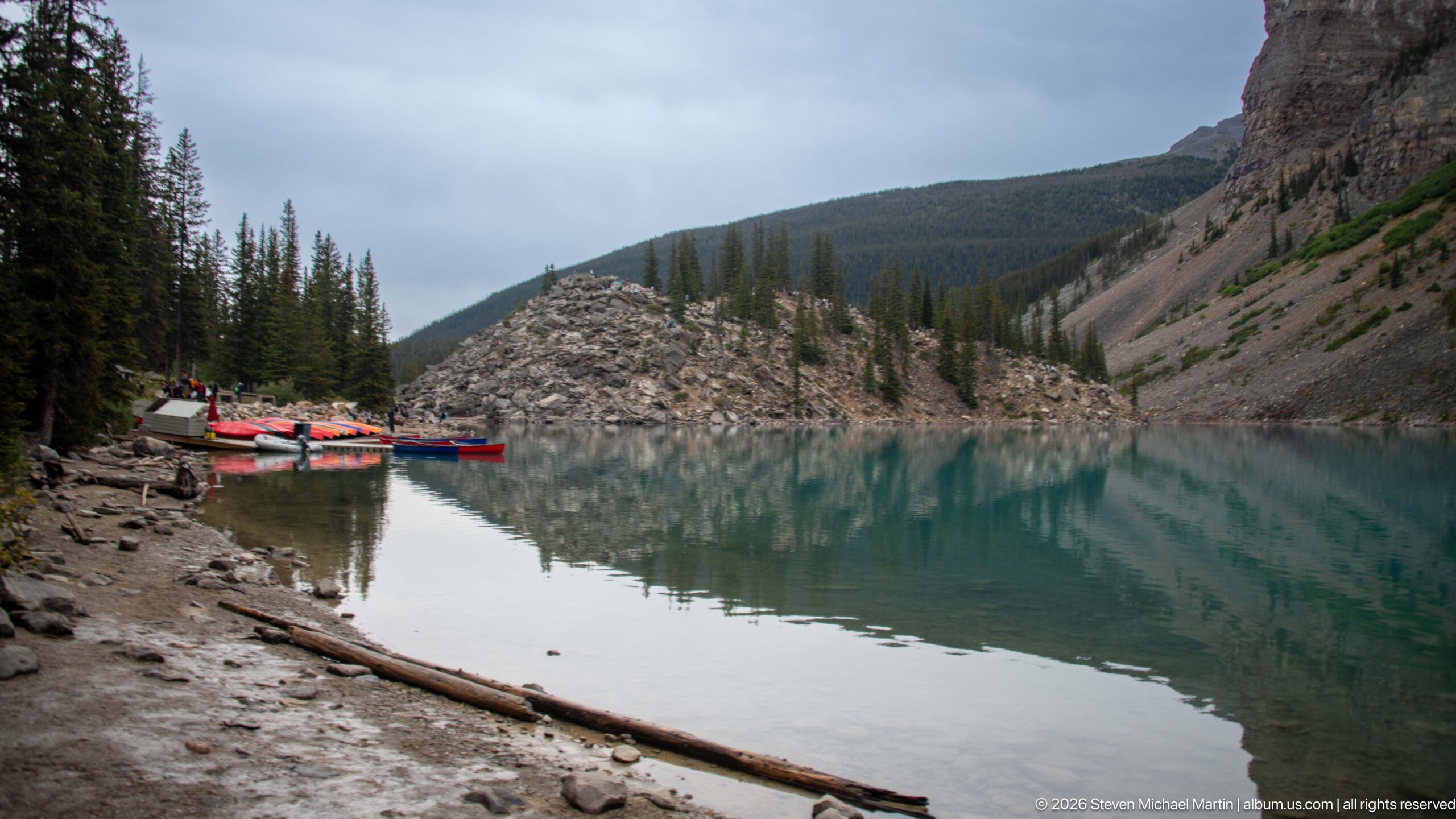
From the muddy lakeshore, Moraine Lake curves toward the Rockpile while a cluster of brightly colored canoes rests near the landing. Calm water mirrors the gray rock slope and surrounding conifers, bringing together the lake’s glacial color, its natural outlet landscape, and the small-scale recreational infrastructure concentrated near the lodge.
Caption
From the muddy lakeshore, Moraine Lake curves toward the Rockpile while a cluster of brightly colored canoes rests near the landing. Calm water mirrors the gray rock slope and surrounding conifers, bringing together the lake’s glacial color, its natural outlet landscape, and the small-scale recreational infrastructure concentrated near the lodge.
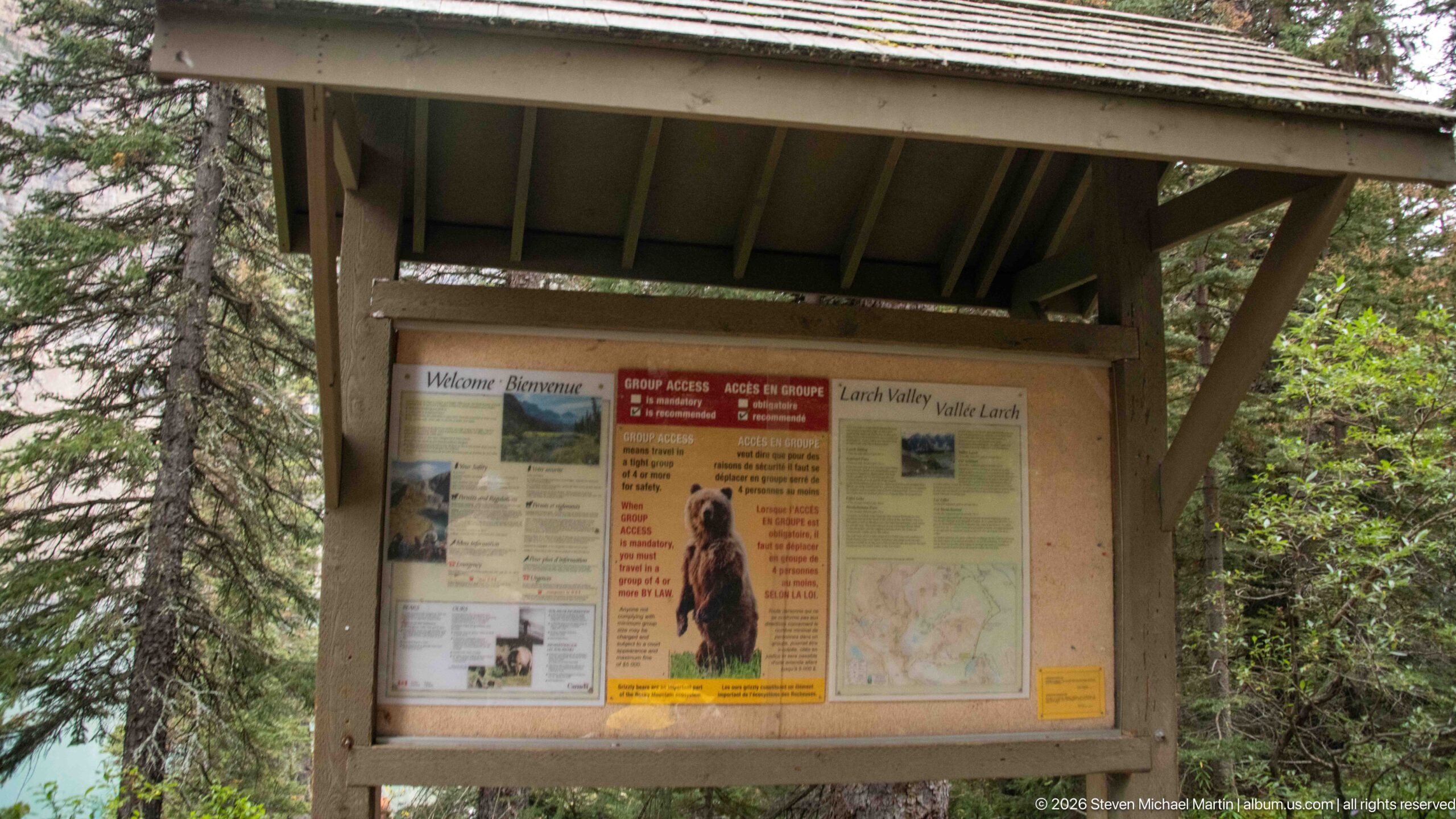
A roofed information board at Moraine Lake assembles maps, wildlife guidance, and trail notices for hikers entering the surrounding backcountry. Among the posted material are references to Larch Valley and bear safety, reminders that the celebrated lake is also a trailhead for routes extending into sensitive subalpine and alpine habitat.
Caption
A roofed information board at Moraine Lake assembles maps, wildlife guidance, and trail notices for hikers entering the surrounding backcountry. Among the posted material are references to Larch Valley and bear safety, reminders that the celebrated lake is also a trailhead for routes extending into sensitive subalpine and alpine habitat.
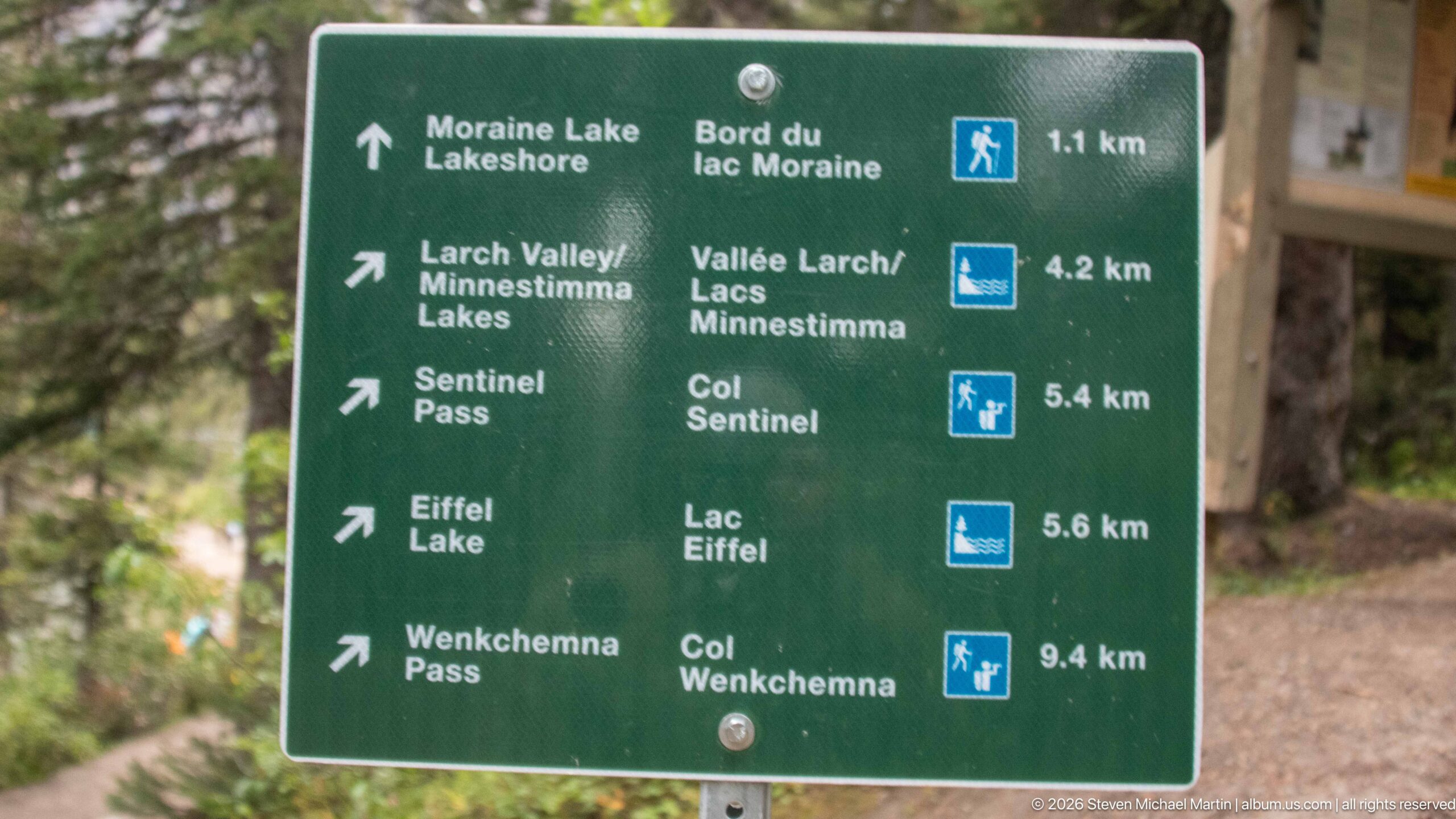
A green Parks Canada trail sign lists the principal routes departing from Moraine Lake: the lakeshore, Larch Valley and Minnestimma Lakes, Sentinel Pass, Eiffel Lake, and Wenkchemna Pass. Distances ranging from 1.1 to 9.4 kilometres make the sign a concise map of how the lakeshore connects to the surrounding alpine trail network.
Caption
A green Parks Canada trail sign lists the principal routes departing from Moraine Lake: the lakeshore, Larch Valley and Minnestimma Lakes, Sentinel Pass, Eiffel Lake, and Wenkchemna Pass. Distances ranging from 1.1 to 9.4 kilometres make the sign a concise map of how the lakeshore connects to the surrounding alpine trail network.
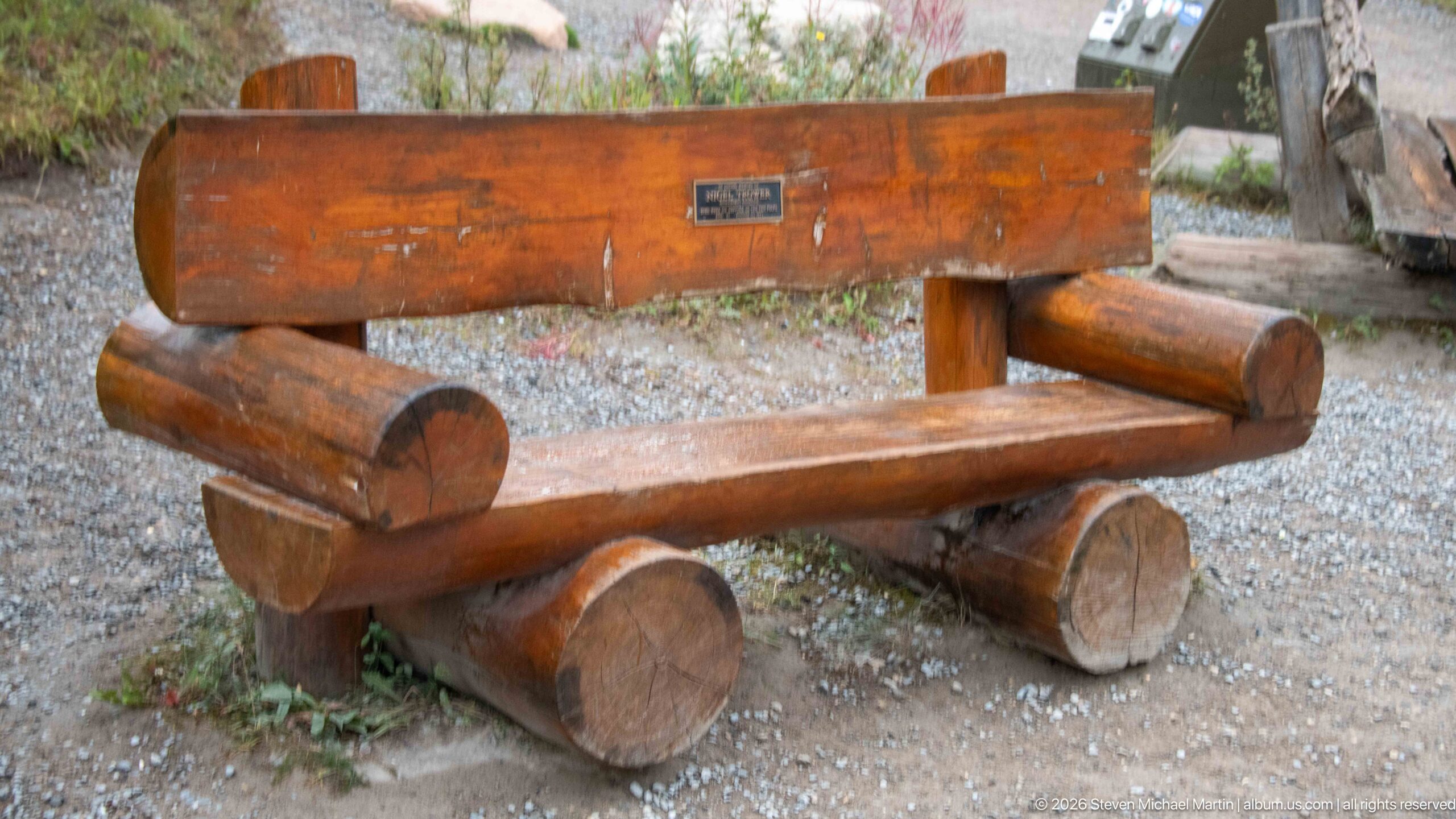
A heavy rustic bench built from peeled logs stands on gravel near the Moraine Lake visitor area. Its thick cylindrical supports and broad timber back echo the lodge architecture and surrounding forest, while a small plaque centered on the backrest suggests a commemorative dedication without providing enough legible detail to identify the honoree.
Caption
A heavy rustic bench built from peeled logs stands on gravel near the Moraine Lake visitor area. Its thick cylindrical supports and broad timber back echo the lodge architecture and surrounding forest, while a small plaque centered on the backrest suggests a commemorative dedication without providing enough legible detail to identify the honoree.
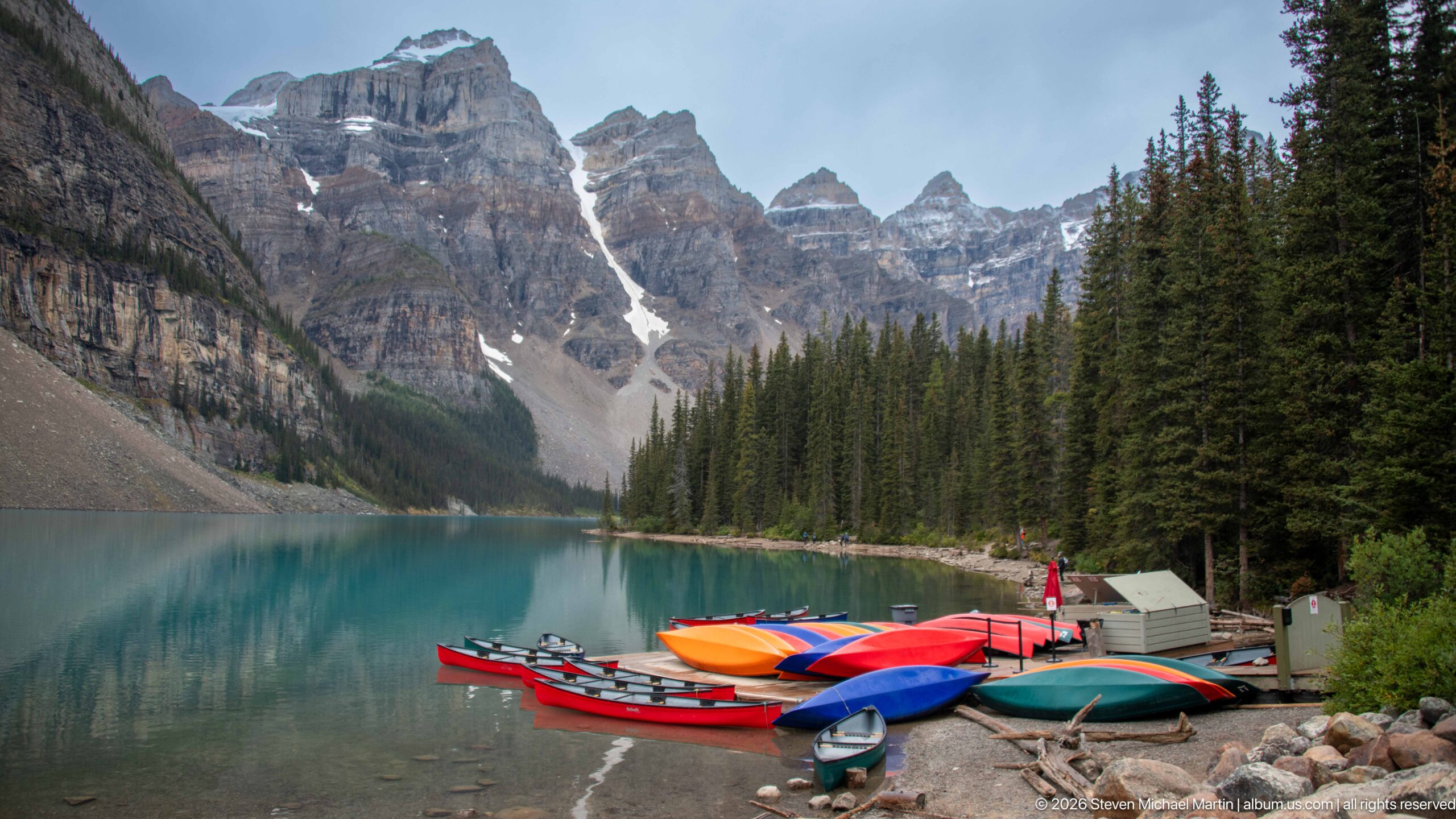
Bright red, orange, blue, and green canoes line the shore of Moraine Lake beneath the rugged peaks of the Valley of the Ten Peaks. The boats provide a vivid foreground scale for the immense glacial basin, while turquoise water, talus slopes, lingering snow, and dense conifer forest assemble the landscape elements most closely associated with the lake.
Caption
Bright red, orange, blue, and green canoes line the shore of Moraine Lake beneath the rugged peaks of the Valley of the Ten Peaks. The boats provide a vivid foreground scale for the immense glacial basin, while turquoise water, talus slopes, lingering snow, and dense conifer forest assemble the landscape elements most closely associated with the lake.
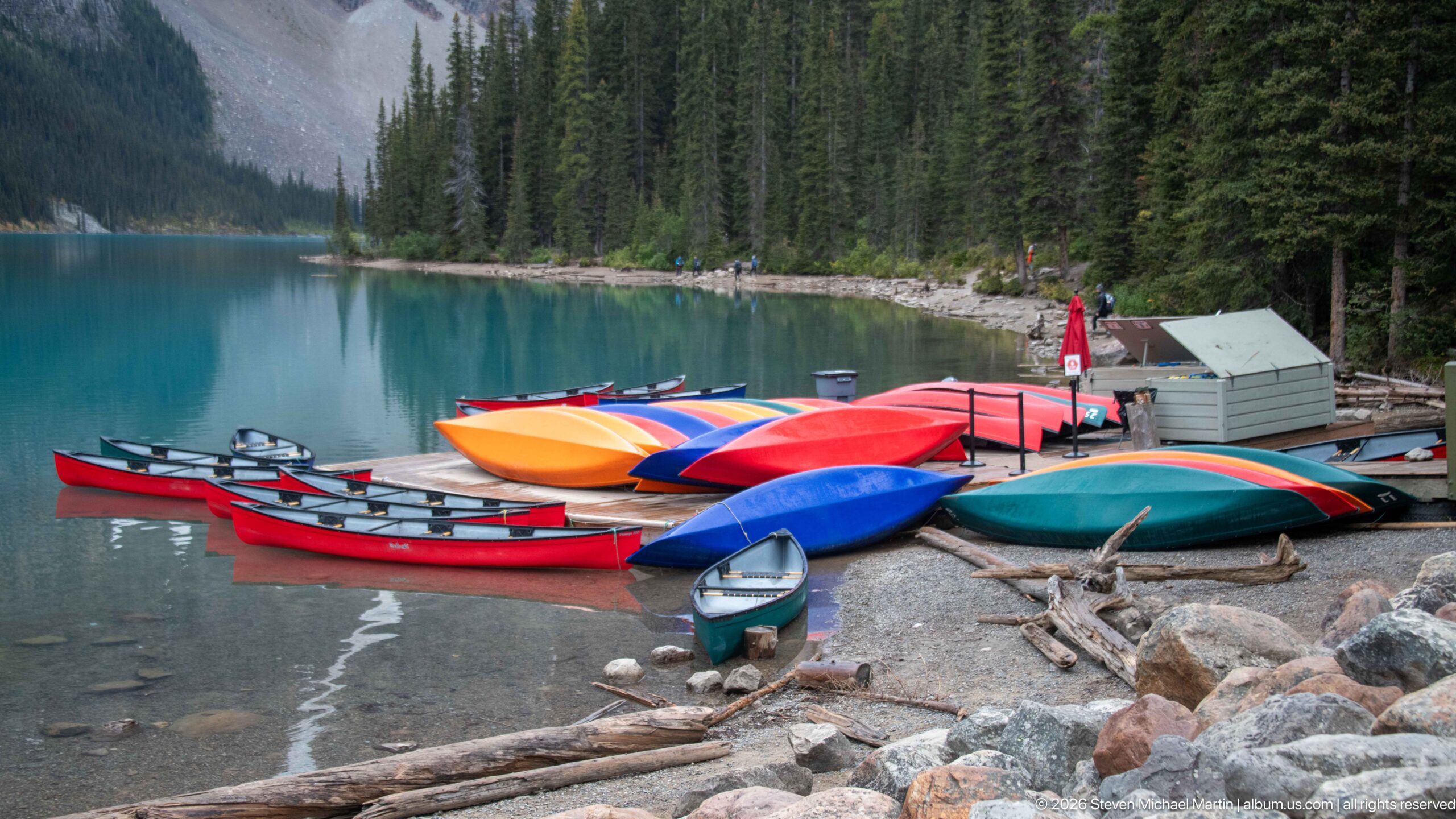
A dense row of rental canoes rests along the rocky edge of Moraine Lake, their saturated reds, oranges, blues, and greens contrasting with the muted forest and turquoise water. Viewed close to the landing, the frame emphasizes the practical equipment and shoreline arrangement behind one of the lake’s most familiar recreational experiences.
Caption
A dense row of rental canoes rests along the rocky edge of Moraine Lake, their saturated reds, oranges, blues, and greens contrasting with the muted forest and turquoise water. Viewed close to the landing, the frame emphasizes the practical equipment and shoreline arrangement behind one of the lake’s most familiar recreational experiences.
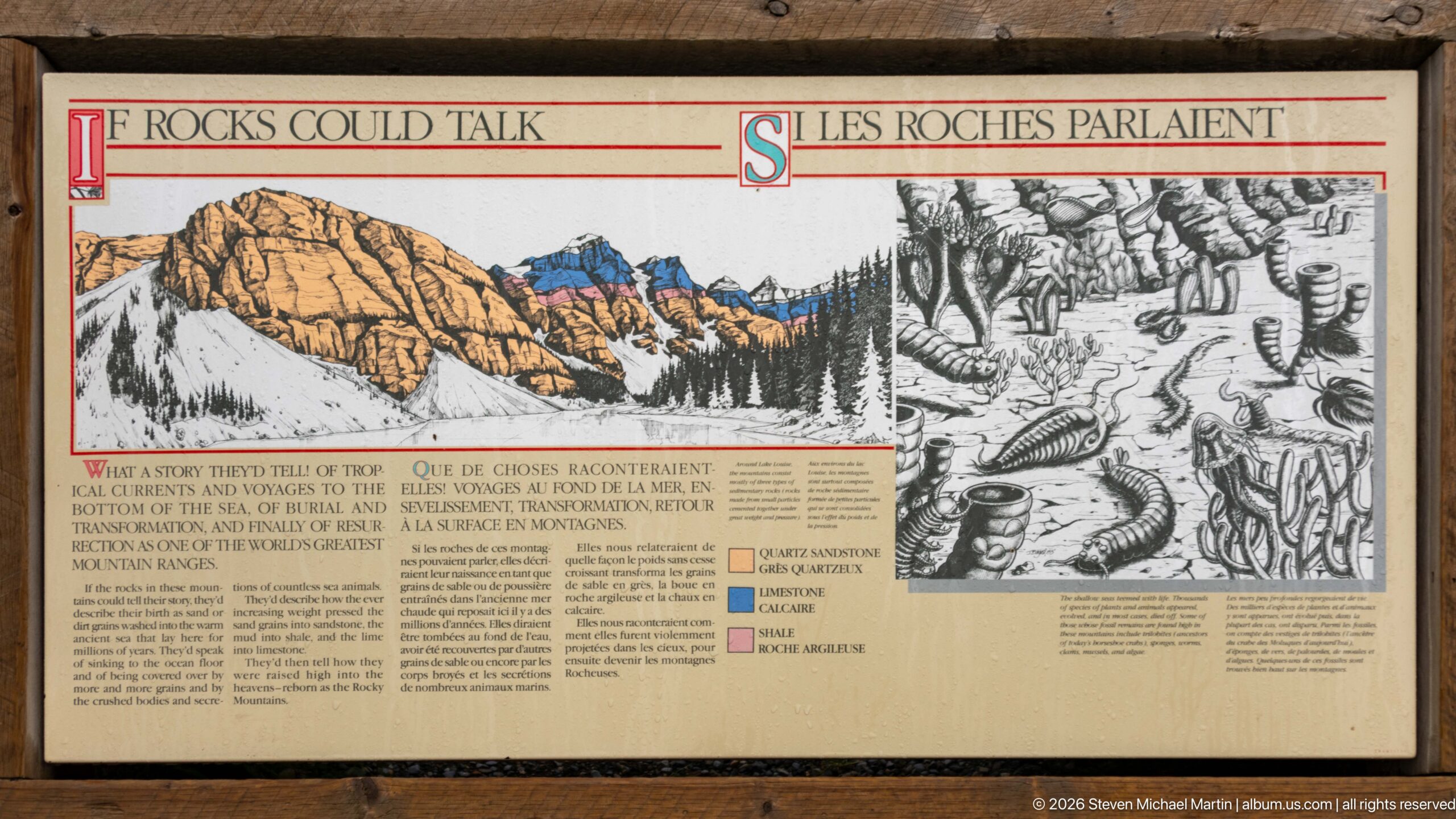
The bilingual “Rocks Talk / Les roches parlent” panel introduces the geological story recorded in the mountains around Moraine Lake. Illustrated strata, fossils, and reconstructed environments explain how ancient sediments and later mountain building can be read in the exposed rock, turning the surrounding cliffs into evidence for the deep history of the Canadian Rockies.
Caption
The bilingual “Rocks Talk / Les roches parlent” panel introduces the geological story recorded in the mountains around Moraine Lake. Illustrated strata, fossils, and reconstructed environments explain how ancient sediments and later mountain building can be read in the exposed rock, turning the surrounding cliffs into evidence for the deep history of the Canadian Rockies.
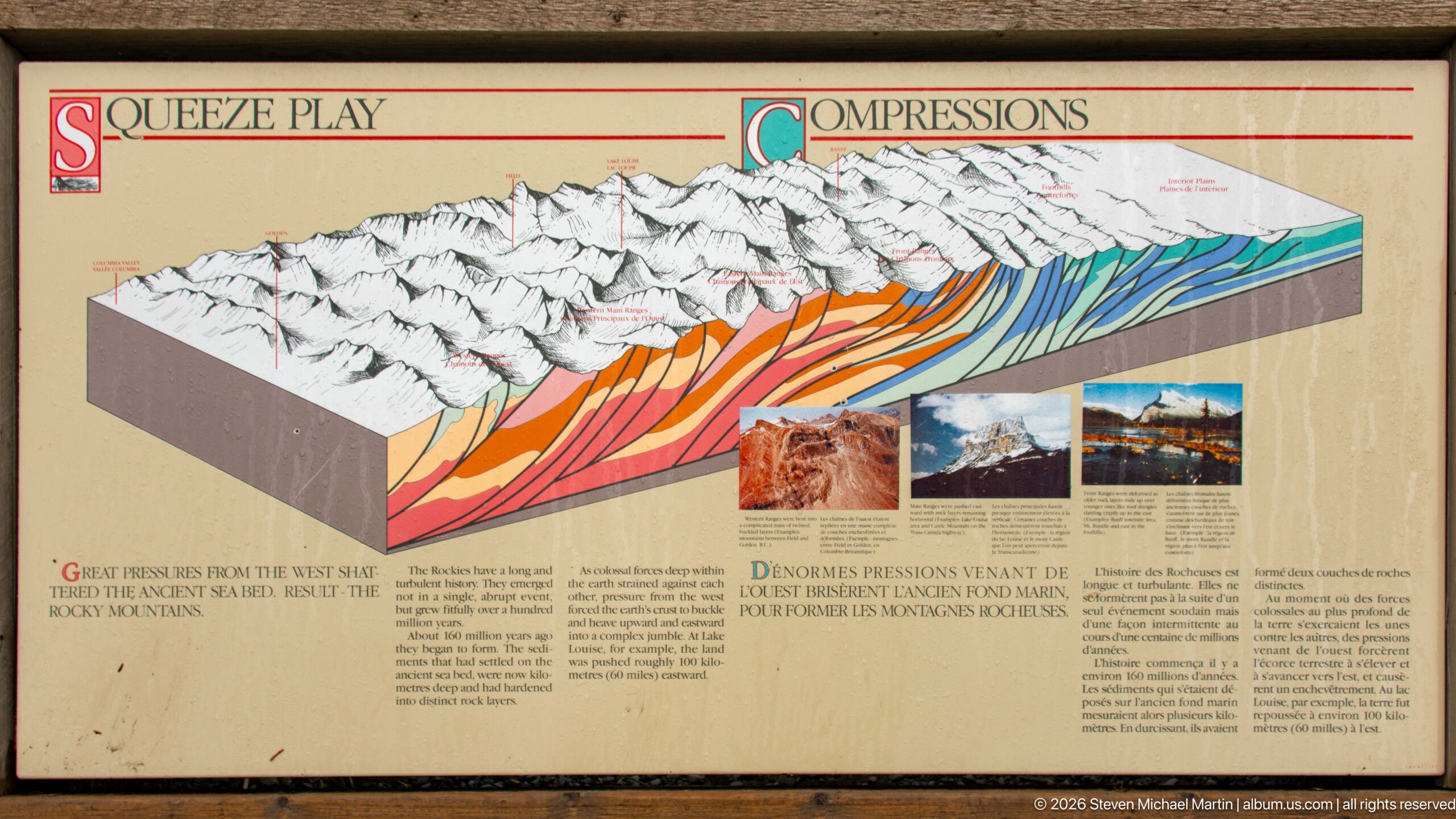
The “Compressions” panel uses a cutaway block diagram to explain the intense deformation that helped build the Canadian Rockies. Colored layers bend, overlap, and rise beneath a mountain profile, visually linking horizontal sedimentary strata with the folding and faulting that transformed them into the steep ridges surrounding Moraine Lake.
Caption
The “Compressions” panel uses a cutaway block diagram to explain the intense deformation that helped build the Canadian Rockies. Colored layers bend, overlap, and rise beneath a mountain profile, visually linking horizontal sedimentary strata with the folding and faulting that transformed them into the steep ridges surrounding Moraine Lake.
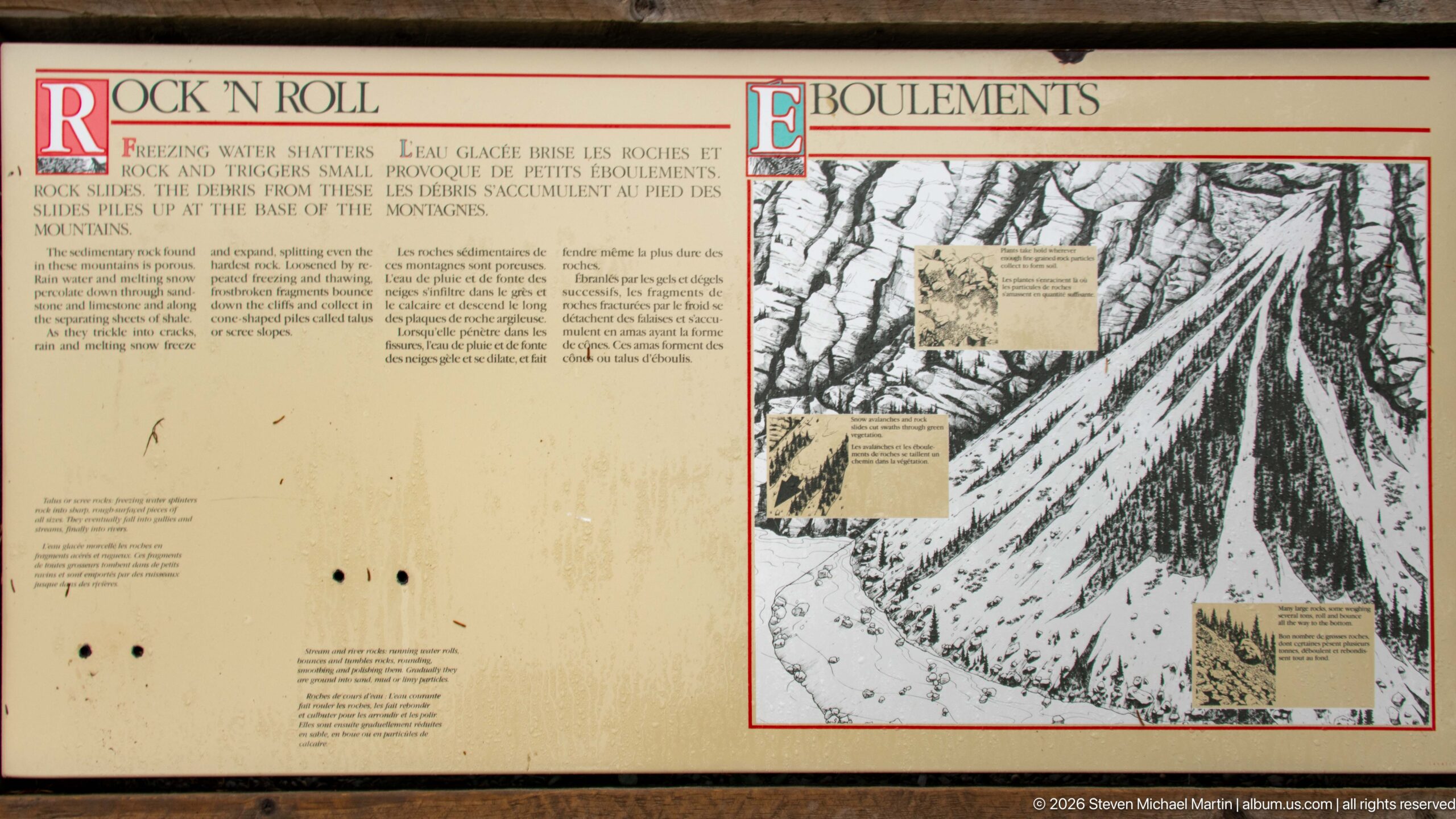
A bilingual interpretive panel examines rockfall and slope failure in the steep terrain around Moraine Lake. Drawings of fractured cliffs and debris descending toward the valley floor connect the unstable mountain walls with the angular rock accumulations visible around the lake, emphasizing that erosion continues to reshape this glacially carved basin.
Caption
A bilingual interpretive panel examines rockfall and slope failure in the steep terrain around Moraine Lake. Drawings of fractured cliffs and debris descending toward the valley floor connect the unstable mountain walls with the angular rock accumulations visible around the lake, emphasizing that erosion continues to reshape this glacially carved basin.
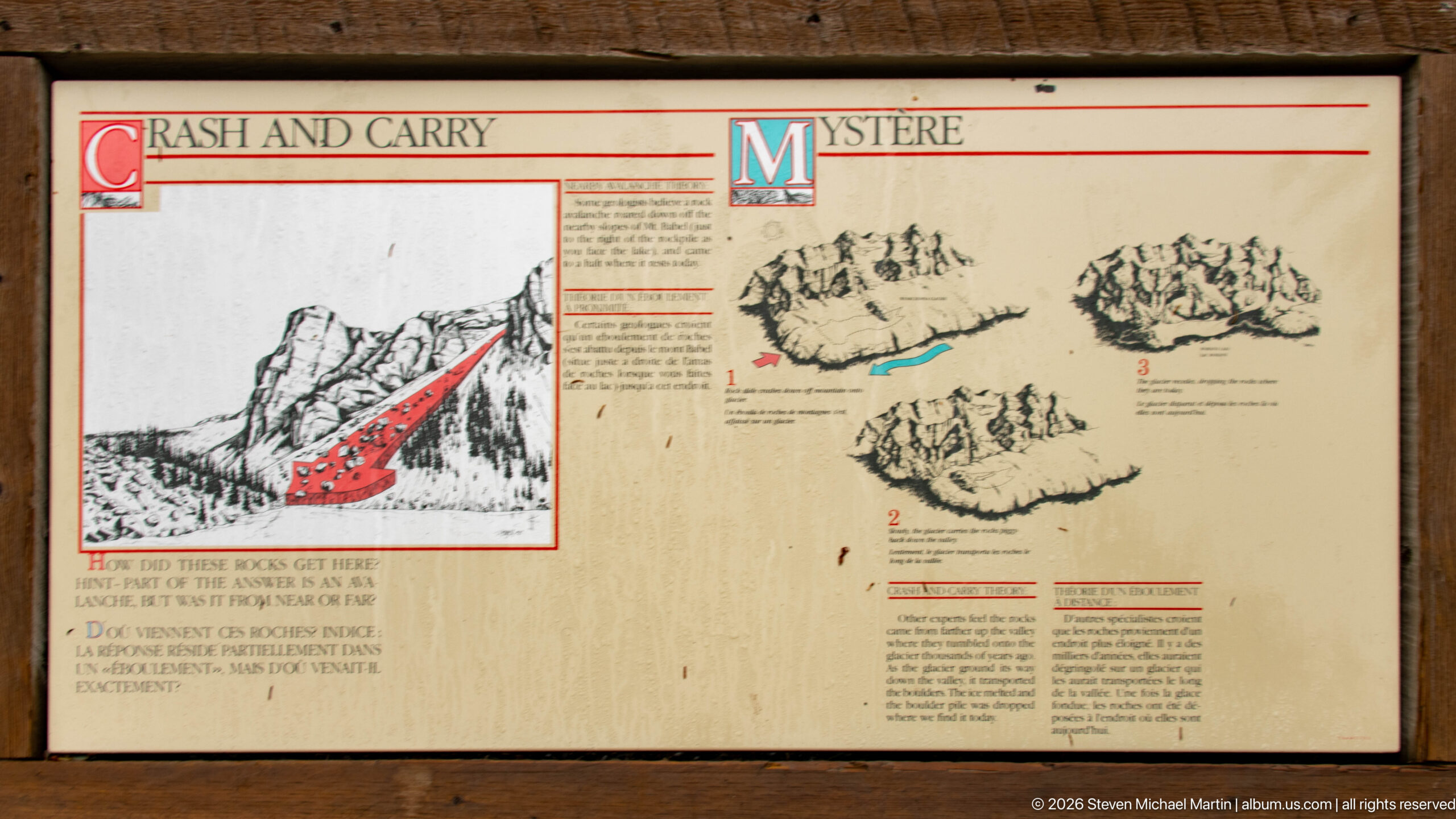
The “Mystery / Mystère” panel presents competing explanations for the origin of the Rockpile at Moraine Lake. Diagrams compare possible ways a large mass of angular rock could have accumulated near the lake’s outlet, inviting visitors to read the landform as an unresolved geological problem rather than simply as the platform for a famous viewpoint.
Caption
The “Mystery / Mystère” panel presents competing explanations for the origin of the Rockpile at Moraine Lake. Diagrams compare possible ways a large mass of angular rock could have accumulated near the lake’s outlet, inviting visitors to read the landform as an unresolved geological problem rather than simply as the platform for a famous viewpoint.
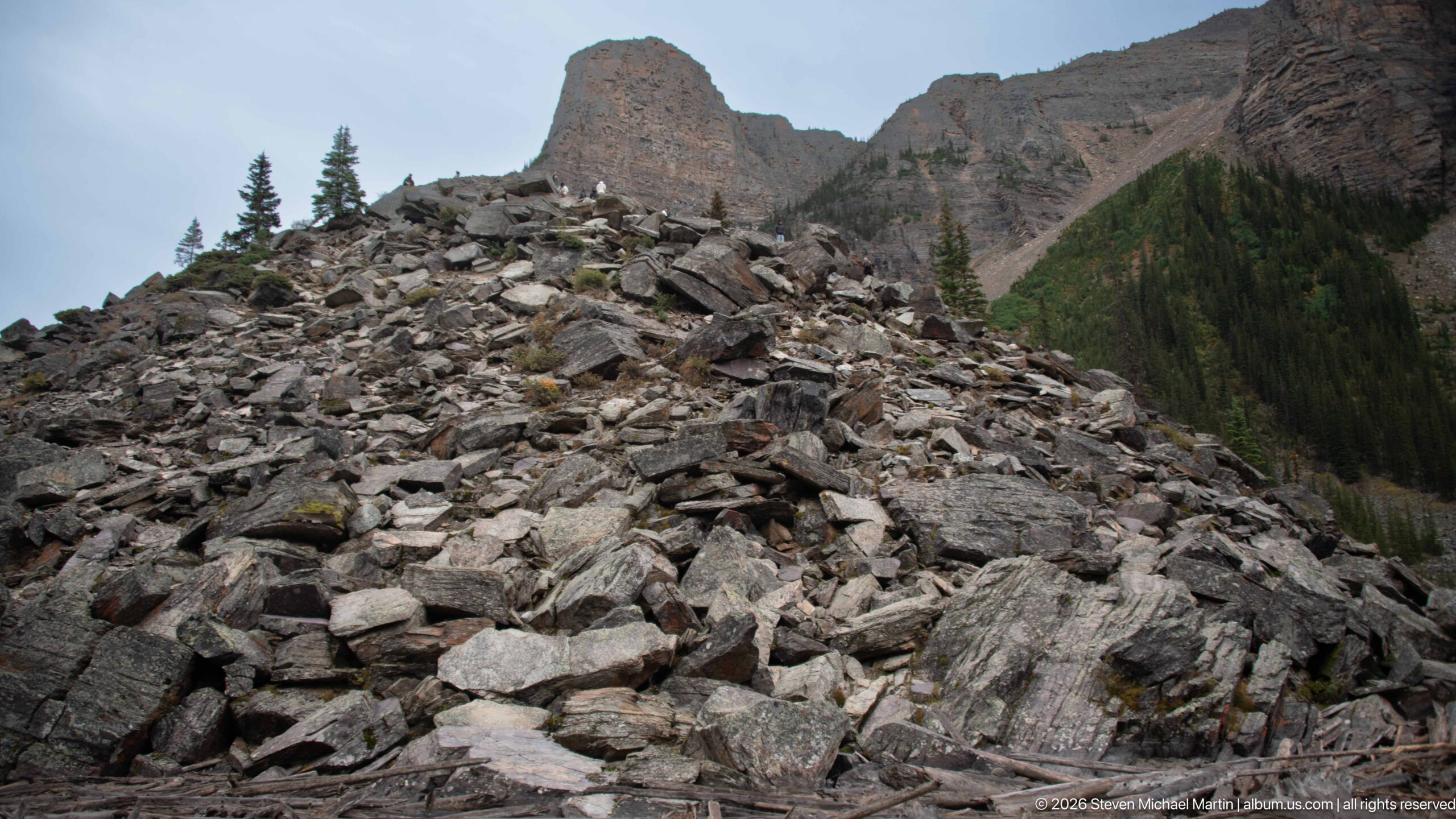
Angular blocks dominate the crest of the Rockpile, creating a rough field of fractured stone with only scattered conifers able to take root between the boulders. Seen at close range, the viewpoint’s material character becomes more evident: it is not a smooth hill but a chaotic accumulation of large rock fragments set beneath the surrounding cliffs.
Caption
Angular blocks dominate the crest of the Rockpile, creating a rough field of fractured stone with only scattered conifers able to take root between the boulders. Seen at close range, the viewpoint’s material character becomes more evident: it is not a smooth hill but a chaotic accumulation of large rock fragments set beneath the surrounding cliffs.
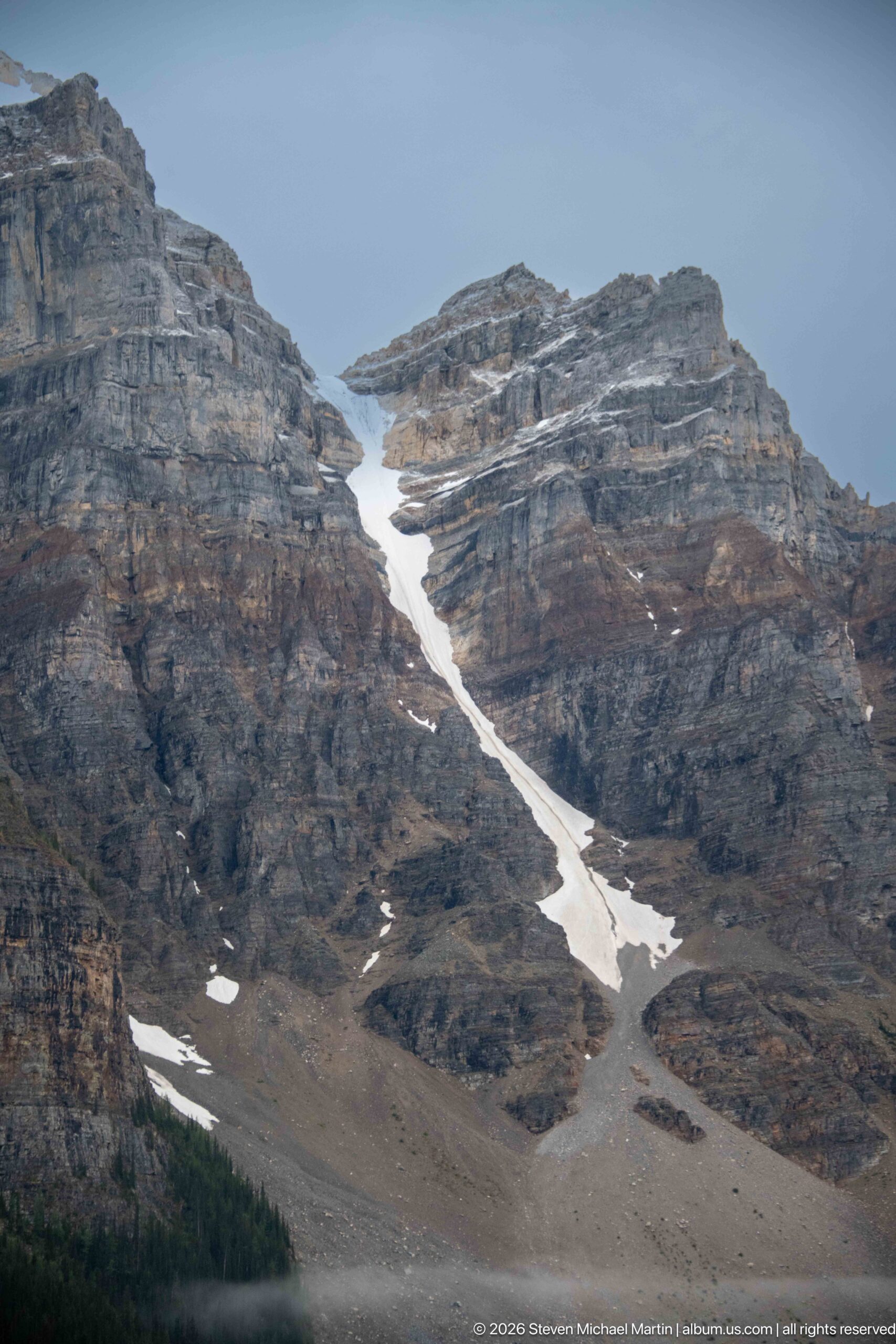
A narrow remnant snowfield descends through a broad gully cut into horizontally layered mountain rock above Moraine Lake. The close view isolates the relationship between resistant sedimentary beds, loose gray scree, and lingering summer snow, revealing details of the high alpine terrain that are easily lost in the lake’s wider panoramas.
Caption
A narrow remnant snowfield descends through a broad gully cut into horizontally layered mountain rock above Moraine Lake. The close view isolates the relationship between resistant sedimentary beds, loose gray scree, and lingering summer snow, revealing details of the high alpine terrain that are easily lost in the lake’s wider panoramas.
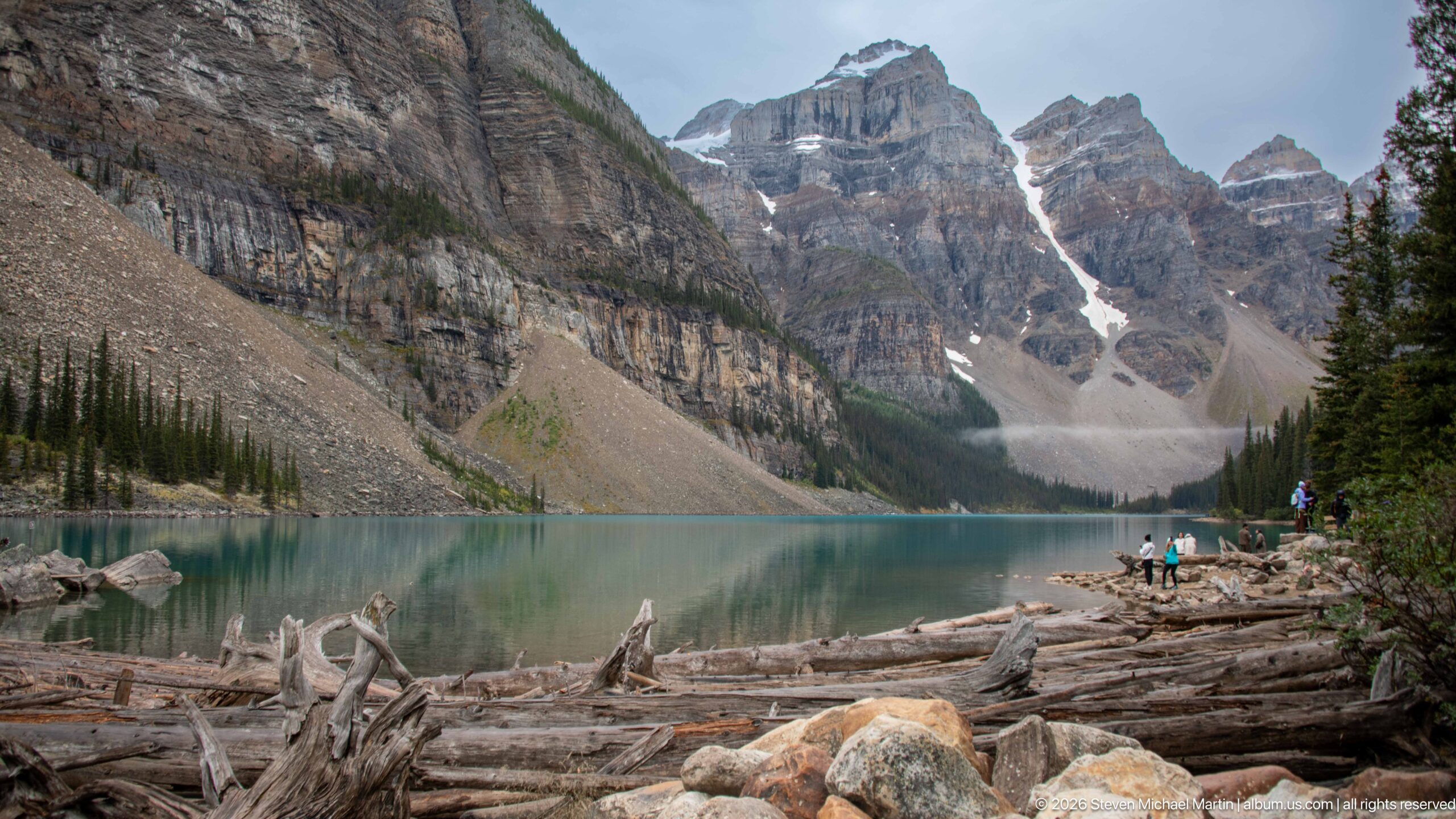
Driftwood and pale boulders frame Moraine Lake from the shoreline, leading the eye across turquoise water to the steep walls and summits of the Valley of the Ten Peaks. Visitors on the right provide scale, while talus slopes, conifer forest, and streaks of snow show the transition from lake level to the high alpine basin above.
Caption
Driftwood and pale boulders frame Moraine Lake from the shoreline, leading the eye across turquoise water to the steep walls and summits of the Valley of the Ten Peaks. Visitors on the right provide scale, while talus slopes, conifer forest, and streaks of snow show the transition from lake level to the high alpine basin above.
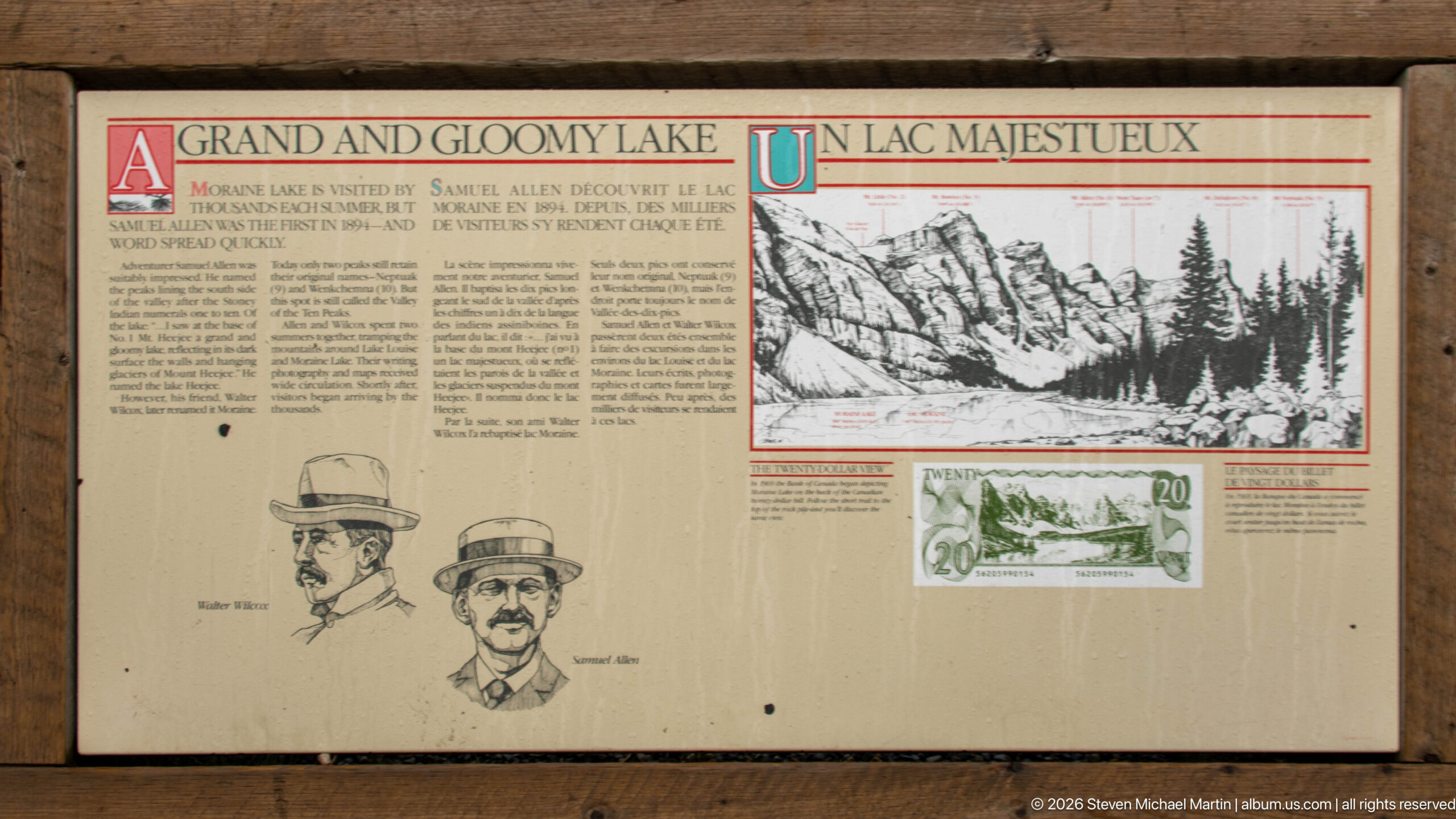
The bilingual “A Gloomy Lake / Un lac majestueux” panel recounts the early naming and changing perception of Moraine Lake, pairing text with portraits and a historic-style landscape drawing. Its contrasting headings underscore how a place once described in somber terms became one of the Canadian Rockies’ most celebrated mountain landscapes.
Caption
The bilingual “A Gloomy Lake / Un lac majestueux” panel recounts the early naming and changing perception of Moraine Lake, pairing text with portraits and a historic-style landscape drawing. Its contrasting headings underscore how a place once described in somber terms became one of the Canadian Rockies’ most celebrated mountain landscapes.
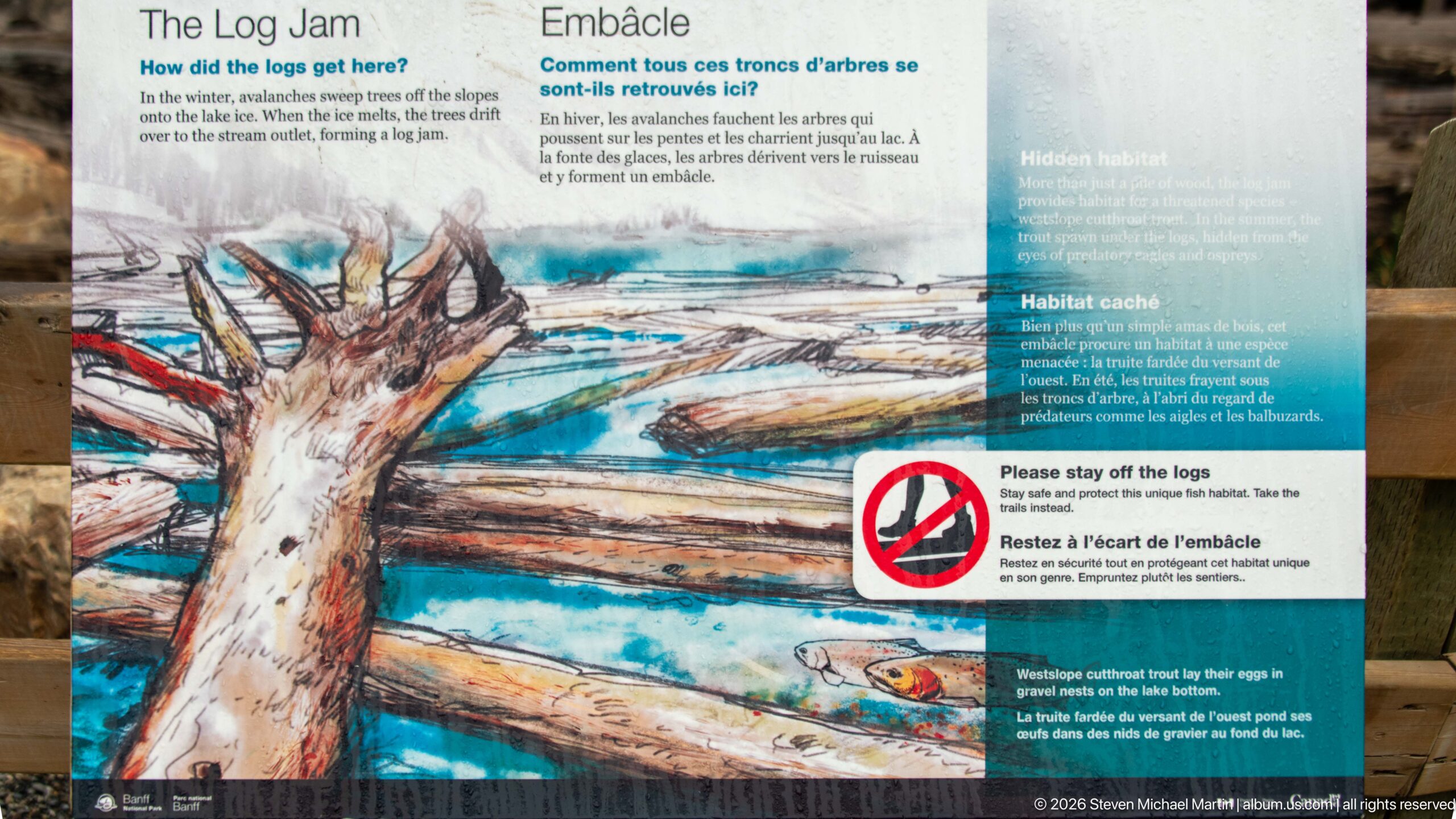
An illustrated “The Log Jam / Embâcle” panel explains how fallen trunks along the Moraine Lake shoreline create sheltered habitat rather than simply forming debris. A prominent warning asks visitors to stay off the logs, linking visitor behavior with protection of the small spaces and organisms associated with this woody shoreline structure.
Caption
An illustrated “The Log Jam / Embâcle” panel explains how fallen trunks along the Moraine Lake shoreline create sheltered habitat rather than simply forming debris. A prominent warning asks visitors to stay off the logs, linking visitor behavior with protection of the small spaces and organisms associated with this woody shoreline structure.
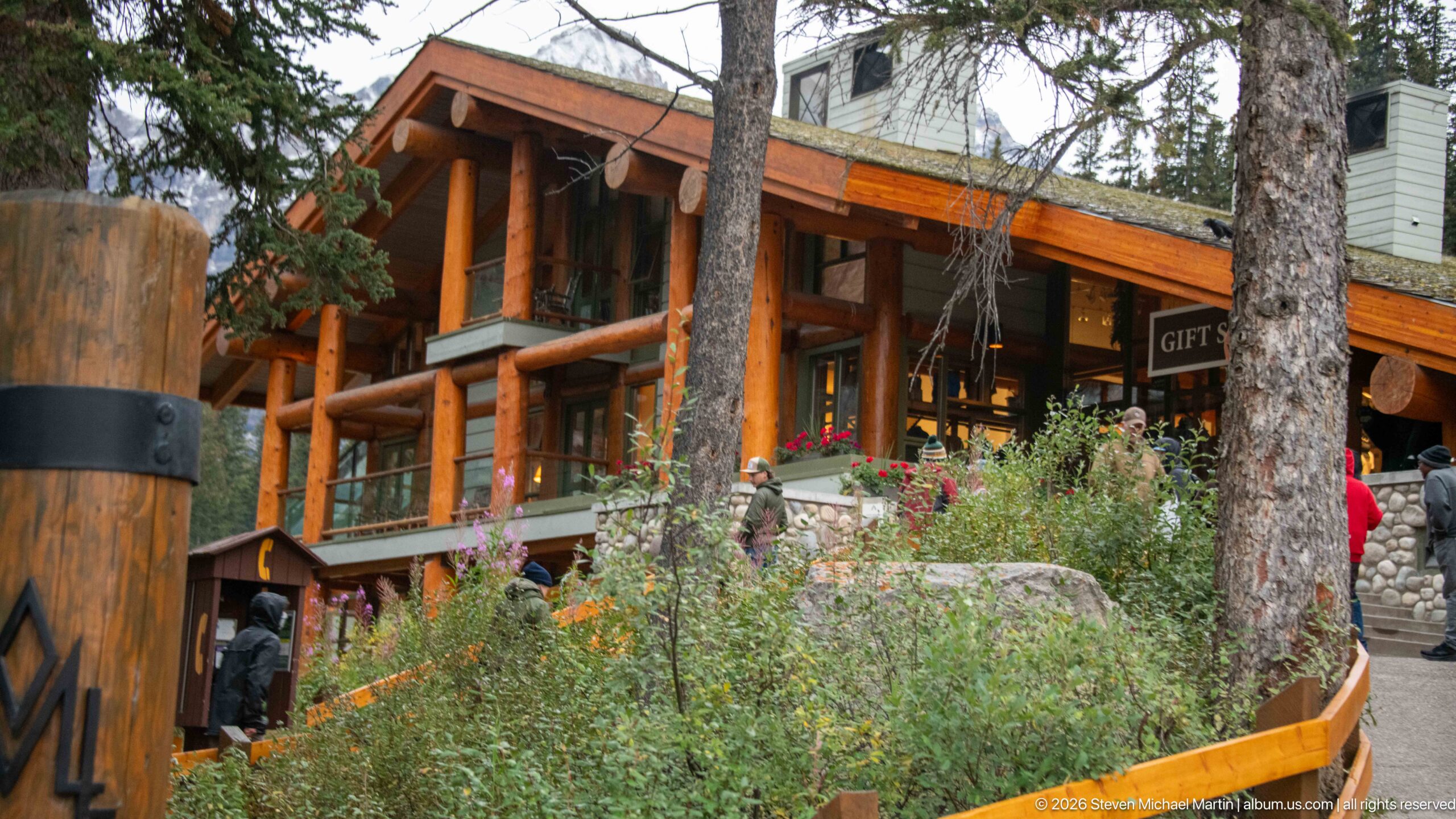
Massive log posts and beams define the exterior of Moraine Lake Lodge, where broad windows, balconies, and a stone base face the wooded grounds near the lake. Wildflowers and mature conifers soften the building’s substantial timber frame, while visitors moving around the entrance reveal its continuing role as the principal developed accommodation at Moraine Lake.
Caption
Massive log posts and beams define the exterior of Moraine Lake Lodge, where broad windows, balconies, and a stone base face the wooded grounds near the lake. Wildflowers and mature conifers soften the building’s substantial timber frame, while visitors moving around the entrance reveal its continuing role as the principal developed accommodation at Moraine Lake.
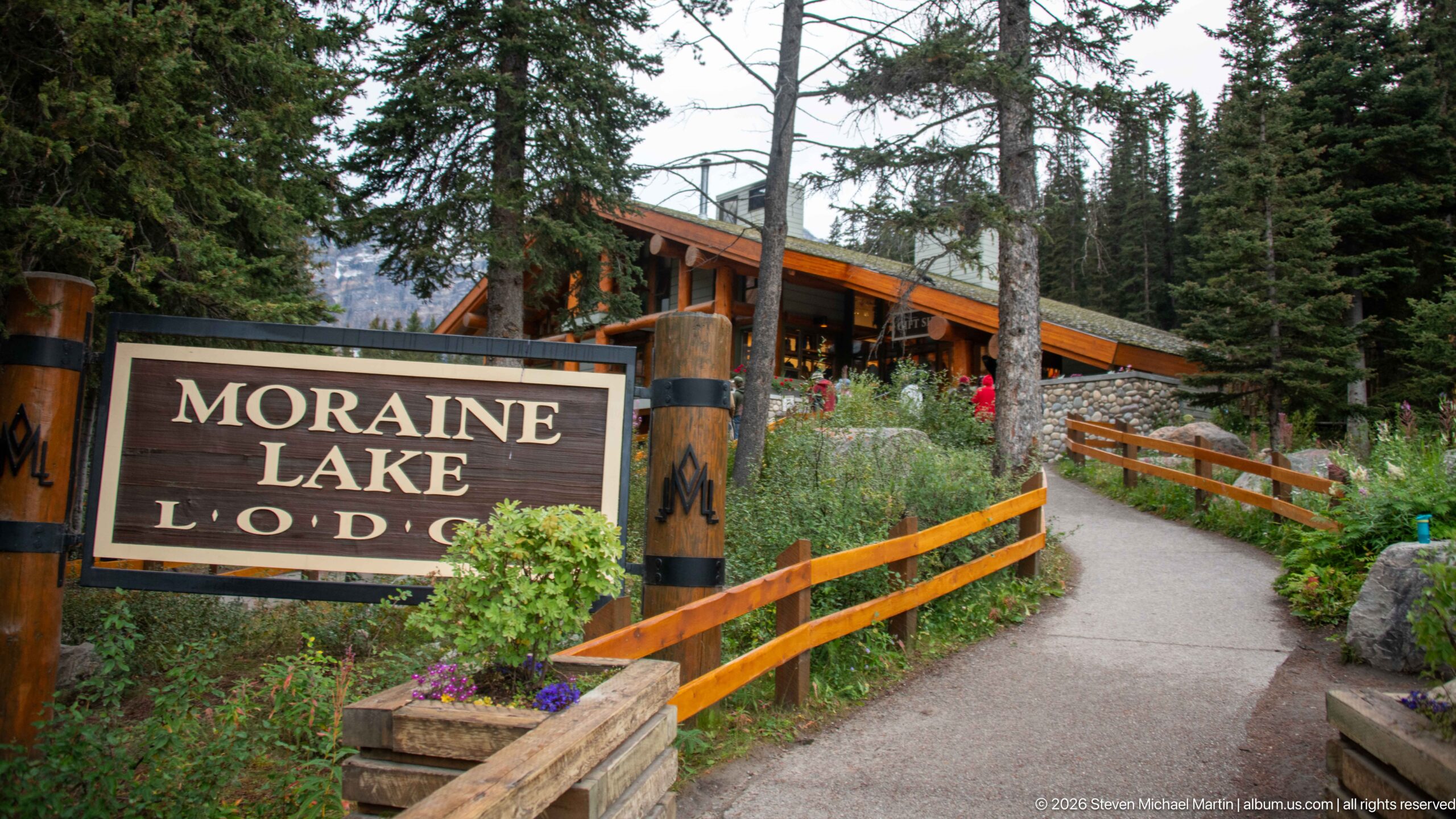
The timber sign for Moraine Lake Lodge marks the approach to the lakeside accommodation, with a paved path and warm-toned wooden railings leading through spruce forest toward the lodge buildings. Flower plantings and the rustic construction reinforce the developed visitor setting tucked into the otherwise densely wooded shoreline landscape at Moraine Lake.
Caption
The timber sign for Moraine Lake Lodge marks the approach to the lakeside accommodation, with a paved path and warm-toned wooden railings leading through spruce forest toward the lodge buildings. Flower plantings and the rustic construction reinforce the developed visitor setting tucked into the otherwise densely wooded shoreline landscape at Moraine Lake.
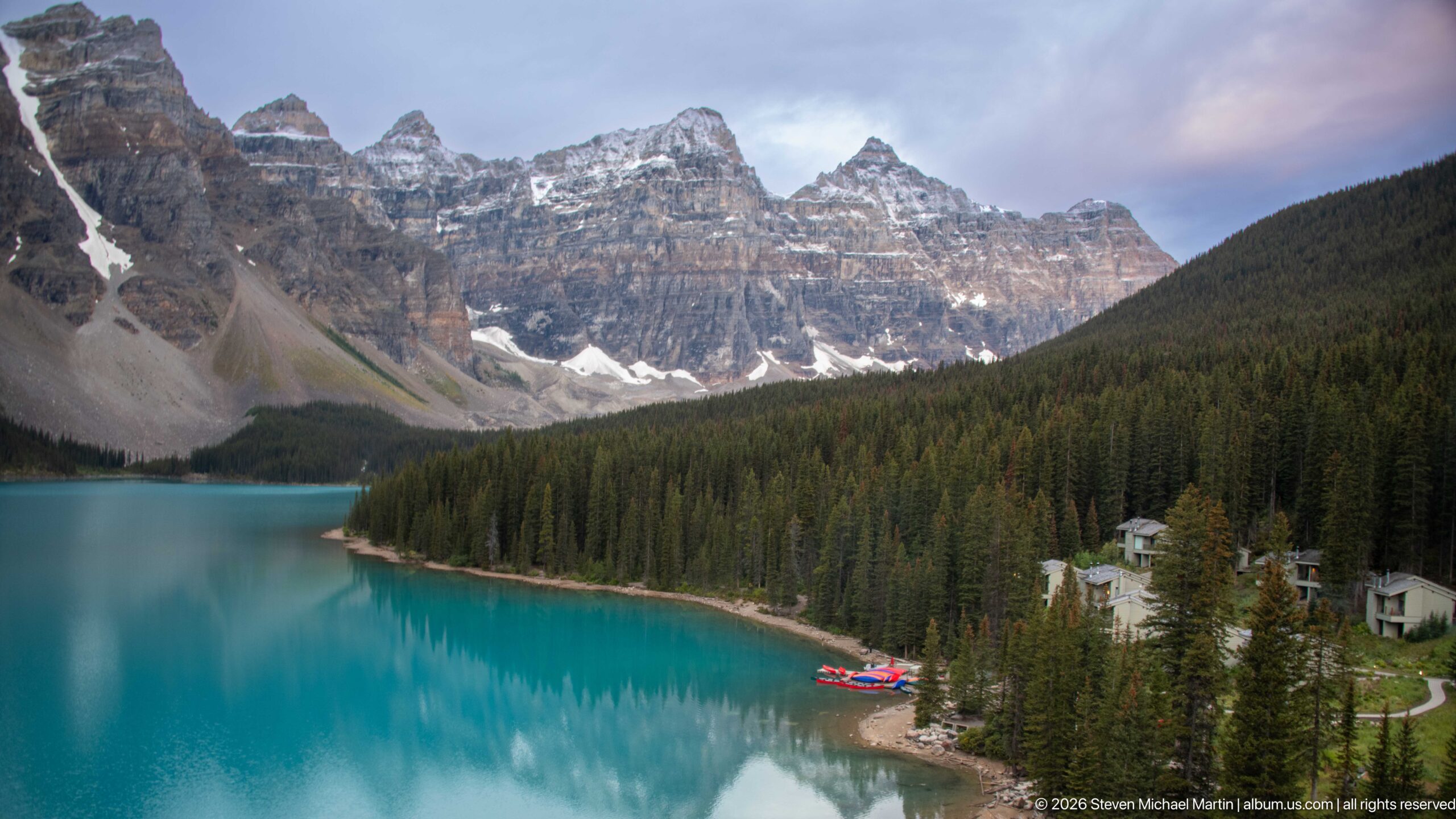
Turquoise water curves along the forested shore of Moraine Lake beneath the steep, layered peaks of the Valley of the Ten Peaks. Viewed from above the developed shoreline, the composition also includes small red canoes and lodge structures, providing a useful sense of scale against the broad glacial lake and surrounding mountain walls.
Caption
Turquoise water curves along the forested shore of Moraine Lake beneath the steep, layered peaks of the Valley of the Ten Peaks. Viewed from above the developed shoreline, the composition also includes small red canoes and lodge structures, providing a useful sense of scale against the broad glacial lake and surrounding mountain walls.
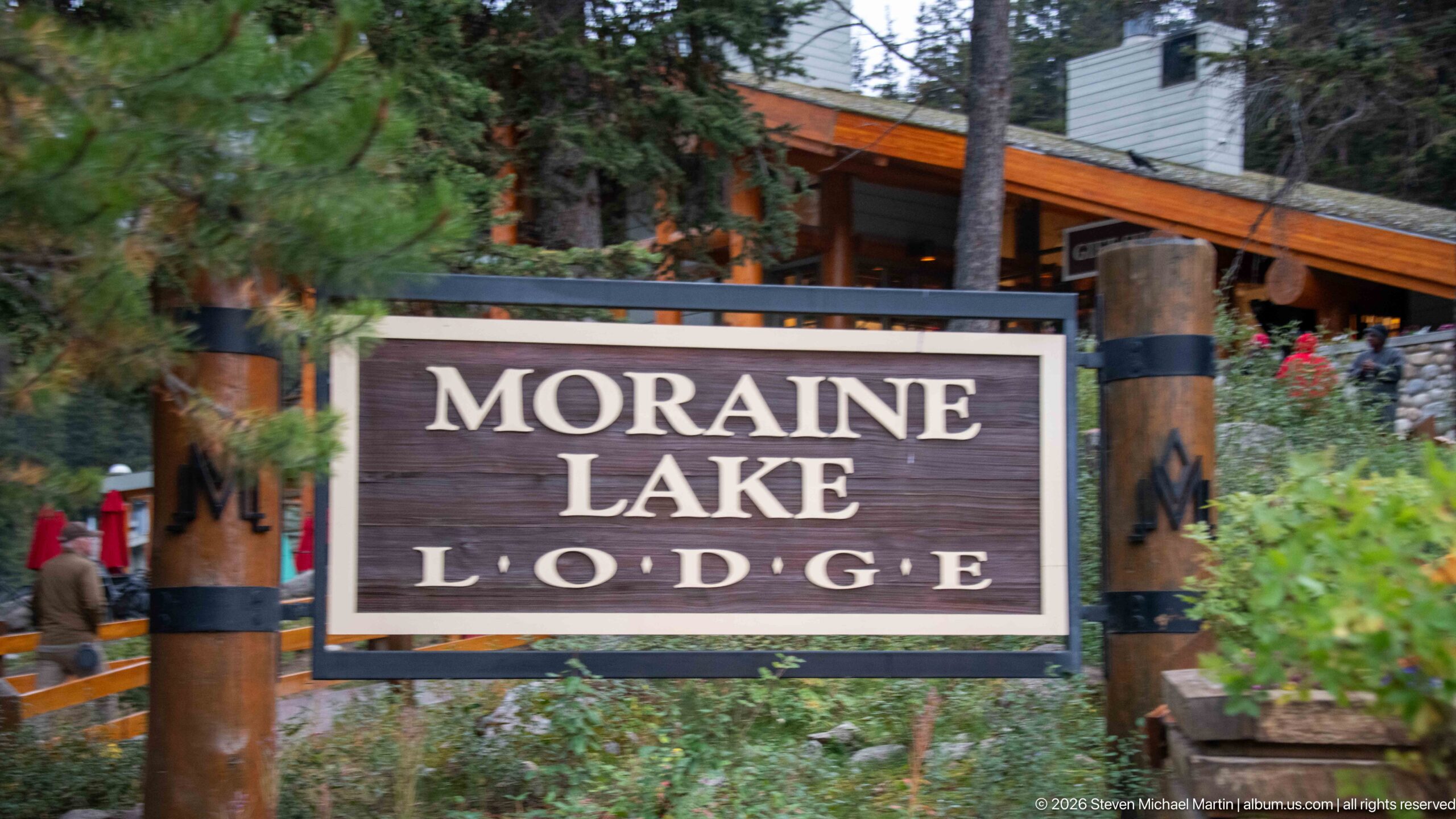
A close view isolates the carved-and-painted Moraine Lake Lodge sign between substantial timber posts branded with the lodge’s stylized M emblem. The lodge roofline and surrounding evergreens remain visible behind it, turning the sign into both a place marker and a detail of the rustic architectural vocabulary used at the developed end of Moraine Lake.
Caption
A close view isolates the carved-and-painted Moraine Lake Lodge sign between substantial timber posts branded with the lodge’s stylized M emblem. The lodge roofline and surrounding evergreens remain visible behind it, turning the sign into both a place marker and a detail of the rustic architectural vocabulary used at the developed end of Moraine Lake.
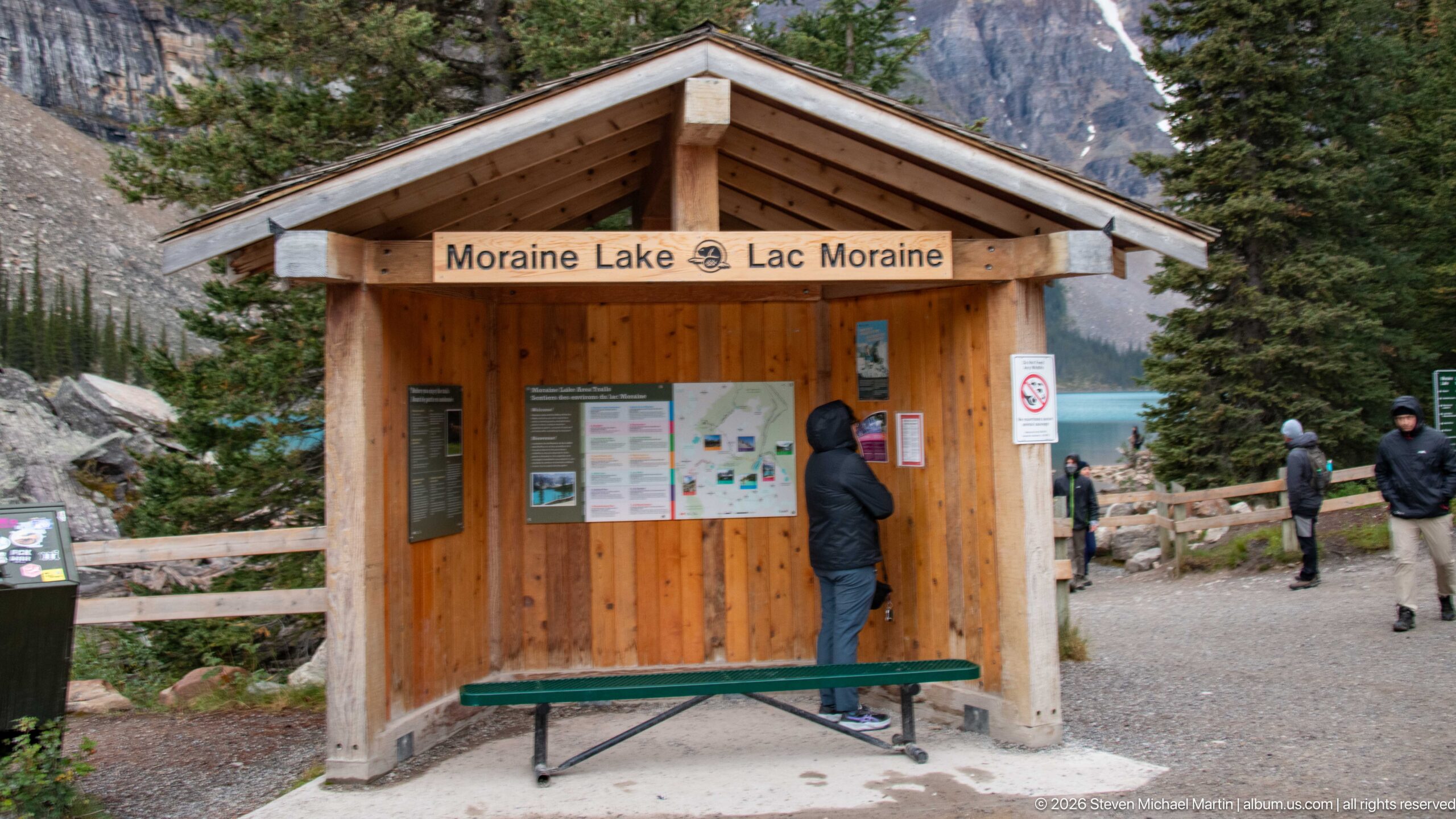
A small timber information shelter labeled “Moraine Lake / Lac Moraine” stands near the lakeshore trailhead, its notice boards and maps serving visitors at the developed end of the lake. The open-sided mountain setting is visible around the kiosk, with conifers, boulders, turquoise water, and steep rock walls establishing its immediate Banff National Park context.
Caption
A small timber information shelter labeled “Moraine Lake / Lac Moraine” stands near the lakeshore trailhead, its notice boards and maps serving visitors at the developed end of the lake. The open-sided mountain setting is visible around the kiosk, with conifers, boulders, turquoise water, and steep rock walls establishing its immediate Banff National Park context.
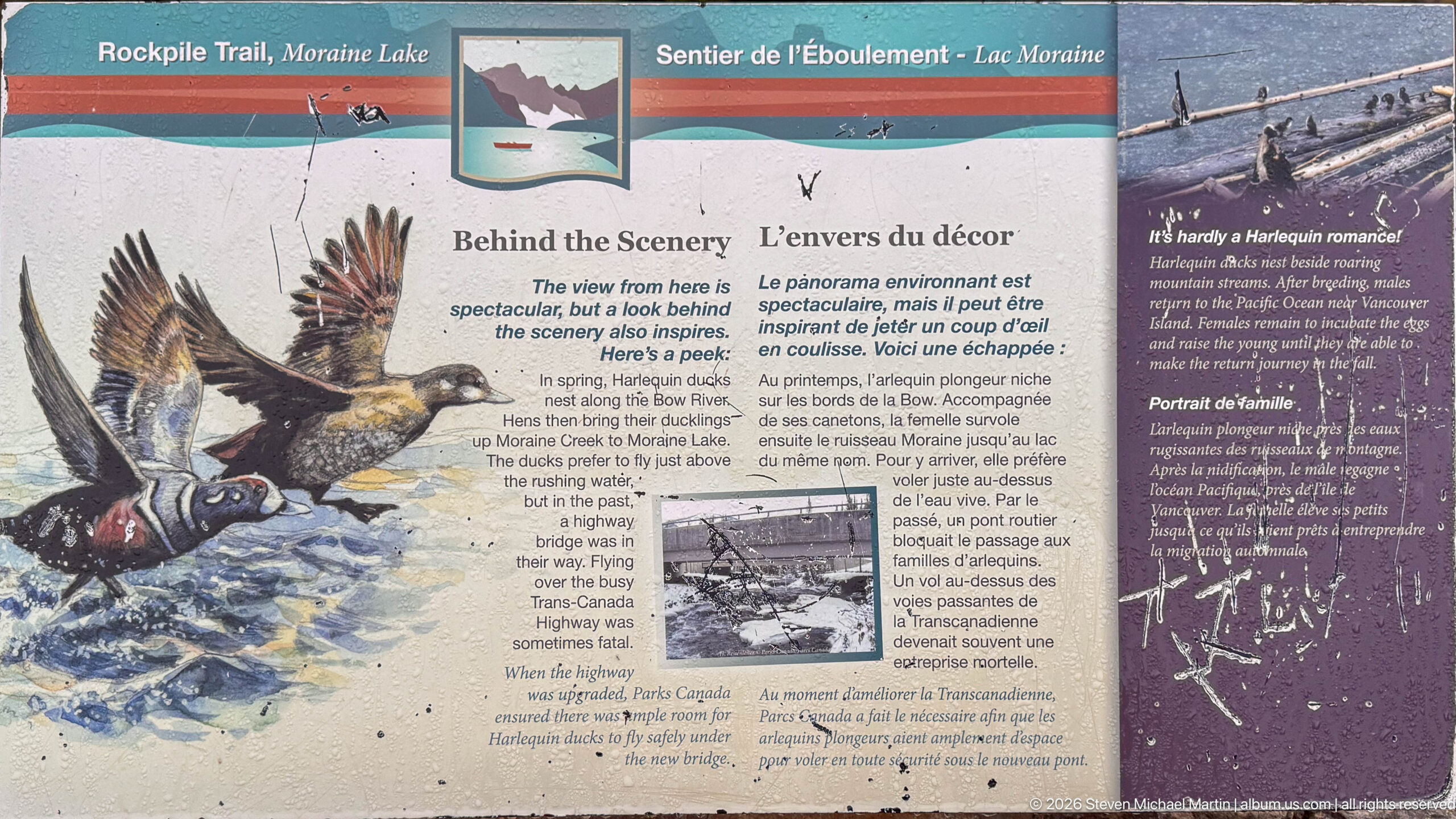
An interpretive panel on the Rockpile Trail uses the title “Behind the Scenery / L’envers du décor” to recount the unusual connection between Moraine Lake and Harlequin romance cover photography. Illustrated text and historic imagery connect the celebrated mountain setting with a less expected strand of popular-culture history, adding a human story to the trail’s geological and scenic interpretation.
Caption
An interpretive panel on the Rockpile Trail uses the title “Behind the Scenery / L’envers du décor” to recount the unusual connection between Moraine Lake and Harlequin romance cover photography. Illustrated text and historic imagery connect the celebrated mountain setting with a less expected strand of popular-culture history, adding a human story to the trail’s geological and scenic interpretation.
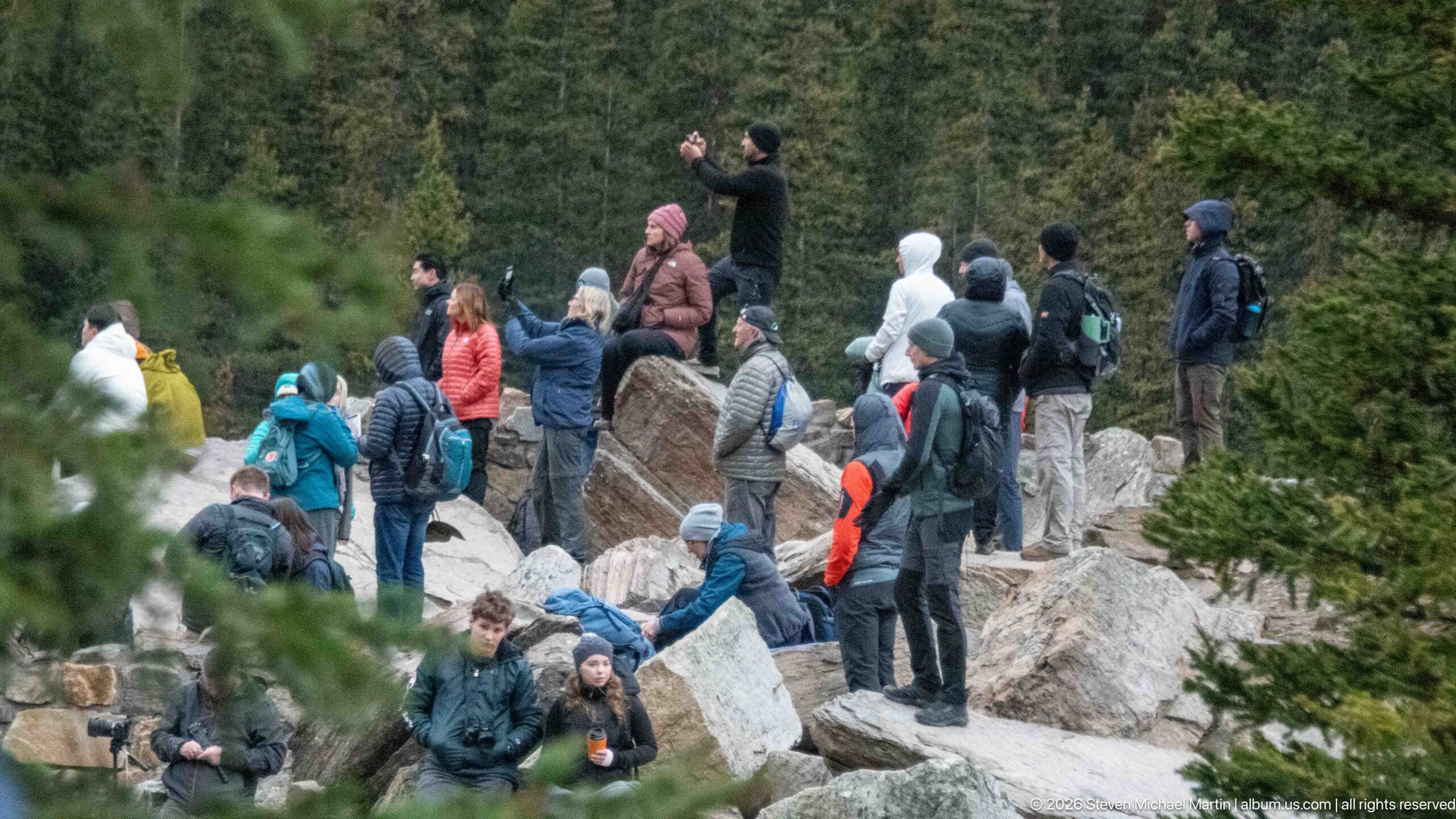
Visitors gather among pale boulders at a wooded Moraine Lake viewpoint, many standing and looking outward while others pause on the rocks. The clustered figures show the intensity of use at this famous overlook, while the rough talus blocks and dense conifer backdrop retain the physical character of the Rockpile area beside the lake.
Caption
Visitors gather among pale boulders at a wooded Moraine Lake viewpoint, many standing and looking outward while others pause on the rocks. The clustered figures show the intensity of use at this famous overlook, while the rough talus blocks and dense conifer backdrop retain the physical character of the Rockpile area beside the lake.
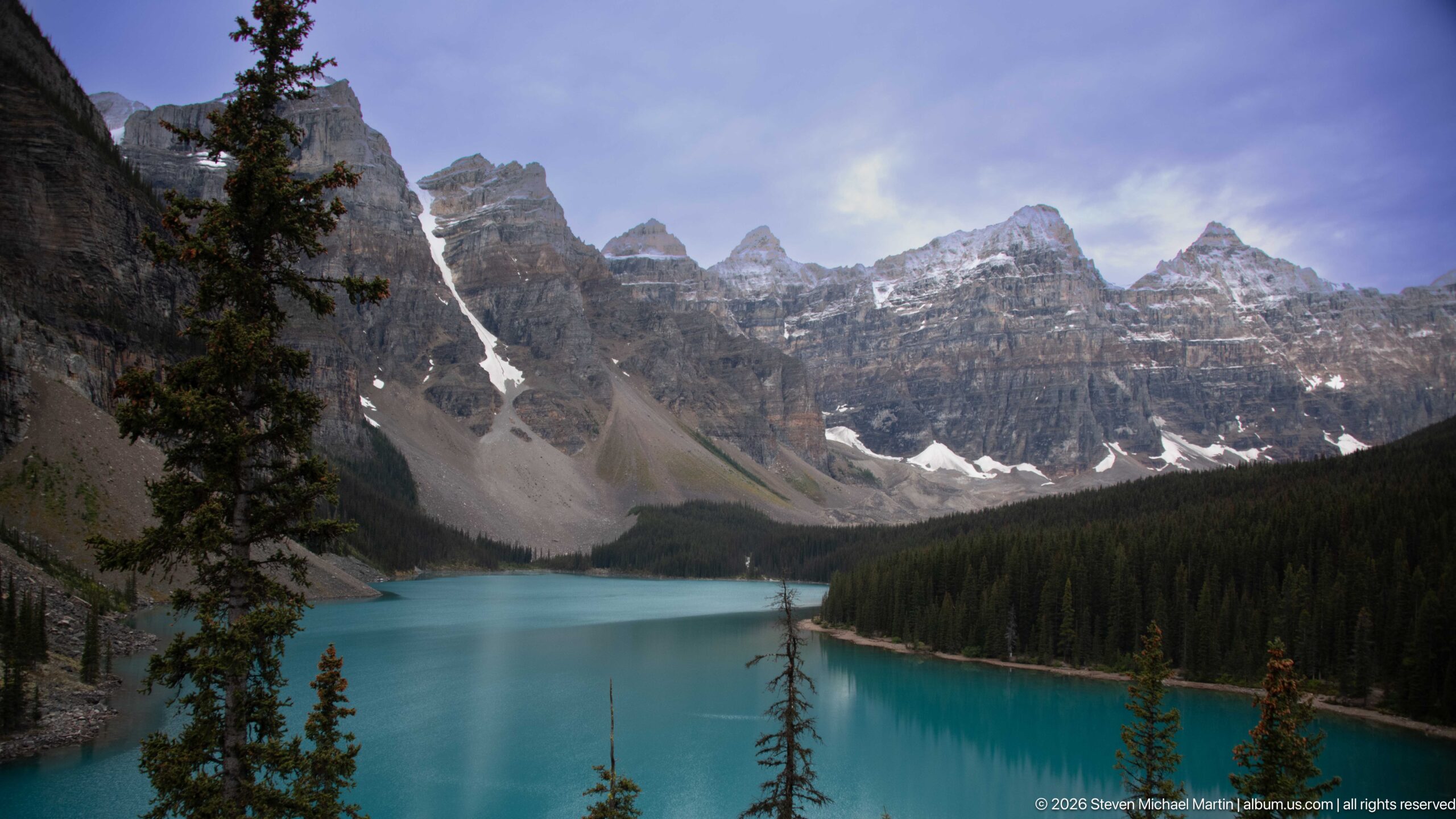
Moraine Lake fills the lower basin beneath a serrated wall of sedimentary peaks, with turquoise water narrowing toward the head of the valley. Conifers frame the foreground and blanket the long shoreline ridge, while scree fans and lingering snowfields descend from the cliffs, revealing the strong contrast between forest, glacial water, and exposed alpine rock.
Caption
Moraine Lake fills the lower basin beneath a serrated wall of sedimentary peaks, with turquoise water narrowing toward the head of the valley. Conifers frame the foreground and blanket the long shoreline ridge, while scree fans and lingering snowfields descend from the cliffs, revealing the strong contrast between forest, glacial water, and exposed alpine rock.
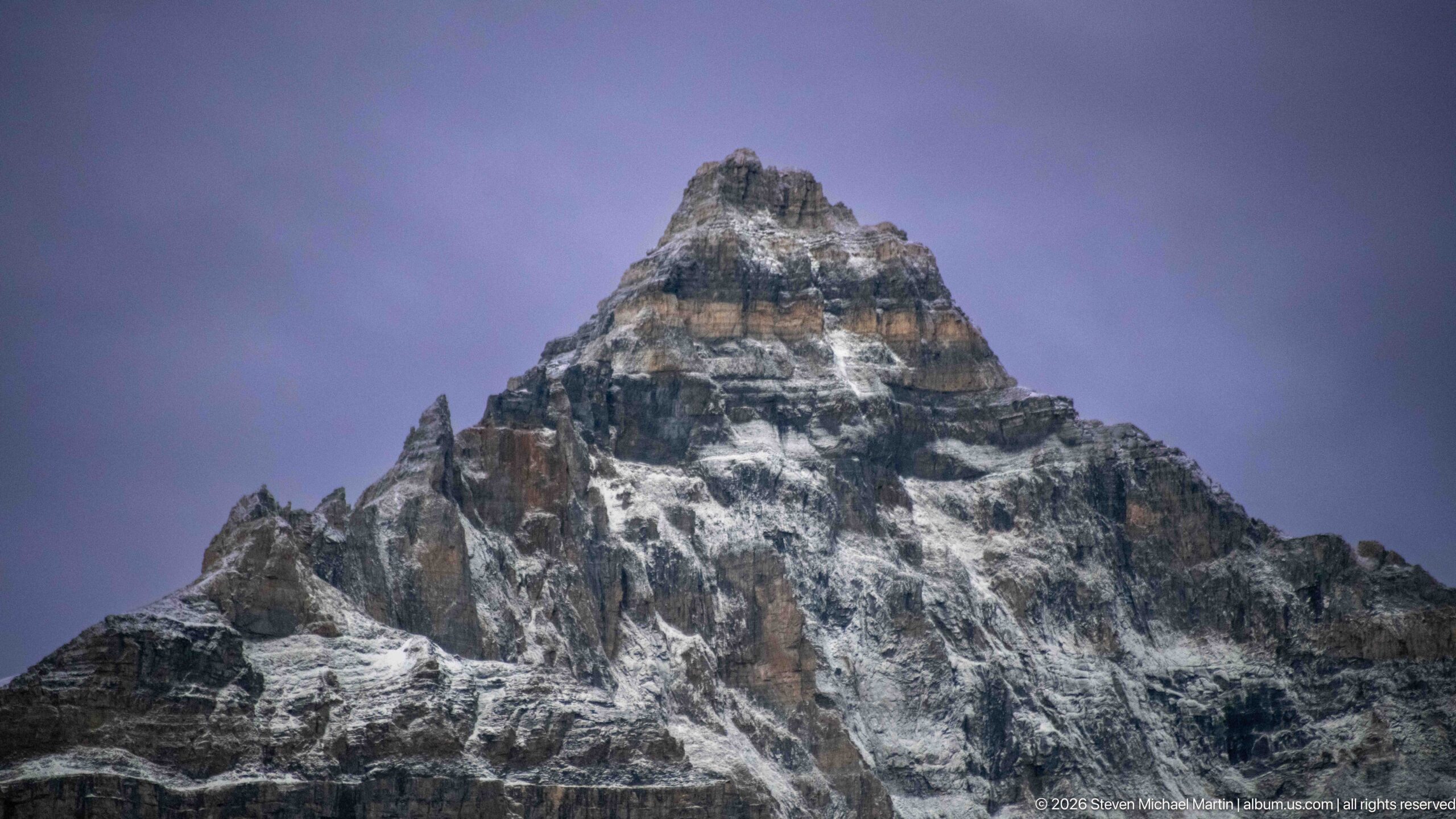
A steep pyramidal summit rises in close view above Moraine Lake, its dark, horizontally bedded rock broken by ledges and streaks of fresh or lingering snow. Cropping away the lake and most of the valley concentrates attention on the mountain’s fractured profile, stratification, and the way snow collects in gullies and shelves across the upper slopes.
Caption
A steep pyramidal summit rises in close view above Moraine Lake, its dark, horizontally bedded rock broken by ledges and streaks of fresh or lingering snow. Cropping away the lake and most of the valley concentrates attention on the mountain’s fractured profile, stratification, and the way snow collects in gullies and shelves across the upper slopes.
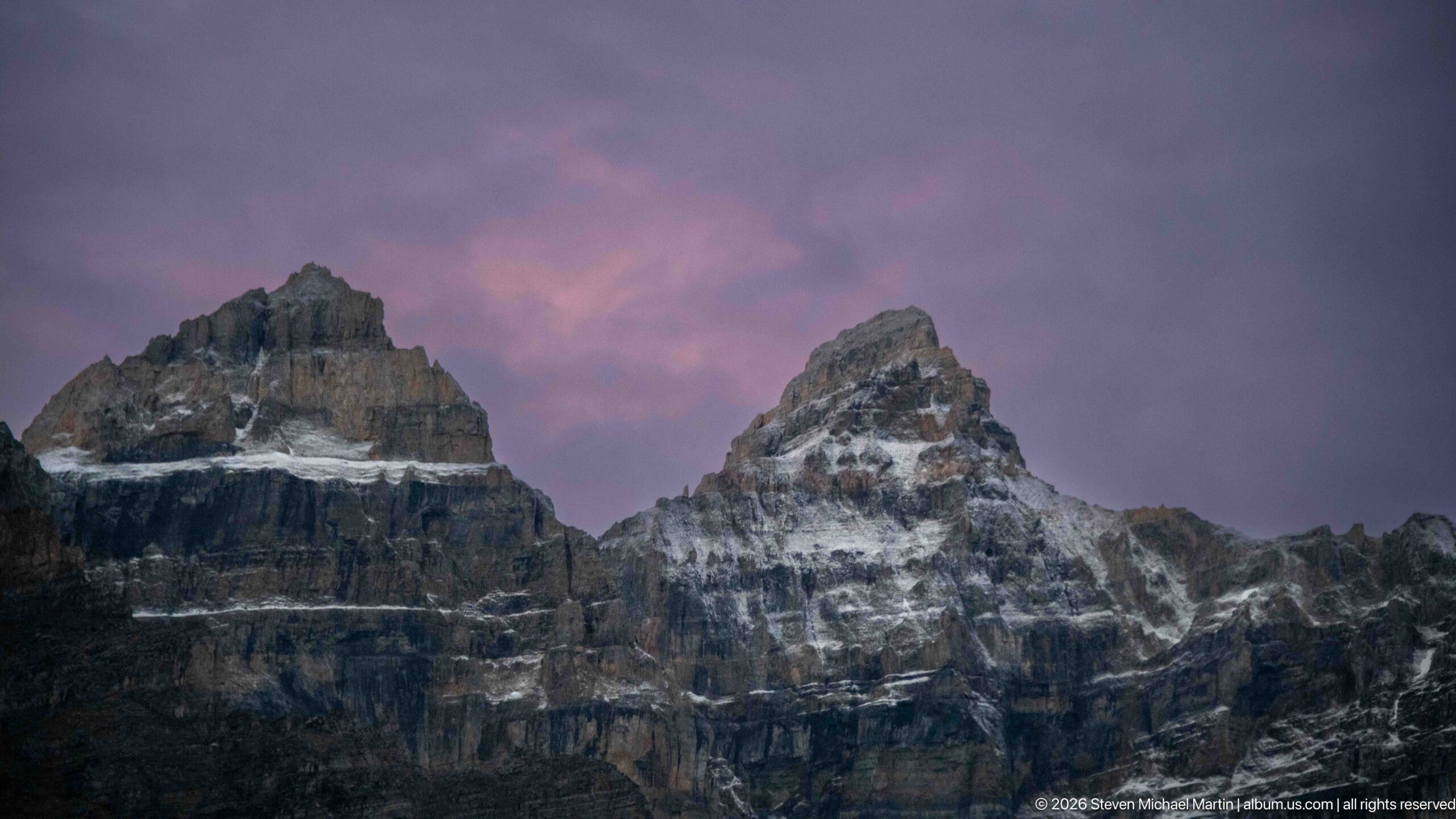
Two rugged summits stand against a mauve evening sky, their ledges and gullies picked out by streaks of snow. The tight composition removes most of the surrounding landscape and focuses on the blocky sedimentary architecture of the peaks, where horizontal bedding contrasts with deeply incised faces and irregular, weathered crests.
Caption
Two rugged summits stand against a mauve evening sky, their ledges and gullies picked out by streaks of snow. The tight composition removes most of the surrounding landscape and focuses on the blocky sedimentary architecture of the peaks, where horizontal bedding contrasts with deeply incised faces and irregular, weathered crests.

A visitor in coordinated pink outdoor clothing pauses on a boulder near Moraine Lake, framed closely against soft-focus conifers. Rather than emphasizing the expansive mountain panorama, this portrait records the human experience of the Rockpile area and the cool-weather clothing typical of an alpine outing at the high-elevation lake.
Caption
A visitor in coordinated pink outdoor clothing pauses on a boulder near Moraine Lake, framed closely against soft-focus conifers. Rather than emphasizing the expansive mountain panorama, this portrait records the human experience of the Rockpile area and the cool-weather clothing typical of an alpine outing at the high-elevation lake.
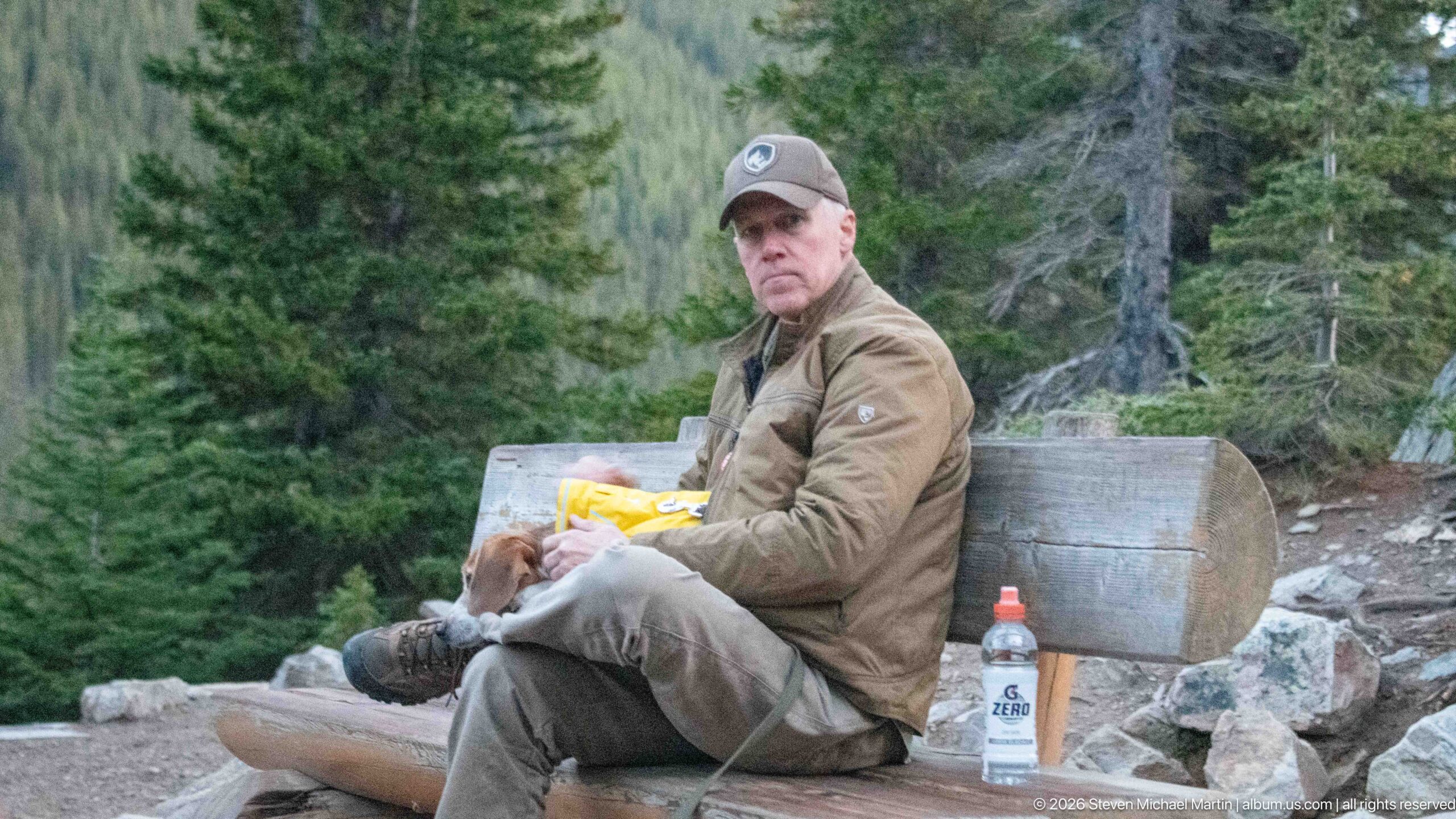
A visitor rests on a rustic log bench in the forested Moraine Lake area, with a snack and drink at hand after walking among the rocky viewpoints. The close portrait places everyday visitor activity within the subalpine setting: rough timber seating, angular stones, spruce and fir, and a steep wooded slope visible beyond.
Caption
A visitor rests on a rustic log bench in the forested Moraine Lake area, with a snack and drink at hand after walking among the rocky viewpoints. The close portrait places everyday visitor activity within the subalpine setting: rough timber seating, angular stones, spruce and fir, and a steep wooded slope visible beyond.
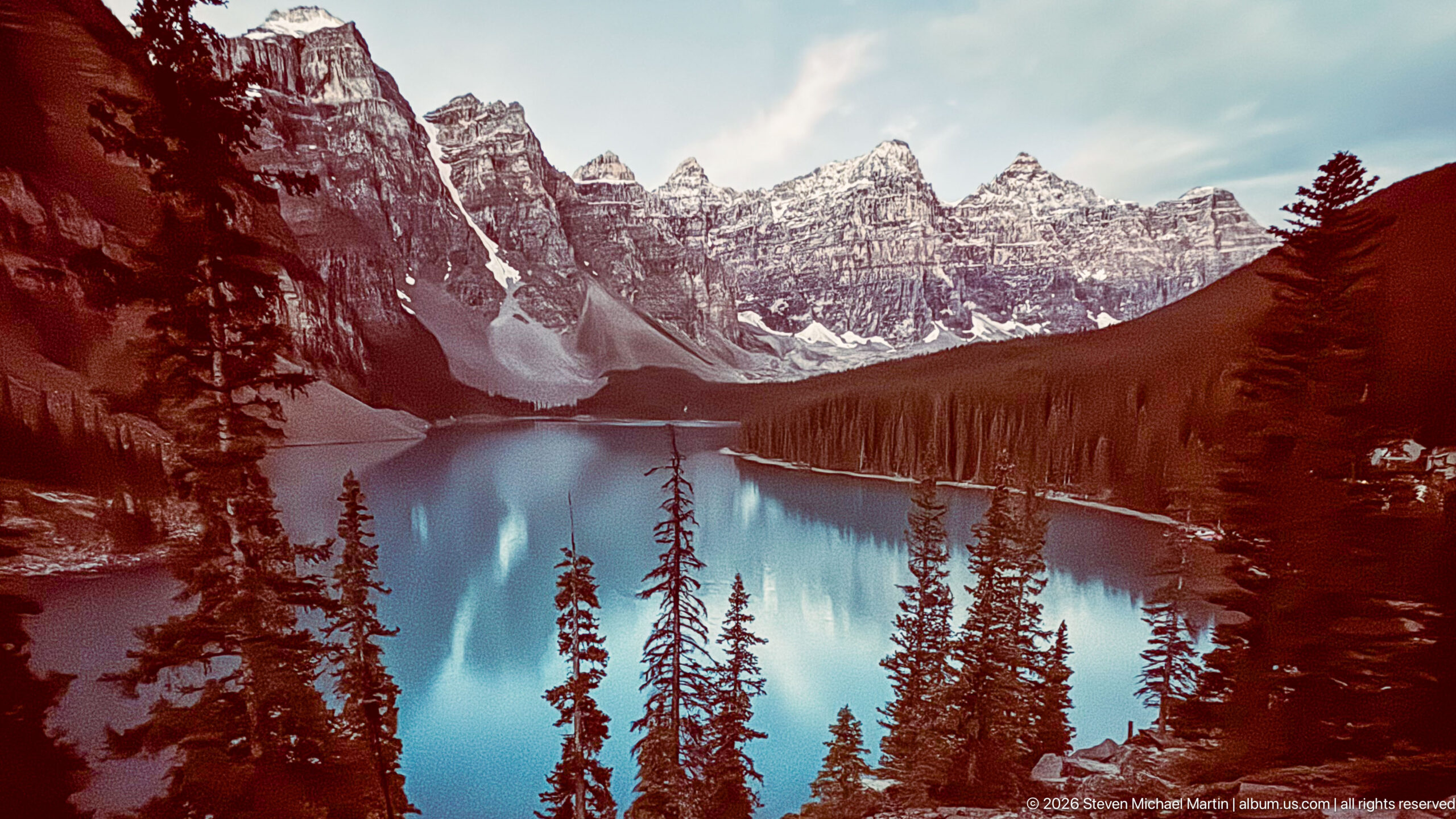
Moraine Lake appears from the Rockpile viewpoint with the Valley of the Ten Peaks spanning the horizon and tall conifers rising from the foreground. A pronounced warm red cast across the slopes contrasts with the bright cyan lake, making this frame distinctive within the sequence while preserving the familiar composition of water, forested shoreline, scree, snow, and enclosing peaks.
Caption
Moraine Lake appears from the Rockpile viewpoint with the Valley of the Ten Peaks spanning the horizon and tall conifers rising from the foreground. A pronounced warm red cast across the slopes contrasts with the bright cyan lake, making this frame distinctive within the sequence while preserving the familiar composition of water, forested shoreline, scree, snow, and enclosing peaks.
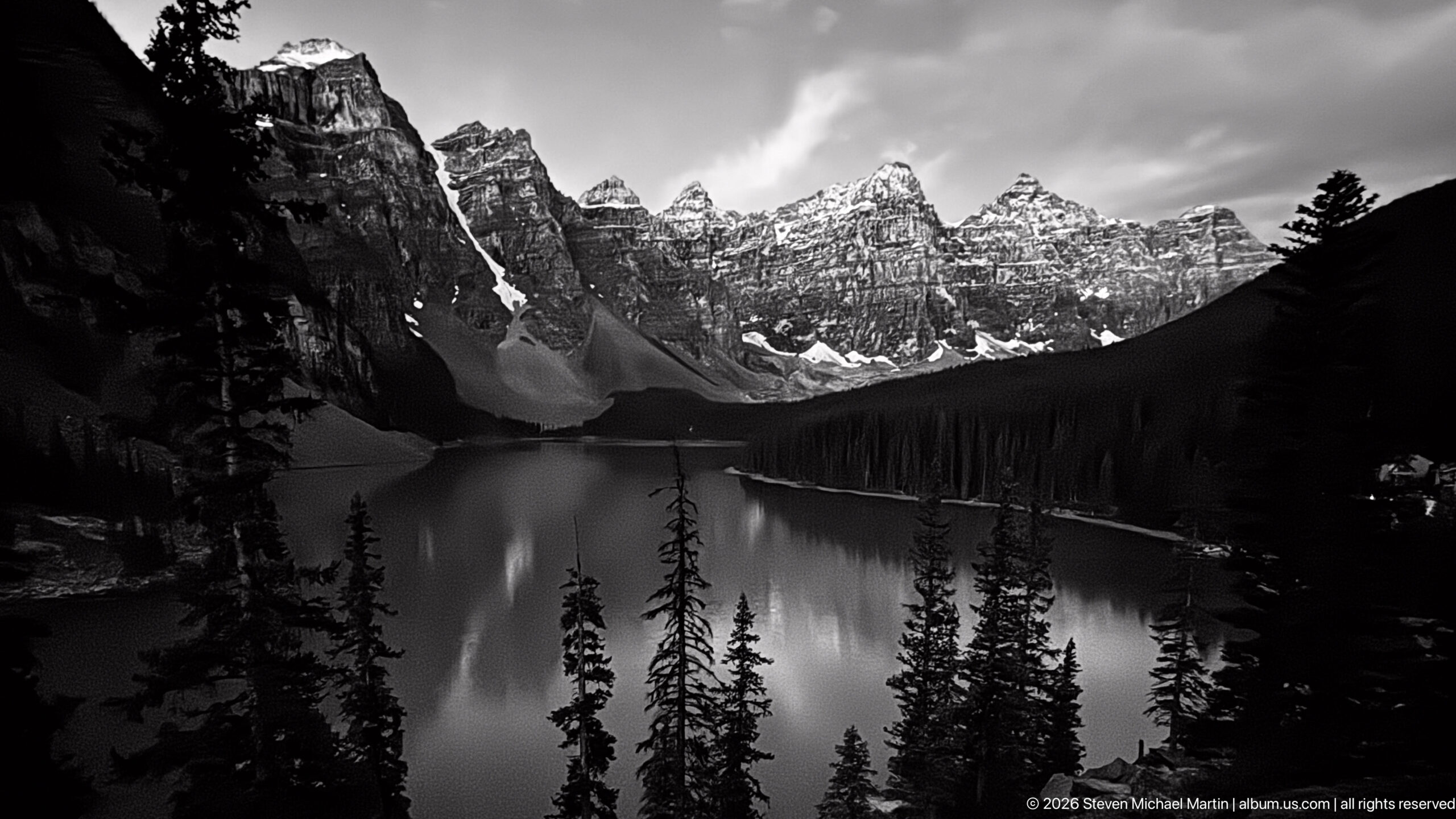
Rendered in black and white, Moraine Lake becomes a dark reflective plane beneath the pale, snow-streaked peaks of the surrounding valley. Foreground conifers form sharp silhouettes against the water, while heavy clouds add tonal weight above the ridgeline. Without the lake’s characteristic turquoise color, the scene foregrounds mountain structure, reflection, and the contrast between forest and exposed rock.
Caption
Rendered in black and white, Moraine Lake becomes a dark reflective plane beneath the pale, snow-streaked peaks of the surrounding valley. Foreground conifers form sharp silhouettes against the water, while heavy clouds add tonal weight above the ridgeline. Without the lake’s characteristic turquoise color, the scene foregrounds mountain structure, reflection, and the contrast between forest and exposed rock.
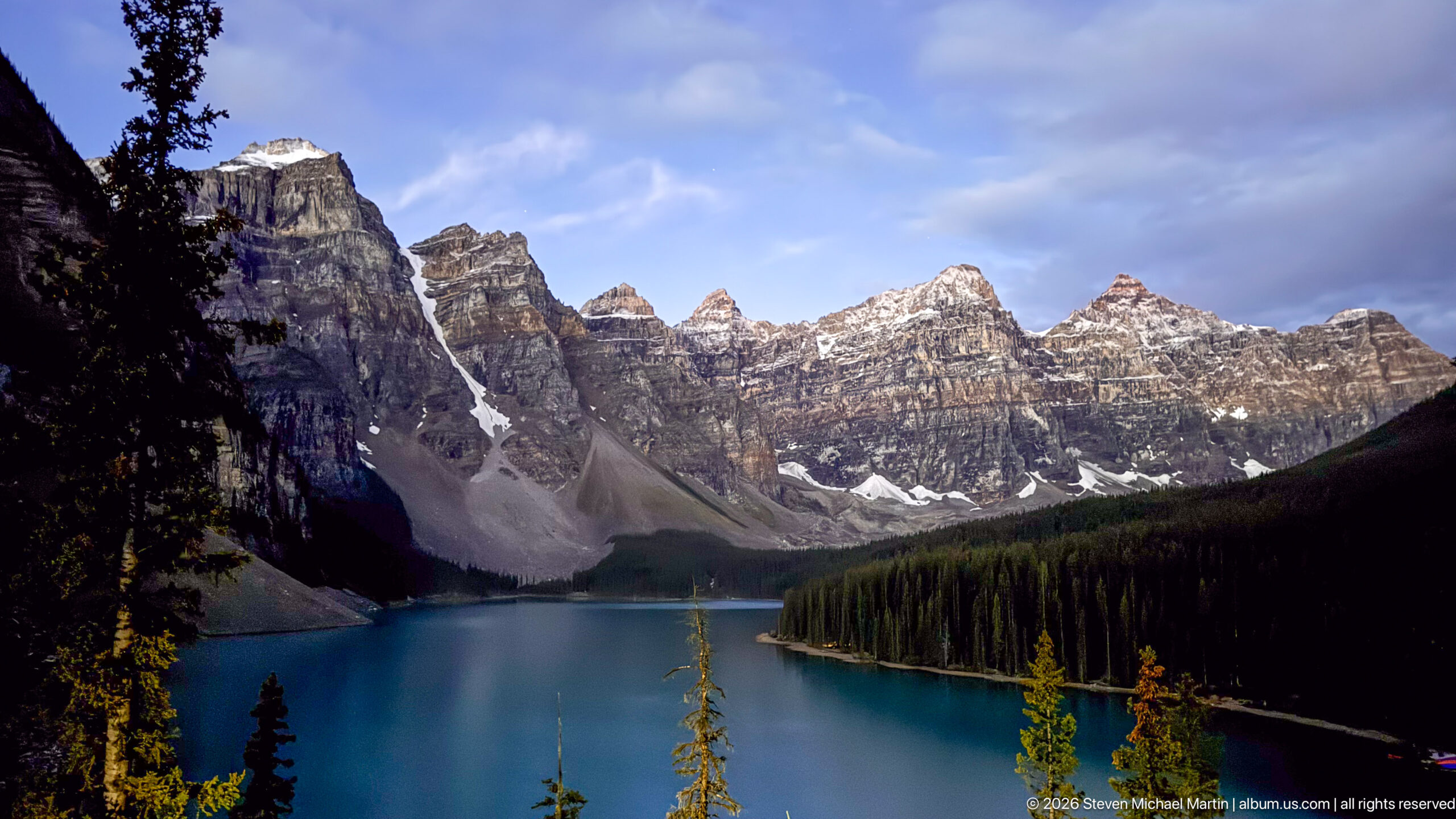
Clearing clouds brighten the layered peaks above Moraine Lake while the lower basin remains partly shaded, creating strong contrast across the classic Rockpile view. The lake occupies the center of the composition between steep scree slopes and a densely forested peninsula-like shoreline, with foreground conifers catching warmer light beneath the expansive mountain skyline.
Caption
Clearing clouds brighten the layered peaks above Moraine Lake while the lower basin remains partly shaded, creating strong contrast across the classic Rockpile view. The lake occupies the center of the composition between steep scree slopes and a densely forested peninsula-like shoreline, with foreground conifers catching warmer light beneath the expansive mountain skyline.
🏞️ National Park Field Guide
📍 Overview
Moraine Lake occupies a high mountain basin in Banff National Park, where turquoise water, dense conifer forest, immense talus slopes, and the serrated skyline of the Valley of the Ten Peaks create one of the Canadian Rockies’ most recognizable landscapes. The portfolio moves beyond the celebrated panorama to examine the lake at several scales: from the Rockpile overlook and shoreline to the lodge, canoe landing, trail network, interpretive displays, wildlife, and individual geological details. Together these views present Moraine Lake as both a dramatic glacial landscape and a carefully managed national-park destination.
🏔️ Landscape
The defining landscape is the relationship between Moraine Lake and the Valley of the Ten Peaks. Elevated views from the Rockpile reveal the lake narrowing into a steep-walled mountain basin, with continuous conifer forest separating the turquoise water from pale scree fans, layered cliffs, snowfields, and rugged summits. Shoreline photographs bring the landscape closer through driftwood, boulders, reflections, and forest, while changing cloud and sunlight repeatedly alter the appearance of the peaks and water. The Rockpile itself is an important part of this setting: a conspicuous accumulation of angular rock that provides the elevated viewpoint from which the lake’s larger topography becomes most legible.
🪨 Geology
Moraine Lake is surrounded by strongly layered sedimentary mountains whose horizontal bedding remains conspicuous even across immense cliff faces. Close views record resistant rock beds, fractured summits, gullies holding lingering snow, loose scree, talus, and large angular blocks. Interpretive panels encountered around the Rockpile connect these visible features with the geological history of the Canadian Rockies, including sedimentation, compression, folding and faulting, erosion, and continuing rockfall. The Rockpile receives particular attention: rather than presenting its origin as settled fact, the interpretation treats the accumulation as a geological problem and compares possible explanations for how such a mass of rock came to occupy the lake’s outlet area.
🌿 Ecology
Moraine Lake lies within a strongly vertical ecological setting, where dense spruce and fir forest around the shoreline gives way rapidly to talus, exposed cliffs, snowfields, and alpine terrain. Fallen timber along the shore provides smaller-scale habitat within this monumental landscape; an interpretive panel specifically asks visitors to remain off shoreline log jams so these structures can continue to shelter organisms and contribute to the lake-edge ecosystem. Common ravens were encountered around the lodge and visitor area, including several birds using railings and other built structures at the forest edge. Their presence illustrates how adaptable wildlife can move between relatively natural habitat and heavily visited portions of a national park.
🦌 Wildlife Encounters
Photographs in this portfolio document wildlife encounters with Common raven in the Jasper landscape. The photographs place these animals in settings that include Common raven near Moraine Lake Lodge, Common raven in profile near Moraine Lake Lodge, and Common raven perched on wooden railing. These encounters provide direct, visit-specific evidence of how wildlife uses the habitats interpreted in this field guide.
🦌 Wildlife
Common ravens were the principal wild animals photographed during the visit. Several were observed around Moraine Lake Lodge, including individual birds perched on concrete and wooden railings and a pair together near late-summer vegetation. Close views show the species’ heavy bill, glossy black plumage, layered wing feathers, and shaggy throat feathers. Their repeated presence around the lodge places these intelligent, adaptable corvids at the boundary between the surrounding mountain forest and Moraine Lake’s developed visitor area.
🧭 Human History
Human interpretation at Moraine Lake records a changing relationship with the landscape. A historical panel titled “A Gloomy Lake / Un lac majestueux” explores the lake’s early naming and the transformation of its public image into that of a celebrated Canadian Rockies destination. Another Rockpile Trail panel, “Behind the Scenery / L’envers du décor,” preserves an unexpected connection between Moraine Lake and Harlequin romance-cover photography, showing how the landscape has also functioned as a setting within popular visual culture. Moraine Lake Lodge, with its substantial timber construction and lakeside accommodation, represents the most prominent built presence in the portfolio, while trails, signs, benches, information shelters, and the canoe operation document the infrastructure through which visitors experience the site.
🥾 Visitor Experience
The experience of Moraine Lake unfolds through a compact but varied developed area at the edge of an immense mountain landscape. Visitors move from the lodge and information kiosk toward the canoe landing, lakeshore paths, and Rockpile, where rough boulders lead to elevated views over the lake and Valley of the Ten Peaks. Trail signs extend that experience outward toward Larch Valley, Minnestimma Lakes, Sentinel Pass, Eiffel Lake, and Wenkchemna Pass. Colorful rental canoes provide another distinctive way of engaging with the lake, while interpretive panels along the visitor routes explain geology, ecology, history, and cultural associations. The photographs also record the practical character of a cool, changeable mountain visit: damp trails, rain gear, crowded viewpoints, places to rest, and rapidly shifting cloud and light.
📷 Photography Notes
Moraine Lake rewards changes in elevation, focal length, and weather. The broad Rockpile panorama establishes the relationship between the turquoise lake and the Valley of the Ten Peaks, but shoreline viewpoints introduce reflections, driftwood, boulders, canoes, and forest as strong foreground elements. Telephoto views isolate sedimentary bedding, snow-filled gullies, and individual summits that can disappear within the larger panorama. The portfolio also demonstrates the value of photographing the developed landscape—lodge architecture, trail signs, interpretive panels, canoe facilities, and visitors—because these details explain how the place is actually experienced. Broken cloud, evening color, and intermittent sunlight provide especially useful variations, revealing different planes of forest, water, scree, and rock rather than repeating a single iconic view.