Bayon Temple
Bayon Temple stands at the center of Angkor Thom and is known for its distinctive towers decorated with large sculpted faces. Constructed during the reign of King Jayavarman VII, the temple reflects the transition toward Mahayana Buddhist influence within the Khmer Empire. Its architectural design emphasizes symbolic representation of spiritual authority and royal legitimacy.
The carved faces are believed to represent either the bodhisattva Avalokiteshvara or the king himself, illustrating the integration of religious devotion and political symbolism. Extensive bas-reliefs depict scenes of daily life, military activity, and ceremonial events. The temple demonstrates the artistic sophistication associated with late Angkorian construction.
Bayon Temple represents a distinctive example of Khmer architectural innovation. Its sculptural features illustrate the combination of religious imagery and royal identity within Angkorian artistic tradition.

Sunlight strikes the upper towers of Bayon Temple above a long, shadowed gallery and central stair. The changing light reveals the sculptural depth of the face towers and clarifies the temple's layered organization from outer enclosure to sanctuary.
Caption
Sunlight strikes the upper towers of Bayon Temple above a long, shadowed gallery and central stair. The changing light reveals the sculptural depth of the face towers and clarifies the temple's layered organization from outer enclosure to sanctuary.
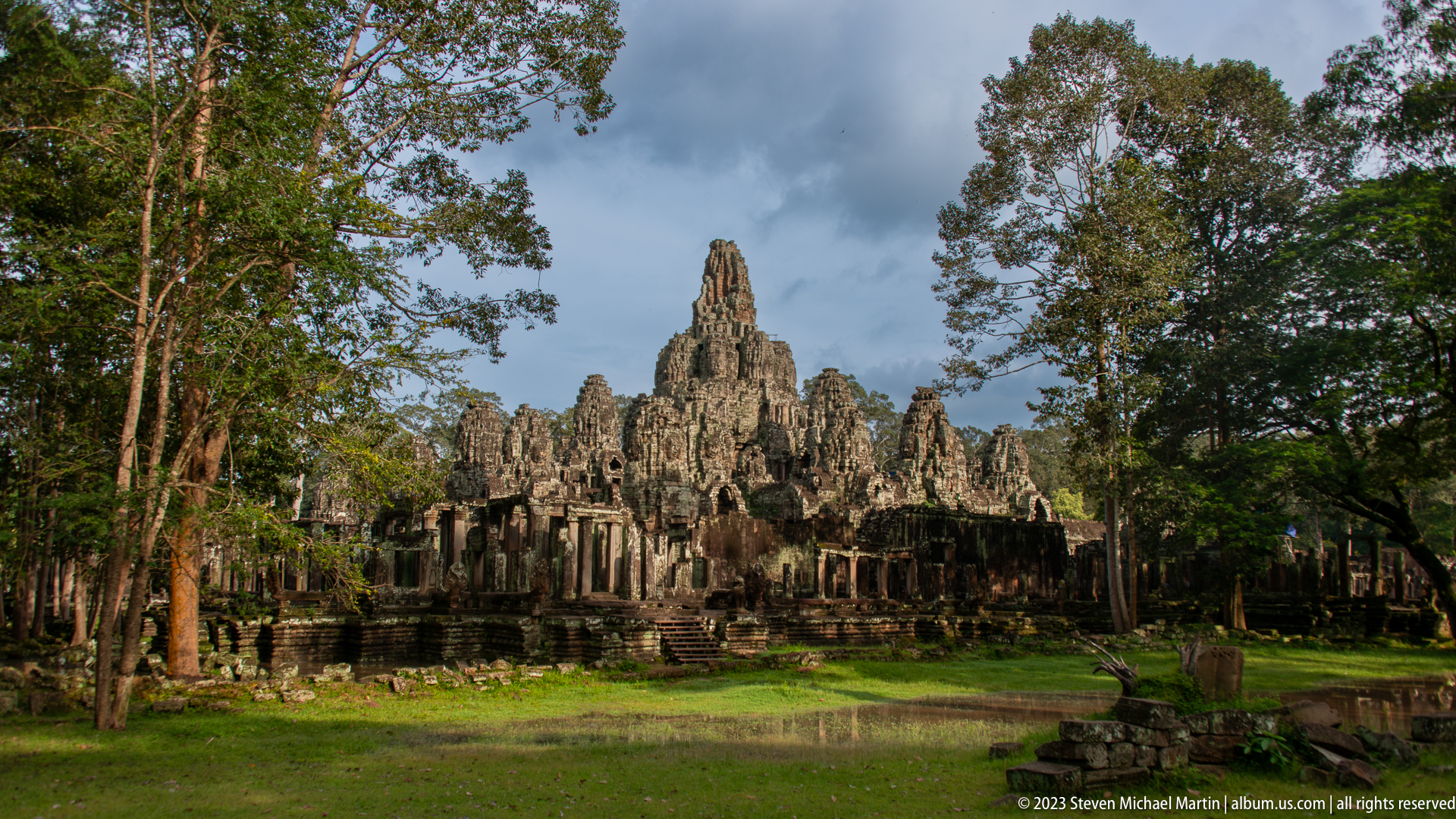
Bayon Temple rises beyond a grassy clearing within Angkor Thom. From this wide viewpoint, the central sanctuary and its face towers emerge above a long base of weathered galleries, revealing the temple's compact, mountain-like silhouette within the forested archaeological landscape.
Caption
Bayon Temple rises beyond a grassy clearing within Angkor Thom. From this wide viewpoint, the central sanctuary and its face towers emerge above a long base of weathered galleries, revealing the temple's compact, mountain-like silhouette within the forested archaeological landscape.

A smiling visitor poses playfully before Bayon's face towers. The shallow depth of field keeps attention on the portrait while preserving the temple's distinctive central skyline as the setting.
Caption
A smiling visitor poses playfully before Bayon's face towers. The shallow depth of field keeps attention on the portrait while preserving the temple's distinctive central skyline as the setting.

A visitor poses before Bayon's central face towers, raising one arm against the temple's weathered skyline. The portrait combines personal travel experience with a clear view of the monument's distinctive architectural setting.
Caption
A visitor poses before Bayon's central face towers, raising one arm against the temple's weathered skyline. The portrait combines personal travel experience with a clear view of the monument's distinctive architectural setting.

Two visitors pose in Bayon Temple's central courtyard, framed by weathered galleries and the face-tower complex. The image combines a personal travel record with a clear view of the temple's monumental setting.
Caption
Two visitors pose in Bayon Temple's central courtyard, framed by weathered galleries and the face-tower complex. The image combines a personal travel record with a clear view of the temple's monumental setting.

An oblique courtyard view at Bayon Temple reveals broken sandstone paving, a freestanding ruined structure, and the long gallery beneath the face towers. The layered composition documents how visitors move through the temple's surviving architectural spaces.
Caption
An oblique courtyard view at Bayon Temple reveals broken sandstone paving, a freestanding ruined structure, and the long gallery beneath the face towers. The layered composition documents how visitors move through the temple's surviving architectural spaces.

An interior court at Bayon Temple is framed by weathered galleries and a raised rectangular structure with surviving window openings. The open paving and shaded side passages reveal the layered, enclosed spatial character of the temple complex.
Caption
An interior court at Bayon Temple is framed by weathered galleries and a raised rectangular structure with surviving window openings. The open paving and shaded side passages reveal the layered, enclosed spatial character of the temple complex.

Two visitors laugh together in front of Bayon's central sanctuary. The close candid framing emphasizes their shared experience while the temple's face towers remain clearly visible in the background.
Caption
Two visitors laugh together in front of Bayon's central sanctuary. The close candid framing emphasizes their shared experience while the temple's face towers remain clearly visible in the background.

A broad stone forecourt leads toward the clustered towers of Bayon Temple beneath a dramatic sky. Visitors gathered near the center provide scale and help reveal the sequence from open courtyard to the densely carved sanctuary.
Caption
A broad stone forecourt leads toward the clustered towers of Bayon Temple beneath a dramatic sky. Visitors gathered near the center provide scale and help reveal the sequence from open courtyard to the densely carved sanctuary.

A wide courtyard view reveals Bayon's central face-tower complex rising above long colonnaded galleries. Stone paths, low balustrades, and a strip of vivid grass organize the foreground, making the temple's layered architectural plan especially legible.
Caption
A wide courtyard view reveals Bayon's central face-tower complex rising above long colonnaded galleries. Stone paths, low balustrades, and a strip of vivid grass organize the foreground, making the temple's layered architectural plan especially legible.

A visitor poses in Bayon Temple's courtyard before a weathered gallery entrance. The central doorway and tower preserve the architectural context while the informal gesture records a personal moment at the site.
Caption
A visitor poses in Bayon Temple's courtyard before a weathered gallery entrance. The central doorway and tower preserve the architectural context while the informal gesture records a personal moment at the site.

A row of stone devas grips the body of a naga along a causeway entering Angkor Thom. The ensemble evokes the Churning of the Ocean of Milk, a major Hindu creation myth adapted into the monumental approach to the Khmer capital. A multi-headed serpent terminal marks the end of the balustrade beside the moat.
Caption
A row of stone devas grips the body of a naga along a causeway entering Angkor Thom. The ensemble evokes the Churning of the Ocean of Milk, a major Hindu creation myth adapted into the monumental approach to the Khmer capital. A multi-headed serpent terminal marks the end of the balustrade beside the moat.

Guardian figures line a causeway across the moat of Angkor Thom, each gripping the long body of a naga. Their alternating states of preservation reveal centuries of weathering as well as later restoration. Together, the figures transform the city entrance into a monumental retelling of the Churning of the Ocean of Milk.
Caption
Guardian figures line a causeway across the moat of Angkor Thom, each gripping the long body of a naga. Their alternating states of preservation reveal centuries of weathering as well as later restoration. Together, the figures transform the city entrance into a monumental retelling of the Churning of the Ocean of Milk.

The approach to Angkor Thom is framed by opposing rows of devas and asuras gripping the body of a naga. Seen along the road’s central axis, the sculptural causeway directs movement across the moat toward the fortified city gate while translating the Churning of the Ocean of Milk into monumental urban design.
Caption
The approach to Angkor Thom is framed by opposing rows of devas and asuras gripping the body of a naga. Seen along the road’s central axis, the sculptural causeway directs movement across the moat toward the fortified city gate while translating the Churning of the Ocean of Milk into monumental urban design.

Three deva figures form part of the sculptural procession along an Angkor Thom causeway. Their tall headdresses and individualized faces enliven the repeated rhythm of the balustrade, while their joined stance reflects their role in grasping the naga during the Churning of the Ocean of Milk.
Caption
Three deva figures form part of the sculptural procession along an Angkor Thom causeway. Their tall headdresses and individualized faces enliven the repeated rhythm of the balustrade, while their joined stance reflects their role in grasping the naga during the Churning of the Ocean of Milk.

A multi-headed naga forms the terminal of a causeway balustrade at Angkor Thom. Its fanned cobra hoods rise above the moat, while the serpent’s body continues along the approach in the hands of guardian figures. In Khmer art, nagas served as powerful protective beings linking water, fertility, kingship, and sacred space.
Caption
A multi-headed naga forms the terminal of a causeway balustrade at Angkor Thom. Its fanned cobra hoods rise above the moat, while the serpent’s body continues along the approach in the hands of guardian figures. In Khmer art, nagas served as powerful protective beings linking water, fertility, kingship, and sacred space.

Two naga terminals project from an Angkor Thom causeway above the moat. This rear oblique view shows how each cluster of cobra hoods joins the long stone body that forms the balustrade. Their placement at the water crossing reinforces the naga’s role as a guardian of thresholds and sacred approaches.
Caption
Two naga terminals project from an Angkor Thom causeway above the moat. This rear oblique view shows how each cluster of cobra hoods joins the long stone body that forms the balustrade. Their placement at the water crossing reinforces the naga’s role as a guardian of thresholds and sacred approaches.

This close portrait of an Angkor Thom causeway guardian emphasizes the individualized carving of the face and headdress. The damaged nose and pale patch across one cheek record the sculpture's complex physical history, while the surviving eyelids, lips, ear ornament, and patterned headdress remain sharply legible.
Caption
This close portrait of an Angkor Thom causeway guardian emphasizes the individualized carving of the face and headdress. The damaged nose and pale patch across one cheek record the sculpture's complex physical history, while the surviving eyelids, lips, ear ornament, and patterned headdress remain sharply legible.

A weathered guardian head from the sculptural causeway at Angkor Thom retains its broad facial features, pendant earrings, and elaborate headdress despite centuries of surface loss. The close view reveals lichen, staining, and softened carving on the sandstone, details that are less apparent in wider views of the procession.
Caption
A weathered guardian head from the sculptural causeway at Angkor Thom retains its broad facial features, pendant earrings, and elaborate headdress despite centuries of surface loss. The close view reveals lichen, staining, and softened carving on the sandstone, details that are less apparent in wider views of the procession.

A long procession of monumental guardians lines the Angkor Thom causeway, each seated figure gripping the body of a naga that forms the balustrade. The oblique view emphasizes the repeated rhythm of the sculptures while also showing differences in preservation, replacement, and surface weathering along the approach.
Caption
A long procession of monumental guardians lines the Angkor Thom causeway, each seated figure gripping the body of a naga that forms the balustrade. The oblique view emphasizes the repeated rhythm of the sculptures while also showing differences in preservation, replacement, and surface weathering along the approach.

Four guardian heads on the Angkor Thom causeway display different facial types, headdress profiles, and states of preservation. Their contrasting surfaces—some dark and relatively intact, others pale and lichen-covered—make the photograph especially useful for comparing original carving, weathering, and restoration within the sculptural procession.
Caption
Four guardian heads on the Angkor Thom causeway display different facial types, headdress profiles, and states of preservation. Their contrasting surfaces—some dark and relatively intact, others pale and lichen-covered—make the photograph especially useful for comparing original carving, weathering, and restoration within the sculptural procession.

Four seated guardians grip the naga balustrade along the Angkor Thom causeway. Seen frontally, the group reveals substantial differences in facial survival, headdress design, body loss, and repair, making the photograph a clear record of how repeated sculptural figures have weathered and been restored over time.
Caption
Four seated guardians grip the naga balustrade along the Angkor Thom causeway. Seen frontally, the group reveals substantial differences in facial survival, headdress design, body loss, and repair, making the photograph a clear record of how repeated sculptural figures have weathered and been restored over time.

A frontal portrait of an Angkor Thom causeway guardian centers attention on the calm expression, narrow eyes, and broad patterned headdress. Although the nose has been damaged, the lips, eyelids, ears, and ornamental bands remain legible, preserving much of the sculpture's formal character.
Caption
A frontal portrait of an Angkor Thom causeway guardian centers attention on the calm expression, narrow eyes, and broad patterned headdress. Although the nose has been damaged, the lips, eyelids, ears, and ornamental bands remain legible, preserving much of the sculpture's formal character.

A close portrait of an Angkor Thom causeway guardian isolates the serene face, narrow eyes, and rounded patterned headdress. The relatively smooth surface and intact ear ornaments make this one of the clearest sculptural studies in the sequence.
Caption
A close portrait of an Angkor Thom causeway guardian isolates the serene face, narrow eyes, and rounded patterned headdress. The relatively smooth surface and intact ear ornaments make this one of the clearest sculptural studies in the sequence.

A monumental gate of Angkor Thom spans the roadway with a tall pointed passage beneath weathered face towers. The frontal view emphasizes the gate's role as both an architectural threshold and a sculptural statement marking entry into the fortified royal city.
Caption
A monumental gate of Angkor Thom spans the roadway with a tall pointed passage beneath weathered face towers. The frontal view emphasizes the gate's role as both an architectural threshold and a sculptural statement marking entry into the fortified royal city.

Five guardian heads on the Angkor Thom causeway reveal striking differences in carving, damage, and restoration. Broken noses, lichen-covered surfaces, and contrasting headdresses turn the group into a compact study of the procession's varied state of preservation.
Caption
Five guardian heads on the Angkor Thom causeway reveal striking differences in carving, damage, and restoration. Broken noses, lichen-covered surfaces, and contrasting headdresses turn the group into a compact study of the procession's varied state of preservation.

A long row of seated guardians recedes along the Angkor Thom causeway, their bodies aligned beside the roadway as they hold the naga balustrade. The oblique composition emphasizes repetition, scale, and the mixture of surviving and restored elements.
Caption
A long row of seated guardians recedes along the Angkor Thom causeway, their bodies aligned beside the roadway as they hold the naga balustrade. The oblique composition emphasizes repetition, scale, and the mixture of surviving and restored elements.

Seen from the side, guardians along the Angkor Thom causeway grasp the long body of a naga that forms the balustrade. The adjacent water and repeated seated figures clarify the sculptural ensemble's physical arrangement more effectively than a frontal view.
Caption
Seen from the side, guardians along the Angkor Thom causeway grasp the long body of a naga that forms the balustrade. The adjacent water and repeated seated figures clarify the sculptural ensemble's physical arrangement more effectively than a frontal view.

A monumental face tower rises above the surrounding trees, its serene carved visage emerging from weathered sandstone blocks. The vertical composition highlights the tower's layered massing and the scale of the face in relation to the architecture.
Caption
A monumental face tower rises above the surrounding trees, its serene carved visage emerging from weathered sandstone blocks. The vertical composition highlights the tower's layered massing and the scale of the face in relation to the architecture.

Seven seated guardians form a tightly ordered row against the stone wall of the Angkor Thom approach. Differences in facial carving, headdress shape, surface color, and repaired body blocks make the group especially useful for comparing individual sculptures within the larger procession.
Caption
Seven seated guardians form a tightly ordered row against the stone wall of the Angkor Thom approach. Differences in facial carving, headdress shape, surface color, and repaired body blocks make the group especially useful for comparing individual sculptures within the larger procession.

A low-angle view of an Angkor Thom gate tower shows a monumental face integrated into the sandstone masonry above a narrow passage. The photograph emphasizes the vertical scale of the tower and the way sculpture and architecture form a single composition.
Caption
A low-angle view of an Angkor Thom gate tower shows a monumental face integrated into the sandstone masonry above a narrow passage. The photograph emphasizes the vertical scale of the tower and the way sculpture and architecture form a single composition.

A serene face carved into an Angkor Thom tower emerges beneath stacked ornamental stonework. The lowered eyes and softened features remain legible despite heavy weathering, lichen, and surface loss across the sandstone.
Caption
A serene face carved into an Angkor Thom tower emerges beneath stacked ornamental stonework. The lowered eyes and softened features remain legible despite heavy weathering, lichen, and surface loss across the sandstone.

A weathered stone guardian animal stands beside the temple approach, its compact body and open mouth still recognizable despite extensive surface loss, lichen, and staining. The close view records the sculpture's material condition in detail.
Caption
A weathered stone guardian animal stands beside the temple approach, its compact body and open mouth still recognizable despite extensive surface loss, lichen, and staining. The close view records the sculpture's material condition in detail.

A standing female divinity—likely a devata or apsara—is carved within an ornate architectural panel at Bayon Temple. Her elaborate coiffure, jewelry, and composed frontal pose survive clearly despite staining and surface wear around the relief.
Caption
A standing female divinity—likely a devata or apsara—is carved within an ornate architectural panel at Bayon Temple. Her elaborate coiffure, jewelry, and composed frontal pose survive clearly despite staining and surface wear around the relief.

An Angkor Thom city gate rises above the road in a broad frontal view, its pointed passage framed by massive weathered towers and forest. Small visitors beneath the arch provide a clear sense of the monument's scale.
Caption
An Angkor Thom city gate rises above the road in a broad frontal view, its pointed passage framed by massive weathered towers and forest. Small visitors beneath the arch provide a clear sense of the monument's scale.

Set within a wooded landscape, an Angkor Thom gate anchors the end of the approach road. The wider framing places the sculptural tower, grassy embankments, and towering trees into a single view, showing how the gateway is embedded in the surrounding forest.
Caption
Set within a wooded landscape, an Angkor Thom gate anchors the end of the approach road. The wider framing places the sculptural tower, grassy embankments, and towering trees into a single view, showing how the gateway is embedded in the surrounding forest.

A row of weathered guardian animals stands along the Angkor Thom approach, their raised heads and open mouths creating a repeated protective motif. Lichen and surface loss soften the carved details but preserve the figures' strong silhouettes.
Caption
A row of weathered guardian animals stands along the Angkor Thom approach, their raised heads and open mouths creating a repeated protective motif. Lichen and surface loss soften the carved details but preserve the figures' strong silhouettes.

A group of visitors in formal traditional dress poses beneath a parasol at Bayon Temple. Their colorful garments, jewelry, and floral accessories create a vivid contemporary counterpoint to the weathered stone architecture behind them.
Caption
A group of visitors in formal traditional dress poses beneath a parasol at Bayon Temple. Their colorful garments, jewelry, and floral accessories create a vivid contemporary counterpoint to the weathered stone architecture behind them.

A weathered female divinity occupies a narrow carved panel, framed by vertical moldings and darker stone. Although the face is softened by age, the tall headdress, jewelry, and graceful stance remain legible as hallmarks of Khmer sacred ornament.
Caption
A weathered female divinity occupies a narrow carved panel, framed by vertical moldings and darker stone. Although the face is softened by age, the tall headdress, jewelry, and graceful stance remain legible as hallmarks of Khmer sacred ornament.

Two elaborately coiffed women face one another in a Bayon bas-relief, their hands arranged around a central object above fish and flowing aquatic forms. The scene demonstrates the narrative richness and fine linear carving of Khmer stone relief.
Caption
Two elaborately coiffed women face one another in a Bayon bas-relief, their hands arranged around a central object above fish and flowing aquatic forms. The scene demonstrates the narrative richness and fine linear carving of Khmer stone relief.

A monumental face emerges from the weathered blocks of a Bayon tower beneath a broken upper crown. The close upward view reveals both the serene sculptural image and the irregular masonry exposed by centuries of collapse and erosion.
Caption
A monumental face emerges from the weathered blocks of a Bayon tower beneath a broken upper crown. The close upward view reveals both the serene sculptural image and the irregular masonry exposed by centuries of collapse and erosion.

A Khmer bas-relief depicts a compact procession of standing figures carrying long staffs or weapons. The overlapping bodies, repeated profiles, and surviving costume details suggest an organized military or ceremonial scene within Bayon's extensive narrative program.
Caption
A Khmer bas-relief depicts a compact procession of standing figures carrying long staffs or weapons. The overlapping bodies, repeated profiles, and surviving costume details suggest an organized military or ceremonial scene within Bayon's extensive narrative program.

A serene monumental face occupies the lower portion of a Bayon tower, its closed eyes and full lips carved directly into the sandstone architecture. Lichen and weathering across the upper blocks reinforce the tower's age without obscuring its calm expression.
Caption
A serene monumental face occupies the lower portion of a Bayon tower, its closed eyes and full lips carved directly into the sandstone architecture. Lichen and weathering across the upper blocks reinforce the tower's age without obscuring its calm expression.

A small devotional shrine within Bayon Temple centers on a seated Buddha draped in gold cloth beneath a ceremonial parasol. Flowers, signs, and donation boxes show the continued religious use of the ancient stone chamber.
Caption
A small devotional shrine within Bayon Temple centers on a seated Buddha draped in gold cloth beneath a ceremonial parasol. Flowers, signs, and donation boxes show the continued religious use of the ancient stone chamber.

A dark passage at Bayon Temple frames a view of ruined towers and a projecting gallery roof beyond. The contrast between shadowed interior and sunlit masonry reveals the temple's layered circulation and complex sequence of enclosed spaces.
Caption
A dark passage at Bayon Temple frames a view of ruined towers and a projecting gallery roof beyond. The contrast between shadowed interior and sunlit masonry reveals the temple's layered circulation and complex sequence of enclosed spaces.

A close detail from Bayon's narrative reliefs isolates a crouching or kneeling figure beneath larger overlapping bodies. Deeply incised contours and compressed spacing convey movement and hierarchy, though the fragmentary crop makes the precise episode uncertain.
Caption
A close detail from Bayon's narrative reliefs isolates a crouching or kneeling figure beneath larger overlapping bodies. Deeply incised contours and compressed spacing convey movement and hierarchy, though the fragmentary crop makes the precise episode uncertain.

Faded seated figures appear beneath arched frames on a worn interior panel, where traces of red and green pigment survive across the stone. The image records a rare layer of color and later devotional activity within the temple complex.
Caption
Faded seated figures appear beneath arched frames on a worn interior panel, where traces of red and green pigment survive across the stone. The image records a rare layer of color and later devotional activity within the temple complex.

Broad green and red pigment patches survive across a heavily weathered carved panel at Bayon Temple. Although the underlying imagery is difficult to resolve, the photograph provides valuable evidence of color, staining, and surface deterioration within the interior.
Caption
Broad green and red pigment patches survive across a heavily weathered carved panel at Bayon Temple. Although the underlying imagery is difficult to resolve, the photograph provides valuable evidence of color, staining, and surface deterioration within the interior.

A carved panel of seated figures and shrine-like architecture retains vivid green pigment streaks across its weathered surface. The surviving color and layered architectural bands make the image useful for documenting both iconography and material condition.
Caption
A carved panel of seated figures and shrine-like architecture retains vivid green pigment streaks across its weathered surface. The surviving color and layered architectural bands make the image useful for documenting both iconography and material condition.

Narrative bas-reliefs cover the adjoining wall panels of a Bayon gallery, where raking light reveals layers of figures, gestures, and activity. The angled view shows how separate stone blocks combine into an extended visual chronicle across the temple interior.
Caption
Narrative bas-reliefs cover the adjoining wall panels of a Bayon gallery, where raking light reveals layers of figures, gestures, and activity. The angled view shows how separate stone blocks combine into an extended visual chronicle across the temple interior.

A densely carved Bayon relief centers on a seated figure surrounded by attendants, raised arms, and ceremonial objects. The compact composition suggests a courtly or ritual episode, while the surviving gestures and equipment preserve much of the scene's narrative energy.
Caption
A densely carved Bayon relief centers on a seated figure surrounded by attendants, raised arms, and ceremonial objects. The compact composition suggests a courtly or ritual episode, while the surviving gestures and equipment preserve much of the scene's narrative energy.

A close detail from Bayon's narrative bas-reliefs shows overlapping standing figures, including one with both arms raised. The compressed arrangement, surviving jewelry, and strongly outlined gestures preserve the energy of a larger narrative scene even though the precise episode is not identifiable from this fragment.
Caption
A close detail from Bayon's narrative bas-reliefs shows overlapping standing figures, including one with both arms raised. The compressed arrangement, surviving jewelry, and strongly outlined gestures preserve the energy of a larger narrative scene even though the precise episode is not identifiable from this fragment.

A multi-figure Khmer relief centers on a seated figure beneath an architectural canopy, with attendants arranged to either side. The composition uses symmetry and hierarchy to distinguish the principal figure from the surrounding courtly or devotional participants.
Caption
A multi-figure Khmer relief centers on a seated figure beneath an architectural canopy, with attendants arranged to either side. The composition uses symmetry and hierarchy to distinguish the principal figure from the surrounding courtly or devotional participants.

Small carved figures appear beneath dense architectural and foliate ornament in a heavily weathered Bayon panel. Moss and lichen occupy the recesses, softening the imagery while clearly documenting the interaction between sculpture, moisture, and biological growth.
Caption
Small carved figures appear beneath dense architectural and foliate ornament in a heavily weathered Bayon panel. Moss and lichen occupy the recesses, softening the imagery while clearly documenting the interaction between sculpture, moisture, and biological growth.

A standing Khmer female divinity is carved within a narrow architectural niche, her coiffure, jewelry, and graceful pose still clearly visible. A darker, more damaged neighboring figure underscores the varied preservation of the temple's sculptural decoration.
Caption
A standing Khmer female divinity is carved within a narrow architectural niche, her coiffure, jewelry, and graceful pose still clearly visible. A darker, more damaged neighboring figure underscores the varied preservation of the temple's sculptural decoration.

A monumental Bayon face stretches across the weathered blocks of a temple tower, its lowered eyes and full lips forming the characteristic serene expression. Open joints, lichen, and vegetation reveal the masonry construction and long exposure of the sculpture.
Caption
A monumental Bayon face stretches across the weathered blocks of a temple tower, its lowered eyes and full lips forming the characteristic serene expression. Open joints, lichen, and vegetation reveal the masonry construction and long exposure of the sculpture.

Three standing female divinities occupy adjacent niches at Bayon Temple, each distinguished by an elaborate coiffure, jewelry, and graceful pose. Their repeated arrangement creates a rhythmic sculptural sequence within the temple's architectural decoration.
Caption
Three standing female divinities occupy adjacent niches at Bayon Temple, each distinguished by an elaborate coiffure, jewelry, and graceful pose. Their repeated arrangement creates a rhythmic sculptural sequence within the temple's architectural decoration.

A long-tailed macaque walks along a lichen-covered wall at Bayon Temple. The photograph records the presence of wildlife within the archaeological landscape, where forest animals routinely move through and across the ancient masonry.
Caption
A long-tailed macaque walks along a lichen-covered wall at Bayon Temple. The photograph records the presence of wildlife within the archaeological landscape, where forest animals routinely move through and across the ancient masonry.

Three monumental faces emerge from adjoining sides of a Bayon tower, revealing how the temple's sculptural program wraps around the architecture. Their overlapping profiles, carved headdresses, and mottled surfaces create one of the site's most distinctive visual effects.
Caption
Three monumental faces emerge from adjoining sides of a Bayon tower, revealing how the temple's sculptural program wraps around the architecture. Their overlapping profiles, carved headdresses, and mottled surfaces create one of the site's most distinctive visual effects.

An extreme side view isolates the projecting profile of a Bayon face against the sky. The monumental nose, lips, and cheek emerge directly from the tower masonry, demonstrating how the sculptors shaped architecture into a colossal human presence.
Caption
An extreme side view isolates the projecting profile of a Bayon face against the sky. The monumental nose, lips, and cheek emerge directly from the tower masonry, demonstrating how the sculptors shaped architecture into a colossal human presence.

Several face towers rise together in the central complex of Bayon Temple, their monumental visages appearing at different heights and angles. The clustered composition captures the dense, almost sculptural skyline that distinguishes the sanctuary from other Angkorian temples.
Caption
Several face towers rise together in the central complex of Bayon Temple, their monumental visages appearing at different heights and angles. The clustered composition captures the dense, almost sculptural skyline that distinguishes the sanctuary from other Angkorian temples.

A frontal Bayon face fills the tower surface with lowered eyes, broad features, and a composed expression. The close view preserves the formal symmetry of the carving while also revealing block joints, lichen, and small losses across the sandstone.
Caption
A frontal Bayon face fills the tower surface with lowered eyes, broad features, and a composed expression. The close view preserves the formal symmetry of the carving while also revealing block joints, lichen, and small losses across the sandstone.

A dense Bayon bas-relief unfolds across multiple stone blocks, combining human figures, animals, and ornamental forms in a tightly packed narrative. The complex scene demonstrates the scale and visual richness of the temple's historical and mythological relief program.
Caption
A dense Bayon bas-relief unfolds across multiple stone blocks, combining human figures, animals, and ornamental forms in a tightly packed narrative. The complex scene demonstrates the scale and visual richness of the temple's historical and mythological relief program.

Two monumental faces occupy adjoining planes of a Bayon tower, one facing forward and the other turning around the corner. The view clearly demonstrates the multi-directional design of the face towers and the way sculpture is integrated with architectural geometry.
Caption
Two monumental faces occupy adjoining planes of a Bayon tower, one facing forward and the other turning around the corner. The view clearly demonstrates the multi-directional design of the face towers and the way sculpture is integrated with architectural geometry.

Multiple face towers rise from the dense masonry of Bayon Temple's central sanctuary. Their monumental visages appear at different levels and orientations, producing the complex, crowded skyline that defines the temple's architecture.
Caption
Multiple face towers rise from the dense masonry of Bayon Temple's central sanctuary. Their monumental visages appear at different levels and orientations, producing the complex, crowded skyline that defines the temple's architecture.

A broad section of Bayon's narrative reliefs brings together figures, animals, and ornamental forms across a patchwork of weathered stone blocks. Multiple registers and overlapping scenes suggest the continuous storytelling characteristic of the temple's sculpted galleries.
Caption
A broad section of Bayon's narrative reliefs brings together figures, animals, and ornamental forms across a patchwork of weathered stone blocks. Multiple registers and overlapping scenes suggest the continuous storytelling characteristic of the temple's sculpted galleries.

Rows of figures move across several registers in a Bayon bas-relief, carrying long objects and repeating processional poses. The tightly organized composition likely records military or ceremonial activity, though the exact episode requires specialist confirmation.
Caption
Rows of figures move across several registers in a Bayon bas-relief, carrying long objects and repeating processional poses. The tightly organized composition likely records military or ceremonial activity, though the exact episode requires specialist confirmation.

A principal seated figure dominates this Bayon relief, surrounded by smaller attendants and framed by architectural forms. The differences in scale and posture create a clear hierarchy, suggesting a courtly, ceremonial, or devotional episode.
Caption
A principal seated figure dominates this Bayon relief, surrounded by smaller attendants and framed by architectural forms. The differences in scale and posture create a clear hierarchy, suggesting a courtly, ceremonial, or devotional episode.

A monumental doorway opens into the shadowed interior of Bayon Temple, framed by massive stone supports and weathered steps. Broken masonry above the entrance reveals the ruinous condition of the upper structure while preserving the imposing scale of the original architecture.
Caption
A monumental doorway opens into the shadowed interior of Bayon Temple, framed by massive stone supports and weathered steps. Broken masonry above the entrance reveals the ruinous condition of the upper structure while preserving the imposing scale of the original architecture.

A weathered decorative panel combines a female figure, scrolling foliage, and animal or mythic forms in dense Khmer carving. Lichen and surface loss obscure parts of the design but also emphasize the relief's intricate depth and layered ornament.
Caption
A weathered decorative panel combines a female figure, scrolling foliage, and animal or mythic forms in dense Khmer carving. Lichen and surface loss obscure parts of the design but also emphasize the relief's intricate depth and layered ornament.

A slender female or divine figure is carved into a moss-covered pillar, surrounded by dense foliate ornament. The surviving headdress, jewelry, and curved pose remain legible despite biological growth that softens the relief's finer details.
Caption
A slender female or divine figure is carved into a moss-covered pillar, surrounded by dense foliate ornament. The surviving headdress, jewelry, and curved pose remain legible despite biological growth that softens the relief's finer details.

A long sequence of aligned stone doorways creates a deep axial view through Bayon Temple. Repeated frames, worn paving, and a small devotional object in the distance reveal both the architecture's careful planning and its continued religious use.
Caption
A long sequence of aligned stone doorways creates a deep axial view through Bayon Temple. Repeated frames, worn paving, and a small devotional object in the distance reveal both the architecture's careful planning and its continued religious use.

A seated Buddha draped in gold cloth occupies the center of an axial corridor at Bayon Temple. The aligned doorframes and weathered masonry create a formal architectural setting for a shrine that reflects the site's continuing Buddhist significance.
Caption
A seated Buddha draped in gold cloth occupies the center of an axial corridor at Bayon Temple. The aligned doorframes and weathered masonry create a formal architectural setting for a shrine that reflects the site's continuing Buddhist significance.

A closer view centers on a seated Buddha draped in a bright gold sash within Bayon Temple. The calm figure, layered stone base, and green-stained doorway combine ancient sculpture, continuing devotion, and the material aging of the sanctuary.
Caption
A closer view centers on a seated Buddha draped in a bright gold sash within Bayon Temple. The calm figure, layered stone base, and green-stained doorway combine ancient sculpture, continuing devotion, and the material aging of the sanctuary.

A row of stone pillars at Bayon Temple carries compact relief panels of seated, dancing, or divine figures. The repeated format links the columns visually while the changing poses and varying surface condition preserve the individuality of each carving.
Caption
A row of stone pillars at Bayon Temple carries compact relief panels of seated, dancing, or divine figures. The repeated format links the columns visually while the changing poses and varying surface condition preserve the individuality of each carving.

A seated Buddha draped in gold cloth occupies a weathered interior of Bayon Temple, surrounded by pillars bearing small carved reliefs. The image unites continuing Buddhist devotion with the temple's older sculptural and architectural fabric.
Caption
A seated Buddha draped in gold cloth occupies a weathered interior of Bayon Temple, surrounded by pillars bearing small carved reliefs. The image unites continuing Buddhist devotion with the temple's older sculptural and architectural fabric.

A dynamic female figure dominates this carved panel, posed above smaller attendants and animals within an arched frame. The layered composition, rhythmic limbs, and dense ornament make the relief one of the more animated figural scenes in the temple interior.
Caption
A dynamic female figure dominates this carved panel, posed above smaller attendants and animals within an arched frame. The layered composition, rhythmic limbs, and dense ornament make the relief one of the more animated figural scenes in the temple interior.

A large Bayon relief organizes seated principal figures and rows of attendants into multiple registers beneath architectural canopies. Differences in scale and placement establish a clear hierarchy within this complex devotional or courtly scene.
Caption
A large Bayon relief organizes seated principal figures and rows of attendants into multiple registers beneath architectural canopies. Differences in scale and placement establish a clear hierarchy within this complex devotional or courtly scene.

A broad Bayon bas-relief combines chariots, standing processions, seated groups, and architectural forms across several registers. A diagonal shaft of light dramatizes the densely carved surface while revealing the breadth of the temple's historical narrative imagery.
Caption
A broad Bayon bas-relief combines chariots, standing processions, seated groups, and architectural forms across several registers. A diagonal shaft of light dramatizes the densely carved surface while revealing the breadth of the temple's historical narrative imagery.

A crowded Bayon relief presents marching figures, animals, and seated groups across multiple registers. The scale and density of the scene suggest a major historical or civic narrative, though the exact episode cannot be confirmed from the photograph alone.
Caption
A crowded Bayon relief presents marching figures, animals, and seated groups across multiple registers. The scale and density of the scene suggest a major historical or civic narrative, though the exact episode cannot be confirmed from the photograph alone.

A two-register Bayon relief contrasts seated figures above with a lively lower scene of raised limbs and animated poses. The arrangement may depict performance, celebration, or courtly entertainment, though the exact subject requires specialist verification.
Caption
A two-register Bayon relief contrasts seated figures above with a lively lower scene of raised limbs and animated poses. The arrangement may depict performance, celebration, or courtly entertainment, though the exact subject requires specialist verification.

Monumental face towers rise above a moss-darkened sandstone gallery at Bayon Temple in Angkor Thom. Seen from below, the tightly clustered towers and their serene carved faces dominate the composition, while weathering and biological growth reveal the long exposure of the temple's late Angkorian stonework.
Caption
Monumental face towers rise above a moss-darkened sandstone gallery at Bayon Temple in Angkor Thom. Seen from below, the tightly clustered towers and their serene carved faces dominate the composition, while weathering and biological growth reveal the long exposure of the temple's late Angkorian stonework.

Three long-tailed macaques gather on a stone ledge within the Bayon Temple grounds. Their presence reflects the close overlap between wildlife habitat and the archaeological landscape of Angkor, where forest-adapted animals move through spaces also occupied by visitors and ancient monuments.
Caption
Three long-tailed macaques gather on a stone ledge within the Bayon Temple grounds. Their presence reflects the close overlap between wildlife habitat and the archaeological landscape of Angkor, where forest-adapted animals move through spaces also occupied by visitors and ancient monuments.

A weathered Khmer guardian lion, or singha, sits beside the ruins of Bayon Temple. Such figures traditionally guarded temple approaches and thresholds. Although erosion and lichen have softened its features, the sculpture's open mouth, upright chest, and powerful rounded haunches preserve its protective presence.
Caption
A weathered Khmer guardian lion, or singha, sits beside the ruins of Bayon Temple. Such figures traditionally guarded temple approaches and thresholds. Although erosion and lichen have softened its features, the sculpture's open mouth, upright chest, and powerful rounded haunches preserve its protective presence.

A visitor makes a playful balancing pose in front of Bayon's central towers. The spontaneous portrait emphasizes personal experience at the site while retaining the temple's face-tower skyline as its setting.
Caption
A visitor makes a playful balancing pose in front of Bayon's central towers. The spontaneous portrait emphasizes personal experience at the site while retaining the temple's face-tower skyline as its setting.

A multi-register sandstone relief on Bayon Temple's outer gallery presents a dense sequence of standing, seated, and processional figures. Bayon's narrative carvings are notable for combining courtly, military, religious, and everyday subjects, while the worn surface preserves evidence of centuries of exposure.
Caption
A multi-register sandstone relief on Bayon Temple's outer gallery presents a dense sequence of standing, seated, and processional figures. Bayon's narrative carvings are notable for combining courtly, military, religious, and everyday subjects, while the worn surface preserves evidence of centuries of exposure.

A processional scene in Bayon Temple's sandstone reliefs shows attendants carrying weapons or standards around a larger, elaborately dressed figure. Differences in scale, costume, and placement establish hierarchy within the composition, while the close view reveals the sculptors' careful treatment of gesture and equipment.
Caption
A processional scene in Bayon Temple's sandstone reliefs shows attendants carrying weapons or standards around a larger, elaborately dressed figure. Differences in scale, costume, and placement establish hierarchy within the composition, while the close view reveals the sculptors' careful treatment of gesture and equipment.

Stone steps lead toward the central sanctuary complex of Bayon Temple, where columned galleries and successive doorways are backed by a dense crown of face towers. The frontal composition makes the temple's layered circulation and vertical organization especially clear, while the central tower anchors the entire architectural ensemble.
Caption
Stone steps lead toward the central sanctuary complex of Bayon Temple, where columned galleries and successive doorways are backed by a dense crown of face towers. The frontal composition makes the temple's layered circulation and vertical organization especially clear, while the central tower anchors the entire architectural ensemble.

An axial view through Bayon Temple's entrance frames the central sanctuary and its tightly clustered face towers. The repeated doorways and rising sandstone masses draw the eye toward the temple's core, where monumental faces emerge from the upper towers.
Caption
An axial view through Bayon Temple's entrance frames the central sanctuary and its tightly clustered face towers. The repeated doorways and rising sandstone masses draw the eye toward the temple's core, where monumental faces emerge from the upper towers.

An oblique exterior view of Bayon shows its central sanctuary rising above a long sandstone gallery. The clustered face towers form the temple's distinctive skyline, while the darker lower structure emphasizes the dramatic vertical transition toward the sanctuary core.
Caption
An oblique exterior view of Bayon shows its central sanctuary rising above a long sandstone gallery. The clustered face towers form the temple's distinctive skyline, while the darker lower structure emphasizes the dramatic vertical transition toward the sanctuary core.

Several of Bayon's monumental face towers fill this close exterior view. Their serene profiles and frontal faces emerge from overlapping sandstone masses, demonstrating how sculpture and architecture were fused throughout the temple's central sanctuary.
Caption
Several of Bayon's monumental face towers fill this close exterior view. Their serene profiles and frontal faces emerge from overlapping sandstone masses, demonstrating how sculpture and architecture were fused throughout the temple's central sanctuary.

The causeway to an Angkor Thom city gate crosses the moat between rows of monumental stone figures associated with the Churning of the Ocean of Milk. The long axial road culminates in a face-tower gateway, creating one of the ancient city's most dramatic ceremonial approaches.
Caption
The causeway to an Angkor Thom city gate crosses the moat between rows of monumental stone figures associated with the Churning of the Ocean of Milk. The long axial road culminates in a face-tower gateway, creating one of the ancient city's most dramatic ceremonial approaches.

Weathered giant figures line the moat-side causeway to an Angkor Thom gate, gripping the body of a naga that forms the balustrade. The oblique viewpoint connects the sculptural procession with the distant face-tower gateway and the defensive moat.
Caption
Weathered giant figures line the moat-side causeway to an Angkor Thom gate, gripping the body of a naga that forms the balustrade. The oblique viewpoint connects the sculptural procession with the distant face-tower gateway and the defensive moat.

A row of monumental figures grips the naga balustrade along an Angkor Thom causeway. Their crowned heads recede toward the distant gate tower, turning the approach into a sculptural retelling of the Churning of the Ocean of Milk.
Caption
A row of monumental figures grips the naga balustrade along an Angkor Thom causeway. Their crowned heads recede toward the distant gate tower, turning the approach into a sculptural retelling of the Churning of the Ocean of Milk.

Monumental crowned heads from an Angkor Thom gate causeway fill this close view. Differences in surface color, lichen, and repair reveal the complex restoration history of the deva or asura figures that line the naga balustrade.
Caption
Monumental crowned heads from an Angkor Thom gate causeway fill this close view. Differences in surface color, lichen, and repair reveal the complex restoration history of the deva or asura figures that line the naga balustrade.

The axial road to an Angkor Thom city gate passes between rows of monumental causeway figures and beneath a towering carved face. The composition unites defensive architecture, royal symbolism, and the mythological imagery of the naga balustrades.
Caption
The axial road to an Angkor Thom city gate passes between rows of monumental causeway figures and beneath a towering carved face. The composition unites defensive architecture, royal symbolism, and the mythological imagery of the naga balustrades.

A broad view down the causeway emphasizes the ceremonial approach to an Angkor Thom gate. Parallel rows of monumental figures guide the roadway toward the face-tower entrance, transforming the crossing of the moat into a carefully staged threshold.
Caption
A broad view down the causeway emphasizes the ceremonial approach to an Angkor Thom gate. Parallel rows of monumental figures guide the roadway toward the face-tower entrance, transforming the crossing of the moat into a carefully staged threshold.

A monumental carved face rises above the passage through an Angkor Thom gate tower. The close frontal view shows how the serene face, pointed opening, and massive wall were combined to create both a controlled entrance and a powerful statement of royal and sacred authority.
Caption
A monumental carved face rises above the passage through an Angkor Thom gate tower. The close frontal view shows how the serene face, pointed opening, and massive wall were combined to create both a controlled entrance and a powerful statement of royal and sacred authority.

Bayon's face towers rise above a shadowed gallery beneath a dramatic sky. The low viewpoint emphasizes the contrast between the long horizontal colonnade and the dense vertical mass of the central sanctuary.
Caption
Bayon's face towers rise above a shadowed gallery beneath a dramatic sky. The low viewpoint emphasizes the contrast between the long horizontal colonnade and the dense vertical mass of the central sanctuary.

A visitor poses playfully in Bayon Temple's sandstone courtyard, with weathered galleries and face towers behind her. The portrait combines a personal travel moment with a clear record of the temple's architectural setting.
Caption
A visitor poses playfully in Bayon Temple's sandstone courtyard, with weathered galleries and face towers behind her. The portrait combines a personal travel moment with a clear record of the temple's architectural setting.

A close view isolates the damaged torso of a sandstone figure at Bayon Temple. The missing head and broken arm contrast with the surviving body, while lichen and mineral deposits record the sculpture's long exposure within the temple.
Caption
A close view isolates the damaged torso of a sandstone figure at Bayon Temple. The missing head and broken arm contrast with the surviving body, while lichen and mineral deposits record the sculpture's long exposure within the temple.

A headless sandstone figure stands on a low plinth within Bayon Temple. The surviving torso and legs, softened by erosion and lichen, document both the temple's sculptural program and the fragmentary condition of many works that remain in situ.
Caption
A headless sandstone figure stands on a low plinth within Bayon Temple. The surviving torso and legs, softened by erosion and lichen, document both the temple's sculptural program and the fragmentary condition of many works that remain in situ.

Aligned sandstone doorways form a deep enfilade through Bayon Temple's galleries. Repeated frames, columns, and temporary wooden steps reveal both the complexity of the original circulation system and the adaptations needed for modern access.
Caption
Aligned sandstone doorways form a deep enfilade through Bayon Temple's galleries. Repeated frames, columns, and temporary wooden steps reveal both the complexity of the original circulation system and the adaptations needed for modern access.

A headless sandstone torso at Bayon Temple preserves the modeled waist and hips of a standing female figure, possibly a devata. Missing limbs and attributes prevent a more precise identification, but the fragment remains valuable evidence of Khmer figural sculpture and its present condition.
Caption
A headless sandstone torso at Bayon Temple preserves the modeled waist and hips of a standing female figure, possibly a devata. Missing limbs and attributes prevent a more precise identification, but the fragment remains valuable evidence of Khmer figural sculpture and its present condition.

Two visitors stand together before Bayon's central sanctuary. The closer framing emphasizes the personal portrait while keeping the temple's face towers and weathered galleries clearly visible behind them.
Caption
Two visitors stand together before Bayon's central sanctuary. The closer framing emphasizes the personal portrait while keeping the temple's face towers and weathered galleries clearly visible behind them.

A road passes beneath a moss-covered face-tower gate at Angkor Thom. Massive trees, exposed roots, and dense vegetation press close to the ancient masonry, illustrating the continuing interaction between the monumental gateway and its tropical forest setting.
Caption
A road passes beneath a moss-covered face-tower gate at Angkor Thom. Massive trees, exposed roots, and dense vegetation press close to the ancient masonry, illustrating the continuing interaction between the monumental gateway and its tropical forest setting.

A visitor stands before a weathered gallery entrance at Bayon Temple. The rectangular doorway and tower frame the portrait, preserving a clear sense of place despite slight motion blur.
Caption
A visitor stands before a weathered gallery entrance at Bayon Temple. The rectangular doorway and tower frame the portrait, preserving a clear sense of place despite slight motion blur.

A visitor leans toward the camera in a playful wide-angle portrait at Bayon Temple. Perspective distortion creates a comic effect, while the courtyard, galleries, and towers remain visible behind him.
Caption
A visitor leans toward the camera in a playful wide-angle portrait at Bayon Temple. Perspective distortion creates a comic effect, while the courtyard, galleries, and towers remain visible behind him.

Monumental faces emerge from the moss-covered upper towers of an Angkor Thom gateway. The close view reveals how multiple serene faces were oriented in different directions, while heavy biological growth records the structure's long exposure within the forest.
Caption
Monumental faces emerge from the moss-covered upper towers of an Angkor Thom gateway. The close view reveals how multiple serene faces were oriented in different directions, while heavy biological growth records the structure's long exposure within the forest.

Two visitors share a playful moment in Bayon Temple's courtyard, with the central face-tower complex rising behind them. Other visitors and a macaque in the background reinforce the lively contemporary use of the archaeological site.
Caption
Two visitors share a playful moment in Bayon Temple's courtyard, with the central face-tower complex rising behind them. Other visitors and a macaque in the background reinforce the lively contemporary use of the archaeological site.

A visitor gestures toward Bayon's central sanctuary as if presenting the face towers behind her. The portrait places personal travel experience in direct dialogue with the temple's monumental architecture.
Caption
A visitor gestures toward Bayon's central sanctuary as if presenting the face towers behind her. The portrait places personal travel experience in direct dialogue with the temple's monumental architecture.

A visitor stands beside a weathered naga balustrade in Bayon's courtyard, with the central face towers rising behind him. The portrait preserves both a personal travel moment and the scale of the temple's surviving stonework.
Caption
A visitor stands beside a weathered naga balustrade in Bayon's courtyard, with the central face towers rising behind him. The portrait preserves both a personal travel moment and the scale of the temple's surviving stonework.

A visitor makes a playful gesture beside a weathered stone balustrade in Bayon's courtyard. Behind him, the central sanctuary and face towers provide a strong architectural setting for the informal portrait.
Caption
A visitor makes a playful gesture beside a weathered stone balustrade in Bayon's courtyard. Behind him, the central sanctuary and face towers provide a strong architectural setting for the informal portrait.

A close portrait captures a visitor making an animated gesture before Bayon's central towers. The tight framing emphasizes expression while retaining enough of the weathered face-tower background to identify the setting.
Caption
A close portrait captures a visitor making an animated gesture before Bayon's central towers. The tight framing emphasizes expression while retaining enough of the weathered face-tower background to identify the setting.

Two visitors pose together in Bayon's courtyard, mirroring each other's raised-hand gesture before the central face-tower complex. The image closes the personal travel sequence with a clear view of the temple behind them.
Caption
Two visitors pose together in Bayon's courtyard, mirroring each other's raised-hand gesture before the central face-tower complex. The image closes the personal travel sequence with a clear view of the temple behind them.

A moss-covered face-tower gate stands within the forested walls of Angkor Thom. Seen frontally, the monumental gateway combines a functioning road passage with serene carved faces and heavy biological growth, creating a powerful closing view of the ancient city.
Caption
A moss-covered face-tower gate stands within the forested walls of Angkor Thom. Seen frontally, the monumental gateway combines a functioning road passage with serene carved faces and heavy biological growth, creating a powerful closing view of the ancient city.