Zambezi River – Southern Africa
The mighty Zambezi River flows for more than 2,500 kilometers across the landscapes of southern Africa before reaching the Indian Ocean. Along its course the river forms natural boundaries between several countries and supports diverse ecosystems of wetlands, floodplains, and riverine forests.
Near the famous Victoria Falls, the river slows and widens, creating fertile habitats where wildlife gathers along the banks. Elephants, hippos, crocodiles, and numerous bird species depend on the waters of the Zambezi.
Boat safaris along the river offer remarkable opportunities to observe wildlife from a different perspective than traditional game drives.
Photos:

A small covered passenger boat moves toward a long riverside jetty backed by dry-season woodland. The landing infrastructure, moored craft, and modest shore buildings show the working edge of safari travel along the Chobe–Zambezi waterways, where boats provide access to wildlife-rich floodplains and river channels.
Caption
A small covered passenger boat moves toward a long riverside jetty backed by dry-season woodland. The landing infrastructure, moored craft, and modest shore buildings show the working edge of safari travel along the Chobe–Zambezi waterways, where boats provide access to wildlife-rich floodplains and river channels.

A muted pink sun sinks toward the horizon beyond tall riverside reeds and scattered trees. The foreground river reflects subdued evening light while the vegetation remains largely in silhouette. Rather than centering wildlife, this landscape view records the broad wetland setting and hazy atmosphere of the Chobe–Zambezi river corridor at day’s end.
Caption
A muted pink sun sinks toward the horizon beyond tall riverside reeds and scattered trees. The foreground river reflects subdued evening light while the vegetation remains largely in silhouette. Rather than centering wildlife, this landscape view records the broad wetland setting and hazy atmosphere of the Chobe–Zambezi river corridor at day’s end.

An African fish eagle stands alone on open floodplain grass, its white head and breast contrasting with a dark body. This unmistakable riverside raptor is closely associated with lakes and major waterways across sub-Saharan Africa, where it hunts fish and other aquatic prey from exposed perches or the air.
Caption
An African fish eagle stands alone on open floodplain grass, its white head and breast contrasting with a dark body. This unmistakable riverside raptor is closely associated with lakes and major waterways across sub-Saharan Africa, where it hunts fish and other aquatic prey from exposed perches or the air.

A great egret stands upright in low riverside vegetation, its long white body set against the green floodplain. The straight yellow bill, elongated S-curved neck, and long dark legs are characteristic of this large heron. The solitary portrait shifts the sequence from the river’s megafauna to one of the wetland birds that forage along its margins.
Caption
A great egret stands upright in low riverside vegetation, its long white body set against the green floodplain. The straight yellow bill, elongated S-curved neck, and long dark legs are characteristic of this large heron. The solitary portrait shifts the sequence from the river’s megafauna to one of the wetland birds that forage along its margins.
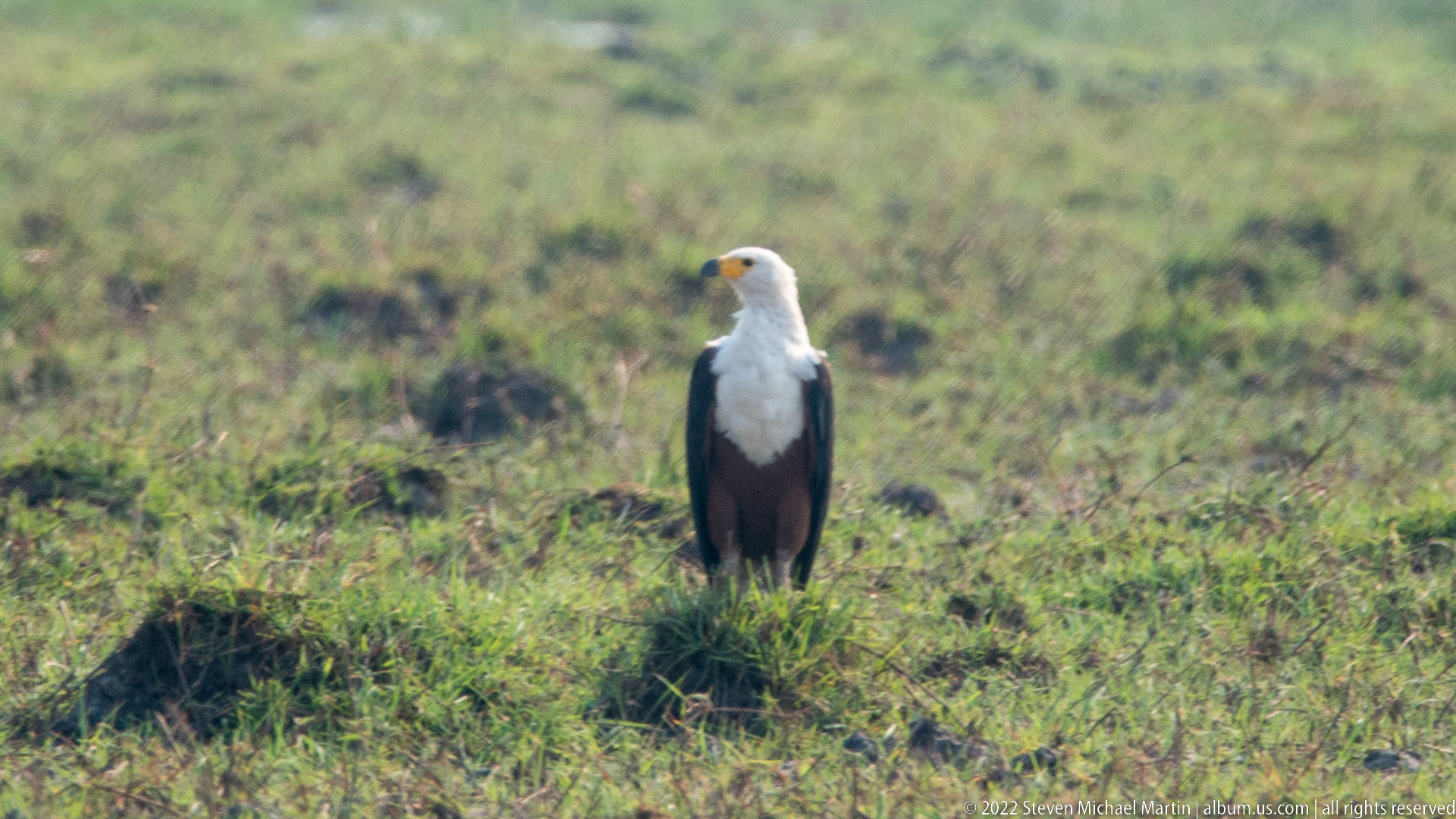
An African fish eagle faces left from a low rise in the floodplain, giving a clearer view of its white head, yellow facial skin, dark wings, and pale breast. The isolated stance against soft green wetland vegetation emphasizes the raptor’s conspicuous presence along the Chobe–Zambezi river corridor.
Caption
An African fish eagle faces left from a low rise in the floodplain, giving a clearer view of its white head, yellow facial skin, dark wings, and pale breast. The isolated stance against soft green wetland vegetation emphasizes the raptor’s conspicuous presence along the Chobe–Zambezi river corridor.
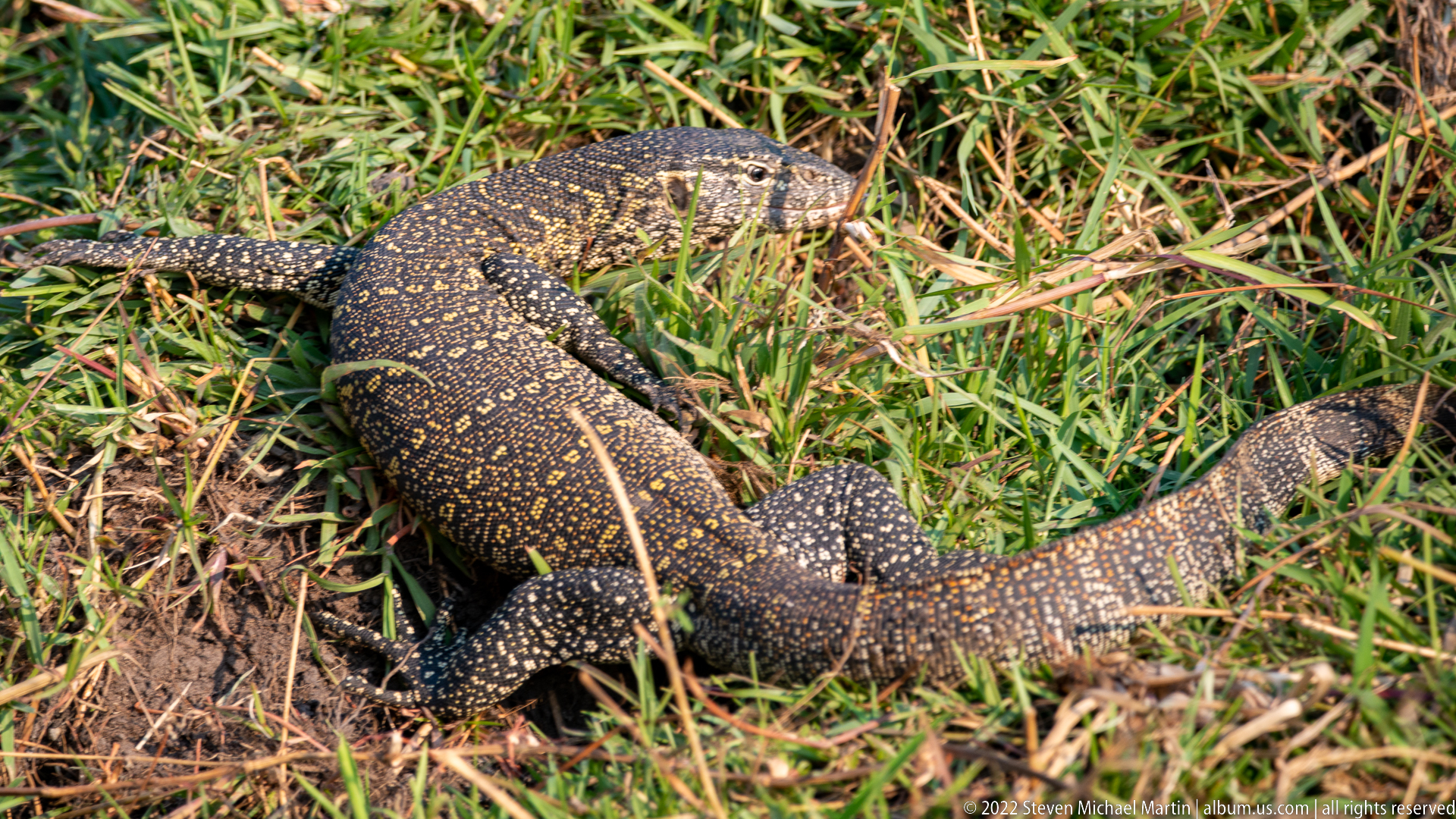
A Nile monitor moves through dense riverside grass, its elongated body patterned with yellow spots and bands against a dark ground. The powerful limbs, long tapering tail, narrow head, and bold juvenile-to-subadult patterning identify a large semiaquatic monitor lizard associated with river and wetland habitats across much of sub-Saharan Africa.
Caption
A Nile monitor moves through dense riverside grass, its elongated body patterned with yellow spots and bands against a dark ground. The powerful limbs, long tapering tail, narrow head, and bold juvenile-to-subadult patterning identify a large semiaquatic monitor lizard associated with river and wetland habitats across much of sub-Saharan Africa.
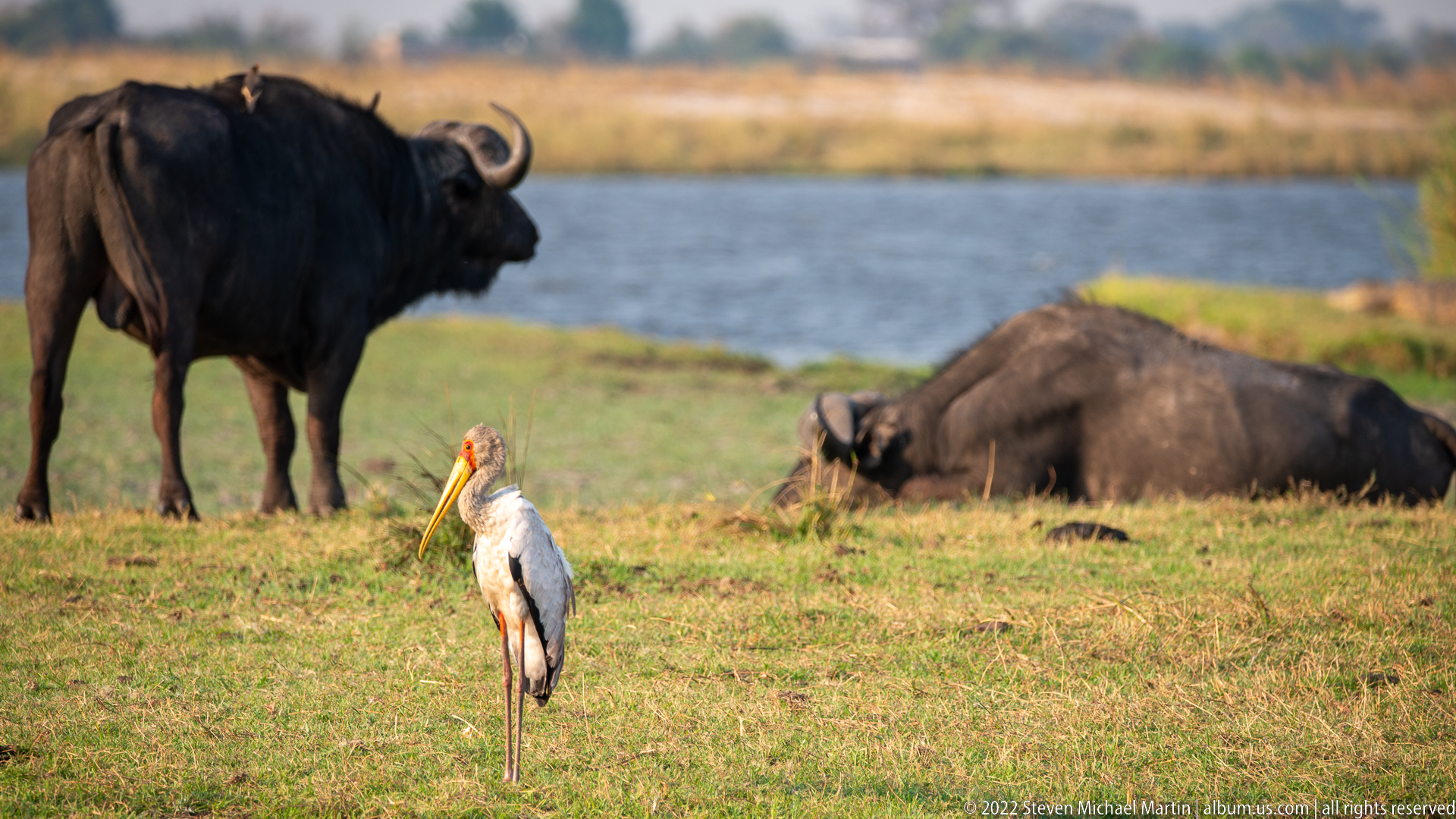
A yellow-billed stork stands in the foreground of a layered floodplain scene shared with an African buffalo at left and a resting hippopotamus nearer the water. The three species occupy different planes of the composition, showing the ecological concentration of large mammals and wetland birds along the Chobe–Zambezi river margins.
Caption
A yellow-billed stork stands in the foreground of a layered floodplain scene shared with an African buffalo at left and a resting hippopotamus nearer the water. The three species occupy different planes of the composition, showing the ecological concentration of large mammals and wetland birds along the Chobe–Zambezi river margins.
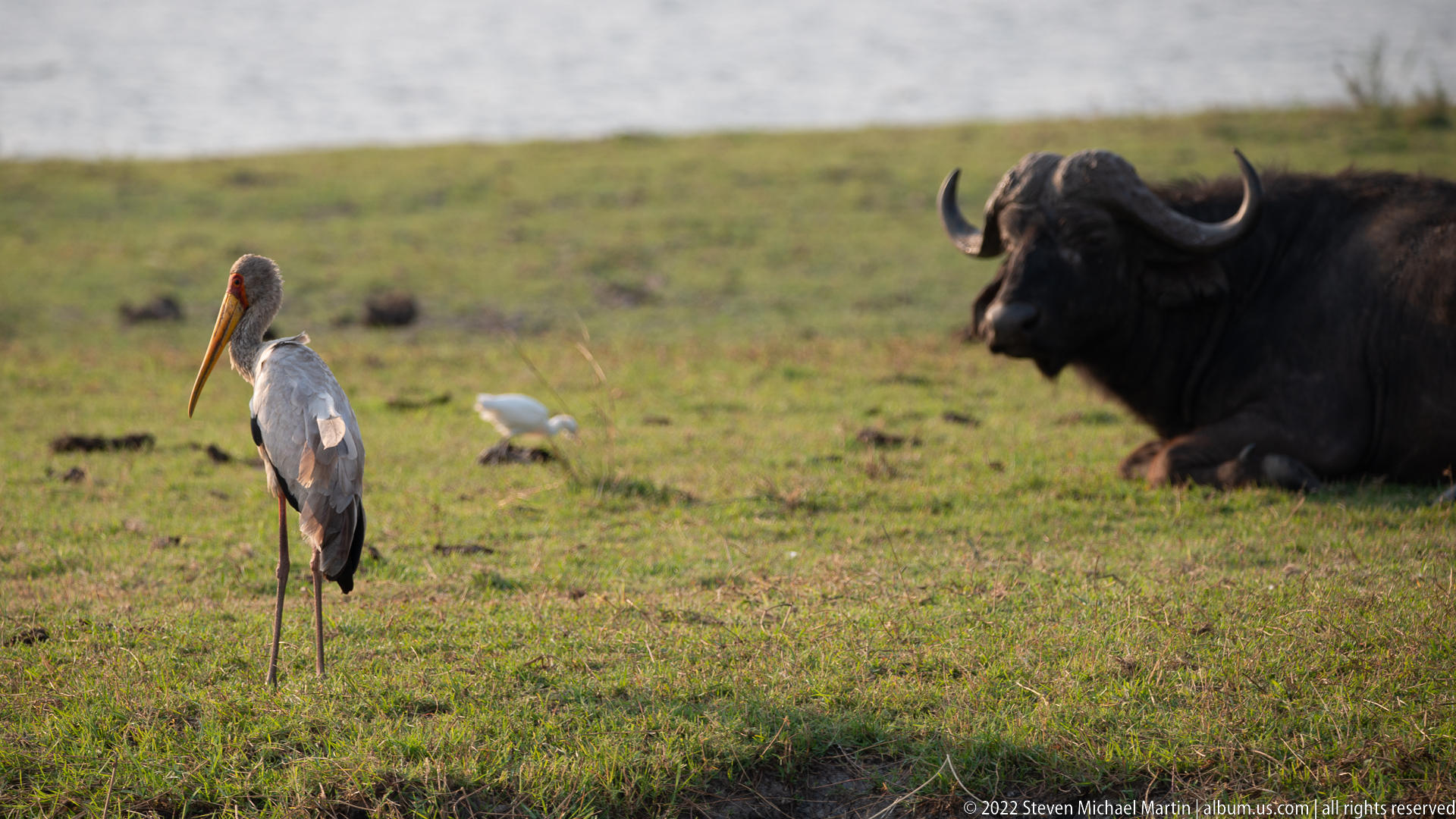
A yellow-billed stork stands upright on open grass while an African buffalo rests several meters behind it. The stork’s pale body, long yellow-orange bill, pink legs, and dark wing feathers contrast with the buffalo’s massive dark form. A small white egret farther back adds another layer to this mixed-species floodplain scene.
Caption
A yellow-billed stork stands upright on open grass while an African buffalo rests several meters behind it. The stork’s pale body, long yellow-orange bill, pink legs, and dark wing feathers contrast with the buffalo’s massive dark form. A small white egret farther back adds another layer to this mixed-species floodplain scene.
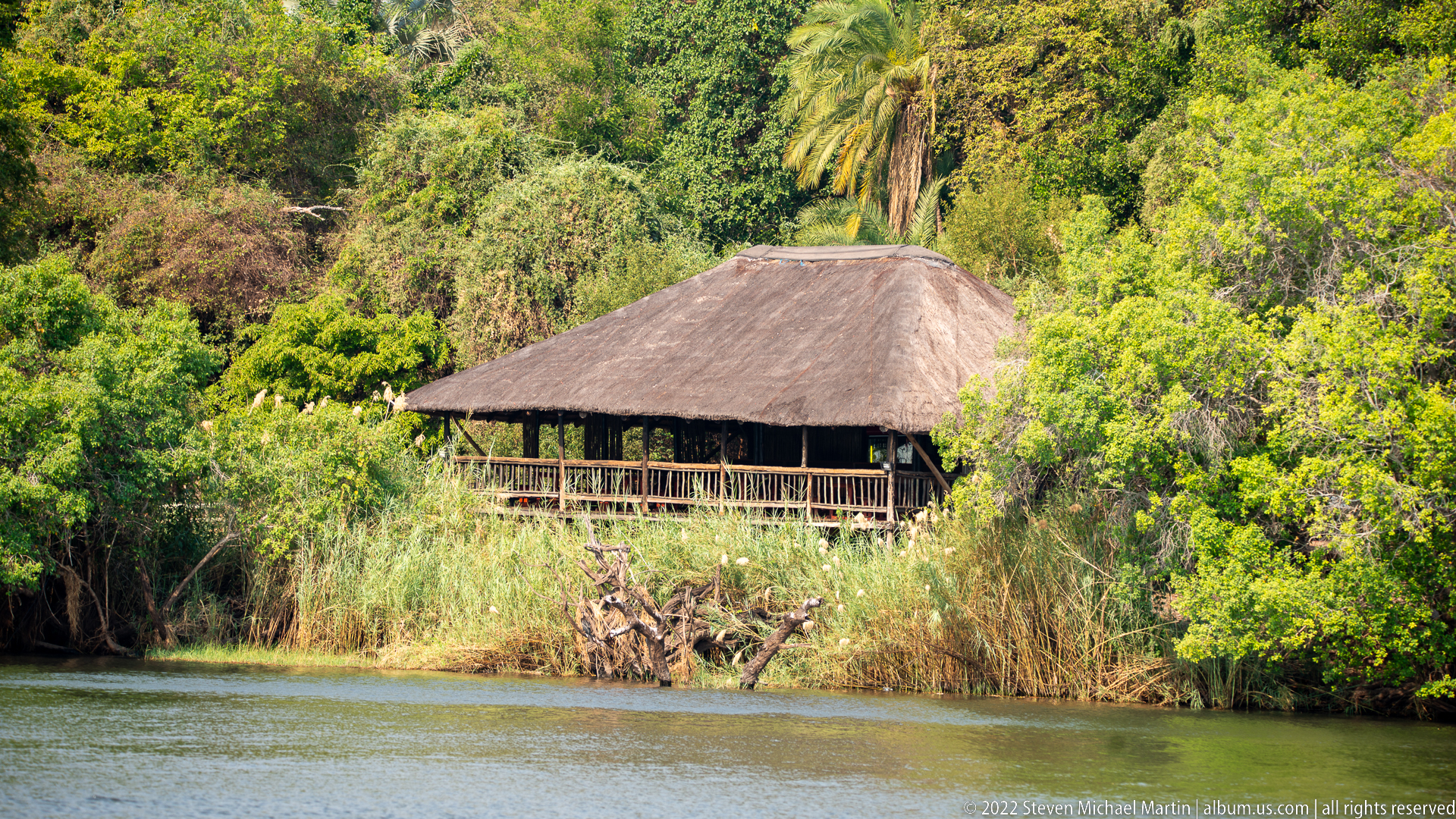
A thatched safari lodge sits low on the densely wooded bank of the Chobe–Zambezi river system, its open veranda facing the water. Reeds, palms, and broadleaf trees nearly envelop the structure, emphasizing the close relationship between visitor accommodations and the riparian habitat that supports the region’s abundant wildlife.
Caption
A thatched safari lodge sits low on the densely wooded bank of the Chobe–Zambezi river system, its open veranda facing the water. Reeds, palms, and broadleaf trees nearly envelop the structure, emphasizing the close relationship between visitor accommodations and the riparian habitat that supports the region’s abundant wildlife.

A Nile crocodile rests on a grassy, muddy bank immediately above the river, its armored back and powerful tail fully exposed. The low profile, broad snout, heavy dorsal scutes, and waterside position are characteristic of this major aquatic predator of southern African rivers and floodplains.
Caption
A Nile crocodile rests on a grassy, muddy bank immediately above the river, its armored back and powerful tail fully exposed. The low profile, broad snout, heavy dorsal scutes, and waterside position are characteristic of this major aquatic predator of southern African rivers and floodplains.
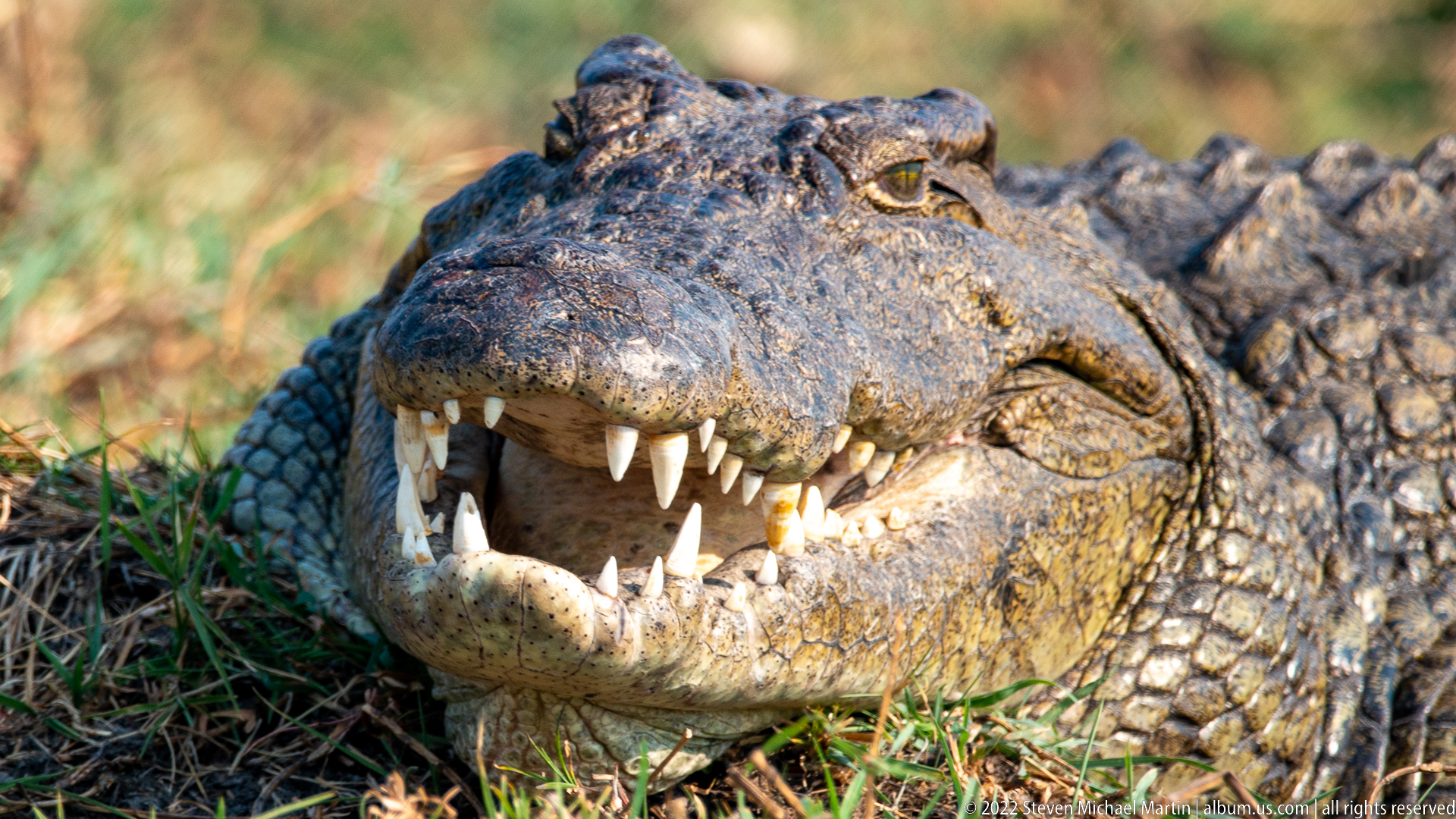
A tight portrait isolates the head of a Nile crocodile resting in grass with its jaws open. Interlocking conical teeth, a broad textured snout, raised eyes, and thick armored scales dominate the frame, revealing the specialized anatomy of an ambush predator adapted to watching from the water surface.
Caption
A tight portrait isolates the head of a Nile crocodile resting in grass with its jaws open. Interlocking conical teeth, a broad textured snout, raised eyes, and thick armored scales dominate the frame, revealing the specialized anatomy of an ambush predator adapted to watching from the water surface.
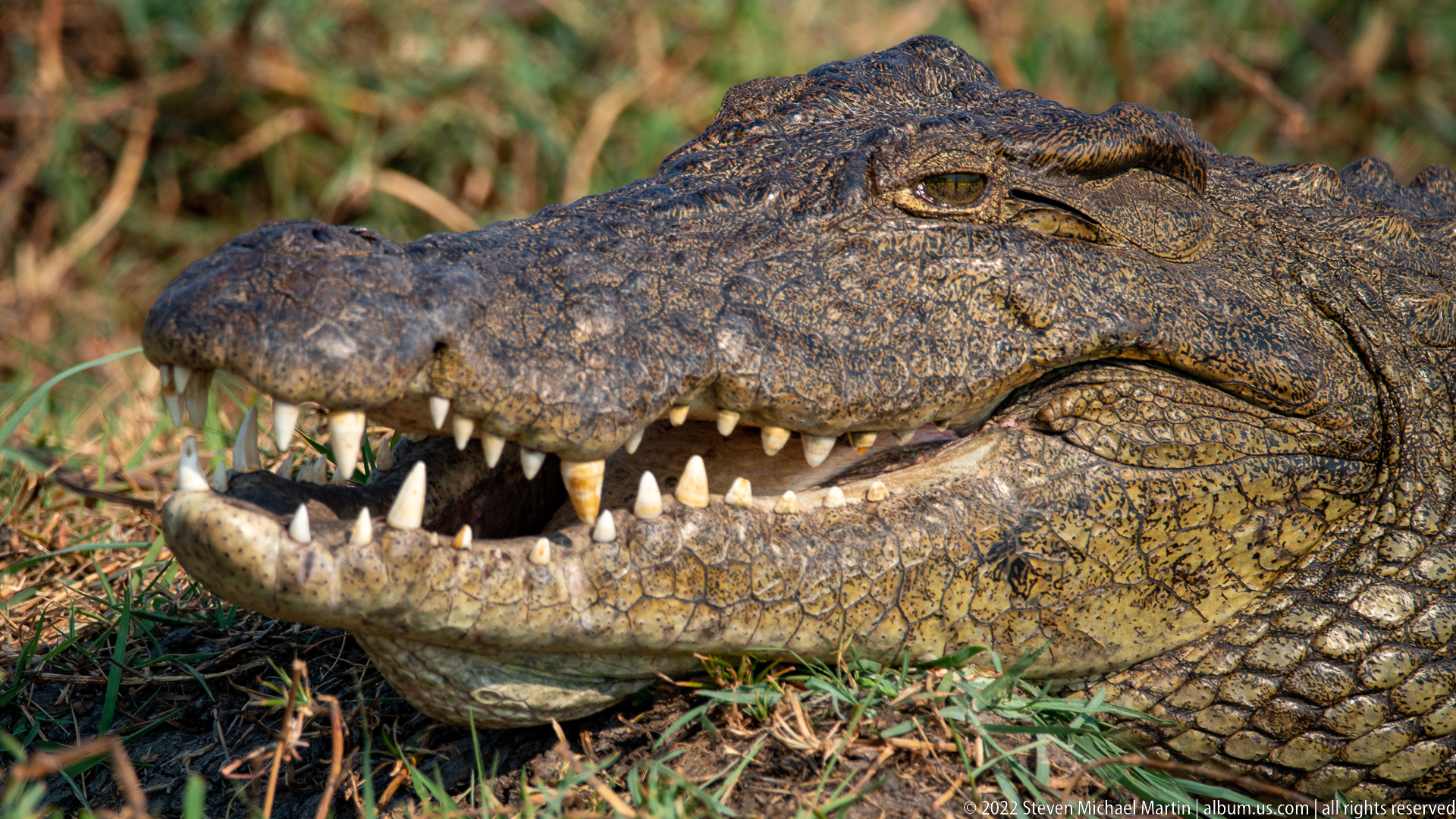
Seen in profile, a Nile crocodile rests among riverbank grasses with its mouth partly open. The elongated snout, uneven rows of conical teeth, pebbled facial scales, and massive jaw are sharply resolved, while the lateral viewpoint distinguishes this study from the preceding frontal portrait.
Caption
Seen in profile, a Nile crocodile rests among riverbank grasses with its mouth partly open. The elongated snout, uneven rows of conical teeth, pebbled facial scales, and massive jaw are sharply resolved, while the lateral viewpoint distinguishes this study from the preceding frontal portrait.
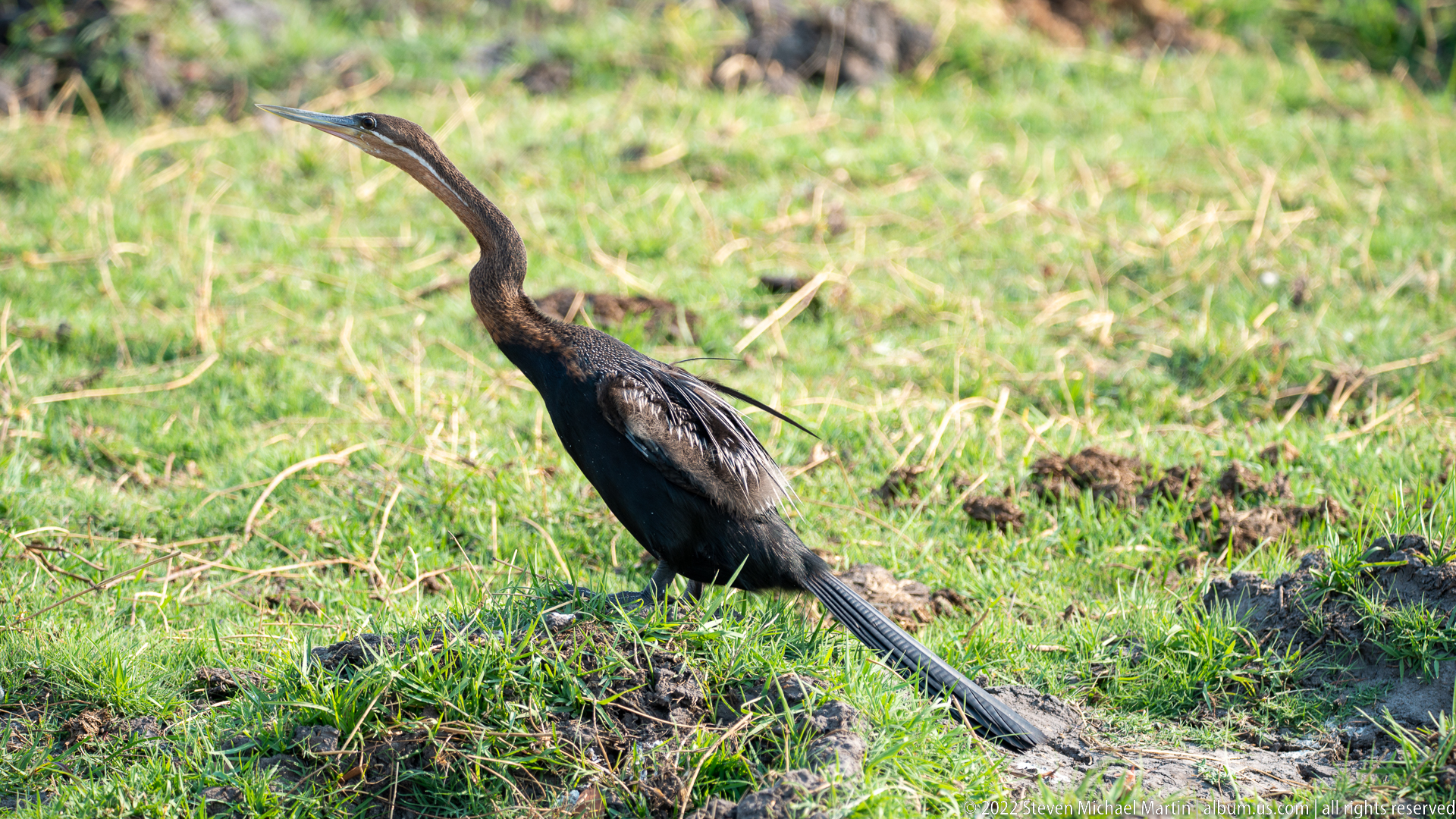
An African darter stands on the grassy margin of a wetland, its exceptionally long, slender neck rising above a dark body and elongated tail. Often called a snakebird for this profile, the species swims low in the water and frequently spreads its wings to dry after diving for fish.
Caption
An African darter stands on the grassy margin of a wetland, its exceptionally long, slender neck rising above a dark body and elongated tail. Often called a snakebird for this profile, the species swims low in the water and frequently spreads its wings to dry after diving for fish.
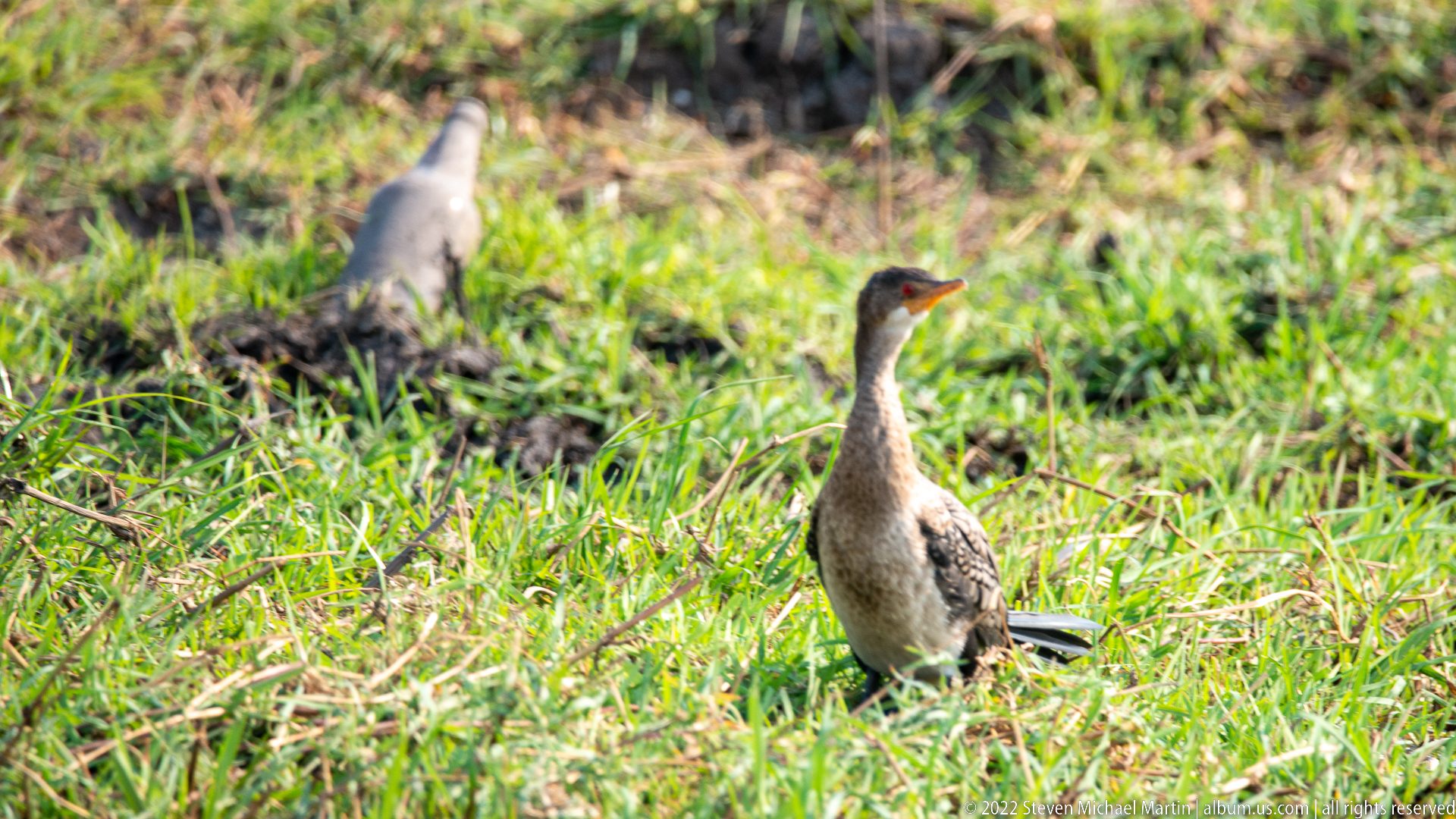
A pale-necked African darter stands upright in lush floodplain grass, its dagger-like bill angled slightly upward. Brownish plumage and a lighter neck distinguish it from the darker adult shown nearby, while the long neck, compact body, and diving-bird posture remain characteristic of the species.
Caption
A pale-necked African darter stands upright in lush floodplain grass, its dagger-like bill angled slightly upward. Brownish plumage and a lighter neck distinguish it from the darker adult shown nearby, while the long neck, compact body, and diving-bird posture remain characteristic of the species.

An adult African fish eagle stands in profile on short floodplain vegetation, showing the species’ rich chestnut body, dark flight feathers, white head and breast, and yellow bill. The lateral view provides a compact field-guide study of one of the most recognizable raptors of southern Africa’s river landscapes.
Caption
An adult African fish eagle stands in profile on short floodplain vegetation, showing the species’ rich chestnut body, dark flight feathers, white head and breast, and yellow bill. The lateral view provides a compact field-guide study of one of the most recognizable raptors of southern Africa’s river landscapes.

An African fish eagle launches low across the floodplain with wings raised, legs trailing and talons curled beneath the body. The spread wings reveal dark flight feathers against chestnut coverts, while the white head and tail remain conspicuous—an action view that complements the nearby standing portraits.
Caption
An African fish eagle launches low across the floodplain with wings raised, legs trailing and talons curled beneath the body. The spread wings reveal dark flight feathers against chestnut coverts, while the white head and tail remain conspicuous—an action view that complements the nearby standing portraits.
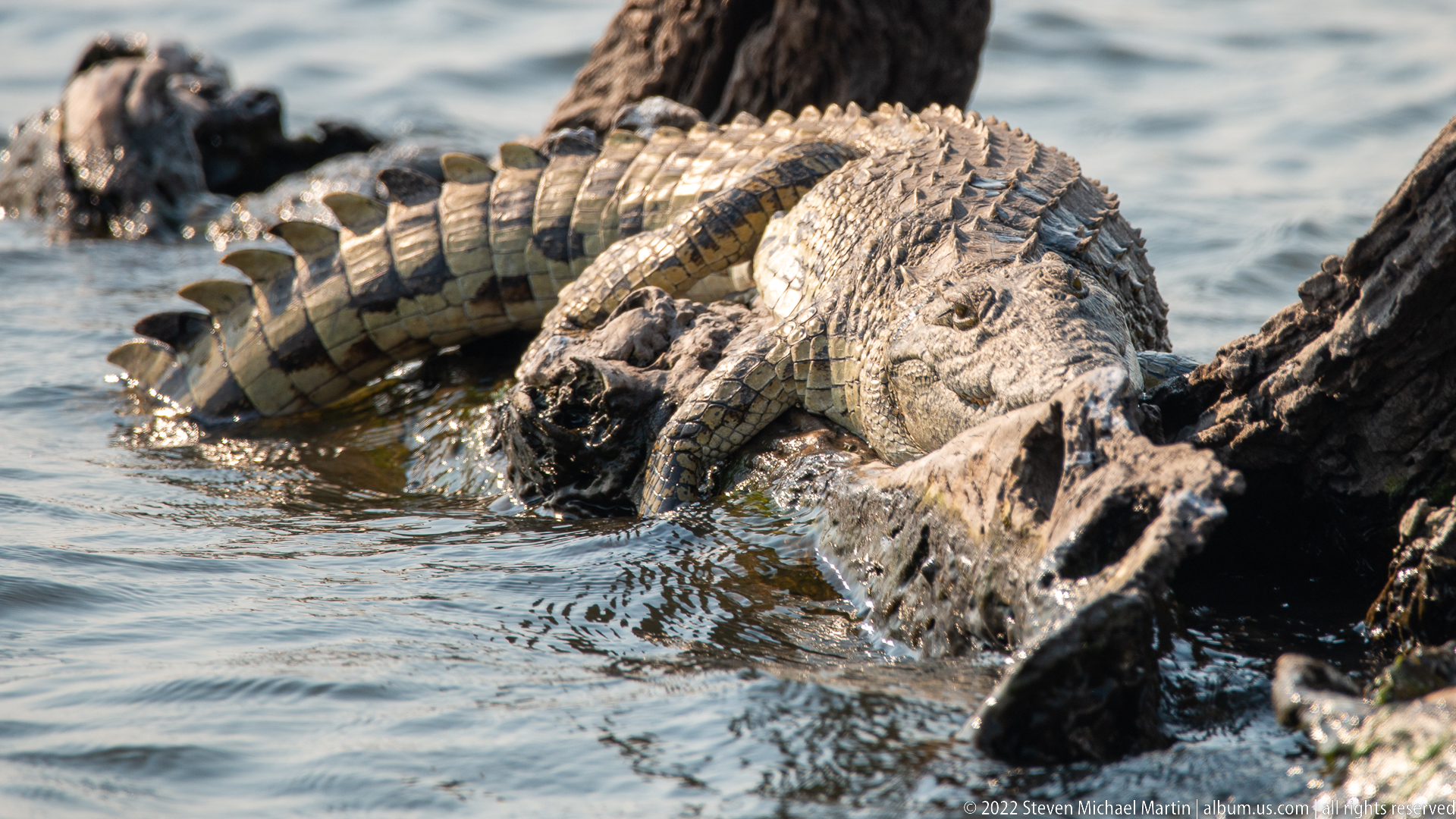
Two Nile crocodiles lie partly submerged beside dark driftwood, their ridged backs and armored tails breaking the water’s surface. One head faces the camera while the second body overlaps behind it, illustrating how easily these heavily armored reptiles merge with logs and shoreline debris in river habitat.
Caption
Two Nile crocodiles lie partly submerged beside dark driftwood, their ridged backs and armored tails breaking the water’s surface. One head faces the camera while the second body overlaps behind it, illustrating how easily these heavily armored reptiles merge with logs and shoreline debris in river habitat.

An African darter perches on sun-bleached driftwood above the river with wings spread in a classic drying posture. Its long pointed bill, slender neck, dark body, and warm chestnut neck patch stand out against the pale water, linking the bird’s form directly to its underwater fishing behavior.
Caption
An African darter perches on sun-bleached driftwood above the river with wings spread in a classic drying posture. Its long pointed bill, slender neck, dark body, and warm chestnut neck patch stand out against the pale water, linking the bird’s form directly to its underwater fishing behavior.

A great egret stands tall in saturated floodplain grass, its all-white plumage, long black legs, and yellow bill sharply separated from the green background. The upright hunting posture is typical of a large wading bird searching shallow wetland margins for fish, amphibians, and other small prey.
Caption
A great egret stands tall in saturated floodplain grass, its all-white plumage, long black legs, and yellow bill sharply separated from the green background. The upright hunting posture is typical of a large wading bird searching shallow wetland margins for fish, amphibians, and other small prey.

A hippopotamus rests almost entirely submerged in shallow wetland water, with only its broad back, ears, eyes, and nostrils held above the surface. This low aquatic posture demonstrates the species’ adaptation to spending daylight hours in rivers and pools while keeping its sensory organs exposed.
Caption
A hippopotamus rests almost entirely submerged in shallow wetland water, with only its broad back, ears, eyes, and nostrils held above the surface. This low aquatic posture demonstrates the species’ adaptation to spending daylight hours in rivers and pools while keeping its sensory organs exposed.
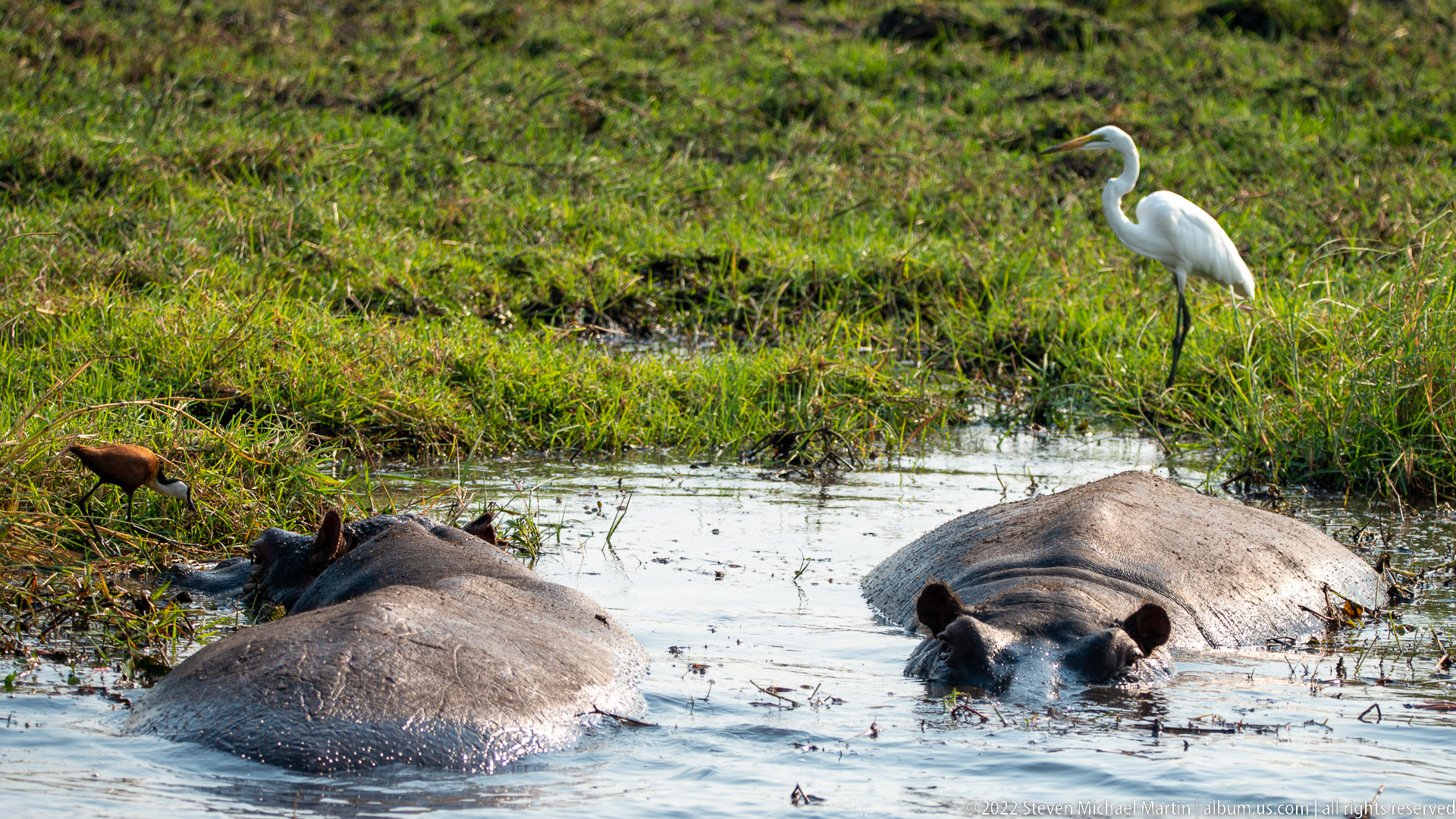
Two hippopotamuses occupy a shallow floodplain pool while a great egret stands behind them on the grassy margin. One hippo faces the camera with only its head exposed; the other presents a broad rounded back, creating a layered view of large aquatic mammals sharing the wetland with a wading bird.
Caption
Two hippopotamuses occupy a shallow floodplain pool while a great egret stands behind them on the grassy margin. One hippo faces the camera with only its head exposed; the other presents a broad rounded back, creating a layered view of large aquatic mammals sharing the wetland with a wading bird.
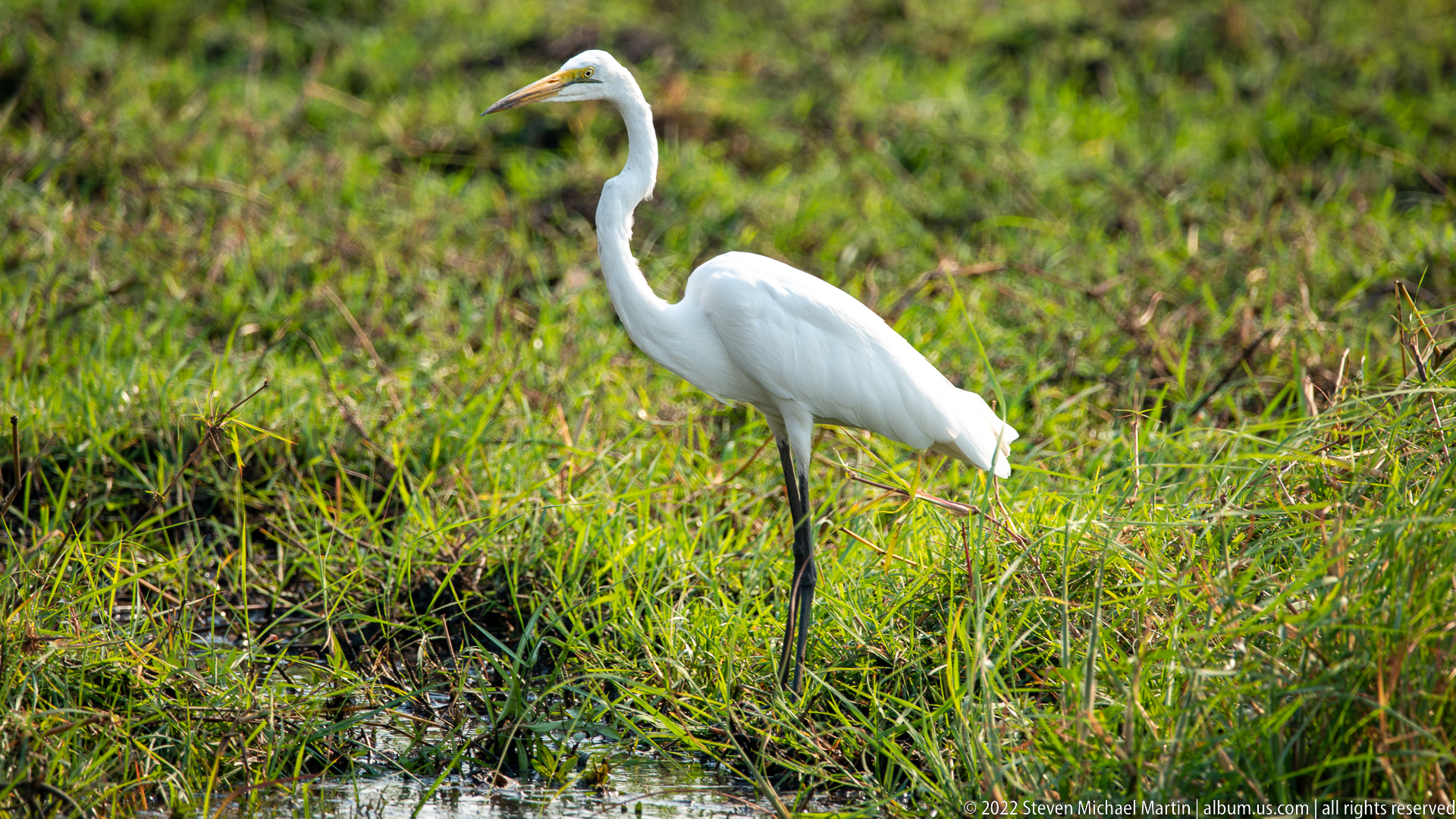
A great egret pauses at the edge of shallow water, its long neck curved and yellow bill directed toward the marsh. Fine white breeding plumes trail over the back, while black legs disappear into the vegetation, giving a closer field-guide view than the more distant standing bird on the same page.
Caption
A great egret pauses at the edge of shallow water, its long neck curved and yellow bill directed toward the marsh. Fine white breeding plumes trail over the back, while black legs disappear into the vegetation, giving a closer field-guide view than the more distant standing bird on the same page.

An African jacana picks through emergent vegetation beside the head of a partly submerged hippopotamus. The bird’s chestnut body, black-and-white head pattern, and long legs identify a specialist of floating and marsh vegetation, while the much larger hippo provides a striking scale contrast within the shared wetland habitat.
Caption
An African jacana picks through emergent vegetation beside the head of a partly submerged hippopotamus. The bird’s chestnut body, black-and-white head pattern, and long legs identify a specialist of floating and marsh vegetation, while the much larger hippo provides a striking scale contrast within the shared wetland habitat.
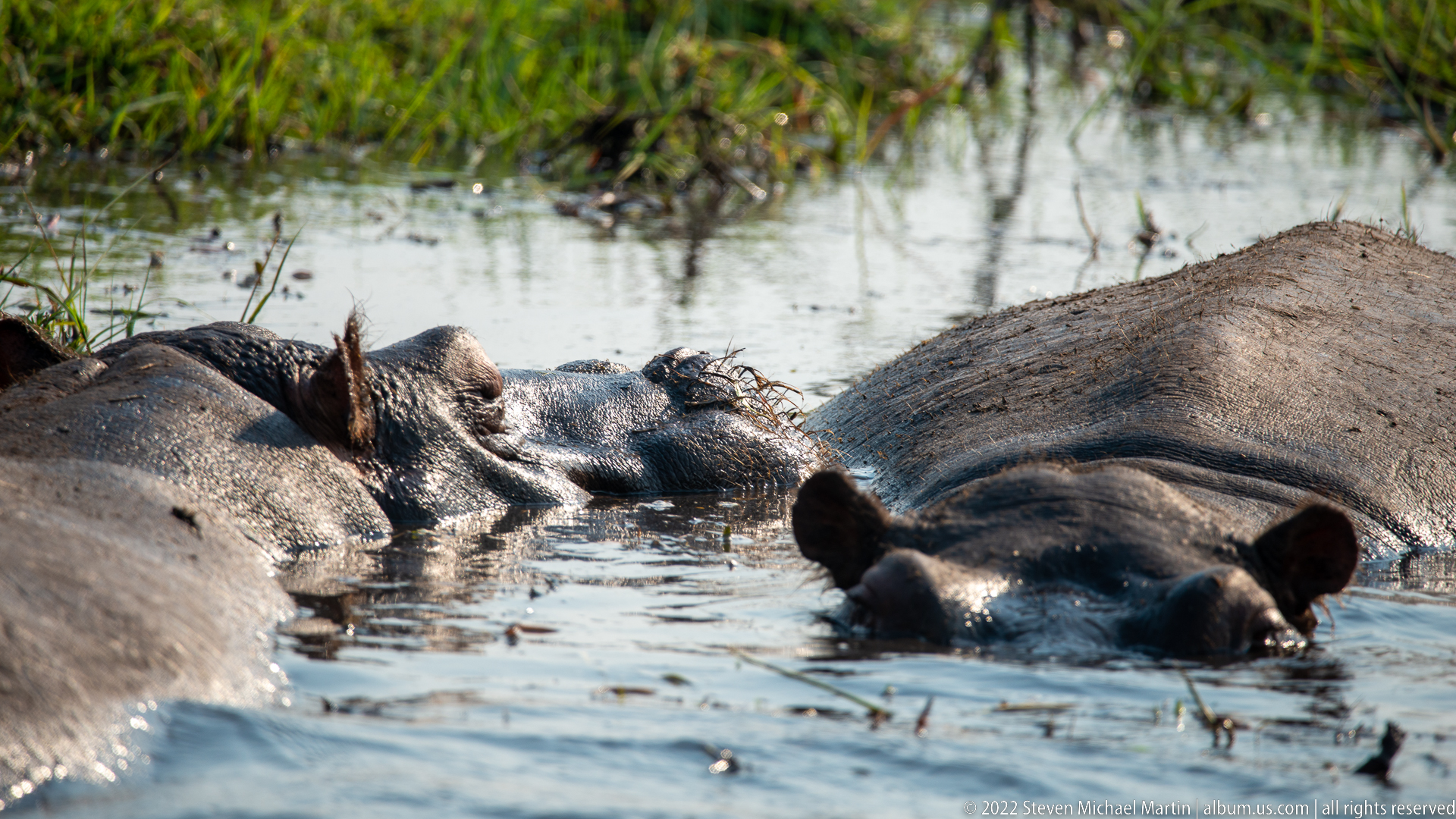
Several hippopotamuses crowd together in a shallow wetland channel, their broad backs and heads forming a compact cluster at the surface. The closest animal faces forward with ears and eyes raised above the water, while overlapping bodies behind it convey the social density often seen at favored daytime resting sites.
Caption
Several hippopotamuses crowd together in a shallow wetland channel, their broad backs and heads forming a compact cluster at the surface. The closest animal faces forward with ears and eyes raised above the water, while overlapping bodies behind it convey the social density often seen at favored daytime resting sites.
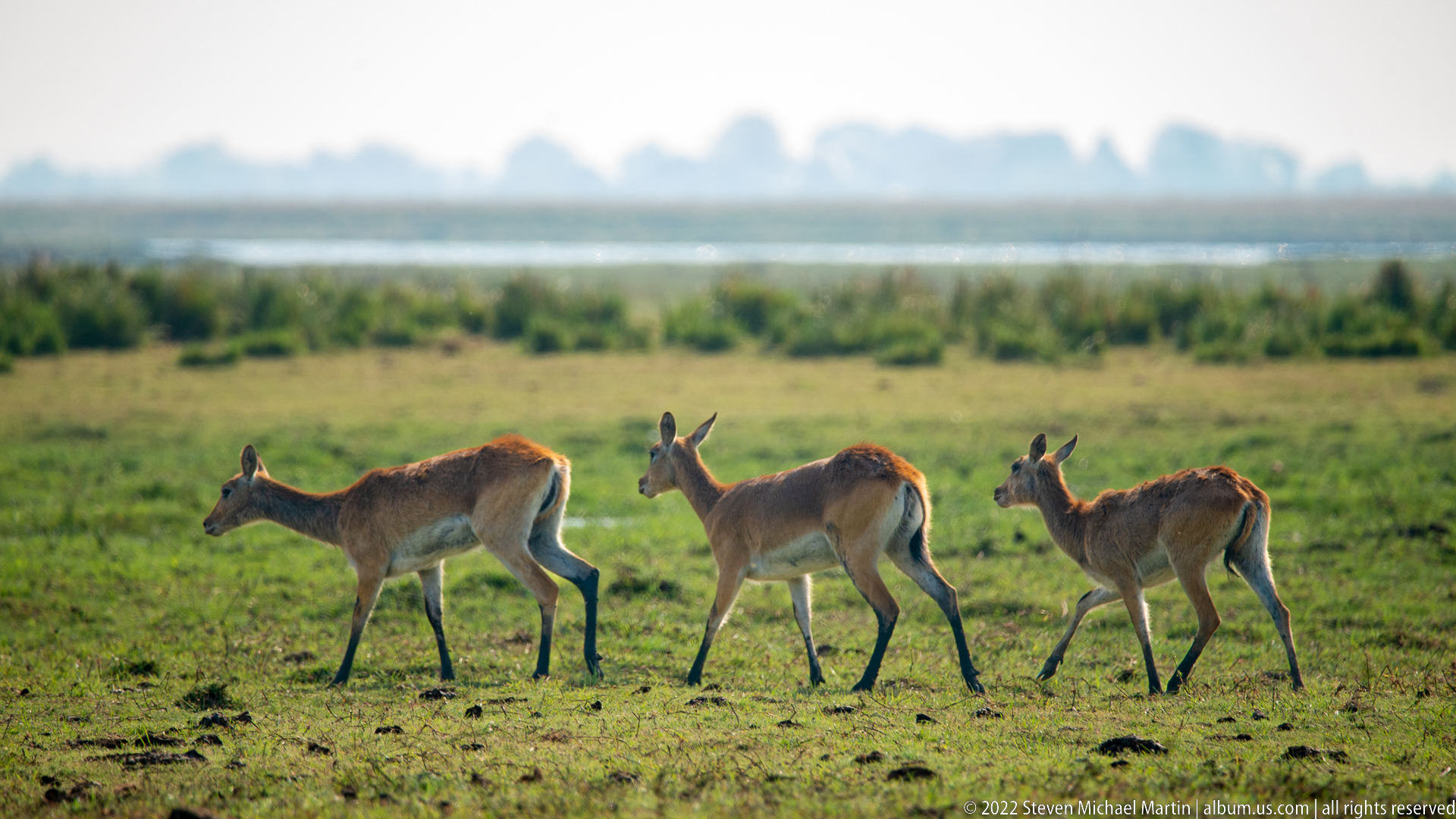
Three red lechwe walk in single file across a broad green floodplain, their tawny coats, pale underparts, and dark lower legs visible in profile. The open, seasonally inundated grassland is characteristic habitat for this water-associated antelope of south-central Africa, which is adapted to moving through marshy terrain.
Caption
Three red lechwe walk in single file across a broad green floodplain, their tawny coats, pale underparts, and dark lower legs visible in profile. The open, seasonally inundated grassland is characteristic habitat for this water-associated antelope of south-central Africa, which is adapted to moving through marshy terrain.
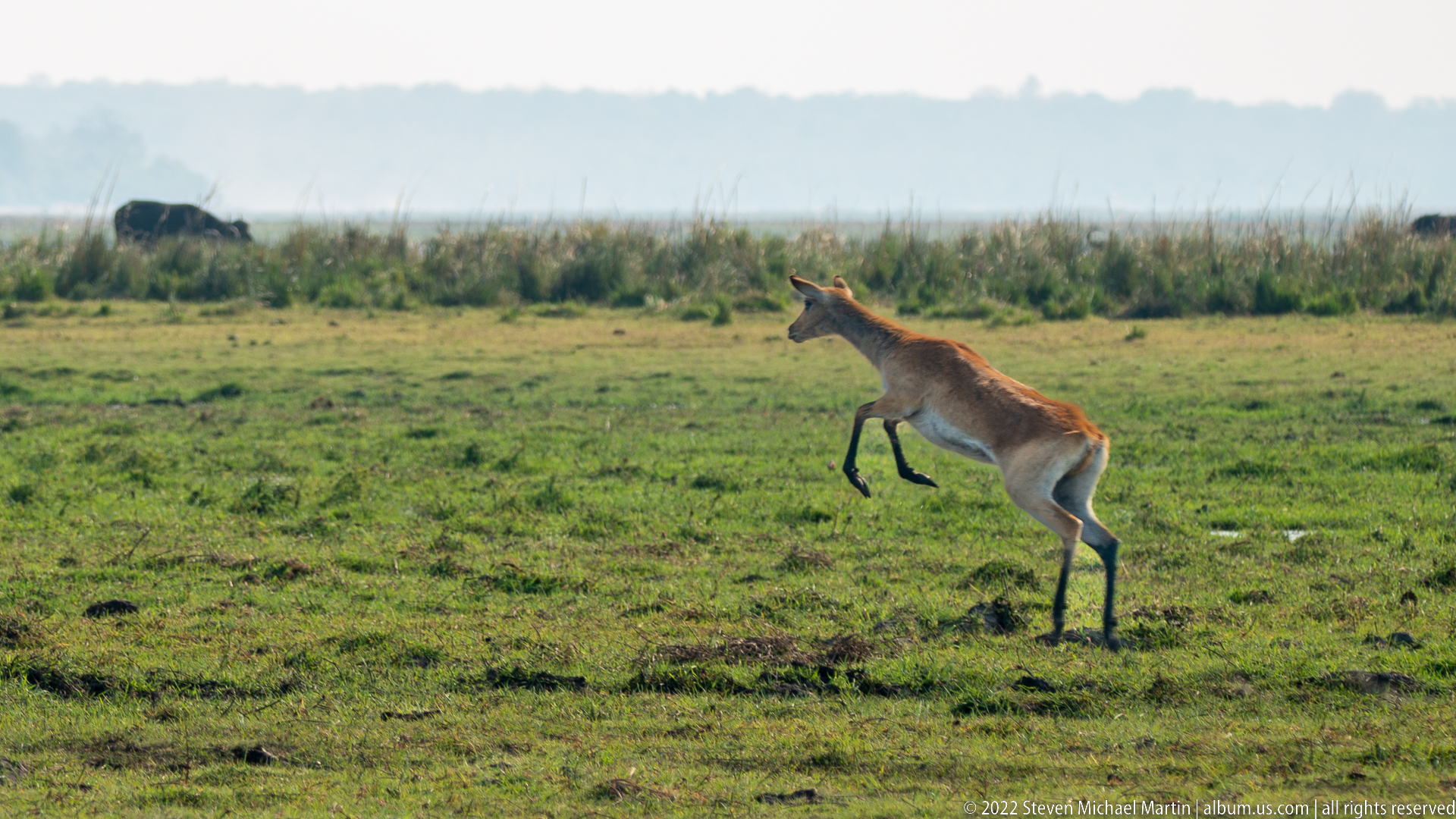
A red lechwe bounds across short green floodplain grass with all four legs gathered in an energetic stride. Its rufous-tawny coat and pale underside stand out against the open wetland, while the action view highlights the long-legged build that helps lechwe move efficiently through seasonally flooded habitat.
Caption
A red lechwe bounds across short green floodplain grass with all four legs gathered in an energetic stride. Its rufous-tawny coat and pale underside stand out against the open wetland, while the action view highlights the long-legged build that helps lechwe move efficiently through seasonally flooded habitat.
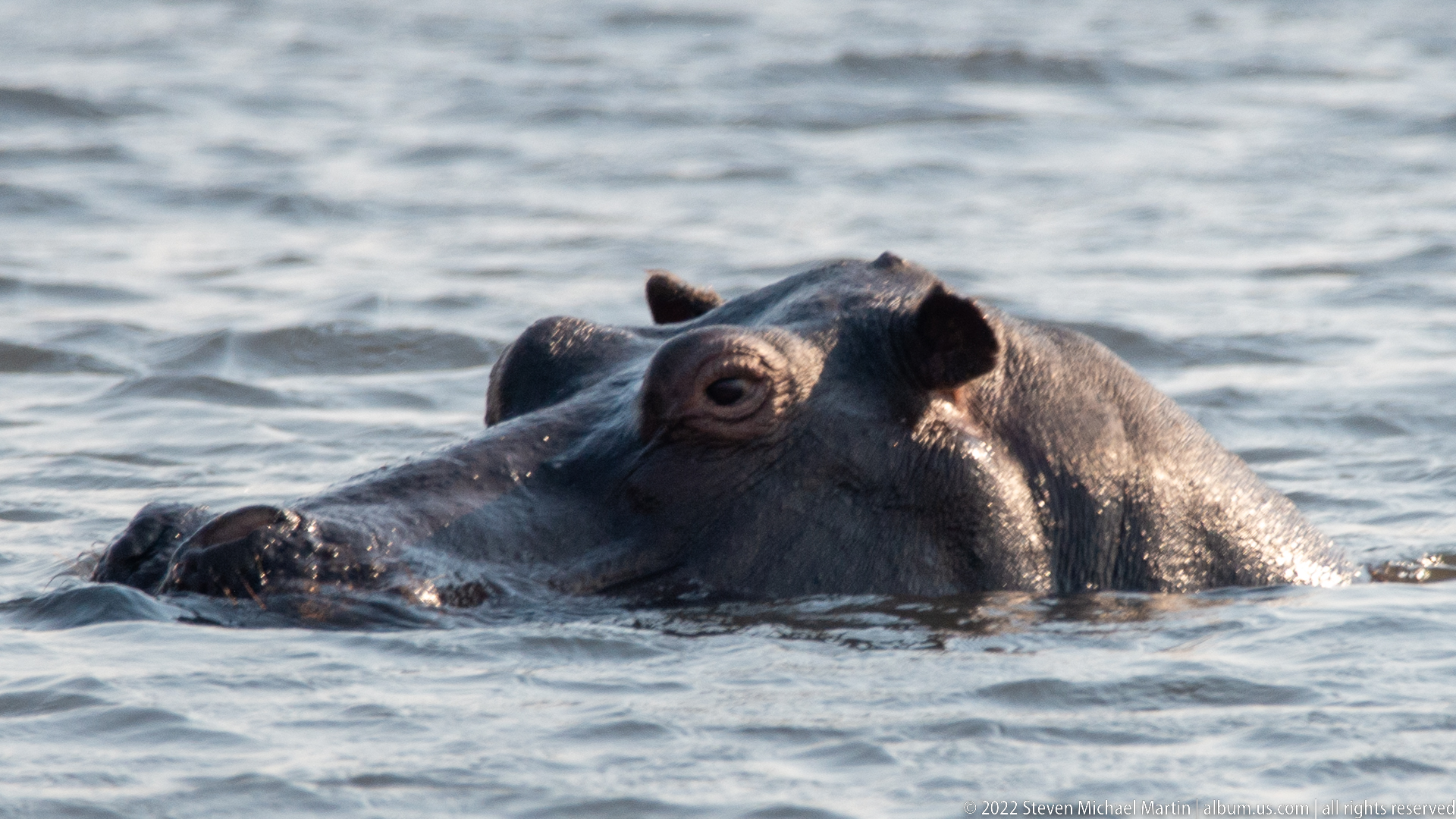
Two hippopotamuses swim through deeper open water, with the larger animal’s head and shoulders rising above the rippled surface and a smaller head close beside it. The composition isolates the species from the grassy shallows seen elsewhere, emphasizing how little of a hippo remains visible while moving through a river channel.
Caption
Two hippopotamuses swim through deeper open water, with the larger animal’s head and shoulders rising above the rippled surface and a smaller head close beside it. The composition isolates the species from the grassy shallows seen elsewhere, emphasizing how little of a hippo remains visible while moving through a river channel.
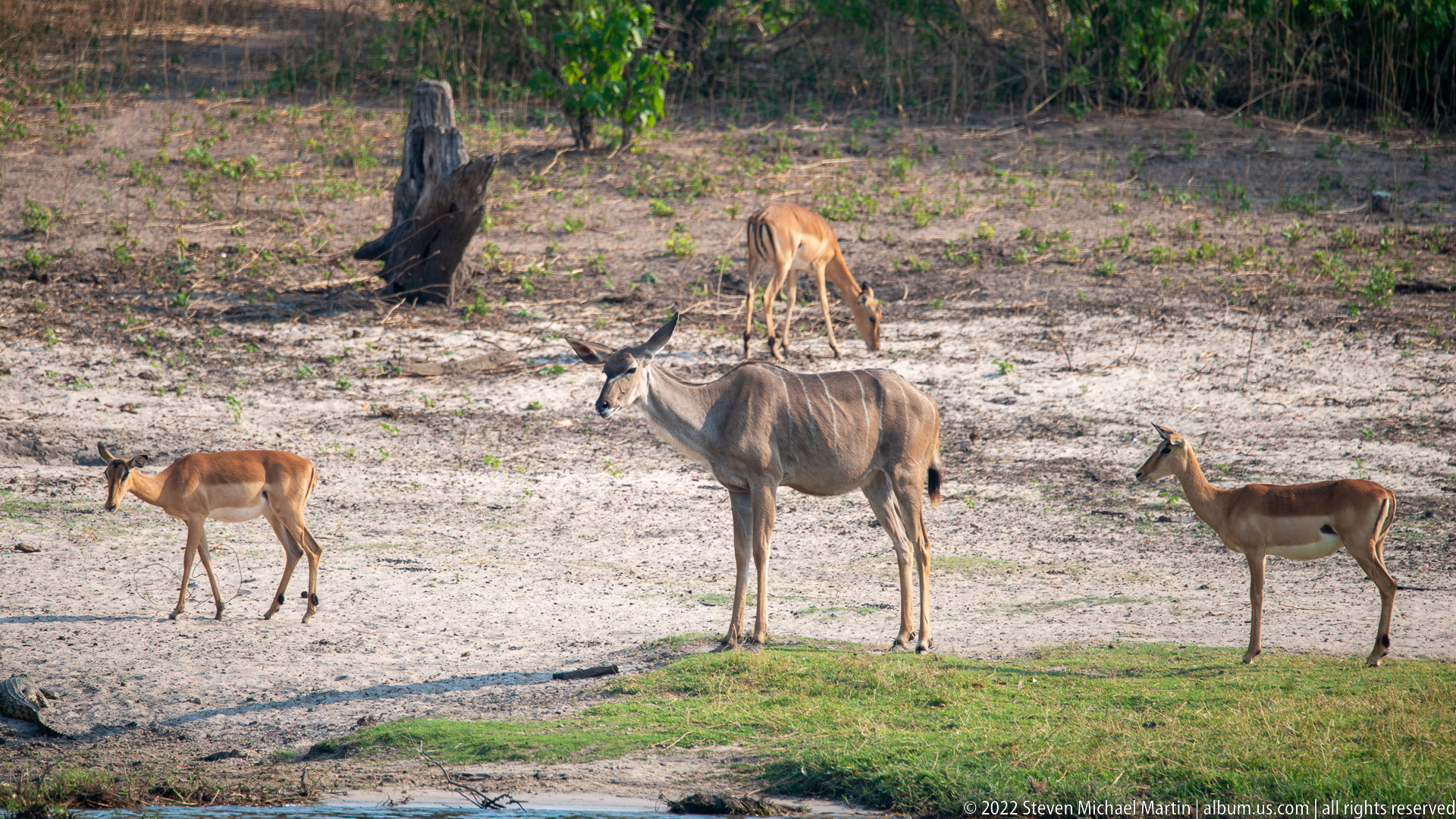
A female greater kudu stands prominently among several impalas on a pale sandy riverbank. The kudu’s much larger size, gray-brown coat, large ears, and vertical white body stripes contrast with the smaller, warmer-colored impalas around it, creating a useful comparative view of two common southern African antelopes.
Caption
A female greater kudu stands prominently among several impalas on a pale sandy riverbank. The kudu’s much larger size, gray-brown coat, large ears, and vertical white body stripes contrast with the smaller, warmer-colored impalas around it, creating a useful comparative view of two common southern African antelopes.
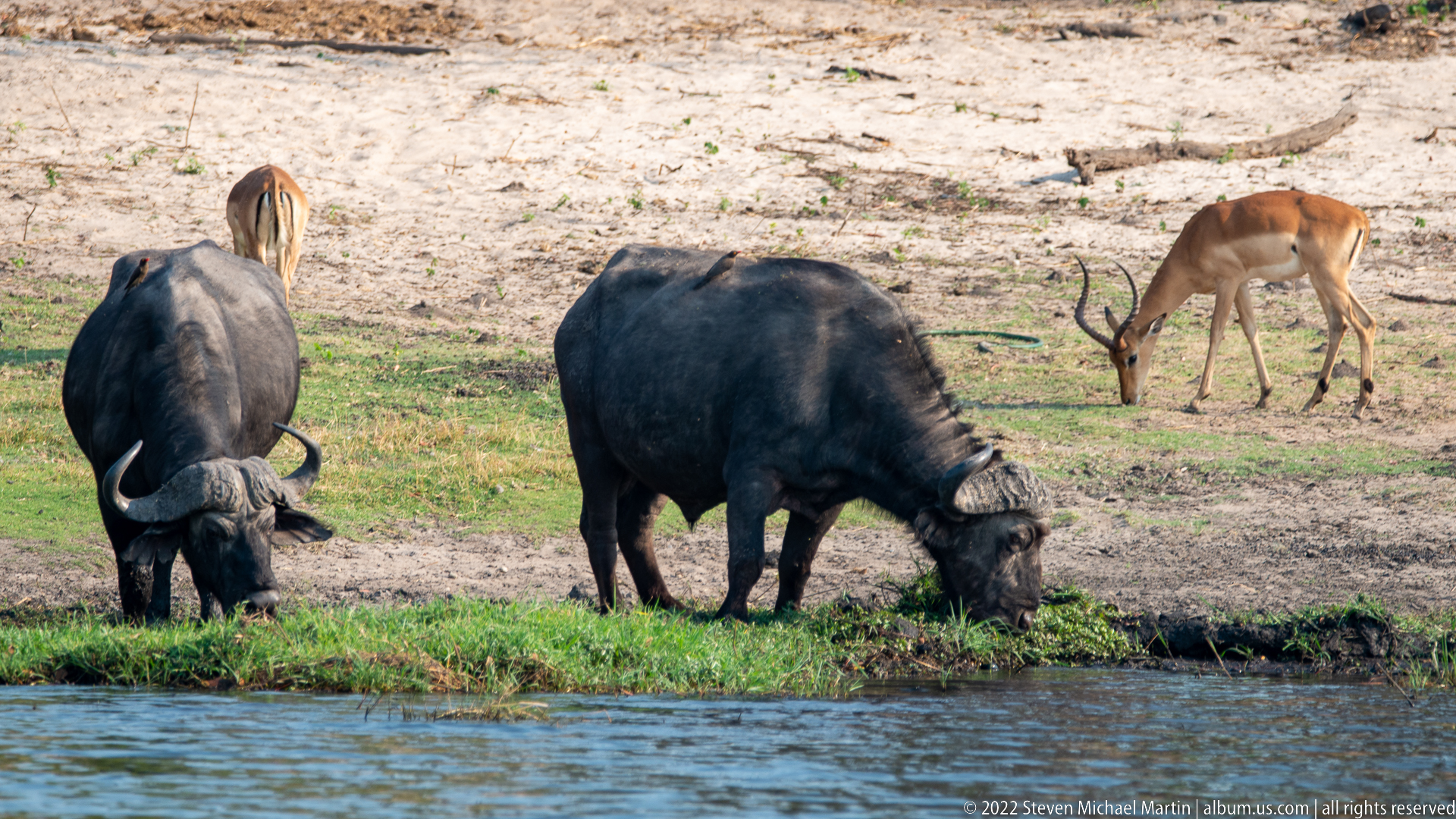
Two African buffalo graze on lush vegetation at the water’s edge while impalas feed on the drier bank behind them. Their massive dark bodies, heavy heads, and broad horn bosses contrast strongly with the lighter, slender antelopes, illustrating the varied herbivore community concentrated along the river margin.
Caption
Two African buffalo graze on lush vegetation at the water’s edge while impalas feed on the drier bank behind them. Their massive dark bodies, heavy heads, and broad horn bosses contrast strongly with the lighter, slender antelopes, illustrating the varied herbivore community concentrated along the river margin.

A female impala stands alert on pale sandy ground near the river, its slim build, warm reddish-tan coat, white belly, and black markings on the hindquarters clearly visible. The absence of horns indicates a female, while the open stance provides a clean field-guide profile of this widespread southern African antelope.
Caption
A female impala stands alert on pale sandy ground near the river, its slim build, warm reddish-tan coat, white belly, and black markings on the hindquarters clearly visible. The absence of horns indicates a female, while the open stance provides a clean field-guide profile of this widespread southern African antelope.
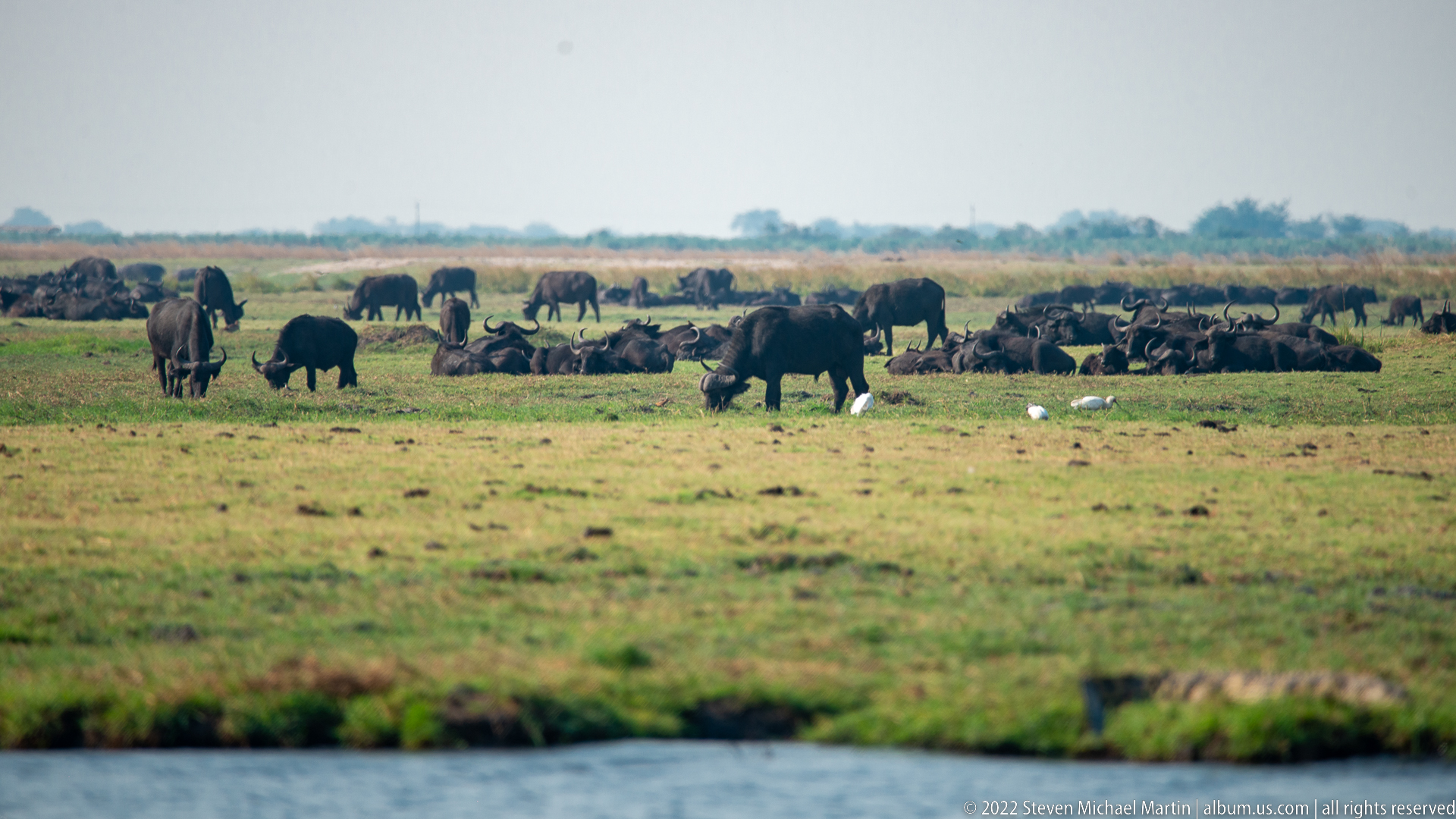
A large herd of African buffalo spreads across an open riverside floodplain, with some animals grazing while many others rest in a dense central group. White wading birds punctuate the grass around the herd, and the river in the foreground places this congregation within the productive wetland landscape.
Caption
A large herd of African buffalo spreads across an open riverside floodplain, with some animals grazing while many others rest in a dense central group. White wading birds punctuate the grass around the herd, and the river in the foreground places this congregation within the productive wetland landscape.

An African savanna elephant walks along the green river margin, its trunk curled inward and one tusk visible beneath a broad ear. Deeply wrinkled skin, heavy columnar legs, and the large ear profile distinguish the species, while fallen timber and the waterline frame the animal within a dry-season riparian setting.
Caption
An African savanna elephant walks along the green river margin, its trunk curled inward and one tusk visible beneath a broad ear. Deeply wrinkled skin, heavy columnar legs, and the large ear profile distinguish the species, while fallen timber and the waterline frame the animal within a dry-season riparian setting.
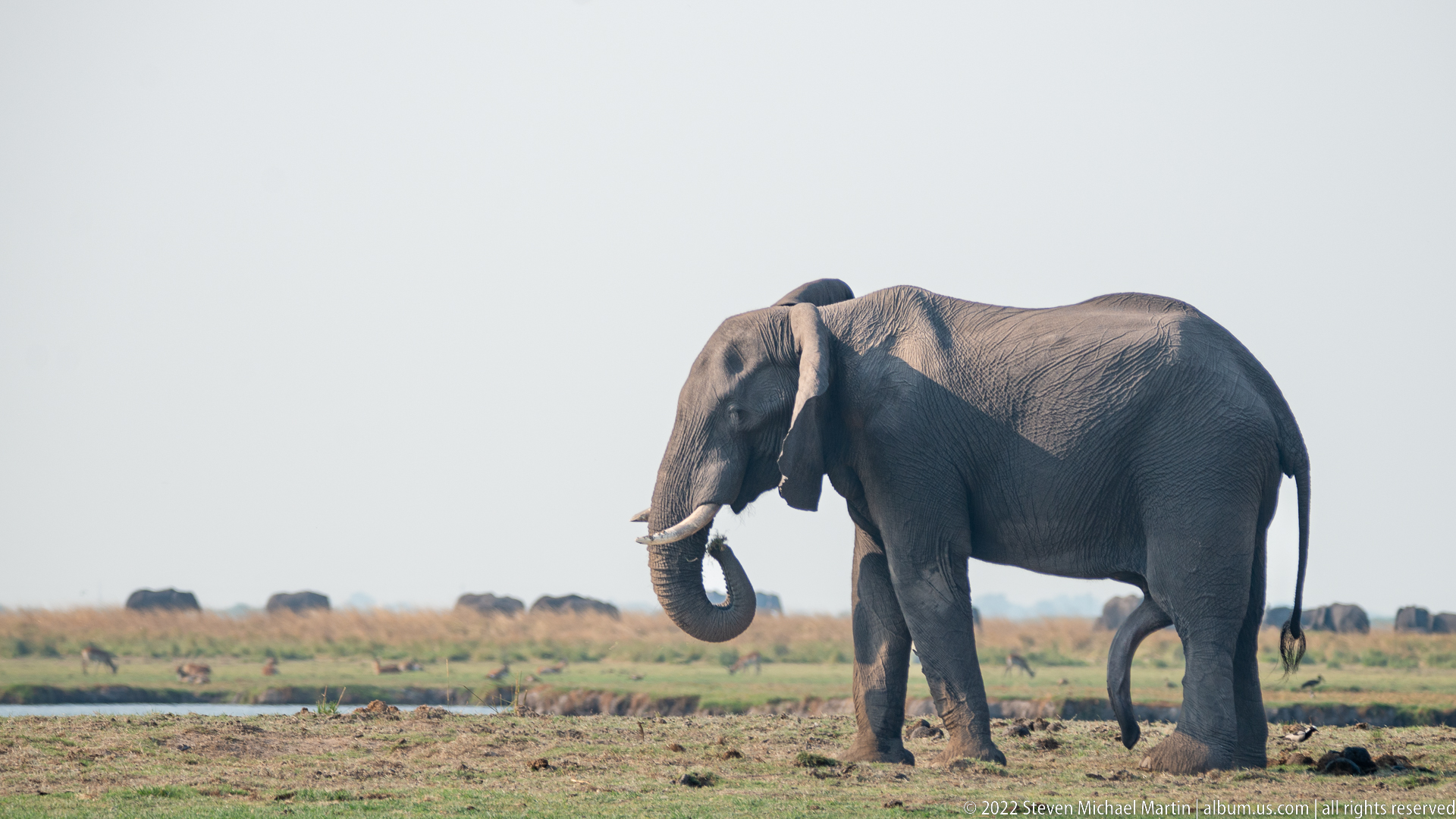
A solitary African savanna elephant stands on open floodplain ground with its trunk curled upward toward the mouth. Long tusks, a high shoulder, broad ears, and deeply folded skin are visible in profile, while distant herbivores form a low band across the horizon behind the animal.
Caption
A solitary African savanna elephant stands on open floodplain ground with its trunk curled upward toward the mouth. Long tusks, a high shoulder, broad ears, and deeply folded skin are visible in profile, while distant herbivores form a low band across the horizon behind the animal.
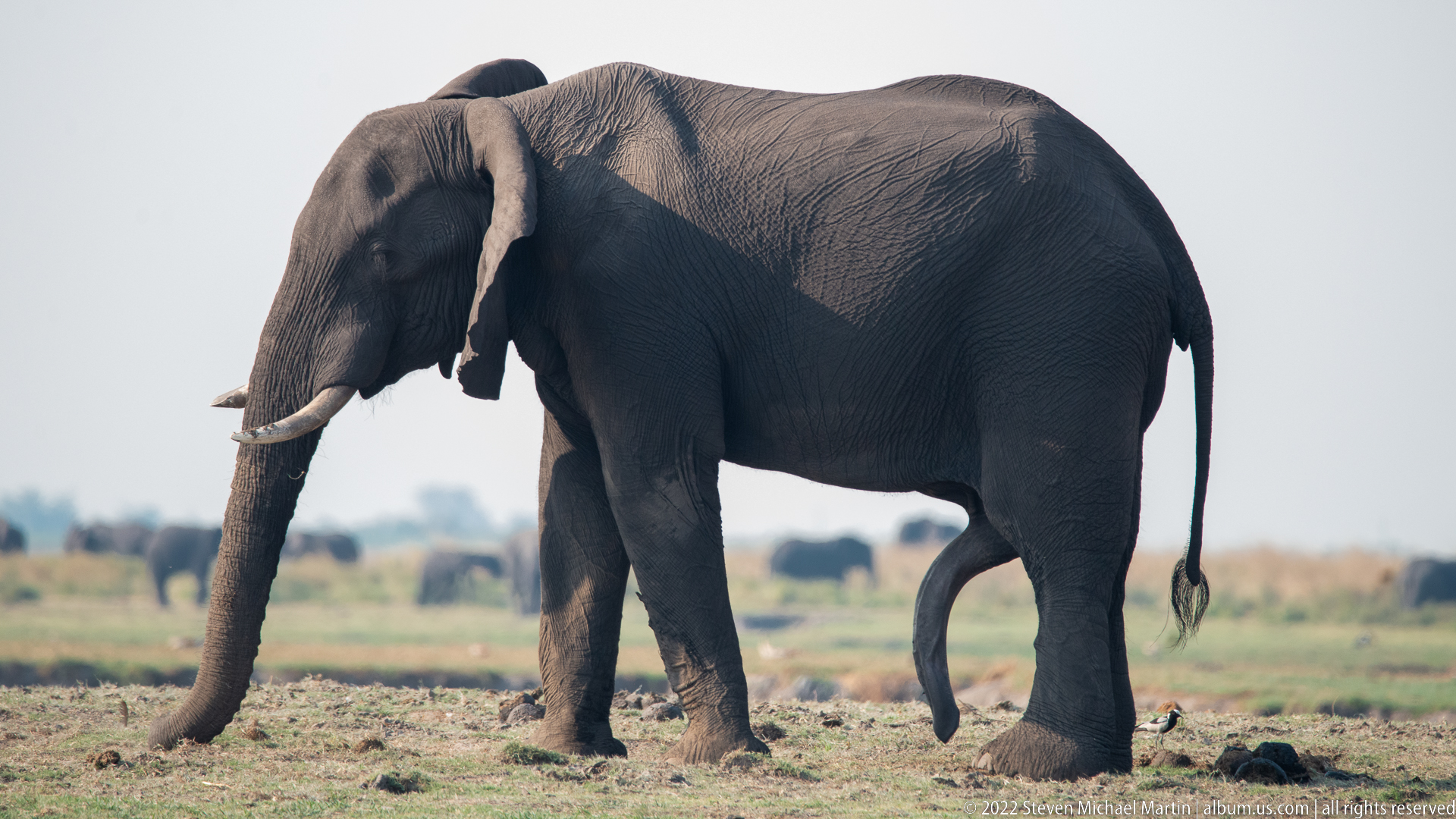
A closer side view fills the frame with an African savanna elephant striding across the floodplain. The lowered trunk nearly touches the ground, one foreleg advances, and the animal’s tusks, broad ear, wrinkled hide, and long tail are rendered in detail against a softly blurred background of distant wildlife.
Caption
A closer side view fills the frame with an African savanna elephant striding across the floodplain. The lowered trunk nearly touches the ground, one foreleg advances, and the animal’s tusks, broad ear, wrinkled hide, and long tail are rendered in detail against a softly blurred background of distant wildlife.
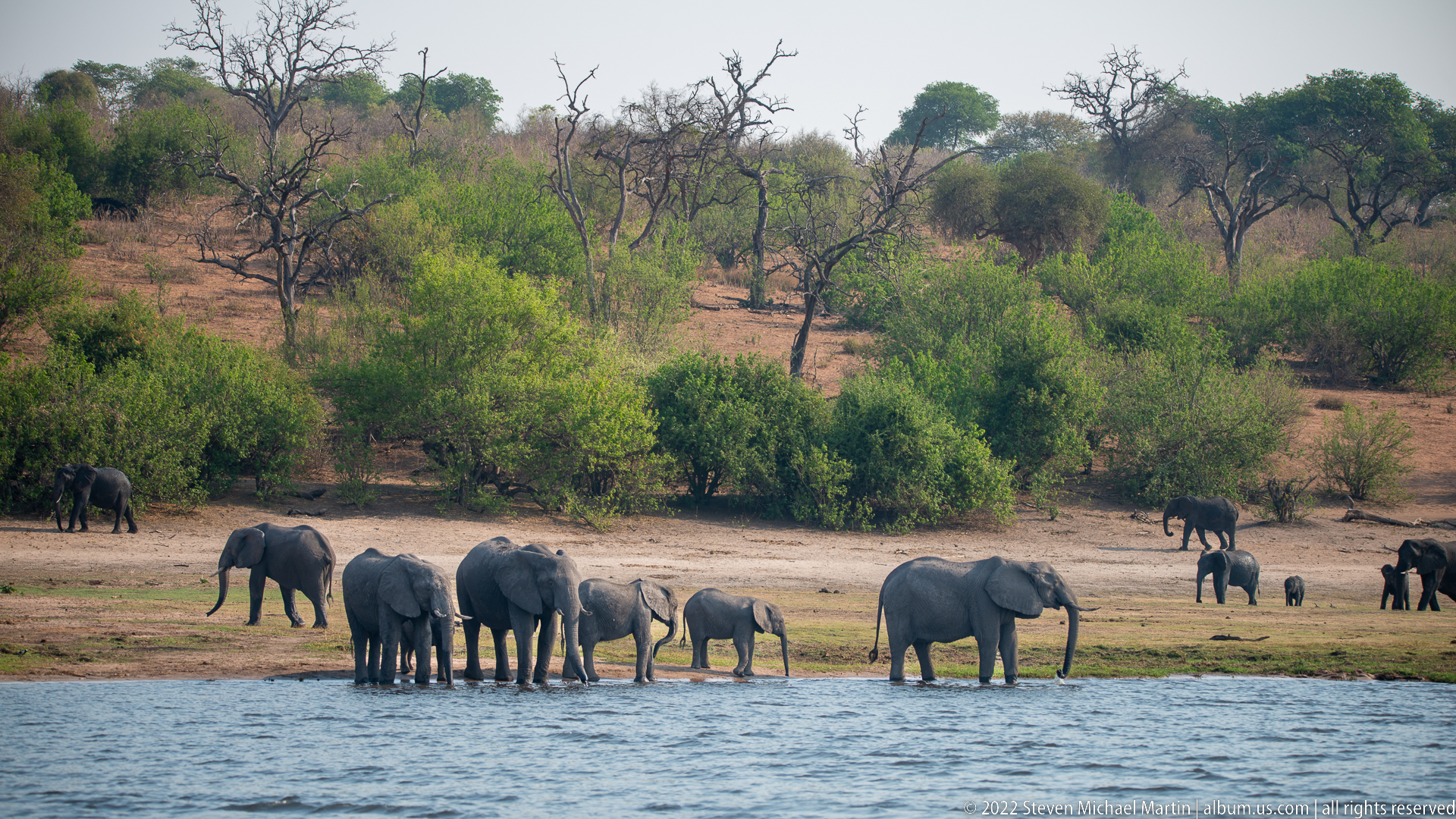
A herd of African savanna elephants gathers along the river’s edge, several adults and younger animals standing trunk-to-water in a loose line. More elephants are scattered across the sandy bank and woodland behind, turning the scene into a broad habitat view of a multi-age herd using the river during the dry season.
Caption
A herd of African savanna elephants gathers along the river’s edge, several adults and younger animals standing trunk-to-water in a loose line. More elephants are scattered across the sandy bank and woodland behind, turning the scene into a broad habitat view of a multi-age herd using the river during the dry season.
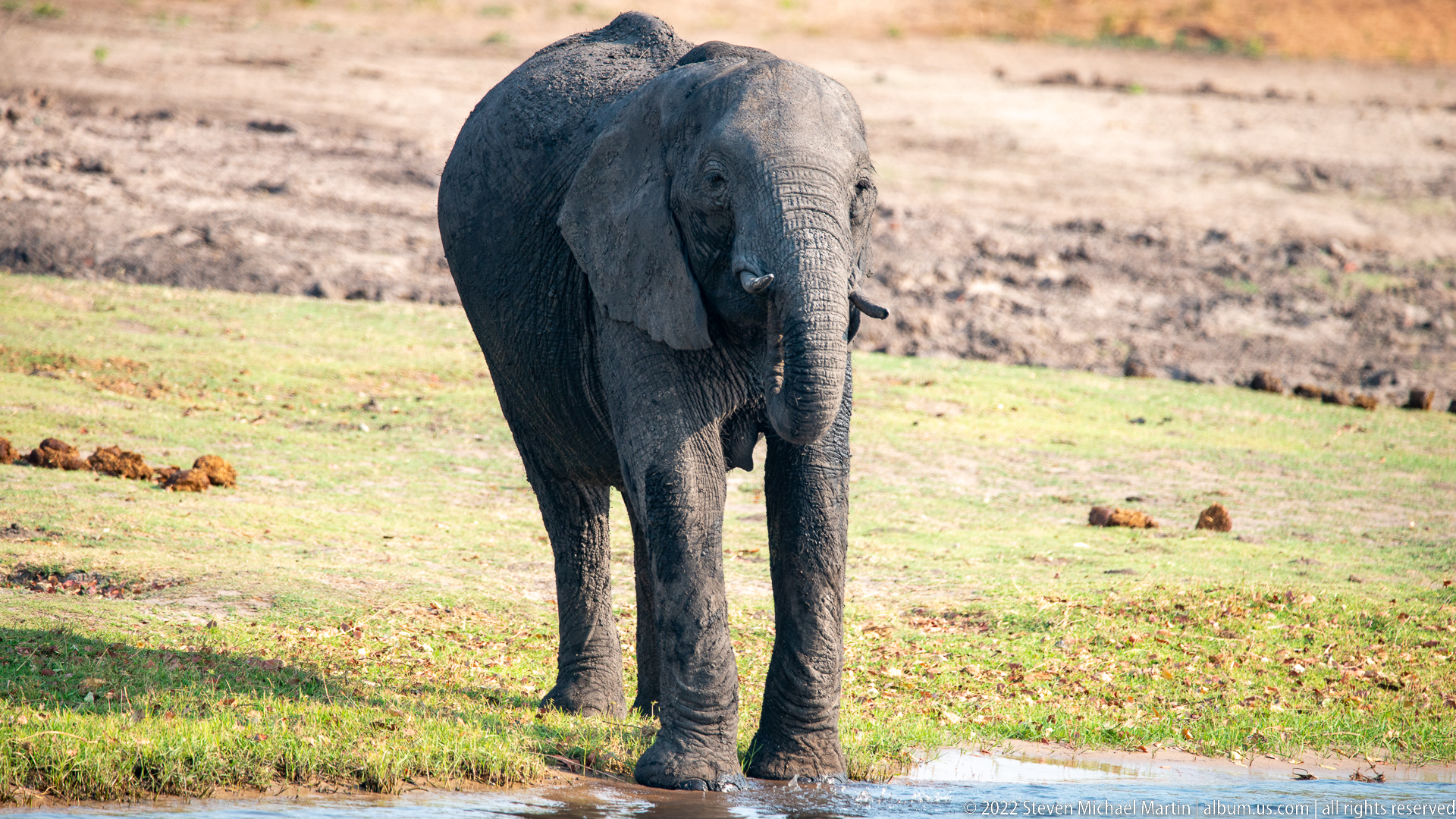
An African bush elephant stands squarely at the river margin, its trunk hanging between the forelegs and its ears resting close to the head. The frontal view emphasizes the animal’s height, columnar legs, wrinkled gray skin, and compact tusks, while the narrow strip of water at its feet places the portrait directly within the Chobe–Zambezi floodplain habitat.
Caption
An African bush elephant stands squarely at the river margin, its trunk hanging between the forelegs and its ears resting close to the head. The frontal view emphasizes the animal’s height, columnar legs, wrinkled gray skin, and compact tusks, while the narrow strip of water at its feet places the portrait directly within the Chobe–Zambezi floodplain habitat.
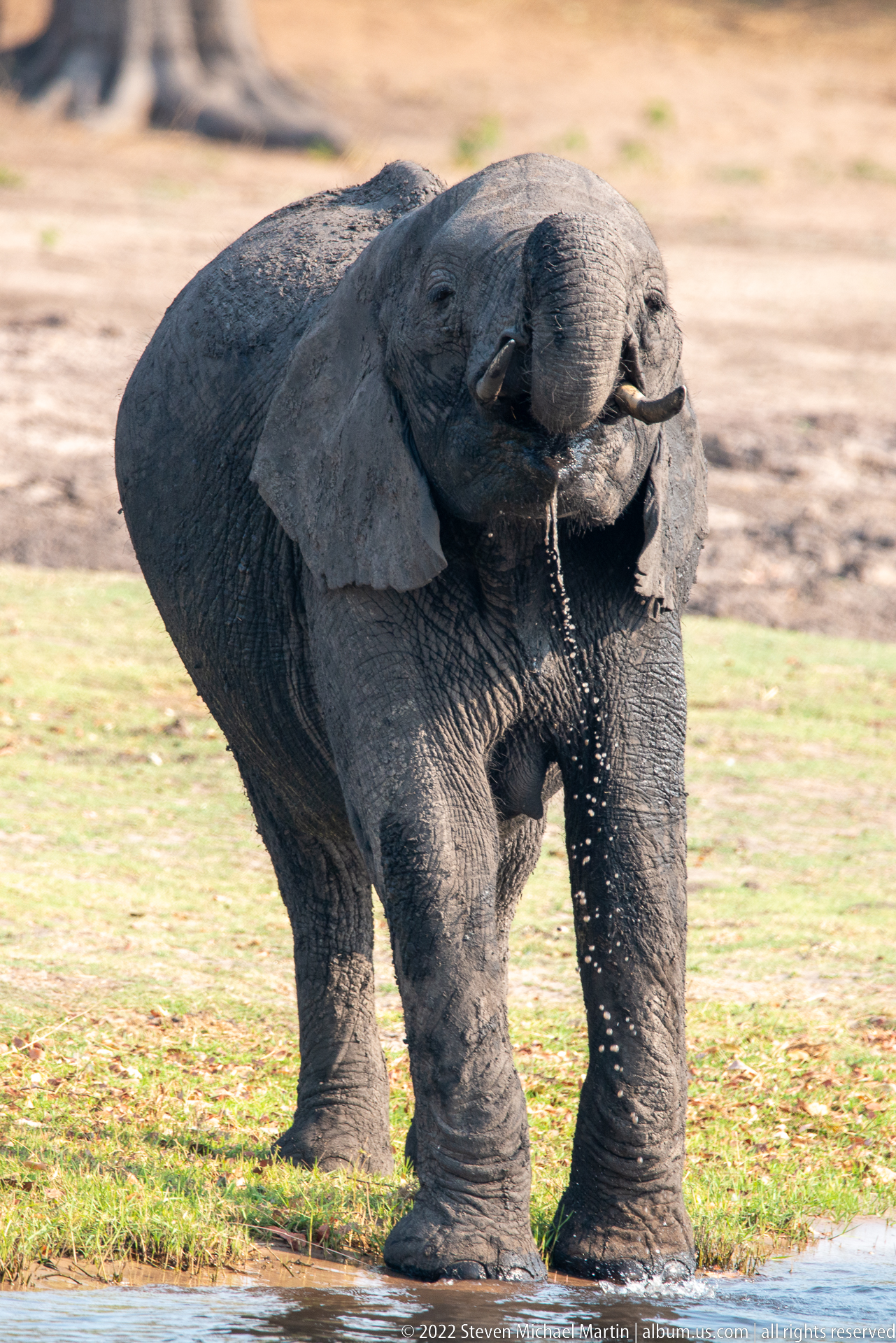
At the river’s edge, an African bush elephant curls its trunk toward its mouth as water streams and splashes across its face and chest. The side-on stance reveals the broad ear, short tusks, massive shoulder, and deeply creased skin. This active drinking view contrasts with the more static elephant portraits in the surrounding sequence.
Caption
At the river’s edge, an African bush elephant curls its trunk toward its mouth as water streams and splashes across its face and chest. The side-on stance reveals the broad ear, short tusks, massive shoulder, and deeply creased skin. This active drinking view contrasts with the more static elephant portraits in the surrounding sequence.
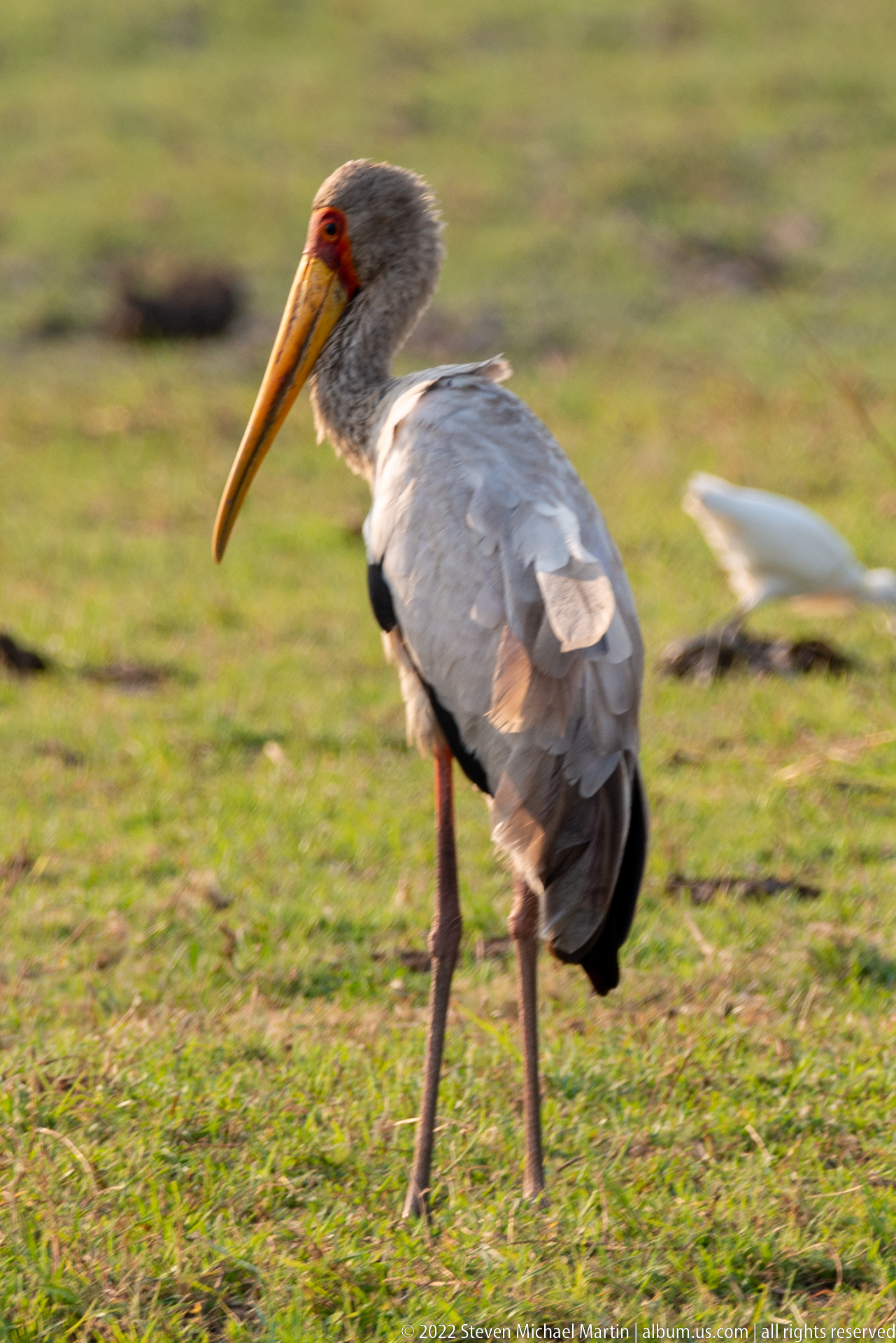
A yellow-billed stork stands in open grass, its long yellow-orange bill and bare red facial skin sharply defined against the soft green background. White body feathers, black flight feathers, and long pinkish legs complete the species’ distinctive field marks. The uncluttered view gives particular prominence to the stork’s specialized long bill.
Caption
A yellow-billed stork stands in open grass, its long yellow-orange bill and bare red facial skin sharply defined against the soft green background. White body feathers, black flight feathers, and long pinkish legs complete the species’ distinctive field marks. The uncluttered view gives particular prominence to the stork’s specialized long bill.
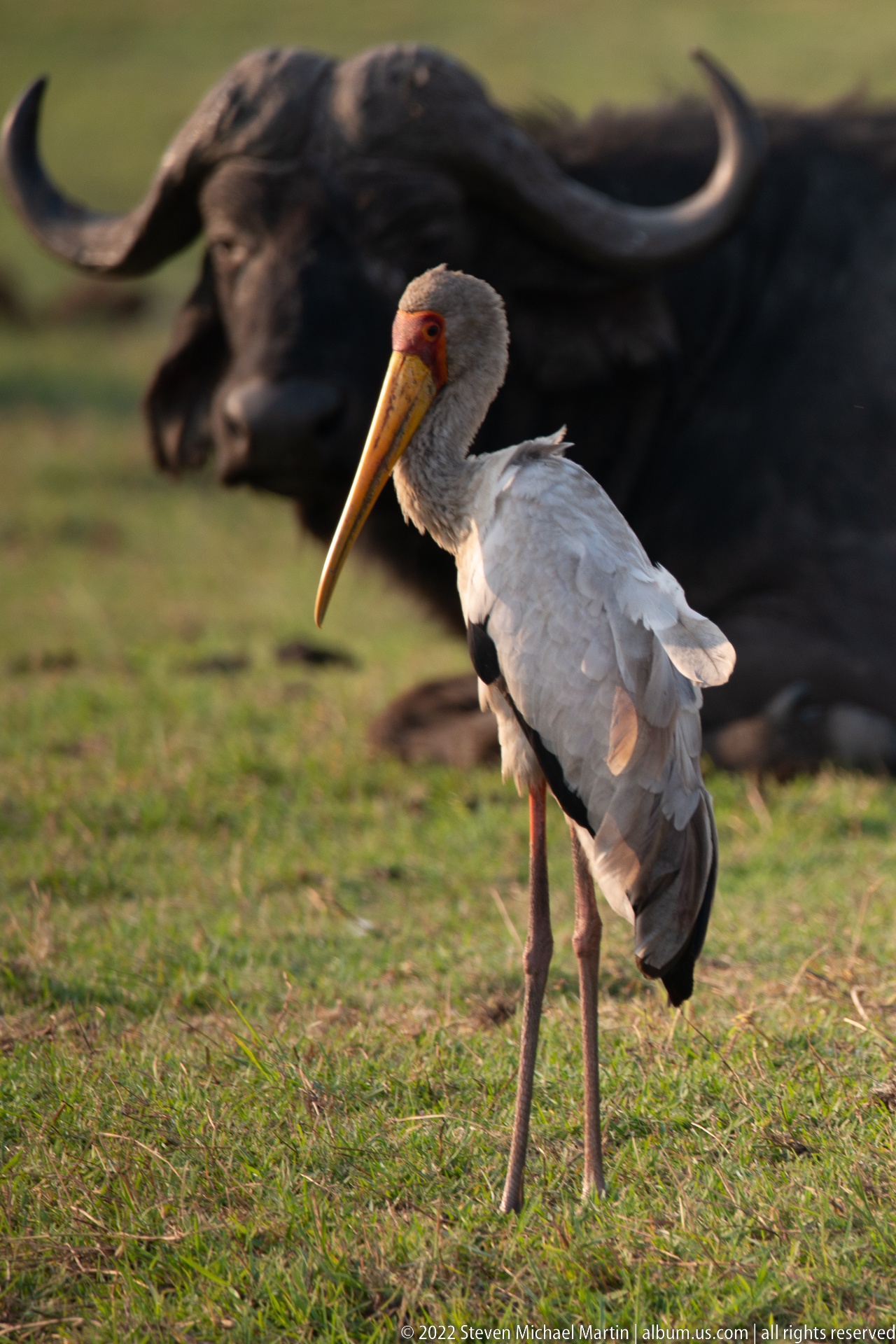
A yellow-billed stork occupies the foreground while an African buffalo lies out of focus behind it, linking two characteristic floodplain species within a shallow depth of field. The stork’s long bill, red facial skin, white body, and dark flight feathers remain crisp, while the buffalo’s curved horn and dark mass provide environmental context without competing for attention.
Caption
A yellow-billed stork occupies the foreground while an African buffalo lies out of focus behind it, linking two characteristic floodplain species within a shallow depth of field. The stork’s long bill, red facial skin, white body, and dark flight feathers remain crisp, while the buffalo’s curved horn and dark mass provide environmental context without competing for attention.

A compact family group of African bush elephants crosses the open floodplain, with a large tusked adult dominating the center and smaller juveniles clustered around and behind it. Differences in body size, tusk development, and shoulder height make the herd’s mixed ages especially clear, while the dry ground and green margin define the riverine setting.
Caption
A compact family group of African bush elephants crosses the open floodplain, with a large tusked adult dominating the center and smaller juveniles clustered around and behind it. Differences in body size, tusk development, and shoulder height make the herd’s mixed ages especially clear, while the dry ground and green margin define the riverine setting.
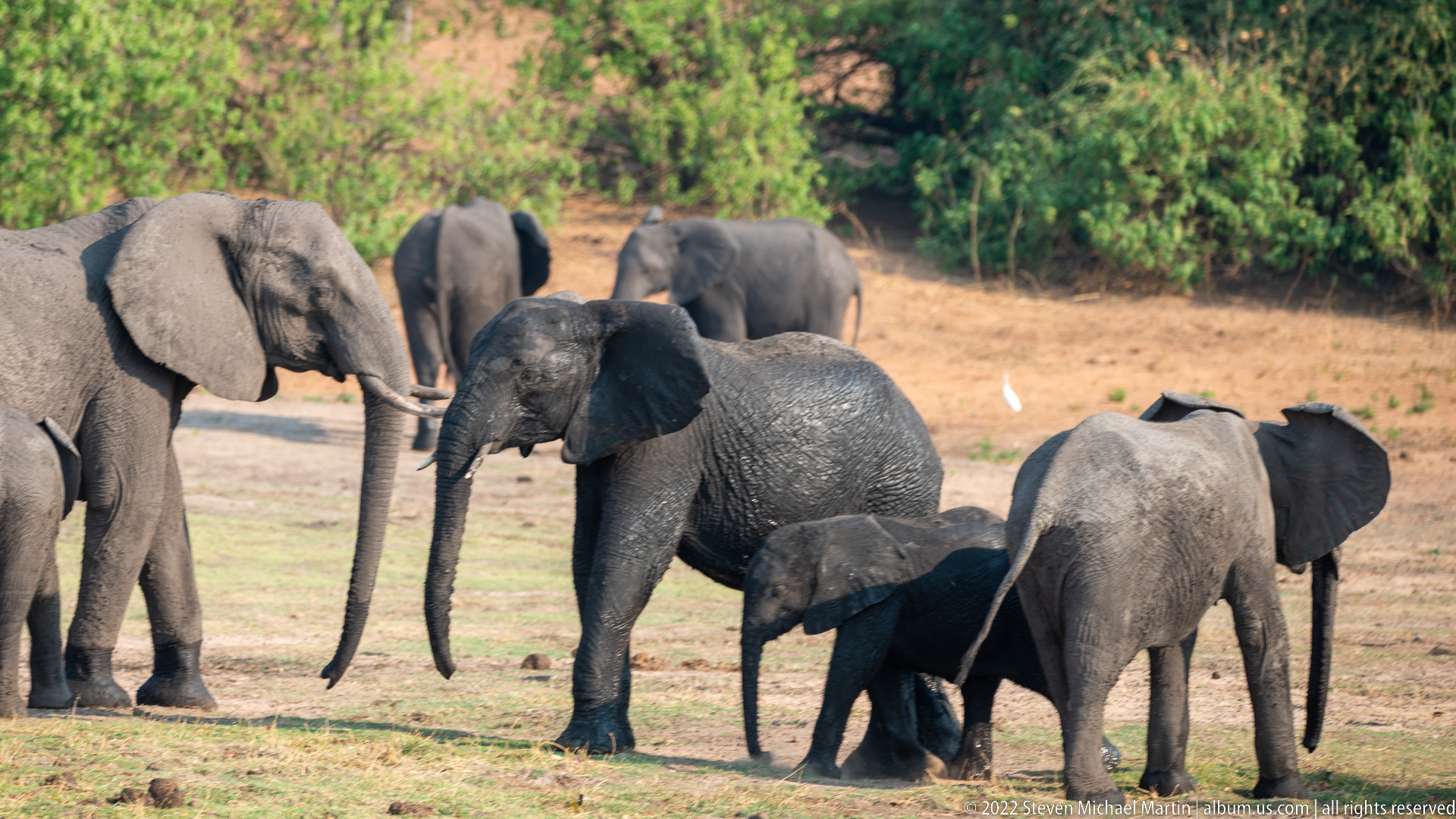
Several African bush elephants spread across the grassy floodplain, including adults, subadults, and a small calf partly sheltered beneath a larger animal. Their varied orientations create a layered herd portrait rather than a single-animal study. Darkened hides on some individuals suggest recent contact with water or mud along the river margin.
Caption
Several African bush elephants spread across the grassy floodplain, including adults, subadults, and a small calf partly sheltered beneath a larger animal. Their varied orientations create a layered herd portrait rather than a single-animal study. Darkened hides on some individuals suggest recent contact with water or mud along the river margin.
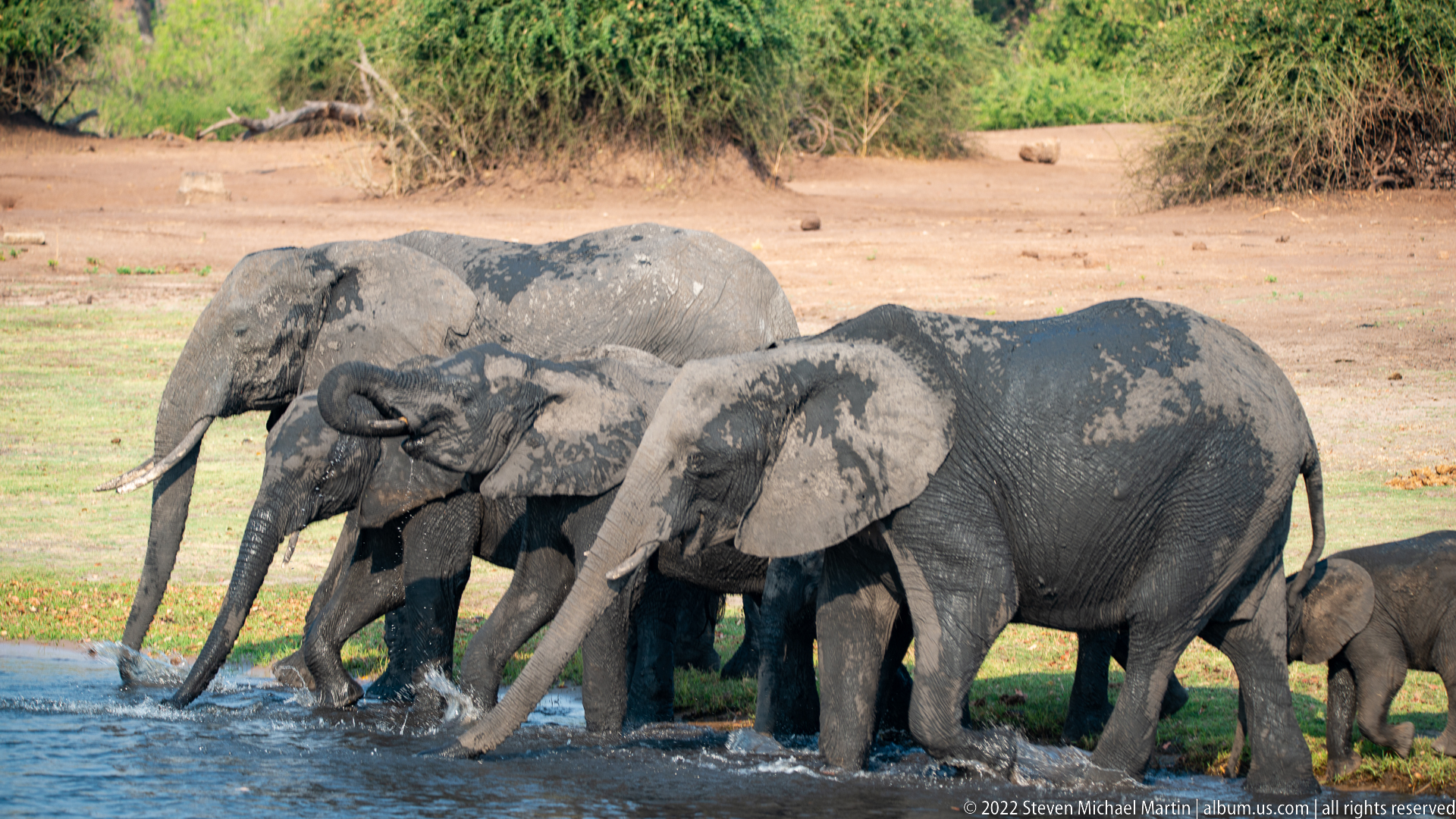
A line of African bush elephants crowds the water’s edge to drink, their trunks extending downward into the river while juveniles remain protected among the larger bodies. Wet, darkened patches of skin and overlapping legs convey the density of the gathering. The composition shows how a herd uses the narrow shoreline collectively rather than isolating a single animal.
Caption
A line of African bush elephants crowds the water’s edge to drink, their trunks extending downward into the river while juveniles remain protected among the larger bodies. Wet, darkened patches of skin and overlapping legs convey the density of the gathering. The composition shows how a herd uses the narrow shoreline collectively rather than isolating a single animal.
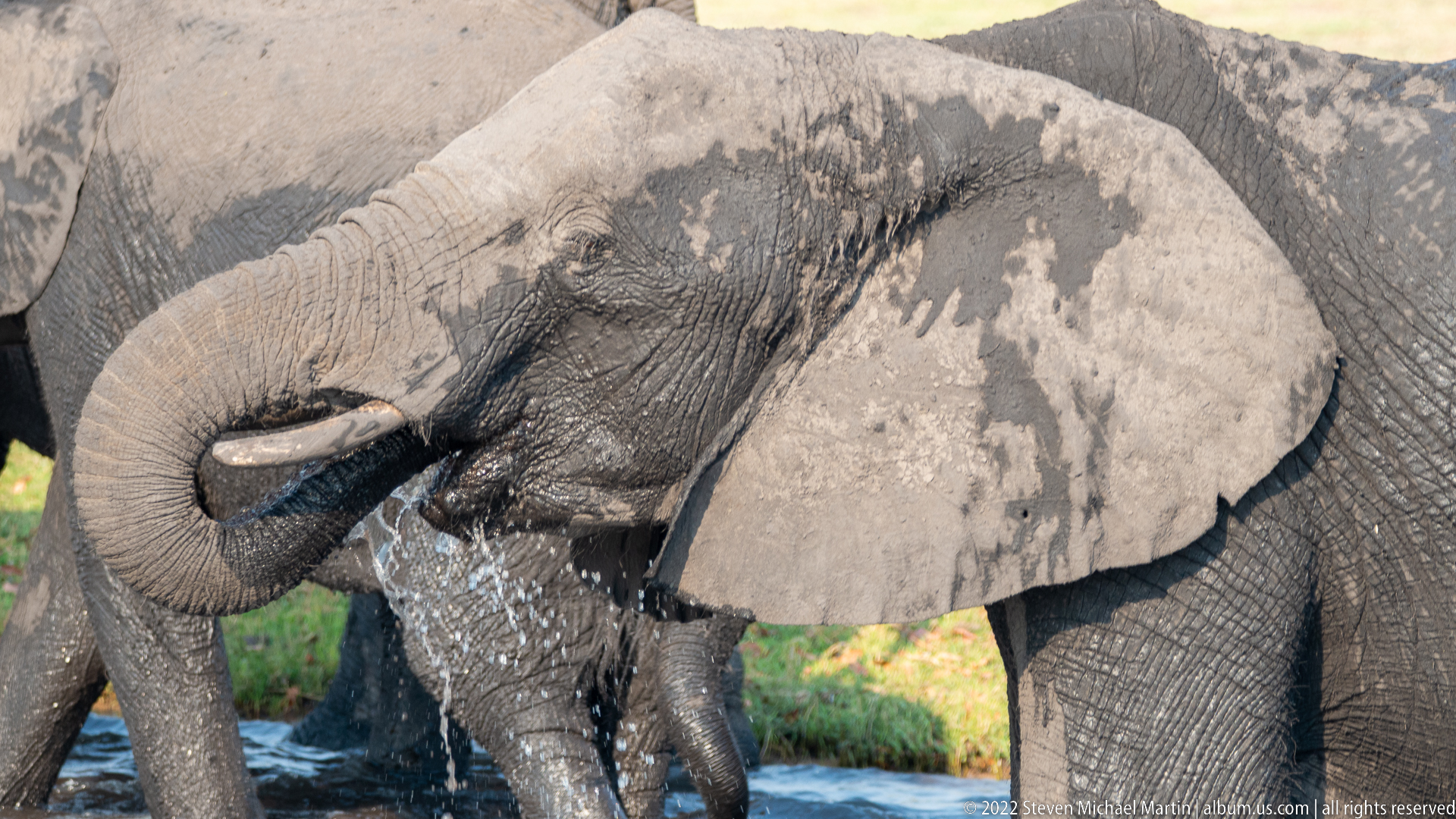
Water spills from the curled trunk and mouth of an African bush elephant in this tightly framed drinking portrait. Mud and moisture mark the head, ear, and shoulder, bringing out the texture of the animal’s deeply wrinkled skin. The close crop concentrates attention on the trunk’s dexterity and the immediate mechanics of drinking.
Caption
Water spills from the curled trunk and mouth of an African bush elephant in this tightly framed drinking portrait. Mud and moisture mark the head, ear, and shoulder, bringing out the texture of the animal’s deeply wrinkled skin. The close crop concentrates attention on the trunk’s dexterity and the immediate mechanics of drinking.
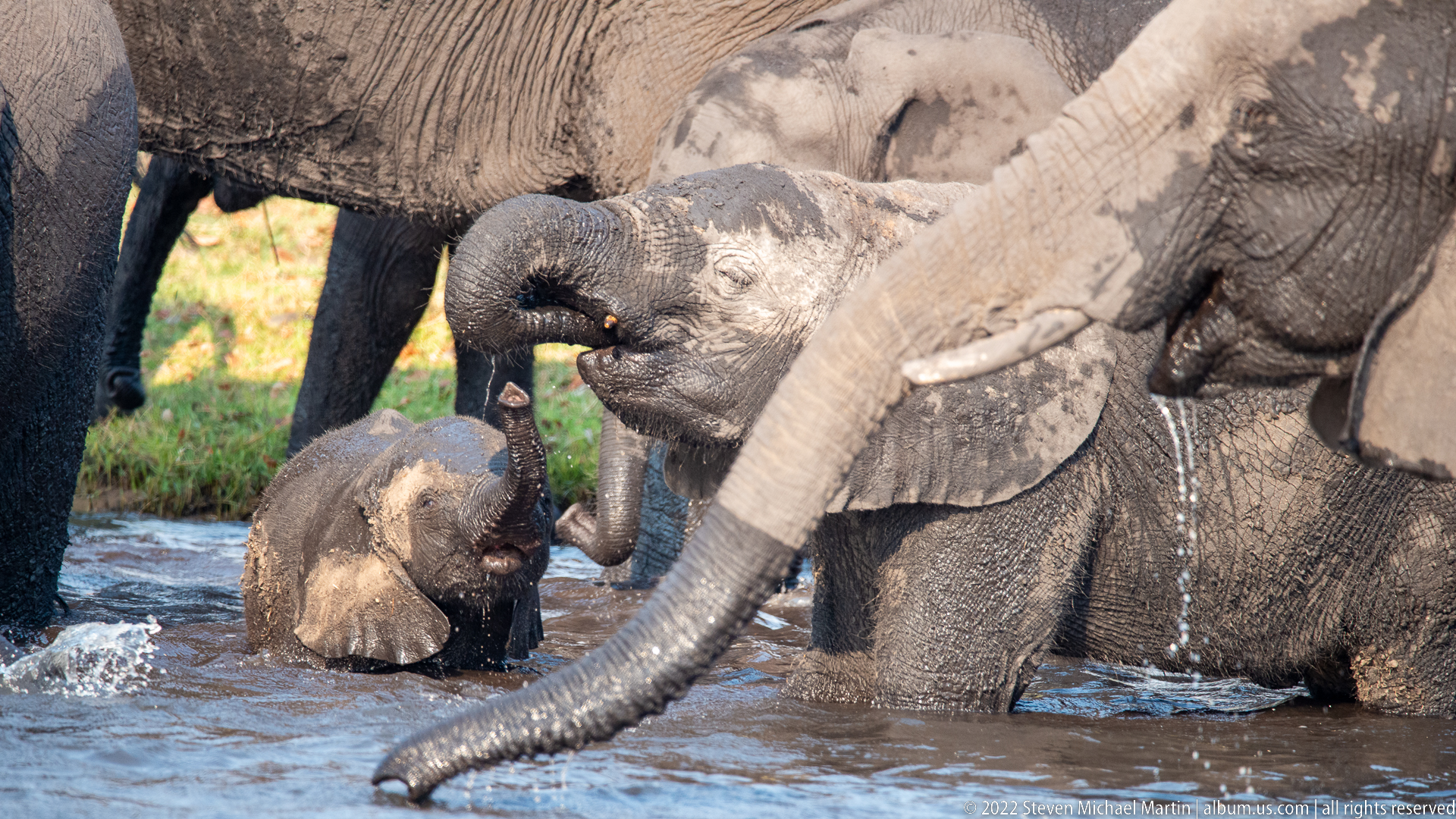
Young African bush elephants play and bathe in shallow river water amid the legs and trunks of larger herd members. One calf is nearly submerged while another raises its trunk toward an adult, and a sweeping adult trunk crosses the foreground. The crowded close view emphasizes social contact and the protection afforded to calves within the herd.
Caption
Young African bush elephants play and bathe in shallow river water amid the legs and trunks of larger herd members. One calf is nearly submerged while another raises its trunk toward an adult, and a sweeping adult trunk crosses the foreground. The crowded close view emphasizes social contact and the protection afforded to calves within the herd.

A broad line of African bush elephants stands at the river margin, adults and younger animals forming an almost continuous wall of gray bodies. Several trunks reach toward the water while others hang relaxed. Seen from across the channel, the grouping clearly relates the herd’s social structure to the narrow band of shoreline used for drinking.
Caption
A broad line of African bush elephants stands at the river margin, adults and younger animals forming an almost continuous wall of gray bodies. Several trunks reach toward the water while others hang relaxed. Seen from across the channel, the grouping clearly relates the herd’s social structure to the narrow band of shoreline used for drinking.
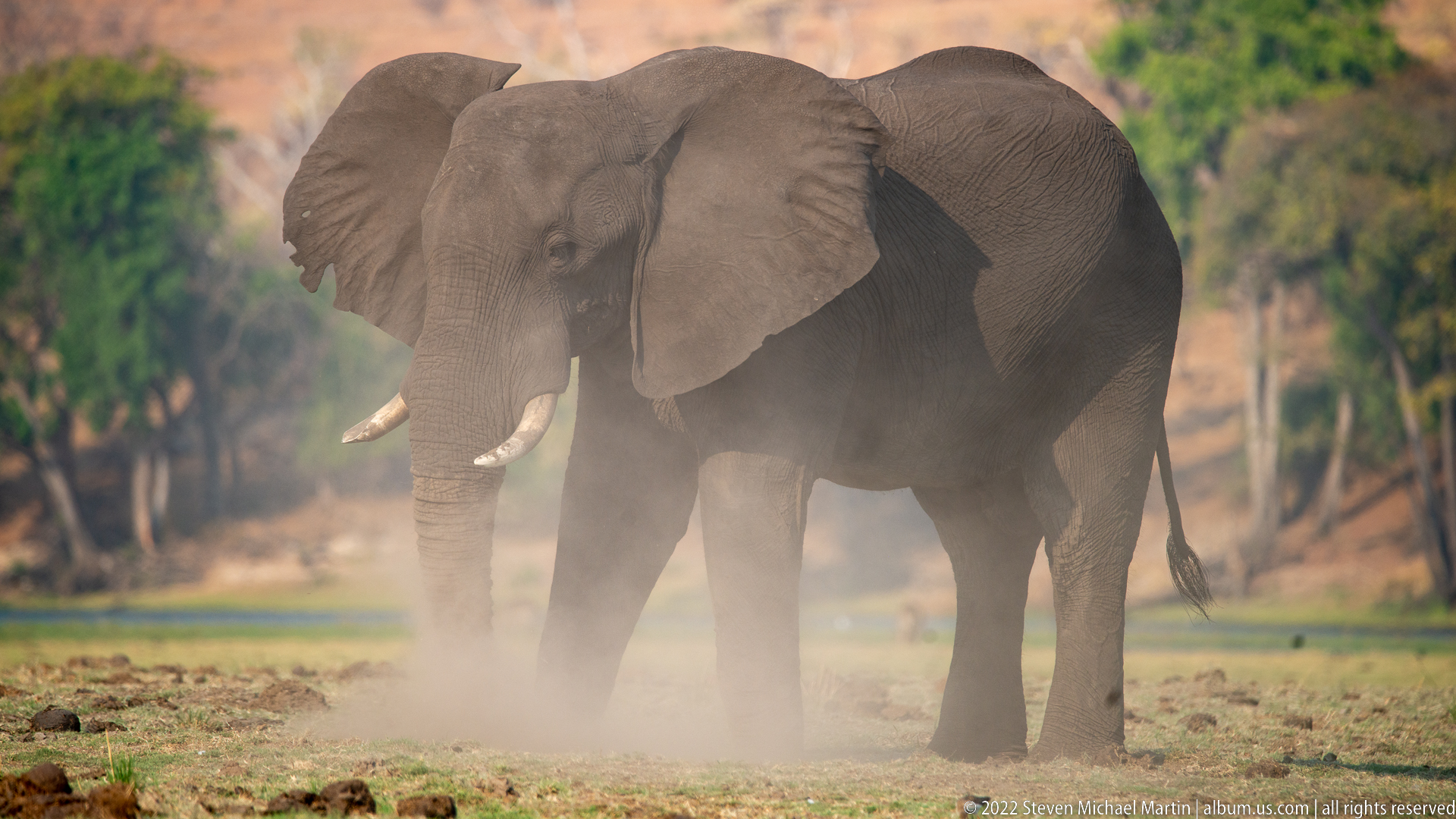
An African bush elephant stands in a suspended cloud of pale dust, its ears spread and tusks visible as fine soil rises around the legs and belly. Dust bathing helps elephants coat the skin and is a characteristic behavior in dry savanna conditions. The backlit haze separates the animal dramatically from the greener woodland beyond.
Caption
An African bush elephant stands in a suspended cloud of pale dust, its ears spread and tusks visible as fine soil rises around the legs and belly. Dust bathing helps elephants coat the skin and is a characteristic behavior in dry savanna conditions. The backlit haze separates the animal dramatically from the greener woodland beyond.

A yellow-billed stork stands on the grassy floodplain with its long bill angled downward. The bird shows the species’ distinctive yellow-orange bill, bare reddish facial skin, white body plumage, black flight feathers, and pink-red legs. Its relaxed posture provides a clear field-guide view of the markings used to distinguish this large African wetland stork.
Caption
A yellow-billed stork stands on the grassy floodplain with its long bill angled downward. The bird shows the species’ distinctive yellow-orange bill, bare reddish facial skin, white body plumage, black flight feathers, and pink-red legs. Its relaxed posture provides a clear field-guide view of the markings used to distinguish this large African wetland stork.
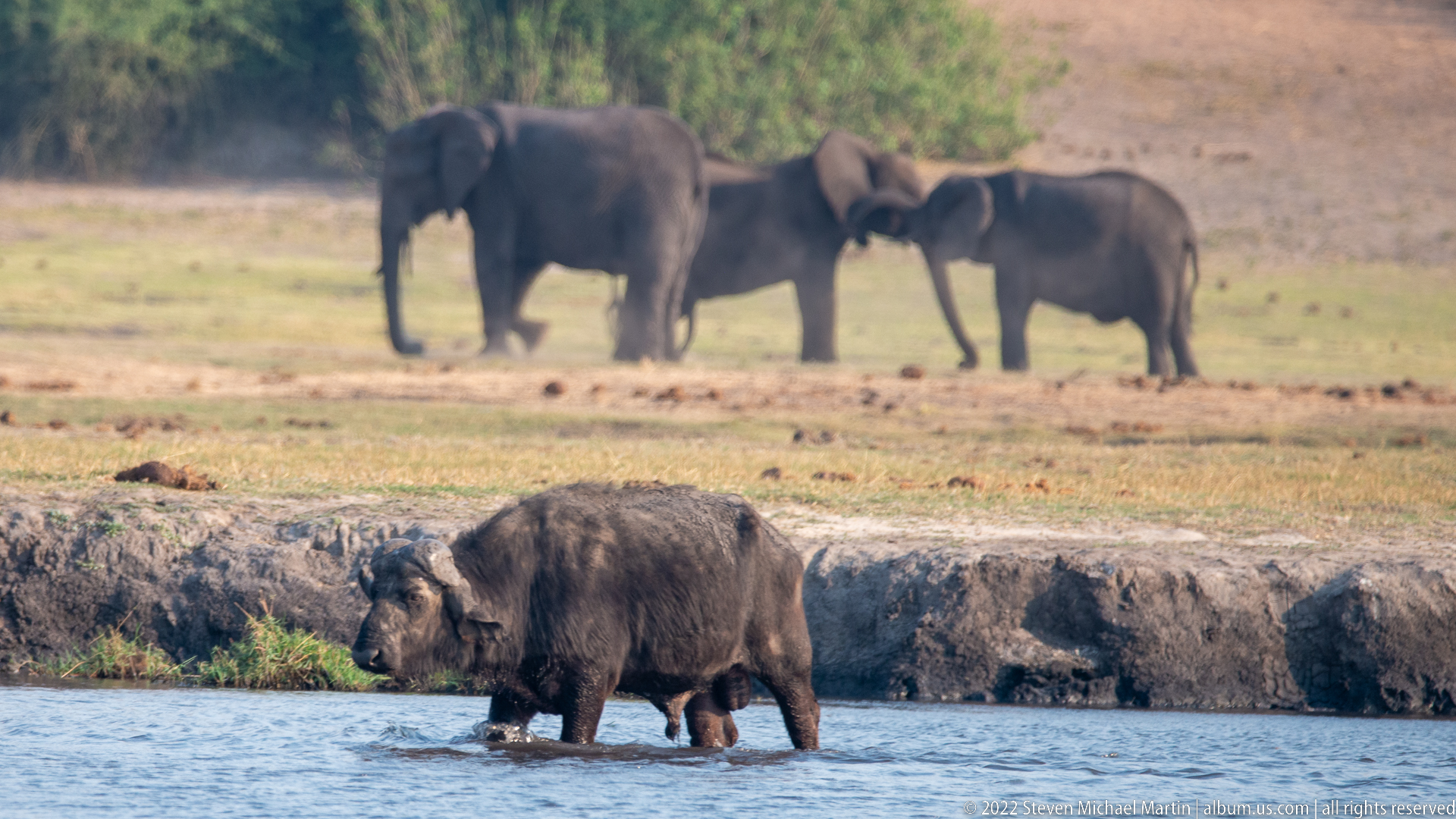
A hippopotamus wades through shallow river water in the foreground while three African bush elephants stand on the drier floodplain beyond. The layered composition places two of the region’s largest herbivores in their shared riverine landscape, contrasting the hippo’s low, barrel-shaped aquatic profile with the elephants’ tall silhouettes.
Caption
A hippopotamus wades through shallow river water in the foreground while three African bush elephants stand on the drier floodplain beyond. The layered composition places two of the region’s largest herbivores in their shared riverine landscape, contrasting the hippo’s low, barrel-shaped aquatic profile with the elephants’ tall silhouettes.
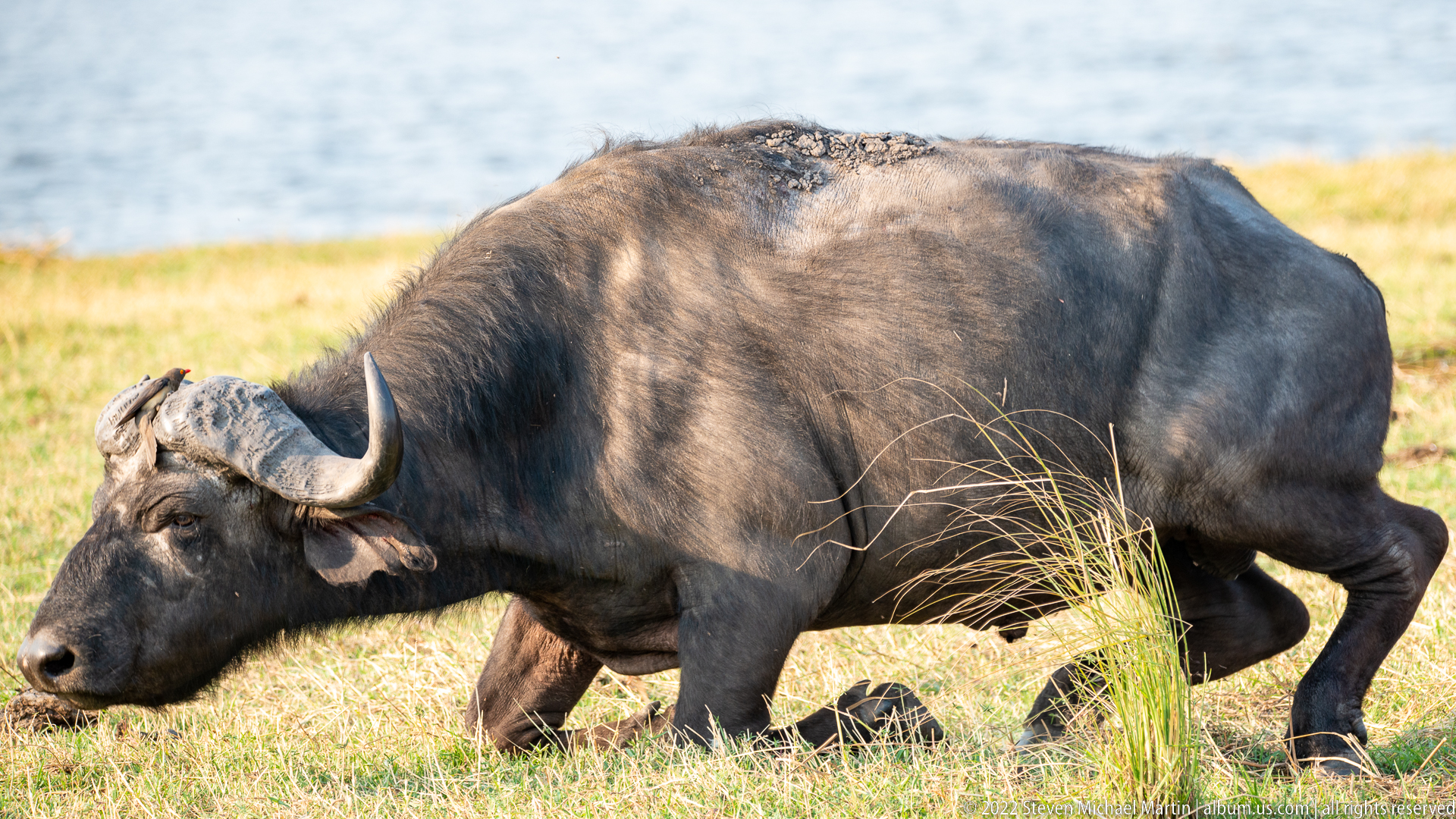
An African buffalo grazes in profile on short riverside grass, lowering its heavy head almost to the ground. The massive dark body, broad muzzle, drooping ears, and thick horns sweeping outward and upward are clearly visible. Water behind the animal situates this close field-guide portrait within the productive grazing habitat of the river floodplain.
Caption
An African buffalo grazes in profile on short riverside grass, lowering its heavy head almost to the ground. The massive dark body, broad muzzle, drooping ears, and thick horns sweeping outward and upward are clearly visible. Water behind the animal situates this close field-guide portrait within the productive grazing habitat of the river floodplain.
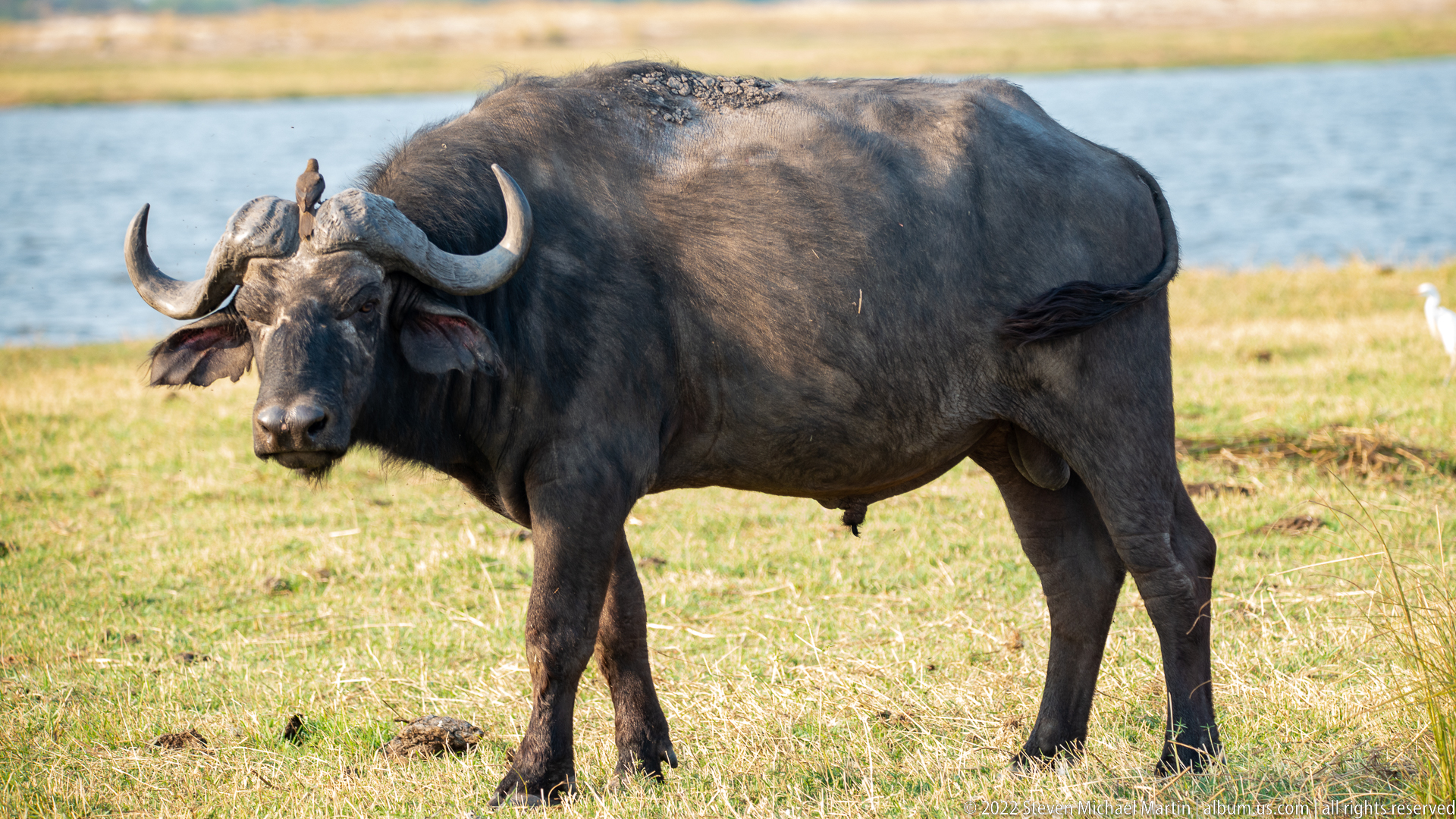
An African buffalo stands broadside on the grassy floodplain, offering a clear view of its stocky body, heavy horn bases, and outward-curving horns. A small oxpecker perched near the shoulders adds a familiar interspecies association: these birds commonly forage on large African mammals. The open stance makes the buffalo’s characteristic proportions especially easy to read.
Caption
An African buffalo stands broadside on the grassy floodplain, offering a clear view of its stocky body, heavy horn bases, and outward-curving horns. A small oxpecker perched near the shoulders adds a familiar interspecies association: these birds commonly forage on large African mammals. The open stance makes the buffalo’s characteristic proportions especially easy to read.
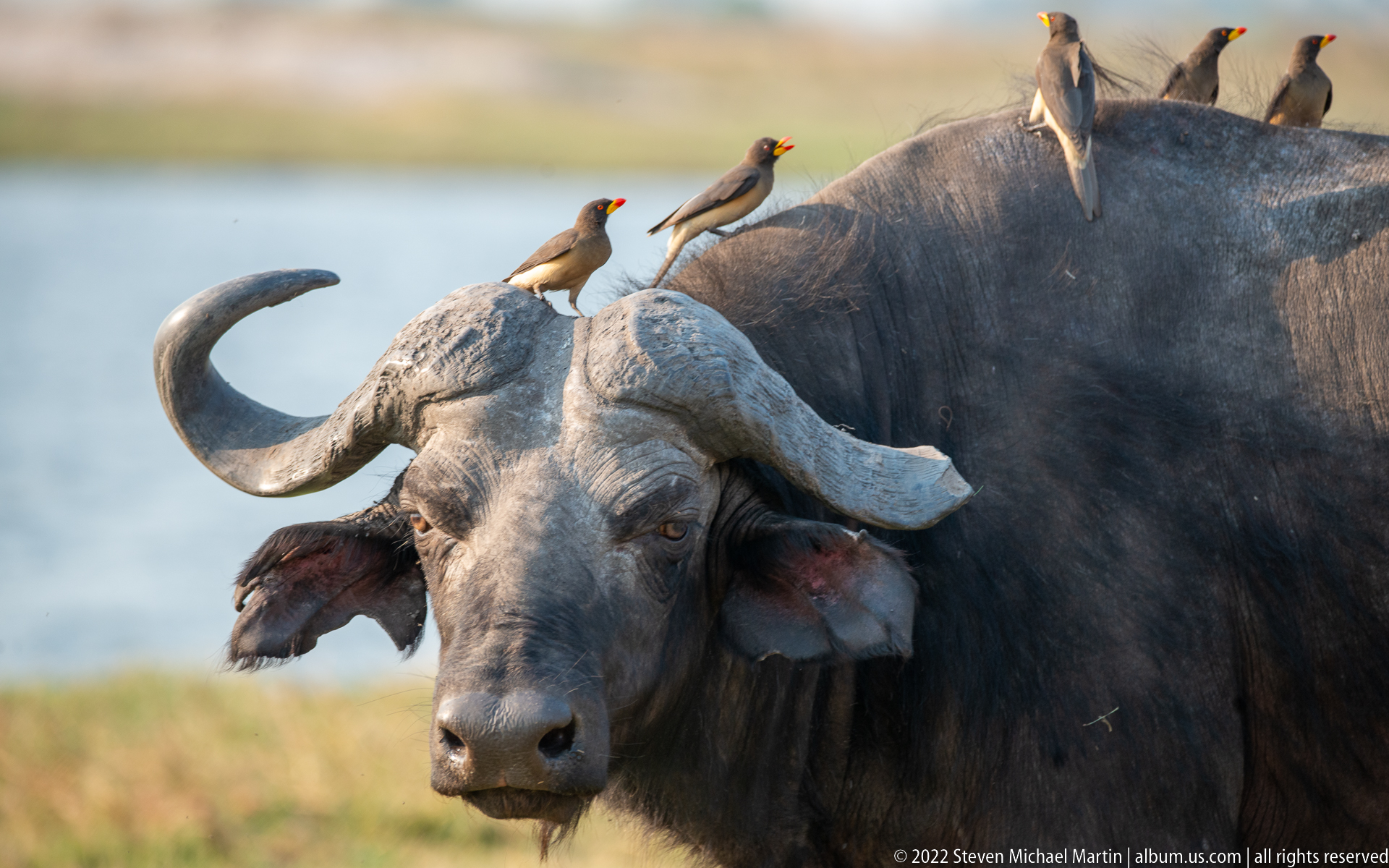
Several yellow-billed oxpeckers perch across the back and head of an African buffalo, turning a close buffalo portrait into a study of interspecies foraging. Their brown bodies and bright yellow-to-red bills stand out against the buffalo’s dark hide. The birds search large mammals for ticks and other food while using the animal as a mobile perch.
Caption
Several yellow-billed oxpeckers perch across the back and head of an African buffalo, turning a close buffalo portrait into a study of interspecies foraging. Their brown bodies and bright yellow-to-red bills stand out against the buffalo’s dark hide. The birds search large mammals for ticks and other food while using the animal as a mobile perch.
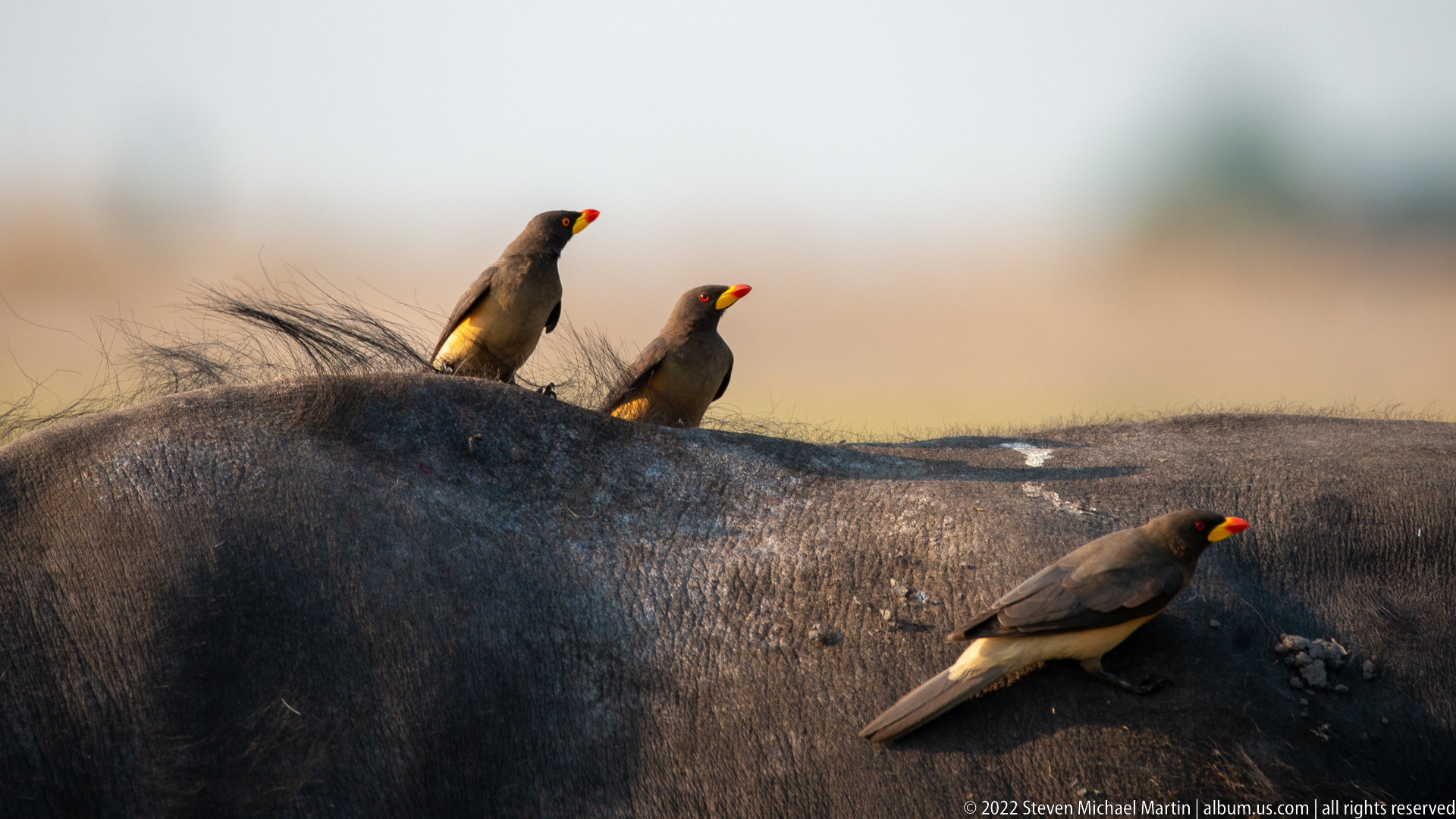
Three yellow-billed oxpeckers stand on the coarse dark hide of an African buffalo, isolated against a softly blurred background. The close view makes their brown plumage and vivid yellow bills with reddish tips readily visible. One bird probes the hide while the others remain alert, illustrating the species’ specialized association with large African mammals.
Caption
Three yellow-billed oxpeckers stand on the coarse dark hide of an African buffalo, isolated against a softly blurred background. The close view makes their brown plumage and vivid yellow bills with reddish tips readily visible. One bird probes the hide while the others remain alert, illustrating the species’ specialized association with large African mammals.
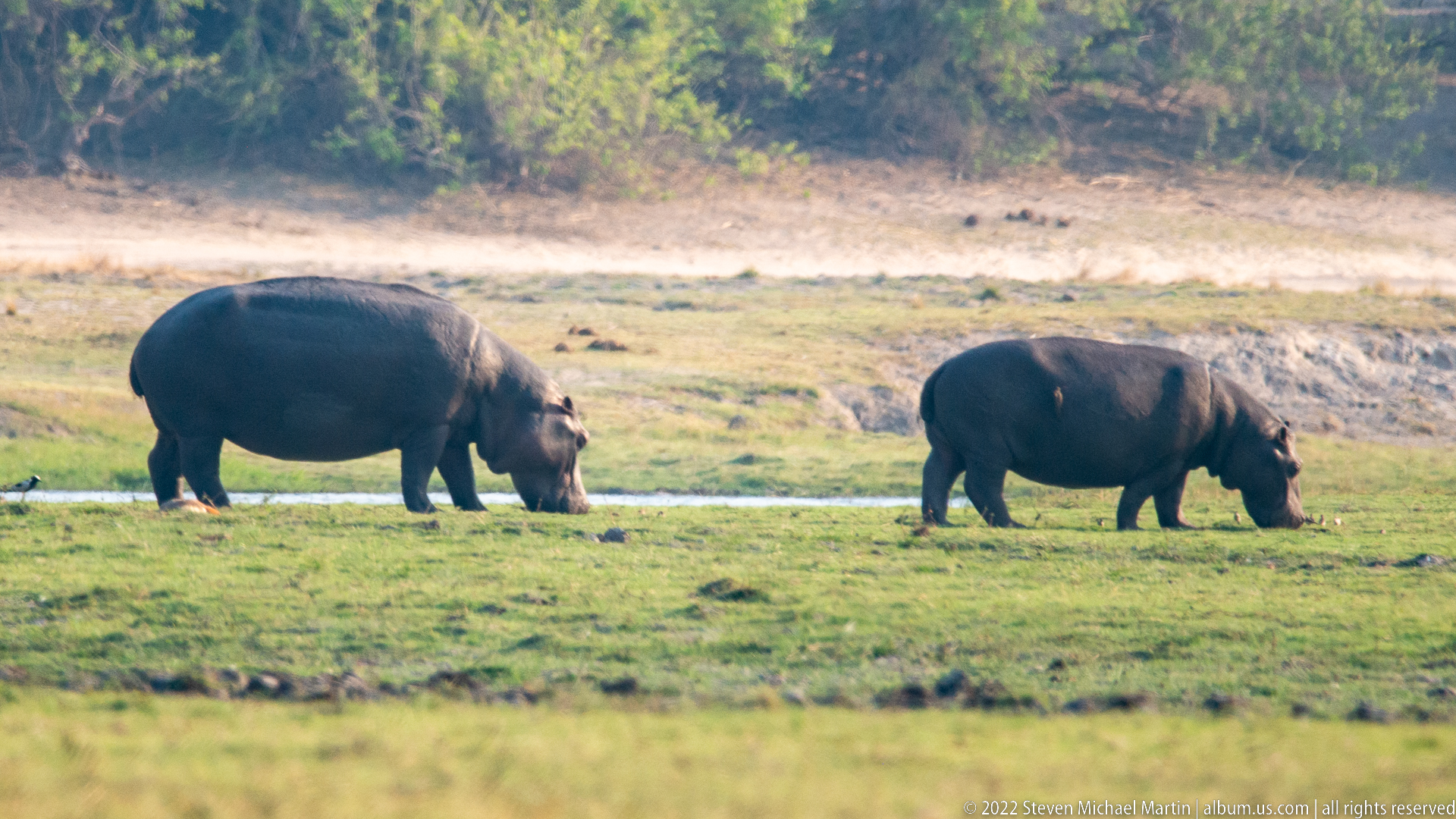
Two hippopotamuses graze on short green floodplain vegetation near a narrow water channel. Both animals are fully out of the water, revealing the species’ massive barrel-shaped bodies, short legs, and broad heads. The paired view documents the terrestrial grazing behavior that complements the hippopotamus’s strong daytime association with rivers and pools.
Caption
Two hippopotamuses graze on short green floodplain vegetation near a narrow water channel. Both animals are fully out of the water, revealing the species’ massive barrel-shaped bodies, short legs, and broad heads. The paired view documents the terrestrial grazing behavior that complements the hippopotamus’s strong daytime association with rivers and pools.
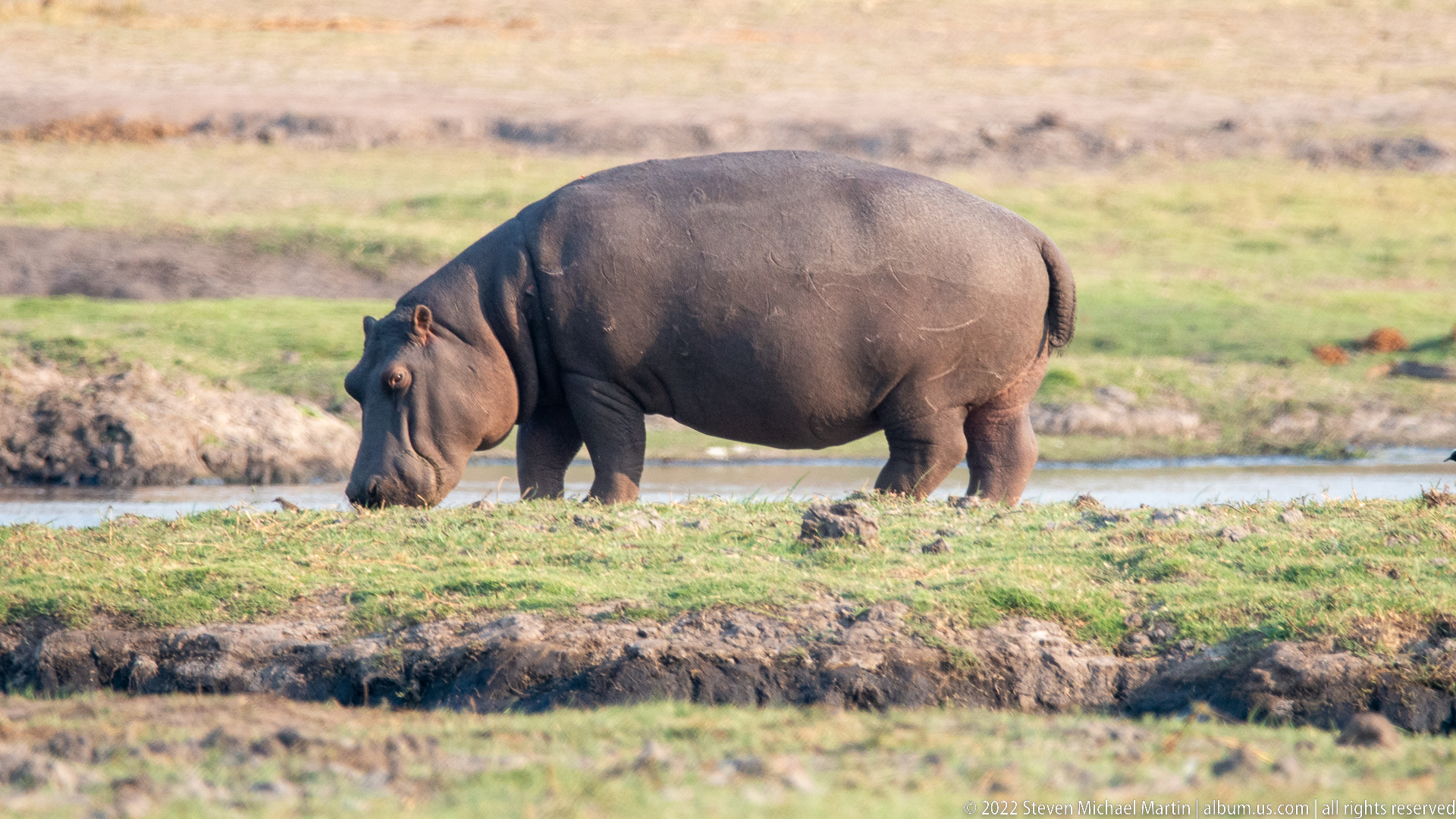
A solitary hippopotamus grazes along the low riverbank, its head lowered into the short vegetation while the water runs immediately behind it. Seen in profile and fully on land, the animal’s deep torso, short legs, small ears, and broad muzzle are easy to distinguish. The image isolates feeding behavior from the more social hippo views nearby.
Caption
A solitary hippopotamus grazes along the low riverbank, its head lowered into the short vegetation while the water runs immediately behind it. Seen in profile and fully on land, the animal’s deep torso, short legs, small ears, and broad muzzle are easy to distinguish. The image isolates feeding behavior from the more social hippo views nearby.
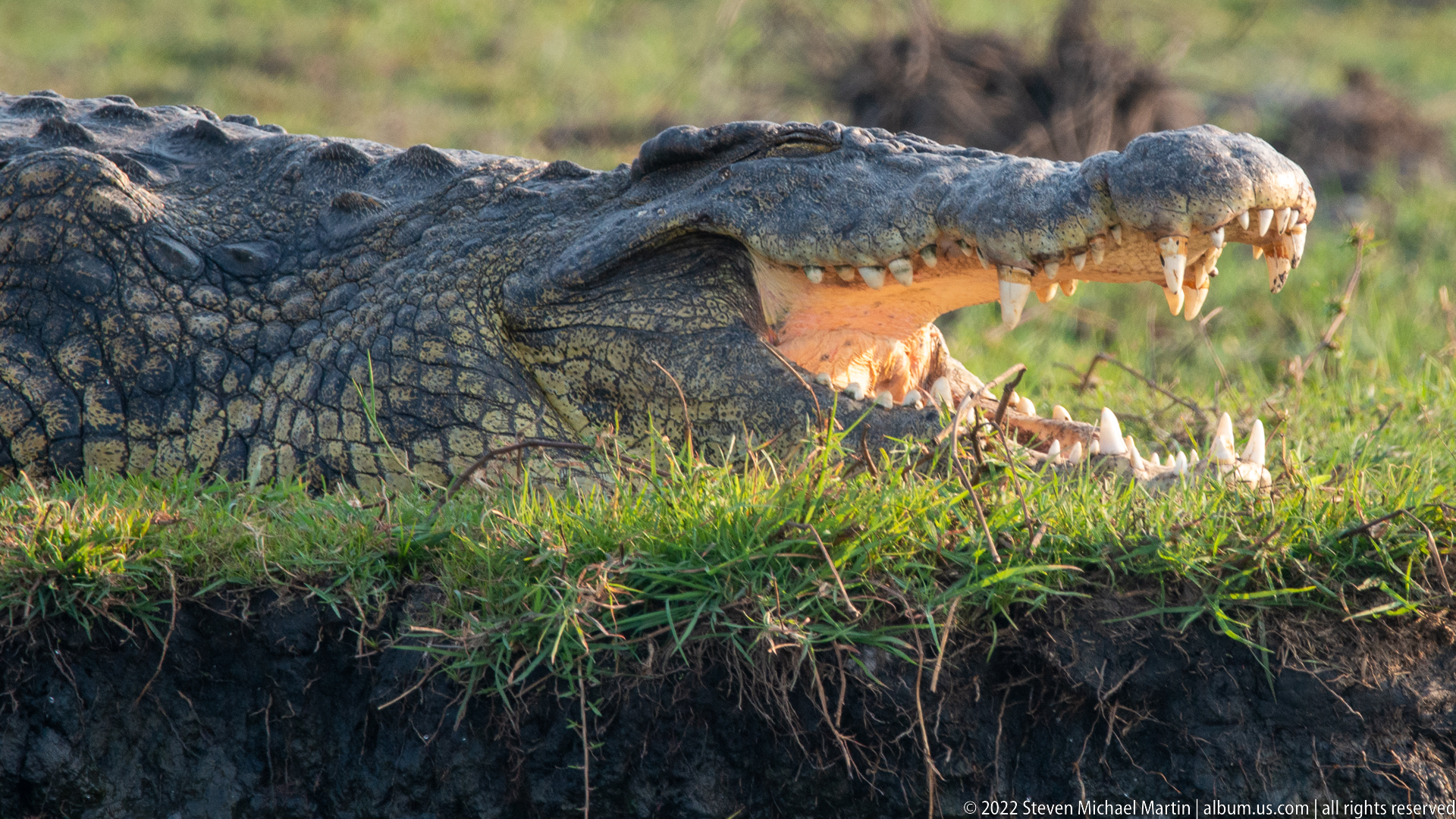
A Nile crocodile rests on the grassy bank with its jaws held wide open, exposing interlocking conical teeth and the pale interior of the mouth. Heavy armored scales, raised dorsal scutes, and the broad snout are sharply resolved. The open-mouth posture is commonly associated with thermoregulation in basking crocodilians and provides an unusually clear anatomical study.
Caption
A Nile crocodile rests on the grassy bank with its jaws held wide open, exposing interlocking conical teeth and the pale interior of the mouth. Heavy armored scales, raised dorsal scutes, and the broad snout are sharply resolved. The open-mouth posture is commonly associated with thermoregulation in basking crocodilians and provides an unusually clear anatomical study.
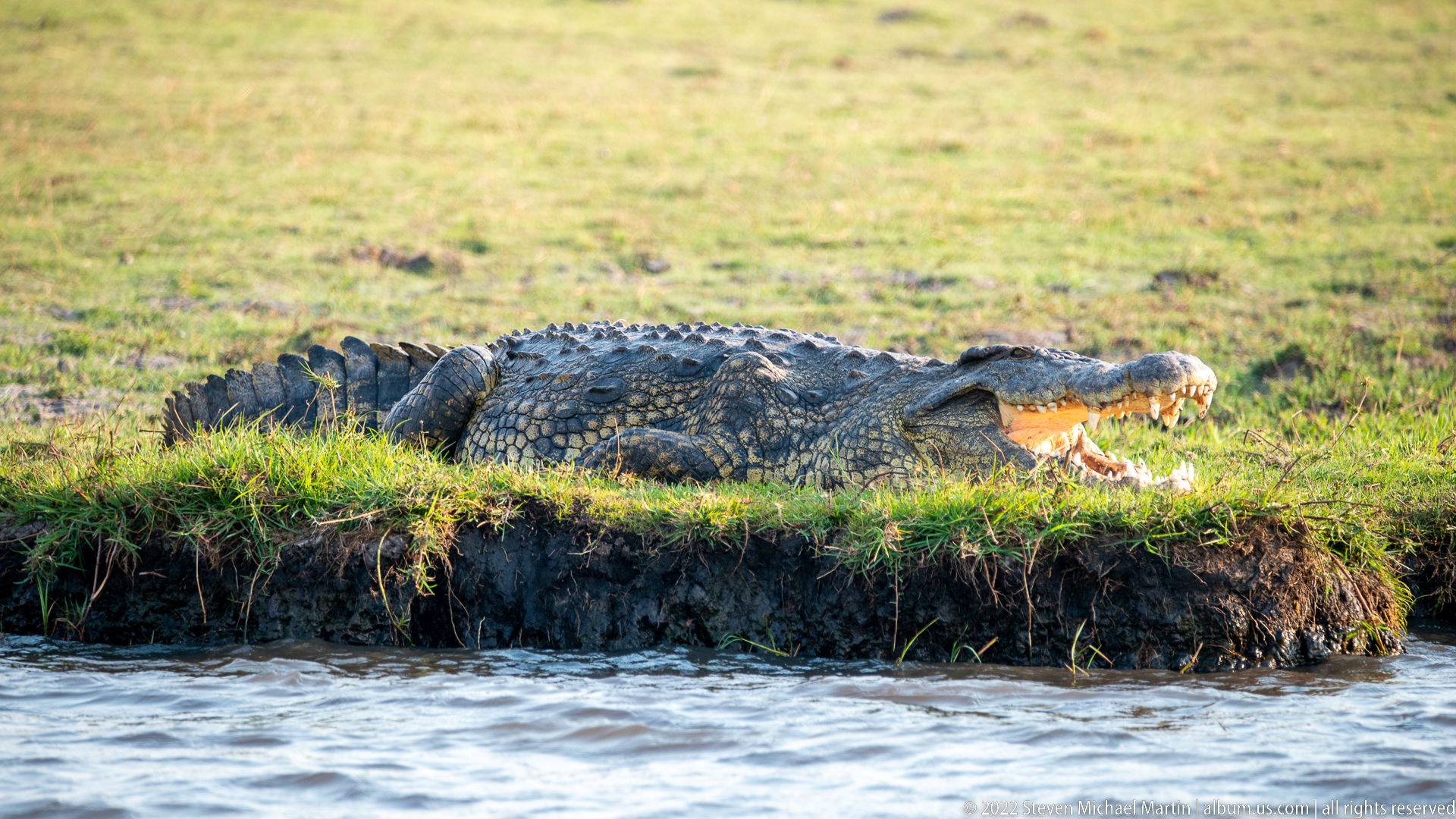
A Nile crocodile lies stretched along a low grassy bank only inches above moving river water, its jaws open as it basks. The full-body view shows the animal’s long armored back and low-slung profile while the exposed teeth remain visible from a distance. The composition connects the reptile directly to the boundary between aquatic and terrestrial habitat.
Caption
A Nile crocodile lies stretched along a low grassy bank only inches above moving river water, its jaws open as it basks. The full-body view shows the animal’s long armored back and low-slung profile while the exposed teeth remain visible from a distance. The composition connects the reptile directly to the boundary between aquatic and terrestrial habitat.
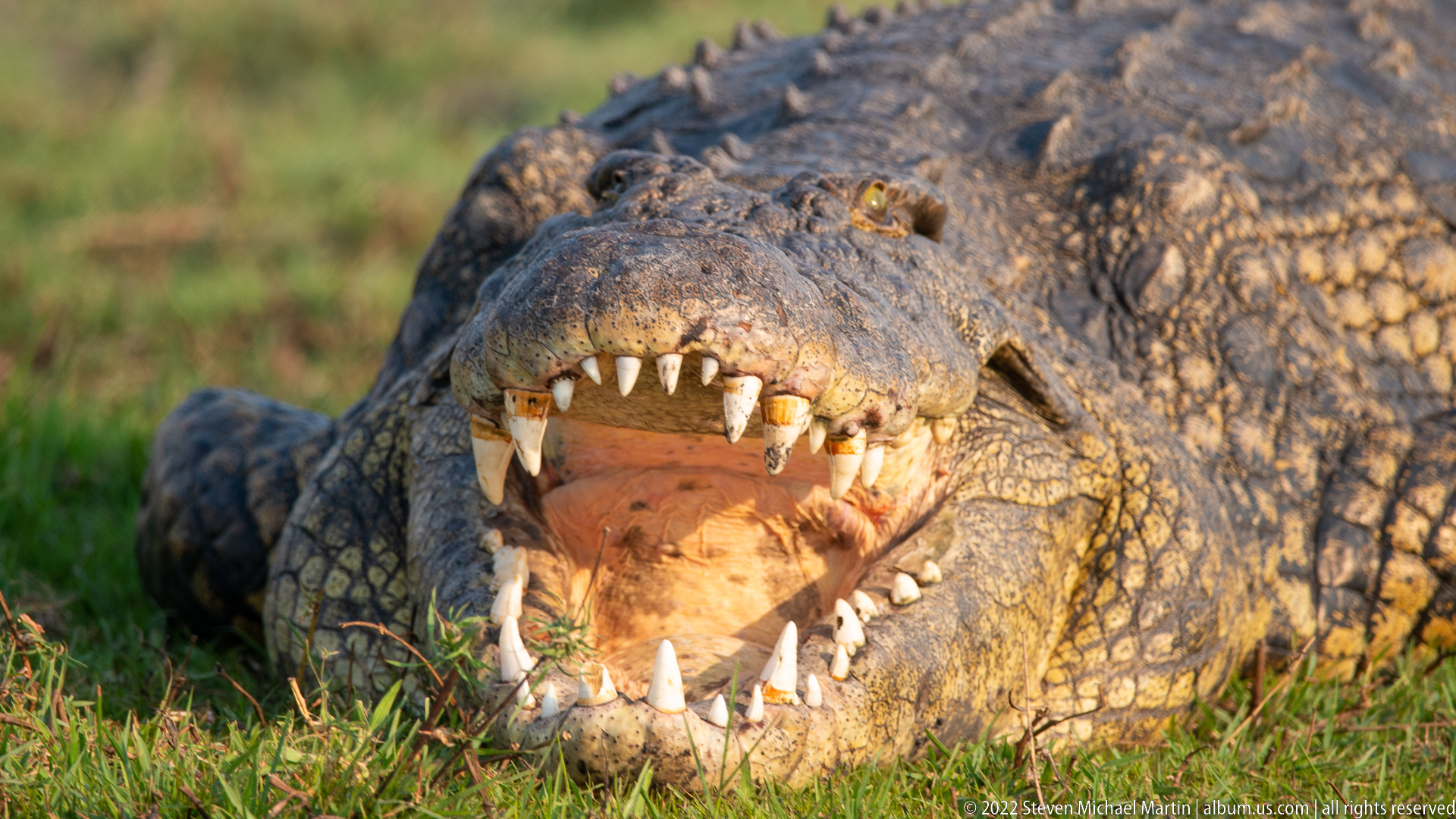
A Nile crocodile faces the camera with its mouth agape, creating a direct anatomical view of the broad snout, heavy scales, and uneven rows of interlocking teeth. Warm light reaches deep into the mouth and accentuates the textured facial armor. The tight crop removes most habitat context and concentrates attention on the crocodile’s formidable feeding apparatus.
Caption
A Nile crocodile faces the camera with its mouth agape, creating a direct anatomical view of the broad snout, heavy scales, and uneven rows of interlocking teeth. Warm light reaches deep into the mouth and accentuates the textured facial armor. The tight crop removes most habitat context and concentrates attention on the crocodile’s formidable feeding apparatus.
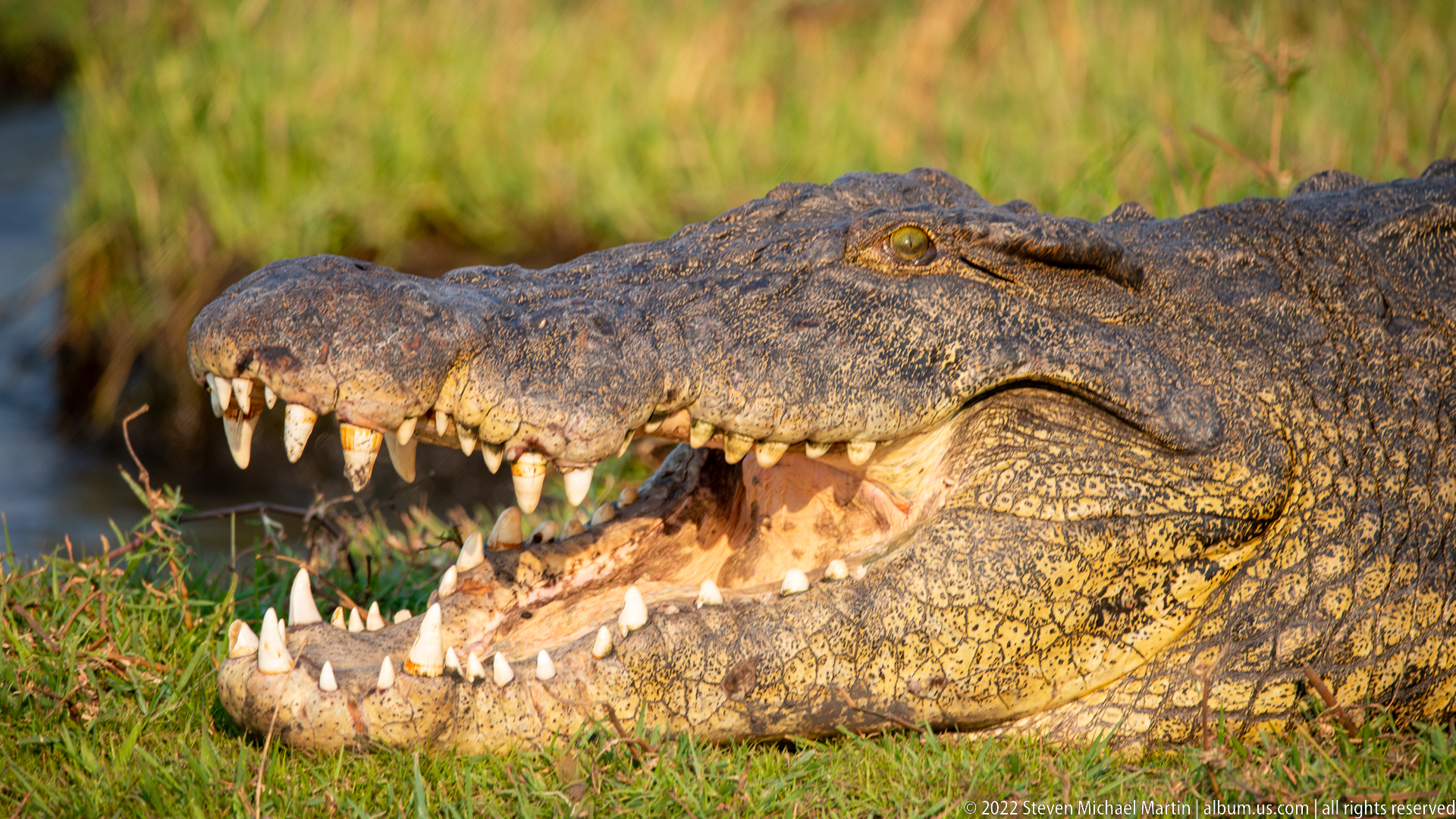
Seen tightly from the side, a Nile crocodile holds its jaws open, exposing the irregular interlocking teeth that remain visible even when a crocodile’s mouth is closed. The amber eye, rough facial scales, broad snout, and muscular jawline are rendered in detail. This profile complements the frontal view by clarifying the length and structure of the skull.
Caption
Seen tightly from the side, a Nile crocodile holds its jaws open, exposing the irregular interlocking teeth that remain visible even when a crocodile’s mouth is closed. The amber eye, rough facial scales, broad snout, and muscular jawline are rendered in detail. This profile complements the frontal view by clarifying the length and structure of the skull.
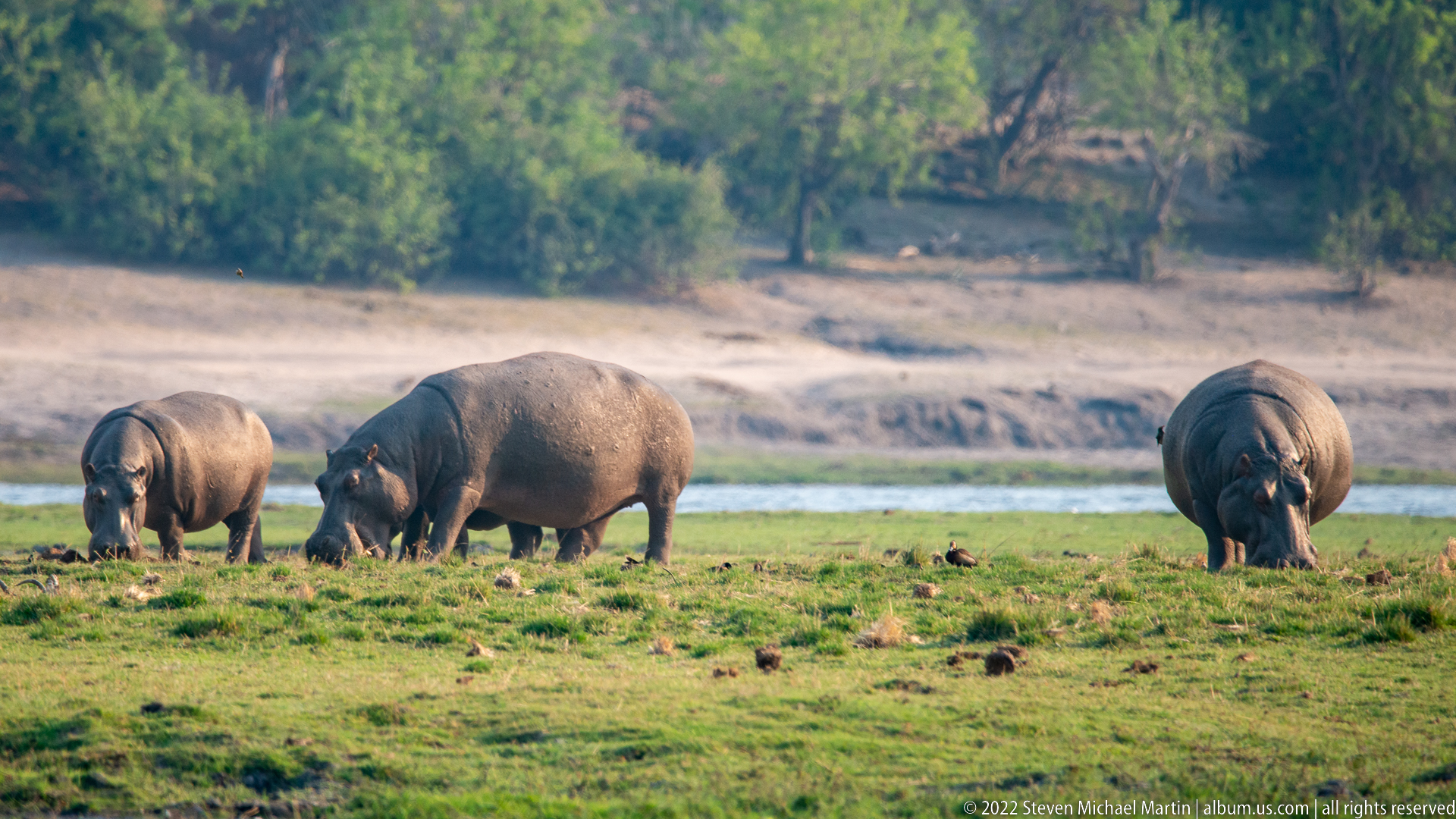
Three hippopotamuses graze separately across a broad green floodplain beside the river. Their spacing and different orientations give the scene a wider sense of habitat than the closer portraits in this sequence. Low water, pale exposed banks, and woodland beyond frame the animals within the seasonal river landscape rather than as isolated subjects.
Caption
Three hippopotamuses graze separately across a broad green floodplain beside the river. Their spacing and different orientations give the scene a wider sense of habitat than the closer portraits in this sequence. Low water, pale exposed banks, and woodland beyond frame the animals within the seasonal river landscape rather than as isolated subjects.

Two hippopotamuses graze in the foreground while an African bush elephant walks across the pale floodplain behind them. The layered scene contrasts the hippos’ low, rounded bodies with the elephant’s taller silhouette and trunk. A small white bird near the elephant adds to the sense of multiple species using the same river-edge habitat.
Caption
Two hippopotamuses graze in the foreground while an African bush elephant walks across the pale floodplain behind them. The layered scene contrasts the hippos’ low, rounded bodies with the elephant’s taller silhouette and trunk. A small white bird near the elephant adds to the sense of multiple species using the same river-edge habitat.
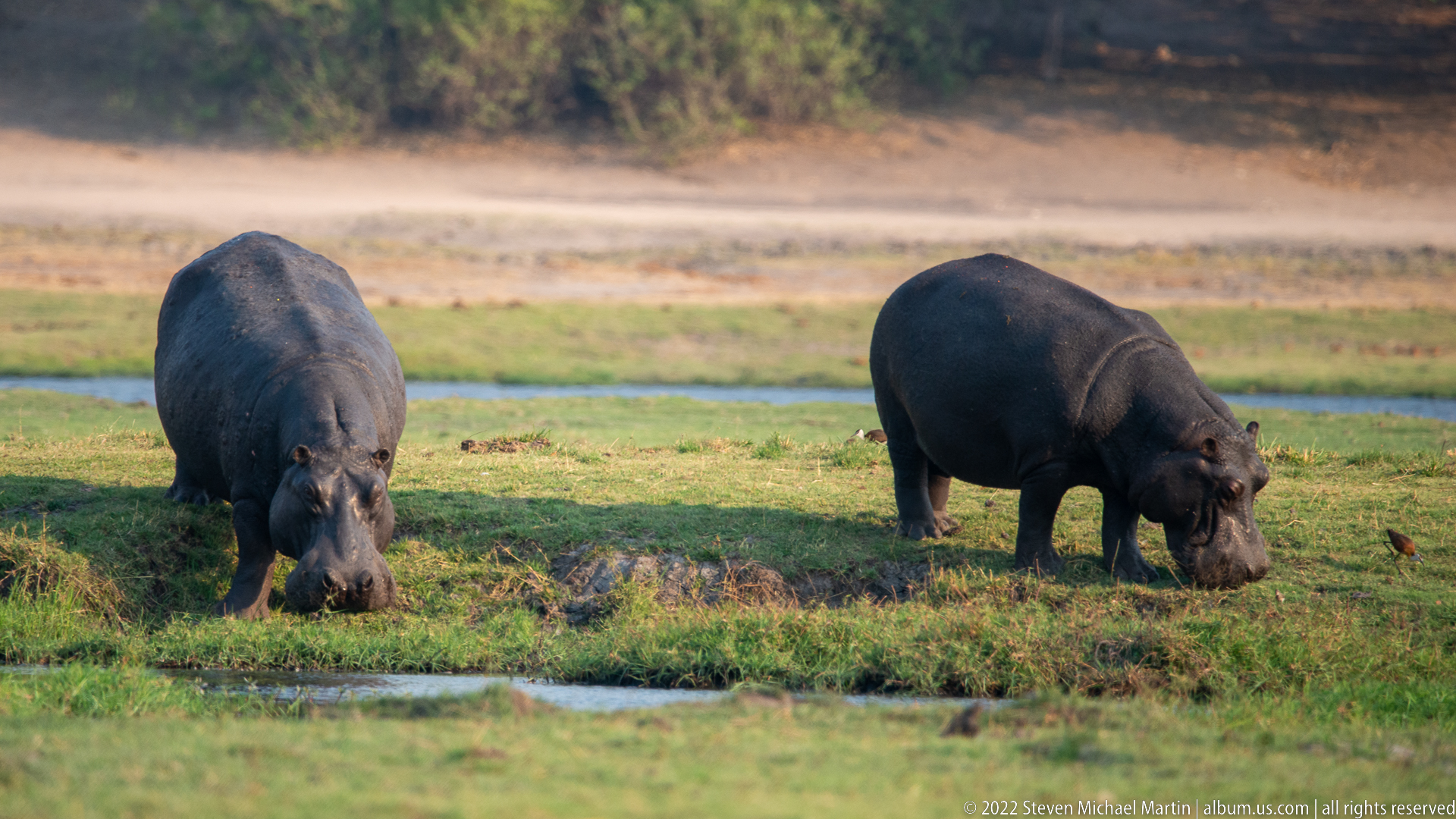
Two hippopotamuses feed side by side on short grass beside a small floodplain pool, both with their broad muzzles pressed into the vegetation. Their parallel grazing posture and fully terrestrial stance make feeding behavior the central subject. The narrow water channel and layered grassy bank retain a clear connection to the river system on which the species depends.
Caption
Two hippopotamuses feed side by side on short grass beside a small floodplain pool, both with their broad muzzles pressed into the vegetation. Their parallel grazing posture and fully terrestrial stance make feeding behavior the central subject. The narrow water channel and layered grassy bank retain a clear connection to the river system on which the species depends.
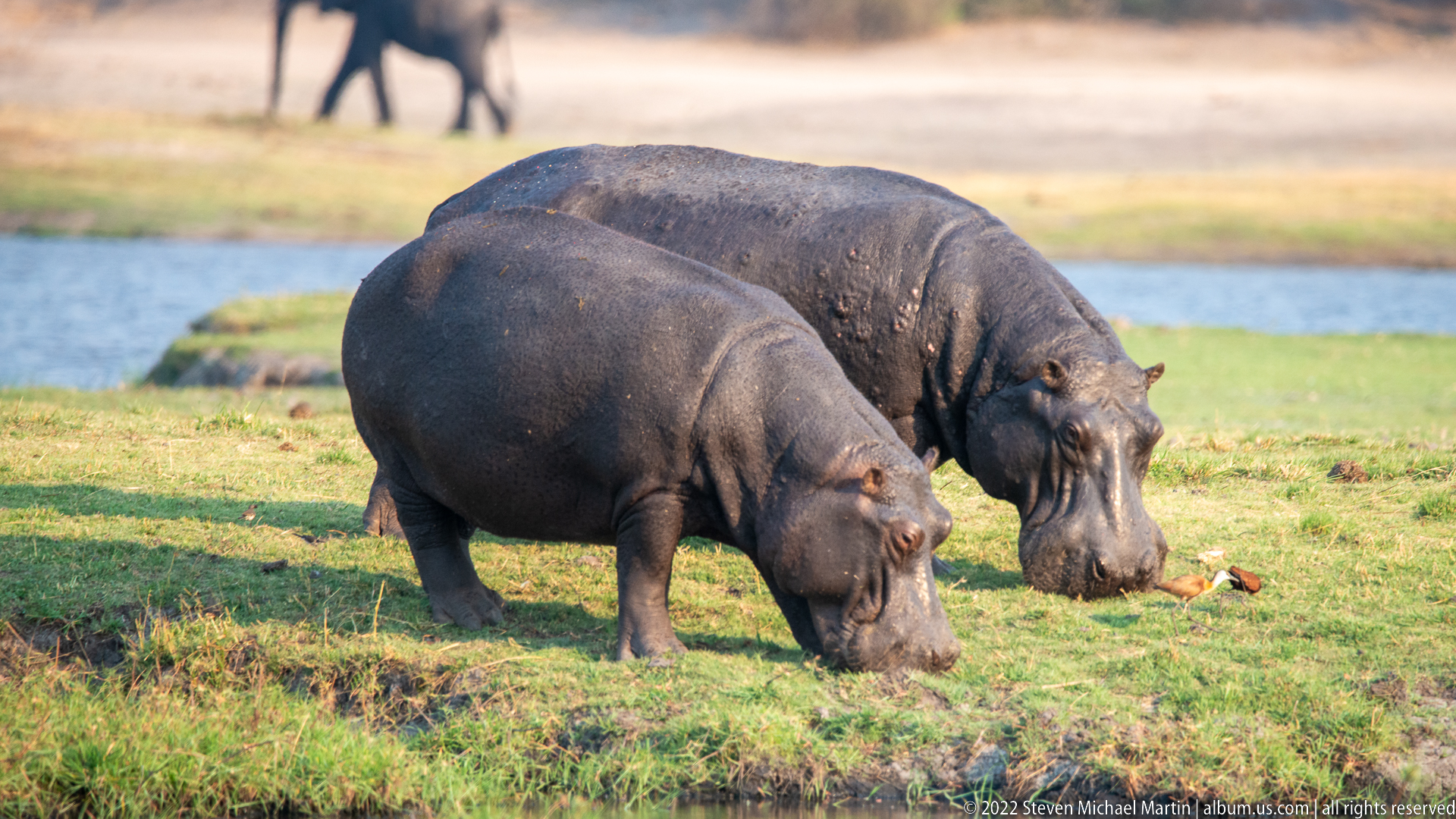
Two hippopotamuses graze side by side on short green riverbank vegetation, both with their broad muzzles lowered to the ground. Their heavy barrel-shaped bodies nearly overlap, while blue water and a pale opposite bank remain visible behind them. The paired composition emphasizes terrestrial feeding behavior and the close association of hippopotamuses with the river margin.
Caption
Two hippopotamuses graze side by side on short green riverbank vegetation, both with their broad muzzles lowered to the ground. Their heavy barrel-shaped bodies nearly overlap, while blue water and a pale opposite bank remain visible behind them. The paired composition emphasizes terrestrial feeding behavior and the close association of hippopotamuses with the river margin.

A pair of hippopotamuses feeds along the edge of a low eroded bank, their bodies angled in opposite directions as they crop short grass. One animal stands close to the water while the second occupies the higher bank behind it. The arrangement reveals the animals’ movement between aquatic refuge and terrestrial grazing ground within the floodplain.
Caption
A pair of hippopotamuses feeds along the edge of a low eroded bank, their bodies angled in opposite directions as they crop short grass. One animal stands close to the water while the second occupies the higher bank behind it. The arrangement reveals the animals’ movement between aquatic refuge and terrestrial grazing ground within the floodplain.
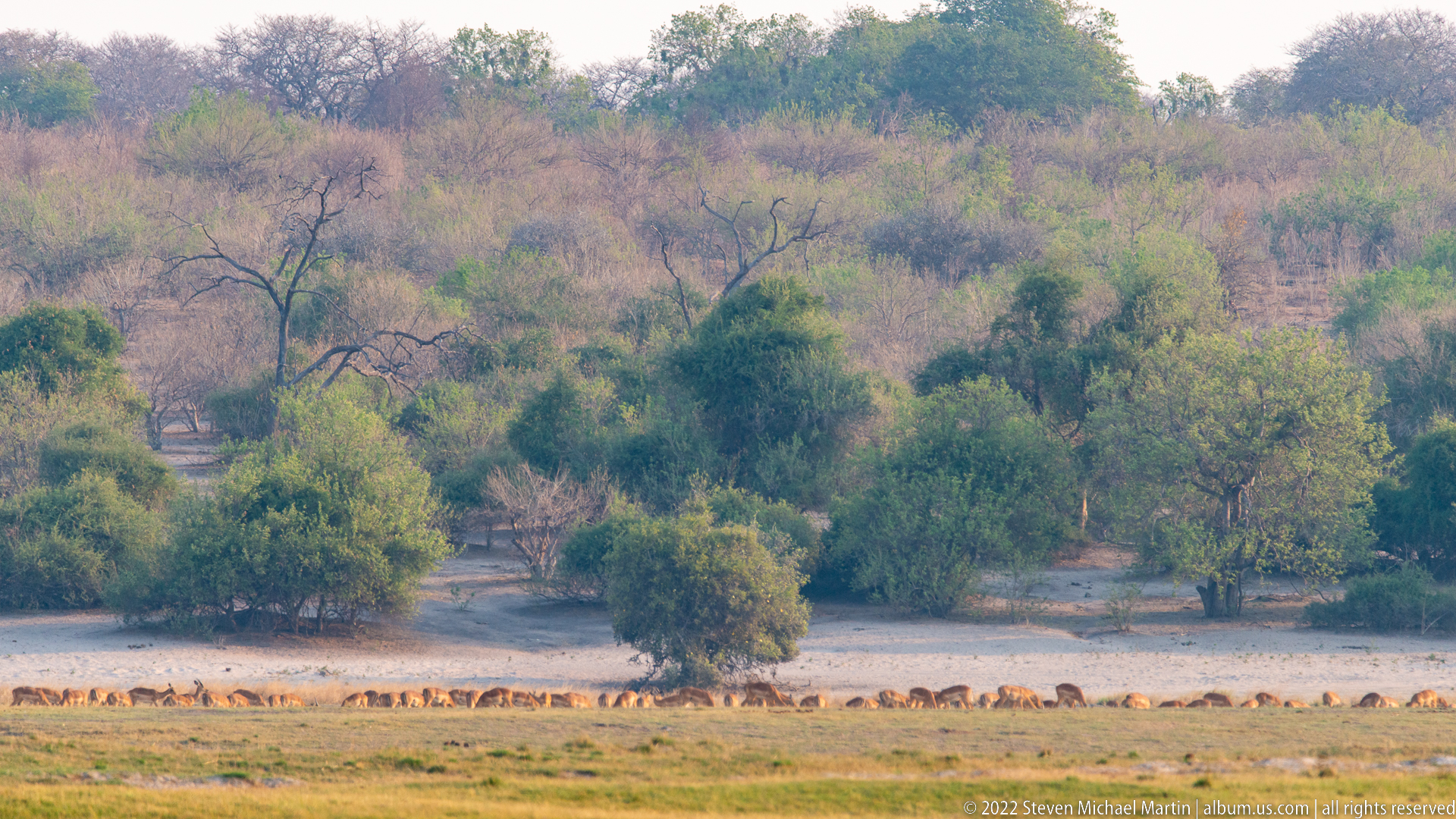
A long line of African bush elephants moves across the pale floodplain below dense riverine woodland. Seen from a distance, the animals form a narrow procession along the base of the wooded slope, giving the image a strong sense of scale and habitat. The broad landscape view differs from the close elephant studies by emphasizing herd movement through the wider river corridor.
Caption
A long line of African bush elephants moves across the pale floodplain below dense riverine woodland. Seen from a distance, the animals form a narrow procession along the base of the wooded slope, giving the image a strong sense of scale and habitat. The broad landscape view differs from the close elephant studies by emphasizing herd movement through the wider river corridor.
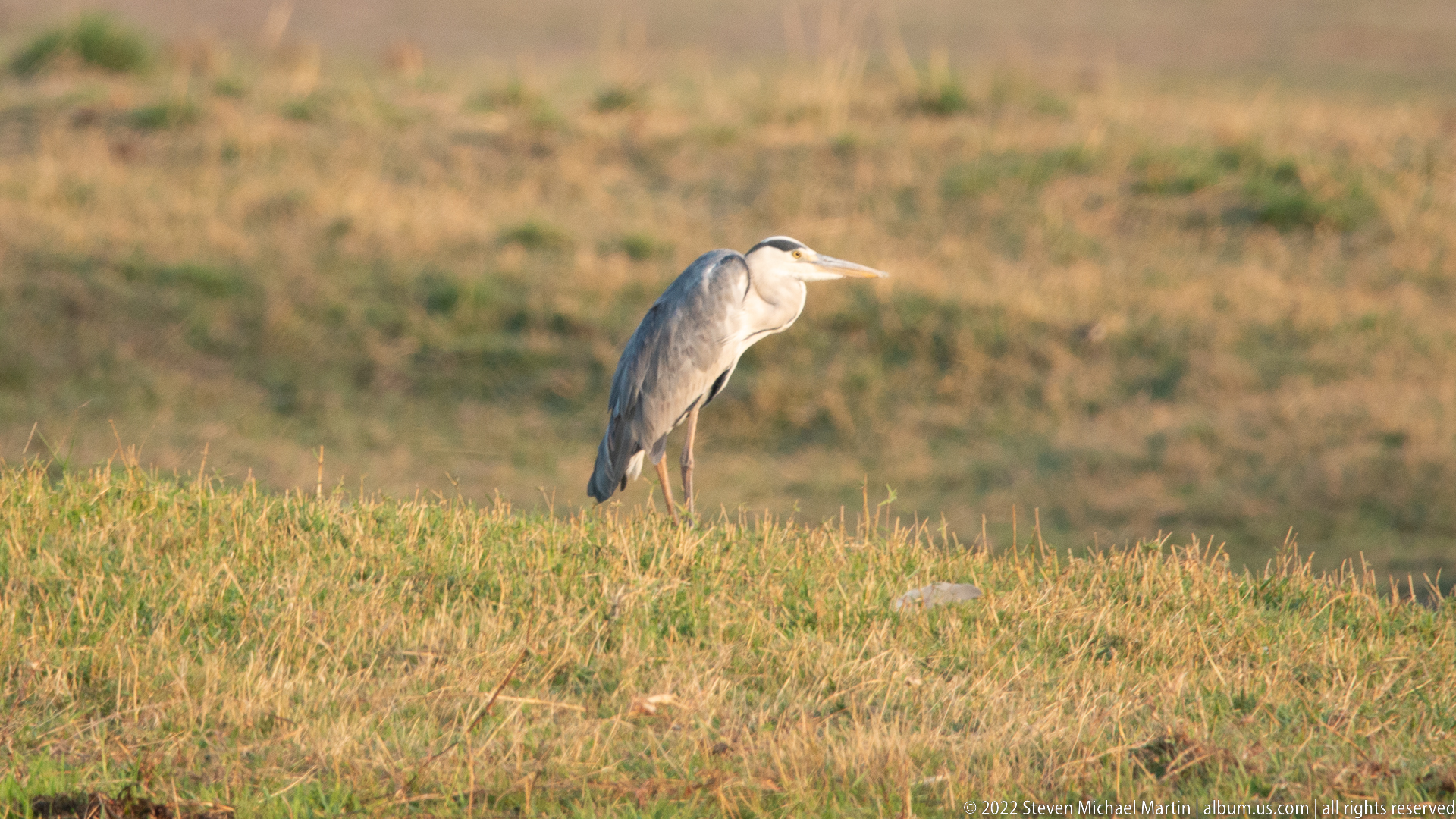
A grey heron stands alone on a grassy rise above a shallow channel, its long legs, dagger-like bill, pale head, and gray-blue wings clearly visible. The upright posture and subdued plumage distinguish it from the white egrets elsewhere in the portfolio. Warm low-angle light catches the bird against a softly blurred floodplain background.
Caption
A grey heron stands alone on a grassy rise above a shallow channel, its long legs, dagger-like bill, pale head, and gray-blue wings clearly visible. The upright posture and subdued plumage distinguish it from the white egrets elsewhere in the portfolio. Warm low-angle light catches the bird against a softly blurred floodplain background.
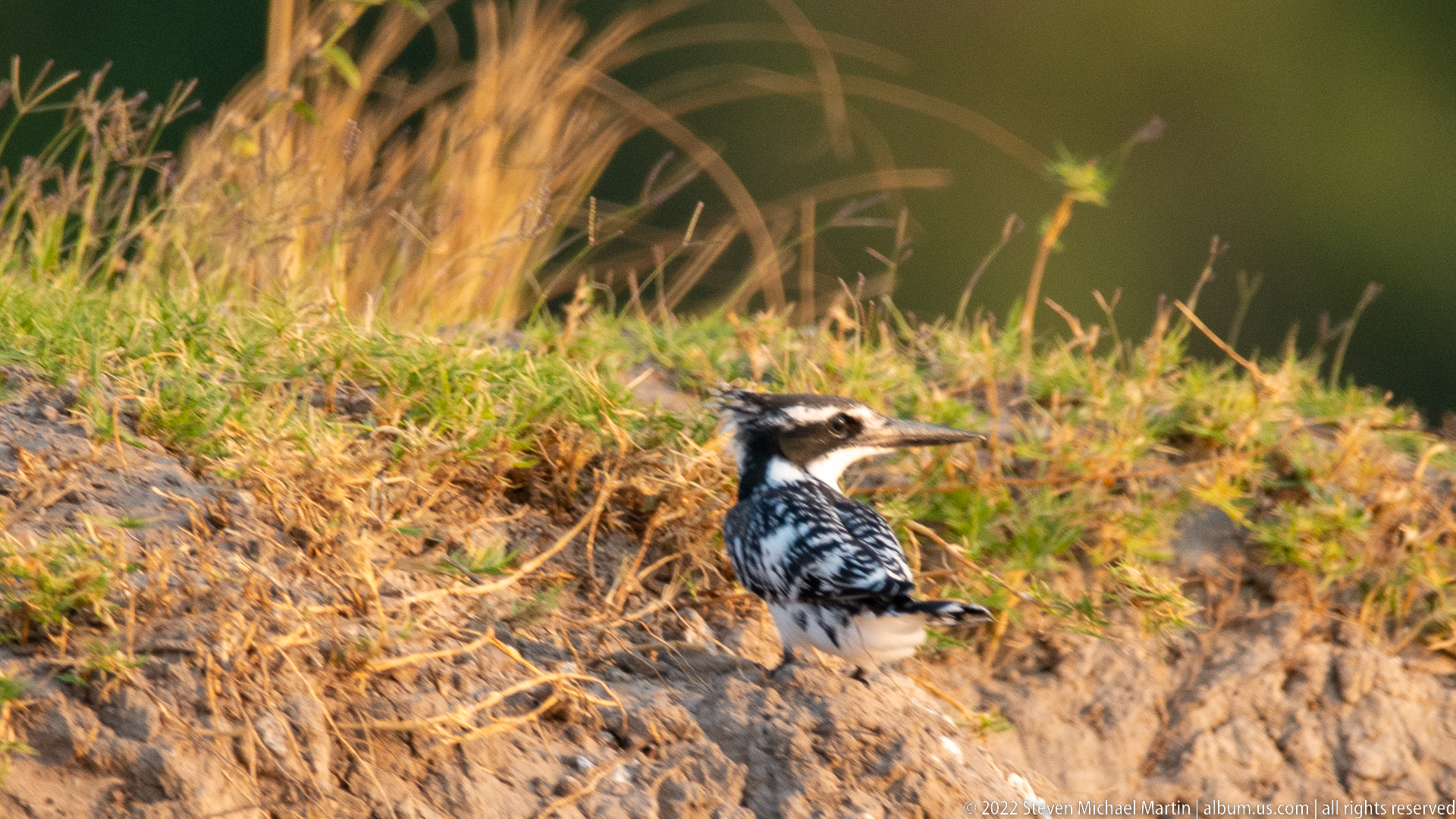
A pied kingfisher perches on the steep earthen bank above the river, its black-and-white plumage sharply contrasting with dry grass and exposed soil. The long straight bill, bold facial stripe, spotted wings, and white underparts are characteristic of this widespread African fishing kingfisher. Its low perch is well positioned for watching the water below.
Caption
A pied kingfisher perches on the steep earthen bank above the river, its black-and-white plumage sharply contrasting with dry grass and exposed soil. The long straight bill, bold facial stripe, spotted wings, and white underparts are characteristic of this widespread African fishing kingfisher. Its low perch is well positioned for watching the water below.
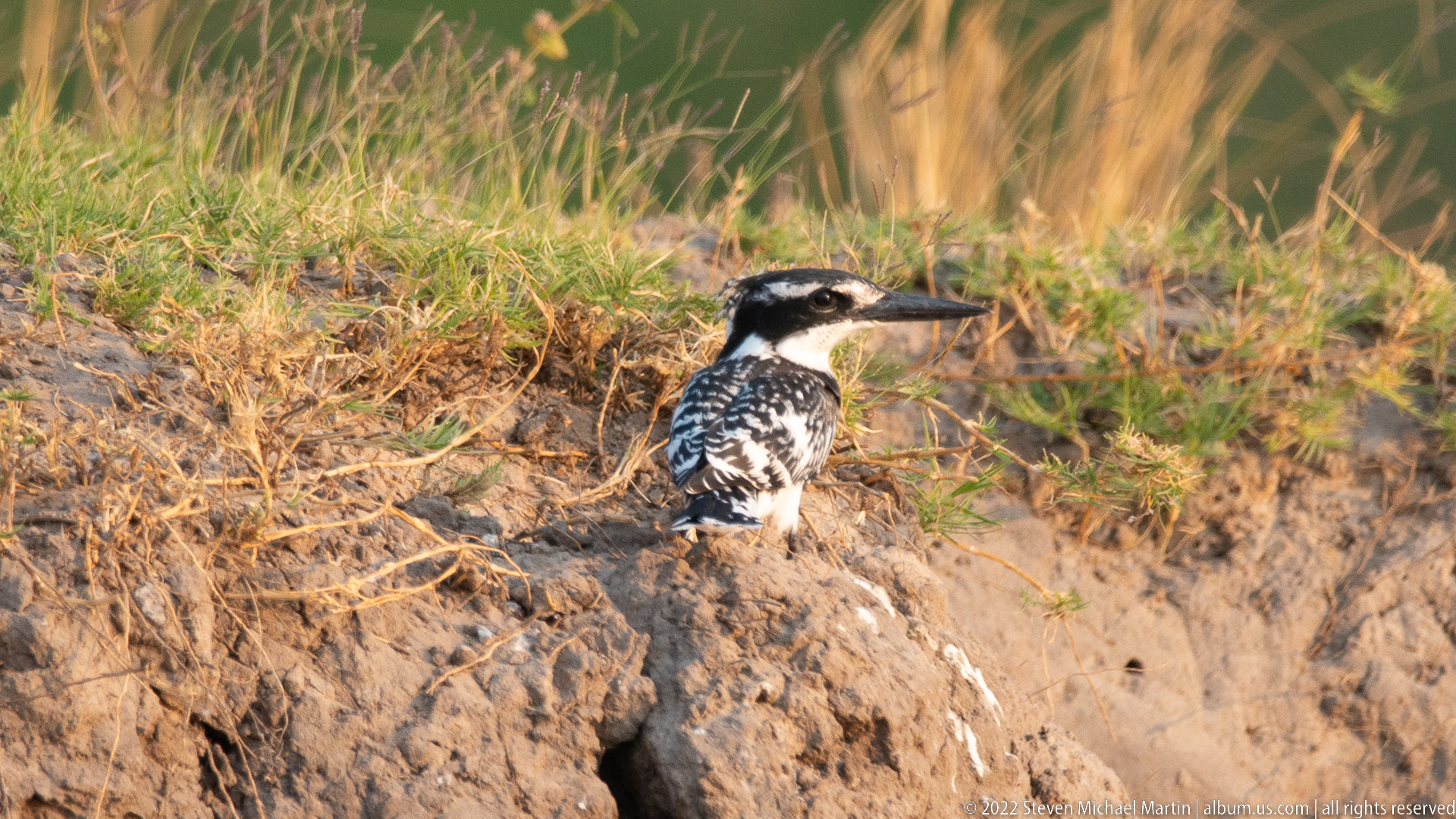
A pied kingfisher sits at the lip of a small cavity in the exposed riverbank, giving a closer view of its bold black-and-white head pattern, spotted mantle, and long pointed bill. The bare vertical soil behind the bird is typical of the steep banks used by kingfishers for nesting burrows, though the exact use of this cavity is not visible.
Caption
A pied kingfisher sits at the lip of a small cavity in the exposed riverbank, giving a closer view of its bold black-and-white head pattern, spotted mantle, and long pointed bill. The bare vertical soil behind the bird is typical of the steep banks used by kingfishers for nesting burrows, though the exact use of this cavity is not visible.

A young Nile crocodile lies across cracked, sun-baked mud at the river margin. Its narrow juvenile body shows distinct dark crossbands and yellowish spotting, while the long tail tapers across the frame. The low, armored profile and developing dorsal scutes provide a clear contrast with the much larger adult crocodiles seen earlier in the sequence.
Caption
A young Nile crocodile lies across cracked, sun-baked mud at the river margin. Its narrow juvenile body shows distinct dark crossbands and yellowish spotting, while the long tail tapers across the frame. The low, armored profile and developing dorsal scutes provide a clear contrast with the much larger adult crocodiles seen earlier in the sequence.

Three water thick-knees stand together on pale sandy ground below an eroded bank. Their large yellow eyes, cryptic brown-gray plumage, pale underparts, long greenish-yellow legs, and sturdy bills match this nocturnal-leaning African shorebird. The trio’s alert upright posture and preference for open river margins are characteristic of the species’ riverside habitat.
Caption
Three water thick-knees stand together on pale sandy ground below an eroded bank. Their large yellow eyes, cryptic brown-gray plumage, pale underparts, long greenish-yellow legs, and sturdy bills match this nocturnal-leaning African shorebird. The trio’s alert upright posture and preference for open river margins are characteristic of the species’ riverside habitat.

A single water thick-knee stands in profile on pale riverbank sand, providing a close field-guide view of its disproportionately large yellow eye, short stout bill, streaked brown head, gray-brown wing coverts, and long greenish legs. The bird’s subdued plumage blends closely with the exposed bank, an effective camouflage in open shoreline habitat.
Caption
A single water thick-knee stands in profile on pale riverbank sand, providing a close field-guide view of its disproportionately large yellow eye, short stout bill, streaked brown head, gray-brown wing coverts, and long greenish legs. The bird’s subdued plumage blends closely with the exposed bank, an effective camouflage in open shoreline habitat.
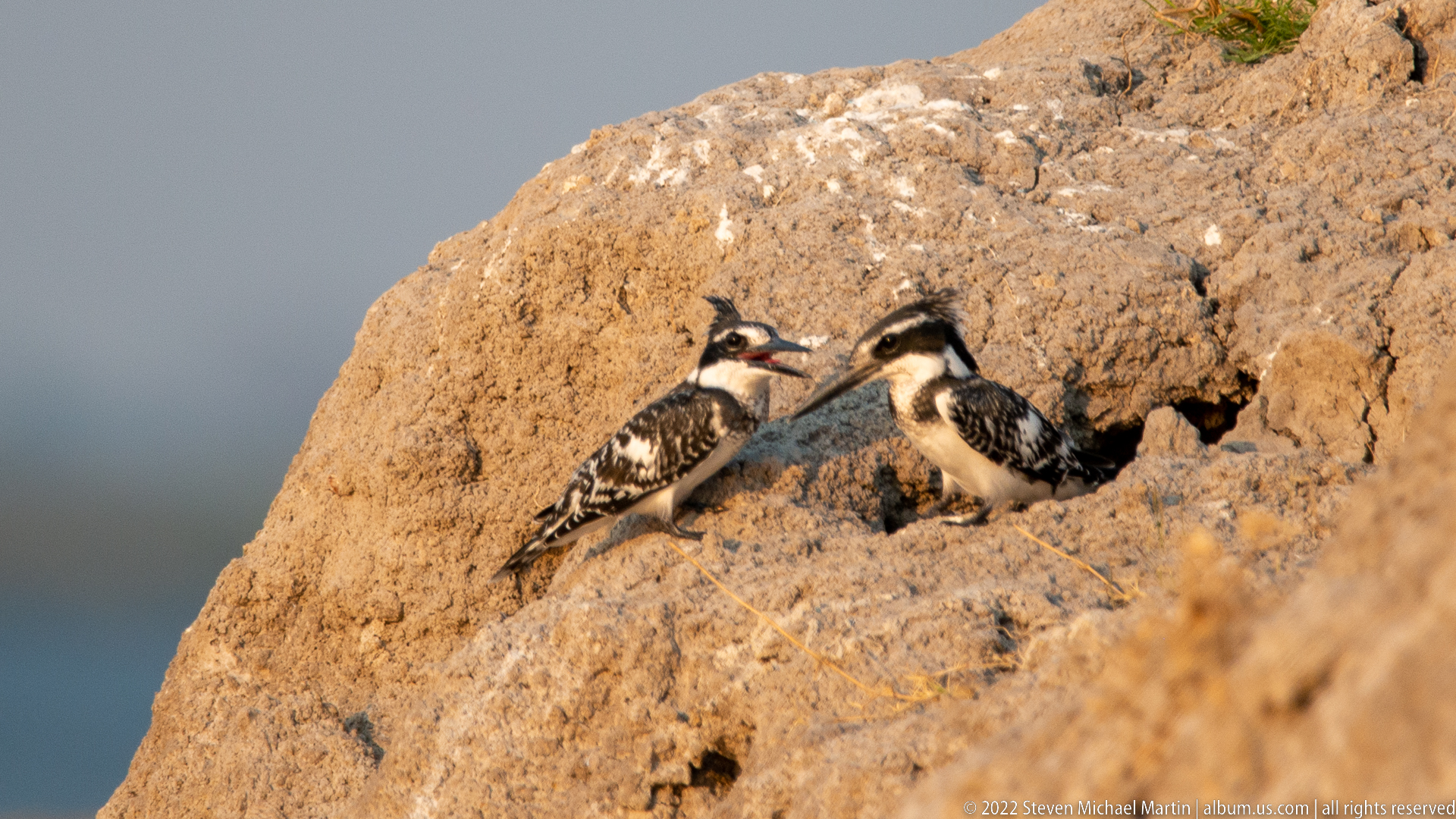
Two pied kingfishers face one another on an exposed riverbank ledge beside a small cavity. Their bills nearly meet, suggesting a brief social or courtship interaction, while the matched black-and-white plumage makes the pair visually striking against the ochre soil. The steep bank provides the kind of substrate in which these kingfishers excavate nesting burrows.
Caption
Two pied kingfishers face one another on an exposed riverbank ledge beside a small cavity. Their bills nearly meet, suggesting a brief social or courtship interaction, while the matched black-and-white plumage makes the pair visually striking against the ochre soil. The steep bank provides the kind of substrate in which these kingfishers excavate nesting burrows.

A pair of pied kingfishers meets bill-to-bill on the sandy riverbank, one bird leaning forward while the other sits close to a cavity. The intimate posture distinguishes this frame from the adjacent paired view and may represent courtship or food transfer, although the exact behavior cannot be confirmed from the still image.
Caption
A pair of pied kingfishers meets bill-to-bill on the sandy riverbank, one bird leaning forward while the other sits close to a cavity. The intimate posture distinguishes this frame from the adjacent paired view and may represent courtship or food transfer, although the exact behavior cannot be confirmed from the still image.

A pied kingfisher flies low across the earthen riverbank, wings spread in a blur as it leaves its perch. The streamlined body, long bill, black-and-white markings, and barred flight feathers remain recognizable despite the motion. Its shadow on the bank reinforces the bird’s rapid horizontal movement and gives the sequence an active transition from perched to airborne behavior.
Caption
A pied kingfisher flies low across the earthen riverbank, wings spread in a blur as it leaves its perch. The streamlined body, long bill, black-and-white markings, and barred flight feathers remain recognizable despite the motion. Its shadow on the bank reinforces the bird’s rapid horizontal movement and gives the sequence an active transition from perched to airborne behavior.

An adult male chacma baboon sits on pale, stony ground with one arm resting across a raised knee. The long dog-like muzzle, heavy brow, gray-brown coat, and large body are characteristic of the species. The relaxed seated pose gives a clear view of the animal’s proportions and facial structure in the dry woodland environment.
Caption
An adult male chacma baboon sits on pale, stony ground with one arm resting across a raised knee. The long dog-like muzzle, heavy brow, gray-brown coat, and large body are characteristic of the species. The relaxed seated pose gives a clear view of the animal’s proportions and facial structure in the dry woodland environment.
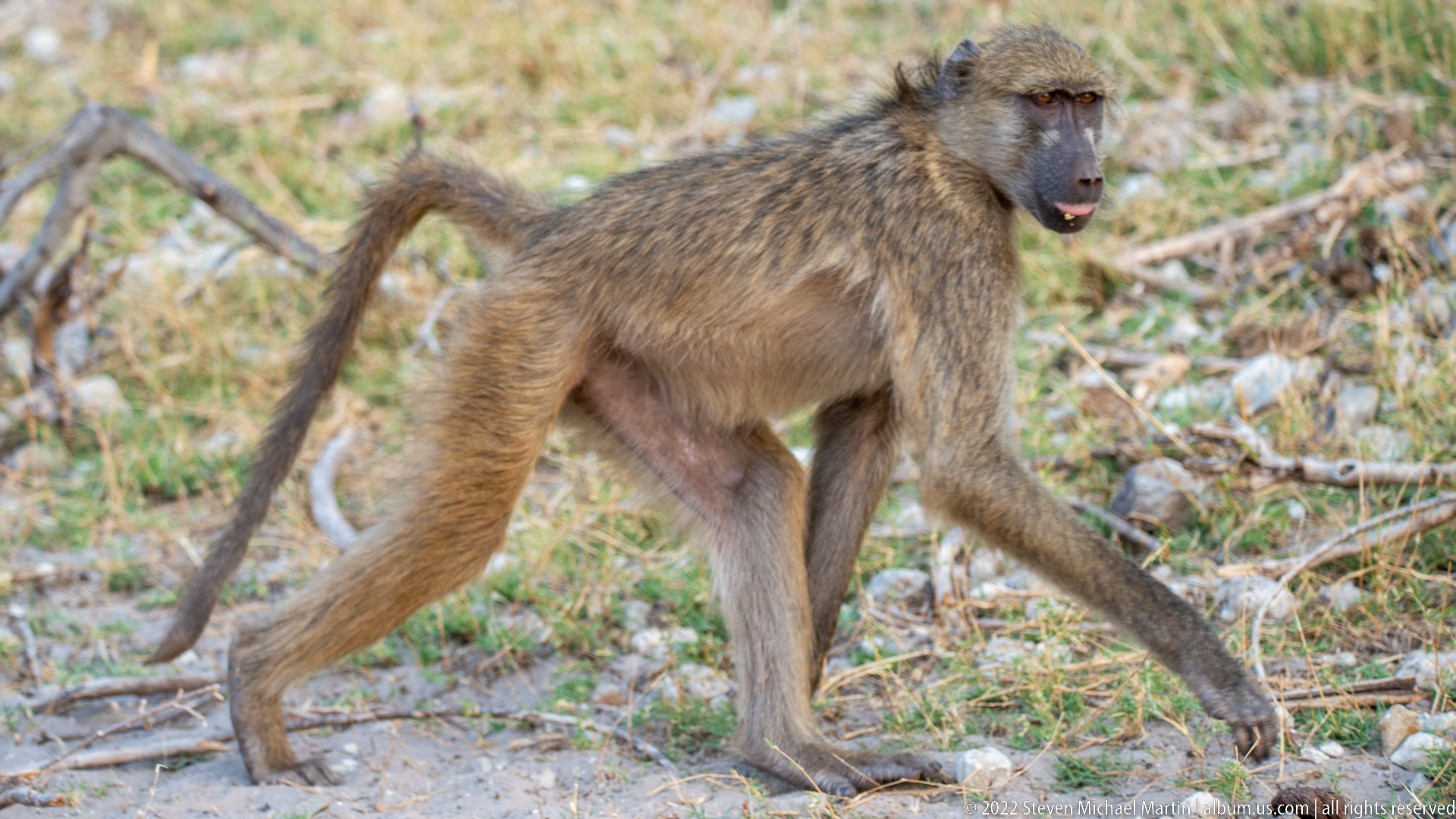
A chacma baboon walks on all fours through dry grass and scattered woodland debris, its long tail arcing upward before dropping behind. The gray-brown coat, elongated muzzle, and powerful forelimbs are visible in profile. The moving posture shows the species’ ground-based travel through open savanna and riverine woodland.
Caption
A chacma baboon walks on all fours through dry grass and scattered woodland debris, its long tail arcing upward before dropping behind. The gray-brown coat, elongated muzzle, and powerful forelimbs are visible in profile. The moving posture shows the species’ ground-based travel through open savanna and riverine woodland.
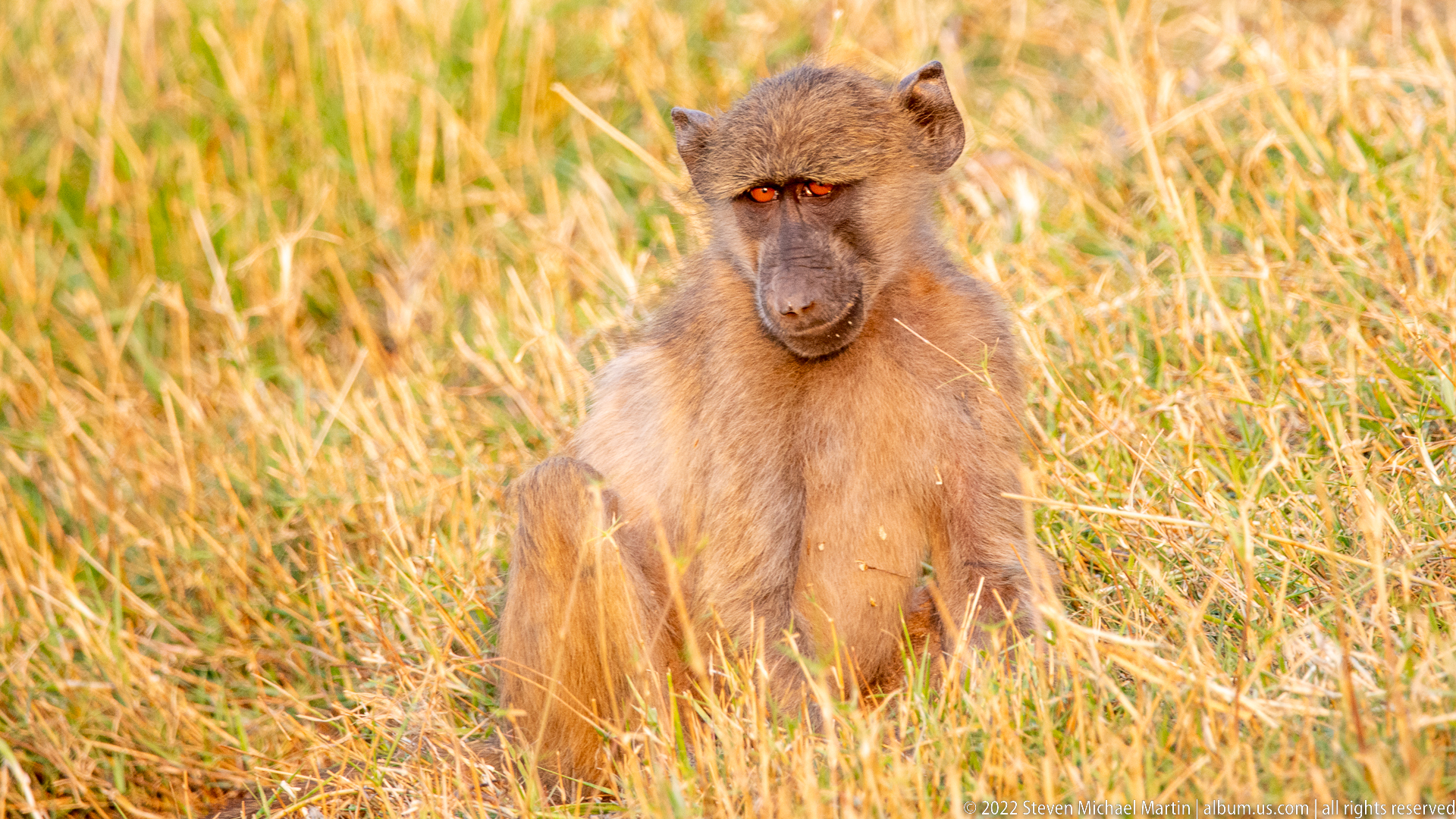
A chacma baboon sits upright among tall golden grass, turning slightly toward the camera. Warm light picks out the shaggy gray-brown coat, dark muzzle, amber-brown eyes, and rounded ears. The solitary portrait isolates the animal from troop activity and emphasizes the baboon’s expressive face and dense shoulder fur.
Caption
A chacma baboon sits upright among tall golden grass, turning slightly toward the camera. Warm light picks out the shaggy gray-brown coat, dark muzzle, amber-brown eyes, and rounded ears. The solitary portrait isolates the animal from troop activity and emphasizes the baboon’s expressive face and dense shoulder fur.
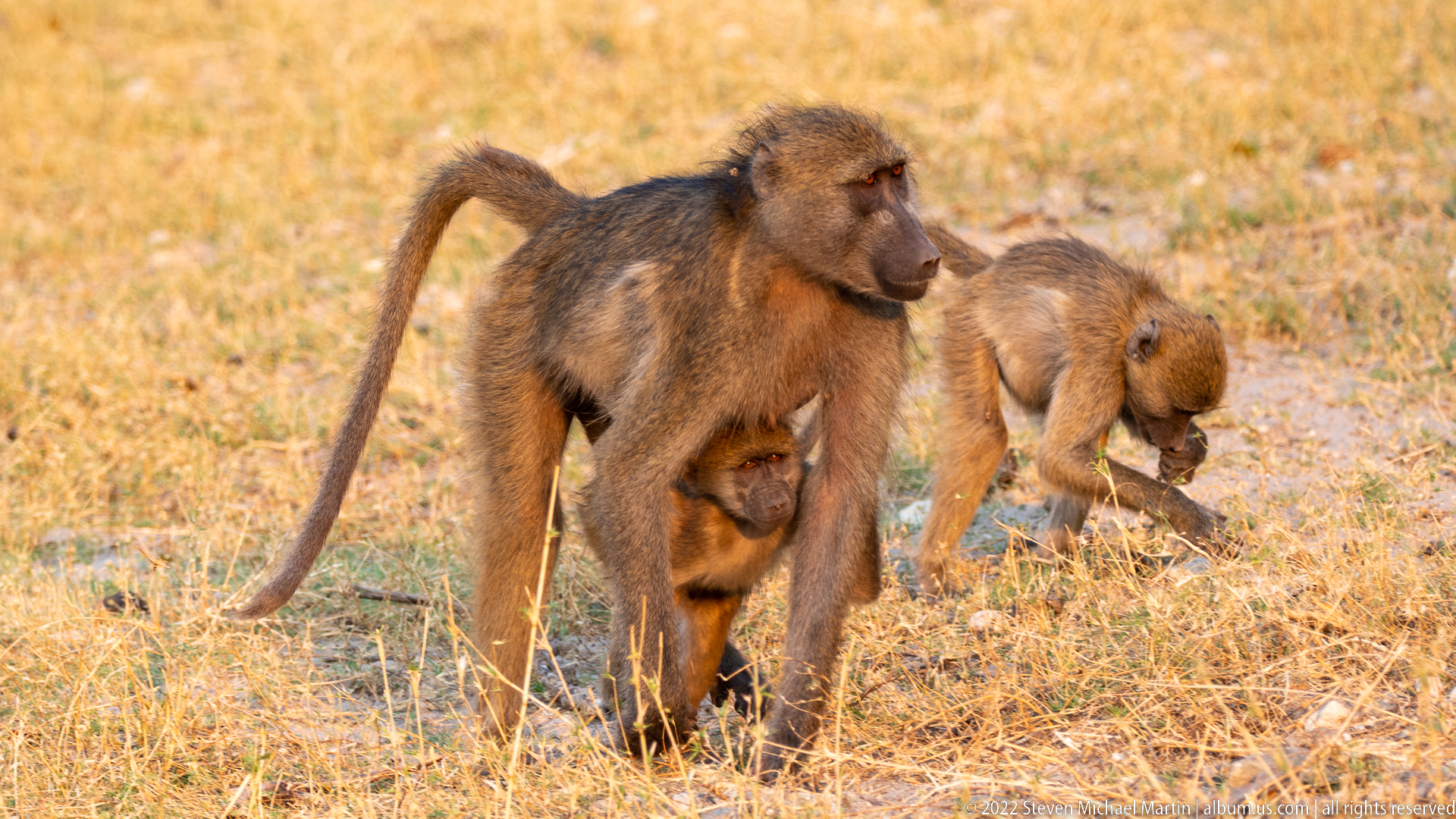
A female chacma baboon moves through dry grass with a very young infant clinging beneath her abdomen, while a second youngster forages nearby. The infant’s small dark body and grasping limbs are visible between the mother’s legs. This family-group view records the close physical dependence of infants during troop movement.
Caption
A female chacma baboon moves through dry grass with a very young infant clinging beneath her abdomen, while a second youngster forages nearby. The infant’s small dark body and grasping limbs are visible between the mother’s legs. This family-group view records the close physical dependence of infants during troop movement.
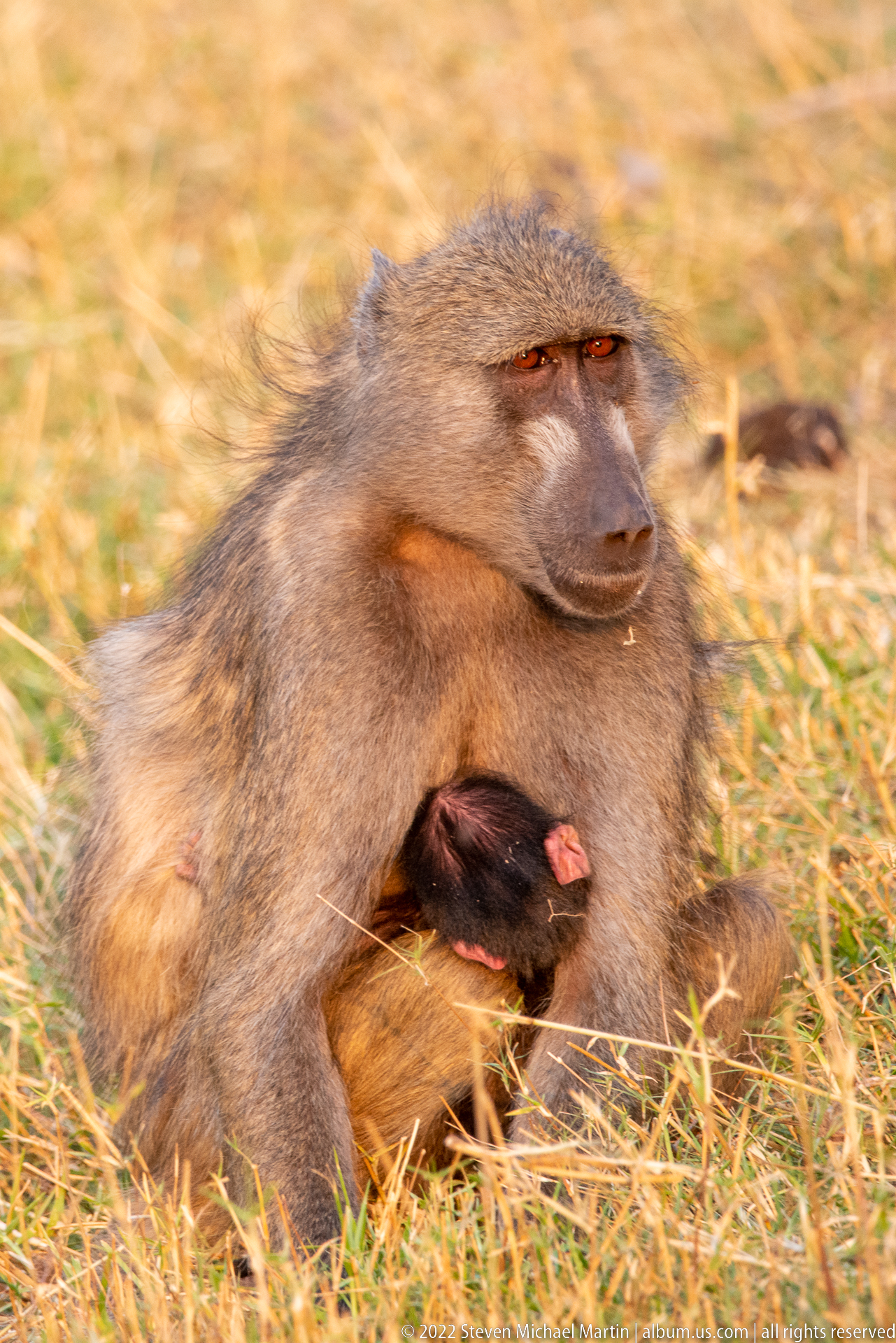
A female chacma baboon sits in the grass with a tiny dark-furred infant pressed tightly against her chest and abdomen. The mother’s arms form a protective enclosure around the newborn, whose small face and pink ears are visible against her fur. The close composition emphasizes maternal contact rather than the wider social activity of the troop.
Caption
A female chacma baboon sits in the grass with a tiny dark-furred infant pressed tightly against her chest and abdomen. The mother’s arms form a protective enclosure around the newborn, whose small face and pink ears are visible against her fur. The close composition emphasizes maternal contact rather than the wider social activity of the troop.
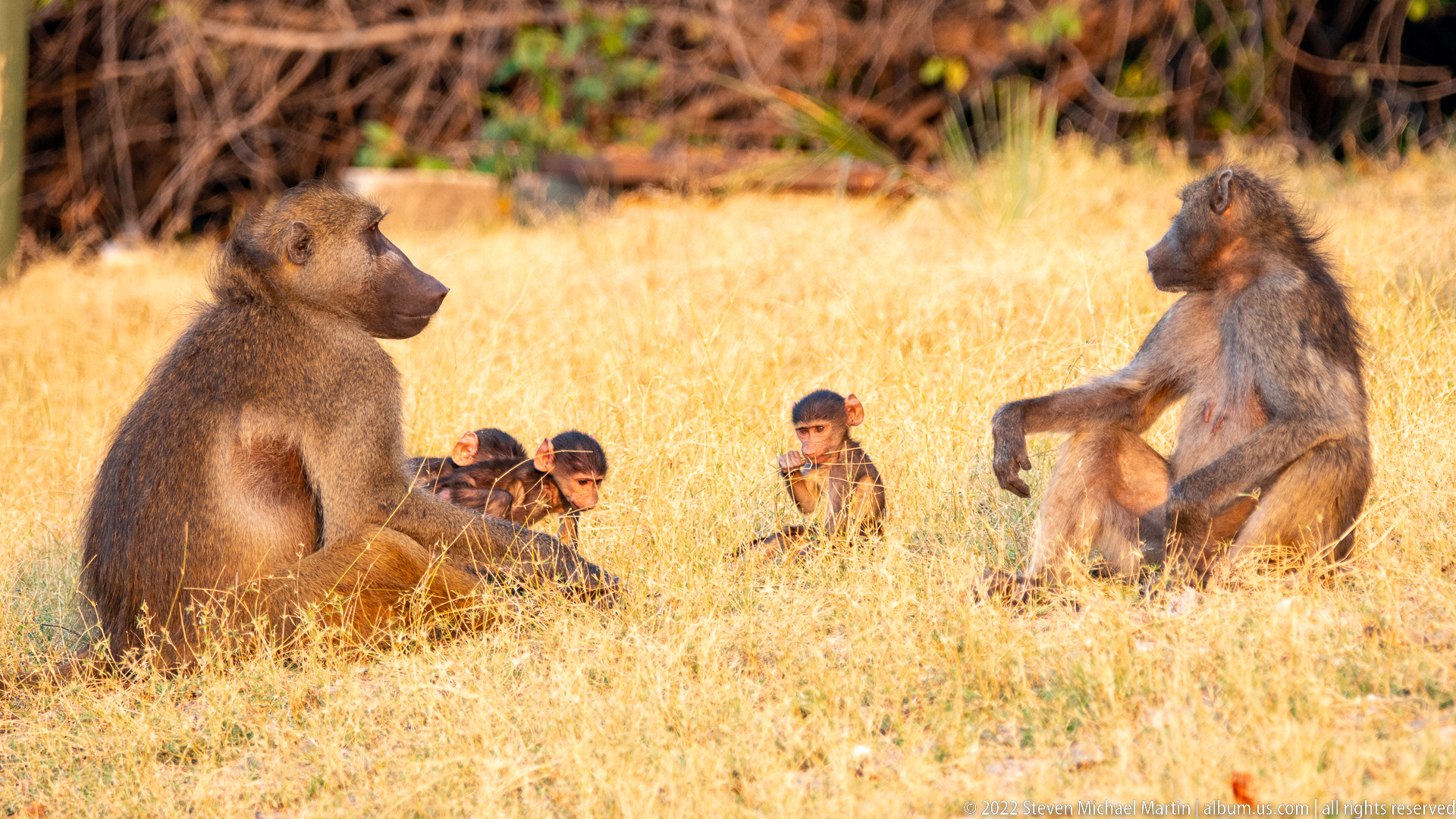
Adult chacma baboons and several young animals gather in sunlit dry grass, forming a compact social group. Two adults sit apart while multiple infants and juveniles occupy the space between them, some facing the camera and others turned toward the adults. The arrangement highlights the troop structure and close proximity of young baboons to mature animals.
Caption
Adult chacma baboons and several young animals gather in sunlit dry grass, forming a compact social group. Two adults sit apart while multiple infants and juveniles occupy the space between them, some facing the camera and others turned toward the adults. The arrangement highlights the troop structure and close proximity of young baboons to mature animals.
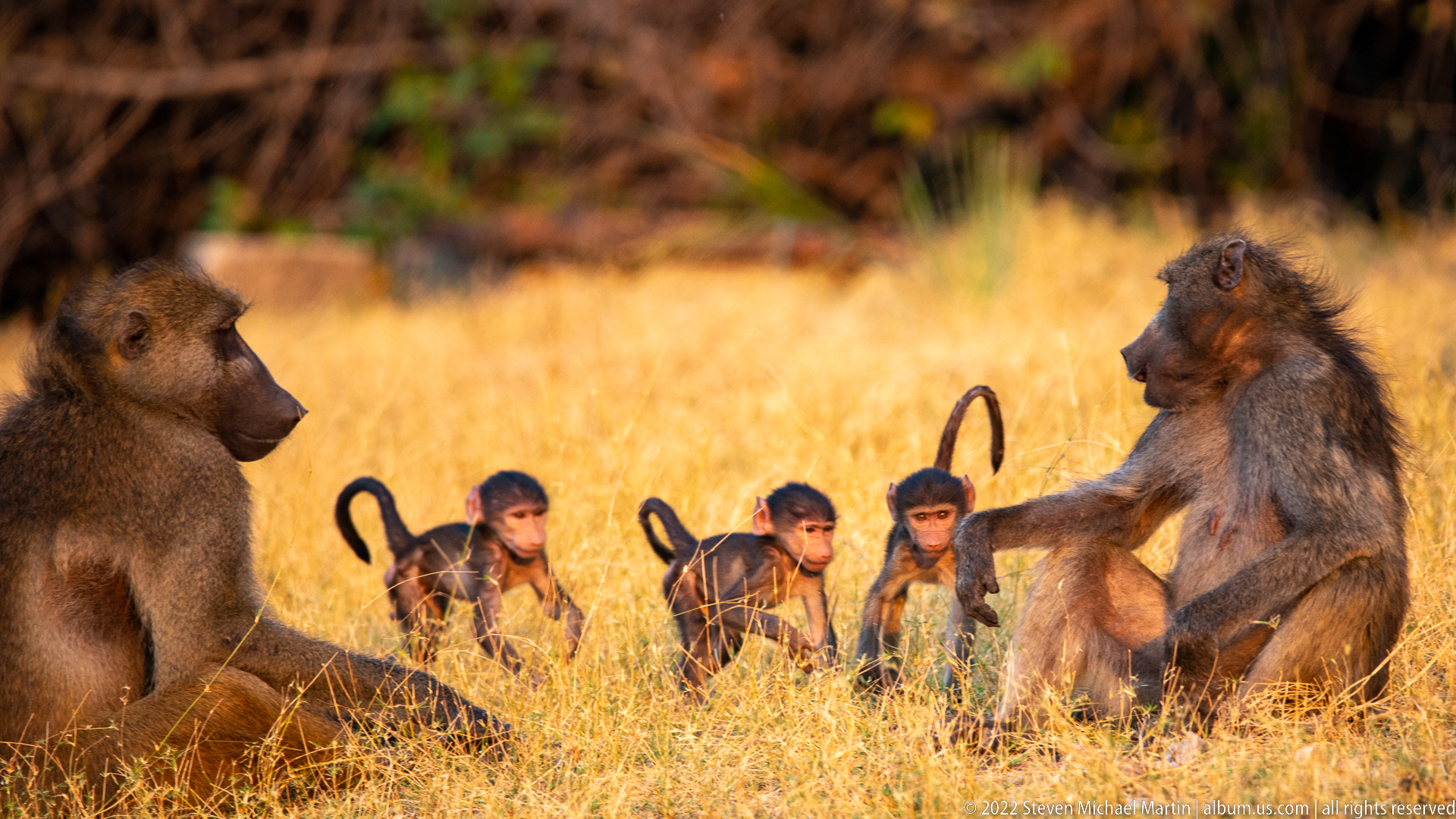
Several young chacma baboons cluster between two seated adults in dry golden grass. The juveniles’ smaller bodies, proportionally large ears, and curled tails contrast with the heavier adults on either side. The frame concentrates on the troop’s youngest members and their close spacing within the social group.
Caption
Several young chacma baboons cluster between two seated adults in dry golden grass. The juveniles’ smaller bodies, proportionally large ears, and curled tails contrast with the heavier adults on either side. The frame concentrates on the troop’s youngest members and their close spacing within the social group.
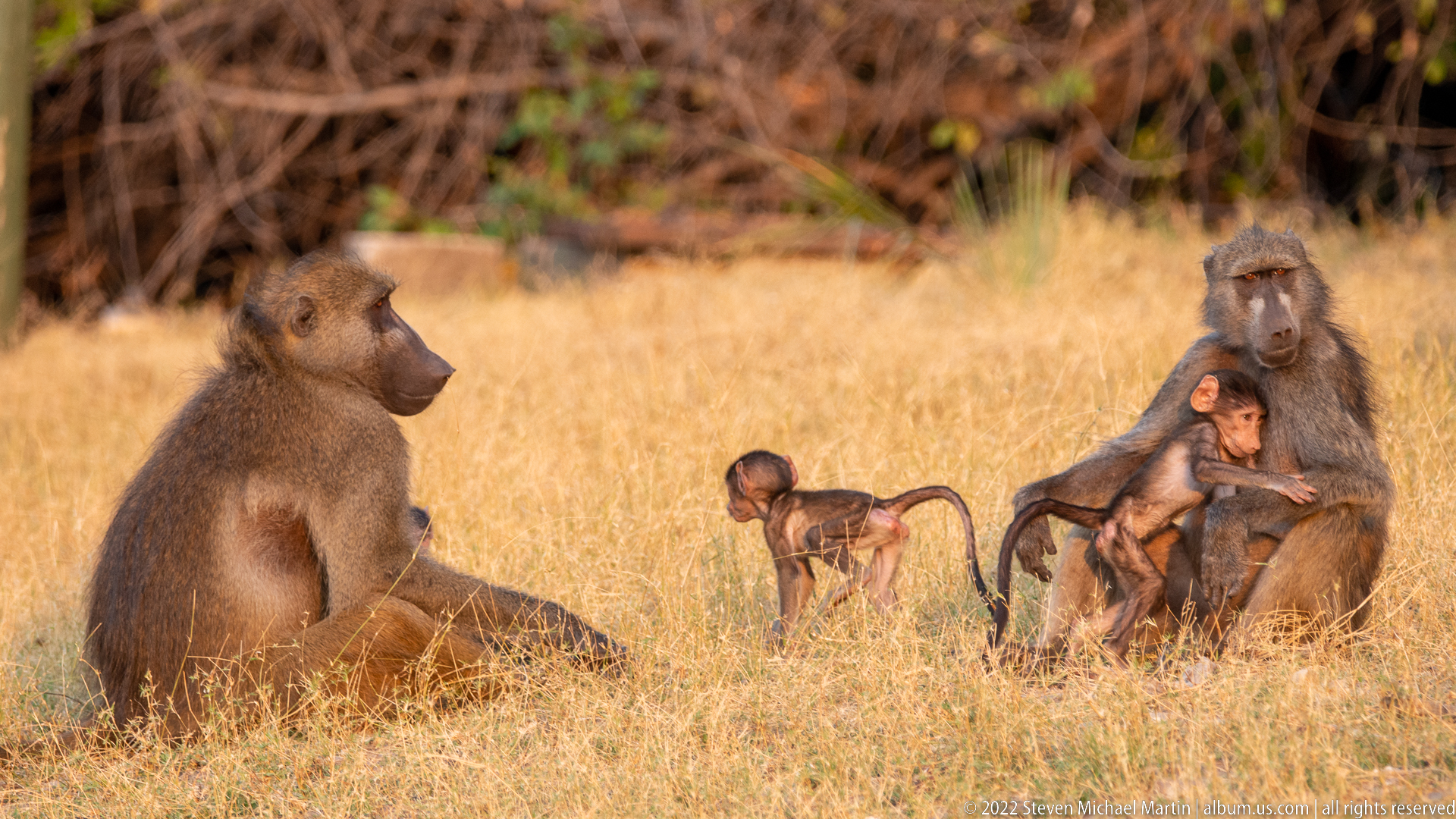
A seated female chacma baboon supports a small infant against her torso while another youngster stands nearby in the grass. A second adult sits at left, watching across the group. The spacing creates a quieter family scene than the crowded troop views, with maternal contact and juvenile independence visible in the same frame.
Caption
A seated female chacma baboon supports a small infant against her torso while another youngster stands nearby in the grass. A second adult sits at left, watching across the group. The spacing creates a quieter family scene than the crowded troop views, with maternal contact and juvenile independence visible in the same frame.
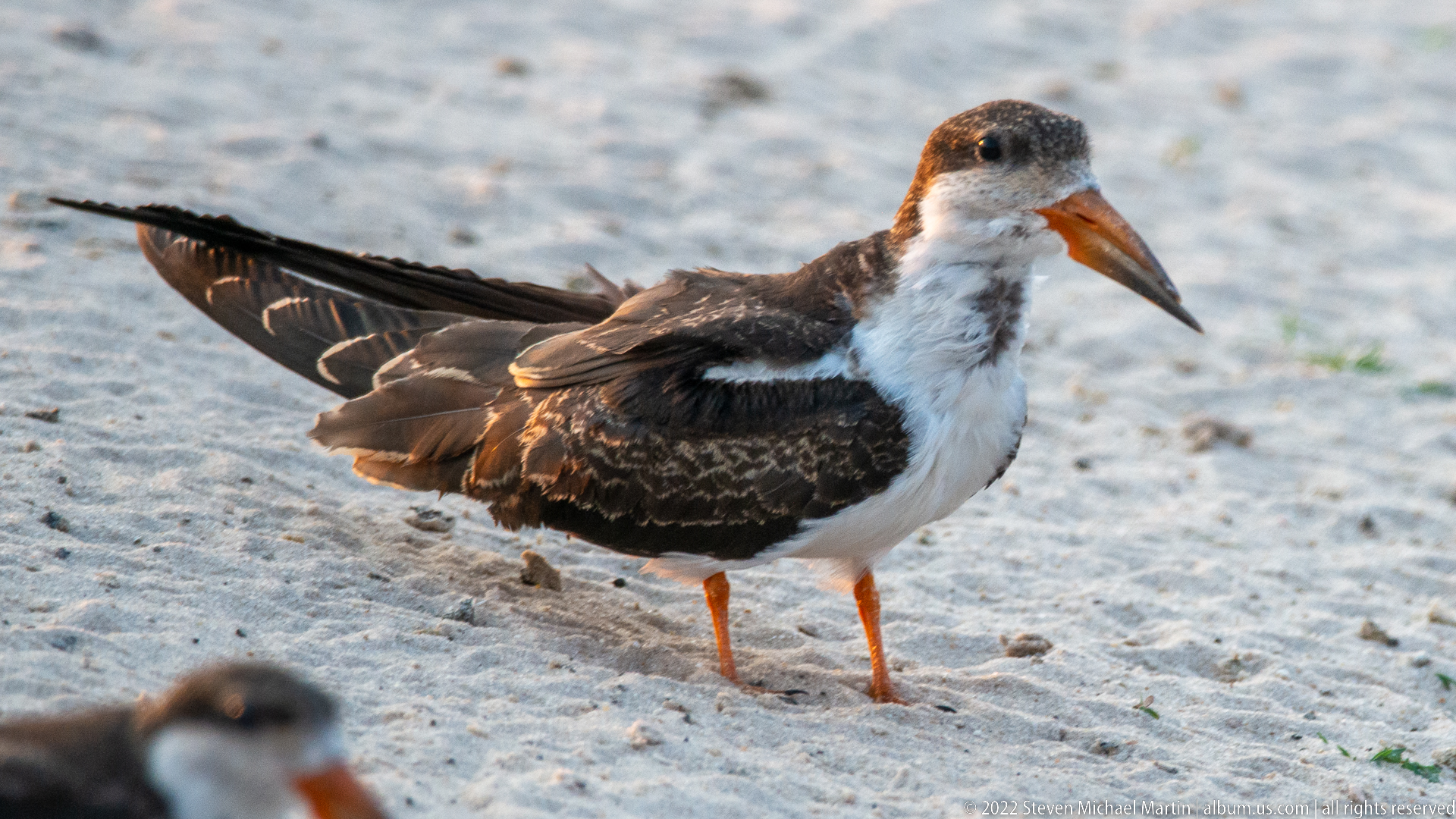
An African skimmer stands on pale sand with its long wings partly spread, revealing dark upperparts and clean white underparts. The vivid orange-red bill with a darker tip and bright orange legs provide the strongest field marks. The unusually long blade-like bill is adapted for skimming the water surface while feeding in flight.
Caption
An African skimmer stands on pale sand with its long wings partly spread, revealing dark upperparts and clean white underparts. The vivid orange-red bill with a darker tip and bright orange legs provide the strongest field marks. The unusually long blade-like bill is adapted for skimming the water surface while feeding in flight.
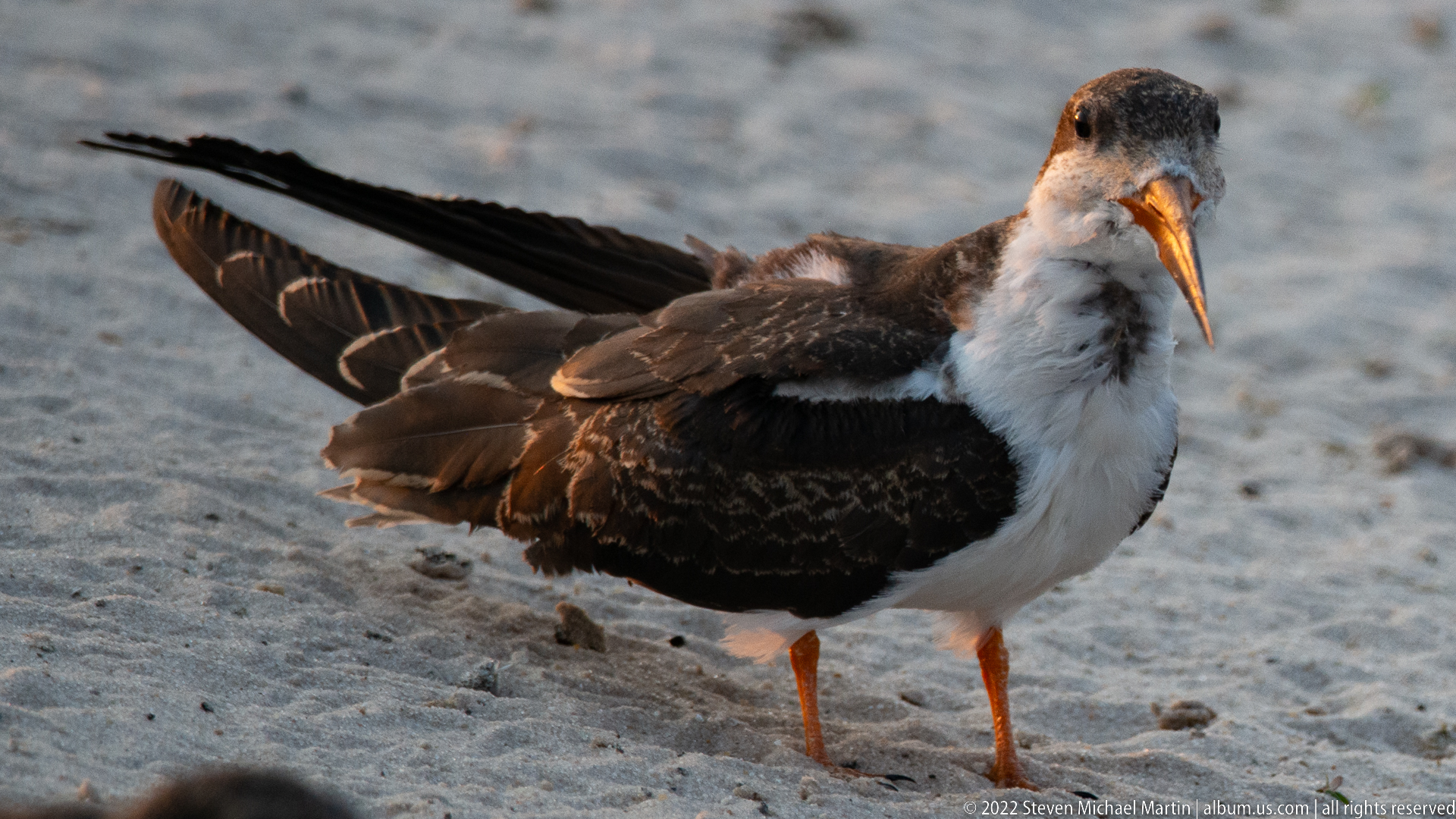
An African skimmer stands on the sandy bank with one long dark wing extended behind it. Its white breast and face contrast strongly with the dark crown and back, while the orange-red bill points downward. The posture exposes the narrow, elongated wing shape characteristic of a bird specialized for fast, low flight over open water.
Caption
An African skimmer stands on the sandy bank with one long dark wing extended behind it. Its white breast and face contrast strongly with the dark crown and back, while the orange-red bill points downward. The posture exposes the narrow, elongated wing shape characteristic of a bird specialized for fast, low flight over open water.

A close view of an African skimmer on pale sand reveals the species’ distinctive bill, orange-red at the base with a dark tip and visibly elongated lower mandible. Fine mottling in the dark upperparts and the bright orange legs are also apparent. The downward-looking pose gives particular prominence to the feeding apparatus that defines this specialized river bird.
Caption
A close view of an African skimmer on pale sand reveals the species’ distinctive bill, orange-red at the base with a dark tip and visibly elongated lower mandible. Fine mottling in the dark upperparts and the bright orange legs are also apparent. The downward-looking pose gives particular prominence to the feeding apparatus that defines this specialized river bird.
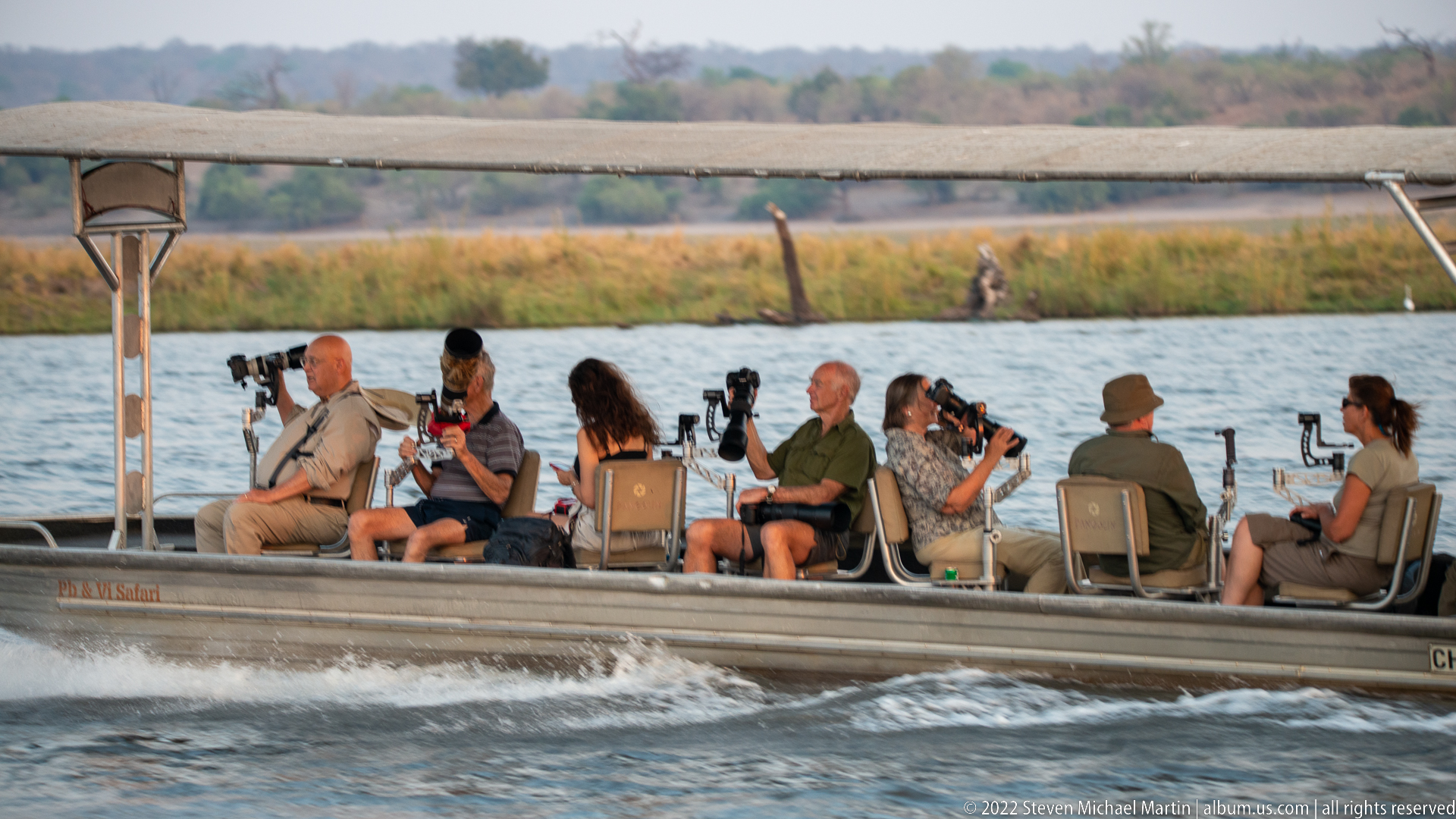
A low open safari boat crosses the river carrying a row of visitors equipped with cameras and long telephoto lenses. Several passengers face the bank and actively photograph wildlife while the boat’s wake spreads behind the hull. The scene documents river-based wildlife viewing as a key way visitors encounter animals along the Chobe–Zambezi waterways.
Caption
A low open safari boat crosses the river carrying a row of visitors equipped with cameras and long telephoto lenses. Several passengers face the bank and actively photograph wildlife while the boat’s wake spreads behind the hull. The scene documents river-based wildlife viewing as a key way visitors encounter animals along the Chobe–Zambezi waterways.
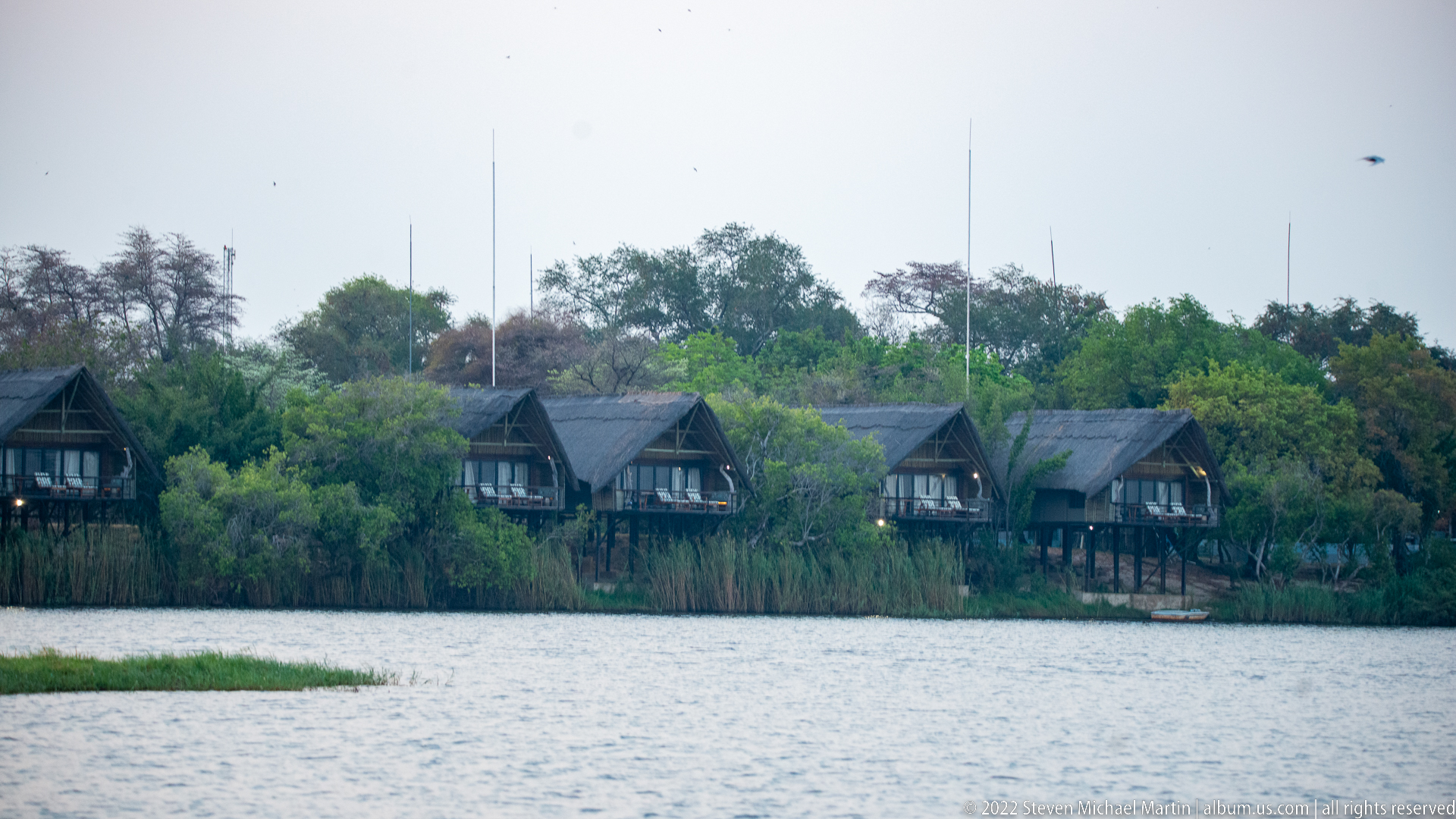
A row of thatched-roof lodge chalets stands among dense green vegetation on the opposite riverbank. Raised decks and dark timber supports face the water, linking the accommodations directly to the river setting. The view records safari tourism infrastructure within the riparian landscape without enough visible signage to identify the property confidently.
Caption
A row of thatched-roof lodge chalets stands among dense green vegetation on the opposite riverbank. Raised decks and dark timber supports face the water, linking the accommodations directly to the river setting. The view records safari tourism infrastructure within the riparian landscape without enough visible signage to identify the property confidently.

The evening sun glows through orange haze above a broad river bend, laying a bright vertical reflection across the water. Low islands and exposed muddy banks fill the foreground, while a dark tree line recedes along the far shore. The wider composition emphasizes the river’s braided margins and open horizon at sunset.
Caption
The evening sun glows through orange haze above a broad river bend, laying a bright vertical reflection across the water. Low islands and exposed muddy banks fill the foreground, while a dark tree line recedes along the far shore. The wider composition emphasizes the river’s braided margins and open horizon at sunset.
The Zambezi River offered a quieter, more reflective side of the safari experience. The pace slowed, the horizon widened, and wildlife appeared gradually along the shoreline, often in small moments shaped by water, light, and patience.
What made this portfolio especially memorable was the sense of ecological balance. Crocodiles rested at the river’s edge, hippos surfaced and grazed nearby, elephants approached the water in family groups, and birds animated the shoreline from dawn through sunset. The result was a river safari defined less by urgency and more by rhythm.
Highlights
- Classic river safari atmosphere with calm boat-based viewing
- Strong crocodile and hippo presence along the shoreline
- Elephants approaching and entering the water in family groups
- Excellent birdlife including fish eagles, kingfishers, storks, egrets, and shorebirds
- Beautiful ending light with lodge and sunset views completing the story
Field Guide
📍 Location
The Zambezi River is one of Africa’s great waterways and forms part of the natural boundary between several southern African countries. In this stretch of the river, wildlife gathers along the shoreline where permanent water shapes daily movement and supports a wide range of species.
🌍 Landscape
Broad channels, grassy margins, sandy banks, reeds, and distant tree lines define the landscape. The river feels expansive without losing intimacy, since much of the wildlife activity happens close to the water’s edge where land and river meet.
🦁 Wildlife
The wildlife along the Zambezi is strongly organized by access to water. Large mammals approach the river to drink, graze, or cross, while reptiles and birds use the shoreline more continuously throughout the day.
- Elephants: Often seen in family groups approaching the river, drinking, or standing in shallow water.
- Hippos: Frequently visible both partially submerged and grazing along the grassy banks.
- Crocodiles: Commonly observed resting on sandy or grassy edges, sometimes almost blending into the shoreline.
- Buffalo: Seen using the riverine grasslands near the water’s edge.
- Primates: Baboons move between dry ground and river margin, adding another layer of activity to the ecosystem.
- Birdlife: Fish eagles, kingfishers, egrets, storks, darters, shorebirds, and other species give the river constant movement and variety.
🦅 Birdlife
Birdlife is one of the defining elements of the Zambezi experience. Some species remain perched above the water, while others move continuously between sandbanks, reeds, and muddy edges. The variety of waders, raptors, and shoreline birds gives the page much of its visual rhythm.
🚙 Experience
Viewing wildlife from the river changes the pace of a safari. Boat movement is smoother and quieter than a game drive, encouraging longer observation and a stronger sense of how species share the same narrow band of habitat along the water.
Story & Experience
River First
The Zambezi experience begins with the river itself. Before any single animal becomes the focus, the water establishes the mood — broad, calm, and steady, with movement revealed gradually rather than all at once.
Shoreline Encounters
Many of the strongest sightings happened right at the edge of the river. Crocodiles rested in full view, hippos surfaced quietly and then disappeared again, and birds moved between the waterline and nearby grass with constant small bursts of activity.
Elephants and Water
Elephants approaching the river became some of the most memorable moments in the portfolio. Their size and social structure were especially striking against the stillness of the water, whether they paused to drink, entered the shallows, or gathered in loosely organized groups along the bank.
Birds, Reptiles, and Small Movements
This page works so well because it does not rely on a single dramatic sighting. Instead, the story builds through layers: fish eagles scanning from above, kingfishers along sandy banks, storks and egrets in wet grass, monitor lizards near the shore, and crocodiles almost blending into their surroundings.
Life Along the Margin
The narrow meeting point between land and river held the most activity. Buffalo grazed nearby, hippos moved between water and grass, baboons crossed dry ground, and birds seemed to occupy every available level of the landscape. The page gives a strong sense that the river is not simply scenery but the organizing force of the ecosystem.
Ending in Stillness
The final boat and sunset images bring the portfolio to a satisfying close. After so much quiet wildlife observation, the river settles into evening light, and the lodge and shoreline views help turn the page from a sequence of sightings into a complete memory of place.
Photography Notes
- Boat-based photography benefits from slightly faster shutter speeds
- Shoreline compositions work well because they layer multiple species in one frame
- Crocodiles and hippos are especially effective when shown with habitat context
- Birdlife adds pacing and color between the larger mammal sequences
- Sunset and lodge images help complete the page with a strong sense of atmosphere
Quick Facts
- Region: Zambezi River corridor
- Landscape: River channels, sandy banks, grassy margins, reeds, and woodland edge
- Key Wildlife: Elephant, hippo, crocodile, buffalo, baboons, and diverse birdlife
- Experience Style: Boat-based safari focused on river ecology, atmosphere, and shoreline wildlife
Guide Book:

This “Story of Chobe” spread pairs a broad river-and-tree landscape with inset photographs of a lilac-breasted roller, Chobe River sunset, leopard, and another small mammal. The page’s long text situates these animals within the Chobe ecosystem, while the varied images move from habitat-scale context to individual species. The large tree and floodplain view anchors the natural-history narrative in the river landscape.
Caption
This “Story of Chobe” spread pairs a broad river-and-tree landscape with inset photographs of a lilac-breasted roller, Chobe River sunset, leopard, and another small mammal. The page’s long text situates these animals within the Chobe ecosystem, while the varied images move from habitat-scale context to individual species. The large tree and floodplain view anchors the natural-history narrative in the river landscape.
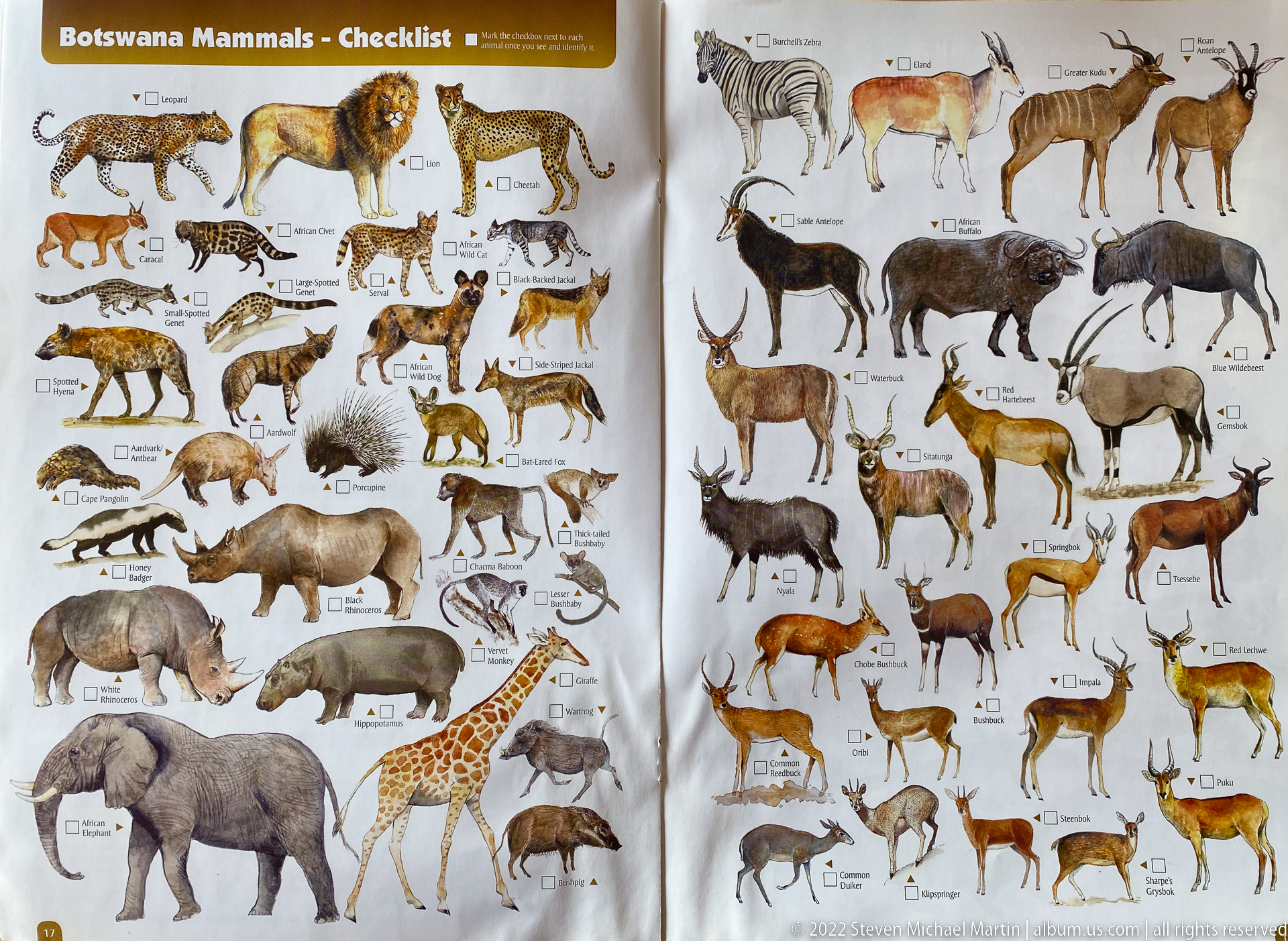
A two-page wildlife checklist presents illustrated mammals ranging from small carnivores and antelope to elephant, giraffe, rhinoceros, hippopotamus, buffalo, and zebra. Each species is paired with a small checkbox and name, turning the spread into a visual field reference for recording sightings. The dense taxonomy-style layout emphasizes comparison of body form, coloration, horn shape, and relative size across many species.
Caption
A two-page wildlife checklist presents illustrated mammals ranging from small carnivores and antelope to elephant, giraffe, rhinoceros, hippopotamus, buffalo, and zebra. Each species is paired with a small checkbox and name, turning the spread into a visual field reference for recording sightings. The dense taxonomy-style layout emphasizes comparison of body form, coloration, horn shape, and relative size across many species.
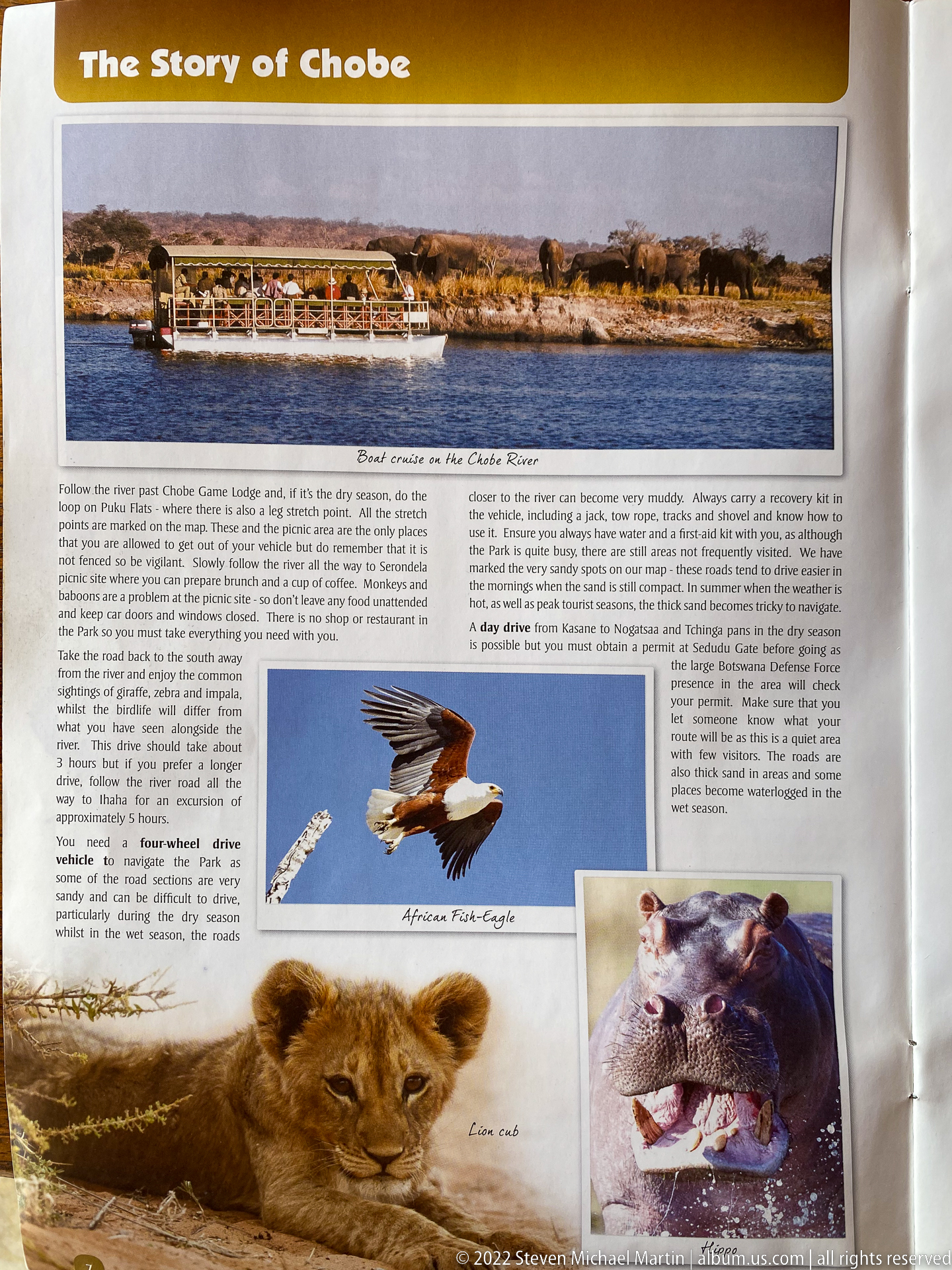
A “Story of Chobe” guide page centers on a panoramic photograph of a tour boat cruising the Chobe River, supplemented by portraits of an African fish eagle, lion, and hippopotamus. Text discusses the riverfront and its wildlife-viewing environment, while the juxtaposition of boat and animals shows how the guide connects tourism activity with the park’s celebrated fauna.
Caption
A “Story of Chobe” guide page centers on a panoramic photograph of a tour boat cruising the Chobe River, supplemented by portraits of an African fish eagle, lion, and hippopotamus. Text discusses the riverfront and its wildlife-viewing environment, while the juxtaposition of boat and animals shows how the guide connects tourism activity with the park’s celebrated fauna.

The cover of a printed Chobe River Tourist Map combines a large African elephant with a sunset river scene and safari boat. Prominent text identifies it as the first edition and describes it as an African souvenir and photographer’s guide to travelling the Chobe National Park riverfront. The cover places practical visitor information within a strongly wildlife-focused visual design.
Caption
The cover of a printed Chobe River Tourist Map combines a large African elephant with a sunset river scene and safari boat. Prominent text identifies it as the first edition and describes it as an African souvenir and photographer’s guide to travelling the Chobe National Park riverfront. The cover places practical visitor information within a strongly wildlife-focused visual design.
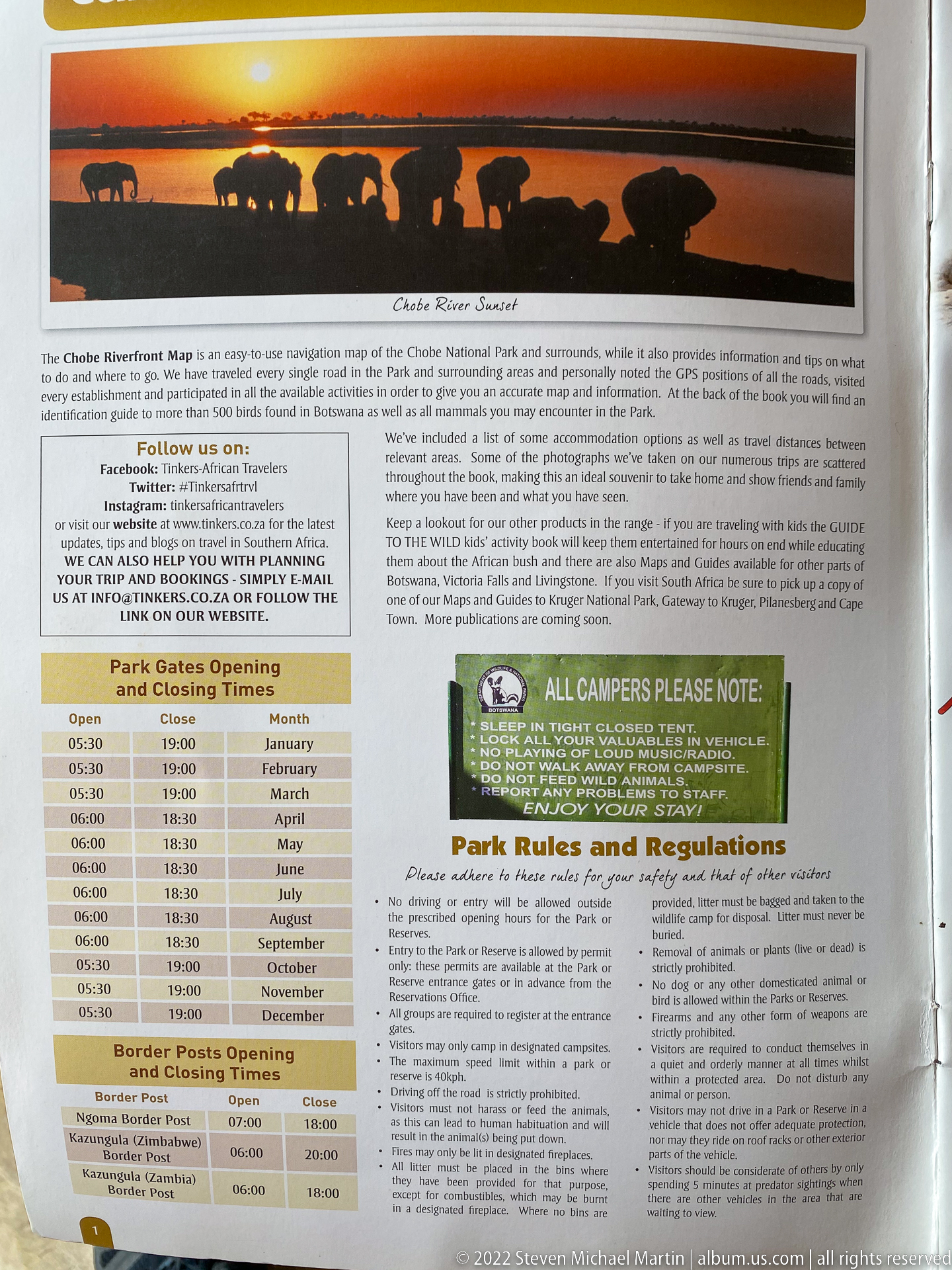
An interior page of the Chobe River guide presents practical visitor information for the Chobe Riverfront, including opening and closing times, border-post hours, park rules and regulations, and guidance for campers. Dense blocks of text, tables, and highlighted notices show the guide’s functional role as a field reference for visitors entering and travelling through the protected area.
Caption
An interior page of the Chobe River guide presents practical visitor information for the Chobe Riverfront, including opening and closing times, border-post hours, park rules and regulations, and guidance for campers. Dense blocks of text, tables, and highlighted notices show the guide’s functional role as a field reference for visitors entering and travelling through the protected area.
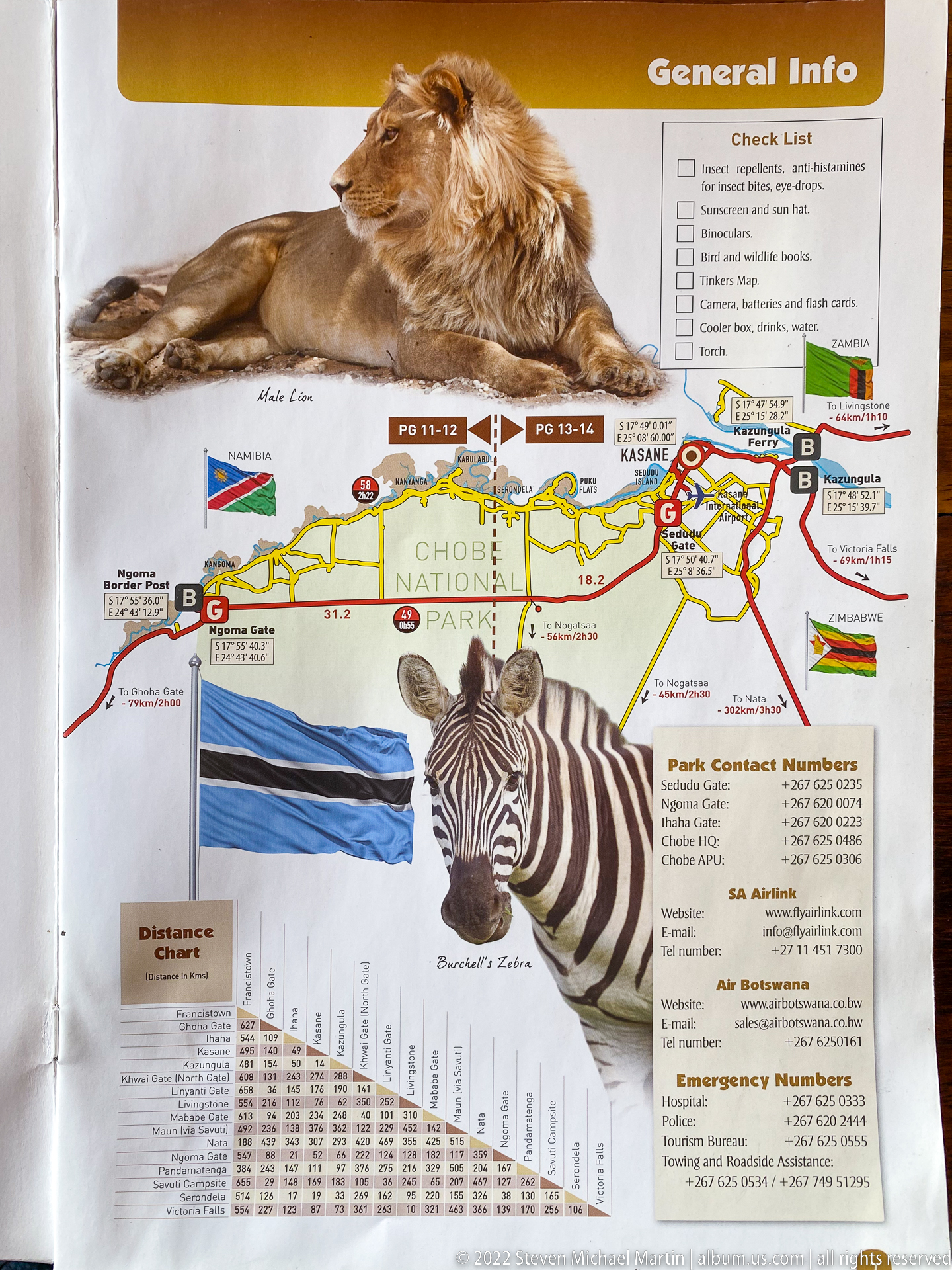
A general-information page from the Chobe River guide centers on a route map around Kasane and Chobe National Park, accompanied by a lion and Burchell’s zebra illustration. Contact details, a distances chart, park information, and emergency numbers surround the map, turning the page into a compact orientation reference for safari visitors.
Caption
A general-information page from the Chobe River guide centers on a route map around Kasane and Chobe National Park, accompanied by a lion and Burchell’s zebra illustration. Contact details, a distances chart, park information, and emergency numbers surround the map, turning the page into a compact orientation reference for safari visitors.
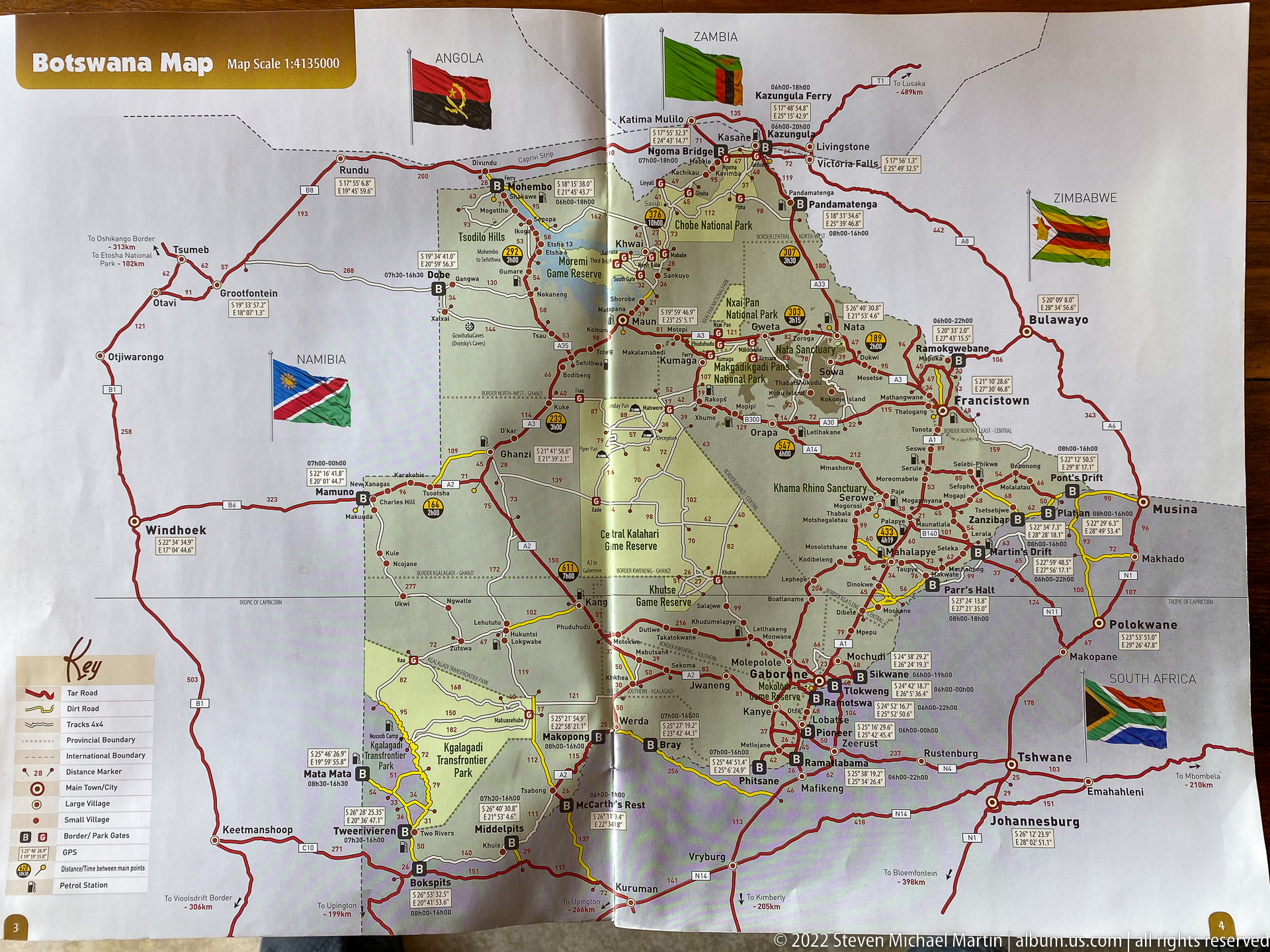
A folded regional map presents road connections across Botswana and neighboring southern African countries, with national flags and major towns marked around the margins. Chobe National Park and the Kasane area sit within a much broader overland network, making this page an orientation tool rather than a wildlife plate. The visible road web links Botswana with Namibia, Zambia, Zimbabwe, and South Africa.
Caption
A folded regional map presents road connections across Botswana and neighboring southern African countries, with national flags and major towns marked around the margins. Chobe National Park and the Kasane area sit within a much broader overland network, making this page an orientation tool rather than a wildlife plate. The visible road web links Botswana with Namibia, Zambia, Zimbabwe, and South Africa.

A large Chobe Riverfront map fills the spread with numbered tracks, river channels, park roads, and wildlife-viewing areas. Around the map are species illustrations including lion, buffalo, hippopotamus, giraffe, impala, elephant, and birds, together with warnings such as “Beware Hippos.” The graphic blends navigation with wildlife awareness, reflecting the practical needs of self-drive and guided safari travel.
Caption
A large Chobe Riverfront map fills the spread with numbered tracks, river channels, park roads, and wildlife-viewing areas. Around the map are species illustrations including lion, buffalo, hippopotamus, giraffe, impala, elephant, and birds, together with warnings such as “Beware Hippos.” The graphic blends navigation with wildlife awareness, reflecting the practical needs of self-drive and guided safari travel.
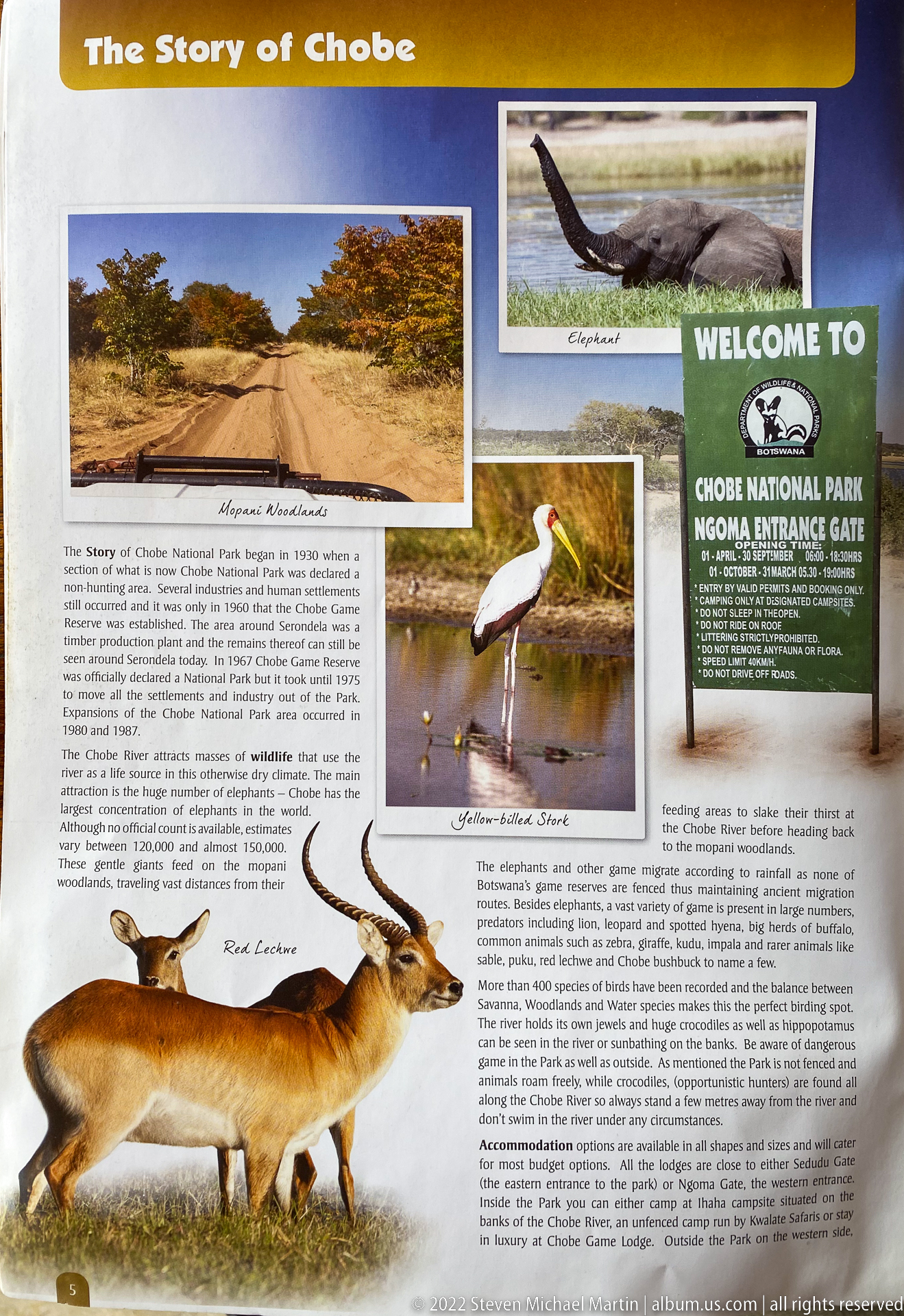
An illustrated guide page titled “The Story of Chobe” combines an African elephant, yellow-billed stork, red lechwe, woodland scenery, and the entrance sign for Chobe National Park’s Ngoma gate. Dense explanatory text introduces the park and its wildlife, while the collage format blends landscape, species portraits, and visitor orientation into a concise natural-history overview.
Caption
An illustrated guide page titled “The Story of Chobe” combines an African elephant, yellow-billed stork, red lechwe, woodland scenery, and the entrance sign for Chobe National Park’s Ngoma gate. Dense explanatory text introduces the park and its wildlife, while the collage format blends landscape, species portraits, and visitor orientation into a concise natural-history overview.
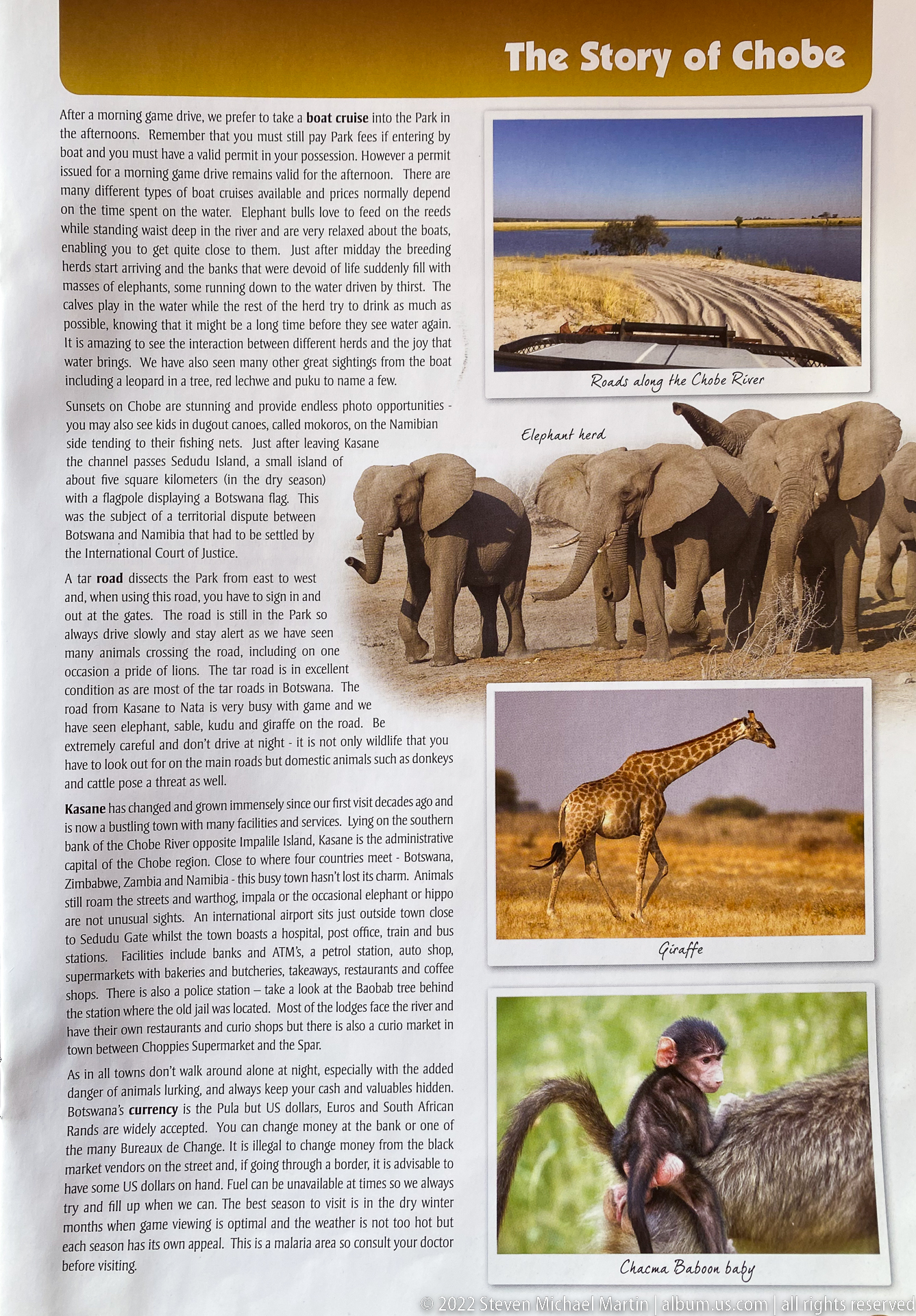
An illustrated “Story of Chobe” page places a herd of African elephants across the center, with smaller views of a Chobe River floodplain, giraffe, and young baboon below. The composition emphasizes the diversity of large mammals associated with the riverfront and gives elephants visual priority through scale and placement. Explanatory text surrounds the images in a field-guide layout.
Caption
An illustrated “Story of Chobe” page places a herd of African elephants across the center, with smaller views of a Chobe River floodplain, giraffe, and young baboon below. The composition emphasizes the diversity of large mammals associated with the riverfront and gives elephants visual priority through scale and placement. Explanatory text surrounds the images in a field-guide layout.
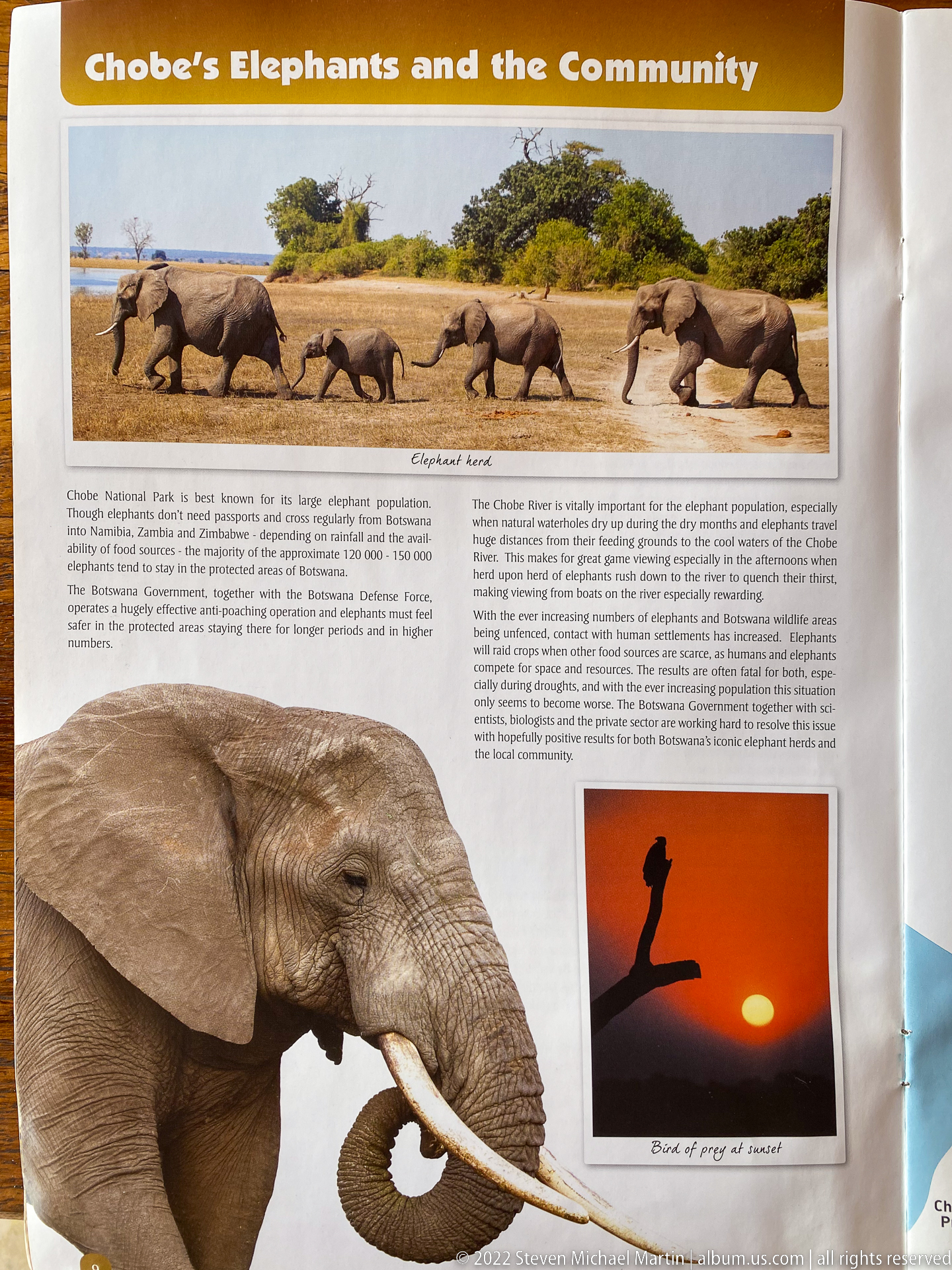
A guide page headed “Chobe’s Elephants and the Community” devotes most of its space to African elephants, including a herd moving across dry ground and a large close portrait of a tusked adult. A sunset silhouette of a person adds a human dimension to the subject. The page visually frames elephants not only as wildlife icons but also within the shared human landscape around Chobe.
Caption
A guide page headed “Chobe’s Elephants and the Community” devotes most of its space to African elephants, including a herd moving across dry ground and a large close portrait of a tusked adult. A sunset silhouette of a person adds a human dimension to the subject. The page visually frames elephants not only as wildlife icons but also within the shared human landscape around Chobe.
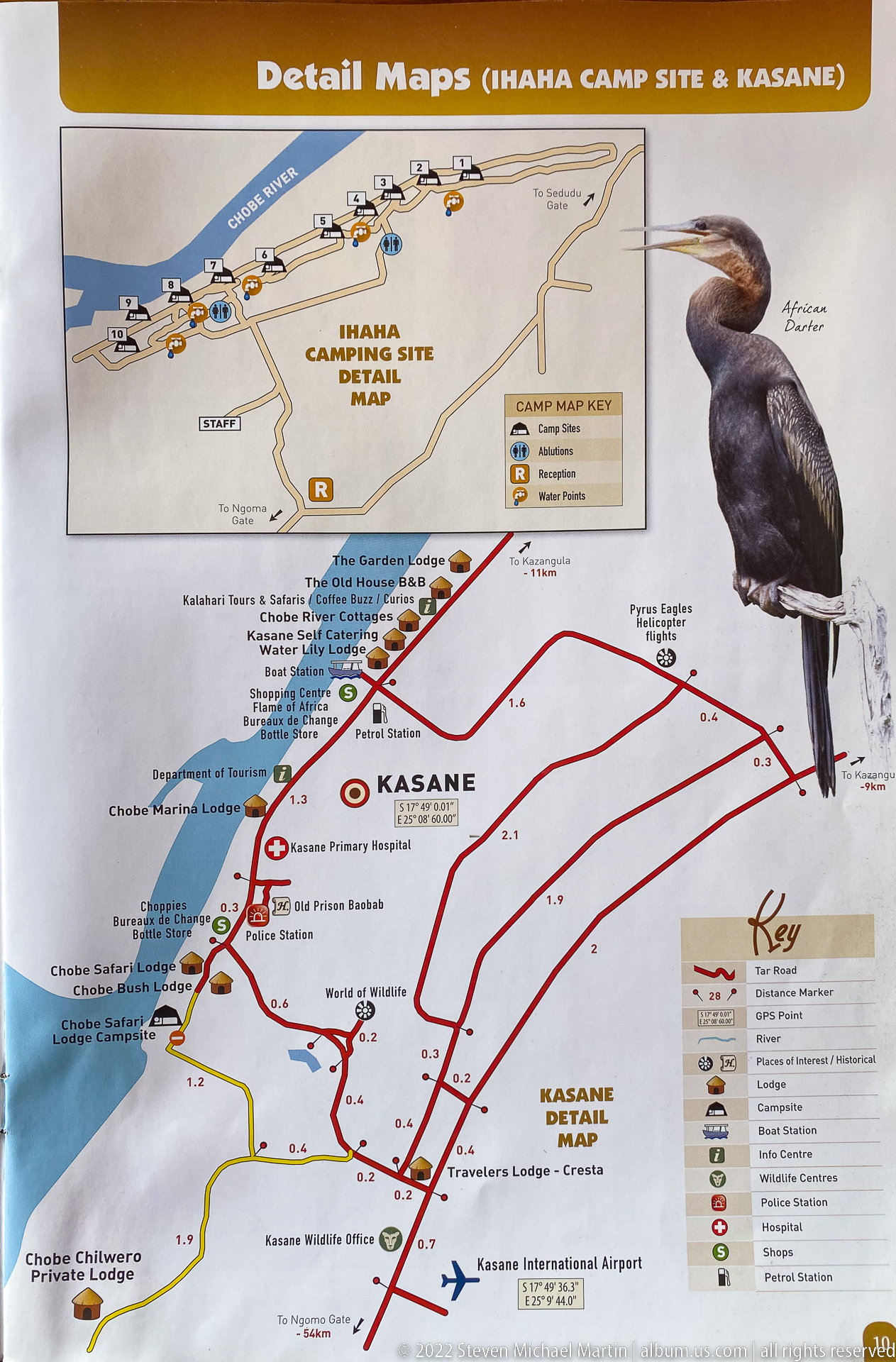
A detailed map page focuses on Kasane and the Ihaha campsite area, using thick red route lines, landmarks, road names, and a compact campsite diagram. A large waterbird illustration occupies the right side while the lower map traces access around Kasane, the Chobe Riverfront, and nearby facilities. The page functions as practical navigation for visitors moving between town, park entrances, and campsites.
Caption
A detailed map page focuses on Kasane and the Ihaha campsite area, using thick red route lines, landmarks, road names, and a compact campsite diagram. A large waterbird illustration occupies the right side while the lower map traces access around Kasane, the Chobe Riverfront, and nearby facilities. The page functions as practical navigation for visitors moving between town, park entrances, and campsites.
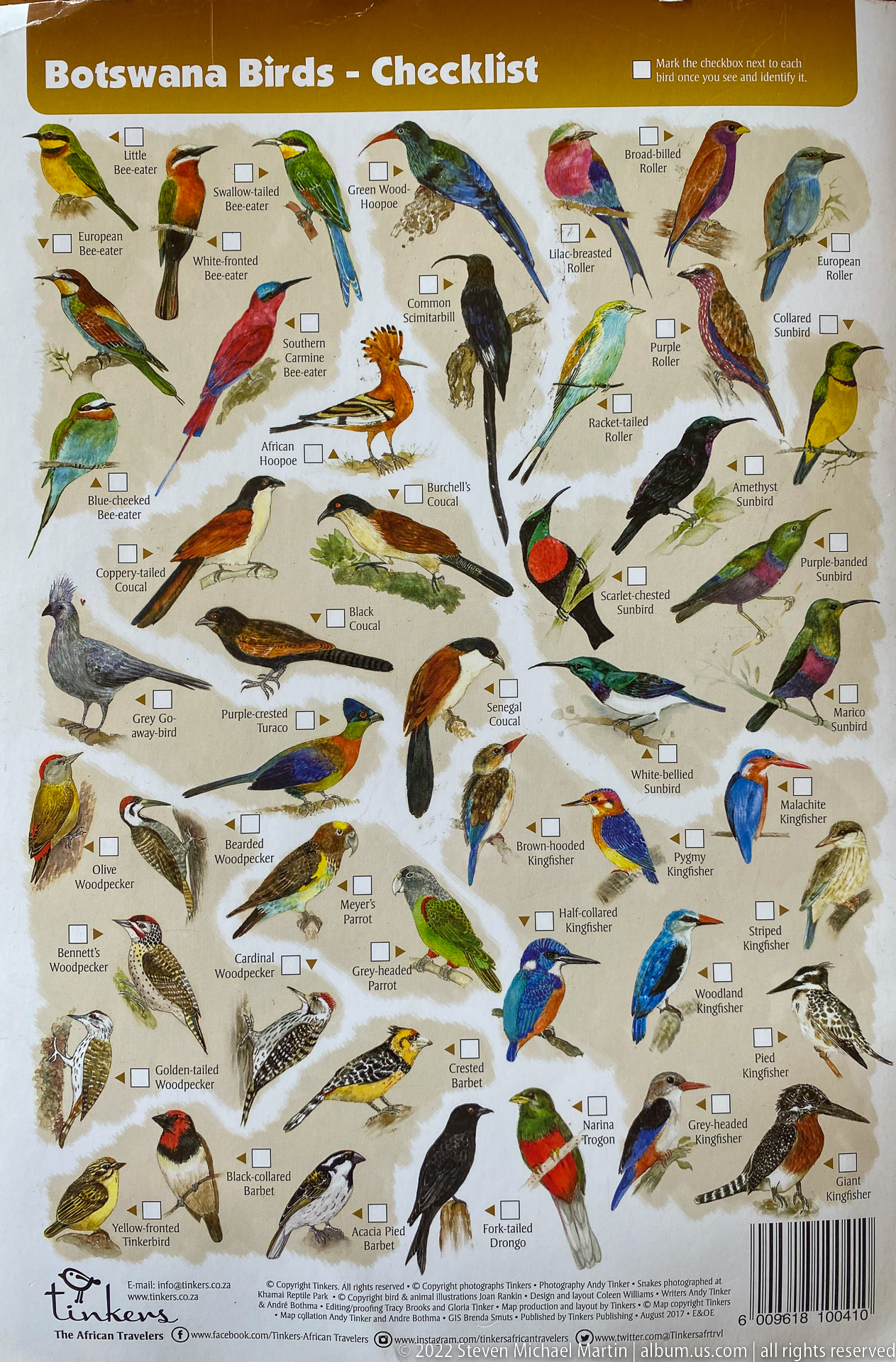
The final bird checklist page gathers many of Botswana’s most colorful and distinctive species, including rollers, kingfishers, bee-eaters, barbets, hornbills, and other woodland and riverine birds. Saturated blues, greens, reds, yellows, and chestnuts make this page especially useful for quick plumage-based comparison. Species names and checkboxes preserve the practical field-guide function while the dense illustrations form a vivid visual index of regional birdlife.
Caption
The final bird checklist page gathers many of Botswana’s most colorful and distinctive species, including rollers, kingfishers, bee-eaters, barbets, hornbills, and other woodland and riverine birds. Saturated blues, greens, reds, yellows, and chestnuts make this page especially useful for quick plumage-based comparison. Species names and checkboxes preserve the practical field-guide function while the dense illustrations form a vivid visual index of regional birdlife.
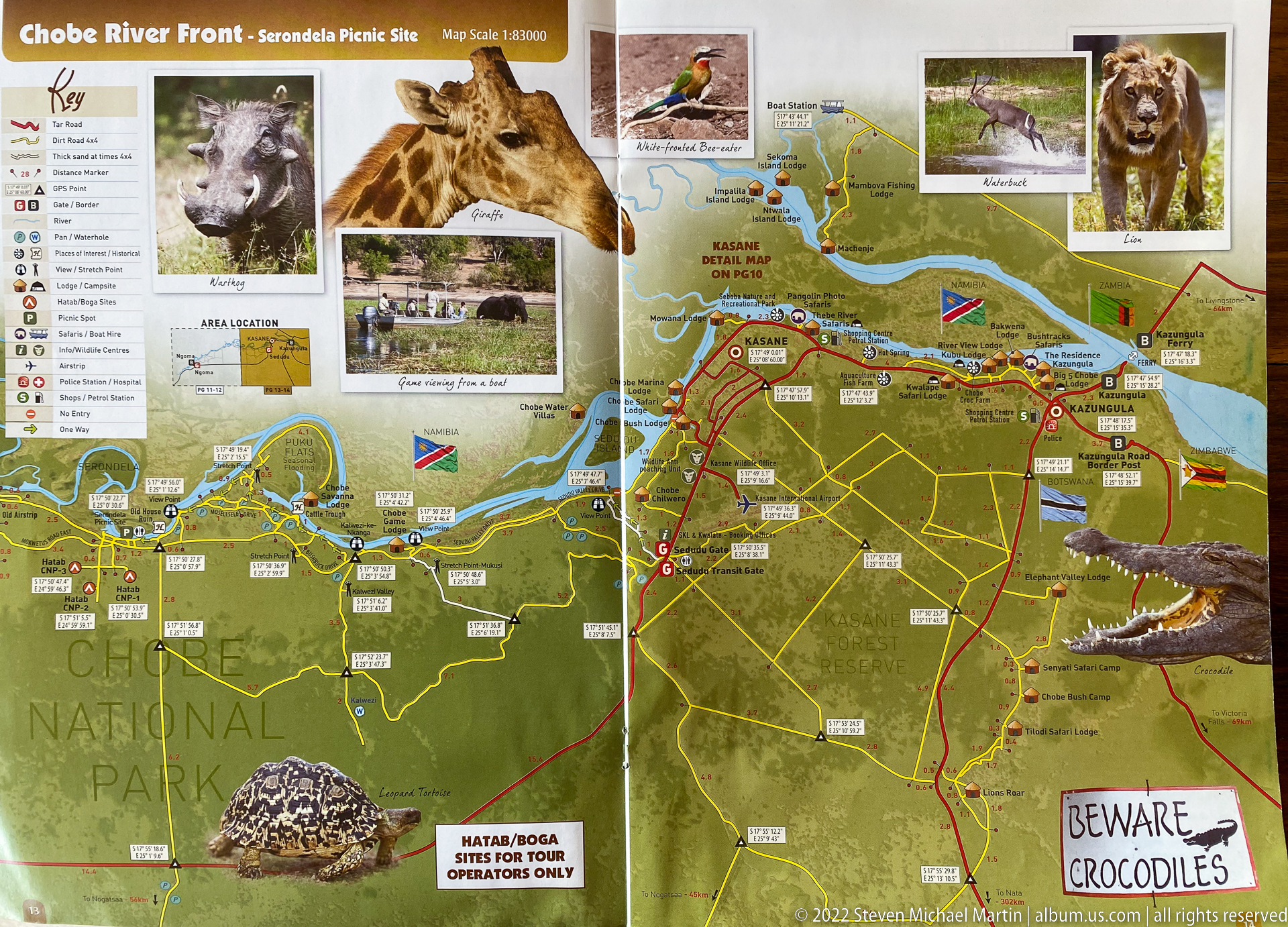
This map spread extends the Chobe guide’s navigation coverage through the national park, with a green map crossed by red and yellow road lines and dotted with route numbers and water features. Wildlife photographs and drawings include giraffe, lion, buffalo, crocodile, and smaller species, while a bold “Beware Crocodiles” notice reinforces river-edge hazards. The page combines spatial orientation with species recognition.
Caption
This map spread extends the Chobe guide’s navigation coverage through the national park, with a green map crossed by red and yellow road lines and dotted with route numbers and water features. Wildlife photographs and drawings include giraffe, lion, buffalo, crocodile, and smaller species, while a bold “Beware Crocodiles” notice reinforces river-edge hazards. The page combines spatial orientation with species recognition.
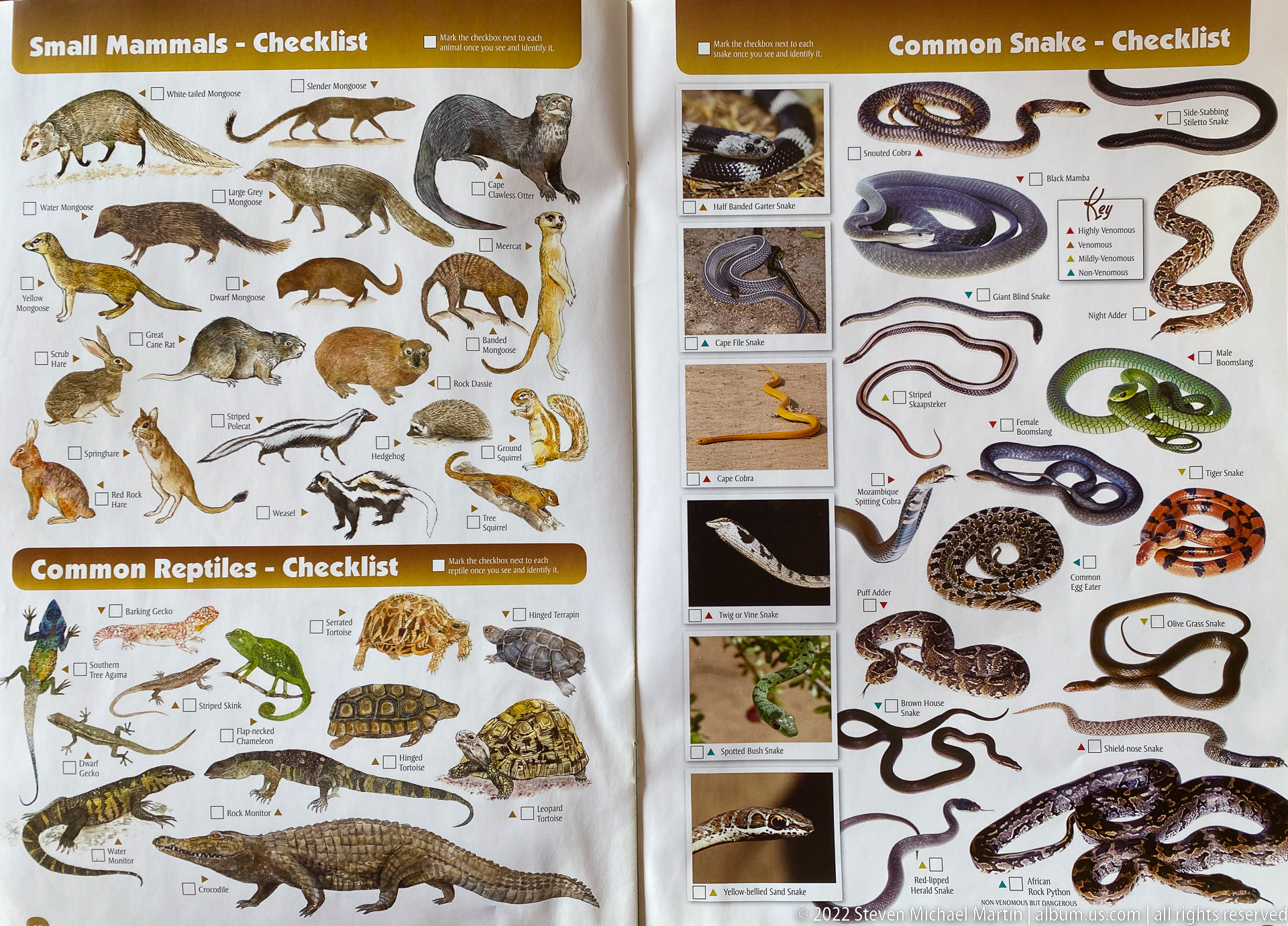
An illustrated field-guide spread pairs a common reptile checklist with a common snake checklist. Tortoises, crocodilians, lizards, and other reptiles occupy the left page, while the right compares snakes by body pattern, coloration, and overall form. Small checkboxes and labels beside each illustration turn the spread into a practical visual reference for field identification and sighting records.
Caption
An illustrated field-guide spread pairs a common reptile checklist with a common snake checklist. Tortoises, crocodilians, lizards, and other reptiles occupy the left page, while the right compares snakes by body pattern, coloration, and overall form. Small checkboxes and labels beside each illustration turn the spread into a practical visual reference for field identification and sighting records.
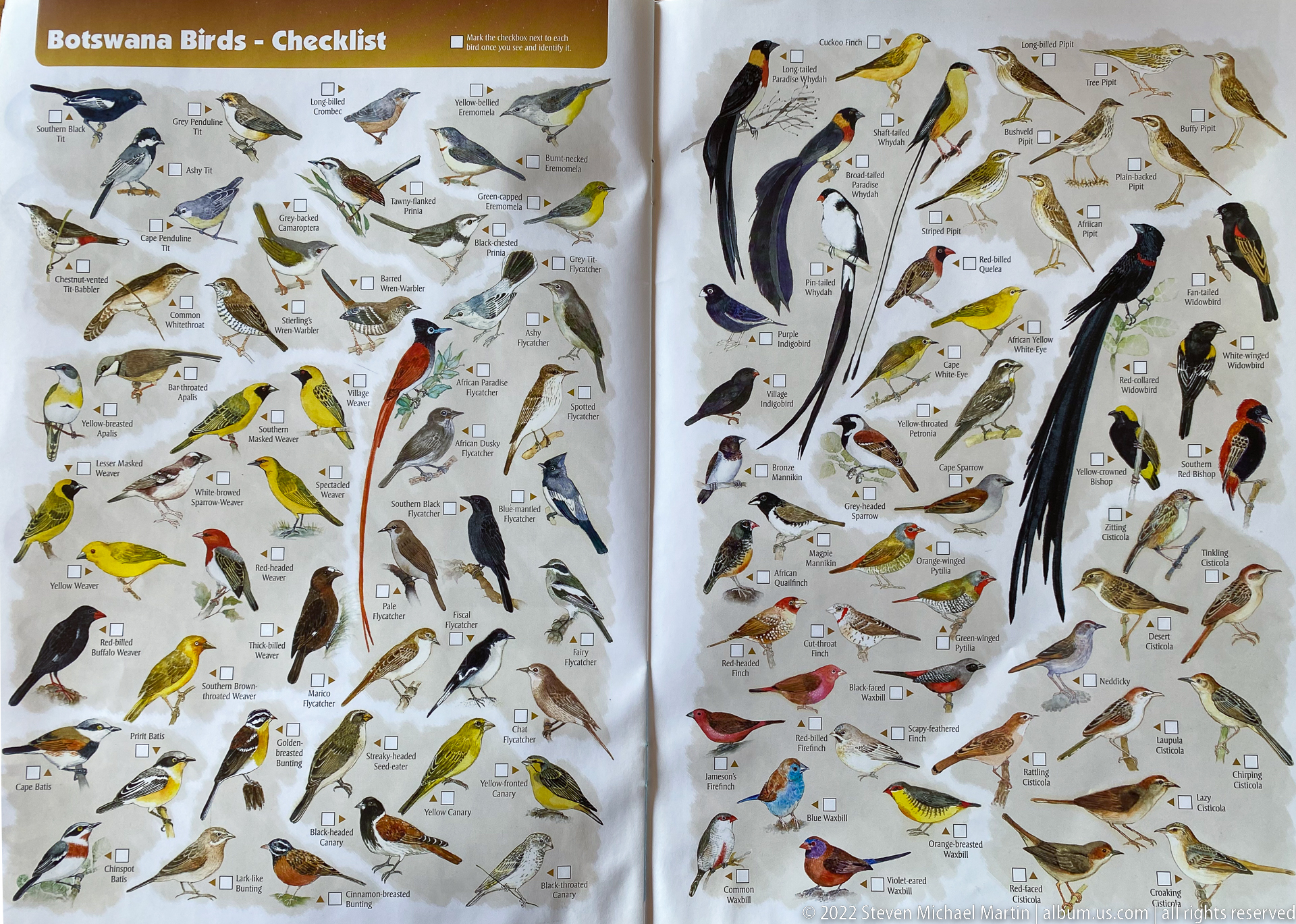
A densely illustrated two-page bird checklist compares dozens of small and medium-sized species in side view. Yellow, red, blue, black, brown, and patterned plumages are arranged in rows beside names and checkboxes, with long-tailed and vividly colored species standing out among subtler forms. The spread is designed for rapid visual comparison and field recording rather than narrative reading.
Caption
A densely illustrated two-page bird checklist compares dozens of small and medium-sized species in side view. Yellow, red, blue, black, brown, and patterned plumages are arranged in rows beside names and checkboxes, with long-tailed and vividly colored species standing out among subtler forms. The spread is designed for rapid visual comparison and field recording rather than narrative reading.

A two-page bird checklist arranges a wide range of woodland, grassland, and aerial species across a pale background, each paired with a label and checkbox. The mix includes brightly colored rollers and bee-eaters, monochrome insectivores, swifts and swallows, larger terrestrial birds, and many small songbirds. The visual diversity makes the spread especially useful for comparing silhouette, tail shape, wing length, and plumage pattern.
Caption
A two-page bird checklist arranges a wide range of woodland, grassland, and aerial species across a pale background, each paired with a label and checkbox. The mix includes brightly colored rollers and bee-eaters, monochrome insectivores, swifts and swallows, larger terrestrial birds, and many small songbirds. The visual diversity makes the spread especially useful for comparing silhouette, tail shape, wing length, and plumage pattern.
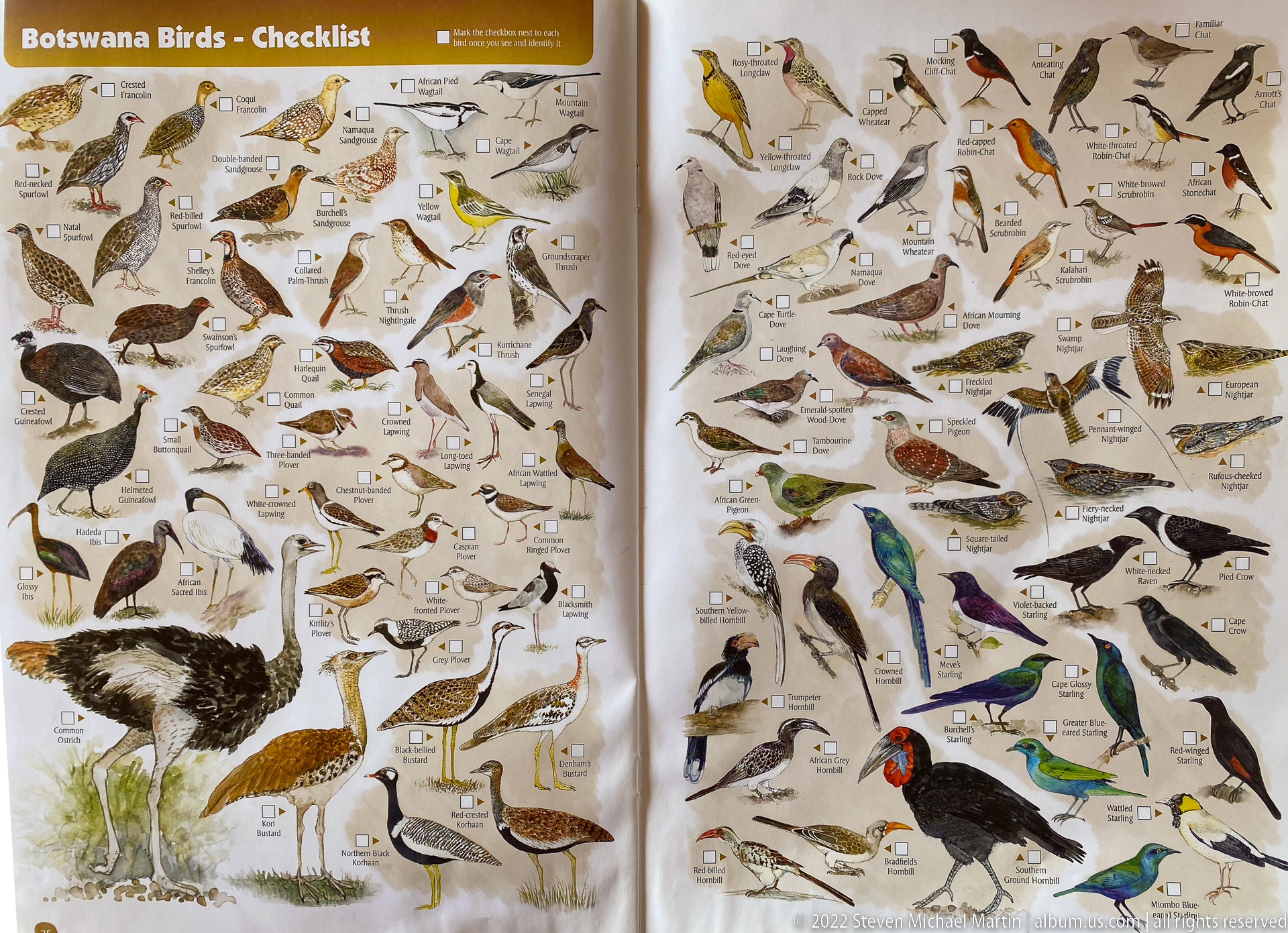
This bird checklist expands into larger and more structurally varied species, including long-legged waders, ground birds, cuckoos, corvids, and vividly colored woodland birds. Each illustration is labeled and paired with a checkbox, encouraging side-by-side comparison of bill shape, leg length, cresting, body size, and plumage. The spread functions as an intermediate field reference between small passerines and the larger waterbirds and raptors shown on subsequent pages.
Caption
This bird checklist expands into larger and more structurally varied species, including long-legged waders, ground birds, cuckoos, corvids, and vividly colored woodland birds. Each illustration is labeled and paired with a checkbox, encouraging side-by-side comparison of bill shape, leg length, cresting, body size, and plumage. The spread functions as an intermediate field reference between small passerines and the larger waterbirds and raptors shown on subsequent pages.
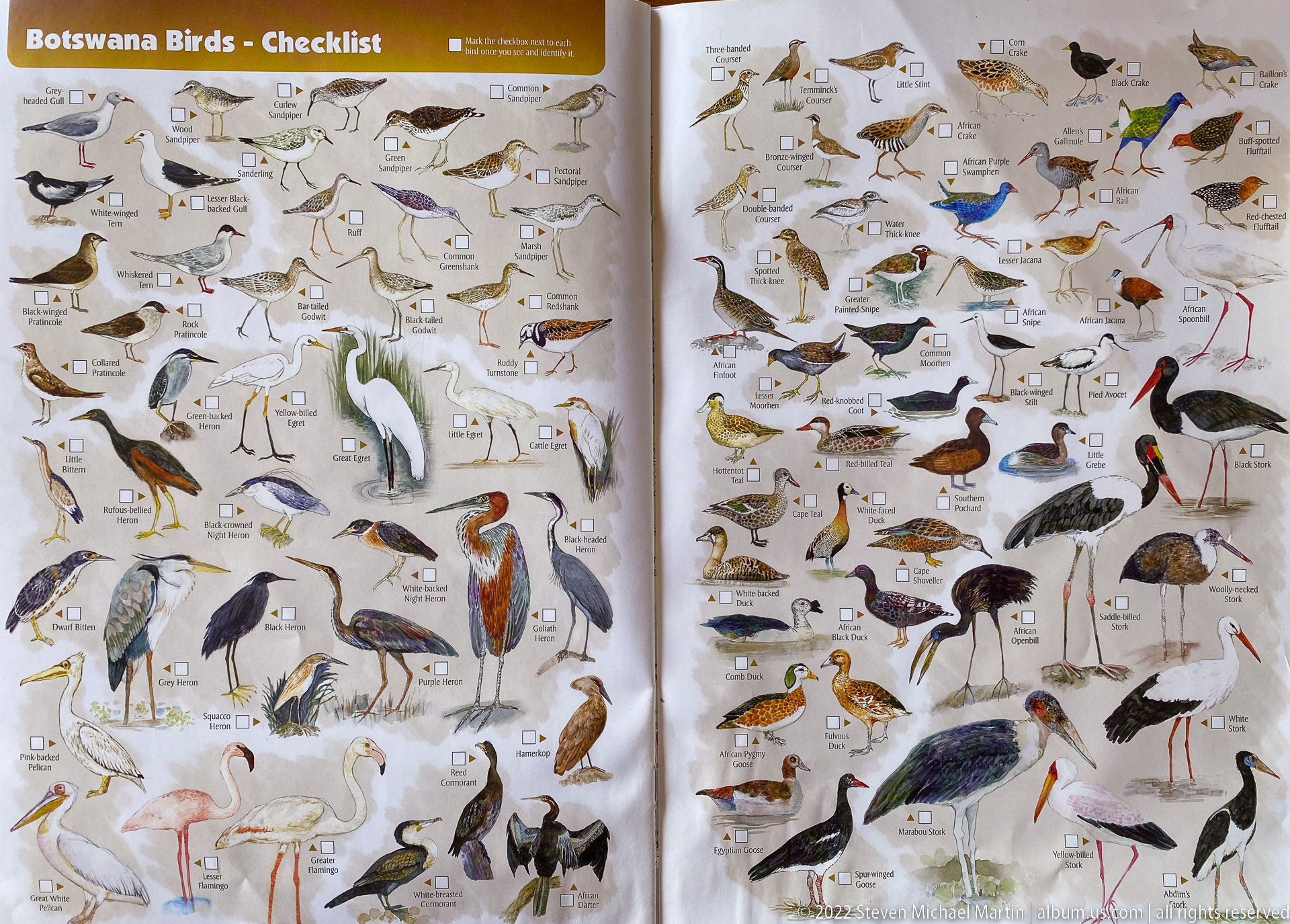
An illustrated waterbird checklist presents herons, storks, ibises, spoonbills, flamingos, ducks, geese, shorebirds, and related wetland species. Long bills, long legs, webbed feet, and contrasting plumage patterns dominate the spread, reflecting adaptations to aquatic and shoreline habitats. Labels and checkboxes transform the page into a compact visual inventory for recording bird sightings along rivers, lagoons, and floodplains.
Caption
An illustrated waterbird checklist presents herons, storks, ibises, spoonbills, flamingos, ducks, geese, shorebirds, and related wetland species. Long bills, long legs, webbed feet, and contrasting plumage patterns dominate the spread, reflecting adaptations to aquatic and shoreline habitats. Labels and checkboxes transform the page into a compact visual inventory for recording bird sightings along rivers, lagoons, and floodplains.
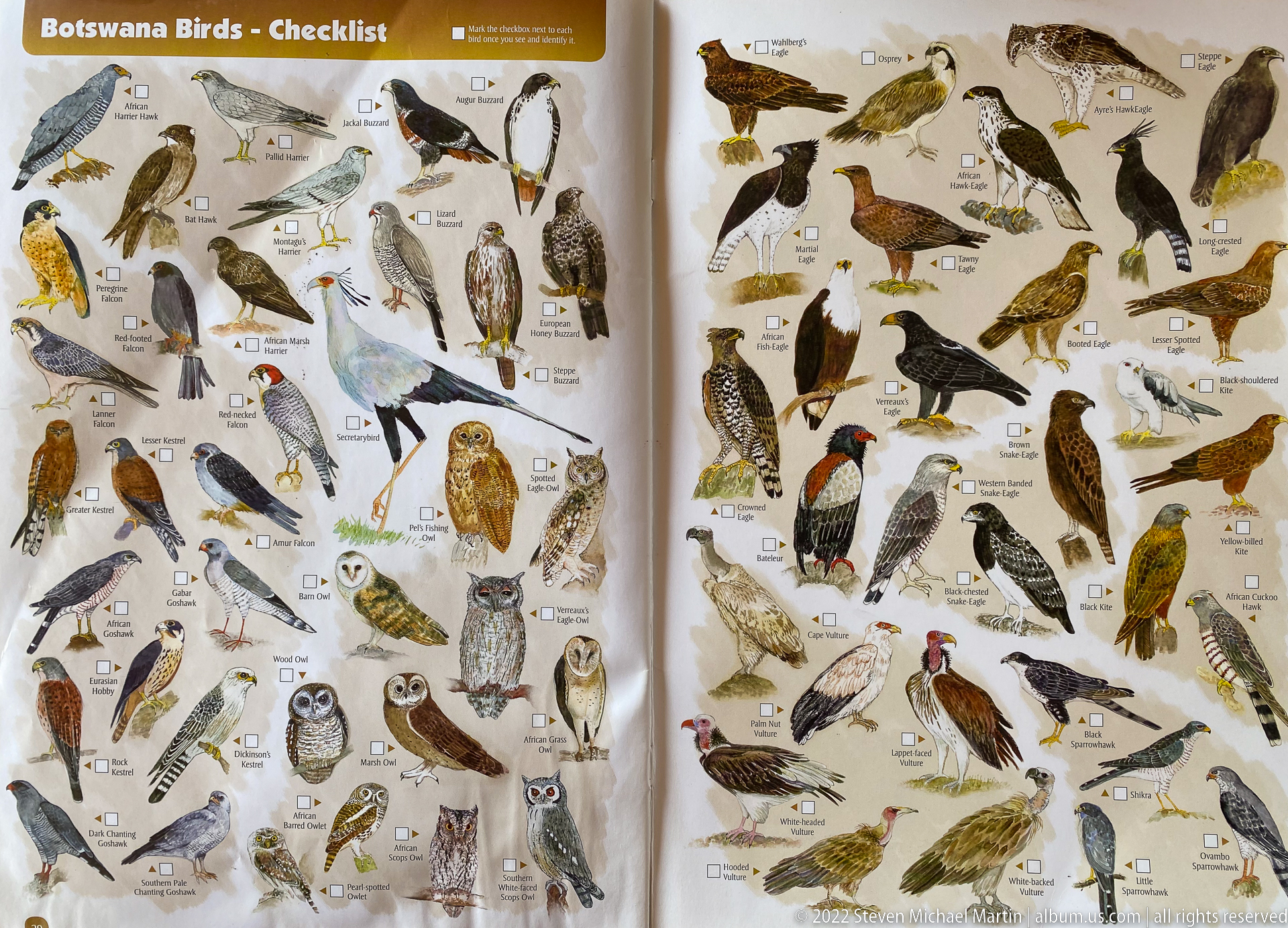
A two-page raptor checklist compares owls, eagles, hawks, falcons, vultures, and other predatory birds in a dense illustrated layout. Large hooked bills, talons, broad wings, and varied head patterns distinguish the species, while checkboxes and labels support field recording. The spread is particularly useful for comparing similarly shaped raptors by plumage, size, and facial markings.
Caption
A two-page raptor checklist compares owls, eagles, hawks, falcons, vultures, and other predatory birds in a dense illustrated layout. Large hooked bills, talons, broad wings, and varied head patterns distinguish the species, while checkboxes and labels support field recording. The spread is particularly useful for comparing similarly shaped raptors by plumage, size, and facial markings.