Etosha National Park – Namibia
The vast wilderness of Etosha National Park protects one of the most remarkable ecosystems in southern Africa. At the center of the park lies the immense Etosha Pan, a shimmering white salt flat visible from space.
During the dry season wildlife gathers around natural and artificial waterholes scattered throughout the park. These water sources attract elephants, giraffes, antelope, and predators that roam the surrounding plains.
Etosha’s open landscapes and concentrated wildlife make it one of the best places in Africa to observe animals in their natural habitat.
Photos:

The stone-clad Etosha Trading Post rises above dry thorn scrub, its tower carrying a large circular emblem centered on an African buffalo head. Arched windows, pale masonry and the red-edged roof give the roadside complex a deliberately lodge-like character, while the sparse vegetation places the building within the arid landscape associated with the Etosha region.
Caption
The stone-clad Etosha Trading Post rises above dry thorn scrub, its tower carrying a large circular emblem centered on an African buffalo head. Arched windows, pale masonry and the red-edged roof give the roadside complex a deliberately lodge-like character, while the sparse vegetation places the building within the arid landscape associated with the Etosha region.
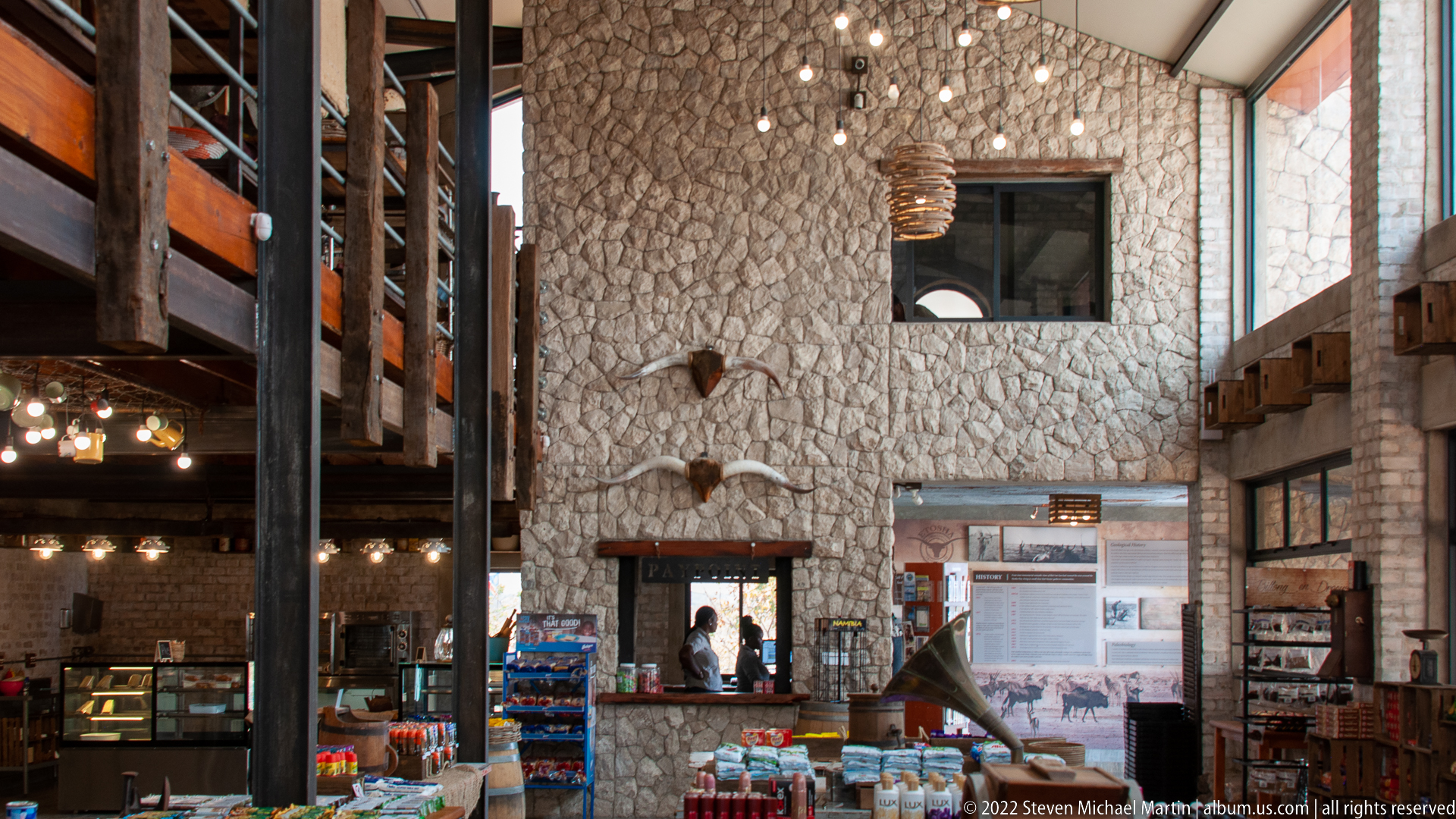
A towering stone interior wall anchors this view of the Etosha Trading Post, punctuated by a high rectangular window and a display of mounted horned skulls. Timber galleries and black structural posts rise at left, while counters and merchandise remain at floor level. The vertical composition shows how safari-themed decoration is integrated into the building’s large retail space.
Caption
A towering stone interior wall anchors this view of the Etosha Trading Post, punctuated by a high rectangular window and a display of mounted horned skulls. Timber galleries and black structural posts rise at left, while counters and merchandise remain at floor level. The vertical composition shows how safari-themed decoration is integrated into the building’s large retail space.
Tables laden with snacks, bottled drinks and travel provisions fill the Etosha Trading Post shop floor, with illuminated refrigerators lining the rear of the open hall. Timber posts, stone walls and warm hanging bulbs form a rugged interior backdrop. This lower, wider viewpoint concentrates on the merchandise and practical role of the stop for travelers moving through the Etosha region.
Caption
Tables laden with snacks, bottled drinks and travel provisions fill the Etosha Trading Post shop floor, with illuminated refrigerators lining the rear of the open hall. Timber posts, stone walls and warm hanging bulbs form a rugged interior backdrop. This lower, wider viewpoint concentrates on the merchandise and practical role of the stop for travelers moving through the Etosha region.
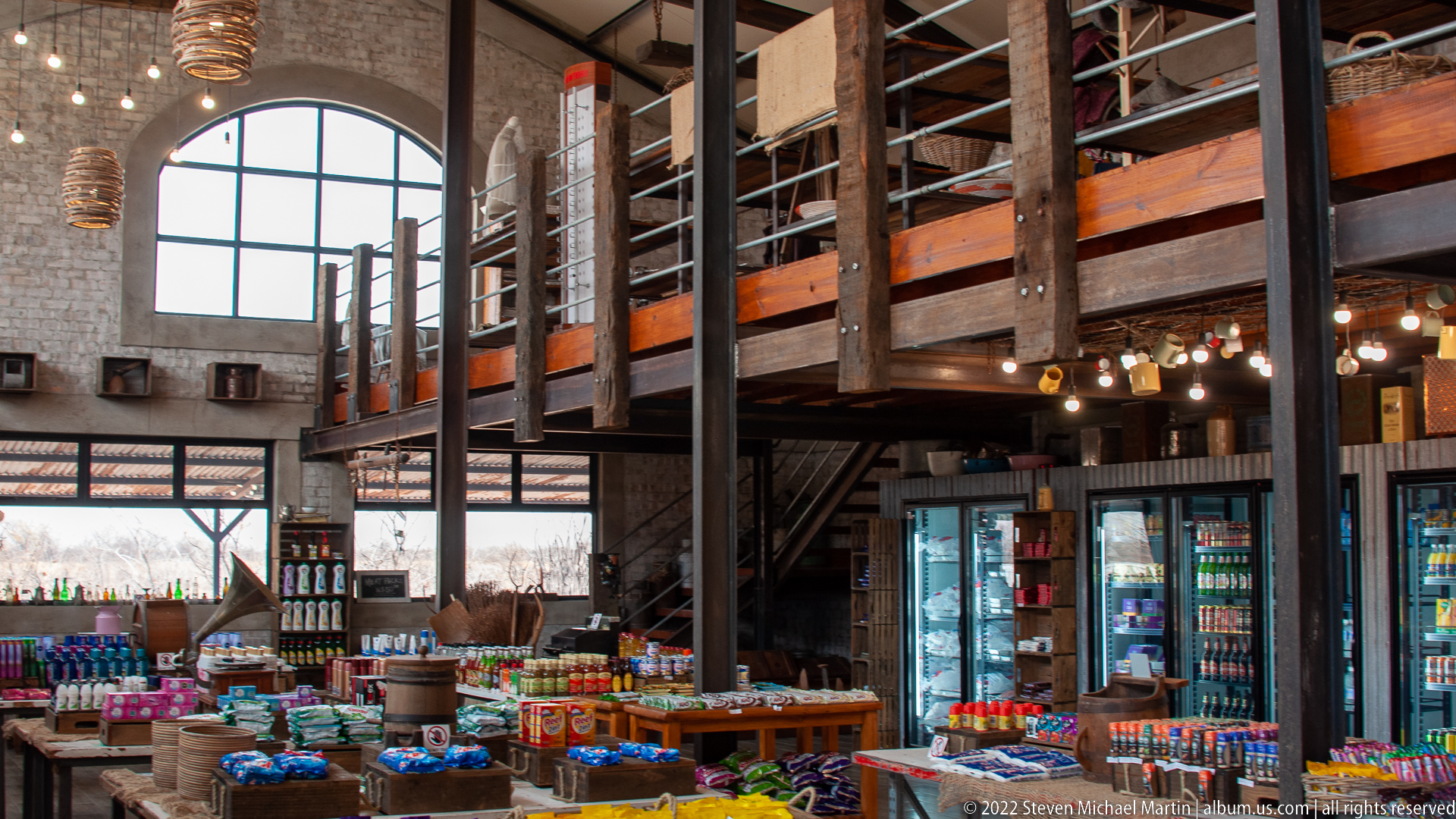
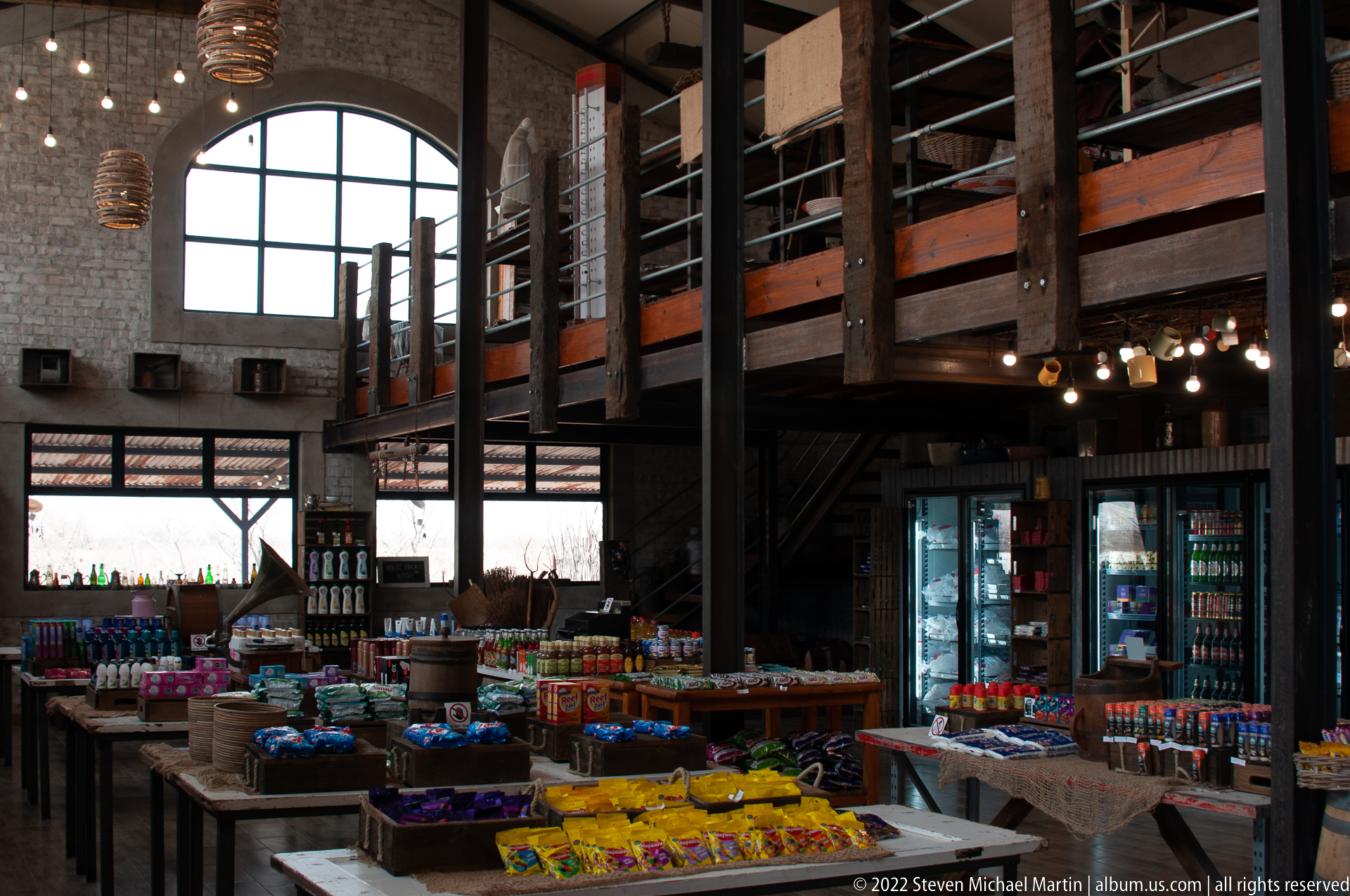
Inside the Etosha Trading Post, a tall, open retail hall combines heavy timber framing with rough stone walls and high windows. Refrigerated drink cases and tables of packaged goods occupy the ground floor beneath a mezzanine-like timber structure, while clusters of pendant bulbs soften the industrial scale. The view emphasizes the building’s spacious interior architecture as much as its provisions.
Caption
Inside the Etosha Trading Post, a tall, open retail hall combines heavy timber framing with rough stone walls and high windows. Refrigerated drink cases and tables of packaged goods occupy the ground floor beneath a mezzanine-like timber structure, while clusters of pendant bulbs soften the industrial scale. The view emphasizes the building’s spacious interior architecture as much as its provisions.
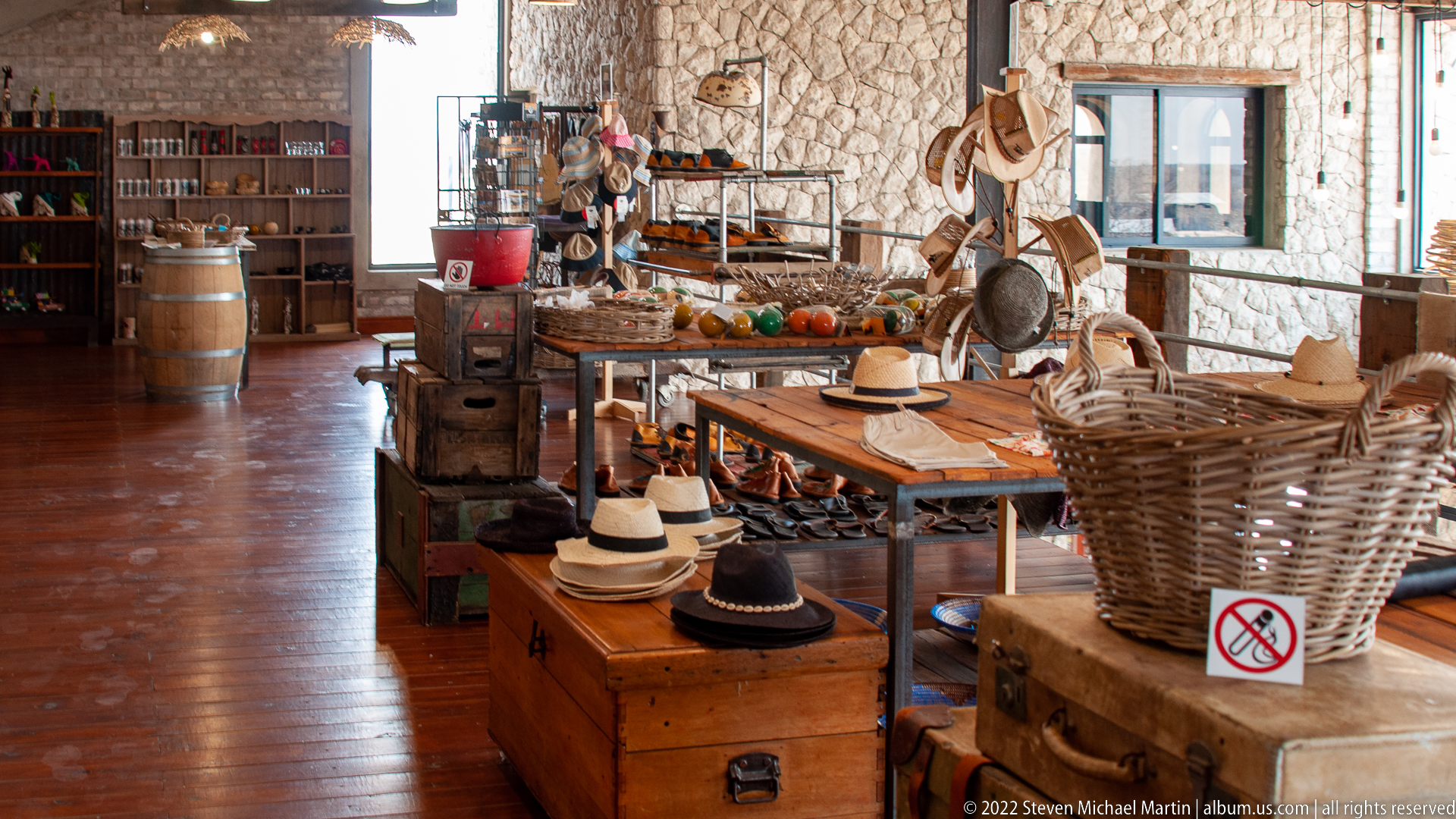
A merchandise area at the Etosha Trading Post presents brimmed hats, woven baskets and assorted leather or textile accessories on rustic wooden tables and stands. The polished wood floor and pale stone walls contrast with the dense arrangement of earth-toned goods. Rather than provisions, this section of the shop is oriented toward safari clothing, souvenirs and decorative wares.
Caption
A merchandise area at the Etosha Trading Post presents brimmed hats, woven baskets and assorted leather or textile accessories on rustic wooden tables and stands. The polished wood floor and pale stone walls contrast with the dense arrangement of earth-toned goods. Rather than provisions, this section of the shop is oriented toward safari clothing, souvenirs and decorative wares.
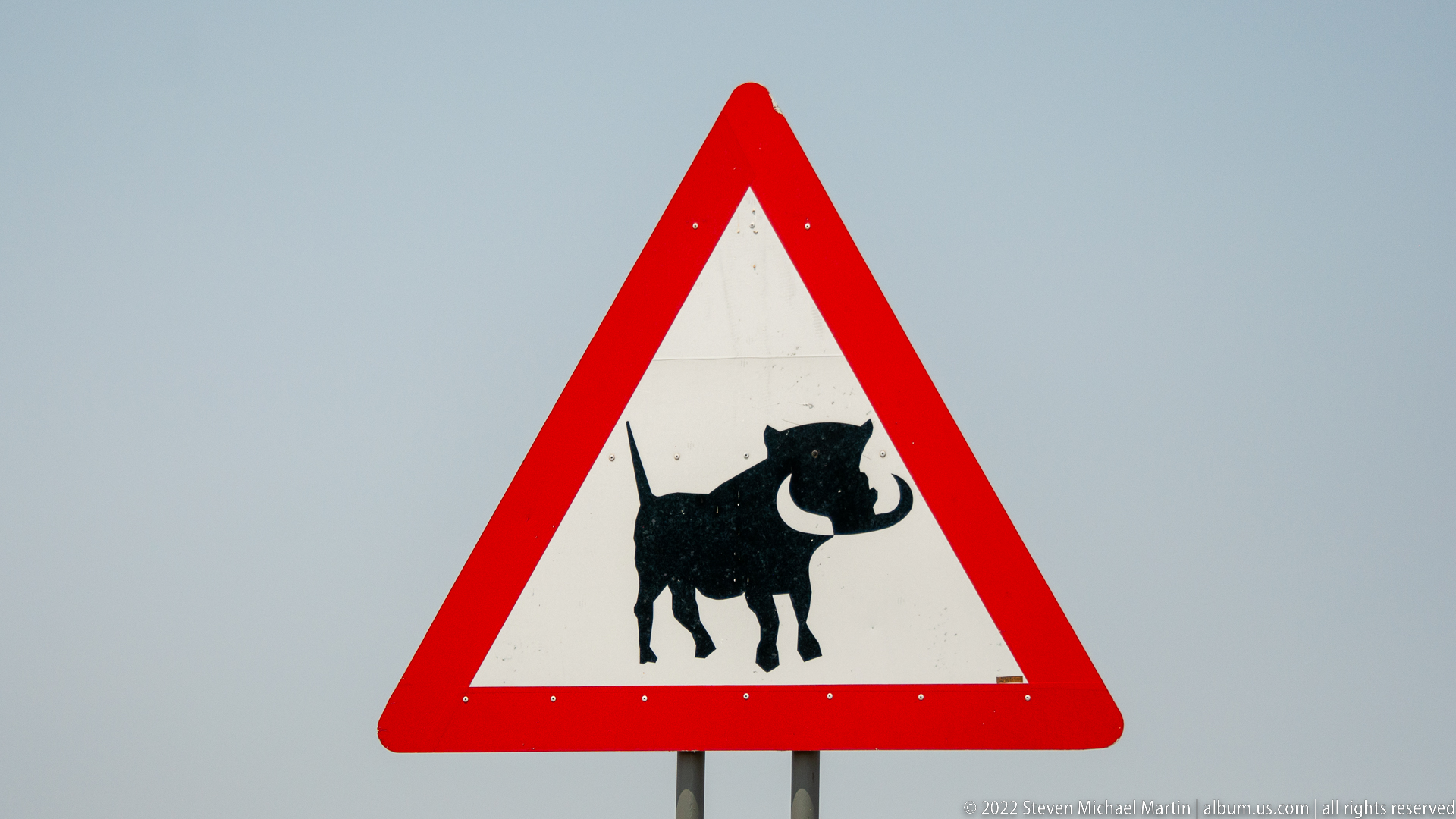
A triangular roadside warning sign uses a black warthog silhouette inside a red border, signaling the possibility of wildlife crossing the roadway. The unmistakable profile—arched back, tusks, upright tail and compact legs—turns a familiar traffic-control format into a concise reminder that large wild animals share the road network of northern Namibia.
Caption
A triangular roadside warning sign uses a black warthog silhouette inside a red border, signaling the possibility of wildlife crossing the roadway. The unmistakable profile—arched back, tusks, upright tail and compact legs—turns a familiar traffic-control format into a concise reminder that large wild animals share the road network of northern Namibia.

A closer architectural view isolates the Etosha Trading Post tower and its oversized metal emblem: a frontal African buffalo head set within concentric rings bearing the Etosha name. Rough, pale stonework and three narrow arched windows frame the graphic device, making the wildlife branding the dominant element of the façade rather than the building as a whole.
Caption
A closer architectural view isolates the Etosha Trading Post tower and its oversized metal emblem: a frontal African buffalo head set within concentric rings bearing the Etosha name. Rough, pale stonework and three narrow arched windows frame the graphic device, making the wildlife branding the dominant element of the façade rather than the building as a whole.

The main entrance of the Etosha Trading Post is arranged beneath a broad timber canopy, with the name spelled across the beam above glazed doors. Pale stone masonry, brick piers and wagon-wheel motifs create a rustic commercial frontage. Seen straight on, the composition records the visitor-facing entrance rather than the tower and emblem featured in neighboring views.
Caption
The main entrance of the Etosha Trading Post is arranged beneath a broad timber canopy, with the name spelled across the beam above glazed doors. Pale stone masonry, brick piers and wagon-wheel motifs create a rustic commercial frontage. Seen straight on, the composition records the visitor-facing entrance rather than the tower and emblem featured in neighboring views.
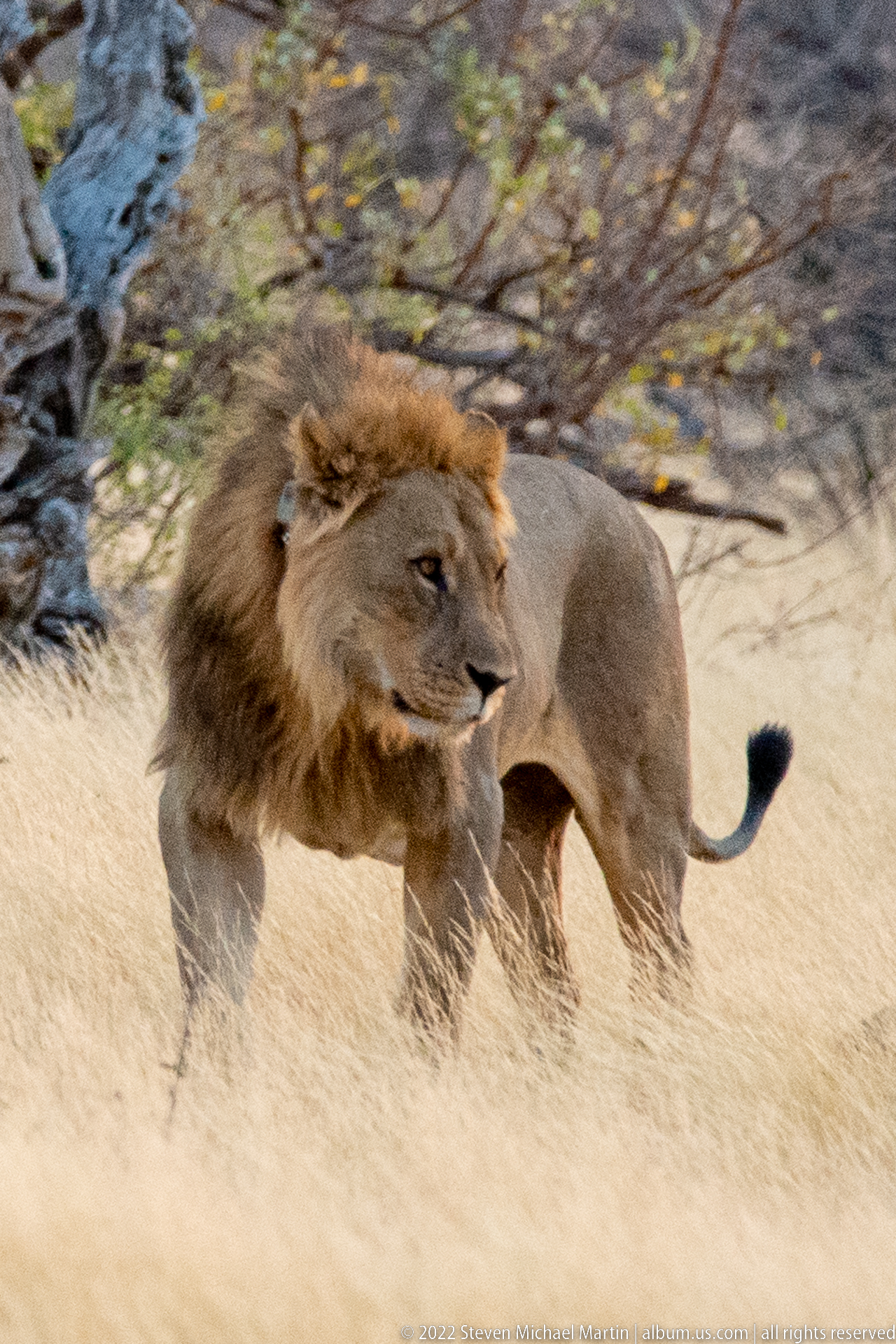
A mature male African lion strides briskly across dry grass in side profile, his mane swept back around the neck and shoulders. The extended foreleg, taut body and lifted tail convey purposeful movement, while slight motion softness separates this frame from the stationary portraits preceding it. Thorn branches behind the animal mark the edge of scrubby cover.
Caption
A mature male African lion strides briskly across dry grass in side profile, his mane swept back around the neck and shoulders. The extended foreleg, taut body and lifted tail convey purposeful movement, while slight motion softness separates this frame from the stationary portraits preceding it. Thorn branches behind the animal mark the edge of scrubby cover.
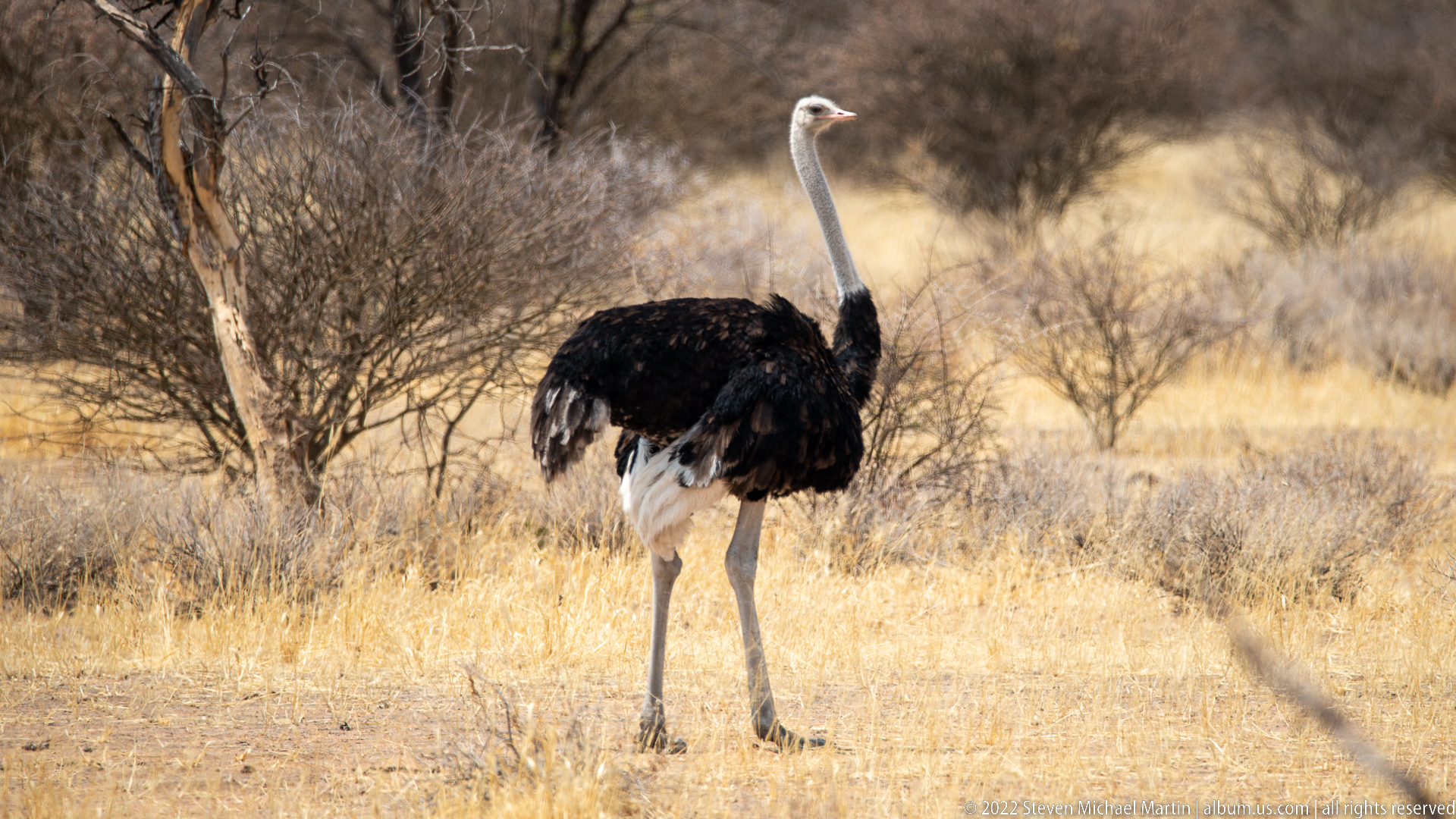
An adult common ostrich stands upright among tawny grass and thorny scrub, its long pale neck raised above a bulky body of predominantly black plumage with white wing and tail feathers. The bird’s long bare legs and alert posture are characteristic of the species. Dry vegetation provides a clear view of the open, semi-arid habitat used by ostriches in northern Namibia.
Caption
An adult common ostrich stands upright among tawny grass and thorny scrub, its long pale neck raised above a bulky body of predominantly black plumage with white wing and tail feathers. The bird’s long bare legs and alert posture are characteristic of the species. Dry vegetation provides a clear view of the open, semi-arid habitat used by ostriches in northern Namibia.
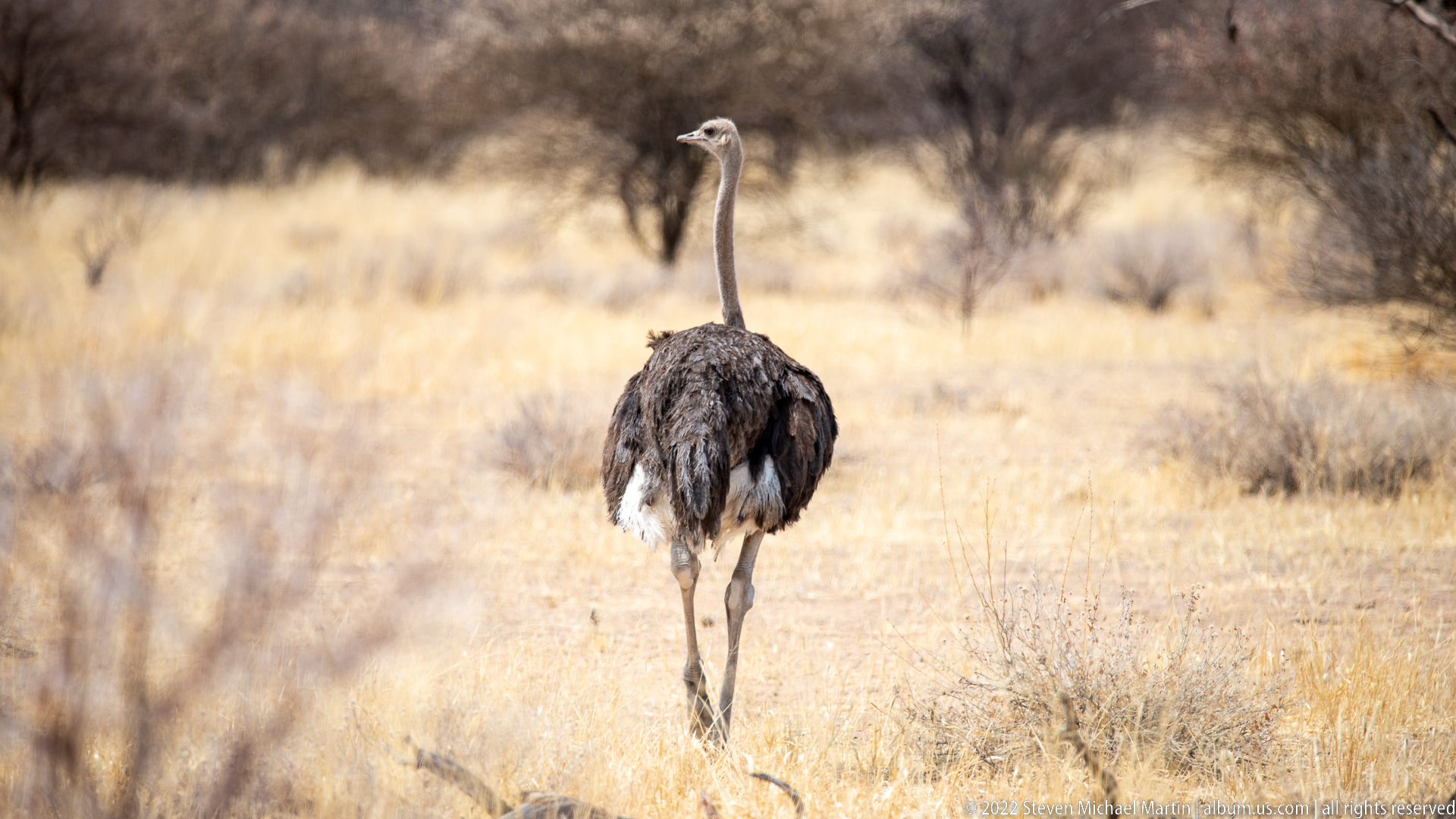
A common ostrich walks away through pale, dry grass, presenting the long neck, powerful legs and shaggy rear plumage from behind. White feathers show at the wings and tail against the darker body. The rear-facing viewpoint shifts attention from facial features to the bird’s stride and adaptation for terrestrial movement across open savanna.
Caption
A common ostrich walks away through pale, dry grass, presenting the long neck, powerful legs and shaggy rear plumage from behind. White feathers show at the wings and tail against the darker body. The rear-facing viewpoint shifts attention from facial features to the bird’s stride and adaptation for terrestrial movement across open savanna.
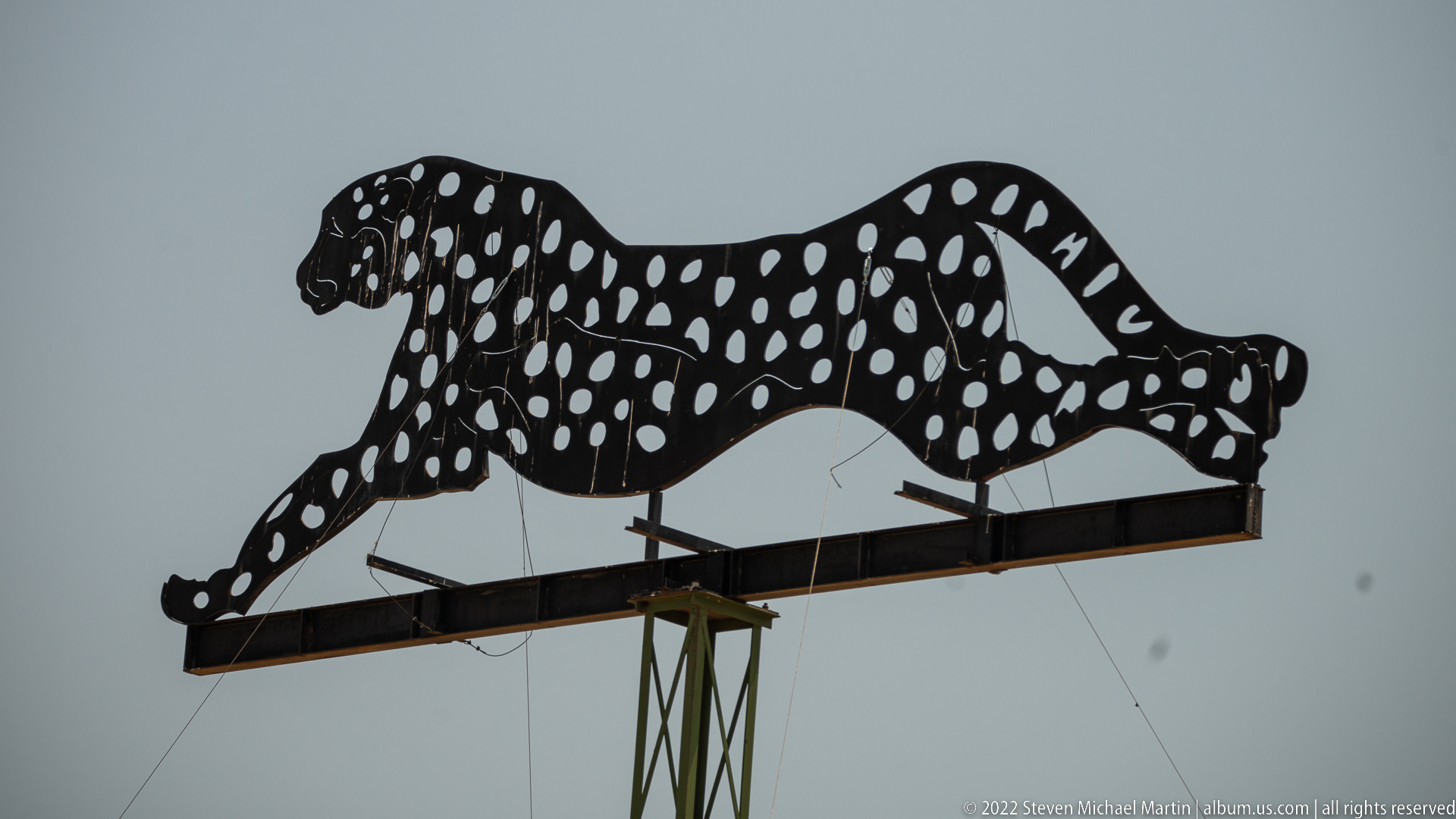
A large cut-metal silhouette of a running cheetah is mounted above the roadside, its black body punctured or painted with bold white spots and stripes. The elongated torso, small head and extended limbs evoke the cat’s sprinting form. Presented as graphic signage rather than wildlife in habitat, the sculpture signals the safari identity of the route through Namibia.
Caption
A large cut-metal silhouette of a running cheetah is mounted above the roadside, its black body punctured or painted with bold white spots and stripes. The elongated torso, small head and extended limbs evoke the cat’s sprinting form. Presented as graphic signage rather than wildlife in habitat, the sculpture signals the safari identity of the route through Namibia.
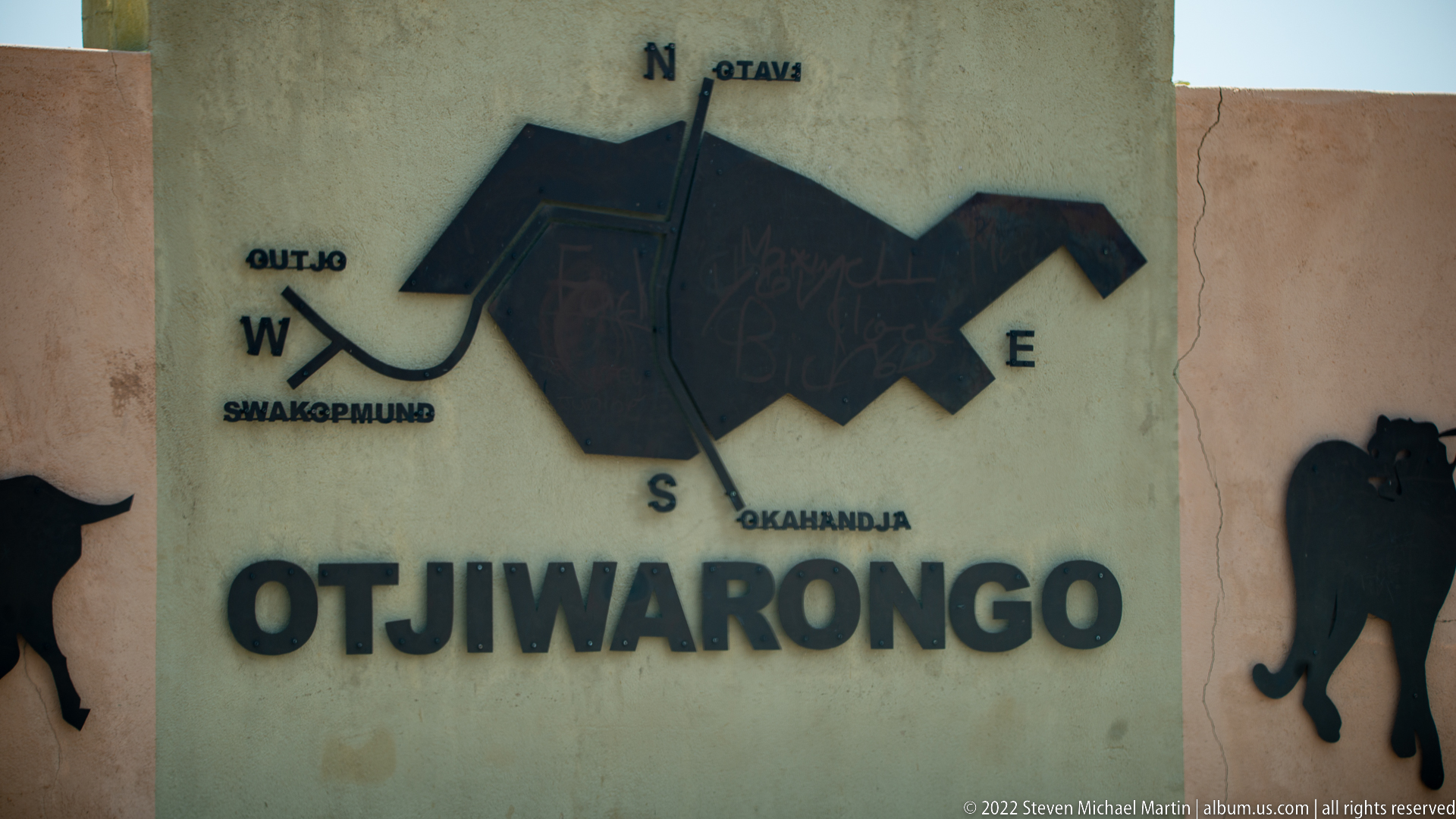
A wall-mounted directional graphic centers the name OTJIWARONGO beneath a stylized compass-like map. Labels point toward Otavi to the north, Okahandja to the south and Outjo and Swakopmund to the west, situating the town within Namibia’s road network. Animal silhouettes at the margins reinforce the wildlife-oriented visual language encountered along the route toward Etosha.
Caption
A wall-mounted directional graphic centers the name OTJIWARONGO beneath a stylized compass-like map. Labels point toward Otavi to the north, Okahandja to the south and Outjo and Swakopmund to the west, situating the town within Namibia’s road network. Animal silhouettes at the margins reinforce the wildlife-oriented visual language encountered along the route toward Etosha.
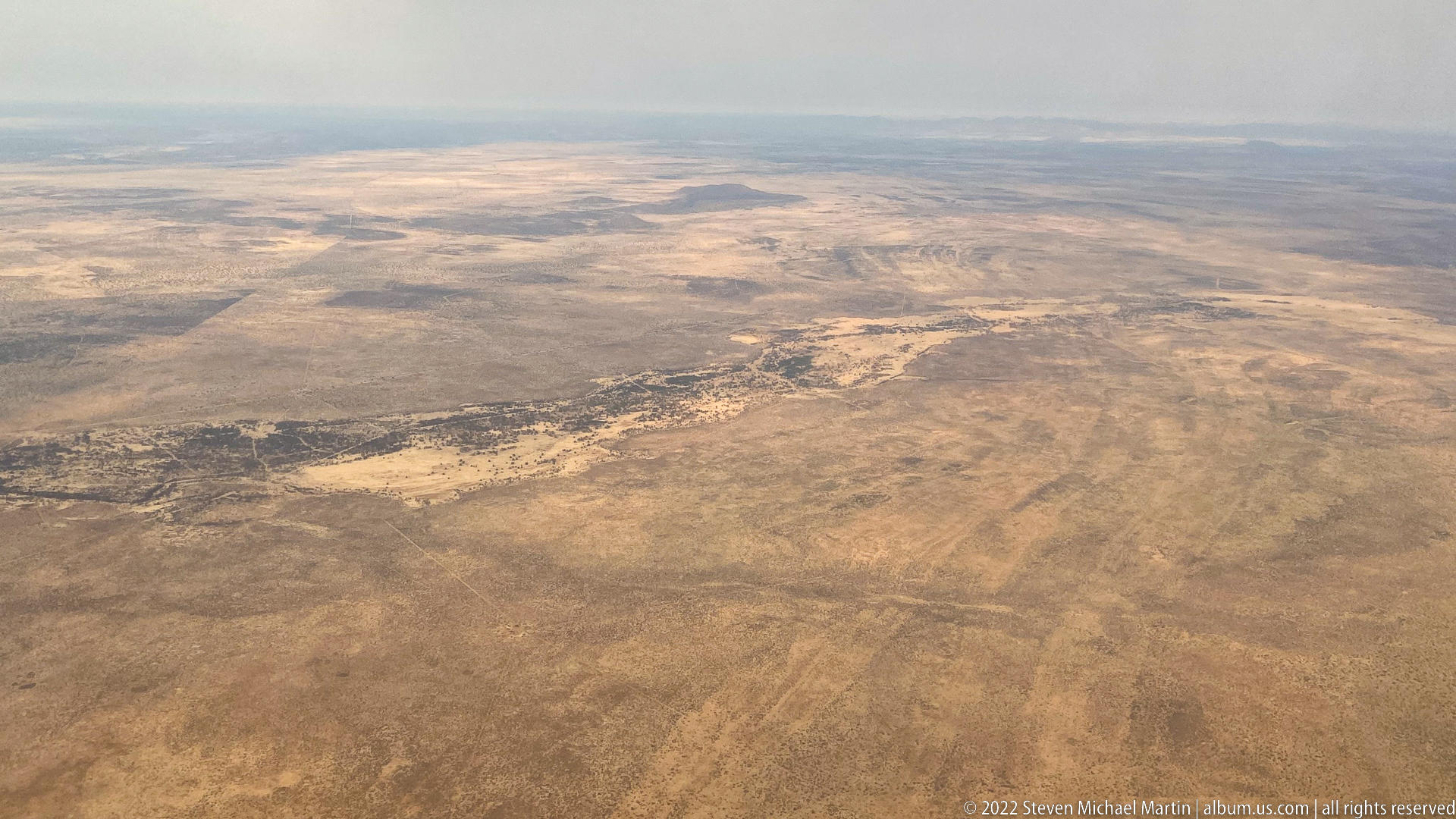
From the air, an immense semi-arid plain spreads toward a hazy horizon in muted tan and brown bands. Pale patches and faint drainage or track lines interrupt the otherwise low, sparse vegetation. The elevated viewpoint records the scale and dryness of northern Namibia’s interior landscape without enough distinctive visual evidence to assign a more specific named landform.
Caption
From the air, an immense semi-arid plain spreads toward a hazy horizon in muted tan and brown bands. Pale patches and faint drainage or track lines interrupt the otherwise low, sparse vegetation. The elevated viewpoint records the scale and dryness of northern Namibia’s interior landscape without enough distinctive visual evidence to assign a more specific named landform.
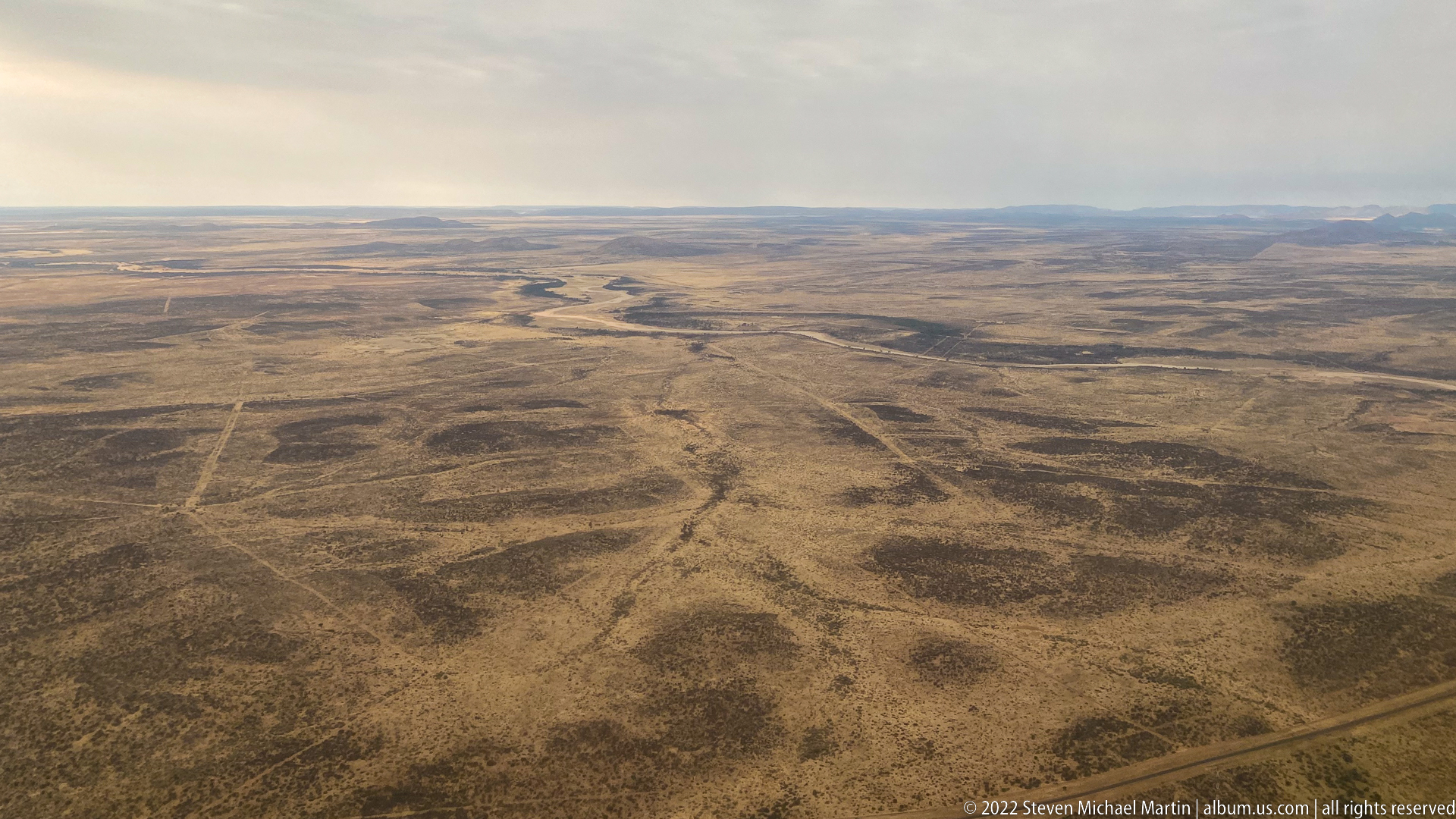
Interlacing pale lines cross a broad brown plain in this aerial view, some following shallow drainage patterns while others appear straighter and may be tracks or roads. Sparse vegetation forms darker patches across the terrain. The oblique perspective reveals how subtle linear features organize an otherwise expansive dry landscape on the approach to the Etosha region.
Caption
Interlacing pale lines cross a broad brown plain in this aerial view, some following shallow drainage patterns while others appear straighter and may be tracks or roads. Sparse vegetation forms darker patches across the terrain. The oblique perspective reveals how subtle linear features organize an otherwise expansive dry landscape on the approach to the Etosha region.
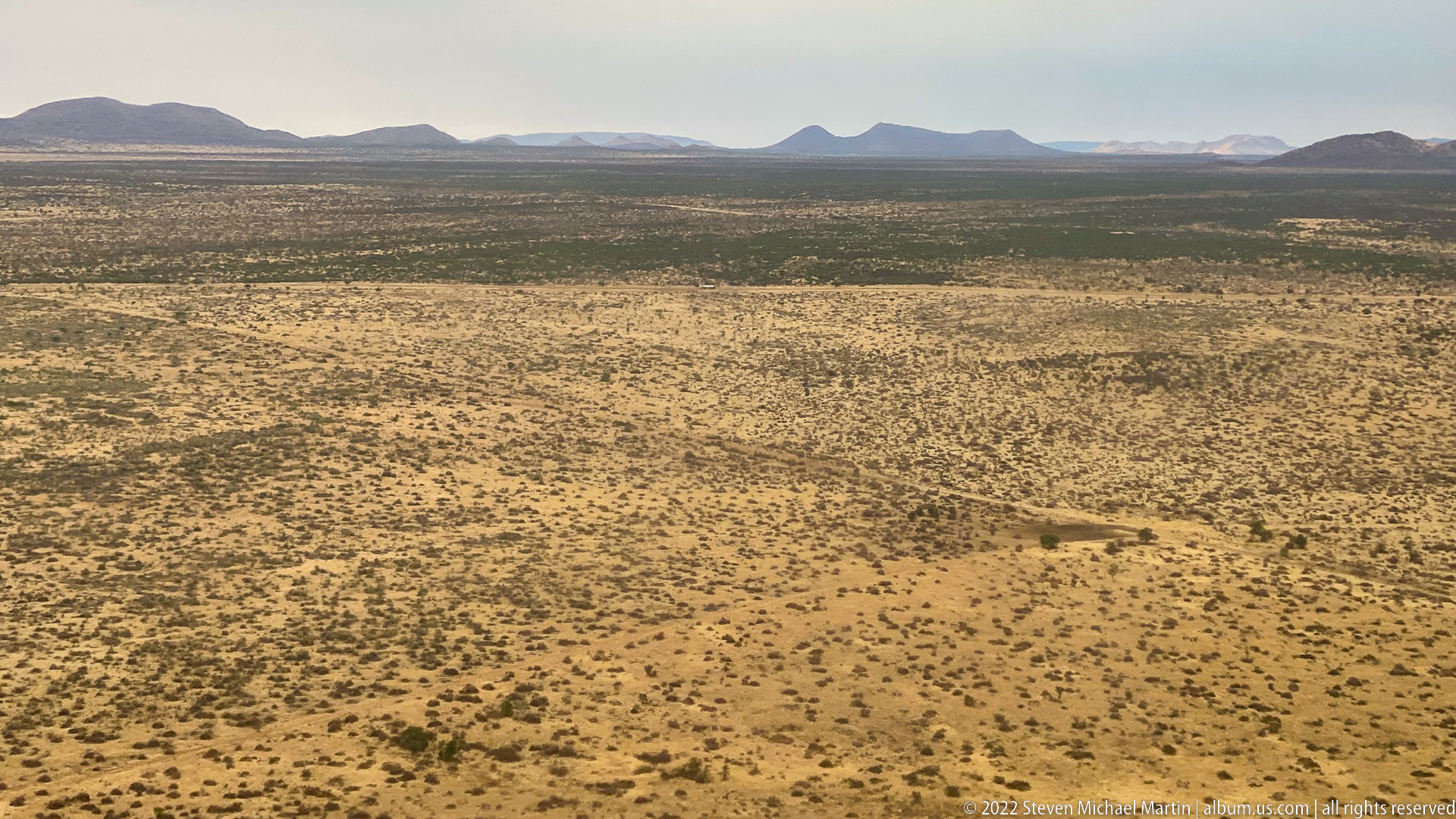
Low shrubs stipple a pale sandy plain while isolated dark hills and ridges rise along the distant horizon. Seen from above, the landscape shifts from nearly open ground in the foreground to denser vegetation toward the uplands. The image records the transition between Namibia’s broad dry plains and scattered rocky relief without assigning the hills a specific name.
Caption
Low shrubs stipple a pale sandy plain while isolated dark hills and ridges rise along the distant horizon. Seen from above, the landscape shifts from nearly open ground in the foreground to denser vegetation toward the uplands. The image records the transition between Namibia’s broad dry plains and scattered rocky relief without assigning the hills a specific name.
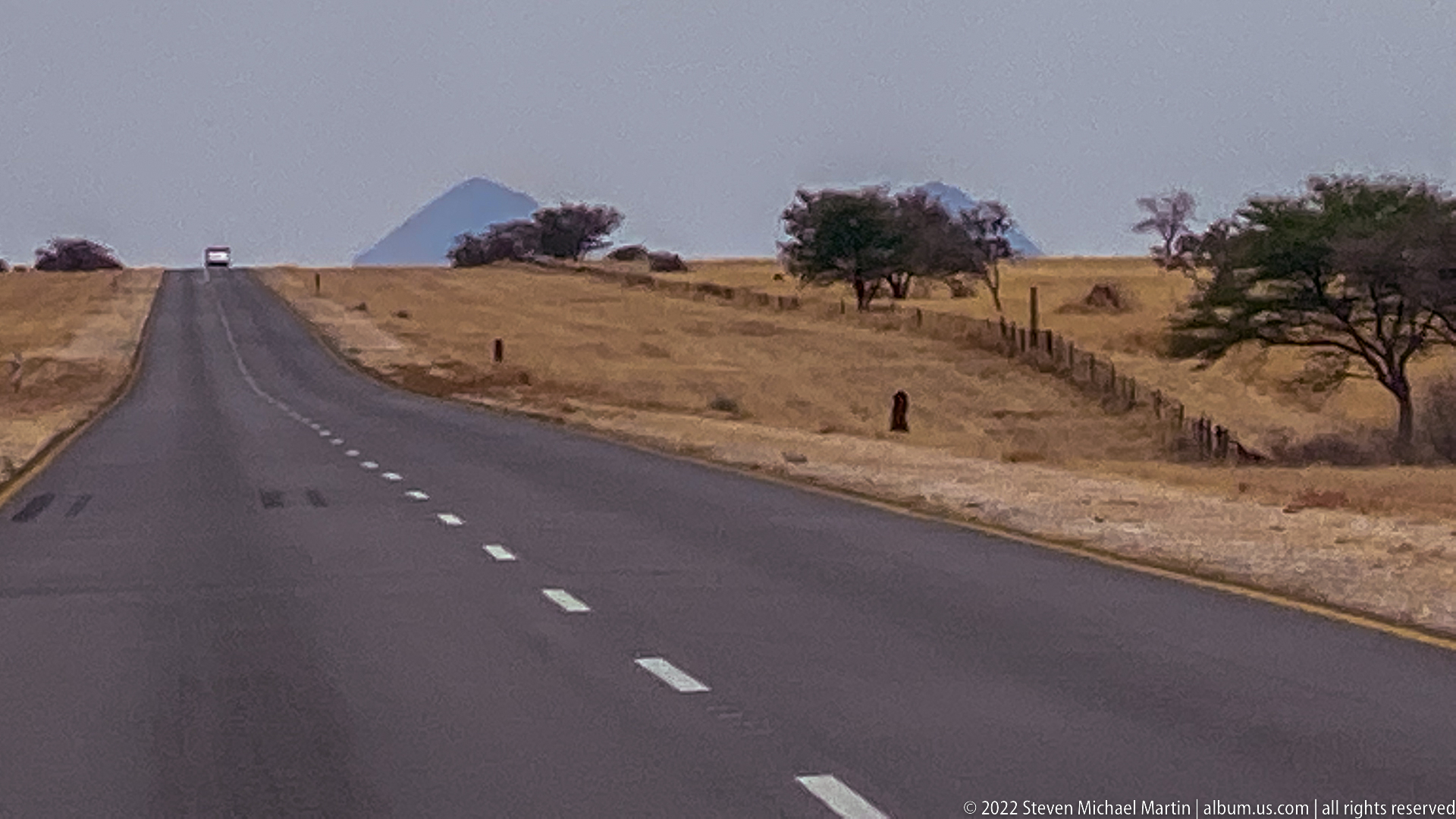
A straight paved highway runs toward the horizon through dry golden grassland, its dashed center markings emphasizing distance across the open country. Fence lines and scattered thorn trees flank the road, while an isolated pointed hill rises ahead. The composition presents the long overland approach through northern Namibia rather than a specific wildlife encounter.
Caption
A straight paved highway runs toward the horizon through dry golden grassland, its dashed center markings emphasizing distance across the open country. Fence lines and scattered thorn trees flank the road, while an isolated pointed hill rises ahead. The composition presents the long overland approach through northern Namibia rather than a specific wildlife encounter.
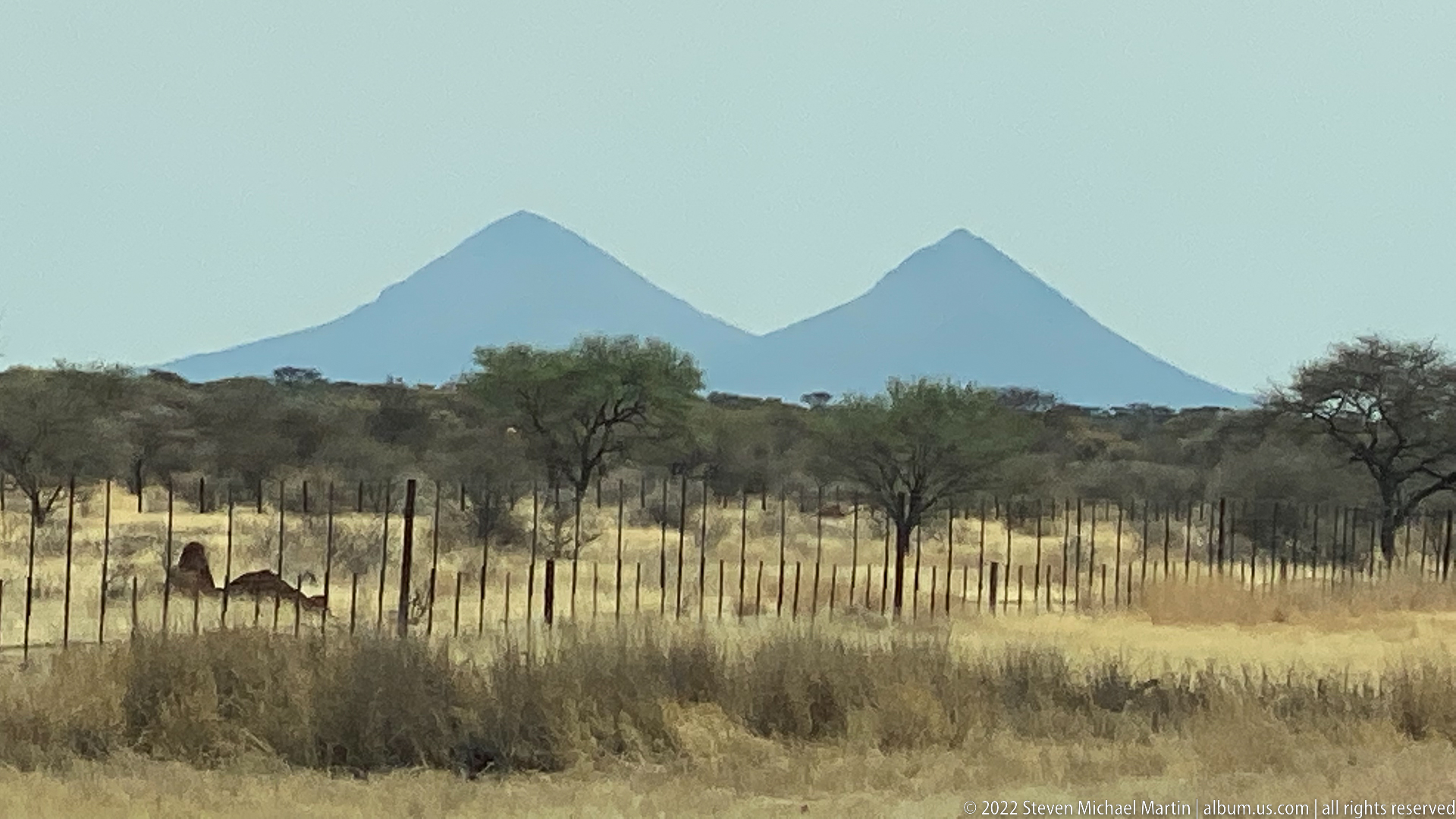
Two prominent conical hills rise beyond a band of thorn woodland and dry grassland, forming a strong paired silhouette against the pale sky. A fence runs across the foreground, placing the viewer along a traveled corridor rather than within untouched bush. The distinctive shapes are clearly visible, but the proof sheet alone does not justify assigning them a specific geographic name.
Caption
Two prominent conical hills rise beyond a band of thorn woodland and dry grassland, forming a strong paired silhouette against the pale sky. A fence runs across the foreground, placing the viewer along a traveled corridor rather than within untouched bush. The distinctive shapes are clearly visible, but the proof sheet alone does not justify assigning them a specific geographic name.
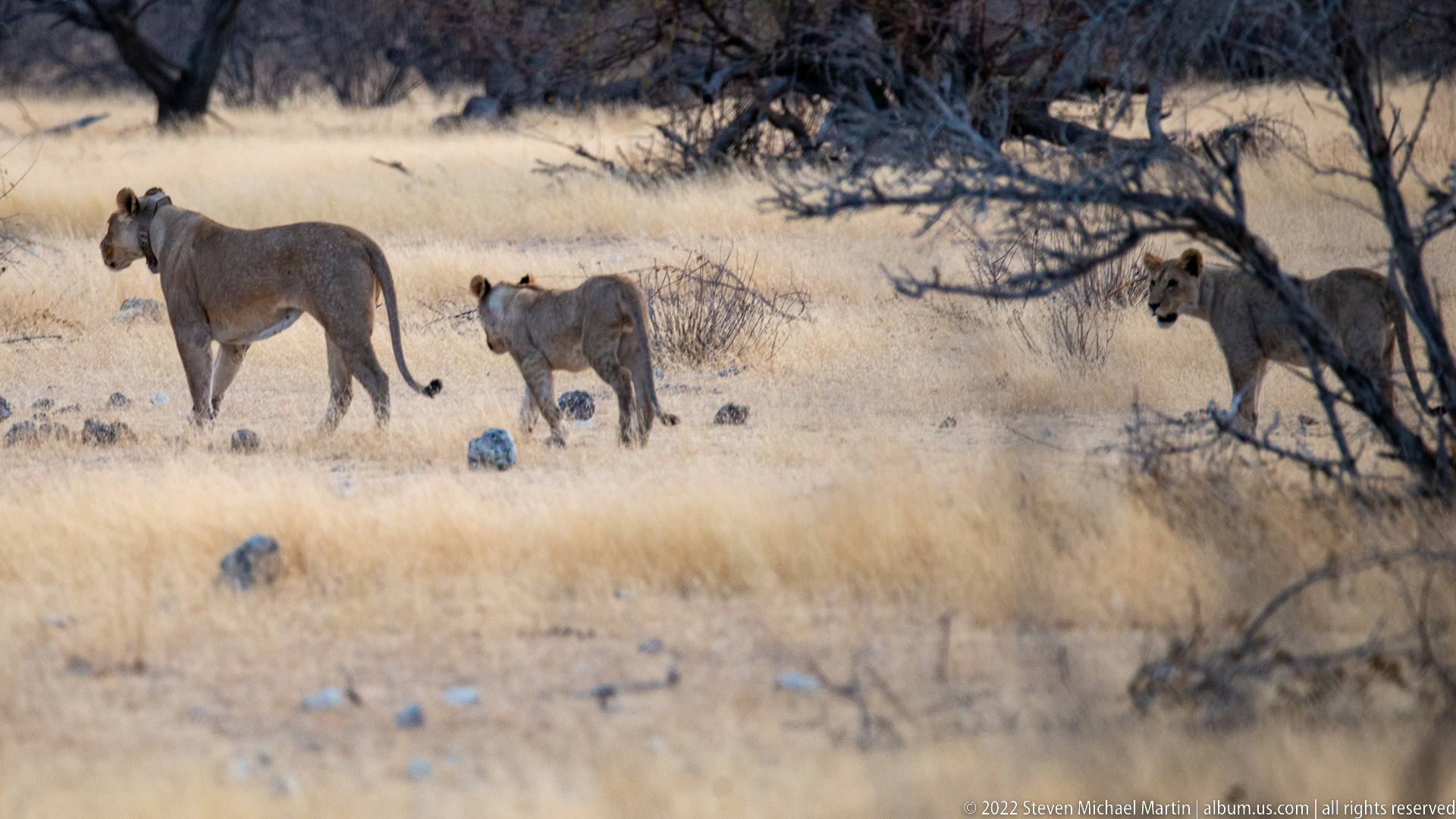
A small group of African lions stands in pale dry grass at the edge of thorn scrub. Two larger tawny females flank a smaller, younger animal, all alert and oriented across the open ground. Their rounded ears, muscular feline bodies and unspotted tawny coats identify lions, while the group setting introduces the social structure of a pride in Etosha’s dry-season habitat.
Caption
A small group of African lions stands in pale dry grass at the edge of thorn scrub. Two larger tawny females flank a smaller, younger animal, all alert and oriented across the open ground. Their rounded ears, muscular feline bodies and unspotted tawny coats identify lions, while the group setting introduces the social structure of a pride in Etosha’s dry-season habitat.

A lioness pauses beneath sparse thorn branches while a younger lion stands several meters to her right in open yellow grass. The adult’s tail hangs relaxed, but both animals remain upright and attentive to their surroundings. The spacing between them and the broad dry clearing distinguish this quieter pride interaction from the denser group scenes that follow.
Caption
A lioness pauses beneath sparse thorn branches while a younger lion stands several meters to her right in open yellow grass. The adult’s tail hangs relaxed, but both animals remain upright and attentive to their surroundings. The spacing between them and the broad dry clearing distinguish this quieter pride interaction from the denser group scenes that follow.

An adult male African lion, recognizable by his developed brown mane, stands among several lionesses in dry grass beside dense thorn scrub. The male faces left while females occupy the foreground and right side, creating a layered pride scene. The image is especially useful for comparing the pronounced sexual dimorphism between the maned male and the sleeker adult females.
Caption
An adult male African lion, recognizable by his developed brown mane, stands among several lionesses in dry grass beside dense thorn scrub. The male faces left while females occupy the foreground and right side, creating a layered pride scene. The image is especially useful for comparing the pronounced sexual dimorphism between the maned male and the sleeker adult females.
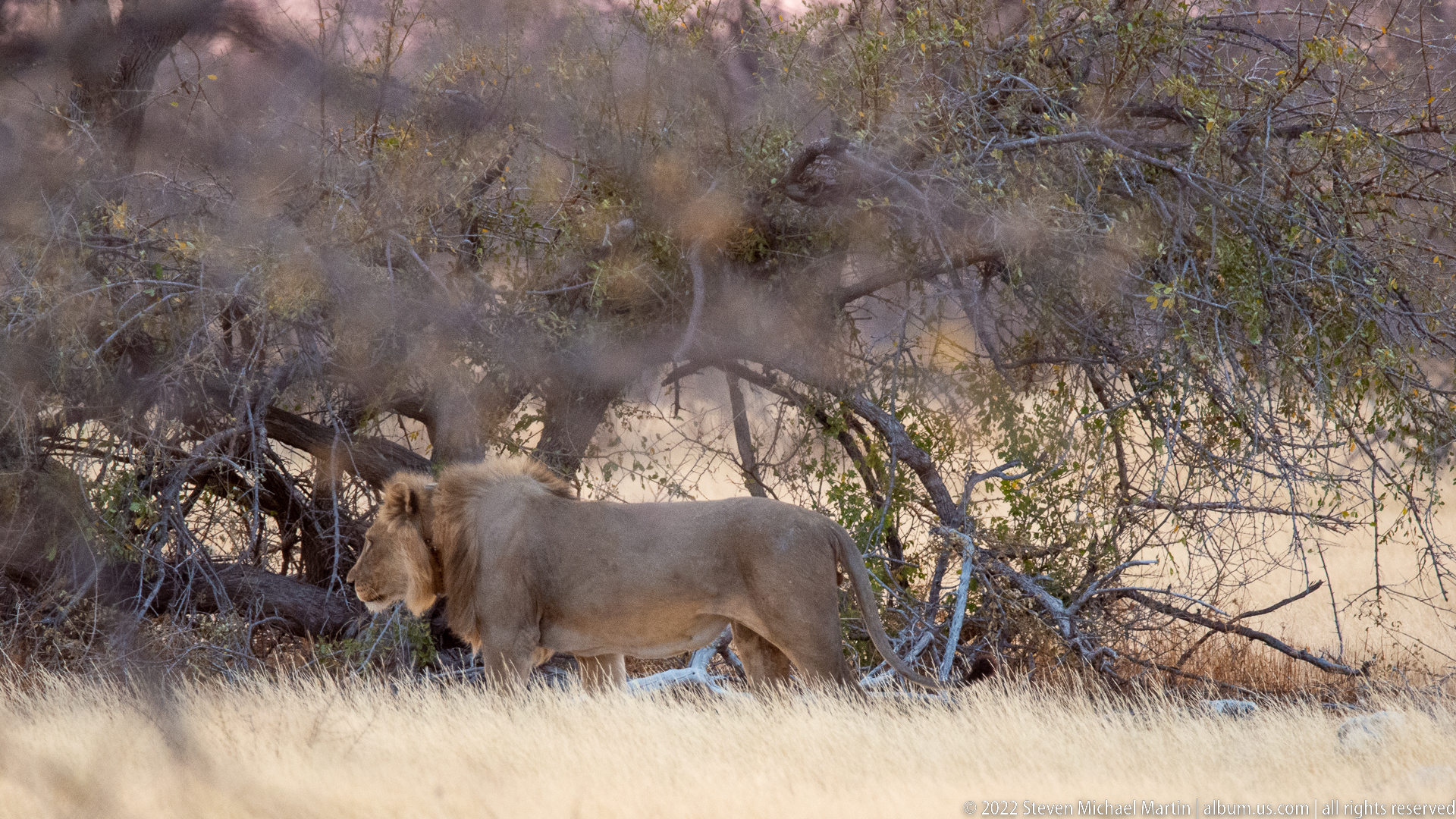
A maned male African lion walks slowly along the shadowed edge of thorn scrub, partly screened by branches and fallen wood. His tawny body remains in open view while the darker mane blends with the vegetation behind him. The side profile emphasizes the lion’s heavy shoulders, long body and deliberate gait as he moves through dry-season cover.
Caption
A maned male African lion walks slowly along the shadowed edge of thorn scrub, partly screened by branches and fallen wood. His tawny body remains in open view while the darker mane blends with the vegetation behind him. The side profile emphasizes the lion’s heavy shoulders, long body and deliberate gait as he moves through dry-season cover.
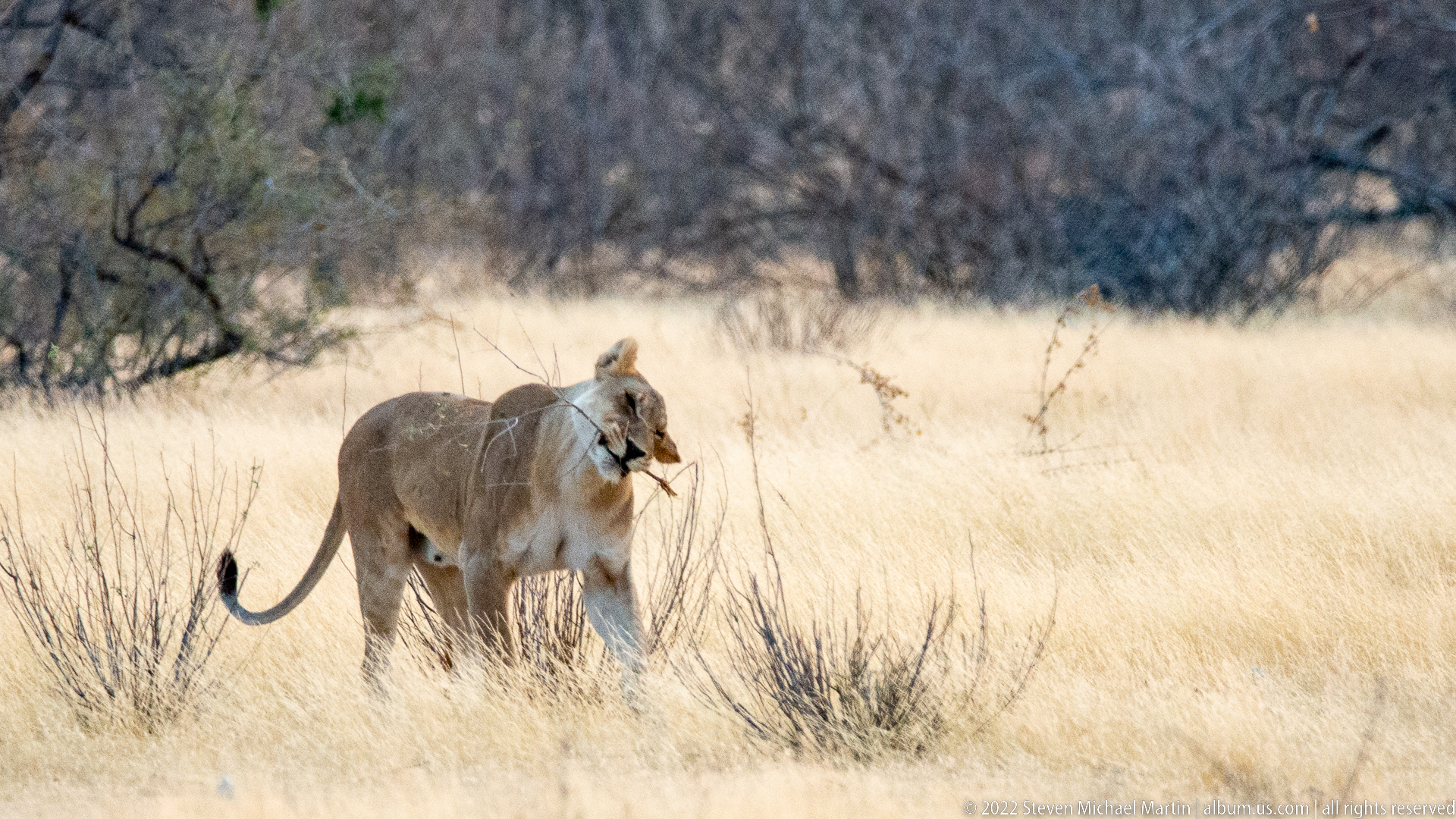
A lioness crosses tall pale grass with a small piece of flesh or prey remains held in her mouth. Her head is slightly lowered and her tail curves behind as she moves away from the darker thorn scrub. The carried material indicates feeding behavior, although the proof sheet does not provide enough detail to identify the prey species.
Caption
A lioness crosses tall pale grass with a small piece of flesh or prey remains held in her mouth. Her head is slightly lowered and her tail curves behind as she moves away from the darker thorn scrub. The carried material indicates feeding behavior, although the proof sheet does not provide enough detail to identify the prey species.

A lioness advances toward the camera through waist-high golden grass, her ears forward and mouth slightly open. Sparse upright shrubs break the open foreground, while a dark band of thorn woodland closes the background. The frontal movement and direct gaze give this frame a stronger sense of approach than the more static pride views nearby.
Caption
A lioness advances toward the camera through waist-high golden grass, her ears forward and mouth slightly open. Sparse upright shrubs break the open foreground, while a dark band of thorn woodland closes the background. The frontal movement and direct gaze give this frame a stronger sense of approach than the more static pride views nearby.
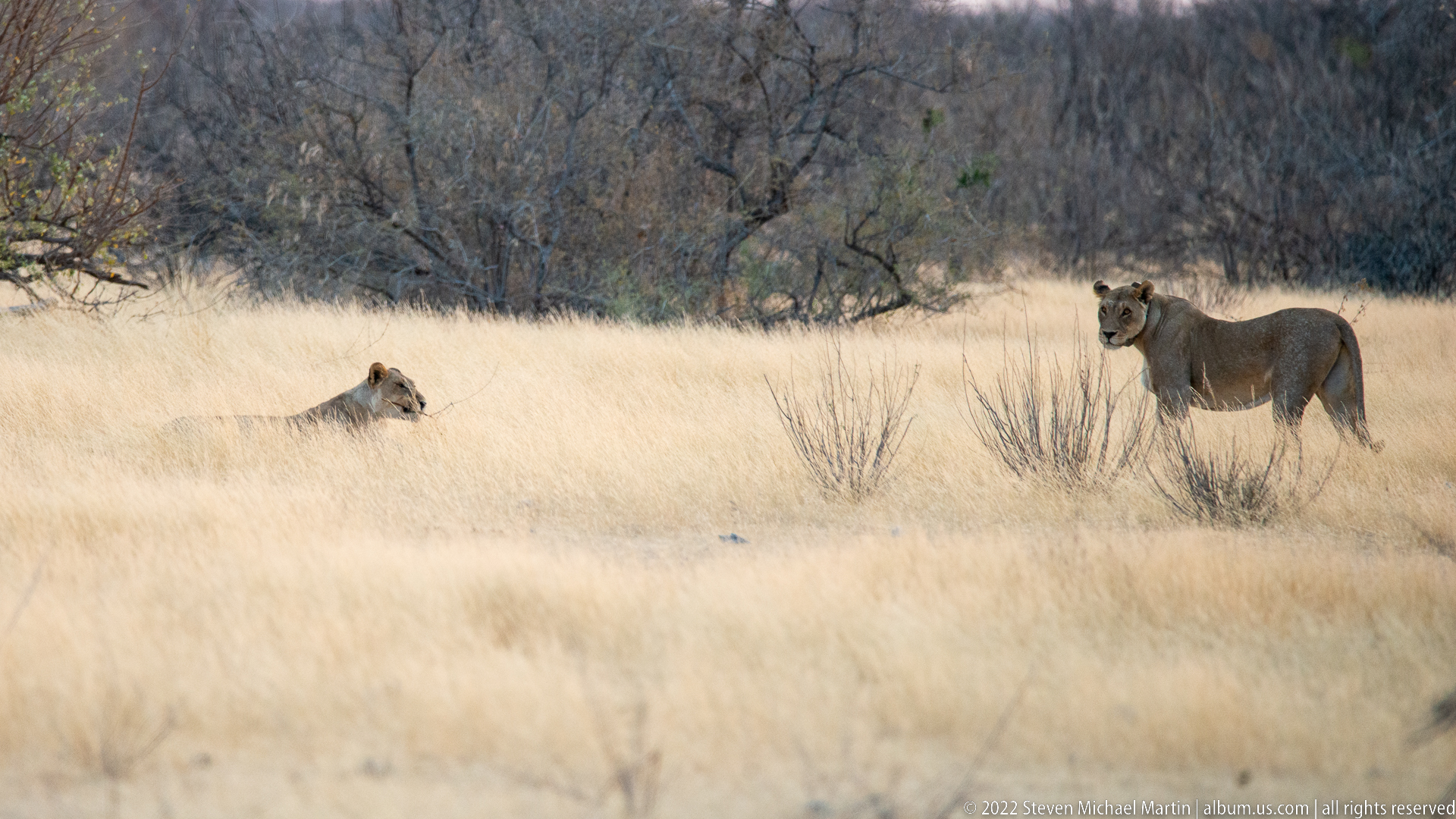
Two lionesses occupy opposite sides of a broad field of tall dry grass, one crouched or lying low at left and the other standing alert at right. Their separation across the frame emphasizes how easily tawny lions disappear into Etosha’s straw-colored vegetation. Sparse shrubs and a dark woodland edge provide depth to the dry-season scene.
Caption
Two lionesses occupy opposite sides of a broad field of tall dry grass, one crouched or lying low at left and the other standing alert at right. Their separation across the frame emphasizes how easily tawny lions disappear into Etosha’s straw-colored vegetation. Sparse shrubs and a dark woodland edge provide depth to the dry-season scene.

A maned male African lion stands near two lionesses in tall golden grass, with one female largely concealed at left and another close behind him. The pride members’ tawny coats merge with the dry vegetation, while the male’s darker mane remains conspicuous. The layered arrangement shows both social proximity and the camouflage afforded by Etosha’s dry-season grassland.
Caption
A maned male African lion stands near two lionesses in tall golden grass, with one female largely concealed at left and another close behind him. The pride members’ tawny coats merge with the dry vegetation, while the male’s darker mane remains conspicuous. The layered arrangement shows both social proximity and the camouflage afforded by Etosha’s dry-season grassland.
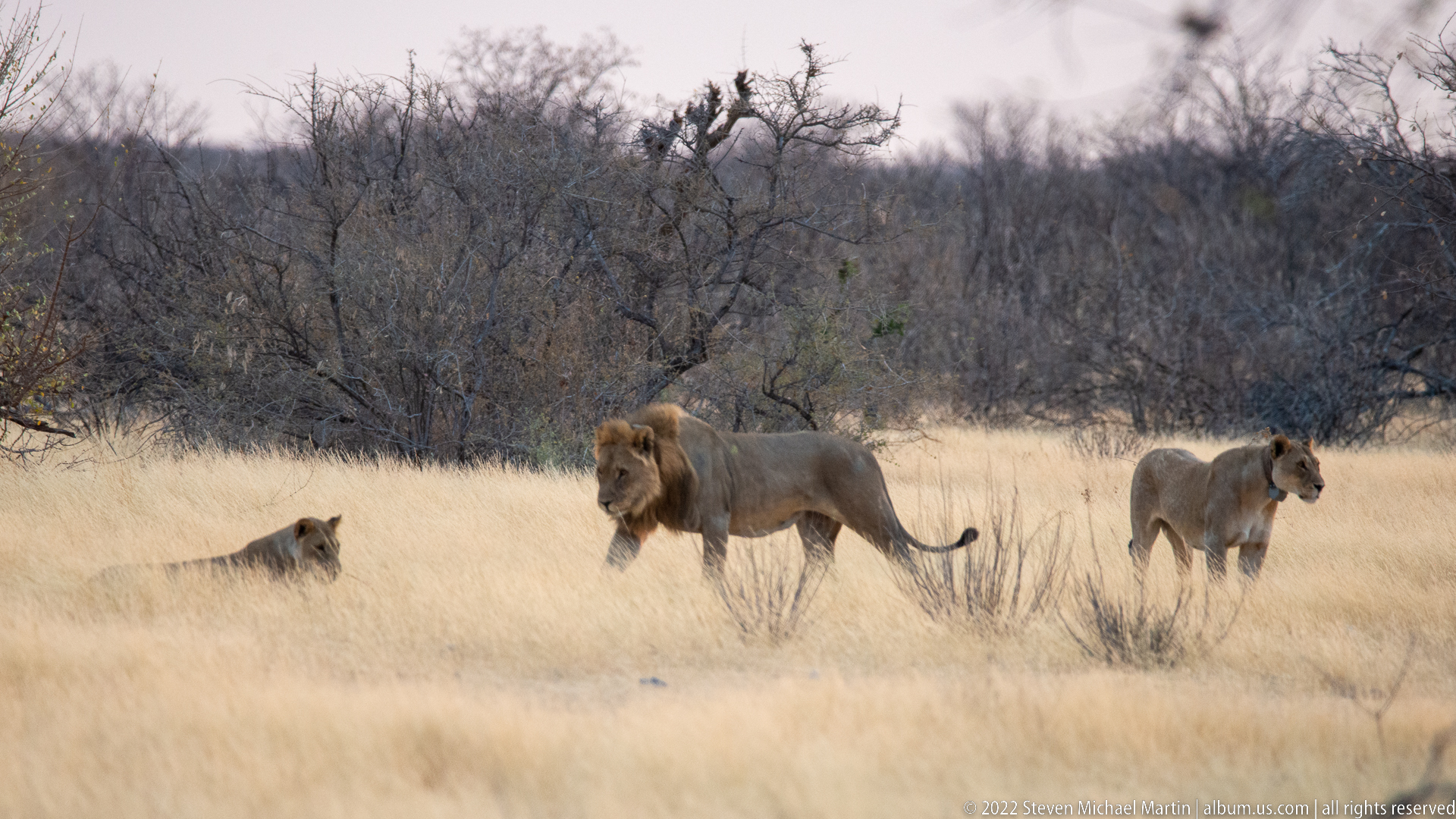
An adult male lion stands broadside in the center of a small pride grouping, with a lioness lying low in the grass to his left and another standing to the right. His dark mane and heavier build contrast with the females’ smooth tawny profiles. The open spacing provides a clear comparative view of adult male and female African lions in the same habitat.
Caption
An adult male lion stands broadside in the center of a small pride grouping, with a lioness lying low in the grass to his left and another standing to the right. His dark mane and heavier build contrast with the females’ smooth tawny profiles. The open spacing provides a clear comparative view of adult male and female African lions in the same habitat.

A full-maned male African lion stands facing the camera in tall dry grass while other pride members rest low behind and beside him. His mane frames the face and chest, and the forward stance makes the male the dominant visual subject. A weathered tree trunk and dense scrub behind the group place the encounter along the edge of woody cover.
Caption
A full-maned male African lion stands facing the camera in tall dry grass while other pride members rest low behind and beside him. His mane frames the face and chest, and the forward stance makes the male the dominant visual subject. A weathered tree trunk and dense scrub behind the group place the encounter along the edge of woody cover.
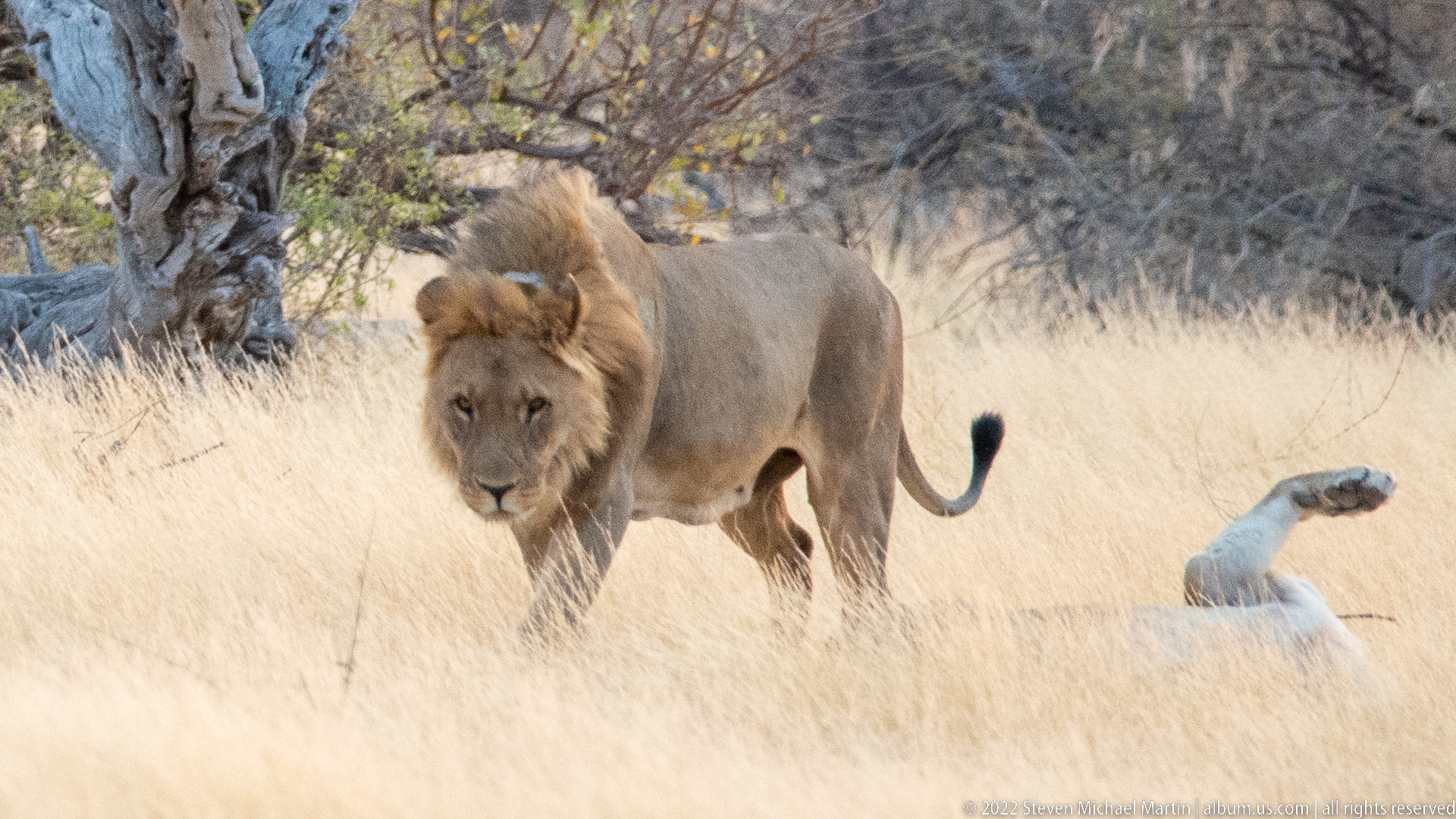
A mature male lion walks forward through tall straw-colored grass, his full mane lifted around the head and shoulders. At the lower right, a lioness lies partly cropped and out of focus, emphasizing the male’s movement through the pride’s resting area. The direct approach offers a close view of his face, muscular forequarters and dark tail tuft.
Caption
A mature male lion walks forward through tall straw-colored grass, his full mane lifted around the head and shoulders. At the lower right, a lioness lies partly cropped and out of focus, emphasizing the male’s movement through the pride’s resting area. The direct approach offers a close view of his face, muscular forequarters and dark tail tuft.
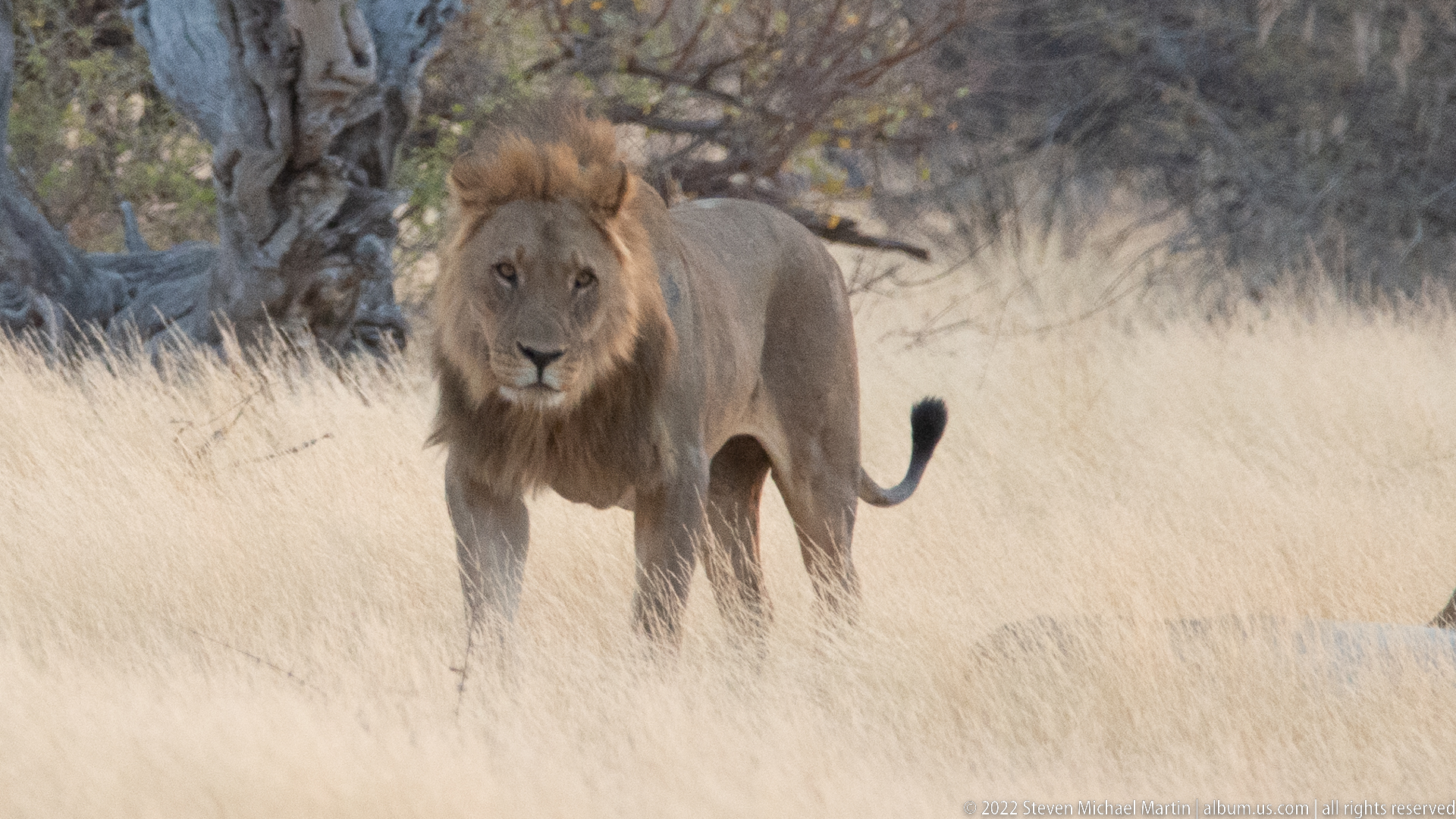
A mature African lion stands nearly head-on in pale grass, fixing his gaze toward the camera. His dense mane forms a dark frame around the face and chest, while the body is partly softened by the tall vegetation. With other pride members excluded from the frame, this image functions as a concentrated wildlife portrait emphasizing the male’s expression and powerful build.
Caption
A mature African lion stands nearly head-on in pale grass, fixing his gaze toward the camera. His dense mane forms a dark frame around the face and chest, while the body is partly softened by the tall vegetation. With other pride members excluded from the frame, this image functions as a concentrated wildlife portrait emphasizing the male’s expression and powerful build.
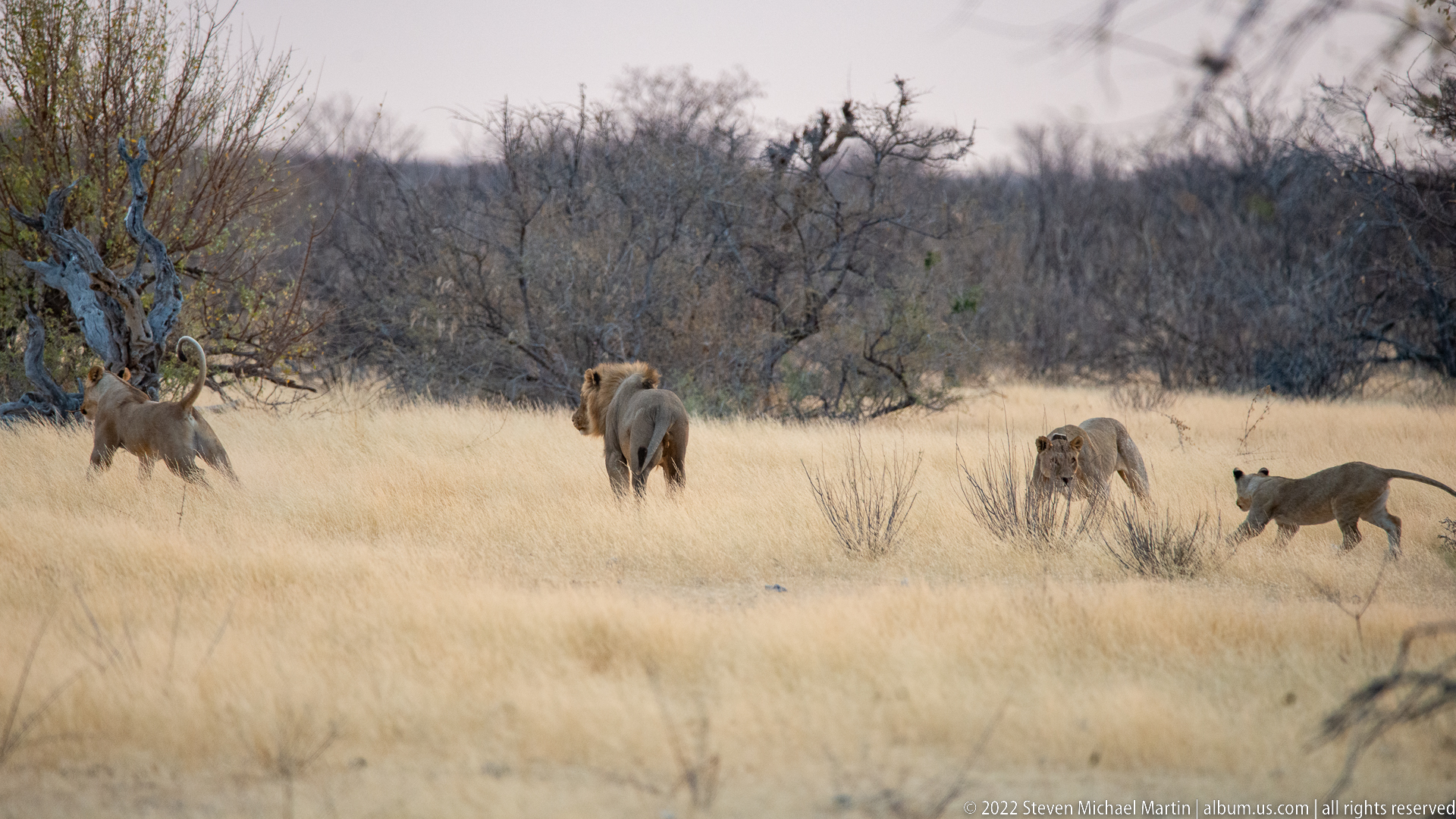
Three African lions move through pale dry grass at the edge of scrub woodland on the Etosha Plain. Their tawny coats blend closely with the cured vegetation, while the separated positions of the animals reveal a loose group progressing through the cover. The scene places the predators within Etosha’s seasonally arid savanna rather than isolating them as portraits.
Caption
Three African lions move through pale dry grass at the edge of scrub woodland on the Etosha Plain. Their tawny coats blend closely with the cured vegetation, while the separated positions of the animals reveal a loose group progressing through the cover. The scene places the predators within Etosha’s seasonally arid savanna rather than isolating them as portraits.
Field Guide
Overview
The Etosha Plain presents a wide, open landscape shaped by dry climate and sparse vegetation. Long viewing distances make wildlife movement easier to observe, while scattered shrubs and grasses provide limited cover across the terrain.
During this visit, ostrich and lion were observed moving through pale grassland, demonstrating how predators and prey adapt to environments where visibility is high and resources may be widely dispersed. The openness of the terrain emphasizes the scale of Etosha’s ecosystem and highlights the importance of mobility for survival in arid conditions.
Location
- 📍 Etosha National Park region, northern Namibia
- Habitat: open savanna and dry grassland
- Terrain: flat plains with scattered shrubs and distant hills
Wildlife
- 🦁 Male lion moving through pale grassland habitat
- 🦤 Ostrich adapted to dry open terrain
- 🦌 Antelope and plains species typical of arid savanna
- 🪶 Birdlife present in low vegetation
Behavior
- Lions travel across open terrain while scanning for prey
- Ostrich rely on visibility and speed for protection
- Wildlife movement often follows scattered vegetation
- Animals remain alert in exposed environments
- Predator sightings occur even far from water sources
Best Time of Day
- Morning and late afternoon provide softer light across plains
- Wildlife movement increases during cooler hours
- Clear visibility allows observation across long distances
Photography Notes
- Wide compositions emphasize landscape scale
- Long lenses isolate wildlife within open terrain
- Simple backgrounds highlight animal form
- Dry grass produces soft neutral color palette
- Heat shimmer may appear during midday conditions
Why This Stop is Special
The Etosha Plain illustrates how wildlife adapts to environments where cover is limited and distances between resources can be significant. The openness of the terrain provides clear views of animal movement and highlights the relationship between landscape scale and predator behavior.
Guide Book

Photographs and descriptive text survey accommodation and camping facilities associated with Etosha National Park. Separate sections present resort or campsite settings with pools, buildings, shaded grounds, and entrances, giving the spread the character of a practical lodging directory. Rather than wildlife identification, these pages document the visitor infrastructure that supports multi-day travel through the Etosha region.
Caption
Photographs and descriptive text survey accommodation and camping facilities associated with Etosha National Park. Separate sections present resort or campsite settings with pools, buildings, shaded grounds, and entrances, giving the spread the character of a practical lodging directory. Rather than wildlife identification, these pages document the visitor infrastructure that supports multi-day travel through the Etosha region.
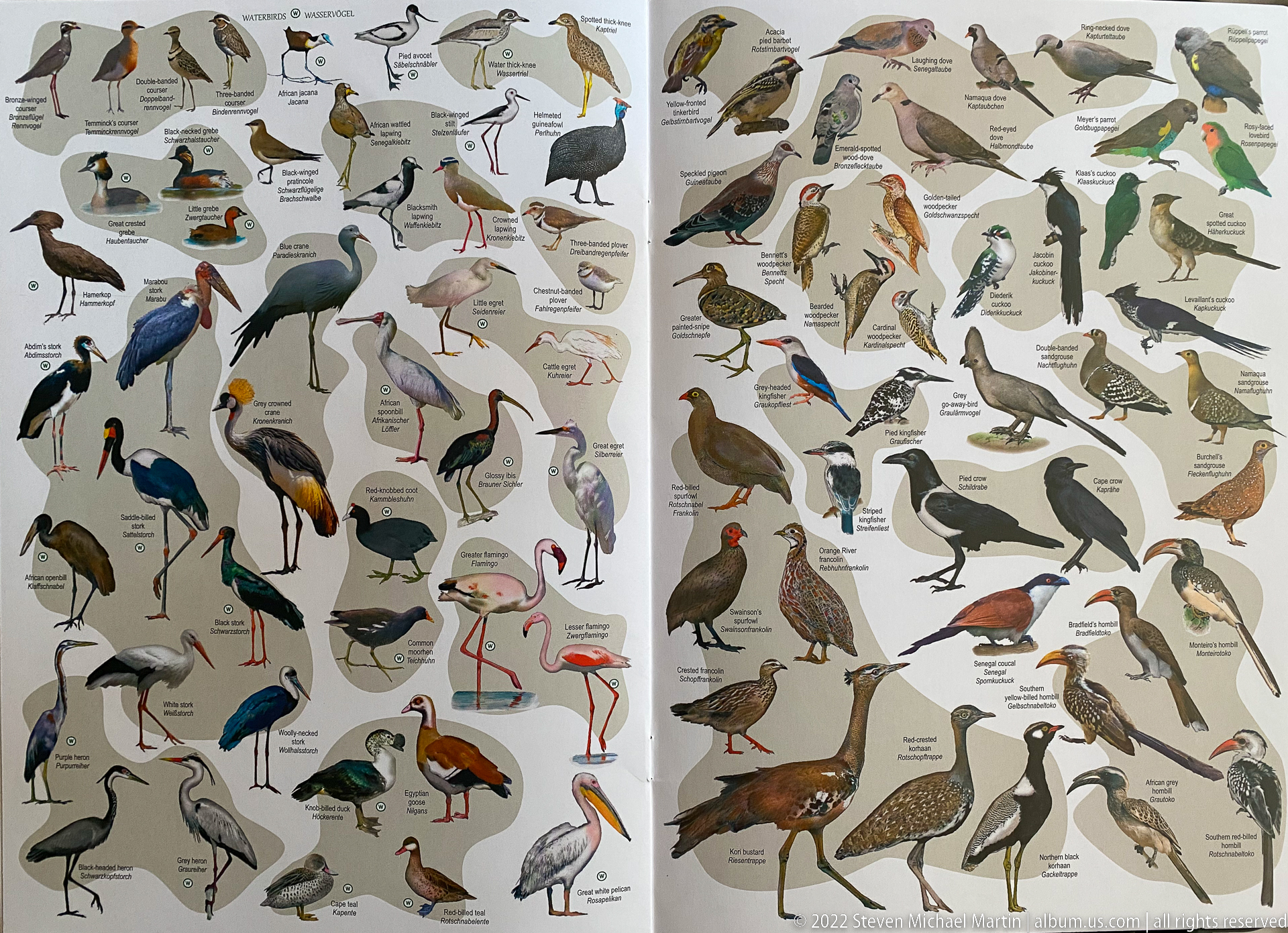
Two densely illustrated bird-identification plates present a wide range of Etosha avifauna in profile. The left page is dominated by long-legged waterbirds and waders, including crane-, stork-, and flamingo-like forms, while the facing page shifts to a broader assortment of terrestrial and wetland birds. Individual labels turn the spread into a compact visual key for field recognition.
Caption
Two densely illustrated bird-identification plates present a wide range of Etosha avifauna in profile. The left page is dominated by long-legged waterbirds and waders, including crane-, stork-, and flamingo-like forms, while the facing page shifts to a broader assortment of terrestrial and wetland birds. Individual labels turn the spread into a compact visual key for field recognition.
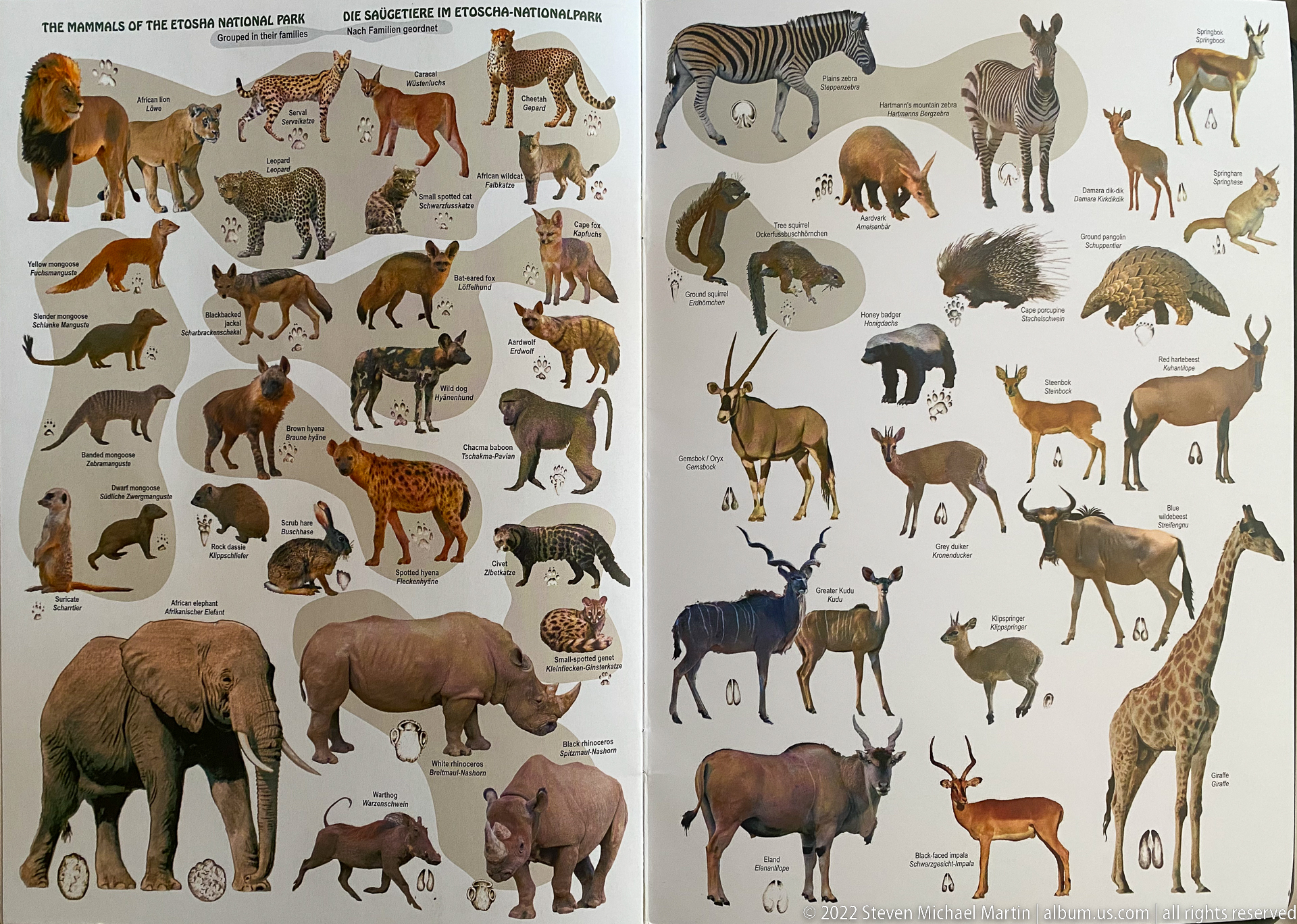
A two-page mammal plate gathers many of Etosha’s characteristic species into a single comparative reference. Carnivores, antelope, equids, primates, small mammals, and large herbivores are shown at differing scales, with elephant, rhinoceros, giraffe, zebra, and wildebeest among the most conspicuous forms. Labeled illustrations emphasize silhouette, coat pattern, horns, and body proportions used in field identification.
Caption
A two-page mammal plate gathers many of Etosha’s characteristic species into a single comparative reference. Carnivores, antelope, equids, primates, small mammals, and large herbivores are shown at differing scales, with elephant, rhinoceros, giraffe, zebra, and wildebeest among the most conspicuous forms. Labeled illustrations emphasize silhouette, coat pattern, horns, and body proportions used in field identification.
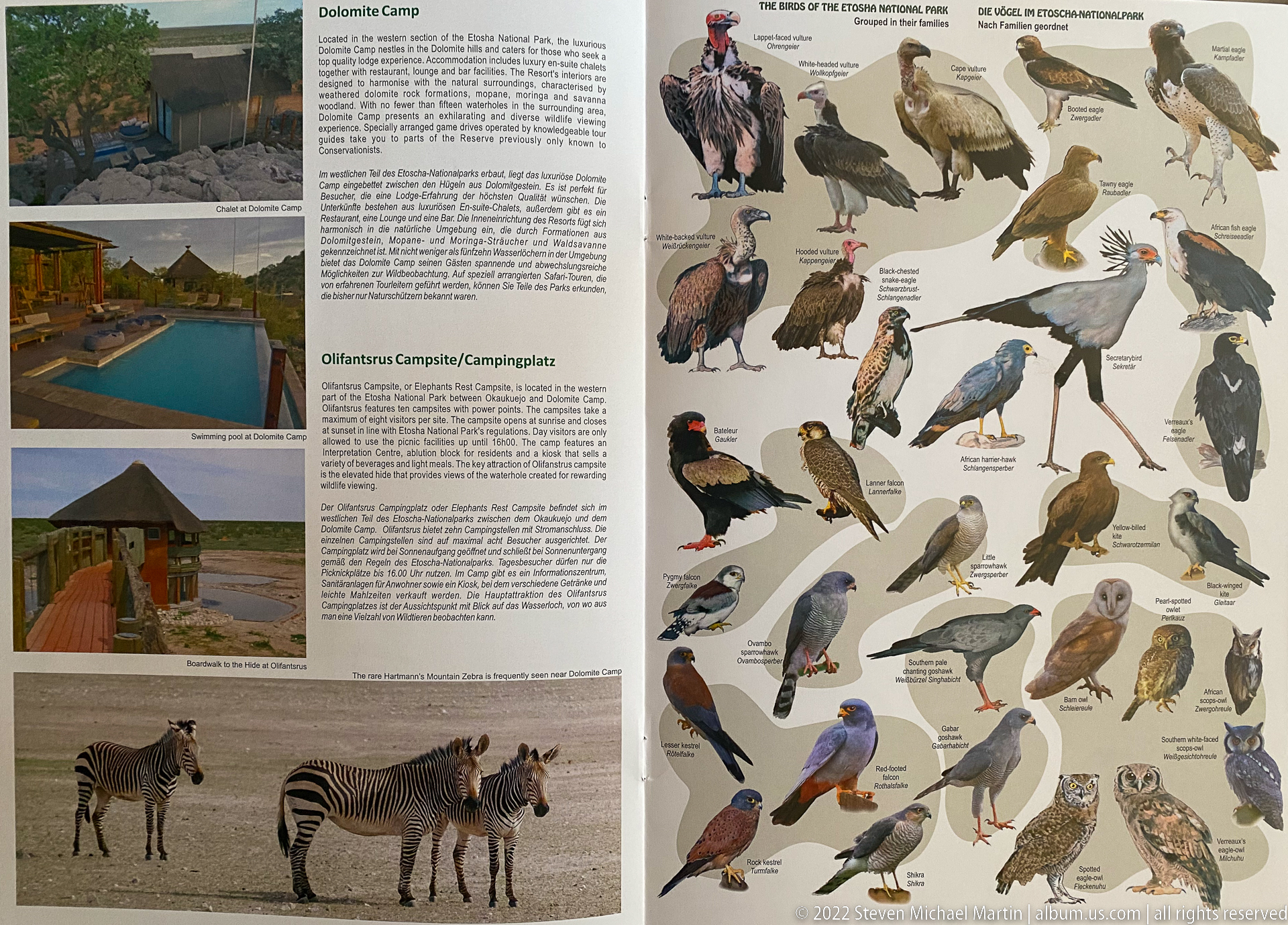
A practical campsite page faces a dense identification plate devoted to birds of prey recorded in the Etosha region. Photographs of lodging, a pool, and zebras occupy the left page, while the right arranges illustrated vultures, eagles, owls, and other raptors with labels. The juxtaposition reflects the guide’s broad scope, moving directly from visitor logistics to field identification.
Caption
A practical campsite page faces a dense identification plate devoted to birds of prey recorded in the Etosha region. Photographs of lodging, a pool, and zebras occupy the left page, while the right arranges illustrated vultures, eagles, owls, and other raptors with labels. The juxtaposition reflects the guide’s broad scope, moving directly from visitor logistics to field identification.

The cover of an Etosha wildlife-identification guide combines illustrated mammals and birds with the bilingual title “Map of Etosha / Karte von Etoscha.” A lower panel centers elephants and other animals at a waterhole, signaling the guide’s field-identification purpose. The photographed publication provides contextual reference material for recognizing species and navigating wildlife encounters across the Etosha landscape.
Caption
The cover of an Etosha wildlife-identification guide combines illustrated mammals and birds with the bilingual title “Map of Etosha / Karte von Etoscha.” A lower panel centers elephants and other animals at a waterhole, signaling the guide’s field-identification purpose. The photographed publication provides contextual reference material for recognizing species and navigating wildlife encounters across the Etosha landscape.
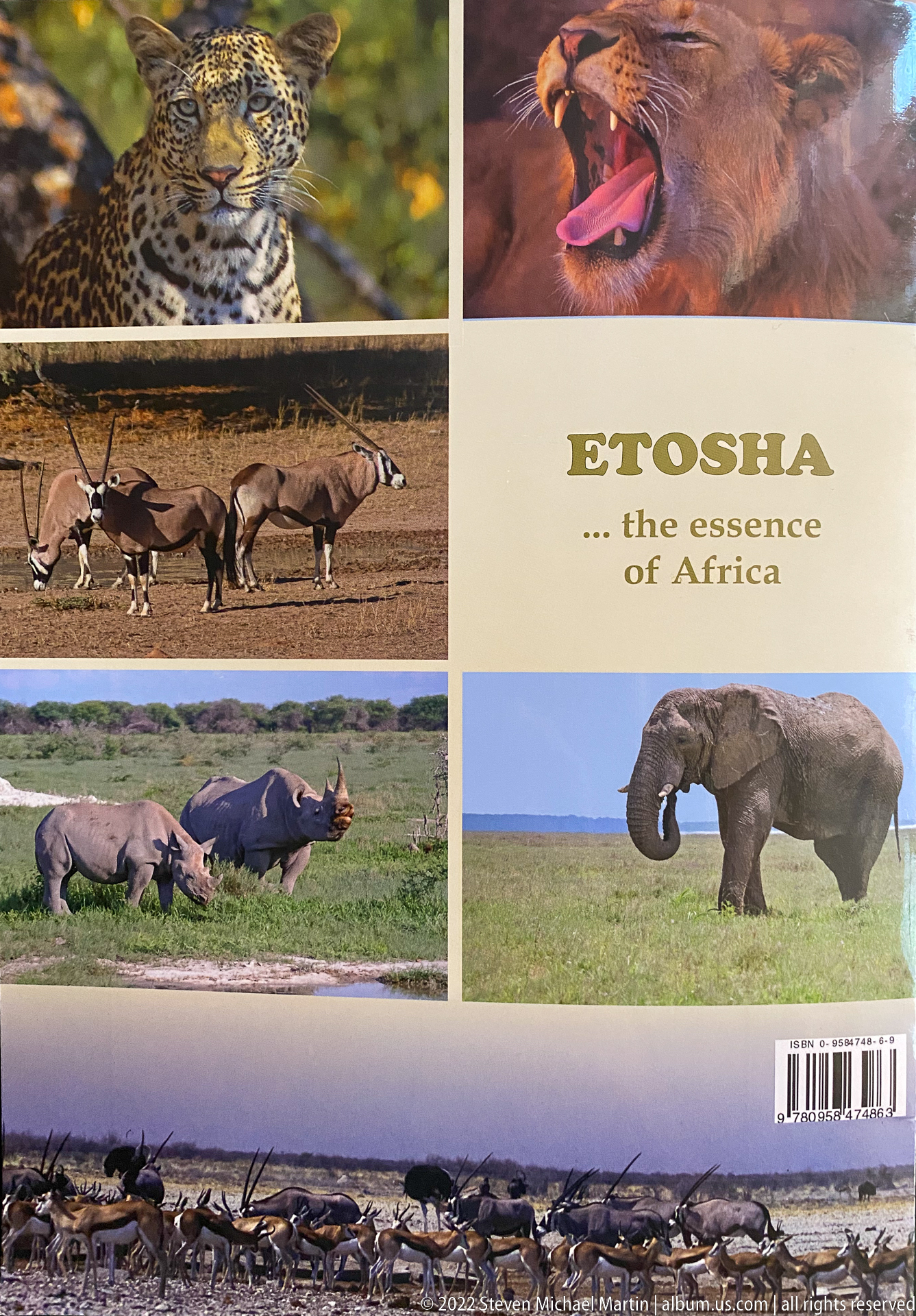
The closing cover of the Etosha guide uses a wildlife collage beneath the phrase “ETOSHA — the essence of Africa.” Separate panels feature close and contextual views of prominent African animals, while a panoramic strip along the bottom shows a large concentration of wildlife across open terrain. The design concludes the field guide by presenting Etosha through the abundance and variety of its fauna.
Caption
The closing cover of the Etosha guide uses a wildlife collage beneath the phrase “ETOSHA — the essence of Africa.” Separate panels feature close and contextual views of prominent African animals, while a panoramic strip along the bottom shows a large concentration of wildlife across open terrain. The design concludes the field guide by presenting Etosha through the abundance and variety of its fauna.

An information spread from the Etosha guide assembles practical park material with natural-history reference: visitor information, timetables, a table of distances, wildlife illustrations, and a color-coded vegetation map. The dense layout shows how field guides integrate route planning with ecological orientation, allowing travelers to relate roads and facilities to the broad vegetation zones that structure wildlife habitat in Etosha.
Caption
An information spread from the Etosha guide assembles practical park material with natural-history reference: visitor information, timetables, a table of distances, wildlife illustrations, and a color-coded vegetation map. The dense layout shows how field guides integrate route planning with ecological orientation, allowing travelers to relate roads and facilities to the broad vegetation zones that structure wildlife habitat in Etosha.
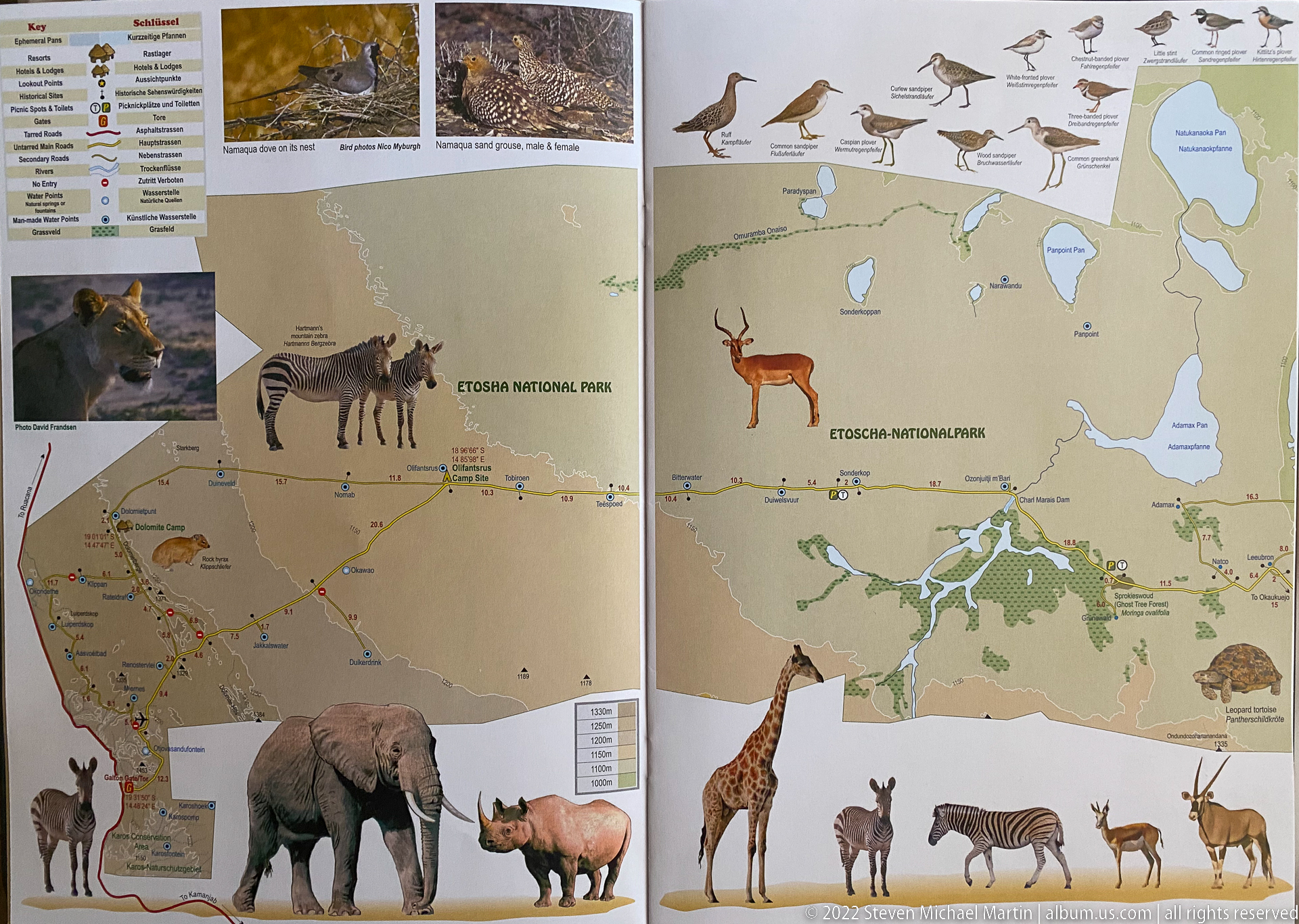
Two facing map pages place Etosha National Park’s road network and water features beneath rows of illustrated wildlife. Large figures of zebra, elephant, rhinoceros, giraffe, antelope, and other species turn the map into a combined navigation and identification aid. The spread visually links animal recognition with the geography of the park, including the broad pale expanse of the Etosha Pan.
Caption
Two facing map pages place Etosha National Park’s road network and water features beneath rows of illustrated wildlife. Large figures of zebra, elephant, rhinoceros, giraffe, antelope, and other species turn the map into a combined navigation and identification aid. The spread visually links animal recognition with the geography of the park, including the broad pale expanse of the Etosha Pan.

A detailed Etosha National Park map spread traces roads, waterholes, settlements, and the margins of the pan across two pages. Wildlife illustrations—including large herbivores and predators—frame the cartography and reinforce the guide’s dual role as route reference and species primer. The layout emphasizes the scale of the protected landscape and the importance of mapped water points to safari movement.
Caption
A detailed Etosha National Park map spread traces roads, waterholes, settlements, and the margins of the pan across two pages. Wildlife illustrations—including large herbivores and predators—frame the cartography and reinforce the guide’s dual role as route reference and species primer. The layout emphasizes the scale of the protected landscape and the importance of mapped water points to safari movement.
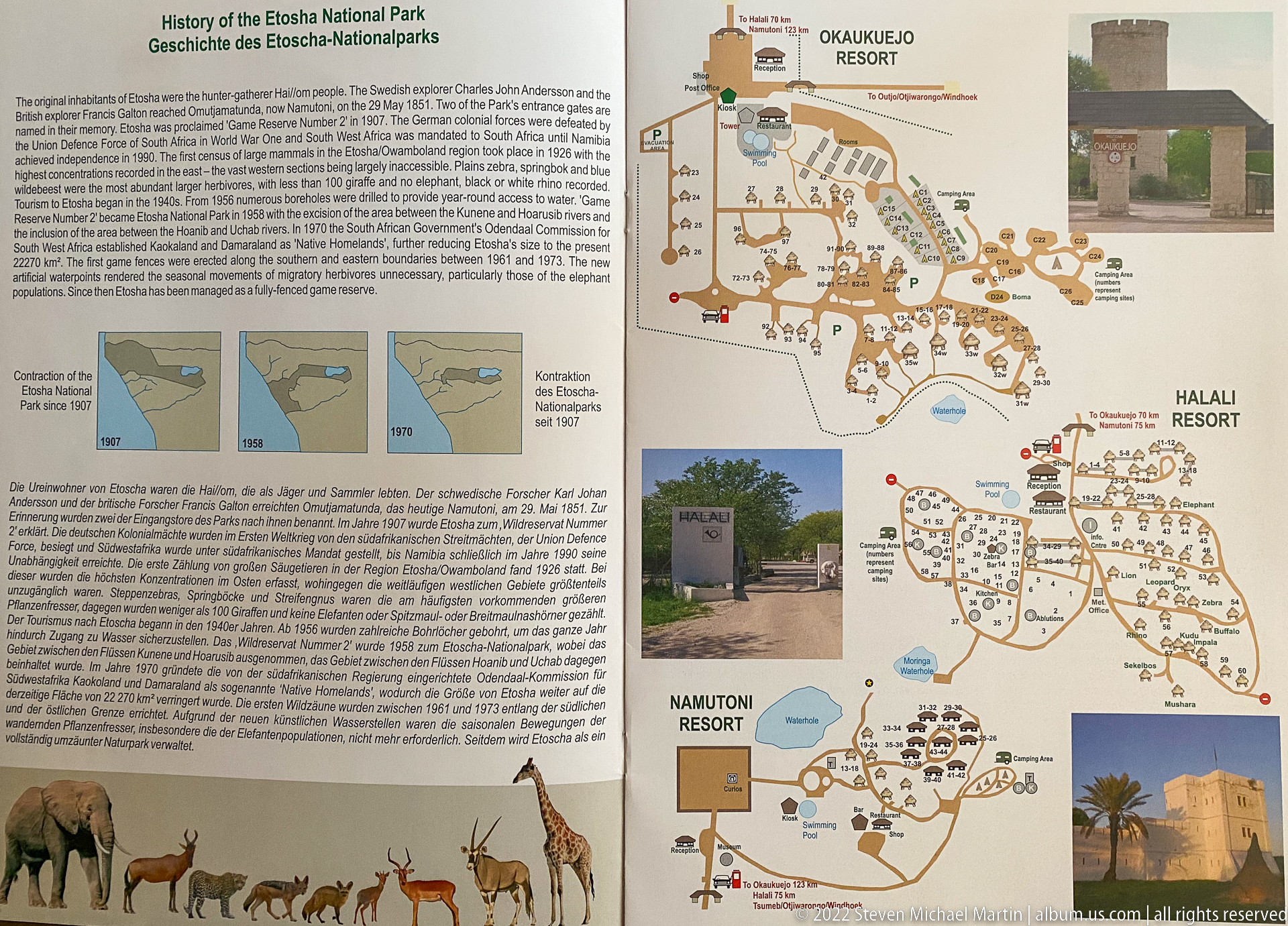
This guide spread pairs a text history of Etosha National Park with schematic plans of three major park resorts: Okaukuejo, Halali, and Namutoni. Small historic and site photographs accompany the maps, while animal illustrations run along the lower margin. The page connects the park’s administrative history with the visitor infrastructure from which many wildlife drives and waterhole observations are organized.
Caption
This guide spread pairs a text history of Etosha National Park with schematic plans of three major park resorts: Okaukuejo, Halali, and Namutoni. Small historic and site photographs accompany the maps, while animal illustrations run along the lower margin. The page connects the park’s administrative history with the visitor infrastructure from which many wildlife drives and waterhole observations are organized.
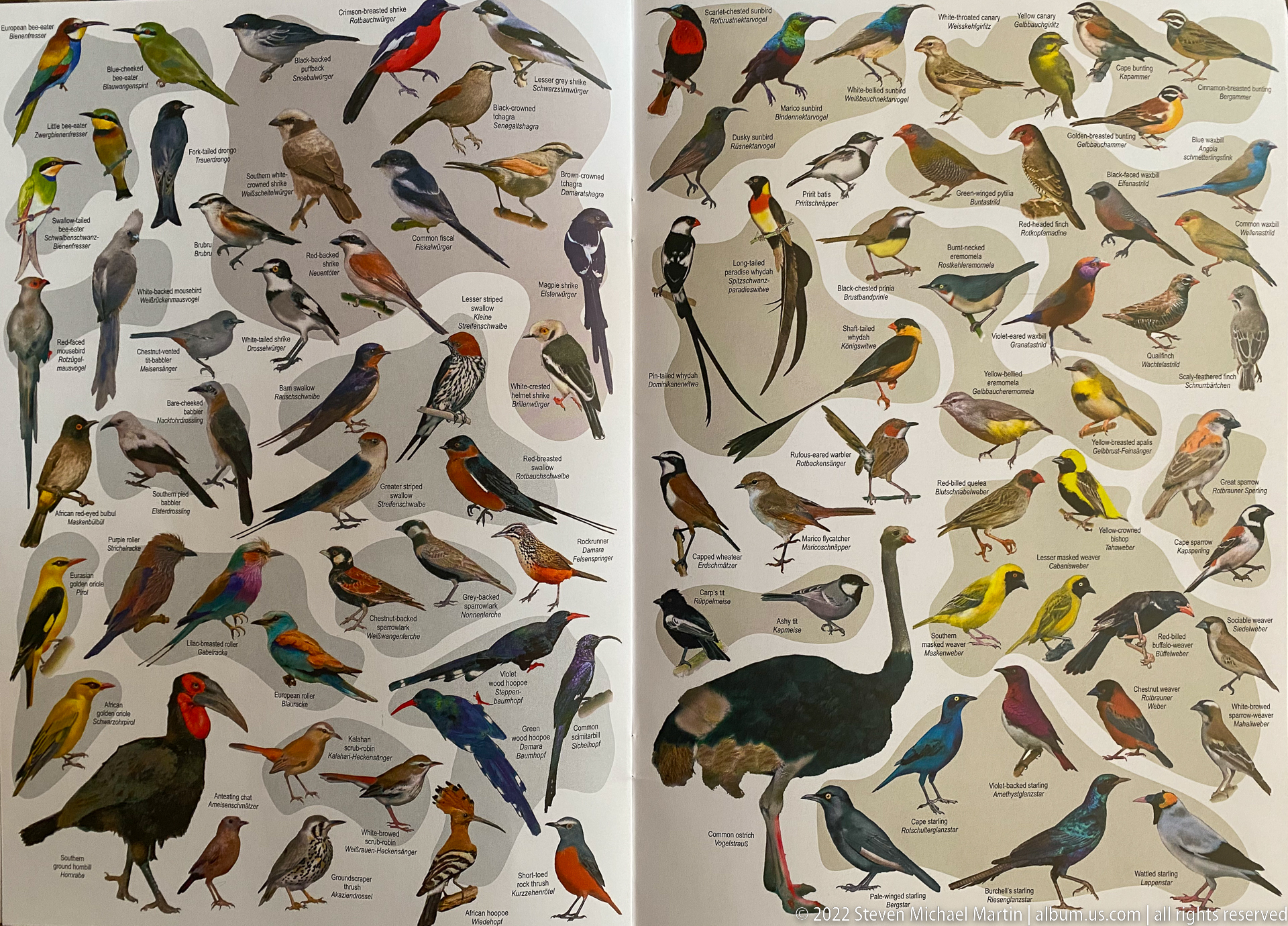
Colorful land birds fill this two-page identification spread, with dozens of labeled species arranged against a pale background. Perching forms dominate, joined by conspicuous larger birds and several vividly patterned species. The compact plate format is designed for visual comparison of plumage, body shape, bill form, and relative proportions—features central to identifying Etosha’s diverse birdlife in the field.
Caption
Colorful land birds fill this two-page identification spread, with dozens of labeled species arranged against a pale background. Perching forms dominate, joined by conspicuous larger birds and several vividly patterned species. The compact plate format is designed for visual comparison of plumage, body shape, bill form, and relative proportions—features central to identifying Etosha’s diverse birdlife in the field.
Video: