Okavango Delta – Botswana
The remarkable Okavango Delta forms one of the most unique ecosystems on Earth. Instead of flowing into the sea, the waters of the Okavango River spread across the flat Kalahari Basin, creating a vast inland delta of channels, lagoons, and seasonal floodplains.
This dynamic wetland environment supports an extraordinary diversity of wildlife, including elephants, hippos, crocodiles, and countless species of birds. Seasonal flooding transforms the landscape and attracts animals from surrounding regions.
Because of its ecological importance and natural beauty, the Okavango Delta is recognized as a Okavango Delta.
Photos:

Sinuous channels curve through broad green wetlands in an aerial view of the Okavango Delta. The branching waterways, floodplain vegetation, and isolated pools reveal the inland delta’s defining mosaic of permanent and seasonal water, a landscape recognized as a UNESCO World Heritage Site for its exceptional wetland ecology.
Caption
Sinuous channels curve through broad green wetlands in an aerial view of the Okavango Delta. The branching waterways, floodplain vegetation, and isolated pools reveal the inland delta’s defining mosaic of permanent and seasonal water, a landscape recognized as a UNESCO World Heritage Site for its exceptional wetland ecology.
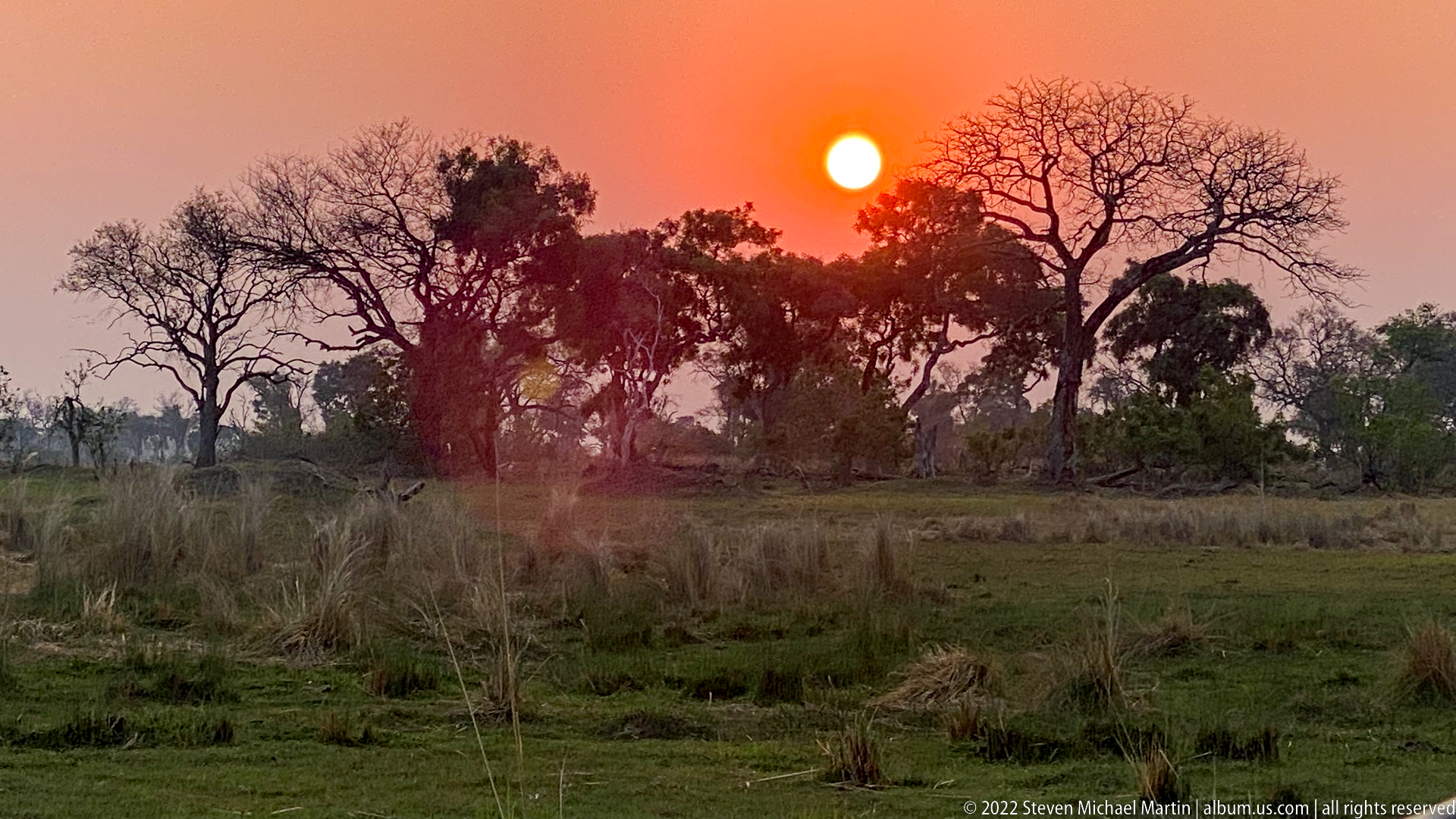
The sun hangs above a line of mature trees at the edge of the Okavango floodplain, turning the sky deep orange while the foreground grass remains in shadow. Broad-canopied and leafless trees create a strong silhouette, closing the wildlife sequence with a quiet landscape view at day’s end.
Caption
The sun hangs above a line of mature trees at the edge of the Okavango floodplain, turning the sky deep orange while the foreground grass remains in shadow. Broad-canopied and leafless trees create a strong silhouette, closing the wildlife sequence with a quiet landscape view at day’s end.
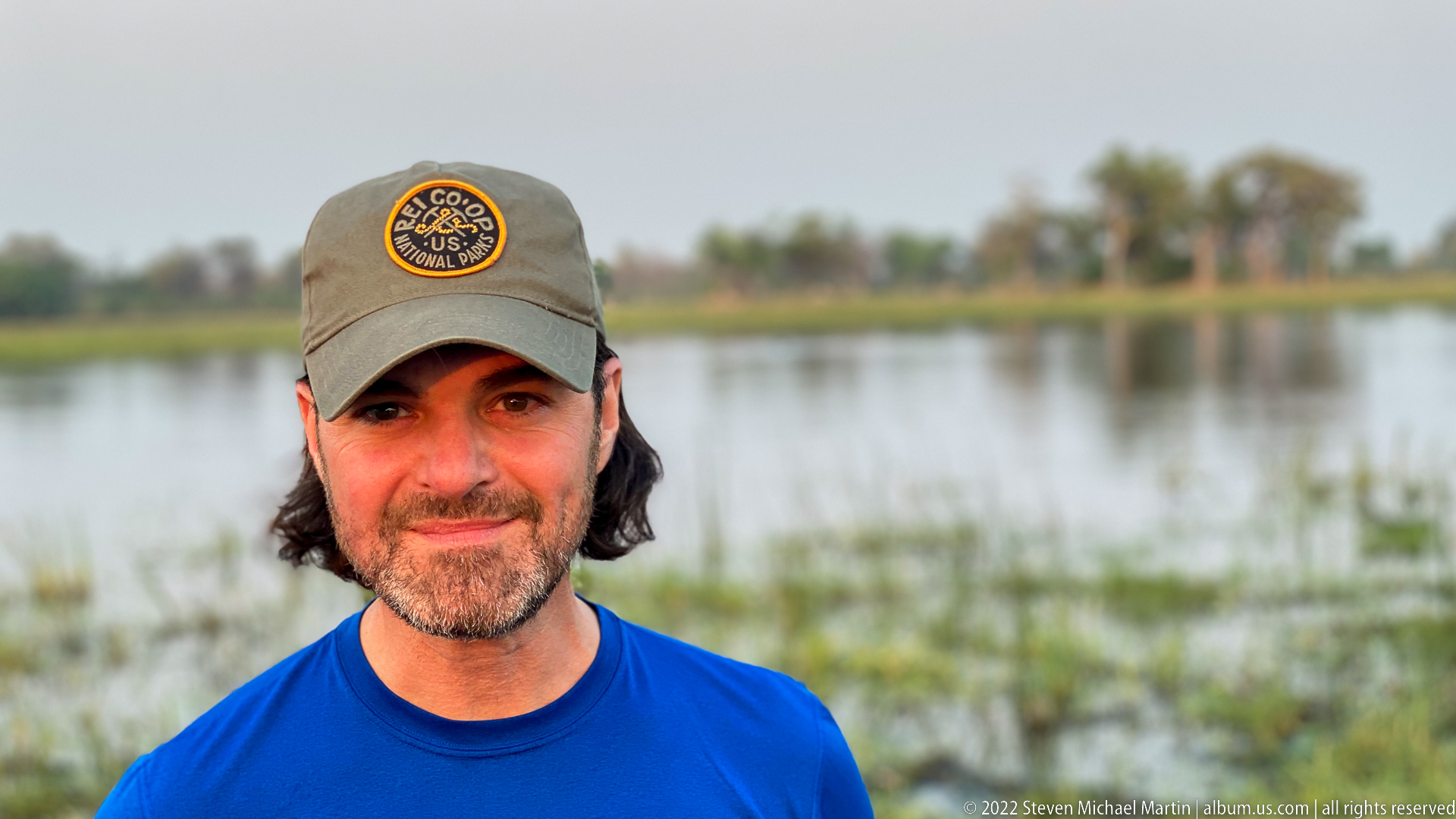
A safari guest stands close to the camera with shallow water and floodplain vegetation softly blurred behind. The blue shirt and olive cap provide strong color contrast against the muted wetland, while the tight framing turns the camp setting into a simple environmental portrait.
Caption
A safari guest stands close to the camera with shallow water and floodplain vegetation softly blurred behind. The blue shirt and olive cap provide strong color contrast against the muted wetland, while the tight framing turns the camp setting into a simple environmental portrait.
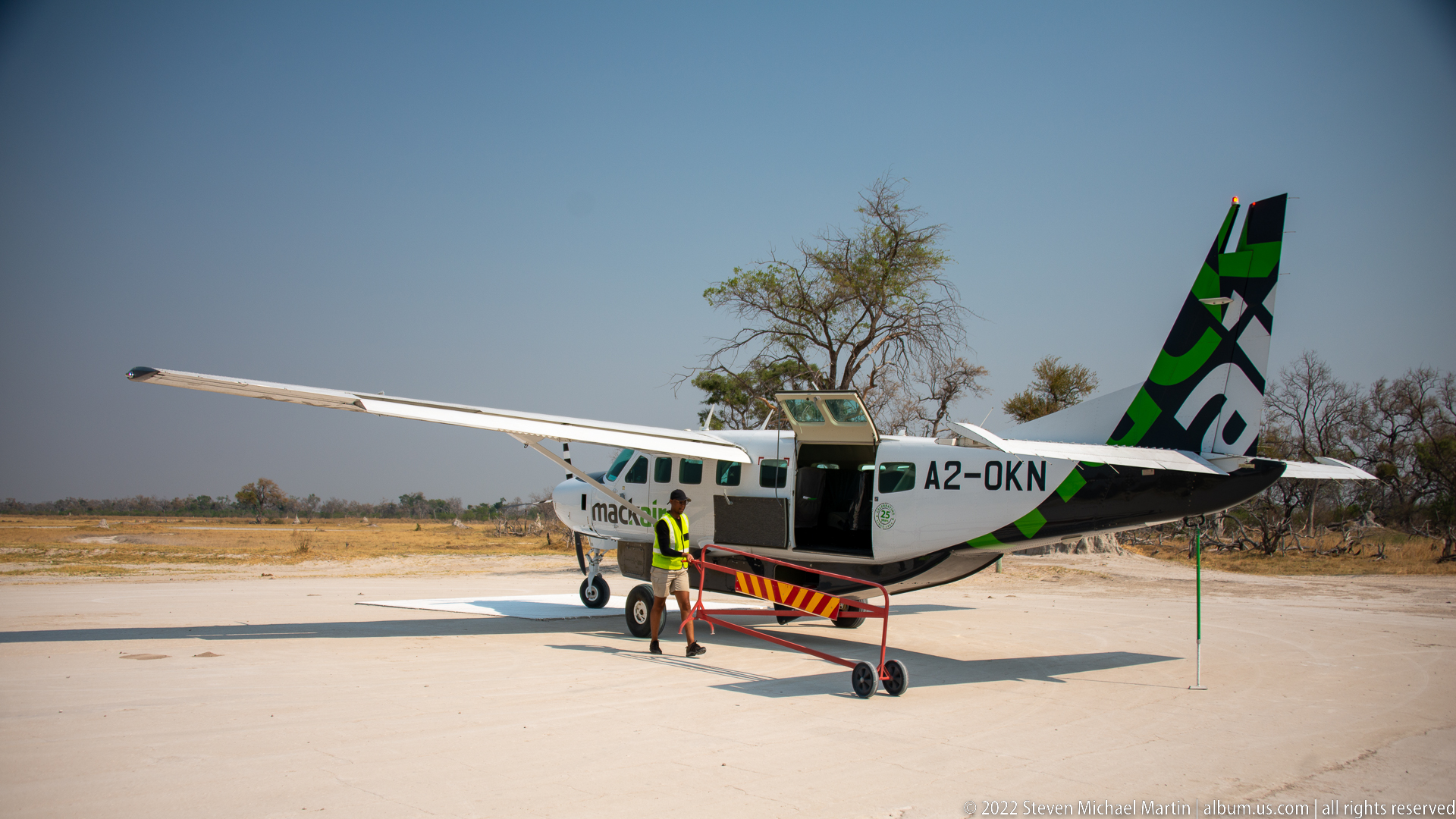
A Mack Air light aircraft stands on a remote paved airstrip in the Okavango region as ground staff attend the open cabin. The high-wing utility plane is typical of safari transfers between Botswana’s dispersed camps, linking small airstrips that provide practical access across the delta’s wetlands and sandy terrain.
Caption
A Mack Air light aircraft stands on a remote paved airstrip in the Okavango region as ground staff attend the open cabin. The high-wing utility plane is typical of safari transfers between Botswana’s dispersed camps, linking small airstrips that provide practical access across the delta’s wetlands and sandy terrain.
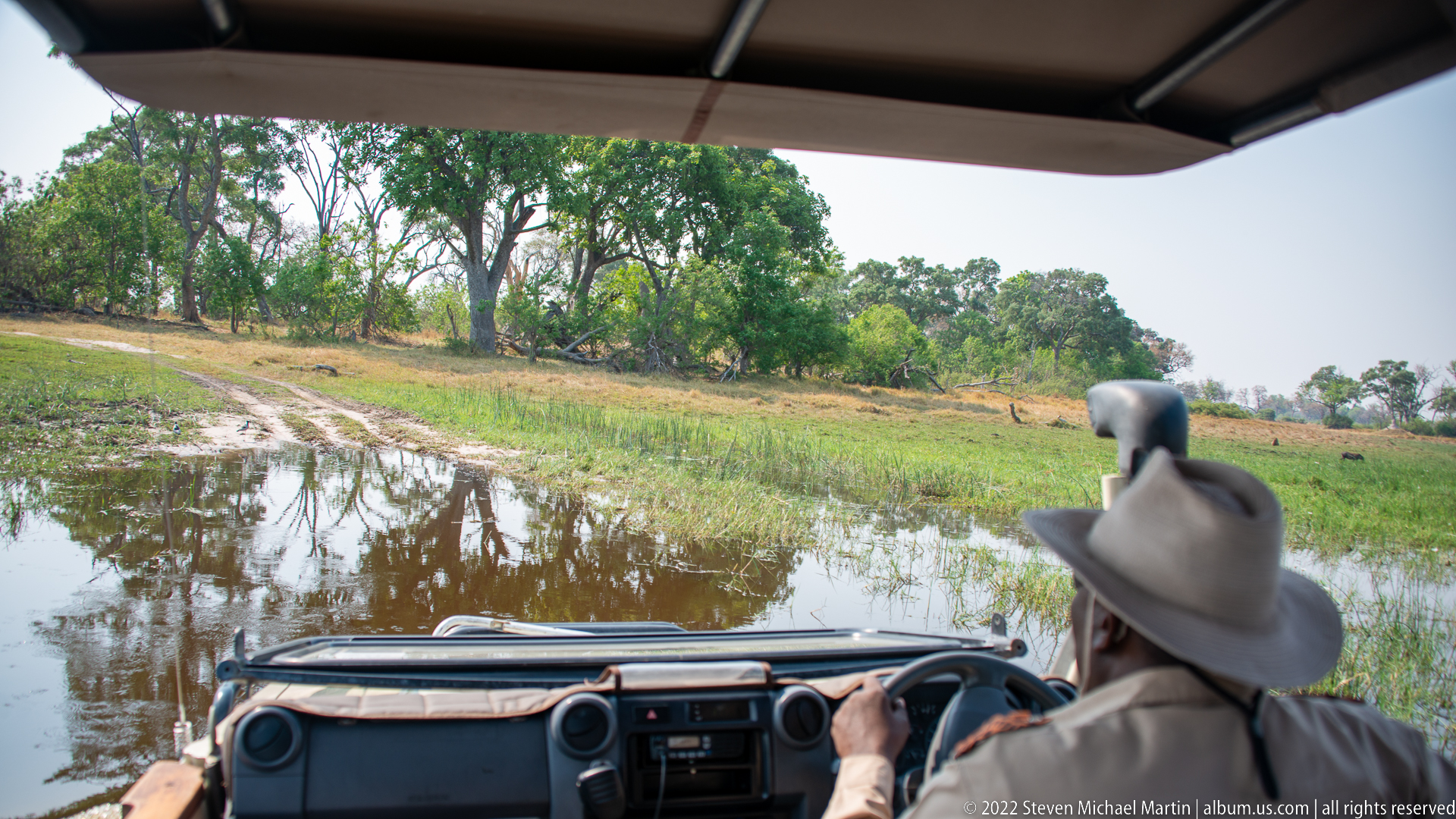
The safari vehicle follows a track directly into shallow floodwater, with green wetland vegetation extending across the open ground ahead. From behind the guide, the view shows how seasonal inundation can turn ordinary game-drive routes into water crossings within the Okavango Delta.
Caption
The safari vehicle follows a track directly into shallow floodwater, with green wetland vegetation extending across the open ground ahead. From behind the guide, the view shows how seasonal inundation can turn ordinary game-drive routes into water crossings within the Okavango Delta.
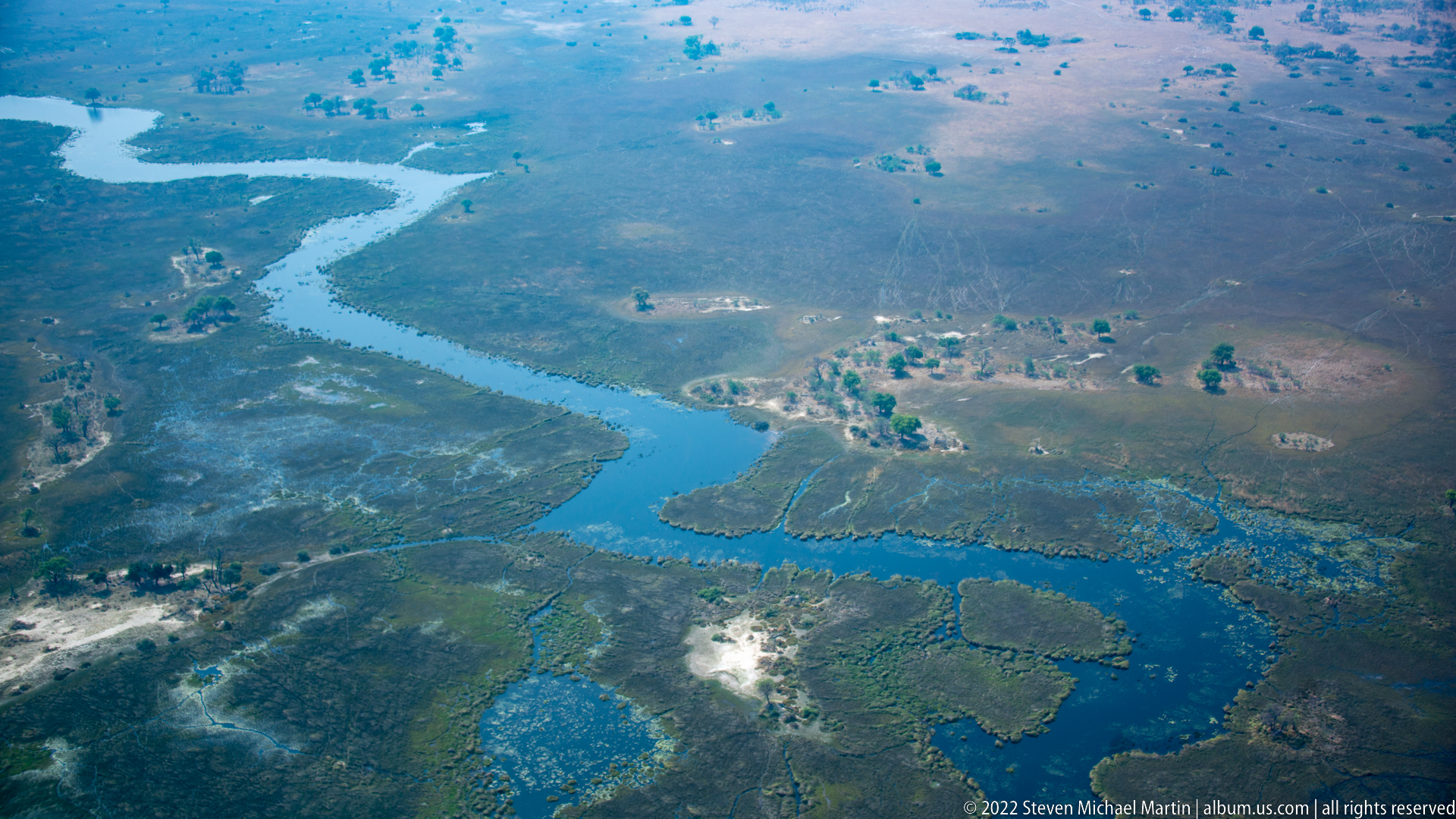
A broad blue channel bends across the Okavango floodplain, bordered by saturated green marsh on one side and drier open ground on the other. Small pools, islands, and vegetation bands show the fine-scale transition between flooded and terrestrial habitats that gives the delta its ecological diversity.
Caption
A broad blue channel bends across the Okavango floodplain, bordered by saturated green marsh on one side and drier open ground on the other. Small pools, islands, and vegetation bands show the fine-scale transition between flooded and terrestrial habitats that gives the delta its ecological diversity.
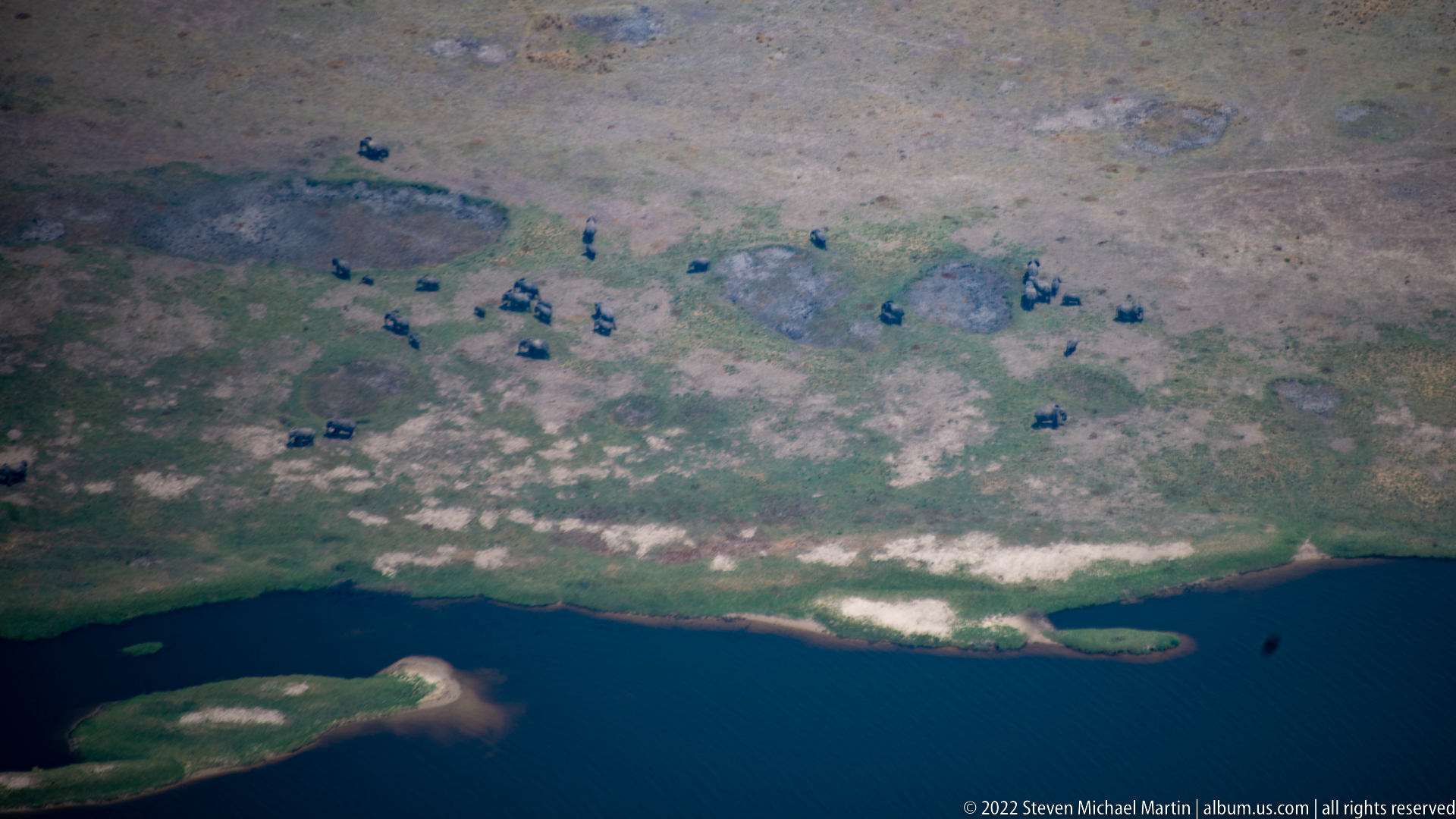
A herd of African elephants is scattered across pale floodplain ground beside a dark Okavango channel. From the air, the animals appear as distinct gray forms moving between open ground, scrub, and water, illustrating how the delta’s channels and seasonal floodplains concentrate large mammals during the dry season.
Caption
A herd of African elephants is scattered across pale floodplain ground beside a dark Okavango channel. From the air, the animals appear as distinct gray forms moving between open ground, scrub, and water, illustrating how the delta’s channels and seasonal floodplains concentrate large mammals during the dry season.
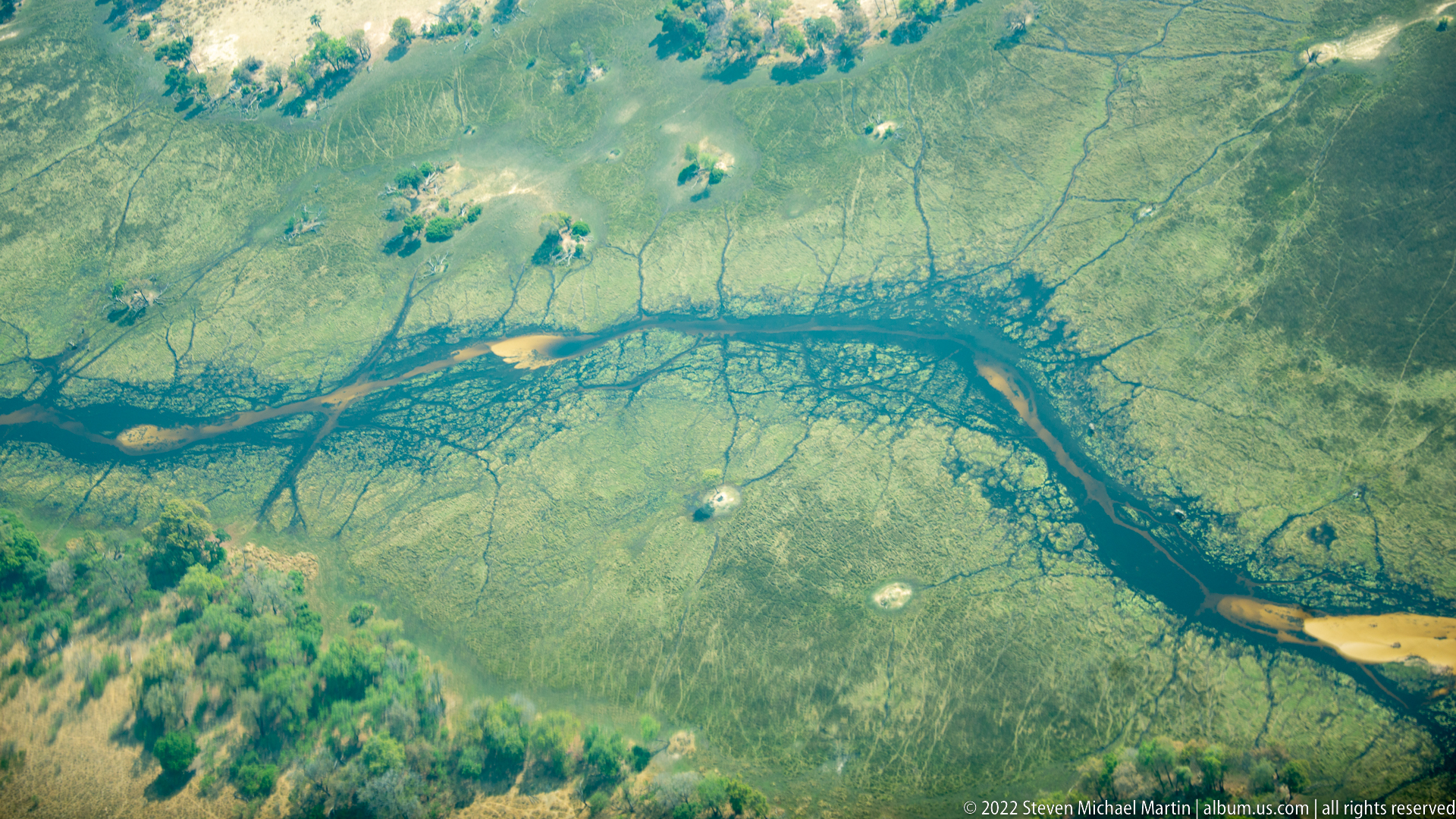
A dark Okavango watercourse branches into slender distributary channels that spread across a green floodplain. Pale sand bars and subtle vegetation lines trace changing water levels, while the branching pattern shows how floodwater disperses laterally through the inland delta rather than flowing directly to the sea.
Caption
A dark Okavango watercourse branches into slender distributary channels that spread across a green floodplain. Pale sand bars and subtle vegetation lines trace changing water levels, while the branching pattern shows how floodwater disperses laterally through the inland delta rather than flowing directly to the sea.
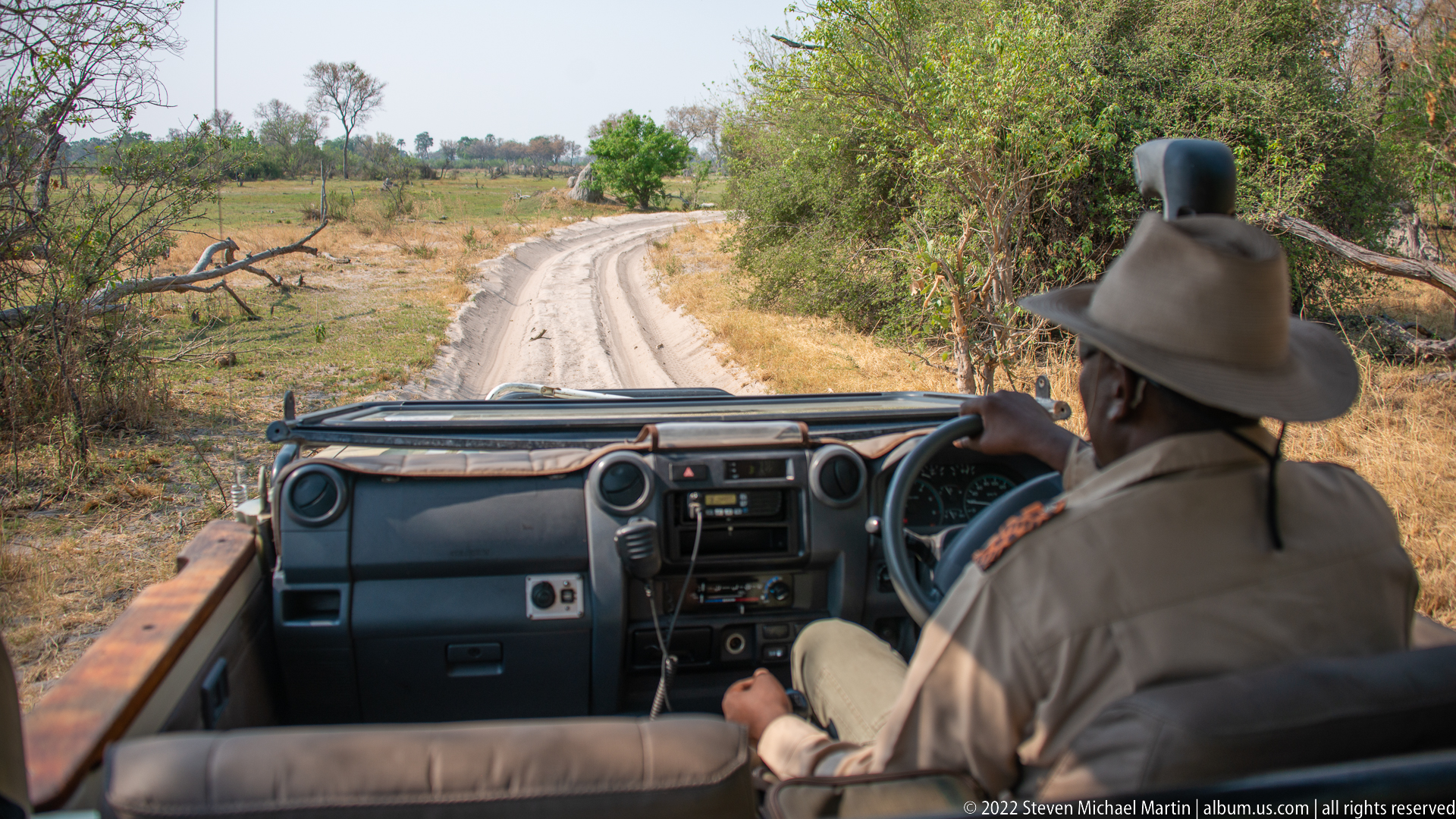
A safari guide steers an open vehicle along a pale sandy track through dry woodland after the airstrip arrival. Seen over the dashboard, the curving road and close vegetation create the characteristic low, ground-level perspective of overland travel between an Okavango airstrip and camp.
Caption
A safari guide steers an open vehicle along a pale sandy track through dry woodland after the airstrip arrival. Seen over the dashboard, the curving road and close vegetation create the characteristic low, ground-level perspective of overland travel between an Okavango airstrip and camp.
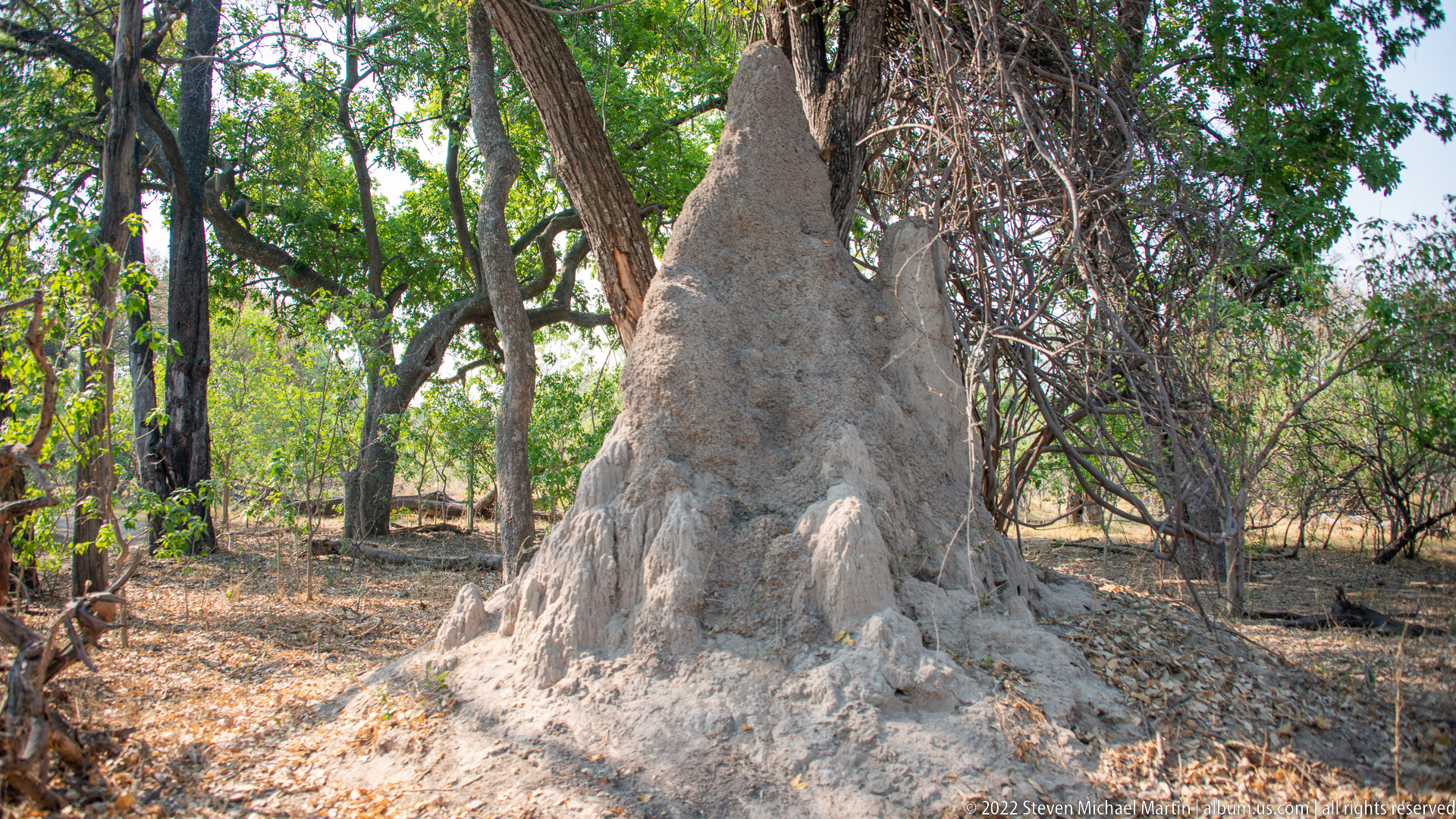
A tall earthen termite mound rises among mature trees in dry Okavango woodland. Built from soil by termite colonies, such mounds create elevated, nutrient-rich patches that can influence local vegetation and provide habitat structure across otherwise flat floodplain and savanna environments.
Caption
A tall earthen termite mound rises among mature trees in dry Okavango woodland. Built from soil by termite colonies, such mounds create elevated, nutrient-rich patches that can influence local vegetation and provide habitat structure across otherwise flat floodplain and savanna environments.
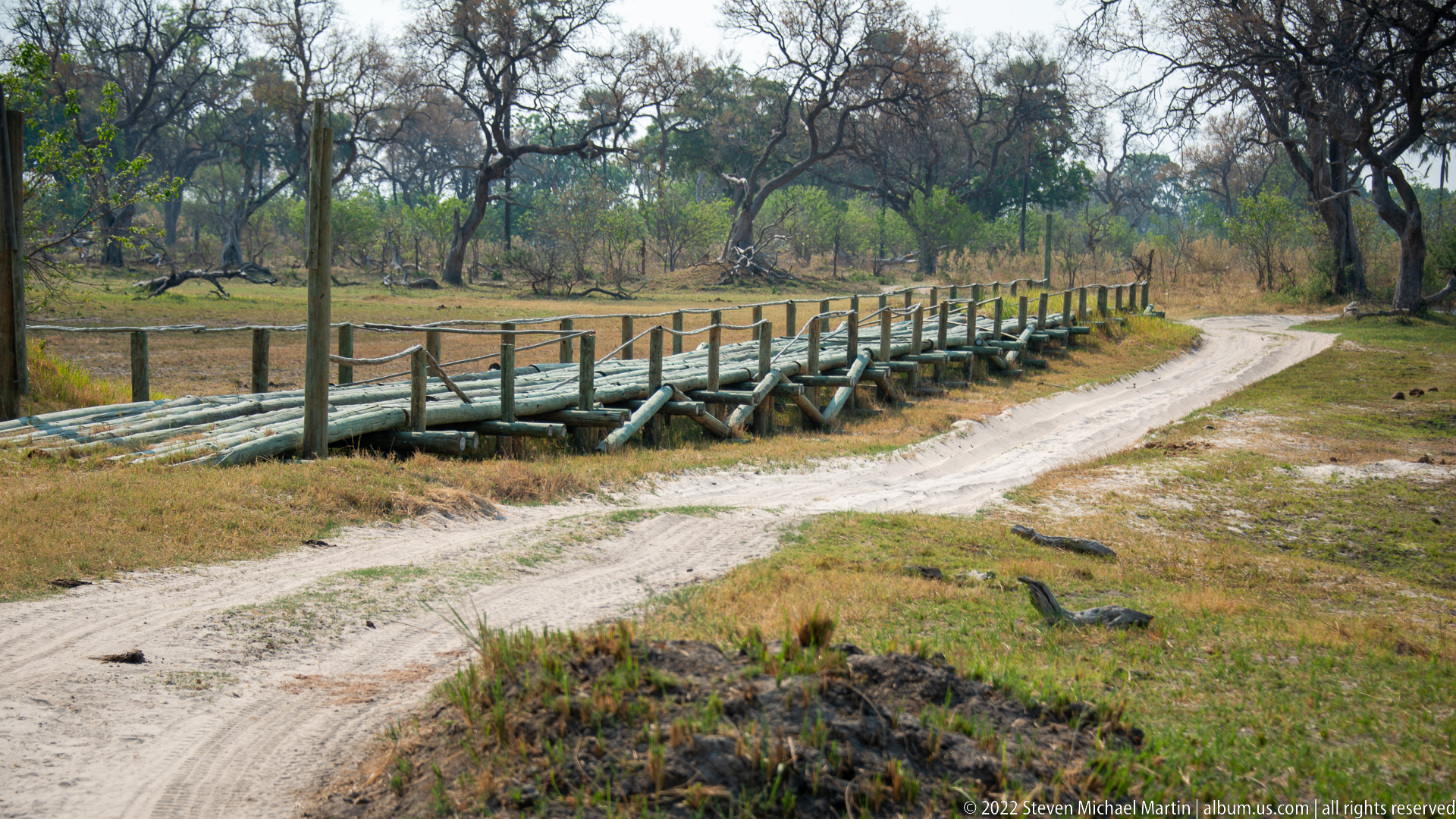
A narrow raised bridge of timber poles crosses a shallow wetland channel beside the sandy safari track. Its simple elevated construction allows vehicles and pedestrians to pass over seasonally wet ground, a practical response to fluctuating water levels in the Okavango Delta.
Caption
A narrow raised bridge of timber poles crosses a shallow wetland channel beside the sandy safari track. Its simple elevated construction allows vehicles and pedestrians to pass over seasonally wet ground, a practical response to fluctuating water levels in the Okavango Delta.
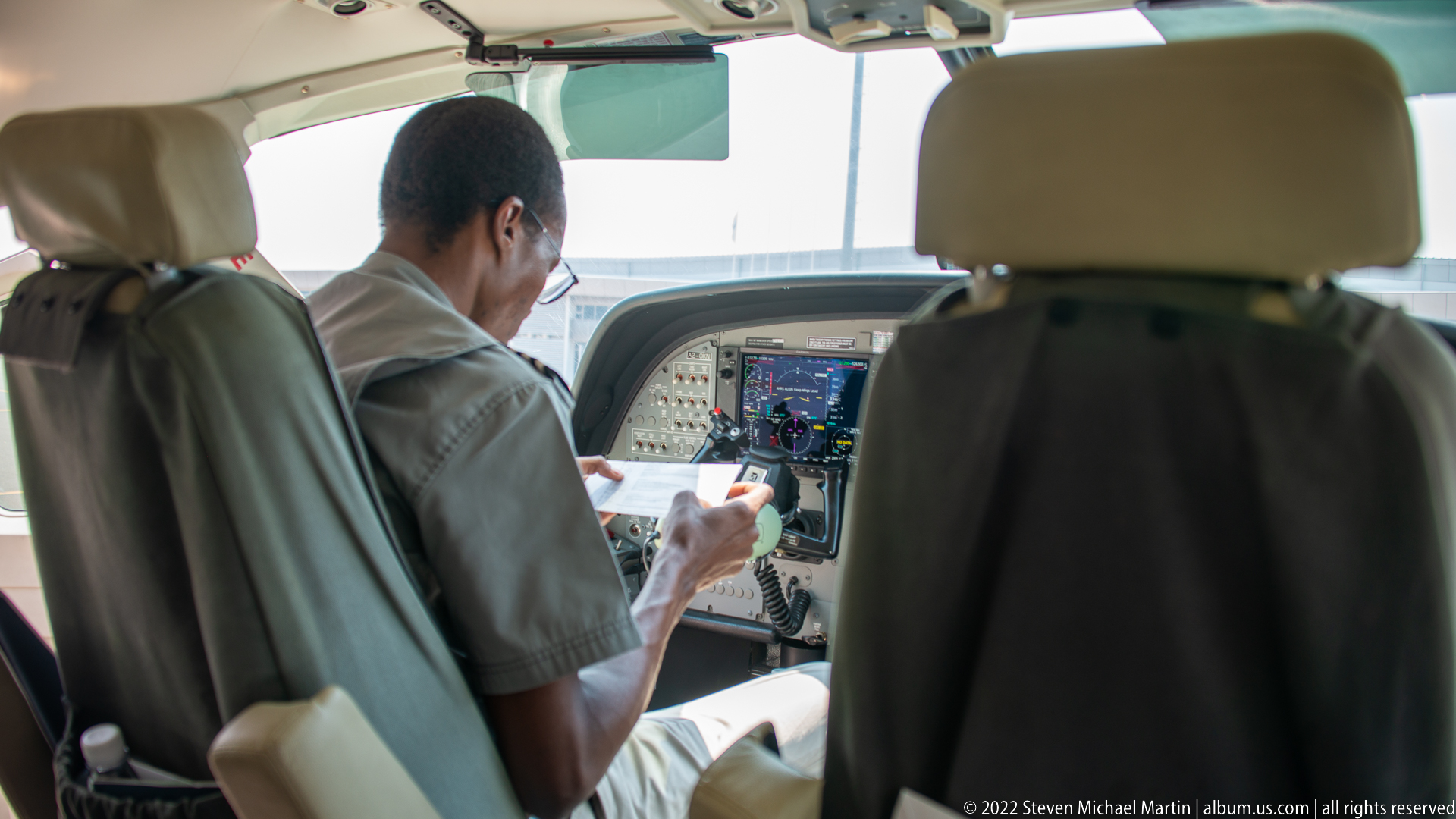
A pilot works at the instrument panel of a light aircraft before departure from northern Botswana. Seen from behind the cockpit seats, the close interior view introduces the small-aircraft transfers that connect remote safari areas around the Okavango Delta, where road access can be limited by distance, sand, and seasonal water.
Caption
A pilot works at the instrument panel of a light aircraft before departure from northern Botswana. Seen from behind the cockpit seats, the close interior view introduces the small-aircraft transfers that connect remote safari areas around the Okavango Delta, where road access can be limited by distance, sand, and seasonal water.
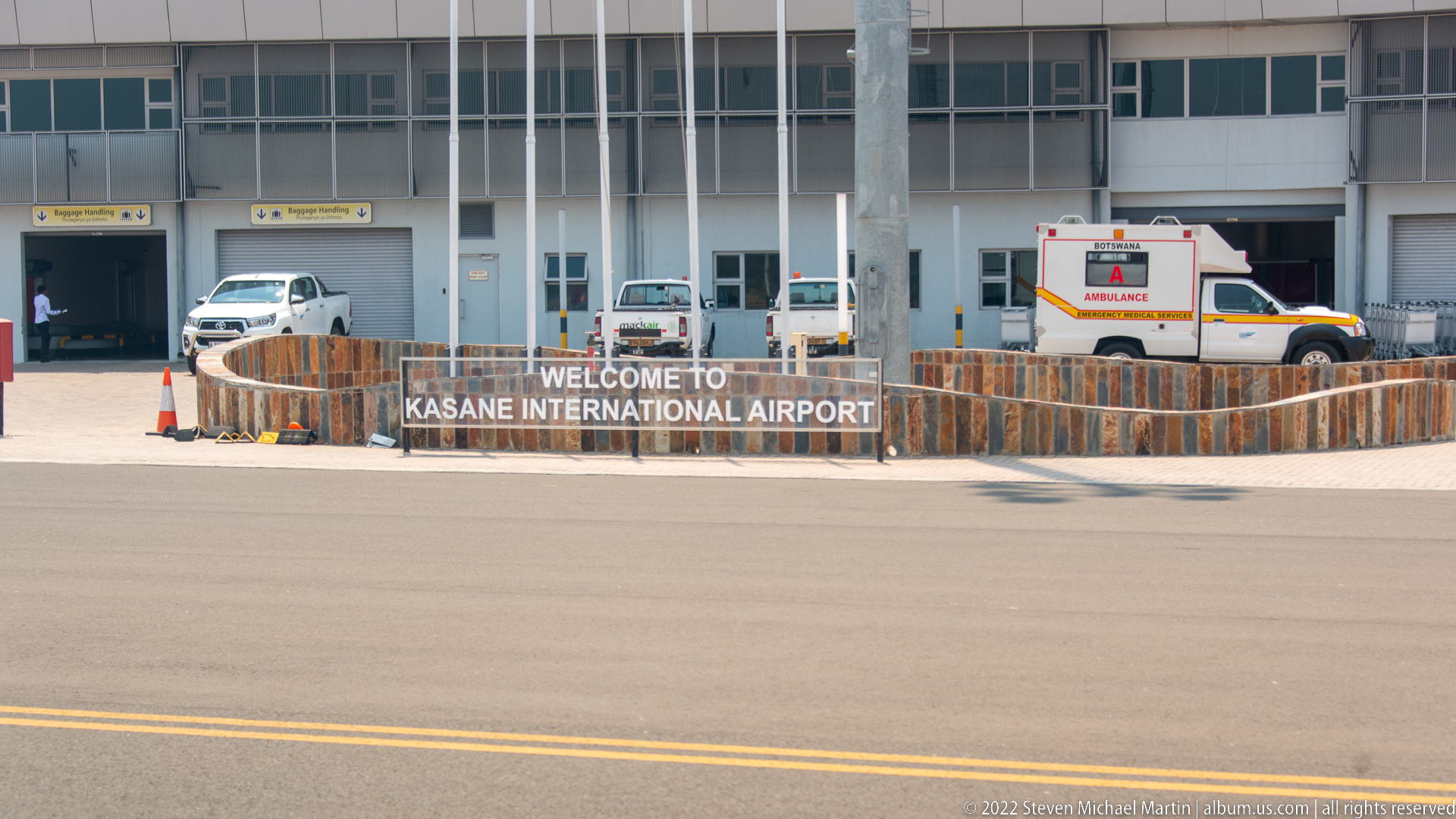
The airside frontage of Kasane International Airport marks the transition from scheduled travel to safari aviation in northern Botswana. The terminal façade, service bays, airport vehicles, and prominent welcome sign establish the location before the onward flight toward the Okavango Delta.
Caption
The airside frontage of Kasane International Airport marks the transition from scheduled travel to safari aviation in northern Botswana. The terminal façade, service bays, airport vehicles, and prominent welcome sign establish the location before the onward flight toward the Okavango Delta.
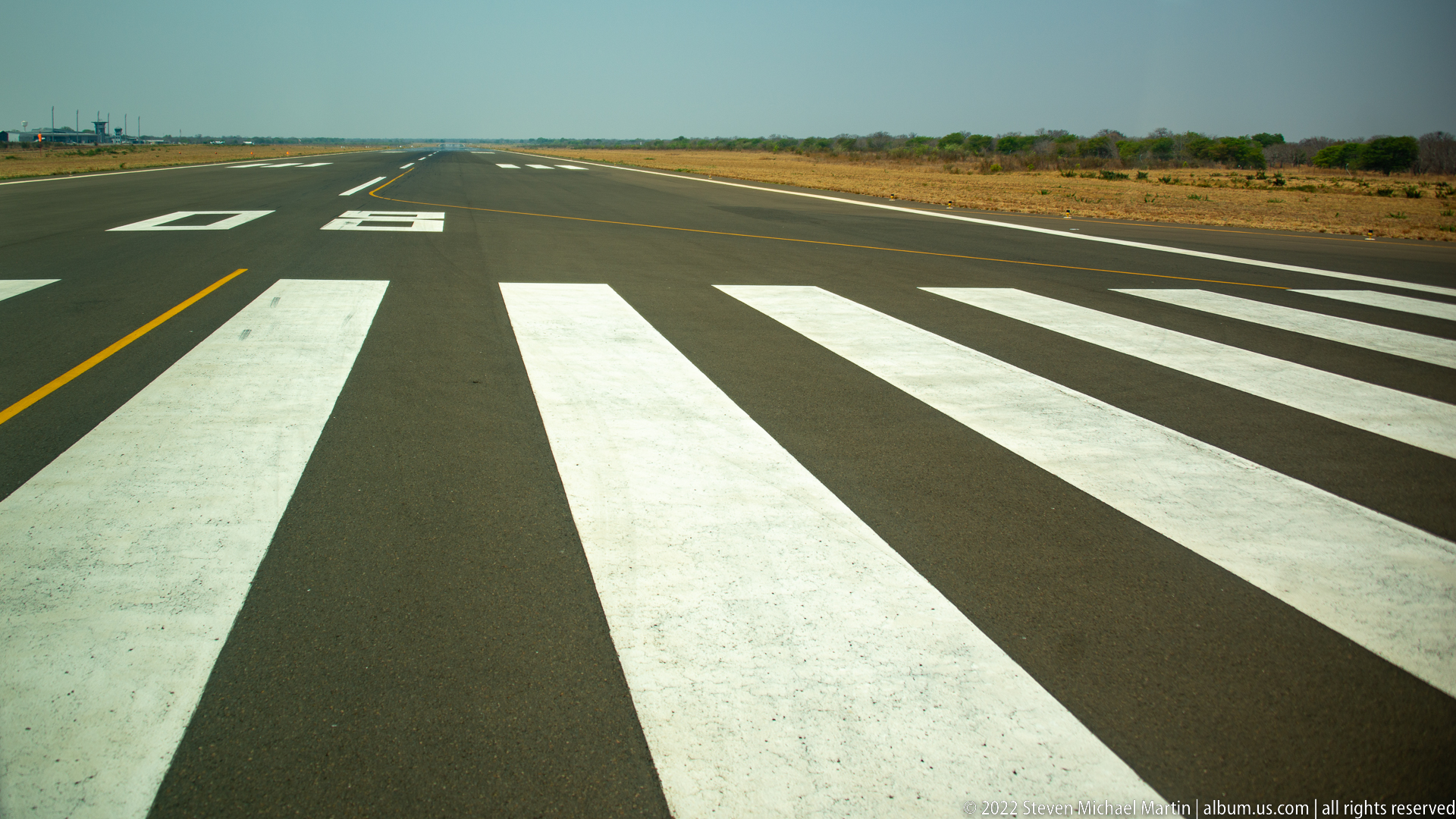
Bold white threshold bars and runway numerals fill the foreground as the aircraft moves along the paved runway at Kasane International Airport. The low viewpoint and converging markings emphasize the start of the flight into Botswana’s interior, with dry scrubland extending beyond the pavement.
Caption
Bold white threshold bars and runway numerals fill the foreground as the aircraft moves along the paved runway at Kasane International Airport. The low viewpoint and converging markings emphasize the start of the flight into Botswana’s interior, with dry scrubland extending beyond the pavement.
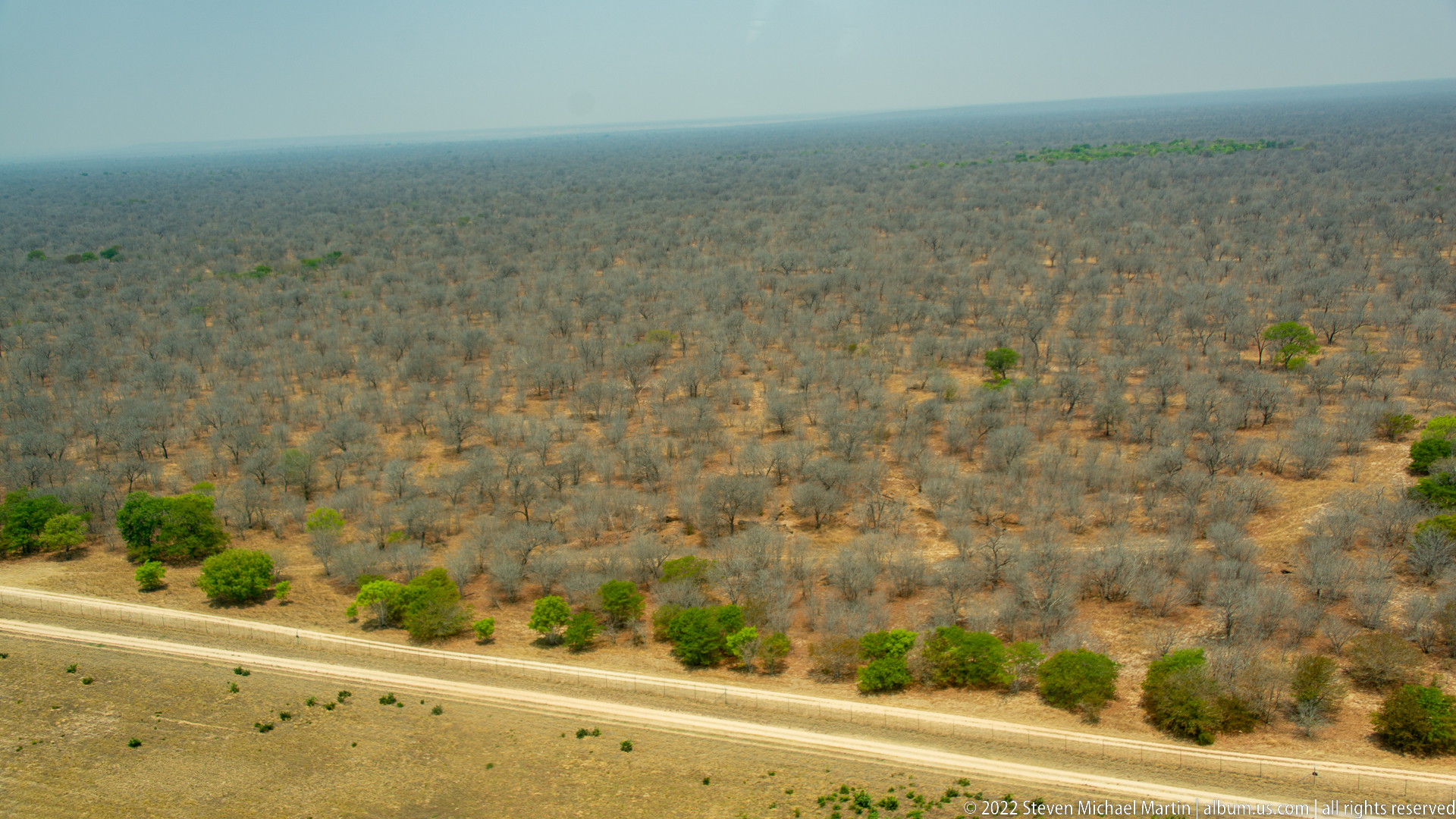
Dry-season woodland spreads beneath the aircraft in a dense pattern of gray-brown trees punctuated by scattered green crowns. A pale unpaved track cuts across the lower frame, showing the contrast between terrestrial bush country and the wetter channels encountered farther into the Okavango system.
Caption
Dry-season woodland spreads beneath the aircraft in a dense pattern of gray-brown trees punctuated by scattered green crowns. A pale unpaved track cuts across the lower frame, showing the contrast between terrestrial bush country and the wetter channels encountered farther into the Okavango system.
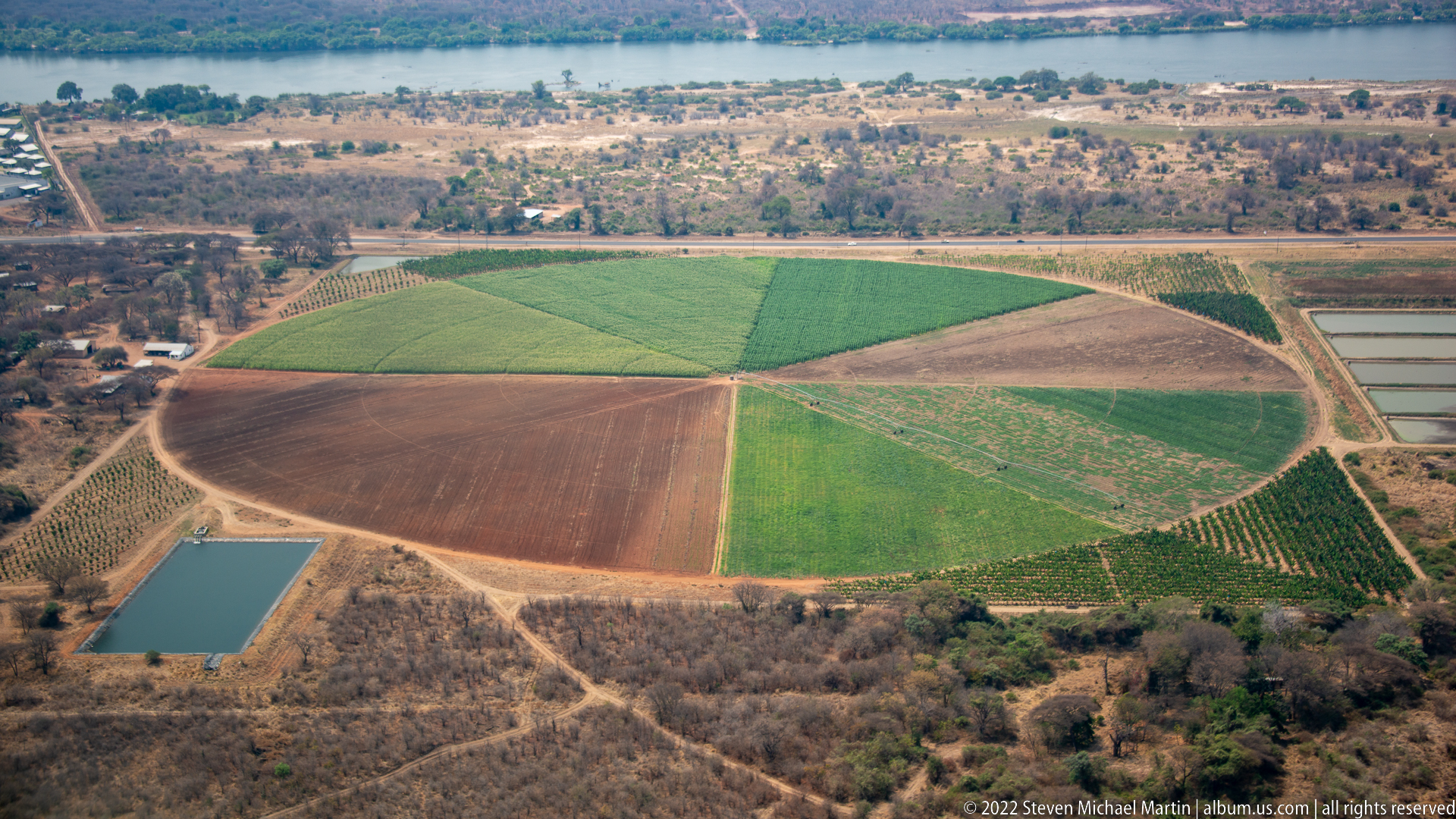
A patchwork of cultivated land interrupts the dry bush, including a broad circular field shaped by center-pivot irrigation and smaller rectangular plots and ponds. Seen from the air, the geometric agriculture contrasts sharply with the surrounding semi-arid vegetation of northern Botswana.
Caption
A patchwork of cultivated land interrupts the dry bush, including a broad circular field shaped by center-pivot irrigation and smaller rectangular plots and ponds. Seen from the air, the geometric agriculture contrasts sharply with the surrounding semi-arid vegetation of northern Botswana.
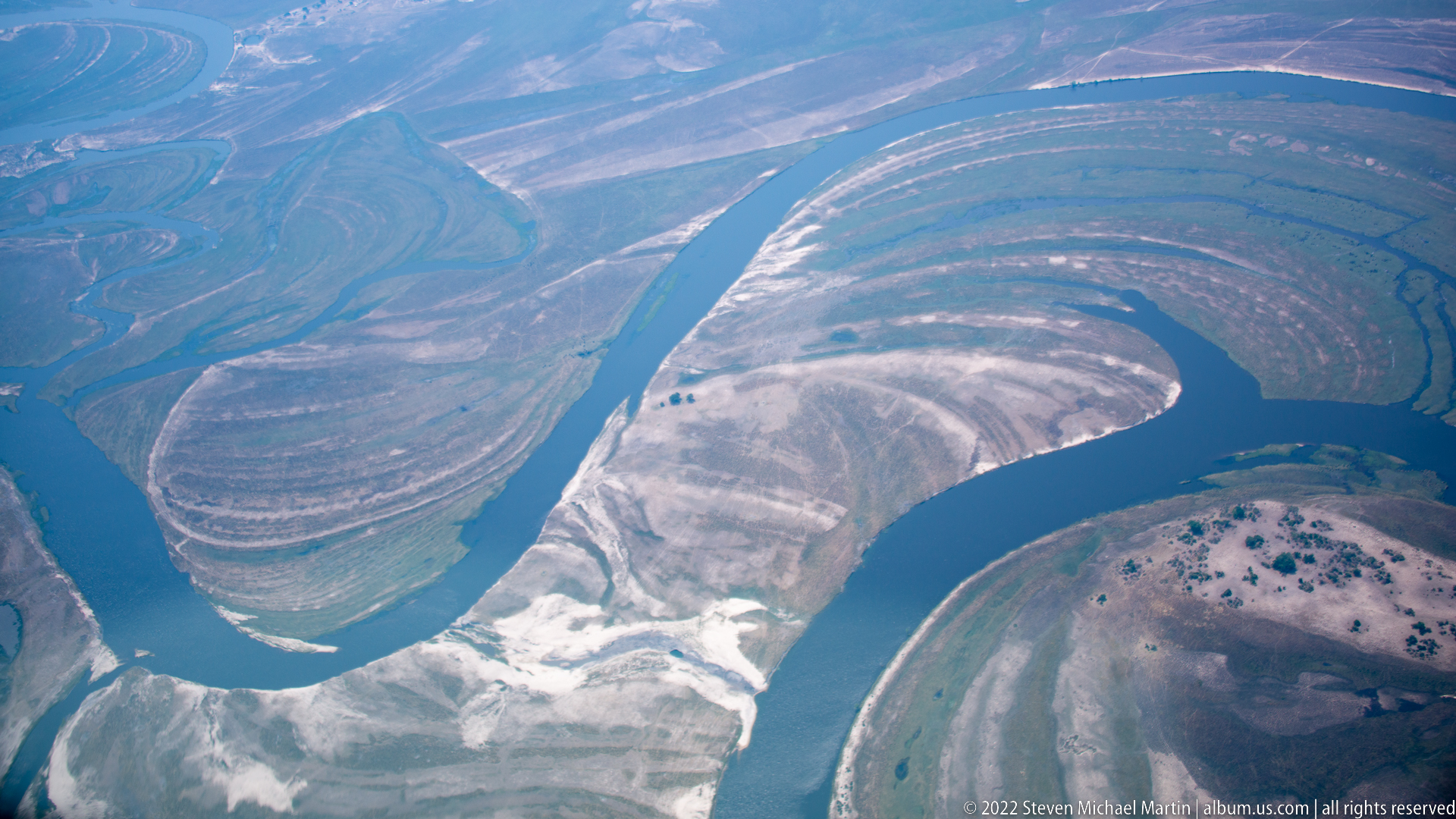
A deeply curving channel loops through pale, sparsely vegetated floodplain, its dark water sharply defining successive meander bends. Exposed light-toned sediment and older channel traces record the continual reshaping of waterways that distribute water across the wider Okavango landscape.
Caption
A deeply curving channel loops through pale, sparsely vegetated floodplain, its dark water sharply defining successive meander bends. Exposed light-toned sediment and older channel traces record the continual reshaping of waterways that distribute water across the wider Okavango landscape.
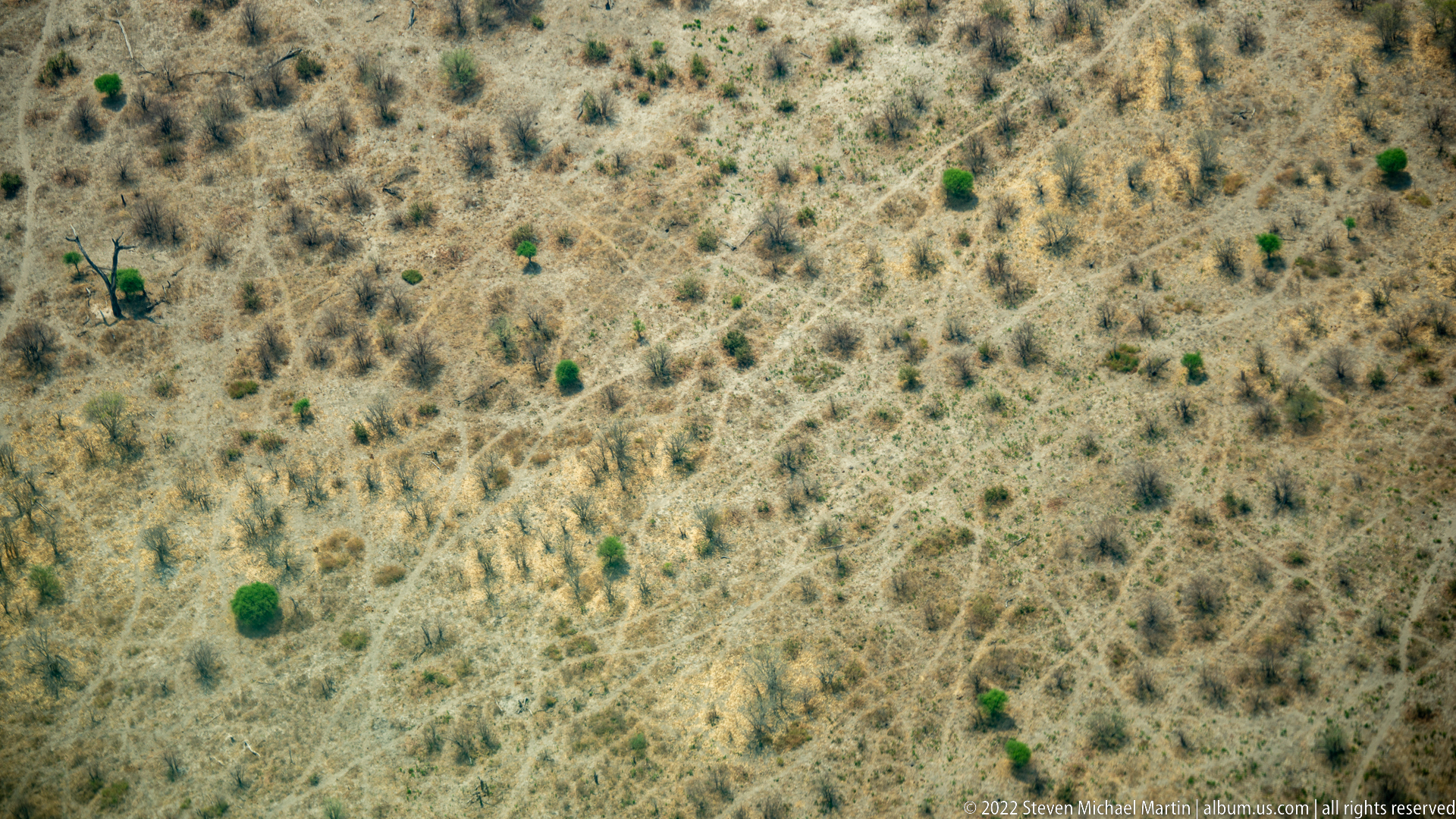
African elephants appear as small gray forms amid dry woodland scored by an intricate network of animal paths. The overhead view makes the trails especially legible, showing repeated movement through sparse vegetation toward feeding areas and water across the dry-season landscape surrounding the Okavango Delta.
Caption
African elephants appear as small gray forms amid dry woodland scored by an intricate network of animal paths. The overhead view makes the trails especially legible, showing repeated movement through sparse vegetation toward feeding areas and water across the dry-season landscape surrounding the Okavango Delta.
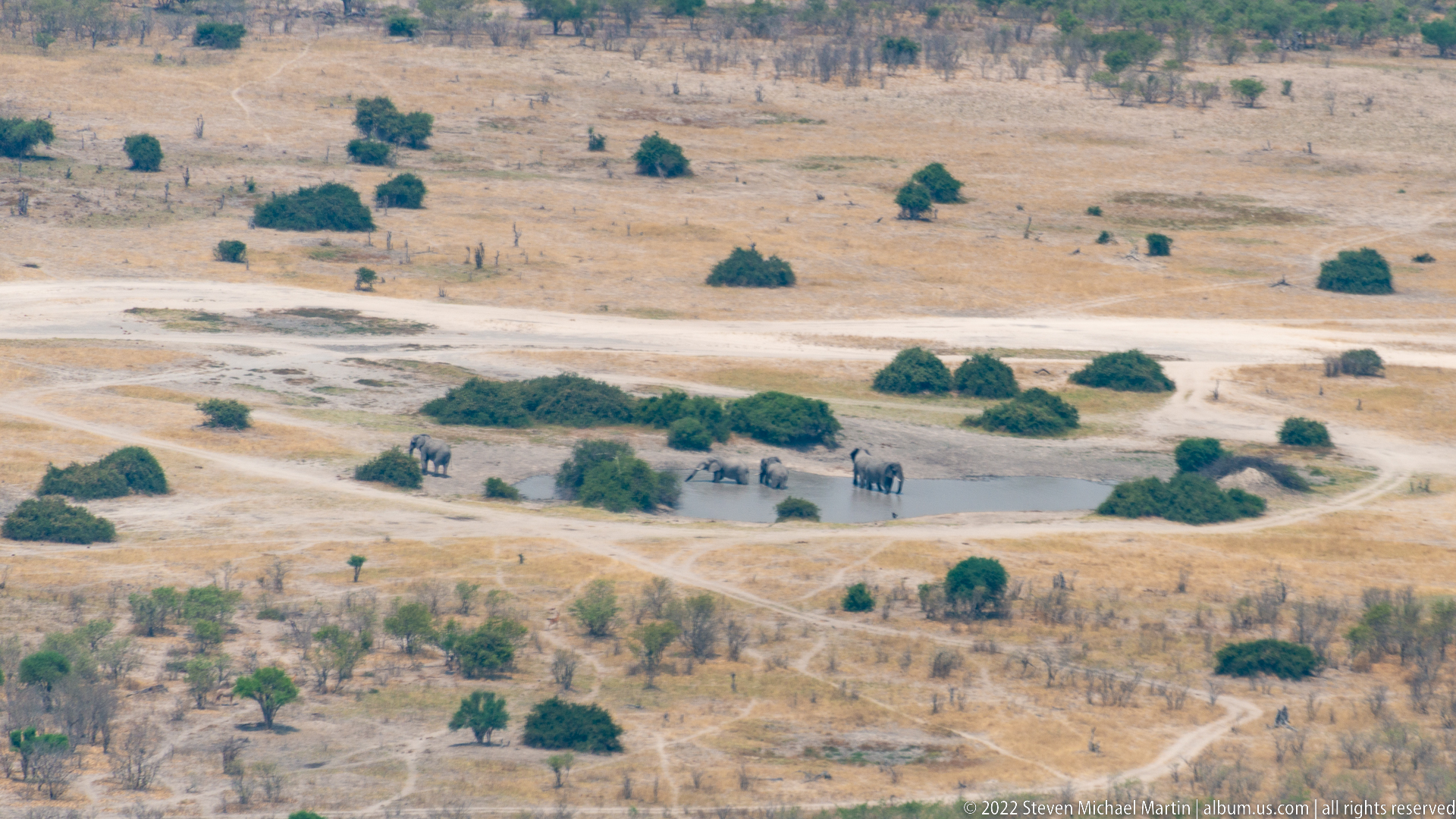
Several African elephants cluster around a small waterhole set within dry, open woodland. The elevated view places the animals, muddy pool, radiating tracks, and scattered trees in one frame, demonstrating the importance of limited surface water to wildlife during the dry season.
Caption
Several African elephants cluster around a small waterhole set within dry, open woodland. The elevated view places the animals, muddy pool, radiating tracks, and scattered trees in one frame, demonstrating the importance of limited surface water to wildlife during the dry season.
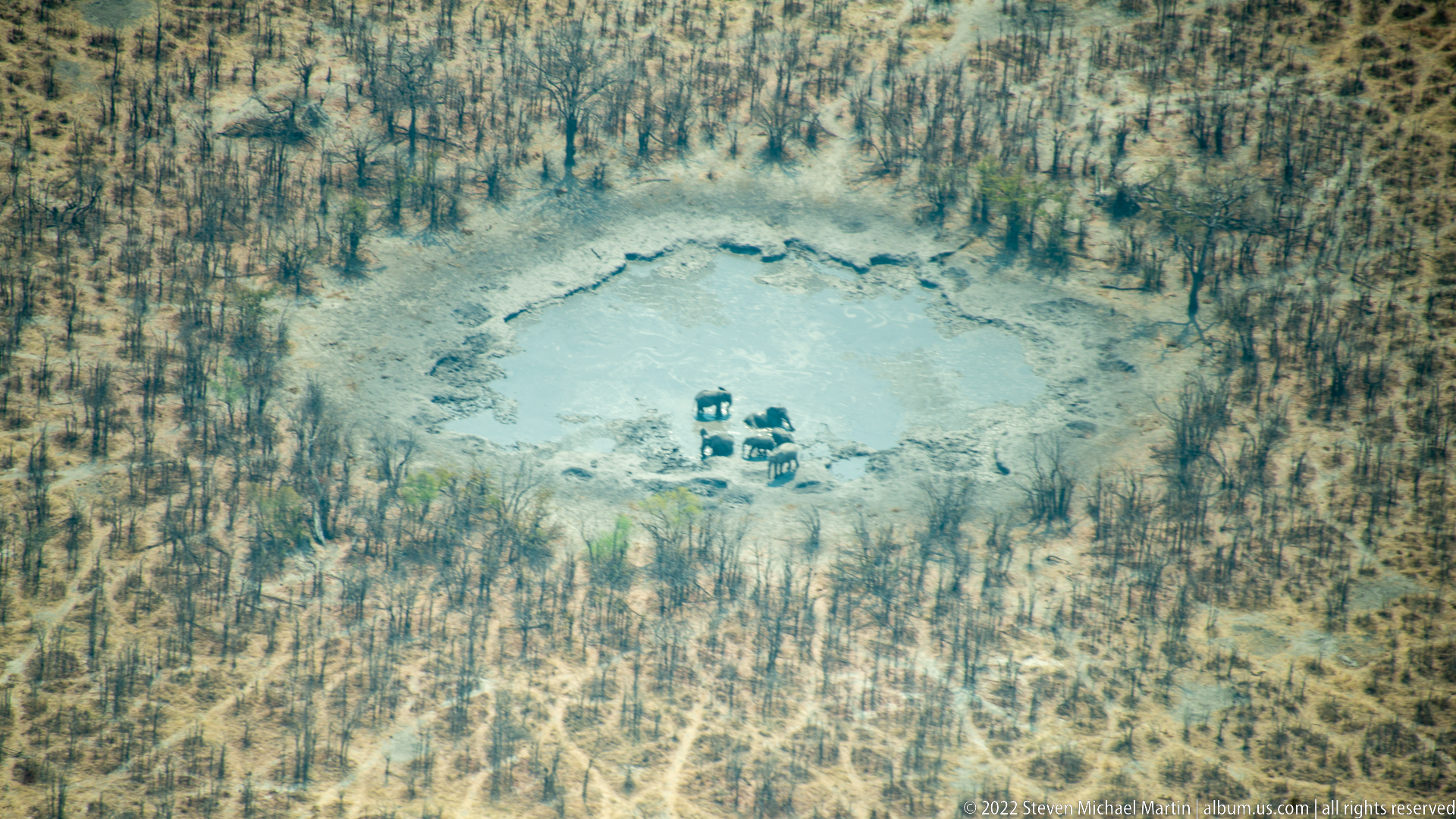
A compact herd of African elephants gathers at the center of a broad pale clearing, where a small water source darkens the otherwise dry surface. Encircling woodland and converging tracks make the watering site stand out as a focal point in the dry-season bush.
Caption
A compact herd of African elephants gathers at the center of a broad pale clearing, where a small water source darkens the otherwise dry surface. Encircling woodland and converging tracks make the watering site stand out as a focal point in the dry-season bush.
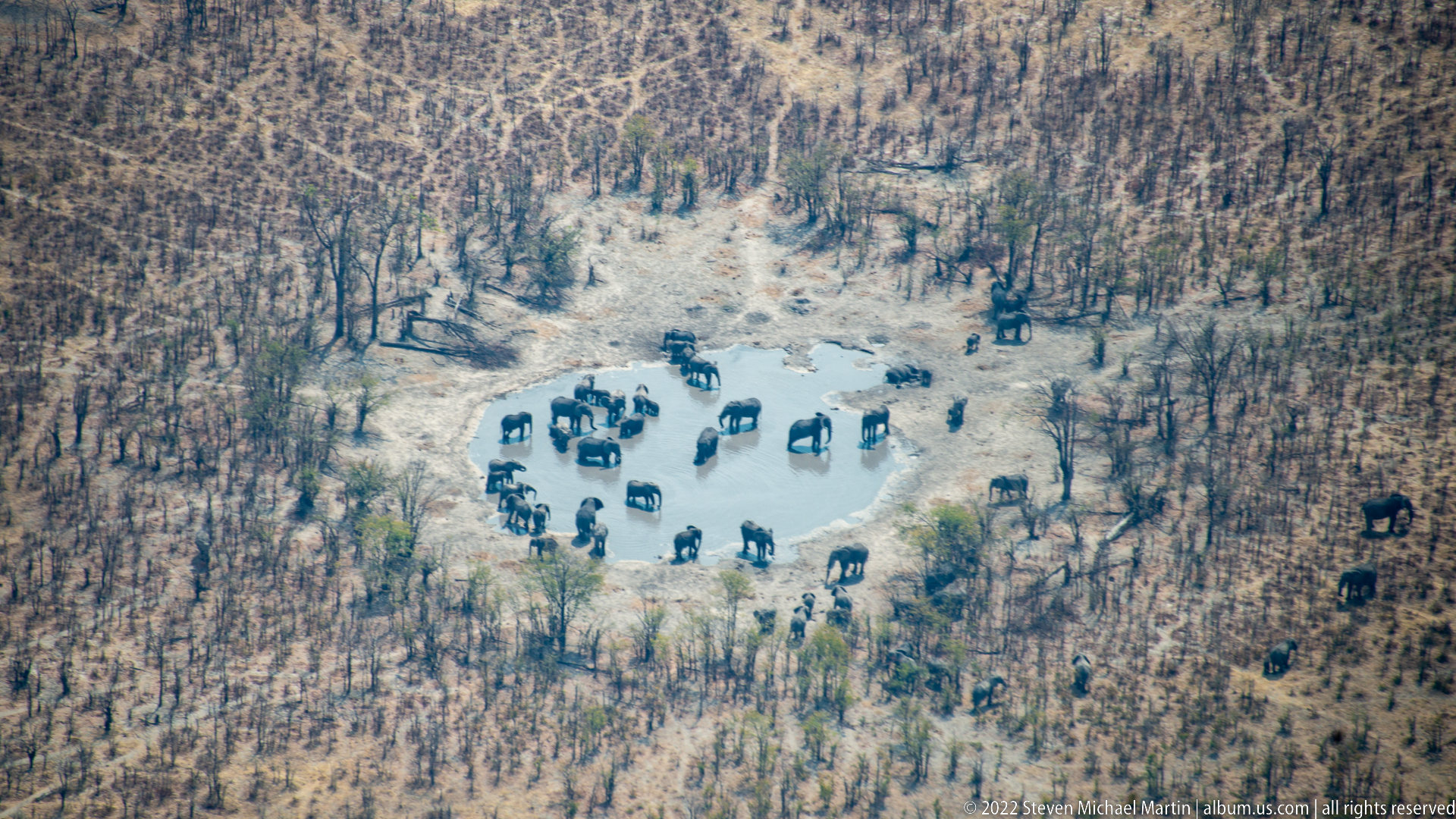
A large aggregation of African elephants surrounds a pale waterhole clearing, with animals standing at the center and others approaching through the woodland. The aerial perspective reveals both the size of the gathering and the network of paths converging on this scarce dry-season water source.
Caption
A large aggregation of African elephants surrounds a pale waterhole clearing, with animals standing at the center and others approaching through the woodland. The aerial perspective reveals both the size of the gathering and the network of paths converging on this scarce dry-season water source.
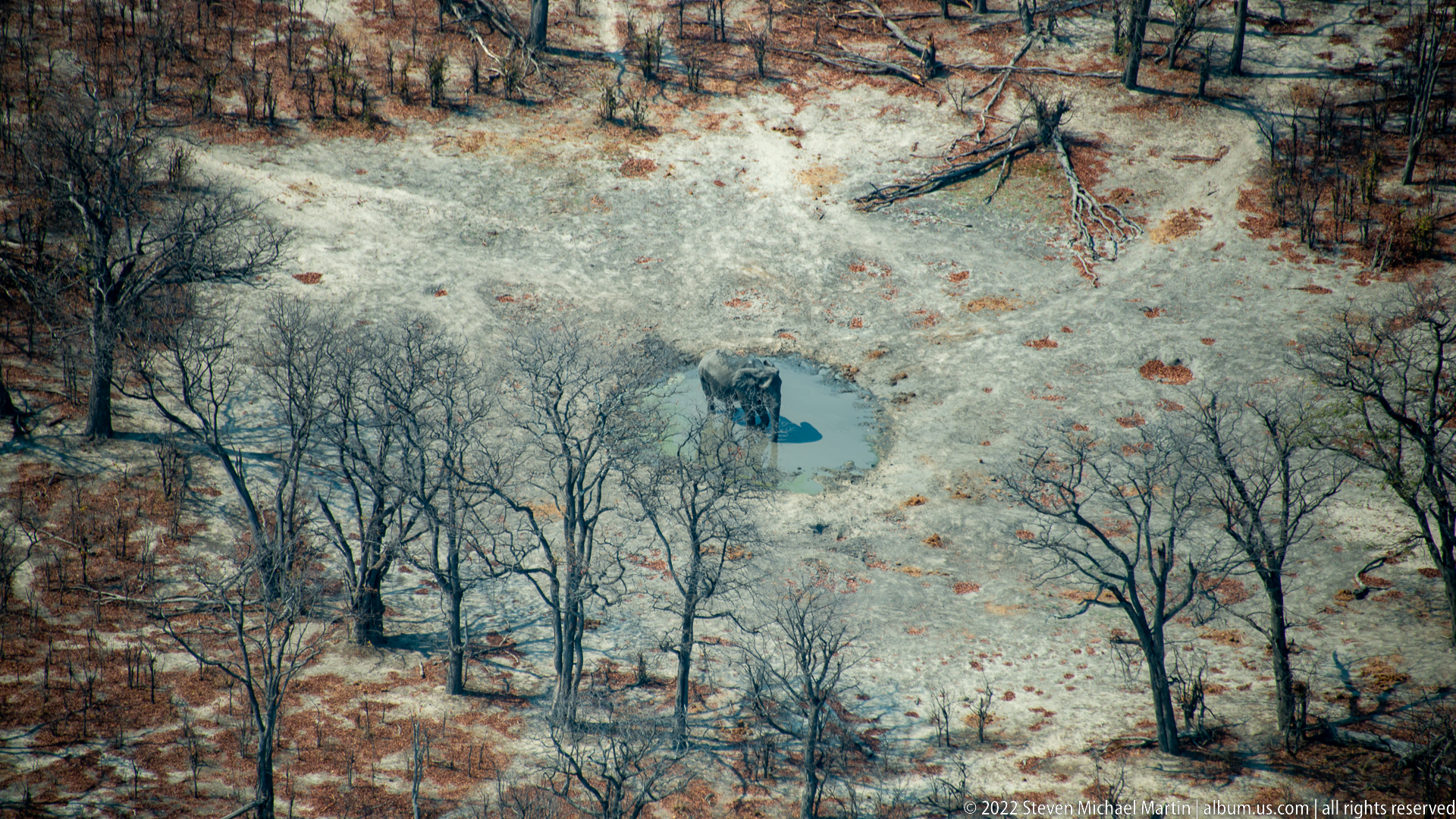
Two African elephants stand at a tiny pool within leaf-poor woodland, their gray bodies contrasting with pale soil and dark branching trees. The close aerial composition isolates the animals and water source, emphasizing the localized patches of moisture used by wildlife during the dry season.
Caption
Two African elephants stand at a tiny pool within leaf-poor woodland, their gray bodies contrasting with pale soil and dark branching trees. The close aerial composition isolates the animals and water source, emphasizing the localized patches of moisture used by wildlife during the dry season.
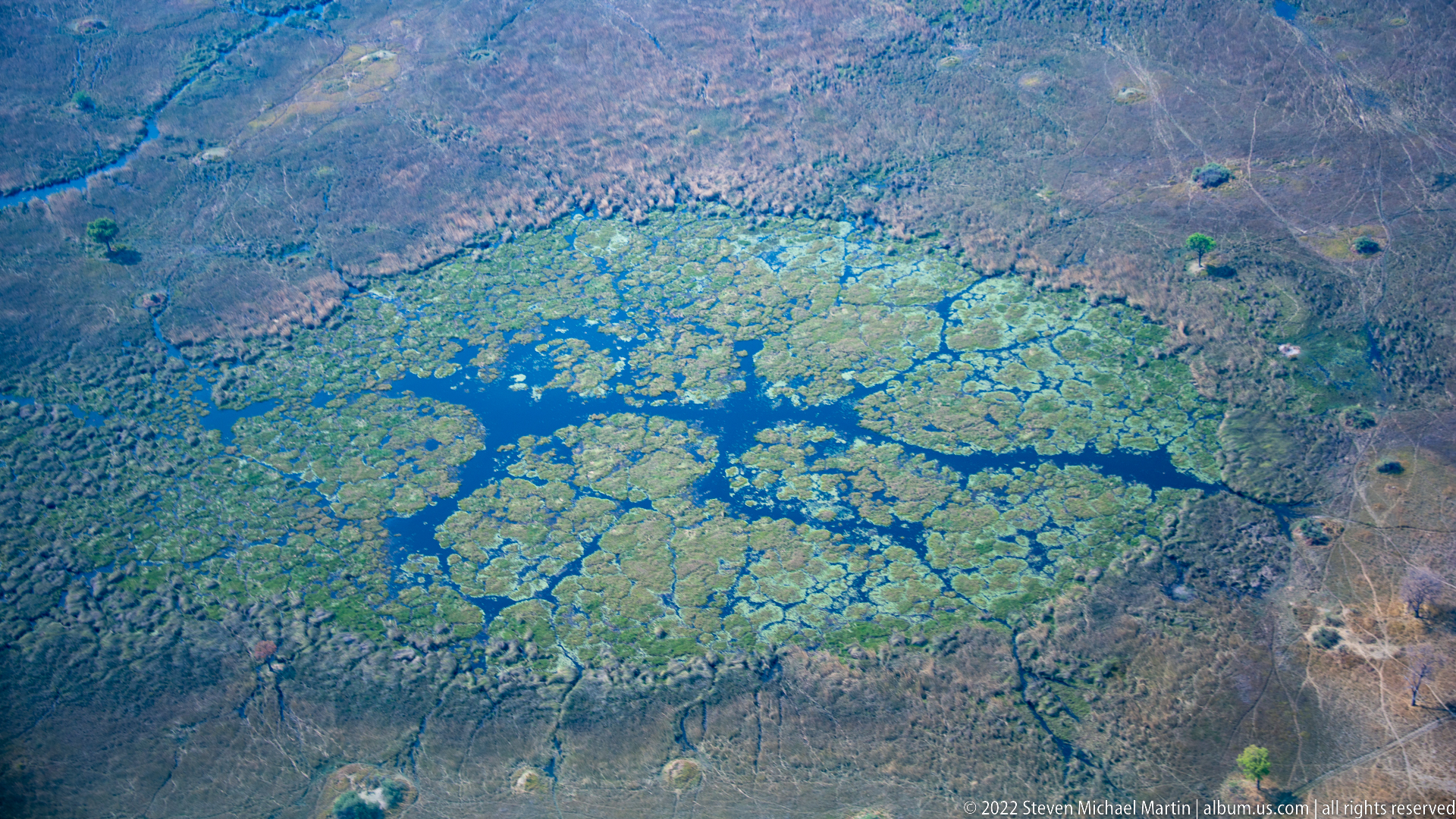
Open blue water forms an irregular patchwork among dense green wetland vegetation, creating islands and narrow channels within the Okavango Delta. From above, the saturated center stands in sharp contrast to the surrounding drier floodplain, illustrating the delta’s mosaic of permanent marsh and seasonally inundated ground.
Caption
Open blue water forms an irregular patchwork among dense green wetland vegetation, creating islands and narrow channels within the Okavango Delta. From above, the saturated center stands in sharp contrast to the surrounding drier floodplain, illustrating the delta’s mosaic of permanent marsh and seasonally inundated ground.
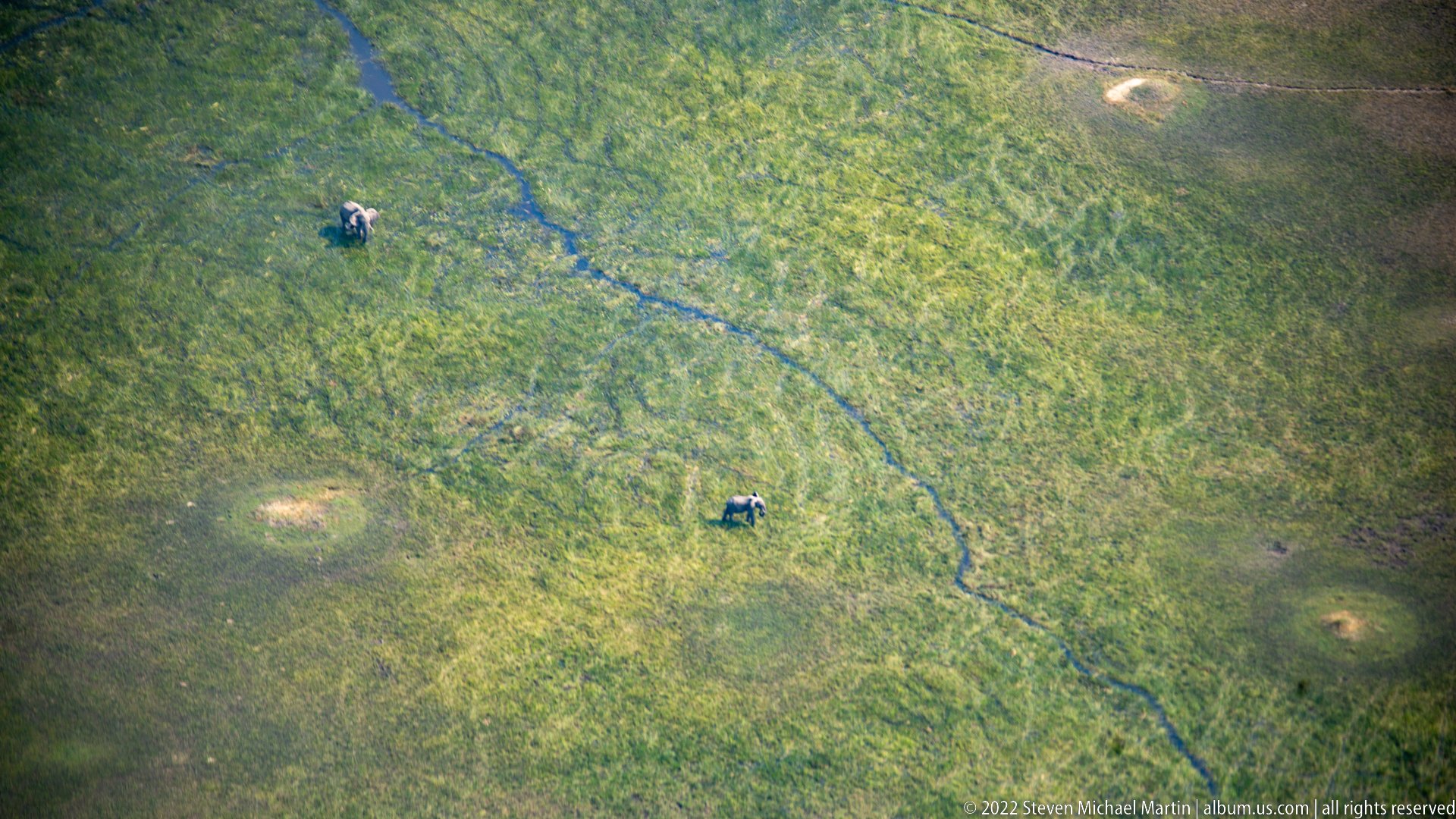
Two small groups of African elephants move across a vivid green floodplain, linked visually by a narrow dark trail through the grass. The overhead view emphasizes the scale of the wetland landscape and the routes large mammals follow between islands, feeding areas, and water.
Caption
Two small groups of African elephants move across a vivid green floodplain, linked visually by a narrow dark trail through the grass. The overhead view emphasizes the scale of the wetland landscape and the routes large mammals follow between islands, feeding areas, and water.
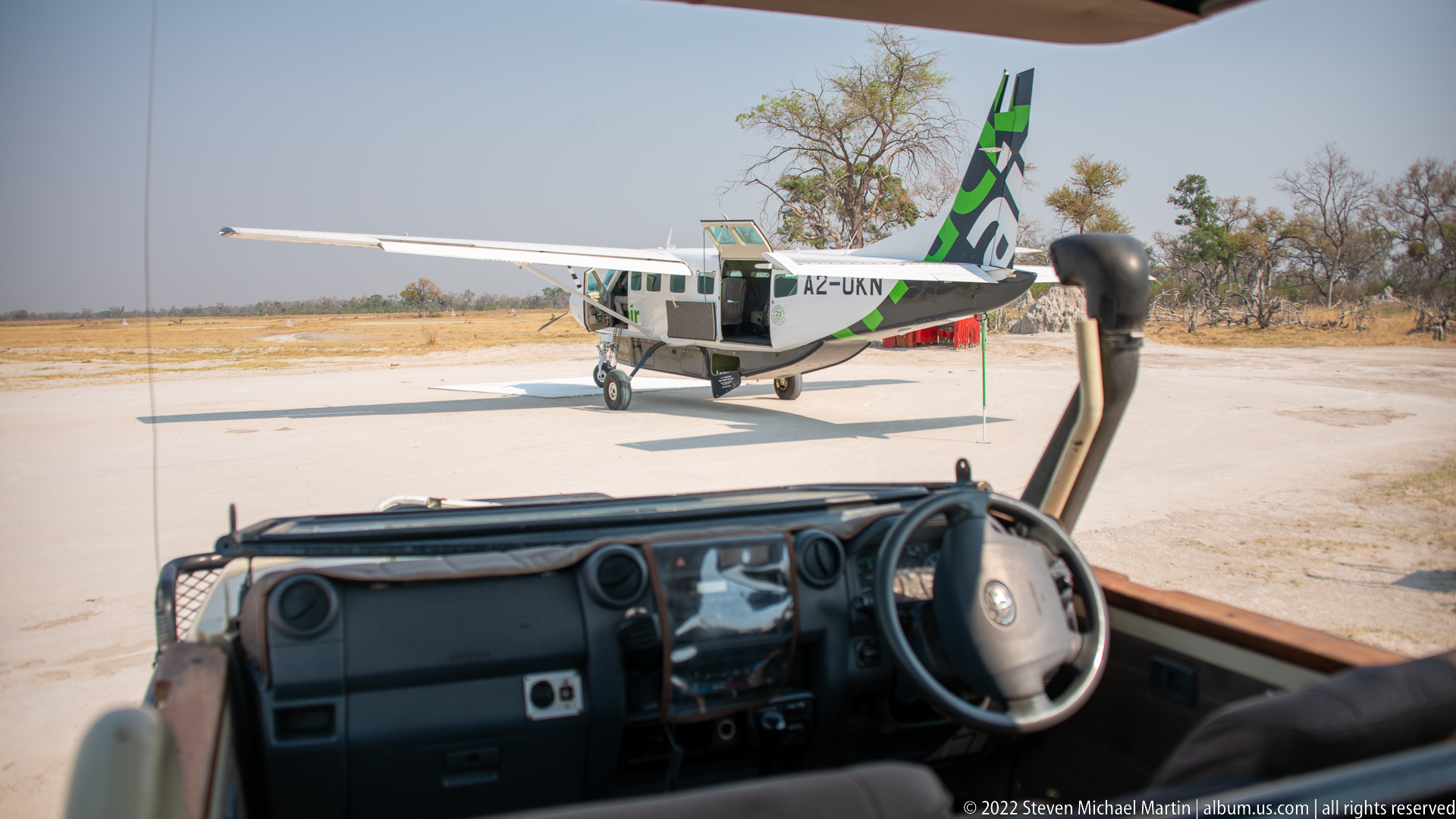
A safari vehicle waits beside the airstrip with the Mack Air plane visible ahead, linking two characteristic modes of transport in the Okavango Delta. The open vehicle’s dashboard and raised intake fill the foreground while the aircraft stands beyond, ready for the next transfer.
Caption
A safari vehicle waits beside the airstrip with the Mack Air plane visible ahead, linking two characteristic modes of transport in the Okavango Delta. The open vehicle’s dashboard and raised intake fill the foreground while the aircraft stands beyond, ready for the next transfer.
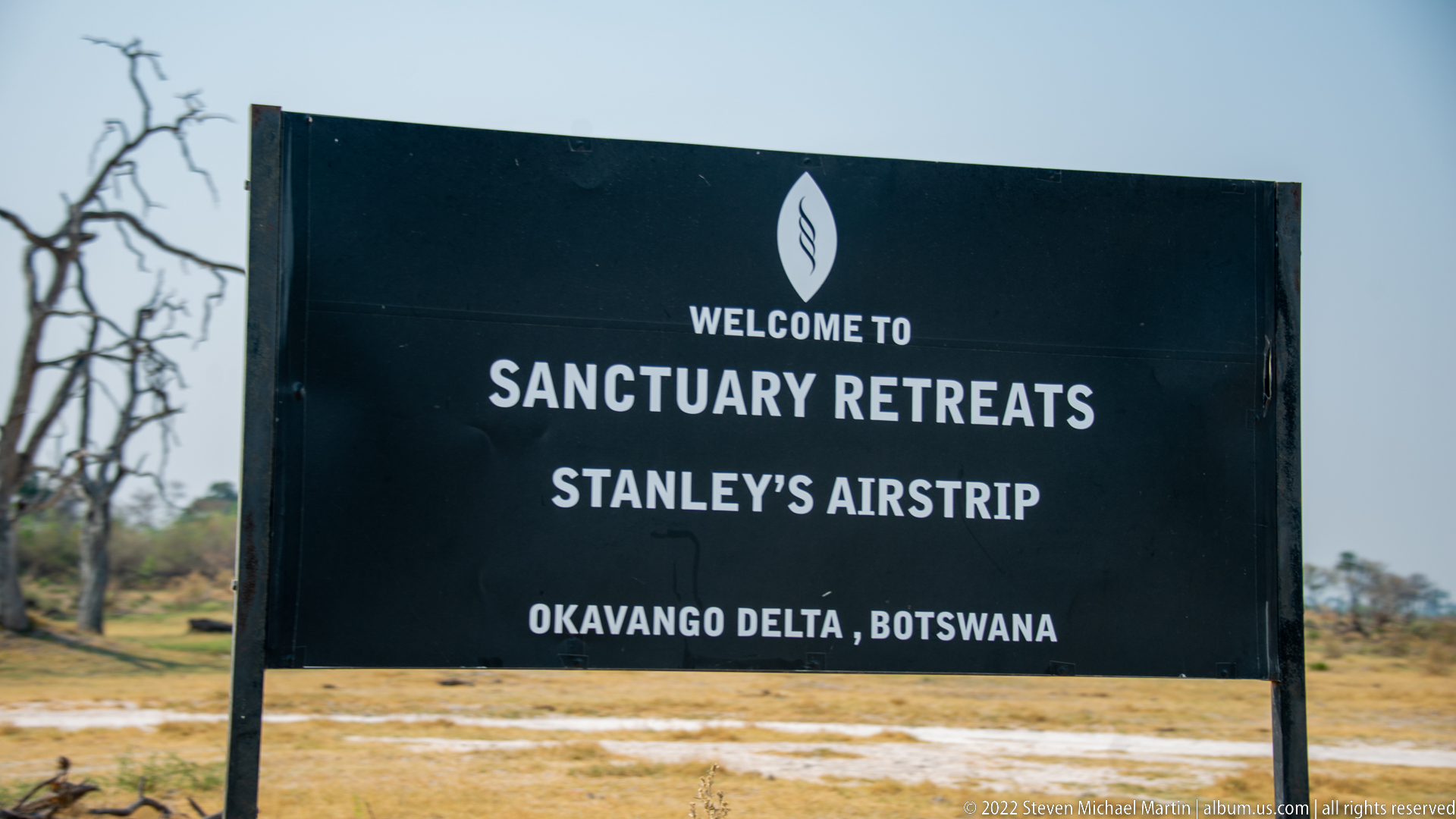
A black welcome sign identifies Sanctuary Retreats’ Stanley’s Airstrip in the Okavango Delta, Botswana. Set against sandy ground and sparse woodland, the sign provides a precise geographic marker for the transition from bush-plane transfer to the overland journey toward Stanley’s Camp.
Caption
A black welcome sign identifies Sanctuary Retreats’ Stanley’s Airstrip in the Okavango Delta, Botswana. Set against sandy ground and sparse woodland, the sign provides a precise geographic marker for the transition from bush-plane transfer to the overland journey toward Stanley’s Camp.
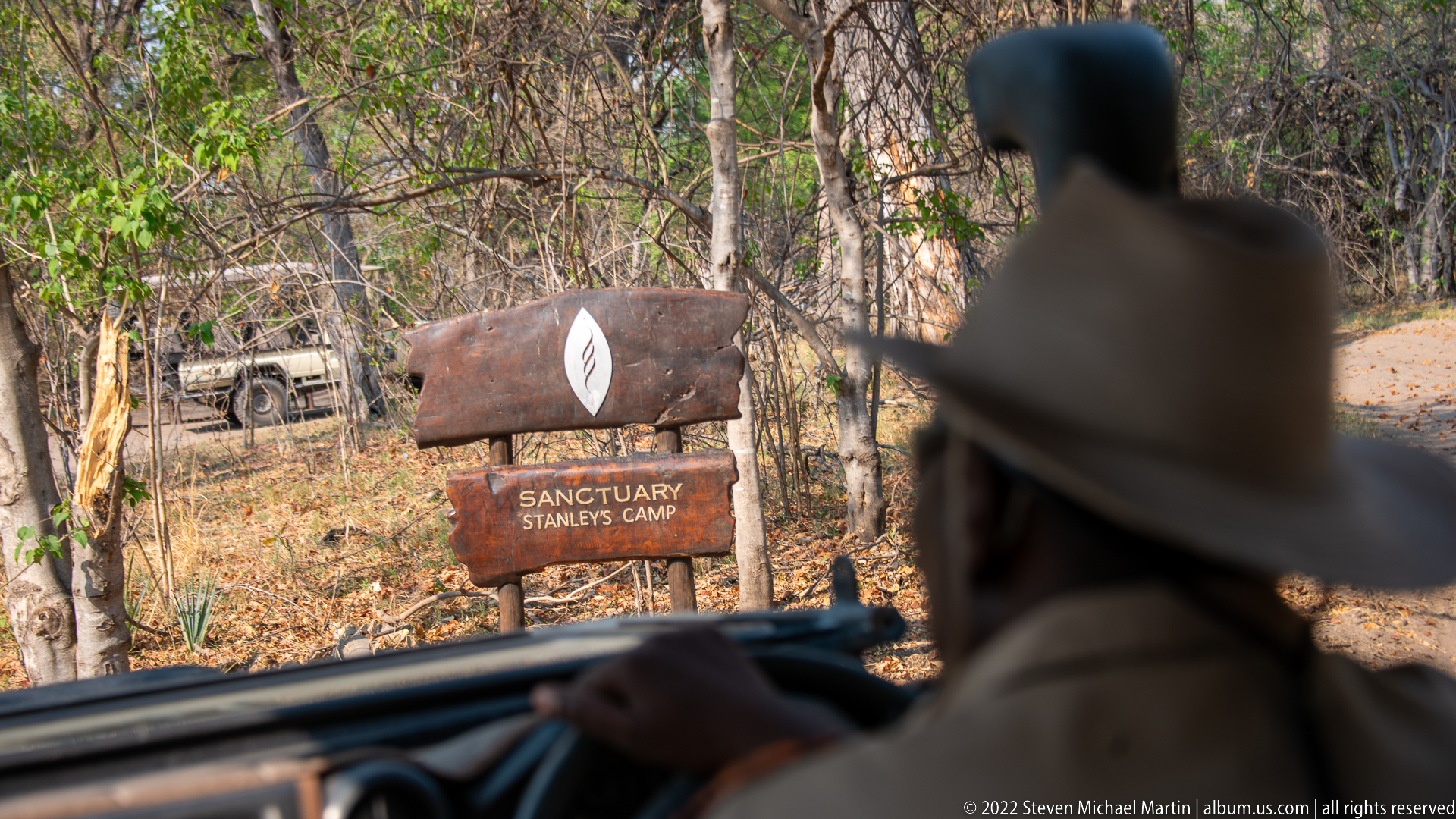
A rustic wooden sign for Sanctuary Stanley’s Camp appears beside the sandy approach road as the safari vehicle enters the property. Framed over the driver’s shoulder, the view records the final stage of the transfer from Stanley’s Airstrip into a wooded camp setting within the Okavango Delta.
Caption
A rustic wooden sign for Sanctuary Stanley’s Camp appears beside the sandy approach road as the safari vehicle enters the property. Framed over the driver’s shoulder, the view records the final stage of the transfer from Stanley’s Airstrip into a wooded camp setting within the Okavango Delta.
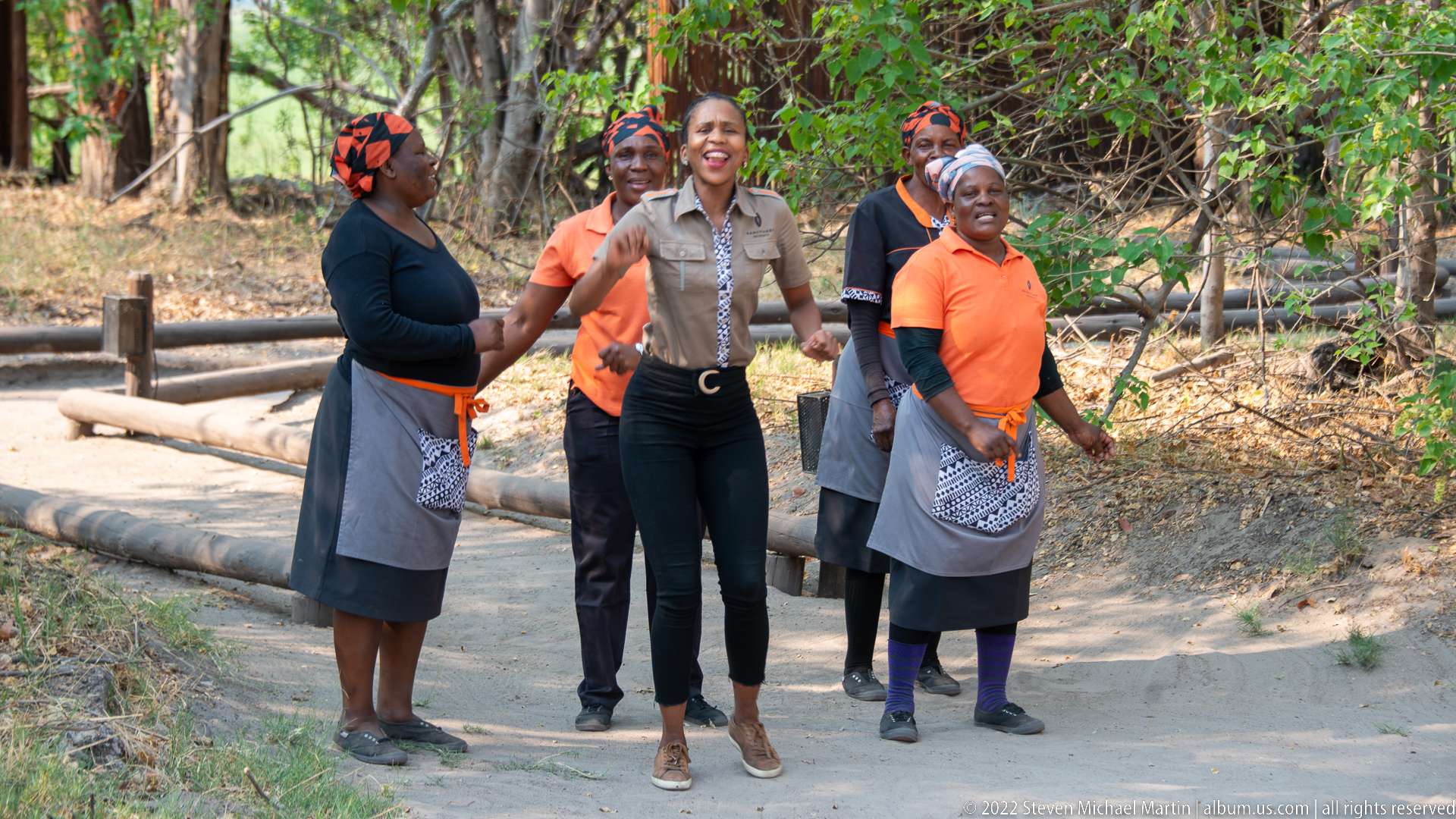
Members of the Stanley’s Camp team gather beside the sandy arrival path in a lively welcome, wearing coordinated orange, gray, and dark uniforms. Their smiles, gestures, and close formation shift the sequence from landscape and transport to the human hospitality of an Okavango safari camp.
Caption
Members of the Stanley’s Camp team gather beside the sandy arrival path in a lively welcome, wearing coordinated orange, gray, and dark uniforms. Their smiles, gestures, and close formation shift the sequence from landscape and transport to the human hospitality of an Okavango safari camp.
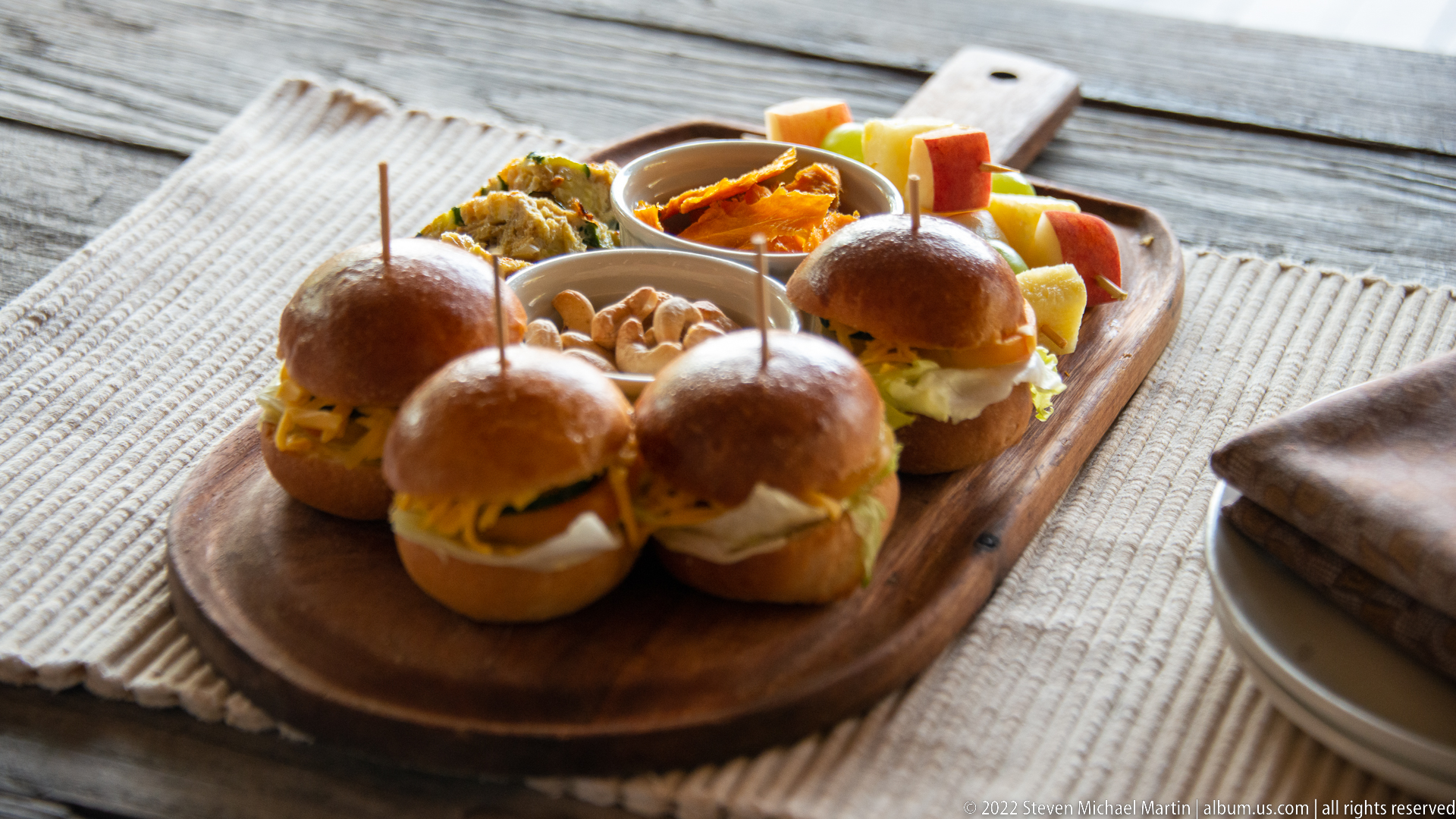
A wooden serving board presents small savory sliders with additional snacks and colorful accompaniments, arranged as arrival refreshments at Stanley’s Camp. The close tabletop view emphasizes the informal hospitality offered after the bush-plane and vehicle transfer into the Okavango Delta.
Caption
A wooden serving board presents small savory sliders with additional snacks and colorful accompaniments, arranged as arrival refreshments at Stanley’s Camp. The close tabletop view emphasizes the informal hospitality offered after the bush-plane and vehicle transfer into the Okavango Delta.
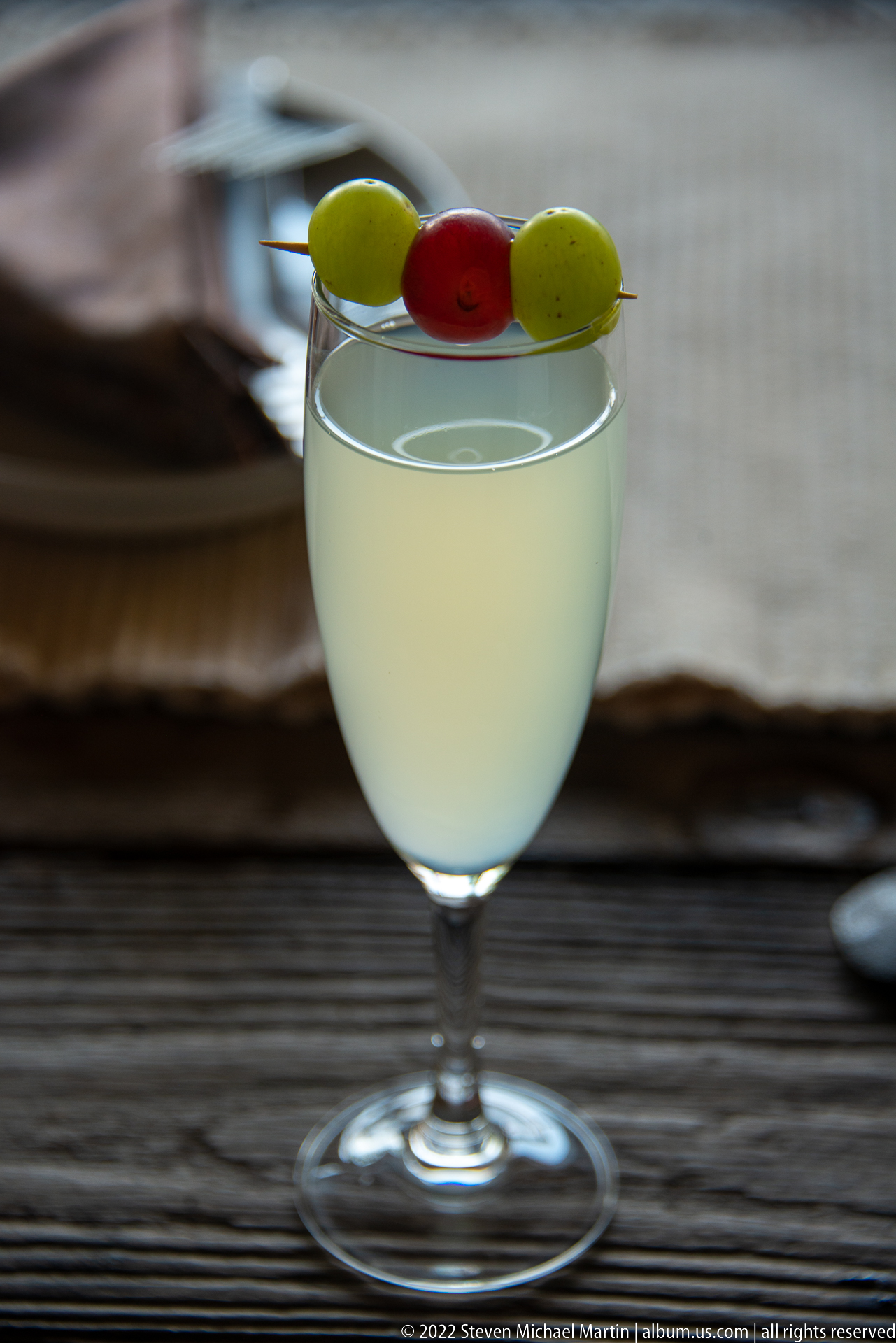
A pale chilled welcome drink is served in a stemmed glass with a colorful three-piece garnish balanced across the rim. Isolated against the dark tabletop, the simple presentation turns a small moment of refreshment into a polished detail of the arrival experience at the Okavango camp.
Caption
A pale chilled welcome drink is served in a stemmed glass with a colorful three-piece garnish balanced across the rim. Isolated against the dark tabletop, the simple presentation turns a small moment of refreshment into a polished detail of the arrival experience at the Okavango camp.
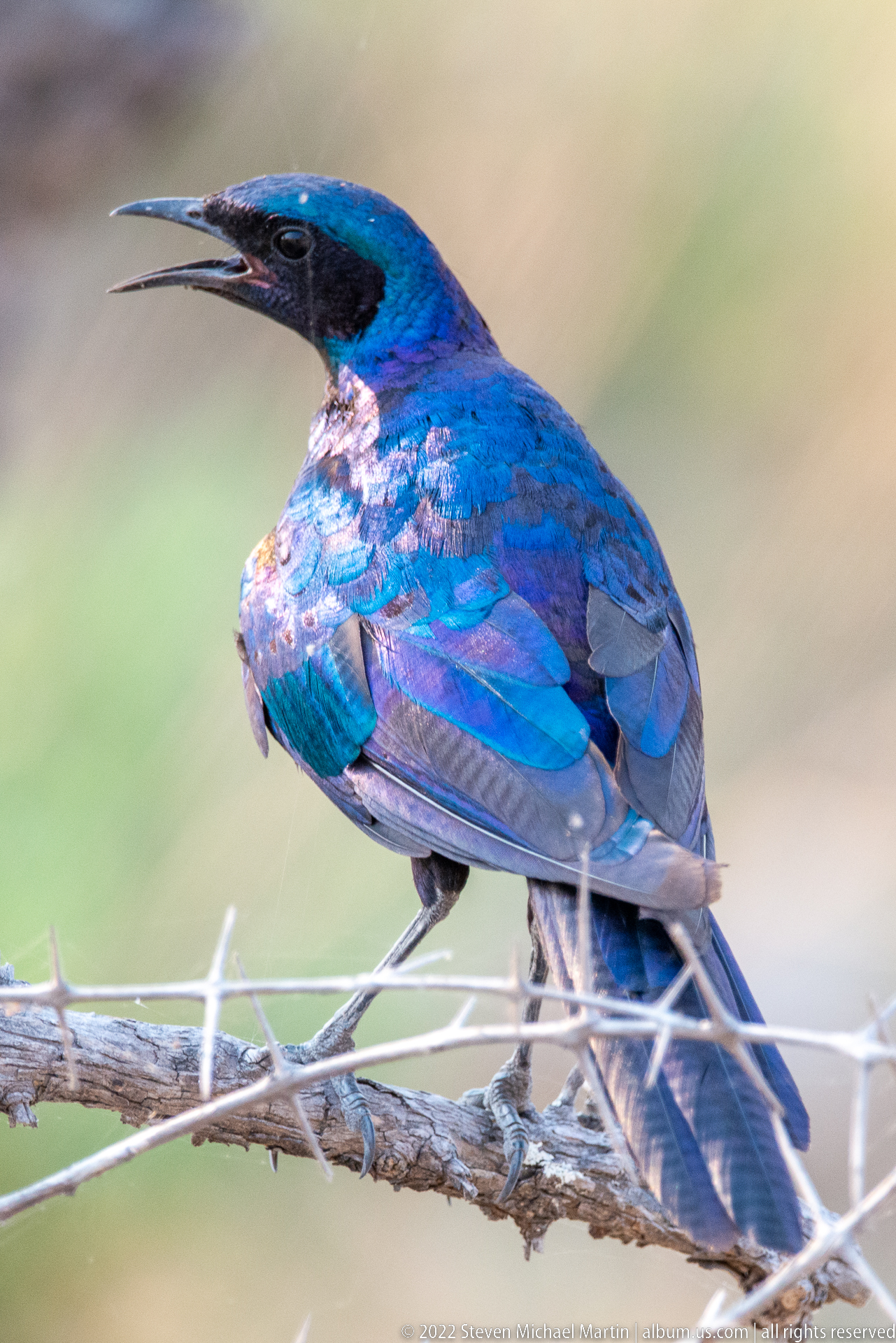
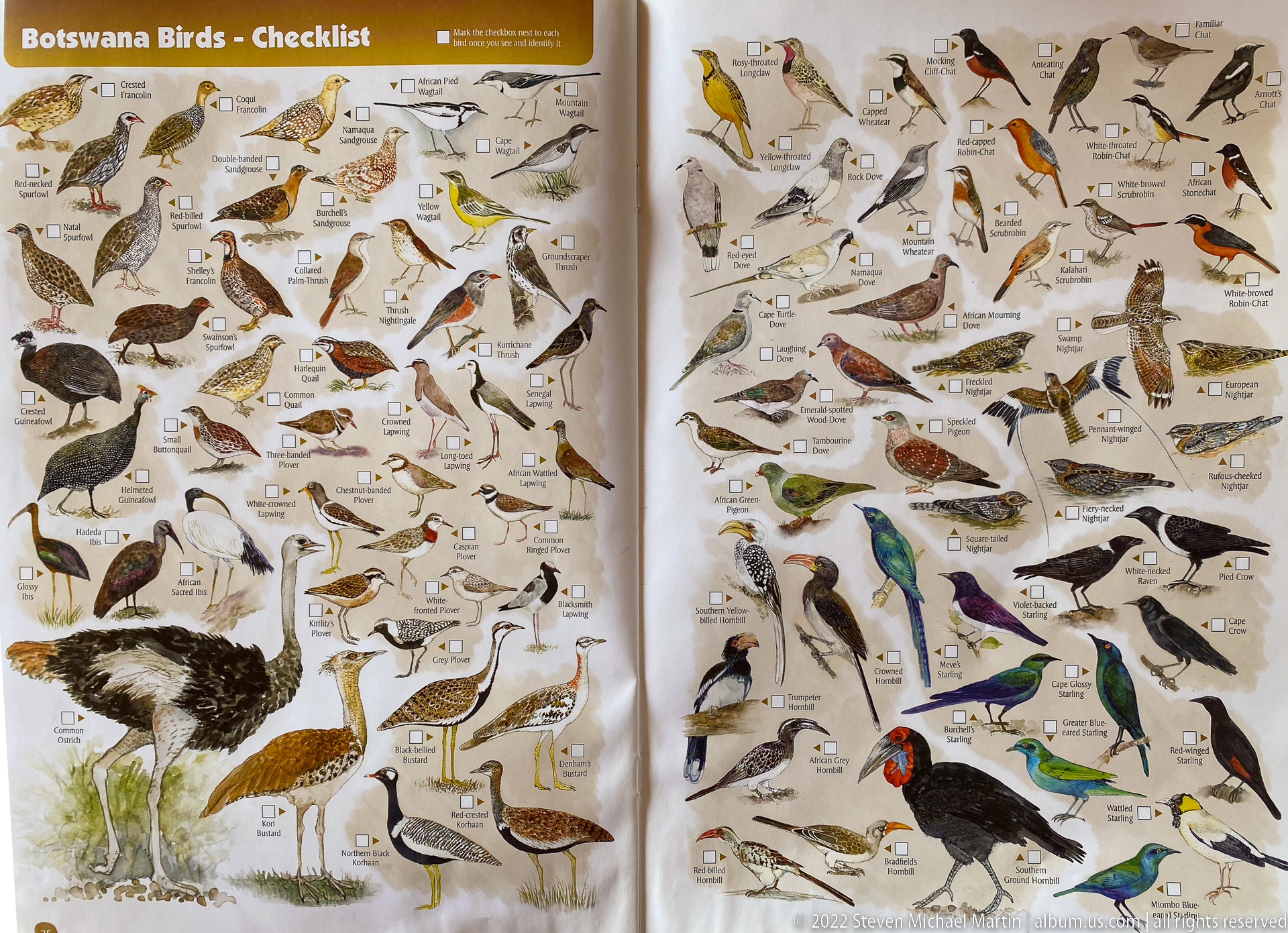
Iridescent blue, turquoise, and violet feathering dominates this close side view of a greater blue-eared starling. The bird’s black facial mask and slender dark bill remain sharply defined while the shallow depth of field isolates its layered wing coverts and long tail, making plumage structure rather than habitat the focus of the portrait.
Caption
Iridescent blue, turquoise, and violet feathering dominates this close side view of a greater blue-eared starling. The bird’s black facial mask and slender dark bill remain sharply defined while the shallow depth of field isolates its layered wing coverts and long tail, making plumage structure rather than habitat the focus of the portrait.
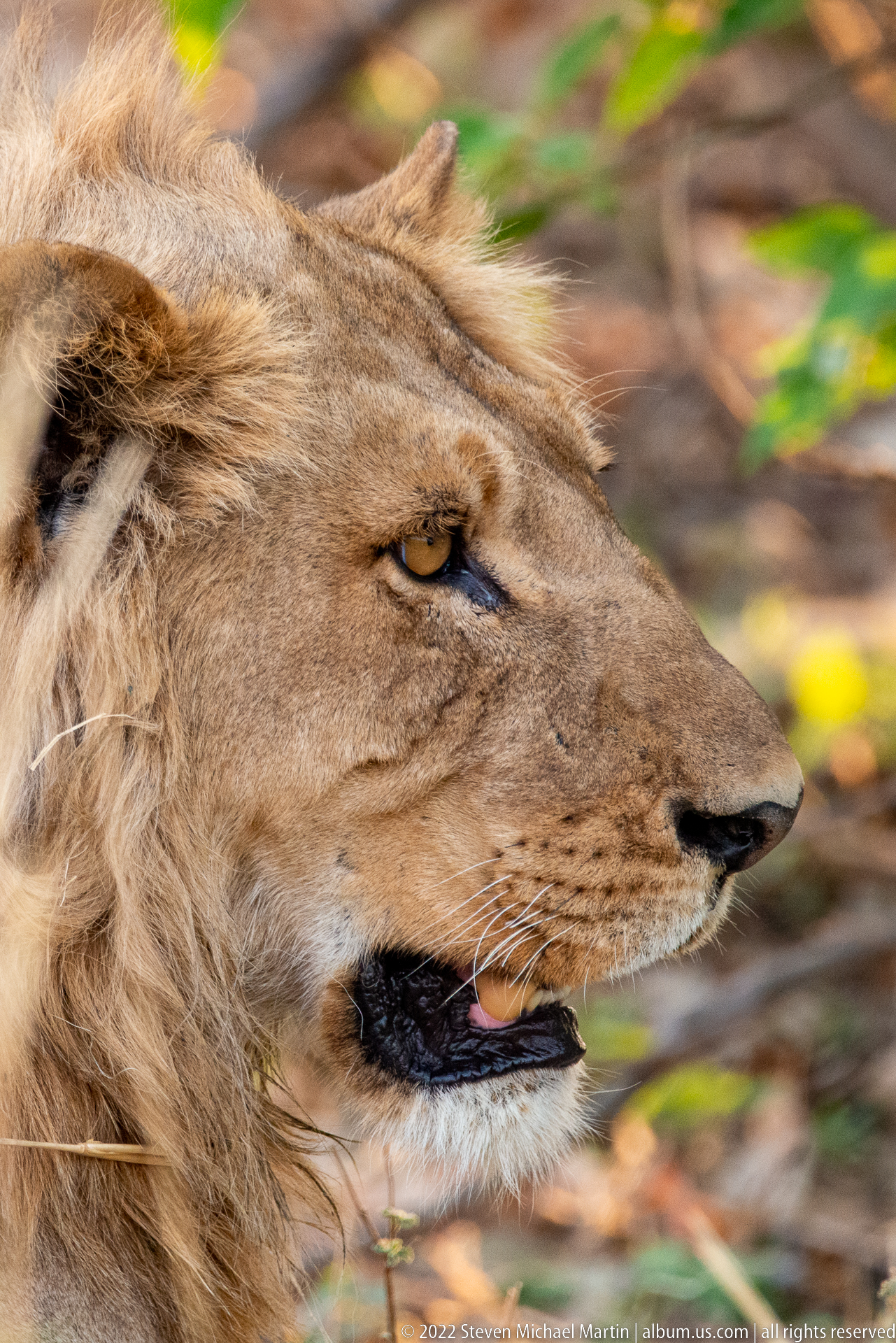
A male lion rests in shade with his mouth slightly open, exposing the dark lips and lower teeth as he pants. Seen in tight side profile, the photograph isolates the tawny face, amber eye, whiskers, and coarse mane while dappled foliage softens the woodland background.
Caption
A male lion rests in shade with his mouth slightly open, exposing the dark lips and lower teeth as he pants. Seen in tight side profile, the photograph isolates the tawny face, amber eye, whiskers, and coarse mane while dappled foliage softens the woodland background.
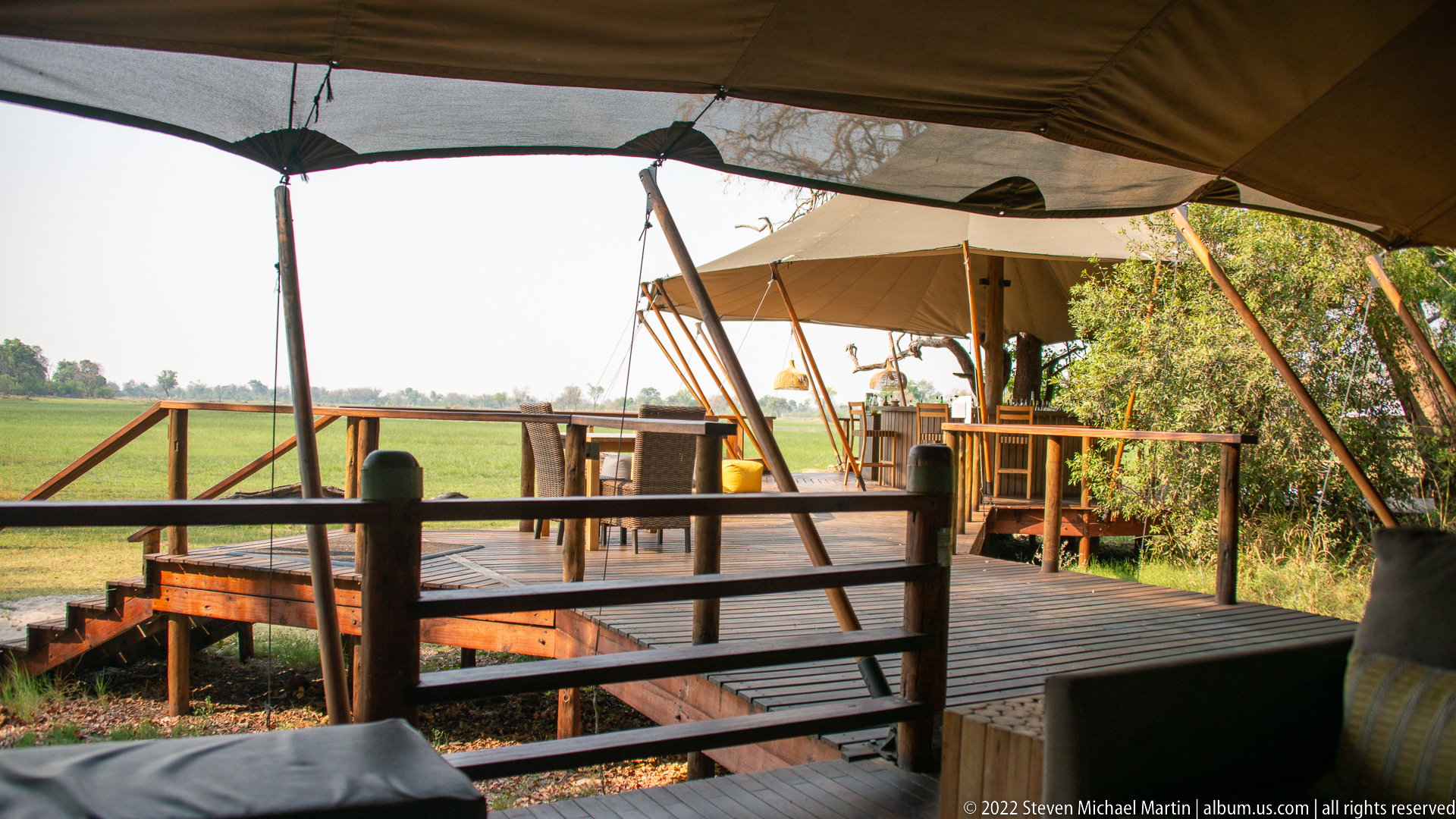
Raised timber decking connects open-sided canvas lounge structures at Stanley’s Camp, with seating and dining areas oriented toward the green floodplain beyond. The elevated platform creates an indoor-outdoor living space while keeping camp circulation above sandy or seasonally damp ground.
Caption
Raised timber decking connects open-sided canvas lounge structures at Stanley’s Camp, with seating and dining areas oriented toward the green floodplain beyond. The elevated platform creates an indoor-outdoor living space while keeping camp circulation above sandy or seasonally damp ground.
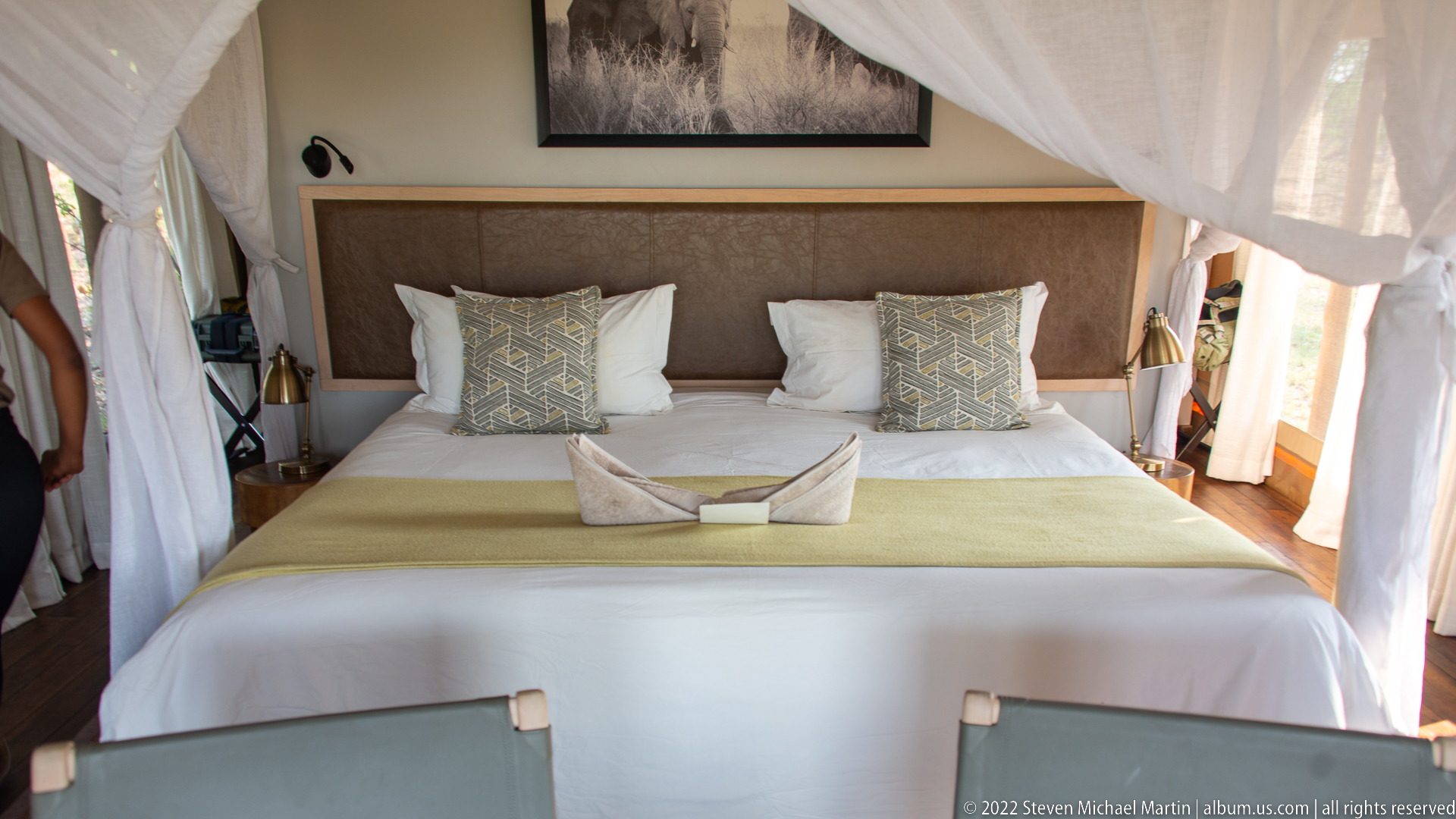
A neatly prepared guest bed fills a canvas-walled accommodation at Stanley’s Camp, framed by white mosquito netting and patterned cushions. Soft neutral textiles, bedside lamps, and the tented enclosure combine the practical requirements of bush lodging with the comfort expected of a permanent safari camp.
Caption
A neatly prepared guest bed fills a canvas-walled accommodation at Stanley’s Camp, framed by white mosquito netting and patterned cushions. Soft neutral textiles, bedside lamps, and the tented enclosure combine the practical requirements of bush lodging with the comfort expected of a permanent safari camp.
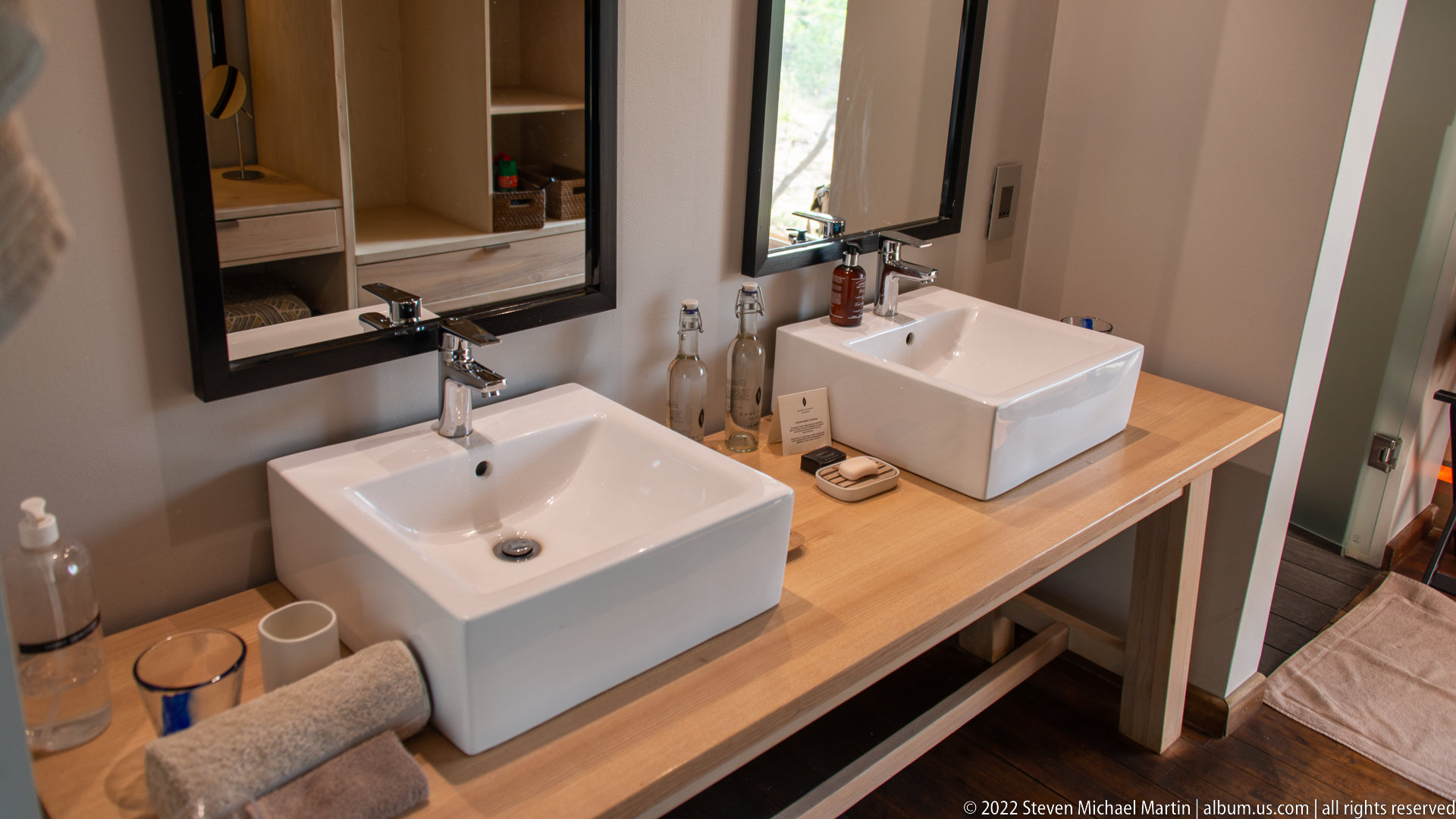
Two square vessel sinks sit side by side on a pale wooden vanity beneath framed mirrors, creating a compact double wash area in the safari-camp accommodation. Refillable bottles, drinking water, towels, and simple fittings emphasize a practical guest space whose clean-lined finishes contrast with the more rustic tented surroundings elsewhere in the camp.
Caption
Two square vessel sinks sit side by side on a pale wooden vanity beneath framed mirrors, creating a compact double wash area in the safari-camp accommodation. Refillable bottles, drinking water, towels, and simple fittings emphasize a practical guest space whose clean-lined finishes contrast with the more rustic tented surroundings elsewhere in the camp.
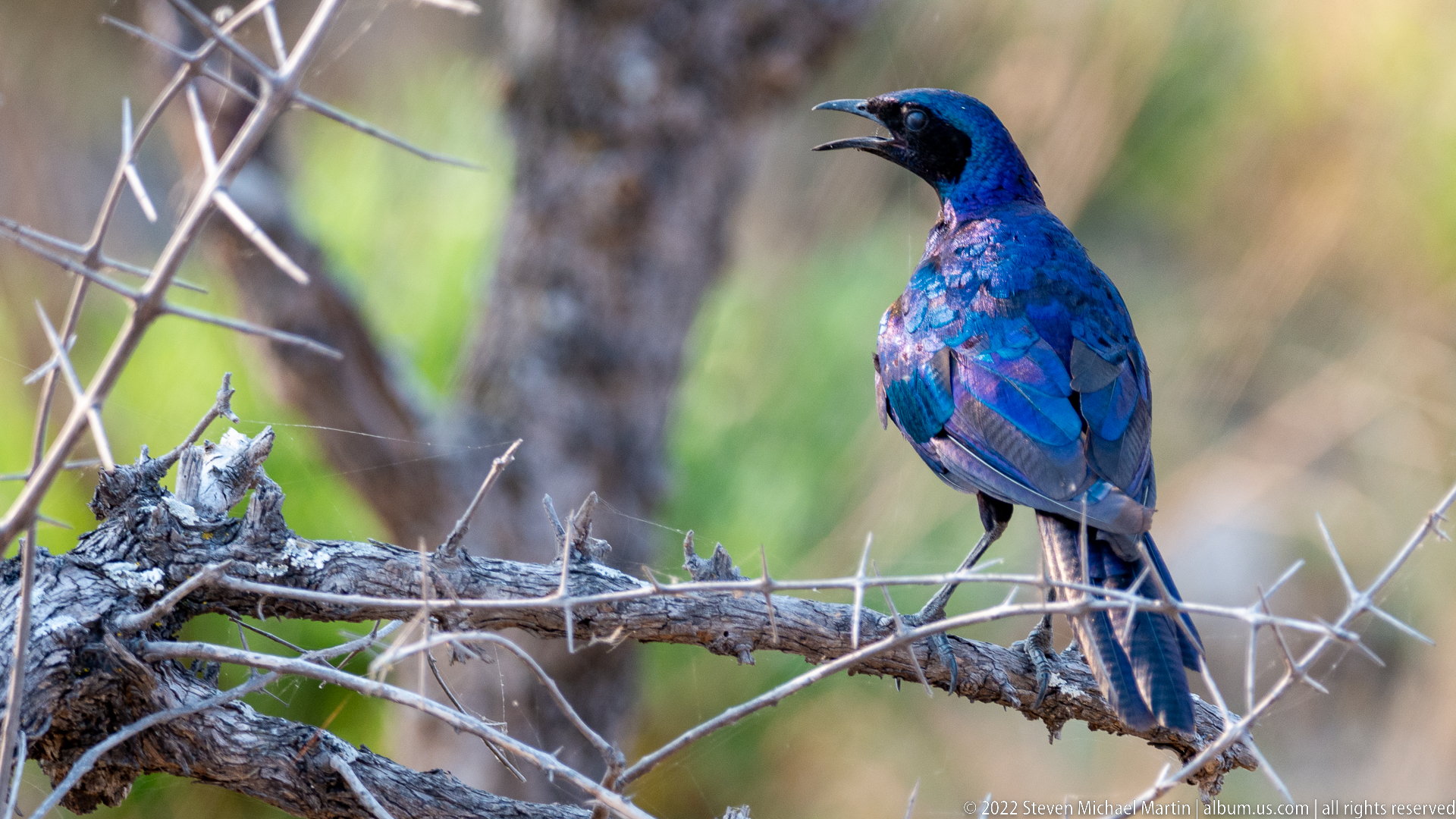
A greater blue-eared starling perches upright on a thorny branch, its metallic cobalt and violet plumage catching the light against a softly blurred woodland background. The glossy feathers, dark facial mask, and long dark tail are characteristic of this common southern African starling, often encountered around open woodland and safari camps.
Caption
A greater blue-eared starling perches upright on a thorny branch, its metallic cobalt and violet plumage catching the light against a softly blurred woodland background. The glossy feathers, dark facial mask, and long dark tail are characteristic of this common southern African starling, often encountered around open woodland and safari camps.
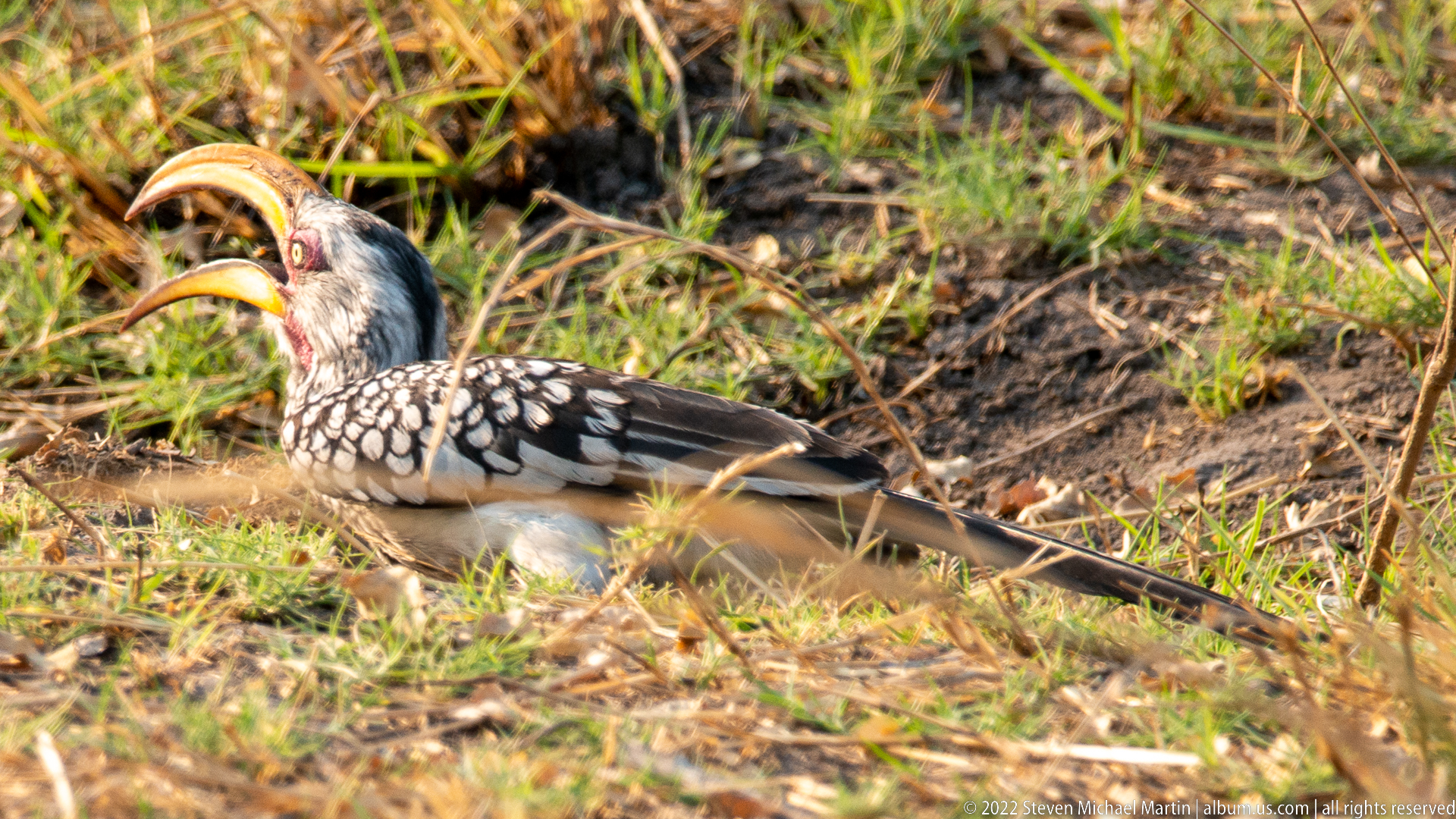
A southern yellow-billed hornbill rests low in dry grass, opening its long curved yellow bill while its black-and-white spotted wings and pale throat remain fully visible. The ground-level posture provides an unusually relaxed view of a species commonly seen walking and foraging across dry woodland and savanna in northern Botswana.
Caption
A southern yellow-billed hornbill rests low in dry grass, opening its long curved yellow bill while its black-and-white spotted wings and pale throat remain fully visible. The ground-level posture provides an unusually relaxed view of a species commonly seen walking and foraging across dry woodland and savanna in northern Botswana.
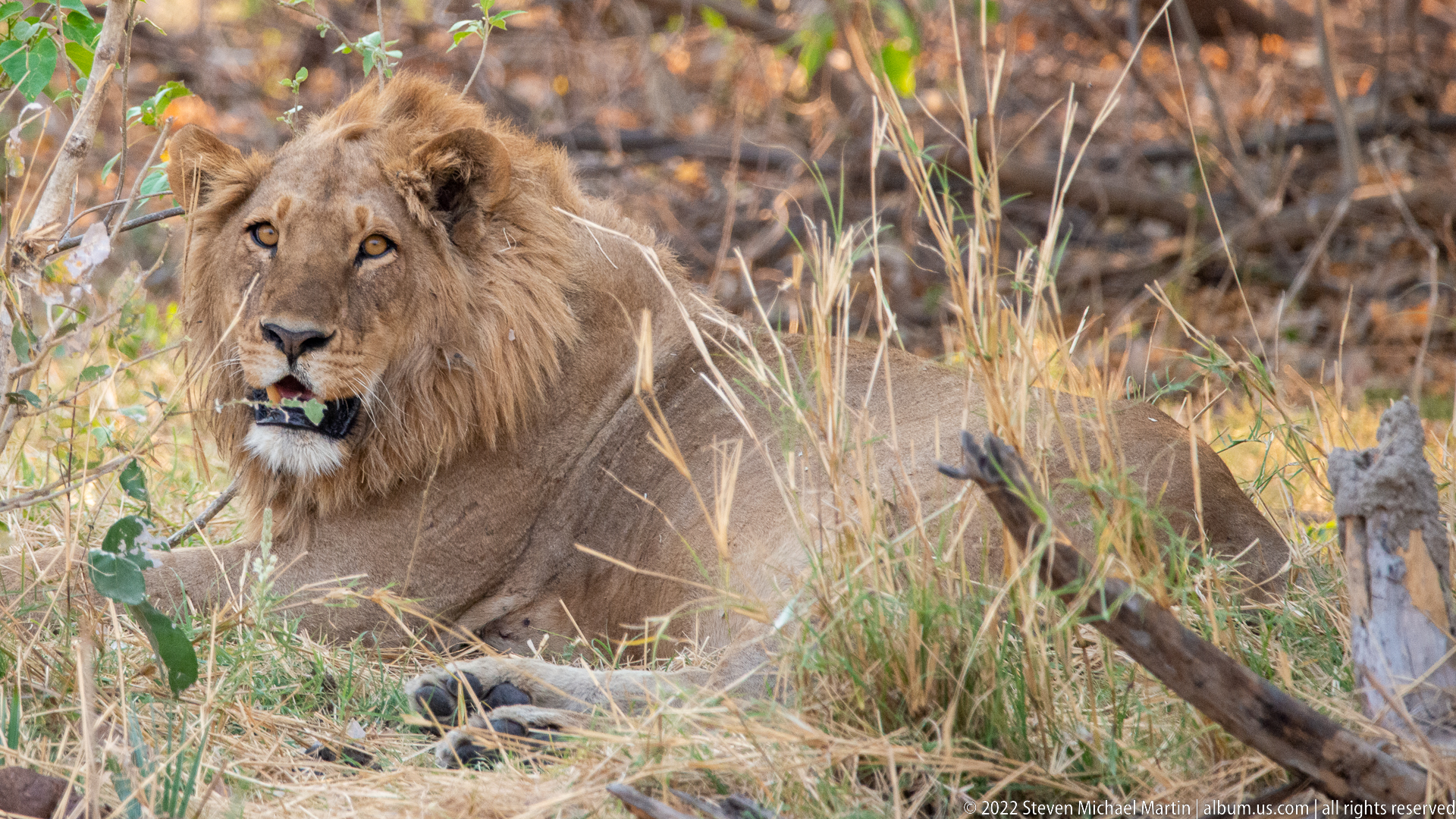
An adult male lion lies partly concealed in dry grass and low brush, his tawny mane framing the face as he watches the surrounding woodland. The frontal gaze, broad muzzle, and heavy forequarters give the portrait a strong sense of presence while the shaded vegetation places him securely within the dry-season Okavango bush.
Caption
An adult male lion lies partly concealed in dry grass and low brush, his tawny mane framing the face as he watches the surrounding woodland. The frontal gaze, broad muzzle, and heavy forequarters give the portrait a strong sense of presence while the shaded vegetation places him securely within the dry-season Okavango bush.
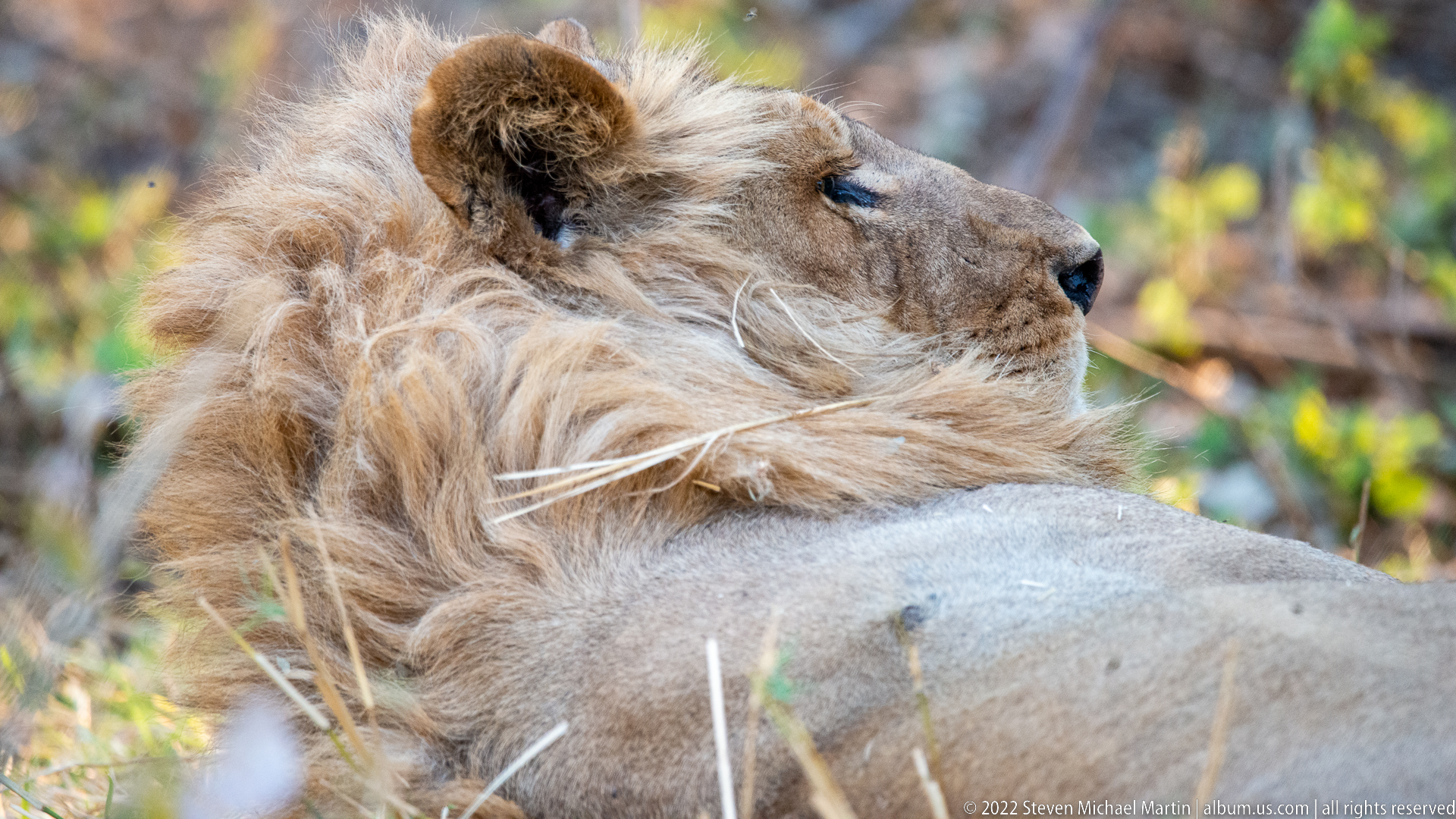
A resting male lion turns his head in profile, revealing the layered mane along his cheek, neck, and shoulders. The close crop shifts attention from the surrounding habitat to the lion’s facial structure and weathered mane, with soft background foliage and dry stems framing the quiet portrait.
Caption
A resting male lion turns his head in profile, revealing the layered mane along his cheek, neck, and shoulders. The close crop shifts attention from the surrounding habitat to the lion’s facial structure and weathered mane, with soft background foliage and dry stems framing the quiet portrait.
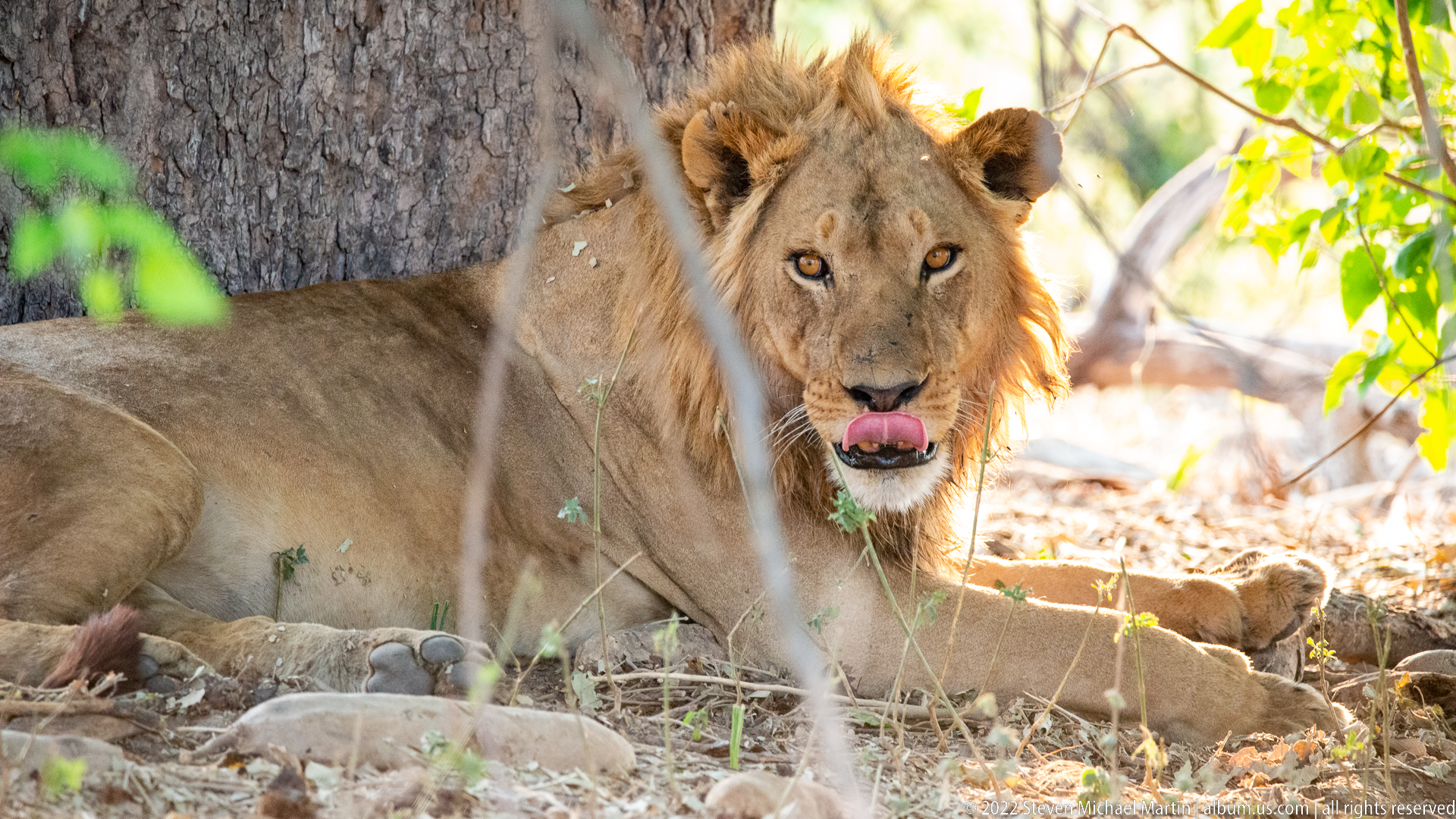
A male lion reclines at the base of a tree in deep shade, looking directly toward the camera while licking his nose. His forepaws extend across leaf litter and pale soil, and small bits of vegetation cling to the mane, creating a more environmental portrait than the tighter views in this sequence.
Caption
A male lion reclines at the base of a tree in deep shade, looking directly toward the camera while licking his nose. His forepaws extend across leaf litter and pale soil, and small bits of vegetation cling to the mane, creating a more environmental portrait than the tighter views in this sequence.
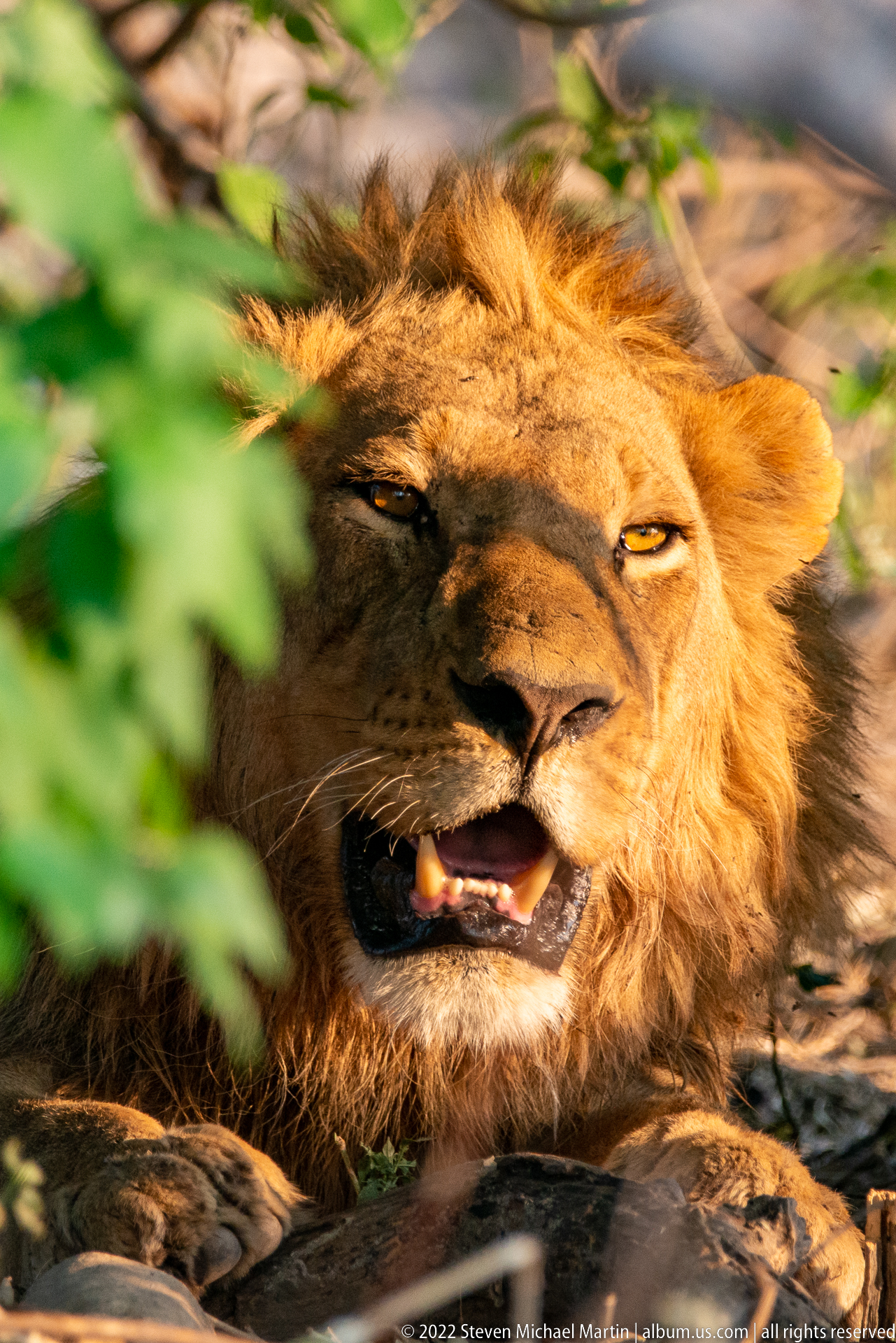
Warm sunlight cuts across the face of a reclining male lion as he pants beneath low foliage. The open mouth, visible teeth, partly closed eyes, and ruffled mane suggest heat and rest rather than aggression, while foreground leaves create a layered view into his shaded resting place.
Caption
Warm sunlight cuts across the face of a reclining male lion as he pants beneath low foliage. The open mouth, visible teeth, partly closed eyes, and ruffled mane suggest heat and rest rather than aggression, while foreground leaves create a layered view into his shaded resting place.
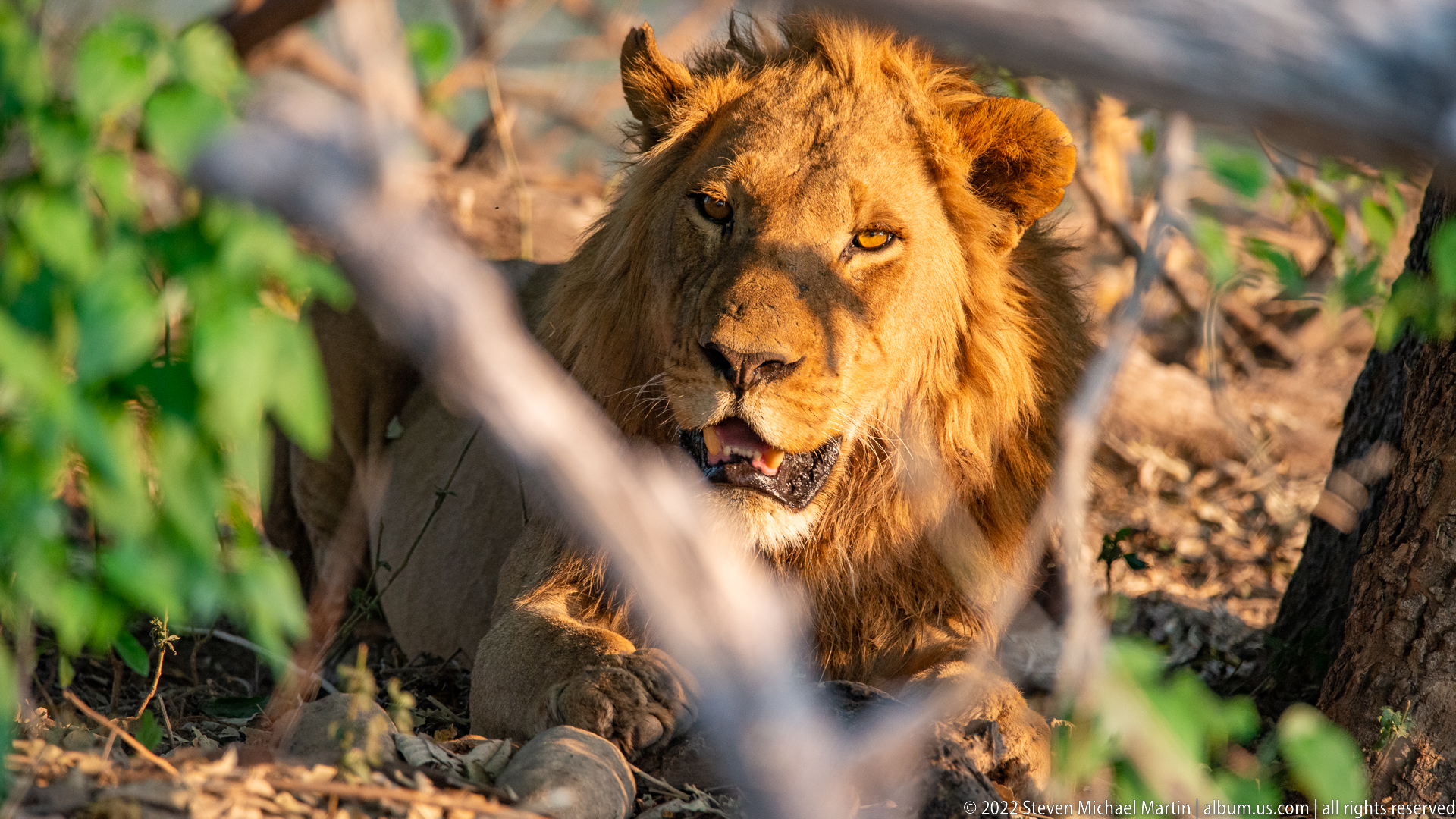
A male lion peers through branches from a shaded patch of woodland, his face framed by green leaves and gray limbs. The partially obscured view emphasizes camouflage and concealment: only the head, mane, shoulders, and forelegs emerge clearly from the tangle of vegetation.
Caption
A male lion peers through branches from a shaded patch of woodland, his face framed by green leaves and gray limbs. The partially obscured view emphasizes camouflage and concealment: only the head, mane, shoulders, and forelegs emerge clearly from the tangle of vegetation.
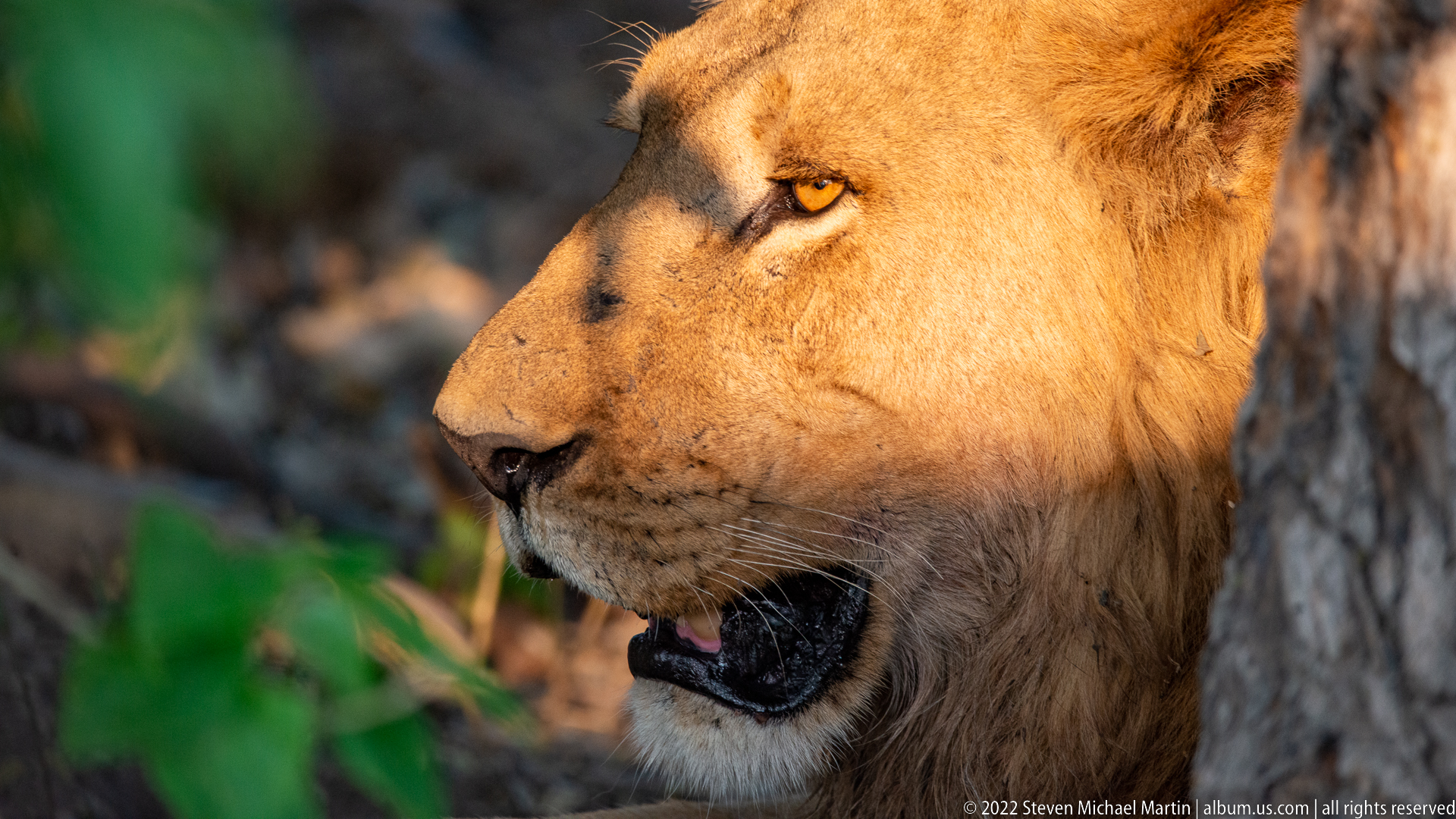
A lioness fills the frame in left-facing profile, her tawny coat warmed by low sunlight as she rests beside a tree trunk. The absence of a mane, compact head, rounded ears, and pale muzzle distinguish her from the males in the preceding photographs, while the tight crop focuses attention on expression and facial anatomy.
Caption
A lioness fills the frame in left-facing profile, her tawny coat warmed by low sunlight as she rests beside a tree trunk. The absence of a mane, compact head, rounded ears, and pale muzzle distinguish her from the males in the preceding photographs, while the tight crop focuses attention on expression and facial anatomy.
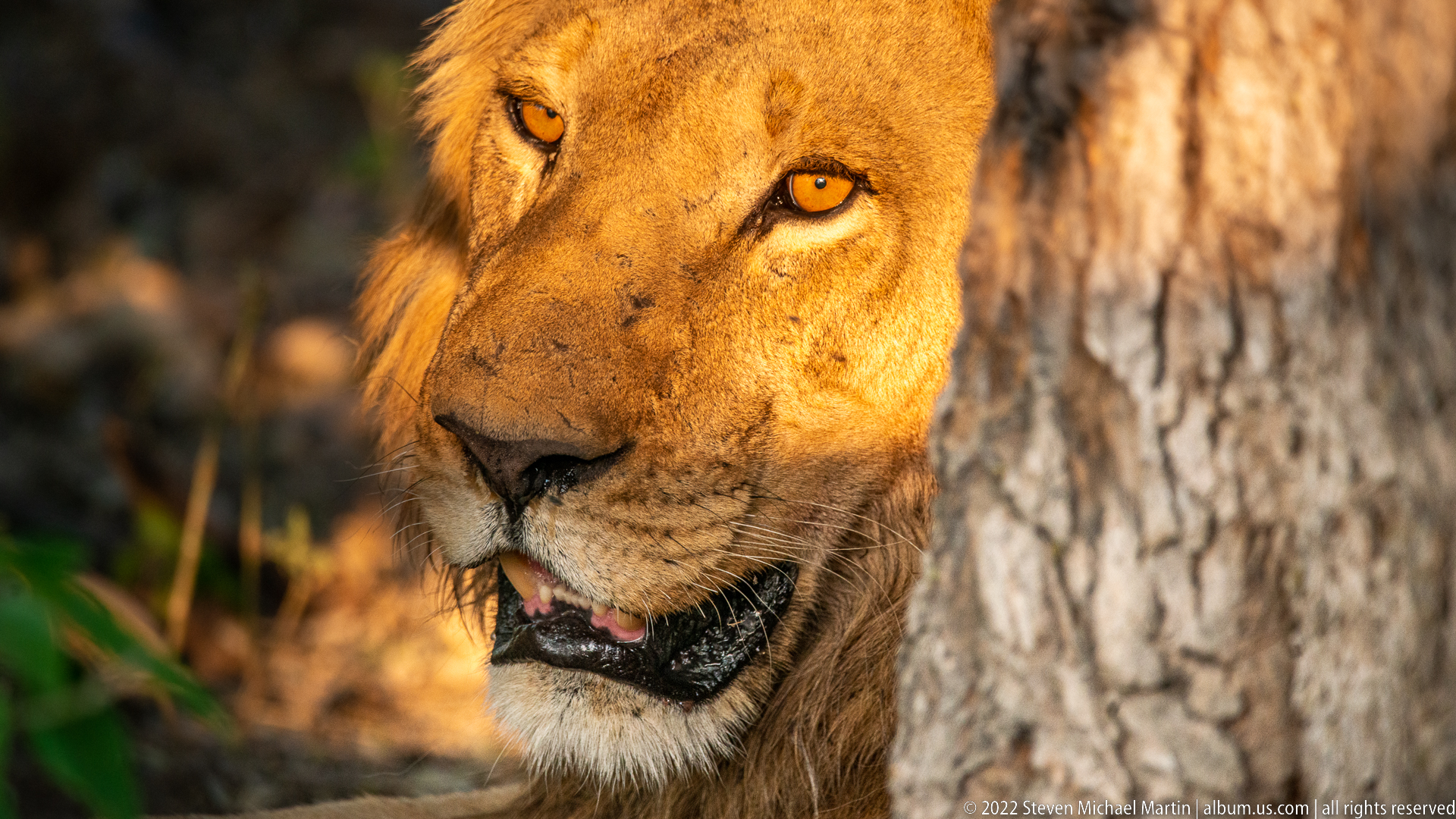
A lioness turns toward the camera from beside a rough-barked tree, her face divided between warm sunlight and shade. The close portrait shows the amber eyes, black nose, pale whisker pads, and small scars or marks on the tawny muzzle, emphasizing individual texture and expression rather than the surrounding habitat.
Caption
A lioness turns toward the camera from beside a rough-barked tree, her face divided between warm sunlight and shade. The close portrait shows the amber eyes, black nose, pale whisker pads, and small scars or marks on the tawny muzzle, emphasizing individual texture and expression rather than the surrounding habitat.
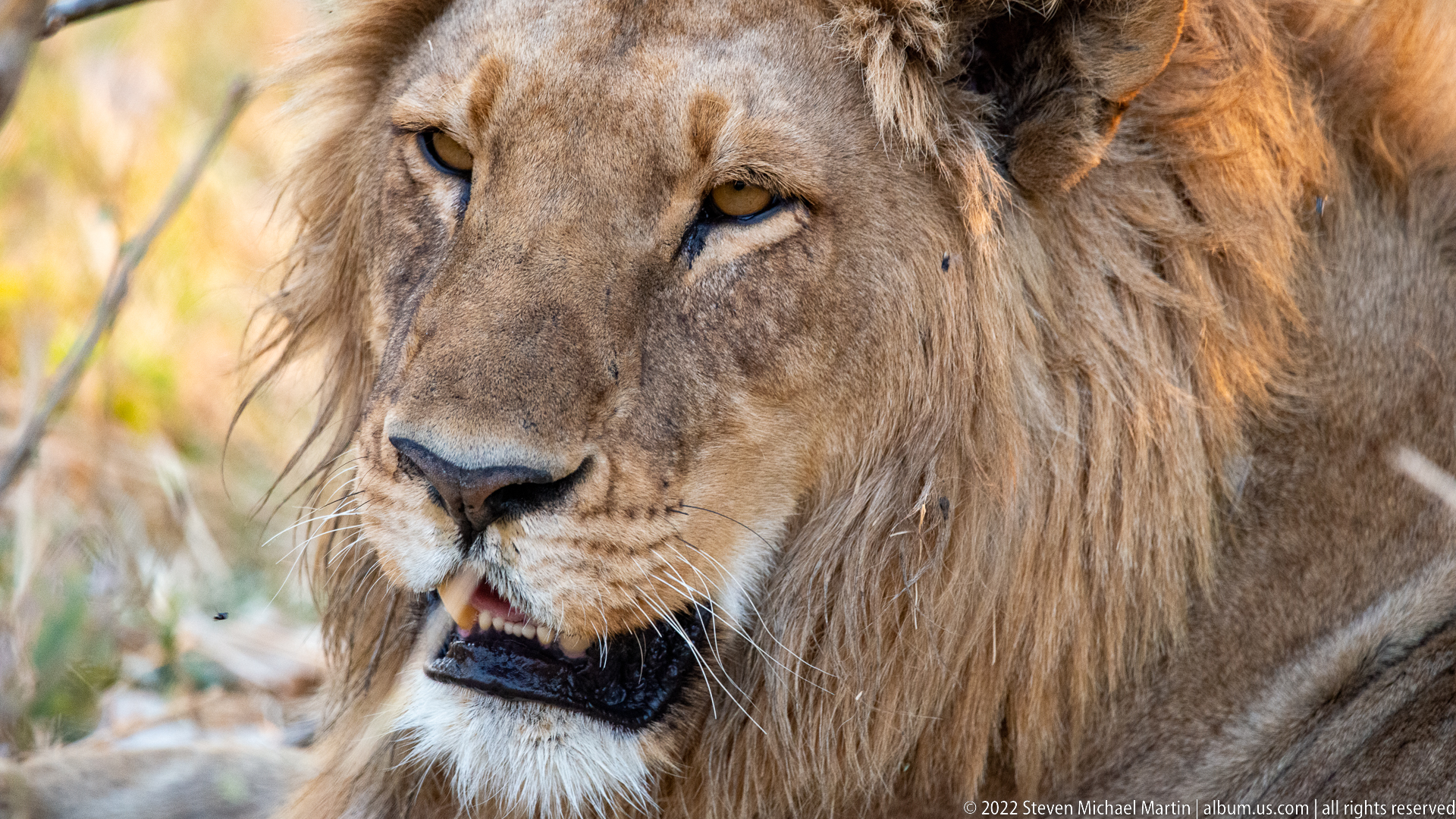
A male lion fills the frame from muzzle to mane, his face turned slightly upward as warm light catches the eye and coarse whiskers. The tight crop reveals dust, small facial marks, and the layered texture of the mane, offering an intimate portrait distinct from the more environmental views of the same resting lion.
Caption
A male lion fills the frame from muzzle to mane, his face turned slightly upward as warm light catches the eye and coarse whiskers. The tight crop reveals dust, small facial marks, and the layered texture of the mane, offering an intimate portrait distinct from the more environmental views of the same resting lion.
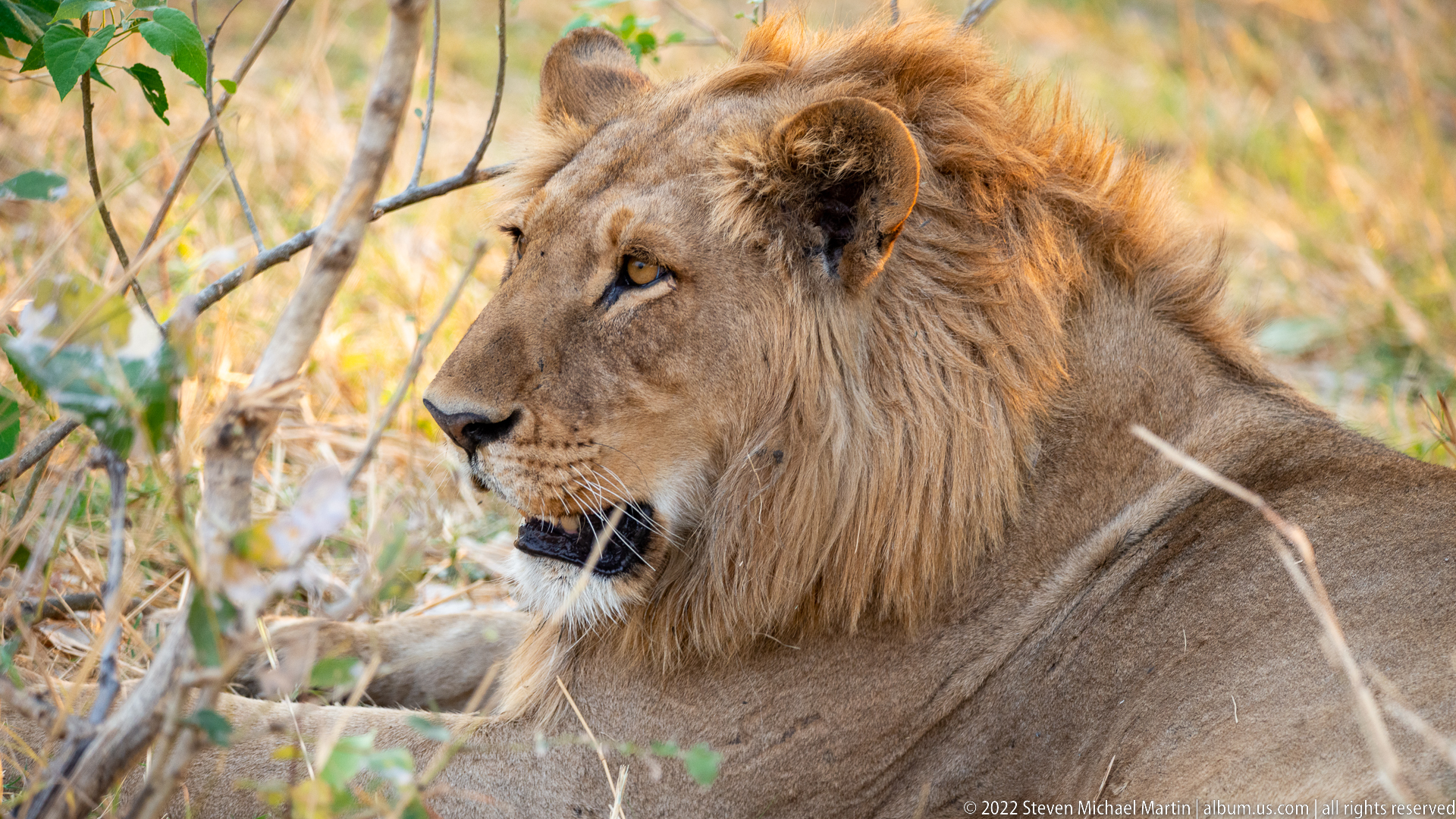
A resting male lion raises his head in three-quarter profile, looking beyond the frame through sparse brush. His mane forms a ragged golden fringe around the neck and shoulder, while dry grasses and slender branches place the portrait in the open woodland edge of the Okavango landscape.
Caption
A resting male lion raises his head in three-quarter profile, looking beyond the frame through sparse brush. His mane forms a ragged golden fringe around the neck and shoulder, while dry grasses and slender branches place the portrait in the open woodland edge of the Okavango landscape.
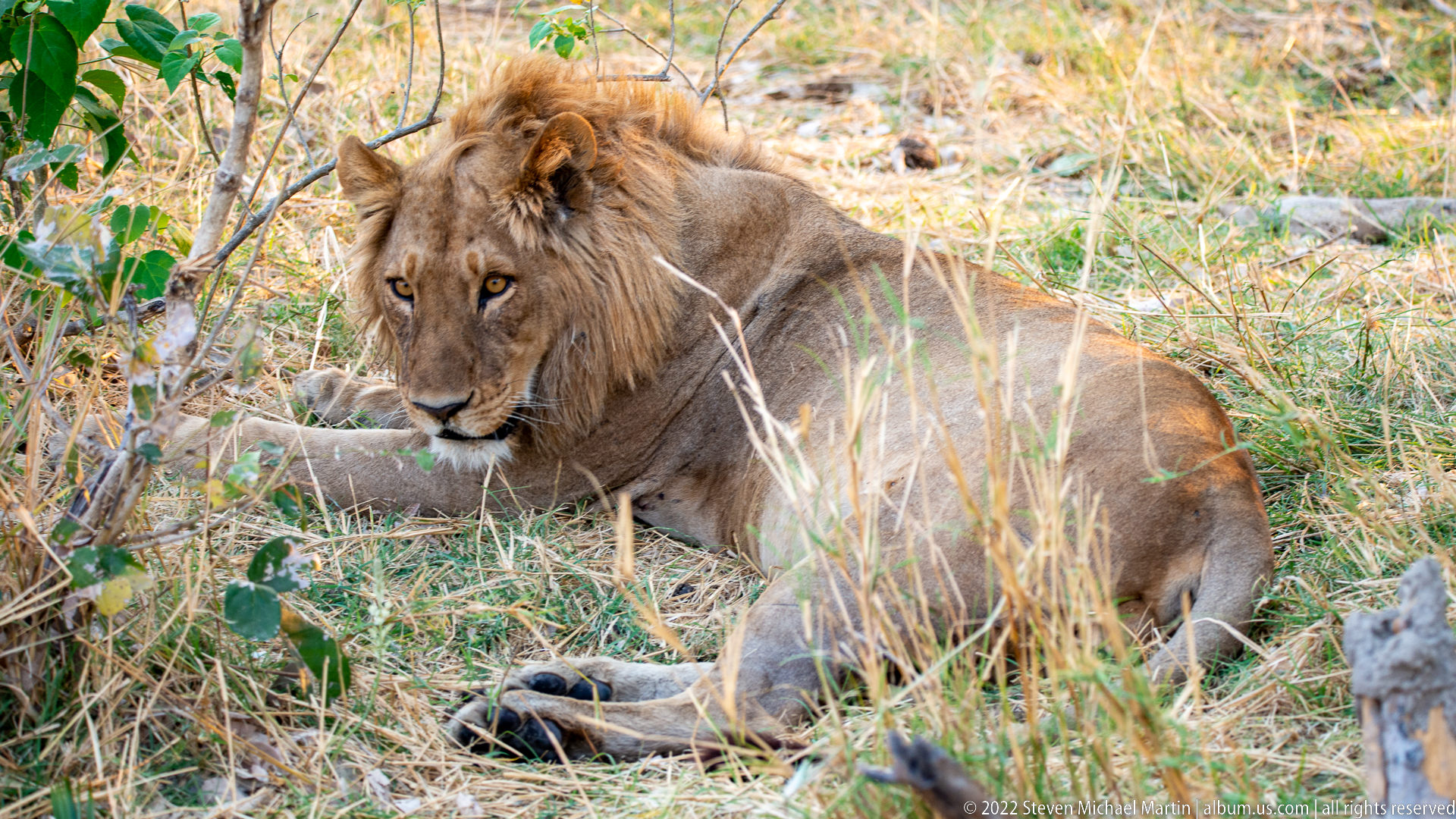
A male lion lies stretched on the ground beneath sparse shrubs, his body visible from head to hindquarters rather than isolated in close portrait. The composition shows the scale of the cat against dry grass and low vegetation, while his attentive gaze contrasts with the relaxed posture.
Caption
A male lion lies stretched on the ground beneath sparse shrubs, his body visible from head to hindquarters rather than isolated in close portrait. The composition shows the scale of the cat against dry grass and low vegetation, while his attentive gaze contrasts with the relaxed posture.
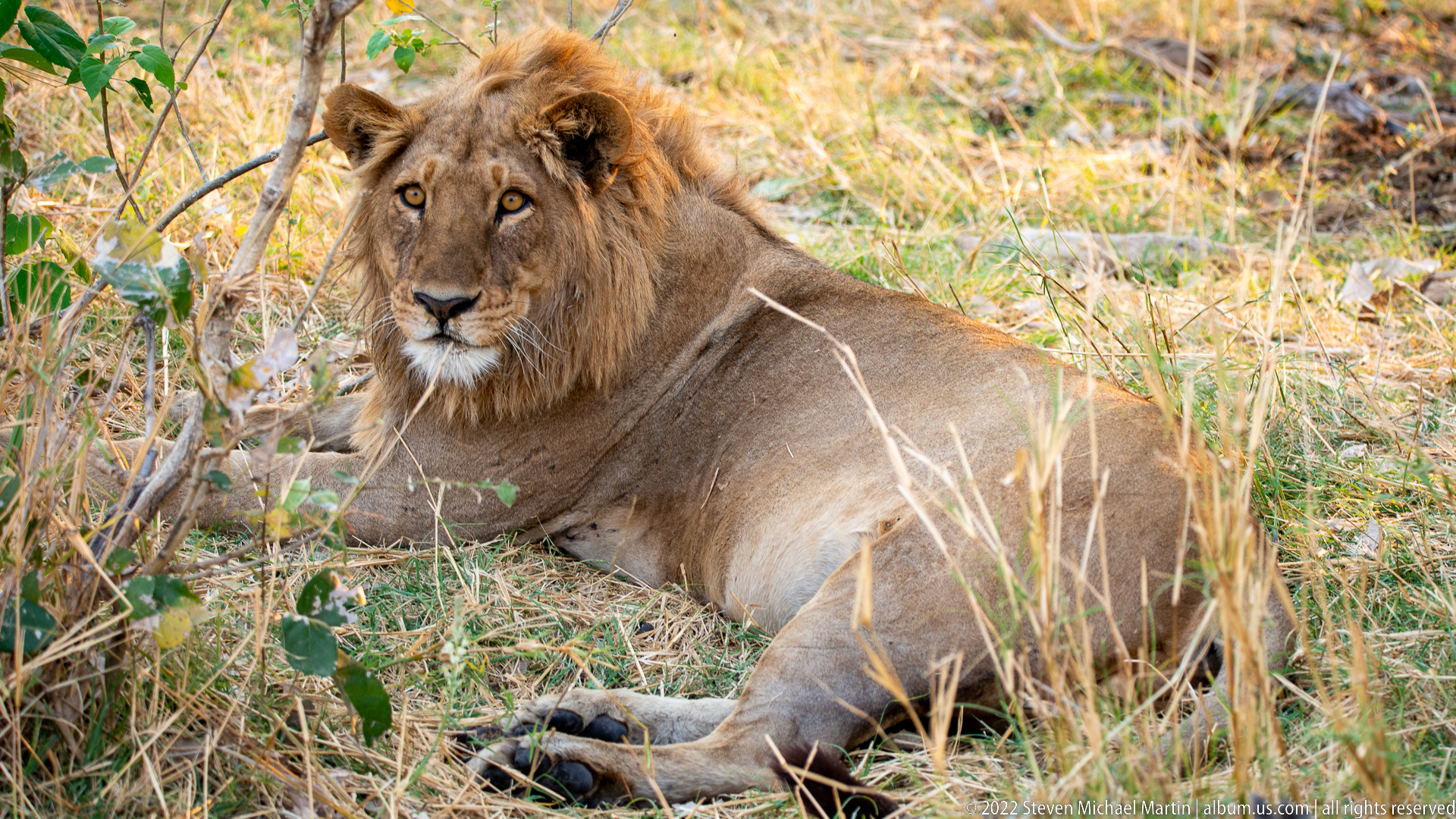
A male lion reclines with both forepaws extended, facing the camera from a patch of dry grass and brush. His mane is relatively modest around the face and neck, and the wider framing preserves the surrounding stems and leafy branches, giving context to the shaded resting site.
Caption
A male lion reclines with both forepaws extended, facing the camera from a patch of dry grass and brush. His mane is relatively modest around the face and neck, and the wider framing preserves the surrounding stems and leafy branches, giving context to the shaded resting site.
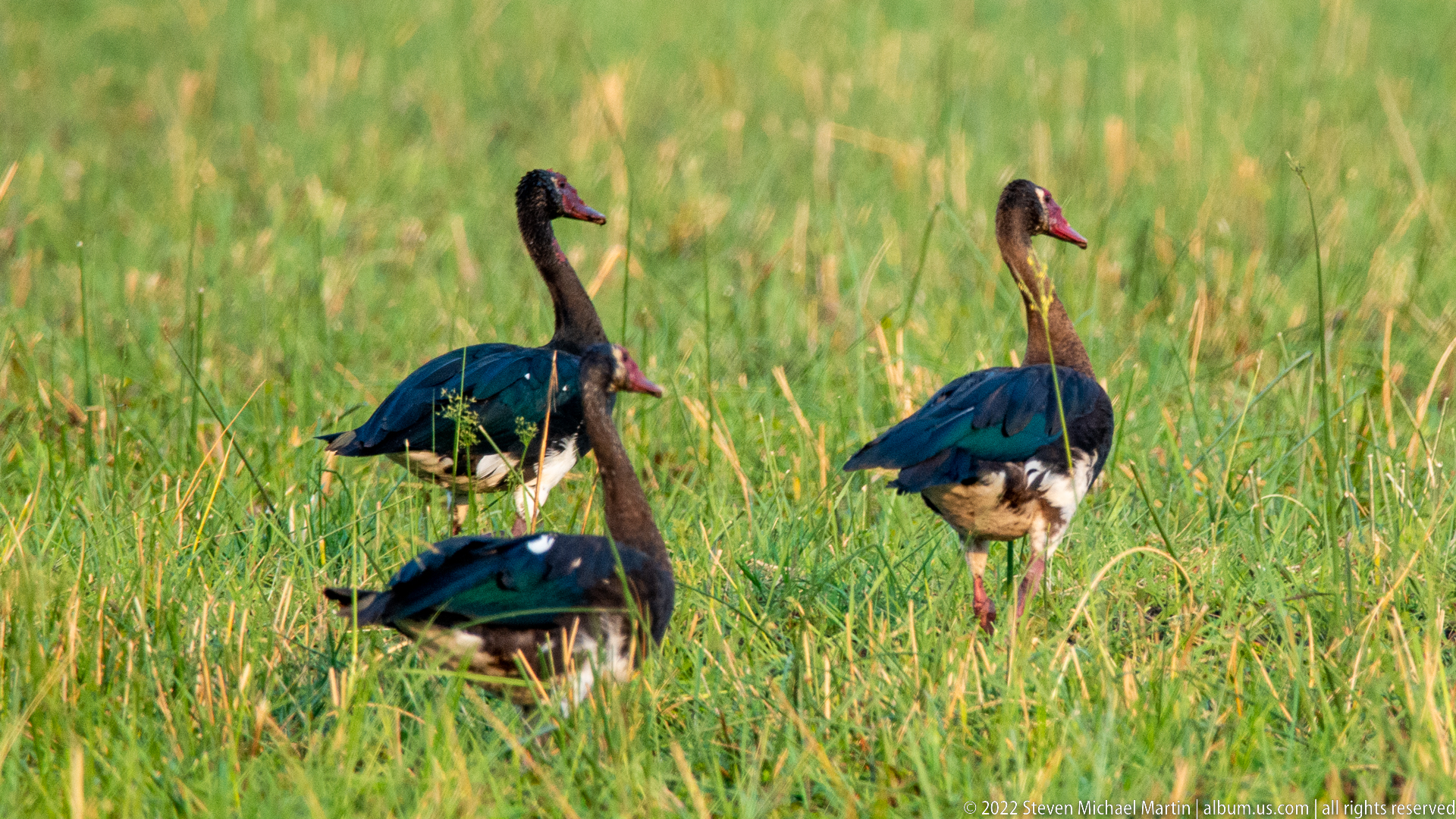
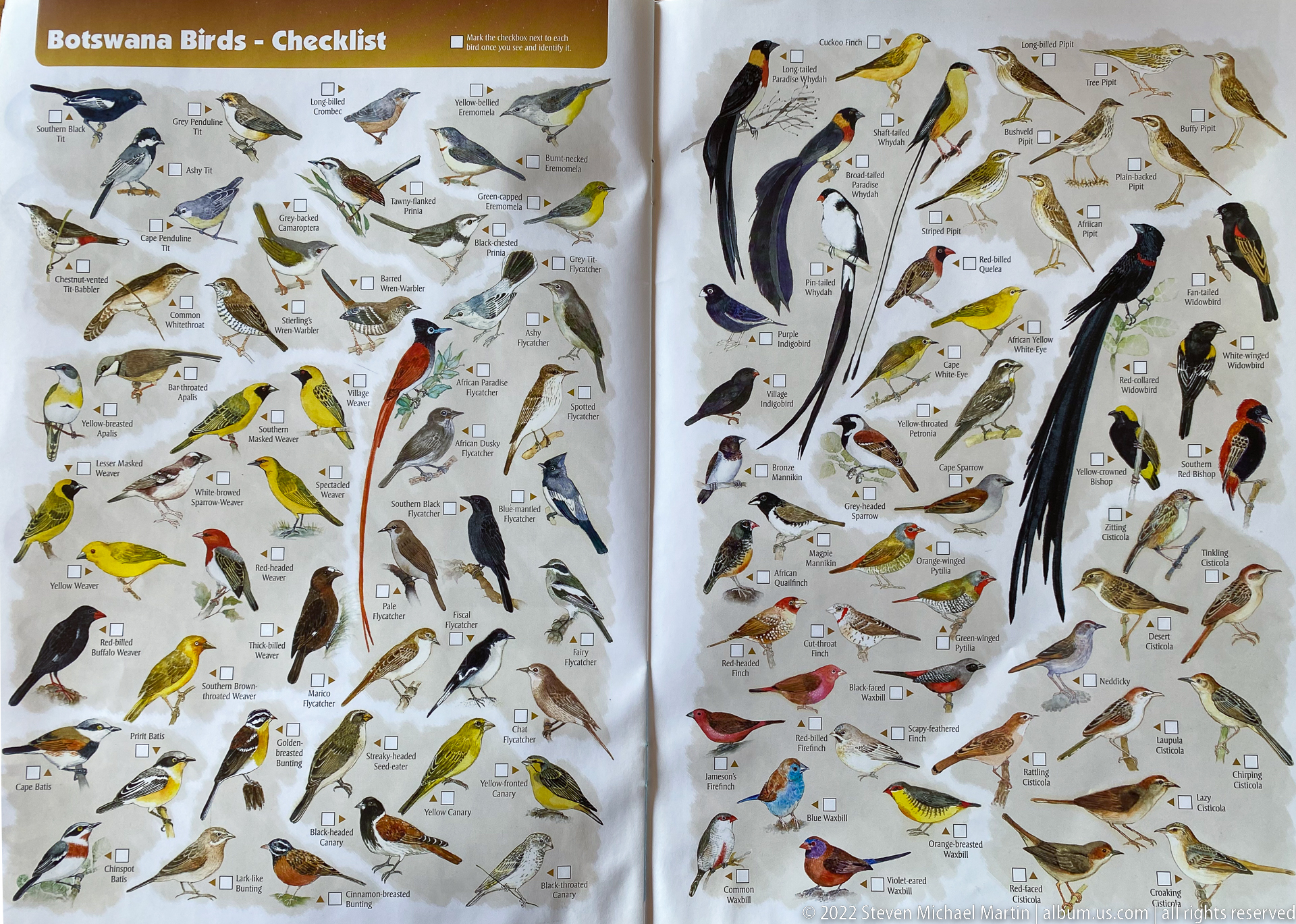
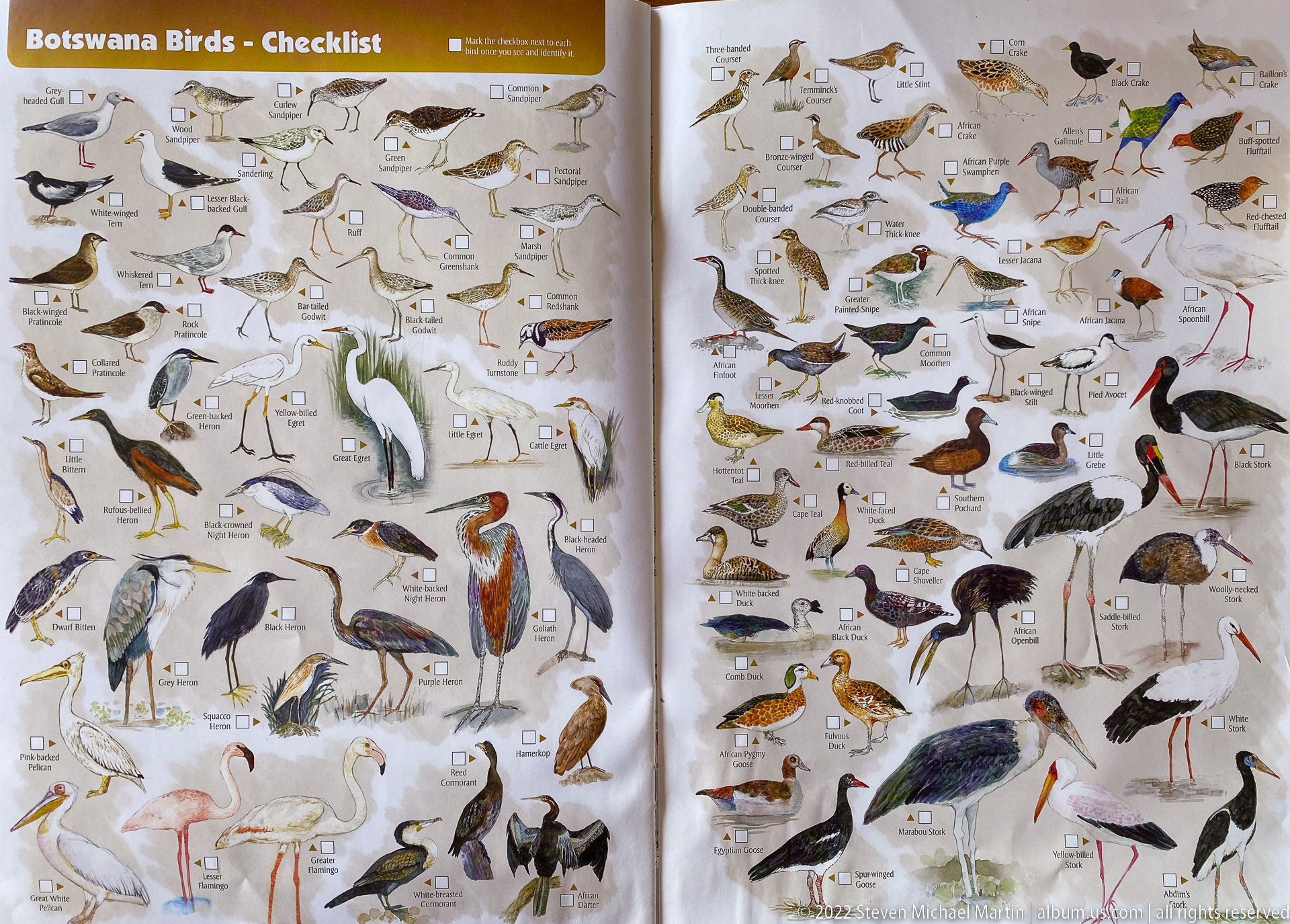
Three spur-winged geese stand in lush floodplain grass, their dark bodies flashing green-blue iridescence above contrasting white bellies and pinkish-red legs. The loose group is typical of the water-associated birdlife supported by the Okavango Delta’s shallow wetlands and seasonally inundated grasslands.
Caption
Three spur-winged geese stand in lush floodplain grass, their dark bodies flashing green-blue iridescence above contrasting white bellies and pinkish-red legs. The loose group is typical of the water-associated birdlife supported by the Okavango Delta’s shallow wetlands and seasonally inundated grasslands.
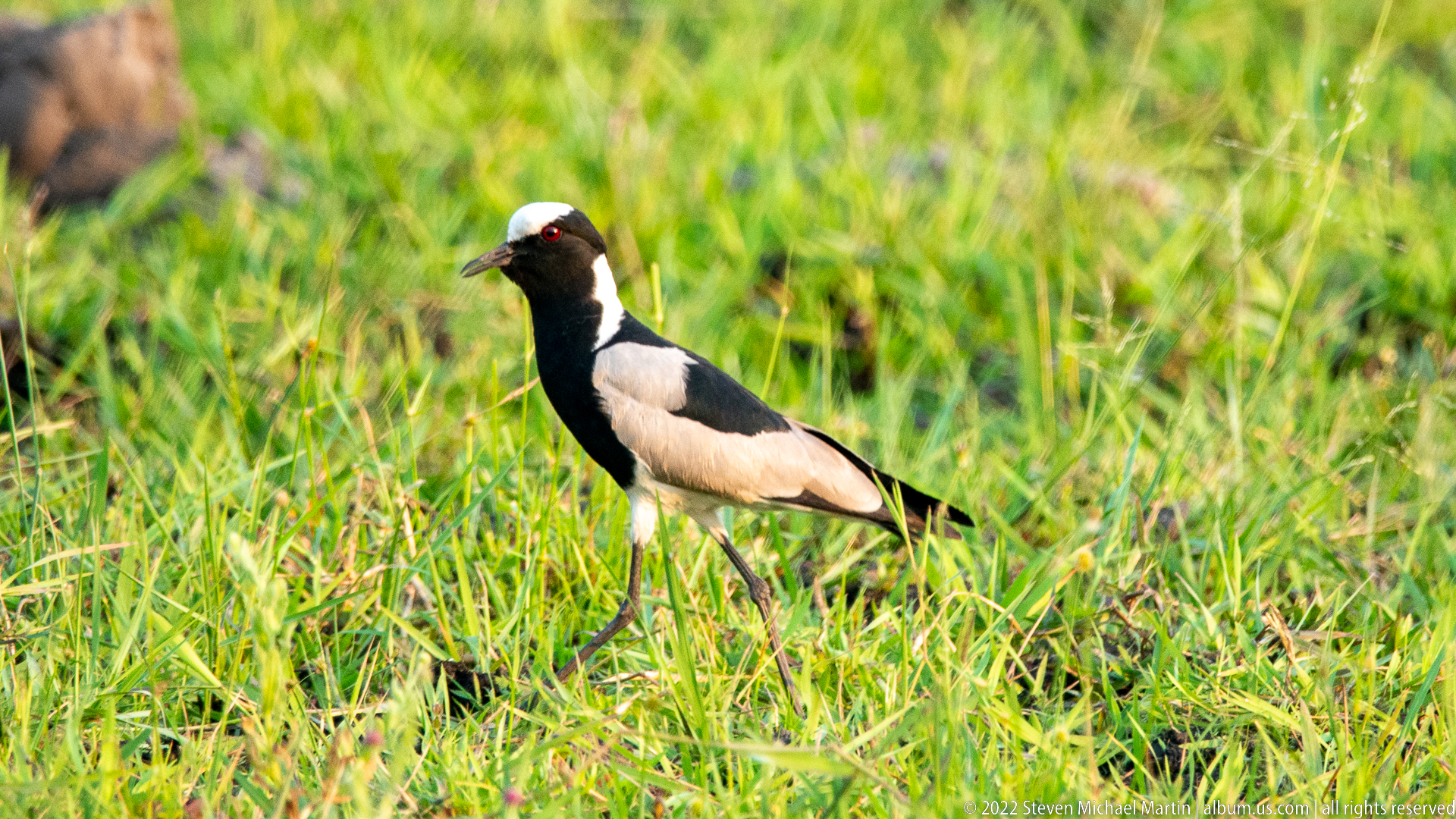
A blacksmith lapwing stands alert in bright green wetland grass, its crisp black-and-white plumage and red eye standing out against the floodplain. The upright stance and long legs suit a ground-foraging shorebird that frequents shallow water, muddy margins, and open grassy wetlands across southern Africa.
Caption
A blacksmith lapwing stands alert in bright green wetland grass, its crisp black-and-white plumage and red eye standing out against the floodplain. The upright stance and long legs suit a ground-foraging shorebird that frequents shallow water, muddy margins, and open grassy wetlands across southern Africa.
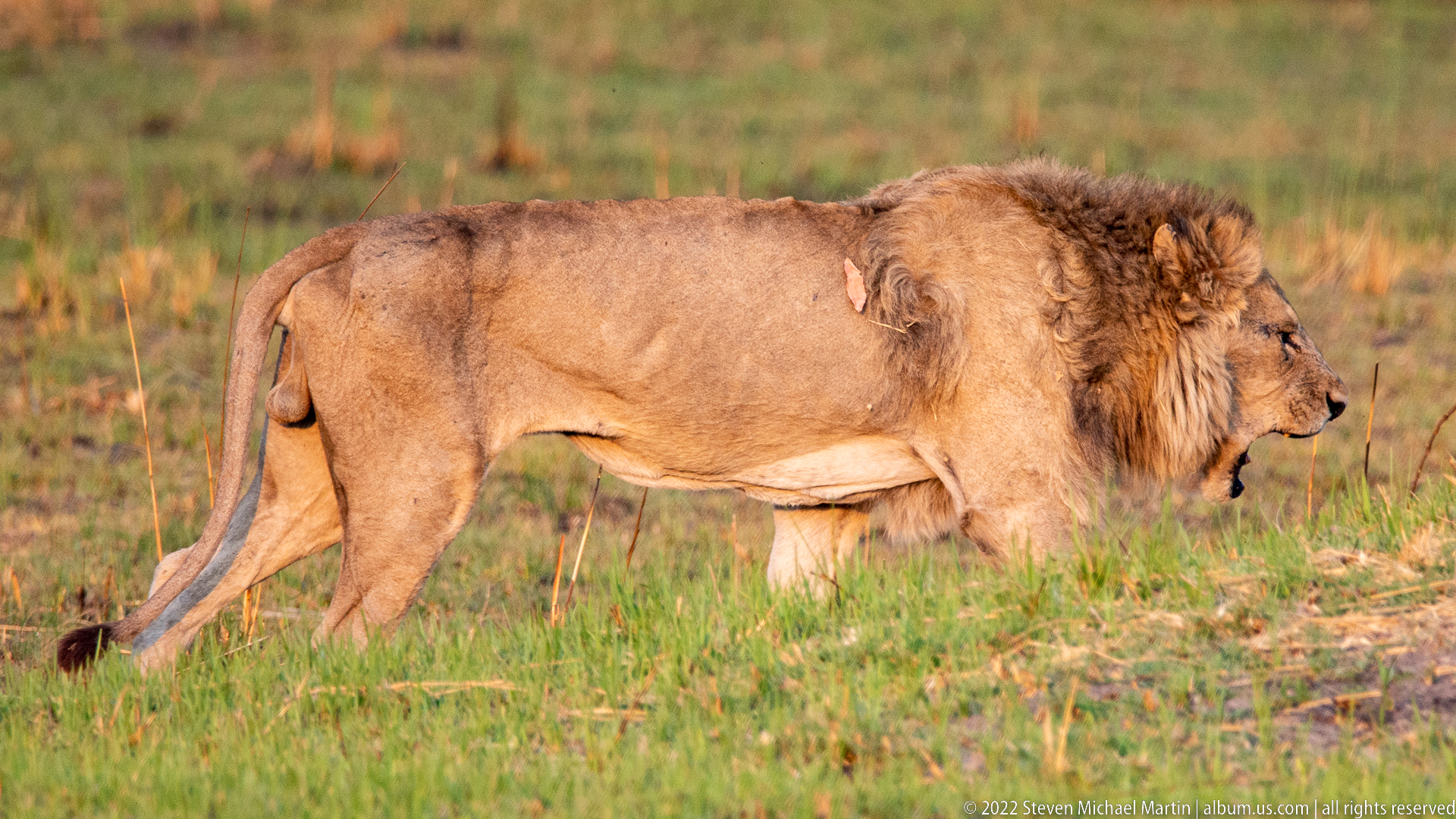
An adult male lion strides across short green floodplain grass in warm late-day light, his mane and long tail silhouetted against the open ground. The full side view shows the powerful shoulder line and deliberate gait more clearly than the earlier resting portraits, shifting the sequence from repose to movement.
Caption
An adult male lion strides across short green floodplain grass in warm late-day light, his mane and long tail silhouetted against the open ground. The full side view shows the powerful shoulder line and deliberate gait more clearly than the earlier resting portraits, shifting the sequence from repose to movement.
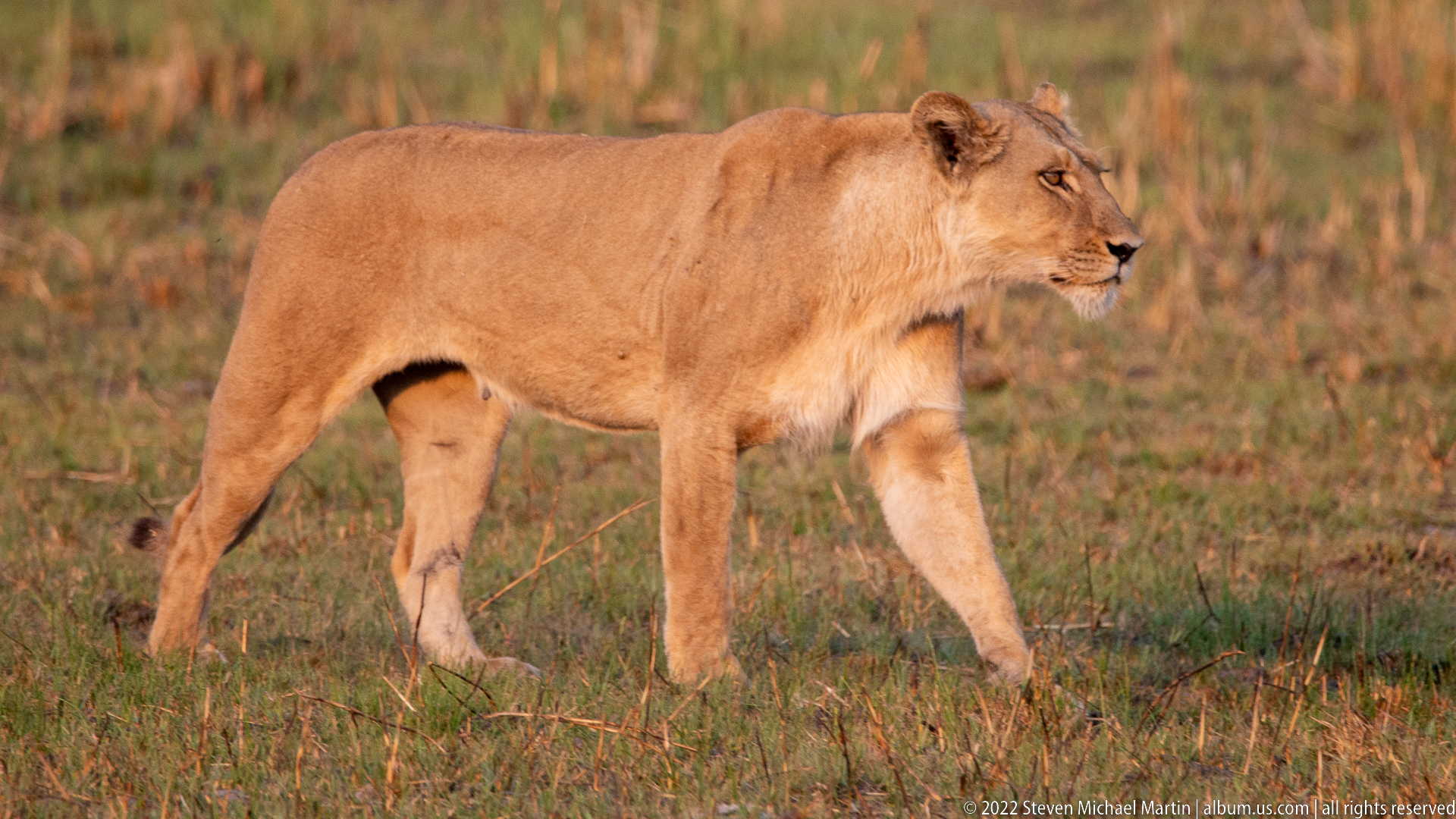
A lioness crosses open short grass in side profile, her head held level as she moves through warm evening light. With no mane to interrupt the clean outline of neck and shoulders, the photograph emphasizes the streamlined build and long stride of an adult female lion.
Caption
A lioness crosses open short grass in side profile, her head held level as she moves through warm evening light. With no mane to interrupt the clean outline of neck and shoulders, the photograph emphasizes the streamlined build and long stride of an adult female lion.
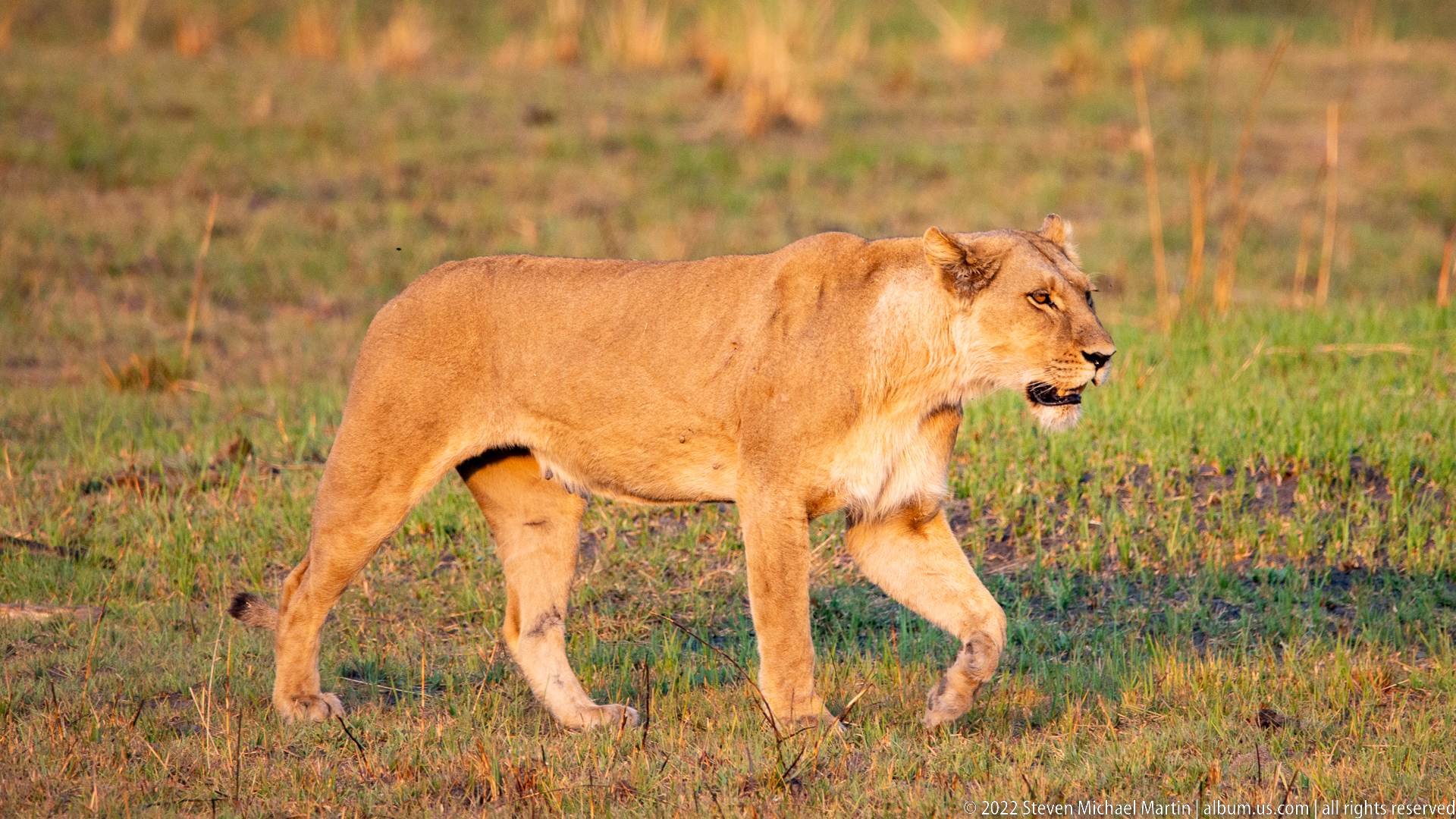
A lioness continues across the floodplain with one foreleg extended, mouth slightly open and ears angled forward. Fresh green grass beneath her feet contrasts with the tawny coat, creating a clear dry-season wildlife portrait at the interface between wetland productivity and open terrestrial habitat.
Caption
A lioness continues across the floodplain with one foreleg extended, mouth slightly open and ears angled forward. Fresh green grass beneath her feet contrasts with the tawny coat, creating a clear dry-season wildlife portrait at the interface between wetland productivity and open terrestrial habitat.
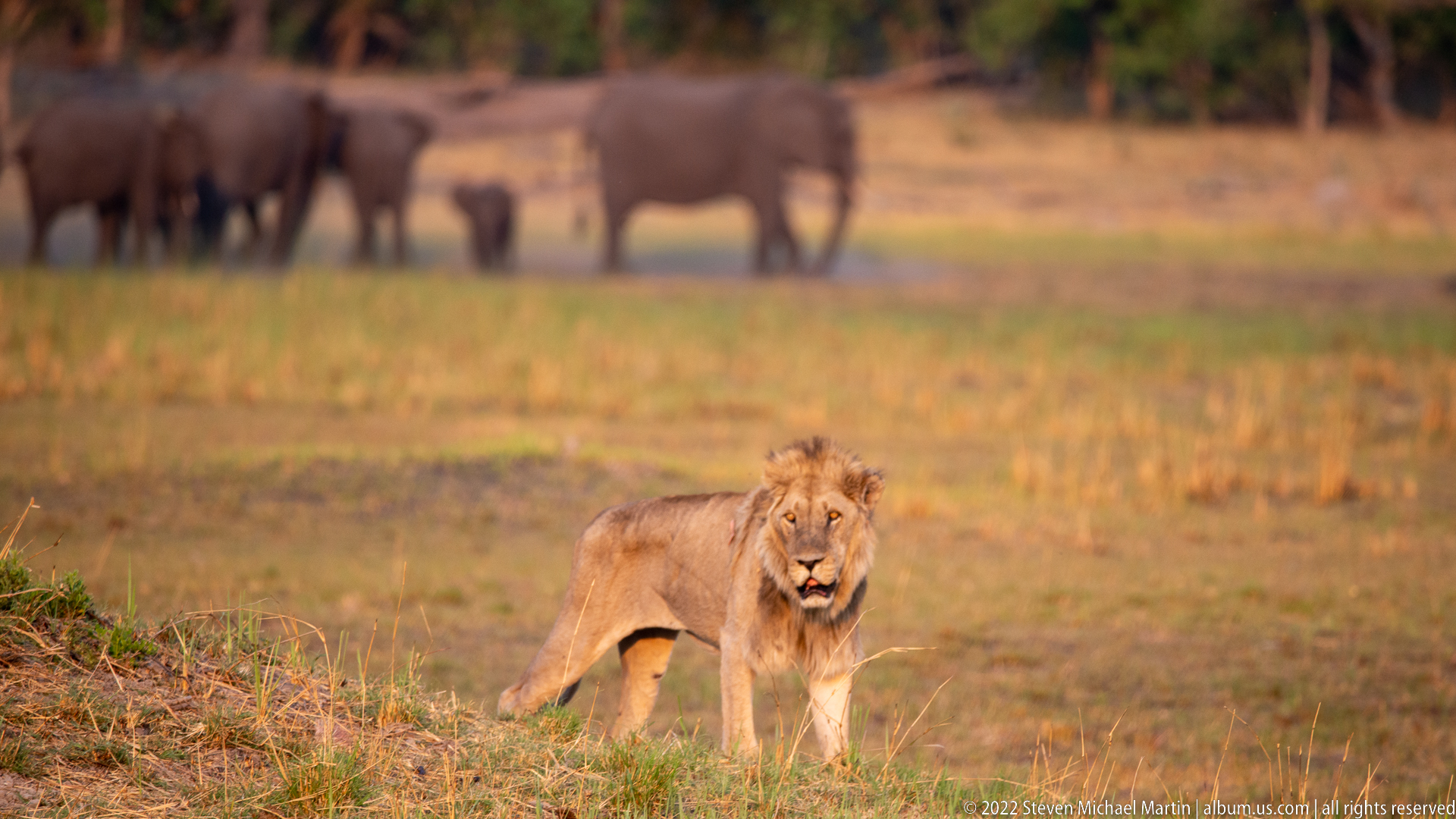
A male lion walks across open ground while a small group of African elephants appears softly out of focus behind him. The layered composition brings two of the Okavango Delta’s largest mammals into a single frame, emphasizing the shared floodplain setting without implying direct interaction between them.
Caption
A male lion walks across open ground while a small group of African elephants appears softly out of focus behind him. The layered composition brings two of the Okavango Delta’s largest mammals into a single frame, emphasizing the shared floodplain setting without implying direct interaction between them.
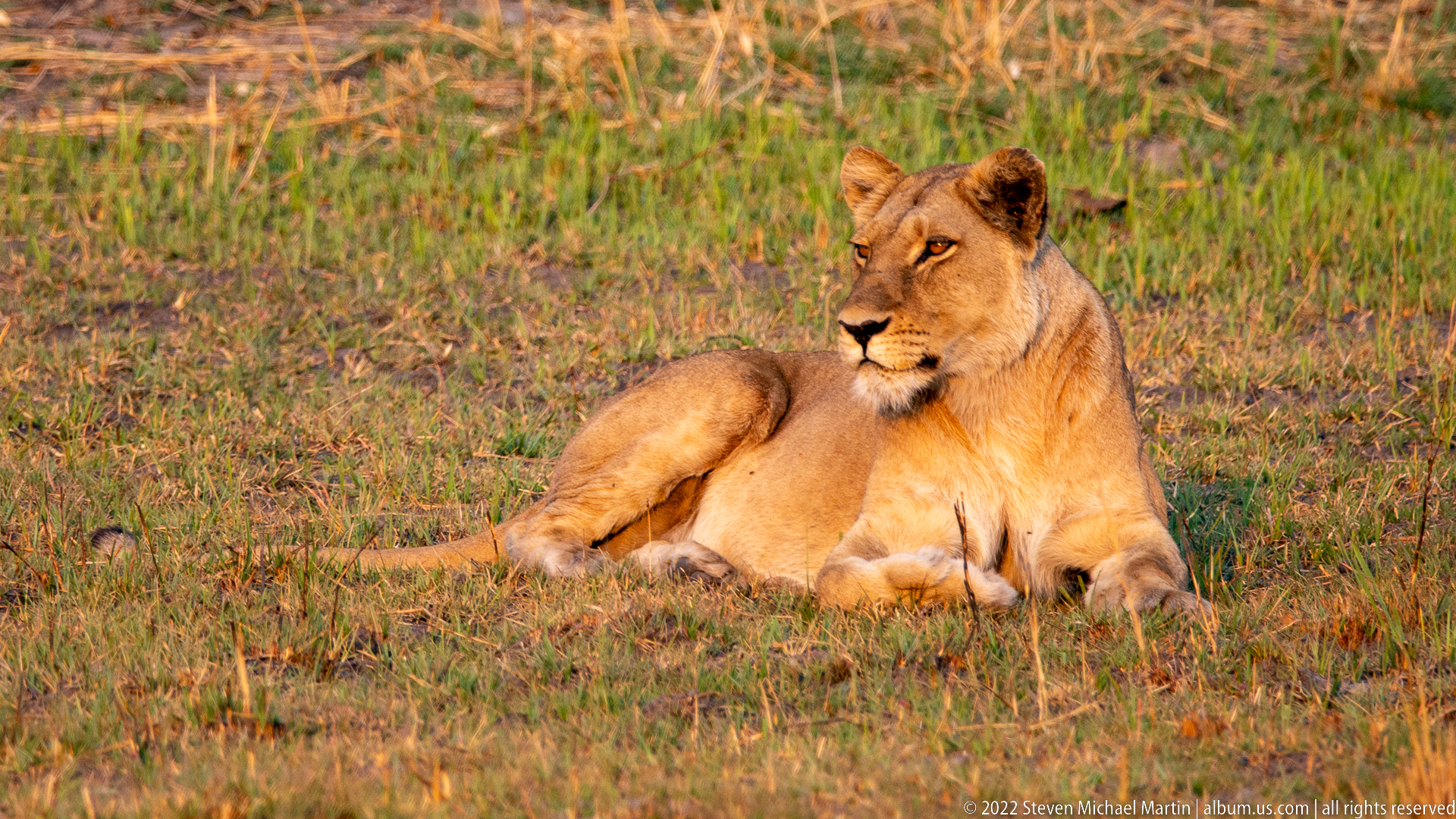
A lioness reclines on open grass with her forelegs folded forward, head turned attentively to one side. Warm low-angle light highlights the face, chest, and shoulders, while the uncluttered floodplain setting gives a clear full-body view of her relaxed but watchful posture.
Caption
A lioness reclines on open grass with her forelegs folded forward, head turned attentively to one side. Warm low-angle light highlights the face, chest, and shoulders, while the uncluttered floodplain setting gives a clear full-body view of her relaxed but watchful posture.
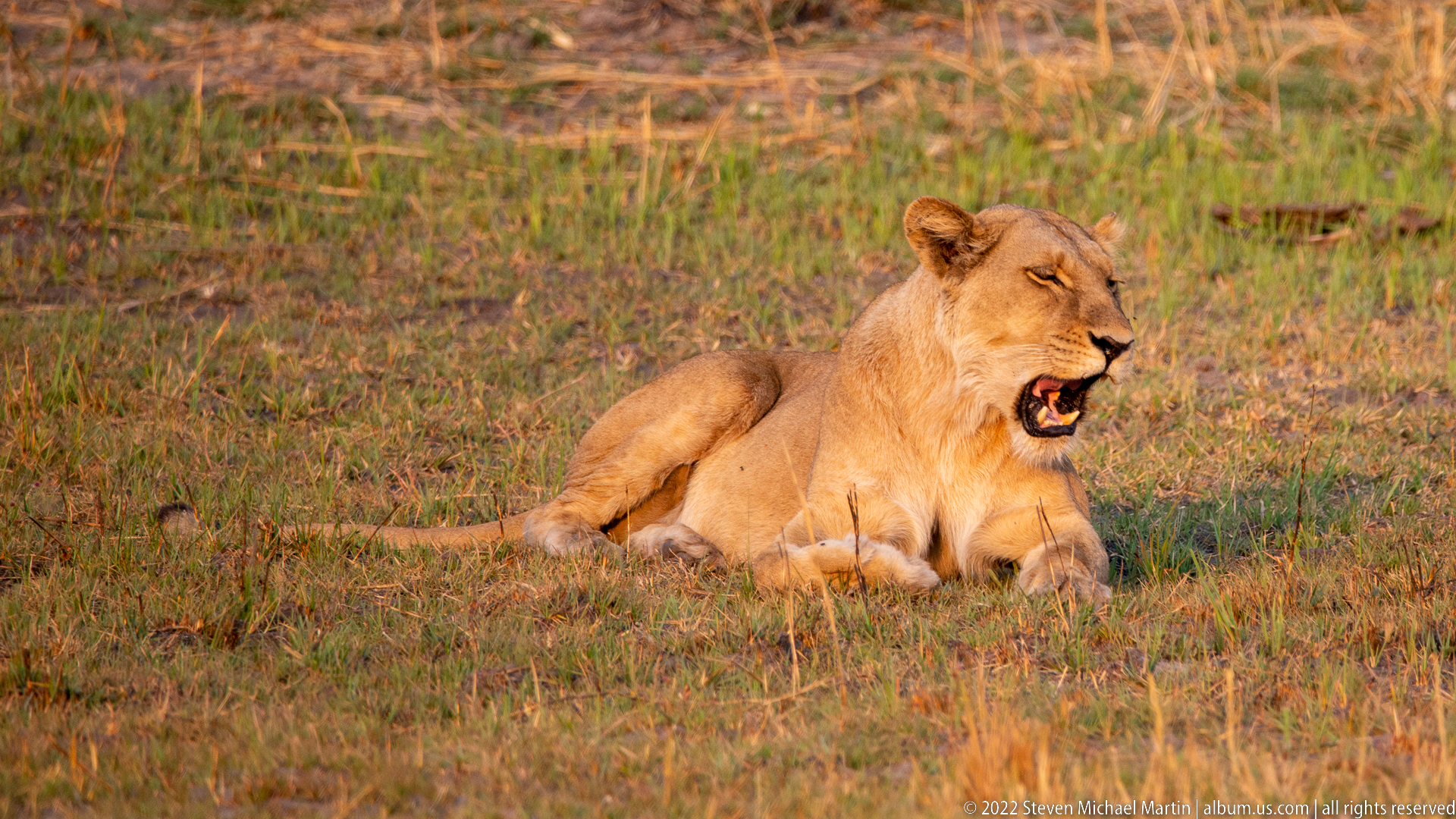
A resting lioness opens her mouth in the early phase of a yawn, exposing the tongue and teeth while remaining reclined on the grass. The warm evening light and nearly unchanged body position from the preceding portrait make the facial movement the defining difference in this frame.
Caption
A resting lioness opens her mouth in the early phase of a yawn, exposing the tongue and teeth while remaining reclined on the grass. The warm evening light and nearly unchanged body position from the preceding portrait make the facial movement the defining difference in this frame.
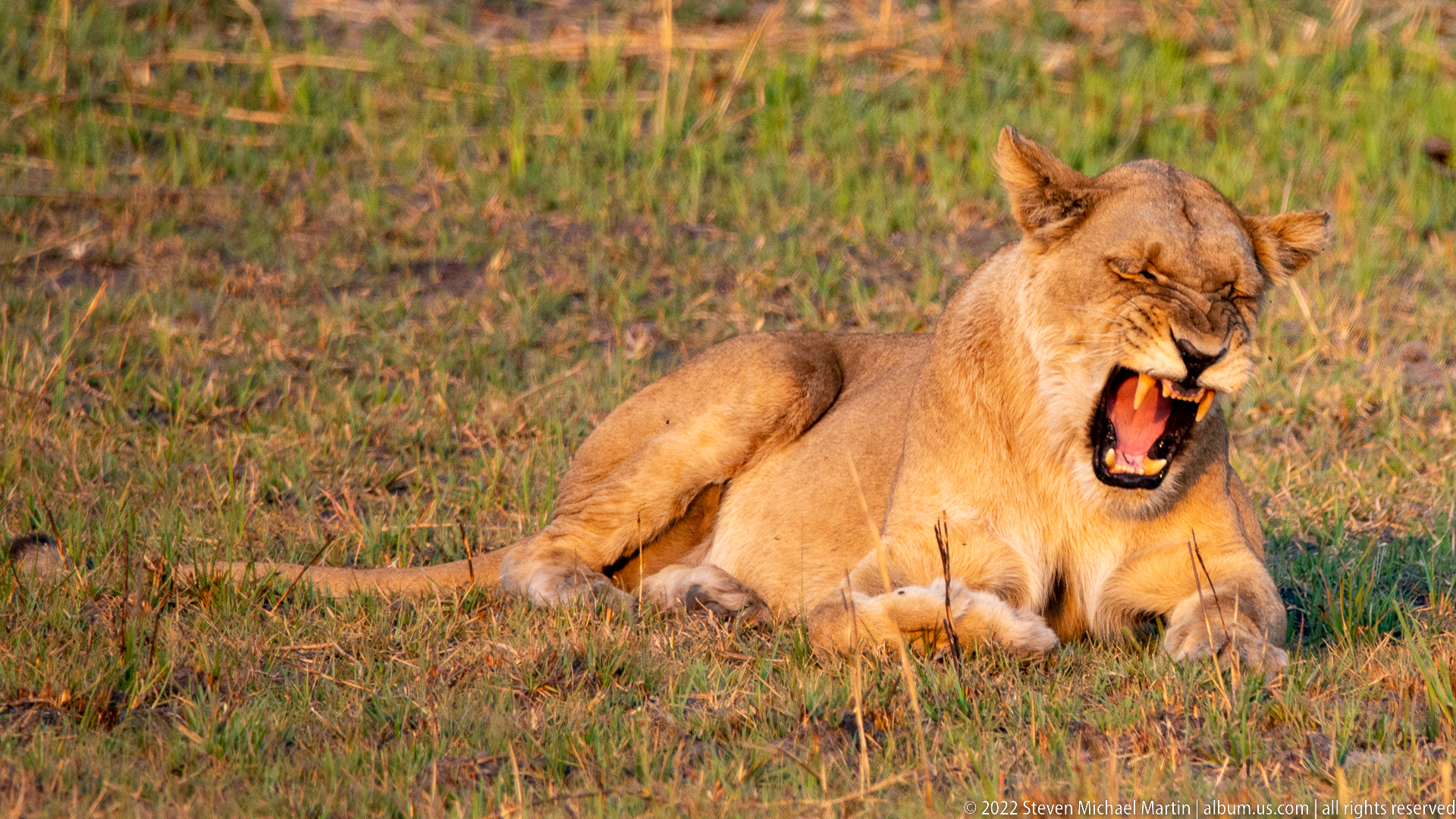
A lioness reaches the full extension of a yawn while lying in the grass, jaws wide and tongue curled downward between prominent canine teeth. The otherwise relaxed body remains anchored to the ground, making this frame a close behavioral study of a common resting transition rather than a threat display.
Caption
A lioness reaches the full extension of a yawn while lying in the grass, jaws wide and tongue curled downward between prominent canine teeth. The otherwise relaxed body remains anchored to the ground, making this frame a close behavioral study of a common resting transition rather than a threat display.
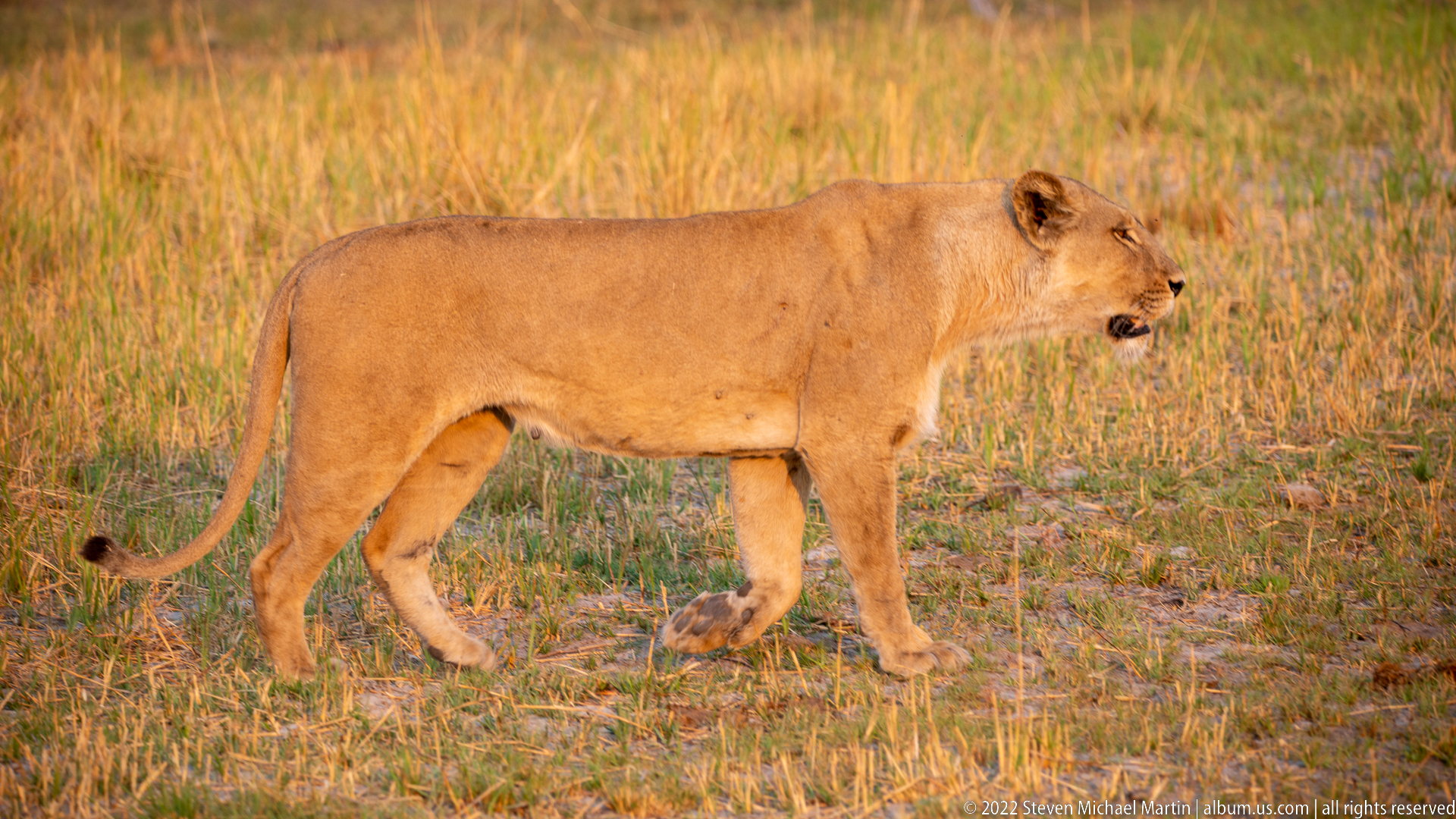
A lioness walks steadily through pale sunlit grass with her tail hanging low and mouth slightly open. The clean side profile emphasizes her long stride, muscular shoulders, and smooth tawny coat, while the open floodplain provides little cover around the moving cat.
Caption
A lioness walks steadily through pale sunlit grass with her tail hanging low and mouth slightly open. The clean side profile emphasizes her long stride, muscular shoulders, and smooth tawny coat, while the open floodplain provides little cover around the moving cat.
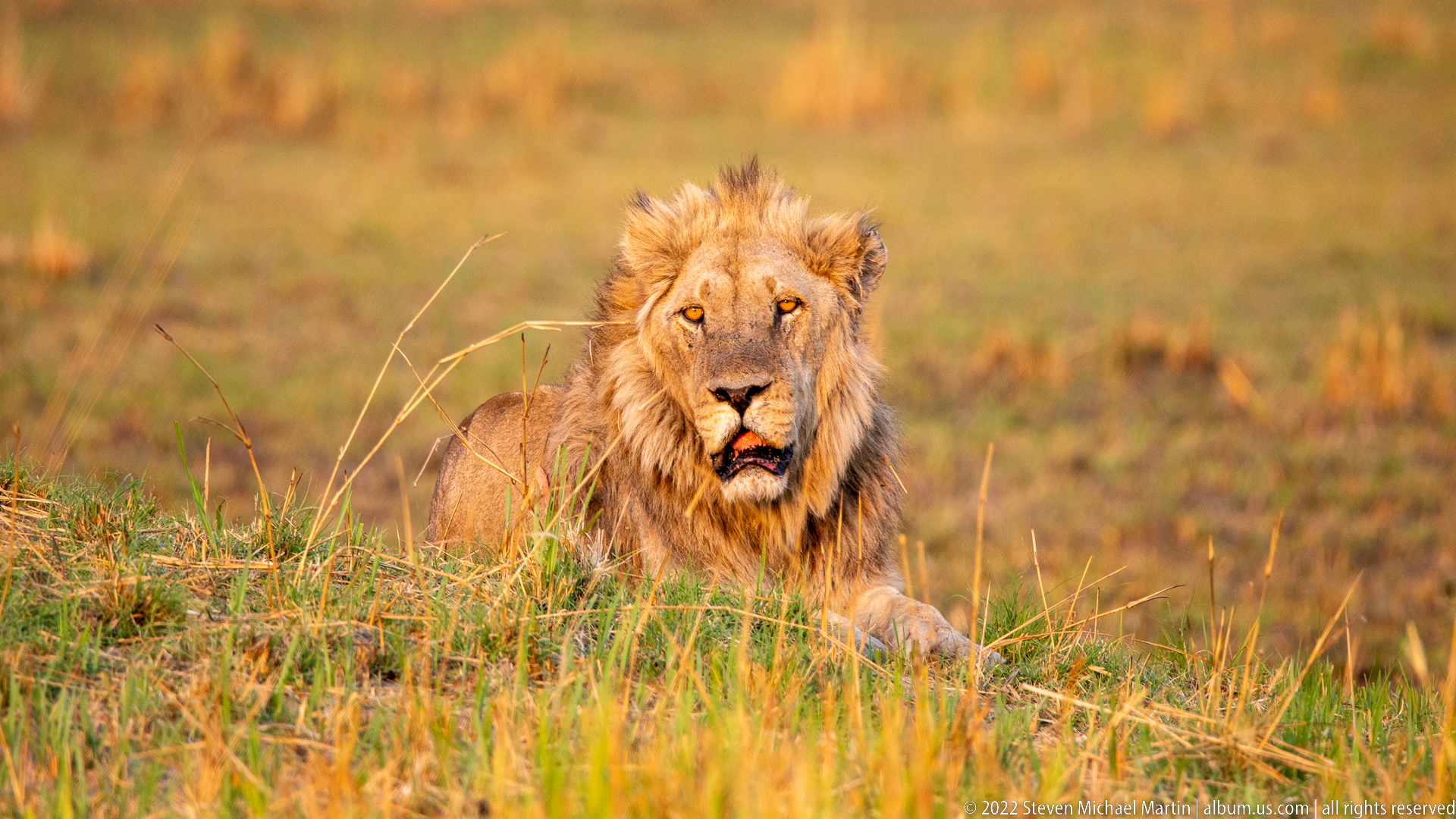
An adult male lion rests upright behind a low ridge of green grass, facing directly toward the camera. His mane appears tousled and uneven around the face and neck, while warm light on the eyes and muzzle separates him from the softly blurred floodplain behind.
Caption
An adult male lion rests upright behind a low ridge of green grass, facing directly toward the camera. His mane appears tousled and uneven around the face and neck, while warm light on the eyes and muzzle separates him from the softly blurred floodplain behind.
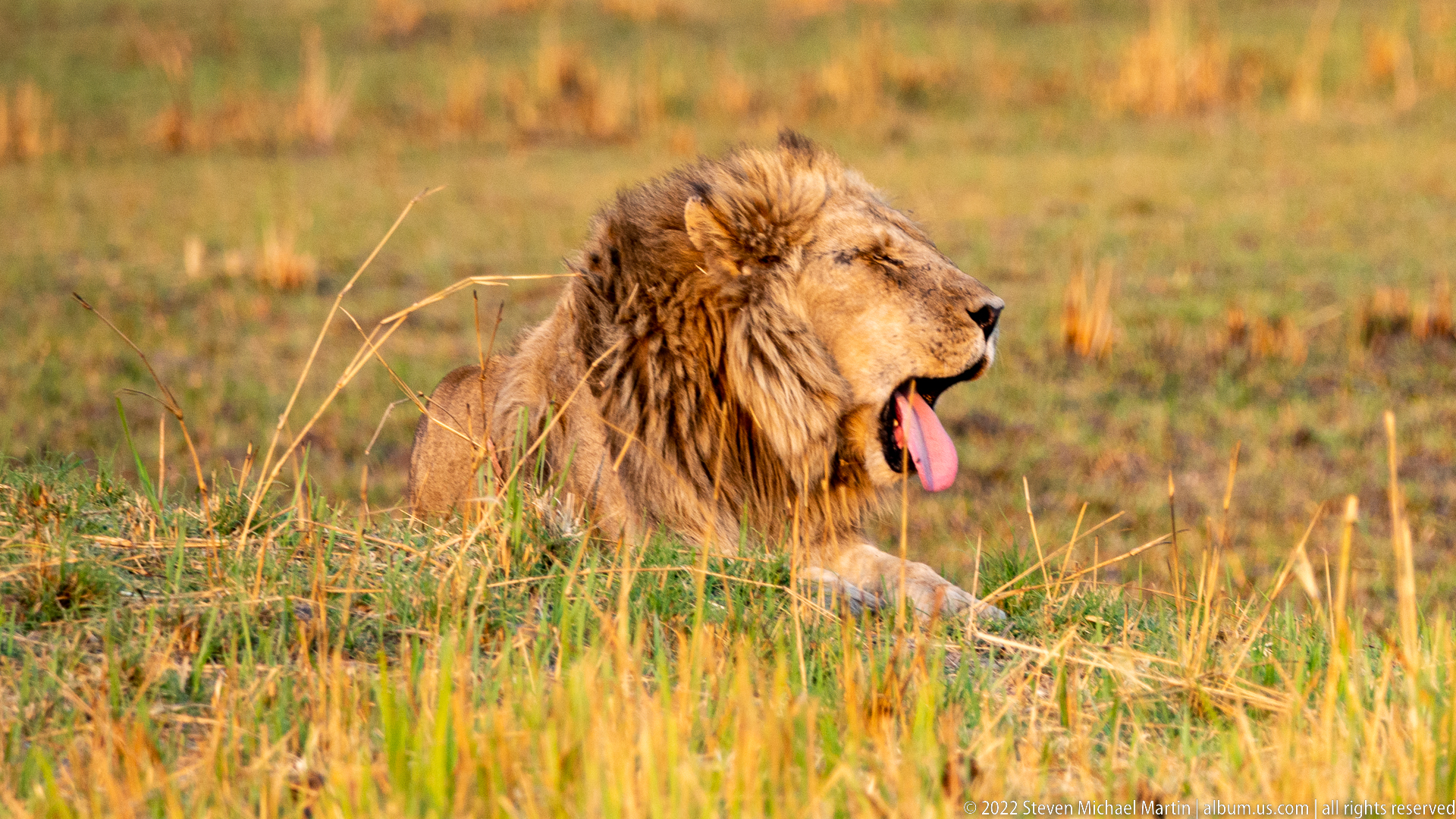
A resting male lion turns slightly to the side and begins a yawn, his tongue extending as the lower jaw drops. The profile angle reveals the mane’s shaggy outline and isolates the behavioral transition that will develop into the fully open yawn recorded in the following frames.
Caption
A resting male lion turns slightly to the side and begins a yawn, his tongue extending as the lower jaw drops. The profile angle reveals the mane’s shaggy outline and isolates the behavioral transition that will develop into the fully open yawn recorded in the following frames.
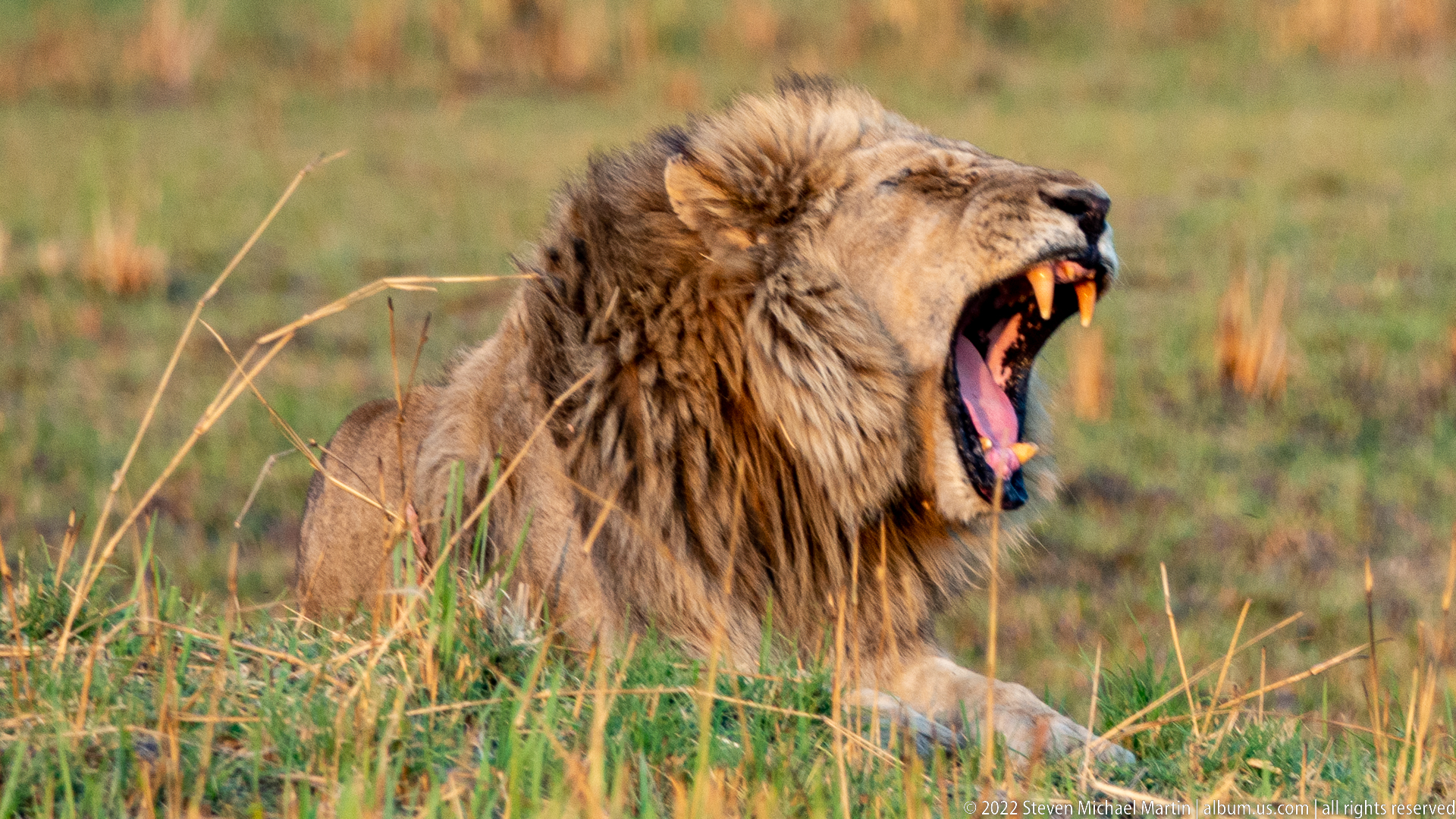
The male lion’s yawn deepens as the jaws open broadly, exposing the tongue, incisors, and long canine teeth. His eyes narrow and the head tilts upward while the body remains relaxed in the grass, separating the dramatic facial expression from any sign of active aggression.
Caption
The male lion’s yawn deepens as the jaws open broadly, exposing the tongue, incisors, and long canine teeth. His eyes narrow and the head tilts upward while the body remains relaxed in the grass, separating the dramatic facial expression from any sign of active aggression.
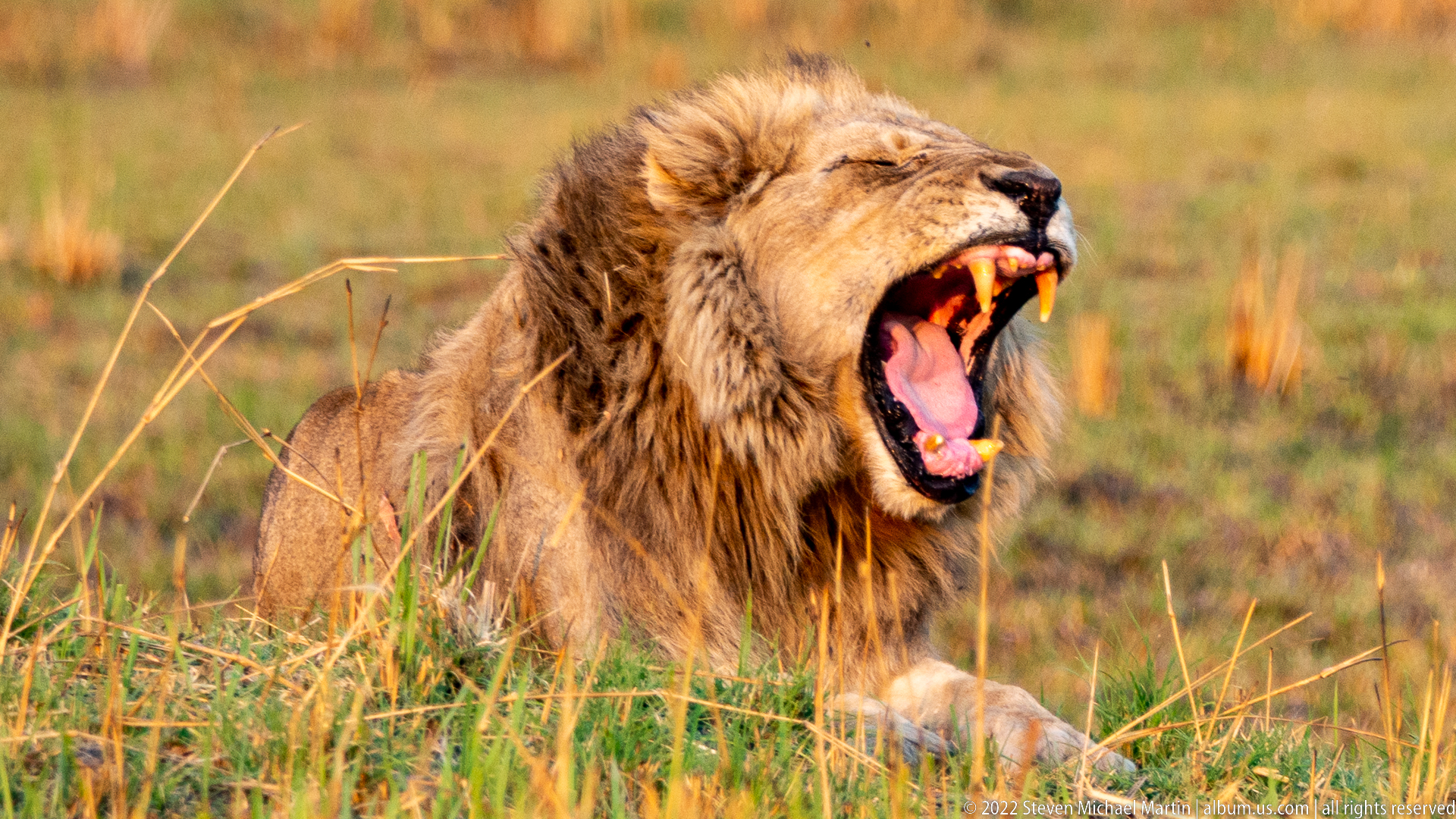
At the peak of the yawn, an adult male lion throws his jaws fully open, displaying the tongue, palate, and prominent canine teeth in warm evening light. The dramatic expression contrasts with his stationary, reclined posture and provides a detailed view of the dentition of a large African predator.
Caption
At the peak of the yawn, an adult male lion throws his jaws fully open, displaying the tongue, palate, and prominent canine teeth in warm evening light. The dramatic expression contrasts with his stationary, reclined posture and provides a detailed view of the dentition of a large African predator.
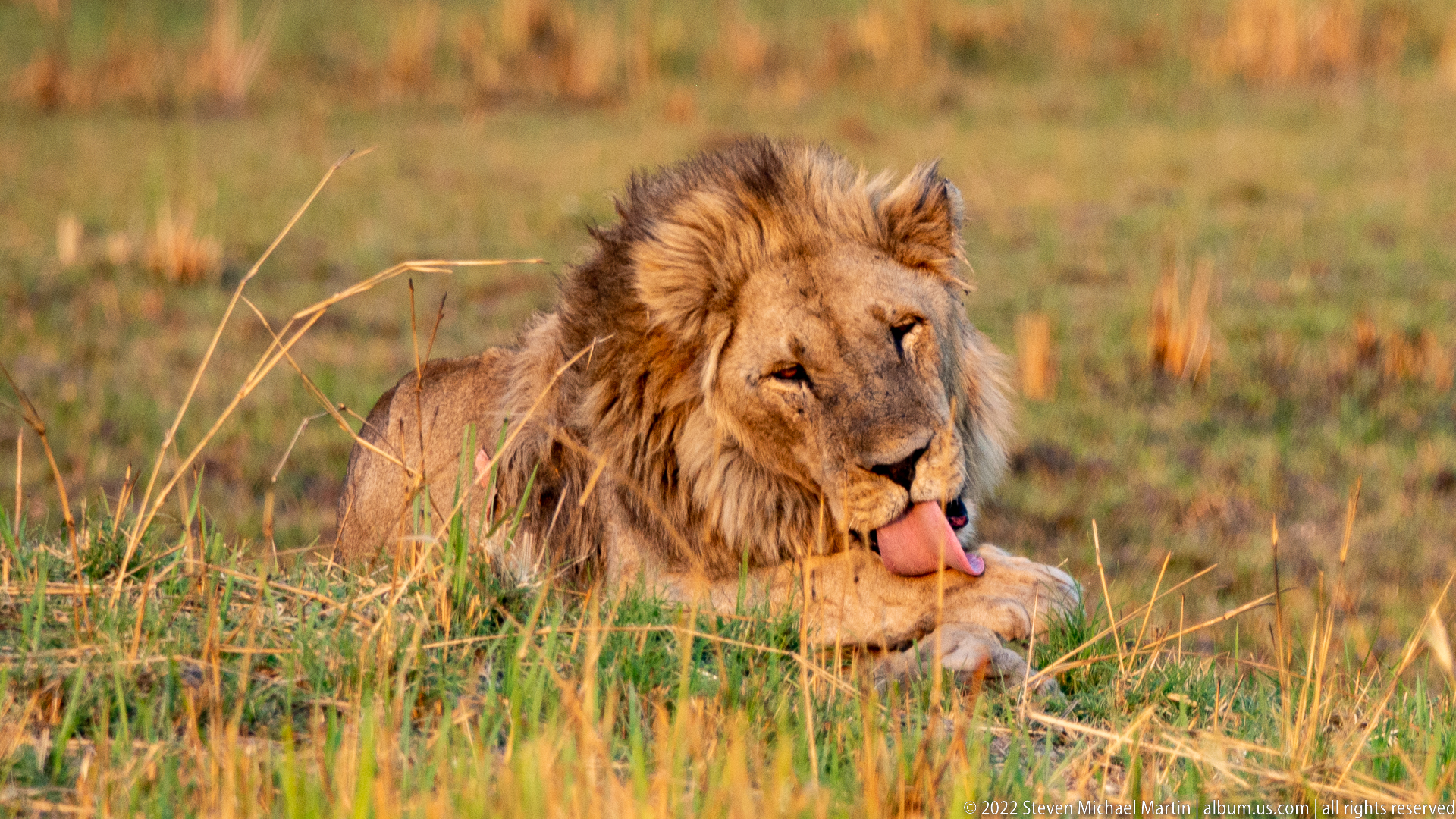
An adult male lion pauses in the grass to groom, drawing his tongue across a raised forepaw while his mane catches the warm light. The close behavioral view turns attention from the lion’s size to the routine maintenance of coat and paws, with the surrounding green floodplain softened into the background.
Caption
An adult male lion pauses in the grass to groom, drawing his tongue across a raised forepaw while his mane catches the warm light. The close behavioral view turns attention from the lion’s size to the routine maintenance of coat and paws, with the surrounding green floodplain softened into the background.
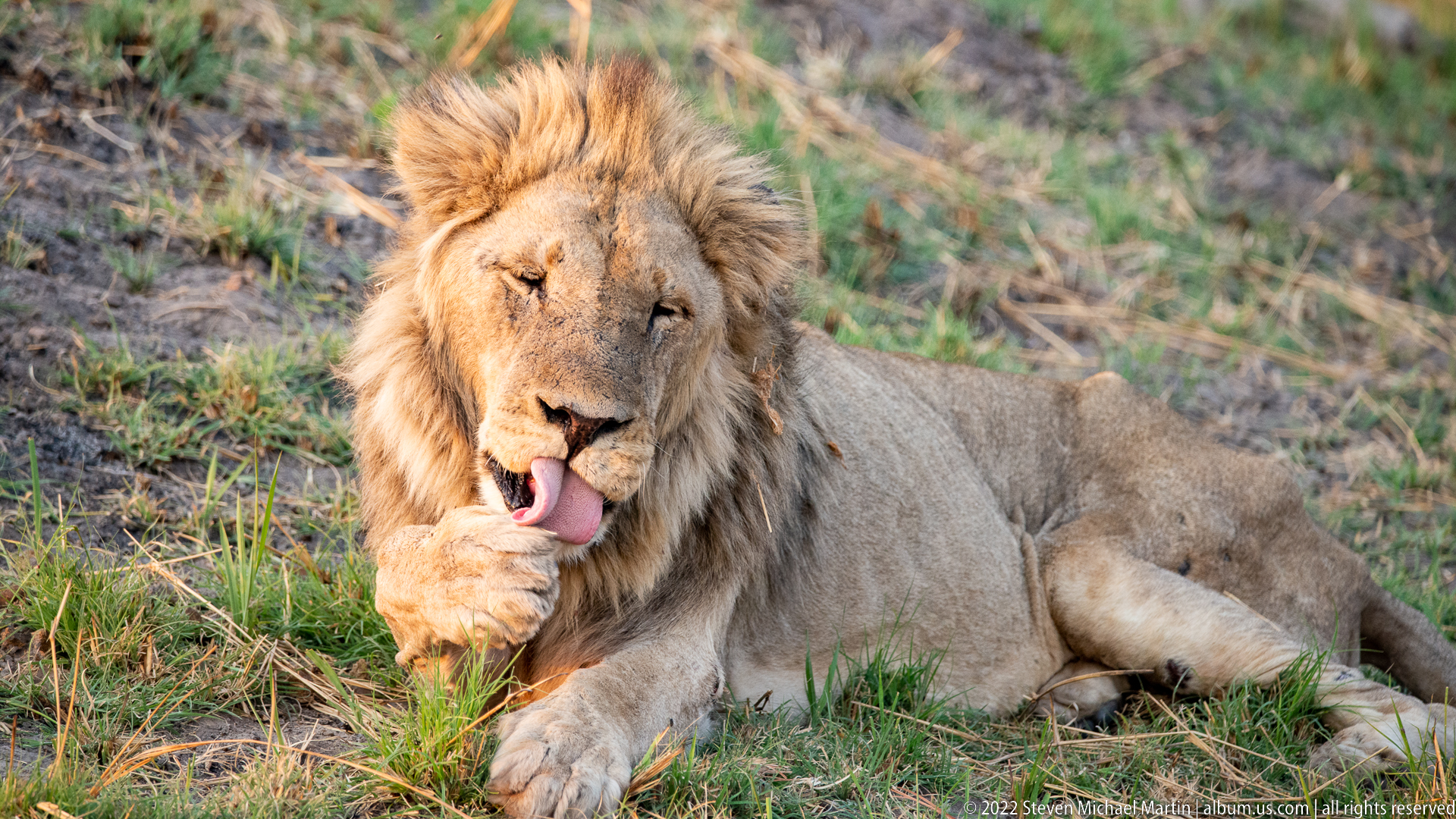
A reclining male lion continues grooming with one massive forepaw lifted almost to his face. His tongue sweeps across the fur while the open body posture remains relaxed, creating a slightly wider study of self-care behavior against short grass and dry stems.
Caption
A reclining male lion continues grooming with one massive forepaw lifted almost to his face. His tongue sweeps across the fur while the open body posture remains relaxed, creating a slightly wider study of self-care behavior against short grass and dry stems.
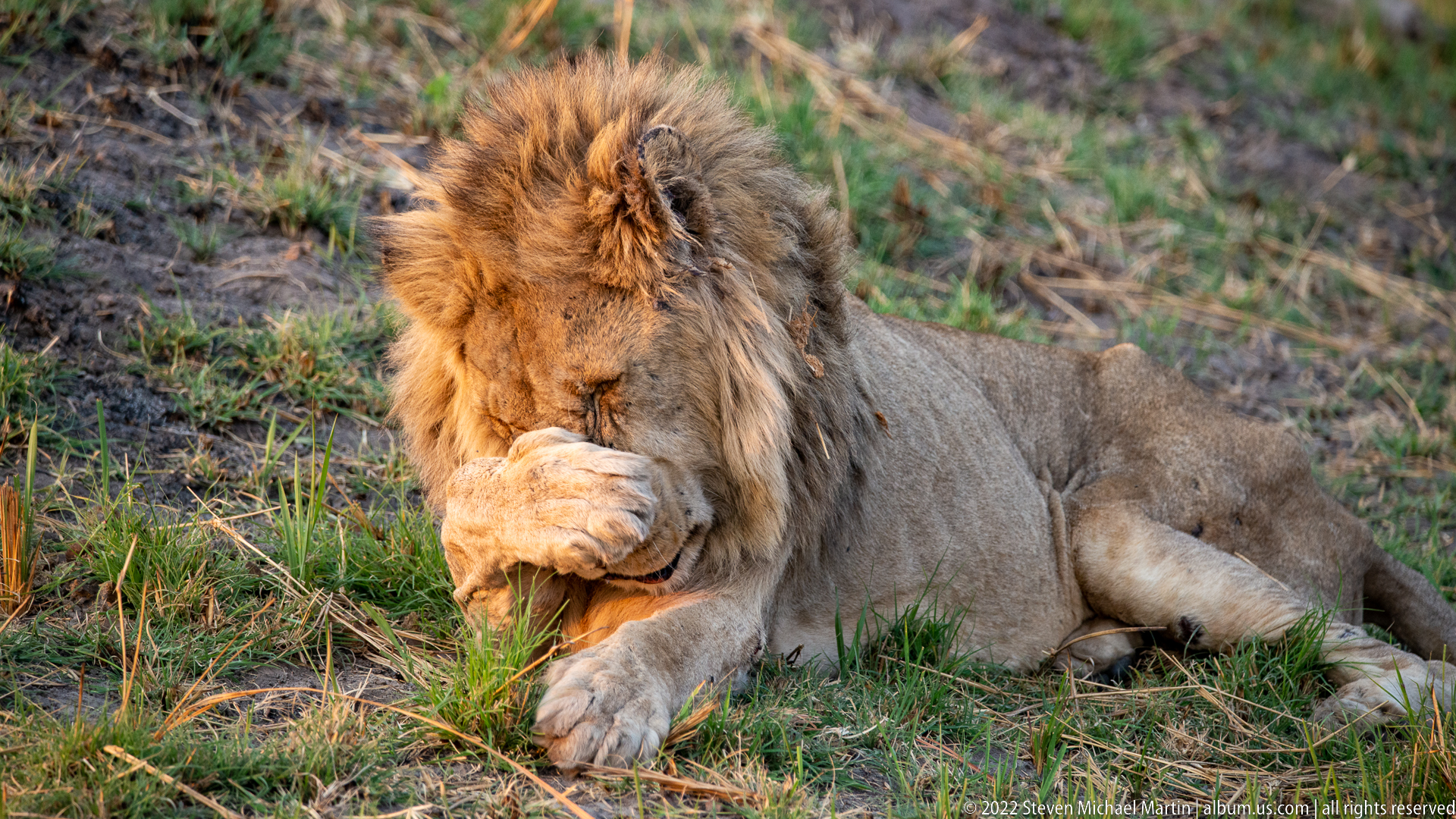
A male lion lowers his head over a raised forepaw during a grooming sequence, partly hiding the muzzle behind the paw. The photograph emphasizes the heavy paw, coarse mane, and concentrated posture rather than eye contact, distinguishing this moment from the surrounding open-mouthed and tongue-out views.
Caption
A male lion lowers his head over a raised forepaw during a grooming sequence, partly hiding the muzzle behind the paw. The photograph emphasizes the heavy paw, coarse mane, and concentrated posture rather than eye contact, distinguishing this moment from the surrounding open-mouthed and tongue-out views.
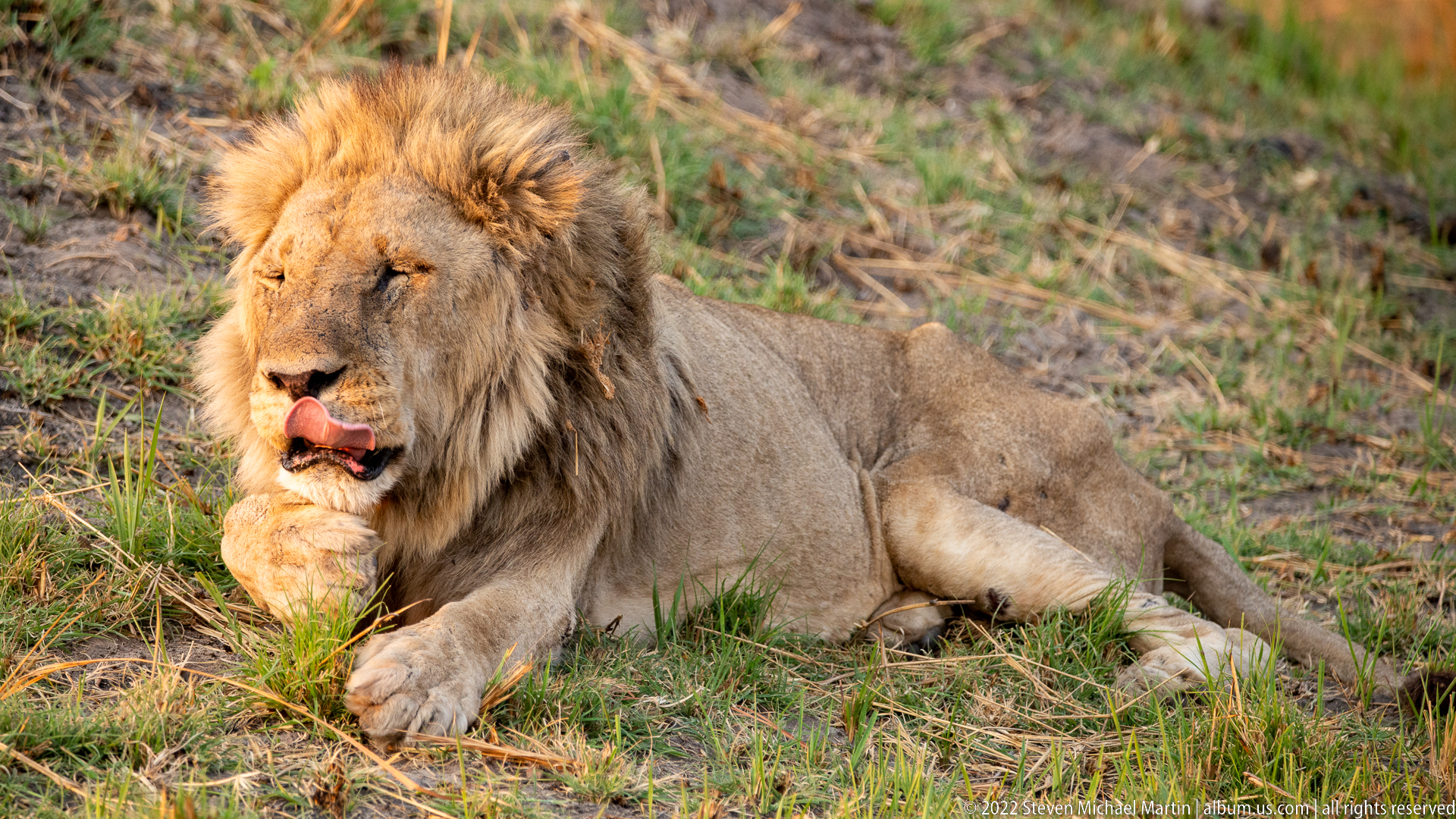
Warm evening light falls across a resting male lion as he extends his tongue over a raised forepaw. The illuminated face and mane contrast with the subdued grass behind, turning a routine grooming action into a detailed behavioral portrait at close range.
Caption
Warm evening light falls across a resting male lion as he extends his tongue over a raised forepaw. The illuminated face and mane contrast with the subdued grass behind, turning a routine grooming action into a detailed behavioral portrait at close range.
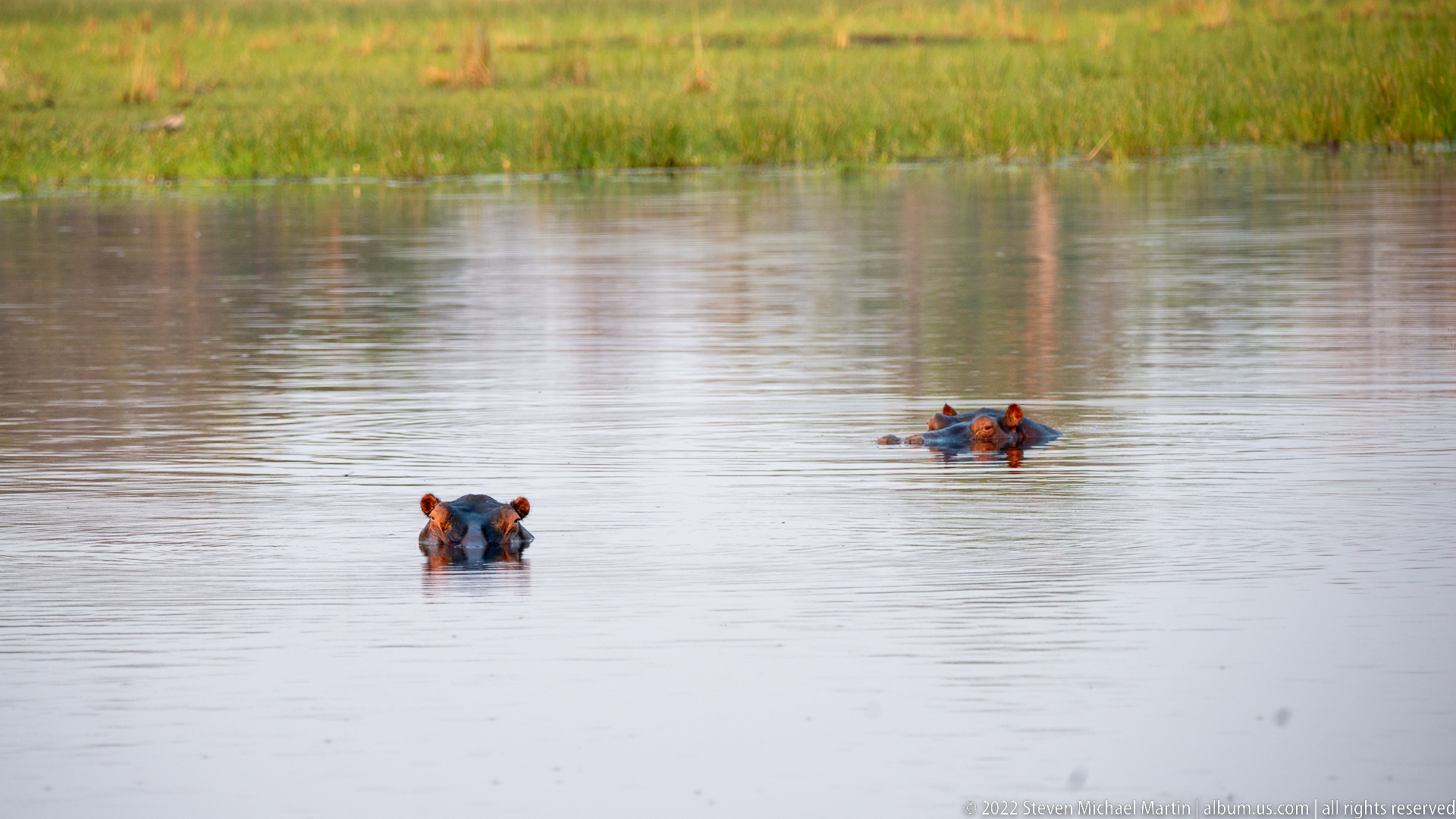
Two common hippopotamuses surface at different distances in calm Okavango water, with only eyes, ears, nostrils, and the upper head exposed. Their low profiles and near-total submersion show the aquatic posture typical of hippos resting or moving through channels during daylight.
Caption
Two common hippopotamuses surface at different distances in calm Okavango water, with only eyes, ears, nostrils, and the upper head exposed. Their low profiles and near-total submersion show the aquatic posture typical of hippos resting or moving through channels during daylight.
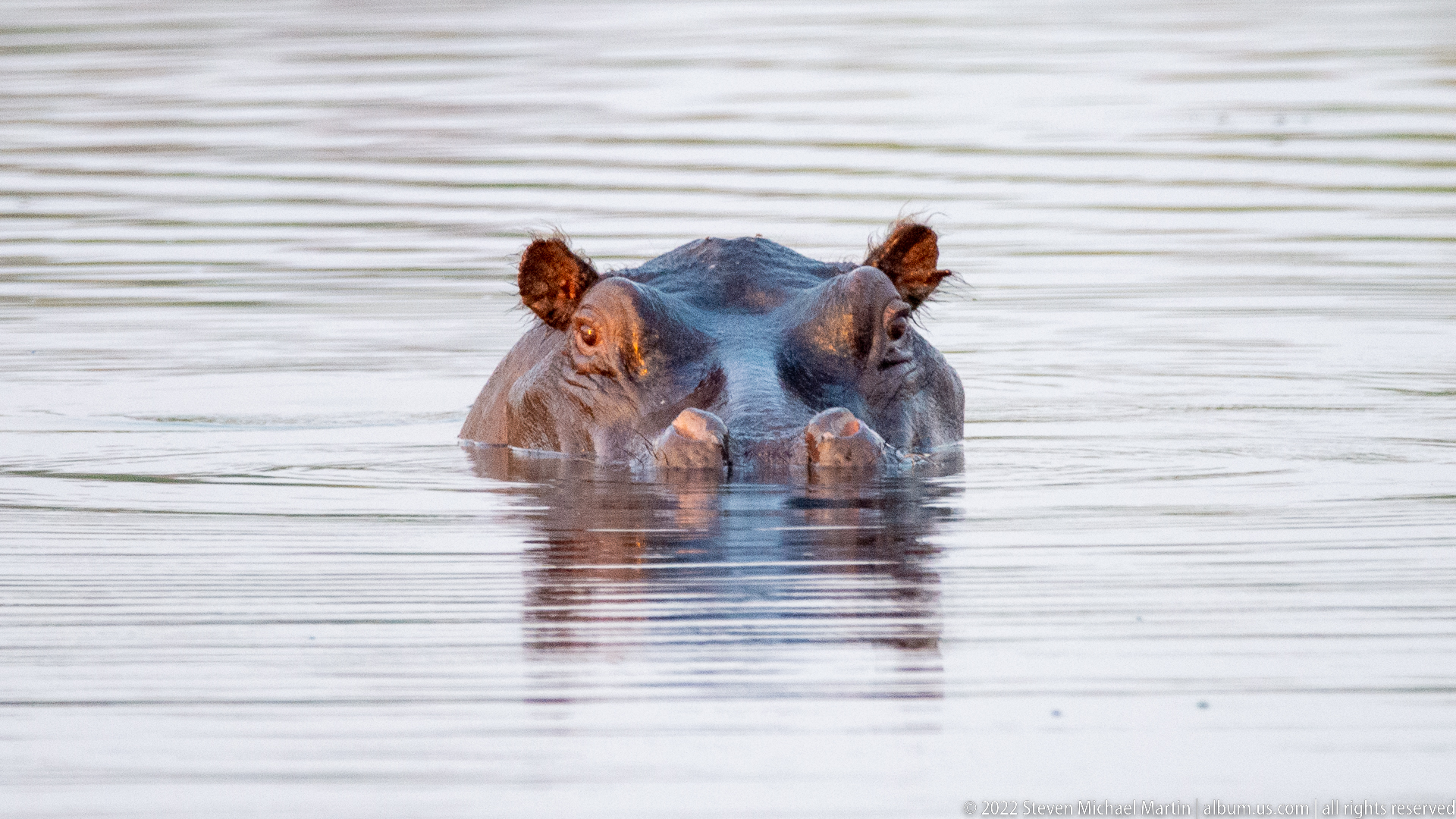
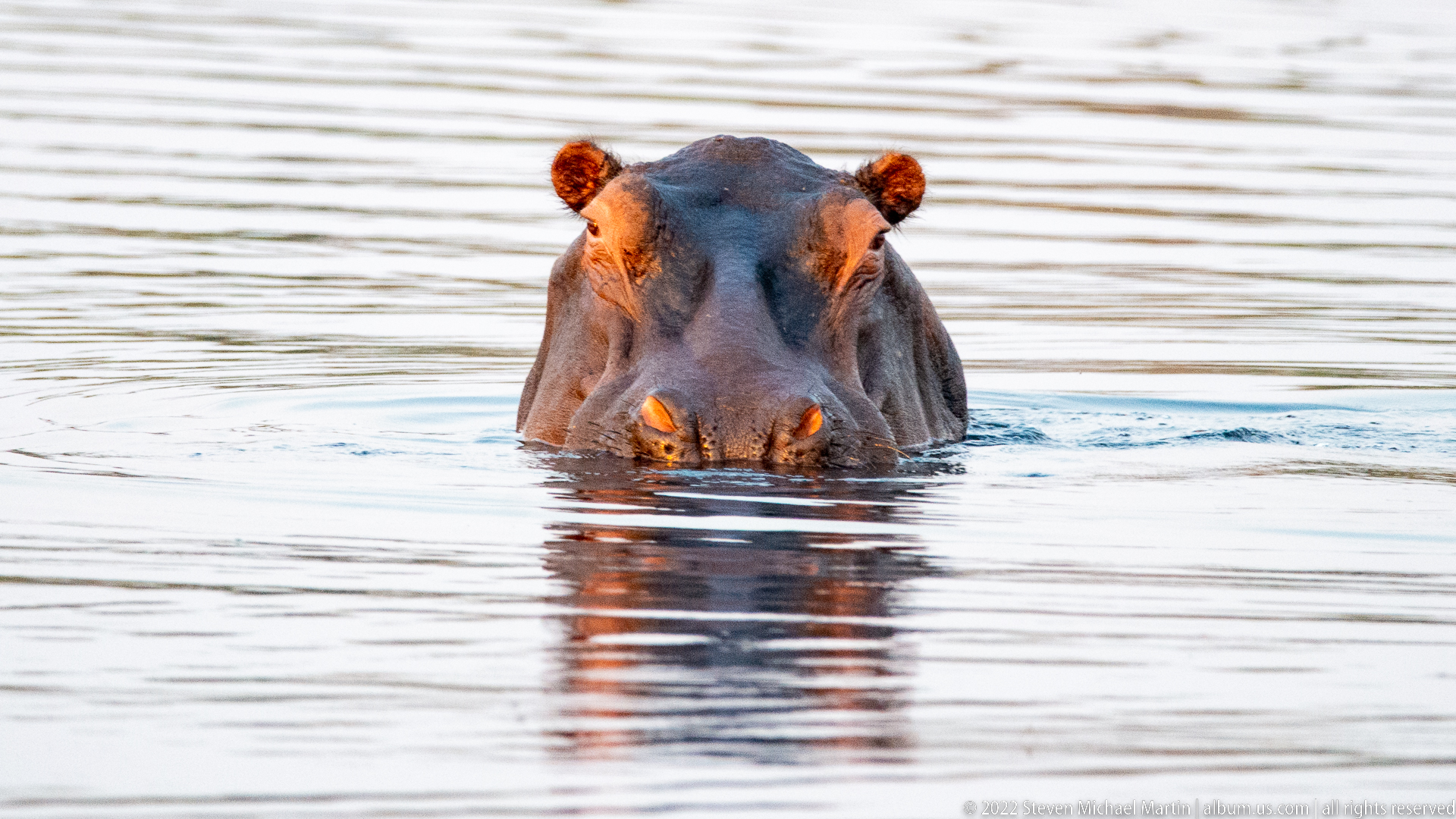
A common hippopotamus faces the camera almost completely submerged, its eyes and ears rising above the reflective water while the nostrils sit just at the surface. The low, symmetrical composition highlights the adaptations that allow a hippo to remain mostly underwater while still seeing and breathing.
Caption
A common hippopotamus faces the camera almost completely submerged, its eyes and ears rising above the reflective water while the nostrils sit just at the surface. The low, symmetrical composition highlights the adaptations that allow a hippo to remain mostly underwater while still seeing and breathing.
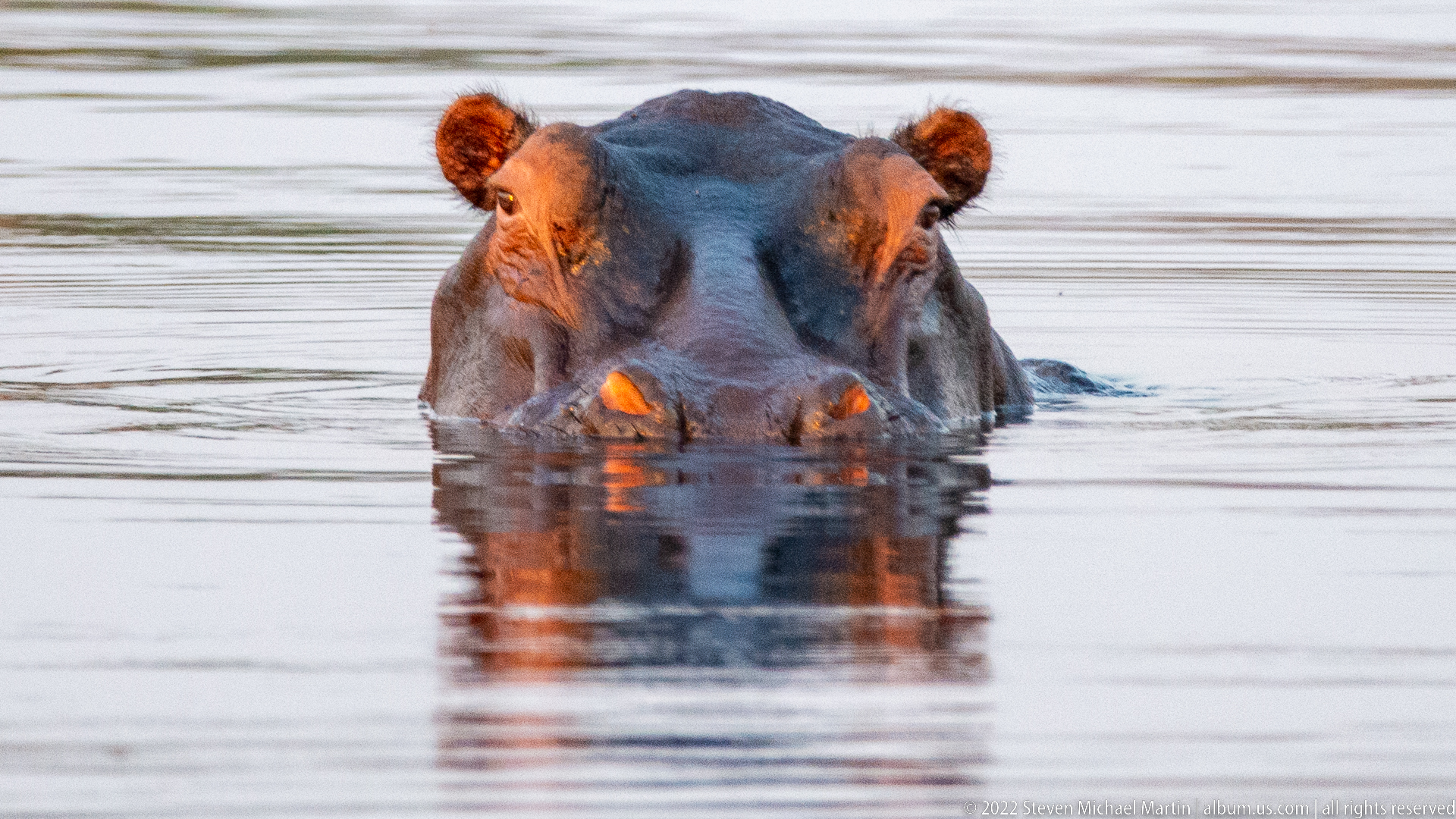
A hippopotamus advances through still water with its head held low, creating a narrow wake while warm light catches the ears and brow. The frontal perspective compresses the animal into the line of the water surface, with its sensory organs remaining above water and most of the massive body concealed below.
Caption
A hippopotamus advances through still water with its head held low, creating a narrow wake while warm light catches the ears and brow. The frontal perspective compresses the animal into the line of the water surface, with its sensory organs remaining above water and most of the massive body concealed below.
A common hippopotamus moves steadily through open water, leaving a broader wake around its partially submerged head and shoulders. The low-angle view preserves the eyes, ears, and nostrils above the surface while reflected sunset tones add warmth to the otherwise cool water.
Caption
A common hippopotamus moves steadily through open water, leaving a broader wake around its partially submerged head and shoulders. The low-angle view preserves the eyes, ears, and nostrils above the surface while reflected sunset tones add warmth to the otherwise cool water.

Three common hippopotamuses surface across a broad stretch of calm water, each exposing only the top of the head and muzzle. Their staggered spacing creates depth across the channel and shows the social presence of hippos without forcing an interpretation of group behavior beyond what is visible.
Caption
Three common hippopotamuses surface across a broad stretch of calm water, each exposing only the top of the head and muzzle. Their staggered spacing creates depth across the channel and shows the social presence of hippos without forcing an interpretation of group behavior beyond what is visible.
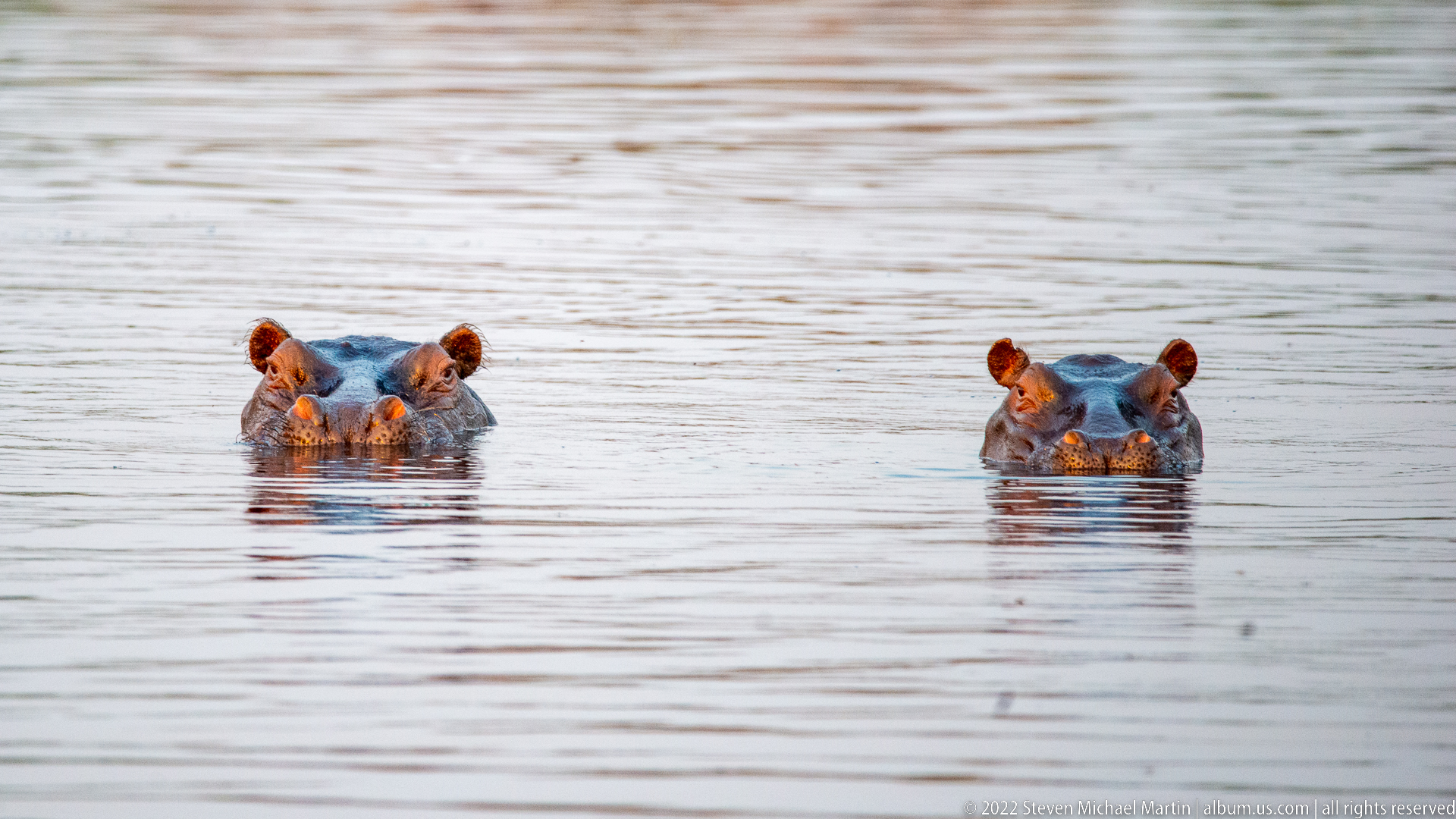
Two hippopotamuses float side by side with their heads aligned above the water, producing a simple, nearly symmetrical composition. The even spacing and still surface emphasize the broad muzzles, rounded ears, and high-set eyes that allow hippos to remain watchful while keeping most of the body submerged.
Caption
Two hippopotamuses float side by side with their heads aligned above the water, producing a simple, nearly symmetrical composition. The even spacing and still surface emphasize the broad muzzles, rounded ears, and high-set eyes that allow hippos to remain watchful while keeping most of the body submerged.
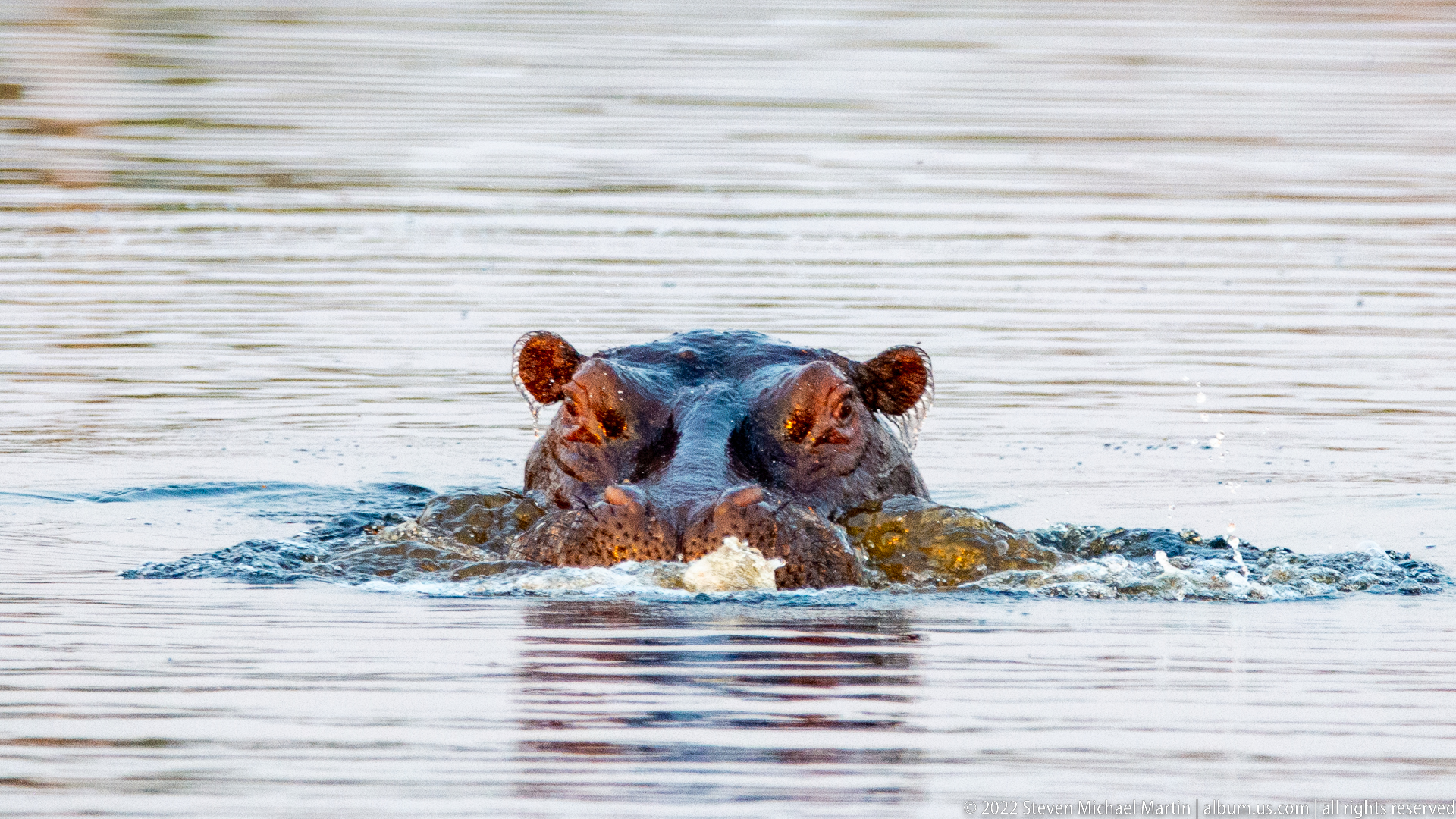
A hippopotamus pushes forcefully through the surface, churning the water into a frothy wake around its muzzle and cheeks. The frontal action view differs sharply from the preceding placid portraits, recording a brief burst of movement while the animal remains mostly submerged.
Caption
A hippopotamus pushes forcefully through the surface, churning the water into a frothy wake around its muzzle and cheeks. The frontal action view differs sharply from the preceding placid portraits, recording a brief burst of movement while the animal remains mostly submerged.
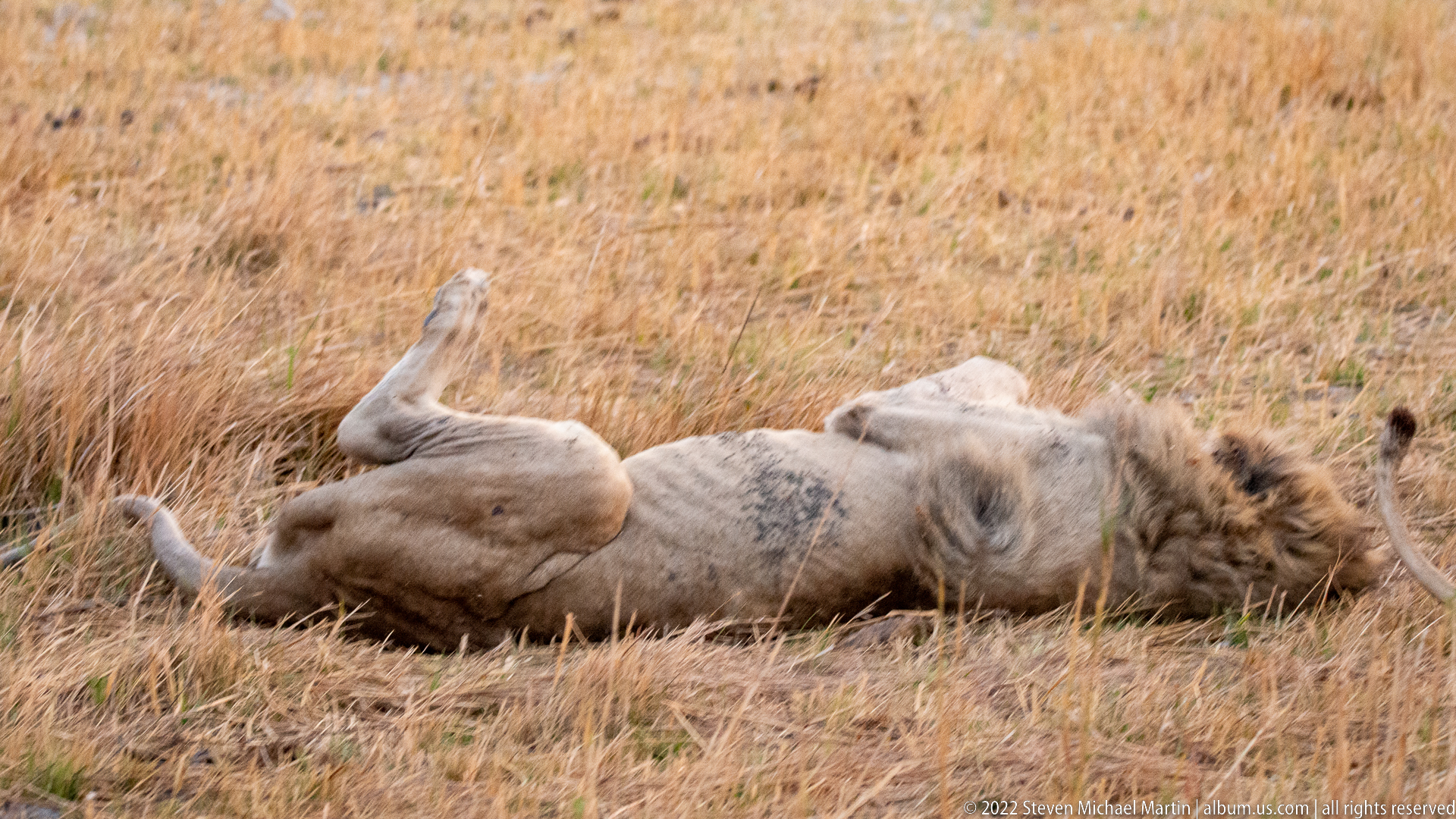
An adult male lion rolls onto his back in dry grass, belly exposed and legs lifted loosely above the ground. The inverted posture and relaxed limbs reveal a playful or comfort-oriented moment rarely seen in formal wildlife portraiture, while the mane and heavy body remain clearly visible.
Caption
An adult male lion rolls onto his back in dry grass, belly exposed and legs lifted loosely above the ground. The inverted posture and relaxed limbs reveal a playful or comfort-oriented moment rarely seen in formal wildlife portraiture, while the mane and heavy body remain clearly visible.
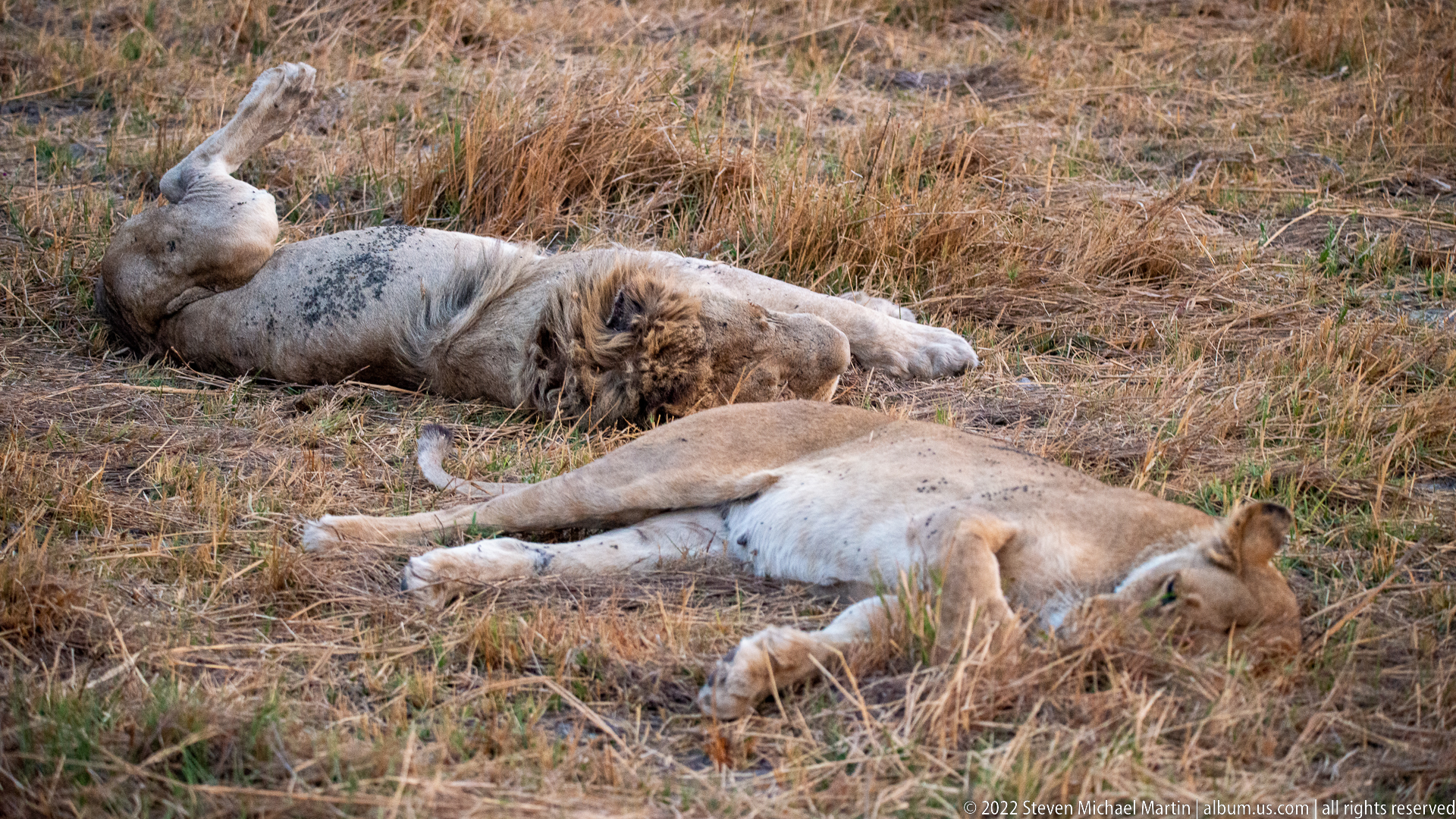
A male lion rolls on his back in the upper part of the frame while a lioness lies stretched out in the foreground. The paired composition contrasts two forms of rest within the same patch of dry grass: the male inverted and loose-limbed, the female extended on her side with her head turned away.
Caption
A male lion rolls on his back in the upper part of the frame while a lioness lies stretched out in the foreground. The paired composition contrasts two forms of rest within the same patch of dry grass: the male inverted and loose-limbed, the female extended on her side with her head turned away.

An adult male lion rests upright on short green grass, forepaws crossed and head turned slightly to one side. Dark flecks of mud or plant debris mark the tawny coat, while the open setting and soft light provide a clean full-body view after the more animated rolling sequence.
Caption
An adult male lion rests upright on short green grass, forepaws crossed and head turned slightly to one side. Dark flecks of mud or plant debris mark the tawny coat, while the open setting and soft light provide a clean full-body view after the more animated rolling sequence.
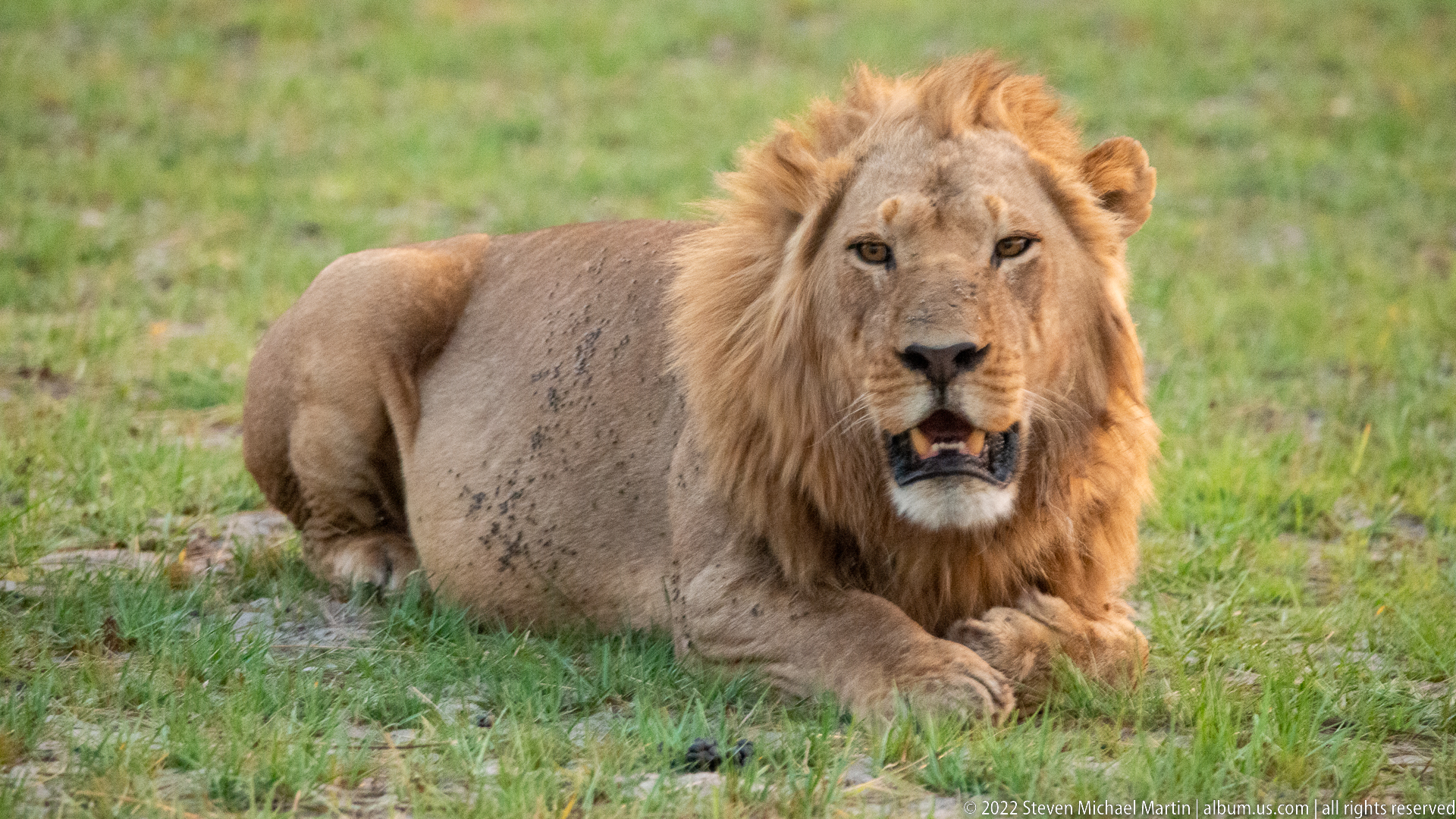
A male lion faces the camera from a relaxed crouch on green grass, his forepaws aligned beneath a broad chest and his mane framing a steady gaze. Small dark marks across the coat add texture to the otherwise uncluttered portrait, which centers expression and body symmetry.
Caption
A male lion faces the camera from a relaxed crouch on green grass, his forepaws aligned beneath a broad chest and his mane framing a steady gaze. Small dark marks across the coat add texture to the otherwise uncluttered portrait, which centers expression and body symmetry.
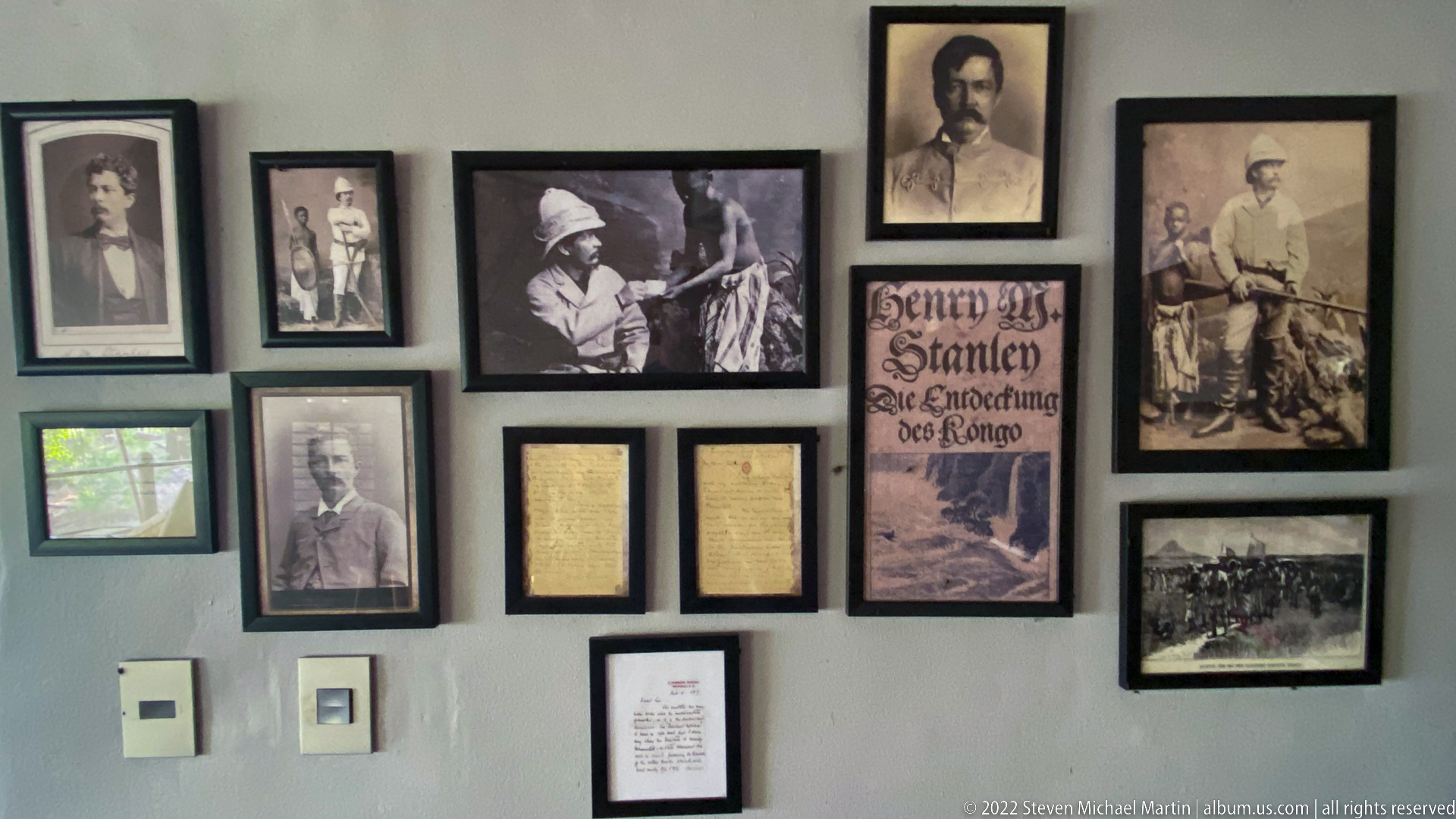
A curated wall display brings together historical portraits, expedition imagery, framed documents, and a reproduction associated with Henry Morton Stanley. The arrangement gives the safari-camp interior a historical theme, linking the name Stanley with nineteenth-century exploration while preserving the display itself as the primary visible subject.
Caption
A curated wall display brings together historical portraits, expedition imagery, framed documents, and a reproduction associated with Henry Morton Stanley. The arrangement gives the safari-camp interior a historical theme, linking the name Stanley with nineteenth-century exploration while preserving the display itself as the primary visible subject.
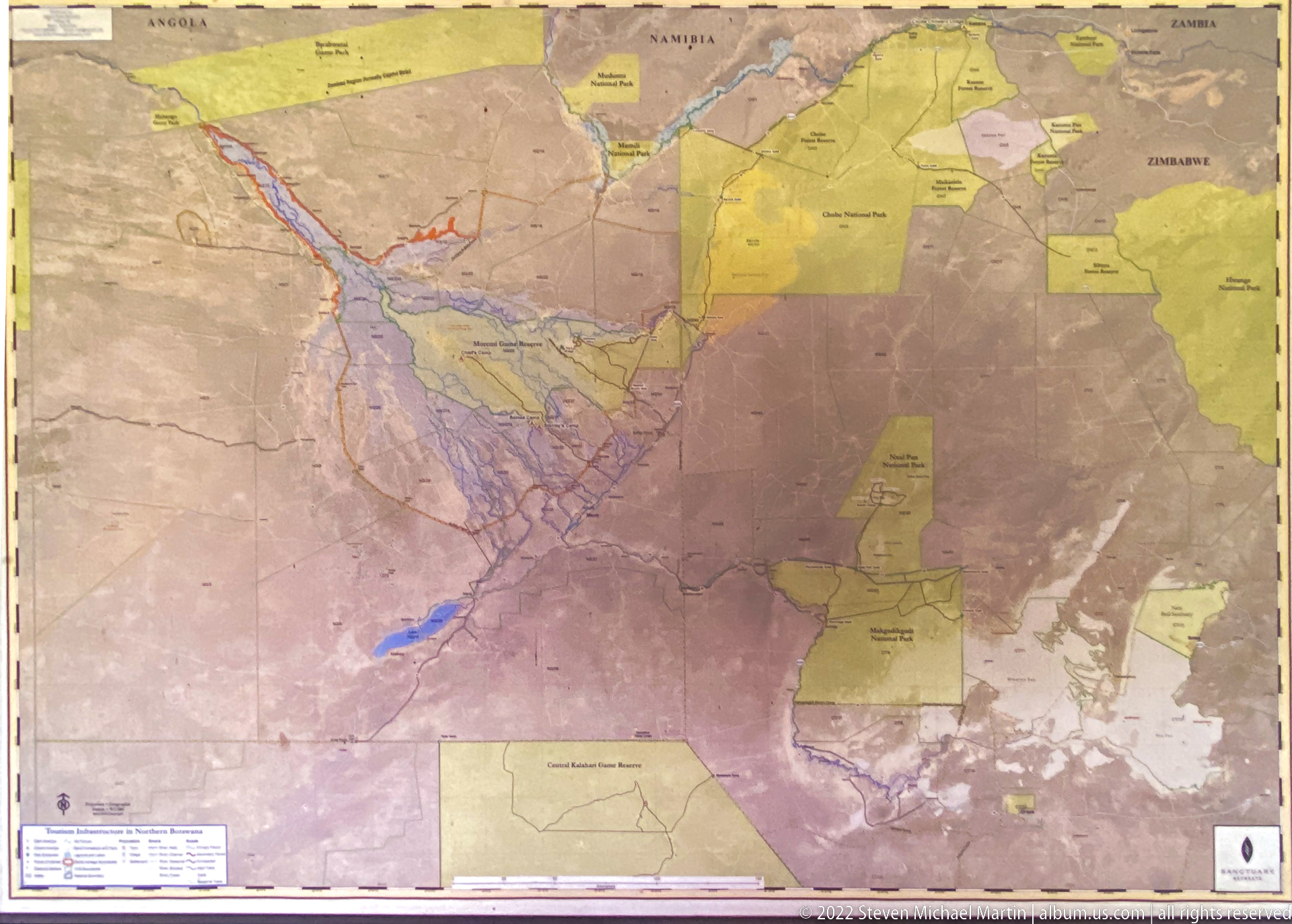
A large wall map charts the Okavango region with colored conservation areas, concession boundaries, waterways, roads, and neighboring territories. Displayed inside the camp, it functions as a geographic reference for the wider safari landscape, situating wildlife viewing within a complex mosaic of protected and managed land.
Caption
A large wall map charts the Okavango region with colored conservation areas, concession boundaries, waterways, roads, and neighboring territories. Displayed inside the camp, it functions as a geographic reference for the wider safari landscape, situating wildlife viewing within a complex mosaic of protected and managed land.

Leather sofas face one another across a low wooden table in a comfortable camp lounge, while shelves, framed photographs, and a large historical-style map line the surrounding walls. The room combines reading, conversation, and interpretation in a relaxed interior that echoes the Stanley-themed historical displays nearby.
Caption
Leather sofas face one another across a low wooden table in a comfortable camp lounge, while shelves, framed photographs, and a large historical-style map line the surrounding walls. The room combines reading, conversation, and interpretation in a relaxed interior that echoes the Stanley-themed historical displays nearby.
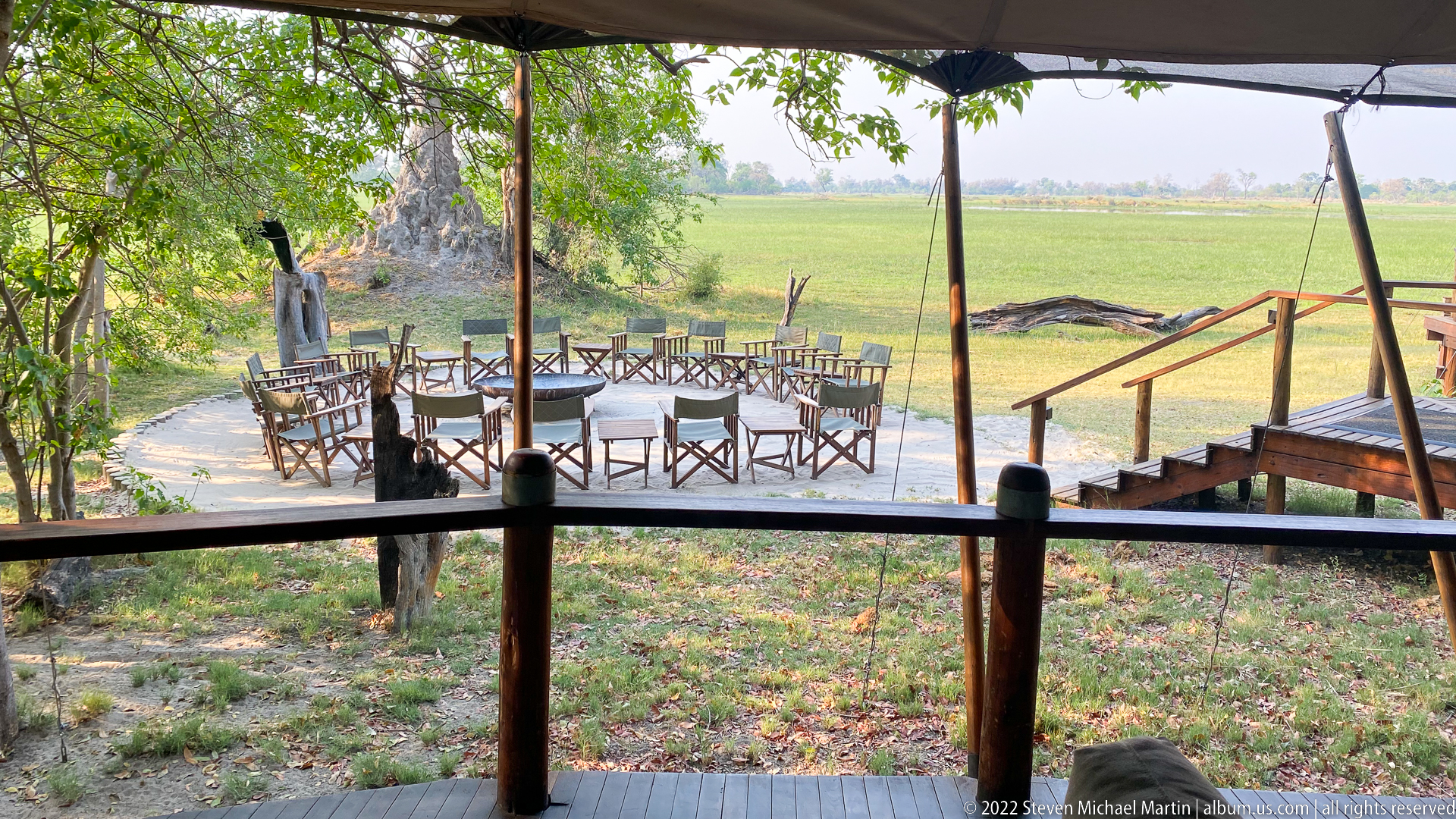
Wooden dining tables and director-style chairs are arranged beneath trees at the edge of the floodplain, viewed from a raised deck. The open-air setting places meals directly beside the wetland landscape, with a short stair and sandy ground connecting the camp’s elevated structures to the dining circle.
Caption
Wooden dining tables and director-style chairs are arranged beneath trees at the edge of the floodplain, viewed from a raised deck. The open-air setting places meals directly beside the wetland landscape, with a short stair and sandy ground connecting the camp’s elevated structures to the dining circle.
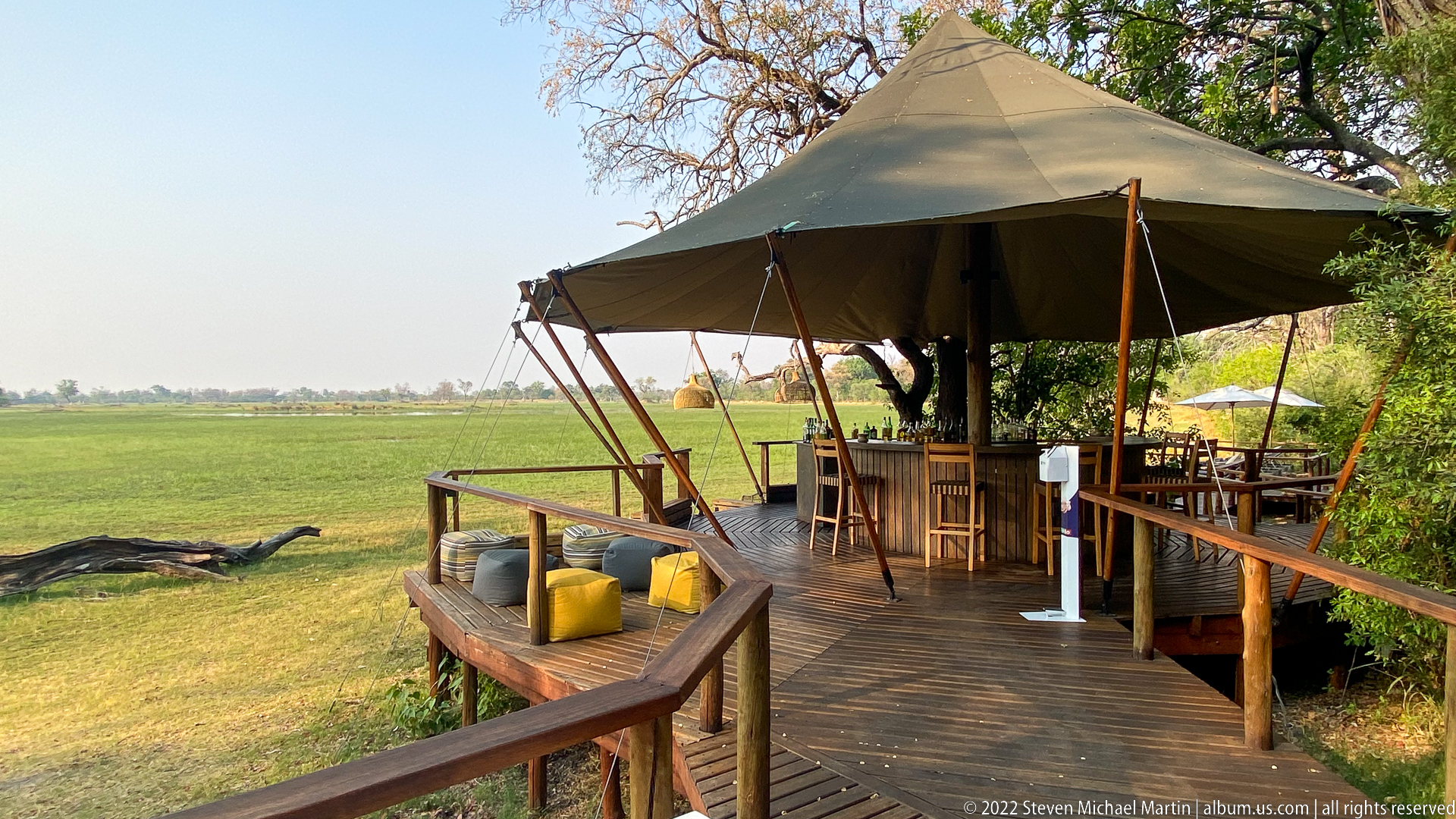
A canvas canopy shelters a compact bar on a raised wooden deck, with high stools, bottles, and a curved seating ledge facing the floodplain. The elevated platform merges camp hospitality with an uninterrupted wetland view, while mature trees are incorporated directly into the structure.
Caption
A canvas canopy shelters a compact bar on a raised wooden deck, with high stools, bottles, and a curved seating ledge facing the floodplain. The elevated platform merges camp hospitality with an uninterrupted wetland view, while mature trees are incorporated directly into the structure.
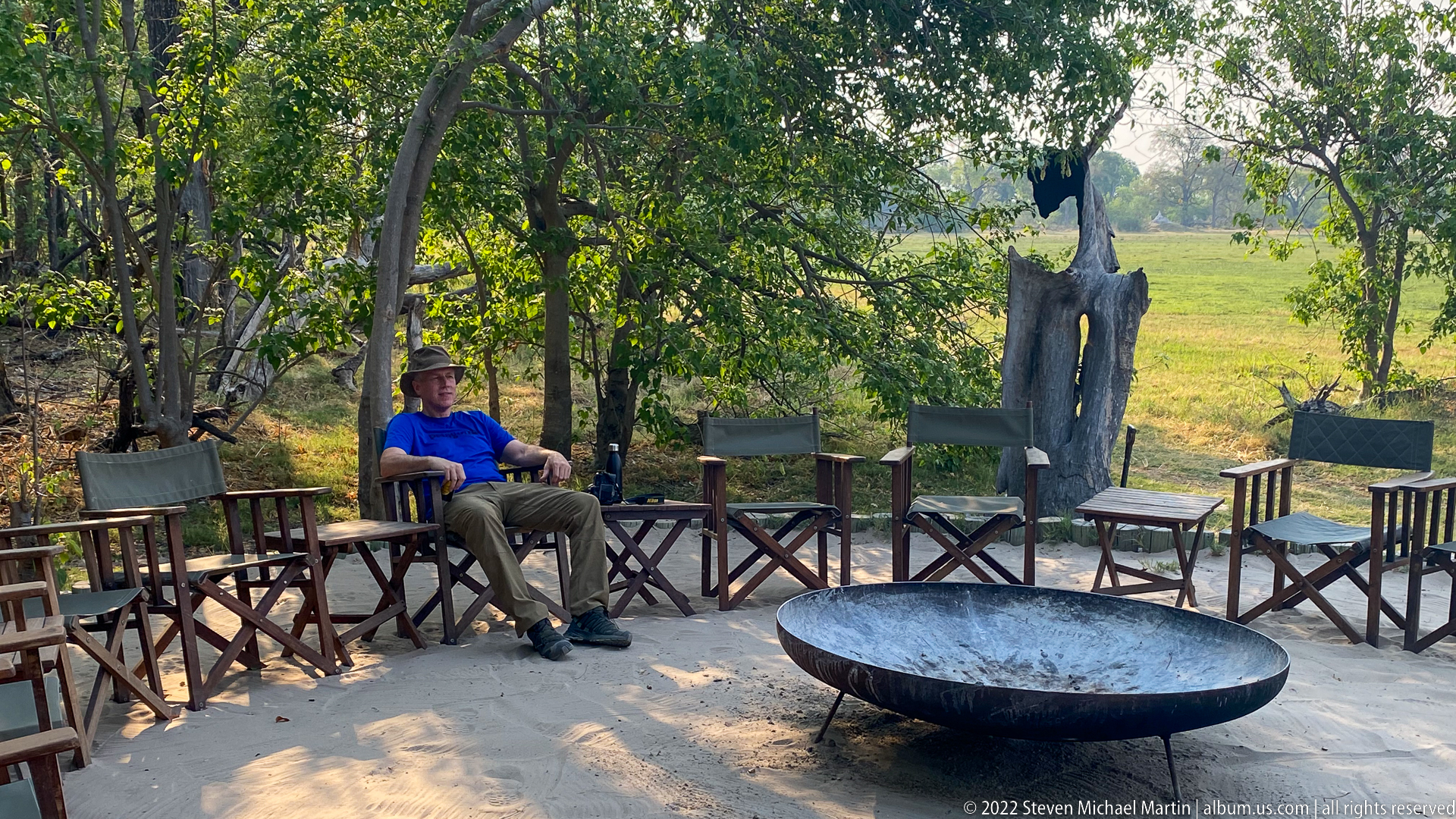
A guest sits among a semicircle of wooden camp chairs around a broad metal fire bowl set on pale sand. Trees frame the informal gathering place, while the open floodplain beyond keeps the firepit visually connected to the wider Okavango landscape.
Caption
A guest sits among a semicircle of wooden camp chairs around a broad metal fire bowl set on pale sand. Trees frame the informal gathering place, while the open floodplain beyond keeps the firepit visually connected to the wider Okavango landscape.
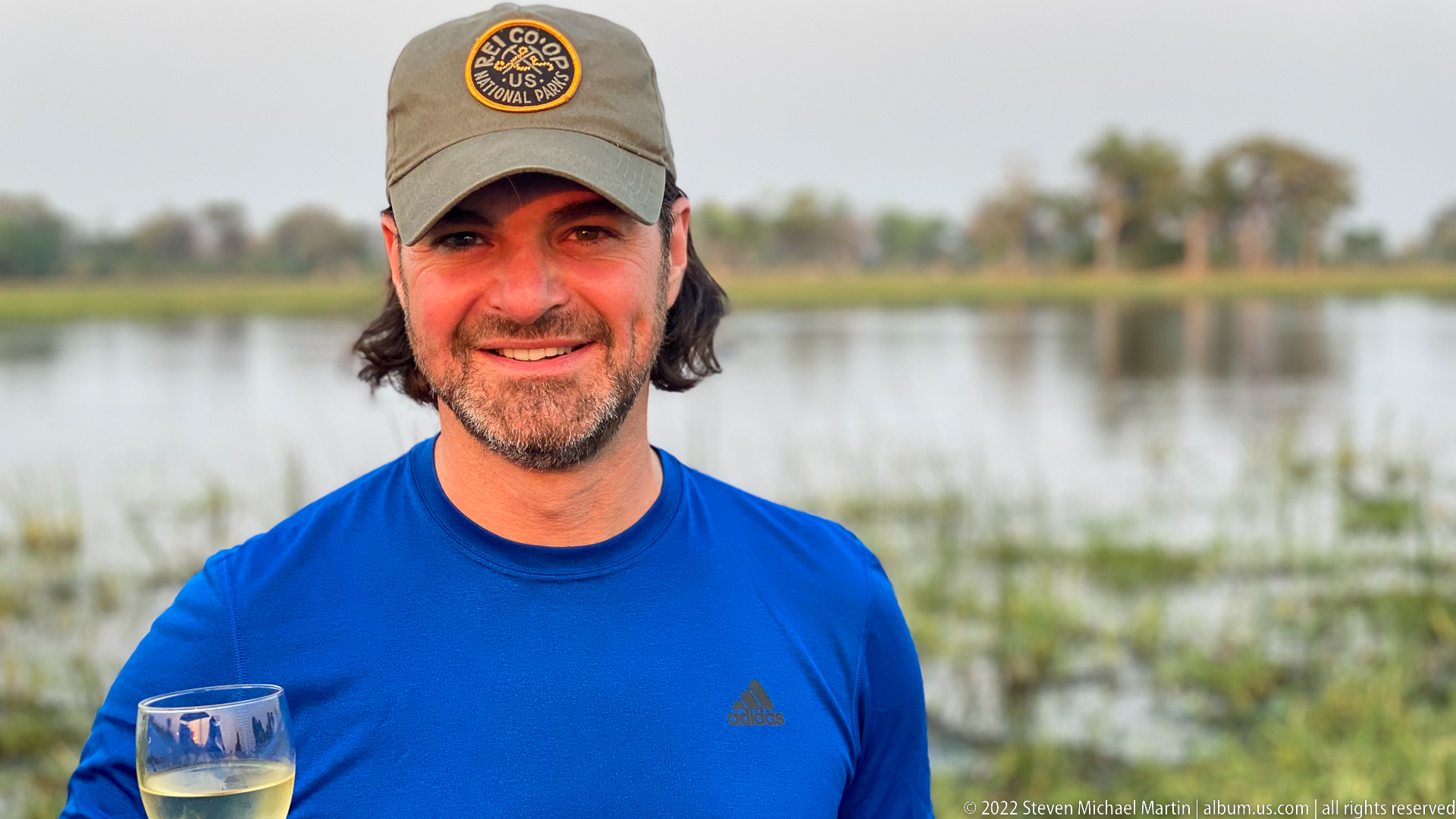
A smiling safari guest holds a stemmed drink in front of the Okavango wetland, with the water and distant vegetation rendered out of focus. The beverage and relaxed expression shift the portrait toward an evening camp moment while preserving the floodplain setting in the background.
Caption
A smiling safari guest holds a stemmed drink in front of the Okavango wetland, with the water and distant vegetation rendered out of focus. The beverage and relaxed expression shift the portrait toward an evening camp moment while preserving the floodplain setting in the background.
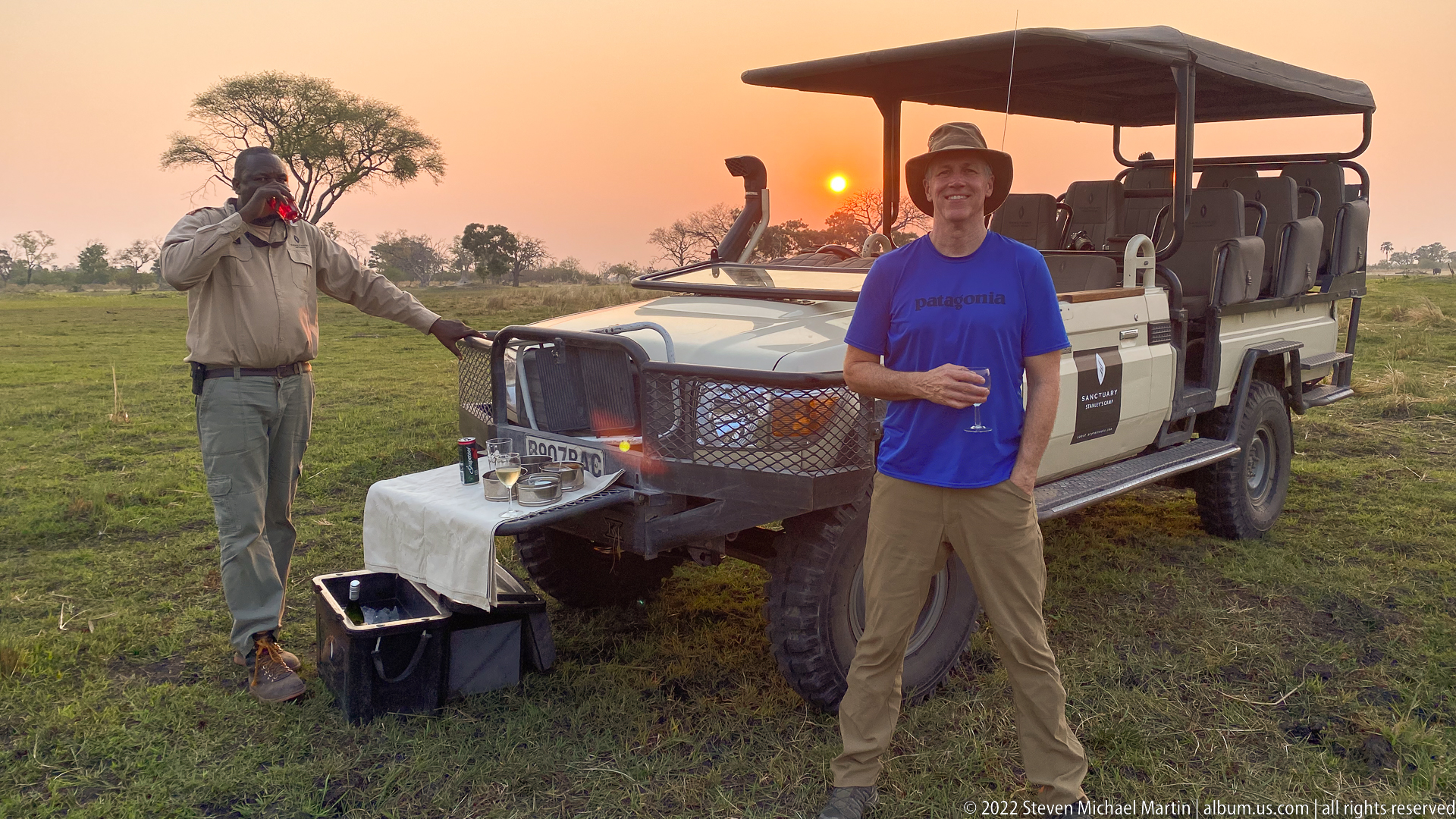
A guide and a guest stand beside an open safari vehicle as the sun drops toward the horizon across the floodplain. A small serving setup on the vehicle’s front creates the setting for a sundowner stop, combining the practical game-drive vehicle with the ritual of pausing for refreshments in the field.
Caption
A guide and a guest stand beside an open safari vehicle as the sun drops toward the horizon across the floodplain. A small serving setup on the vehicle’s front creates the setting for a sundowner stop, combining the practical game-drive vehicle with the ritual of pausing for refreshments in the field.
The Okavango Delta felt like the beginning of the safari in its purest form — a place where water, wildlife, and distance all seemed to shape the rhythm of each day. From the first aerial views to the last evening light, the experience unfolded as both landscape and story.
What made the delta memorable was its sense of movement. Channels curved through the land, floodplains opened unexpectedly below the plane, wildlife gathered where water lingered, and camp life settled naturally into the wider environment. The result was not only a safari, but a gradual immersion into one of Africa’s most distinctive ecosystems.
Highlights
- Aerial arrival revealing the scale and pattern of the delta
- Seasonal channels, floodplains, and wetland mosaics seen from above and on the ground
- Lion sightings in warm evening light
- Hippos and birdlife shaping the quieter rhythm of the waterways
- Classic tented camp atmosphere blending comfort with wilderness
Field Guide
📍 Location
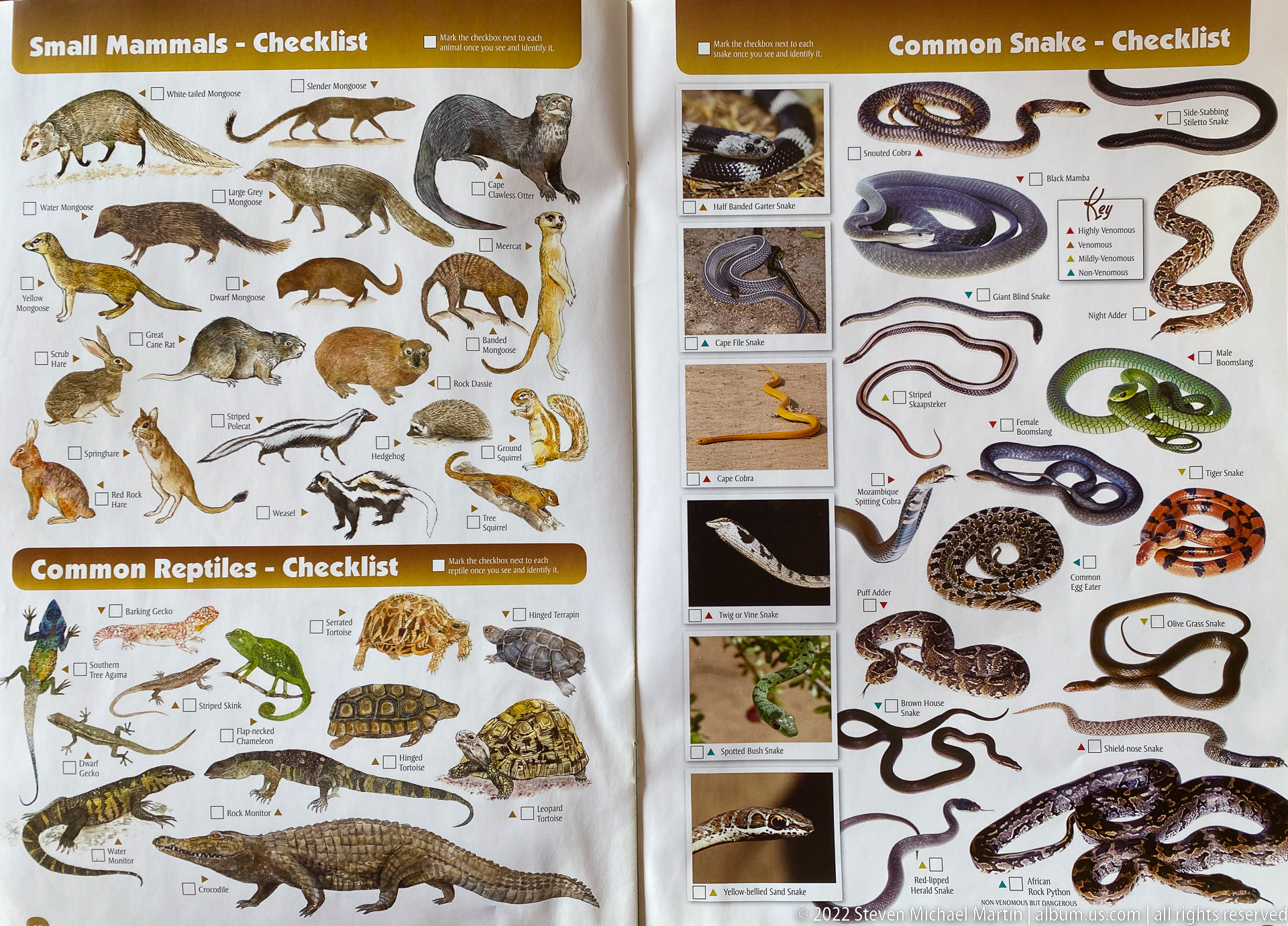
The Okavango Delta lies in northern Botswana and is one of the world’s most remarkable inland wetland systems. Seasonal floodwaters spread across the Kalahari Basin, creating a landscape of channels, lagoons, islands, and floodplains that support exceptional biodiversity.
🌍 Landscape
The landscape shifts between open water, papyrus-lined channels, grassy floodplains, isolated tree islands, and drier woodland edges. From the air, the delta appears as a branching network of water and vegetation; on the ground, it feels constantly changing depending on season, light, and proximity to water.
🦁 Wildlife
Wildlife in the delta is closely tied to water. Lions move through the grasslands and floodplain edges, hippos occupy the channels, and antelope gather where grazing remains green. The ecosystem supports both dramatic predator sightings and quieter moments of observation.
🦅 Birdlife
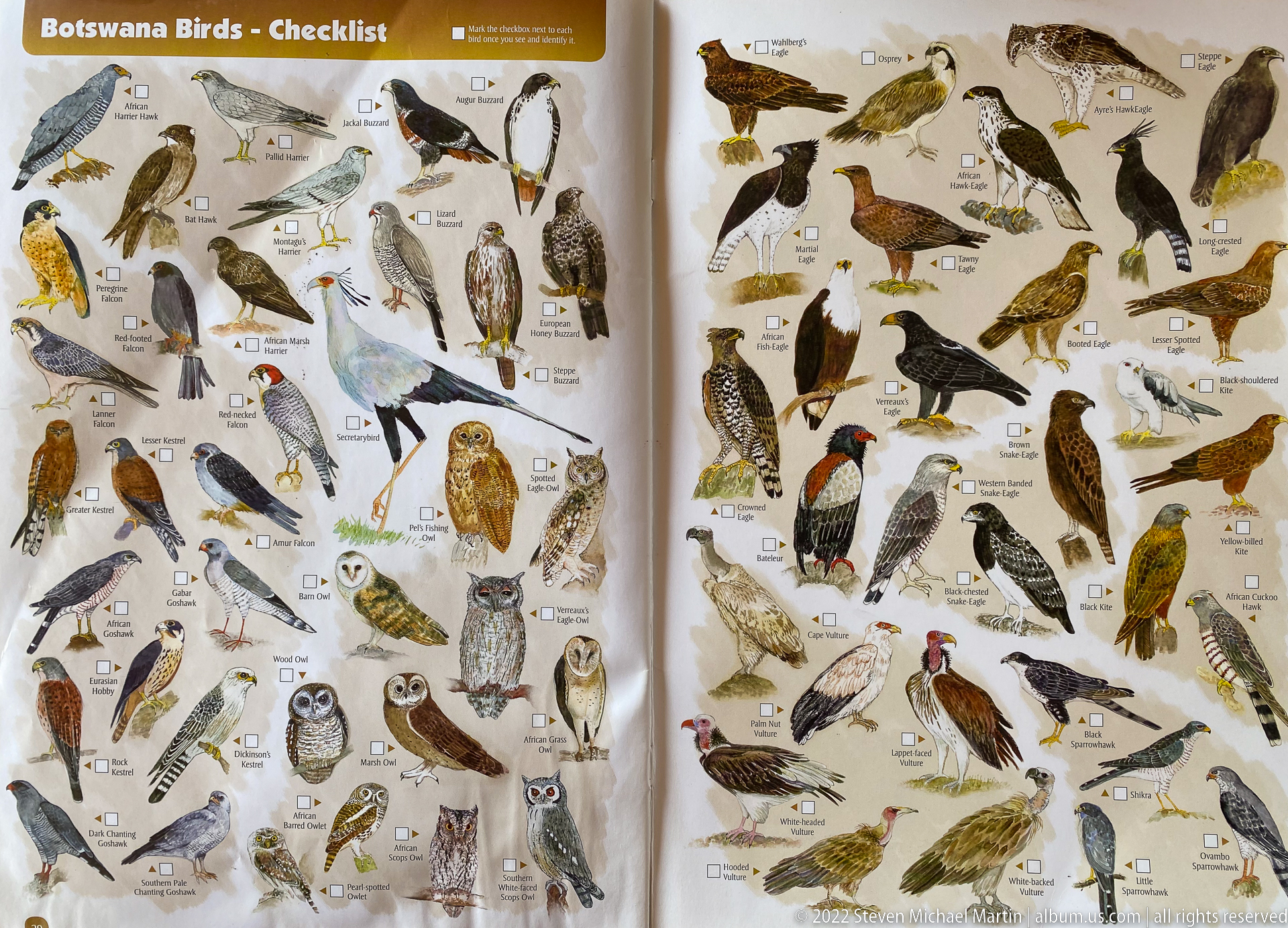
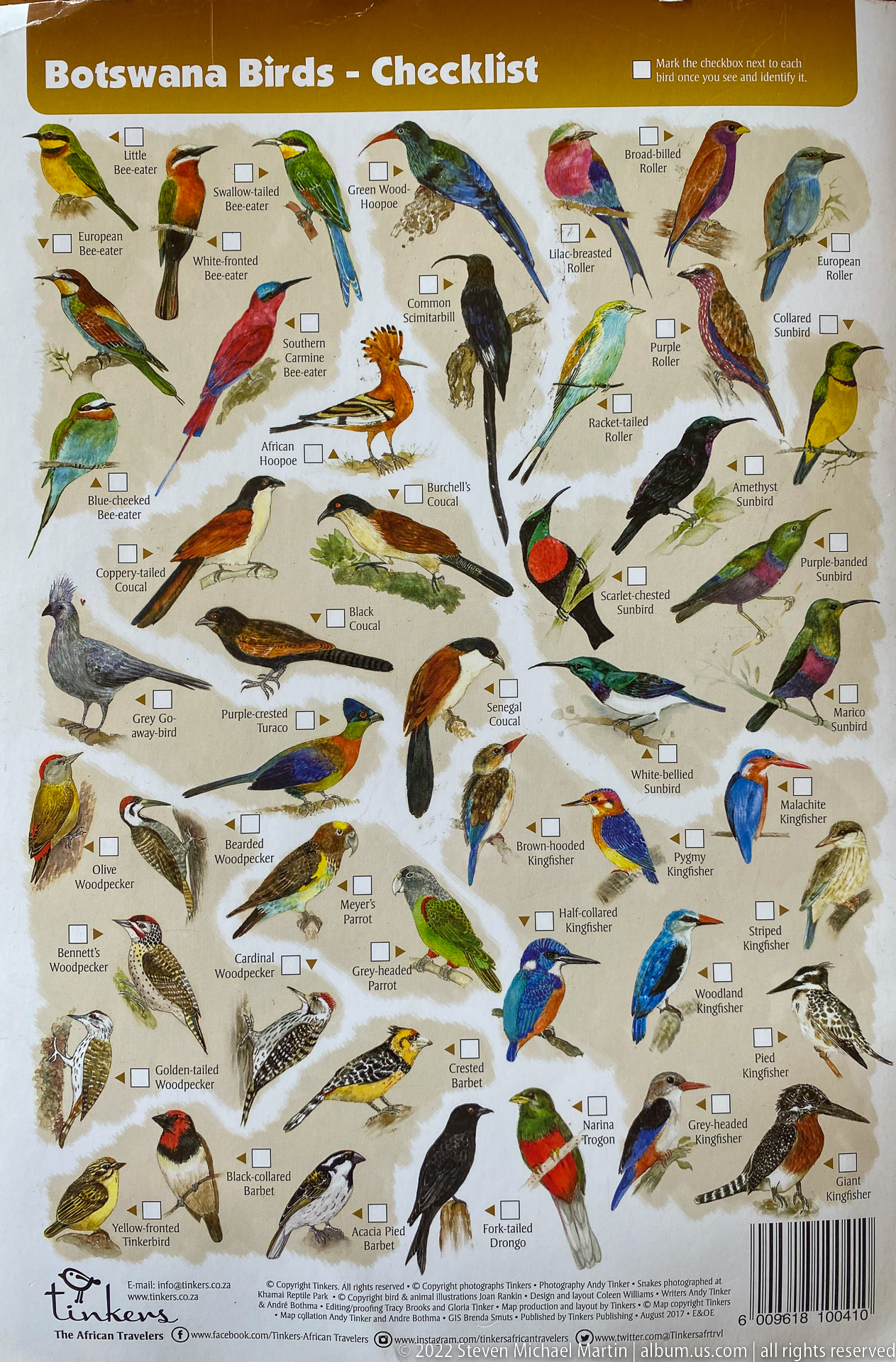
Birdlife adds both color and movement throughout the delta. Rollers, ibises, waders, and other wetland species appear across different habitats, often creating transitions between larger mammal sightings and helping define the atmosphere of the place.
🚙 Experience
The delta experience begins before landing. Aerial views explain the structure of the ecosystem, while game drives and time at camp make it personal. Wildlife encounters are often shaped by water, distance, and patience, creating a safari rhythm that feels immersive rather than rushed.
Story & Experience
Arrival Over the Delta
The first real understanding of the Okavango came from above. From the plane, channels and islands formed patterns that looked almost abstract until watering points, floodplain edges, and animal concentrations began to come into focus. The aerial approach made clear that this was a landscape entirely organized by water.
First Impressions on the Ground
After landing, the scale of the delta became more intimate. Sandy tracks, raised bridges, termite mounds, and woodland edges replaced the wide aerial view, while the first drive into camp introduced the texture of the place at ground level.
Camp and Comfort
Camp life became part of the story almost immediately. The welcome, the open deck, the view from the tent, and the quiet comfort of the room all helped frame the experience. Rather than feeling separate from the landscape, the camp seemed designed to keep the delta constantly in view.
Lions in Evening Light
The lion sightings became some of the strongest moments in the portfolio. Resting males and lionesses were photographed in warm late-day light, often doing very little except watching, breathing, grooming, or yawning. That stillness made the encounters feel especially real.
Water and Reflection
Hippos and waterbirds shifted the pace again. Their presence in the channels brought a different mood — quieter, slower, and more reflective. The contrast between dry grassland predators and calm water scenes gave the delta much of its emotional range.
Closing the Day
As the sun lowered, the experience settled into the kind of stillness that seems unique to wild places. Camp interiors, open-air decks, and evening views across the floodplain completed the narrative, turning the day from a sequence of sightings into a full sense of place.
Photography Notes
- Aerial images work well at the beginning of the page because they explain the structure of the delta
- Warm evening light adds depth and softness to lion portraits
- Water scenes provide a natural visual break after predator sequences
- Camp images help the page feel personal rather than purely documentary
- Wide views and close wildlife portraits should be mixed to preserve the rhythm of discovery
Quick Facts
- Country: Botswana
- Region: Okavango Delta
- Landscape: Channels, floodplains, islands, woodland, and wetland
- Key Wildlife: Lion, hippo, antelope, birdlife, and wetland species
- Experience Style: Landscape-driven safari shaped by water and seasonal movement