Luxembourg City – Luxembourg
Luxembourg City stands at the confluence of the Alzette and Pétrusse Rivers in a landscape of deep valleys and steep cliffs. Because of its strategic location, the city developed into one of the most heavily fortified cities in Europe.
For centuries Luxembourg’s powerful defensive walls and bastions earned it the nickname “Gibraltar of the North.” Although many of the fortifications were dismantled in the 19th century, impressive sections of the defensive system still remain.
The historic old town and surviving fortifications of Luxembourg City are today recognized as a UNESCO World Heritage Site.
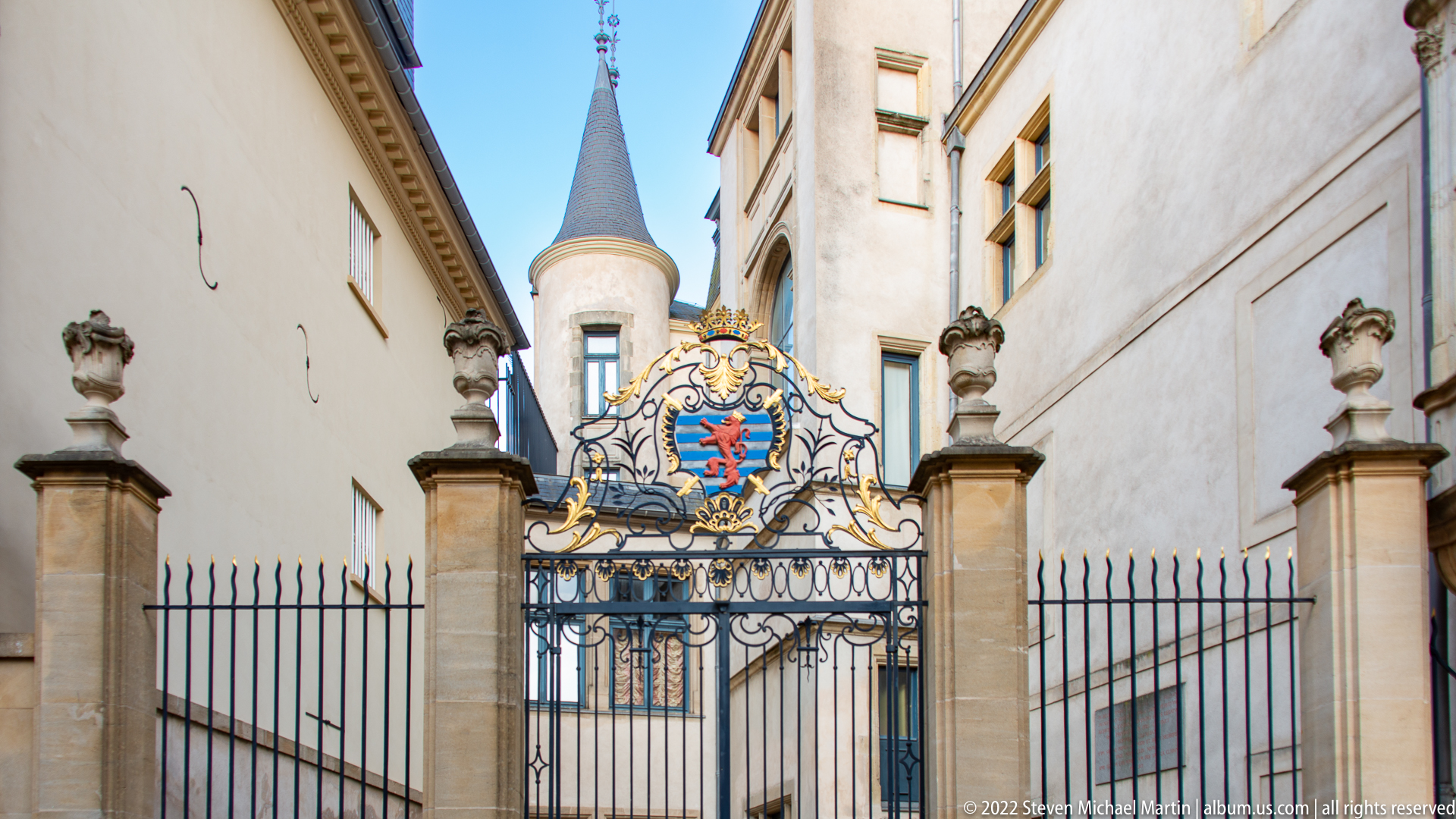
A narrow palace entrance is closed by an ornate wrought-iron gate crowned with Luxembourg's red lion on a blue-and-white striped shield. Gilded scrollwork and a royal crown frame the heraldic device, while stone gateposts and the palace's small turreted passage create an intimate ceremonial approach rather than a monumental forecourt.
Caption
A narrow palace entrance is closed by an ornate wrought-iron gate crowned with Luxembourg's red lion on a blue-and-white striped shield. Gilded scrollwork and a royal crown frame the heraldic device, while stone gateposts and the palace's small turreted passage create an intimate ceremonial approach rather than a monumental forecourt.
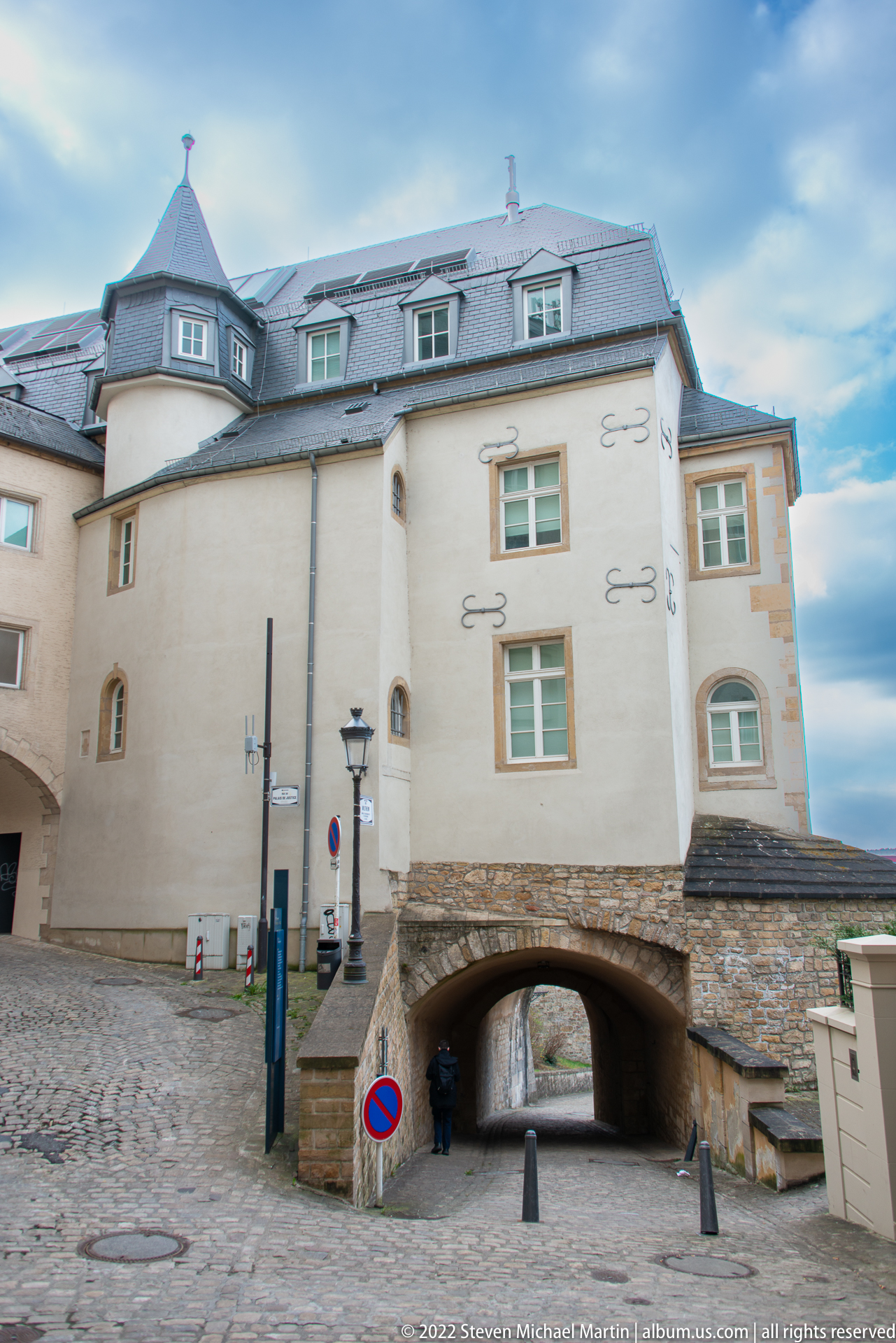
A substantial historic building bridges a narrow arched passage at street level, its pale walls rising above stone retaining masonry and a cobbled approach. Irregular windows, traces of painted or incised decorative motifs, and the tunnel-like opening convey the layered adaptation of Luxembourg City's fortified and residential fabric.
Caption
A substantial historic building bridges a narrow arched passage at street level, its pale walls rising above stone retaining masonry and a cobbled approach. Irregular windows, traces of painted or incised decorative motifs, and the tunnel-like opening convey the layered adaptation of Luxembourg City's fortified and residential fabric.

A small stone bridge crosses the river in the lower city, linking landscaped paths beneath steep defensive walls and elevated urban buildings. From above, the view layers water, bridge, parkland, masonry ramparts, and the upper town into one compact composition, making Luxembourg City's dramatic vertical topography especially clear.
Caption
A small stone bridge crosses the river in the lower city, linking landscaped paths beneath steep defensive walls and elevated urban buildings. From above, the view layers water, bridge, parkland, masonry ramparts, and the upper town into one compact composition, making Luxembourg City's dramatic vertical topography especially clear.
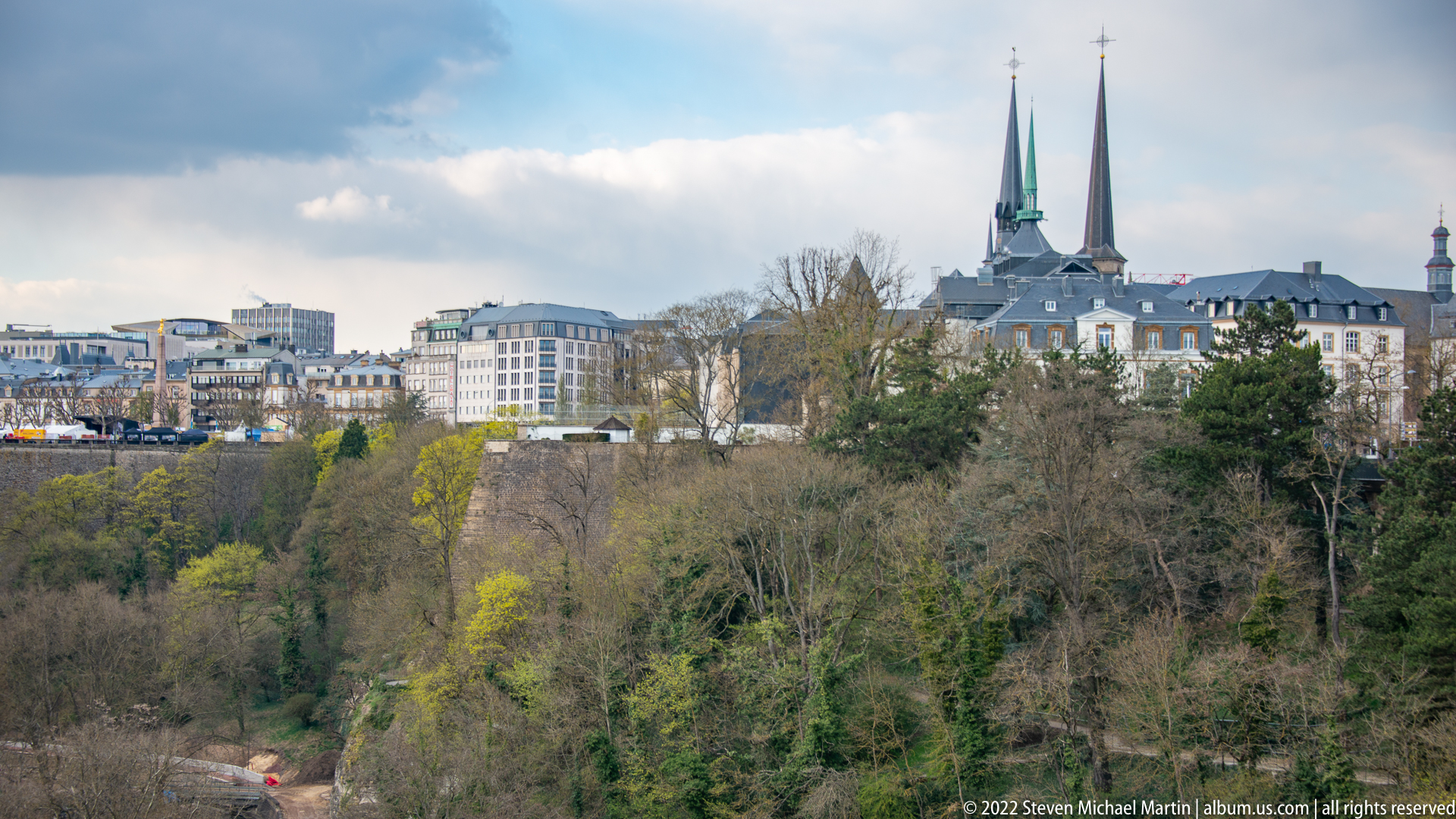
Two slender church spires rise above the upper city on the far side of a deep wooded ravine, while dense nineteenth- and twentieth-century buildings step along the horizon. The photograph uses Luxembourg City's dramatic topography as its subject, setting ecclesiastical towers against the green valley slopes and layered urban fabric.
Caption
Two slender church spires rise above the upper city on the far side of a deep wooded ravine, while dense nineteenth- and twentieth-century buildings step along the horizon. The photograph uses Luxembourg City's dramatic topography as its subject, setting ecclesiastical towers against the green valley slopes and layered urban fabric.
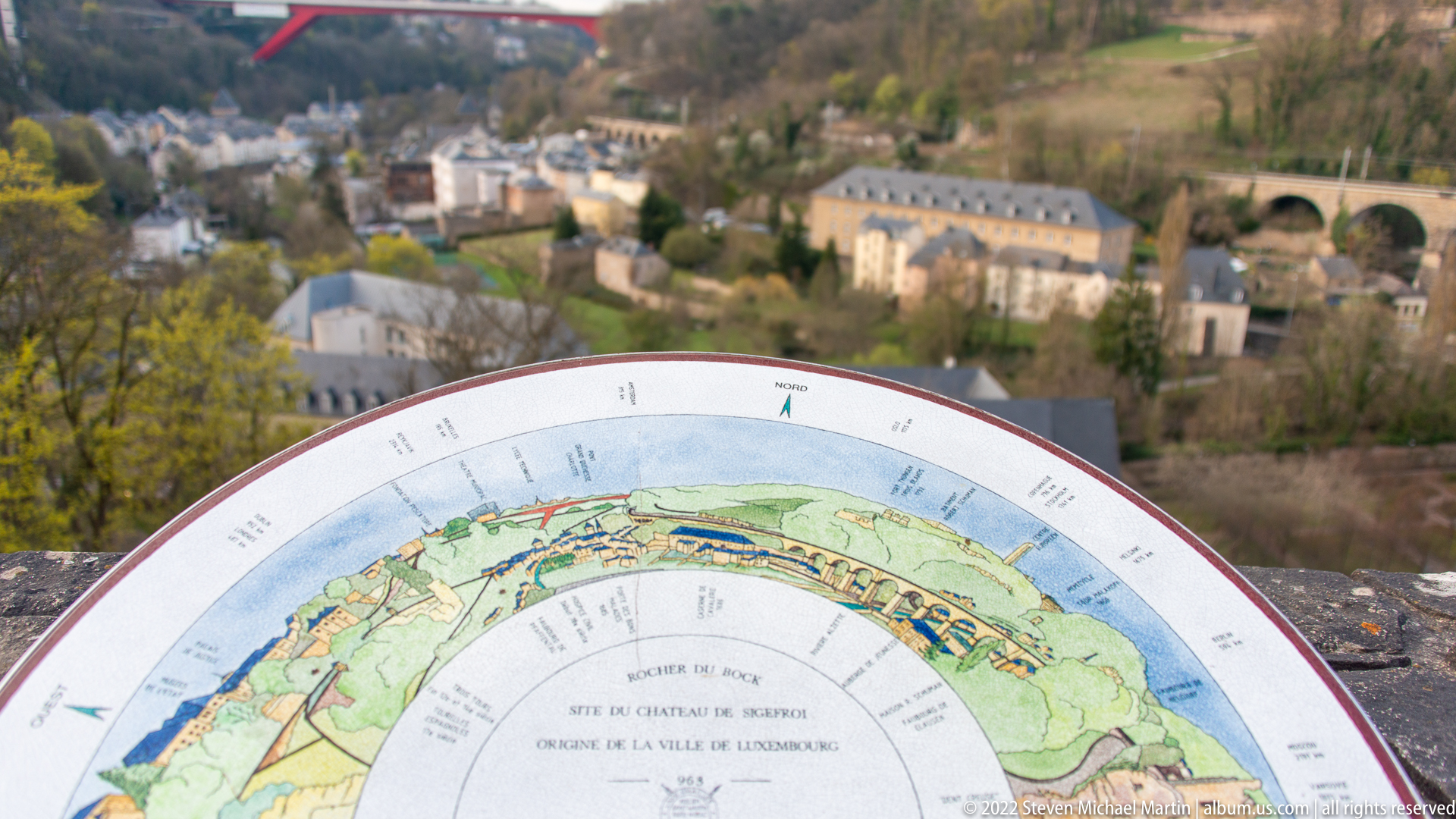
A semicircular orientation panel occupies the foreground, pairing a painted panorama with labeled landmarks and directional bearings across the valley. Beyond it, the real landscape includes historic buildings and an arched bridge, allowing visitors to compare the illustrated skyline directly with the surrounding topography.
Caption
A semicircular orientation panel occupies the foreground, pairing a painted panorama with labeled landmarks and directional bearings across the valley. Beyond it, the real landscape includes historic buildings and an arched bridge, allowing visitors to compare the illustrated skyline directly with the surrounding topography.
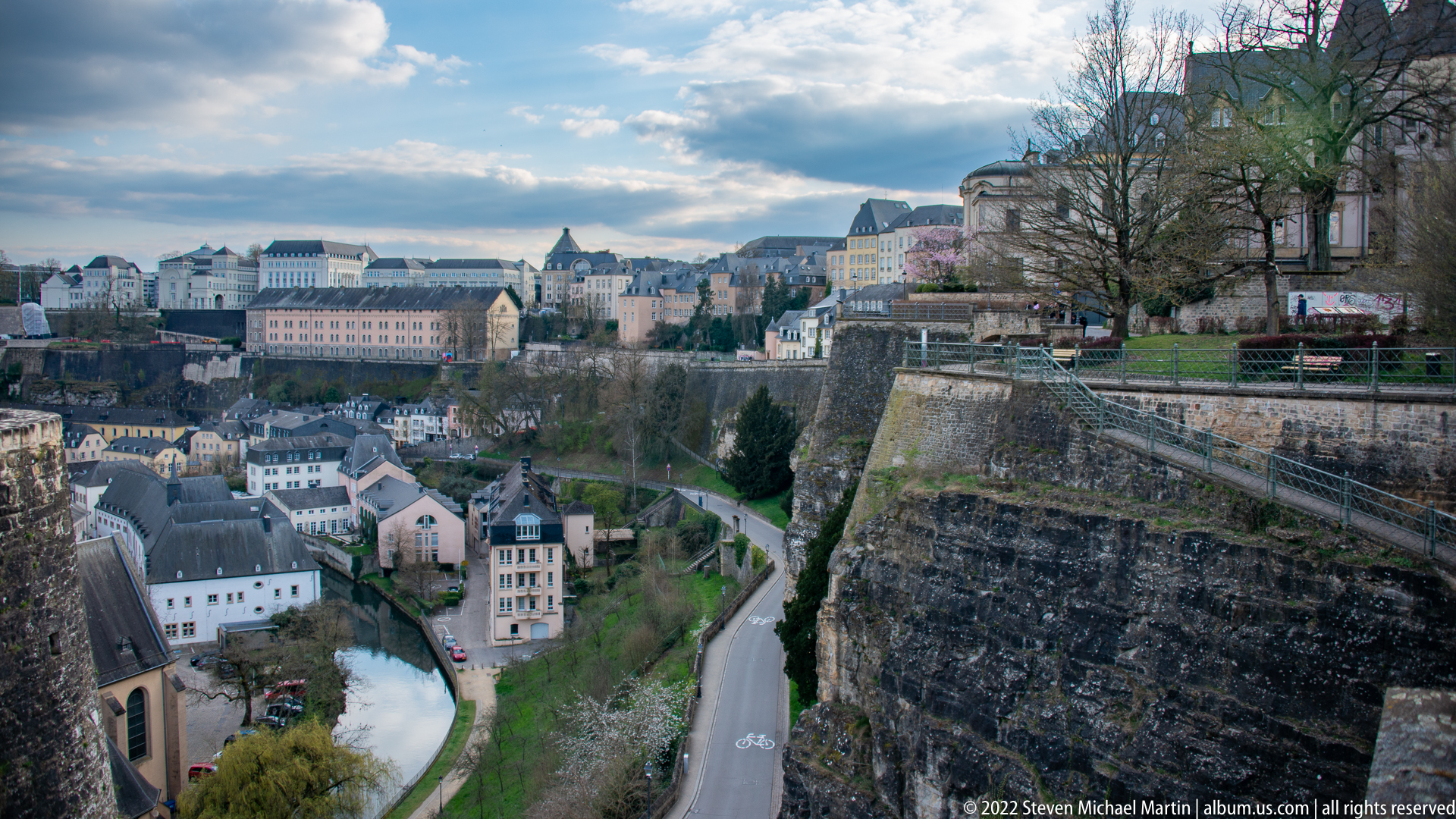
A high masonry escarpment dominates the right side of this panoramic valley view, while a narrow river curves past historic houses and a roadway below. Across the ravine, larger institutional buildings line the upper plateau, demonstrating how Luxembourg City's urban form developed across sharply separated levels linked by roads, bridges, and defensive works.
Caption
A high masonry escarpment dominates the right side of this panoramic valley view, while a narrow river curves past historic houses and a roadway below. Across the ravine, larger institutional buildings line the upper plateau, demonstrating how Luxembourg City's urban form developed across sharply separated levels linked by roads, bridges, and defensive works.
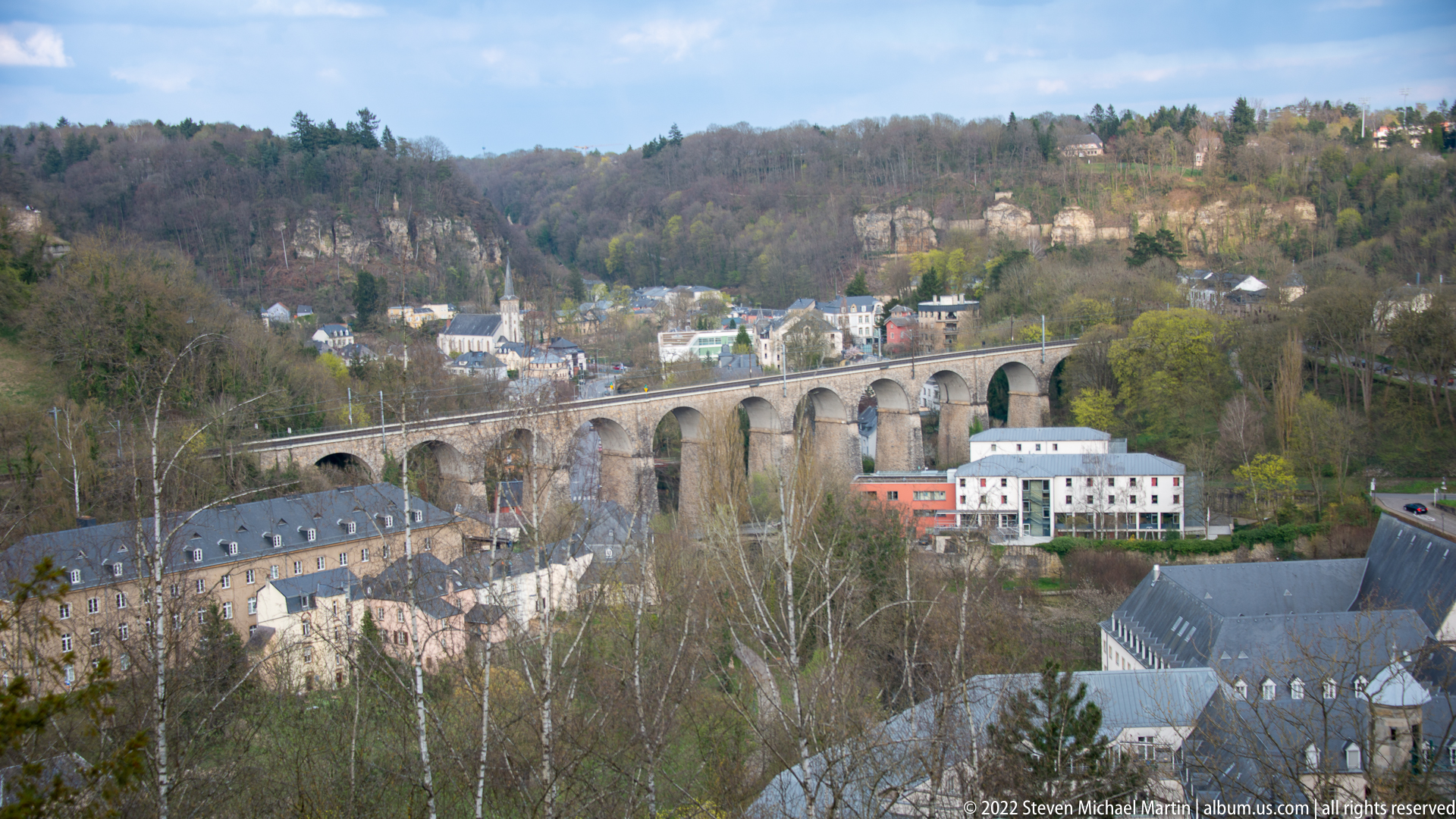
A long stone viaduct crosses the lower city on a sequence of tall semicircular arches, linking wooded slopes above dense roofs and valley buildings. From this elevated viewpoint, the bridge reads as part of a larger topographic system in which transportation infrastructure, historic neighborhoods, and steep terrain are tightly interwoven.
Caption
A long stone viaduct crosses the lower city on a sequence of tall semicircular arches, linking wooded slopes above dense roofs and valley buildings. From this elevated viewpoint, the bridge reads as part of a larger topographic system in which transportation infrastructure, historic neighborhoods, and steep terrain are tightly interwoven.
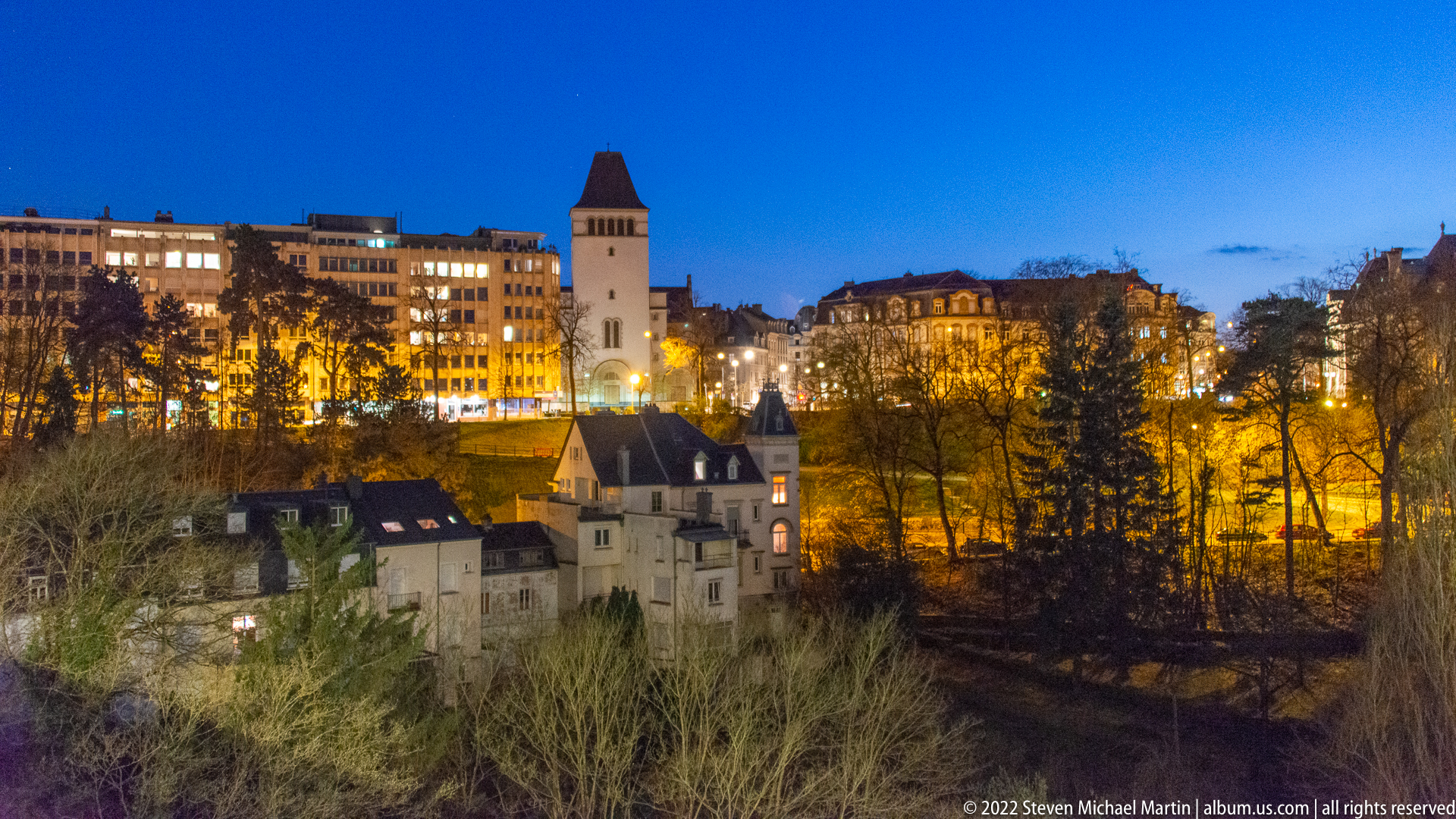
Small historic houses occupy the lower slope of the valley while a tall illuminated square tower rises on the upper plateau behind them. The dusk view compresses multiple levels of the city into a single frame, with bare trees and steep terrain reinforcing the dramatic separation between lower settlement and upper-city institutions.
Caption
Small historic houses occupy the lower slope of the valley while a tall illuminated square tower rises on the upper plateau behind them. The dusk view compresses multiple levels of the city into a single frame, with bare trees and steep terrain reinforcing the dramatic separation between lower settlement and upper-city institutions.
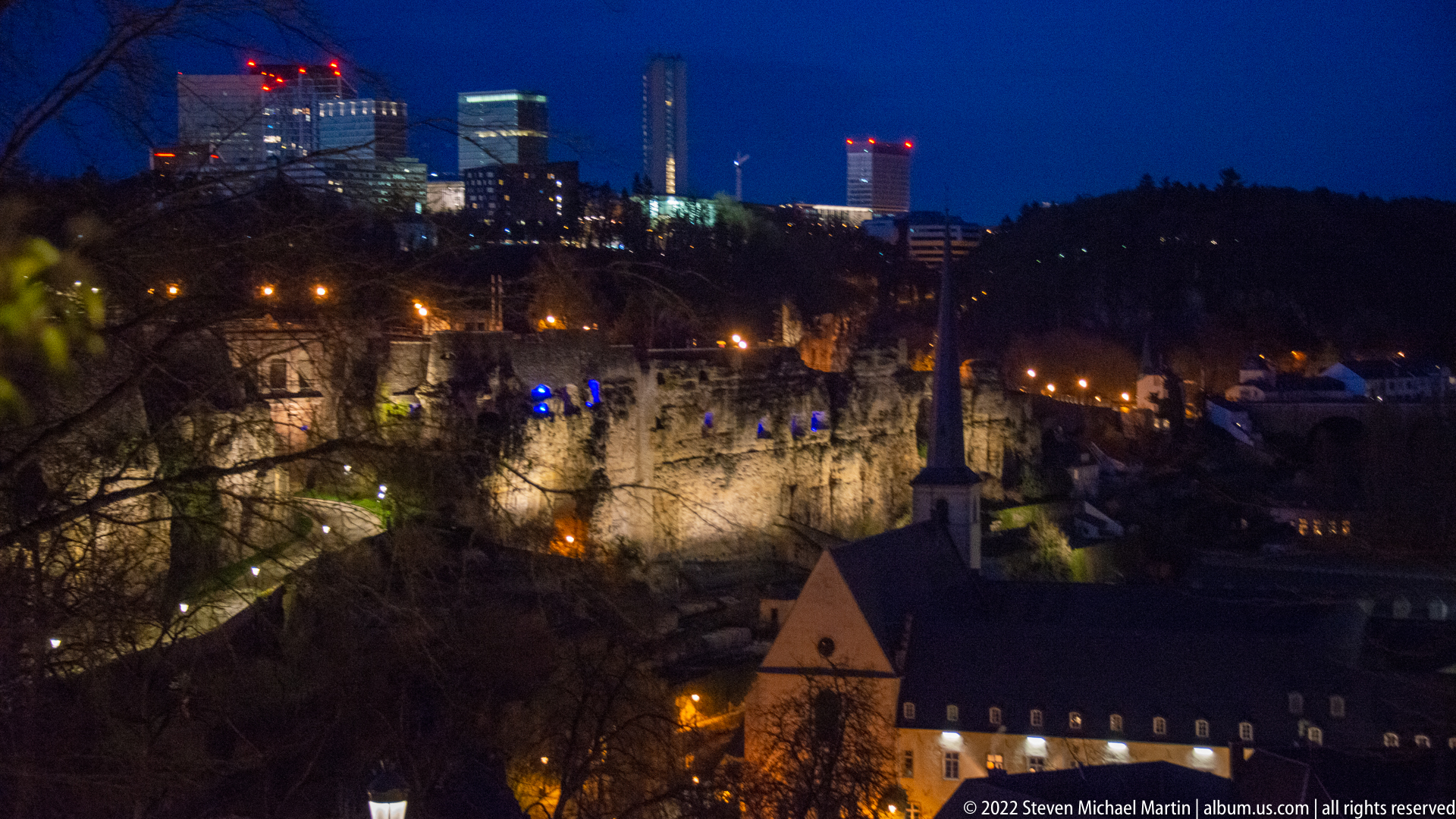
Luxembourg's fortified valley is seen after dark, with spotlit rock faces and defensive walls rising above a lower historic building in the foreground. Modern towers glow on the distant plateau, producing a strong vertical contrast between the lower city, illuminated fortifications, and contemporary skyline.
Caption
Luxembourg's fortified valley is seen after dark, with spotlit rock faces and defensive walls rising above a lower historic building in the foreground. Modern towers glow on the distant plateau, producing a strong vertical contrast between the lower city, illuminated fortifications, and contemporary skyline.
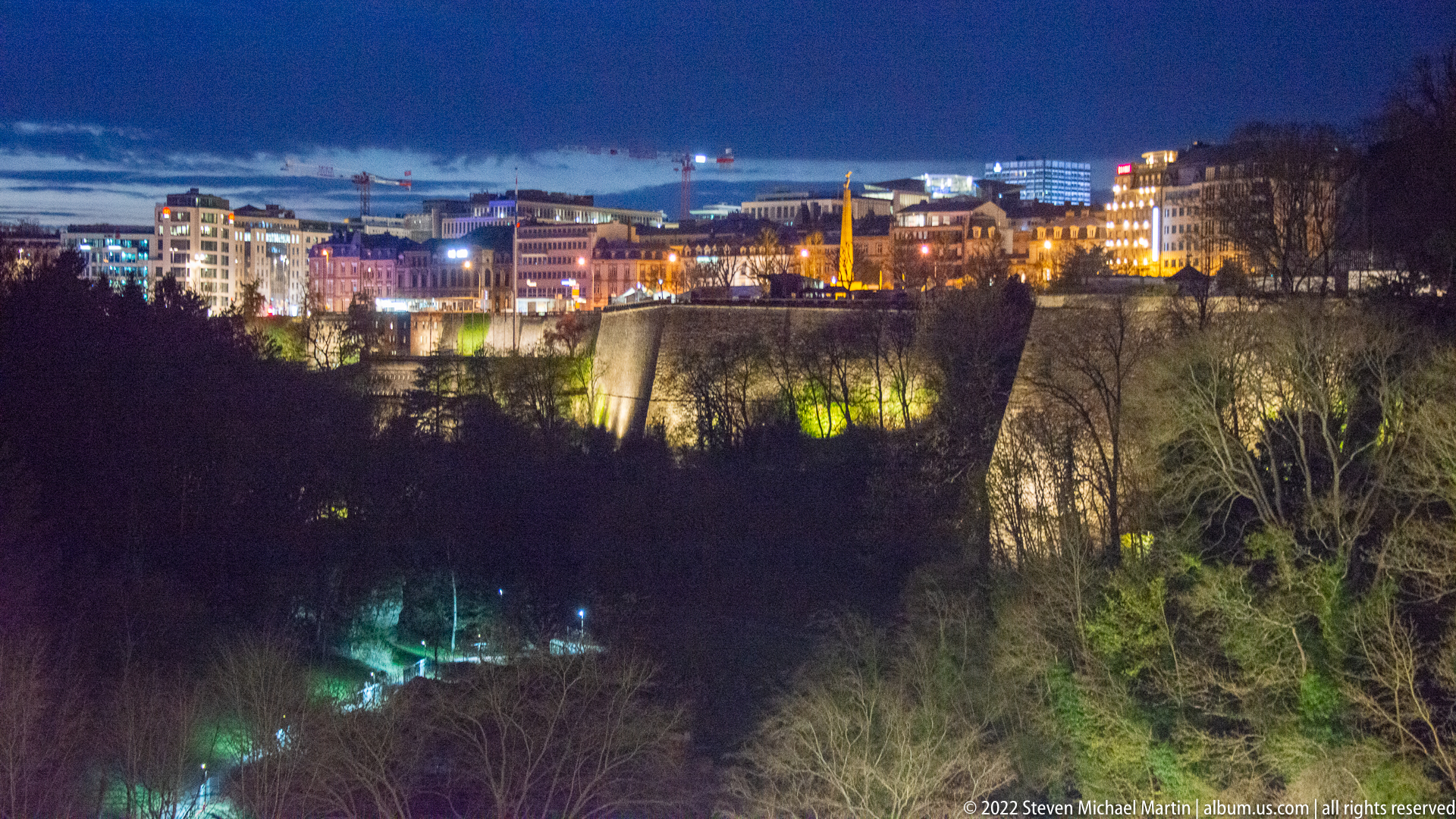
Warm lights trace the upper city along a high fortified escarpment, where sheer rock and masonry walls drop into a dark wooded valley. A lower path or watercourse glows faintly at the base, giving the scene a strong sense of depth and revealing how Luxembourg's historic defenses exploit the natural terrain.
Caption
Warm lights trace the upper city along a high fortified escarpment, where sheer rock and masonry walls drop into a dark wooded valley. A lower path or watercourse glows faintly at the base, giving the scene a strong sense of depth and revealing how Luxembourg's historic defenses exploit the natural terrain.
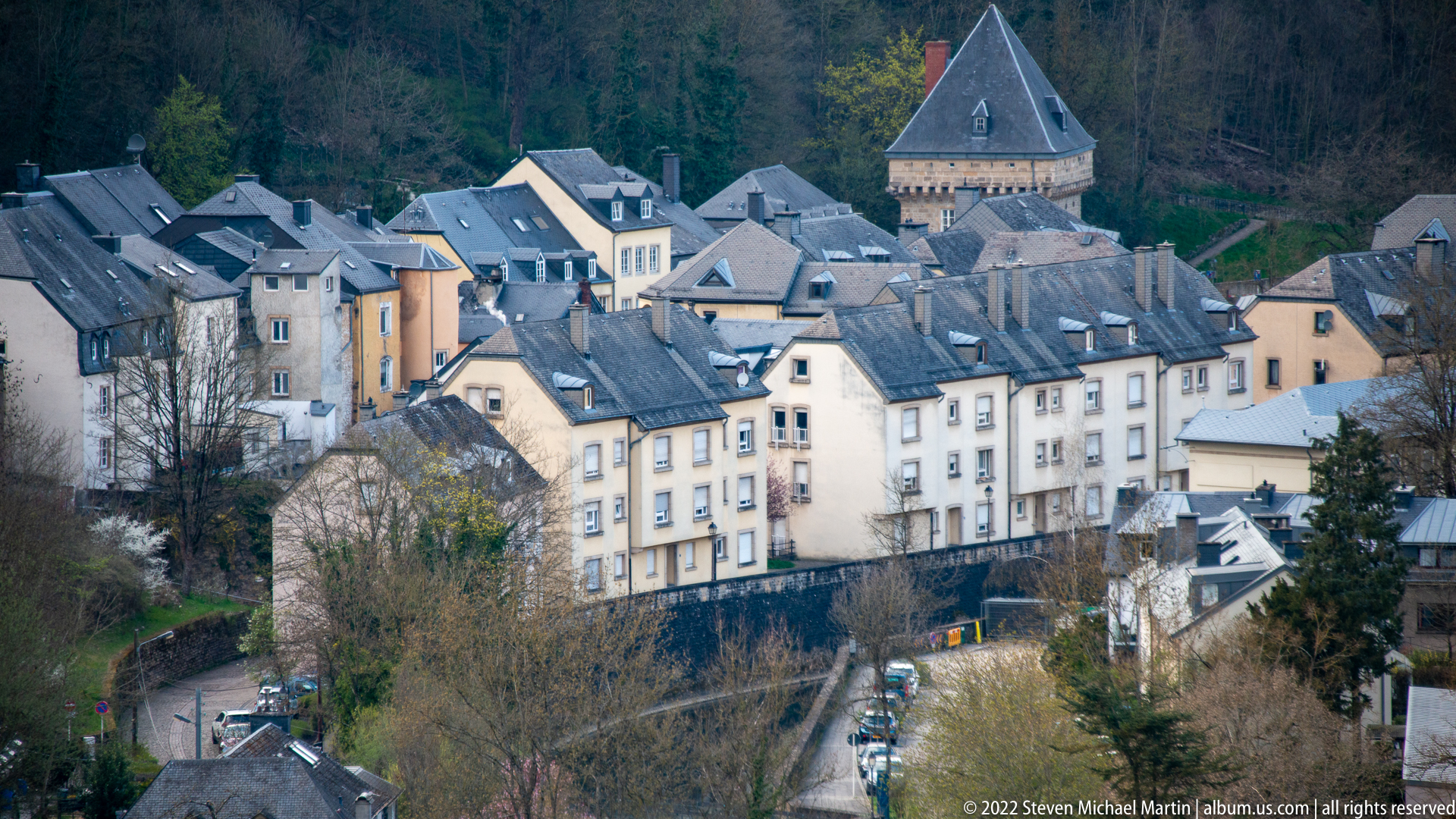
Closely packed pale houses with gray slate roofs fill a steep lower-city slope, while a square stone tower with a pyramidal roof rises above the neighborhood. The compressed telephoto view emphasizes the density of the historic fabric and the way defensive or civic towers remain embedded among later residential buildings.
Caption
Closely packed pale houses with gray slate roofs fill a steep lower-city slope, while a square stone tower with a pyramidal roof rises above the neighborhood. The compressed telephoto view emphasizes the density of the historic fabric and the way defensive or civic towers remain embedded among later residential buildings.
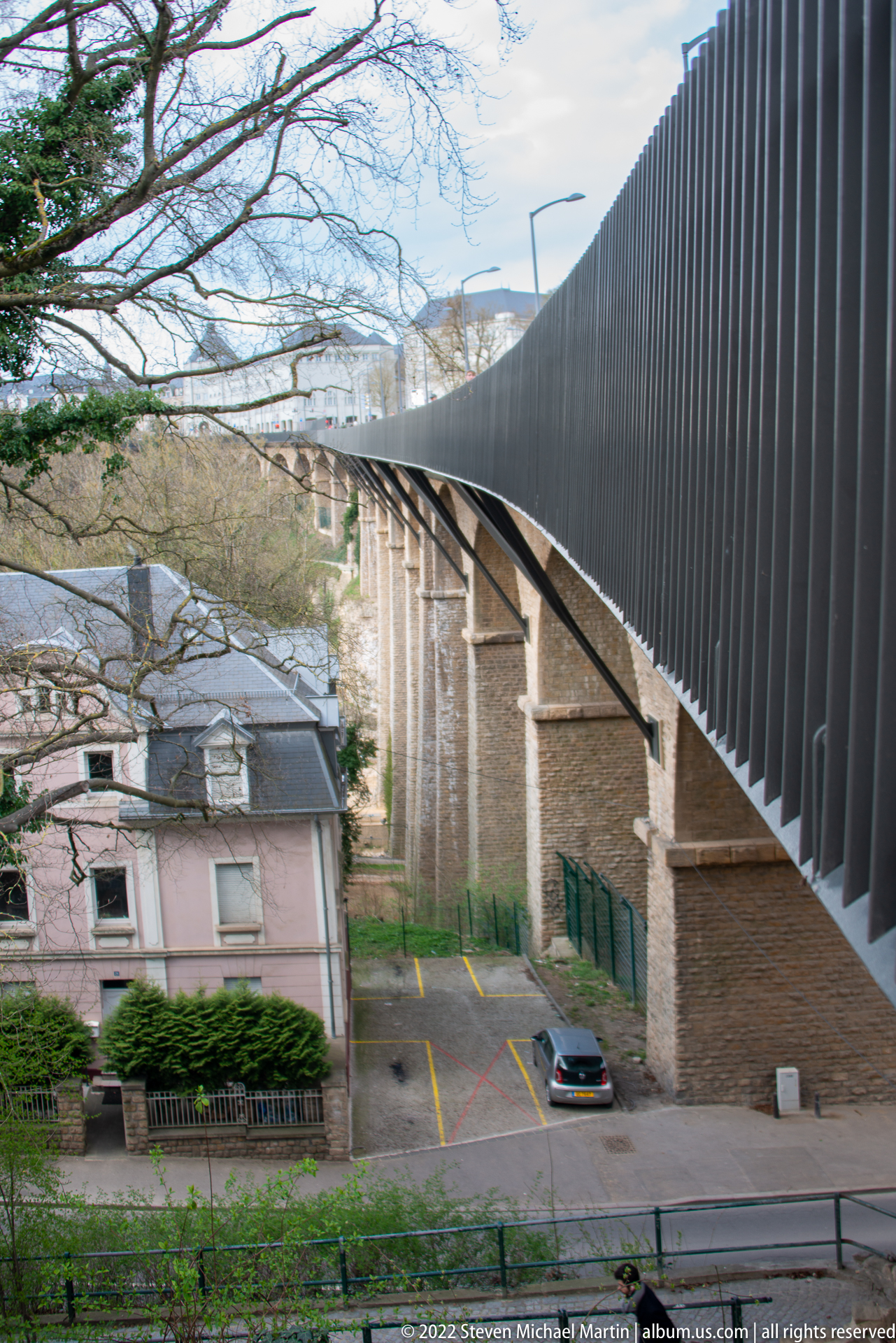
A long stone viaduct crosses the wooded valley edge, its historic masonry piers and arches topped by a sharply contemporary screen of closely spaced dark metal fins. The contrast between old structural fabric and the modern safety barrier is especially clear from this oblique viewpoint, with a small residence and roadway tucked beneath the elevated crossing.
Caption
A long stone viaduct crosses the wooded valley edge, its historic masonry piers and arches topped by a sharply contemporary screen of closely spaced dark metal fins. The contrast between old structural fabric and the modern safety barrier is especially clear from this oblique viewpoint, with a small residence and roadway tucked beneath the elevated crossing.
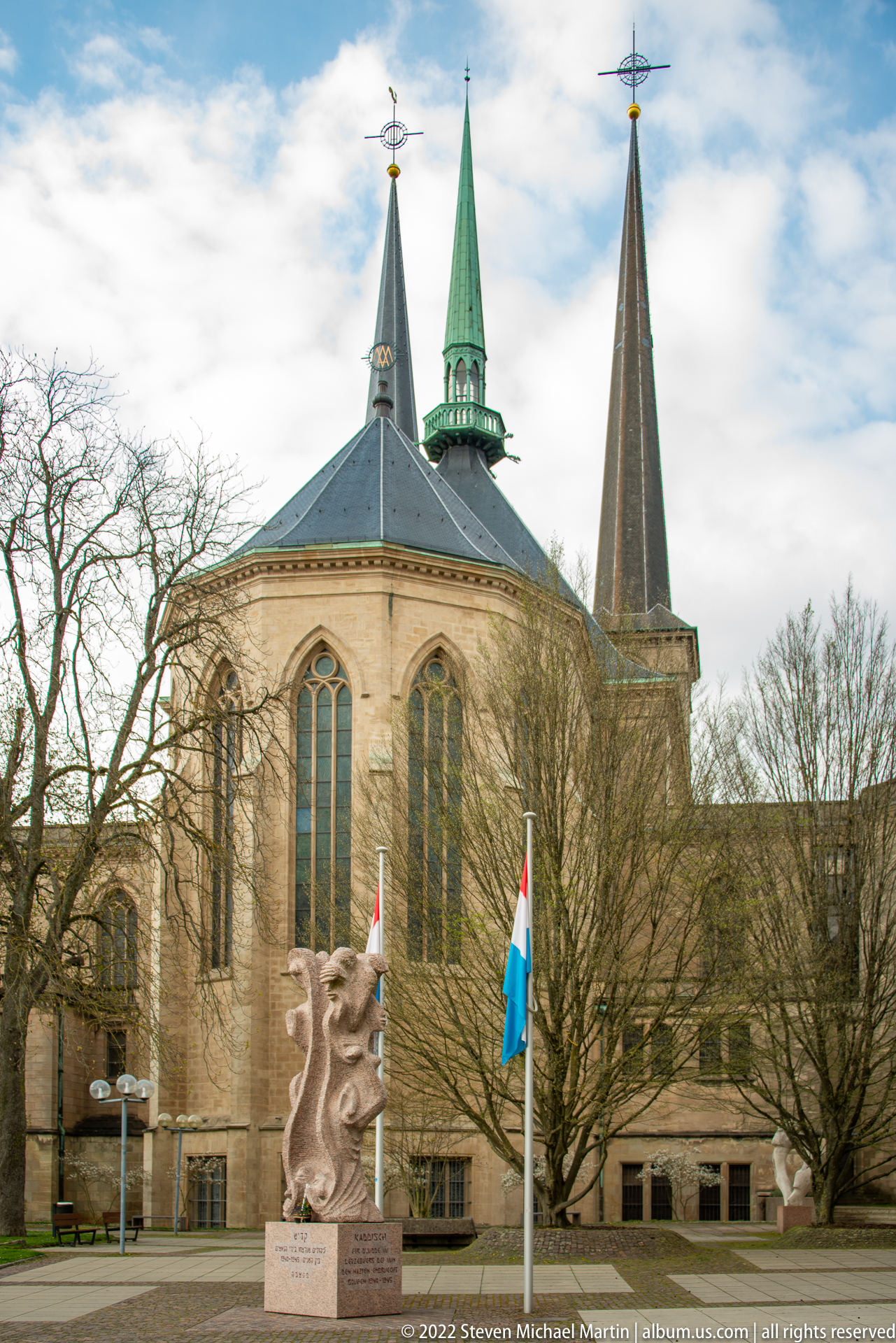
A polygonal stone apse with tall pointed windows stands in the foreground while three slender spires rise behind it, creating a compact composition of vertical Gothic forms. Luxembourg flags and a carved stone sculpture mark the landscaped forecourt, adding civic context to the ecclesiastical architecture without obscuring the building's dominant roofline.
Caption
A polygonal stone apse with tall pointed windows stands in the foreground while three slender spires rise behind it, creating a compact composition of vertical Gothic forms. Luxembourg flags and a carved stone sculpture mark the landscaped forecourt, adding civic context to the ecclesiastical architecture without obscuring the building's dominant roofline.
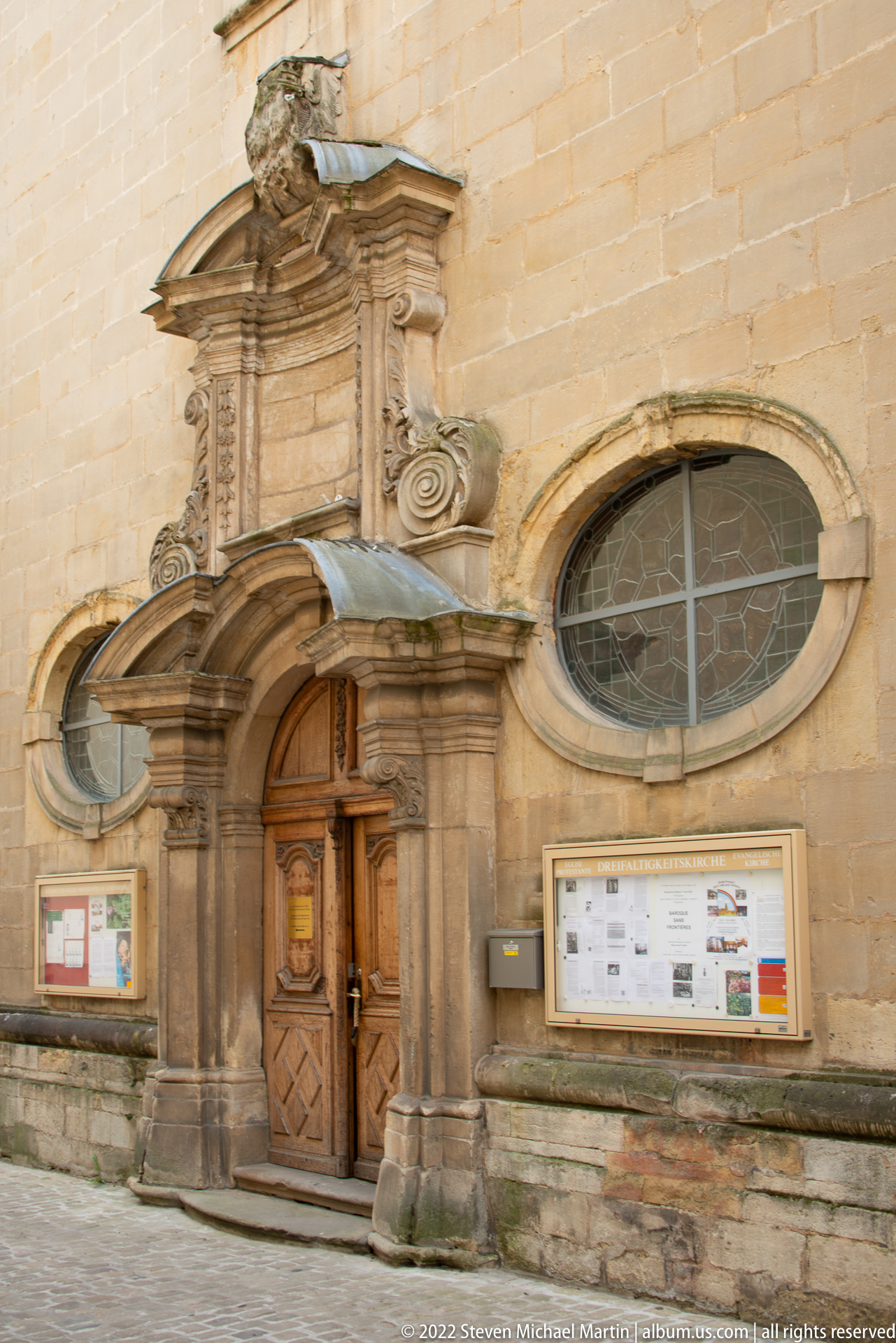
A richly modeled stone doorway projects from a pale masonry church wall, framed by pilasters, a curved pediment, and carved scrollwork. An oval window to the right and posted notices around the entrance make this a close architectural study of the building's public face, focusing on the craftsmanship and layered stone detailing of the portal.
Caption
A richly modeled stone doorway projects from a pale masonry church wall, framed by pilasters, a curved pediment, and carved scrollwork. An oval window to the right and posted notices around the entrance make this a close architectural study of the building's public face, focusing on the craftsmanship and layered stone detailing of the portal.
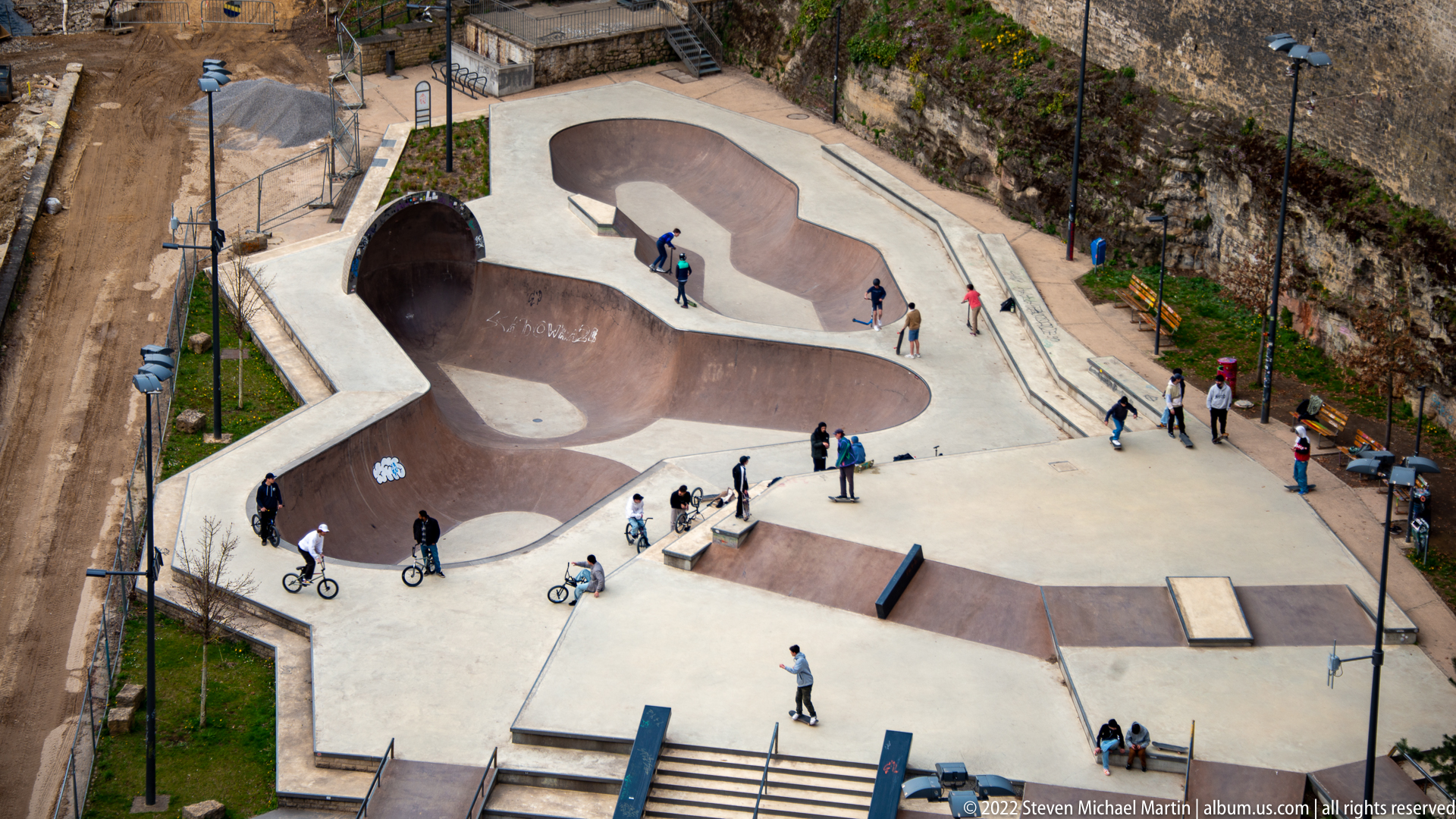
A sunken skatepark occupies a narrow terrace between high stone retaining walls, its bowls, ramps, rails, and platforms animated by skaters and riders. Seen from above, the contemporary recreational space is tightly fitted into Luxembourg City's steep urban terrain, where historic masonry walls frame a distinctly modern public use.
Caption
A sunken skatepark occupies a narrow terrace between high stone retaining walls, its bowls, ramps, rails, and platforms animated by skaters and riders. Seen from above, the contemporary recreational space is tightly fitted into Luxembourg City's steep urban terrain, where historic masonry walls frame a distinctly modern public use.
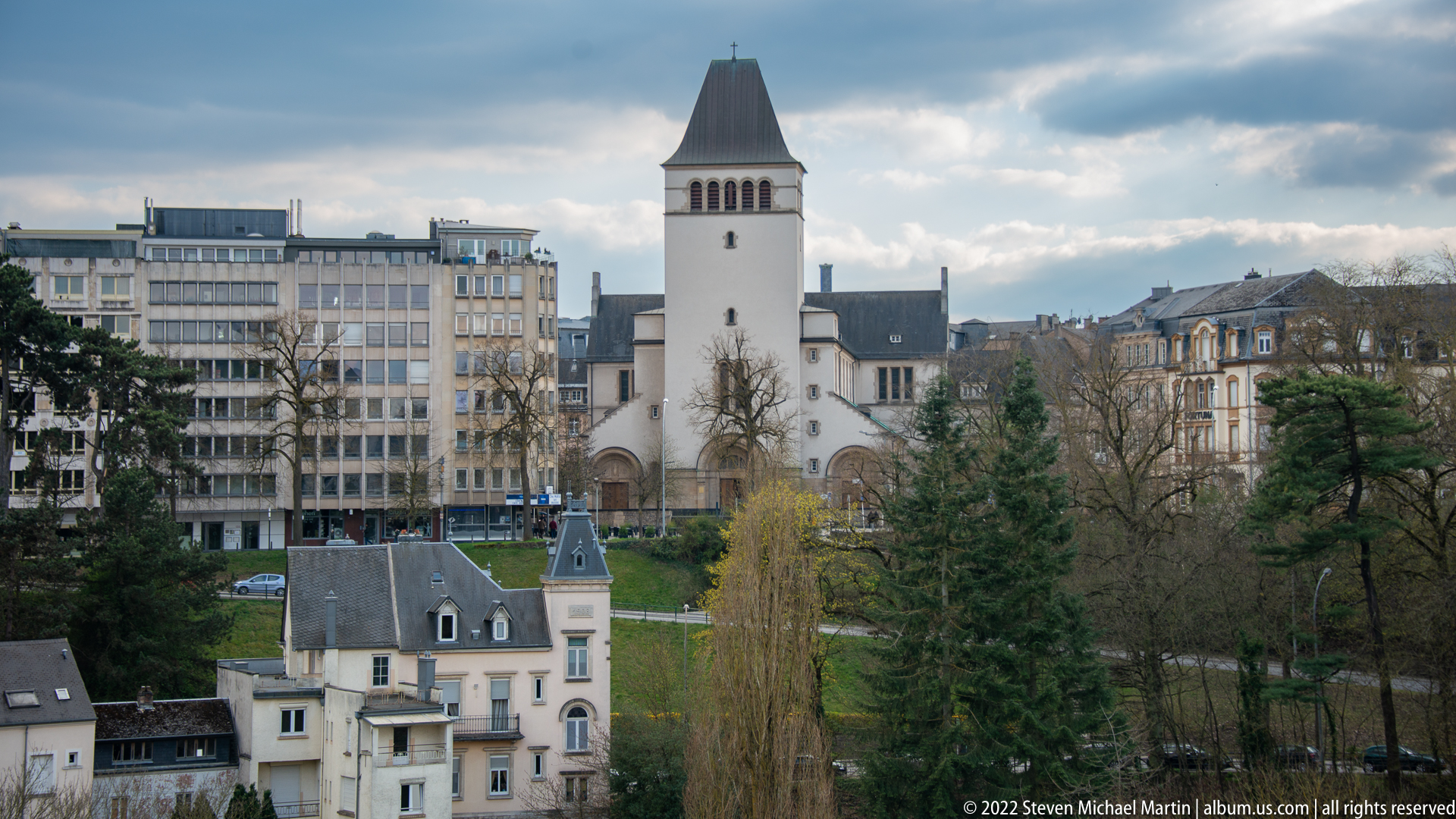
A pale square church tower with a steep dark pyramidal roof rises behind villas and modern apartment blocks on the valley slope. The restrained tower, pierced by paired louvered openings near its summit, forms a vertical landmark within a mixed residential district and illustrates the close layering of historic and modern architecture in Luxembourg City.
Caption
A pale square church tower with a steep dark pyramidal roof rises behind villas and modern apartment blocks on the valley slope. The restrained tower, pierced by paired louvered openings near its summit, forms a vertical landmark within a mixed residential district and illustrates the close layering of historic and modern architecture in Luxembourg City.
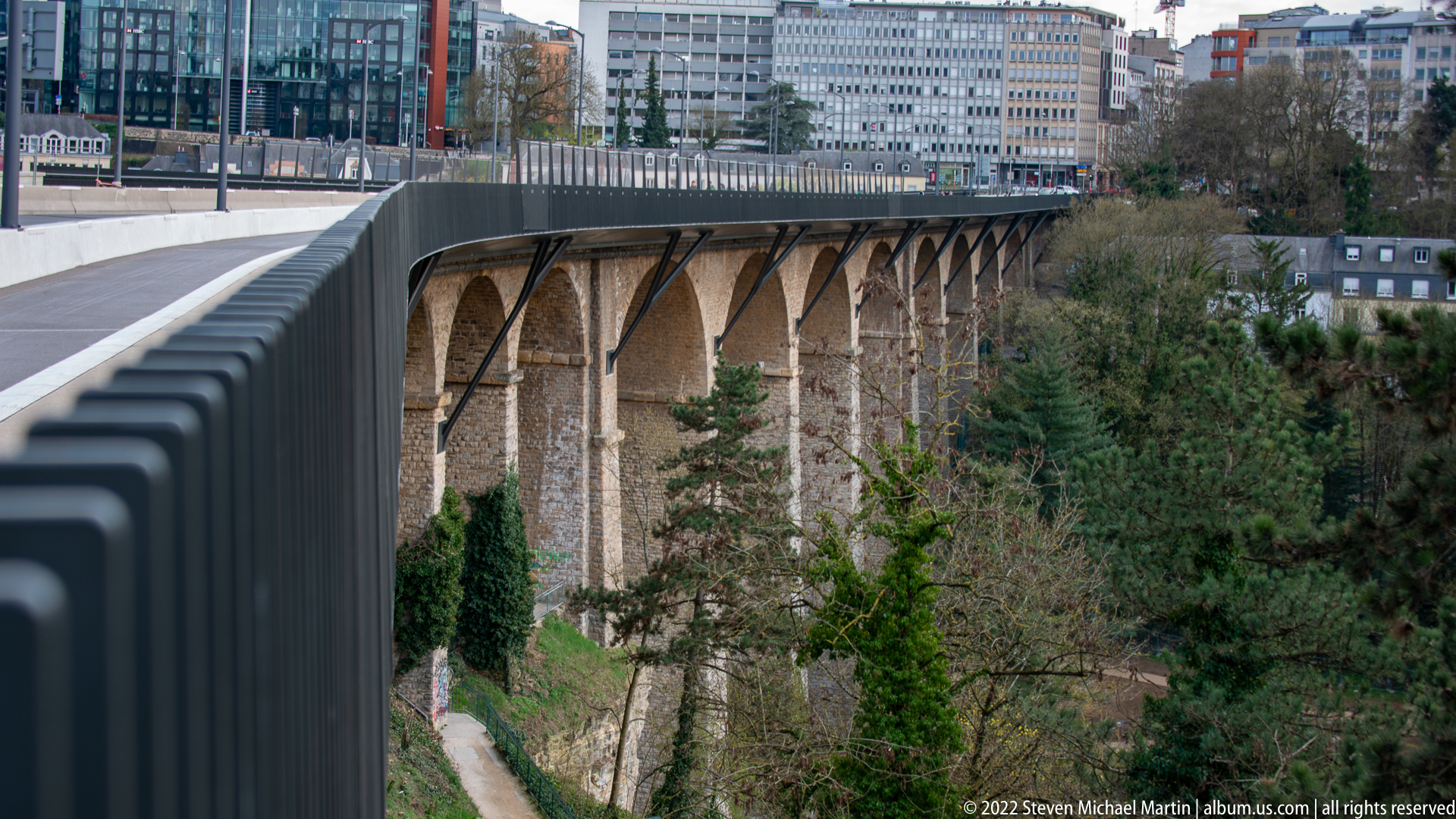
Repeated stone arches carry an elevated roadway across a steep, wooded ravine, with the modern dark parapet visible along the deck above. This side view reveals the rhythm and depth of the masonry supports more clearly than the preceding image, emphasizing the viaduct's adaptation to Luxembourg City's sharply incised terrain.
Caption
Repeated stone arches carry an elevated roadway across a steep, wooded ravine, with the modern dark parapet visible along the deck above. This side view reveals the rhythm and depth of the masonry supports more clearly than the preceding image, emphasizing the viaduct's adaptation to Luxembourg City's sharply incised terrain.
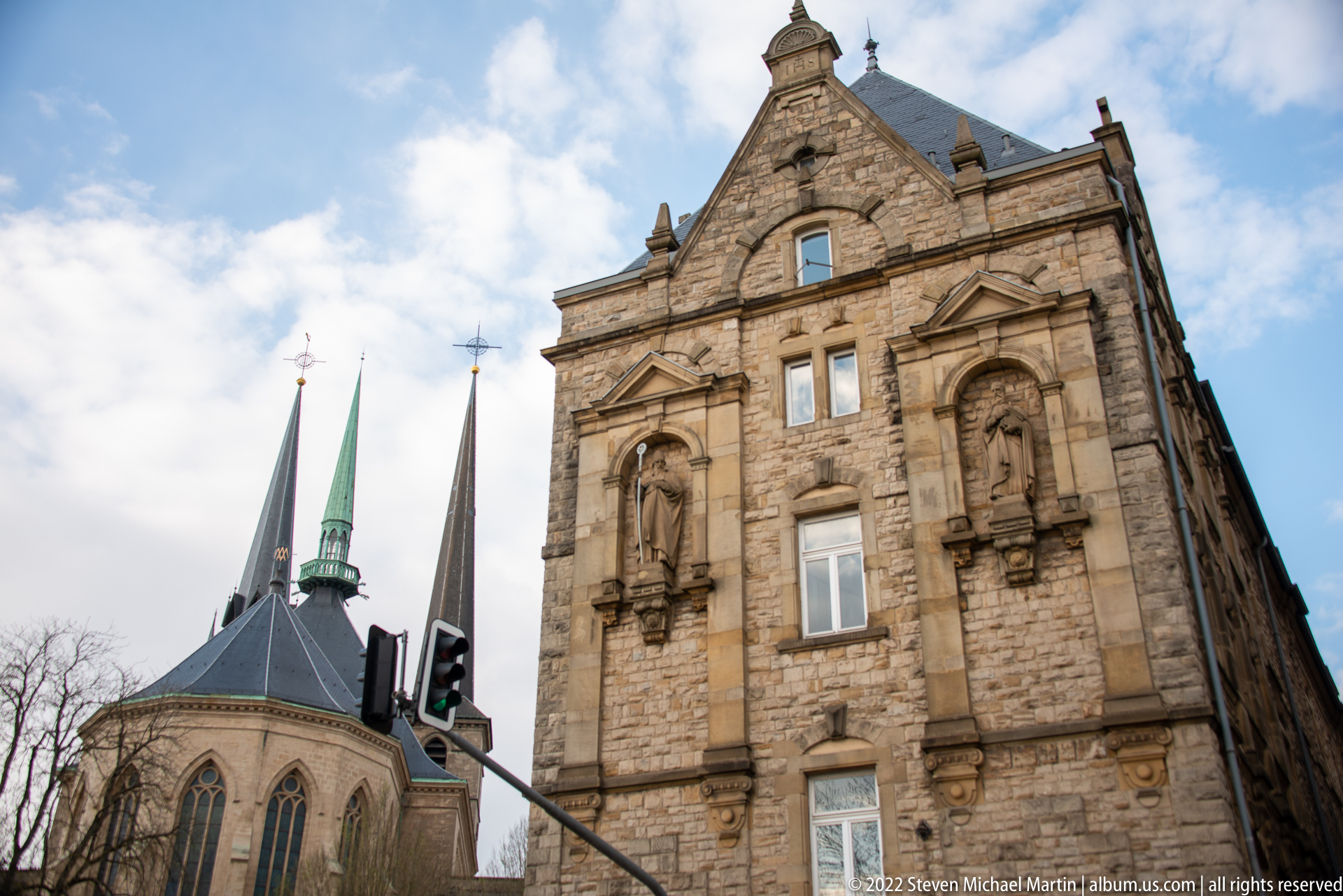
An ornate historic stone façade fills the right side of the frame, its sculptural niches, broken pediment, and richly modeled masonry set against the pointed spires and polygonal apse of a neighboring church. The low viewpoint compresses civic and religious architecture into a single streetscape, highlighting the density of monumental buildings in the old city.
Caption
An ornate historic stone façade fills the right side of the frame, its sculptural niches, broken pediment, and richly modeled masonry set against the pointed spires and polygonal apse of a neighboring church. The low viewpoint compresses civic and religious architecture into a single streetscape, highlighting the density of monumental buildings in the old city.

A restrained three-story administrative building faces a small forecourt behind flagpoles and clipped shrubs. Regular rows of tall sash windows, a central doorway, pale stone trim, and steep slate roofs give the composition a formal civic character, while adjoining older masonry at left suggests the layered institutional complex typical of Luxembourg City's historic center.
Caption
A restrained three-story administrative building faces a small forecourt behind flagpoles and clipped shrubs. Regular rows of tall sash windows, a central doorway, pale stone trim, and steep slate roofs give the composition a formal civic character, while adjoining older masonry at left suggests the layered institutional complex typical of Luxembourg City's historic center.
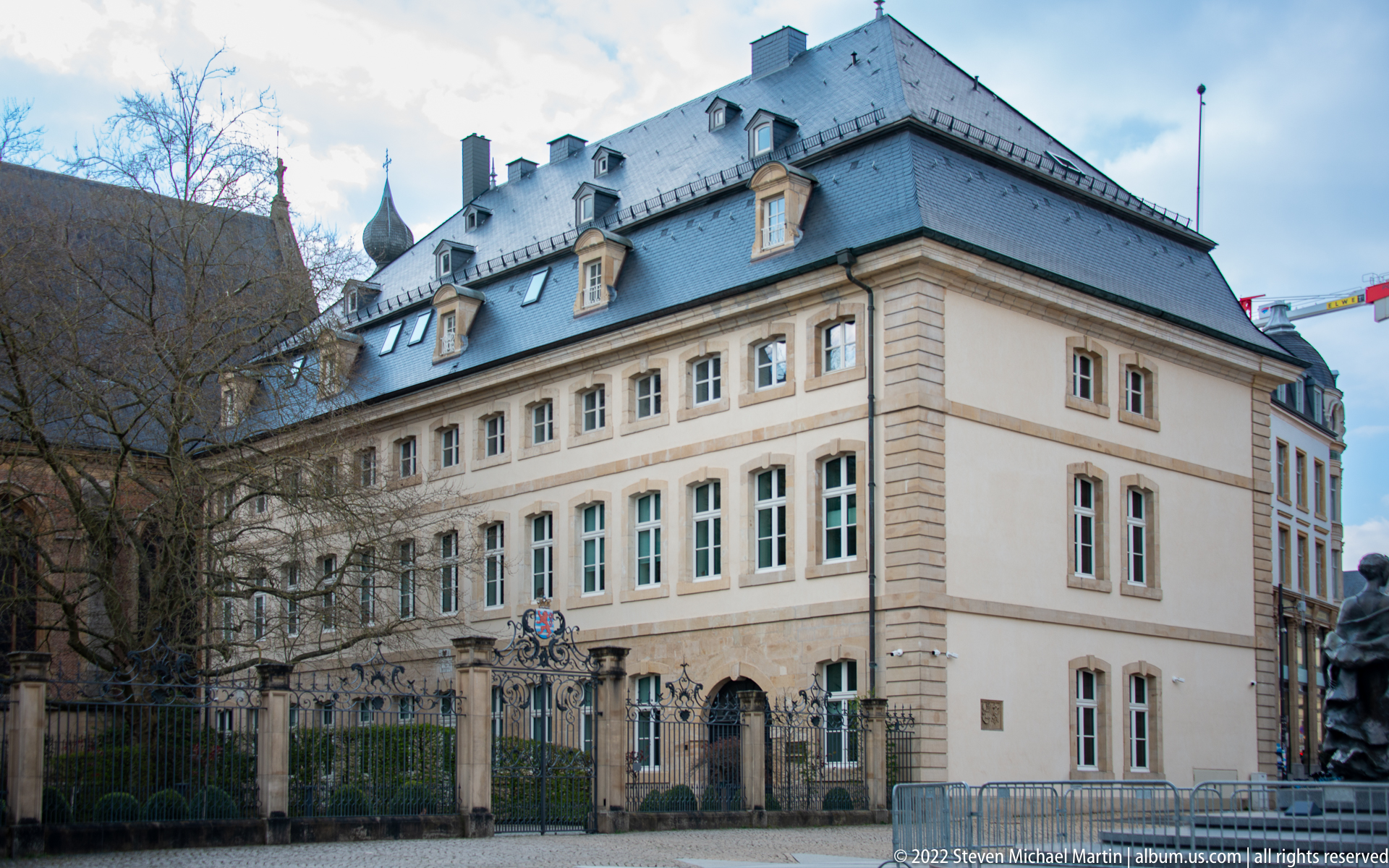
A broad pale-stone institutional building stands behind an elaborate iron fence, its long rows of tall windows capped by a steep slate roof with dormers. The restrained classical treatment and official flag at the roofline reinforce the building's governmental character, while the oblique angle reveals its substantial urban block frontage.
Caption
A broad pale-stone institutional building stands behind an elaborate iron fence, its long rows of tall windows capped by a steep slate roof with dormers. The restrained classical treatment and official flag at the roofline reinforce the building's governmental character, while the oblique angle reveals its substantial urban block frontage.

Four translucent directory plaques identify offices of the Government of the Grand Duchy of Luxembourg, each bearing the red lion emblem and French-language ministry titles. The stacked signs include the Ministry of State, Ministry of Digitalisation, Ministry of Foreign and European Affairs, and Ministry of Finance, turning a small architectural detail into a concise record of state administration.
Caption
Four translucent directory plaques identify offices of the Government of the Grand Duchy of Luxembourg, each bearing the red lion emblem and French-language ministry titles. The stacked signs include the Ministry of State, Ministry of Digitalisation, Ministry of Foreign and European Affairs, and Ministry of Finance, turning a small architectural detail into a concise record of state administration.
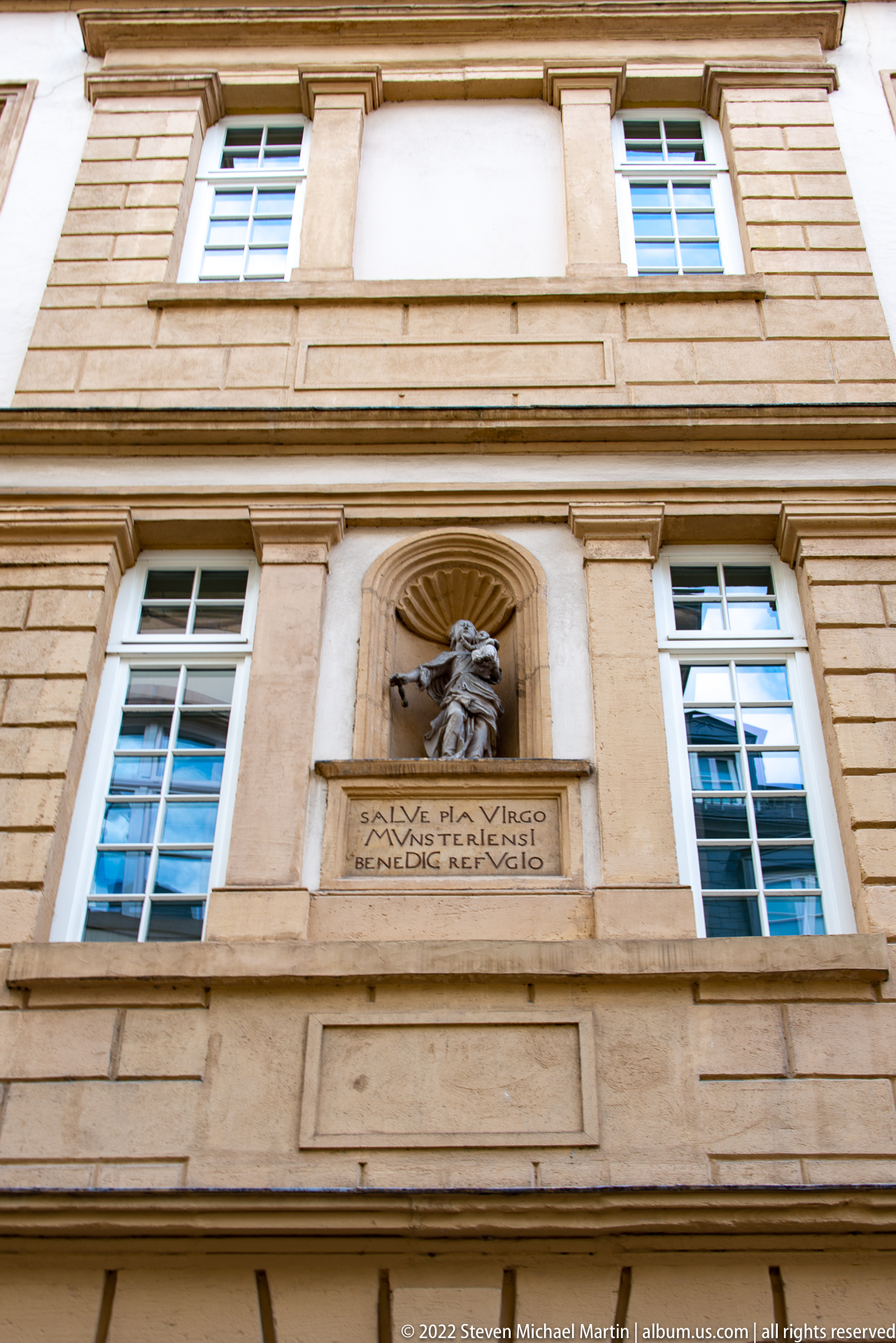
A sculpted animal head projects from a shallow stone niche above a Latin inscription set into a rusticated façade. Flanking windows and carefully cut ashlar blocks frame the relief symmetrically, making the photograph a focused study of heraldic or institutional ornament rather than the building as a whole.
Caption
A sculpted animal head projects from a shallow stone niche above a Latin inscription set into a rusticated façade. Flanking windows and carefully cut ashlar blocks frame the relief symmetrically, making the photograph a focused study of heraldic or institutional ornament rather than the building as a whole.
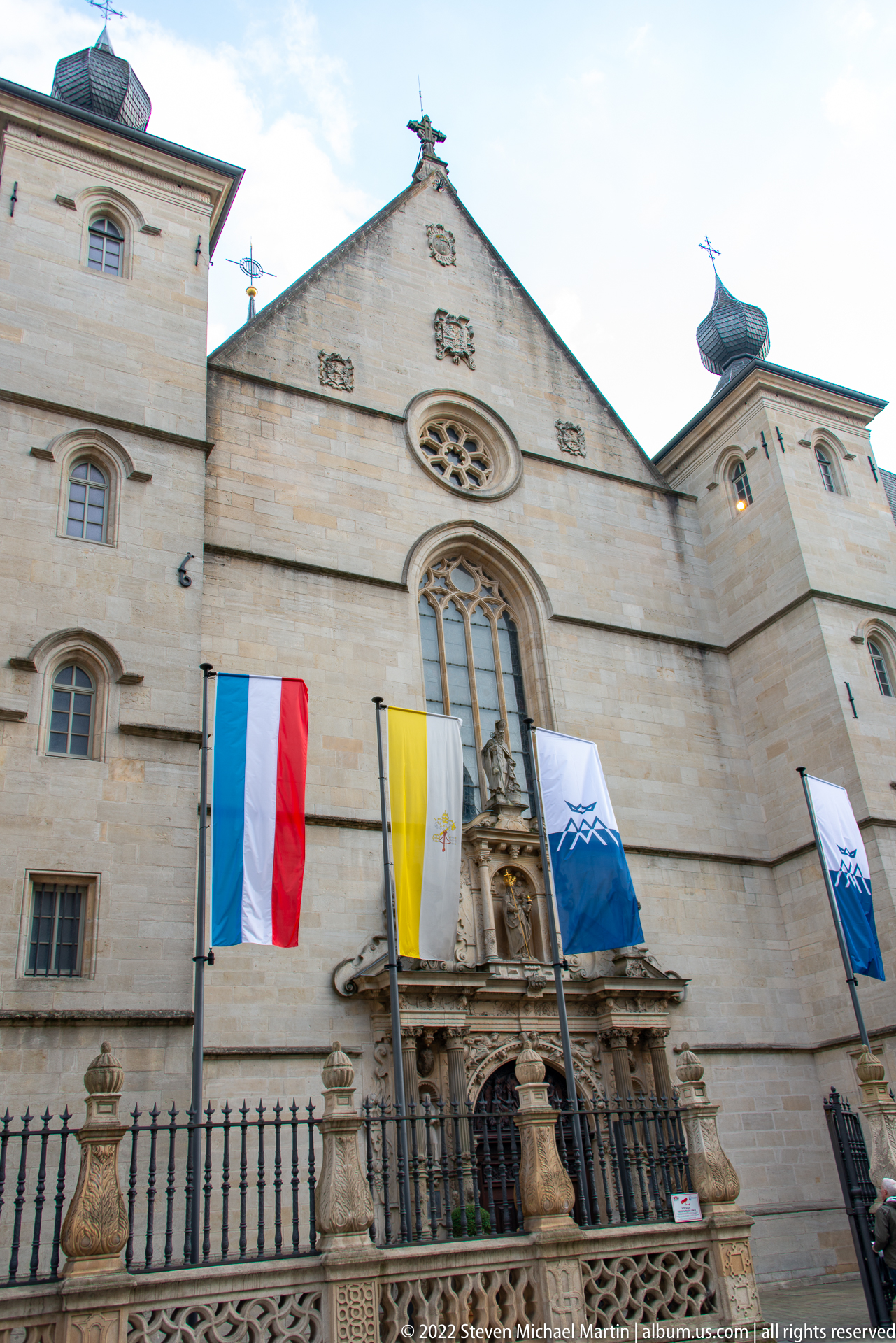
A pale stone church façade rises behind a ceremonial line of vertical flags, its central doorway framed by an elaborate sculptural portal. A small rose window and larger arched window organize the upper wall, while low side towers and a simple gable give the composition a broad, restrained profile above the more ornate entrance.
Caption
A pale stone church façade rises behind a ceremonial line of vertical flags, its central doorway framed by an elaborate sculptural portal. A small rose window and larger arched window organize the upper wall, while low side towers and a simple gable give the composition a broad, restrained profile above the more ornate entrance.
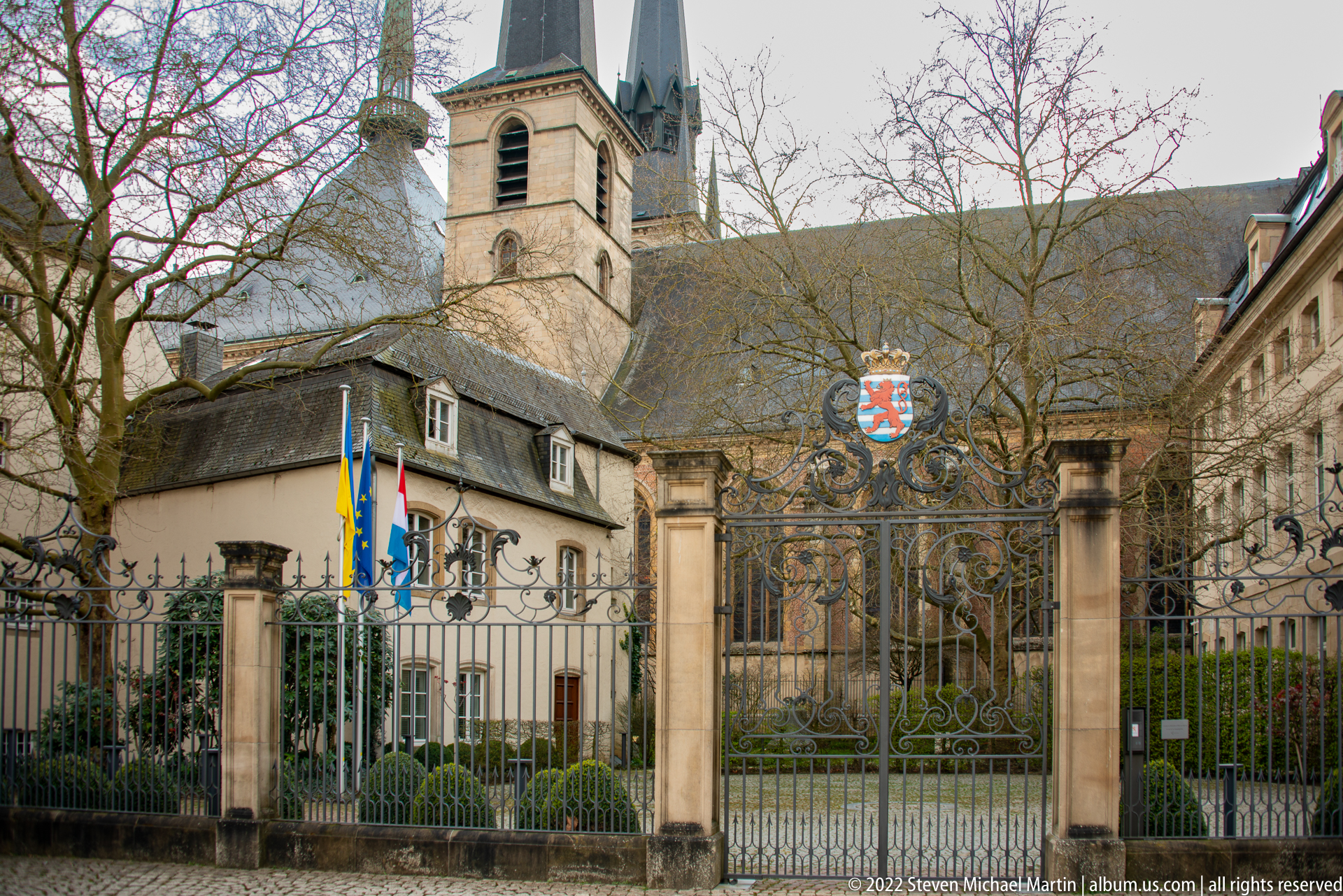
An ornate wrought-iron gate opens onto a historic institutional complex marked by Luxembourg and European flags and a colored heraldic crest. A church tower rises directly behind the buildings, creating a layered view in which state symbolism, decorative ironwork, and religious architecture meet within the compact fabric of the old city.
Caption
An ornate wrought-iron gate opens onto a historic institutional complex marked by Luxembourg and European flags and a colored heraldic crest. A church tower rises directly behind the buildings, creating a layered view in which state symbolism, decorative ironwork, and religious architecture meet within the compact fabric of the old city.
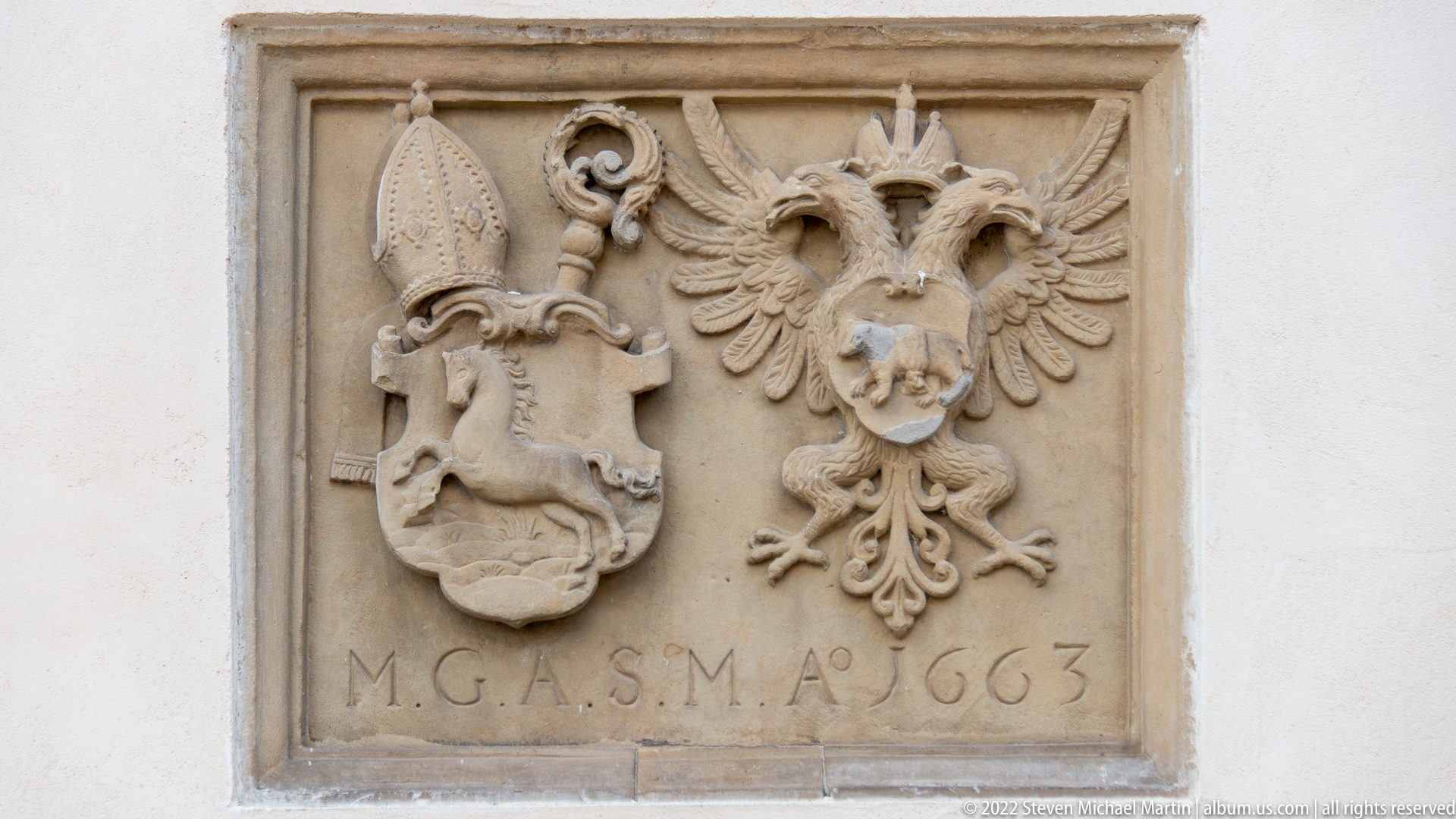
A rectangular stone panel bears two deeply carved coats of arms above the incised date 1663. One shield is surmounted by a bishop's mitre and crozier; the other carries a double-headed eagle. The relief is a compact record of institutional or ecclesiastical heraldry embedded in the historic fabric of Luxembourg City.
Caption
A rectangular stone panel bears two deeply carved coats of arms above the incised date 1663. One shield is surmounted by a bishop's mitre and crozier; the other carries a double-headed eagle. The relief is a compact record of institutional or ecclesiastical heraldry embedded in the historic fabric of Luxembourg City.
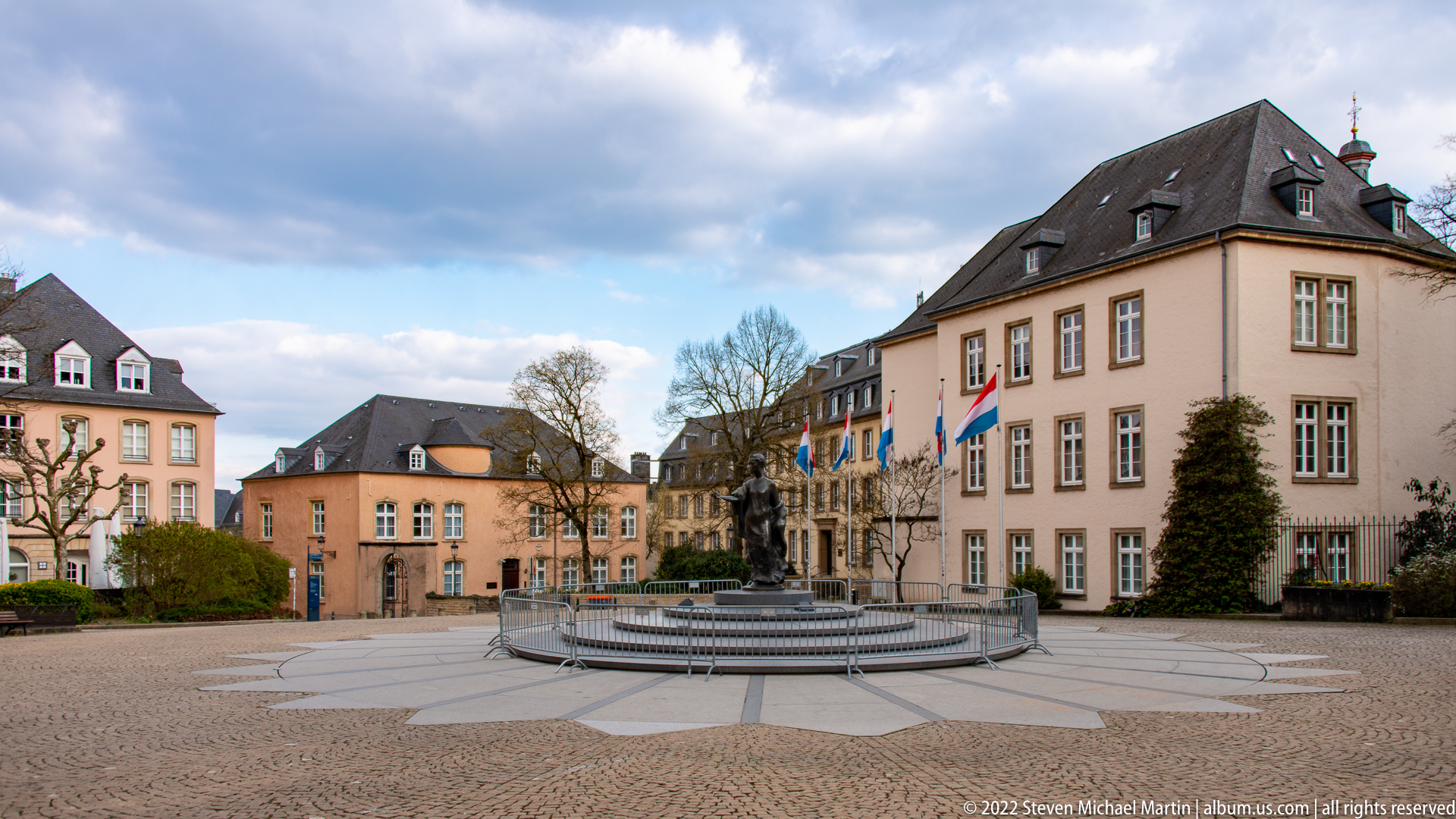
A circular fountain anchors a quiet paved square enclosed by low historic buildings in warm pastel tones. Luxembourg flags punctuate the façades, while pruned trees and the patterned paving emphasize the square's formal civic character. The wide view records the scale and spatial enclosure of this pedestrian-oriented urban space.
Caption
A circular fountain anchors a quiet paved square enclosed by low historic buildings in warm pastel tones. Luxembourg flags punctuate the façades, while pruned trees and the patterned paving emphasize the square's formal civic character. The wide view records the scale and spatial enclosure of this pedestrian-oriented urban space.
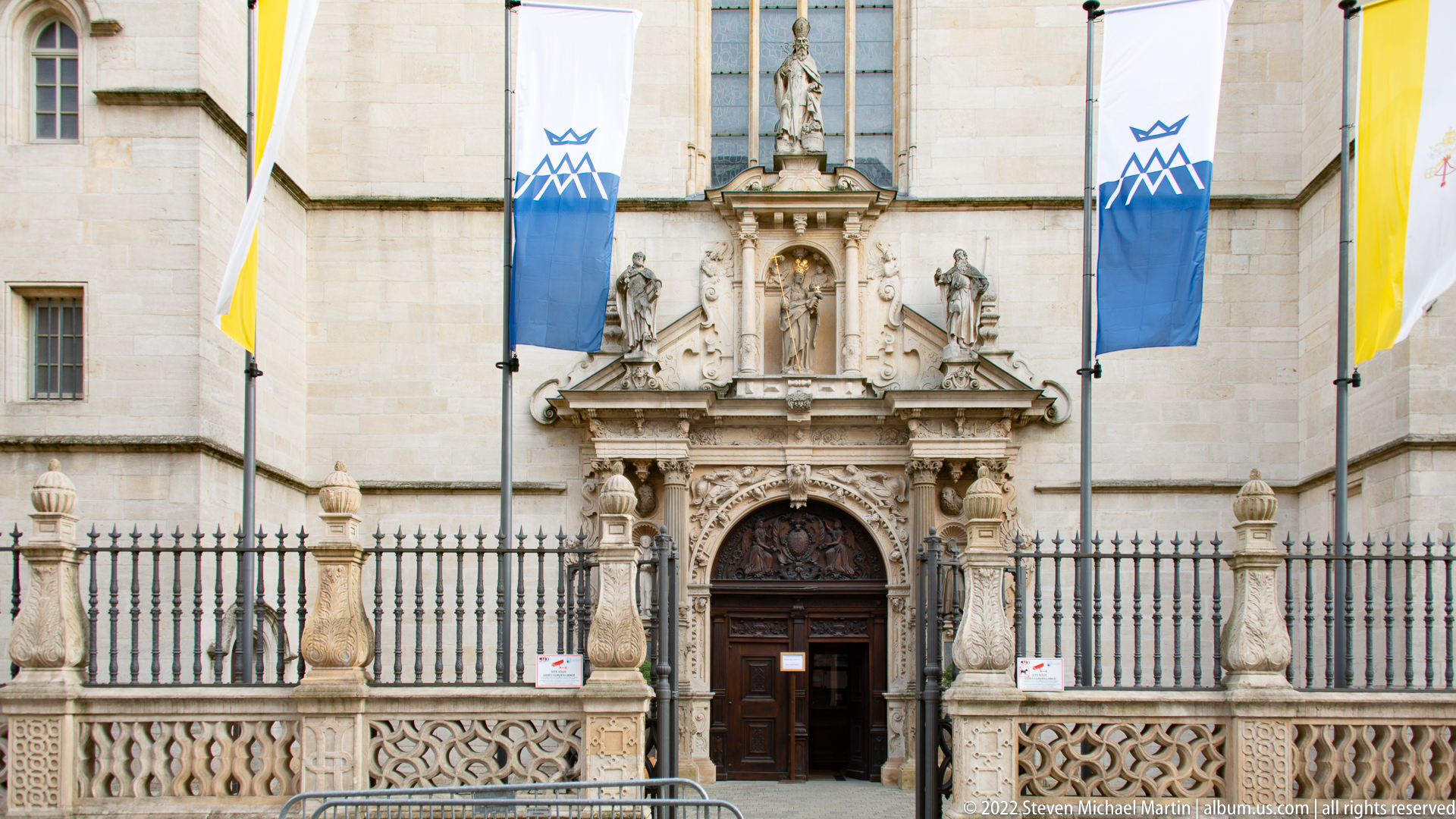
An elaborate stone portal frames a dark wooden church door, with carved religious figures arranged above and beside the entrance beneath a projecting entablature. Slender colonnettes, balustraded stonework, and ceremonial banners intensify the vertical composition, making the doorway the principal focus of this close architectural view.
Caption
An elaborate stone portal frames a dark wooden church door, with carved religious figures arranged above and beside the entrance beneath a projecting entablature. Slender colonnettes, balustraded stonework, and ceremonial banners intensify the vertical composition, making the doorway the principal focus of this close architectural view.
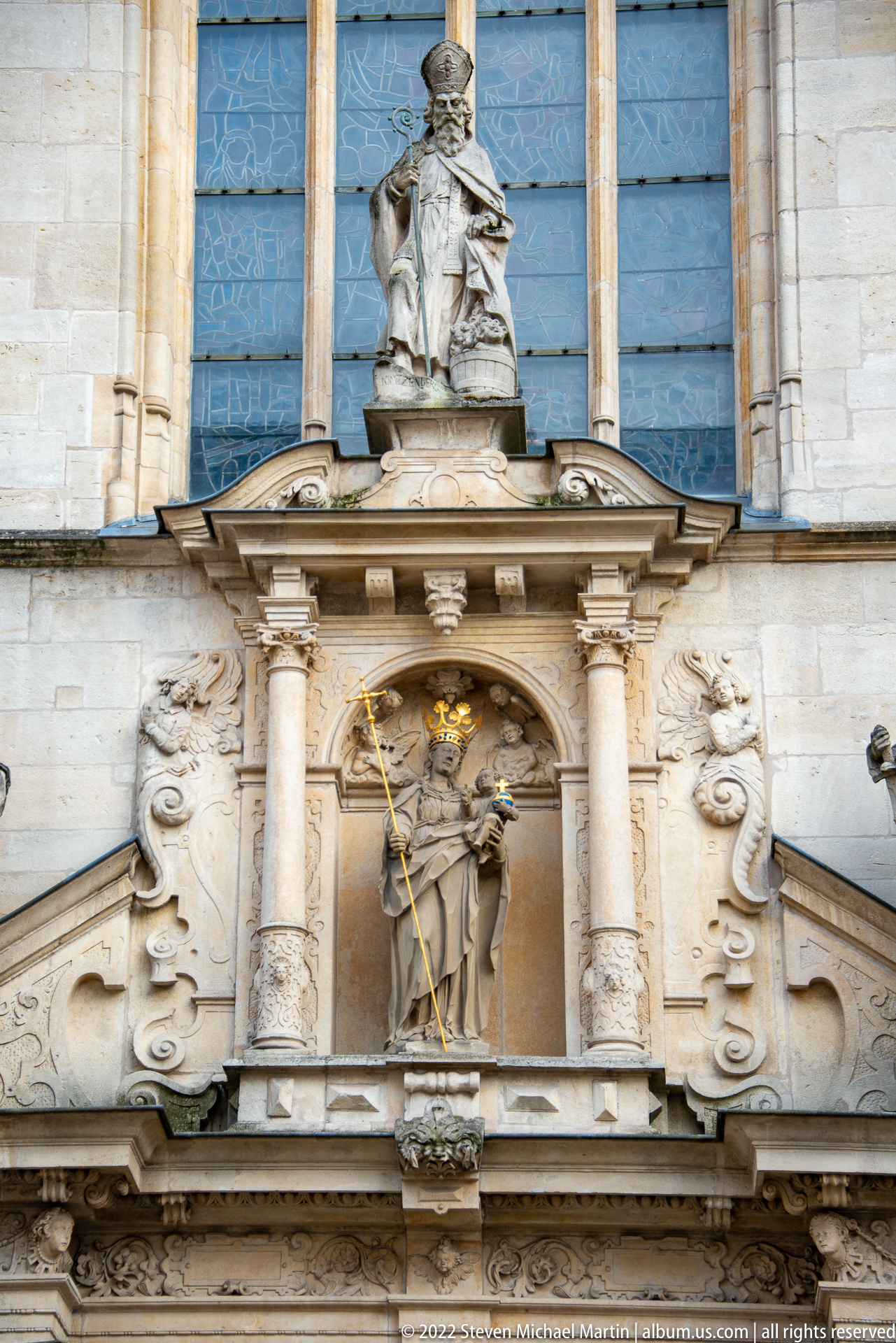
A crowned male saint stands in a shallow niche above the church entrance, holding a long staff while a smaller figure appears at his side. Fluted columns, scrollwork, shell-like ornament, and a broken pediment frame the sculpture, creating a concentrated Baroque decorative ensemble on the otherwise pale stone façade.
Caption
A crowned male saint stands in a shallow niche above the church entrance, holding a long staff while a smaller figure appears at his side. Fluted columns, scrollwork, shell-like ornament, and a broken pediment frame the sculpture, creating a concentrated Baroque decorative ensemble on the otherwise pale stone façade.
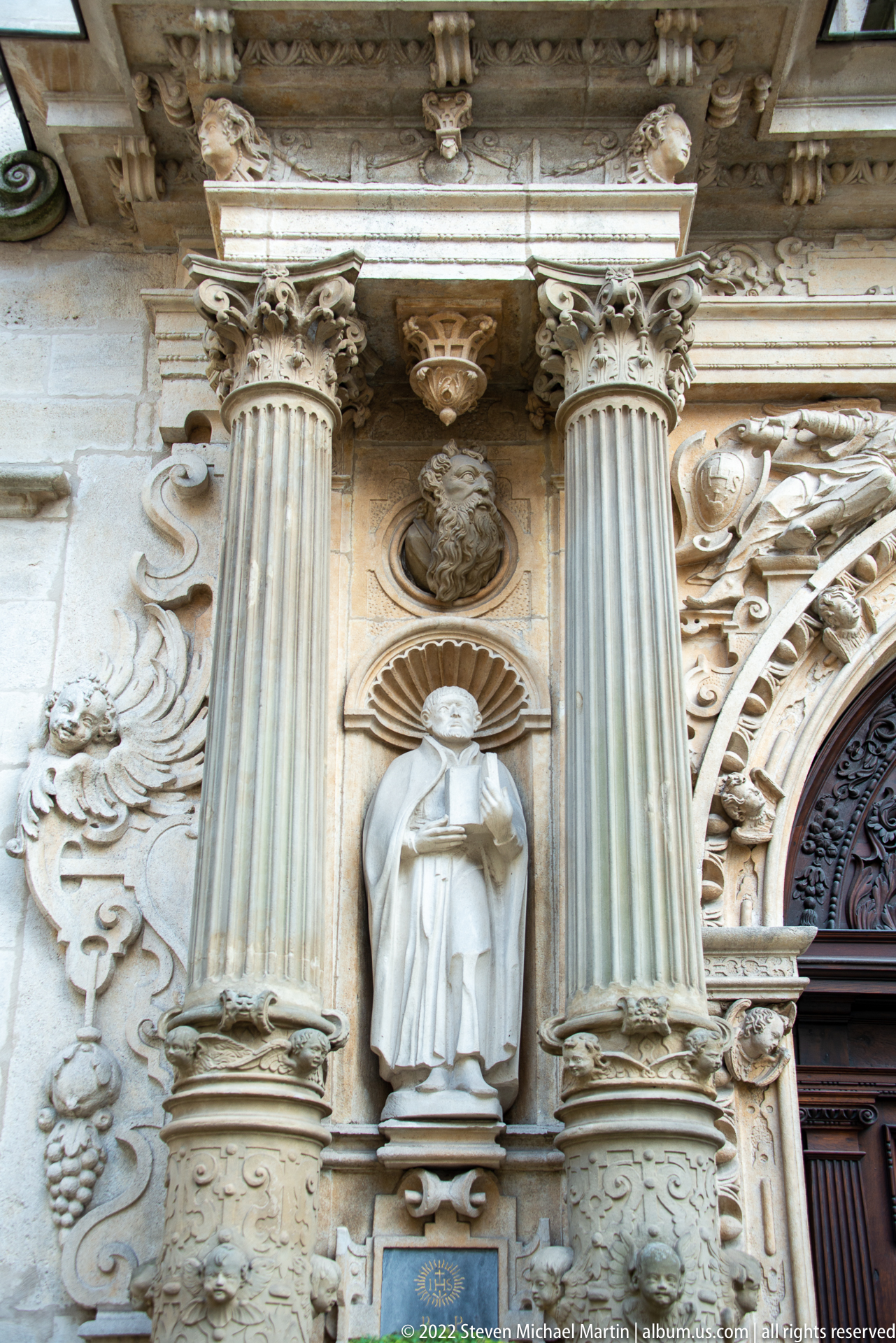
A white-robed religious figure stands in a shallow niche between fluted columns on an elaborately carved façade. Shell ornament, floral motifs, masks, and layered entablatures surround the sculpture, creating a dense field of decorative stonework that rewards close inspection apart from the building's larger architectural form.
Caption
A white-robed religious figure stands in a shallow niche between fluted columns on an elaborately carved façade. Shell ornament, floral motifs, masks, and layered entablatures surround the sculpture, creating a dense field of decorative stonework that rewards close inspection apart from the building's larger architectural form.
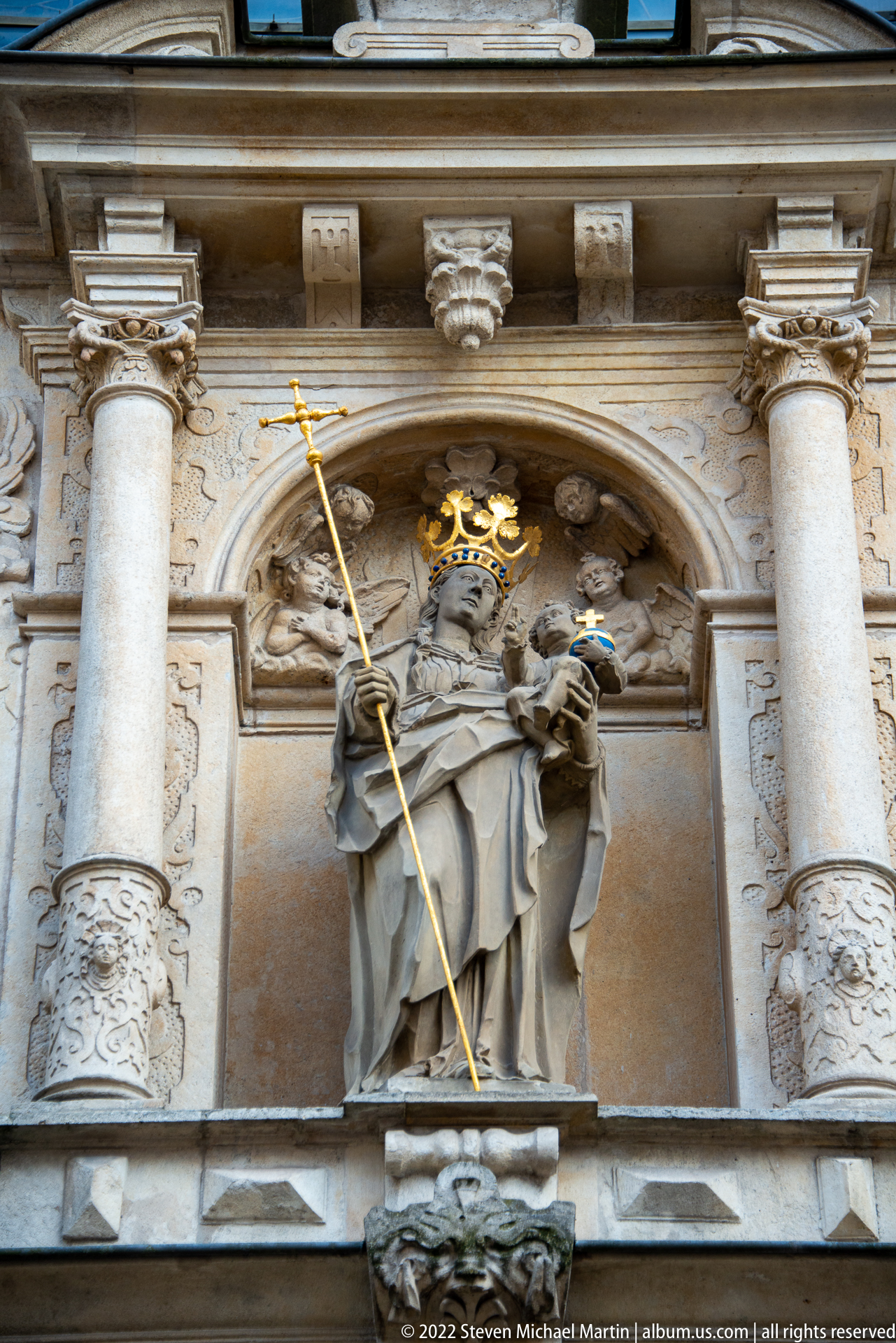
A crowned saint occupies the center of a richly framed niche, holding a long gilded staff while supporting or sheltering a smaller figure at his side. The sculptural group is set between large columns beneath a curved architectural canopy, with scrollwork and relief ornament continuing across the surrounding church façade.
Caption
A crowned saint occupies the center of a richly framed niche, holding a long gilded staff while supporting or sheltering a smaller figure at his side. The sculptural group is set between large columns beneath a curved architectural canopy, with scrollwork and relief ornament continuing across the surrounding church façade.
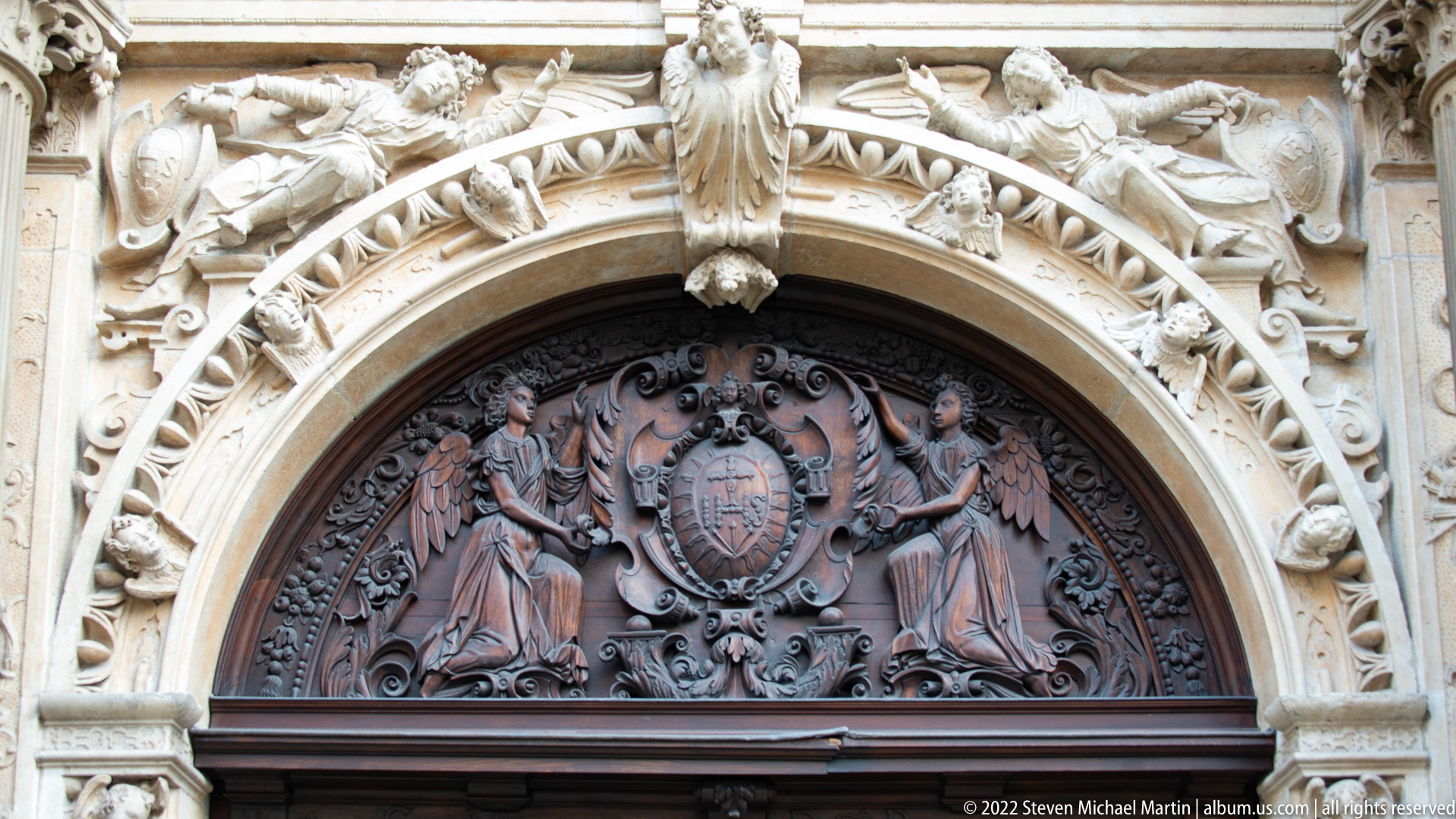
A dark carved wooden panel fills the semicircular space above a church door, centered on a heraldic shield and flanked by two standing female figures. The surrounding pale stone arch is densely ornamented with foliage, winged figures, and sculpted details, producing a striking contrast between the warm wood carving and elaborate masonry frame.
Caption
A dark carved wooden panel fills the semicircular space above a church door, centered on a heraldic shield and flanked by two standing female figures. The surrounding pale stone arch is densely ornamented with foliage, winged figures, and sculpted details, producing a striking contrast between the warm wood carving and elaborate masonry frame.
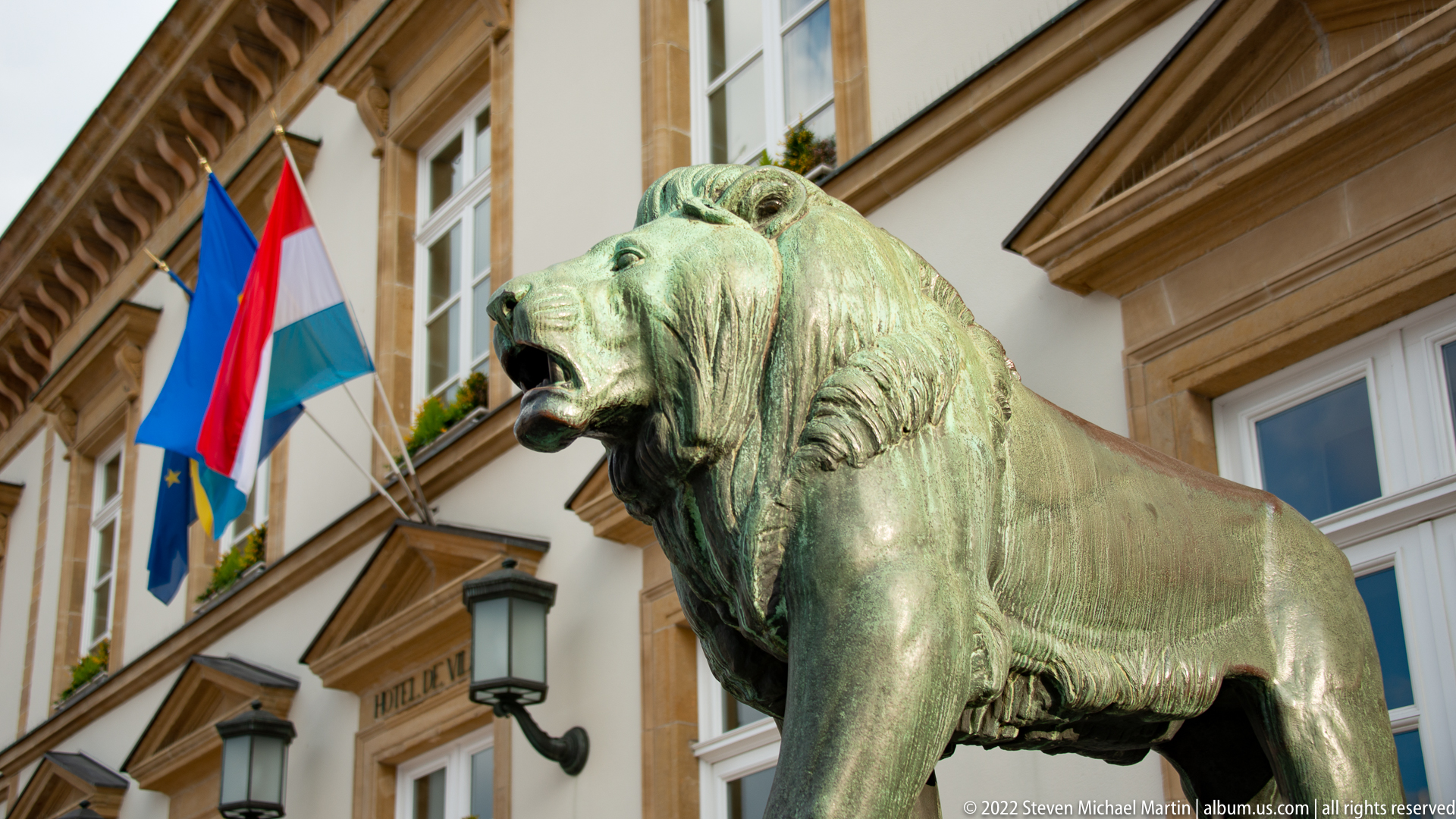
A bronze lion beside Luxembourg City's Hôtel de Ville is seen in profile, its head raised and mouth open against the city hall façade. Luxembourg and European flags hang just behind the sculpture, visually tying the animal to its municipal setting while the low angle emphasizes the lion's powerful body and sculpted mane.
Caption
A bronze lion beside Luxembourg City's Hôtel de Ville is seen in profile, its head raised and mouth open against the city hall façade. Luxembourg and European flags hang just behind the sculpture, visually tying the animal to its municipal setting while the low angle emphasizes the lion's powerful body and sculpted mane.
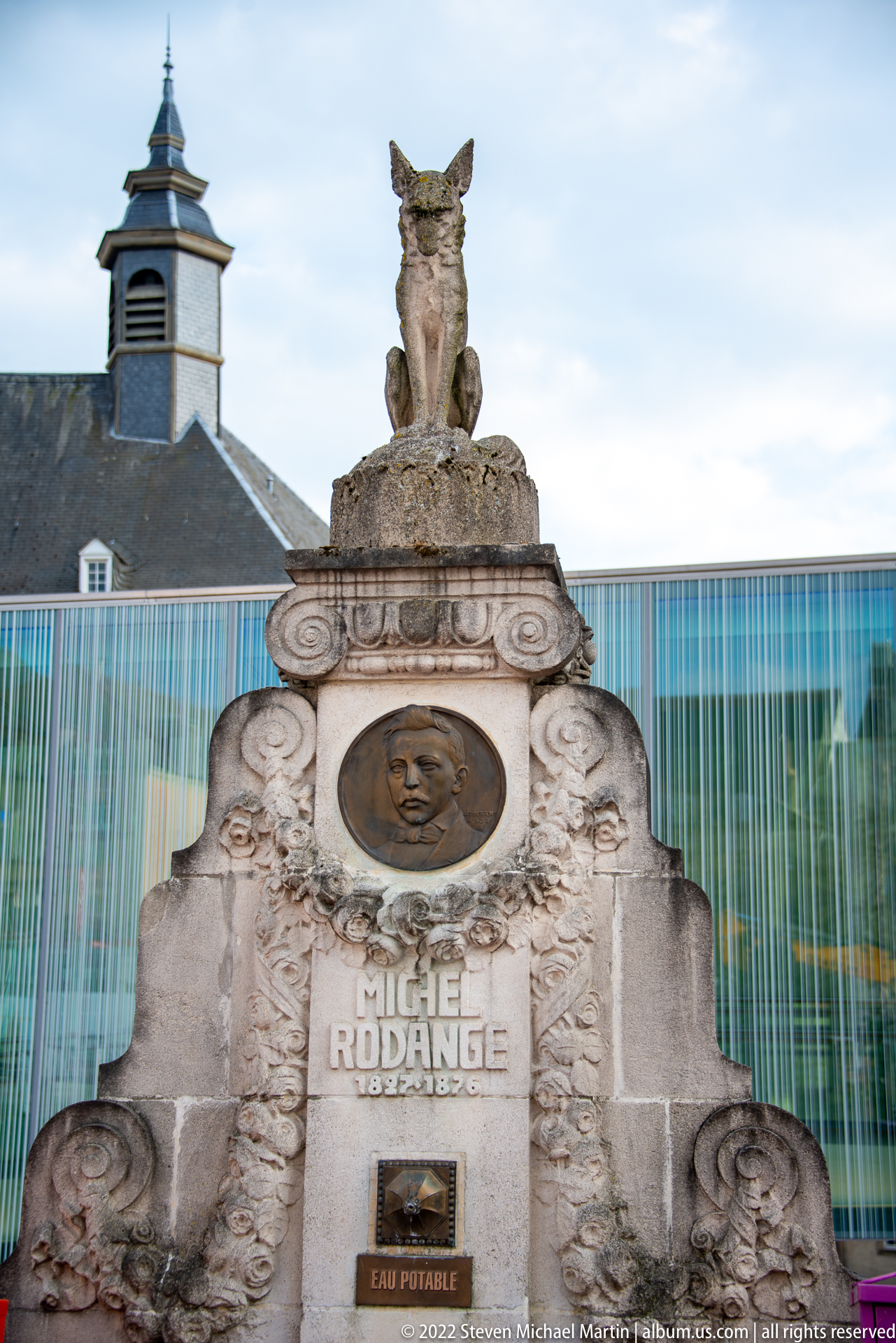
A stone memorial honors Luxembourg writer Michel Rodange, whose name and dates are carved prominently beneath a circular portrait medallion. A sculpted fox sits alert at the summit, an apt literary emblem associated with Rodange's best-known satirical work, while additional carved ornament and a small plaque animate the monument's layered façade.
Caption
A stone memorial honors Luxembourg writer Michel Rodange, whose name and dates are carved prominently beneath a circular portrait medallion. A sculpted fox sits alert at the summit, an apt literary emblem associated with Rodange's best-known satirical work, while additional carved ornament and a small plaque animate the monument's layered façade.
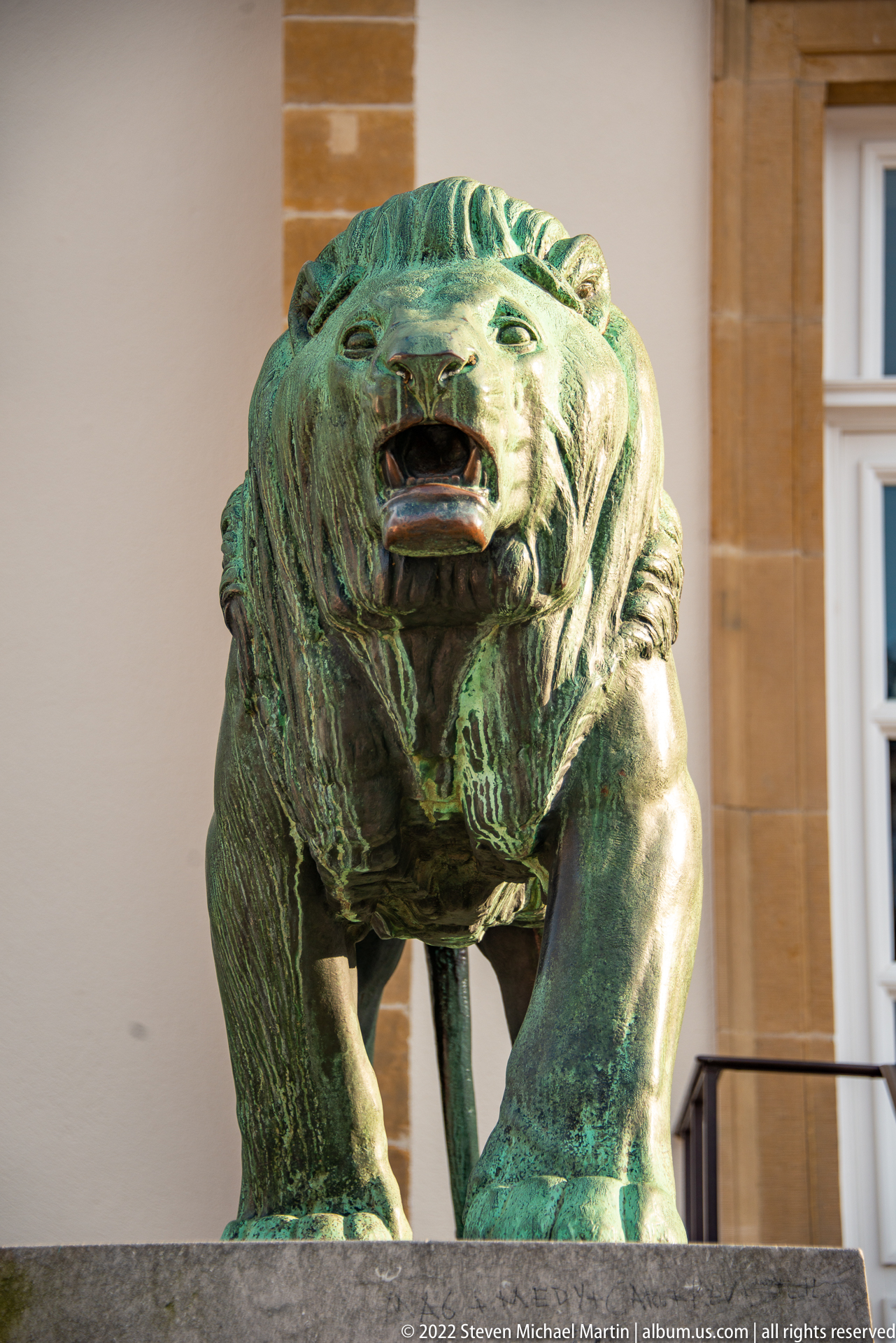
A life-size bronze lion stands alert on a stone plinth outside Luxembourg City's Hôtel de Ville, its open mouth and heavily modeled mane rendered in a green-brown patina. Seen at close range, the sculpture dominates the frame and reveals the expressive surface treatment of one of the paired lions associated with the city hall entrance.
Caption
A life-size bronze lion stands alert on a stone plinth outside Luxembourg City's Hôtel de Ville, its open mouth and heavily modeled mane rendered in a green-brown patina. Seen at close range, the sculpture dominates the frame and reveals the expressive surface treatment of one of the paired lions associated with the city hall entrance.
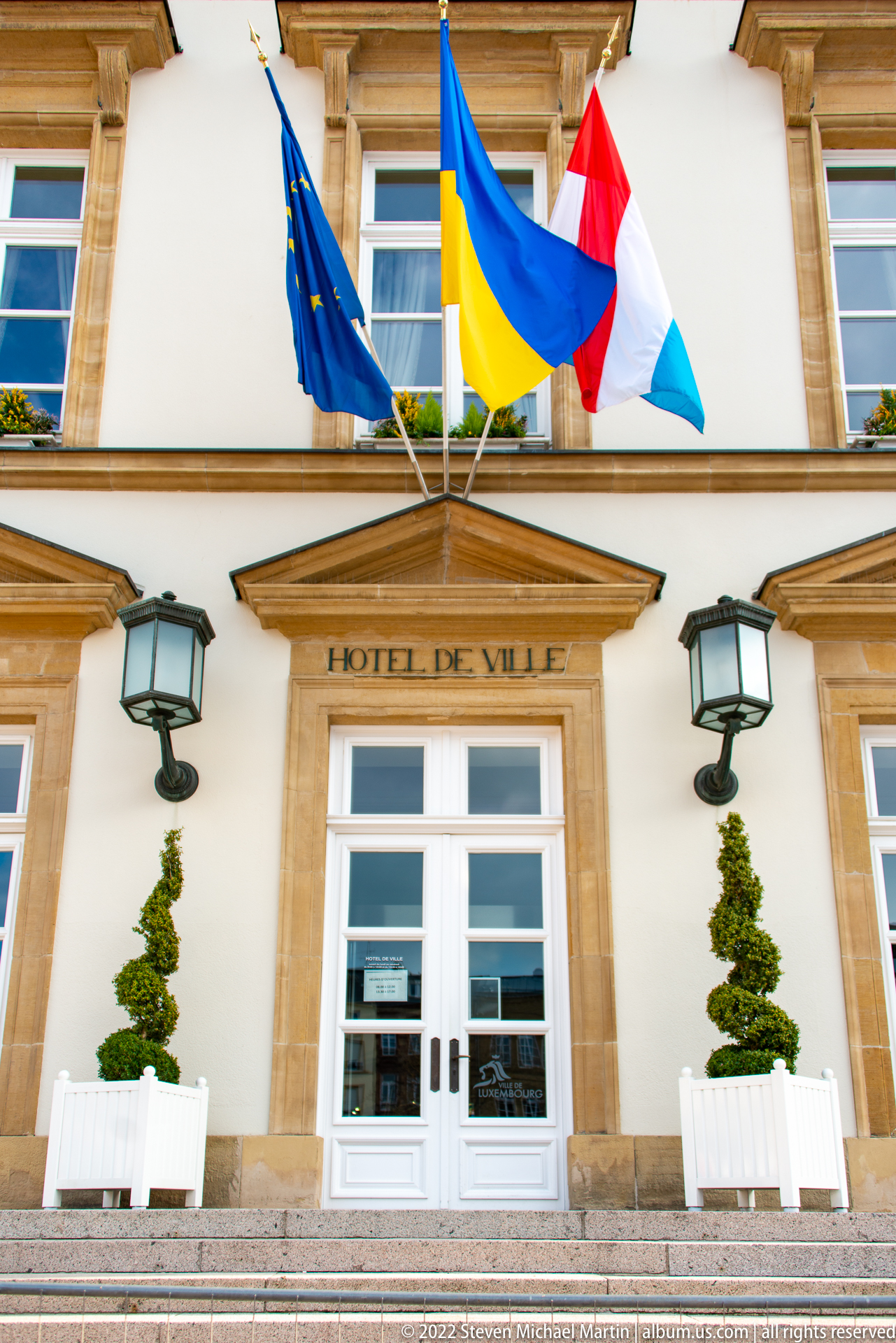
The main entrance of Luxembourg City's Hôtel de Ville is framed by pale stone trim, paired wall lanterns, clipped topiary, and a row of official flags above the doorway. The words 'HÔTEL DE VILLE' are carved into the lintel, making this a clear architectural record of the municipal building's formal civic entrance.
Caption
The main entrance of Luxembourg City's Hôtel de Ville is framed by pale stone trim, paired wall lanterns, clipped topiary, and a row of official flags above the doorway. The words 'HÔTEL DE VILLE' are carved into the lintel, making this a clear architectural record of the municipal building's formal civic entrance.
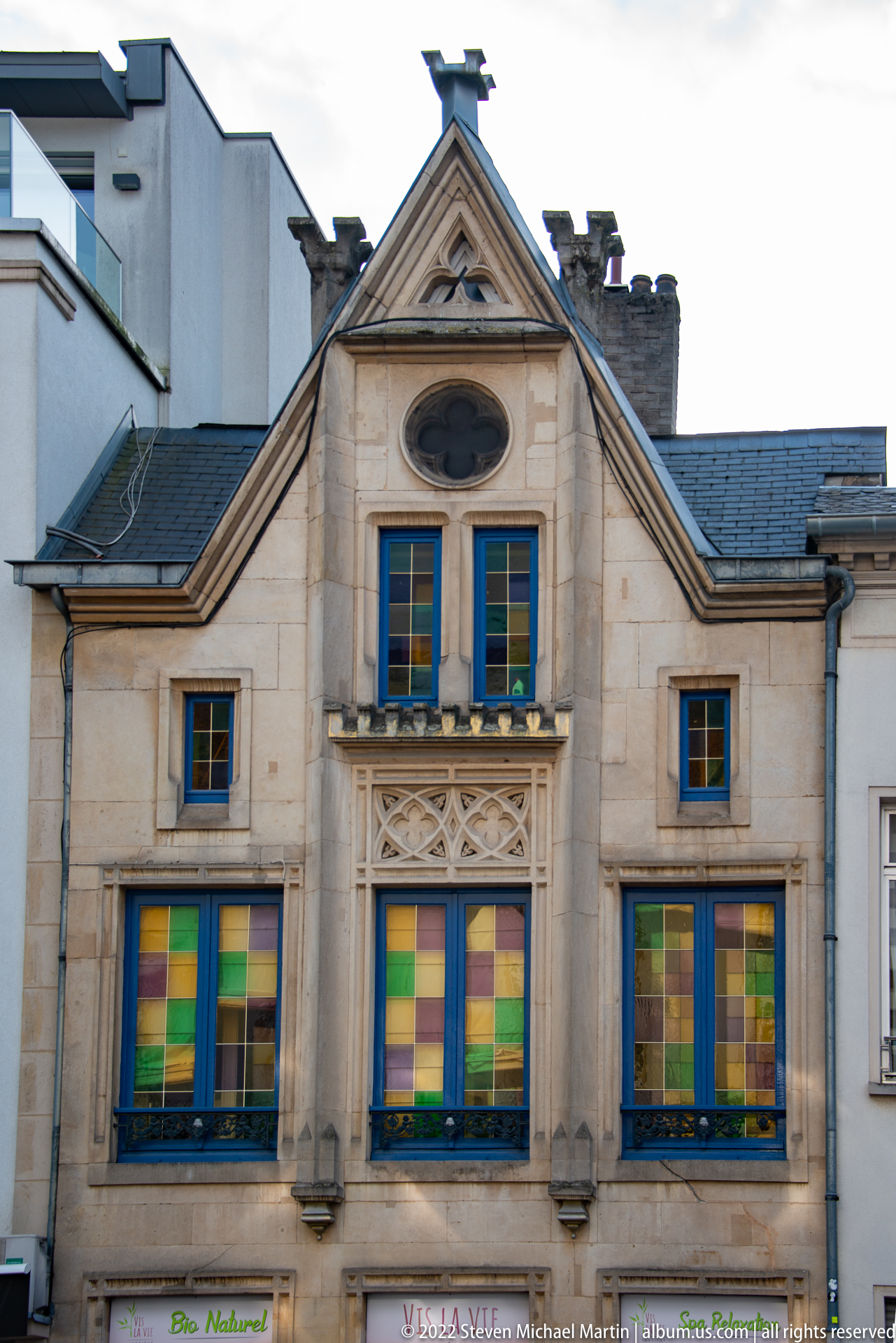
A narrow gable-front building presents an unusually colorful face to the street, with rectangular window panels filled by bands of green, yellow, orange, blue, and pink. The pale stone surround, triangular pediment, oval attic opening, and dark slate roofs retain a historic architectural framework while the glazing treatment introduces a contemporary graphic layer.
Caption
A narrow gable-front building presents an unusually colorful face to the street, with rectangular window panels filled by bands of green, yellow, orange, blue, and pink. The pale stone surround, triangular pediment, oval attic opening, and dark slate roofs retain a historic architectural framework while the glazing treatment introduces a contemporary graphic layer.
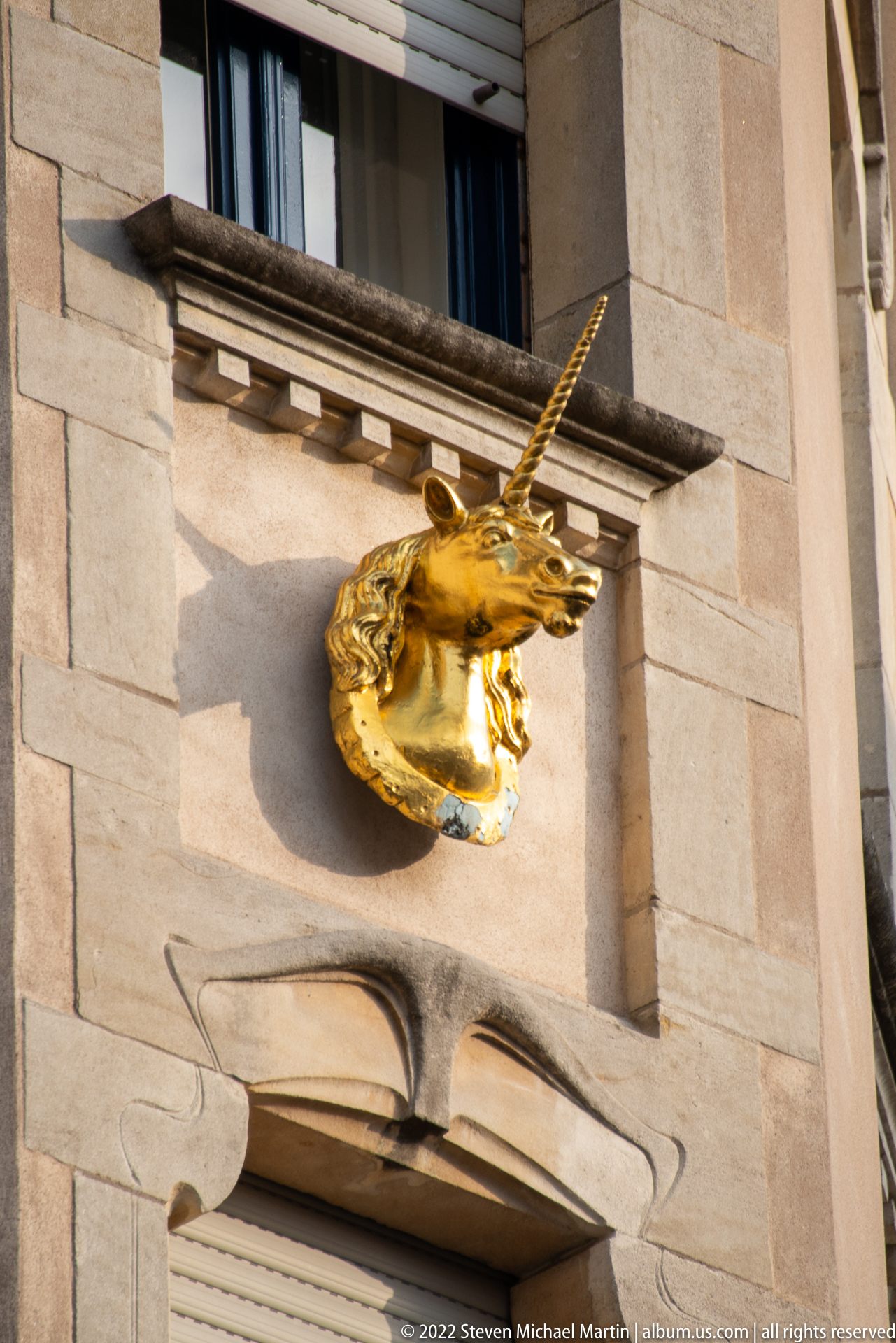
A gilded unicorn head projects dramatically from a pale stone façade above a curved doorway surround. Its long spiraled horn, open mouth, and polished gold surface transform a small architectural detail into a conspicuous street-level emblem, contrasting sharply with the restrained masonry and shadowed upper window around it.
Caption
A gilded unicorn head projects dramatically from a pale stone façade above a curved doorway surround. Its long spiraled horn, open mouth, and polished gold surface transform a small architectural detail into a conspicuous street-level emblem, contrasting sharply with the restrained masonry and shadowed upper window around it.
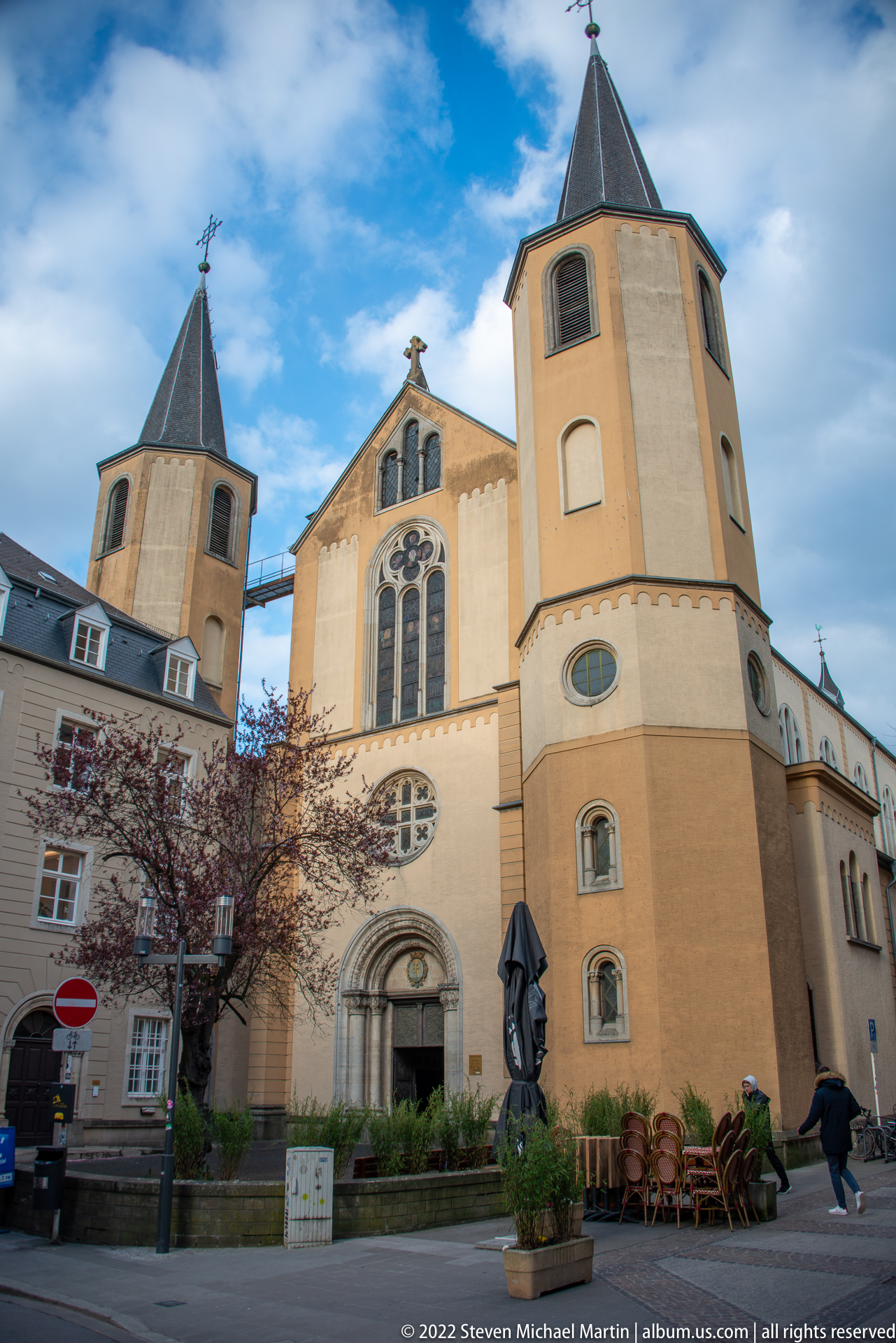
A broad pale church façade is framed by two polygonal corner towers capped with dark pyramidal roofs. The central bay combines a sculpted portal, round and traceried windows, and a simple gabled roofline, while the low-angle view emphasizes the unusual massing and defensive weight of the twin towers against a bright spring sky.
Caption
A broad pale church façade is framed by two polygonal corner towers capped with dark pyramidal roofs. The central bay combines a sculpted portal, round and traceried windows, and a simple gabled roofline, while the low-angle view emphasizes the unusual massing and defensive weight of the twin towers against a bright spring sky.
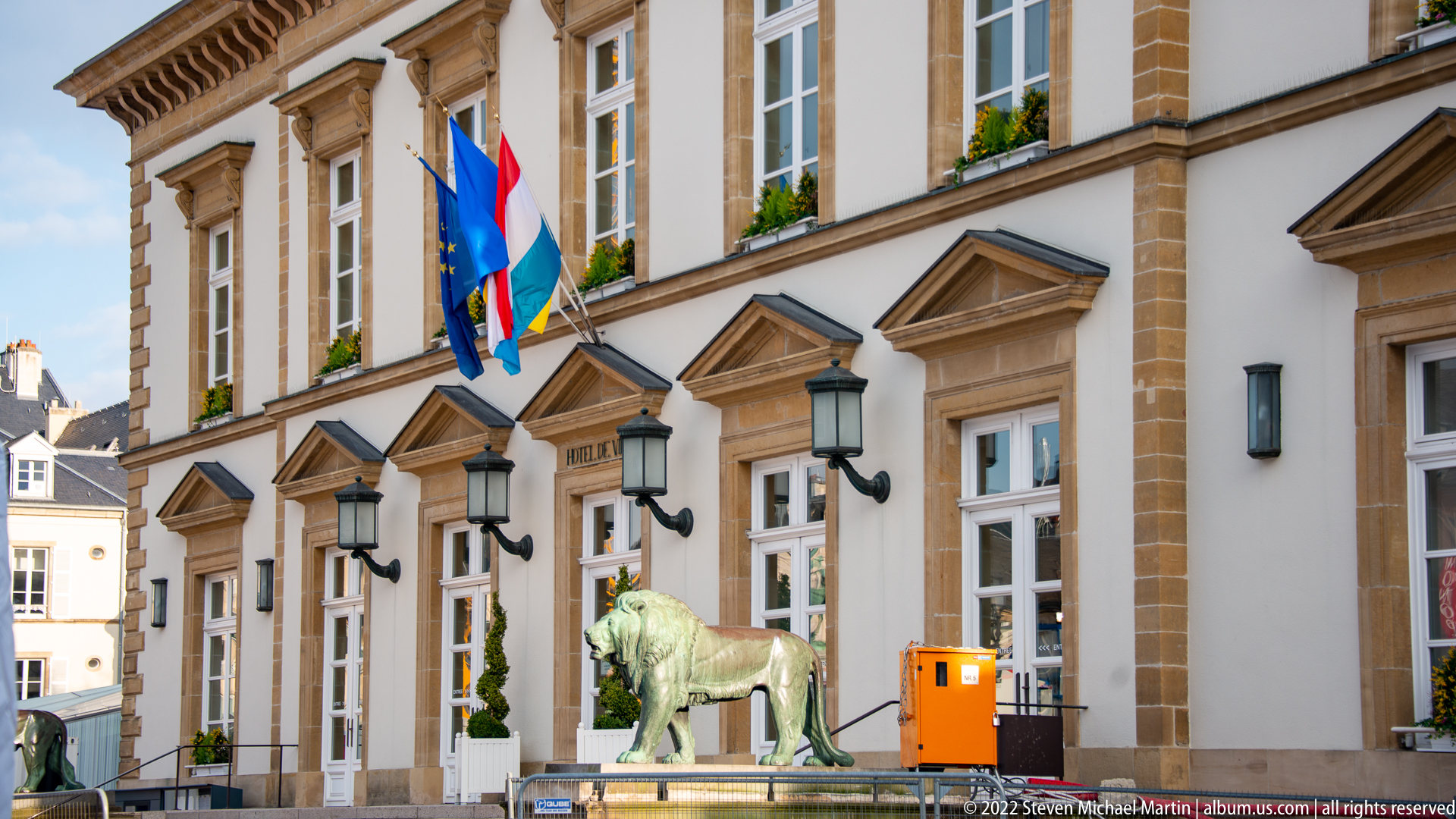
The Hôtel de Ville façade is shown in a broader oblique view, with its evenly spaced windows, pedimented doorways, wall lanterns, official flags, and one of the bronze lions arranged along the street frontage. This wider composition clarifies how the sculptural lions and ceremonial elements function as part of the municipal building's formal public presentation.
Caption
The Hôtel de Ville façade is shown in a broader oblique view, with its evenly spaced windows, pedimented doorways, wall lanterns, official flags, and one of the bronze lions arranged along the street frontage. This wider composition clarifies how the sculptural lions and ceremonial elements function as part of the municipal building's formal public presentation.
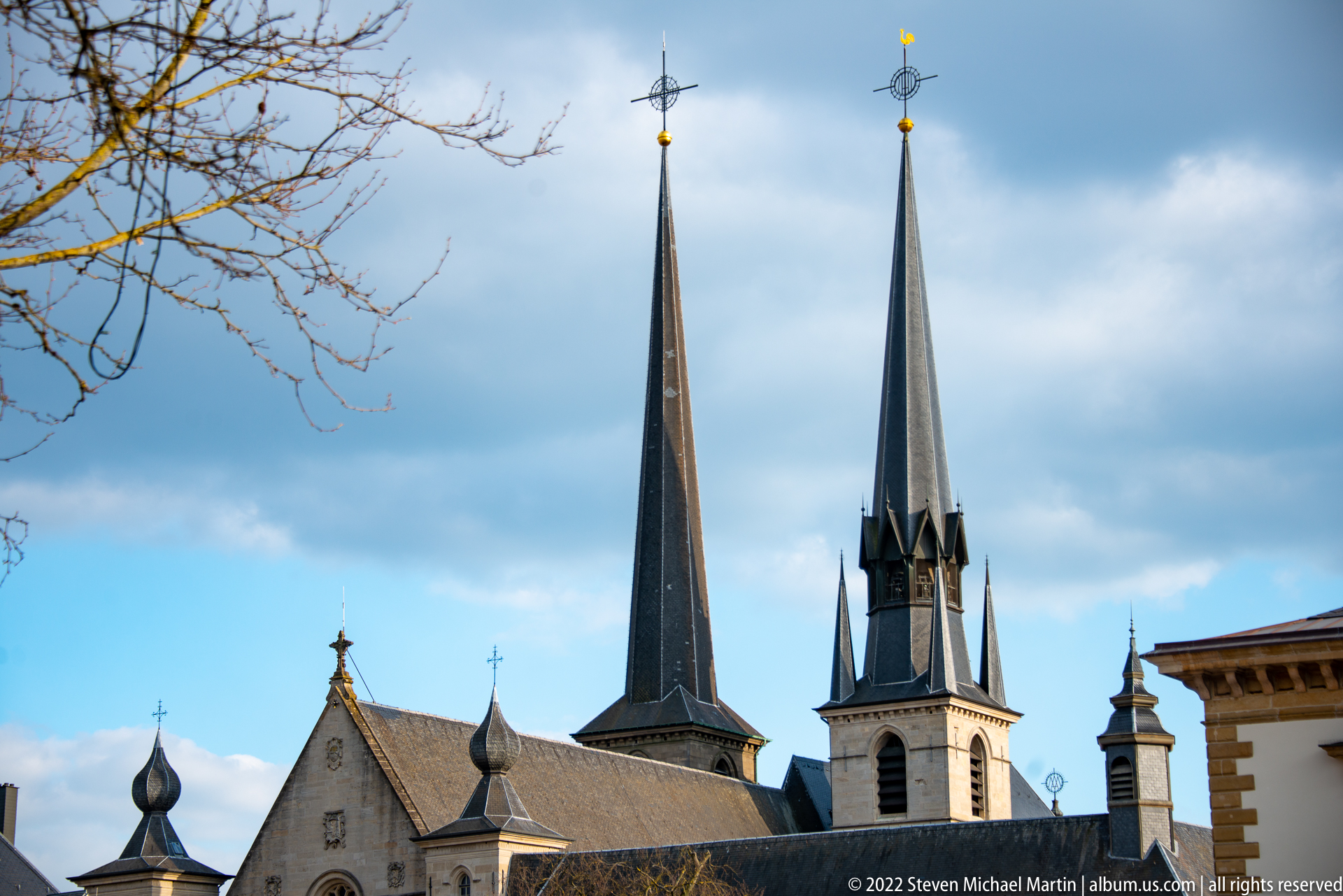
Three slender pointed spires rise above a cluster of historic roofs, their dark silhouettes and decorative finials standing sharply against blue and gray clouds. The compressed telephoto view isolates the vertical church forms from the surrounding city, emphasizing Luxembourg's skyline of steep roofs, towers, and ecclesiastical landmarks.
Caption
Three slender pointed spires rise above a cluster of historic roofs, their dark silhouettes and decorative finials standing sharply against blue and gray clouds. The compressed telephoto view isolates the vertical church forms from the surrounding city, emphasizing Luxembourg's skyline of steep roofs, towers, and ecclesiastical landmarks.
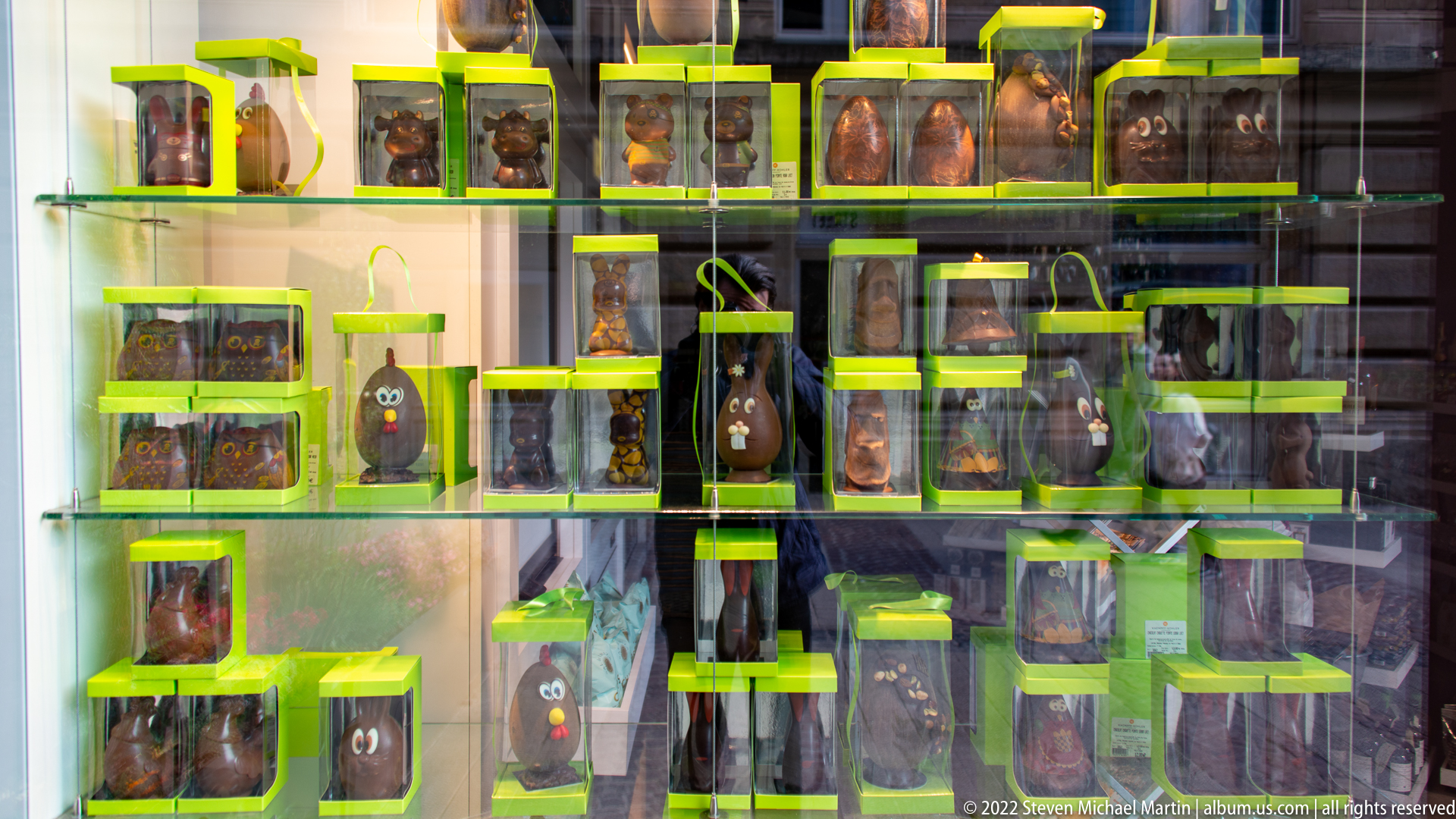
A shop window is densely arranged with novelty chocolates and sculpted chocolate figures in vivid lime-green boxes. Reflections across the glass mingle the merchandise with the street outside, while the repeated packaging and whimsical forms make the image a close record of contemporary confectionery retail in the historic city center.
Caption
A shop window is densely arranged with novelty chocolates and sculpted chocolate figures in vivid lime-green boxes. Reflections across the glass mingle the merchandise with the street outside, while the repeated packaging and whimsical forms make the image a close record of contemporary confectionery retail in the historic city center.
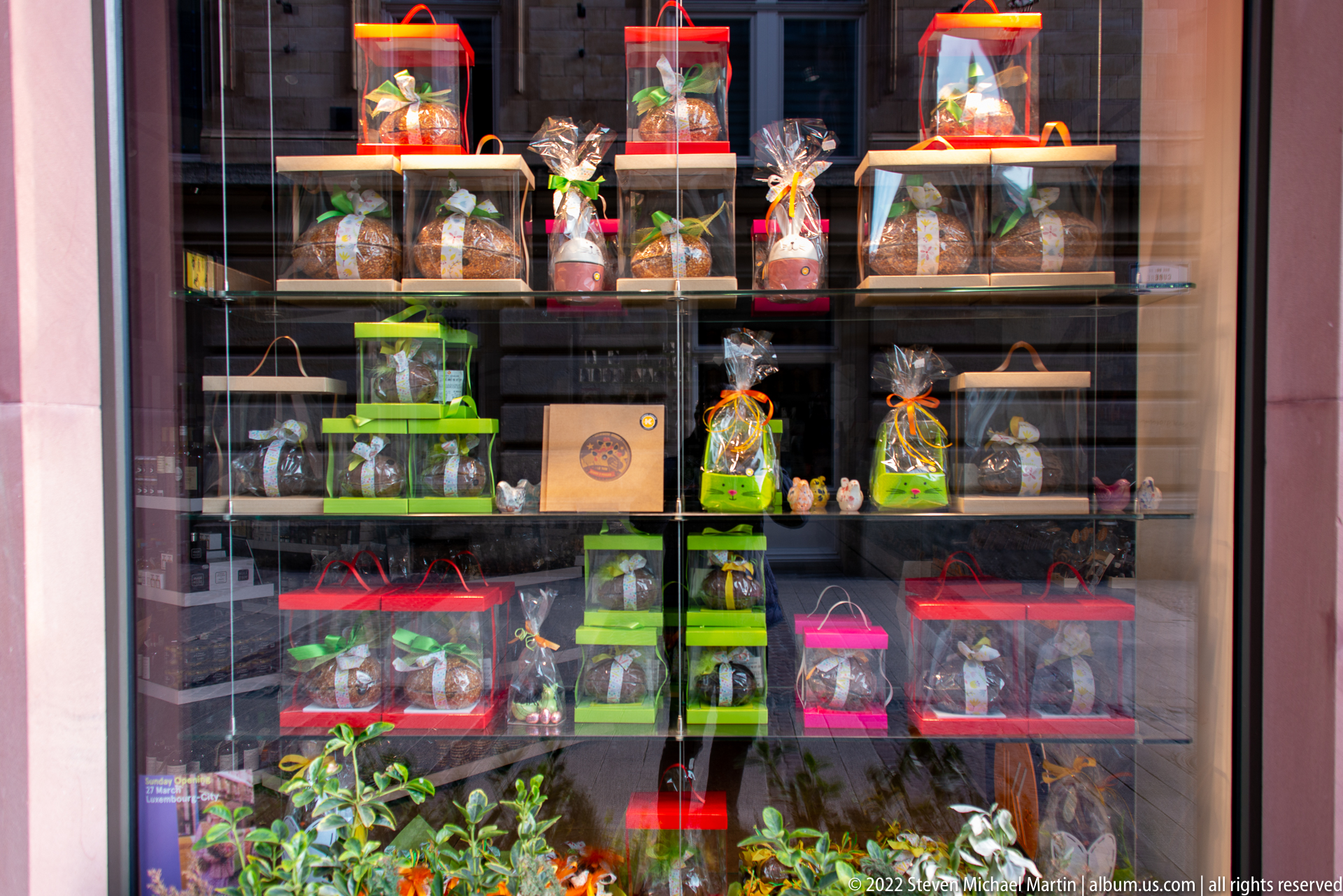
A second confectionery window presents chocolate figures and gift packages arranged on dark shelving, with vivid red and green accents framing the display. Cellophane wrapping, bows, boxed assortments, and small novelty shapes create a festive retail tableau, while reflections of nearby architecture remain visible across the glass.
Caption
A second confectionery window presents chocolate figures and gift packages arranged on dark shelving, with vivid red and green accents framing the display. Cellophane wrapping, bows, boxed assortments, and small novelty shapes create a festive retail tableau, while reflections of nearby architecture remain visible across the glass.
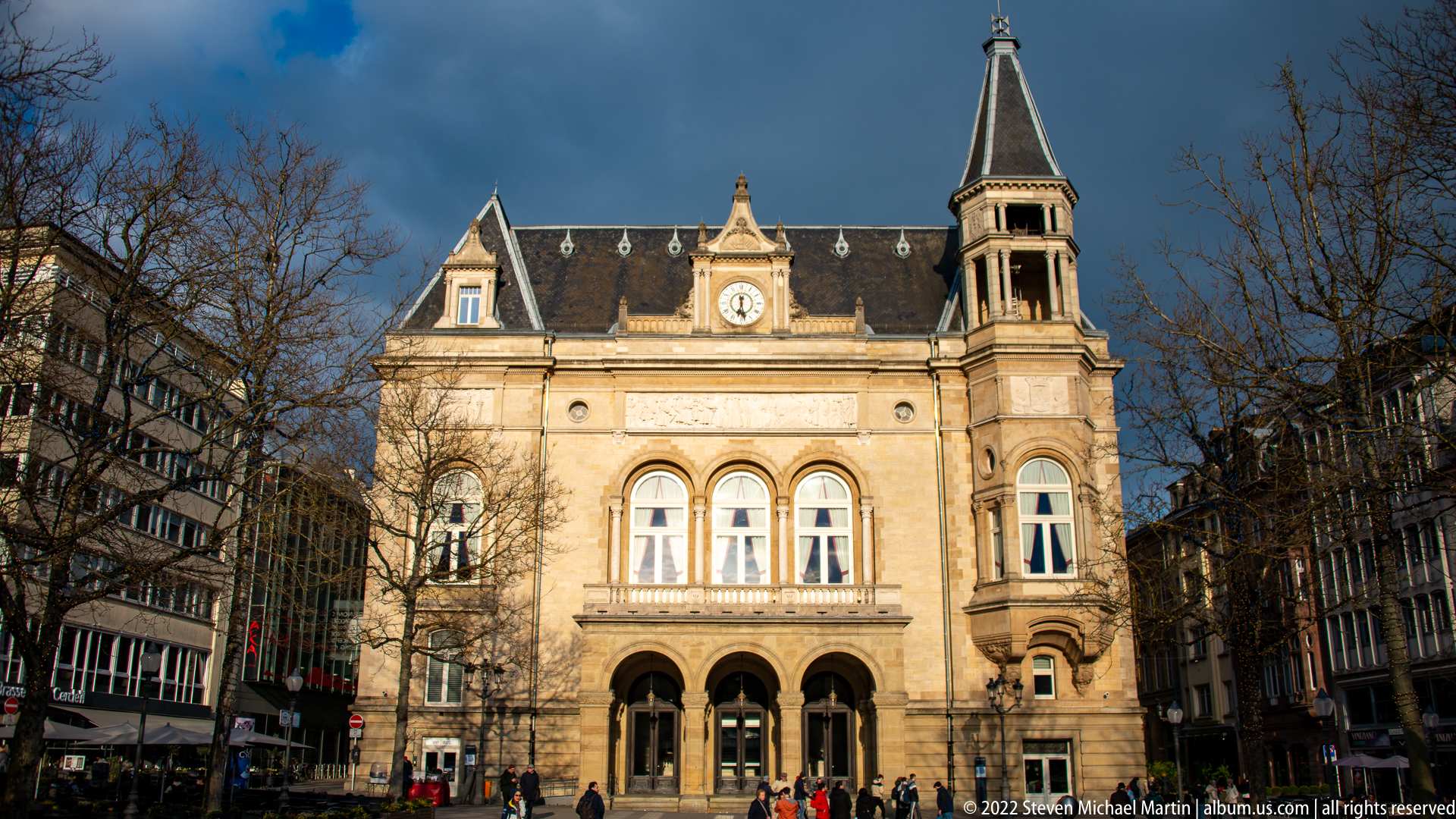
An elaborate civic building closes the end of a city square, combining pale stone façades, arched openings, sculptural trim, a clock, and a tall corner tower capped by a steep pyramidal roof. The frontal composition emphasizes its symmetrical central bay while the tower introduces an asymmetrical vertical accent against the dark blue sky.
Caption
An elaborate civic building closes the end of a city square, combining pale stone façades, arched openings, sculptural trim, a clock, and a tall corner tower capped by a steep pyramidal roof. The frontal composition emphasizes its symmetrical central bay while the tower introduces an asymmetrical vertical accent against the dark blue sky.

A carved heraldic panel occupies the corner of a monumental stone building, centered on a shield framed by stylized supporters and decorative scrollwork. The relief is integrated into a projecting architectural bay between pilasters, showing how civic symbolism was incorporated directly into the building's masonry rather than applied as a separate plaque.
Caption
A carved heraldic panel occupies the corner of a monumental stone building, centered on a shield framed by stylized supporters and decorative scrollwork. The relief is integrated into a projecting architectural bay between pilasters, showing how civic symbolism was incorporated directly into the building's masonry rather than applied as a separate plaque.

A broad carved frieze stretches across the façade above three large round-arched windows, presenting a procession of human figures in shallow relief. Seen tightly cropped, the image isolates the sculptural band from the rest of the building and highlights the deliberate contrast between narrative ornament and the repeated geometry of the window arches below.
Caption
A broad carved frieze stretches across the façade above three large round-arched windows, presenting a procession of human figures in shallow relief. Seen tightly cropped, the image isolates the sculptural band from the rest of the building and highlights the deliberate contrast between narrative ornament and the repeated geometry of the window arches below.

Rows of outdoor café tables fill a tree-shaded city square, bordered by flower beds, trimmed plantings, historic façades, and a central pavilion-like structure. The spring setting emphasizes the square's social use as much as its architecture, with furniture and planting patterns organizing the broad pedestrian space beneath mature plane trees.
Caption
Rows of outdoor café tables fill a tree-shaded city square, bordered by flower beds, trimmed plantings, historic façades, and a central pavilion-like structure. The spring setting emphasizes the square's social use as much as its architecture, with furniture and planting patterns organizing the broad pedestrian space beneath mature plane trees.
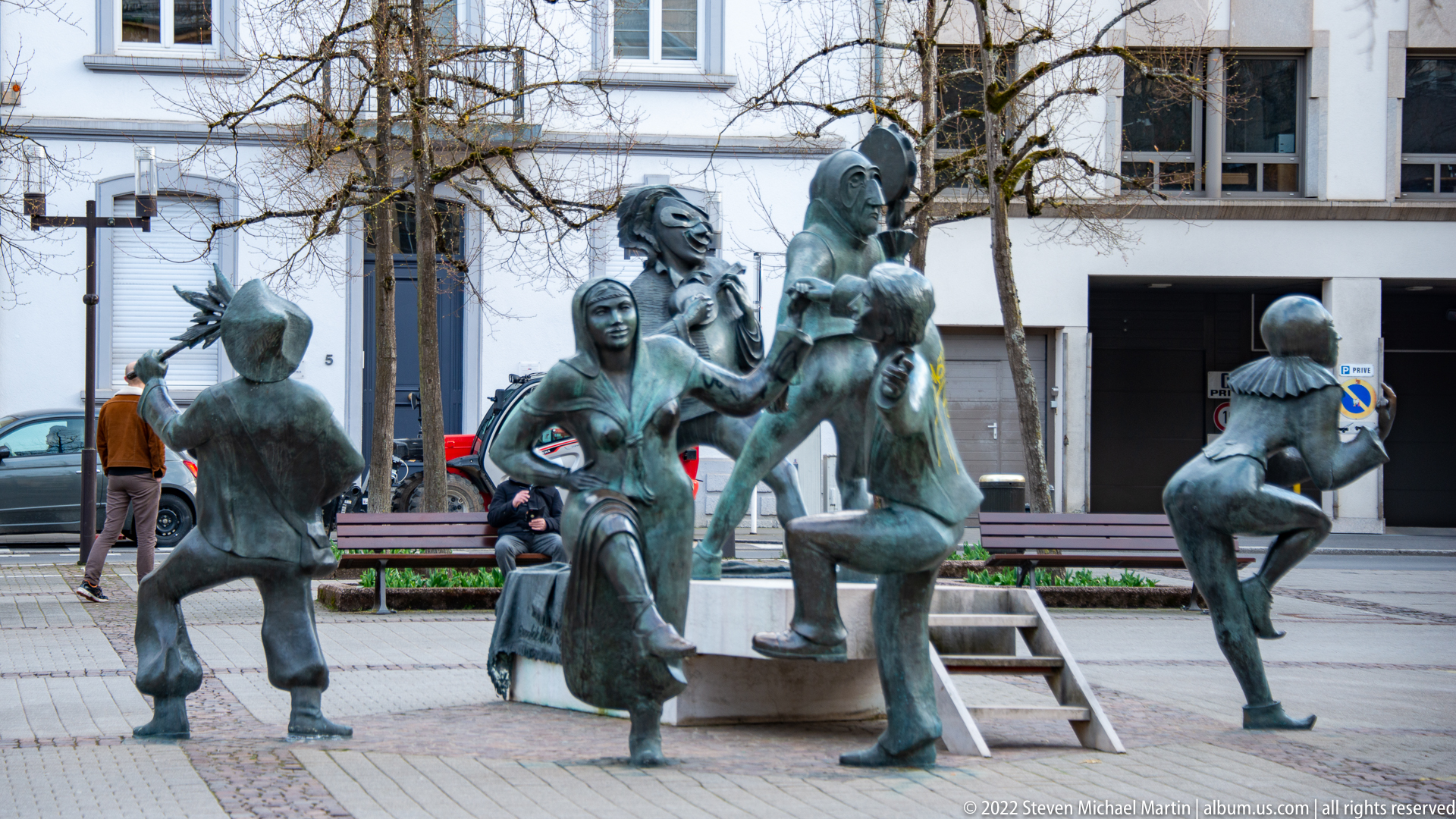
A lively group of patinated bronze figures occupies a pedestrian space, with adults and children posed in exaggerated gestures around a bench and short steps. The varied stances—seated, leaning, climbing, and turning—give the ensemble a theatrical, almost conversational quality that encourages viewers to move among the figures rather than observe from a distance.
Caption
A lively group of patinated bronze figures occupies a pedestrian space, with adults and children posed in exaggerated gestures around a bench and short steps. The varied stances—seated, leaning, climbing, and turning—give the ensemble a theatrical, almost conversational quality that encourages viewers to move among the figures rather than observe from a distance.
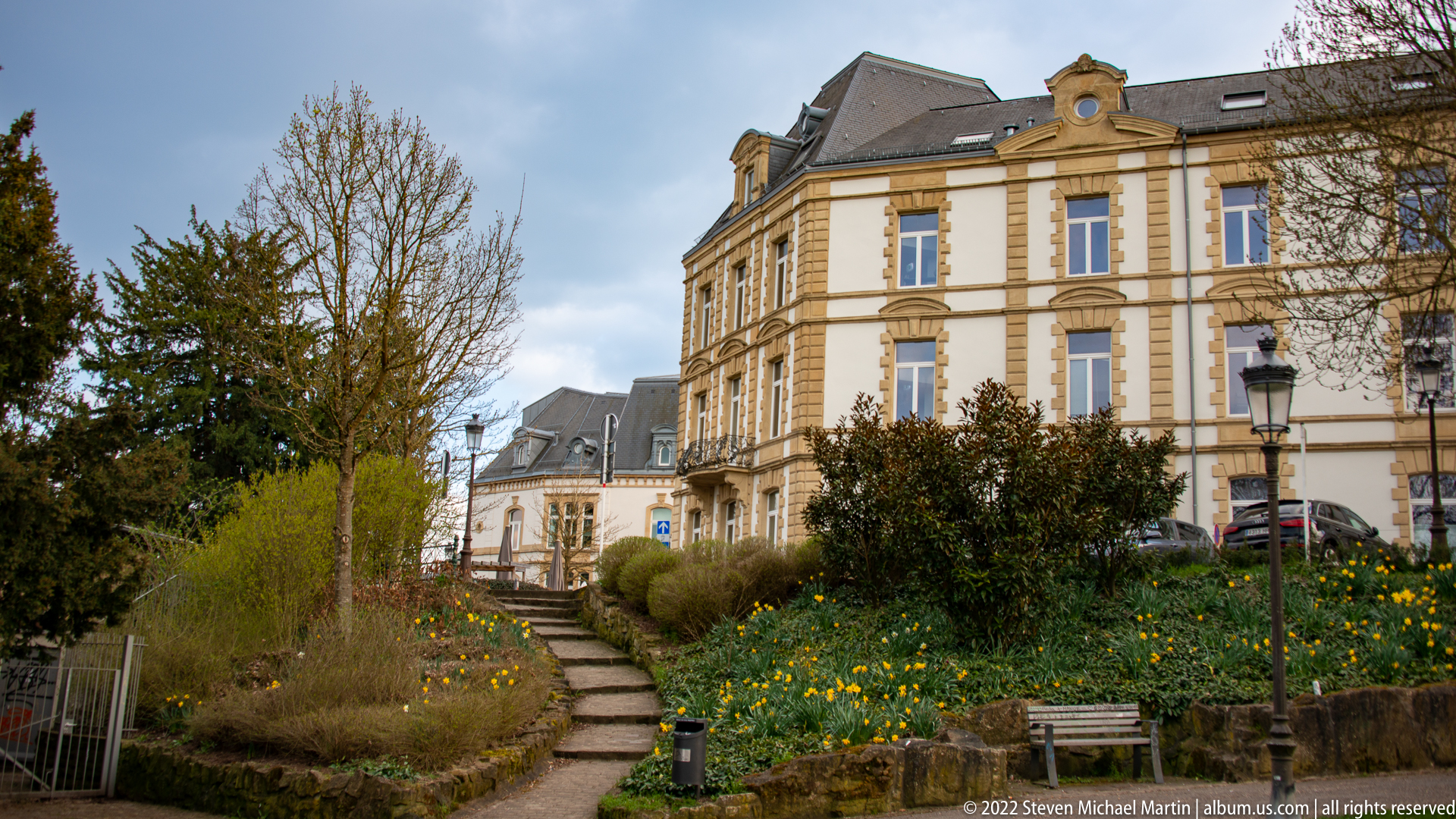
A formal historic building rises beside a narrow landscaped path, its cream walls articulated with pale stone trim, tall windows, corner pilasters, and a steep slate roof. Spring flowers and shrubs soften the institutional architecture, while the stepped garden path creates a diagonal approach that contrasts with the building's rigid façade geometry.
Caption
A formal historic building rises beside a narrow landscaped path, its cream walls articulated with pale stone trim, tall windows, corner pilasters, and a steep slate roof. Spring flowers and shrubs soften the institutional architecture, while the stepped garden path creates a diagonal approach that contrasts with the building's rigid façade geometry.

Two massive round masonry towers stand close together on elevated ground, each capped by a broad dark conical roof and pierced by small irregular openings. Their thick walls and compact form give the structures a distinctly defensive appearance, while later rectangular windows and adjacent paving show how the fortification has been adapted within the modern city.
Caption
Two massive round masonry towers stand close together on elevated ground, each capped by a broad dark conical roof and pierced by small irregular openings. Their thick walls and compact form give the structures a distinctly defensive appearance, while later rectangular windows and adjacent paving show how the fortification has been adapted within the modern city.

Pastel-painted townhouses line a narrow lane where restaurant signs, café furniture, and small shopfronts occupy the ground floors. Soft blue, lavender, yellow, and peach façades brighten the tightly enclosed street, while upper-story windows and slate roofs preserve the vertical proportions of Luxembourg City's historic center.
Caption
Pastel-painted townhouses line a narrow lane where restaurant signs, café furniture, and small shopfronts occupy the ground floors. Soft blue, lavender, yellow, and peach façades brighten the tightly enclosed street, while upper-story windows and slate roofs preserve the vertical proportions of Luxembourg City's historic center.
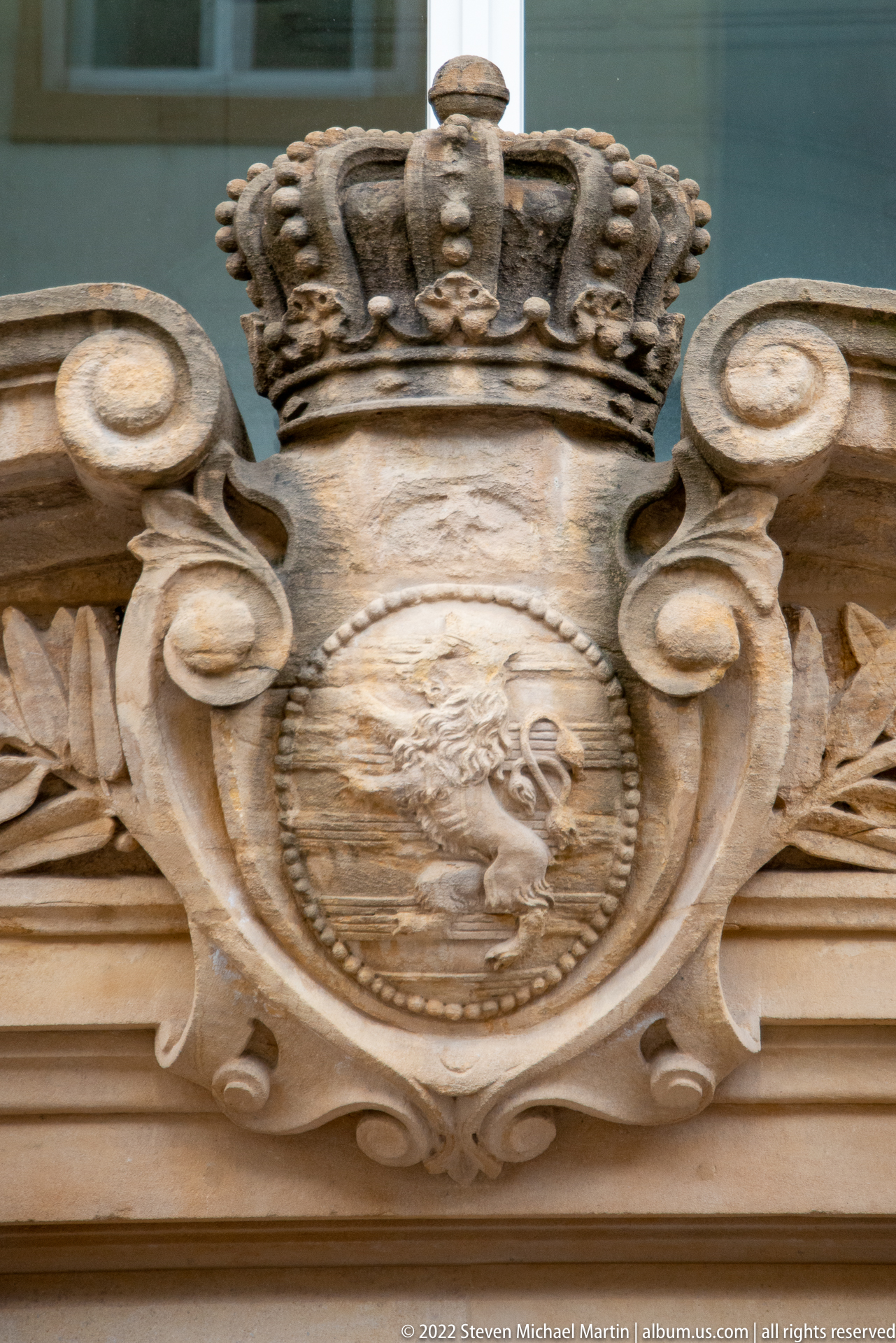
A crowned heraldic shield projects from the façade in a deeply modeled stone cartouche, surrounded by rolled scrolls and leafy carving. The close-up isolates the emblem from its architectural setting, revealing the crown, central shield device, and elaborate Baroque-style framing as a statement of institutional identity.
Caption
A crowned heraldic shield projects from the façade in a deeply modeled stone cartouche, surrounded by rolled scrolls and leafy carving. The close-up isolates the emblem from its architectural setting, revealing the crown, central shield device, and elaborate Baroque-style framing as a statement of institutional identity.
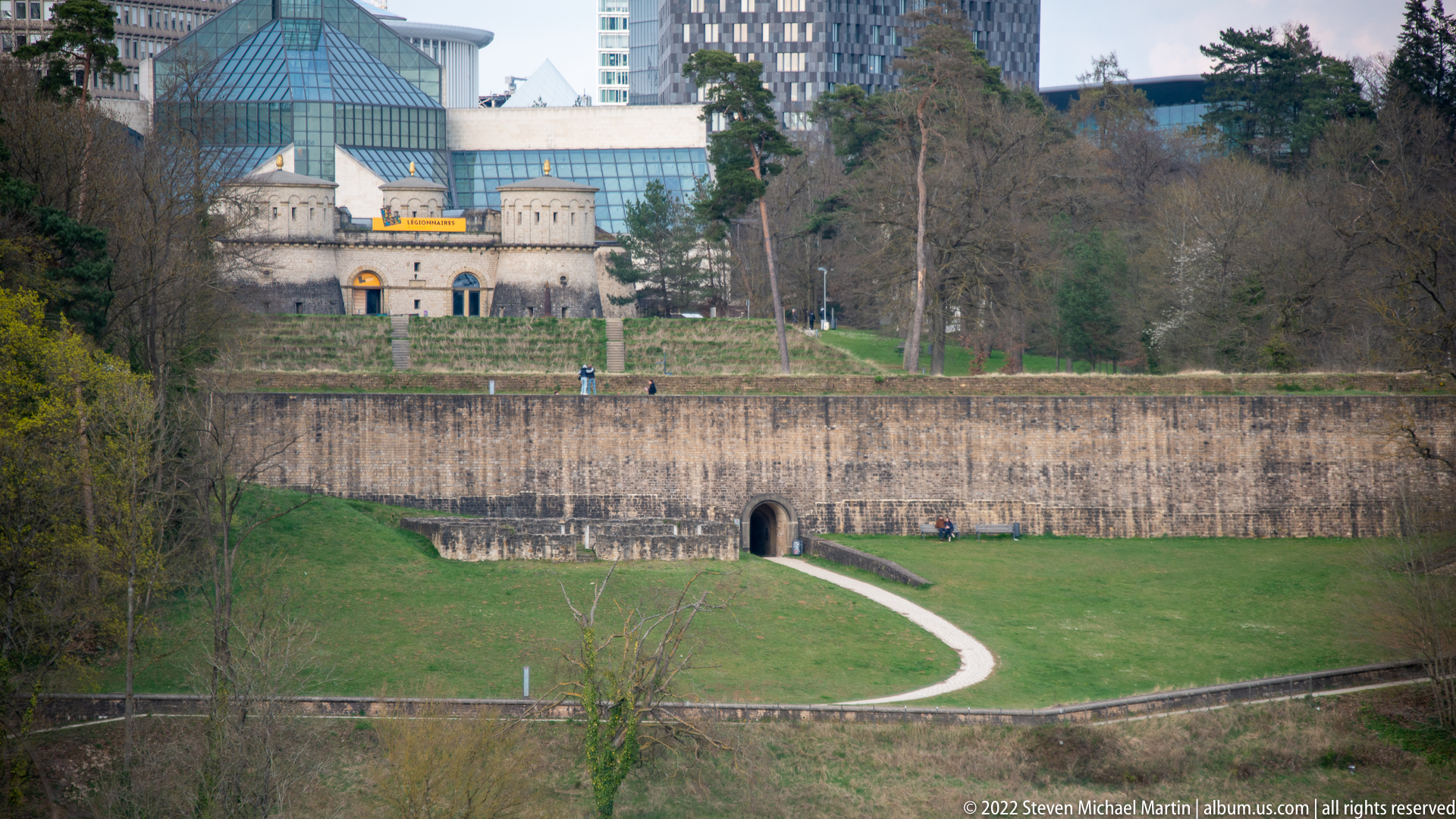
A broad stone defensive wall stretches across a grassy slope, pierced near its base by a small arched opening and crowned by an upper terrace. Additional fortified masonry and a turreted structure rise behind the trees, giving the view a layered reading of Luxembourg City's defensive landscape from ditch level to the upper works.
Caption
A broad stone defensive wall stretches across a grassy slope, pierced near its base by a small arched opening and crowned by an upper terrace. Additional fortified masonry and a turreted structure rise behind the trees, giving the view a layered reading of Luxembourg City's defensive landscape from ditch level to the upper works.

A narrow cobbled street descends between historic townhouses toward a small opening in the old city. Pale stucco and stone façades, tall sash windows, slate roofs, and a richly colored half-timbered or timber-fronted building at the far end create a compact streetscape shaped more by pedestrian scale than by traffic.
Caption
A narrow cobbled street descends between historic townhouses toward a small opening in the old city. Pale stucco and stone façades, tall sash windows, slate roofs, and a richly colored half-timbered or timber-fronted building at the far end create a compact streetscape shaped more by pedestrian scale than by traffic.
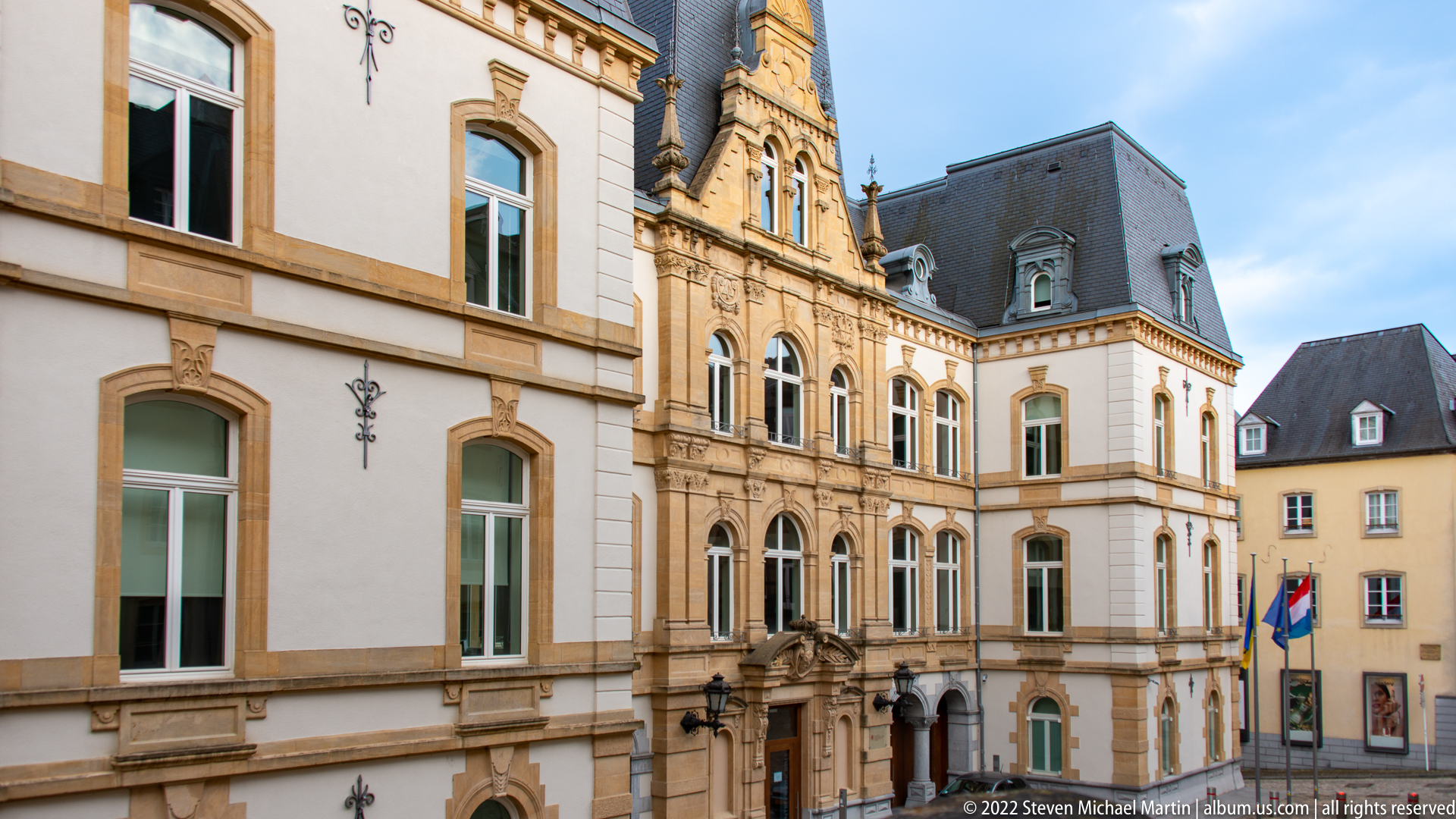
A richly detailed public building fills the street corner, combining sculpted stonework, tall arched windows, dormered slate roofs, and an elaborate central entrance. Luxembourg and European flags hang at the lower right, reinforcing the civic or governmental setting while the close urban viewpoint emphasizes the building's highly modeled historicist façade.
Caption
A richly detailed public building fills the street corner, combining sculpted stonework, tall arched windows, dormered slate roofs, and an elaborate central entrance. Luxembourg and European flags hang at the lower right, reinforcing the civic or governmental setting while the close urban viewpoint emphasizes the building's highly modeled historicist façade.
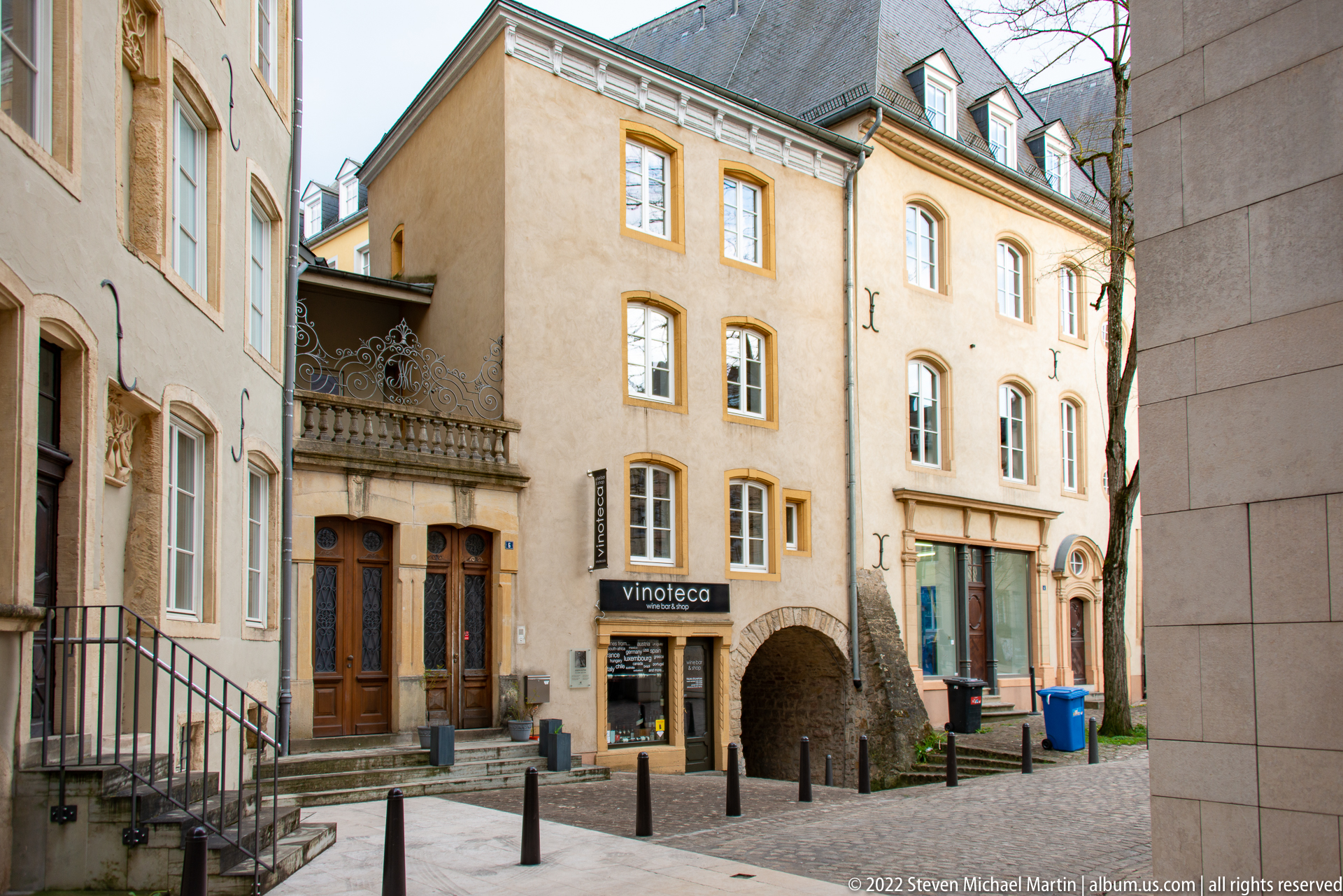
A compact paved court is enclosed by warm-toned historic townhouses, one with an ornate iron balcony and another with a small arched passage at ground level. A 'vinoteca' storefront occupies the center, adding a contemporary commercial use to a setting defined by narrow façades, stone trim, and intimate pedestrian scale.
Caption
A compact paved court is enclosed by warm-toned historic townhouses, one with an ornate iron balcony and another with a small arched passage at ground level. A 'vinoteca' storefront occupies the center, adding a contemporary commercial use to a setting defined by narrow façades, stone trim, and intimate pedestrian scale.
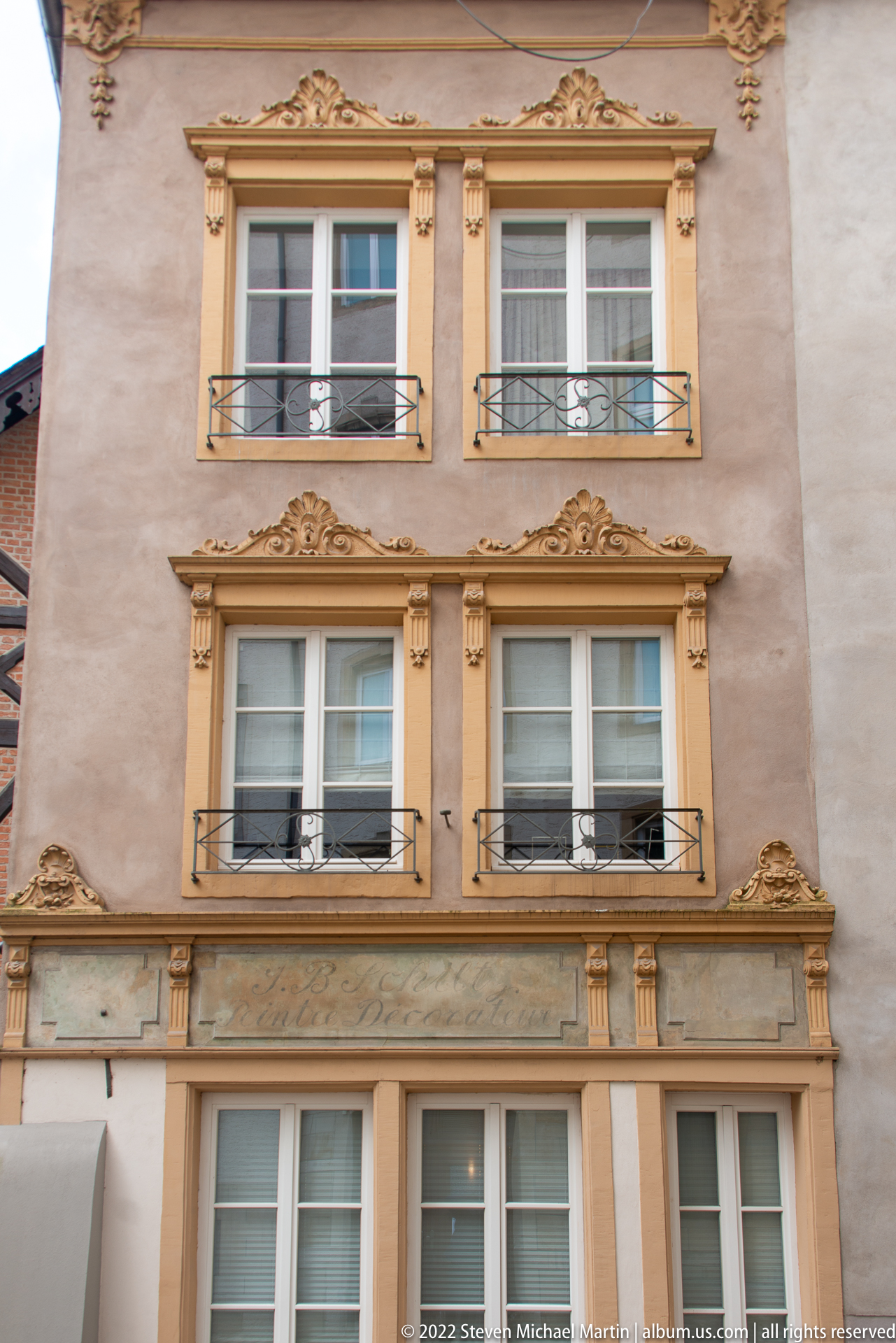
A pale townhouse façade is organized into stacked pairs of windows framed by elaborate molded surrounds, floral swags, pilaster-like strips, and shallow ornamental panels. Small iron railings at the windows introduce a delicate linear contrast to the heavier stucco decoration, making the image a focused study of urban domestic ornament.
Caption
A pale townhouse façade is organized into stacked pairs of windows framed by elaborate molded surrounds, floral swags, pilaster-like strips, and shallow ornamental panels. Small iron railings at the windows introduce a delicate linear contrast to the heavier stucco decoration, making the image a focused study of urban domestic ornament.
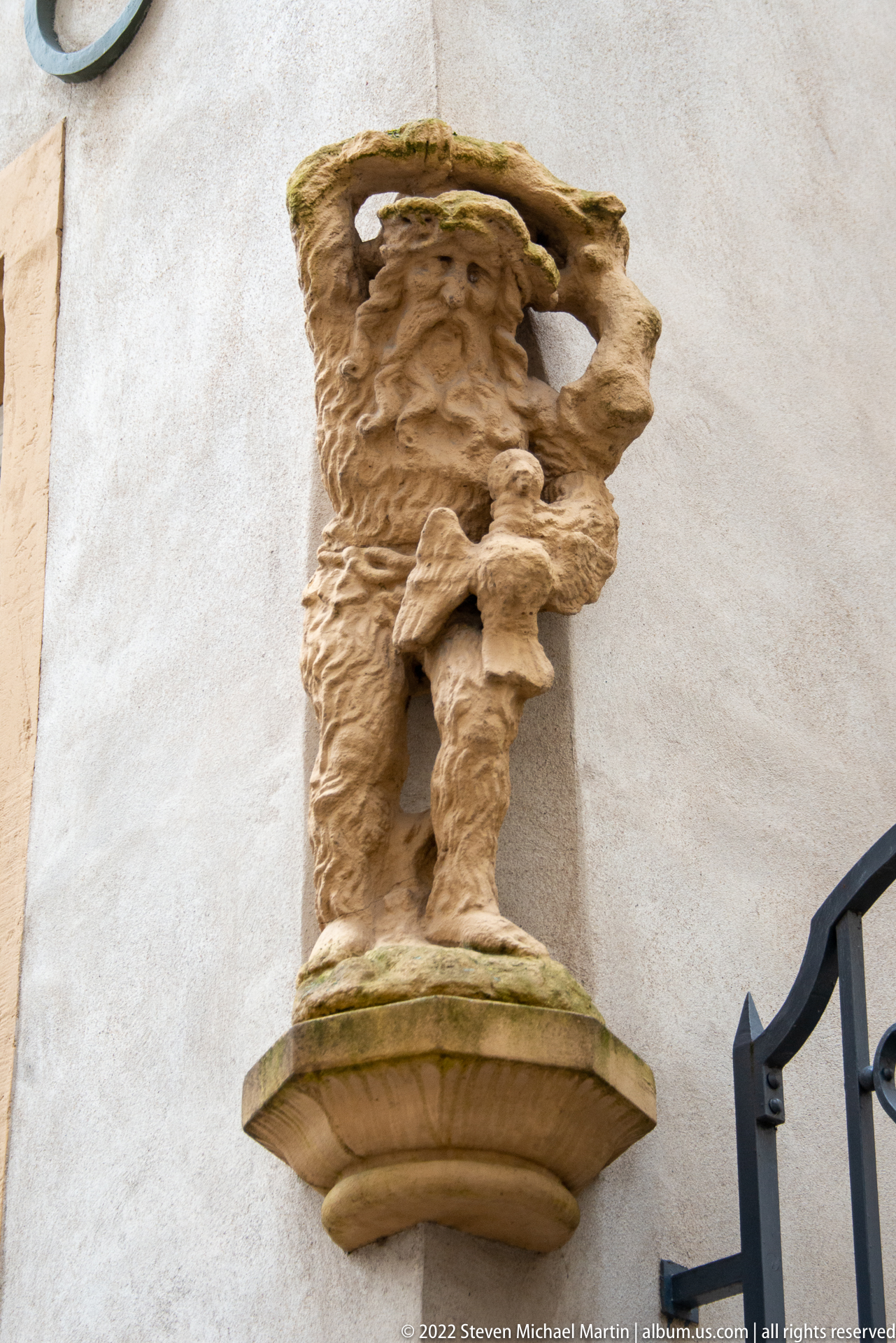
A weathered stone figure of a bearded man projects from a pale wall, his bent arms raised beneath a flat architectural element as if physically supporting it. The compact sculpture resembles an atlas or telamon bracket, with deeply carved hair, beard, clothing, and crouched stance giving the small feature a surprisingly muscular presence.
Caption
A weathered stone figure of a bearded man projects from a pale wall, his bent arms raised beneath a flat architectural element as if physically supporting it. The compact sculpture resembles an atlas or telamon bracket, with deeply carved hair, beard, clothing, and crouched stance giving the small feature a surprisingly muscular presence.
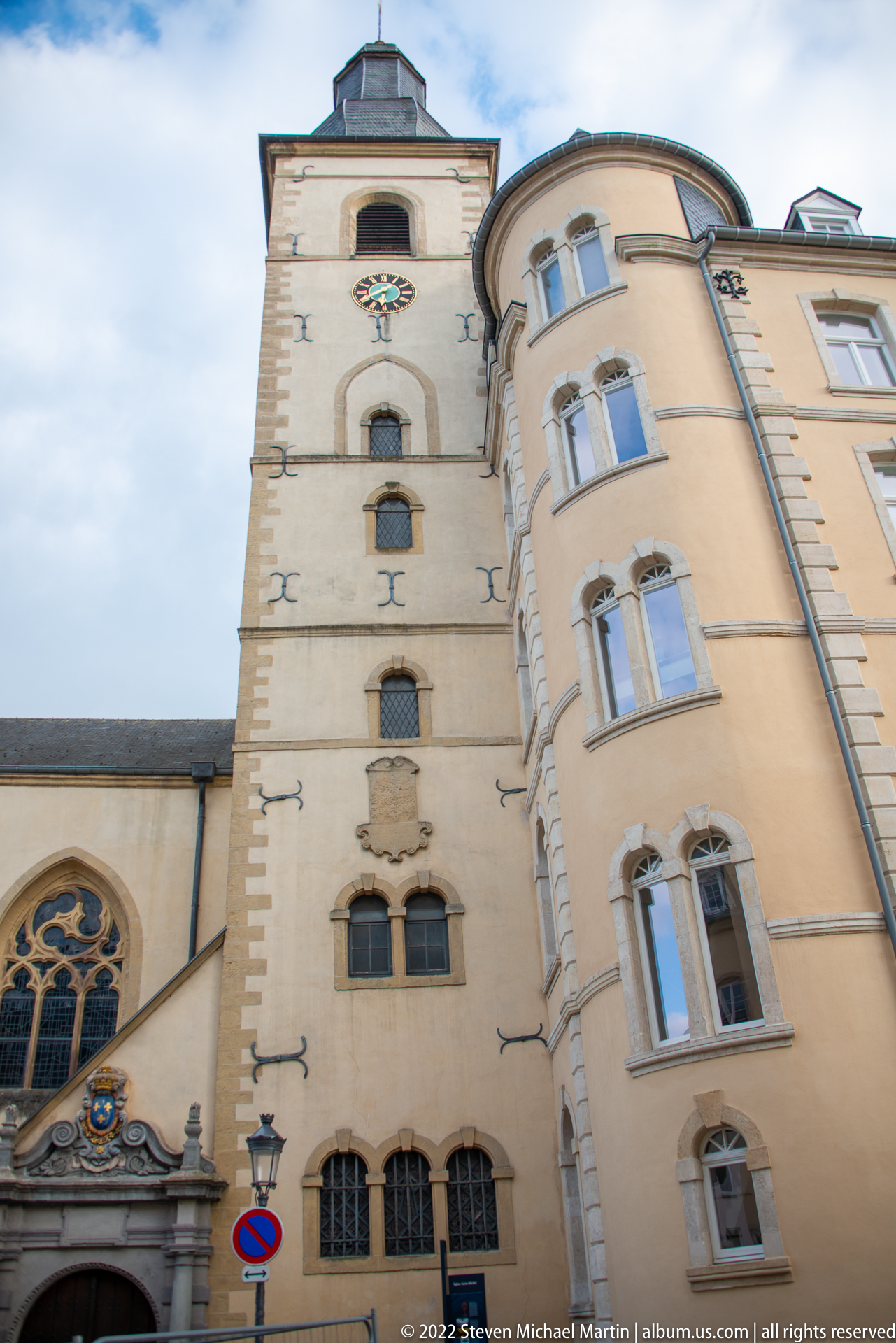
A church façade with a traceried side window and sculpted entrance rises beside a tall adjoining wing whose rounded corner stacks rows of windows vertically. The upward viewpoint compresses the two connected masses, emphasizing the contrast between the church's decorative stonework and the plainer institutional architecture beside it.
Caption
A church façade with a traceried side window and sculpted entrance rises beside a tall adjoining wing whose rounded corner stacks rows of windows vertically. The upward viewpoint compresses the two connected masses, emphasizing the contrast between the church's decorative stonework and the plainer institutional architecture beside it.

A formal doorway occupies the center of a pale institutional façade, with two standing religious figures placed in shallow upper-story niches on either side. Cross-shaped finials above the niches and the restrained stone window surrounds give the composition an ecclesiastical or formerly religious character despite its otherwise domestic scale.
Caption
A formal doorway occupies the center of a pale institutional façade, with two standing religious figures placed in shallow upper-story niches on either side. Cross-shaped finials above the niches and the restrained stone window surrounds give the composition an ecclesiastical or formerly religious character despite its otherwise domestic scale.
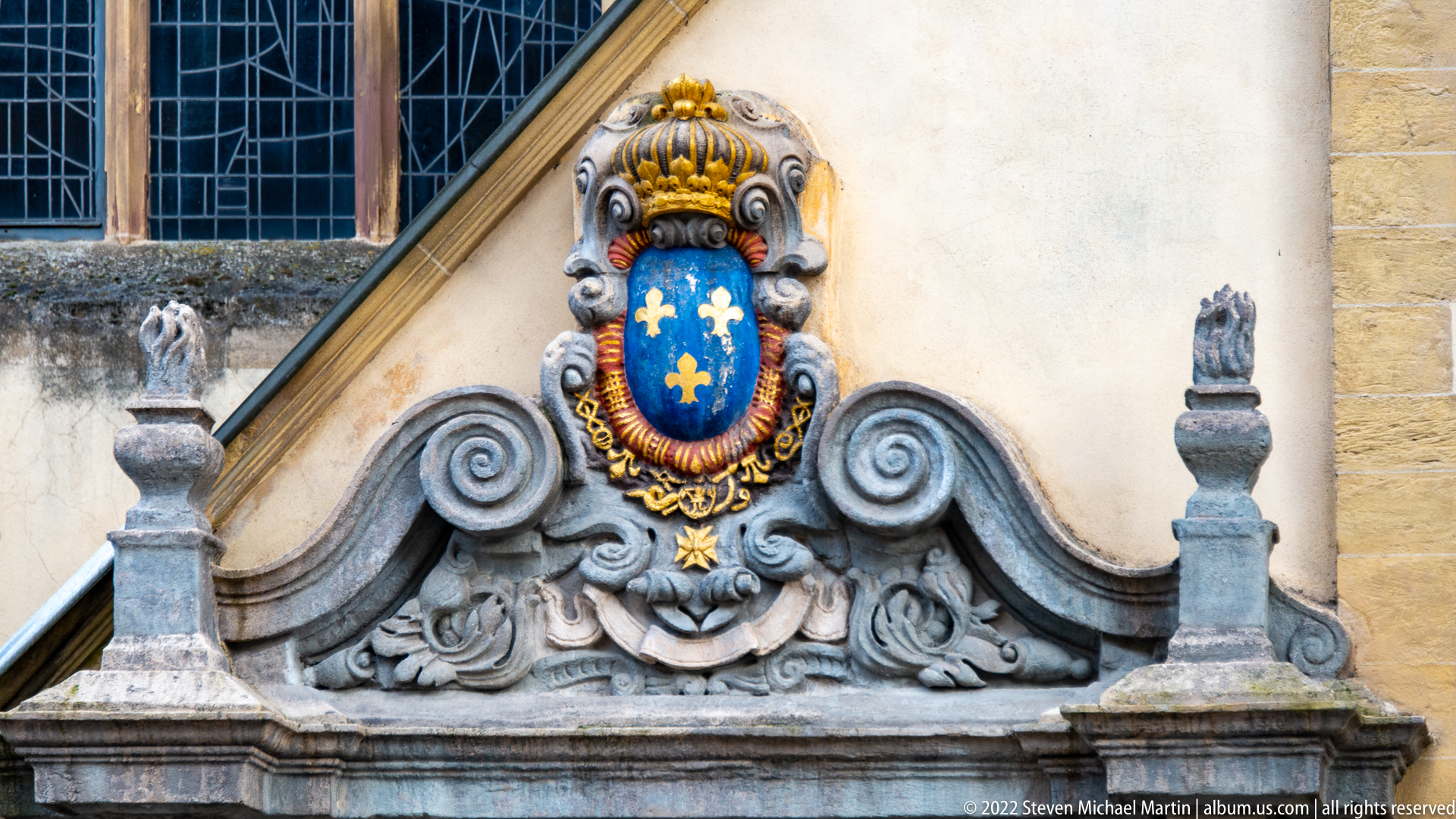
A vivid blue shield charged with gold fleur-de-lis is set within an ornate stone cartouche and surmounted by a large gilded crown. The colored heraldic device stands out sharply against the pale masonry and gray sculptural scrolls, functioning as a prominent emblem above a historic ecclesiastical entrance.
Caption
A vivid blue shield charged with gold fleur-de-lis is set within an ornate stone cartouche and surmounted by a large gilded crown. The colored heraldic device stands out sharply against the pale masonry and gray sculptural scrolls, functioning as a prominent emblem above a historic ecclesiastical entrance.
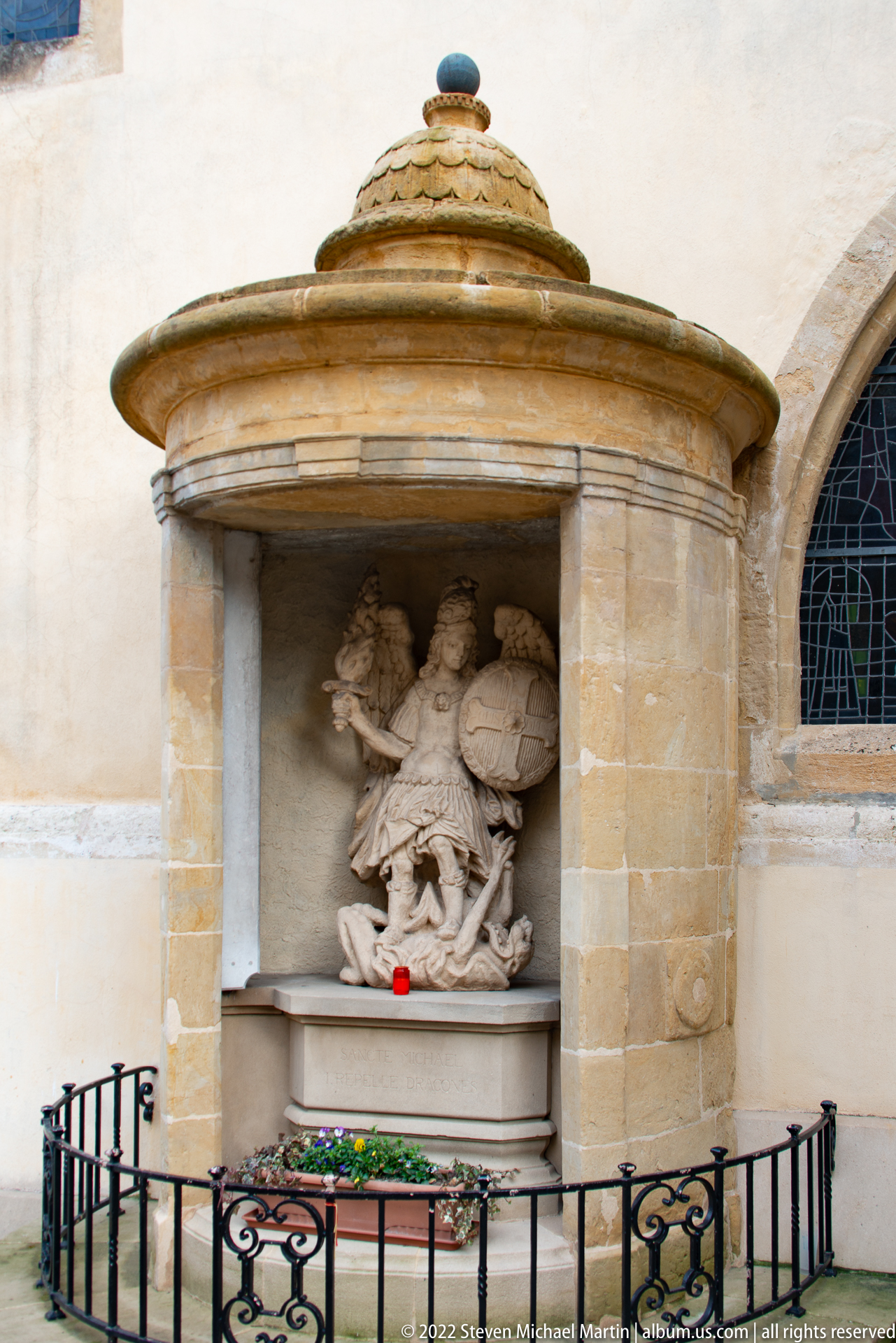
A small projecting shrine is built into the church wall beneath a shallow domed stone canopy supported by columns. Inside, a sculptural group shows the Archangel Michael overcoming a defeated figure, while flowers and an iron railing mark the niche as a devotional focus integrated into the building's exterior.
Caption
A small projecting shrine is built into the church wall beneath a shallow domed stone canopy supported by columns. Inside, a sculptural group shows the Archangel Michael overcoming a defeated figure, while flowers and an iron railing mark the niche as a devotional focus integrated into the building's exterior.

Saint Michael is shown in a sculptural group overcoming the dragon, the archangel poised above the defeated creature while holding a weapon and shield. The devotional pedestal below bears a partially legible invocation beginning 'SANCTE MICHAEL,' providing direct textual support for the figure's identity and clarifying the iconography of the exterior shrine.
Caption
Saint Michael is shown in a sculptural group overcoming the dragon, the archangel poised above the defeated creature while holding a weapon and shield. The devotional pedestal below bears a partially legible invocation beginning 'SANCTE MICHAEL,' providing direct textual support for the figure's identity and clarifying the iconography of the exterior shrine.
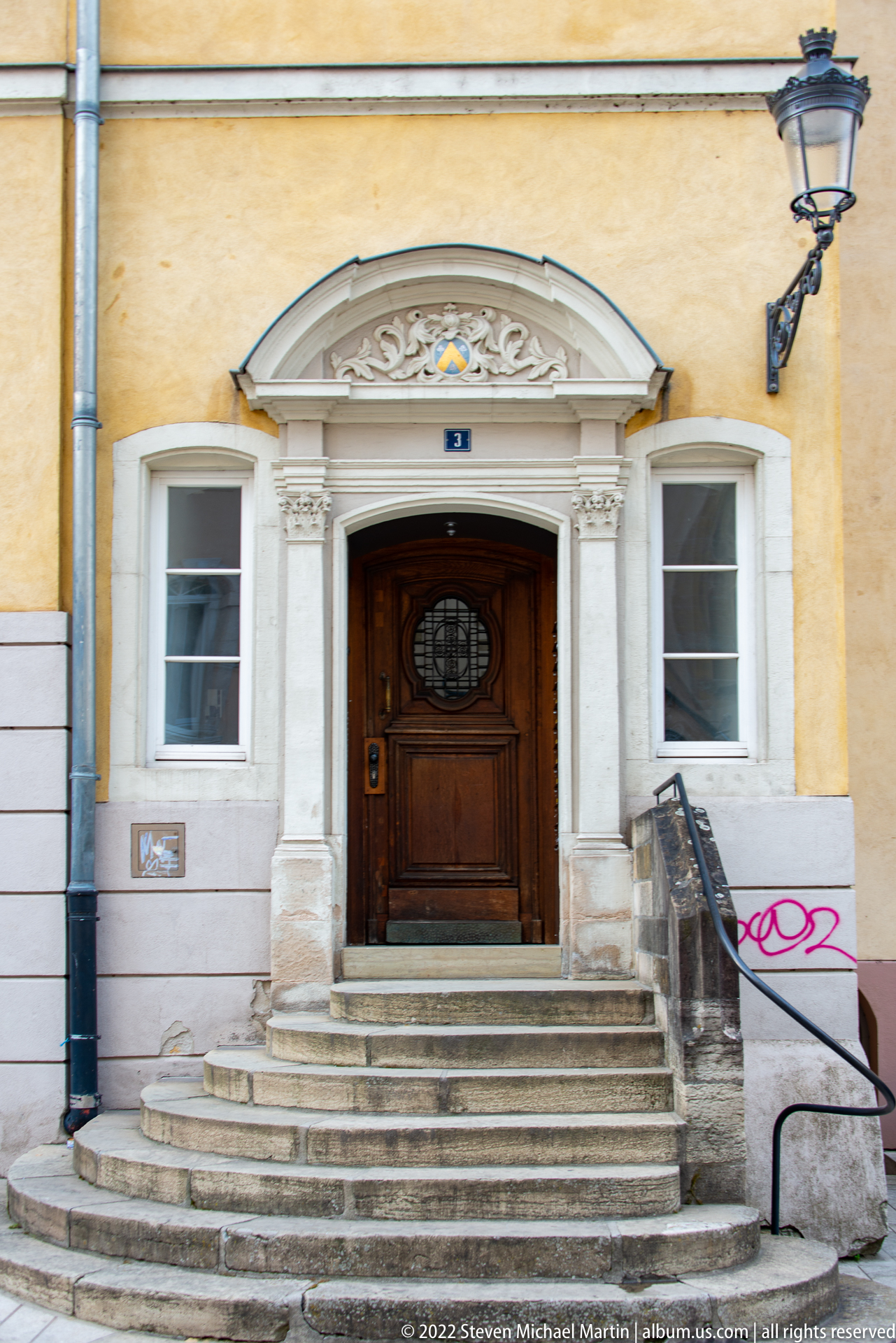
A dark wooden door with an oval glazed panel is set within a restrained classical surround reached by a broad fan of shallow semicircular stone steps. Fluted or paneled pilasters, a curved pediment-like hood, and a traditional wall lantern give the entrance a formal domestic or institutional character despite the otherwise plain ochre façade.
Caption
A dark wooden door with an oval glazed panel is set within a restrained classical surround reached by a broad fan of shallow semicircular stone steps. Fluted or paneled pilasters, a curved pediment-like hood, and a traditional wall lantern give the entrance a formal domestic or institutional character despite the otherwise plain ochre façade.

A historic church anchors a narrow streetscape, its steep pointed spire, tall traceried window, and secondary tower rising above adjoining masonry buildings. The view from street level places the church within the everyday urban fabric, where signs, bollards, and modern streetlights share space with the older ecclesiastical architecture.
Caption
A historic church anchors a narrow streetscape, its steep pointed spire, tall traceried window, and secondary tower rising above adjoining masonry buildings. The view from street level places the church within the everyday urban fabric, where signs, bollards, and modern streetlights share space with the older ecclesiastical architecture.

Massive defensive remains occupy a rocky promontory above a paved lower courtyard, with thick stone walls, rounded masonry masses, and openings cut through the rock and fortification fabric. The elevated viewpoint reveals the scale of the surviving works and their intimate relationship with Luxembourg City's natural sandstone escarpment.
Caption
Massive defensive remains occupy a rocky promontory above a paved lower courtyard, with thick stone walls, rounded masonry masses, and openings cut through the rock and fortification fabric. The elevated viewpoint reveals the scale of the surviving works and their intimate relationship with Luxembourg City's natural sandstone escarpment.

A long church with a steep slate roof and tall square tower occupies the lower city beneath the fortified upper plateau. Regular round-arched nave windows and a slender spire give the building a strong vertical rhythm, while the elevated viewpoint shows how religious architecture is embedded within Luxembourg City's densely layered valley settlement.
Caption
A long church with a steep slate roof and tall square tower occupies the lower city beneath the fortified upper plateau. Regular round-arched nave windows and a slender spire give the building a strong vertical rhythm, while the elevated viewpoint shows how religious architecture is embedded within Luxembourg City's densely layered valley settlement.
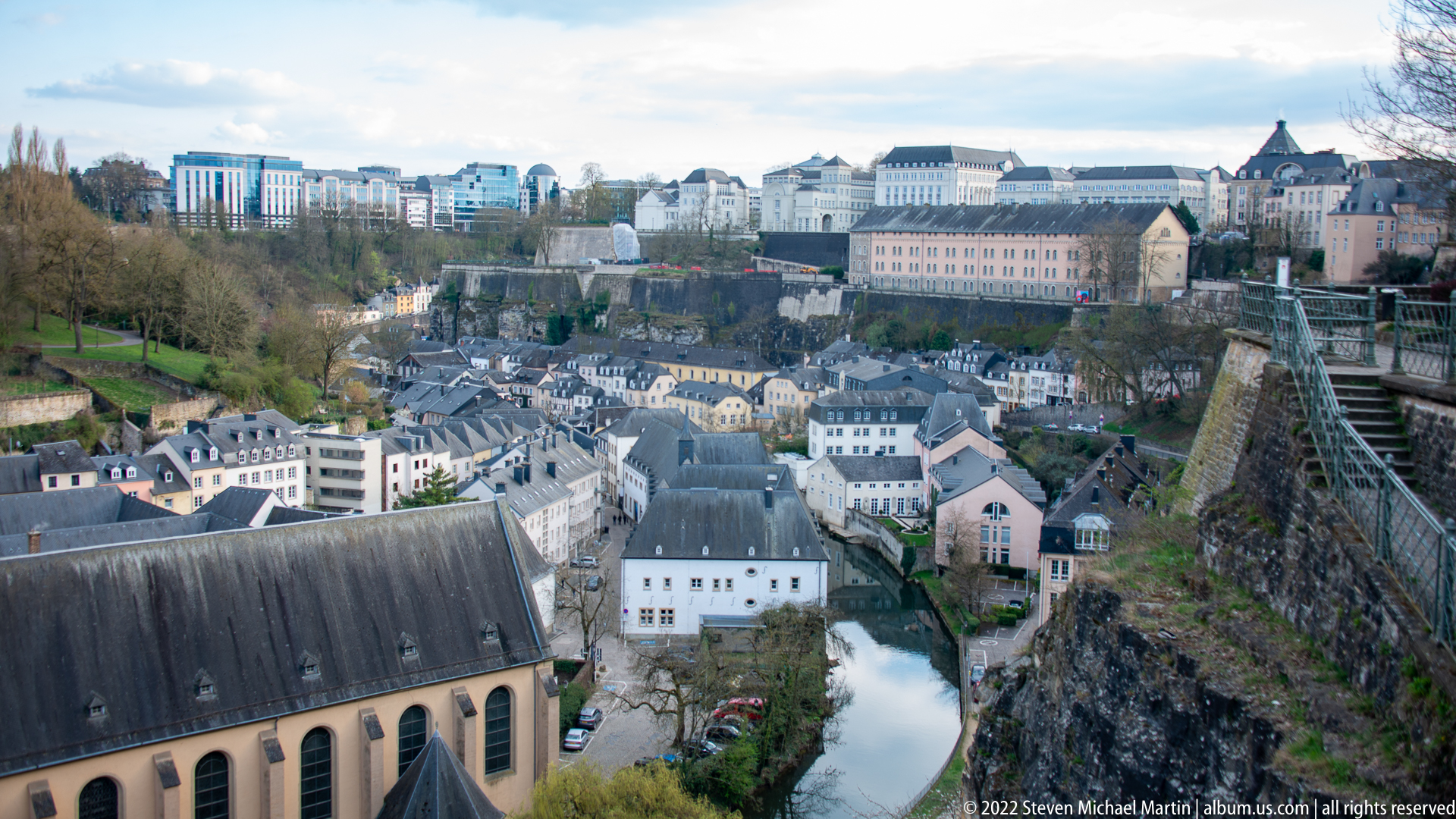
Historic houses cluster along a narrow river at the foot of steep fortified cliffs, with the roof of a large church entering from the lower left. The elevated view makes Luxembourg City's distinctive vertical organization especially legible, linking water, lower-town settlement, cliffside defenses, and the denser upper city in a single composition.
Caption
Historic houses cluster along a narrow river at the foot of steep fortified cliffs, with the roof of a large church entering from the lower left. The elevated view makes Luxembourg City's distinctive vertical organization especially legible, linking water, lower-town settlement, cliffside defenses, and the denser upper city in a single composition.
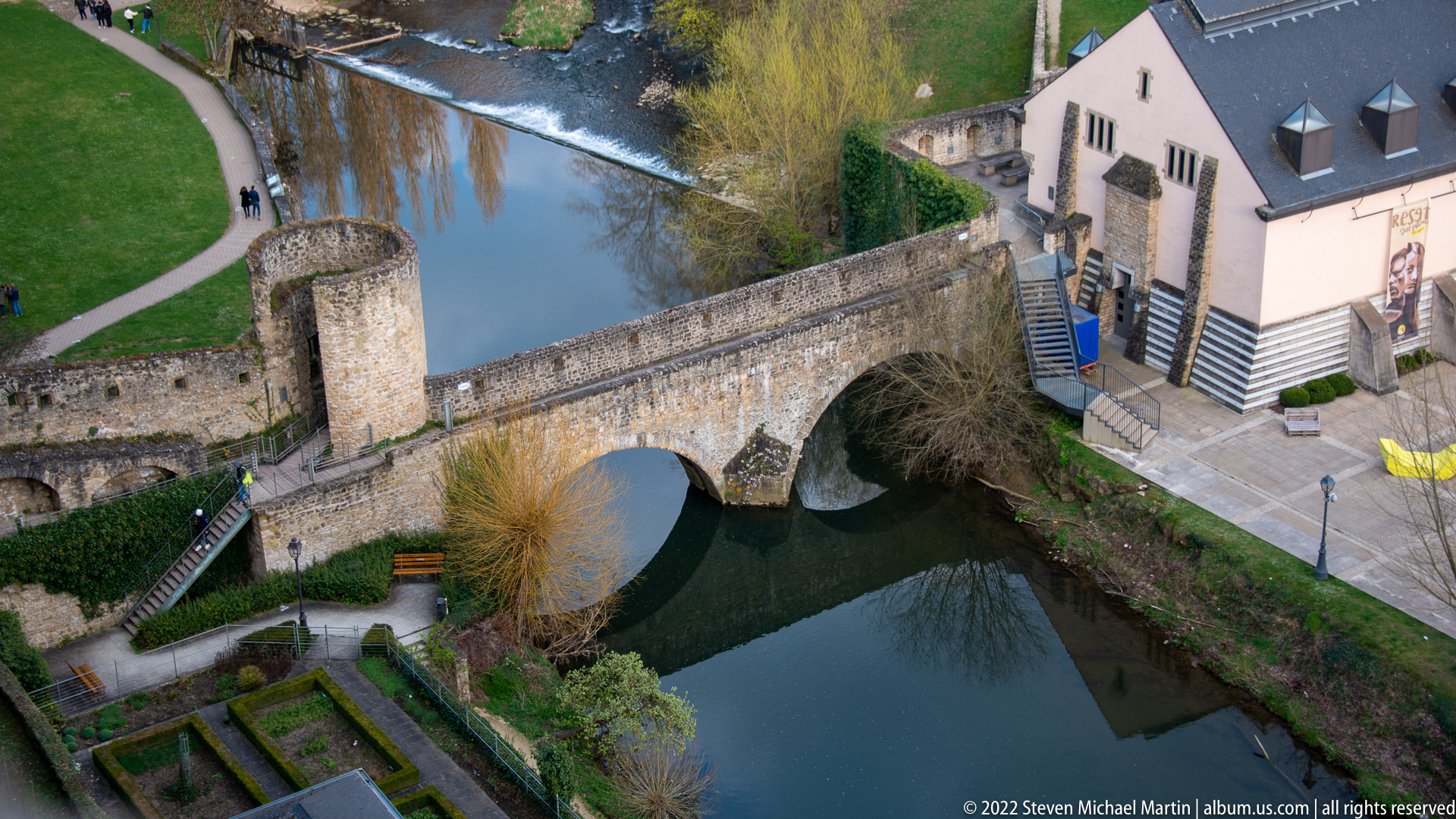
A compact stone bridge with a single broad arch crosses the calm river beside a pale historic building and cylindrical masonry tower. Reflections in the water emphasize the bridge's curved opening, while garden beds and paths around the crossing show how former defensive and utilitarian spaces have been integrated into the lower city's landscaped public realm.
Caption
A compact stone bridge with a single broad arch crosses the calm river beside a pale historic building and cylindrical masonry tower. Reflections in the water emphasize the bridge's curved opening, while garden beds and paths around the crossing show how former defensive and utilitarian spaces have been integrated into the lower city's landscaped public realm.
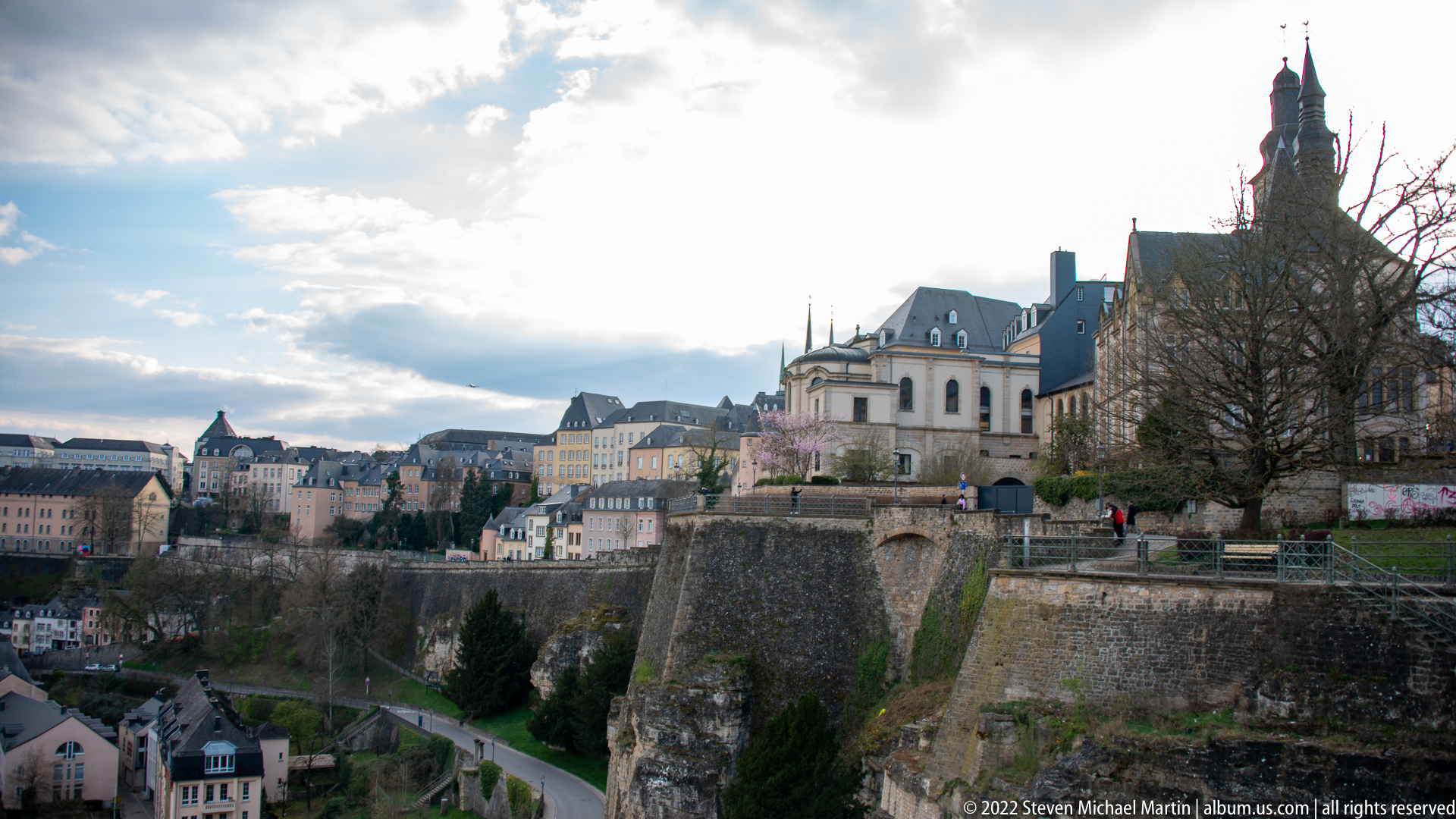
Historic buildings crown a massive stone bastion and retaining wall above the lower city, their steep roofs and a tall church-like tower silhouetted against a bright sky. The elevated defensive masonry dominates the foreground, showing how the upper town was physically separated from the valley by monumental walls and abrupt changes in level.
Caption
Historic buildings crown a massive stone bastion and retaining wall above the lower city, their steep roofs and a tall church-like tower silhouetted against a bright sky. The elevated defensive masonry dominates the foreground, showing how the upper town was physically separated from the valley by monumental walls and abrupt changes in level.
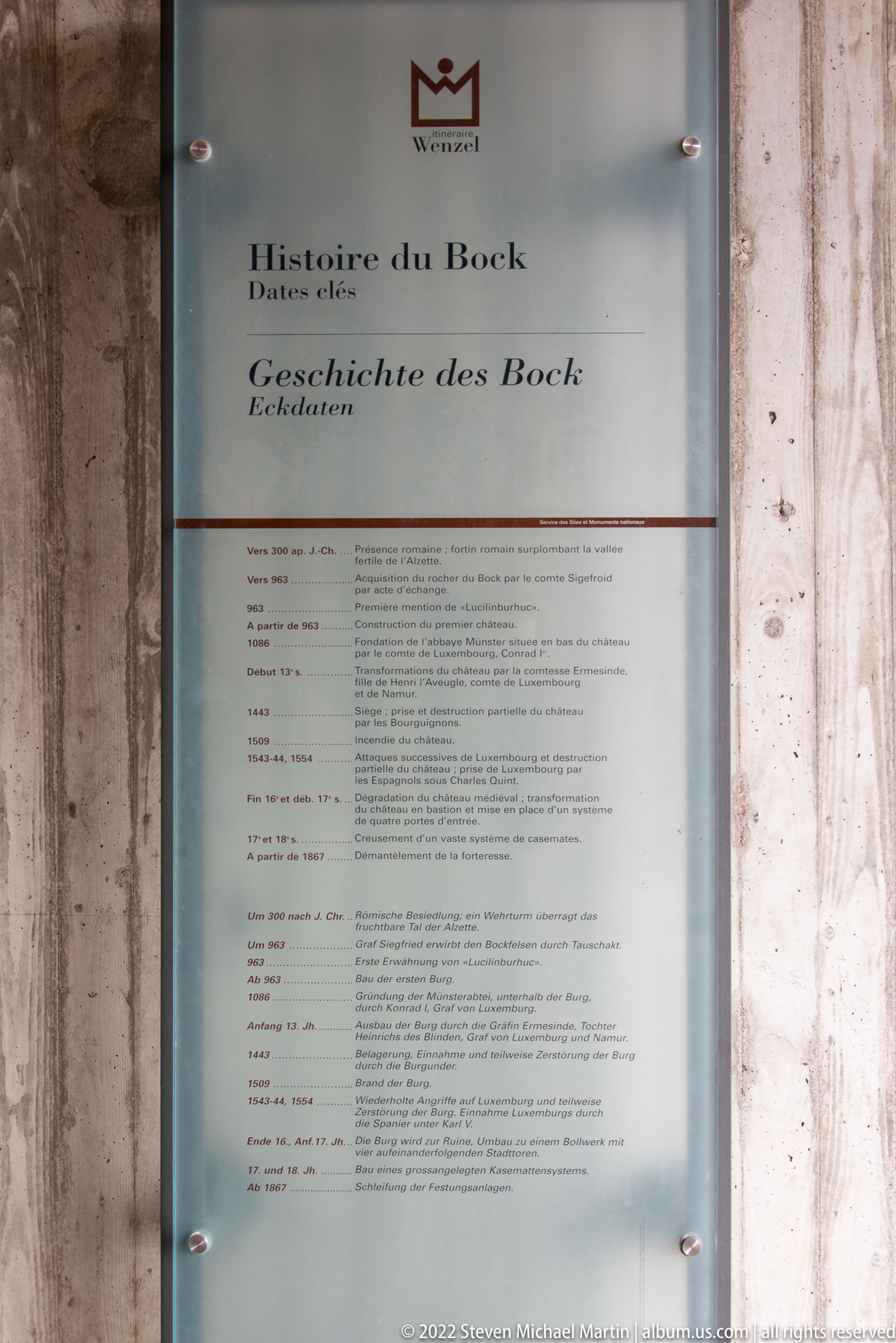
An interpretive panel presents a bilingual timeline of the Bock, titled in French and German, with dates and explanatory text arranged beneath the heading. The display places the fortified site within a chronological framework and serves as direct documentation of the heritage interpretation provided to visitors at the Bock.
Caption
An interpretive panel presents a bilingual timeline of the Bock, titled in French and German, with dates and explanatory text arranged beneath the heading. The display places the fortified site within a chronological framework and serves as direct documentation of the heritage interpretation provided to visitors at the Bock.

An illustrated interpretive display combines historic plans, reconstruction images, and explanatory text about the Bock. Maps and cutaway-style graphics dominate the panel, helping visitors understand the site's changing defensive works and spatial organization beyond what can be seen from a single viewpoint in the surviving fortifications.
Caption
An illustrated interpretive display combines historic plans, reconstruction images, and explanatory text about the Bock. Maps and cutaway-style graphics dominate the panel, helping visitors understand the site's changing defensive works and spatial organization beyond what can be seen from a single viewpoint in the surviving fortifications.
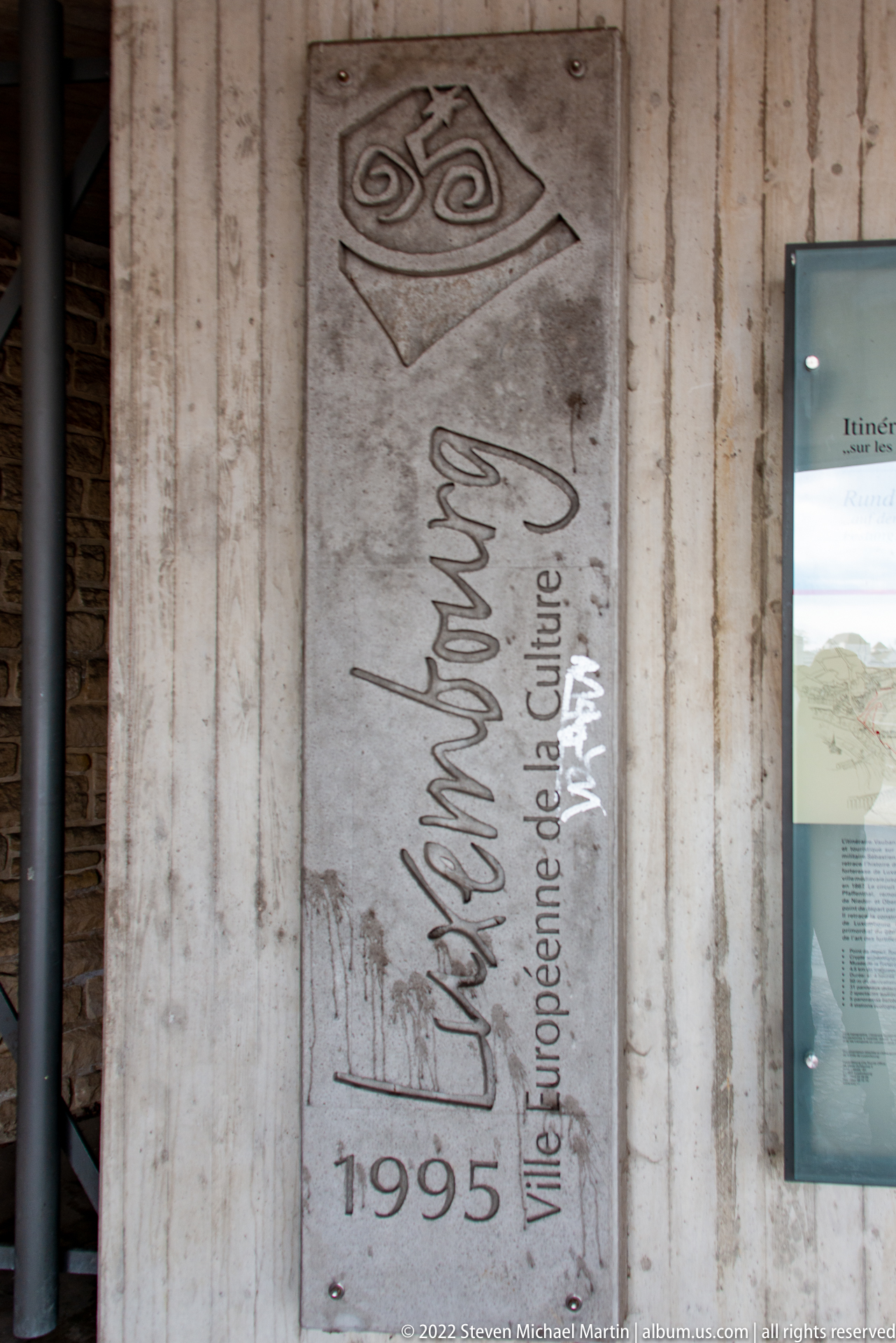
A carved and painted wall inscription commemorates Luxembourg's role as a European City of Culture in 1995. The stylized word 'Luxembourg,' date, and French phrase 'Ville Européenne de la Culture' are arranged vertically beside a modern emblem, turning the building surface itself into a civic marker of cultural recognition.
Caption
A carved and painted wall inscription commemorates Luxembourg's role as a European City of Culture in 1995. The stylized word 'Luxembourg,' date, and French phrase 'Ville Européenne de la Culture' are arranged vertically beside a modern emblem, turning the building surface itself into a civic marker of cultural recognition.
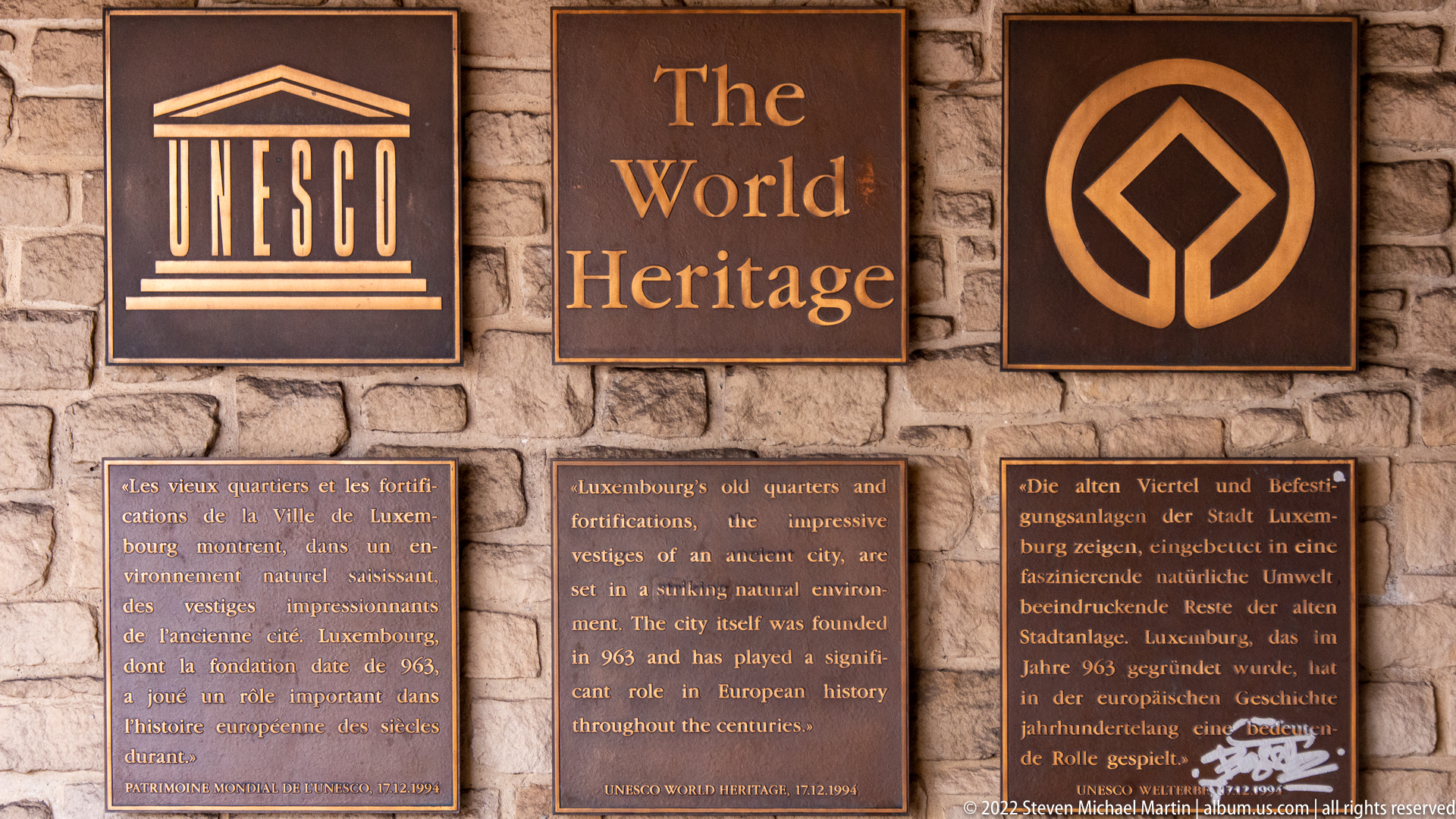
Three bronze-toned plaques mark Luxembourg's World Heritage status, pairing the UNESCO emblem and World Heritage symbol with explanatory texts in French, English, and German. The English plaque identifies 'Luxembourg: its old quarters and fortifications' and notes the city's strategic history, making the designation explicit rather than inferred from the surrounding monuments.
Caption
Three bronze-toned plaques mark Luxembourg's World Heritage status, pairing the UNESCO emblem and World Heritage symbol with explanatory texts in French, English, and German. The English plaque identifies 'Luxembourg: its old quarters and fortifications' and notes the city's strategic history, making the designation explicit rather than inferred from the surrounding monuments.
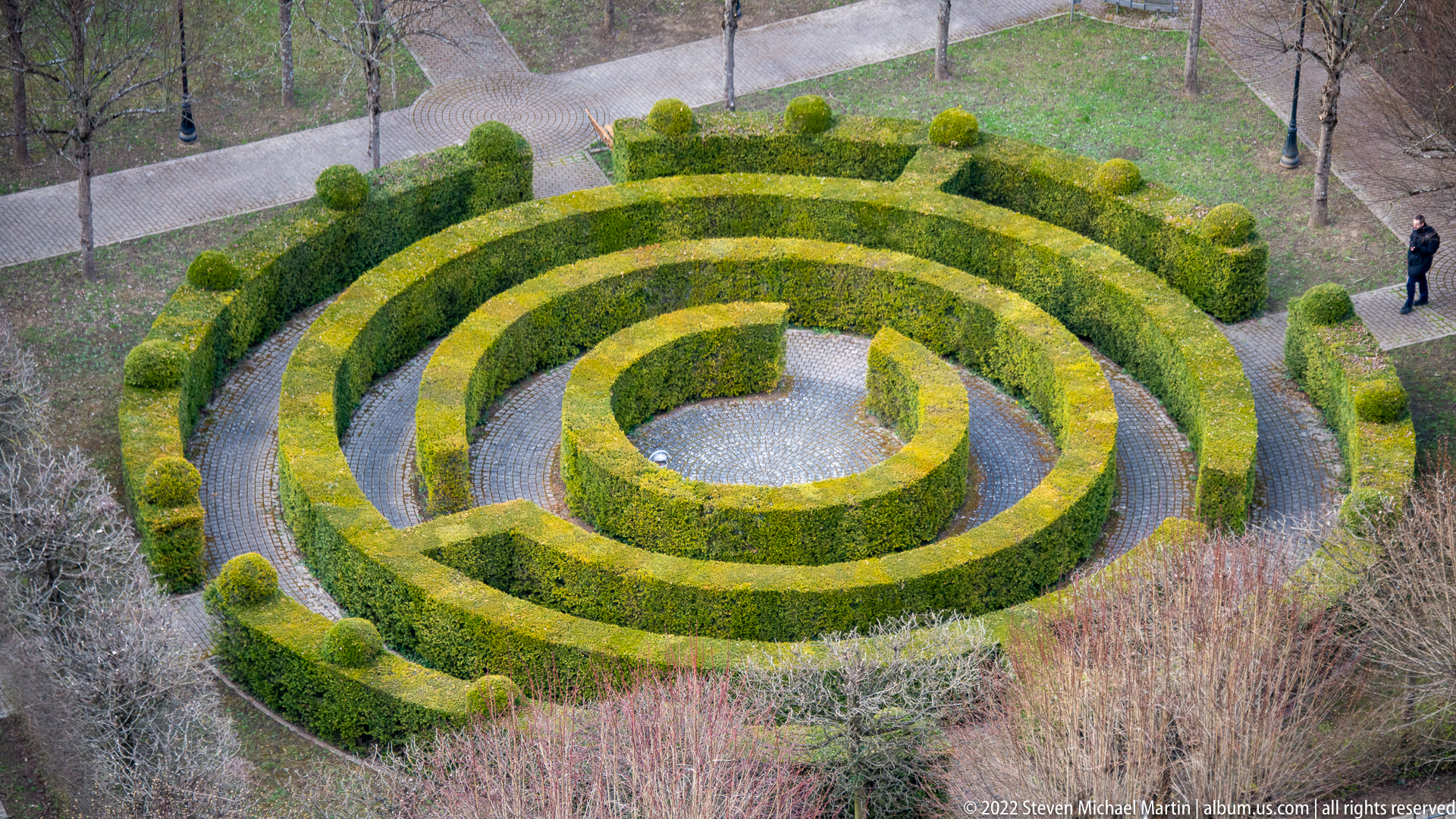
A circular hedge labyrinth is laid out in tightly clipped concentric bands, with a narrow path winding inward toward the center. Seen from above, the geometric planting reads almost like a graphic symbol, while surrounding lawns, shrubs, and walking paths situate the maze within a carefully maintained urban garden.
Caption
A circular hedge labyrinth is laid out in tightly clipped concentric bands, with a narrow path winding inward toward the center. Seen from above, the geometric planting reads almost like a graphic symbol, while surrounding lawns, shrubs, and walking paths situate the maze within a carefully maintained urban garden.
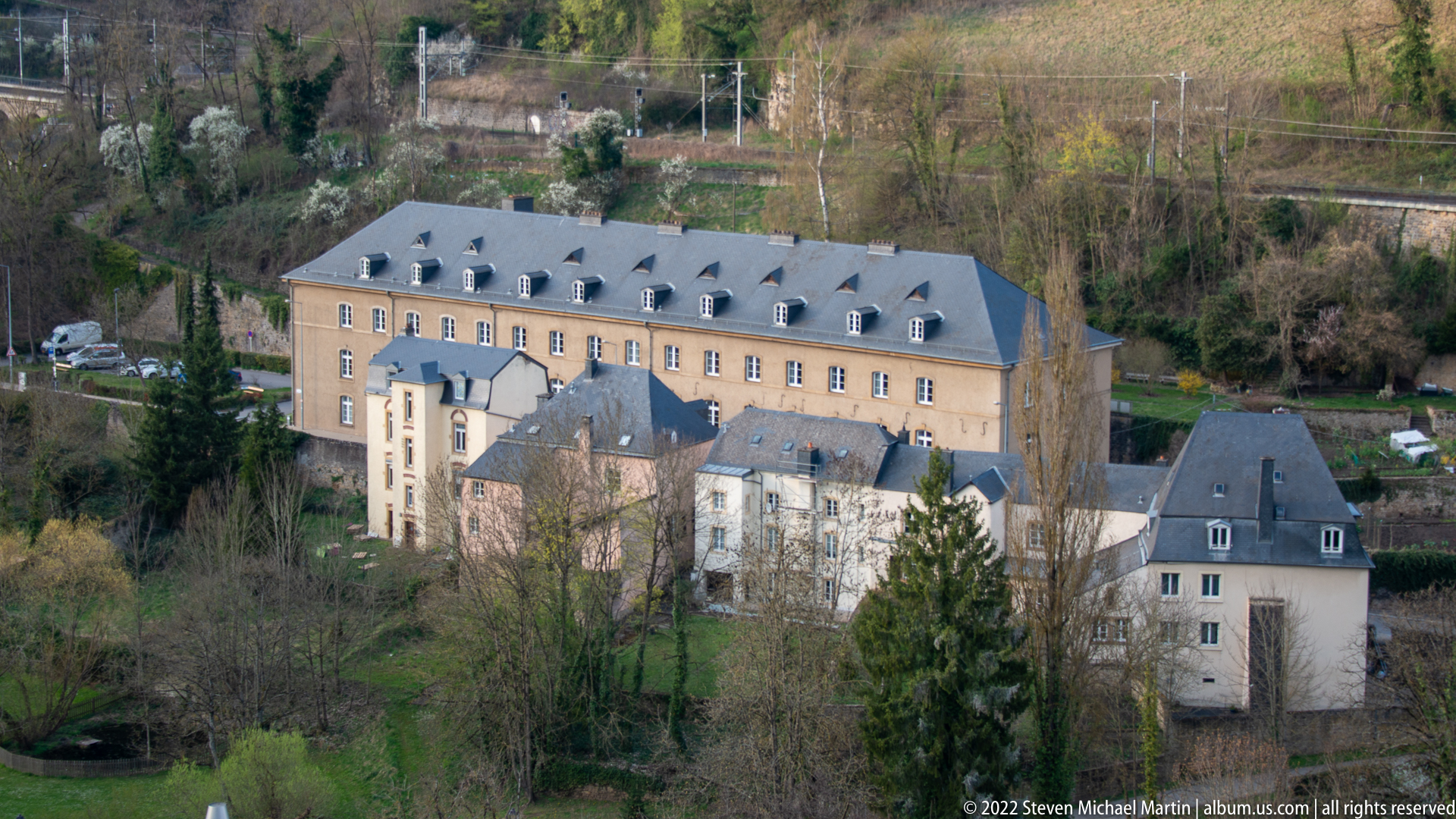
A substantial historic complex occupies a wooded valley terrace, centered on a long rectangular building with a steep slate roof and regularly spaced dormers. Smaller wings and detached structures cluster around it, while rail lines and steep wooded slopes behind reinforce the site's enclosed lower-city setting.
Caption
A substantial historic complex occupies a wooded valley terrace, centered on a long rectangular building with a steep slate roof and regularly spaced dormers. Smaller wings and detached structures cluster around it, while rail lines and steep wooded slopes behind reinforce the site's enclosed lower-city setting.
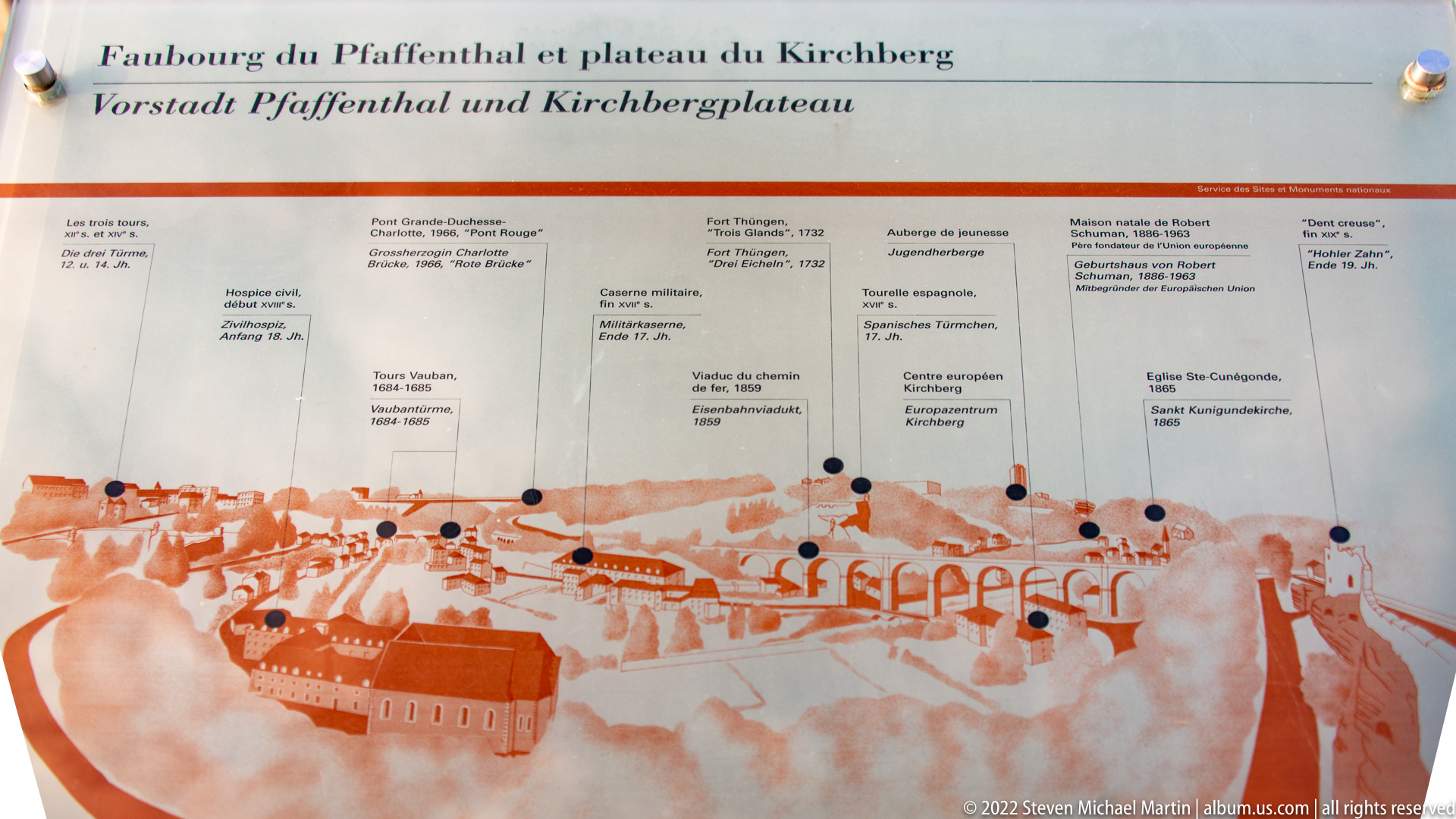
An interpretive panel presents the development of the Kirchberg plateau through a dated horizontal sequence of landmarks and events. The heading includes 'Kirchbergplateau,' while an orange illustrated panorama beneath the timeline situates individual sites within the broader urban expansion east of Luxembourg's historic center.
Caption
An interpretive panel presents the development of the Kirchberg plateau through a dated horizontal sequence of landmarks and events. The heading includes 'Kirchbergplateau,' while an orange illustrated panorama beneath the timeline situates individual sites within the broader urban expansion east of Luxembourg's historic center.
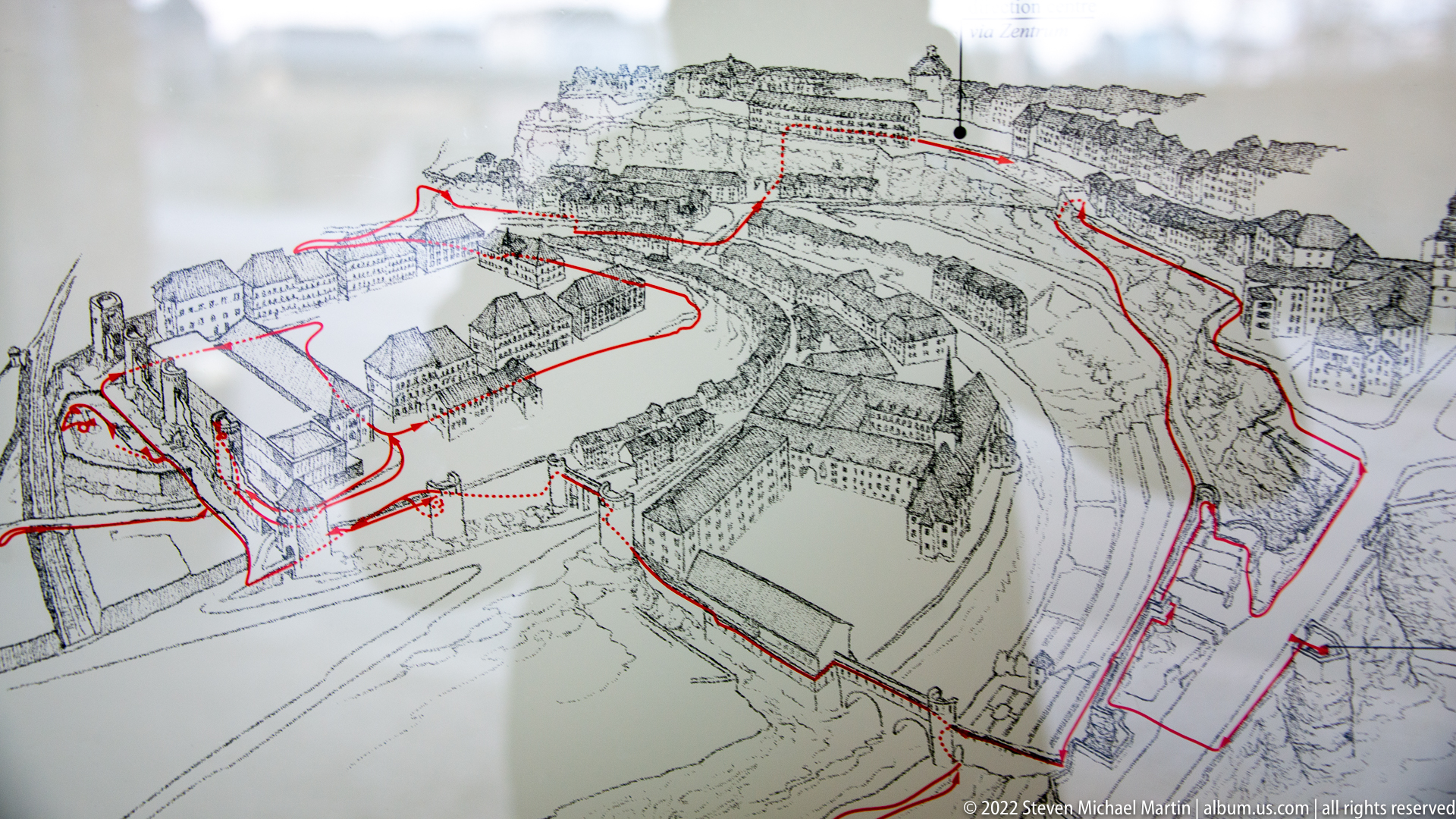
A detailed axonometric drawing reconstructs Luxembourg's fortified urban landscape, with a red route traced through bastions, walls, streets, and major building masses. The diagram clarifies the complexity of the defensive system and helps connect surviving structures with the larger historic network that once enclosed and controlled the city.
Caption
A detailed axonometric drawing reconstructs Luxembourg's fortified urban landscape, with a red route traced through bastions, walls, streets, and major building masses. The diagram clarifies the complexity of the defensive system and helps connect surviving structures with the larger historic network that once enclosed and controlled the city.
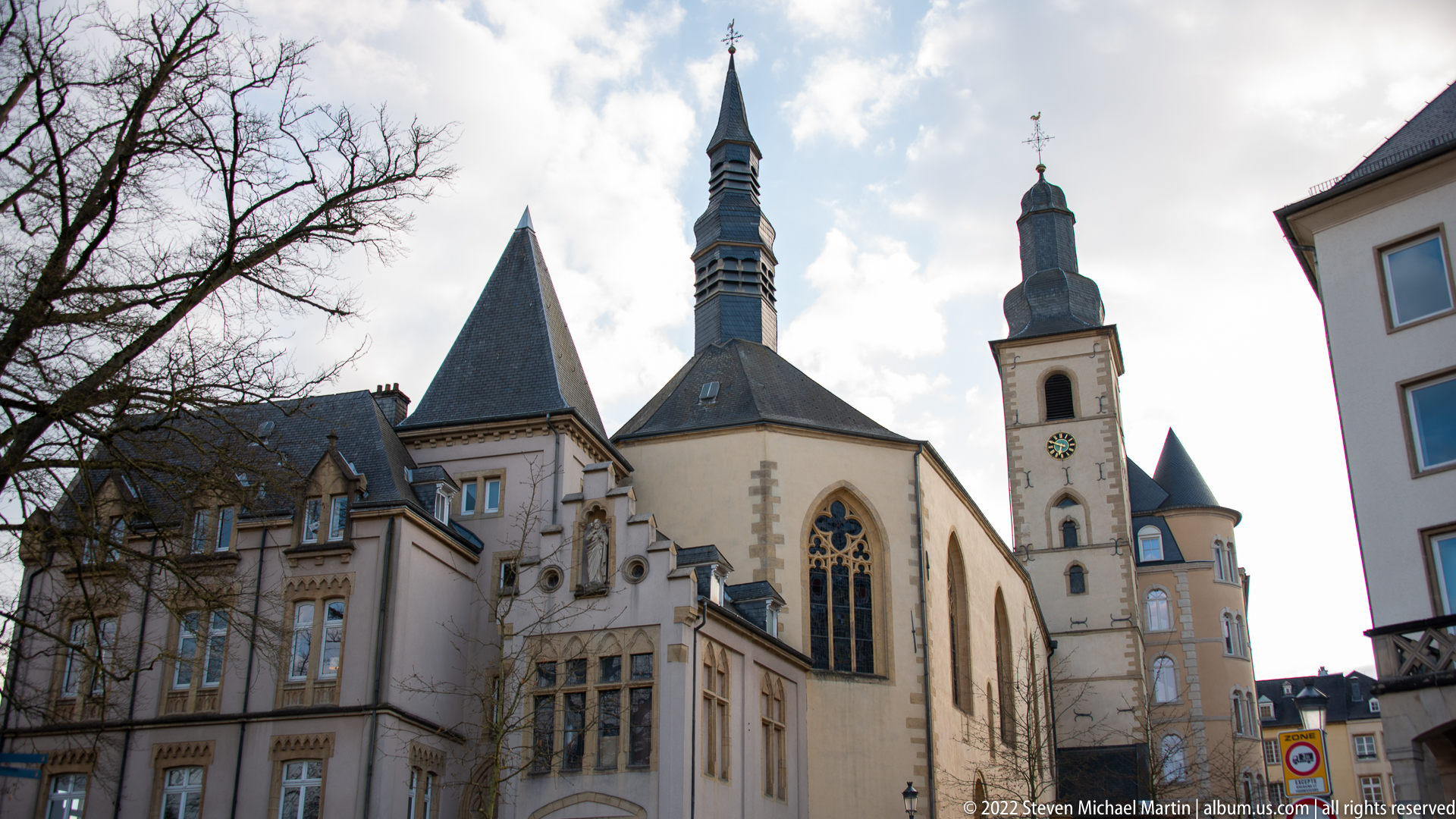
A historic church rises tightly between neighboring buildings, its tall pointed nave window, steep roof, and slender clock tower forming a layered vertical composition. Additional pointed turrets and adjoining historic façades intensify the old-city setting, while the low street-level viewpoint emphasizes the church's height relative to the surrounding urban fabric.
Caption
A historic church rises tightly between neighboring buildings, its tall pointed nave window, steep roof, and slender clock tower forming a layered vertical composition. Additional pointed turrets and adjoining historic façades intensify the old-city setting, while the low street-level viewpoint emphasizes the church's height relative to the surrounding urban fabric.
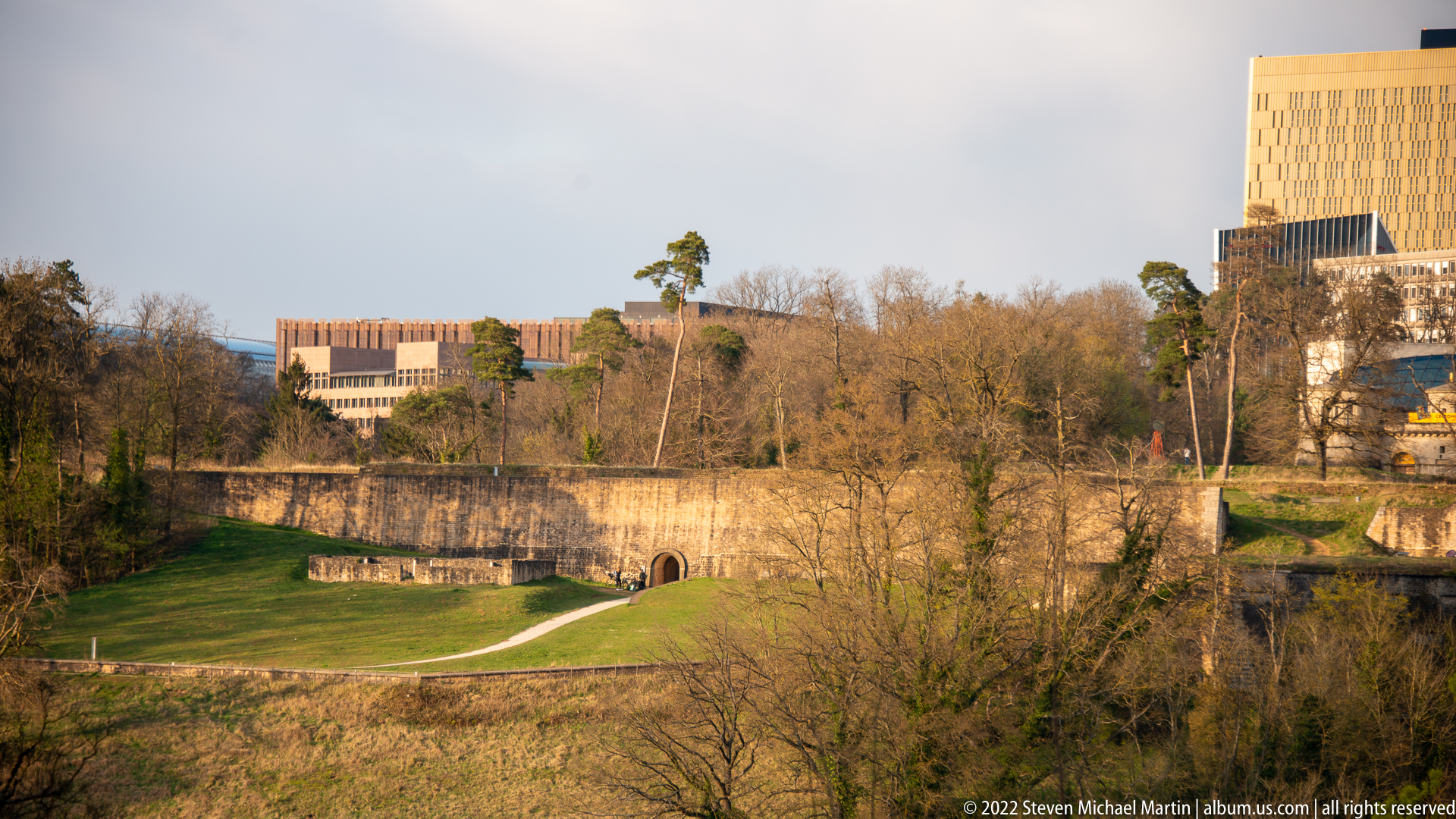
Grassy slopes and a long stone wall occupy the foreground of a former defensive zone, pierced by a small arched opening and backed by mature trees. Modern institutional buildings rise beyond the historic works, creating a clear visual contrast between preserved fortification landscape and the contemporary city above it.
Caption
Grassy slopes and a long stone wall occupy the foreground of a former defensive zone, pierced by a small arched opening and backed by mature trees. Modern institutional buildings rise beyond the historic works, creating a clear visual contrast between preserved fortification landscape and the contemporary city above it.

A narrow old-city lane bends between tall pastel façades, with café furniture tucked against the buildings and a projecting enclosed bay window adding depth to the right-hand elevation. Lanterns, small signs, and irregular rooflines reinforce the intimate pedestrian scale of this historic urban passage.
Caption
A narrow old-city lane bends between tall pastel façades, with café furniture tucked against the buildings and a projecting enclosed bay window adding depth to the right-hand elevation. Lanterns, small signs, and irregular rooflines reinforce the intimate pedestrian scale of this historic urban passage.

An elaborate wrought-iron bracket supports a colorful hanging sign for 'J. Lot Gastromonique' and 'Le Schräinerei.' Decorative scrollwork, a red heraldic figure, small shields, and a stylized fish turn the commercial sign into a richly crafted piece of street ornament above the narrow historic lane.
Caption
An elaborate wrought-iron bracket supports a colorful hanging sign for 'J. Lot Gastromonique' and 'Le Schräinerei.' Decorative scrollwork, a red heraldic figure, small shields, and a stylized fish turn the commercial sign into a richly crafted piece of street ornament above the narrow historic lane.
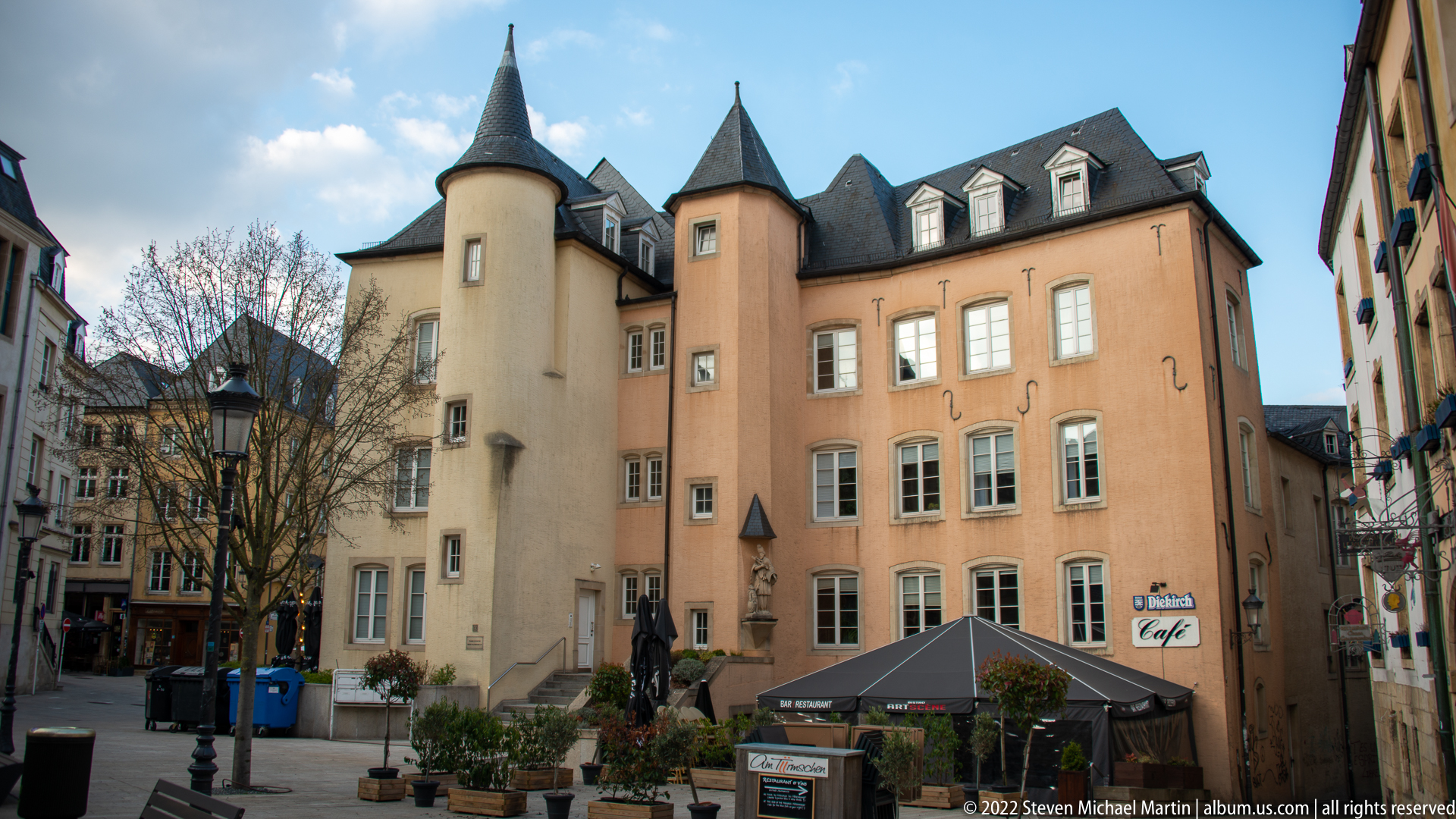
A small urban court is enclosed by pastel historic buildings, including two cylindrical corner turrets capped by steep conical roofs. Ground-floor café seating and umbrellas animate the space, while the towers and irregular roofline give the otherwise domestic façades a distinctive fortified or château-like character.
Caption
A small urban court is enclosed by pastel historic buildings, including two cylindrical corner turrets capped by steep conical roofs. Ground-floor café seating and umbrellas animate the space, while the towers and irregular roofline give the otherwise domestic façades a distinctive fortified or château-like character.
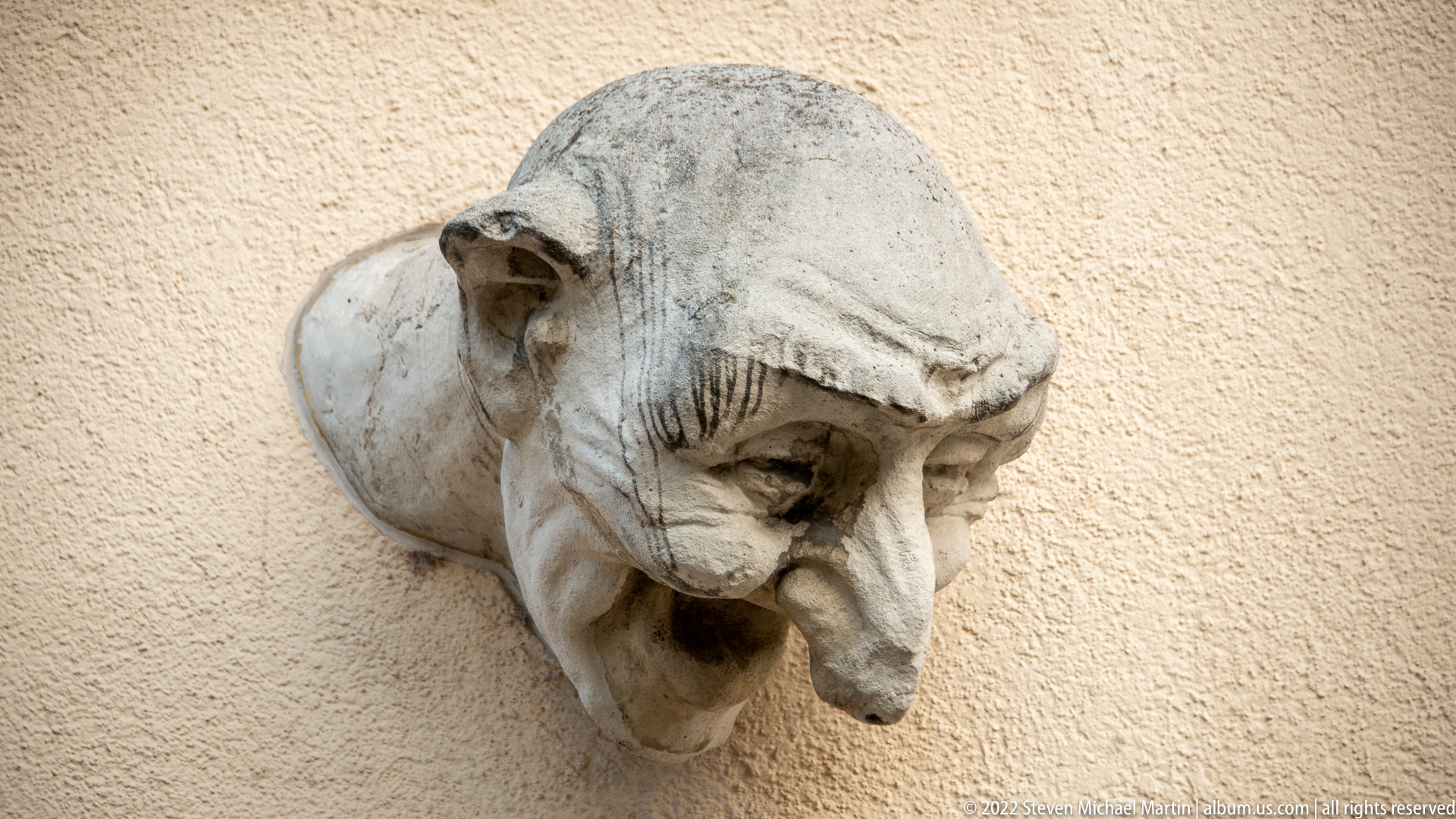
A deeply carved stone head projects from a plain stucco wall, its exaggerated brow, nose, open mouth, and downcast expression giving it the character of a grotesque or mascaron. The isolated placement and weathered surface make the small sculpture feel almost detached from the larger building, emphasizing its expressive facial modeling.
Caption
A deeply carved stone head projects from a plain stucco wall, its exaggerated brow, nose, open mouth, and downcast expression giving it the character of a grotesque or mascaron. The isolated placement and weathered surface make the small sculpture feel almost detached from the larger building, emphasizing its expressive facial modeling.
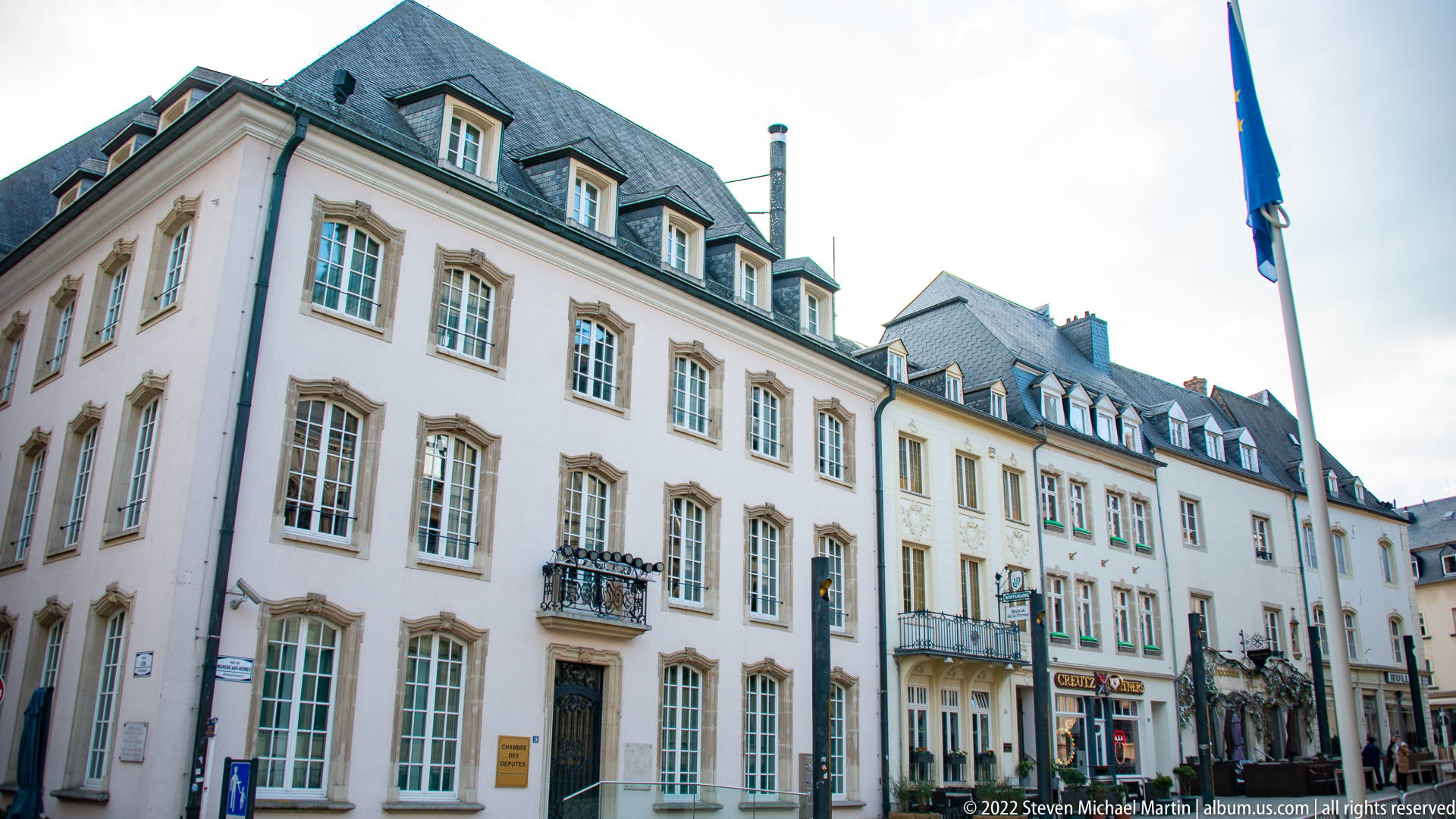
A row of elegant pale townhouses lines the street, their tall multi-pane windows framed by carved stone surrounds and small iron balconies. Steep slate roofs with dormers unify the sequence, while varied ground-floor shopfronts reveal the continuing commercial life of the historic center.
Caption
A row of elegant pale townhouses lines the street, their tall multi-pane windows framed by carved stone surrounds and small iron balconies. Steep slate roofs with dormers unify the sequence, while varied ground-floor shopfronts reveal the continuing commercial life of the historic center.
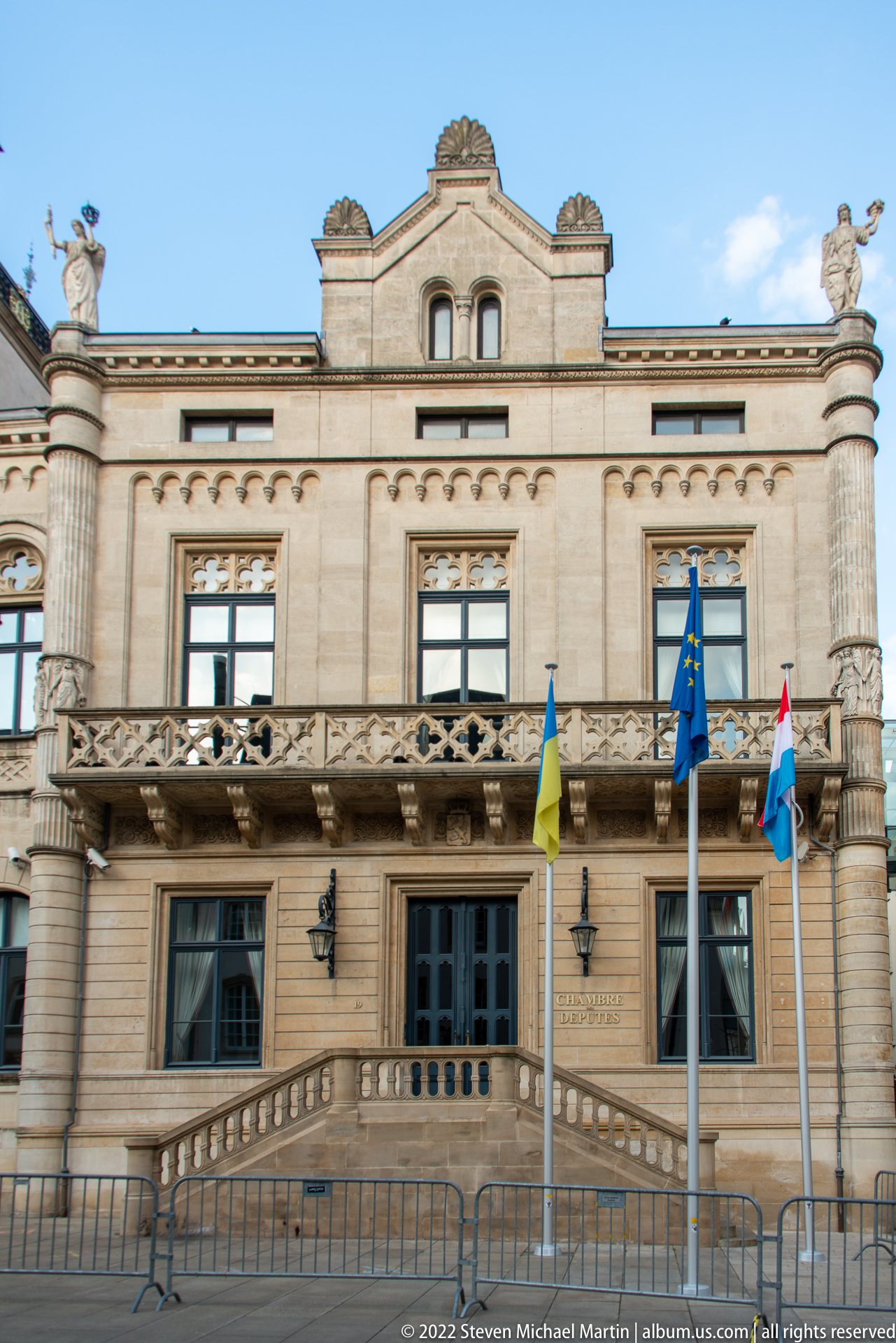
A monumental stone public building presents a symmetrical ceremonial façade, with a broad central stair, balustraded terraces, carved window surrounds, and sculpted figures along the roofline. Flagpoles at the entrance underscore the official character of the building, while the tightly framed view emphasizes its highly formal composition.
Caption
A monumental stone public building presents a symmetrical ceremonial façade, with a broad central stair, balustraded terraces, carved window surrounds, and sculpted figures along the roofline. Flagpoles at the entrance underscore the official character of the building, while the tightly framed view emphasizes its highly formal composition.
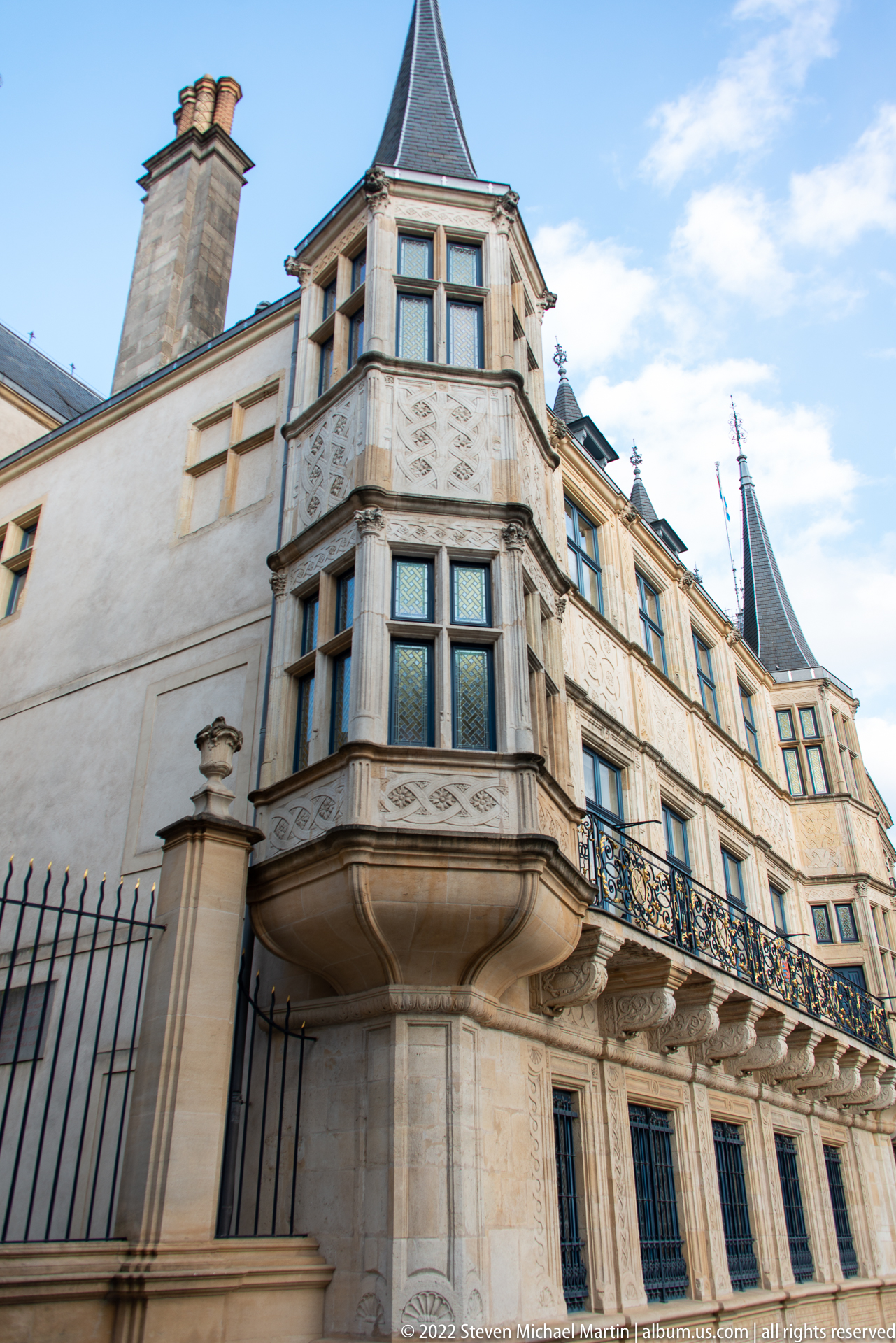
A richly carved projecting oriel window anchors the Grand Ducal Palace façade, its polygonal form supported on a massive stone corbel and wrapped with bands of relief ornament. A long wrought-iron balcony continues along the adjoining elevation, while steep slate roofs and pointed turrets complete the palace's intricate silhouette.
Caption
A richly carved projecting oriel window anchors the Grand Ducal Palace façade, its polygonal form supported on a massive stone corbel and wrapped with bands of relief ornament. A long wrought-iron balcony continues along the adjoining elevation, while steep slate roofs and pointed turrets complete the palace's intricate silhouette.
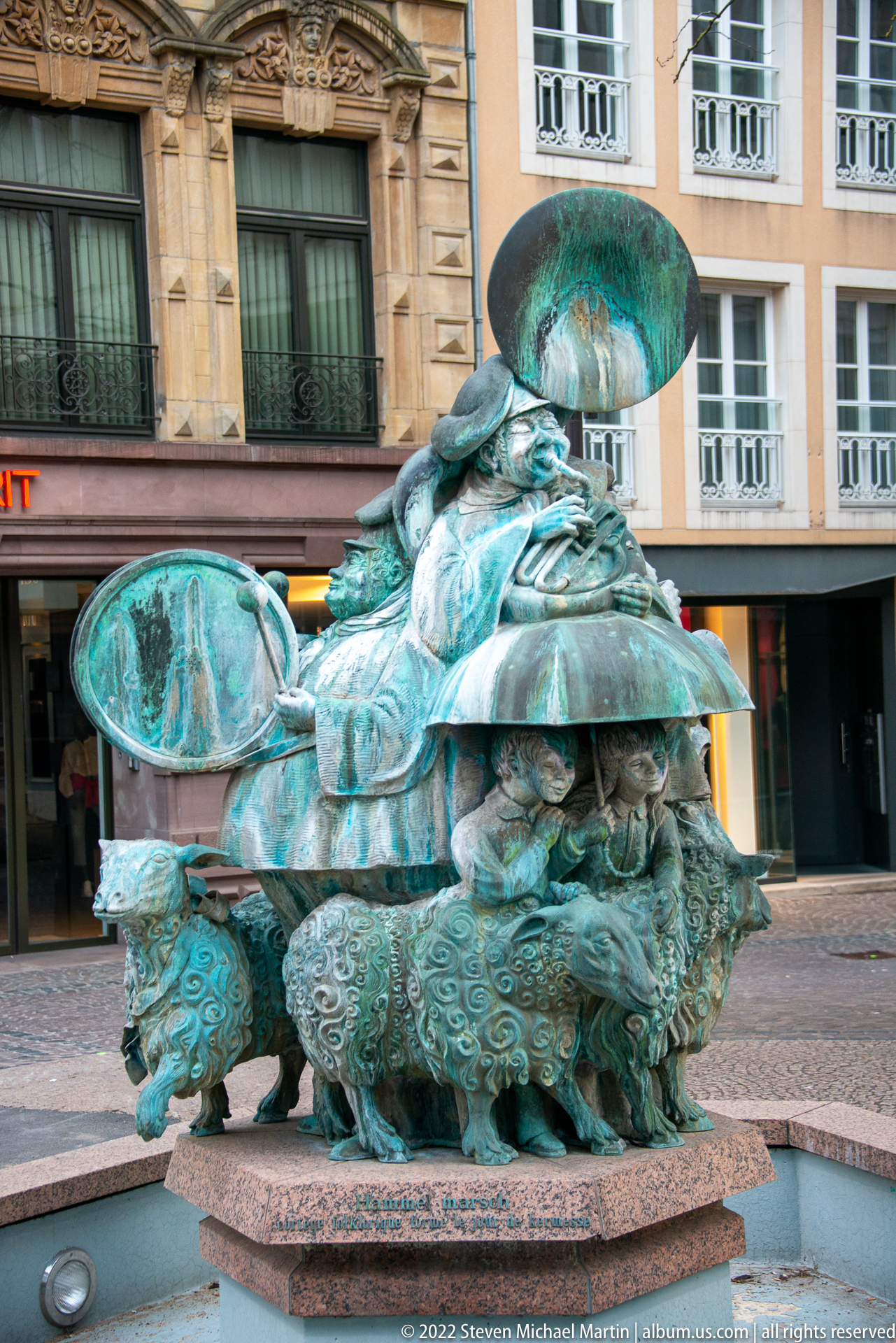
A large patinated bronze fountain sculpture rises from a shallow basin in an urban square, its layered forms resembling oversized leaves, shells, or folded organic shapes. Water emerges around the clustered mass, while the green-blue patina and richly textured surfaces give the work a strong sculptural presence against surrounding shopfronts.
Caption
A large patinated bronze fountain sculpture rises from a shallow basin in an urban square, its layered forms resembling oversized leaves, shells, or folded organic shapes. Water emerges around the clustered mass, while the green-blue patina and richly textured surfaces give the work a strong sculptural presence against surrounding shopfronts.
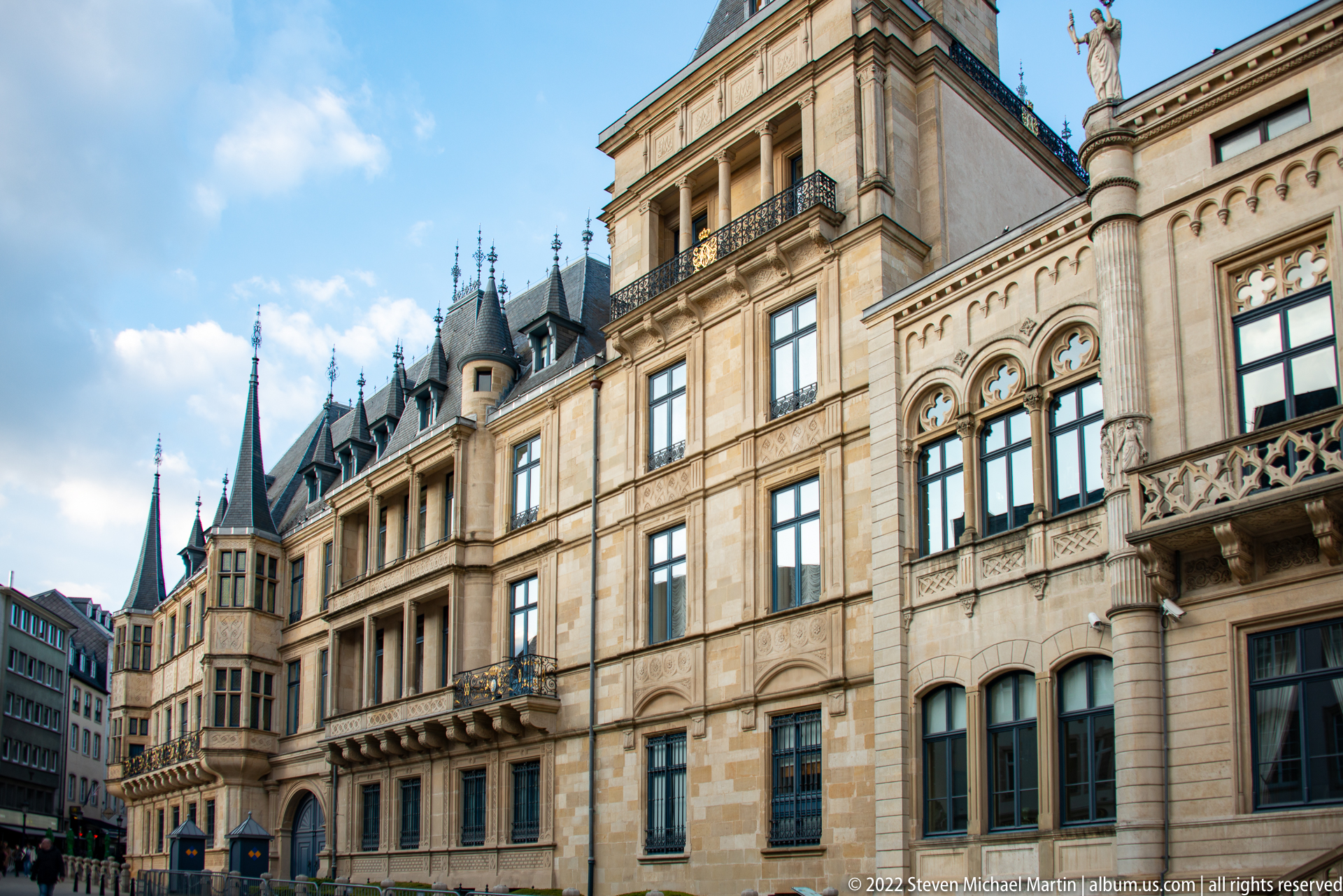
The Grand Ducal Palace presents an elaborate stone façade of projecting bays, mullioned windows, carved friezes, and slender roof turrets. The oblique street view reveals the palace's richly textured Renaissance Revival exterior and the close relationship between the sovereign's official residence and Luxembourg City's narrow historic streets.
Caption
The Grand Ducal Palace presents an elaborate stone façade of projecting bays, mullioned windows, carved friezes, and slender roof turrets. The oblique street view reveals the palace's richly textured Renaissance Revival exterior and the close relationship between the sovereign's official residence and Luxembourg City's narrow historic streets.
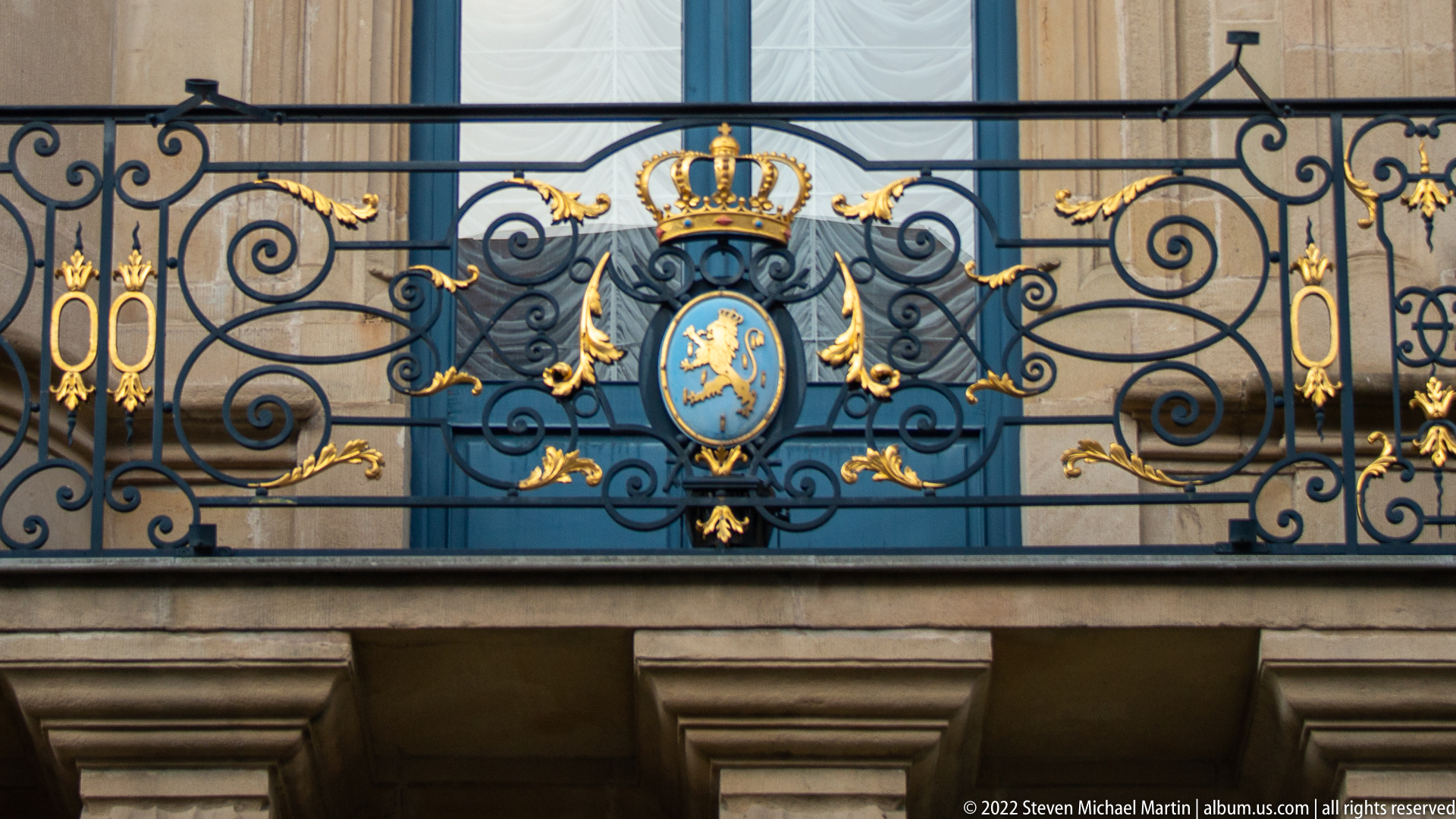
An ornate wrought-iron balcony centers on a blue shield bearing Luxembourg's crowned golden lion, itself surmounted by a gilded crown and surrounded by scrolling gold ornament. The close-up isolates the dynastic emblem from the palace façade and highlights the exceptional craftsmanship of the decorative ironwork.
Caption
An ornate wrought-iron balcony centers on a blue shield bearing Luxembourg's crowned golden lion, itself surmounted by a gilded crown and surrounded by scrolling gold ornament. The close-up isolates the dynastic emblem from the palace façade and highlights the exceptional craftsmanship of the decorative ironwork.

A close view of the palace gate centers on Luxembourg's red lion rampant over blue-and-white horizontal bands, all beneath a jeweled crown. Black wrought-iron scrolls and gilded acanthus-like ornaments surround the shield, transforming a functional gate into a formal display of sovereign heraldry.
Caption
A close view of the palace gate centers on Luxembourg's red lion rampant over blue-and-white horizontal bands, all beneath a jeweled crown. Black wrought-iron scrolls and gilded acanthus-like ornaments surround the shield, transforming a functional gate into a formal display of sovereign heraldry.

Cercle Cité glows across the square at night, its arched entrances, central clock, sculpted frieze, and corner tower outlined by warm architectural lighting. Trees wrapped in blue and gold lights frame the façade, creating a strong seasonal contrast between the historic stone building and contemporary decorative illumination.
Caption
Cercle Cité glows across the square at night, its arched entrances, central clock, sculpted frieze, and corner tower outlined by warm architectural lighting. Trees wrapped in blue and gold lights frame the façade, creating a strong seasonal contrast between the historic stone building and contemporary decorative illumination.

A glowing round clock crowns the central bay of Cercle Cité, directly above a long illuminated sculptural frieze. The tight nighttime composition isolates these two decorative elements from the larger façade, emphasizing the building's ceremonial clock and the narrative relief that stretches across the entrance zone below.
Caption
A glowing round clock crowns the central bay of Cercle Cité, directly above a long illuminated sculptural frieze. The tight nighttime composition isolates these two decorative elements from the larger façade, emphasizing the building's ceremonial clock and the narrative relief that stretches across the entrance zone below.
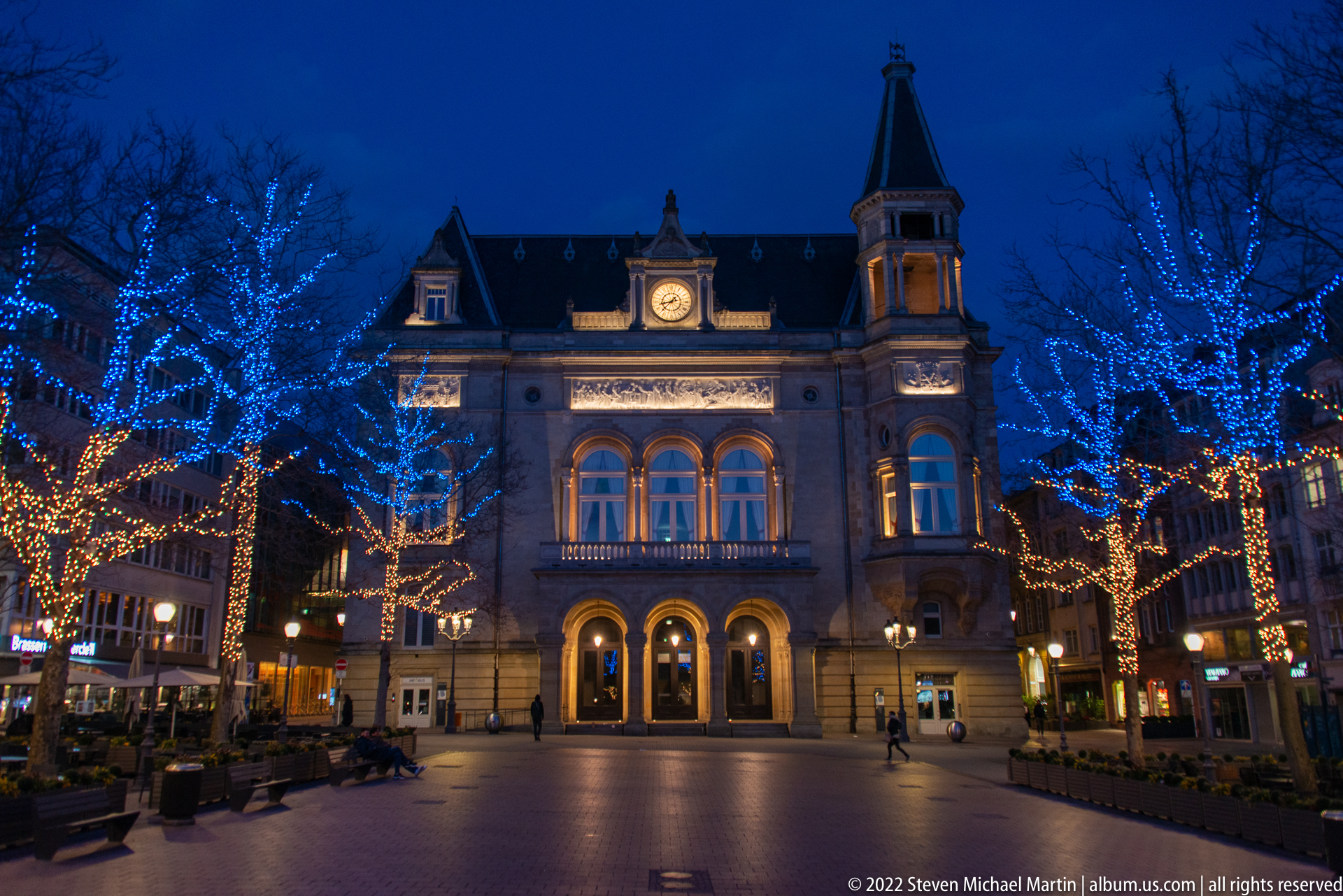
Cercle Cité stands at the far end of a broad night-time square, framed symmetrically by trees wrapped in blue and warm white lights. The open foreground gives the building's historic façade room to read as a civic focal point, while café terraces and street furniture around the edges preserve the public character of Place d'Armes after dark.
Caption
Cercle Cité stands at the far end of a broad night-time square, framed symmetrically by trees wrapped in blue and warm white lights. The open foreground gives the building's historic façade room to read as a civic focal point, while café terraces and street furniture around the edges preserve the public character of Place d'Armes after dark.
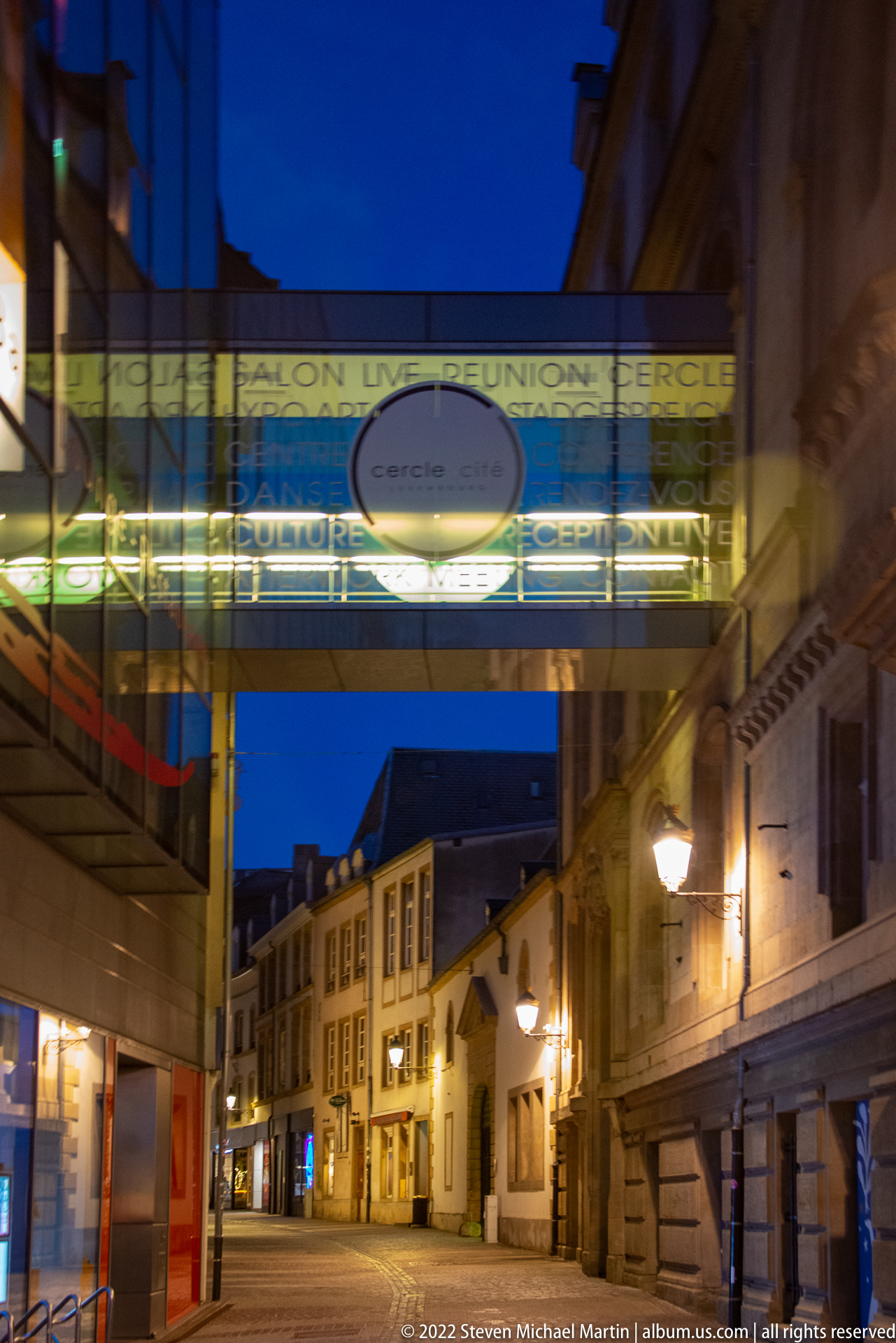
An illuminated glass pedestrian bridge spans a narrow old-city street at night, its interior signage including the name Cercle Cité. Warm street lamps and pale historic façades frame the passage below, while the transparent bridge introduces a sharply contemporary element into the dense historic streetscape.
Caption
An illuminated glass pedestrian bridge spans a narrow old-city street at night, its interior signage including the name Cercle Cité. Warm street lamps and pale historic façades frame the passage below, while the transparent bridge introduces a sharply contemporary element into the dense historic streetscape.
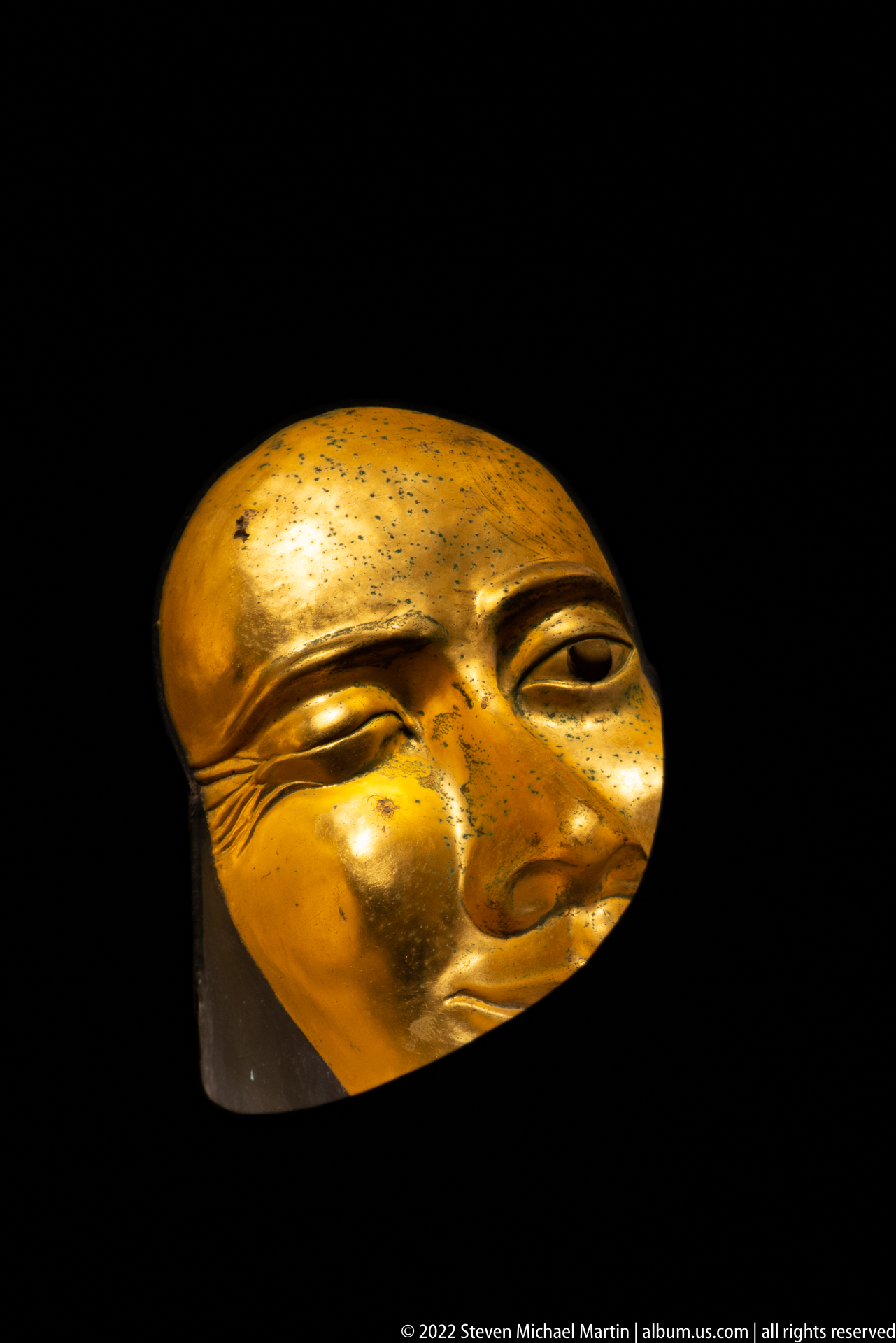
A polished golden face mask emerges from a black background, its broad forehead, almond-shaped eyes, straight nose, and softly modeled cheeks defined by subtle surface wear and small dark speckles. The isolated presentation removes all surrounding context, emphasizing the mask's idealized facial geometry and reflective metallic finish.
Caption
A polished golden face mask emerges from a black background, its broad forehead, almond-shaped eyes, straight nose, and softly modeled cheeks defined by subtle surface wear and small dark speckles. The isolated presentation removes all surrounding context, emphasizing the mask's idealized facial geometry and reflective metallic finish.
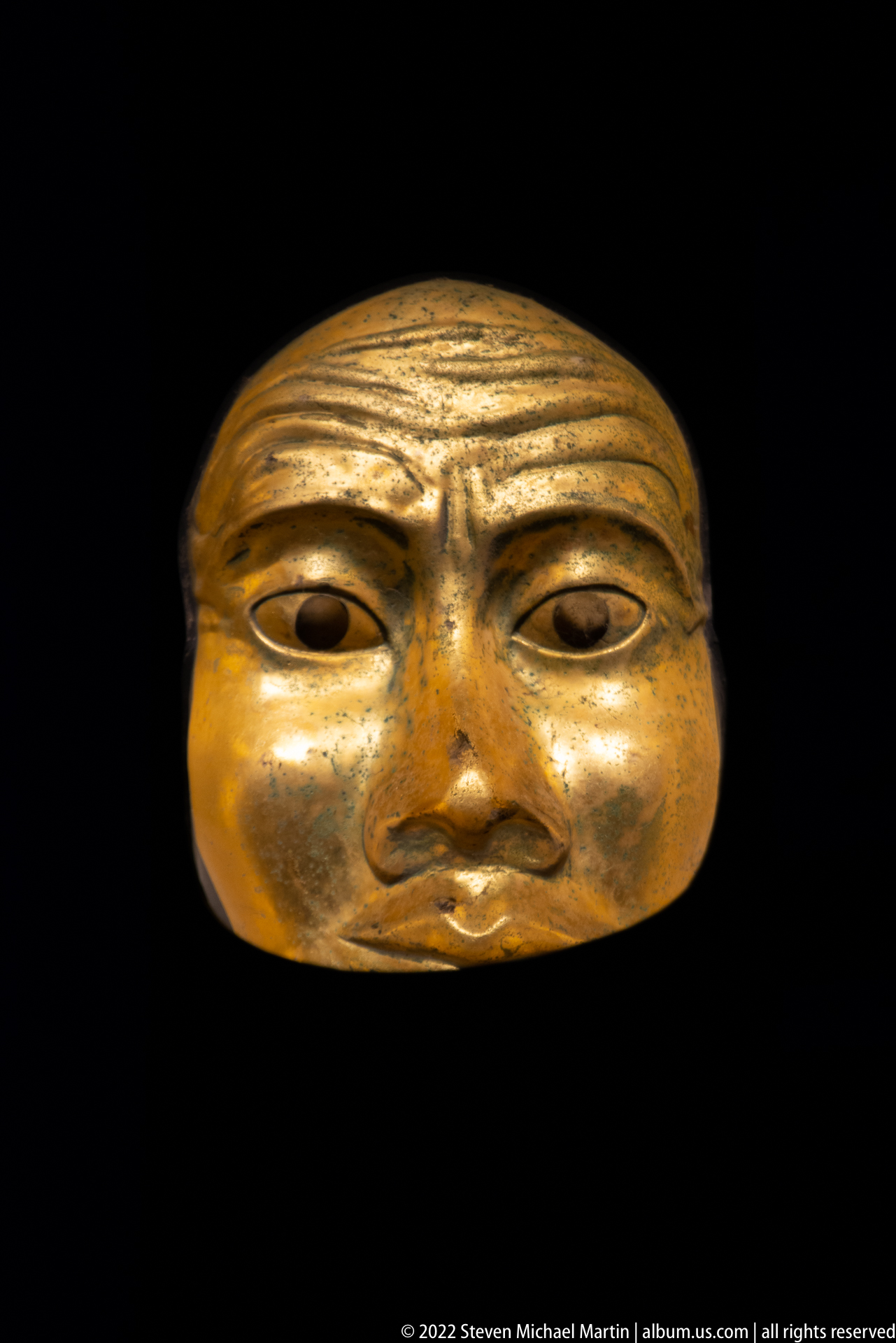
A second golden mask is shown frontally, with a heavier brow ridge, deep-set almond eyes, broad nose, and compact mouth. Fine abrasions and irregular dark marks across the reflective surface give the face a visibly aged texture, while the black background isolates the object for close visual comparison.
Caption
A second golden mask is shown frontally, with a heavier brow ridge, deep-set almond eyes, broad nose, and compact mouth. Fine abrasions and irregular dark marks across the reflective surface give the face a visibly aged texture, while the black background isolates the object for close visual comparison.
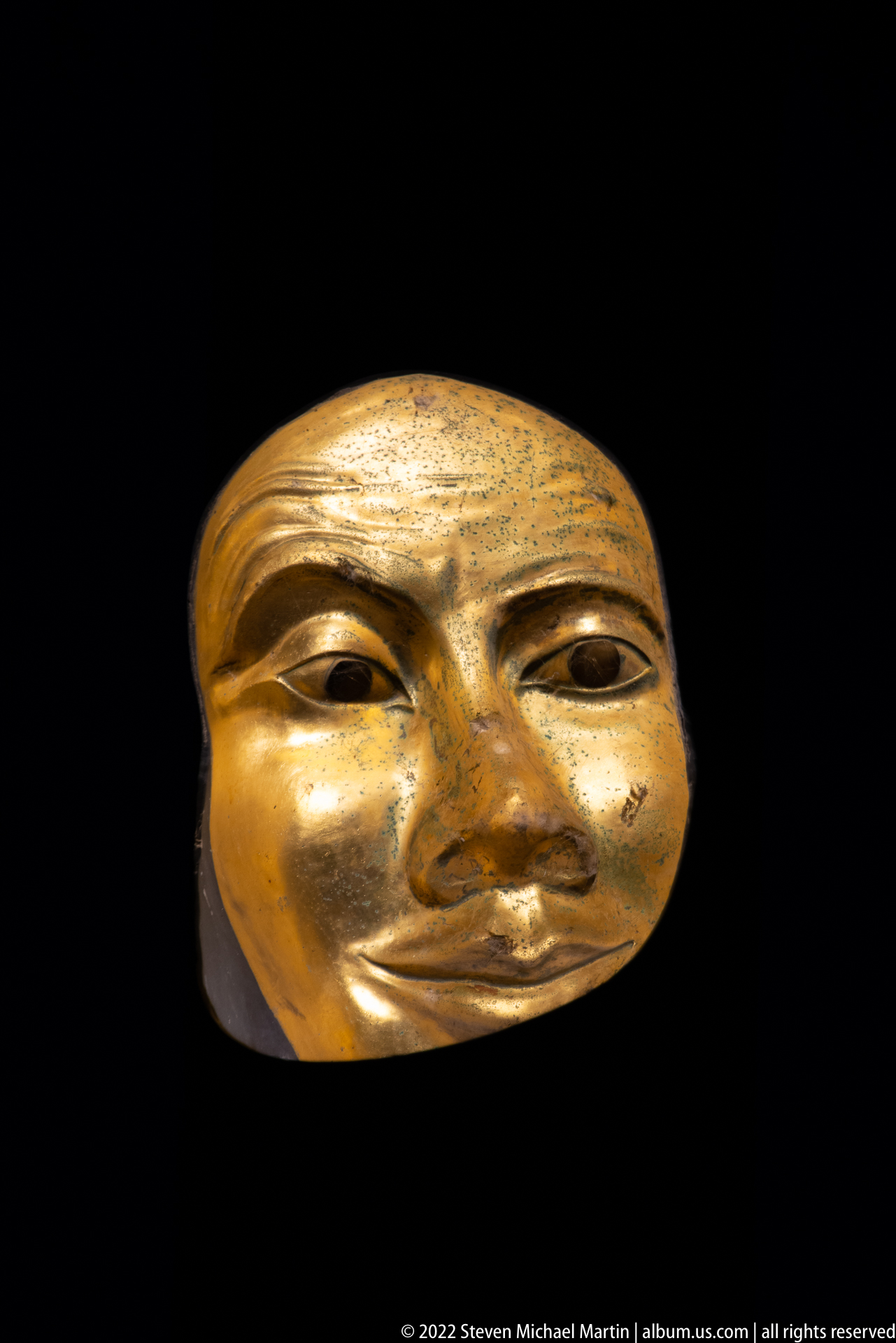
A rounded golden face mask appears against black, distinguished by smooth cheeks, slightly asymmetrical eyes, a broad nose, and gently smiling lips. Small patches of discoloration and pitting break the reflective surface, making this image especially useful for comparing condition and facial modeling across the displayed group.
Caption
A rounded golden face mask appears against black, distinguished by smooth cheeks, slightly asymmetrical eyes, a broad nose, and gently smiling lips. Small patches of discoloration and pitting break the reflective surface, making this image especially useful for comparing condition and facial modeling across the displayed group.
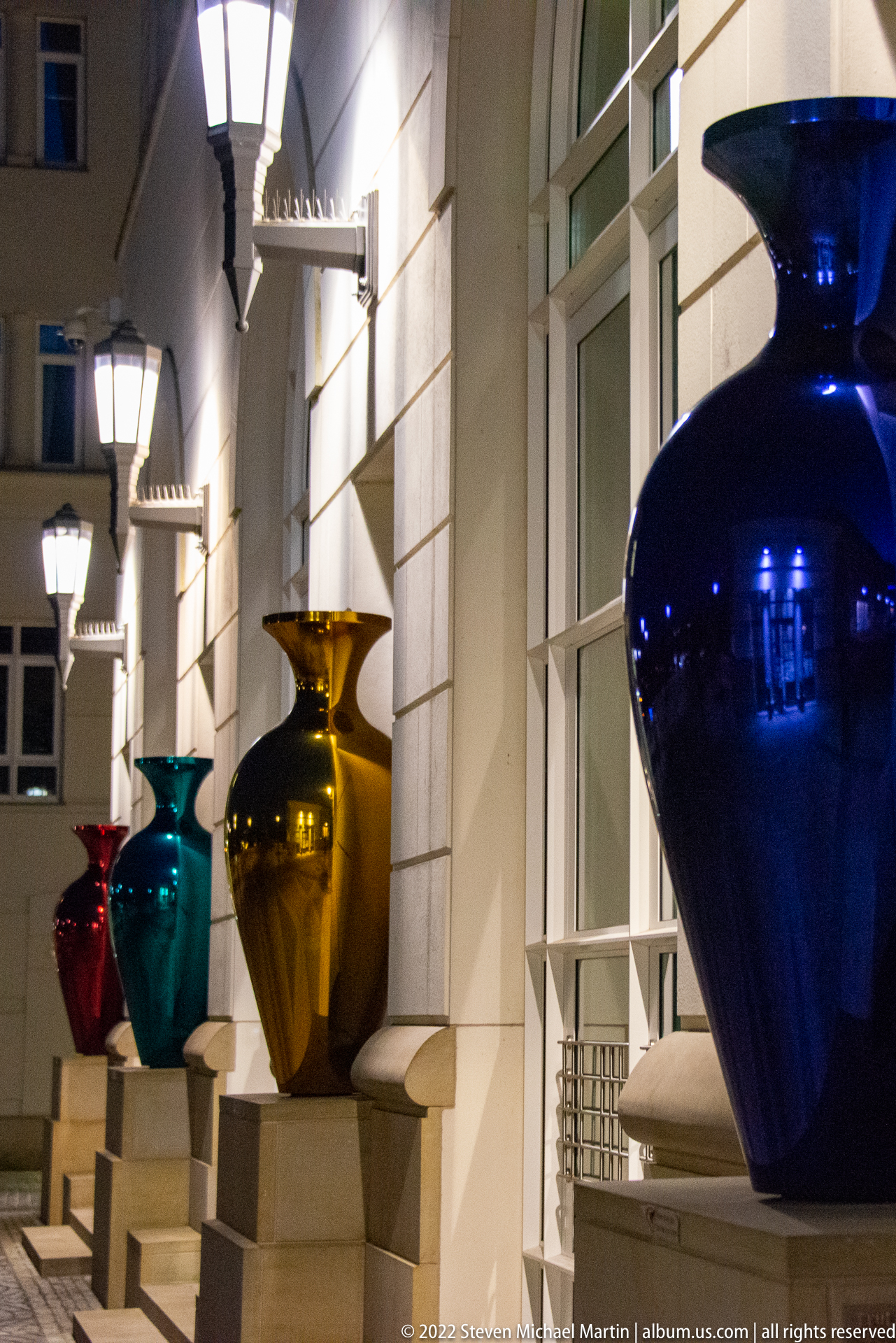
Oversized glossy vessels in deep blue, amber, turquoise, and red are arranged in a row along the steps of a pale stone building. Their saturated color and reflective surfaces stand out against the restrained façade and traditional wall lamps, turning a simple entrance display into a strong nighttime still life.
Caption
Oversized glossy vessels in deep blue, amber, turquoise, and red are arranged in a row along the steps of a pale stone building. Their saturated color and reflective surfaces stand out against the restrained façade and traditional wall lamps, turning a simple entrance display into a strong nighttime still life.

A quiet cobbled lane runs between weathered historic façades beneath another line of colorful parasol-like decorations. Warm evening light on the buildings contrasts with the blue sky, while stickers, shutters, signs, and uneven stonework preserve the street's informal, lived-in character beneath the temporary overhead installation.
Caption
A quiet cobbled lane runs between weathered historic façades beneath another line of colorful parasol-like decorations. Warm evening light on the buildings contrasts with the blue sky, while stickers, shutters, signs, and uneven stonework preserve the street's informal, lived-in character beneath the temporary overhead installation.
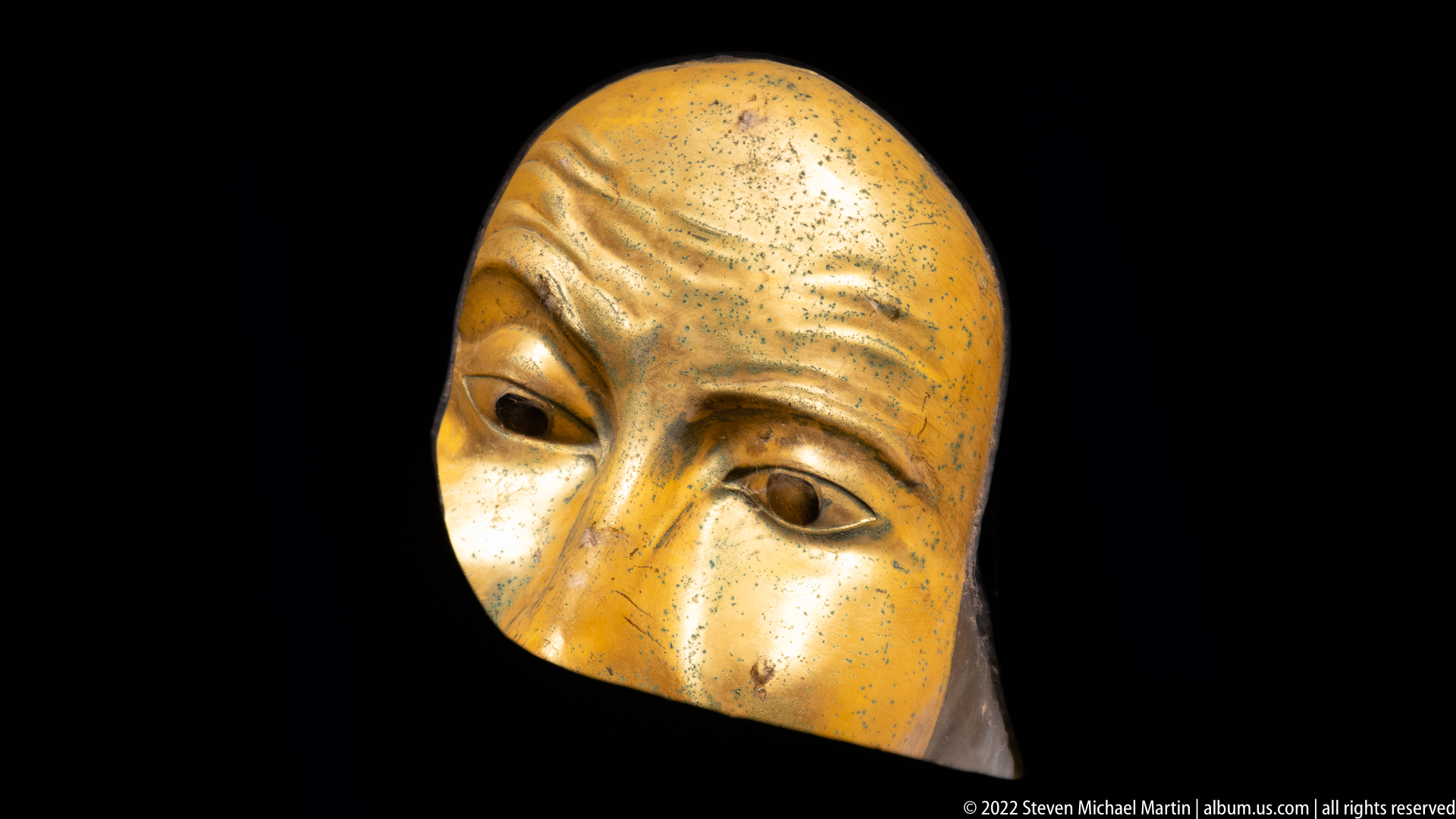
An elongated golden face mask is photographed at a slight diagonal, revealing a high rounded forehead, narrow eyes, strong nose, and deep creases above the brows. The angled presentation adds a sense of volume absent from the more frontal masks, while scattered spotting and abrasions record the object's uneven surface condition.
Caption
An elongated golden face mask is photographed at a slight diagonal, revealing a high rounded forehead, narrow eyes, strong nose, and deep creases above the brows. The angled presentation adds a sense of volume absent from the more frontal masks, while scattered spotting and abrasions record the object's uneven surface condition.

A narrow cobbled lane descends between restrained historic façades toward a brightly illuminated modern building at the far end. Traditional wall lanterns, shuttered windows, and pale stucco walls contrast with the glassy, light-filled courtyard façade beyond, creating a layered night view of old and new urban fabric.
Caption
A narrow cobbled lane descends between restrained historic façades toward a brightly illuminated modern building at the far end. Traditional wall lanterns, shuttered windows, and pale stucco walls contrast with the glassy, light-filled courtyard façade beyond, creating a layered night view of old and new urban fabric.
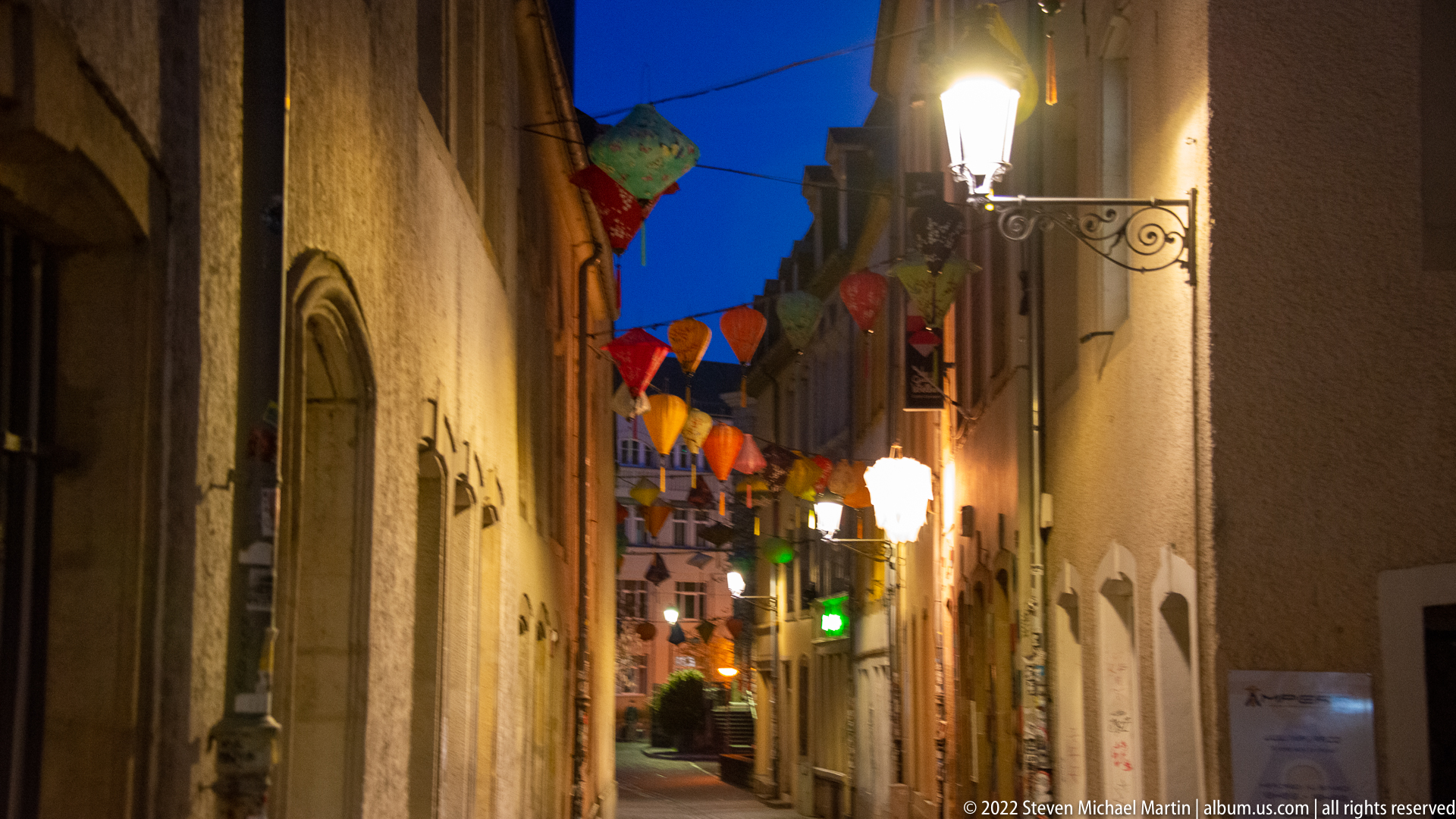
A narrow historic lane is transformed at night by colorful parasol-like decorations suspended overhead between the buildings. Warm wall lamps illuminate rough masonry, arched doorways, and stucco façades below, while the bright hanging forms lead the eye down the pedestrian passage toward the deeper old city.
Caption
A narrow historic lane is transformed at night by colorful parasol-like decorations suspended overhead between the buildings. Warm wall lamps illuminate rough masonry, arched doorways, and stucco façades below, while the bright hanging forms lead the eye down the pedestrian passage toward the deeper old city.
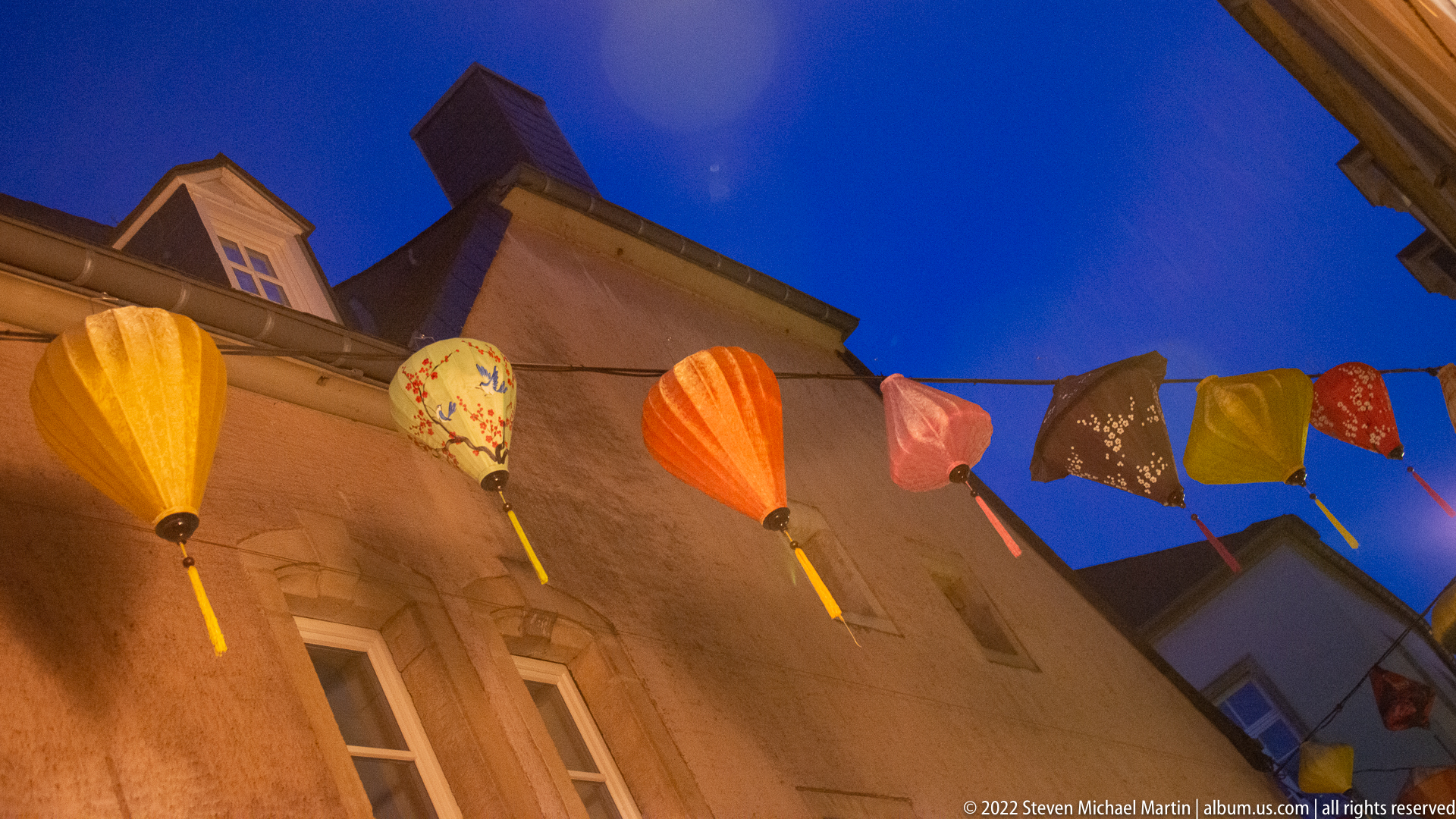
Colorful parasol-shaped ornaments stretch across the street above pale historic façades, viewed from below against a deep blue evening sky. Their varied shapes, patterns, and saturated colors turn the overhead space into the principal subject, while dormers and rooflines anchor the temporary installation within the old-city architecture.
Caption
Colorful parasol-shaped ornaments stretch across the street above pale historic façades, viewed from below against a deep blue evening sky. Their varied shapes, patterns, and saturated colors turn the overhead space into the principal subject, while dormers and rooflines anchor the temporary installation within the old-city architecture.
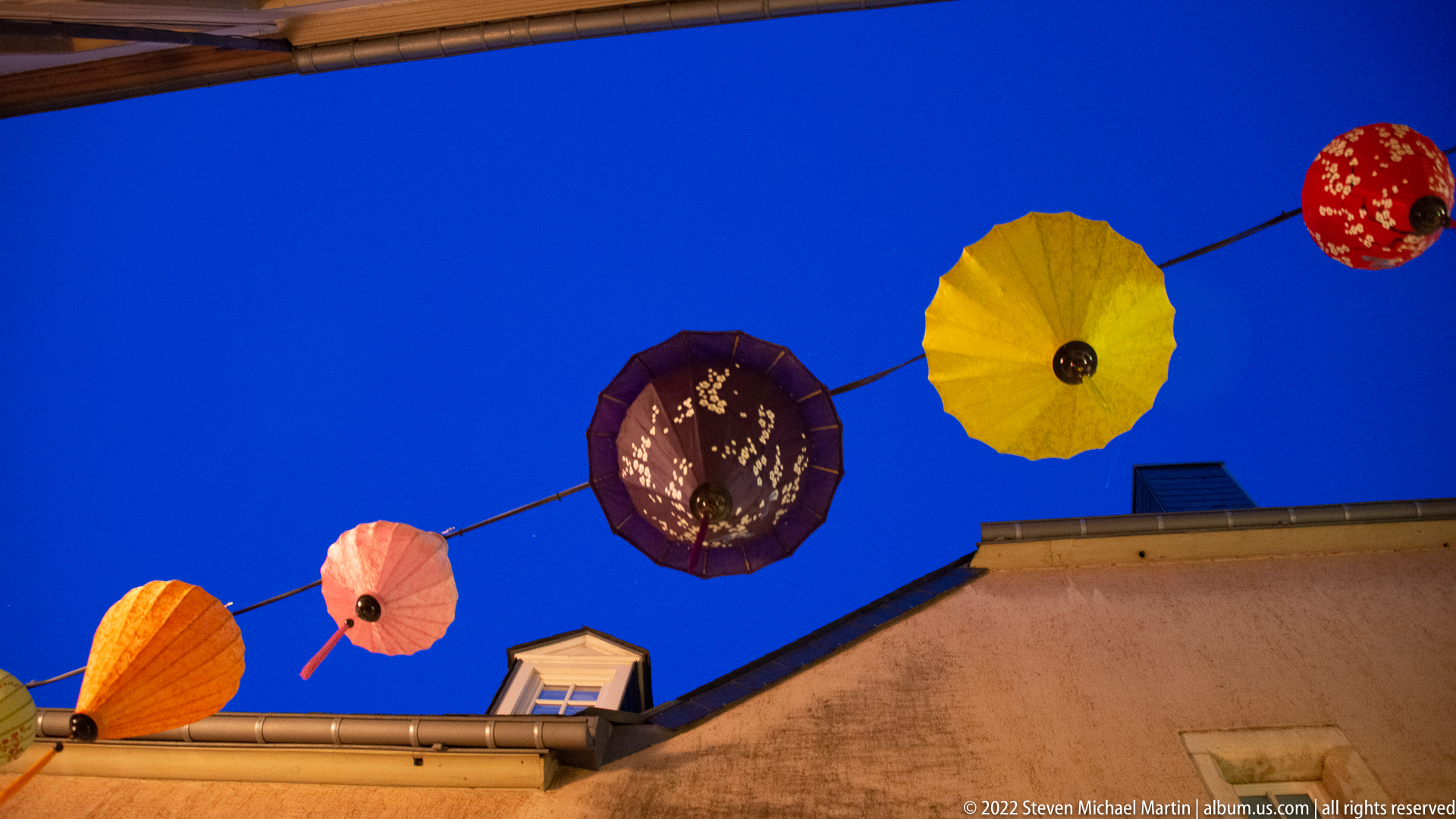
An upward view isolates a line of suspended parasol-like ornaments against the intense blue evening sky. Yellow, purple, red, pink, and orange forms create a rhythmic sequence above the roof edge, emphasizing the graphic character of the temporary street decoration rather than the architecture below.
Caption
An upward view isolates a line of suspended parasol-like ornaments against the intense blue evening sky. Yellow, purple, red, pink, and orange forms create a rhythmic sequence above the roof edge, emphasizing the graphic character of the temporary street decoration rather than the architecture below.
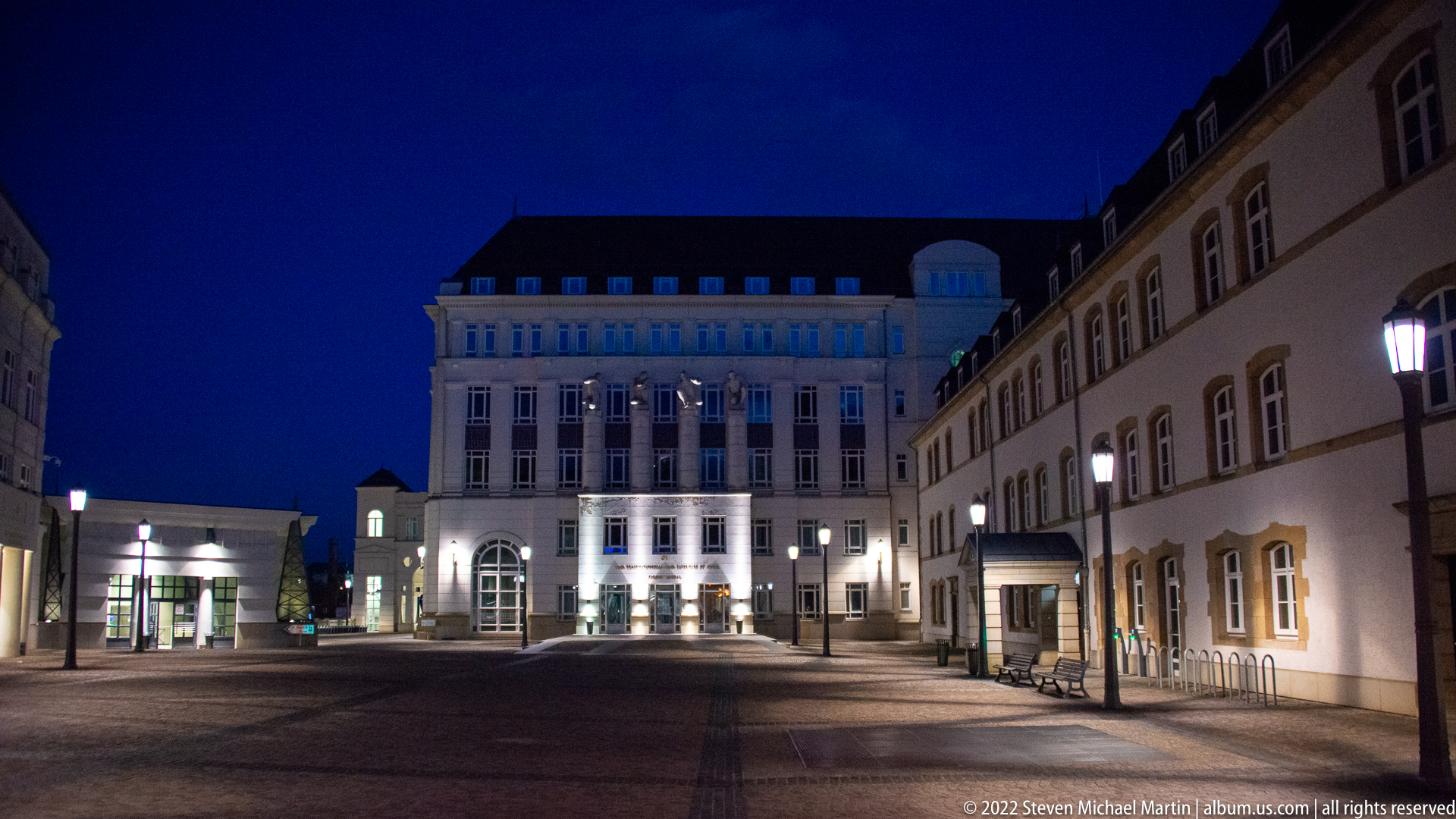
A quiet paved courtyard is enclosed by formal multi-story buildings whose pale façades and tall windows are picked out by restrained architectural lighting. The nearly empty square and deep blue night sky give the composition a still, institutional atmosphere, while the large central building provides the principal symmetrical focus.
Caption
A quiet paved courtyard is enclosed by formal multi-story buildings whose pale façades and tall windows are picked out by restrained architectural lighting. The nearly empty square and deep blue night sky give the composition a still, institutional atmosphere, while the large central building provides the principal symmetrical focus.

An elevated enclosed walkway crosses the street on decorative iron supports, its long band of windows glowing blue above three open arches. Historic buildings press closely around the structure, and the view through the central arch toward the lit street beyond emphasizes the bridge's role as both passage and architectural gateway.
Caption
An elevated enclosed walkway crosses the street on decorative iron supports, its long band of windows glowing blue above three open arches. Historic buildings press closely around the structure, and the view through the central arch toward the lit street beyond emphasizes the bridge's role as both passage and architectural gateway.
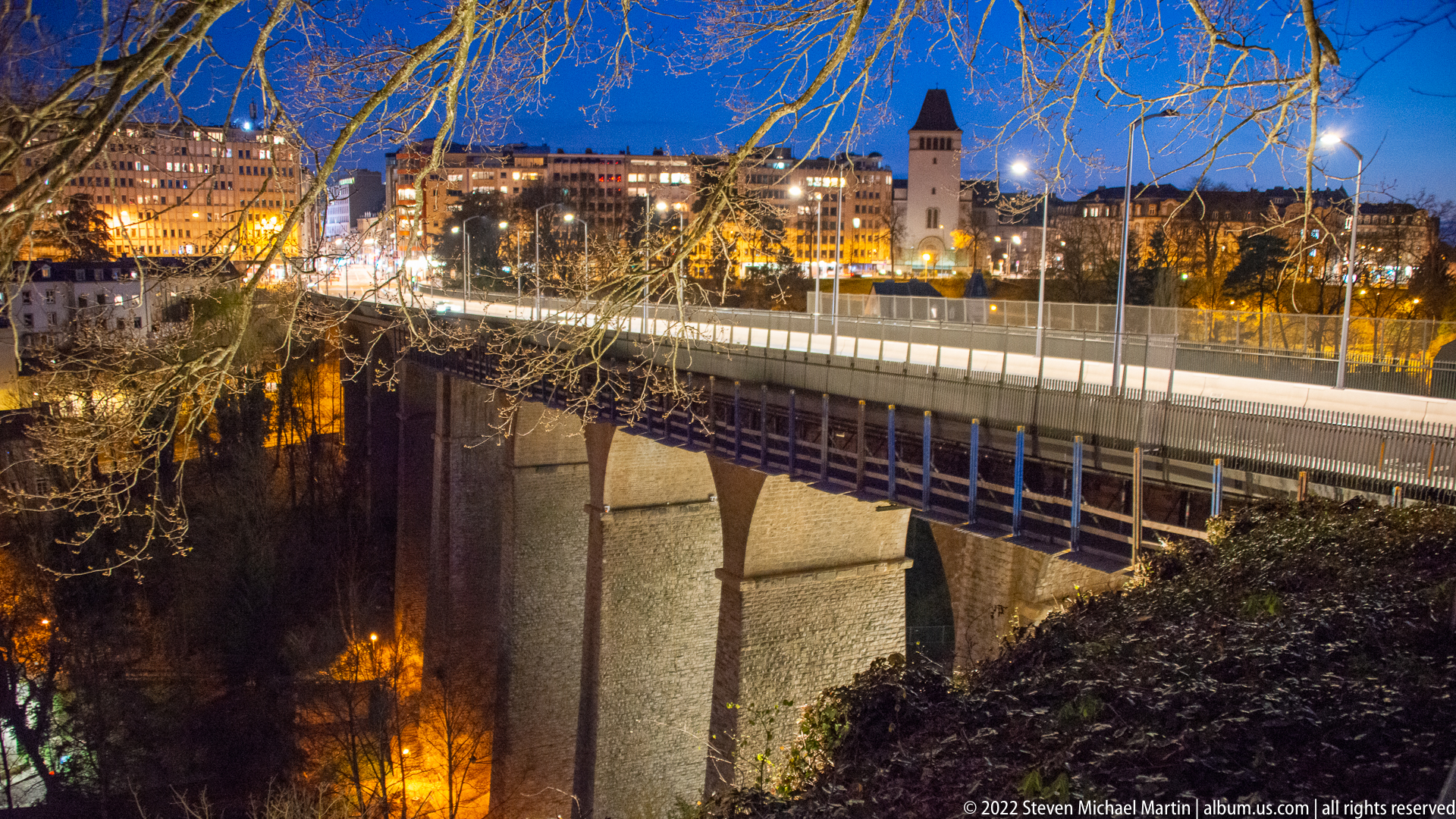
A modern bridge carries a roadway across Luxembourg's deep urban valley on tall concrete supports, with illuminated upper-city buildings and a square tower beyond. Bare branches frame the view, while lights on the valley floor reveal the dramatic drop beneath the crossing and the city's sharply layered topography.
Caption
A modern bridge carries a roadway across Luxembourg's deep urban valley on tall concrete supports, with illuminated upper-city buildings and a square tower beyond. Bare branches frame the view, while lights on the valley floor reveal the dramatic drop beneath the crossing and the city's sharply layered topography.

A large historic building glows against the evening sky, dominated by a tall square tower capped with a steep pointed roof and small corner turrets. Rows of dormers and steep rooflines extend across the adjoining wings, while warm floodlighting emphasizes the complex's vertical silhouette above the dark foreground trees.
Caption
A large historic building glows against the evening sky, dominated by a tall square tower capped with a steep pointed roof and small corner turrets. Rows of dormers and steep rooflines extend across the adjoining wings, while warm floodlighting emphasizes the complex's vertical silhouette above the dark foreground trees.
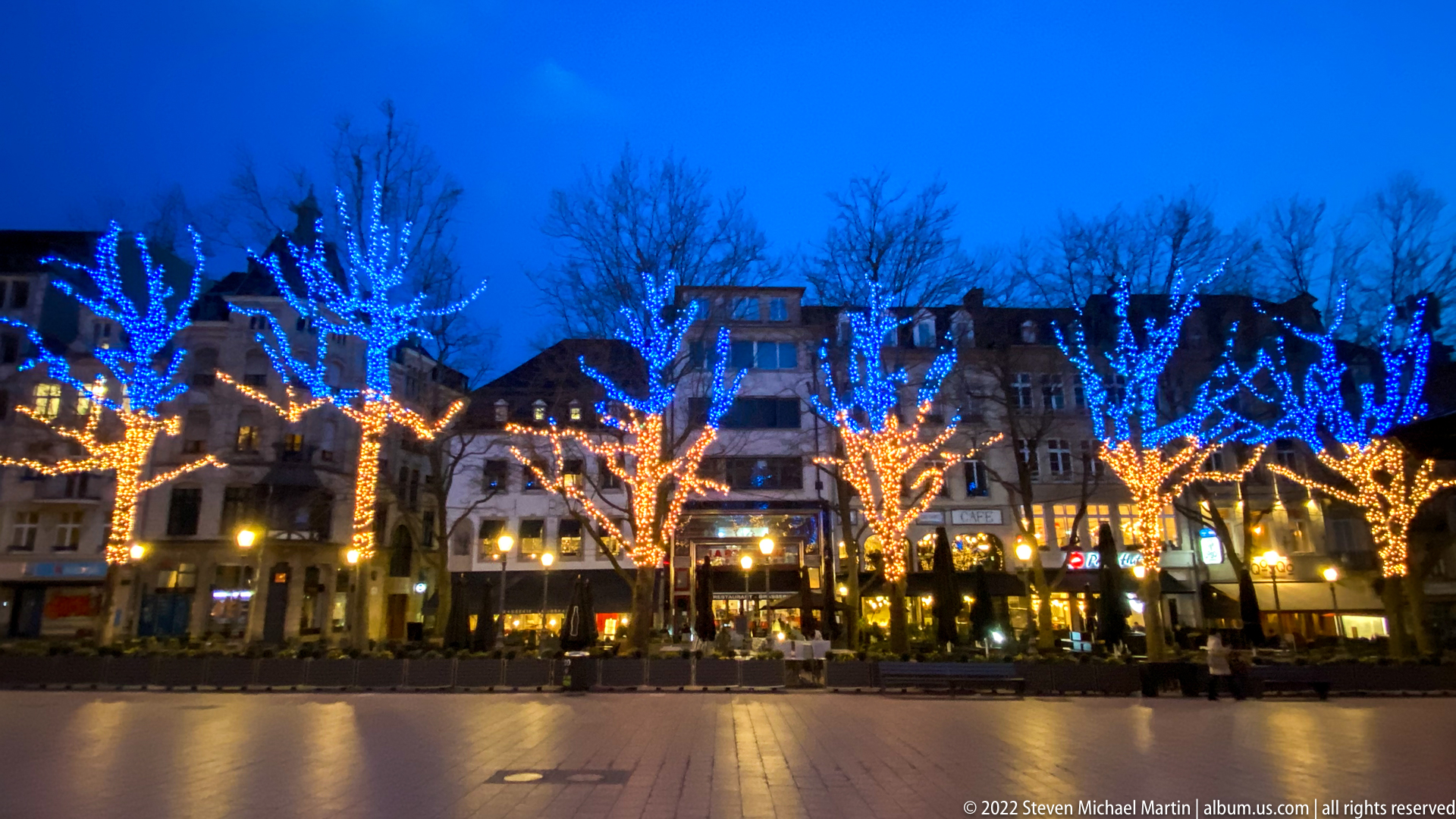
Leafless trees wrapped in alternating blue and warm-white lights line the edge of a broad paved square at night. Restaurant terraces and historic façades sit behind the glowing trunks, while the open foreground turns the illuminated trees into the principal spatial rhythm of the plaza.
Caption
Leafless trees wrapped in alternating blue and warm-white lights line the edge of a broad paved square at night. Restaurant terraces and historic façades sit behind the glowing trunks, while the open foreground turns the illuminated trees into the principal spatial rhythm of the plaza.
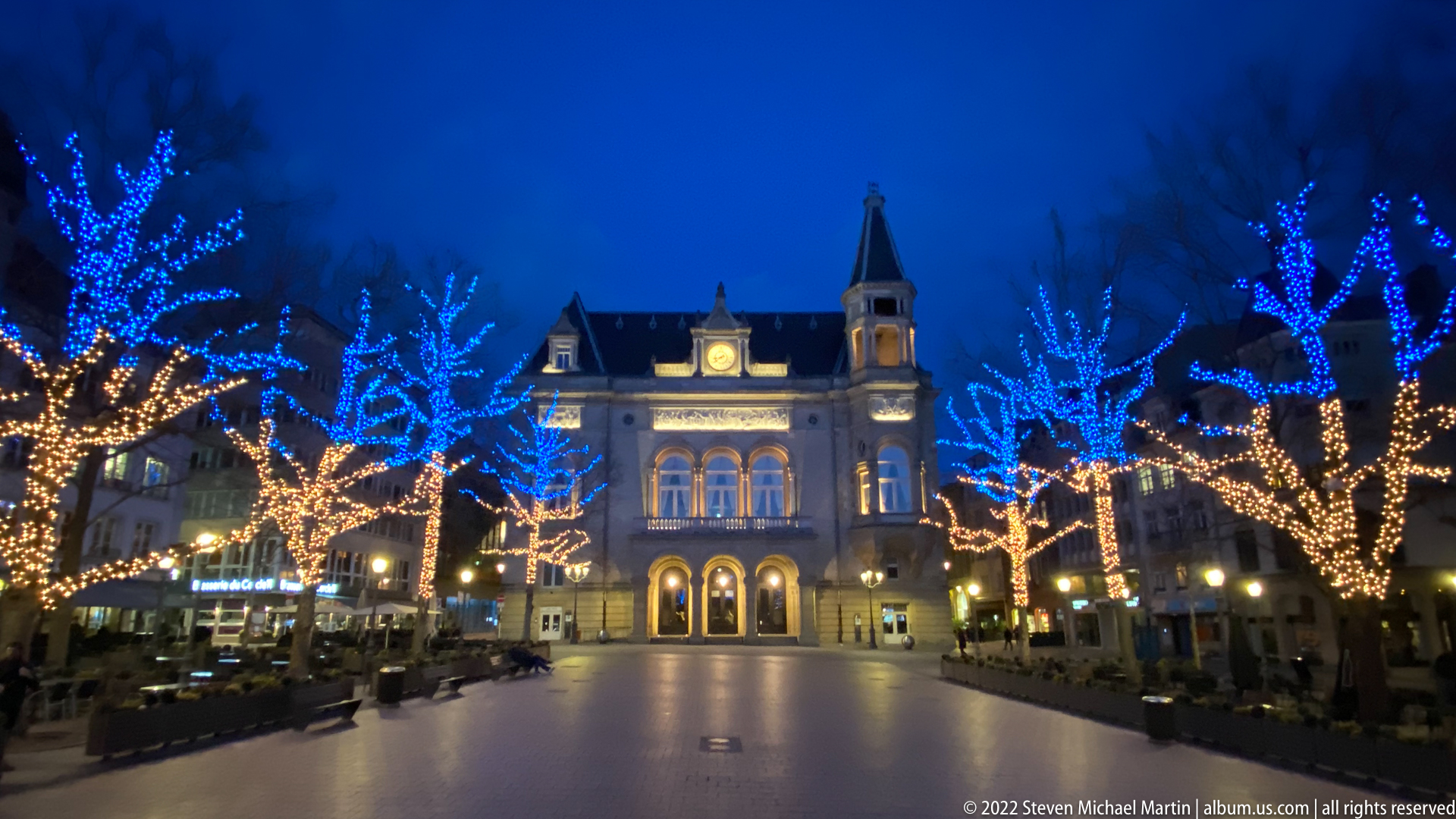
An ornate civic building closes the far end of a broad square, its central arched entrance, sculptural upper façade, and small tower illuminated against the deep blue night sky. Trees wrapped in blue and warm-white lights frame the building symmetrically, creating a ceremonial nighttime composition across the open plaza.
Caption
An ornate civic building closes the far end of a broad square, its central arched entrance, sculptural upper façade, and small tower illuminated against the deep blue night sky. Trees wrapped in blue and warm-white lights frame the building symmetrically, creating a ceremonial nighttime composition across the open plaza.
⭐ Highlights
- Old Quarters & Fortifications: A UNESCO-listed historic center built around a dramatic fortified landscape.
- Bock Casemates: Underground tunnels carved into rock as part of the city’s defenses.
- “Gibraltar of the North”: One of Europe’s most heavily fortified cities for centuries.
- Cliffside Setting: The city is built on rocky promontories above deep river valleys.
- Grand Ducal Palace: The official residence of Luxembourg’s Grand Duke.
- Chemin de la Corniche: A scenic walkway offering panoramic views over the lower city.
🏰 Luxembourg City Field Guide
Major features observed during this visit:
Luxembourg City is one of Europe’s most historically significant fortified cities, built on a rocky plateau above the Alzette and Pétrusse river valleys. Originating as a small fortress in the 10th century, it developed into a major defensive stronghold over centuries as it passed between European powers. Today, the city preserves a remarkable combination of fortifications, historic quarters, and dramatic natural topography.
🏛️ Signature Landmarks
- Bock Casemates – A network of tunnels and defensive structures carved into the rock.
- Grand Ducal Palace – The official residence of the Grand Duke in the historic center.
- Notre-Dame Cathedral – A major religious landmark combining Gothic and later styles.
- Chemin de la Corniche – A scenic promenade along the city’s historic ramparts.
- Adolphe Bridge – A major architectural landmark spanning the valley.
🧠 Historical Significance
- Fortress Origins – Began as a fortified site in the 10th century.
- Strategic Location – Controlled a key position between major European powers.
- Multi-Empire Influence – Expanded and reinforced by Burgundian, Habsburg, French, and Prussian rulers.
- Fortress Demolition – Much of the fortifications were dismantled in 1867, marking a turning point in the city’s history.
🌄 Landscape & Setting
- Rocky Plateau – The city is built on elevated terrain with natural defensive advantages.
- River Valleys – Deep gorges formed by the Alzette and Pétrusse rivers surround the city.
- Layered City Levels – Upper and lower towns create dramatic vertical perspectives.
- Historic Integration – Fortifications and natural landscape are closely intertwined.