Bern – Switzerland
Bern, the capital of Switzerland, lies on a high peninsula formed by a sweeping bend of the Aare River in the central Swiss Plateau. Founded in the 12th century, the city developed into an important political and commercial center within the Swiss Confederation.
The historic Old Town of Bern is one of the most beautifully preserved medieval city centers in Europe and is designated as a UNESCO World Heritage Site. Its narrow streets are lined with sandstone buildings, arcaded walkways, and historic fountains that date back centuries.
Dominating the skyline is the Bern Cathedral (Berner Münster), whose tall Gothic tower rises above the city and offers panoramic views of the surrounding countryside and distant Alps.


A long Bern Old City street leads directly toward the illuminated Zytglogge, its clock face glowing beneath the pointed roof and spire. Arcaded façades, pedestrians, bicycles, parked vehicles, and overhead transit wires frame the deep perspective, showing how the medieval tower continues to anchor the city’s active modern street network after dark.
Caption
A long Bern Old City street leads directly toward the illuminated Zytglogge, its clock face glowing beneath the pointed roof and spire. Arcaded façades, pedestrians, bicycles, parked vehicles, and overhead transit wires frame the deep perspective, showing how the medieval tower continues to anchor the city’s active modern street network after dark.

The Aare flows past a row of historic riverfront buildings while Bern Minster rises on the ridge beyond. Autumn trees frame the left bank, and the layered roofs between river and cathedral show the dramatic elevation change separating the lower riverside quarters from the monumental Old City skyline.
Caption
The Aare flows past a row of historic riverfront buildings while Bern Minster rises on the ridge beyond. Autumn trees frame the left bank, and the layered roofs between river and cathedral show the dramatic elevation change separating the lower riverside quarters from the monumental Old City skyline.

The Aare curves through a tree-lined channel below Bern’s historic buildings, with autumn foliage and hillside residences creating a layered valley setting. Only part of the Old City skyline enters the frame, so the river and its enclosing landscape become the principal subject rather than the monuments above.
Caption
The Aare curves through a tree-lined channel below Bern’s historic buildings, with autumn foliage and hillside residences creating a layered valley setting. Only part of the Old City skyline enters the frame, so the river and its enclosing landscape become the principal subject rather than the monuments above.

Bern Minster’s tall Gothic tower rises prominently above the compact red-roofed Old City, with wooded hills and snow-covered alpine peaks extending across the background. The telephoto perspective brings landmark and landscape together, presenting the Minster as the dominant architectural feature of Bern’s skyline against the much larger scale of the Bernese Alps.
Caption
Bern Minster’s tall Gothic tower rises prominently above the compact red-roofed Old City, with wooded hills and snow-covered alpine peaks extending across the background. The telephoto perspective brings landmark and landscape together, presenting the Minster as the dominant architectural feature of Bern’s skyline against the much larger scale of the Bernese Alps.

An elevated autumn view looks across Bern’s tiled roofs and tree-lined neighborhoods toward a long bridge, distant church spire, wooded hills, and the snow-covered Bernese Alps. The layered composition makes the city’s dramatic setting especially clear, with dense urban fabric occupying the Aare valley between foreground slopes and the mountain horizon.
Caption
An elevated autumn view looks across Bern’s tiled roofs and tree-lined neighborhoods toward a long bridge, distant church spire, wooded hills, and the snow-covered Bernese Alps. The layered composition makes the city’s dramatic setting especially clear, with dense urban fabric occupying the Aare valley between foreground slopes and the mountain horizon.

The Gothic tower of Bern Minster rises in sharp isolation above a layered foreground of red-tiled Old City roofs. Seen from a distant elevated position, the stone tracery, pinnacles, and openwork upper stages dominate the skyline, making the church tower the clear vertical landmark of central Bern.
Caption
The Gothic tower of Bern Minster rises in sharp isolation above a layered foreground of red-tiled Old City roofs. Seen from a distant elevated position, the stone tracery, pinnacles, and openwork upper stages dominate the skyline, making the church tower the clear vertical landmark of central Bern.

A dense field of red-tiled roofs fills the foreground while the soaring tower of Bern Minster rises above the Old City. Additional church spires, autumn trees, and tightly packed historic buildings create a layered skyline that demonstrates the vertical landmarks and compact roofscape characteristic of Bern’s medieval center.
Caption
A dense field of red-tiled roofs fills the foreground while the soaring tower of Bern Minster rises above the Old City. Additional church spires, autumn trees, and tightly packed historic buildings create a layered skyline that demonstrates the vertical landmarks and compact roofscape characteristic of Bern’s medieval center.

A broad elevated cityscape layers red-tiled roofs, church towers, and autumn trees beneath the dominant Gothic tower of Bern Minster. The lower neighborhoods step toward the Aare valley, while the clustered roofs and varied spires show the dense, irregular texture of Bern’s historic center from across the river.
Caption
A broad elevated cityscape layers red-tiled roofs, church towers, and autumn trees beneath the dominant Gothic tower of Bern Minster. The lower neighborhoods step toward the Aare valley, while the clustered roofs and varied spires show the dense, irregular texture of Bern’s historic center from across the river.
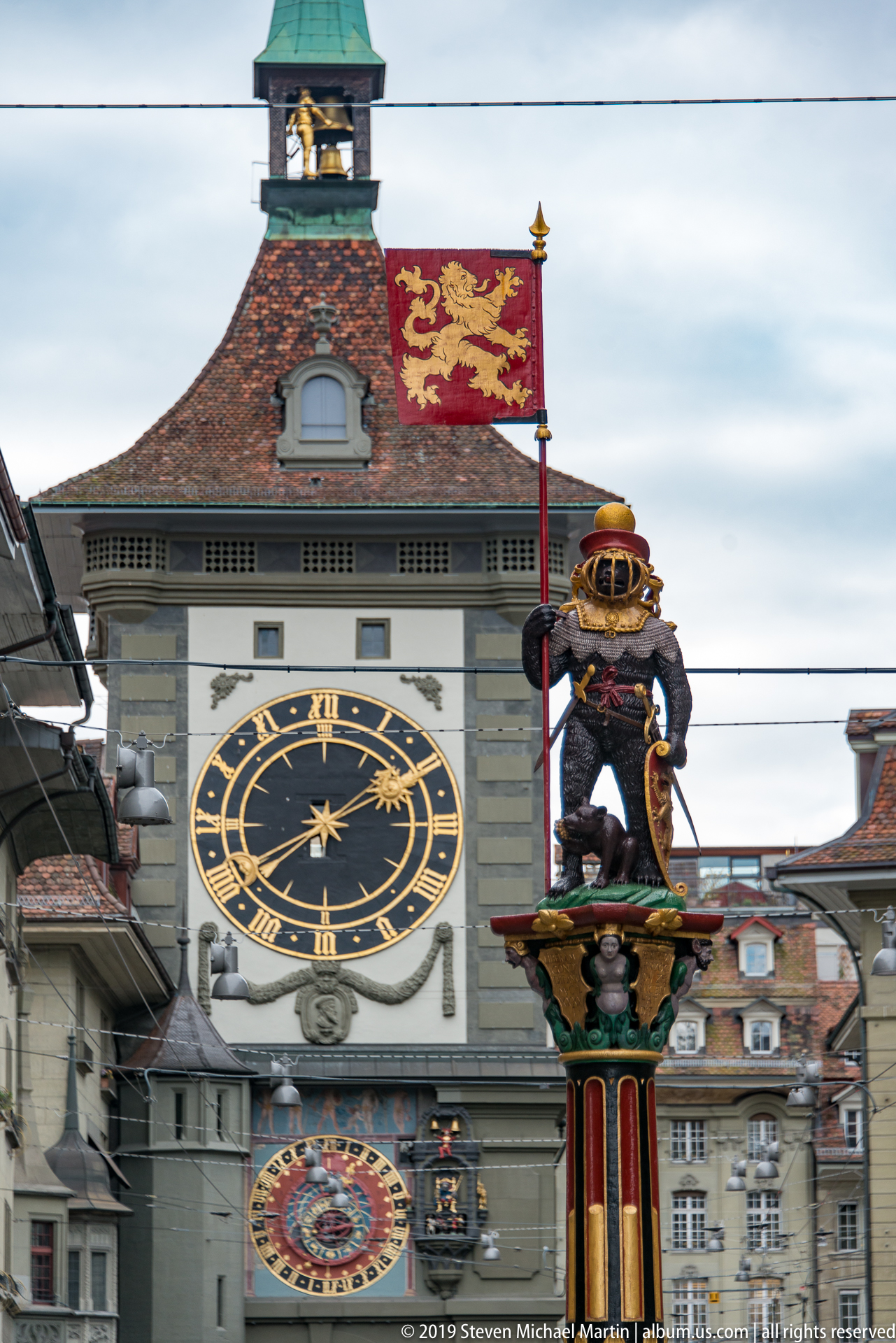
The Zytglogge fills the background while the armored bear of the Zähringerbrunnen rises prominently at right. The tower’s large clock face and lower astronomical dial are both visible, allowing the fountain and clock to be read together as layered elements of Bern’s historic streetscape rather than as isolated monuments.
Caption
The Zytglogge fills the background while the armored bear of the Zähringerbrunnen rises prominently at right. The tower’s large clock face and lower astronomical dial are both visible, allowing the fountain and clock to be read together as layered elements of Bern’s historic streetscape rather than as isolated monuments.

A large masonry bridge crosses the Aare on broad arches, linking the historic riverbank with the hillside beyond. A slender green church spire and clustered roofs sit behind the bridge, while autumn trees frame the scene. The elevated viewpoint emphasizes the bridge’s engineering scale within Bern’s steep river topography.
Caption
A large masonry bridge crosses the Aare on broad arches, linking the historic riverbank with the hillside beyond. A slender green church spire and clustered roofs sit behind the bridge, while autumn trees frame the scene. The elevated viewpoint emphasizes the bridge’s engineering scale within Bern’s steep river topography.

A slender church tower with pale stone upper stages and a dark green spire rises above a dense foreground of weathered red-tiled roofs. The telephoto framing compresses the Old City skyline, isolating the church tower as a vertical accent among chimneys and roof ridges.
Caption
A slender church tower with pale stone upper stages and a dark green spire rises above a dense foreground of weathered red-tiled roofs. The telephoto framing compresses the Old City skyline, isolating the church tower as a vertical accent among chimneys and roof ridges.

The green dome of Switzerland’s Federal Palace rises above a layered group of formal civic buildings and steep red roofs. Smaller copper domes and flagpoles punctuate the skyline, while autumn trees fill the lower edge. The telephoto view compresses Bern’s federal district into a dense composition of governmental and historic architecture.
Caption
The green dome of Switzerland’s Federal Palace rises above a layered group of formal civic buildings and steep red roofs. Smaller copper domes and flagpoles punctuate the skyline, while autumn trees fill the lower edge. The telephoto view compresses Bern’s federal district into a dense composition of governmental and historic architecture.

An armored bear in polished plate armor stands atop Bern’s Zähringerbrunnen, gripping a banner with the city’s black bear emblem. The richly painted fountain figure combines heraldry and civic identity, using the bear—the enduring symbol of Bern—as both a martial guardian and a visual marker of the historic center’s Renaissance fountain tradition.
Caption
An armored bear in polished plate armor stands atop Bern’s Zähringerbrunnen, gripping a banner with the city’s black bear emblem. The richly painted fountain figure combines heraldry and civic identity, using the bear—the enduring symbol of Bern—as both a martial guardian and a visual marker of the historic center’s Renaissance fountain tradition.
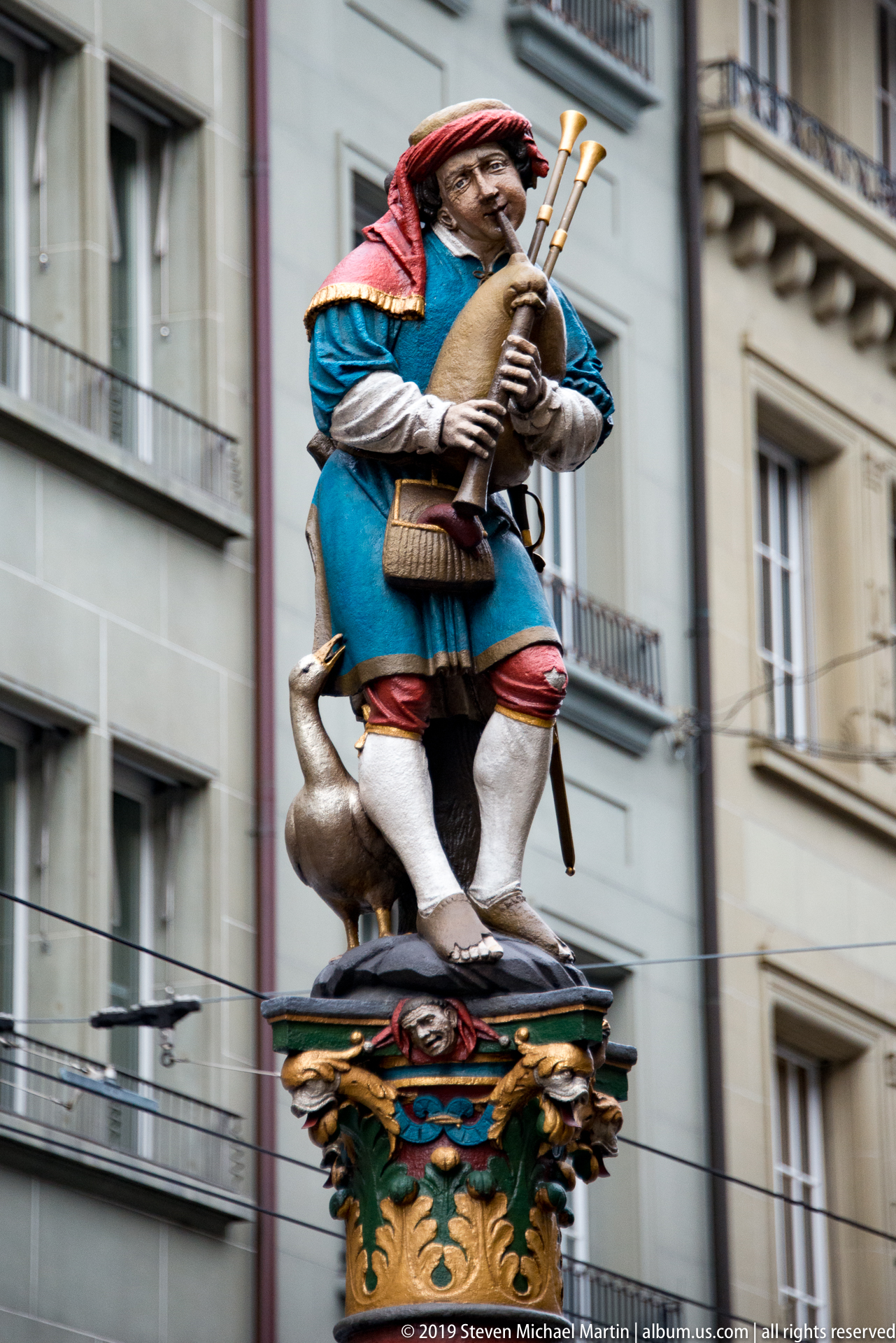
A brightly painted bagpiper stands atop Bern’s Pfeiferbrunnen, dressed in a blue tunic, red cap, white hose, and sword belt. A goose-like bird appears at his side above the richly colored capital. The lively figure belongs to the city’s celebrated series of historic street fountains, where sculptural characters animate the medieval street grid.
Caption
A brightly painted bagpiper stands atop Bern’s Pfeiferbrunnen, dressed in a blue tunic, red cap, white hose, and sword belt. A goose-like bird appears at his side above the richly colored capital. The lively figure belongs to the city’s celebrated series of historic street fountains, where sculptural characters animate the medieval street grid.

A gilded heraldic cartouche displaying Bern’s black bear on a red-and-gold diagonal field crowns a classical pediment beneath a tiled roof. The elaborate frame, crown, and surrounding relief ornament turn the city’s coat of arms into a prominent civic emblem, emphasizing the heraldic identity repeated throughout Bern’s historic architecture.
Caption
A gilded heraldic cartouche displaying Bern’s black bear on a red-and-gold diagonal field crowns a classical pediment beneath a tiled roof. The elaborate frame, crown, and surrounding relief ornament turn the city’s coat of arms into a prominent civic emblem, emphasizing the heraldic identity repeated throughout Bern’s historic architecture.

A tall, plain masonry tower rises behind a dense web of trolley wires, creating a layered view of Bern’s historic fabric and modern transit infrastructure. Narrow openings, a projecting upper stage, and a steep roofline give the tower a defensive or gate-like character, while the overhead wires emphasize its continued presence within an active city street.
Caption
A tall, plain masonry tower rises behind a dense web of trolley wires, creating a layered view of Bern’s historic fabric and modern transit infrastructure. Narrow openings, a projecting upper stage, and a steep roofline give the tower a defensive or gate-like character, while the overhead wires emphasize its continued presence within an active city street.

An upward view isolates an ornate wrought-iron balcony on a historic Bern façade. Gilded scrollwork runs across the railing, while carved stone surrounds the windows and a projecting sculptural mask anchors the composition below. The tight perspective highlights the decorative craftsmanship that distinguishes many patrician and civic buildings in the Old City.
Caption
An upward view isolates an ornate wrought-iron balcony on a historic Bern façade. Gilded scrollwork runs across the railing, while carved stone surrounds the windows and a projecting sculptural mask anchors the composition below. The tight perspective highlights the decorative craftsmanship that distinguishes many patrician and civic buildings in the Old City.

The copper-clad dome of Switzerland’s Federal Palace rises above the pediment inscribed “Curia Confoederationis.” Allegorical sculpture and winged figures frame the roofline, while the green-patinated dome and lantern create one of Bern’s most recognizable civic silhouettes. The composition focuses on the ceremonial upper architecture rather than the full parliamentary complex.
Caption
The copper-clad dome of Switzerland’s Federal Palace rises above the pediment inscribed “Curia Confoederationis.” Allegorical sculpture and winged figures frame the roofline, while the green-patinated dome and lantern create one of Bern’s most recognizable civic silhouettes. The composition focuses on the ceremonial upper architecture rather than the full parliamentary complex.

The formal façade of the Schweizerische Nationalbank fills the frame, its central arched gable and orderly rows of windows creating a restrained monumental composition. The bank’s name is legible across the upper story, while the symmetrical massing and stone detailing reflect the institutional architecture surrounding Bern’s federal district.
Caption
The formal façade of the Schweizerische Nationalbank fills the frame, its central arched gable and orderly rows of windows creating a restrained monumental composition. The bank’s name is legible across the upper story, while the symmetrical massing and stone detailing reflect the institutional architecture surrounding Bern’s federal district.

A storefront display stages a miniature rustic house around the trunk of a sculpted tree, with small figures, pumpkins, greenery, and artificial snow arranged across the foreground. The handcrafted scene blends autumn and winter motifs, offering a close view of decorative retail culture within Bern’s historic shopping streets.
Caption
A storefront display stages a miniature rustic house around the trunk of a sculpted tree, with small figures, pumpkins, greenery, and artificial snow arranged across the foreground. The handcrafted scene blends autumn and winter motifs, offering a close view of decorative retail culture within Bern’s historic shopping streets.

A large historic church occupies a street corner, with pointed arches, buttress-like wall divisions, and a tall tower capped by a steep spire. The angled view emphasizes the building’s verticality against a dramatic sky while pedestrians and vehicles establish its scale within the surrounding Bern streetscape.
Caption
A large historic church occupies a street corner, with pointed arches, buttress-like wall divisions, and a tall tower capped by a steep spire. The angled view emphasizes the building’s verticality against a dramatic sky while pedestrians and vehicles establish its scale within the surrounding Bern streetscape.

An elevated autumn panorama looks across a sweeping bend of the Aare toward Bern’s dense red-roofed Old City. A high stone bridge spans the river at right, while church towers punctuate the skyline beyond the riverfront buildings. The view clearly shows how the historic center occupies the river-defined peninsula that shaped Bern’s urban form.
Caption
An elevated autumn panorama looks across a sweeping bend of the Aare toward Bern’s dense red-roofed Old City. A high stone bridge spans the river at right, while church towers punctuate the skyline beyond the riverfront buildings. The view clearly shows how the historic center occupies the river-defined peninsula that shaped Bern’s urban form.

The Aare runs through a deeply wooded corridor below Bern, its green water bordered by autumn foliage, hillside houses, and a narrow riverside lawn. Seen from above, the composition shifts attention away from monumental architecture and toward the natural topography that encloses the historic city.
Caption
The Aare runs through a deeply wooded corridor below Bern, its green water bordered by autumn foliage, hillside houses, and a narrow riverside lawn. Seen from above, the composition shifts attention away from monumental architecture and toward the natural topography that encloses the historic city.

An elevated view follows the Aare through dense autumn vegetation toward Bern’s historic rooftops and a slender church spire. Houses climb the opposite hillside while the river curves through the lower center, linking the natural river valley with the compact urban skyline beyond.
Caption
An elevated view follows the Aare through dense autumn vegetation toward Bern’s historic rooftops and a slender church spire. Houses climb the opposite hillside while the river curves through the lower center, linking the natural river valley with the compact urban skyline beyond.

From an elevated viewpoint, Bern’s urban edge spreads beyond a landscaped garden with ponds, lawns, and autumn trees. Residential and institutional buildings lead toward low hills on the horizon, while roads and transit infrastructure trace the left side of the scene. The view provides a broader geographic context beyond the tight medieval core.
Caption
From an elevated viewpoint, Bern’s urban edge spreads beyond a landscaped garden with ponds, lawns, and autumn trees. Residential and institutional buildings lead toward low hills on the horizon, while roads and transit infrastructure trace the left side of the scene. The view provides a broader geographic context beyond the tight medieval core.

A roadside welcome sign announces “BERN” beneath multilingual greetings and a stylized skyline, with the line “Bern – UNESCO Welterbe” across the bottom. Framed by dense autumn foliage, the sign explicitly presents the city’s heritage status as part of the arrival experience.
Caption
A roadside welcome sign announces “BERN” beneath multilingual greetings and a stylized skyline, with the line “Bern – UNESCO Welterbe” across the bottom. Framed by dense autumn foliage, the sign explicitly presents the city’s heritage status as part of the arrival experience.

Bern’s historic rooftops descend toward a curve of the Aare at right, while the tower of Bern Minster anchors the skyline in the distance. Autumn trees soften the riverbank and separate the dense medieval fabric from the water, making the peninsula setting especially legible from this elevated viewpoint.
Caption
Bern’s historic rooftops descend toward a curve of the Aare at right, while the tower of Bern Minster anchors the skyline in the distance. Autumn trees soften the riverbank and separate the dense medieval fabric from the water, making the peninsula setting especially legible from this elevated viewpoint.

A sweeping autumn view looks across the Aare toward Bern’s historic peninsula, with dense red roofs, church towers, and a monumental stone bridge spanning the river at right. The broad composition emphasizes the relationship between the Old City, steep riverbanks, and the transportation routes that cross the Aare gorge.
Caption
A sweeping autumn view looks across the Aare toward Bern’s historic peninsula, with dense red roofs, church towers, and a monumental stone bridge spanning the river at right. The broad composition emphasizes the relationship between the Old City, steep riverbanks, and the transportation routes that cross the Aare gorge.
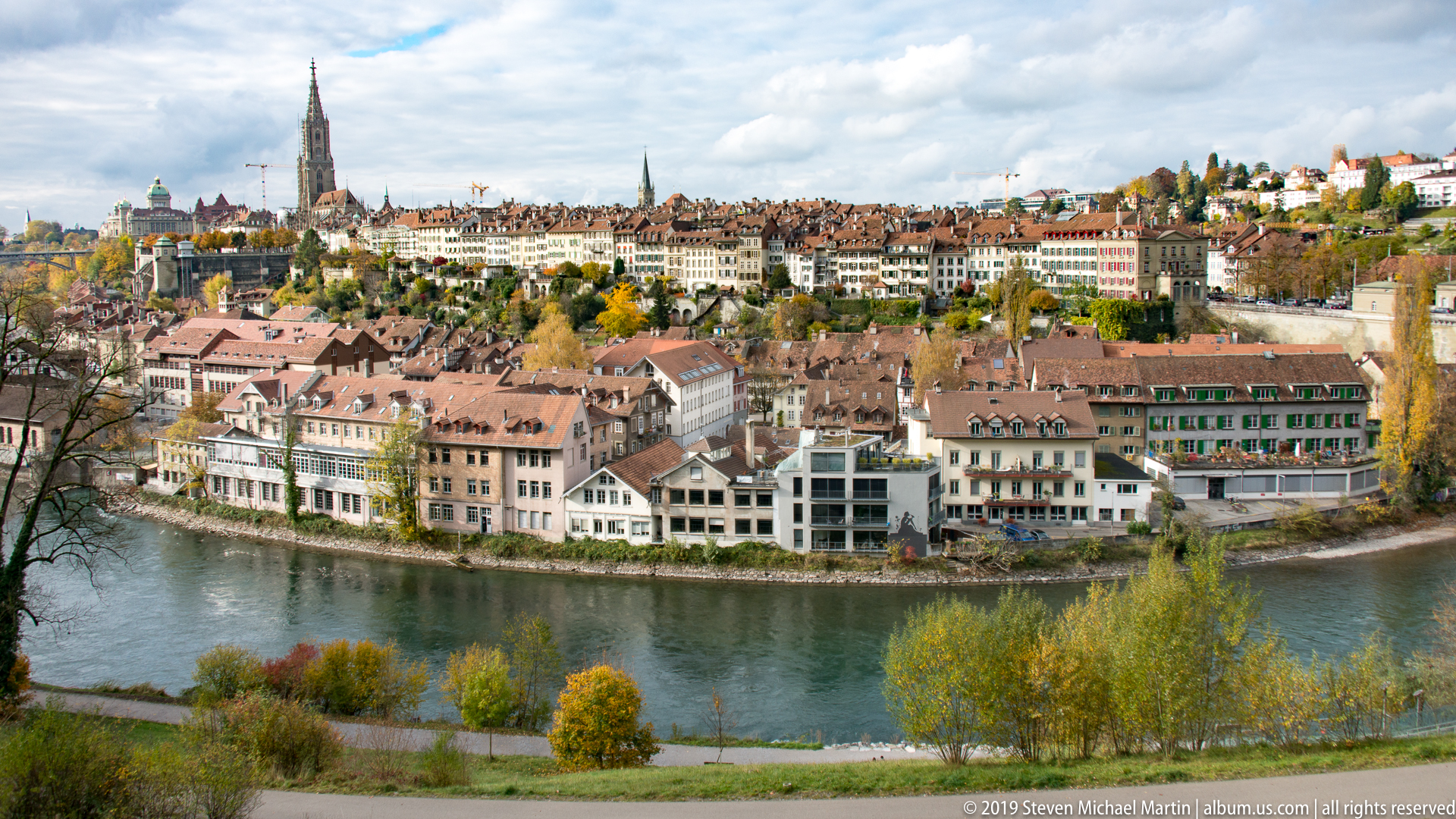
Historic buildings line the inner curve of the Aare, their pale façades and red-tiled roofs forming a continuous urban edge above the water. The distant hillside rises behind them with more of Bern’s dense city fabric, while autumn vegetation traces the riverbank and softens the boundary between architecture and landscape.
Caption
Historic buildings line the inner curve of the Aare, their pale façades and red-tiled roofs forming a continuous urban edge above the water. The distant hillside rises behind them with more of Bern’s dense city fabric, while autumn vegetation traces the riverbank and softens the boundary between architecture and landscape.

A low stone bridge with multiple arches crosses the Aare beneath Bern’s steeply layered historic quarter. A green-spired church rises at left, while red-roofed houses crowd the riverbank and hillside beyond. The view captures the close relationship between medieval crossing points, lower riverside neighborhoods, and the elevated Old City.
Caption
A low stone bridge with multiple arches crosses the Aare beneath Bern’s steeply layered historic quarter. A green-spired church rises at left, while red-roofed houses crowd the riverbank and hillside beyond. The view captures the close relationship between medieval crossing points, lower riverside neighborhoods, and the elevated Old City.

A dark sculptural bear appears to balance with forelegs extended above Bern’s overhead transit wires. Seen against an overcast sky, the playful figure transforms the city’s familiar bear emblem into an unexpected piece of public ornament, visually suspended amid the practical infrastructure of the street.
Caption
A dark sculptural bear appears to balance with forelegs extended above Bern’s overhead transit wires. Seen against an overcast sky, the playful figure transforms the city’s familiar bear emblem into an unexpected piece of public ornament, visually suspended amid the practical infrastructure of the street.

A pale multi-story residential building stands behind an informal garden at the edge of Bern’s historic urban landscape. Blue-gray trim outlines the windows, shallow dormers punctuate the tiled roof, and balconies add depth to the façade. The view documents the city’s quieter domestic architecture away from monumental landmarks.
Caption
A pale multi-story residential building stands behind an informal garden at the edge of Bern’s historic urban landscape. Blue-gray trim outlines the windows, shallow dormers punctuate the tiled roof, and balconies add depth to the façade. The view documents the city’s quieter domestic architecture away from monumental landmarks.

A large black-and-gold clock face is mounted on a square historic tower capped by a broad green-patinated roof and smaller corner turrets. A tall louvered Gothic opening rises above the dial. The tight crop isolates the tower’s timekeeping and roof architecture from the surrounding streetscape.
Caption
A large black-and-gold clock face is mounted on a square historic tower capped by a broad green-patinated roof and smaller corner turrets. A tall louvered Gothic opening rises above the dial. The tight crop isolates the tower’s timekeeping and roof architecture from the surrounding streetscape.

A dense row of historic houses follows the Aare’s edge, with steep red-tiled roofs, dormers, shutters, and varied façades stepping along the water. The elevated view brings the roofscape into the foreground while hillside residences rise behind, illustrating the compact building pattern of Bern’s lower riverfront quarters.
Caption
A dense row of historic houses follows the Aare’s edge, with steep red-tiled roofs, dormers, shutters, and varied façades stepping along the water. The elevated view brings the roofscape into the foreground while hillside residences rise behind, illustrating the compact building pattern of Bern’s lower riverfront quarters.

A steep, green-patinated roof rises between two slender spirelets, its surface patterned with small shingles and punctuated by red-orange dormer panels carrying dark ornamental motifs. The close crop isolates Bern’s exuberant roofline craftsmanship against an overcast sky, emphasizing the contrast between weathered copper, painted woodwork, and the sharply tapered silhouettes above the historic center.
Caption
A steep, green-patinated roof rises between two slender spirelets, its surface patterned with small shingles and punctuated by red-orange dormer panels carrying dark ornamental motifs. The close crop isolates Bern’s exuberant roofline craftsmanship against an overcast sky, emphasizing the contrast between weathered copper, painted woodwork, and the sharply tapered silhouettes above the historic center.

A long covered arcade recedes through a sequence of broad stone arches and shallow groin vaults, creating one of the characteristic pedestrian passages of Bern’s historic center. Repetition of columns, vault bays, barred windows, and ceiling lamps draws the eye toward distant figures, while the sheltered pavement illustrates how the city’s arcades integrate circulation directly into the building fronts.
Caption
A long covered arcade recedes through a sequence of broad stone arches and shallow groin vaults, creating one of the characteristic pedestrian passages of Bern’s historic center. Repetition of columns, vault bays, barred windows, and ceiling lamps draws the eye toward distant figures, while the sheltered pavement illustrates how the city’s arcades integrate circulation directly into the building fronts.

Rows of white-framed windows and dark green shutters organize this restrained residential facade in Bern’s historic center. Small wrought-iron guards and narrow flower ledges add texture to the pale masonry, while the regular stacking of openings across three stories conveys the disciplined rhythm of the city’s traditional street architecture. The close frontal view makes the relationship between shutters, windows, and masonry the principal subject.
Caption
Rows of white-framed windows and dark green shutters organize this restrained residential facade in Bern’s historic center. Small wrought-iron guards and narrow flower ledges add texture to the pale masonry, while the regular stacking of openings across three stories conveys the disciplined rhythm of the city’s traditional street architecture. The close frontal view makes the relationship between shutters, windows, and masonry the principal subject.

The crowned figure of Justice stands above Bern’s Gerechtigkeitsbrunnen, blindfolded and holding a sword and balance scales. Rich blue, gold, and flesh-toned paint enlivens the sculpture, while smaller figures beneath her feet form part of the fountain’s moral and civic program. Seen against the sky, the elevated figure becomes a vivid emblem within the Old Town’s network of Renaissance fountains.
Caption
The crowned figure of Justice stands above Bern’s Gerechtigkeitsbrunnen, blindfolded and holding a sword and balance scales. Rich blue, gold, and flesh-toned paint enlivens the sculpture, while smaller figures beneath her feet form part of the fountain’s moral and civic program. Seen against the sky, the elevated figure becomes a vivid emblem within the Old Town’s network of Renaissance fountains.

A narrow street descends between tightly packed historic houses, their tiled roofs, chimneys, shutters, and muted plaster facades stepping down the slope. Beyond the rooftops, a green hillside rises across the valley, connecting Bern’s dense medieval street fabric with its surrounding landscape. Parked cars and modern windows reveal the continued everyday use of this inherited urban form.
Caption
A narrow street descends between tightly packed historic houses, their tiled roofs, chimneys, shutters, and muted plaster facades stepping down the slope. Beyond the rooftops, a green hillside rises across the valley, connecting Bern’s dense medieval street fabric with its surrounding landscape. Parked cars and modern windows reveal the continued everyday use of this inherited urban form.

An elaborate wrought-iron bracket projects from a Bern facade, supporting a gilded hanging emblem dominated by a double-headed or spreading eagle motif. Scrollwork, foliage, and small gilt accents transform a practical street sign into decorative metalwork, a familiar visual layer in the Old Town where projecting signs animate the arcaded commercial streets. The low viewpoint silhouettes the ornament against a cloudy sky.
Caption
An elaborate wrought-iron bracket projects from a Bern facade, supporting a gilded hanging emblem dominated by a double-headed or spreading eagle motif. Scrollwork, foliage, and small gilt accents transform a practical street sign into decorative metalwork, a familiar visual layer in the Old Town where projecting signs animate the arcaded commercial streets. The low viewpoint silhouettes the ornament against a cloudy sky.

A resident leans from an open upper-story window framed by green louvered shutters and pale masonry. He rests his hands on a decorative iron window guard, turning an otherwise formal facade into a moment of lived urban observation. The portrait-like composition places everyday human presence within Bern’s historic architecture rather than treating the Old Town solely as a preserved monument.
Caption
A resident leans from an open upper-story window framed by green louvered shutters and pale masonry. He rests his hands on a decorative iron window guard, turning an otherwise formal facade into a moment of lived urban observation. The portrait-like composition places everyday human presence within Bern’s historic architecture rather than treating the Old Town solely as a preserved monument.

Three tall arched windows punctuate an ornate stone facade, each paired with a small wrought-iron balcony enriched by gilded details. Carved faces, foliage, and moldings frame the openings, giving the elevation a ceremonial quality distinct from Bern’s plainer residential fronts. The symmetrical crop highlights the layered relationship between masonry sculpture, fenestration, and decorative metalwork.
Caption
Three tall arched windows punctuate an ornate stone facade, each paired with a small wrought-iron balcony enriched by gilded details. Carved faces, foliage, and moldings frame the openings, giving the elevation a ceremonial quality distinct from Bern’s plainer residential fronts. The symmetrical crop highlights the layered relationship between masonry sculpture, fenestration, and decorative metalwork.

Water streams from a metal pipe projecting through a small grotesque mask fixed to the stone basin or shaft of a Bern fountain. The tight focus reveals green-blue oxidation on the bronze or copper-alloy fitting, contrasting with the pale, weathered stone around it. This utilitarian detail shows how sculptural ornament and water delivery are combined at street level in the city’s historic fountains.
Caption
Water streams from a metal pipe projecting through a small grotesque mask fixed to the stone basin or shaft of a Bern fountain. The tight focus reveals green-blue oxidation on the bronze or copper-alloy fitting, contrasting with the pale, weathered stone around it. This utilitarian detail shows how sculptural ornament and water delivery are combined at street level in the city’s historic fountains.

A close view beneath the principal Justice figure reveals the smaller carved figures clustered around the pedestal of the Gerechtigkeitsbrunnen. Painted costumes, weapons, and expressive faces are compressed into a dense sculptural group, while one arm of the suspended balance scale enters the frame at right. The detail exposes the fountain’s complex hierarchy more clearly than a full-length view.
Caption
A close view beneath the principal Justice figure reveals the smaller carved figures clustered around the pedestal of the Gerechtigkeitsbrunnen. Painted costumes, weapons, and expressive faces are compressed into a dense sculptural group, while one arm of the suspended balance scale enters the frame at right. The detail exposes the fountain’s complex hierarchy more clearly than a full-length view.

From street level, the blindfolded Justice figure rises above a richly colored pedestal, sword upright in one hand and scales suspended from the other. The oblique view sets the sculptural column against Bernese facades with striped awnings and balconies, showing how the Gerechtigkeitsbrunnen functions simultaneously as civic monument, water source, and vertical landmark within the street.
Caption
From street level, the blindfolded Justice figure rises above a richly colored pedestal, sword upright in one hand and scales suspended from the other. The oblique view sets the sculptural column against Bernese facades with striped awnings and balconies, showing how the Gerechtigkeitsbrunnen functions simultaneously as civic monument, water source, and vertical landmark within the street.

A quartered coat of arms is carved and painted within a richly scrolled stone surround. Its four fields display crossed implements, a wheel, and other occupational or heraldic devices in red, white, and gold, while a small crest rises above the shield. The close view emphasizes the emblem’s craftsmanship and iconographic complexity without forcing an uncertain guild attribution.
Caption
A quartered coat of arms is carved and painted within a richly scrolled stone surround. Its four fields display crossed implements, a wheel, and other occupational or heraldic devices in red, white, and gold, while a small crest rises above the shield. The close view emphasizes the emblem’s craftsmanship and iconographic complexity without forcing an uncertain guild attribution.

A large stone basin occupies the center of a Bern street, supporting a tall sculpted column crowned by a small figure. Dark relief ornament and a prominent oval cartouche decorate the shaft, while arcaded facades extend into the distance on both sides. The frontal view stresses the fountain’s role as a focal point in the long perspective of the Old Town street.
Caption
A large stone basin occupies the center of a Bern street, supporting a tall sculpted column crowned by a small figure. Dark relief ornament and a prominent oval cartouche decorate the shaft, while arcaded facades extend into the distance on both sides. The frontal view stresses the fountain’s role as a focal point in the long perspective of the Old Town street.

A row of small rainbow flags hangs across the entrance to a vaulted arcade or shopfront beneath blue lettering on the stone facade. The bright stripes stand out against gray masonry and the shadowed interior, documenting a contemporary layer of public expression within Bern’s historic streetscape. The framing concentrates on the threshold rather than the surrounding architecture.
Caption
A row of small rainbow flags hangs across the entrance to a vaulted arcade or shopfront beneath blue lettering on the stone facade. The bright stripes stand out against gray masonry and the shadowed interior, documenting a contemporary layer of public expression within Bern’s historic streetscape. The framing concentrates on the threshold rather than the surrounding architecture.

A painted shield-shaped plaque combines bold blue-and-white diagonal fields with a flowing black calligraphic monogram. Mounted directly to a stone wall, the sign brings heraldic form together with personalized lettering, a compact example of the visual symbols used to mark institutions, guilds, or properties in Bern’s historic center. The close crop preserves the graphic design without assigning an uncertain affiliation.
Caption
A painted shield-shaped plaque combines bold blue-and-white diagonal fields with a flowing black calligraphic monogram. Mounted directly to a stone wall, the sign brings heraldic form together with personalized lettering, a compact example of the visual symbols used to mark institutions, guilds, or properties in Bern’s historic center. The close crop preserves the graphic design without assigning an uncertain affiliation.

A sculpted helmet is set within curling acanthus-like scrollwork above a curved architectural opening. Deep undercutting creates strong shadows around the crest, visor, and foliated surround, turning a small facade element into a concentrated display of martial and decorative imagery. The pale stone relief stands out crisply against the horizontal masonry courses of the building.
Caption
A sculpted helmet is set within curling acanthus-like scrollwork above a curved architectural opening. Deep undercutting creates strong shadows around the crest, visor, and foliated surround, turning a small facade element into a concentrated display of martial and decorative imagery. The pale stone relief stands out crisply against the horizontal masonry courses of the building.

A gilded German inscription follows the curve of a broad stone arch beneath windows brightened by flower boxes. Small painted heraldic animals flank the entrance, linking text, emblem, and architecture in a facade likely associated with a Bern guild or historic civic establishment. The photograph centers on the lettering and decorative threshold while preserving the domestic scale of the windows above.
Caption
A gilded German inscription follows the curve of a broad stone arch beneath windows brightened by flower boxes. Small painted heraldic animals flank the entrance, linking text, emblem, and architecture in a facade likely associated with a Bern guild or historic civic establishment. The photograph centers on the lettering and decorative threshold while preserving the domestic scale of the windows above.

An elaborate armorial composition spreads across the facade between two windows, combining helmets, wing-like forms, carved scrolls, and paired motto shields. Above it, a large sculpted figure or mask projects from the central vertical axis. The dense relief demonstrates how heraldry could be integrated directly into Bern’s architecture, transforming a wall surface into a public statement of identity and status.
Caption
An elaborate armorial composition spreads across the facade between two windows, combining helmets, wing-like forms, carved scrolls, and paired motto shields. Above it, a large sculpted figure or mask projects from the central vertical axis. The dense relief demonstrates how heraldry could be integrated directly into Bern’s architecture, transforming a wall surface into a public statement of identity and status.

Bern’s Rathaus presents a broad stone facade centered on a ceremonial double staircase and pointed-arched entrance. A small clock sits above the projecting porch, while heraldic shields line the roof edge and sculptural details enrich the stair balustrades. The frontal composition makes the building’s civic symmetry and layered approach sequence especially legible, from street level to the elevated central doorway.
Caption
Bern’s Rathaus presents a broad stone facade centered on a ceremonial double staircase and pointed-arched entrance. A small clock sits above the projecting porch, while heraldic shields line the roof edge and sculptural details enrich the stair balustrades. The frontal composition makes the building’s civic symmetry and layered approach sequence especially legible, from street level to the elevated central doorway.

A broad-gabled historic building closes the view at a Bern street corner, its many shuttered windows facing a narrow roadway that descends into the Old Town. At left, part of the Rathaus stair structure and facade enters the frame, while a painted fountain figure appears farther down the street. The image situates individual monuments within the close-grained urban fabric around Bern’s civic center.
Caption
A broad-gabled historic building closes the view at a Bern street corner, its many shuttered windows facing a narrow roadway that descends into the Old Town. At left, part of the Rathaus stair structure and facade enters the frame, while a painted fountain figure appears farther down the street. The image situates individual monuments within the close-grained urban fabric around Bern’s civic center.

A seated musician plays a full-size accordion beneath one of Bern’s covered arcades. Framed by a dark doorway and stone wall, he leans into the instrument while a soft case or bag rests nearby, creating an intimate street-performance scene within the formal architecture of the Old Town. The composition records contemporary public life rather than a monument, showing the arcades as active social spaces.
Caption
A seated musician plays a full-size accordion beneath one of Bern’s covered arcades. Framed by a dark doorway and stone wall, he leans into the instrument while a soft case or bag rests nearby, creating an intimate street-performance scene within the formal architecture of the Old Town. The composition records contemporary public life rather than a monument, showing the arcades as active social spaces.

A brightly painted bearded male figure stands high above the street, dressed in a striped red-and-white costume with a black cap and holding long implements in both hands. The theatrical pose, robust modeling, and vivid polychromy mark it as one of Bern’s historic fountain sculptures. The upward angle isolates the figure against a pale stone facade, emphasizing costume and gesture over the fountain structure below.
Caption
A brightly painted bearded male figure stands high above the street, dressed in a striped red-and-white costume with a black cap and holding long implements in both hands. The theatrical pose, robust modeling, and vivid polychromy mark it as one of Bern’s historic fountain sculptures. The upward angle isolates the figure against a pale stone facade, emphasizing costume and gesture over the fountain structure below.

A vivid red polychrome figure stands on a fountain pedestal, its exaggerated face, gold jewelry, and animated gesture giving it a theatrical character. One hand holds a small object while the other extends outward, and a sword or long implement hangs at the figure’s side. The tight crop isolates the sculpture’s costume, expression, and gilded details from the surrounding Bern streetscape.
Caption
A vivid red polychrome figure stands on a fountain pedestal, its exaggerated face, gold jewelry, and animated gesture giving it a theatrical character. One hand holds a small object while the other extends outward, and a sword or long implement hangs at the figure’s side. The tight crop isolates the sculpture’s costume, expression, and gilded details from the surrounding Bern streetscape.
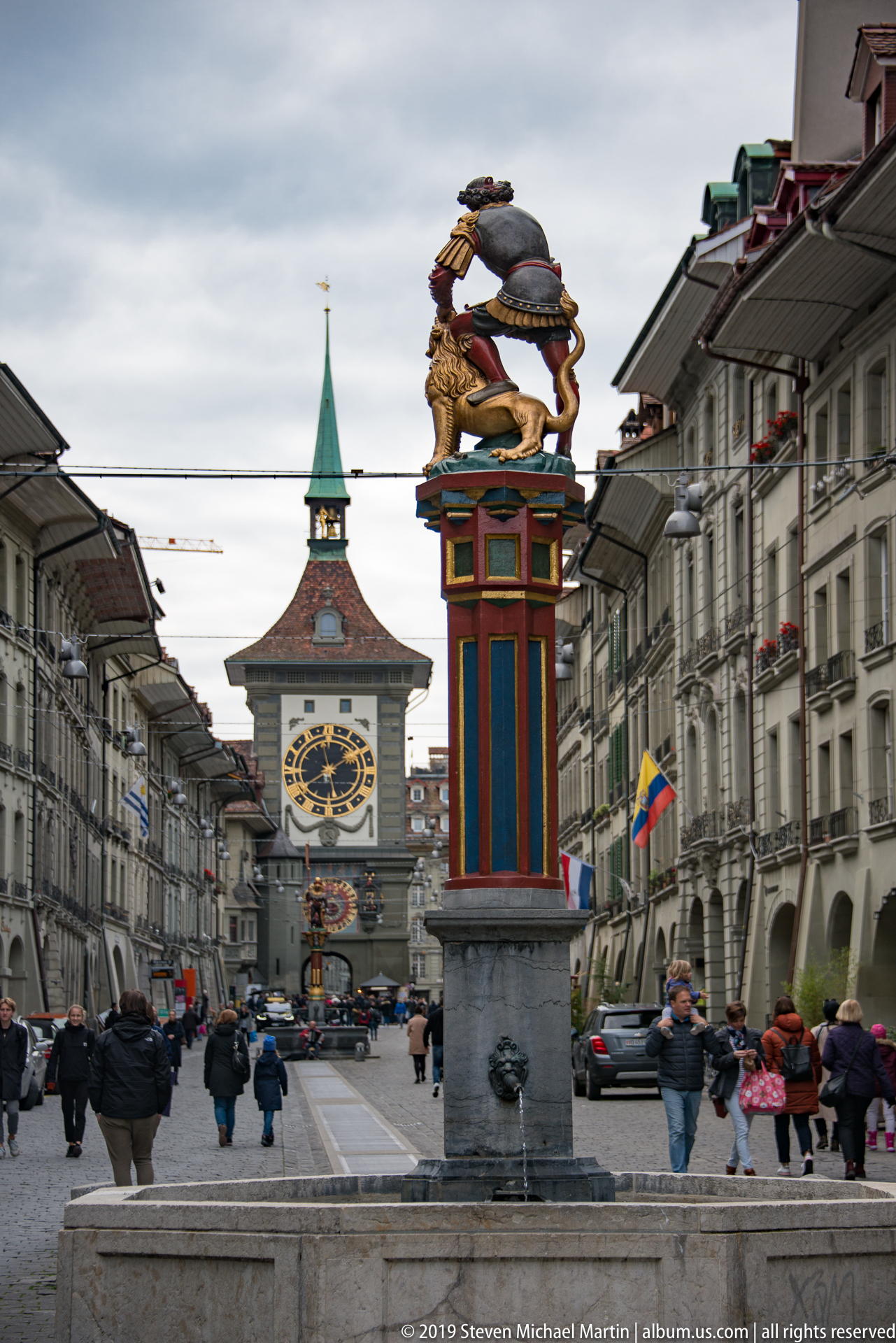
A tall painted fountain column anchors the foreground while the Zytglogge rises farther down the street, its clock face and green spire forming a second vertical landmark. The fountain’s sculptural figure is seen mostly in profile and from behind, while pedestrians gather around the basin. This layered view shows how Bern’s sequence of Renaissance fountains punctuates the long urban axis leading toward the clock tower.
Caption
A tall painted fountain column anchors the foreground while the Zytglogge rises farther down the street, its clock face and green spire forming a second vertical landmark. The fountain’s sculptural figure is seen mostly in profile and from behind, while pedestrians gather around the basin. This layered view shows how Bern’s sequence of Renaissance fountains punctuates the long urban axis leading toward the clock tower.

A close detail of a monumental fountain shaft reveals a carved face around the projecting water pipe, with darkened relief work and marble-like stone surfaces surrounding it. The shallow depth of field blurs Bern’s arcaded street behind, concentrating attention on the junction of sculpture and hydraulic function. Weathering and mineral staining give the ornament a tactile, timeworn character.
Caption
A close detail of a monumental fountain shaft reveals a carved face around the projecting water pipe, with darkened relief work and marble-like stone surfaces surrounding it. The shallow depth of field blurs Bern’s arcaded street behind, concentrating attention on the junction of sculpture and hydraulic function. Weathering and mineral staining give the ornament a tactile, timeworn character.
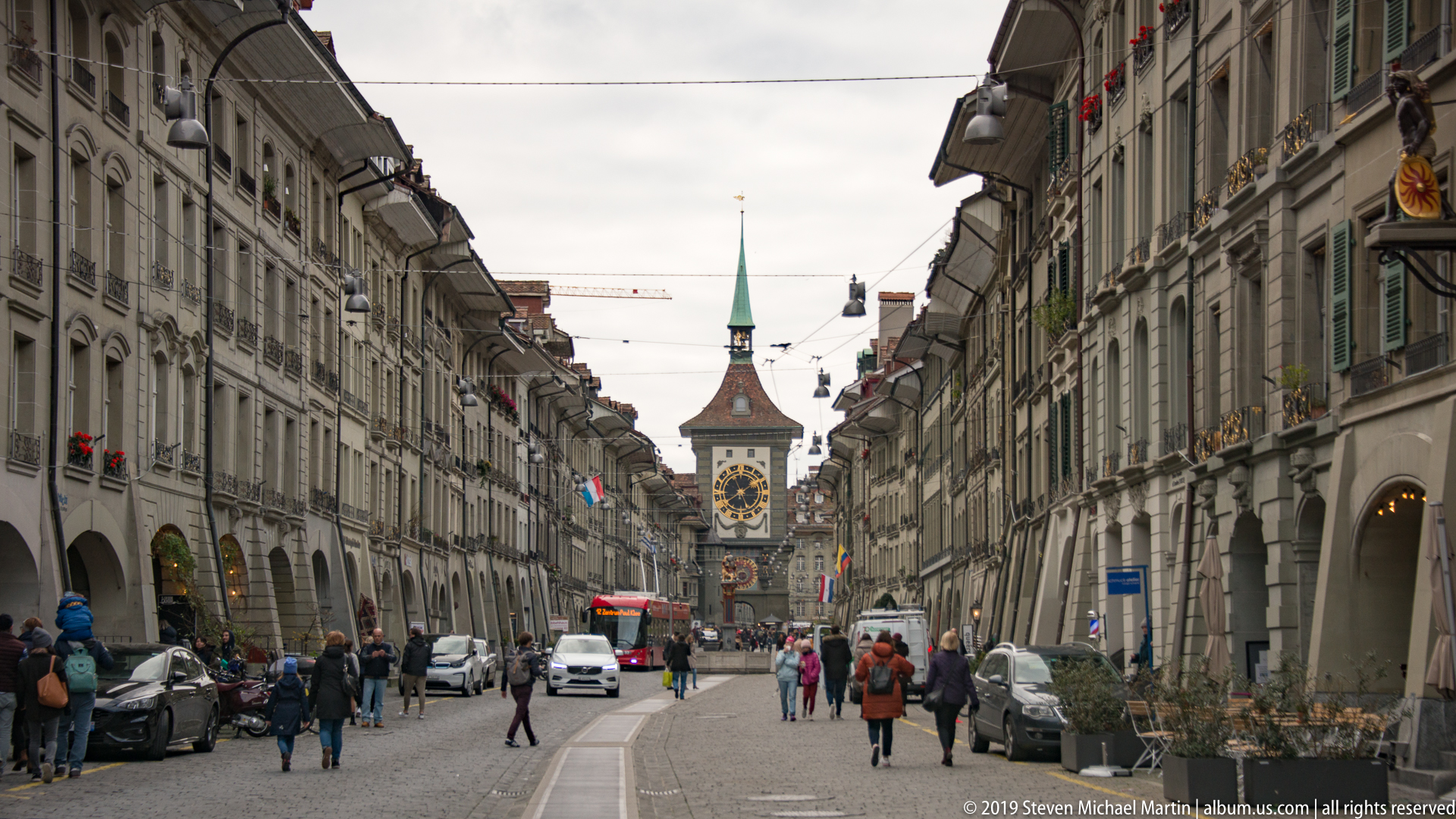
Bern’s long historic street axis leads directly toward the Zytglogge, whose clock face and green spire rise at the center of the view. Arcaded stone facades line both sides, while pedestrians, cars, overhead transit wires, and street activity fill the foreground. The composition captures the coexistence of medieval urban form and modern movement within the UNESCO-listed Old Town.
Caption
Bern’s long historic street axis leads directly toward the Zytglogge, whose clock face and green spire rise at the center of the view. Arcaded stone facades line both sides, while pedestrians, cars, overhead transit wires, and street activity fill the foreground. The composition captures the coexistence of medieval urban form and modern movement within the UNESCO-listed Old Town.

The Zytglogge dominates the end of a busy Bern street, its large astronomical clock face and green spire framed by continuous rows of arcaded historic buildings. A red city bus, cars, pedestrians, and overhead wires animate the foreground, making the medieval tower part of an active transport corridor rather than an isolated monument. The compressed perspective strengthens the tower’s visual command of the street.
Caption
The Zytglogge dominates the end of a busy Bern street, its large astronomical clock face and green spire framed by continuous rows of arcaded historic buildings. A red city bus, cars, pedestrians, and overhead wires animate the foreground, making the medieval tower part of an active transport corridor rather than an isolated monument. The compressed perspective strengthens the tower’s visual command of the street.

A painted standing figure rises on a narrow fountain column against a pale residential facade brightened by rows of red geraniums. The sculpture’s warm red and gold tones contrast with the restrained stone architecture, while the repeated flower boxes create a strong horizontal rhythm around it. The frontal composition shows how Bern’s historic fountains are embedded directly into inhabited streets rather than isolated in plazas.
Caption
A painted standing figure rises on a narrow fountain column against a pale residential facade brightened by rows of red geraniums. The sculpture’s warm red and gold tones contrast with the restrained stone architecture, while the repeated flower boxes create a strong horizontal rhythm around it. The frontal composition shows how Bern’s historic fountains are embedded directly into inhabited streets rather than isolated in plazas.

A dark-skinned male figure stands upright on a fountain pedestal, holding a long spear or staff horizontally while a brightly painted shield rests at his side. The sculpture is modeled with a bare torso, light drapery, and a feathered or crested headpiece. The photograph isolates a striking example of historic European exoticizing imagery within Bern’s urban sculpture and should be cataloged with care.
Caption
A dark-skinned male figure stands upright on a fountain pedestal, holding a long spear or staff horizontally while a brightly painted shield rests at his side. The sculpture is modeled with a bare torso, light drapery, and a feathered or crested headpiece. The photograph isolates a striking example of historic European exoticizing imagery within Bern’s urban sculpture and should be cataloged with care.

A polychromed fountain figure of Moses stands against the stone façades of Bern’s Old City, holding the tablets of the Ten Commandments. The sculpted prophet, with gilded and blue details, is viewed from below so that the tablets and expressive gesture dominate the composition, while painted window grilles provide a distinctly urban backdrop.
Caption
A polychromed fountain figure of Moses stands against the stone façades of Bern’s Old City, holding the tablets of the Ten Commandments. The sculpted prophet, with gilded and blue details, is viewed from below so that the tablets and expressive gesture dominate the composition, while painted window grilles provide a distinctly urban backdrop.

A muscular, bearded man in richly painted Renaissance-style clothing grapples with a golden lion, forming the dramatic crowning group of Bern’s Samson fountain. The figure braces over the animal with both bodies locked in a compact struggle, their red, gold, and dark tones standing out against the cloudy sky. The close view isolates the biblical combat motif from the fountain column below.
Caption
A muscular, bearded man in richly painted Renaissance-style clothing grapples with a golden lion, forming the dramatic crowning group of Bern’s Samson fountain. The figure braces over the animal with both bodies locked in a compact struggle, their red, gold, and dark tones standing out against the cloudy sky. The close view isolates the biblical combat motif from the fountain column below.

A painted winged creature projects from the pale stone façade of Bern Minster, its leonine head, feathered wings, and clawed feet compressed into a small Gothic architectural compartment. The isolated detail shows the playful and sometimes fantastic imagery incorporated alongside the portal’s more formal biblical sculpture.
Caption
A painted winged creature projects from the pale stone façade of Bern Minster, its leonine head, feathered wings, and clawed feet compressed into a small Gothic architectural compartment. The isolated detail shows the playful and sometimes fantastic imagery incorporated alongside the portal’s more formal biblical sculpture.

Bern’s medieval street axis leads directly to the Zytglogge, whose clock façade closes the view beyond the arcaded buildings. In the foreground stands the Zähringerbrunnen, topped by its armored bear figure. Pedestrians, tram wires, and shopfronts place the historic monuments within the everyday circulation of the UNESCO-listed Old City.
Caption
Bern’s medieval street axis leads directly to the Zytglogge, whose clock façade closes the view beyond the arcaded buildings. In the foreground stands the Zähringerbrunnen, topped by its armored bear figure. Pedestrians, tram wires, and shopfronts place the historic monuments within the everyday circulation of the UNESCO-listed Old City.

A symmetrical eighteenth-century-style façade faces a broad square in Bern, its pale walls organized by evenly spaced sash windows, a central pediment, and a steep tiled roof punctuated by dormers and chimneys. The restrained Baroque composition contrasts with the busy public space below, where pedestrians provide a sense of scale.
Caption
A symmetrical eighteenth-century-style façade faces a broad square in Bern, its pale walls organized by evenly spaced sash windows, a central pediment, and a steep tiled roof punctuated by dormers and chimneys. The restrained Baroque composition contrasts with the busy public space below, where pedestrians provide a sense of scale.

The richly carved west portal of Bern Minster fills the frame beneath a high pointed arch. Rows of sculpted figures line the archivolts and jambs, while the tympanum presents the Last Judgment in densely layered relief. Gilded accents enliven the pale stone and draw attention to the portal’s theological program at the principal entrance.
Caption
The richly carved west portal of Bern Minster fills the frame beneath a high pointed arch. Rows of sculpted figures line the archivolts and jambs, while the tympanum presents the Last Judgment in densely layered relief. Gilded accents enliven the pale stone and draw attention to the portal’s theological program at the principal entrance.

A closer view of Bern Minster’s west portal isolates the upper Last Judgment composition and its surrounding ranks of saints, angels, and biblical figures. The pointed archivolts rise around a central rose-like opening, while selective gilding highlights crowns, attributes, and garments against the gray stone, emphasizing the layered hierarchy of the sculptural program.
Caption
A closer view of Bern Minster’s west portal isolates the upper Last Judgment composition and its surrounding ranks of saints, angels, and biblical figures. The pointed archivolts rise around a central rose-like opening, while selective gilding highlights crowns, attributes, and garments against the gray stone, emphasizing the layered hierarchy of the sculptural program.

Above the west portal, Bern Minster’s ribbed vault becomes a decorative field of carved and painted bosses, heraldic emblems, and small figural ornaments. The lower edge of the frame catches the uppermost portal sculpture, linking the ceiling decoration to the monumental entrance below and revealing the density of detail often missed in a street-level view.
Caption
Above the west portal, Bern Minster’s ribbed vault becomes a decorative field of carved and painted bosses, heraldic emblems, and small figural ornaments. The lower edge of the frame catches the uppermost portal sculpture, linking the ceiling decoration to the monumental entrance below and revealing the density of detail often missed in a street-level view.

Two sculpted figures flank a painted scroll inscribed in Gothic script on Bern Minster’s west portal. The close framing makes the text panel, gilded lettering, and supporting hands the principal subject, revealing how written admonitions were integrated directly into the portal’s figural program rather than treated as separate architectural decoration.
Caption
Two sculpted figures flank a painted scroll inscribed in Gothic script on Bern Minster’s west portal. The close framing makes the text panel, gilded lettering, and supporting hands the principal subject, revealing how written admonitions were integrated directly into the portal’s figural program rather than treated as separate architectural decoration.

Two winged figures at Bern Minster’s west portal hold rectangular text panels beside a central sculptural pedestal. Their pale garments, gilded wings, and black-letter inscriptions stand out against the green window tracery behind them, showing how text-bearing angels form part of the portal’s carefully staged theological imagery.
Caption
Two winged figures at Bern Minster’s west portal hold rectangular text panels beside a central sculptural pedestal. Their pale garments, gilded wings, and black-letter inscriptions stand out against the green window tracery behind them, showing how text-bearing angels form part of the portal’s carefully staged theological imagery.

A crowned female figure stands prominently above a pair of text-bearing angels on Bern Minster’s west portal. Gilded drapery, a blue mantle, and a decorated shield-like attribute give the figure strong visual emphasis, while the surrounding Gothic canopies and green glazed openings situate her within the entrance’s dense sculptural hierarchy.
Caption
A crowned female figure stands prominently above a pair of text-bearing angels on Bern Minster’s west portal. Gilded drapery, a blue mantle, and a decorated shield-like attribute give the figure strong visual emphasis, while the surrounding Gothic canopies and green glazed openings situate her within the entrance’s dense sculptural hierarchy.

The camera moves closer to the crowned female figure at Bern Minster, emphasizing her serene face, richly painted crown, gold-trimmed robe, and the ornamental shield or medallion held at her torso. The surrounding crocketed stonework demonstrates how color and gilding were used to animate the otherwise pale Gothic portal.
Caption
The camera moves closer to the crowned female figure at Bern Minster, emphasizing her serene face, richly painted crown, gold-trimmed robe, and the ornamental shield or medallion held at her torso. The surrounding crocketed stonework demonstrates how color and gilding were used to animate the otherwise pale Gothic portal.

Four standing figures occupy narrow niches along Bern Minster’s west portal, each distinguished by individualized headwear, gestures, and costume. Their pale stone garments are selectively edged in gold and muted color, while sharply carved Gothic canopies frame the group and reinforce the vertical rhythm of the entrance façade.
Caption
Four standing figures occupy narrow niches along Bern Minster’s west portal, each distinguished by individualized headwear, gestures, and costume. Their pale stone garments are selectively edged in gold and muted color, while sharply carved Gothic canopies frame the group and reinforce the vertical rhythm of the entrance façade.

Three elaborately dressed female figures stand together beneath Gothic canopies on Bern Minster’s portal. Crowns, patterned hems, jeweled details, and varied hand gestures distinguish the sculptures from one another, while the narrow vertical niches and restrained polychromy bind them into the larger jamb ensemble.
Caption
Three elaborately dressed female figures stand together beneath Gothic canopies on Bern Minster’s portal. Crowns, patterned hems, jeweled details, and varied hand gestures distinguish the sculptures from one another, while the narrow vertical niches and restrained polychromy bind them into the larger jamb ensemble.

At the center of Bern Minster’s Last Judgment, the armored Archangel Michael raises a sword while holding scales used to weigh souls. The saved gather to one side as demons and the damned crowd the other, creating one of the portal’s most dramatic contrasts between judgment and salvation. Bright polychromy sharpens the narrative within the dense relief.
Caption
At the center of Bern Minster’s Last Judgment, the armored Archangel Michael raises a sword while holding scales used to weigh souls. The saved gather to one side as demons and the damned crowd the other, creating one of the portal’s most dramatic contrasts between judgment and salvation. Bright polychromy sharpens the narrative within the dense relief.

A nearly frontal view of the Bern Minster portal vault reveals an intricate network of stone ribs punctuated by painted bosses, shields, angels, and heraldic devices. Gold, red, blue, and black accents remain legible across the pale masonry, turning the ceiling into a compact visual register of sacred and civic symbolism.
Caption
A nearly frontal view of the Bern Minster portal vault reveals an intricate network of stone ribs punctuated by painted bosses, shields, angels, and heraldic devices. Gold, red, blue, and black accents remain legible across the pale masonry, turning the ceiling into a compact visual register of sacred and civic symbolism.

Two half-length figures emerge from pointed niches in the stonework of Bern Minster. One wears an elaborate blue-and-gold headdress and holds a scroll; the other, crowned and bearded, carries a writing implement and a document. The paired composition emphasizes literacy and proclamation within the portal’s broader sculptural program.
Caption
Two half-length figures emerge from pointed niches in the stonework of Bern Minster. One wears an elaborate blue-and-gold headdress and holds a scroll; the other, crowned and bearded, carries a writing implement and a document. The paired composition emphasizes literacy and proclamation within the portal’s broader sculptural program.

A second pair of half-length figures occupies adjacent pointed niches at Bern Minster. Their distinctive head coverings, beards, and rolled documents suggest learned or prophetic characters within the portal iconography. Close framing isolates the expressive faces and hand gestures from the larger sculptural ensemble.
Caption
A second pair of half-length figures occupies adjacent pointed niches at Bern Minster. Their distinctive head coverings, beards, and rolled documents suggest learned or prophetic characters within the portal iconography. Close framing isolates the expressive faces and hand gestures from the larger sculptural ensemble.

The Zähringerbrunnen’s bear appears in close view wearing chain mail and a helmet while grasping a tall red standard. A small bear cub stands between its legs. The vividly painted heraldic figure celebrates Bern’s long association with the bear and is one of the most recognizable sculptural fountains along the Old City’s principal streets.
Caption
The Zähringerbrunnen’s bear appears in close view wearing chain mail and a helmet while grasping a tall red standard. A small bear cub stands between its legs. The vividly painted heraldic figure celebrates Bern’s long association with the bear and is one of the most recognizable sculptural fountains along the Old City’s principal streets.

The Zytglogge’s automata are shown in close view beside the edge of the astronomical dial. Small painted figures occupy a projecting architectural frame beneath two bells, with a brightly colored jester-like figure above. The photograph emphasizes the theatrical machinery that animates the clock tower at regular intervals.
Caption
The Zytglogge’s automata are shown in close view beside the edge of the astronomical dial. Small painted figures occupy a projecting architectural frame beneath two bells, with a brightly colored jester-like figure above. The photograph emphasizes the theatrical machinery that animates the clock tower at regular intervals.

A gilded mechanical figure leans forward inside the upper mechanism of Bern’s Zytglogge, captured against a dark recess beneath the copper-clad roof. The isolated view focuses on the clock tower’s animated sculpture rather than its dials, revealing the craftsmanship behind the figures that perform as part of the historic clock sequence.
Caption
A gilded mechanical figure leans forward inside the upper mechanism of Bern’s Zytglogge, captured against a dark recess beneath the copper-clad roof. The isolated view focuses on the clock tower’s animated sculpture rather than its dials, revealing the craftsmanship behind the figures that perform as part of the historic clock sequence.

A close architectural detail beneath the Zähringerbrunnen shows a brightly painted capital with a small male figure set between two inscribed panels. Red, green, gold, and cream paint accentuate the carved ornament and lettering, revealing the craftsmanship of the fountain column below the more familiar armored bear.
Caption
A close architectural detail beneath the Zähringerbrunnen shows a brightly painted capital with a small male figure set between two inscribed panels. Red, green, gold, and cream paint accentuate the carved ornament and lettering, revealing the craftsmanship of the fountain column below the more familiar armored bear.

A long, gently rising street in Bern’s Old City is lined by continuous arcaded façades, stone paving, hanging signs, and overhead transit wires. Pedestrians occupy the center of the composition while the repeating building fronts lead the eye toward the distant ridge, illustrating the dense linear urban form characteristic of the historic center.
Caption
A long, gently rising street in Bern’s Old City is lined by continuous arcaded façades, stone paving, hanging signs, and overhead transit wires. Pedestrians occupy the center of the composition while the repeating building fronts lead the eye toward the distant ridge, illustrating the dense linear urban form characteristic of the historic center.

The Zytglogge’s astronomical clock dominates the façade, its concentric rings combining Roman numerals, zodiac imagery, colored hour fields, and moving pointers. To the right, the mechanical figure bay is visible beneath bells and decorative stonework. Together they show the clock as both a timekeeping instrument and a public kinetic spectacle.
Caption
The Zytglogge’s astronomical clock dominates the façade, its concentric rings combining Roman numerals, zodiac imagery, colored hour fields, and moving pointers. To the right, the mechanical figure bay is visible beneath bells and decorative stonework. Together they show the clock as both a timekeeping instrument and a public kinetic spectacle.

A tighter composition isolates the Zytglogge’s astronomical dial, revealing its nested bands of Roman numerals, numbered hour fields, zodiac symbols, and crossing metal indicators. The strong red, blue, black, and gold palette makes the instrument’s layered system legible as both a scientific device and a work of monumental civic decoration.
Caption
A tighter composition isolates the Zytglogge’s astronomical dial, revealing its nested bands of Roman numerals, numbered hour fields, zodiac symbols, and crossing metal indicators. The strong red, blue, black, and gold palette makes the instrument’s layered system legible as both a scientific device and a work of monumental civic decoration.

A black-and-gold clock face on the Zytglogge is framed by pale masonry and decorative garlands. Roman numerals ring the dial while stylized sun and moon motifs accompany the hands, creating a restrained contrast to the tower’s more colorful astronomical clock on the opposite side.
Caption
A black-and-gold clock face on the Zytglogge is framed by pale masonry and decorative garlands. Roman numerals ring the dial while stylized sun and moon motifs accompany the hands, creating a restrained contrast to the tower’s more colorful astronomical clock on the opposite side.

An ornate projecting bay window marks the corner of a Bern Old City building, its stone base carved with heraldic and decorative reliefs. A painted wall panel continues behind it, while shopfront signage at street level emphasizes the building’s continued commercial use within the historic center.
Caption
An ornate projecting bay window marks the corner of a Bern Old City building, its stone base carved with heraldic and decorative reliefs. A painted wall panel continues behind it, while shopfront signage at street level emphasizes the building’s continued commercial use within the historic center.

A brightly painted seated automaton occupies a niche on Bern’s Zytglogge, holding a staff above a row of smaller mounted and standing figures. The close view isolates part of the clock’s theatrical mechanism, where carved figures, gilded accents, and moving components transform timekeeping into a public spectacle on the medieval tower.
Caption
A brightly painted seated automaton occupies a niche on Bern’s Zytglogge, holding a staff above a row of smaller mounted and standing figures. The close view isolates part of the clock’s theatrical mechanism, where carved figures, gilded accents, and moving components transform timekeeping into a public spectacle on the medieval tower.

A close detail of the Zytglogge’s black clock face isolates a crescent moon motif attached to one pointer and a large gilded star at the end of another. The cropped composition makes the celestial symbols, Roman numerals, and painted minute divisions more legible than in the full façade view.
Caption
A close detail of the Zytglogge’s black clock face isolates a crescent moon motif attached to one pointer and a large gilded star at the end of another. The cropped composition makes the celestial symbols, Roman numerals, and painted minute divisions more legible than in the full façade view.

The Zytglogge’s astronomical dial is shown almost in full, with the mechanical figure bay visible at the right edge. Concentric rings organize Roman numerals, hour numbers, and zodiac signs around a complex central mechanism, while gilded markers punctuate the surrounding face. The view balances the instrument’s technical complexity with its decorative theatricality.
Caption
The Zytglogge’s astronomical dial is shown almost in full, with the mechanical figure bay visible at the right edge. Concentric rings organize Roman numerals, hour numbers, and zodiac signs around a complex central mechanism, while gilded markers punctuate the surrounding face. The view balances the instrument’s technical complexity with its decorative theatricality.

A tight crop of the Zytglogge astronomical clock centers on the zodiac ring and intersecting pointers. Painted animal and human zodiac symbols occupy a blue band around the open central mechanism, while numbered red fields and gilded markers surround them. The close view reveals the layered geometry underlying the tower’s public display of time and celestial cycles.
Caption
A tight crop of the Zytglogge astronomical clock centers on the zodiac ring and intersecting pointers. Painted animal and human zodiac symbols occupy a blue band around the open central mechanism, while numbered red fields and gilded markers surround them. The close view reveals the layered geometry underlying the tower’s public display of time and celestial cycles.

A red-clad jester figure appears suspended beneath two bells within the Zytglogge’s automata bay. The figure’s exaggerated pose and sharply contrasting costume make this one of the most playful details of the tower’s clockwork display, set within a carved architectural frame beside the main astronomical mechanism.
Caption
A red-clad jester figure appears suspended beneath two bells within the Zytglogge’s automata bay. The figure’s exaggerated pose and sharply contrasting costume make this one of the most playful details of the tower’s clockwork display, set within a carved architectural frame beside the main astronomical mechanism.

A stone relief presents the profile of a bearded man wearing a soft cap, framed within an oval cartouche crowned by elaborate foliage and shell ornament. The strongly modeled face and decorative surround suggest a commemorative or heraldic architectural element integrated into one of Bern’s historic façades.
Caption
A stone relief presents the profile of a bearded man wearing a soft cap, framed within an oval cartouche crowned by elaborate foliage and shell ornament. The strongly modeled face and decorative surround suggest a commemorative or heraldic architectural element integrated into one of Bern’s historic façades.
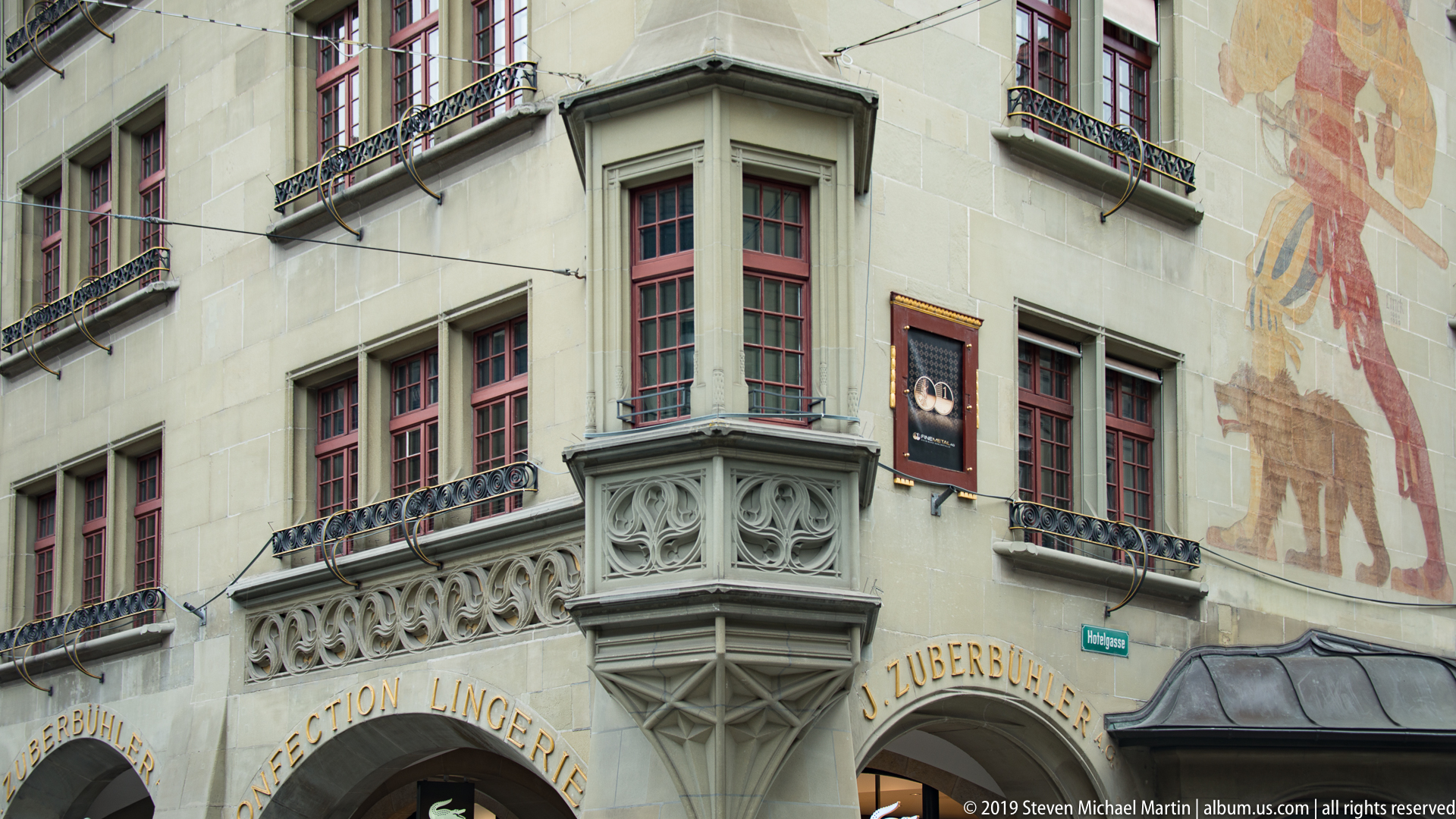
An ornate projecting oriel marks the corner of a historic Bern building, its carved stone base set between rows of red-framed windows. A large painted figure survives on the adjoining wall, while gold lettering curves above ground-floor arches, combining commercial signage, mural decoration, and late-historic architectural detail in a single façade.
Caption
An ornate projecting oriel marks the corner of a historic Bern building, its carved stone base set between rows of red-framed windows. A large painted figure survives on the adjoining wall, while gold lettering curves above ground-floor arches, combining commercial signage, mural decoration, and late-historic architectural detail in a single façade.

A monumental clock face fills the upper façade beside the Zytglogge, with gilded celestial symbols crossing a dark central dial. Painted figures flank the clock against a weathered mural field, showing how Bern’s historic timekeeping architecture combines mechanical, pictorial, and civic decoration within the narrow Old City streetscape.
Caption
A monumental clock face fills the upper façade beside the Zytglogge, with gilded celestial symbols crossing a dark central dial. Painted figures flank the clock against a weathered mural field, showing how Bern’s historic timekeeping architecture combines mechanical, pictorial, and civic decoration within the narrow Old City streetscape.

A blue-and-red tram on route 6 approaches along curving rails through Bern’s historic center. Arcaded stone buildings, shopfronts, pedestrians, and dense overhead wires frame the vehicle, illustrating how modern public transit operates directly within the compact street pattern of the UNESCO-listed Old City.
Caption
A blue-and-red tram on route 6 approaches along curving rails through Bern’s historic center. Arcaded stone buildings, shopfronts, pedestrians, and dense overhead wires frame the vehicle, illustrating how modern public transit operates directly within the compact street pattern of the UNESCO-listed Old City.

A richly carved triangular pediment crowns a monumental Bern façade, centered on a shield framed by allegorical figures, animals, and classical ornament. The dense sculptural program fills the entire tympanum, using balanced groups on either side of the heraldic centerpiece to give the building a formal civic character.
Caption
A richly carved triangular pediment crowns a monumental Bern façade, centered on a shield framed by allegorical figures, animals, and classical ornament. The dense sculptural program fills the entire tympanum, using balanced groups on either side of the heraldic centerpiece to give the building a formal civic character.

The Stadttheater Bern occupies a prominent corner with a monumental historicist façade articulated by pilasters, sculptural reliefs, arched windows, and a high roofline. Flags and street activity animate the formal exterior, while the inscription above the entrance identifies the building as one of Bern’s principal cultural venues.
Caption
The Stadttheater Bern occupies a prominent corner with a monumental historicist façade articulated by pilasters, sculptural reliefs, arched windows, and a high roofline. Flags and street activity animate the formal exterior, while the inscription above the entrance identifies the building as one of Bern’s principal cultural venues.

A vividly painted fountain figure depicts a seated bagpiper in red and green clothing, accompanied by a small child or attendant figure. The sculpture rests on an ornate capital with gilded details, continuing Bern’s distinctive tradition of placing colorful narrative figures above public fountains in the Old City.
Caption
A vividly painted fountain figure depicts a seated bagpiper in red and green clothing, accompanied by a small child or attendant figure. The sculpture rests on an ornate capital with gilded details, continuing Bern’s distinctive tradition of placing colorful narrative figures above public fountains in the Old City.

A bronze equestrian figure rises from a white stone pedestal in a landscaped Bern square, surrounded by four recumbent animal sculptures at the base. The composition is formal and commemorative, with the rider elevated above the surrounding trees and buildings while the lower figures anchor the monument to its paved setting.
Caption
A bronze equestrian figure rises from a white stone pedestal in a landscaped Bern square, surrounded by four recumbent animal sculptures at the base. The composition is formal and commemorative, with the rider elevated above the surrounding trees and buildings while the lower figures anchor the monument to its paved setting.

A broad staircase rises through a multi-level contemporary atrium, framed by sweeping balconies, glass balustrades, and a glazed roof. Dining tables and a water or display feature occupy the ground floor, emphasizing the building’s open circulation and modern contrast with Bern’s older masonry architecture.
Caption
A broad staircase rises through a multi-level contemporary atrium, framed by sweeping balconies, glass balustrades, and a glazed roof. Dining tables and a water or display feature occupy the ground floor, emphasizing the building’s open circulation and modern contrast with Bern’s older masonry architecture.

A frontal view of the Stadttheater Bern emphasizes its symmetrical entrance façade, where three wooden doorways align beneath tall windows framed by pilasters and sculptural ornament. The central inscription and restrained forecourt create a clear civic presentation, distinct from the oblique corner view of the same theatre.
Caption
A frontal view of the Stadttheater Bern emphasizes its symmetrical entrance façade, where three wooden doorways align beneath tall windows framed by pilasters and sculptural ornament. The central inscription and restrained forecourt create a clear civic presentation, distinct from the oblique corner view of the same theatre.

Residential buildings climb a wooded hillside beyond central Bern, interspersed with mature trees in vivid autumn color. The layered roofs, villas, and apartment blocks follow the terrain rather than a rigid street grid, illustrating how the city’s historic core gives way to greener residential slopes around the Aare valley.
Caption
Residential buildings climb a wooded hillside beyond central Bern, interspersed with mature trees in vivid autumn color. The layered roofs, villas, and apartment blocks follow the terrain rather than a rigid street grid, illustrating how the city’s historic core gives way to greener residential slopes around the Aare valley.

A landscaped pond reflects autumn trees, surrounding buildings, and planted reeds in a quiet green space in Bern. Stones, ornamental grasses, and clipped shrubs line the water’s edge, creating a carefully managed garden environment that contrasts with the dense historic streets seen elsewhere in the portfolio.
Caption
A landscaped pond reflects autumn trees, surrounding buildings, and planted reeds in a quiet green space in Bern. Stones, ornamental grasses, and clipped shrubs line the water’s edge, creating a carefully managed garden environment that contrasts with the dense historic streets seen elsewhere in the portfolio.

A broad view down one of Bern’s principal Old City streets shows continuous arcaded façades, stone paving, shop signs, overhead transit wires, and a steady flow of pedestrians. The long perspective reveals the ordered rhythm of the historic urban plan while also recording the street’s active modern commercial life.
Caption
A broad view down one of Bern’s principal Old City streets shows continuous arcaded façades, stone paving, shop signs, overhead transit wires, and a steady flow of pedestrians. The long perspective reveals the ordered rhythm of the historic urban plan while also recording the street’s active modern commercial life.

Viewed from street level, the Zytglogge rises above its passageway with both the large upper clock and the colorful astronomical dial visible on the façade. Adjacent historic buildings and a projecting bay window frame the tower, placing its celebrated clockwork within the tight architectural fabric of Bern’s Old City.
Caption
Viewed from street level, the Zytglogge rises above its passageway with both the large upper clock and the colorful astronomical dial visible on the façade. Adjacent historic buildings and a projecting bay window frame the tower, placing its celebrated clockwork within the tight architectural fabric of Bern’s Old City.

The Baroque façade of Bern’s Church of the Holy Spirit rises behind a web of tram wires near the railway station. Paired columns frame the central entrance, while a clock set into the upper tower and a green copper roof crown the symmetrical front. The urban infrastructure around the church underscores its prominent position in modern central Bern.
Caption
The Baroque façade of Bern’s Church of the Holy Spirit rises behind a web of tram wires near the railway station. Paired columns frame the central entrance, while a clock set into the upper tower and a green copper roof crown the symmetrical front. The urban infrastructure around the church underscores its prominent position in modern central Bern.

A brightly painted bagpiper stands atop a red fountain column, accompanied by a small goose-like animal at his side. His blue tunic, red cap, and bagpipe form a lively silhouette against Bern’s rooftops and overhead wires, continuing the city’s tradition of narrative Renaissance fountain figures in the Old City.
Caption
A brightly painted bagpiper stands atop a red fountain column, accompanied by a small goose-like animal at his side. His blue tunic, red cap, and bagpipe form a lively silhouette against Bern’s rooftops and overhead wires, continuing the city’s tradition of narrative Renaissance fountain figures in the Old City.

A man places his hands on a large black globe installed beside a Bern street, its continents rendered in a contrasting worn metallic finish. The playful interaction turns the public artwork into a human-scale object, while rails, signs, and a stone wall anchor the scene in the everyday urban environment.
Caption
A man places his hands on a large black globe installed beside a Bern street, its continents rendered in a contrasting worn metallic finish. The playful interaction turns the public artwork into a human-scale object, while rails, signs, and a stone wall anchor the scene in the everyday urban environment.

A street demonstration fills a Bern roadway, with participants carrying banners and flags beneath the façades and tram wires of the historic city. The gathering compresses pedestrians, signs, and vehicles into the narrow street, documenting contemporary political expression within the same urban spaces shaped by centuries of civic life.
Caption
A street demonstration fills a Bern roadway, with participants carrying banners and flags beneath the façades and tram wires of the historic city. The gathering compresses pedestrians, signs, and vehicles into the narrow street, documenting contemporary political expression within the same urban spaces shaped by centuries of civic life.

Rows of windows are framed by bold red-and-black painted shutters arranged in repeating geometric patterns across a pale Bern façade. The sharply graphic treatment turns a practical architectural element into a strong decorative motif, producing a rhythmic surface distinct from the stone arcades and sculptural details elsewhere in the Old City.
Caption
Rows of windows are framed by bold red-and-black painted shutters arranged in repeating geometric patterns across a pale Bern façade. The sharply graphic treatment turns a practical architectural element into a strong decorative motif, producing a rhythmic surface distinct from the stone arcades and sculptural details elsewhere in the Old City.

Demonstrators hold a large German-language banner reading “HOCH DIE ANTINATIONALE SOLIDARITÄT” during a crowded street protest in Bern. The hand-painted text dominates the composition while participants cluster behind it, preserving a direct visual record of the slogans and public messaging carried through the city.
Caption
Demonstrators hold a large German-language banner reading “HOCH DIE ANTINATIONALE SOLIDARITÄT” during a crowded street protest in Bern. The hand-painted text dominates the composition while participants cluster behind it, preserving a direct visual record of the slogans and public messaging carried through the city.

Several small painted bears cluster around a blue-and-gold fountain column, each dressed with miniature weapons, armor, or heraldic accessories. The compact sculptural group plays on Bern’s enduring bear emblem, translating civic identity into the whimsical ornamental language of the city’s historic public fountains.
Caption
Several small painted bears cluster around a blue-and-gold fountain column, each dressed with miniature weapons, armor, or heraldic accessories. The compact sculptural group plays on Bern’s enduring bear emblem, translating civic identity into the whimsical ornamental language of the city’s historic public fountains.

A monumental stone building stands at a Bern street corner beneath a steep red-tiled roof. Giant pilasters, arched windows, sculpted reliefs, and an open loggia give the façade a formal civic presence, while passing cars and tram wires situate the architecture within the active center of the city.
Caption
A monumental stone building stands at a Bern street corner beneath a steep red-tiled roof. Giant pilasters, arched windows, sculpted reliefs, and an open loggia give the façade a formal civic presence, while passing cars and tram wires situate the architecture within the active center of the city.

A gilded crowned lion stands upright within a black oval plaque, one paw resting on a blue horn-shaped emblem. The relief combines strong heraldic symbolism with restrained architectural presentation, using gold against dark stone to create a highly legible decorative marker on a Bern façade.
Caption
A gilded crowned lion stands upright within a black oval plaque, one paw resting on a blue horn-shaped emblem. The relief combines strong heraldic symbolism with restrained architectural presentation, using gold against dark stone to create a highly legible decorative marker on a Bern façade.

The Swiss Federal Palace rises above Federal Square with its central copper-green dome, pedimented entrance, and long symmetrical wings. The monumental façade houses Switzerland’s federal institutions and forms one of Bern’s defining civic landmarks, its national role expressed through classical composition, statuary, and the prominently inscribed central block.
Caption
The Swiss Federal Palace rises above Federal Square with its central copper-green dome, pedimented entrance, and long symmetrical wings. The monumental façade houses Switzerland’s federal institutions and forms one of Bern’s defining civic landmarks, its national role expressed through classical composition, statuary, and the prominently inscribed central block.

A close view isolates the copper-green dome and lantern of the Swiss Federal Palace, topped by a gilded Swiss cross. Dark metalwork, gold trim, and the segmented roof surface stand out against the sky, revealing the decorative detail of the Bundeshaus crown that is less apparent in wider views of Federal Square.
Caption
A close view isolates the copper-green dome and lantern of the Swiss Federal Palace, topped by a gilded Swiss cross. Dark metalwork, gold trim, and the segmented roof surface stand out against the sky, revealing the decorative detail of the Bundeshaus crown that is less apparent in wider views of Federal Square.

Two full-length stone statues of men in historical dress stand on the exterior of the Swiss Federal Palace. Their contrasting costumes, one with a prominent sash and sword, turn the façade into a gallery of civic memory, while the close framing emphasizes sculpted clothing, posture, and attributes rather than the building as a whole.
Caption
Two full-length stone statues of men in historical dress stand on the exterior of the Swiss Federal Palace. Their contrasting costumes, one with a prominent sash and sword, turn the façade into a gallery of civic memory, while the close framing emphasizes sculpted clothing, posture, and attributes rather than the building as a whole.

A high vantage point looks across Bern’s red-tiled roofs and autumn trees toward a densely settled, wooded hill. The view demonstrates the city’s close relationship between compact urban fabric, green slopes, and the broader Aare landscape, with historic houses and newer buildings layered across the terrain.
Caption
A high vantage point looks across Bern’s red-tiled roofs and autumn trees toward a densely settled, wooded hill. The view demonstrates the city’s close relationship between compact urban fabric, green slopes, and the broader Aare landscape, with historic houses and newer buildings layered across the terrain.

A tightly framed roof surface reveals hundreds of small overlapping clay tiles in varied shades of red, brown, gray, and black. Moss and weathering interrupt the regular pattern, turning an ordinary historic roofing material into an abstract study of age, texture, repair, and the long-term maintenance of Bern’s built environment.
Caption
A tightly framed roof surface reveals hundreds of small overlapping clay tiles in varied shades of red, brown, gray, and black. Moss and weathering interrupt the regular pattern, turning an ordinary historic roofing material into an abstract study of age, texture, repair, and the long-term maintenance of Bern’s built environment.

A steep low-angle view up the Swiss Federal Palace façade emphasizes its rusticated masonry, arched windows, projecting cornices, and colossal columns. The perspective compresses multiple stories into a dramatic vertical composition, highlighting the monumental scale and dense classical detailing of the federal government complex.
Caption
A steep low-angle view up the Swiss Federal Palace façade emphasizes its rusticated masonry, arched windows, projecting cornices, and colossal columns. The perspective compresses multiple stories into a dramatic vertical composition, highlighting the monumental scale and dense classical detailing of the federal government complex.

A vaulted passage within the Swiss Federal Palace complex leads toward a small wall fountain framed by pale stone. Repeating arches, shallow ceiling ribs, and rusticated piers create a restrained axial composition, while the fountain provides a focal point at the far end of the otherwise quiet architectural corridor.
Caption
A vaulted passage within the Swiss Federal Palace complex leads toward a small wall fountain framed by pale stone. Repeating arches, shallow ceiling ribs, and rusticated piers create a restrained axial composition, while the fountain provides a focal point at the far end of the otherwise quiet architectural corridor.

A detailed bronze-toned architectural model reproduces the central portion of Bern’s Swiss Federal Palace, including its dominant dome, flanking cupolas, pedimented façade, arcaded terrace, and symmetrical wings. Seen from slightly above, the miniature makes the complex massing of the Bundeshaus easier to read than in a street-level view of the full government complex.
Caption
A detailed bronze-toned architectural model reproduces the central portion of Bern’s Swiss Federal Palace, including its dominant dome, flanking cupolas, pedimented façade, arcaded terrace, and symmetrical wings. Seen from slightly above, the miniature makes the complex massing of the Bundeshaus easier to read than in a street-level view of the full government complex.

A wider view of the architectural model presents the Swiss Federal Palace as an extended government complex, with the domed parliamentary building centered between long administrative wings. The miniature sits against the rusticated stone wall of the real complex, creating a direct comparison between the model’s simplified massing and the monumental architecture surrounding it.
Caption
A wider view of the architectural model presents the Swiss Federal Palace as an extended government complex, with the domed parliamentary building centered between long administrative wings. The miniature sits against the rusticated stone wall of the real complex, creating a direct comparison between the model’s simplified massing and the monumental architecture surrounding it.
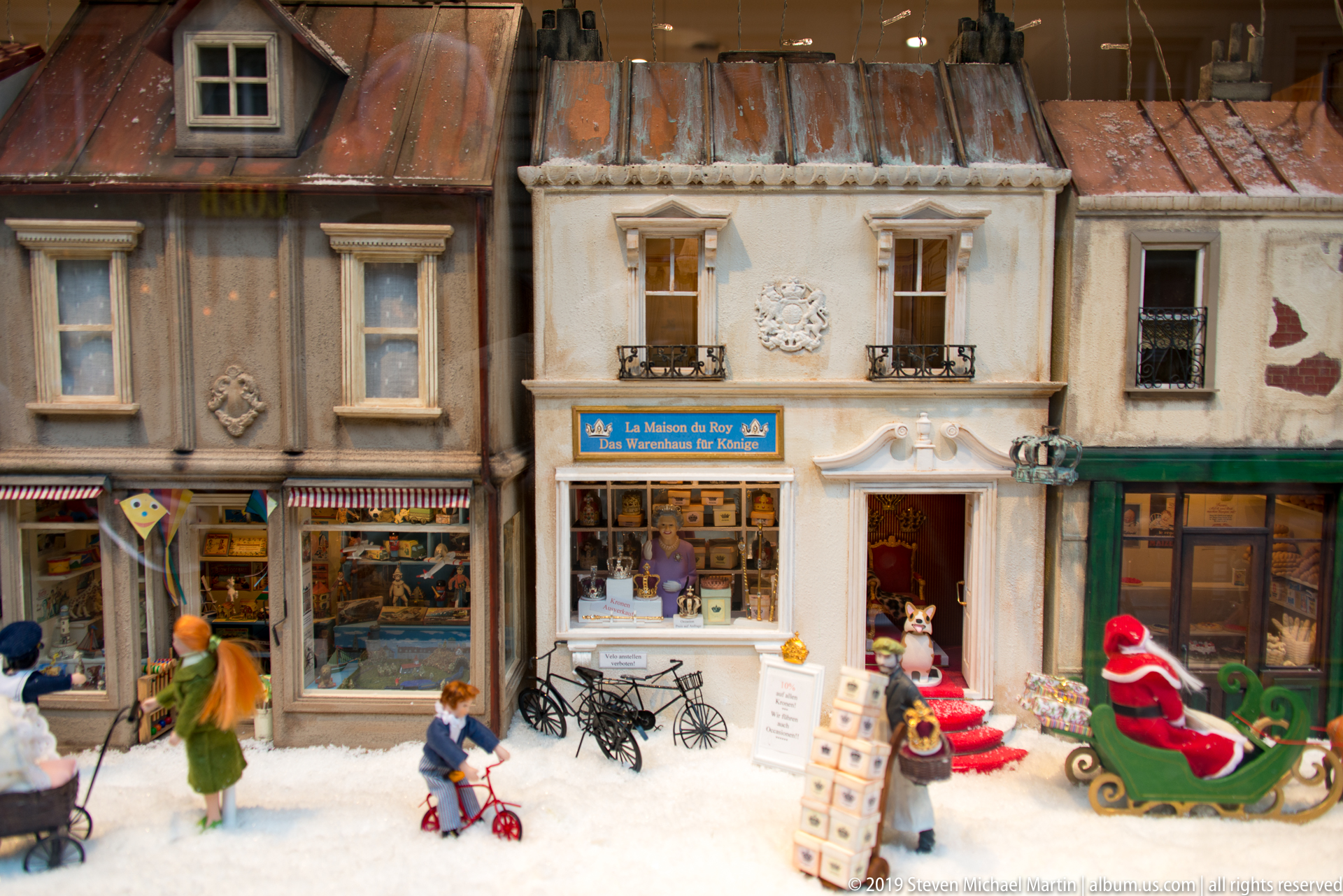
A miniature winter streetscape recreates a row of small shops beneath upper-floor windows, with pedestrians, bicycles, merchandise, and a bright red sleigh arranged along the snowy pavement. Hand-painted signs and domestic details give the display the character of a model village rather than a literal view of Bern’s historic center.
Caption
A miniature winter streetscape recreates a row of small shops beneath upper-floor windows, with pedestrians, bicycles, merchandise, and a bright red sleigh arranged along the snowy pavement. Hand-painted signs and domestic details give the display the character of a model village rather than a literal view of Bern’s historic center.
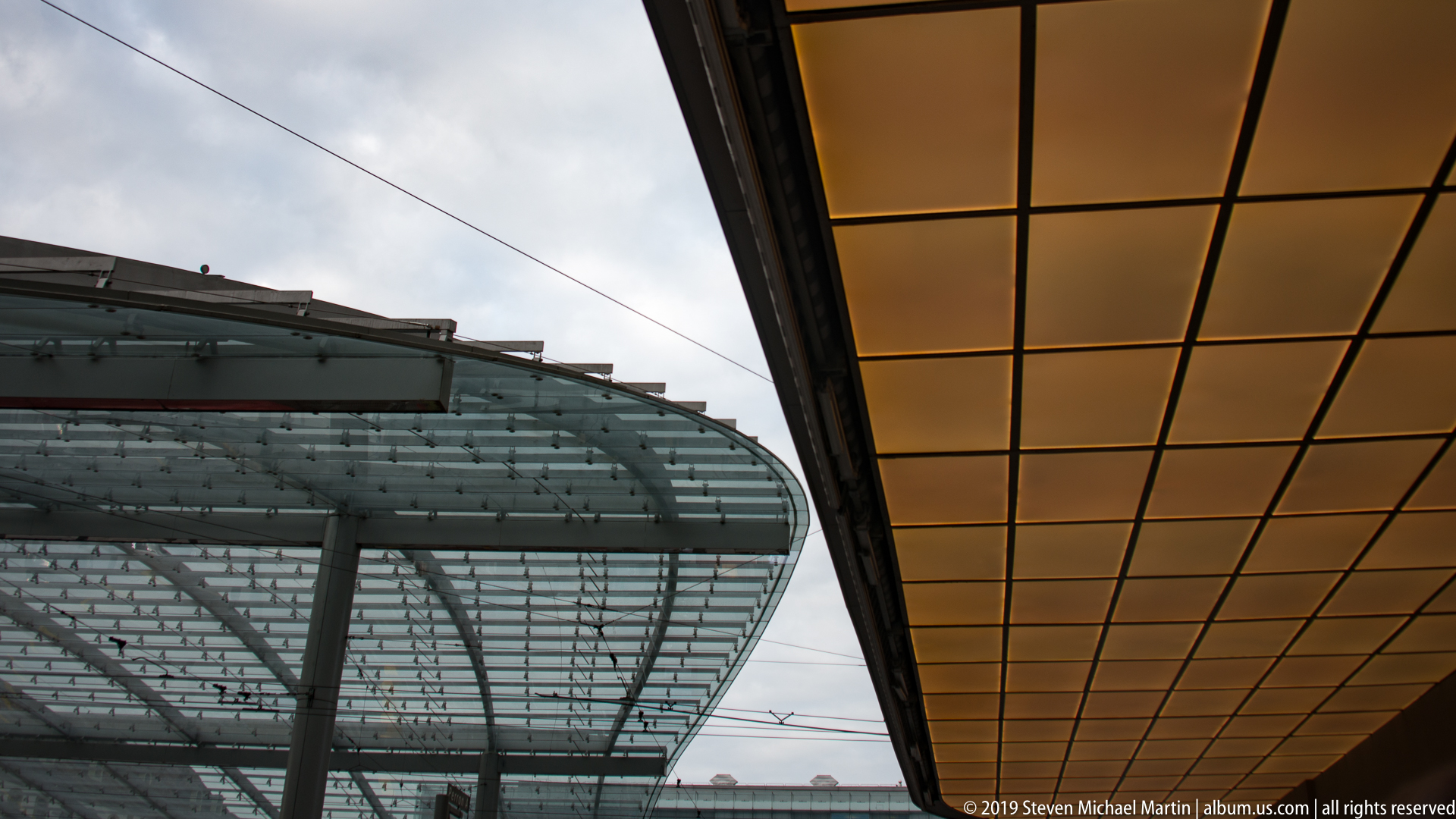
Two modern roof systems meet above the viewer: a curved glass-and-steel canopy on one side and a flat amber-toned grid ceiling on the other. The upward-looking composition reduces the architecture to intersecting lines, translucent surfaces, and structural supports, emphasizing contemporary design within Bern’s urban transport or commercial environment.
Caption
Two modern roof systems meet above the viewer: a curved glass-and-steel canopy on one side and a flat amber-toned grid ceiling on the other. The upward-looking composition reduces the architecture to intersecting lines, translucent surfaces, and structural supports, emphasizing contemporary design within Bern’s urban transport or commercial environment.

A miniature café façade labeled “Chez Germaine” presents shuttered windows, striped awnings, tiny outdoor tables, flower boxes, and small figures at the entrance. The carefully staged storefront resembles a nostalgic European street vignette, with signs advertising café fare and miniature furnishings reinforcing the scale of the display.
Caption
A miniature café façade labeled “Chez Germaine” presents shuttered windows, striped awnings, tiny outdoor tables, flower boxes, and small figures at the entrance. The carefully staged storefront resembles a nostalgic European street vignette, with signs advertising café fare and miniature furnishings reinforcing the scale of the display.

A polychromed heraldic ensemble combines a black eagle above two black bears, all arranged within shield forms and surrounded by a green wreath. Below, a gilded cartouche records restoration dates, including “RENOV. 1935,” documenting both the civic symbolism and later maintenance of the architectural decoration.
Caption
A polychromed heraldic ensemble combines a black eagle above two black bears, all arranged within shield forms and surrounded by a green wreath. Below, a gilded cartouche records restoration dates, including “RENOV. 1935,” documenting both the civic symbolism and later maintenance of the architectural decoration.

A polychromed female fountain figure stands on an ornate pedestal in front of a large black-and-red clock face. Dressed in a blue gown with red-and-gold accents, she holds objects at her waist while the urban façade and clock create a layered background typical of Bern’s historic center.
Caption
A polychromed female fountain figure stands on an ornate pedestal in front of a large black-and-red clock face. Dressed in a blue gown with red-and-gold accents, she holds objects at her waist while the urban façade and clock create a layered background typical of Bern’s historic center.

An armored figure atop a tall fountain column stands in the middle of a narrow Bern street, aligned with an enormous painted clock on the façade beyond. Swiss and heraldic flags add color to the deep urban perspective, while arcaded buildings and overhead wires reinforce the dense spatial character of the Old City.
Caption
An armored figure atop a tall fountain column stands in the middle of a narrow Bern street, aligned with an enormous painted clock on the façade beyond. Swiss and heraldic flags add color to the deep urban perspective, while arcaded buildings and overhead wires reinforce the dense spatial character of the Old City.

A large sculpted black bear projects from a Bern façade, crowned in gold and holding a staff while supporting an ornate shield emblazoned with an eagle. Bright red, blue, and gilded accents turn the sign into an emphatic heraldic emblem, extending Bern’s familiar bear imagery into commercial or civic architectural decoration.
Caption
A large sculpted black bear projects from a Bern façade, crowned in gold and holding a staff while supporting an ornate shield emblazoned with an eagle. Bright red, blue, and gilded accents turn the sign into an emphatic heraldic emblem, extending Bern’s familiar bear imagery into commercial or civic architectural decoration.

A vivid red lion with gilded mane and crown projects from a Bern façade, gripping a spear while framed by a large ornamental cartouche. Within the frame below the lion appears a bird emblem against a dark field, combining heraldic animals, weaponry, and elaborate gilded scrollwork into a dramatic hanging sign.
Caption
A vivid red lion with gilded mane and crown projects from a Bern façade, gripping a spear while framed by a large ornamental cartouche. Within the frame below the lion appears a bird emblem against a dark field, combining heraldic animals, weaponry, and elaborate gilded scrollwork into a dramatic hanging sign.

A man stands centered on a broad flight of stone steps, hands in the pockets of a black jacket and feet set apart in a relaxed pose. The repeating horizontal stair treads create a simple geometric backdrop that isolates the figure and removes most architectural context from the portrait.
Caption
A man stands centered on a broad flight of stone steps, hands in the pockets of a black jacket and feet set apart in a relaxed pose. The repeating horizontal stair treads create a simple geometric backdrop that isolates the figure and removes most architectural context from the portrait.

A closer view isolates the armored fountain figure, who stands above a small bear and carries a tall red banner marked with crossed weapons. The monumental painted clock remains softly focused behind him, emphasizing the sculptural silhouette and heraldic details that distinguish Bern’s historic fountains.
Caption
A closer view isolates the armored fountain figure, who stands above a small bear and carries a tall red banner marked with crossed weapons. The monumental painted clock remains softly focused behind him, emphasizing the sculptural silhouette and heraldic details that distinguish Bern’s historic fountains.

An elaborate stone cartouche fills the space between two windows on a Bern façade. Scrollwork, floral motifs, reclining figures, and a central relief medallion culminate in a pendant inscribed “1915,” creating a richly sculpted architectural centerpiece against the otherwise restrained wall surface.
Caption
An elaborate stone cartouche fills the space between two windows on a Bern façade. Scrollwork, floral motifs, reclining figures, and a central relief medallion culminate in a pendant inscribed “1915,” creating a richly sculpted architectural centerpiece against the otherwise restrained wall surface.
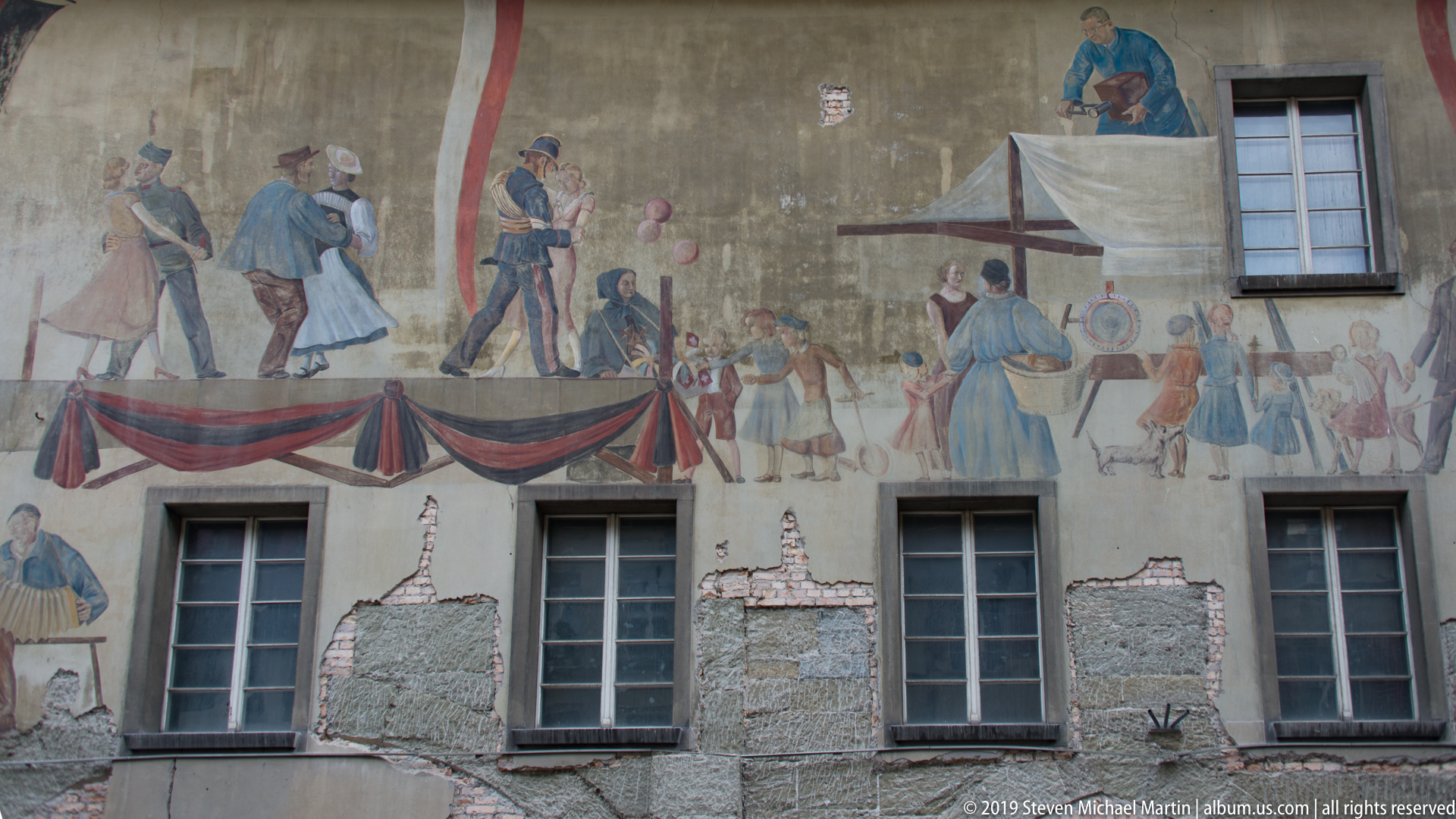
A faded mural stretches across a Bern building, showing groups of men, women, and children in historical dress moving through a ceremonial or festive procession. Painted drapery and shields animate the lower register, while weathered plaster and exposed repair patches reveal the mural’s age and the conservation challenges of exterior wall painting.
Caption
A faded mural stretches across a Bern building, showing groups of men, women, and children in historical dress moving through a ceremonial or festive procession. Painted drapery and shields animate the lower register, while weathered plaster and exposed repair patches reveal the mural’s age and the conservation challenges of exterior wall painting.

The nave of Bern Minster extends toward the illuminated choir beneath a sequence of pointed Gothic arches and ribbed vaults. Massive clustered piers define the side aisles, while rows of wooden pews draw the eye toward stained-glass windows and the elevated organ or choir screen, emphasizing the church’s long axial interior.
Caption
The nave of Bern Minster extends toward the illuminated choir beneath a sequence of pointed Gothic arches and ribbed vaults. Massive clustered piers define the side aisles, while rows of wooden pews draw the eye toward stained-glass windows and the elevated organ or choir screen, emphasizing the church’s long axial interior.

Bern Minster’s richly articulated Gothic tower rises luminous against the night sky above the darkened Old City rooftops. Architectural lighting picks out the openwork spire, pinnacles, tracery, and clock, turning the tower into a vertical beacon while the surrounding city remains largely in shadow.
Caption
Bern Minster’s richly articulated Gothic tower rises luminous against the night sky above the darkened Old City rooftops. Architectural lighting picks out the openwork spire, pinnacles, tracery, and clock, turning the tower into a vertical beacon while the surrounding city remains largely in shadow.

A dramatically tilted, low-angle view sends Bern Minster’s façade and tower diagonally across the frame. Buttresses, pointed windows, tracery, sculptural niches, and the rising tower are compressed into a strong perspective, emphasizing the vertical ambition of the Gothic architecture rather than presenting a conventional frontal elevation.
Caption
A dramatically tilted, low-angle view sends Bern Minster’s façade and tower diagonally across the frame. Buttresses, pointed windows, tracery, sculptural niches, and the rising tower are compressed into a strong perspective, emphasizing the vertical ambition of the Gothic architecture rather than presenting a conventional frontal elevation.

Bern’s Zytglogge fills the frame at night, with its large upper clock face and lower astronomical display illuminated against the pale stone tower. The oblique street-level viewpoint also reveals the projecting automata structure beside the colorful dial, emphasizing the layered mechanical and decorative program that makes the medieval clock tower one of the Old City’s defining landmarks.
Caption
Bern’s Zytglogge fills the frame at night, with its large upper clock face and lower astronomical display illuminated against the pale stone tower. The oblique street-level viewpoint also reveals the projecting automata structure beside the colorful dial, emphasizing the layered mechanical and decorative program that makes the medieval clock tower one of the Old City’s defining landmarks.

Large clustered piers inside Bern Minster carry broad inscription bands wrapped around their capitals. The Gothic arches and vertical shafts rise behind them, while the prominent Latin and German text introduces an unusually textual layer into the nave’s structural rhythm, making the supports function as both architecture and carriers of memorial or religious inscriptions.
Caption
Large clustered piers inside Bern Minster carry broad inscription bands wrapped around their capitals. The Gothic arches and vertical shafts rise behind them, while the prominent Latin and German text introduces an unusually textual layer into the nave’s structural rhythm, making the supports function as both architecture and carriers of memorial or religious inscriptions.

Painted figures occupy the triangular cells of a ribbed vault inside Bern Minster, accompanied by large lettered names and inscriptions. The figures appear seated or half-length against pale fields framed by dark ribs, demonstrating how figural painting complements the church’s stone structure high above the nave.
Caption
Painted figures occupy the triangular cells of a ribbed vault inside Bern Minster, accompanied by large lettered names and inscriptions. The figures appear seated or half-length against pale fields framed by dark ribs, demonstrating how figural painting complements the church’s stone structure high above the nave.
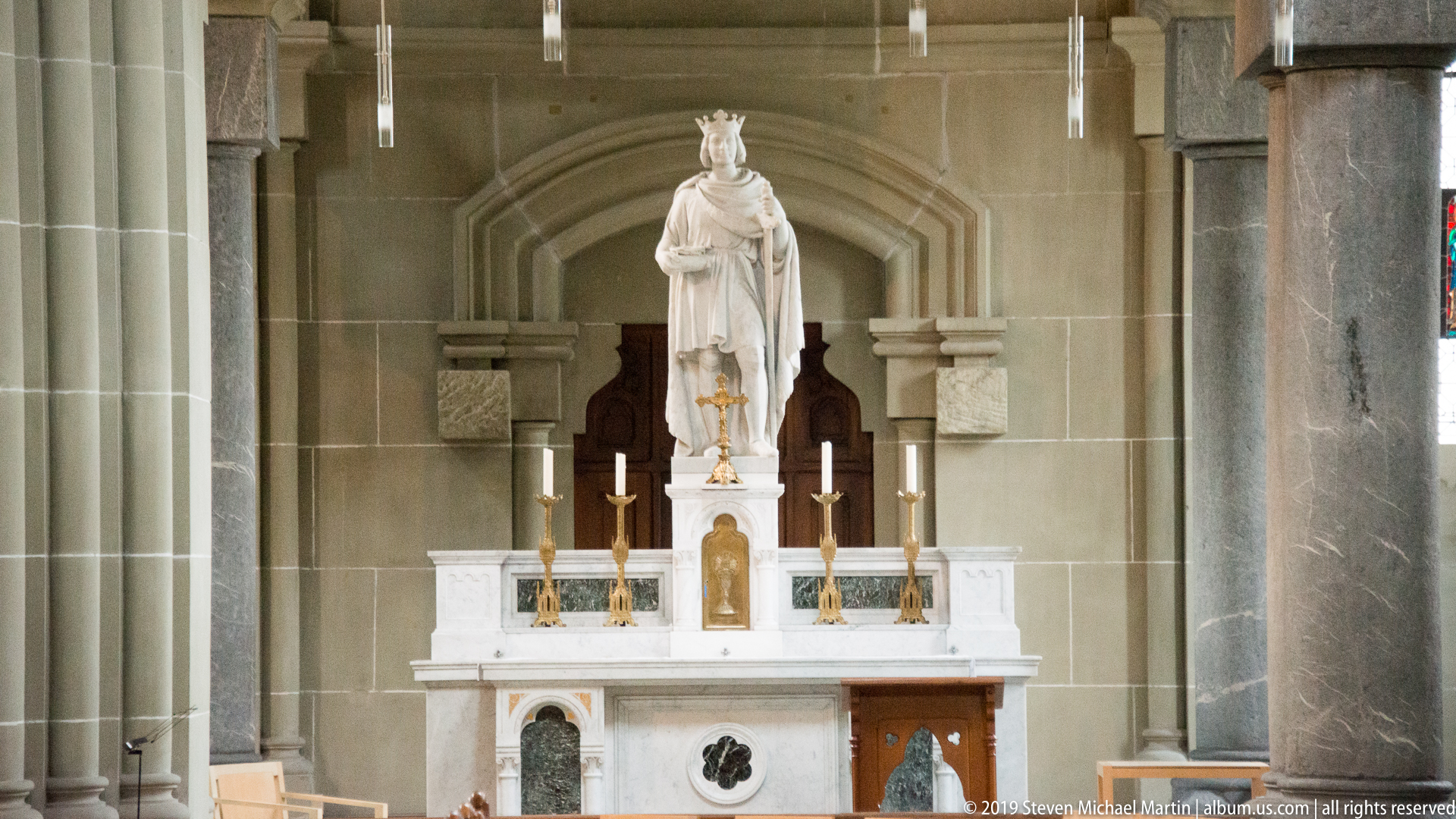
A white side altar inside Bern Minster is surmounted by a tall crowned female statue beneath a pointed architectural recess. Candles and gilded liturgical objects are arranged symmetrically across the altar table, while the pale stone setting and restrained decoration distinguish the devotional ensemble from the larger Gothic nave.
Caption
A white side altar inside Bern Minster is surmounted by a tall crowned female statue beneath a pointed architectural recess. Candles and gilded liturgical objects are arranged symmetrically across the altar table, while the pale stone setting and restrained decoration distinguish the devotional ensemble from the larger Gothic nave.

A second view of the same side altar reveals additional painted devotional imagery on the frontal and small colored figures along the upper ledge. The crowned female statue remains the vertical focus, while candles, a central cross, and dark quatrefoil openings give the white ensemble a more complex liturgical and decorative character.
Caption
A second view of the same side altar reveals additional painted devotional imagery on the frontal and small colored figures along the upper ledge. The crowned female statue remains the vertical focus, while candles, a central cross, and dark quatrefoil openings give the white ensemble a more complex liturgical and decorative character.

Bern’s Rathaus presents a broad late-medieval stone façade reached by twin exterior stairways that rise toward a central Gothic loggia. Rows of rectangular windows, heraldic shields beneath the roofline, a decorative clock, and pointed entrance arches give the civic building a fortified yet ceremonial presence on Rathausplatz.
Caption
Bern’s Rathaus presents a broad late-medieval stone façade reached by twin exterior stairways that rise toward a central Gothic loggia. Rows of rectangular windows, heraldic shields beneath the roofline, a decorative clock, and pointed entrance arches give the civic building a fortified yet ceremonial presence on Rathausplatz.

A closer view of Bern Town Hall centers on the raised Gothic loggia and decorative clock, framed by twin exterior staircases with carved stone balustrades. Sculpted figures stand on the vertical supports, while painted heraldic shields form a continuous band beneath the eaves, concentrating the building’s civic symbolism around its principal entrance.
Caption
A closer view of Bern Town Hall centers on the raised Gothic loggia and decorative clock, framed by twin exterior staircases with carved stone balustrades. Sculpted figures stand on the vertical supports, while painted heraldic shields form a continuous band beneath the eaves, concentrating the building’s civic symbolism around its principal entrance.

The decorative clock above Bern Town Hall’s central loggia fills the composition, flanked by two standing stone figures on slender supports. Roman numerals circle a blue patterned dial with gilded hands, while painted coats of arms beneath the roofline reinforce the heraldic program of the medieval civic façade.
Caption
The decorative clock above Bern Town Hall’s central loggia fills the composition, flanked by two standing stone figures on slender supports. Roman numerals circle a blue patterned dial with gilded hands, while painted coats of arms beneath the roofline reinforce the heraldic program of the medieval civic façade.

A weathered stone relief set into a plain wall depicts a human figure straddling or emerging above a large animal or grotesque head. The compact carving is highly sculptural despite its shallow projection, with the figure’s bent limbs and the mask-like face below forming an enigmatic piece of architectural ornament.
Caption
A weathered stone relief set into a plain wall depicts a human figure straddling or emerging above a large animal or grotesque head. The compact carving is highly sculptural despite its shallow projection, with the figure’s bent limbs and the mask-like face below forming an enigmatic piece of architectural ornament.
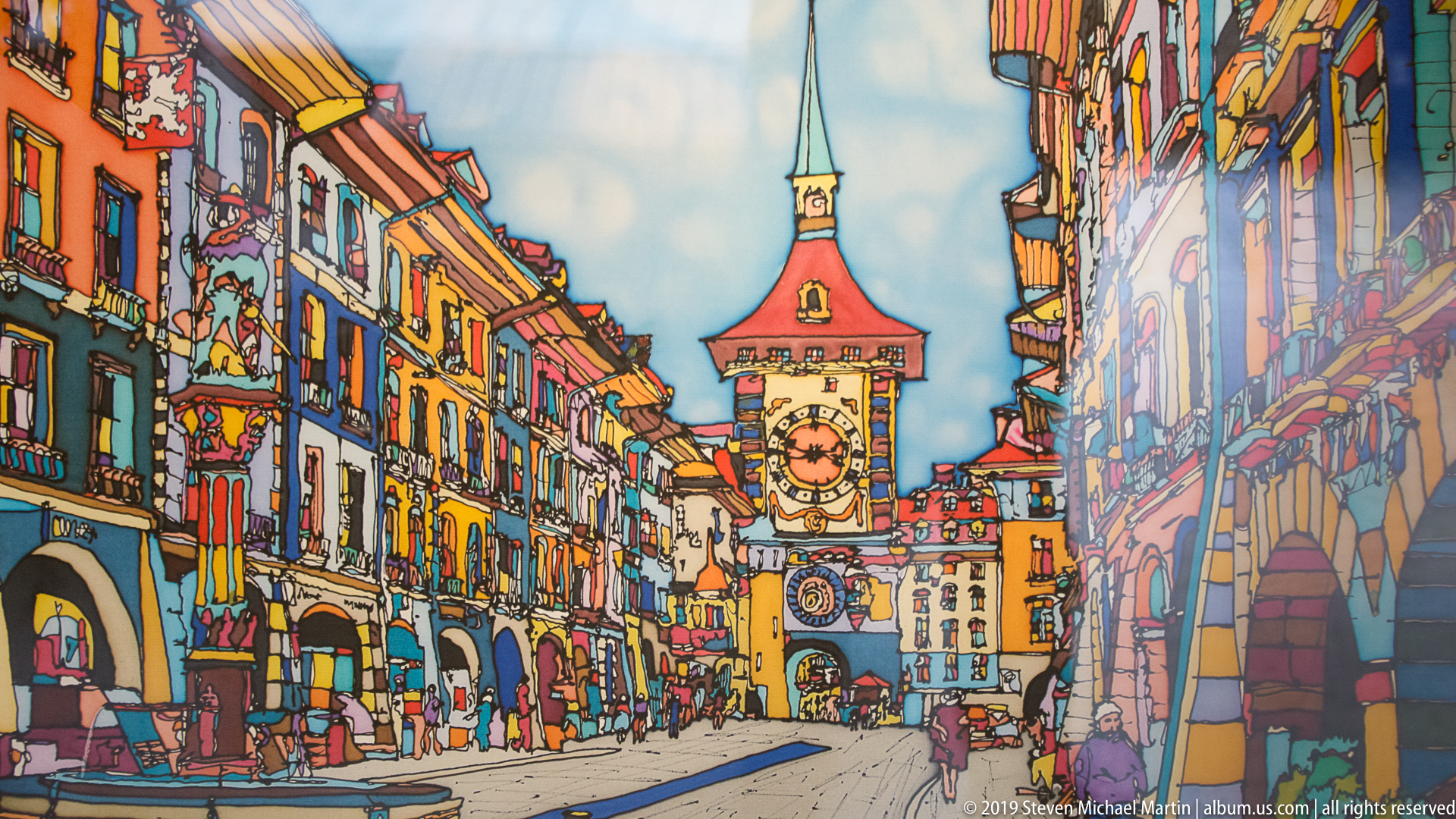
A colorful stylized artwork reimagines Bern’s Old City street leading toward the Zytglogge, exaggerating façades, arcades, shopfronts, and pedestrians into bold outlines and saturated colors. The clock tower remains recognizable at the end of the perspective, while the painterly treatment transforms the familiar urban scene into a graphic souvenir-like composition.
Caption
A colorful stylized artwork reimagines Bern’s Old City street leading toward the Zytglogge, exaggerating façades, arcades, shopfronts, and pedestrians into bold outlines and saturated colors. The clock tower remains recognizable at the end of the perspective, while the painterly treatment transforms the familiar urban scene into a graphic souvenir-like composition.

An Old City arcade frames a view across a Bern street toward pale historic façades, parked cars, and shopfronts. Red autumn vines hang from the arch in the foreground, while a suspended planter and café signage add layers of everyday detail to the sheltered pedestrian environment for which central Bern is well known.
Caption
An Old City arcade frames a view across a Bern street toward pale historic façades, parked cars, and shopfronts. Red autumn vines hang from the arch in the foreground, while a suspended planter and café signage add layers of everyday detail to the sheltered pedestrian environment for which central Bern is well known.

The Zytglogge glows against a deep blue evening sky, its upper clock and lower astronomical dial brightly illuminated above the arched passageway. Pedestrians gather beneath the tower while flanking buildings remain comparatively subdued, making the medieval clock tower the visual anchor of the nocturnal Old City streetscape.
Caption
The Zytglogge glows against a deep blue evening sky, its upper clock and lower astronomical dial brightly illuminated above the arched passageway. Pedestrians gather beneath the tower while flanking buildings remain comparatively subdued, making the medieval clock tower the visual anchor of the nocturnal Old City streetscape.

A close nighttime view isolates the Zytglogge’s astronomical clock and adjacent automata. Concentric rings of numerals and zodiac imagery surround the central mechanism, while painted mechanical figures occupy the sculpted bay to the right. Illumination sharpens the red, blue, black, and gold surfaces, making the clock’s technical and theatrical components especially legible.
Caption
A close nighttime view isolates the Zytglogge’s astronomical clock and adjacent automata. Concentric rings of numerals and zodiac imagery surround the central mechanism, while painted mechanical figures occupy the sculpted bay to the right. Illumination sharpens the red, blue, black, and gold surfaces, making the clock’s technical and theatrical components especially legible.

A brightly painted historic fountain rises from a stone basin in the center of a Bern street at blue hour, while the illuminated Zytglogge closes the view in the distance. The fountain’s tall red column and sculptural crest form a vivid foreground marker, linking Bern’s celebrated public-fountain tradition with the clock tower that organizes the surrounding Old City streetscape.
Caption
A brightly painted historic fountain rises from a stone basin in the center of a Bern street at blue hour, while the illuminated Zytglogge closes the view in the distance. The fountain’s tall red column and sculptural crest form a vivid foreground marker, linking Bern’s celebrated public-fountain tradition with the clock tower that organizes the surrounding Old City streetscape.

The Zähringerbrunnen’s armored bear is seen from below against the deep blue evening sky, holding a tall red banner while a small bear cub appears at its feet. Gilded armor and richly painted details stand out under artificial light, turning the heraldic fountain figure into a vivid emblem of Bern’s long association with the bear.
Caption
The Zähringerbrunnen’s armored bear is seen from below against the deep blue evening sky, holding a tall red banner while a small bear cub appears at its feet. Gilded armor and richly painted details stand out under artificial light, turning the heraldic fountain figure into a vivid emblem of Bern’s long association with the bear.

The Zytglogge stands squarely at the end of a Bern street, illuminated against the blue-black evening sky. Its large upper clock, lower decorated façade, arched passageway, steep roof, and slender spire are framed by arcaded buildings on both sides, creating a formal axial view of the tower within the Old City’s dense medieval street plan.
Caption
The Zytglogge stands squarely at the end of a Bern street, illuminated against the blue-black evening sky. Its large upper clock, lower decorated façade, arched passageway, steep roof, and slender spire are framed by arcaded buildings on both sides, creating a formal axial view of the tower within the Old City’s dense medieval street plan.

Bern Minster’s Gothic tower rises brilliantly illuminated above the darkened roofs of the Old City. The openwork spire, pinnacles, and tracery are sharply picked out against the night sky, while warm windows and streetlights spread across the lower cityscape, emphasizing the Minster’s dominant vertical role in Bern’s historic skyline.
Caption
Bern Minster’s Gothic tower rises brilliantly illuminated above the darkened roofs of the Old City. The openwork spire, pinnacles, and tracery are sharply picked out against the night sky, while warm windows and streetlights spread across the lower cityscape, emphasizing the Minster’s dominant vertical role in Bern’s historic skyline.

Dark ridges and sharply profiled alpine peaks recede through layers of atmospheric haze beyond Bern at dusk. A dramatic break in the cloud cover sends warm light across the horizon, silhouetting a pyramidal central summit and neighboring peaks while the foreground remains subdued, creating a compressed telephoto study of the Bernese Alpine skyline.
Caption
Dark ridges and sharply profiled alpine peaks recede through layers of atmospheric haze beyond Bern at dusk. A dramatic break in the cloud cover sends warm light across the horizon, silhouetting a pyramidal central summit and neighboring peaks while the foreground remains subdued, creating a compressed telephoto study of the Bernese Alpine skyline.
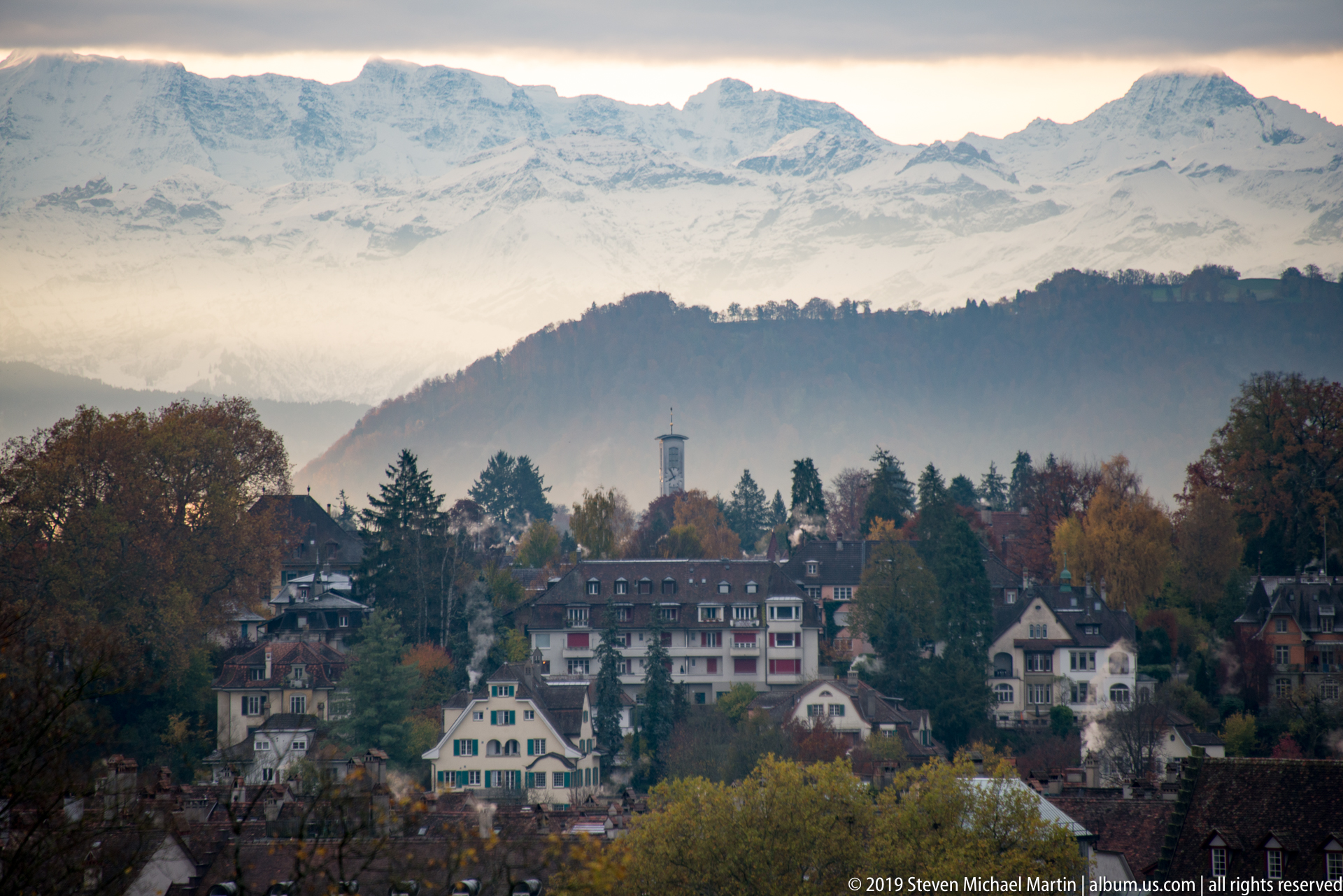
Autumn-colored homes and trees spread across a Bern hillside beneath a broad wall of snow-covered alpine peaks. Low mist hangs in the intervening valley, separating the residential foreground from the mountains and accentuating the city’s close visual relationship with the Bernese Alps on clear days.
Caption
Autumn-colored homes and trees spread across a Bern hillside beneath a broad wall of snow-covered alpine peaks. Low mist hangs in the intervening valley, separating the residential foreground from the mountains and accentuating the city’s close visual relationship with the Bernese Alps on clear days.

A dark church spire rises above Bern’s red-tiled roofs, backed by wooded ridges and the snow-covered Bernese Alps. The elevated view compresses the city and mountain backdrop into a single plane, showing how church towers punctuate the historic skyline while distant alpine peaks define the broader regional setting.
Caption
A dark church spire rises above Bern’s red-tiled roofs, backed by wooded ridges and the snow-covered Bernese Alps. The elevated view compresses the city and mountain backdrop into a single plane, showing how church towers punctuate the historic skyline while distant alpine peaks define the broader regional setting.
⭐ Highlights
- Old Town (Altstadt): A remarkably preserved medieval city and UNESCO World Heritage Site.
- Zytglogge Clock Tower: A 13th-century tower with an astronomical clock and moving figures.
- Bern Minster: A towering Gothic cathedral with the tallest spire in Switzerland.
- Covered Arcades: Over 6 kilometers of arcades forming one of the longest covered shopping promenades in Europe.
- Renaissance Fountains: Colorful 16th-century fountains scattered throughout the city.
- Aare River Loop: The turquoise river encircling the old town on three sides.
🏙️ Bern Field Guide
Major features observed during this visit:
Bern, the capital of Switzerland, is one of Europe’s best-preserved medieval cities. Founded in the 12th century on a narrow peninsula surrounded by the Aare River, the city developed according to a coherent plan that remains largely intact today. Its Old Town, recognized as a UNESCO World Heritage Site, retains its arcades, towers, fountains, and sandstone buildings, creating a continuous historical landscape that blends everyday life with centuries of architectural continuity.
🏛️ Signature Landmarks
- Zytglogge – A medieval clock tower with mechanical figures that perform hourly.
- Bern Minster – A 15th-century Gothic cathedral dominating the skyline.
- Federal Palace (Bundeshaus) – The seat of the Swiss government, connecting historic and modern Bern.
- Kramgasse – The main historic street lined with arcades and fountains.
- Nydegg Bridge – A key viewpoint connecting the old city to the river and surrounding areas.
🧠 Historical Significance
- Founded in 1191 – Established as a fortified city on a peninsula formed by the Aare River.
- UNESCO World Heritage Site – Recognized for its exceptionally preserved medieval townscape.
- Medieval Urban Planning – Developed according to a consistent plan that remains visible today.
- Swiss Capital – Became the federal capital in the 19th century while retaining its historic core.
🌄 Urban Landscape & Setting
- River Peninsula – The old town is almost completely surrounded by the Aare River.
- Sandstone Architecture – Buildings rebuilt after a 1405 fire give the city a unified visual character.
- Arcaded Streets – Covered walkways create a continuous pedestrian experience.
- Layered History – Medieval foundations combined with later additions form a cohesive cityscape.