Bratislava – Slovakia
Bratislava lies along the Danube River at the southwestern edge of Slovakia, where the river valley narrows between the Little Carpathian Mountains (Malé Karpaty) and the plains of Hungary and Austria. Because of this strategic position along one of Europe’s major waterways, the city has served as an important political and commercial crossroads for centuries.
The historic center sits beneath Bratislava Castle, a massive hilltop fortress whose four corner towers overlook the Danube and the surrounding countryside. From the castle terraces, views extend westward toward Austria and east along the Danube corridor, illustrating the city’s historic role as a gateway between Central and Eastern Europe.
The photographs likely capture the narrow medieval streets of the old town, the baroque palaces that line the historic squares, and the prominent silhouette of the castle rising above the river valley.

A pale gabled church and its sculptural devotional column fill the foreground, while Bratislava Castle appears on the hill at far left. The broad evening view connects sacred architecture at street level with the city’s dominant fortification above. Warm façade lighting, the low balustrade, and the blue-hour sky create clear separation between the church ensemble and the distant castle.
Caption
A pale gabled church and its sculptural devotional column fill the foreground, while Bratislava Castle appears on the hill at far left. The broad evening view connects sacred architecture at street level with the city’s dominant fortification above. Warm façade lighting, the low balustrade, and the blue-hour sky create clear separation between the church ensemble and the distant castle.

Bratislava Castle glows on the hillside beyond the covered pedestrian approach to the SNP Bridge. The bridge structure forms a strong diagonal ceiling and railing in the foreground, setting the historic castle against modern transport infrastructure and creating a layered nighttime view of two major city landmarks.
Caption
Bratislava Castle glows on the hillside beyond the covered pedestrian approach to the SNP Bridge. The bridge structure forms a strong diagonal ceiling and railing in the foreground, setting the historic castle against modern transport infrastructure and creating a layered nighttime view of two major city landmarks.

Seen squarely from the street, Grassalkovich Palace presents its white central pavilion, low wings, formal fence, and ceremonial flagpoles against a turbulent evening sky. The restrained frontal composition emphasizes the building’s role as a state residence, with national and European flags marking the official character of the grounds in central Bratislava.
Caption
Seen squarely from the street, Grassalkovich Palace presents its white central pavilion, low wings, formal fence, and ceremonial flagpoles against a turbulent evening sky. The restrained frontal composition emphasizes the building’s role as a state residence, with national and European flags marking the official character of the grounds in central Bratislava.

An intimate outdoor restaurant terrace sits ready for guests beneath large umbrellas, with dark wooden chairs and tables arranged along a pale courtyard façade. Menu boards, potted plants, and warm evening lighting give the space a quiet, lived-in character before or after the main dining period.
Caption
An intimate outdoor restaurant terrace sits ready for guests beneath large umbrellas, with dark wooden chairs and tables arranged along a pale courtyard façade. Menu boards, potted plants, and warm evening lighting give the space a quiet, lived-in character before or after the main dining period.

Bratislava’s illuminated riverfront stretches across the Danube at night, with bridge lights and modern buildings mirrored in dark water. Long vertical reflections pull the city’s lights into the foreground, making the river itself the dominant element while the urban skyline remains a luminous band along the opposite bank.
Caption
Bratislava’s illuminated riverfront stretches across the Danube at night, with bridge lights and modern buildings mirrored in dark water. Long vertical reflections pull the city’s lights into the foreground, making the river itself the dominant element while the urban skyline remains a luminous band along the opposite bank.
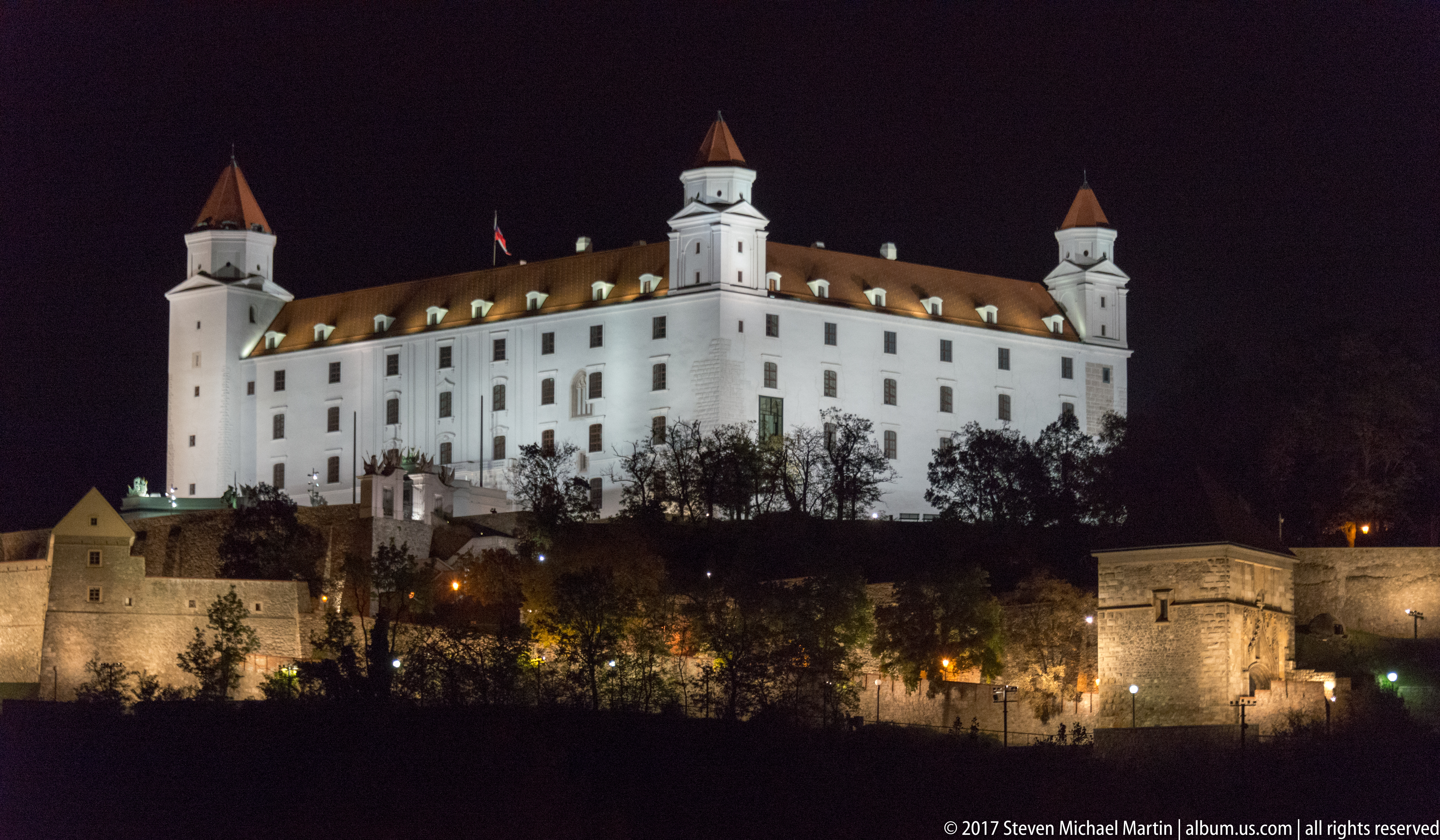
Bratislava Castle dominates the frame in a close nighttime view, its white rectangular palace block and four corner towers sharply illuminated above the darker defensive walls below. The composition emphasizes the castle’s monumental geometry and hilltop presence rather than the wider cityscape or river.
Caption
Bratislava Castle dominates the frame in a close nighttime view, its white rectangular palace block and four corner towers sharply illuminated above the darker defensive walls below. The composition emphasizes the castle’s monumental geometry and hilltop presence rather than the wider cityscape or river.

Bratislava Castle shines white on its hill above the dark Danube, its four corner towers forming a recognizable silhouette against the night sky. Reflections from the embankment lights ripple across the river below, reinforcing the castle’s elevated relationship to the city and waterway.
Caption
Bratislava Castle shines white on its hill above the dark Danube, its four corner towers forming a recognizable silhouette against the night sky. Reflections from the embankment lights ripple across the river below, reinforcing the castle’s elevated relationship to the city and waterway.

Bratislava Castle rises above its lower fortifications beneath a peach and violet sunset sky. The white rectangular mass, red roof, and four corner towers are seen from a distance, allowing the full hilltop composition to emerge with trees, walls, and outbuildings layered below the main palace block.
Caption
Bratislava Castle rises above its lower fortifications beneath a peach and violet sunset sky. The white rectangular mass, red roof, and four corner towers are seen from a distance, allowing the full hilltop composition to emerge with trees, walls, and outbuildings layered below the main palace block.

A vintage automobile pauses in a narrow, amber-lit lane beneath the hill of Bratislava Castle, whose white walls and corner towers appear high in the background. The vehicle’s round headlights and upright body contrast with the massive stone architecture flanking the lane, turning an evening street scene into a layered study of transport, fortification, and topography.
Caption
A vintage automobile pauses in a narrow, amber-lit lane beneath the hill of Bratislava Castle, whose white walls and corner towers appear high in the background. The vehicle’s round headlights and upright body contrast with the massive stone architecture flanking the lane, turning an evening street scene into a layered study of transport, fortification, and topography.

A narrow lane climbs between warm-toned historic buildings while Bratislava Castle appears on the hill above, brightly illuminated against the night sky. The steep visual relationship between street and fortress makes the city’s topography immediately legible: dense old-town fabric lies below the elevated defensive and ceremonial complex that dominates the skyline.
Caption
A narrow lane climbs between warm-toned historic buildings while Bratislava Castle appears on the hill above, brightly illuminated against the night sky. The steep visual relationship between street and fortress makes the city’s topography immediately legible: dense old-town fabric lies below the elevated defensive and ceremonial complex that dominates the skyline.

Bratislava Castle rises above a tightly framed Old Town passage, its white walls and red-roofed corner towers appearing beyond weathered masonry and tiled roofs. The layered view links the hilltop fortress with the dense historic city below, while the foreground walls and narrow passage give a strong sense of the castle’s elevated position over Bratislava.
Caption
Bratislava Castle rises above a tightly framed Old Town passage, its white walls and red-roofed corner towers appearing beyond weathered masonry and tiled roofs. The layered view links the hilltop fortress with the dense historic city below, while the foreground walls and narrow passage give a strong sense of the castle’s elevated position over Bratislava.

The Most SNP spans the Danube approach into Bratislava, its single inclined pylon carrying the distinctive saucer-shaped observation structure above the roadway. Seen in soft evening light, the bridge frames the city beyond and shows how this late-modern engineering landmark functions simultaneously as transportation infrastructure and an unmistakable part of Bratislava’s skyline.
Caption
The Most SNP spans the Danube approach into Bratislava, its single inclined pylon carrying the distinctive saucer-shaped observation structure above the roadway. Seen in soft evening light, the bridge frames the city beyond and shows how this late-modern engineering landmark functions simultaneously as transportation infrastructure and an unmistakable part of Bratislava’s skyline.

A patinated copper finial rises from a historic roofline in Bratislava, topped by an elaborate dragon-like metal weather vane or crest. The green oxidation of the architectural metalwork contrasts with the pale sky, while the tightly cropped view isolates the craftsmanship and silhouette of the ornament from the building below.
Caption
A patinated copper finial rises from a historic roofline in Bratislava, topped by an elaborate dragon-like metal weather vane or crest. The green oxidation of the architectural metalwork contrasts with the pale sky, while the tightly cropped view isolates the craftsmanship and silhouette of the ornament from the building below.

A carved male figure serves as an expressive architectural support on a historic Bratislava façade. With one arm raised beneath a voluted capital and the other drawn across his body, the figure combines human anatomy with structural ornament, exemplifying the theatrical sculptural vocabulary common to richly decorated Baroque and later historicist buildings.
Caption
A carved male figure serves as an expressive architectural support on a historic Bratislava façade. With one arm raised beneath a voluted capital and the other drawn across his body, the figure combines human anatomy with structural ornament, exemplifying the theatrical sculptural vocabulary common to richly decorated Baroque and later historicist buildings.

A gilded Eye of Providence radiates above a sculptural group of angels on a warm-toned historic façade in Bratislava. The triangular eye, surrounded by an emphatic sunburst, forms the visual center of the composition while the stone figures below introduce a strongly Baroque devotional character and dramatic interplay of light and shadow.
Caption
A gilded Eye of Providence radiates above a sculptural group of angels on a warm-toned historic façade in Bratislava. The triangular eye, surrounded by an emphatic sunburst, forms the visual center of the composition while the stone figures below introduce a strongly Baroque devotional character and dramatic interplay of light and shadow.

A Baroque sculptural ensemble crowns an ornate architectural feature in Bratislava, with a central angel and smaller attendant figures grouped beneath a gilded Eye of Providence. Volutes, clouds, and deeply modeled drapery create a theatrical composition, while the Latin inscription “TRES UNUM SUNT” is visible below, reinforcing the Trinitarian symbolism of the ornament.
Caption
A Baroque sculptural ensemble crowns an ornate architectural feature in Bratislava, with a central angel and smaller attendant figures grouped beneath a gilded Eye of Providence. Volutes, clouds, and deeply modeled drapery create a theatrical composition, while the Latin inscription “TRES UNUM SUNT” is visible below, reinforcing the Trinitarian symbolism of the ornament.

A long run of corrugated construction hoarding in Bratislava has been transformed into a colorful street-art surface. Stylized buildings, a bridge-like form, graffiti tags, and blocks of green, yellow, blue, and red animate the temporary barrier, turning an otherwise utilitarian edge of the street into an improvised urban gallery.
Caption
A long run of corrugated construction hoarding in Bratislava has been transformed into a colorful street-art surface. Stylized buildings, a bridge-like form, graffiti tags, and blocks of green, yellow, blue, and red animate the temporary barrier, turning an otherwise utilitarian edge of the street into an improvised urban gallery.

Three men wearing long brown, rope-belted robes walk together along a narrow paved passage in Bratislava’s historic center. Their clothing suggests members of a mendicant religious order, while the close urban setting of stucco walls, cobbles, and street fixtures places the moment within the everyday life of the old city rather than a formal ceremony.
Caption
Three men wearing long brown, rope-belted robes walk together along a narrow paved passage in Bratislava’s historic center. Their clothing suggests members of a mendicant religious order, while the close urban setting of stucco walls, cobbles, and street fixtures places the moment within the everyday life of the old city rather than a formal ceremony.

Bold black hand-painted letters spelling “SLOVAK” stretch across a warm wooden board. The irregular, elongated letterforms give the sign a deliberately folk-inspired character, emphasizing national identity through typography and material rather than imagery.
Caption
Bold black hand-painted letters spelling “SLOVAK” stretch across a warm wooden board. The irregular, elongated letterforms give the sign a deliberately folk-inspired character, emphasizing national identity through typography and material rather than imagery.

The Slovak House café and restaurant occupies a salmon-colored historic façade in Bratislava, marked by tall white-trimmed windows, vertical banners, and a rustic wooden sign. The juxtaposition of formal urban architecture and folk-styled lettering presents a commercial interpretation of Slovak identity within the city’s tourist-oriented historic core.
Caption
The Slovak House café and restaurant occupies a salmon-colored historic façade in Bratislava, marked by tall white-trimmed windows, vertical banners, and a rustic wooden sign. The juxtaposition of formal urban architecture and folk-styled lettering presents a commercial interpretation of Slovak identity within the city’s tourist-oriented historic core.

A sculpted metal dragon curls outward from an ornamental bracket in Bratislava, its open jaws, ribbed wings, and scaled body creating a dramatic silhouette. The warm metallic surface and black supporting scrollwork suggest a crafted shop or tavern sign designed to be read from the street as much by shape as by text.
Caption
A sculpted metal dragon curls outward from an ornamental bracket in Bratislava, its open jaws, ribbed wings, and scaled body creating a dramatic silhouette. The warm metallic surface and black supporting scrollwork suggest a crafted shop or tavern sign designed to be read from the street as much by shape as by text.

An ornate black metal frame holds a grid of food photographs against a deep red wall, creating a decorative menu display for a Bratislava restaurant. A central illustration of a traditionally dressed figure is surrounded by plates of regional-style dishes, combining visual marketing with folk-themed decoration to attract passersby.
Caption
An ornate black metal frame holds a grid of food photographs against a deep red wall, creating a decorative menu display for a Bratislava restaurant. A central illustration of a traditionally dressed figure is surrounded by plates of regional-style dishes, combining visual marketing with folk-themed decoration to attract passersby.

A narrow street in Bratislava’s historic center leads toward a pale tower with a green roof while late-day light warms the surrounding façades. At left, an elaborate gilded or copper-toned rooftop figure projects above a corner building, adding a sculptural accent to the layered streetscape of shops, upper-story windows, and pedestrians.
Caption
A narrow street in Bratislava’s historic center leads toward a pale tower with a green roof while late-day light warms the surrounding façades. At left, an elaborate gilded or copper-toned rooftop figure projects above a corner building, adding a sculptural accent to the layered streetscape of shops, upper-story windows, and pedestrians.

Seen from a steep upward angle, the Most SNP’s inclined pylon legs, suspension cables, and saucer-shaped UFO observation deck converge against the pale sky. The composition emphasizes the structural logic of the bridge: a single asymmetrical support carrying both the roadway suspension system and the elevated public viewpoint above Bratislava.
Caption
Seen from a steep upward angle, the Most SNP’s inclined pylon legs, suspension cables, and saucer-shaped UFO observation deck converge against the pale sky. The composition emphasizes the structural logic of the bridge: a single asymmetrical support carrying both the roadway suspension system and the elevated public viewpoint above Bratislava.

A bronze public sculpture in Bratislava pairs the oversized head and upper body of a solemn man with a much smaller top-hatted figure leaning close beside him. The unusual scale relationship and intimate grouping create a narrative, almost theatrical effect, while the leafy park setting softens the dark patinated surface of the bronze.
Caption
A bronze public sculpture in Bratislava pairs the oversized head and upper body of a solemn man with a much smaller top-hatted figure leaning close beside him. The unusual scale relationship and intimate grouping create a narrative, almost theatrical effect, while the leafy park setting softens the dark patinated surface of the bronze.

Bratislava Castle rises above the city on its fortified hill, its rectangular palace block anchored by four corner towers and enclosed by substantial defensive walls. Warm low-angle light emphasizes the pale façades, red roofs, masonry bastions, and terraced slopes, making this an establishing view of the castle’s commanding relationship to the Danube corridor and historic city.
Caption
Bratislava Castle rises above the city on its fortified hill, its rectangular palace block anchored by four corner towers and enclosed by substantial defensive walls. Warm low-angle light emphasizes the pale façades, red roofs, masonry bastions, and terraced slopes, making this an establishing view of the castle’s commanding relationship to the Danube corridor and historic city.

The circular UFO observation deck of the Most SNP fills the frame from below, its ring of windows and broad metallic underside glowing in warm light. Cropped tightly against the sky, the image shifts attention from the bridge as infrastructure to the futuristic architectural form that has become one of Bratislava’s most recognizable modern landmarks.
Caption
The circular UFO observation deck of the Most SNP fills the frame from below, its ring of windows and broad metallic underside glowing in warm light. Cropped tightly against the sky, the image shifts attention from the bridge as infrastructure to the futuristic architectural form that has become one of Bratislava’s most recognizable modern landmarks.
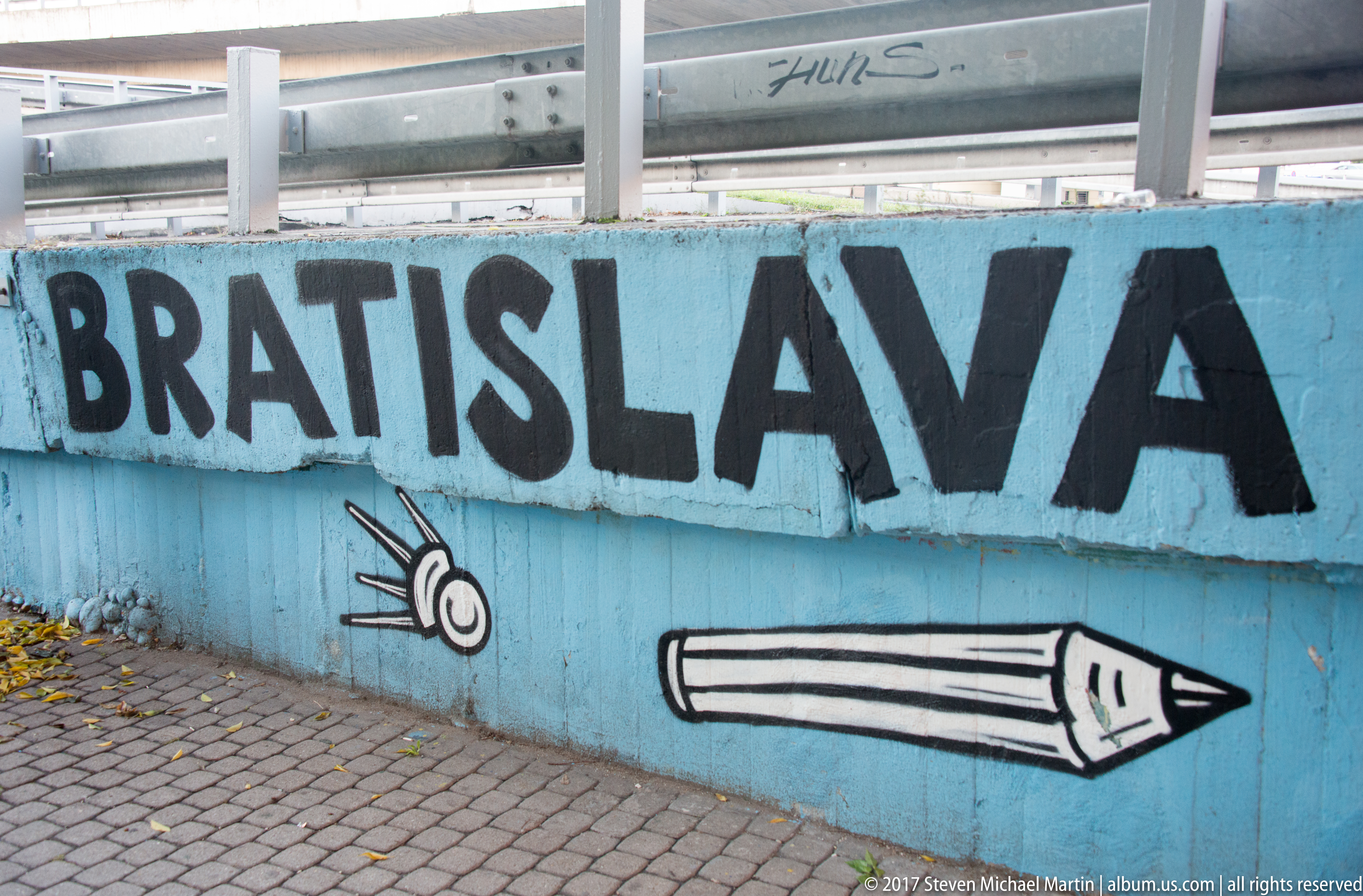
Large black letters spelling “BRATISLAVA” cover a blue concrete wall beneath or beside transport infrastructure, accompanied by playful black-and-white drawings of a snail and oversized pencil. The mural turns a utilitarian urban surface into a direct place marker, using bold typography and simple graphic symbols to announce the city in an informal visual language.
Caption
Large black letters spelling “BRATISLAVA” cover a blue concrete wall beneath or beside transport infrastructure, accompanied by playful black-and-white drawings of a snail and oversized pencil. The mural turns a utilitarian urban surface into a direct place marker, using bold typography and simple graphic symbols to announce the city in an informal visual language.

A stone statue of a haloed male saint stands in formal dress, holding a broad covered vessel or ceremonial object before his torso. The figure’s cloak, short tunic, and carefully carved posture are presented against an open sky, isolating the devotional sculpture from its larger architectural or monument setting.
Caption
A stone statue of a haloed male saint stands in formal dress, holding a broad covered vessel or ceremonial object before his torso. The figure’s cloak, short tunic, and carefully carved posture are presented against an open sky, isolating the devotional sculpture from its larger architectural or monument setting.
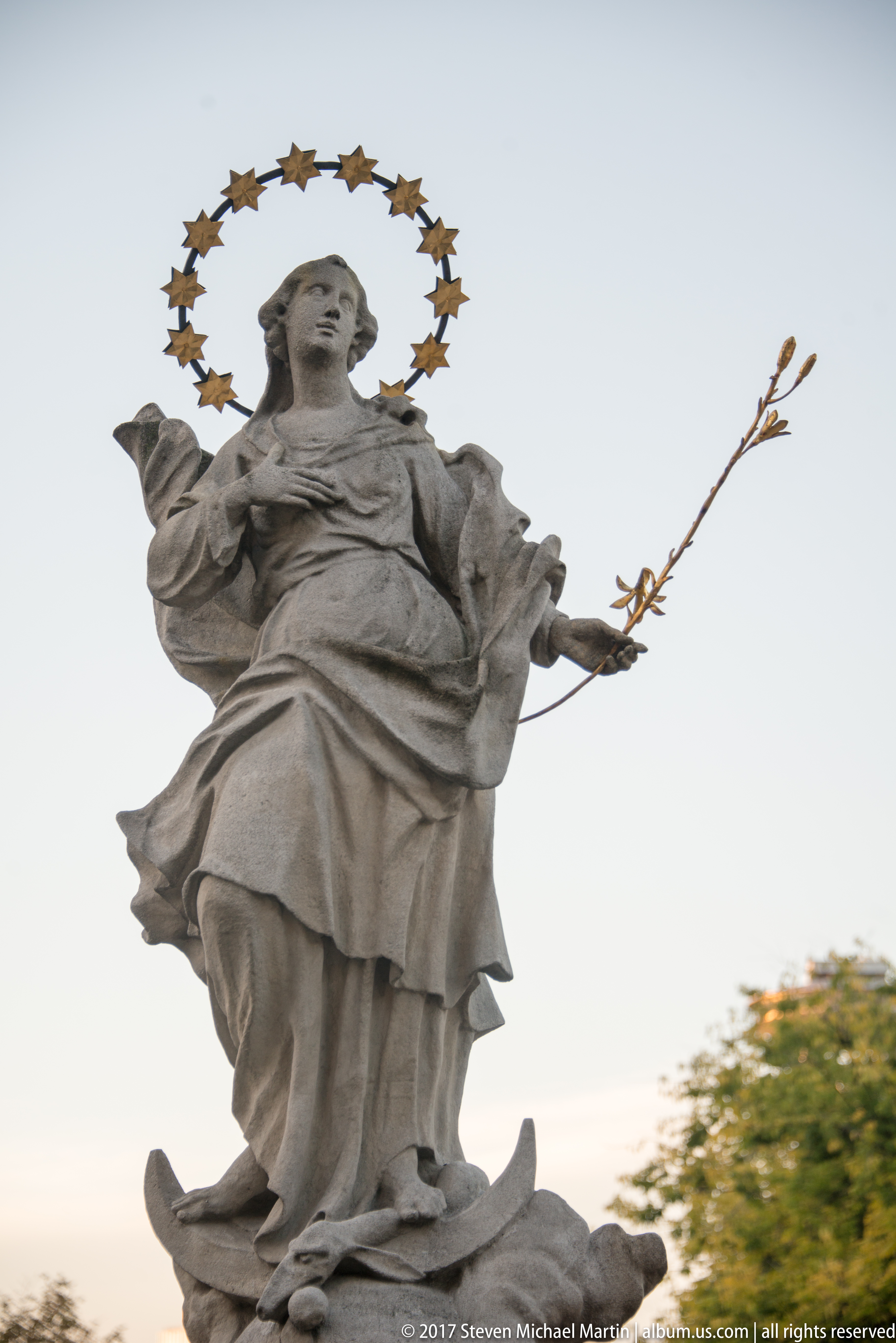
A stone female saint stands above a crescent-like base with a ring of stars around her head and a flowering branch or lily-like stem in one hand. Wind-swept drapery gives the figure a dynamic Baroque silhouette, while the celestial attributes suggest Marian or saintly iconography without allowing a secure identification from this view alone.
Caption
A stone female saint stands above a crescent-like base with a ring of stars around her head and a flowering branch or lily-like stem in one hand. Wind-swept drapery gives the figure a dynamic Baroque silhouette, while the celestial attributes suggest Marian or saintly iconography without allowing a secure identification from this view alone.

A dramatic stone sculptural group in Bratislava is backed by a large gilded burst of rays, with several figures arranged around a central seated or reclining form. Strong diagonals, billowing drapery, and the metallic radiance create a theatrical Baroque composition intended to be read from below as part of a larger devotional monument.
Caption
A dramatic stone sculptural group in Bratislava is backed by a large gilded burst of rays, with several figures arranged around a central seated or reclining form. Strong diagonals, billowing drapery, and the metallic radiance create a theatrical Baroque composition intended to be read from below as part of a larger devotional monument.

A white church tower with clock faces rises above a red-tiled roof and enclosed historic complex in Bratislava’s Old Town. Flowering baskets, a streetlamp, trees, and a visitor information panel frame the view, placing the religious architecture within a maintained public green space along the edge of the historic center.
Caption
A white church tower with clock faces rises above a red-tiled roof and enclosed historic complex in Bratislava’s Old Town. Flowering baskets, a streetlamp, trees, and a visitor information panel frame the view, placing the religious architecture within a maintained public green space along the edge of the historic center.

A modern bronze memorial in Bratislava rises from a low stone plinth, its fractured box-like form combining relief surfaces, angular frames, and damaged or open upper edges. The rough, expressive treatment contrasts with the surrounding paved plaza and plain wall, suggesting a commemorative work centered on rupture, loss, or historical trauma.
Caption
A modern bronze memorial in Bratislava rises from a low stone plinth, its fractured box-like form combining relief surfaces, angular frames, and damaged or open upper edges. The rough, expressive treatment contrasts with the surrounding paved plaza and plain wall, suggesting a commemorative work centered on rupture, loss, or historical trauma.

Traffic streams toward the Most SNP beneath the bridge’s towering inclined pylon and circular UFO observation deck. This road-level view emphasizes the structure’s everyday role in Bratislava’s transport network, contrasting moving cars and buses with the monumental geometry of the bridge above.
Caption
Traffic streams toward the Most SNP beneath the bridge’s towering inclined pylon and circular UFO observation deck. This road-level view emphasizes the structure’s everyday role in Bratislava’s transport network, contrasting moving cars and buses with the monumental geometry of the bridge above.

A weathered building in Bratislava’s historic center presents a striking patchwork of old masonry, exposed brick, and colorful painted panels set into many window openings. The altered façade records layers of use and adaptation, while adjacent stone walls and red roofs reinforce the dense, irregular fabric of the old city.
Caption
A weathered building in Bratislava’s historic center presents a striking patchwork of old masonry, exposed brick, and colorful painted panels set into many window openings. The altered façade records layers of use and adaptation, while adjacent stone walls and red roofs reinforce the dense, irregular fabric of the old city.

A row of pastel-toned historic buildings catches warm evening sunlight above a stone retaining wall in Bratislava. Varied rooflines, dormers, chimneys, decorative façades, and a small tower rising behind them create a compact urban profile characteristic of the layered historic center.
Caption
A row of pastel-toned historic buildings catches warm evening sunlight above a stone retaining wall in Bratislava. Varied rooflines, dormers, chimneys, decorative façades, and a small tower rising behind them create a compact urban profile characteristic of the layered historic center.

Tall organ pipes rise beneath pointed Gothic vaulting above a richly decorated gallery rail in a Bratislava church. A gilded crest-like ornament marks the center of the gallery, while quatrefoil panels and the stone ribs of the vault combine liturgical furnishing, heraldic decoration, and medieval architectural form in one tightly framed view.
Caption
Tall organ pipes rise beneath pointed Gothic vaulting above a richly decorated gallery rail in a Bratislava church. A gilded crest-like ornament marks the center of the gallery, while quatrefoil panels and the stone ribs of the vault combine liturgical furnishing, heraldic decoration, and medieval architectural form in one tightly framed view.

A soaring Gothic church interior is seen down the central aisle beneath branching rib vaults and a large suspended chandelier. Elaborate vertical altarpieces flank the nave, while rows of wooden pews lead toward the distant sanctuary, creating a layered view of architecture, furnishings, and devotional art within a single space.
Caption
A soaring Gothic church interior is seen down the central aisle beneath branching rib vaults and a large suspended chandelier. Elaborate vertical altarpieces flank the nave, while rows of wooden pews lead toward the distant sanctuary, creating a layered view of architecture, furnishings, and devotional art within a single space.

A broad Gothic nave opens toward a luminous sanctuary framed by tall ribbed vaults and pointed windows. Dark choir stalls line both sides near the chancel, while a central altar, red carpet, floral arrangement, and geometric floor pattern organize the axial view. The photograph emphasizes the spacious vertical proportions and liturgical focus of the interior.
Caption
A broad Gothic nave opens toward a luminous sanctuary framed by tall ribbed vaults and pointed windows. Dark choir stalls line both sides near the chancel, while a central altar, red carpet, floral arrangement, and geometric floor pattern organize the axial view. The photograph emphasizes the spacious vertical proportions and liturgical focus of the interior.

A historic Gothic church in Bratislava presents a long pale-stone side wall beneath a steep red-tiled roof, anchored by a square white tower with a copper-green cap. Pointed and traceried windows, buttress-like wall divisions, and a small side portal articulate the exterior, while the low evening light sharpens the building’s masonry texture.
Caption
A historic Gothic church in Bratislava presents a long pale-stone side wall beneath a steep red-tiled roof, anchored by a square white tower with a copper-green cap. Pointed and traceried windows, buttress-like wall divisions, and a small side portal articulate the exterior, while the low evening light sharpens the building’s masonry texture.

A gently descending cobbled lane passes between closely spaced historic buildings in central Bratislava. Spanish and European Union flags project from one façade, adding a contemporary diplomatic or commercial marker to the otherwise traditional street scene. Stucco fronts, red-tiled roofs, wrought-iron balconies, and the enclosed perspective convey the intimate scale of the Old Town.
Caption
A gently descending cobbled lane passes between closely spaced historic buildings in central Bratislava. Spanish and European Union flags project from one façade, adding a contemporary diplomatic or commercial marker to the otherwise traditional street scene. Stucco fronts, red-tiled roofs, wrought-iron balconies, and the enclosed perspective convey the intimate scale of the Old Town.

The central nave of a Gothic Bratislava church stretches toward the sanctuary between massive stone piers and ribbed vaults. A dark carved pulpit projects from a pier on the left, while tall decorated altarpieces flank the aisle and a hanging light fixture punctuates the long vertical axis toward the east end.
Caption
The central nave of a Gothic Bratislava church stretches toward the sanctuary between massive stone piers and ribbed vaults. A dark carved pulpit projects from a pier on the left, while tall decorated altarpieces flank the aisle and a hanging light fixture punctuates the long vertical axis toward the east end.

Pastel townhouses lean into a narrow Old Town lane, their steep roofs and irregular façades drawing the eye toward a distant spire. The oblique viewpoint emphasizes Bratislava’s compact historic fabric, where medieval street alignments survive beneath later residential fronts. Decorative window surrounds, wrought-iron details, and the changing wall colors distinguish the individual buildings along the rising street.
Caption
Pastel townhouses lean into a narrow Old Town lane, their steep roofs and irregular façades drawing the eye toward a distant spire. The oblique viewpoint emphasizes Bratislava’s compact historic fabric, where medieval street alignments survive beneath later residential fronts. Decorative window surrounds, wrought-iron details, and the changing wall colors distinguish the individual buildings along the rising street.

Hand-painted wooden shutters frame two display windows on a Bratislava storefront, turning the façade into an informal piece of street art. Stylized faces, animals, and bright decorative motifs contrast with the darker shop interior and merchandise behind the glass. The close frontal composition records a playful contemporary layer within the historic center rather than a monumental architectural subject.
Caption
Hand-painted wooden shutters frame two display windows on a Bratislava storefront, turning the façade into an informal piece of street art. Stylized faces, animals, and bright decorative motifs contrast with the darker shop interior and merchandise behind the glass. The close frontal composition records a playful contemporary layer within the historic center rather than a monumental architectural subject.

An elaborate stone cartouche surrounds a Latin inscription on a historic Bratislava façade. Scrollwork, shell-like forms, and paired winged figures animate the frame, while a small barred or blind opening sits within the upper crest. The close study emphasizes sculptural craftsmanship and the ceremonial character of the inscription without assigning a specific dedication that cannot be confirmed from the proof sheet.
Caption
An elaborate stone cartouche surrounds a Latin inscription on a historic Bratislava façade. Scrollwork, shell-like forms, and paired winged figures animate the frame, while a small barred or blind opening sits within the upper crest. The close study emphasizes sculptural craftsmanship and the ceremonial character of the inscription without assigning a specific dedication that cannot be confirmed from the proof sheet.

The bold “I ♥ BRATISLAVA” sign crowns a souvenir shop whose windows are packed with city-themed gifts. Repeated heart-logo graphics, toys, and keepsakes make the storefront a direct expression of contemporary tourism in the historic center. The symmetrical frontal view contrasts modern branding and retail display with the traditional street fabric surrounding Bratislava’s principal visitor district.
Caption
The bold “I ♥ BRATISLAVA” sign crowns a souvenir shop whose windows are packed with city-themed gifts. Repeated heart-logo graphics, toys, and keepsakes make the storefront a direct expression of contemporary tourism in the historic center. The symmetrical frontal view contrasts modern branding and retail display with the traditional street fabric surrounding Bratislava’s principal visitor district.

Michael’s Gate anchors the end of a narrow Old Town street, its pale tower rising above the surrounding façades beneath a green copper roof and ornate lantern. The arched passage at street level preserves the gateway function of Bratislava’s medieval fortifications, while shops, flags, and pedestrians place the surviving defensive landmark within the active modern city.
Caption
Michael’s Gate anchors the end of a narrow Old Town street, its pale tower rising above the surrounding façades beneath a green copper roof and ornate lantern. The arched passage at street level preserves the gateway function of Bratislava’s medieval fortifications, while shops, flags, and pedestrians place the surviving defensive landmark within the active modern city.

Massive wooden double doors fill a rusticated stone arch, their surfaces organized into richly carved panels of scrolls, foliage, and symmetrical relief ornament. A central vertical member reinforces the formal balance of the entrance. The close, frontal view isolates the craftsmanship of the portal and shows how carved wood contributes to the decorative character of Bratislava’s historic architecture.
Caption
Massive wooden double doors fill a rusticated stone arch, their surfaces organized into richly carved panels of scrolls, foliage, and symmetrical relief ornament. A central vertical member reinforces the formal balance of the entrance. The close, frontal view isolates the craftsmanship of the portal and shows how carved wood contributes to the decorative character of Bratislava’s historic architecture.

Bratislava’s city arms appear in relief above an arched window, framed by white stucco scrolls on a warm yellow façade. The heraldic device—showing a fortified gateway with towers—forms the visual center of the ornament. This close architectural study links civic identity with the decorative vocabulary of the historic center and records the emblem as an integral part of the building’s façade design.
Caption
Bratislava’s city arms appear in relief above an arched window, framed by white stucco scrolls on a warm yellow façade. The heraldic device—showing a fortified gateway with towers—forms the visual center of the ornament. This close architectural study links civic identity with the decorative vocabulary of the historic center and records the emblem as an integral part of the building’s façade design.
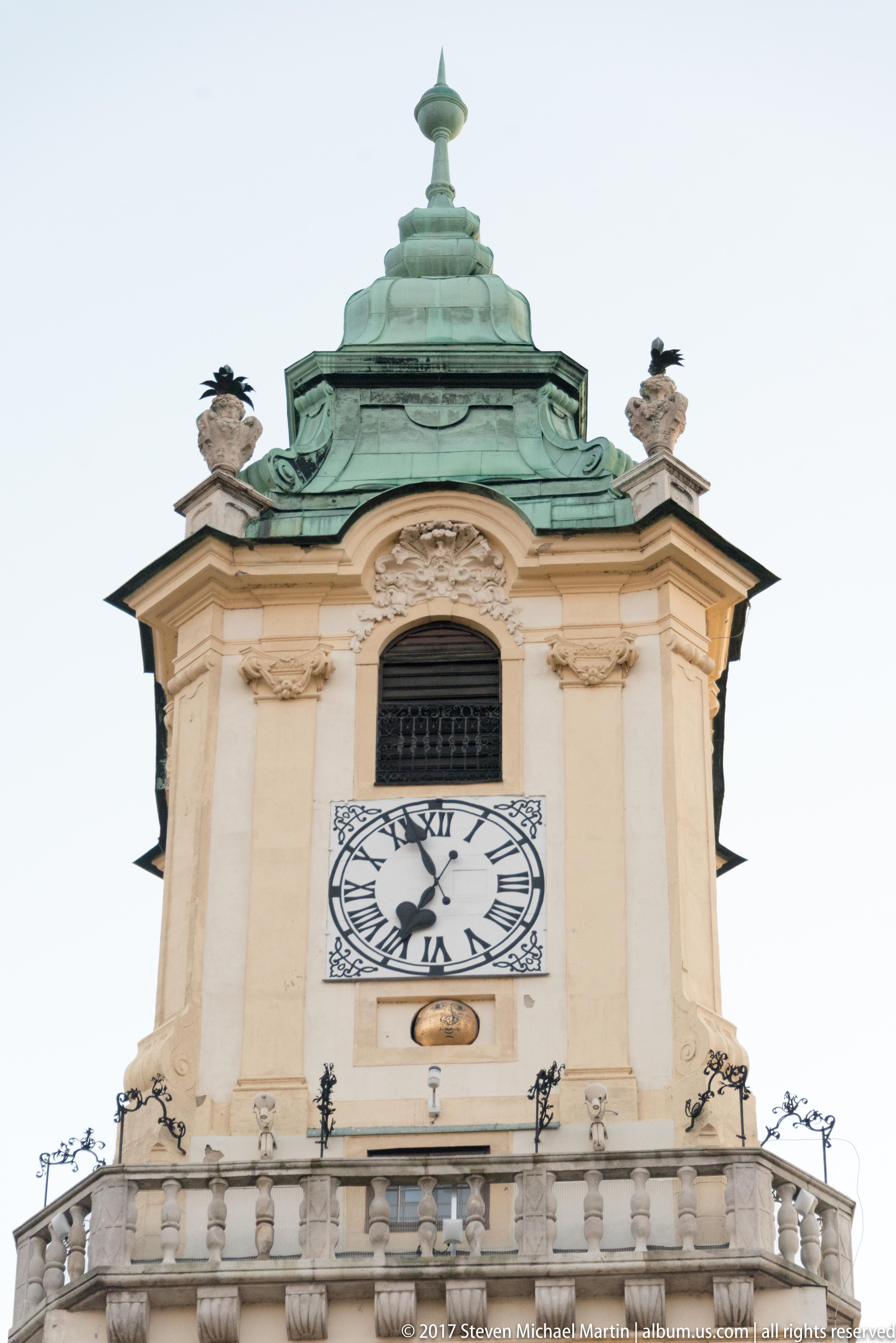
A square clock face occupies the lower stage of a richly modeled tower capped by a green patinated metal roof. Curving cornices, pilasters, balustrades, and small sculptural figures frame the clock, giving the upper structure a pronounced Baroque character. The upward view concentrates on the tower’s timekeeping and decorative elements rather than the surrounding square.
Caption
A square clock face occupies the lower stage of a richly modeled tower capped by a green patinated metal roof. Curving cornices, pilasters, balustrades, and small sculptural figures frame the clock, giving the upper structure a pronounced Baroque character. The upward view concentrates on the tower’s timekeeping and decorative elements rather than the surrounding square.

A gilded and white stucco cartouche centers on the Christogram “IHS,” surrounded by exuberant foliage and scrollwork. Below it, a gilded eagle-like bird spreads its wings above additional lettering, creating a strongly vertical devotional emblem on the façade. The detail is recorded closely enough to distinguish the religious monogram and sculptural ornament while leaving the building’s precise dedication unassigned.
Caption
A gilded and white stucco cartouche centers on the Christogram “IHS,” surrounded by exuberant foliage and scrollwork. Below it, a gilded eagle-like bird spreads its wings above additional lettering, creating a strongly vertical devotional emblem on the façade. The detail is recorded closely enough to distinguish the religious monogram and sculptural ornament while leaving the building’s precise dedication unassigned.

The Maximilian Fountain stands at the center of Bratislava’s Main Square, its circular basin and tall sculptural column set against a ring of ornate historic façades. The wide composition shows the monument as an organizing feature of the paved civic space, with cafés and storefronts at ground level reinforcing the square’s continuing public use.
Caption
The Maximilian Fountain stands at the center of Bratislava’s Main Square, its circular basin and tall sculptural column set against a ring of ornate historic façades. The wide composition shows the monument as an organizing feature of the paved civic space, with cafés and storefronts at ground level reinforcing the square’s continuing public use.

The standing figure crowning Bratislava’s Maximilian Fountain is seen from below against the ornate façades of Main Square. The elevated sculpture rises from a tall stone pedestal enriched with relief carving, emphasizing the monument’s role as a vertical focal point in the square. The low angle also places the historic fountain in dialogue with the surrounding late historicist architecture.
Caption
The standing figure crowning Bratislava’s Maximilian Fountain is seen from below against the ornate façades of Main Square. The elevated sculpture rises from a tall stone pedestal enriched with relief carving, emphasizing the monument’s role as a vertical focal point in the square. The low angle also places the historic fountain in dialogue with the surrounding late historicist architecture.

Bratislava’s bronze Napoleon’s Army Soldier leans over the back of a public bench in the Old Town, turning a historical reference into an approachable piece of street sculpture. His broad bicorne hat, folded arms, and forward-leaning pose give the work an informal, theatrical quality. The surrounding square and civic buildings place the statue within the pedestrian heart of the city.
Caption
Bratislava’s bronze Napoleon’s Army Soldier leans over the back of a public bench in the Old Town, turning a historical reference into an approachable piece of street sculpture. His broad bicorne hat, folded arms, and forward-leaning pose give the work an informal, theatrical quality. The surrounding square and civic buildings place the statue within the pedestrian heart of the city.

A close frontal view isolates the bronze Napoleon’s Army Soldier from the surrounding square. The oversized bicorne hat shades the figure’s face while crossed forearms rest on the bench back, emphasizing the sculpture’s humorous, conversational pose. Surface wear and polished highlights on the bronze are visible at this distance, revealing the tactile character of a popular public monument.
Caption
A close frontal view isolates the bronze Napoleon’s Army Soldier from the surrounding square. The oversized bicorne hat shades the figure’s face while crossed forearms rest on the bench back, emphasizing the sculpture’s humorous, conversational pose. Surface wear and polished highlights on the bronze are visible at this distance, revealing the tactile character of a popular public monument.

The Napoleon’s Army Soldier is shown in profile as he leans over a bench, with a church tower and open Old Town square extending behind him. This wider angle places the bronze figure within Bratislava’s pedestrian public realm rather than treating it as an isolated sculpture. The low, human-scale monument contrasts with the vertical architecture and tree canopy beyond.
Caption
The Napoleon’s Army Soldier is shown in profile as he leans over a bench, with a church tower and open Old Town square extending behind him. This wider angle places the bronze figure within Bratislava’s pedestrian public realm rather than treating it as an isolated sculpture. The low, human-scale monument contrasts with the vertical architecture and tree canopy beyond.
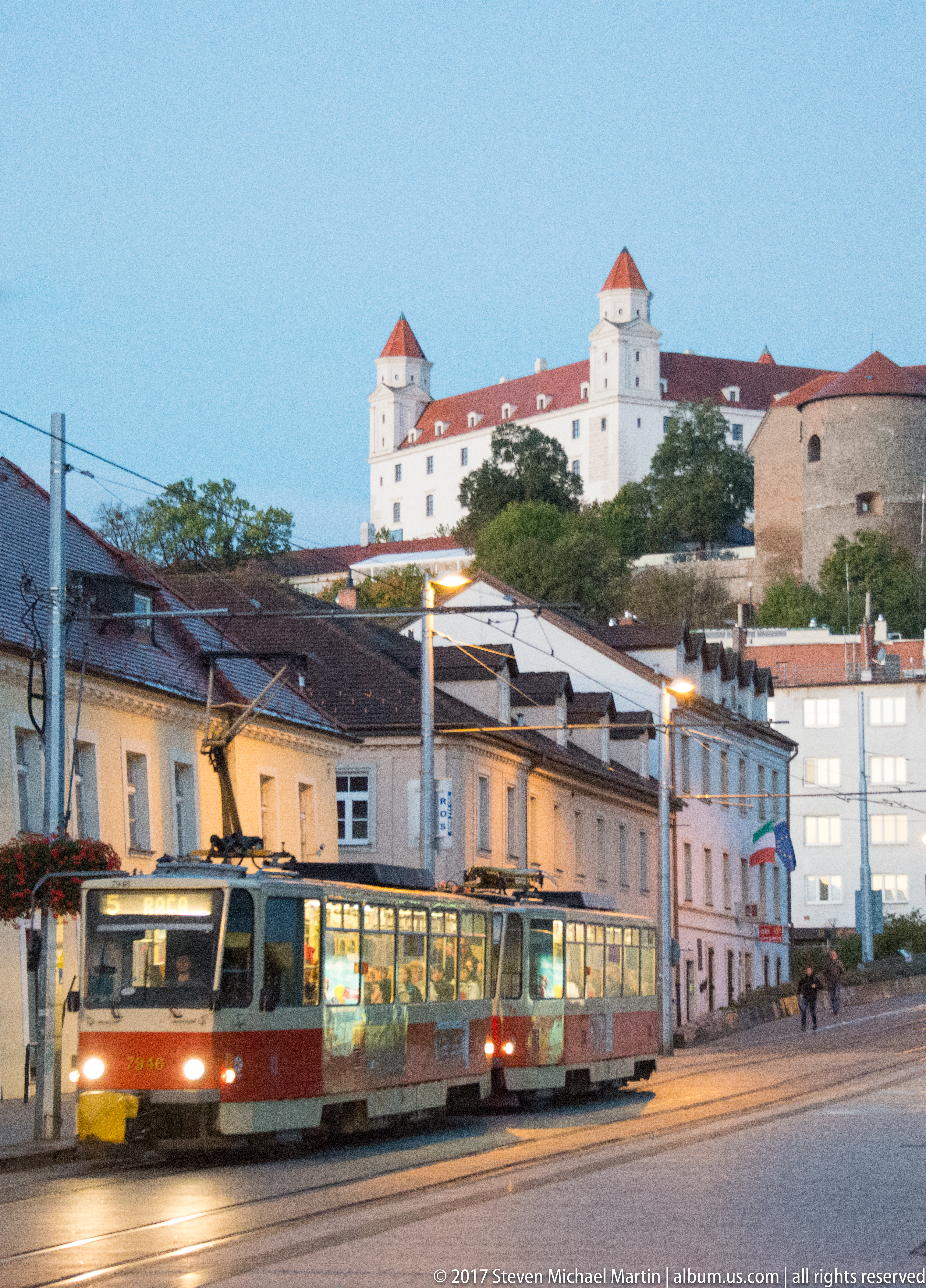
A red-and-cream tram travels along the street beneath Bratislava Castle, whose white hilltop mass and red-roofed towers dominate the skyline. Evening light links everyday transit with the city’s most prominent historic fortification, while lower residential façades and overhead wires anchor the scene in modern Bratislava. The view demonstrates how the castle remains visually present within ordinary urban movement.
Caption
A red-and-cream tram travels along the street beneath Bratislava Castle, whose white hilltop mass and red-roofed towers dominate the skyline. Evening light links everyday transit with the city’s most prominent historic fortification, while lower residential façades and overhead wires anchor the scene in modern Bratislava. The view demonstrates how the castle remains visually present within ordinary urban movement.
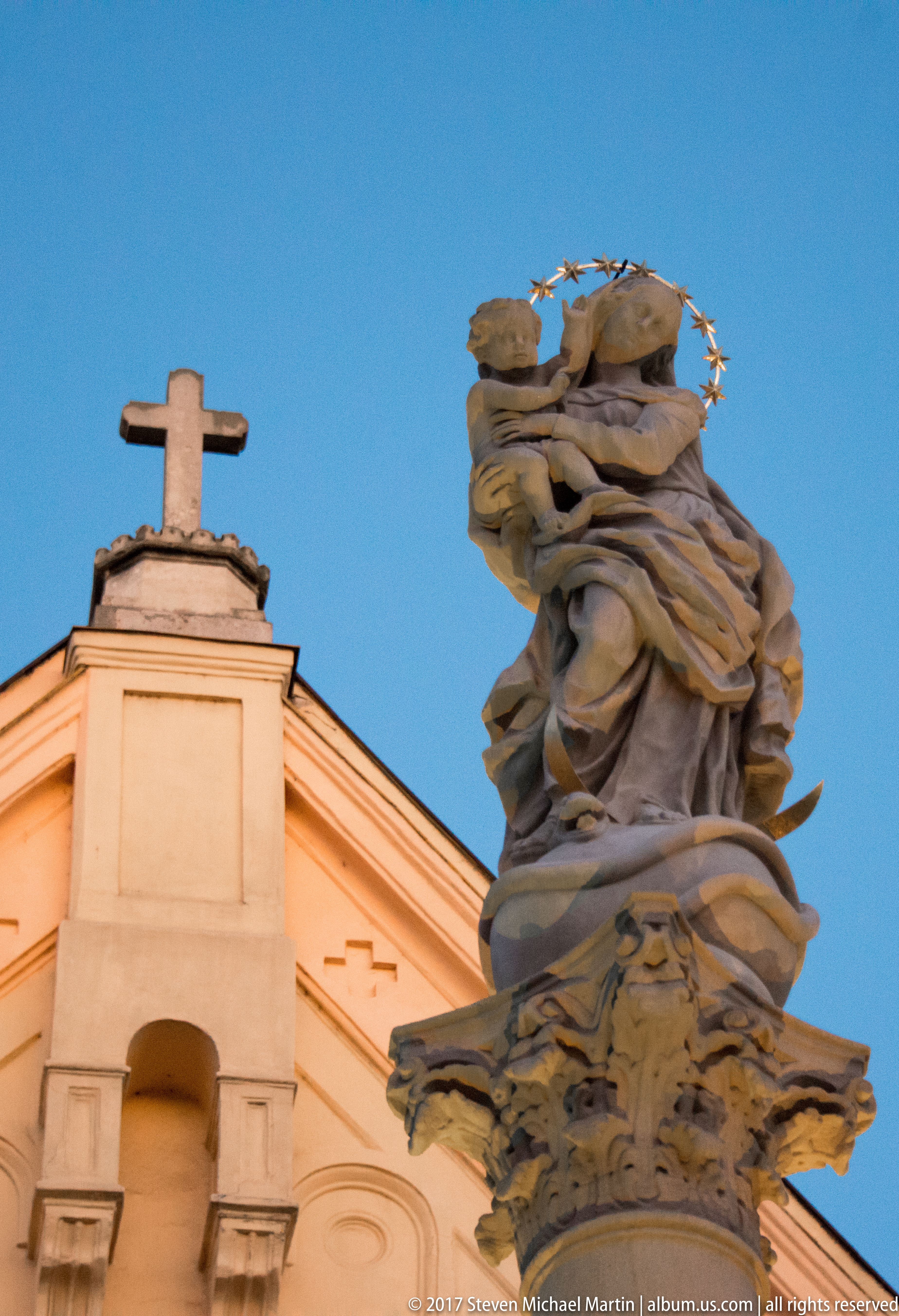
A stone figure of the Virgin and Child, the Virgin crowned with a ring of stars, rises beside the gable of a church. Strong evening illumination models the flowing drapery and cloud-like base, while a simple cross crowns the adjacent façade. The low-angle composition emphasizes devotional sculpture and sacred architecture without relying on an uncertain monument name.
Caption
A stone figure of the Virgin and Child, the Virgin crowned with a ring of stars, rises beside the gable of a church. Strong evening illumination models the flowing drapery and cloud-like base, while a simple cross crowns the adjacent façade. The low-angle composition emphasizes devotional sculpture and sacred architecture without relying on an uncertain monument name.

Michael’s Gate rises at the end of a narrow Old Town street in a deliberately tilted evening composition. Warm storefront light and brightly painted façades lead toward the arched medieval gateway, while the tower’s pale walls and green copper roof stand against the deepening blue sky. The dynamic angle turns a familiar fortification landmark into a more expressive urban view.
Caption
Michael’s Gate rises at the end of a narrow Old Town street in a deliberately tilted evening composition. Warm storefront light and brightly painted façades lead toward the arched medieval gateway, while the tower’s pale walls and green copper roof stand against the deepening blue sky. The dynamic angle turns a familiar fortification landmark into a more expressive urban view.

Bratislava Castle’s white walls and red-roofed corner towers rise above a darker round defensive tower in the foreground. Seen at dusk, the layered fortification elements stand sharply against a blue sky, emphasizing the castle’s elevated and commanding position. The composition separates the monumental palace block from the older-looking cylindrical masonry structure below, revealing multiple phases of Bratislava’s defensive landscape.
Caption
Bratislava Castle’s white walls and red-roofed corner towers rise above a darker round defensive tower in the foreground. Seen at dusk, the layered fortification elements stand sharply against a blue sky, emphasizing the castle’s elevated and commanding position. The composition separates the monumental palace block from the older-looking cylindrical masonry structure below, revealing multiple phases of Bratislava’s defensive landscape.

Three sculpted putti cluster around the base of a tall devotional monument, their pale stone surfaces warmed by evening light. Behind them, a standing saint occupies a niche in the adjacent church façade. The close view concentrates on the monument’s layered sacred imagery—small attendant figures in the foreground and a larger devotional statue set into the architecture beyond.
Caption
Three sculpted putti cluster around the base of a tall devotional monument, their pale stone surfaces warmed by evening light. Behind them, a standing saint occupies a niche in the adjacent church façade. The close view concentrates on the monument’s layered sacred imagery—small attendant figures in the foreground and a larger devotional statue set into the architecture beyond.

A central aisle leads through a modest vaulted church interior toward a richly furnished sanctuary. Dark wooden pews line both sides, while framed devotional images and sculpted side altars punctuate the white walls. A pulpit projects from the left near the sanctuary, and the patterned floor strengthens the axial view toward the main altar.
Caption
A central aisle leads through a modest vaulted church interior toward a richly furnished sanctuary. Dark wooden pews line both sides, while framed devotional images and sculpted side altars punctuate the white walls. A pulpit projects from the left near the sanctuary, and the patterned floor strengthens the axial view toward the main altar.

A tall stone column rises from an inscribed pedestal decorated with sculptural figures, viewed steeply upward beside a church façade. The perspective emphasizes the monument’s verticality and the relationship between public devotional sculpture and the neighboring sacred building. Portions of the Latin inscription are visible, but the oblique angle and distance do not support a complete transcription.
Caption
A tall stone column rises from an inscribed pedestal decorated with sculptural figures, viewed steeply upward beside a church façade. The perspective emphasizes the monument’s verticality and the relationship between public devotional sculpture and the neighboring sacred building. Portions of the Latin inscription are visible, but the oblique angle and distance do not support a complete transcription.

An illuminated restaurant entrance presents a bold contemporary frontage in nighttime Bratislava. The word “GREAT” glows above the doorway, flanked by vertical “RESTAURANT” signs and an “OPEN” notice visible through the glass. Strong graphic lighting and a patterned threshold make the storefront stand out from the darker street, providing a distinctly modern urban detail after the preceding historic architecture.
Caption
An illuminated restaurant entrance presents a bold contemporary frontage in nighttime Bratislava. The word “GREAT” glows above the doorway, flanked by vertical “RESTAURANT” signs and an “OPEN” notice visible through the glass. Strong graphic lighting and a patterned threshold make the storefront stand out from the darker street, providing a distinctly modern urban detail after the preceding historic architecture.

Polished stainless-steel tanks, valves, pipes, and access fittings fill a compact brewery production room. The reflective vessels and dense network of sanitary connections reveal the industrial side of beer making, contrasting with the more familiar public-facing atmosphere of Bratislava’s pubs and restaurants.
Caption
Polished stainless-steel tanks, valves, pipes, and access fittings fill a compact brewery production room. The reflective vessels and dense network of sanitary connections reveal the industrial side of beer making, contrasting with the more familiar public-facing atmosphere of Bratislava’s pubs and restaurants.

A pale historic church faces an open Bratislava square at dusk, its central gable, round-arched openings, and saint niche illuminated against a blue evening sky. A tall sculptural devotional column stands directly in front of the façade behind a low stone balustrade. The balanced composition records both the sacred building and the public monument as a unified urban ensemble.
Caption
A pale historic church faces an open Bratislava square at dusk, its central gable, round-arched openings, and saint niche illuminated against a blue evening sky. A tall sculptural devotional column stands directly in front of the façade behind a low stone balustrade. The balanced composition records both the sacred building and the public monument as a unified urban ensemble.

Tram wires crisscross a blue-hour sky above a curving Bratislava street, where illuminated commercial façades and wet-looking pavement lead toward the distant hill. Bratislava Castle is visible beyond the street axis, tying the modern transport corridor to the historic skyline. Electric blue and magenta storefront lighting adds a contemporary counterpoint to the older architecture lining the route.
Caption
Tram wires crisscross a blue-hour sky above a curving Bratislava street, where illuminated commercial façades and wet-looking pavement lead toward the distant hill. Bratislava Castle is visible beyond the street axis, tying the modern transport corridor to the historic skyline. Electric blue and magenta storefront lighting adds a contemporary counterpoint to the older architecture lining the route.

The pink-and-cream Baroque façade of Bratislava’s Trinitarian Church rises between twin towers, its central bay projecting forward in a rhythmic sequence of pilasters, cornices, and curved wall surfaces. Sculptural ornament concentrates around the main portal, while the fading blue sky heightens the pastel masonry. The frontal evening view emphasizes the church’s theatrical Baroque massing and symmetrical composition.
Caption
The pink-and-cream Baroque façade of Bratislava’s Trinitarian Church rises between twin towers, its central bay projecting forward in a rhythmic sequence of pilasters, cornices, and curved wall surfaces. Sculptural ornament concentrates around the main portal, while the fading blue sky heightens the pastel masonry. The frontal evening view emphasizes the church’s theatrical Baroque massing and symmetrical composition.

Richly modeled Baroque architecture surrounds the sanctuary of Bratislava’s Trinitarian Church. Monumental side altars with dark columns and gilded sculpture frame the central altar, while painted vaults, high windows, and a chandelier draw the eye upward into the domed space. The wide interior view shows the dense integration of architecture, painting, sculpture, and liturgical furnishing characteristic of the church’s decorative program.
Caption
Richly modeled Baroque architecture surrounds the sanctuary of Bratislava’s Trinitarian Church. Monumental side altars with dark columns and gilded sculpture frame the central altar, while painted vaults, high windows, and a chandelier draw the eye upward into the domed space. The wide interior view shows the dense integration of architecture, painting, sculpture, and liturgical furnishing characteristic of the church’s decorative program.

The nave of Bratislava’s Trinitarian Church opens toward a luminous high altar beneath a richly painted and sculpted Baroque interior. A red runner defines the central aisle between dark wooden pews, while massive side altars, gilded figures, and curving architectural forms create a layered ceremonial setting. The centered composition emphasizes axial procession from the entrance toward the sanctuary.
Caption
The nave of Bratislava’s Trinitarian Church opens toward a luminous high altar beneath a richly painted and sculpted Baroque interior. A red runner defines the central aisle between dark wooden pews, while massive side altars, gilded figures, and curving architectural forms create a layered ceremonial setting. The centered composition emphasizes axial procession from the entrance toward the sanctuary.

A conical glass skylight rises from a circular stone-and-metal base inside a brightly lit commercial passage in Bratislava. Its faceted glazing and stainless-steel ribs create a sharply geometric centerpiece against shopfronts, polished paving, and warm ceiling lights, turning a functional daylight opening into a small piece of interior architecture.
Caption
A conical glass skylight rises from a circular stone-and-metal base inside a brightly lit commercial passage in Bratislava. Its faceted glazing and stainless-steel ribs create a sharply geometric centerpiece against shopfronts, polished paving, and warm ceiling lights, turning a functional daylight opening into a small piece of interior architecture.

The Slovak national flag billows against a deep blue evening sky beside the dark silhouette of an ornate rooftop finial. Strong backlighting makes the red, white, and blue fabric glow while the architectural ornament remains nearly black, reducing the scene to a vivid study of national symbol, motion, and skyline detail.
Caption
The Slovak national flag billows against a deep blue evening sky beside the dark silhouette of an ornate rooftop finial. Strong backlighting makes the red, white, and blue fabric glow while the architectural ornament remains nearly black, reducing the scene to a vivid study of national symbol, motion, and skyline detail.

An open bilingual-style restaurant menu spreads across a rustic wooden table crowded with wine, beer, water, bread, condiments, and a small metal cup of snacks. The overhead view records the material details of an evening meal in Bratislava, emphasizing the informal tabletop arrangement rather than the dining room itself.
Caption
An open bilingual-style restaurant menu spreads across a rustic wooden table crowded with wine, beer, water, bread, condiments, and a small metal cup of snacks. The overhead view records the material details of an evening meal in Bratislava, emphasizing the informal tabletop arrangement rather than the dining room itself.

A tall pink-and-white Baroque church façade rises above a small nighttime square, its curved bays, pilasters, niches, and central entrance picked out by artificial light. Pedestrians and a flower planter at street level give the architecture scale, while the steep upward viewpoint emphasizes the façade’s layered vertical composition.
Caption
A tall pink-and-white Baroque church façade rises above a small nighttime square, its curved bays, pilasters, niches, and central entrance picked out by artificial light. Pedestrians and a flower planter at street level give the architecture scale, while the steep upward viewpoint emphasizes the façade’s layered vertical composition.

A weathered stone figure stands on a pedestal in a Bratislava square, dramatically lit against a purple night sky. Behind it, a historic tower and roofline recede into softer focus, creating a layered view in which civic or religious sculpture and the old-city architecture share the frame.
Caption
A weathered stone figure stands on a pedestal in a Bratislava square, dramatically lit against a purple night sky. Behind it, a historic tower and roofline recede into softer focus, creating a layered view in which civic or religious sculpture and the old-city architecture share the frame.

A street musician strides through his performance with an acoustic guitar, his enlarged shadow thrown across a warm yellow wall by strong directional lighting. Motion blur in the player’s body and the hard-edged silhouette transform a simple busking scene into a dynamic nighttime portrait of music in Bratislava’s pedestrian center.
Caption
A street musician strides through his performance with an acoustic guitar, his enlarged shadow thrown across a warm yellow wall by strong directional lighting. Motion blur in the player’s body and the hard-edged silhouette transform a simple busking scene into a dynamic nighttime portrait of music in Bratislava’s pedestrian center.

A circular brass ring and central compass-like emblem are embedded in dark stone paving, with place names or directional inscriptions spaced around the perimeter. Seen straight down, the marker becomes a graphic urban object whose geometry organizes information about Bratislava and its wider geographic connections.
Caption
A circular brass ring and central compass-like emblem are embedded in dark stone paving, with place names or directional inscriptions spaced around the perimeter. Seen straight down, the marker becomes a graphic urban object whose geometry organizes information about Bratislava and its wider geographic connections.

A seated busker plays a red-and-black acoustic guitar against a pale stone wall, with an open case or container placed on the pavement nearby. The spare setting and close framing isolate the musician from the surrounding city, focusing attention on the everyday street performance itself.
Caption
A seated busker plays a red-and-black acoustic guitar against a pale stone wall, with an open case or container placed on the pavement nearby. The spare setting and close framing isolate the musician from the surrounding city, focusing attention on the everyday street performance itself.

A low arched gateway opens through a yellow historic façade into a lit pedestrian street beyond. A sculpted heraldic cartouche crowns the arch, while the worn stone surround and vaulted passage emphasize the threshold between enclosed courtyard-like space and Bratislava’s nighttime streetscape.
Caption
A low arched gateway opens through a yellow historic façade into a lit pedestrian street beyond. A sculpted heraldic cartouche crowns the arch, while the worn stone surround and vaulted passage emphasize the threshold between enclosed courtyard-like space and Bratislava’s nighttime streetscape.

A white church tower is photographed from an extreme low angle, bringing a round window, tall Gothic-arched opening, heraldic emblem, and copper-green upper stage into a single compressed vertical view. Against the dark sky, the steep perspective emphasizes the tower’s height and layered architectural details.
Caption
A white church tower is photographed from an extreme low angle, bringing a round window, tall Gothic-arched opening, heraldic emblem, and copper-green upper stage into a single compressed vertical view. Against the dark sky, the steep perspective emphasizes the tower’s height and layered architectural details.

The underside of Bratislava’s SNP Bridge is viewed almost straight upward, revealing the massive concrete deck, cable supports, and the saucer-shaped observation structure crowning the pylon. The severe perspective turns the bridge’s engineering into an abstract composition of radial cables, concrete planes, and illuminated structural joints.
Caption
The underside of Bratislava’s SNP Bridge is viewed almost straight upward, revealing the massive concrete deck, cable supports, and the saucer-shaped observation structure crowning the pylon. The severe perspective turns the bridge’s engineering into an abstract composition of radial cables, concrete planes, and illuminated structural joints.

A dark wood storefront marked “Konditorei” frames an old-fashioned confectionery interior with display windows, mirrors, small decorative objects, and a person working inside. The nighttime view preserves the layered character of Bratislava’s historic commercial streets, where Central European café and pastry traditions remain visible in shop signage and interiors.
Caption
A dark wood storefront marked “Konditorei” frames an old-fashioned confectionery interior with display windows, mirrors, small decorative objects, and a person working inside. The nighttime view preserves the layered character of Bratislava’s historic commercial streets, where Central European café and pastry traditions remain visible in shop signage and interiors.

The illuminated “Zeppelin” storefront combines café seating and souvenir retail beneath arcaded stone architecture. White metal tables and chairs occupy the pedestrian space in front, while chalkboards and brightly lit windows advertise the mixed commercial character of the establishment in Bratislava’s historic center.
Caption
The illuminated “Zeppelin” storefront combines café seating and souvenir retail beneath arcaded stone architecture. White metal tables and chairs occupy the pedestrian space in front, while chalkboards and brightly lit windows advertise the mixed commercial character of the establishment in Bratislava’s historic center.

A bronze figure in a broad bicorne-style hat fills the foreground, with an illuminated historic tower blurred behind. The unusual military costume and close, shallow-focus composition turn one of Bratislava’s playful street sculptures into a character study, while the distant architecture anchors it within the old town.
Caption
A bronze figure in a broad bicorne-style hat fills the foreground, with an illuminated historic tower blurred behind. The unusual military costume and close, shallow-focus composition turn one of Bratislava’s playful street sculptures into a character study, while the distant architecture anchors it within the old town.
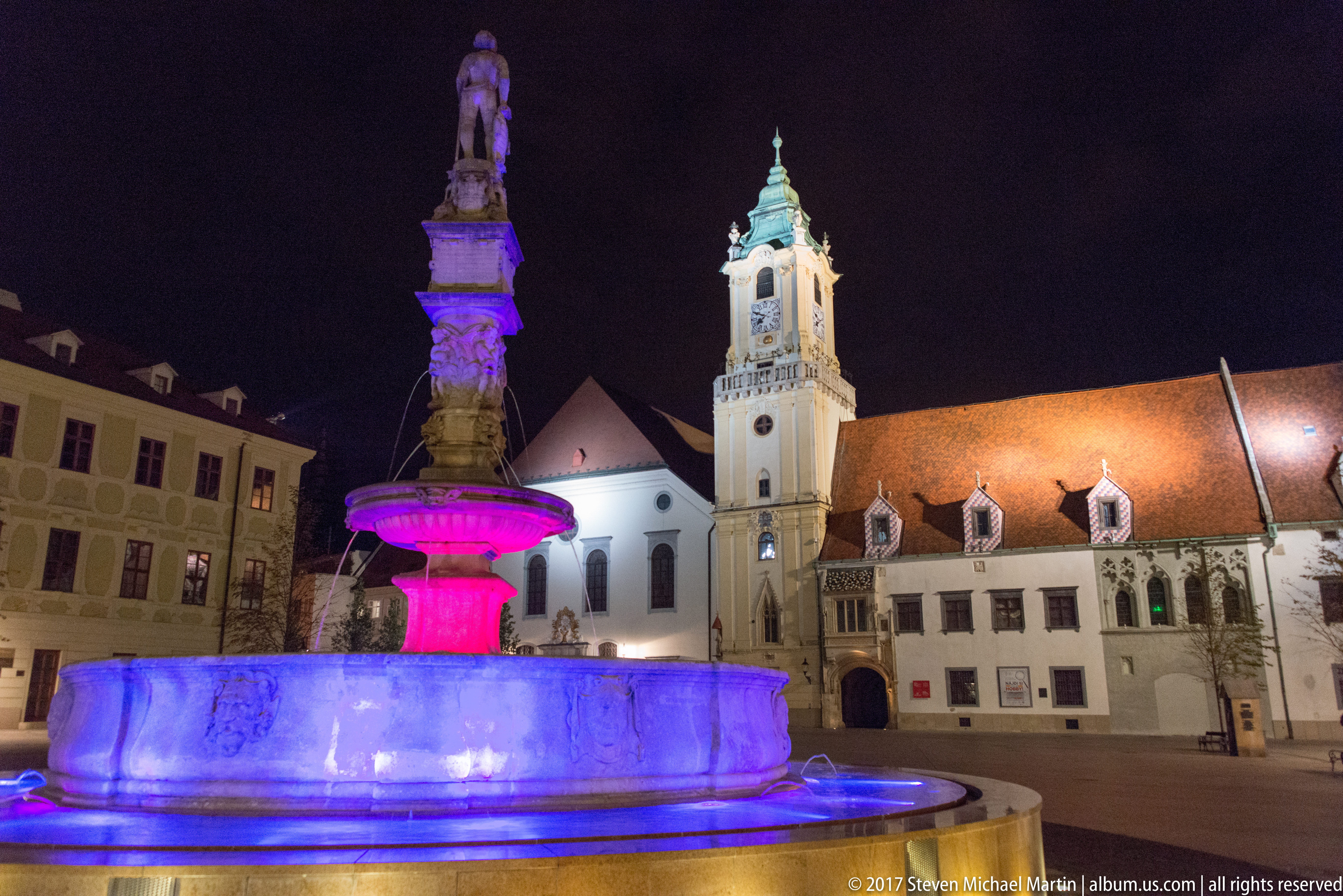
Maximilian Fountain glows in saturated blue and magenta light in Bratislava’s Main Square, with the tower of the Old Town Hall rising behind. The nighttime illumination separates the fountain basin and column from the surrounding façades, presenting two of the square’s defining historic elements in a single layered view.
Caption
Maximilian Fountain glows in saturated blue and magenta light in Bratislava’s Main Square, with the tower of the Old Town Hall rising behind. The nighttime illumination separates the fountain basin and column from the surrounding façades, presenting two of the square’s defining historic elements in a single layered view.

The bronze figure known as Schöne Náci raises his top hat in a permanent gesture of greeting on a Bratislava old-town street. Framed against café signage and the illuminated tower beyond, the sculpture connects the city’s street-level public art with the historic architecture and commercial life surrounding it.
Caption
The bronze figure known as Schöne Náci raises his top hat in a permanent gesture of greeting on a Bratislava old-town street. Framed against café signage and the illuminated tower beyond, the sculpture connects the city’s street-level public art with the historic architecture and commercial life surrounding it.

Bright souvenir shops fill the frame with bilingual signage, postcards, clothing, bags, and other tourist goods. The storefronts are photographed square-on at night, turning their dense retail displays into a visual inventory of the commercial culture that lines Bratislava’s historic pedestrian center.
Caption
Bright souvenir shops fill the frame with bilingual signage, postcards, clothing, bags, and other tourist goods. The storefronts are photographed square-on at night, turning their dense retail displays into a visual inventory of the commercial culture that lines Bratislava’s historic pedestrian center.

A wood-framed restaurant frontage marked “Slovenská Reštaurácia” opens onto a small terrace of dark tables and benches. Through the glass, diners and warm interior lights are visible, creating a straightforward nighttime record of traditional Slovak dining presented to visitors in central Bratislava.
Caption
A wood-framed restaurant frontage marked “Slovenská Reštaurácia” opens onto a small terrace of dark tables and benches. Through the glass, diners and warm interior lights are visible, creating a straightforward nighttime record of traditional Slovak dining presented to visitors in central Bratislava.

An elaborate Baroque stone portal surrounds a large wooden doorway, its curved pediment crowded with scrolls, masks, floral carving, and small sculpted figures. The close architectural view isolates the decorative stonework from the larger façade, highlighting the theatrical craftsmanship used to mark an important entrance in Bratislava’s historic center.
Caption
An elaborate Baroque stone portal surrounds a large wooden doorway, its curved pediment crowded with scrolls, masks, floral carving, and small sculpted figures. The close architectural view isolates the decorative stonework from the larger façade, highlighting the theatrical craftsmanship used to mark an important entrance in Bratislava’s historic center.

A narrow flight of stone steps climbs between old masonry walls and a weathered historic building, illuminated by green and amber lamps. The steep passage, irregular surfaces, and small human figure at the base convey the layered topography of Bratislava’s historic core after dark.
Caption
A narrow flight of stone steps climbs between old masonry walls and a weathered historic building, illuminated by green and amber lamps. The steep passage, irregular surfaces, and small human figure at the base convey the layered topography of Bratislava’s historic core after dark.

The cable-stayed SNP Bridge sweeps through the frame at night, its inclined deck leading toward the tall pylon crowned by the blue-lit saucer-shaped observation structure. Pedestrians along the lower walkway provide scale, while streetlights trace the bridge approach into the distance.
Caption
The cable-stayed SNP Bridge sweeps through the frame at night, its inclined deck leading toward the tall pylon crowned by the blue-lit saucer-shaped observation structure. Pedestrians along the lower walkway provide scale, while streetlights trace the bridge approach into the distance.
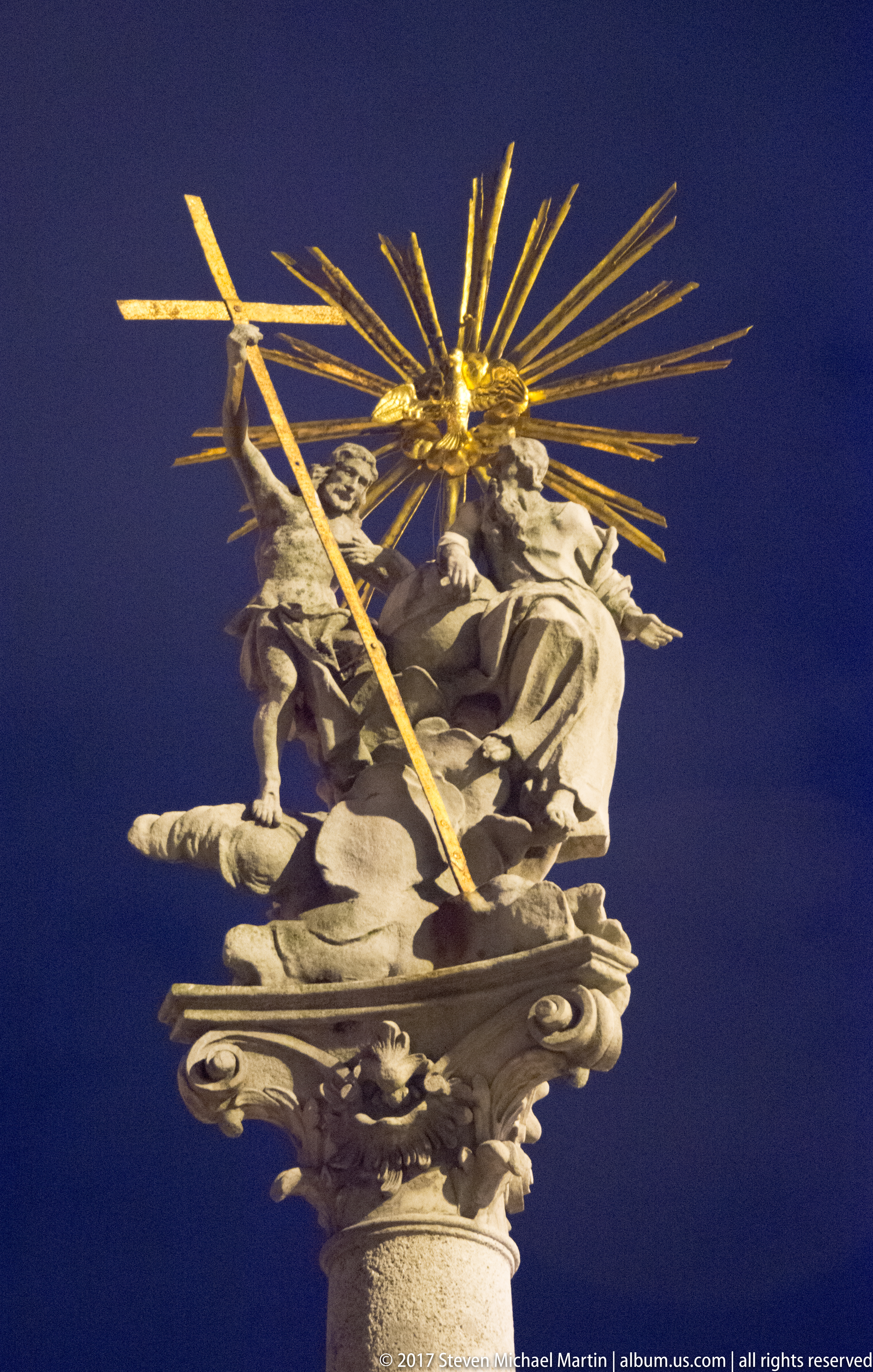
A dramatic Baroque devotional group crowns a tall column, with pale stone figures clustered beneath a burst of gilded metal rays and long golden staffs or crosses. Photographed from below against the dark blue night sky, the ornament reads as an energetic combination of sculpture, religious symbolism, and metallic light.
Caption
A dramatic Baroque devotional group crowns a tall column, with pale stone figures clustered beneath a burst of gilded metal rays and long golden staffs or crosses. Photographed from below against the dark blue night sky, the ornament reads as an energetic combination of sculpture, religious symbolism, and metallic light.

Diners fill the warmly lit interior of Mondieu, viewed from the street through a large window bearing the café’s name. Hanging pendant lights, closely spaced tables, and reflections on the glass create a layered nighttime scene that merges the social interior with the city outside.
Caption
Diners fill the warmly lit interior of Mondieu, viewed from the street through a large window bearing the café’s name. Hanging pendant lights, closely spaced tables, and reflections on the glass create a layered nighttime scene that merges the social interior with the city outside.

An open-air beer garden fills a sheltered historic courtyard at night, with long wooden tables arranged beneath balconies and a large La Chouffe beer sign glowing above the far seating area. A preserved wooden cart remains along the wall, linking the convivial modern use of the space with the rustic objects and masonry of an older urban setting.
Caption
An open-air beer garden fills a sheltered historic courtyard at night, with long wooden tables arranged beneath balconies and a large La Chouffe beer sign glowing above the far seating area. A preserved wooden cart remains along the wall, linking the convivial modern use of the space with the rustic objects and masonry of an older urban setting.

A richly modeled Baroque doorway is spotlighted against a pale historic façade, with carved scrollwork, floral ornament, a central crest-like motif, and tall double wooden doors. The symmetrical nighttime view treats the entrance as an architectural object, isolating its stone carving from the surrounding windows and modern shopfronts.
Caption
A richly modeled Baroque doorway is spotlighted against a pale historic façade, with carved scrollwork, floral ornament, a central crest-like motif, and tall double wooden doors. The symmetrical nighttime view treats the entrance as an architectural object, isolating its stone carving from the surrounding windows and modern shopfronts.

A weathered wooden cart with iron-rimmed spoked wheels stands on cobblestones beside white plaster walls and barrel planters in Bratislava. Its long shafts, open timber frame, and simple undercarriage evoke the utilitarian vehicles once used for moving goods through narrow historic streets and courtyards, while the surrounding planters and dining furniture show its present decorative setting.
Caption
A weathered wooden cart with iron-rimmed spoked wheels stands on cobblestones beside white plaster walls and barrel planters in Bratislava. Its long shafts, open timber frame, and simple undercarriage evoke the utilitarian vehicles once used for moving goods through narrow historic streets and courtyards, while the surrounding planters and dining furniture show its present decorative setting.

Seen through the front window, a bartender works behind a compact café or bar counter framed by pendant lamps, shelves of bottles, and glassware. Reflections on the glazing merge the intimate interior with the nighttime street outside, producing a layered view of Bratislava’s evening café culture without obscuring the working service area at its center.
Caption
Seen through the front window, a bartender works behind a compact café or bar counter framed by pendant lamps, shelves of bottles, and glassware. Reflections on the glazing merge the intimate interior with the nighttime street outside, producing a layered view of Bratislava’s evening café culture without obscuring the working service area at its center.

A bilingual directional sign marked “MICHALSKÁ BRÁNA / MICHAEL'S GATE” points along a pedestrian street in Bratislava’s historic center. The sign appears above a busy evening streetscape of lit shopfronts and older façades, orienting visitors toward one of the city’s principal surviving medieval gateways while contemporary street life continues below.
Caption
A bilingual directional sign marked “MICHALSKÁ BRÁNA / MICHAEL'S GATE” points along a pedestrian street in Bratislava’s historic center. The sign appears above a busy evening streetscape of lit shopfronts and older façades, orienting visitors toward one of the city’s principal surviving medieval gateways while contemporary street life continues below.

Richly sculpted stonework projects from an illuminated historic façade while the distinctive green-copper roof of Michael’s Gate rises farther down the street. The oblique viewpoint compresses ornament, cornices, and the gate tower into a single nighttime composition, showing how Bratislava’s monumental architecture is encountered from within the narrow scale of the old town.
Caption
Richly sculpted stonework projects from an illuminated historic façade while the distinctive green-copper roof of Michael’s Gate rises farther down the street. The oblique viewpoint compresses ornament, cornices, and the gate tower into a single nighttime composition, showing how Bratislava’s monumental architecture is encountered from within the narrow scale of the old town.
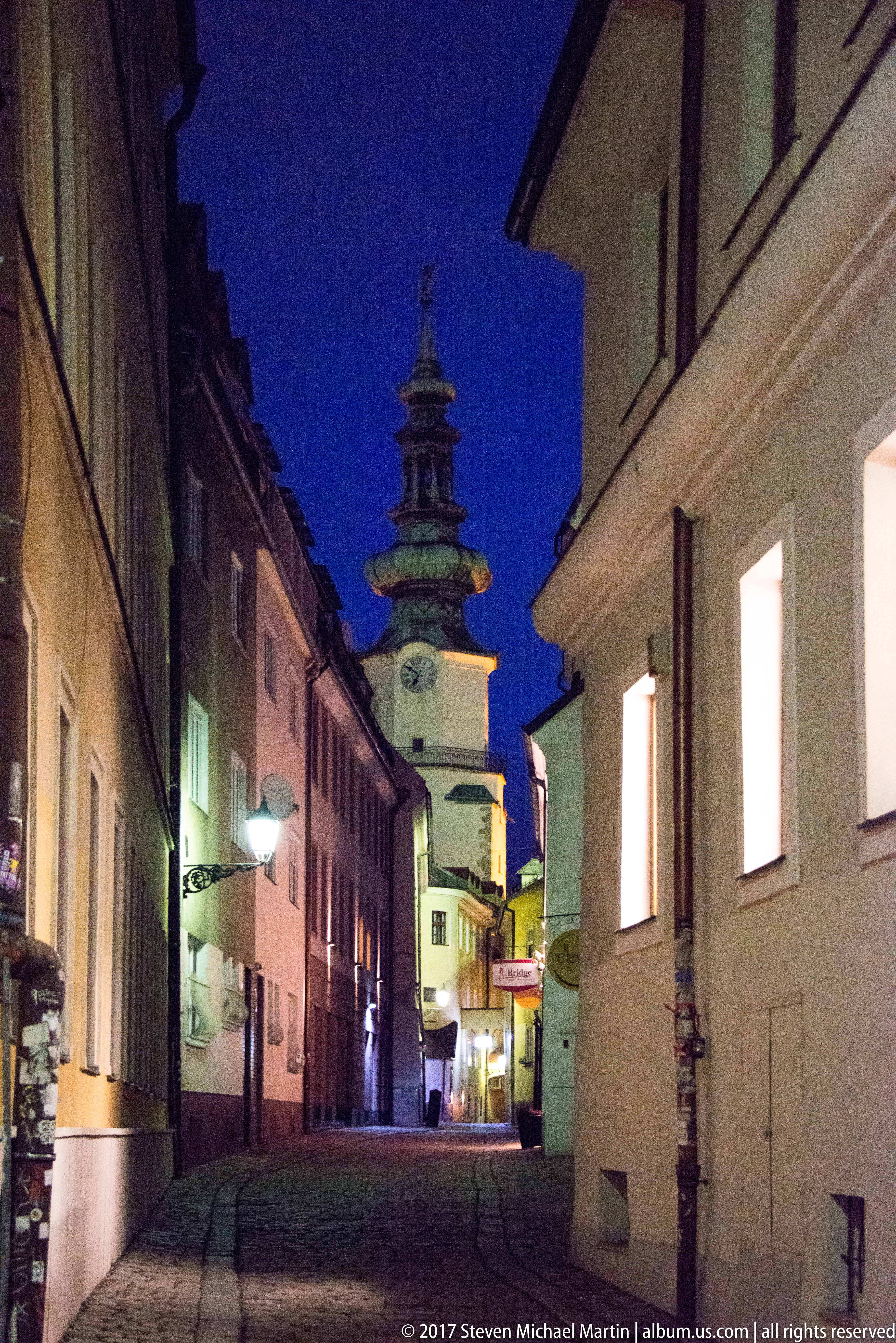
Michael’s Gate tower closes the view along a quiet cobbled lane, its white lower stages and layered green-copper roof rising above adjoining old-town buildings. Street lighting and illuminated windows animate the foreground while the tower provides a vertical landmark at the end of the narrow corridor, illustrating the gate’s continuing role as a visual anchor within Bratislava’s historic center.
Caption
Michael’s Gate tower closes the view along a quiet cobbled lane, its white lower stages and layered green-copper roof rising above adjoining old-town buildings. Street lighting and illuminated windows animate the foreground while the tower provides a vertical landmark at the end of the narrow corridor, illustrating the gate’s continuing role as a visual anchor within Bratislava’s historic center.

The upper stages of Michael’s Gate tower fill the frame against a deep blue evening sky. Its clock face, tiered copper roof, open belfry-like stage, and crowning sculptural finial are isolated from the surrounding streetscape, allowing the vertical sequence of architectural elements to be read as a detailed study rather than as part of a broader urban view.
Caption
The upper stages of Michael’s Gate tower fill the frame against a deep blue evening sky. Its clock face, tiered copper roof, open belfry-like stage, and crowning sculptural finial are isolated from the surrounding streetscape, allowing the vertical sequence of architectural elements to be read as a detailed study rather than as part of a broader urban view.

The modern façade of Loft Hotel Bratislava is illuminated at blue hour, with large “HOTEL” and “LOFT” signs spanning the entrance and national flags displayed above the sidewalk. Glass and pale cladding give the building a contemporary appearance that contrasts with the historic architecture elsewhere in the portfolio, marking the transition from city exploration to the traveler’s lodging.
Caption
The modern façade of Loft Hotel Bratislava is illuminated at blue hour, with large “HOTEL” and “LOFT” signs spanning the entrance and national flags displayed above the sidewalk. Glass and pale cladding give the building a contemporary appearance that contrasts with the historic architecture elsewhere in the portfolio, marking the transition from city exploration to the traveler’s lodging.

An elevated view looks down a gently curving cobbled lane lined by pastel and stuccoed façades in Bratislava’s historic center. Sparse evening foot traffic, lit shopfronts, and the changing widths of the street emphasize the intimate scale of the old town, where medieval circulation routes survive within later architectural fabric and contemporary commercial use.
Caption
An elevated view looks down a gently curving cobbled lane lined by pastel and stuccoed façades in Bratislava’s historic center. Sparse evening foot traffic, lit shopfronts, and the changing widths of the street emphasize the intimate scale of the old town, where medieval circulation routes survive within later architectural fabric and contemporary commercial use.

St. Martin’s Cathedral rises above the city at blue hour, its tall white tower and green spire forming a sharp vertical counterpoint to the distant saucer-shaped observation tower of the SNP Bridge. Remnants of stone fortification in the foreground reinforce the layered historic setting, juxtaposing Bratislava’s medieval ecclesiastical landmark with one of its most recognizable modern structures.
Caption
St. Martin’s Cathedral rises above the city at blue hour, its tall white tower and green spire forming a sharp vertical counterpoint to the distant saucer-shaped observation tower of the SNP Bridge. Remnants of stone fortification in the foreground reinforce the layered historic setting, juxtaposing Bratislava’s medieval ecclesiastical landmark with one of its most recognizable modern structures.

Bratislava Castle stretches across the hillside in a broad nighttime view, its long illuminated façade and four corner towers standing above dark trees and lower roofs. Floodlighting clarifies the regular window pattern and red-roofed massing, emphasizing the palace-like order of the rebuilt castle while its elevated siting preserves the commanding presence of a historic fortified complex.
Caption
Bratislava Castle stretches across the hillside in a broad nighttime view, its long illuminated façade and four corner towers standing above dark trees and lower roofs. Floodlighting clarifies the regular window pattern and red-roofed massing, emphasizing the palace-like order of the rebuilt castle while its elevated siting preserves the commanding presence of a historic fortified complex.

Grassalkovich Palace, the official residence of the Slovak president, stands behind an illuminated fountain at dusk. A large spherical centerpiece anchors the foreground basin while the palace’s white central pavilion and symmetrical wings are lit beneath a dramatic blue sky, creating a formal axial composition between civic architecture, ceremonial grounds, and public space.
Caption
Grassalkovich Palace, the official residence of the Slovak president, stands behind an illuminated fountain at dusk. A large spherical centerpiece anchors the foreground basin while the palace’s white central pavilion and symmetrical wings are lit beneath a dramatic blue sky, creating a formal axial composition between civic architecture, ceremonial grounds, and public space.

The reception area of Loft Hotel Bratislava combines a dark textured feature wall with a long wood-fronted desk, warm table lamps, and leather lounge seating. Staff work behind the counter beneath a prominent “LOFT HOTEL” sign, making the lobby’s identity explicit while the mixed industrial and club-like furnishings establish the visual character of the interior.
Caption
The reception area of Loft Hotel Bratislava combines a dark textured feature wall with a long wood-fronted desk, warm table lamps, and leather lounge seating. Staff work behind the counter beneath a prominent “LOFT HOTEL” sign, making the lobby’s identity explicit while the mixed industrial and club-like furnishings establish the visual character of the interior.

A lounge area at Loft Hotel Bratislava is arranged around deep brown leather armchairs and a matching sofa, with bookshelves and display cabinets lining the wall behind. Industrial pendant lights and lightly distressed surfaces create a relaxed library-like setting, offering a quieter counterpart to the adjacent reception and restaurant spaces within the hotel.
Caption
A lounge area at Loft Hotel Bratislava is arranged around deep brown leather armchairs and a matching sofa, with bookshelves and display cabinets lining the wall behind. Industrial pendant lights and lightly distressed surfaces create a relaxed library-like setting, offering a quieter counterpart to the adjacent reception and restaurant spaces within the hotel.

A brick-vaulted restaurant and bar extends into the depth of the frame, with patrons seated at tables and a waiter crossing the central aisle. The arched masonry ceiling, hanging industrial lamps, long bar counter, and refrigerated displays create a cellar-like atmosphere that distinguishes this lively hospitality space from the quieter hotel lobby and lounge nearby.
Caption
A brick-vaulted restaurant and bar extends into the depth of the frame, with patrons seated at tables and a waiter crossing the central aisle. The arched masonry ceiling, hanging industrial lamps, long bar counter, and refrigerated displays create a cellar-like atmosphere that distinguishes this lively hospitality space from the quieter hotel lobby and lounge nearby.

A long hotel corridor is articulated by dark wood wall panels, red carpeting, recessed lighting, and repeating doorways that draw the eye toward a bright opening at the far end. The strong linear perspective and restrained palette document the circulation space of the lodging as carefully as the more public lobby, lounge, and restaurant areas.
Caption
A long hotel corridor is articulated by dark wood wall panels, red carpeting, recessed lighting, and repeating doorways that draw the eye toward a bright opening at the far end. The strong linear perspective and restrained palette document the circulation space of the lodging as carefully as the more public lobby, lounge, and restaurant areas.

A contemporary twin guest room is shown with two neatly made beds, compact work furniture, and a large curtained window admitting diffuse daylight. A person at the far side of the room poses expansively near the window, giving scale to the accommodation and adding an informal travel moment to the otherwise orderly interior study.
Caption
A contemporary twin guest room is shown with two neatly made beds, compact work furniture, and a large curtained window admitting diffuse daylight. A person at the far side of the room poses expansively near the window, giving scale to the accommodation and adding an informal travel moment to the otherwise orderly interior study.

St. Martin’s Cathedral stands beside the roadway beneath a pale evening sky, its tall white tower, green copper spire, and long red-tiled nave clearly visible from the southwest side of the historic center. The open viewpoint reveals the church’s full vertical profile and its relationship to neighboring walls and streets rather than isolating the tower alone.
Caption
St. Martin’s Cathedral stands beside the roadway beneath a pale evening sky, its tall white tower, green copper spire, and long red-tiled nave clearly visible from the southwest side of the historic center. The open viewpoint reveals the church’s full vertical profile and its relationship to neighboring walls and streets rather than isolating the tower alone.

Brick and stone defensive walls occupy the roadside below Bratislava Castle, combining high masonry faces, crenellated sections, and later infrastructure at the edge of the historic center. A large red-and-white banner hangs against the brickwork, while traffic signs and roadway elements show how surviving fortification fabric is embedded within the modern city.
Caption
Brick and stone defensive walls occupy the roadside below Bratislava Castle, combining high masonry faces, crenellated sections, and later infrastructure at the edge of the historic center. A large red-and-white banner hangs against the brickwork, while traffic signs and roadway elements show how surviving fortification fabric is embedded within the modern city.

A closer sunset view centers Bratislava Castle against warm orange-pink clouds, bringing its regular façade, steep red roof, dormers, and four corner towers into sharper prominence. Lower defensive walls and treetops remain visible at the base, but the tighter framing turns the castle itself into the dominant architectural subject at the conclusion of the portfolio.
Caption
A closer sunset view centers Bratislava Castle against warm orange-pink clouds, bringing its regular façade, steep red roof, dormers, and four corner towers into sharper prominence. Lower defensive walls and treetops remain visible at the base, but the tighter framing turns the castle itself into the dominant architectural subject at the conclusion of the portfolio.
⭐ Highlights
- Bratislava Castle: A hilltop landmark overlooking the Danube and the city.
- Old Town (Staré Mesto): A compact historic center with medieval streets and lively squares.
- St. Martin’s Cathedral: A Gothic church where Hungarian kings were crowned.
- Michael’s Gate: The only remaining gate from the medieval fortifications.
- Blue Church: A distinctive Art Nouveau church known for its pastel blue design.
- Danube River Setting: The river shapes the city and connects it to Central Europe.
🏙️ Bratislava Field Guide
Major features observed during this visit:
Bratislava, the capital of Slovakia, is a compact historic city located along the Danube River near the borders of Austria and Hungary. Its Old Town preserves a medieval street layout, while its landmarks reflect centuries of Hungarian, Habsburg, and Central European influence. Today, Bratislava blends historic architecture with a modern urban identity in one of Europe’s most accessible capitals.
🏛️ Signature Landmarks
- Bratislava Castle – A historic fortress overlooking the city and the Danube.
- Old Town Square – The central gathering place surrounded by historic buildings.
- St. Martin’s Cathedral – A coronation church for Hungarian kings.
- Michael’s Gate – A surviving section of the city’s medieval defenses.
- Blue Church – A unique Art Nouveau landmark within the city.
🧠 Historical Significance
- Medieval and Royal City – Bratislava served as a coronation city for Hungarian rulers.
- Habsburg Influence – The city developed under Austrian and Hungarian rule.
- Central European Crossroads – Its location connected major regions and cultures.
- Modern Capital – Bratislava became the capital of independent Slovakia in 1993.
🌄 Urban Landscape & Setting
- Danube River – The river defines the city’s geography and views.
- Compact Historic Core – The Old Town is dense, walkable, and well preserved.
- Hilltop Castle – Elevated terrain gives the city a strong visual focal point.
- Historic and Modern Contrast – Medieval streets coexist with modern structures and bridges.