Olympia – Greece
The sacred sanctuary of Olympia stands in the western Peloponnese and served as one of the most important religious centers of the ancient Greek world. Dedicated to Zeus, the site hosted the ancient Olympic Games, which were first held in 776 BCE.
Athletes from across the Greek world gathered here every four years to compete in events honoring Zeus. The sanctuary complex included temples, training facilities, and the famous Ancient Stadium, where the games took place.
Today Olympia remains one of the most significant archaeological sites in Greece and a powerful symbol of the origins of the Olympic tradition.

The stone-vaulted passage known as the Krypte leads through the embankment toward the Stadium of Olympia. Constructed in the Hellenistic and Roman development of the stadium entrance, the corridor created a formal approach for athletes and officials entering the competition ground. Its surviving arch and long masonry walls compress the view before opening suddenly onto the broad running track beyond.
Caption
The stone-vaulted passage known as the Krypte leads through the embankment toward the Stadium of Olympia. Constructed in the Hellenistic and Roman development of the stadium entrance, the corridor created a formal approach for athletes and officials entering the competition ground. Its surviving arch and long masonry walls compress the view before opening suddenly onto the broad running track beyond.

The low white museum building is approached across a broad paved forecourt framed by tall cypress trees. A Greek flag rises above the central entrance, while glazed doors and a shaded portico mark the visitor entry to the museum serving the archaeological site at ancient Olympia.
Caption
The low white museum building is approached across a broad paved forecourt framed by tall cypress trees. A Greek flag rises above the central entrance, while glazed doors and a shaded portico mark the visitor entry to the museum serving the archaeological site at ancient Olympia.

The restored columns of the Philippeion stand prominently above the low circular crepidoma, giving modern visitors a vertical reference for a building otherwise preserved mainly at foundation level. This elegant tholos was commissioned by Philip II of Macedon after Chaironeia in 338 BC and completed under Alexander the Great. Its exterior Ionic order distinguished the dynastic monument from the great Doric temples elsewhere in the Altis.
Caption
The restored columns of the Philippeion stand prominently above the low circular crepidoma, giving modern visitors a vertical reference for a building otherwise preserved mainly at foundation level. This elegant tholos was commissioned by Philip II of Macedon after Chaironeia in 338 BC and completed under Alexander the Great. Its exterior Ionic order distinguished the dynastic monument from the great Doric temples elsewhere in the Altis.

A monochrome historical reconstruction imagines a monumental Greek temple standing complete within a landscaped sanctuary. A deep columned porch, sculpted pediment, and surrounding visitors restore architectural features now known primarily through archaeological remains, translating the ancient building into a legible elevation.
Caption
A monochrome historical reconstruction imagines a monumental Greek temple standing complete within a landscaped sanctuary. A deep columned porch, sculpted pediment, and surrounding visitors restore architectural features now known primarily through archaeological remains, translating the ancient building into a legible elevation.
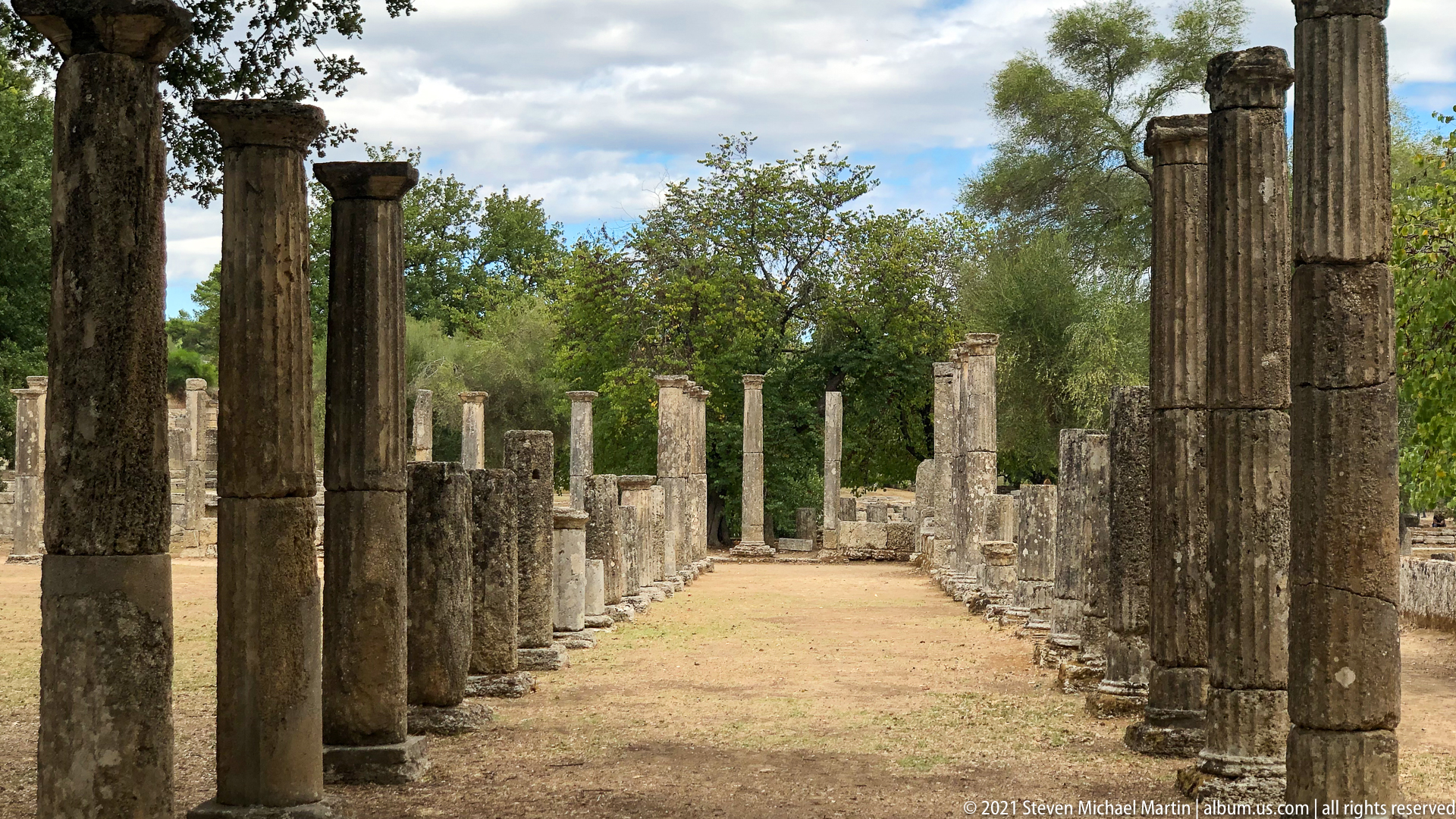
A long axial view looks between two rows of standing stone columns toward additional supports in the distance. Weathered shafts, surviving bases, and low walls define a narrow colonnaded passage or court edge, while trees and open sky restore a sense of the sanctuary's present landscape.
Caption
A long axial view looks between two rows of standing stone columns toward additional supports in the distance. Weathered shafts, surviving bases, and low walls define a narrow colonnaded passage or court edge, while trees and open sky restore a sense of the sanctuary's present landscape.

An illustrated reconstruction plan presents the sanctuary and athletic complex of ancient Olympia from an elevated perspective. Labeled buildings, courts, colonnades, and surrounding landscape organize the archaeological site into a readable whole, providing orientation before the sequence moves into individual museum objects and ruins.
Caption
An illustrated reconstruction plan presents the sanctuary and athletic complex of ancient Olympia from an elevated perspective. Labeled buildings, courts, colonnades, and surrounding landscape organize the archaeological site into a readable whole, providing orientation before the sequence moves into individual museum objects and ruins.

A single tall column rises from a rectangular platform amid low wall courses, column stumps, and scattered blocks. The view emphasizes the contrast between one surviving or restored vertical element and the largely collapsed architecture around it, helping recover the original scale of the complex within the wooded sanctuary.
Caption
A single tall column rises from a rectangular platform amid low wall courses, column stumps, and scattered blocks. The view emphasizes the contrast between one surviving or restored vertical element and the largely collapsed architecture around it, helping recover the original scale of the complex within the wooded sanctuary.

A preserved mosaic pavement combines a field of interlocking hexagonal and square motifs with dark linear borders. Small red and black accents punctuate the pale tesserae, while broken masonry around the edges exposes the floor as an in-situ remnant of a later building within the ancient sanctuary.
Caption
A preserved mosaic pavement combines a field of interlocking hexagonal and square motifs with dark linear borders. Small red and black accents punctuate the pale tesserae, while broken masonry around the edges exposes the floor as an in-situ remnant of a later building within the ancient sanctuary.

Several standing columns punctuate a broad field of low masonry platforms and foundation walls. Viewed beneath a cloudy sky, the repeated vertical supports lead across the archaeological complex while broken blocks and stepped wall courses reveal the site's uneven preservation and partial reconstruction.
Caption
Several standing columns punctuate a broad field of low masonry platforms and foundation walls. Viewed beneath a cloudy sky, the repeated vertical supports lead across the archaeological complex while broken blocks and stepped wall courses reveal the site's uneven preservation and partial reconstruction.

Large cylindrical column drums stand and lie closely packed across the archaeological ground. Their rough weathered surfaces, squared cuttings, and repeated circular profiles make the assembly of ancient column shafts easy to visualize while also recording the fragmented state in which the architecture survives.
Caption
Large cylindrical column drums stand and lie closely packed across the archaeological ground. Their rough weathered surfaces, squared cuttings, and repeated circular profiles make the assembly of ancient column shafts easy to visualize while also recording the fragmented state in which the architecture survives.

A visitor stands among rows of weathered stone columns that extend across a broad archaeological courtyard. The human figure provides a direct sense of scale for the surviving shafts and bases, while the open ground and repeated supports make the former colonnaded enclosure easy to visualize.
Caption
A visitor stands among rows of weathered stone columns that extend across a broad archaeological courtyard. The human figure provides a direct sense of scale for the surviving shafts and bases, while the open ground and repeated supports make the former colonnaded enclosure easy to visualize.

Rough stone blocks and squared masonry courses form a network of low walls beneath large trees, with broken architectural pieces scattered across the foreground. The closer viewpoint emphasizes wall junctions, construction textures, and the uneven survival of the building rather than a complete ground plan.
Caption
Rough stone blocks and squared masonry courses form a network of low walls beneath large trees, with broken architectural pieces scattered across the foreground. The closer viewpoint emphasizes wall junctions, construction textures, and the uneven survival of the building rather than a complete ground plan.

Carved stone architectural fragments are assembled in a shallow curve around a museum label, allowing profiles of moldings and decorative bands to be compared at close range. The display emphasizes surviving workmanship and the modular character of architectural members recovered from the sanctuary at ancient Olympia.
Caption
Carved stone architectural fragments are assembled in a shallow curve around a museum label, allowing profiles of moldings and decorative bands to be compared at close range. The display emphasizes surviving workmanship and the modular character of architectural members recovered from the sanctuary at ancient Olympia.

A tighter view of the same carved architectural member concentrates on the large spiral volute and the projecting row of egg-shaped ornament above it. Weathering and broken edges interrupt the original profile, while the museum mounting makes the surviving classical decorative vocabulary easy to study.
Caption
A tighter view of the same carved architectural member concentrates on the large spiral volute and the projecting row of egg-shaped ornament above it. Weathering and broken edges interrupt the original profile, while the museum mounting makes the surviving classical decorative vocabulary easy to study.

A carved architectural fragment rests above a rough cylindrical support, its surviving ornament dominated by a spiral volute and a band of rounded egg-like forms. The close museum presentation isolates the craftsmanship of the stone member while making its fragmentary edges and restored display support readily visible.
Caption
A carved architectural fragment rests above a rough cylindrical support, its surviving ornament dominated by a spiral volute and a band of rounded egg-like forms. The close museum presentation isolates the craftsmanship of the stone member while making its fragmentary edges and restored display support readily visible.

A substantial fluted stone architectural member stands upright beside a museum information pedestal. Vertical channels run down the weathered shaft, while a broad square block caps the surviving section, emphasizing the scale and surface treatment of monumental construction at the sanctuary.
Caption
A substantial fluted stone architectural member stands upright beside a museum information pedestal. Vertical channels run down the weathered shaft, while a broad square block caps the surviving section, emphasizing the scale and surface treatment of monumental construction at the sanctuary.

A fragmentary marble figure wears an elaborately modeled cuirass over a short pleated military garment. The head and arms are missing, but the armored torso, planted legs, and surviving drapery preserve the commanding stance of a warrior or military figure displayed among finds from Olympia.
Caption
A fragmentary marble figure wears an elaborately modeled cuirass over a short pleated military garment. The head and arms are missing, but the armored torso, planted legs, and surviving drapery preserve the commanding stance of a warrior or military figure displayed among finds from Olympia.

Corroded bronze fragments are mounted together to recover portions of a once larger decorated sheet. Raised human and animal forms emerge amid breaks and losses, while the green and dark patina records the metal's long burial and preservation. The display foregrounds both ancient metalworking and the incomplete survival of the object.
Caption
Corroded bronze fragments are mounted together to recover portions of a once larger decorated sheet. Raised human and animal forms emerge amid breaks and losses, while the green and dark patina records the metal's long burial and preservation. The display foregrounds both ancient metalworking and the incomplete survival of the object.

A small bronze figure survives from the waist upward, its frontal face framed by long stylized hair and one arm rising in a broad curve. Blue-green corrosion covers much of the surface, accentuating the compact modeling and simplified features characteristic of an early Greek votive or decorative bronze.
Caption
A small bronze figure survives from the waist upward, its frontal face framed by long stylized hair and one arm rising in a broad curve. Blue-green corrosion covers much of the surface, accentuating the compact modeling and simplified features characteristic of an early Greek votive or decorative bronze.

Museum line drawings reconstruct two ancient figural compositions: an upper narrative scene populated by standing and seated figures and a lower frieze of repeated running or striding figures. The diagrams serve as interpretive aids, clarifying imagery that may be difficult to read on fragmentary archaeological metalwork.
Caption
Museum line drawings reconstruct two ancient figural compositions: an upper narrative scene populated by standing and seated figures and a lower frieze of repeated running or striding figures. The diagrams serve as interpretive aids, clarifying imagery that may be difficult to read on fragmentary archaeological metalwork.

A bronze griffin protome from Olympia projects forward on its long arched neck, with hooked open beak, pointed ears and incised patterning still legible beneath the green patina. Griffin heads of this type ornamented the rims of monumental bronze cauldrons during the Orientalizing period; the National Archaeological Museum notes that workshops producing such cauldrons were established at Olympia. The object therefore belongs to one of the sanctuary’s most distinctive classes of Archaic votive metalwork.
Caption
A bronze griffin protome from Olympia projects forward on its long arched neck, with hooked open beak, pointed ears and incised patterning still legible beneath the green patina. Griffin heads of this type ornamented the rims of monumental bronze cauldrons during the Orientalizing period; the National Archaeological Museum notes that workshops producing such cauldrons were established at Olympia. The object therefore belongs to one of the sanctuary’s most distinctive classes of Archaic votive metalwork.

A large terracotta head retains almond-shaped eyes, an archaic smile, and traces of painted decoration beneath a patterned headband or headdress. Broken edges at the neck and rear reveal its fragmentary state, while the frontal museum presentation emphasizes the stylized facial features and surviving surface color.
Caption
A large terracotta head retains almond-shaped eyes, an archaic smile, and traces of painted decoration beneath a patterned headband or headdress. Broken edges at the neck and rear reveal its fragmentary state, while the frontal museum presentation emphasizes the stylized facial features and surviving surface color.

A powerful bronze lion head faces outward with rounded ears, deeply modeled muzzle, and an open mouth exposing teeth. The dark green patina pools in the recessed mane and facial features, giving the museum display a strong sense of the original sculptural volume of this ancient metal fitting.
Caption
A powerful bronze lion head faces outward with rounded ears, deeply modeled muzzle, and an open mouth exposing teeth. The dark green patina pools in the recessed mane and facial features, giving the museum display a strong sense of the original sculptural volume of this ancient metal fitting.

A museum case gathers several small bronze votive figures on stepped mounts, including winged or bird-associated human forms, riders or paired figures, and compact animal-shaped objects. Their varied silhouettes show the breadth of miniature metal offerings recovered at Olympia and invite comparison of scale, gesture, and casting.
Caption
A museum case gathers several small bronze votive figures on stepped mounts, including winged or bird-associated human forms, riders or paired figures, and compact animal-shaped objects. Their varied silhouettes show the breadth of miniature metal offerings recovered at Olympia and invite comparison of scale, gesture, and casting.

A fragmentary bronze horse is mounted beside a line reconstruction that restores its original silhouette. The surviving metal preserves the head, arched neck, torso, and portions of the legs, while the adjacent drawing clarifies missing contours and the deliberately stylized treatment of the animal.
Caption
A fragmentary bronze horse is mounted beside a line reconstruction that restores its original silhouette. The surviving metal preserves the head, arched neck, torso, and portions of the legs, while the adjacent drawing clarifies missing contours and the deliberately stylized treatment of the animal.

A dark bronze relief of a winged mythological creature is mounted against a circular backing that suggests its original placement as a decorative device. Spread wings, a frontal humanlike face, curled limbs, and a serpentine lower form create a dense, symmetrical composition associated with protective imagery in Greek armor decoration.
Caption
A dark bronze relief of a winged mythological creature is mounted against a circular backing that suggests its original placement as a decorative device. Spread wings, a frontal humanlike face, curled limbs, and a serpentine lower form create a dense, symmetrical composition associated with protective imagery in Greek armor decoration.

Three broad feathered wings radiate around a circular central face in this bronze relief ornament, creating a dynamic pinwheel-like design. The green patina and surviving chased details remain especially clear in the feathers and facial curls, while the circular museum mount helps isolate the object's unusual geometry.
Caption
Three broad feathered wings radiate around a circular central face in this bronze relief ornament, creating a dynamic pinwheel-like design. The green patina and surviving chased details remain especially clear in the feathers and facial curls, while the circular museum mount helps isolate the object's unusual geometry.

Rows of ancient bronze helmets fill a long case in the Archaeological Museum of Olympia, ranging from close-fitting Corinthian forms to more open types with cheek pieces. Their concentration reflects Olympia’s role as a Panhellenic sanctuary where arms and armor were dedicated to Zeus as votive offerings. Differences in profile, repair, corrosion and patina turn the display into a comparative history of Greek defensive equipment as well as a record of sanctuary dedication.
Caption
Rows of ancient bronze helmets fill a long case in the Archaeological Museum of Olympia, ranging from close-fitting Corinthian forms to more open types with cheek pieces. Their concentration reflects Olympia’s role as a Panhellenic sanctuary where arms and armor were dedicated to Zeus as votive offerings. Differences in profile, repair, corrosion and patina turn the display into a comparative history of Greek defensive equipment as well as a record of sanctuary dedication.

A reconstructed pedimented façade assembles surviving architectural elements into the form of a small Greek building front. The triangular gable contains fragmentary sculptural or terracotta decoration, while the lower courses preserve alternating panels and structural members, making the display an architectural study as well as an artifact installation.
Caption
A reconstructed pedimented façade assembles surviving architectural elements into the form of a small Greek building front. The triangular gable contains fragmentary sculptural or terracotta decoration, while the lower courses preserve alternating panels and structural members, making the display an architectural study as well as an artifact installation.

A fragmentary stone animal is shown in profile on a low museum plinth. Incised overlapping scales cover the forward body, while the rounded rear section and broken extremities leave the creature's complete form uncertain. The close display makes the contrasting surface textures and losses especially apparent.
Caption
A fragmentary stone animal is shown in profile on a low museum plinth. Incised overlapping scales cover the forward body, while the rounded rear section and broken extremities leave the creature's complete form uncertain. The close display makes the contrasting surface textures and losses especially apparent.

Painted architectural terracottas are arranged across a museum wall to show repeating geometric, floral, and meander-like decoration. Long cornice or revetment pieces preserve red, black, cream, and muted green patterns, while smaller palmette and molded fragments demonstrate the colorful finish once applied to Greek buildings.
Caption
Painted architectural terracottas are arranged across a museum wall to show repeating geometric, floral, and meander-like decoration. Long cornice or revetment pieces preserve red, black, cream, and muted green patterns, while smaller palmette and molded fragments demonstrate the colorful finish once applied to Greek buildings.

Two expressive terracotta heads are displayed side by side: a bearded male mask with an open smiling mouth and a smoother-faced figure with carefully modeled hair. Their exaggerated features and preserved pigment make the pair a vivid study in ancient molded clay imagery and theatrical or decorative expression.
Caption
Two expressive terracotta heads are displayed side by side: a bearded male mask with an open smiling mouth and a smoother-faced figure with carefully modeled hair. Their exaggerated features and preserved pigment make the pair a vivid study in ancient molded clay imagery and theatrical or decorative expression.

A terracotta group combines several clothed figures in a compact narrative scene, with one figure positioned forward and another seated or riding behind. Warm reddish clay, modeled garments, and surviving facial details give the fragment a lively sculptural presence despite breaks and losses.
Caption
A terracotta group combines several clothed figures in a compact narrative scene, with one figure positioned forward and another seated or riding behind. Warm reddish clay, modeled garments, and surviving facial details give the fragment a lively sculptural presence despite breaks and losses.

A museum line drawing reconstructs two bearded athletes locked in a close grappling hold. Their bent knees, interlaced arms, and braced bodies convey the physical mechanics of wrestling, offering an interpretive counterpart to surviving ancient imagery associated with athletic competition.
Caption
A museum line drawing reconstructs two bearded athletes locked in a close grappling hold. Their bent knees, interlaced arms, and braced bodies convey the physical mechanics of wrestling, offering an interpretive counterpart to surviving ancient imagery associated with athletic competition.

A monumental draped female figure survives in fragments, one arm extending horizontally while broken sections interrupt the torso and surrounding drapery. Mounted against a deep blue background, the sculpture is presented as part of a larger architectural ensemble, with its sweeping cloth and seated or turning pose readable despite major losses.
Caption
A monumental draped female figure survives in fragments, one arm extending horizontally while broken sections interrupt the torso and surrounding drapery. Mounted against a deep blue background, the sculpture is presented as part of a larger architectural ensemble, with its sweeping cloth and seated or turning pose readable despite major losses.

A fragmentary marble lion thrusts its head forward from a broken body, with deeply drilled mane locks framing a broad muzzle and intense eyes. Losses around the torso expose the sculpture's damaged state, while the close museum display concentrates attention on the animal's forceful facial modeling.
Caption
A fragmentary marble lion thrusts its head forward from a broken body, with deeply drilled mane locks framing a broad muzzle and intense eyes. Losses around the torso expose the sculpture's damaged state, while the close museum display concentrates attention on the animal's forceful facial modeling.

The museum installation reconstructs the east pediment of the Temple of Zeus, whose monumental marble figures represent the moment before the chariot race between Pelops and King Oinomaos. Rather than showing the race itself, the composition gathers Zeus, the rival households, chariot teams and attendant figures in a tense ceremonial pause. Created for the great Doric temple built about 470–457 BC, the pediment is one of the defining achievements of Early Classical Greek sculpture.
Caption
The museum installation reconstructs the east pediment of the Temple of Zeus, whose monumental marble figures represent the moment before the chariot race between Pelops and King Oinomaos. Rather than showing the race itself, the composition gathers Zeus, the rival households, chariot teams and attendant figures in a tense ceremonial pause. Created for the great Doric temple built about 470–457 BC, the pediment is one of the defining achievements of Early Classical Greek sculpture.

Seen obliquely, the reconstructed east pediment of the Temple of Zeus reveals how the sculptor fitted standing, seated and reclining figures into the descending triangular gable. The subject is the legendary chariot contest between Pelops and Oinomaos, a foundation myth closely tied to Olympia and the Games. The angled view makes the pediment’s carefully graded figure heights and the modern supports bridging losses especially easy to read.
Caption
Seen obliquely, the reconstructed east pediment of the Temple of Zeus reveals how the sculptor fitted standing, seated and reclining figures into the descending triangular gable. The subject is the legendary chariot contest between Pelops and Oinomaos, a foundation myth closely tied to Olympia and the Games. The angled view makes the pediment’s carefully graded figure heights and the modern supports bridging losses especially easy to read.

A triangular architectural terracotta preserves bold painted ornament organized around a central palmette, with curling volutes and leaf forms filling the lower corners. Deep red, cream, dark outlines, and traces of additional color demonstrate the polychrome character of Greek roof decoration more vividly than bare stone ruins can convey.
Caption
A triangular architectural terracotta preserves bold painted ornament organized around a central palmette, with curling volutes and leaf forms filling the lower corners. Deep red, cream, dark outlines, and traces of additional color demonstrate the polychrome character of Greek roof decoration more vividly than bare stone ruins can convey.

A powerful fragmentary male figure is preserved in a wide, lunging stance, with the torso and both legs surviving while the head and arms are lost. The strongly modeled thighs and twisting body suggest vigorous action, and the museum mounting leaves the breaks and original sculptural mass clearly visible.
Caption
A powerful fragmentary male figure is preserved in a wide, lunging stance, with the torso and both legs surviving while the head and arms are lost. The strongly modeled thighs and twisting body suggest vigorous action, and the museum mounting leaves the breaks and original sculptural mass clearly visible.

Hermes stands in relaxed contrapposto beside a tree-trunk support, carrying the infant Dionysus on his left arm. The celebrated marble group, found in the Temple of Hera at Olympia in 1877, is traditionally attributed to Praxiteles and is among the signature works of the Archaeological Museum of Olympia. The god’s softly modeled body, shifting weight and draped cloak create a poised contrast with the small child supported at his side.
Caption
Hermes stands in relaxed contrapposto beside a tree-trunk support, carrying the infant Dionysus on his left arm. The celebrated marble group, found in the Temple of Hera at Olympia in 1877, is traditionally attributed to Praxiteles and is among the signature works of the Archaeological Museum of Olympia. The god’s softly modeled body, shifting weight and draped cloak create a poised contrast with the small child supported at his side.

A richly painted architectural terracotta centers a large palmette within curling volutes and layered leaf forms. Red, cream, dark blue-green, and ocher pigments remain visible across the molded surface, demonstrating how strongly color and relief worked together in the roof decoration of ancient Greek buildings.
Caption
A richly painted architectural terracotta centers a large palmette within curling volutes and layered leaf forms. Red, cream, dark blue-green, and ocher pigments remain visible across the molded surface, demonstrating how strongly color and relief worked together in the roof decoration of ancient Greek buildings.

A monumental lion head projects outward with an open mouth, deeply modeled muzzle, rounded ears, and radiating mane. The hollow mouth and projecting form are consistent with an architectural waterspout, where the animal's face transformed roof drainage into a forceful sculptural feature.
Caption
A monumental lion head projects outward with an open mouth, deeply modeled muzzle, rounded ears, and radiating mane. The hollow mouth and projecting form are consistent with an architectural waterspout, where the animal's face transformed roof drainage into a forceful sculptural feature.

A wide gallery view presents the monumental pedimental sculptures of the Temple of Zeus, one of the central masterpieces of the Archaeological Museum of Olympia. The east pediment depicts the preparations for the chariot race of Pelops and Oinomaos; the west depicts the Centauromachy, the violent struggle between Lapiths and Centaurs. Together the ensembles preserve an exceptional record of large-scale Early Classical architectural sculpture created for the temple built about 470–457 BC.
Caption
A wide gallery view presents the monumental pedimental sculptures of the Temple of Zeus, one of the central masterpieces of the Archaeological Museum of Olympia. The east pediment depicts the preparations for the chariot race of Pelops and Oinomaos; the west depicts the Centauromachy, the violent struggle between Lapiths and Centaurs. Together the ensembles preserve an exceptional record of large-scale Early Classical architectural sculpture created for the temple built about 470–457 BC.

A full-length view of Hermes carrying the infant Dionysus shows the sculpture’s carefully balanced contrapposto: Hermes rests his weight on one leg while the opposite hip relaxes toward the tree-trunk support draped with his cloak. Discovered in the Temple of Hera in 1877 and traditionally attributed to Praxiteles, the marble group is one of Olympia’s most celebrated surviving sculptures. This viewpoint emphasizes the sinuous stance and intimate scale relationship between god and child.
Caption
A full-length view of Hermes carrying the infant Dionysus shows the sculpture’s carefully balanced contrapposto: Hermes rests his weight on one leg while the opposite hip relaxes toward the tree-trunk support draped with his cloak. Discovered in the Temple of Hera in 1877 and traditionally attributed to Praxiteles, the marble group is one of Olympia’s most celebrated surviving sculptures. This viewpoint emphasizes the sinuous stance and intimate scale relationship between god and child.

A red-figure krater displays several male figures around its broad body, including a nude youth and draped companions rendered against the glossy black ground. The tall handles, flaring rim, and footed profile frame the painted scene, combining a functional wine-mixing vessel with narrative ceramic decoration.
Caption
A red-figure krater displays several male figures around its broad body, including a nude youth and draped companions rendered against the glossy black ground. The tall handles, flaring rim, and footed profile frame the painted scene, combining a functional wine-mixing vessel with narrative ceramic decoration.

Seen from an oblique angle, the Temple of Zeus pediment installation stretches across the gallery in a sequence of standing, kneeling, and reclining figures interspersed with horses. The viewpoint clarifies the depth of the modern mounting and the fragmentary condition of individual sculptures within the reconstructed ensemble.
Caption
Seen from an oblique angle, the Temple of Zeus pediment installation stretches across the gallery in a sequence of standing, kneeling, and reclining figures interspersed with horses. The viewpoint clarifies the depth of the modern mounting and the fragmentary condition of individual sculptures within the reconstructed ensemble.

A carved female portrait is enveloped in heavy layered drapery drawn diagonally across the chest, with one hand resting near the collarbone. The centrally parted hair is gathered into broad side rolls, while the restrained expression and compact bust format give the work a formal commemorative character.
Caption
A carved female portrait is enveloped in heavy layered drapery drawn diagonally across the chest, with one hand resting near the collarbone. The centrally parted hair is gathered into broad side rolls, while the restrained expression and compact bust format give the work a formal commemorative character.

A headless male figure wears an elaborately decorated cuirass above a short military skirt and fitted leg coverings. Relief ornament spreads across the breastplate, while a broken support or attribute survives beside one leg, emphasizing both the ceremonial armor and the statue's incomplete archaeological condition.
Caption
A headless male figure wears an elaborately decorated cuirass above a short military skirt and fitted leg coverings. Relief ornament spreads across the breastplate, while a broken support or attribute survives beside one leg, emphasizing both the ceremonial armor and the statue's incomplete archaeological condition.

A headless female statue stands in layered garments cinched high beneath the chest, with a heavy mantle falling in deep folds along one side. The surviving feet and carefully carved drapery convey a stable frontal pose even though both forearms and the head are lost.
Caption
A headless female statue stands in layered garments cinched high beneath the chest, with a heavy mantle falling in deep folds along one side. The surviving feet and carefully carved drapery convey a stable frontal pose even though both forearms and the head are lost.

A close portrait head shows a youthful man with short hair, large almond-shaped eyes, straight nose, and a compact mouth. Surface abrasion has softened the modeling and removed finer details, but the frontal presentation preserves the individualized proportions of the face and hairline.
Caption
A close portrait head shows a youthful man with short hair, large almond-shaped eyes, straight nose, and a compact mouth. Surface abrasion has softened the modeling and removed finer details, but the frontal presentation preserves the individualized proportions of the face and hairline.

A standing woman is wrapped in a voluminous mantle that crosses the upper body and gathers over one forearm before descending in long vertical folds. Her head survives, unlike many neighboring statues, allowing the restrained facial expression and draped civic presentation to be read together.
Caption
A standing woman is wrapped in a voluminous mantle that crosses the upper body and gathers over one forearm before descending in long vertical folds. Her head survives, unlike many neighboring statues, allowing the restrained facial expression and draped civic presentation to be read together.

A headless standing figure is wrapped in a heavy mantle that crosses diagonally over the torso and gathers into a dense knot of folds at the waist. One forearm survives at the side, while the broad layered drapery dominates the statue's formal, frontal presentation.
Caption
A headless standing figure is wrapped in a heavy mantle that crosses diagonally over the torso and gathers into a dense knot of folds at the waist. One forearm survives at the side, while the broad layered drapery dominates the statue's formal, frontal presentation.

A muscular male torso emerges from a dramatically carved mantle that sweeps over one shoulder and around the lower body. The head and most limbs are missing, but the exposed chest, powerful proportions, and animated folds preserve the heroic scale and movement of the original statue.
Caption
A muscular male torso emerges from a dramatically carved mantle that sweeps over one shoulder and around the lower body. The head and most limbs are missing, but the exposed chest, powerful proportions, and animated folds preserve the heroic scale and movement of the original statue.

A headless female figure bends forward at the waist, her layered garments stretching across the back and cascading toward the floor in long folds. The unusual posture distinguishes the statue from the gallery's upright portraits and suggests an action or narrative role that is no longer recoverable from the fragment alone.
Caption
A headless female figure bends forward at the waist, her layered garments stretching across the back and cascading toward the floor in long folds. The unusual posture distinguishes the statue from the gallery's upright portraits and suggests an action or narrative role that is no longer recoverable from the fragment alone.

A headless male figure combines a bare, strongly modeled chest with a mantle wrapped tightly around the waist and falling in layered folds beside one leg. The broken arms and neck reveal substantial losses, yet the contrast between exposed anatomy and heavy cloth remains visually emphatic.
Caption
A headless male figure combines a bare, strongly modeled chest with a mantle wrapped tightly around the waist and falling in layered folds beside one leg. The broken arms and neck reveal substantial losses, yet the contrast between exposed anatomy and heavy cloth remains visually emphatic.

A headless woman stands enveloped in a mantle drawn in a broad diagonal sweep from shoulder to hip. Fine nested folds gather around the waist and arm, while a pleated undergarment remains visible near the feet, creating a layered study of ancient sculpted textiles.
Caption
A headless woman stands enveloped in a mantle drawn in a broad diagonal sweep from shoulder to hip. Fine nested folds gather around the waist and arm, while a pleated undergarment remains visible near the feet, creating a layered study of ancient sculpted textiles.

A headless female figure stands with a voluminous mantle looped across the front in deep U-shaped folds. Beside her lower leg, a small rectangular architectural support survives, adding a distinctive structural element to the otherwise textile-dominated composition.
Caption
A headless female figure stands with a voluminous mantle looped across the front in deep U-shaped folds. Beside her lower leg, a small rectangular architectural support survives, adding a distinctive structural element to the otherwise textile-dominated composition.

A headless female statue gathers her mantle with one hand as broad diagonal folds sweep across the torso and descend toward the feet. The surviving hand projects from the layered cloth, providing a small focal point within the otherwise enveloping mass of drapery.
Caption
A headless female statue gathers her mantle with one hand as broad diagonal folds sweep across the torso and descend toward the feet. The surviving hand projects from the layered cloth, providing a small focal point within the otherwise enveloping mass of drapery.

A headless armored man stands with legs apart beneath an ornate cuirass covered in relief decoration. Rows of protective leather strips hang below the breastplate, while a sculpted support rises beside one leg. The ceremonial costume identifies the figure as a military or imperial-style portrait type.
Caption
A headless armored man stands with legs apart beneath an ornate cuirass covered in relief decoration. Rows of protective leather strips hang below the breastplate, while a sculpted support rises beside one leg. The ceremonial costume identifies the figure as a military or imperial-style portrait type.

An armored male statue extends both arms outward in a commanding gesture. The ornate cuirass carries figural and vegetal relief, layered straps form the military skirt, and a cloak falls behind the shoulders. The surviving head makes this one of the gallery's more complete ceremonial military portraits.
Caption
An armored male statue extends both arms outward in a commanding gesture. The ornate cuirass carries figural and vegetal relief, layered straps form the military skirt, and a cloak falls behind the shoulders. The surviving head makes this one of the gallery's more complete ceremonial military portraits.

A fragmentary armored man stands with one leg advanced, a heavy cloak falling in vertical folds from the shoulder. Relief ornament covers the cuirass and layered tabs form the military skirt, while losses to both arms emphasize the statue's archaeological condition despite the survival of the portrait head.
Caption
A fragmentary armored man stands with one leg advanced, a heavy cloak falling in vertical folds from the shoulder. Relief ornament covers the cuirass and layered tabs form the military skirt, while losses to both arms emphasize the statue's archaeological condition despite the survival of the portrait head.

A close detail of an armored statue centers a Gorgon head framed by curling hair on the breastplate. Cracks cross the stone surface, while adjacent relief motifs and the edge of the military garment show how the protective mythological emblem was integrated into the cuirass decoration.
Caption
A close detail of an armored statue centers a Gorgon head framed by curling hair on the breastplate. Cracks cross the stone surface, while adjacent relief motifs and the edge of the military garment show how the protective mythological emblem was integrated into the cuirass decoration.

A close view of a sculpted cuirass reveals small standing figures arranged around a central animal motif, with additional symbols filling the surrounding field. The relief's compact narrative decoration contrasts with the smooth projecting forms of the statue, illustrating the elaborate iconography used on ceremonial armor.
Caption
A close view of a sculpted cuirass reveals small standing figures arranged around a central animal motif, with additional symbols filling the surrounding field. The relief's compact narrative decoration contrasts with the smooth projecting forms of the statue, illustrating the elaborate iconography used on ceremonial armor.

A female figure stands almost fully enveloped in a heavy mantle, which is drawn horizontally across the chest before cascading in deep diagonal folds. Her surviving head and compact pose give the statue a composed presence, while broken hands interrupt the original gesture.
Caption
A female figure stands almost fully enveloped in a heavy mantle, which is drawn horizontally across the chest before cascading in deep diagonal folds. Her surviving head and compact pose give the statue a composed presence, while broken hands interrupt the original gesture.

A headless female statue is wrapped in layered garments that pull tightly across the upper torso and gather into a dense vertical cascade at one side. The lower hem reveals a finely pleated underdress, creating a strong contrast between broad mantle folds and narrow textile ridges.
Caption
A headless female statue is wrapped in layered garments that pull tightly across the upper torso and gather into a dense vertical cascade at one side. The lower hem reveals a finely pleated underdress, creating a strong contrast between broad mantle folds and narrow textile ridges.

A standing female portrait retains its head and much of its layered costume, with a mantle sweeping diagonally across the torso and gathering at one hand. The long pleated underdress reaches the feet, while missing forearms preserve visible evidence of the statue's fragmentary history.
Caption
A standing female portrait retains its head and much of its layered costume, with a mantle sweeping diagonally across the torso and gathering at one hand. The long pleated underdress reaches the feet, while missing forearms preserve visible evidence of the statue's fragmentary history.

A carved lion head projects from a block with its mouth open as a circular outlet, combining drainage function with animal sculpture. Thick locks radiate around the brow and cheeks, and traces of reddish coloration remain around the mouth, sharpening the expressive architectural detail.
Caption
A carved lion head projects from a block with its mouth open as a circular outlet, combining drainage function with animal sculpture. Thick locks radiate around the brow and cheeks, and traces of reddish coloration remain around the mouth, sharpening the expressive architectural detail.

A close section of a monumental pedimental group brings a horse's powerful hindquarters into the foreground above fragmentary human figures. Modern supports hold the surviving marble elements at reconstructed heights, revealing how animal and human bodies overlapped within the original crowded architectural composition.
Caption
A close section of a monumental pedimental group brings a horse's powerful hindquarters into the foreground above fragmentary human figures. Modern supports hold the surviving marble elements at reconstructed heights, revealing how animal and human bodies overlapped within the original crowded architectural composition.

A kneeling draped woman leans toward a reclining male figure within a reconstructed pedimental ensemble. Both sculptures are fragmentary, with missing heads and limbs, yet the surviving hands, bent posture, and intersecting bodies preserve a vivid sense of interaction within the larger mythological composition.
Caption
A kneeling draped woman leans toward a reclining male figure within a reconstructed pedimental ensemble. Both sculptures are fragmentary, with missing heads and limbs, yet the surviving hands, bent posture, and intersecting bodies preserve a vivid sense of interaction within the larger mythological composition.

A Centaur lunges over a draped Lapith woman in one of the west pediment’s most forceful surviving groups. The animal body drives diagonally through the composition while the woman twists beneath the attacker, her carved drapery intensifying the sense of resistance. The scene belongs to the Temple of Zeus Centauromachy, the mythic battle between Lapiths and Centaurs that filled the pediment with a carefully controlled image of conflict.
Caption
A Centaur lunges over a draped Lapith woman in one of the west pediment’s most forceful surviving groups. The animal body drives diagonally through the composition while the woman twists beneath the attacker, her carved drapery intensifying the sense of resistance. The scene belongs to the Temple of Zeus Centauromachy, the mythic battle between Lapiths and Centaurs that filled the pediment with a carefully controlled image of conflict.

Fragmentary marble figures from the west pediment of the Temple of Zeus preserve the violent Centauromachy, the battle between Lapiths and Centaurs at the wedding of Peirithoos. Bodies twist, lunge and grapple across the reconstructed gable, in deliberate contrast to the more static east pediment. The Greek Ministry of Culture interprets the myth as an image of order and justice overcoming violence, making the ensemble both a dramatic narrative and a major statement of Early Classical sculpture.
Caption
Fragmentary marble figures from the west pediment of the Temple of Zeus preserve the violent Centauromachy, the battle between Lapiths and Centaurs at the wedding of Peirithoos. Bodies twist, lunge and grapple across the reconstructed gable, in deliberate contrast to the more static east pediment. The Greek Ministry of Culture interprets the myth as an image of order and justice overcoming violence, making the ensemble both a dramatic narrative and a major statement of Early Classical sculpture.

A close view isolates the horse body of a centaur and adjoining fragmentary figures within the west pediment installation. Broken joins, restored spacing, and surviving carved anatomy reveal how the museum reconstructs the dense overlap of combatants while preserving the archaeological incompleteness of the original marble.
Caption
A close view isolates the horse body of a centaur and adjoining fragmentary figures within the west pediment installation. Broken joins, restored spacing, and surviving carved anatomy reveal how the museum reconstructs the dense overlap of combatants while preserving the archaeological incompleteness of the original marble.

A nearly life-size nude male figure stands in a wide, forceful stance, extending one surviving arm toward a neighboring combatant. The head and much of the opposite arm survive, while losses at the lower body expose the fragmentary condition characteristic of the Temple of Zeus pediment sculptures.
Caption
A nearly life-size nude male figure stands in a wide, forceful stance, extending one surviving arm toward a neighboring combatant. The head and much of the opposite arm survive, while losses at the lower body expose the fragmentary condition characteristic of the Temple of Zeus pediment sculptures.

A draped woman bends sharply as she struggles beside the surviving horse body of a centaur. Her folded garment, inclined torso, and the animal's broken flank preserve the physical tension of the Centauromachy despite extensive losses to limbs and connecting fragments.
Caption
A draped woman bends sharply as she struggles beside the surviving horse body of a centaur. Her folded garment, inclined torso, and the animal's broken flank preserve the physical tension of the Centauromachy despite extensive losses to limbs and connecting fragments.

A massive nude torso and bent leg dominate this section of the Temple of Zeus sculptural installation. Nearby detached limbs and animal fragments remain suspended on modern mounts, revealing the scale of the original figures and the extensive losses that must be bridged to reconstruct the pediment's narrative.
Caption
A massive nude torso and bent leg dominate this section of the Temple of Zeus sculptural installation. Nearby detached limbs and animal fragments remain suspended on modern mounts, revealing the scale of the original figures and the extensive losses that must be bridged to reconstruct the pediment's narrative.

Separated marble fragments—including a powerful bearded head, torso sections, and broken limbs—are mounted at reconstructed positions within the Temple of Zeus pediment display. The installation exposes the physical gaps between surviving pieces, offering a clear view of both sculptural modeling and the archaeological process of reassembly.
Caption
Separated marble fragments—including a powerful bearded head, torso sections, and broken limbs—are mounted at reconstructed positions within the Temple of Zeus pediment display. The installation exposes the physical gaps between surviving pieces, offering a clear view of both sculptural modeling and the archaeological process of reassembly.

A reclining female figure rests with one knee raised, her body wrapped in finely carved drapery that pools across the lower half. The broken head and arms preserve the sculpture's archaeological condition, while the long diagonal pose is adapted to the diminishing space near the edge of a temple pediment.
Caption
A reclining female figure rests with one knee raised, her body wrapped in finely carved drapery that pools across the lower half. The broken head and arms preserve the sculpture's archaeological condition, while the long diagonal pose is adapted to the diminishing space near the edge of a temple pediment.

Athena appears beside Herakles in a fragmentary metope from the Temple of Zeus, part of the cycle devoted to the hero’s twelve Labors. Her composed, draped figure provides a visual counterweight to the muscular nude hero, a recurring relationship in the Olympia reliefs. Although losses obscure the specific task in this view, the panel belongs to the temple’s celebrated fifth-century sculptural program, which linked Herakles directly to the mythology of the Games.
Caption
Athena appears beside Herakles in a fragmentary metope from the Temple of Zeus, part of the cycle devoted to the hero’s twelve Labors. Her composed, draped figure provides a visual counterweight to the muscular nude hero, a recurring relationship in the Olympia reliefs. Although losses obscure the specific task in this view, the panel belongs to the temple’s celebrated fifth-century sculptural program, which linked Herakles directly to the mythology of the Games.

Two fragmentary figures recline side by side near the low edge of the pedimental display. One wears a close-fitting cap or head covering and supports the body on an arm, while the second turns outward with a more exposed torso. Their low poses suit the narrowing triangular end of the architectural composition.
Caption
Two fragmentary figures recline side by side near the low edge of the pedimental display. One wears a close-fitting cap or head covering and supports the body on an arm, while the second turns outward with a more exposed torso. Their low poses suit the narrowing triangular end of the architectural composition.

Herakles grapples with the Cretan Bull in a marble metope from the Temple of Zeus. The hero presses close to the animal’s powerful body, using the compact square field to turn the labor into a tightly interlocked struggle. The temple’s twelve metopes depicted the Labors of Herakles, a hero deeply connected with Olympia’s athletic mythology; these reliefs formed part of the sculptural program of the great Doric temple built in the fifth century BC.
Caption
Herakles grapples with the Cretan Bull in a marble metope from the Temple of Zeus. The hero presses close to the animal’s powerful body, using the compact square field to turn the labor into a tightly interlocked struggle. The temple’s twelve metopes depicted the Labors of Herakles, a hero deeply connected with Olympia’s athletic mythology; these reliefs formed part of the sculptural program of the great Doric temple built in the fifth century BC.

A muscular Herakles leans forward on one knee in a fragmentary metope from the Temple of Zeus, his head turned to the side and both arms extending toward a lost element of the composition. The missing object or opponent prevents a secure identification of the individual labor from this view, but the official monument record establishes the panel's broader context: twelve metopes above the pronaos and opisthodomos represented the Labours of Herakles as part of the temple's Severe Style sculptural decoration.
Caption
A muscular Herakles leans forward on one knee in a fragmentary metope from the Temple of Zeus, his head turned to the side and both arms extending toward a lost element of the composition. The missing object or opponent prevents a secure identification of the individual labor from this view, but the official monument record establishes the panel's broader context: twelve metopes above the pronaos and opisthodomos represented the Labours of Herakles as part of the temple's Severe Style sculptural decoration.

A seated bearded man and a crouching nude youth occupy the narrowing end of the Temple of Zeus east pediment. Their lowered poses are not incidental: they help the sculptural ensemble descend toward the corner while the principal figures and chariot teams rise toward Zeus at the center. The pediment represents the preparations for the legendary chariot race between Pelops and Oinomaos, one of the foundation myths associated with Olympia.
Caption
A seated bearded man and a crouching nude youth occupy the narrowing end of the Temple of Zeus east pediment. Their lowered poses are not incidental: they help the sculptural ensemble descend toward the corner while the principal figures and chariot teams rise toward Zeus at the center. The pediment represents the preparations for the legendary chariot race between Pelops and Oinomaos, one of the foundation myths associated with Olympia.

A life-size marble horse, reconstructed from several surviving fragments, belonged to one of the chariot teams in the east pediment of the Temple of Zeus. The pediment depicts the charged moment before the race between Pelops and Oinomaos, with horses and attendants flanking the principal human figures. The animal’s scale helps convey how the sculptural program transformed the broad temple gable into a nearly life-size ceremonial tableau.
Caption
A life-size marble horse, reconstructed from several surviving fragments, belonged to one of the chariot teams in the east pediment of the Temple of Zeus. The pediment depicts the charged moment before the race between Pelops and Oinomaos, with horses and attendants flanking the principal human figures. The animal’s scale helps convey how the sculptural program transformed the broad temple gable into a nearly life-size ceremonial tableau.

A seated draped figure survives from the torso downward, with its bearded head mounted separately above the broken shoulders. Deep folds sweep across the lap and lower body, while the modern support system makes the gap between original fragments conspicuous within the reconstructed Temple of Zeus pediment.
Caption
A seated draped figure survives from the torso downward, with its bearded head mounted separately above the broken shoulders. Deep folds sweep across the lap and lower body, while the modern support system makes the gap between original fragments conspicuous within the reconstructed Temple of Zeus pediment.

A standing draped woman with a surviving head occupies the center of this view, flanked by the fragmentary torso of a nude man and scattered limbs. Modern supports restore their relative heights while leaving the missing joins visible, emphasizing the incomplete survival of the east pediment's human cast.
Caption
A standing draped woman with a surviving head occupies the center of this view, flanked by the fragmentary torso of a nude man and scattered limbs. Modern supports restore their relative heights while leaving the missing joins visible, emphasizing the incomplete survival of the east pediment's human cast.

A powerful male torso survives with a heavy mantle wrapped around the hips and gathered at one side. The head and lower legs are missing, but the broad chest and layered folds preserve the figure's monumental presence within the reconstructed east pediment of the Temple of Zeus.
Caption
A powerful male torso survives with a heavy mantle wrapped around the hips and gathered at one side. The head and lower legs are missing, but the broad chest and layered folds preserve the figure's monumental presence within the reconstructed east pediment of the Temple of Zeus.

A standing female figure wears a long belted garment beneath a short mantle or overfold, her surviving head turned slightly to one side. Broken arms interrupt the original gesture, but the vertical pleats and frontal stance make her one of the more legible standing figures in the east pediment reconstruction.
Caption
A standing female figure wears a long belted garment beneath a short mantle or overfold, her surviving head turned slightly to one side. Broken arms interrupt the original gesture, but the vertical pleats and frontal stance make her one of the more legible standing figures in the east pediment reconstruction.

A reclining male figure stretches into the narrowing corner of the Temple of Zeus east pediment, his low horizontal pose ingeniously adapted to the triangular gable. The head and one arm are lost, while drapery survives across the lower body. He belongs to the ensemble depicting the preparations for the chariot race between Pelops and Oinomaos; because the identities of several peripheral figures remain uncertain, the caption preserves the secure architectural and narrative context without assigning a disputed name.
Caption
A reclining male figure stretches into the narrowing corner of the Temple of Zeus east pediment, his low horizontal pose ingeniously adapted to the triangular gable. The head and one arm are lost, while drapery survives across the lower body. He belongs to the ensemble depicting the preparations for the chariot race between Pelops and Oinomaos; because the identities of several peripheral figures remain uncertain, the caption preserves the secure architectural and narrative context without assigning a disputed name.

A carved lion head projects from a rectangular architectural block, its mouth opened as a drainage outlet and its mane rendered in radiating locks. The frontal presentation makes the functional opening, rounded ears, and strongly modeled muzzle especially clear, combining roof engineering with animal ornament.
Caption
A carved lion head projects from a rectangular architectural block, its mouth opened as a drainage outlet and its mane rendered in radiating locks. The frontal presentation makes the functional opening, rounded ears, and strongly modeled muzzle especially clear, combining roof engineering with animal ornament.

A blue UNESCO sign marks Ancient Olympia as part of the World Heritage system, pairing the World Heritage emblem with the UNESCO temple logo and multilingual institutional text. Set outdoors among trees, the sign introduces the site's modern international heritage designation before the photographic sequence returns to the archaeological remains.
Caption
A blue UNESCO sign marks Ancient Olympia as part of the World Heritage system, pairing the World Heritage emblem with the UNESCO temple logo and multilingual institutional text. Set outdoors among trees, the sign introduces the site's modern international heritage designation before the photographic sequence returns to the archaeological remains.

Low masonry walls and foundation courses spread across a wooded sector of Ancient Olympia, with scattered blocks defining former rooms and passages. Mature trees rise through and around the ruins, making the surviving ground plan easier to read than any standing elevation while emphasizing the site's layered archaeological condition.
Caption
Low masonry walls and foundation courses spread across a wooded sector of Ancient Olympia, with scattered blocks defining former rooms and passages. Mature trees rise through and around the ruins, making the surviving ground plan easier to read than any standing elevation while emphasizing the site's layered archaeological condition.

Another view across the same archaeological zone shows low stone walls, loose blocks, and short column fragments arranged among trees and dry ground. The shallow remains trace the edges of former architectural spaces, while the wider angle places them in relation to neighboring ruins across the sanctuary.
Caption
Another view across the same archaeological zone shows low stone walls, loose blocks, and short column fragments arranged among trees and dry ground. The shallow remains trace the edges of former architectural spaces, while the wider angle places them in relation to neighboring ruins across the sanctuary.

Three reconstructed Ionic columns and a short section of entablature rise from the circular foundations of the Philippeion, the only tholos within Olympia’s sacred Altis. Philip II of Macedon began the monument after his victory at Chaironeia in 338 BC, and Alexander the Great completed it after his father’s death. The partial anastylosis restores enough of the exterior colonnade to make the elegant circular form of this late Classical dynastic monument immediately legible.
Caption
Three reconstructed Ionic columns and a short section of entablature rise from the circular foundations of the Philippeion, the only tholos within Olympia’s sacred Altis. Philip II of Macedon began the monument after his victory at Chaironeia in 338 BC, and Alexander the Great completed it after his father’s death. The partial anastylosis restores enough of the exterior colonnade to make the elegant circular form of this late Classical dynastic monument immediately legible.

Three fluted Ionic columns support a reconstructed section of the Philippeion’s entablature, marking the curve of the monument’s exterior colonnade. Built as a Macedonian dynastic monument after Philip II’s victory at Chaironeia and completed by Alexander the Great, the Philippeion was unique within the Altis for its circular form. The restoration makes the relationship between stepped base, column spacing and entablature far clearer than the surrounding ground-level remains alone.
Caption
Three fluted Ionic columns support a reconstructed section of the Philippeion’s entablature, marking the curve of the monument’s exterior colonnade. Built as a Macedonian dynastic monument after Philip II’s victory at Chaironeia and completed by Alexander the Great, the Philippeion was unique within the Altis for its circular form. The restoration makes the relationship between stepped base, column spacing and entablature far clearer than the surrounding ground-level remains alone.

A broad in-situ mosaic floor extends across a rectangular room, surrounding a worn central figural panel with a dense field of linked geometric motifs. Dark border bands frame the composition, while adjacent brick and stone walls preserve the pavement within its archaeological architectural setting.
Caption
A broad in-situ mosaic floor extends across a rectangular room, surrounding a worn central figural panel with a dense field of linked geometric motifs. Dark border bands frame the composition, while adjacent brick and stone walls preserve the pavement within its archaeological architectural setting.

Stone foundations and a line of short column stumps extend through a grove of mature trees. The surviving bases and wall courses outline a once-columned architectural space, while scattered blocks and uneven ground reveal the structure's fragmentary archaeological preservation.
Caption
Stone foundations and a line of short column stumps extend through a grove of mature trees. The surviving bases and wall courses outline a once-columned architectural space, while scattered blocks and uneven ground reveal the structure's fragmentary archaeological preservation.

Rows of slender stone columns rise around an open rectangular space, preserving the rhythm of a colonnaded court more clearly than the surrounding low walls. Mature trees and vegetation frame the ruins, while the repeated supports reveal the scale and spatial order of the original complex.
Caption
Rows of slender stone columns rise around an open rectangular space, preserving the rhythm of a colonnaded court more clearly than the surrounding low walls. Mature trees and vegetation frame the ruins, while the repeated supports reveal the scale and spatial order of the original complex.

Two slender vertical stone shafts stand beside a curved stone element set into mixed brick and rubble masonry. The surviving wall fabric exposes multiple construction materials and repair phases, while the isolated columns and basin-like feature suggest a specialized interior or service area within the ancient complex.
Caption
Two slender vertical stone shafts stand beside a curved stone element set into mixed brick and rubble masonry. The surviving wall fabric exposes multiple construction materials and repair phases, while the isolated columns and basin-like feature suggest a specialized interior or service area within the ancient complex.

An interpretive panel marks the area associated with Hera's Altar and explains its modern role in ceremonies connecting Ancient Olympia with the contemporary Olympic movement. Plans and historical photographs place the feature within the sanctuary landscape and illustrate the ritualized lighting of the Olympic flame. The panel makes explicit the modern continuation of Olympia's international symbolic importance alongside the archaeological remains of the ancient sanctuary.
Caption
An interpretive panel marks the area associated with Hera's Altar and explains its modern role in ceremonies connecting Ancient Olympia with the contemporary Olympic movement. Plans and historical photographs place the feature within the sanctuary landscape and illustrate the ritualized lighting of the Olympic flame. The panel makes explicit the modern continuation of Olympia's international symbolic importance alongside the archaeological remains of the ancient sanctuary.

Rows of weathered stone column drums and rectangular architectural blocks lie beneath mature trees, arranged closely across the archaeological ground. Their repeated cylindrical forms and central dowel holes reveal how monumental columns were assembled, while the grouped storage-like layout contrasts with nearby standing architecture.
Caption
Rows of weathered stone column drums and rectangular architectural blocks lie beneath mature trees, arranged closely across the archaeological ground. Their repeated cylindrical forms and central dowel holes reveal how monumental columns were assembled, while the grouped storage-like layout contrasts with nearby standing architecture.

A solitary restored fluted column rises from a low stepped foundation amid the trees of Ancient Olympia. Its capital and shaft profile are preserved at full height, creating a vertical reference for the scale of the vanished building while surrounding walls remain close to ground level.
Caption
A solitary restored fluted column rises from a low stepped foundation amid the trees of Ancient Olympia. Its capital and shaft profile are preserved at full height, creating a vertical reference for the scale of the vanished building while surrounding walls remain close to ground level.

A low marble barrier with pierced geometric panels spans the space between dark fluted columns and masonry piers. The contrasting materials and open latticework distinguish this feature from the surrounding brick walls, suggesting a later architectural installation within the long-used building complex.
Caption
A low marble barrier with pierced geometric panels spans the space between dark fluted columns and masonry piers. The contrasting materials and open latticework distinguish this feature from the surrounding brick walls, suggesting a later architectural installation within the long-used building complex.

A round-arched opening survives high in a brick wall, framed by large stone jamb blocks and carefully laid radial bricks. Through the aperture, blue sky replaces the lost interior, while the contrast between brickwork and reused or inserted stone elements makes the construction technique especially legible.
Caption
A round-arched opening survives high in a brick wall, framed by large stone jamb blocks and carefully laid radial bricks. Through the aperture, blue sky replaces the lost interior, while the contrast between brickwork and reused or inserted stone elements makes the construction technique especially legible.

From inside the Krypte, the long masonry corridor and surviving arch frame a bright opening onto the Stadium of Olympia. The constricted passage dramatizes the transition from the sanctuary to the athletic arena, where the Olympic contests were held. This reverse viewpoint emphasizes the engineering of the entrance itself—parallel stone walls, barrel-vaulted section and rising daylight—rather than the scale of the track beyond.
Caption
From inside the Krypte, the long masonry corridor and surviving arch frame a bright opening onto the Stadium of Olympia. The constricted passage dramatizes the transition from the sanctuary to the athletic arena, where the Olympic contests were held. This reverse viewpoint emphasizes the engineering of the entrance itself—parallel stone walls, barrel-vaulted section and rising daylight—rather than the scale of the track beyond.

The earthen running track of Olympia’s ancient stadium stretches between long grassy embankments, with the stone starting area and officials’ seating incorporated into an arena shaped largely from the landscape. East of the Altis, this was the principal setting for the Olympic athletic contests. The open view conveys the exceptional length and simplicity of the racecourse more effectively than the surviving architectural fragments alone.
Caption
The earthen running track of Olympia’s ancient stadium stretches between long grassy embankments, with the stone starting area and officials’ seating incorporated into an arena shaped largely from the landscape. East of the Altis, this was the principal setting for the Olympic athletic contests. The open view conveys the exceptional length and simplicity of the racecourse more effectively than the surviving architectural fragments alone.

A cluster of upright stone slabs and squared blocks stands beneath large trees at the edge of the archaeological complex. Their irregular spacing and varied profiles suggest displaced or stored architectural fragments rather than an intact wall, creating a close study of the weathered stone fabric surviving across Olympia.
Caption
A cluster of upright stone slabs and squared blocks stands beneath large trees at the edge of the archaeological complex. Their irregular spacing and varied profiles suggest displaced or stored architectural fragments rather than an intact wall, creating a close study of the weathered stone fabric surviving across Olympia.

Low walls of brick, rubble, and stone define a series of rectangular rooms across a wooded part of Ancient Olympia. The preserved wall junctions and varying masonry textures make the building's ground plan legible, while mature pines and uneven earth emphasize its present archaeological setting.
Caption
Low walls of brick, rubble, and stone define a series of rectangular rooms across a wooded part of Ancient Olympia. The preserved wall junctions and varying masonry textures make the building's ground plan legible, while mature pines and uneven earth emphasize its present archaeological setting.

A surviving wall section preserves decorative brickwork arranged in repeated diagonal chevrons between horizontal courses. The patterned masonry stands out from the rough rubble around it, offering a close view of construction technique and surface treatment in one of Olympia's later brick-built structures.
Caption
A surviving wall section preserves decorative brickwork arranged in repeated diagonal chevrons between horizontal courses. The patterned masonry stands out from the rough rubble around it, offering a close view of construction technique and surface treatment in one of Olympia's later brick-built structures.

High brick walls rise behind low stone foundations in a later architectural complex at Ancient Olympia. Openings and curved wall sections remain visible beneath the spreading canopy of a mature tree, contrasting the substantial surviving elevation with the fragmented rooms and rubble in the foreground.
Caption
High brick walls rise behind low stone foundations in a later architectural complex at Ancient Olympia. Openings and curved wall sections remain visible beneath the spreading canopy of a mature tree, contrasting the substantial surviving elevation with the fragmented rooms and rubble in the foreground.

Massive squared blocks and broken architectural members lie amid low foundations, their scale revealing the weight of the original construction. A solitary standing column in the distance provides vertical contrast, while the foreground concentrates on collapse, fracture, and the dense accumulation of displaced stone.
Caption
Massive squared blocks and broken architectural members lie amid low foundations, their scale revealing the weight of the original construction. A solitary standing column in the distance provides vertical contrast, while the foreground concentrates on collapse, fracture, and the dense accumulation of displaced stone.

A dense field of weathered stone blocks fills the foreground, with broken column pieces and squared masonry piled across the remains of an ancient building. The chaotic accumulation contrasts with a single standing column in the background, emphasizing the degree of collapse within this sector of Olympia.
Caption
A dense field of weathered stone blocks fills the foreground, with broken column pieces and squared masonry piled across the remains of an ancient building. The chaotic accumulation contrasts with a single standing column in the background, emphasizing the degree of collapse within this sector of Olympia.

A broad earthen path leads between scattered foundations, stone blocks, and architectural fragments beneath mature pines and olive trees. The view shifts from individual monuments to the landscape of the sanctuary as a whole, showing how excavated remains are dispersed through a wooded archaeological park.
Caption
A broad earthen path leads between scattered foundations, stone blocks, and architectural fragments beneath mature pines and olive trees. The view shifts from individual monuments to the landscape of the sanctuary as a whole, showing how excavated remains are dispersed through a wooded archaeological park.

A tall surviving wall combines horizontal brick courses with geometric diagonal patterns and rougher rubble masonry. Broken edges expose the thickness and layered construction of the structure, while the patterned surface provides a distinctive example of decorative brick technique among Olympia's later buildings.
Caption
A tall surviving wall combines horizontal brick courses with geometric diagonal patterns and rougher rubble masonry. Broken edges expose the thickness and layered construction of the structure, while the patterned surface provides a distinctive example of decorative brick technique among Olympia's later buildings.

Aligned Ionic bases and architectural supports trace the outer colonnade of the Leonidaion, Olympia’s large guesthouse for distinguished visitors. Built about 330 BC by Leonidas of Naxos, who is named in a dedicatory inscription, the building occupied the southwest edge of the sanctuary outside the Altis. Even without the missing shafts, the regular spacing and surviving volute details preserve the scale and refinement of its monumental Ionic exterior.
Caption
Aligned Ionic bases and architectural supports trace the outer colonnade of the Leonidaion, Olympia’s large guesthouse for distinguished visitors. Built about 330 BC by Leonidas of Naxos, who is named in a dedicatory inscription, the building occupied the southwest edge of the sanctuary outside the Altis. Even without the missing shafts, the regular spacing and surviving volute details preserve the scale and refinement of its monumental Ionic exterior.

A long row of column bases recedes across the grass, marking the monumental perimeter of the Leonidaion. Built around 330 BC as accommodation for distinguished visitors to the Olympic Games, the guesthouse was one of the largest buildings at Olympia and enclosed a central courtyard. The repeated bases allow the lost colonnade to be reconstructed mentally, turning low archaeological remains into a clear measure of the building’s original extent.
Caption
A long row of column bases recedes across the grass, marking the monumental perimeter of the Leonidaion. Built around 330 BC as accommodation for distinguished visitors to the Olympic Games, the guesthouse was one of the largest buildings at Olympia and enclosed a central courtyard. The repeated bases allow the lost colonnade to be reconstructed mentally, turning low archaeological remains into a clear measure of the building’s original extent.

The Leonidaion interpretive panel identifies the vast guesthouse built about 330 BC for distinguished visitors to Olympia. Plans, aerial views and a reconstruction clarify the building’s square organization around a central courtyard and help relate the long rows of surviving bases to its original colonnades. The monument was named for Leonidas of Naxos, recorded by a dedicatory inscription as both architect and benefactor.
Caption
The Leonidaion interpretive panel identifies the vast guesthouse built about 330 BC for distinguished visitors to Olympia. Plans, aerial views and a reconstruction clarify the building’s square organization around a central courtyard and help relate the long rows of surviving bases to its original colonnades. The monument was named for Leonidas of Naxos, recorded by a dedicatory inscription as both architect and benefactor.

Brick walls and stone foundations mark the Workshop of Pheidias, built west of the Altis opposite the Temple of Zeus. Here, according to the archaeological and literary tradition, Pheidias and his craftsmen created the colossal gold-and-ivory cult statue of Zeus, one of the Seven Wonders of the ancient world. The workshop was later transformed into an Early Christian basilica, explaining the mixture of classical foundations and substantial later brick construction visible today.
Caption
Brick walls and stone foundations mark the Workshop of Pheidias, built west of the Altis opposite the Temple of Zeus. Here, according to the archaeological and literary tradition, Pheidias and his craftsmen created the colossal gold-and-ivory cult statue of Zeus, one of the Seven Wonders of the ancient world. The workshop was later transformed into an Early Christian basilica, explaining the mixture of classical foundations and substantial later brick construction visible today.

The interpretive panel explains the Workshop of Pheidias, erected opposite the Temple of Zeus in the later fifth century BC and associated with the making of the colossal chryselephantine Zeus. Plans and reconstruction drawings also trace the building’s later conversion into an Early Christian basilica. The panel is especially useful for reading the mixed stone and brick remains, which preserve more than one major phase in the monument’s long history.
Caption
The interpretive panel explains the Workshop of Pheidias, erected opposite the Temple of Zeus in the later fifth century BC and associated with the making of the colossal chryselephantine Zeus. Plans and reconstruction drawings also trace the building’s later conversion into an Early Christian basilica. The panel is especially useful for reading the mixed stone and brick remains, which preserve more than one major phase in the monument’s long history.

Several dark cylindrical column shafts lie on the floor of a brick-walled interior beside short standing bases and fragments. Their smooth surfaces contrast with the rough masonry enclosure, documenting the collapse and reuse of architectural elements within the later phases of the Workshop of Pheidias complex.
Caption
Several dark cylindrical column shafts lie on the floor of a brick-walled interior beside short standing bases and fragments. Their smooth surfaces contrast with the rough masonry enclosure, documenting the collapse and reuse of architectural elements within the later phases of the Workshop of Pheidias complex.

A pale mosaic pavement of irregular and geometric tesserae surrounds a long rectangular stone-lined opening. The opening interrupts the patterned floor and may belong to a basin, drain, grave, or later alteration, while the photograph clearly records the physical relationship between masonry cutout and surviving pavement.
Caption
A pale mosaic pavement of irregular and geometric tesserae surrounds a long rectangular stone-lined opening. The opening interrupts the patterned floor and may belong to a basin, drain, grave, or later alteration, while the photograph clearly records the physical relationship between masonry cutout and surviving pavement.

A well-preserved mosaic floor fills most of a rectangular room with a dense central geometric field bordered by scrolling vegetal forms and repeated decorative bands. Black, white, and muted red tesserae articulate the design, creating one of the most visually complete floor surfaces in this brick-built complex.
Caption
A well-preserved mosaic floor fills most of a rectangular room with a dense central geometric field bordered by scrolling vegetal forms and repeated decorative bands. Black, white, and muted red tesserae articulate the design, creating one of the most visually complete floor surfaces in this brick-built complex.

Rows of slender columns stand around an open, tree-shaded court, preserving the rhythm of a peristyle despite the loss of most connecting architecture. Variations in shaft height and surface reveal different states of preservation, while the repeated alignment makes the original colonnaded enclosure easy to reconstruct visually.
Caption
Rows of slender columns stand around an open, tree-shaded court, preserving the rhythm of a peristyle despite the loss of most connecting architecture. Variations in shaft height and surface reveal different states of preservation, while the repeated alignment makes the original colonnaded enclosure easy to reconstruct visually.

Short and mid-height stone columns define the edge of an open courtyard amid trees at Ancient Olympia. Their regular spacing preserves the rhythm of a peristyle even where shafts and capitals are incomplete, while low walls in the foreground help trace the boundary between the colonnade and adjoining rooms.
Caption
Short and mid-height stone columns define the edge of an open courtyard amid trees at Ancient Olympia. Their regular spacing preserves the rhythm of a peristyle even where shafts and capitals are incomplete, while low walls in the foreground help trace the boundary between the colonnade and adjoining rooms.

A close portrait places a visitor beside a weathered stone column, with additional shafts and trees receding softly behind him. The shallow depth of field shifts emphasis from the architecture to the human presence while retaining enough of the colonnaded setting to anchor the portrait within Ancient Olympia.
Caption
A close portrait places a visitor beside a weathered stone column, with additional shafts and trees receding softly behind him. The shallow depth of field shifts emphasis from the architecture to the human presence while retaining enough of the colonnaded setting to anchor the portrait within Ancient Olympia.

A three-quarter portrait shows a visitor standing beside a broad weathered column shaft, his gaze turned slightly away from the camera. Repeating columns and leafy trees fill the background, creating a more candid variation on the preceding portrait while preserving the archaeological context.
Caption
A three-quarter portrait shows a visitor standing beside a broad weathered column shaft, his gaze turned slightly away from the camera. Repeating columns and leafy trees fill the background, creating a more candid variation on the preceding portrait while preserving the archaeological context.

A large multilingual information panel introduces the Sanctuary of Olympia through historical text arranged in parallel language columns. Positioned at the archaeological site, it provides broad interpretive context for the sanctuary's development, monuments, and role before visitors continue through the surviving ruins.
Caption
A large multilingual information panel introduces the Sanctuary of Olympia through historical text arranged in parallel language columns. Positioned at the archaeological site, it provides broad interpretive context for the sanctuary's development, monuments, and role before visitors continue through the surviving ruins.

A large Levante Ferries passenger vessel faces the camera at close range, its bright yellow hull contrasting with turquoise water and a cloud-filled sky. The high bridge, multiple passenger decks, bow doors, and visible company branding make this a clear transportation interlude within the Olympia travel sequence.
Caption
A large Levante Ferries passenger vessel faces the camera at close range, its bright yellow hull contrasting with turquoise water and a cloud-filled sky. The high bridge, multiple passenger decks, bow doors, and visible company branding make this a clear transportation interlude within the Olympia travel sequence.

A side-on view presents a Levante Ferries ship alongside the quay, with the bold yellow hull carrying large company lettering and the number 11880. Rows of passenger windows, upper decks, and the dark funnel define the vessel's profile against a clear blue sky.
Caption
A side-on view presents a Levante Ferries ship alongside the quay, with the bold yellow hull carrying large company lettering and the number 11880. Rows of passenger windows, upper decks, and the dark funnel define the vessel's profile against a clear blue sky.

Hundreds of small bronze votive figures cover stepped white display platforms, forming dense groups of horses, quadrupeds, human figures, and abstracted forms. Their varied silhouettes and green-to-dark patinas demonstrate the extraordinary range of miniature metal offerings associated with the sanctuary at Olympia.
Caption
Hundreds of small bronze votive figures cover stepped white display platforms, forming dense groups of horses, quadrupeds, human figures, and abstracted forms. Their varied silhouettes and green-to-dark patinas demonstrate the extraordinary range of miniature metal offerings associated with the sanctuary at Olympia.

A row of selected bronze votive objects isolates individual forms from the larger display: compact animals, a horse, branching geometric silhouettes, and a more elaborate hanging or finial-like piece topped by a small animal. Numbered labels beneath each object emphasize their treatment as distinct archaeological finds.
Caption
A row of selected bronze votive objects isolates individual forms from the larger display: compact animals, a horse, branching geometric silhouettes, and a more elaborate hanging or finial-like piece topped by a small animal. Numbered labels beneath each object emphasize their treatment as distinct archaeological finds.

Two stylized bronze animals stand side by side on a clear museum mount, their elongated bodies, four legs, raised tails, and projecting horned heads rendered in a compact geometric manner. The paired display highlights subtle differences in pose and surface while preserving the dark, uneven patina of the ancient castings.
Caption
Two stylized bronze animals stand side by side on a clear museum mount, their elongated bodies, four legs, raised tails, and projecting horned heads rendered in a compact geometric manner. The paired display highlights subtle differences in pose and surface while preserving the dark, uneven patina of the ancient castings.

A large bronze griffin appears in profile with an open beak, pointed ear, raised foreleg, and broad curling wing. Incised feathers and patterned body surfaces remain legible beneath the green patina, giving the mythological creature both graphic clarity and sculptural depth.
Caption
A large bronze griffin appears in profile with an open beak, pointed ear, raised foreleg, and broad curling wing. Incised feathers and patterned body surfaces remain legible beneath the green patina, giving the mythological creature both graphic clarity and sculptural depth.

A rectangular bronze relief presents two centaurs facing inward toward a smaller central human figure. Their horse bodies fill the lower corners while bearded human torsos extend above, creating a symmetrical mythological composition framed by scrolling ornament and a patterned lower border.
Caption
A rectangular bronze relief presents two centaurs facing inward toward a smaller central human figure. Their horse bodies fill the lower corners while bearded human torsos extend above, creating a symmetrical mythological composition framed by scrolling ornament and a patterned lower border.

A dramatic bronze group stretches two feline predators toward a smaller central animal across a curved support. The lions' extended forelegs, open muzzles, and arched backs create a tense mirrored composition, while the prey animal occupies the narrow center between them.
Caption
A dramatic bronze group stretches two feline predators toward a smaller central animal across a curved support. The lions' extended forelegs, open muzzles, and arched backs create a tense mirrored composition, while the prey animal occupies the narrow center between them.

A large bull stands on discreet supports in the museum gallery, its massive body retaining warm reddish and ocher surface coloration. The lowered head, short horns, and sturdy legs give the animal a strong physical presence, while nearby classical statues provide a sense of scale.
Caption
A large bull stands on discreet supports in the museum gallery, its massive body retaining warm reddish and ocher surface coloration. The lowered head, short horns, and sturdy legs give the animal a strong physical presence, while nearby classical statues provide a sense of scale.

A monumental lion head projects from an architectural block with its mouth opened into a drainage outlet. Deeply carved mane locks radiate around the face, and the strongly modeled muzzle and eyes turn a practical roof feature into an expressive sculptural ornament.
Caption
A monumental lion head projects from an architectural block with its mouth opened into a drainage outlet. Deeply carved mane locks radiate around the face, and the strongly modeled muzzle and eyes turn a practical roof feature into an expressive sculptural ornament.

A low circular stone structure preserves a projecting cornice decorated with carved lion heads and a regular dentil-like band beneath. Weathering and plant growth soften the masonry, but the repeated sculptural details remain clear around the curved perimeter.
Caption
A low circular stone structure preserves a projecting cornice decorated with carved lion heads and a regular dentil-like band beneath. Weathering and plant growth soften the masonry, but the repeated sculptural details remain clear around the curved perimeter.

Pierced stone panels with circular and lattice motifs form a low barrier between columns and brick masonry in a ruined interior. The carved screens contrast sharply with the rough surrounding walls, indicating a later architectural phase in which decorative stonework subdivided the ancient structure.
Caption
Pierced stone panels with circular and lattice motifs form a low barrier between columns and brick masonry in a ruined interior. The carved screens contrast sharply with the rough surrounding walls, indicating a later architectural phase in which decorative stonework subdivided the ancient structure.

A fragmentary reclining figure stretches horizontally across the museum mount, with the torso and draped lower body surviving while the head and limbs are heavily damaged. Nearby detached fragments and the low pose identify the sculpture as part of a monumental pedimental arrangement designed for the narrowing end of a temple gable.
Caption
A fragmentary reclining figure stretches horizontally across the museum mount, with the torso and draped lower body surviving while the head and limbs are heavily damaged. Nearby detached fragments and the low pose identify the sculpture as part of a monumental pedimental arrangement designed for the narrowing end of a temple gable.

A dark stone block carries multiple lines of deeply cut ancient Greek letters across its face. Cracks divide the slab and pale losses interrupt the upper edge, but much of the inscription remains legible as a formal public text preserved in situ or displayed against the archaeological masonry.
Caption
A dark stone block carries multiple lines of deeply cut ancient Greek letters across its face. Cracks divide the slab and pale losses interrupt the upper edge, but much of the inscription remains legible as a formal public text preserved in situ or displayed against the archaeological masonry.

The Nike of Paionios descends in a rush of wind-blown drapery, the thin marble chiton clinging to the body while heavier folds stream behind. Created around 420 BC, the victory monument was dedicated by the Messenians and Naupactians after their success against the Lacedaemonians at Sphacteria. Although the surviving statue is fragmentary, the sweeping garment still conveys the original conception of the goddess alighting from above on her tall triangular pedestal near the Temple of Zeus.
Caption
The Nike of Paionios descends in a rush of wind-blown drapery, the thin marble chiton clinging to the body while heavier folds stream behind. Created around 420 BC, the victory monument was dedicated by the Messenians and Naupactians after their success against the Lacedaemonians at Sphacteria. Although the surviving statue is fragmentary, the sweeping garment still conveys the original conception of the goddess alighting from above on her tall triangular pedestal near the Temple of Zeus.