
Archaeological Museum of Dion
The Archaeological Museum of Dion preserves artifacts discovered at the nearby ancient city dedicated to Zeus, located at the base of Mount Olympus. Sculptures, mosaics, inscriptions, and everyday objects reveal the religious and civic life of a settlement closely associated with Macedonian kings. The collection provides insight into how Dion functioned as both a sacred sanctuary and an important regional center.
Exhibits highlight the interaction between Greek and Roman cultural influences, reflecting the city’s continued importance across multiple historical periods. Carefully preserved statues and decorative elements illustrate artistic traditions connected to mythology and imperial patronage. The museum helps place the archaeological remains of the site within their broader historical context.
Together with the outdoor ruins, the museum allows visitors to understand the role of Dion within the political and religious landscape of ancient Macedonia. The setting near Mount Olympus reinforces the connection between geography and religious identity in classical Greece.

Stone monuments, pedestals, and carved architectural pieces are distributed across a grassy, tree-shaded courtyard beside a low museum building. A decorated rectangular pedestal occupies the foreground, with additional upright blocks and sculptures leading toward the covered display area. The view documents the setting of Dion’s outdoor lapidary collection and the spatial relationship between artifacts, landscape, and museum architecture.
Caption
Stone monuments, pedestals, and carved architectural pieces are distributed across a grassy, tree-shaded courtyard beside a low museum building. A decorated rectangular pedestal occupies the foreground, with additional upright blocks and sculptures leading toward the covered display area. The view documents the setting of Dion’s outdoor lapidary collection and the spatial relationship between artifacts, landscape, and museum architecture.

Across an open meadow at Dion, Mount Olympus forms the distant horizon above the ancient sanctuary landscape. The setting was fundamental to Dion’s religious importance: Zeus Olympios stood at the center of Macedonian state cult, while other sanctuaries honored Demeter, Asclepius, Isis and additional deities. This broad landscape view makes the relationship between the sacred city and the mountain of the Olympian gods more immediate than the architectural remains alone.
Caption
Across an open meadow at Dion, Mount Olympus forms the distant horizon above the ancient sanctuary landscape. The setting was fundamental to Dion’s religious importance: Zeus Olympios stood at the center of Macedonian state cult, while other sanctuaries honored Demeter, Asclepius, Isis and additional deities. This broad landscape view makes the relationship between the sacred city and the mountain of the Olympian gods more immediate than the architectural remains alone.

Several monumental headless marble figures stand outdoors beneath trees beside a museum building. Long garments fall in heavy vertical and diagonal folds, and each statue preserves a different combination of torso, arms, and lower body. Their open-air arrangement provides a contextual view of the museum’s lapidary and sculpture display, contrasting weathered ancient stone with the shaded courtyard setting.
Caption
Several monumental headless marble figures stand outdoors beneath trees beside a museum building. Long garments fall in heavy vertical and diagonal folds, and each statue preserves a different combination of torso, arms, and lower body. Their open-air arrangement provides a contextual view of the museum’s lapidary and sculpture display, contrasting weathered ancient stone with the shaded courtyard setting.

The reconstructed seating bowl marks Dion’s Hellenistic Theater, one of the performance venues associated with the sanctuary and its great religious festivals. Dion’s theatrical tradition belonged to a sacred landscape centered on Zeus and the Muses, and the site later also acquired a Roman theater. The restored curvature of the cavea makes the scale and geometry of the Hellenistic auditorium legible while distinguishing it from the surrounding low archaeological remains.
Caption
The reconstructed seating bowl marks Dion’s Hellenistic Theater, one of the performance venues associated with the sanctuary and its great religious festivals. Dion’s theatrical tradition belonged to a sacred landscape centered on Zeus and the Muses, and the site later also acquired a Roman theater. The restored curvature of the cavea makes the scale and geometry of the Hellenistic auditorium legible while distinguishing it from the surrounding low archaeological remains.

Clusters of pale pink cyclamen rise from leaf litter and low vegetation beneath the trees at Dion. The flowers are scattered across the shaded ground, their upswept petals standing out against brown leaves and green foliage. This close landscape detail records the living seasonal vegetation within the archaeological park and provides a visual counterpoint to the masonry, mosaics, and architectural remains documented on the surrounding pages.
Caption
Clusters of pale pink cyclamen rise from leaf litter and low vegetation beneath the trees at Dion. The flowers are scattered across the shaded ground, their upswept petals standing out against brown leaves and green foliage. This close landscape detail records the living seasonal vegetation within the archaeological park and provides a visual counterpoint to the masonry, mosaics, and architectural remains documented on the surrounding pages.

Stone walls and excavated trenches extend beneath mature trees in a shaded part of the archaeological park. Strong backlighting silhouettes the vegetation while the foreground masonry remains dark, emphasizing depth and uneven preservation more than individual architectural features. A visitor stands in the background for scale. The precise building is not identifiable from the photograph alone, but the view records how the ruins are embedded within the modern wooded landscape.
Caption
Stone walls and excavated trenches extend beneath mature trees in a shaded part of the archaeological park. Strong backlighting silhouettes the vegetation while the foreground masonry remains dark, emphasizing depth and uneven preservation more than individual architectural features. A visitor stands in the background for scale. The precise building is not identifiable from the photograph alone, but the view records how the ruins are embedded within the modern wooded landscape.

An interior overview shows the Archaeological Museum of Dion’s sculpture galleries arranged as a bright, open display space. Marble figures and fragments stand on white pedestals around a central group, with a broad stone basin or architectural element in the foreground and additional cases along the walls. The view records the spatial relationship among objects before the following photographs isolate individual sculptures.
Caption
An interior overview shows the Archaeological Museum of Dion’s sculpture galleries arranged as a bright, open display space. Marble figures and fragments stand on white pedestals around a central group, with a broad stone basin or architectural element in the foreground and additional cases along the walls. The view records the spatial relationship among objects before the following photographs isolate individual sculptures.

A broad stone-paved street runs through the fortified city of Dion, whose urban plan was formalized under the Macedonian king Cassander in the late fourth or early third century BC and later adapted after Dion became the Roman colony Colonia Iulia Augusta Diensis. Public buildings, baths, shops and elite residences developed along this organized street network. The surviving paving makes the planned character of the ancient city unusually tangible at ground level.
Caption
A broad stone-paved street runs through the fortified city of Dion, whose urban plan was formalized under the Macedonian king Cassander in the late fourth or early third century BC and later adapted after Dion became the Roman colony Colonia Iulia Augusta Diensis. Public buildings, baths, shops and elite residences developed along this organized street network. The surviving paving makes the planned character of the ancient city unusually tangible at ground level.

Rows of small brick pilae preserve the hypocaust heating system of Dion’s Great Thermae. These supports once carried a suspended floor, leaving a low cavity through which hot air circulated to warm the rooms above. Their survival exposes infrastructure normally hidden beneath a Roman bath floor and complements the Great Thermae’s more visible masonry, mosaics and adjoining odeum.
Caption
Rows of small brick pilae preserve the hypocaust heating system of Dion’s Great Thermae. These supports once carried a suspended floor, leaving a low cavity through which hot air circulated to warm the rooms above. Their survival exposes infrastructure normally hidden beneath a Roman bath floor and complements the Great Thermae’s more visible masonry, mosaics and adjoining odeum.

A wider view of the Great Thermae hypocaust shows dense rows of brick pilae extending beneath the vanished floor of the bath complex. The evenly spaced supports created an underfloor chamber for heated air, an essential component of Roman bathing architecture. Seen across a larger area, the system demonstrates both the scale of the thermae and the engineering investment behind Dion’s monumental public amenities during the Roman period.
Caption
A wider view of the Great Thermae hypocaust shows dense rows of brick pilae extending beneath the vanished floor of the bath complex. The evenly spaced supports created an underfloor chamber for heated air, an essential component of Roman bathing architecture. Seen across a larger area, the system demonstrates both the scale of the thermae and the engineering investment behind Dion’s monumental public amenities during the Roman period.

An oblique view brings the masonry complex closer, showing thick wall sections, a deep grass-filled chamber, and a dark arched opening through one of the surviving walls. Moss and low plants cover many upper surfaces, while sunlit tree trunks rise behind the ruins. The photograph isolates construction details and depth more clearly than the wider view, although the monument itself remains unidentified without reference to the site plan.
Caption
An oblique view brings the masonry complex closer, showing thick wall sections, a deep grass-filled chamber, and a dark arched opening through one of the surviving walls. Moss and low plants cover many upper surfaces, while sunlit tree trunks rise behind the ruins. The photograph isolates construction details and depth more clearly than the wider view, although the monument itself remains unidentified without reference to the site plan.

A brown bilingual road sign points straight ahead toward Olympus, pairing the Greek name Όλυμπος with the English “Olympus” and a mountain-and-forest pictogram. The sign serves as geographic context for Dion, whose archaeological landscape lies beneath Mount Olympus, while the tight framing emphasizes the directional arrow, lettering, and weathered roadside hardware rather than the surrounding setting.
Caption
A brown bilingual road sign points straight ahead toward Olympus, pairing the Greek name Όλυμπος with the English “Olympus” and a mountain-and-forest pictogram. The sign serves as geographic context for Dion, whose archaeological landscape lies beneath Mount Olympus, while the tight framing emphasizes the directional arrow, lettering, and weathered roadside hardware rather than the surrounding setting.

A brown bilingual directional sign marks the approach to the Archaeological Museum, with Greek text above “Archaeological Museum” and a large arrow pointing right. Framed against trees, fencing, and the museum entrance area, it establishes the visitor route into the collection while preserving the site’s practical wayfinding language and the visual identity used for cultural attractions in Greece.
Caption
A brown bilingual directional sign marks the approach to the Archaeological Museum, with Greek text above “Archaeological Museum” and a large arrow pointing right. Framed against trees, fencing, and the museum entrance area, it establishes the visitor route into the collection while preserving the site’s practical wayfinding language and the visual identity used for cultural attractions in Greece.

A posted visitor-information panel lists the Archaeological Site of Dion and the Archaeological Museum of Dion in Greek and English, together with opening hours and last-entry times. Mounted behind protective glazing, the notice documents the paired administration of the outdoor archaeological area and museum collection and provides a useful transitional record between arrival signage and the interior displays.
Caption
A posted visitor-information panel lists the Archaeological Site of Dion and the Archaeological Museum of Dion in Greek and English, together with opening hours and last-entry times. Mounted behind protective glazing, the notice documents the paired administration of the outdoor archaeological area and museum collection and provides a useful transitional record between arrival signage and the interior displays.

A carved lion’s head projects forward with rounded muzzle, open mouth, and an extended tongue, details typical of an architectural waterspout or fountain outlet. The close crop removes most of the original block or setting, concentrating attention on the functional mouth opening and strongly modeled mane. Weathering and mineral staining across the pale stone surface reinforce its archaeological character.
Caption
A carved lion’s head projects forward with rounded muzzle, open mouth, and an extended tongue, details typical of an architectural waterspout or fountain outlet. The close crop removes most of the original block or setting, concentrating attention on the functional mouth opening and strongly modeled mane. Weathering and mineral staining across the pale stone surface reinforce its archaeological character.

A bilingual gallery guide headed “Ground Level” summarizes objects displayed on the museum’s lower floor, pairing small reference photographs with Greek and English labels. Readable entries include children of Asklepios, a portrait of Germanios, a relief of Isis, a statue of Tyche, a head of Demeter, and other finds, making the panel a compact orientation device for the archaeological collection.
Caption
A bilingual gallery guide headed “Ground Level” summarizes objects displayed on the museum’s lower floor, pairing small reference photographs with Greek and English labels. Readable entries include children of Asklepios, a portrait of Germanios, a relief of Isis, a statue of Tyche, a head of Demeter, and other finds, making the panel a compact orientation device for the archaeological collection.

A bilingual panel headed “Upper Level” lists categories of material displayed upstairs at the Archaeological Museum of Dion. The guide combines thumbnail photographs with labels for finds and sculptural groups, including a water organ, a bronze head, grave stelae, bronze statuettes, burial objects, and Iron Age material. Its inventory-like layout records how the museum organizes diverse archaeological evidence for visitors.
Caption
A bilingual panel headed “Upper Level” lists categories of material displayed upstairs at the Archaeological Museum of Dion. The guide combines thumbnail photographs with labels for finds and sculptural groups, including a water organ, a bronze head, grave stelae, bronze statuettes, burial objects, and Iron Age material. Its inventory-like layout records how the museum organizes diverse archaeological evidence for visitors.

A bilingual guide headed “Lower Level” outlines museum material presented on the lower floor, using small photographs beside short Greek and English descriptions. Visible entries refer to a sanctuary model, finds connected with Isis, Alexander’s cuirass and arms, inscriptions, sculptural copies, mosaic conservation, ancient heating systems, and water supply and drainage, emphasizing the breadth of Dion’s archaeological interpretation.
Caption
A bilingual guide headed “Lower Level” outlines museum material presented on the lower floor, using small photographs beside short Greek and English descriptions. Visible entries refer to a sanctuary model, finds connected with Isis, Alexander’s cuirass and arms, inscriptions, sculptural copies, mosaic conservation, ancient heating systems, and water supply and drainage, emphasizing the breadth of Dion’s archaeological interpretation.

A fragmentary marble group joins a large nude male body with a much smaller figure pressed against his side, both surviving without heads and with substantial losses to limbs. The twisting poses and deeply carved forms create a strongly narrative composition, while the museum wall behind carries an interpretive panel headed for the “Great Baths,” linking the sculpture’s display context to the archaeological complex at Dion.
Caption
A fragmentary marble group joins a large nude male body with a much smaller figure pressed against his side, both surviving without heads and with substantial losses to limbs. The twisting poses and deeply carved forms create a strongly narrative composition, while the museum wall behind carries an interpretive panel headed for the “Great Baths,” linking the sculpture’s display context to the archaeological complex at Dion.

A bearded male portrait crowns a tall rectangular marble support cut with several lines of Greek inscription, forming a herm-like monument. The carefully modeled hair, beard, and facial features contrast with the plain inscribed shaft, while a projecting carved element near the lower front survives as part of the original composition. The isolated museum display allows close study of both portraiture and epigraphy.
Caption
A bearded male portrait crowns a tall rectangular marble support cut with several lines of Greek inscription, forming a herm-like monument. The carefully modeled hair, beard, and facial features contrast with the plain inscribed shaft, while a projecting carved element near the lower front survives as part of the original composition. The isolated museum display allows close study of both portraiture and epigraphy.

A standing marble male figure wears a voluminous mantle wrapped across the torso and gathered over one shoulder, creating broad diagonal folds across the body. One forearm and parts of the lower figure are lost, but the head, drapery, and weight-bearing stance remain legible. Displayed among other sculptures, the statue demonstrates the museum’s concentration of civic and honorific portrait types from ancient Dion.
Caption
A standing marble male figure wears a voluminous mantle wrapped across the torso and gathered over one shoulder, creating broad diagonal folds across the body. One forearm and parts of the lower figure are lost, but the head, drapery, and weight-bearing stance remain legible. Displayed among other sculptures, the statue demonstrates the museum’s concentration of civic and honorific portrait types from ancient Dion.

A fragmentary marble woman sits with her body turned slightly to one side, wrapped in layered garments that fall in dense folds from shoulder to feet. Both forearms are incomplete, yet the seated pose, belted or gathered drapery, and carefully modeled head remain clear. The neutral gallery setting emphasizes the surviving silhouette and the sculptor’s treatment of cloth rather than a specific narrative attribute.
Caption
A fragmentary marble woman sits with her body turned slightly to one side, wrapped in layered garments that fall in dense folds from shoulder to feet. Both forearms are incomplete, yet the seated pose, belted or gathered drapery, and carefully modeled head remain clear. The neutral gallery setting emphasizes the surviving silhouette and the sculptor’s treatment of cloth rather than a specific narrative attribute.

A rectangular stone slab rests on a compact sculptural pedestal carved with a human or mythological face and surrounding ornamental forms. The support flares into a small square base, giving the object the appearance of an ancient table or display furnishing rather than a free-standing statue. The side view emphasizes how the figurative carving is structurally integrated beneath the broad horizontal top.
Caption
A rectangular stone slab rests on a compact sculptural pedestal carved with a human or mythological face and surrounding ornamental forms. The support flares into a small square base, giving the object the appearance of an ancient table or display furnishing rather than a free-standing statue. The side view emphasizes how the figurative carving is structurally integrated beneath the broad horizontal top.

A small marble nude male figure stands in a relaxed contrapposto, crossing one leg while an adjacent vertical support carries heavy folded drapery. The head survives, but one arm and portions of the lower limbs are incomplete. The compact scale and integrated support distinguish this object from the museum’s larger portrait statues and suggest a mythological or decorative figure whose exact identity requires catalogue confirmation.
Caption
A small marble nude male figure stands in a relaxed contrapposto, crossing one leg while an adjacent vertical support carries heavy folded drapery. The head survives, but one arm and portions of the lower limbs are incomplete. The compact scale and integrated support distinguish this object from the museum’s larger portrait statues and suggest a mythological or decorative figure whose exact identity requires catalogue confirmation.

An interpretive panel introduces the Sanctuary of Isis at Dion, part of the sacred district south of the walled city. The sanctuary of the Egyptian gods included the cults of Isis, Sarapis and Anubis; its central temple was dedicated to Isis Lochia, associated with childbirth, and was accompanied by shrines of Isis Tyche and Aphrodite Hypolympidia. The panel’s references to springs and water channels reflect the unusually water-rich setting that shaped this sanctuary at the foot of Mount Olympus.
Caption
An interpretive panel introduces the Sanctuary of Isis at Dion, part of the sacred district south of the walled city. The sanctuary of the Egyptian gods included the cults of Isis, Sarapis and Anubis; its central temple was dedicated to Isis Lochia, associated with childbirth, and was accompanied by shrines of Isis Tyche and Aphrodite Hypolympidia. The panel’s references to springs and water channels reflect the unusually water-rich setting that shaped this sanctuary at the foot of Mount Olympus.

A large seated marble woman occupies a high rectangular pedestal inscribed in Greek, her body wrapped in layered drapery and one arm raised across the torso. The frontal presentation and monumental throne-like pose give the figure a cultic or honorific character, while the inscribed base provides the strongest clue to a more precise identification. The proof sheet does not permit a secure reading of that text.
Caption
A large seated marble woman occupies a high rectangular pedestal inscribed in Greek, her body wrapped in layered drapery and one arm raised across the torso. The frontal presentation and monumental throne-like pose give the figure a cultic or honorific character, while the inscribed base provides the strongest clue to a more precise identification. The proof sheet does not permit a secure reading of that text.

A marble torso survives without head, arms, or lower body, preserving a dense arrangement of folded cloth across the chest and shoulder. The garment twists diagonally around the upper body, creating strong ridges and shadowed channels that reveal the original figure’s movement despite extensive loss. Seen alone against the neutral gallery wall, the fragment is best read through its surviving drapery rather than an uncertain identity.
Caption
A marble torso survives without head, arms, or lower body, preserving a dense arrangement of folded cloth across the chest and shoulder. The garment twists diagonally around the upper body, creating strong ridges and shadowed channels that reveal the original figure’s movement despite extensive loss. Seen alone against the neutral gallery wall, the fragment is best read through its surviving drapery rather than an uncertain identity.

Three small female marble busts are displayed side by side, each with a distinct hairstyle and slightly different treatment of face and garment. Their repeated scale and frontal presentation encourage comparison of portrait conventions within a shared display group. The central bust is broader and more heavily draped, while the two flanking examples have narrower shoulders and similarly center-parted hair.
Caption
Three small female marble busts are displayed side by side, each with a distinct hairstyle and slightly different treatment of face and garment. Their repeated scale and frontal presentation encourage comparison of portrait conventions within a shared display group. The central bust is broader and more heavily draped, while the two flanking examples have narrower shoulders and similarly center-parted hair.

Several narrow stone plaques preserve carved or incised human footprints accompanied by Greek inscriptions. The largest examples show complete sole impressions with individual toes, while the surviving texts occupy the lower portions of the slabs. Such objects are displayed as a coherent group, allowing the visitor to compare repeated footprint imagery with personal or dedicatory inscriptions without assuming a specific cult recipient from the photograph alone.
Caption
Several narrow stone plaques preserve carved or incised human footprints accompanied by Greek inscriptions. The largest examples show complete sole impressions with individual toes, while the surviving texts occupy the lower portions of the slabs. Such objects are displayed as a coherent group, allowing the visitor to compare repeated footprint imagery with personal or dedicatory inscriptions without assuming a specific cult recipient from the photograph alone.

A marble female head is framed by a thick veil or mantle falling behind both sides of the face. The centrally parted hair, calm frontal expression, and closely wrapped covering distinguish the portrait from the uncovered female heads elsewhere in the gallery. Surface wear softens the features, but the surviving head remains an effective study of veiled female representation in the Dion collection.
Caption
A marble female head is framed by a thick veil or mantle falling behind both sides of the face. The centrally parted hair, calm frontal expression, and closely wrapped covering distinguish the portrait from the uncovered female heads elsewhere in the gallery. Surface wear softens the features, but the surviving head remains an effective study of veiled female representation in the Dion collection.

A detached marble hand grips a short rectangular object whose face carries several raised circular forms. Displayed horizontally on a clear support, the fragment preserves the fingers, thumb, wrist, and held attribute in unusually readable relation. The isolated presentation invites close examination of a sculptural detail that would originally have belonged to a larger figure, although the object’s precise meaning cannot be established from this view.
Caption
A detached marble hand grips a short rectangular object whose face carries several raised circular forms. Displayed horizontally on a clear support, the fragment preserves the fingers, thumb, wrist, and held attribute in unusually readable relation. The isolated presentation invites close examination of a sculptural detail that would originally have belonged to a larger figure, although the object’s precise meaning cannot be established from this view.

Two small carved heads are mounted upright in a display case. The foreground example shows a mature bearded male with long hair and strongly modeled features, while the rear piece preserves a smaller, more compact head with additional sculptural mass above it. Their drilled or truncated upper ends suggest they may have belonged to composite or applied objects rather than full free-standing statues.
Caption
Two small carved heads are mounted upright in a display case. The foreground example shows a mature bearded male with long hair and strongly modeled features, while the rear piece preserves a smaller, more compact head with additional sculptural mass above it. Their drilled or truncated upper ends suggest they may have belonged to composite or applied objects rather than full free-standing statues.

A broad stone relief shows two winged quadrupeds moving toward a tall central vegetal or floral motif. The mirrored animals spread their wings across the panel, creating a balanced heraldic composition despite breaks and surface loss along the slab. Their feline or griffin-like bodies and the central ornament are clearly visible, but the exact species and architectural function should be confirmed from the museum catalogue.
Caption
A broad stone relief shows two winged quadrupeds moving toward a tall central vegetal or floral motif. The mirrored animals spread their wings across the panel, creating a balanced heraldic composition despite breaks and surface loss along the slab. Their feline or griffin-like bodies and the central ornament are clearly visible, but the exact species and architectural function should be confirmed from the museum catalogue.

A standing marble woman wears a close-fitting chiton and over-garment whose folds sweep diagonally around the body. Both forearms survive far enough to show that she held small attributes, one hand extended outward and the other closer to the torso. The head and much of the figure are preserved, but the proof sheet does not resolve the objects clearly enough to identify the represented deity or person.
Caption
A standing marble woman wears a close-fitting chiton and over-garment whose folds sweep diagonally around the body. Both forearms survive far enough to show that she held small attributes, one hand extended outward and the other closer to the torso. The head and much of the figure are preserved, but the proof sheet does not resolve the objects clearly enough to identify the represented deity or person.

A close view isolates a youthful marble head with thick, deeply carved curls radiating around the forehead and temples. The face is smooth and beardless, with softly modeled cheeks and slightly parted lips, contrasting with the vigorously textured hair. Broken edges at the neck show that the head is detached from its original statue, leaving identity uncertain while preserving a striking example of ancient portrait or ideal sculpture.
Caption
A close view isolates a youthful marble head with thick, deeply carved curls radiating around the forehead and temples. The face is smooth and beardless, with softly modeled cheeks and slightly parted lips, contrasting with the vigorously textured hair. Broken edges at the neck show that the head is detached from its original statue, leaving identity uncertain while preserving a striking example of ancient portrait or ideal sculpture.

A tall carved stone support rises from a square base to a molded top, its shaft crowded with small human figures and curling ornamental forms. One crouching or bending figure is especially prominent near the upper half, while additional forms cluster around the lower section. The object appears designed as a functional support or pedestal, but the precise furnishing type and iconographic program are not legible from the proof sheet.
Caption
A tall carved stone support rises from a square base to a molded top, its shaft crowded with small human figures and curling ornamental forms. One crouching or bending figure is especially prominent near the upper half, while additional forms cluster around the lower section. The object appears designed as a functional support or pedestal, but the precise furnishing type and iconographic program are not legible from the proof sheet.

A rectangular funerary or commemorative stele presents a standing draped man in shallow relief beneath a simple architectural frame. He turns slightly to one side while holding the folds of his garment, and a Greek inscription runs along the lower border. The compact composition combines portrait-like representation and text, but the proof sheet is not large enough to read the name or establish the monument’s exact dedication.
Caption
A rectangular funerary or commemorative stele presents a standing draped man in shallow relief beneath a simple architectural frame. He turns slightly to one side while holding the folds of his garment, and a Greek inscription runs along the lower border. The compact composition combines portrait-like representation and text, but the proof sheet is not large enough to read the name or establish the monument’s exact dedication.

A monumental headless female figure stands wrapped in layered garments whose fine, closely spaced folds sweep across the torso and descend toward the feet. Both forearms are incomplete, yet the surviving pose preserves a sense of controlled movement. The statue’s scale, carefully worked drapery, and museum presentation distinguish it as a major sculptural work even though no surviving attribute permits a secure named identification.
Caption
A monumental headless female figure stands wrapped in layered garments whose fine, closely spaced folds sweep across the torso and descend toward the feet. Both forearms are incomplete, yet the surviving pose preserves a sense of controlled movement. The statue’s scale, carefully worked drapery, and museum presentation distinguish it as a major sculptural work even though no surviving attribute permits a secure named identification.

A closer oblique view concentrates on the circular core of the floor mosaic, where a female face occupies the central medallion. Bands of repeating curls, leaf-like forms, and geometric motifs encircle the portrait, with broken edges and missing tesserae especially evident at left. Compared with the wider view, this photograph emphasizes the mosaicist’s pattern transitions and the preservation of the central image.
Caption
A closer oblique view concentrates on the circular core of the floor mosaic, where a female face occupies the central medallion. Bands of repeating curls, leaf-like forms, and geometric motifs encircle the portrait, with broken edges and missing tesserae especially evident at left. Compared with the wider view, this photograph emphasizes the mosaicist’s pattern transitions and the preservation of the central image.

Three upright stone markers combine Greek inscriptions with carved Christian crosses, including a larger central slab whose cross is framed by curling, almost lyre-like lines. Their differing sizes and letter forms show variation within a shared commemorative tradition. Displayed together, the stones document the Early Christian presence represented in the Dion collection while allowing the inscriptions and cross motifs to remain the primary visible evidence.
Caption
Three upright stone markers combine Greek inscriptions with carved Christian crosses, including a larger central slab whose cross is framed by curling, almost lyre-like lines. Their differing sizes and letter forms show variation within a shared commemorative tradition. Displayed together, the stones document the Early Christian presence represented in the Dion collection while allowing the inscriptions and cross motifs to remain the primary visible evidence.

A rectangular carved stone panel is filled with a dense repeating pattern of interlaced loops that form linked circles and pointed leaf-like openings. A plain molded border frames the ornament, while small losses and surface stains reveal the slab’s archaeological condition. The disciplined all-over geometry suggests an architectural or liturgical decorative element, but its original placement cannot be determined from the isolated museum display.
Caption
A rectangular carved stone panel is filled with a dense repeating pattern of interlaced loops that form linked circles and pointed leaf-like openings. A plain molded border frames the ornament, while small losses and surface stains reveal the slab’s archaeological condition. The disciplined all-over geometry suggests an architectural or liturgical decorative element, but its original placement cannot be determined from the isolated museum display.

An irregular pale stone fragment carries several lines of incised Greek lettering, with additional lightly scratched marks visible below and around the formal text. The broken edges show that only part of the original inscription survives. Presented against a museum wall, the fragment emphasizes epigraphy as archaeological evidence while also preserving traces of later surface marking that should be distinguished from the ancient text.
Caption
An irregular pale stone fragment carries several lines of incised Greek lettering, with additional lightly scratched marks visible below and around the formal text. The broken edges show that only part of the original inscription survives. Presented against a museum wall, the fragment emphasizes epigraphy as archaeological evidence while also preserving traces of later surface marking that should be distinguished from the ancient text.

A large floor mosaic is organized around a central female face enclosed by multiple concentric decorative bands. Repeating wave, scroll, geometric, and vegetal patterns radiate outward into a rectangular border, while areas of loss reveal the work’s archaeological condition. The oblique gallery view records both the mosaic’s overall scale and its complex nested design rather than isolating a single emblem.
Caption
A large floor mosaic is organized around a central female face enclosed by multiple concentric decorative bands. Repeating wave, scroll, geometric, and vegetal patterns radiate outward into a rectangular border, while areas of loss reveal the work’s archaeological condition. The oblique gallery view records both the mosaic’s overall scale and its complex nested design rather than isolating a single emblem.

A bronze object combines a shallow, boat-shaped bowl with a flared pedestal and a tall central stem terminating in an animal head framed by a radiating, star-like collar. Green-brown patination covers the metal surface. Its unusual combination of vessel, stem, and zoomorphic finial is visually clear, but the precise ancient function is not established by the proof sheet alone.
Caption
A bronze object combines a shallow, boat-shaped bowl with a flared pedestal and a tall central stem terminating in an animal head framed by a radiating, star-like collar. Green-brown patination covers the metal surface. Its unusual combination of vessel, stem, and zoomorphic finial is visually clear, but the precise ancient function is not established by the proof sheet alone.

A female face fills a circular mosaic medallion, framed by dark tesserae and surrounding ornamental forms. Her large eyes, centrally parted hair, and curling locks are rendered with subtle tonal changes in small stone cubes. The tight composition removes most of the larger pavement and concentrates attention on facial modeling, individual tessera placement, and localized areas of surface loss.
Caption
A female face fills a circular mosaic medallion, framed by dark tesserae and surrounding ornamental forms. Her large eyes, centrally parted hair, and curling locks are rendered with subtle tonal changes in small stone cubes. The tight composition removes most of the larger pavement and concentrates attention on facial modeling, individual tessera placement, and localized areas of surface loss.

A fragmentary marble group centers on a muscular nude male whose head and parts of the arms are lost. Smaller figures cluster beside his right leg, while a vertical support and draped element rise along the opposite side. The compact, multi-figure arrangement suggests a mythological composition, but the proof sheet does not provide enough distinctive attributes to name the principal figure securely.
Caption
A fragmentary marble group centers on a muscular nude male whose head and parts of the arms are lost. Smaller figures cluster beside his right leg, while a vertical support and draped element rise along the opposite side. The compact, multi-figure arrangement suggests a mythological composition, but the proof sheet does not provide enough distinctive attributes to name the principal figure securely.

A fragmentary nude male statue stands beside a thick coiled serpent that rises as a structural support along one leg. The figure lacks its head and one arm, while the surviving hand and powerful torso remain legible. The serpent is a potentially identifying attribute, but without a readable label or additional iconography the specific mythological or divine identity should remain open.
Caption
A fragmentary nude male statue stands beside a thick coiled serpent that rises as a structural support along one leg. The figure lacks its head and one arm, while the surviving hand and powerful torso remain legible. The serpent is a potentially identifying attribute, but without a readable label or additional iconography the specific mythological or divine identity should remain open.

A rectangular stone stele places three bust-length figures beneath a triangular pediment and above a recessed field of Greek inscription. The architectural frame, portrait group, and text create a compact commemorative monument, with the central figure slightly emphasized by position. Weathering softens details but leaves the principal organization legible; the names and relationships of the represented people require an inscriptional reading.
Caption
A rectangular stone stele places three bust-length figures beneath a triangular pediment and above a recessed field of Greek inscription. The architectural frame, portrait group, and text create a compact commemorative monument, with the central figure slightly emphasized by position. Weathering softens details but leaves the principal organization legible; the names and relationships of the represented people require an inscriptional reading.

Four small seated male figures form a comparative museum group, each wrapped in heavy drapery and positioned frontally on an individual seat or base. Two preserve bearded heads, while another is headless and all show differing losses to limbs and surfaces. Their repeated pose and scale make the display especially useful for comparing a related sculptural type without assuming all four represent the same named person.
Caption
Four small seated male figures form a comparative museum group, each wrapped in heavy drapery and positioned frontally on an individual seat or base. Two preserve bearded heads, while another is headless and all show differing losses to limbs and surfaces. Their repeated pose and scale make the display especially useful for comparing a related sculptural type without assuming all four represent the same named person.

The museum panel titled “Opening Roads” combines explanatory text with a map tracing routes across Macedonia and neighboring regions. The English text describes archaeological exhibitions as “open new roads” and situates finds from Dion within a broader network of excavation and museum interpretation. Place names and route lines on the map visually reinforce the regional connections discussed in the panel.
Caption
The museum panel titled “Opening Roads” combines explanatory text with a map tracing routes across Macedonia and neighboring regions. The English text describes archaeological exhibitions as “open new roads” and situates finds from Dion within a broader network of excavation and museum interpretation. Place names and route lines on the map visually reinforce the regional connections discussed in the panel.

A tall rectangular stone slab carries many closely spaced lines of Greek text, arranged in a disciplined block from near the top to the lower edge. The surviving surface shows variations in letter size and spacing but little figurative decoration, making the inscription itself the dominant artifact. Display supports isolate the slab for reading, though the proof-sheet scale does not permit a reliable transcription or historical attribution.
Caption
A tall rectangular stone slab carries many closely spaced lines of Greek text, arranged in a disciplined block from near the top to the lower edge. The surviving surface shows variations in letter size and spacing but little figurative decoration, making the inscription itself the dominant artifact. Display supports isolate the slab for reading, though the proof-sheet scale does not permit a reliable transcription or historical attribution.

An English-language panel titled “THE PEOPLE” describes the human effort behind archaeological research in Pieria, emphasizing archaeologists, excavation workers, craftspeople, conservators, students, and other contributors. The text links discoveries to excavation, conservation, study, and museum presentation and closes with a reflective passage about the personal labor invested in cultural heritage. This photograph records the museum’s interpretation of archaeology as collaborative work.
Caption
An English-language panel titled “THE PEOPLE” describes the human effort behind archaeological research in Pieria, emphasizing archaeologists, excavation workers, craftspeople, conservators, students, and other contributors. The text links discoveries to excavation, conservation, study, and museum presentation and closes with a reflective passage about the personal labor invested in cultural heritage. This photograph records the museum’s interpretation of archaeology as collaborative work.

A broad semicircular stone fragment bears a shallowly carved frontal face with almond-shaped eyes, straight nose, and small mouth. The simplified features emerge from an otherwise plain surface, and the curved upper outline suggests the face belonged to a larger architectural or functional element rather than a free-standing portrait. The photograph does not reveal enough context to determine its original use.
Caption
A broad semicircular stone fragment bears a shallowly carved frontal face with almond-shaped eyes, straight nose, and small mouth. The simplified features emerge from an otherwise plain surface, and the curved upper outline suggests the face belonged to a larger architectural or functional element rather than a free-standing portrait. The photograph does not reveal enough context to determine its original use.

A life-size bronze male head presents closely cropped hair, a short textured beard, large almond-shaped eyes, and individualized facial features. The neck breaks irregularly below the chin, showing that the head survives independently from its original figure. Green patination across the surface highlights the modeled hair and beard and gives the portrait a markedly different material presence from the surrounding marble sculpture.
Caption
A life-size bronze male head presents closely cropped hair, a short textured beard, large almond-shaped eyes, and individualized facial features. The neck breaks irregularly below the chin, showing that the head survives independently from its original figure. Green patination across the surface highlights the modeled hair and beard and gives the portrait a markedly different material presence from the surrounding marble sculpture.

A human skull is displayed with a row of small green-patinated circular metal pieces extending across the forehead and temple. The teeth and much of the facial skeleton survive, while the cranium is incomplete and still associated with burial matrix. The arrangement of metal elements is archaeologically significant, but their precise identification—as coins, ornaments, or another funerary accessory—requires catalogue confirmation.
Caption
A human skull is displayed with a row of small green-patinated circular metal pieces extending across the forehead and temple. The teeth and much of the facial skeleton survive, while the cranium is incomplete and still associated with burial matrix. The arrangement of metal elements is archaeologically significant, but their precise identification—as coins, ornaments, or another funerary accessory—requires catalogue confirmation.

An upright stone stele combines several lines of Greek inscription with a recessed relief showing two human figures facing inward. The left figure appears smaller and more compact, while the right is seated or positioned beside a rounded form. Strong sunlight emphasizes the worn carving and broken upper corner, preserving the monument’s archaeological condition as clearly as its commemorative imagery.
Caption
An upright stone stele combines several lines of Greek inscription with a recessed relief showing two human figures facing inward. The left figure appears smaller and more compact, while the right is seated or positioned beside a rounded form. Strong sunlight emphasizes the worn carving and broken upper corner, preserving the monument’s archaeological condition as clearly as its commemorative imagery.

A weathered rectangular stone pedestal stands outdoors with a molded upper edge and several dark metal fittings projecting from its face. The plain central field contrasts with the carefully profiled base and top, while surface wear and staining document long exposure. Without an inscription or surviving supported object, the original function of the metal attachments and the monument they secured cannot be established from this view.
Caption
A weathered rectangular stone pedestal stands outdoors with a molded upper edge and several dark metal fittings projecting from its face. The plain central field contrasts with the carefully profiled base and top, while surface wear and staining document long exposure. Without an inscription or surviving supported object, the original function of the metal attachments and the monument they secured cannot be established from this view.

A wider view reveals the scale of the second-century AD Mosaic of the Epiphany of Dionysus, which once covered the principal hall of the luxurious Villa of Dionysus. The central chariot scene is only one element in a much larger decorative program of theatrical masks, portrait-like panels, scrolling ornament and tightly ordered geometric fields. Its approximately room-sized composition demonstrates the wealth of Dion’s Roman-period residences and the importance of Dionysiac imagery in elite domestic display.
Caption
A wider view reveals the scale of the second-century AD Mosaic of the Epiphany of Dionysus, which once covered the principal hall of the luxurious Villa of Dionysus. The central chariot scene is only one element in a much larger decorative program of theatrical masks, portrait-like panels, scrolling ornament and tightly ordered geometric fields. Its approximately room-sized composition demonstrates the wealth of Dion’s Roman-period residences and the importance of Dionysiac imagery in elite domestic display.

The monumental second-century AD mosaic from the Villa of Dionysus is organized around the epiphany, or triumphant appearance, of Dionysus. The god rides in a chariot drawn by panthers, accompanied by Silenus and centaurs, while theatrical masks and elaborate geometric and vegetal borders expand the composition across the great banquet-hall pavement. Removed from the villa for conservation, the mosaic is now displayed in the purpose-built Archaeotheke beside the Archaeological Museum of Dion.
Caption
The monumental second-century AD mosaic from the Villa of Dionysus is organized around the epiphany, or triumphant appearance, of Dionysus. The god rides in a chariot drawn by panthers, accompanied by Silenus and centaurs, while theatrical masks and elaborate geometric and vegetal borders expand the composition across the great banquet-hall pavement. Removed from the villa for conservation, the mosaic is now displayed in the purpose-built Archaeotheke beside the Archaeological Museum of Dion.

The central panel of Dion’s celebrated mosaic shows the triumphant epiphany of Dionysus. The youthful god rides in a chariot drawn by two panthers; a mature Silenus accompanies him, while centaurs control the team and carry vessels associated with the Dionysiac procession. Dating to the second century AD, this vivid mythological scene formed the visual focus of the great mosaic pavement in the Villa of Dionysus.
Caption
The central panel of Dion’s celebrated mosaic shows the triumphant epiphany of Dionysus. The youthful god rides in a chariot drawn by two panthers; a mature Silenus accompanies him, while centaurs control the team and carry vessels associated with the Dionysiac procession. Dating to the second century AD, this vivid mythological scene formed the visual focus of the great mosaic pavement in the Villa of Dionysus.

A framed head forms one of the subsidiary figural panels surrounding the great Epiphany of Dionysus mosaic. Such faces belong to the pavement’s theatrical imagery, an appropriate complement to Dionysus, the god closely associated with drama and performance. The individualized features and carefully shaded tesserae give the small panel the presence of a painted portrait while linking it visually to the mosaic’s broader Dionysiac program.
Caption
A framed head forms one of the subsidiary figural panels surrounding the great Epiphany of Dionysus mosaic. Such faces belong to the pavement’s theatrical imagery, an appropriate complement to Dionysus, the god closely associated with drama and performance. The individualized features and carefully shaded tesserae give the small panel the presence of a painted portrait while linking it visually to the mosaic’s broader Dionysiac program.

A rectangular mosaic field is divided into a regular grid of square compartments filled with alternating diamonds, triangles, and small central rosettes. Muted cream, ochre, dark blue-black, and brown tesserae establish a disciplined repeating rhythm, interrupted by patches of loss and repair. The frontal view emphasizes the pavement’s modular geometry and contrasts with the more elaborate figural mosaics in the preceding photographs.
Caption
A rectangular mosaic field is divided into a regular grid of square compartments filled with alternating diamonds, triangles, and small central rosettes. Muted cream, ochre, dark blue-black, and brown tesserae establish a disciplined repeating rhythm, interrupted by patches of loss and repair. The frontal view emphasizes the pavement’s modular geometry and contrasts with the more elaborate figural mosaics in the preceding photographs.

A geometric mosaic centers on a large circular starburst built from interlocking triangular segments in contrasting tones. Smaller circular and leaf-like motifs occupy the corners, while scrolls and braided borders frame the design. The repeated symmetry and precise tessera patterning make geometry, rather than figural narrative, the principal subject of this pavement section.
Caption
A geometric mosaic centers on a large circular starburst built from interlocking triangular segments in contrasting tones. Smaller circular and leaf-like motifs occupy the corners, while scrolls and braided borders frame the design. The repeated symmetry and precise tessera patterning make geometry, rather than figural narrative, the principal subject of this pavement section.

A narrow stone-lined channel runs beside the archaeological pavement, interrupted in the foreground by a deep rectangular opening into the subsurface system. Circular cutouts and joints in the long cover slabs suggest managed water flow or maintenance access. The close view emphasizes the practical engineering embedded beneath Dion’s streets and buildings, where drainage and water management formed an essential part of the Roman urban infrastructure.
Caption
A narrow stone-lined channel runs beside the archaeological pavement, interrupted in the foreground by a deep rectangular opening into the subsurface system. Circular cutouts and joints in the long cover slabs suggest managed water flow or maintenance access. The close view emphasizes the practical engineering embedded beneath Dion’s streets and buildings, where drainage and water management formed an essential part of the Roman urban infrastructure.

A circular geometric mosaic occupies the center of a rectangular pavement panel, built from tightly repeated triangles, interlace, and concentric ornamental bands. Contrasting dark and light tesserae create a rotating, almost star-like effect around the center, while the surrounding frame combines additional geometric motifs. Surface wear and patches of loss remain visible, documenting the pavement’s archaeological condition in situ.
Caption
A circular geometric mosaic occupies the center of a rectangular pavement panel, built from tightly repeated triangles, interlace, and concentric ornamental bands. Contrasting dark and light tesserae create a rotating, almost star-like effect around the center, while the surrounding frame combines additional geometric motifs. Surface wear and patches of loss remain visible, documenting the pavement’s archaeological condition in situ.

Three framed heads appear within the elaborate border of the Mosaic of the Epiphany of Dionysus, above a scrolling vegetal band. They belong to the theatrical-mask imagery that accompanies the central triumphal scene, reinforcing Dionysus’s close association with theater. Differences in age, hairstyle and expression animate the sequence, while the braided frames and dark scrollwork integrate the masks into the pavement’s exceptionally complex ornamental design.
Caption
Three framed heads appear within the elaborate border of the Mosaic of the Epiphany of Dionysus, above a scrolling vegetal band. They belong to the theatrical-mask imagery that accompanies the central triumphal scene, reinforcing Dionysus’s close association with theater. Differences in age, hairstyle and expression animate the sequence, while the braided frames and dark scrollwork integrate the masks into the pavement’s exceptionally complex ornamental design.

The entrance sign identifies Dion, the ancient Macedonian sanctuary and city established beneath Mount Olympus. Dion took its name from Zeus and became the principal religious center of the Macedonian kingdom, with the Sanctuary of Zeus Olympios serving as a setting for royal ceremonies, military celebrations and sacrifices. The modern sign therefore marks entry to an archaeological landscape that combines sanctuaries, theaters, baths, streets and remains of the fortified city.
Caption
The entrance sign identifies Dion, the ancient Macedonian sanctuary and city established beneath Mount Olympus. Dion took its name from Zeus and became the principal religious center of the Macedonian kingdom, with the Sanctuary of Zeus Olympios serving as a setting for royal ceremonies, military celebrations and sacrifices. The modern sign therefore marks entry to an archaeological landscape that combines sanctuaries, theaters, baths, streets and remains of the fortified city.

A public information board titled “Network of Archaeological Sites” maps northern Greece and marks Dion among a wider group of archaeological destinations. Greek and English headings, route lines, place names, and institutional credits identify the sign as part of a coordinated heritage network. The board situates the Archaeological Site of Dion geographically rather than interpreting a single monument or object.
Caption
A public information board titled “Network of Archaeological Sites” maps northern Greece and marks Dion among a wider group of archaeological destinations. Greek and English headings, route lines, place names, and institutional credits identify the sign as part of a coordinated heritage network. The board situates the Archaeological Site of Dion geographically rather than interpreting a single monument or object.

The visitor entrance opens onto one of the most extensively excavated ancient landscapes in the Mount Olympus region. The park encompasses two principal zones: the sanctuaries south of the ancient walls and the fortified city to the north. Within them are the sanctuaries of Zeus Olympios, Demeter, Asclepius and the Egyptian gods, together with theaters, Roman baths, streets and large private residences that document Dion’s long development from Macedonian sacred center to Roman colony.
Caption
The visitor entrance opens onto one of the most extensively excavated ancient landscapes in the Mount Olympus region. The park encompasses two principal zones: the sanctuaries south of the ancient walls and the fortified city to the north. Within them are the sanctuaries of Zeus Olympios, Demeter, Asclepius and the Egyptian gods, together with theaters, Roman baths, streets and large private residences that document Dion’s long development from Macedonian sacred center to Roman colony.

An interpretive drawing presents the upper plan of an odeum as a semicircular bank of concentric seating enclosed by thick perimeter walls and side access passages. Red lines and dots mark circulation or structural features, while a caption explains that the audience could enter through the parodoi and exterior staircases to reach the seats of the koilon. The diagram clarifies spatial organization that may be difficult to read in the ruins alone.
Caption
An interpretive drawing presents the upper plan of an odeum as a semicircular bank of concentric seating enclosed by thick perimeter walls and side access passages. Red lines and dots mark circulation or structural features, while a caption explains that the audience could enter through the parodoi and exterior staircases to reach the seats of the koilon. The diagram clarifies spatial organization that may be difficult to read in the ruins alone.

A measured plan of the lower portion of the Odeum of the Great Thermae shows the semicircular koilon, radial stairways, orchestra, surrounding walls, and access points. Heavy black lines distinguish the principal masonry while lighter areas map internal passages and seating geometry. The diagram gives a clear architectural reading of the small Roman performance building and complements the reconstructed and excavated views that follow.
Caption
A measured plan of the lower portion of the Odeum of the Great Thermae shows the semicircular koilon, radial stairways, orchestra, surrounding walls, and access points. Heavy black lines distinguish the principal masonry while lighter areas map internal passages and seating geometry. The diagram gives a clear architectural reading of the small Roman performance building and complements the reconstructed and excavated views that follow.

An interpretive panel explains the Odeum incorporated into Dion’s Great Thermae, one of the monumental public complexes created during the city’s Roman period. The small roofed performance hall formed part of a broader urban landscape that included public baths, the forum, shops, latrines and other civic buildings. Plans and explanatory text help translate the low excavated masonry into the curved seating, stage area and supporting structure of the original auditorium.
Caption
An interpretive panel explains the Odeum incorporated into Dion’s Great Thermae, one of the monumental public complexes created during the city’s Roman period. The small roofed performance hall formed part of a broader urban landscape that included public baths, the forum, shops, latrines and other civic buildings. Plans and explanatory text help translate the low excavated masonry into the curved seating, stage area and supporting structure of the original auditorium.

An axonometric reconstruction places the small odeum within the larger architectural complex of the Great Thermae. The semicircular theater projects from the foreground, connected to courtyards, rooms, corridors, and service spaces extending behind it. Red numbered labels identify key components, allowing the viewer to understand how the performance building related spatially to the bath complex rather than treating it as an isolated monument.
Caption
An axonometric reconstruction places the small odeum within the larger architectural complex of the Great Thermae. The semicircular theater projects from the foreground, connected to courtyards, rooms, corridors, and service spaces extending behind it. Red numbered labels identify key components, allowing the viewer to understand how the performance building related spatially to the bath complex rather than treating it as an isolated monument.

A formal exhibition panel headed “The Odeum of the Great Thermae of Dion — Analysis-Presentation” introduces the monument within the urban setting of Roman Dion. The English text discusses water supply, streets, public buildings, the forum, baths, and the placement of the odeum south of the civic center. Its broad historical framing situates the performance building as part of an interconnected Roman cityscape.
Caption
A formal exhibition panel headed “The Odeum of the Great Thermae of Dion — Analysis-Presentation” introduces the monument within the urban setting of Roman Dion. The English text discusses water supply, streets, public buildings, the forum, baths, and the placement of the odeum south of the civic center. Its broad historical framing situates the performance building as part of an interconnected Roman cityscape.

A reconstruction panel combines three-dimensional structural diagrams with a cross-section through the odeum. The drawings show radial seating supports, perimeter walls, the roofed superstructure, and the relationship between the koilon and stage area. Red shading highlights textile or leather closure elements in the reconstructed section. Together the diagrams explain how the compact theater was built, enclosed, and supported above its masonry substructure.
Caption
A reconstruction panel combines three-dimensional structural diagrams with a cross-section through the odeum. The drawings show radial seating supports, perimeter walls, the roofed superstructure, and the relationship between the koilon and stage area. Red shading highlights textile or leather closure elements in the reconstructed section. Together the diagrams explain how the compact theater was built, enclosed, and supported above its masonry substructure.

This overview panel maps the Archaeological Park of Dion and places its principal monuments within the sanctuary district and the fortified city. South of the walls lay the great sacred area, including the sanctuaries of Zeus Olympios, Demeter, Asclepius and the Egyptian gods; to the north developed the planned city with streets, public buildings, baths and luxurious residences. The map provides the spatial framework needed to understand the varied ruins photographed throughout the portfolio.
Caption
This overview panel maps the Archaeological Park of Dion and places its principal monuments within the sanctuary district and the fortified city. South of the walls lay the great sacred area, including the sanctuaries of Zeus Olympios, Demeter, Asclepius and the Egyptian gods; to the north developed the planned city with streets, public buildings, baths and luxurious residences. The map provides the spatial framework needed to understand the varied ruins photographed throughout the portfolio.

Low stone-and-brick walls define a rectangular room within the Roman bath complex at Dion. A line of small openings runs along the far wall, while an arched passage or service opening is visible at upper right. Moss and vegetation now occupy the floor and wall tops. The surviving masonry reveals the layered construction and service infrastructure typical of the excavated thermae.
Caption
Low stone-and-brick walls define a rectangular room within the Roman bath complex at Dion. A line of small openings runs along the far wall, while an arched passage or service opening is visible at upper right. Moss and vegetation now occupy the floor and wall tops. The surviving masonry reveals the layered construction and service infrastructure typical of the excavated thermae.

An outdoor interpretive panel presents a lengthy English description of the odeum, addressing its seating, orchestra, stage, roof, monolithic columns, structural walls, and destruction by earthquake. The text also discusses archaeological conservation and restoration undertaken to clarify the building’s architectural form. Seen against faint plan graphics, the panel provides visitors with a textual explanation of construction details not always obvious in the surviving remains.
Caption
An outdoor interpretive panel presents a lengthy English description of the odeum, addressing its seating, orchestra, stage, roof, monolithic columns, structural walls, and destruction by earthquake. The text also discusses archaeological conservation and restoration undertaken to clarify the building’s architectural form. Seen against faint plan graphics, the panel provides visitors with a textual explanation of construction details not always obvious in the surviving remains.

Brick courses and fieldstone masonry form a dense sequence of low walls and rectangular compartments within the Great Thermae. Modern protective tiles cap several wall tops, helping distinguish conserved surfaces from ancient fabric while preserving the original room divisions. The oblique view emphasizes construction technique—alternating brick bands, rubble core, and plastered or capped edges—rather than the function of any single chamber.
Caption
Brick courses and fieldstone masonry form a dense sequence of low walls and rectangular compartments within the Great Thermae. Modern protective tiles cap several wall tops, helping distinguish conserved surfaces from ancient fabric while preserving the original room divisions. The oblique view emphasizes construction technique—alternating brick bands, rubble core, and plastered or capped edges—rather than the function of any single chamber.

A surviving figural mosaic fragment shows the head and upper body of a fantastic or animal-featured figure rendered in cream, gray, brown, and dark tesserae. A curved object or vessel appears below the face, while multiple narrow borders frame the scene at left. Loss across the upper and right portions leaves the iconography incomplete, so the figure’s exact mythological identity cannot be established from the photograph alone.
Caption
A surviving figural mosaic fragment shows the head and upper body of a fantastic or animal-featured figure rendered in cream, gray, brown, and dark tesserae. A curved object or vessel appears below the face, while multiple narrow borders frame the scene at left. Loss across the upper and right portions leaves the iconography incomplete, so the figure’s exact mythological identity cannot be established from the photograph alone.

Mount Olympus rises beyond the archaeological landscape of Dion, visually explaining why this location became Macedonia’s preeminent sanctuary of Zeus. Dion literally signified the place of Zeus, and the Sanctuary of Zeus Olympios served as the kingdom’s principal religious center, where Macedonian rulers celebrated victories, offered sacrifices and marked major campaigns. The mountain backdrop links the excavated city and sanctuaries directly to the sacred geography that shaped their identity.
Caption
Mount Olympus rises beyond the archaeological landscape of Dion, visually explaining why this location became Macedonia’s preeminent sanctuary of Zeus. Dion literally signified the place of Zeus, and the Sanctuary of Zeus Olympios served as the kingdom’s principal religious center, where Macedonian rulers celebrated victories, offered sacrifices and marked major campaigns. The mountain backdrop links the excavated city and sanctuaries directly to the sacred geography that shaped their identity.

A large outdoor panel headed “Hellenistic Theater” introduces the monument through bilingual text, a site plan, aerial photography, reconstruction drawings, and historical images. Directional information along the lower edge points toward nearby sanctuaries. The varied visual material helps visitors compare the excavated theater with reconstructed form and regional context before entering the monument itself.
Caption
A large outdoor panel headed “Hellenistic Theater” introduces the monument through bilingual text, a site plan, aerial photography, reconstruction drawings, and historical images. Directional information along the lower edge points toward nearby sanctuaries. The varied visual material helps visitors compare the excavated theater with reconstructed form and regional context before entering the monument itself.

An interpretive panel introduces the Sanctuary of Zeus Olympios, the most venerated sacred precinct of the ancient Macedonians and the religious center of their kingdom. Here royal ceremonies, sacrifices and celebrations of military victories were held; Philip II commemorated his victory at Chaeronea, and Alexander the Great marked the beginning of his Asian campaign at Dion. The panel places the excavated foundations within the political as well as religious history of Macedonia.
Caption
An interpretive panel introduces the Sanctuary of Zeus Olympios, the most venerated sacred precinct of the ancient Macedonians and the religious center of their kingdom. Here royal ceremonies, sacrifices and celebrations of military victories were held; Philip II commemorated his victory at Chaeronea, and Alexander the Great marked the beginning of his Asian campaign at Dion. The panel places the excavated foundations within the political as well as religious history of Macedonia.

Low foundations and scattered architectural blocks preserve the Sanctuary of Zeus Olympios, the most revered sanctuary of the ancient Macedonians. The precinct became the official religious center of the kingdom and hosted sacrifices, royal ceremonies, military celebrations and rites associated with campaigns. Although little now rises above foundation level, the wooded archaeological landscape occupies the sacred zone where Macedonian rulers publicly linked royal power with Zeus.
Caption
Low foundations and scattered architectural blocks preserve the Sanctuary of Zeus Olympios, the most revered sanctuary of the ancient Macedonians. The precinct became the official religious center of the kingdom and hosted sacrifices, royal ceremonies, military celebrations and rites associated with campaigns. Although little now rises above foundation level, the wooded archaeological landscape occupies the sacred zone where Macedonian rulers publicly linked royal power with Zeus.

A carefully fitted course of large ashlar blocks survives within the Sanctuary of Zeus Olympios, contrasting with the lower rubble and brick foundations around it. The sanctuary developed from an earlier sacred grove into an architecturally defined precinct during the Hellenistic period; its major features included an enclosure, a stoa and propylon, and a long sacrificial altar. The photograph does not establish which element this masonry belongs to, so the caption retains the secure sanctuary context without forcing a more specific attribution.
Caption
A carefully fitted course of large ashlar blocks survives within the Sanctuary of Zeus Olympios, contrasting with the lower rubble and brick foundations around it. The sanctuary developed from an earlier sacred grove into an architecturally defined precinct during the Hellenistic period; its major features included an enclosure, a stoa and propylon, and a long sacrificial altar. The photograph does not establish which element this masonry belongs to, so the caption retains the secure sanctuary context without forcing a more specific attribution.

A compact complex of stone and brick foundations forms several rectangular spaces within a shaded sector of the archaeological park. Moss covers many wall tops, and a squared stone block stands prominently near the rear. The surviving walls show multiple construction phases or materials, but no legible sign in the photograph identifies the specific building, so the image is best treated as an architectural detail within the sanctuary landscape.
Caption
A compact complex of stone and brick foundations forms several rectangular spaces within a shaded sector of the archaeological park. Moss covers many wall tops, and a squared stone block stands prominently near the rear. The surviving walls show multiple construction phases or materials, but no legible sign in the photograph identifies the specific building, so the image is best treated as an architectural detail within the sanctuary landscape.

Deep stone-lined compartments and narrow wall tops create a complex network of excavated spaces beneath trees at Dion. Ivy and grasses spill over several edges, while broad flat masonry surfaces provide visual access across the ruin. The depth of the chambers suggests substantial substructure or service spaces, but the proof sheet offers no secure label for the building, so the architecture is described without assigning an unsupported monument name.
Caption
Deep stone-lined compartments and narrow wall tops create a complex network of excavated spaces beneath trees at Dion. Ivy and grasses spill over several edges, while broad flat masonry surfaces provide visual access across the ruin. The depth of the chambers suggests substantial substructure or service spaces, but the proof sheet offers no secure label for the building, so the architecture is described without assigning an unsupported monument name.

A series of thick stone walls defines multiple adjoining rooms or compartments, some preserved to substantial depth below the modern ground surface. Sunlight reaches the upper masonry while lower spaces remain shaded, revealing the vertical scale of the surviving foundations. The arrangement suggests a substantial building complex, but no diagnostic feature in the view permits a secure functional identification without reference to the site plan.
Caption
A series of thick stone walls defines multiple adjoining rooms or compartments, some preserved to substantial depth below the modern ground surface. Sunlight reaches the upper masonry while lower spaces remain shaded, revealing the vertical scale of the surviving foundations. The arrangement suggests a substantial building complex, but no diagnostic feature in the view permits a secure functional identification without reference to the site plan.

Long parallel wall lines and deep rectangular compartments extend through a sunlit grove, forming a more expansive view of the same masonry complex. The surviving walls create corridor-like passages and enclosed spaces, while vegetation occupies many lower areas. This wider angle clarifies the building’s scale and internal organization but still lacks sufficient visible evidence to assign a precise ancient function or monument name.
Caption
Long parallel wall lines and deep rectangular compartments extend through a sunlit grove, forming a more expansive view of the same masonry complex. The surviving walls create corridor-like passages and enclosed spaces, while vegetation occupies many lower areas. This wider angle clarifies the building’s scale and internal organization but still lacks sufficient visible evidence to assign a precise ancient function or monument name.

A fragmentary marble figure sits frontally on a high-backed chair or throne, wrapped in heavy drapery that falls across the lap and legs. The head and one upper limb are missing, but the seated posture and furniture remain clearly defined. A smaller sculptural element survives at the figure’s right side. Without a readable label or distinctive attribute, the represented deity or person cannot be identified securely.
Caption
A fragmentary marble figure sits frontally on a high-backed chair or throne, wrapped in heavy drapery that falls across the lap and legs. The head and one upper limb are missing, but the seated posture and furniture remain clearly defined. A smaller sculptural element survives at the figure’s right side. Without a readable label or distinctive attribute, the represented deity or person cannot be identified securely.

The full pavement of the Epiphany of Dionysus mosaic combines the central triumphal chariot scene with theatrical masks and an extraordinary sequence of braided, vegetal, checkerboard and geometric borders. Created in the second century AD for the principal hall of the Villa of Dionysus, the mosaic covered roughly a room-sized area and ranked among the residence’s defining luxury features. Its modern display preserves the relationship between the celebrated central image and the much larger decorative field that originally framed it.
Caption
The full pavement of the Epiphany of Dionysus mosaic combines the central triumphal chariot scene with theatrical masks and an extraordinary sequence of braided, vegetal, checkerboard and geometric borders. Created in the second century AD for the principal hall of the Villa of Dionysus, the mosaic covered roughly a room-sized area and ranked among the residence’s defining luxury features. Its modern display preserves the relationship between the celebrated central image and the much larger decorative field that originally framed it.

The purpose-built Archaeotheke presents the Mosaic of the Epiphany of Dionysus as a complete architectural floor rather than a detached museum fragment. The second-century AD pavement was transferred from the Villa of Dionysus for conservation, allowing visitors to study its central panther-drawn chariot, theatrical masks and elaborate ornamental fields from an elevated gallery. The installation preserves both the mosaic’s exceptional scale and the visual hierarchy of its original banquet-hall design.
Caption
The purpose-built Archaeotheke presents the Mosaic of the Epiphany of Dionysus as a complete architectural floor rather than a detached museum fragment. The second-century AD pavement was transferred from the Villa of Dionysus for conservation, allowing visitors to study its central panther-drawn chariot, theatrical masks and elaborate ornamental fields from an elevated gallery. The installation preserves both the mosaic’s exceptional scale and the visual hierarchy of its original banquet-hall design.

An openwork bronze plaque hangs vertically from metal rings, its central field formed by large cut-out Greek letters within a rectangular frame. Triangular side extensions carry additional pierced ornament, giving the object a sign-like or dedicatory appearance. The dark patinated surface contrasts with the bright gallery behind. The lettering is visually prominent, but a reliable transcription and the plaque’s original function require specialist confirmation.
Caption
An openwork bronze plaque hangs vertically from metal rings, its central field formed by large cut-out Greek letters within a rectangular frame. Triangular side extensions carry additional pierced ornament, giving the object a sign-like or dedicatory appearance. The dark patinated surface contrasts with the bright gallery behind. The lettering is visually prominent, but a reliable transcription and the plaque’s original function require specialist confirmation.

A fragmentary stone slab is carved with a dense interlocking meander pattern formed from squared channels and right-angled turns. A diagonal break divides the surviving surface, while a plain raised border frames the ornament at the right edge. The sharply geometric design suggests an architectural or decorative panel, but the original building context and precise function are not visible in this isolated museum display.
Caption
A fragmentary stone slab is carved with a dense interlocking meander pattern formed from squared channels and right-angled turns. A diagonal break divides the surviving surface, while a plain raised border frames the ornament at the right edge. The sharply geometric design suggests an architectural or decorative panel, but the original building context and precise function are not visible in this isolated museum display.

Several large bronze coins are displayed together under glass, their green patina emphasizing worn portraits, standing figures, architectural motifs, and circular Latin legends. Fragments of inscriptions such as “IMP” and “CAES” remain visible on some examples, indicating Roman imperial issues. The close grouping allows comparison of obverse portraits and reverse types while preserving the varied wear, corrosion, and surface color of the archaeological coins.
Caption
Several large bronze coins are displayed together under glass, their green patina emphasizing worn portraits, standing figures, architectural motifs, and circular Latin legends. Fragments of inscriptions such as “IMP” and “CAES” remain visible on some examples, indicating Roman imperial issues. The close grouping allows comparison of obverse portraits and reverse types while preserving the varied wear, corrosion, and surface color of the archaeological coins.

A small silver coin is presented beneath a handwritten Greek note that records an attribution and describes the imagery on its two sides. The visible coin face shows a right-facing male head with stylized hair or horn-like attributes, while the surrounding text appears to reference Alexander and Zeus Ammon. Because the handwritten wording is only partly legible at proof-sheet scale, the exact ruler, denomination, and reverse type should be confirmed from the catalogue.
Caption
A small silver coin is presented beneath a handwritten Greek note that records an attribution and describes the imagery on its two sides. The visible coin face shows a right-facing male head with stylized hair or horn-like attributes, while the surrounding text appears to reference Alexander and Zeus Ammon. Because the handwritten wording is only partly legible at proof-sheet scale, the exact ruler, denomination, and reverse type should be confirmed from the catalogue.

Deep masonry compartments and long stone walls form a complex excavated structure beneath tall trees at Dion. Several wall faces survive to substantial height, creating narrow corridor-like spaces and enclosed chambers now filled with grasses and low vegetation. The view emphasizes the scale and depth of the surviving substructure, but no visible sign or diagnostic feature permits a secure identification of the building from the photograph alone.
Caption
Deep masonry compartments and long stone walls form a complex excavated structure beneath tall trees at Dion. Several wall faces survive to substantial height, creating narrow corridor-like spaces and enclosed chambers now filled with grasses and low vegetation. The view emphasizes the scale and depth of the surviving substructure, but no visible sign or diagnostic feature permits a secure identification of the building from the photograph alone.
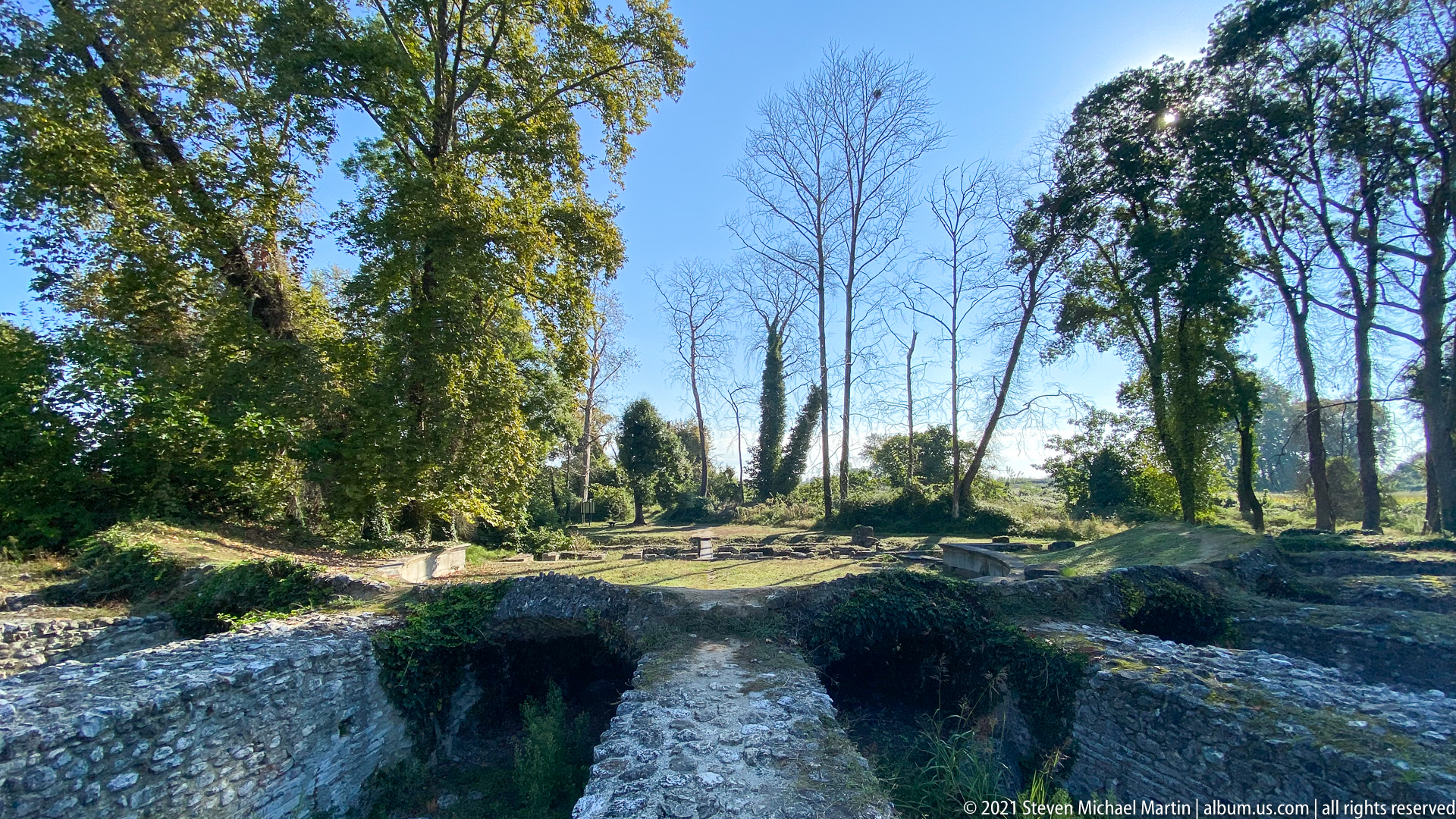
A wide view looks across the same deeply excavated masonry complex, where broad stone walls divide a series of sunken chambers beneath mature trees. Dark openings and vegetation-filled spaces emphasize the surviving vertical depth, while the open upper surfaces reveal how the rooms connect across the site. The composition provides a contextual overview of the structure without supplying enough evidence to assign a specific ancient function.
Caption
A wide view looks across the same deeply excavated masonry complex, where broad stone walls divide a series of sunken chambers beneath mature trees. Dark openings and vegetation-filled spaces emphasize the surviving vertical depth, while the open upper surfaces reveal how the rooms connect across the site. The composition provides a contextual overview of the structure without supplying enough evidence to assign a specific ancient function.

A museum case gathers small personal ornaments and accessories made from several materials: vivid yellow-and-blue glass beads, ribbed dark beads, translucent green glass pieces, slender bone or ivory pins, and small gold rings and fittings. The colorful group demonstrates the variety of fine objects recovered at Dion and the coexistence of glassworking, organic materials, and precious metal within personal adornment and dress accessories.
Caption
A museum case gathers small personal ornaments and accessories made from several materials: vivid yellow-and-blue glass beads, ribbed dark beads, translucent green glass pieces, slender bone or ivory pins, and small gold rings and fittings. The colorful group demonstrates the variety of fine objects recovered at Dion and the coexistence of glassworking, organic materials, and precious metal within personal adornment and dress accessories.

A marble female head wears a large wreath or crown composed of layered leaves, flowers, and fruit-like forms. Carefully carved waves of hair frame the forehead beneath the headdress, while the face is softly modeled with heavy-lidded eyes and a closed mouth. The elaborate vegetal crown suggests a divine, personified, or ceremonial identity, but no unmistakable attribute in this close view permits a secure named identification.
Caption
A marble female head wears a large wreath or crown composed of layered leaves, flowers, and fruit-like forms. Carefully carved waves of hair frame the forehead beneath the headdress, while the face is softly modeled with heavy-lidded eyes and a closed mouth. The elaborate vegetal crown suggests a divine, personified, or ceremonial identity, but no unmistakable attribute in this close view permits a secure named identification.


