Zürich – Switzerland
Zürich, the largest city in Switzerland, lies at the northern end of Lake Zürich where the Limmat River flows out toward the Swiss Plateau. Surrounded by rolling hills and distant views of the Alps, the city has long served as a major cultural and commercial center.
The historic Altstadt stretches along both sides of the Limmat River and contains medieval streets, guild houses, and churches that reflect Zürich’s long history as an important trading city. Landmarks such as the Grossmünster, the Fraumünster, and the arcaded streets of the old town illustrate the city’s development from the Middle Ages through the Renaissance.
Today Zürich combines this historic heritage with its role as one of Europe’s leading financial and cultural centers.

The monumental stone façade of Zürich Hauptbahnhof stretches across Bahnhofplatz, centered on its deeply recessed triumphal-arch entrance. Sculptural groups crown the central block while Swiss flags and street traffic establish the station’s civic setting, presenting the building as an architectural gateway between the rail network and central Zurich.
Caption
The monumental stone façade of Zürich Hauptbahnhof stretches across Bahnhofplatz, centered on its deeply recessed triumphal-arch entrance. Sculptural groups crown the central block while Swiss flags and street traffic establish the station’s civic setting, presenting the building as an architectural gateway between the rail network and central Zurich.

A steep cobblestone lane climbs between historic buildings with green shutters, arched openings, climbing plants, and small windows. Stone steps run along one side of the incline while a lone pedestrian approaches the upper street. The enclosed perspective emphasizes Zurich’s varied topography and the intimate scale of circulation through the Old Town.
Caption
A steep cobblestone lane climbs between historic buildings with green shutters, arched openings, climbing plants, and small windows. Stone steps run along one side of the incline while a lone pedestrian approaches the upper street. The enclosed perspective emphasizes Zurich’s varied topography and the intimate scale of circulation through the Old Town.

A line of brightly colored sculptural figures faces the Zurich skyline from an elevated riverside or bridge setting. White, turquoise, gold, blue, and gray costumes form a vivid foreground, while St. Peter’s clock tower rises beyond the Old Town roofs. The juxtaposition sets contemporary public art against one of the city’s most recognizable historic landmarks.
Caption
A line of brightly colored sculptural figures faces the Zurich skyline from an elevated riverside or bridge setting. White, turquoise, gold, blue, and gray costumes form a vivid foreground, while St. Peter’s clock tower rises beyond the Old Town roofs. The juxtaposition sets contemporary public art against one of the city’s most recognizable historic landmarks.

A traveler stands at the river’s edge with Zürich Rathaus filling the background, its rectangular stone mass spanning the water on broad arches. Rows of evenly spaced windows and a low hipped roof give the building a restrained civic presence, while the Limmat in the foreground makes its unusual waterside setting immediately legible.
Caption
A traveler stands at the river’s edge with Zürich Rathaus filling the background, its rectangular stone mass spanning the water on broad arches. Rows of evenly spaced windows and a low hipped roof give the building a restrained civic presence, while the Limmat in the foreground makes its unusual waterside setting immediately legible.

The broad main hall of Zürich Hauptbahnhof is animated by travelers beneath a high iron roof and monumental arched windows. A suspended colorful figure introduces a contemporary accent within the historic station volume, while shops and circulation areas at ground level show the hall functioning as both transport interchange and urban interior.
Caption
The broad main hall of Zürich Hauptbahnhof is animated by travelers beneath a high iron roof and monumental arched windows. A suspended colorful figure introduces a contemporary accent within the historic station volume, while shops and circulation areas at ground level show the hall functioning as both transport interchange and urban interior.

The Limmat opens a long view through central Zurich, with historic buildings lining both banks and church towers punctuating the skyline beyond a bridge. Calm water mirrors the overcast sky and dense riverfront development, showing how the river organizes the old city’s architecture, circulation, and visual corridors.
Caption
The Limmat opens a long view through central Zurich, with historic buildings lining both banks and church towers punctuating the skyline beyond a bridge. Calm water mirrors the overcast sky and dense riverfront development, showing how the river organizes the old city’s architecture, circulation, and visual corridors.

A second portrait places the traveler more centrally against Zürich Rathaus, allowing the building’s symmetrical window rows, broad river arches, and hipped roof to remain fully visible behind him. The composition combines a personal travel record with a clear architectural study of Zurich’s historic city hall at the edge of the Limmat.
Caption
A second portrait places the traveler more centrally against Zürich Rathaus, allowing the building’s symmetrical window rows, broad river arches, and hipped roof to remain fully visible behind him. The composition combines a personal travel record with a clear architectural study of Zurich’s historic city hall at the edge of the Limmat.

Two blue-and-white VBZ trams pass at close range, compressing Zurich’s street transport into a study of windows, doors, headlights, and articulated vehicle bodies. The nearer tram carries fleet number 2090 and a route 5 display for Kirche Fluntern. Passengers are visible through the adjacent car, reinforcing the everyday operational character of the city’s tram network.
Caption
Two blue-and-white VBZ trams pass at close range, compressing Zurich’s street transport into a study of windows, doors, headlights, and articulated vehicle bodies. The nearer tram carries fleet number 2090 and a route 5 display for Kirche Fluntern. Passengers are visible through the adjacent car, reinforcing the everyday operational character of the city’s tram network.

An SBB CFF FFS double-deck electric multiple unit stands beside a platform under the train shed at Zürich Hauptbahnhof. The red-and-white livery, railway logo, platform edge, rails, and overhead station structure place the modern train in direct contrast with the historic museum architecture documented in the preceding views.
Caption
An SBB CFF FFS double-deck electric multiple unit stands beside a platform under the train shed at Zürich Hauptbahnhof. The red-and-white livery, railway logo, platform edge, rails, and overhead station structure place the modern train in direct contrast with the historic museum architecture documented in the preceding views.

A menswear shop window layers jackets, shirts, knitwear, shoes, bags, and accessories behind reflective glass. Three torso mannequins in tailored outerwear dominate the upper display, while folded clothing and leather goods fill the lower shelves, documenting the retail character of central Zurich at street level.
Caption
A menswear shop window layers jackets, shirts, knitwear, shoes, bags, and accessories behind reflective glass. Three torso mannequins in tailored outerwear dominate the upper display, while folded clothing and leather goods fill the lower shelves, documenting the retail character of central Zurich at street level.

A pedestrian crosses a narrow metal footbridge whose railings are densely covered with small padlocks. Historic commercial buildings rise behind the crossing, creating a layered urban scene in which pedestrian infrastructure, riverside architecture, and the accumulated personal tokens attached to the bridge share equal visual prominence.
Caption
A pedestrian crosses a narrow metal footbridge whose railings are densely covered with small padlocks. Historic commercial buildings rise behind the crossing, creating a layered urban scene in which pedestrian infrastructure, riverside architecture, and the accumulated personal tokens attached to the bridge share equal visual prominence.

The Zunfthaus zur Zimmerleuten occupies a prominent corner with arcaded ground level, painted window trim, and projecting flags. The twin stone towers of the Grossmünster rise behind the roofline, creating a layered view of Zurich’s guild heritage and sacred skyline. Outdoor seating and tram wires keep the foreground rooted in the contemporary city.
Caption
The Zunfthaus zur Zimmerleuten occupies a prominent corner with arcaded ground level, painted window trim, and projecting flags. The twin stone towers of the Grossmünster rise behind the roofline, creating a layered view of Zurich’s guild heritage and sacred skyline. Outdoor seating and tram wires keep the foreground rooted in the contemporary city.

A tiered stand of flowering plants fills the foreground of a blue-painted storefront, with terracotta and dark pots arranged against reflective windows. The close view emphasizes a small-scale element of Zurich’s historic urban streetscape: seasonal planting used to animate a narrow commercial façade without obscuring its older window and sill structure.
Caption
A tiered stand of flowering plants fills the foreground of a blue-painted storefront, with terracotta and dark pots arranged against reflective windows. The close view emphasizes a small-scale element of Zurich’s historic urban streetscape: seasonal planting used to animate a narrow commercial façade without obscuring its older window and sill structure.

St. Peter Church is seen from close range, its massive square tower dominated by large black-and-gold clock faces above the pale nave. The oblique view shows the tower’s steep roof, restrained masonry, arched windows, and the unusually prominent clock that serves as one of Zurich’s most recognizable Old Town landmarks.
Caption
St. Peter Church is seen from close range, its massive square tower dominated by large black-and-gold clock faces above the pale nave. The oblique view shows the tower’s steep roof, restrained masonry, arched windows, and the unusually prominent clock that serves as one of Zurich’s most recognizable Old Town landmarks.

A gently descending cobblestone lane passes between tightly packed pastel façades, shuttered windows, and a traditional wall-mounted streetlamp. A bicycle parked against the right-hand building adds a contemporary note to the otherwise restrained historic setting, while the narrow perspective conveys the intimate scale of Zurich’s older residential lanes.
Caption
A gently descending cobblestone lane passes between tightly packed pastel façades, shuttered windows, and a traditional wall-mounted streetlamp. A bicycle parked against the right-hand building adds a contemporary note to the otherwise restrained historic setting, while the narrow perspective conveys the intimate scale of Zurich’s older residential lanes.

The white stepped-gable façade of the Zunfthaus zur Haue rises above the street with blue-and-white striped shutters, a projecting painted oriel, and the guild house name lettered across the wall. The upward viewpoint isolates the building’s heraldic and architectural details, distinguishing this historic guild-house frontage within Zurich’s dense old-city fabric.
Caption
The white stepped-gable façade of the Zunfthaus zur Haue rises above the street with blue-and-white striped shutters, a projecting painted oriel, and the guild house name lettered across the wall. The upward viewpoint isolates the building’s heraldic and architectural details, distinguishing this historic guild-house frontage within Zurich’s dense old-city fabric.

A quiet paved square is enclosed by narrow historic buildings with varied rooflines, shutters, shopfronts, and softly lit ground-floor entrances. Fallen autumn leaves and mature trees open the foreground, while the irregular façades show the intimate scale of Zurich’s older pedestrian quarters rather than a monumental civic axis.
Caption
A quiet paved square is enclosed by narrow historic buildings with varied rooflines, shutters, shopfronts, and softly lit ground-floor entrances. Fallen autumn leaves and mature trees open the foreground, while the irregular façades show the intimate scale of Zurich’s older pedestrian quarters rather than a monumental civic axis.

A narrow pedestrian passage bends between pale historic façades, where shuttered windows, projecting glazed bays, shopfronts, and small entry steps compress the streetscape into a layered urban corridor. Pedestrians provide scale, while the mixed window forms reveal incremental adaptation of older buildings for contemporary commercial use.
Caption
A narrow pedestrian passage bends between pale historic façades, where shuttered windows, projecting glazed bays, shopfronts, and small entry steps compress the streetscape into a layered urban corridor. Pedestrians provide scale, while the mixed window forms reveal incremental adaptation of older buildings for contemporary commercial use.

A sculpted wall plaque announces “BEER & Co. BUCHHANDLUNG” in gilded lettering, framed by a symmetrical gray ornamental cartouche with drapery-like side elements and a shell or urn motif above. The close detail preserves a piece of Zurich’s commercial streetscape in which a business name is integrated into architectural decoration rather than applied as a modern signboard.
Caption
A sculpted wall plaque announces “BEER & Co. BUCHHANDLUNG” in gilded lettering, framed by a symmetrical gray ornamental cartouche with drapery-like side elements and a shell or urn motif above. The close detail preserves a piece of Zurich’s commercial streetscape in which a business name is integrated into architectural decoration rather than applied as a modern signboard.

Two narrow pedestrian lanes diverge around a corner building whose brightly lit jewelry windows draw the eye into Zurich’s Old Town. Closely spaced façades, stone paving, projecting shop signs, and evening illumination create a compact commercial streetscape shaped by medieval-scale circulation but occupied by contemporary retailers.
Caption
Two narrow pedestrian lanes diverge around a corner building whose brightly lit jewelry windows draw the eye into Zurich’s Old Town. Closely spaced façades, stone paving, projecting shop signs, and evening illumination create a compact commercial streetscape shaped by medieval-scale circulation but occupied by contemporary retailers.

Large red Gothic-script lettering stretches across a white façade above a dark metal relief centered on a nude standing figure and surrounding emblem-like forms. A blue number plaque marked 24 anchors the lower corner. The image isolates an unusually graphic combination of painted text and sculptural decoration in Zurich’s historic streetscape.
Caption
Large red Gothic-script lettering stretches across a white façade above a dark metal relief centered on a nude standing figure and surrounding emblem-like forms. A blue number plaque marked 24 anchors the lower corner. The image isolates an unusually graphic combination of painted text and sculptural decoration in Zurich’s historic streetscape.

Pastel façades and illuminated ground-floor shops enclose a small pedestrian space in Zurich’s Old Town. Projecting signs, upper-story windows, and a narrow passage between buildings lead the eye deeper into the historic street network, while the evening shop lighting emphasizes the continued commercial use of these compact urban blocks.
Caption
Pastel façades and illuminated ground-floor shops enclose a small pedestrian space in Zurich’s Old Town. Projecting signs, upper-story windows, and a narrow passage between buildings lead the eye deeper into the historic street network, while the evening shop lighting emphasizes the continued commercial use of these compact urban blocks.

A narrow stairway climbs beside pale historic buildings on a lane marked “Lindenhof,” linking the lower Old Town with the elevated Lindenhof area. Green shutters, climbing vegetation, shop windows, and restrained façade ornament frame the ascent, making the change in grade a defining feature of the composition.
Caption
A narrow stairway climbs beside pale historic buildings on a lane marked “Lindenhof,” linking the lower Old Town with the elevated Lindenhof area. Green shutters, climbing vegetation, shop windows, and restrained façade ornament frame the ascent, making the change in grade a defining feature of the composition.

The façade of Haus zur Glocke is identified by gilded lettering and a blue-and-gold bell emblem centered between its upper windows. Ornamental window surrounds and the long ground-floor inscription for Café Conditorei zur Glocke preserve the building’s historic commercial identity, while warm interior light contrasts with the pale exterior.
Caption
The façade of Haus zur Glocke is identified by gilded lettering and a blue-and-gold bell emblem centered between its upper windows. Ornamental window surrounds and the long ground-floor inscription for Café Conditorei zur Glocke preserve the building’s historic commercial identity, while warm interior light contrasts with the pale exterior.
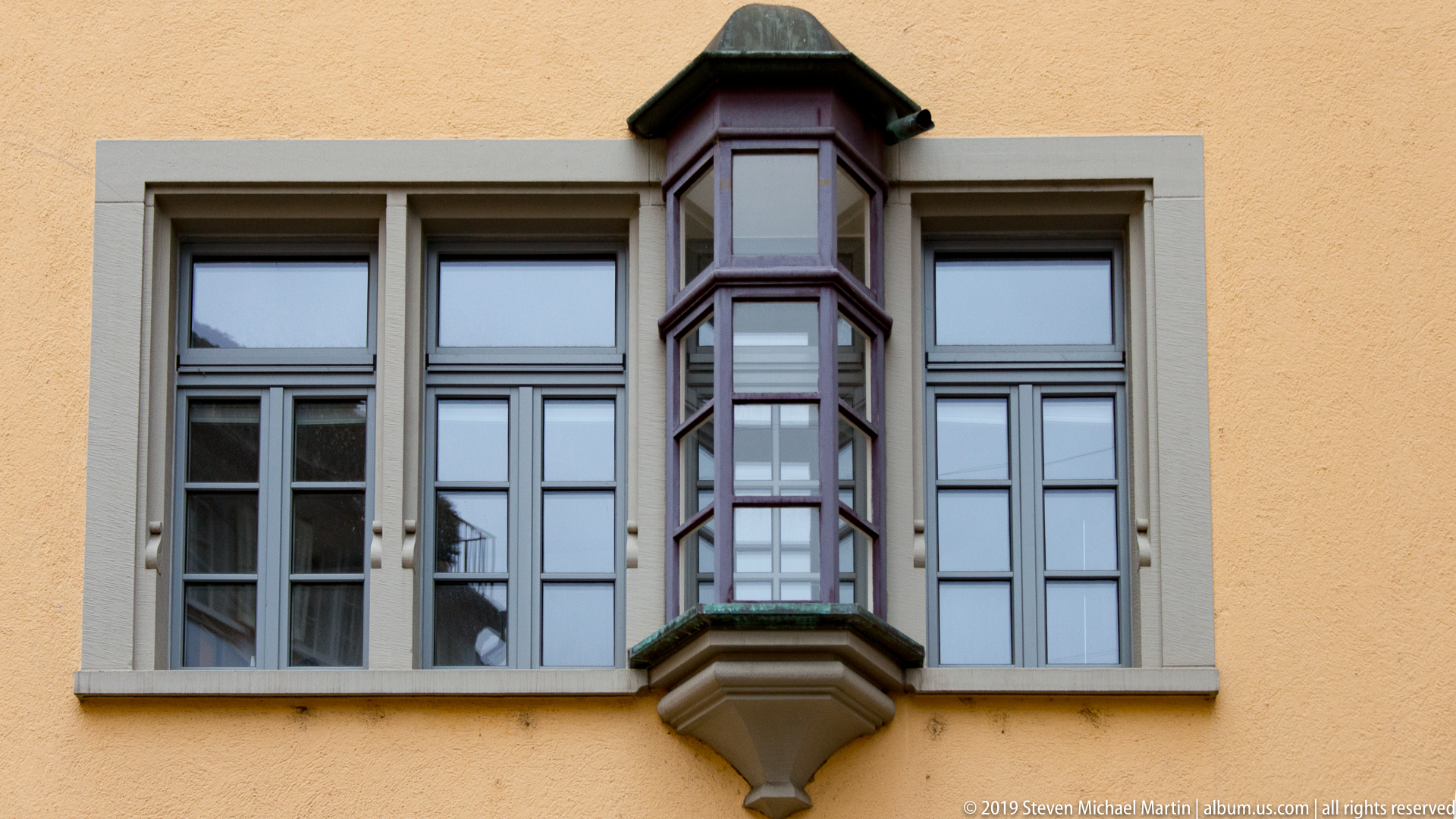
A slender polygonal oriel projects from a warm ochre façade between paired tall windows. Its stacked glazing, dark wood framing, small hood, and faceted stone base create a strong vertical accent, illustrating how projecting window forms add depth and individuality to otherwise planar Old Town façades.
Caption
A slender polygonal oriel projects from a warm ochre façade between paired tall windows. Its stacked glazing, dark wood framing, small hood, and faceted stone base create a strong vertical accent, illustrating how projecting window forms add depth and individuality to otherwise planar Old Town façades.

Two dark, broom-riding figures are painted in silhouette across a white rooftop wall above weathered tile roofs and chimneys. The playful graphic detail stands apart from Zurich’s traditional roofscape, turning an otherwise utilitarian upper wall into a conspicuous piece of vernacular decoration.
Caption
Two dark, broom-riding figures are painted in silhouette across a white rooftop wall above weathered tile roofs and chimneys. The playful graphic detail stands apart from Zurich’s traditional roofscape, turning an otherwise utilitarian upper wall into a conspicuous piece of vernacular decoration.

Three bronze-green female figures support a large ornate basin or canopy above their heads, forming a sculptural fountain-like ensemble. The upward close view emphasizes the figures’ repeated poses, drapery, and the richly modeled rim and domed upper element, with foliage behind separating the sculpture from the street.
Caption
Three bronze-green female figures support a large ornate basin or canopy above their heads, forming a sculptural fountain-like ensemble. The upward close view emphasizes the figures’ repeated poses, drapery, and the richly modeled rim and domed upper element, with foliage behind separating the sculpture from the street.

A low-angle view looks into a deep entrance loggia carried on massive stone columns with carved capitals. Sculptural heads and relief ornament punctuate the façade above the arch, and the word “GESELLSCHAFT” is visible along the lower stonework, emphasizing the building’s institutional character.
Caption
A low-angle view looks into a deep entrance loggia carried on massive stone columns with carved capitals. Sculptural heads and relief ornament punctuate the façade above the arch, and the word “GESELLSCHAFT” is visible along the lower stonework, emphasizing the building’s institutional character.

A stone fountain with a standing figure marks the center of a compact pedestrian space bordered by narrow historic buildings and illuminated shopfronts. The fountain functions as both ornament and spatial focus, while pedestrians moving around it show how Zurich’s older civic features remain embedded in active commercial streets.
Caption
A stone fountain with a standing figure marks the center of a compact pedestrian space bordered by narrow historic buildings and illuminated shopfronts. The fountain functions as both ornament and spatial focus, while pedestrians moving around it show how Zurich’s older civic features remain embedded in active commercial streets.

A compressed upward view along a narrow street layers pale façades with red, green, and white shutters, projecting signs, traditional lamps, and a decorated oriel. The irregular rooflines and close building spacing convey the vertical enclosure characteristic of Zurich’s Old Town lanes.
Caption
A compressed upward view along a narrow street layers pale façades with red, green, and white shutters, projecting signs, traditional lamps, and a decorated oriel. The irregular rooflines and close building spacing convey the vertical enclosure characteristic of Zurich’s Old Town lanes.

Bahnhofstrasse stretches ahead beneath tram wires, with rails embedded in the roadway and broad sidewalks busy with pedestrians. Mature autumn trees soften the long commercial frontage, while illuminated shops and transit infrastructure show the avenue’s dual role as Zurich’s principal shopping street and a major public-transport corridor.
Caption
Bahnhofstrasse stretches ahead beneath tram wires, with rails embedded in the roadway and broad sidewalks busy with pedestrians. Mature autumn trees soften the long commercial frontage, while illuminated shops and transit infrastructure show the avenue’s dual role as Zurich’s principal shopping street and a major public-transport corridor.

The clock tower of St. Peter rises at the end of a busy Old Town street, its black-and-gold clock face framed by dense rows of shops, hotels, hanging signs, and upper-story façades. This axial street view places the church within Zurich’s everyday commercial fabric rather than isolating it as a freestanding monument.
Caption
The clock tower of St. Peter rises at the end of a busy Old Town street, its black-and-gold clock face framed by dense rows of shops, hotels, hanging signs, and upper-story façades. This axial street view places the church within Zurich’s everyday commercial fabric rather than isolating it as a freestanding monument.

A blue-faced clock with Roman numerals is set into a stone corner bay between vertical ranks of small bells. The carefully ordered bell arrays and projecting metalwork make the installation read as a mechanical or musical clock feature, while the close framing concentrates on its craftsmanship rather than the surrounding building.
Caption
A blue-faced clock with Roman numerals is set into a stone corner bay between vertical ranks of small bells. The carefully ordered bell arrays and projecting metalwork make the installation read as a mechanical or musical clock feature, while the close framing concentrates on its craftsmanship rather than the surrounding building.

Travelers move through the commercial concourse of Zürich Hauptbahnhof beneath suspended platform signs, electronic departure boards, clocks, and industrial lighting. Retail kiosks line the circulation space, while the dense wayfinding system and visible platform numbers emphasize the station’s role as a major rail interchange rather than a purely architectural interior.
Caption
Travelers move through the commercial concourse of Zürich Hauptbahnhof beneath suspended platform signs, electronic departure boards, clocks, and industrial lighting. Retail kiosks line the circulation space, while the dense wayfinding system and visible platform numbers emphasize the station’s role as a major rail interchange rather than a purely architectural interior.

A broad stairway descends into Zürich Hauptbahnhof beneath signs for the S-Bahn and station services. Striped stone walls, stainless-steel handrails, tactile paving, and pedestrians create a strongly directional composition, documenting the transition between street level and the station’s lower circulation network.
Caption
A broad stairway descends into Zürich Hauptbahnhof beneath signs for the S-Bahn and station services. Striped stone walls, stainless-steel handrails, tactile paving, and pedestrians create a strongly directional composition, documenting the transition between street level and the station’s lower circulation network.

Above an arched entrance to the Swiss National Museum, a carved heraldic relief with the Swiss cross is set into the masonry over the inscription “Schweizerisches Landesmuseum.” Additional German text records the museum’s establishment and construction. Ivy framing the stonework softens the formal civic composition.
Caption
Above an arched entrance to the Swiss National Museum, a carved heraldic relief with the Swiss cross is set into the masonry over the inscription “Schweizerisches Landesmuseum.” Additional German text records the museum’s establishment and construction. Ivy framing the stonework softens the formal civic composition.

The historic entrance range of the Swiss National Museum combines rough stone walls, steep roofs, chimneys, pointed roof forms, and a central arcade of broad arched openings. Seen across the wet forecourt, the complex presents the castle-like historicist vocabulary used to give Switzerland’s national collection a deliberately monumental architectural setting.
Caption
The historic entrance range of the Swiss National Museum combines rough stone walls, steep roofs, chimneys, pointed roof forms, and a central arcade of broad arched openings. Seen across the wet forecourt, the complex presents the castle-like historicist vocabulary used to give Switzerland’s national collection a deliberately monumental architectural setting.

A canted view of the Swiss National Museum brings its tall square tower, ivy-covered walls, arched gateway, and adjoining historicist ranges into a single composition. Scaffolding at the left records ongoing work, while the steep roofs and irregular stone massing reinforce the castle-like character of the museum complex beside Zürich Hauptbahnhof.
Caption
A canted view of the Swiss National Museum brings its tall square tower, ivy-covered walls, arched gateway, and adjoining historicist ranges into a single composition. Scaffolding at the left records ongoing work, while the steep roofs and irregular stone massing reinforce the castle-like character of the museum complex beside Zürich Hauptbahnhof.

A long historicist façade of the Swiss National Museum is articulated by tall multi-light windows, buttress-like vertical divisions, round corner turrets with steep conical roofs, and an ornate central gable. The elevation borrows the visual language of late medieval civic and ecclesiastical architecture to give the museum a deliberately historic national setting.
Caption
A long historicist façade of the Swiss National Museum is articulated by tall multi-light windows, buttress-like vertical divisions, round corner turrets with steep conical roofs, and an ornate central gable. The elevation borrows the visual language of late medieval civic and ecclesiastical architecture to give the museum a deliberately historic national setting.

A closer oblique view of the Swiss National Museum isolates one cylindrical turret and the adjoining wall of tall multi-light windows. The steep conical turret roof, pale stone trim, textured wall surfaces, and mature trees in the foreground reveal the layered, picturesque treatment of the museum’s historicist exterior.
Caption
A closer oblique view of the Swiss National Museum isolates one cylindrical turret and the adjoining wall of tall multi-light windows. The steep conical turret roof, pale stone trim, textured wall surfaces, and mature trees in the foreground reveal the layered, picturesque treatment of the museum’s historicist exterior.

The central gable of the Swiss National Museum fills the frame, with three tall upper openings, pinnacles, sculptural figures, and a band of circular ornament above three large arched windows. This frontal detail concentrates on the elaborate historicist vocabulary of the museum’s exterior, separating its decorative roofline from the broader complex.
Caption
The central gable of the Swiss National Museum fills the frame, with three tall upper openings, pinnacles, sculptural figures, and a band of circular ornament above three large arched windows. This frontal detail concentrates on the elaborate historicist vocabulary of the museum’s exterior, separating its decorative roofline from the broader complex.

Two trains occupy neighboring platforms beneath the broad roof of Zürich Hauptbahnhof: an SBB double-deck passenger unit at left and a red locomotive-hauled train at right. Overhead platform signs and a departure display for an S-Bahn service toward Zug and Affoltern emphasize the station’s active role as a regional and intercity interchange.
Caption
Two trains occupy neighboring platforms beneath the broad roof of Zürich Hauptbahnhof: an SBB double-deck passenger unit at left and a red locomotive-hauled train at right. Overhead platform signs and a departure display for an S-Bahn service toward Zug and Affoltern emphasize the station’s active role as a regional and intercity interchange.

An SBB double-deck passenger train stands beneath the steel-and-glass train shed at Zürich Hauptbahnhof. Platform signage, an analog station clock, departure displays, and the long covered track emphasize the operational character of Switzerland’s principal rail hub and distinguish this view from the station’s monumental exterior.
Caption
An SBB double-deck passenger train stands beneath the steel-and-glass train shed at Zürich Hauptbahnhof. Platform signage, an analog station clock, departure displays, and the long covered track emphasize the operational character of Switzerland’s principal rail hub and distinguish this view from the station’s monumental exterior.

Bronze figures and animal forms cluster around the pedestal of Zurich’s Alfred Escher monument at Bahnhofplatz, with water spilling into the basin below. The close viewpoint isolates the sculptural fountain ensemble and its weathered green patina rather than the full monument, foregrounding modeling, texture, and the interaction of bronze and water.
Caption
Bronze figures and animal forms cluster around the pedestal of Zurich’s Alfred Escher monument at Bahnhofplatz, with water spilling into the basin below. The close viewpoint isolates the sculptural fountain ensemble and its weathered green patina rather than the full monument, foregrounding modeling, texture, and the interaction of bronze and water.

A closer view of Zürich Hauptbahnhof concentrates on the central arched entrance and sculpted crown of the station façade. Heavy rusticated masonry, paired upper windows, carved ornament, and the SBB CFF FFS sign articulate the entrance block, while tram wires and street traffic reveal its immediate integration with Zurich’s surface transport network.
Caption
A closer view of Zürich Hauptbahnhof concentrates on the central arched entrance and sculpted crown of the station façade. Heavy rusticated masonry, paired upper windows, carved ornament, and the SBB CFF FFS sign articulate the entrance block, while tram wires and street traffic reveal its immediate integration with Zurich’s surface transport network.

Cream-colored relief panels ornament a plastered Old Town façade between rows of shuttered windows. Stylized foliage, fruit, scrollwork, and a small central tree motif give the otherwise restrained elevation a handcrafted decorative character, while the upward viewpoint isolates the façade treatment from the surrounding street.
Caption
Cream-colored relief panels ornament a plastered Old Town façade between rows of shuttered windows. Stylized foliage, fruit, scrollwork, and a small central tree motif give the otherwise restrained elevation a handcrafted decorative character, while the upward viewpoint isolates the façade treatment from the surrounding street.

A painted wall sundial combines Roman hour numerals with a circular band of zodiac symbols and a radiating sun face. The dates 1695 and 1784 appear prominently above the dial, making the façade decoration both a timekeeping device and a graphic historical feature within Zurich’s old urban fabric.
Caption
A painted wall sundial combines Roman hour numerals with a circular band of zodiac symbols and a radiating sun face. The dates 1695 and 1784 appear prominently above the dial, making the façade decoration both a timekeeping device and a graphic historical feature within Zurich’s old urban fabric.

An elaborate wrought-iron hanging sign projects into a narrow Zurich street, combining gilded flowers and animal figures with a painted central tree. The red nameplate reads “Andrea Romero.” Its layered metalwork and suspended lantern exemplify the ornamental signs that enliven the pedestrian-scale façades of the Old Town.
Caption
An elaborate wrought-iron hanging sign projects into a narrow Zurich street, combining gilded flowers and animal figures with a painted central tree. The red nameplate reads “Andrea Romero.” Its layered metalwork and suspended lantern exemplify the ornamental signs that enliven the pedestrian-scale façades of the Old Town.

A large painted heraldic scene occupies the center of a pale urban façade between symmetrical windows and iron balconies. Figures gather beneath a fortified architectural emblem, turning the otherwise formal elevation into a display of civic or historical imagery. The frontal composition makes the mural’s relationship to the building especially clear.
Caption
A large painted heraldic scene occupies the center of a pale urban façade between symmetrical windows and iron balconies. Figures gather beneath a fortified architectural emblem, turning the otherwise formal elevation into a display of civic or historical imagery. The frontal composition makes the mural’s relationship to the building especially clear.

Two stone figures labeled “GESSNER” and “BODMER” stand on either side of an ornate cartouche beneath tall windows. Lions and scrolling carved ornament frame the central shield, while a small projecting figure appears below the ledge. The ensemble turns the façade into a commemorative architectural program rather than simple surface decoration.
Caption
Two stone figures labeled “GESSNER” and “BODMER” stand on either side of an ornate cartouche beneath tall windows. Lions and scrolling carved ornament frame the central shield, while a small projecting figure appears below the ledge. The ensemble turns the façade into a commemorative architectural program rather than simple surface decoration.

A richly articulated interior rises through arcades to a coffered and ornamented barrel vault, its pale stone surfaces modeled by pilasters, moldings, and carved details. A monumental framed recess anchors the far wall, while a German inscription above the arch adds a textual element to the formal architectural composition.
Caption
A richly articulated interior rises through arcades to a coffered and ornamented barrel vault, its pale stone surfaces modeled by pilasters, moldings, and carved details. A monumental framed recess anchors the far wall, while a German inscription above the arch adds a textual element to the formal architectural composition.

A geometric wall sundial fills a triangular gable, pairing bold Roman numerals with a network of hour lines and a bright painted sun. Red, black, and gold markings make the functional diagram unusually decorative, while the gable framing integrates the timepiece directly into the building’s architecture.
Caption
A geometric wall sundial fills a triangular gable, pairing bold Roman numerals with a network of hour lines and a bright painted sun. Red, black, and gold markings make the functional diagram unusually decorative, while the gable framing integrates the timepiece directly into the building’s architecture.

A monumental columned façade fills the foreground while a neighboring church tower rises behind it, capped by a green copper spire and clock face. The oblique street-level angle emphasizes the tight spatial relationship between substantial civic architecture and sacred landmarks in Zurich’s historic center.
Caption
A monumental columned façade fills the foreground while a neighboring church tower rises behind it, capped by a green copper spire and clock face. The oblique street-level angle emphasizes the tight spatial relationship between substantial civic architecture and sacred landmarks in Zurich’s historic center.

A narrow cobblestone lane threads between closely spaced pastel façades with shuttered windows, projecting signs, potted plants, and small storefronts. Bicycles and pedestrians reinforce the intimate scale of the street, where mixed residential and commercial details create a distinctly lived-in view of Zurich’s historic center.
Caption
A narrow cobblestone lane threads between closely spaced pastel façades with shuttered windows, projecting signs, potted plants, and small storefronts. Bicycles and pedestrians reinforce the intimate scale of the street, where mixed residential and commercial details create a distinctly lived-in view of Zurich’s historic center.

A weathered stone figure sits above a sculpted fountain structure, holding a long staff while autumn foliage fills the background. The low viewpoint silhouettes the figure against the leaves and emphasizes the softened, aged surfaces of the carving rather than the fountain’s wider architectural setting.
Caption
A weathered stone figure sits above a sculpted fountain structure, holding a long staff while autumn foliage fills the background. The low viewpoint silhouettes the figure against the leaves and emphasizes the softened, aged surfaces of the carving rather than the fountain’s wider architectural setting.

A white swan with a red beak is suspended inside a gilded circular frame on an ornamental street bracket. Seen against a softly blurred urban background, the sculptural sign becomes an isolated emblem, continuing Zurich’s tradition of projecting pictorial signs that identify establishments along narrow historic streets.
Caption
A white swan with a red beak is suspended inside a gilded circular frame on an ornamental street bracket. Seen against a softly blurred urban background, the sculptural sign becomes an isolated emblem, continuing Zurich’s tradition of projecting pictorial signs that identify establishments along narrow historic streets.

Blue-gray shutters frame a regular grid of windows on a pale residential façade, while overflowing red and pink flowers transform one lower window into a vivid focal point. The close composition highlights domestic details—stone surrounds, divided glazing, shutters, and window boxes—within Zurich’s historic streetscape.
Caption
Blue-gray shutters frame a regular grid of windows on a pale residential façade, while overflowing red and pink flowers transform one lower window into a vivid focal point. The close composition highlights domestic details—stone surrounds, divided glazing, shutters, and window boxes—within Zurich’s historic streetscape.

A gilded crown hangs beneath a dragon-like ornamental bracket above a red plaque reading “Kronen-Galerie.” Curving black ironwork, gold leaf, green foliage motifs, and small decorative masks create a compact piece of street sculpture, using the crown as a visual counterpart to the gallery’s name.
Caption
A gilded crown hangs beneath a dragon-like ornamental bracket above a red plaque reading “Kronen-Galerie.” Curving black ironwork, gold leaf, green foliage motifs, and small decorative masks create a compact piece of street sculpture, using the crown as a visual counterpart to the gallery’s name.

Two folding wooden chairs flank a small matching table set directly on cobblestones beside a gray façade. Potted greenery softens the compact arrangement, which reads as an informal café or resting place tucked against the building edge and provides a human-scale counterpoint to Zurich’s more monumental architecture.
Caption
Two folding wooden chairs flank a small matching table set directly on cobblestones beside a gray façade. Potted greenery softens the compact arrangement, which reads as an informal café or resting place tucked against the building edge and provides a human-scale counterpoint to Zurich’s more monumental architecture.

Projecting wrought-iron signs and lanterns form a layered sequence above a narrow Old Town street. The nearest sign reads “Oepfel-Chammer,” while additional ornamental brackets recede toward pastel façades. The upward view shows how commercial identifiers contribute to the visual texture of Zurich’s historic pedestrian streets.
Caption
Projecting wrought-iron signs and lanterns form a layered sequence above a narrow Old Town street. The nearest sign reads “Oepfel-Chammer,” while additional ornamental brackets recede toward pastel façades. The upward view shows how commercial identifiers contribute to the visual texture of Zurich’s historic pedestrian streets.

A long coiled serpent is carved in low relief across a pale, shield-like stone panel mounted against a darker wall. Incised scale patterns animate the body as it loops around angular forms, creating an emblematic composition whose meaning is less certain than its clearly rendered reptilian imagery.
Caption
A long coiled serpent is carved in low relief across a pale, shield-like stone panel mounted against a darker wall. Incised scale patterns animate the body as it loops around angular forms, creating an emblematic composition whose meaning is less certain than its clearly rendered reptilian imagery.

A cluster of ornate projecting signs hangs high above a narrow street, combining black iron scrollwork with gilded animal and letter forms. Pastel buildings with blue shutters fill the background, allowing the suspended signs to read as both commercial markers and decorative elements within the dense Old Town streetscape.
Caption
A cluster of ornate projecting signs hangs high above a narrow street, combining black iron scrollwork with gilded animal and letter forms. Pastel buildings with blue shutters fill the background, allowing the suspended signs to read as both commercial markers and decorative elements within the dense Old Town streetscape.

A gently descending cobblestone street narrows between closely packed historic buildings, their shopfronts, shutters, signs, and projecting bays creating an irregular façade rhythm. A few pedestrians occupy the center of the lane, while small displays at the edges underline the street’s mixed commercial and residential character.
Caption
A gently descending cobblestone street narrows between closely packed historic buildings, their shopfronts, shutters, signs, and projecting bays creating an irregular façade rhythm. A few pedestrians occupy the center of the lane, while small displays at the edges underline the street’s mixed commercial and residential character.

A vertical “CINEMA” sign occupies the narrow gap between richly varied Old Town façades. Arched windows, patterned wall surfaces, shutters, a mural fragment, and a traditional lantern compress into the frame, illustrating the architectural layering of entertainment, commerce, and historic fabric along Zurich’s pedestrian streets.
Caption
A vertical “CINEMA” sign occupies the narrow gap between richly varied Old Town façades. Arched windows, patterned wall surfaces, shutters, a mural fragment, and a traditional lantern compress into the frame, illustrating the architectural layering of entertainment, commerce, and historic fabric along Zurich’s pedestrian streets.

A gilded mill wheel is mounted on a red architectural panel between small classical columns, lion-head ornaments, and a winged head. Painted lettering below reads “Zum Mühlrad” and includes renovation dates, making the façade detail an unusually informative combination of house name, emblem, ornament, and documented restoration history.
Caption
A gilded mill wheel is mounted on a red architectural panel between small classical columns, lion-head ornaments, and a winged head. Painted lettering below reads “Zum Mühlrad” and includes renovation dates, making the façade detail an unusually informative combination of house name, emblem, ornament, and documented restoration history.

A painted figure fountain rises before a row of closely packed Old Town houses with shuttered windows and muted pastel façades. Bicycles line the parapet in the foreground, while the narrow proportions of the surrounding buildings reinforce the medieval street scale. The view treats the fountain as part of an inhabited urban ensemble rather than as an isolated monument.
Caption
A painted figure fountain rises before a row of closely packed Old Town houses with shuttered windows and muted pastel façades. Bicycles line the parapet in the foreground, while the narrow proportions of the surrounding buildings reinforce the medieval street scale. The view treats the fountain as part of an inhabited urban ensemble rather than as an isolated monument.

A painted and gilded armored figure stands dynamically atop an ornate fountain column, gripping a long pole while a sword hangs at his side. The close view isolates the military costume, feathered headgear, metallic surfaces, and colorful pedestal against modern residential façades, emphasizing the survival of historic civic sculpture within the contemporary city.
Caption
A painted and gilded armored figure stands dynamically atop an ornate fountain column, gripping a long pole while a sword hangs at his side. The close view isolates the military costume, feathered headgear, metallic surfaces, and colorful pedestal against modern residential façades, emphasizing the survival of historic civic sculpture within the contemporary city.

A projecting blue-painted oriel window anchors a richly detailed Old Town façade marked by blue-and-white striped shutters and a red street-level entrance. Carved brackets, narrow windows, and ornamental trim compress into the upward view, emphasizing the decorative vocabulary associated with Zurich’s historic guild and merchant houses.
Caption
A projecting blue-painted oriel window anchors a richly detailed Old Town façade marked by blue-and-white striped shutters and a red street-level entrance. Carved brackets, narrow windows, and ornamental trim compress into the upward view, emphasizing the decorative vocabulary associated with Zurich’s historic guild and merchant houses.

A gilded lion-like creature forms the body of an elaborate projecting sign, carrying an oval blue-and-white shield while a slender metal rod extends forward from its paws. The sculptural sign is mounted high against rusticated gray masonry, where its metallic surface and animated pose contrast sharply with the restrained stone façade.
Caption
A gilded lion-like creature forms the body of an elaborate projecting sign, carrying an oval blue-and-white shield while a slender metal rod extends forward from its paws. The sculptural sign is mounted high against rusticated gray masonry, where its metallic surface and animated pose contrast sharply with the restrained stone façade.

An armored figure projects from a Zurich façade between blue-and-white striped shutters, carrying a painted shield marked with a red-and-white heraldic device. The sculpture’s helmet, articulated armor, and lion-like support give the small façade element a strongly ceremonial character. Its placement above street level suggests a historic house, guild, or commercial emblem rather than freestanding public sculpture.
Caption
An armored figure projects from a Zurich façade between blue-and-white striped shutters, carrying a painted shield marked with a red-and-white heraldic device. The sculpture’s helmet, articulated armor, and lion-like support give the small façade element a strongly ceremonial character. Its placement above street level suggests a historic house, guild, or commercial emblem rather than freestanding public sculpture.

Historic buildings rise directly along the Limmat, their pale façades, green shutters, and steep roofs reflected in the water beside moored boats. A willow tree softens the masonry edge, while a slender tower with a green roof punctuates the background. The scene shows the close physical relationship between Zurich’s old city fabric and its river.
Caption
Historic buildings rise directly along the Limmat, their pale façades, green shutters, and steep roofs reflected in the water beside moored boats. A willow tree softens the masonry edge, while a slender tower with a green roof punctuates the background. The scene shows the close physical relationship between Zurich’s old city fabric and its river.

A compact row of white and pastel houses fronts the Limmat with little separation between architecture and water. Repeated shuttered windows, irregular rooflines, and small ground-floor openings create a dense rhythm across the opposite bank. The broad foreground of still water gives the urban edge a reflective calm and clearly distinguishes this view as a riverfront elevation.
Caption
A compact row of white and pastel houses fronts the Limmat with little separation between architecture and water. Repeated shuttered windows, irregular rooflines, and small ground-floor openings create a dense rhythm across the opposite bank. The broad foreground of still water gives the urban edge a reflective calm and clearly distinguishes this view as a riverfront elevation.

Colorful heraldic flags project from a gray historic building while a tall stone church tower rises at the end of the street. Tram wires and tightly spaced façades place the scene firmly within central Zurich’s working urban fabric. The composition layers civic or guild symbolism in the foreground against a major ecclesiastical landmark in the distance.
Caption
Colorful heraldic flags project from a gray historic building while a tall stone church tower rises at the end of the street. Tram wires and tightly spaced façades place the scene firmly within central Zurich’s working urban fabric. The composition layers civic or guild symbolism in the foreground against a major ecclesiastical landmark in the distance.

Four monumental columns support a triangular pediment above the entrance marked “Rathauspost,” giving this civic façade a restrained neoclassical authority. A sculpted relief occupies the pediment, while green-framed windows and pale stone surfaces keep the composition formal and symmetrical. The close viewpoint concentrates on the building’s institutional entrance rather than its wider street context.
Caption
Four monumental columns support a triangular pediment above the entrance marked “Rathauspost,” giving this civic façade a restrained neoclassical authority. A sculpted relief occupies the pediment, while green-framed windows and pale stone surfaces keep the composition formal and symmetrical. The close viewpoint concentrates on the building’s institutional entrance rather than its wider street context.

The large clock face of St. Peter’s Church rises above a row of pale historic buildings bordering a busy central square. Shuttered windows, shopfronts, parked cars, and pedestrians establish the everyday commercial setting, while the tower’s oversized dial provides a familiar vertical landmark above the lower urban fabric.
Caption
The large clock face of St. Peter’s Church rises above a row of pale historic buildings bordering a busy central square. Shuttered windows, shopfronts, parked cars, and pedestrians establish the everyday commercial setting, while the tower’s oversized dial provides a familiar vertical landmark above the lower urban fabric.

Two elaborately modeled coats of arms are joined within a single polychrome wall relief, surrounded by blue, red, and gold mantling. A small figure and further heraldic devices rise above the paired shields. The vivid colors and deep sculptural modeling make the ensemble a conspicuous marker of family, institutional, or guild identity on the historic façade.
Caption
Two elaborately modeled coats of arms are joined within a single polychrome wall relief, surrounded by blue, red, and gold mantling. A small figure and further heraldic devices rise above the paired shields. The vivid colors and deep sculptural modeling make the ensemble a conspicuous marker of family, institutional, or guild identity on the historic façade.

A richly articulated stone façade centers on a dark arched doorway framed by columns, carved heads, and scrolling ornament. Two gilded lion figures perch above the entrance, while symmetrical windows and rusticated masonry reinforce the formal civic character of the building. The frontal viewpoint makes the sculptural entrance program the dominant subject.
Caption
A richly articulated stone façade centers on a dark arched doorway framed by columns, carved heads, and scrolling ornament. Two gilded lion figures perch above the entrance, while symmetrical windows and rusticated masonry reinforce the formal civic character of the building. The frontal viewpoint makes the sculptural entrance program the dominant subject.

A carved grotesque mask projects from a horizontal band of stone scrollwork beneath a window. Deeply drilled curls, exaggerated facial features, and symmetrical volutes turn the small architectural detail into a theatrical accent on an otherwise restrained masonry surface. The tight crop emphasizes carving technique and expression rather than the larger building.
Caption
A carved grotesque mask projects from a horizontal band of stone scrollwork beneath a window. Deeply drilled curls, exaggerated facial features, and symmetrical volutes turn the small architectural detail into a theatrical accent on an otherwise restrained masonry surface. The tight crop emphasizes carving technique and expression rather than the larger building.

Two contrasting historic façades stand side by side: one stepped-gabled and marked by blue-and-white striped shutters, the other taller and more formal with pale blue shutters and projecting balconies. Arcaded ground floors and shopfronts tie the buildings to the commercial street below, while their different rooflines demonstrate the variety within Zurich’s Old Town architecture.
Caption
Two contrasting historic façades stand side by side: one stepped-gabled and marked by blue-and-white striped shutters, the other taller and more formal with pale blue shutters and projecting balconies. Arcaded ground floors and shopfronts tie the buildings to the commercial street below, while their different rooflines demonstrate the variety within Zurich’s Old Town architecture.

A projecting polygonal oriel window is wrapped in painted heraldic panels beneath a green copper roof. Red-and-gold trim, figurative emblems, and an iron balcony rail enrich the compact bay, turning a functional window into one of the façade’s most decorative elements. The close framing isolates this carefully crafted piece of Zurich’s historic domestic architecture.
Caption
A projecting polygonal oriel window is wrapped in painted heraldic panels beneath a green copper roof. Red-and-gold trim, figurative emblems, and an iron balcony rail enrich the compact bay, turning a functional window into one of the façade’s most decorative elements. The close framing isolates this carefully crafted piece of Zurich’s historic domestic architecture.

A weathered stone sculpture shows a heavily bearded seated figure supporting or embracing a smaller figure against his chest. Moss and lichen soften the carved surfaces, especially across the hair and shoulders, giving the group an aged outdoor appearance. The compact crop isolates gesture, drapery, and the contrast between the large head and smaller body.
Caption
A weathered stone sculpture shows a heavily bearded seated figure supporting or embracing a smaller figure against his chest. Moss and lichen soften the carved surfaces, especially across the hair and shoulders, giving the group an aged outdoor appearance. The compact crop isolates gesture, drapery, and the contrast between the large head and smaller body.

A closer street-level view presents the Zunfthaus zur Zimmerleuten as a civic and social landmark, with its name painted across the pale stone façade beneath red-trimmed windows. Swiss and heraldic flags project above an arcaded ground floor, while rows of outdoor tables occupy the pavement, showing the historic guildhouse in active contemporary use.
Caption
A closer street-level view presents the Zunfthaus zur Zimmerleuten as a civic and social landmark, with its name painted across the pale stone façade beneath red-trimmed windows. Swiss and heraldic flags project above an arcaded ground floor, while rows of outdoor tables occupy the pavement, showing the historic guildhouse in active contemporary use.

St. Peter’s clock tower rises behind a varied row of riverfront houses along the Limmat. Pastel façades and narrow gabled buildings create a colorful horizontal band beneath the tower’s large clock face and pointed green roof. Reflections in the water reinforce the close visual connection between Zurich’s ecclesiastical landmarks and its historic waterfront.
Caption
St. Peter’s clock tower rises behind a varied row of riverfront houses along the Limmat. Pastel façades and narrow gabled buildings create a colorful horizontal band beneath the tower’s large clock face and pointed green roof. Reflections in the water reinforce the close visual connection between Zurich’s ecclesiastical landmarks and its historic waterfront.

A single green-and-white chevron-patterned shutter stands open beside a narrow barred window set in a gray stone frame. The bold geometric paint contrasts with the warm peach plaster wall and dark metal bars, reducing the historic façade to a study in color, texture, and practical window protection.
Caption
A single green-and-white chevron-patterned shutter stands open beside a narrow barred window set in a gray stone frame. The bold geometric paint contrasts with the warm peach plaster wall and dark metal bars, reducing the historic façade to a study in color, texture, and practical window protection.

A miniature architectural niche projects from a pale wall, framed by gilded columns and topped by a painted heraldic crest. The shallow recess contains a slender central element beneath a turquoise arch, while a small inscription runs along the lower ledge. Rich color and gold leaf give the compact feature the character of a devotional or commemorative façade ornament.
Caption
A miniature architectural niche projects from a pale wall, framed by gilded columns and topped by a painted heraldic crest. The shallow recess contains a slender central element beneath a turquoise arch, while a small inscription runs along the lower ledge. Rich color and gold leaf give the compact feature the character of a devotional or commemorative façade ornament.

A bright red hound forms the projecting emblem above a black-and-gold sign reading “Rüden Restaurant.” Beneath it, a stone relief of a curled dog occupies a shallow wall niche. The paired animal motifs turn the restaurant’s name into both graphic signage and architectural sculpture, creating a memorable detail on the historic Zurich façade.
Caption
A bright red hound forms the projecting emblem above a black-and-gold sign reading “Rüden Restaurant.” Beneath it, a stone relief of a curled dog occupies a shallow wall niche. The paired animal motifs turn the restaurant’s name into both graphic signage and architectural sculpture, creating a memorable detail on the historic Zurich façade.

A heavy wooden double door sits within a carved stone surround decorated with a horizontal floral band and a small projecting animal head above the lintel. A large wooden barrel rests beside the entrance on uneven cobblestones, while green-and-white shutters frame the edges of the composition. The details give the doorway a distinctly traditional, craft-oriented character.
Caption
A heavy wooden double door sits within a carved stone surround decorated with a horizontal floral band and a small projecting animal head above the lintel. A large wooden barrel rests beside the entrance on uneven cobblestones, while green-and-white shutters frame the edges of the composition. The details give the doorway a distinctly traditional, craft-oriented character.

A deeply recessed round-arched portal marks the stone exterior of the Grossmünster, framed by multiple molded archivolts and slender columns. The dark paneled doors contrast with the pale masonry, while the semicircular tympanum above carries colored decoration. The close frontal view concentrates on the Romanesque vocabulary of the entrance rather than the church’s famous twin-tower silhouette.
Caption
A deeply recessed round-arched portal marks the stone exterior of the Grossmünster, framed by multiple molded archivolts and slender columns. The dark paneled doors contrast with the pale masonry, while the semicircular tympanum above carries colored decoration. The close frontal view concentrates on the Romanesque vocabulary of the entrance rather than the church’s famous twin-tower silhouette.

A row of oversized human figures in saturated red, white, gray, and other colors stands beneath autumn trees. Their stylized historical clothing and upright poses create a playful procession against the muted architecture behind. The close perspective on the red foreground figure exaggerates scale and gives the temporary or contemporary installation a theatrical presence in the public space.
Caption
A row of oversized human figures in saturated red, white, gray, and other colors stands beneath autumn trees. Their stylized historical clothing and upright poses create a playful procession against the muted architecture behind. The close perspective on the red foreground figure exaggerates scale and gives the temporary or contemporary installation a theatrical presence in the public space.

Two of Zurich’s defining church towers rise across the Limmat: the slender green spire of the Fraumünster at left and St. Peter’s clock tower at right. Historic façades fill the riverfront between them, while a bridge and tram wires frame the foreground. The broad view makes the relationship between river, churches, and Old Town skyline especially clear.
Caption
Two of Zurich’s defining church towers rise across the Limmat: the slender green spire of the Fraumünster at left and St. Peter’s clock tower at right. Historic façades fill the riverfront between them, while a bridge and tram wires frame the foreground. The broad view makes the relationship between river, churches, and Old Town skyline especially clear.

A traveler stands beside the Limmat with Zürich Rathaus centered behind him, its pale stone mass carried over the river on broad arches. Historic façades line both banks and the damp pavement records an overcast day. The portrait keeps the person prominent while preserving a clear view of the city hall’s unusual relationship to the river.
Caption
A traveler stands beside the Limmat with Zürich Rathaus centered behind him, its pale stone mass carried over the river on broad arches. Historic façades line both banks and the damp pavement records an overcast day. The portrait keeps the person prominent while preserving a clear view of the city hall’s unusual relationship to the river.

Dark metal double doors filled with repeated figurative relief panels occupy a stone church portal reached by broad shallow steps. Slender columns flank the entrance and support a semicircular arch with carved motifs in the tympanum. The frontal composition emphasizes the contrast between the cool pale masonry and the dense sculptural storytelling of the doors.
Caption
Dark metal double doors filled with repeated figurative relief panels occupy a stone church portal reached by broad shallow steps. Slender columns flank the entrance and support a semicircular arch with carved motifs in the tympanum. The frontal composition emphasizes the contrast between the cool pale masonry and the dense sculptural storytelling of the doors.

A richly modeled fountain stands against the stone wall of a Gothic courtyard, with clustered figures beneath a steep miniature canopy and water spilling into a broad circular basin. Traceried windows and alternating stone bands form the architectural backdrop. The composition concentrates on the fountain’s sculptural density within the quieter geometry of the cloister.
Caption
A richly modeled fountain stands against the stone wall of a Gothic courtyard, with clustered figures beneath a steep miniature canopy and water spilling into a broad circular basin. Traceried windows and alternating stone bands form the architectural backdrop. The composition concentrates on the fountain’s sculptural density within the quieter geometry of the cloister.

A gilded directional weather vane and star-shaped ornament crown the green copper spire of St. Peter’s Church. The tight upward view removes nearly all surrounding architecture, reducing the landmark to its metallic finial, circular gilded elements, and tapered copper roof against a pale sky.
Caption
A gilded directional weather vane and star-shaped ornament crown the green copper spire of St. Peter’s Church. The tight upward view removes nearly all surrounding architecture, reducing the landmark to its metallic finial, circular gilded elements, and tapered copper roof against a pale sky.

St. Peter’s large clock face rises above a continuous row of historic buildings along the Limmat. Pale façades, shuttered windows, steep roofs, and the restrained river wall create a dense urban edge beneath the church tower’s green spire. The broad water foreground emphasizes the landmark’s relationship to Zurich’s historic riverfront.
Caption
St. Peter’s large clock face rises above a continuous row of historic buildings along the Limmat. Pale façades, shuttered windows, steep roofs, and the restrained river wall create a dense urban edge beneath the church tower’s green spire. The broad water foreground emphasizes the landmark’s relationship to Zurich’s historic riverfront.

The twin Romanesque towers of the Grossmünster dominate this view across the Limmat, rising above the church nave and adjoining Old Town buildings. Their matching upper stages and dark capped roofs create Zurich’s most recognizable paired silhouette, while pedestrians, bridge traffic, and river walls keep the landmark embedded in the active center of the city.
Caption
The twin Romanesque towers of the Grossmünster dominate this view across the Limmat, rising above the church nave and adjoining Old Town buildings. Their matching upper stages and dark capped roofs create Zurich’s most recognizable paired silhouette, while pedestrians, bridge traffic, and river walls keep the landmark embedded in the active center of the city.

A compact guildhouse fronts the Limmat with Swiss, Zurich, and heraldic flags projecting above an arcaded ground floor. A steep hipped roof, red-trimmed windows, and the inscription identifying the Zunfthaus zur Saffran distinguish the building from its taller neighbors. The river steps and embankment place the guildhouse firmly within Zurich’s historic civic landscape.
Caption
A compact guildhouse fronts the Limmat with Swiss, Zurich, and heraldic flags projecting above an arcaded ground floor. A steep hipped roof, red-trimmed windows, and the inscription identifying the Zunfthaus zur Saffran distinguish the building from its taller neighbors. The river steps and embankment place the guildhouse firmly within Zurich’s historic civic landscape.

Zürich Rathaus anchors the left side of a Limmat riverfront view, its stone façade standing directly over the water on broad arches. A varied sequence of narrower historic houses continues along the embankment, with shuttered windows, arcades, and steep roofs giving the bank an irregular rhythm. The composition shows civic and domestic architecture sharing the same waterfront edge.
Caption
Zürich Rathaus anchors the left side of a Limmat riverfront view, its stone façade standing directly over the water on broad arches. A varied sequence of narrower historic houses continues along the embankment, with shuttered windows, arcades, and steep roofs giving the bank an irregular rhythm. The composition shows civic and domestic architecture sharing the same waterfront edge.

A formal pale-stone façade presents a symmetrical sequence of tall windows, sculpted lintels, and a central balcony with ornate metalwork. The mansard-like roofline and shallow central pediment give the building a palatial character, while the riverside pavement and reflections in the windows situate it along Zurich’s historic Limmat frontage.
Caption
A formal pale-stone façade presents a symmetrical sequence of tall windows, sculpted lintels, and a central balcony with ornate metalwork. The mansard-like roofline and shallow central pediment give the building a palatial character, while the riverside pavement and reflections in the windows situate it along Zurich’s historic Limmat frontage.

The low riverside mass of the Wasserkirche extends along the Limmat, while one of the Grossmünster’s towers rises behind it. A stone bridge enters from the left and the church’s tall Gothic windows face the water. The layered view makes the close topographic relationship between Zurich’s medieval churches and the river especially legible.
Caption
The low riverside mass of the Wasserkirche extends along the Limmat, while one of the Grossmünster’s towers rises behind it. A stone bridge enters from the left and the church’s tall Gothic windows face the water. The layered view makes the close topographic relationship between Zurich’s medieval churches and the river especially legible.

An elaborate multi-story stone building rises at a street corner with arched ground-floor openings, deeply modeled masonry, a steep roof, and a small green copper turret. The asymmetrical massing and Gothic-Revival detailing contrast with neighboring historic façades, creating a prominent institutional presence within Zurich’s dense center.
Caption
An elaborate multi-story stone building rises at a street corner with arched ground-floor openings, deeply modeled masonry, a steep roof, and a small green copper turret. The asymmetrical massing and Gothic-Revival detailing contrast with neighboring historic façades, creating a prominent institutional presence within Zurich’s dense center.

A broad round-arched gateway opens into a sheltered cloister passage, framed by dressed stone walls and smaller side arches. The central opening draws the eye through successive thresholds toward a brighter courtyard beyond. The restrained masonry and enclosed circulation create a transitional space between the street and a historic religious precinct.
Caption
A broad round-arched gateway opens into a sheltered cloister passage, framed by dressed stone walls and smaller side arches. The central opening draws the eye through successive thresholds toward a brighter courtyard beyond. The restrained masonry and enclosed circulation create a transitional space between the street and a historic religious precinct.

A small stone relief shows a long-haired woman holding or sheltering a child, both figures compressed into a shallow rounded niche. The simplified forms and rough-grained surface read as part of a larger architectural sculpture program rather than an independent statue. The tight crop emphasizes gesture and facial expression over the surrounding building.
Caption
A small stone relief shows a long-haired woman holding or sheltering a child, both figures compressed into a shallow rounded niche. The simplified forms and rough-grained surface read as part of a larger architectural sculpture program rather than an independent statue. The tight crop emphasizes gesture and facial expression over the surrounding building.

A bearded man wearing a broad cap is carved in low relief on a stone wall, his hands gathered around a small object at chest height. Deep facial lines and compact modeling give the figure a characterful, almost portrait-like presence. The relief appears integrated into a larger decorative program associated with the surrounding historic architecture.
Caption
A bearded man wearing a broad cap is carved in low relief on a stone wall, his hands gathered around a small object at chest height. Deep facial lines and compact modeling give the figure a characterful, almost portrait-like presence. The relief appears integrated into a larger decorative program associated with the surrounding historic architecture.

A long covered passage is lined by paired stone columns and rounded arches, while large painted scenes cover the upper walls. A coffered wooden ceiling runs overhead and successive arches frame a bright courtyard exit in the distance. The combination of mural decoration and disciplined arcade rhythm gives the cloister a ceremonial as well as circulatory character.
Caption
A long covered passage is lined by paired stone columns and rounded arches, while large painted scenes cover the upper walls. A coffered wooden ceiling runs overhead and successive arches frame a bright courtyard exit in the distance. The combination of mural decoration and disciplined arcade rhythm gives the cloister a ceremonial as well as circulatory character.

A pointed Gothic arch opens into a covered cloister passage, flanked by two standing stone figures set on projecting brackets. Traceried side windows and slender moldings reinforce the vertical emphasis, while the view through the arch reveals another courtyard beyond. The entrance combines sculpture, circulation, and architectural framing in a compact ensemble.
Caption
A pointed Gothic arch opens into a covered cloister passage, flanked by two standing stone figures set on projecting brackets. Traceried side windows and slender moldings reinforce the vertical emphasis, while the view through the arch reveals another courtyard beyond. The entrance combines sculpture, circulation, and architectural framing in a compact ensemble.

Large narrative paintings fill the wall bays beneath pointed vaults, arranging groups of robed figures around a central wooden door. The subdued palette, architectural framing, and repeated human scenes indicate a coherent mural cycle rather than isolated decoration. The image emphasizes the relationship between painted storytelling and the cloister’s Gothic structure.
Caption
Large narrative paintings fill the wall bays beneath pointed vaults, arranging groups of robed figures around a central wooden door. The subdued palette, architectural framing, and repeated human scenes indicate a coherent mural cycle rather than isolated decoration. The image emphasizes the relationship between painted storytelling and the cloister’s Gothic structure.

A cloister mural presents women in long robes within a wooded landscape, with a deer standing prominently at left. Pointed stone arches divide the painted scene into vertical bays, visually merging the forest imagery with the Gothic architecture. The detail isolates one episode from the wider narrative cycle and highlights the mural’s landscape setting.
Caption
A cloister mural presents women in long robes within a wooded landscape, with a deer standing prominently at left. Pointed stone arches divide the painted scene into vertical bays, visually merging the forest imagery with the Gothic architecture. The detail isolates one episode from the wider narrative cycle and highlights the mural’s landscape setting.

A broad arch frames a sequence of passages and courtyards within the historic cloister. Painted wall scenes occupy the right-hand bay, while clustered columns and pointed vaults recede toward a brighter opening beyond. Two visitors provide scale and draw attention to the layered circulation through the complex.
Caption
A broad arch frames a sequence of passages and courtyards within the historic cloister. Painted wall scenes occupy the right-hand bay, while clustered columns and pointed vaults recede toward a brighter opening beyond. Two visitors provide scale and draw attention to the layered circulation through the complex.

Two enormous black-and-gold clock faces wrap adjacent sides of St. Peter’s tower beneath its green copper spire. Roman numerals, gilded hands, sunburst centers, and small corner ornaments are crisply legible against the gray masonry. The upward close view isolates the timepieces that make this church one of Zurich’s most visually distinctive landmarks.
Caption
Two enormous black-and-gold clock faces wrap adjacent sides of St. Peter’s tower beneath its green copper spire. Roman numerals, gilded hands, sunburst centers, and small corner ornaments are crisply legible against the gray masonry. The upward close view isolates the timepieces that make this church one of Zurich’s most visually distinctive landmarks.

St. Peter’s Church rises from a paved urban square with its massive clock tower at the western end and the long stone nave extending to the right. Tall Gothic windows, buttress-like wall projections, and the green copper spire give the exterior a layered profile, while overhead tram wires underline the church’s place within central Zurich’s active street network.
Caption
St. Peter’s Church rises from a paved urban square with its massive clock tower at the western end and the long stone nave extending to the right. Tall Gothic windows, buttress-like wall projections, and the green copper spire give the exterior a layered profile, while overhead tram wires underline the church’s place within central Zurich’s active street network.

An ornate wrought-iron gateway marked “ORSINI” frames the entrance to a Zurich restaurant. Flowering vines, clipped shrubs, and planters soften the elaborate metalwork, while the pale classical façade behind gives the doorway a formal setting. The close view concentrates on the layered signage and decorative approach rather than the wider street.
Caption
An ornate wrought-iron gateway marked “ORSINI” frames the entrance to a Zurich restaurant. Flowering vines, clipped shrubs, and planters soften the elaborate metalwork, while the pale classical façade behind gives the doorway a formal setting. The close view concentrates on the layered signage and decorative approach rather than the wider street.

A projecting polygonal bay window anchors the salmon-colored corner façade of Restaurant Orsini. Gray-painted trim, deep cornices, and multipane windows give the upper stories a strongly modeled historic appearance, while the ornate “Restaurant Orsini” sign crowns the composition just below the eaves.
Caption
A projecting polygonal bay window anchors the salmon-colored corner façade of Restaurant Orsini. Gray-painted trim, deep cornices, and multipane windows give the upper stories a strongly modeled historic appearance, while the ornate “Restaurant Orsini” sign crowns the composition just below the eaves.

The blue-painted Zunfthaus zur Waag stands out among neighboring pale façades with a broad gable, regular rows of windows, and the inscription “Restaurant Zunfthaus zur Waag” across its front. Its strong color and symmetrical elevation make the guildhouse a conspicuous element of the Münsterhof streetscape.
Caption
The blue-painted Zunfthaus zur Waag stands out among neighboring pale façades with a broad gable, regular rows of windows, and the inscription “Restaurant Zunfthaus zur Waag” across its front. Its strong color and symmetrical elevation make the guildhouse a conspicuous element of the Münsterhof streetscape.

A monumental rust-colored steel arc rises from the foreground and bends dramatically over a paved square lined with historic buildings. Its sweeping modern geometry contrasts with shuttered façades and traditional rooflines beyond, creating a deliberately contemporary intervention within Zurich’s older urban fabric.
Caption
A monumental rust-colored steel arc rises from the foreground and bends dramatically over a paved square lined with historic buildings. Its sweeping modern geometry contrasts with shuttered façades and traditional rooflines beyond, creating a deliberately contemporary intervention within Zurich’s older urban fabric.

An elegant pale-stone guildhouse closes one side of Münsterhof with a symmetrical façade, tall sash windows, a central balcony, and a steep tiled roof punctuated by dormers. Classical detailing and the balanced entrance composition distinguish the building from the narrower medieval houses nearby, reflecting the later formal architecture of Zurich’s guild institutions.
Caption
An elegant pale-stone guildhouse closes one side of Münsterhof with a symmetrical façade, tall sash windows, a central balcony, and a steep tiled roof punctuated by dormers. Classical detailing and the balanced entrance composition distinguish the building from the narrower medieval houses nearby, reflecting the later formal architecture of Zurich’s guild institutions.

A narrow view between buildings reveals a formal stone terrace with balustrade, urn-like finials, and clipped plantings above tall windows. The richly modeled gray stone façade contrasts with the plain blue wall at right, creating a compressed study of neighboring architectural treatments within central Zurich.
Caption
A narrow view between buildings reveals a formal stone terrace with balustrade, urn-like finials, and clipped plantings above tall windows. The richly modeled gray stone façade contrasts with the plain blue wall at right, creating a compressed study of neighboring architectural treatments within central Zurich.

The words “Grasshopper-Club Zürich” span the pale façade of a traditional building with green-gray shutters and arched ground-floor openings. Swiss and blue-white-red flags project from the neighboring corner, while the narrow passage at left and rows of windows preserve the compact scale of the surrounding Old Town streetscape.
Caption
The words “Grasshopper-Club Zürich” span the pale façade of a traditional building with green-gray shutters and arched ground-floor openings. Swiss and blue-white-red flags project from the neighboring corner, while the narrow passage at left and rows of windows preserve the compact scale of the surrounding Old Town streetscape.

A boldly painted purple oriel projects from a pale plaster façade, its polygonal bay carried on a tapered stone support. Red window frames and turquoise trim intensify the color contrast, turning a traditional architectural form into the dominant visual feature of the otherwise restrained wall.
Caption
A boldly painted purple oriel projects from a pale plaster façade, its polygonal bay carried on a tapered stone support. Red window frames and turquoise trim intensify the color contrast, turning a traditional architectural form into the dominant visual feature of the otherwise restrained wall.

A narrow pedestrian street is lined by upscale storefronts and pastel historic façades, including Santa Lucia at center and Hermès at left. A purple projecting bay punctuates the upper stories while pedestrians move through the lane below. The view records the adaptation of Zurich’s older urban fabric to contemporary retail and dining.
Caption
A narrow pedestrian street is lined by upscale storefronts and pastel historic façades, including Santa Lucia at center and Hermès at left. A purple projecting bay punctuates the upper stories while pedestrians move through the lane below. The view records the adaptation of Zurich’s older urban fabric to contemporary retail and dining.

A green street kiosk advertises “Marroni” and “Frid’s heissi Marroni,” identifying the stand as a vendor of hot roasted chestnuts. Bags, utensils, menu boards, and a dark roasting vessel crowd the compact workspace, while a stone fountain and Old Town buildings remain visible beyond. The image documents a seasonal street-food tradition within central Zurich.
Caption
A green street kiosk advertises “Marroni” and “Frid’s heissi Marroni,” identifying the stand as a vendor of hot roasted chestnuts. Bags, utensils, menu boards, and a dark roasting vessel crowd the compact workspace, while a stone fountain and Old Town buildings remain visible beyond. The image documents a seasonal street-food tradition within central Zurich.

A richly modeled late-historicist corner façade rises above Bahnhofstrasse, combining rusticated ground-floor arches with pilasters, balconies, carved window surrounds, and a projecting corner bay. Retail windows occupy the street level while pedestrians pass beneath the elaborate upper stories. The oblique view emphasizes the building’s long urban frontage and the architectural formality associated with Zurich’s principal shopping district.
Caption
A richly modeled late-historicist corner façade rises above Bahnhofstrasse, combining rusticated ground-floor arches with pilasters, balconies, carved window surrounds, and a projecting corner bay. Retail windows occupy the street level while pedestrians pass beneath the elaborate upper stories. The oblique view emphasizes the building’s long urban frontage and the architectural formality associated with Zurich’s principal shopping district.

A modern articulated Zurich tram curves through the city center displaying route 7 to Wollishofen. Its white advertising wrap carries prominent Bitcoin Suisse branding, while pedestrians wait beside the tracks beneath a web of overhead power lines. Historic stone façades and autumn trees frame the vehicle, illustrating the integration of contemporary public transport into Zurich’s established streetscape.
Caption
A modern articulated Zurich tram curves through the city center displaying route 7 to Wollishofen. Its white advertising wrap carries prominent Bitcoin Suisse branding, while pedestrians wait beside the tracks beneath a web of overhead power lines. Historic stone façades and autumn trees frame the vehicle, illustrating the integration of contemporary public transport into Zurich’s established streetscape.

A route 7 tram approaches along curving rails through a busy Zurich square, where pedestrians cross between substantial historic commercial buildings. The prominent stepped-gable structure ahead, overhead tram wiring, café awnings, and autumn trees give the scene a layered civic character. The wider viewpoint places the transit system within the architectural and pedestrian fabric rather than isolating the vehicle itself.
Caption
A route 7 tram approaches along curving rails through a busy Zurich square, where pedestrians cross between substantial historic commercial buildings. The prominent stepped-gable structure ahead, overhead tram wiring, café awnings, and autumn trees give the scene a layered civic character. The wider viewpoint places the transit system within the architectural and pedestrian fabric rather than isolating the vehicle itself.

A long covered pedestrian passage recedes beneath a dense canopy of suspended decorative lights and overhead framework. Hotel and commercial signs, including Four Points by Sheraton and Crédit Suisse, project from the surrounding façades while shoppers move through the corridor. The strong central perspective turns the passage into a layered study of circulation, seasonal decoration, and contemporary commerce in central Zurich.
Caption
A long covered pedestrian passage recedes beneath a dense canopy of suspended decorative lights and overhead framework. Hotel and commercial signs, including Four Points by Sheraton and Crédit Suisse, project from the surrounding façades while shoppers move through the corridor. The strong central perspective turns the passage into a layered study of circulation, seasonal decoration, and contemporary commerce in central Zurich.
⭐ Highlights
- Altstadt: Zürich’s historic old town stretches along both sides of the Limmat River, preserving medieval streets, guild houses, and churches.
- Grossmünster: The city’s most recognizable church, with twin towers that define the skyline of the old town.
- Fraumünster: A historic riverside church known for its elegant setting and artistic legacy.
- Limmat River: The river shapes the layout of the city and provides some of Zürich’s most scenic urban views.
- Lake Zürich Setting: The city’s position at the northern end of the lake gives it a distinctive balance of water, architecture, and open space.
- Historic and Modern Contrast: Zürich combines a preserved medieval core with its role as one of Europe’s leading financial and cultural centers.
🏙️ Zürich Field Guide
Major features observed during this visit:
Zürich, the largest city in Switzerland, lies at the northern end of Lake Zürich where the Limmat River flows out toward the Swiss Plateau. Its historic Altstadt extends along both sides of the river and preserves a dense collection of medieval streets, churches, and civic buildings that reflect the city’s long role as a trading, cultural, and financial center. Today, Zürich blends this historic character with a modern urban identity, creating one of Europe’s most visually balanced cityscapes.
🏛️ Signature Landmarks
- Grossmünster – A Romanesque church with twin towers that has become one of Zürich’s defining landmarks.
- Fraumünster – A prominent church along the river, closely tied to the city’s historic and artistic identity.
- Limmat Riverfront – Bridges, embankments, and river views shape the visual character of the old town.
- Altstadt Streets – Narrow lanes, historic façades, and guild houses preserve the city’s medieval core.
- Lake Zürich – The lakefront opens the city to broader views and gives Zürich a more expansive setting than many historic capitals.
🧠 Historical Significance
- Medieval Trading City – Zürich developed as an important commercial center with strong civic and religious institutions.
- Religious Heritage – Churches such as the Grossmünster and Fraumünster reflect the city’s long ecclesiastical importance.
- Urban Continuity – The historic center preserves layers of medieval and later architectural development.
- Modern Importance – Zürich remains one of Europe’s leading financial and cultural centers.
🌄 Urban Landscape & Setting
- Lake and River Setting – The city is shaped by the meeting of Lake Zürich and the Limmat River.
- Altstadt on Both Banks – The old town spreads across both sides of the river, creating varied viewpoints and approaches.
- Hills and Distant Alps – The surrounding landscape gives Zürich a broader geographic presence beyond the urban core.
- Historic-Modern Balance – Medieval streets and churches coexist with a polished contemporary city.