Church of the Savior on Spilled Blood
The Church of the Savior on Spilled Blood was constructed in Saint Petersburg to commemorate the assassination of Emperor Alexander II in 1881. The church’s design reflects traditional Russian architectural forms inspired by earlier medieval models. Its decorative exterior distinguishes it from the more classical architectural style found elsewhere in the city.
Colorful domes, ornamental brickwork, and detailed mosaics illustrate the revival of traditional Russian artistic forms during the late nineteenth century. Interior surfaces are covered with intricate mosaic decoration depicting religious imagery associated with Orthodox Christian tradition. The structure demonstrates the importance of religious symbolism in commemorating historical events.
The Church of the Savior on Spilled Blood reflects the interaction between political history and religious architecture. Its distinctive design illustrates the revival of historic artistic traditions within imperial Russia.

The Church of the Savior on Spilt Blood fills an oblique canal-side view, bringing its clustered towers, onion domes, mosaic-filled gables, and patterned roofs into a single architectural composition. The low embankment and pedestrians establish street scale, while the angled viewpoint emphasizes the irregular massing and vertical progression from richly articulated lower façades to the church’s colorful domes.
Caption
The Church of the Savior on Spilt Blood fills an oblique canal-side view, bringing its clustered towers, onion domes, mosaic-filled gables, and patterned roofs into a single architectural composition. The low embankment and pedestrians establish street scale, while the angled viewpoint emphasizes the irregular massing and vertical progression from richly articulated lower façades to the church’s colorful domes.

Rows of small, overlapping glazed tiles form a tightly patterned roof surface on the Church of the Savior on Spilt Blood. Alternating blue, green, cream, ocher, and muted gray tones turn a functional covering into architectural ornament, while the close viewpoint isolates the rhythmic geometry and color that characterize the church’s richly decorated exterior.
Caption
Rows of small, overlapping glazed tiles form a tightly patterned roof surface on the Church of the Savior on Spilt Blood. Alternating blue, green, cream, ocher, and muted gray tones turn a functional covering into architectural ornament, while the close viewpoint isolates the rhythmic geometry and color that characterize the church’s richly decorated exterior.

A bulbous polychrome dome rises above an arcaded drum on the Church of the Savior on Spilt Blood, its surface divided into swelling bands of turquoise, green, ocher, and patterned geometric panels. The compressed upward view sets this dome against neighboring brick towers and gilded crosses, concentrating attention on the church’s distinctive combination of sculptural silhouette and colored exterior ornament.
Caption
A bulbous polychrome dome rises above an arcaded drum on the Church of the Savior on Spilt Blood, its surface divided into swelling bands of turquoise, green, ocher, and patterned geometric panels. The compressed upward view sets this dome against neighboring brick towers and gilded crosses, concentrating attention on the church’s distinctive combination of sculptural silhouette and colored exterior ornament.

Across the canal, the Church of the Savior on Spilt Blood appears as a compact skyline of patterned onion domes, brick towers, and gilded cupolas. A tall ornamental street lamp occupies the foreground and vehicles line the embankment, placing the monument within its Saint Petersburg streetscape rather than isolating it as an architectural study. The broader viewpoint clarifies the church’s scale and urban setting.
Caption
Across the canal, the Church of the Savior on Spilt Blood appears as a compact skyline of patterned onion domes, brick towers, and gilded cupolas. A tall ornamental street lamp occupies the foreground and vehicles line the embankment, placing the monument within its Saint Petersburg streetscape rather than isolating it as an architectural study. The broader viewpoint clarifies the church’s scale and urban setting.

A close view of a figurative mosaic shows Christ among a tightly gathered group, with kneeling and standing figures arranged across a shallow architectural setting. The tessellated surface and geometric border are clearly legible at this scale. Cropping out the surrounding architecture turns the photograph into a study of gesture, color, and narrative grouping.
Caption
A close view of a figurative mosaic shows Christ among a tightly gathered group, with kneeling and standing figures arranged across a shallow architectural setting. The tessellated surface and geometric border are clearly legible at this scale. Cropping out the surrounding architecture turns the photograph into a study of gesture, color, and narrative grouping.

A full frontal view isolates the sanctuary screen within the tall mosaic-lined apse. Three carved gables, columns, inset icons, and dark polished stone at floor level form a strong symmetrical base, while high windows and figurative wall mosaics surround the ensemble. The photograph emphasizes the iconostasis as an architectural object within the larger decorated interior.
Caption
A full frontal view isolates the sanctuary screen within the tall mosaic-lined apse. Three carved gables, columns, inset icons, and dark polished stone at floor level form a strong symmetrical base, while high windows and figurative wall mosaics surround the ensemble. The photograph emphasizes the iconostasis as an architectural object within the larger decorated interior.

A steep upward view gathers the church’s mosaic-covered vaults, arches, and window openings into a dense field of sacred imagery. Medallions, narrative scenes, and ornamental borders follow the architecture from pier to ceiling, while a hanging chandelier enters at left. The oblique composition emphasizes how pictorial decoration envelops the interior surfaces.
Caption
A steep upward view gathers the church’s mosaic-covered vaults, arches, and window openings into a dense field of sacred imagery. Medallions, narrative scenes, and ornamental borders follow the architecture from pier to ceiling, while a hanging chandelier enters at left. The oblique composition emphasizes how pictorial decoration envelops the interior surfaces.

A luminous mosaic of Christ in white dominates the center of this upward interior view, surrounded by apostles, angels, and concentric ornamental bands. Above it, another large image of Christ occupies the adjoining vault. The symmetrical framing reveals how major sacred scenes are integrated with medallions and patterned surfaces across the church’s architectural bays.
Caption
A luminous mosaic of Christ in white dominates the center of this upward interior view, surrounded by apostles, angels, and concentric ornamental bands. Above it, another large image of Christ occupies the adjoining vault. The symmetrical framing reveals how major sacred scenes are integrated with medallions and patterned surfaces across the church’s architectural bays.

Two major mosaic compositions align along the church’s vertical axis: Christ Pantocrator occupies the upper circular vault, while the radiant Transfiguration scene appears below in a neighboring bay. Chandeliers flare at both sides and saint medallions trace the arches. The centered view demonstrates the layered sequencing of sacred imagery across adjoining architectural surfaces.
Caption
Two major mosaic compositions align along the church’s vertical axis: Christ Pantocrator occupies the upper circular vault, while the radiant Transfiguration scene appears below in a neighboring bay. Chandeliers flare at both sides and saint medallions trace the arches. The centered view demonstrates the layered sequencing of sacred imagery across adjoining architectural surfaces.

The Church of the Savior on Spilt Blood rises behind autumn foliage in a frontal exterior view, its red-brick walls articulated by arched windows, mosaic panels, gilded details, and a clustered skyline of onion domes. The broad composition records the building’s richly layered façade and the contrast between masonry, colorful domes, and pale northern sky.
Caption
The Church of the Savior on Spilt Blood rises behind autumn foliage in a frontal exterior view, its red-brick walls articulated by arched windows, mosaic panels, gilded details, and a clustered skyline of onion domes. The broad composition records the building’s richly layered façade and the contrast between masonry, colorful domes, and pale northern sky.

A circular mosaic medallion presents the face of Christ against a gold ground, encircled by a metal lighting ring punctuated with cross-like fittings. The tight crop removes most architectural context and focuses on the solemn frontal visage, tessellated modeling, and the unusual overlay of illumination hardware around the sacred image.
Caption
A circular mosaic medallion presents the face of Christ against a gold ground, encircled by a metal lighting ring punctuated with cross-like fittings. The tight crop removes most architectural context and focuses on the solemn frontal visage, tessellated modeling, and the unusual overlay of illumination hardware around the sacred image.

A cylindrical red-brick gate pier anchors an ornate wrought-iron fence beside the church grounds. Stone bands, a dark cap, scrolling ironwork, and leafy vegetation make this a contextual architectural detail rather than a view of the sanctuary itself. The close framing records the craftsmanship and boundary treatment associated with the site.
Caption
A cylindrical red-brick gate pier anchors an ornate wrought-iron fence beside the church grounds. Stone bands, a dark cap, scrolling ironwork, and leafy vegetation make this a contextual architectural detail rather than a view of the sanctuary itself. The close framing records the craftsmanship and boundary treatment associated with the site.

A triangular exterior gable frames a monumental mosaic scene beneath bands of patterned brick and gilded ornament. Small sacred portraits occupy roundels above the roofline, while the sharply cropped composition concentrates attention on the relationship between mosaic, masonry, and decorative metalwork. The view isolates one narrative panel from the church’s elaborate façade program.
Caption
A triangular exterior gable frames a monumental mosaic scene beneath bands of patterned brick and gilded ornament. Small sacred portraits occupy roundels above the roofline, while the sharply cropped composition concentrates attention on the relationship between mosaic, masonry, and decorative metalwork. The view isolates one narrative panel from the church’s elaborate façade program.

Curving vault surfaces above a bright window are covered with large narrative mosaics and rings of saintly medallions. Seen from below, the architecture bends the imagery around the viewer, while the window and suspended fixture establish the vertical axis. The photograph emphasizes the immersive scale and continuous decorative treatment of the church interior.
Caption
Curving vault surfaces above a bright window are covered with large narrative mosaics and rings of saintly medallions. Seen from below, the architecture bends the imagery around the viewer, while the window and suspended fixture establish the vertical axis. The photograph emphasizes the immersive scale and continuous decorative treatment of the church interior.

The sanctuary is framed by an elaborate pale-stone iconostasis whose carved arches, columns, and inset icons rise before a monumental mosaic of Christ. Lamps and devotional furnishings stand along the lower edge, giving scale to the architectural screen. The frontal composition records the ceremonial focus of the interior and its combination of stone carving, icons, and mosaic.
Caption
The sanctuary is framed by an elaborate pale-stone iconostasis whose carved arches, columns, and inset icons rise before a monumental mosaic of Christ. Lamps and devotional furnishings stand along the lower edge, giving scale to the architectural screen. The frontal composition records the ceremonial focus of the interior and its combination of stone carving, icons, and mosaic.
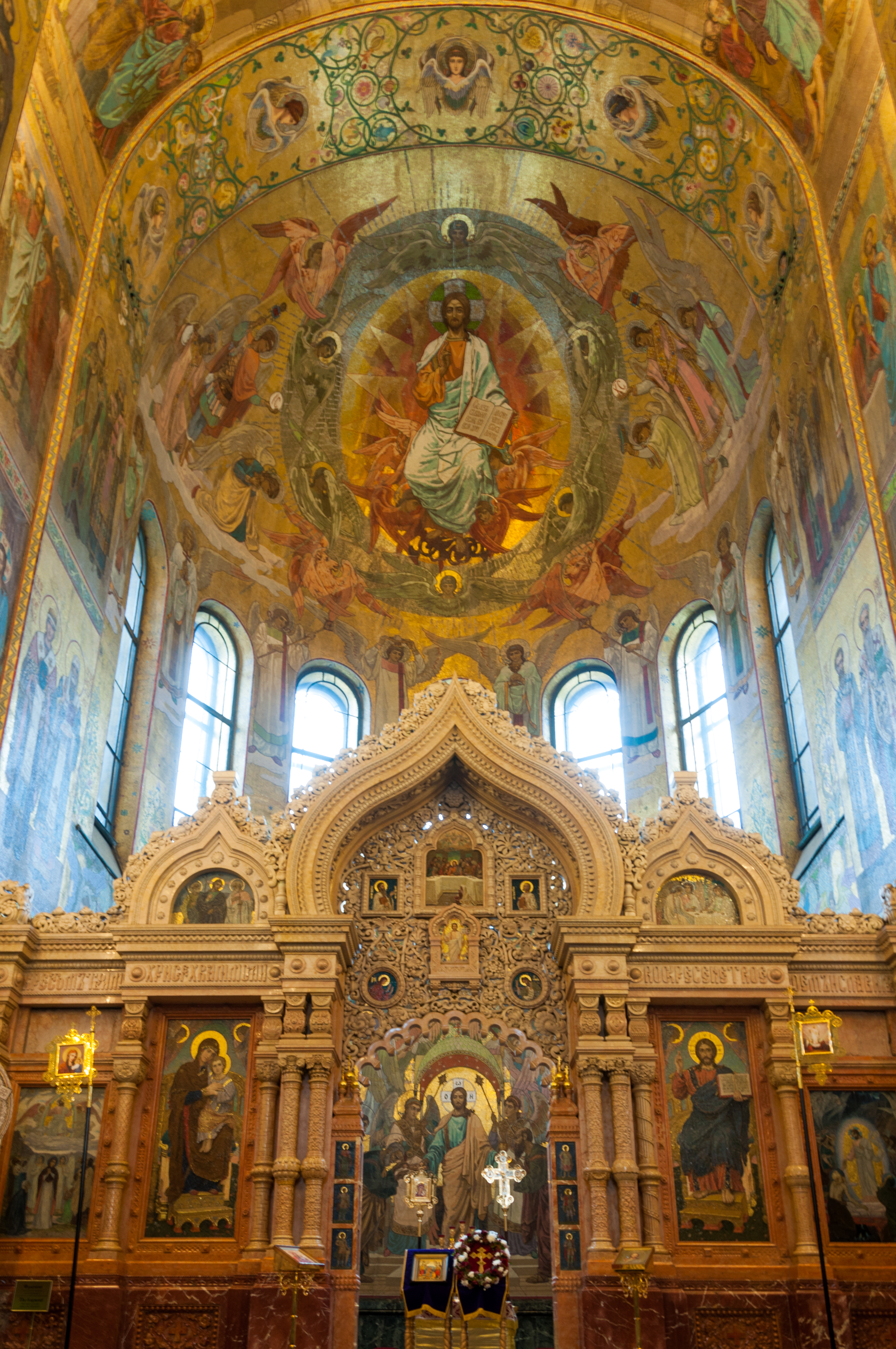
A wider sanctuary view places the carved iconostasis beneath a soaring semicircular apse covered in mosaics. Tall windows admit cool daylight around the curve, while a central sacred image crowns the vault above the screen. The broader framing clarifies the vertical relationship among sanctuary furnishings, architectural enclosure, and the church’s extensive pictorial decoration.
Caption
A wider sanctuary view places the carved iconostasis beneath a soaring semicircular apse covered in mosaics. Tall windows admit cool daylight around the curve, while a central sacred image crowns the vault above the screen. The broader framing clarifies the vertical relationship among sanctuary furnishings, architectural enclosure, and the church’s extensive pictorial decoration.

Tall mosaic-clad piers rise into intersecting arches and vaults in this angled view across the church interior. Large chandeliers flare at the edges while sacred figures and narrative scenes occupy nearly every visible surface. The composition stresses depth and verticality, showing how structural supports divide the richly decorated space into successive bays.
Caption
Tall mosaic-clad piers rise into intersecting arches and vaults in this angled view across the church interior. Large chandeliers flare at the edges while sacred figures and narrative scenes occupy nearly every visible surface. The composition stresses depth and verticality, showing how structural supports divide the richly decorated space into successive bays.

Full-length saints occupy stacked mosaic panels between richly patterned borders and tall windows. Two vested clerical figures dominate the lower register, while additional standing figures appear above. The near-frontal viewpoint makes vestments, halos, inscriptions, and ornamental divisions more legible than in the wider interior views, documenting the church’s dense iconographic wall program.
Caption
Full-length saints occupy stacked mosaic panels between richly patterned borders and tall windows. Two vested clerical figures dominate the lower register, while additional standing figures appear above. The near-frontal viewpoint makes vestments, halos, inscriptions, and ornamental divisions more legible than in the wider interior views, documenting the church’s dense iconographic wall program.

The same circular Christ image appears here in architectural context, centered within a broad vault populated by angels and bordered by ornamental medallions. A window cuts into the adjacent wall at right. The oblique upward view shows how the central sacred portrait is embedded within a larger celestial composition rather than functioning as an isolated icon.
Caption
The same circular Christ image appears here in architectural context, centered within a broad vault populated by angels and bordered by ornamental medallions. A window cuts into the adjacent wall at right. The oblique upward view shows how the central sacred portrait is embedded within a larger celestial composition rather than functioning as an isolated icon.

A radiant white-robed Christ stands at the center of a large curved mosaic, framed by a golden mandorla and surrounded by attendant figures. Circular saint portraits form a band above the scene. The close, symmetrical view brings the central episode forward while retaining enough of the vault to show its integration into the interior decoration.
Caption
A radiant white-robed Christ stands at the center of a large curved mosaic, framed by a golden mandorla and surrounded by attendant figures. Circular saint portraits form a band above the scene. The close, symmetrical view brings the central episode forward while retaining enough of the vault to show its integration into the interior decoration.

Christ Pantocrator fills a circular vault, raising one hand in blessing and holding an open book in the other. The gold halo and blue-green ground are ringed by additional figures and ornament, while windows interrupt the lower edge of the composition. The close view makes the central iconography and mosaic color especially clear.
Caption
Christ Pantocrator fills a circular vault, raising one hand in blessing and holding an open book in the other. The gold halo and blue-green ground are ringed by additional figures and ornament, while windows interrupt the lower edge of the composition. The close view makes the central iconography and mosaic color especially clear.

A wider, centered view places the Pantocrator mosaic within its complete circular setting. Small windows ring the base, while bands of saints, symbols, and richly patterned ornament extend into the adjoining blue and gold vault surfaces. The symmetrical composition emphasizes the hierarchical placement of Christ above the surrounding interior imagery.
Caption
A wider, centered view places the Pantocrator mosaic within its complete circular setting. Small windows ring the base, while bands of saints, symbols, and richly patterned ornament extend into the adjoining blue and gold vault surfaces. The symmetrical composition emphasizes the hierarchical placement of Christ above the surrounding interior imagery.

An oblique ceiling view links the circular Pantocrator image to adjacent narrative mosaics on tall vaults and piers. Brilliant chandeliers intrude from the lower corners, contrasting electric light with the deep blue, green, and gold surfaces overhead. The angle reveals the spatial continuity between central sacred imagery and the surrounding pictorial architecture.
Caption
An oblique ceiling view links the circular Pantocrator image to adjacent narrative mosaics on tall vaults and piers. Brilliant chandeliers intrude from the lower corners, contrasting electric light with the deep blue, green, and gold surfaces overhead. The angle reveals the spatial continuity between central sacred imagery and the surrounding pictorial architecture.

An enthroned Christ appears at the center of a broad curved mosaic, holding an open book within a luminous mandorla. Angels and other celestial figures gather around the central image against muted gold and rose tones. The close framing concentrates on the iconographic center and the way the composition follows the curvature of the vault.
Caption
An enthroned Christ appears at the center of a broad curved mosaic, holding an open book within a luminous mandorla. Angels and other celestial figures gather around the central image against muted gold and rose tones. The close framing concentrates on the iconographic center and the way the composition follows the curvature of the vault.

Paired chandeliers frame a steep upward view through successive mosaic-covered bays. The circular Pantocrator image crowns the composition, with the luminous Transfiguration below and bands of saints and narrative scenes filling the intervening architecture. The lights and strongly centered axis accentuate the height and ceremonial symmetry of the decorated interior.
Caption
Paired chandeliers frame a steep upward view through successive mosaic-covered bays. The circular Pantocrator image crowns the composition, with the luminous Transfiguration below and bands of saints and narrative scenes filling the intervening architecture. The lights and strongly centered axis accentuate the height and ceremonial symmetry of the decorated interior.

From farther back in the nave, the sanctuary and iconostasis sit beneath a high mosaic-covered apse illuminated by a row of tall windows. Visitors and barriers at floor level establish scale and the church’s public interior setting. The wide composition balances architectural volume with the richly decorated surfaces that rise above the sanctuary screen.
Caption
From farther back in the nave, the sanctuary and iconostasis sit beneath a high mosaic-covered apse illuminated by a row of tall windows. Visitors and barriers at floor level establish scale and the church’s public interior setting. The wide composition balances architectural volume with the richly decorated surfaces that rise above the sanctuary screen.

A broad symmetrical ceiling study brings two adjoining sacred centers into one frame: the blue-ringed Pantocrator above and the gold-lit Transfiguration below. Rows of saint medallions and narrative panels bridge the spaces between them. The wider crop, compared with neighboring views, gives greater weight to the architectural geometry of arches and vaults.
Caption
A broad symmetrical ceiling study brings two adjoining sacred centers into one frame: the blue-ringed Pantocrator above and the gold-lit Transfiguration below. Rows of saint medallions and narrative panels bridge the spaces between them. The wider crop, compared with neighboring views, gives greater weight to the architectural geometry of arches and vaults.

A long view down the church interior follows repeated arches and mosaic-covered piers toward a bright sanctuary area. Visitors move through the lower right while a small display or sales table occupies the foreground. Unlike the ceiling studies, this photograph records the human scale of the richly decorated nave and the rhythm of its successive bays.
Caption
A long view down the church interior follows repeated arches and mosaic-covered piers toward a bright sanctuary area. Visitors move through the lower right while a small display or sales table occupies the foreground. Unlike the ceiling studies, this photograph records the human scale of the richly decorated nave and the rhythm of its successive bays.

A deep blue decorative vault is patterned with repeating gold stars, sunbursts, and circular motifs around a bright hanging chandelier. Figurative mosaic surfaces remain visible at the margins, but the photograph concentrates on non-narrative ornament and color. The close upward framing highlights the contrast between geometric celestial patterning and the church’s surrounding figural decoration.
Caption
A deep blue decorative vault is patterned with repeating gold stars, sunbursts, and circular motifs around a bright hanging chandelier. Figurative mosaic surfaces remain visible at the margins, but the photograph concentrates on non-narrative ornament and color. The close upward framing highlights the contrast between geometric celestial patterning and the church’s surrounding figural decoration.

Seen from below, a steep triangular gable rises against the church’s clustered domes and cylindrical tower. Gilded trim traces the roof edge, while a mosaic panel fills the gable face and patterned brickwork articulates the walls behind. The low viewpoint compresses several levels of the exterior into a layered study of masonry, mosaic, and domed silhouette.
Caption
Seen from below, a steep triangular gable rises against the church’s clustered domes and cylindrical tower. Gilded trim traces the roof edge, while a mosaic panel fills the gable face and patterned brickwork articulates the walls behind. The low viewpoint compresses several levels of the exterior into a layered study of masonry, mosaic, and domed silhouette.

A closer low-angle view centers a triangular narrative mosaic beneath a sharply pitched roof edged with gilded ornament. The cylindrical tower and its pale dome rise immediately behind, creating a compressed relationship between decorative panel and upper architecture. Fine brick patterns and carved trim are more prominent here than in the broader exterior views.
Caption
A closer low-angle view centers a triangular narrative mosaic beneath a sharply pitched roof edged with gilded ornament. The cylindrical tower and its pale dome rise immediately behind, creating a compressed relationship between decorative panel and upper architecture. Fine brick patterns and carved trim are more prominent here than in the broader exterior views.

A single rectangular window is isolated against the red-brick exterior wall. Pale carved surrounds form a pointed hood and layered side ornaments, while a green downpipe and narrow bands of colored geometric tilework interrupt the masonry nearby. The tight framing records the church’s secondary architectural detailing apart from its domes and monumental mosaics.
Caption
A single rectangular window is isolated against the red-brick exterior wall. Pale carved surrounds form a pointed hood and layered side ornaments, while a green downpipe and narrow bands of colored geometric tilework interrupt the masonry nearby. The tight framing records the church’s secondary architectural detailing apart from its domes and monumental mosaics.

A blue-and-cream tiled pyramidal roof capped by a gilded finial anchors this dense study of the Church of the Savior on Spilt Blood’s exterior. Below and behind it, semicircular mosaic panels, brick arcades, carved stone bands, and gilded cresting overlap in successive layers, showing the deliberate accumulation of color, texture, and sacred imagery across the building envelope.
Caption
A blue-and-cream tiled pyramidal roof capped by a gilded finial anchors this dense study of the Church of the Savior on Spilt Blood’s exterior. Below and behind it, semicircular mosaic panels, brick arcades, carved stone bands, and gilded cresting overlap in successive layers, showing the deliberate accumulation of color, texture, and sacred imagery across the building envelope.

An arched mosaic panel occupies a richly modeled brick façade, showing Christ in pale robes flanked by attendant figures. Concentric bands of molded masonry frame the scene, with columns and decorative brick courses below. The frontal detail emphasizes how sacred imagery is set directly into the exterior architecture rather than confined to the church interior.
Caption
An arched mosaic panel occupies a richly modeled brick façade, showing Christ in pale robes flanked by attendant figures. Concentric bands of molded masonry frame the scene, with columns and decorative brick courses below. The frontal detail emphasizes how sacred imagery is set directly into the exterior architecture rather than confined to the church interior.

A triangular exterior mosaic shows Christ bent beneath the cross as a group of figures presses around him. The scene is tightly contained by dark brick moldings and gilded roof ornament, making the Passion narrative legible from the façade. The close crop records expressive gestures, the diagonal cross, and the mosaic’s integration into the pointed gable.
Caption
A triangular exterior mosaic shows Christ bent beneath the cross as a group of figures presses around him. The scene is tightly contained by dark brick moldings and gilded roof ornament, making the Passion narrative legible from the façade. The close crop records expressive gestures, the diagonal cross, and the mosaic’s integration into the pointed gable.

A steep gable edged with gilded ornament frames a religious mosaic amid the layered exterior decoration of the Church of the Savior on Spilt Blood. Brick arches, additional mosaic panels, carved masonry, and a field of multicolored roof tiles crowd the composition, revealing how figural imagery, historicizing architecture, and brilliant surface ornament are integrated across the façade.
Caption
A steep gable edged with gilded ornament frames a religious mosaic amid the layered exterior decoration of the Church of the Savior on Spilt Blood. Brick arches, additional mosaic panels, carved masonry, and a field of multicolored roof tiles crowd the composition, revealing how figural imagery, historicizing architecture, and brilliant surface ornament are integrated across the façade.