St. John’s Co-Cathedral – Valletta, Malta
The magnificent St. John’s Co-Cathedral stands in the fortified city of Valletta and is one of the most extraordinary baroque churches in Europe. Built in the late 16th century by the Knights Hospitaller, the cathedral served as the spiritual center of the Order of St. John.
Although the exterior is relatively austere, the interior is richly decorated with gilded carvings, marble tombstones, and elaborate paintings. Among its greatest treasures is The Beheading of Saint John the Baptist, a dramatic masterpiece created by Caravaggio during his time in Malta.
Today the cathedral remains one of the most important artistic and historical landmarks on the island.

Caravaggio’s The Beheading of Saint John the Baptist unfolds in a stark prison courtyard, where the executioner bends over the fallen saint as nearby figures witness the killing. Severe contrasts of light and darkness concentrate attention on the action while leaving much of the setting in shadow. The monumental canvas was painted for the Oratory of St. John and remains the co-cathedral’s defining masterpiece.
Caption
Caravaggio’s The Beheading of Saint John the Baptist unfolds in a stark prison courtyard, where the executioner bends over the fallen saint as nearby figures witness the killing. Severe contrasts of light and darkness concentrate attention on the action while leaving much of the setting in shadow. The monumental canvas was painted for the Oratory of St. John and remains the co-cathedral’s defining masterpiece.

A dramatic white-marble sculptural group presents the Baptism of Christ against a radiant gilded sunburst. Christ bends forward while John the Baptist raises one hand above him, and clustered angels and clouds fill the surrounding niche. The contrast between pale figures, dark cloud forms, and sharp golden rays gives the ensemble a theatrical focus within the richly decorated cathedral interior.
Caption
A dramatic white-marble sculptural group presents the Baptism of Christ against a radiant gilded sunburst. Christ bends forward while John the Baptist raises one hand above him, and clustered angels and clouds fill the surrounding niche. The contrast between pale figures, dark cloud forms, and sharp golden rays gives the ensemble a theatrical focus within the richly decorated cathedral interior.

A centered elevated view looks directly down the nave toward the sanctuary, aligning the succession of painted vault bays, gilded arches, and side openings on a strong central axis. The high viewpoint makes the cathedral’s spatial organization especially clear, from the seating and memorial pavement below to the luminous altar ensemble at the far end.
Caption
A centered elevated view looks directly down the nave toward the sanctuary, aligning the succession of painted vault bays, gilded arches, and side openings on a strong central axis. The high viewpoint makes the cathedral’s spatial organization especially clear, from the seating and memorial pavement below to the luminous altar ensemble at the far end.

The high altar is viewed from a slightly elevated, tighter position that brings the paired organ cases and choir stalls into equal prominence. Their dark wooden structures contrast with the brilliant gilding and painted vault above, while the altar table stretches across the foreground. The centered arrangement reveals the carefully balanced relationship between music, seating, and liturgical focus in the chancel.
Caption
The high altar is viewed from a slightly elevated, tighter position that brings the paired organ cases and choir stalls into equal prominence. Their dark wooden structures contrast with the brilliant gilding and painted vault above, while the altar table stretches across the foreground. The centered arrangement reveals the carefully balanced relationship between music, seating, and liturgical focus in the chancel.

The Baptism of Christ forms the dramatic center of this sculptural altar, with Christ and John the Baptist set before a radiant gilded sunburst. Angels, cloud forms, columns, and tall candlesticks build outward around the pale figures, creating a strongly theatrical Baroque ensemble. The brilliant gold rays isolate the baptismal group as the chapel’s devotional focus.
Caption
The Baptism of Christ forms the dramatic center of this sculptural altar, with Christ and John the Baptist set before a radiant gilded sunburst. Angels, cloud forms, columns, and tall candlesticks build outward around the pale figures, creating a strongly theatrical Baroque ensemble. The brilliant gold rays isolate the baptismal group as the chapel’s devotional focus.

A brightly colored coat of arms fills a white sculpted cartouche, its many quartered fields containing castles, lions, crosses, eagles, stripes, and other heraldic devices. The surrounding pale stone scrollwork frames the shield against a dark marble background. The close crop records the complexity of the armorial display while leaving its exact family or patron attribution open.
Caption
A brightly colored coat of arms fills a white sculpted cartouche, its many quartered fields containing castles, lions, crosses, eagles, stripes, and other heraldic devices. The surrounding pale stone scrollwork frames the shield against a dark marble background. The close crop records the complexity of the armorial display while leaving its exact family or patron attribution open.
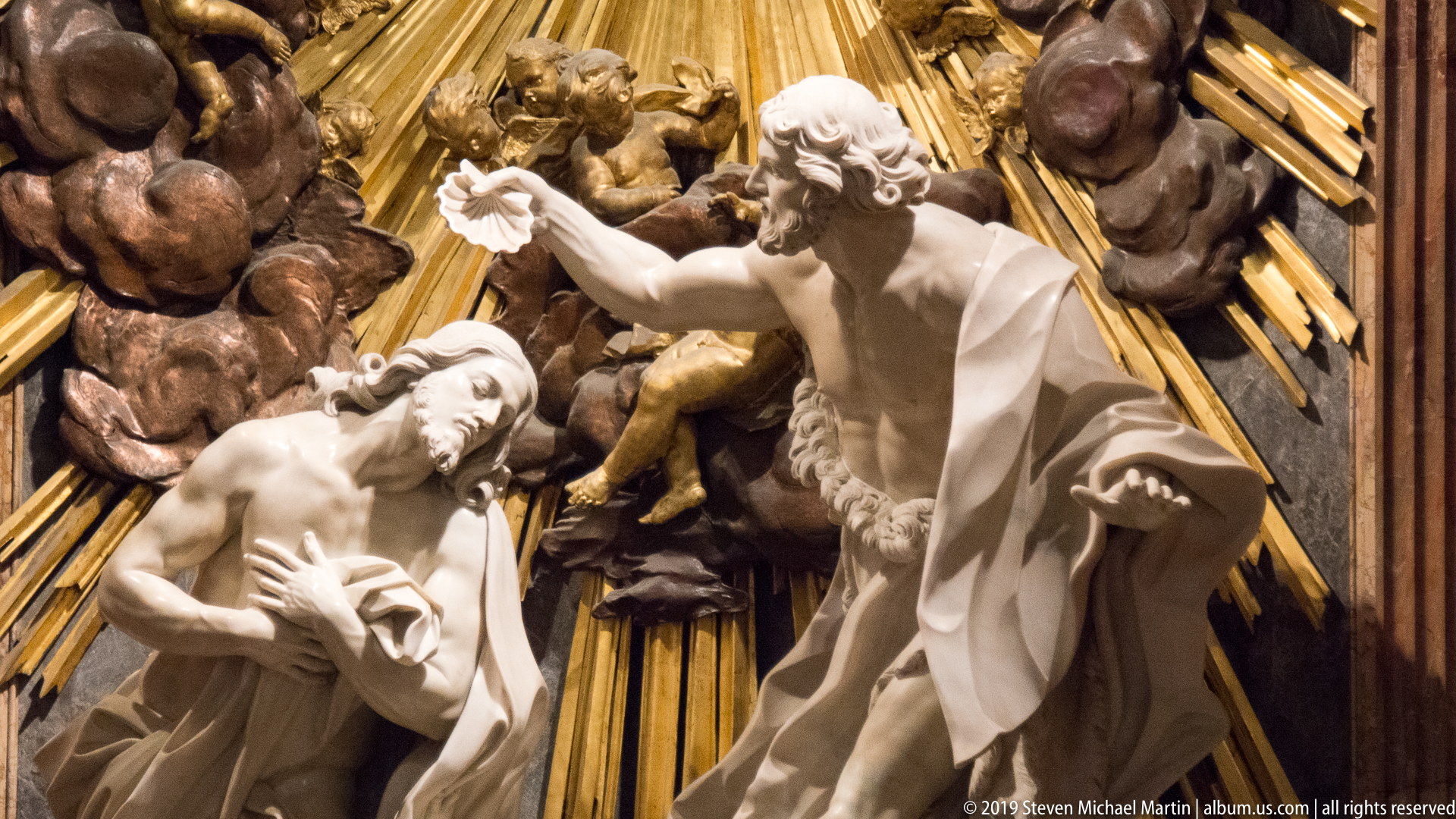
A close view concentrates on the two principal figures of the Baptism of Christ. Christ inclines his head and presses a hand to his chest while John the Baptist, draped in a textured garment, raises his right hand above him. Angels and cloud forms crowd the background, with narrow gilded rays intensifying the devotional scene and separating the pale figures from the darker niche.
Caption
A close view concentrates on the two principal figures of the Baptism of Christ. Christ inclines his head and presses a hand to his chest while John the Baptist, draped in a textured garment, raises his right hand above him. Angels and cloud forms crowd the background, with narrow gilded rays intensifying the devotional scene and separating the pale figures from the darker niche.

A large polychrome coat of arms crowns a dark marble architectural monument, flanked by two pale sculpted figures beneath a bright window. The white cartouche and figures stand out against the black-green stone panel and warm marble ledge below. This wider view reveals the shield as part of a monumental ensemble rather than an isolated heraldic detail.
Caption
A large polychrome coat of arms crowns a dark marble architectural monument, flanked by two pale sculpted figures beneath a bright window. The white cartouche and figures stand out against the black-green stone panel and warm marble ledge below. This wider view reveals the shield as part of a monumental ensemble rather than an isolated heraldic detail.

A frontal composition isolates the high altar within the cathedral’s ornate chancel. Tall candles rise before the sculptural ensemble beyond, while paired organ cases and richly gilded wall panels establish strong symmetry. The closer viewpoint reduces the surrounding nave and concentrates attention on the altar, choir furnishings, and layered marble, wood, painting, and gilding that define the sanctuary.
Caption
A frontal composition isolates the high altar within the cathedral’s ornate chancel. Tall candles rise before the sculptural ensemble beyond, while paired organ cases and richly gilded wall panels establish strong symmetry. The closer viewpoint reduces the surrounding nave and concentrates attention on the altar, choir furnishings, and layered marble, wood, painting, and gilding that define the sanctuary.

A large religious painting occupies the center of an architectural altar ensemble framed by richly veined marble columns and a broken, ornamented entablature. A small cross stands below the canvas, while heraldic and sculptural details crown the composition. The upward viewpoint emphasizes the vertical integration of painting, colored stone, and architectural ornament.
Caption
A large religious painting occupies the center of an architectural altar ensemble framed by richly veined marble columns and a broken, ornamented entablature. A small cross stands below the canvas, while heraldic and sculptural details crown the composition. The upward viewpoint emphasizes the vertical integration of painting, colored stone, and architectural ornament.

The high altar anchors a broad view into the chancel, framed by dense gilded ornament, painted vaults, and paired organ cases. A large suspended silver-toned lamp hangs on the central axis above the altar, while choir stalls line both sides. The low viewpoint emphasizes the layered progression from patterned floor and altar table to the luminous sculptural focus at the far end.
Caption
The high altar anchors a broad view into the chancel, framed by dense gilded ornament, painted vaults, and paired organ cases. A large suspended silver-toned lamp hangs on the central axis above the altar, while choir stalls line both sides. The low viewpoint emphasizes the layered progression from patterned floor and altar table to the luminous sculptural focus at the far end.

Three heraldic devices punctuate a richly layered wall surface of polychrome marble, gilded scrollwork, and patterned bands. The central shield is embedded in a dark stone panel beneath a small crown-like motif, while flanking emblems incorporate red crosses and elaborate gold frames. The close detail records how heraldry is integrated directly into the cathedral’s architectural decoration.
Caption
Three heraldic devices punctuate a richly layered wall surface of polychrome marble, gilded scrollwork, and patterned bands. The central shield is embedded in a dark stone panel beneath a small crown-like motif, while flanking emblems incorporate red crosses and elaborate gold frames. The close detail records how heraldry is integrated directly into the cathedral’s architectural decoration.

An elaborate suspended metal lamp fills the foreground, its chased body, projecting ornaments, and multiple hanging chains silhouetted against the cathedral’s gilded chancel. The shallow focus separates the dark silver-toned object from the warm gold and painted architecture behind it. Seen at close range, the lamp becomes a sculptural object rather than simply part of the broader sanctuary composition.
Caption
An elaborate suspended metal lamp fills the foreground, its chased body, projecting ornaments, and multiple hanging chains silhouetted against the cathedral’s gilded chancel. The shallow focus separates the dark silver-toned object from the warm gold and painted architecture behind it. Seen at close range, the lamp becomes a sculptural object rather than simply part of the broader sanctuary composition.

A sequence of rounded arches recedes through a richly ornamented side passage, creating a tunnel-like view toward a crucifix at the far end. Gilded relief covers the arch soffits and walls, while blue-painted fields carry repeated floral and star motifs. The repeated openings turn the dense Baroque decoration into a strongly ordered perspective through the cathedral’s lateral spaces.
Caption
A sequence of rounded arches recedes through a richly ornamented side passage, creating a tunnel-like view toward a crucifix at the far end. Gilded relief covers the arch soffits and walls, while blue-painted fields carry repeated floral and star motifs. The repeated openings turn the dense Baroque decoration into a strongly ordered perspective through the cathedral’s lateral spaces.

A gilded heraldic shield projects from a blue-painted pilaster wrapped in gold foliate relief. Above it, a cherubic head and scrollwork crown the composition; below, a small tablet bears the visible inscription “ALVERGNA.” The adjacent twisted column continues the blue-and-gold palette, showing the dense integration of heraldry, inscription, and architectural ornament at close range.
Caption
A gilded heraldic shield projects from a blue-painted pilaster wrapped in gold foliate relief. Above it, a cherubic head and scrollwork crown the composition; below, a small tablet bears the visible inscription “ALVERGNA.” The adjacent twisted column continues the blue-and-gold palette, showing the dense integration of heraldry, inscription, and architectural ornament at close range.

A wide, low-angle view opens across the sanctuary toward the high altar, with a large suspended lamp hanging beneath the painted vault. Gilded arches and wall panels frame the composition, while organ cases and choir stalls flank the altar. More of the patterned floor and side architecture is included than in tighter altar views, emphasizing the scale and enveloping ornament of the interior.
Caption
A wide, low-angle view opens across the sanctuary toward the high altar, with a large suspended lamp hanging beneath the painted vault. Gilded arches and wall panels frame the composition, while organ cases and choir stalls flank the altar. More of the patterned floor and side architecture is included than in tighter altar views, emphasizing the scale and enveloping ornament of the interior.

Dense gilded relief surrounds a central cherubic face emerging from curling foliage. Lion heads occupy the lower corners, while fruit, leaves, and scrolls interlock across the panel in deep relief. The close crop removes most architectural context and instead records the sculptural richness of the cathedral’s decorative vocabulary, including the pronounced modeling and shadow produced by the raised gilded surfaces.
Caption
Dense gilded relief surrounds a central cherubic face emerging from curling foliage. Lion heads occupy the lower corners, while fruit, leaves, and scrolls interlock across the panel in deep relief. The close crop removes most architectural context and instead records the sculptural richness of the cathedral’s decorative vocabulary, including the pronounced modeling and shadow produced by the raised gilded surfaces.

A side chapel is viewed through an ornate doorway, revealing a marble-lined altar wall beyond a dark balustrade. Polychrome columns and architectural panels frame the altar, while a painted ceiling and patterned stone floor continue the cathedral’s layered decorative program. The centered aisle and rail establish the chapel as a distinct devotional enclosure within the larger interior.
Caption
A side chapel is viewed through an ornate doorway, revealing a marble-lined altar wall beyond a dark balustrade. Polychrome columns and architectural panels frame the altar, while a painted ceiling and patterned stone floor continue the cathedral’s layered decorative program. The centered aisle and rail establish the chapel as a distinct devotional enclosure within the larger interior.

A sculpted metal figure stands in the sanctuary holding an open book on a broad support, functioning as a lectern. The figure’s rounded drapery and expressive head contrast with the rectilinear pages and nearby altar furnishings. Candles, embroidered textiles, and polychrome architectural panels recede behind it, situating the object within the active liturgical space.
Caption
A sculpted metal figure stands in the sanctuary holding an open book on a broad support, functioning as a lectern. The figure’s rounded drapery and expressive head contrast with the rectilinear pages and nearby altar furnishings. Candles, embroidered textiles, and polychrome architectural panels recede behind it, situating the object within the active liturgical space.

A frontal close-up isolates the heraldic shield labeled “ALVERGNA,” set beneath a cherubic head and surrounded by curling gilded foliage. The shield occupies the center of a blue-and-gold architectural panel, with a dark spherical device in its field. The tighter framing makes the inscription, layered relief, and crisp contrast between painted blue ground and gilded carving especially legible.
Caption
A frontal close-up isolates the heraldic shield labeled “ALVERGNA,” set beneath a cherubic head and surrounded by curling gilded foliage. The shield occupies the center of a blue-and-gold architectural panel, with a dark spherical device in its field. The tighter framing makes the inscription, layered relief, and crisp contrast between painted blue ground and gilded carving especially legible.

A painted vault scene centers on an armored figure holding a large red-and-white banner marked by a cross, surrounded by airborne putti and other figures. Architectural forms appear at the lower edge, while the curved frame follows the cathedral vault. The composition combines martial, heraldic, and celestial imagery, but the precise episode is not identified from the photograph alone.
Caption
A painted vault scene centers on an armored figure holding a large red-and-white banner marked by a cross, surrounded by airborne putti and other figures. Architectural forms appear at the lower edge, while the curved frame follows the cathedral vault. The composition combines martial, heraldic, and celestial imagery, but the precise episode is not identified from the photograph alone.

A close detail from a ceiling painting shows a seated, partly draped male figure beside an elderly bearded figure holding a slender staff or rod. Clouds and additional figures surround them within a warm, luminous painted field. The crop isolates the central exchange and expressive gestures, allowing the modeled bodies and facial expressions to be read more clearly than in the broader vault composition.
Caption
A close detail from a ceiling painting shows a seated, partly draped male figure beside an elderly bearded figure holding a slender staff or rod. Clouds and additional figures surround them within a warm, luminous painted field. The crop isolates the central exchange and expressive gestures, allowing the modeled bodies and facial expressions to be read more clearly than in the broader vault composition.

A larger view places the religious ceiling painting within its elaborate architectural setting. Figures rise through banks of clouds beneath a deeply molded gilded arch, while the edge of a green canopy and nearby sanctuary furnishings intrude at left. This contextual view shows how painted narrative, sculpted molding, and liturgical objects overlap visually within the cathedral’s densely ornamented chancel.
Caption
A larger view places the religious ceiling painting within its elaborate architectural setting. Figures rise through banks of clouds beneath a deeply molded gilded arch, while the edge of a green canopy and nearby sanctuary furnishings intrude at left. This contextual view shows how painted narrative, sculpted molding, and liturgical objects overlap visually within the cathedral’s densely ornamented chancel.

An eight-pointed white Maltese cross is set into a circular red-and-gold marble medallion bordered by dark green stone. The geometric inlay is viewed almost straight on, emphasizing the crisp points of the cross and the concentric rings around it. Veining and color variation in the stone remain visible, underscoring the cathedral floor’s use of contrasting marbles as both ornament and heraldic language.
Caption
An eight-pointed white Maltese cross is set into a circular red-and-gold marble medallion bordered by dark green stone. The geometric inlay is viewed almost straight on, emphasizing the crisp points of the cross and the concentric rings around it. Veining and color variation in the stone remain visible, underscoring the cathedral floor’s use of contrasting marbles as both ornament and heraldic language.

A crowned heraldic shield is embedded in a gilded cartouche against a blue ground. The quartered field includes a red cross and a dark animal device, while a cherubic face, drapery-like scrolls, fruit clusters, and foliage build a symmetrical ornamental frame. The close detail records the heraldic program without enough evidence to assign the arms to a specific patron.
Caption
A crowned heraldic shield is embedded in a gilded cartouche against a blue ground. The quartered field includes a red cross and a dark animal device, while a cherubic face, drapery-like scrolls, fruit clusters, and foliage build a symmetrical ornamental frame. The close detail records the heraldic program without enough evidence to assign the arms to a specific patron.

A monumental painting shows a mounted figure on a white horse advancing through a crowded, dramatic scene. Other figures gather around the rider beneath a turbulent sky, while a dark crucifix stands in the foreground below the canvas. The painting is set within a substantial architectural frame, making the work a dominant devotional focus on the chapel wall.
Caption
A monumental painting shows a mounted figure on a white horse advancing through a crowded, dramatic scene. Other figures gather around the rider beneath a turbulent sky, while a dark crucifix stands in the foreground below the canvas. The painting is set within a substantial architectural frame, making the work a dominant devotional focus on the chapel wall.

A richly sculpted funerary monument combines reclining pale figures with a dark central portrait medallion and an array of carved military trophies below. Helmets, shields, cannon barrels, standards, and other martial objects spill across the lower marble composition. Gilded and blue architectural ornament surrounds the monument, intensifying the contrast between white sculpture, black stone, and the cathedral’s decorative walls.
Caption
A richly sculpted funerary monument combines reclining pale figures with a dark central portrait medallion and an array of carved military trophies below. Helmets, shields, cannon barrels, standards, and other martial objects spill across the lower marble composition. Gilded and blue architectural ornament surrounds the monument, intensifying the contrast between white sculpture, black stone, and the cathedral’s decorative walls.

A diagonal interior view follows the cathedral’s side aisle beneath richly painted vaults and heavy gilded relief. Rounded chapel openings recede toward the chancel, while a dark pulpit or elevated wooden furnishing projects at the right. The oblique viewpoint highlights the continuous decorative envelope of painted ceilings, gilded arches, patterned wall surfaces, and liturgical spaces rather than a single focal object.
Caption
A diagonal interior view follows the cathedral’s side aisle beneath richly painted vaults and heavy gilded relief. Rounded chapel openings recede toward the chancel, while a dark pulpit or elevated wooden furnishing projects at the right. The oblique viewpoint highlights the continuous decorative envelope of painted ceilings, gilded arches, patterned wall surfaces, and liturgical spaces rather than a single focal object.

A side chapel altar is framed by paired twisted columns painted blue and enriched with gilded foliage. A large religious painting occupies the center above an altar frontal inset with an eight-pointed Maltese cross, while a high window floods the upper wall with light. The symmetrical composition emphasizes the chapel’s coordinated use of painting, heraldry, marble, and sculptural architectural ornament.
Caption
A side chapel altar is framed by paired twisted columns painted blue and enriched with gilded foliage. A large religious painting occupies the center above an altar frontal inset with an eight-pointed Maltese cross, while a high window floods the upper wall with light. The symmetrical composition emphasizes the chapel’s coordinated use of painting, heraldry, marble, and sculptural architectural ornament.

A large religious painting dominates a chapel altar wall framed by red-veined marble columns and a substantial architectural entablature. Polychrome marble panels cover the lower wall, while the pale blue-and-gold ceiling arches above in patterned coffers. The frontal view integrates painting, stone, and ceiling decoration into a single monumental chapel composition.
Caption
A large religious painting dominates a chapel altar wall framed by red-veined marble columns and a substantial architectural entablature. Polychrome marble panels cover the lower wall, while the pale blue-and-gold ceiling arches above in patterned coffers. The frontal view integrates painting, stone, and ceiling decoration into a single monumental chapel composition.

An upward view centers on a circular ceiling boss surrounded by a radial field of gilded ribs and blue decorative panels. Heraldic crosses and painted figural scenes occupy the adjoining vault surfaces, while dense gold relief frames every compartment. The near-symmetrical composition turns the chapel ceiling into a patterned canopy of painting, heraldry, and sculpted ornament.
Caption
An upward view centers on a circular ceiling boss surrounded by a radial field of gilded ribs and blue decorative panels. Heraldic crosses and painted figural scenes occupy the adjoining vault surfaces, while dense gold relief frames every compartment. The near-symmetrical composition turns the chapel ceiling into a patterned canopy of painting, heraldry, and sculpted ornament.

A close, low-angle detail isolates the military trophies piled across a funerary monument. White marble cannon barrels, shields, helmets, standards, and other martial emblems overlap beneath a gilded figure and larger pale drapery above. The compressed viewpoint makes the carved objects appear almost tangible and reveals the sculptor’s use of deep undercutting to separate individual weapons and insignia.
Caption
A close, low-angle detail isolates the military trophies piled across a funerary monument. White marble cannon barrels, shields, helmets, standards, and other martial emblems overlap beneath a gilded figure and larger pale drapery above. The compressed viewpoint makes the carved objects appear almost tangible and reveals the sculptor’s use of deep undercutting to separate individual weapons and insignia.

A steep upward view traces an elaborately compartmented ceiling filled with gilded relief, blue panels, and repeated heraldic emblems. A circular radial bay occupies the lower center, while rectangular coffers and a broad arch extend above it. Eight-pointed Maltese crosses and other cross motifs appear throughout, tying the ornamental ceiling directly to the cathedral’s heraldic visual language.
Caption
A steep upward view traces an elaborately compartmented ceiling filled with gilded relief, blue panels, and repeated heraldic emblems. A circular radial bay occupies the lower center, while rectangular coffers and a broad arch extend above it. Eight-pointed Maltese crosses and other cross motifs appear throughout, tying the ornamental ceiling directly to the cathedral’s heraldic visual language.

A broad interior view looks across a row of gilded arches supporting the painted upper vault. Three oval windows punctuate the wall beneath large narrative ceiling scenes, while dark marble piers divide the bays below. Visitors at floor level provide scale, and a projecting wooden pulpit at right introduces a strong vertical accent against the richly patterned architecture.
Caption
A broad interior view looks across a row of gilded arches supporting the painted upper vault. Three oval windows punctuate the wall beneath large narrative ceiling scenes, while dark marble piers divide the bays below. Visitors at floor level provide scale, and a projecting wooden pulpit at right introduces a strong vertical accent against the richly patterned architecture.

A richly modeled gilded cartouche centers on a shield bearing a small animal emblem, flanked by two winged putti and dense scrolling foliage. The close view isolates the sculptural relief and its deep undercutting, showing how heraldry is embedded within the cathedral’s exuberant decorative program rather than treated as a separate plaque.
Caption
A richly modeled gilded cartouche centers on a shield bearing a small animal emblem, flanked by two winged putti and dense scrolling foliage. The close view isolates the sculptural relief and its deep undercutting, showing how heraldry is embedded within the cathedral’s exuberant decorative program rather than treated as a separate plaque.

The chapel is viewed straight toward its altar, where a large painting stands between colored marble columns beneath a decorated arch and vault. Dense gilded relief fills the side walls, while sculptural monuments project into the foreground, creating a layered view of painting, architecture, funerary commemoration, and ornament within a compact sacred space.
Caption
The chapel is viewed straight toward its altar, where a large painting stands between colored marble columns beneath a decorated arch and vault. Dense gilded relief fills the side walls, while sculptural monuments project into the foreground, creating a layered view of painting, architecture, funerary commemoration, and ornament within a compact sacred space.

A low viewpoint looks across a polychrome marble pavement toward a side-chapel altar framed by paired columns and a painted altarpiece. Gilded wall ornament, sculptural monuments, and a richly decorated vault enclose the space on all sides, while the broad floor in the foreground makes the chapel’s patterned memorial pavement especially prominent.
Caption
A low viewpoint looks across a polychrome marble pavement toward a side-chapel altar framed by paired columns and a painted altarpiece. Gilded wall ornament, sculptural monuments, and a richly decorated vault enclose the space on all sides, while the broad floor in the foreground makes the chapel’s patterned memorial pavement especially prominent.

A crowned heraldic emblem is set into pale marble, its dark circular center containing two white stars and a small animal motif. Long white points radiate around the medallion, with colored stone and black bead-like borders defining the design. The tight framing emphasizes the precision and graphic clarity of the cathedral’s inlaid pavement work.
Caption
A crowned heraldic emblem is set into pale marble, its dark circular center containing two white stars and a small animal motif. Long white points radiate around the medallion, with colored stone and black bead-like borders defining the design. The tight framing emphasizes the precision and graphic clarity of the cathedral’s inlaid pavement work.

A skeletal figure wrapped in a pale shroud dominates this inlaid marble floor monument, flanked below by two crowned heraldic urn-like emblems. The stark black ground and carefully cut colored stone make the memento mori imagery immediately legible, linking death, commemoration, and heraldic identity within the cathedral pavement.
Caption
A skeletal figure wrapped in a pale shroud dominates this inlaid marble floor monument, flanked below by two crowned heraldic urn-like emblems. The stark black ground and carefully cut colored stone make the memento mori imagery immediately legible, linking death, commemoration, and heraldic identity within the cathedral pavement.

An elaborate inlaid marble tomb slab presents a full-length robed figure above a long Latin inscription, surrounded by heraldic devices and contrasting stone borders. Seen obliquely at floor level, the memorial’s pictorial composition and text are integrated into the cathedral pavement, part of the extensive field of commemorative floor monuments.
Caption
An elaborate inlaid marble tomb slab presents a full-length robed figure above a long Latin inscription, surrounded by heraldic devices and contrasting stone borders. Seen obliquely at floor level, the memorial’s pictorial composition and text are integrated into the cathedral pavement, part of the extensive field of commemorative floor monuments.

A vertical view rises from a framed altar painting to a projecting gallery and an elaborately painted and gilded ceiling. Tall side walls hold additional paintings beneath high windows, emphasizing the chapel’s height and the stacked arrangement of devotional art, architectural framing, and ceiling decoration.
Caption
A vertical view rises from a framed altar painting to a projecting gallery and an elaborately painted and gilded ceiling. Tall side walls hold additional paintings beneath high windows, emphasizing the chapel’s height and the stacked arrangement of devotional art, architectural framing, and ceiling decoration.

Three painted scenes are set into an ordered field of white and gold architectural ornament, with the central oval-like panel flanked by narrower compositions. The upward view concentrates on the ceiling’s compartmented design: layered moldings, foliate gilding, and sculpted borders turn the painted narratives into integral parts of the architectural surface.
Caption
Three painted scenes are set into an ordered field of white and gold architectural ornament, with the central oval-like panel flanked by narrower compositions. The upward view concentrates on the ceiling’s compartmented design: layered moldings, foliate gilding, and sculpted borders turn the painted narratives into integral parts of the architectural surface.

A dark, dramatic painted scene occupies the central compartment of a richly articulated white-and-gold ceiling. Stepped moldings surround the painting, while symmetrical foliate relief and smaller framed panels extend outward. The close framing reveals the precise relationship between pictorial art and the dense gilded architectural decoration around it.
Caption
A dark, dramatic painted scene occupies the central compartment of a richly articulated white-and-gold ceiling. Stepped moldings surround the painting, while symmetrical foliate relief and smaller framed panels extend outward. The close framing reveals the precise relationship between pictorial art and the dense gilded architectural decoration around it.

A large religious painting uses strong contrasts of light and shadow to isolate a group gathered around a nearly nude figure in a dark architectural setting. Illuminated faces, limbs, and fabric emerge from the surrounding darkness, giving the composition a concentrated theatrical intensity characteristic of seventeenth-century sacred painting.
Caption
A large religious painting uses strong contrasts of light and shadow to isolate a group gathered around a nearly nude figure in a dark architectural setting. Illuminated faces, limbs, and fabric emerge from the surrounding darkness, giving the composition a concentrated theatrical intensity characteristic of seventeenth-century sacred painting.

An elderly, bare-chested Saint Jerome bends over a book at a table, wrapped in a vivid red drapery while a skull rests nearby as a reminder of mortality. The figure emerges from a nearly black background under sharply directed light, concentrating attention on his weathered body, writing hand, book, and contemplative stillness.
Caption
An elderly, bare-chested Saint Jerome bends over a book at a table, wrapped in a vivid red drapery while a skull rests nearby as a reminder of mortality. The figure emerges from a nearly black background under sharply directed light, concentrating attention on his weathered body, writing hand, book, and contemplative stillness.

A richly framed arch leads the eye toward a large dark-toned altarpiece above the chapel altar. Colored marble, gilded relief, carved architectural details, and a low balustrade organize the space symmetrically, while visitors at the sides provide scale and underscore the chapel’s intimate dimensions within the cathedral.
Caption
A richly framed arch leads the eye toward a large dark-toned altarpiece above the chapel altar. Colored marble, gilded relief, carved architectural details, and a low balustrade organize the space symmetrically, while visitors at the sides provide scale and underscore the chapel’s intimate dimensions within the cathedral.

A curved section of the vault combines a central fresco with animated angels, dark architectural framing, and prominently displayed heraldic shields. The upward angle emphasizes how painted narrative, sculptural figures, and coats of arms share the same decorative zone, transforming the ceiling into a continuous field of religious and institutional imagery.
Caption
A curved section of the vault combines a central fresco with animated angels, dark architectural framing, and prominently displayed heraldic shields. The upward angle emphasizes how painted narrative, sculptural figures, and coats of arms share the same decorative zone, transforming the ceiling into a continuous field of religious and institutional imagery.

From an elevated side position, the nave opens beneath a long painted barrel vault toward the brightly lit sanctuary. Rows of dark chairs, patterned marble flooring, gilded arches, and side chapels establish the scale and rhythm of the interior, while the oblique viewpoint reveals both the vault sequence and the richly articulated wall elevations.
Caption
From an elevated side position, the nave opens beneath a long painted barrel vault toward the brightly lit sanctuary. Rows of dark chairs, patterned marble flooring, gilded arches, and side chapels establish the scale and rhythm of the interior, while the oblique viewpoint reveals both the vault sequence and the richly articulated wall elevations.

The nave is seen from high above on its central axis, with the patterned memorial pavement forming a broad corridor toward the sanctuary. Gilded piers and arches frame the side chapels, while the painted barrel vault recedes overhead in repeated bays. The unusually high viewpoint emphasizes the relationship between floor monuments, seating, architecture, and ceiling decoration.
Caption
The nave is seen from high above on its central axis, with the patterned memorial pavement forming a broad corridor toward the sanctuary. Gilded piers and arches frame the side chapels, while the painted barrel vault recedes overhead in repeated bays. The unusually high viewpoint emphasizes the relationship between floor monuments, seating, architecture, and ceiling decoration.
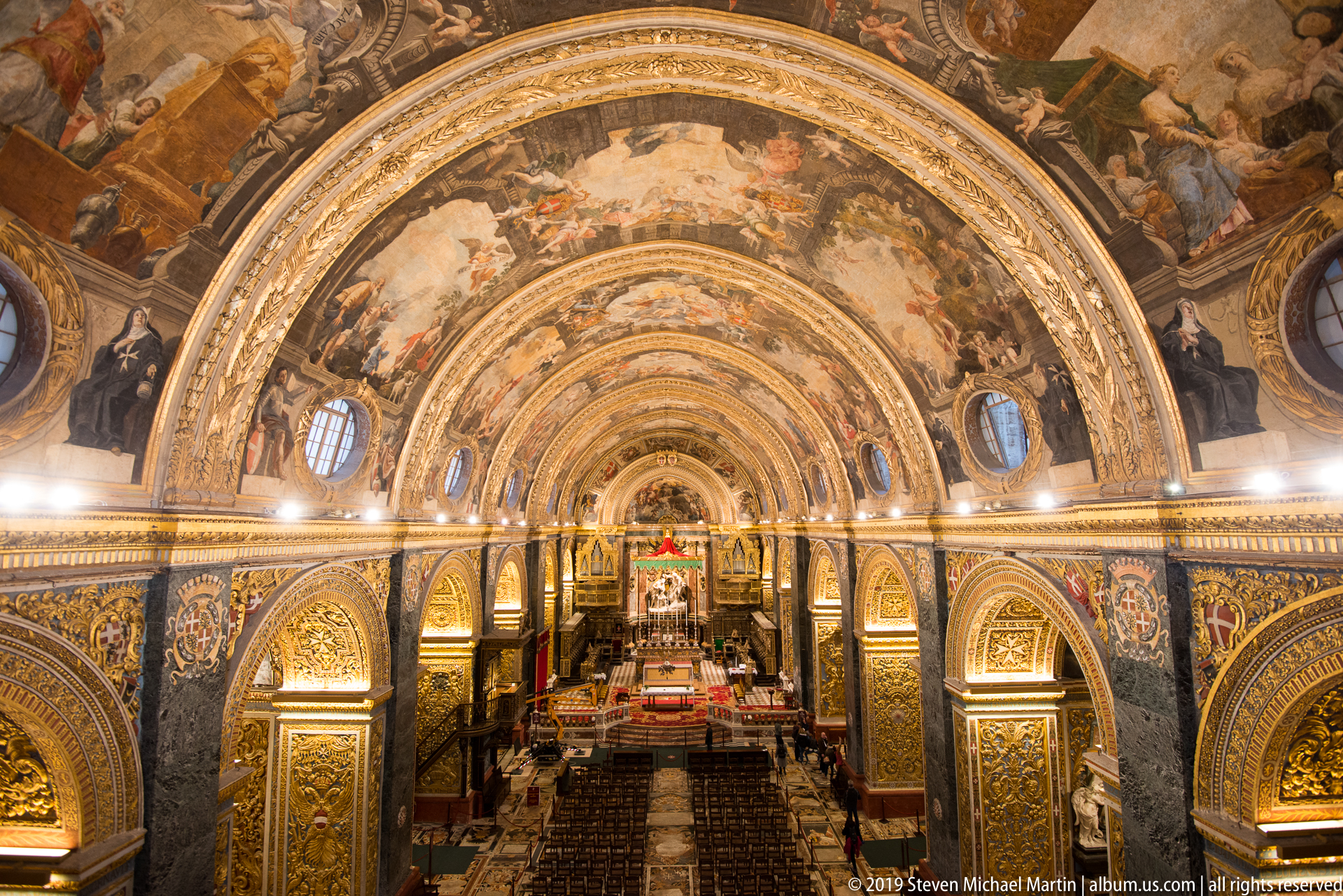
The camera tilts upward along the nave, giving the painted barrel vault visual priority over the floor below. Successive frescoed bays, oval windows, gilded ribs, and richly ornamented arches converge toward the sanctuary, revealing the continuous decorative treatment that binds the cathedral’s ceiling and upper walls into a unified composition.
Caption
The camera tilts upward along the nave, giving the painted barrel vault visual priority over the floor below. Successive frescoed bays, oval windows, gilded ribs, and richly ornamented arches converge toward the sanctuary, revealing the continuous decorative treatment that binds the cathedral’s ceiling and upper walls into a unified composition.

Looking almost straight upward, the nave’s barrel vault unfolds as a sequence of painted bays divided by gilded ribs. Oval windows punctuate the lower edges, while ornamented arches and dark side panels frame the frescoes. The compressed perspective turns the ceiling into a rhythmic succession of curved painted surfaces.
Caption
Looking almost straight upward, the nave’s barrel vault unfolds as a sequence of painted bays divided by gilded ribs. Oval windows punctuate the lower edges, while ornamented arches and dark side panels frame the frescoes. The compressed perspective turns the ceiling into a rhythmic succession of curved painted surfaces.

A plain limestone passage contrasts sharply with the cathedral’s ornate public interior. Open black iron gates frame a short flight of pale stone steps beneath a rounded arch, while worn flooring and minimally decorated walls give the service-like space a restrained, utilitarian character.
Caption
A plain limestone passage contrasts sharply with the cathedral’s ornate public interior. Open black iron gates frame a short flight of pale stone steps beneath a rounded arch, while worn flooring and minimally decorated walls give the service-like space a restrained, utilitarian character.

A dark, polygonal wooden enclosure projects from the wall on a rounded stone support, set against panels of dense gilded foliage and colored marble. Its restrained paneled surfaces stand out against the surrounding ornament, making the contrast between functional woodwork and the cathedral’s elaborate decorative finishes the central feature of the view.
Caption
A dark, polygonal wooden enclosure projects from the wall on a rounded stone support, set against panels of dense gilded foliage and colored marble. Its restrained paneled surfaces stand out against the surrounding ornament, making the contrast between functional woodwork and the cathedral’s elaborate decorative finishes the central feature of the view.

From near floor level, the nave stretches toward the sanctuary beneath its richly painted barrel vault. Dark rows of chairs flank the central aisle, while gilded arches and side chapels rise above the patterned memorial pavement. The low, symmetrical viewpoint gives unusual prominence to the floor while preserving the full sweep of the decorated ceiling.
Caption
From near floor level, the nave stretches toward the sanctuary beneath its richly painted barrel vault. Dark rows of chairs flank the central aisle, while gilded arches and side chapels rise above the patterned memorial pavement. The low, symmetrical viewpoint gives unusual prominence to the floor while preserving the full sweep of the decorated ceiling.

A painted lunette occupies the curved wall above a strongly projecting architectural cornice lined with gilded brackets and a balustrade-like edge. Heraldic and figural imagery appears within the painted zone, while layered moldings separate it from the wall below, highlighting the cathedral’s dense transition between vertical surfaces and vault.
Caption
A painted lunette occupies the curved wall above a strongly projecting architectural cornice lined with gilded brackets and a balustrade-like edge. Heraldic and figural imagery appears within the painted zone, while layered moldings separate it from the wall below, highlighting the cathedral’s dense transition between vertical surfaces and vault.

Two angels flank a skull and draped emblem above a long Latin inscription on this richly colored marble tomb slab. Contrasting black, ochre, white, and reddish stone forms the surrounding floral and architectural motifs. The close view makes the memorial’s combination of text, mortality imagery, and decorative stone inlay especially clear.
Caption
Two angels flank a skull and draped emblem above a long Latin inscription on this richly colored marble tomb slab. Contrasting black, ochre, white, and reddish stone forms the surrounding floral and architectural motifs. The close view makes the memorial’s combination of text, mortality imagery, and decorative stone inlay especially clear.

A succession of richly ornamented arched openings creates a long sightline through adjoining chapel spaces. Blue-and-gold patterned surfaces, gilded frames, sculptural monuments, and a distant gated opening layer the composition, while a visitor near the center provides scale. The view emphasizes visual connections between the cathedral’s side chapels rather than a single altar.
Caption
A succession of richly ornamented arched openings creates a long sightline through adjoining chapel spaces. Blue-and-gold patterned surfaces, gilded frames, sculptural monuments, and a distant gated opening layer the composition, while a visitor near the center provides scale. The view emphasizes visual connections between the cathedral’s side chapels rather than a single altar.

A colorful coat of arms is inlaid into a pale marble field above a dark stepped base. The shield, helmet, mantling, stars, and animal device are rendered in contrasting stones, turning heraldic identity into a durable part of the cathedral floor. The close crop isolates the emblem from the larger memorial pavement around it.
Caption
A colorful coat of arms is inlaid into a pale marble field above a dark stepped base. The shield, helmet, mantling, stars, and animal device are rendered in contrasting stones, turning heraldic identity into a durable part of the cathedral floor. The close crop isolates the emblem from the larger memorial pavement around it.

Repeated arched openings recede through a sequence of intensely gilded wall surfaces, creating a tunnel-like view across adjoining spaces. Relief foliage covers the broad wall panels, while darker painted decoration frames the nearest arch. The nested geometry and alternating bands of gold, blue, and shadow make depth itself the principal subject.
Caption
Repeated arched openings recede through a sequence of intensely gilded wall surfaces, creating a tunnel-like view across adjoining spaces. Relief foliage covers the broad wall panels, while darker painted decoration frames the nearest arch. The nested geometry and alternating bands of gold, blue, and shadow make depth itself the principal subject.

A monumental religious painting fills the wall above a marble altar, its dark background concentrating attention on a tightly grouped scene of figures. The gilded frame, veined stone surround, candles, and low communion rail place the canvas within the richly furnished interior of St. John’s Co-Cathedral and show how painting, precious materials, and liturgical fittings are integrated into the chapel architecture.
Caption
A monumental religious painting fills the wall above a marble altar, its dark background concentrating attention on a tightly grouped scene of figures. The gilded frame, veined stone surround, candles, and low communion rail place the canvas within the richly furnished interior of St. John’s Co-Cathedral and show how painting, precious materials, and liturgical fittings are integrated into the chapel architecture.

A closer view isolates the dramatic multi-figure canvas, where strong directional light models bodies emerging from a deep, shadowed setting. The composition is framed by broad gilded moldings, while altar candles and a small cross remain visible along the lower edge, preserving the work’s liturgical setting without obscuring the painted scene.
Caption
A closer view isolates the dramatic multi-figure canvas, where strong directional light models bodies emerging from a deep, shadowed setting. The composition is framed by broad gilded moldings, while altar candles and a small cross remain visible along the lower edge, preserving the work’s liturgical setting without obscuring the painted scene.

A long, bright chamber is lined with dark wooden stalls beneath large framed paintings, with heraldic flags suspended from the white coffered ceiling. At the far end, a central painting and small altar-like table anchor the room. The restrained white architecture provides a striking contrast to the cathedral’s more densely gilded spaces.
Caption
A long, bright chamber is lined with dark wooden stalls beneath large framed paintings, with heraldic flags suspended from the white coffered ceiling. At the far end, a central painting and small altar-like table anchor the room. The restrained white architecture provides a striking contrast to the cathedral’s more densely gilded spaces.

Three large framed paintings hang above dark wood paneling: a central formal portrait flanked by two dynamic multi-figure scenes. Several red and heraldic flags rise above the group against a pale coffered wall and ceiling. The arrangement presents portraiture, martial imagery, and institutional emblems together as a coordinated display.
Caption
Three large framed paintings hang above dark wood paneling: a central formal portrait flanked by two dynamic multi-figure scenes. Several red and heraldic flags rise above the group against a pale coffered wall and ceiling. The arrangement presents portraiture, martial imagery, and institutional emblems together as a coordinated display.

The chamber is viewed on axis between tall banks of dark wooden stalls, drawing the eye to a large painting above a small table at the far wall. Additional paintings, circular portraits, heraldic flags, and a pale coffered ceiling complete the orderly interior, whose restrained palette differs markedly from the cathedral’s gilded chapels.
Caption
The chamber is viewed on axis between tall banks of dark wooden stalls, drawing the eye to a large painting above a small table at the far wall. Additional paintings, circular portraits, heraldic flags, and a pale coffered ceiling complete the orderly interior, whose restrained palette differs markedly from the cathedral’s gilded chapels.

A slender gold crucifix stands at the center of an altar arrangement, flanked symmetrically by six tall white candles in ornate metal holders. Behind them, veined marble and the lower edge of a large dark painting form a subdued backdrop. The frontal composition emphasizes liturgical order, symmetry, and the fine metalwork of the altar furnishings.
Caption
A slender gold crucifix stands at the center of an altar arrangement, flanked symmetrically by six tall white candles in ornate metal holders. Behind them, veined marble and the lower edge of a large dark painting form a subdued backdrop. The frontal composition emphasizes liturgical order, symmetry, and the fine metalwork of the altar furnishings.

An elaborate gilded heraldic shield rises from dense carved ornament, its quartered field combining red crosses with dark tree-like emblems. Scrolling foliage, shells, and layered relief surround the arms, demonstrating the heraldic display that forms a recurring part of the co-cathedral’s decorative program and memorial culture.
Caption
An elaborate gilded heraldic shield rises from dense carved ornament, its quartered field combining red crosses with dark tree-like emblems. Scrolling foliage, shells, and layered relief surround the arms, demonstrating the heraldic display that forms a recurring part of the co-cathedral’s decorative program and memorial culture.

Dense gilded relief spreads across this decorative panel in scrolling foliage, shells, and symmetrical vegetal forms. A pale central cartouche contains a small radiating star or sunburst, while narrow patterned borders frame the composition. The close view reveals the extraordinary surface richness that transforms the co-cathedral’s walls into an almost continuous field of sculptural ornament.
Caption
Dense gilded relief spreads across this decorative panel in scrolling foliage, shells, and symmetrical vegetal forms. A pale central cartouche contains a small radiating star or sunburst, while narrow patterned borders frame the composition. The close view reveals the extraordinary surface richness that transforms the co-cathedral’s walls into an almost continuous field of sculptural ornament.

A highly theatrical wall monument combines pale reclining figures, colored marble, heraldic devices, and a dark projecting ledge against a field of gilded relief. The sculptural arrangement is integrated directly into the decorated wall, illustrating the co-cathedral’s fusion of commemoration, heraldry, and Baroque spectacle within its chapel interiors.
Caption
A highly theatrical wall monument combines pale reclining figures, colored marble, heraldic devices, and a dark projecting ledge against a field of gilded relief. The sculptural arrangement is integrated directly into the decorated wall, illustrating the co-cathedral’s fusion of commemoration, heraldry, and Baroque spectacle within its chapel interiors.

The nave opens in a long axial view toward the sanctuary, framed by gilded arches, painted vaults, carved wall decoration, and rows of dark chairs. A pulpit projects from the left while richly ornamented side bays establish the dense rhythm of the interior. The composition makes the co-cathedral’s layered Baroque decoration legible as a unified architectural space.
Caption
The nave opens in a long axial view toward the sanctuary, framed by gilded arches, painted vaults, carved wall decoration, and rows of dark chairs. A pulpit projects from the left while richly ornamented side bays establish the dense rhythm of the interior. The composition makes the co-cathedral’s layered Baroque decoration legible as a unified architectural space.

A tighter central view draws the eye along the stone aisle toward the brilliantly lit sanctuary. The pulpit at left, repeated gilded arches, painted barrel vault, and densely ornamented wall surfaces frame the altar as the visual focus. Rows of chairs emphasize the processional axis and provide a clear sense of the scale and ceremonial organization of the interior.
Caption
A tighter central view draws the eye along the stone aisle toward the brilliantly lit sanctuary. The pulpit at left, repeated gilded arches, painted barrel vault, and densely ornamented wall surfaces frame the altar as the visual focus. Rows of chairs emphasize the processional axis and provide a clear sense of the scale and ceremonial organization of the interior.

A triangular limestone pediment crowns an exterior entrance of St. John’s Co-Cathedral, enriched by a central heraldic relief and sweeping carved ornament. A Maltese cross rises prominently above the roofline against the sky, while smaller sculptural elements flank the pediment. The restrained pale-stone exterior provides a sharp architectural contrast to the cathedral’s densely gilded interior.
Caption
A triangular limestone pediment crowns an exterior entrance of St. John’s Co-Cathedral, enriched by a central heraldic relief and sweeping carved ornament. A Maltese cross rises prominently above the roofline against the sky, while smaller sculptural elements flank the pediment. The restrained pale-stone exterior provides a sharp architectural contrast to the cathedral’s densely gilded interior.

Caravaggio’s Saint Jerome Writing shows the aged saint absorbed in study at a dark table, his bare torso and red drapery emerging from deep shadow. A skull rests beside him as a traditional memento mori, balancing the scholar’s concentrated act of writing with a reminder of mortality. The spare setting and controlled light give the devotional scene an intimate, contemplative intensity.
Caption
Caravaggio’s Saint Jerome Writing shows the aged saint absorbed in study at a dark table, his bare torso and red drapery emerging from deep shadow. A skull rests beside him as a traditional memento mori, balancing the scholar’s concentrated act of writing with a reminder of mortality. The spare setting and controlled light give the devotional scene an intimate, contemplative intensity.

A dark sculpted bust projects from a pale blue decorative field patterned with repeated Maltese crosses, gilded wreaths, and floral rosettes. The surrounding scheme combines portrait commemoration with the emblematic language of the Order, turning the wall surface into a tightly organized heraldic and memorial composition.
Caption
A dark sculpted bust projects from a pale blue decorative field patterned with repeated Maltese crosses, gilded wreaths, and floral rosettes. The surrounding scheme combines portrait commemoration with the emblematic language of the Order, turning the wall surface into a tightly organized heraldic and memorial composition.

A veiled skeleton rises from the black field of an inlaid marble tomb slab, flanked below by two colored heraldic shields. The stark skeletal figure and funerary emblems form a direct memento mori, contrasting with the polished geometric border and demonstrating the striking imagery used in the co-cathedral’s extensive commemorative pavement.
Caption
A veiled skeleton rises from the black field of an inlaid marble tomb slab, flanked below by two colored heraldic shields. The stark skeletal figure and funerary emblems form a direct memento mori, contrasting with the polished geometric border and demonstrating the striking imagery used in the co-cathedral’s extensive commemorative pavement.

A dark sculptural figure enveloped in heavy drapery occupies the center of a monumental memorial framed by reddish marble columns. Heraldic shields appear above, while gilded borders and inscriptions integrate the monument into the surrounding wall decoration. The contrast between dark bronze-toned sculpture and colored stone gives the memorial a deliberately solemn visual weight.
Caption
A dark sculptural figure enveloped in heavy drapery occupies the center of a monumental memorial framed by reddish marble columns. Heraldic shields appear above, while gilded borders and inscriptions integrate the monument into the surrounding wall decoration. The contrast between dark bronze-toned sculpture and colored stone gives the memorial a deliberately solemn visual weight.

A skeletal figure wrapped in a pale shroud presides over two heraldic shields and a broad Latin inscription on this elaborate inlaid tomb slab. Colored marble borders frame the black ground, while the combination of heraldry, text, and personified death makes the memorial’s funerary purpose unmistakable even where the inscription itself is not fully legible.
Caption
A skeletal figure wrapped in a pale shroud presides over two heraldic shields and a broad Latin inscription on this elaborate inlaid tomb slab. Colored marble borders frame the black ground, while the combination of heraldry, text, and personified death makes the memorial’s funerary purpose unmistakable even where the inscription itself is not fully legible.

The sanctuary is presented frontally beneath a broad painted arch, with paired organ cases flanking the richly ornamented central altar. A green-and-red canopy spans the upper sanctuary while gilded sculpture and architectural detail concentrate around the altar below. The symmetrical view clarifies how music, painting, sculpture, and liturgical furnishings converge at the ceremonial focus of the nave.
Caption
The sanctuary is presented frontally beneath a broad painted arch, with paired organ cases flanking the richly ornamented central altar. A green-and-red canopy spans the upper sanctuary while gilded sculpture and architectural detail concentrate around the altar below. The symmetrical view clarifies how music, painting, sculpture, and liturgical furnishings converge at the ceremonial focus of the nave.

The camera looks upward along the co-cathedral’s barrel-vaulted nave, where successive painted scenes are divided by gilded ribs and framed by richly ornamented arches. Small clerestory windows punctuate the lower edges of the vault. The perspective emphasizes the continuous narrative decoration overhead and the architectural framework that organizes it into a rhythmic sequence.
Caption
The camera looks upward along the co-cathedral’s barrel-vaulted nave, where successive painted scenes are divided by gilded ribs and framed by richly ornamented arches. Small clerestory windows punctuate the lower edges of the vault. The perspective emphasizes the continuous narrative decoration overhead and the architectural framework that organizes it into a rhythmic sequence.

Visitors ascend the steps to an exterior entrance of St. John’s Co-Cathedral, where a pale limestone façade is crowned by a triangular pediment, heraldic carving, and Maltese cross. Barred oval windows flank the doorway and red information panels stand against the stone walls. The view places the cathedral’s comparatively restrained exterior architecture in direct contrast with the richly ornamented interior.
Caption
Visitors ascend the steps to an exterior entrance of St. John’s Co-Cathedral, where a pale limestone façade is crowned by a triangular pediment, heraldic carving, and Maltese cross. Barred oval windows flank the doorway and red information panels stand against the stone walls. The view places the cathedral’s comparatively restrained exterior architecture in direct contrast with the richly ornamented interior.

An elaborate inlaid marble tomb slab centers on a shrouded skeleton rising behind inscribed panels, heraldic arms, and layered funerary emblems. Strong black, white, red, and ochre marbles define the composition, while the skeletal figure provides an emphatic reminder of death. The dense combination of text and imagery exemplifies the co-cathedral’s remarkable memorial pavement.
Caption
An elaborate inlaid marble tomb slab centers on a shrouded skeleton rising behind inscribed panels, heraldic arms, and layered funerary emblems. Strong black, white, red, and ochre marbles define the composition, while the skeletal figure provides an emphatic reminder of death. The dense combination of text and imagery exemplifies the co-cathedral’s remarkable memorial pavement.
⭐ Highlights
- Baroque Interior: One of the most richly decorated church interiors in Europe.
- Knights of St. John: Built as the conventual church of a powerful military order.
- Caravaggio Masterpiece: Home to “The Beheading of St John the Baptist.”
- Marble Tomb Floor: The floor is composed of elaborate tombstones of the Knights.
- Ornate Chapels: Side chapels dedicated to different divisions of the Order.
- Hidden Exterior: A simple façade conceals the dramatic interior.
⛪ St. John’s Co-Cathedral Field Guide
Primary features observed during this visit:
St. John’s Co-Cathedral is one of the most remarkable religious and artistic sites in Malta, located in the heart of Valletta. Built by the Knights of St. John in the late 16th century, the cathedral was designed to reflect both the spiritual role and the political power of the Order.
While the exterior is relatively plain and restrained, the interior reveals an extraordinary transformation. Every surface—walls, ceilings, and floors—is covered in intricate decoration, creating a space that feels immersive and overwhelming in its detail and richness.
🏛️ Signature Features
- Baroque Ceiling – Painted vault illustrating scenes from the life of St. John.
- Caravaggio’s Painting – A large-scale masterpiece located in the Oratory.
- Marble Tombstones – Elaborate floor slabs marking the graves of Knights.
- Side Chapels – Each richly decorated and dedicated to different groups within the Order.
- Gilded Decoration – Extensive use of gold and carved ornament throughout the interior.
🧠 Historical Significance
- Knights of St. John – The cathedral served as the central church of the Order.
- Post-Siege Identity – Built following the Great Siege as a symbol of strength and faith.
- Baroque Transformation – Interior redesign reflected wealth and artistic ambition.
- Art and Power – Decoration was used to communicate authority and prestige.
🌄 Experience & Atmosphere
- Exterior Contrast – A plain outer appearance gives little indication of the interior.
- Immersive Interior – Decoration covers nearly every visible surface.
- Visual Density – The richness of detail requires close observation.
- Controlled Light – Interior lighting enhances the dramatic effect of the artwork.