Blanco River – Peru
The quiet waters of the Río Blanco wind through the dense rainforest of northeastern Peru. As a smaller tributary within the vast Amazon Basin, the river flows through remote jungle habitats largely untouched by modern development.
Navigating the narrow river channels offers opportunities to observe wildlife that thrives in the surrounding forest. Monkeys, birds, reptiles, and insects inhabit the dense vegetation along the riverbanks, while the still waters reflect the towering canopy above.
The Blanco River provides an intimate view of the quiet waterways that form the intricate network of rivers feeding the Amazon.

A black-and-yellow cacique flies toward a long, pendulous woven nest suspended from a high branch. Its bright yellow rump and wing panel flash against the pale sky as the bird approaches with wings spread and feet extended. The scene documents the colonial nesting behavior for which caciques are well known, pairing the bird directly with the distinctive suspended nest structure.
Caption
A black-and-yellow cacique flies toward a long, pendulous woven nest suspended from a high branch. Its bright yellow rump and wing panel flash against the pale sky as the bird approaches with wings spread and feet extended. The scene documents the colonial nesting behavior for which caciques are well known, pairing the bird directly with the distinctive suspended nest structure.
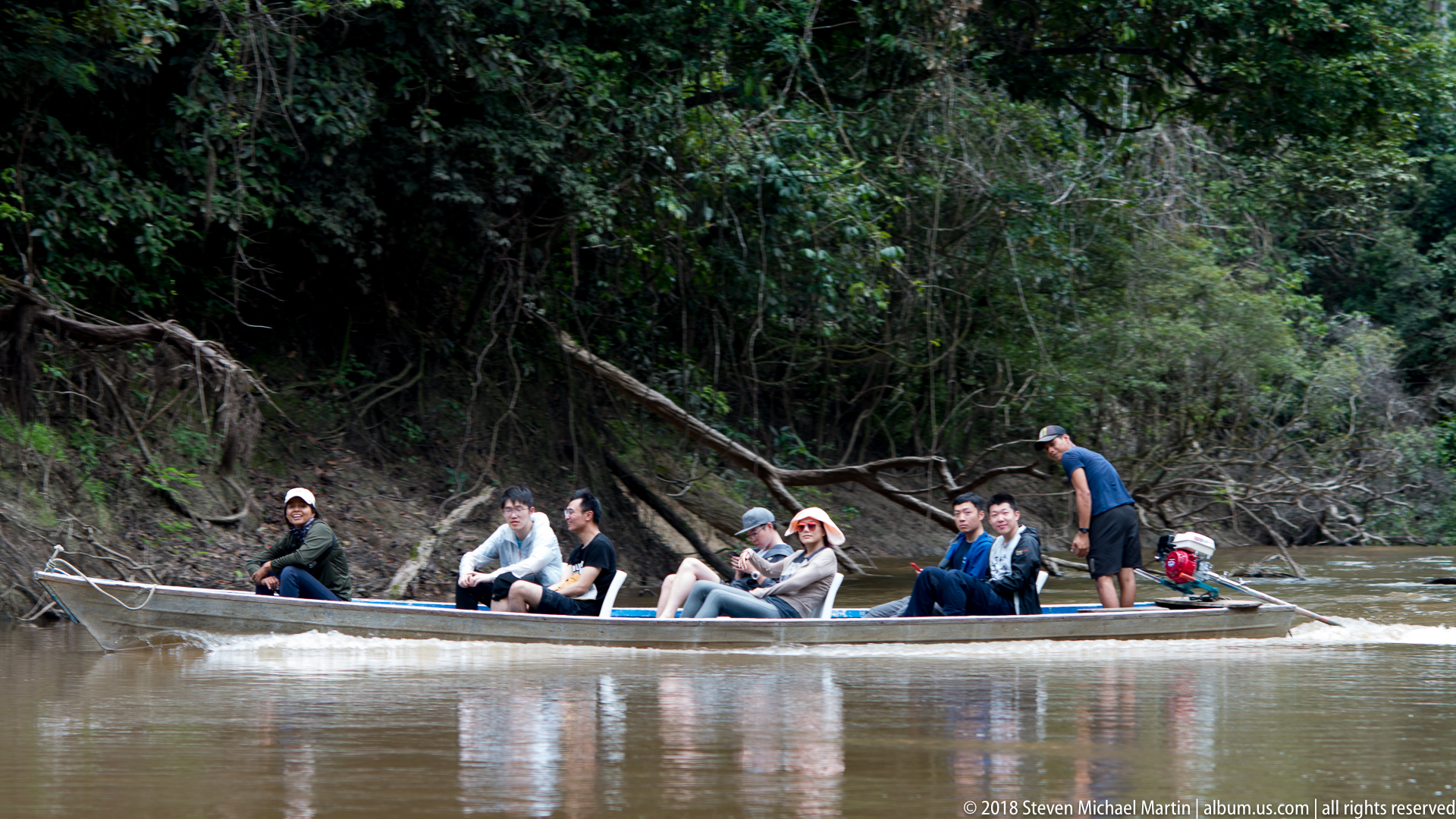
A long, low motorboat carries a group of passengers along the muddy Blanco River beside a densely forested bank. Most people sit in a single line while one person stands near the stern, where the outboard motor and gear are concentrated. The scene documents river transport as a practical way of moving through the forested landscape, with the boat's shallow profile suited to inland waterways.
Caption
A long, low motorboat carries a group of passengers along the muddy Blanco River beside a densely forested bank. Most people sit in a single line while one person stands near the stern, where the outboard motor and gear are concentrated. The scene documents river transport as a practical way of moving through the forested landscape, with the boat's shallow profile suited to inland waterways.
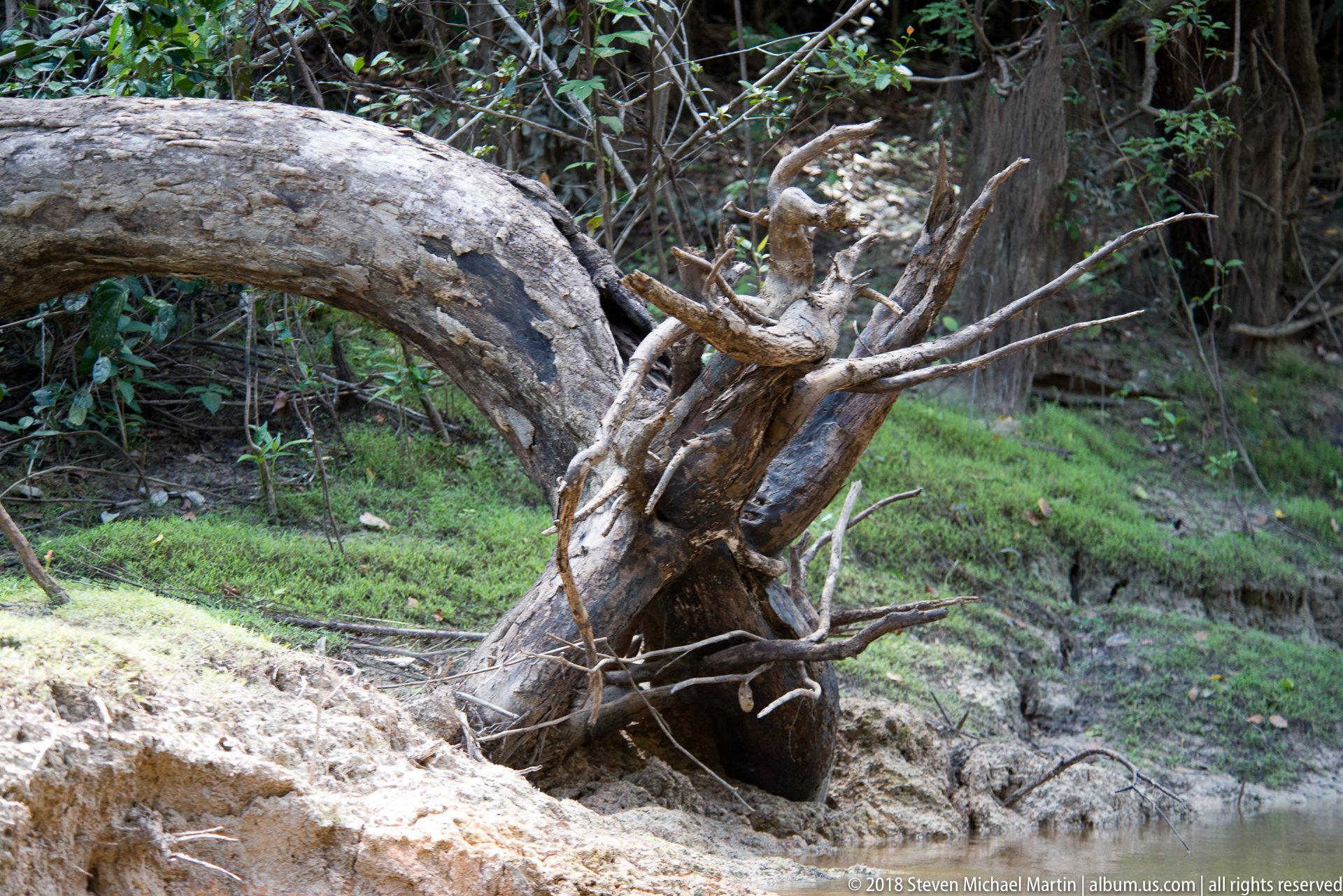
A massive pale trunk arches low across the ground at the edge of dense forest, its exposed roots and broken limbs forming a sculptural tangle above sandy soil. Small plants and shaded understory surround the weathered wood. The frame shifts from wildlife to the physical structure of the river margin, showing how fallen trees create openings and complex woody habitat.
Caption
A massive pale trunk arches low across the ground at the edge of dense forest, its exposed roots and broken limbs forming a sculptural tangle above sandy soil. Small plants and shaded understory surround the weathered wood. The frame shifts from wildlife to the physical structure of the river margin, showing how fallen trees create openings and complex woody habitat.
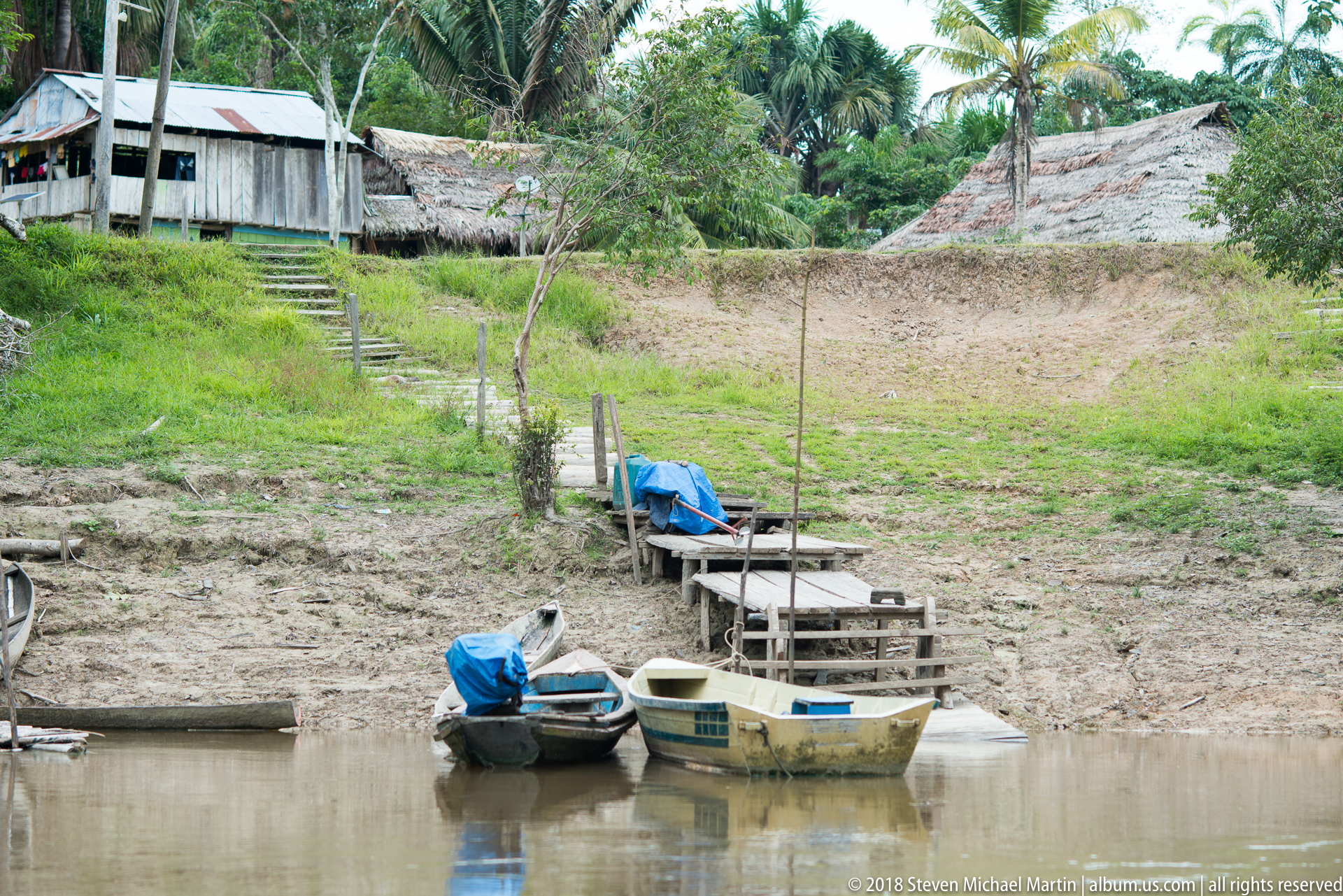
Several small open boats are moored beside a muddy riverbank below a simple wooden landing. Steps rise toward modest riverside structures and palms, while the low exposed bank records the immediate relationship between settlement and water access. The scene provides human context for the Blanco River portfolio, showing boats and a practical landing rather than a formal dock.
Caption
Several small open boats are moored beside a muddy riverbank below a simple wooden landing. Steps rise toward modest riverside structures and palms, while the low exposed bank records the immediate relationship between settlement and water access. The scene provides human context for the Blanco River portfolio, showing boats and a practical landing rather than a formal dock.
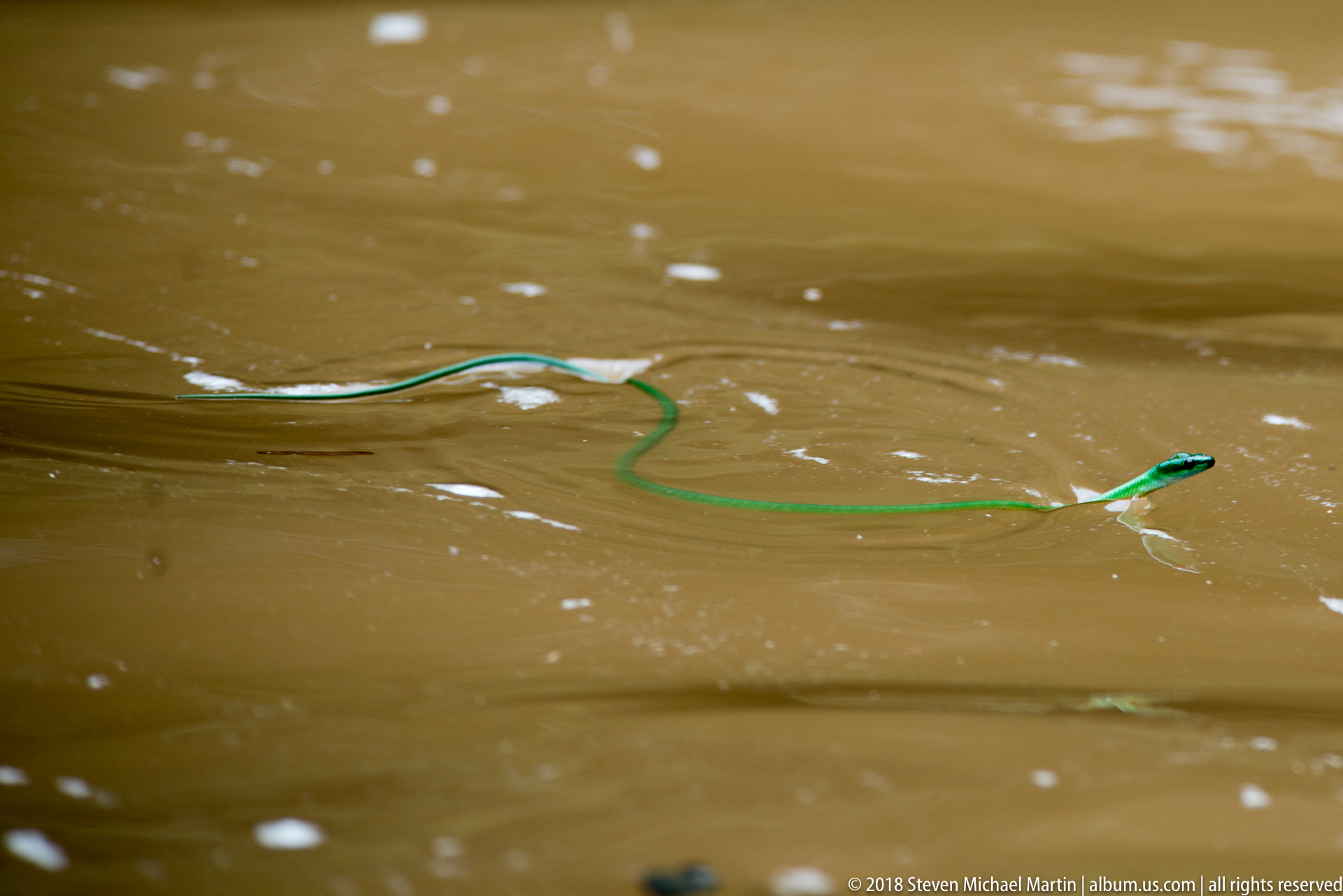
A slender green snake swims across the muddy river surface in a broad S-curve, with only the upper body and head rising above the water. Small ripples trace its path through the brown current. The frame extends the sequence beyond tree branches to show active swimming behavior, while the species remains intentionally unresolved because diagnostic features are too distant.
Caption
A slender green snake swims across the muddy river surface in a broad S-curve, with only the upper body and head rising above the water. Small ripples trace its path through the brown current. The frame extends the sequence beyond tree branches to show active swimming behavior, while the species remains intentionally unresolved because diagnostic features are too distant.

A large gray-and-white heron flies low past riverine vegetation, neck extended forward and long legs trailing behind. Broad gray wings, a white neck, dark crown, and long yellow-orange bill are consistent with a Cocoi Heron, a widespread South American wetland species. Motion blur in the forest background conveys the bird's flight path while preserving the essential field marks.
Caption
A large gray-and-white heron flies low past riverine vegetation, neck extended forward and long legs trailing behind. Broad gray wings, a white neck, dark crown, and long yellow-orange bill are consistent with a Cocoi Heron, a widespread South American wetland species. Motion blur in the forest background conveys the bird's flight path while preserving the essential field marks.

A large heron passes across the frame with its wings lifted in a powerful upstroke, revealing layered gray flight feathers and a white body. The long bill points forward while the legs trail well behind the tail, unmistakably marking the bird as a heron in active flight. Its coloration and proportions are consistent with Cocoi Heron in the Amazonian river corridor.
Caption
A large heron passes across the frame with its wings lifted in a powerful upstroke, revealing layered gray flight feathers and a white body. The long bill points forward while the legs trail well behind the tail, unmistakably marking the bird as a heron in active flight. Its coloration and proportions are consistent with Cocoi Heron in the Amazonian river corridor.

A tall gray-and-white heron stands on fallen branches amid dense riverside foliage. Its long white neck forms a strong vertical curve above the gray body, while the straight yellow-orange bill points left. The perched view contrasts with the preceding flight frames and shows the bird using woody vegetation along the forested river margin as a resting or hunting station.
Caption
A tall gray-and-white heron stands on fallen branches amid dense riverside foliage. Its long white neck forms a strong vertical curve above the gray body, while the straight yellow-orange bill points left. The perched view contrasts with the preceding flight frames and shows the bird using woody vegetation along the forested river margin as a resting or hunting station.
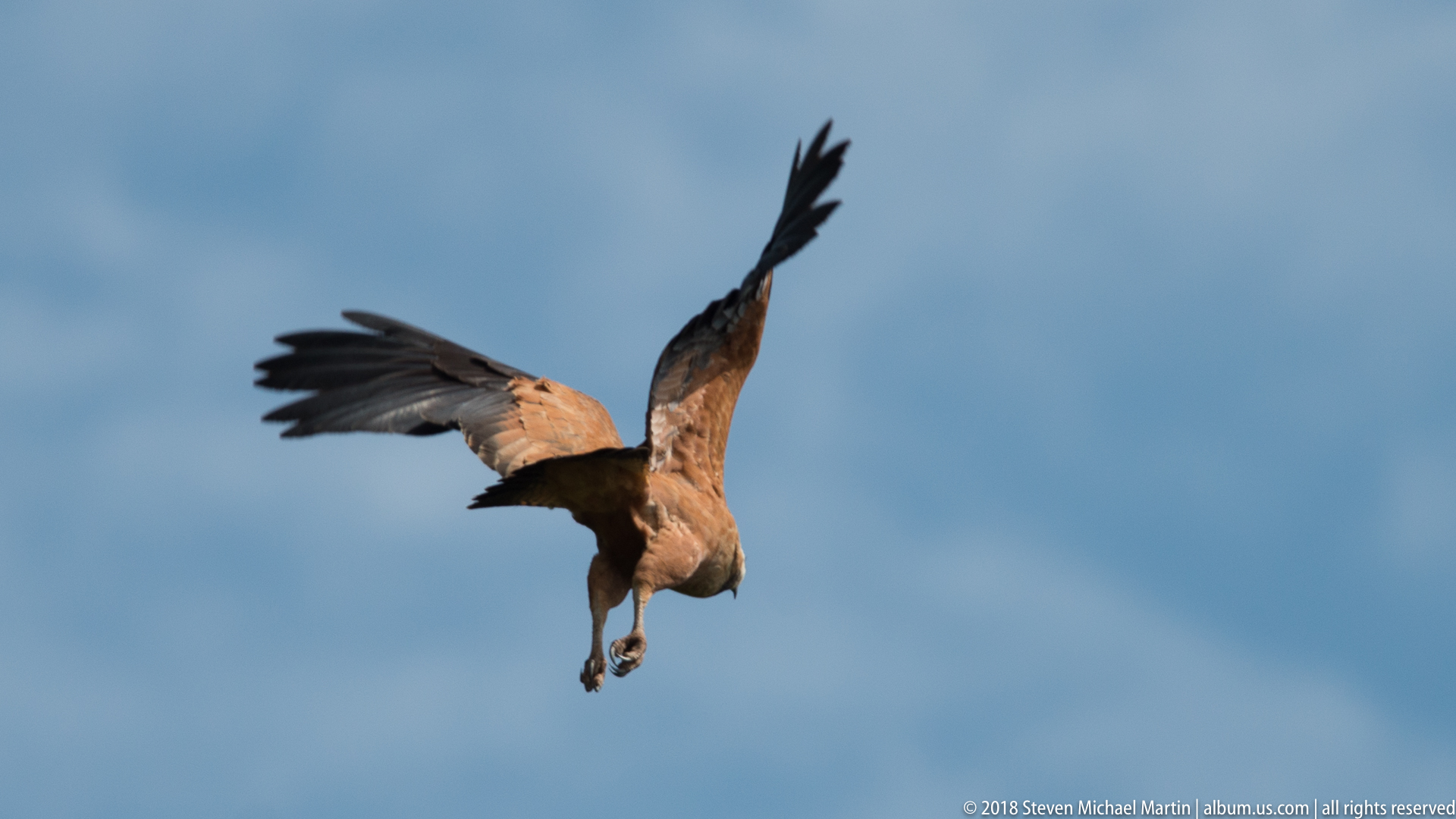
A Black-collared Hawk drops through open sky with wings lifted high and legs extended below the body. Rich rufous underparts contrast with dark flight feathers, while the pale head is just visible above the chest. The species is strongly associated with tropical rivers and wetlands, and the combination of rufous body, pale head, and broad hawk wings supports the identification in this flight view.
Caption
A Black-collared Hawk drops through open sky with wings lifted high and legs extended below the body. Rich rufous underparts contrast with dark flight feathers, while the pale head is just visible above the chest. The species is strongly associated with tropical rivers and wetlands, and the combination of rufous body, pale head, and broad hawk wings supports the identification in this flight view.

A rufescent tiger-heron stands on muddy forest floor, its long dagger-like bill aligned almost horizontally. Fine dark barring covers the rich chestnut neck, while a bold white stripe descends along the side of the breast and gray wings fold over the back—strong field marks for this Amazonian wetland heron.
Caption
A rufescent tiger-heron stands on muddy forest floor, its long dagger-like bill aligned almost horizontally. Fine dark barring covers the rich chestnut neck, while a bold white stripe descends along the side of the breast and gray wings fold over the back—strong field marks for this Amazonian wetland heron.
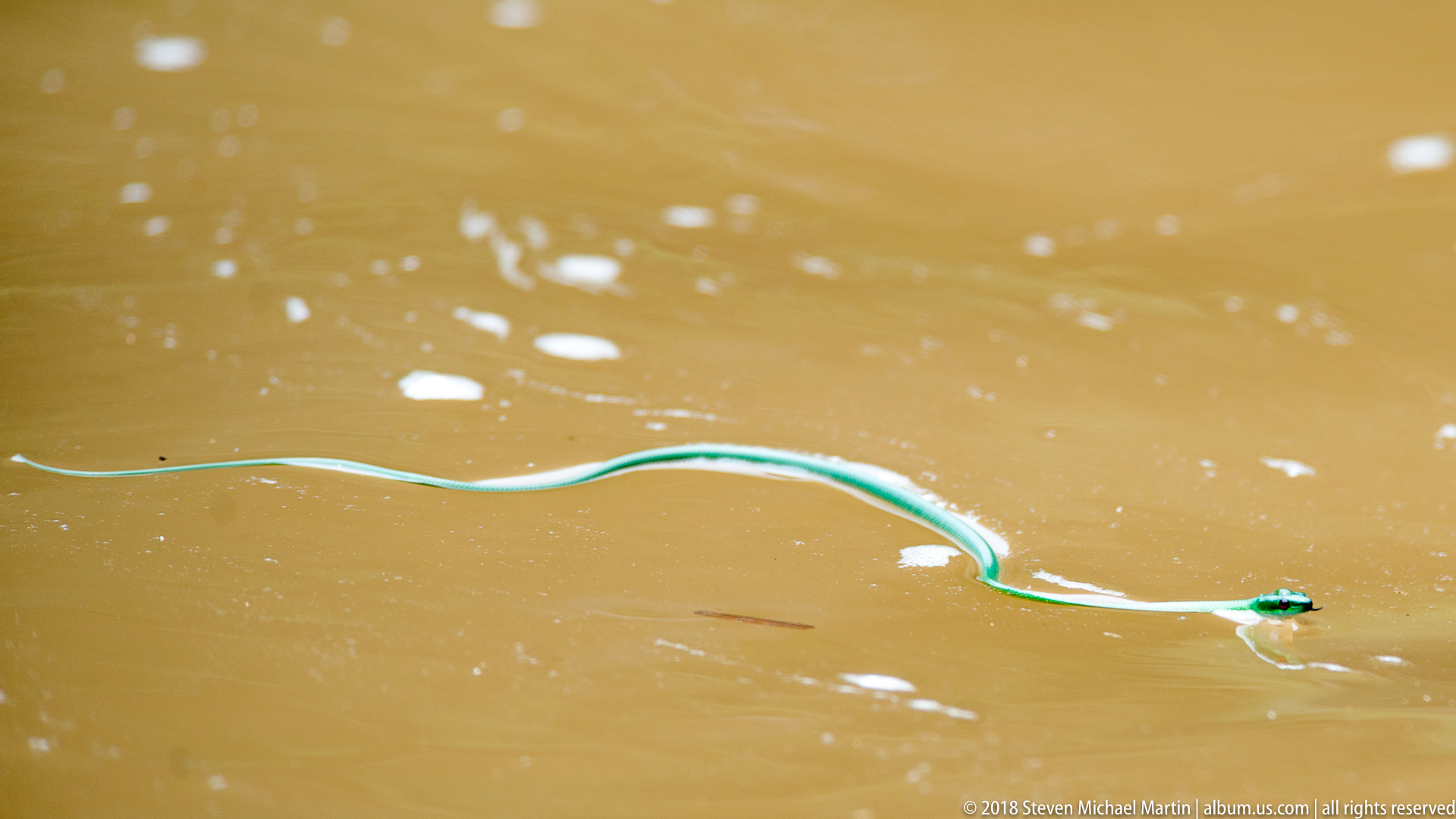
A slender green snake stretches nearly straight across open brown water, its head slightly raised while the body forms only shallow waves. The long horizontal composition makes the animal's exceptional length conspicuous and isolates it from shoreline vegetation. This is a clear behavioral record of a snake crossing the river surface, but not a sufficiently detailed taxonomic portrait.
Caption
A slender green snake stretches nearly straight across open brown water, its head slightly raised while the body forms only shallow waves. The long horizontal composition makes the animal's exceptional length conspicuous and isolates it from shoreline vegetation. This is a clear behavioral record of a snake crossing the river surface, but not a sufficiently detailed taxonomic portrait.
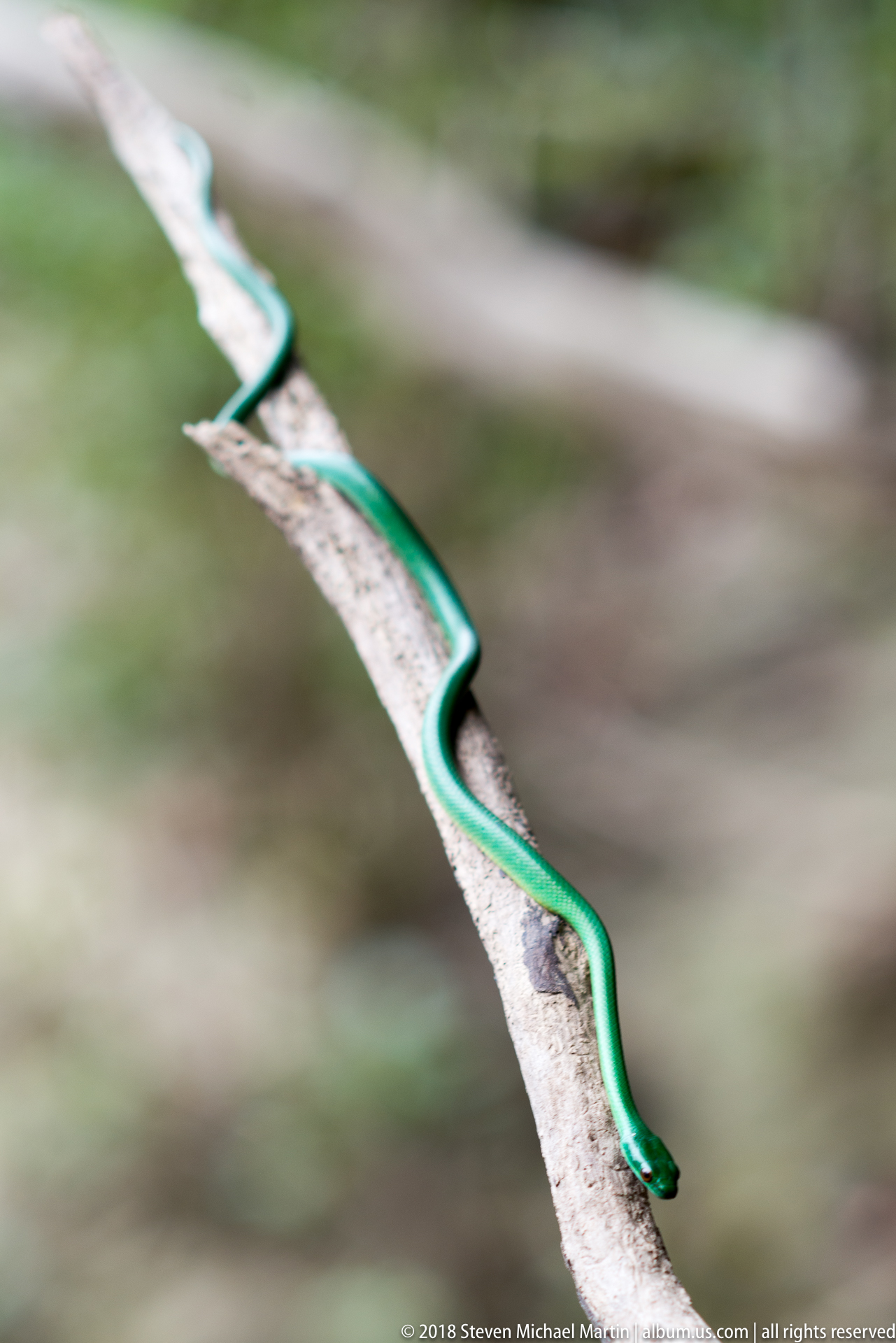
A remarkably slender green snake travels along the narrow edge of a pale branch, its elongated body following the wood in a series of tight curves. The vivid green coloration and extremely attenuated form are characteristic of an arboreal hunter, but the proof sheet does not show enough head detail to confirm the species.
Caption
A remarkably slender green snake travels along the narrow edge of a pale branch, its elongated body following the wood in a series of tight curves. The vivid green coloration and extremely attenuated form are characteristic of an arboreal hunter, but the proof sheet does not show enough head detail to confirm the species.

Motion blur softens a slate-colored hawk as it shifts position among dark branches, leaving the rufous wing panel and gray body as the strongest field marks. Rather than a static portrait, this frame records movement within the canopy and the difficulty of following a raptor through layered tropical vegetation.
Caption
Motion blur softens a slate-colored hawk as it shifts position among dark branches, leaving the rufous wing panel and gray body as the strongest field marks. Rather than a static portrait, this frame records movement within the canopy and the difficulty of following a raptor through layered tropical vegetation.
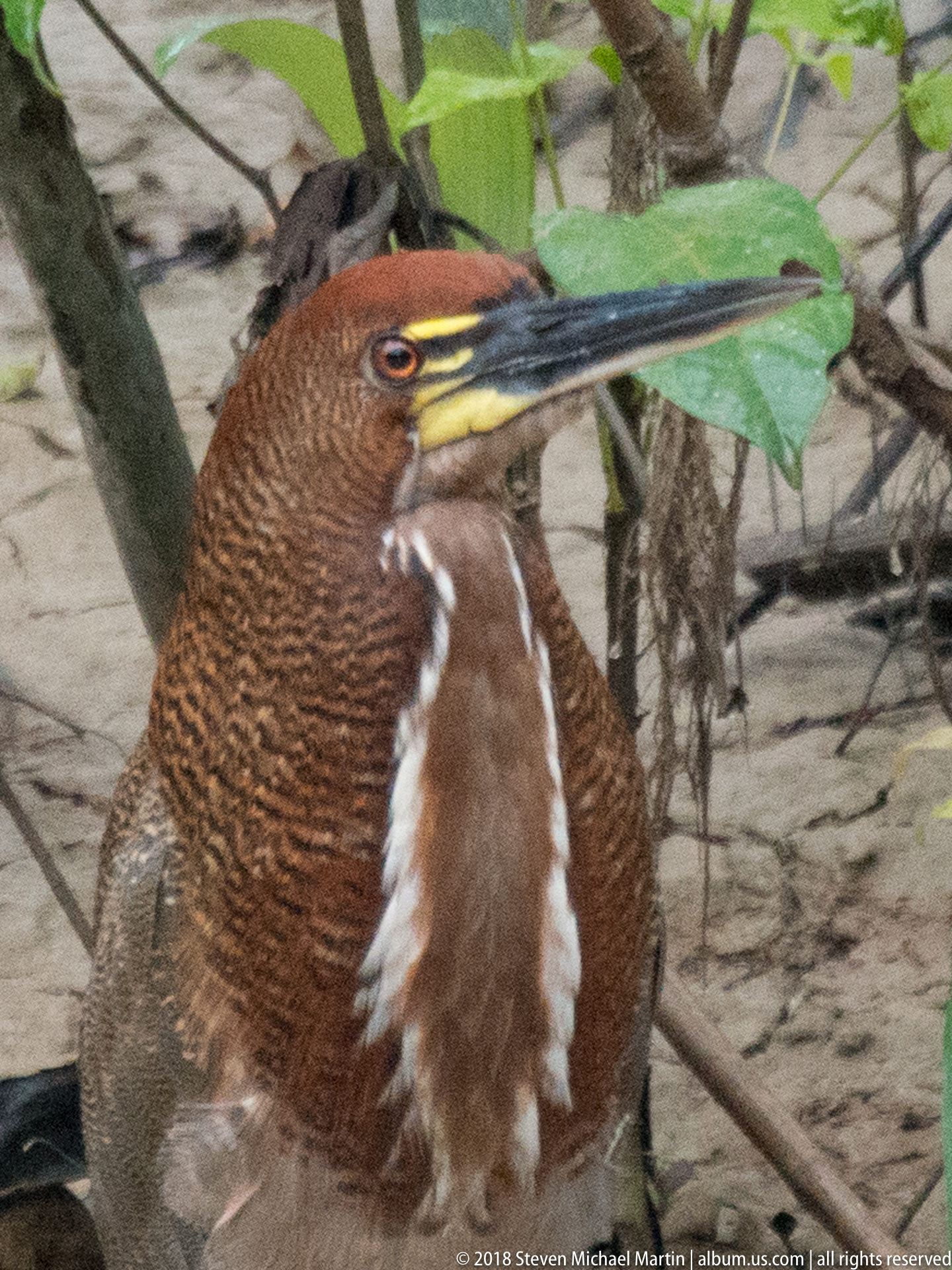
This tighter portrait concentrates on the rufescent tiger-heron’s head and upper body: a long dark bill, yellow lores, chestnut-and-black vermiculation across the neck, and a sharply contrasting white stripe. The compressed view turns the bird’s cryptic wetland plumage into a study of pattern and texture.
Caption
This tighter portrait concentrates on the rufescent tiger-heron’s head and upper body: a long dark bill, yellow lores, chestnut-and-black vermiculation across the neck, and a sharply contrasting white stripe. The compressed view turns the bird’s cryptic wetland plumage into a study of pattern and texture.

A medium-sized raptor perches high in the open crown of a sparsely branched tropical tree, silhouetted against blue sky. Its exposed lookout offers a broad view over the surrounding forest, while the distant scale and backlit plumage make a more specific identification unreliable from this proof sheet.
Caption
A medium-sized raptor perches high in the open crown of a sparsely branched tropical tree, silhouetted against blue sky. Its exposed lookout offers a broad view over the surrounding forest, while the distant scale and backlit plumage make a more specific identification unreliable from this proof sheet.

A small silvery fish lies on a dark wooden surface beside river-travel gear, recording a close, utilitarian encounter with the Blanco River’s aquatic fauna. Its laterally compressed body, pale belly, and reflective scales are visible, but the angle and condition do not provide enough diagnostic detail for a defensible species identification.
Caption
A small silvery fish lies on a dark wooden surface beside river-travel gear, recording a close, utilitarian encounter with the Blanco River’s aquatic fauna. Its laterally compressed body, pale belly, and reflective scales are visible, but the angle and condition do not provide enough diagnostic detail for a defensible species identification.

A chestnut-brown raptor sits upright on a horizontal branch beneath large tropical leaves, its pale head and heavy body standing out against the darker canopy. The closer view records posture and coloration more clearly than the preceding lookout image, although the proof sheet still lacks sufficient diagnostic detail for a secure species name.
Caption
A chestnut-brown raptor sits upright on a horizontal branch beneath large tropical leaves, its pale head and heavy body standing out against the darker canopy. The closer view records posture and coloration more clearly than the preceding lookout image, although the proof sheet still lacks sufficient diagnostic detail for a secure species name.

Clusters of small yellow-orange flowers punctuate dense green vegetation while numerous long, narrow pods hang beneath the foliage. The frame emphasizes reproductive structures rather than the wider forest, making the flowers and pendant fruits the principal botanical evidence without forcing a species identification from insufficient detail.
Caption
Clusters of small yellow-orange flowers punctuate dense green vegetation while numerous long, narrow pods hang beneath the foliage. The frame emphasizes reproductive structures rather than the wider forest, making the flowers and pendant fruits the principal botanical evidence without forcing a species identification from insufficient detail.

A slate-colored hawk perches side-on within lush riverine forest, showing the combination of dark slate-gray head and body, bright yellow cere and eye area, and rich rufous panels across the folded wings. These conspicuous field marks fit a species associated with lowland Amazonian waterways and flooded forest.
Caption
A slate-colored hawk perches side-on within lush riverine forest, showing the combination of dark slate-gray head and body, bright yellow cere and eye area, and rich rufous panels across the folded wings. These conspicuous field marks fit a species associated with lowland Amazonian waterways and flooded forest.

A slate-colored hawk appears at greater distance, perched near the top of pale-leaved vegetation against a dense wall of forest. The wider composition places the raptor within its canopy habitat, contrasting with the closer portrait views and showing how its gray-and-rufous plumage recedes among branches and foliage.
Caption
A slate-colored hawk appears at greater distance, perched near the top of pale-leaved vegetation against a dense wall of forest. The wider composition places the raptor within its canopy habitat, contrasting with the closer portrait views and showing how its gray-and-rufous plumage recedes among branches and foliage.

A small group of adults and children stands on raised ground at the edge of dense tropical vegetation, with a simple roofed structure partly visible behind them. The scene records human presence along the Blanco River landscape without assigning identities or community affiliations that cannot be established from the photograph alone.
Caption
A small group of adults and children stands on raised ground at the edge of dense tropical vegetation, with a simple roofed structure partly visible behind them. The scene records human presence along the Blanco River landscape without assigning identities or community affiliations that cannot be established from the photograph alone.

The monkey turns toward the camera in a head-and-shoulders view that shows the contrast between its nearly black face and thick russet mantle. Broad shoulders and dense, wool-like fur distinguish this robust arboreal primate from the more lightly built monkeys of the Amazon canopy.
Caption
The monkey turns toward the camera in a head-and-shoulders view that shows the contrast between its nearly black face and thick russet mantle. Broad shoulders and dense, wool-like fur distinguish this robust arboreal primate from the more lightly built monkeys of the Amazon canopy.
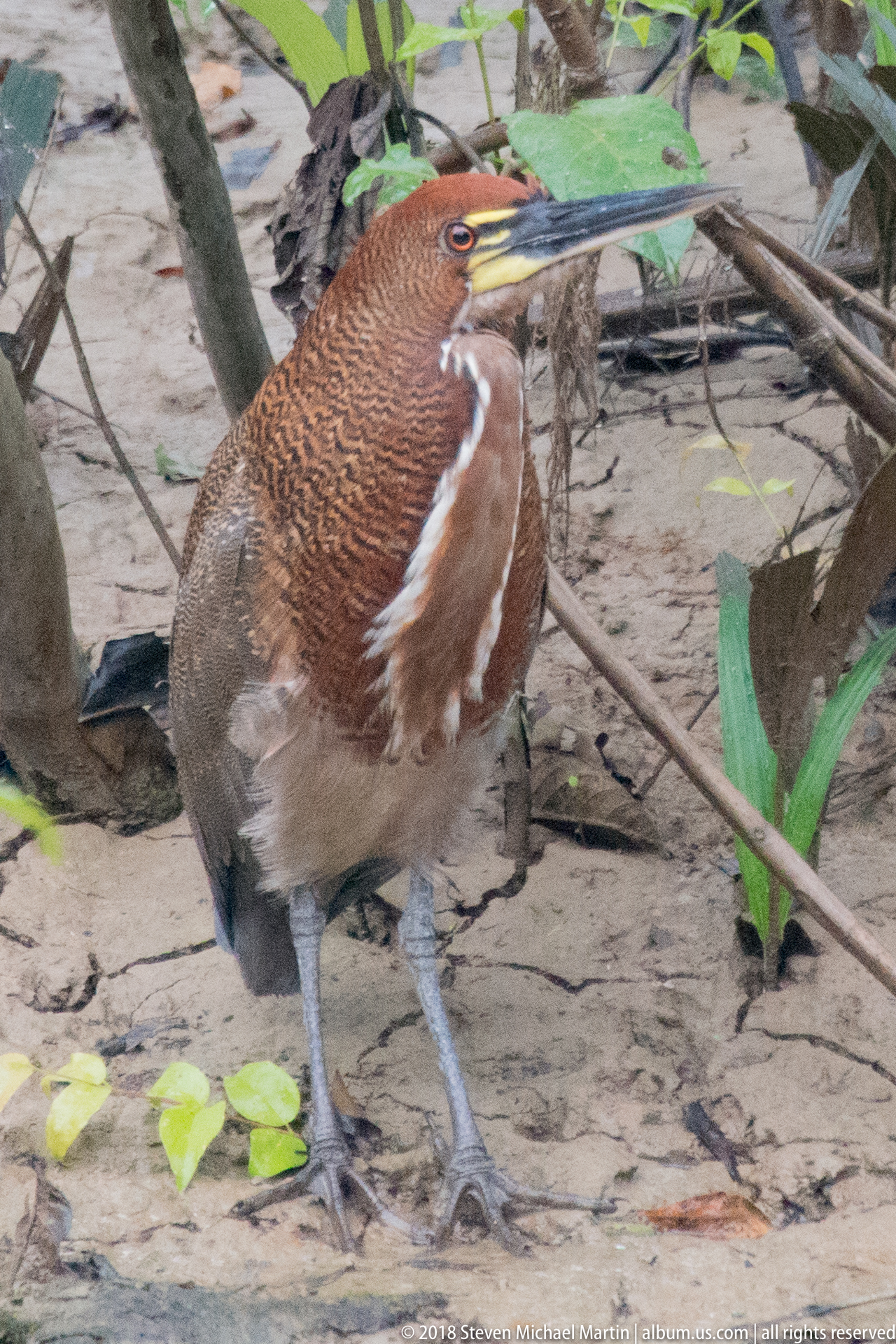
Standing more upright, the rufescent tiger-heron raises its bill slightly while its long gray legs brace on damp, leaf-strewn ground. The three-quarter pose reveals both the patterned chestnut neck and gray wing, with the white lateral stripe forming a bright break between them.
Caption
Standing more upright, the rufescent tiger-heron raises its bill slightly while its long gray legs brace on damp, leaf-strewn ground. The three-quarter pose reveals both the patterned chestnut neck and gray wing, with the white lateral stripe forming a bright break between them.

A rufescent tiger-heron pauses among low branches and leaf litter, its body angled left while the long bill points into the understory. Seen in fuller environmental context, the bird’s chestnut barred neck, gray wing, and white side stripe break up its outline against the mottled forest floor.
Caption
A rufescent tiger-heron pauses among low branches and leaf litter, its body angled left while the long bill points into the understory. Seen in fuller environmental context, the bird’s chestnut barred neck, gray wing, and white side stripe break up its outline against the mottled forest floor.

A close portrait of a reddish woolly monkey fills the frame, emphasizing its dark rounded face, dense short fur, small ears, and expressive amber-brown eyes. The warm coppery coat surrounding the darker face is consistent with Poeppig’s woolly monkey, an Amazonian primate of eastern Peru.
Caption
A close portrait of a reddish woolly monkey fills the frame, emphasizing its dark rounded face, dense short fur, small ears, and expressive amber-brown eyes. The warm coppery coat surrounding the darker face is consistent with Poeppig’s woolly monkey, an Amazonian primate of eastern Peru.

A woolly monkey brings one hand to its mouth while suspended among branches, revealing the long, powerful forelimbs used for canopy movement and feeding. The intimate behavioral frame differs from the static portraits by showing manipulation at the mouth, while the reddish coat and dark face remain prominent.
Caption
A woolly monkey brings one hand to its mouth while suspended among branches, revealing the long, powerful forelimbs used for canopy movement and feeding. The intimate behavioral frame differs from the static portraits by showing manipulation at the mouth, while the reddish coat and dark face remain prominent.

A reddish woolly monkey is shown moving horizontally beneath branches with limbs extended, a distinct moment in a sustained canopy sequence along the Blanco River. Its dense copper-russet coat, dark face, powerful limbs, and grasping tail emphasize the anatomy of a large arboreal primate moving confidently through layered Amazonian vegetation.
Caption
A reddish woolly monkey is shown moving horizontally beneath branches with limbs extended, a distinct moment in a sustained canopy sequence along the Blanco River. Its dense copper-russet coat, dark face, powerful limbs, and grasping tail emphasize the anatomy of a large arboreal primate moving confidently through layered Amazonian vegetation.
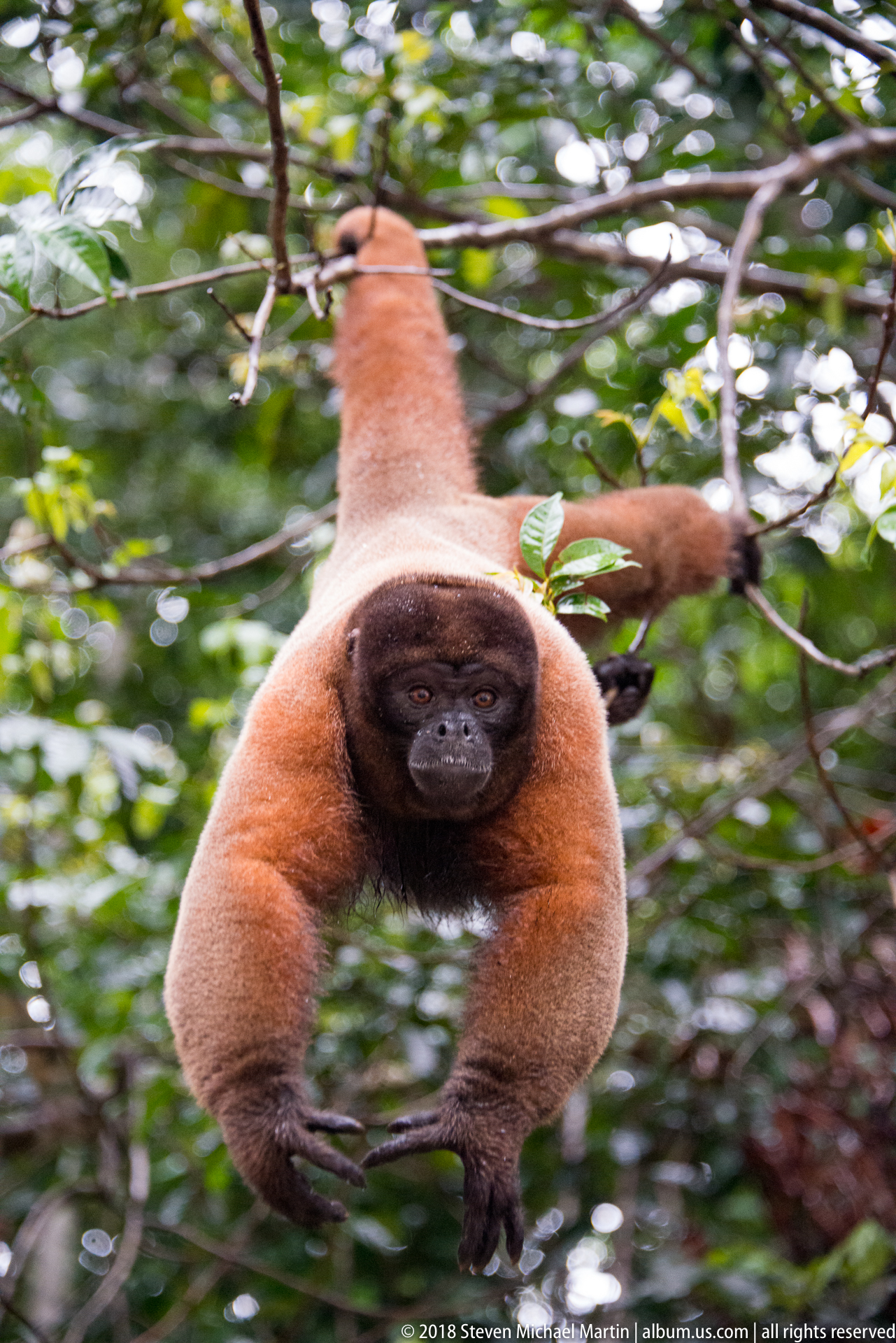
A reddish woolly monkey is shown advancing toward the camera through the canopy, a distinct moment in a sustained canopy sequence along the Blanco River. Its dense copper-russet coat, dark face, powerful limbs, and grasping tail emphasize the anatomy of a large arboreal primate moving confidently through layered Amazonian vegetation.
Caption
A reddish woolly monkey is shown advancing toward the camera through the canopy, a distinct moment in a sustained canopy sequence along the Blanco River. Its dense copper-russet coat, dark face, powerful limbs, and grasping tail emphasize the anatomy of a large arboreal primate moving confidently through layered Amazonian vegetation.

A reddish woolly monkey moves through interlaced branches while holding a pale piece of food in one hand. Its long prehensile tail extends upward as an additional anchor, while the free limbs reach through the canopy—a clear view of the climbing adaptations that support feeding high above the forest floor.
Caption
A reddish woolly monkey moves through interlaced branches while holding a pale piece of food in one hand. Its long prehensile tail extends upward as an additional anchor, while the free limbs reach through the canopy—a clear view of the climbing adaptations that support feeding high above the forest floor.

Seen from farther back, the woolly monkey hangs amid a lattice of branches with a pale food item in hand, its long tail and reddish body clearly separated from the surrounding green foliage. The wider frame emphasizes canopy height and the animal’s ability to feed while supported by multiple limbs.
Caption
Seen from farther back, the woolly monkey hangs amid a lattice of branches with a pale food item in hand, its long tail and reddish body clearly separated from the surrounding green foliage. The wider frame emphasizes canopy height and the animal’s ability to feed while supported by multiple limbs.
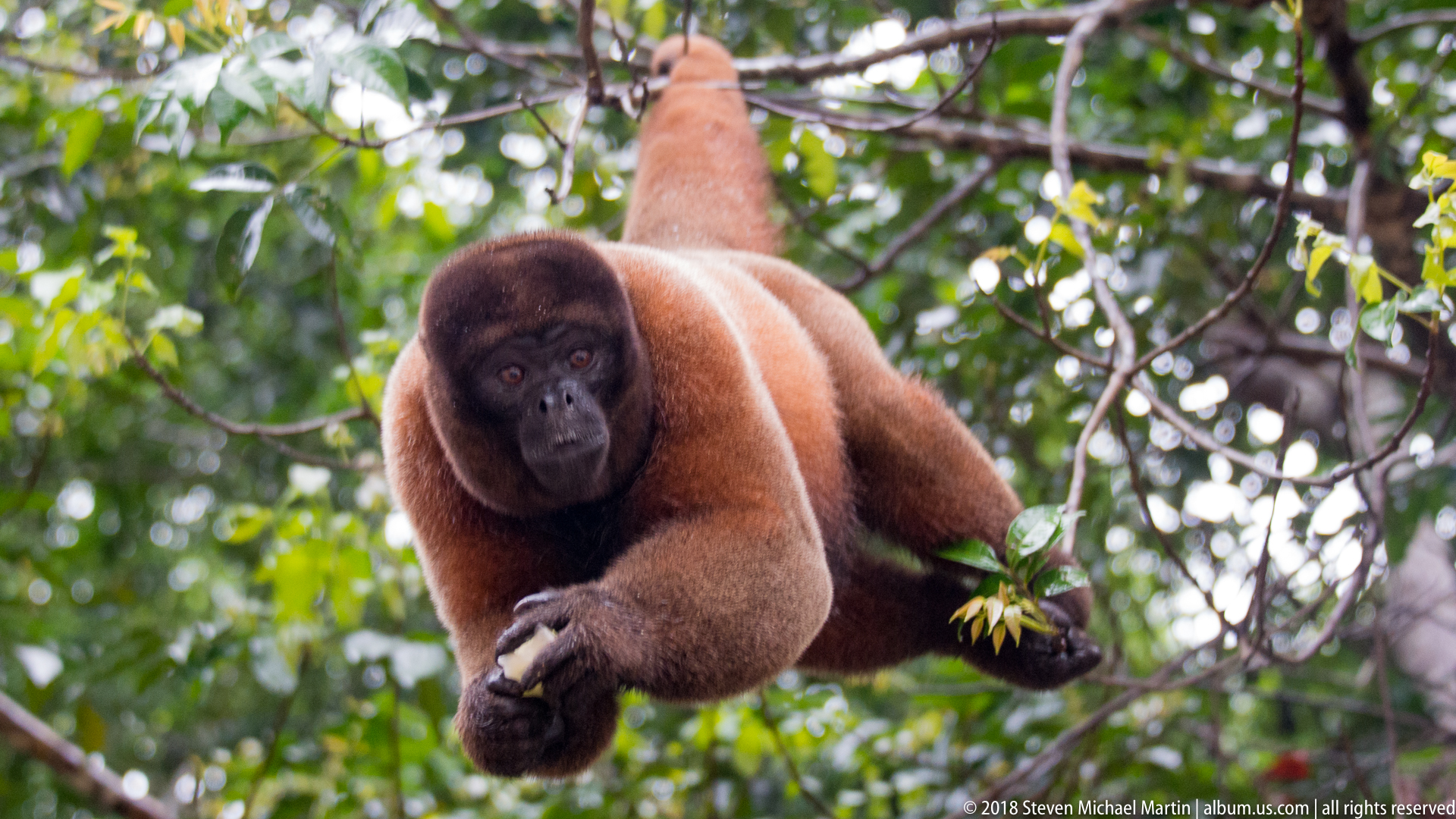
A reddish woolly monkey is shown reaching forward while suspended from branches, a distinct moment in a sustained canopy sequence along the Blanco River. Its dense copper-russet coat, dark face, powerful limbs, and grasping tail emphasize the anatomy of a large arboreal primate moving confidently through layered Amazonian vegetation.
Caption
A reddish woolly monkey is shown reaching forward while suspended from branches, a distinct moment in a sustained canopy sequence along the Blanco River. Its dense copper-russet coat, dark face, powerful limbs, and grasping tail emphasize the anatomy of a large arboreal primate moving confidently through layered Amazonian vegetation.
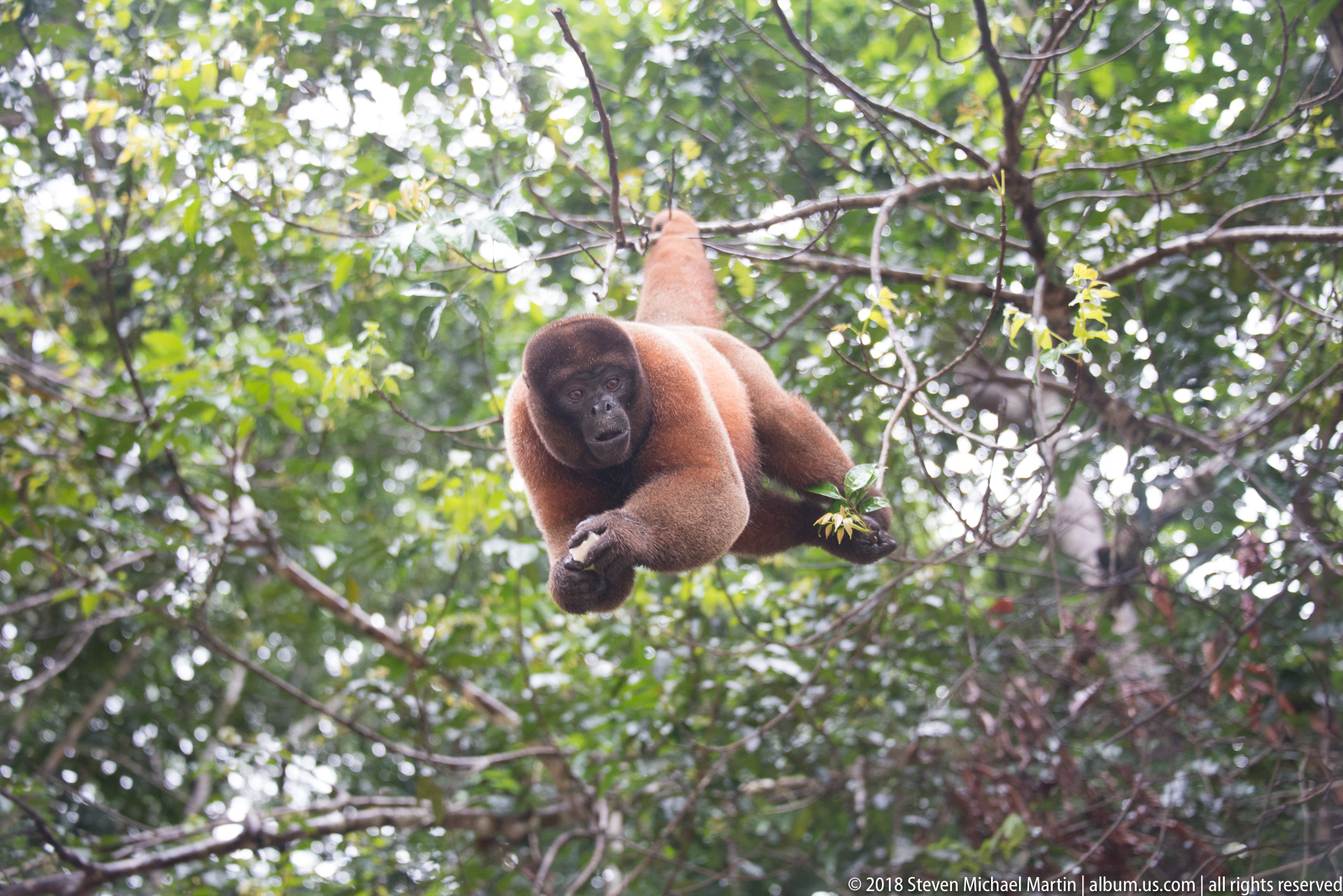
A reddish woolly monkey is shown hanging in a wider canopy view with forearms gathered, a distinct moment in a sustained canopy sequence along the Blanco River. Its dense copper-russet coat, dark face, powerful limbs, and grasping tail emphasize the anatomy of a large arboreal primate moving confidently through layered Amazonian vegetation.
Caption
A reddish woolly monkey is shown hanging in a wider canopy view with forearms gathered, a distinct moment in a sustained canopy sequence along the Blanco River. Its dense copper-russet coat, dark face, powerful limbs, and grasping tail emphasize the anatomy of a large arboreal primate moving confidently through layered Amazonian vegetation.

A reddish woolly monkey is shown side view with long prehensile tail curled upward, a distinct moment in a sustained canopy sequence along the Blanco River. Its dense copper-russet coat, dark face, powerful limbs, and grasping tail emphasize the anatomy of a large arboreal primate moving confidently through layered Amazonian vegetation.
Caption
A reddish woolly monkey is shown side view with long prehensile tail curled upward, a distinct moment in a sustained canopy sequence along the Blanco River. Its dense copper-russet coat, dark face, powerful limbs, and grasping tail emphasize the anatomy of a large arboreal primate moving confidently through layered Amazonian vegetation.

A reddish woolly monkey is shown spread-eagle suspension across several leafy branches, a distinct moment in a sustained canopy sequence along the Blanco River. Its dense copper-russet coat, dark face, powerful limbs, and grasping tail emphasize the anatomy of a large arboreal primate moving confidently through layered Amazonian vegetation.
Caption
A reddish woolly monkey is shown spread-eagle suspension across several leafy branches, a distinct moment in a sustained canopy sequence along the Blanco River. Its dense copper-russet coat, dark face, powerful limbs, and grasping tail emphasize the anatomy of a large arboreal primate moving confidently through layered Amazonian vegetation.
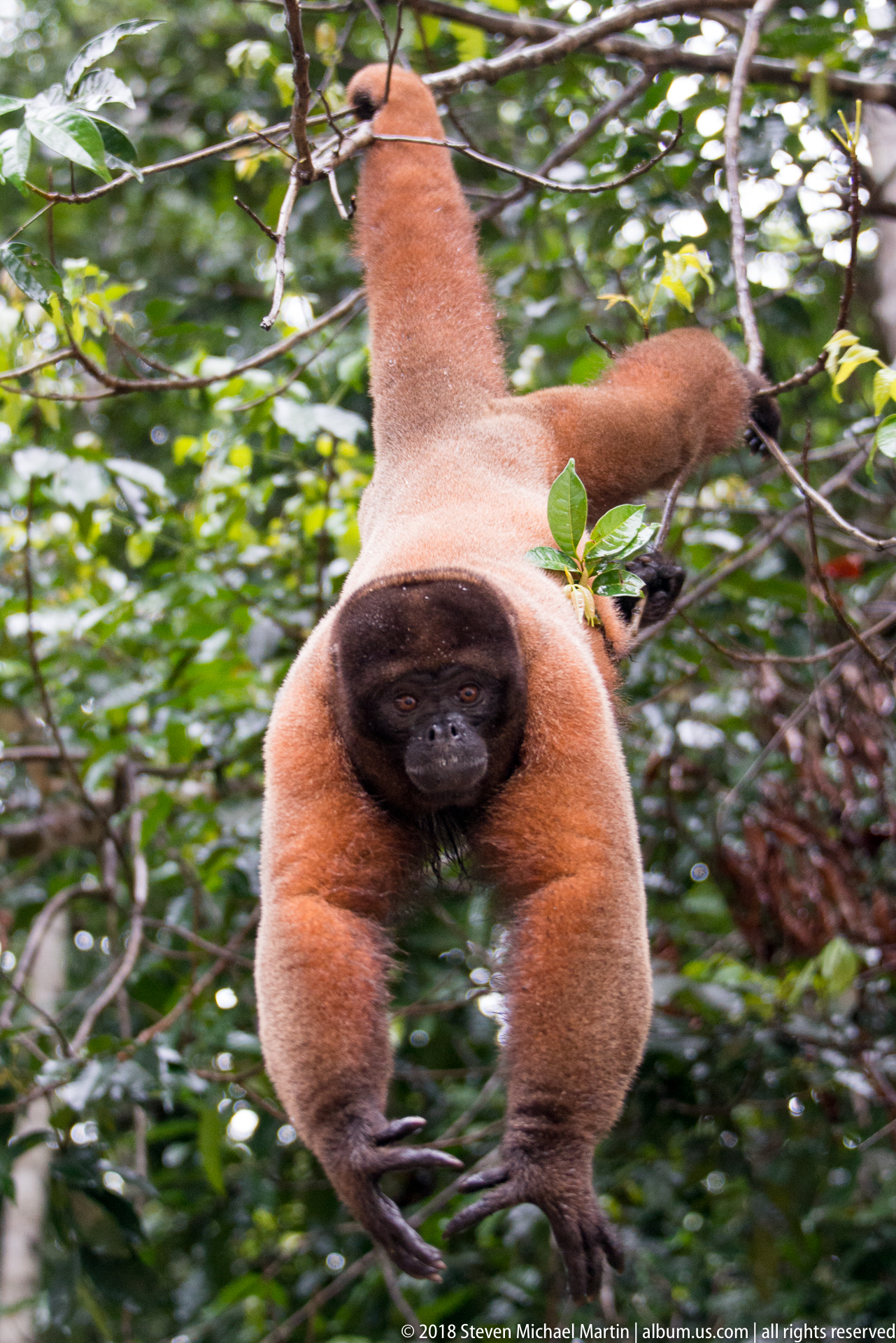
A reddish woolly monkey is shown front-facing movement with both arms reaching downward, a distinct moment in a sustained canopy sequence along the Blanco River. Its dense copper-russet coat, dark face, powerful limbs, and grasping tail emphasize the anatomy of a large arboreal primate moving confidently through layered Amazonian vegetation.
Caption
A reddish woolly monkey is shown front-facing movement with both arms reaching downward, a distinct moment in a sustained canopy sequence along the Blanco River. Its dense copper-russet coat, dark face, powerful limbs, and grasping tail emphasize the anatomy of a large arboreal primate moving confidently through layered Amazonian vegetation.
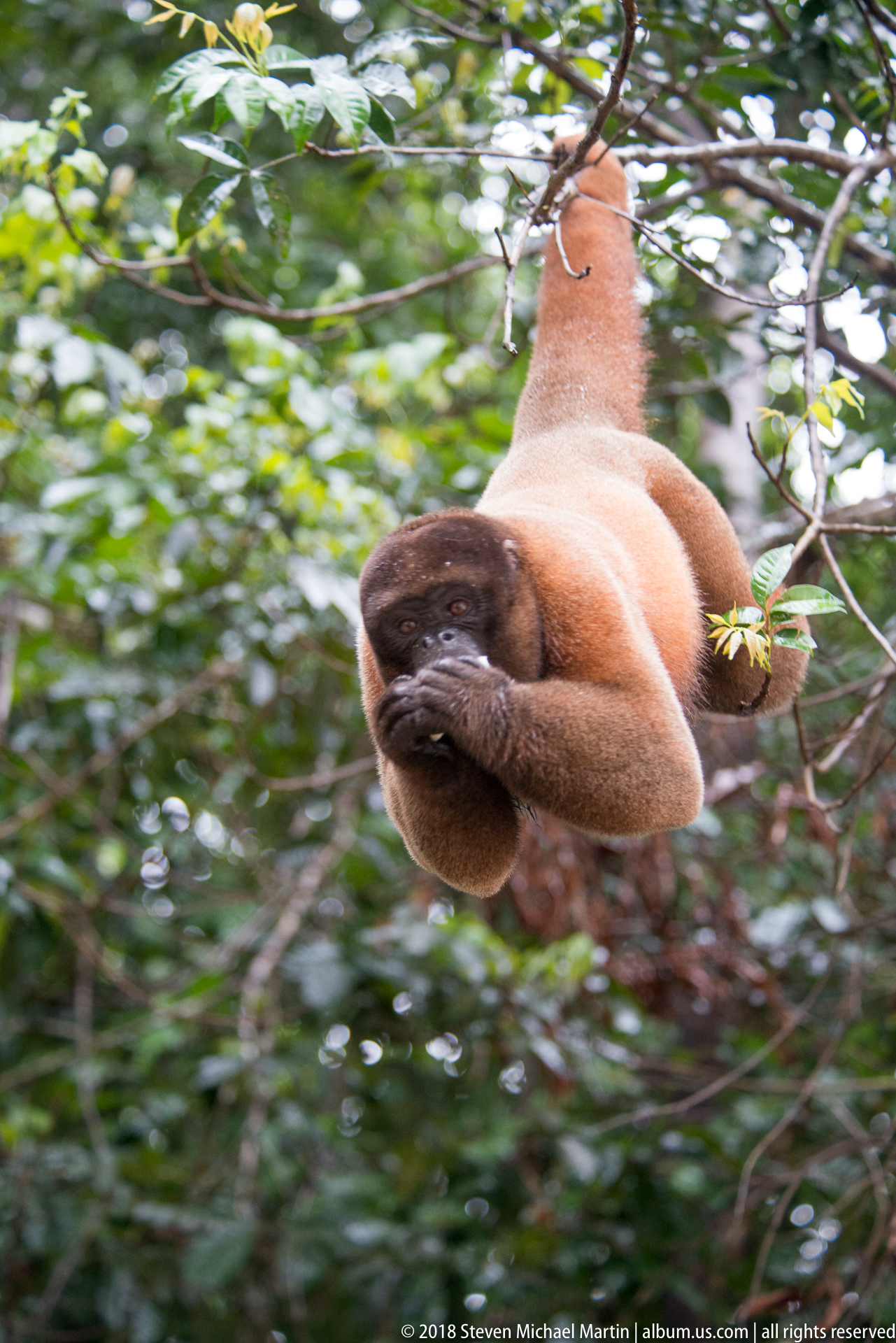
A reddish woolly monkey is shown rapid horizontal movement with one hand near the mouth, a distinct moment in a sustained canopy sequence along the Blanco River. Its dense copper-russet coat, dark face, powerful limbs, and grasping tail emphasize the anatomy of a large arboreal primate moving confidently through layered Amazonian vegetation.
Caption
A reddish woolly monkey is shown rapid horizontal movement with one hand near the mouth, a distinct moment in a sustained canopy sequence along the Blanco River. Its dense copper-russet coat, dark face, powerful limbs, and grasping tail emphasize the anatomy of a large arboreal primate moving confidently through layered Amazonian vegetation.

A reddish woolly monkey is shown standing quadrupedally on crossing branches, a distinct moment in a sustained canopy sequence along the Blanco River. Its dense copper-russet coat, dark face, powerful limbs, and grasping tail emphasize the anatomy of a large arboreal primate moving confidently through layered Amazonian vegetation.
Caption
A reddish woolly monkey is shown standing quadrupedally on crossing branches, a distinct moment in a sustained canopy sequence along the Blanco River. Its dense copper-russet coat, dark face, powerful limbs, and grasping tail emphasize the anatomy of a large arboreal primate moving confidently through layered Amazonian vegetation.

A reddish woolly monkey is shown rotated beneath branches with body nearly upside down, a distinct moment in a sustained canopy sequence along the Blanco River. Its dense copper-russet coat, dark face, powerful limbs, and grasping tail emphasize the anatomy of a large arboreal primate moving confidently through layered Amazonian vegetation.
Caption
A reddish woolly monkey is shown rotated beneath branches with body nearly upside down, a distinct moment in a sustained canopy sequence along the Blanco River. Its dense copper-russet coat, dark face, powerful limbs, and grasping tail emphasize the anatomy of a large arboreal primate moving confidently through layered Amazonian vegetation.
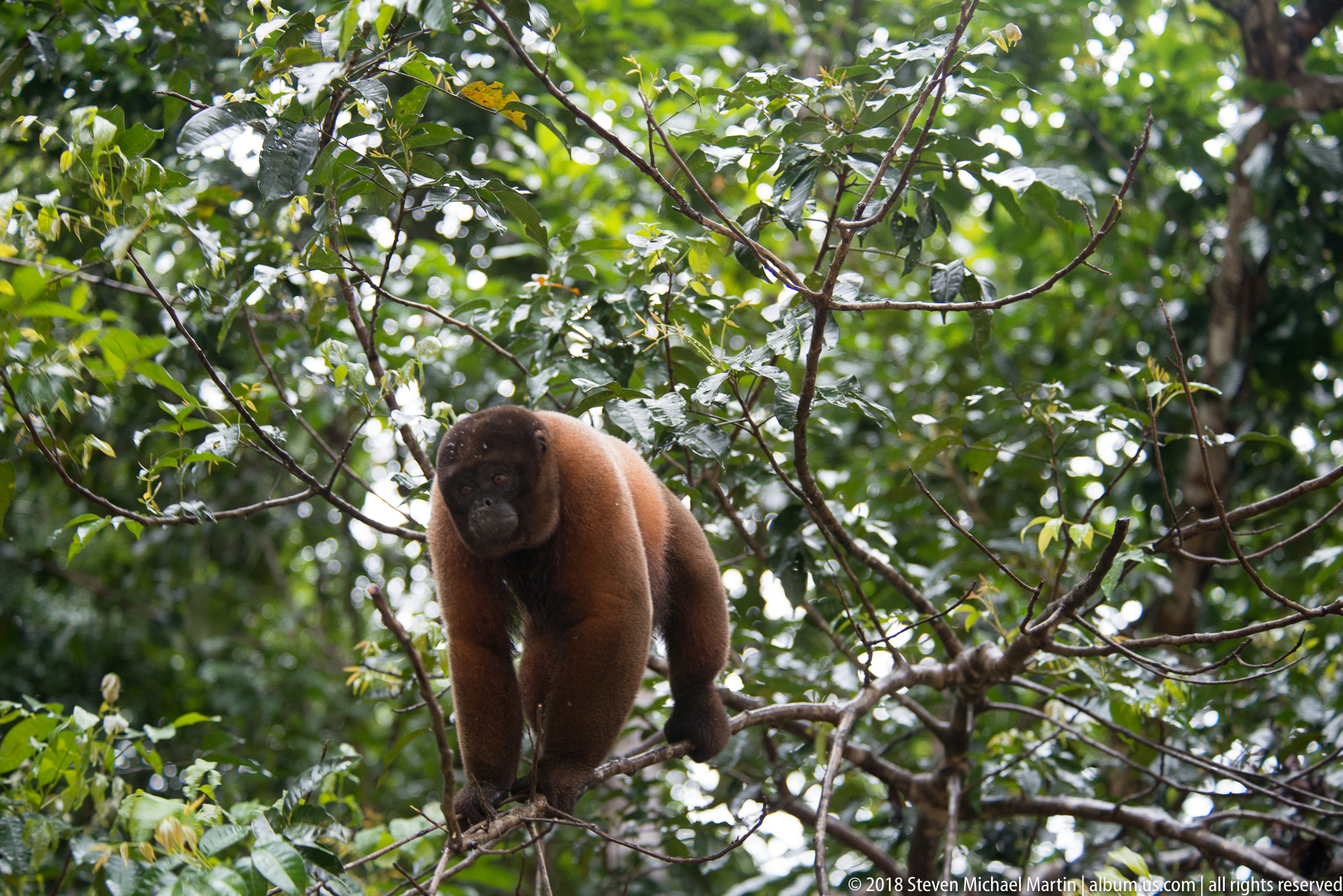
A reddish woolly monkey is shown distant upright stance in a dense canopy opening, a distinct moment in a sustained canopy sequence along the Blanco River. Its dense copper-russet coat, dark face, powerful limbs, and grasping tail emphasize the anatomy of a large arboreal primate moving confidently through layered Amazonian vegetation.
Caption
A reddish woolly monkey is shown distant upright stance in a dense canopy opening, a distinct moment in a sustained canopy sequence along the Blanco River. Its dense copper-russet coat, dark face, powerful limbs, and grasping tail emphasize the anatomy of a large arboreal primate moving confidently through layered Amazonian vegetation.
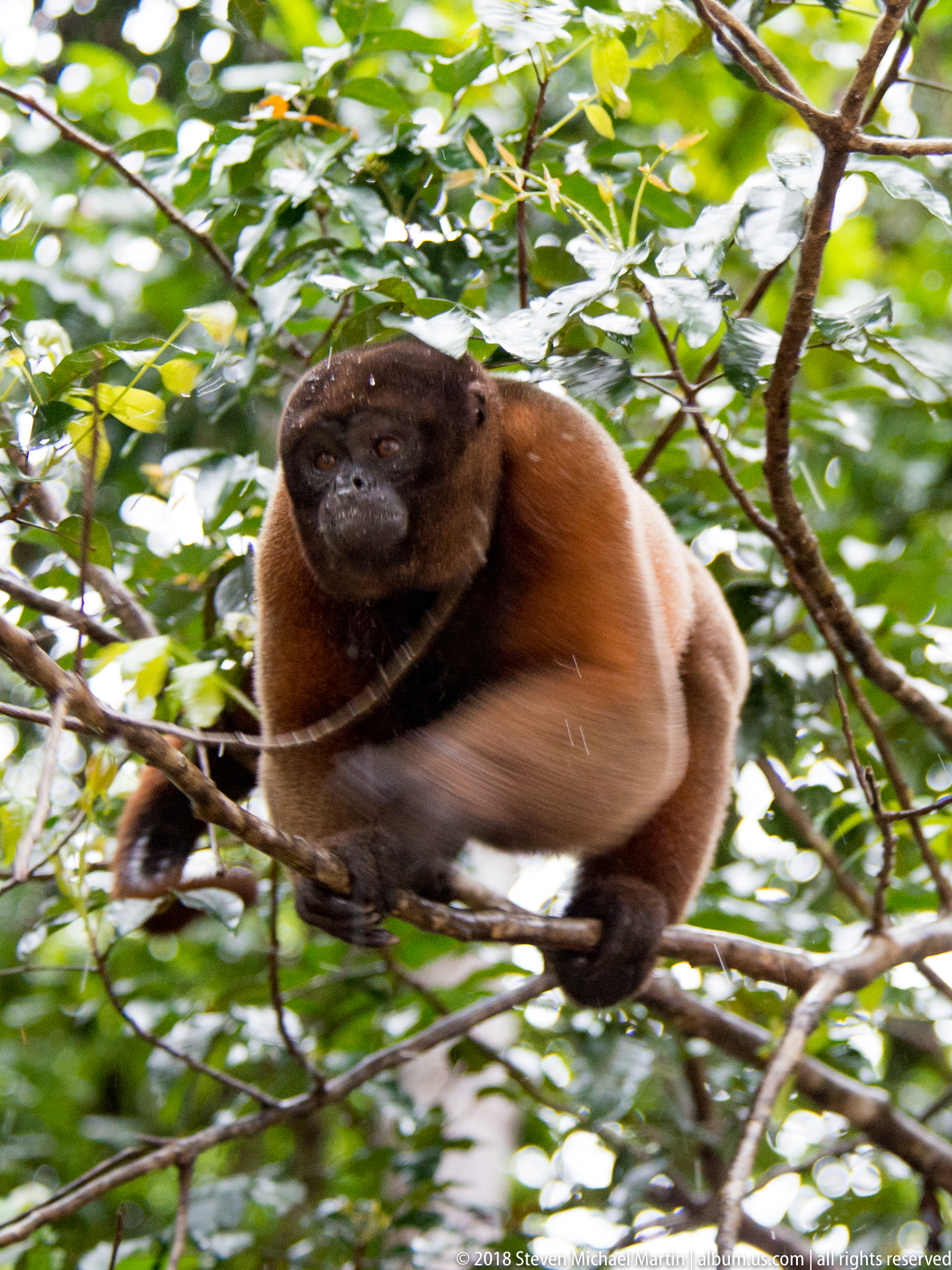
A reddish woolly monkey is shown low horizontal movement along intertwined branches, a distinct moment in a sustained canopy sequence along the Blanco River. Its dense copper-russet coat, dark face, powerful limbs, and grasping tail emphasize the anatomy of a large arboreal primate moving confidently through layered Amazonian vegetation.
Caption
A reddish woolly monkey is shown low horizontal movement along intertwined branches, a distinct moment in a sustained canopy sequence along the Blanco River. Its dense copper-russet coat, dark face, powerful limbs, and grasping tail emphasize the anatomy of a large arboreal primate moving confidently through layered Amazonian vegetation.
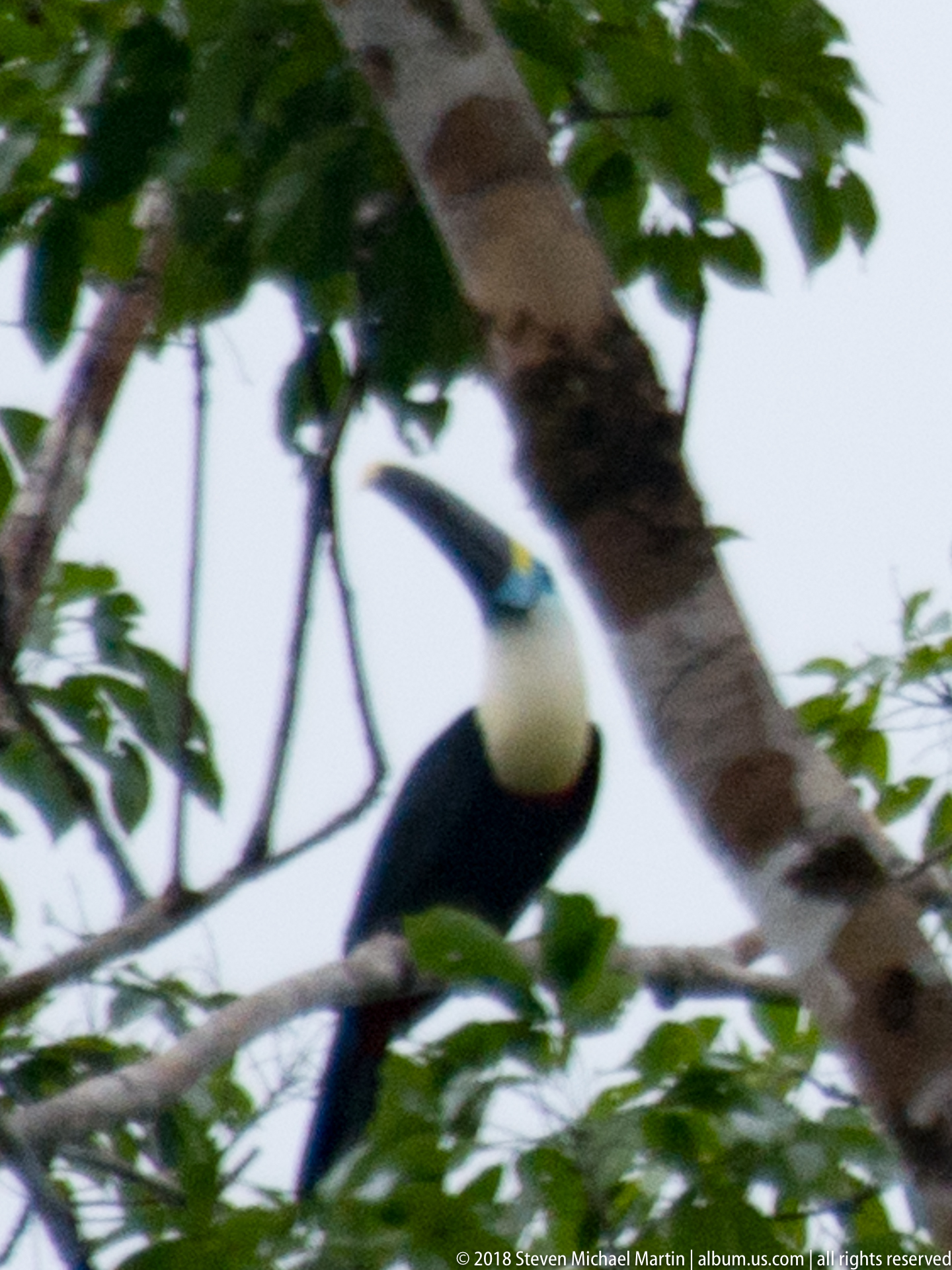
A toucan perches beyond a diagonal foreground trunk, with its pale throat and blue facial skin visible through soft foliage. The shallow focus and intervening branch create a more fleeting view than the preceding portraits, suggesting the difficulty of following canopy birds through dense vegetation. Its heavy bill and contrasting black-and-white plumage remain sufficient for a confident toucan-level identification.
Caption
A toucan perches beyond a diagonal foreground trunk, with its pale throat and blue facial skin visible through soft foliage. The shallow focus and intervening branch create a more fleeting view than the preceding portraits, suggesting the difficulty of following canopy birds through dense vegetation. Its heavy bill and contrasting black-and-white plumage remain sufficient for a confident toucan-level identification.
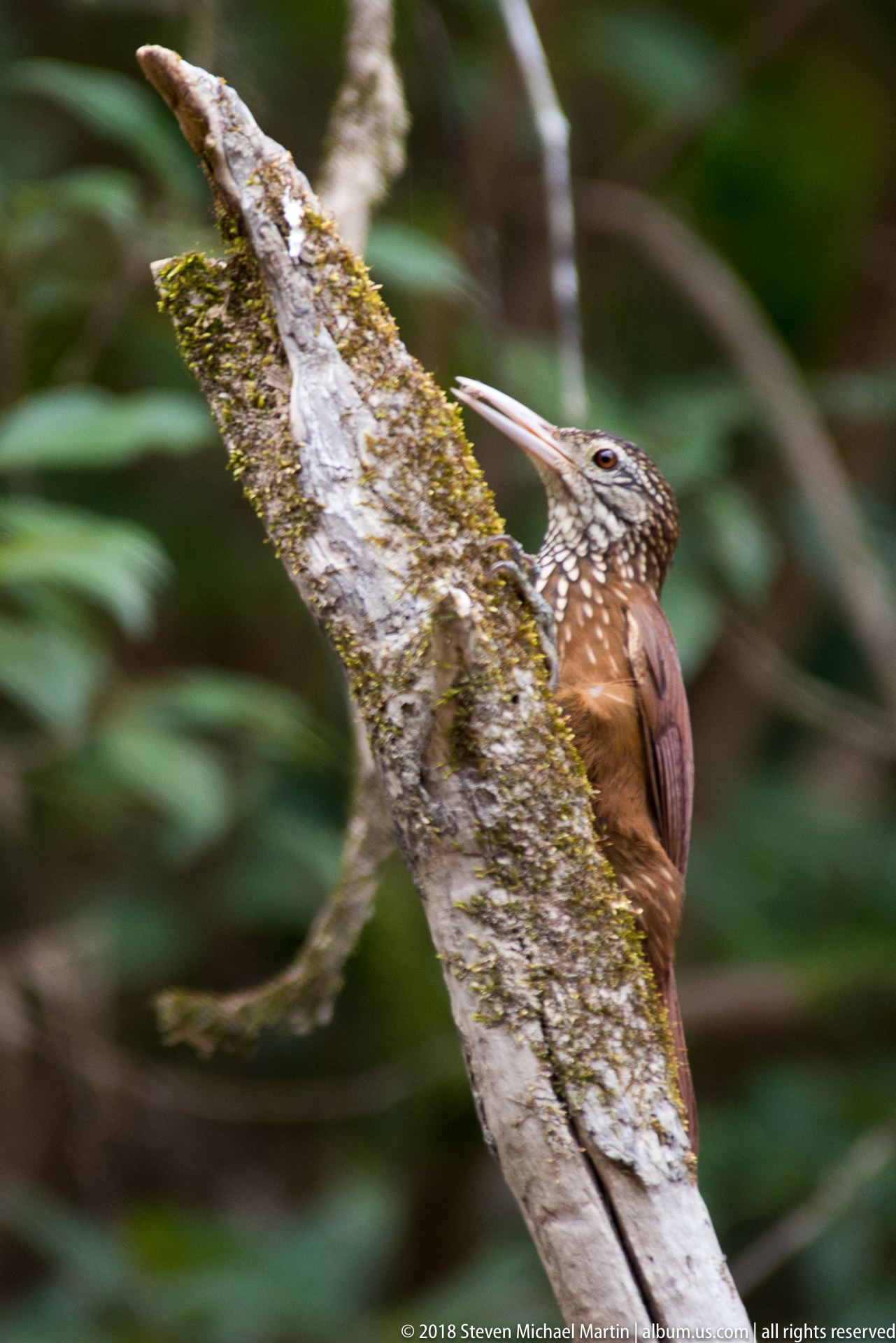
A rufous-brown woodcreeper clings vertically to a moss-coated trunk, bracing itself with its tail while angling a long, slightly curved bill upward. Pale spotting on the throat and upper breast breaks up the warm brown plumage. The classic trunk-foraging posture and stiff tail clearly place the bird among the woodcreepers, though the proof sheet does not support a secure species assignment.
Caption
A rufous-brown woodcreeper clings vertically to a moss-coated trunk, bracing itself with its tail while angling a long, slightly curved bill upward. Pale spotting on the throat and upper breast breaks up the warm brown plumage. The classic trunk-foraging posture and stiff tail clearly place the bird among the woodcreepers, though the proof sheet does not support a secure species assignment.
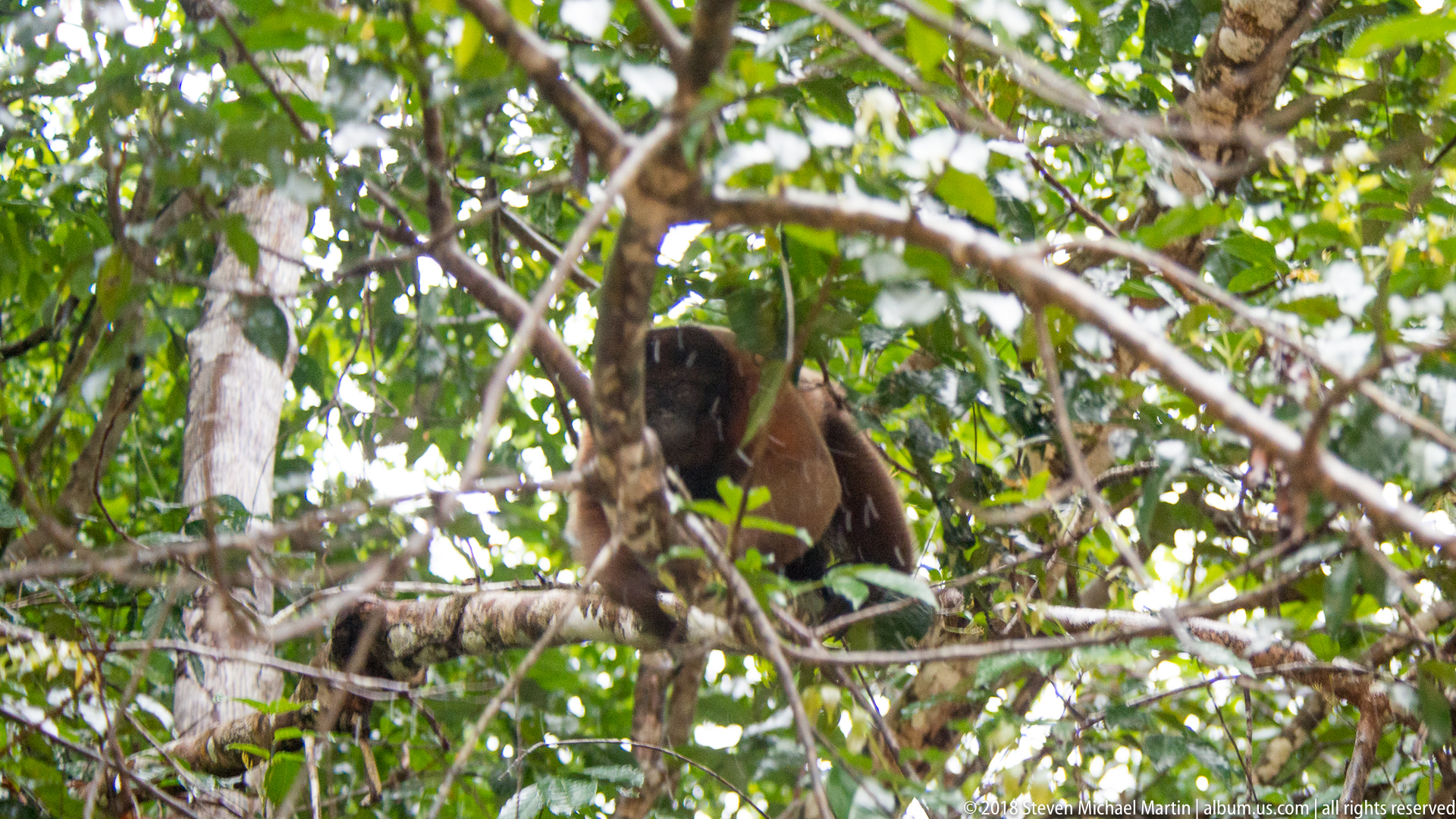
A stocky brown monkey sits partly concealed among crossing branches and dense green foliage above the Blanco River forest. Its rounded body, dark face, and thick coat are visible through the leaves, while the surrounding canopy establishes the animal's arboreal setting. The view favors habitat and posture over a diagnostic close-up, so the identification is kept at a conservative monkey level.
Caption
A stocky brown monkey sits partly concealed among crossing branches and dense green foliage above the Blanco River forest. Its rounded body, dark face, and thick coat are visible through the leaves, while the surrounding canopy establishes the animal's arboreal setting. The view favors habitat and posture over a diagnostic close-up, so the identification is kept at a conservative monkey level.
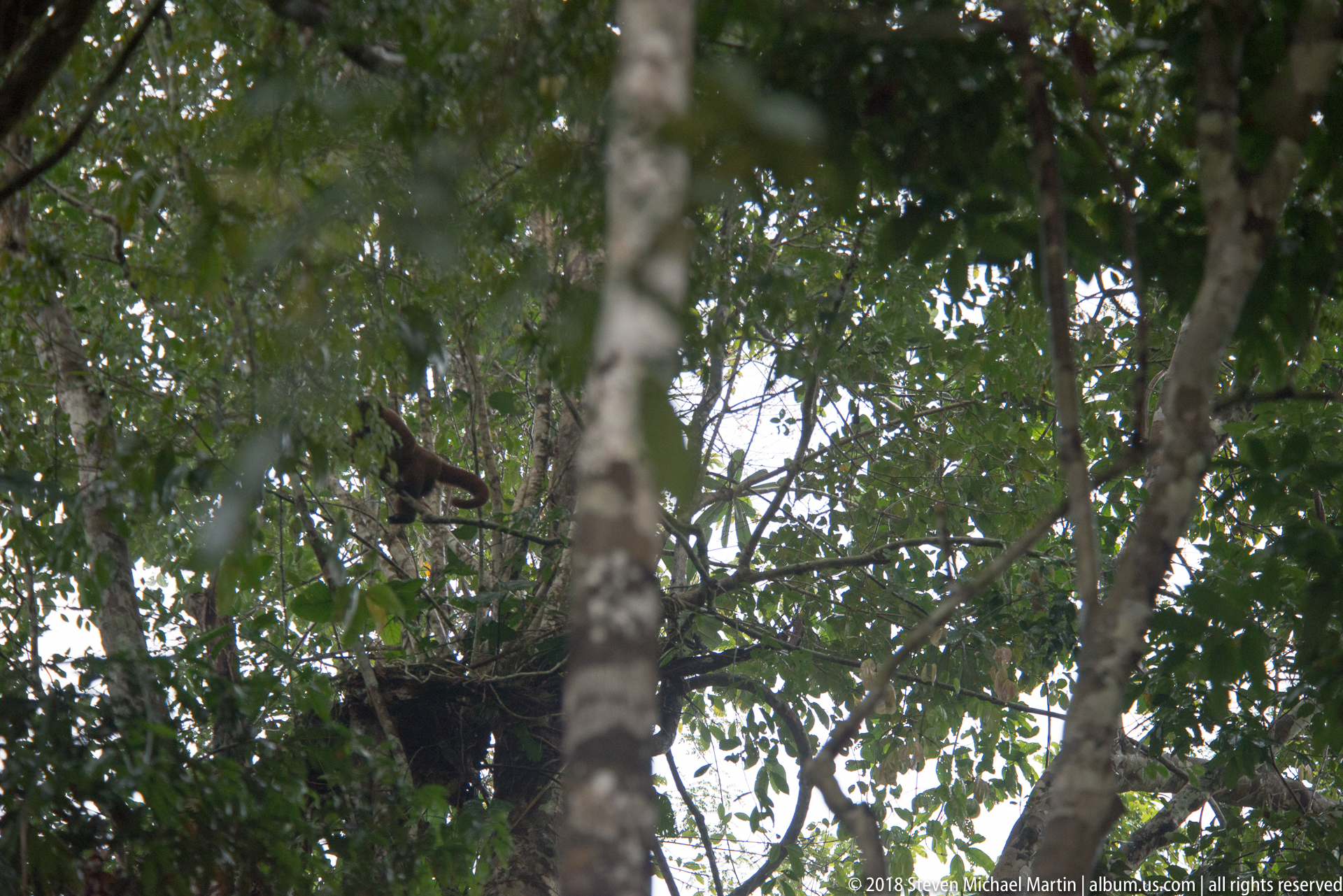
A large dark bird perches high in the rainforest canopy, reduced to a silhouette by backlighting and a screen of trunks, vines, and leaves. The distant viewpoint makes the layered forest structure as important as the bird itself. Because plumage, bill shape, and other diagnostic features are obscured, the record preserves the scene without forcing a species identification.
Caption
A large dark bird perches high in the rainforest canopy, reduced to a silhouette by backlighting and a screen of trunks, vines, and leaves. The distant viewpoint makes the layered forest structure as important as the bird itself. Because plumage, bill shape, and other diagnostic features are obscured, the record preserves the scene without forcing a species identification.

A large toucan pauses on a branch with its oversized dark bill held slightly open. The bird shows a black body, broad white throat and breast, blue skin around the eye, and a yellow-toned upper bill, a combination characteristic of the large Ramphastos toucans of western Amazonia. The close side view records both the bill profile and the bird's alert canopy posture.
Caption
A large toucan pauses on a branch with its oversized dark bill held slightly open. The bird shows a black body, broad white throat and breast, blue skin around the eye, and a yellow-toned upper bill, a combination characteristic of the large Ramphastos toucans of western Amazonia. The close side view records both the bill profile and the bird's alert canopy posture.
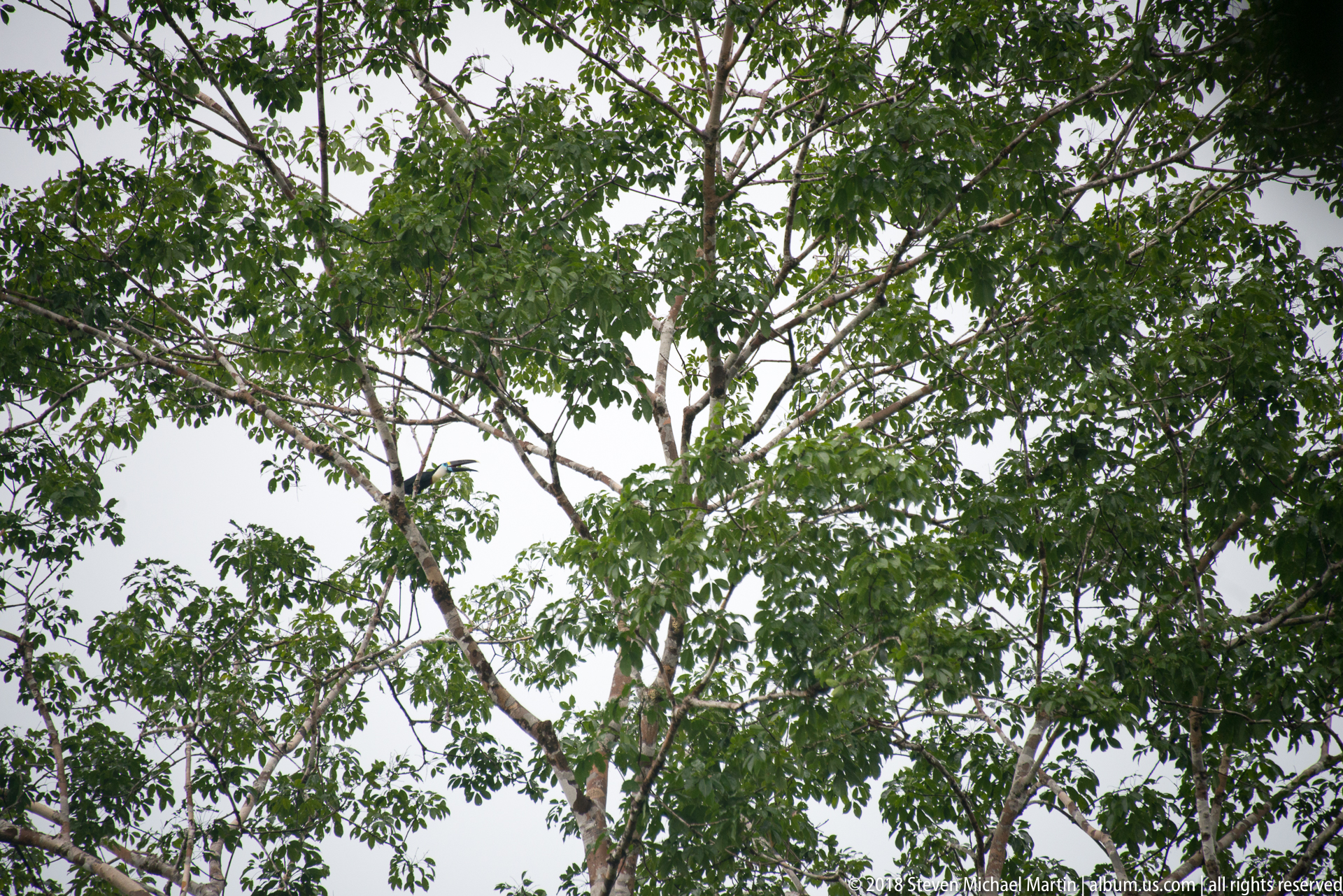
A toucan appears near the crown of a tall rainforest tree, its black-and-white body small against a broad lattice of pale branches and green leaves. Unlike the neighboring close views, this frame emphasizes scale and habitat, showing how the bird occupies the upper canopy. The distant perspective supports a toucan identification while leaving species-level plumage details unresolved.
Caption
A toucan appears near the crown of a tall rainforest tree, its black-and-white body small against a broad lattice of pale branches and green leaves. Unlike the neighboring close views, this frame emphasizes scale and habitat, showing how the bird occupies the upper canopy. The distant perspective supports a toucan identification while leaving species-level plumage details unresolved.

A large toucan stands on a horizontal branch while trunks and leaves partially screen its body. The pale throat, black plumage, blue orbital skin, and long bill remain visible despite the intervening vegetation. This frame records the bird as encountered within the canopy rather than isolating it against open sky, preserving the dense structural character of its rainforest habitat.
Caption
A large toucan stands on a horizontal branch while trunks and leaves partially screen its body. The pale throat, black plumage, blue orbital skin, and long bill remain visible despite the intervening vegetation. This frame records the bird as encountered within the canopy rather than isolating it against open sky, preserving the dense structural character of its rainforest habitat.

An upright toucan fills the center of the frame, its white throat and breast contrasting sharply with a black body and the surrounding green canopy. Blue skin around the eye and the long, heavy bill are especially prominent in this angle. Branches frame the bird on several sides, giving a clear portrait while retaining the forest context of the Blanco River.
Caption
An upright toucan fills the center of the frame, its white throat and breast contrasting sharply with a black body and the surrounding green canopy. Blue skin around the eye and the long, heavy bill are especially prominent in this angle. Branches frame the bird on several sides, giving a clear portrait while retaining the forest context of the Blanco River.
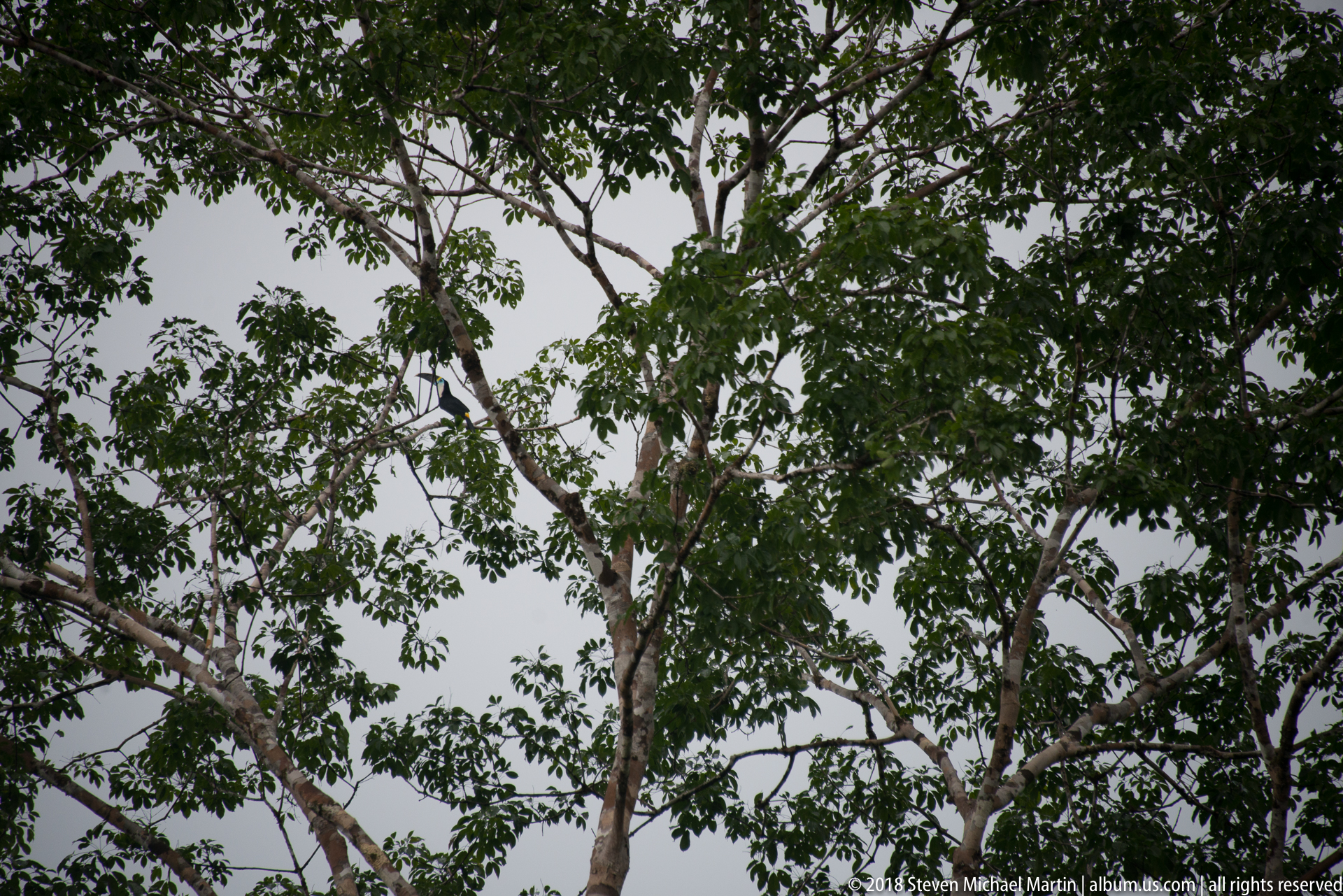
A distant toucan occupies an exposed branch near the top of a mature rainforest tree. The bird is small within the composition, allowing the spreading crown, layered leaves, and pale sky to dominate the frame. This contextual view complements the closer portraits by showing the scale of the upper canopy used by large fruit-eating birds along the Blanco River.
Caption
A distant toucan occupies an exposed branch near the top of a mature rainforest tree. The bird is small within the composition, allowing the spreading crown, layered leaves, and pale sky to dominate the frame. This contextual view complements the closer portraits by showing the scale of the upper canopy used by large fruit-eating birds along the Blanco River.
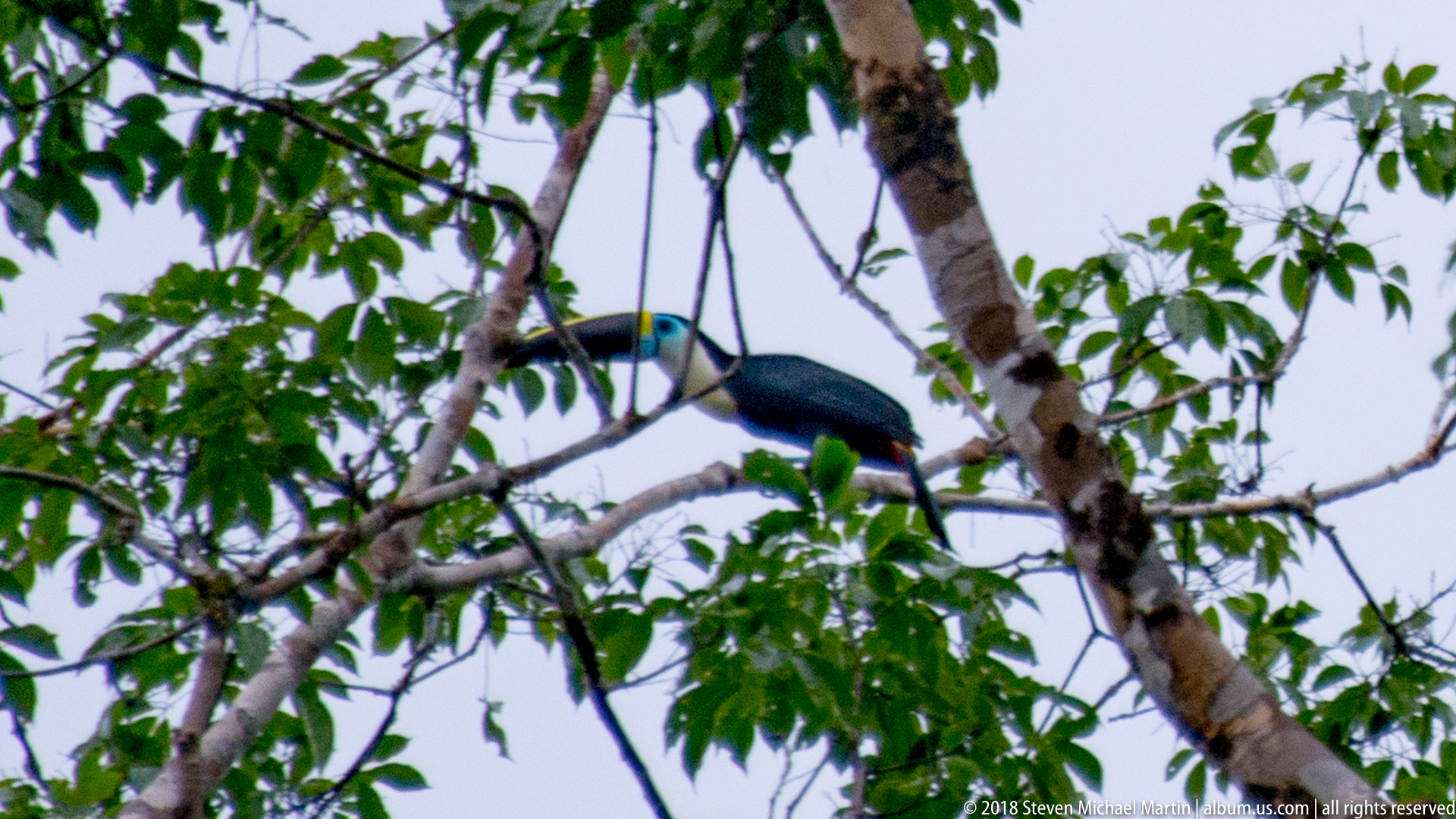
A large toucan stands lengthwise on a horizontal branch, giving a clear side profile of its oversized bill, blue orbital skin, white throat, and dark body. The bird is surrounded by fresh green leaves and pale trunks, with enough open space to reveal its full stance. The composition is especially useful for comparing bill proportions and posture with the neighboring canopy views.
Caption
A large toucan stands lengthwise on a horizontal branch, giving a clear side profile of its oversized bill, blue orbital skin, white throat, and dark body. The bird is surrounded by fresh green leaves and pale trunks, with enough open space to reveal its full stance. The composition is especially useful for comparing bill proportions and posture with the neighboring canopy views.
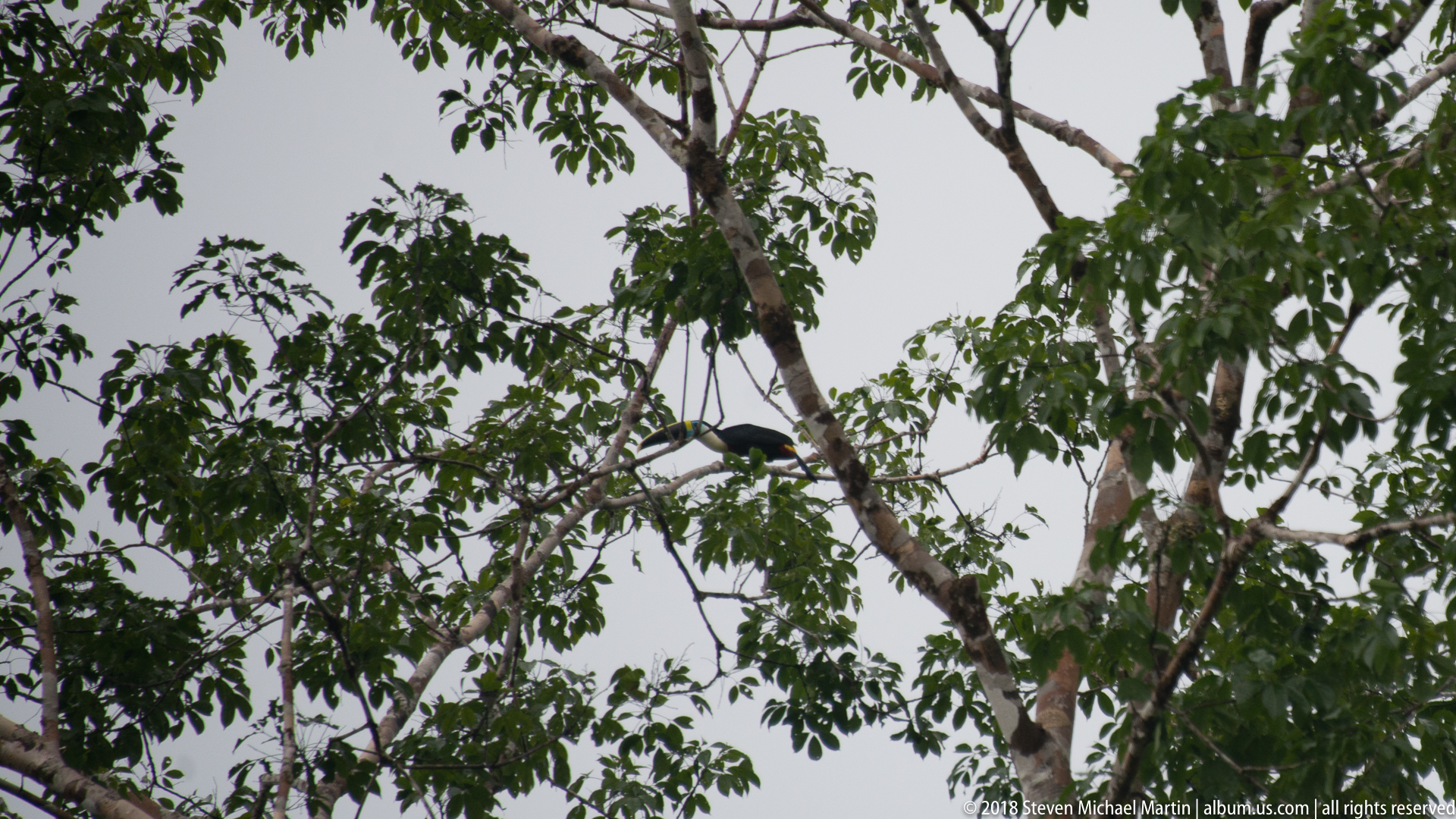
A dark bird perches on an angled branch in the upper canopy, surrounded by widely spaced leaves and pale sky. The frame is primarily a habitat view: the bird's silhouette and longish tail are visible, but color, bill form, and facial markings are not. The conservative identification avoids carrying the neighboring toucan sequence into an image that does not independently show diagnostic features.
Caption
A dark bird perches on an angled branch in the upper canopy, surrounded by widely spaced leaves and pale sky. The frame is primarily a habitat view: the bird's silhouette and longish tail are visible, but color, bill form, and facial markings are not. The conservative identification avoids carrying the neighboring toucan sequence into an image that does not independently show diagnostic features.

A woodcreeper clings beside a mossy branch junction with its body angled downward and chestnut tail hanging below. Its long pale bill, patterned head, and spotted throat remain visible despite the branch crossing the center of the frame. The unusual angle records the bird negotiating a complex tangle rather than resting in the standard vertical trunk posture.
Caption
A woodcreeper clings beside a mossy branch junction with its body angled downward and chestnut tail hanging below. Its long pale bill, patterned head, and spotted throat remain visible despite the branch crossing the center of the frame. The unusual angle records the bird negotiating a complex tangle rather than resting in the standard vertical trunk posture.
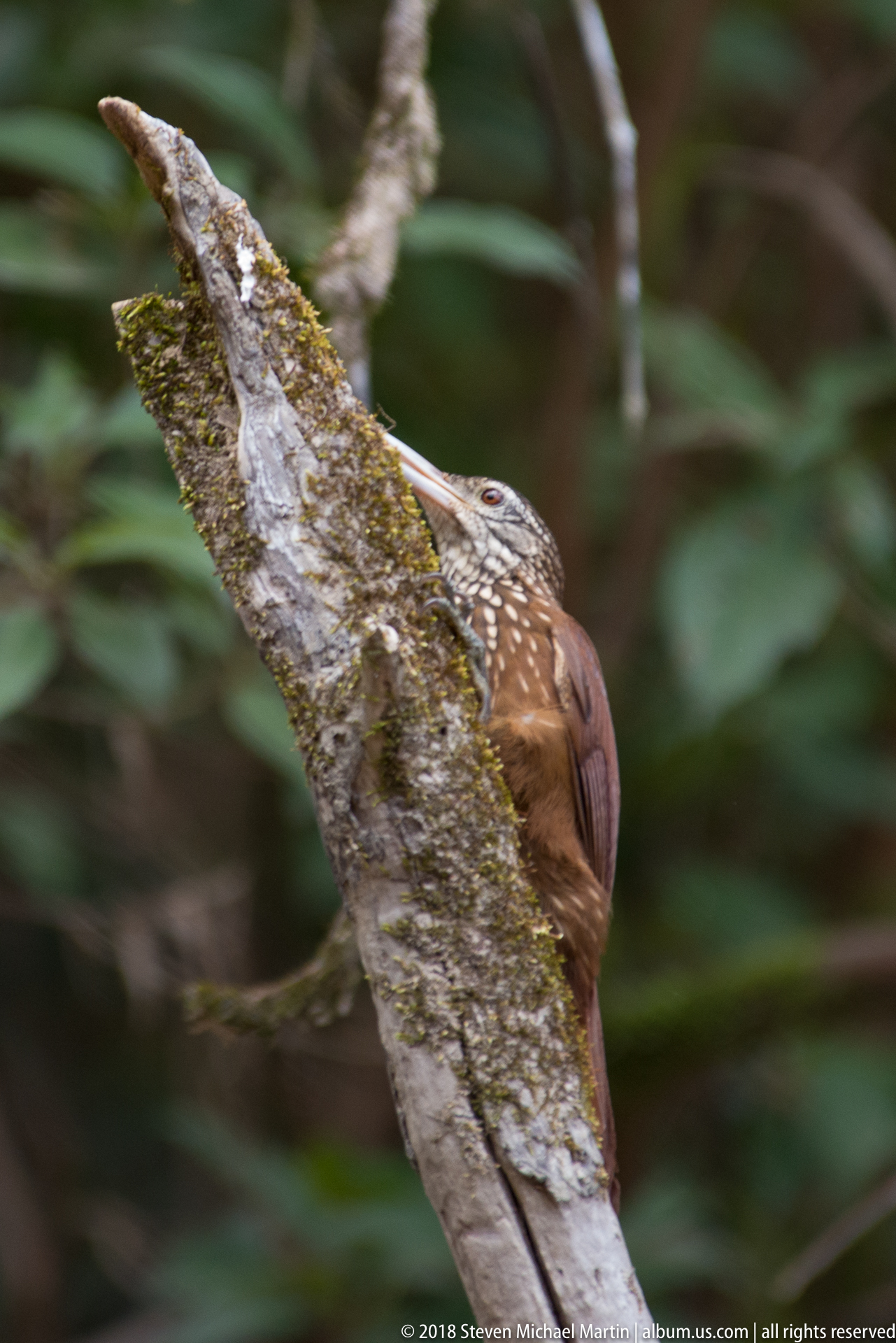
A woodcreeper peers from the far side of a mossy trunk, exposing its long bill, patterned head and breast, and rich rufous wing while most of the body remains concealed. The close composition highlights camouflage and trunk-clinging behavior rather than a full field-guide profile. Pale spotting is conspicuous, but not distinctive enough here to justify a species-level name.
Caption
A woodcreeper peers from the far side of a mossy trunk, exposing its long bill, patterned head and breast, and rich rufous wing while most of the body remains concealed. The close composition highlights camouflage and trunk-clinging behavior rather than a full field-guide profile. Pale spotting is conspicuous, but not distinctive enough here to justify a species-level name.

A rufous woodcreeper grips the side of a pale trunk in a nearly full profile, showing a long pointed bill, warm chestnut wings and tail, and dense pale spotting across the throat and upper breast. Its feet and stiff tail brace the bird against the bark. This is the clearest view in the sequence for documenting the characteristic body plan and climbing posture of a woodcreeper.
Caption
A rufous woodcreeper grips the side of a pale trunk in a nearly full profile, showing a long pointed bill, warm chestnut wings and tail, and dense pale spotting across the throat and upper breast. Its feet and stiff tail brace the bird against the bark. This is the clearest view in the sequence for documenting the characteristic body plan and climbing posture of a woodcreeper.

A rufous woodcreeper moves through a fork of dark branches, its long bill projecting beyond the trunk while its chestnut tail extends to the right. Pale spotting covers the throat and upperparts visible above the branch. The crossing limbs partially conceal the bird, producing a behavioral forest view that differs from the more open trunk portraits in the same sequence.
Caption
A rufous woodcreeper moves through a fork of dark branches, its long bill projecting beyond the trunk while its chestnut tail extends to the right. Pale spotting covers the throat and upperparts visible above the branch. The crossing limbs partially conceal the bird, producing a behavioral forest view that differs from the more open trunk portraits in the same sequence.
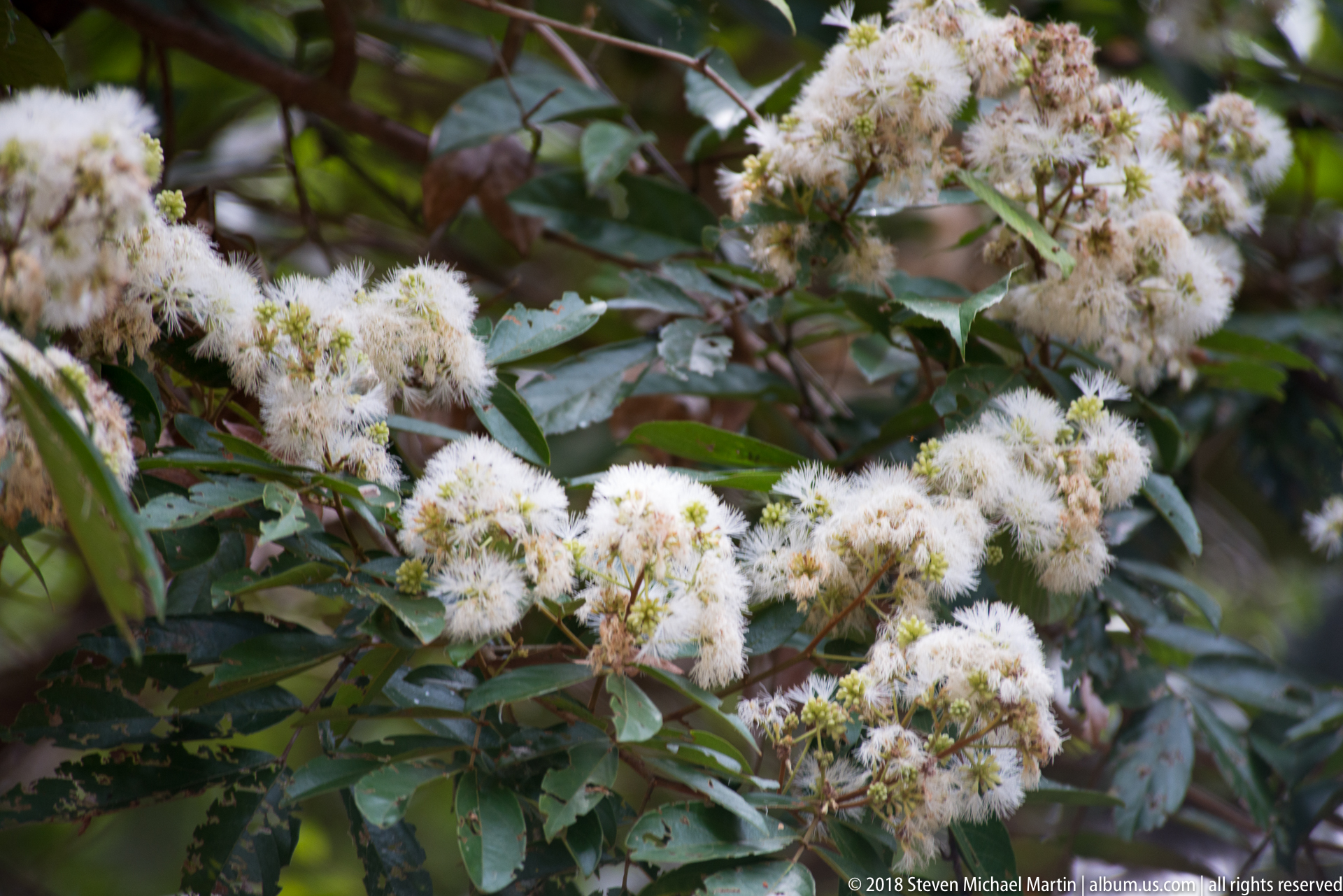
Dense clusters of white, brush-like flowers cover the outer branches of a rainforest tree, their numerous stamens creating a soft, tufted texture against narrow green leaves. The frame shifts attention from birds to plant life along the Blanco River, documenting a conspicuous flowering event in the forest canopy. No species name is assigned because leaf and floral details are insufficient for a secure botanical identification.
Caption
Dense clusters of white, brush-like flowers cover the outer branches of a rainforest tree, their numerous stamens creating a soft, tufted texture against narrow green leaves. The frame shifts attention from birds to plant life along the Blanco River, documenting a conspicuous flowering event in the forest canopy. No species name is assigned because leaf and floral details are insufficient for a secure botanical identification.

A vivid red-and-black bird moves behind pale green leaves and thin branches, with the saturated red underparts and dark wings and tail providing the principal field marks. The bird is close enough to establish its striking color pattern but too obstructed to evaluate bill shape, head pattern, or body proportions confidently. The caption therefore preserves a descriptive identification rather than forcing a species.
Caption
A vivid red-and-black bird moves behind pale green leaves and thin branches, with the saturated red underparts and dark wings and tail providing the principal field marks. The bird is close enough to establish its striking color pattern but too obstructed to evaluate bill shape, head pattern, or body proportions confidently. The caption therefore preserves a descriptive identification rather than forcing a species.

A Yellow-rumped Cacique perches in profile on the cut end of a palm frond, presenting its bold plumage at close range. Glossy black feathers surround a brilliant yellow wing patch and rump, while a pale pointed bill and striking blue iris stand out on the head. This portrait provides a particularly clear set of field marks for the common Amazonian cacique.
Caption
A Yellow-rumped Cacique perches in profile on the cut end of a palm frond, presenting its bold plumage at close range. Glossy black feathers surround a brilliant yellow wing patch and rump, while a pale pointed bill and striking blue iris stand out on the head. This portrait provides a particularly clear set of field marks for the common Amazonian cacique.

A Yellow-rumped Cacique leans forward along a dried palm frond beneath arching palm leaves. The wider composition places the bird within its tropical vegetation, while the black body and broad yellow rump remain conspicuous even at greater distance. Its posture differs from the adjacent portraits, showing the bird actively balancing and looking downward from the palm.
Caption
A Yellow-rumped Cacique leans forward along a dried palm frond beneath arching palm leaves. The wider composition places the bird within its tropical vegetation, while the black body and broad yellow rump remain conspicuous even at greater distance. Its posture differs from the adjacent portraits, showing the bird actively balancing and looking downward from the palm.

A Yellow-rumped Cacique bends forward on a dried palm frond while its brilliant yellow rump feathers flare into a rounded fan. The bird's black back and folded wings frame the yellow plumage, and its pale bill points toward the vegetation below. This unusual posture turns the species' defining rump patch into the visual focus of the frame.
Caption
A Yellow-rumped Cacique bends forward on a dried palm frond while its brilliant yellow rump feathers flare into a rounded fan. The bird's black back and folded wings frame the yellow plumage, and its pale bill points toward the vegetation below. This unusual posture turns the species' defining rump patch into the visual focus of the frame.
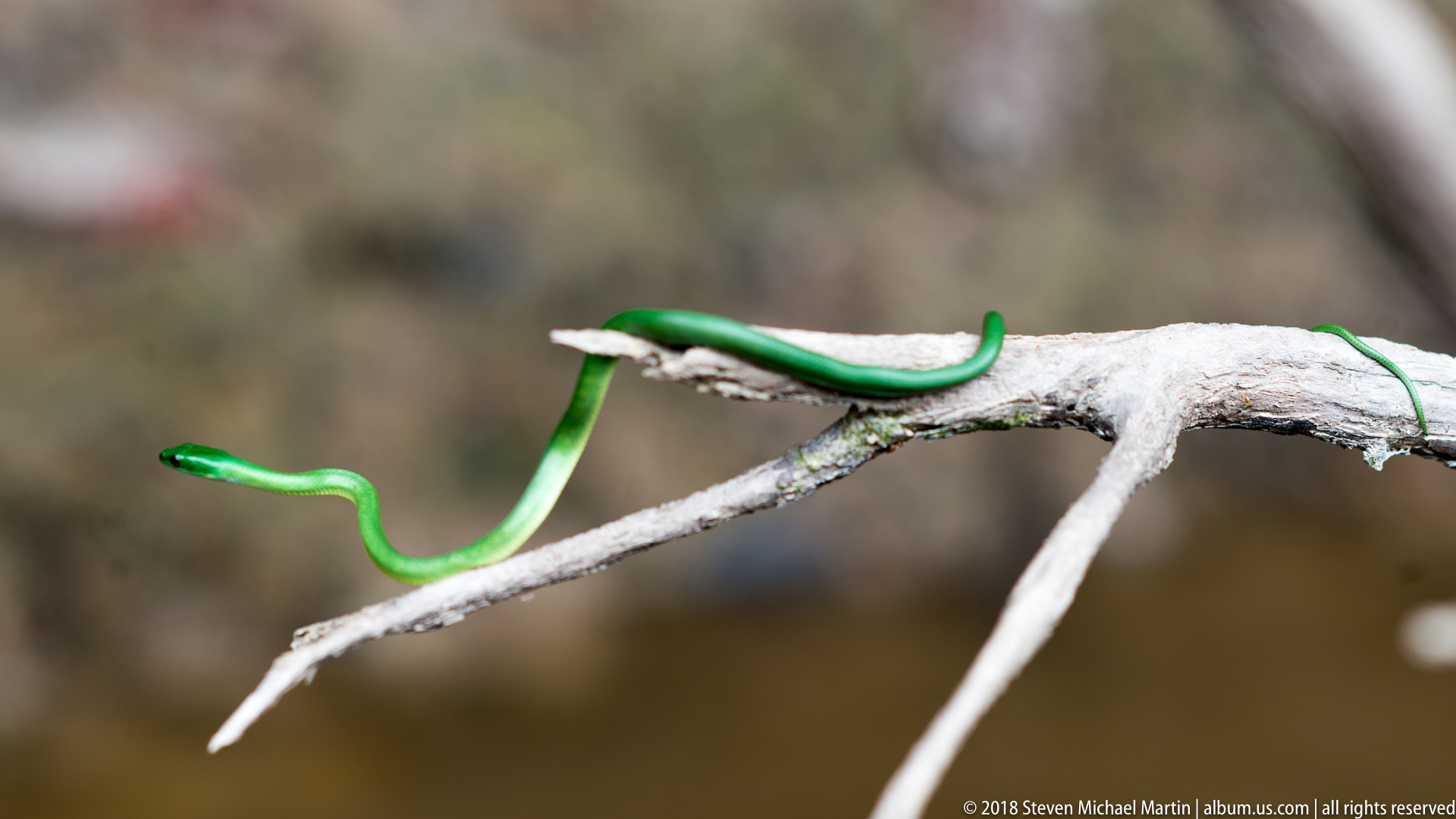
A slender emerald-green snake extends across a pale, weathered branch, its narrow body forming loose curves against a softly blurred forest background. The elongated build and arboreal posture are consistent with the green parrot snakes and other vine-like colubrids of tropical South America. Because the head is small in the frame, the public identification remains descriptive rather than species-specific.
Caption
A slender emerald-green snake extends across a pale, weathered branch, its narrow body forming loose curves against a softly blurred forest background. The elongated build and arboreal posture are consistent with the green parrot snakes and other vine-like colubrids of tropical South America. Because the head is small in the frame, the public identification remains descriptive rather than species-specific.
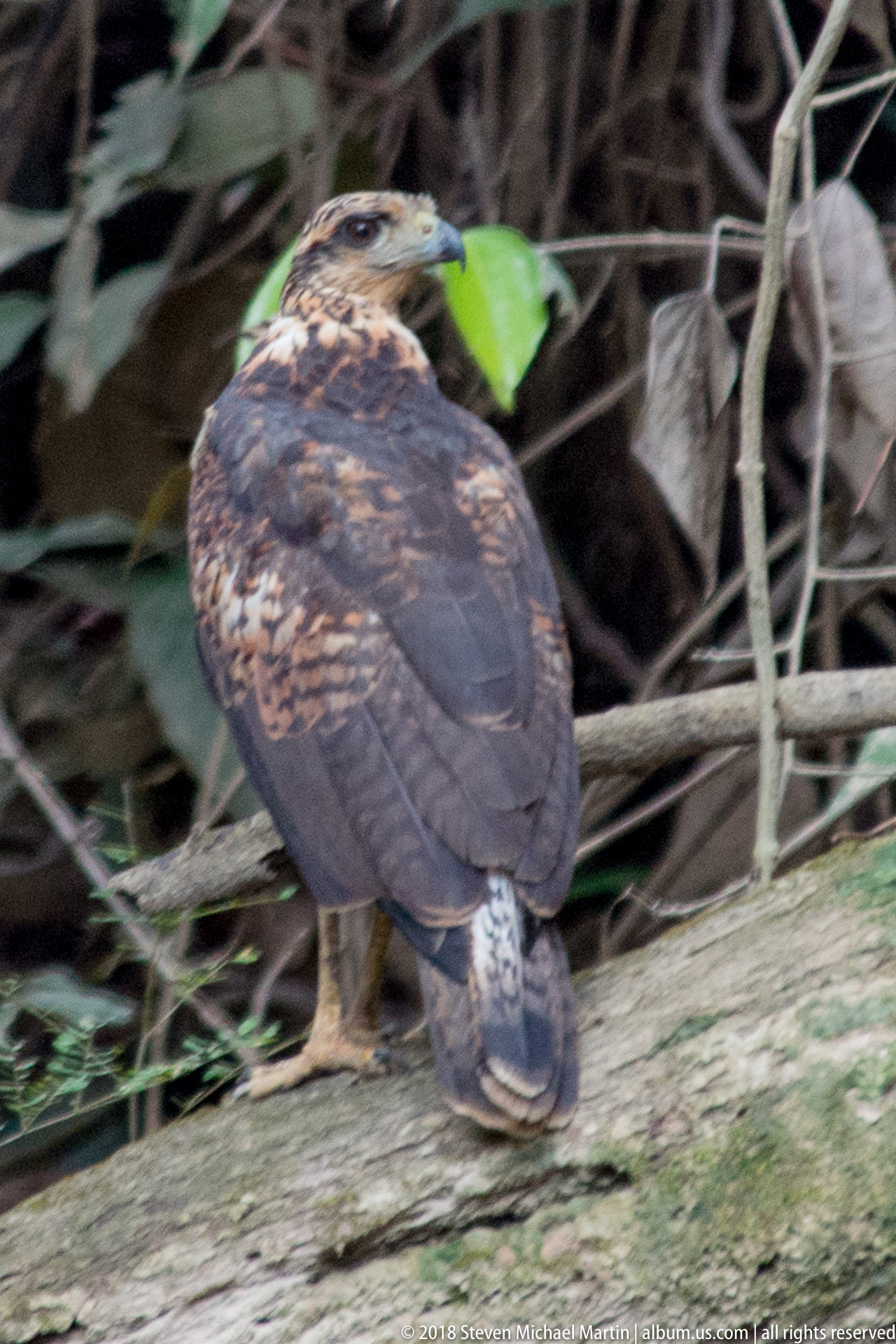
A juvenile-looking forest raptor rests on a fallen trunk at the edge of dense understory. Its dark brown upperparts are mottled with buff, the tail shows broad pale-and-dark bands, and sturdy yellow legs support a compact hawk-like body. These features establish a diurnal raptor, but the proof sheet does not resolve the head and breast pattern well enough for a defensible species assignment.
Caption
A juvenile-looking forest raptor rests on a fallen trunk at the edge of dense understory. Its dark brown upperparts are mottled with buff, the tail shows broad pale-and-dark bands, and sturdy yellow legs support a compact hawk-like body. These features establish a diurnal raptor, but the proof sheet does not resolve the head and breast pattern well enough for a defensible species assignment.
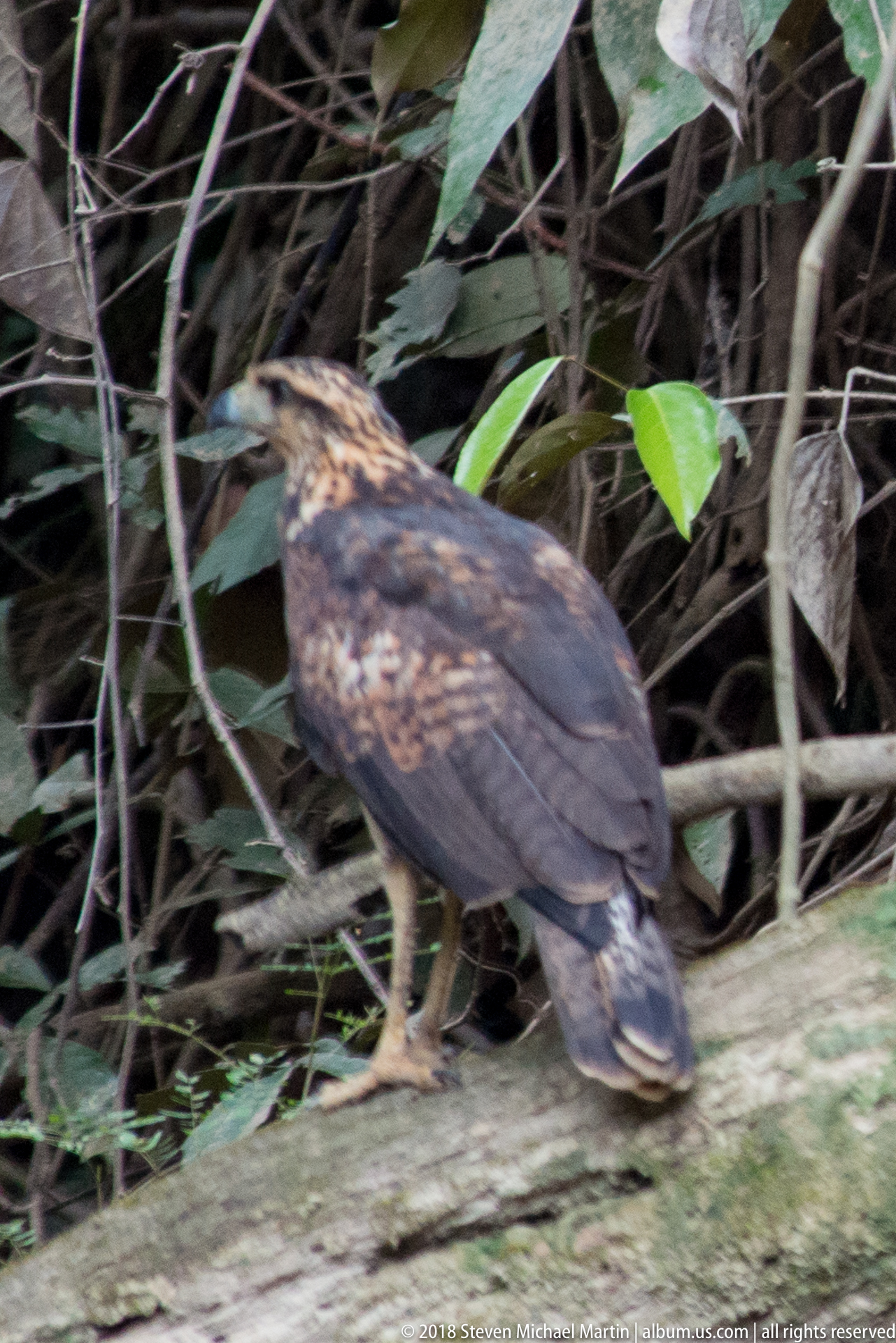
A mottled brown raptor stands sideways on a fallen log, showing a compact body, strong yellow legs, and a barred tail tucked behind the perch. Buff flecking across the back and shoulders suggests immature plumage. The side view gives a clearer sense of body proportions than the neighboring frame, yet the blurred head still prevents a reliable species-level identification.
Caption
A mottled brown raptor stands sideways on a fallen log, showing a compact body, strong yellow legs, and a barred tail tucked behind the perch. Buff flecking across the back and shoulders suggests immature plumage. The side view gives a clearer sense of body proportions than the neighboring frame, yet the blurred head still prevents a reliable species-level identification.
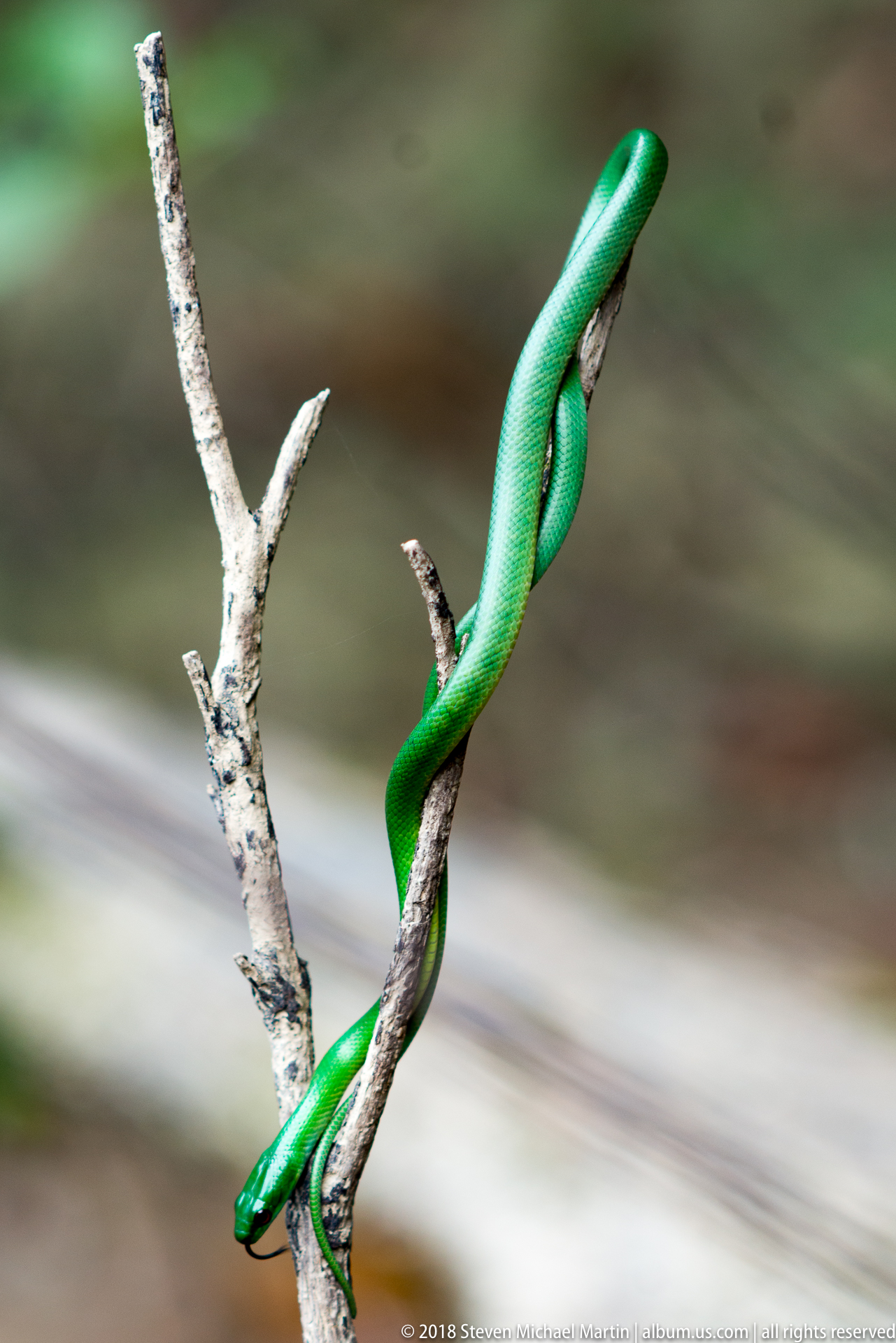
A bright green arboreal snake winds tightly around a forked twig, using several coils to anchor its long, narrow body above the forest floor. The smooth-looking green dorsum stands out against the pale bark and blurred brown-green background. Its vine-like proportions suggest an agile branch-dwelling colubrid, but the available view does not justify a precise taxonomic name.
Caption
A bright green arboreal snake winds tightly around a forked twig, using several coils to anchor its long, narrow body above the forest floor. The smooth-looking green dorsum stands out against the pale bark and blurred brown-green background. Its vine-like proportions suggest an agile branch-dwelling colubrid, but the available view does not justify a precise taxonomic name.
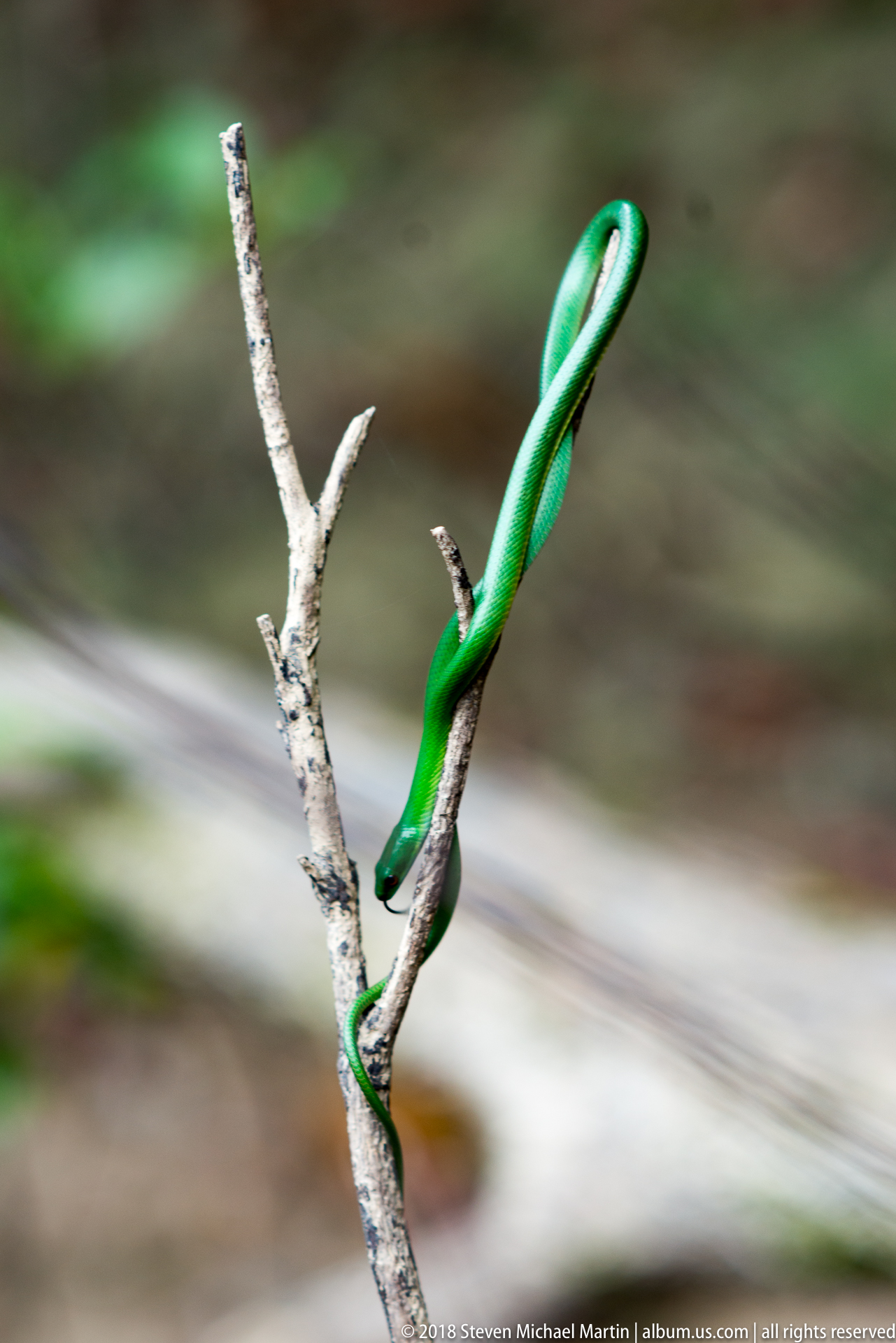
A slender green snake loops over the top of an upright forked branch, its body descending in a smooth curve before wrapping around the wood. The elevated perch and elongated form emphasize its arboreal adaptation, while the shallow depth of field isolates the reptile from the forest background. Species-level identification is withheld because diagnostic head characters are not clearly visible.
Caption
A slender green snake loops over the top of an upright forked branch, its body descending in a smooth curve before wrapping around the wood. The elevated perch and elongated form emphasize its arboreal adaptation, while the shallow depth of field isolates the reptile from the forest background. Species-level identification is withheld because diagnostic head characters are not clearly visible.
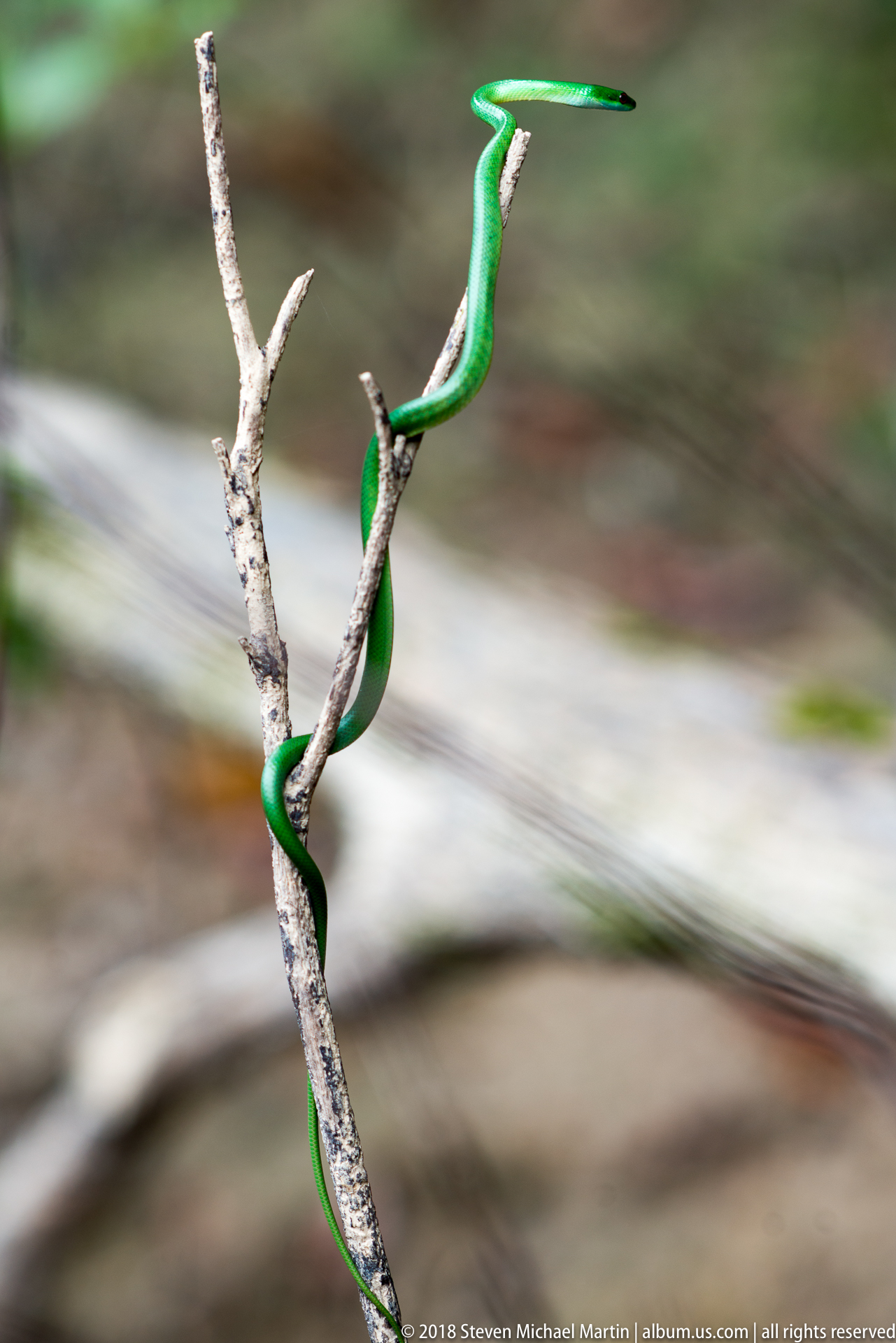
A slender emerald-green snake winds upward around a pale forked branch, its long body forming tight curves before the head extends into open space. The narrow build and elevated posture are characteristic of an arboreal forest snake. The image clearly records climbing behavior and camouflage against vegetation, but the proof sheet does not provide enough head or scale detail for a secure species identification.
Caption
A slender emerald-green snake winds upward around a pale forked branch, its long body forming tight curves before the head extends into open space. The narrow build and elevated posture are characteristic of an arboreal forest snake. The image clearly records climbing behavior and camouflage against vegetation, but the proof sheet does not provide enough head or scale detail for a secure species identification.
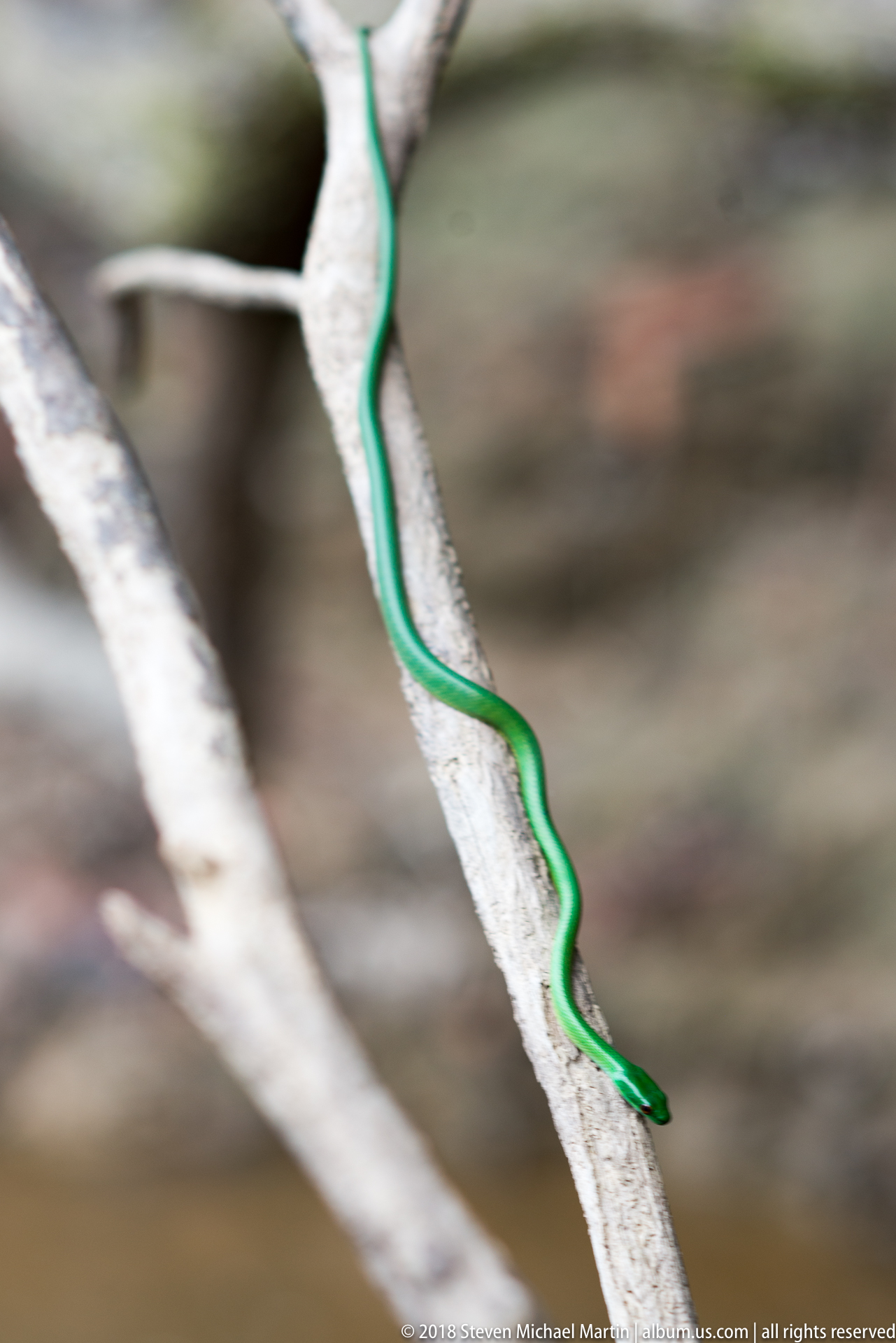
A bright green snake descends an angled pale branch, its body pressed close to the wood before the head points downward. The shallow depth of field isolates the reptile from the forest background and highlights the contrast between green scales and weathered bark. The long, narrow proportions again indicate an arboreal species, though not enough diagnostic anatomy is visible for a precise identification.
Caption
A bright green snake descends an angled pale branch, its body pressed close to the wood before the head points downward. The shallow depth of field isolates the reptile from the forest background and highlights the contrast between green scales and weathered bark. The long, narrow proportions again indicate an arboreal species, though not enough diagnostic anatomy is visible for a precise identification.
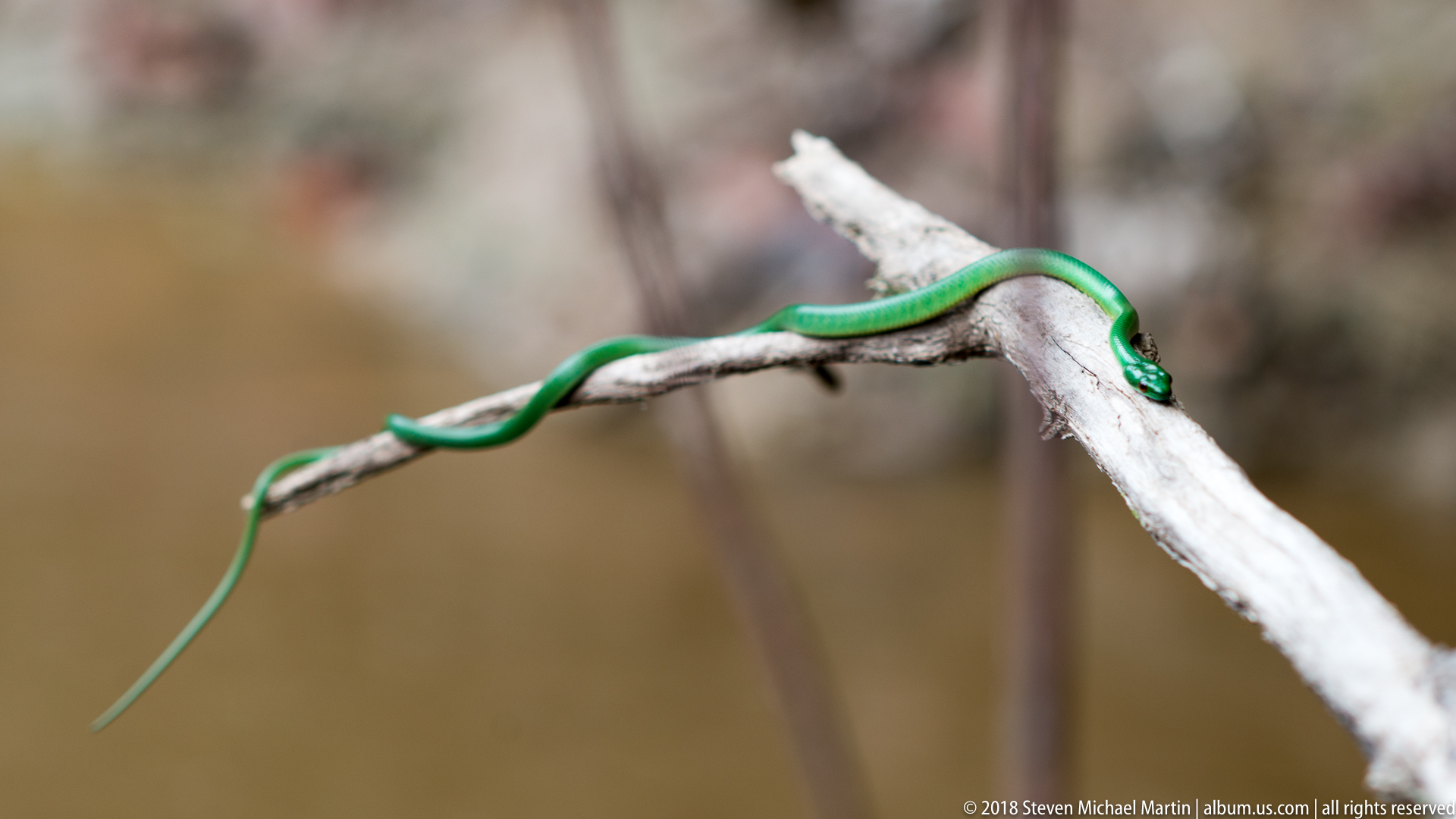
A bright green snake follows the contour of a narrow branch, then bends its head downward over a broken fork. Its elongated body remains closely aligned with the wood, demonstrating the vine-like profile that helps many arboreal snakes disappear among stems and foliage. The close view improves the head silhouette, yet diagnostic markings are still insufficient for a defensible species name.
Caption
A bright green snake follows the contour of a narrow branch, then bends its head downward over a broken fork. Its elongated body remains closely aligned with the wood, demonstrating the vine-like profile that helps many arboreal snakes disappear among stems and foliage. The close view improves the head silhouette, yet diagnostic markings are still insufficient for a defensible species name.
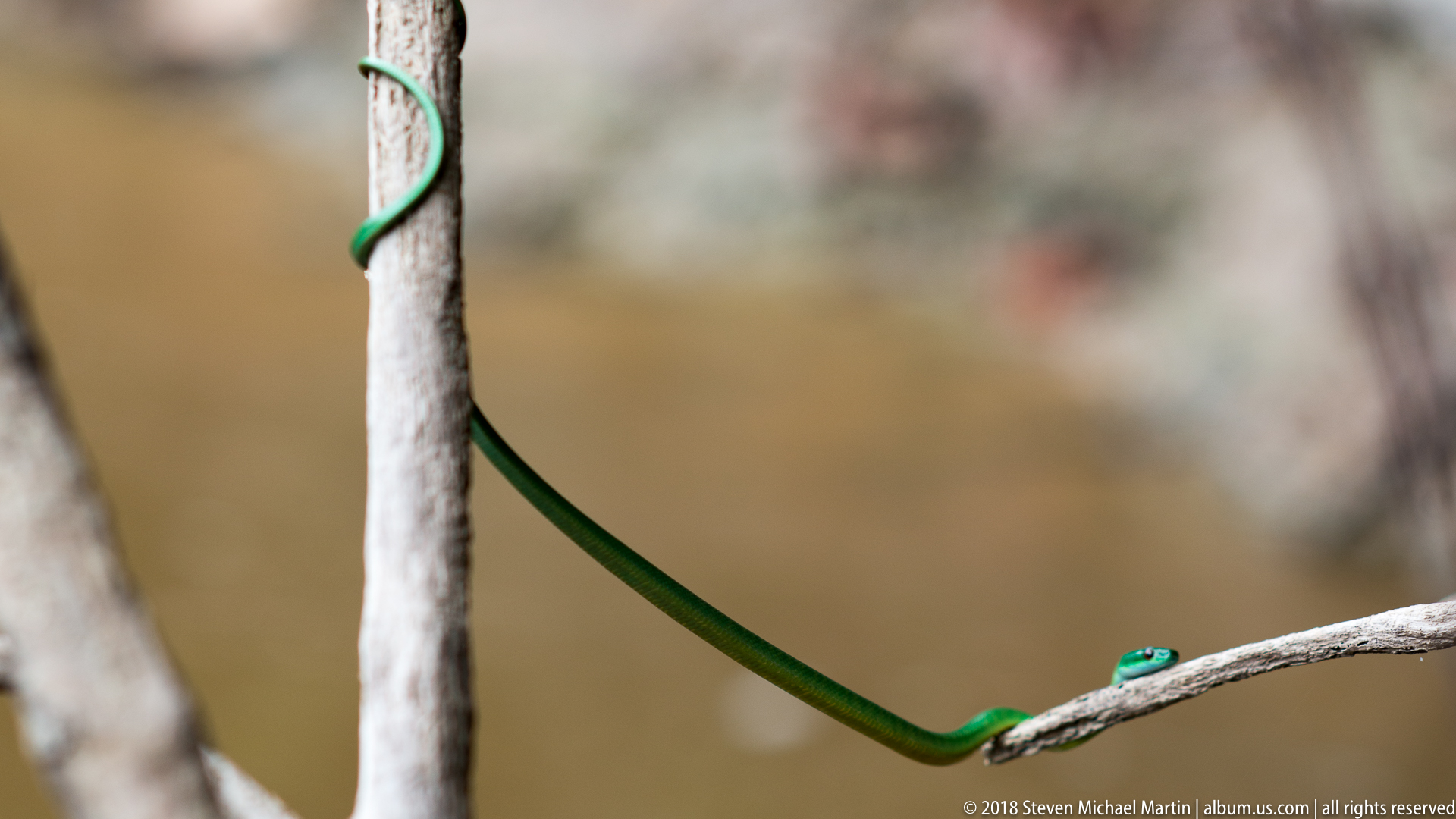
A slender green snake threads behind a pale vertical trunk and reappears along a horizontal branch, leaving only sections of its body visible at once. The composition emphasizes how easily its narrow, leaf-colored form blends into a tangle of woody stems. The head is visible at lower right, but the interrupted view remains better suited to a descriptive arboreal-snake identification than a species-level claim.
Caption
A slender green snake threads behind a pale vertical trunk and reappears along a horizontal branch, leaving only sections of its body visible at once. The composition emphasizes how easily its narrow, leaf-colored form blends into a tangle of woody stems. The head is visible at lower right, but the interrupted view remains better suited to a descriptive arboreal-snake identification than a species-level claim.
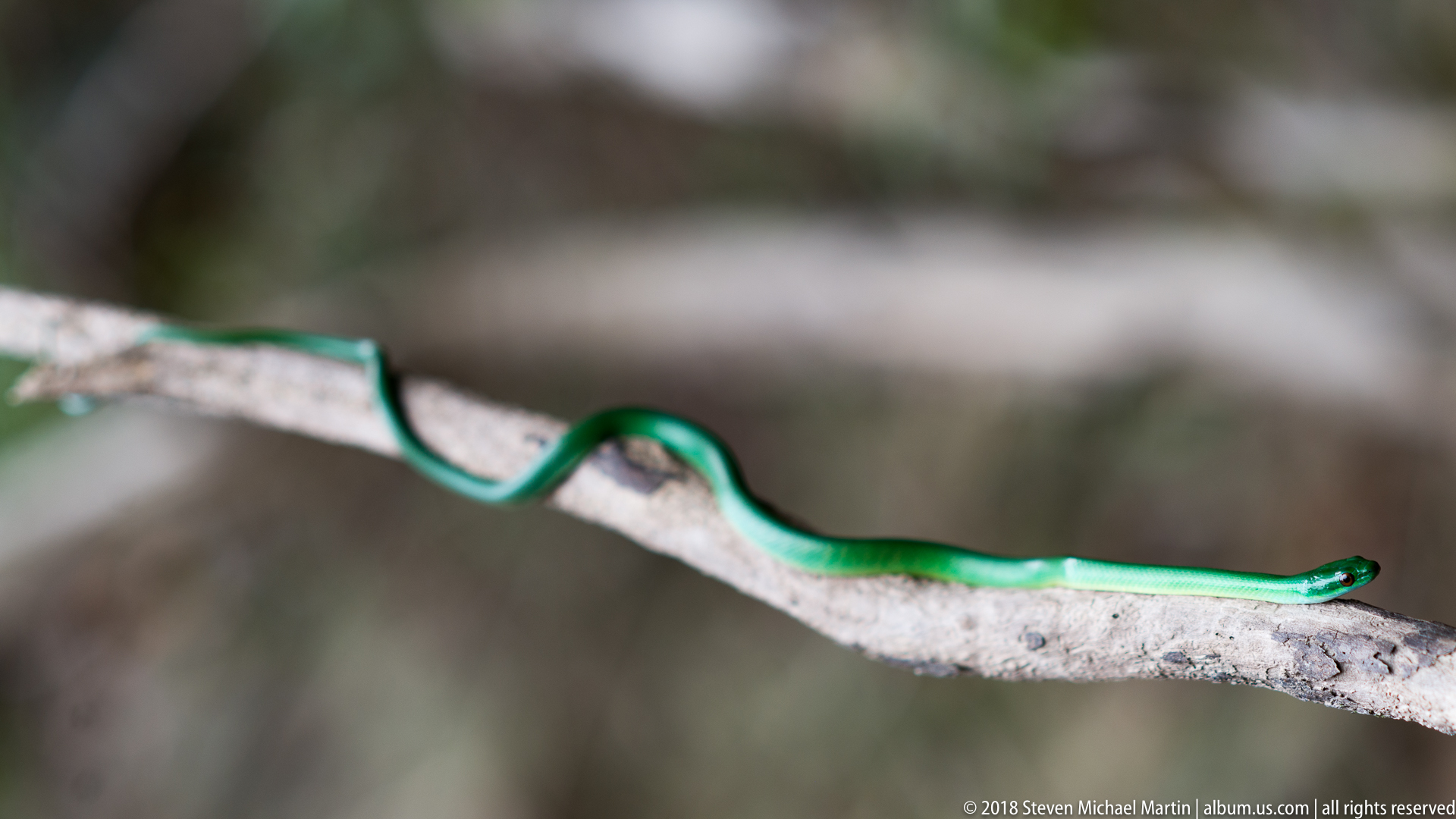
A slender green snake lies almost fully extended along a horizontal branch, its body making only a few low curves before the head reaches the far right edge. This profile shows the animal's exceptionally elongated proportions more clearly than the tighter coils in neighboring frames. The streamlined form and branch use support an arboreal green snake identification while leaving species unresolved.
Caption
A slender green snake lies almost fully extended along a horizontal branch, its body making only a few low curves before the head reaches the far right edge. This profile shows the animal's exceptionally elongated proportions more clearly than the tighter coils in neighboring frames. The streamlined form and branch use support an arboreal green snake identification while leaving species unresolved.
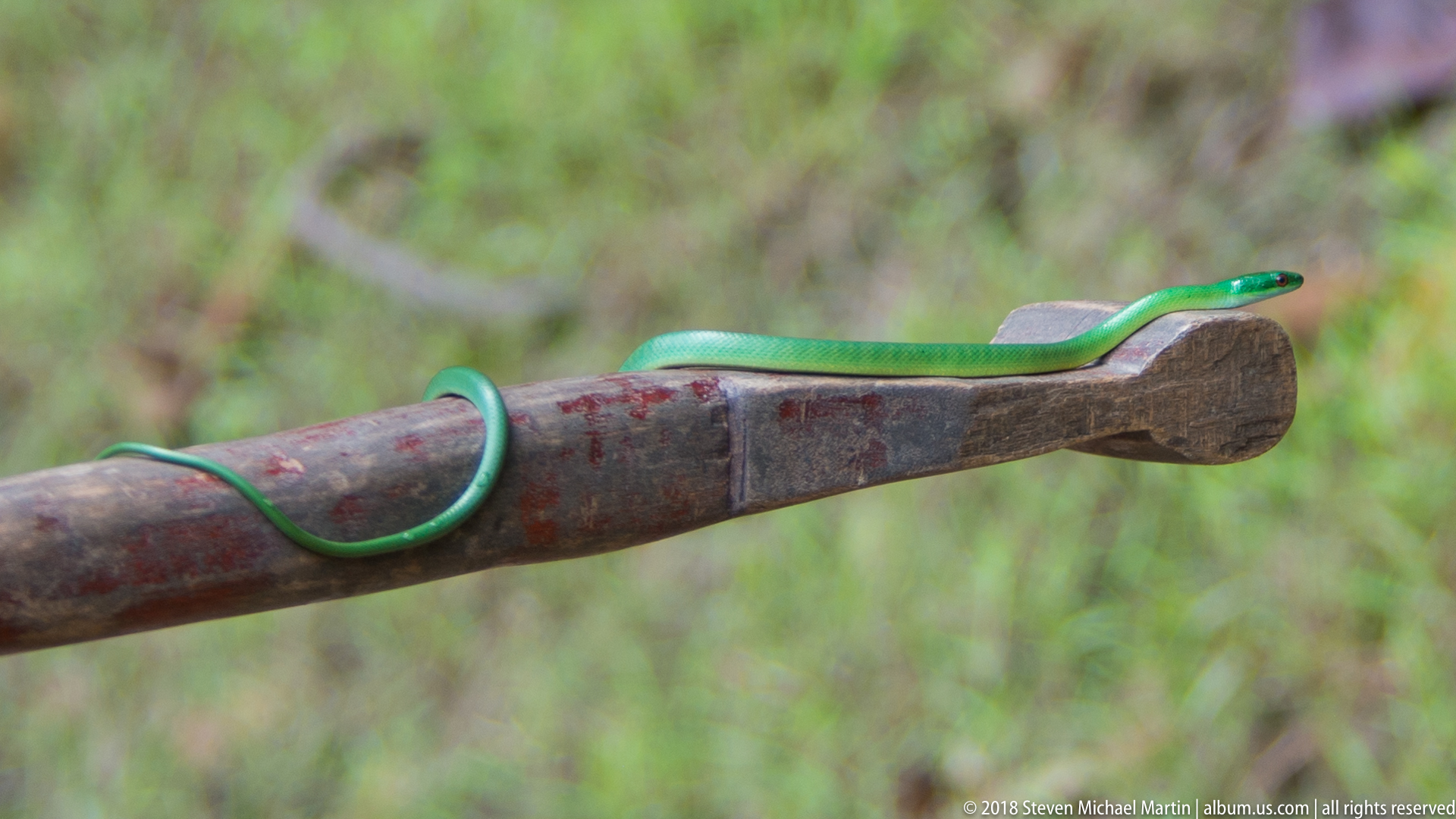
A slender green snake wraps several times around a weathered wooden paddle or pole, then extends its head along the flattened end. The unusual perch makes the reptile's narrow body and gripping coils especially clear. Its vivid coloration and proportions remain consistent with an arboreal forest snake, but the photograph does not independently establish a species-level identification.
Caption
A slender green snake wraps several times around a weathered wooden paddle or pole, then extends its head along the flattened end. The unusual perch makes the reptile's narrow body and gripping coils especially clear. Its vivid coloration and proportions remain consistent with an arboreal forest snake, but the photograph does not independently establish a species-level identification.
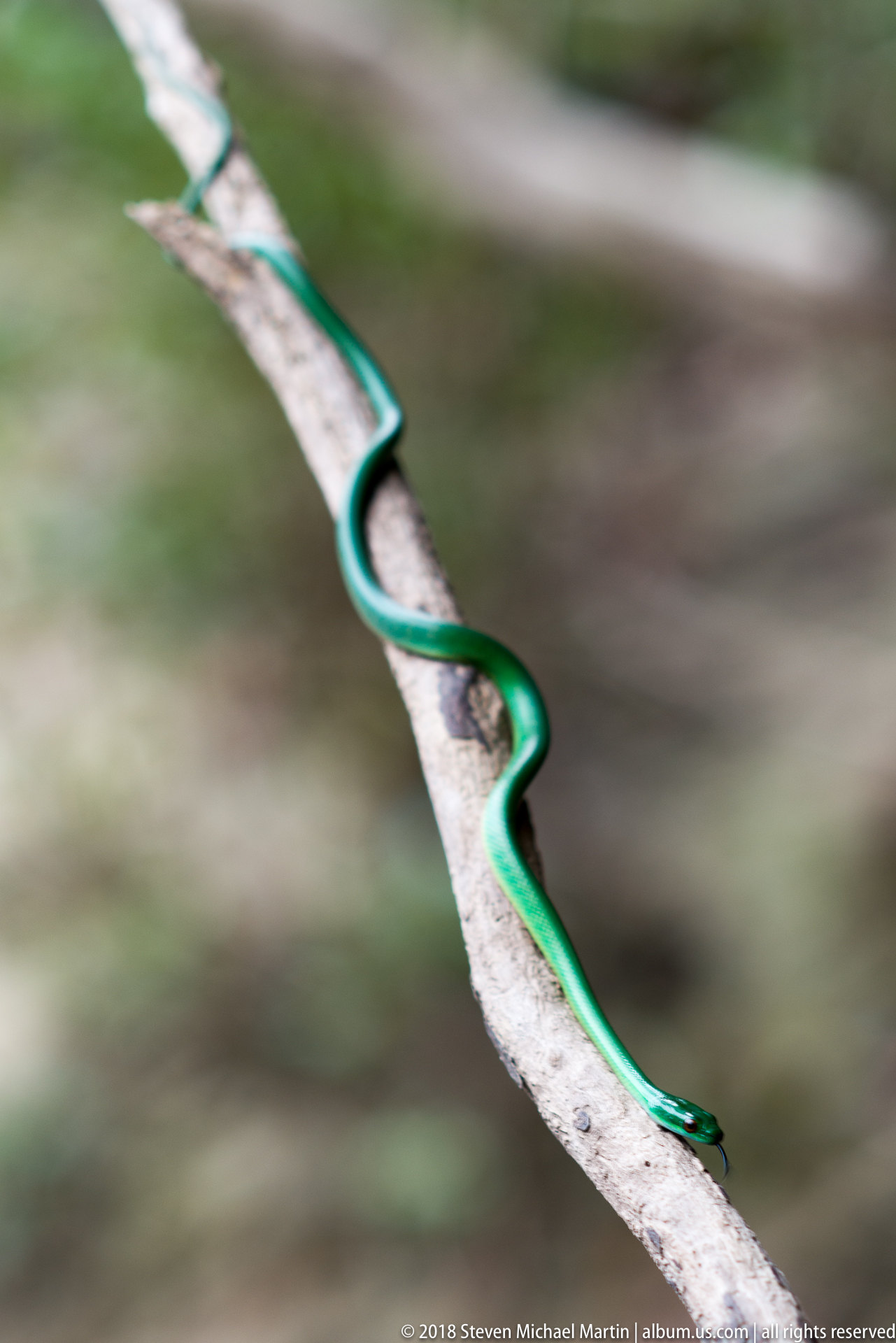
A slender green snake follows a diagonal branch across the frame, matching the branch's bends with sinuous curves. Its head remains low against the wood while the body forms compact loops farther upslope. The clean side view reinforces the snake's vine-like proportions and arboreal behavior but does not reveal enough diagnostic head pattern or scalation for a secure species name.
Caption
A slender green snake follows a diagonal branch across the frame, matching the branch's bends with sinuous curves. Its head remains low against the wood while the body forms compact loops farther upslope. The clean side view reinforces the snake's vine-like proportions and arboreal behavior but does not reveal enough diagnostic head pattern or scalation for a secure species name.
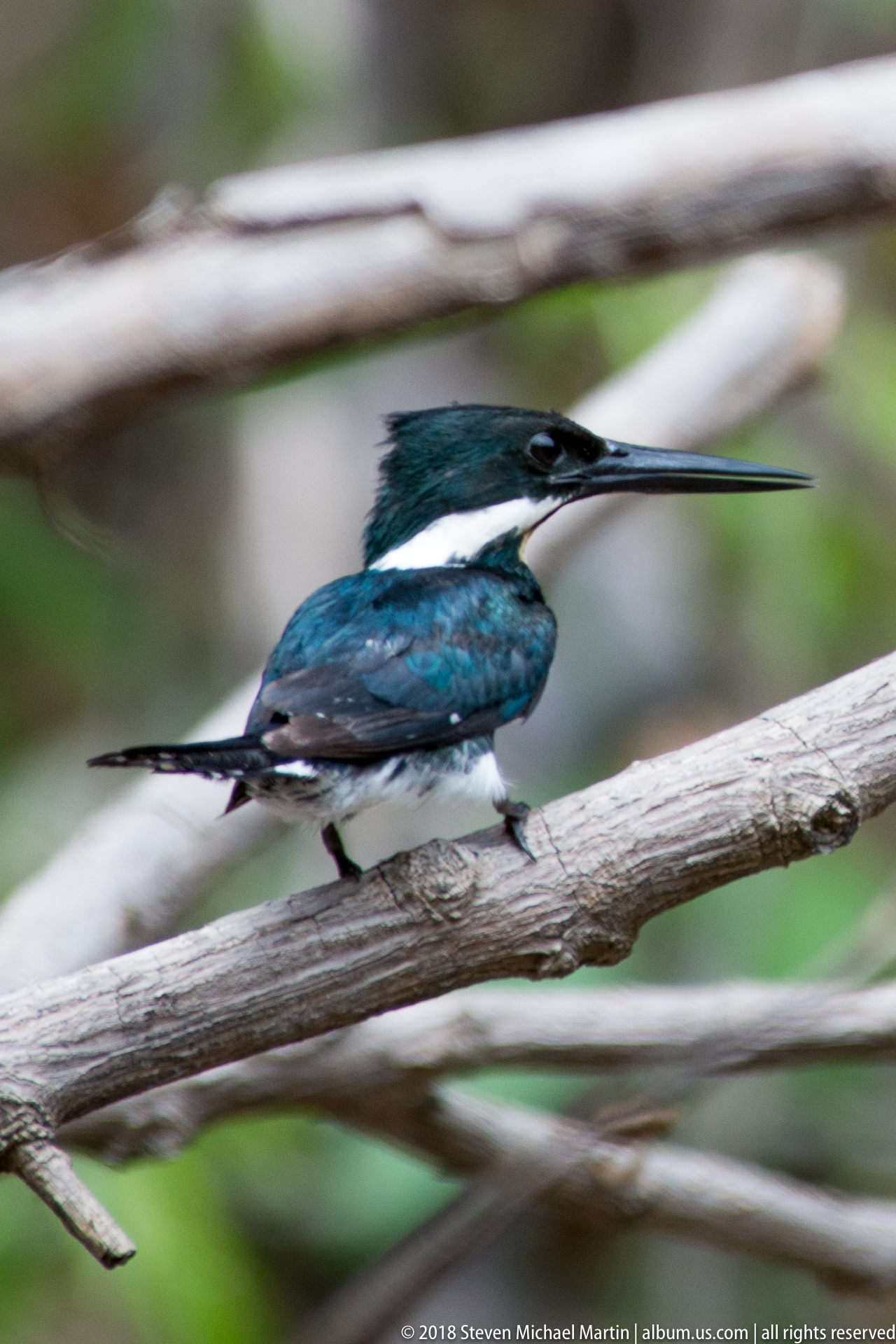
A large green-and-white kingfisher perches sideways on a low branch, its heavy straight bill extending far beyond the head. Metallic green upperparts, a white throat and collar, and pale underparts with darker green markings are consistent with an Amazon Kingfisher. The close side view strongly supports that identification, though sex-specific breast patterning is partly softened by the angle.
Caption
A large green-and-white kingfisher perches sideways on a low branch, its heavy straight bill extending far beyond the head. Metallic green upperparts, a white throat and collar, and pale underparts with darker green markings are consistent with an Amazon Kingfisher. The close side view strongly supports that identification, though sex-specific breast patterning is partly softened by the angle.
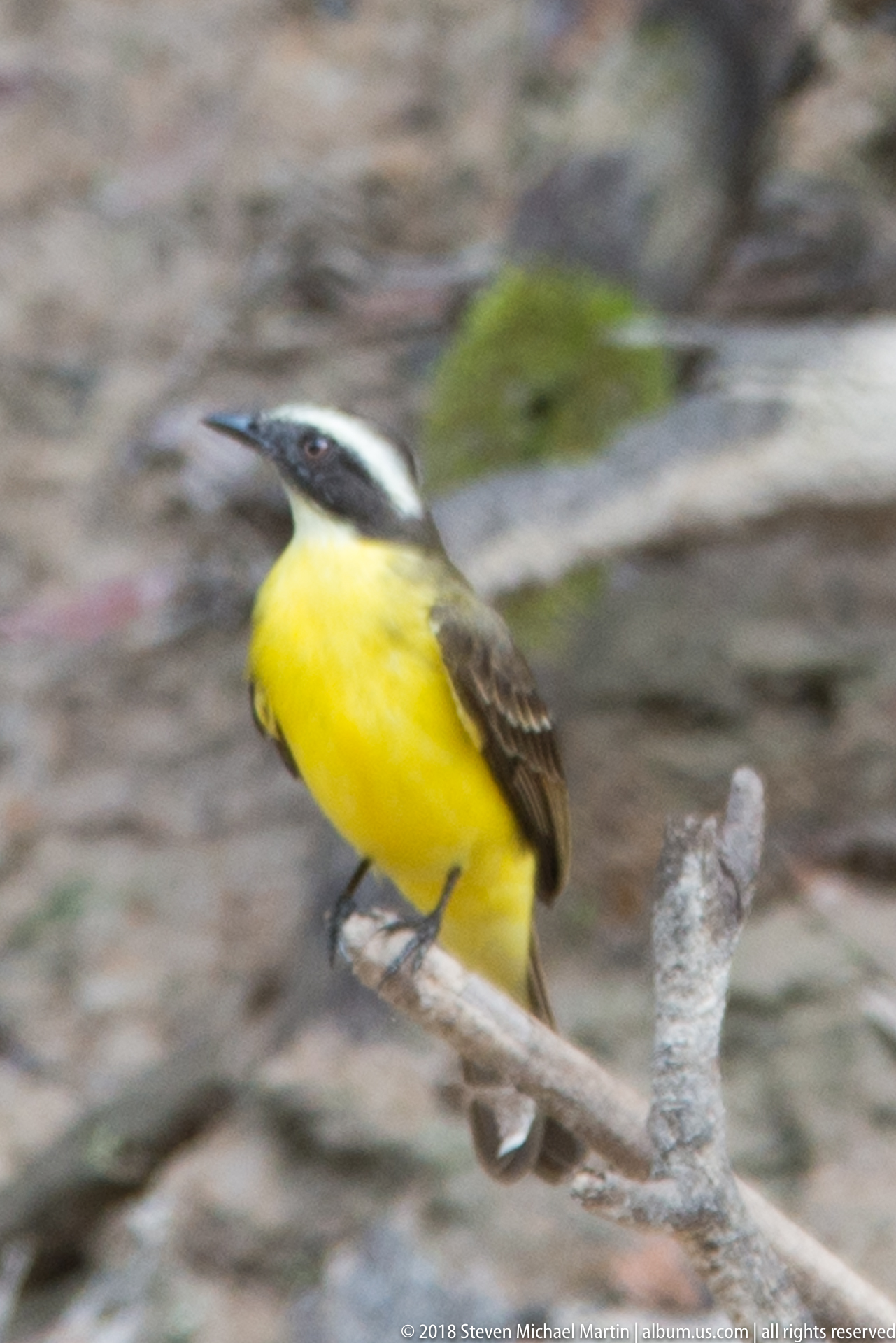
A Great Kiskadee perches on a low branch with its bright yellow belly prominent beneath a brown back and dark head. A bold white eyebrow and throat frame the black facial mask, while the stout bill points slightly upward. These contrasting field marks are characteristic of this widespread tropical flycatcher and are clearly visible despite slight motion blur.
Caption
A Great Kiskadee perches on a low branch with its bright yellow belly prominent beneath a brown back and dark head. A bold white eyebrow and throat frame the black facial mask, while the stout bill points slightly upward. These contrasting field marks are characteristic of this widespread tropical flycatcher and are clearly visible despite slight motion blur.
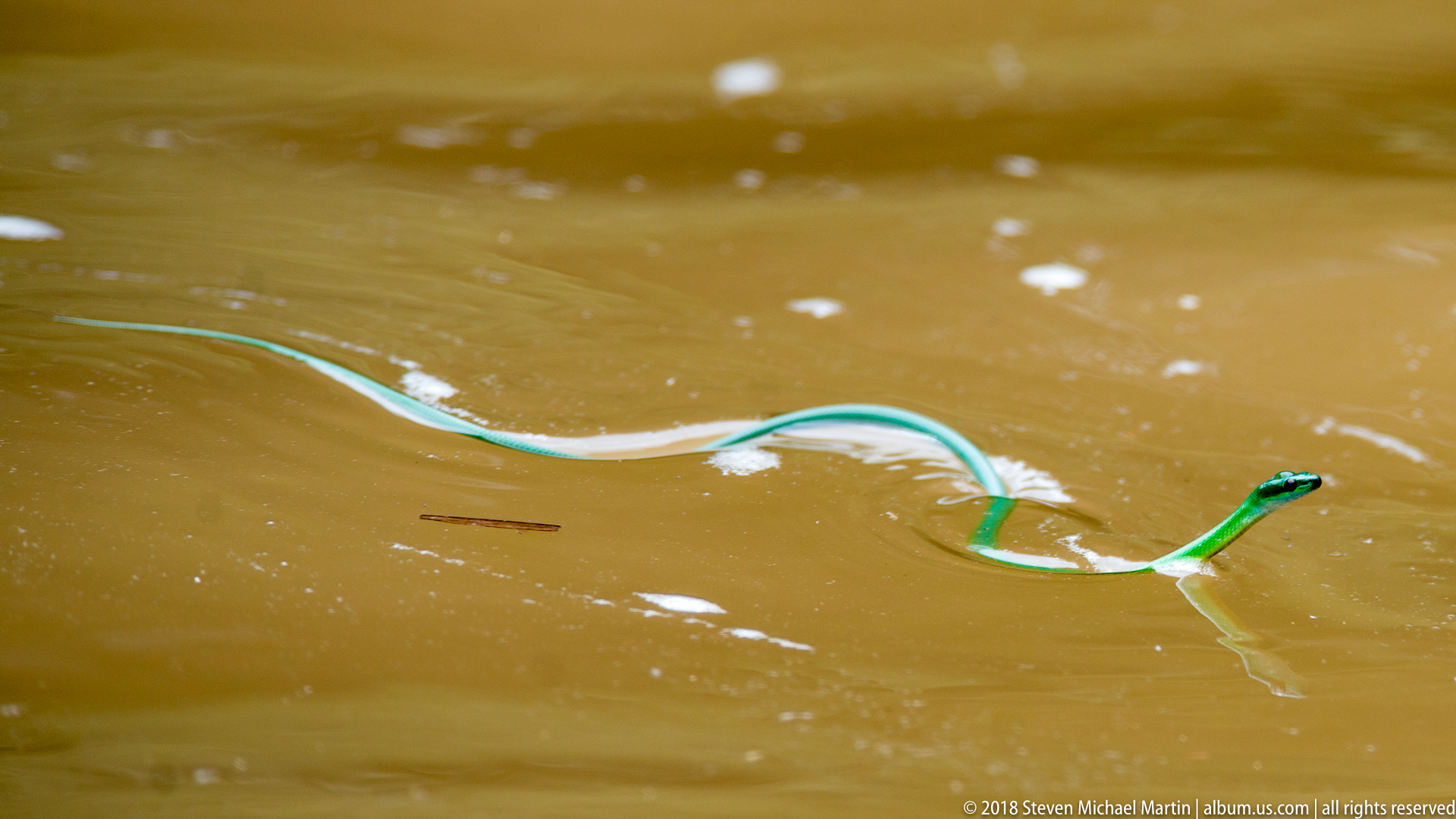
A green snake undulates through the river with several loops breaking the surface and portions of its pale underside flashing above the brown water. The raised curves make the mechanics of lateral swimming especially visible. Although the color and body shape match the adjacent arboreal snake sequence, the proof sheet still lacks enough diagnostic anatomy to assign a species confidently.
Caption
A green snake undulates through the river with several loops breaking the surface and portions of its pale underside flashing above the brown water. The raised curves make the mechanics of lateral swimming especially visible. Although the color and body shape match the adjacent arboreal snake sequence, the proof sheet still lacks enough diagnostic anatomy to assign a species confidently.
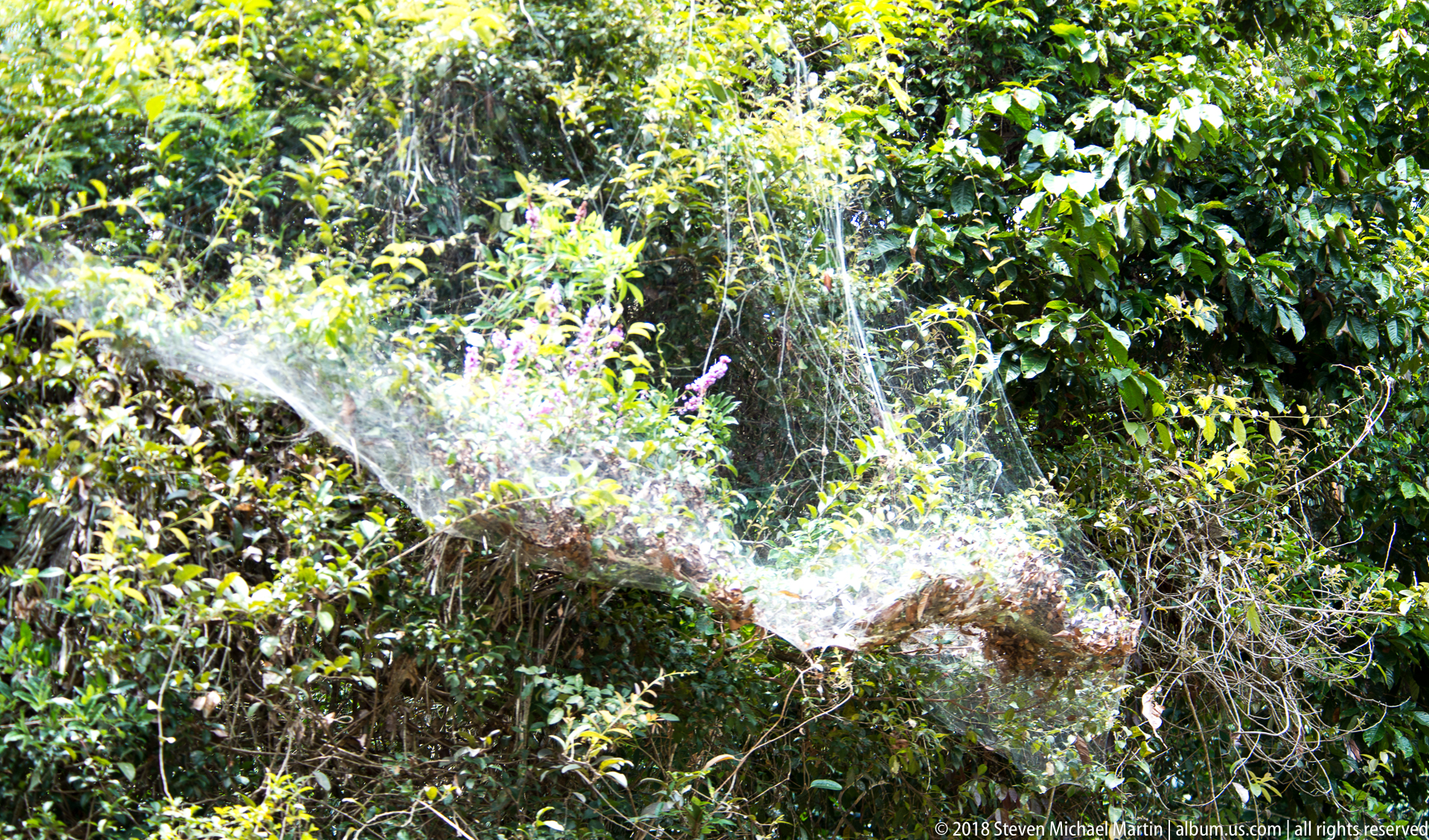
A broad veil of silk stretches across shrubs and low branches, forming a dense sheet with irregular vertical and diagonal strands above it. The web spans far more vegetation than a typical solitary orb web and appears to integrate multiple anchor points. In Amazonian forest this architecture can be associated with social spiders, but no species is assigned because individual spiders are not clearly resolved.
Caption
A broad veil of silk stretches across shrubs and low branches, forming a dense sheet with irregular vertical and diagonal strands above it. The web spans far more vegetation than a typical solitary orb web and appears to integrate multiple anchor points. In Amazonian forest this architecture can be associated with social spiders, but no species is assigned because individual spiders are not clearly resolved.
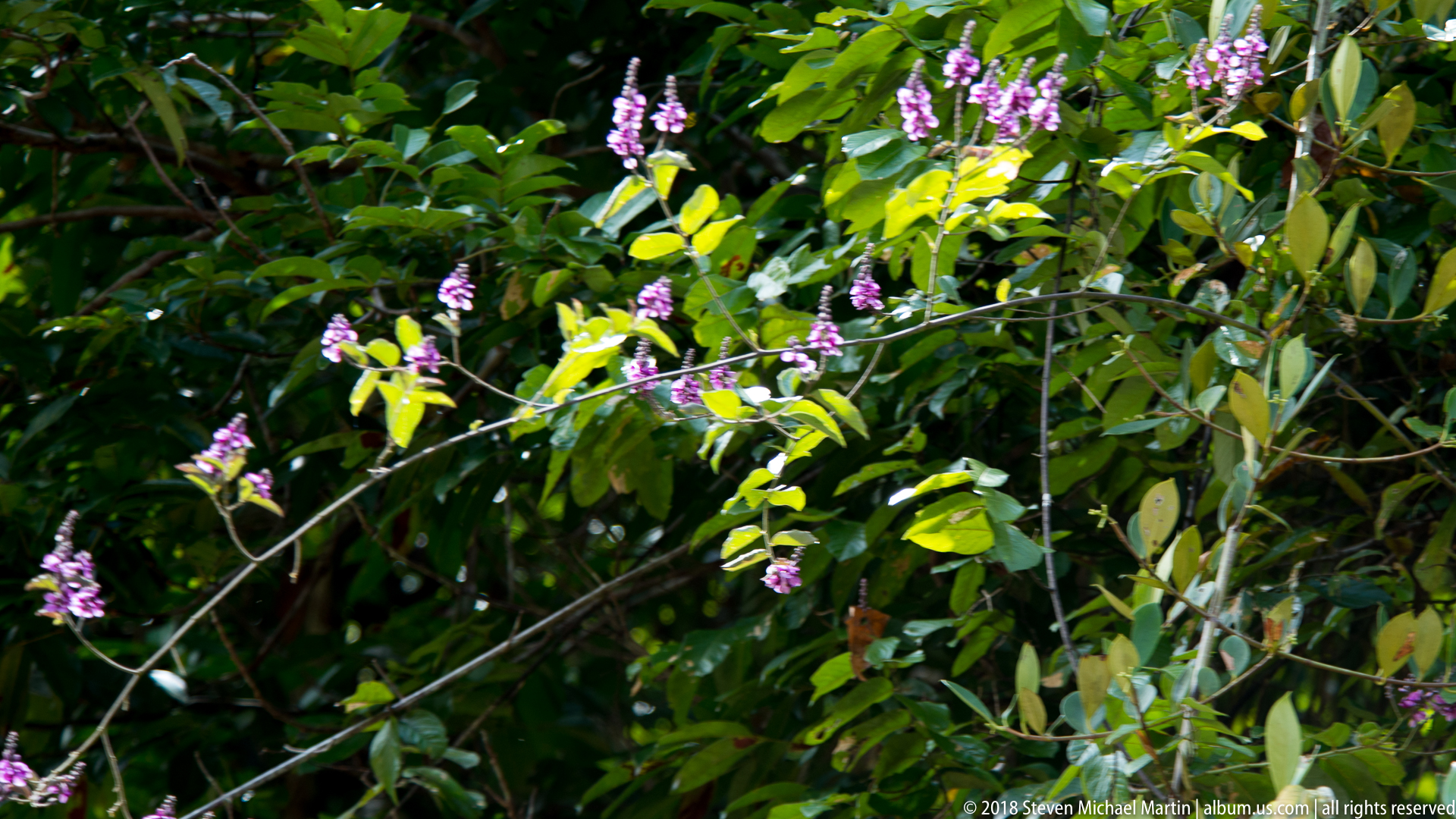
Clusters of small pink-purple flowers emerge along slender stems weaving through glossy green forest foliage. Sunlight catches the blossoms and upper leaves, separating the flowering vine or shrub from the darker understory behind it. The photograph clearly documents a floral feature of the Blanco River forest, but leaf shape and flower structure are not sufficient here for a responsible botanical species identification.
Caption
Clusters of small pink-purple flowers emerge along slender stems weaving through glossy green forest foliage. Sunlight catches the blossoms and upper leaves, separating the flowering vine or shrub from the darker understory behind it. The photograph clearly documents a floral feature of the Blanco River forest, but leaf shape and flower structure are not sufficient here for a responsible botanical species identification.
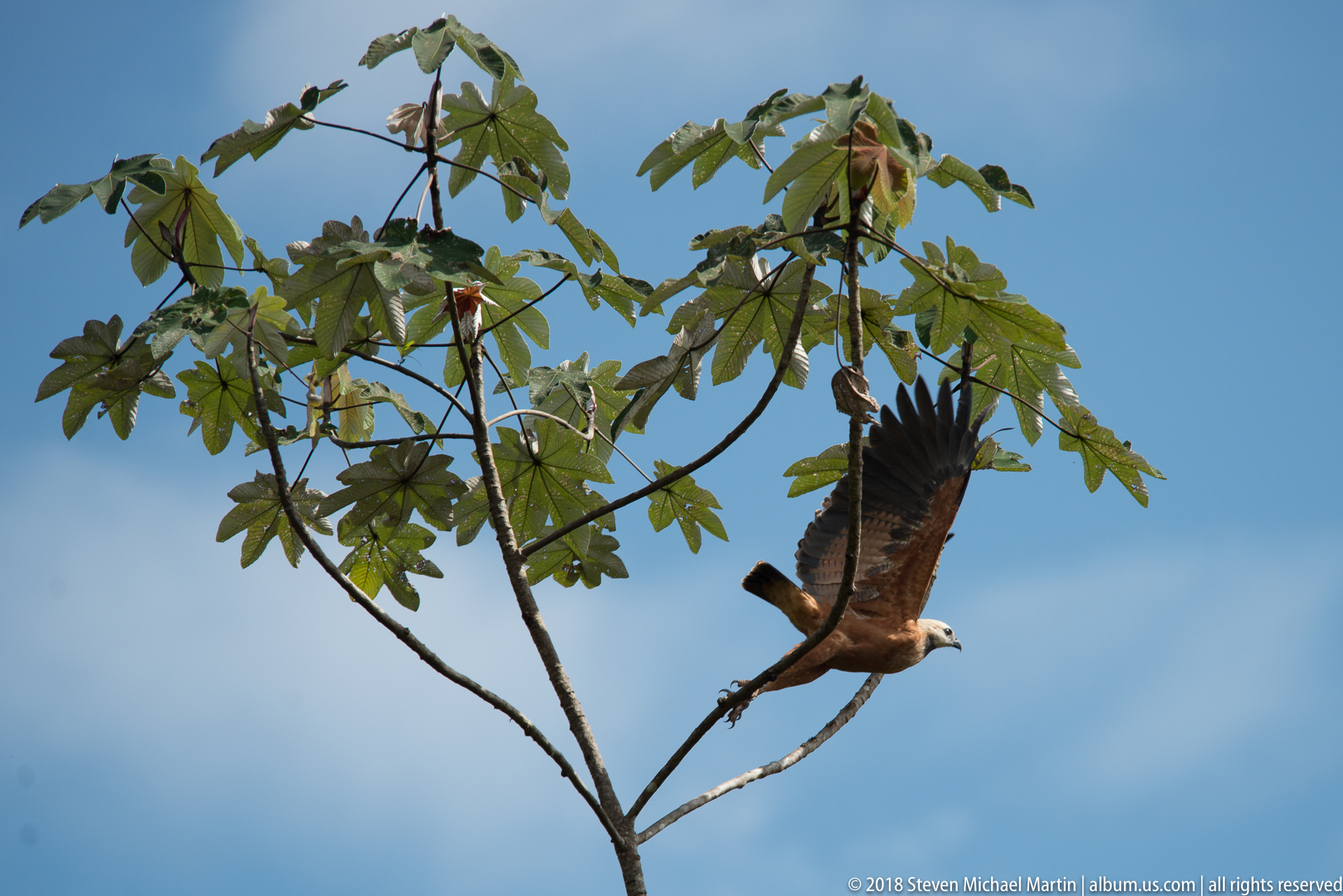
A rufous hawk spreads its wings as it lands among the sparse branches of a treetop. The pale head and dark-tipped wings stand out against blue sky, while the warm chestnut body matches the Black-collared Hawk seen in the surrounding sequence. The branching perch provides a transitional frame between flight and the more settled portraits that follow.
Caption
A rufous hawk spreads its wings as it lands among the sparse branches of a treetop. The pale head and dark-tipped wings stand out against blue sky, while the warm chestnut body matches the Black-collared Hawk seen in the surrounding sequence. The branching perch provides a transitional frame between flight and the more settled portraits that follow.

A Black-collared Hawk stands on an exposed branch beneath broad leaves, showing a pale gray-white head above a rich rufous body and dark folded wings. Its hooked bill and upright stance are clear in profile. The open perch and uncluttered blue background make this the first settled portrait in the sequence and reveal the raptor's distinctive contrast between head and body.
Caption
A Black-collared Hawk stands on an exposed branch beneath broad leaves, showing a pale gray-white head above a rich rufous body and dark folded wings. Its hooked bill and upright stance are clear in profile. The open perch and uncluttered blue background make this the first settled portrait in the sequence and reveal the raptor's distinctive contrast between head and body.

A Black-collared Hawk moves along a low branch through dense leafy vegetation, its body stretched forward as if preparing to launch or reposition. Motion softens some feather detail, but the pale head, rufous back and flanks, and dark wings remain clear. The dynamic posture distinguishes this frame from the static perch portraits while retaining the raptor's unmistakable color pattern.
Caption
A Black-collared Hawk moves along a low branch through dense leafy vegetation, its body stretched forward as if preparing to launch or reposition. Motion softens some feather detail, but the pale head, rufous back and flanks, and dark wings remain clear. The dynamic posture distinguishes this frame from the static perch portraits while retaining the raptor's unmistakable color pattern.

An Amazon Kingfisher sits frontally on a thin branch with its bill open, apparently calling. The raised green crest, white throat and belly, dark green breast patches, and massive straight bill are all prominent. This vocalizing posture gives the sequence a behavioral moment while also providing a useful frontal view of the bird's contrasting breast and throat pattern.
Caption
An Amazon Kingfisher sits frontally on a thin branch with its bill open, apparently calling. The raised green crest, white throat and belly, dark green breast patches, and massive straight bill are all prominent. This vocalizing posture gives the sequence a behavioral moment while also providing a useful frontal view of the bird's contrasting breast and throat pattern.

A Black-collared Hawk occupies a high, open branch near the crown of a sparse tree, appearing small within a broad field of blue sky. The pale head and rufous body remain legible even at this distance. Unlike the closer portraits, this contextual frame emphasizes the elevated lookout used by the raptor and the scale of its exposed perch above the riverine forest.
Caption
A Black-collared Hawk occupies a high, open branch near the crown of a sparse tree, appearing small within a broad field of blue sky. The pale head and rufous body remain legible even at this distance. Unlike the closer portraits, this contextual frame emphasizes the elevated lookout used by the raptor and the scale of its exposed perch above the riverine forest.

A Black-collared Hawk perches in close profile on a bare branch, revealing a pale head marked around the eye, a strongly hooked dark bill, rufous chest and wings, and dark tail. The compact portrait provides the clearest facial and upper-body view in the sequence. Its plumage and riverine setting are characteristic of this fish-eating South American raptor.
Caption
A Black-collared Hawk perches in close profile on a bare branch, revealing a pale head marked around the eye, a strongly hooked dark bill, rufous chest and wings, and dark tail. The compact portrait provides the clearest facial and upper-body view in the sequence. Its plumage and riverine setting are characteristic of this fish-eating South American raptor.

A Black-collared Hawk stands on a hidden branch within dense green vegetation, its pale head and rufous body emerging sharply from the leafy background. The more enclosed setting contrasts with the exposed treetop views and shows the raptor at the forest margin rather than isolated against sky. Dark wing and tail feathers complete the species' characteristic color pattern.
Caption
A Black-collared Hawk stands on a hidden branch within dense green vegetation, its pale head and rufous body emerging sharply from the leafy background. The more enclosed setting contrasts with the exposed treetop views and shows the raptor at the forest margin rather than isolated against sky. Dark wing and tail feathers complete the species' characteristic color pattern.

An Amazon Kingfisher launches from a branch with one wing thrown open, exposing pale flight feathers while its metallic green crown and back catch the light. White underparts and dark green breast markings remain visible beneath the spread wing, and the long heavy bill points forward. The action frame documents the explosive departure typical of a river-hunting kingfisher.
Caption
An Amazon Kingfisher launches from a branch with one wing thrown open, exposing pale flight feathers while its metallic green crown and back catch the light. White underparts and dark green breast markings remain visible beneath the spread wing, and the long heavy bill points forward. The action frame documents the explosive departure typical of a river-hunting kingfisher.

An Amazon Kingfisher faces nearly forward from a narrow branch, showing a shaggy metallic-green crest above a long dark bill and a broad white collar. Dark green patches break across the white breast, while the tail hangs below the perch. The frontal angle highlights the bird's crest and breast pattern more clearly than the neighboring action frame.
Caption
An Amazon Kingfisher faces nearly forward from a narrow branch, showing a shaggy metallic-green crest above a long dark bill and a broad white collar. Dark green patches break across the white breast, while the tail hangs below the perch. The frontal angle highlights the bird's crest and breast pattern more clearly than the neighboring action frame.

An Amazon Kingfisher perches upright on a narrow branch in a tangle of vines and trunks, turning slightly to reveal the long bill in profile. Its green crest and back contrast with the white throat and underparts, while dark green breast markings form a broken band. The enclosed forest setting distinguishes this view from the more open perches nearby.
Caption
An Amazon Kingfisher perches upright on a narrow branch in a tangle of vines and trunks, turning slightly to reveal the long bill in profile. Its green crest and back contrast with the white throat and underparts, while dark green breast markings form a broken band. The enclosed forest setting distinguishes this view from the more open perches nearby.

A large Amazon Kingfisher perches sideways on an angled branch, showing metallic green upperparts, a pointed crest, broad white collar, and long dark bill. The streamlined profile gives the clearest view of body length and bill proportion in this group. Pale underparts and green breast markings support the identification as a female or immature-plumaged Amazon Kingfisher.
Caption
A large Amazon Kingfisher perches sideways on an angled branch, showing metallic green upperparts, a pointed crest, broad white collar, and long dark bill. The streamlined profile gives the clearest view of body length and bill proportion in this group. Pale underparts and green breast markings support the identification as a female or immature-plumaged Amazon Kingfisher.

A medium-sized woodpecker clings to the side of a broken trunk, its body marked with dense dark barring over yellow-brown plumage. The pale face, long pointed bill, and warm reddish-orange crown patch are visible in profile. The vertical climbing posture clearly establishes a woodpecker, but the proof sheet does not resolve enough facial and body markings for a secure species-level identification.
Caption
A medium-sized woodpecker clings to the side of a broken trunk, its body marked with dense dark barring over yellow-brown plumage. The pale face, long pointed bill, and warm reddish-orange crown patch are visible in profile. The vertical climbing posture clearly establishes a woodpecker, but the proof sheet does not resolve enough facial and body markings for a secure species-level identification.

A barred woodpecker pauses on the flat side of a broken stump, presenting a clearer rear-side view of its yellow-olive body crossed by fine dark bands. A warm reddish crown contrasts with the pale face and long pointed bill. This angle complements the preceding climbing frame by showing the patterned back and folded wings more fully, while species-level identification remains conservative.
Caption
A barred woodpecker pauses on the flat side of a broken stump, presenting a clearer rear-side view of its yellow-olive body crossed by fine dark bands. A warm reddish crown contrasts with the pale face and long pointed bill. This angle complements the preceding climbing frame by showing the patterned back and folded wings more fully, while species-level identification remains conservative.
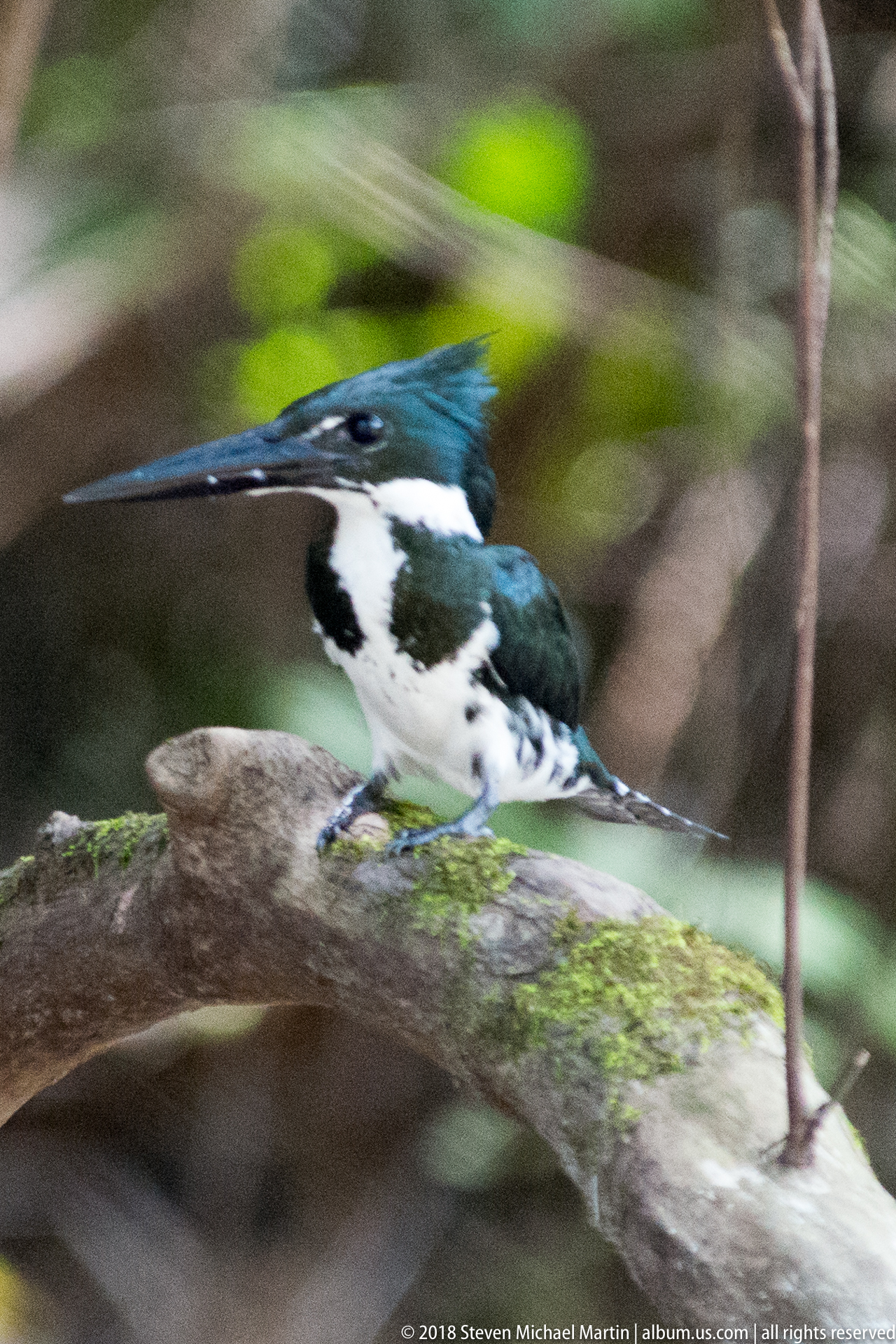
A large green-and-white kingfisher moves rapidly along a moss-covered branch, its long bill thrust forward and pointed crest swept back by motion. Dark green upperparts contrast with a white throat and belly marked by darker breast patches. The blurred background and extended posture turn this frame into an action study rather than a static portrait of the river-hunting bird.
Caption
A large green-and-white kingfisher moves rapidly along a moss-covered branch, its long bill thrust forward and pointed crest swept back by motion. Dark green upperparts contrast with a white throat and belly marked by darker breast patches. The blurred background and extended posture turn this frame into an action study rather than a static portrait of the river-hunting bird.
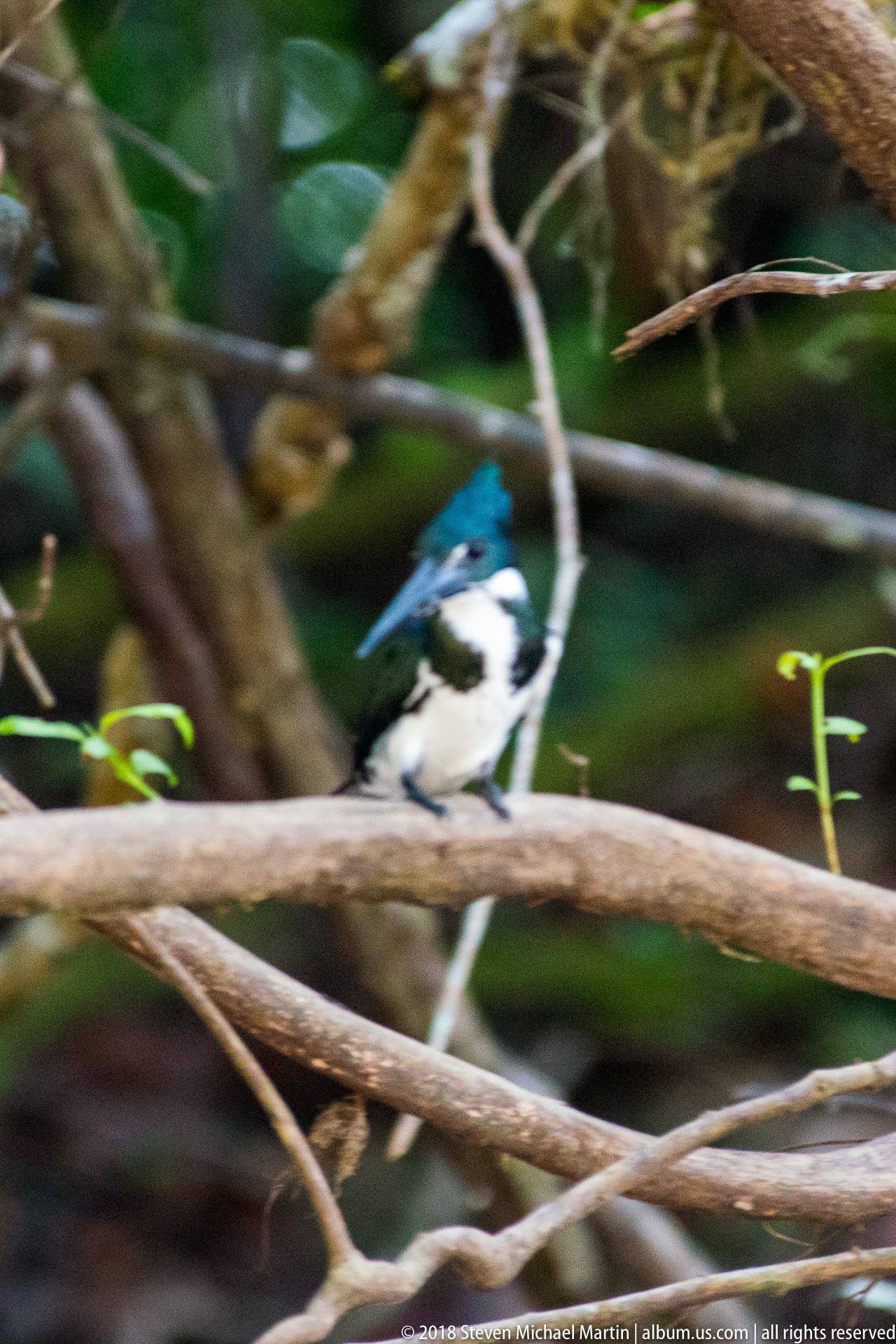
A green-and-white kingfisher perches beyond a lattice of horizontal and diagonal branches, its turquoise-green crown and back catching small patches of light. The bird is partially screened and relatively small in the frame, making this primarily a habitat view. Its long bill and contrasting white underparts remain visible enough to link it to the nearby kingfisher sequence.
Caption
A green-and-white kingfisher perches beyond a lattice of horizontal and diagonal branches, its turquoise-green crown and back catching small patches of light. The bird is partially screened and relatively small in the frame, making this primarily a habitat view. Its long bill and contrasting white underparts remain visible enough to link it to the nearby kingfisher sequence.

An Amazon Kingfisher perches close to the camera on a mossy branch, its dark green crest raised and enormous bill angled downward. White throat and belly contrast with deep green-blue upperparts and irregular dark breast markings. The crisp portrait shows feather texture and head shape more clearly than the earlier views, making it one of the strongest kingfisher studies in the sequence.
Caption
An Amazon Kingfisher perches close to the camera on a mossy branch, its dark green crest raised and enormous bill angled downward. White throat and belly contrast with deep green-blue upperparts and irregular dark breast markings. The crisp portrait shows feather texture and head shape more clearly than the earlier views, making it one of the strongest kingfisher studies in the sequence.
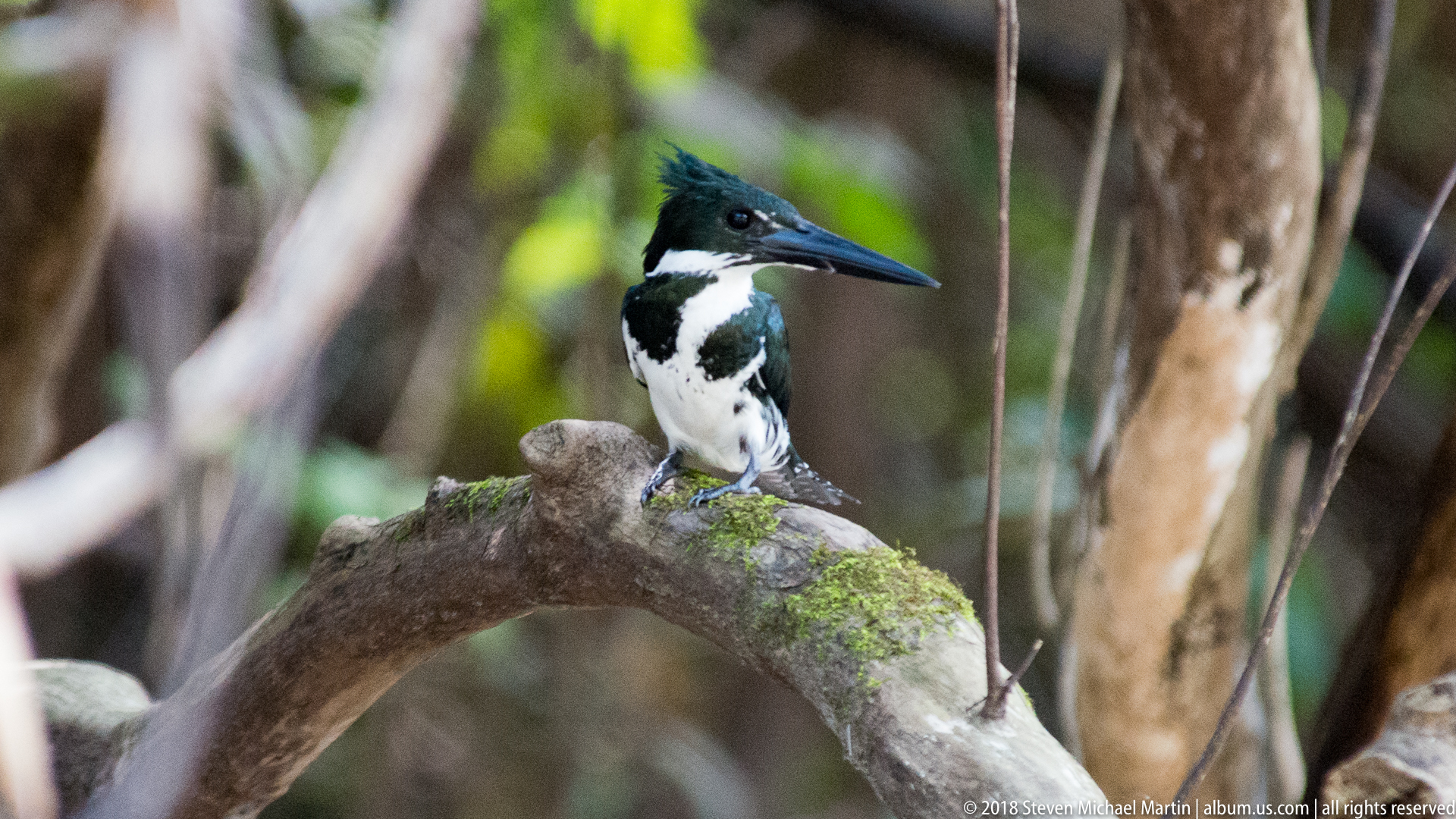
A crested green-and-white kingfisher sits upright on a mossy branch, giving a clear side view of its long straight bill, white throat, and dark green breast patches. The bird's alert posture and compact perch place it within the shaded riverine forest rather than against open water. Fine breast patterning remains somewhat soft, so the identification is kept provisional at species level.
Caption
A crested green-and-white kingfisher sits upright on a mossy branch, giving a clear side view of its long straight bill, white throat, and dark green breast patches. The bird's alert posture and compact perch place it within the shaded riverine forest rather than against open water. Fine breast patterning remains somewhat soft, so the identification is kept provisional at species level.
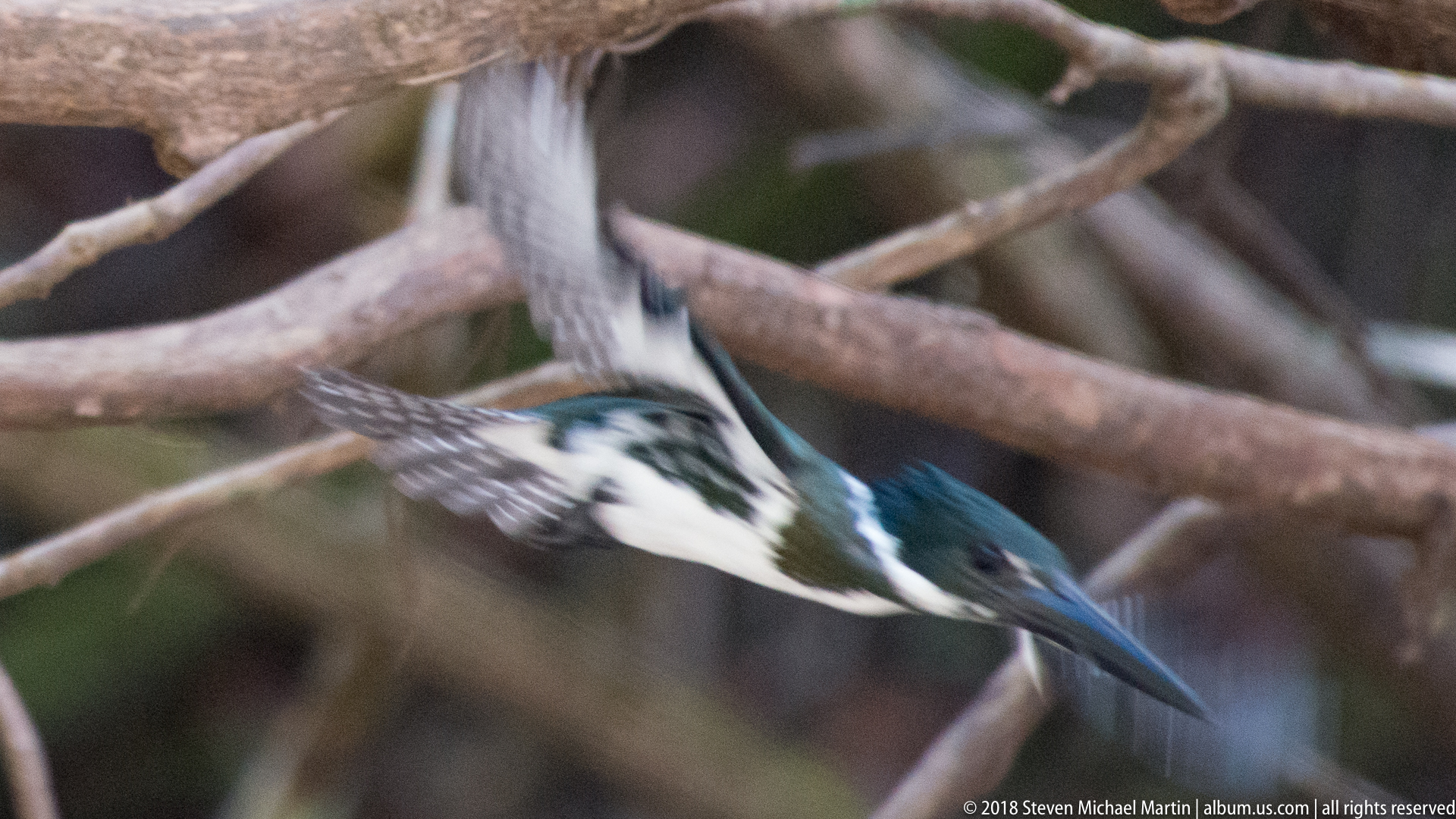
A green-and-white kingfisher dives or launches downward through a tangle of branches, body pitched steeply with the bill aimed toward the lower right. Motion blur streaks the wings and tail while the white underparts remain bright against the darker forest. The unusual angle records the explosive movement of a perch-hunting river bird rather than a diagnostic field-guide pose.
Caption
A green-and-white kingfisher dives or launches downward through a tangle of branches, body pitched steeply with the bill aimed toward the lower right. Motion blur streaks the wings and tail while the white underparts remain bright against the darker forest. The unusual angle records the explosive movement of a perch-hunting river bird rather than a diagnostic field-guide pose.
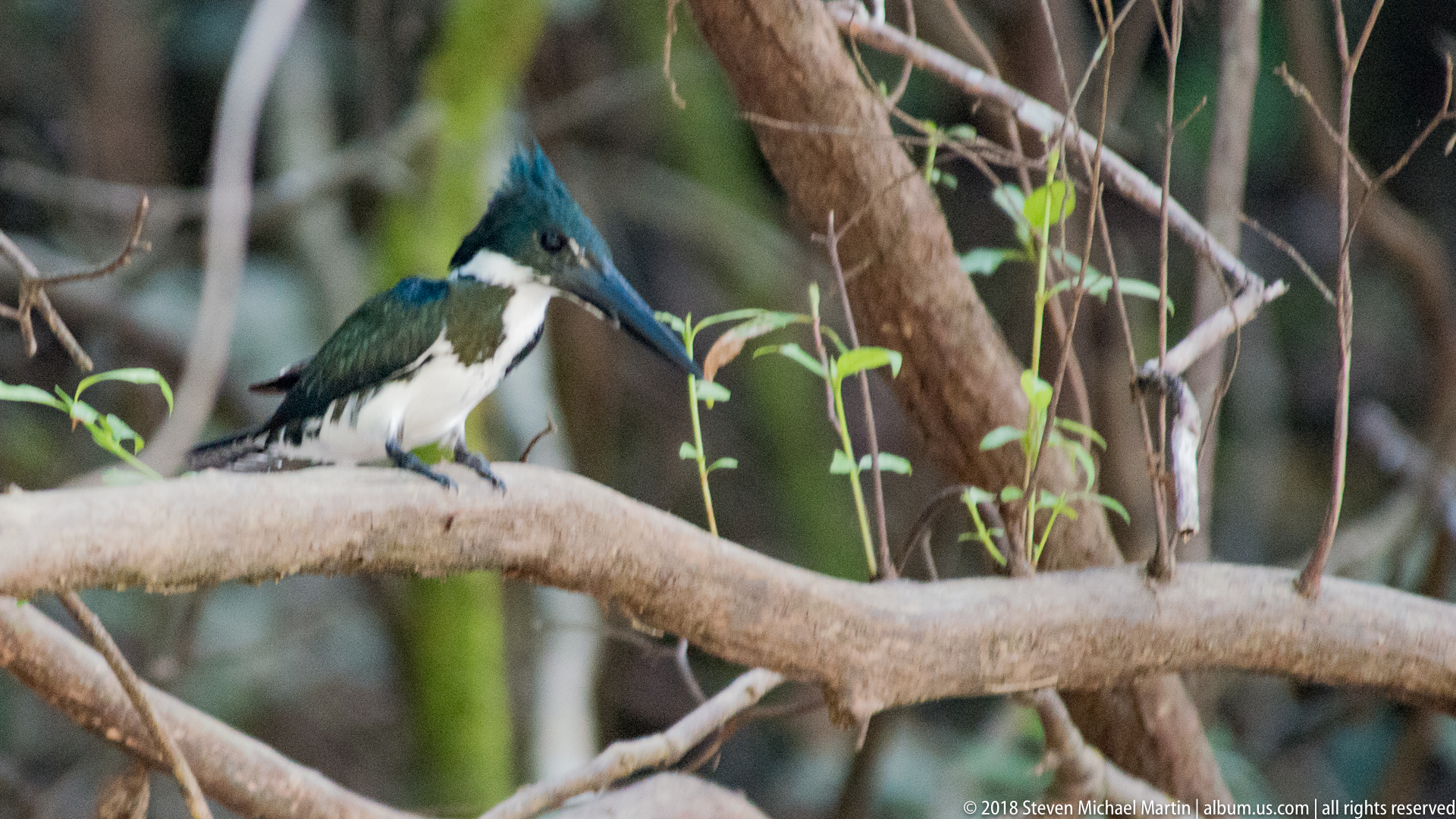
A crested kingfisher stands on a broad branch surrounded by slender vines and saplings, turning its long bill slightly downward. Dark green upperparts and a white throat and belly are clearly separated, with irregular darker markings across the upper breast. The enclosed composition shows the bird using a low forest perch along the Blanco River rather than an exposed riverside snag.
Caption
A crested kingfisher stands on a broad branch surrounded by slender vines and saplings, turning its long bill slightly downward. Dark green upperparts and a white throat and belly are clearly separated, with irregular darker markings across the upper breast. The enclosed composition shows the bird using a low forest perch along the Blanco River rather than an exposed riverside snag.

A close kingfisher portrait isolates the bird on a narrow branch, revealing glossy blue-green upperparts, a tall ragged crest, long dark bill, and sharply contrasting white throat. The enlarged view also shows darker green markings on the breast and fine pale spots along the folded wing. This is one of the strongest morphological studies in the sequence, though the sex-specific pattern deserves full-resolution confirmation.
Caption
A close kingfisher portrait isolates the bird on a narrow branch, revealing glossy blue-green upperparts, a tall ragged crest, long dark bill, and sharply contrasting white throat. The enlarged view also shows darker green markings on the breast and fine pale spots along the folded wing. This is one of the strongest morphological studies in the sequence, though the sex-specific pattern deserves full-resolution confirmation.
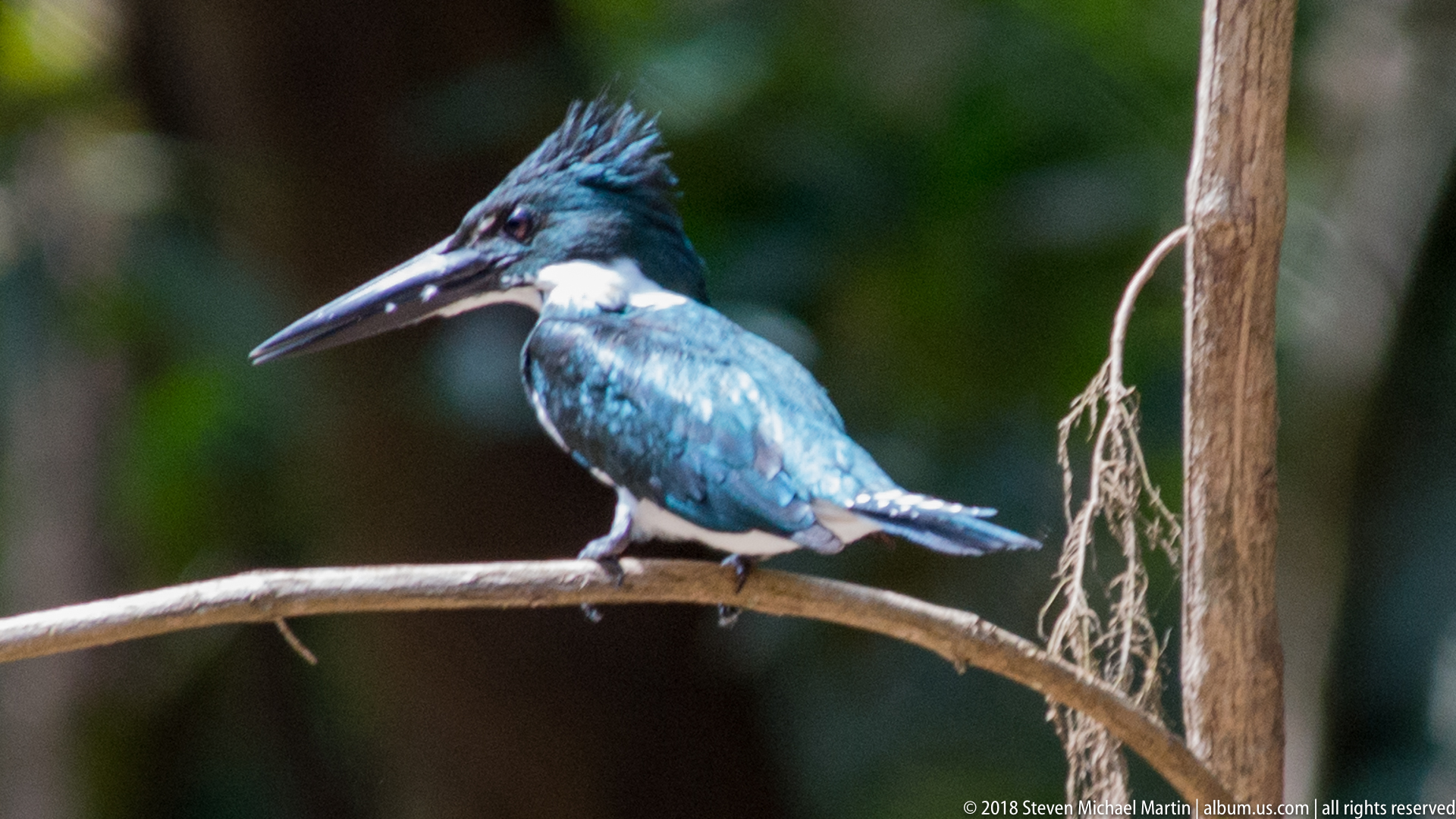
A large crested kingfisher perches in left-facing profile on a curved branch, displaying metallic blue-green upperparts, a white throat, and pale underparts crossed by darker breast markings. The long dagger-like bill and compact body are sharply defined against the blurred forest. The profile is especially useful for reading bill proportion and the layered feathers of the crest.
Caption
A large crested kingfisher perches in left-facing profile on a curved branch, displaying metallic blue-green upperparts, a white throat, and pale underparts crossed by darker breast markings. The long dagger-like bill and compact body are sharply defined against the blurred forest. The profile is especially useful for reading bill proportion and the layered feathers of the crest.
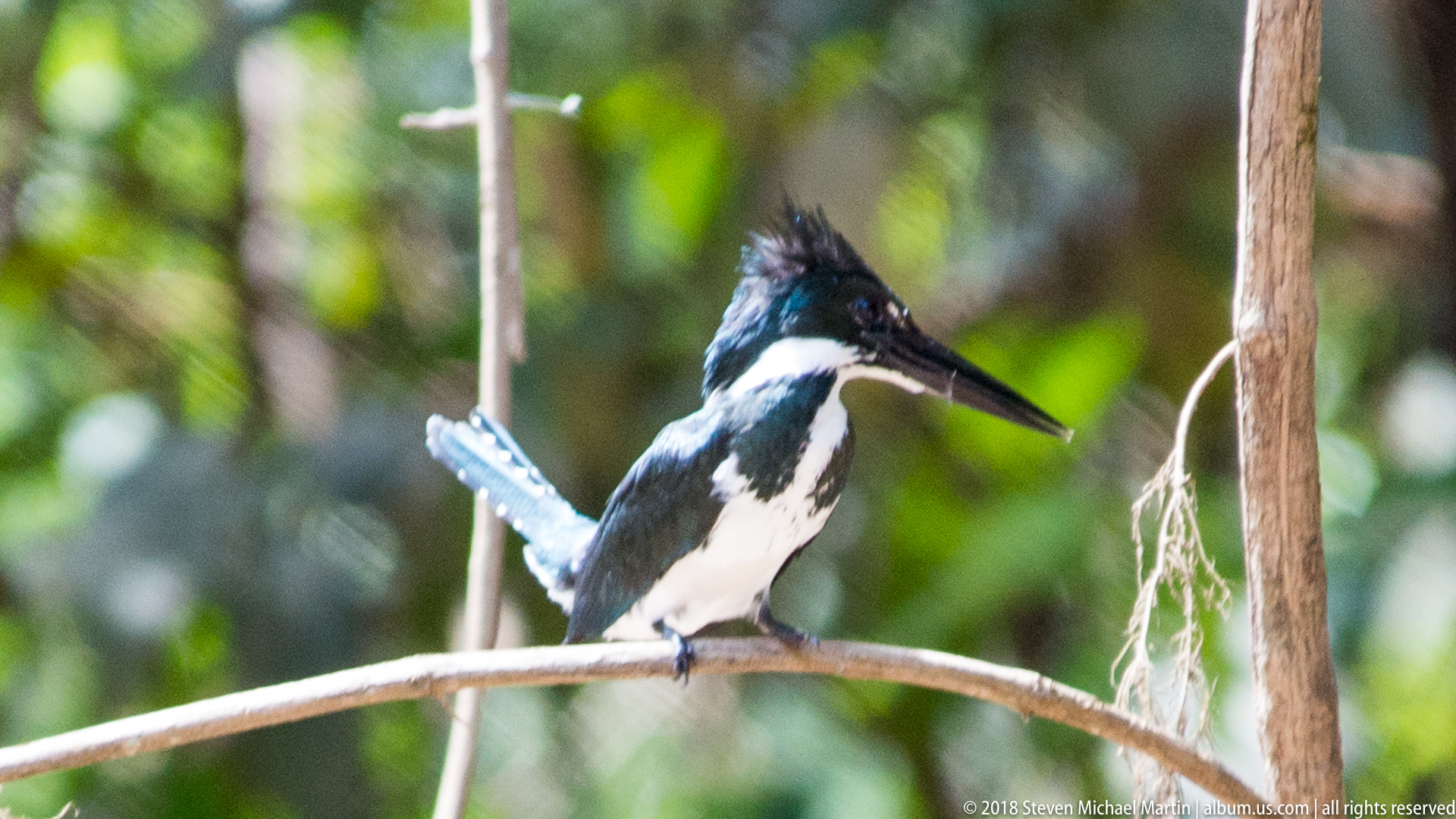
A green-and-white kingfisher faces right from the same curved perch, its crest lifted into narrow dark spikes. White underparts dominate this angle while the dark green back, wing, and breast patches frame the body. The opposite orientation complements the preceding profile and records the bird's distinctive long bill and upright stance from the other side.
Caption
A green-and-white kingfisher faces right from the same curved perch, its crest lifted into narrow dark spikes. White underparts dominate this angle while the dark green back, wing, and breast patches frame the body. The opposite orientation complements the preceding profile and records the bird's distinctive long bill and upright stance from the other side.
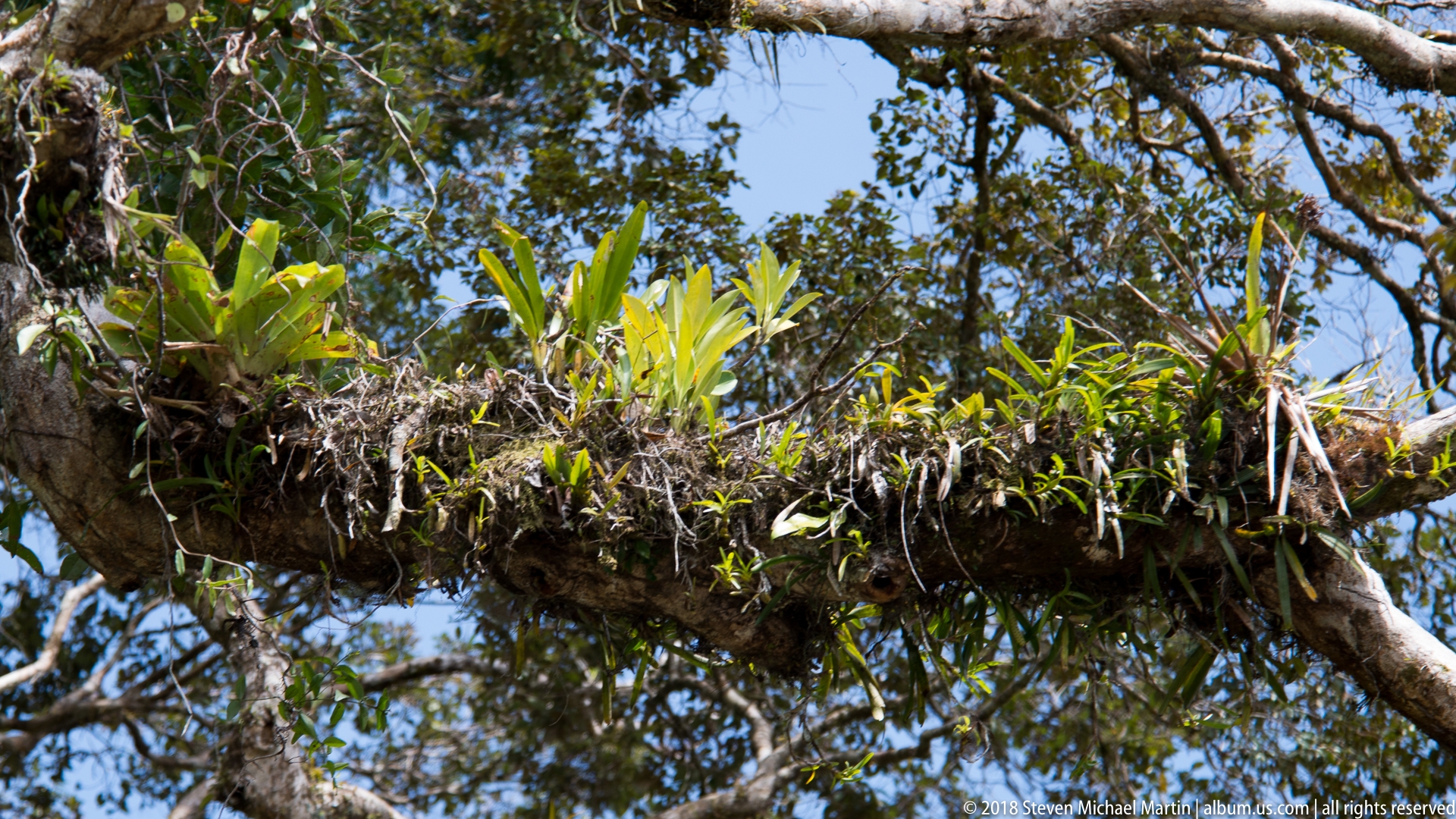
A thick horizontal limb supports a dense garden of epiphytes, including rosettes of bromeliad-like plants, hanging roots, and mats of organic material. Sunlight illuminates the clustered vegetation against patches of blue sky. The assemblage demonstrates how mature rainforest trees provide elevated substrate for plants that grow above the forest floor without rooting directly in soil.
Caption
A thick horizontal limb supports a dense garden of epiphytes, including rosettes of bromeliad-like plants, hanging roots, and mats of organic material. Sunlight illuminates the clustered vegetation against patches of blue sky. The assemblage demonstrates how mature rainforest trees provide elevated substrate for plants that grow above the forest floor without rooting directly in soil.
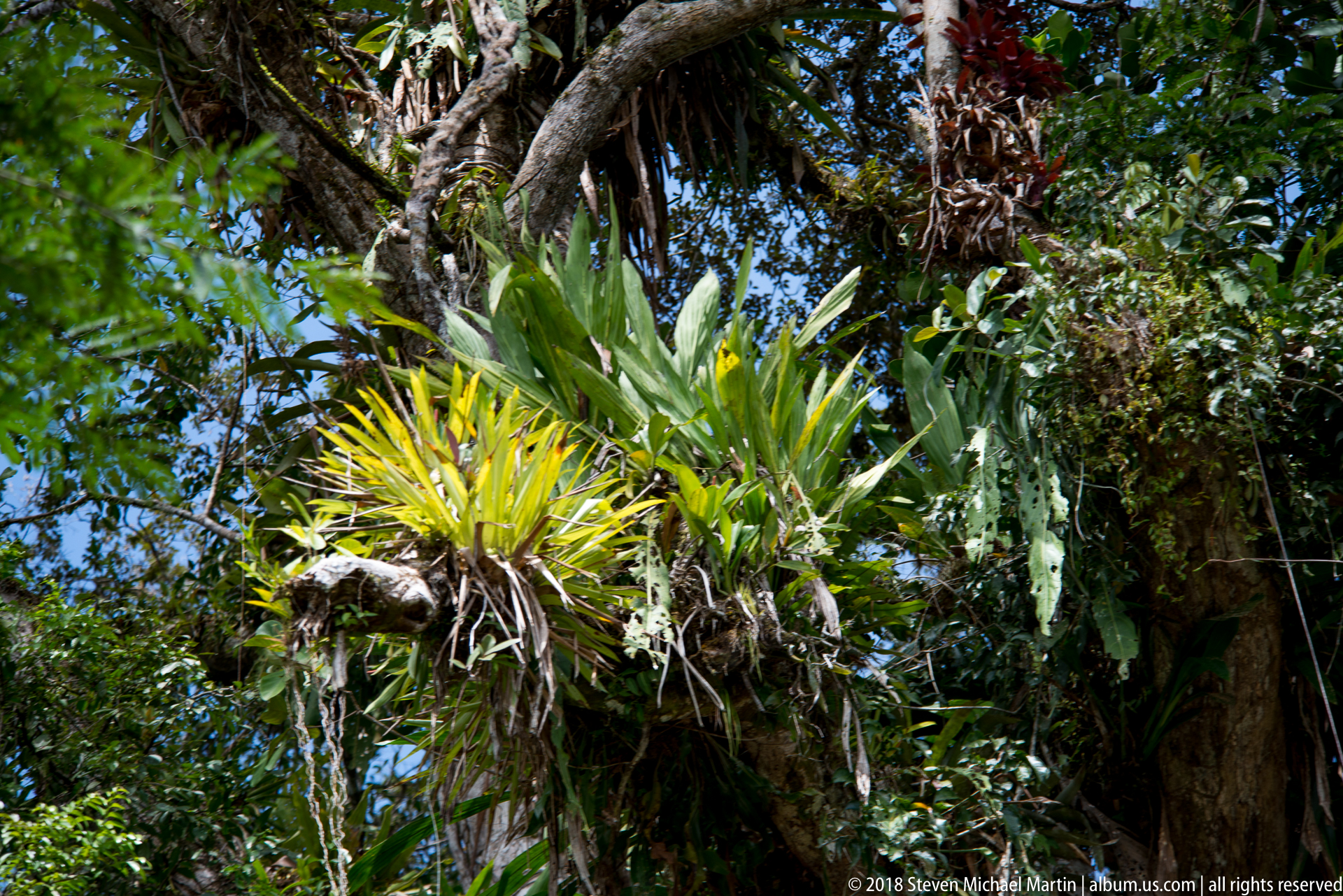
A mature rainforest tree carries dense clusters of bromeliads, ferns, and other epiphytes along its trunk and major branches. Long narrow leaves radiate from several rosettes while roots and old plant material hang below. This broader view places the plants within the architecture of the host tree and shows the vertical layering typical of humid tropical forest vegetation.
Caption
A mature rainforest tree carries dense clusters of bromeliads, ferns, and other epiphytes along its trunk and major branches. Long narrow leaves radiate from several rosettes while roots and old plant material hang below. This broader view places the plants within the architecture of the host tree and shows the vertical layering typical of humid tropical forest vegetation.
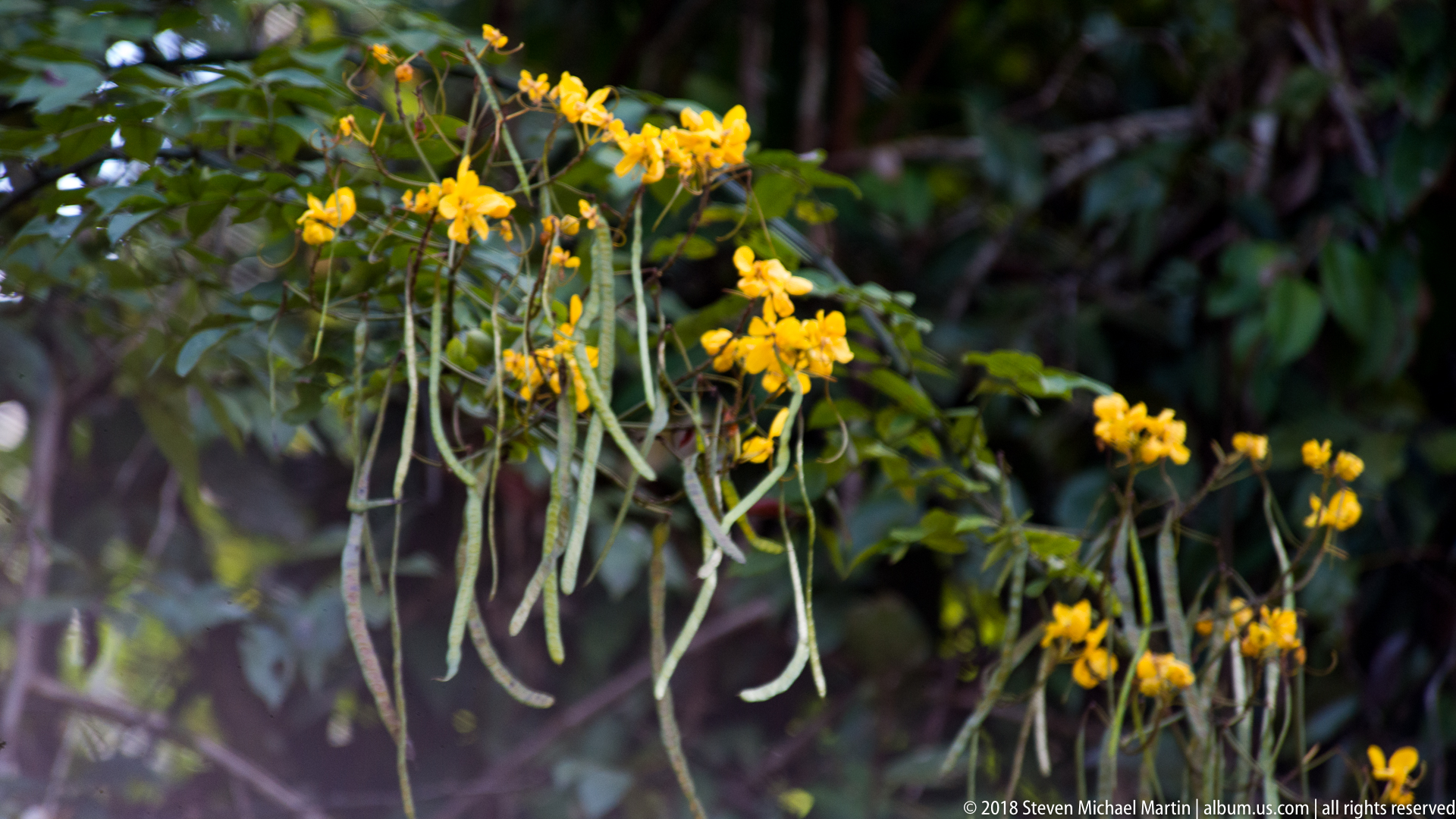
Bright yellow flowers hang in loose clusters above numerous long, slender green pods, creating a striking vertical pattern against the dark forest background. Compound leaves flank the flowering stems. The combination suggests a leguminous tree or shrub, but the proof sheet does not show enough floral structure or foliage detail to assign a defensible species name.
Caption
Bright yellow flowers hang in loose clusters above numerous long, slender green pods, creating a striking vertical pattern against the dark forest background. Compound leaves flank the flowering stems. The combination suggests a leguminous tree or shrub, but the proof sheet does not show enough floral structure or foliage detail to assign a defensible species name.
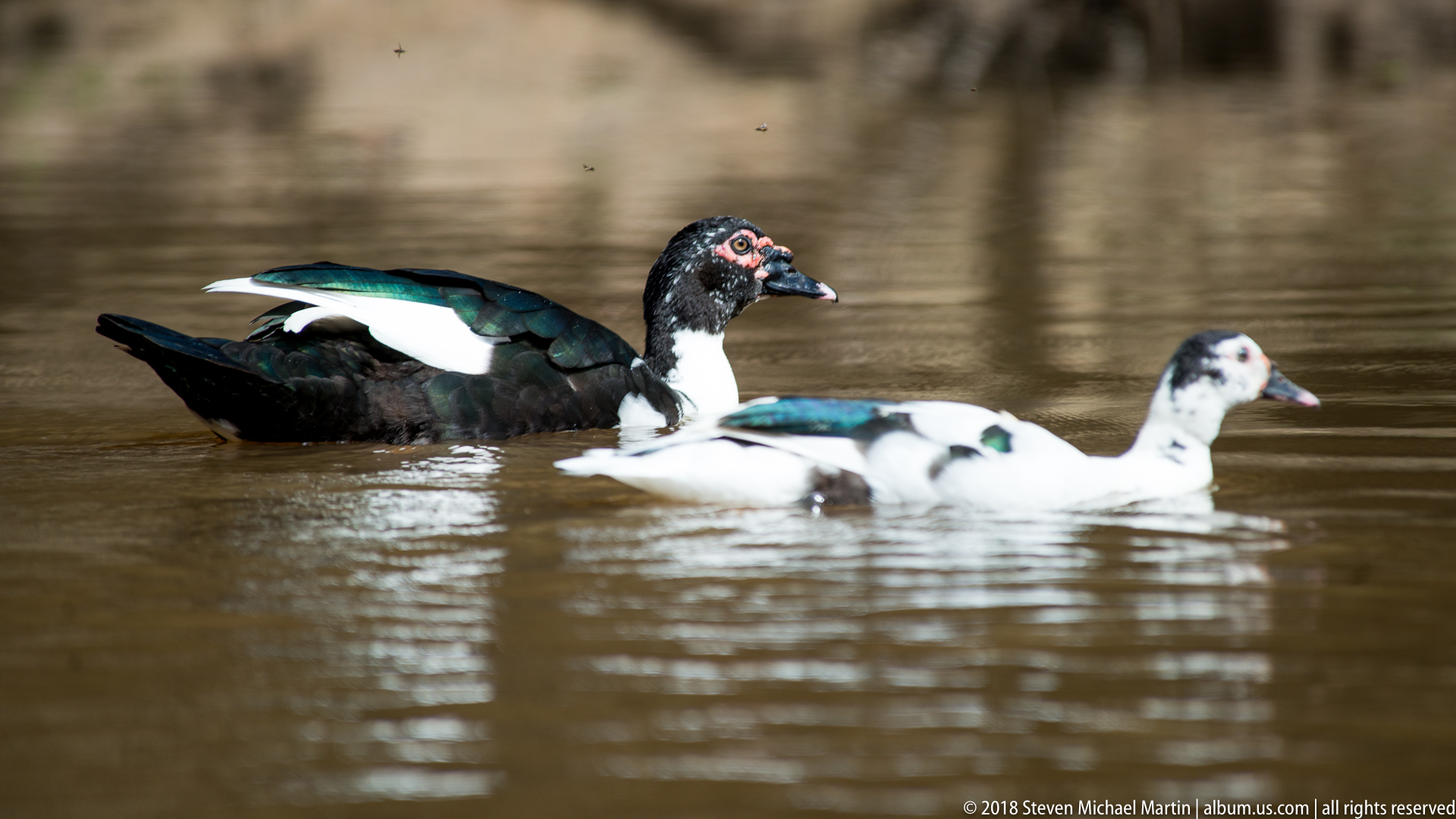
Two Muscovy Ducks swim side by side on calm brown water, one predominantly dark with iridescent green-black wings and the other largely white with black patches. The darker bird shows the species' characteristic red facial caruncles around the eye and bill. Their contrasting plumage illustrates the broad color variation common in domestic or feral Muscovy populations.
Caption
Two Muscovy Ducks swim side by side on calm brown water, one predominantly dark with iridescent green-black wings and the other largely white with black patches. The darker bird shows the species' characteristic red facial caruncles around the eye and bill. Their contrasting plumage illustrates the broad color variation common in domestic or feral Muscovy populations.
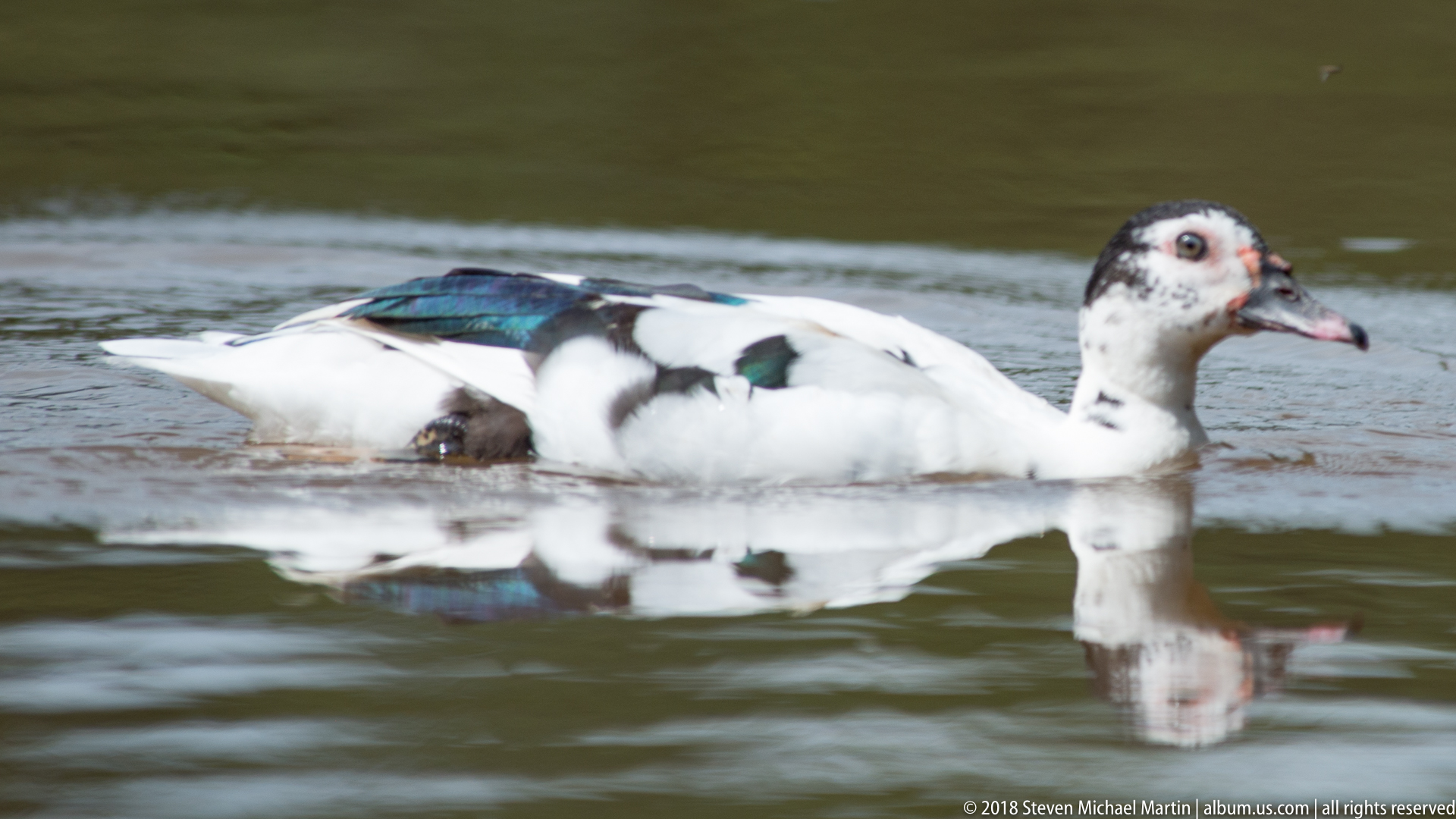
A mostly white Muscovy Duck glides across still water, showing irregular black and iridescent green patches across the back and wings. Sparse red caruncles surround the eye and base of the pinkish bill, while the bird's reflection doubles the patterned plumage below. The light color form contrasts strongly with the darker individuals elsewhere in the sequence.
Caption
A mostly white Muscovy Duck glides across still water, showing irregular black and iridescent green patches across the back and wings. Sparse red caruncles surround the eye and base of the pinkish bill, while the bird's reflection doubles the patterned plumage below. The light color form contrasts strongly with the darker individuals elsewhere in the sequence.
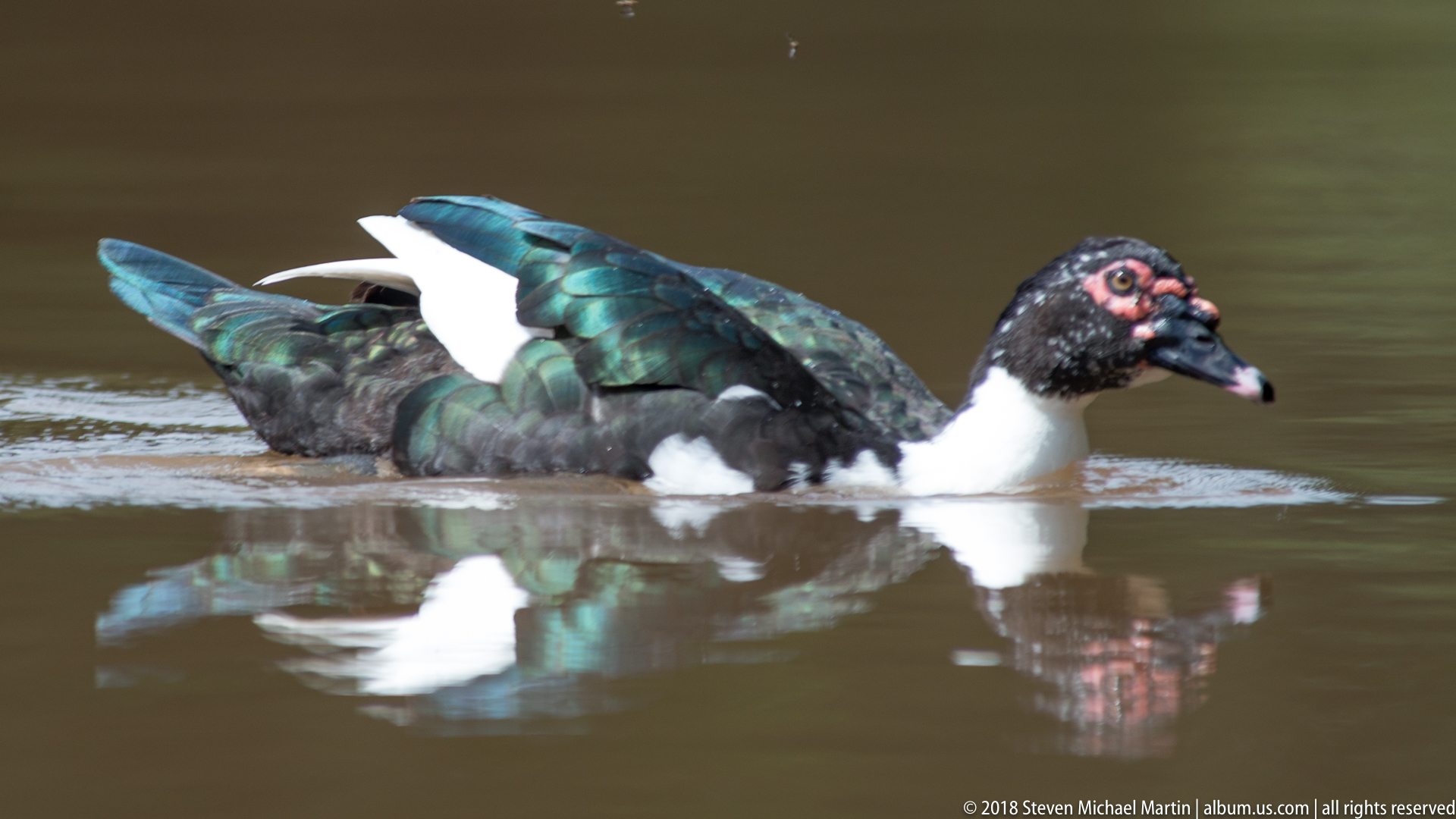
A dark Muscovy Duck moves through the river with glossy green-black wing coverts catching the light and white patches breaking across the shoulder and breast. Red, knobby facial caruncles stand out around the eye and bill. Slightly raised back feathers give the bird a textured profile and emphasize the iridescence of its plumage.
Caption
A dark Muscovy Duck moves through the river with glossy green-black wing coverts catching the light and white patches breaking across the shoulder and breast. Red, knobby facial caruncles stand out around the eye and bill. Slightly raised back feathers give the bird a textured profile and emphasize the iridescence of its plumage.

A mixed-color group of Muscovy Ducks crosses calm water in a loose line, with white, mottled, and dark individuals traveling together. Several birds show red facial skin while the darker duck at right has the species' typical heavy body and iridescent back. The wider view records flock structure and plumage variation rather than a single portrait.
Caption
A mixed-color group of Muscovy Ducks crosses calm water in a loose line, with white, mottled, and dark individuals traveling together. Several birds show red facial skin while the darker duck at right has the species' typical heavy body and iridescent back. The wider view records flock structure and plumage variation rather than a single portrait.
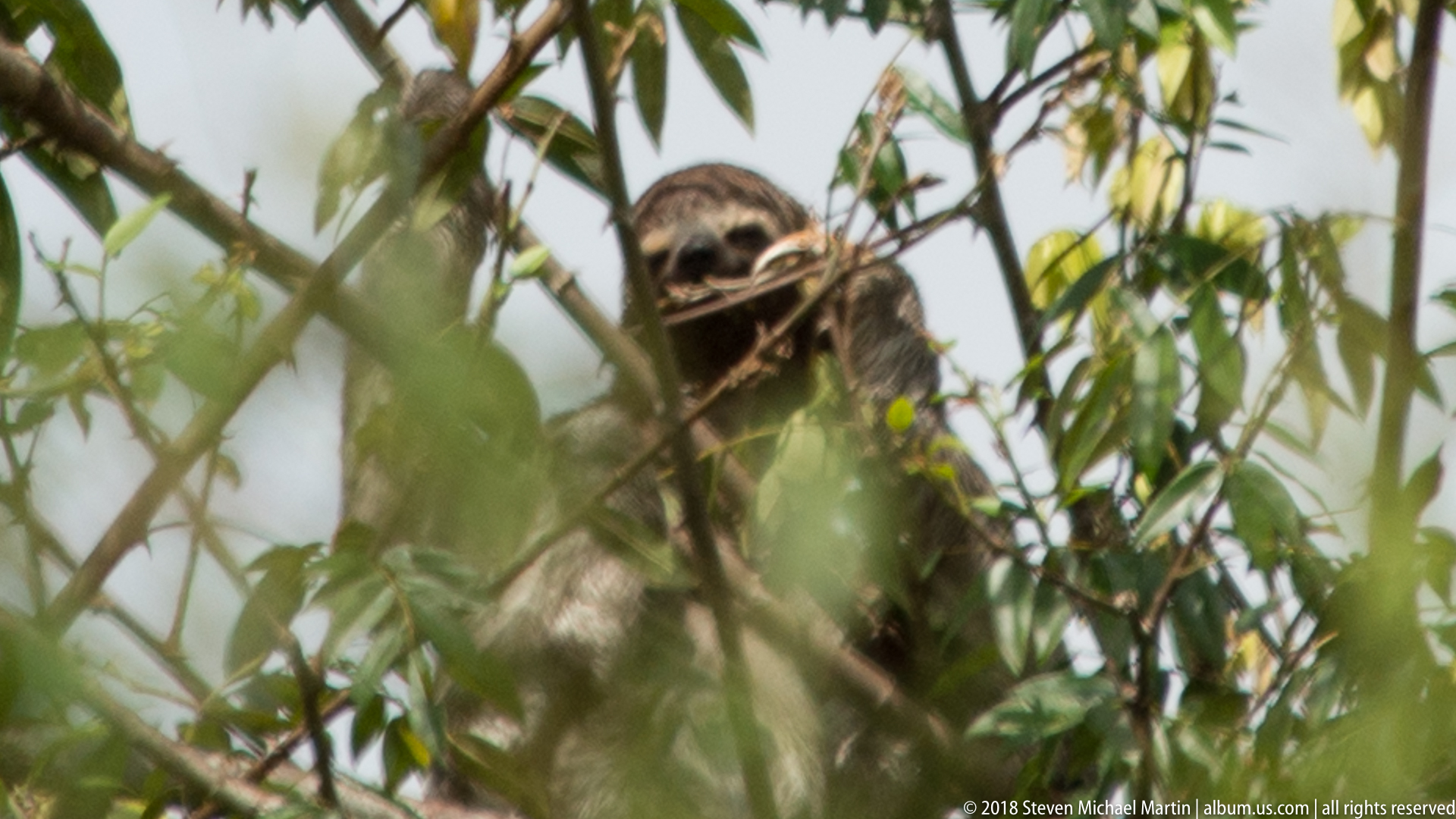
A three-toed sloth peers through thin branches and leaves, its rounded face marked by dark eye patches and a pale brow. Coarse gray-brown fur blends closely with the surrounding vegetation. The facial mask and compact head are consistent with a Brown-throated Three-toed Sloth, a common Amazonian species, although much of the body is hidden.
Caption
A three-toed sloth peers through thin branches and leaves, its rounded face marked by dark eye patches and a pale brow. Coarse gray-brown fur blends closely with the surrounding vegetation. The facial mask and compact head are consistent with a Brown-throated Three-toed Sloth, a common Amazonian species, although much of the body is hidden.
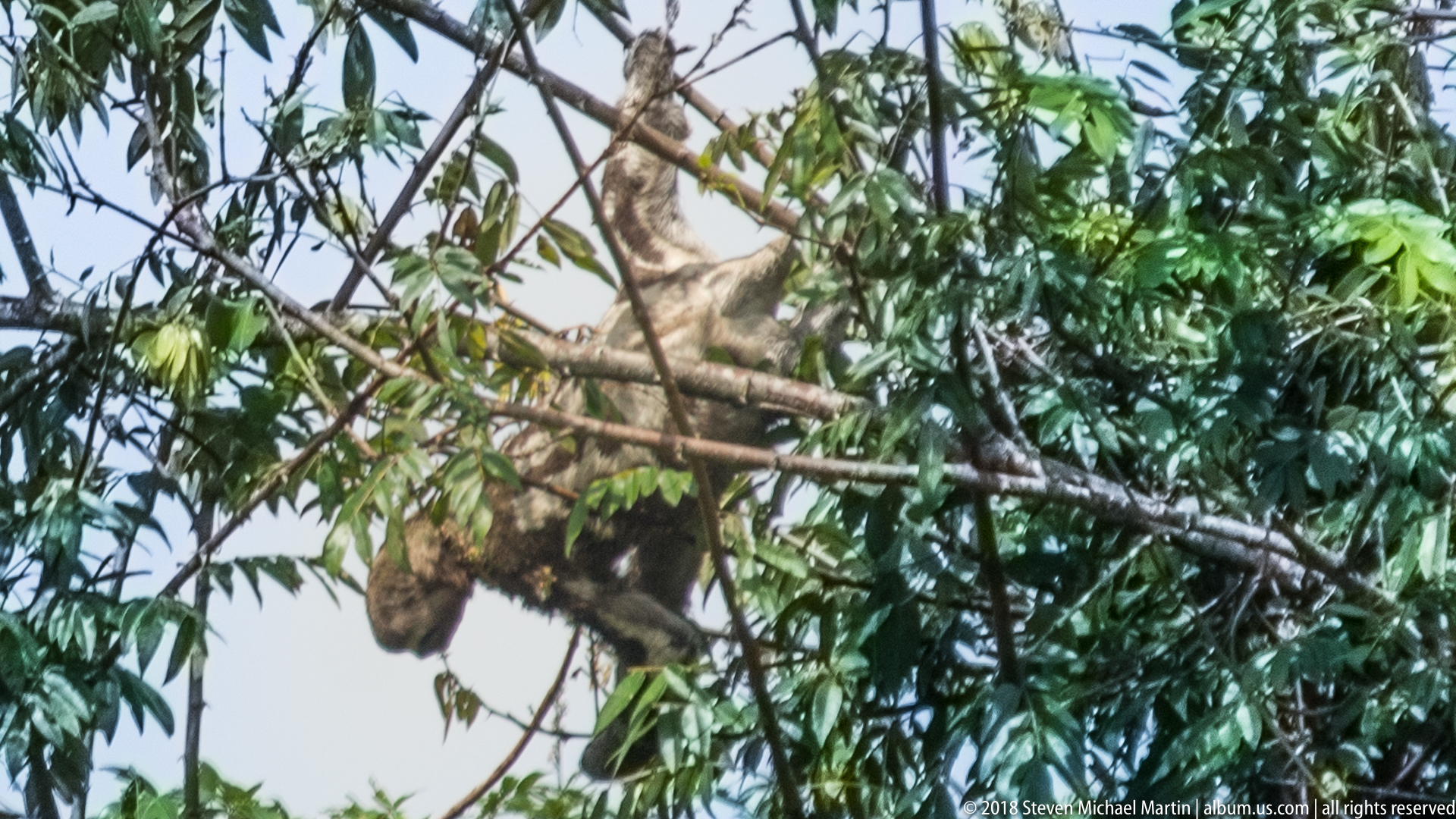
A sloth hangs beneath a slanting branch high in the canopy, its long limbs wrapped around the wood while the shaggy body dangles below. The backlit view is more about posture and habitat than facial detail, showing the slow-moving mammal suspended within a network of leaves and branches. Species-level identification remains provisional because the head is not clearly visible.
Caption
A sloth hangs beneath a slanting branch high in the canopy, its long limbs wrapped around the wood while the shaggy body dangles below. The backlit view is more about posture and habitat than facial detail, showing the slow-moving mammal suspended within a network of leaves and branches. Species-level identification remains provisional because the head is not clearly visible.
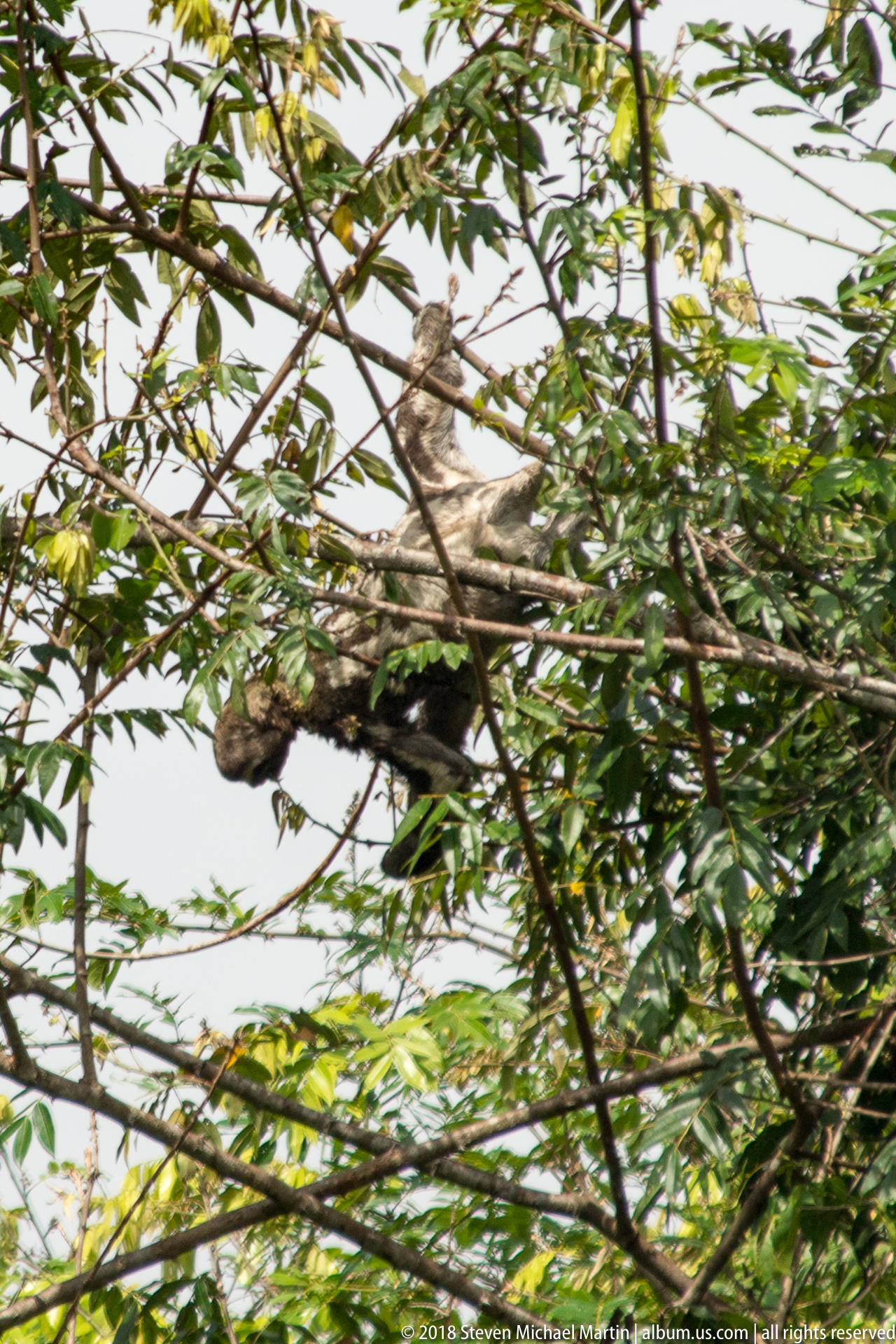
A sloth lies lengthwise across several intersecting branches, its shaggy gray-brown body nearly merging with bark and foliage. One limb hooks over a supporting branch while the head hangs lower at left. The broader canopy view emphasizes camouflage and the animal's deliberate arboreal posture rather than facial features, keeping the species identification conservative.
Caption
A sloth lies lengthwise across several intersecting branches, its shaggy gray-brown body nearly merging with bark and foliage. One limb hooks over a supporting branch while the head hangs lower at left. The broader canopy view emphasizes camouflage and the animal's deliberate arboreal posture rather than facial features, keeping the species identification conservative.

A sloth rests in a dense tangle of branches, with its pale shaggy back and darker limbs broken into fragments by foreground stems and leaves. The animal's slow, draped posture and coarse coat are recognizable despite the obstruction. This frame is primarily a contextual habitat view, showing how effectively a sloth can disappear within the layered structure of the canopy.
Caption
A sloth rests in a dense tangle of branches, with its pale shaggy back and darker limbs broken into fragments by foreground stems and leaves. The animal's slow, draped posture and coarse coat are recognizable despite the obstruction. This frame is primarily a contextual habitat view, showing how effectively a sloth can disappear within the layered structure of the canopy.

A striking butterfly rests with wings closed on dark fabric, revealing a white underside covered in intricate black lines and spots. The hindwing bears a vivid orange patch near the tornus and several narrow tail-like projections. The highly distinctive pattern suggests a specialized Neotropical butterfly group, but the proof sheet does not provide enough certainty for a responsible species name.
Caption
A striking butterfly rests with wings closed on dark fabric, revealing a white underside covered in intricate black lines and spots. The hindwing bears a vivid orange patch near the tornus and several narrow tail-like projections. The highly distinctive pattern suggests a specialized Neotropical butterfly group, but the proof sheet does not provide enough certainty for a responsible species name.

A patterned butterfly perches on the crown of a dark brimmed hat, its closed wings displaying dense black markings over a pale ground and a small orange patch near the hindwing. The wider view places the insect in direct scale with a human-worn object, while the shallow background keeps attention on the butterfly's intricate underside pattern.
Caption
A patterned butterfly perches on the crown of a dark brimmed hat, its closed wings displaying dense black markings over a pale ground and a small orange patch near the hindwing. The wider view places the insect in direct scale with a human-worn object, while the shallow background keeps attention on the butterfly's intricate underside pattern.