Forbidden City
The Forbidden City served as the imperial palace for Ming and Qing dynasty emperors for nearly five centuries. The vast complex consists of ceremonial halls, residential quarters, and administrative buildings arranged along a central north–south axis. The layout reflects principles of symmetry and hierarchy that were fundamental to imperial Chinese architecture.
High defensive walls, expansive courtyards, and elaborately decorated halls illustrate the authority of the emperor and the structure of imperial governance. Architectural features such as tiled roofs, carved stone terraces, and symbolic ornamentation demonstrate the importance of visual symbolism in expressing political legitimacy. The scale of the complex conveys the central role of the emperor within the imperial system.
The Forbidden City represents one of the most significant palace complexes in the world and provides insight into the ceremonial and administrative functions of imperial China. Its preservation allows visitors to observe the spatial organization that defined the imperial court.

Layered palace roofs with yellow glazed tiles rise above red enclosure walls in the Forbidden City, with Jingshan ascending directly to the north beyond the complex.
Caption
Layered palace roofs with yellow glazed tiles rise above red enclosure walls in the Forbidden City, with Jingshan ascending directly to the north beyond the complex.

The Forbidden City’s Nine-Dragon Screen (Jiulongbi), a richly colored glazed wall completed in 1773 during the Qianlong reign, stretches before the Palace of Tranquil Longevity precinct in a full frontal view of its nine relief dragons and yellow-tiled roof above a stone base.
Caption
The Forbidden City’s Nine-Dragon Screen (Jiulongbi), a richly colored glazed wall completed in 1773 during the Qianlong reign, stretches before the Palace of Tranquil Longevity precinct in a full frontal view of its nine relief dragons and yellow-tiled roof above a stone base.

The Meridian Gate, principal southern entrance to the Forbidden City, towers above the curving Inner Golden Water River and its ceremonial bridges.
Caption
The Meridian Gate, principal southern entrance to the Forbidden City, towers above the curving Inner Golden Water River and its ceremonial bridges.

A cast-metal dragon rears on a textured base before red palace columns in the Forbidden City, its long scaled body and antler-like horns echoing the nearby deer as paired auspicious imperial symbols whose exact purpose—decorative, ritual, or incense-related—remains uncertain.
Caption
A cast-metal dragon rears on a textured base before red palace columns in the Forbidden City, its long scaled body and antler-like horns echoing the nearby deer as paired auspicious imperial symbols whose exact purpose—decorative, ritual, or incense-related—remains uncertain.

A visitor strides through a red palace gate in the Forbidden City, the candid portrait capturing his movement between gated courtyards as a carved dragon-head waterspout glows in the sunlit background.
Caption
A visitor strides through a red palace gate in the Forbidden City, the candid portrait capturing his movement between gated courtyards as a carved dragon-head waterspout glows in the sunlit background.

A male visitor stands framed within a monumental red palace gate, its dark studs and aligned successive doorways revealing the axial rhythm of the Forbidden City’s nested courtyards.
Caption
A male visitor stands framed within a monumental red palace gate, its dark studs and aligned successive doorways revealing the axial rhythm of the Forbidden City’s nested courtyards.

Two male visitors stand with arms crossed in a modern travel portrait framed by the red, yellow‑trimmed doorway of the Forbidden City palace complex.
Caption
Two male visitors stand with arms crossed in a modern travel portrait framed by the red, yellow‑trimmed doorway of the Forbidden City palace complex.

Along a broad stone courtyard, the Forbidden City’s central axis channels ceremonial movement through a sequence of red-and-yellow palace gates.
Caption
Along a broad stone courtyard, the Forbidden City’s central axis channels ceremonial movement through a sequence of red-and-yellow palace gates.

Western-style stone arches frame exposed timber framing and a partially open roof in a historic remnant within the Forbidden City precinct, likely part of a former palace or service structure.
Caption
Western-style stone arches frame exposed timber framing and a partially open roof in a historic remnant within the Forbidden City precinct, likely part of a former palace or service structure.

Two visitors stand together, smiling for a contemporary travel portrait against the yellow roofs, red walls, and carved stone details of the Forbidden City in Beijing.
Caption
Two visitors stand together, smiling for a contemporary travel portrait against the yellow roofs, red walls, and carved stone details of the Forbidden City in Beijing.

A close view of a Forbidden City hall reveals yellow glazed barrel tiles cascading toward an upturned roof corner, where symbolic ornaments crown richly painted dougong bracket work that serves both structural and decorative roles in imperial architecture.
Caption
A close view of a Forbidden City hall reveals yellow glazed barrel tiles cascading toward an upturned roof corner, where symbolic ornaments crown richly painted dougong bracket work that serves both structural and decorative roles in imperial architecture.

An oblique view along a red-walled hall in Beijing’s Forbidden City highlights polychrome dougong brackets channeling the roof’s weight through interlocking timber, beneath sweeping yellow-glazed tiles that once signified imperial status.
Caption
An oblique view along a red-walled hall in Beijing’s Forbidden City highlights polychrome dougong brackets channeling the roof’s weight through interlocking timber, beneath sweeping yellow-glazed tiles that once signified imperial status.

A sinuous stone dragon emerges amid cloud and wave motifs on an imperial ramp in the Forbidden City, where such carvings symbolized the emperor and marked palace terraces reserved for ceremonial use.
Caption
A sinuous stone dragon emerges amid cloud and wave motifs on an imperial ramp in the Forbidden City, where such carvings symbolized the emperor and marked palace terraces reserved for ceremonial use.

A coiled dragon threads through clouds and waves on the worn stone surface of an imperial stair ramp, where such central carvings proclaimed sovereignty and cosmic order.
Caption
A coiled dragon threads through clouds and waves on the worn stone surface of an imperial stair ramp, where such central carvings proclaimed sovereignty and cosmic order.
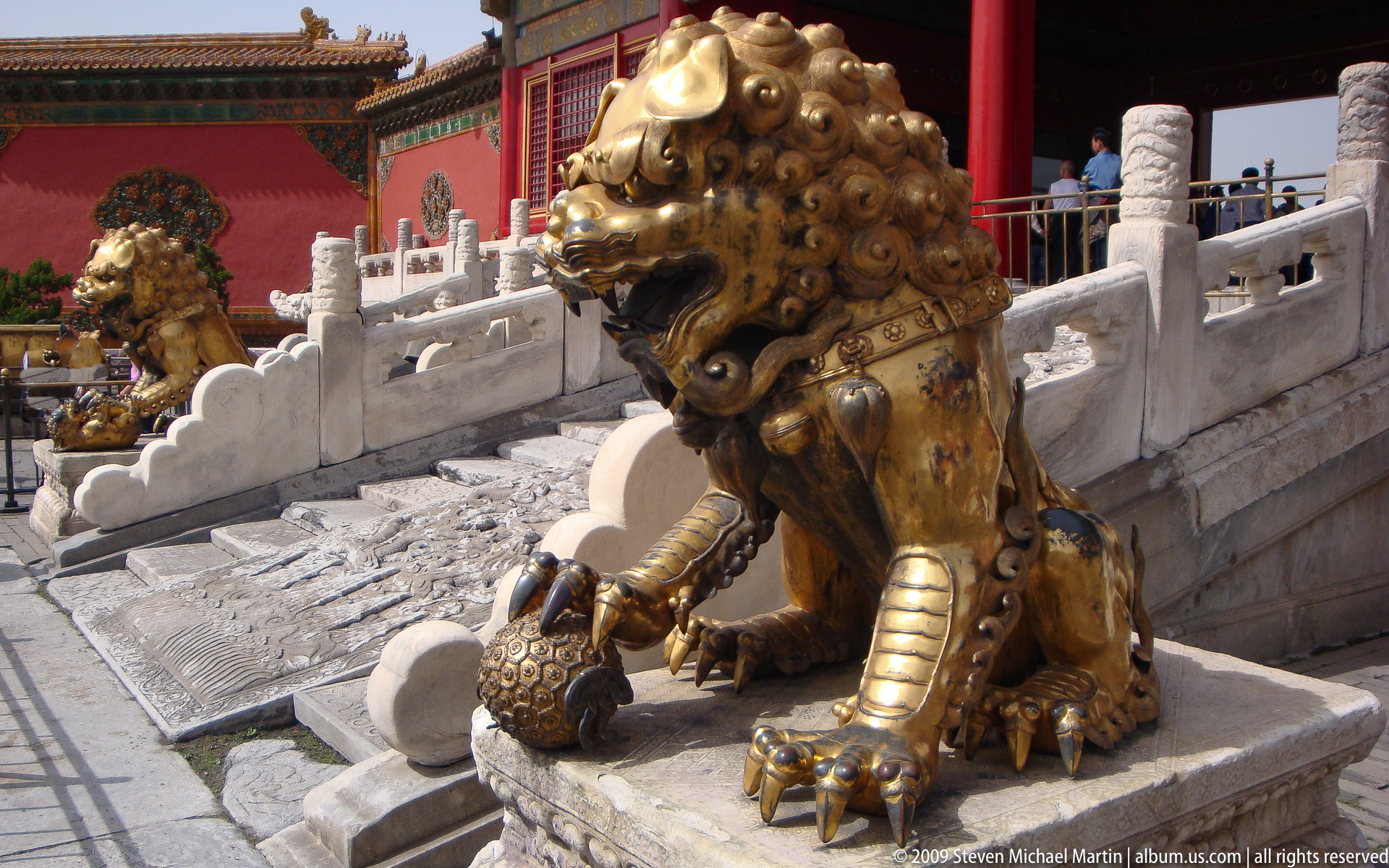
A monumental gilt-bronze male guardian lion presses its paw firmly on a patterned brocade ball, a traditional emblem of protective power and imperial dominion at important thresholds of the Chinese court.
Caption
A monumental gilt-bronze male guardian lion presses its paw firmly on a patterned brocade ball, a traditional emblem of protective power and imperial dominion at important thresholds of the Chinese court.

A bronze qilin or related auspicious beast sits watchfully on a stone base in the Forbidden City, echoing the guardian sculptures once placed in palace precincts as symbols of virtue and good government, though its exact identification is best confirmed by on-site signage.
Caption
A bronze qilin or related auspicious beast sits watchfully on a stone base in the Forbidden City, echoing the guardian sculptures once placed in palace precincts as symbols of virtue and good government, though its exact identification is best confirmed by on-site signage.

Looking straight up into a richly painted zaojing caisson, gilded dragons coil around the central medallion as blue-green coffers and circular dragon panels radiate outward, focusing attention on the symbolic center once reserved for high-status occupants in Chinese architecture.
Caption
Looking straight up into a richly painted zaojing caisson, gilded dragons coil around the central medallion as blue-green coffers and circular dragon panels radiate outward, focusing attention on the symbolic center once reserved for high-status occupants in Chinese architecture.

A visitor pauses beneath gray-tiled eaves at the doorway of a red-latticed palace building in a secondary courtyard of the Forbidden City.
Caption
A visitor pauses beneath gray-tiled eaves at the doorway of a red-latticed palace building in a secondary courtyard of the Forbidden City.

In the Forbidden City’s inner court, a quieter red timber hall with painted eaves and lattice windows rises above a white stone balustrade amid dense palace garden trees, reflecting the more intimate scale of the residential precincts.
Caption
In the Forbidden City’s inner court, a quieter red timber hall with painted eaves and lattice windows rises above a white stone balustrade amid dense palace garden trees, reflecting the more intimate scale of the residential precincts.

A richly painted caisson ceiling centers on a gilded dragon medallion, its concentric coffers and repeating dragon roundels signaling a prestigious imperial interior and the emperor’s celestial authority.
Caption
A richly painted caisson ceiling centers on a gilded dragon medallion, its concentric coffers and repeating dragon roundels signaling a prestigious imperial interior and the emperor’s celestial authority.

A visitor holding a camera stands inside a red-lacquered pavilion in the Forbidden City, framed by ornate lattice doors and painted green panels.
Caption
A visitor holding a camera stands inside a red-lacquered pavilion in the Forbidden City, framed by ornate lattice doors and painted green panels.
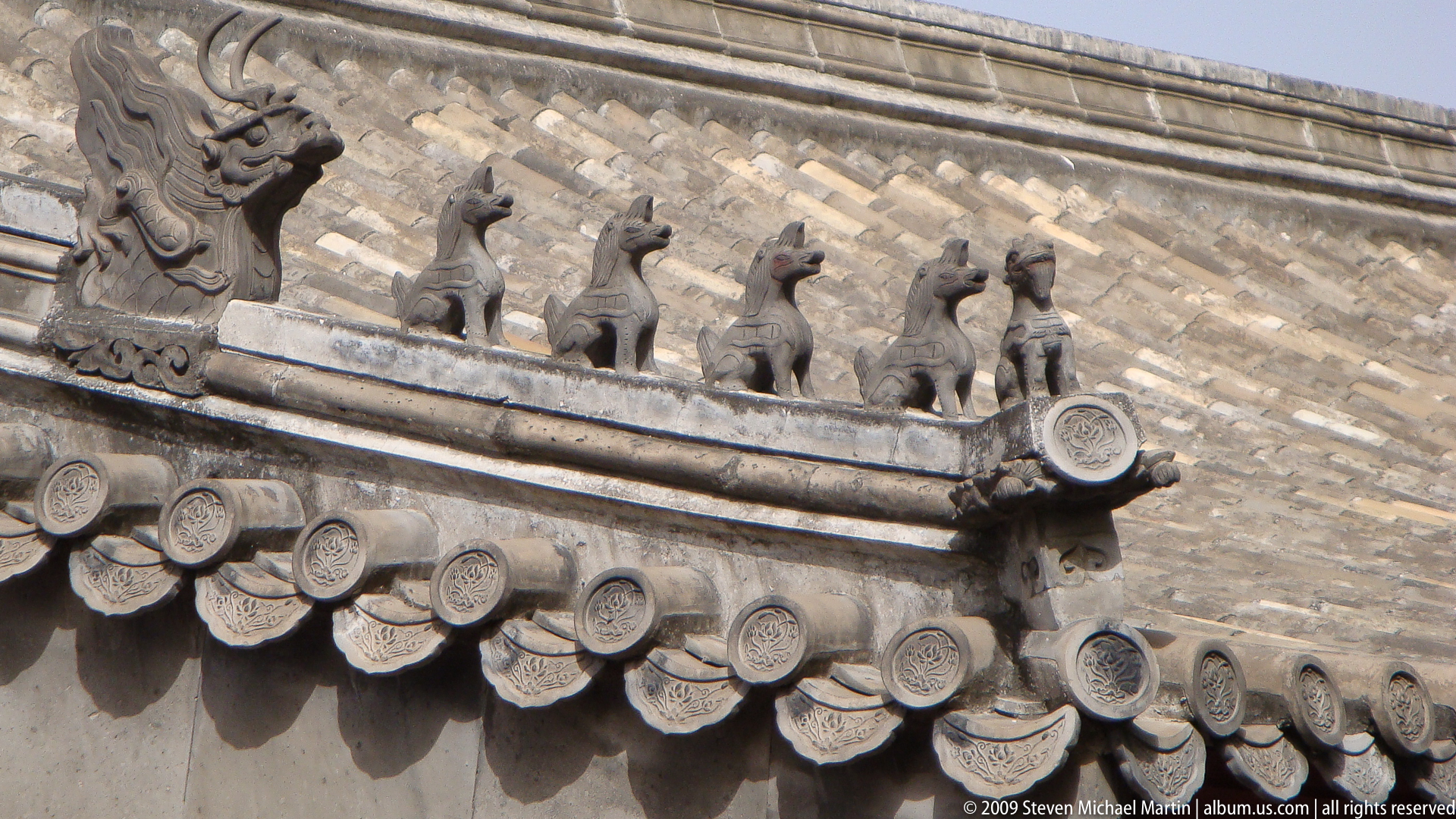
Gray ceramic roof figurines line the ridge of a secondary Forbidden City building, their number and forms signaling the structure’s status as well as offering symbolic protection.
Caption
Gray ceramic roof figurines line the ridge of a secondary Forbidden City building, their number and forms signaling the structure’s status as well as offering symbolic protection.

Carved lotus and ruyi scroll relief adorns the stone terrace base, reflecting the auspicious symbolism woven into palace ornament.
Caption
Carved lotus and ruyi scroll relief adorns the stone terrace base, reflecting the auspicious symbolism woven into palace ornament.

A gilt-bronze male guardian lion presses a brocade ball beneath its paw, with its paired companion lion standing opposite the palace entrance they once flanked.
Caption
A gilt-bronze male guardian lion presses a brocade ball beneath its paw, with its paired companion lion standing opposite the palace entrance they once flanked.

A procession of yellow-glazed guardian figurines marches along an imperial roof ridge in the Forbidden City, signaling the building’s rank and serving as symbolic protection against fire and evil.
Caption
A procession of yellow-glazed guardian figurines marches along an imperial roof ridge in the Forbidden City, signaling the building’s rank and serving as symbolic protection against fire and evil.

A vermilion palace wall of rectangular masonry blocks is punctuated by a small carved stone ventilation grille, a decorative opening that allowed air to circulate while preserving the enclosure of the Forbidden City.
Caption
A vermilion palace wall of rectangular masonry blocks is punctuated by a small carved stone ventilation grille, a decorative opening that allowed air to circulate while preserving the enclosure of the Forbidden City.

An archaic-style bronze jue ritual wine vessel, its dark tripod form with long spout and raised handle echoing ancient Chinese prototypes once prized in later imperial palace collections.
Caption
An archaic-style bronze jue ritual wine vessel, its dark tripod form with long spout and raised handle echoing ancient Chinese prototypes once prized in later imperial palace collections.

Luminous pale jade carving of an idealized female figure in flowing robes, delicately holding a blossom and long implement; her precise identity—court lady, immortal, or Guanyin-related figure—remains to be verified by the object label.
Caption
Luminous pale jade carving of an idealized female figure in flowing robes, delicately holding a blossom and long implement; her precise identity—court lady, immortal, or Guanyin-related figure—remains to be verified by the object label.

Extreme close-up of gilded door studs and a lion-head boss on a weathered vermilion Forbidden City gate, evoking the monumental status such entrances once signified.
Caption
Extreme close-up of gilded door studs and a lion-head boss on a weathered vermilion Forbidden City gate, evoking the monumental status such entrances once signified.
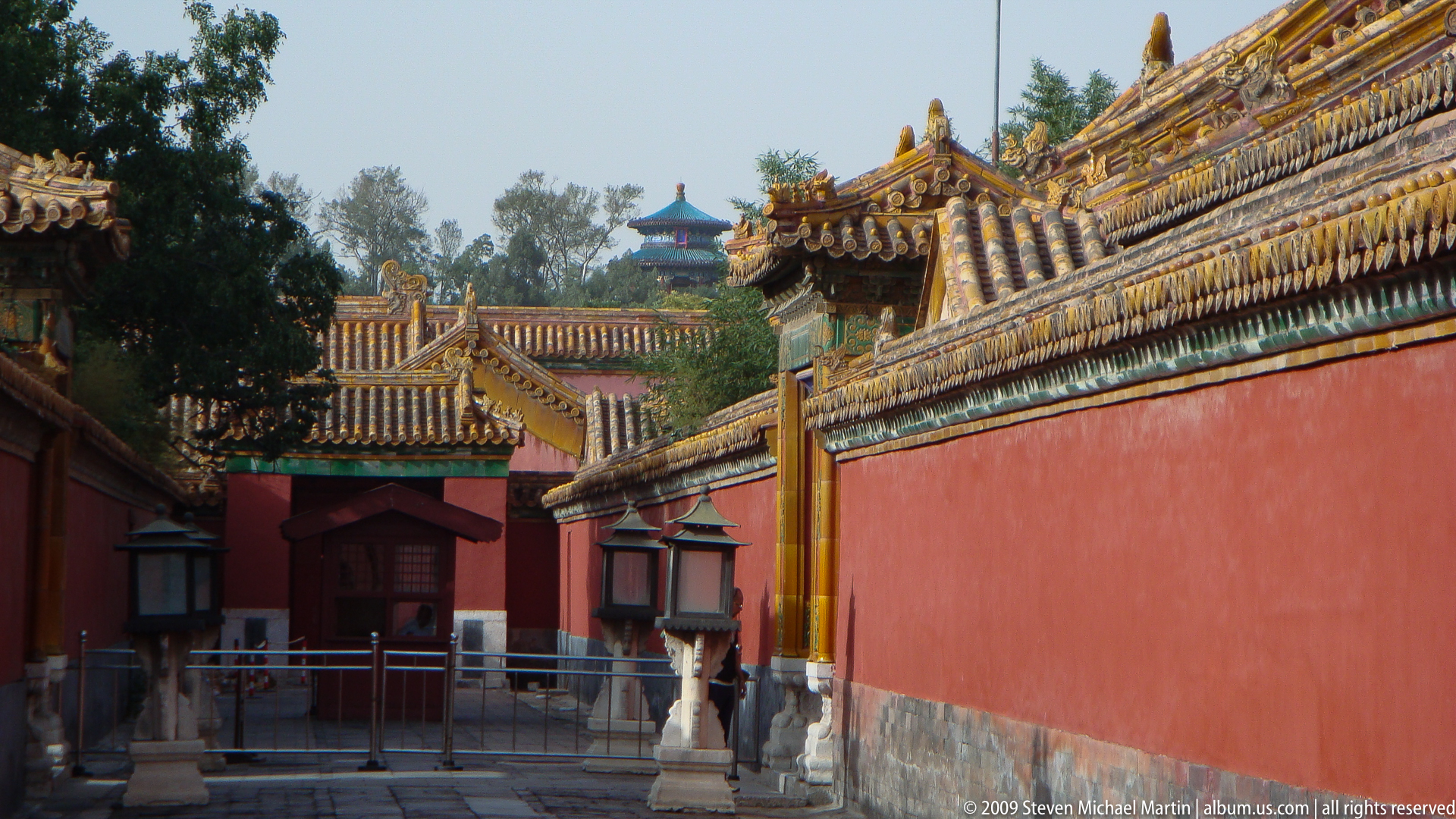
A narrow palace lane between towering red walls and layered tiled roofs reveals how the Forbidden City’s service and residential quarters are ordered into enclosed lanes and courtyards.
Caption
A narrow palace lane between towering red walls and layered tiled roofs reveals how the Forbidden City’s service and residential quarters are ordered into enclosed lanes and courtyards.

A deep green jade covered box, its round form densely carved in high relief with blossoms and foliage, exemplifies the luxury covered vessels prized in the imperial collection.
Caption
A deep green jade covered box, its round form densely carved in high relief with blossoms and foliage, exemplifies the luxury covered vessels prized in the imperial collection.

A two-story red residential courtyard in the inner palace, its painted timber colonnades and blue-green frieze revealing the more intimate, small-scale architecture of the inner court compared with the grand outer ceremonial halls.
Caption
A two-story red residential courtyard in the inner palace, its painted timber colonnades and blue-green frieze revealing the more intimate, small-scale architecture of the inner court compared with the grand outer ceremonial halls.

A cast-metal dragon sculpture with antler-like horns, raised head, and a sinuous, cloud-braced body stands in a Forbidden City courtyard, reflecting the dragon’s role as an imperial emblem and a favored motif on palace ritual furnishings.
Caption
A cast-metal dragon sculpture with antler-like horns, raised head, and a sinuous, cloud-braced body stands in a Forbidden City courtyard, reflecting the dragon’s role as an imperial emblem and a favored motif on palace ritual furnishings.

A glazed ceramic relief plaque shows a five-clawed yellow dragon coiled among green cloud scrolls, framed by a scalloped yellow border that underscores its imperial symbolism.
Caption
A glazed ceramic relief plaque shows a five-clawed yellow dragon coiled among green cloud scrolls, framed by a scalloped yellow border that underscores its imperial symbolism.

A small imperial pavilion with a yellow roof rises on carved white stone terraces, its central stairway emphasizing the hierarchical, ceremonial approach at the Forbidden City in Beijing.
Caption
A small imperial pavilion with a yellow roof rises on carved white stone terraces, its central stairway emphasizing the hierarchical, ceremonial approach at the Forbidden City in Beijing.

A stone terrace approaches an imperial hall, its carved balustrades and projecting drainage spout revealing how elevated platforms both raised principal buildings and integrated their drainage systems.
Caption
A stone terrace approaches an imperial hall, its carved balustrades and projecting drainage spout revealing how elevated platforms both raised principal buildings and integrated their drainage systems.

Close beneath the yellow palace eaves, interlocking blue-green dougong brackets are embellished with repeated gold wan symbols, an ancient auspicious emblem in East Asian art whose structural grids double as intricate ornament.
Caption
Close beneath the yellow palace eaves, interlocking blue-green dougong brackets are embellished with repeated gold wan symbols, an ancient auspicious emblem in East Asian art whose structural grids double as intricate ornament.

A visitor in a white shirt poses for an environmental portrait in the vast outer courtyard of the Forbidden City, framed against a monumental red-and-gold ceremonial hall on its stone terrace.
Caption
A visitor in a white shirt poses for an environmental portrait in the vast outer courtyard of the Forbidden City, framed against a monumental red-and-gold ceremonial hall on its stone terrace.

Tiananmen, standing just south of the Forbidden City entrance sequence in Beijing, rises behind long rows of bright red temporary seating arranged for a public ceremony or anniversary event.
Caption
Tiananmen, standing just south of the Forbidden City entrance sequence in Beijing, rises behind long rows of bright red temporary seating arranged for a public ceremony or anniversary event.

Two visitors pose on a white stone bridge in the Forbidden City, their portrait aligned with a principal yellow-roofed ceremonial hall to reveal the formal axial planning of the outer court.
Caption
Two visitors pose on a white stone bridge in the Forbidden City, their portrait aligned with a principal yellow-roofed ceremonial hall to reveal the formal axial planning of the outer court.

Two visitors pose together on a white stone bridge aligned with a principal yellow-roofed ceremonial hall, their portrait emphasizing the strict axial planning of the Forbidden City’s outer court.
Caption
Two visitors pose together on a white stone bridge aligned with a principal yellow-roofed ceremonial hall, their portrait emphasizing the strict axial planning of the Forbidden City’s outer court.

A lotus-bud baluster finial frames the curving stone bridge and the Meridian Gate’s red wall reflected in the Inner Golden Water River as it winds through the palace’s southern ceremonial zone.
Caption
A lotus-bud baluster finial frames the curving stone bridge and the Meridian Gate’s red wall reflected in the Inner Golden Water River as it winds through the palace’s southern ceremonial zone.

A red diamond lattice window studded with gilded rosette bosses admits filtered light while preserving its intricate patterned surface.
Caption
A red diamond lattice window studded with gilded rosette bosses admits filtered light while preserving its intricate patterned surface.

Shallow focus on gilded door studs across vermilion lacquer abstracts the material contrast of an imperial gate.
Caption
Shallow focus on gilded door studs across vermilion lacquer abstracts the material contrast of an imperial gate.

A red-columned covered corridor in the Forbidden City recedes in one-point perspective, its painted beams and ceiling panels evoking the controlled views that once linked palace halls.
Caption
A red-columned covered corridor in the Forbidden City recedes in one-point perspective, its painted beams and ceiling panels evoking the controlled views that once linked palace halls.

A lone visitor stands beneath richly painted eaves and layered yellow roofs in a Forbidden City courtyard, framed by the dense polychromy of imperial architecture.
Caption
A lone visitor stands beneath richly painted eaves and layered yellow roofs in a Forbidden City courtyard, framed by the dense polychromy of imperial architecture.

A dark-haired visitor poses for a head-and-shoulders portrait in a Forbidden City courtyard, framed by softly blurred red columns, painted brackets, and yellow palace roofs.
Caption
A dark-haired visitor poses for a head-and-shoulders portrait in a Forbidden City courtyard, framed by softly blurred red columns, painted brackets, and yellow palace roofs.

A gray‑haired visitor poses for a head‑and‑shoulders portrait in a Forbidden City courtyard, framed by softly blurred red columns, painted brackets, and yellow palace roofs.
Caption
A gray‑haired visitor poses for a head‑and‑shoulders portrait in a Forbidden City courtyard, framed by softly blurred red columns, painted brackets, and yellow palace roofs.

A close-up of a gable corner in the Forbidden City reveals yellow glazed tiles meeting above a dense lattice of painted dougong brackets, where imperial eaves fuse symbolic color, structural carpentry, and protective ornament.
Caption
A close-up of a gable corner in the Forbidden City reveals yellow glazed tiles meeting above a dense lattice of painted dougong brackets, where imperial eaves fuse symbolic color, structural carpentry, and protective ornament.

A coiling dragon emerges from cloud scrolls on a carved stone baluster, one of many dragon-carved posts that reinforced imperial symbolism along the ceremonial terraces of the Forbidden City.
Caption
A coiling dragon emerges from cloud scrolls on a carved stone baluster, one of many dragon-carved posts that reinforced imperial symbolism along the ceremonial terraces of the Forbidden City.

Intersecting palace roof corners frame the sky as a rhythmic line of guardian figurines silhouettes against the light, emphasizing the graceful geometry of the Forbidden City’s yellow glazed tiles.
Caption
Intersecting palace roof corners frame the sky as a rhythmic line of guardian figurines silhouettes against the light, emphasizing the graceful geometry of the Forbidden City’s yellow glazed tiles.

A monumental tripod bronze censer with a tall pierced canopy stands in the Forbidden City, recalling the large incense burners once used during palace rituals.
Caption
A monumental tripod bronze censer with a tall pierced canopy stands in the Forbidden City, recalling the large incense burners once used during palace rituals.

A full dragon relief coils through clouds and waves on the carved stone central ramp, once symbolically reserved for the emperor in the Forbidden City.
Caption
A full dragon relief coils through clouds and waves on the carved stone central ramp, once symbolically reserved for the emperor in the Forbidden City.
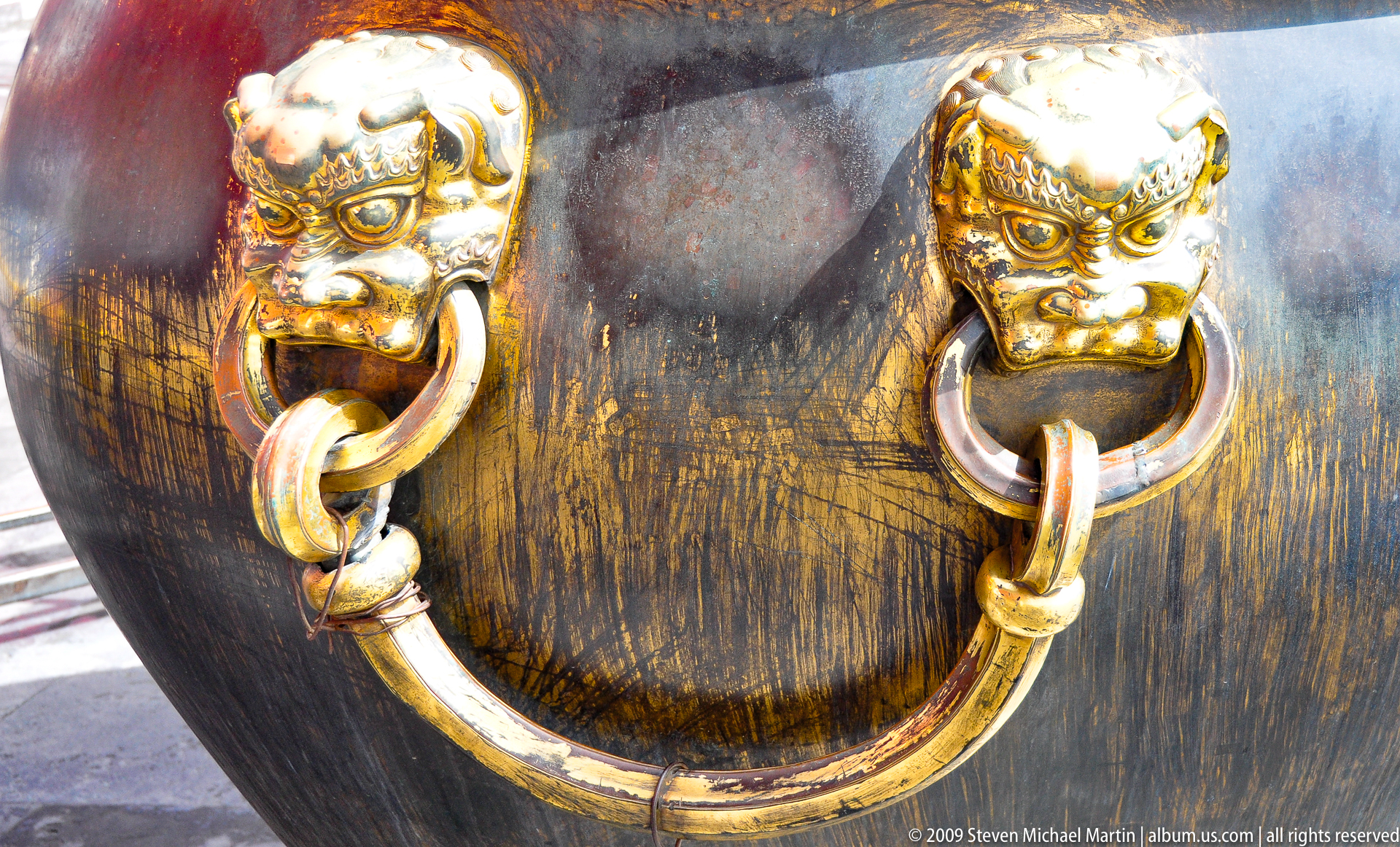
Gilded beast-mask ring handles bite down on a heavy ring against the dark curve of a bronze vessel, echoing ancient Chinese bronze traditions later revived in ceremonial metalwork.
Caption
Gilded beast-mask ring handles bite down on a heavy ring against the dark curve of a bronze vessel, echoing ancient Chinese bronze traditions later revived in ceremonial metalwork.

A telephoto view of the Forbidden City compresses layered yellow-roofed halls and white stone balustrades into a dense axial composition that reveals the hierarchical repetition of halls and courtyards.
Caption
A telephoto view of the Forbidden City compresses layered yellow-roofed halls and white stone balustrades into a dense axial composition that reveals the hierarchical repetition of halls and courtyards.

A procession of imperial roof figurines culminates in a horned, dragon-like ridge beast, their yellow-glazed forms symbolizing rank and protection atop the painted eaves of the Forbidden City.
Caption
A procession of imperial roof figurines culminates in a horned, dragon-like ridge beast, their yellow-glazed forms symbolizing rank and protection atop the painted eaves of the Forbidden City.

A modern visitor poses with one hand raised beside richly carved gold-and-red gilded doors of the Forbidden City, capturing a contemporary encounter with historic palace architecture.
Caption
A modern visitor poses with one hand raised beside richly carved gold-and-red gilded doors of the Forbidden City, capturing a contemporary encounter with historic palace architecture.

An imperial throne in the Forbidden City stands centered beneath the yellow calligraphic plaque 允执厥中, invoking the ideal of maintaining the proper mean within this formal ceremonial hall.
Caption
An imperial throne in the Forbidden City stands centered beneath the yellow calligraphic plaque 允执厥中, invoking the ideal of maintaining the proper mean within this formal ceremonial hall.

A principal inner-court throne hall in the Forbidden City centers on an elevated imperial throne framed by red columns and ritual vessels, beneath the calligraphic plaque “皇建有极,” invoking the sovereign’s establishment of the supreme standard.
Caption
A principal inner-court throne hall in the Forbidden City centers on an elevated imperial throne framed by red columns and ritual vessels, beneath the calligraphic plaque “皇建有极,” invoking the sovereign’s establishment of the supreme standard.

Two visitors stand together and smile before the yellow roofs and red walls of the Forbidden City in this contemporary travel portrait.
Caption
Two visitors stand together and smile before the yellow roofs and red walls of the Forbidden City in this contemporary travel portrait.

Modern uniformed honor guards stand at attention as casually dressed visitors rest on a stone ledge inside Beijing’s Forbidden City, underscoring the site’s role in contemporary China as both historic monument and public space.
Caption
Modern uniformed honor guards stand at attention as casually dressed visitors rest on a stone ledge inside Beijing’s Forbidden City, underscoring the site’s role in contemporary China as both historic monument and public space.

A row of carved stone dragon-head spouts lines the edge of an elevated terrace in the Forbidden City, where they once drained rainwater from the palace above.
Caption
A row of carved stone dragon-head spouts lines the edge of an elevated terrace in the Forbidden City, where they once drained rainwater from the palace above.

An oblique view along the palace’s central ceremonial ramp reveals a dense stone relief where intertwined dragons coil through clouds and waves across the entire stairway slab.
Caption
An oblique view along the palace’s central ceremonial ramp reveals a dense stone relief where intertwined dragons coil through clouds and waves across the entire stairway slab.

A small carved lion-like beast crouches among scales and swirling clouds in a stone dragon-ramp relief, one of the secondary auspicious creatures within the larger imperial program.
Caption
A small carved lion-like beast crouches among scales and swirling clouds in a stone dragon-ramp relief, one of the secondary auspicious creatures within the larger imperial program.

The monumental dragon-carved stone ramp between the palace stairways in the Forbidden City once articulated the emperor’s privileged route.
Caption
The monumental dragon-carved stone ramp between the palace stairways in the Forbidden City once articulated the emperor’s privileged route.

An imperial stone ramp intricately carved with dragons rises between parallel ceremonial stairways, marking the emperor’s privileged route through the Forbidden City.
Caption
An imperial stone ramp intricately carved with dragons rises between parallel ceremonial stairways, marking the emperor’s privileged route through the Forbidden City.

A painted five-clawed dragon, the emblem of imperial power, coils in tight spirals around a pale column in the Forbidden City.
Caption
A painted five-clawed dragon, the emblem of imperial power, coils in tight spirals around a pale column in the Forbidden City.

A field of vivid red double-happiness (囍) characters repeats across a black ground, evoking the auspicious symbolism of marriage and celebration in Chinese culture.
Caption
A field of vivid red double-happiness (囍) characters repeats across a black ground, evoking the auspicious symbolism of marriage and celebration in Chinese culture.

A yellow-roofed palace hall rises behind shrubs and carved terrace posts, its gable ornament framed by a quiet layer of garden foliage that softens the formal architecture.
Caption
A yellow-roofed palace hall rises behind shrubs and carved terrace posts, its gable ornament framed by a quiet layer of garden foliage that softens the formal architecture.

A gilt-bronze male guardian lion grips a patterned brocade ball, its open mouth and curling mane embodying protection and worldly power at an imperial entrance.
Caption
A gilt-bronze male guardian lion grips a patterned brocade ball, its open mouth and curling mane embodying protection and worldly power at an imperial entrance.

A strong diagonal view under the eaves of a Forbidden City palace reveals red rafters and blue-green floral beam paintings, where color-coded timber decoration both protected the wood and signaled rank.
Caption
A strong diagonal view under the eaves of a Forbidden City palace reveals red rafters and blue-green floral beam paintings, where color-coded timber decoration both protected the wood and signaled rank.

A cream-colored lantern bearing the 囍 double-happiness emblem glows against a patterned backdrop of repeated red symbols, evoking its traditional role as a wedding decoration.
Caption
A cream-colored lantern bearing the 囍 double-happiness emblem glows against a patterned backdrop of repeated red symbols, evoking its traditional role as a wedding decoration.

A cream lantern emblazoned with the 囍 double-happiness character glows against a repeating red-and-black backdrop, evoking marital joy and auspicious celebration.
Caption
A cream lantern emblazoned with the 囍 double-happiness character glows against a repeating red-and-black backdrop, evoking marital joy and auspicious celebration.

Overlapping palace eaves bristle with roof figurines, their layered lines forming the dense roofscape characteristic of enclosed palace courtyards.
Caption
Overlapping palace eaves bristle with roof figurines, their layered lines forming the dense roofscape characteristic of enclosed palace courtyards.

A male visitor pauses beside a carved stone stair and red hall in an inner-court garden precinct of the Forbidden City.
Caption
A male visitor pauses beside a carved stone stair and red hall in an inner-court garden precinct of the Forbidden City.

Stacked rolls of richly patterned silk brocade, whose sumptuous colors and woven designs once defined the luxury of court dress and palace furnishings in the Forbidden City.
Caption
Stacked rolls of richly patterned silk brocade, whose sumptuous colors and woven designs once defined the luxury of court dress and palace furnishings in the Forbidden City.

Court painting of an imperial ceremony in a richly patterned palace hall, where ranks of officials and attendants enact a highly ordered ritual that underscores the hierarchy of the Chinese court; the exact event and date require label verification.
Caption
Court painting of an imperial ceremony in a richly patterned palace hall, where ranks of officials and attendants enact a highly ordered ritual that underscores the hierarchy of the Chinese court; the exact event and date require label verification.

A semicircular blue embroidered panel with five radiating bats and a central longevity emblem invokes the auspicious Five Blessings, as bats symbolize good fortune in Chinese culture through their homophonous association with blessings.
Caption
A semicircular blue embroidered panel with five radiating bats and a central longevity emblem invokes the auspicious Five Blessings, as bats symbolize good fortune in Chinese culture through their homophonous association with blessings.

The imperial throne in the Palace of Heavenly Purity stands beneath the celebrated plaque inscribed 正大光明, meaning “Upright and Bright.”
Caption
The imperial throne in the Palace of Heavenly Purity stands beneath the celebrated plaque inscribed 正大光明, meaning “Upright and Bright.”

A diagonal field of weathered yellow-glazed roof tiles reveals flaking surfaces, exposed reddish underlayers, and subtle repairs that speak to the aging and conservation challenges of historic glazed roofs.
Caption
A diagonal field of weathered yellow-glazed roof tiles reveals flaking surfaces, exposed reddish underlayers, and subtle repairs that speak to the aging and conservation challenges of historic glazed roofs.

Weathered glazed-ceramic dragon or chiwen ridge ornaments, their worn surfaces revealing reddish clay beneath, symbolically guard the end of a Forbidden City garden roof.
Caption
Weathered glazed-ceramic dragon or chiwen ridge ornaments, their worn surfaces revealing reddish clay beneath, symbolically guard the end of a Forbidden City garden roof.

A carved stone dragon-head waterspout juts from a white terrace beside the palace steps, an auspicious beast designed to channel rainwater away from the elevated walkway.
Caption
A carved stone dragon-head waterspout juts from a white terrace beside the palace steps, an auspicious beast designed to channel rainwater away from the elevated walkway.

A round red pavilion with a conical glazed roof rises amid scholar rocks and old trees in the intimate landscape of the Imperial Garden in the Forbidden City.
Caption
A round red pavilion with a conical glazed roof rises amid scholar rocks and old trees in the intimate landscape of the Imperial Garden in the Forbidden City.

A dragon medallion glows at the center of a painted caisson ceiling, marking the importance of this garden pavilion in the Imperial Garden.
Caption
A dragon medallion glows at the center of a painted caisson ceiling, marking the importance of this garden pavilion in the Imperial Garden.

A weathered circular dragon relief medallion, its brown-gold surface worn to emphasize the coiling bodies within, recalls the dragon roundels that appeared on architectural and furnishing surfaces throughout the palace.
Caption
A weathered circular dragon relief medallion, its brown-gold surface worn to emphasize the coiling bodies within, recalls the dragon roundels that appeared on architectural and furnishing surfaces throughout the palace.

In the Forbidden City’s Imperial Garden, a red-columned pavilion stands above a quiet pond beside a white stone arch bridge, embodying the garden’s compact, symbolic landscape of pavilions, bridges, rocks, and water.
Caption
In the Forbidden City’s Imperial Garden, a red-columned pavilion stands above a quiet pond beside a white stone arch bridge, embodying the garden’s compact, symbolic landscape of pavilions, bridges, rocks, and water.

A male visitor is framed in a head-and-shoulders portrait against a vivid red gate, where dark door studs and a sculpted lion-head fitting evoke a monumental palace setting.
Caption
A male visitor is framed in a head-and-shoulders portrait against a vivid red gate, where dark door studs and a sculpted lion-head fitting evoke a monumental palace setting.

A lone visitor stands framed in a red palace doorway of the Forbidden City, where nested gates and decorated wall panels create a layered sequence of courtyards and space.
Caption
A lone visitor stands framed in a red palace doorway of the Forbidden City, where nested gates and decorated wall panels create a layered sequence of courtyards and space.

Goldfish and water lilies drift across the green surface of a stone-lined pond, one of the ornamental waters woven into the designed landscape of the Imperial Garden.
Caption
Goldfish and water lilies drift across the green surface of a stone-lined pond, one of the ornamental waters woven into the designed landscape of the Imperial Garden.

A visitor stands with arms crossed beside a red palace gate and evergreen tree, framed by layered roofs that merge Forbidden City architecture with Imperial Garden greenery.
Caption
A visitor stands with arms crossed beside a red palace gate and evergreen tree, framed by layered roofs that merge Forbidden City architecture with Imperial Garden greenery.

A single five-clawed yellow dragon surges above stylized green waves on a turquoise ground in this glazed ceramic panel from the Nine-Dragon Screen in Beijing’s Forbidden City, built in 1773 during the Qianlong reign, whose nine dragons symbolize imperial power and auspicious protection.
Caption
A single five-clawed yellow dragon surges above stylized green waves on a turquoise ground in this glazed ceramic panel from the Nine-Dragon Screen in Beijing’s Forbidden City, built in 1773 during the Qianlong reign, whose nine dragons symbolize imperial power and auspicious protection.

A sinuous purple five-clawed dragon surges above stylized green waves on a turquoise field in this glazed ceramic panel from the Nine-Dragon Screen in Beijing’s Forbidden City, built in 1773 during the Qianlong reign to symbolize imperial power and auspicious protection.
Caption
A sinuous purple five-clawed dragon surges above stylized green waves on a turquoise field in this glazed ceramic panel from the Nine-Dragon Screen in Beijing’s Forbidden City, built in 1773 during the Qianlong reign to symbolize imperial power and auspicious protection.

A five-clawed white dragon coils above stylized green waves on a turquoise ground in this glazed ceramic panel from the Nine-Dragon Screen in Beijing’s Forbidden City, built in 1773 during the Qianlong reign, where its nine dragons symbolize imperial power and auspicious protection.
Caption
A five-clawed white dragon coils above stylized green waves on a turquoise ground in this glazed ceramic panel from the Nine-Dragon Screen in Beijing’s Forbidden City, built in 1773 during the Qianlong reign, where its nine dragons symbolize imperial power and auspicious protection.

A five-clawed blue dragon writhes above stylized green waves on a turquoise ground in a single glazed ceramic panel from the Nine-Dragon Screen in the Forbidden City, built in 1773 during the Qianlong reign, whose nine dragons symbolize imperial power and auspicious protection.
Caption
A five-clawed blue dragon writhes above stylized green waves on a turquoise ground in a single glazed ceramic panel from the Nine-Dragon Screen in the Forbidden City, built in 1773 during the Qianlong reign, whose nine dragons symbolize imperial power and auspicious protection.

A five-clawed yellow dragon surges above stylized green waves on a glazed ceramic panel from the Nine-Dragon Screen in the Forbidden City, built in 1773 during the Qianlong reign, where nine such dragons symbolize imperial power and auspicious protection.
Caption
A five-clawed yellow dragon surges above stylized green waves on a glazed ceramic panel from the Nine-Dragon Screen in the Forbidden City, built in 1773 during the Qianlong reign, where nine such dragons symbolize imperial power and auspicious protection.

A single five-clawed blue dragon surges above stylized green waves on the glazed ceramic Nine-Dragon Screen in Beijing’s Forbidden City, built in 1773 during the Qianlong reign to symbolize imperial power and auspicious protection.
Caption
A single five-clawed blue dragon surges above stylized green waves on the glazed ceramic Nine-Dragon Screen in Beijing’s Forbidden City, built in 1773 during the Qianlong reign to symbolize imperial power and auspicious protection.

A five-clawed white dragon writhes above stylized green waves on a turquoise glazed ceramic panel from the Nine-Dragon Screen in Beijing’s Forbidden City, built in 1773 during the Qianlong reign to symbolize imperial power and auspicious protection.
Caption
A five-clawed white dragon writhes above stylized green waves on a turquoise glazed ceramic panel from the Nine-Dragon Screen in Beijing’s Forbidden City, built in 1773 during the Qianlong reign to symbolize imperial power and auspicious protection.

A purple five-clawed dragon surges above stylized green waves on a turquoise glazed panel from the Nine-Dragon Screen in the Forbidden City, built in 1773 during the Qianlong reign, whose nine dragons symbolize imperial power and auspicious protection.
Caption
A purple five-clawed dragon surges above stylized green waves on a turquoise glazed panel from the Nine-Dragon Screen in the Forbidden City, built in 1773 during the Qianlong reign, whose nine dragons symbolize imperial power and auspicious protection.

A single yellow five-clawed dragon surges above stylized green waves on a turquoise glazed ceramic panel from the Nine-Dragon Screen in the Forbidden City, built in 1773 during the Qianlong reign to symbolize imperial power and auspicious protection.
Caption
A single yellow five-clawed dragon surges above stylized green waves on a turquoise glazed ceramic panel from the Nine-Dragon Screen in the Forbidden City, built in 1773 during the Qianlong reign to symbolize imperial power and auspicious protection.

Two smiling visitors pose before a vivid yellow dragon relief on the Forbidden City’s Nine-Dragon Screen.
Caption
Two smiling visitors pose before a vivid yellow dragon relief on the Forbidden City’s Nine-Dragon Screen.

Two smiling visitors pose before a vivid yellow dragon relief on the Forbidden City’s Nine-Dragon Screen, framed by swirling turquoise clouds and green waves.
Caption
Two smiling visitors pose before a vivid yellow dragon relief on the Forbidden City’s Nine-Dragon Screen, framed by swirling turquoise clouds and green waves.

An arched gateway pierces a vermilion palace wall, flanked by great bronze vats once used to store water for firefighting in the Forbidden City.
Caption
An arched gateway pierces a vermilion palace wall, flanked by great bronze vats once used to store water for firefighting in the Forbidden City.

A richly painted coffered ceiling in the Forbidden City frames a central turquoise dragon panel, its polychrome squares both ornamenting and protecting the timber above a palace hall.
Caption
A richly painted coffered ceiling in the Forbidden City frames a central turquoise dragon panel, its polychrome squares both ornamenting and protecting the timber above a palace hall.

An eastern precinct palace hall in the Forbidden City, its yellow roof rising above white stone terraces and red columns, seen from an oblique angle.
Caption
An eastern precinct palace hall in the Forbidden City, its yellow roof rising above white stone terraces and red columns, seen from an oblique angle.

A modern visitor sits casually on a white stone balustrade in an inner palace precinct of the Forbidden City, framed by carved railings, red columns, and blue calligraphy plaques flanking the hall behind him.
Caption
A modern visitor sits casually on a white stone balustrade in an inner palace precinct of the Forbidden City, framed by carved railings, red columns, and blue calligraphy plaques flanking the hall behind him.

A four-star “Star-Rated Toilet” plaque issued by the Beijing Tourism Administration documents contemporary visitor infrastructure within the Forbidden City.
Caption
A four-star “Star-Rated Toilet” plaque issued by the Beijing Tourism Administration documents contemporary visitor infrastructure within the Forbidden City.

A visitor pauses between successive red-and-gold palace doorways in the Forbidden City, where repeated thresholds reveal the nested layout of the imperial compounds beneath a blue calligraphy plaque.
Caption
A visitor pauses between successive red-and-gold palace doorways in the Forbidden City, where repeated thresholds reveal the nested layout of the imperial compounds beneath a blue calligraphy plaque.

Interwoven carved wooden latticework, a complex pattern like this used in palace windows, screens, and decorative panels.
Caption
Interwoven carved wooden latticework, a complex pattern like this used in palace windows, screens, and decorative panels.

A cast-metal dragon with antler-like horns and a long scaled body stands before red palace columns in the Forbidden City, an auspicious imperial symbol accompanied by a nearby deer and possibly serving a decorative, ritual, or incense-related function.
Caption
A cast-metal dragon with antler-like horns and a long scaled body stands before red palace columns in the Forbidden City, an auspicious imperial symbol accompanied by a nearby deer and possibly serving a decorative, ritual, or incense-related function.

A richly painted corner pavilion with yellow-tiled roofs marks the transition between palace courtyards in the Forbidden City.
Caption
A richly painted corner pavilion with yellow-tiled roofs marks the transition between palace courtyards in the Forbidden City.

A symmetrical yellow‑roofed gate pavilion stands on the Forbidden City's central axis, its broad ramp and stone balustrades marking a controlled passage between successive palace zones.
Caption
A symmetrical yellow‑roofed gate pavilion stands on the Forbidden City's central axis, its broad ramp and stone balustrades marking a controlled passage between successive palace zones.

A visitor pauses on a crowded Forbidden City terrace as the Jingshan pavilion aligns perfectly on the northern terminus of the palace axis beyond.
Caption
A visitor pauses on a crowded Forbidden City terrace as the Jingshan pavilion aligns perfectly on the northern terminus of the palace axis beyond.

A monumental yellow-roofed ceremonial hall rises above a triple tier of carved white stone terraces in the Forbidden City, its red colonnades and painted eaves emphasizing the building’s principal status within the palace complex.
Caption
A monumental yellow-roofed ceremonial hall rises above a triple tier of carved white stone terraces in the Forbidden City, its red colonnades and painted eaves emphasizing the building’s principal status within the palace complex.

Two smiling visitors pose for a close pair portrait against the softly blurred white stone balustrades of the Forbidden City, a contemporary moment in travel photography.
Caption
Two smiling visitors pose for a close pair portrait against the softly blurred white stone balustrades of the Forbidden City, a contemporary moment in travel photography.

Visitors follow the central axis across the courtyard toward the Hall of Supreme Harmony, the largest hall in the Forbidden City and the traditional focus of major state ceremonies.
Caption
Visitors follow the central axis across the courtyard toward the Hall of Supreme Harmony, the largest hall in the Forbidden City and the traditional focus of major state ceremonies.

A visitor in a white shirt stands in the vast courtyard before the Hall of Supreme Harmony, emphasizing the monumental scale of the Forbidden City’s outer court.
Caption
A visitor in a white shirt stands in the vast courtyard before the Hall of Supreme Harmony, emphasizing the monumental scale of the Forbidden City’s outer court.

A frontal view of Tiananmen, the monumental southern gate of Beijing’s Imperial City, shows the Gate of Heavenly Peace with its central Mao Zedong portrait flanked by red parapet slogans proclaiming “Long live the People’s Republic of China” and “Long live the great unity of the peoples of the world.”
Caption
A frontal view of Tiananmen, the monumental southern gate of Beijing’s Imperial City, shows the Gate of Heavenly Peace with its central Mao Zedong portrait flanked by red parapet slogans proclaiming “Long live the People’s Republic of China” and “Long live the great unity of the peoples of the world.”

Head-and-neck close-up of a horned, flame-maned gilt-bronze qilin or related dragon-like auspicious guardian in a wooded precinct of the Forbidden City, with a dark metal ring passing through its mouth; the exact identification should be confirmed against site records.
Caption
Head-and-neck close-up of a horned, flame-maned gilt-bronze qilin or related dragon-like auspicious guardian in a wooded precinct of the Forbidden City, with a dark metal ring passing through its mouth; the exact identification should be confirmed against site records.