Sofia – Bulgaria
Sofia lies within a broad basin at the foot of Mount Vitosha, surrounded by the ranges of the Balkan Mountains, Lyulin Mountains, and Vitosha Mountain. Because of its strategic location between Central Europe and the Aegean world, the city has been inhabited for thousands of years.
Remains of the ancient Roman city of Serdica can still be seen in the center of modern Sofia, where archaeological ruins stand beside Ottoman mosques, Orthodox churches, and neoclassical government buildings.
Wide boulevards, public squares, and historic churches give Sofia a layered architectural character that reflects its long history as a crossroads of civilizations in southeastern Europe.

Seen from a low angle through leafy branches, Saint Nedelya Church presents massive stone walls, tall arched windows with metal grilles, a broad domed roofline, and a square bell tower. The subdued gray masonry contrasts with the brighter sky and emphasizes the building’s weight and solidity. The view records the church from an oblique corner rather than from its principal entrance.
Caption
Seen from a low angle through leafy branches, Saint Nedelya Church presents massive stone walls, tall arched windows with metal grilles, a broad domed roofline, and a square bell tower. The subdued gray masonry contrasts with the brighter sky and emphasizes the building’s weight and solidity. The view records the church from an oblique corner rather than from its principal entrance.

The National Assembly’s monumental white façade rises behind a large tiered display of pink flowers, creating a vivid contrast between civic architecture and seasonal planting. The central portico, rooftop tower, Bulgarian flag, and inscription identify the parliamentary building, while the foreground flowers partially obscure its lower entrance. The composition turns a formal government landmark into a layered urban streetscape.
Caption
The National Assembly’s monumental white façade rises behind a large tiered display of pink flowers, creating a vivid contrast between civic architecture and seasonal planting. The central portico, rooftop tower, Bulgarian flag, and inscription identify the parliamentary building, while the foreground flowers partially obscure its lower entrance. The composition turns a formal government landmark into a layered urban streetscape.

The modern Cathedral of St. Joseph is illuminated against the night sky, its long side elevation articulated by tall narrow arched windows and projecting vertical piers. A clock tower rises at the front corner, while a large circular opening marks the end wall and shallow roof bays glow above the nave. The angular composition emphasizes the cathedral’s restrained contemporary geometry and vertical rhythm.
Caption
The modern Cathedral of St. Joseph is illuminated against the night sky, its long side elevation articulated by tall narrow arched windows and projecting vertical piers. A clock tower rises at the front corner, while a large circular opening marks the end wall and shallow roof bays glow above the nave. The angular composition emphasizes the cathedral’s restrained contemporary geometry and vertical rhythm.

Arcing water jets form overlapping curves across a broad fountain in Sofia’s City Garden. Behind the spray, mature trees and an elegant multi-story historic building create a layered urban backdrop. The photograph focuses on the moving water and landscaped public space rather than a single monument, conveying the garden’s role as a civic foreground to central Sofia’s architecture.
Caption
Arcing water jets form overlapping curves across a broad fountain in Sofia’s City Garden. Behind the spray, mature trees and an elegant multi-story historic building create a layered urban backdrop. The photograph focuses on the moving water and landscaped public space rather than a single monument, conveying the garden’s role as a civic foreground to central Sofia’s architecture.

The long brick nave of Sofia’s Church of Saint Sofia is viewed toward the sanctuary, with rows of simple wooden chairs aligned beneath high barrel vaulting and round-arched openings. Exposed red brick, restrained icon display, and the spare interior emphasize the basilica’s structural clarity and markedly austere character.
Caption
The long brick nave of Sofia’s Church of Saint Sofia is viewed toward the sanctuary, with rows of simple wooden chairs aligned beneath high barrel vaulting and round-arched openings. Exposed red brick, restrained icon display, and the spare interior emphasize the basilica’s structural clarity and markedly austere character.

The ceremonial entrance to the Presidency of the Republic of Bulgaria is framed by rusticated stone arches and guarded by two uniformed sentries. The national emblem and Bulgarian inscription above the doors identify the institution, while the symmetrical guard boxes and formal posture of the soldiers reinforce the building’s state function. Reflections in the glass doors reveal the surrounding city streetscape.
Caption
The ceremonial entrance to the Presidency of the Republic of Bulgaria is framed by rusticated stone arches and guarded by two uniformed sentries. The national emblem and Bulgarian inscription above the doors identify the institution, while the symmetrical guard boxes and formal posture of the soldiers reinforce the building’s state function. Reflections in the glass doors reveal the surrounding city streetscape.

The upper figure of Sofia’s monumental city statue is silhouetted against a pale sky, its dark drapery contrasting with a gilded face and outstretched arms. An owl-like bird is held or perched on one arm, while another symbolic element extends from the opposite side. The close crop removes the column and plaza, concentrating attention on the figure’s theatrical pose and black-and-gold finish.
Caption
The upper figure of Sofia’s monumental city statue is silhouetted against a pale sky, its dark drapery contrasting with a gilded face and outstretched arms. An owl-like bird is held or perched on one arm, while another symbolic element extends from the opposite side. The close crop removes the column and plaza, concentrating attention on the figure’s theatrical pose and black-and-gold finish.

The Banya Bashi Mosque rises behind excavated brick and stone remains in central Sofia, linking two very different layers of the city’s history in a single view. The mosque’s minaret and domed mass dominate the skyline, while stepped walkways and low archaeological walls occupy the foreground, illustrating the close physical relationship between Ottoman Sofia and the ancient Serdica remains.
Caption
The Banya Bashi Mosque rises behind excavated brick and stone remains in central Sofia, linking two very different layers of the city’s history in a single view. The mosque’s minaret and domed mass dominate the skyline, while stepped walkways and low archaeological walls occupy the foreground, illustrating the close physical relationship between Ottoman Sofia and the ancient Serdica remains.

The sanctuary of the Church of Saint Sofia is framed by massive exposed brick piers and pale plastered arches. A modest white icon screen, red carpet, chandeliers, and devotional images organize the liturgical focus, while narrow clerestory windows illuminate the high apse and emphasize the church’s early basilican proportions.
Caption
The sanctuary of the Church of Saint Sofia is framed by massive exposed brick piers and pale plastered arches. A modest white icon screen, red carpet, chandeliers, and devotional images organize the liturgical focus, while narrow clerestory windows illuminate the high apse and emphasize the church’s early basilican proportions.

A monumental bronze lion stands alert on a high stone pedestal beside the colonnaded entrance of Sofia’s Palace of Justice. A second lion appears farther back, establishing the paired sculptural arrangement that flanks the courthouse steps. The low viewpoint emphasizes the animal’s muscular silhouette against the pale classical columns and nearby urban apartment blocks.
Caption
A monumental bronze lion stands alert on a high stone pedestal beside the colonnaded entrance of Sofia’s Palace of Justice. A second lion appears farther back, establishing the paired sculptural arrangement that flanks the courthouse steps. The low viewpoint emphasizes the animal’s muscular silhouette against the pale classical columns and nearby urban apartment blocks.

A long stone arcade recedes in strong one-point perspective beneath a red-painted ceiling grid and a sequence of hanging lanterns. Massive piers and repeated arches form a sheltered pedestrian passage along one of Sofia’s central monumental blocks. A few pedestrians provide scale, while the distant opening draws the eye toward trees and daylight beyond the colonnade.
Caption
A long stone arcade recedes in strong one-point perspective beneath a red-painted ceiling grid and a sequence of hanging lanterns. Massive piers and repeated arches form a sheltered pedestrian passage along one of Sofia’s central monumental blocks. A few pedestrians provide scale, while the distant opening draws the eye toward trees and daylight beyond the colonnade.

The monumental female figure of Saint Sofia appears in silhouette against the fading sky, elevated high above street level on its column. Her outstretched arms support symbolic attributes that project beyond the body, creating the distinctive profile of the modern city monument. Backlighting reduces the sculpture to a dark emblematic outline, emphasizing gesture and skyline presence rather than surface detail.
Caption
The monumental female figure of Saint Sofia appears in silhouette against the fading sky, elevated high above street level on its column. Her outstretched arms support symbolic attributes that project beyond the body, creating the distinctive profile of the modern city monument. Backlighting reduces the sculpture to a dark emblematic outline, emphasizing gesture and skyline presence rather than surface detail.

Two tall white sculptural forms rise from a low stone pedestal inscribed in Bulgarian, set within a planted median or small urban square. Their paired, upward-reaching shapes resemble stylized flames or wings, while parked cars, apartment blocks, and mature trees place the memorial firmly within Sofia’s everyday streetscape.
Caption
Two tall white sculptural forms rise from a low stone pedestal inscribed in Bulgarian, set within a planted median or small urban square. Their paired, upward-reaching shapes resemble stylized flames or wings, while parked cars, apartment blocks, and mature trees place the memorial firmly within Sofia’s everyday streetscape.

The Banya Bashi Mosque is seen from street level with its single slender minaret rising beside the domed prayer hall. Alternating stone and brick masonry, arched windows, and a series of lower roof volumes give the Ottoman-era structure a layered profile, while traffic and utility lines emphasize its position within modern central Sofia.
Caption
The Banya Bashi Mosque is seen from street level with its single slender minaret rising beside the domed prayer hall. Alternating stone and brick masonry, arched windows, and a series of lower roof volumes give the Ottoman-era structure a layered profile, while traffic and utility lines emphasize its position within modern central Sofia.

An abstract metal sculpture stands on a pedestrian street in central Sofia, combining rounded bronze-toned masses with a taller dark geometric slab pierced by a curved opening. The contrasting surfaces and interlocking shapes create a strong sculptural silhouette, while storefronts and passing pedestrians show the work in its active urban setting.
Caption
An abstract metal sculpture stands on a pedestrian street in central Sofia, combining rounded bronze-toned masses with a taller dark geometric slab pierced by a curved opening. The contrasting surfaces and interlocking shapes create a strong sculptural silhouette, while storefronts and passing pedestrians show the work in its active urban setting.

A small arched stained-glass window is framed by bands of blue-and-gold ornament and Arabic calligraphy inside Banya Bashi Mosque. The window’s pale floral glazing sits between two horizontal inscriptions, while the dark blue painted borders emphasize the vertical opening. The close crop concentrates attention on the relationship between light, script, and architectural decoration.
Caption
A small arched stained-glass window is framed by bands of blue-and-gold ornament and Arabic calligraphy inside Banya Bashi Mosque. The window’s pale floral glazing sits between two horizontal inscriptions, while the dark blue painted borders emphasize the vertical opening. The close crop concentrates attention on the relationship between light, script, and architectural decoration.
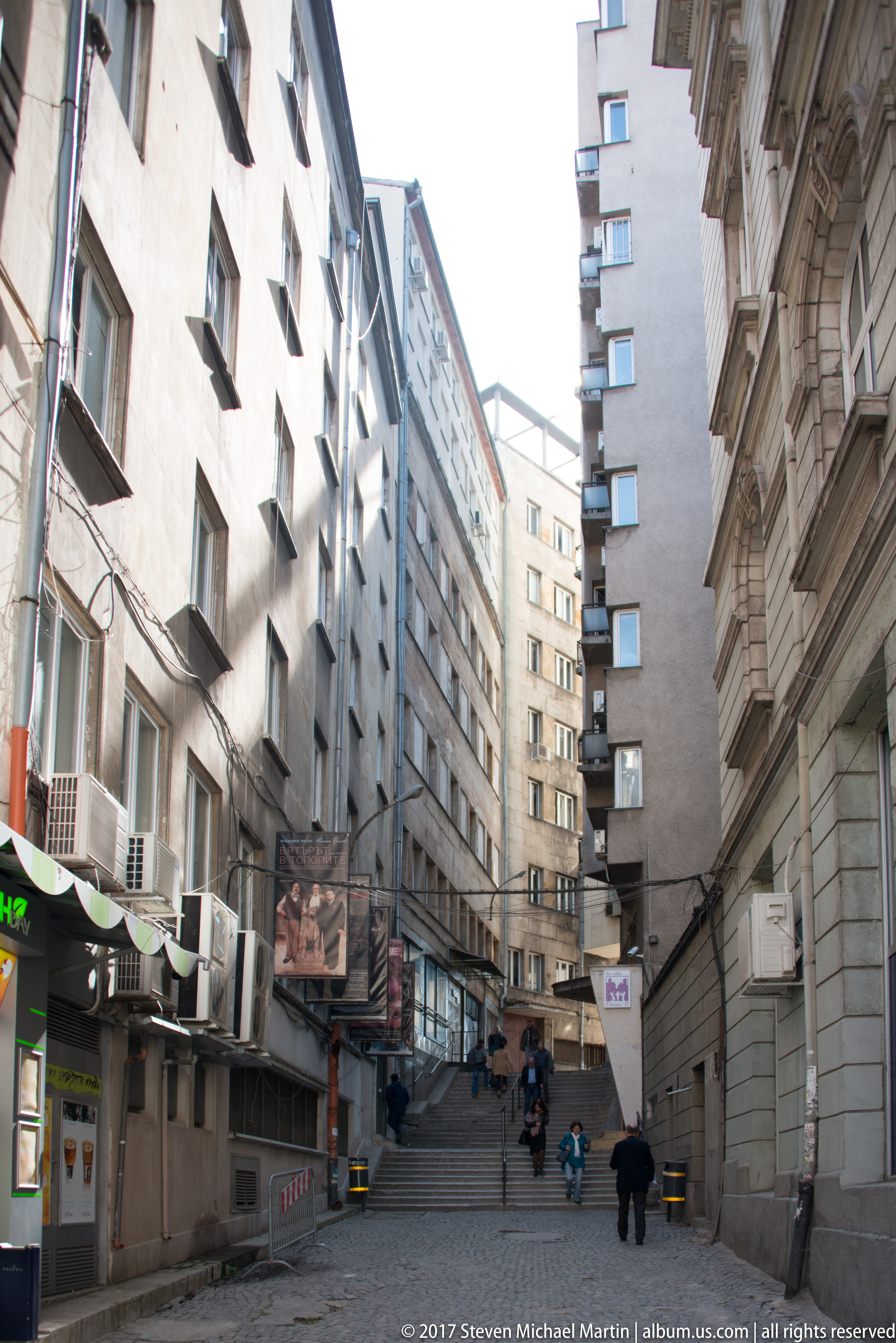
A narrow service street runs between closely spaced mid-rise buildings in central Sofia. Air-conditioning units, utility fixtures, rear entrances, and blank party walls give the passage a distinctly functional character, contrasting with the more formal street façades nearby. The compressed perspective leads toward pedestrians at the far end and emphasizes the dense urban fabric of the city center.
Caption
A narrow service street runs between closely spaced mid-rise buildings in central Sofia. Air-conditioning units, utility fixtures, rear entrances, and blank party walls give the passage a distinctly functional character, contrasting with the more formal street façades nearby. The compressed perspective leads toward pedestrians at the far end and emphasizes the dense urban fabric of the city center.
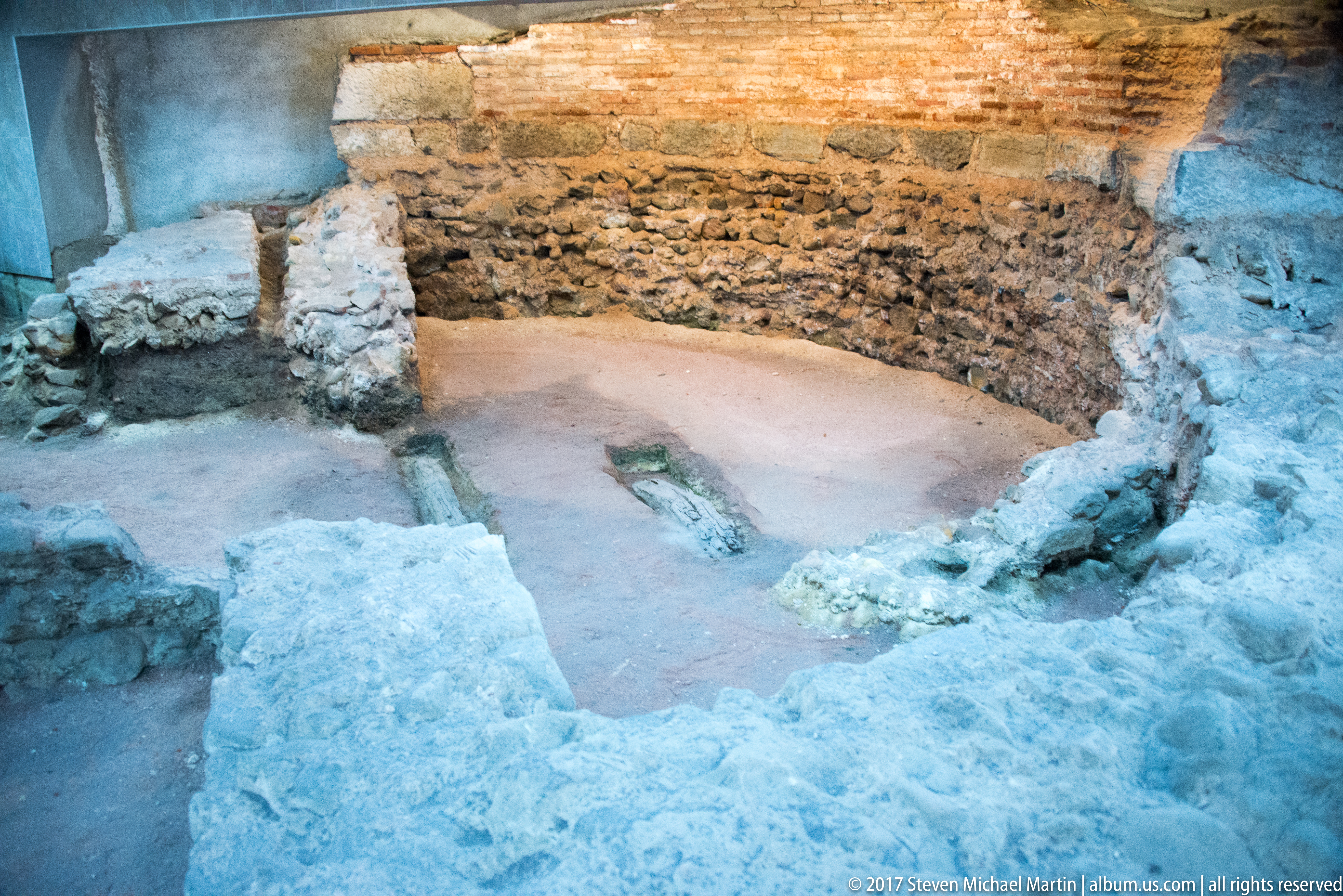
Exposed archaeological remains reveal rough stone foundations and a surviving band of reddish brick masonry at Sofia’s ancient Serdica complex. Low walls define narrow interior spaces and changing floor levels, showing how Roman and later construction survives beneath the modern city. The close viewpoint emphasizes the texture and stratigraphy of the excavated fabric rather than a complete building plan.
Caption
Exposed archaeological remains reveal rough stone foundations and a surviving band of reddish brick masonry at Sofia’s ancient Serdica complex. Low walls define narrow interior spaces and changing floor levels, showing how Roman and later construction survives beneath the modern city. The close viewpoint emphasizes the texture and stratigraphy of the excavated fabric rather than a complete building plan.

A low brick-built archaeological feature is displayed beneath an interpretive panel showing a plan of the Ancient Serdica complex. The masonry has been consolidated into a legible rectangular form, while the overhead diagram situates the fragment within the larger excavation. The pairing of physical remains and site plan makes this view especially useful for understanding how isolated structures fit the ancient urban layout.
Caption
A low brick-built archaeological feature is displayed beneath an interpretive panel showing a plan of the Ancient Serdica complex. The masonry has been consolidated into a legible rectangular form, while the overhead diagram situates the fragment within the larger excavation. The pairing of physical remains and site plan makes this view especially useful for understanding how isolated structures fit the ancient urban layout.

An interpretive panel for the Ancient Serdica complex describes the Cardo Maximus, the principal north–south street of the Roman city. The bilingual Bulgarian and English text explains its width, excavated length, dating, porticoes, and later modifications, providing documentary context for the archaeological remains preserved beneath central Sofia.
Caption
An interpretive panel for the Ancient Serdica complex describes the Cardo Maximus, the principal north–south street of the Roman city. The bilingual Bulgarian and English text explains its width, excavated length, dating, porticoes, and later modifications, providing documentary context for the archaeological remains preserved beneath central Sofia.

The Banya Bashi Mosque fills the frame from a slightly elevated side angle, showing its tall cylindrical minaret, broad lead-colored dome, and alternating courses of stone and brick. Arched windows and projecting lower roof sections articulate the prayer hall, while trees and nearby buildings reinforce the mosque’s compact urban setting in the center of Sofia.
Caption
The Banya Bashi Mosque fills the frame from a slightly elevated side angle, showing its tall cylindrical minaret, broad lead-colored dome, and alternating courses of stone and brick. Arched windows and projecting lower roof sections articulate the prayer hall, while trees and nearby buildings reinforce the mosque’s compact urban setting in the center of Sofia.

Interlocking fan-shaped motifs form a richly patterned pedestrian pavement in central Sofia. Small rectangular pavers in muted red, cream, and dark green are arranged in repeating scallops, creating a decorative surface that shifts rhythmically across the frame. The close view isolates the craftsmanship of the paving from the surrounding streetscape and architecture.
Caption
Interlocking fan-shaped motifs form a richly patterned pedestrian pavement in central Sofia. Small rectangular pavers in muted red, cream, and dark green are arranged in repeating scallops, creating a decorative surface that shifts rhythmically across the frame. The close view isolates the craftsmanship of the paving from the surrounding streetscape and architecture.

The former Central Mineral Baths present an ornate symmetrical façade behind fountains and landscaped lawns. Striped masonry, arched windows, domed corner pavilions, and the prominent central entrance reflect the building’s richly decorative early twentieth-century design. Today the landmark is closely associated with Sofia’s mineral-spring heritage and the Museum of Regional History housed inside.
Caption
The former Central Mineral Baths present an ornate symmetrical façade behind fountains and landscaped lawns. Striped masonry, arched windows, domed corner pavilions, and the prominent central entrance reflect the building’s richly decorative early twentieth-century design. Today the landmark is closely associated with Sofia’s mineral-spring heritage and the Museum of Regional History housed inside.

A foreground fountain throws vertical jets across the view of Sofia’s former Central Mineral Baths, making water the visual link between the landscaped square and the city’s historic bathing complex. Beyond the pool, the striped façade, arched windows, domed pavilions, and central entrance provide a symmetrical architectural backdrop beneath a clear autumn sky.
Caption
A foreground fountain throws vertical jets across the view of Sofia’s former Central Mineral Baths, making water the visual link between the landscaped square and the city’s historic bathing complex. Beyond the pool, the striped façade, arched windows, domed pavilions, and central entrance provide a symmetrical architectural backdrop beneath a clear autumn sky.

Richly painted Islamic ornament covers the dome and supporting pendentives inside Banya Bashi Mosque. Blue, red, green, and gold vegetal and geometric motifs radiate from the center, while small stained-glass windows punctuate the drum and lower walls. The upward view emphasizes the carefully ordered decorative program rather than the furnishings of the prayer hall below.
Caption
Richly painted Islamic ornament covers the dome and supporting pendentives inside Banya Bashi Mosque. Blue, red, green, and gold vegetal and geometric motifs radiate from the center, while small stained-glass windows punctuate the drum and lower walls. The upward view emphasizes the carefully ordered decorative program rather than the furnishings of the prayer hall below.

A nearly centered view into the dome of Banya Bashi Mosque reveals concentric rings of painted ornament arranged around a small blue-and-red central medallion. Pendant-like floral motifs repeat across the pale dome field, while the surrounding arches and windows frame the composition. The symmetry highlights the geometric discipline of the mosque’s interior decoration.
Caption
A nearly centered view into the dome of Banya Bashi Mosque reveals concentric rings of painted ornament arranged around a small blue-and-red central medallion. Pendant-like floral motifs repeat across the pale dome field, while the surrounding arches and windows frame the composition. The symmetry highlights the geometric discipline of the mosque’s interior decoration.

A circular stained-glass rosette glows against a pale interior wall of Banya Bashi Mosque. Red tulip-like forms and turquoise leaves radiate around a blue center, enclosed by a dark blue pointed border. The close composition isolates the window’s color and floral geometry, with a band of carved or molded ornament visible along the lower edge.
Caption
A circular stained-glass rosette glows against a pale interior wall of Banya Bashi Mosque. Red tulip-like forms and turquoise leaves radiate around a blue center, enclosed by a dark blue pointed border. The close composition isolates the window’s color and floral geometry, with a band of carved or molded ornament visible along the lower edge.

Painted arches, calligraphic medallions, and stained-glass windows form a layered decorative zone beneath the dome of Banya Bashi Mosque. Deep blue panels with Arabic script contrast with red-and-blue vegetal ornament and the pale wall surfaces. The angled viewpoint shows how calligraphy, window openings, and painted structural lines work together as a continuous interior ensemble.
Caption
Painted arches, calligraphic medallions, and stained-glass windows form a layered decorative zone beneath the dome of Banya Bashi Mosque. Deep blue panels with Arabic script contrast with red-and-blue vegetal ornament and the pale wall surfaces. The angled viewpoint shows how calligraphy, window openings, and painted structural lines work together as a continuous interior ensemble.

Delicate pendant-like floral motifs descend in ordered rings from the central medallion of Banya Bashi Mosque’s dome. The upward view crops away most of the supporting architecture, turning the painted ceiling into a field of repeating blue, red, green, and gold forms. Small windows around the lower edge provide points of natural light and scale.
Caption
Delicate pendant-like floral motifs descend in ordered rings from the central medallion of Banya Bashi Mosque’s dome. The upward view crops away most of the supporting architecture, turning the painted ceiling into a field of repeating blue, red, green, and gold forms. Small windows around the lower edge provide points of natural light and scale.

An oblique upward view of Banya Bashi Mosque shows the painted dome together with the triangular pendentives that carry it above the prayer hall. Alternating red-and-white bands, blue medallions, floral ornament, and small stained-glass windows create a dense decorative frame around the central ceiling. The composition emphasizes the transition from square supporting bays to the circular dome.
Caption
An oblique upward view of Banya Bashi Mosque shows the painted dome together with the triangular pendentives that carry it above the prayer hall. Alternating red-and-white bands, blue medallions, floral ornament, and small stained-glass windows create a dense decorative frame around the central ceiling. The composition emphasizes the transition from square supporting bays to the circular dome.

White plaster arches divide a sequence of shallow ceiling bays decorated with small blue, red, and gold rosettes. Sculpted figures and ornamental details occupy the triangular spaces between the arches, while exposed brick and a circular grille appear lower in the frame. The upward angle emphasizes the contrast between restrained white structure and concentrated painted decoration.
Caption
White plaster arches divide a sequence of shallow ceiling bays decorated with small blue, red, and gold rosettes. Sculpted figures and ornamental details occupy the triangular spaces between the arches, while exposed brick and a circular grille appear lower in the frame. The upward angle emphasizes the contrast between restrained white structure and concentrated painted decoration.

An ornate carved stone relief fills the space above an arched entrance, centering a shield-like coat of arms between scrolling vegetal motifs. Small architectural and heraldic symbols appear within the crest, while grape clusters and deeply cut foliage extend across the surrounding stonework. The close view documents the craftsmanship of a civic or commercial façade in Sofia.
Caption
An ornate carved stone relief fills the space above an arched entrance, centering a shield-like coat of arms between scrolling vegetal motifs. Small architectural and heraldic symbols appear within the crest, while grape clusters and deeply cut foliage extend across the surrounding stonework. The close view documents the craftsmanship of a civic or commercial façade in Sofia.

A yellow, white, and blue Sofia tram approaches along embedded street tracks, its route number displayed in the front window. Overhead power lines crisscross above the car, while pedestrians wait beside mid-rise buildings and parked vehicles. The scene records the city’s electric street-rail system as an active part of central Sofia’s everyday streetscape.
Caption
A yellow, white, and blue Sofia tram approaches along embedded street tracks, its route number displayed in the front window. Overhead power lines crisscross above the car, while pedestrians wait beside mid-rise buildings and parked vehicles. The scene records the city’s electric street-rail system as an active part of central Sofia’s everyday streetscape.

The interior of Sofia’s Central Market Hall is organized beneath a long glazed roof carried by green-painted iron trusses and columns. Shop signs, food counters, and restaurant seating line the multi-level market space, while Bulgarian signage identifies the commercial setting. The symmetrical view emphasizes the building’s industrial structure and lively reuse as a covered urban marketplace.
Caption
The interior of Sofia’s Central Market Hall is organized beneath a long glazed roof carried by green-painted iron trusses and columns. Shop signs, food counters, and restaurant seating line the multi-level market space, while Bulgarian signage identifies the commercial setting. The symmetrical view emphasizes the building’s industrial structure and lively reuse as a covered urban marketplace.

A weathered reddish sculpture in a Sofia park combines the blocky form of an automobile with a portrait bust rising from its roof. Rough, heavily textured surfaces and simplified wheels give the piece an intentionally handmade, monumental quality. Trees, grass, and nearby buildings frame the unusual work as part of a larger outdoor sculpture setting.
Caption
A weathered reddish sculpture in a Sofia park combines the blocky form of an automobile with a portrait bust rising from its roof. Rough, heavily textured surfaces and simplified wheels give the piece an intentionally handmade, monumental quality. Trees, grass, and nearby buildings frame the unusual work as part of a larger outdoor sculpture setting.

A dark bronze figure sits low to the ground in a Sofia park, leaning forward with one arm drawn across the body. The compact, angular modeling gives the sculpture a weighty presence against fallen autumn leaves, lawn, and surrounding trees. Nearby buildings and café seating place the work within an urban green space rather than an isolated monument setting.
Caption
A dark bronze figure sits low to the ground in a Sofia park, leaning forward with one arm drawn across the body. The compact, angular modeling gives the sculpture a weighty presence against fallen autumn leaves, lawn, and surrounding trees. Nearby buildings and café seating place the work within an urban green space rather than an isolated monument setting.

A dramatic dark sculpture in a Sofia park depicts a crouching or advancing figure wrapped in a broad cloak and gripping a long sword- or staff-like object. Deep folds and sweeping diagonal lines create a sense of motion, while the low rocky base and surrounding autumn trees make the figure appear almost theatrical within the landscaped setting.
Caption
A dramatic dark sculpture in a Sofia park depicts a crouching or advancing figure wrapped in a broad cloak and gripping a long sword- or staff-like object. Deep folds and sweeping diagonal lines create a sense of motion, while the low rocky base and surrounding autumn trees make the figure appear almost theatrical within the landscaped setting.

A wooden Hendrick’s Gin crate has been repurposed as a planter in a Sofia park, with small shrubs and stems growing from its open top. Painted red flowers and green fruit motifs decorate the dark boards, while the white brand lettering remains prominent on the front. The improvised container introduces a playful commercial element into the landscaped setting.
Caption
A wooden Hendrick’s Gin crate has been repurposed as a planter in a Sofia park, with small shrubs and stems growing from its open top. Painted red flowers and green fruit motifs decorate the dark boards, while the white brand lettering remains prominent on the front. The improvised container introduces a playful commercial element into the landscaped setting.

A warm reddish-brown sculpture portrays a seated woman with a sturdy, simplified body and softly modeled clothing. She turns her head slightly to one side while resting against a low base, giving the figure a quiet, self-contained presence. Mature trees and fallen leaves situate the work among several pieces of outdoor sculpture in a central Sofia park.
Caption
A warm reddish-brown sculpture portrays a seated woman with a sturdy, simplified body and softly modeled clothing. She turns her head slightly to one side while resting against a low base, giving the figure a quiet, self-contained presence. Mature trees and fallen leaves situate the work among several pieces of outdoor sculpture in a central Sofia park.

A pale stone or concrete sculpture presents intertwined human forms in a compact, curving composition. One figure appears to lean or recline across another, with rounded limbs and drapery merging into a single sculptural mass. Weathering and surface discoloration are visible, while the lawn and shrubbery place the work within Sofia’s outdoor park sculpture collection.
Caption
A pale stone or concrete sculpture presents intertwined human forms in a compact, curving composition. One figure appears to lean or recline across another, with rounded limbs and drapery merging into a single sculptural mass. Weathering and surface discoloration are visible, while the lawn and shrubbery place the work within Sofia’s outdoor park sculpture collection.

A large seated classical figure holding a caduceus-like staff occupies the center of a historic Sofia façade beneath a curved pediment. The winged staff and idealized pose evoke Mercury or Hermes, a traditional emblem of commerce, while relief panels and strong cornice lines integrate the sculpture into the building’s decorative program.
Caption
A large seated classical figure holding a caduceus-like staff occupies the center of a historic Sofia façade beneath a curved pediment. The winged staff and idealized pose evoke Mercury or Hermes, a traditional emblem of commerce, while relief panels and strong cornice lines integrate the sculpture into the building’s decorative program.

Elegant historic buildings line a leafy street in central Sofia, their cream and pale yellow façades articulated with pilasters, molded window surrounds, balconies, and projecting cornices. A taller neighboring structure carries an ornate roofline and small tower-like feature. Parked cars and hedges anchor the architecture in the contemporary city while preserving the street’s formal historic character.
Caption
Elegant historic buildings line a leafy street in central Sofia, their cream and pale yellow façades articulated with pilasters, molded window surrounds, balconies, and projecting cornices. A taller neighboring structure carries an ornate roofline and small tower-like feature. Parked cars and hedges anchor the architecture in the contemporary city while preserving the street’s formal historic character.

Two white allegorical figures sit above a rounded window bay on a pale historic façade in central Sofia. Relief panels, carved ornament, a shell-like pediment, and a small domed turret give the upper story a richly modeled profile, while the figures introduce a theatrical civic or commercial character to the building.
Caption
Two white allegorical figures sit above a rounded window bay on a pale historic façade in central Sofia. Relief panels, carved ornament, a shell-like pediment, and a small domed turret give the upper story a richly modeled profile, while the figures introduce a theatrical civic or commercial character to the building.

Paired eagle sculptures perch on columns beside the arched entrance of a Sofia commercial building. A Cyrillic insurance-related sign is mounted above the doorway, while garland-like ornament and carved stone details frame the composition. The symmetrical birds and heavy entry surround create an emphatic institutional entrance.
Caption
Paired eagle sculptures perch on columns beside the arched entrance of a Sofia commercial building. A Cyrillic insurance-related sign is mounted above the doorway, while garland-like ornament and carved stone details frame the composition. The symmetrical birds and heavy entry surround create an emphatic institutional entrance.

Alexander Nevsky Cathedral rises at the end of a tree-lined Sofia street, its white façade and green roofs centered beyond flags, traffic, and autumn foliage. The longer viewpoint emphasizes the cathedral’s placement within the city rather than only its architecture, showing how the monumental church anchors the surrounding urban axis.
Caption
Alexander Nevsky Cathedral rises at the end of a tree-lined Sofia street, its white façade and green roofs centered beyond flags, traffic, and autumn foliage. The longer viewpoint emphasizes the cathedral’s placement within the city rather than only its architecture, showing how the monumental church anchors the surrounding urban axis.

The western approach to Sofia’s Alexander Nevsky Cathedral presents the monumental white-stone façade, broad entrance arches, green copper roofs, and gold-crowned central bell tower. Seen from street level, the cathedral dominates the roadway and surrounding urban space, with vehicles and pedestrians providing a clear sense of scale.
Caption
The western approach to Sofia’s Alexander Nevsky Cathedral presents the monumental white-stone façade, broad entrance arches, green copper roofs, and gold-crowned central bell tower. Seen from street level, the cathedral dominates the roadway and surrounding urban space, with vehicles and pedestrians providing a clear sense of scale.

A bronze figure in medieval-style dress stands among trees holding a long spear and a sword. The broad stance, belted tunic, and weapons present the subject as a military leader or ruler, while the wooded setting places the monument within one of Sofia’s landscaped civic spaces.
Caption
A bronze figure in medieval-style dress stands among trees holding a long spear and a sword. The broad stance, belted tunic, and weapons present the subject as a military leader or ruler, while the wooded setting places the monument within one of Sofia’s landscaped civic spaces.

Dense clusters of orange-red berries hang from a slender leafy branch against softly blurred green and blue surroundings. The shallow depth of field isolates the fruit and fine foliage, turning a small seasonal botanical detail into a vivid study of texture, color, and autumn abundance within Sofia’s urban greenery.
Caption
Dense clusters of orange-red berries hang from a slender leafy branch against softly blurred green and blue surroundings. The shallow depth of field isolates the fruit and fine foliage, turning a small seasonal botanical detail into a vivid study of texture, color, and autumn abundance within Sofia’s urban greenery.

A dark bronze sculptural group of standing, kneeling, and seated human figures occupies a lawn in central Sofia. The varied poses and rough, expressive modeling create a somber memorial character, while trees, flowerbeds, parked vehicles, and nearby buildings place the monument within an urban park setting.
Caption
A dark bronze sculptural group of standing, kneeling, and seated human figures occupies a lawn in central Sofia. The varied poses and rough, expressive modeling create a somber memorial character, while trees, flowerbeds, parked vehicles, and nearby buildings place the monument within an urban park setting.

A large bronze lion reclines on a stone pedestal beside a landscaped path in Sofia. Its alert head, heavy mane, and extended forepaws give the sculpture a vigilant, heraldic presence, while autumn trees and a brick historic building place the monument within a formal civic setting.
Caption
A large bronze lion reclines on a stone pedestal beside a landscaped path in Sofia. Its alert head, heavy mane, and extended forepaws give the sculpture a vigilant, heraldic presence, while autumn trees and a brick historic building place the monument within a formal civic setting.

Sofia’s Alexander Nevsky Cathedral fills the frame in a frontal exterior view, with its layered white façade, triple entrance arcade, green roof planes, and gold-topped bell tower set against a clear blue sky. The centered composition emphasizes the cathedral’s symmetry and monumental vertical progression.
Caption
Sofia’s Alexander Nevsky Cathedral fills the frame in a frontal exterior view, with its layered white façade, triple entrance arcade, green roof planes, and gold-topped bell tower set against a clear blue sky. The centered composition emphasizes the cathedral’s symmetry and monumental vertical progression.

A low-angle view of Alexander Nevsky Cathedral concentrates on the great entrance arcade and the tall central façade above it. White stone surfaces, carved bands, triple arches, and the base of the bell tower rise sharply against the sky, emphasizing the scale and vertical layering of the cathedral’s principal approach.
Caption
A low-angle view of Alexander Nevsky Cathedral concentrates on the great entrance arcade and the tall central façade above it. White stone surfaces, carved bands, triple arches, and the base of the bell tower rise sharply against the sky, emphasizing the scale and vertical layering of the cathedral’s principal approach.

A gold-ground mosaic of Christ occupies the semicircular tympanum above a doorway at Alexander Nevsky Cathedral. Christ is shown frontally with halo, book, and blessing gesture, while surrounding gold mosaic ornament and painted vault decoration create a richly layered threshold between the exterior entrance and sacred interior.
Caption
A gold-ground mosaic of Christ occupies the semicircular tympanum above a doorway at Alexander Nevsky Cathedral. Christ is shown frontally with halo, book, and blessing gesture, while surrounding gold mosaic ornament and painted vault decoration create a richly layered threshold between the exterior entrance and sacred interior.

The upper apse of Alexander Nevsky Cathedral rises behind a pale carved balustrade, its curved wall covered with large-scale sacred imagery and pierced by stacked arched windows. A processional cross in the foreground draws the eye upward toward the dim mosaic surfaces and the luminous openings above.
Caption
The upper apse of Alexander Nevsky Cathedral rises behind a pale carved balustrade, its curved wall covered with large-scale sacred imagery and pierced by stacked arched windows. A processional cross in the foreground draws the eye upward toward the dim mosaic surfaces and the luminous openings above.

Bright arched windows puncture the upper apse of Alexander Nevsky Cathedral, silhouetting portions of the surrounding mural decoration. Below, a carved white balustrade and a gilded cross frame the darkened sanctuary architecture. The contrast between luminous windows and shadowed wall painting accentuates the cathedral’s immense interior scale.
Caption
Bright arched windows puncture the upper apse of Alexander Nevsky Cathedral, silhouetting portions of the surrounding mural decoration. Below, a carved white balustrade and a gilded cross frame the darkened sanctuary architecture. The contrast between luminous windows and shadowed wall painting accentuates the cathedral’s immense interior scale.

Alexander Nevsky Cathedral’s soaring interior opens upward into multiple painted domes and pendentives, their religious figures illuminated by rings of clerestory windows. Large chandeliers hang through the vertical space, while columns and arches lead the eye toward the sanctuary below, conveying the immense volume of the Orthodox cathedral.
Caption
Alexander Nevsky Cathedral’s soaring interior opens upward into multiple painted domes and pendentives, their religious figures illuminated by rings of clerestory windows. Large chandeliers hang through the vertical space, while columns and arches lead the eye toward the sanctuary below, conveying the immense volume of the Orthodox cathedral.

The camera looks steeply upward beneath the central dome of Alexander Nevsky Cathedral, where a ring of windows surrounds painted sacred imagery. A massive chandelier hangs in the center, while mural-covered piers and adjoining arches radiate outward, turning the view into a study of the cathedral’s vertical geometry and ceremonial lighting.
Caption
The camera looks steeply upward beneath the central dome of Alexander Nevsky Cathedral, where a ring of windows surrounds painted sacred imagery. A massive chandelier hangs in the center, while mural-covered piers and adjoining arches radiate outward, turning the view into a study of the cathedral’s vertical geometry and ceremonial lighting.

The sanctuary of Alexander Nevsky Cathedral is framed by a luminous chandelier and an elaborate pale stone iconostasis. Painted saints and sacred scenes cover the walls and piers, while red carpet and dark doorways punctuate the lower level. The composition balances the ceremonial lighting with the layered architectural and devotional decoration of the sanctuary.
Caption
The sanctuary of Alexander Nevsky Cathedral is framed by a luminous chandelier and an elaborate pale stone iconostasis. Painted saints and sacred scenes cover the walls and piers, while red carpet and dark doorways punctuate the lower level. The composition balances the ceremonial lighting with the layered architectural and devotional decoration of the sanctuary.

A broad interior dome at Alexander Nevsky Cathedral is seen almost directly overhead, its central painted composition surrounded by richly patterned bands and a ring of windows. Suspension cables cross the view, underscoring the enormous span of the space while the aged mural surface and ornamental borders dominate the composition.
Caption
A broad interior dome at Alexander Nevsky Cathedral is seen almost directly overhead, its central painted composition surrounded by richly patterned bands and a ring of windows. Suspension cables cross the view, underscoring the enormous span of the space while the aged mural surface and ornamental borders dominate the composition.

An ornate white-marble canopied structure rises above a liturgical platform inside Alexander Nevsky Cathedral. Carved arches, green stone columns, relief ornament, and reclining sculptural forms flank red-carpeted steps, while painted sacred figures and chandeliers fill the surrounding walls and upper space.
Caption
An ornate white-marble canopied structure rises above a liturgical platform inside Alexander Nevsky Cathedral. Carved arches, green stone columns, relief ornament, and reclining sculptural forms flank red-carpeted steps, while painted sacred figures and chandeliers fill the surrounding walls and upper space.

A massive pier inside Alexander Nevsky Cathedral is covered with full-length painted saints framed by decorative borders. Low marble liturgical fittings cluster around its base, while curved arches and dark dome surfaces recede above. The view emphasizes how figural painting is integrated directly into the cathedral’s structural supports.
Caption
A massive pier inside Alexander Nevsky Cathedral is covered with full-length painted saints framed by decorative borders. Low marble liturgical fittings cluster around its base, while curved arches and dark dome surfaces recede above. The view emphasizes how figural painting is integrated directly into the cathedral’s structural supports.

The crossing of Alexander Nevsky Cathedral unfolds overhead as several painted domes and vaults meet around a central cupola. Rings of arched windows admit light into the frescoed surfaces, while icon-bearing piers and the lower edge of a chandelier anchor the immense, symmetrical geometry of the interior.
Caption
The crossing of Alexander Nevsky Cathedral unfolds overhead as several painted domes and vaults meet around a central cupola. Rings of arched windows admit light into the frescoed surfaces, while icon-bearing piers and the lower edge of a chandelier anchor the immense, symmetrical geometry of the interior.

A broad interior view of Alexander Nevsky Cathedral takes in the checkered marble floor, central chandelier, pale iconostasis, and an ornate canopied liturgical structure at right. Wall paintings and icons cover the towering vertical surfaces, while the open floor emphasizes the ceremonial scale and spaciousness of the sanctuary area.
Caption
A broad interior view of Alexander Nevsky Cathedral takes in the checkered marble floor, central chandelier, pale iconostasis, and an ornate canopied liturgical structure at right. Wall paintings and icons cover the towering vertical surfaces, while the open floor emphasizes the ceremonial scale and spaciousness of the sanctuary area.

A monumental circular chandelier fills the frame inside Alexander Nevsky Cathedral, its many electric candle lamps arranged in stacked rings of gilded metalwork. Painted saints and dark mural surfaces recede behind it, making the fixture both a functional source of light and a dominant ceremonial object within the vast Orthodox interior.
Caption
A monumental circular chandelier fills the frame inside Alexander Nevsky Cathedral, its many electric candle lamps arranged in stacked rings of gilded metalwork. Painted saints and dark mural surfaces recede behind it, making the fixture both a functional source of light and a dominant ceremonial object within the vast Orthodox interior.

Painted saints climb a tall interior pier beside carved white stone arches and sanctuary furnishings in Alexander Nevsky Cathedral. The oblique viewpoint reveals the transition from the massive decorated support to the more intricate architectural screen beyond, with small devotional stands positioned at floor level beneath the murals.
Caption
Painted saints climb a tall interior pier beside carved white stone arches and sanctuary furnishings in Alexander Nevsky Cathedral. The oblique viewpoint reveals the transition from the massive decorated support to the more intricate architectural screen beyond, with small devotional stands positioned at floor level beneath the murals.

A towering mural-covered pier rises into the domed interior of Alexander Nevsky Cathedral, with full-length saints stacked vertically between patterned borders. Curving arches, clerestory windows, and chandeliers surround the pier, showing how the cathedral’s painted program extends continuously from floor-level architecture into the upper vaults.
Caption
A towering mural-covered pier rises into the domed interior of Alexander Nevsky Cathedral, with full-length saints stacked vertically between patterned borders. Curving arches, clerestory windows, and chandeliers surround the pier, showing how the cathedral’s painted program extends continuously from floor-level architecture into the upper vaults.

The central dome of Alexander Nevsky Cathedral is framed by richly painted arches and pendentives carrying rows of saints and sacred scenes. A large chandelier hangs beneath the cupola, while bright windows punctuate the upper drum. The near-symmetrical composition emphasizes the cathedral’s monumental dome structure and integrated mural program.
Caption
The central dome of Alexander Nevsky Cathedral is framed by richly painted arches and pendentives carrying rows of saints and sacred scenes. A large chandelier hangs beneath the cupola, while bright windows punctuate the upper drum. The near-symmetrical composition emphasizes the cathedral’s monumental dome structure and integrated mural program.

A subsidiary worship area inside Alexander Nevsky Cathedral is enclosed by pale carved stone railings and a small icon screen beneath a hanging chandelier. Large wall paintings flank the steps, including multi-figure sacred scenes, while paired devotional stands at the front make the smaller liturgical zone distinct from the main sanctuary.
Caption
A subsidiary worship area inside Alexander Nevsky Cathedral is enclosed by pale carved stone railings and a small icon screen beneath a hanging chandelier. Large wall paintings flank the steps, including multi-figure sacred scenes, while paired devotional stands at the front make the smaller liturgical zone distinct from the main sanctuary.

The rear interior of Alexander Nevsky Cathedral is viewed upward toward a broad gallery carried on pale arches and columns. Monumental wall paintings span the upper surfaces beneath a blue-toned dome, while a chandelier hangs at the center. Bright light entering below the gallery contrasts with the darker mural-filled vaults overhead.
Caption
The rear interior of Alexander Nevsky Cathedral is viewed upward toward a broad gallery carried on pale arches and columns. Monumental wall paintings span the upper surfaces beneath a blue-toned dome, while a chandelier hangs at the center. Bright light entering below the gallery contrasts with the darker mural-filled vaults overhead.

Looking upward inside Sofia’s Alexander Nevsky Cathedral, the view centers on a richly painted dome and adjoining barrel vaults. Rows of clerestory windows break through the heavy masonry and illuminate layered fresco decoration, while the chandelier at the lower edge fixes the scale of the soaring interior. The composition emphasizes the cathedral’s monumental volume and Orthodox pictorial program.
Caption
Looking upward inside Sofia’s Alexander Nevsky Cathedral, the view centers on a richly painted dome and adjoining barrel vaults. Rows of clerestory windows break through the heavy masonry and illuminate layered fresco decoration, while the chandelier at the lower edge fixes the scale of the soaring interior. The composition emphasizes the cathedral’s monumental volume and Orthodox pictorial program.

A large metal votive stand crowded with slender burning candles fills the foreground inside Alexander Nevsky Cathedral. The low light isolates the warm flames against the darker nave, while arched openings and a standing visitor remain softly visible beyond. The photograph records an active devotional feature rather than a general interior, focusing on the material setting of Orthodox prayer.
Caption
A large metal votive stand crowded with slender burning candles fills the foreground inside Alexander Nevsky Cathedral. The low light isolates the warm flames against the darker nave, while arched openings and a standing visitor remain softly visible beyond. The photograph records an active devotional feature rather than a general interior, focusing on the material setting of Orthodox prayer.

A weathered ceiling fresco in Alexander Nevsky Cathedral presents a central haloed figure of Christ above a smaller sacred figure, surrounded by a radiating field of blue and gold. Cracks and darkened areas reveal the age and condition of the painted surface. The steep upward viewpoint isolates the iconographic composition from the surrounding architecture and emphasizes its devotional imagery.
Caption
A weathered ceiling fresco in Alexander Nevsky Cathedral presents a central haloed figure of Christ above a smaller sacred figure, surrounded by a radiating field of blue and gold. Cracks and darkened areas reveal the age and condition of the painted surface. The steep upward viewpoint isolates the iconographic composition from the surrounding architecture and emphasizes its devotional imagery.

A richly ornamented section of the iconostasis in Alexander Nevsky Cathedral frames large icons of the Virgin and Child and Christ on either side of the central opening. Marble-like columns, carved vegetal ornament, hanging lamps, and gilded details build a dense ceremonial surface. The frontal view stresses the symmetry and hierarchical placement of sacred images within the Orthodox sanctuary.
Caption
A richly ornamented section of the iconostasis in Alexander Nevsky Cathedral frames large icons of the Virgin and Child and Christ on either side of the central opening. Marble-like columns, carved vegetal ornament, hanging lamps, and gilded details build a dense ceremonial surface. The frontal view stresses the symmetry and hierarchical placement of sacred images within the Orthodox sanctuary.

A suspended metal cross set with blue and red glass or stones is shown in sharp focus against the softly blurred interior of Alexander Nevsky Cathedral. Its flared arms, engraved surfaces, and circular center display the detailed craftsmanship of Orthodox liturgical metalwork. Golden candlesticks and hanging lamps in the background reinforce the ecclesiastical setting without competing with the object.
Caption
A suspended metal cross set with blue and red glass or stones is shown in sharp focus against the softly blurred interior of Alexander Nevsky Cathedral. Its flared arms, engraved surfaces, and circular center display the detailed craftsmanship of Orthodox liturgical metalwork. Golden candlesticks and hanging lamps in the background reinforce the ecclesiastical setting without competing with the object.

A rounded corner building in central Sofia displays a pink-and-cream façade articulated by tall windows, white pilasters, molded surrounds, balconies, and a projecting cornice. The oblique street-level view emphasizes the curved corner and repetitive fenestration while trees and a modern streetlight place the building within the contemporary city. No visible sign supports a more specific identification.
Caption
A rounded corner building in central Sofia displays a pink-and-cream façade articulated by tall windows, white pilasters, molded surrounds, balconies, and a projecting cornice. The oblique street-level view emphasizes the curved corner and repetitive fenestration while trees and a modern streetlight place the building within the contemporary city. No visible sign supports a more specific identification.

A side colonnade of Sofia’s Ivan Vazov National Theatre recedes in strong perspective, pairing tall white columns with red wall panels, arched openings, and gilded ornamental accents. The close, oblique view shifts attention away from the famous front pediment and instead reveals the building’s repeated classical details and richly finished side elevation. Evergreen trees frame the edge of the composition.
Caption
A side colonnade of Sofia’s Ivan Vazov National Theatre recedes in strong perspective, pairing tall white columns with red wall panels, arched openings, and gilded ornamental accents. The close, oblique view shifts attention away from the famous front pediment and instead reveals the building’s repeated classical details and richly finished side elevation. Evergreen trees frame the edge of the composition.

A gold-ground mosaic shows two elaborately robed rulers presenting or flanking a model of the Alexander Nevsky Cathedral, with an inscribed tablet between them. The tessellated surface and formal, frontal figures evoke Byzantine visual conventions while referring specifically to Sofia’s monumental church. The close framing privileges the commemorative imagery and inscription over the surrounding architecture.
Caption
A gold-ground mosaic shows two elaborately robed rulers presenting or flanking a model of the Alexander Nevsky Cathedral, with an inscribed tablet between them. The tessellated surface and formal, frontal figures evoke Byzantine visual conventions while referring specifically to Sofia’s monumental church. The close framing privileges the commemorative imagery and inscription over the surrounding architecture.
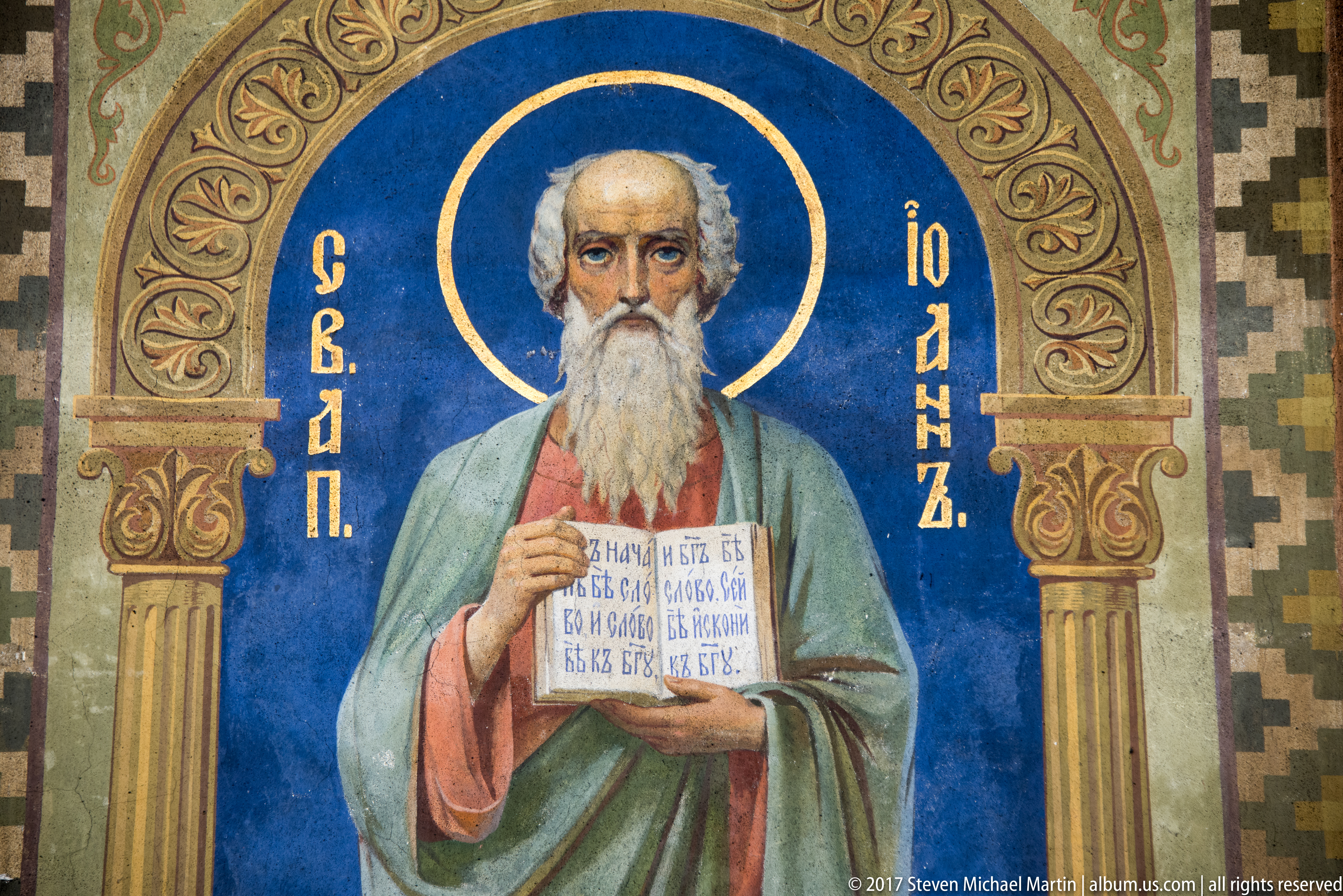
A frontal mosaic icon depicts an elderly bearded saint holding an open inscribed book against a vivid blue ground. A gold halo, abbreviated Cyrillic lettering, and patterned architectural framing identify the image as part of the Orthodox decorative program in Alexander Nevsky Cathedral. The close crop makes the saint’s face, gesture, and written text the dominant elements.
Caption
A frontal mosaic icon depicts an elderly bearded saint holding an open inscribed book against a vivid blue ground. A gold halo, abbreviated Cyrillic lettering, and patterned architectural framing identify the image as part of the Orthodox decorative program in Alexander Nevsky Cathedral. The close crop makes the saint’s face, gesture, and written text the dominant elements.

Tall painted panels of haloed saints rise between arches inside Alexander Nevsky Cathedral, filling a narrow architectural bay with layered Orthodox imagery. Decorative borders, muted earth colors, and adjacent wall paintings continue across the curved surfaces. The angled view shows how the figurative program is integrated into the cathedral’s masonry rather than presented as isolated easel paintings.
Caption
Tall painted panels of haloed saints rise between arches inside Alexander Nevsky Cathedral, filling a narrow architectural bay with layered Orthodox imagery. Decorative borders, muted earth colors, and adjacent wall paintings continue across the curved surfaces. The angled view shows how the figurative program is integrated into the cathedral’s masonry rather than presented as isolated easel paintings.

A sequence of narrative frescoes covers a curved interior wall of Alexander Nevsky Cathedral, with groups of haloed figures arranged in separate registers and framed by ornamental bands. The surface appears darkened and worn in places, giving the paintings a subdued palette. The oblique composition emphasizes the continuity of the pictorial cycle along the cathedral’s architecture.
Caption
A sequence of narrative frescoes covers a curved interior wall of Alexander Nevsky Cathedral, with groups of haloed figures arranged in separate registers and framed by ornamental bands. The surface appears darkened and worn in places, giving the paintings a subdued palette. The oblique composition emphasizes the continuity of the pictorial cycle along the cathedral’s architecture.

A semicircular mosaic of several bearded clerics or saints occupies the tympanum above an interior arch in Alexander Nevsky Cathedral. A large dark metal chandelier hangs directly in front, partially obscuring the central figures and adding depth to the composition. Carved stone foliage below the mosaic contrasts with the luminous gold and blue tessellated surface.
Caption
A semicircular mosaic of several bearded clerics or saints occupies the tympanum above an interior arch in Alexander Nevsky Cathedral. A large dark metal chandelier hangs directly in front, partially obscuring the central figures and adding depth to the composition. Carved stone foliage below the mosaic contrasts with the luminous gold and blue tessellated surface.

A dramatic low-angle view looks up along the white stone façades, arcades, towers, and green-patinated roofs of Sofia’s Alexander Nevsky Cathedral. The steep perspective compresses the building’s layered masses while allowing glimpses of the gilded central dome above. Crisp sunlight and a deep blue sky sharpen the revivalist architectural details and monumental scale.
Caption
A dramatic low-angle view looks up along the white stone façades, arcades, towers, and green-patinated roofs of Sofia’s Alexander Nevsky Cathedral. The steep perspective compresses the building’s layered masses while allowing glimpses of the gilded central dome above. Crisp sunlight and a deep blue sky sharpen the revivalist architectural details and monumental scale.

The western mass of Alexander Nevsky Cathedral rises against a saturated blue sky, with a tall bell tower at left and the gilded central dome behind a cascade of green-patinated roofs. Repeated Romanesque-style arches and pale stone surfaces give rhythm to the broad façade. The near-frontal view offers a clear study of the cathedral’s layered roofline and monumental composition.
Caption
The western mass of Alexander Nevsky Cathedral rises against a saturated blue sky, with a tall bell tower at left and the gilded central dome behind a cascade of green-patinated roofs. Repeated Romanesque-style arches and pale stone surfaces give rhythm to the broad façade. The near-frontal view offers a clear study of the cathedral’s layered roofline and monumental composition.

Alexander Nevsky Cathedral stands in a broad three-quarter view, revealing its tall bell tower, gilded central dome, clustered green roofs, and long arcaded façades. The clear sky isolates the complex silhouette and allows the building’s massing to read from foundation to cupola. This view functions as a strong architectural portrait of one of Sofia’s principal landmarks.
Caption
Alexander Nevsky Cathedral stands in a broad three-quarter view, revealing its tall bell tower, gilded central dome, clustered green roofs, and long arcaded façades. The clear sky isolates the complex silhouette and allows the building’s massing to read from foundation to cupola. This view functions as a strong architectural portrait of one of Sofia’s principal landmarks.

The upper architecture of Alexander Nevsky Cathedral is isolated against a clear blue sky, pairing the tall open-arched bell tower with the cathedral’s gilded central dome. Green-patinated roof surfaces step across the lower frame, while repeated arcades articulate the white masonry. The tighter crop highlights the contrast between vertical tower and rounded dome rather than the whole building.
Caption
The upper architecture of Alexander Nevsky Cathedral is isolated against a clear blue sky, pairing the tall open-arched bell tower with the cathedral’s gilded central dome. Green-patinated roof surfaces step across the lower frame, while repeated arcades articulate the white masonry. The tighter crop highlights the contrast between vertical tower and rounded dome rather than the whole building.

A close architectural study concentrates on the gilded central dome of Alexander Nevsky Cathedral, ringed by tall arched windows and capped by a cross. The gold surface catches direct sunlight above pale masonry and green roof bands. By excluding most of the building, the composition emphasizes the dome’s drum, repeated window rhythm, and role as the cathedral’s visual crown.
Caption
A close architectural study concentrates on the gilded central dome of Alexander Nevsky Cathedral, ringed by tall arched windows and capped by a cross. The gold surface catches direct sunlight above pale masonry and green roof bands. By excluding most of the building, the composition emphasizes the dome’s drum, repeated window rhythm, and role as the cathedral’s visual crown.

An upward view of a pale historic façade focuses on a projecting bay with a large sculpted cartouche, flowing foliage, curved supports, and narrow glazed side windows. The dense stucco ornament is set against otherwise smooth walls and rectangular upper windows. Without a clear building sign or broader context, the image is best read as an architectural detail of Sofia’s ornate early modern streetscape.
Caption
An upward view of a pale historic façade focuses on a projecting bay with a large sculpted cartouche, flowing foliage, curved supports, and narrow glazed side windows. The dense stucco ornament is set against otherwise smooth walls and rectangular upper windows. Without a clear building sign or broader context, the image is best read as an architectural detail of Sofia’s ornate early modern streetscape.

An equestrian ruler stands high above a richly modeled bronze pedestal in Sofia’s Monument to the Tsar Liberator, with the monumental roofline of a civic building behind. The low viewpoint silhouettes horse and rider against the sky while preserving the crowded sculptural group around the base. The composition emphasizes the monument’s vertical hierarchy and public setting.
Caption
An equestrian ruler stands high above a richly modeled bronze pedestal in Sofia’s Monument to the Tsar Liberator, with the monumental roofline of a civic building behind. The low viewpoint silhouettes horse and rider against the sky while preserving the crowded sculptural group around the base. The composition emphasizes the monument’s vertical hierarchy and public setting.

The upper façade of the Ivan Vazov National Theatre fills the frame, crowned by twin corner towers and a classical pediment. Gold-highlighted sculptural reliefs animate the white tympanum above the Bulgarian inscription “Народен театър Иван Вазов.” The upward viewpoint concentrates attention on the theatre’s symbolic ornament, rooftop sculpture, and richly colored red-and-white architectural composition.
Caption
The upper façade of the Ivan Vazov National Theatre fills the frame, crowned by twin corner towers and a classical pediment. Gold-highlighted sculptural reliefs animate the white tympanum above the Bulgarian inscription “Народен театър Иван Вазов.” The upward viewpoint concentrates attention on the theatre’s symbolic ornament, rooftop sculpture, and richly colored red-and-white architectural composition.

A close view isolates the sculpted pediment of the Ivan Vazov National Theatre, where reclining and standing allegorical figures surround gilded theatrical attributes in high relief. The pale figures project strongly from the triangular field beneath a dark tiled roof. Cropping out the rest of the façade turns the theatre’s architectural sculpture into the principal subject.
Caption
A close view isolates the sculpted pediment of the Ivan Vazov National Theatre, where reclining and standing allegorical figures surround gilded theatrical attributes in high relief. The pale figures project strongly from the triangular field beneath a dark tiled roof. Cropping out the rest of the façade turns the theatre’s architectural sculpture into the principal subject.

The full front elevation of Sofia’s Ivan Vazov National Theatre faces the City Garden, presenting its columned portico, sculpted pediment, twin towers, and red-and-white façade in a symmetrical composition. The building name is visible beneath the pediment, while pedestrians and a cyclist provide scale at plaza level. Tall trees frame the monumental theatre without obscuring its principal architectural features.
Caption
The full front elevation of Sofia’s Ivan Vazov National Theatre faces the City Garden, presenting its columned portico, sculpted pediment, twin towers, and red-and-white façade in a symmetrical composition. The building name is visible beneath the pediment, while pedestrians and a cyclist provide scale at plaza level. Tall trees frame the monumental theatre without obscuring its principal architectural features.

A close architectural study of Saint Nedelya Church focuses on tall arched windows screened by intricate wrought-iron grilles. Pale stone columns and capitals separate the openings, while the rougher masonry wall remains visible around them. The tight framing highlights the contrast between the church’s heavy stone construction and the delicate repeating geometry of its protective metalwork.
Caption
A close architectural study of Saint Nedelya Church focuses on tall arched windows screened by intricate wrought-iron grilles. Pale stone columns and capitals separate the openings, while the rougher masonry wall remains visible around them. The tight framing highlights the contrast between the church’s heavy stone construction and the delicate repeating geometry of its protective metalwork.

Saint Nedelya Church is seen from the side, where a columned arcade, round window, layered brick-and-stone walls, and broad clerestory roofline define the composition. Trees soften the edges of the monumental masonry. The oblique view reveals the church’s complex massing more clearly than a frontal façade photograph, including the transition from lower portico to upper nave.
Caption
Saint Nedelya Church is seen from the side, where a columned arcade, round window, layered brick-and-stone walls, and broad clerestory roofline define the composition. Trees soften the edges of the monumental masonry. The oblique view reveals the church’s complex massing more clearly than a frontal façade photograph, including the transition from lower portico to upper nave.

Beneath a broad arch of Saint Nedelya Church, a wall inscription in Cyrillic is set into exposed brickwork between white columns. A hanging lamp and shallow vaulted ceiling reinforce the sheltered entrance or portico setting. The photograph is less about the church’s overall architecture than the textual and material detail encountered beneath its exterior arcade.
Caption
Beneath a broad arch of Saint Nedelya Church, a wall inscription in Cyrillic is set into exposed brickwork between white columns. A hanging lamp and shallow vaulted ceiling reinforce the sheltered entrance or portico setting. The photograph is less about the church’s overall architecture than the textual and material detail encountered beneath its exterior arcade.

The nave of Saint Nedelya Church opens toward a gilded iconostasis beneath a broad painted arch, with large chandeliers suspended along the central axis. Blue-toned frescoes cover the walls and vaults, while a ring of clerestory windows admits daylight from above. The centered viewpoint emphasizes the Orthodox sanctuary’s symmetry, richly painted surfaces, and ceremonial depth.
Caption
The nave of Saint Nedelya Church opens toward a gilded iconostasis beneath a broad painted arch, with large chandeliers suspended along the central axis. Blue-toned frescoes cover the walls and vaults, while a ring of clerestory windows admits daylight from above. The centered viewpoint emphasizes the Orthodox sanctuary’s symmetry, richly painted surfaces, and ceremonial depth.

A rear or apsidal view of Saint Nedelya Church shows a broad polygonal masonry volume rising beneath stacked rows of arched windows and a green-patinated roof. Round windows punctuate the lower walls, and mature trees partly screen the building at ground level. The view emphasizes the church’s layered exterior geometry and substantial masonry construction away from the main entrance.
Caption
A rear or apsidal view of Saint Nedelya Church shows a broad polygonal masonry volume rising beneath stacked rows of arched windows and a green-patinated roof. Round windows punctuate the lower walls, and mature trees partly screen the building at ground level. The view emphasizes the church’s layered exterior geometry and substantial masonry construction away from the main entrance.

The brick Rotunda of St. George rises within a sunken archaeological precinct surrounded by modern central Sofia. Its cylindrical Late Antique mass, tiled conical roof, small arched windows, and layered brick foundations stand in marked contrast to the taller twentieth-century buildings around it. The view emphasizes the church’s compact geometry and its setting among exposed masonry remains.
Caption
The brick Rotunda of St. George rises within a sunken archaeological precinct surrounded by modern central Sofia. Its cylindrical Late Antique mass, tiled conical roof, small arched windows, and layered brick foundations stand in marked contrast to the taller twentieth-century buildings around it. The view emphasizes the church’s compact geometry and its setting among exposed masonry remains.

Two ceremonial guards stand at attention on either side of the glazed entrance to Bulgaria’s presidential offices. Their red braided tunics, dark trousers, tall boots, plumed helmets, and rifles create a strongly symmetrical composition against the pale stone doorway. The photograph focuses on the human scale of state ceremony rather than the full architecture of the building.
Caption
Two ceremonial guards stand at attention on either side of the glazed entrance to Bulgaria’s presidential offices. Their red braided tunics, dark trousers, tall boots, plumed helmets, and rifles create a strongly symmetrical composition against the pale stone doorway. The photograph focuses on the human scale of state ceremony rather than the full architecture of the building.

A Bulgarian ceremonial guard stands rigidly at attention beside a government entrance, holding a rifle vertically at his side. The red tunic is densely trimmed with white braid, while the dark trousers, high black boots, white gloves, and decorated helmet form a formal state uniform. The tight framing isolates the sentry and makes the costume details the principal subject.
Caption
A Bulgarian ceremonial guard stands rigidly at attention beside a government entrance, holding a rifle vertically at his side. The red tunic is densely trimmed with white braid, while the dark trousers, high black boots, white gloves, and decorated helmet form a formal state uniform. The tight framing isolates the sentry and makes the costume details the principal subject.

The National Assembly building is seen from a low angle in warm evening light, emphasizing its monumental classical portico, columns, pediment, and rooftop flag. The Bulgarian inscription across the entablature identifies the legislature, while the deep blue sky and raking sunlight sharpen the pale stone details. The composition concentrates on the symbolic upper façade rather than the full building.
Caption
The National Assembly building is seen from a low angle in warm evening light, emphasizing its monumental classical portico, columns, pediment, and rooftop flag. The Bulgarian inscription across the entablature identifies the legislature, while the deep blue sky and raking sunlight sharpen the pale stone details. The composition concentrates on the symbolic upper façade rather than the full building.

A pale stone corner building sweeps around the intersection with stacked curved balconies, tall windows, black metal railings, and elaborate cornice work. Viewed from below, the rounded façade and roofline dominate the composition, revealing the decorative ambition of Sofia’s early modern urban architecture. Sunlight catches the upper stories while the lower façade remains comparatively subdued.
Caption
A pale stone corner building sweeps around the intersection with stacked curved balconies, tall windows, black metal railings, and elaborate cornice work. Viewed from below, the rounded façade and roofline dominate the composition, revealing the decorative ambition of Sofia’s early modern urban architecture. Sunlight catches the upper stories while the lower façade remains comparatively subdued.

A carved Roman stone fragment is set into a modern masonry wall, preserving a circular rosette-like ornament above several lines of deeply cut Latin capitals. Decorative borders frame the surviving inscription, whose weathering and incomplete text indicate reuse or archaeological display rather than an intact monument. The close view treats lettering, carving, and stone surface as the principal evidence.
Caption
A carved Roman stone fragment is set into a modern masonry wall, preserving a circular rosette-like ornament above several lines of deeply cut Latin capitals. Decorative borders frame the surviving inscription, whose weathering and incomplete text indicate reuse or archaeological display rather than an intact monument. The close view treats lettering, carving, and stone surface as the principal evidence.

Golden onion domes rise above the Russian Church of St. Nicholas the Miracle-Maker, their patterned surfaces and Orthodox crosses catching the evening light. The central drum is capped by a larger gilded dome, while smaller domes frame the lower roofline. Tight cropping concentrates on the church’s distinctive Russian Revival silhouette, green patterned roofing, and gleaming metalwork.
Caption
Golden onion domes rise above the Russian Church of St. Nicholas the Miracle-Maker, their patterned surfaces and Orthodox crosses catching the evening light. The central drum is capped by a larger gilded dome, while smaller domes frame the lower roofline. Tight cropping concentrates on the church’s distinctive Russian Revival silhouette, green patterned roofing, and gleaming metalwork.

The Church of St. Nicholas the Miracle-Maker stands behind trees and a low stone wall, its steep gabled porch leading toward white walls, green roofs, and gilded onion domes. The frontal view shows the compact Russian Revival composition and the decorative entry canopy, while surrounding foliage softens the church’s urban setting. Evening light highlights the gold roof elements.
Caption
The Church of St. Nicholas the Miracle-Maker stands behind trees and a low stone wall, its steep gabled porch leading toward white walls, green roofs, and gilded onion domes. The frontal view shows the compact Russian Revival composition and the decorative entry canopy, while surrounding foliage softens the church’s urban setting. Evening light highlights the gold roof elements.

A rectangular stone relief mounted in a masonry wall depicts a mounted figure advancing across the panel, with the horse rendered in shallow, weathered carving. The compact composition and worn surface are consistent with a reused or displayed Roman-period relief from ancient Serdica. The surrounding modern stonework makes the surviving ancient carving easy to distinguish from its present architectural setting.
Caption
A rectangular stone relief mounted in a masonry wall depicts a mounted figure advancing across the panel, with the horse rendered in shallow, weathered carving. The compact composition and worn surface are consistent with a reused or displayed Roman-period relief from ancient Serdica. The surrounding modern stonework makes the surviving ancient carving easy to distinguish from its present architectural setting.

The large rooftop sign for Grand Hotel Bulgaria dominates the skyline in bold red lettering, backed by a pale evening sky. Smaller signs for other businesses sit below, creating a layered record of commercial branding on central Sofia’s rooftops. The photograph isolates typography and structure rather than the hotel itself, turning the illuminated name into an urban landmark.
Caption
The large rooftop sign for Grand Hotel Bulgaria dominates the skyline in bold red lettering, backed by a pale evening sky. Smaller signs for other businesses sit below, creating a layered record of commercial branding on central Sofia’s rooftops. The photograph isolates typography and structure rather than the hotel itself, turning the illuminated name into an urban landmark.

A symmetrical pale-yellow institutional façade is illuminated by low evening sun, drawing attention to its central balcony, arched entrance, sculpted pediment, and steep slate roof. A Bulgarian flag rises above the roofline, while the restrained classical detailing gives the building a formal civic character. The frontal composition emphasizes balance and hierarchy across the central bay.
Caption
A symmetrical pale-yellow institutional façade is illuminated by low evening sun, drawing attention to its central balcony, arched entrance, sculpted pediment, and steep slate roof. A Bulgarian flag rises above the roofline, while the restrained classical detailing gives the building a formal civic character. The frontal composition emphasizes balance and hierarchy across the central bay.

The richly decorated entrance porch of Sofia’s Russian Church fills the foreground, with carved stone arches beneath a steep triangular gable edged in ornate trim. Behind it, white cylindrical drums and gilded onion domes rise above the roof. The oblique close view emphasizes the transition from sculptural stonework at ground level to the colorful domes and green roofing above.
Caption
The richly decorated entrance porch of Sofia’s Russian Church fills the foreground, with carved stone arches beneath a steep triangular gable edged in ornate trim. Behind it, white cylindrical drums and gilded onion domes rise above the roof. The oblique close view emphasizes the transition from sculptural stonework at ground level to the colorful domes and green roofing above.

A circular mosaic icon of Saint Nicholas is set within an elaborate floral and geometric frame on the Russian Church in Sofia. The haloed bishop raises one hand in blessing and holds a jeweled Gospel book in the other, while Greek-style lettering identifies the saint. Turquoise, gold, and violet tesserae create a richly patterned surface suited to the church’s ornate exterior decoration.
Caption
A circular mosaic icon of Saint Nicholas is set within an elaborate floral and geometric frame on the Russian Church in Sofia. The haloed bishop raises one hand in blessing and holds a jeweled Gospel book in the other, while Greek-style lettering identifies the saint. Turquoise, gold, and violet tesserae create a richly patterned surface suited to the church’s ornate exterior decoration.

A white Bulgarian police patrol car is parked on a cobbled street, marked by a blue side stripe, official crest, unit number, and the Cyrillic word ПОЛИЦИЯ. The side-on view clearly records the vehicle’s public-service markings and compact hatchback form. Trees and stone façades behind it place the vehicle within central Sofia’s urban streetscape.
Caption
A white Bulgarian police patrol car is parked on a cobbled street, marked by a blue side stripe, official crest, unit number, and the Cyrillic word ПОЛИЦИЯ. The side-on view clearly records the vehicle’s public-service markings and compact hatchback form. Trees and stone façades behind it place the vehicle within central Sofia’s urban streetscape.

A refined pale-yellow mansion rises behind a foreground bed of purple flowers, combining tall rectangular windows, molded surrounds, a projecting cornice, and a steep gray roof punctuated by dormers. Ivy climbs part of the façade, softening the formal composition. Warm late-day light catches the roofline and upper masonry, lending depth to the decorative nineteenth-century urban architecture.
Caption
A refined pale-yellow mansion rises behind a foreground bed of purple flowers, combining tall rectangular windows, molded surrounds, a projecting cornice, and a steep gray roof punctuated by dormers. Ivy climbs part of the façade, softening the formal composition. Warm late-day light catches the roofline and upper masonry, lending depth to the decorative nineteenth-century urban architecture.

A long segmented glass canopy curves across the foreground of Sofia’s central archaeological zone, reflecting neighboring buildings and the evening sky. Beneath and around the transparent structure lie excavated remains associated with ancient Serdica, integrated into the modern Largo redevelopment. The photograph emphasizes the contemporary protective architecture and reflective surfaces rather than the ruins themselves.
Caption
A long segmented glass canopy curves across the foreground of Sofia’s central archaeological zone, reflecting neighboring buildings and the evening sky. Beneath and around the transparent structure lie excavated remains associated with ancient Serdica, integrated into the modern Largo redevelopment. The photograph emphasizes the contemporary protective architecture and reflective surfaces rather than the ruins themselves.

The former Party House at Sofia’s Largo is seen head-on across the glass-covered archaeological zone, its tall central tower and monumental stone façade aligned with the street axis. The Bulgarian inscription for the National Assembly is visible near the top, reflecting the building’s later parliamentary use. Flanking government blocks frame the composition, reinforcing the ceremonial scale of the ensemble.
Caption
The former Party House at Sofia’s Largo is seen head-on across the glass-covered archaeological zone, its tall central tower and monumental stone façade aligned with the street axis. The Bulgarian inscription for the National Assembly is visible near the top, reflecting the building’s later parliamentary use. Flanking government blocks frame the composition, reinforcing the ceremonial scale of the ensemble.

The small Church of St. Petka of the Saddlers presents a rough masonry wall built from mixed stone and brick, capped by a simple red-tiled roof and marked by a small religious plaque. Its modest scale contrasts sharply with the surrounding central-city architecture. The close side view emphasizes the uneven historic fabric and survival of the medieval church within Sofia’s modern Largo district.
Caption
The small Church of St. Petka of the Saddlers presents a rough masonry wall built from mixed stone and brick, capped by a simple red-tiled roof and marked by a small religious plaque. Its modest scale contrasts sharply with the surrounding central-city architecture. The close side view emphasizes the uneven historic fabric and survival of the medieval church within Sofia’s modern Largo district.

Exposed stone foundations and brick-edged wall lines extend through Sofia’s open-air Serdica archaeological complex, revealing the footprint of the ancient city beneath the modern center. Gravel paths and low protective barriers guide visitors through the excavated remains. A mosque minaret and contemporary buildings in the background demonstrate the layered urban history surrounding the archaeological zone.
Caption
Exposed stone foundations and brick-edged wall lines extend through Sofia’s open-air Serdica archaeological complex, revealing the footprint of the ancient city beneath the modern center. Gravel paths and low protective barriers guide visitors through the excavated remains. A mosque minaret and contemporary buildings in the background demonstrate the layered urban history surrounding the archaeological zone.

A street musician plays an accordion on a pedestrian walkway, caught mid-step beside an open suitcase used for tips. His bright orange trousers and red-and-white instrument stand out against the muted storefront behind him. A microphone stand and nearby bench suggest a small improvised performance area, capturing everyday street entertainment in central Sofia.
Caption
A street musician plays an accordion on a pedestrian walkway, caught mid-step beside an open suitcase used for tips. His bright orange trousers and red-and-white instrument stand out against the muted storefront behind him. A microphone stand and nearby bench suggest a small improvised performance area, capturing everyday street entertainment in central Sofia.

Commuters move through a covered metro entrance beneath a curved transparent canopy, filling the stairway and passage with evening pedestrian traffic. The translucent structure channels daylight into the descent while enclosing the movement below street level. The scene emphasizes everyday mobility in central Sofia, with people entering and leaving the underground system in a dense, transitional space.
Caption
Commuters move through a covered metro entrance beneath a curved transparent canopy, filling the stairway and passage with evening pedestrian traffic. The translucent structure channels daylight into the descent while enclosing the movement below street level. The scene emphasizes everyday mobility in central Sofia, with people entering and leaving the underground system in a dense, transitional space.
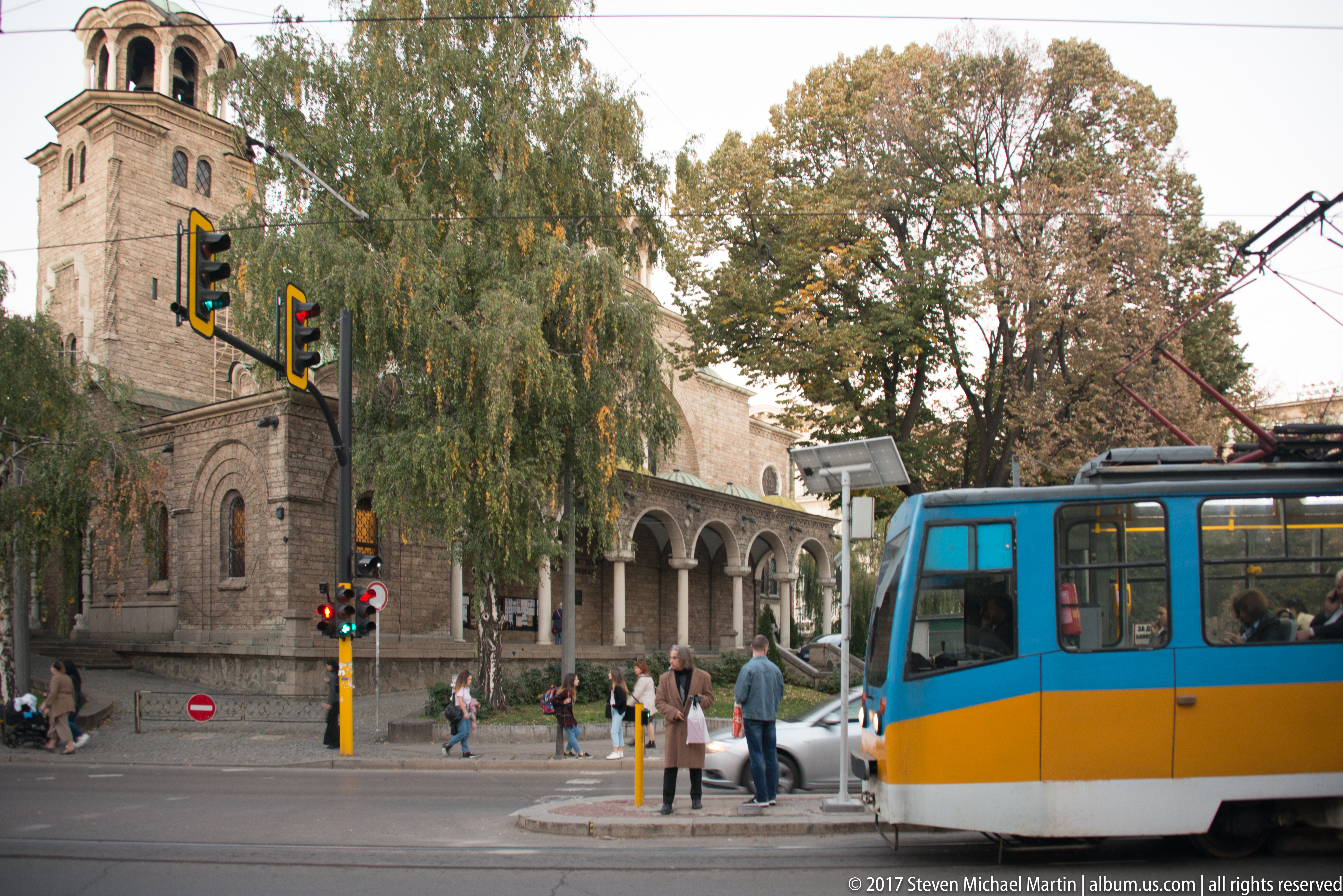
A blue-and-yellow Sofia tram passes through a busy central intersection beside stone arcades and mature trees. Traffic lights, overhead electrical wires, and waiting pedestrians frame the vehicle within the city’s street-running transit network. The side view records both the tram’s distinctive livery and the close relationship between public transport, pedestrians, and historic architecture in central Sofia.
Caption
A blue-and-yellow Sofia tram passes through a busy central intersection beside stone arcades and mature trees. Traffic lights, overhead electrical wires, and waiting pedestrians frame the vehicle within the city’s street-running transit network. The side view records both the tram’s distinctive livery and the close relationship between public transport, pedestrians, and historic architecture in central Sofia.

A large circular public artwork rises above a Sofia boulevard at sunset, its radiating metal rings and blue elements forming a wheel-like pattern against the pink sky. Apartment façades frame the view on both sides, while the dark outline of Vitosha Mountain closes the distant horizon. The composition links contemporary street design with the city’s dramatic mountain backdrop.
Caption
A large circular public artwork rises above a Sofia boulevard at sunset, its radiating metal rings and blue elements forming a wheel-like pattern against the pink sky. Apartment façades frame the view on both sides, while the dark outline of Vitosha Mountain closes the distant horizon. The composition links contemporary street design with the city’s dramatic mountain backdrop.

A narrow café or bistro interior is lined with vintage road signs, advertisements, and placards that cover the walls from banquette level to the ceiling. Small wooden tables, stools, and candle-like lights create an intimate seating area leading toward the back of the room. The dense collection of signage gives the restaurant a deliberately eclectic, memorabilia-filled character.
Caption
A narrow café or bistro interior is lined with vintage road signs, advertisements, and placards that cover the walls from banquette level to the ceiling. Small wooden tables, stools, and candle-like lights create an intimate seating area leading toward the back of the room. The dense collection of signage gives the restaurant a deliberately eclectic, memorabilia-filled character.

A man holding a camera appears in a mirror, framed by a monochrome city-map mural, shuttered-window graphic, and an old-fashioned coat rack. The reflective composition turns the camera itself into part of the scene, while the surrounding wall design creates a staged, graphic backdrop. The image functions as a travel self-portrait without requiring identification of the person shown.
Caption
A man holding a camera appears in a mirror, framed by a monochrome city-map mural, shuttered-window graphic, and an old-fashioned coat rack. The reflective composition turns the camera itself into part of the scene, while the surrounding wall design creates a staged, graphic backdrop. The image functions as a travel self-portrait without requiring identification of the person shown.

A densely stocked souvenir shop in Sofia fills its narrow interior with postcards, cosmetics, small gifts, and brightly colored merchandise arranged from floor level to the upper walls. Display tables create a central aisle while shelving and hanging racks crowd both sides. The view records the commercial culture of tourism through the abundance, repetition, and vivid packaging of inexpensive keepsakes.
Caption
A densely stocked souvenir shop in Sofia fills its narrow interior with postcards, cosmetics, small gifts, and brightly colored merchandise arranged from floor level to the upper walls. Display tables create a central aisle while shelving and hanging racks crowd both sides. The view records the commercial culture of tourism through the abundance, repetition, and vivid packaging of inexpensive keepsakes.

Stacks of folded textiles display repeating bands of geometric folk ornament in red, blue, green, orange, cream, and black. The embroidered or woven motifs run lengthwise across the cloth, creating strong rhythmic stripes that distinguish each colorway. Closely cropped and arranged in neat piles, the fabrics emphasize pattern, color, and textile tradition rather than the wider shop setting.
Caption
Stacks of folded textiles display repeating bands of geometric folk ornament in red, blue, green, orange, cream, and black. The embroidered or woven motifs run lengthwise across the cloth, creating strong rhythmic stripes that distinguish each colorway. Closely cropped and arranged in neat piles, the fabrics emphasize pattern, color, and textile tradition rather than the wider shop setting.

Rows of molded souvenir magnets present Sofia and Bulgaria through miniature monuments, folk-costumed figures, architectural façades, and bold place names. Repeated inscriptions reading SOFIA and BULGARIA make the intended destination explicit, while varied colors and relief forms turn recognizable city and national motifs into compact retail objects. The tightly framed display documents how heritage imagery is adapted for mass-market tourism.
Caption
Rows of molded souvenir magnets present Sofia and Bulgaria through miniature monuments, folk-costumed figures, architectural façades, and bold place names. Repeated inscriptions reading SOFIA and BULGARIA make the intended destination explicit, while varied colors and relief forms turn recognizable city and national motifs into compact retail objects. The tightly framed display documents how heritage imagery is adapted for mass-market tourism.

A handheld souvenir card reproduces an early Cyrillic alphabet in white characters on a black field. English text along the bottom describes the script as the early Cyrillic alphabet developed in ninth-century Bulgaria, while a second line appears in Bulgarian. The close view focuses on letterforms and the educational presentation of Bulgaria’s association with the history of Cyrillic writing.
Caption
A handheld souvenir card reproduces an early Cyrillic alphabet in white characters on a black field. English text along the bottom describes the script as the early Cyrillic alphabet developed in ninth-century Bulgaria, while a second line appears in Bulgarian. The close view focuses on letterforms and the educational presentation of Bulgaria’s association with the history of Cyrillic writing.

Whimsical hand-painted ceramic donkey figurines crowd a shop display, their elongated ears, oversized eyes, and bright decorative details giving each figure a comic personality. Larger and smaller versions cluster among glossy red and green ceramics, suggesting a handmade souvenir line rather than utilitarian pottery. The close composition emphasizes modeled form, painted surface, and playful variation across the repeated animal motif.
Caption
Whimsical hand-painted ceramic donkey figurines crowd a shop display, their elongated ears, oversized eyes, and bright decorative details giving each figure a comic personality. Larger and smaller versions cluster among glossy red and green ceramics, suggesting a handmade souvenir line rather than utilitarian pottery. The close composition emphasizes modeled form, painted surface, and playful variation across the repeated animal motif.

Sofia’s Palace of Justice is dramatically illuminated at night, its monumental stone façade organized by giant columns, tall windows, and a central sequence of arched entrances. The Bulgarian inscription СЪДЕБНА ПАЛАТА is visible across the upper façade, while sculpted lions guard the raised forecourt at either side. The frontal nighttime view emphasizes the courthouse’s imposing symmetry and civic scale.
Caption
Sofia’s Palace of Justice is dramatically illuminated at night, its monumental stone façade organized by giant columns, tall windows, and a central sequence of arched entrances. The Bulgarian inscription СЪДЕБНА ПАЛАТА is visible across the upper façade, while sculpted lions guard the raised forecourt at either side. The frontal nighttime view emphasizes the courthouse’s imposing symmetry and civic scale.
⭐ Highlights
- Alexander Nevsky Cathedral: One of the largest Eastern Orthodox cathedrals in the world and the defining landmark of Sofia.
- Saint Sofia Church: The early Christian church that gave the city its name.
- Roman Layers: Ancient Serdica remains are visible beneath and within the modern city.
- Religious Crossroads: Orthodox churches, mosques, synagogues, and Catholic buildings reflect centuries of cultural overlap.
- Vitosha Mountain Backdrop: The mountain rises directly behind the city, shaping its setting and skyline.
- Historic Core: Sofia blends Roman, Byzantine, Ottoman, and modern Bulgarian history in a compact urban center.
🏙️ Sofia Field Guide
Major features observed during this visit:
Sofia, the capital of Bulgaria, is one of Europe’s oldest continuously inhabited cities. Built on the site of the ancient Roman city of Serdica, it developed through successive Roman, Byzantine, Ottoman, and modern Bulgarian periods. Today, Sofia combines archaeological remains, major religious landmarks, and broad public spaces into a cityscape shaped by both deep history and national identity.
🏛️ Signature Landmarks
- Alexander Nevsky Cathedral – A monumental Orthodox cathedral and one of the most recognizable symbols of Bulgaria.
- Saint Sofia Church – An early Christian basilica that gave the city its modern name.
- Rotunda of Saint George – A late Roman brick church preserved within the city center.
- Banya Bashi Mosque – An important reminder of Sofia’s Ottoman past.
- National Assembly and Central Squares – Civic spaces that define the city’s political and ceremonial center.
🧠 Historical Significance
- Ancient Serdica – Sofia began as a Thracian and later Roman settlement of major regional importance.
- Byzantine and Medieval Continuity – The city remained an important urban center through changing empires and kingdoms.
- Ottoman Period – Sofia developed under Ottoman rule for several centuries, leaving visible architectural traces.
- Modern Capital – Since the late 19th century, Sofia has served as the political and cultural center of modern Bulgaria.
🌄 Urban Landscape & Setting
- Vitosha Mountain – The mountain provides a dramatic natural backdrop to the city.
- Layered City Center – Roman ruins, churches, mosques, and public buildings coexist within a compact core.
- Broad Boulevards and Squares – Modern planning introduced wider streets and ceremonial public spaces.
- Historic and Modern Contrast – Ancient remains and monumental architecture stand alongside a living modern capital.