Moremi Game Reserve – Botswana
The protected landscapes of Moremi Game Reserve occupy the eastern portion of the Okavango Delta and represent one of Africa’s most celebrated wildlife conservation areas. Established in 1963, Moremi was one of the first reserves in Africa to be created by local communities concerned about protecting wildlife.
The reserve includes a mixture of habitats such as river channels, lagoons, floodplains, and woodlands. This ecological diversity supports a wide range of animals including elephants, lions, leopards, wild dogs, and large herds of antelope.
Moremi Game Reserve offers some of the most exceptional wildlife viewing opportunities in Botswana.
Photos:

A broad expanse of green floodplain stretches toward a low line of woodland beneath a pale blue sky and building clouds. Scattered dry earthen mounds and small patches of taller vegetation break the horizontal field, creating an establishing landscape view after the tightly framed wildlife portraits.
Caption
A broad expanse of green floodplain stretches toward a low line of woodland beneath a pale blue sky and building clouds. Scattered dry earthen mounds and small patches of taller vegetation break the horizontal field, creating an establishing landscape view after the tightly framed wildlife portraits.

A formally set dining table occupies a wooden lodge terrace overlooking an expansive green floodplain. White napkins, glassware, plates, and woven chairs contrast with the rustic railing and open landscape, presenting the dining area as a deliberate transition between safari camp hospitality and the surrounding wetland environment.
Caption
A formally set dining table occupies a wooden lodge terrace overlooking an expansive green floodplain. White napkins, glassware, plates, and woven chairs contrast with the rustic railing and open landscape, presenting the dining area as a deliberate transition between safari camp hospitality and the surrounding wetland environment.

A deep red sun hangs just above the horizon over Moremi’s green floodplain, framed by a tall palm and the spreading silhouette of a leafless tree. Haze softens the distant woodland and turns the sky muted rose, creating a restrained sunset study built around the contrast between the circular sun and dark tree forms.
Caption
A deep red sun hangs just above the horizon over Moremi’s green floodplain, framed by a tall palm and the spreading silhouette of a leafless tree. Haze softens the distant woodland and turns the sky muted rose, creating a restrained sunset study built around the contrast between the circular sun and dark tree forms.

A dense African buffalo herd fills the floodplain from foreground to distance, with adults and younger animals grazing, standing, and resting across vivid green grass. The layered depth shows the scale of the gathering more clearly than the neighboring portraits, turning the herd into the dominant feature of the landscape.
Caption
A dense African buffalo herd fills the floodplain from foreground to distance, with adults and younger animals grazing, standing, and resting across vivid green grass. The layered depth shows the scale of the gathering more clearly than the neighboring portraits, turning the herd into the dominant feature of the landscape.

A safari traveler in a broad-brimmed field hat stands in warm late-day light with a shallow channel and open floodplain behind her. The close portrait keeps the human subject prominent while retaining enough landscape to place the moment within Moremi Game Reserve’s mosaic of dry grass, water, and distant woodland.
Caption
A safari traveler in a broad-brimmed field hat stands in warm late-day light with a shallow channel and open floodplain behind her. The close portrait keeps the human subject prominent while retaining enough landscape to place the moment within Moremi Game Reserve’s mosaic of dry grass, water, and distant woodland.

A close double portrait brings two safari travelers forward against a softly focused wetland landscape. Broad-brimmed hats shade their faces while a band of blue water, green vegetation, and scattered trees remains visible behind, giving the informal portrait a strong sense of place within Moremi Game Reserve.
Caption
A close double portrait brings two safari travelers forward against a softly focused wetland landscape. Broad-brimmed hats shade their faces while a band of blue water, green vegetation, and scattered trees remains visible behind, giving the informal portrait a strong sense of place within Moremi Game Reserve.

Three safari travelers gather inside an open game-drive vehicle for an informal group portrait. The vehicle’s bench seating, roof supports, and open sides frame the group while woodland beyond places the photograph within the practical setting of a Moremi wildlife excursion.
Caption
Three safari travelers gather inside an open game-drive vehicle for an informal group portrait. The vehicle’s bench seating, roof supports, and open sides frame the group while woodland beyond places the photograph within the practical setting of a Moremi wildlife excursion.

Three pied kingfishers occupy a grassy wetland margin as one bird drops into the frame with wings spread above two birds on the ground. The moment records an active social interaction, with black-and-white plumage and long bills sharply contrasted against dense green sedges.
Caption
Three pied kingfishers occupy a grassy wetland margin as one bird drops into the frame with wings spread above two birds on the ground. The moment records an active social interaction, with black-and-white plumage and long bills sharply contrasted against dense green sedges.

A pied kingfisher flies low through emergent wetland vegetation, wings extended as it passes between vertical reed stems above shallow water. The side view reveals the speckled black-and-white upperparts and long bill while firmly situating the bird within Moremi’s aquatic feeding habitat.
Caption
A pied kingfisher flies low through emergent wetland vegetation, wings extended as it passes between vertical reed stems above shallow water. The side view reveals the speckled black-and-white upperparts and long bill while firmly situating the bird within Moremi’s aquatic feeding habitat.

Two black-winged stilts stand separated among shallow reflective water and vertical reeds. Their fine straight bills, very long pink legs, white heads and bodies, and contrasting black wings create delicate silhouettes across the flooded grassland.
Caption
Two black-winged stilts stand separated among shallow reflective water and vertical reeds. Their fine straight bills, very long pink legs, white heads and bodies, and contrasting black wings create delicate silhouettes across the flooded grassland.

A banded mongoose stands alert on sandy ground at the edge of short grass, its coarse gray-brown coat crossed by the dark dorsal bands characteristic of the species. The upright posture and direct gaze make this a clear wildlife portrait while retaining the dry woodland-floor setting of Moremi Game Reserve.
Caption
A banded mongoose stands alert on sandy ground at the edge of short grass, its coarse gray-brown coat crossed by the dark dorsal bands characteristic of the species. The upright posture and direct gaze make this a clear wildlife portrait while retaining the dry woodland-floor setting of Moremi Game Reserve.

An African bush elephant moves through dense woodland, partly screened by trunks and leafy branches. Its immense ears, long trunk, tusks, and deeply wrinkled hide remain clearly visible despite the vegetation, placing the animal within the shaded woody habitat that forms part of Moremi Game Reserve’s varied Okavango landscape.
Caption
An African bush elephant moves through dense woodland, partly screened by trunks and leafy branches. Its immense ears, long trunk, tusks, and deeply wrinkled hide remain clearly visible despite the vegetation, placing the animal within the shaded woody habitat that forms part of Moremi Game Reserve’s varied Okavango landscape.

A crested barbet perches on the squared top of a wooden post, presenting its boldly patterned plumage against a softly blurred background. The black-and-white back, yellow underparts, red facial markings, and raised dark crest create the distinctive combination associated with this colorful southern African barbet.
Caption
A crested barbet perches on the squared top of a wooden post, presenting its boldly patterned plumage against a softly blurred background. The black-and-white back, yellow underparts, red facial markings, and raised dark crest create the distinctive combination associated with this colorful southern African barbet.

A tall earthen termite mound rises from dry ground beneath the spreading limbs of a mature tree. Weathered pinnacles and buttressed sides give the structure an irregular sculptural profile, illustrating the conspicuous nest architecture created by termites in the wooded savanna habitats of Moremi Game Reserve.
Caption
A tall earthen termite mound rises from dry ground beneath the spreading limbs of a mature tree. Weathered pinnacles and buttressed sides give the structure an irregular sculptural profile, illustrating the conspicuous nest architecture created by termites in the wooded savanna habitats of Moremi Game Reserve.

A common warthog strides across short green grass in profile, its bristled mane standing along the neck and back. The elongated head, facial warts, upward-curving tusks, and thin tail identify one of Moremi’s characteristic grazing and rooting mammals, shown here away from cover in open ground.
Caption
A common warthog strides across short green grass in profile, its bristled mane standing along the neck and back. The elongated head, facial warts, upward-curving tusks, and thin tail identify one of Moremi’s characteristic grazing and rooting mammals, shown here away from cover in open ground.

A common warthog walks along a grassy margin beside pale water, lifting one foreleg mid-stride. Seen broadside, the animal’s coarse mane, angular head, projecting tusks, and compact body are sharply defined, while the wetland edge provides a different ecological context from the preceding open-grass portrait.
Caption
A common warthog walks along a grassy margin beside pale water, lifting one foreleg mid-stride. Seen broadside, the animal’s coarse mane, angular head, projecting tusks, and compact body are sharply defined, while the wetland edge provides a different ecological context from the preceding open-grass portrait.

A small herd of plains zebras gathers on a broad green clearing bordered by woodland, some standing close together while others face outward. The wide view emphasizes herd spacing and habitat, with the zebras’ black-and-white striping punctuating the sunlit grass of Moremi Game Reserve.
Caption
A small herd of plains zebras gathers on a broad green clearing bordered by woodland, some standing close together while others face outward. The wide view emphasizes herd spacing and habitat, with the zebras’ black-and-white striping punctuating the sunlit grass of Moremi Game Reserve.

Several plains zebras stand tightly grouped in warm light, their overlapping bodies creating a dense pattern of black-and-white stripes. Most turn toward the camera, making ears, muzzles, and individual facial patterns prominent and transforming the herd from a landscape element into an intimate group wildlife portrait.
Caption
Several plains zebras stand tightly grouped in warm light, their overlapping bodies creating a dense pattern of black-and-white stripes. Most turn toward the camera, making ears, muzzles, and individual facial patterns prominent and transforming the herd from a landscape element into an intimate group wildlife portrait.

A red-billed spurfowl forages with its head lowered among short grass and leaf litter. Fine gray-brown barring covers the rounded body, while the vivid red bill and legs provide the strongest field marks. The feeding posture records the ground-dwelling habits of this southern African gamebird.
Caption
A red-billed spurfowl forages with its head lowered among short grass and leaf litter. Fine gray-brown barring covers the rounded body, while the vivid red bill and legs provide the strongest field marks. The feeding posture records the ground-dwelling habits of this southern African gamebird.

A red-billed spurfowl pauses upright on a shaded woodland floor, offering a clearer side portrait than the preceding feeding view. Its finely vermiculated gray plumage, bright red bill and legs, and yellowish eye ring stand out against dry leaves and low vegetation.
Caption
A red-billed spurfowl pauses upright on a shaded woodland floor, offering a clearer side portrait than the preceding feeding view. Its finely vermiculated gray plumage, bright red bill and legs, and yellowish eye ring stand out against dry leaves and low vegetation.

A female impala stands at the boundary between dry brush and a vivid green floodplain, looking directly toward the camera. Her slender build, tawny coat, pale underparts, and lack of horns distinguish the antelope while the composition emphasizes Moremi’s sharp transition between dry woodland edge and lush seasonal grass.
Caption
A female impala stands at the boundary between dry brush and a vivid green floodplain, looking directly toward the camera. Her slender build, tawny coat, pale underparts, and lack of horns distinguish the antelope while the composition emphasizes Moremi’s sharp transition between dry woodland edge and lush seasonal grass.

A female impala stands on the green floodplain beside a dry, vegetation-covered termite mound, while another antelope is partly visible behind the mound. The juxtaposition of wildlife, earthen mound, dry grasses, and lush grazing ground creates a layered habitat study rather than a close animal portrait.
Caption
A female impala stands on the green floodplain beside a dry, vegetation-covered termite mound, while another antelope is partly visible behind the mound. The juxtaposition of wildlife, earthen mound, dry grasses, and lush grazing ground creates a layered habitat study rather than a close animal portrait.

A female impala stands broadside beside dry shrubs with the green floodplain softly receding behind her. Warm low-angle light picks out the tawny coat, pale belly, long legs, and alert ears, while the side profile provides a clear view of the antelope’s graceful proportions.
Caption
A female impala stands broadside beside dry shrubs with the green floodplain softly receding behind her. Warm low-angle light picks out the tawny coat, pale belly, long legs, and alert ears, while the side profile provides a clear view of the antelope’s graceful proportions.

A red-billed spurfowl rests low on sandy ground among sparse grass and fallen leaves. Its rounded body is covered in finely patterned gray-brown feathers, while the bare reddish facial skin and red bill remain conspicuous. The low posture offers a compact, near-eye-level portrait of the ground-dwelling bird.
Caption
A red-billed spurfowl rests low on sandy ground among sparse grass and fallen leaves. Its rounded body is covered in finely patterned gray-brown feathers, while the bare reddish facial skin and red bill remain conspicuous. The low posture offers a compact, near-eye-level portrait of the ground-dwelling bird.

A red-billed spurfowl bends forward to feed among dry leaves and short grass, exposing the layered pattern of its back and folded wing. The close angle concentrates on feather texture, sturdy legs, and the red facial skin and bill rather than the bird’s full silhouette.
Caption
A red-billed spurfowl bends forward to feed among dry leaves and short grass, exposing the layered pattern of its back and folded wing. The close angle concentrates on feather texture, sturdy legs, and the red facial skin and bill rather than the bird’s full silhouette.

A line of blue wildebeest crosses an open floodplain, their heavy shoulders, sloping backs, dark manes, and curved horns forming a rhythmic procession across the grass. The wider framing situates the herd beneath scattered trees and shows the communal movement typical of these large grazing antelope.
Caption
A line of blue wildebeest crosses an open floodplain, their heavy shoulders, sloping backs, dark manes, and curved horns forming a rhythmic procession across the grass. The wider framing situates the herd beneath scattered trees and shows the communal movement typical of these large grazing antelope.

Two blue wildebeest stand in the foreground while plains zebras graze and watch behind them, bringing two prominent Moremi herbivores into the same frame. Contrasting body forms and coat patterns make the mixed-species association immediately legible against the dry golden grass.
Caption
Two blue wildebeest stand in the foreground while plains zebras graze and watch behind them, bringing two prominent Moremi herbivores into the same frame. Contrasting body forms and coat patterns make the mixed-species association immediately legible against the dry golden grass.

A weathered bovid skull lies on bare sandy soil among sparse grass, with the horn cores and broad curving horns still attached. The bleached bone and dark horns form a stark natural-history detail; the horn configuration suggests blue wildebeest, though the isolated remains warrant cautious identification.
Caption
A weathered bovid skull lies on bare sandy soil among sparse grass, with the horn cores and broad curving horns still attached. The bleached bone and dark horns form a stark natural-history detail; the horn configuration suggests blue wildebeest, though the isolated remains warrant cautious identification.

A large raptor perches high on the outer branches of a thorny tree against an open pale sky. Dark brown wings and back contrast with warmer golden tones around the head and chest, but the distant proof-sheet view does not reveal enough diagnostic detail for a secure species identification.
Caption
A large raptor perches high on the outer branches of a thorny tree against an open pale sky. Dark brown wings and back contrast with warmer golden tones around the head and chest, but the distant proof-sheet view does not reveal enough diagnostic detail for a secure species identification.

A lilac-breasted roller peers from behind a weathered tree trunk, its turquoise wing coverts, violet-lilac breast, greenish crown, and dark bill glowing against a soft background. The tight composition uses the rough wood as a natural frame for one of the region’s most vividly colored birds.
Caption
A lilac-breasted roller peers from behind a weathered tree trunk, its turquoise wing coverts, violet-lilac breast, greenish crown, and dark bill glowing against a soft background. The tight composition uses the rough wood as a natural frame for one of the region’s most vividly colored birds.

Seen in close profile, a lilac-breasted roller rests beside a split, sun-bleached trunk. Fine facial feathers, the orange-brown eye, lilac throat, blue shoulder, and pale green crown are rendered in detail, creating a more intimate field-guide view than the neighboring contextual portrait.
Caption
Seen in close profile, a lilac-breasted roller rests beside a split, sun-bleached trunk. Fine facial feathers, the orange-brown eye, lilac throat, blue shoulder, and pale green crown are rendered in detail, creating a more intimate field-guide view than the neighboring contextual portrait.

A lilac-breasted roller leans from the edge of a deeply furrowed dead trunk, its head turned slightly downward. Against the dark background, the pale green crown, rosy-lilac face and breast, turquoise shoulder, and heavy black bill stand out with exceptional clarity.
Caption
A lilac-breasted roller leans from the edge of a deeply furrowed dead trunk, its head turned slightly downward. Against the dark background, the pale green crown, rosy-lilac face and breast, turquoise shoulder, and heavy black bill stand out with exceptional clarity.

Two pied kingfishers perch on bare branches above a reed-filled wetland, both facing in the same direction. Their sharply contrasting black-and-white plumage, shaggy crests, and long pointed bills are clearly visible, while the paired composition places these fish-eating birds directly within their aquatic hunting habitat.
Caption
Two pied kingfishers perch on bare branches above a reed-filled wetland, both facing in the same direction. Their sharply contrasting black-and-white plumage, shaggy crests, and long pointed bills are clearly visible, while the paired composition places these fish-eating birds directly within their aquatic hunting habitat.

A pied kingfisher flies against an open blue sky with wings spread and its long bill angled downward. The distant silhouette still reveals the bird’s black-and-white wing pattern and compact crested head, recording the aerial phase of the hovering and plunge-diving behavior associated with this aquatic hunter.
Caption
A pied kingfisher flies against an open blue sky with wings spread and its long bill angled downward. The distant silhouette still reveals the bird’s black-and-white wing pattern and compact crested head, recording the aerial phase of the hovering and plunge-diving behavior associated with this aquatic hunter.

A burst of motion among pied kingfishers fills the wetland edge: one bird hovers or lands with wings fully spread while another raises its wings from the grass and a third remains nearby. The overlapping postures emphasize the species’ energetic activity around Moremi’s shallow-water habitats.
Caption
A burst of motion among pied kingfishers fills the wetland edge: one bird hovers or lands with wings fully spread while another raises its wings from the grass and a third remains nearby. The overlapping postures emphasize the species’ energetic activity around Moremi’s shallow-water habitats.

A pied kingfisher hangs in the air with wings raised and bill pointed steeply downward, poised above unseen water or wetland vegetation. The hovering posture is characteristic of the species’ hunting technique, allowing it to hold position while visually searching below before a plunge dive.
Caption
A pied kingfisher hangs in the air with wings raised and bill pointed steeply downward, poised above unseen water or wetland vegetation. The hovering posture is characteristic of the species’ hunting technique, allowing it to hold position while visually searching below before a plunge dive.

Against a dark green background, a pied kingfisher hovers with wings swept upward and tail spread, its head and long bill directed toward the water below. The isolated composition makes the bird’s black-and-white flight pattern and suspended hunting posture especially easy to read.
Caption
Against a dark green background, a pied kingfisher hovers with wings swept upward and tail spread, its head and long bill directed toward the water below. The isolated composition makes the bird’s black-and-white flight pattern and suspended hunting posture especially easy to read.

An African hoopoe forages on dry ground with its long decurved bill lowered toward the grass. Warm orange-rufous head and body plumage contrasts with boldly barred black-and-white wings and tail, while the folded crest gives the bird a sleek profile as it searches the ground for prey.
Caption
An African hoopoe forages on dry ground with its long decurved bill lowered toward the grass. Warm orange-rufous head and body plumage contrasts with boldly barred black-and-white wings and tail, while the folded crest gives the bird a sleek profile as it searches the ground for prey.

Two spur-winged geese cross above a green floodplain and scattered woodland, one banking high at left while the other flies lower across the frame. Their large size, dark bodies, pale wing panels, and reddish bills and legs distinguish these conspicuous African waterfowl in the open wetland landscape of Moremi Game Reserve.
Caption
Two spur-winged geese cross above a green floodplain and scattered woodland, one banking high at left while the other flies lower across the frame. Their large size, dark bodies, pale wing panels, and reddish bills and legs distinguish these conspicuous African waterfowl in the open wetland landscape of Moremi Game Reserve.

Two spur-winged geese descend over the floodplain with wings spread and legs extended, revealing the strong black-and-white contrast of their flight plumage. The nearer bird is caught in a landing posture above woodland and palms, turning a distant landscape view into an active study of wetland bird movement.
Caption
Two spur-winged geese descend over the floodplain with wings spread and legs extended, revealing the strong black-and-white contrast of their flight plumage. The nearer bird is caught in a landing posture above woodland and palms, turning a distant landscape view into an active study of wetland bird movement.

A lilac-breasted roller perches on a smooth horizontal limb framed by the massive curves of a weathered tree. Its turquoise belly and wings, lilac breast, greenish crown, and warm facial tones make the bird the vivid focal point within an otherwise muted arrangement of gray-brown wood.
Caption
A lilac-breasted roller perches on a smooth horizontal limb framed by the massive curves of a weathered tree. Its turquoise belly and wings, lilac breast, greenish crown, and warm facial tones make the bird the vivid focal point within an otherwise muted arrangement of gray-brown wood.

An impala herd spreads across a broad green clearing, with several animals approaching in the foreground and many more scattered behind. The wide composition records both group structure and habitat, showing the antelope grazing and standing among low floodplain vegetation backed by woodland.
Caption
An impala herd spreads across a broad green clearing, with several animals approaching in the foreground and many more scattered behind. The wide composition records both group structure and habitat, showing the antelope grazing and standing among low floodplain vegetation backed by woodland.

A massive leafless baobab dominates the floodplain, its thick pale trunk and spreading bare crown rising above a narrow band of grazing impalas. Palms and greener woodland behind it create a layered Moremi landscape in which the monumental tree serves as both ecological landmark and scale reference.
Caption
A massive leafless baobab dominates the floodplain, its thick pale trunk and spreading bare crown rising above a narrow band of grazing impalas. Palms and greener woodland behind it create a layered Moremi landscape in which the monumental tree serves as both ecological landmark and scale reference.

An African bush elephant walks alone through lush green floodplain vegetation, its trunk hanging nearly to the ground as it moves in profile. The animal’s gray bulk contrasts strongly with the wet grass, while dry golden vegetation and woodland beyond reveal the abrupt habitat transitions characteristic of Moremi.
Caption
An African bush elephant walks alone through lush green floodplain vegetation, its trunk hanging nearly to the ground as it moves in profile. The animal’s gray bulk contrasts strongly with the wet grass, while dry golden vegetation and woodland beyond reveal the abrupt habitat transitions characteristic of Moremi.

Long gray-brown fruits hang on cordlike stalks beneath the dense green canopy of a sausage tree. The unusual pendant fruits, some nearly cylindrical and others tapering, provide a botanical close view of Kigelia africana, a conspicuous tree of riverine and floodplain habitats in southern Africa.
Caption
Long gray-brown fruits hang on cordlike stalks beneath the dense green canopy of a sausage tree. The unusual pendant fruits, some nearly cylindrical and others tapering, provide a botanical close view of Kigelia africana, a conspicuous tree of riverine and floodplain habitats in southern Africa.

Three African buffalo occupy a wet grassy clearing, two standing apart while a third rests between them. Their heavy black bodies and broad horn bosses contrast with the vivid floodplain, and the spacing of the animals creates a quiet study of herd members using open grazing habitat.
Caption
Three African buffalo occupy a wet grassy clearing, two standing apart while a third rests between them. Their heavy black bodies and broad horn bosses contrast with the vivid floodplain, and the spacing of the animals creates a quiet study of herd members using open grazing habitat.

An African buffalo rests on the grass while a cattle egret stands close against its forequarters. The buffalo’s massive horn boss, drooping ears, and dark hide fill most of the frame, while the small white bird illustrates the frequent association of egrets with large grazing mammals.
Caption
An African buffalo rests on the grass while a cattle egret stands close against its forequarters. The buffalo’s massive horn boss, drooping ears, and dark hide fill most of the frame, while the small white bird illustrates the frequent association of egrets with large grazing mammals.

An African buffalo faces the camera in open grass with a small oxpecker perched on its back. The broad horn boss and sweeping horns frame the buffalo’s forehead, while the bird’s position on the hide records the close foraging association between oxpeckers and large African mammals.
Caption
An African buffalo faces the camera in open grass with a small oxpecker perched on its back. The broad horn boss and sweeping horns frame the buffalo’s forehead, while the bird’s position on the hide records the close foraging association between oxpeckers and large African mammals.

A tight portrait centers the face and horns of an African buffalo. Deeply ridged horn bosses meet across the forehead before sweeping outward and upward, while the broad muzzle, heavy ears, scarred hide, and direct gaze convey the massive structure of an adult animal at close range.
Caption
A tight portrait centers the face and horns of an African buffalo. Deeply ridged horn bosses meet across the forehead before sweeping outward and upward, while the broad muzzle, heavy ears, scarred hide, and direct gaze convey the massive structure of an adult animal at close range.

A common tsessebe stands on a bright green floodplain, turning its dark face toward the camera while several others rest in the distance. The rich reddish-brown coat, darker shoulders and face, long legs, and ridged lyre-shaped horns distinguish this fast-running antelope of open grassland.
Caption
A common tsessebe stands on a bright green floodplain, turning its dark face toward the camera while several others rest in the distance. The rich reddish-brown coat, darker shoulders and face, long legs, and ridged lyre-shaped horns distinguish this fast-running antelope of open grassland.

A common tsessebe fills the frame in three-quarter view, revealing the species’ sloping back, high shoulders, dark facial blaze, and strongly ridged horns. The close perspective also shows subtle gray-brown and reddish tones in the coat that are less apparent in the wider herd view.
Caption
A common tsessebe fills the frame in three-quarter view, revealing the species’ sloping back, high shoulders, dark facial blaze, and strongly ridged horns. The close perspective also shows subtle gray-brown and reddish tones in the coat that are less apparent in the wider herd view.

A male red lechwe bounds across lush wet grass with one hind leg lifted high in mid-stride. His chestnut coat, pale underparts, dark lower legs, and long ridged horns identify a wetland specialist whose elongated hooves and powerful hindquarters are adapted to moving through shallow floodplain terrain.
Caption
A male red lechwe bounds across lush wet grass with one hind leg lifted high in mid-stride. His chestnut coat, pale underparts, dark lower legs, and long ridged horns identify a wetland specialist whose elongated hooves and powerful hindquarters are adapted to moving through shallow floodplain terrain.

Two male red lechwe stand among tall floodplain grasses, one facing forward in the open while the second is partly concealed behind reeds. Their reddish coats, white underparts, dark legs, and tall ridged horns stand out against the lush wetland vegetation.
Caption
Two male red lechwe stand among tall floodplain grasses, one facing forward in the open while the second is partly concealed behind reeds. Their reddish coats, white underparts, dark legs, and tall ridged horns stand out against the lush wetland vegetation.

A male red lechwe pauses broadside in lush floodplain vegetation and looks directly toward the camera. The clean view shows the chestnut upper body, white belly and inner legs, dark foreleg markings, and long ringed horns, providing a field-guide portrait of this aquatic antelope.
Caption
A male red lechwe pauses broadside in lush floodplain vegetation and looks directly toward the camera. The clean view shows the chestnut upper body, white belly and inner legs, dark foreleg markings, and long ringed horns, providing a field-guide portrait of this aquatic antelope.

A hamerkop stands motionless among dense reeds and shallow wetland vegetation. Its uniform brown plumage, long dark bill, and backward-pointing crest create the hammer-shaped head profile from which the species takes its name, making the bird distinctive even in the subdued marsh setting.
Caption
A hamerkop stands motionless among dense reeds and shallow wetland vegetation. Its uniform brown plumage, long dark bill, and backward-pointing crest create the hammer-shaped head profile from which the species takes its name, making the bird distinctive even in the subdued marsh setting.

A spotted hyena sits amid tall green floodplain grass, its rounded ears and dark muzzle turned toward the camera. The sloping back, powerful forequarters, sandy coat, and irregular dark spotting are clearly visible despite the vegetation, creating an intimate portrait of this large carnivore at rest.
Caption
A spotted hyena sits amid tall green floodplain grass, its rounded ears and dark muzzle turned toward the camera. The sloping back, powerful forequarters, sandy coat, and irregular dark spotting are clearly visible despite the vegetation, creating an intimate portrait of this large carnivore at rest.

A spotted hyena walks through bright wet grass with its head lowered and one forepaw lifted. The photograph emphasizes the animal’s high shoulders, sloping back, rounded ears, coarse mane, and mottled coat, while the marshy vegetation places the carnivore within Moremi’s floodplain habitat.
Caption
A spotted hyena walks through bright wet grass with its head lowered and one forepaw lifted. The photograph emphasizes the animal’s high shoulders, sloping back, rounded ears, coarse mane, and mottled coat, while the marshy vegetation places the carnivore within Moremi’s floodplain habitat.

A spotted hyena stands nearly broadside among tall reeds and turns its head toward the camera. Strong afternoon light reveals the coarse sandy coat, darker spotting, rounded ears, and dark muzzle, while the vertical grasses partly veil the legs and emphasize its low, powerful stance.
Caption
A spotted hyena stands nearly broadside among tall reeds and turns its head toward the camera. Strong afternoon light reveals the coarse sandy coat, darker spotting, rounded ears, and dark muzzle, while the vertical grasses partly veil the legs and emphasize its low, powerful stance.

Two southern giraffes stand side by side on open ground while plains zebras linger farther behind. Their long necks, irregular chestnut patches, pale legs, and ossicones rise above the surrounding woodland edge, creating a layered mixed-species scene dominated by the giraffes’ vertical scale.
Caption
Two southern giraffes stand side by side on open ground while plains zebras linger farther behind. Their long necks, irregular chestnut patches, pale legs, and ossicones rise above the surrounding woodland edge, creating a layered mixed-species scene dominated by the giraffes’ vertical scale.

Two southern giraffes overlap in a close double portrait, their heads and upper necks aligned against softly blurred woodland. The tighter framing emphasizes individual facial markings, ossicones, eyelashes, and the reticulated patterning that continues down their necks.
Caption
Two southern giraffes overlap in a close double portrait, their heads and upper necks aligned against softly blurred woodland. The tighter framing emphasizes individual facial markings, ossicones, eyelashes, and the reticulated patterning that continues down their necks.

A spotted hyena stands alone on short sunlit grass and looks directly toward the camera. With no reeds obscuring its body, the high shoulders, sloping hindquarters, long forelegs, rounded ears, and patchy spotted coat are especially clear, producing a strong field-guide profile.
Caption
A spotted hyena stands alone on short sunlit grass and looks directly toward the camera. With no reeds obscuring its body, the high shoulders, sloping hindquarters, long forelegs, rounded ears, and patchy spotted coat are especially clear, producing a strong field-guide profile.

A southern giraffe’s head and upper neck fill the frame against blurred trees and pale sky. The short furred ossicones, large ears, long lashes, gently tapered muzzle, and irregular tan-and-brown coat pattern are rendered in fine detail in this intimate wildlife portrait.
Caption
A southern giraffe’s head and upper neck fill the frame against blurred trees and pale sky. The short furred ossicones, large ears, long lashes, gently tapered muzzle, and irregular tan-and-brown coat pattern are rendered in fine detail in this intimate wildlife portrait.

A spotted hyena crosses the foreground while three southern giraffes stand widely spaced behind it on the open plain. The contrast in body scale and posture creates an unusual mixed-species composition, with the low-slung carnivore visually set against the towering herbivores.
Caption
A spotted hyena crosses the foreground while three southern giraffes stand widely spaced behind it on the open plain. The contrast in body scale and posture creates an unusual mixed-species composition, with the low-slung carnivore visually set against the towering herbivores.

A southern giraffe stands nearly front-on among scattered shrubs and dry floodplain grasses, its long neck rising well above the low vegetation. The solitary composition emphasizes the giraffe’s height and patterned coat while preserving the mixed woodland-and-grass setting of Moremi.
Caption
A southern giraffe stands nearly front-on among scattered shrubs and dry floodplain grasses, its long neck rising well above the low vegetation. The solitary composition emphasizes the giraffe’s height and patterned coat while preserving the mixed woodland-and-grass setting of Moremi.

A southern giraffe stands over open grass while a spotted hyena walks across the foreground beneath its body line. The juxtaposition compresses two very different mammals into one plane, contrasting the giraffe’s towering legs and patterned coat with the hyena’s compact, sloping form.
Caption
A southern giraffe stands over open grass while a spotted hyena walks across the foreground beneath its body line. The juxtaposition compresses two very different mammals into one plane, contrasting the giraffe’s towering legs and patterned coat with the hyena’s compact, sloping form.

A southern giraffe turns its head toward the camera while a spotted hyena walks across the open ground beside it. The giraffe’s long-legged stance and pale patterned coat dominate the vertical frame, while the hyena provides a lower counterpoint against the green-brown floodplain.
Caption
A southern giraffe turns its head toward the camera while a spotted hyena walks across the open ground beside it. The giraffe’s long-legged stance and pale patterned coat dominate the vertical frame, while the hyena provides a lower counterpoint against the green-brown floodplain.

A spotted hyena lies low in dense green wetland grass, raising its head to look toward the camera. Only the head, shoulders, and upper body rise above the vegetation, but rounded ears, dark muzzle, coarse mane, and spotted tawny fur remain clearly visible.
Caption
A spotted hyena lies low in dense green wetland grass, raising its head to look toward the camera. Only the head, shoulders, and upper body rise above the vegetation, but rounded ears, dark muzzle, coarse mane, and spotted tawny fur remain clearly visible.

Two safari travelers stand relaxed on dry, open ground with the floodplain stretching behind them in warm light. The wider framing records their full figures, field hats, and practical clothing while also showing the low horizon and mixed grass-and-water landscape that defines this part of Moremi Game Reserve.
Caption
Two safari travelers stand relaxed on dry, open ground with the floodplain stretching behind them in warm light. The wider framing records their full figures, field hats, and practical clothing while also showing the low horizon and mixed grass-and-water landscape that defines this part of Moremi Game Reserve.

A safari traveler stands on open ground at the edge of Moremi’s floodplain, dressed in a khaki field shirt, dark shorts, walking shoes, and a wide-brimmed hat. Binocular or camera gear hangs from shoulder straps, placing the human figure within the same wildlife-viewing landscape documented throughout the surrounding photographs.
Caption
A safari traveler stands on open ground at the edge of Moremi’s floodplain, dressed in a khaki field shirt, dark shorts, walking shoes, and a wide-brimmed hat. Binocular or camera gear hangs from shoulder straps, placing the human figure within the same wildlife-viewing landscape documented throughout the surrounding photographs.

Two safari travelers pose together on open ground in Moremi Game Reserve, both wearing wide-brimmed hats against the bright sun. Their casual field clothing and the low, grassy floodplain behind them place the portrait within the rhythm of a game-drive day rather than an isolated studio-like setting.
Caption
Two safari travelers pose together on open ground in Moremi Game Reserve, both wearing wide-brimmed hats against the bright sun. Their casual field clothing and the low, grassy floodplain behind them place the portrait within the rhythm of a game-drive day rather than an isolated studio-like setting.

A safari traveler stands in front of a towering earthen termite mound rising between mature trees. The mound’s steep, irregular buttresses and weathered pinnacles dwarf the human figure, turning the portrait into a scale study of one of the most conspicuous structures built by insects in southern African savanna.
Caption
A safari traveler stands in front of a towering earthen termite mound rising between mature trees. The mound’s steep, irregular buttresses and weathered pinnacles dwarf the human figure, turning the portrait into a scale study of one of the most conspicuous structures built by insects in southern African savanna.

A traveler and safari guide prepare refreshments at a small linen-covered table set beside an open game-drive vehicle under woodland shade. Cups, bottles, and a thermos turn the vehicle stop into a field service scene, documenting the practical hospitality that accompanies long wildlife excursions through Moremi Game Reserve.
Caption
A traveler and safari guide prepare refreshments at a small linen-covered table set beside an open game-drive vehicle under woodland shade. Cups, bottles, and a thermos turn the vehicle stop into a field service scene, documenting the practical hospitality that accompanies long wildlife excursions through Moremi Game Reserve.

An open-sided game-drive vehicle stands parked at the edge of a broad grassy floodplain. Raised seating, canvas roof, rugged tires, and an open passenger compartment identify a vehicle adapted for wildlife viewing, while the unobstructed landscape beyond suggests a pause between drives or sightings.
Caption
An open-sided game-drive vehicle stands parked at the edge of a broad grassy floodplain. Raised seating, canvas roof, rugged tires, and an open passenger compartment identify a vehicle adapted for wildlife viewing, while the unobstructed landscape beyond suggests a pause between drives or sightings.

A glossy starling stands upright among pale dry grasses, its plumage shifting from deep indigo to turquoise and violet in the light. The long-tailed silhouette and iridescent blue-black body are consistent with Burchell’s starling, a large southern African starling frequently encountered in savanna and woodland habitats.
Caption
A glossy starling stands upright among pale dry grasses, its plumage shifting from deep indigo to turquoise and violet in the light. The long-tailed silhouette and iridescent blue-black body are consistent with Burchell’s starling, a large southern African starling frequently encountered in savanna and woodland habitats.

A probable Burchell’s starling strides through sunlit grass in profile, revealing a long graduated tail and shimmering blue, teal, and violet across the wings and body. The open-beaked posture adds a sense of activity, while the side view better displays the proportions used to separate this large glossy starling from shorter-tailed relatives.
Caption
A probable Burchell’s starling strides through sunlit grass in profile, revealing a long graduated tail and shimmering blue, teal, and violet across the wings and body. The open-beaked posture adds a sense of activity, while the side view better displays the proportions used to separate this large glossy starling from shorter-tailed relatives.

A close portrait isolates a safari traveler against the softly blurred surface of a large termite mound. The dark green shirt and sharply focused face contrast with the mound’s gray-brown earthen texture, shifting attention from the environmental scale of the preceding view to the person within the safari setting.
Caption
A close portrait isolates a safari traveler against the softly blurred surface of a large termite mound. The dark green shirt and sharply focused face contrast with the mound’s gray-brown earthen texture, shifting attention from the environmental scale of the preceding view to the person within the safari setting.

Open shelves display a dense selection of African decorative crafts, including coiled baskets, shallow trays, beadwork, and patterned containers. Small signs indicate that some pieces are made by local staff and staff children, turning the lodge display into both a retail presentation and a record of contemporary handcraft.
Caption
Open shelves display a dense selection of African decorative crafts, including coiled baskets, shallow trays, beadwork, and patterned containers. Small signs indicate that some pieces are made by local staff and staff children, turning the lodge display into both a retail presentation and a record of contemporary handcraft.

A safari traveler stands with arms folded at the edge of a shaded camp area while a massive termite mound rises behind him. Framed by tree trunks and foliage, the photograph combines human scale, camp furniture, and the mound’s vertical profile in a broader environmental portrait.
Caption
A safari traveler stands with arms folded at the edge of a shaded camp area while a massive termite mound rises behind him. Framed by tree trunks and foliage, the photograph combines human scale, camp furniture, and the mound’s vertical profile in a broader environmental portrait.

Canvas-and-wood safari chairs form a broad semicircle around a low metal fire bowl in a sandy clearing. A towering termite mound rises immediately behind the seating area, linking an organized camp gathering space with one of the reserve’s most conspicuous natural structures.
Caption
Canvas-and-wood safari chairs form a broad semicircle around a low metal fire bowl in a sandy clearing. A towering termite mound rises immediately behind the seating area, linking an organized camp gathering space with one of the reserve’s most conspicuous natural structures.

A raised open-sided pavilion stands beneath trees with a steep canvas roof stretched over timber poles and guy lines. Wooden decking, railings, chairs, and tables create a shaded social space that preserves direct visual contact with the surrounding bush and floodplain edge.
Caption
A raised open-sided pavilion stands beneath trees with a steep canvas roof stretched over timber poles and guy lines. Wooden decking, railings, chairs, and tables create a shaded social space that preserves direct visual contact with the surrounding bush and floodplain edge.

A close view of the lodge dining table foregrounds place settings, folded gray napkins, polished cutlery, and inverted wine glasses against the green floodplain beyond. The shallow shift from formal table service to open wetland makes the landscape itself part of the dining experience.
Caption
A close view of the lodge dining table foregrounds place settings, folded gray napkins, polished cutlery, and inverted wine glasses against the green floodplain beyond. The shallow shift from formal table service to open wetland makes the landscape itself part of the dining experience.

A camp staff member stands smiling behind a curved open-air bar lined with bottles, with another staff member visible farther back beneath the canvas roof. The polished service counter and shaded pavilion document the hospitality spaces that support safari life between wildlife drives.
Caption
A camp staff member stands smiling behind a curved open-air bar lined with bottles, with another staff member visible farther back beneath the canvas roof. The polished service counter and shaded pavilion document the hospitality spaces that support safari life between wildlife drives.

From a slightly elevated viewpoint, wooden safari chairs form an open ring around a broad circular fire bowl set into pale sand. The ordered geometry of the seating is softened by tree shade and scattered footprints, revealing the communal camp space in a more architectural, plan-like view.
Caption
From a slightly elevated viewpoint, wooden safari chairs form an open ring around a broad circular fire bowl set into pale sand. The ordered geometry of the seating is softened by tree shade and scattered footprints, revealing the communal camp space in a more architectural, plan-like view.

A heavy wooden table stands beneath two large lion portraits in a lodge interior, with a narrow slatted window centered between them. Small display stands and boxes are arranged symmetrically on the tabletop, giving the room a curated, natural-history atmosphere tied closely to the reserve’s wildlife identity.
Caption
A heavy wooden table stands beneath two large lion portraits in a lodge interior, with a narrow slatted window centered between them. Small display stands and boxes are arranged symmetrically on the tabletop, giving the room a curated, natural-history atmosphere tied closely to the reserve’s wildlife identity.

Two caramel leather sofas face each other across a patterned rug and leather trunk in a lodge lounge. Dark shelving frames a central wall map and cabinet, while books and ceramics create a composed interior that combines expedition references with comfortable residential furnishings.
Caption
Two caramel leather sofas face each other across a patterned rug and leather trunk in a lodge lounge. Dark shelving frames a central wall map and cabinet, while books and ceramics create a composed interior that combines expedition references with comfortable residential furnishings.

A long row of spirit bottles lines the edge of an open-air bar, backlit by the green floodplain beyond. The transparent and amber glass forms a bright horizontal band beneath suspended woven lamps, while a large tree trunk at right anchors the bar within the outdoor camp setting.
Caption
A long row of spirit bottles lines the edge of an open-air bar, backlit by the green floodplain beyond. The transparent and amber glass forms a bright horizontal band beneath suspended woven lamps, while a large tree trunk at right anchors the bar within the outdoor camp setting.

A safari traveler smiles while pouring from a bottle into a tall glass behind the camp’s curved bar. Bottles crowd the foreground and the open canvas pavilion frames trees beyond, creating a playful hospitality scene distinct from the more formal lodge interiors elsewhere in the sequence.
Caption
A safari traveler smiles while pouring from a bottle into a tall glass behind the camp’s curved bar. Bottles crowd the foreground and the open canvas pavilion frames trees beyond, creating a playful hospitality scene distinct from the more formal lodge interiors elsewhere in the sequence.

Behind a broad wooden bar crowded with bottles, a safari traveler raises a blue bottle over a tall glass as if mixing a drink. The wider view makes the bar itself part of the subject, showing its substantial timber front, open-air pavilion, and densely arranged beverage service.
Caption
Behind a broad wooden bar crowded with bottles, a safari traveler raises a blue bottle over a tall glass as if mixing a drink. The wider view makes the bar itself part of the subject, showing its substantial timber front, open-air pavilion, and densely arranged beverage service.

A large bed sits beneath a white mosquito net in a tented safari guest room, flanked by compact reading lamps and framed by broad canvas openings. Neutral linens, patterned accent pillows, and a wildlife photograph above the headboard create a restrained interior that balances comfort with the practical demands of a bush camp.
Caption
A large bed sits beneath a white mosquito net in a tented safari guest room, flanked by compact reading lamps and framed by broad canvas openings. Neutral linens, patterned accent pillows, and a wildlife photograph above the headboard create a restrained interior that balances comfort with the practical demands of a bush camp.

Glass doors open from a tented guest room onto a private wooden deck facing an uninterrupted green floodplain. A pair of lounge chairs sits under tree shade at the deck’s edge, emphasizing the direct visual connection between private accommodation and Moremi’s wetland landscape.
Caption
Glass doors open from a tented guest room onto a private wooden deck facing an uninterrupted green floodplain. A pair of lounge chairs sits under tree shade at the deck’s edge, emphasizing the direct visual connection between private accommodation and Moremi’s wetland landscape.

An open-plan dressing and bathroom area extends through the rear of a safari guest room, with built-in shelving and a safe on one side and twin rectangular basins beneath mirrors on the other. The narrow passage leads toward daylight, emphasizing the compact but carefully organized layout of the tented accommodation.
Caption
An open-plan dressing and bathroom area extends through the rear of a safari guest room, with built-in shelving and a safe on one side and twin rectangular basins beneath mirrors on the other. The narrow passage leads toward daylight, emphasizing the compact but carefully organized layout of the tented accommodation.

A large herd of African buffalo spreads across intensely green floodplain grass, with dozens of dark animals grazing or standing beneath a band of mixed woodland. The wide view emphasizes herd scale and habitat rather than individual anatomy, showing the buffalo as a dominant grazing presence within Moremi’s seasonal wetlands.
Caption
A large herd of African buffalo spreads across intensely green floodplain grass, with dozens of dark animals grazing or standing beneath a band of mixed woodland. The wide view emphasizes herd scale and habitat rather than individual anatomy, showing the buffalo as a dominant grazing presence within Moremi’s seasonal wetlands.

African buffalo graze across a vivid green floodplain beneath a tall leafless tree that dominates the center of the composition. The dead trunk and branching crown provide a vertical landmark above the dark herd, while layered woodland behind reinforces the breadth of the grazing habitat.
Caption
African buffalo graze across a vivid green floodplain beneath a tall leafless tree that dominates the center of the composition. The dead trunk and branching crown provide a vertical landmark above the dark herd, while layered woodland behind reinforces the breadth of the grazing habitat.

A long, distant band of African buffalo extends across the upper edge of the green floodplain. With the animals reduced to dark repeating forms, the photograph reads as a landscape-scale study of herd movement and distribution, punctuated by scattered trees, pale termite mounds, and open wet grass.
Caption
A long, distant band of African buffalo extends across the upper edge of the green floodplain. With the animals reduced to dark repeating forms, the photograph reads as a landscape-scale study of herd movement and distribution, punctuated by scattered trees, pale termite mounds, and open wet grass.

A large herd of African buffalo spreads across bright green floodplain grass, with animals grazing, standing, and resting beneath mixed woodland. The wide view emphasizes herd density and the contrast between the dark, heavy-bodied buffalo and the lush seasonal vegetation of Moremi Game Reserve.
Caption
A large herd of African buffalo spreads across bright green floodplain grass, with animals grazing, standing, and resting beneath mixed woodland. The wide view emphasizes herd density and the contrast between the dark, heavy-bodied buffalo and the lush seasonal vegetation of Moremi Game Reserve.

Several African buffalo wade through shallow, saturated floodplain grass while a much larger herd grazes across the background. Water splashes around the legs of the nearest animals, distinguishing this frame as a study of buffalo moving through Moremi’s wetland rather than simply grazing on open pasture.
Caption
Several African buffalo wade through shallow, saturated floodplain grass while a much larger herd grazes across the background. Water splashes around the legs of the nearest animals, distinguishing this frame as a study of buffalo moving through Moremi’s wetland rather than simply grazing on open pasture.

A small group of African bush elephants moves away from the camera through shallow water toward the wooded edge of the floodplain. Splashes rise around their legs while broad ears, rounded backs, and hanging tails remain visible, creating a transitional scene between open wetland and denser cover.
Caption
A small group of African bush elephants moves away from the camera through shallow water toward the wooded edge of the floodplain. Splashes rise around their legs while broad ears, rounded backs, and hanging tails remain visible, creating a transitional scene between open wetland and denser cover.

A clustered herd of African bush elephants stands at the edge of woodland, including smaller individuals partly protected among larger adults. Seen mostly from behind and side-on, the group forms a dense wall of gray bodies against dry grasses and green trees, emphasizing the social structure of the herd.
Caption
A clustered herd of African bush elephants stands at the edge of woodland, including smaller individuals partly protected among larger adults. Seen mostly from behind and side-on, the group forms a dense wall of gray bodies against dry grasses and green trees, emphasizing the social structure of the herd.

An African buffalo faces the camera from a gap in dense green brush, its dark head and massive horn boss framed by vines and leaves. The close, frontal view isolates the animal from the open herd scenes and emphasizes the weight of the horns, broad muzzle, and watchful stance.
Caption
An African buffalo faces the camera from a gap in dense green brush, its dark head and massive horn boss framed by vines and leaves. The close, frontal view isolates the animal from the open herd scenes and emphasizes the weight of the horns, broad muzzle, and watchful stance.

African buffalo graze across a green clearing beneath a broad, spreading tree, with animals distributed from the foreground to the woodland edge. The composition balances individual buffalo forms with the shade tree and surrounding vegetation, producing a habitat-centered view of the herd.
Caption
African buffalo graze across a green clearing beneath a broad, spreading tree, with animals distributed from the foreground to the woodland edge. The composition balances individual buffalo forms with the shade tree and surrounding vegetation, producing a habitat-centered view of the herd.

African buffalo gather in a loose group on short green grass, with some animals standing front-on while others lie resting behind. The varied postures reveal the herd at ease and provide clear views of the broad horn bosses and sweeping horns of several adults.
Caption
African buffalo gather in a loose group on short green grass, with some animals standing front-on while others lie resting behind. The varied postures reveal the herd at ease and provide clear views of the broad horn bosses and sweeping horns of several adults.

One adult African buffalo stands broadside in the foreground while a large herd recedes across the green floodplain behind it. Its heavy body, fused horn boss, curved horns, and dark hide are sharply defined, creating a field-guide portrait embedded within the wider social context of the herd.
Caption
One adult African buffalo stands broadside in the foreground while a large herd recedes across the green floodplain behind it. Its heavy body, fused horn boss, curved horns, and dark hide are sharply defined, creating a field-guide portrait embedded within the wider social context of the herd.

A greater blue-eared starling stands in short grass with its bill open, the iridescent plumage flashing electric blue, turquoise, and green across the body and wings. The dark facial mask, bright eye, and glossy coloration distinguish this conspicuous savanna starling in a vivid close wildlife portrait.
Caption
A greater blue-eared starling stands in short grass with its bill open, the iridescent plumage flashing electric blue, turquoise, and green across the body and wings. The dark facial mask, bright eye, and glossy coloration distinguish this conspicuous savanna starling in a vivid close wildlife portrait.

An African fish eagle perches upright on the bare tip of a dead branch against a clear blue sky. Its white head and breast, dark chestnut body and wings, yellow facial skin, and powerful hooked bill form one of the most recognizable raptor profiles of African wetlands.
Caption
An African fish eagle perches upright on the bare tip of a dead branch against a clear blue sky. Its white head and breast, dark chestnut body and wings, yellow facial skin, and powerful hooked bill form one of the most recognizable raptor profiles of African wetlands.

An African fish eagle turns slightly to one side while perched high on a bare branch, its white head and breast sharply separated from chestnut and dark wing feathers. The uncluttered sky isolates the raptor’s silhouette and highlights the heavy bill, yellow cere, and alert scanning posture.
Caption
An African fish eagle turns slightly to one side while perched high on a bare branch, its white head and breast sharply separated from chestnut and dark wing feathers. The uncluttered sky isolates the raptor’s silhouette and highlights the heavy bill, yellow cere, and alert scanning posture.

A saddle-billed stork strides through vivid green floodplain grass, its exceptionally long red-and-black bill, black neck, white body, and red legs creating a bold graphic profile. The colorful yellow frontal shield on the bill reinforces the identification of this large African wetland stork.
Caption
A saddle-billed stork strides through vivid green floodplain grass, its exceptionally long red-and-black bill, black neck, white body, and red legs creating a bold graphic profile. The colorful yellow frontal shield on the bill reinforces the identification of this large African wetland stork.

A saddle-billed stork wades through shallow floodwater with one long red leg lifted in mid-step. Reflections and sparse emergent grasses emphasize the aquatic setting, while the black neck, white body, dark wings, and vividly patterned bill remain sharply visible.
Caption
A saddle-billed stork wades through shallow floodwater with one long red leg lifted in mid-step. Reflections and sparse emergent grasses emphasize the aquatic setting, while the black neck, white body, dark wings, and vividly patterned bill remain sharply visible.

Two Egyptian geese stand widely separated across a green floodplain, each isolated against the low wetland vegetation. Their warm brown bodies, pale wing patches, and upright goose-like posture are visible despite the distance, making this a habitat-centered rather than close field-guide view.
Caption
Two Egyptian geese stand widely separated across a green floodplain, each isolated against the low wetland vegetation. Their warm brown bodies, pale wing patches, and upright goose-like posture are visible despite the distance, making this a habitat-centered rather than close field-guide view.

A probable crested francolin forages on sandy ground scattered with dry plant material. Its compact gamebird form, mottled brown plumage marked with pale spots, and bright bare skin around the eye provide useful field marks, though the proof-sheet scale does not fully resolve the finer head pattern needed for certainty.
Caption
A probable crested francolin forages on sandy ground scattered with dry plant material. Its compact gamebird form, mottled brown plumage marked with pale spots, and bright bare skin around the eye provide useful field marks, though the proof-sheet scale does not fully resolve the finer head pattern needed for certainty.

A chacma baboon sits upright on the bleached trunk of a fallen tree, using the elevated perch to look across dry woodland. Gray-brown fur, a long dog-like muzzle, and the heavy-limbed posture identify the primate, while the weathered wood creates a strong horizontal frame.
Caption
A chacma baboon sits upright on the bleached trunk of a fallen tree, using the elevated perch to look across dry woodland. Gray-brown fur, a long dog-like muzzle, and the heavy-limbed posture identify the primate, while the weathered wood creates a strong horizontal frame.

A chacma baboon sits astride a fallen branch and braces one hand against the trunk above, creating an upright, almost posed stance. Warm light picks out the coarse gray-brown fur and long muzzle while dry grass and weathered wood situate the animal within Moremi’s woodland edge.
Caption
A chacma baboon sits astride a fallen branch and braces one hand against the trunk above, creating an upright, almost posed stance. Warm light picks out the coarse gray-brown fur and long muzzle while dry grass and weathered wood situate the animal within Moremi’s woodland edge.

A chacma baboon rests on a broad bleached trunk with one leg raised and one hand planted on the wood. The open posture reveals the animal’s long limbs, dark muzzle, gray-brown coat, and compact ears, producing a close behavioral portrait against softly glowing dry grass.
Caption
A chacma baboon rests on a broad bleached trunk with one leg raised and one hand planted on the wood. The open posture reveals the animal’s long limbs, dark muzzle, gray-brown coat, and compact ears, producing a close behavioral portrait against softly glowing dry grass.

A chacma baboon sits quietly on a thick, twisting branch beneath dense green foliage. The darker woodland setting differs from the sunlit fallen-log portraits, with the primate’s gray-brown coat and dark face emerging against layered bark and leaves.
Caption
A chacma baboon sits quietly on a thick, twisting branch beneath dense green foliage. The darker woodland setting differs from the sunlit fallen-log portraits, with the primate’s gray-brown coat and dark face emerging against layered bark and leaves.

A hippopotamus stands chest-deep in still water facing the camera, with the eyes, small ears, broad muzzle, and massive shoulders above the surface. The close frontal view emphasizes the animal’s barrel-shaped bulk and heavily textured muzzle while keeping the aquatic habitat visible around it.
Caption
A hippopotamus stands chest-deep in still water facing the camera, with the eyes, small ears, broad muzzle, and massive shoulders above the surface. The close frontal view emphasizes the animal’s barrel-shaped bulk and heavily textured muzzle while keeping the aquatic habitat visible around it.

A hippopotamus raises its head and opens its mouth extremely wide while partly submerged in water, exposing enormous lower canines, incisors, gums, and the deep pink interior of the jaws. The frontal display transforms the placid water portrait into a dramatic study of the species’ formidable dentition.
Caption
A hippopotamus raises its head and opens its mouth extremely wide while partly submerged in water, exposing enormous lower canines, incisors, gums, and the deep pink interior of the jaws. The frontal display transforms the placid water portrait into a dramatic study of the species’ formidable dentition.

A hippopotamus lifts its head and upper neck above the water, tilting the broad muzzle upward while the massive body remains submerged. The unusual posture reveals folds along the throat and the heavy, rounded profile of the head, offering a quieter counterpoint to the open-mouth displays that precede it.
Caption
A hippopotamus lifts its head and upper neck above the water, tilting the broad muzzle upward while the massive body remains submerged. The unusual posture reveals folds along the throat and the heavy, rounded profile of the head, offering a quieter counterpoint to the open-mouth displays that precede it.

A tightly framed hippopotamus gape fills the image, bringing the broad pebbled muzzle, pink palate, tongue, gums, and large yellowed canines into exceptional detail. With most of the body hidden by water and the crop, the photograph functions almost as an anatomical study of the mouth rather than a conventional wildlife portrait.
Caption
A tightly framed hippopotamus gape fills the image, bringing the broad pebbled muzzle, pink palate, tongue, gums, and large yellowed canines into exceptional detail. With most of the body hidden by water and the crop, the photograph functions almost as an anatomical study of the mouth rather than a conventional wildlife portrait.

Two hippopotamuses occupy shallow water among sparse reeds, one broadside in the foreground and another facing forward behind it. The paired composition shows how little of each animal needs to remain above the surface—mainly eyes, ears, nostrils, and upper back—while resting or moving through the wetland.
Caption
Two hippopotamuses occupy shallow water among sparse reeds, one broadside in the foreground and another facing forward behind it. The paired composition shows how little of each animal needs to remain above the surface—mainly eyes, ears, nostrils, and upper back—while resting or moving through the wetland.

A hippopotamus throws its head upward with jaws open as water surges against the lower jaw and chest. The splash freezes the force of the movement, while large canines and the pink interior of the mouth remain visible above the surface, creating the most dynamic frame in the hippo sequence.
Caption
A hippopotamus throws its head upward with jaws open as water surges against the lower jaw and chest. The splash freezes the force of the movement, while large canines and the pink interior of the mouth remain visible above the surface, creating the most dynamic frame in the hippo sequence.

Only the head and upper neck of a hippopotamus rise above the water as the animal opens its jaws vertically to their full extent. Long lower canines, smaller incisors, the textured upper muzzle, and the deep pink throat dominate the narrow composition, making the gape itself the central subject.
Caption
Only the head and upper neck of a hippopotamus rise above the water as the animal opens its jaws vertically to their full extent. Long lower canines, smaller incisors, the textured upper muzzle, and the deep pink throat dominate the narrow composition, making the gape itself the central subject.

A hippopotamus opens its jaws high above the water in a strong three-quarter profile, revealing the curved lower canines and cavernous pink mouth while the rounded body remains submerged. The side angle clarifies jaw depth and tooth placement more effectively than the frontal views in the sequence.
Caption
A hippopotamus opens its jaws high above the water in a strong three-quarter profile, revealing the curved lower canines and cavernous pink mouth while the rounded body remains submerged. The side angle clarifies jaw depth and tooth placement more effectively than the frontal views in the sequence.

A circular fire bowl burns at the center of a sandy safari-camp gathering area after dark, surrounded by canvas-and-wood director’s chairs. Lanterns and small pools of warm light define the perimeter beneath trees, while footprints and raked patterns across the pale sand give the communal space a lived-in texture.
Caption
A circular fire bowl burns at the center of a sandy safari-camp gathering area after dark, surrounded by canvas-and-wood director’s chairs. Lanterns and small pools of warm light define the perimeter beneath trees, while footprints and raked patterns across the pale sand give the communal space a lived-in texture.

A compact lodge sitting room pairs a tan leather sofa with a trunk-style coffee table, shelving, and map-based wall décor. A large historical-style map covers the wall behind the sofa while a second framed map hangs above a chest of drawers, giving the intimate lounge an expedition and geographic theme.
Caption
A compact lodge sitting room pairs a tan leather sofa with a trunk-style coffee table, shelving, and map-based wall décor. A large historical-style map covers the wall behind the sofa while a second framed map hangs above a chest of drawers, giving the intimate lounge an expedition and geographic theme.

An open-air timber bar glows beneath a canvas canopy at night, its curved counter lined with bottles and framed by woven pendant lamps. A large tree trunk rises through or immediately beside the service area, reinforcing the camp’s integration of built hospitality spaces with the surrounding woodland.
Caption
An open-air timber bar glows beneath a canvas canopy at night, its curved counter lined with bottles and framed by woven pendant lamps. A large tree trunk rises through or immediately beside the service area, reinforcing the camp’s integration of built hospitality spaces with the surrounding woodland.

A traveler sits at a formally set dinner table on a wooden safari-lodge deck, illuminated by two glowing lanterns as evening deepens around the camp. Wine glasses, folded napkins, plates, cutlery, and a laptop share the table, combining the rituals of lodge dining with an informal personal moment.
Caption
A traveler sits at a formally set dinner table on a wooden safari-lodge deck, illuminated by two glowing lanterns as evening deepens around the camp. Wine glasses, folded napkins, plates, cutlery, and a laptop share the table, combining the rituals of lodge dining with an informal personal moment.

A silver wine cooler filled with dark bottles anchors a candlelit table display, flanked by two decorative African figures, including a tall beaded figure in vivid yellow, red, green, and black. Two glass lanterns cast warm light across the arrangement, turning functional beverage service into a carefully staged decorative still life.
Caption
A silver wine cooler filled with dark bottles anchors a candlelit table display, flanked by two decorative African figures, including a tall beaded figure in vivid yellow, red, green, and black. Two glass lanterns cast warm light across the arrangement, turning functional beverage service into a carefully staged decorative still life.
Moremi Game Reserve unfolded gradually. Rather than centering on a single dramatic sighting, the experience was shaped by a steady sequence of small discoveries, changing habitats, and wildlife that appeared at every scale.
Woodland tracks opened into floodplains, birds flashed through the grass, buffalo gathered in great numbers, and hippos surfaced quietly in the reeds. The result was not just a collection of sightings, but a fuller impression of the Okavango ecosystem as a living, connected landscape.
Highlights
- Varied habitats ranging from woodland to open floodplain
- Strong diversity of mammals, birds, and smaller species
- Large buffalo herds and frequent wetland wildlife
- Beautiful birdlife adding color and movement throughout the day
- A quieter, more immersive safari rhythm shaped by observation
Field Guide
📍 Location
Moremi Game Reserve lies within the Okavango Delta in Botswana and protects one of the richest wildlife areas in southern Africa. The reserve combines permanent water, seasonal wetlands, woodland, and open grassland, creating exceptional ecological diversity.
🌍 Landscape
The landscape shifts constantly between grassland, marsh, scattered woodland, termite mounds, and quiet channels. Some areas feel broad and open, while others are shaped by vegetation that partially conceals wildlife until the last moment.
🦁 Wildlife
Moremi supports a wide variety of species, and the experience often comes from how they are distributed across different habitats. Buffalo herds, lechwe, giraffe, warthog, elephant, hyena, hippo, and antelope all appeared in different ways depending on light, cover, and proximity to water.
🦅 Birdlife
Birdlife played a major role in the experience. Rollers, eagles, storks, kingfishers, francolins, and other wetland and grassland birds added both visual contrast and a sense of constant movement between larger wildlife encounters.
🚙 Experience
Game drives in Moremi reward patience. Some moments arrive suddenly, but many of the most memorable sightings come from slowing down — noticing movement in the grass, watching birds along the water’s edge, or realizing how many animals are spread quietly across the floodplain.
Story & Experience
Slow Beginnings
The experience began with small details rather than spectacle. Mongoose on the track, birds perched quietly, antelope in golden grass, and warthogs moving along the edge of woodland all helped establish the slower observational pace that suits Moremi so well.
Life Across the Floodplain
As the landscape opened up, the reserve revealed its richness more fully. Zebra, wildebeest, buffalo, lechwe, and other grazers were spread across the grasslands, sometimes widely dispersed and sometimes gathered in large numbers near greener areas and water.
Patterns in the Landscape
Termite mounds, isolated trees, marsh edges, and open water all gave structure to the experience. These features shaped not only the scenery but also where wildlife appeared, rested, or moved through the day.
Birds, Color, and Movement
Birdlife gave the reserve much of its visual rhythm. A roller flashing bright color from a branch, a fish eagle watching from above, or a stork stepping through shallow water often provided the transition between larger mammal sightings and helped the landscape feel constantly alive.
Hyena and Hippo Moments
Some of the strongest moments came when attention narrowed. Hyenas emerged cautiously from the grass, paused to observe, then moved on. Hippos surfaced in calm water, yawning wide or pushing forward through reeds with surprising force. These scenes added both tension and personality to the broader floodplain experience.
Evening and Reflection
By the end of the day, the atmosphere of camp completed the story. Open-air dining, views across the floodplain, warm evening light, and the quieter spaces of the lodge provided time to absorb everything the reserve had offered. Moremi felt less like a sequence of isolated sightings and more like a full day spent inside a working ecosystem.
Photography Notes
- Use wide views to establish the scale of the floodplain
- Termite mounds and isolated trees make strong compositional anchors
- Birdlife provides color and pacing between mammal sequences
- Watch for animals partially concealed by grass or woodland edge
- Include camp and evening images to preserve the full sense of place
Quick Facts
- Country: Botswana
- Region: Okavango Delta
- Landscape: Woodland, floodplain, marsh, and open grassland
- Key Wildlife: Buffalo, lechwe, giraffe, hyena, hippo, elephant, antelope, and rich birdlife
- Experience Style: Gradual wildlife discovery across a varied delta ecosystem
Guide Book:
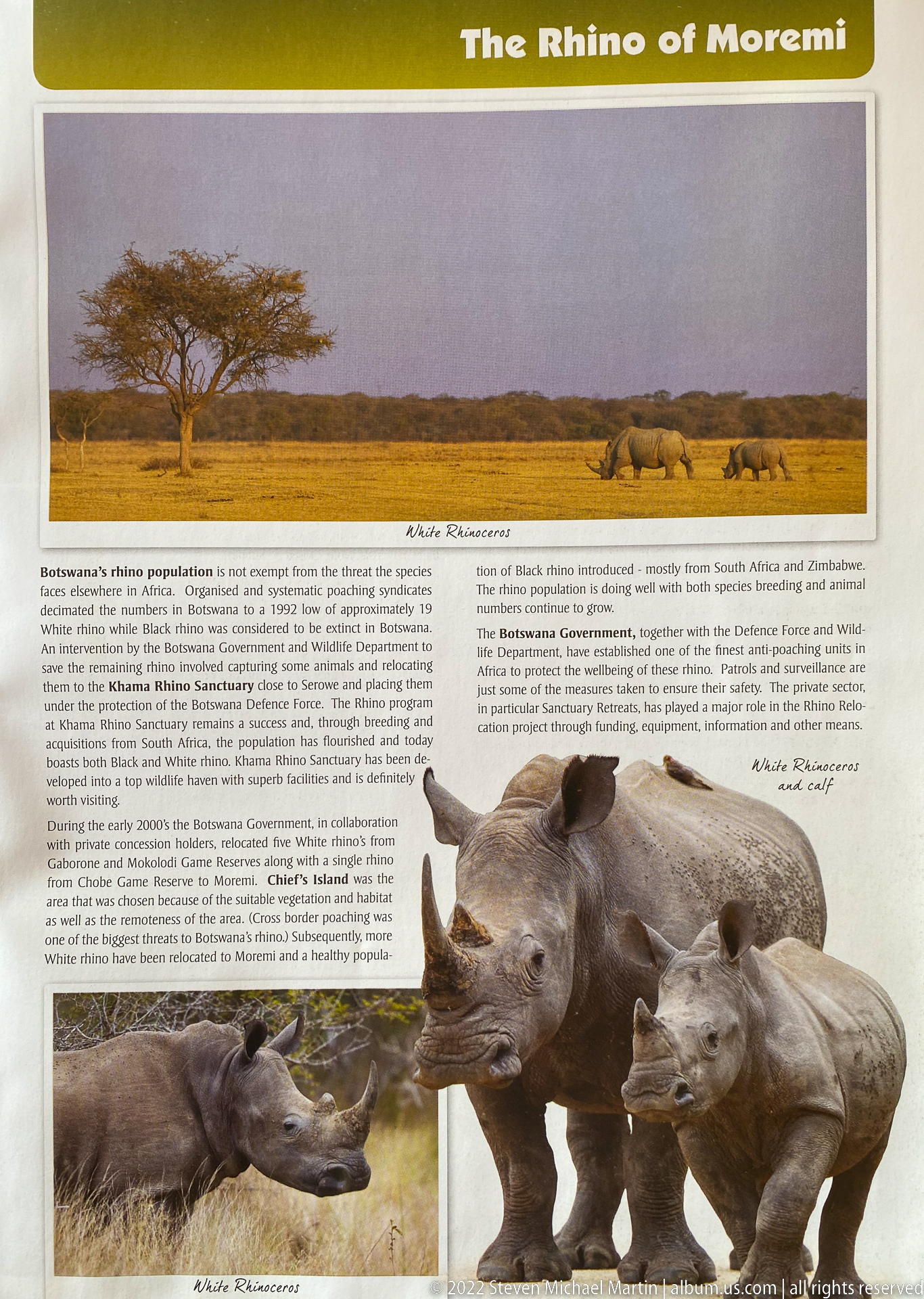
An informational page titled “The Rhino of Moremi” centers on black rhinoceros conservation, pairing a distant landscape photograph with close images of adults and a calf. The text discusses rhinoceros history and management in the region, while the photographs emphasize horn shape, heavy skin folds, and the close association of mother and young. The page serves as a species-focused conservation reference within the broader Moremi guide.
Caption
An informational page titled “The Rhino of Moremi” centers on black rhinoceros conservation, pairing a distant landscape photograph with close images of adults and a calf. The text discusses rhinoceros history and management in the region, while the photographs emphasize horn shape, heavy skin folds, and the close association of mother and young. The page serves as a species-focused conservation reference within the broader Moremi guide.
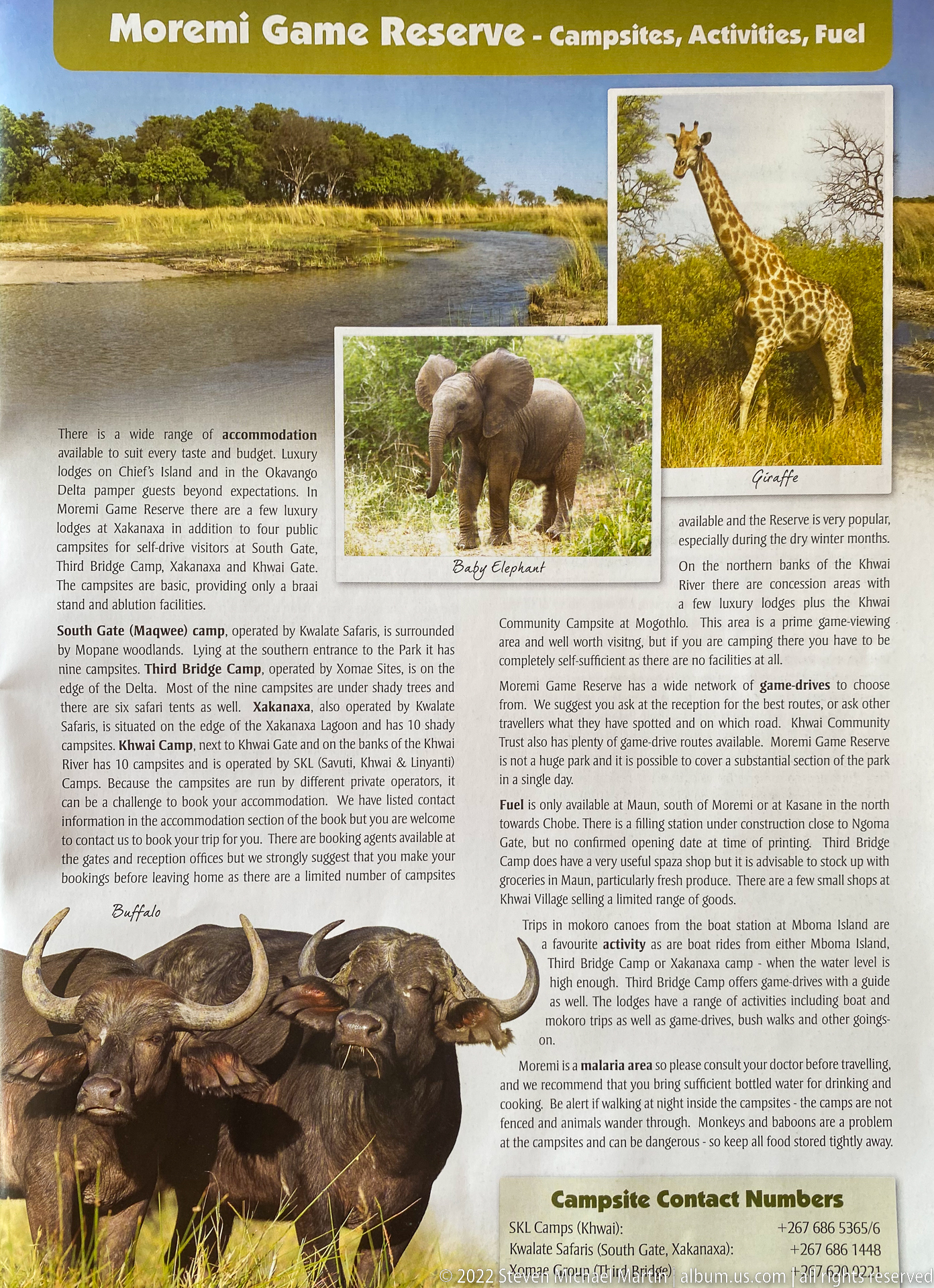
A Moremi Game Reserve guide page titled for campsites, activities, and fuel combines visitor information with photographs of giraffe, elephants, and African buffalo. Text blocks describe camp areas and facilities while a campsite contact section occupies the lower right. The page illustrates how practical route and lodging information was paired with expected wildlife encounters for travelers moving through the reserve.
Caption
A Moremi Game Reserve guide page titled for campsites, activities, and fuel combines visitor information with photographs of giraffe, elephants, and African buffalo. Text blocks describe camp areas and facilities while a campsite contact section occupies the lower right. The page illustrates how practical route and lodging information was paired with expected wildlife encounters for travelers moving through the reserve.
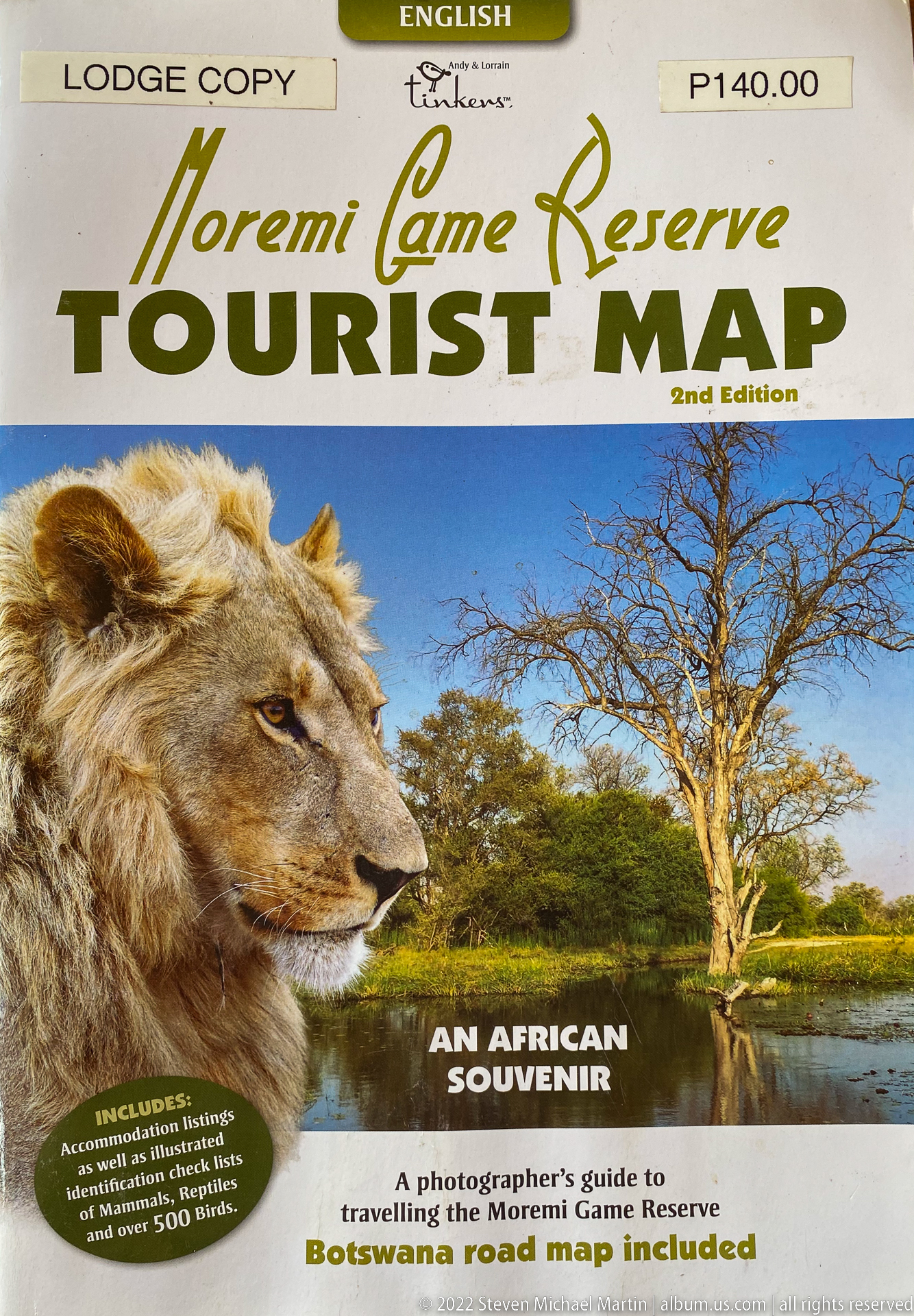
The cover of a Moremi Game Reserve tourist map combines a close lion portrait with a wetland landscape of water, woodland, and a leafless tree. Large title typography identifies the guide as a tourist map for Moremi Game Reserve, with additional text describing it as a photographer’s guide and noting the included Botswana road map. The image records the field-reference material used during the safari.
Caption
The cover of a Moremi Game Reserve tourist map combines a close lion portrait with a wetland landscape of water, woodland, and a leafless tree. Large title typography identifies the guide as a tourist map for Moremi Game Reserve, with additional text describing it as a photographer’s guide and noting the included Botswana road map. The image records the field-reference material used during the safari.
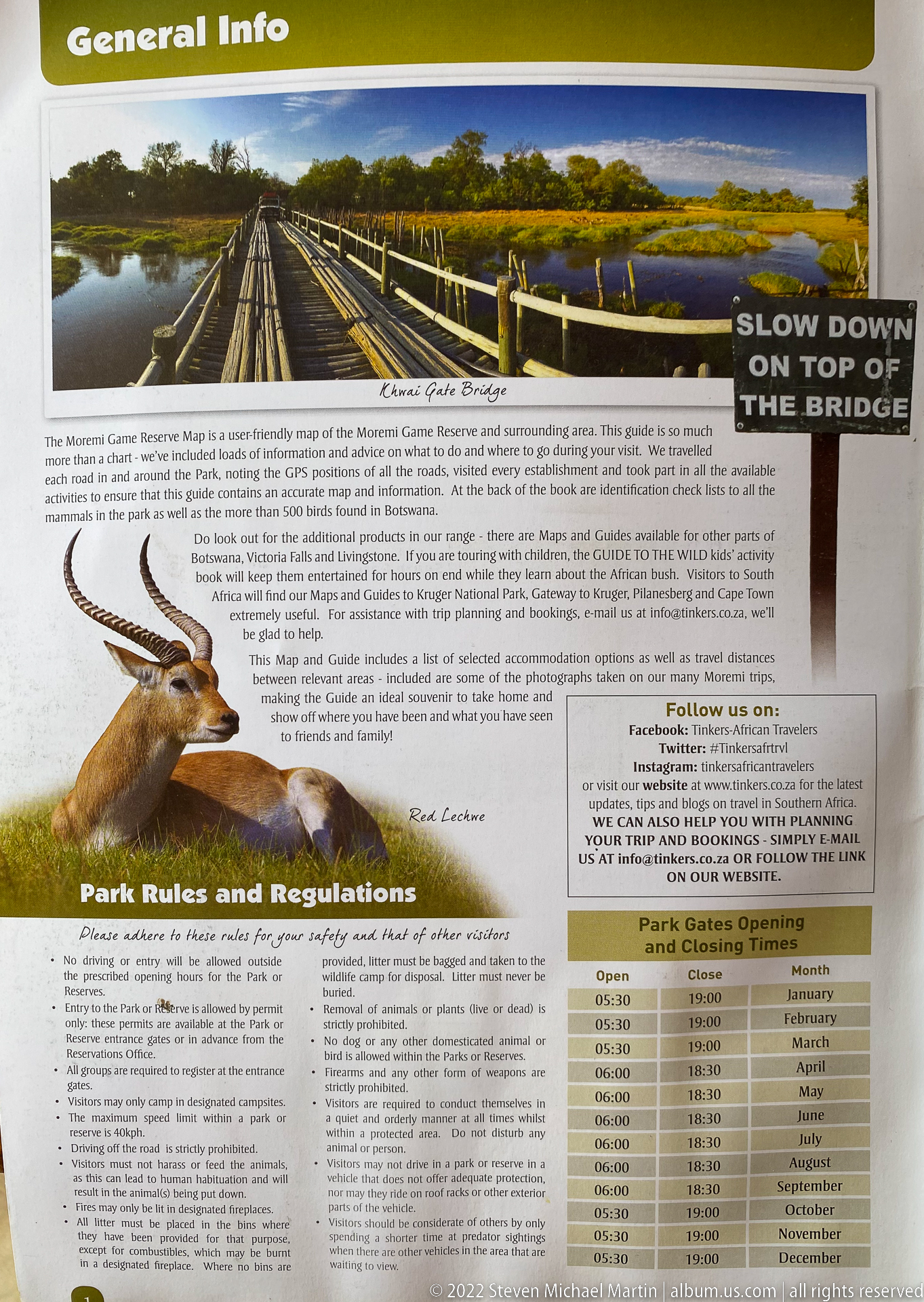
A reference page titled “General Info” presents practical information for Moremi Game Reserve alongside photographs of a wooden bridge and antelope. Dense text blocks cover park rules, regulations, access, and operating hours, while a warning sign instructs drivers to slow down on the top of the bridge. The layout functions as a field-use orientation page rather than a scenic travel image.
Caption
A reference page titled “General Info” presents practical information for Moremi Game Reserve alongside photographs of a wooden bridge and antelope. Dense text blocks cover park rules, regulations, access, and operating hours, while a warning sign instructs drivers to slow down on the top of the bridge. The layout functions as a field-use orientation page rather than a scenic travel image.
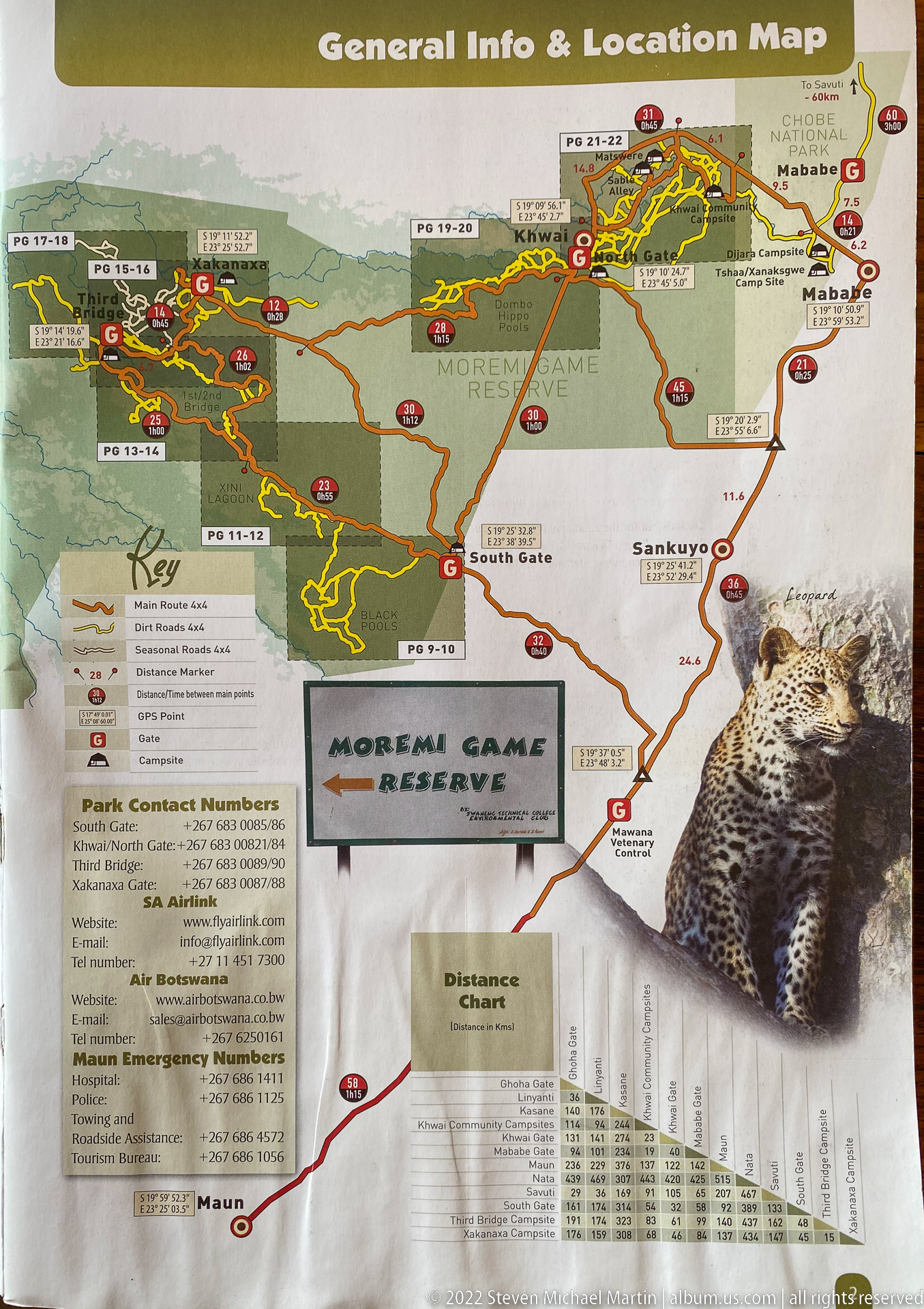
A folded guide page presents a regional map centered on Moremi Game Reserve, with major routes, settlements, reserve boundaries, and access information marked across northern Botswana. A leopard photograph anchors the lower right while a labeled Moremi Game Reserve panel and park contact information occupy the left. The image records route-planning material used to understand the reserve in relation to surrounding roads and towns.
Caption
A folded guide page presents a regional map centered on Moremi Game Reserve, with major routes, settlements, reserve boundaries, and access information marked across northern Botswana. A leopard photograph anchors the lower right while a labeled Moremi Game Reserve panel and park contact information occupy the left. The image records route-planning material used to understand the reserve in relation to surrounding roads and towns.
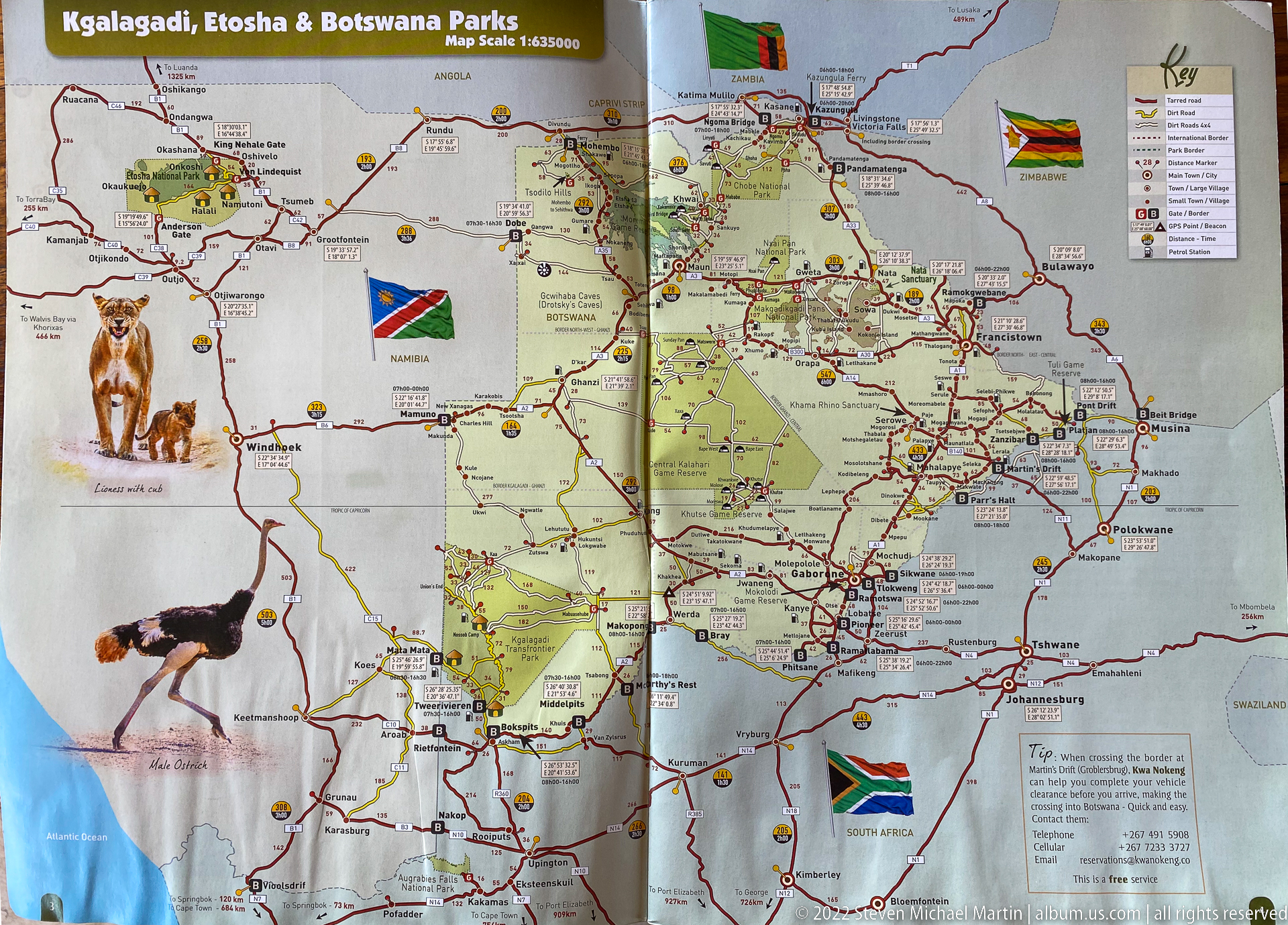
A two-page regional map titled “Kgalagadi, Etosha & Botswana Parks” shows Botswana within a broader southern African road network extending into Namibia, Zambia, Zimbabwe, and South Africa. National flags, park areas, highways, towns, and a map key organize the spread. Small wildlife illustrations and photographs provide visual anchors while the map functions primarily as a long-distance route-planning reference.
Caption
A two-page regional map titled “Kgalagadi, Etosha & Botswana Parks” shows Botswana within a broader southern African road network extending into Namibia, Zambia, Zimbabwe, and South Africa. National flags, park areas, highways, towns, and a map key organize the spread. Small wildlife illustrations and photographs provide visual anchors while the map functions primarily as a long-distance route-planning reference.

A large reserve map fills this guide spread, tracing roads, waterways, tracks, and named areas through the Moremi landscape. Wildlife photographs of elephant, giraffe, antelope, birds, and other species are placed around the map as visual reference points, while a key and small inset panels provide orientation. The page functions as both route map and illustrated field companion.
Caption
A large reserve map fills this guide spread, tracing roads, waterways, tracks, and named areas through the Moremi landscape. Wildlife photographs of elephant, giraffe, antelope, birds, and other species are placed around the map as visual reference points, while a key and small inset panels provide orientation. The page functions as both route map and illustrated field companion.
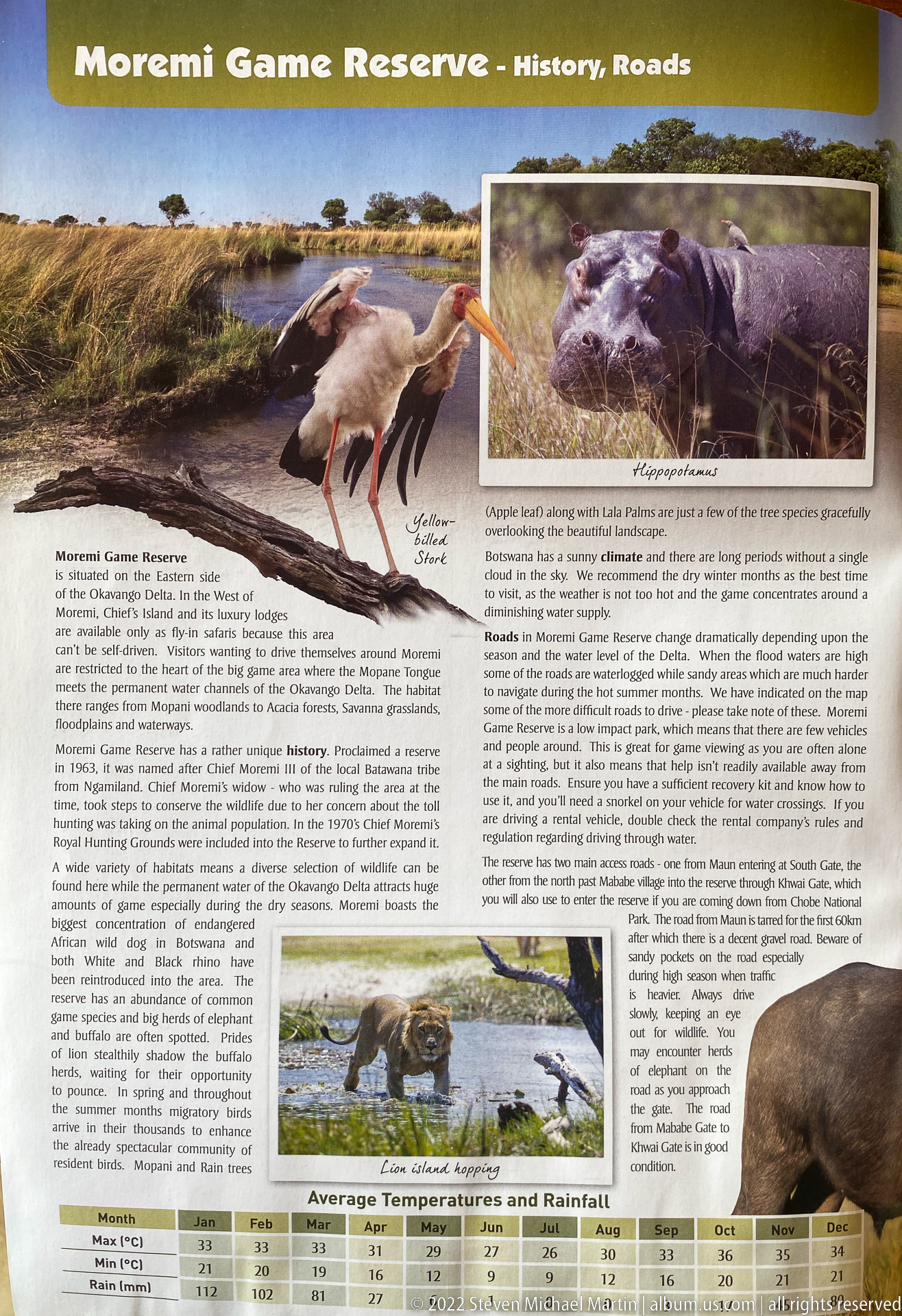
A Moremi Game Reserve guide spread combines dense historical and road information with photographs of wildlife and wetland terrain. A large saddle-billed stork image, a close buffalo portrait, and smaller landscape and animal photographs break up the text, while a table at the bottom summarizes average temperatures and rainfall. The page is designed as a compact ecological and logistical reference for visitors.
Caption
A Moremi Game Reserve guide spread combines dense historical and road information with photographs of wildlife and wetland terrain. A large saddle-billed stork image, a close buffalo portrait, and smaller landscape and animal photographs break up the text, while a table at the bottom summarizes average temperatures and rainfall. The page is designed as a compact ecological and logistical reference for visitors.
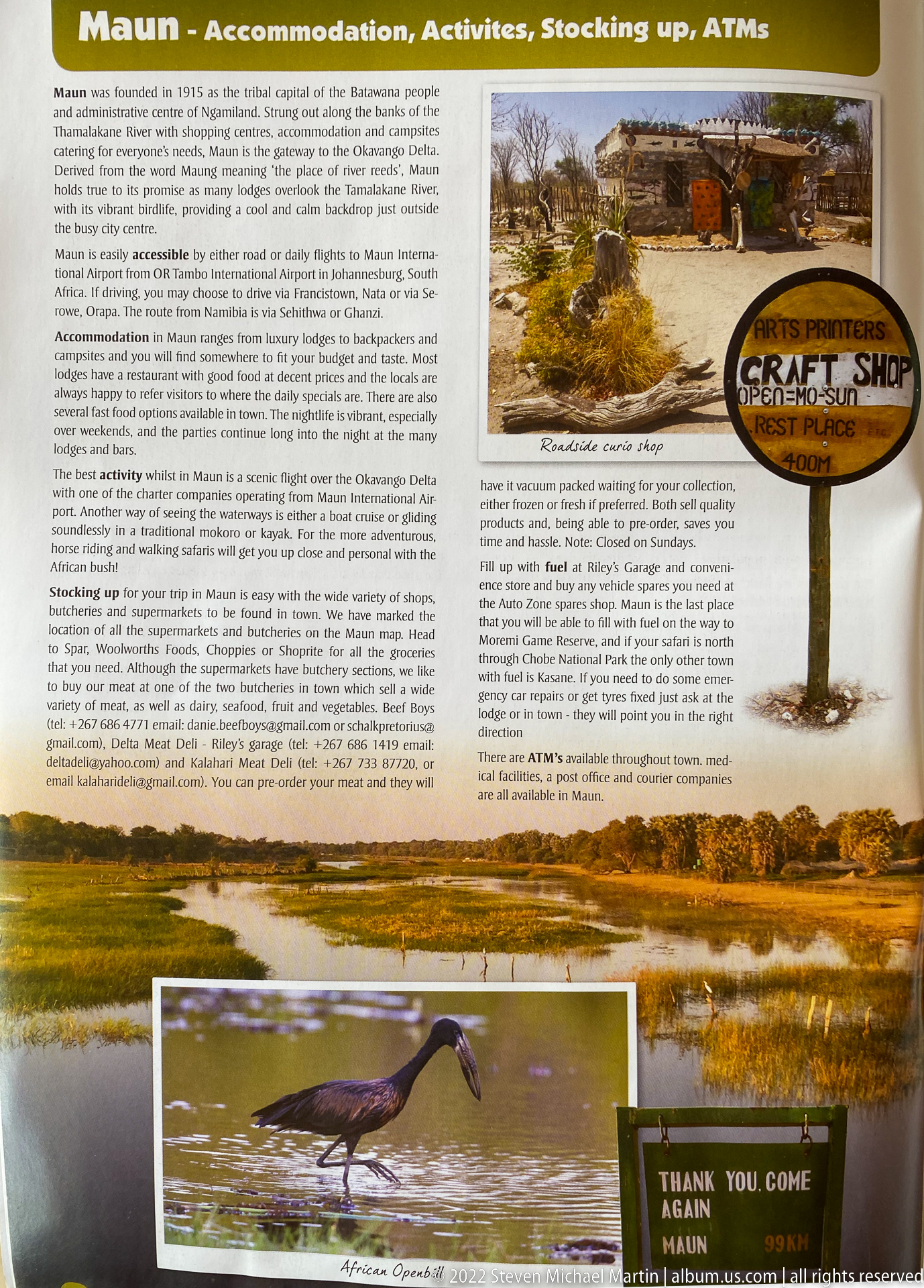
A guide page devoted to Maun organizes practical travel information on accommodation, activities, stocking up, ATMs, and local services. Photographs include a craft-shop sign, town street scene, wetland landscape, and a dark wading bird in shallow water. The page functions as a logistical gateway reference for travelers provisioning in Maun before entering Moremi and the Okavango region.
Caption
A guide page devoted to Maun organizes practical travel information on accommodation, activities, stocking up, ATMs, and local services. Photographs include a craft-shop sign, town street scene, wetland landscape, and a dark wading bird in shallow water. The page functions as a logistical gateway reference for travelers provisioning in Maun before entering Moremi and the Okavango region.
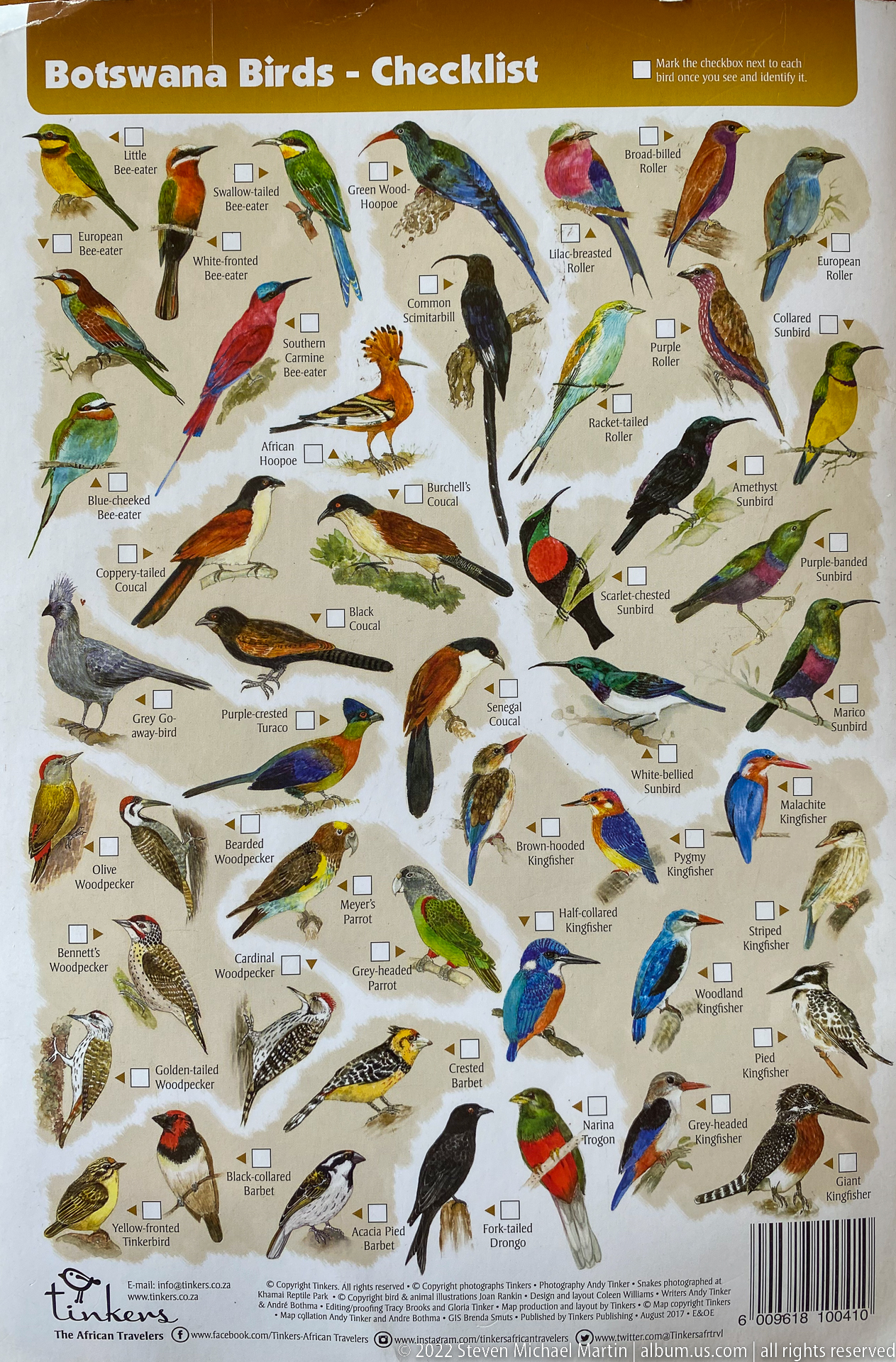
The final bird checklist page gathers many of Botswana’s most colorful and distinctive species, including rollers, kingfishers, bee-eaters, barbets, hornbills, and other woodland and riverine birds. Saturated blues, greens, reds, yellows, and chestnuts make this page especially useful for quick plumage-based comparison. Species names and checkboxes preserve the practical field-guide function while the dense illustrations form a vivid visual index of regional birdlife.
Caption
The final bird checklist page gathers many of Botswana’s most colorful and distinctive species, including rollers, kingfishers, bee-eaters, barbets, hornbills, and other woodland and riverine birds. Saturated blues, greens, reds, yellows, and chestnuts make this page especially useful for quick plumage-based comparison. Species names and checkboxes preserve the practical field-guide function while the dense illustrations form a vivid visual index of regional birdlife.
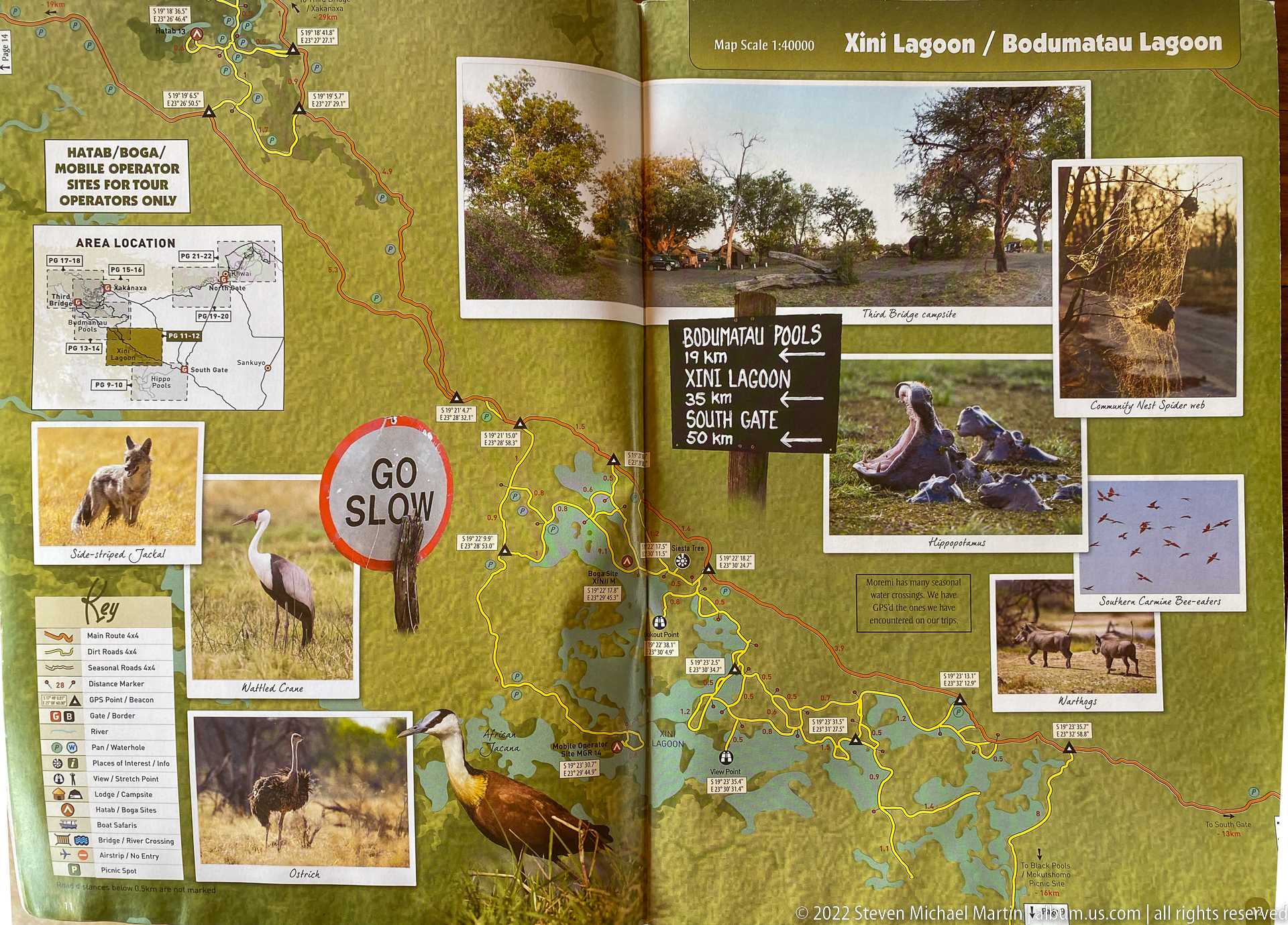
A detailed guide spread maps the Xini Lagoon and Bodumatau Lagoon sector of Moremi, with route lines, waterways, numbered markers, and local landmarks distributed across the page. Insets show riverine woodland and animal species including crane-like birds, antelope, and other savanna wildlife. A prominent “Go Slow” sign graphic reinforces the page’s emphasis on careful travel through a wildlife-rich area.
Caption
A detailed guide spread maps the Xini Lagoon and Bodumatau Lagoon sector of Moremi, with route lines, waterways, numbered markers, and local landmarks distributed across the page. Insets show riverine woodland and animal species including crane-like birds, antelope, and other savanna wildlife. A prominent “Go Slow” sign graphic reinforces the page’s emphasis on careful travel through a wildlife-rich area.
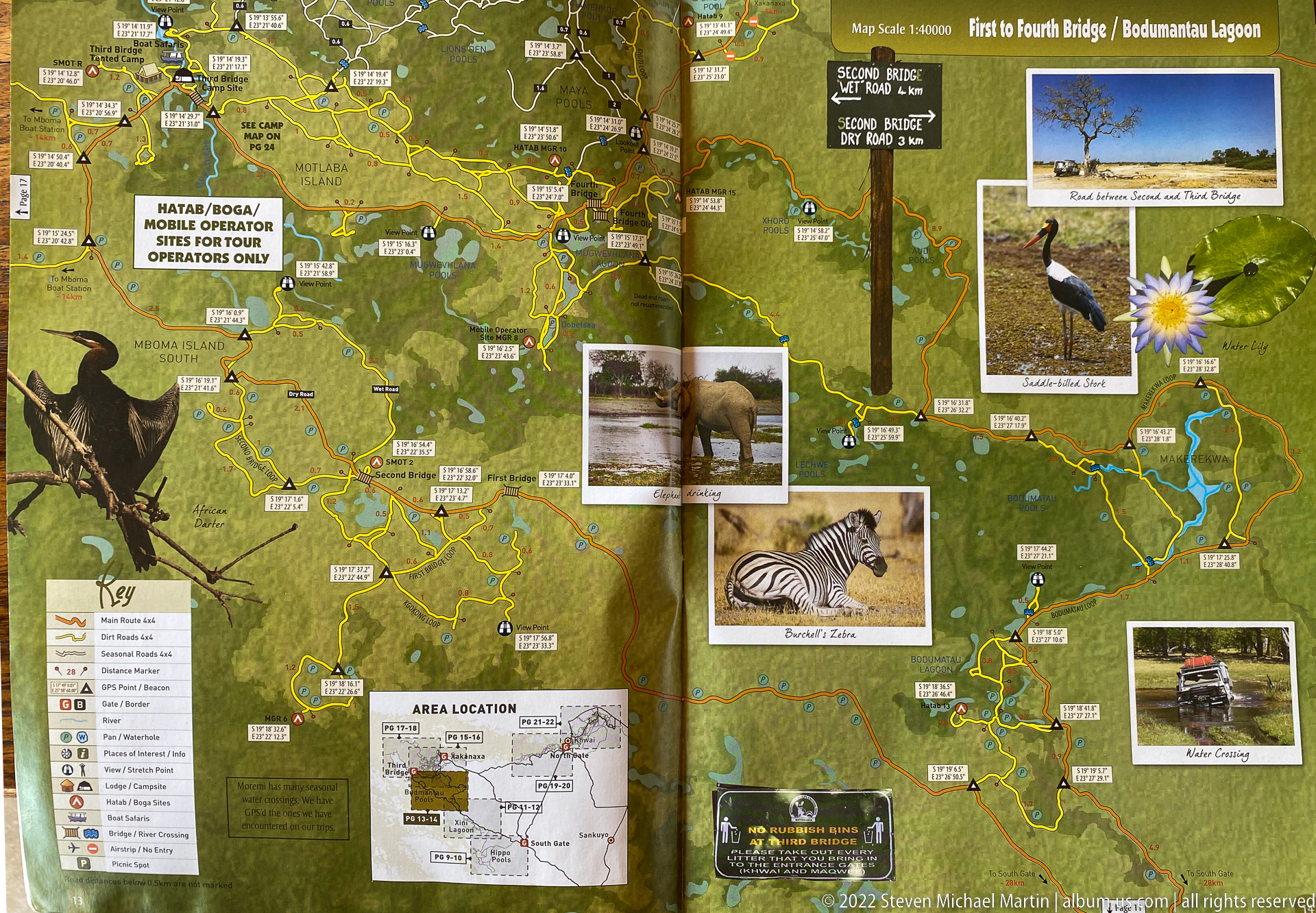
A route-planning page covers the Bodumatau Lagoon and First to Fourth Bridge sector, showing roads, channels, track junctions, and numbered reference points. Small photographs of elephant, zebra, crocodile, birdlife, and a bridge illustrate expected scenery and wildlife along the route. The spread integrates navigation with species observation, making it a practical field reference for game drives.
Caption
A route-planning page covers the Bodumatau Lagoon and First to Fourth Bridge sector, showing roads, channels, track junctions, and numbered reference points. Small photographs of elephant, zebra, crocodile, birdlife, and a bridge illustrate expected scenery and wildlife along the route. The spread integrates navigation with species observation, making it a practical field reference for game drives.

An illustrated Moremi map spread combines a dense network of tracks and waterways with wildlife photographs of elephant, leopard, birds, and other species. A circular five-ton vehicle sign and operator-restriction notice stand out among the route information. The page is designed to help drivers navigate remote sections while recognizing wildlife and practical access constraints along the way.
Caption
An illustrated Moremi map spread combines a dense network of tracks and waterways with wildlife photographs of elephant, leopard, birds, and other species. A circular five-ton vehicle sign and operator-restriction notice stand out among the route information. The page is designed to help drivers navigate remote sections while recognizing wildlife and practical access constraints along the way.
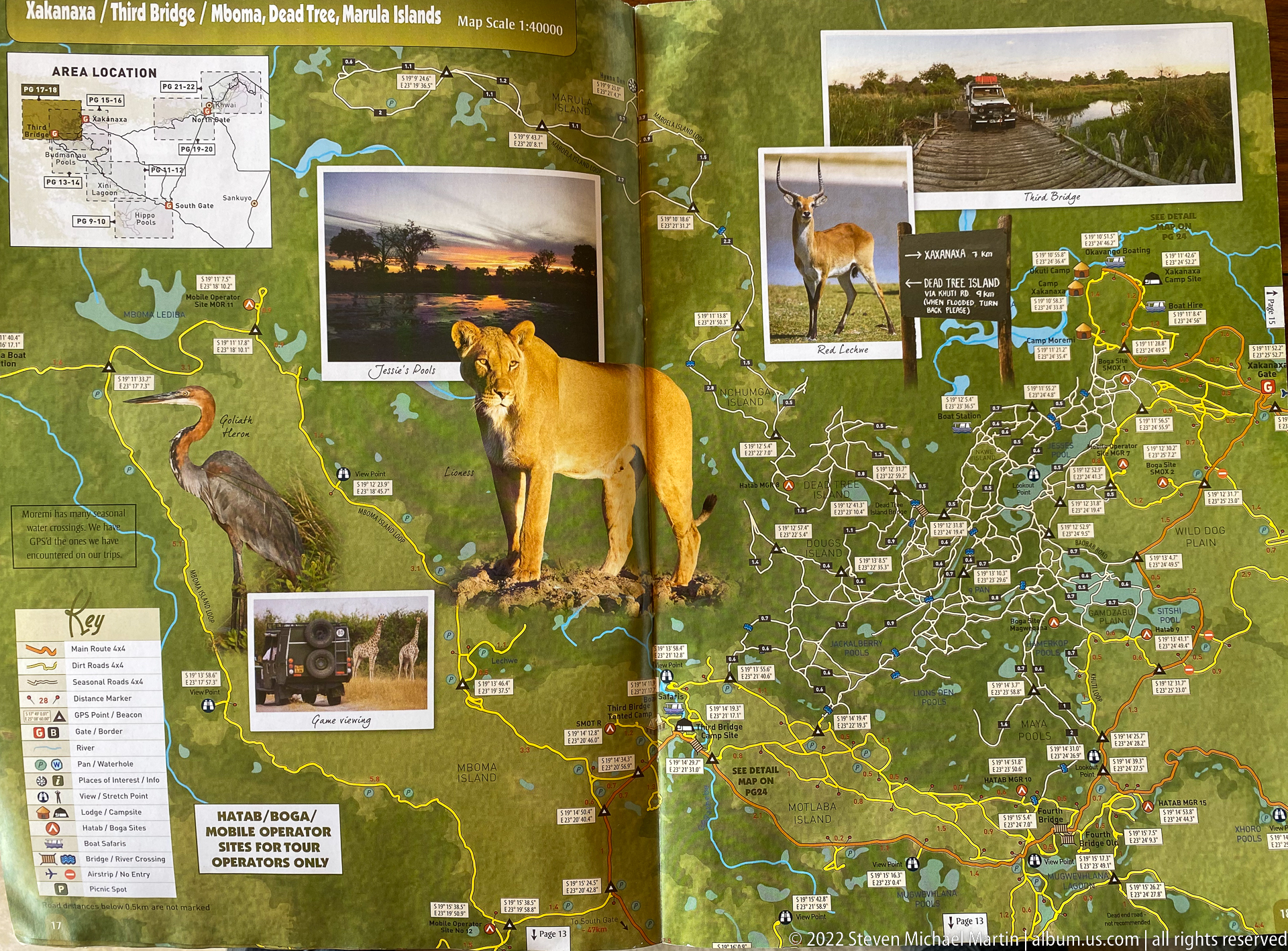
A Moremi guide spread maps the Xakanaxa and Third Bridge area, extending across Mboma, Dead Tree, and Marula Islands. A large lion photograph dominates the center while smaller insets feature antelope, birds, wetland scenery, and other wildlife. Roads, channels, campsites, and route markers weave through the map, combining detailed navigation with a visual summary of species and habitats found in the sector.
Caption
A Moremi guide spread maps the Xakanaxa and Third Bridge area, extending across Mboma, Dead Tree, and Marula Islands. A large lion photograph dominates the center while smaller insets feature antelope, birds, wetland scenery, and other wildlife. Roads, channels, campsites, and route markers weave through the map, combining detailed navigation with a visual summary of species and habitats found in the sector.
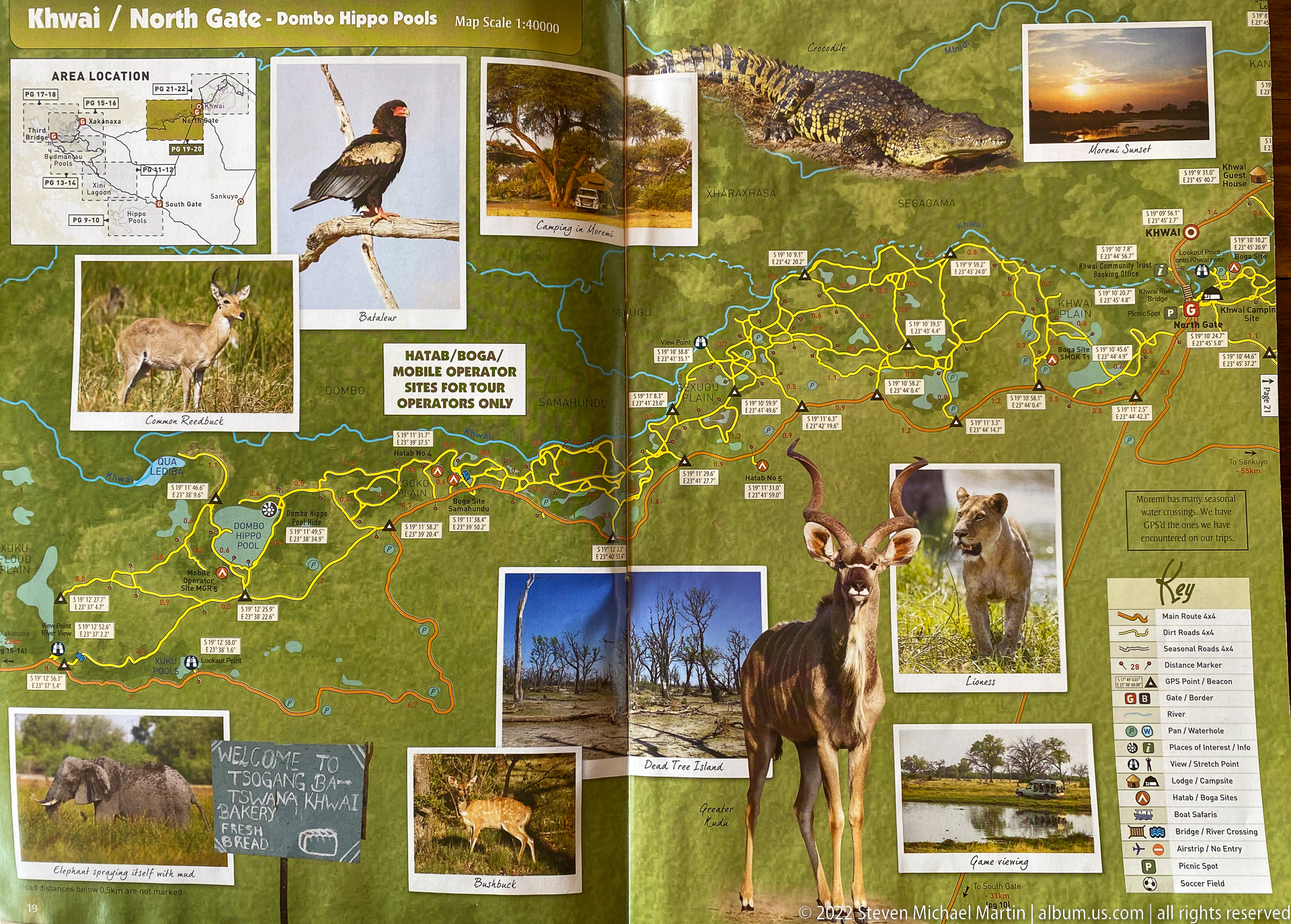
A Moremi map page focuses on Khwai, North Gate, and Dombo Hippo Pools, with waterways and roads crossing a broad green cartographic field. Wildlife photographs include kudu, lion, elephant, birds, and reptiles, while small landscape insets show the character of the surrounding habitats. The guide combines area-specific navigation with a concise illustrated inventory of notable wildlife encounters.
Caption
A Moremi map page focuses on Khwai, North Gate, and Dombo Hippo Pools, with waterways and roads crossing a broad green cartographic field. Wildlife photographs include kudu, lion, elephant, birds, and reptiles, while small landscape insets show the character of the surrounding habitats. The guide combines area-specific navigation with a concise illustrated inventory of notable wildlife encounters.
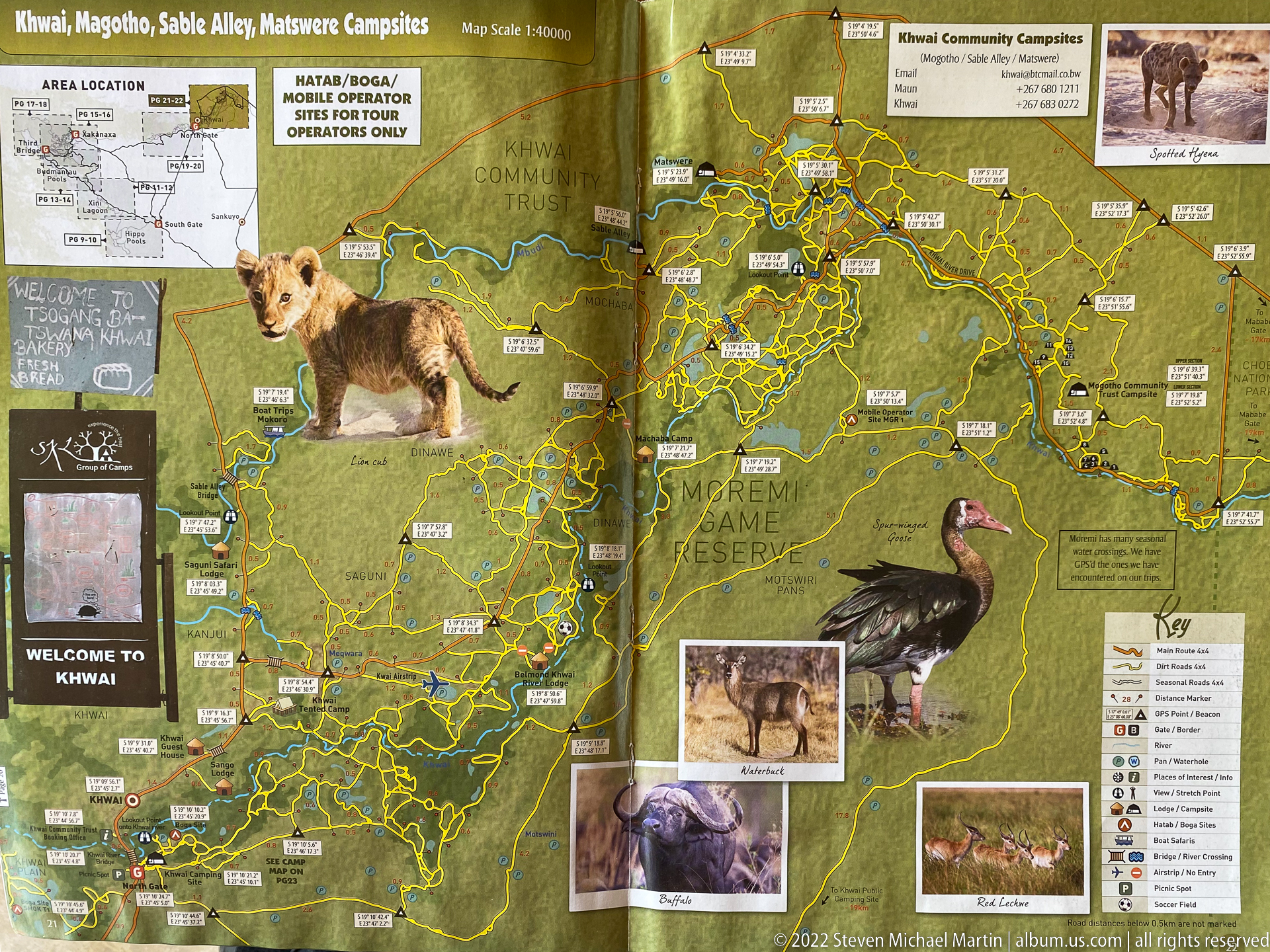
A large map covers the Khwai and Magotho area around Sable Alley and Matswere campsites, overlaid with tracks, waterways, route markers, and campsite information. Wildlife images include a spotted hyena, buffalo, hippopotamus, and large bird, while smaller signs and location boxes reinforce the page’s field-use character. The spread integrates camping logistics with route planning through the northern Moremi landscape.
Caption
A large map covers the Khwai and Magotho area around Sable Alley and Matswere campsites, overlaid with tracks, waterways, route markers, and campsite information. Wildlife images include a spotted hyena, buffalo, hippopotamus, and large bird, while smaller signs and location boxes reinforce the page’s field-use character. The spread integrates camping logistics with route planning through the northern Moremi landscape.
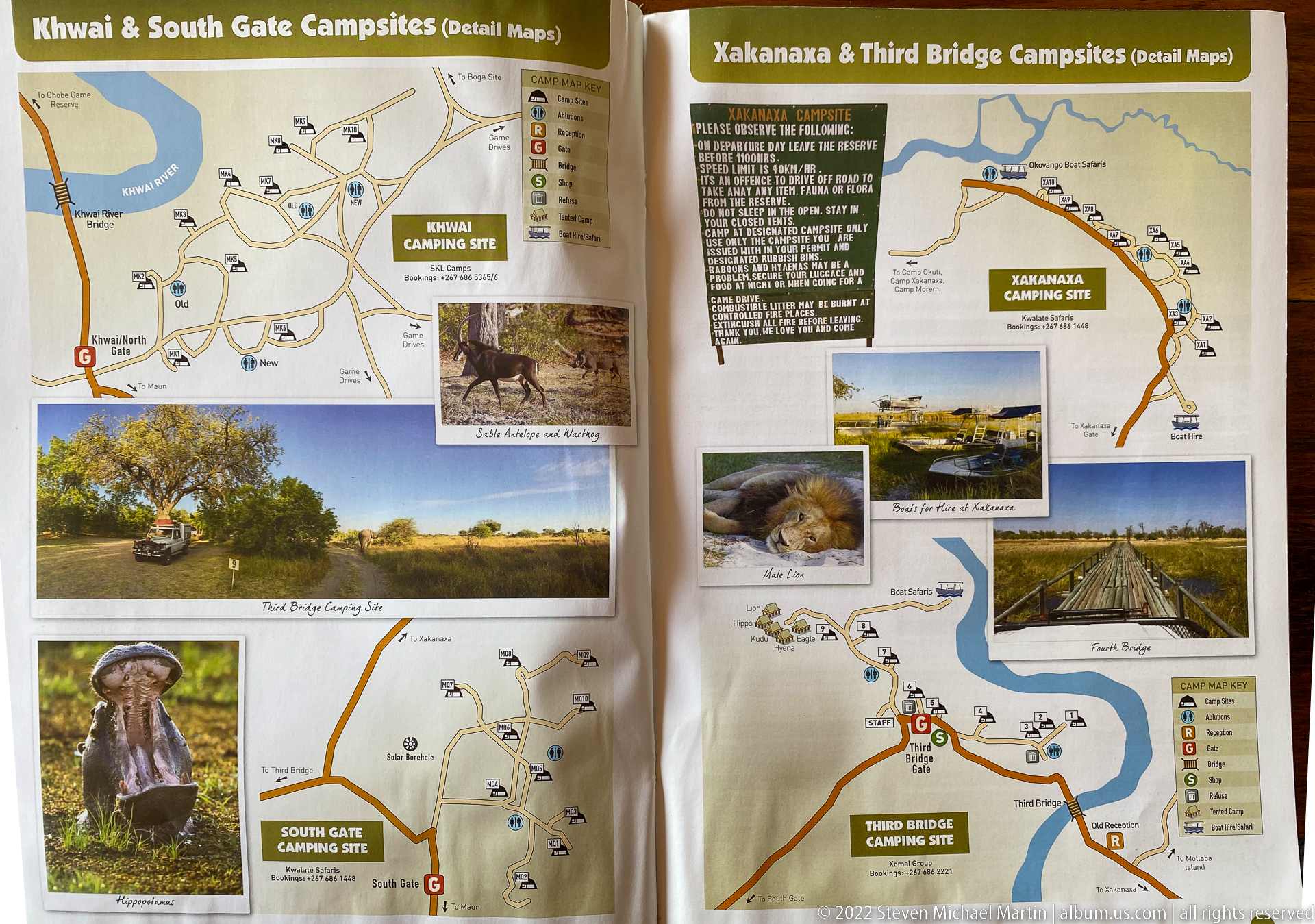
A white-background guide spread assembles detailed campsite maps for Khwai, South Gate, Xakanaxa, and Third Bridge. Each inset traces access roads, campsite loops, landmarks, and numbered points, supplemented by photographs of vehicles, bridges, hippos, and camp surroundings. The page shifts from broad regional navigation to site-level orientation intended for travelers arriving at or moving between individual camps.
Caption
A white-background guide spread assembles detailed campsite maps for Khwai, South Gate, Xakanaxa, and Third Bridge. Each inset traces access roads, campsite loops, landmarks, and numbered points, supplemented by photographs of vehicles, bridges, hippos, and camp surroundings. The page shifts from broad regional navigation to site-level orientation intended for travelers arriving at or moving between individual camps.
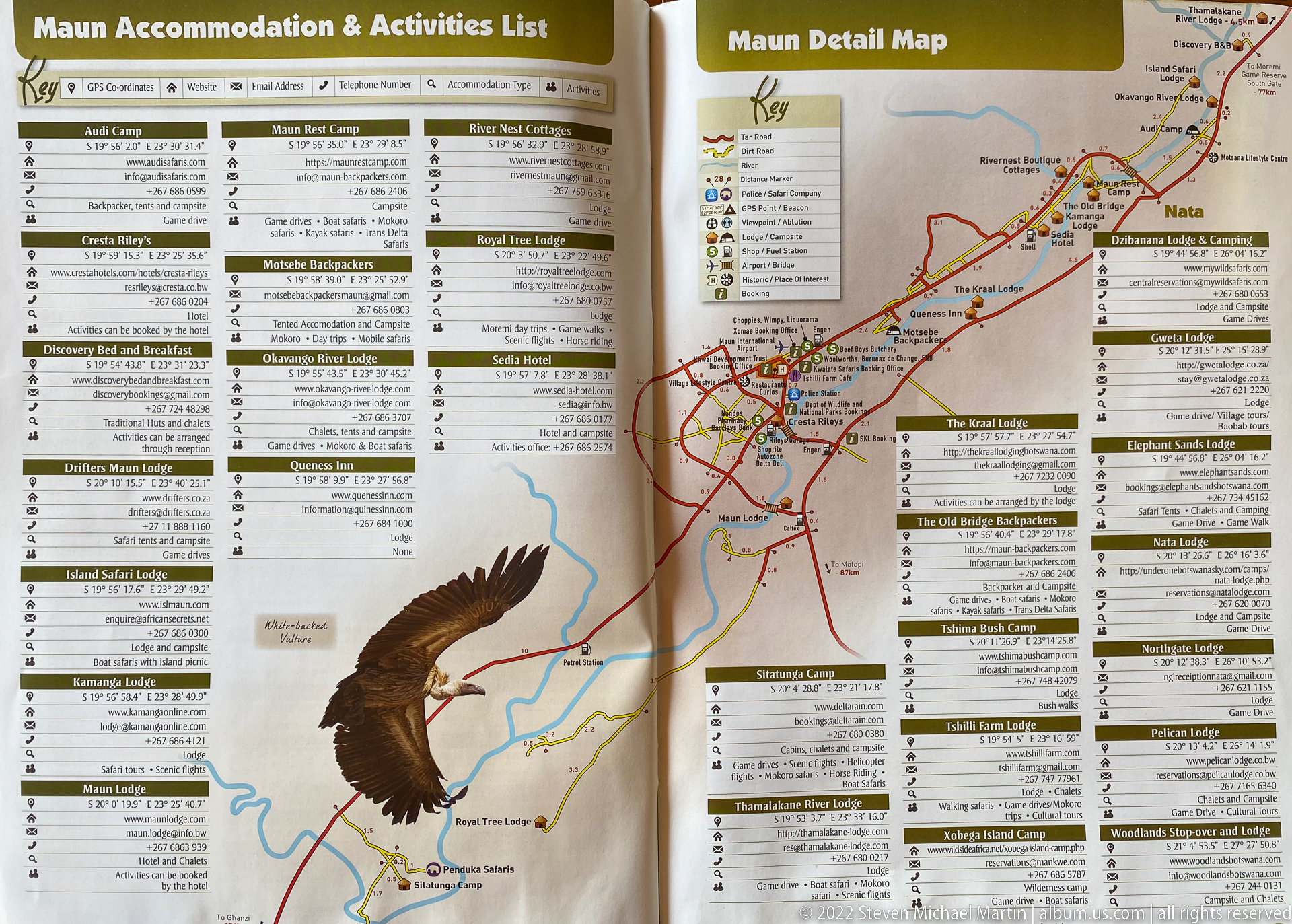
The final Moremi guide spread pairs a detailed Maun street and river map with columns of accommodation, activity, restaurant, and service listings. Road names and major facilities are densely annotated, while a large bird illustration marks the map visually. The page serves as a practical urban reference for lodging, dining, supplies, and onward arrangements before or after travel into the reserve.
Caption
The final Moremi guide spread pairs a detailed Maun street and river map with columns of accommodation, activity, restaurant, and service listings. Road names and major facilities are densely annotated, while a large bird illustration marks the map visually. The page serves as a practical urban reference for lodging, dining, supplies, and onward arrangements before or after travel into the reserve.
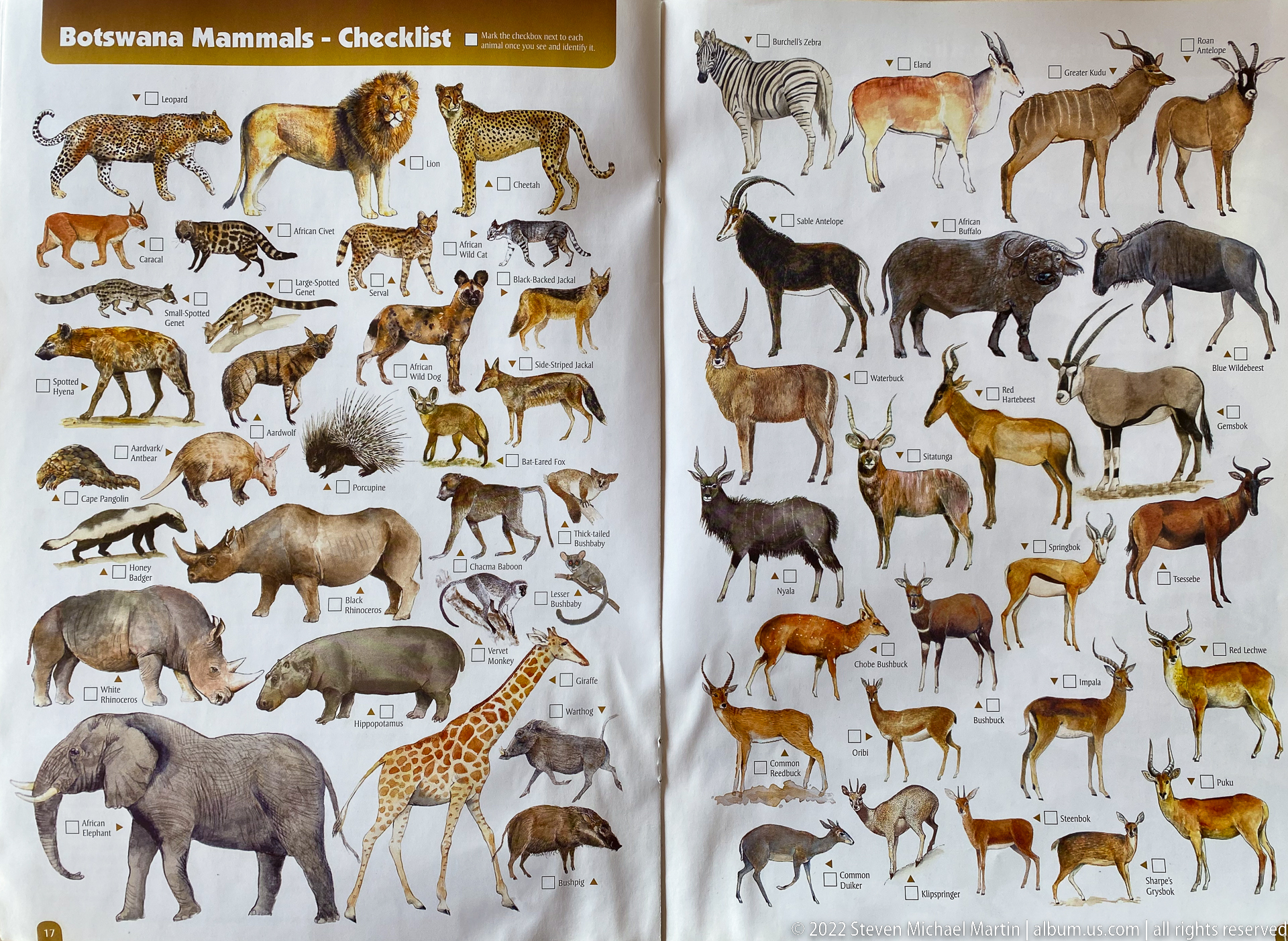
A two-page wildlife checklist presents illustrated mammals ranging from small carnivores and antelope to elephant, giraffe, rhinoceros, hippopotamus, buffalo, and zebra. Each species is paired with a small checkbox and name, turning the spread into a visual field reference for recording sightings. The dense taxonomy-style layout emphasizes comparison of body form, coloration, horn shape, and relative size across many species.
Caption
A two-page wildlife checklist presents illustrated mammals ranging from small carnivores and antelope to elephant, giraffe, rhinoceros, hippopotamus, buffalo, and zebra. Each species is paired with a small checkbox and name, turning the spread into a visual field reference for recording sightings. The dense taxonomy-style layout emphasizes comparison of body form, coloration, horn shape, and relative size across many species.
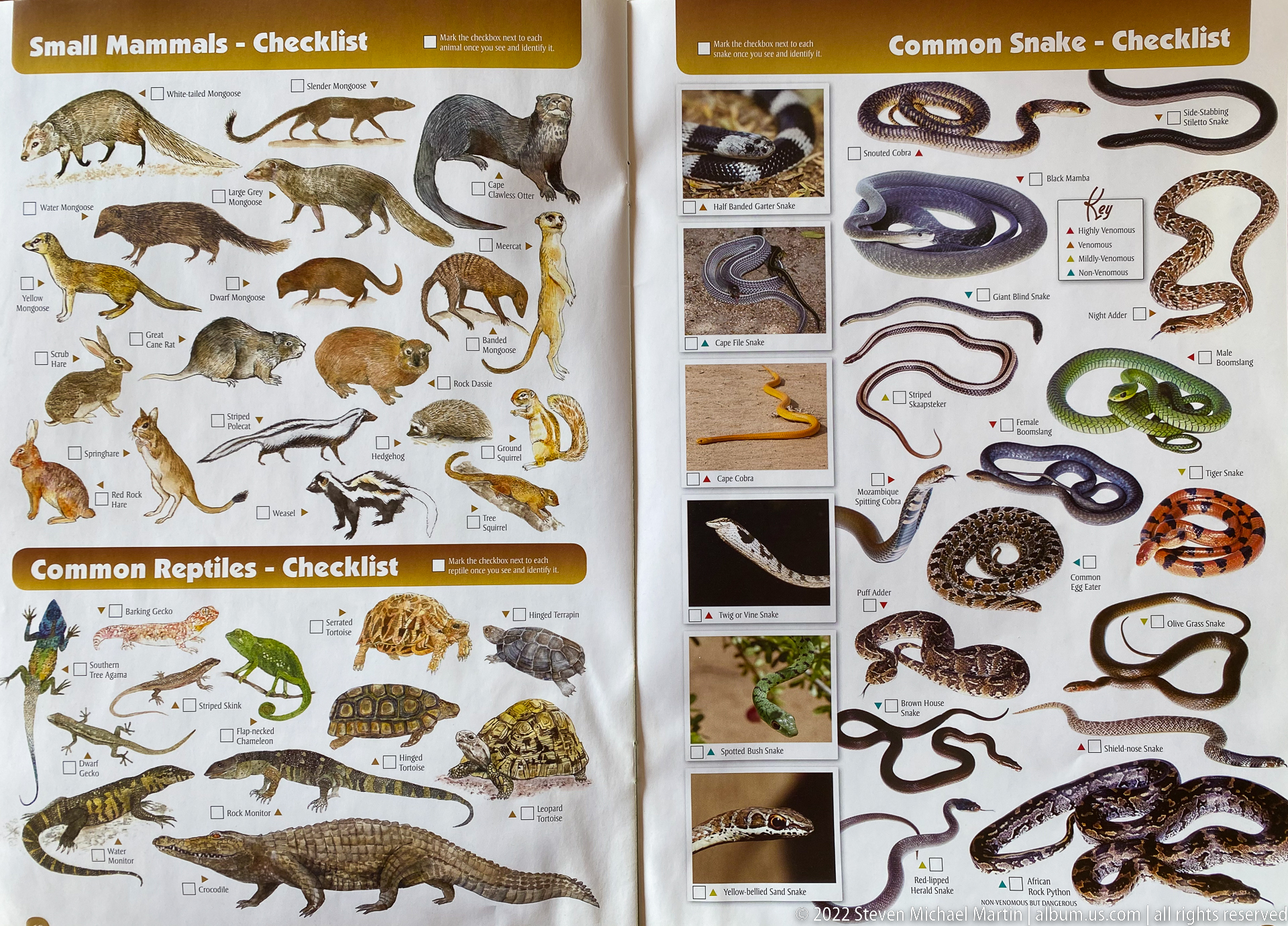
An illustrated field-guide spread pairs a common reptile checklist with a common snake checklist. Tortoises, crocodilians, lizards, and other reptiles occupy the left page, while the right compares snakes by body pattern, coloration, and overall form. Small checkboxes and labels beside each illustration turn the spread into a practical visual reference for field identification and sighting records.
Caption
An illustrated field-guide spread pairs a common reptile checklist with a common snake checklist. Tortoises, crocodilians, lizards, and other reptiles occupy the left page, while the right compares snakes by body pattern, coloration, and overall form. Small checkboxes and labels beside each illustration turn the spread into a practical visual reference for field identification and sighting records.
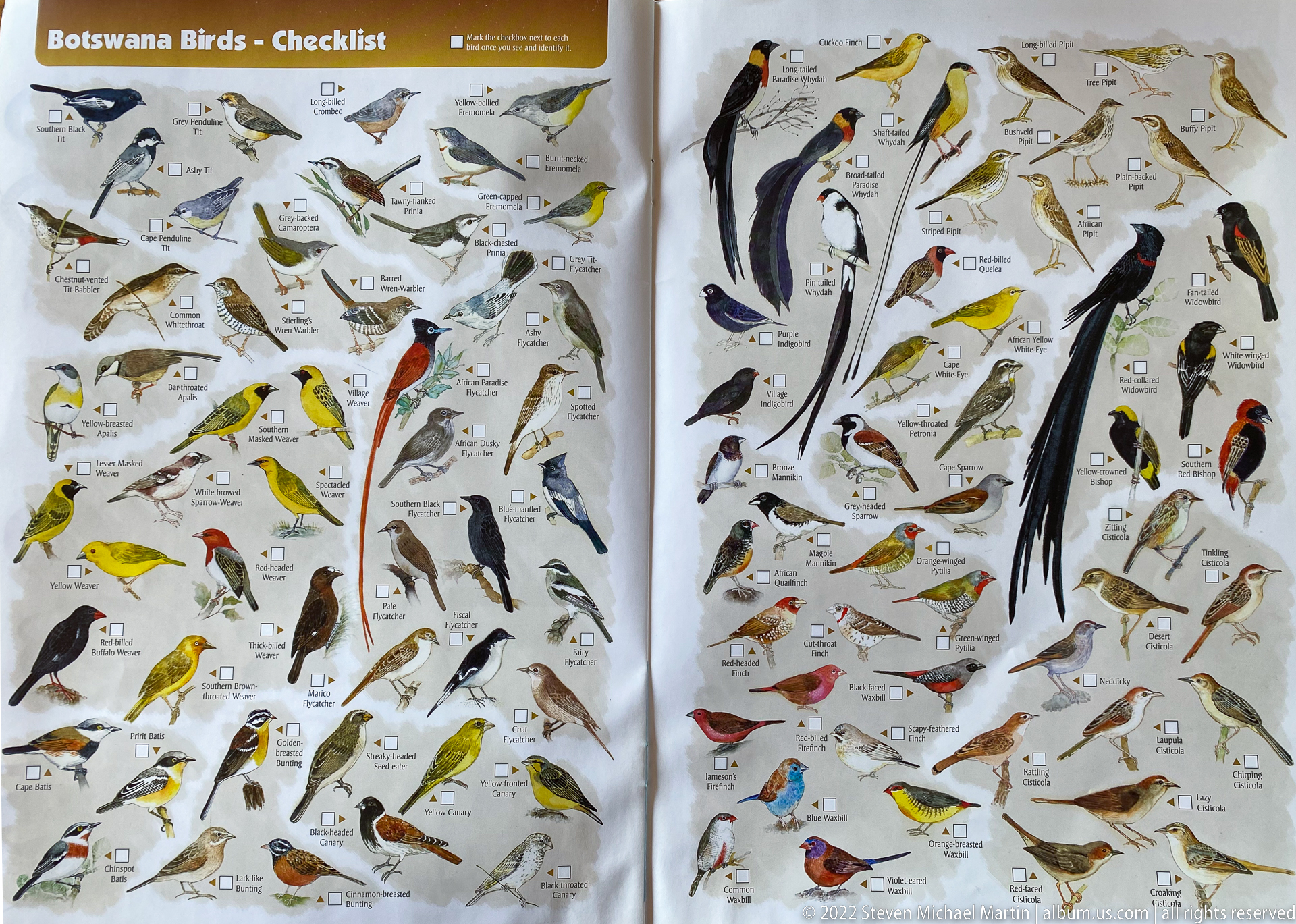
A densely illustrated two-page bird checklist compares dozens of small and medium-sized species in side view. Yellow, red, blue, black, brown, and patterned plumages are arranged in rows beside names and checkboxes, with long-tailed and vividly colored species standing out among subtler forms. The spread is designed for rapid visual comparison and field recording rather than narrative reading.
Caption
A densely illustrated two-page bird checklist compares dozens of small and medium-sized species in side view. Yellow, red, blue, black, brown, and patterned plumages are arranged in rows beside names and checkboxes, with long-tailed and vividly colored species standing out among subtler forms. The spread is designed for rapid visual comparison and field recording rather than narrative reading.

A two-page bird checklist arranges a wide range of woodland, grassland, and aerial species across a pale background, each paired with a label and checkbox. The mix includes brightly colored rollers and bee-eaters, monochrome insectivores, swifts and swallows, larger terrestrial birds, and many small songbirds. The visual diversity makes the spread especially useful for comparing silhouette, tail shape, wing length, and plumage pattern.
Caption
A two-page bird checklist arranges a wide range of woodland, grassland, and aerial species across a pale background, each paired with a label and checkbox. The mix includes brightly colored rollers and bee-eaters, monochrome insectivores, swifts and swallows, larger terrestrial birds, and many small songbirds. The visual diversity makes the spread especially useful for comparing silhouette, tail shape, wing length, and plumage pattern.
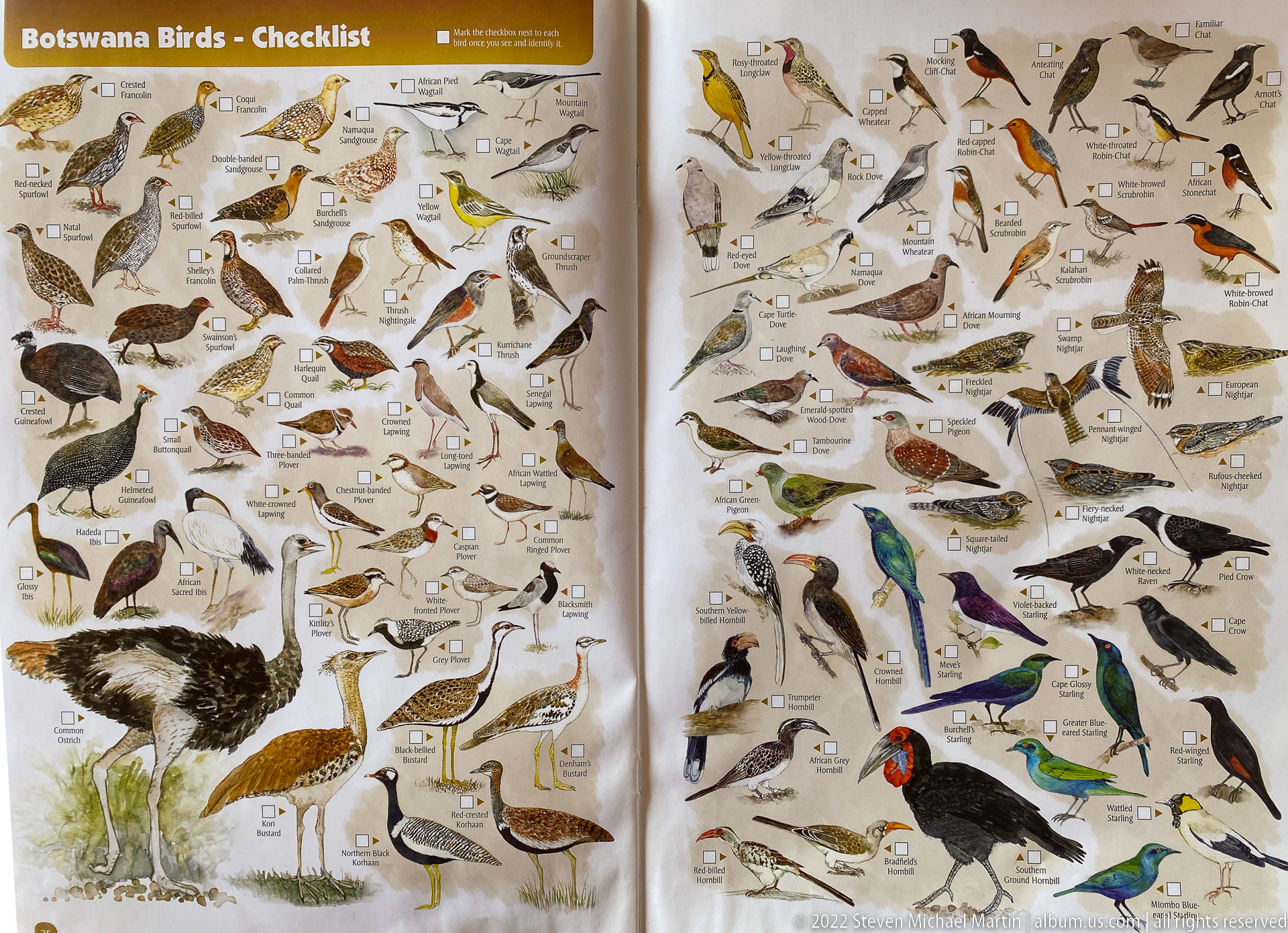
This bird checklist expands into larger and more structurally varied species, including long-legged waders, ground birds, cuckoos, corvids, and vividly colored woodland birds. Each illustration is labeled and paired with a checkbox, encouraging side-by-side comparison of bill shape, leg length, cresting, body size, and plumage. The spread functions as an intermediate field reference between small passerines and the larger waterbirds and raptors shown on subsequent pages.
Caption
This bird checklist expands into larger and more structurally varied species, including long-legged waders, ground birds, cuckoos, corvids, and vividly colored woodland birds. Each illustration is labeled and paired with a checkbox, encouraging side-by-side comparison of bill shape, leg length, cresting, body size, and plumage. The spread functions as an intermediate field reference between small passerines and the larger waterbirds and raptors shown on subsequent pages.
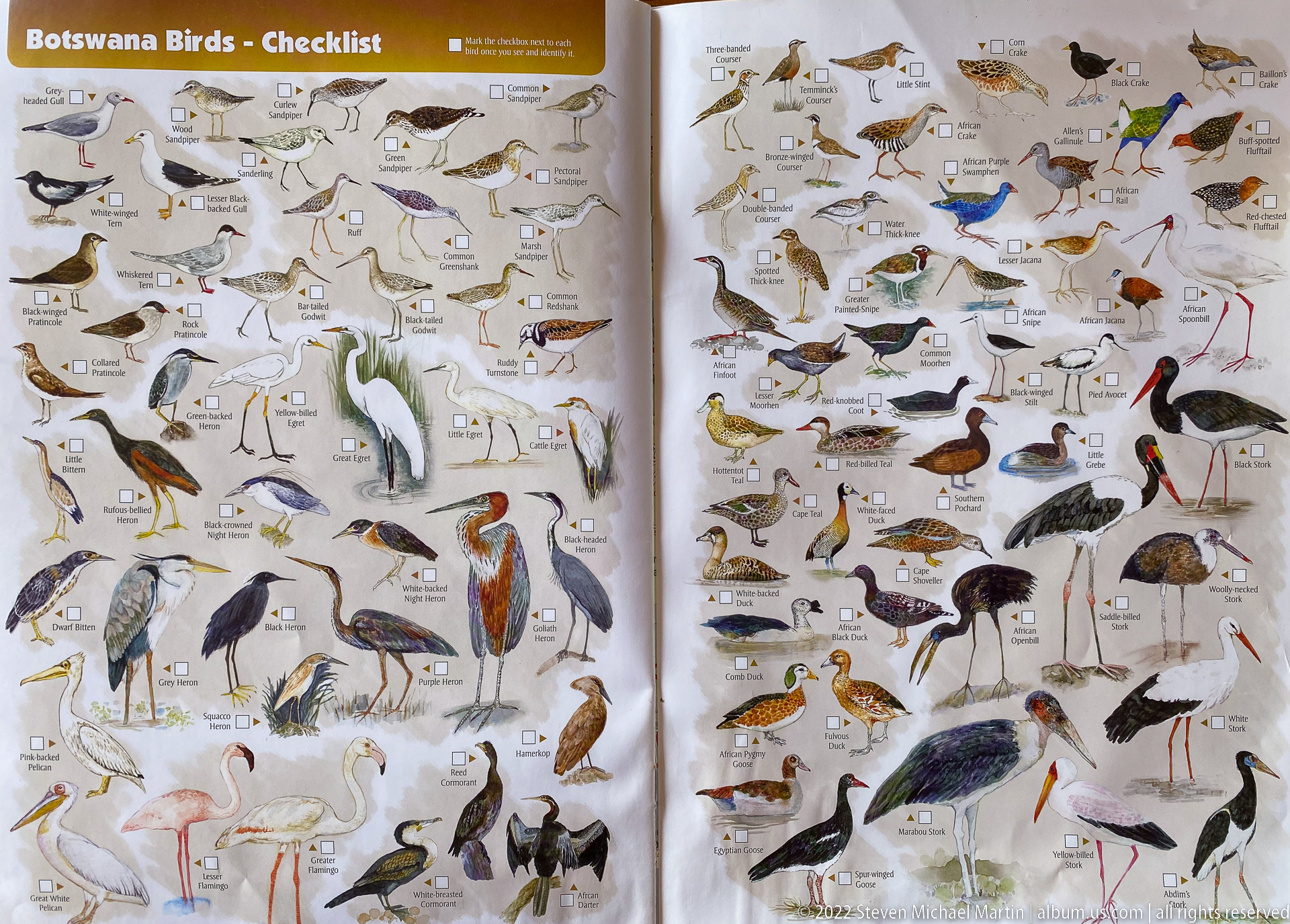
An illustrated waterbird checklist presents herons, storks, ibises, spoonbills, flamingos, ducks, geese, shorebirds, and related wetland species. Long bills, long legs, webbed feet, and contrasting plumage patterns dominate the spread, reflecting adaptations to aquatic and shoreline habitats. Labels and checkboxes transform the page into a compact visual inventory for recording bird sightings along rivers, lagoons, and floodplains.
Caption
An illustrated waterbird checklist presents herons, storks, ibises, spoonbills, flamingos, ducks, geese, shorebirds, and related wetland species. Long bills, long legs, webbed feet, and contrasting plumage patterns dominate the spread, reflecting adaptations to aquatic and shoreline habitats. Labels and checkboxes transform the page into a compact visual inventory for recording bird sightings along rivers, lagoons, and floodplains.
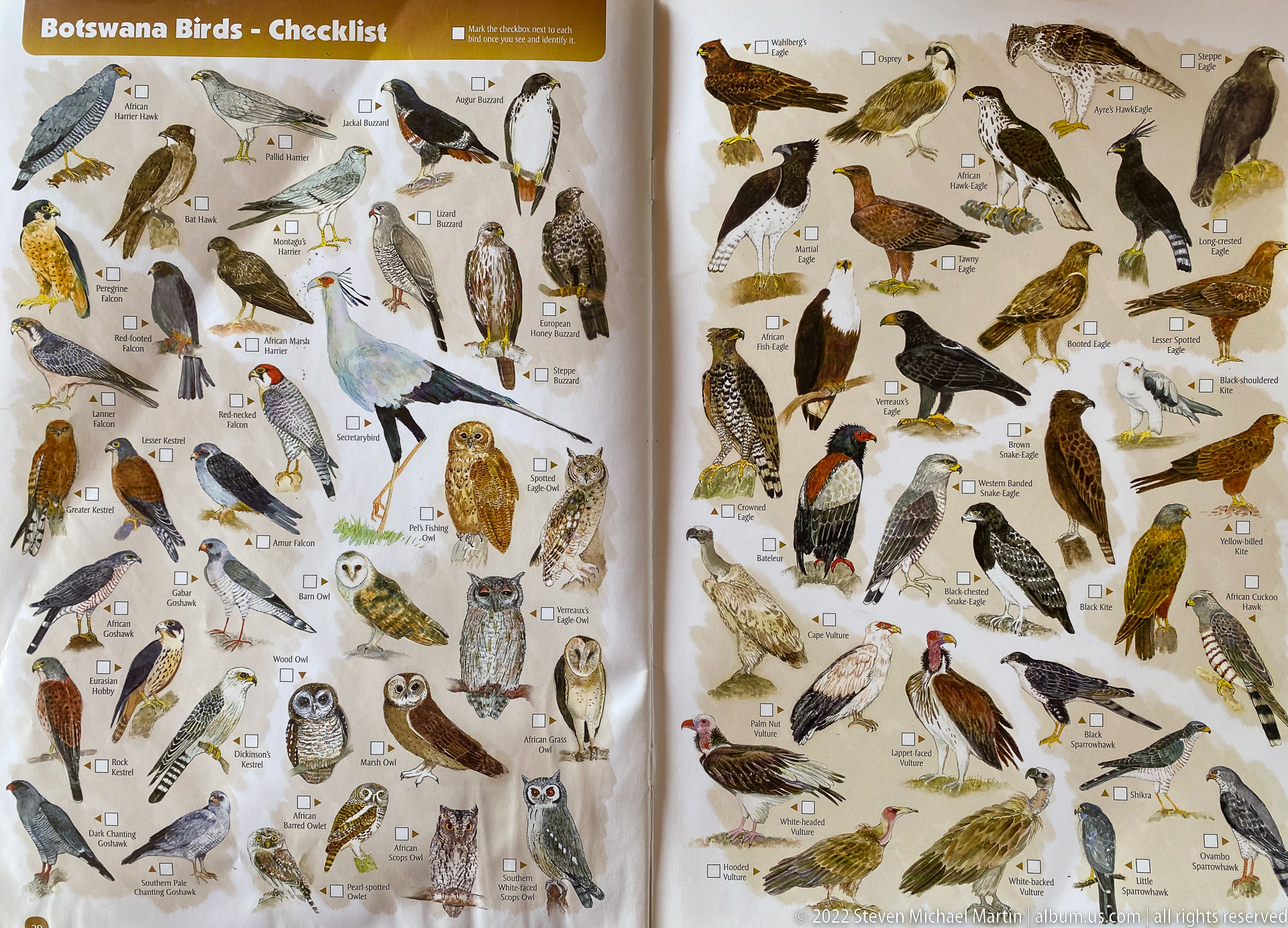
A two-page raptor checklist compares owls, eagles, hawks, falcons, vultures, and other predatory birds in a dense illustrated layout. Large hooked bills, talons, broad wings, and varied head patterns distinguish the species, while checkboxes and labels support field recording. The spread is particularly useful for comparing similarly shaped raptors by plumage, size, and facial markings.
Caption
A two-page raptor checklist compares owls, eagles, hawks, falcons, vultures, and other predatory birds in a dense illustrated layout. Large hooked bills, talons, broad wings, and varied head patterns distinguish the species, while checkboxes and labels support field recording. The spread is particularly useful for comparing similarly shaped raptors by plumage, size, and facial markings.