Shah-i-Zinda
Shah-i-Zinda is a complex of mausoleums in Samarkand associated with Islamic pilgrimage and the commemoration of religious figures. The name means “The Living King,” referring to a tradition connected to Qusam ibn Abbas, a relative of the Prophet Muhammad. The site developed over several centuries as an important spiritual destination along Silk Road routes.
The mausoleums are known for intricate tilework and decorative facades illustrating artistic traditions characteristic of Timurid architecture. The arrangement of tombs along a ceremonial pathway reflects the importance of pilgrimage and reverence for religious leaders. Decorative elements demonstrate the technical sophistication of Central Asian craftsmanship.
Shah-i-Zinda represents the spiritual dimension of Silk Road exchange, where religious traditions spread alongside commerce. The site illustrates the importance of pilgrimage and artistic expression in shaping cultural identity.

From the landscaped grounds, the Bibi-Khanym Mosque appears as a monumental ensemble rather than a single façade. The main iwan anchors the center, while a turquoise dome and decorated tower rise to the right beyond clipped trees and lawn.
Caption
From the landscaped grounds, the Bibi-Khanym Mosque appears as a monumental ensemble rather than a single façade. The main iwan anchors the center, while a turquoise dome and decorated tower rise to the right beyond clipped trees and lawn.
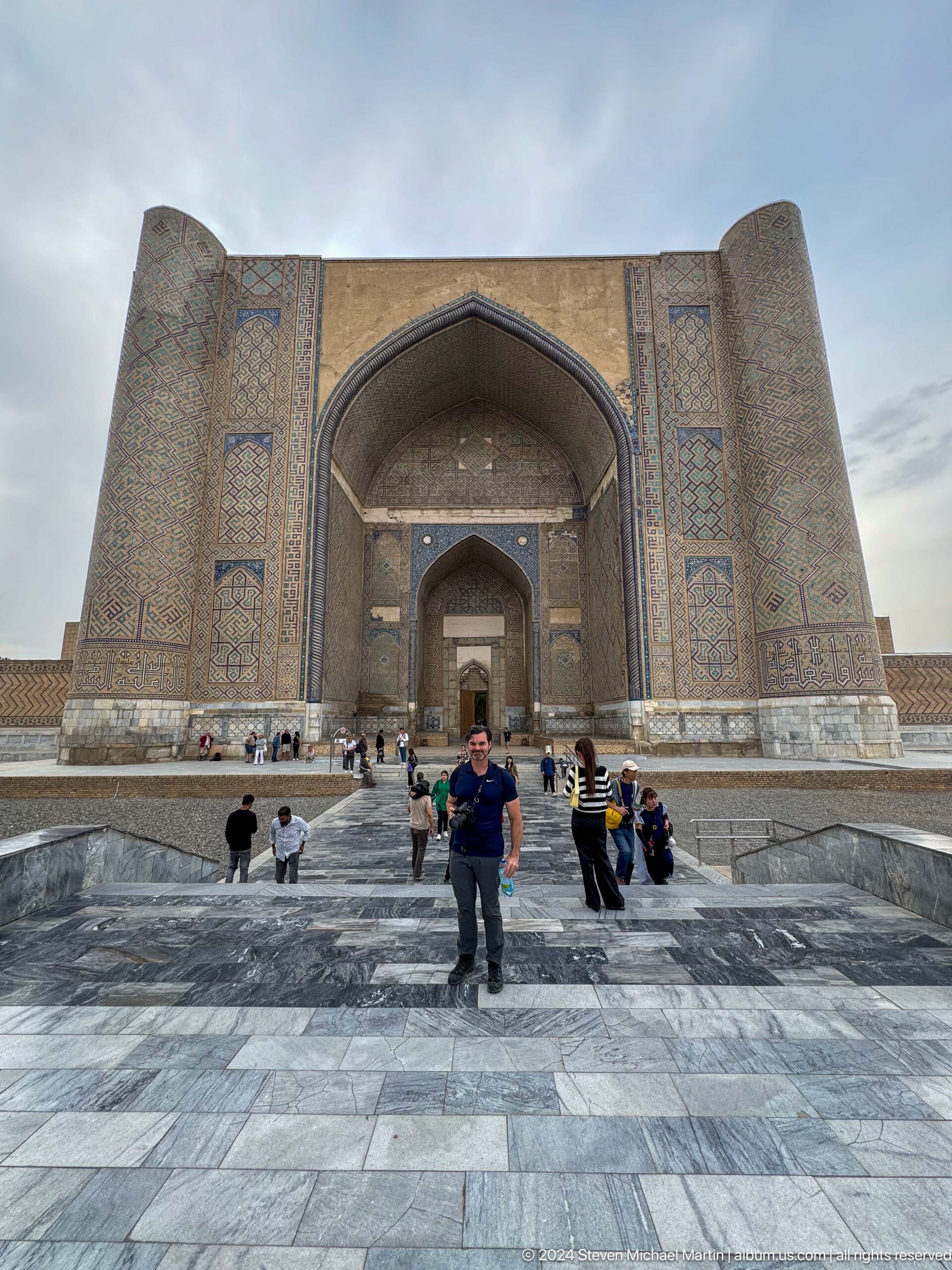
A visitor stands before the principal iwan of the Bibi-Khanym Mosque, providing a direct measure of the portal’s vast height. The nested arches and broad paved approach remain clearly visible, while other visitors animate the courtyard around the central figure.
Caption
A visitor stands before the principal iwan of the Bibi-Khanym Mosque, providing a direct measure of the portal’s vast height. The nested arches and broad paved approach remain clearly visible, while other visitors animate the courtyard around the central figure.
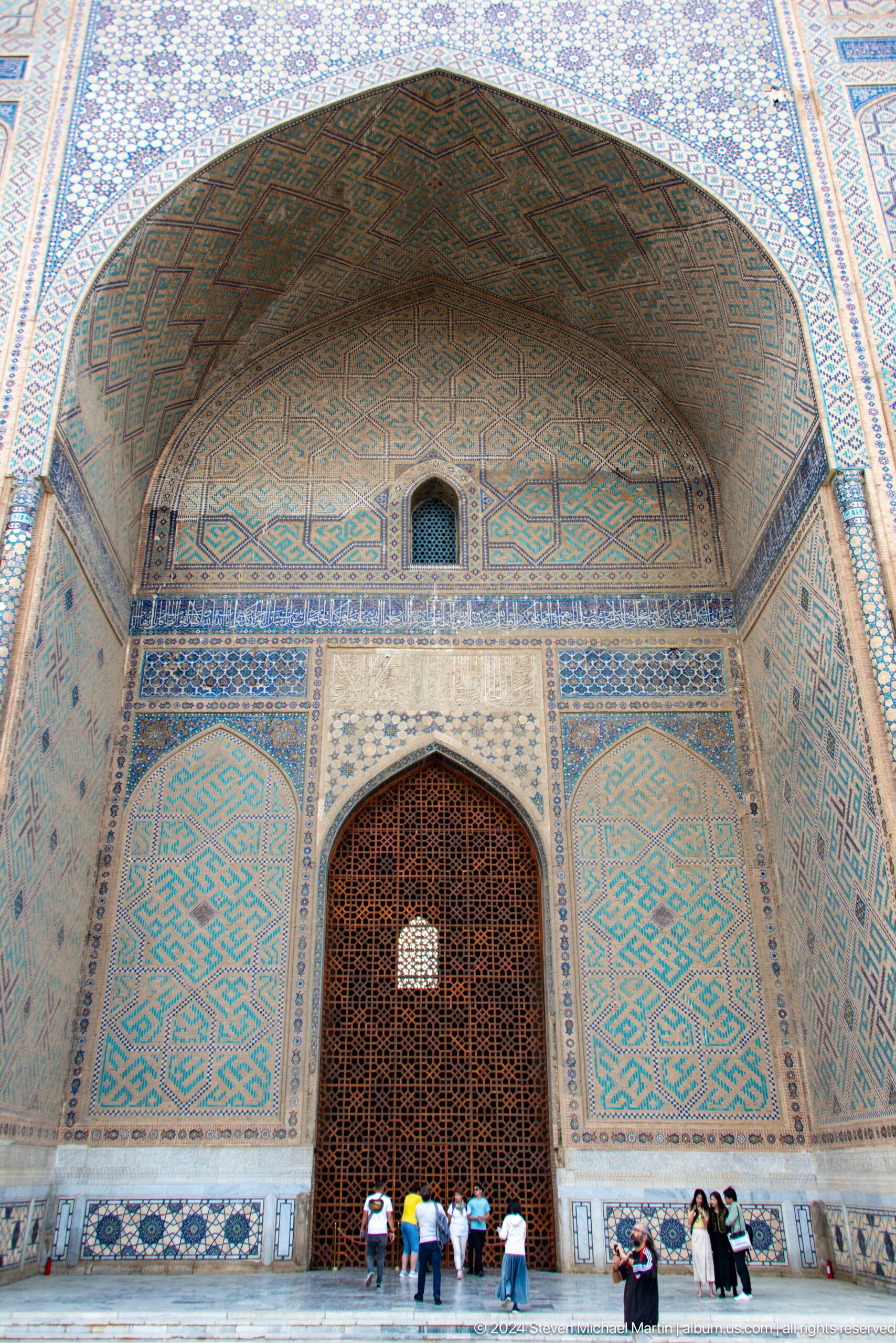
Inside a monumental recessed portal at the Bibi-Khanym Mosque, a pointed doorway is framed by turquoise geometric panels and horizontal bands of glazed decoration. The layered composition demonstrates how ornament was organized around entrances to guide the eye toward the central opening.
Caption
Inside a monumental recessed portal at the Bibi-Khanym Mosque, a pointed doorway is framed by turquoise geometric panels and horizontal bands of glazed decoration. The layered composition demonstrates how ornament was organized around entrances to guide the eye toward the central opening.

The turquoise dome and tall decorated minaret of the Bibi-Khanym Mosque form a distinctive skyline above trees and low brick walls. Their contrasting shapes—broad hemispherical crown and slender cylindrical tower—are unified by bands of blue-green glazed ornament.
Caption
The turquoise dome and tall decorated minaret of the Bibi-Khanym Mosque form a distinctive skyline above trees and low brick walls. Their contrasting shapes—broad hemispherical crown and slender cylindrical tower—are unified by bands of blue-green glazed ornament.
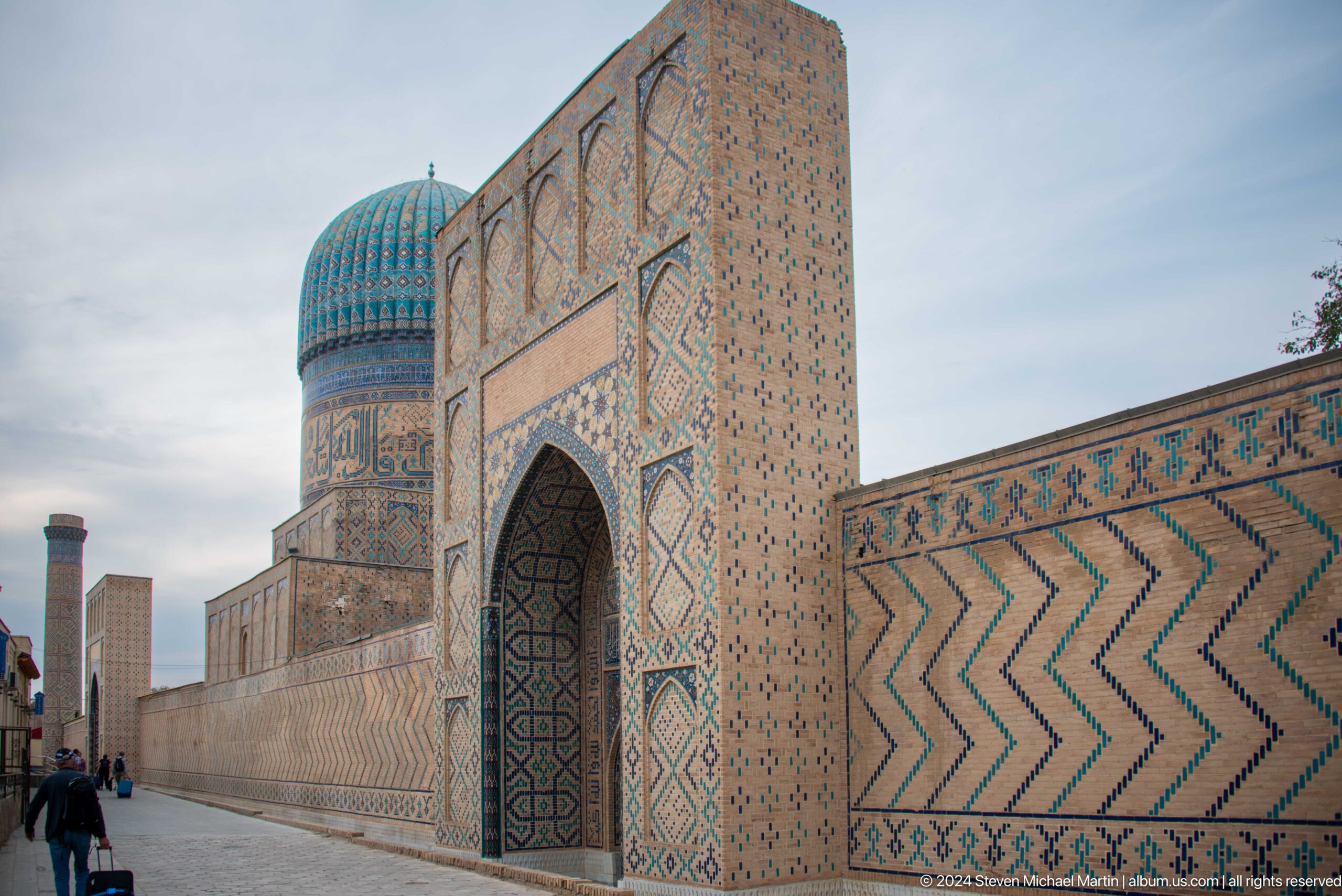
A pointed side gate interrupts the long chevron-patterned enclosure of the Bibi-Khanym Mosque. The angled view leads toward the turquoise dome and larger structures beyond, showing how subsidiary entrances and decorated walls organize movement around the monumental complex.
Caption
A pointed side gate interrupts the long chevron-patterned enclosure of the Bibi-Khanym Mosque. The angled view leads toward the turquoise dome and larger structures beyond, showing how subsidiary entrances and decorated walls organize movement around the monumental complex.
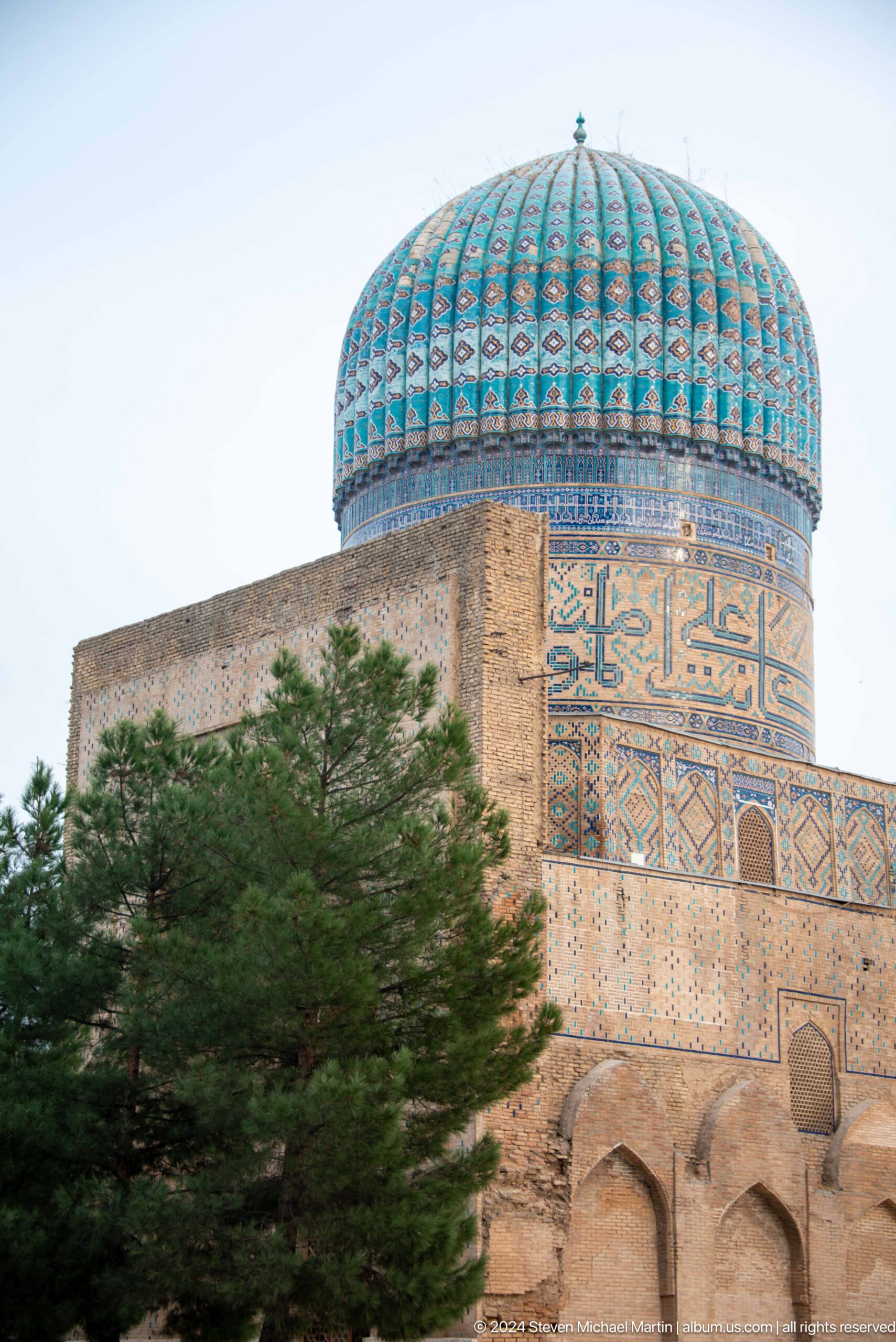
A decorated cylindrical tower of the Bibi-Khanym Mosque rises behind a plain brick wall and pine tree. Broad bands of turquoise, blue, and ochre ornament encircle the structure, sharply contrasting with the restrained masonry in the foreground.
Caption
A decorated cylindrical tower of the Bibi-Khanym Mosque rises behind a plain brick wall and pine tree. Broad bands of turquoise, blue, and ochre ornament encircle the structure, sharply contrasting with the restrained masonry in the foreground.

A bold chevron-patterned wall leads the eye toward the turquoise dome and monumental iwan of the Bibi-Khanym Mosque. By combining close surface ornament with distant architecture, the photograph shows how repeated geometric decoration operates across several scales within the complex.
Caption
A bold chevron-patterned wall leads the eye toward the turquoise dome and monumental iwan of the Bibi-Khanym Mosque. By combining close surface ornament with distant architecture, the photograph shows how repeated geometric decoration operates across several scales within the complex.
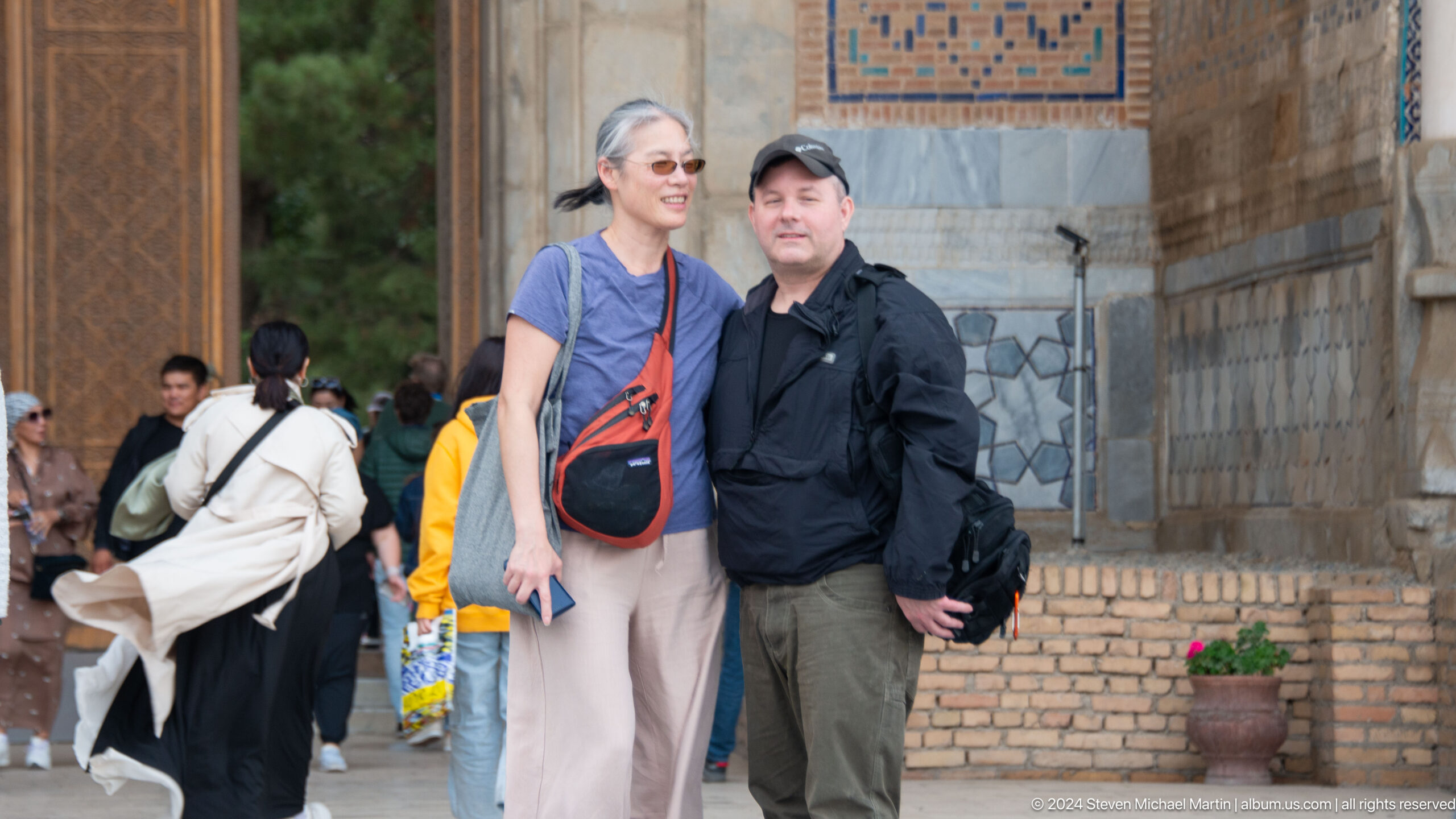
Two visitors pose together inside the Bibi-Khanym Mosque complex, with brick masonry and blue tile decoration behind them. The portrait records the monument as a lived visitor destination as well as an architectural and historical site.
Caption
Two visitors pose together inside the Bibi-Khanym Mosque complex, with brick masonry and blue tile decoration behind them. The portrait records the monument as a lived visitor destination as well as an architectural and historical site.
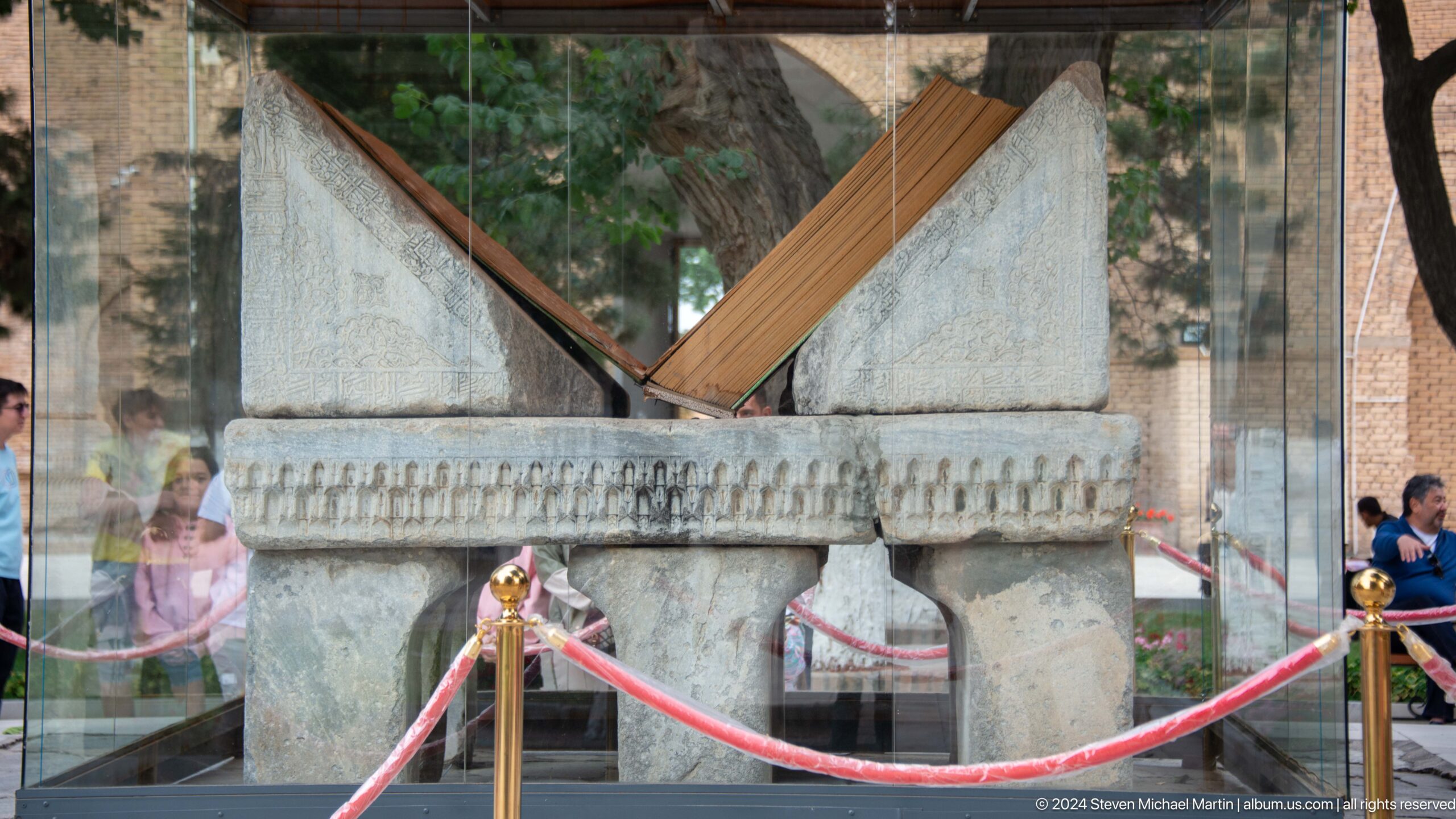
Protected behind glass in the mosque courtyard, this monumental stone book stand is traditionally associated with the display of a large Quran. Its sloping supports and heavy carved base transform the familiar form of a book rest into an imposing architectural object.
Caption
Protected behind glass in the mosque courtyard, this monumental stone book stand is traditionally associated with the display of a large Quran. Its sloping supports and heavy carved base transform the familiar form of a book rest into an imposing architectural object.
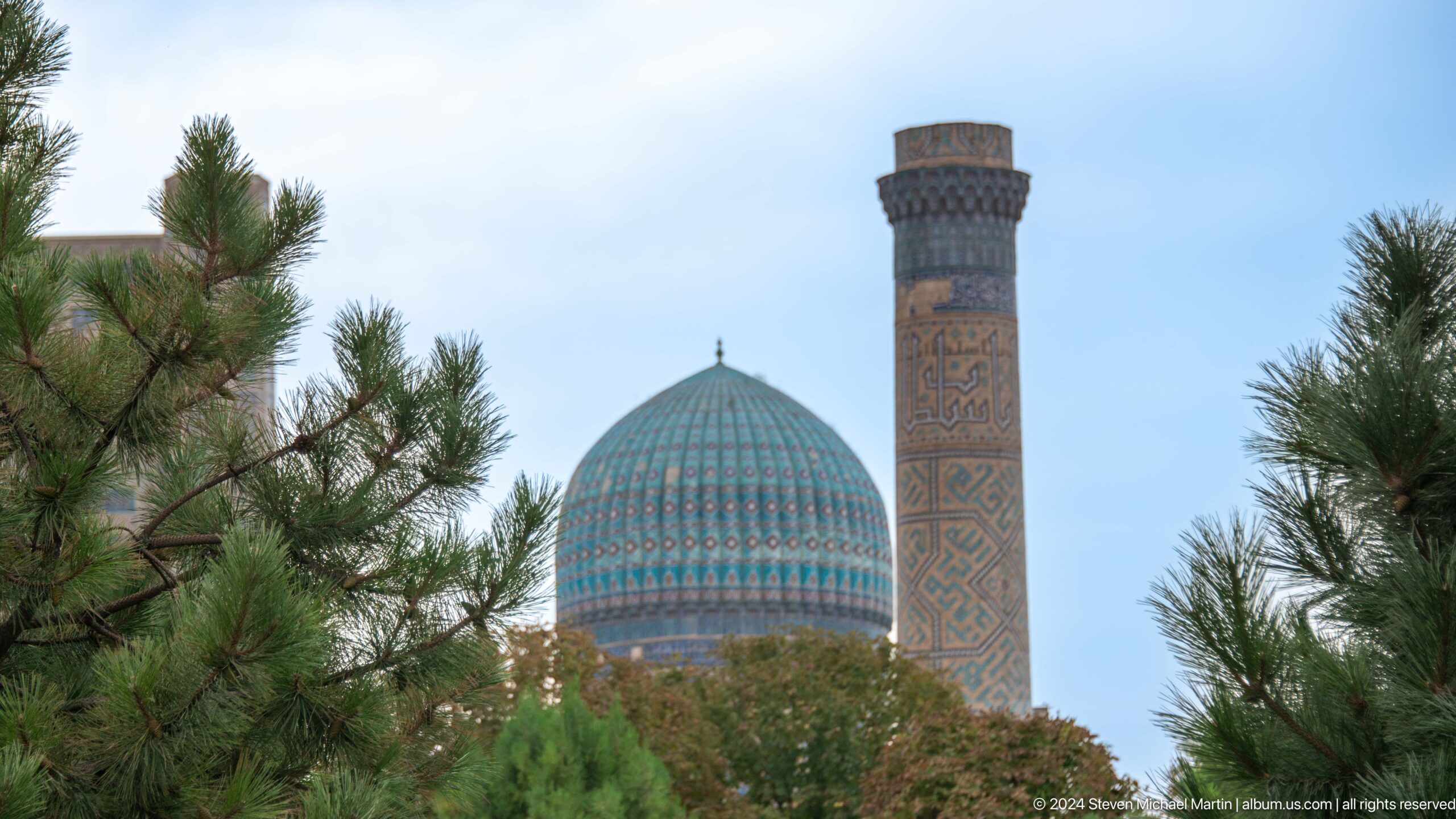
The turquoise dome and tall ornamented minaret of the Bibi-Khanym Mosque rise above pine branches in Samarkand. Their glazed surfaces combine broad bands of calligraphy and geometric pattern, emphasizing the monumental scale and rich tile decoration associated with the Timurid complex.
Caption
The turquoise dome and tall ornamented minaret of the Bibi-Khanym Mosque rise above pine branches in Samarkand. Their glazed surfaces combine broad bands of calligraphy and geometric pattern, emphasizing the monumental scale and rich tile decoration associated with the Timurid complex.
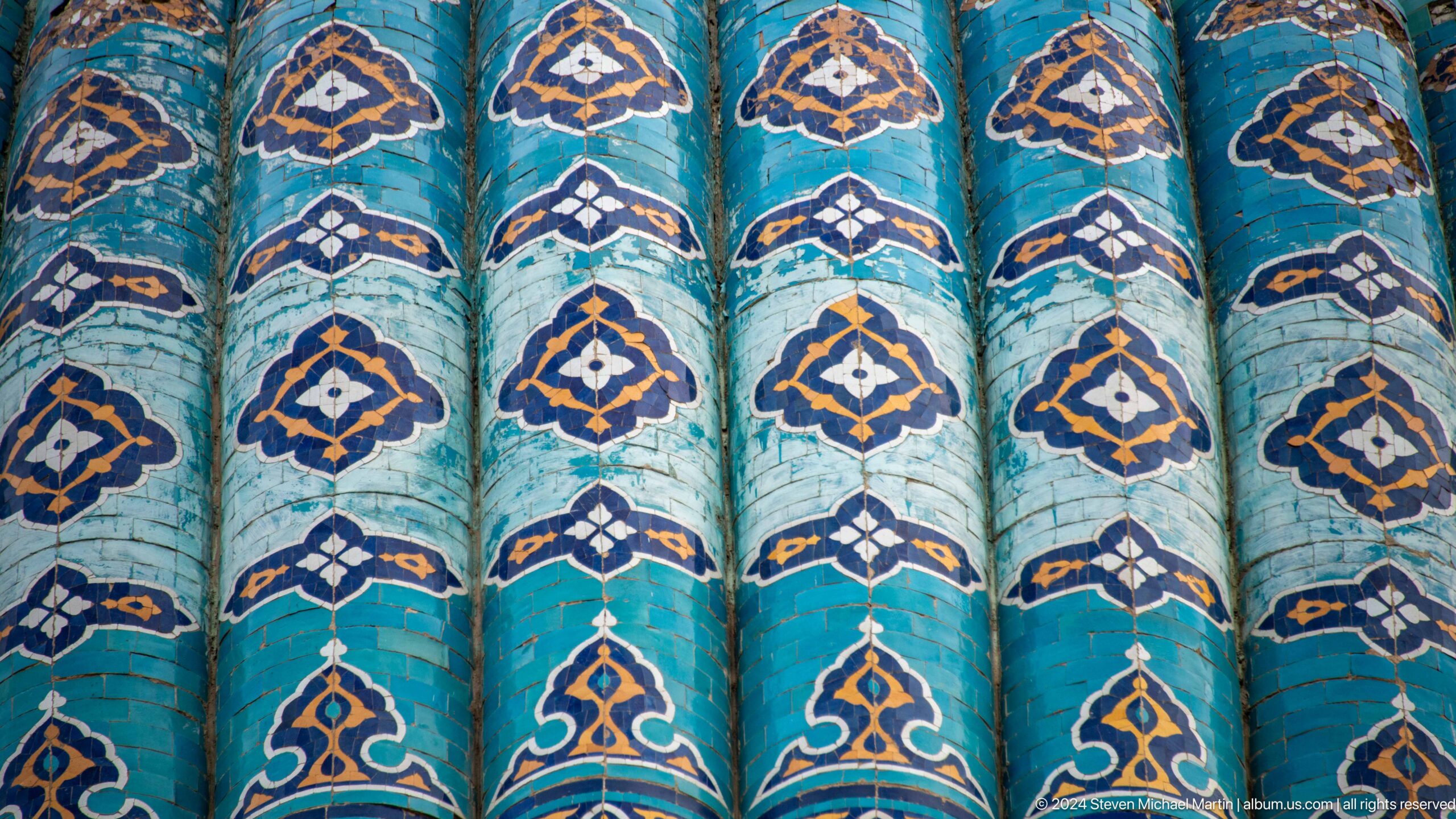
This close view of a Bibi-Khanym Mosque dome shows vertical ribs sheathed in turquoise glaze and repeated dark-blue, white, and ochre motifs. The pattern follows the curvature of the dome, turning structural fluting into a continuous decorative surface.
Caption
This close view of a Bibi-Khanym Mosque dome shows vertical ribs sheathed in turquoise glaze and repeated dark-blue, white, and ochre motifs. The pattern follows the curvature of the dome, turning structural fluting into a continuous decorative surface.
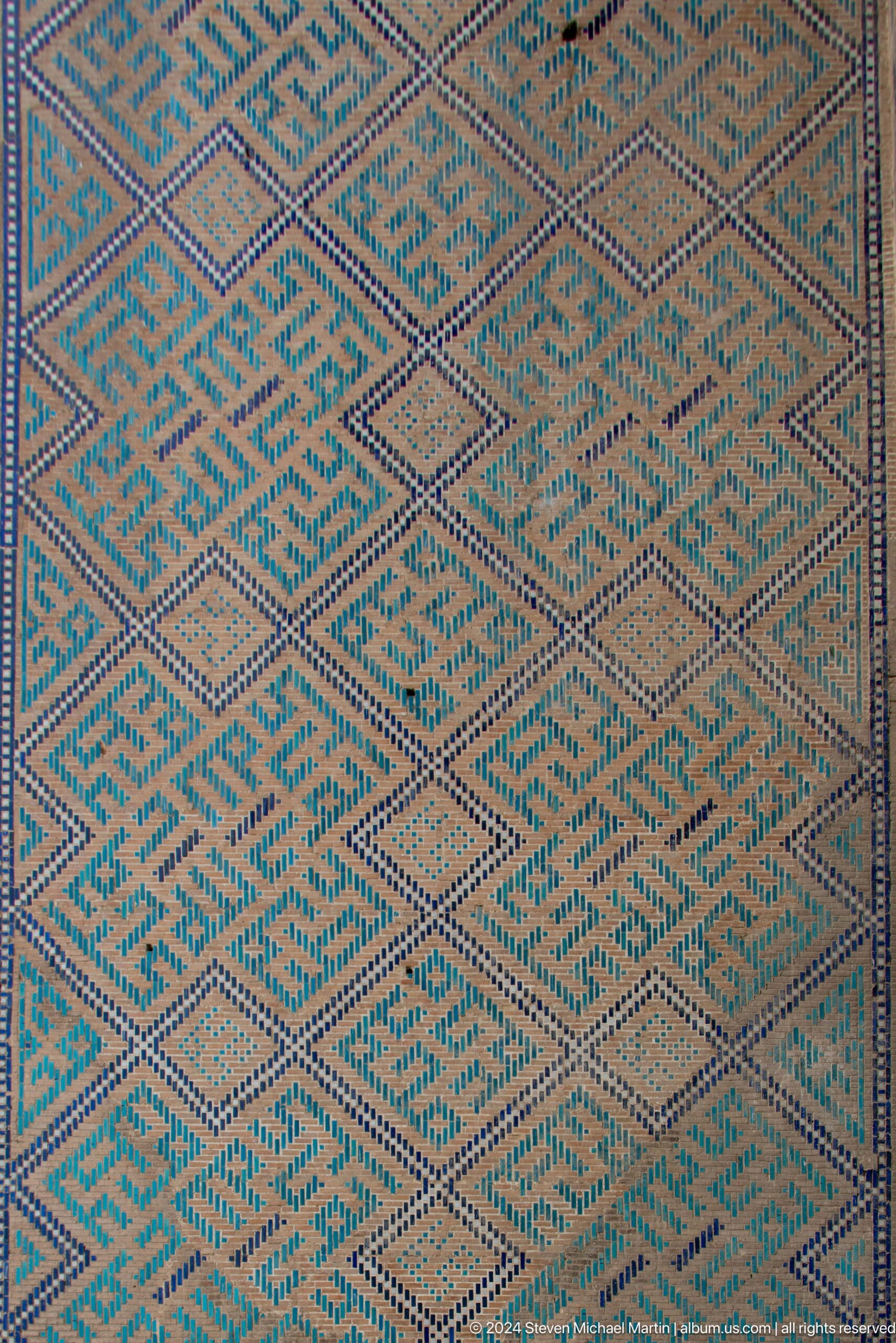
This close view records the mosque’s geometric glazed-tile decoration, where turquoise and dark-blue angular forms interlock across a pale ground. The tight framing emphasizes the precision of the mosaic pattern and the craftsmanship used to animate large architectural surfaces.
Caption
This close view records the mosque’s geometric glazed-tile decoration, where turquoise and dark-blue angular forms interlock across a pale ground. The tight framing emphasizes the precision of the mosaic pattern and the craftsmanship used to animate large architectural surfaces.

A domed subsidiary structure within the Bibi-Khanym Mosque complex presents a deep pointed portal in a largely exposed-brick façade. A wooden lattice closes the lower opening, while the turquoise dome appears above, showing the contrast between reconstructed masonry and surviving decorative surfaces.
Caption
A domed subsidiary structure within the Bibi-Khanym Mosque complex presents a deep pointed portal in a largely exposed-brick façade. A wooden lattice closes the lower opening, while the turquoise dome appears above, showing the contrast between reconstructed masonry and surviving decorative surfaces.
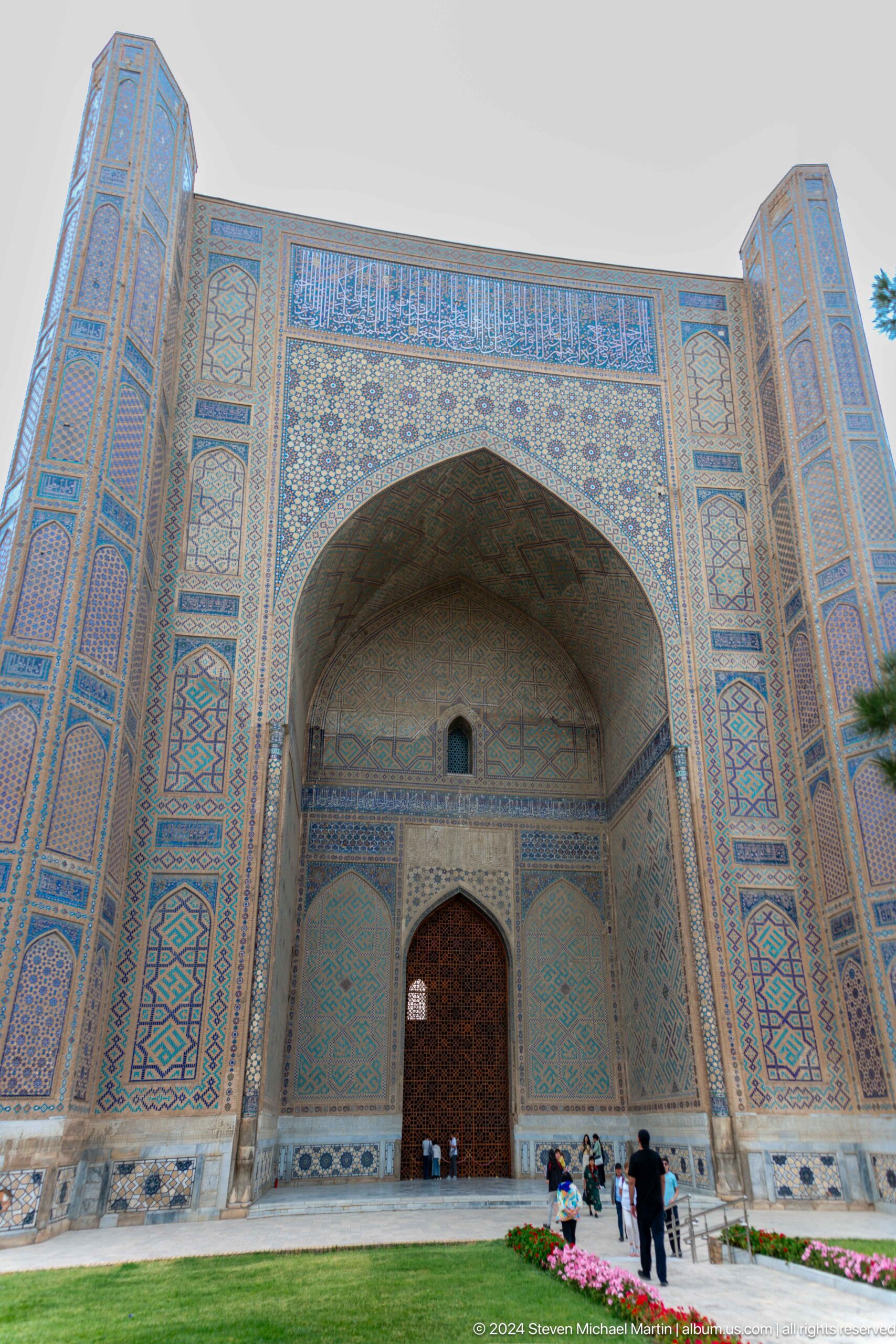
The towering iwan of the Bibi-Khanym Mosque dwarfs the small doorway at its base. Patterned tile borders and surviving blue-green decoration trace the pointed arch, while the weathered vault reveals the building’s immense scale and the contrast between ornamented and exposed surfaces.
Caption
The towering iwan of the Bibi-Khanym Mosque dwarfs the small doorway at its base. Patterned tile borders and surviving blue-green decoration trace the pointed arch, while the weathered vault reveals the building’s immense scale and the contrast between ornamented and exposed surfaces.

At the lower edge of a Bibi-Khanym Mosque dome, turquoise ribs descend toward a richly patterned transition band. The close perspective reveals how repeated motifs and small arched elements visually connect the curved dome to the supporting structure below.
Caption
At the lower edge of a Bibi-Khanym Mosque dome, turquoise ribs descend toward a richly patterned transition band. The close perspective reveals how repeated motifs and small arched elements visually connect the curved dome to the supporting structure below.
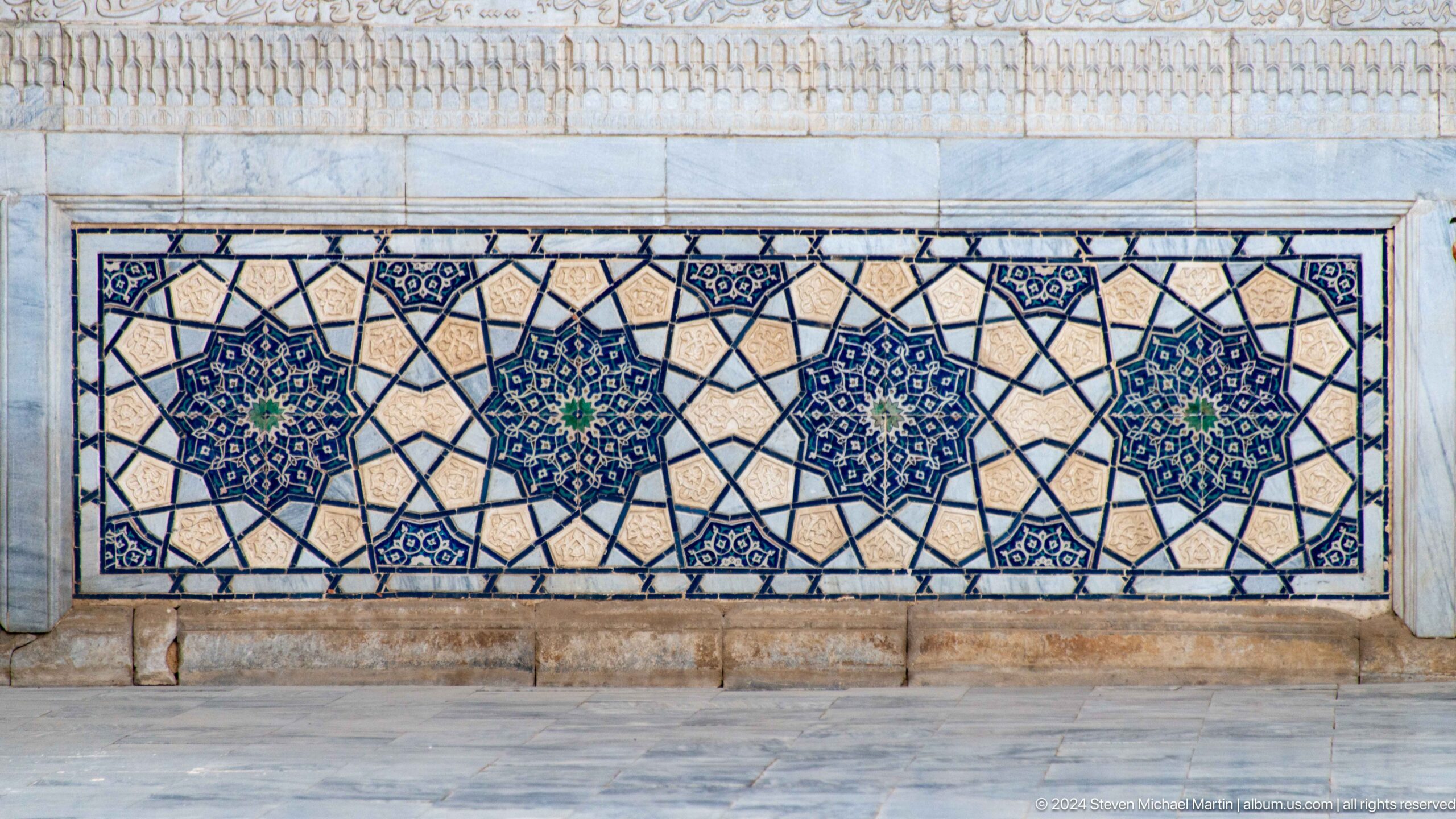
A decorative panel at the Bibi-Khanym Mosque repeats blue star polygons within a dark interlaced framework. Set against a pale ground, the design demonstrates the mathematical order and strong color contrast characteristic of the complex’s surviving geometric ornament.
Caption
A decorative panel at the Bibi-Khanym Mosque repeats blue star polygons within a dark interlaced framework. Set against a pale ground, the design demonstrates the mathematical order and strong color contrast characteristic of the complex’s surviving geometric ornament.

This framed tile panel organizes a large blue-green star medallion at the center, surrounded by an angular lattice and smaller corner motifs. The balanced composition shows how geometric decoration could function as a self-contained architectural panel within the mosque complex.
Caption
This framed tile panel organizes a large blue-green star medallion at the center, surrounded by an angular lattice and smaller corner motifs. The balanced composition shows how geometric decoration could function as a self-contained architectural panel within the mosque complex.
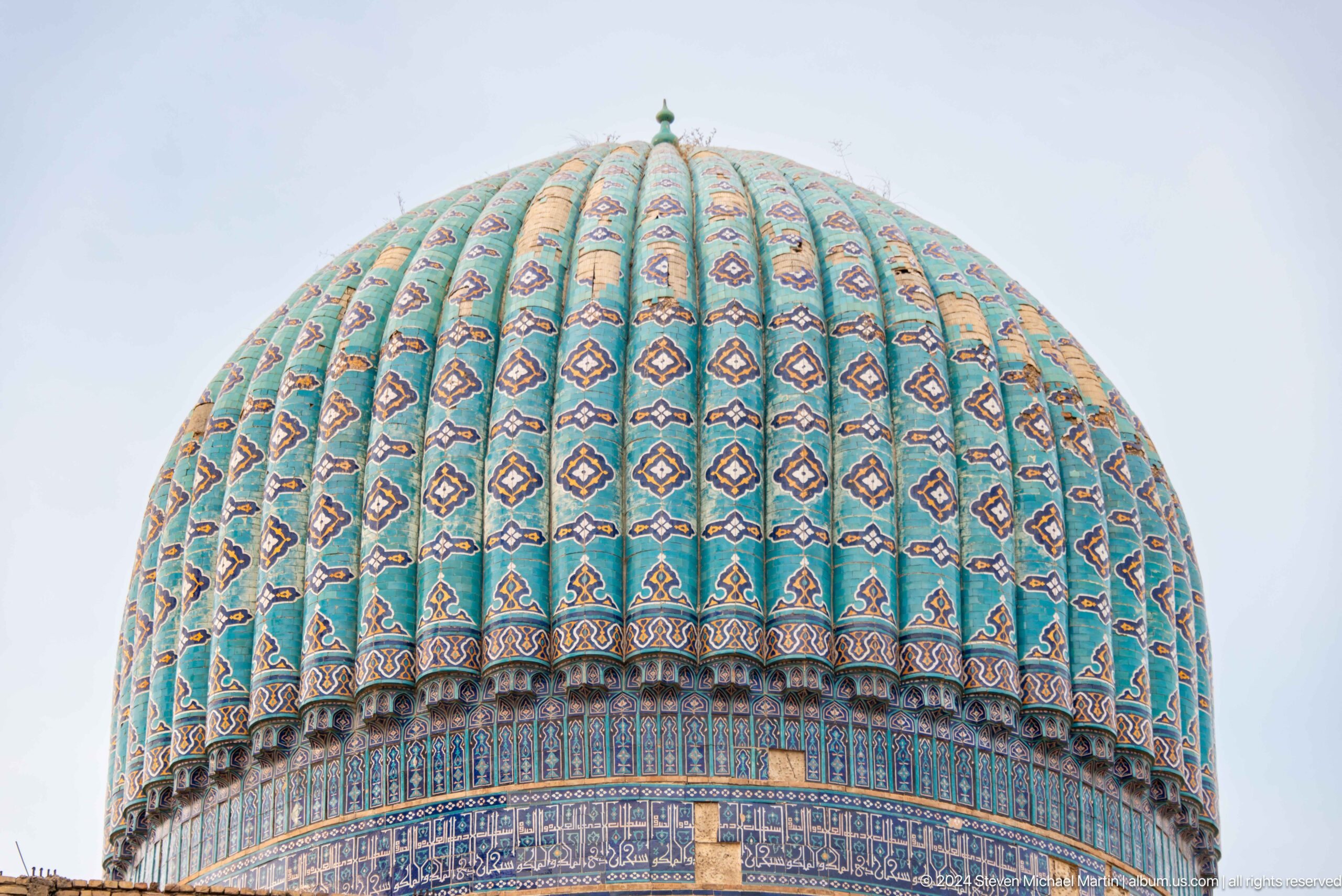
The turquoise ribbed dome of the Bibi-Khanym Mosque is isolated against a pale sky, allowing its patterned ribs, apex finial, and dark decorative band to read clearly. The image emphasizes the dome as both a structural crown and a major field of glazed ornament.
Caption
The turquoise ribbed dome of the Bibi-Khanym Mosque is isolated against a pale sky, allowing its patterned ribs, apex finial, and dark decorative band to read clearly. The image emphasizes the dome as both a structural crown and a major field of glazed ornament.

Across the landscaped grounds of the Bibi-Khanym Mosque, trees frame a distant monumental iwan. The view places the immense portal within the modern garden setting, contrasting the severe scale of the brick façade with the softer forms of planted greenery.
Caption
Across the landscaped grounds of the Bibi-Khanym Mosque, trees frame a distant monumental iwan. The view places the immense portal within the modern garden setting, contrasting the severe scale of the brick façade with the softer forms of planted greenery.
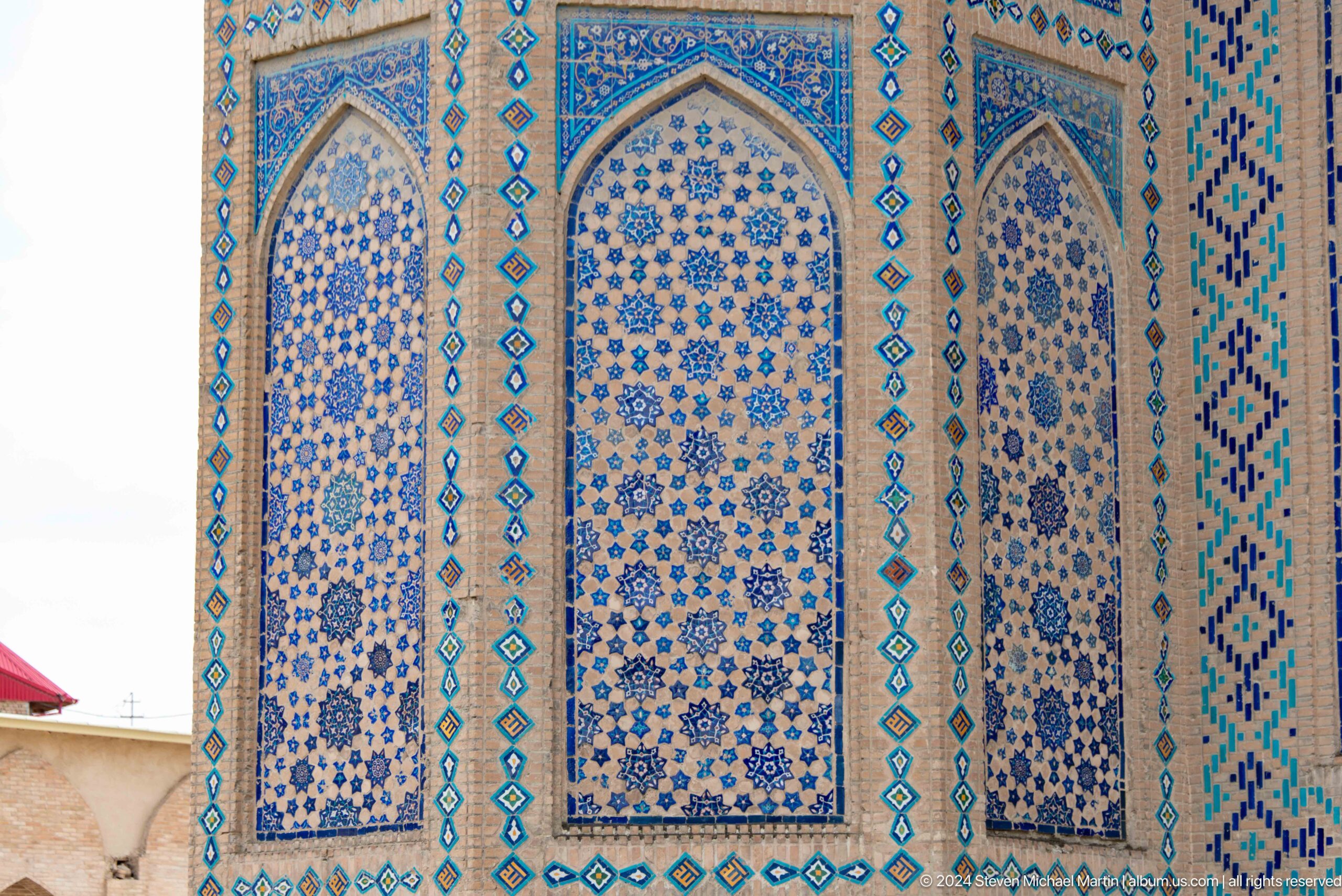
Tall pointed tile panels cover this corner of the Bibi-Khanym Mosque with dense blue floral and geometric pattern. Their repeated arch shapes create a strong vertical rhythm, while the angled view shows the glazed decoration continuing around adjacent faces of the building.
Caption
Tall pointed tile panels cover this corner of the Bibi-Khanym Mosque with dense blue floral and geometric pattern. Their repeated arch shapes create a strong vertical rhythm, while the angled view shows the glazed decoration continuing around adjacent faces of the building.
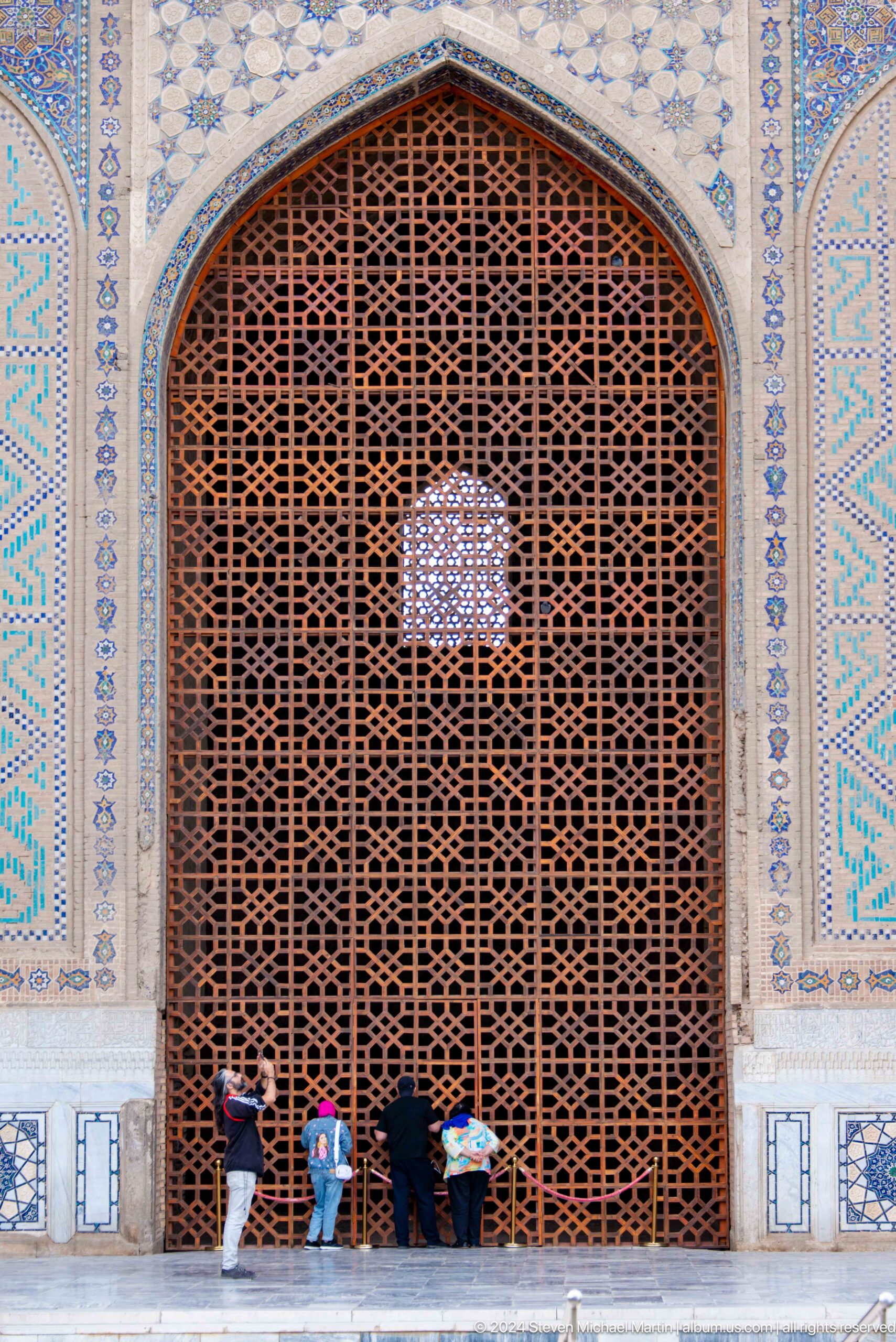
A finely patterned wooden lattice closes a doorway at the Bibi-Khanym Mosque, leaving a small pointed opening at its center. Pale blue and turquoise tile borders frame the dense woodwork, highlighting the contrast between carved or assembled timber geometry and glazed architectural ornament.
Caption
A finely patterned wooden lattice closes a doorway at the Bibi-Khanym Mosque, leaving a small pointed opening at its center. Pale blue and turquoise tile borders frame the dense woodwork, highlighting the contrast between carved or assembled timber geometry and glazed architectural ornament.
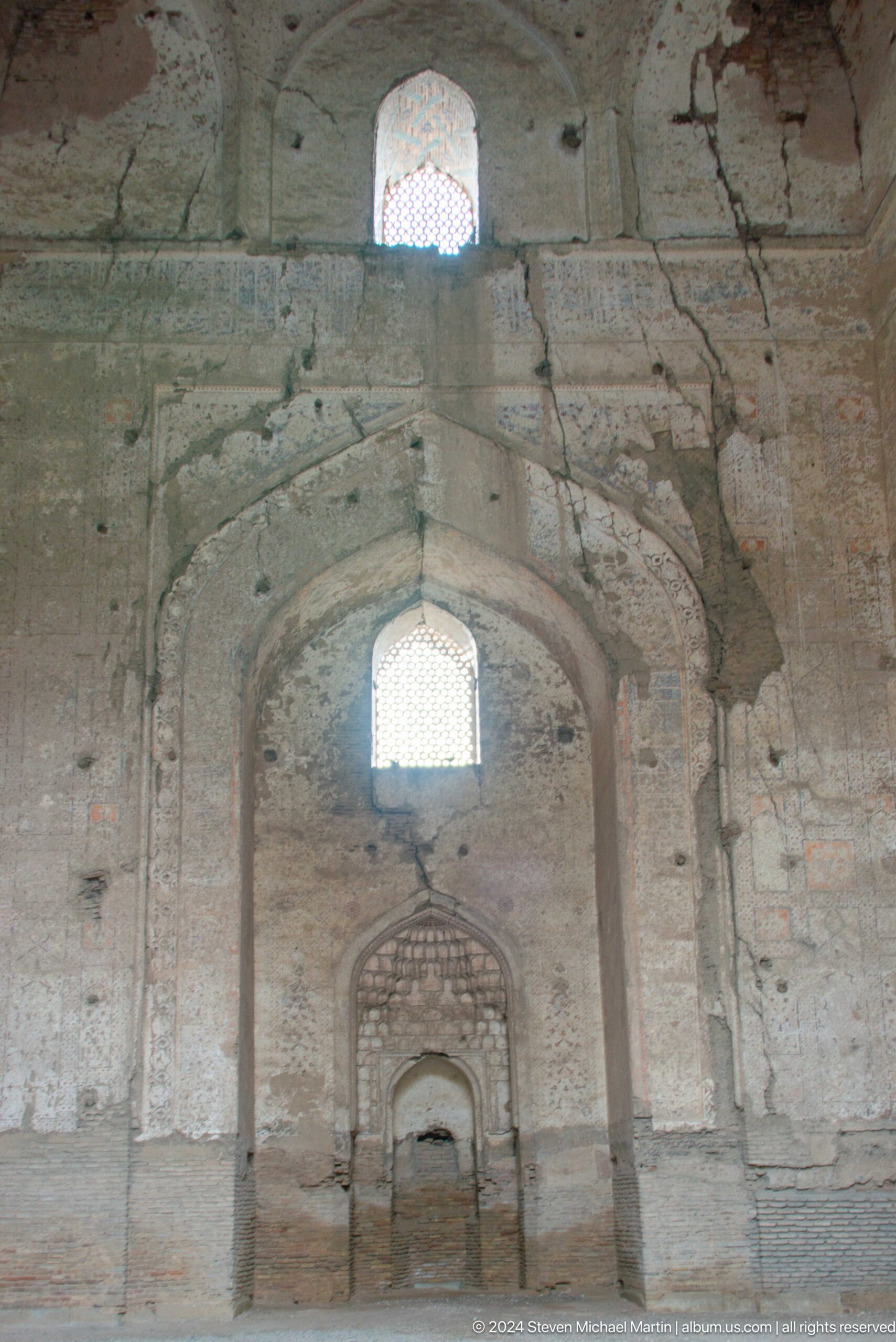
A high window illuminates the damaged pointed vault of the Bibi-Khanym Mosque. Below it, a smaller niche remains aligned on the central axis, while eroded plaster and exposed masonry reveal the long history of deterioration and repair within the monumental interior.
Caption
A high window illuminates the damaged pointed vault of the Bibi-Khanym Mosque. Below it, a smaller niche remains aligned on the central axis, while eroded plaster and exposed masonry reveal the long history of deterioration and repair within the monumental interior.

This angled exterior view brings the decorated tower of the Bibi-Khanym Mosque close to the adjoining brick mass. Large turquoise calligraphic forms and geometric panels wrap the cylindrical surface, creating a vivid contrast with the undecorated masonry below.
Caption
This angled exterior view brings the decorated tower of the Bibi-Khanym Mosque close to the adjoining brick mass. Large turquoise calligraphic forms and geometric panels wrap the cylindrical surface, creating a vivid contrast with the undecorated masonry below.

Inside the Bibi-Khanym Mosque, a weathered wall niche exposes layers of brick repair, worn plaster, and structural loss. The smaller pointed recess at its center survives within a much larger damaged field, making this view especially useful for understanding the monument’s material condition.
Caption
Inside the Bibi-Khanym Mosque, a weathered wall niche exposes layers of brick repair, worn plaster, and structural loss. The smaller pointed recess at its center survives within a much larger damaged field, making this view especially useful for understanding the monument’s material condition.
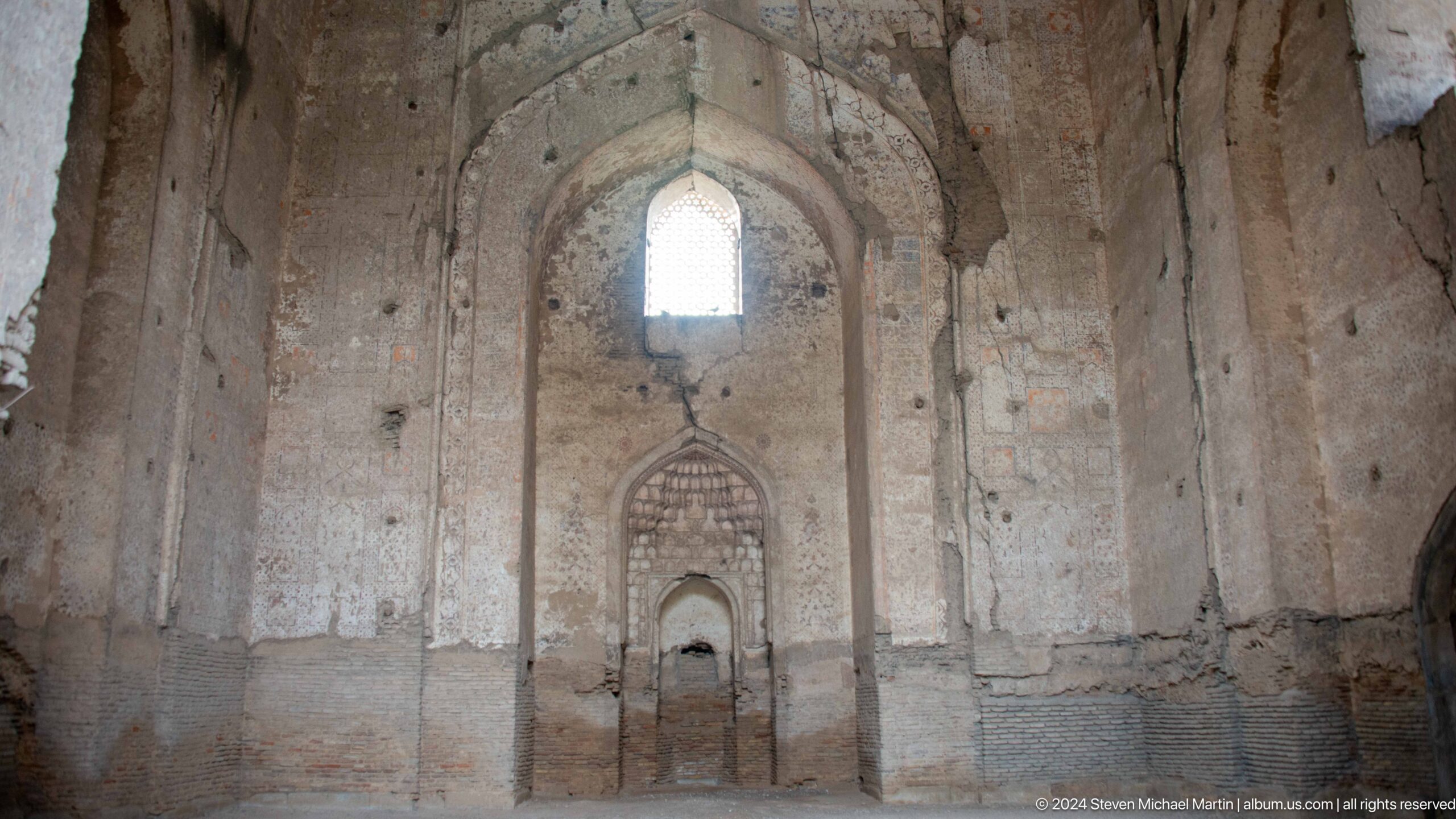
This wider interior view reveals the axial arrangement of a high pointed window and nested niches within the Bibi-Khanym Mosque. The broad field of worn plaster and exposed brick emphasizes both the chamber’s monumental proportions and the extensive loss of its original surface treatment.
Caption
This wider interior view reveals the axial arrangement of a high pointed window and nested niches within the Bibi-Khanym Mosque. The broad field of worn plaster and exposed brick emphasizes both the chamber’s monumental proportions and the extensive loss of its original surface treatment.
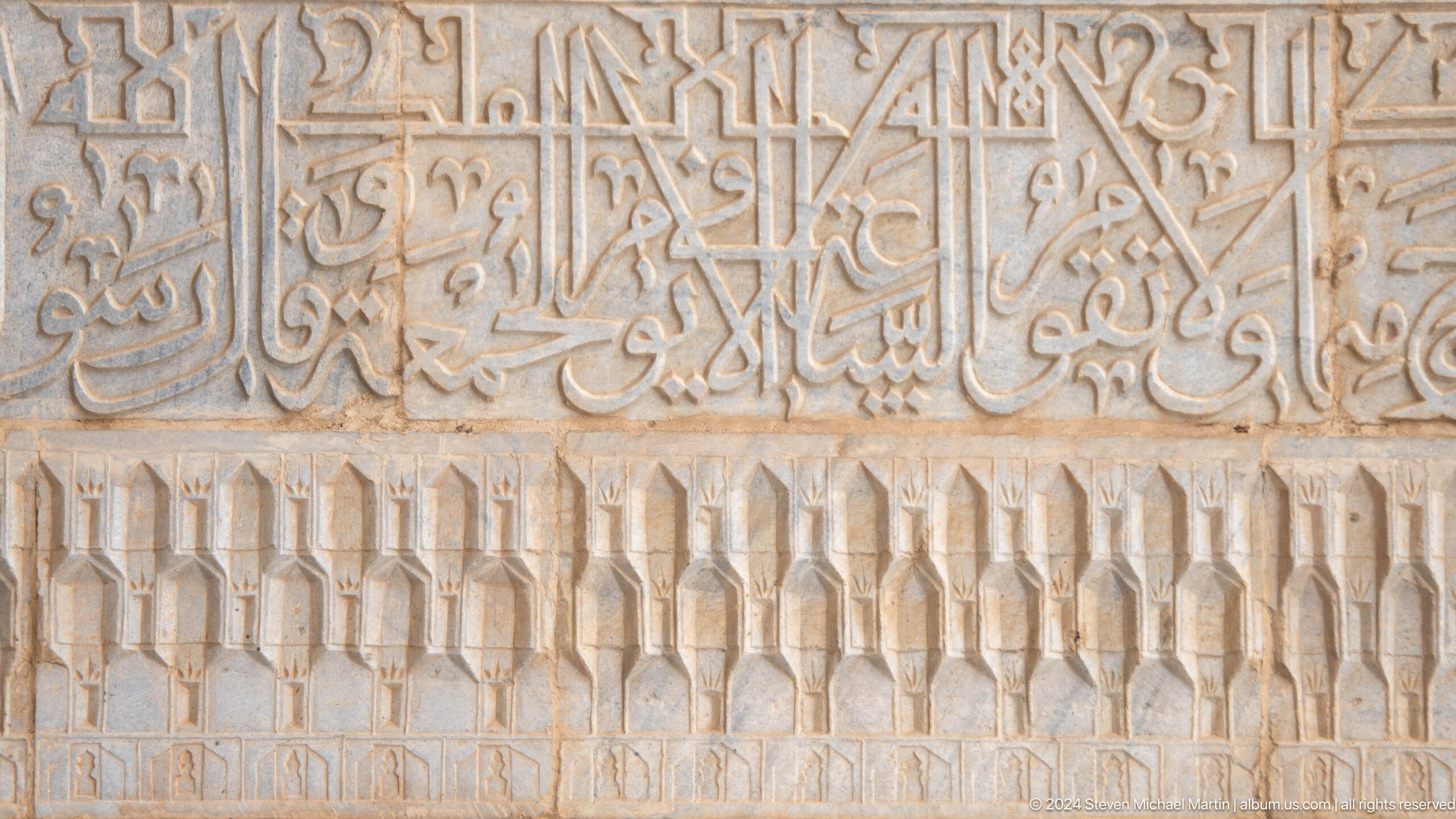
A carved calligraphic frieze runs above a faceted ornamental molding at the Bibi-Khanym Mosque. The pale relief catches light across the raised script and geometric forms, preserving an important example of how text and architectural decoration were combined.
Caption
A carved calligraphic frieze runs above a faceted ornamental molding at the Bibi-Khanym Mosque. The pale relief catches light across the raised script and geometric forms, preserving an important example of how text and architectural decoration were combined.

Looking upward inside a Bibi-Khanym Mosque portal, a large reddish lattice screen sits beneath a green and turquoise geometric vault. Pale patterned walls and blue border tiles complete a layered view of woodwork, glazed ornament, and monumental pointed-arch construction.
Caption
Looking upward inside a Bibi-Khanym Mosque portal, a large reddish lattice screen sits beneath a green and turquoise geometric vault. Pale patterned walls and blue border tiles complete a layered view of woodwork, glazed ornament, and monumental pointed-arch construction.
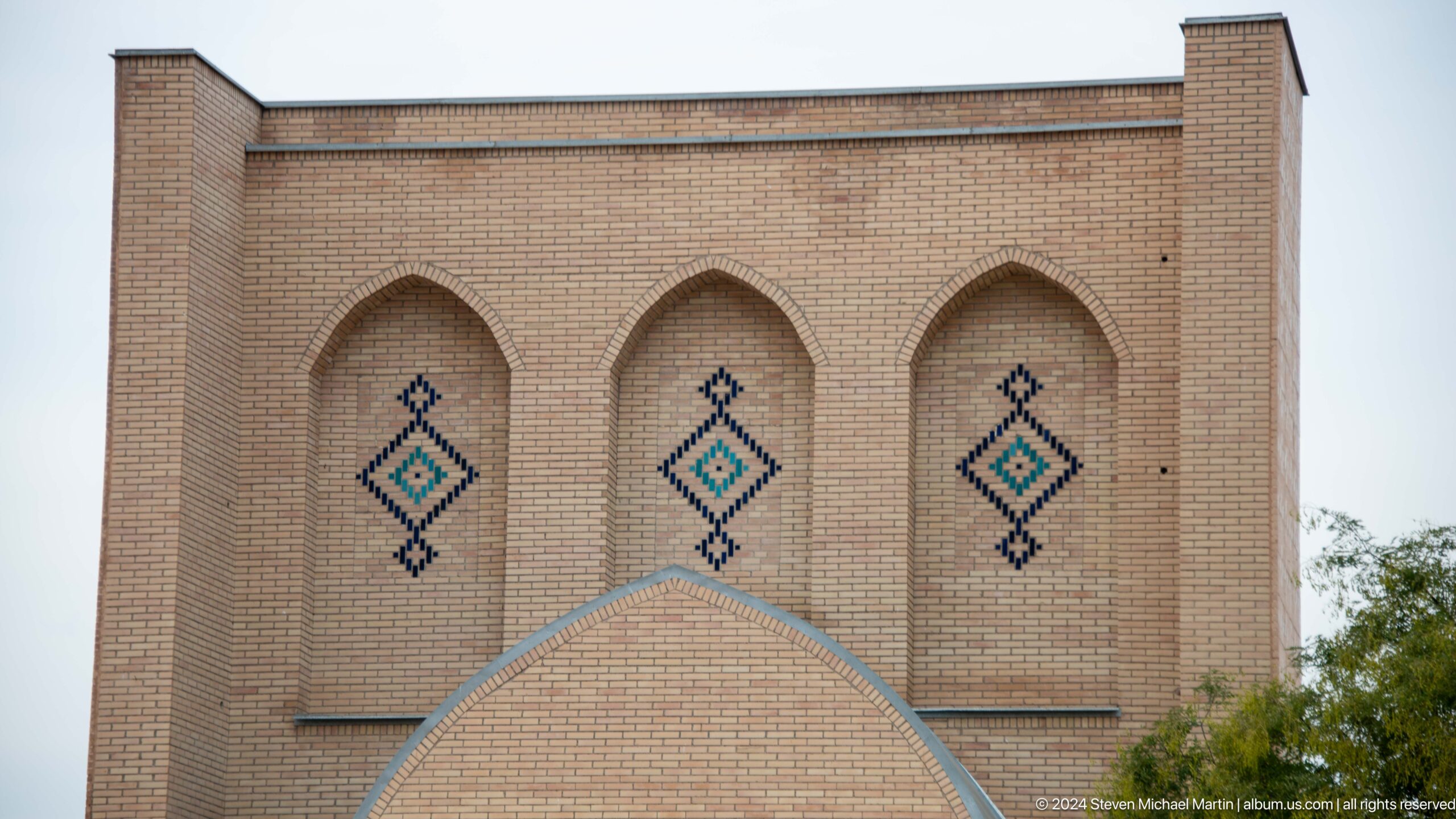
This restrained brick façade within the Bibi-Khanym complex uses three shallow pointed recesses and narrow blue diamond motifs as accents. Its uniform masonry and sparse decoration contrast with the richly tiled portals and domes elsewhere on the site, suggesting a heavily restored or reconstructed section.
Caption
This restrained brick façade within the Bibi-Khanym complex uses three shallow pointed recesses and narrow blue diamond motifs as accents. Its uniform masonry and sparse decoration contrast with the richly tiled portals and domes elsewhere on the site, suggesting a heavily restored or reconstructed section.

An on-site multilingual sign identifies the monument as 'Amir Temur (Bibixonim) masjidi,' presenting the name in Latin, Chinese, and Arabic scripts. The sign documents how the Bibi-Khanym Mosque is interpreted for an international visitor audience.
Caption
An on-site multilingual sign identifies the monument as 'Amir Temur (Bibixonim) masjidi,' presenting the name in Latin, Chinese, and Arabic scripts. The sign documents how the Bibi-Khanym Mosque is interpreted for an international visitor audience.

A massive pier of the Bibi-Khanym Mosque rises sharply above the viewer, its surface divided into turquoise geometric bands, patterned masonry, and a calligraphic panel. The steep perspective conveys the extraordinary height and visual complexity of the monumental portal.
Caption
A massive pier of the Bibi-Khanym Mosque rises sharply above the viewer, its surface divided into turquoise geometric bands, patterned masonry, and a calligraphic panel. The steep perspective conveys the extraordinary height and visual complexity of the monumental portal.

A decorated cylindrical tower stands beside a tall brick portal within the Bibi-Khanym Mosque complex. Broad turquoise and ochre bands contrast with the portal’s restrained masonry, while a foreground tree partly screens the junction between the two structures.
Caption
A decorated cylindrical tower stands beside a tall brick portal within the Bibi-Khanym Mosque complex. Broad turquoise and ochre bands contrast with the portal’s restrained masonry, while a foreground tree partly screens the junction between the two structures.
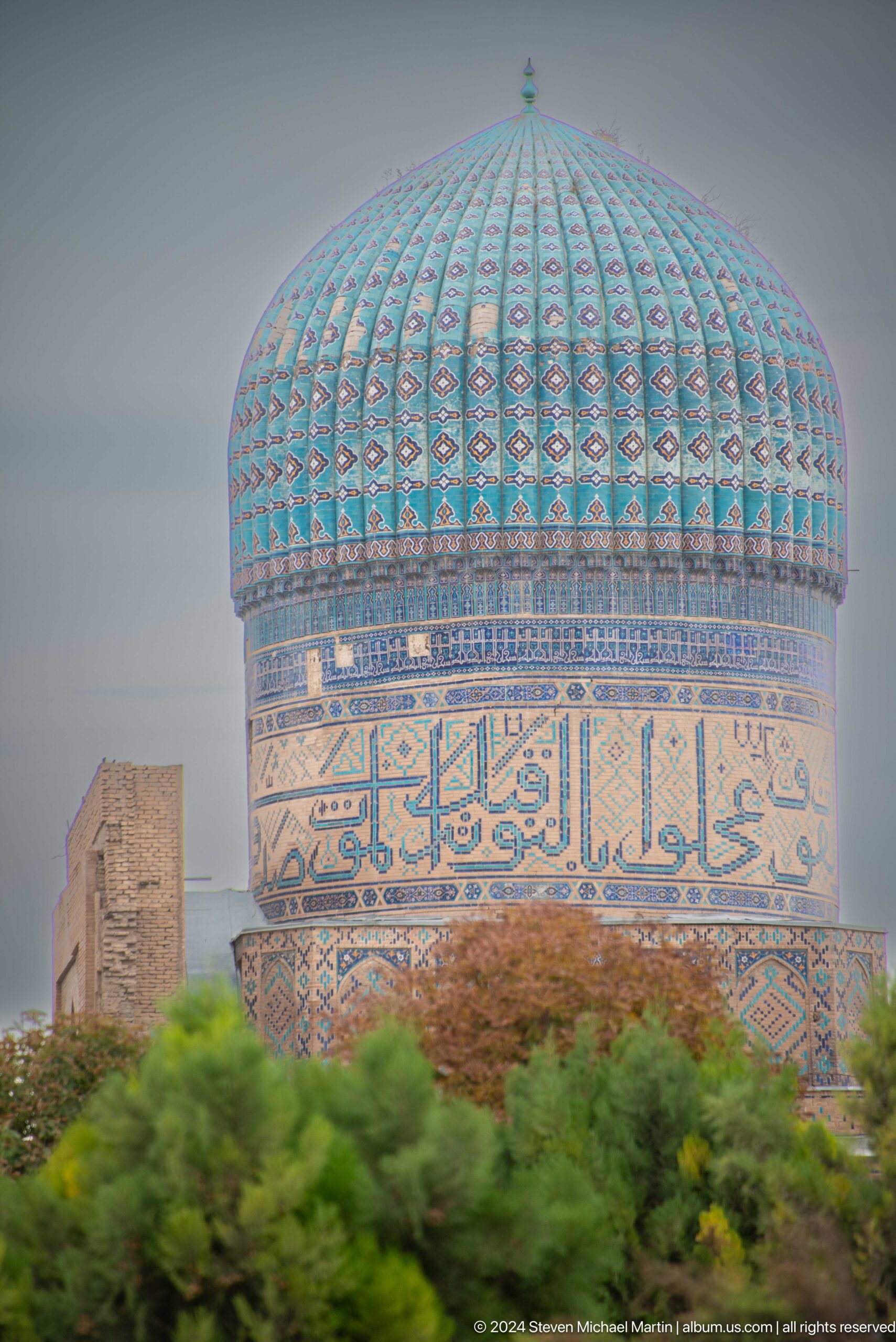
A broad calligraphic tile band encircles a cylindrical tower at the Bibi-Khanym Mosque. Large turquoise forms stand against an ochre ground below rows of blue-green tiles, showing how monumental script was adapted to a curved architectural surface.
Caption
A broad calligraphic tile band encircles a cylindrical tower at the Bibi-Khanym Mosque. Large turquoise forms stand against an ochre ground below rows of blue-green tiles, showing how monumental script was adapted to a curved architectural surface.
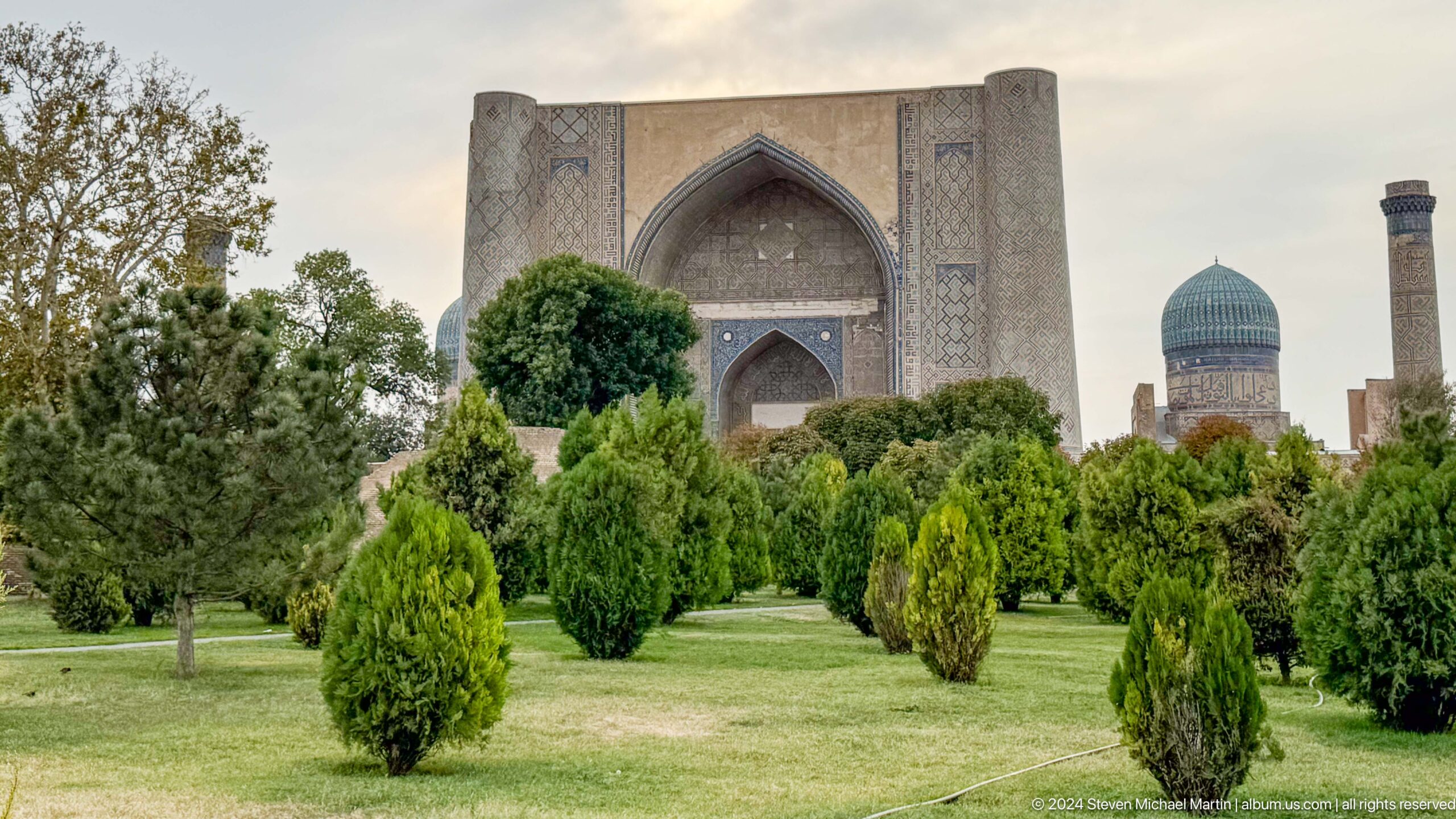
The main iwan of the Bibi-Khanym Mosque dominates this formal garden view, its immense rectangular façade rising beyond rows of shaped trees. A turquoise dome at the right reveals the layered arrangement of structures within the larger complex.
Caption
The main iwan of the Bibi-Khanym Mosque dominates this formal garden view, its immense rectangular façade rising beyond rows of shaped trees. A turquoise dome at the right reveals the layered arrangement of structures within the larger complex.

The principal iwan of the Bibi-Khanym Mosque rises above visitors crossing the paved courtyard. Its deep pointed arch encloses a smaller doorway on the same axis, while surviving tile borders articulate the vast façade and reinforce the monument’s overwhelming scale.
Caption
The principal iwan of the Bibi-Khanym Mosque rises above visitors crossing the paved courtyard. Its deep pointed arch encloses a smaller doorway on the same axis, while surviving tile borders articulate the vast façade and reinforce the monument’s overwhelming scale.
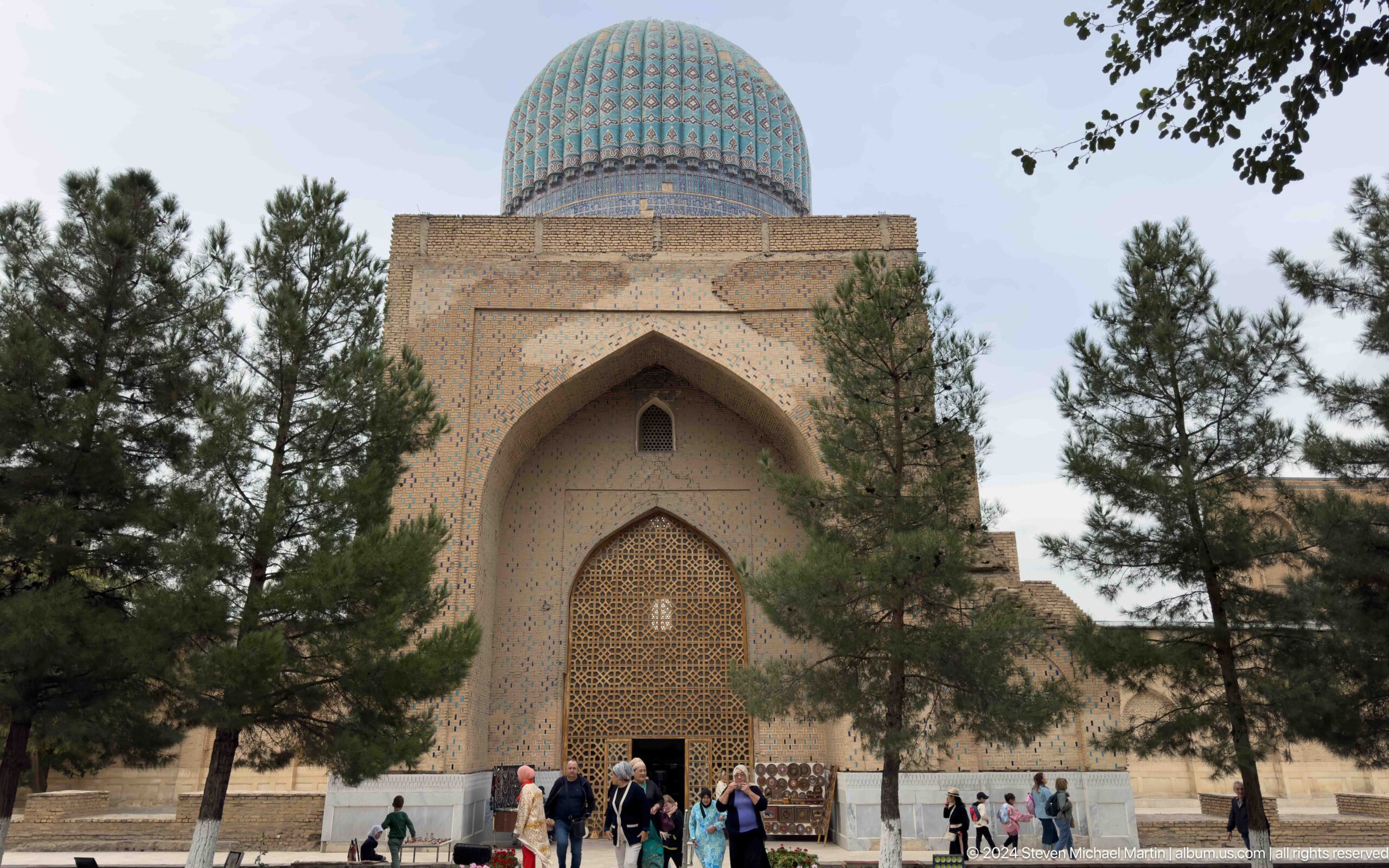
A domed subsidiary structure at the Bibi-Khanym Mosque combines a deep pointed portal, wooden latticework, and a turquoise ribbed dome. Visitors at the entrance provide scale and show the monument functioning as an actively visited heritage site.
Caption
A domed subsidiary structure at the Bibi-Khanym Mosque combines a deep pointed portal, wooden latticework, and a turquoise ribbed dome. Visitors at the entrance provide scale and show the monument functioning as an actively visited heritage site.
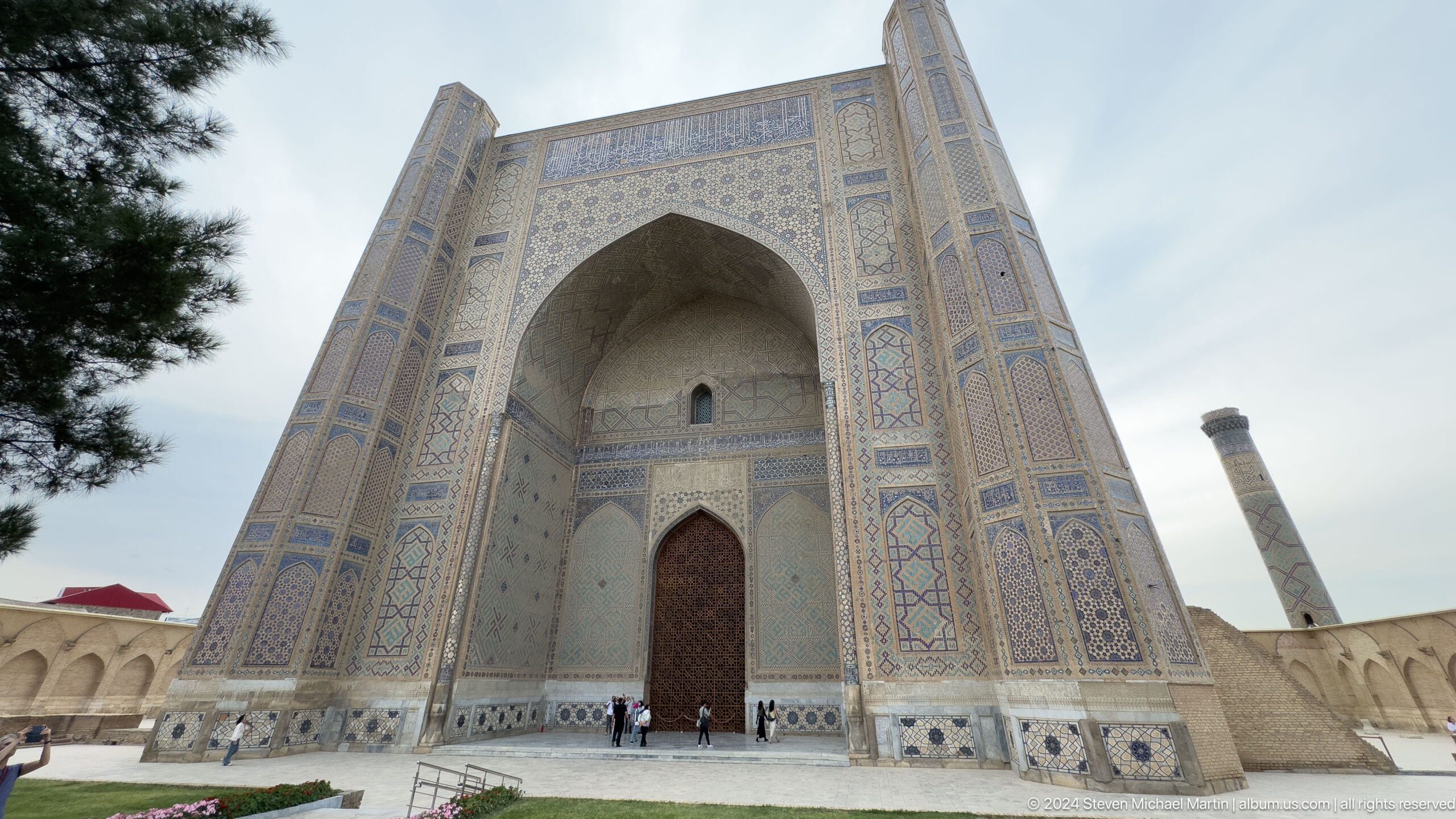
A tall iwan within the Bibi-Khanym Mosque complex rises above tiny visitors at its base. The deep pointed recess, small central doorway, and narrow blue decorative borders emphasize the vertical proportions and monumental ambition of the architecture.
Caption
A tall iwan within the Bibi-Khanym Mosque complex rises above tiny visitors at its base. The deep pointed recess, small central doorway, and narrow blue decorative borders emphasize the vertical proportions and monumental ambition of the architecture.
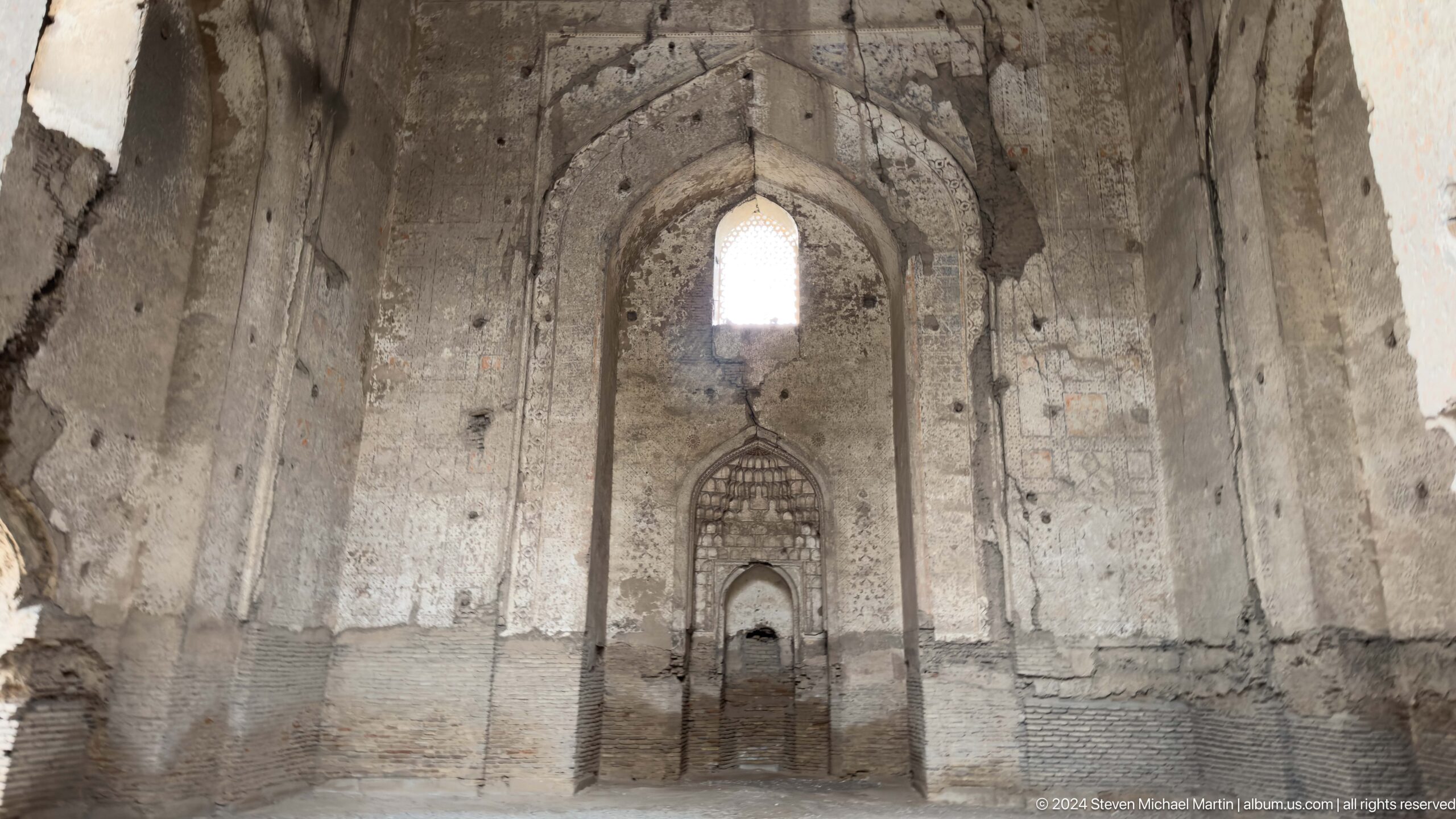
This broad interior record shows a high pointed window aligned above nested niches in the Bibi-Khanym Mosque. Extensive plaster loss and exposed brickwork reveal the damaged condition of the monumental wall, while its axial organization remains clearly legible.
Caption
This broad interior record shows a high pointed window aligned above nested niches in the Bibi-Khanym Mosque. Extensive plaster loss and exposed brickwork reveal the damaged condition of the monumental wall, while its axial organization remains clearly legible.
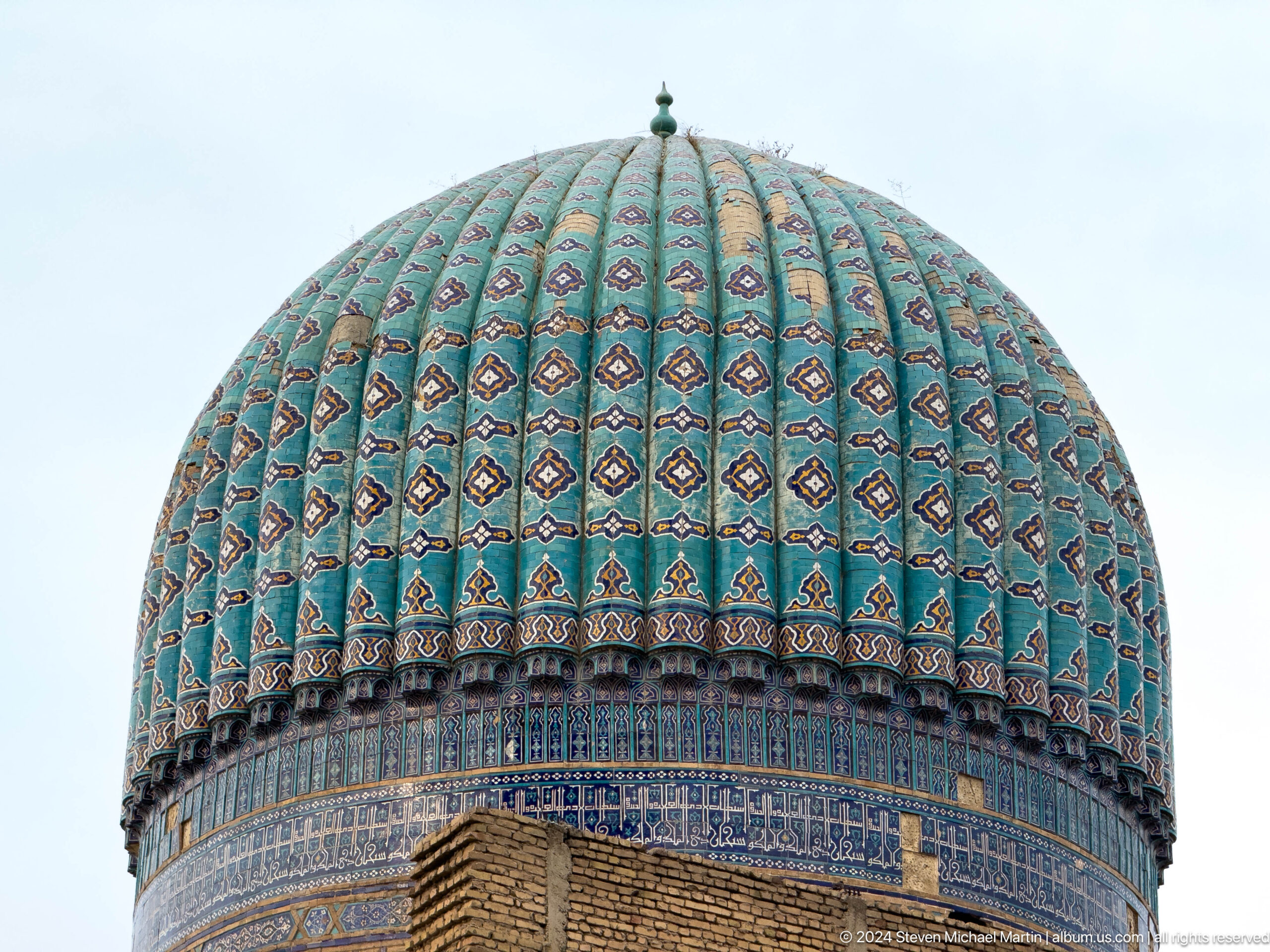
The ribbed turquoise dome of the Bibi-Khanym Mosque fills the frame, its repeated dark-blue motifs descending toward a densely patterned base band. Isolated against the pale sky, the dome reads as both a monumental roof form and a continuous field of glazed decoration.
Caption
The ribbed turquoise dome of the Bibi-Khanym Mosque fills the frame, its repeated dark-blue motifs descending toward a densely patterned base band. Isolated against the pale sky, the dome reads as both a monumental roof form and a continuous field of glazed decoration.
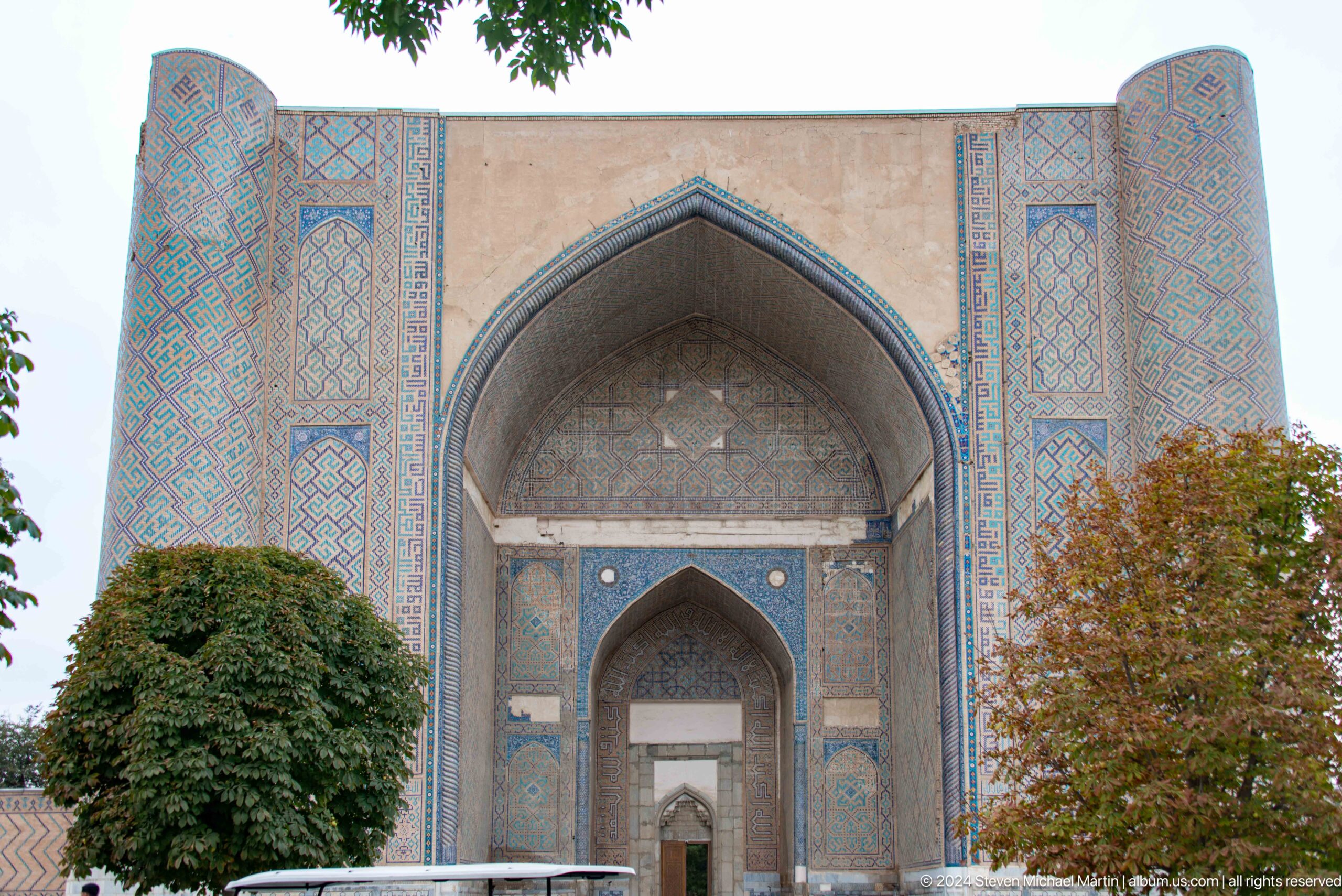
The monumental iwan of the Bibi-Khanym Mosque rises behind trees as a white visitor shuttle passes across the foreground. The image records both the historic façade and the modern infrastructure that supports access to the heritage site.
Caption
The monumental iwan of the Bibi-Khanym Mosque rises behind trees as a white visitor shuttle passes across the foreground. The image records both the historic façade and the modern infrastructure that supports access to the heritage site.

Viewed from directly below, the main iwan of the Bibi-Khanym Mosque rises as a vast pointed recess between turquoise and blue decorative panels. The steep perspective compresses the lower doorway and intensifies the façade’s extraordinary vertical scale.
Caption
Viewed from directly below, the main iwan of the Bibi-Khanym Mosque rises as a vast pointed recess between turquoise and blue decorative panels. The steep perspective compresses the lower doorway and intensifies the façade’s extraordinary vertical scale.
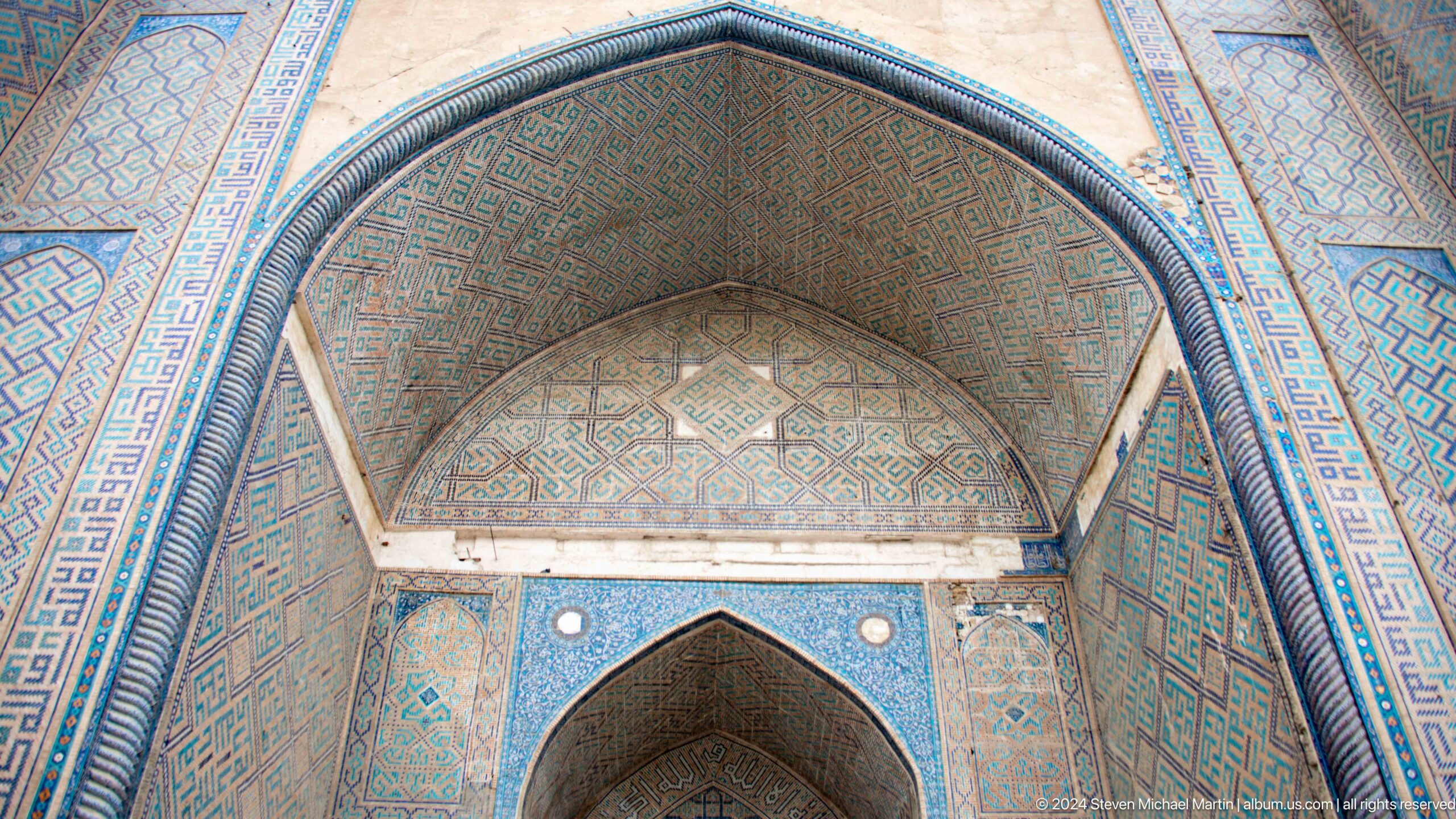
The upper vault of the Bibi-Khanym Mosque iwan is covered by a dense green geometric pattern edged with blue and turquoise bands. This close view reveals the ornamental surface that is easily lost in wider photographs of the immense portal.
Caption
The upper vault of the Bibi-Khanym Mosque iwan is covered by a dense green geometric pattern edged with blue and turquoise bands. This close view reveals the ornamental surface that is easily lost in wider photographs of the immense portal.