Zócalo at Night
At the center of Mexico City, the Zócalo brings together the city’s civic and religious landmarks around one broad public square. By night, the Metropolitan Cathedral, the Sagrario, and government buildings form a changing backdrop as the plaza fills with people and light. These photographs capture the square as the city prepared for Día de Muertos.
Seasonal decorations transform the familiar façades and open space. Cempasúchil flowers add vivid color, while illuminated displays draw attention across the plaza toward the monumental Catrina. The contrast between historic buildings and contemporary festival design gives the square a distinct nighttime character.
The images move between the scale of the plaza and its individual details: church façades, government buildings, floral displays, decorations, and the towering Catrina. Together, they record a moment when the Zócalo served as both the historic heart of the capital and a gathering place for Día de Muertos observances.
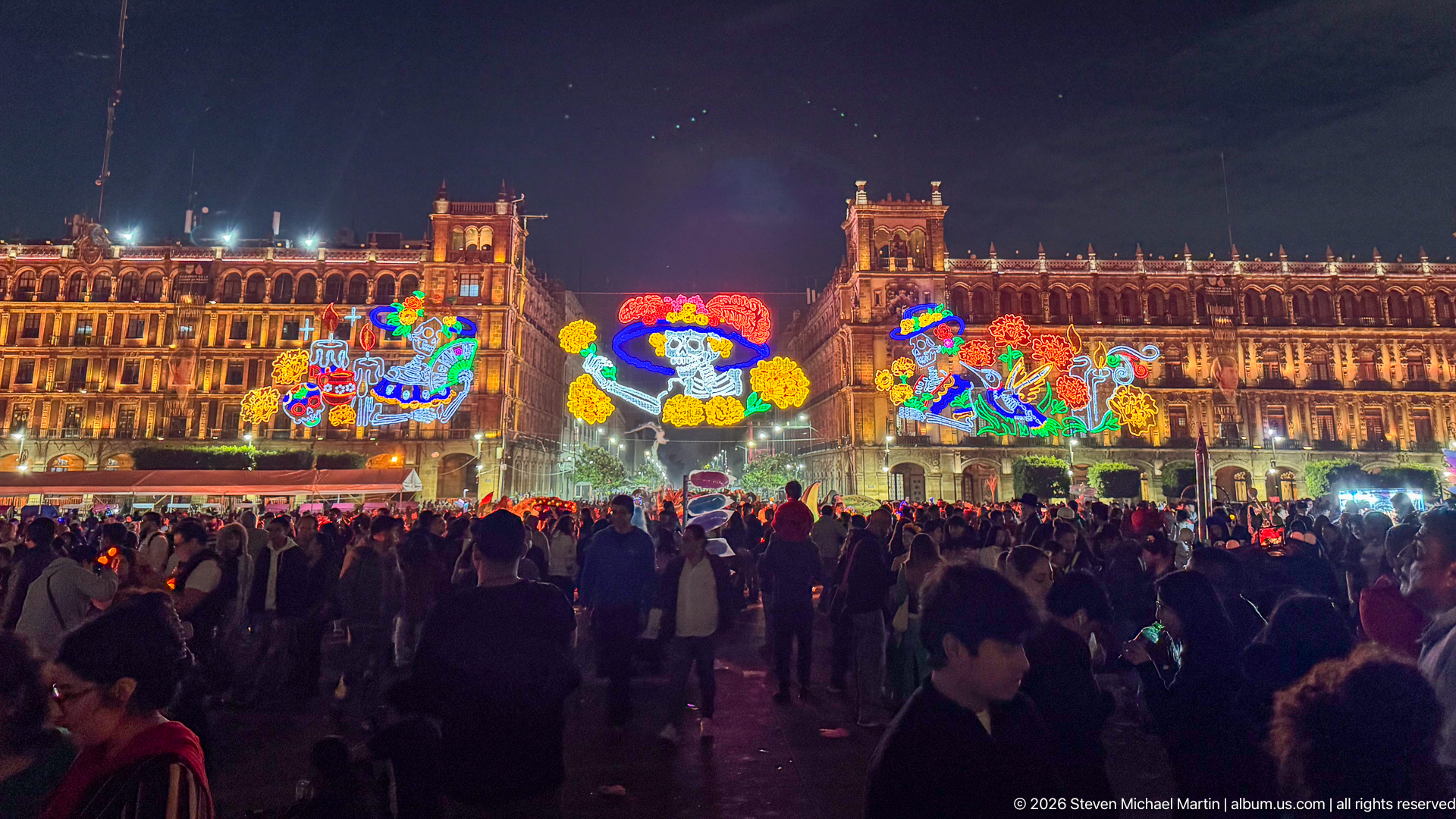
A dense evening crowd fills the Zócalo beneath a row of vivid Día de Muertos lights. Two skeletal figures and clusters of marigolds span the upper façade, while the surrounding arcades glow in warm architectural lighting. The broad view makes the square’s scale and the festival’s layered setting visible at once: moving visitors below, historic buildings behind, and luminous decorations overhead.
Caption
A dense evening crowd fills the Zócalo beneath a row of vivid Día de Muertos lights. Two skeletal figures and clusters of marigolds span the upper façade, while the surrounding arcades glow in warm architectural lighting. The broad view makes the square’s scale and the festival’s layered setting visible at once: moving visitors below, historic buildings behind, and luminous decorations overhead.
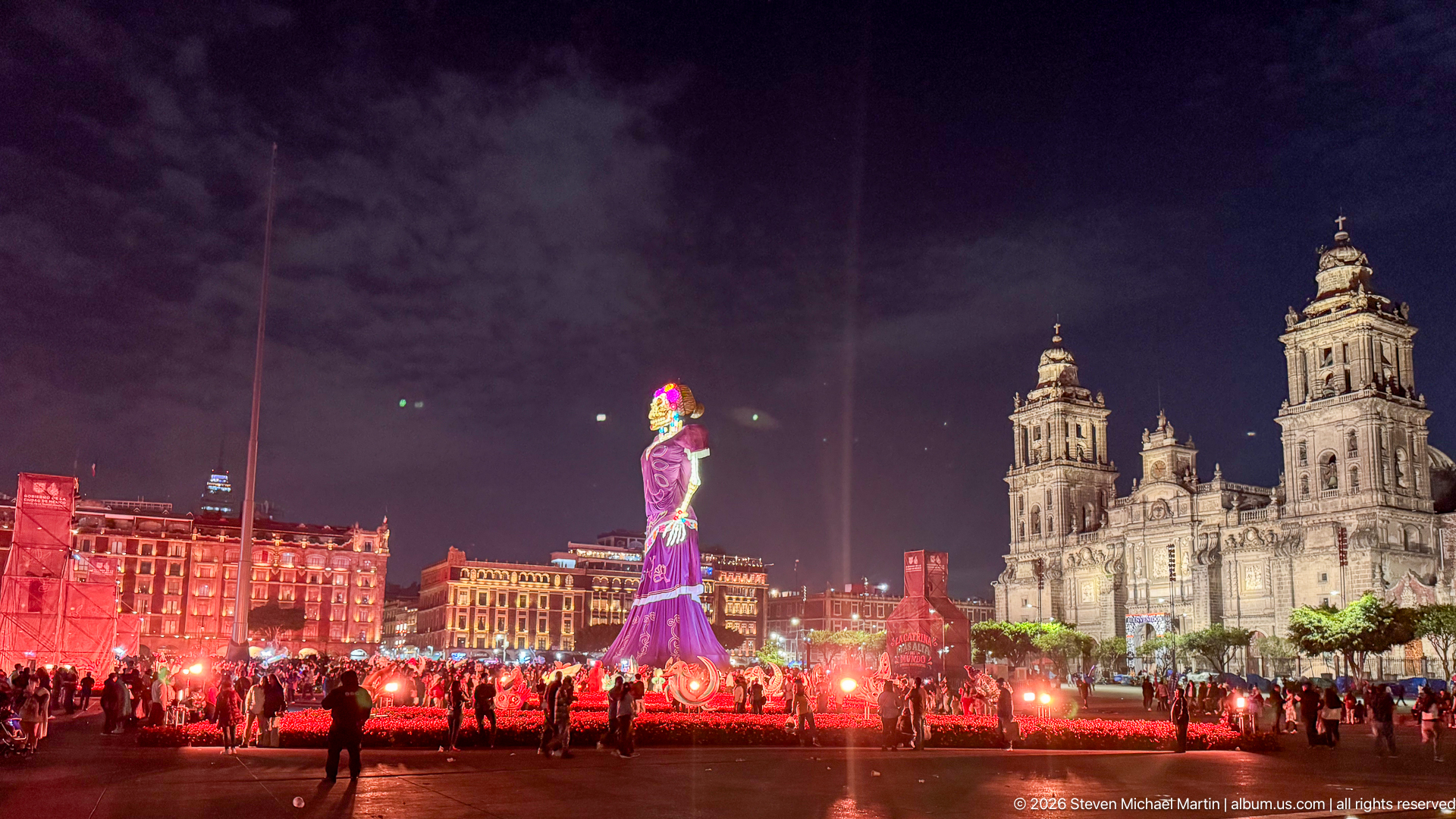
A giant purple-dressed Catrina rises above visitors in front of the Metropolitan Cathedral, with a broad marigold bed and bright stage lighting across the lower frame. The figure’s scale is measured against the church towers and people gathered around the installation. Smoke or haze softens the night sky, lending the scene a vivid, event-centered atmosphere without obscuring the landmark setting.
Caption
A giant purple-dressed Catrina rises above visitors in front of the Metropolitan Cathedral, with a broad marigold bed and bright stage lighting across the lower frame. The figure’s scale is measured against the church towers and people gathered around the installation. Smoke or haze softens the night sky, lending the scene a vivid, event-centered atmosphere without obscuring the landmark setting.
The Catrina is seen in profile, her broad purple skirt planted among a carpet of marigolds while the cathedral’s illuminated towers anchor the background. Her raised skeletal arm and floral sash break the dress’s broad silhouette, giving this view a sense of movement even as the figure remains fixed in the plaza. Visitors along the flower bed show how closely the public gathers around the installation.
Caption
The Catrina is seen in profile, her broad purple skirt planted among a carpet of marigolds while the cathedral’s illuminated towers anchor the background. Her raised skeletal arm and floral sash break the dress’s broad silhouette, giving this view a sense of movement even as the figure remains fixed in the plaza. Visitors along the flower bed show how closely the public gathers around the installation.
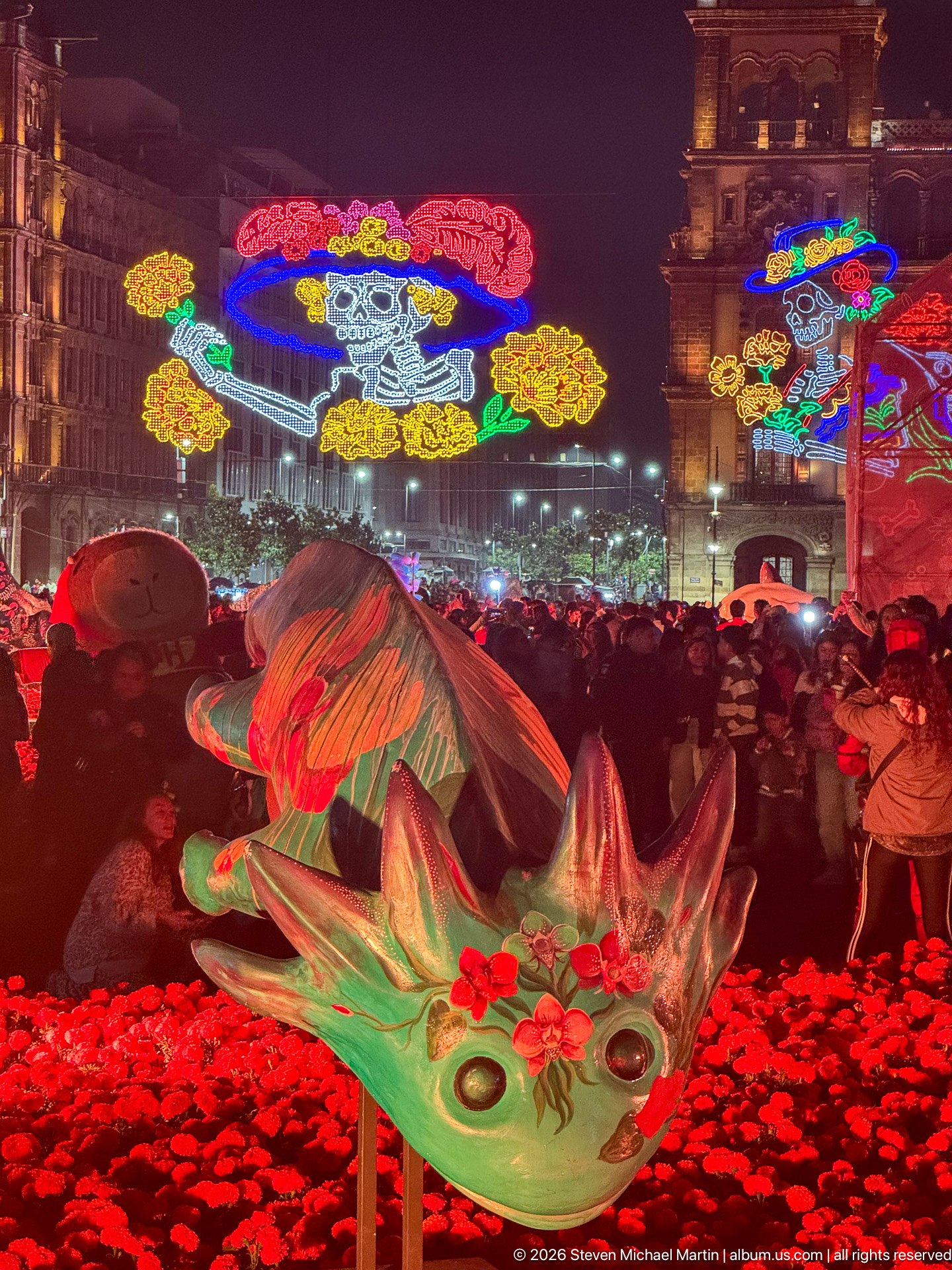
A large painted creature with a long, curved body occupies the foreground above densely packed marigolds. Its red, green, and gold surface bears decorative patterns, while a luminous skeletal figure and another fantastical sculpture appear farther back. The compressed viewpoint draws attention to the creature’s sculptural form and color, with the square’s crowd and lights receding into a vivid, layered background.
Caption
A large painted creature with a long, curved body occupies the foreground above densely packed marigolds. Its red, green, and gold surface bears decorative patterns, while a luminous skeletal figure and another fantastical sculpture appear farther back. The compressed viewpoint draws attention to the creature’s sculptural form and color, with the square’s crowd and lights receding into a vivid, layered background.

A wide crowd fills the foreground beneath the monumental Catrina, whose purple figure stands against the illuminated cathedral towers. Red-lit structures and vendor carts punctuate the plaza, while visitors pause, take photographs, and move through the open event area. The composition gives more space to the gathering and its temporary infrastructure than to the decorative details of the installation.
Caption
A wide crowd fills the foreground beneath the monumental Catrina, whose purple figure stands against the illuminated cathedral towers. Red-lit structures and vendor carts punctuate the plaza, while visitors pause, take photographs, and move through the open event area. The composition gives more space to the gathering and its temporary infrastructure than to the decorative details of the installation.
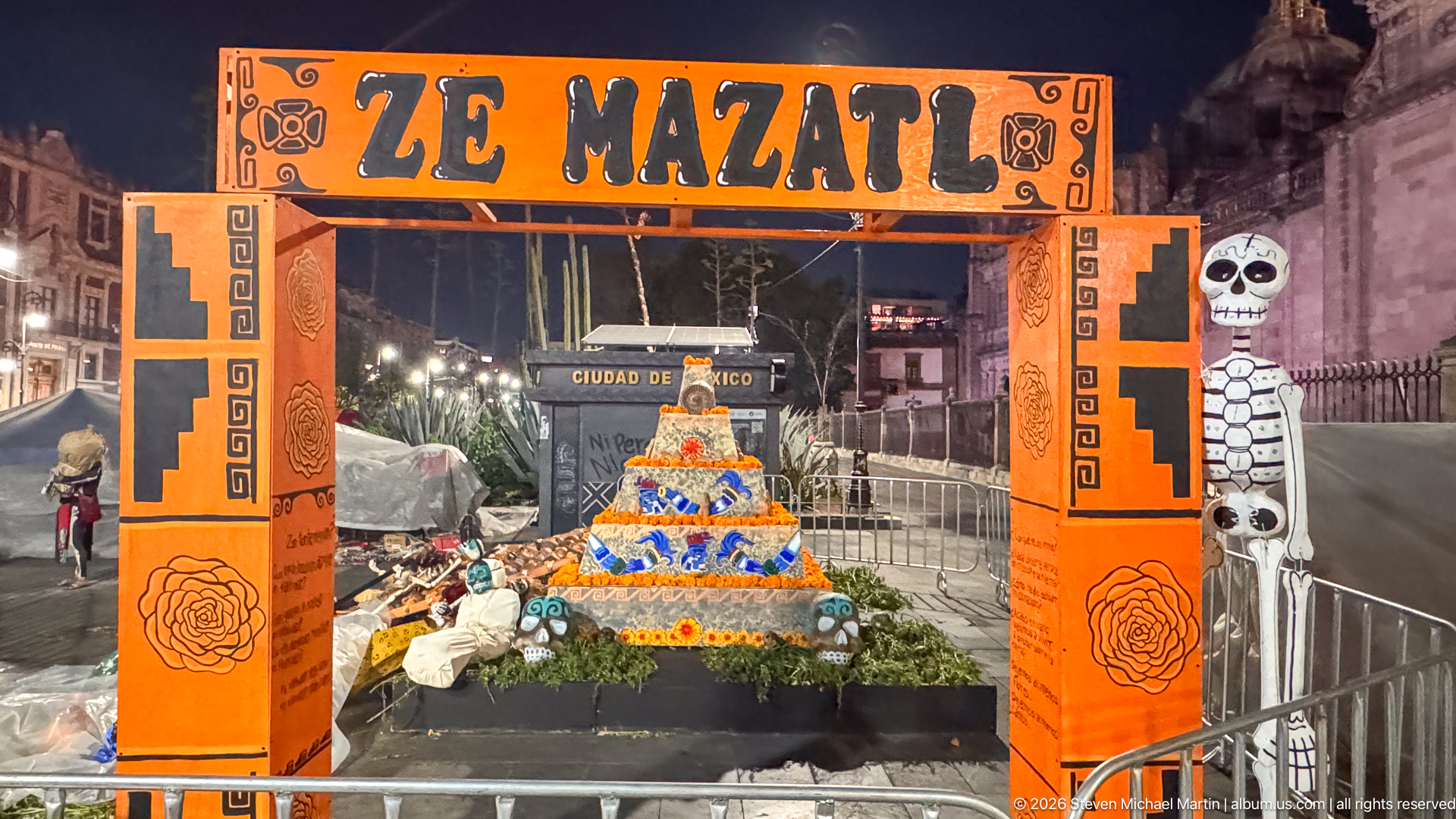
An orange gateway marked “El Mazatl” frames a tiered display covered in marigolds, with a skeletal figure standing at the right edge. Geometric black motifs and floral emblems decorate the upright panels, while railings and the pink plaza wall recede behind them. The centered view turns the gateway into a threshold, drawing visitors’ sightlines toward the offering arrangement beyond.
Caption
An orange gateway marked “El Mazatl” frames a tiered display covered in marigolds, with a skeletal figure standing at the right edge. Geometric black motifs and floral emblems decorate the upright panels, while railings and the pink plaza wall recede behind them. The centered view turns the gateway into a threshold, drawing visitors’ sightlines toward the offering arrangement beyond.
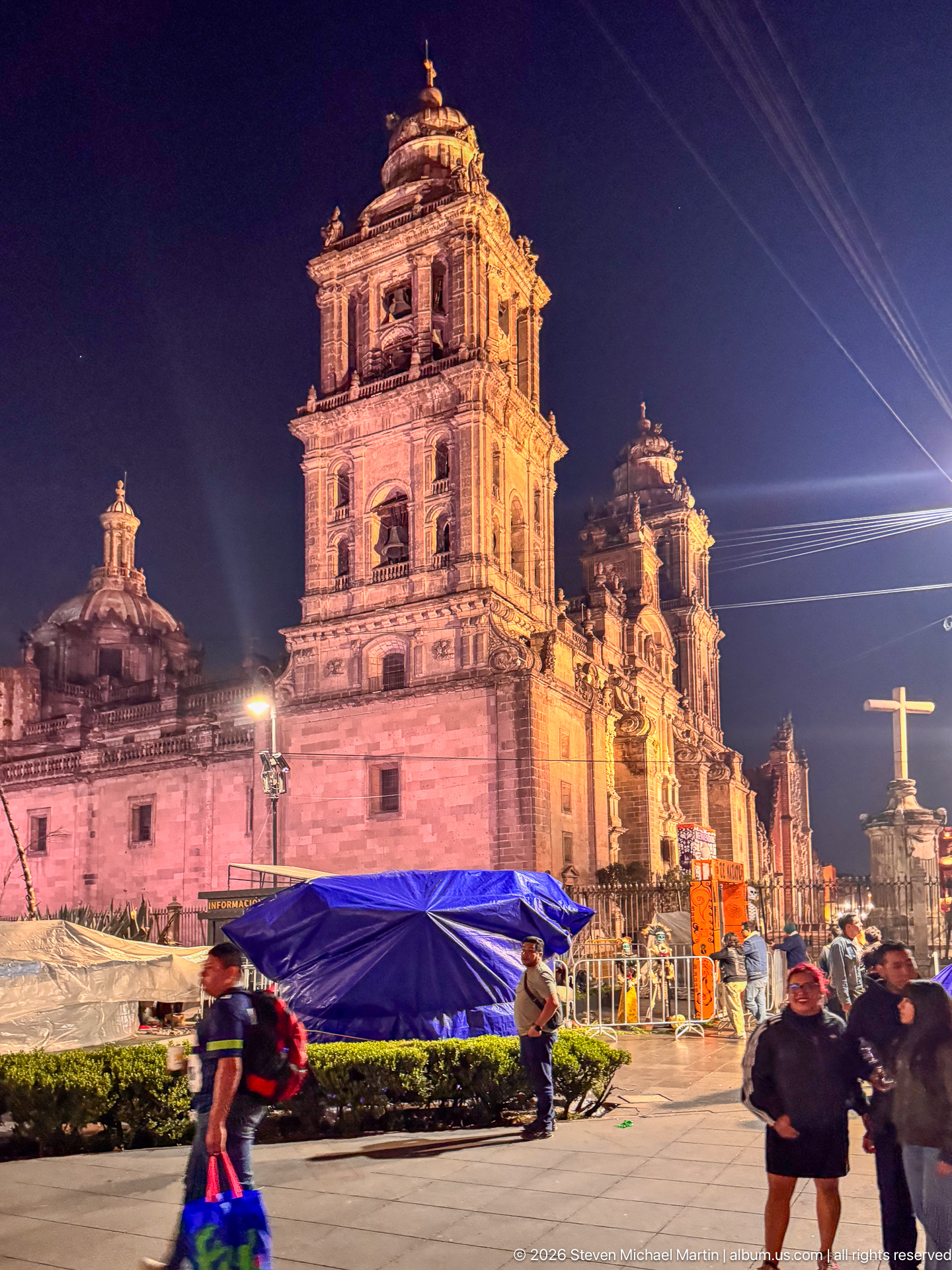
The Metropolitan Cathedral rises above the open plaza, its bell towers and dome warmed by evening light. Temporary blue and beige canopies, barriers, and passersby occupy the foreground, giving the scene the practical texture of an event area in use. With no single installation dominating the frame, the photograph records the cathedral’s relationship to the changing public space of the Zócalo.
Caption
The Metropolitan Cathedral rises above the open plaza, its bell towers and dome warmed by evening light. Temporary blue and beige canopies, barriers, and passersby occupy the foreground, giving the scene the practical texture of an event area in use. With no single installation dominating the frame, the photograph records the cathedral’s relationship to the changing public space of the Zócalo.
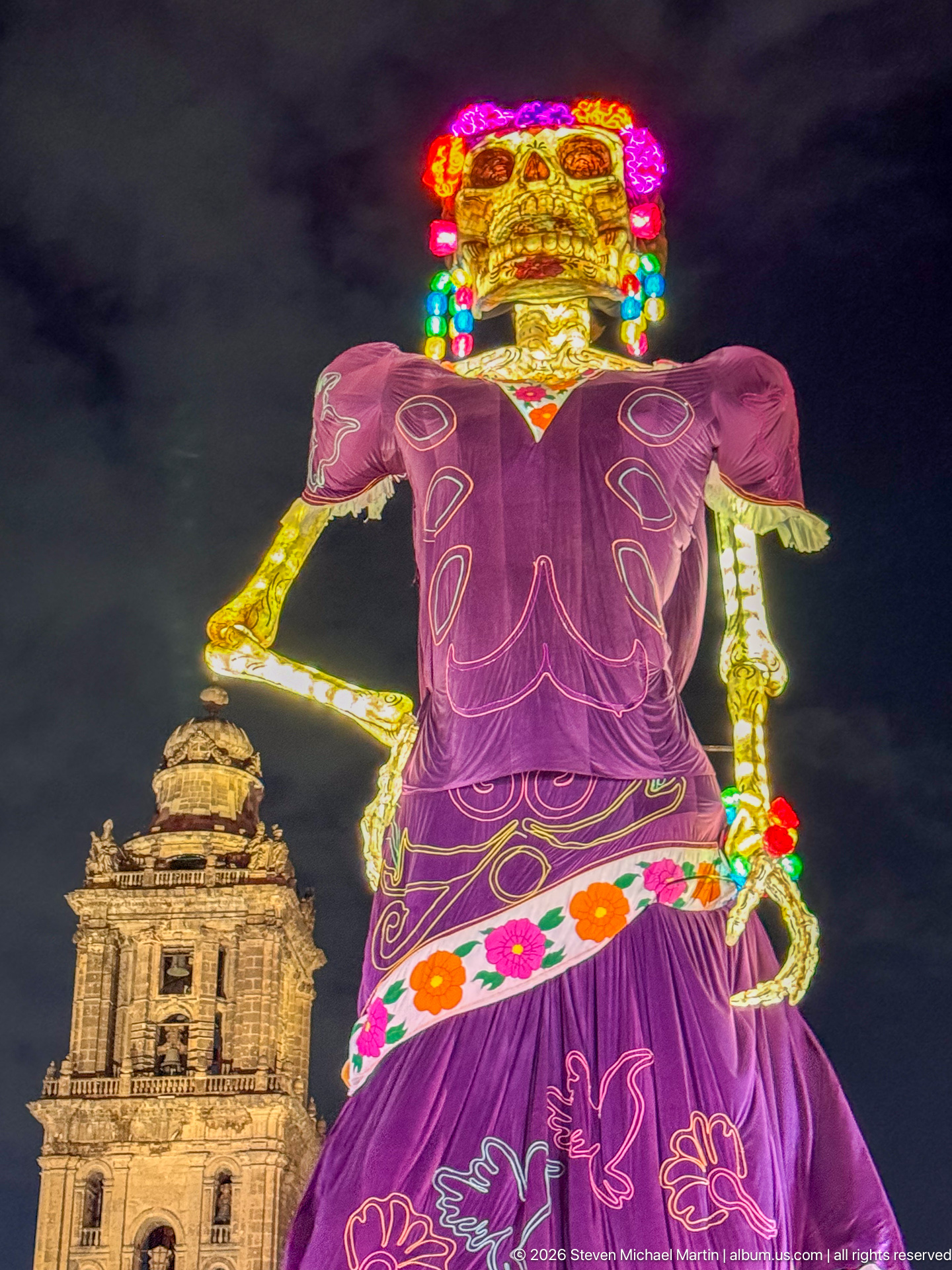
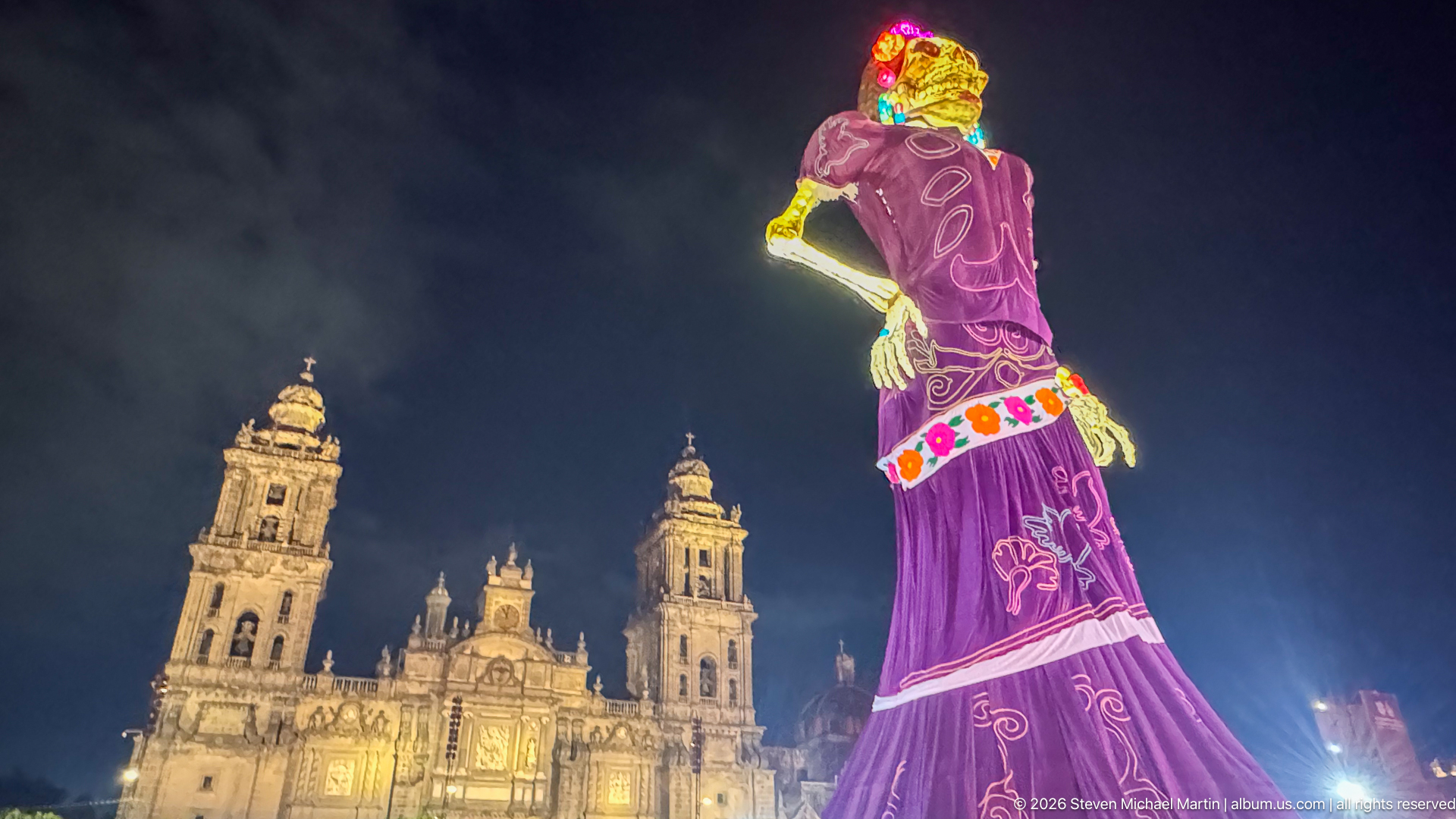
This close low-angle view brings the Catrina’s brightly lit skull, embroidered shoulders, floral sash, and jeweled-looking ornaments into sharp prominence. One cathedral tower rises beside her, giving a clear architectural scale reference while the purple dress fills most of the frame. The tight composition makes the installation’s costume and lighting the subject, with the historic square reduced to a dramatic backdrop.
Caption
This close low-angle view brings the Catrina’s brightly lit skull, embroidered shoulders, floral sash, and jeweled-looking ornaments into sharp prominence. One cathedral tower rises beside her, giving a clear architectural scale reference while the purple dress fills most of the frame. The tight composition makes the installation’s costume and lighting the subject, with the historic square reduced to a dramatic backdrop.
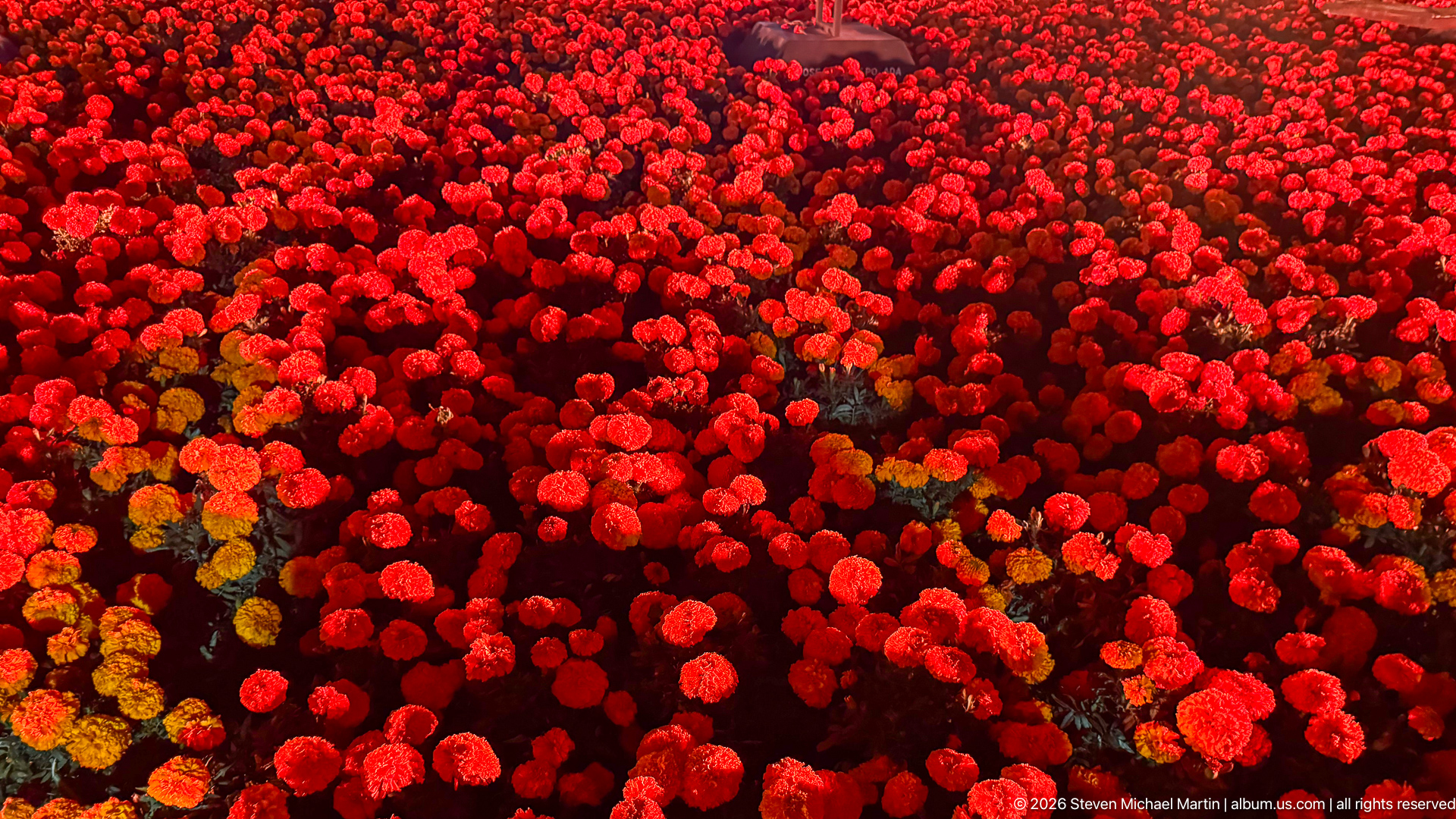
A dense carpet of orange marigolds fills the frame, their layered petals catching red and amber light. The flowers are arranged shoulder to shoulder with only occasional leaves and patches of darker ground visible between them. By excluding the surrounding buildings and crowd, this close view isolates the floral installation as a tactile field of color within the larger Zócalo celebration.
Caption
A dense carpet of orange marigolds fills the frame, their layered petals catching red and amber light. The flowers are arranged shoulder to shoulder with only occasional leaves and patches of darker ground visible between them. By excluding the surrounding buildings and crowd, this close view isolates the floral installation as a tactile field of color within the larger Zócalo celebration.
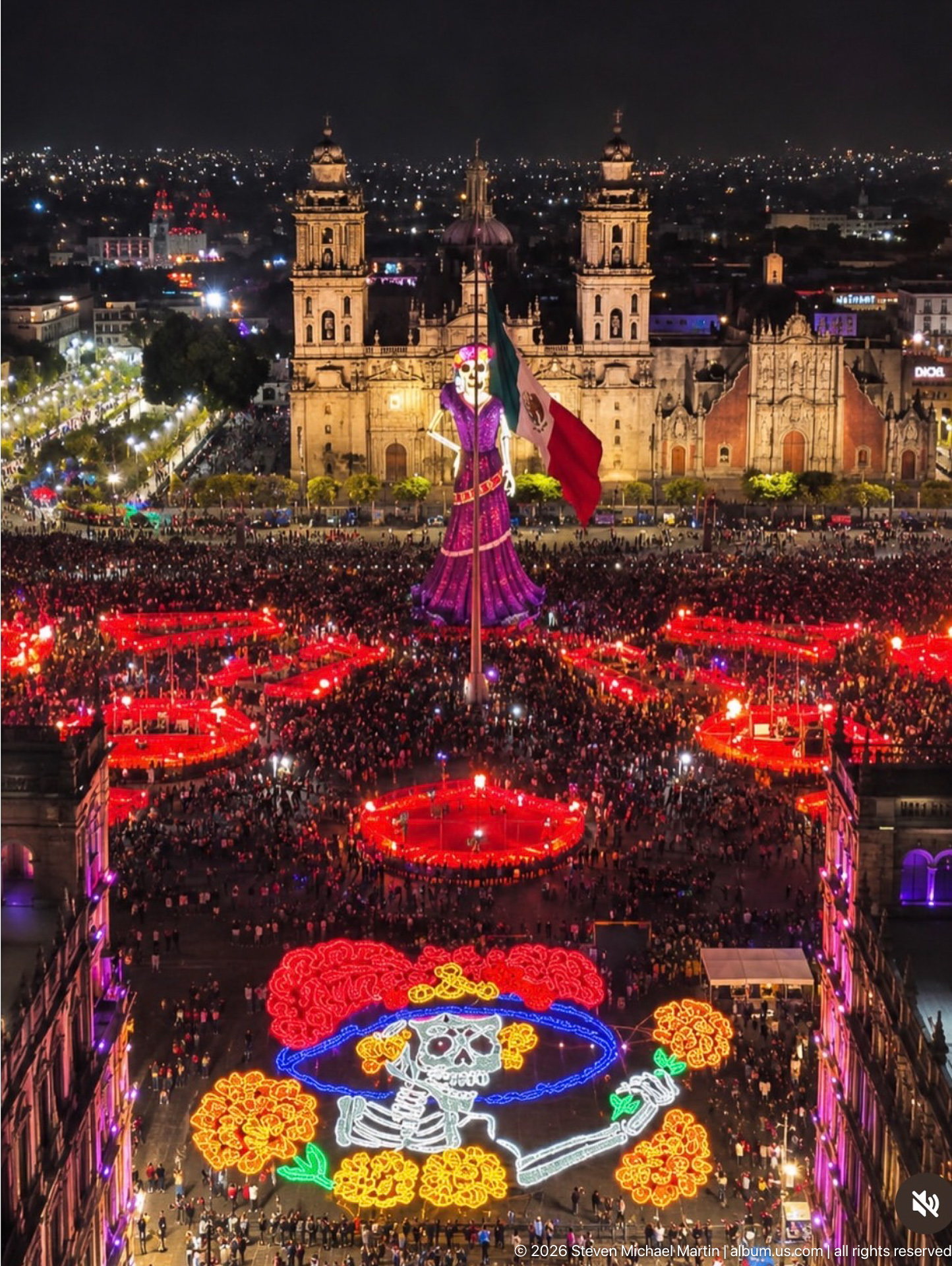
From an elevated viewpoint, the Zócalo opens as a field of red-lit installations and visitors, with a giant Catrina figure and the Metropolitan Cathedral anchoring the far side. A luminous calavera design spreads across the foreground pavement. The broad composition shows how the historic square becomes both a public gathering place and an elaborate Día de Muertos stage after dark.
Caption
From an elevated viewpoint, the Zócalo opens as a field of red-lit installations and visitors, with a giant Catrina figure and the Metropolitan Cathedral anchoring the far side. A luminous calavera design spreads across the foreground pavement. The broad composition shows how the historic square becomes both a public gathering place and an elaborate Día de Muertos stage after dark.
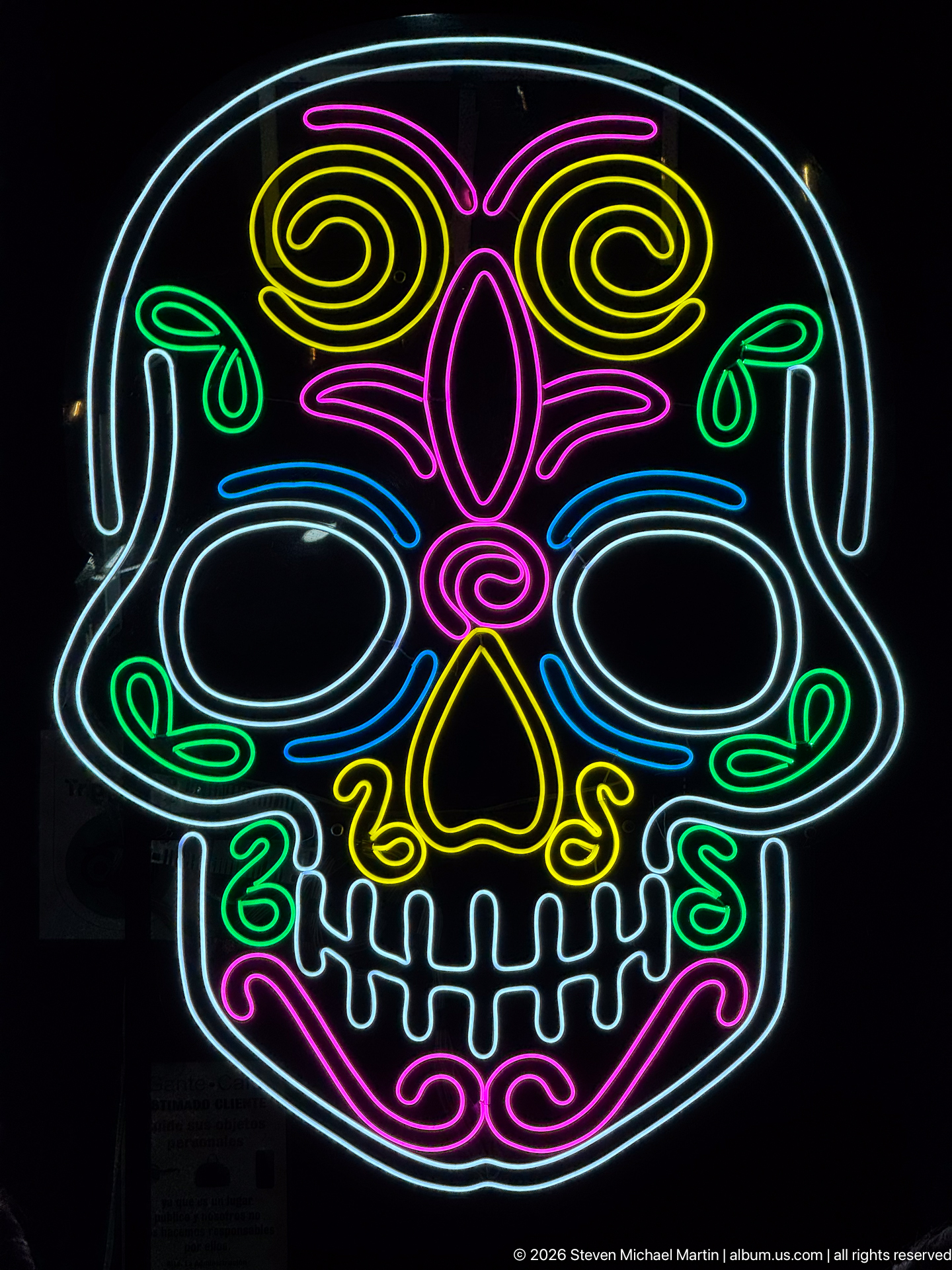
Bright outlines in turquoise, yellow, magenta, green, and blue form a large decorative skull against a nearly black field. Its symmetrical eyes, nose, teeth, and curling floral-like motifs make the calavera immediately legible, while the isolated framing suppresses the surrounding square. This close detail presents one of the festival’s graphic motifs as a standalone light display.
Caption
Bright outlines in turquoise, yellow, magenta, green, and blue form a large decorative skull against a nearly black field. Its symmetrical eyes, nose, teeth, and curling floral-like motifs make the calavera immediately legible, while the isolated framing suppresses the surrounding square. This close detail presents one of the festival’s graphic motifs as a standalone light display.
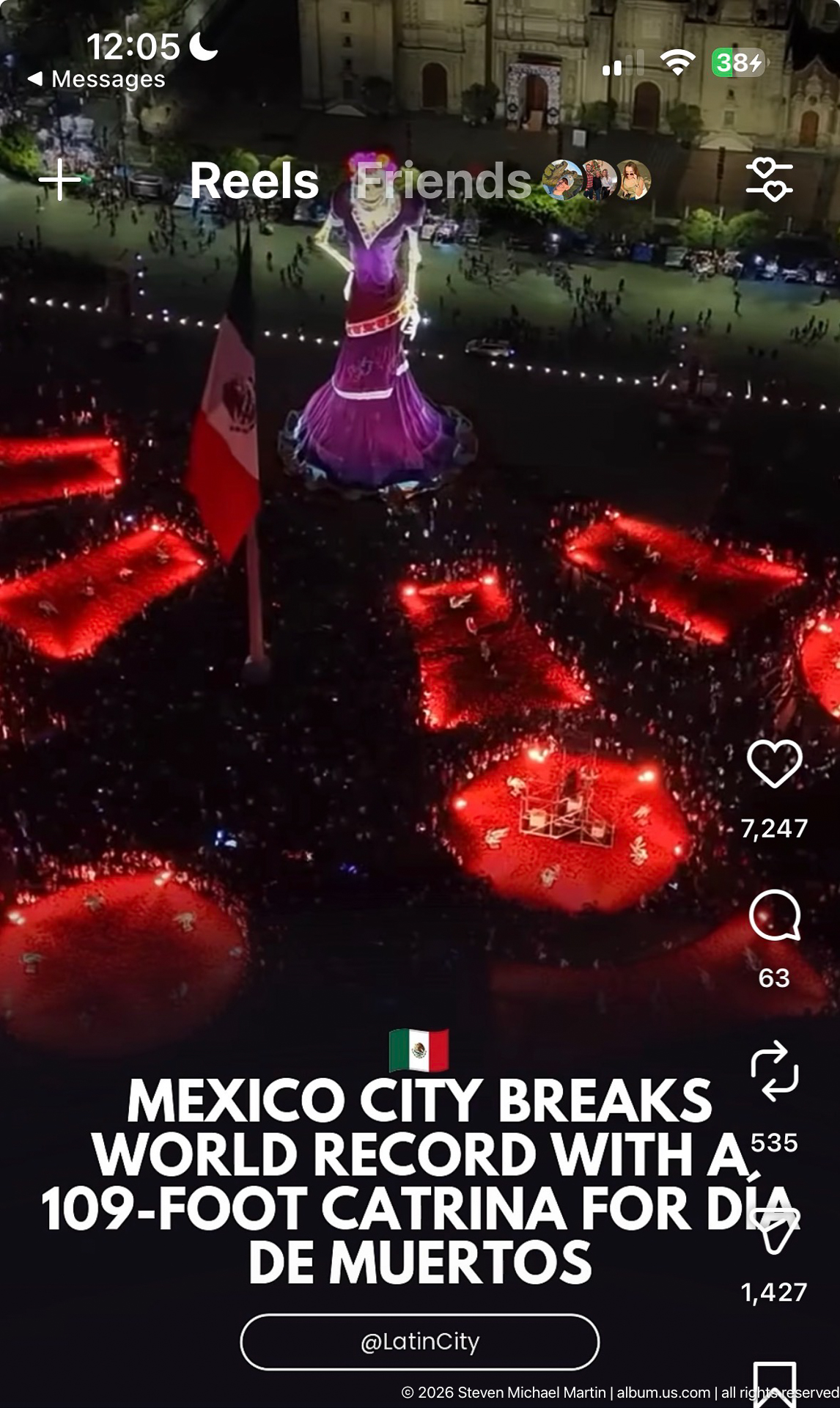
A social media post overlays a nighttime view of the Zócalo and its giant purple Catrina, with interface icons and a prominent headline claiming that Mexico City broke a world record with a 109-foot figure. The claim belongs to the post’s on-screen text; the photograph itself shows the illuminated installation and crowd but cannot verify the measurement or record.
Caption
A social media post overlays a nighttime view of the Zócalo and its giant purple Catrina, with interface icons and a prominent headline claiming that Mexico City broke a world record with a 109-foot figure. The claim belongs to the post’s on-screen text; the photograph itself shows the illuminated installation and crowd but cannot verify the measurement or record.
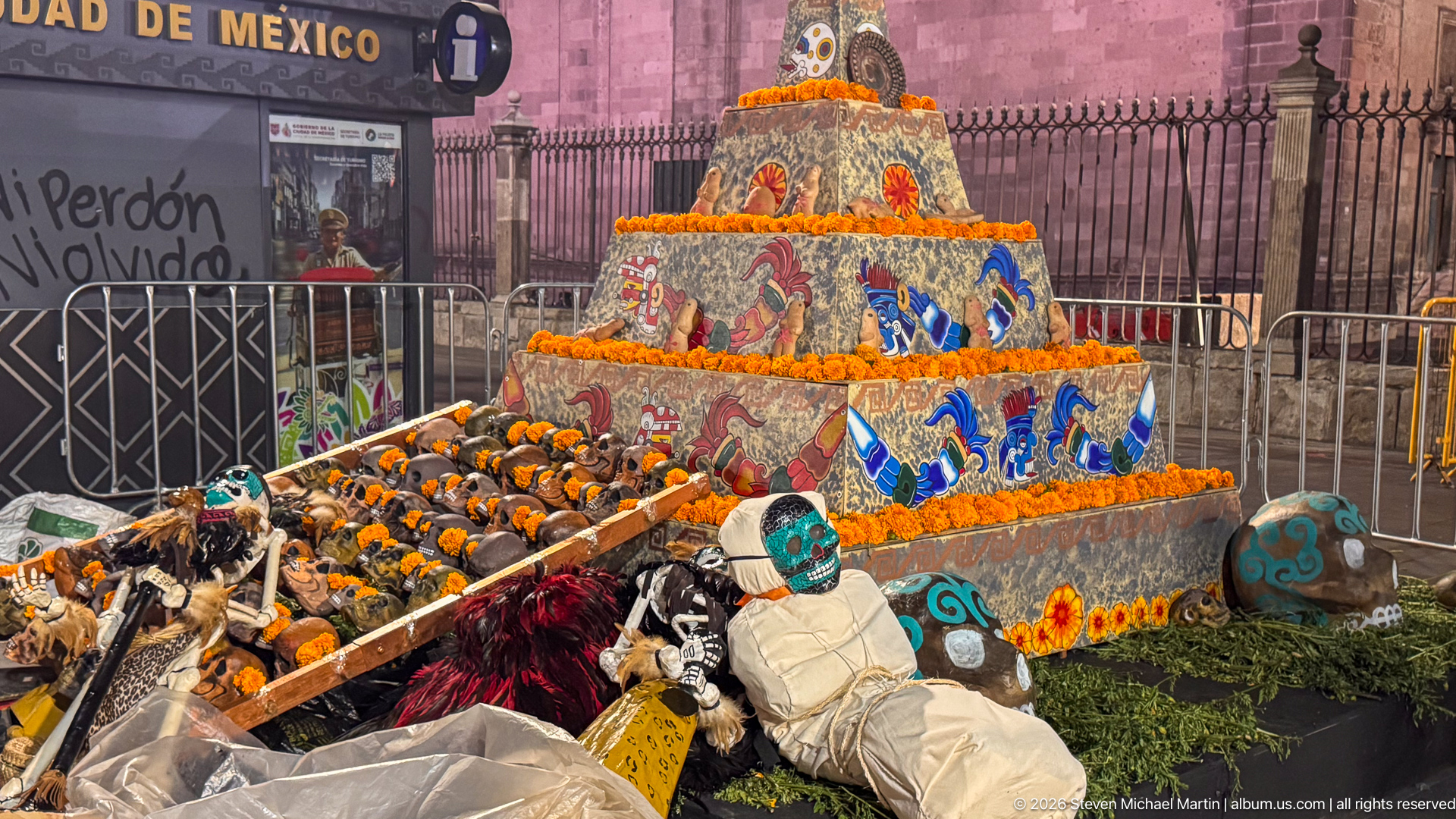
A stepped altar-like installation rises behind crowd barriers, its ledges edged with orange marigolds and its faces painted with colorful human figures. A skull-masked figure and bundles of flowers fill the base, while a pink stone wall and iron fence form the backdrop. The close view draws attention to the arrangement’s layered construction and abundant offerings rather than the surrounding plaza.
Caption
A stepped altar-like installation rises behind crowd barriers, its ledges edged with orange marigolds and its faces painted with colorful human figures. A skull-masked figure and bundles of flowers fill the base, while a pink stone wall and iron fence form the backdrop. The close view draws attention to the arrangement’s layered construction and abundant offerings rather than the surrounding plaza.
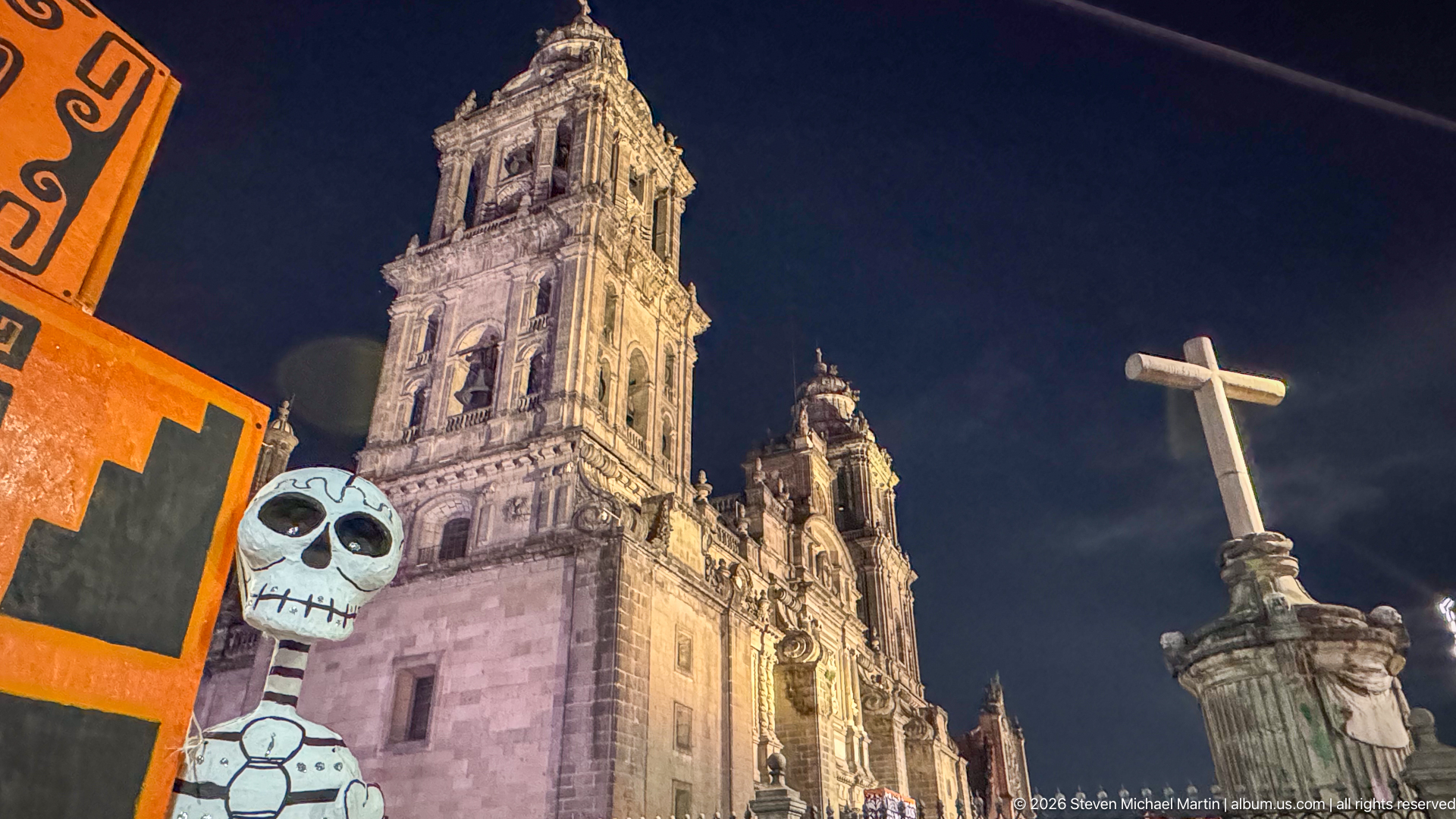
The cathedral’s illuminated stone bell tower rises into the night, framed by orange festival panels and two cartoon-like skeleton figures at street level. A cross atop a nearby sculptural column echoes the church’s religious silhouette. The upward angle isolates the tower’s height while keeping the temporary Día de Muertos decorations in the foreground, joining historic architecture with the contemporary celebration.
Caption
The cathedral’s illuminated stone bell tower rises into the night, framed by orange festival panels and two cartoon-like skeleton figures at street level. A cross atop a nearby sculptural column echoes the church’s religious silhouette. The upward angle isolates the tower’s height while keeping the temporary Día de Muertos decorations in the foreground, joining historic architecture with the contemporary celebration.
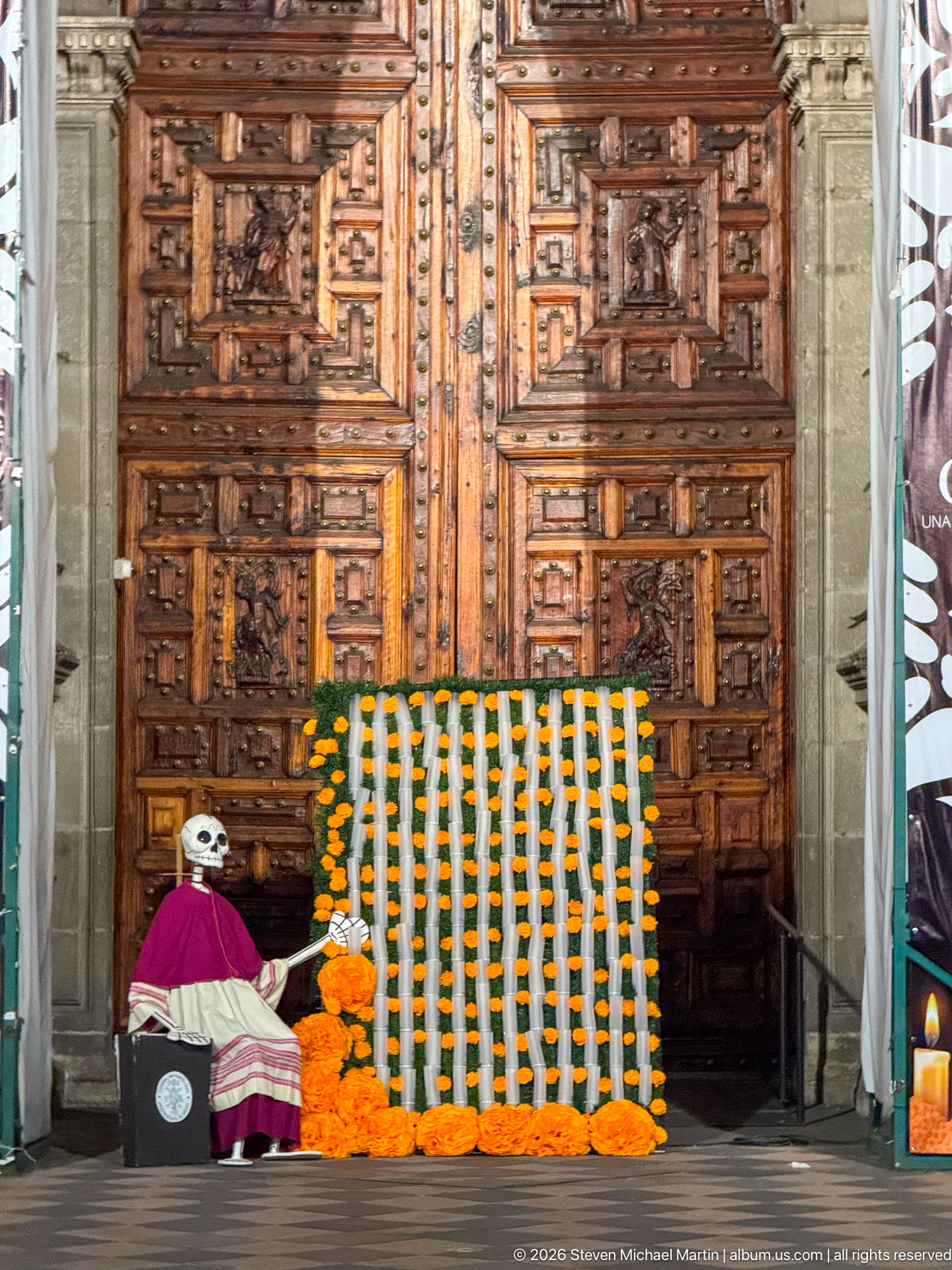
A seated skeleton figure in a magenta wrap occupies the base of elaborately carved wooden doors, beside a tall grid of orange marigolds and a low mound of flowers. The arrangement is framed like a temporary offering at the church entrance, where dark sculpted panels provide a strong contrast to the bright petals. This frontal view emphasizes the scale and texture of the doors as well as the seasonal display.
Caption
A seated skeleton figure in a magenta wrap occupies the base of elaborately carved wooden doors, beside a tall grid of orange marigolds and a low mound of flowers. The arrangement is framed like a temporary offering at the church entrance, where dark sculpted panels provide a strong contrast to the bright petals. This frontal view emphasizes the scale and texture of the doors as well as the seasonal display.
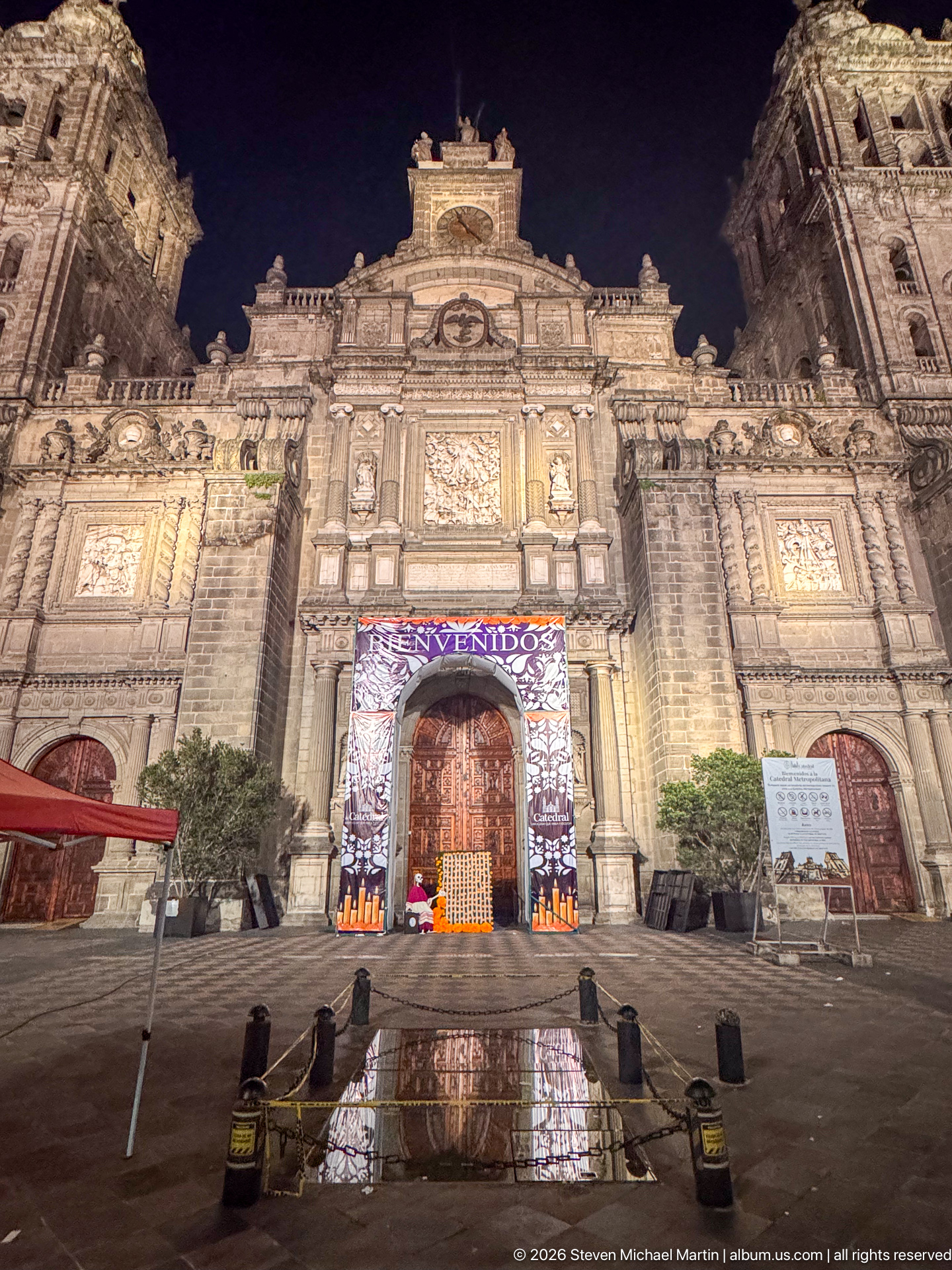
A low, symmetrical view centers the Metropolitan Cathedral’s main entrance beneath its clock and sculpted upper façade. A “Bienvenidos” banner and small marigold arrangement mark the doorway, while a shallow pool on the pavement reflects the portal and its lights. The quiet foreground contrasts with the elaborate stonework, giving this night view a ceremonial stillness.
Caption
A low, symmetrical view centers the Metropolitan Cathedral’s main entrance beneath its clock and sculpted upper façade. A “Bienvenidos” banner and small marigold arrangement mark the doorway, while a shallow pool on the pavement reflects the portal and its lights. The quiet foreground contrasts with the elaborate stonework, giving this night view a ceremonial stillness.
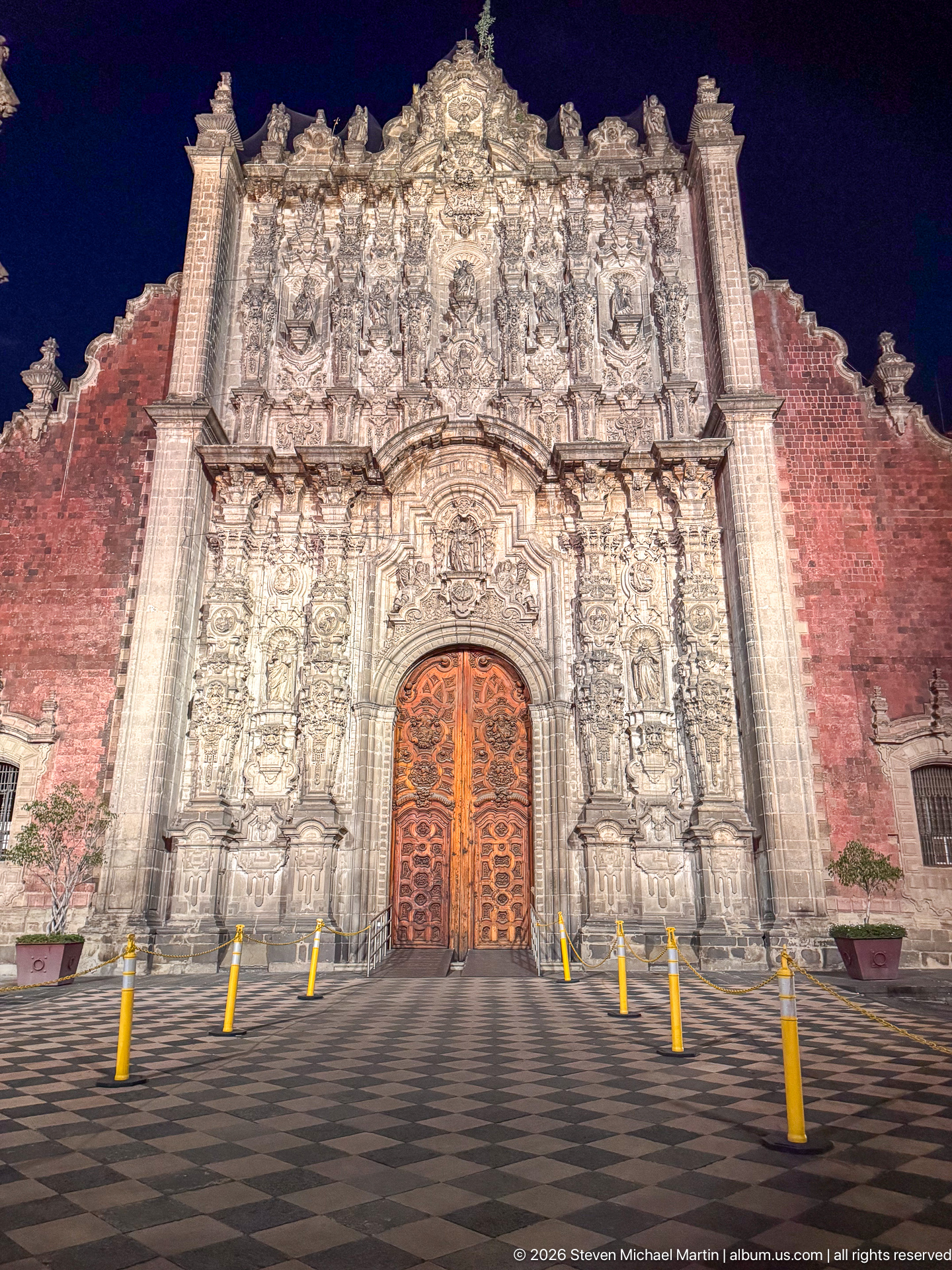
A densely ornamented stone portal fills the frame, with sculpted figures, columns, and layered moldings surrounding a pair of carved wooden doors. Red masonry wings and a checkered plaza lead the eye toward the entrance, while short yellow bollards mark the approach. The tighter composition separates architectural detail from the broader cathedral-and-plaza views elsewhere in this sequence.
Caption
A densely ornamented stone portal fills the frame, with sculpted figures, columns, and layered moldings surrounding a pair of carved wooden doors. Red masonry wings and a checkered plaza lead the eye toward the entrance, while short yellow bollards mark the approach. The tighter composition separates architectural detail from the broader cathedral-and-plaza views elsewhere in this sequence.
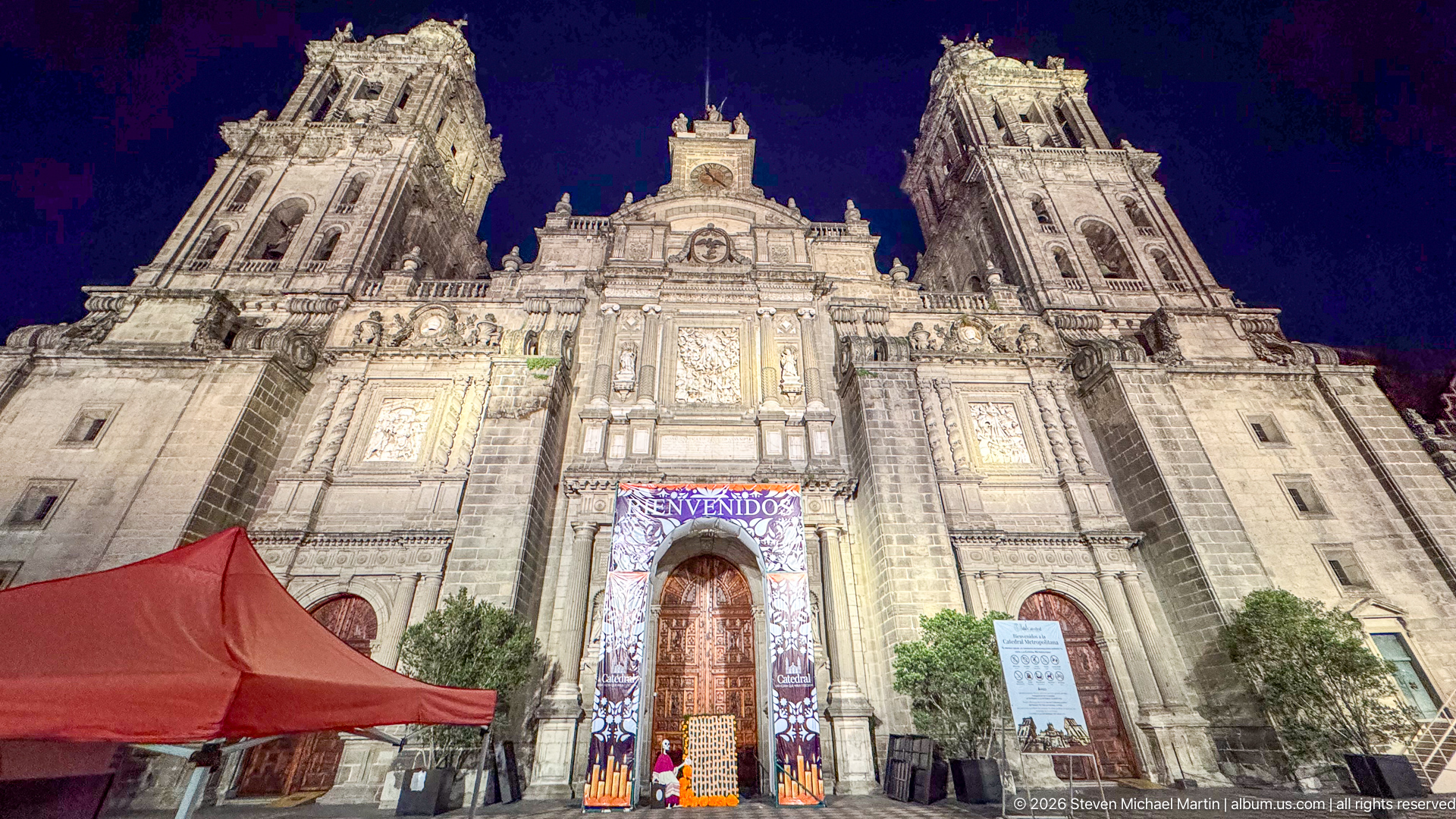
Two bell towers and the central clock rise above the cathedral’s richly carved façade, seen from close to the plaza. A tall “Bienvenidos” banner and a flower arrangement frame the central doorway, while a temporary red canopy enters at lower left. The upward perspective stresses the building’s height and layered stone ornament, with festival preparations gathered at its threshold.
Caption
Two bell towers and the central clock rise above the cathedral’s richly carved façade, seen from close to the plaza. A tall “Bienvenidos” banner and a flower arrangement frame the central doorway, while a temporary red canopy enters at lower left. The upward perspective stresses the building’s height and layered stone ornament, with festival preparations gathered at its threshold.
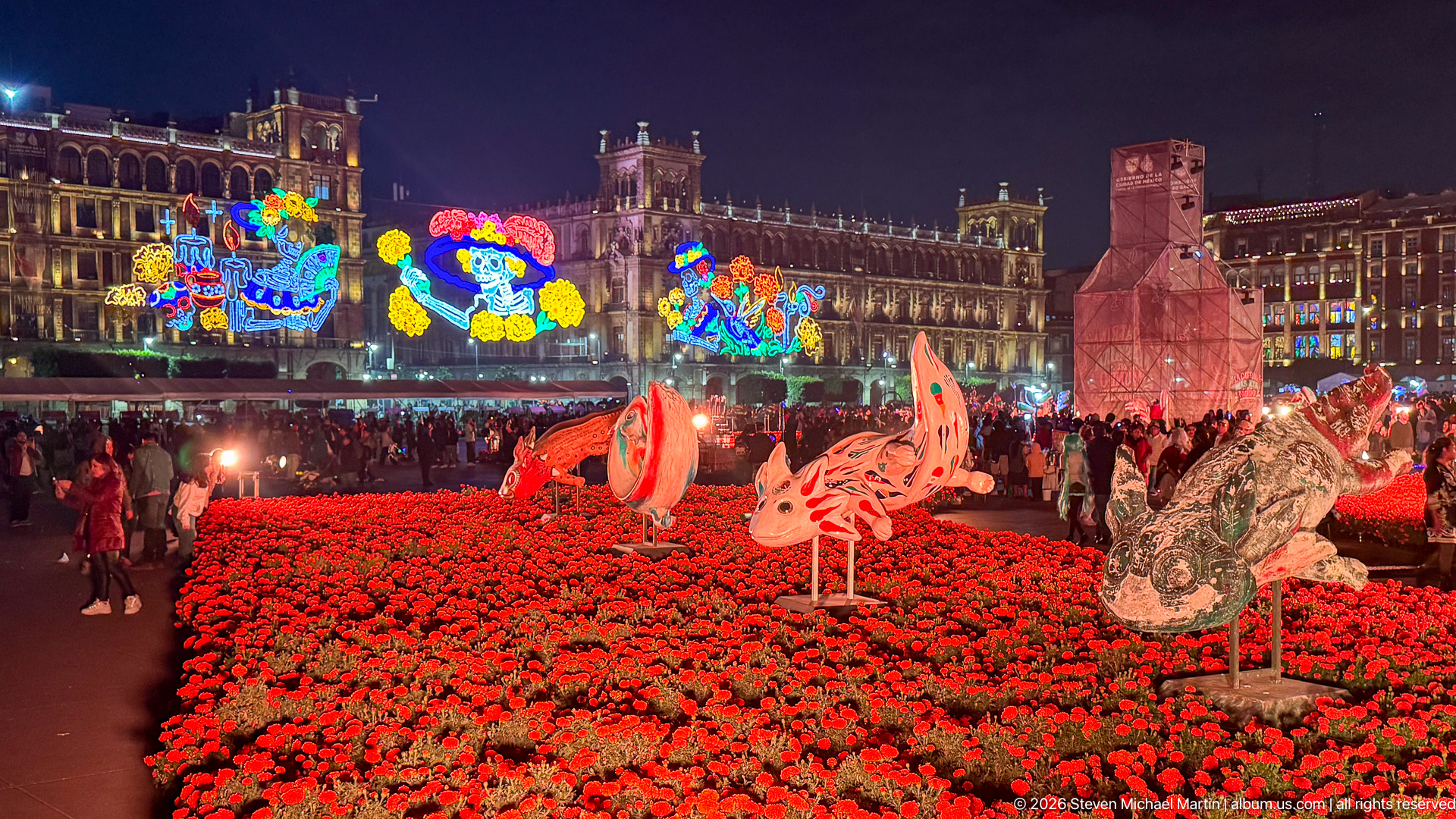
A broad carpet of marigolds glows red beneath colorful illuminated calavera figures, while visitors circulate along its edge. Historic façades and tower silhouettes form the background, softened by the shallow focus and mixed festival lighting. The view sets the floral installation within the public square and conveys how visitors move among the displays rather than treating the flowers as an isolated object.
Caption
A broad carpet of marigolds glows red beneath colorful illuminated calavera figures, while visitors circulate along its edge. Historic façades and tower silhouettes form the background, softened by the shallow focus and mixed festival lighting. The view sets the floral installation within the public square and conveys how visitors move among the displays rather than treating the flowers as an isolated object.
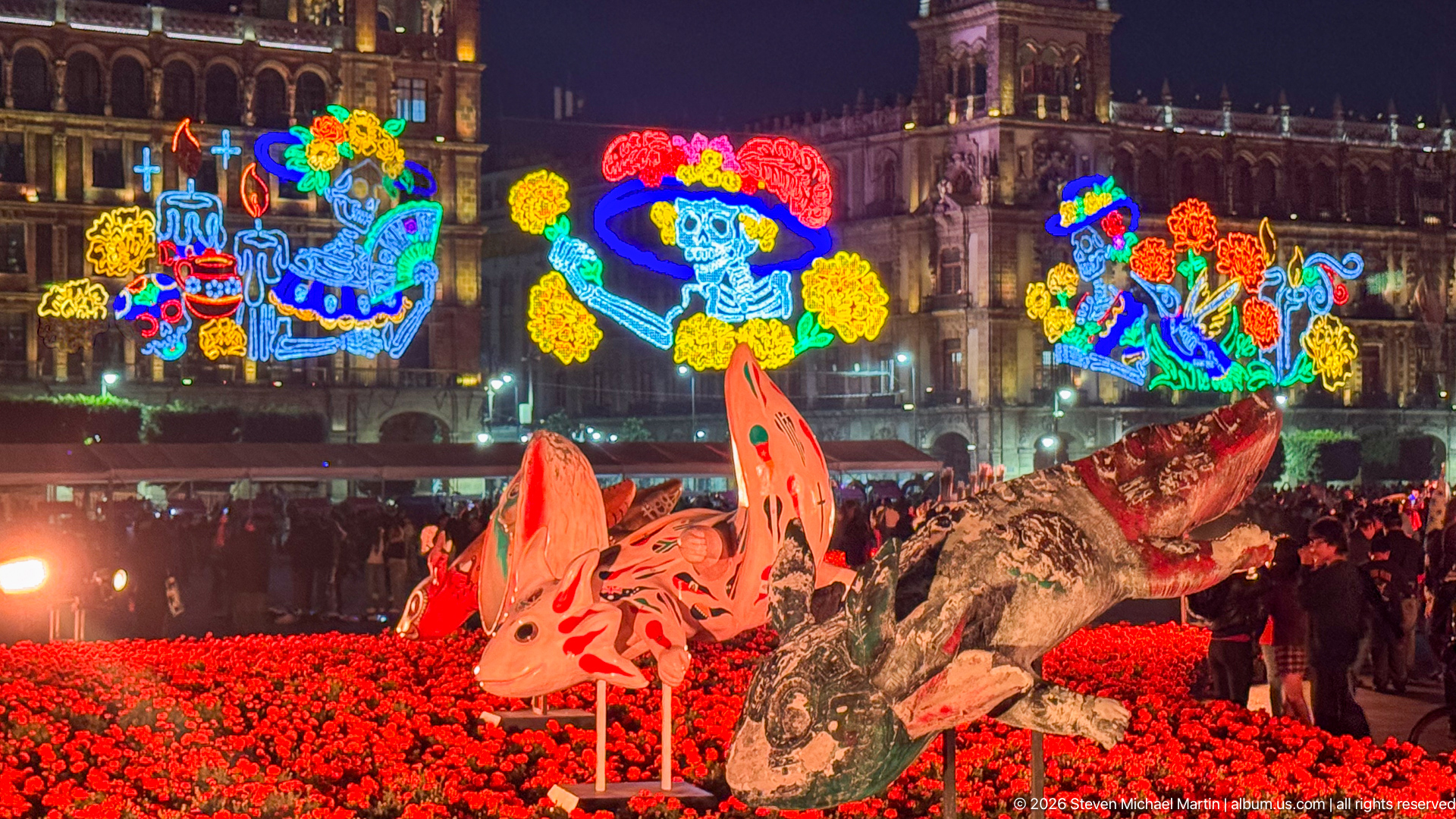
Two vividly colored skeleton-like figures appear above a thick bed of marigolds, their bright outlines set against the dark historic façades of the square. The tighter framing reveals individual floral shapes and the figures’ poses more clearly than the previous wide view. Visitors are reduced to a narrow band in the background, leaving the illuminated artwork and flowers to dominate the composition.
Caption
Two vividly colored skeleton-like figures appear above a thick bed of marigolds, their bright outlines set against the dark historic façades of the square. The tighter framing reveals individual floral shapes and the figures’ poses more clearly than the previous wide view. Visitors are reduced to a narrow band in the background, leaving the illuminated artwork and flowers to dominate the composition.
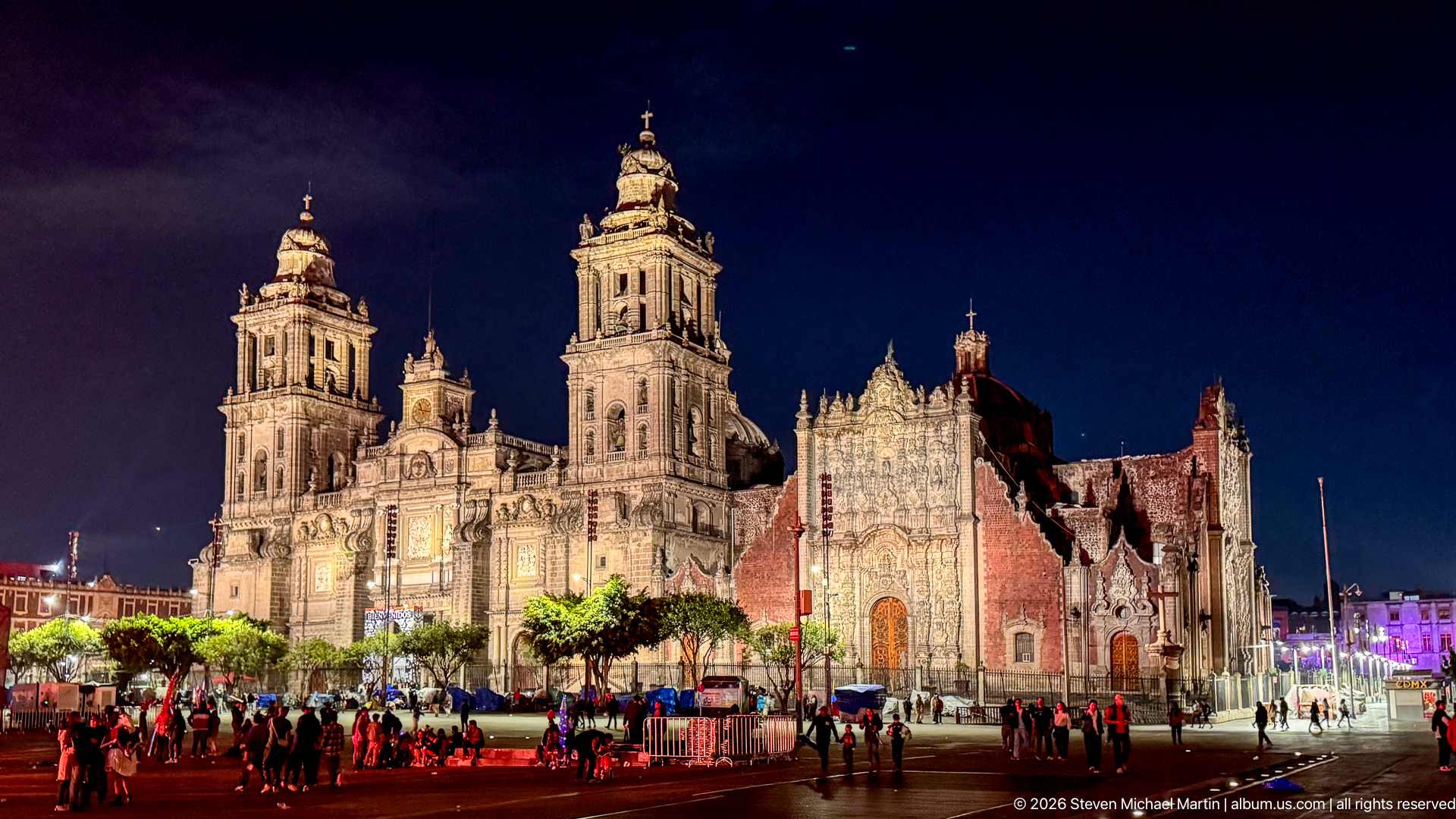
The Metropolitan Cathedral’s twin towers and bright central façade stand beside the smaller, more intricately profiled Sagrario Metropolitano. A line of trees and scattered visitors separates the churches from the open square, where red festival light washes the pavement. The wide nighttime view makes their different scales and architectural silhouettes legible within the same historic ensemble.
Caption
The Metropolitan Cathedral’s twin towers and bright central façade stand beside the smaller, more intricately profiled Sagrario Metropolitano. A line of trees and scattered visitors separates the churches from the open square, where red festival light washes the pavement. The wide nighttime view makes their different scales and architectural silhouettes legible within the same historic ensemble.
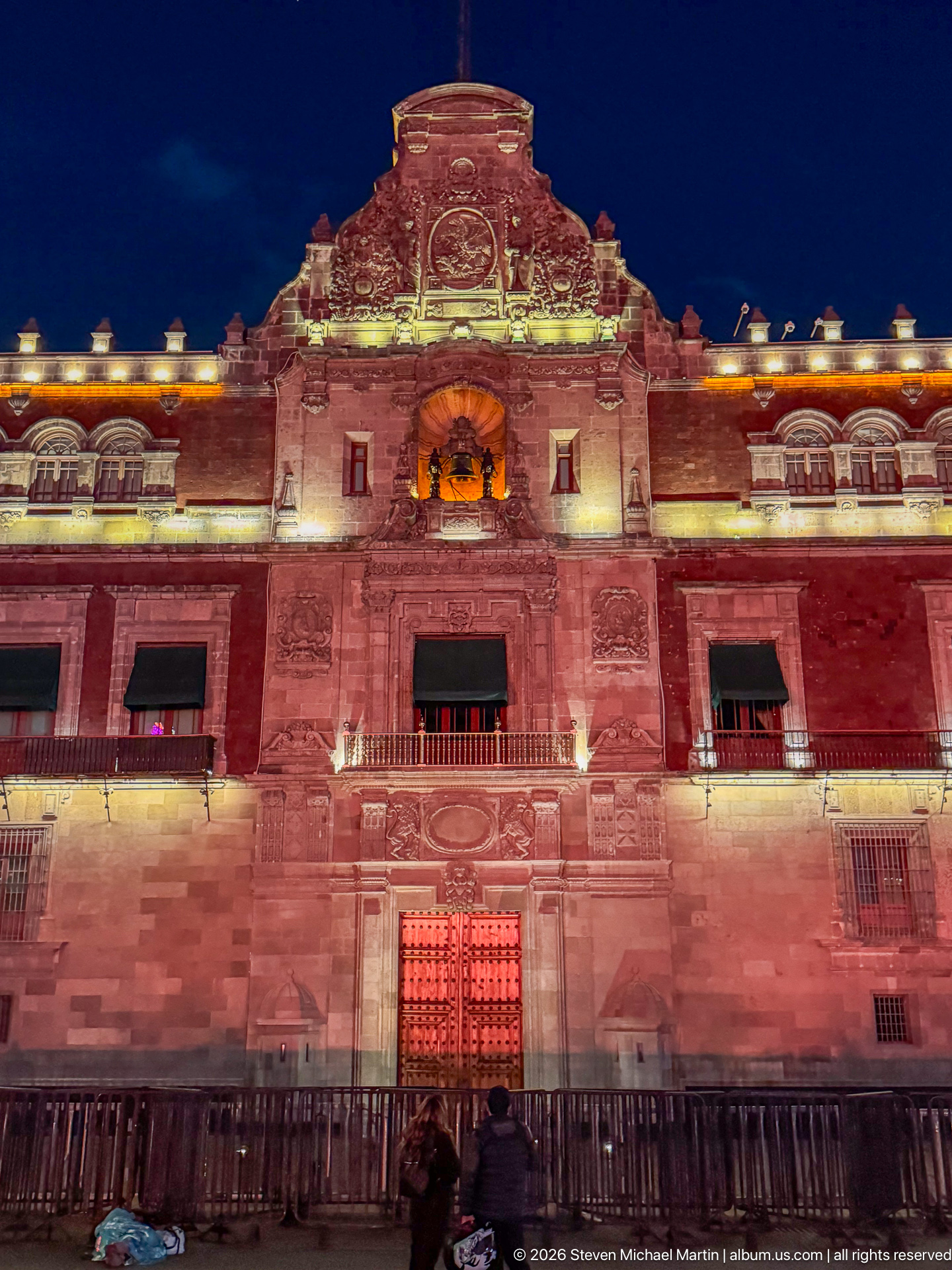
A long stone façade glows red beneath a dark blue sky, its central entrance set below a sculpted pediment and flanked by evenly spaced windows. Barriers line the street edge, and a few pedestrians appear as silhouettes in the foreground. The frontal composition emphasizes the building’s horizontal rhythm and monumental entry, though the proof sheet does not provide enough signage to confirm its precise name.
Caption
A long stone façade glows red beneath a dark blue sky, its central entrance set below a sculpted pediment and flanked by evenly spaced windows. Barriers line the street edge, and a few pedestrians appear as silhouettes in the foreground. The frontal composition emphasizes the building’s horizontal rhythm and monumental entry, though the proof sheet does not provide enough signage to confirm its precise name.
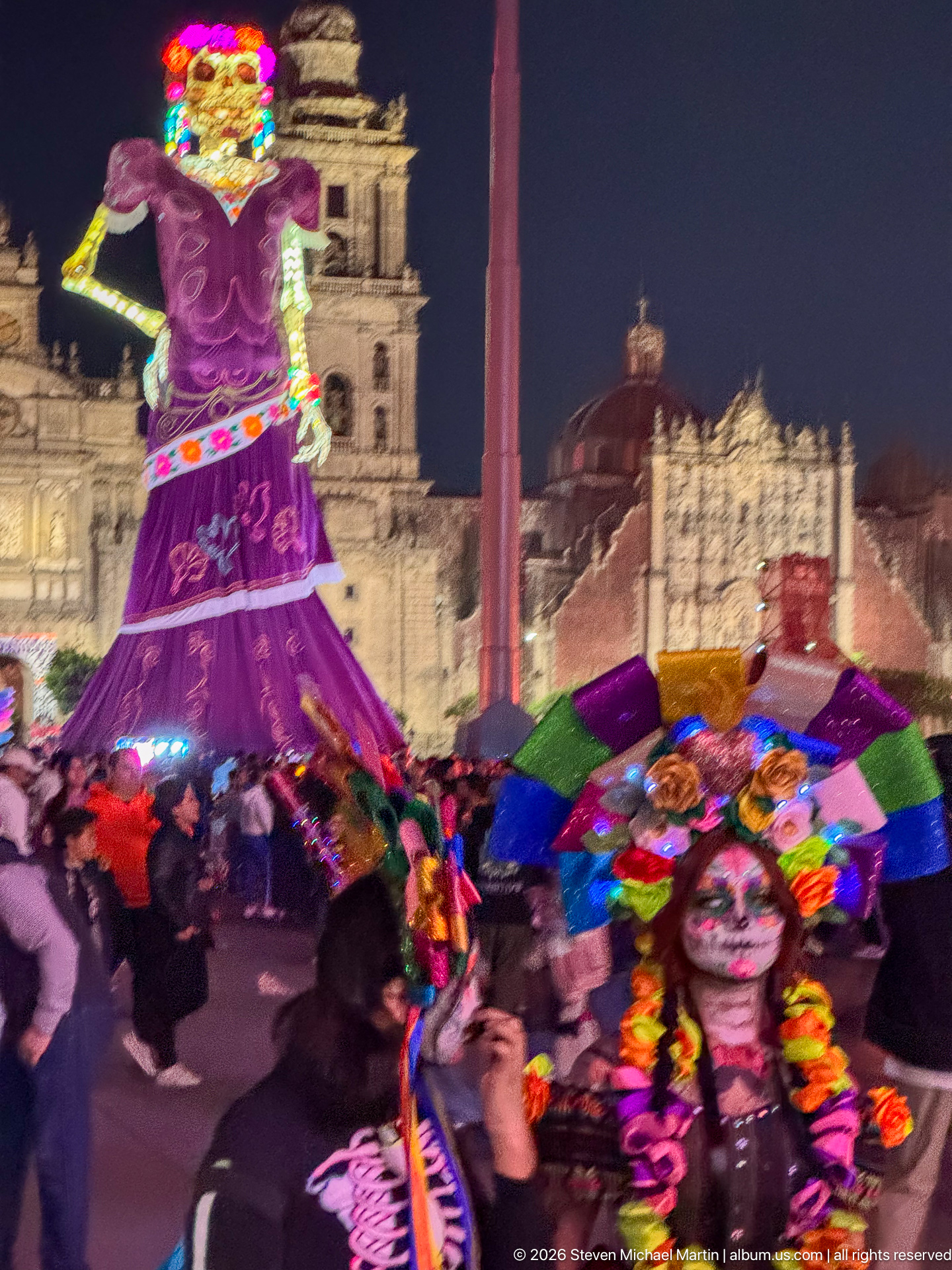
The cropped lower half of a towering purple Catrina rises over people moving through a densely decorated floral display. Her embroidered-looking dress, bright sash, and luminous skeletal hands contrast with the dark stone church façades behind her. The close, slightly tilted viewpoint places viewers at the installation’s base, emphasizing its height and the scale of the costume rather than the wider plaza.
Caption
The cropped lower half of a towering purple Catrina rises over people moving through a densely decorated floral display. Her embroidered-looking dress, bright sash, and luminous skeletal hands contrast with the dark stone church façades behind her. The close, slightly tilted viewpoint places viewers at the installation’s base, emphasizing its height and the scale of the costume rather than the wider plaza.
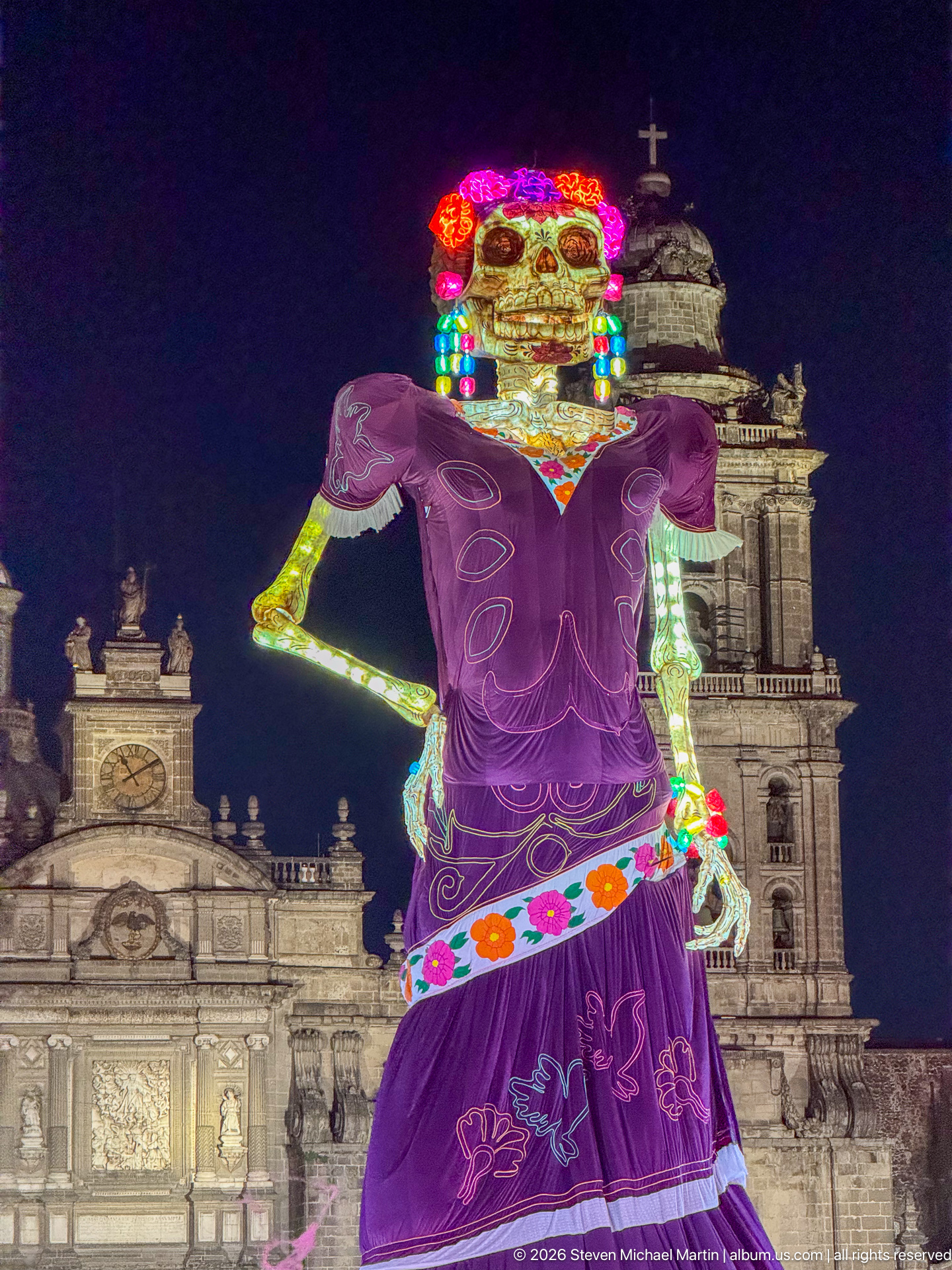
The Catrina’s purple dress and luminous skeletal face dominate this close view, with the cathedral’s towers and clock rising directly behind her. The juxtaposition makes the temporary figure appear almost architectural in scale, while colorful flowers and costume details soften its stark skull face. This portrait isolates the display from the broader crowd, focusing on the figure’s crafted appearance and setting.
Caption
The Catrina’s purple dress and luminous skeletal face dominate this close view, with the cathedral’s towers and clock rising directly behind her. The juxtaposition makes the temporary figure appear almost architectural in scale, while colorful flowers and costume details soften its stark skull face. This portrait isolates the display from the broader crowd, focusing on the figure’s crafted appearance and setting.
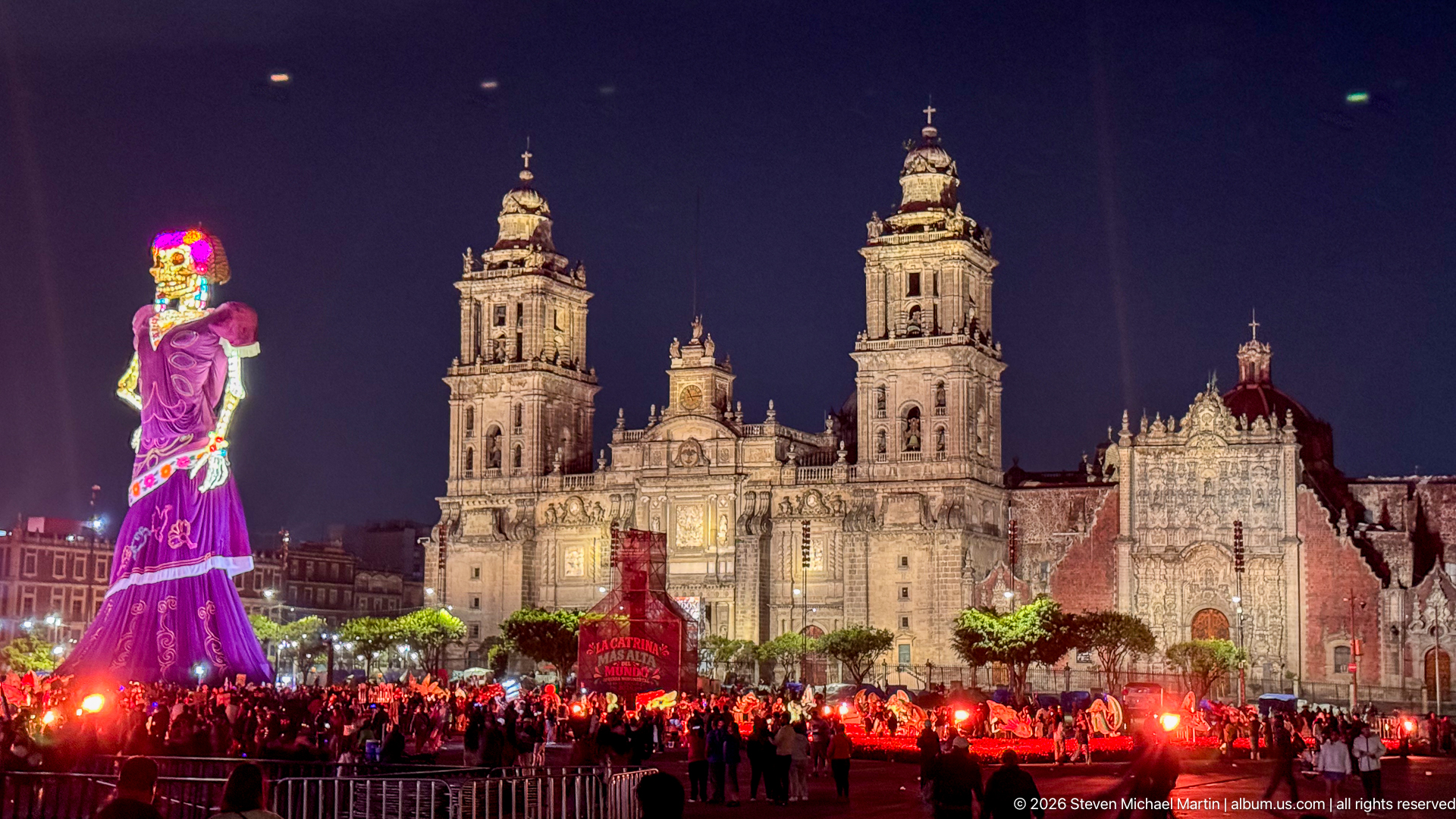
The cathedral fills the rear of the square as a towering Catrina stands left of center above a dense crowd. Bright red lighting spills across the foreground, where barriers guide visitors through the event space. This expansive view balances the temporary figure against the permanent church façade, showing both the landmark’s scale and the mass gathering that surrounds the Día de Muertos display.
Caption
The cathedral fills the rear of the square as a towering Catrina stands left of center above a dense crowd. Bright red lighting spills across the foreground, where barriers guide visitors through the event space. This expansive view balances the temporary figure against the permanent church façade, showing both the landmark’s scale and the mass gathering that surrounds the Día de Muertos display.
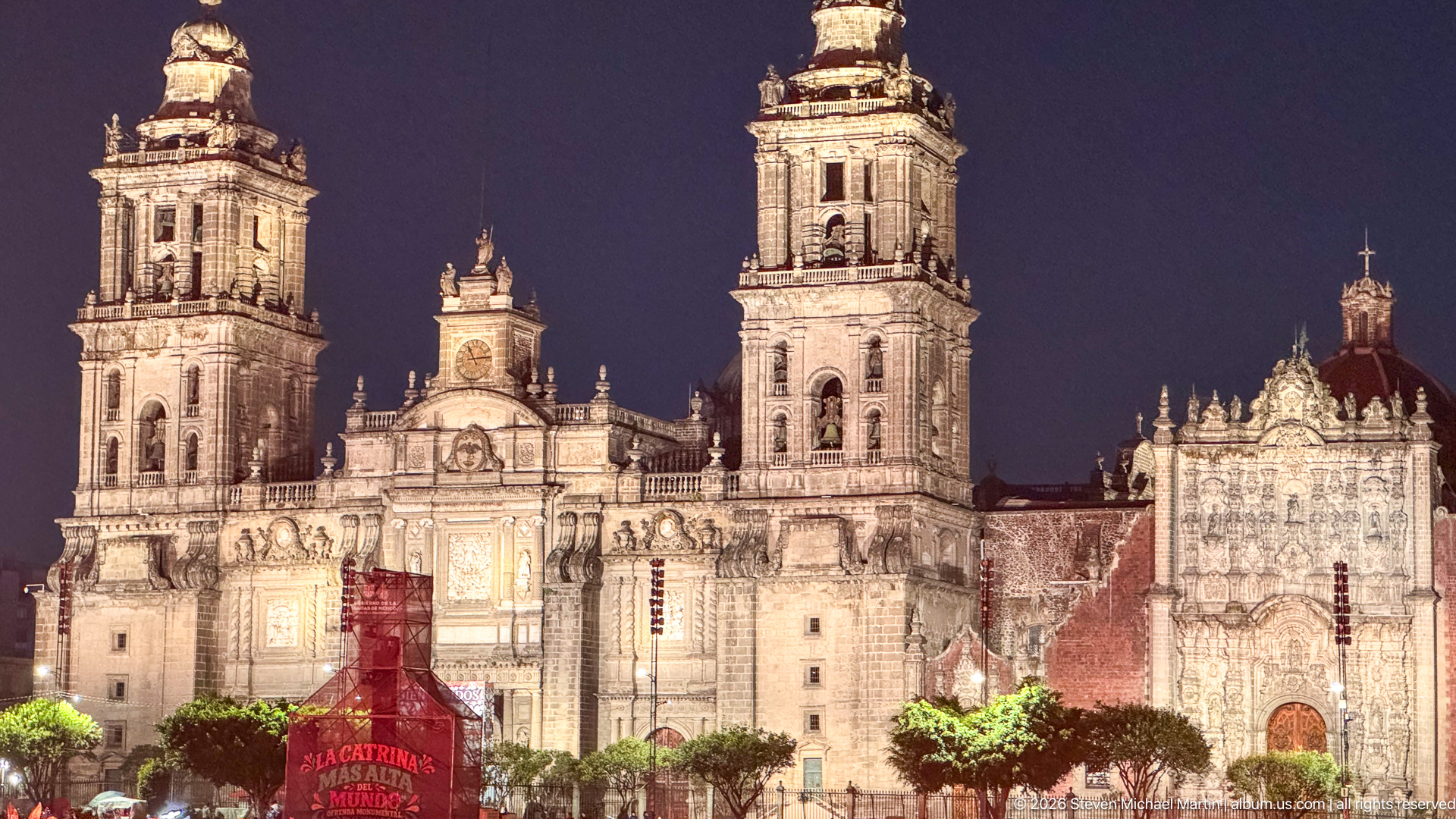
The cathedral’s two bell towers dominate a tighter view, their illuminated stonework rising above the clock, central façade, and adjoining church. At the bottom edge, a red festival sign and treetops provide a reminder of the event beyond the architectural subject. The crop concentrates on the towers’ vertical rhythm and carved upper stages, distinct from the crowd-filled views nearby.
Caption
The cathedral’s two bell towers dominate a tighter view, their illuminated stonework rising above the clock, central façade, and adjoining church. At the bottom edge, a red festival sign and treetops provide a reminder of the event beyond the architectural subject. The crop concentrates on the towers’ vertical rhythm and carved upper stages, distinct from the crowd-filled views nearby.
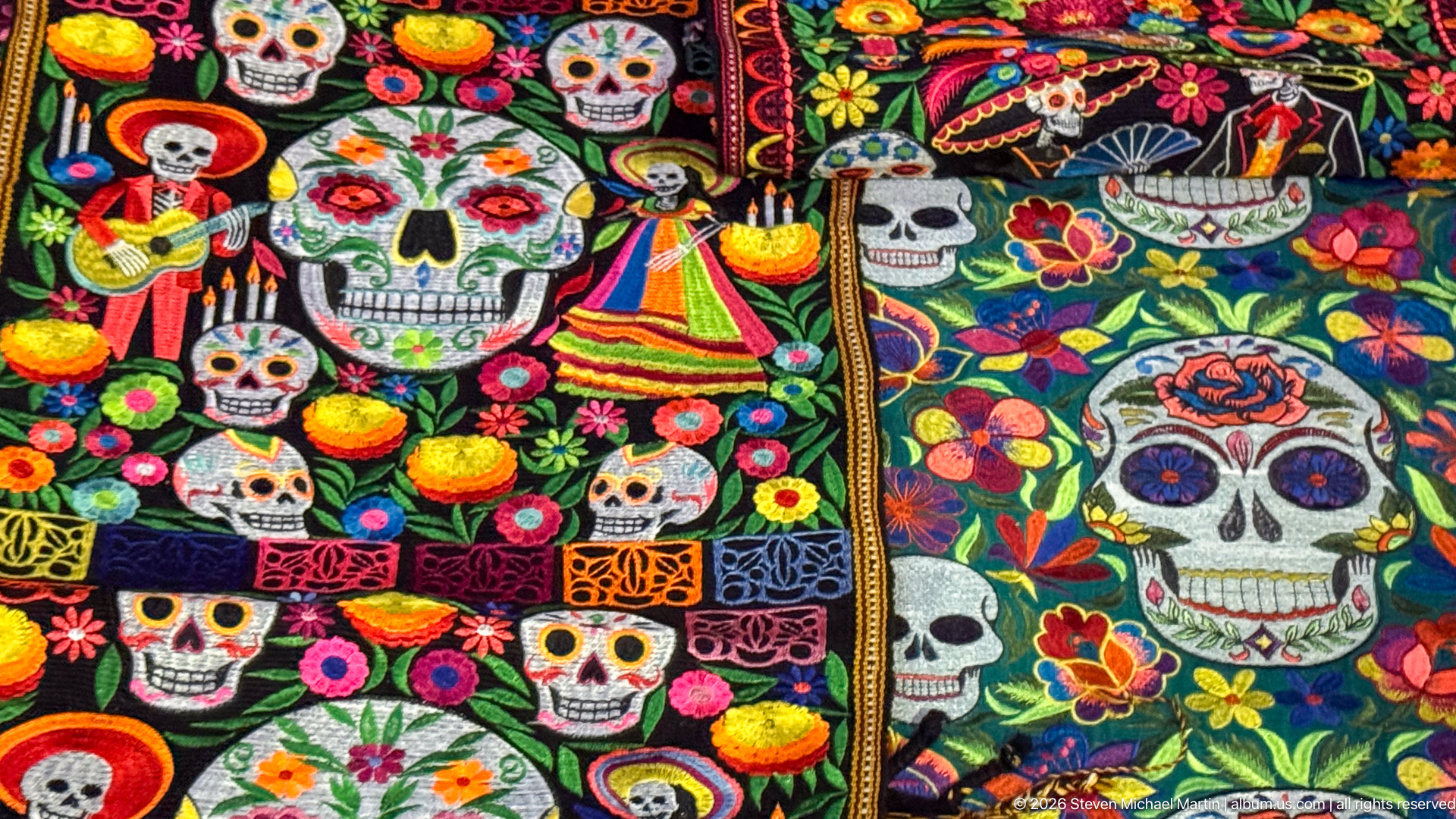
Bright embroidered panels fill the frame with repeated skulls, skeletons, flowers, and decorative borders in saturated pink, green, blue, yellow, and orange. The close view reveals dense handworked patterns and several distinct compositions arranged side by side. It shifts from the scale of the plaza installations to portable craft objects, showing Día de Muertos imagery in textile form.
Caption
Bright embroidered panels fill the frame with repeated skulls, skeletons, flowers, and decorative borders in saturated pink, green, blue, yellow, and orange. The close view reveals dense handworked patterns and several distinct compositions arranged side by side. It shifts from the scale of the plaza installations to portable craft objects, showing Día de Muertos imagery in textile form.
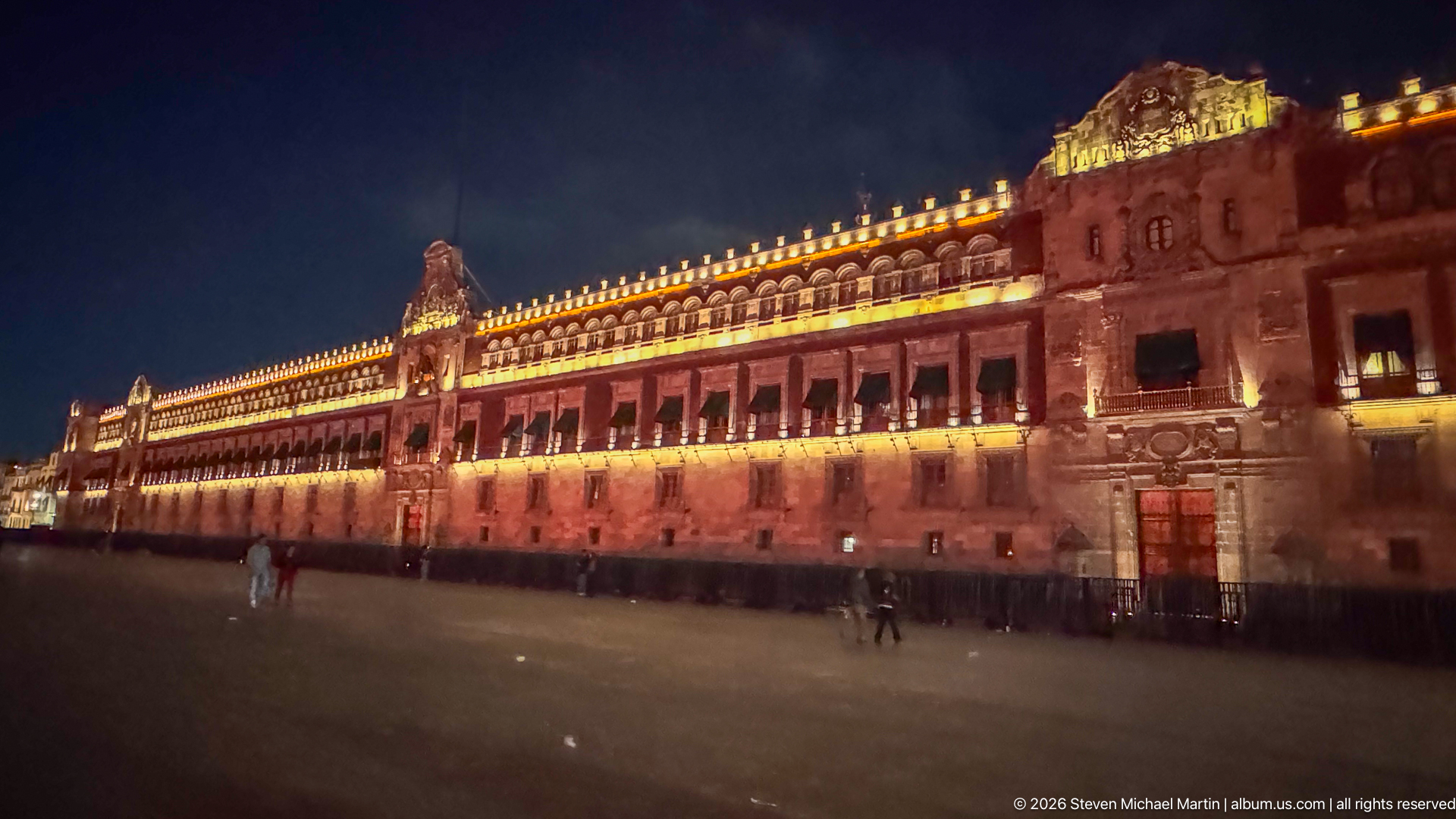
A long government-style façade stretches across the square, its upper cornice traced by warm lights and its stone lower story receding into shadow. A few pedestrians cross the open pavement, giving the building’s scale a human measure. The oblique view emphasizes the uninterrupted length of the architecture and the contrast between its illuminated roofline and darker street-level openings.
Caption
A long government-style façade stretches across the square, its upper cornice traced by warm lights and its stone lower story receding into shadow. A few pedestrians cross the open pavement, giving the building’s scale a human measure. The oblique view emphasizes the uninterrupted length of the architecture and the contrast between its illuminated roofline and darker street-level openings.
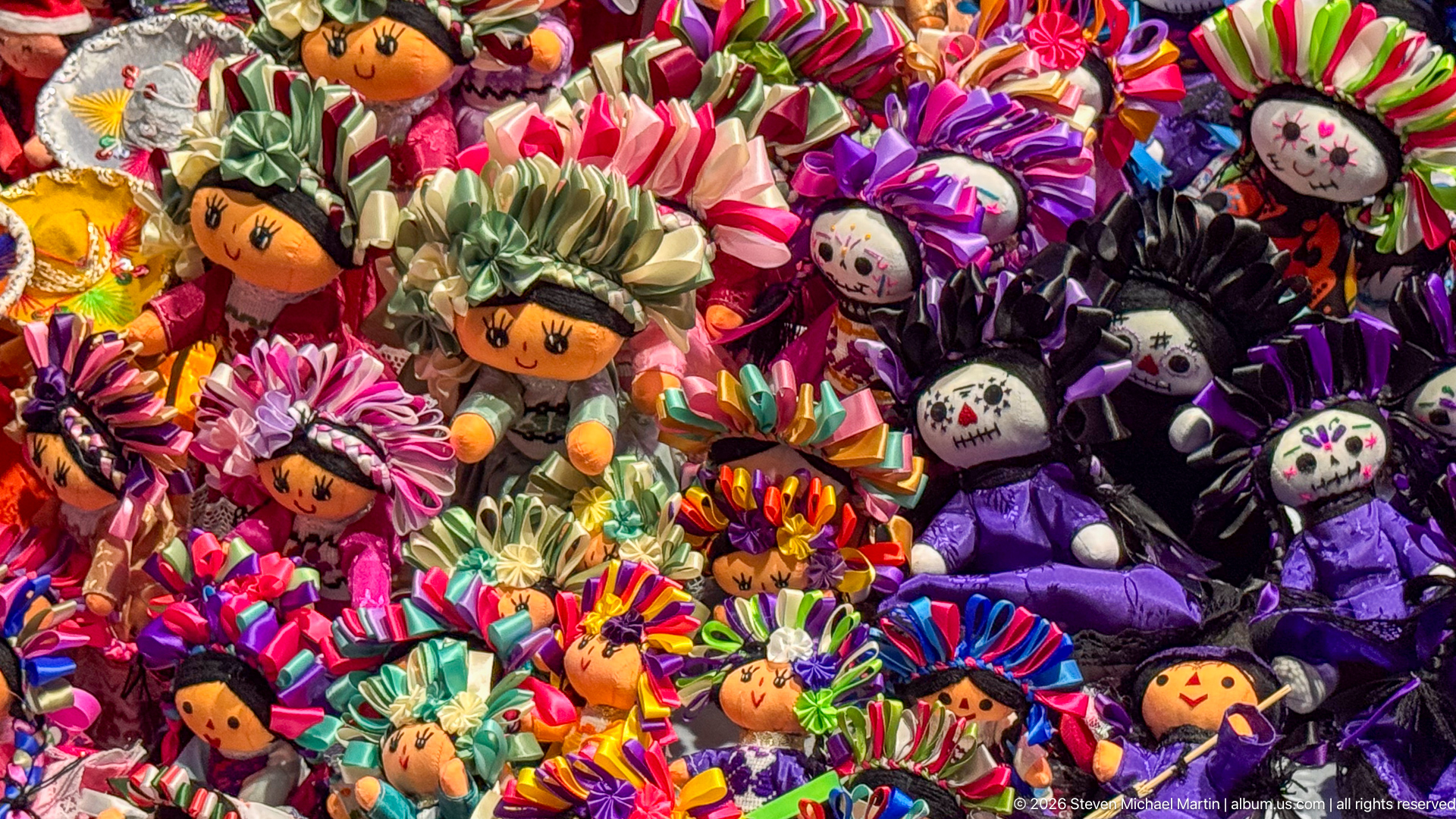
Rows of handmade dolls crowd the display, with fabric Catrinas in bright dresses and skeleton-faced figures in black and purple garments. Their elaborate ribboned hats and flower-like headpieces create a dense field of color, while repeated faces and costumes make the craft’s seasonal theme unmistakable. The close framing removes the stall setting and focuses on the variety of figures offered for sale.
Caption
Rows of handmade dolls crowd the display, with fabric Catrinas in bright dresses and skeleton-faced figures in black and purple garments. Their elaborate ribboned hats and flower-like headpieces create a dense field of color, while repeated faces and costumes make the craft’s seasonal theme unmistakable. The close framing removes the stall setting and focuses on the variety of figures offered for sale.
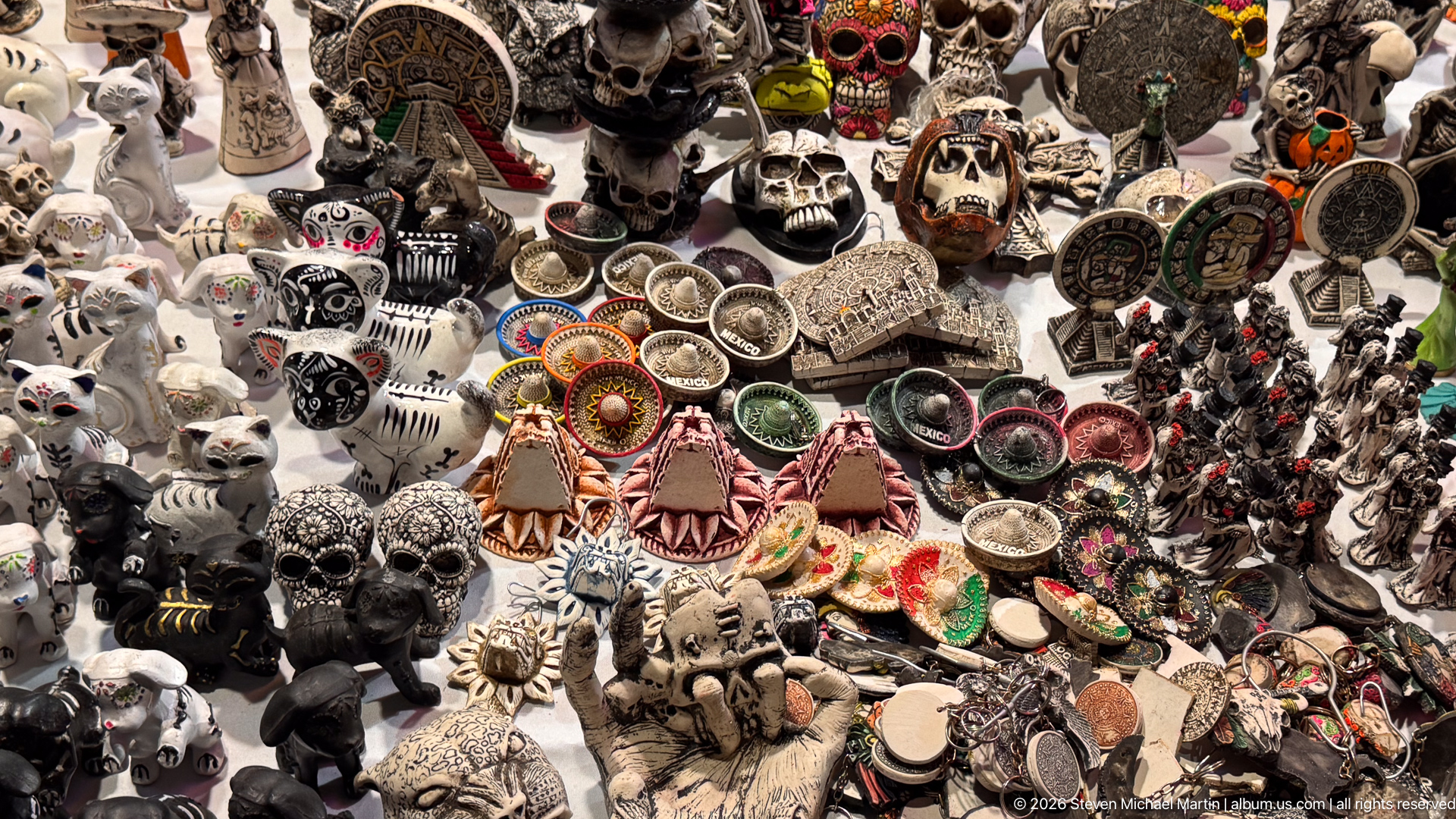
A tightly packed market table displays painted skulls, masks, small figures, miniature instruments, and carved ornaments in black, white, and bright colors. Repeated calavera faces sit alongside animal-like forms and circular medallions, creating a varied inventory of Día de Muertos souvenirs. The high angle makes the abundance and range of objects the subject, rather than any single craft item.
Caption
A tightly packed market table displays painted skulls, masks, small figures, miniature instruments, and carved ornaments in black, white, and bright colors. Repeated calavera faces sit alongside animal-like forms and circular medallions, creating a varied inventory of Día de Muertos souvenirs. The high angle makes the abundance and range of objects the subject, rather than any single craft item.
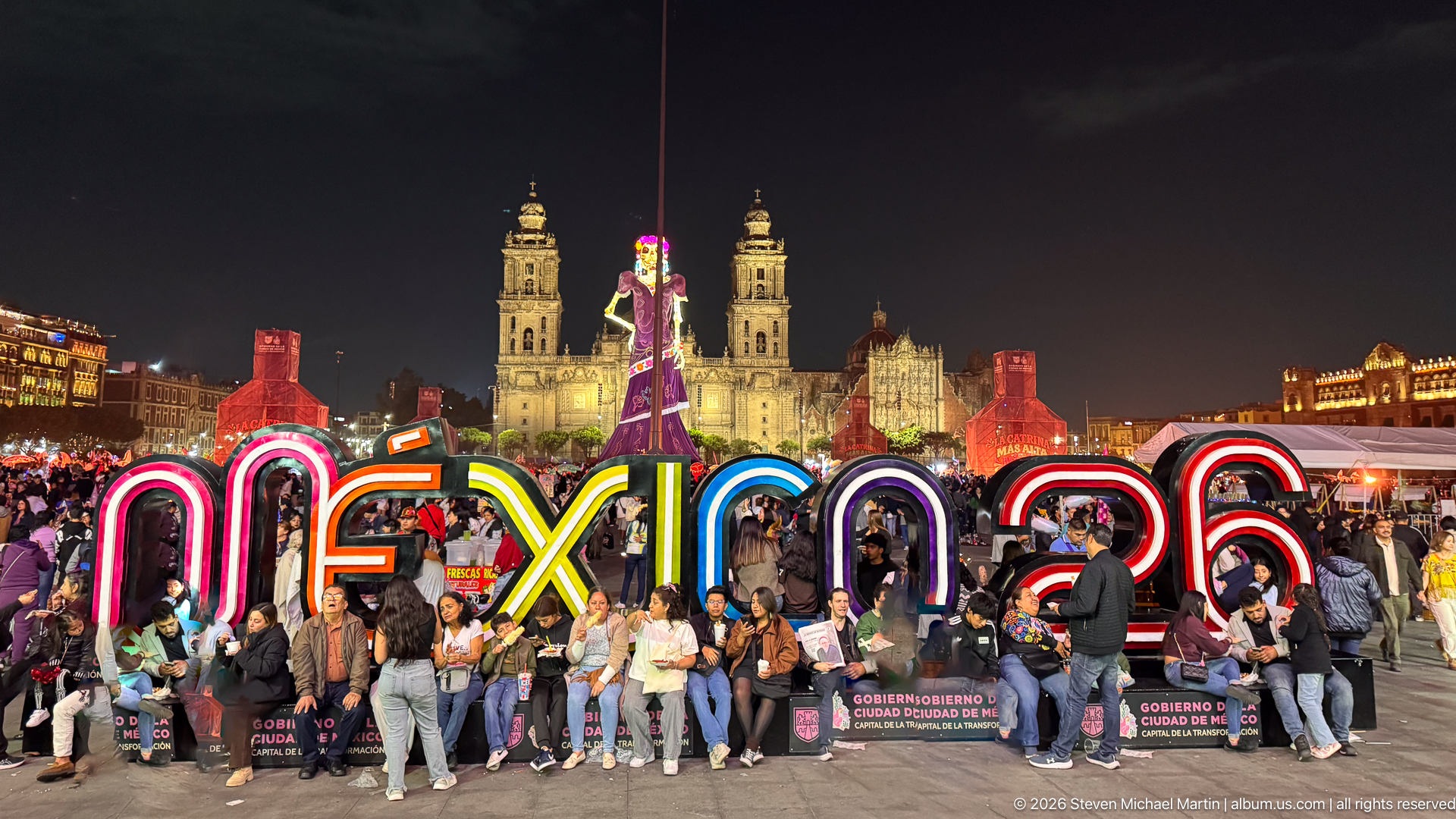
A group poses along oversized multicolored letters spelling “Mexico,” with the Metropolitan Cathedral and a historic government façade behind them. The plaza’s festive lighting and Día de Muertos installations remain visible at the edges, but the people and civic sign form the foreground focus. The image records a shared visitor moment within the larger nighttime celebration.
Caption
A group poses along oversized multicolored letters spelling “Mexico,” with the Metropolitan Cathedral and a historic government façade behind them. The plaza’s festive lighting and Día de Muertos installations remain visible at the edges, but the people and civic sign form the foreground focus. The image records a shared visitor moment within the larger nighttime celebration.
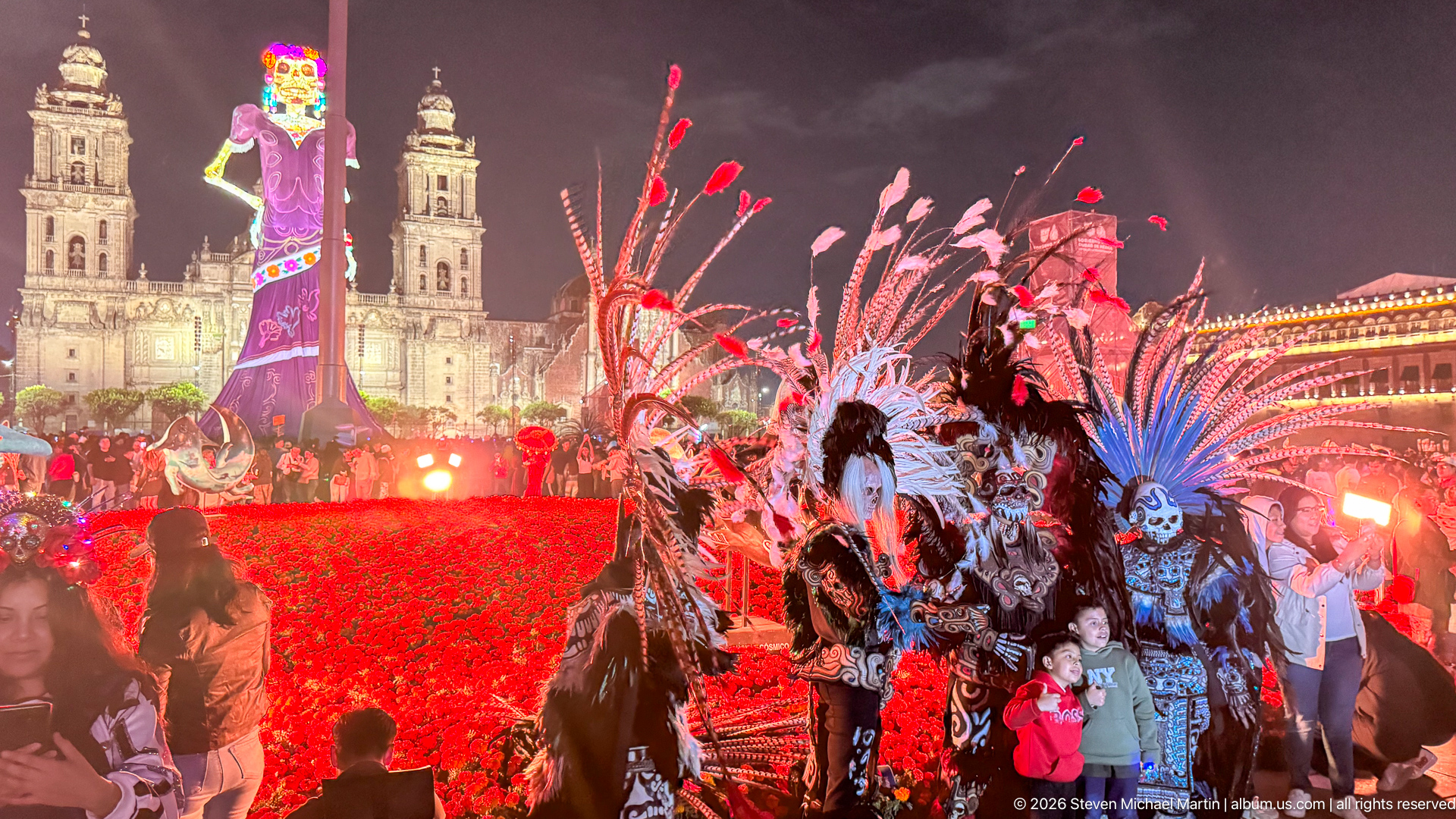
Several performers in feathered headdresses and dark patterned costumes gather beside a brilliant bed of marigolds as visitors watch and pose for photographs. The towering Catrina and cathedral remain visible behind them, placing the encounter within the Zócalo celebration. The foreground interaction shifts attention from static decorations to live performance and the crowd’s participation.
Caption
Several performers in feathered headdresses and dark patterned costumes gather beside a brilliant bed of marigolds as visitors watch and pose for photographs. The towering Catrina and cathedral remain visible behind them, placing the encounter within the Zócalo celebration. The foreground interaction shifts attention from static decorations to live performance and the crowd’s participation.
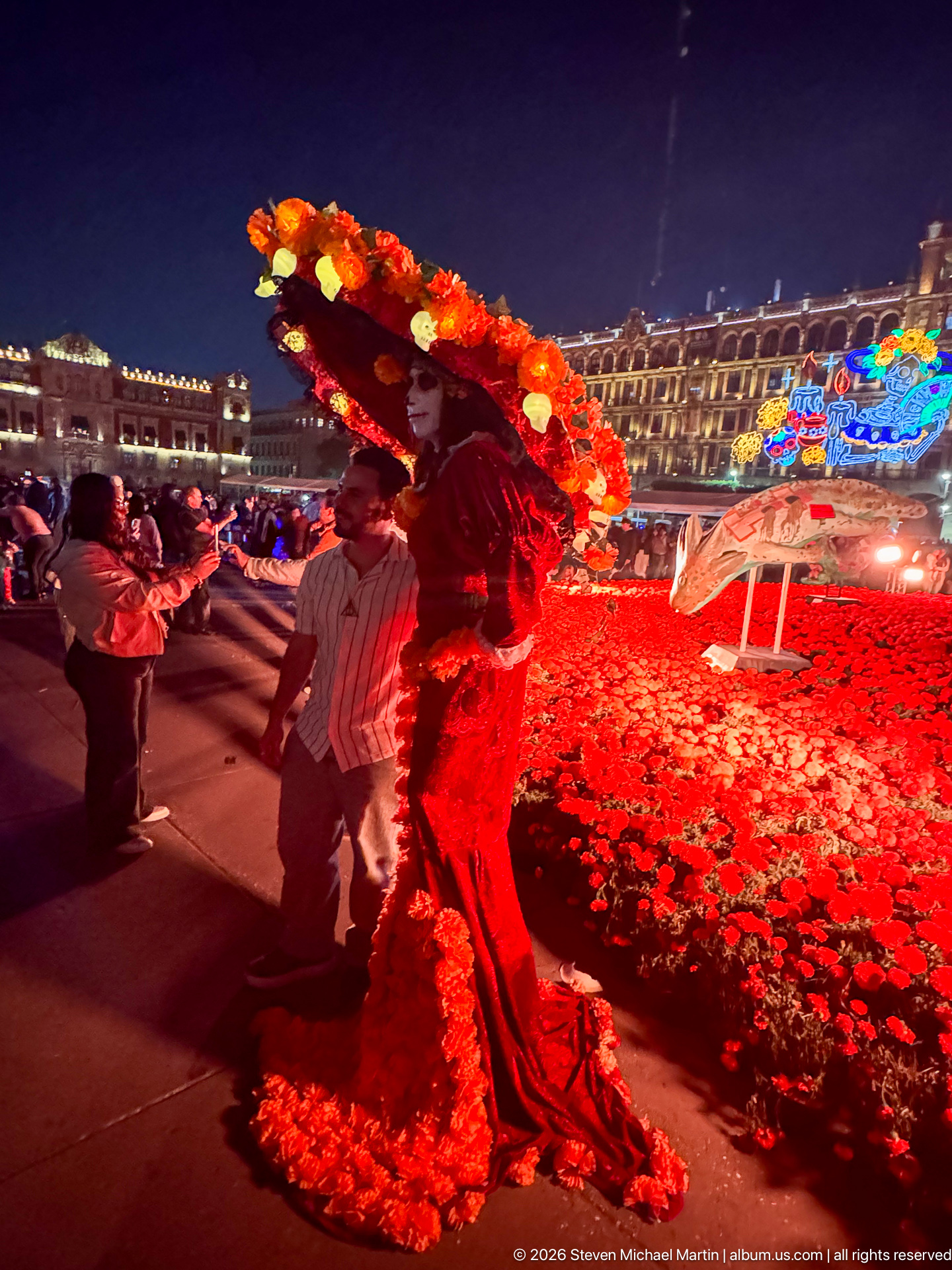
A costumed participant wearing a broad red-and-orange feathered headdress stands beside a thick bed of marigolds, while visitors photograph the scene. A carved or painted fish-like figure projects from the flowers at right, and bright festival lights tint the square red. The close viewpoint emphasizes the participant’s elaborate headpiece and the encounter between live costume and staged decoration.
Caption
A costumed participant wearing a broad red-and-orange feathered headdress stands beside a thick bed of marigolds, while visitors photograph the scene. A carved or painted fish-like figure projects from the flowers at right, and bright festival lights tint the square red. The close viewpoint emphasizes the participant’s elaborate headpiece and the encounter between live costume and staged decoration.
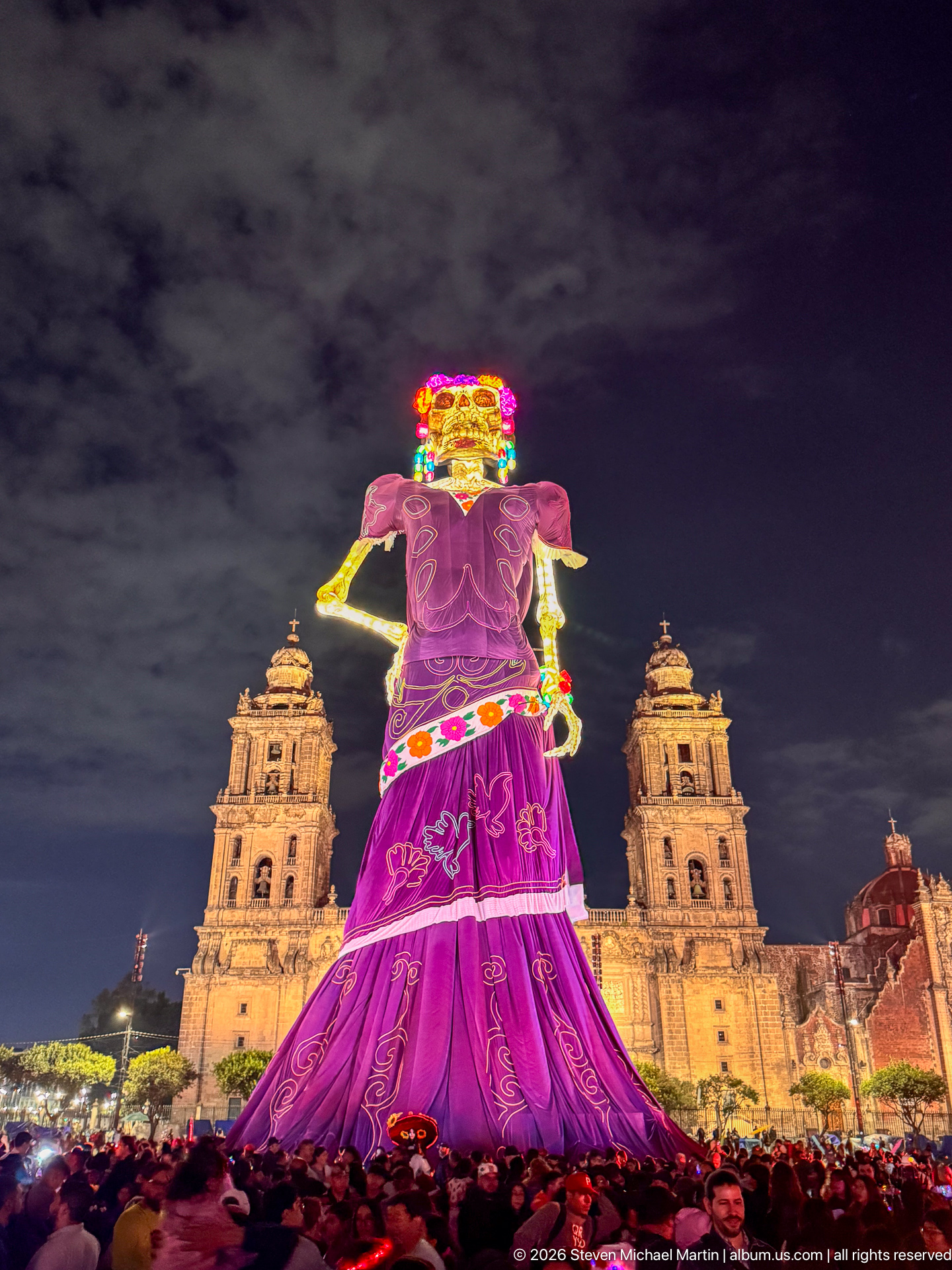
Seen from behind at plaza level, a monumental Catrina rises above the crowd in a sweeping purple dress embroidered with pale floral and scroll designs. Her bright skeletal head and floral sash stand out against the night sky, with the Metropolitan Cathedral’s twin towers framing the figure. The low viewpoint turns the installation into a dramatic meeting of festival sculpture and historic landmark.
Caption
Seen from behind at plaza level, a monumental Catrina rises above the crowd in a sweeping purple dress embroidered with pale floral and scroll designs. Her bright skeletal head and floral sash stand out against the night sky, with the Metropolitan Cathedral’s twin towers framing the figure. The low viewpoint turns the installation into a dramatic meeting of festival sculpture and historic landmark.
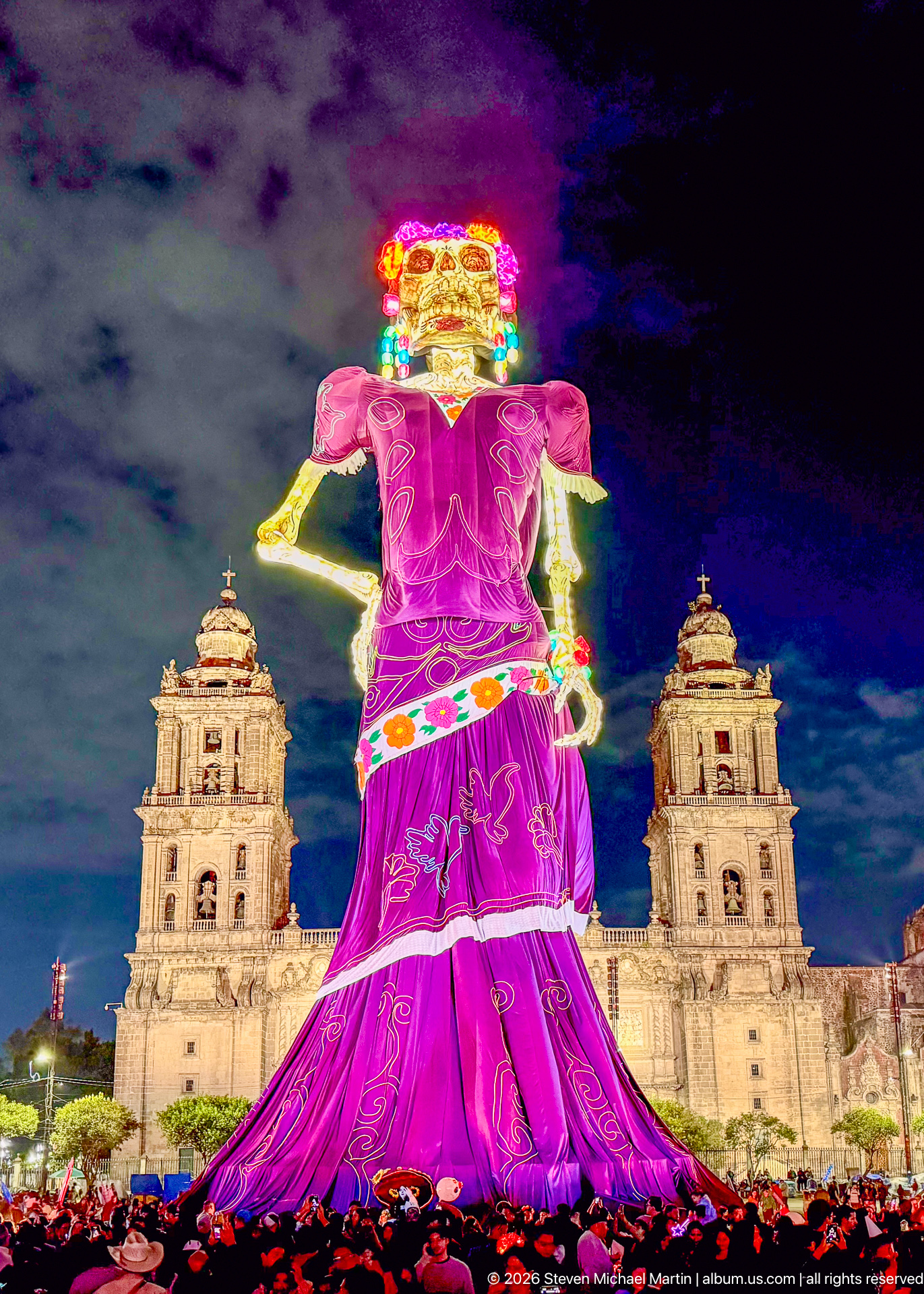
From within the spectators, the Catrina’s purple skirt spreads across the lower half of the composition while the Cathedral’s two illuminated towers rise behind her. The crowd forms a dark, irregular foreground, emphasizing the difference between human scale and the towering festival figure. Clouds catch violet and blue light overhead, adding atmosphere without obscuring the historic façade.
Caption
From within the spectators, the Catrina’s purple skirt spreads across the lower half of the composition while the Cathedral’s two illuminated towers rise behind her. The crowd forms a dark, irregular foreground, emphasizing the difference between human scale and the towering festival figure. Clouds catch violet and blue light overhead, adding atmosphere without obscuring the historic façade.
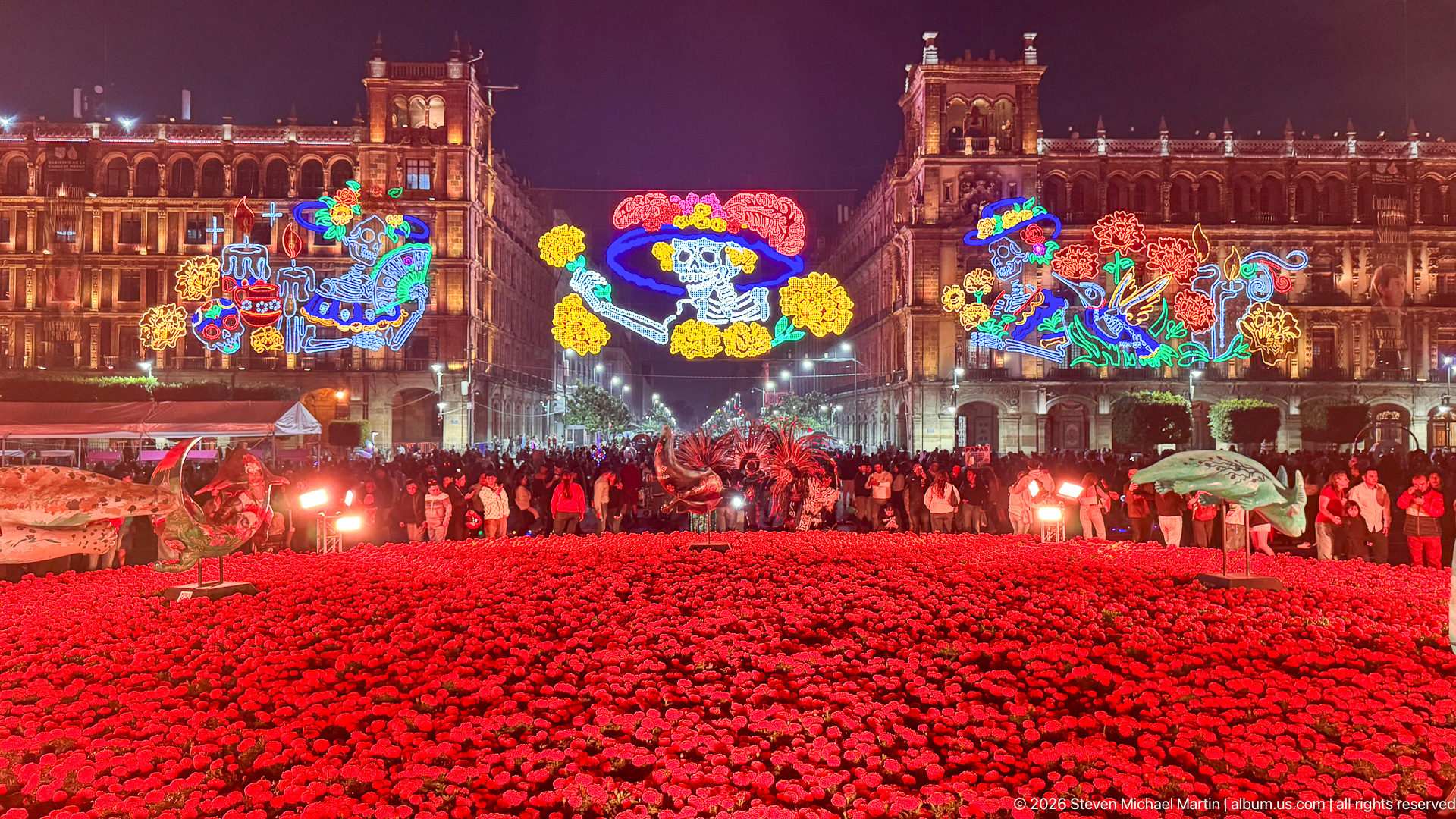
A broad bed of orange marigolds fills nearly half the frame, forming a vivid foreground beneath illuminated skeleton and floral designs projected or mounted across the surrounding façades. Visitors line the far edge of the flowers, where the square’s architecture frames the temporary display. The low viewpoint makes the flowers feel expansive and connects the decorative imagery across the plaza.
Caption
A broad bed of orange marigolds fills nearly half the frame, forming a vivid foreground beneath illuminated skeleton and floral designs projected or mounted across the surrounding façades. Visitors line the far edge of the flowers, where the square’s architecture frames the temporary display. The low viewpoint makes the flowers feel expansive and connects the decorative imagery across the plaza.
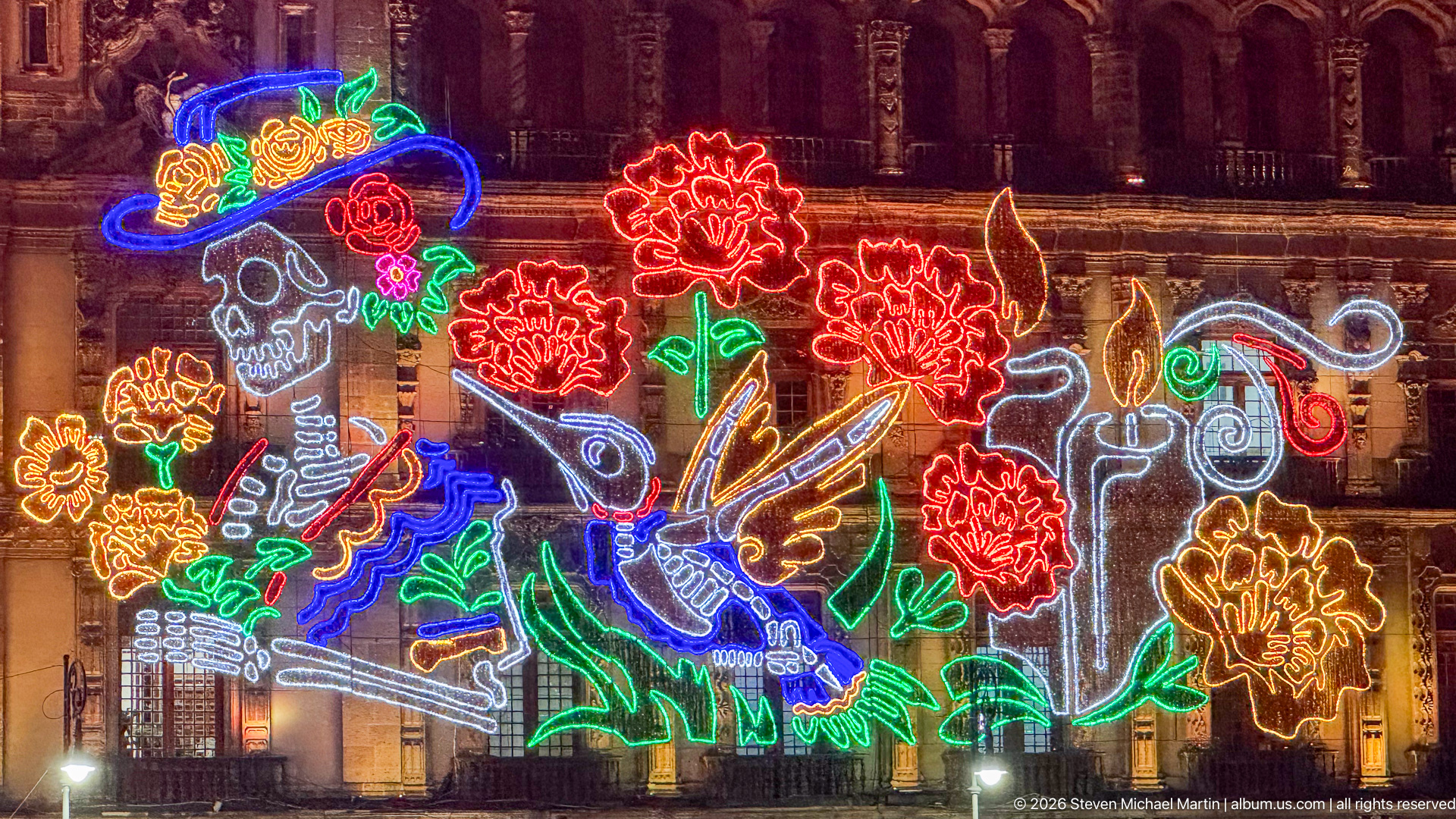
A large illuminated skeleton and flower composition spans the lower façade of a historic building. The white skull and ribcage sit among bright red blooms, green leaves, and curling blue forms, with lit windows and stone columns visible behind the design. The frontal view makes the light artwork read as a broad ornamental panel integrated with the building’s nighttime frontage.
Caption
A large illuminated skeleton and flower composition spans the lower façade of a historic building. The white skull and ribcage sit among bright red blooms, green leaves, and curling blue forms, with lit windows and stone columns visible behind the design. The frontal view makes the light artwork read as a broad ornamental panel integrated with the building’s nighttime frontage.
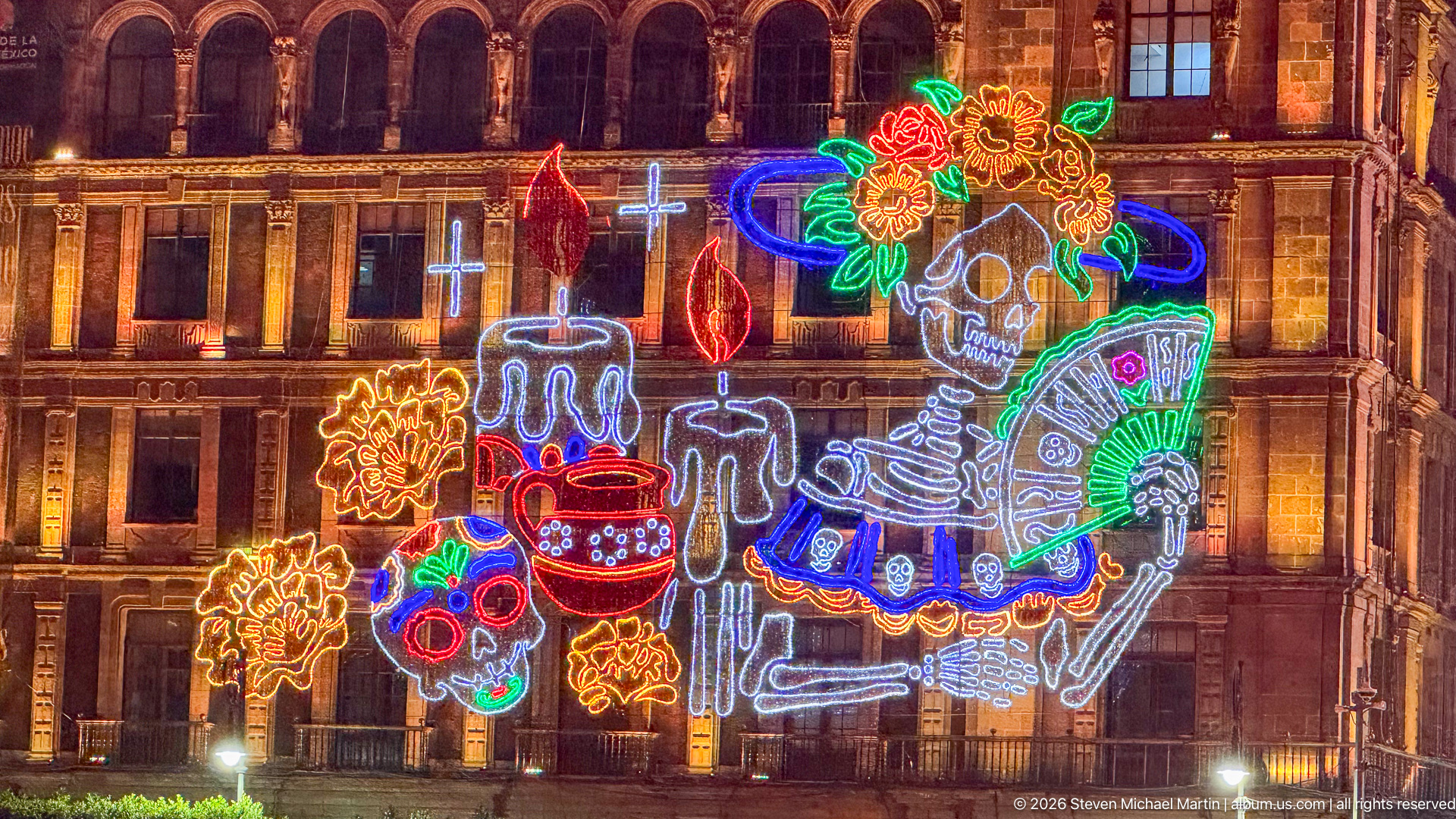
A glowing calavera with a flowered headdress anchors this illuminated Día de Muertos composition, accompanied by candle forms and bright floral motifs. The artwork is set against the tall windows and stone courses of a historic façade, which gives the light display a clear architectural scale. This closer crop centers the skull and candles, distinct from the wider skeletal scene on the neighboring view.
Caption
A glowing calavera with a flowered headdress anchors this illuminated Día de Muertos composition, accompanied by candle forms and bright floral motifs. The artwork is set against the tall windows and stone courses of a historic façade, which gives the light display a clear architectural scale. This closer crop centers the skull and candles, distinct from the wider skeletal scene on the neighboring view.
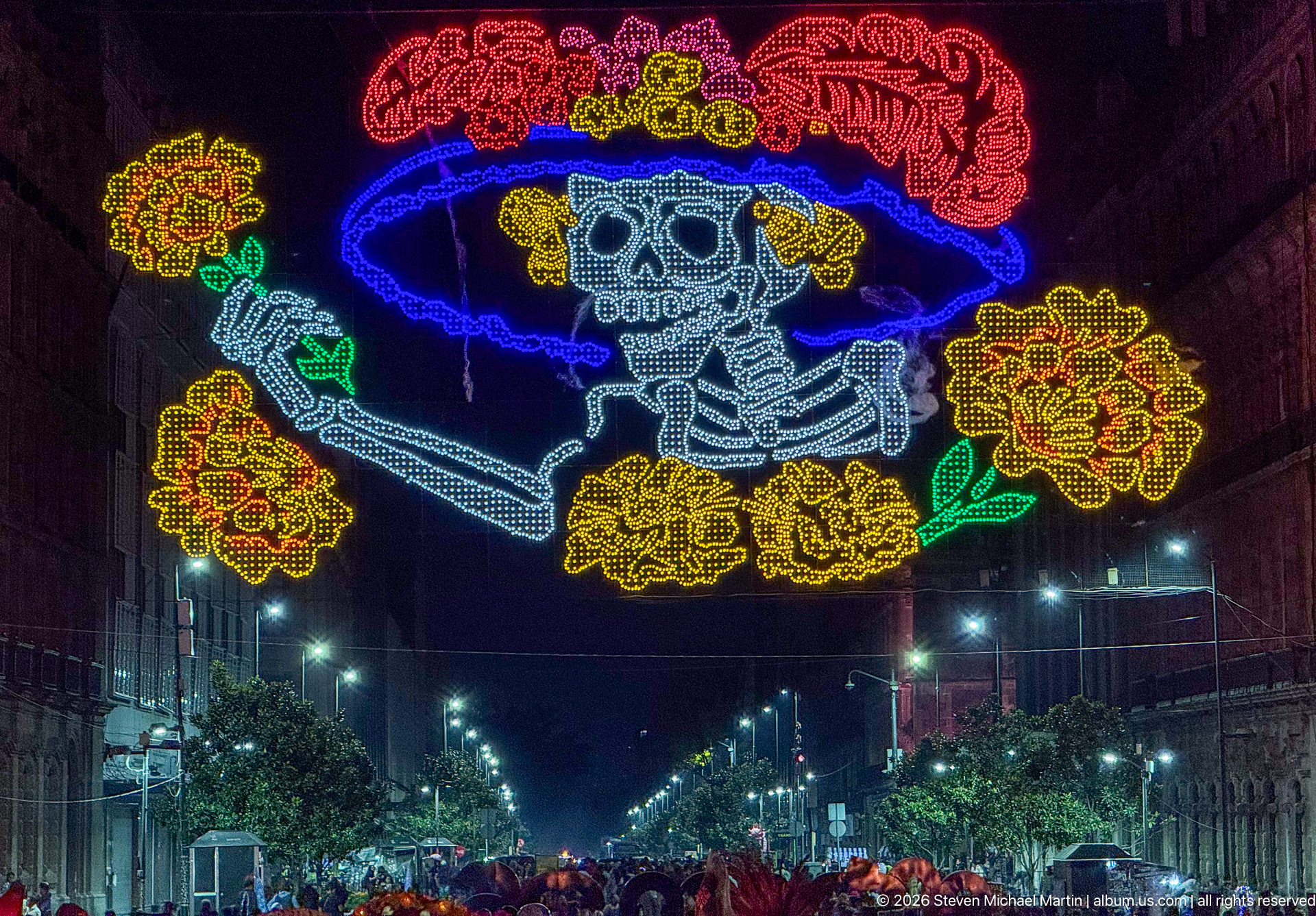
A luminous skeleton stretches across the street inside a blue oval, surrounded by bright marigold clusters and a red floral band. The view looks upward between dark façades, so the suspended decoration appears to bridge the buildings above the moving crowd. Its graphic outlines and saturated colors make this a close study of the festival lighting rather than a general view of the square.
Caption
A luminous skeleton stretches across the street inside a blue oval, surrounded by bright marigold clusters and a red floral band. The view looks upward between dark façades, so the suspended decoration appears to bridge the buildings above the moving crowd. Its graphic outlines and saturated colors make this a close study of the festival lighting rather than a general view of the square.
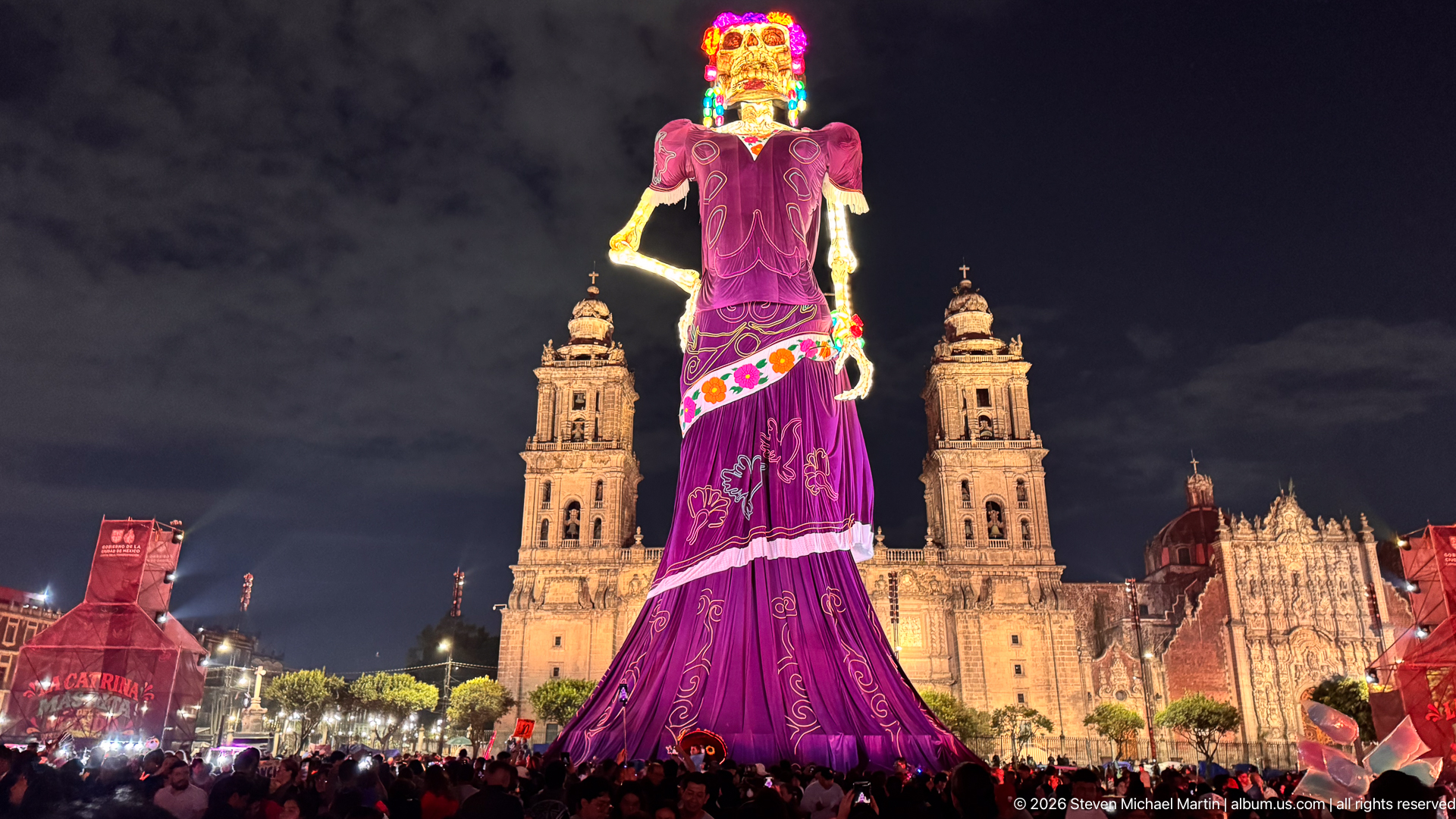
The monumental Catrina faces the square in a vivid fuchsia gown, her illuminated skull rising between the Metropolitan Cathedral’s bell towers. From this wider, frontal position, the figure’s great height is set against the cathedral façade and the dense line of spectators at its base. The image records how Día de Muertos installations transform the Zócalo into a shared public spectacle.
Caption
The monumental Catrina faces the square in a vivid fuchsia gown, her illuminated skull rising between the Metropolitan Cathedral’s bell towers. From this wider, frontal position, the figure’s great height is set against the cathedral façade and the dense line of spectators at its base. The image records how Día de Muertos installations transform the Zócalo into a shared public spectacle.
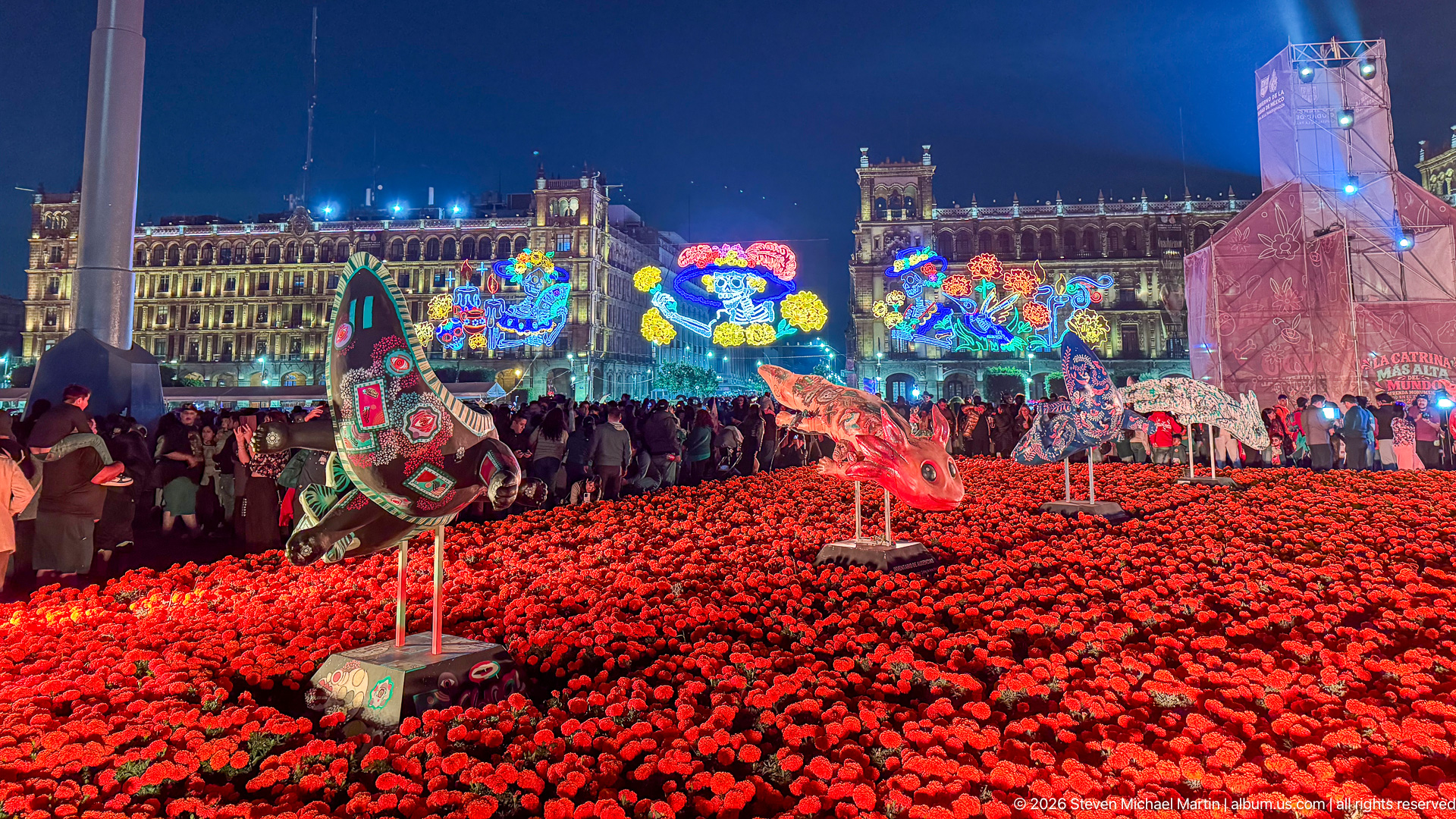
A deep field of orange marigolds fills the foreground, punctuated by brightly patterned animal sculptures on raised supports. Behind them, crowds gather beneath illuminated façades and skeletal light displays; a tall temporary tower stands at the square’s center. The layered composition connects floral tribute, fantastical folk-art forms, and the monumental urban setting in one nighttime festival scene.
Caption
A deep field of orange marigolds fills the foreground, punctuated by brightly patterned animal sculptures on raised supports. Behind them, crowds gather beneath illuminated façades and skeletal light displays; a tall temporary tower stands at the square’s center. The layered composition connects floral tribute, fantastical folk-art forms, and the monumental urban setting in one nighttime festival scene.
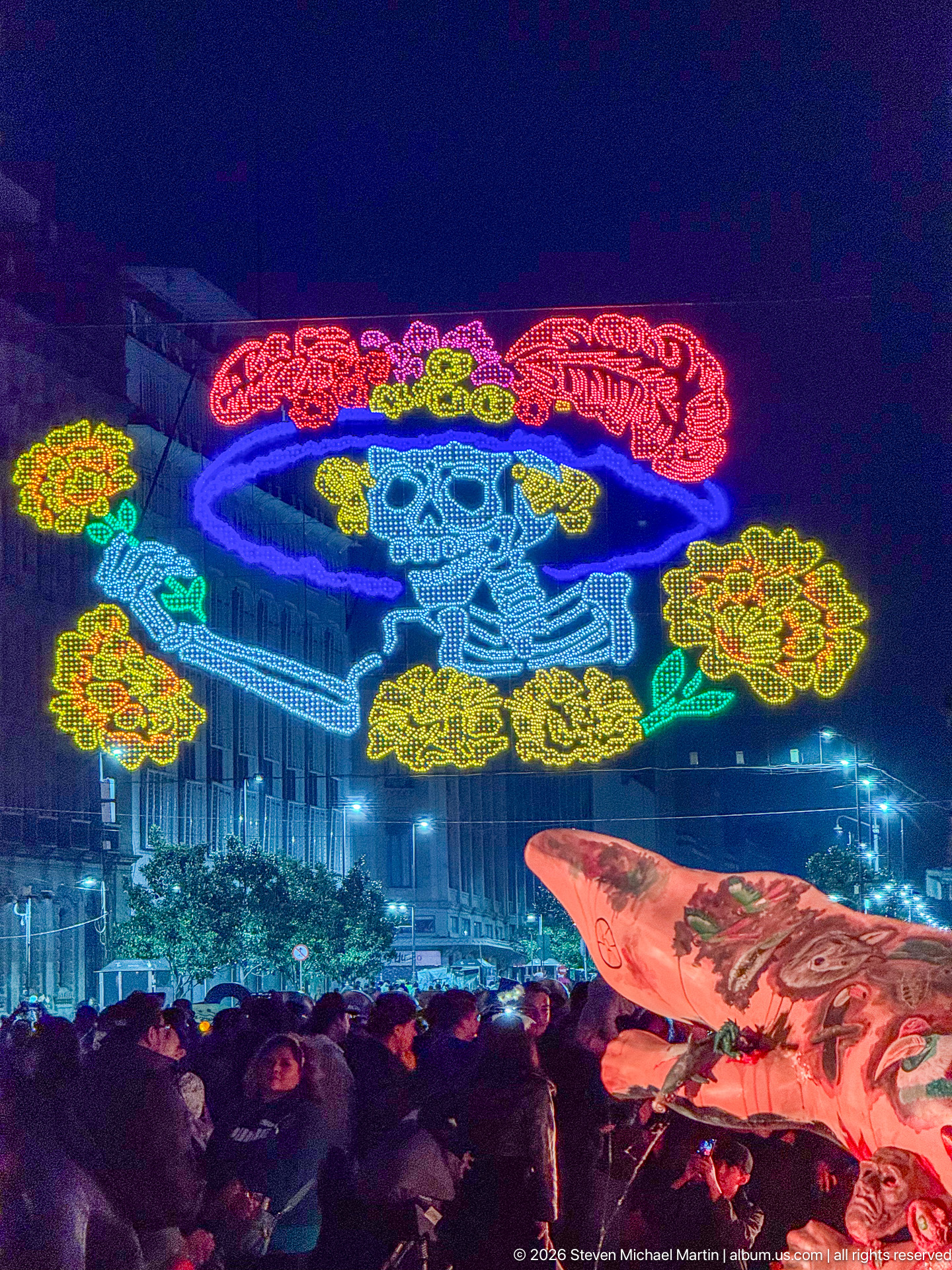
A wide skeletal figure outlined in cool light spans the street, its hat-like blue arc and surrounding marigolds suspended above the crowd. In the foreground, a large vividly painted animal sculpture enters from the right, creating depth between the installation overhead and the visitors below. The contrast of neon color, dark façades, and street-level movement gives this frame a distinctly urban festival character.
Caption
A wide skeletal figure outlined in cool light spans the street, its hat-like blue arc and surrounding marigolds suspended above the crowd. In the foreground, a large vividly painted animal sculpture enters from the right, creating depth between the installation overhead and the visitors below. The contrast of neon color, dark façades, and street-level movement gives this frame a distinctly urban festival character.
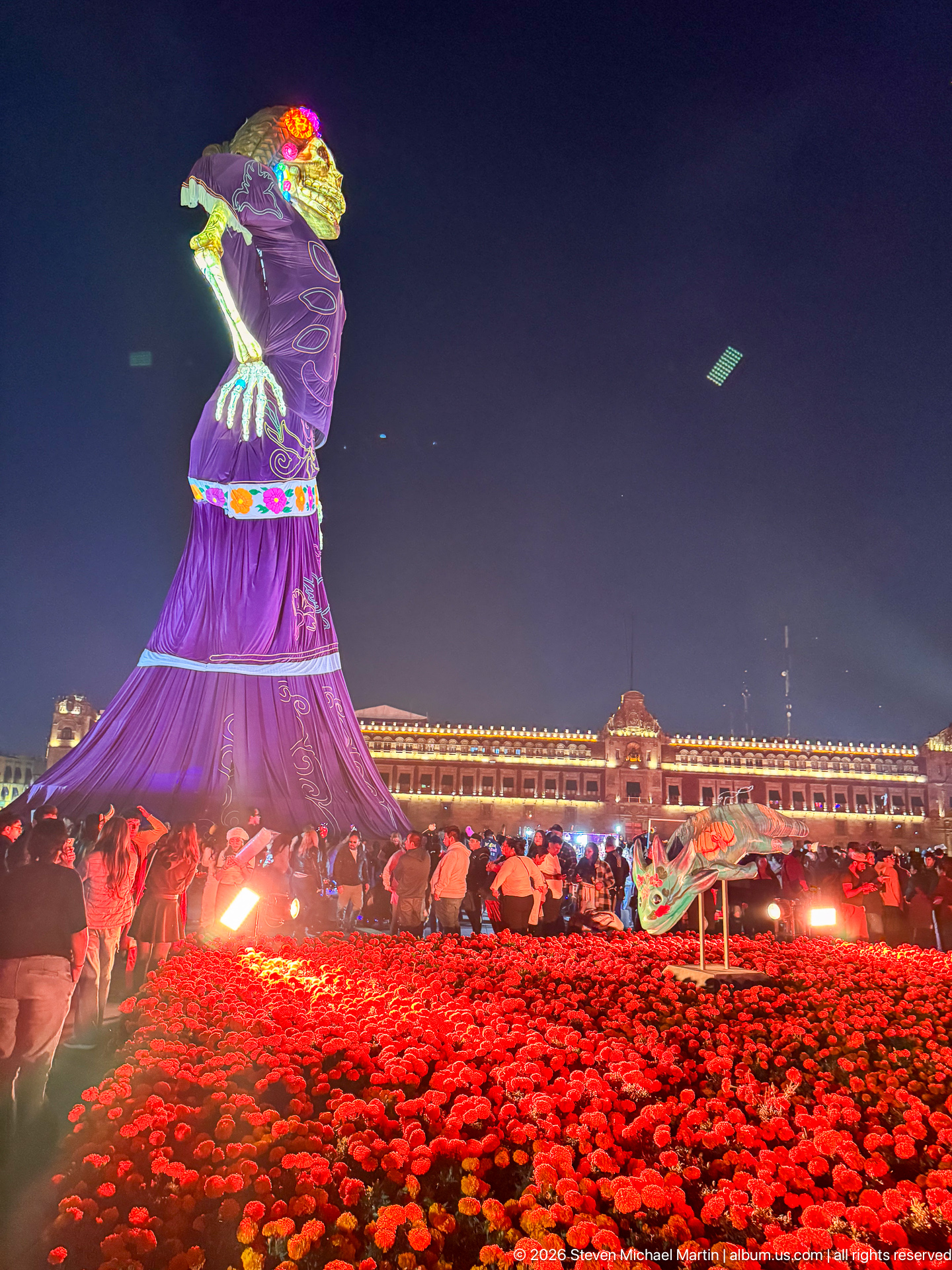
The Catrina’s purple skirt spreads beside a broad carpet of marigolds, while the long illuminated façade of the National Palace runs across the background. Seen from behind and slightly to one side, the figure’s embroidered dress and glowing skeletal head form a strong vertical against the low horizon of flowers and visitors. This composition connects the festival sculpture to the civic architecture enclosing the plaza.
Caption
The Catrina’s purple skirt spreads beside a broad carpet of marigolds, while the long illuminated façade of the National Palace runs across the background. Seen from behind and slightly to one side, the figure’s embroidered dress and glowing skeletal head form a strong vertical against the low horizon of flowers and visitors. This composition connects the festival sculpture to the civic architecture enclosing the plaza.
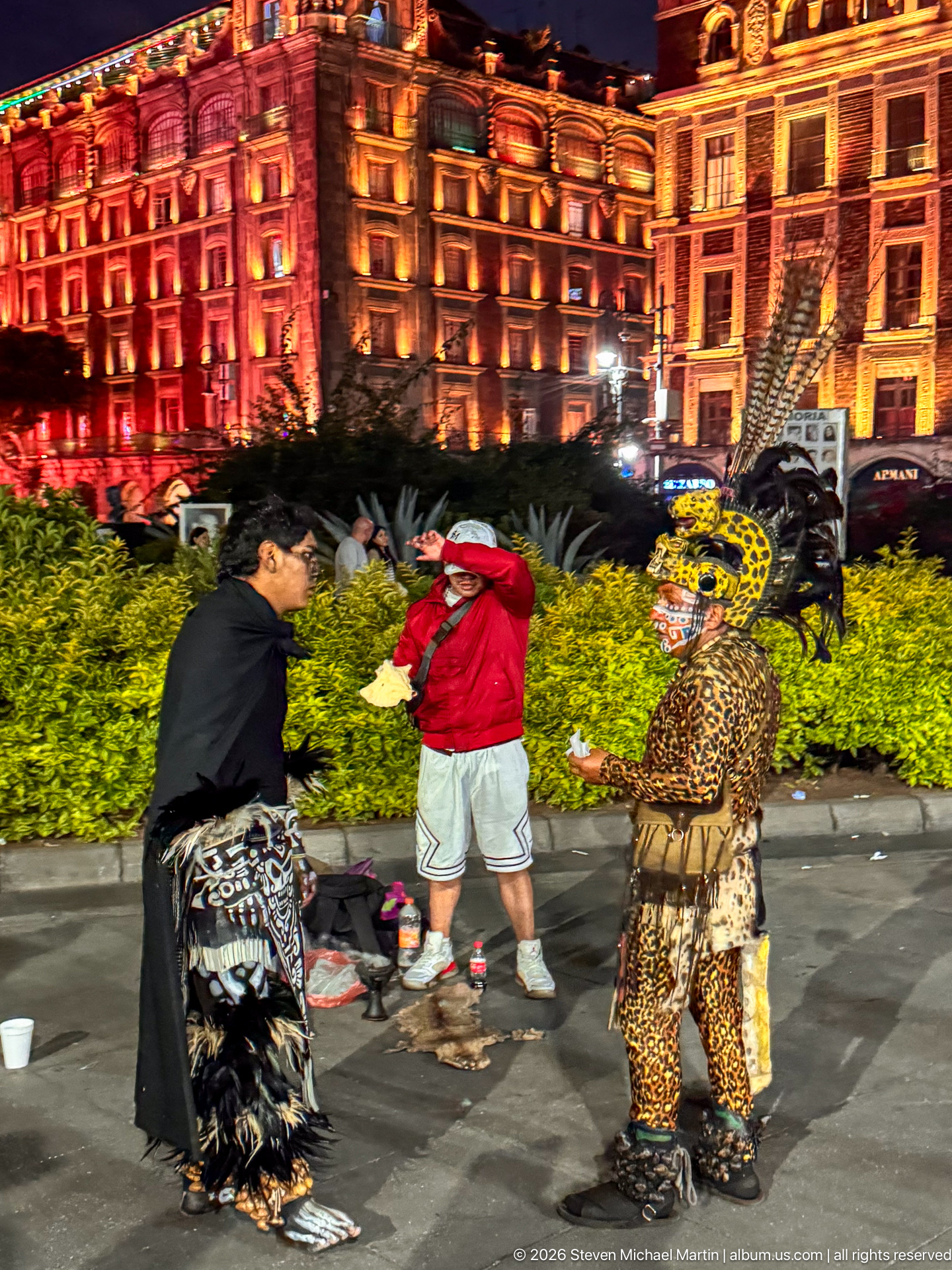
Three costumed participants gather at the edge of the square: one wears a black feathered cloak and skeletal makeup, another a bright red jacket and white shorts, and a third a patterned animal costume with a painted face. Their informal conversation contrasts with the illuminated historic façade behind them. The photograph focuses on festival dress as lived public participation rather than on the staged decorations elsewhere in the plaza.
Caption
Three costumed participants gather at the edge of the square: one wears a black feathered cloak and skeletal makeup, another a bright red jacket and white shorts, and a third a patterned animal costume with a painted face. Their informal conversation contrasts with the illuminated historic façade behind them. The photograph focuses on festival dress as lived public participation rather than on the staged decorations elsewhere in the plaza.
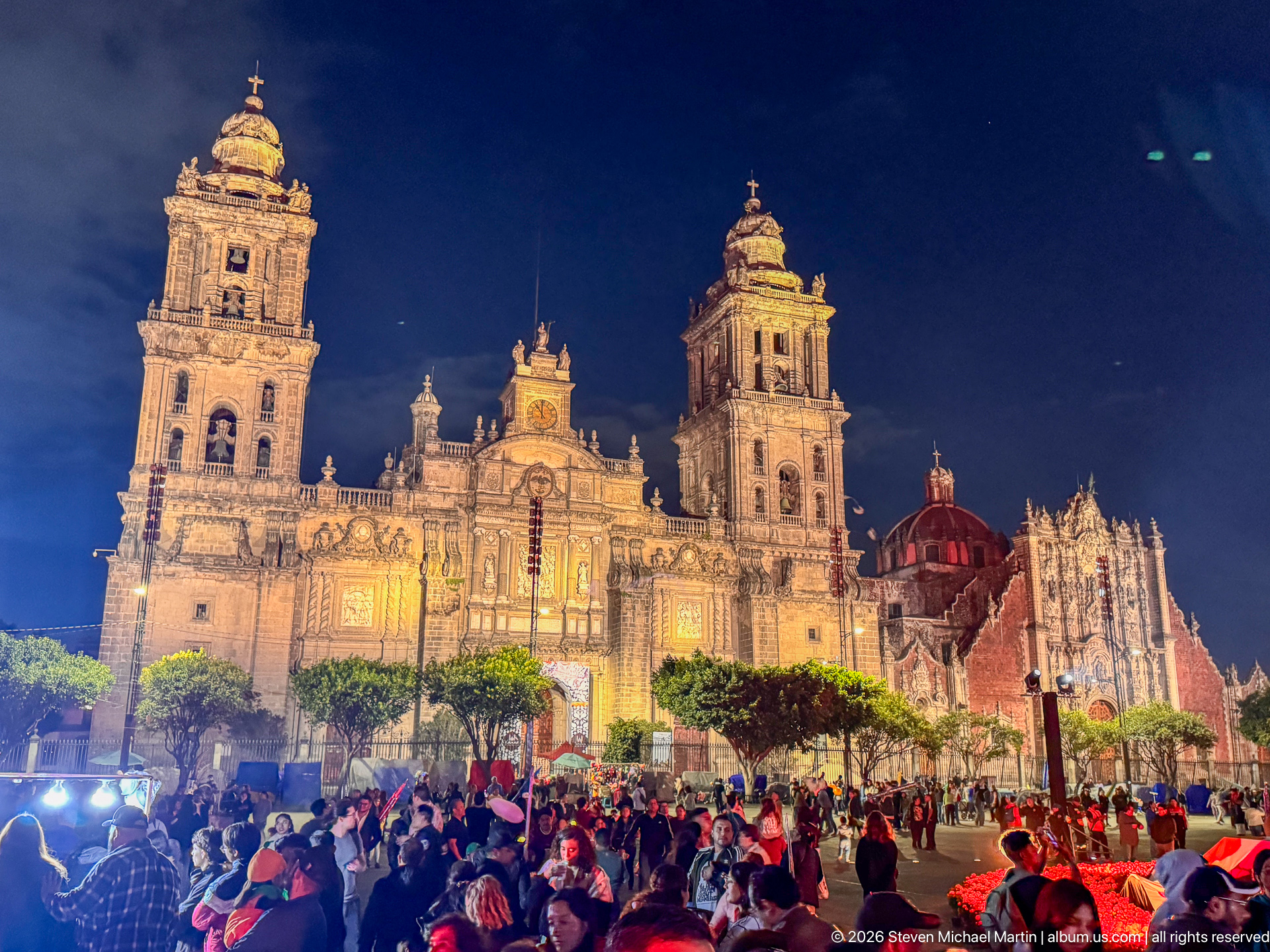
The Metropolitan Cathedral fills the upper frame, its twin bell towers and central façade illuminated in warm gold. At street level, visitors move beside a broad carpet of marigolds, linking the monumental church to the Día de Muertos gathering in the square. The relatively open foreground gives the architecture room to dominate, while scattered figures preserve the scale and activity of the event.
Caption
The Metropolitan Cathedral fills the upper frame, its twin bell towers and central façade illuminated in warm gold. At street level, visitors move beside a broad carpet of marigolds, linking the monumental church to the Día de Muertos gathering in the square. The relatively open foreground gives the architecture room to dominate, while scattered figures preserve the scale and activity of the event.
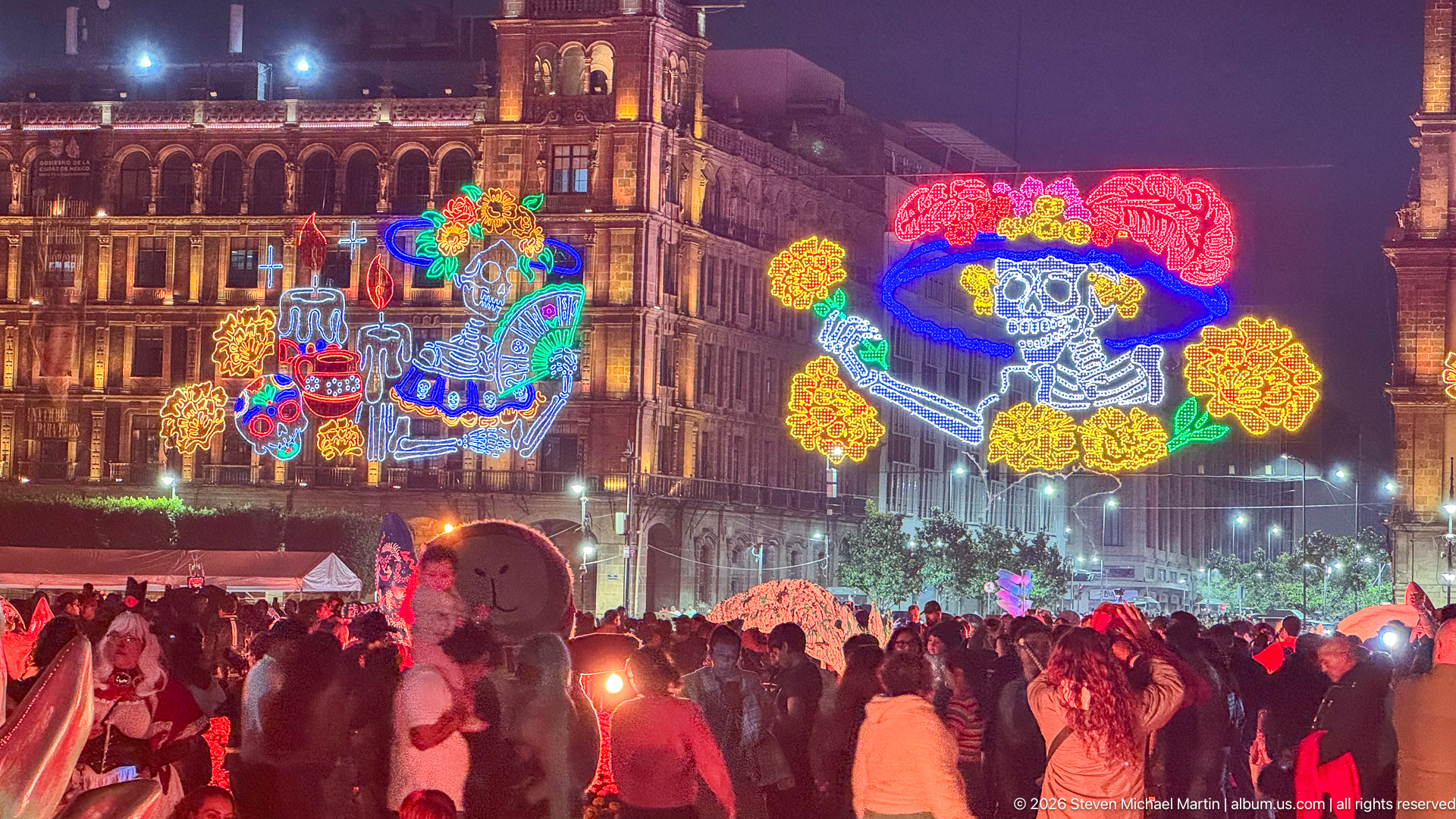
Colorful skeletal figures and marigold clusters glow across the upper façade of a long arcaded building. Below, a packed crowd moves through the Zócalo, where oversized sculptural forms rise above the visitors at street level. The camera’s upward angle includes both the building’s repeating arches and the suspended festival lights, showing how Día de Muertos decoration animates the square’s historic architecture.
Caption
Colorful skeletal figures and marigold clusters glow across the upper façade of a long arcaded building. Below, a packed crowd moves through the Zócalo, where oversized sculptural forms rise above the visitors at street level. The camera’s upward angle includes both the building’s repeating arches and the suspended festival lights, showing how Día de Muertos decoration animates the square’s historic architecture.
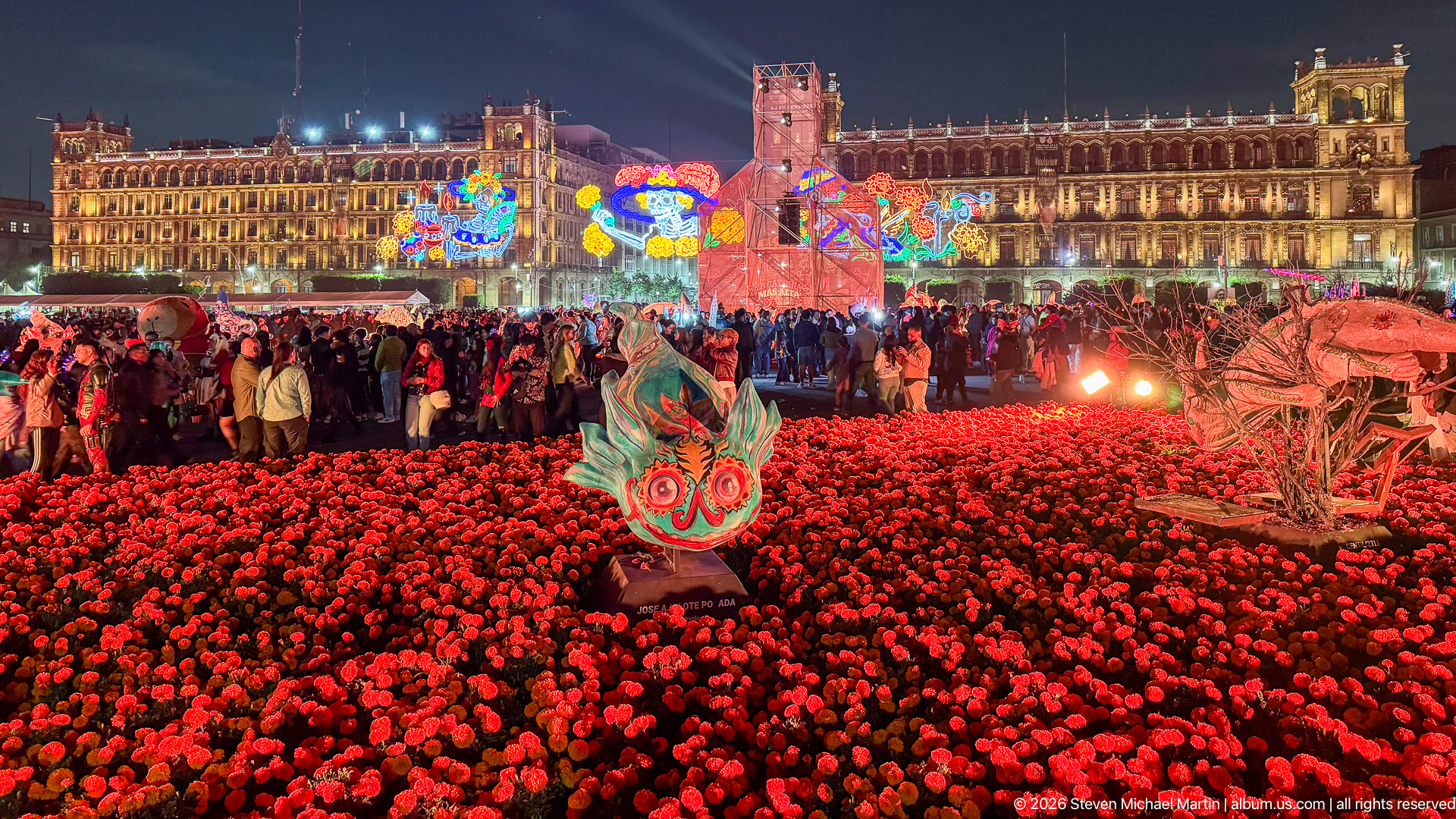
Thousands of marigolds carpet the foreground, with two large fantastical animal sculptures rising from the flowers—one centered with a patterned face, another partly cropped at right. A crowd forms a boundary behind the display, and the National Palace’s illuminated façade stretches across the far side of the Zócalo. The perspective emphasizes the installation’s breadth and its saturated orange contrast with the night-lit city.
Caption
Thousands of marigolds carpet the foreground, with two large fantastical animal sculptures rising from the flowers—one centered with a patterned face, another partly cropped at right. A crowd forms a boundary behind the display, and the National Palace’s illuminated façade stretches across the far side of the Zócalo. The perspective emphasizes the installation’s breadth and its saturated orange contrast with the night-lit city.
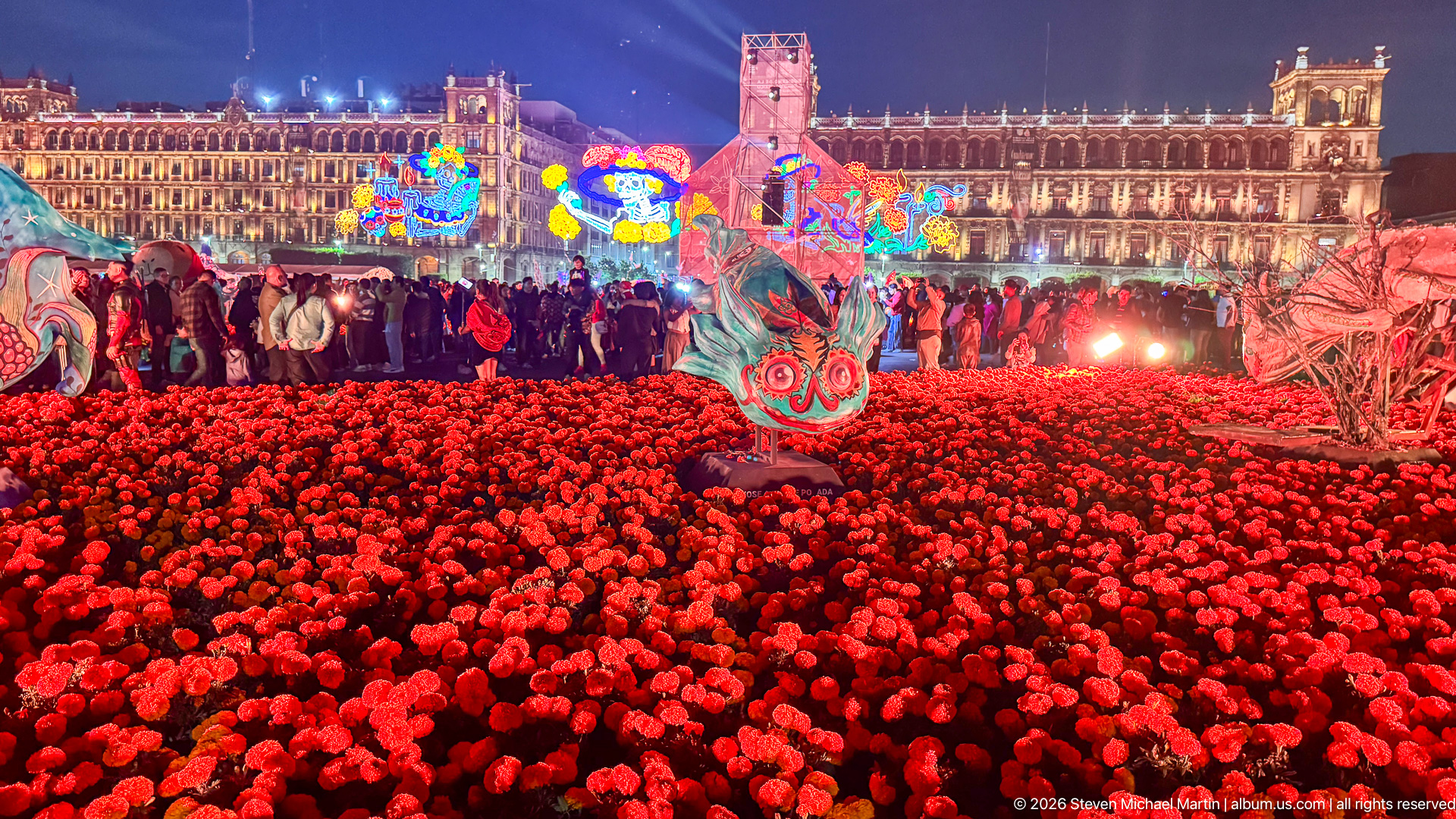
A broad marigold carpet leads toward a large green-and-red fantastical animal sculpture, with smaller sculptural forms and a crowd gathered behind it. Across the square, the National Palace’s long façade glows beneath colorful skeletal lights. The wide framing makes the festival’s separate elements legible—the flower bed, folk-art figures, visitors, and historic buildings—without collapsing them into a single decorative motif.
Caption
A broad marigold carpet leads toward a large green-and-red fantastical animal sculpture, with smaller sculptural forms and a crowd gathered behind it. Across the square, the National Palace’s long façade glows beneath colorful skeletal lights. The wide framing makes the festival’s separate elements legible—the flower bed, folk-art figures, visitors, and historic buildings—without collapsing them into a single decorative motif.
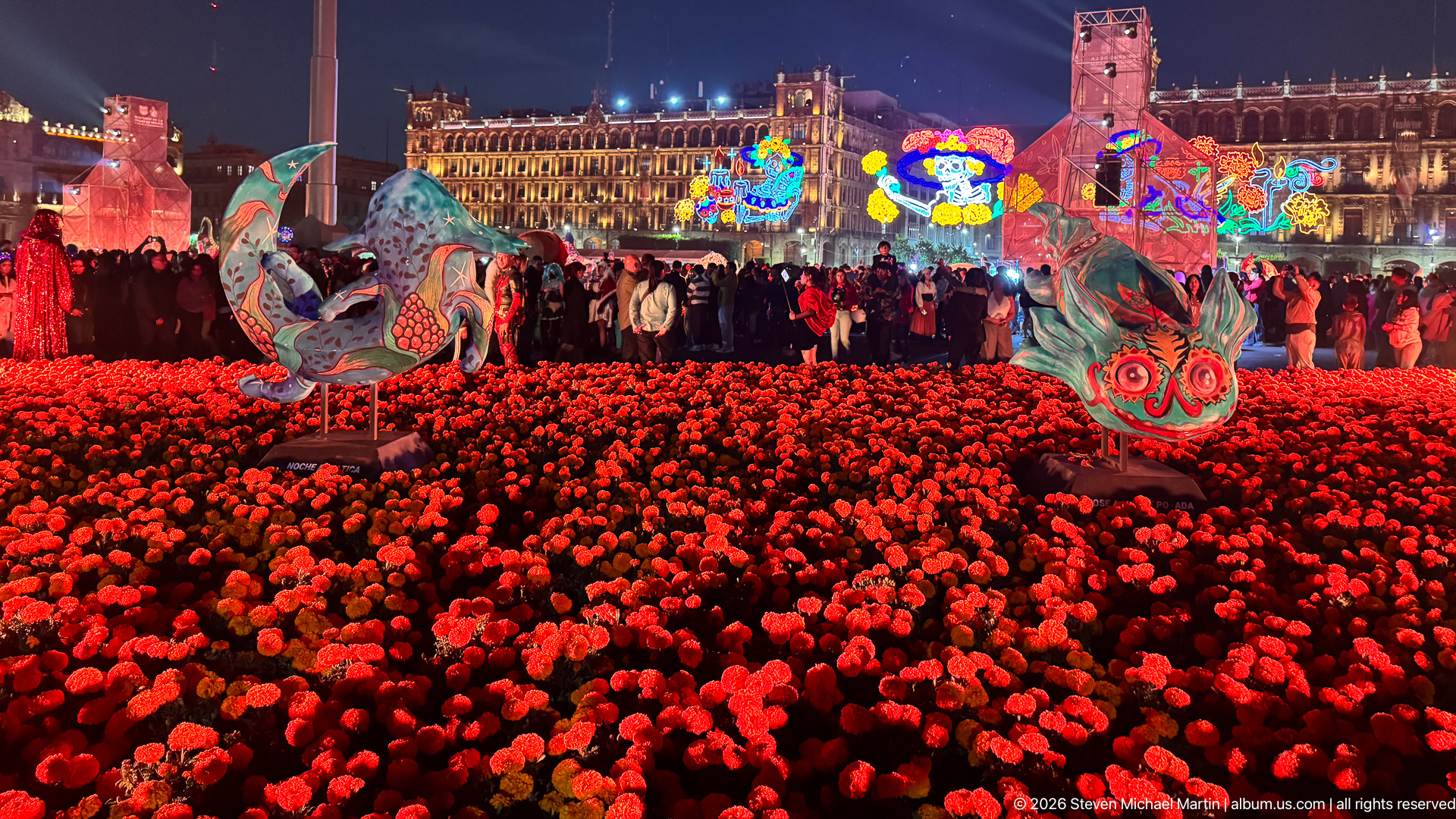
From farther back, the Zócalo’s flower carpet spreads across the foreground beneath two large fantastical animal figures. Crowds line the far edge of the installation, while the illuminated National Palace and colorful skeletal displays define the opposite side of the square. This expansive view records the festival as a city-scale environment, balancing the individual sculptures with the gathering and architecture around them.
Caption
From farther back, the Zócalo’s flower carpet spreads across the foreground beneath two large fantastical animal figures. Crowds line the far edge of the installation, while the illuminated National Palace and colorful skeletal displays define the opposite side of the square. This expansive view records the festival as a city-scale environment, balancing the individual sculptures with the gathering and architecture around them.
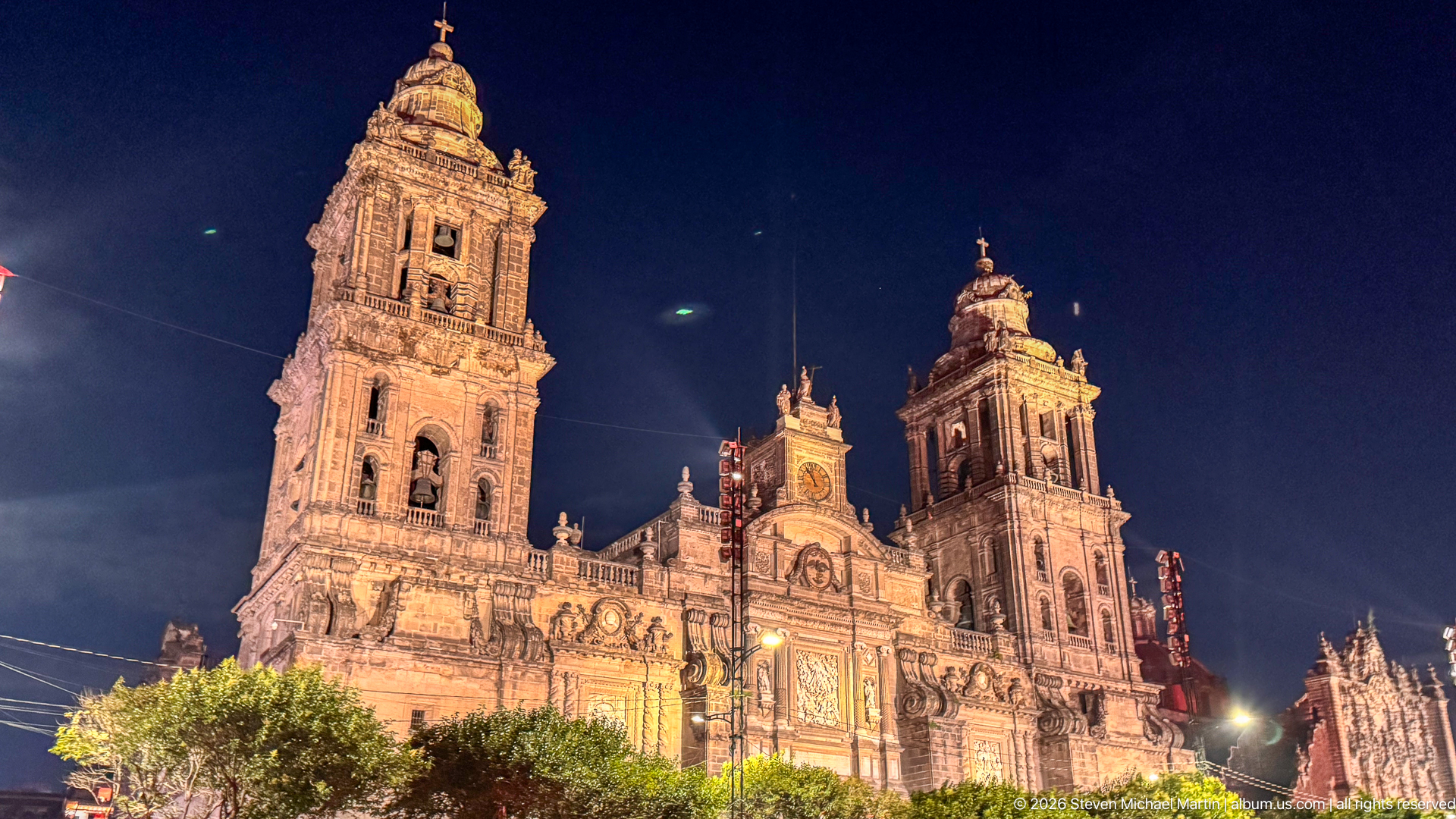
The cathedral’s twin bell towers and richly detailed central façade rise against a clear, deep-blue night sky. Warm floodlighting picks out the cornices, arched openings, pilasters, and sculpted ornament, while the angled viewpoint heightens the towers’ vertical scale. A small portion of the adjoining church complex enters at the right edge, situating this architectural portrait within the Zócalo’s dense historic ensemble.
Caption
The cathedral’s twin bell towers and richly detailed central façade rise against a clear, deep-blue night sky. Warm floodlighting picks out the cornices, arched openings, pilasters, and sculpted ornament, while the angled viewpoint heightens the towers’ vertical scale. A small portion of the adjoining church complex enters at the right edge, situating this architectural portrait within the Zócalo’s dense historic ensemble.
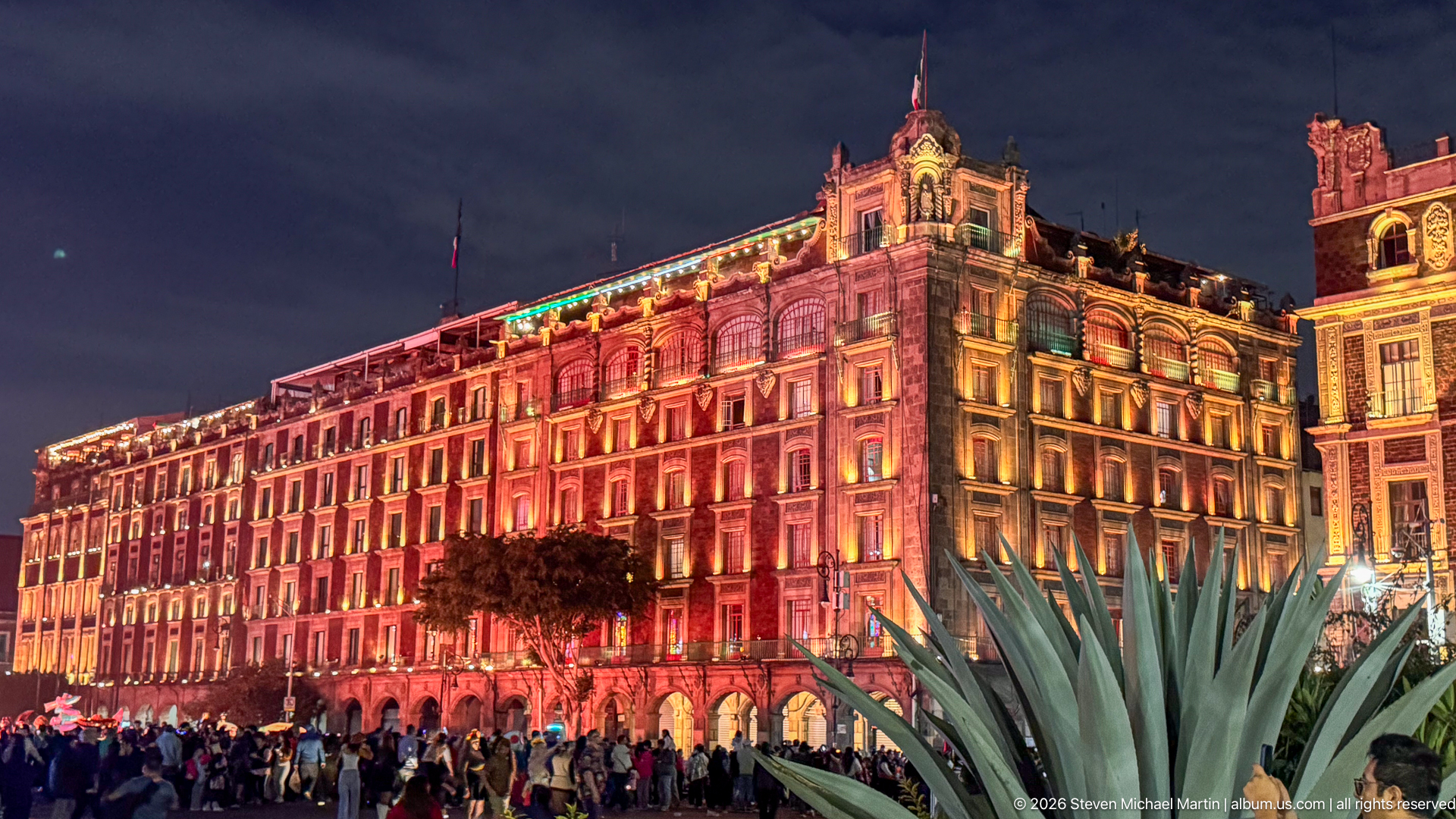
The National Palace extends across the background, its upper windows and arcaded ground level highlighted by warm lighting. Large agave leaves rise into the foreground from a planted bed, while visitors move along the pavement below. This lower, street-side viewpoint gives the long façade a strong horizontal sweep and connects the civic building to the landscaped edge of the public square.
Caption
The National Palace extends across the background, its upper windows and arcaded ground level highlighted by warm lighting. Large agave leaves rise into the foreground from a planted bed, while visitors move along the pavement below. This lower, street-side viewpoint gives the long façade a strong horizontal sweep and connects the civic building to the landscaped edge of the public square.
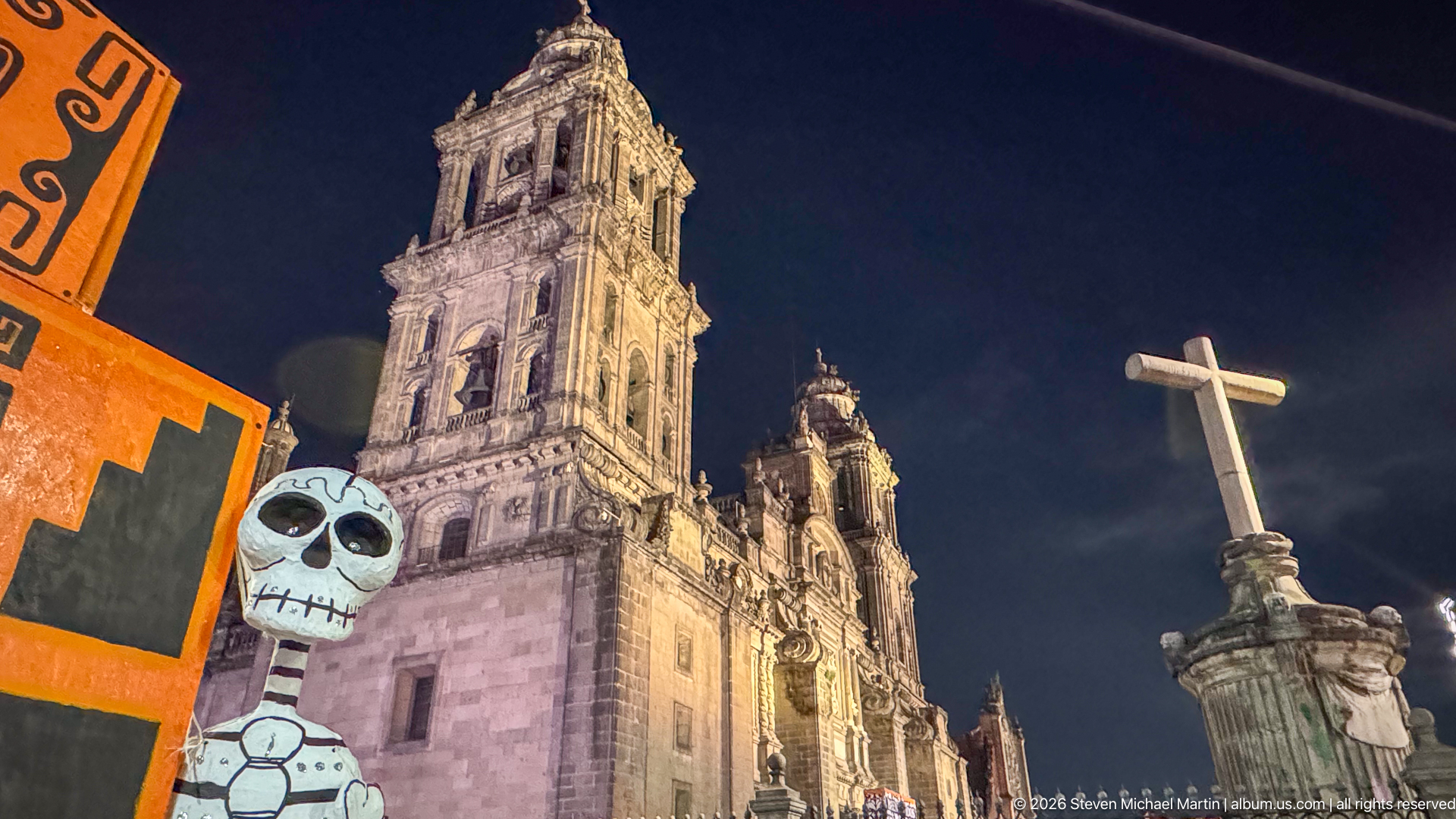
A cathedral tower rises at a steep angle beside a large cross, while two painted skeletal figures on tall cutouts enter from the left foreground. The black-and-orange graphic panel and smiling skulls place the church within the Zócalo’s Día de Muertos decorations, pairing historic religious architecture with contemporary festival imagery. The tight framing emphasizes this visual juxtaposition rather than the full church façade.
Caption
A cathedral tower rises at a steep angle beside a large cross, while two painted skeletal figures on tall cutouts enter from the left foreground. The black-and-orange graphic panel and smiling skulls place the church within the Zócalo’s Día de Muertos decorations, pairing historic religious architecture with contemporary festival imagery. The tight framing emphasizes this visual juxtaposition rather than the full church façade.
🏛️ Cultural Field Guide
📍 Overview
At night, the Zócalo becomes both a civic gathering place and a setting for Día de Muertos installations. The Metropolitan Cathedral and National Palace frame scenes of marigold carpets, illuminated calaveras, offerings, costumed participants, and crowds moving through the square. These photographs show how the architecture and public life of the historic center meet during a major cultural celebration.
📜 Historical Significance
The Zócalo’s significance is visible in its relationship to the major buildings around it. The Metropolitan Cathedral, the adjoining Sagrario Metropolitano, the National Palace, and other historic façades give the square a strong civic and religious setting. During Día de Muertos, the temporary displays and public gathering add a contemporary layer to this historic urban space.
🏛️ Architecture & Built Environment
The photographs show the Metropolitan Cathedral’s twin towers, clock, carved stone façade, and monumental doors, as well as the more intricately profiled Sagrario Metropolitano beside it. Across the square, the National Palace and long arcaded façades create a broad architectural frame. Night lighting draws out cornices, windows, portals, and sculpted details, while festival signs, canopies, and installations show how the open plaza is adapted for public events.
🌐 Cultural Importance
Día de Muertos appears across the square in several forms: marigold-covered offerings, illuminated calaveras, skeletal figures, embroidered textiles, handmade Catrina dolls, costumed performers, and the monumental Catrina installation. Visitors gather, watch, and take photographs among these displays. Together, the images present the celebration as a shared public experience woven into the life of the historic center.
💡 Why It Matters
The Zócalo at night makes the historic city legible as a place in use. The Cathedral and National Palace remain prominent landmarks, while crowds, temporary event structures, market goods, flowers, and light displays reshape the square around them. The photographs connect architecture, urban space, commerce, and cultural continuity in one changing public setting.
⭐ Highlights
Look for the monumental purple Catrina set against the Cathedral’s towers; the broad marigold carpets and tiered offerings; and the vivid calavera and skeleton light displays across historic façades. Other views bring together the Cathedral and Sagrario, the National Palace, the “Mexico” letters, costumed participants, and market tables filled with Día de Muertos dolls and painted skulls.
📷 Photography Notes
Elevated views show how installations, crowds, and the surrounding buildings occupy the full square. At street level, photograph the contrast between carved stone portals and temporary decorations, then move closer to record marigold petals, embroidered textiles, painted skulls, and light displays. Include people or familiar architectural features for scale, and account for mixed lighting, reflections on wet pavement, and dense crowds when framing night scenes.