Hotel Bellas Artes
On Avenida 5 de Mayo in the heart of Mexico City’s Centro Histórico, Hotel Bellas Artes gave us a welcoming base for exploring CDMX on foot. From here, monumental architecture, lively streets, cafés, and neighborhood corners all became part of the day’s discoveries.
The hotel occupies a restored historic office building, where broad corridors and original wood doors preserve a sense of the building’s earlier life. Its calm interior offered a welcome pause between walks through one of the city’s most compelling historic districts.
Stepping outside, we were close to the Palacio de Bellas Artes, the Zócalo, the Metropolitan Cathedral, Templo Mayor, and the Postal Palace. This portfolio captures the hotel as both a place to return to and a doorway into the history, architecture, and everyday energy of central Mexico City.
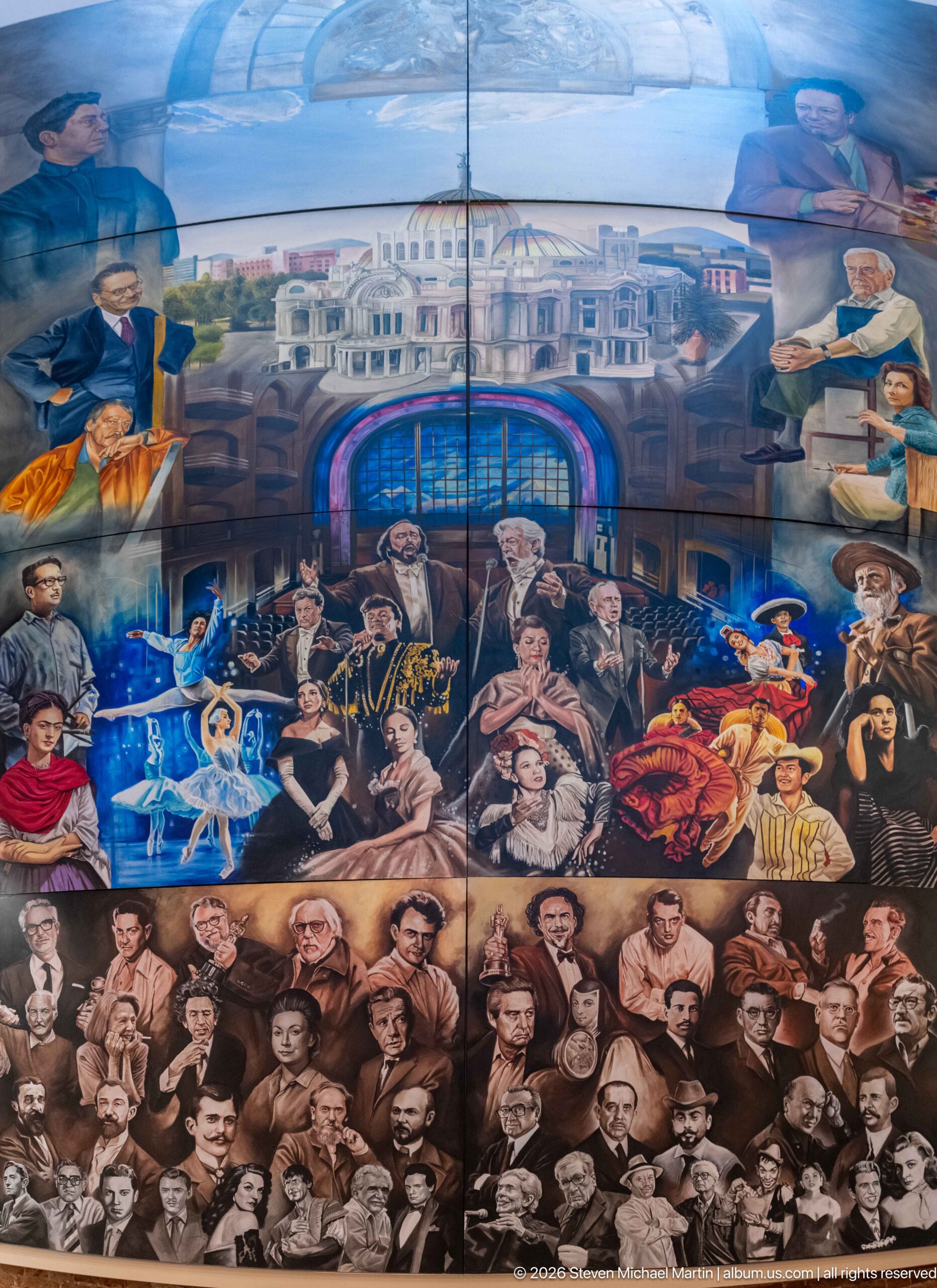
A broad mural organizes the hotel façade above a central arch, surrounded by groups of people in contemporary dress and historical-looking portraits below. The upper scene uses bright blue and pink around the building, while the lower registers shift to sepia and brown. This close view records a complex interior artwork and its layered figures; no artist or individual portrait is securely identified here.
Caption
A broad mural organizes the hotel façade above a central arch, surrounded by groups of people in contemporary dress and historical-looking portraits below. The upper scene uses bright blue and pink around the building, while the lower registers shift to sepia and brown. This close view records a complex interior artwork and its layered figures; no artist or individual portrait is securely identified here.
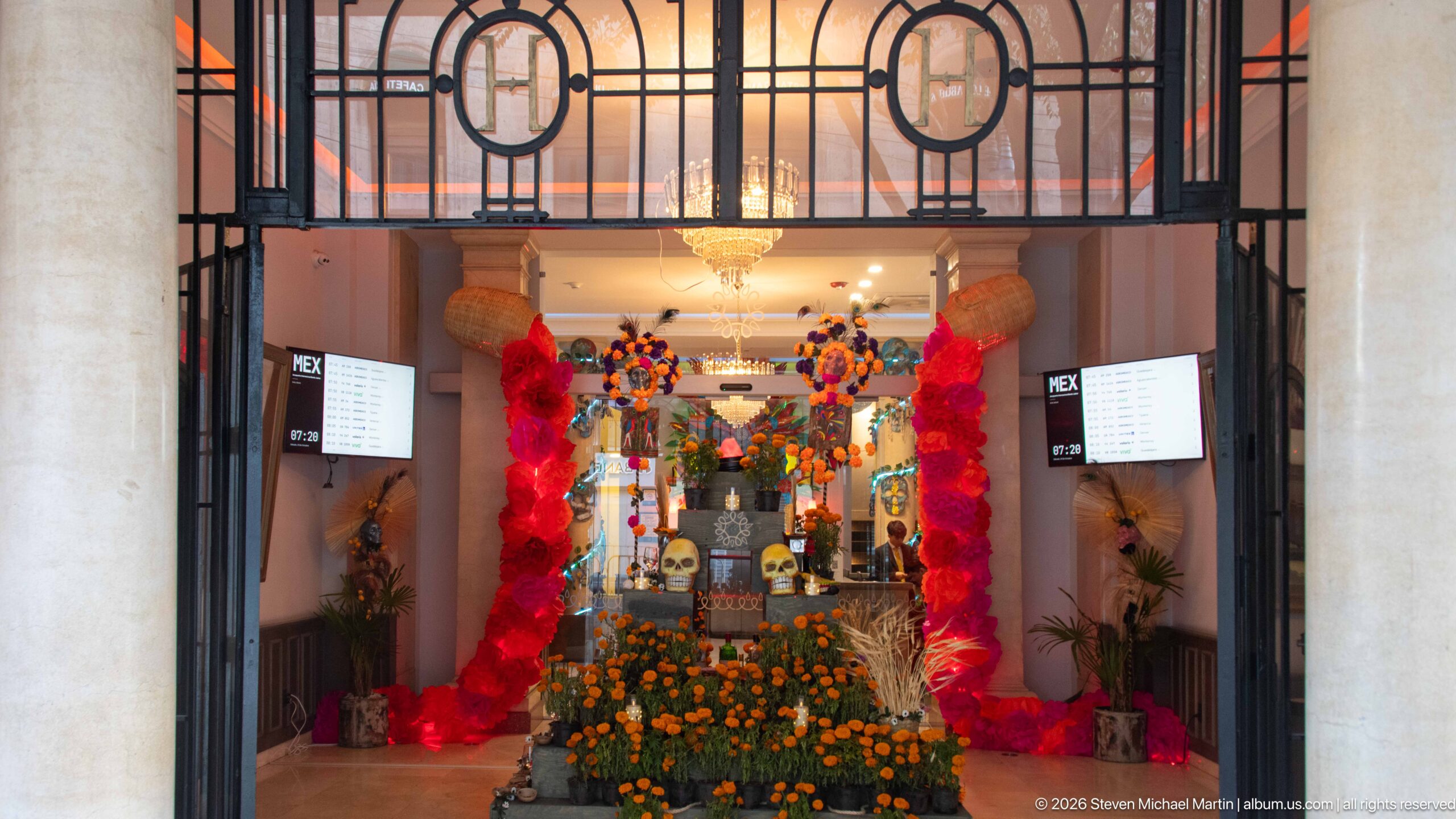
Black geometric ironwork frames a bright hotel entrance and the marigold ofrenda beyond it. Red floral garlands rise on either side of the display, while the open gate creates a layered threshold between the exterior stonework and the decorated lobby. This view is distinguished by the screen’s strong symmetry and by the installation seen at a distance through the entry.
Caption
Black geometric ironwork frames a bright hotel entrance and the marigold ofrenda beyond it. Red floral garlands rise on either side of the display, while the open gate creates a layered threshold between the exterior stonework and the decorated lobby. This view is distinguished by the screen’s strong symmetry and by the installation seen at a distance through the entry.
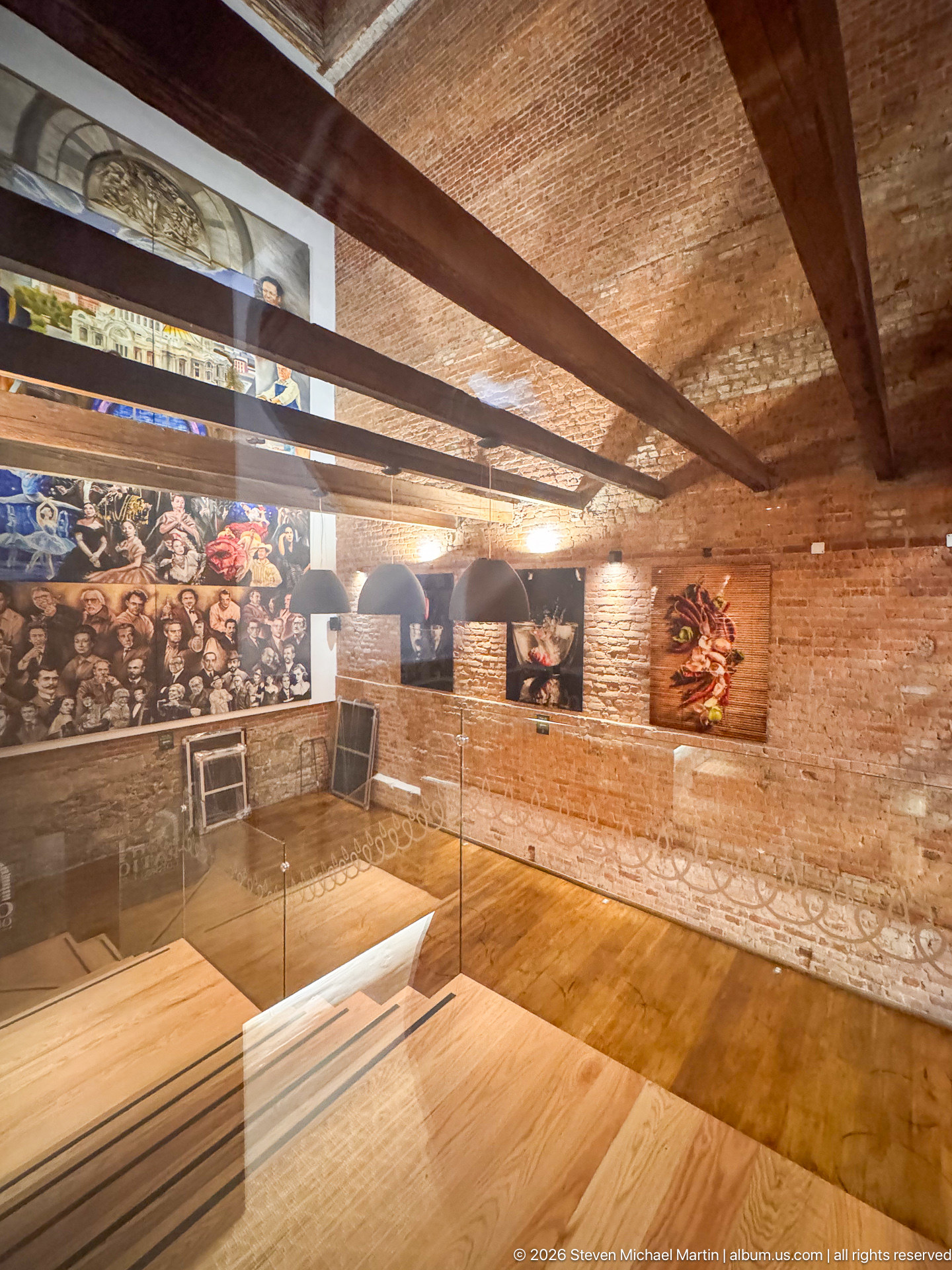
Exposed brick vaulting and heavy timber beams define this long, low-ceilinged room, where framed photographs and artworks line the walls. Glass-topped display cases occupy the foreground, while warm lamps reveal the texture of the masonry. The view presents a historic-feeling interior arranged as a gallery and gathering space within Hotel Bellas Artes.
Caption
Exposed brick vaulting and heavy timber beams define this long, low-ceilinged room, where framed photographs and artworks line the walls. Glass-topped display cases occupy the foreground, while warm lamps reveal the texture of the masonry. The view presents a historic-feeling interior arranged as a gallery and gathering space within Hotel Bellas Artes.
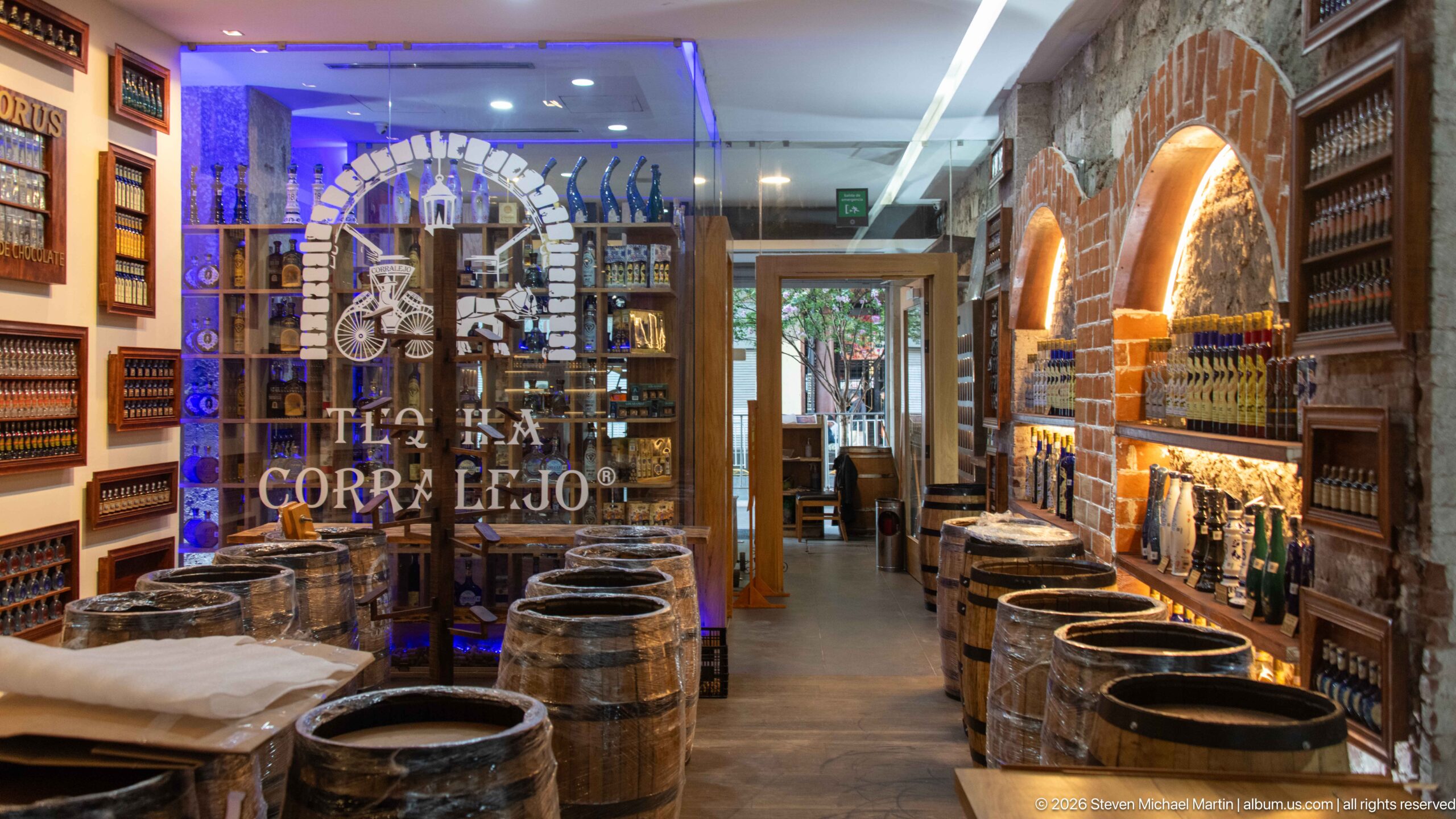
A glass partition marked “Tequila Corralejo” divides the sales floor from a narrow, warmly lit retail room. Rows of bottles line the stone and wood shelving, while several open barrel tops fill the foreground like display tables. A doorway at the rear draws the eye through the shop, making the image an overview of the branded interior rather than a portrait of any single bottle.
Caption
A glass partition marked “Tequila Corralejo” divides the sales floor from a narrow, warmly lit retail room. Rows of bottles line the stone and wood shelving, while several open barrel tops fill the foreground like display tables. A doorway at the rear draws the eye through the shop, making the image an overview of the branded interior rather than a portrait of any single bottle.
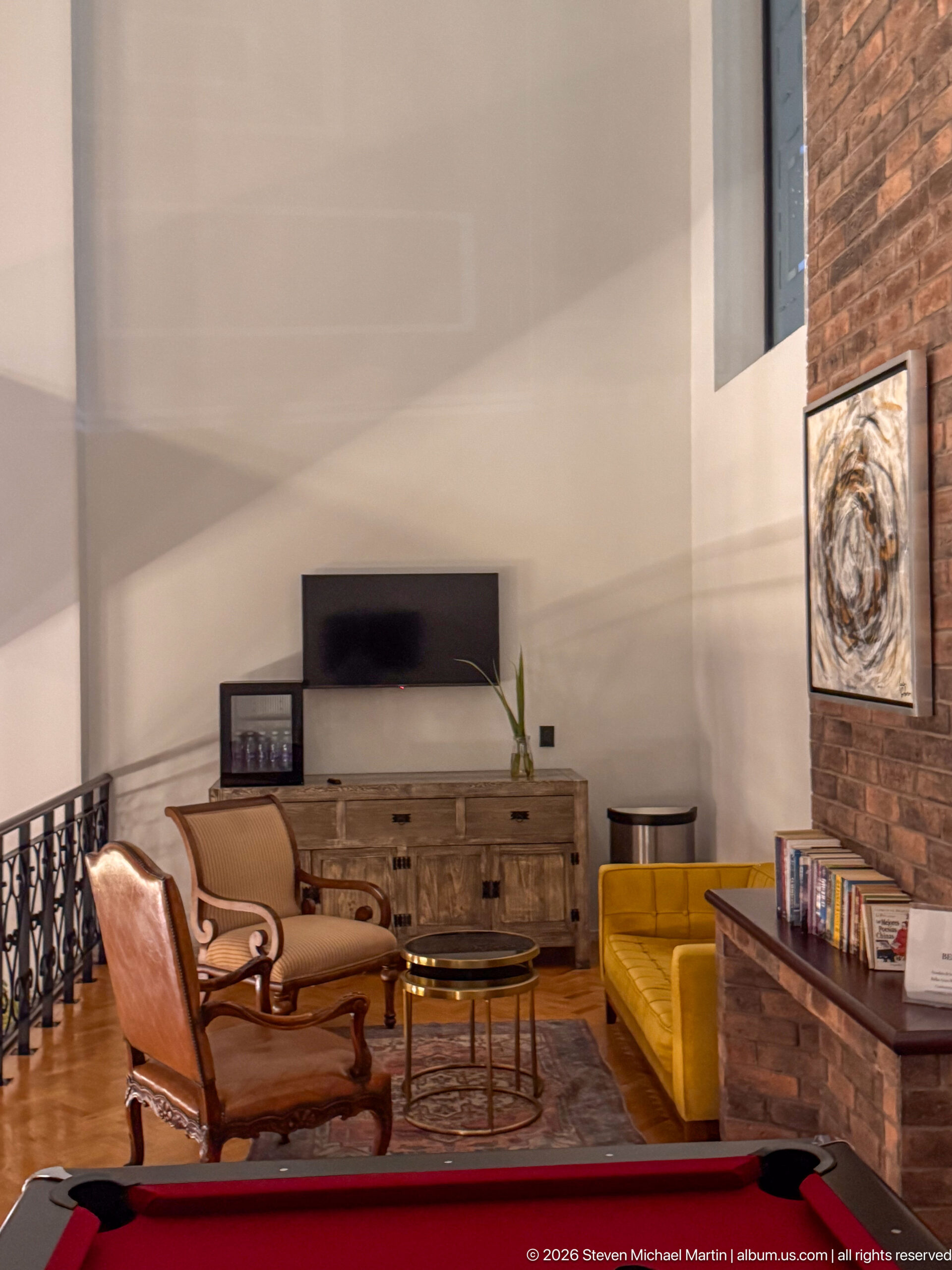
A small lounge combines a yellow sofa, leather armchairs, round coffee tables, and a television set against a brick feature wall. The red edge of a billiards table cuts across the foreground, indicating a recreation area adjoining the seating. Books and a framed abstract artwork complete the layered view of the hotel’s shared interior.
Caption
A small lounge combines a yellow sofa, leather armchairs, round coffee tables, and a television set against a brick feature wall. The red edge of a billiards table cuts across the foreground, indicating a recreation area adjoining the seating. Books and a framed abstract artwork complete the layered view of the hotel’s shared interior.
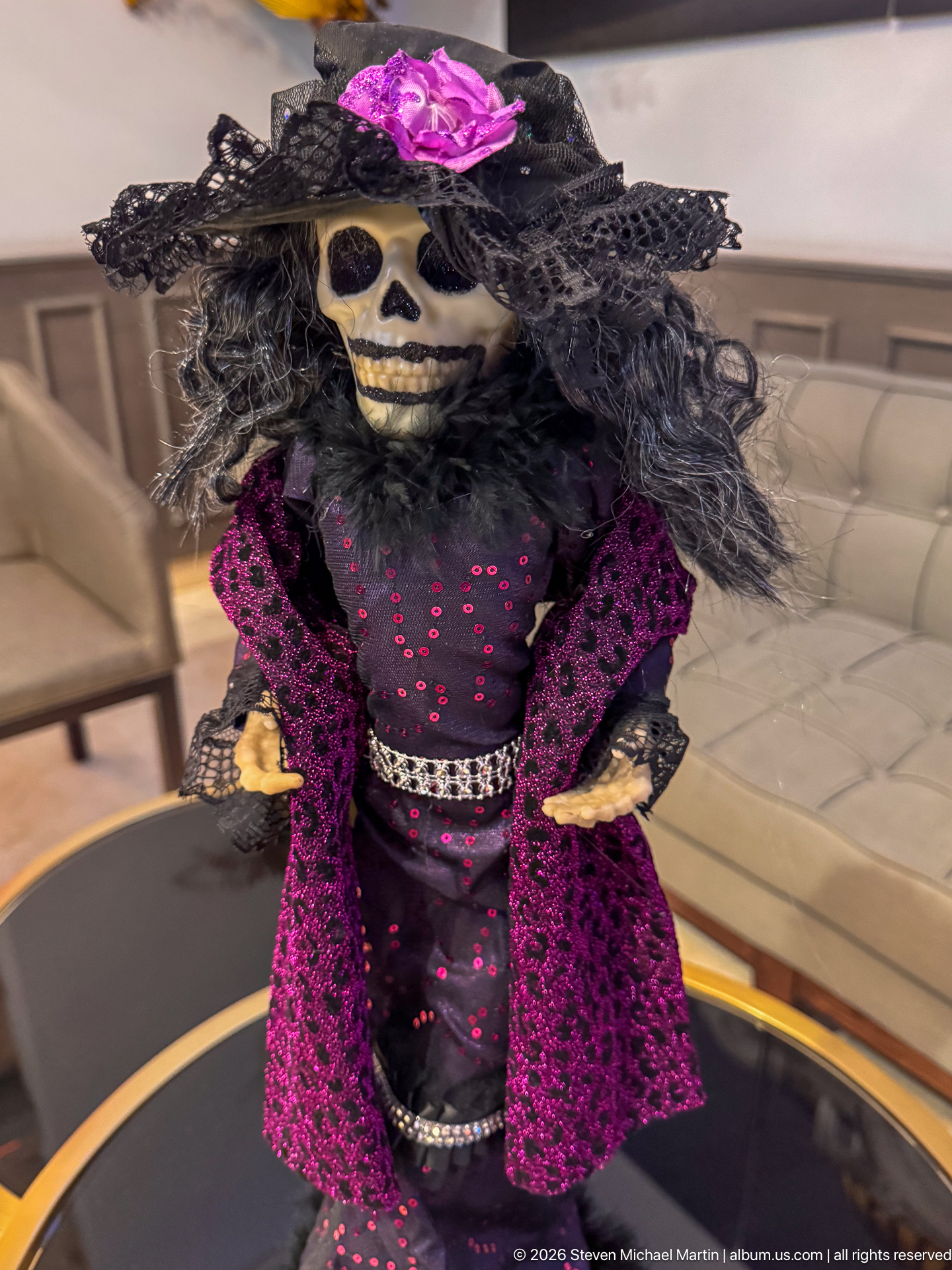
A small Catrina doll sits on a round black table in a guest lounge, dressed in a black lace hat and purple embroidered clothing. Upholstered seating and a pale wall recede behind the figure, turning the seasonal ornament into a foreground portrait rather than a room overview. The tight composition draws out the contrast between its delicate costume and skeletal face.
Caption
A small Catrina doll sits on a round black table in a guest lounge, dressed in a black lace hat and purple embroidered clothing. Upholstered seating and a pale wall recede behind the figure, turning the seasonal ornament into a foreground portrait rather than a room overview. The tight composition draws out the contrast between its delicate costume and skeletal face.
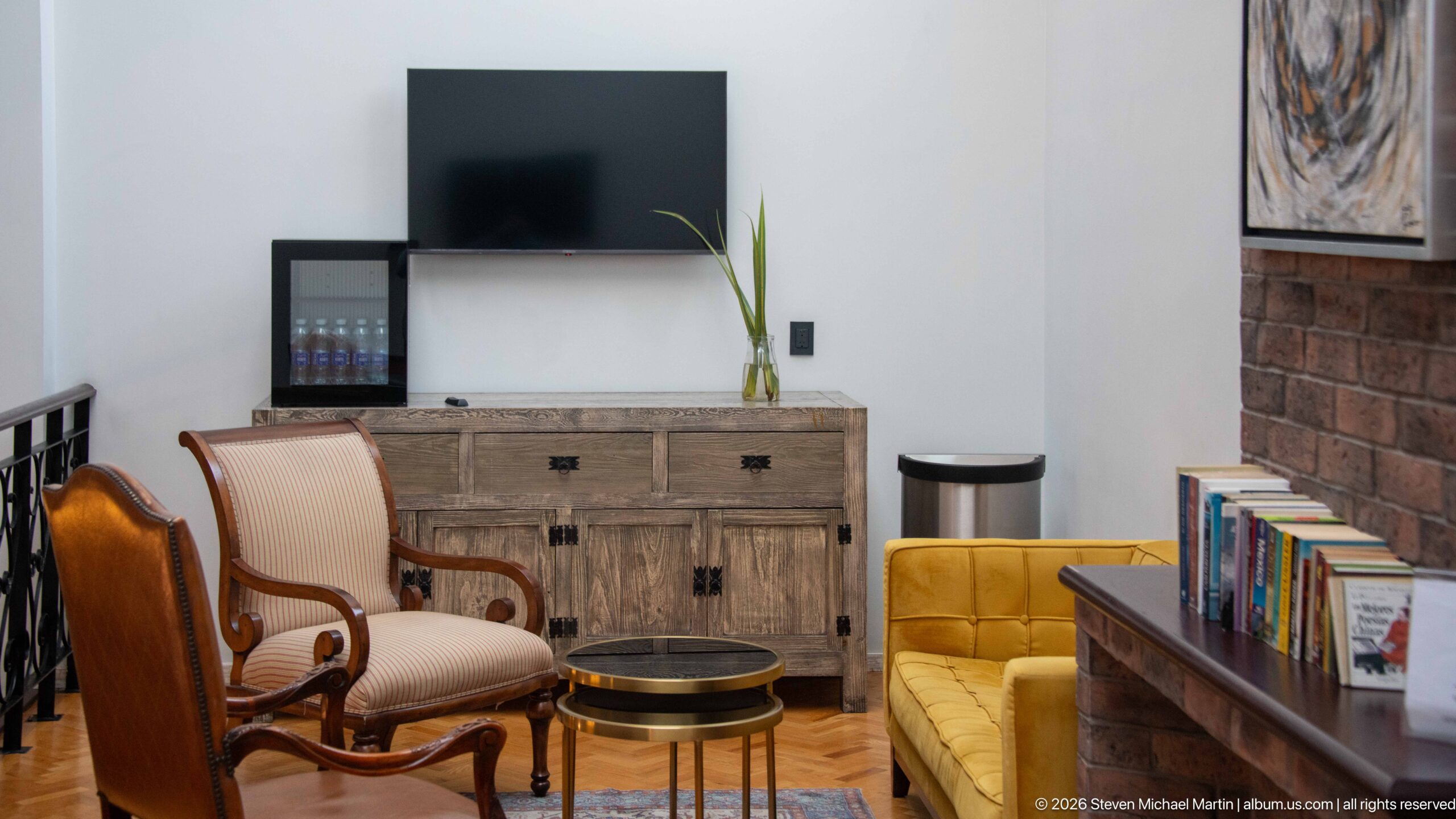
A compact sitting area pairs a carved wooden armchair and yellow sofa with a round coffee table and low cabinet. A television hangs above the cabinet, while an exposed-brick wall and framed abstract artwork define the right side. The closer framing gives prominence to the arrangement of seating and finishes rather than the billiards table visible in the wider view.
Caption
A compact sitting area pairs a carved wooden armchair and yellow sofa with a round coffee table and low cabinet. A television hangs above the cabinet, while an exposed-brick wall and framed abstract artwork define the right side. The closer framing gives prominence to the arrangement of seating and finishes rather than the billiards table visible in the wider view.
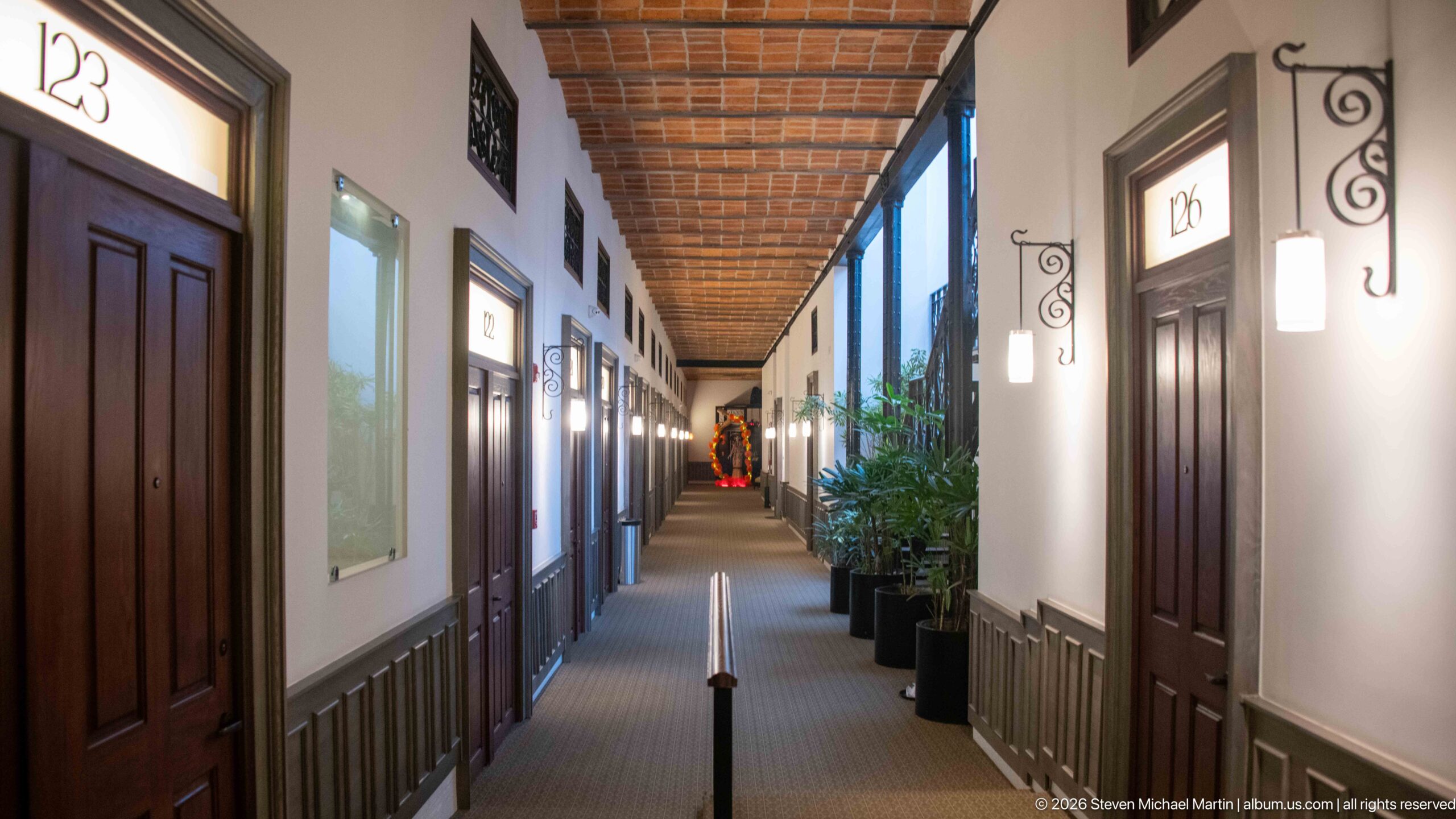
Daylight enters through tall windows along one side of the corridor, illuminating a sequence of numbered guest-room doors and a brick-pattern ceiling. Wall sconces and dark trim repeat toward the far end, where a small orange seasonal display remains visible. The perspective emphasizes the corridor’s length and the alternating rhythm of windows and doorways.
Caption
Daylight enters through tall windows along one side of the corridor, illuminating a sequence of numbered guest-room doors and a brick-pattern ceiling. Wall sconces and dark trim repeat toward the far end, where a small orange seasonal display remains visible. The perspective emphasizes the corridor’s length and the alternating rhythm of windows and doorways.
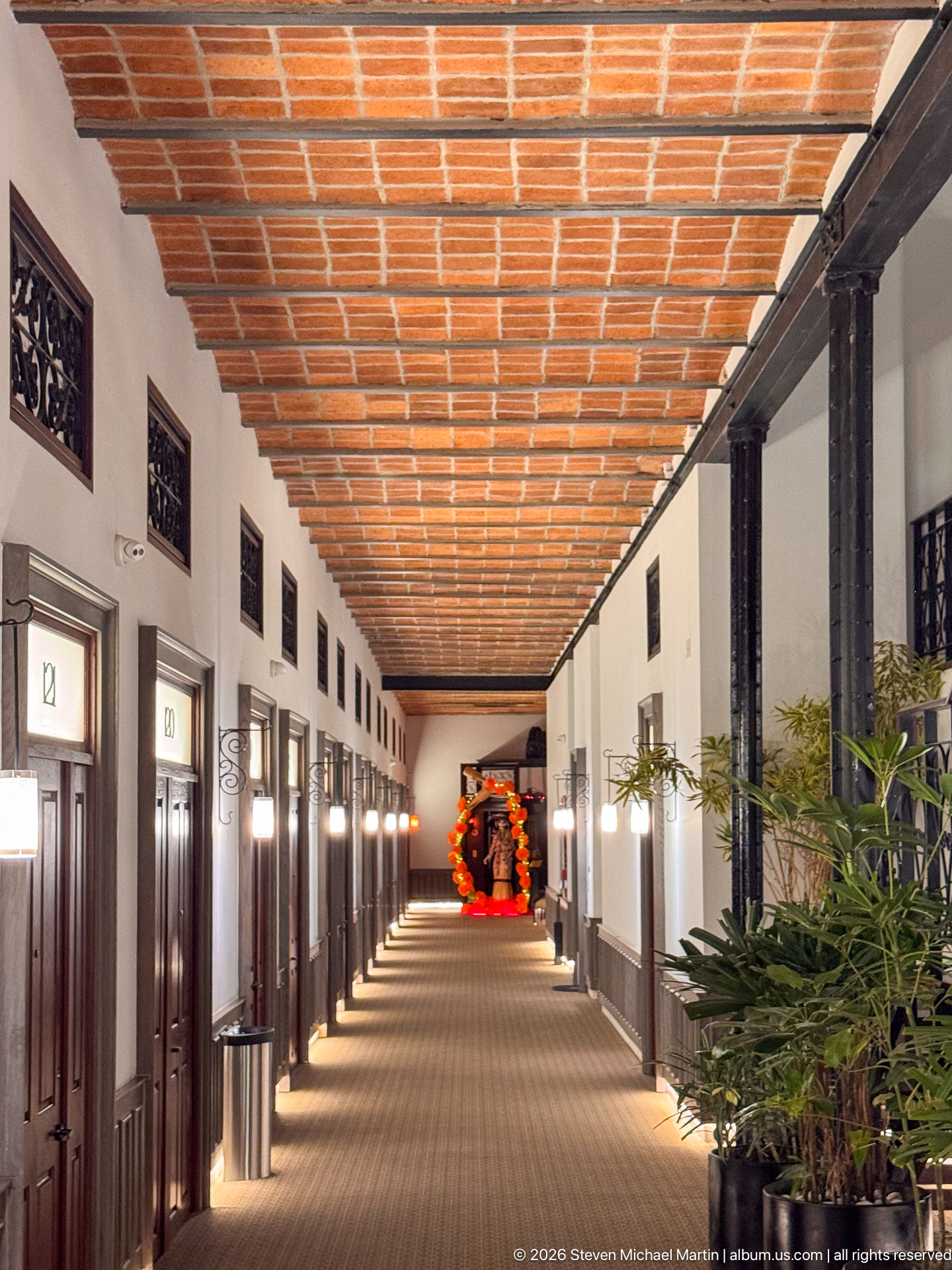
A long guest-room corridor recedes beneath a terracotta-colored ceiling, with dark wood doors and evenly spaced wall lights forming a strong vanishing point. Potted plants soften one side of the passage, and a glowing Catrina display marks its far end. This view connects the hotel’s room wing with its Día de Muertos decorations.
Caption
A long guest-room corridor recedes beneath a terracotta-colored ceiling, with dark wood doors and evenly spaced wall lights forming a strong vanishing point. Potted plants soften one side of the passage, and a glowing Catrina display marks its far end. This view connects the hotel’s room wing with its Día de Muertos decorations.
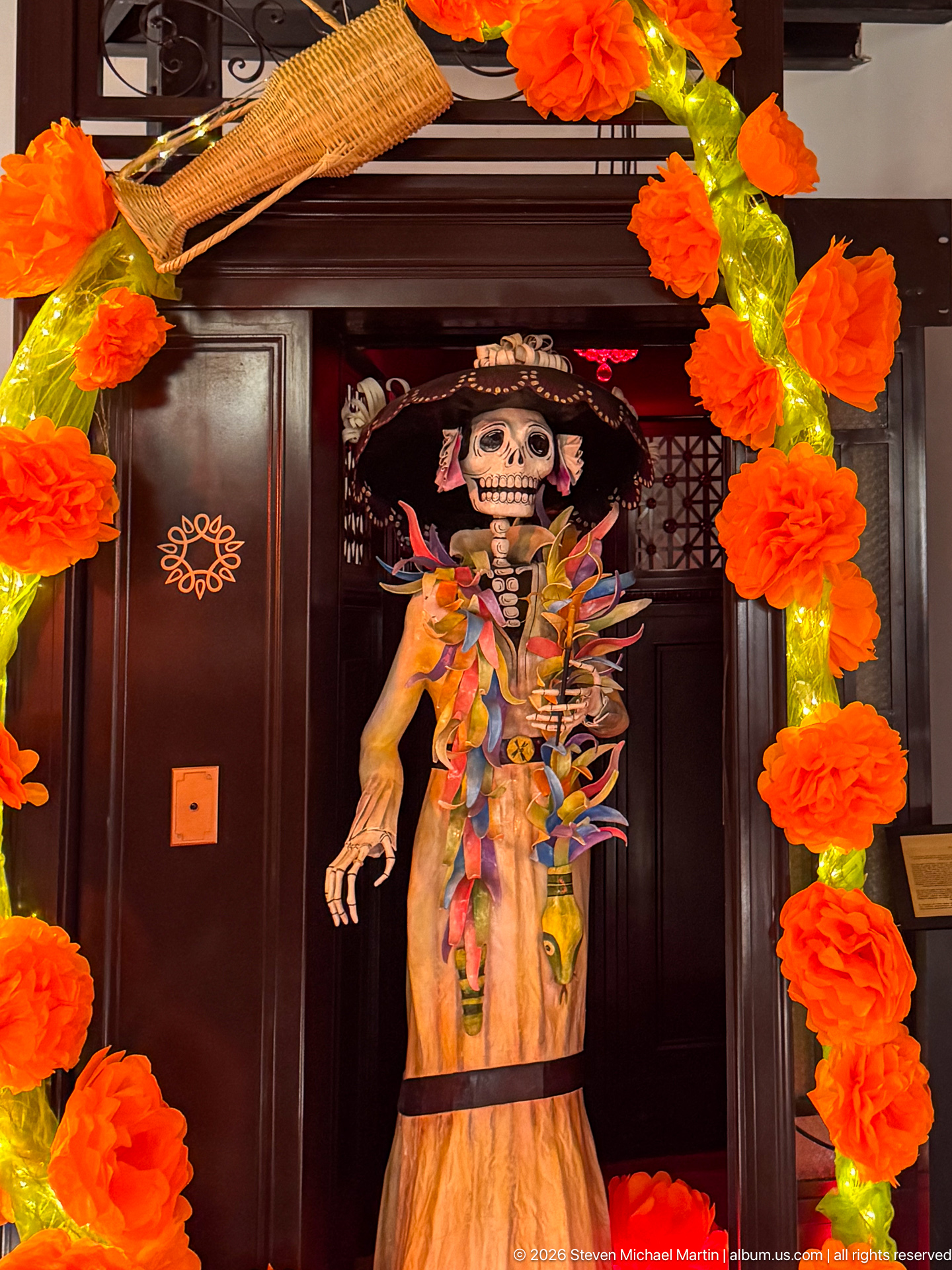
A skeletal Catrina in a broad dark hat stands inside a timber-framed alcove, surrounded by an arch of orange marigolds and green lights. Her pale dress and vivid floral adornments contrast with the dark wood panels behind her. The close view isolates the hotel’s seasonal display as a carefully staged Día de Muertos welcome.
Caption
A skeletal Catrina in a broad dark hat stands inside a timber-framed alcove, surrounded by an arch of orange marigolds and green lights. Her pale dress and vivid floral adornments contrast with the dark wood panels behind her. The close view isolates the hotel’s seasonal display as a carefully staged Día de Muertos welcome.
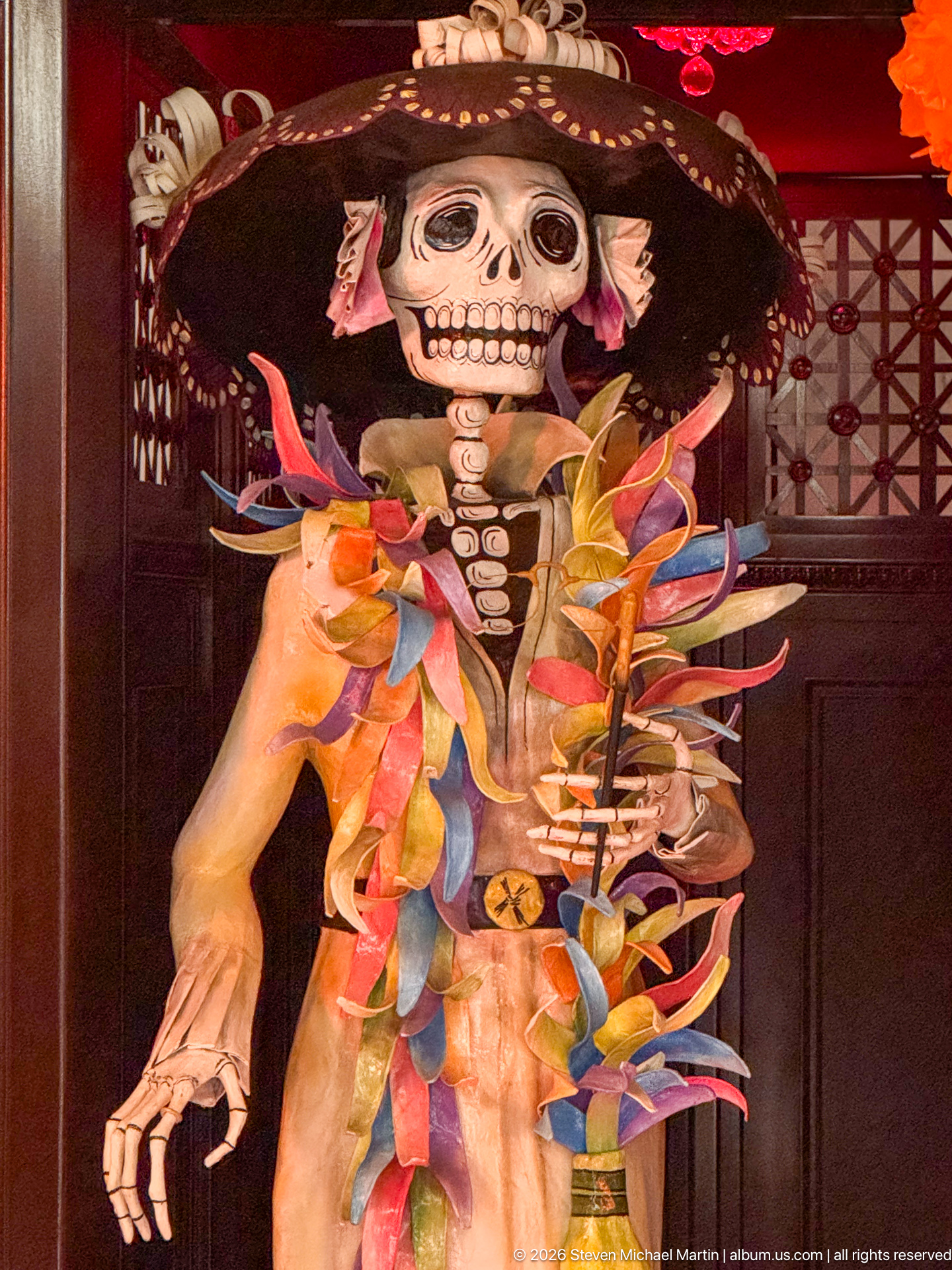
The Catrina’s painted skull, wide dotted hat, and layered paper-like flowers fill this close composition. Her extended skeletal hand and the colorful garland across her torso give the figure a theatrical pose, while dark carved panels and red light form a recessed backdrop. The crop shifts attention from the surrounding marigold arch to the figure’s crafted details.
Caption
The Catrina’s painted skull, wide dotted hat, and layered paper-like flowers fill this close composition. Her extended skeletal hand and the colorful garland across her torso give the figure a theatrical pose, while dark carved panels and red light form a recessed backdrop. The crop shifts attention from the surrounding marigold arch to the figure’s crafted details.
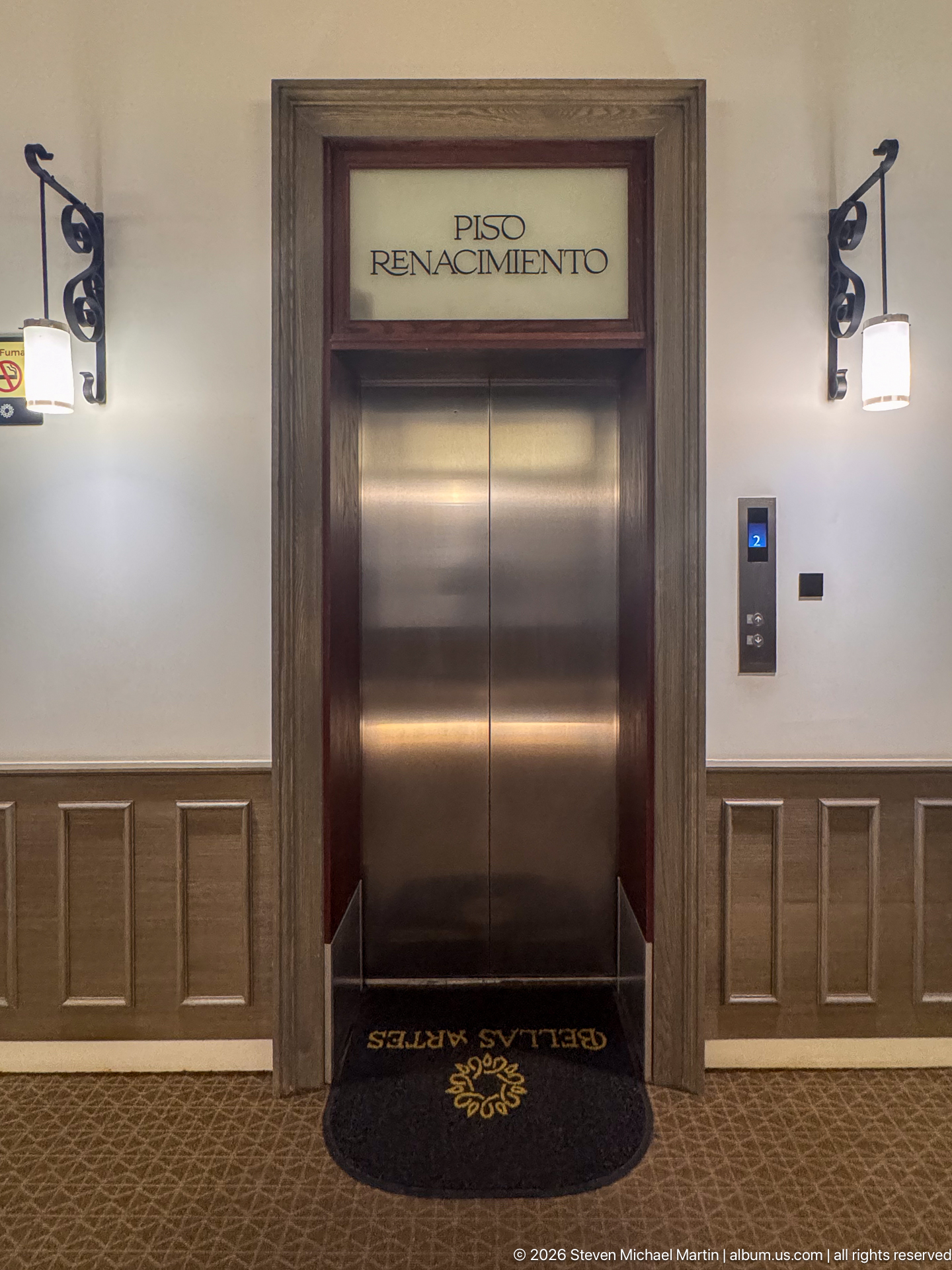
A stainless-steel elevator sits within a dark wood surround beneath a framed sign reading “Piso Renacimiento.” Matching wall sconces and paneled wainscoting create a formal, symmetrical landing, while the floor indicator shows level two. The photograph records the hotel’s wayfinding and interior finish in a quiet, unoccupied moment.
Caption
A stainless-steel elevator sits within a dark wood surround beneath a framed sign reading “Piso Renacimiento.” Matching wall sconces and paneled wainscoting create a formal, symmetrical landing, while the floor indicator shows level two. The photograph records the hotel’s wayfinding and interior finish in a quiet, unoccupied moment.
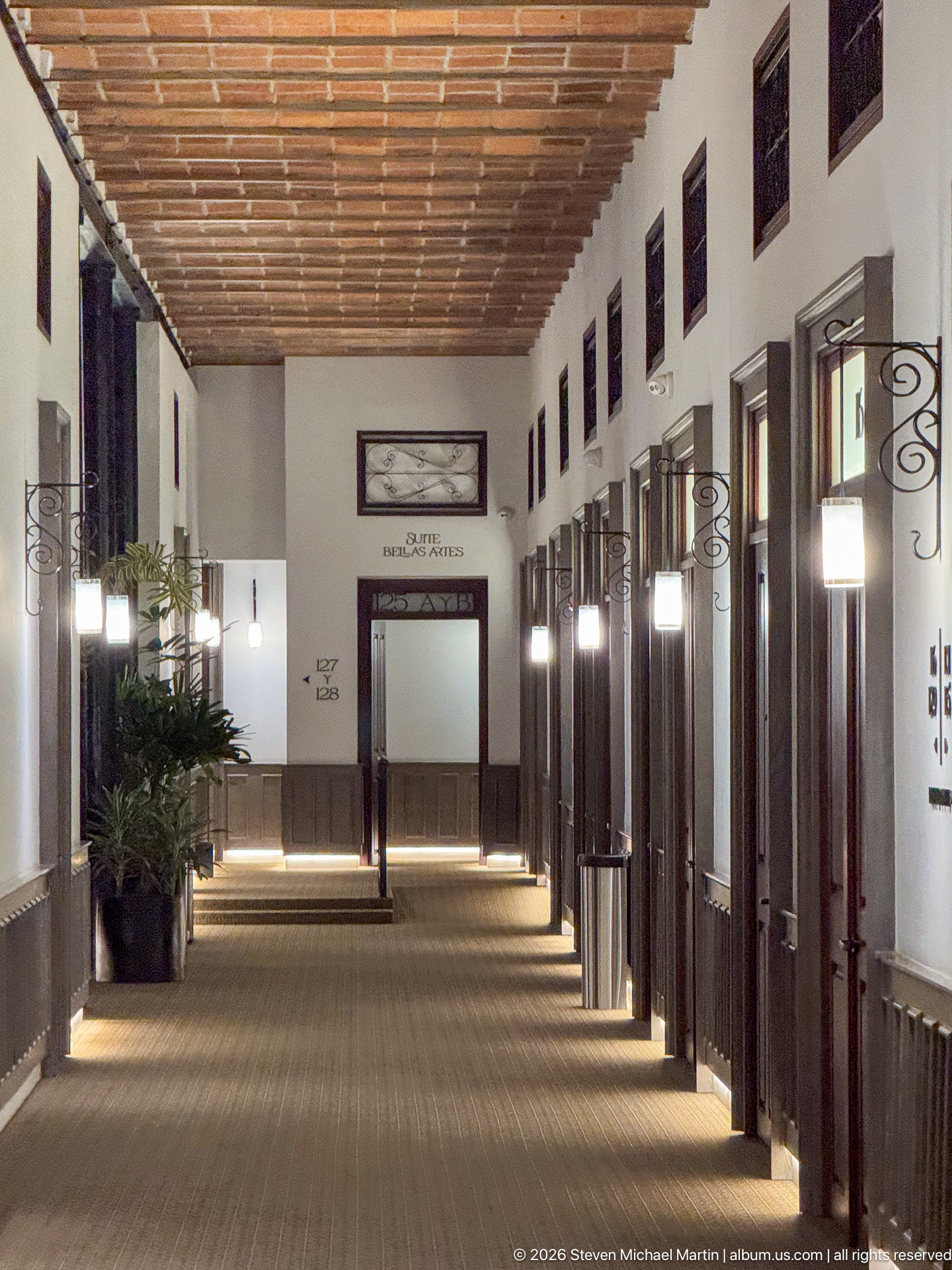
The empty corridor is viewed straight down its length, where repeated guest-room doors and dark trim converge toward a small landing. A brick-pattern ceiling and low, warm lighting give the passage a measured rhythm; potted greenery gathers along the right wall. Without the seasonal display in the companion view, this frame concentrates on the hotel’s orderly interior architecture.
Caption
The empty corridor is viewed straight down its length, where repeated guest-room doors and dark trim converge toward a small landing. A brick-pattern ceiling and low, warm lighting give the passage a measured rhythm; potted greenery gathers along the right wall. Without the seasonal display in the companion view, this frame concentrates on the hotel’s orderly interior architecture.
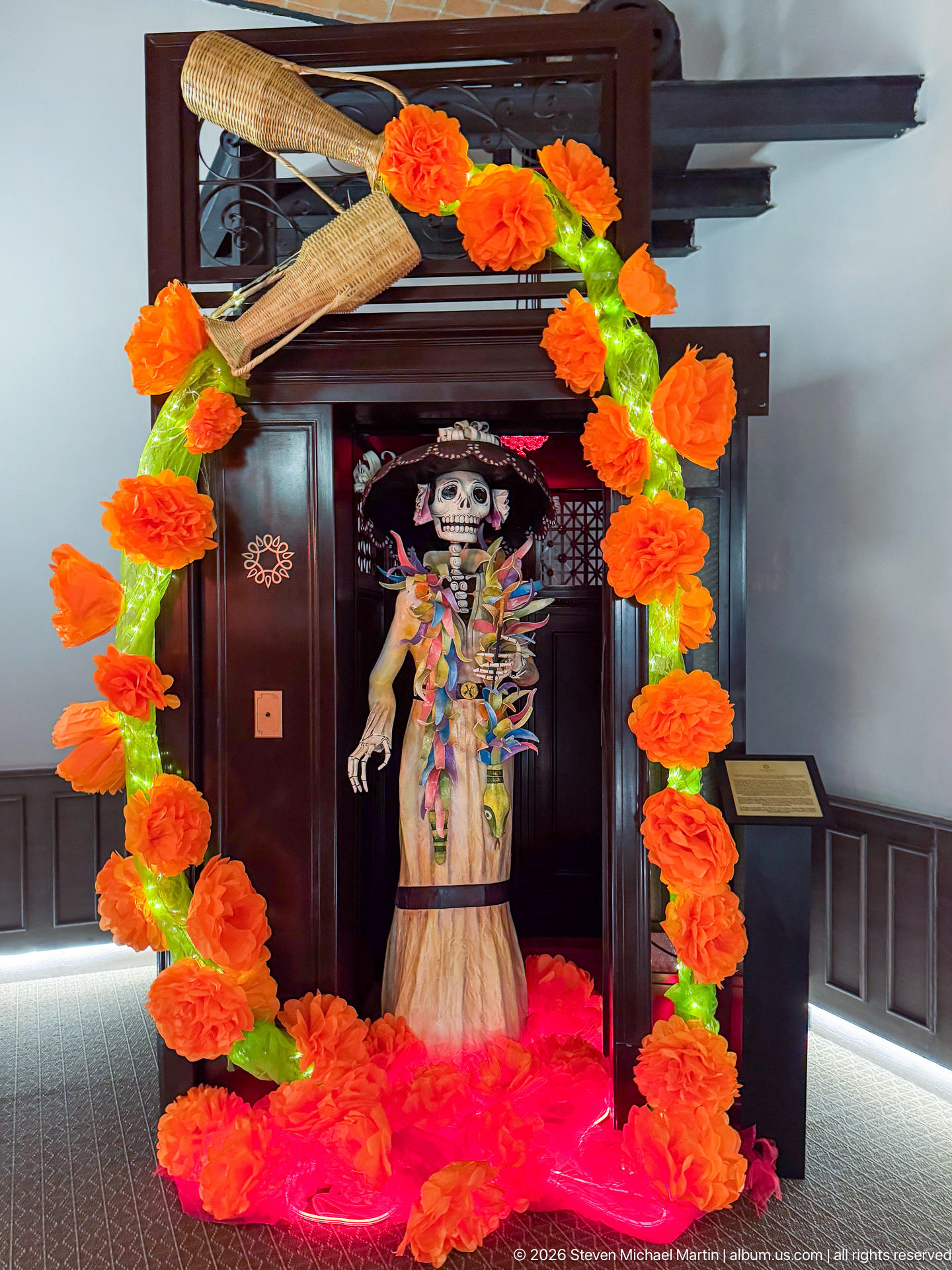
A full-height Catrina display stands inside a dark wooden doorway, framed by a vivid arch of orange marigolds and green lights. The wider view reveals a low illuminated flower border and a small information plaque beside the figure. Placed at the end of the passage, the installation acts as a focal point in the hotel’s Día de Muertos décor.
Caption
A full-height Catrina display stands inside a dark wooden doorway, framed by a vivid arch of orange marigolds and green lights. The wider view reveals a low illuminated flower border and a small information plaque beside the figure. Placed at the end of the passage, the installation acts as a focal point in the hotel’s Día de Muertos décor.
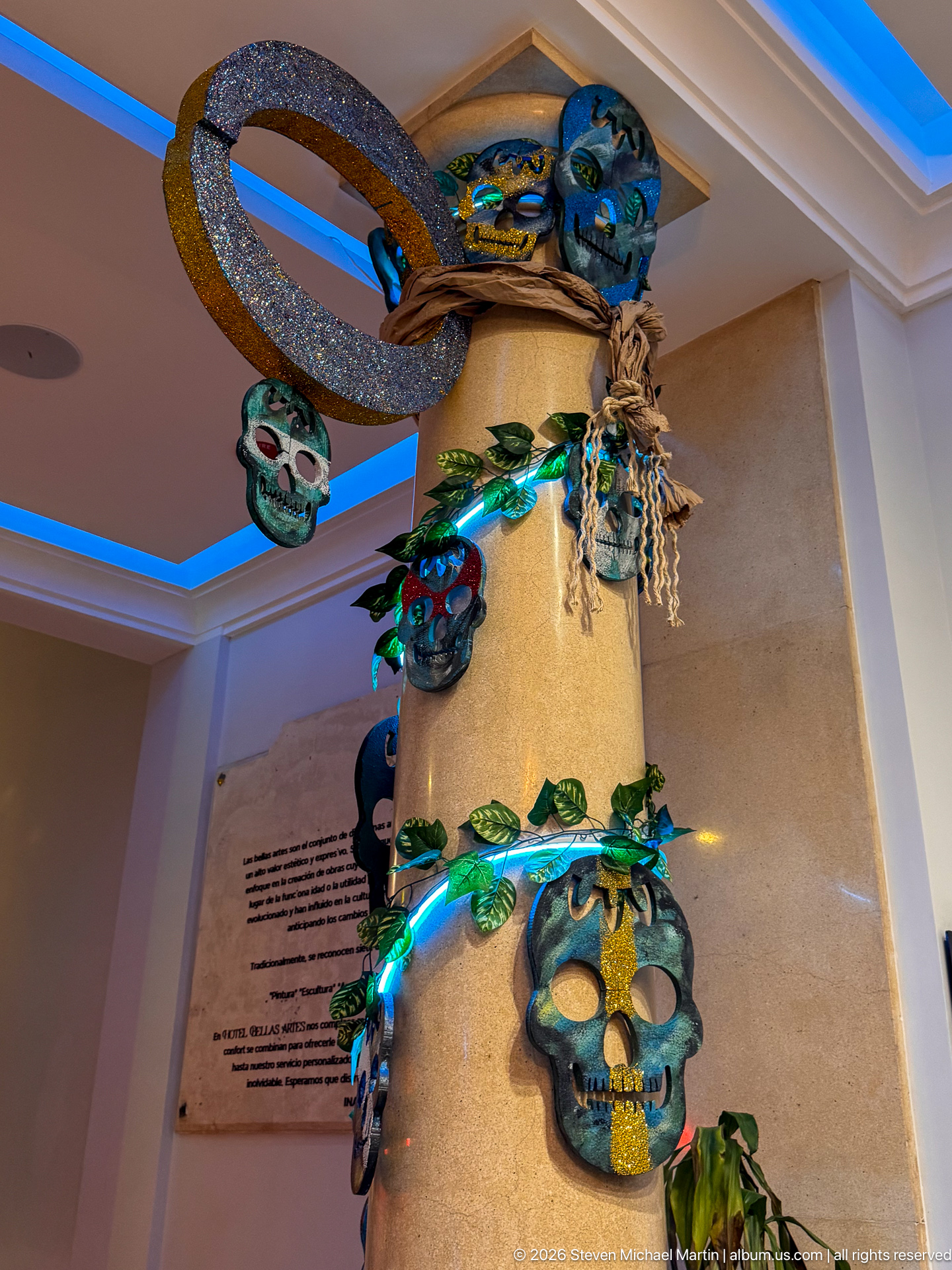
A column is wrapped with a vertical arrangement of blue-green skull ornaments, artificial leaves, and strands of blue light. A large sombrero-like form hangs near the ceiling, with smaller skulls descending toward the floor. The upward viewpoint shows how the hotel carries its Día de Muertos decorations beyond the freestanding Catrina display and into the surrounding interior.
Caption
A column is wrapped with a vertical arrangement of blue-green skull ornaments, artificial leaves, and strands of blue light. A large sombrero-like form hangs near the ceiling, with smaller skulls descending toward the floor. The upward viewpoint shows how the hotel carries its Día de Muertos decorations beyond the freestanding Catrina display and into the surrounding interior.
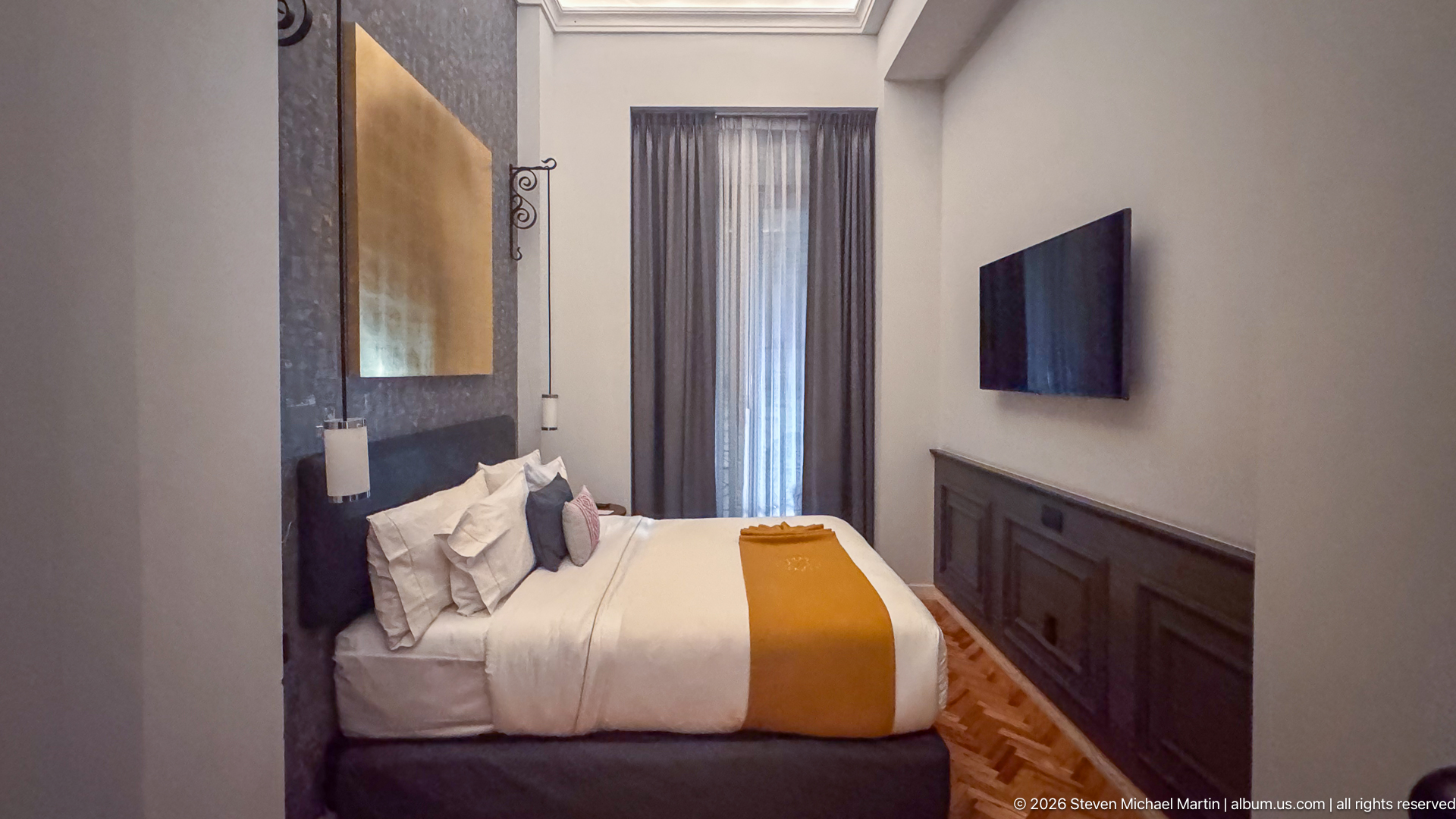
A neatly made bed fills the compact room, set against a dark upholstered headboard and a narrow curtained window. White linens and a mustard runner contrast with the dark wood wall paneling, while a wall-mounted television faces the bed. The corner view shows how the room’s furnishings fit within a narrow urban hotel footprint.
Caption
A neatly made bed fills the compact room, set against a dark upholstered headboard and a narrow curtained window. White linens and a mustard runner contrast with the dark wood wall paneling, while a wall-mounted television faces the bed. The corner view shows how the room’s furnishings fit within a narrow urban hotel footprint.
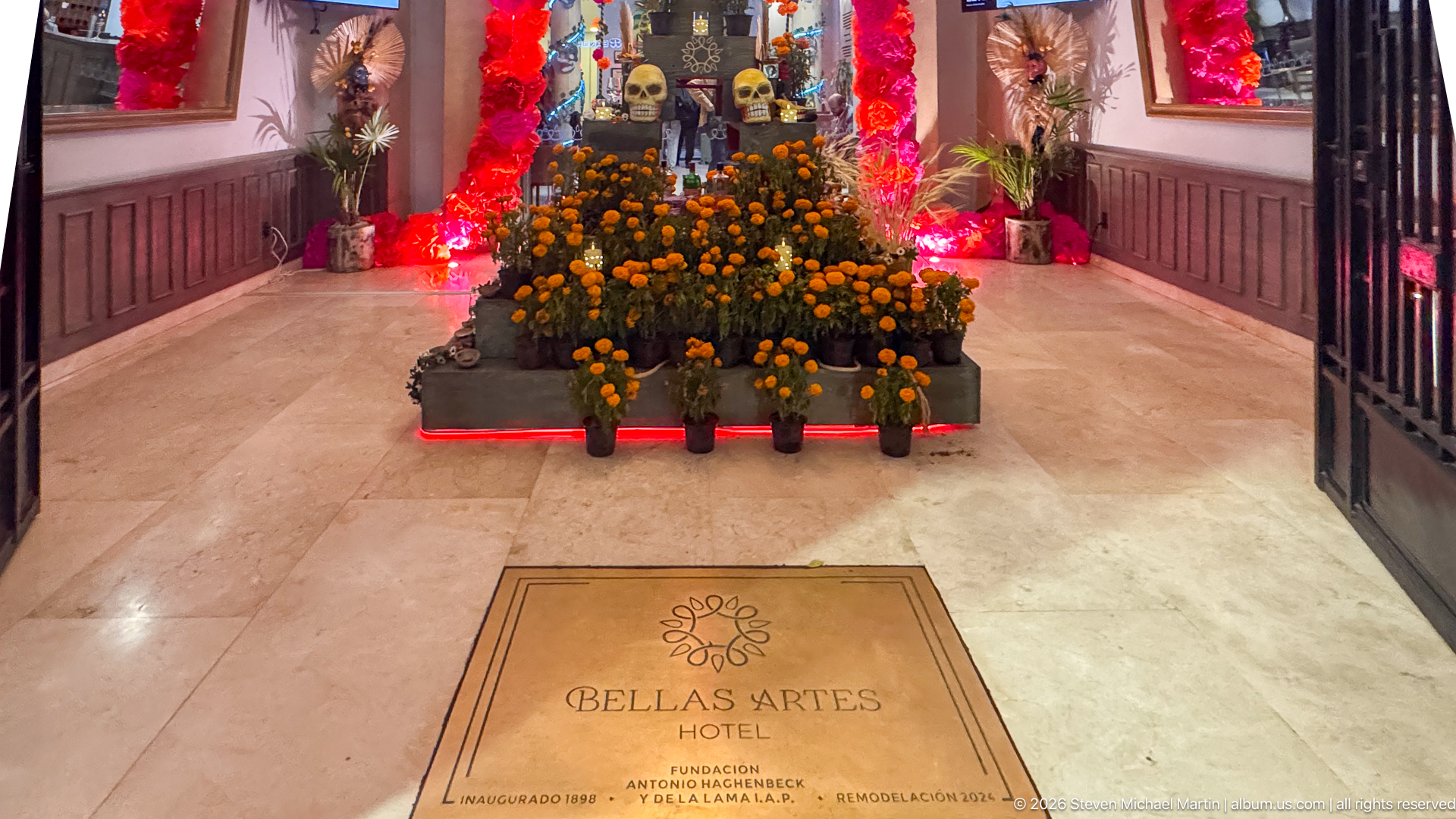
A brass-toned plaque at the hotel entrance names the Fundación Antonio Haghenbeck y de la Lama and reads “Inaugurado 1898” and “Remodelación 2024.” Marigolds and an ofrenda appear beyond the plaque in the lobby, linking the hotel’s stated opening date to the contemporary seasonal display. The view preserves the wording as visible evidence rather than inferring more of the building’s history.
Caption
A brass-toned plaque at the hotel entrance names the Fundación Antonio Haghenbeck y de la Lama and reads “Inaugurado 1898” and “Remodelación 2024.” Marigolds and an ofrenda appear beyond the plaque in the lobby, linking the hotel’s stated opening date to the contemporary seasonal display. The view preserves the wording as visible evidence rather than inferring more of the building’s history.
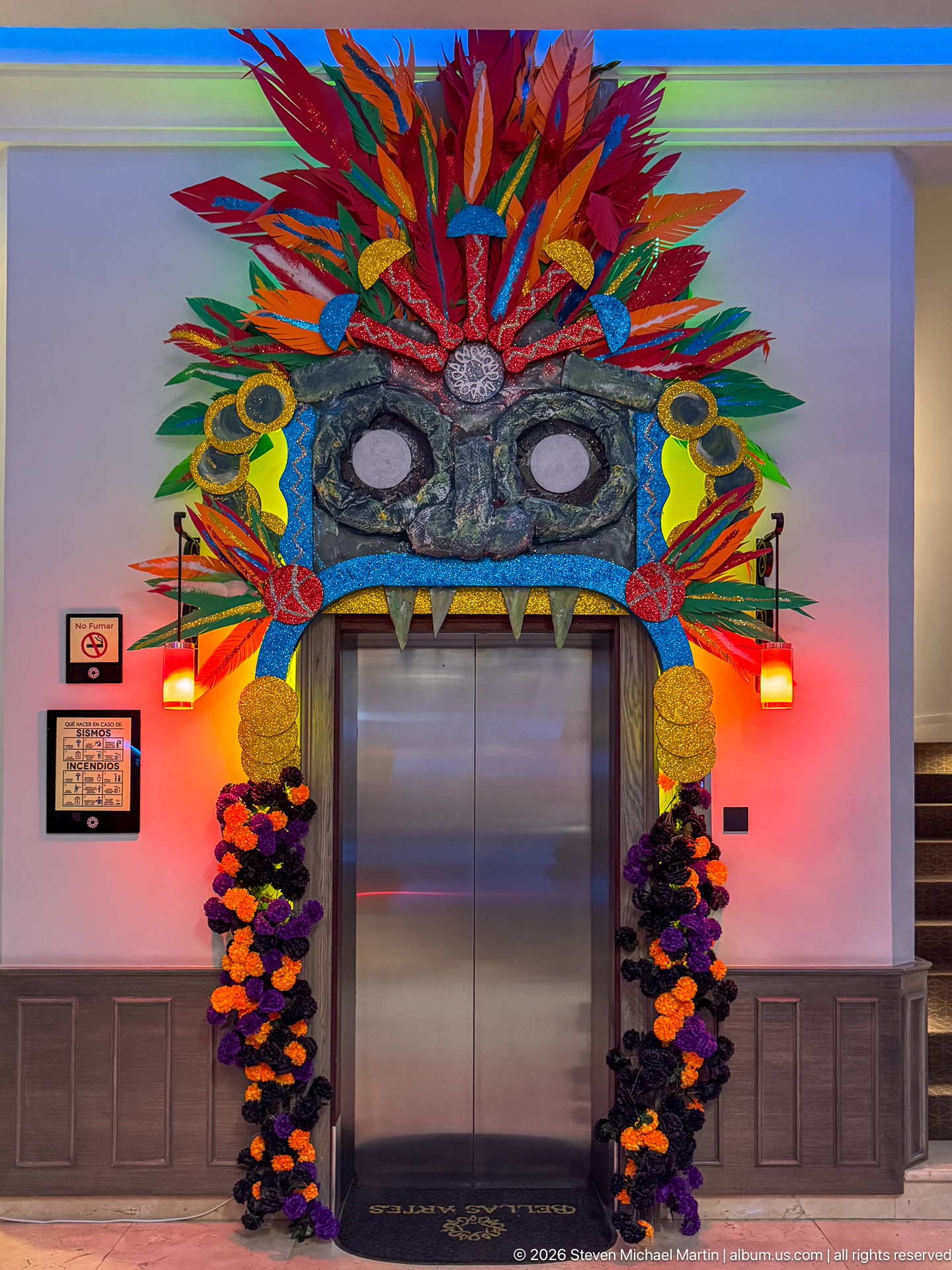
A large stylized skull mask crowns the elevator doors, framed by a fan of red, blue, green, and orange feather-like shapes. Bright accent lighting washes the wall in pink and blue, making the installation a vivid landmark within the otherwise paneled corridor. The centered view shows decoration integrated directly into the elevator surround.
Caption
A large stylized skull mask crowns the elevator doors, framed by a fan of red, blue, green, and orange feather-like shapes. Bright accent lighting washes the wall in pink and blue, making the installation a vivid landmark within the otherwise paneled corridor. The centered view shows decoration integrated directly into the elevator surround.
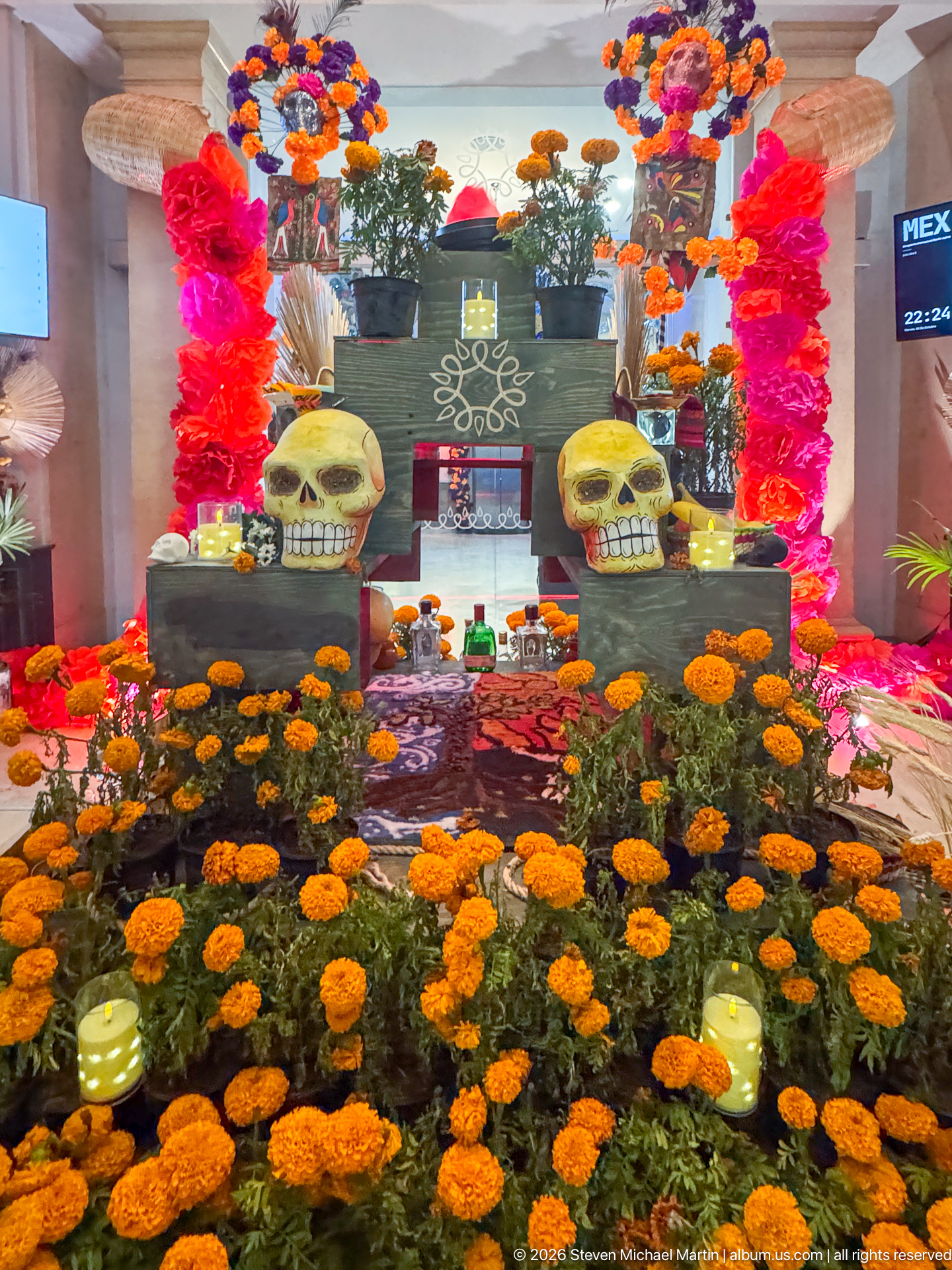
Two oversized sugar skulls sit on raised dark platforms at the center of a marigold-covered ofrenda. Candles, bottles, flowers, and small offerings fill the foreground, while a bright floral arch frames the display. The nearly frontal view gives the arrangement a ceremonial symmetry and makes its many offerings legible as a complete installation.
Caption
Two oversized sugar skulls sit on raised dark platforms at the center of a marigold-covered ofrenda. Candles, bottles, flowers, and small offerings fill the foreground, while a bright floral arch frames the display. The nearly frontal view gives the arrangement a ceremonial symmetry and makes its many offerings legible as a complete installation.
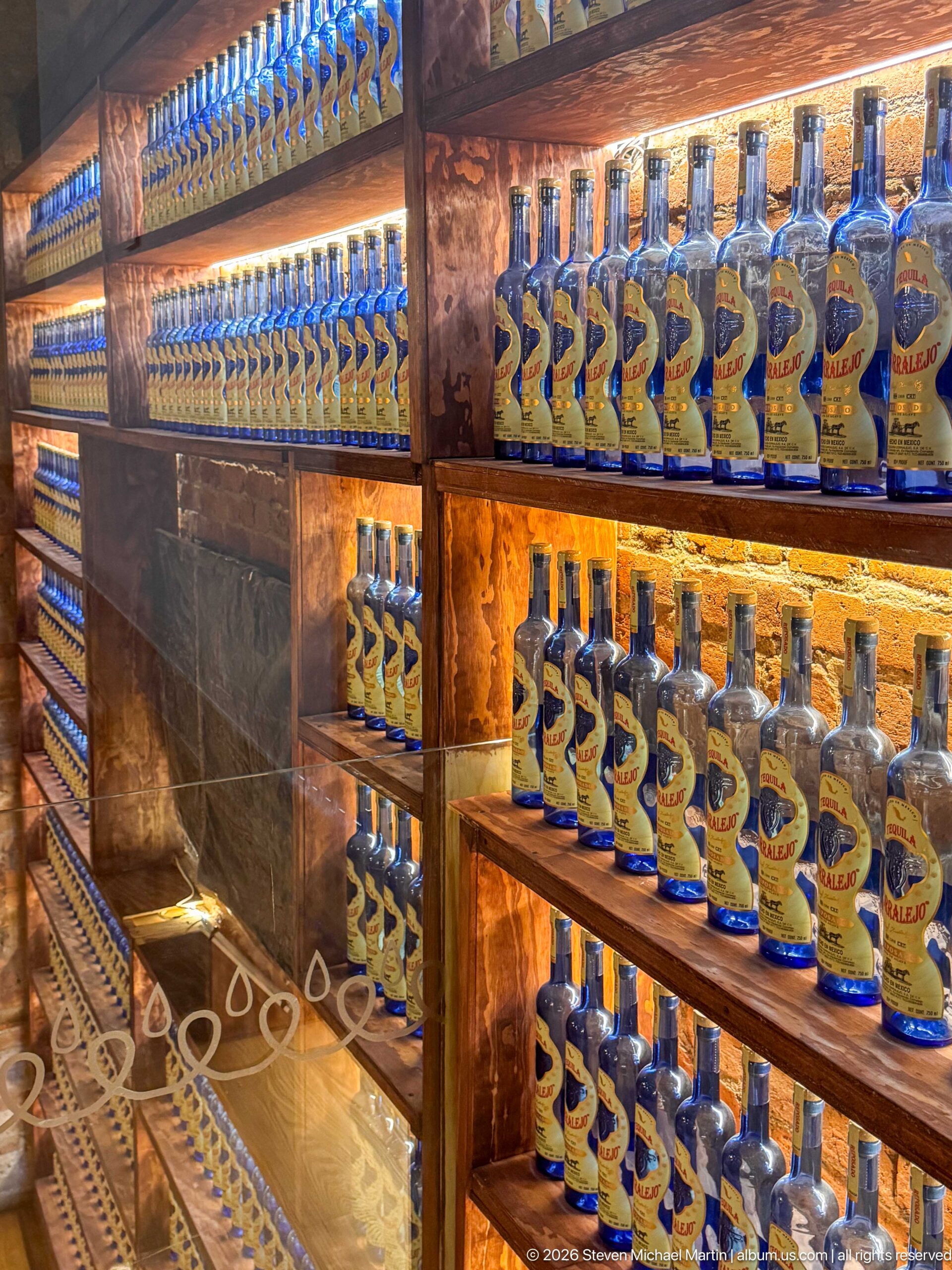
Blue-labeled bottles line illuminated wooden shelves in a brick-walled bar or display area. Reflections in the glass multiply the rows and expose the warm lighting behind them. Individual labels are too small to identify reliably in this view, so the caption focuses on the repeated bottle arrangement and its material setting within the hotel.
Caption
Blue-labeled bottles line illuminated wooden shelves in a brick-walled bar or display area. Reflections in the glass multiply the rows and expose the warm lighting behind them. Individual labels are too small to identify reliably in this view, so the caption focuses on the repeated bottle arrangement and its material setting within the hotel.
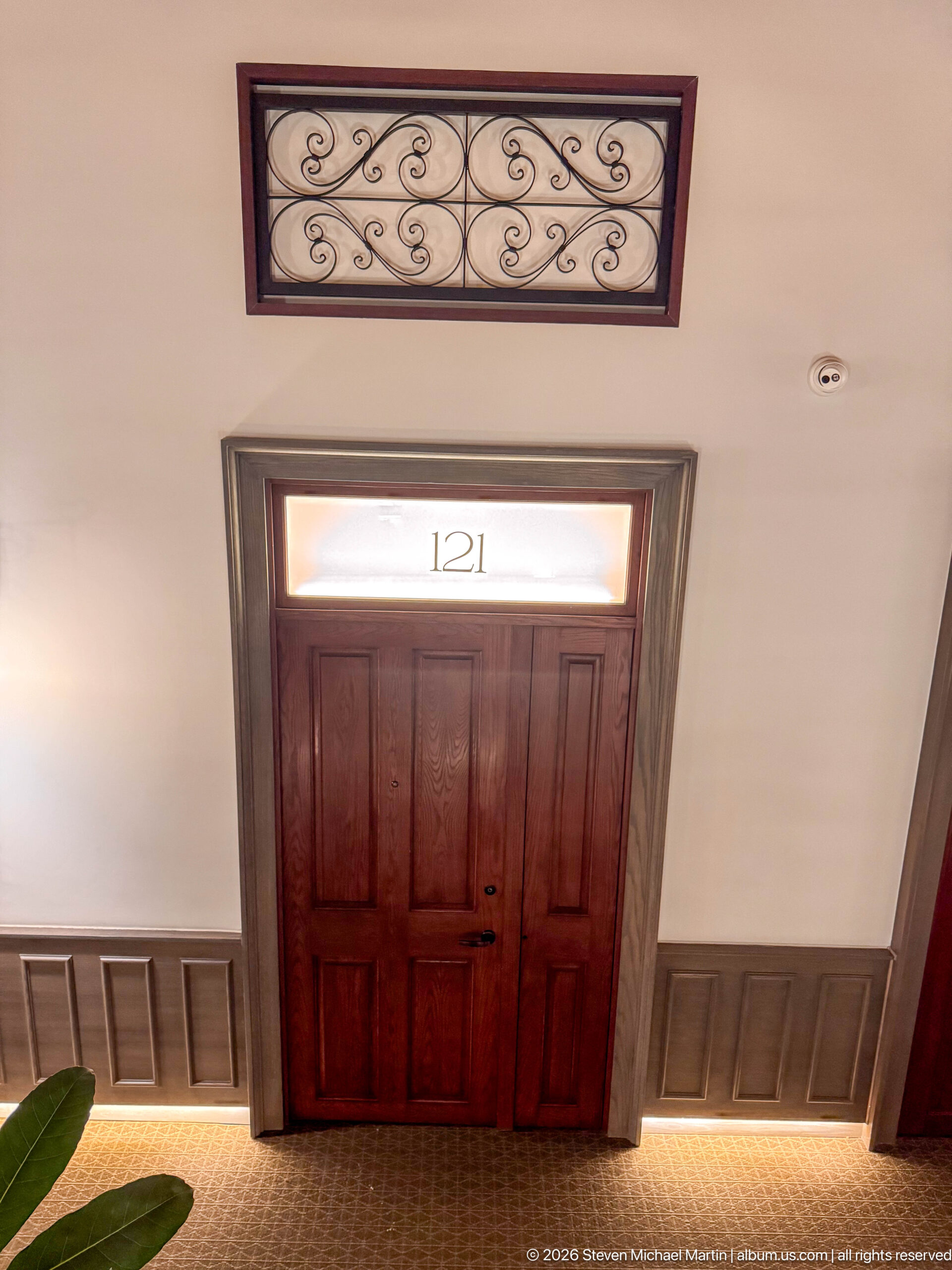
A dark paneled door marked “121” sits beneath a narrow glazed transom, with a decorative iron grille set above it. Warm floor-level lighting traces the baseboards and patterned carpet, while a potted plant enters at the lower left. The close, frontal view treats a single guest-room threshold as a designed element within the hotel corridor.
Caption
A dark paneled door marked “121” sits beneath a narrow glazed transom, with a decorative iron grille set above it. Warm floor-level lighting traces the baseboards and patterned carpet, while a potted plant enters at the lower left. The close, frontal view treats a single guest-room threshold as a designed element within the hotel corridor.
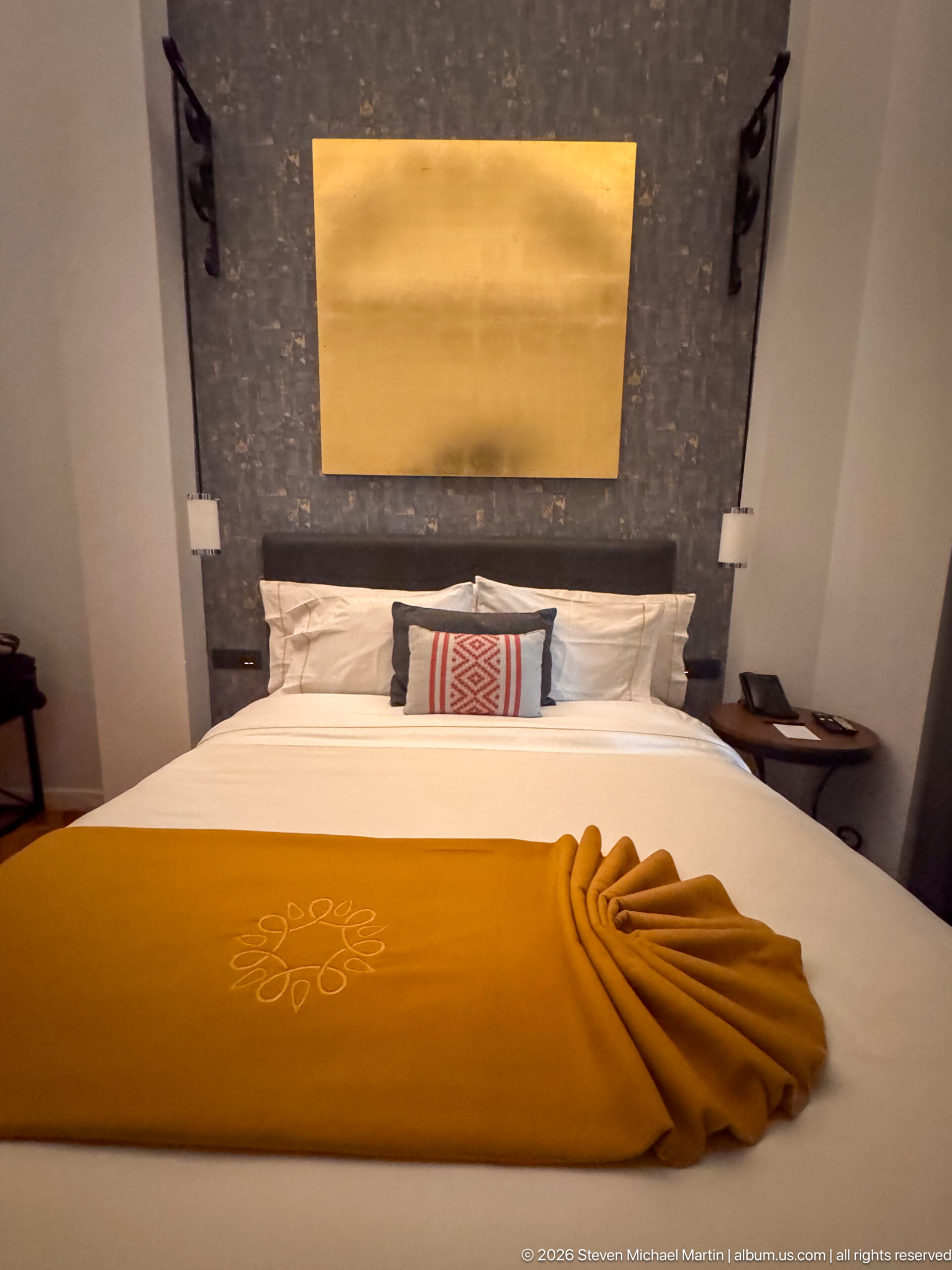
A king bed is centered beneath a broad dark stone headboard and a rectangular brass-toned wall panel. White bedding is accented by a mustard runner bearing the hotel’s emblem, with matching bedside tables and lamps on either side. The straight-on composition presents the room’s restrained palette and symmetrical arrangement of furnishings.
Caption
A king bed is centered beneath a broad dark stone headboard and a rectangular brass-toned wall panel. White bedding is accented by a mustard runner bearing the hotel’s emblem, with matching bedside tables and lamps on either side. The straight-on composition presents the room’s restrained palette and symmetrical arrangement of furnishings.
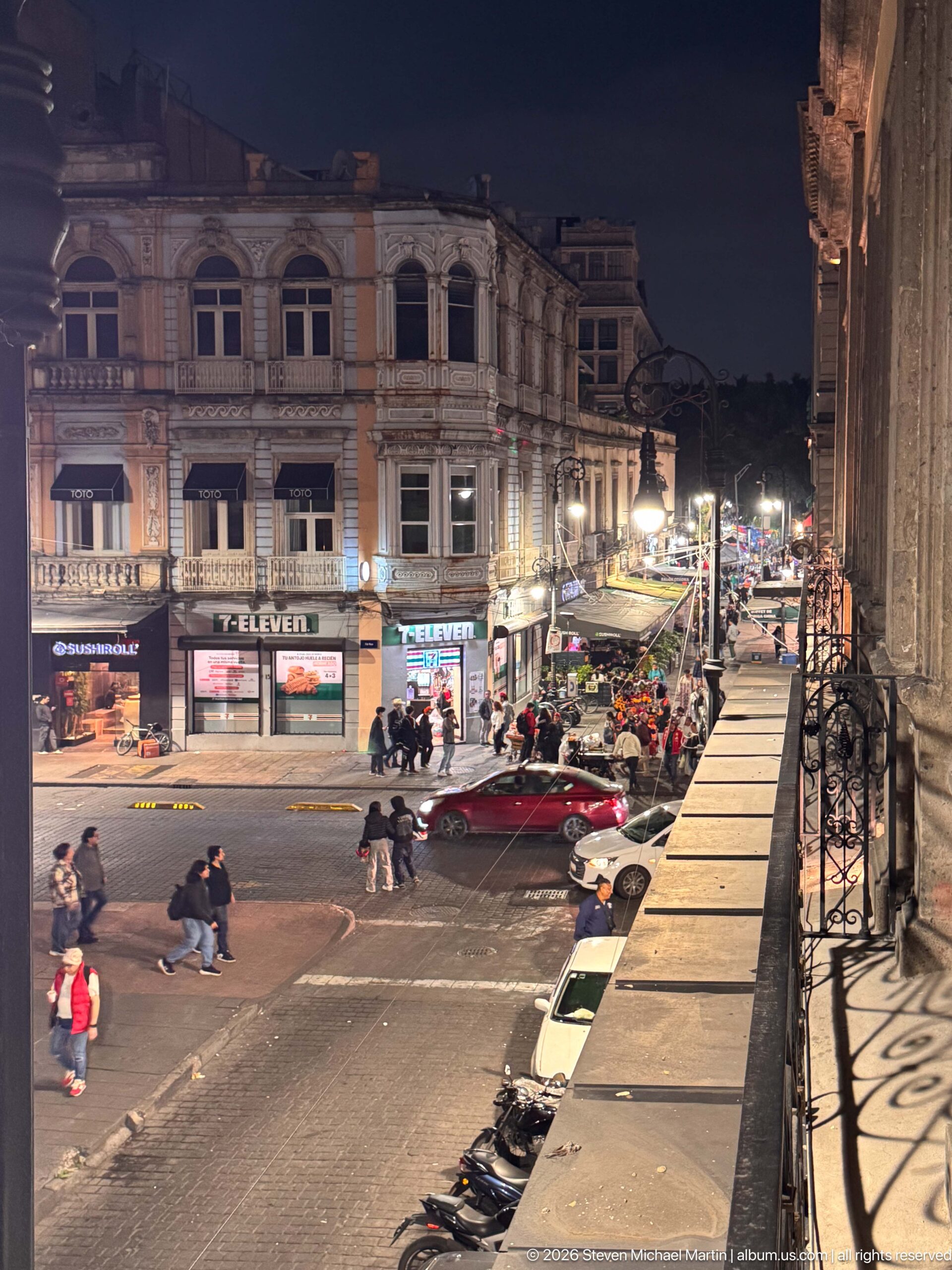
Viewed from an upper-level balcony, the street below is active with pedestrians, cars, and illuminated storefronts. Across the intersection, a historic façade with arched upper windows and decorative balconies contrasts with newer signs at street level. The elevated nighttime viewpoint records the hotel’s setting within the lively center rather than isolating its interiors.
Caption
Viewed from an upper-level balcony, the street below is active with pedestrians, cars, and illuminated storefronts. Across the intersection, a historic façade with arched upper windows and decorative balconies contrasts with newer signs at street level. The elevated nighttime viewpoint records the hotel’s setting within the lively center rather than isolating its interiors.
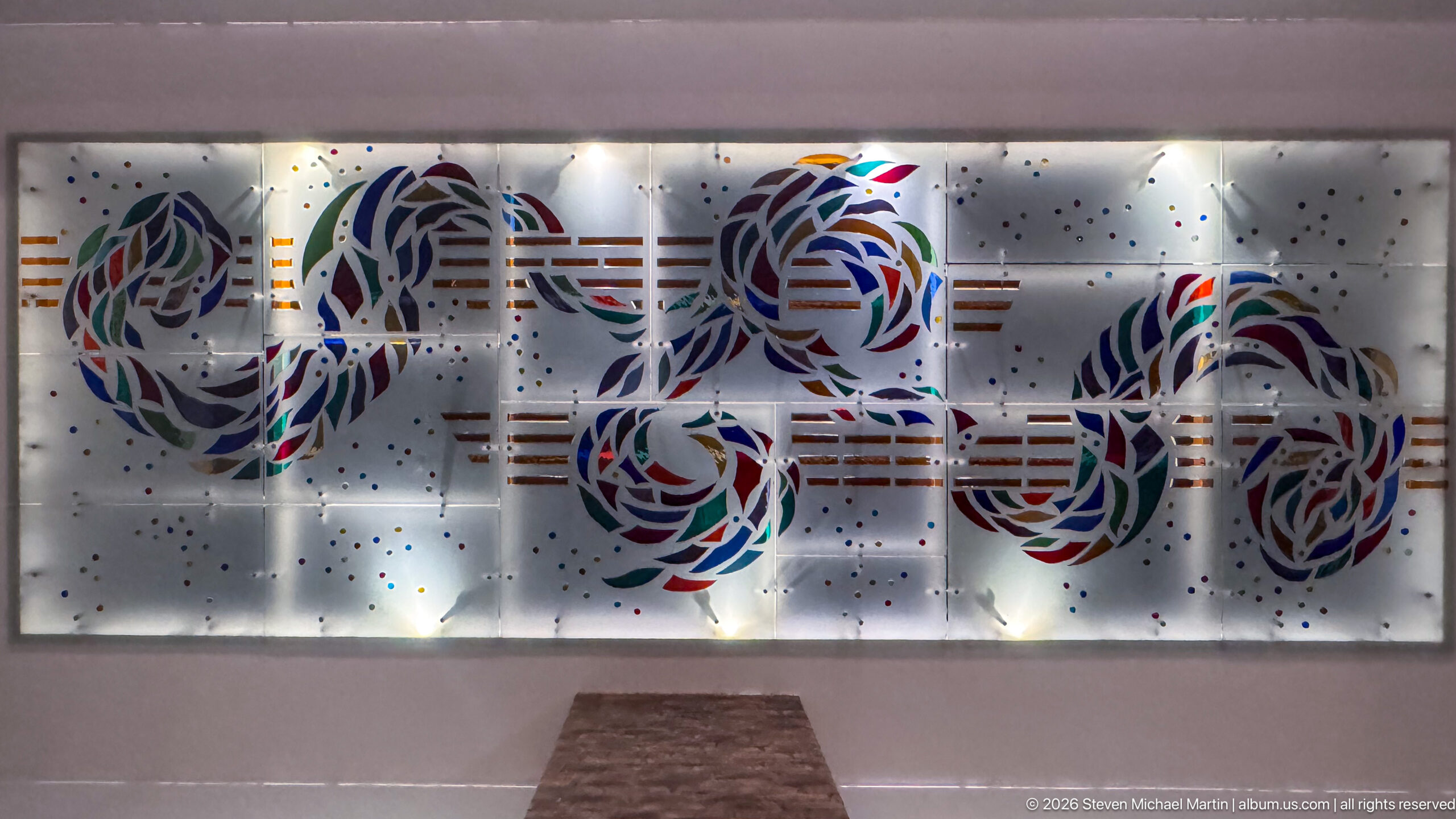
A backlit glass panel fills the wall above the bed with a sequence of abstract, interlocking forms in blue, green, red, and violet. Small colored dots and short gold lines punctuate the design, while the luminous surface contrasts with the room’s dark frame. The close view isolates the artwork that gives this guest room its most distinctive visual feature.
Caption
A backlit glass panel fills the wall above the bed with a sequence of abstract, interlocking forms in blue, green, red, and violet. Small colored dots and short gold lines punctuate the design, while the luminous surface contrasts with the room’s dark frame. The close view isolates the artwork that gives this guest room its most distinctive visual feature.
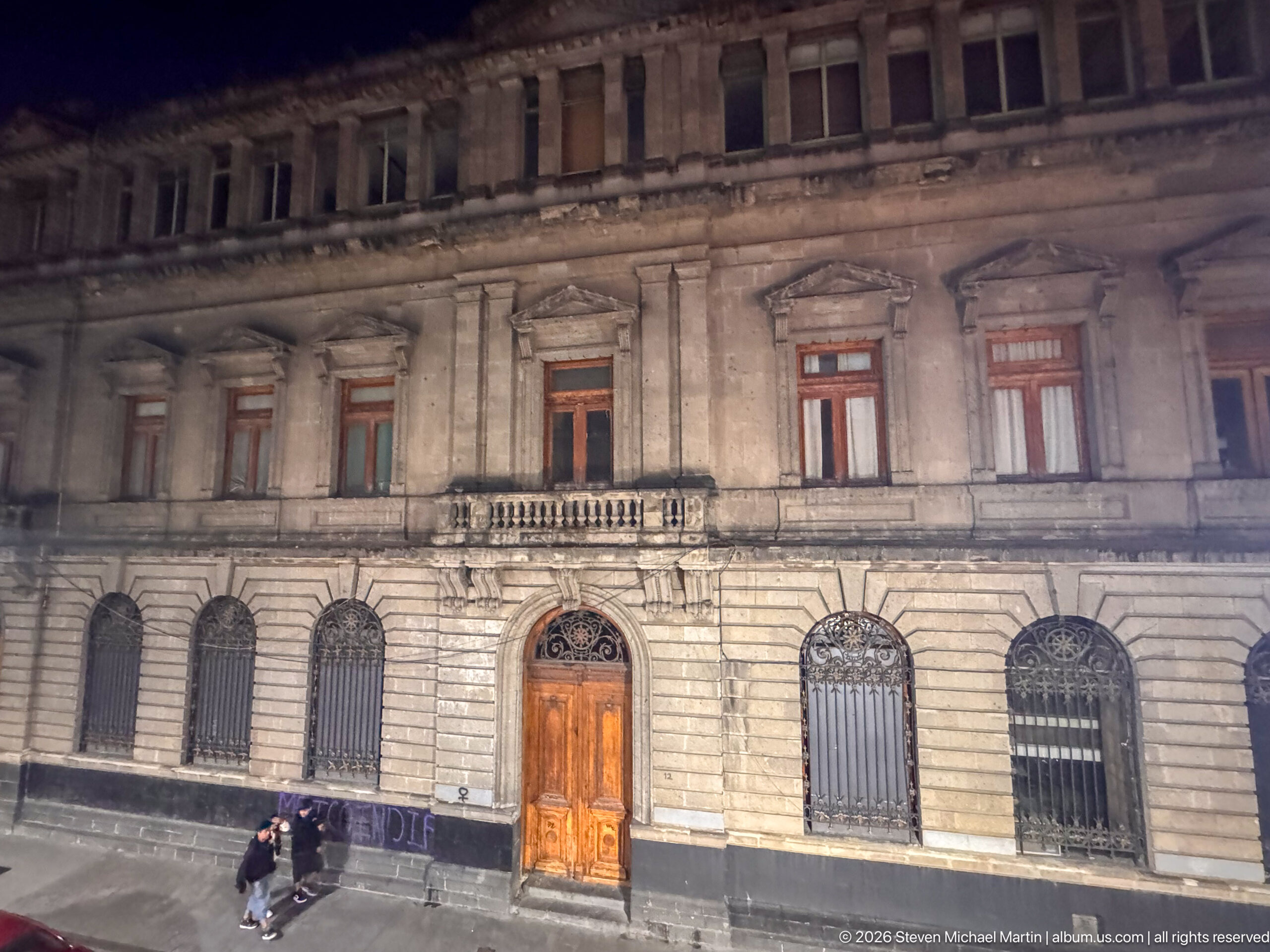
A long stone façade is organized by a row of arched, iron-grilled ground-floor windows and a central wooden doorway. Rectangular windows and shallow pediments repeat across the upper story, while a small balcony marks the center. Two people at the base provide scale for the imposing street frontage.
Caption
A long stone façade is organized by a row of arched, iron-grilled ground-floor windows and a central wooden doorway. Rectangular windows and shallow pediments repeat across the upper story, while a small balcony marks the center. Two people at the base provide scale for the imposing street frontage.
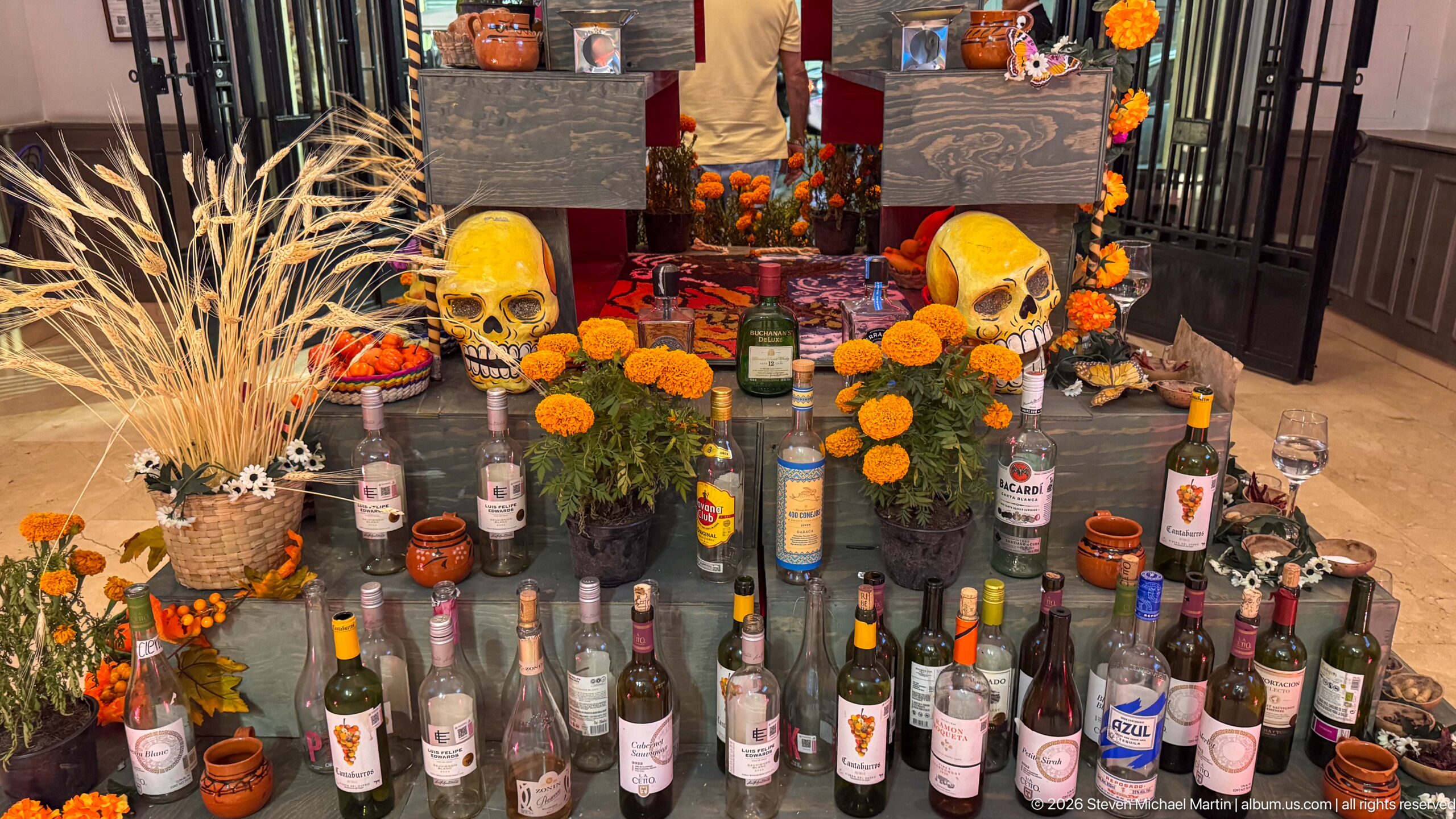
A long table holds rows of bottles, clay vessels, white flowers, and marigolds, with two large sugar skulls near the center. A visitor stands behind the offerings among additional flowers and small framed objects. The low viewpoint makes the bottles dominate the foreground while keeping the seasonal altar and its human scale in view.
Caption
A long table holds rows of bottles, clay vessels, white flowers, and marigolds, with two large sugar skulls near the center. A visitor stands behind the offerings among additional flowers and small framed objects. The low viewpoint makes the bottles dominate the foreground while keeping the seasonal altar and its human scale in view.
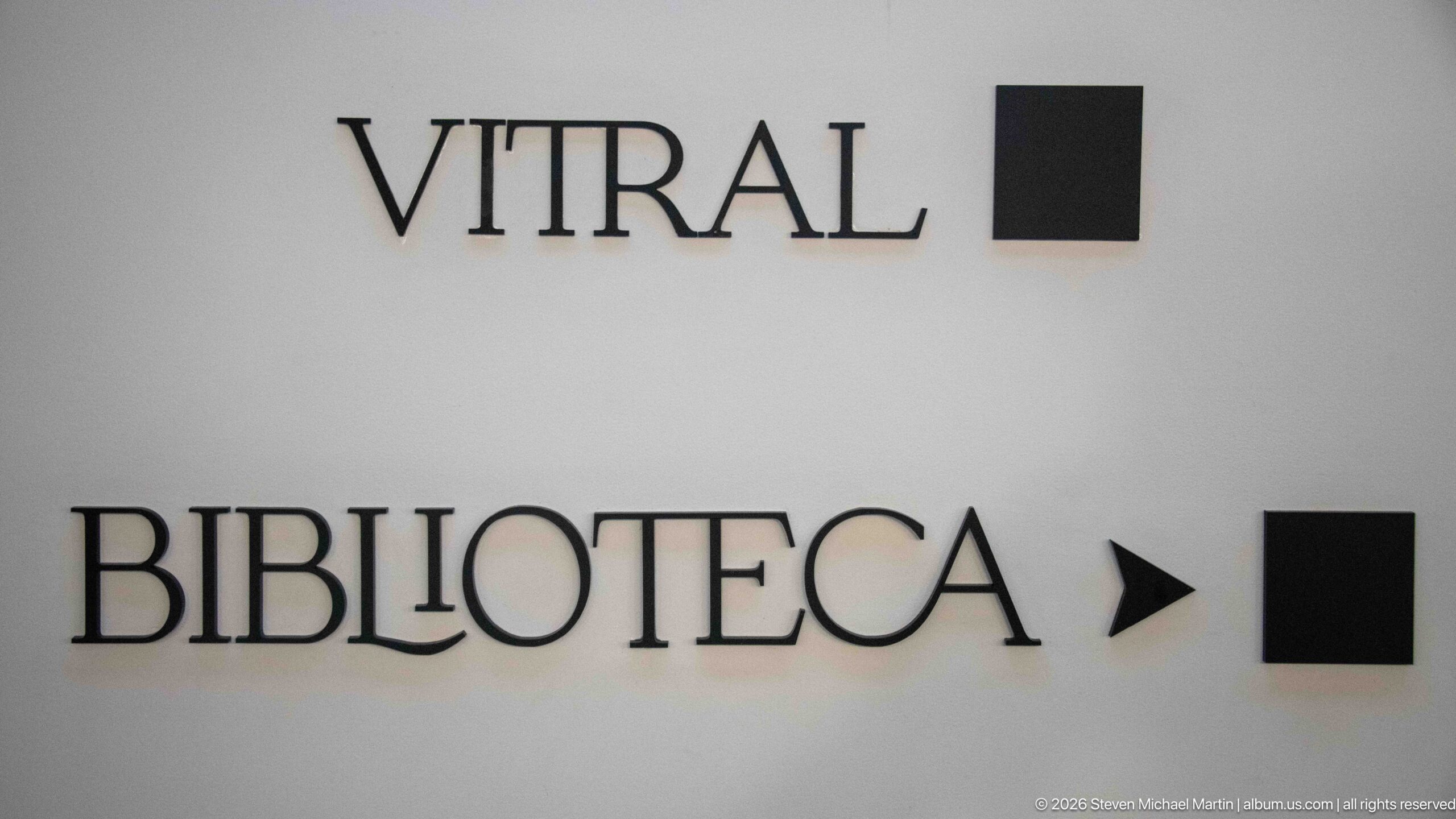
Large black lettering on a pale wall marks “Viral” and “Biblioteca,” with an arrow pointing right toward the library. Minimal typography and a small square emblem keep the sign visually direct against the otherwise blank surface. This close detail documents the hotel’s interior wayfinding and named amenities without relying on architectural context.
Caption
Large black lettering on a pale wall marks “Viral” and “Biblioteca,” with an arrow pointing right toward the library. Minimal typography and a small square emblem keep the sign visually direct against the otherwise blank surface. This close detail documents the hotel’s interior wayfinding and named amenities without relying on architectural context.
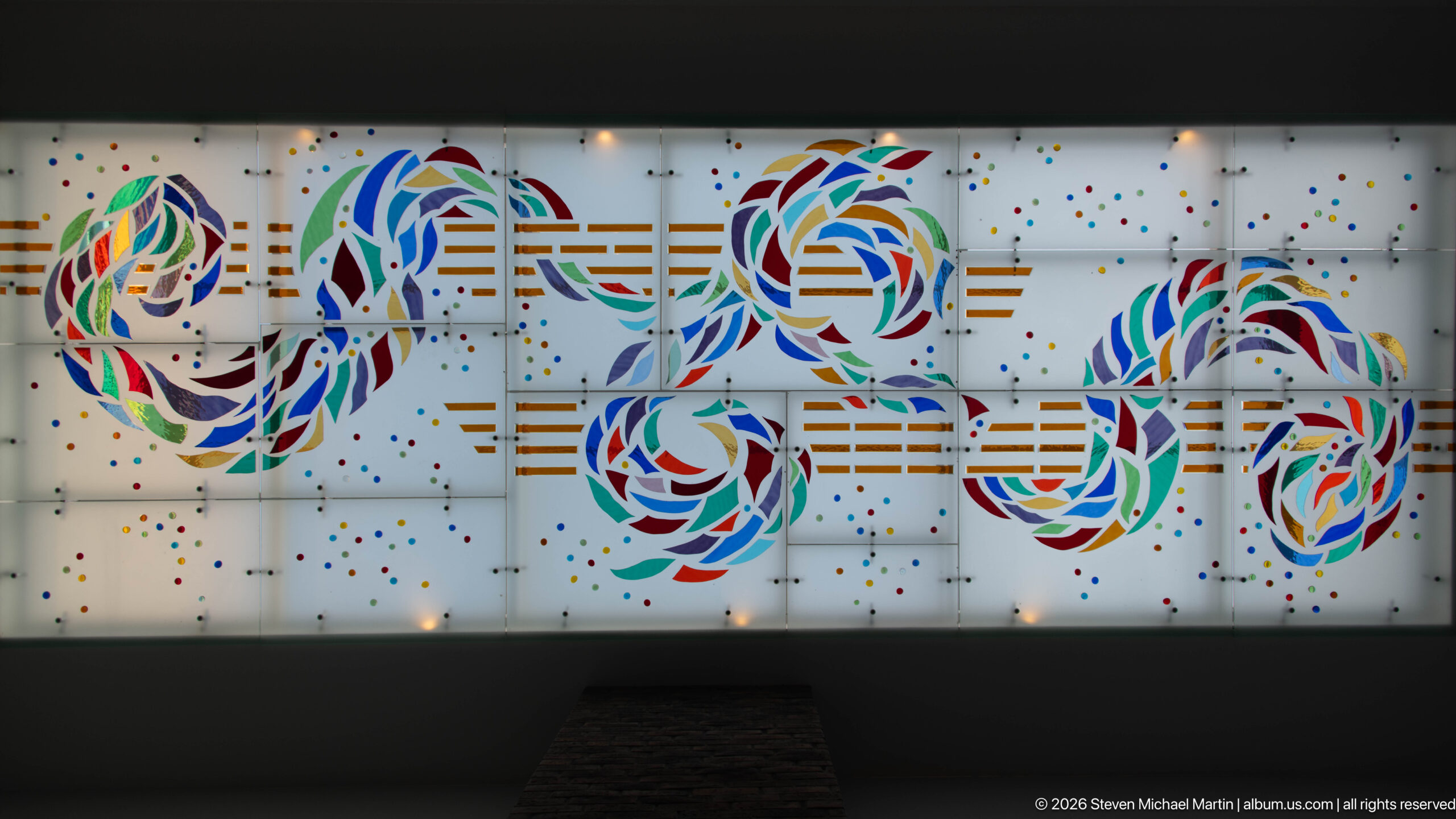
A row of backlit glass panels spans the wall, each carrying colorful abstract motifs and short gold bars against a pale field dotted with small circles. The bed and headboard are mostly outside the crop, so attention stays on the repeated design and the light passing through its translucent surface.
Caption
A row of backlit glass panels spans the wall, each carrying colorful abstract motifs and short gold bars against a pale field dotted with small circles. The bed and headboard are mostly outside the crop, so attention stays on the repeated design and the light passing through its translucent surface.
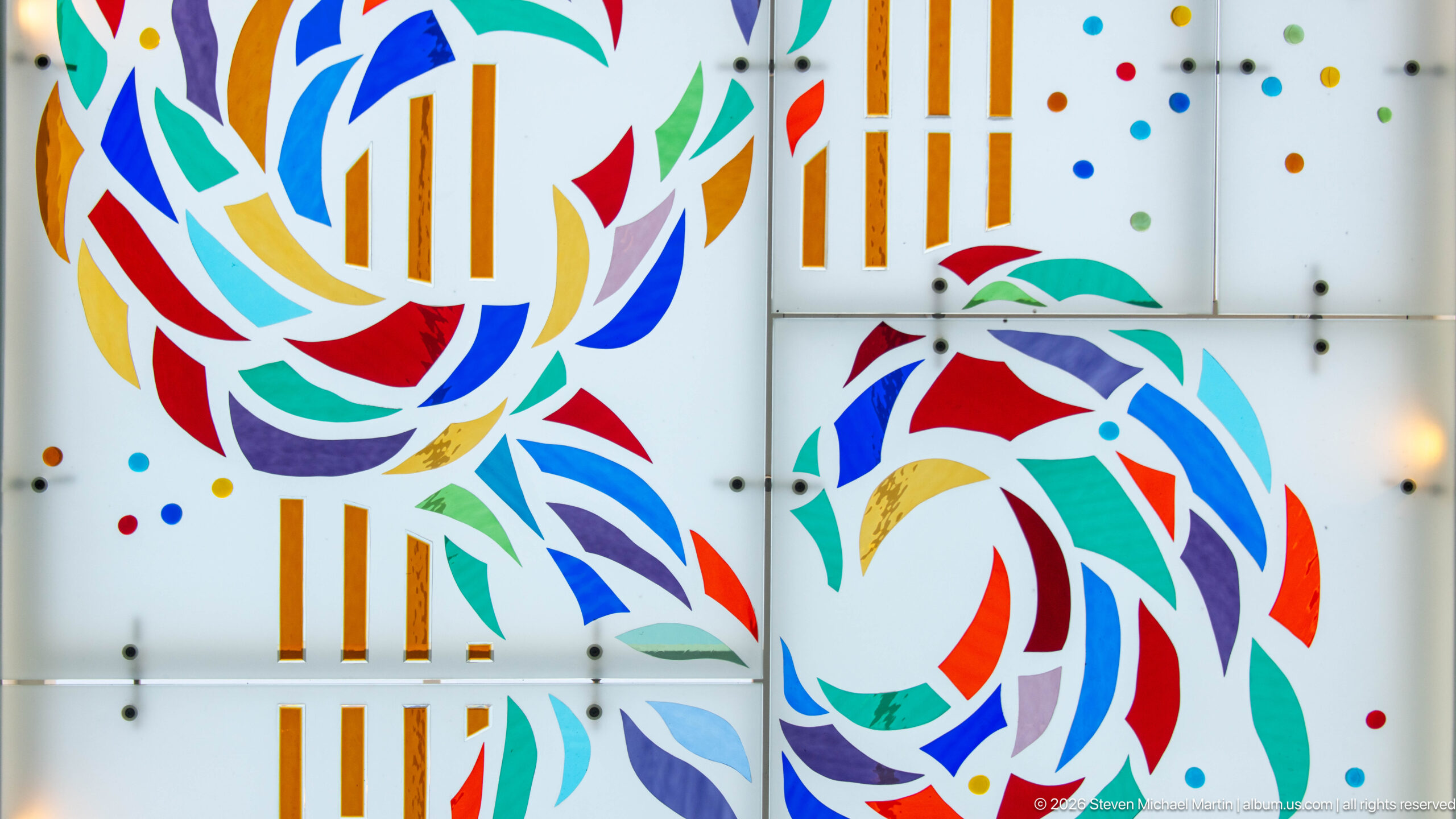
At close range, the glass panel’s sweeping blue, green, red, and violet shapes overlap across adjoining sections. Gold vertical bars and small circular accents interrupt the flowing pattern, while visible seams mark the individual panels. The crop reveals the graphic rhythm and layered color more clearly than the broader room view.
Caption
At close range, the glass panel’s sweeping blue, green, red, and violet shapes overlap across adjoining sections. Gold vertical bars and small circular accents interrupt the flowing pattern, while visible seams mark the individual panels. The crop reveals the graphic rhythm and layered color more clearly than the broader room view.
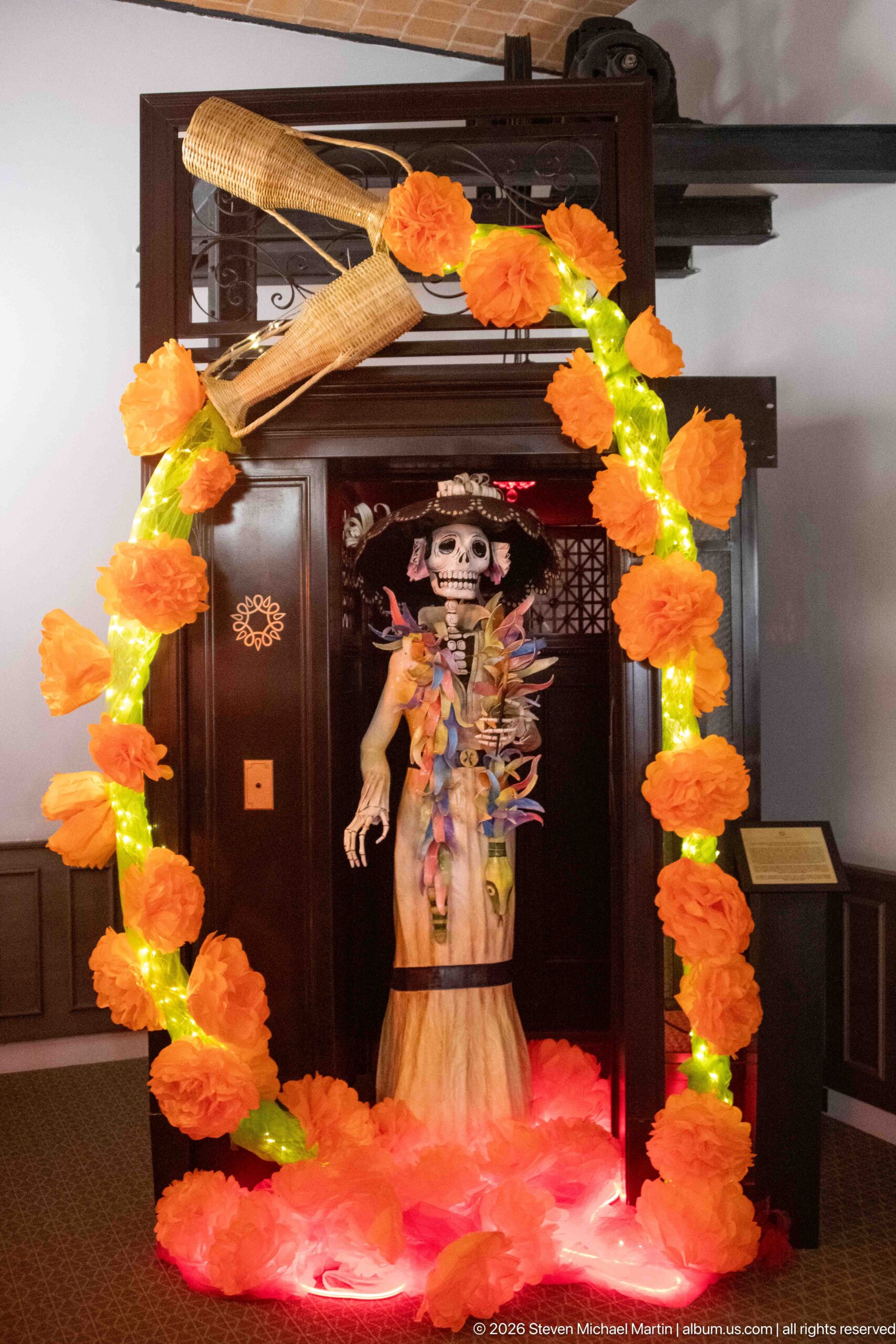
A full view of the Catrina alcove shows the figure standing within a bright arch of marigolds, green lights, and woven straw forms. Red light glows beneath the wooden cabinet, while a small information plaque sits to the right. The display is framed against the neutral hotel corridor, making its intense color and seasonal character especially distinct.
Caption
A full view of the Catrina alcove shows the figure standing within a bright arch of marigolds, green lights, and woven straw forms. Red light glows beneath the wooden cabinet, while a small information plaque sits to the right. The display is framed against the neutral hotel corridor, making its intense color and seasonal character especially distinct.
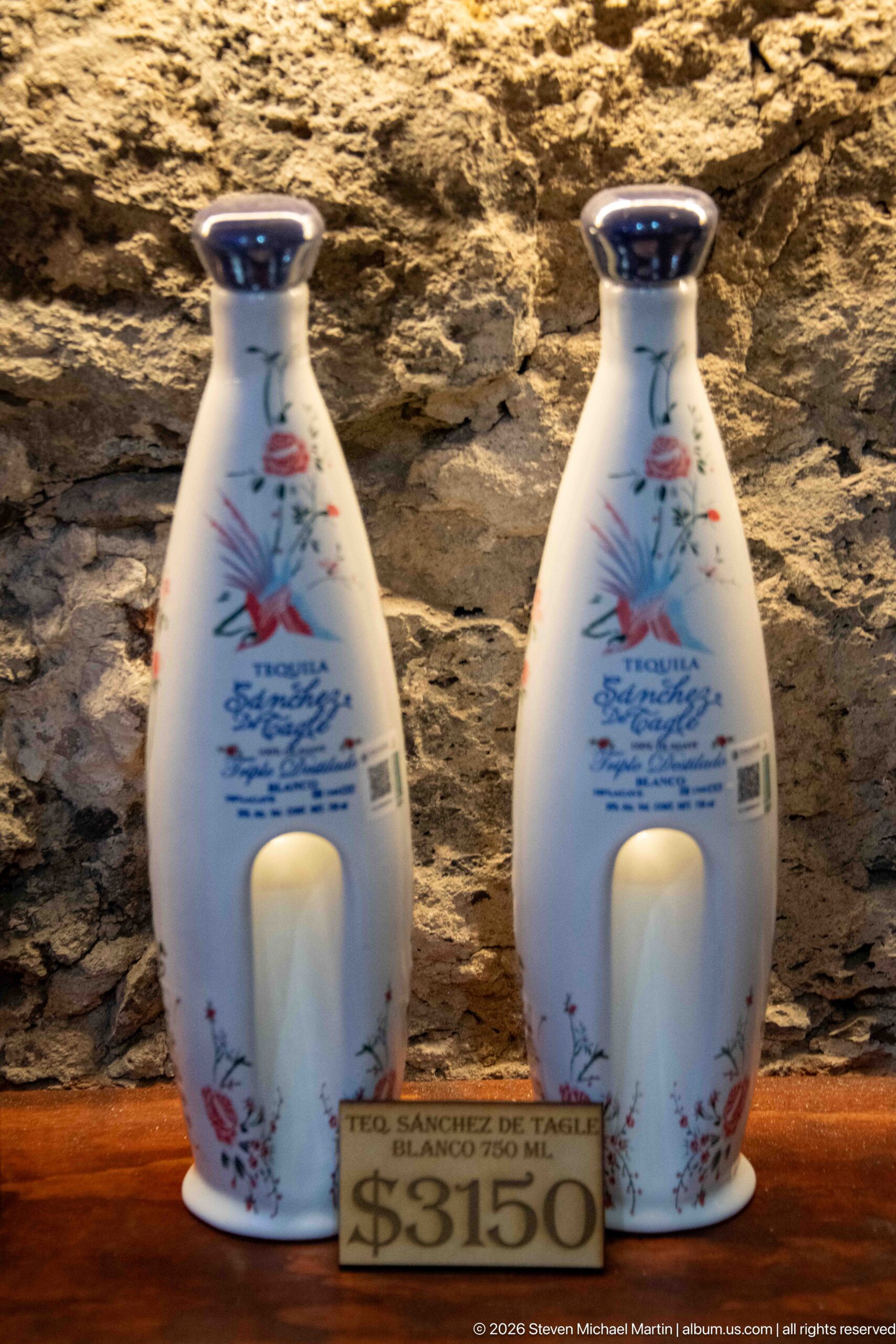
Two white ceramic bottles decorated with cobalt-blue motifs stand side by side against rough stone. Their long necks and bulbous bodies repeat the same shape, while a large blue “18” anchors each label and a small price card rests between them. The close crop isolates this matched pair from the larger retail display and makes the ceramic-like finish and mirrored presentation easy to compare.
Caption
Two white ceramic bottles decorated with cobalt-blue motifs stand side by side against rough stone. Their long necks and bulbous bodies repeat the same shape, while a large blue “18” anchors each label and a small price card rests between them. The close crop isolates this matched pair from the larger retail display and makes the ceramic-like finish and mirrored presentation easy to compare.
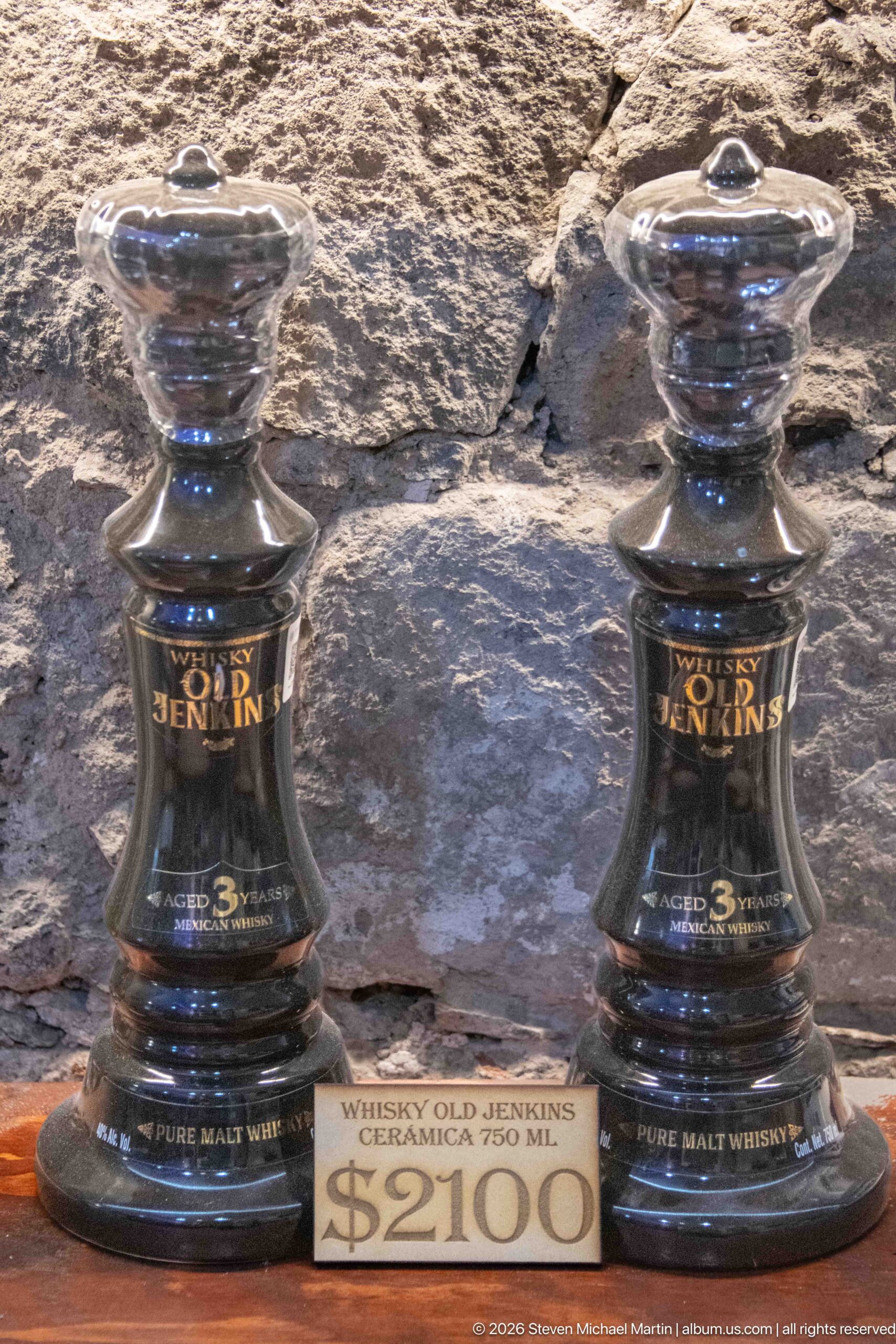
Two dark, faceted bottles of Old Jenkins “pure malt whiskey” stand against a rough stone wall, each labeled as aged three years. Their broad shoulders, flared bases, and amber liquid catch warm highlights from the shop lighting. A small placard identifies the product and price, keeping this close product view tied to the retail setting rather than presenting the bottles as isolated objects.
Caption
Two dark, faceted bottles of Old Jenkins “pure malt whiskey” stand against a rough stone wall, each labeled as aged three years. Their broad shoulders, flared bases, and amber liquid catch warm highlights from the shop lighting. A small placard identifies the product and price, keeping this close product view tied to the retail setting rather than presenting the bottles as isolated objects.
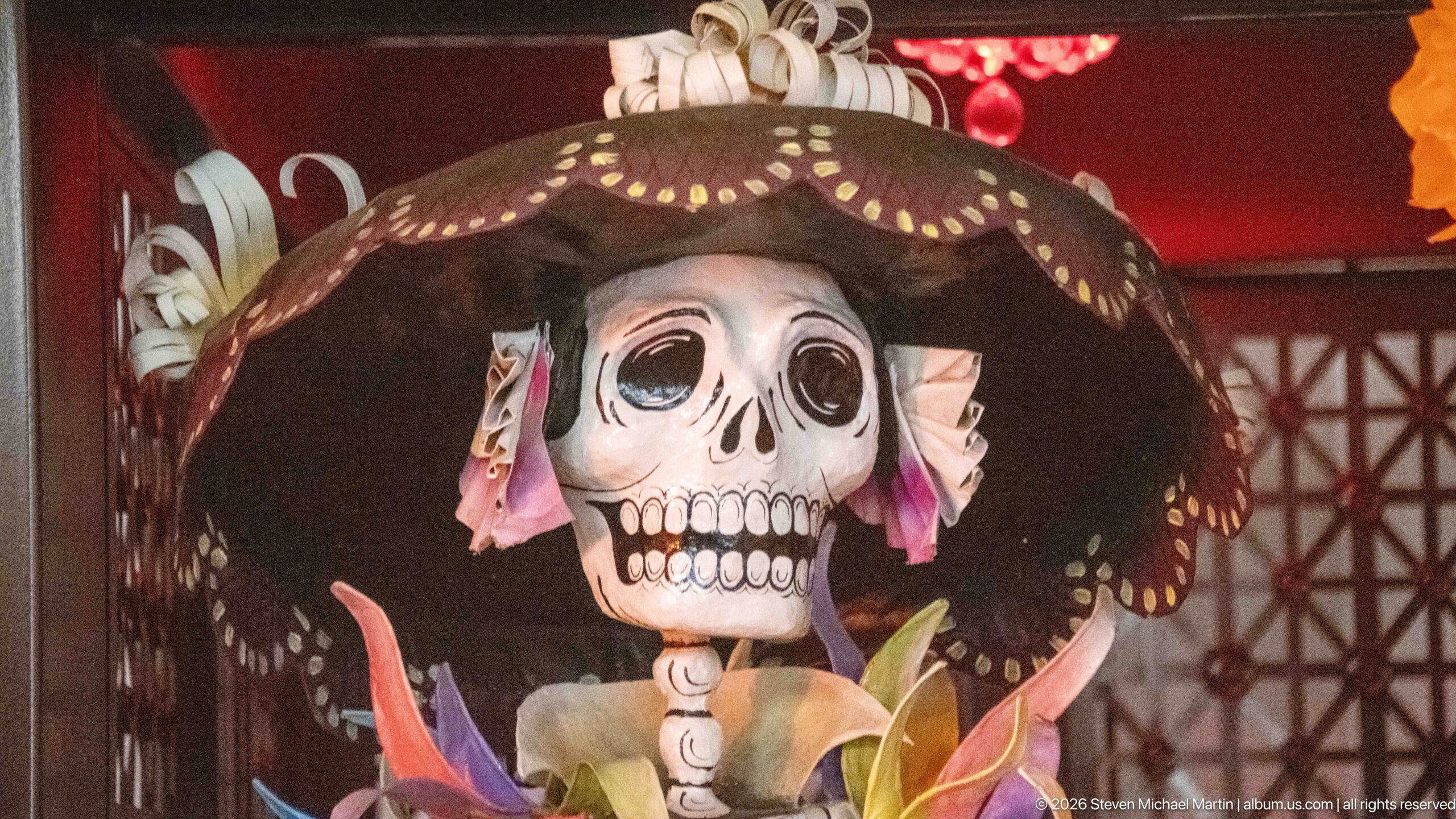
The Catrina’s pale painted skull fills the frame beneath a broad dark hat dotted with yellow marks. Pink fabric accents frame the ears, and bright sculptural leaves rise below the jaw. The extreme crop removes the surrounding hotel setting, concentrating on the figure’s face, costume, and theatrical visual character.
Caption
The Catrina’s pale painted skull fills the frame beneath a broad dark hat dotted with yellow marks. Pink fabric accents frame the ears, and bright sculptural leaves rise below the jaw. The extreme crop removes the surrounding hotel setting, concentrating on the figure’s face, costume, and theatrical visual character.
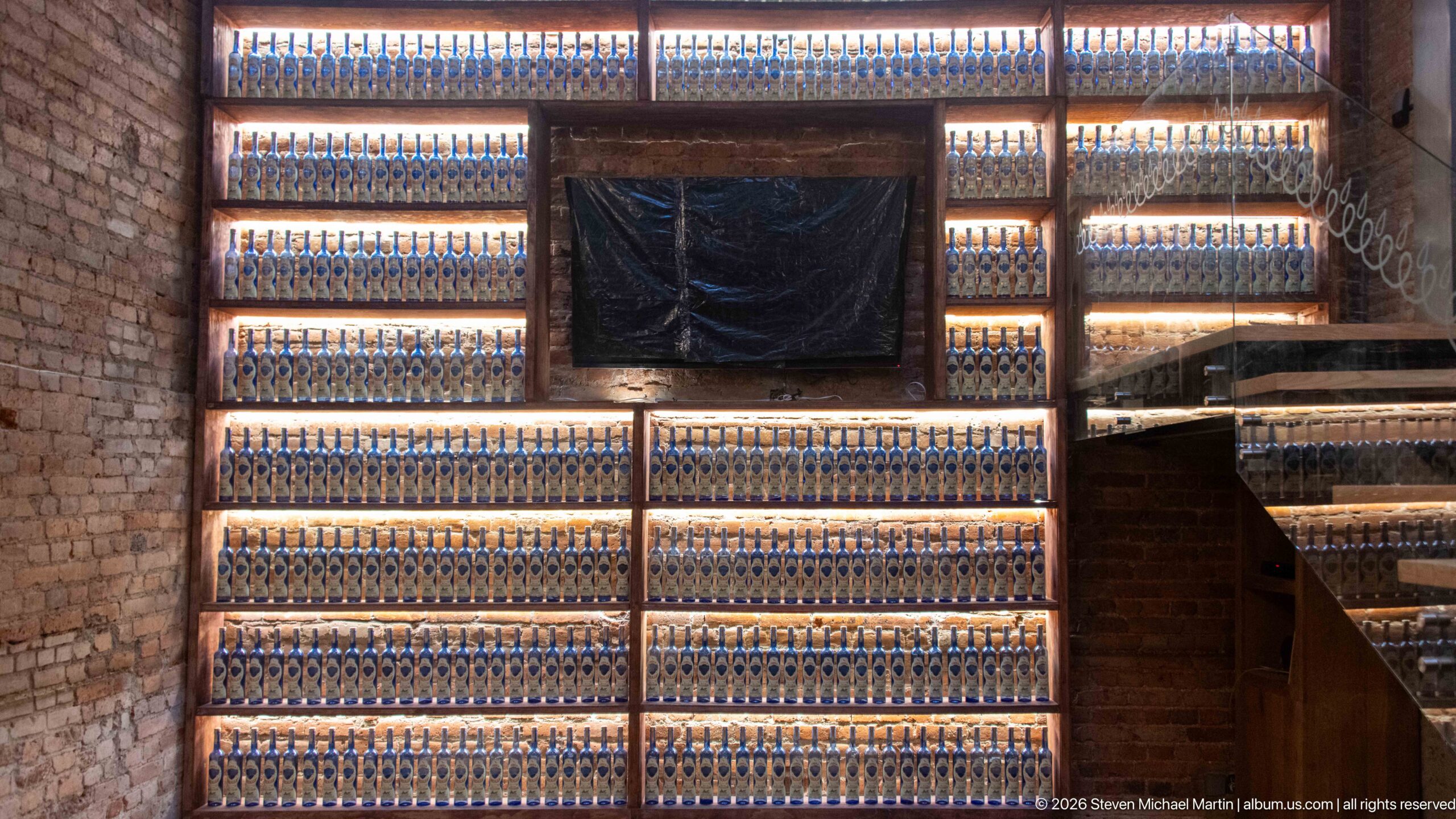
A wall of illuminated shelving holds tightly repeated rows of blue-labeled bottles, with exposed brick visible around the display and a dark central screen interrupting the pattern. The frontal view turns the merchandise into a geometric field of repeated glass forms. Labels remain too small to support a confident brand or beverage identification.
Caption
A wall of illuminated shelving holds tightly repeated rows of blue-labeled bottles, with exposed brick visible around the display and a dark central screen interrupting the pattern. The frontal view turns the merchandise into a geometric field of repeated glass forms. Labels remain too small to support a confident brand or beverage identification.
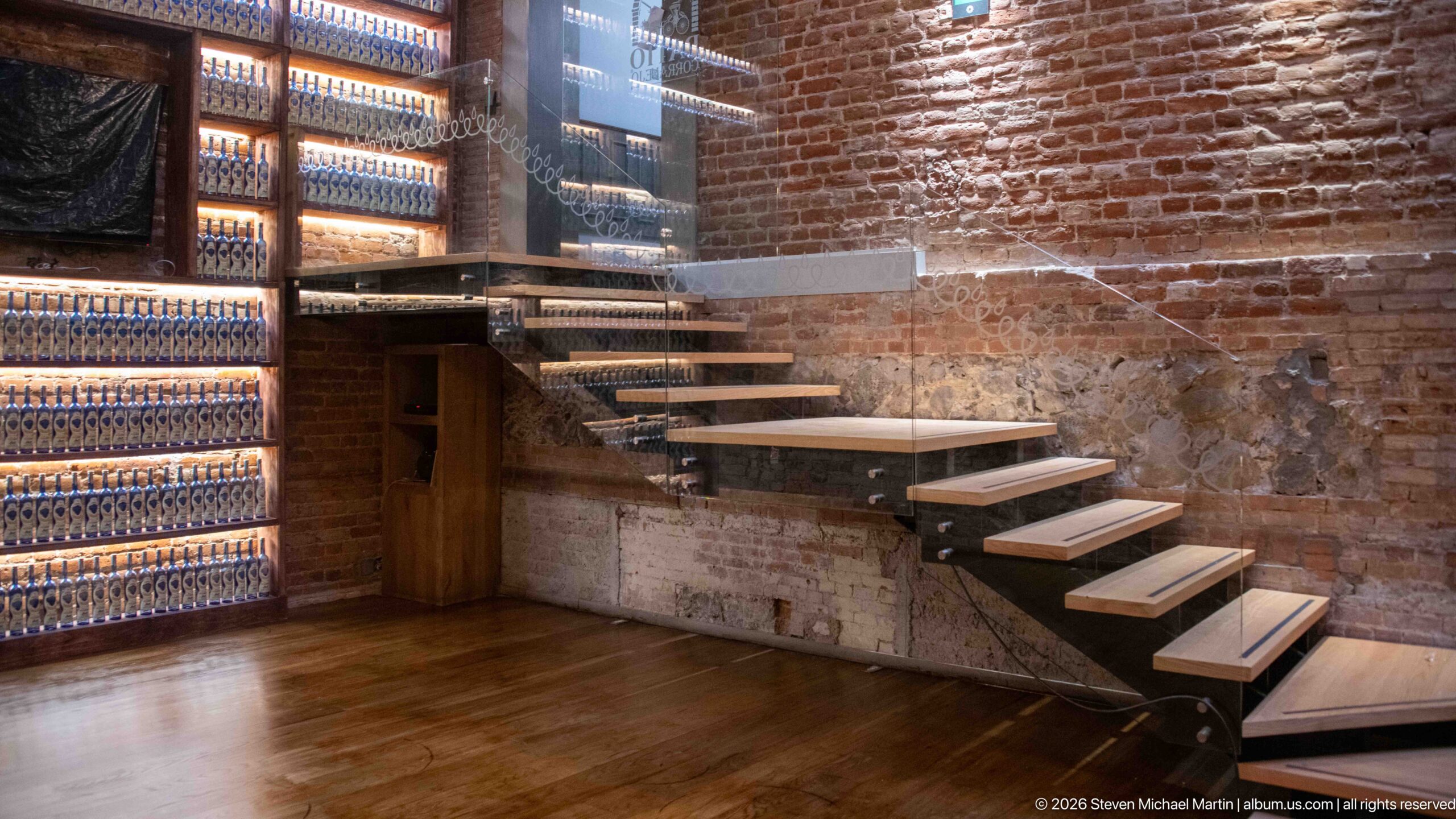
The bar’s exposed-brick walls meet at a corner where a stepped counter projects toward the room. Lit shelves of matching blue bottles occupy the left wall, while a glass-fronted cabinet and dark screen sit below. The wide composition reveals the bar’s arrangement and polished wood floor, giving context to the closer bottle views.
Caption
The bar’s exposed-brick walls meet at a corner where a stepped counter projects toward the room. Lit shelves of matching blue bottles occupy the left wall, while a glass-fronted cabinet and dark screen sit below. The wide composition reveals the bar’s arrangement and polished wood floor, giving context to the closer bottle views.
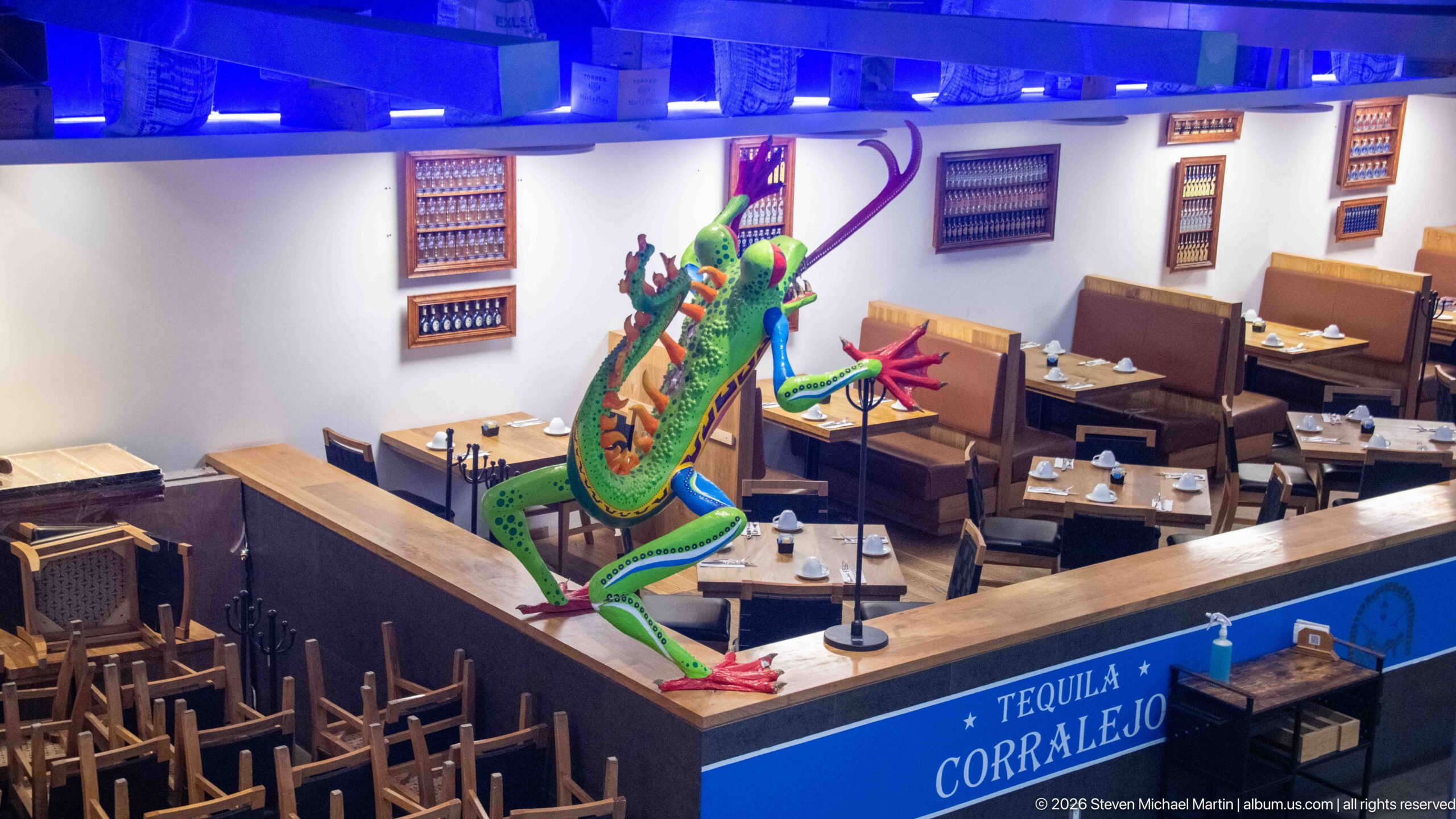
A bright green, long-tailed fantasy creature rears above the restaurant booths, its blue, orange, and magenta markings echoed in the bar’s saturated lighting. The raised arms, curling tail, and oversized eyes give the sculpture an animated silhouette against the orderly tables and bottle shelves. Its folk-art character makes a vivid contrast with the polished commercial interior.
Caption
A bright green, long-tailed fantasy creature rears above the restaurant booths, its blue, orange, and magenta markings echoed in the bar’s saturated lighting. The raised arms, curling tail, and oversized eyes give the sculpture an animated silhouette against the orderly tables and bottle shelves. Its folk-art character makes a vivid contrast with the polished commercial interior.
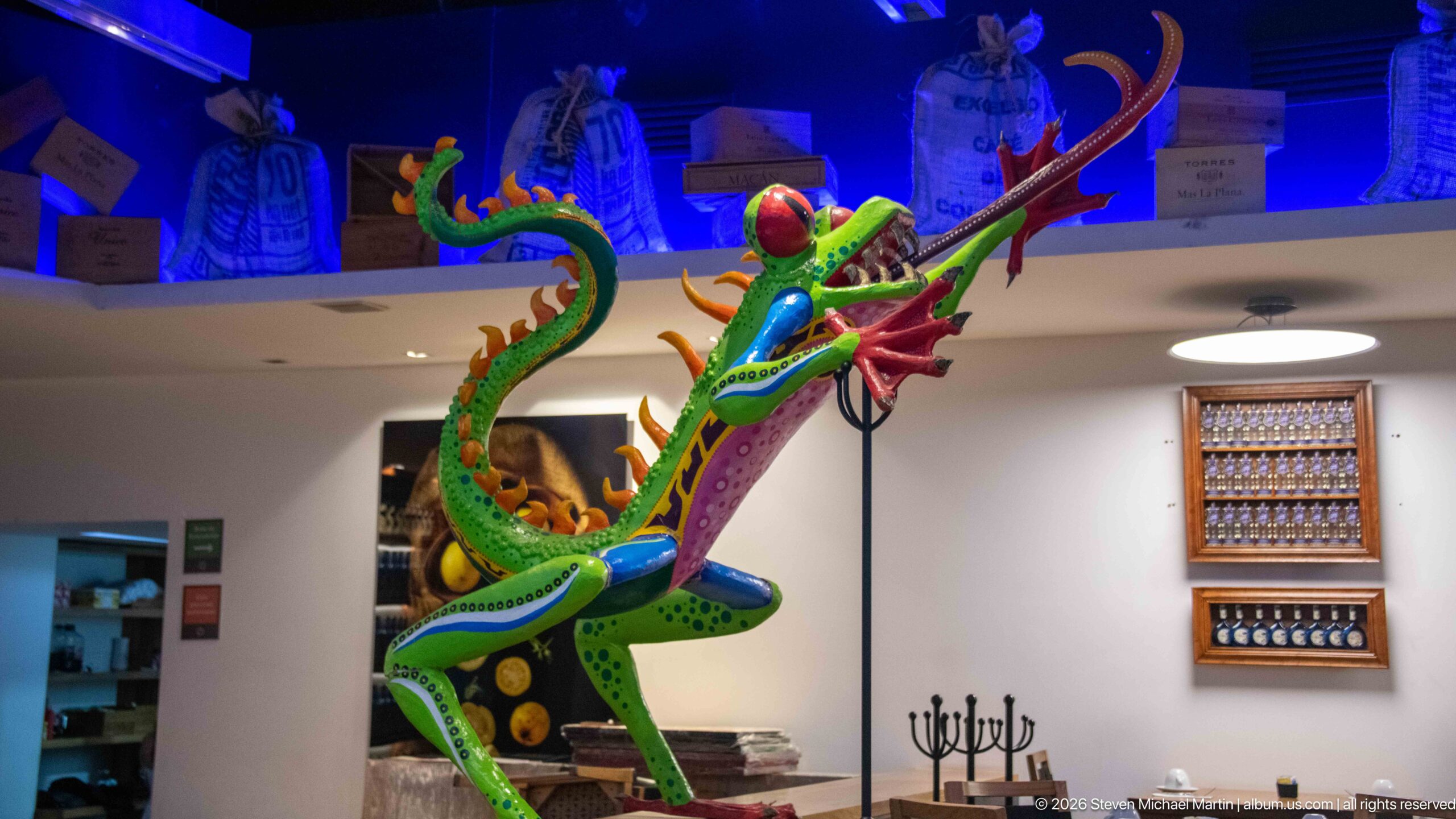
At close range, the green creature’s bulging eye, open red mouth, curled tail, and spotted limbs become the focus. Blue and magenta sections break up its green body, while orange spikes trace the back. Bottle displays, a dark wall painting, and a small candelabrum place the sculpture inside a tequila bar, but the tight crop lets its exaggerated shape dominate.
Caption
At close range, the green creature’s bulging eye, open red mouth, curled tail, and spotted limbs become the focus. Blue and magenta sections break up its green body, while orange spikes trace the back. Bottle displays, a dark wall painting, and a small candelabrum place the sculpture inside a tequila bar, but the tight crop lets its exaggerated shape dominate.
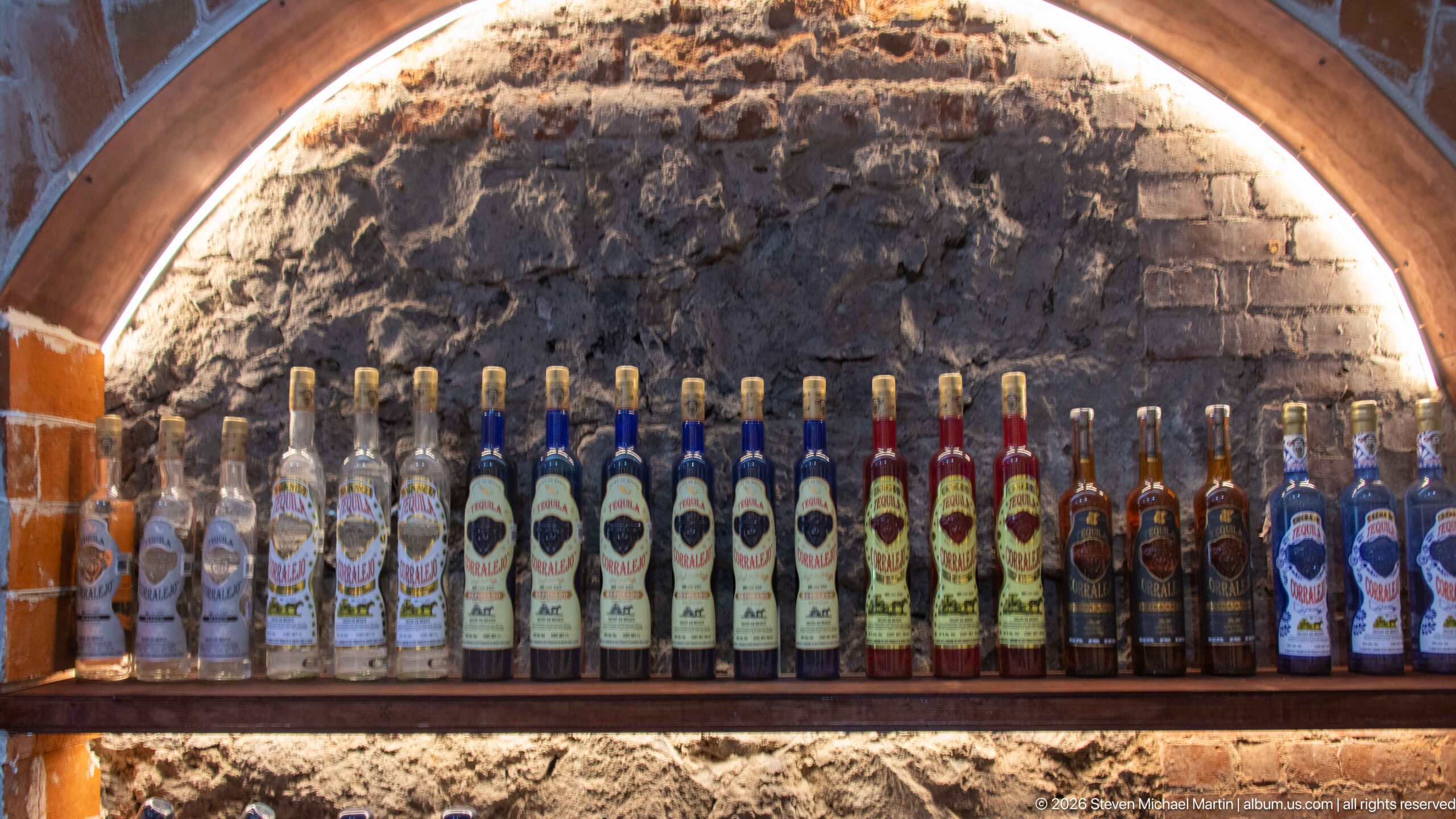
A row of clear, blue, and amber bottles sits on a narrow shelf set into a rough stone recess. A curved terracotta-brick arch frames the display, while concealed lighting picks out the irregular masonry and glass shoulders. The close, horizontal composition turns the shop’s bottle assortment into a study of repetition, color, and the contrast between handmade-looking stonework and packaged spirits.
Caption
A row of clear, blue, and amber bottles sits on a narrow shelf set into a rough stone recess. A curved terracotta-brick arch frames the display, while concealed lighting picks out the irregular masonry and glass shoulders. The close, horizontal composition turns the shop’s bottle assortment into a study of repetition, color, and the contrast between handmade-looking stonework and packaged spirits.
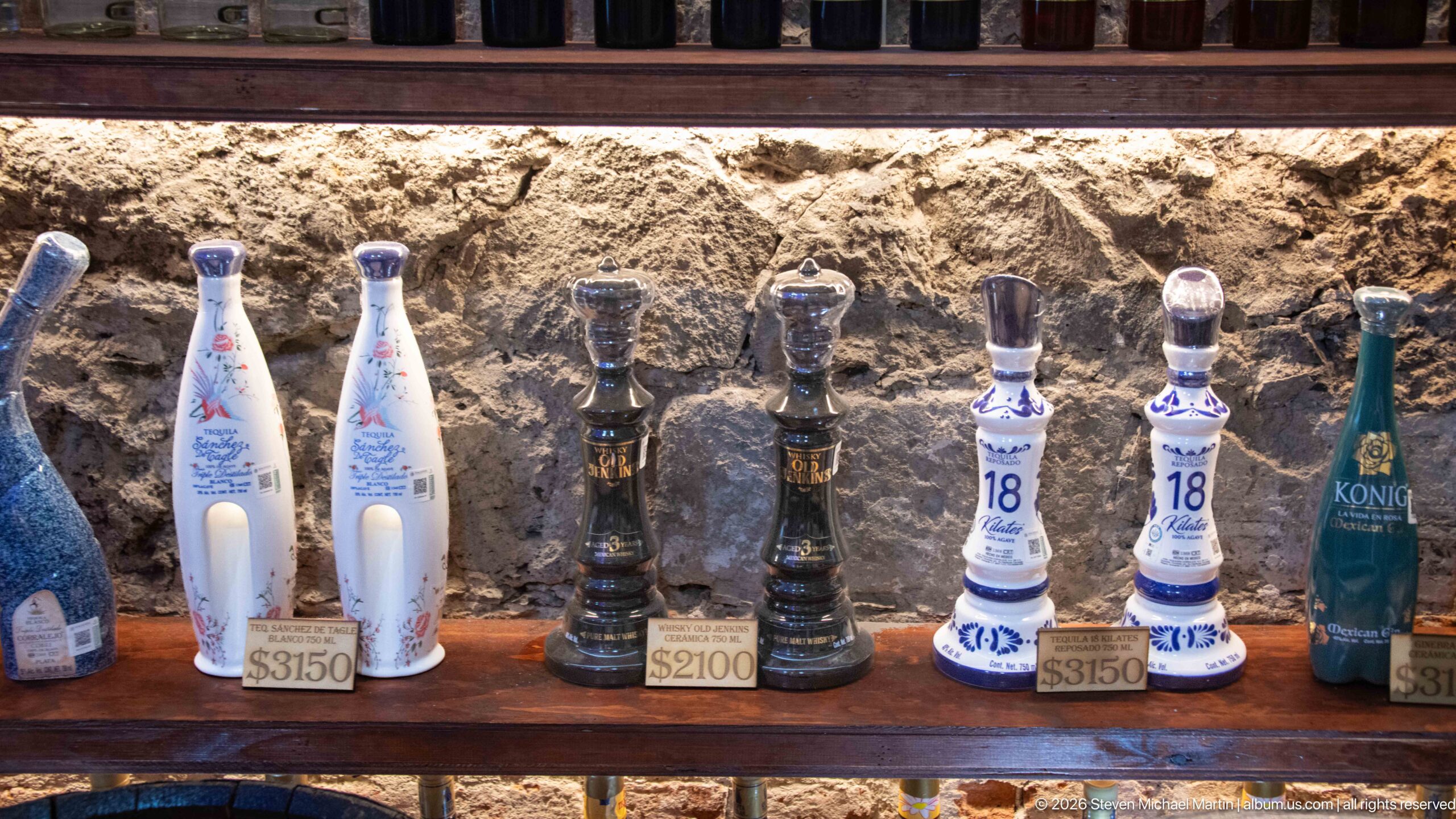
White and cobalt ceramic bottles, dark decanters, and slender green glass bottles share one shelf against rough stone. Small handwritten price cards sit directly below the groups, linking the display to a working shop. The repeated bottle silhouettes form a rhythm across the frame, while differences in glaze, label, and color distinguish each spirit from its neighbors.
Caption
White and cobalt ceramic bottles, dark decanters, and slender green glass bottles share one shelf against rough stone. Small handwritten price cards sit directly below the groups, linking the display to a working shop. The repeated bottle silhouettes form a rhythm across the frame, while differences in glaze, label, and color distinguish each spirit from its neighbors.
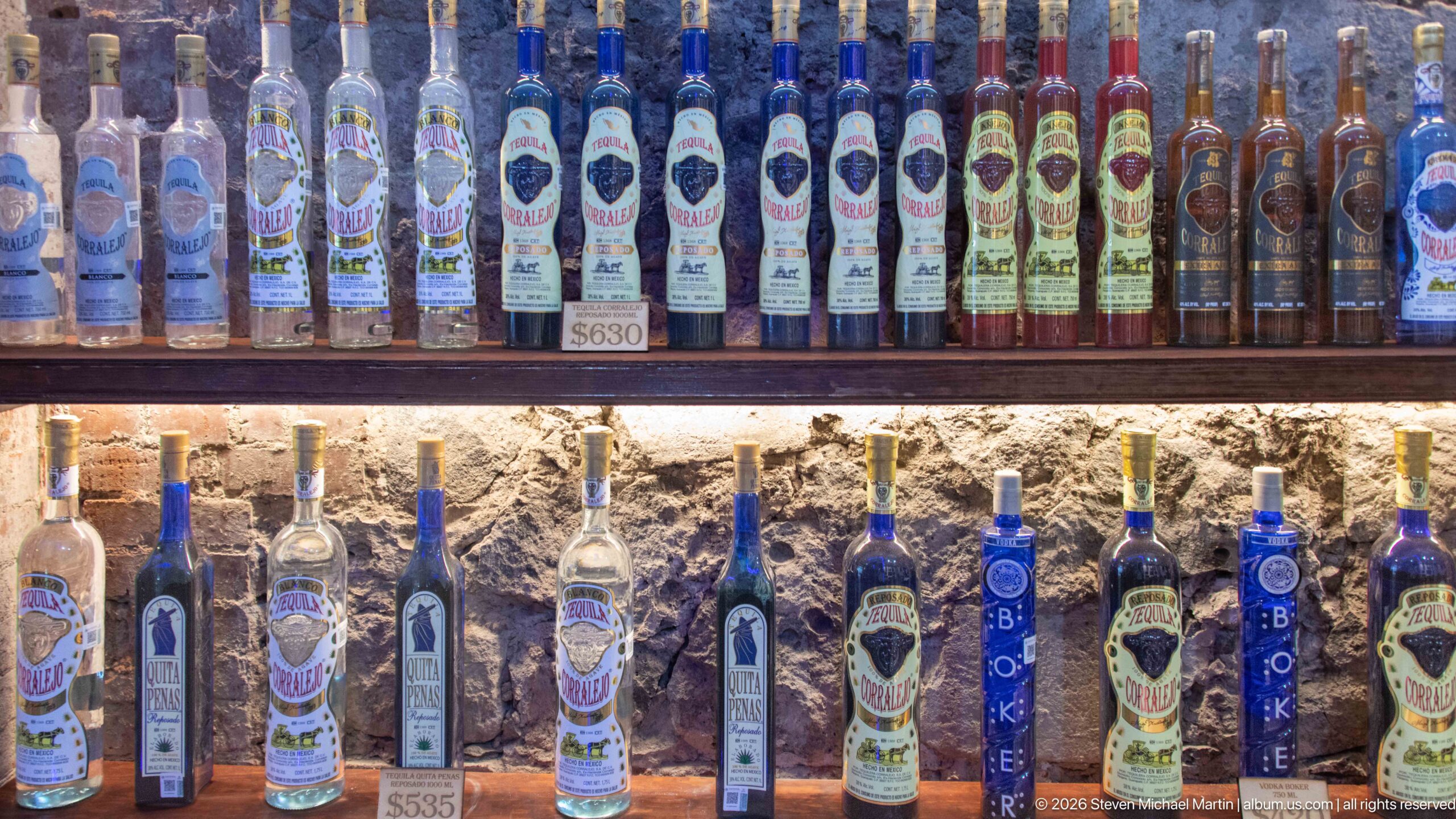
The horizontal display pairs a crowded upper row of clear and colored spirits with a lower row of taller bottles against the stone wall. Brand labels, neck colors, and bottle silhouettes vary from one product to the next, while a few price cards break the repetition. The view records the breadth of the shop’s assortment and the layered shelving more than any one named bottle.
Caption
The horizontal display pairs a crowded upper row of clear and colored spirits with a lower row of taller bottles against the stone wall. Brand labels, neck colors, and bottle silhouettes vary from one product to the next, while a few price cards break the repetition. The view records the breadth of the shop’s assortment and the layered shelving more than any one named bottle.
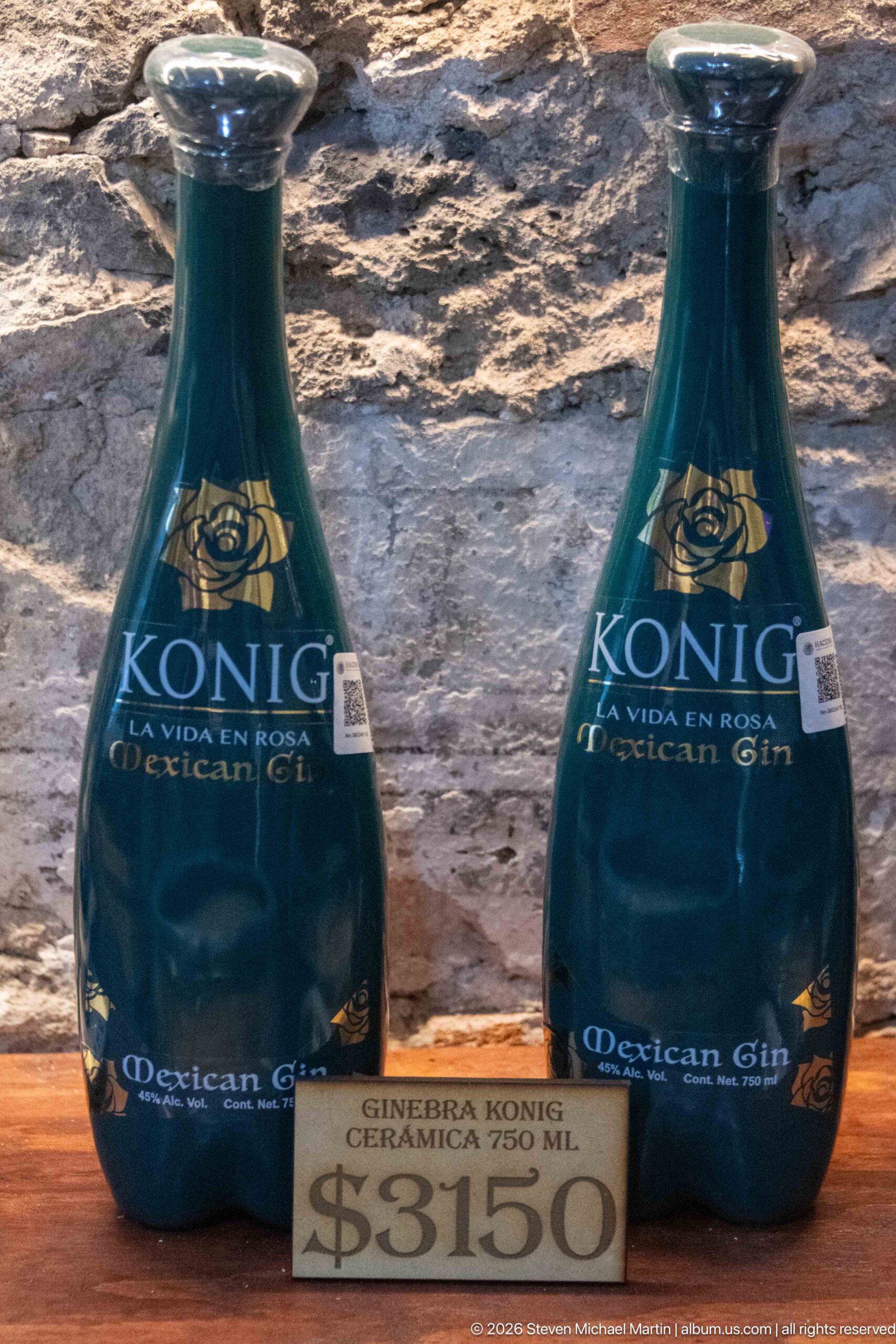
Pair of deep teal, ceramic-shaped bottles labeled “Ginebra Konig” stand close together against the stone display wall. Gold rose emblems and lettering contrast with the glossy blue-green glaze, and a price card below repeats the product name. Their narrow necks and rounded shoulders distinguish the gin bottles from the straighter tequila bottles elsewhere in the shop.
Caption
Pair of deep teal, ceramic-shaped bottles labeled “Ginebra Konig” stand close together against the stone display wall. Gold rose emblems and lettering contrast with the glossy blue-green glaze, and a price card below repeats the product name. Their narrow necks and rounded shoulders distinguish the gin bottles from the straighter tequila bottles elsewhere in the shop.
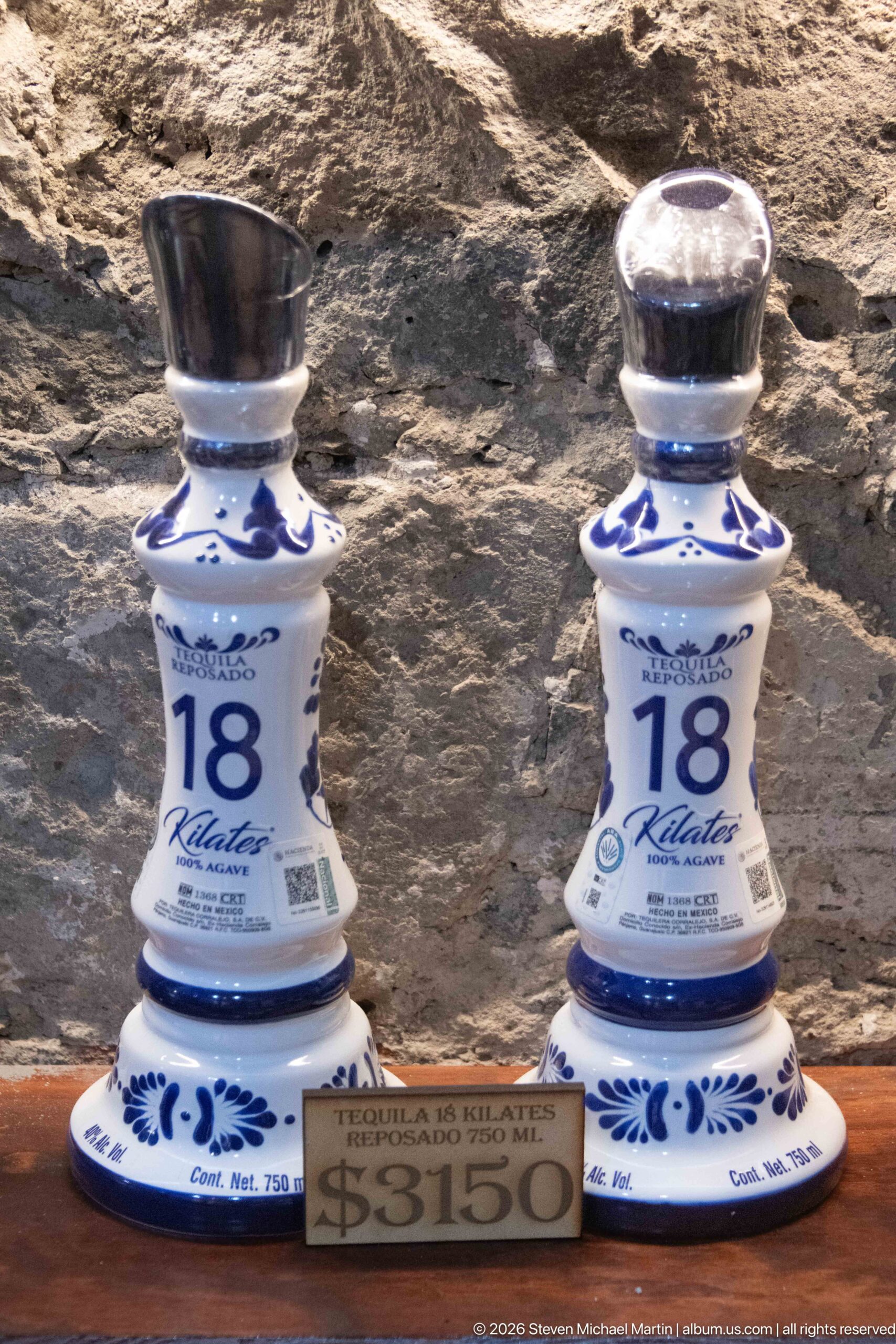
Two white bottles marked “Tequila 18 Kilates Reposado” stand in blue-and-white ceramic-style sleeves, each with an oversized blue 18 on the front. A small card between them gives the bottle size and price. The matching pair is centered against the rough stone wall, highlighting the contrast between the cobalt decoration and the warm masonry.
Caption
Two white bottles marked “Tequila 18 Kilates Reposado” stand in blue-and-white ceramic-style sleeves, each with an oversized blue 18 on the front. A small card between them gives the bottle size and price. The matching pair is centered against the rough stone wall, highlighting the contrast between the cobalt decoration and the warm masonry.
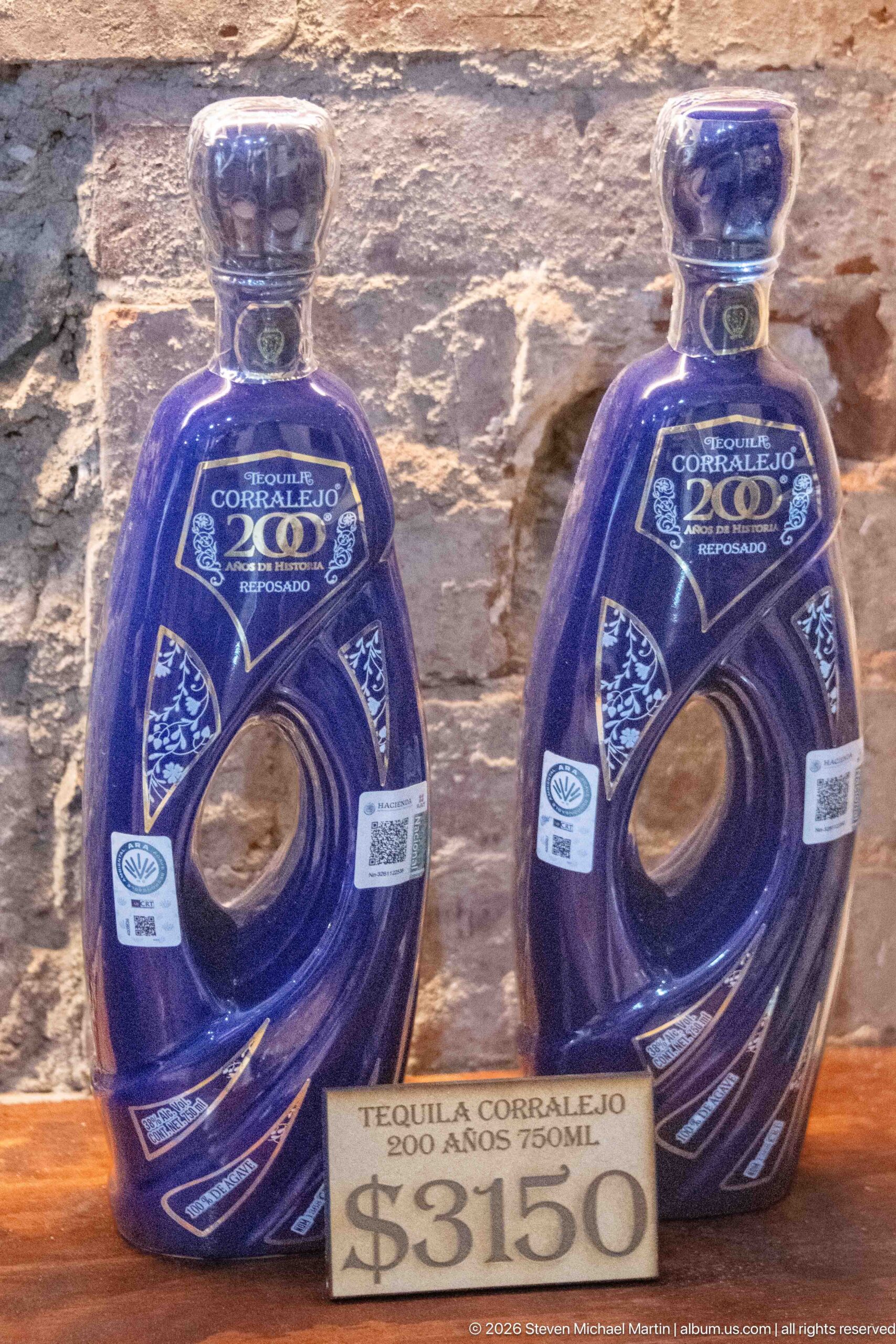
Two deep-purple bottles labeled “Tequila Corralejo 200 Años Reposado” fill the frame. A large oval opening in each bottle exposes the stone backdrop, while pale ornamental patterns decorate the shoulders and sides. The matching price card repeats the anniversary designation, making the special bottle design—not the broader shop interior—the defining subject.
Caption
Two deep-purple bottles labeled “Tequila Corralejo 200 Años Reposado” fill the frame. A large oval opening in each bottle exposes the stone backdrop, while pale ornamental patterns decorate the shoulders and sides. The matching price card repeats the anniversary designation, making the special bottle design—not the broader shop interior—the defining subject.
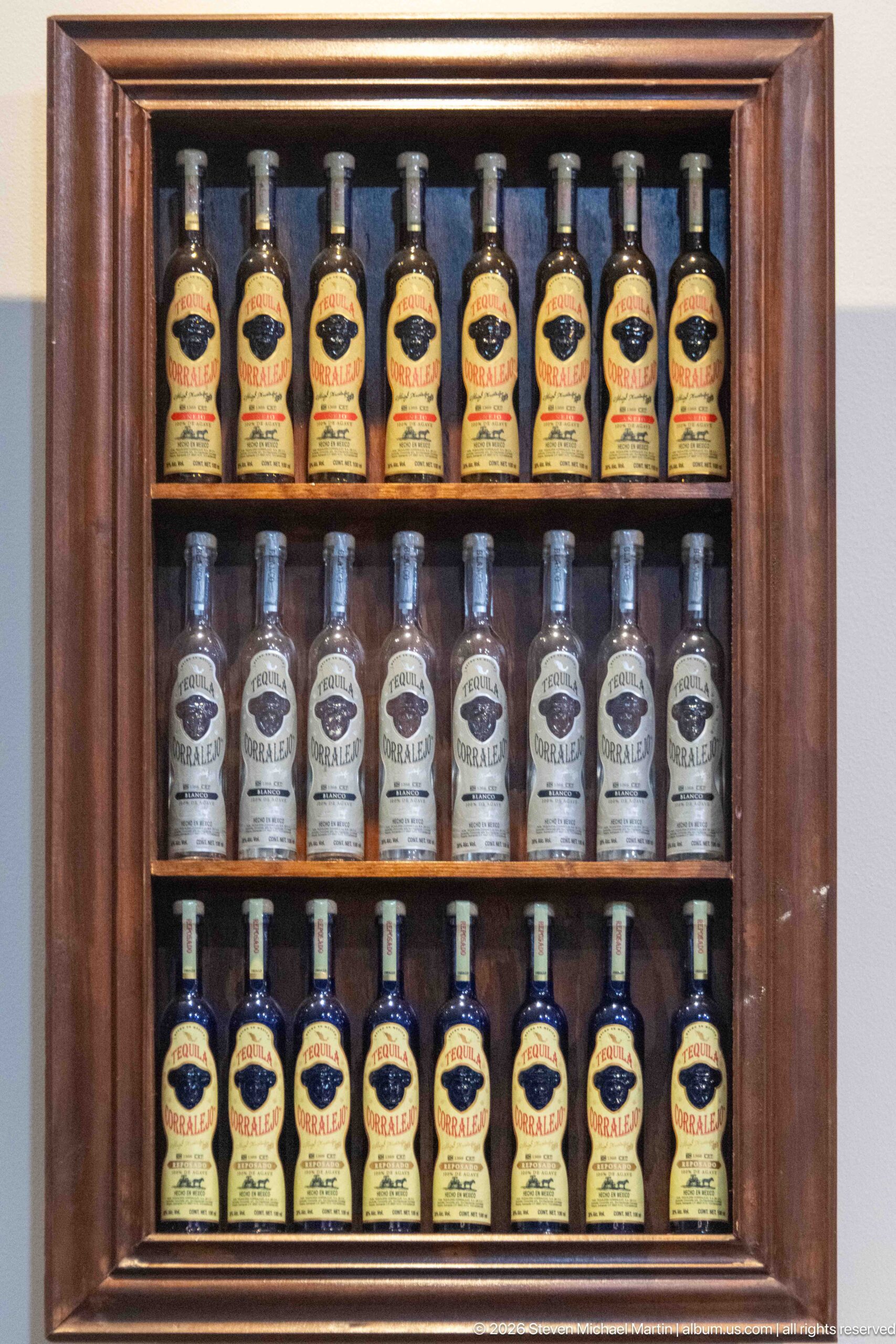
A wood-framed cabinet presents three precise rows of miniature tequila bottles against a dark blue backing. Yellow-and-black labels repeat across the top and lower shelves, while the middle row uses pale labels and clear glass. The straight-on view emphasizes the cabinet’s orderly grid and the small scale of the bottles, a distinct presentation from the full-size retail displays nearby.
Caption
A wood-framed cabinet presents three precise rows of miniature tequila bottles against a dark blue backing. Yellow-and-black labels repeat across the top and lower shelves, while the middle row uses pale labels and clear glass. The straight-on view emphasizes the cabinet’s orderly grid and the small scale of the bottles, a distinct presentation from the full-size retail displays nearby.
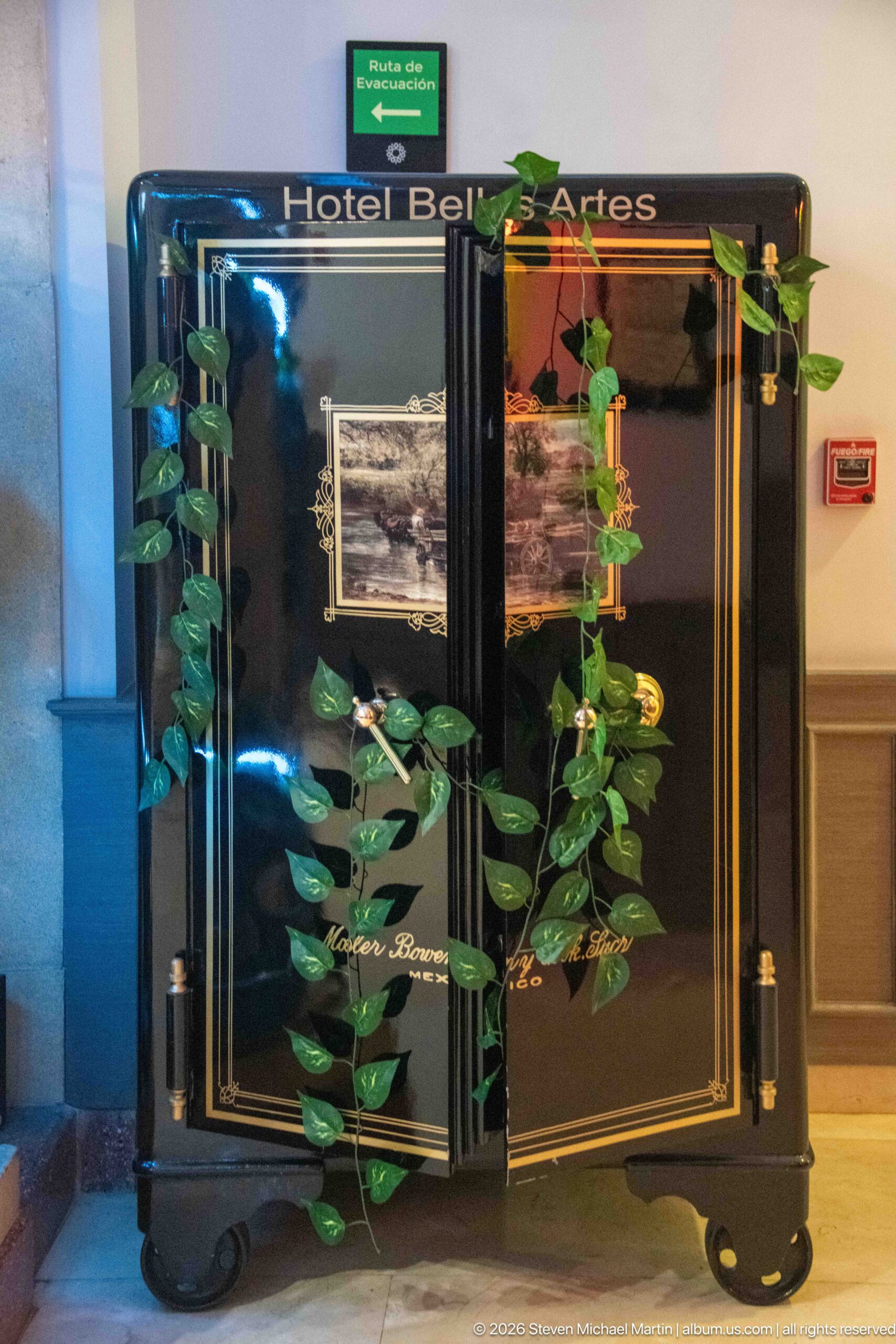
A dark freestanding display case bears “Hotel Bellas Artes” across its top and holds a small framed archival-looking photograph at center. Gold rules, leafy vines, and small decorative objects ornament the black surface; an illuminated green exit sign appears above. The tight frontal view makes the hotel name and the single inset image the organizing features of this lobby display.
Caption
A dark freestanding display case bears “Hotel Bellas Artes” across its top and holds a small framed archival-looking photograph at center. Gold rules, leafy vines, and small decorative objects ornament the black surface; an illuminated green exit sign appears above. The tight frontal view makes the hotel name and the single inset image the organizing features of this lobby display.
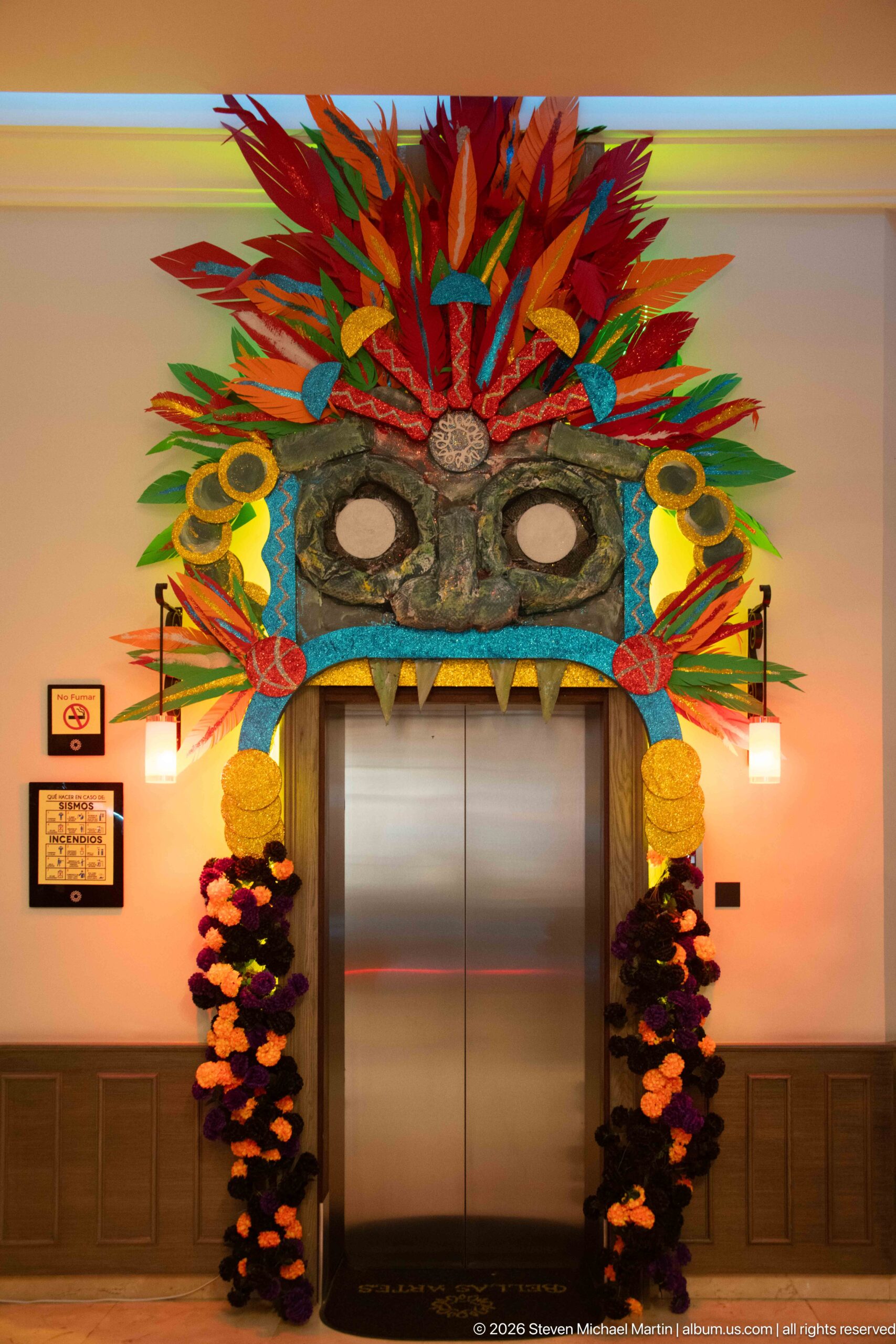
A sculpted skull face with empty eye openings and radiating red, orange, blue, and green rays crowns the elevator doors. Vertical garlands of orange and purple flowers flank the entrance, repeating the colors of the oversized headdress. Wall notices remain visible at the left, locating the seasonal decoration within an operating hotel corridor rather than a dedicated exhibition room.
Caption
A sculpted skull face with empty eye openings and radiating red, orange, blue, and green rays crowns the elevator doors. Vertical garlands of orange and purple flowers flank the entrance, repeating the colors of the oversized headdress. Wall notices remain visible at the left, locating the seasonal decoration within an operating hotel corridor rather than a dedicated exhibition room.
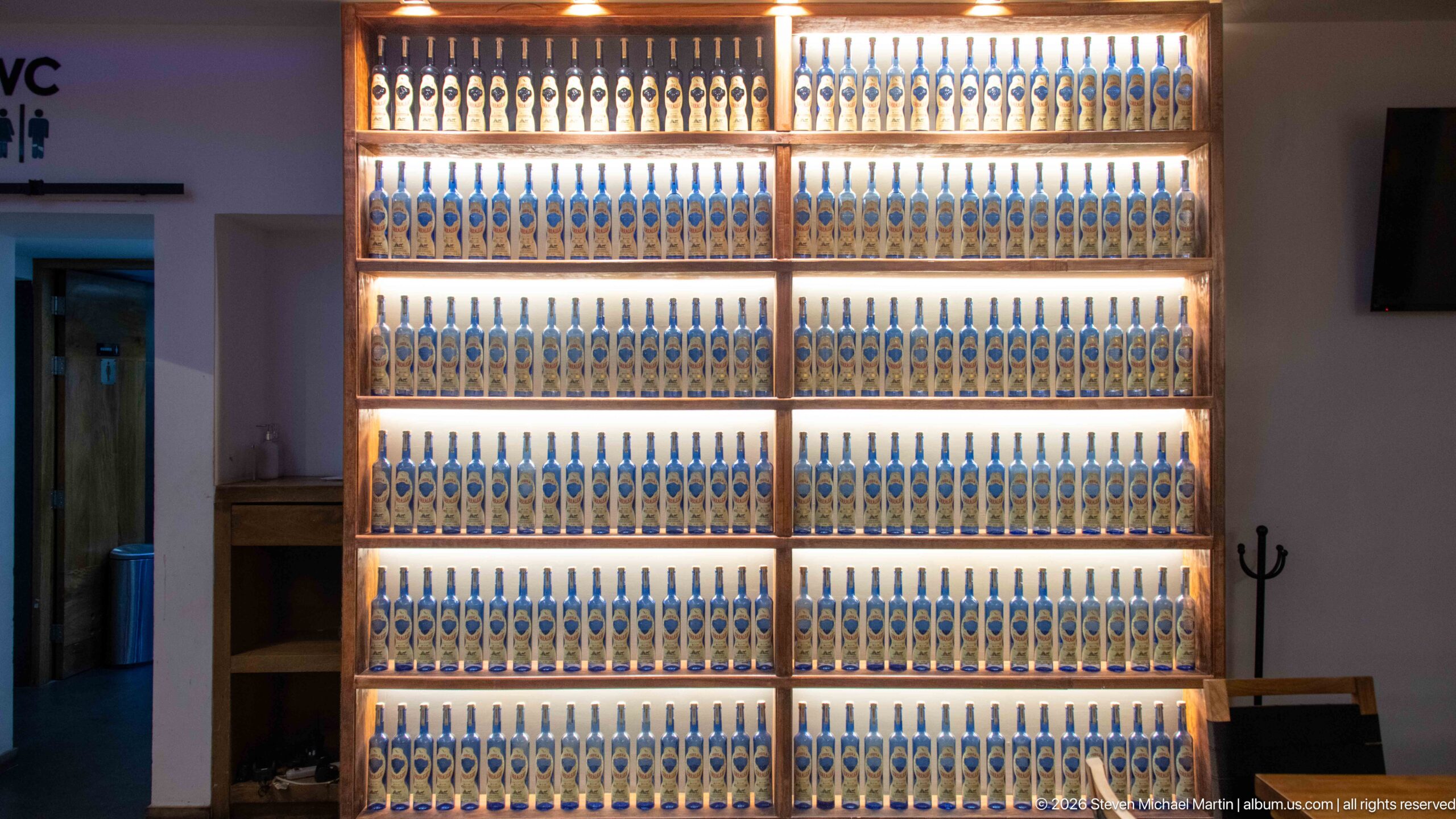
Identical blue-capped tequila bottles fill stacked, warmly lit shelves, creating a dense wall of repeated labels. The display is framed by dark wood and a dim side passage, with a small freestanding candelabrum at the right edge. Compared with the close product portraits on the preceding page, this view emphasizes inventory, repetition, and the shop’s dramatic shelf lighting.
Caption
Identical blue-capped tequila bottles fill stacked, warmly lit shelves, creating a dense wall of repeated labels. The display is framed by dark wood and a dim side passage, with a small freestanding candelabrum at the right edge. Compared with the close product portraits on the preceding page, this view emphasizes inventory, repetition, and the shop’s dramatic shelf lighting.
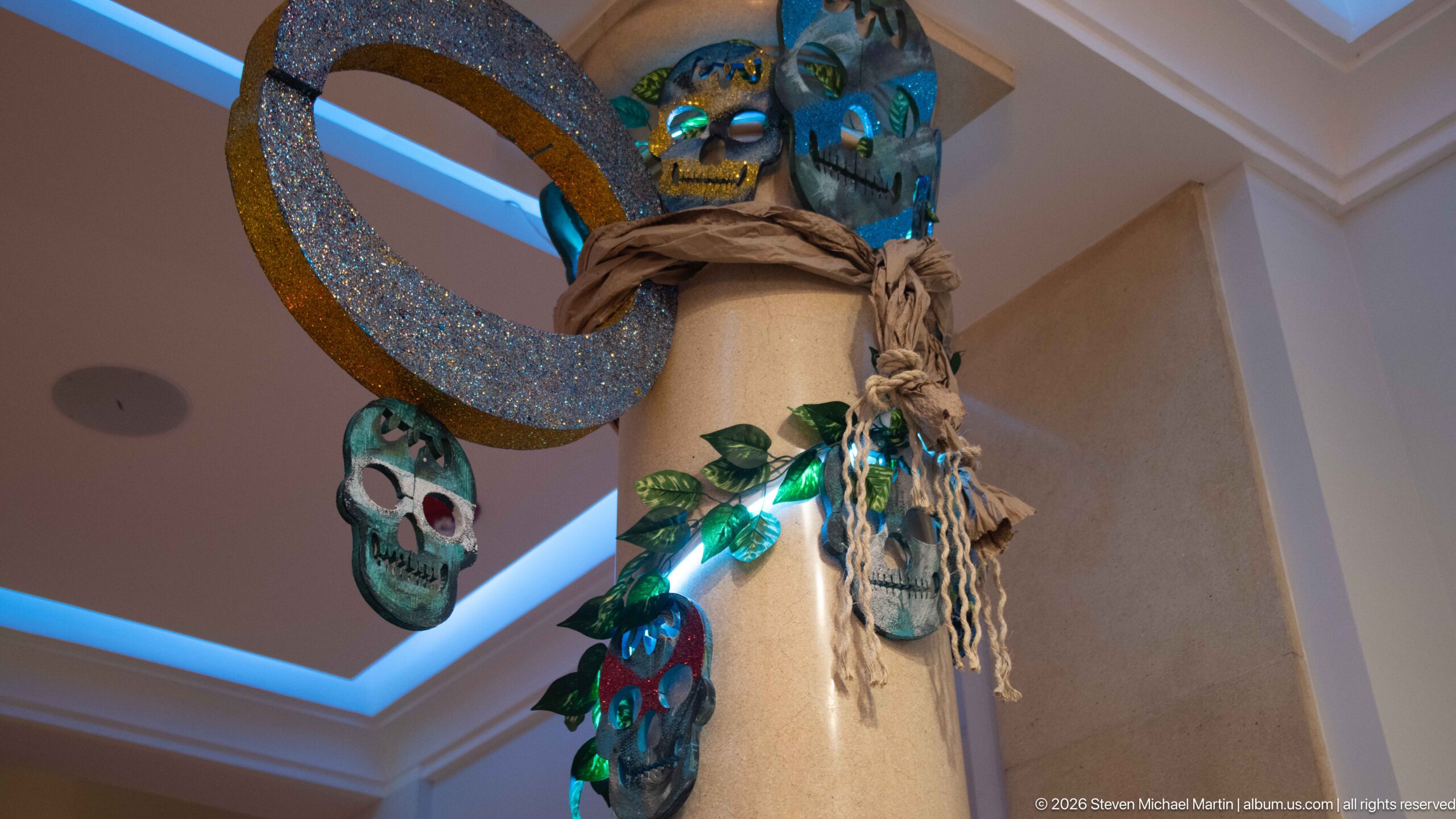
A close upward view isolates a rope-wrapped column hung with small turquoise skull ornaments and a large glittering crescent shape. Green leaves and pale strands are tied among the decorations, while the white ceiling and recessed lighting show the display’s interior setting. The vertical arrangement makes this a detail of the hotel’s Día de Muertos decoration, separate from the full elevator installation nearby.
Caption
A close upward view isolates a rope-wrapped column hung with small turquoise skull ornaments and a large glittering crescent shape. Green leaves and pale strands are tied among the decorations, while the white ceiling and recessed lighting show the display’s interior setting. The vertical arrangement makes this a detail of the hotel’s Día de Muertos decoration, separate from the full elevator installation nearby.
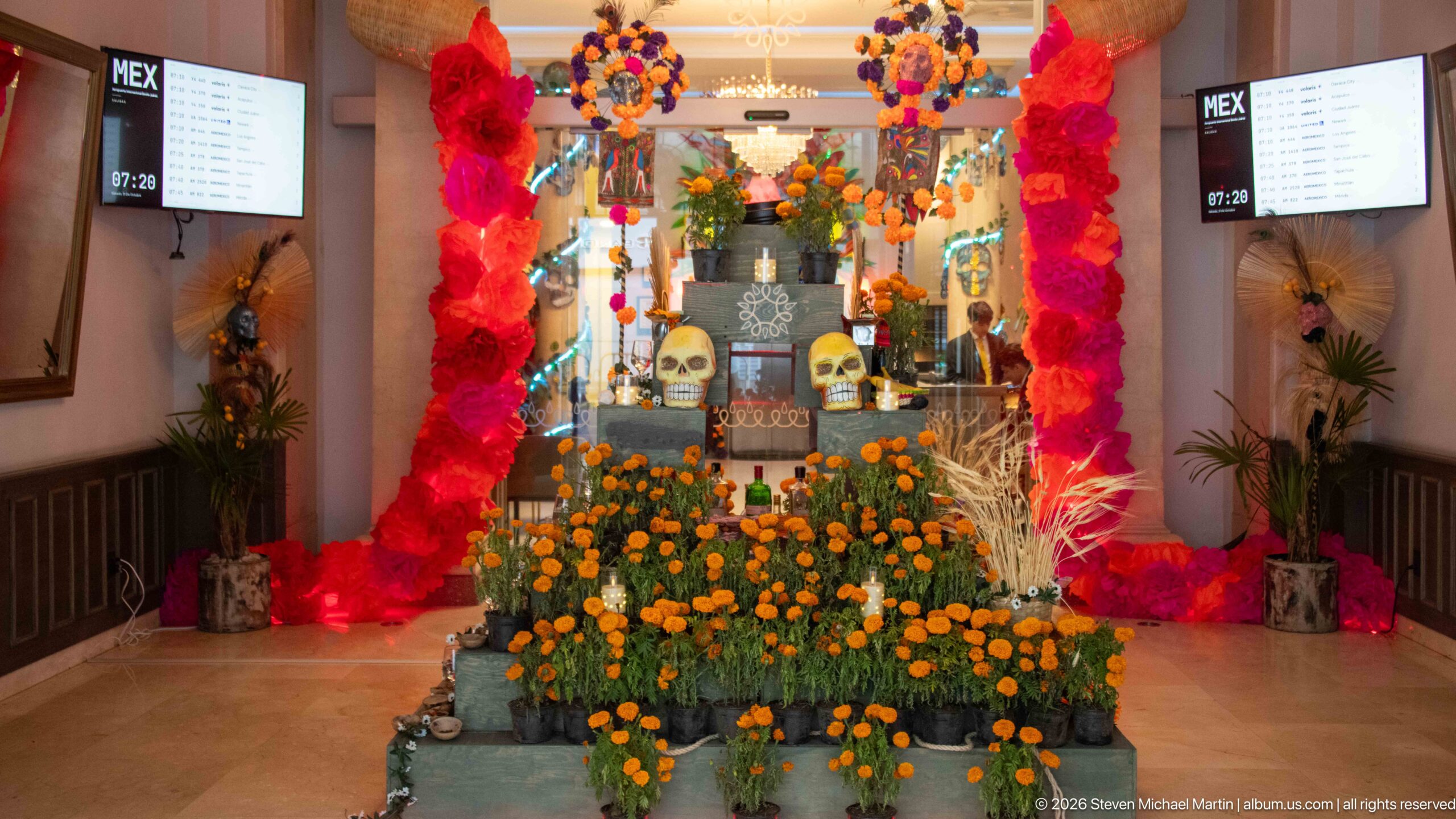
A stepped Día de Muertos ofrenda rises at the center of the lobby, covered with orange marigolds and flanked by towering red paper garlands. Two sugar-skull forms sit on an upper tier, with candles and small offerings arranged below. Flight information screens and doorways remain visible at both sides, showing how the installation occupies an active hotel entrance and guides movement toward the central display.
Caption
A stepped Día de Muertos ofrenda rises at the center of the lobby, covered with orange marigolds and flanked by towering red paper garlands. Two sugar-skull forms sit on an upper tier, with candles and small offerings arranged below. Flight information screens and doorways remain visible at both sides, showing how the installation occupies an active hotel entrance and guides movement toward the central display.
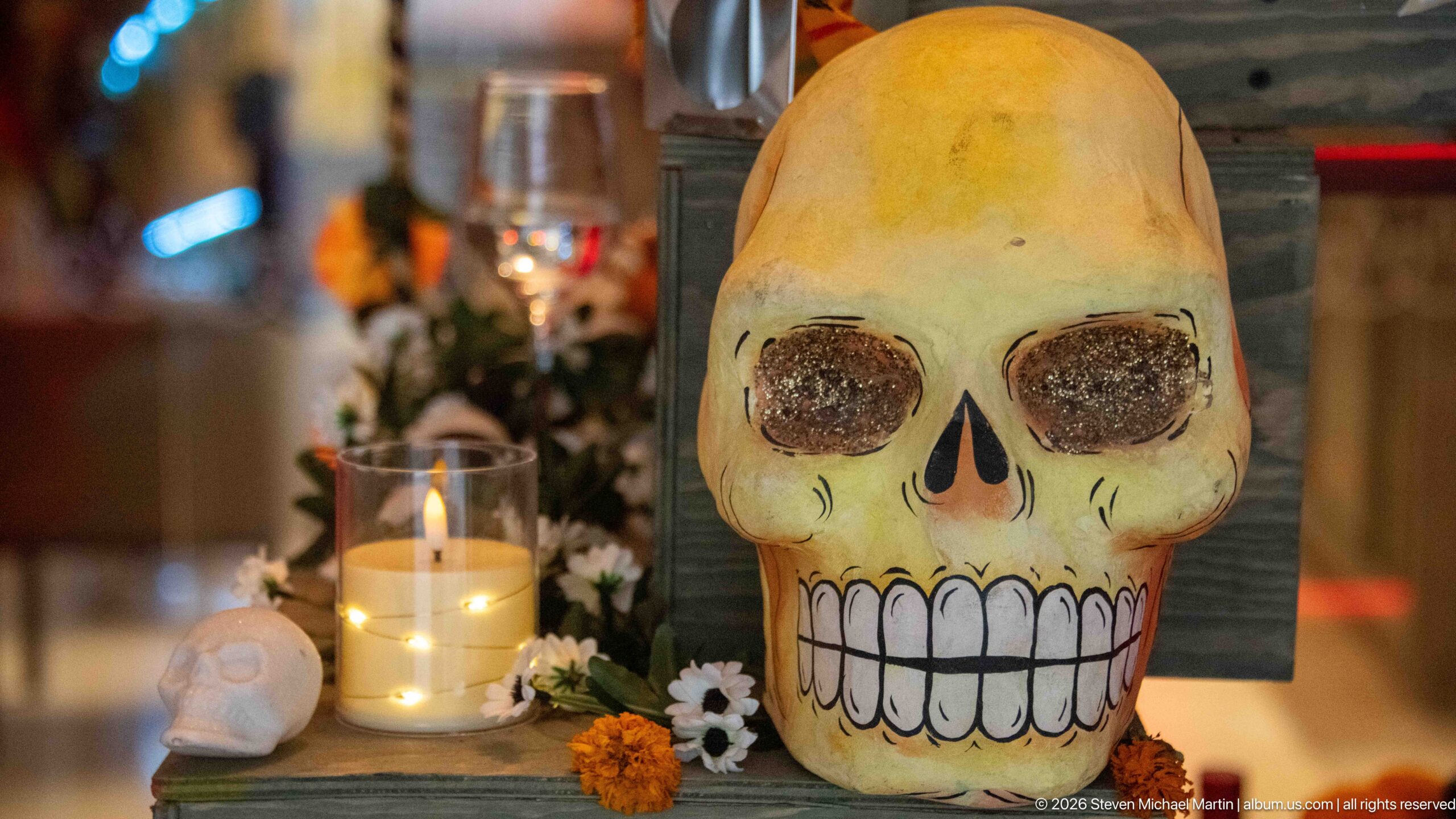
A large yellow skull-shaped vessel with glittered eye sockets fills the foreground, its black lines outlining teeth and a stylized nose. A lit candle and smaller white skull sit beside it, with orange marigolds and blurred lobby lights behind. The close focus isolates one offering-like decorative object from the larger installation and shows the painted surface, scale, and neighboring candle.
Caption
A large yellow skull-shaped vessel with glittered eye sockets fills the foreground, its black lines outlining teeth and a stylized nose. A lit candle and smaller white skull sit beside it, with orange marigolds and blurred lobby lights behind. The close focus isolates one offering-like decorative object from the larger installation and shows the painted surface, scale, and neighboring candle.
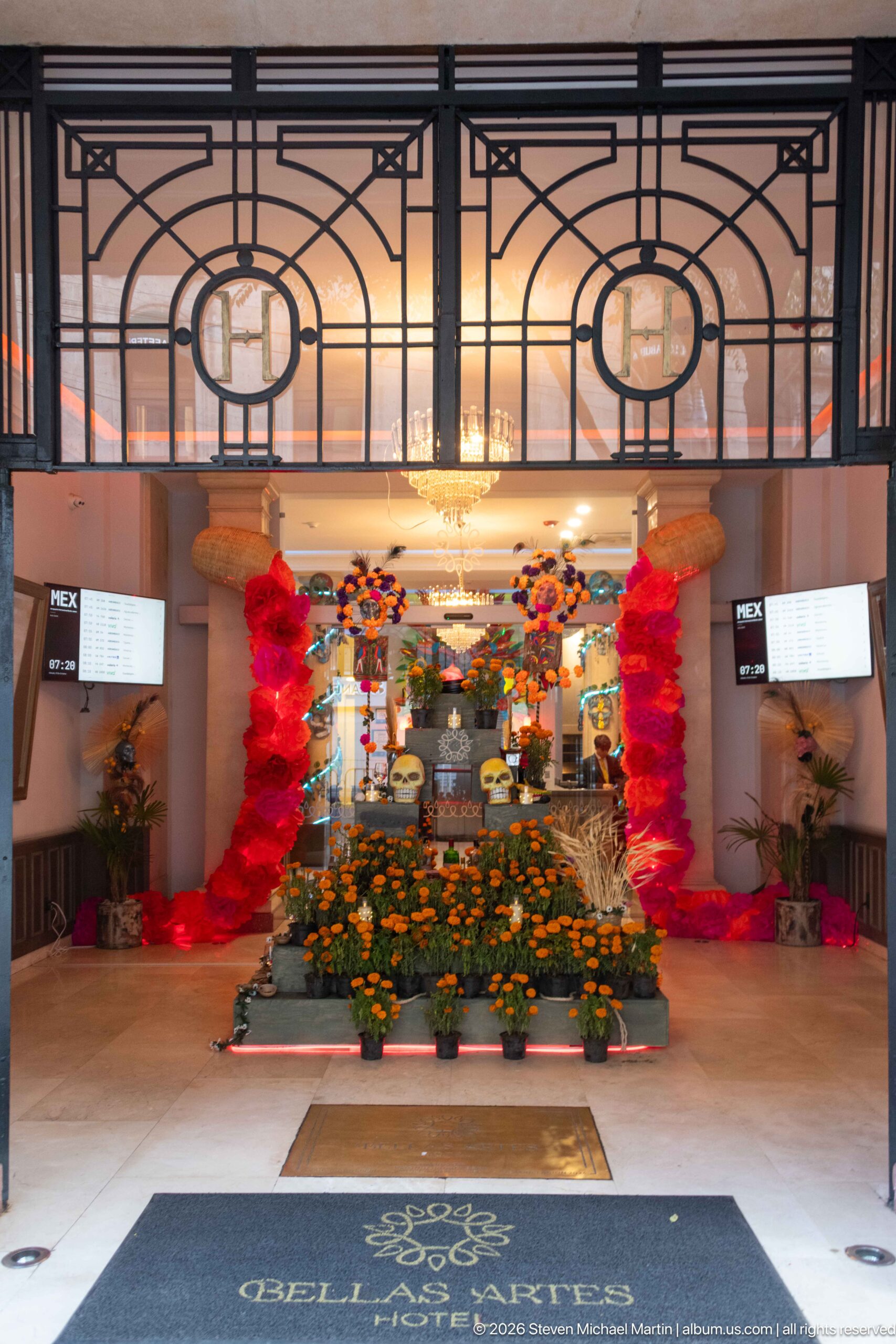
From farther back, the lobby’s central ofrenda appears beyond a broad open floor and a dark mat reading “Hotel Bellas Artes.” Bright red garlands flank the marigold-covered steps, while the black metal transom and side flight displays frame the entrance. The wider composition establishes the installation’s scale and its relationship to the hotel’s threshold and guest circulation.
Caption
From farther back, the lobby’s central ofrenda appears beyond a broad open floor and a dark mat reading “Hotel Bellas Artes.” Bright red garlands flank the marigold-covered steps, while the black metal transom and side flight displays frame the entrance. The wider composition establishes the installation’s scale and its relationship to the hotel’s threshold and guest circulation.
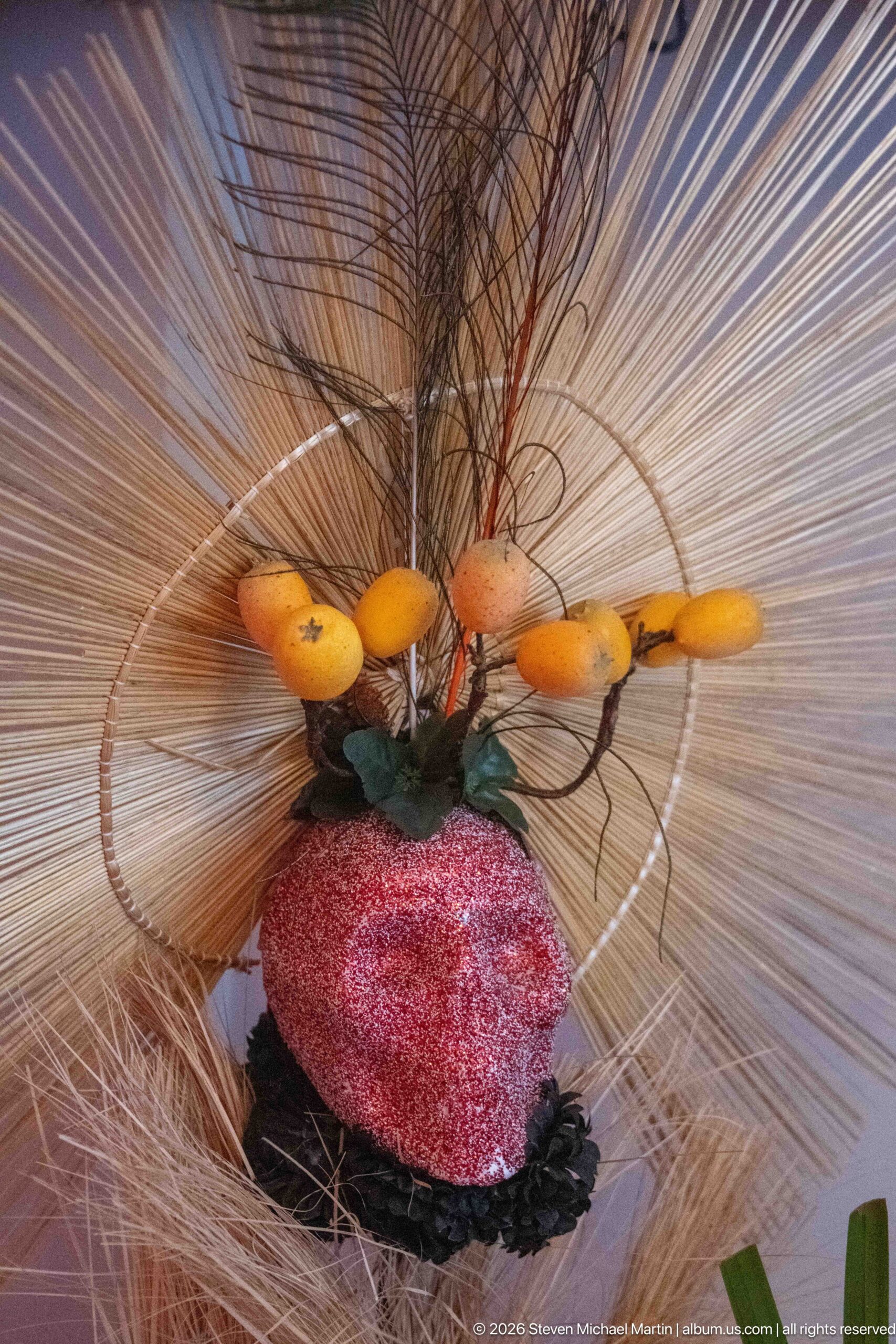
Fine straw-colored fibers radiate across a circular frame around a line of orange oval forms, with a dense red textured mound below. Dark leaves and bundled stems anchor the center, turning the arrangement into a small sculptural display rather than a conventional bouquet. The shallow angle and close crop reveal its woven structure and layered organic materials without asserting a specific ritual function.
Caption
Fine straw-colored fibers radiate across a circular frame around a line of orange oval forms, with a dense red textured mound below. Dark leaves and bundled stems anchor the center, turning the arrangement into a small sculptural display rather than a conventional bouquet. The shallow angle and close crop reveal its woven structure and layered organic materials without asserting a specific ritual function.
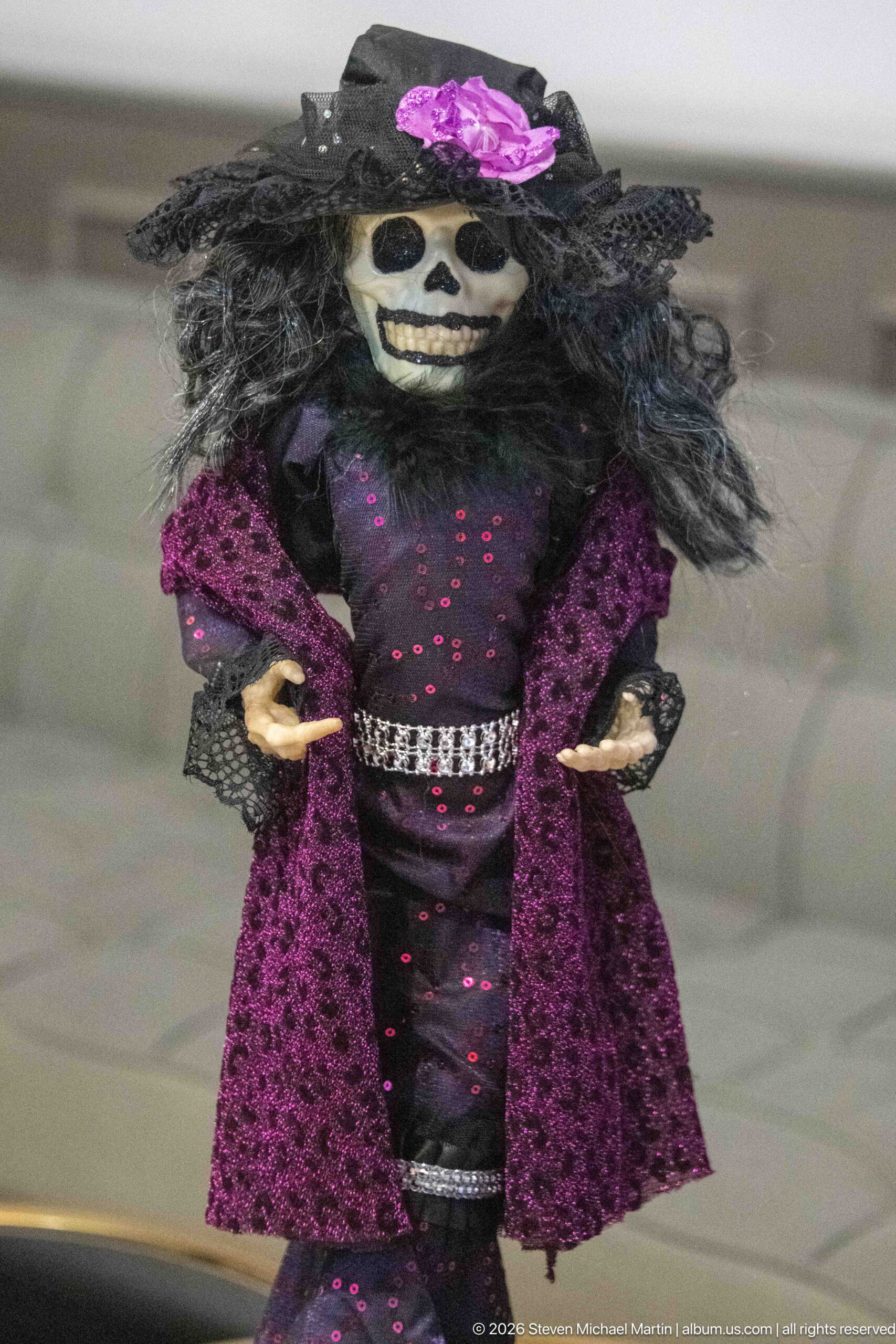
A small skeletal doll stands against a pale wall in a dark purple dress, black lace sleeves, and a broad lace hat topped by a magenta flower. Its open hands and fixed forward gaze give the figure a theatrical pose. The styling recalls the Catrina imagery associated with Día de Muertos, while the close portrait keeps attention on the doll’s costume and delicate fabric details.
Caption
A small skeletal doll stands against a pale wall in a dark purple dress, black lace sleeves, and a broad lace hat topped by a magenta flower. Its open hands and fixed forward gaze give the figure a theatrical pose. The styling recalls the Catrina imagery associated with Día de Muertos, while the close portrait keeps attention on the doll’s costume and delicate fabric details.
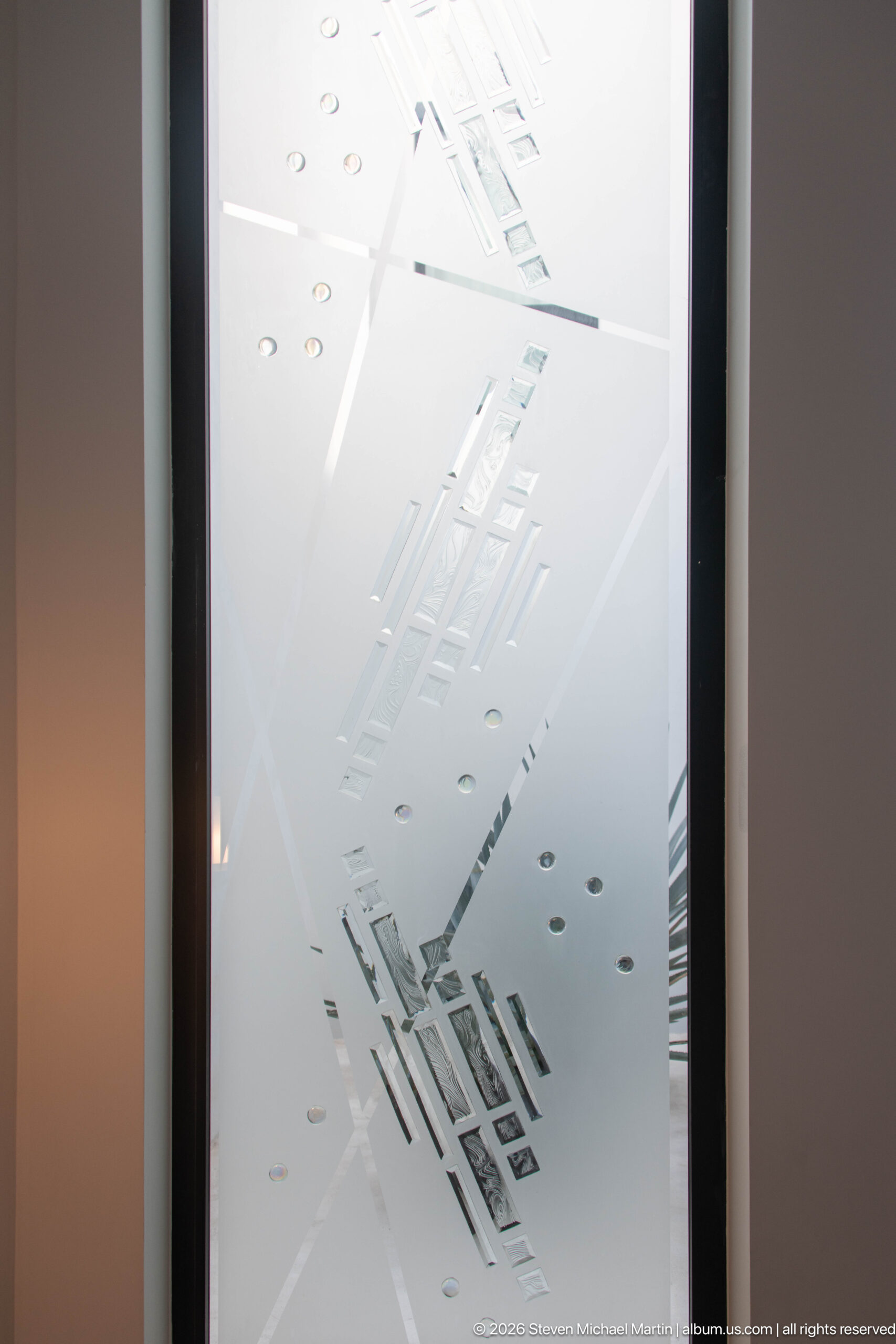
An upward view follows a pale glazed canopy crossed by dark metal ribs and a repeating grid of rectangular panels. Small circular fixtures punctuate the bright surface, while a warm wall edge and dark vertical support frame one side. The steep angle turns the hotel’s overhead structure into an abstract architectural pattern, distinct from the colorful lobby installations visible at ground level.
Caption
An upward view follows a pale glazed canopy crossed by dark metal ribs and a repeating grid of rectangular panels. Small circular fixtures punctuate the bright surface, while a warm wall edge and dark vertical support frame one side. The steep angle turns the hotel’s overhead structure into an abstract architectural pattern, distinct from the colorful lobby installations visible at ground level.
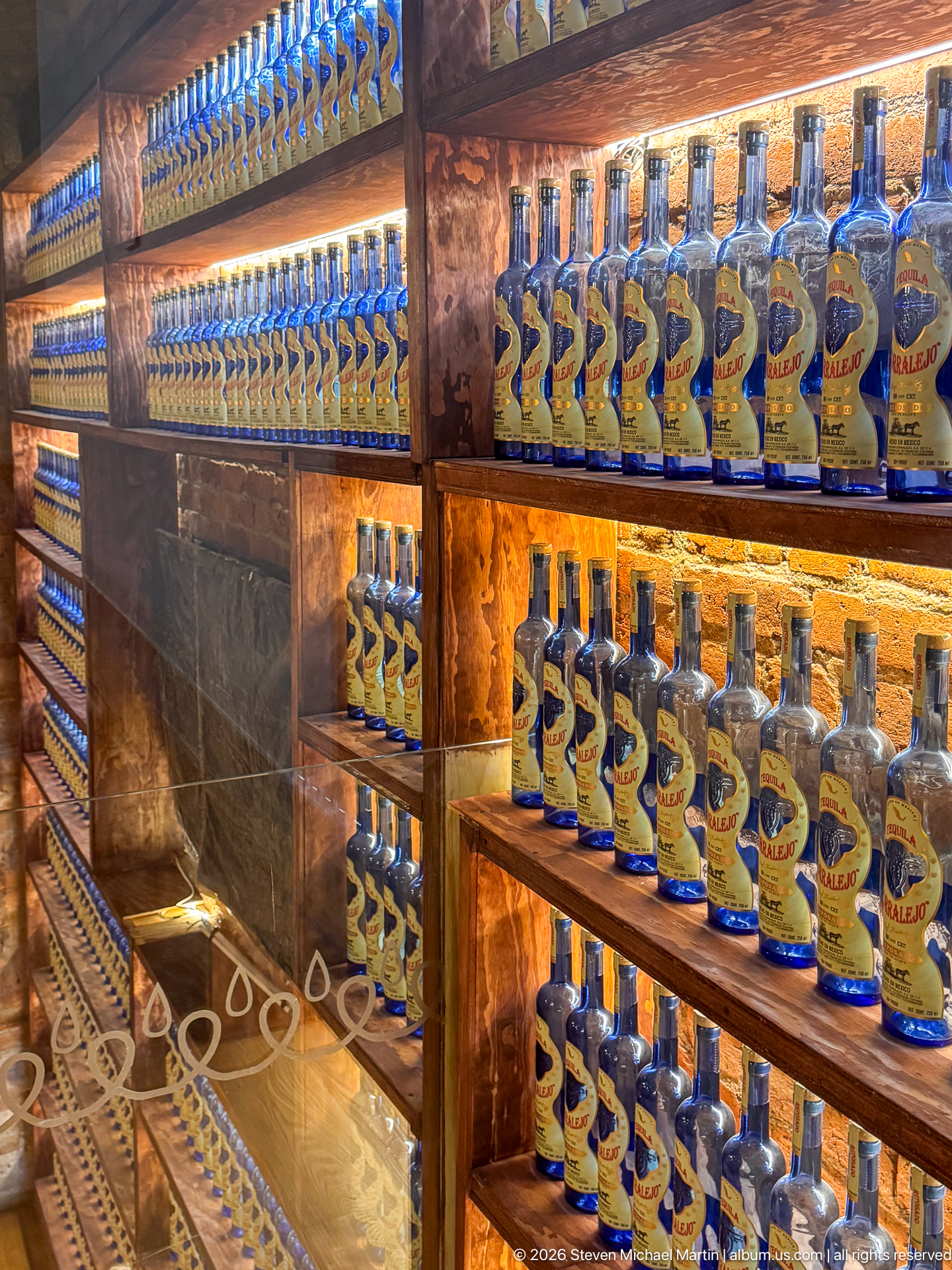
Rows of Corralejo tequila bottles extend along illuminated wooden shelves behind reflective glass. Repeated yellow labels and blue necks create a strong pattern, while the angled viewpoint makes the shelving recede toward the left. Reflections of the floor and neighboring displays add another layer across the glass, distinguishing this broad retail view from the earlier close studies of individual bottle shapes.
Caption
Rows of Corralejo tequila bottles extend along illuminated wooden shelves behind reflective glass. Repeated yellow labels and blue necks create a strong pattern, while the angled viewpoint makes the shelving recede toward the left. Reflections of the floor and neighboring displays add another layer across the glass, distinguishing this broad retail view from the earlier close studies of individual bottle shapes.
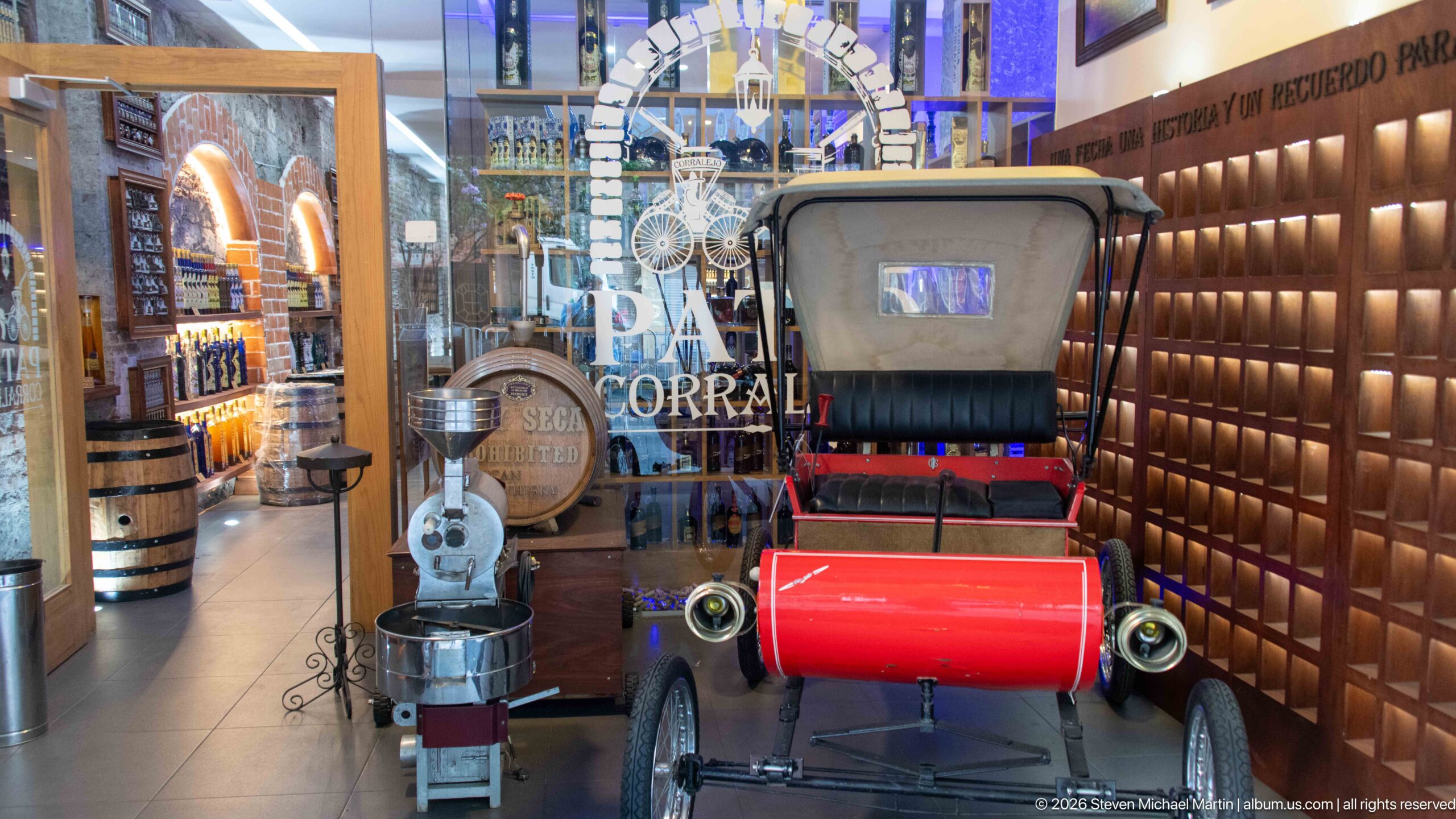
A red vintage-style vehicle occupies the foreground of the Corralejo display, surrounded by a barrel, metal distilling equipment, and bottle shelves. A glass partition carries the “Tequila Corralejo” name and a painted wagon motif, while a Spanish phrase runs along the upper wall. The arrangement combines branded retail graphics with objects suggesting the history and production of tequila.
Caption
A red vintage-style vehicle occupies the foreground of the Corralejo display, surrounded by a barrel, metal distilling equipment, and bottle shelves. A glass partition carries the “Tequila Corralejo” name and a painted wagon motif, while a Spanish phrase runs along the upper wall. The arrangement combines branded retail graphics with objects suggesting the history and production of tequila.
🏛️ Cultural Field Guide
📍 Overview
Hotel Bellas Artes offers a view of Mexico City’s historic center through the layers encountered inside and just beyond a city hotel: a dated lobby plaque, stone street façades, compact guest rooms, shared gathering spaces, retail displays, and seasonal decoration. The photographs move between the hotel’s interior and the active street outside, showing how architecture, hospitality, commerce, and cultural imagery meet in an urban setting.
📜 Historical Significance
A brass-toned plaque at the entrance records “Inaugurado 1898” and “Remodelación 2024,” and names the Fundación Antonio Haghenbeck y de la Lama. These inscriptions offer a concise, visible record of the hotel’s stated opening and a recent renovation. A nearby street view shows a substantial stone façade with arched, iron-grilled windows, upper-story details, and a central balcony; the photographs do not establish that this façade belongs to the hotel, so it is best read as part of the surrounding historic-center streetscape.
🏛️ Architecture & Built Environment
The hotel’s interior combines varied spaces and finishes: dark wood doors and paneled elevator surrounds, brick-pattern ceilings, exposed-brick walls, warm lighting, and a glazed canopy crossed by dark metal ribs. Corridors repeat doors, sconces, and window openings into the distance, while guest rooms fit beds, storage, and furnishings into compact footprints. Lounges and a billiards area provide shared places to gather. In the surrounding street view, arched openings, iron grilles, upper windows, and a central balcony show another scale of urban architecture.
🌐 Cultural Importance
Día de Muertos imagery is prominent throughout the hotel photographs. Marigold-framed Catrinas, sugar-skull forms, candles, flowers, and offerings appear in lobby and corridor displays, while skull ornaments and colorful headdresses extend the decoration to columns and elevator entrances. These are contemporary displays within an operating hotel, where guests pass through everyday spaces alongside seasonal imagery. Their placement makes the hotel’s entrance, corridors, and shared areas part of the visual experience.
💡 Why It Matters
A city is experienced through more than its landmarks. At Hotel Bellas Artes, a plaque links the building to a stated date, a guest corridor shows the repeated details of daily use, and street views place the hotel among busy sidewalks, storefronts, and older façades. Seasonal installations and retail interiors add other layers to the visit. Together, these photographs show how history, present-day hospitality, commerce, and cultural display share the spaces of a historic city center.
⭐ Highlights
Look for the entrance plaque recording the hotel’s 1898 opening and 2024 renovation; the layered view through the metal entrance screen toward the lobby ofrenda; the marigold-framed Catrina displays; the hotel’s dark wood, brick, and glazed-canopy details; and the view over the lively street and stone façade nearby. The photographs also document a tequila retail display, with bottle shelves, barrels, a red vintage-style vehicle, and metal equipment arranged behind a branded glass partition.
📷 Photography Notes
Photograph the hotel as a sequence of spaces: start with the entrance and lobby, then follow the corridors toward guest rooms, lounges, and retail areas. Straight-on views make the symmetry of elevator surrounds, ofrendas, and bottle displays clear; views from farther back show how installations relate to the entrance and guest circulation. Look upward for the glazed canopy and decorative columns, and use closer views for the textures of brick, glass, wood, flowers, and crafted figures. From an upper-level vantage, the street view records the hotel’s relationship to the surrounding center.