Centro Histórico – Mexico City
At the heart of Mexico City, the Centro Histórico is built over the Mexica capital of Tenochtitlan. Around the Zócalo, the remains of Templo Mayor stand alongside the Metropolitan Cathedral, the Sagrario, and generations of civic and religious buildings. The district’s layered architecture reflects the city’s changing role as a center of power, faith, and daily life.
These photographs move between landmark façades and the activity of the surrounding streets. Ornate stonework, grand public buildings, narrow commercial streets, and busy plazas reveal a historic center that remains part of the working city. Pedestrians, shopfronts, and passing scenes place its monumental architecture within the rhythms of everyday life.
During Día de Muertos, flowers, decorations, and public displays bring a seasonal character to the streets and the Zócalo. The celebration unfolds among buildings that hold centuries of history, joining contemporary public life with traditions of remembrance. Together, the images portray the Centro Histórico as both an architectural record and a lived urban landscape.
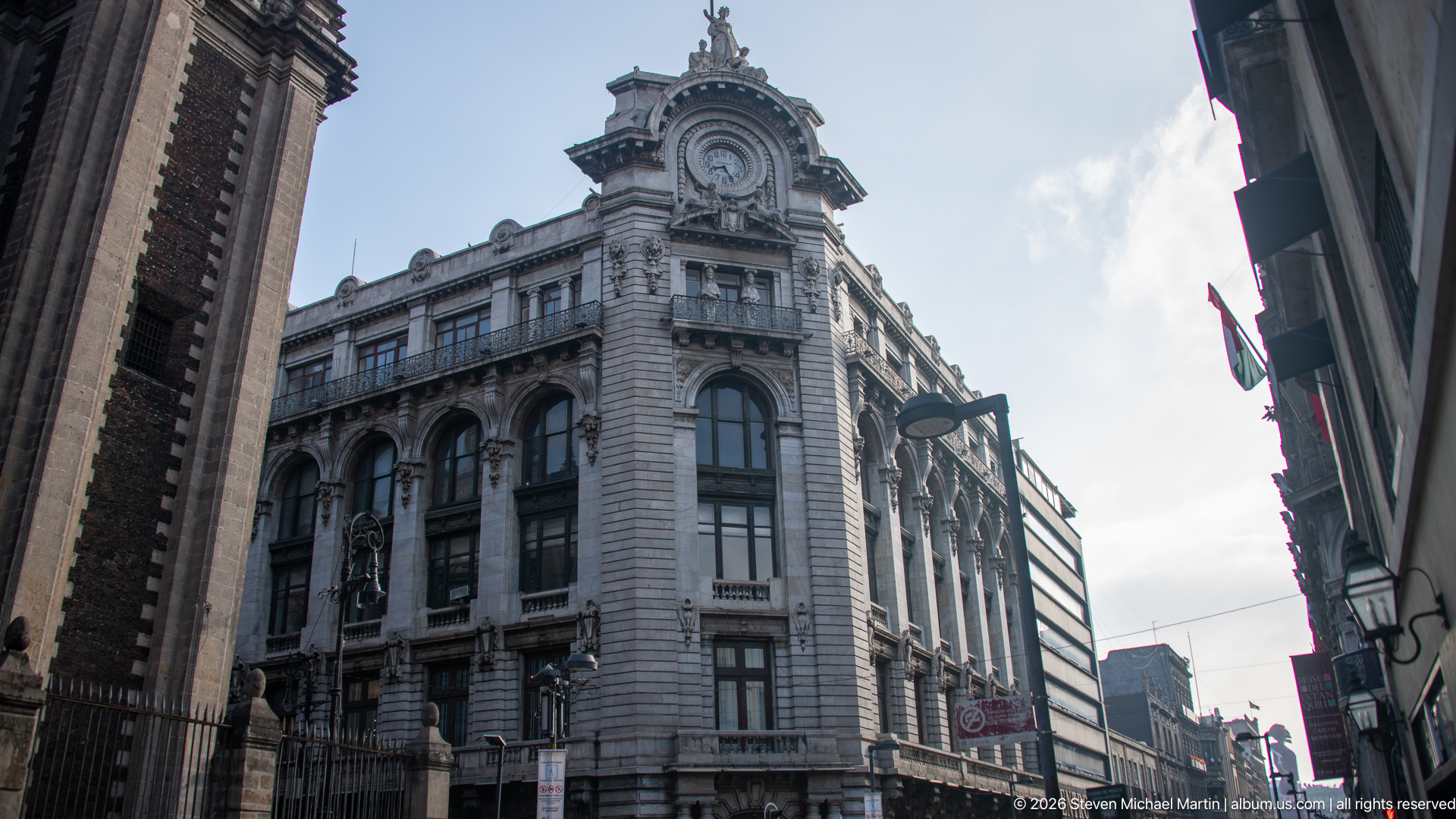
A pale stone corner building rises above the narrow street, with paired arched windows, wrought-iron balconies, and a sculpted clock set into its upper tower. Seen from below between neighboring façades, it forms a strong vertical marker in the dense urban block. The clock and corner composition distinguish this view from the longer streetscape nearby.
Caption
A pale stone corner building rises above the narrow street, with paired arched windows, wrought-iron balconies, and a sculpted clock set into its upper tower. Seen from below between neighboring façades, it forms a strong vertical marker in the dense urban block. The clock and corner composition distinguish this view from the longer streetscape nearby.
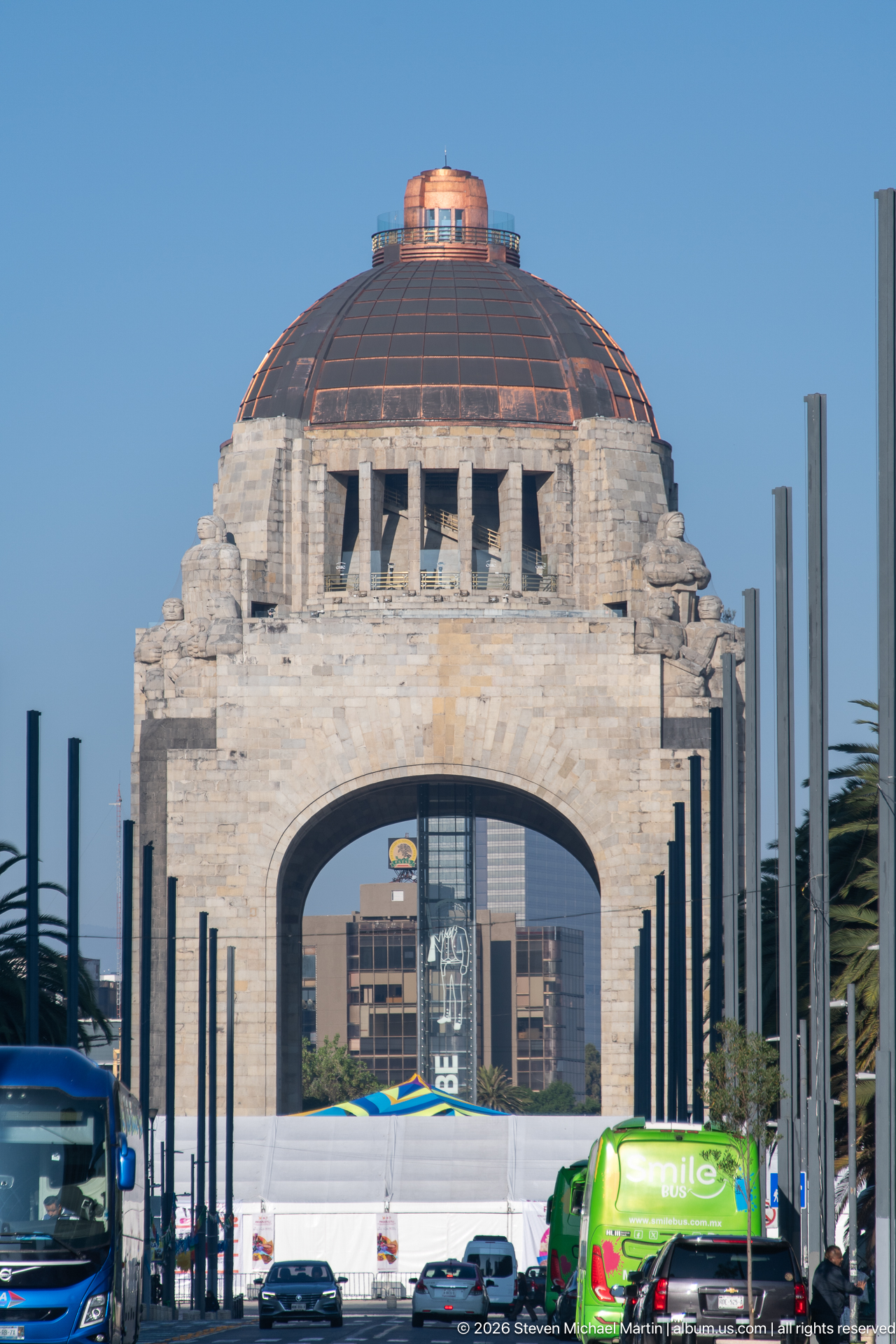
A copper-toned dome crowns a massive stone structure whose broad central arch frames the city beyond. Vehicles pass across the foreground, while a temporary barrier and tall posts line the approach. The distinctive combination of dome, arch, and heavy stone mass identifies the Monumento a la Revolución; this frontal view records the landmark from street level rather than from its surrounding plaza.
Caption
A copper-toned dome crowns a massive stone structure whose broad central arch frames the city beyond. Vehicles pass across the foreground, while a temporary barrier and tall posts line the approach. The distinctive combination of dome, arch, and heavy stone mass identifies the Monumento a la Revolución; this frontal view records the landmark from street level rather than from its surrounding plaza.
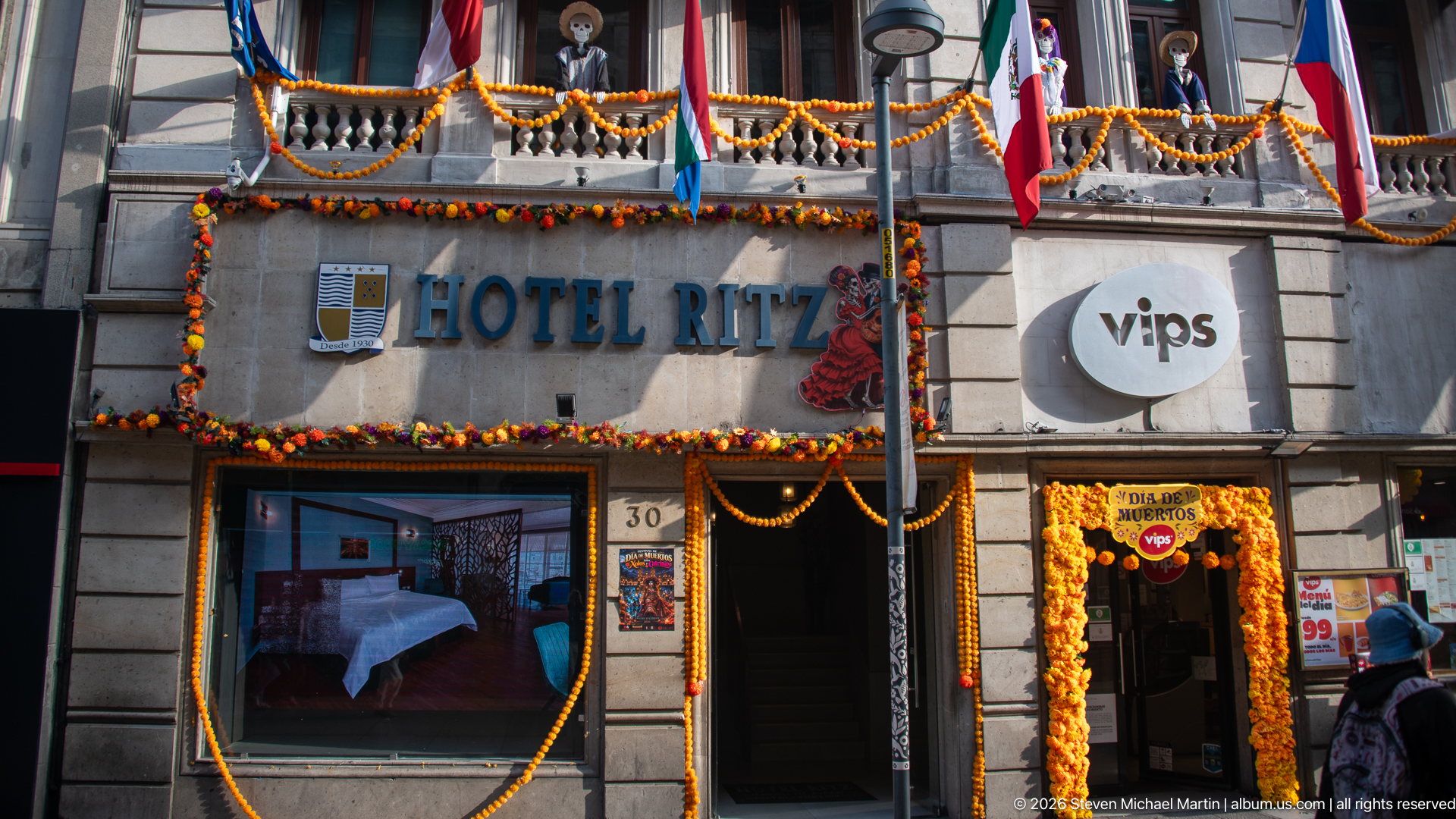
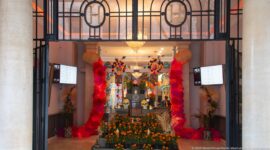
The stone frontage of Hotel Ritz rises above a street-level Vips restaurant, both outlined with marigold garlands and orange flowers. Flags and small skeleton dolls occupy the upper balcony, while the hotel name and Vips logo anchor the composition. The wider view shows how the seasonal Día de Muertos treatment extends from the restaurant entrance across the hotel façade.
Caption
The stone frontage of Hotel Ritz rises above a street-level Vips restaurant, both outlined with marigold garlands and orange flowers. Flags and small skeleton dolls occupy the upper balcony, while the hotel name and Vips logo anchor the composition. The wider view shows how the seasonal Día de Muertos treatment extends from the restaurant entrance across the hotel façade.
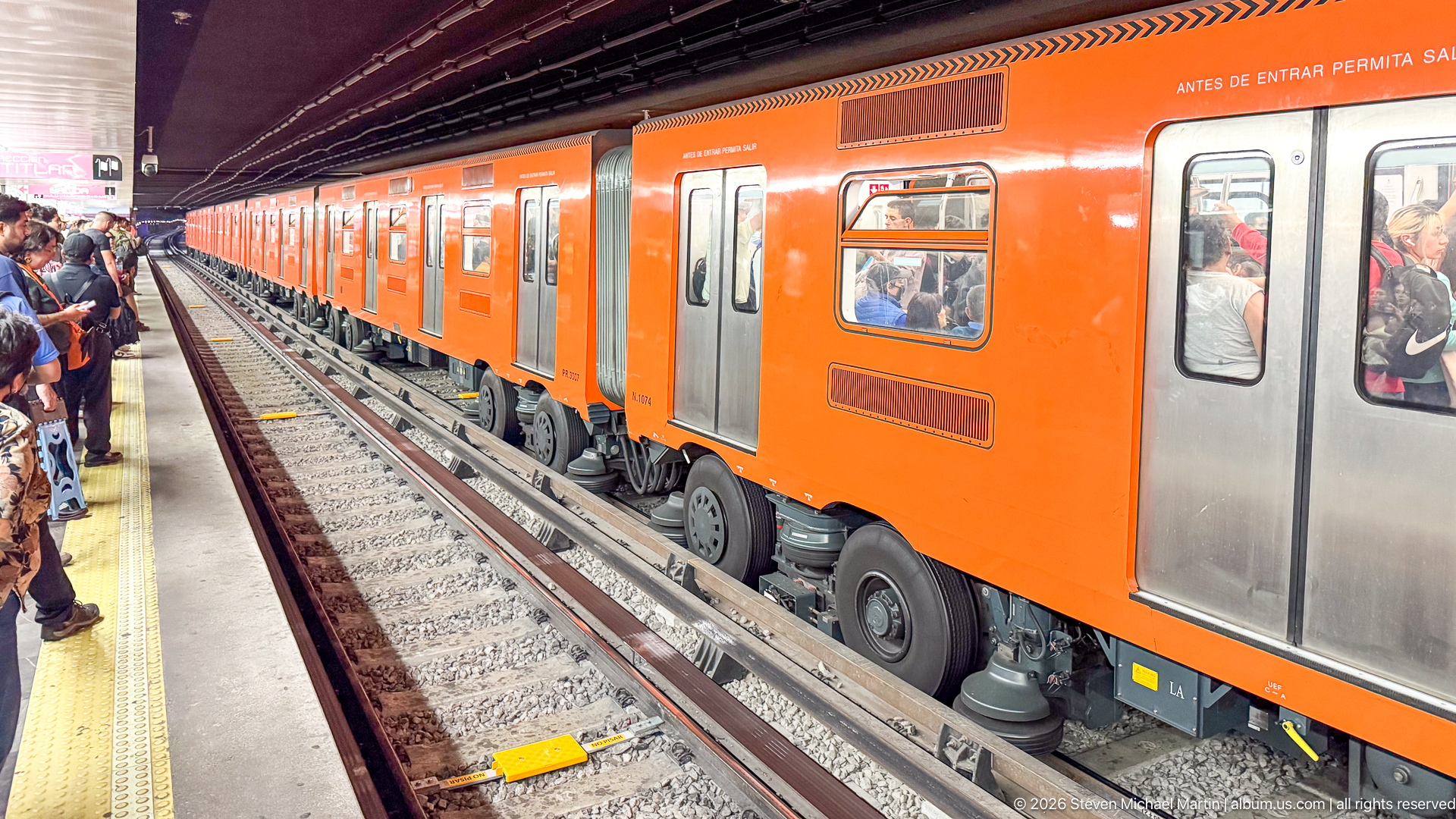
An orange train stands along the platform, its repeated doors and windows extending toward the vanishing point. Passengers wait behind the yellow tactile strip at left, while the rails and track bed lead into the distance. The side view emphasizes the train’s color and length within the station, offering an exterior counterpart to the crowded interior photographs on this page.
Caption
An orange train stands along the platform, its repeated doors and windows extending toward the vanishing point. Passengers wait behind the yellow tactile strip at left, while the rails and track bed lead into the distance. The side view emphasizes the train’s color and length within the station, offering an exterior counterpart to the crowded interior photographs on this page.
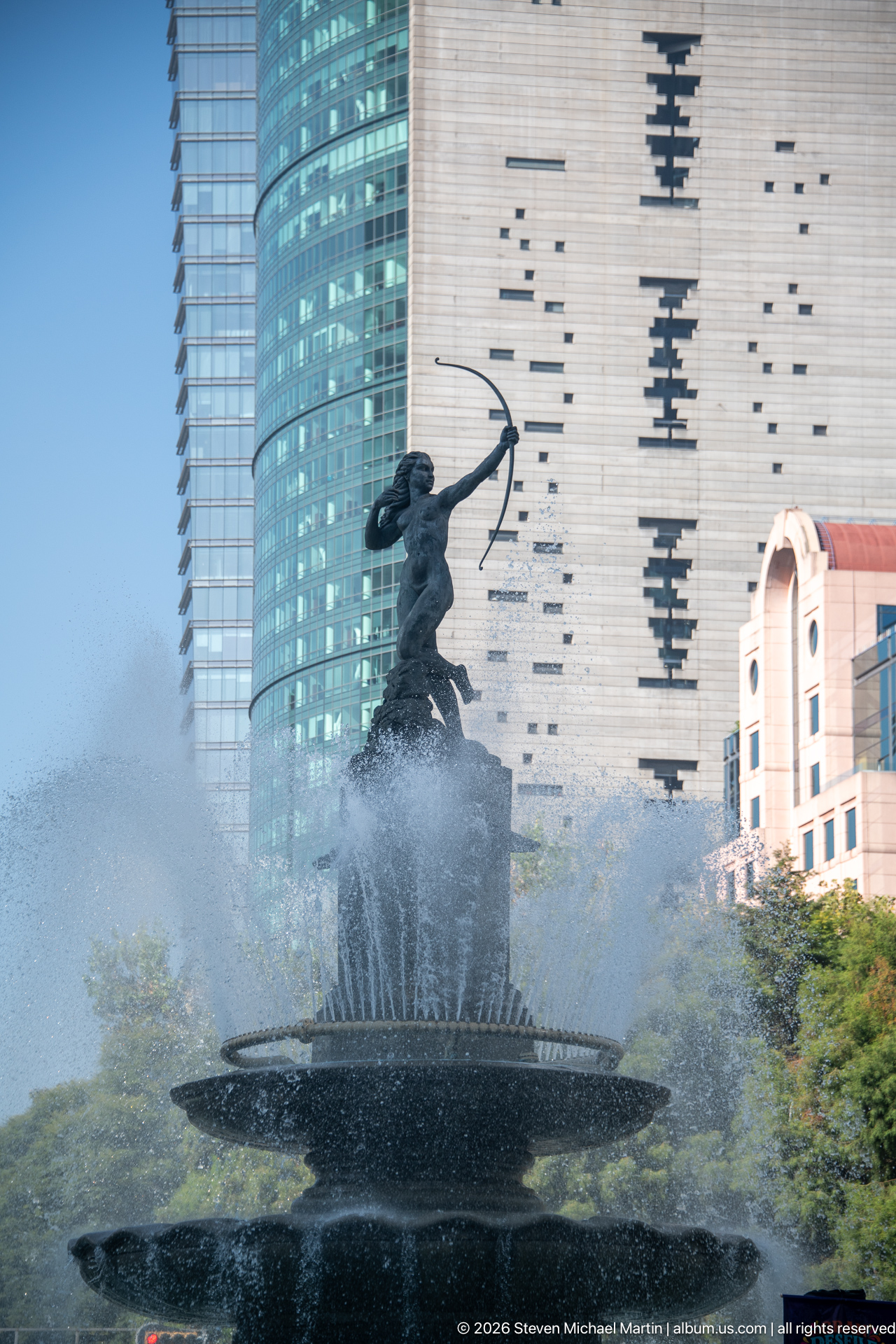
The Diana Cazadora fountain is shown in a wider urban setting, with the archer rising from the basin and water spilling across its circular tiers. Glass office towers and a pale stone building form a varied backdrop, placing the landmark between older and newer city architecture. This view shifts attention from the figure’s form to the fountain’s scale and its relationship to the surrounding avenue.
Caption
The Diana Cazadora fountain is shown in a wider urban setting, with the archer rising from the basin and water spilling across its circular tiers. Glass office towers and a pale stone building form a varied backdrop, placing the landmark between older and newer city architecture. This view shifts attention from the figure’s form to the fountain’s scale and its relationship to the surrounding avenue.
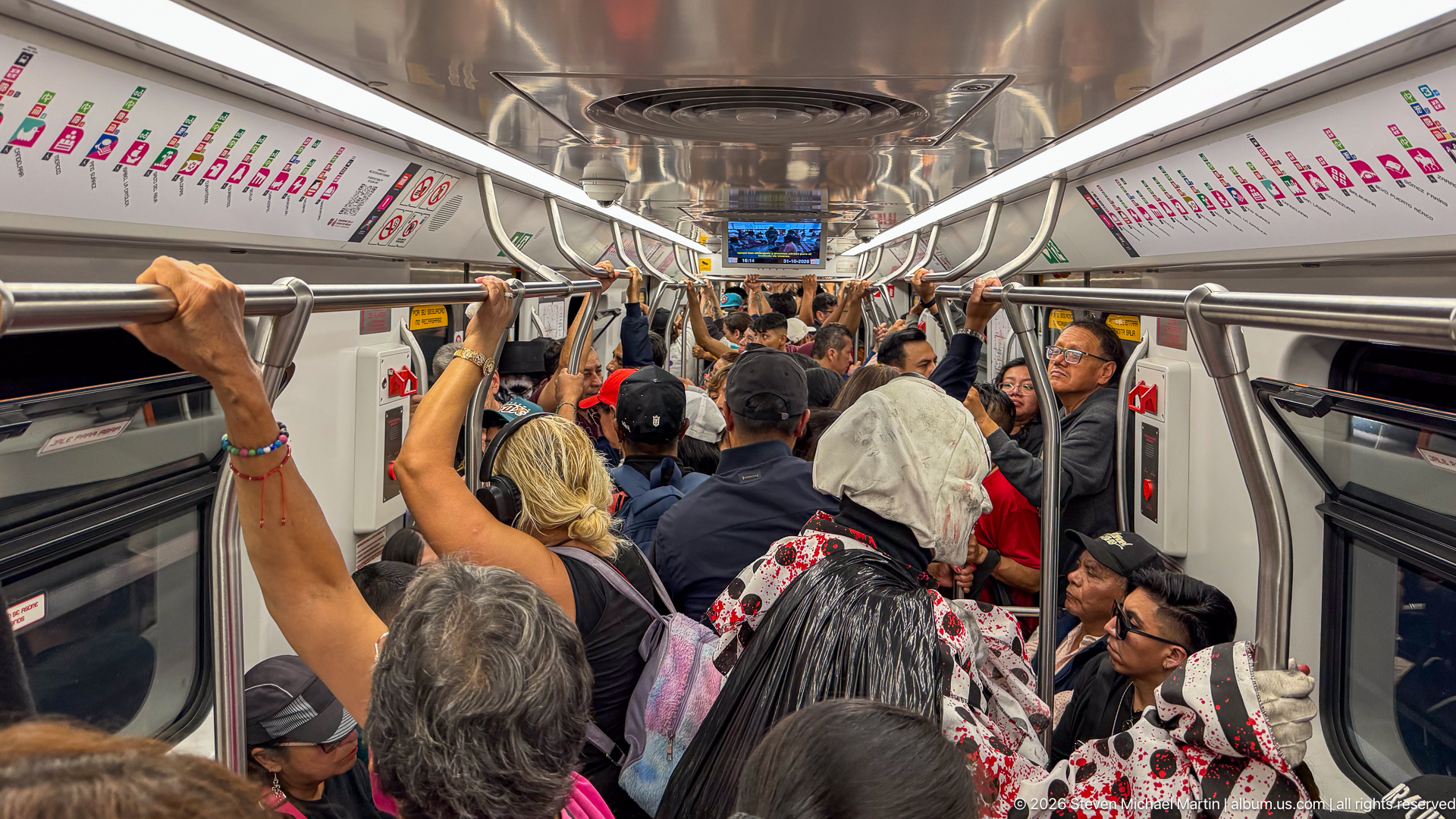
Looking down the length of the carriage, riders fill the aisle and hold the overhead bars beneath bright linear lights. Route diagrams line both sides of the ceiling, and a small screen glows at the far end. The wide interior view establishes the density and repeating structure of the train car, complementing the tighter passenger portraits elsewhere in this sequence.
Caption
Looking down the length of the carriage, riders fill the aisle and hold the overhead bars beneath bright linear lights. Route diagrams line both sides of the ceiling, and a small screen glows at the far end. The wide interior view establishes the density and repeating structure of the train car, complementing the tighter passenger portraits elsewhere in this sequence.
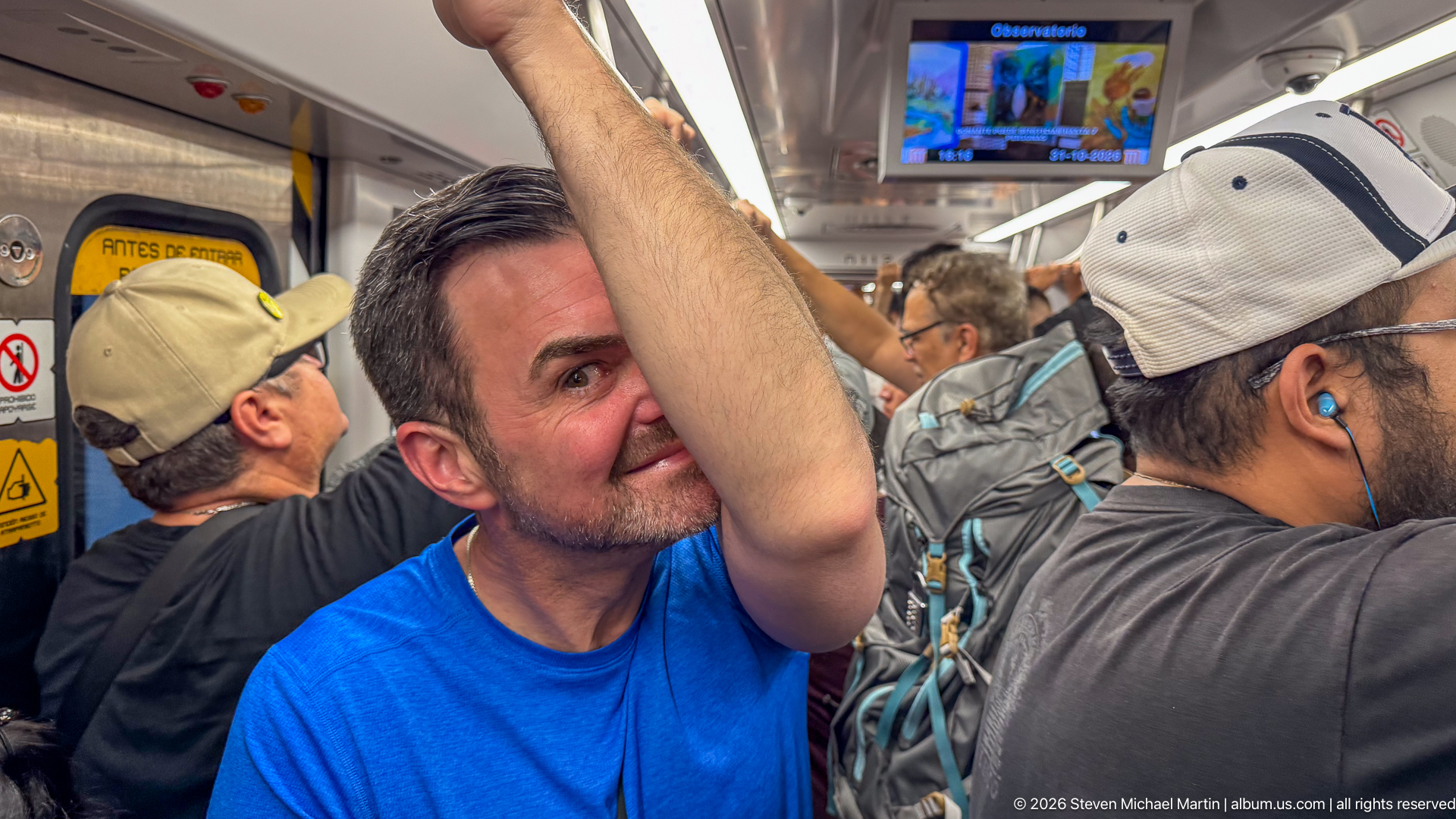
A man in a bright blue shirt looks toward the camera from within a tightly packed train car, surrounded by passengers gripping the overhead rails. A small onboard screen and yellow door warnings remain visible behind him. The close framing records the intimacy and crowding of the journey; surrounding riders and the compressed interior are essential to the image’s sense of movement.
Caption
A man in a bright blue shirt looks toward the camera from within a tightly packed train car, surrounded by passengers gripping the overhead rails. A small onboard screen and yellow door warnings remain visible behind him. The close framing records the intimacy and crowding of the journey; surrounding riders and the compressed interior are essential to the image’s sense of movement.
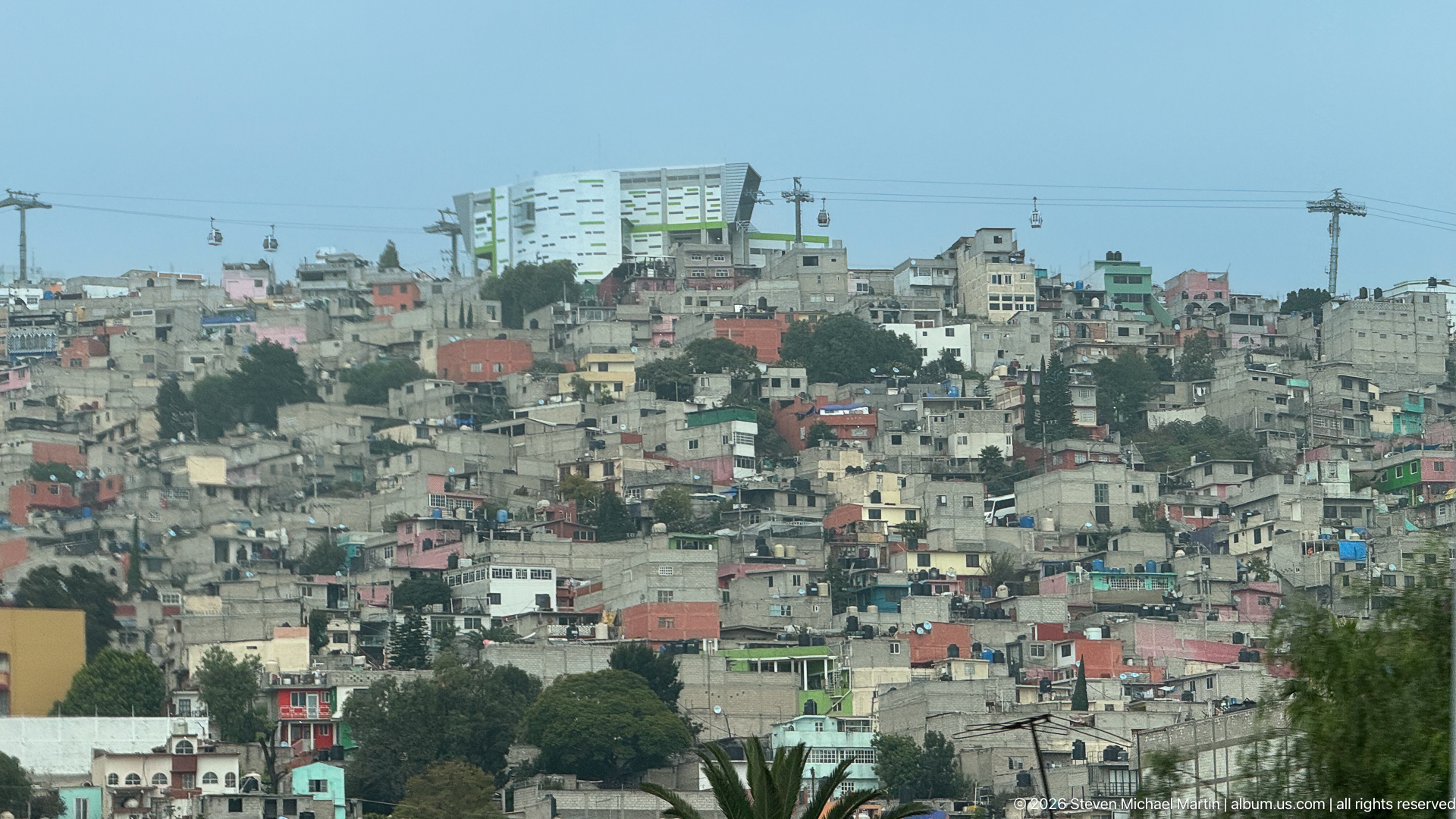
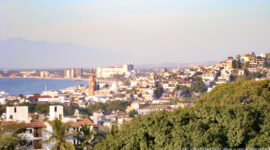
A dense hillside neighborhood fills the frame with tightly packed low-rise homes in concrete, brick, and painted stucco. A modern white-and-green building rises above the irregular roofline, while cable-car cabins and their overhead cables cross the hazy sky. The elevated viewpoint makes the contrast between everyday housing and newer transit infrastructure especially clear.
Caption
A dense hillside neighborhood fills the frame with tightly packed low-rise homes in concrete, brick, and painted stucco. A modern white-and-green building rises above the irregular roofline, while cable-car cabins and their overhead cables cross the hazy sky. The elevated viewpoint makes the contrast between everyday housing and newer transit infrastructure especially clear.
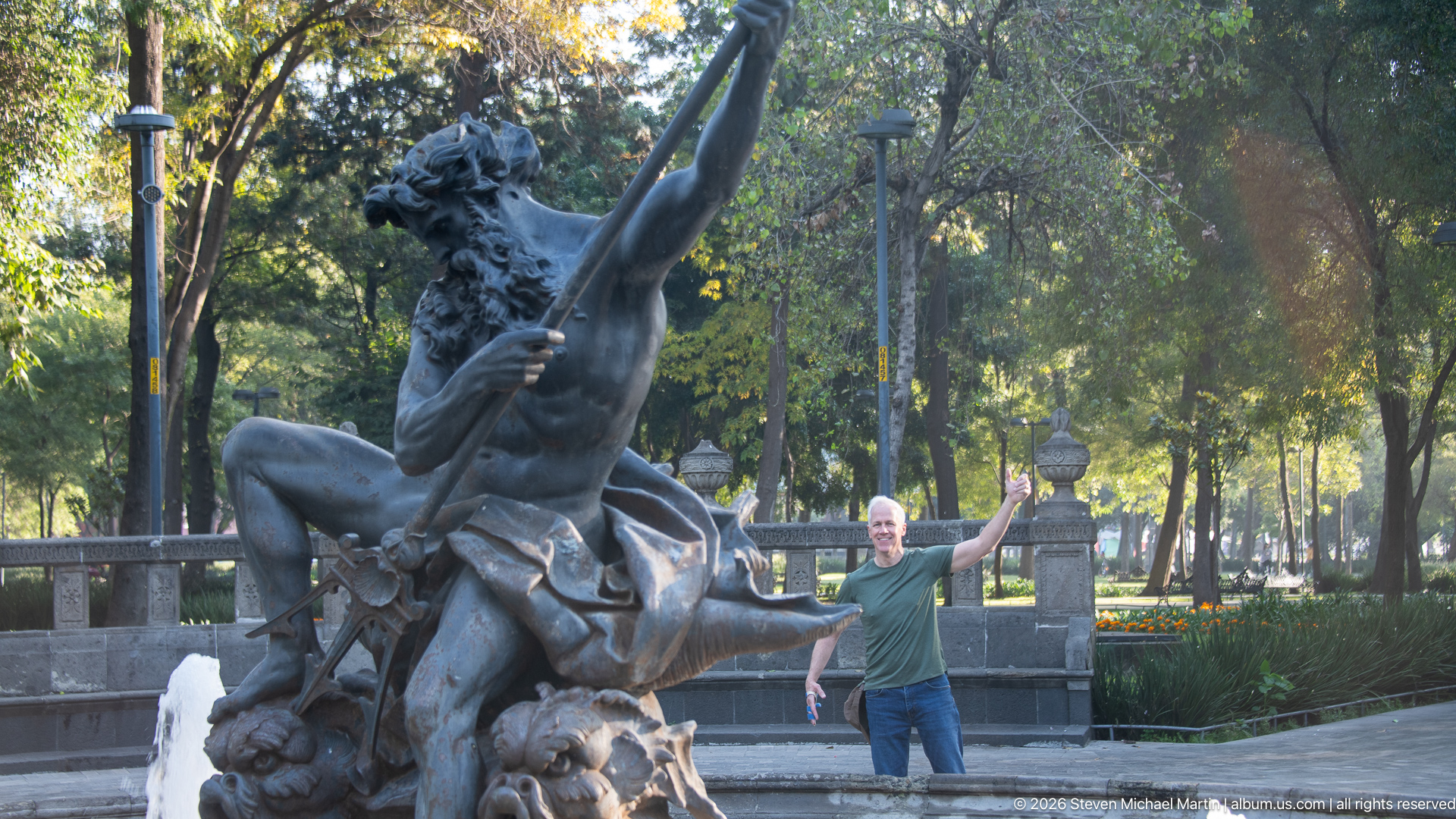
The bronze Diana Cazadora dominates the left foreground, her bow cutting diagonally through the trees as a visitor poses beside the fountain rim. Water spills into the basin and dappled sunlight softens the shaded park behind them. Including the visitor establishes the sculpture’s monumental scale and the site’s everyday use as a public gathering place.
Caption
The bronze Diana Cazadora dominates the left foreground, her bow cutting diagonally through the trees as a visitor poses beside the fountain rim. Water spills into the basin and dappled sunlight softens the shaded park behind them. Including the visitor establishes the sculpture’s monumental scale and the site’s everyday use as a public gathering place.
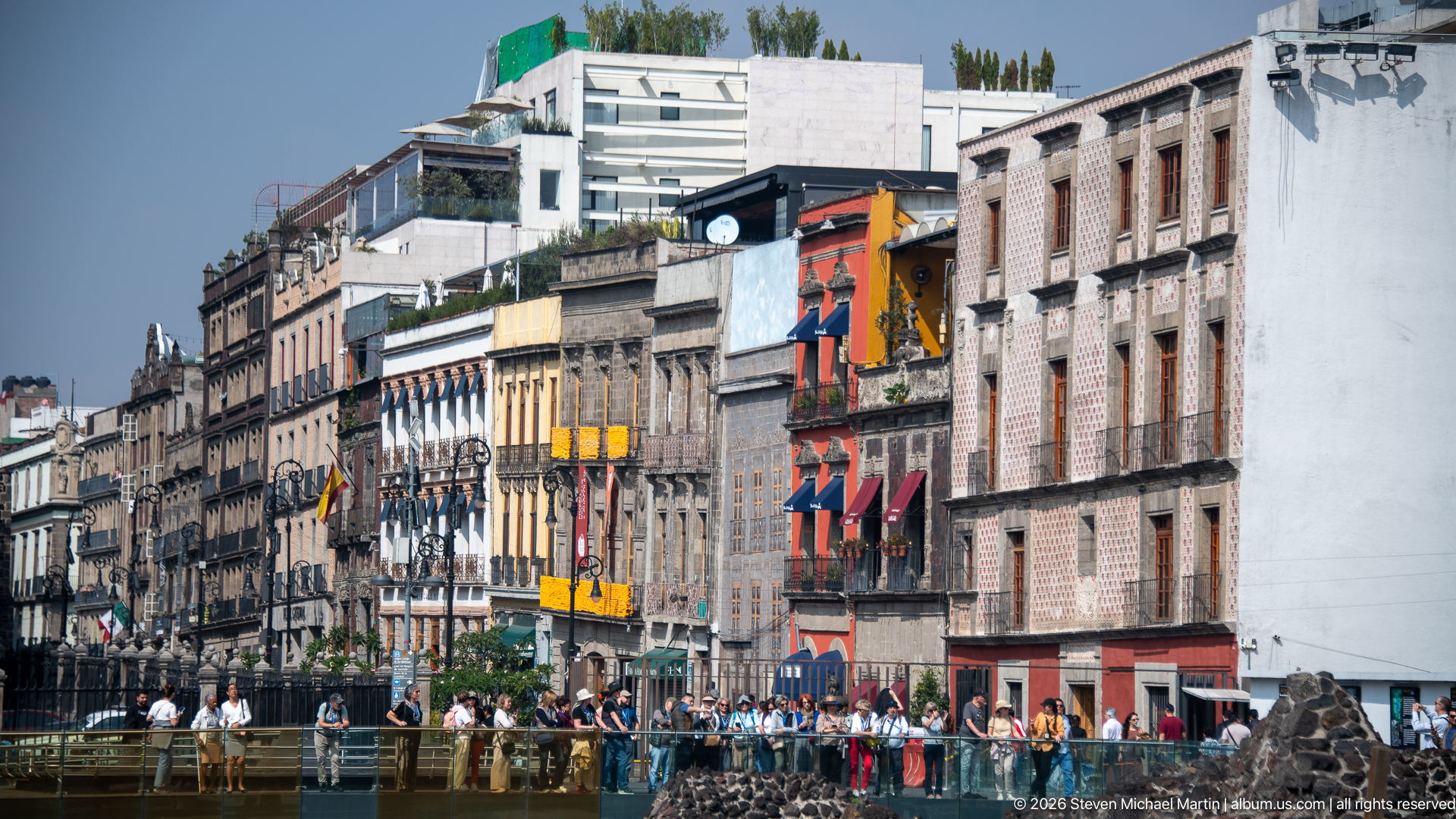
A line of narrow commercial buildings steps across the frame in faded pink, yellow, gray, and white, their upper stories punctuated by balconies and rows of windows. A crowd gathers behind a low barrier along the street, while traffic and modern construction appear at the edges. The wide view records the changing textures and mixed uses of the Centro Histórico streetscape.
Caption
A line of narrow commercial buildings steps across the frame in faded pink, yellow, gray, and white, their upper stories punctuated by balconies and rows of windows. A crowd gathers behind a low barrier along the street, while traffic and modern construction appear at the edges. The wide view records the changing textures and mixed uses of the Centro Histórico streetscape.
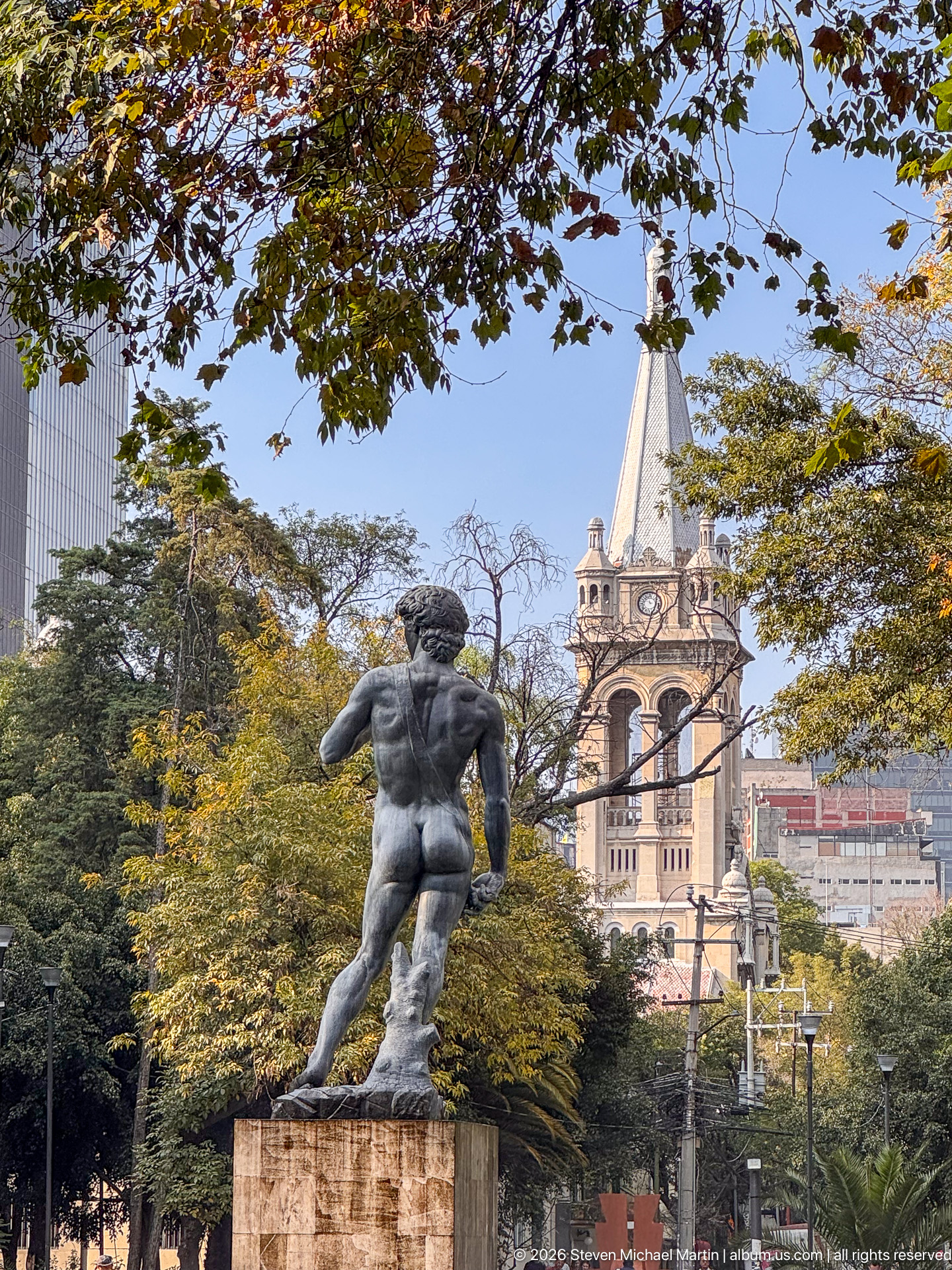
A bronze-toned male figure strides forward with one arm bent, viewed from behind on a stone plinth in a leafy plaza. A church tower rises beyond the tree canopy, providing urban context without dominating the sculpture. The composition connects public art, greenery, and historic architecture in one view; the figure’s identity is not established by a visible inscription.
Caption
A bronze-toned male figure strides forward with one arm bent, viewed from behind on a stone plinth in a leafy plaza. A church tower rises beyond the tree canopy, providing urban context without dominating the sculpture. The composition connects public art, greenery, and historic architecture in one view; the figure’s identity is not established by a visible inscription.
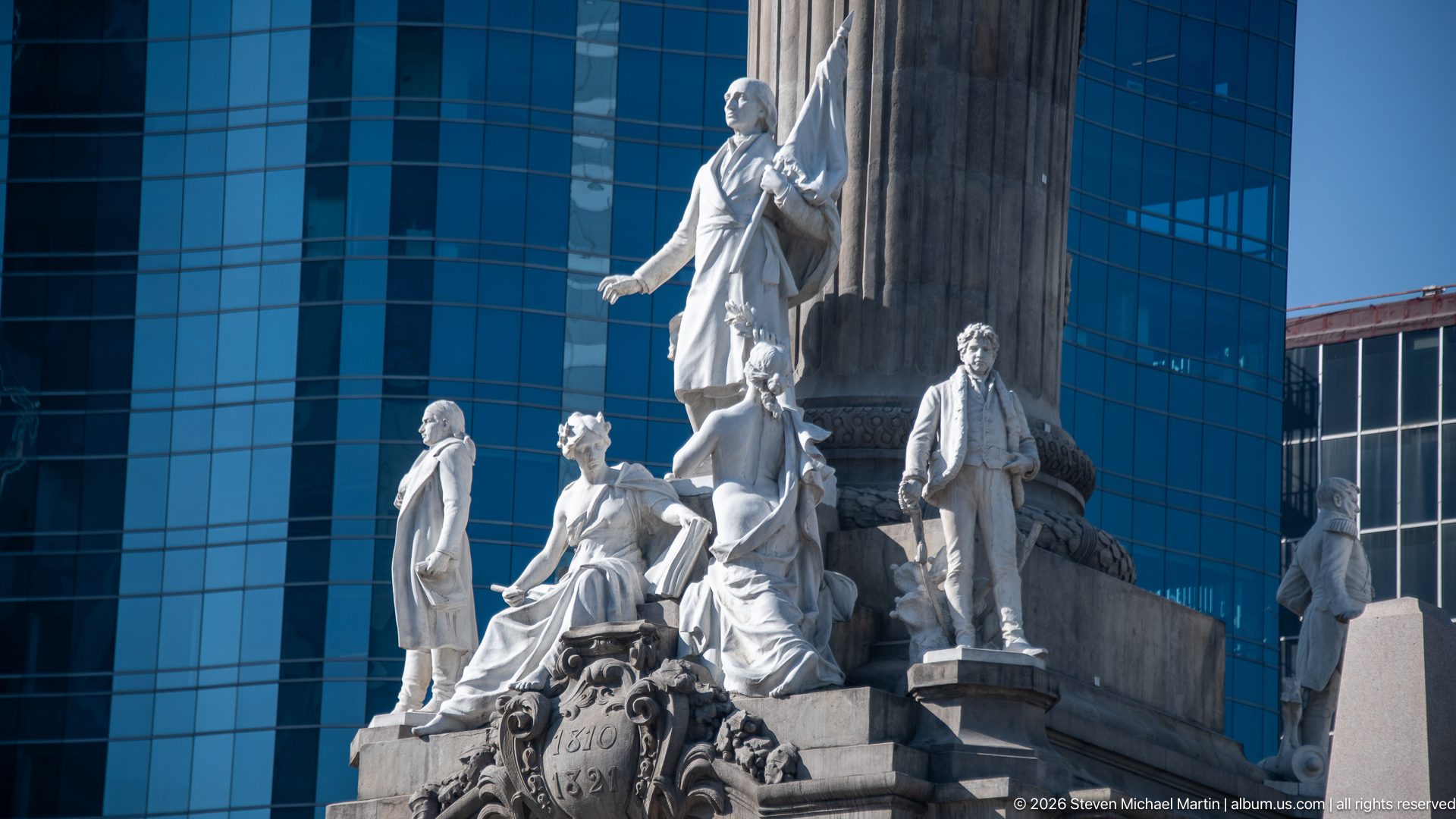
A close view of pale stone figures gathers around the base of the Angel of Independence column. The relief includes standing and seated allegorical figures and a shield bearing the dates 1810 and 1821, linking the monument to Mexico’s independence era. Blue glass towers behind the sculpture set historic stone against the contemporary Paseo de la Reforma skyline.
Caption
A close view of pale stone figures gathers around the base of the Angel of Independence column. The relief includes standing and seated allegorical figures and a shield bearing the dates 1810 and 1821, linking the monument to Mexico’s independence era. Blue glass towers behind the sculpture set historic stone against the contemporary Paseo de la Reforma skyline.
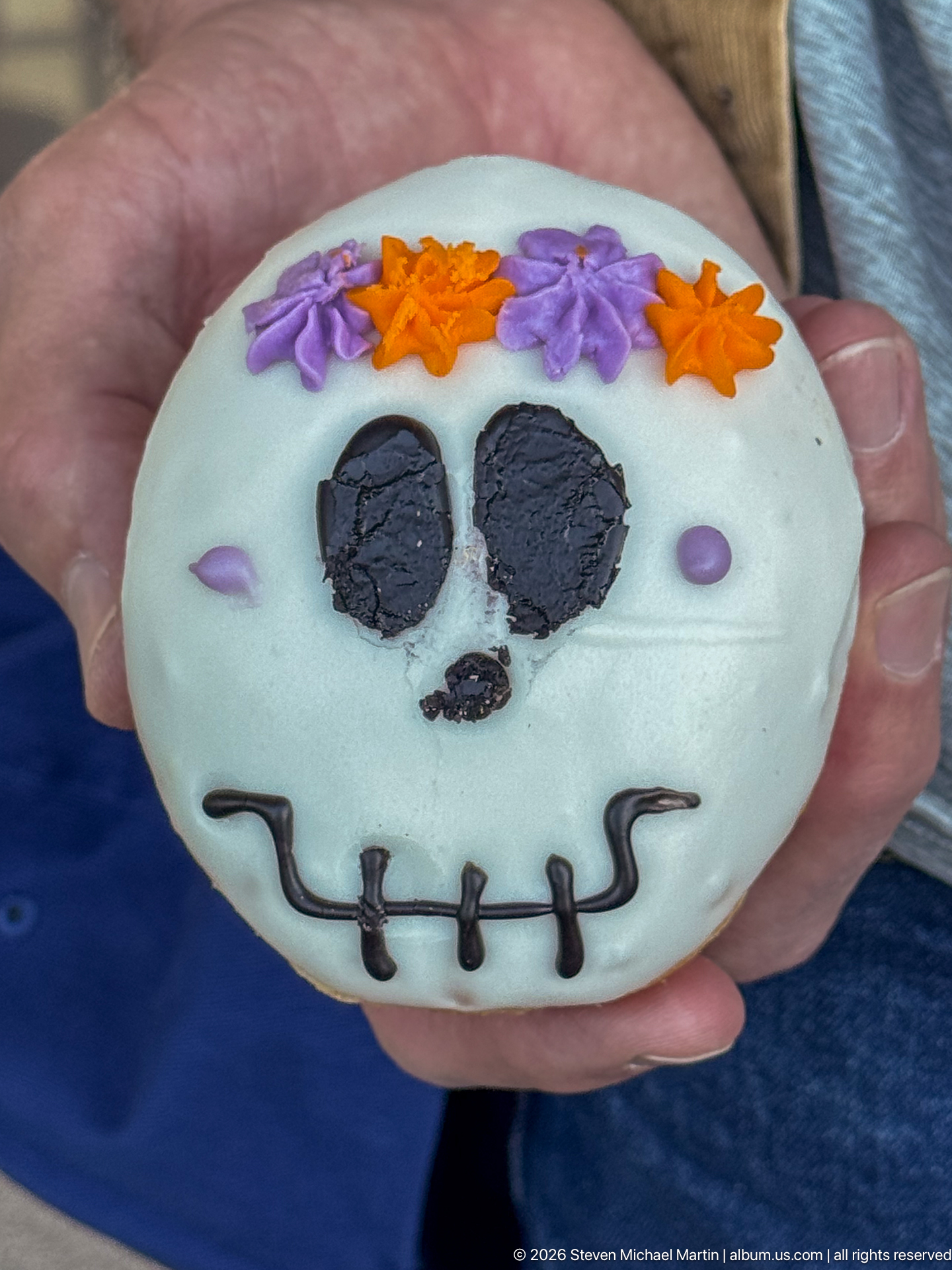
A white sugar skull fills the frame, its black icing features balanced by small orange and purple flowers and dots. Held close to the camera, the confection turns a familiar Día de Muertos emblem into a personal, tactile detail, with the hand and blue clothing providing scale. The image records the seasonal motif through its edible craft rather than a larger altar or street display.
Caption
A white sugar skull fills the frame, its black icing features balanced by small orange and purple flowers and dots. Held close to the camera, the confection turns a familiar Día de Muertos emblem into a personal, tactile detail, with the hand and blue clothing providing scale. The image records the seasonal motif through its edible craft rather than a larger altar or street display.
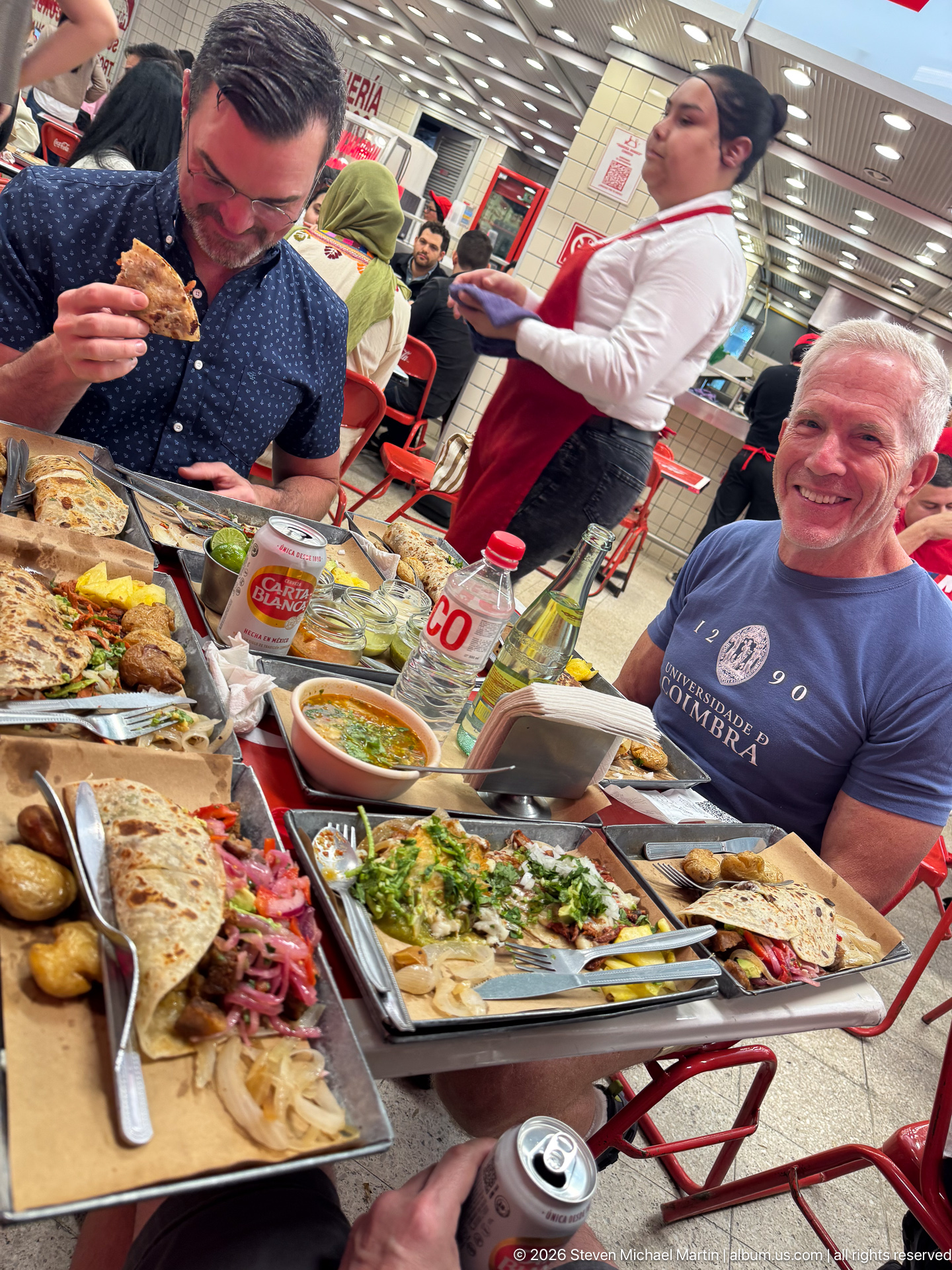
At a busy tiled counter, diners gather around metal trays of folded tortillas, grilled fillings, pickled vegetables and small sides while staff move between the open kitchen and red chairs. The casual service and taco-focused spread fit the nearby Taquería Orinoco signage in this sequence. A diner holds a folded tortilla in the foreground, making the photograph as much about a shared meal as the restaurant’s brisk, communal room.
Caption
At a busy tiled counter, diners gather around metal trays of folded tortillas, grilled fillings, pickled vegetables and small sides while staff move between the open kitchen and red chairs. The casual service and taco-focused spread fit the nearby Taquería Orinoco signage in this sequence. A diner holds a folded tortilla in the foreground, making the photograph as much about a shared meal as the restaurant’s brisk, communal room.
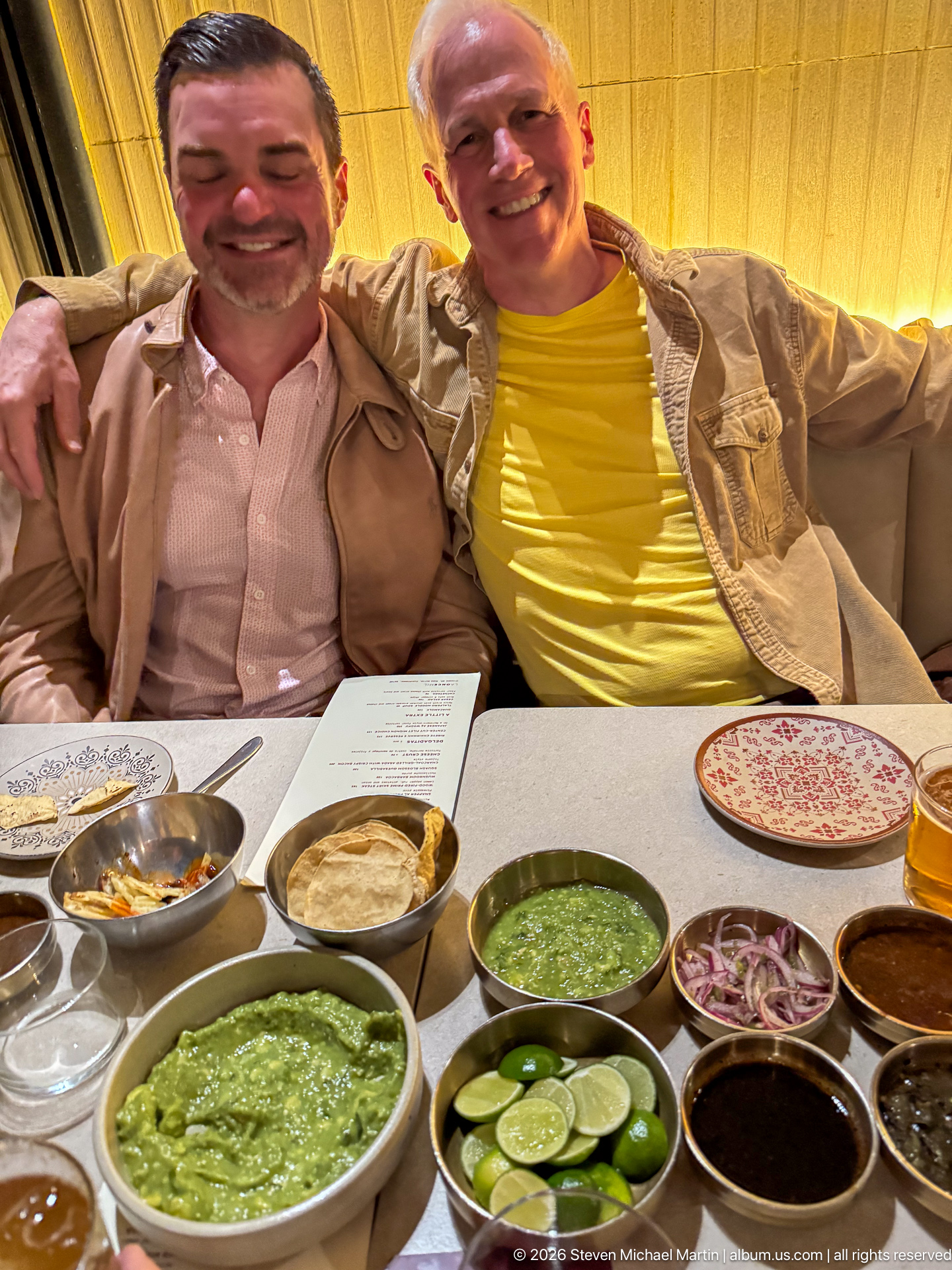
Two companions sit close together behind a table of small dishes: green sauces, dark mole-like sauce, sliced lime, pickled onions and tortillas. A printed menu lies between them, and warm yellow ceiling light gives the dining room an intimate glow. The variety of condiments and the shared spread are clear, but neither the exact restaurant nor the dishes can be established from this view alone.
Caption
Two companions sit close together behind a table of small dishes: green sauces, dark mole-like sauce, sliced lime, pickled onions and tortillas. A printed menu lies between them, and warm yellow ceiling light gives the dining room an intimate glow. The variety of condiments and the shared spread are clear, but neither the exact restaurant nor the dishes can be established from this view alone.
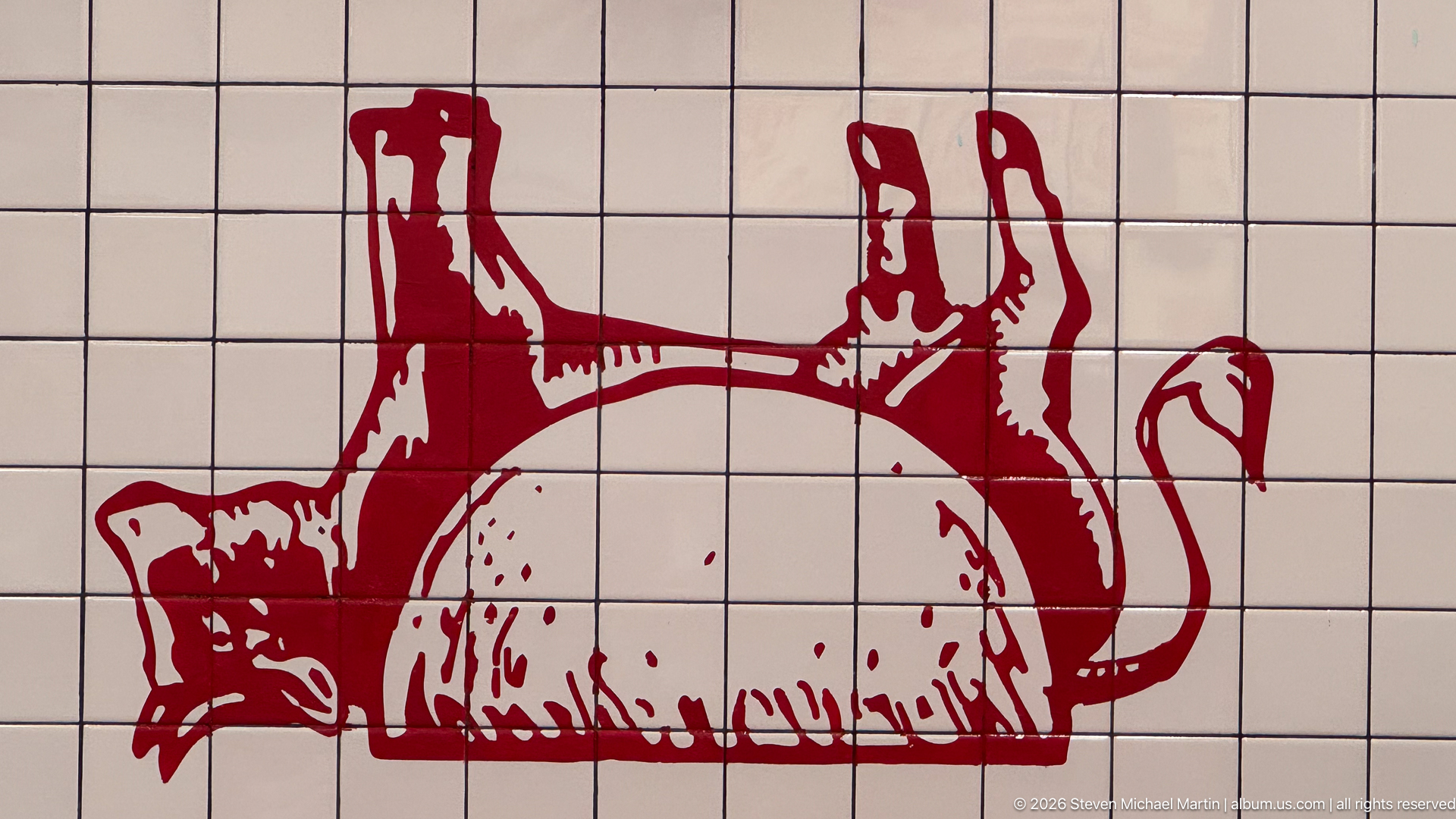
A bold red line drawing stretches across a grid of white tiles, forming a stylized animal with a long body, raised legs and curling tail. The tight crop makes the wall itself a graphic surface: dark grout lines divide the image into regular squares, while the red outline remains legible across them. The exact creature is not clear at this scale, so the caption stays with its visible form.
Caption
A bold red line drawing stretches across a grid of white tiles, forming a stylized animal with a long body, raised legs and curling tail. The tight crop makes the wall itself a graphic surface: dark grout lines divide the image into regular squares, while the red outline remains legible across them. The exact creature is not clear at this scale, so the caption stays with its visible form.
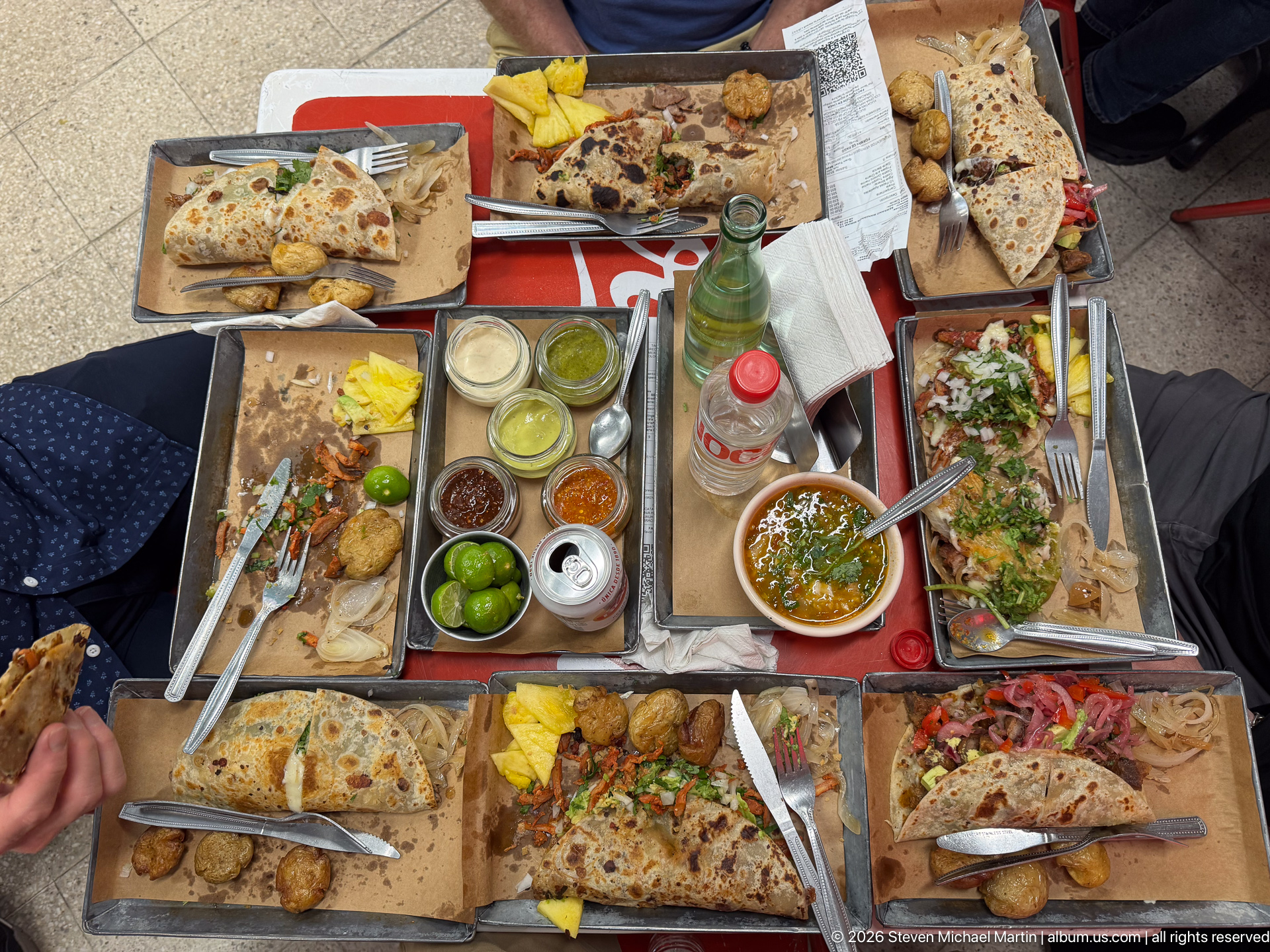
Seen from above, a crowded table is nearly covered by individual metal trays holding folded, browned tortillas, chopped fillings, pickled onions and small fried sides. Bowls of green and red salsa, lime wedges and bottled drinks sit between them. The arrangement suggests a group meal at a fast-moving taquería, while the varied toppings and partly emptied trays preserve the sense of eating in progress.
Caption
Seen from above, a crowded table is nearly covered by individual metal trays holding folded, browned tortillas, chopped fillings, pickled onions and small fried sides. Bowls of green and red salsa, lime wedges and bottled drinks sit between them. The arrangement suggests a group meal at a fast-moving taquería, while the varied toppings and partly emptied trays preserve the sense of eating in progress.
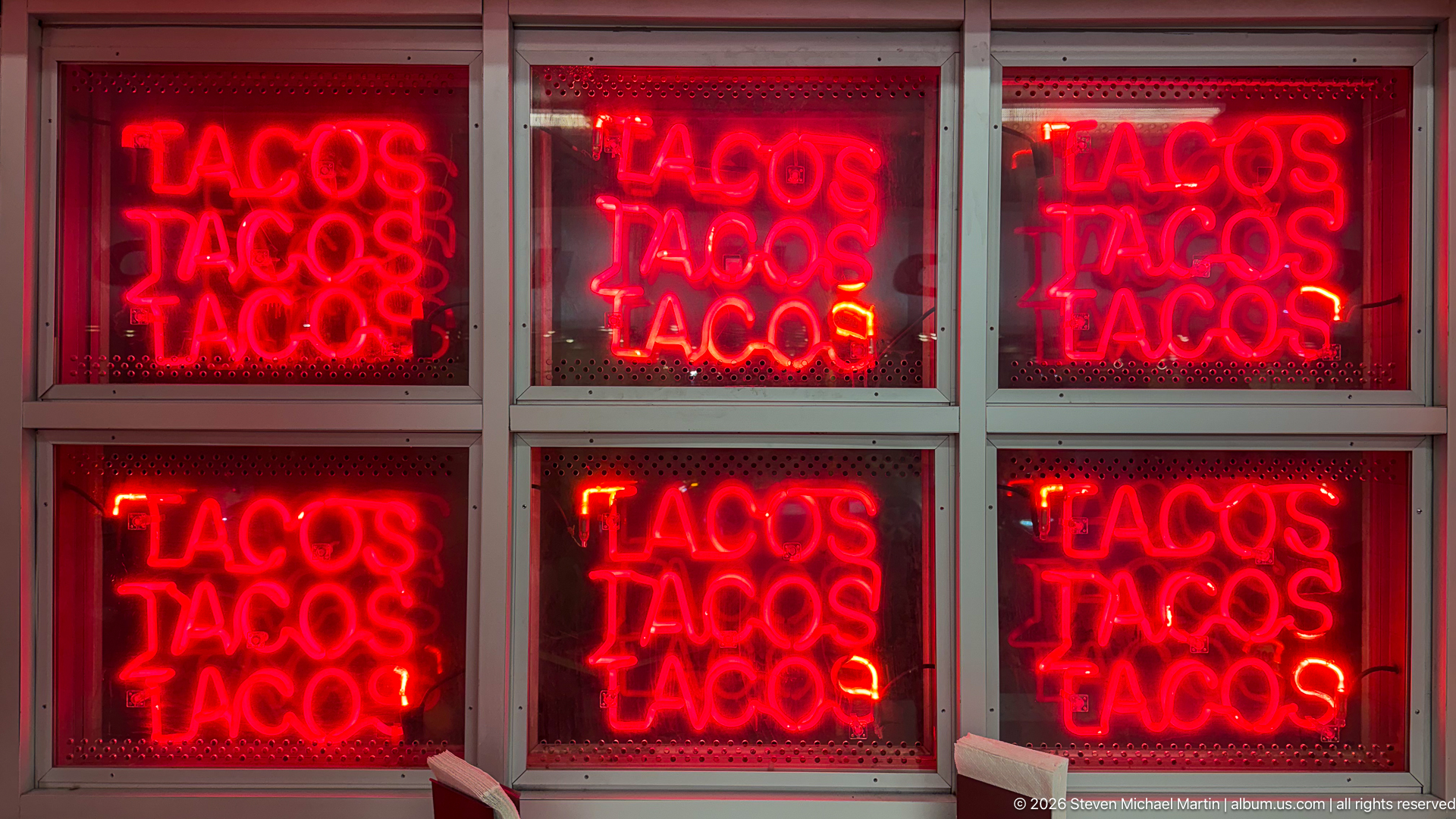
Repeated red neon lettering spelling “TACOS” turns a restaurant window into a simple, unmistakable beacon. The sign appears in multiple panes, so its repetition becomes the whole composition; reflections and the dark metal grille sit behind the glowing tubes. In the surrounding sequence, it marks the taco stop before the photographs move back to diners and their food.
Caption
Repeated red neon lettering spelling “TACOS” turns a restaurant window into a simple, unmistakable beacon. The sign appears in multiple panes, so its repetition becomes the whole composition; reflections and the dark metal grille sit behind the glowing tubes. In the surrounding sequence, it marks the taco stop before the photographs move back to diners and their food.
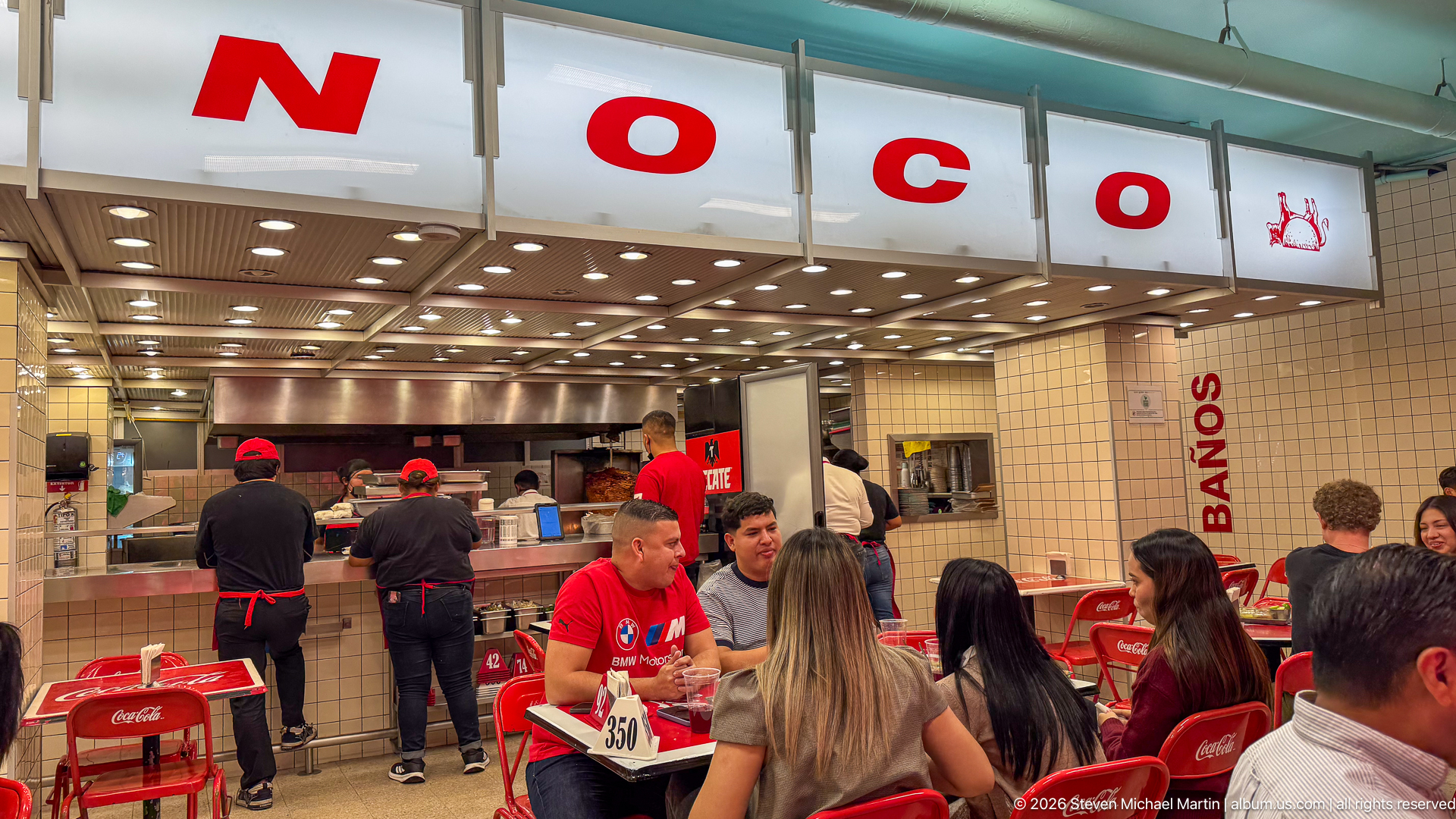
Red chairs, white tile and a busy open service counter define this crowded taquería interior. Red-uniformed staff work behind the counter while customers sit close together; overhead letters show the ending of “ORINOCO,” linking the room to Taquería Orinoco. The photograph places the restaurant’s recognizable name above the everyday rhythm of ordering, cooking and eating.
Caption
Red chairs, white tile and a busy open service counter define this crowded taquería interior. Red-uniformed staff work behind the counter while customers sit close together; overhead letters show the ending of “ORINOCO,” linking the room to Taquería Orinoco. The photograph places the restaurant’s recognizable name above the everyday rhythm of ordering, cooking and eating.
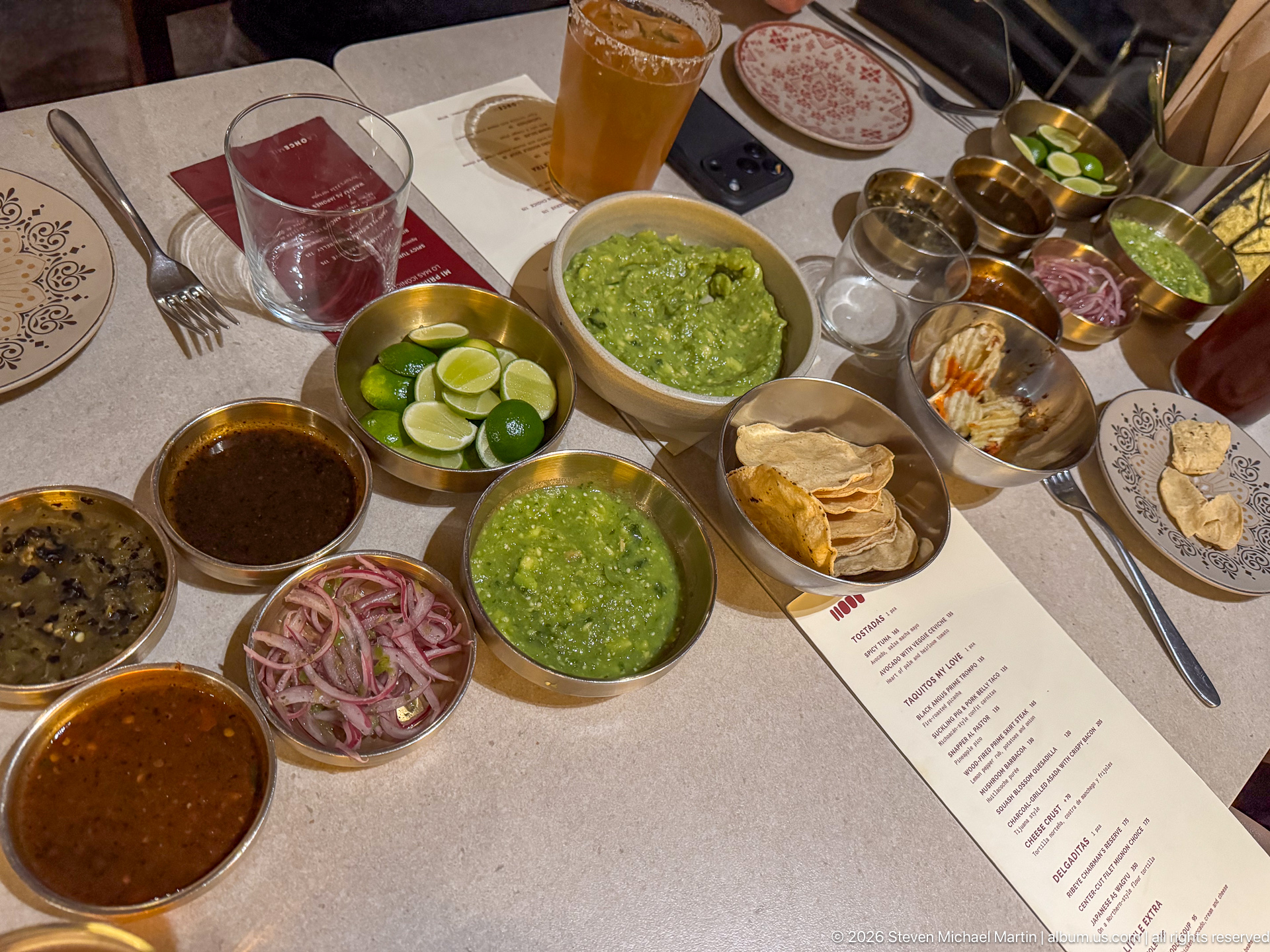
An overhead view isolates the table setting: small metal bowls of green and brown sauces, pickled onions, lime wedges and folded tortillas arranged around a printed menu. A tall amber drink and water glasses anchor the upper edge, while the tightly grouped dishes suggest a meal in progress. The menu is present as context, but the food is best described by its visible ingredients and forms.
Caption
An overhead view isolates the table setting: small metal bowls of green and brown sauces, pickled onions, lime wedges and folded tortillas arranged around a printed menu. A tall amber drink and water glasses anchor the upper edge, while the tightly grouped dishes suggest a meal in progress. The menu is present as context, but the food is best described by its visible ingredients and forms.
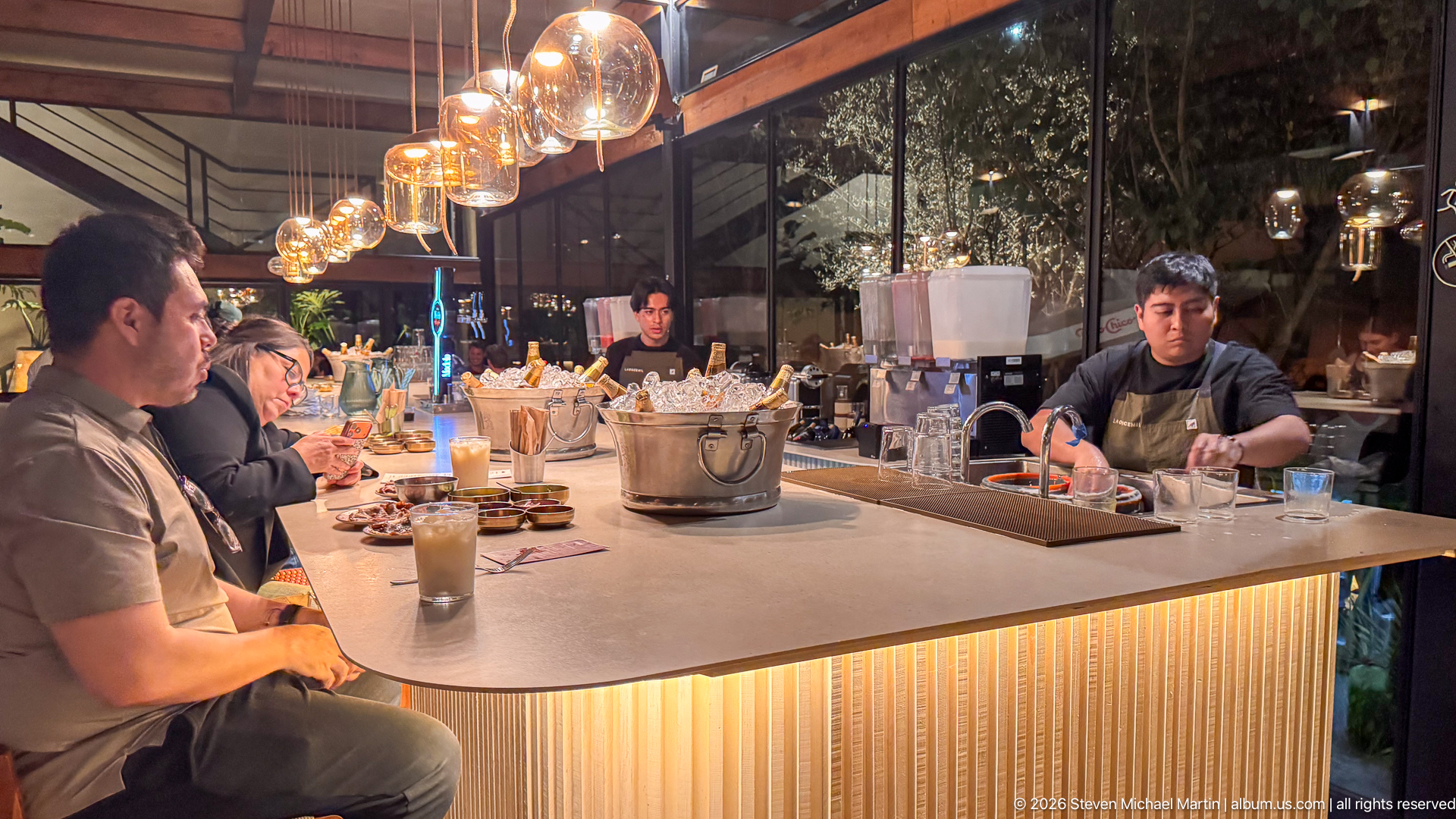
A long pale counter glows from beneath as guests sit along its edge, facing bartenders and a worktop lined with glassware. Globe pendants and floor-to-ceiling windows reflect the surrounding trees, creating a layered evening interior. A pale mixed drink and small plates sit near the customers, but the photograph offers no reliable clue to the bar’s name or the specific cocktail.
Caption
A long pale counter glows from beneath as guests sit along its edge, facing bartenders and a worktop lined with glassware. Globe pendants and floor-to-ceiling windows reflect the surrounding trees, creating a layered evening interior. A pale mixed drink and small plates sit near the customers, but the photograph offers no reliable clue to the bar’s name or the specific cocktail.
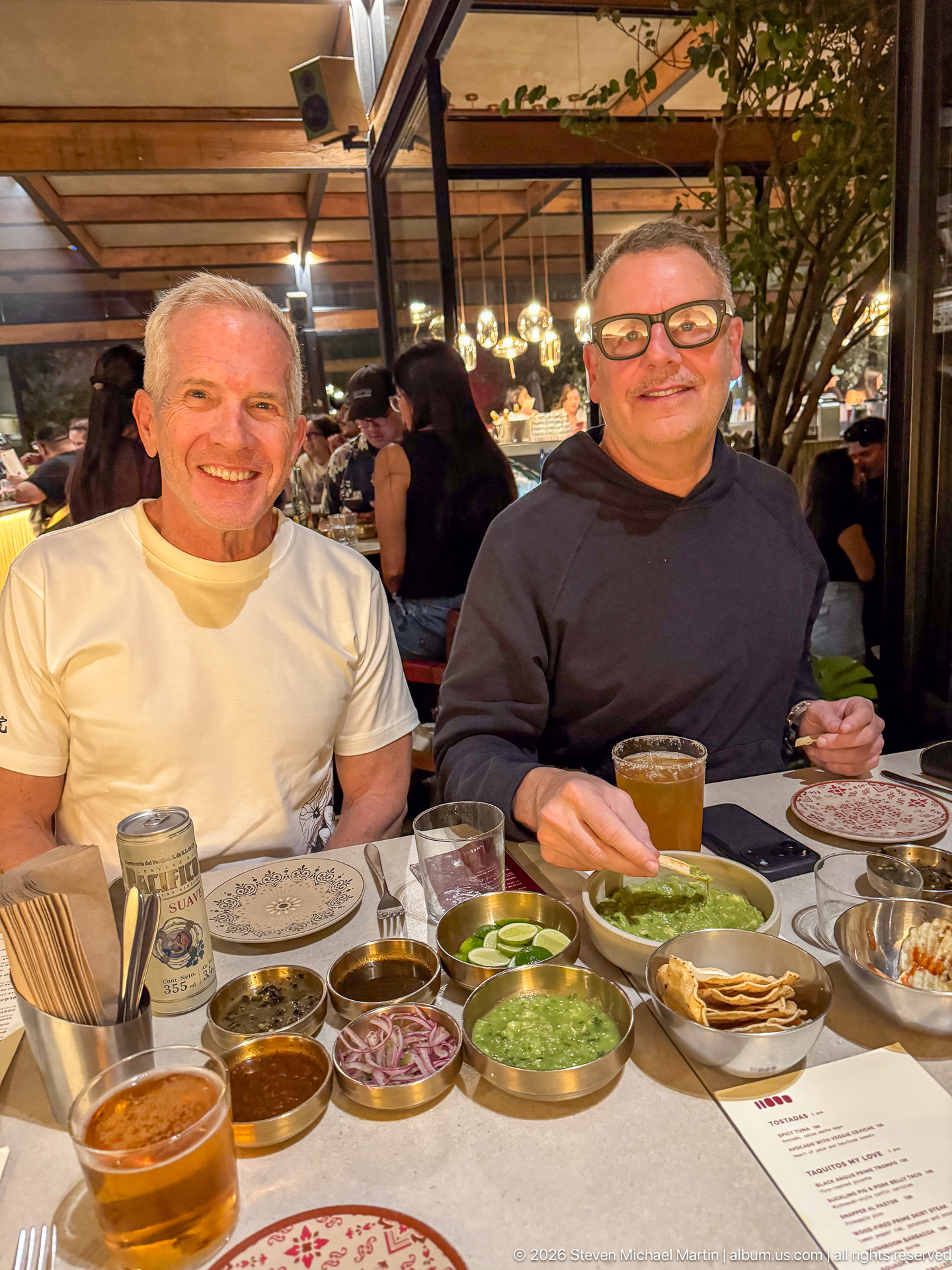
Two diners face the camera from a crowded table, with bowls of salsa, lime, pickled onions and tortillas spread in front of them. An amber beer and a can sit among the plates; behind them, other guests and warm pendant lights make the room feel lively. The portrait connects the meal’s small details to the social setting without assigning names to dishes that remain unidentified.
Caption
Two diners face the camera from a crowded table, with bowls of salsa, lime, pickled onions and tortillas spread in front of them. An amber beer and a can sit among the plates; behind them, other guests and warm pendant lights make the room feel lively. The portrait connects the meal’s small details to the social setting without assigning names to dishes that remain unidentified.

A man in a tan jacket looks toward his phone as he makes a mirror portrait in a warmly lit, wood-paneled room. The framing includes his reflection from waist to head and the curved edge of a white basin at left, suggesting a washroom or dressing area. The photograph is a personal travel moment, distinct from the architectural and dining scenes around it.
Caption
A man in a tan jacket looks toward his phone as he makes a mirror portrait in a warmly lit, wood-paneled room. The framing includes his reflection from waist to head and the curved edge of a white basin at left, suggesting a washroom or dressing area. The photograph is a personal travel moment, distinct from the architectural and dining scenes around it.
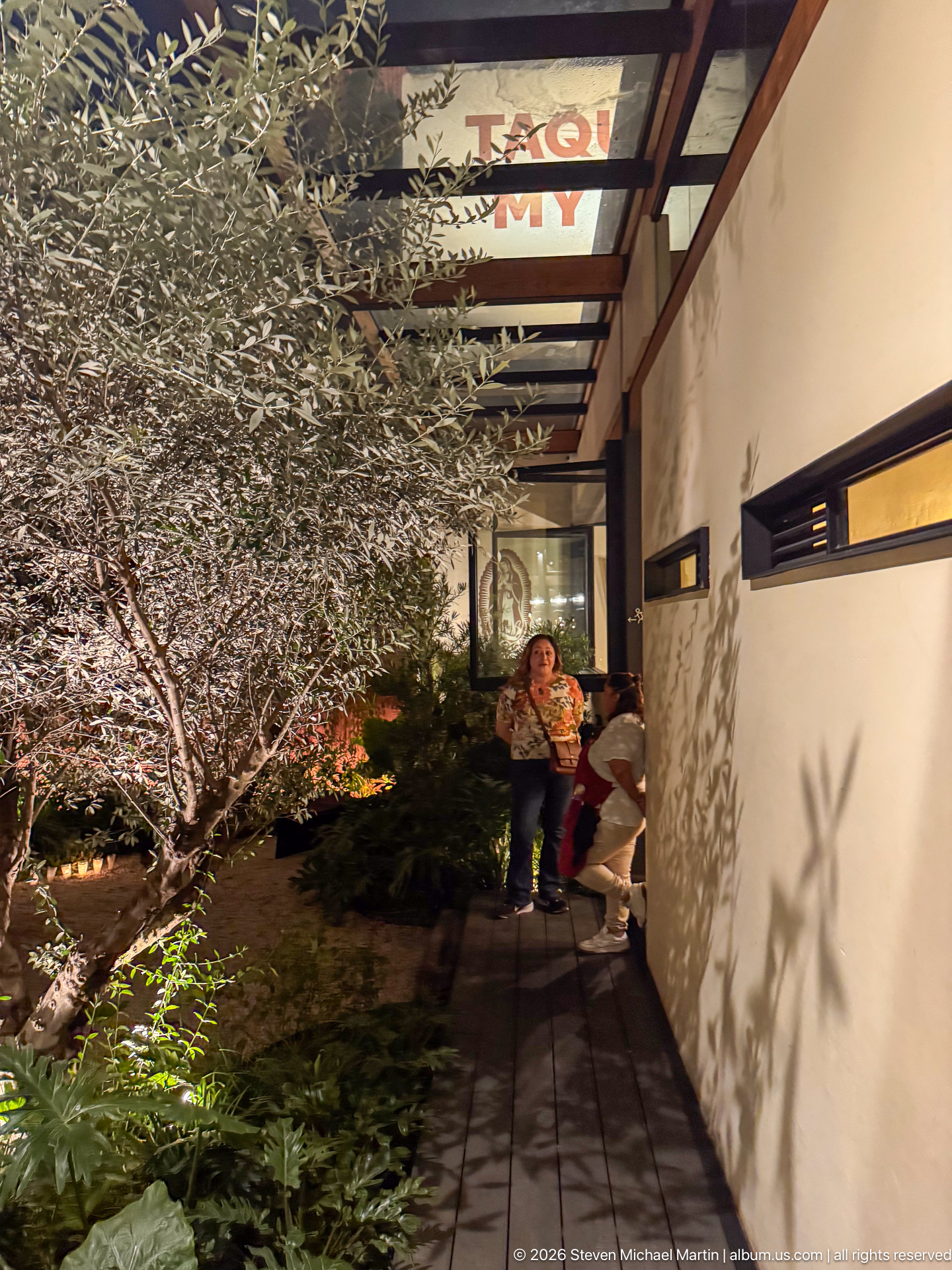
A narrow landscaped passage runs between a planted tree and a pale wall, leading toward a glass entrance. Reflections and branches partly obscure large lettering above the glazing; only fragments are legible, so the venue cannot be identified confidently from this frame. The quiet corridor contrasts with the full dining room nearby, showing the planted threshold through which guests enter.
Caption
A narrow landscaped passage runs between a planted tree and a pale wall, leading toward a glass entrance. Reflections and branches partly obscure large lettering above the glazing; only fragments are legible, so the venue cannot be identified confidently from this frame. The quiet corridor contrasts with the full dining room nearby, showing the planted threshold through which guests enter.
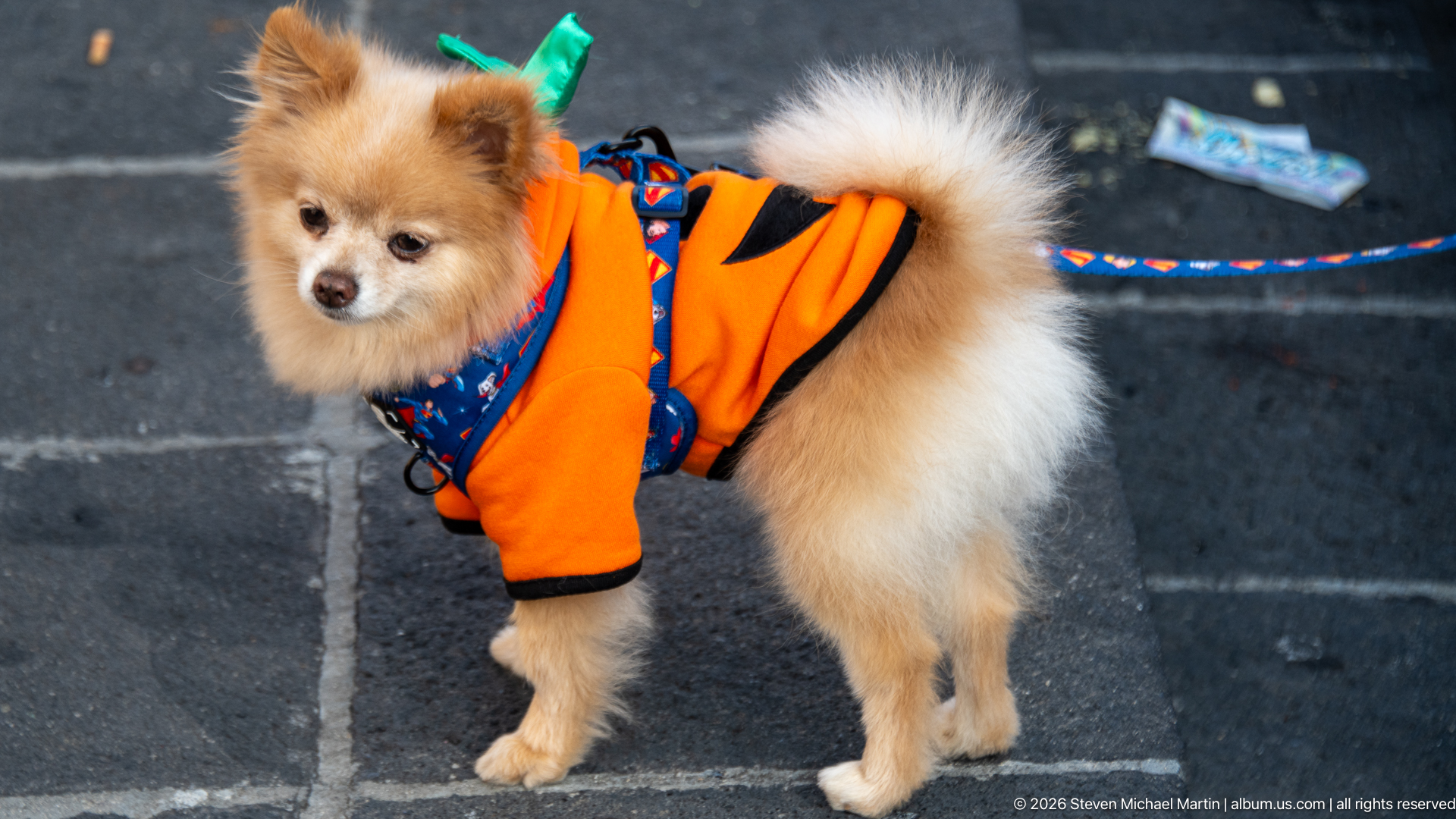
A small, fluffy dog pauses on dark paving in a vivid orange costume edged with black, over a blue patterned harness. A bright green bow rises behind its ears, giving the street portrait a playful seasonal character. The outfit’s colors and festive styling evoke Día de Muertos celebrations, while the close framing keeps attention on the animal rather than the surrounding crowd.
Caption
A small, fluffy dog pauses on dark paving in a vivid orange costume edged with black, over a blue patterned harness. A bright green bow rises behind its ears, giving the street portrait a playful seasonal character. The outfit’s colors and festive styling evoke Día de Muertos celebrations, while the close framing keeps attention on the animal rather than the surrounding crowd.
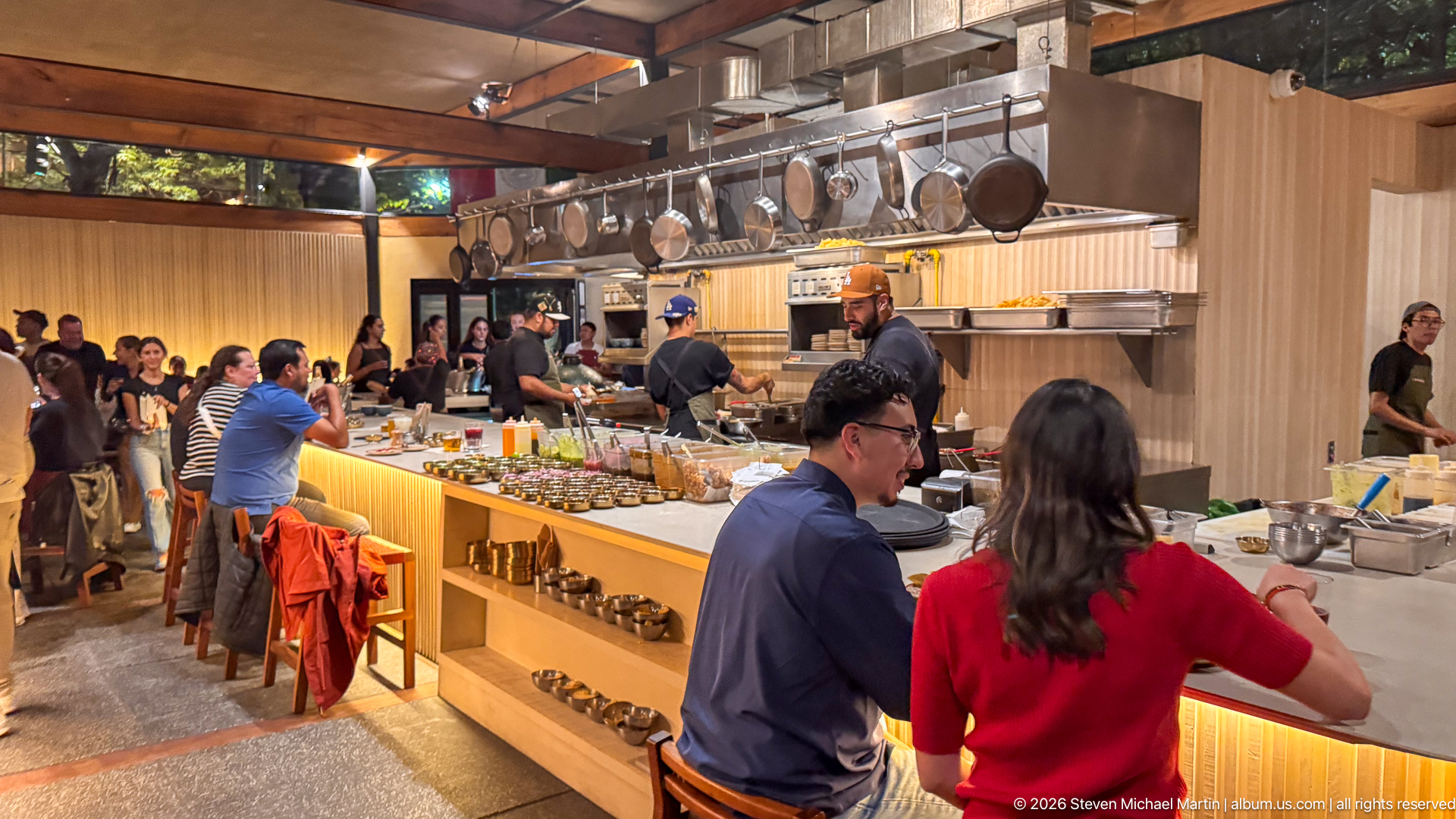
A long counter stretches through a bright restaurant, with guests seated along its edge and staff working at the open kitchen behind them. Copper-toned pans hang overhead, while warm wood panels and a softly illuminated counter front give the space a contemporary feel. This wider view complements the close table photographs by showing how dining and food preparation share the same room.
Caption
A long counter stretches through a bright restaurant, with guests seated along its edge and staff working at the open kitchen behind them. Copper-toned pans hang overhead, while warm wood panels and a softly illuminated counter front give the space a contemporary feel. This wider view complements the close table photographs by showing how dining and food preparation share the same room.
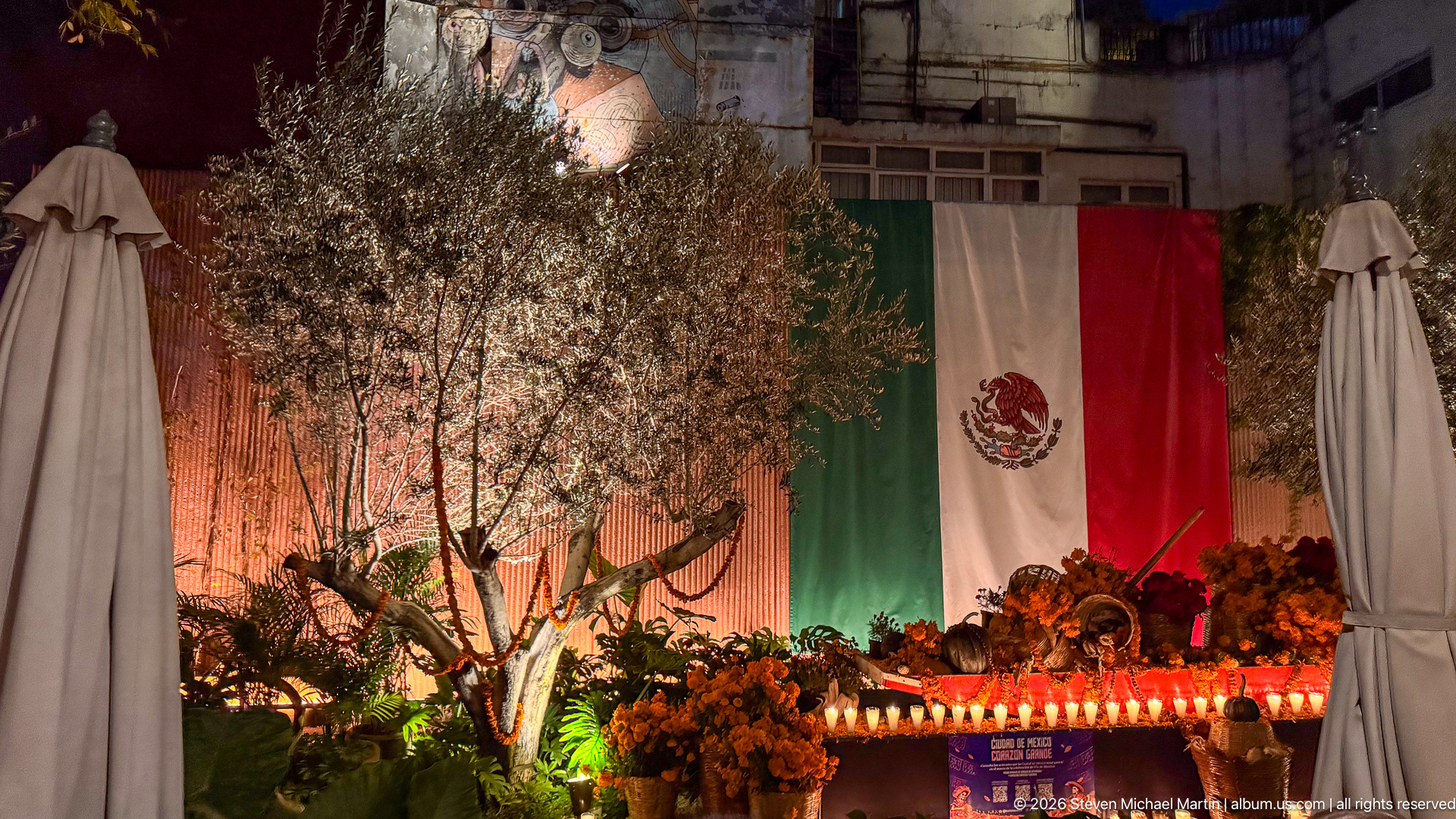
An outdoor altar glows beneath a large Mexican flag, framed by trees and closed market umbrellas. A dense line of candles and orange marigolds illuminates offerings at the base, while a sculptural or painted figure rises behind the foliage. The public installation makes Día de Muertos visible at city scale, joining national imagery, flowers and candlelight in a nighttime commemorative scene.
Caption
An outdoor altar glows beneath a large Mexican flag, framed by trees and closed market umbrellas. A dense line of candles and orange marigolds illuminates offerings at the base, while a sculptural or painted figure rises behind the foliage. The public installation makes Día de Muertos visible at city scale, joining national imagery, flowers and candlelight in a nighttime commemorative scene.
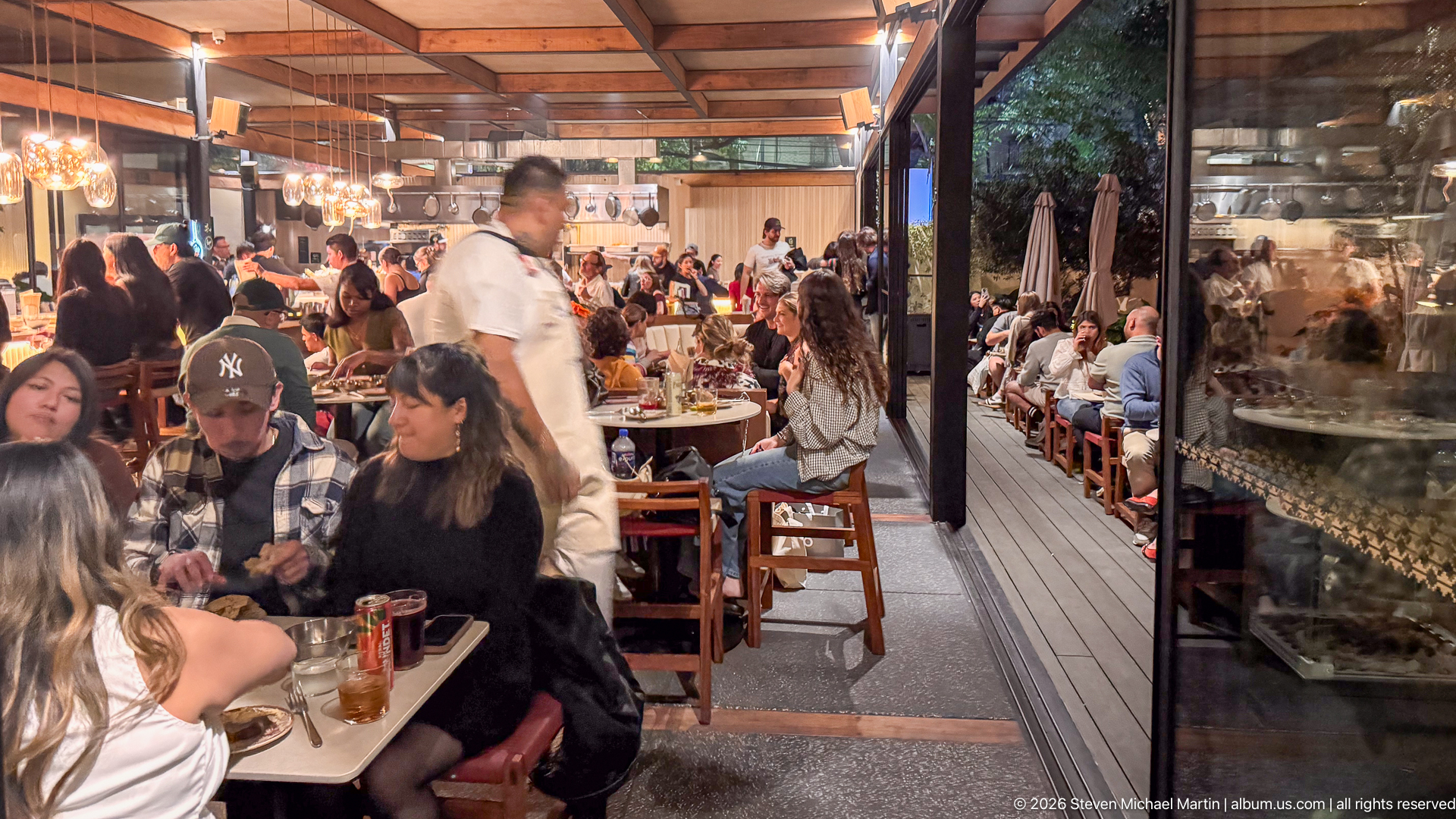
Under a broad timber canopy, closely spaced tables fill a lively restaurant patio. Diners lean over plates and drinks while a server passes between them; warm globe lights and a planted tree soften the glass-and-wood enclosure. The composition shows a bustling room that opens onto greenery, emphasizing the restaurant’s social energy and sheltered, garden-facing setting.
Caption
Under a broad timber canopy, closely spaced tables fill a lively restaurant patio. Diners lean over plates and drinks while a server passes between them; warm globe lights and a planted tree soften the glass-and-wood enclosure. The composition shows a bustling room that opens onto greenery, emphasizing the restaurant’s social energy and sheltered, garden-facing setting.
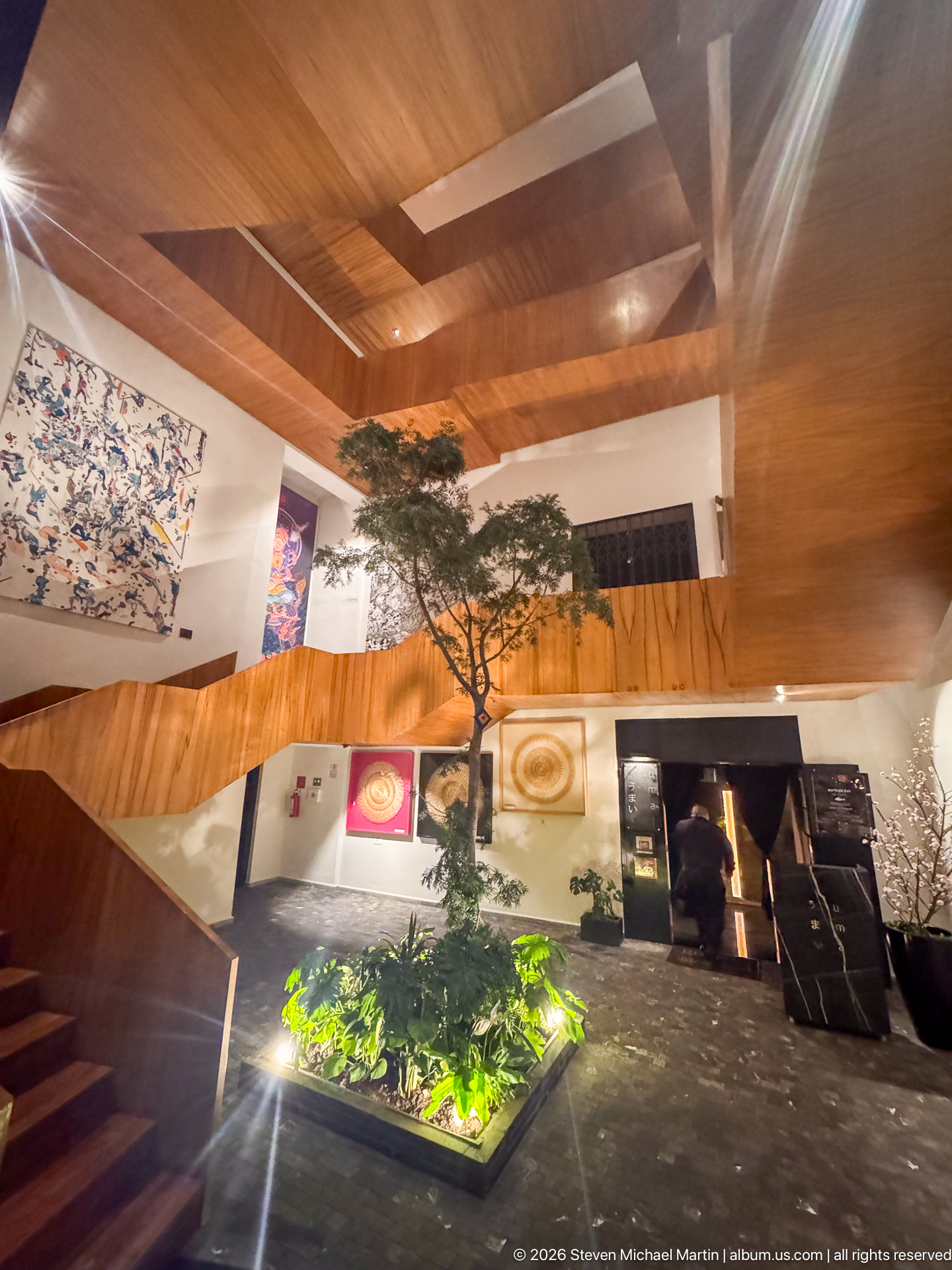
A sculptural timber ceiling sweeps over a spacious lobby where an indoor tree rises from a planted bed. Framed artworks and a warmly lit niche punctuate the pale walls, while the polished floor opens toward a dark doorway. The photograph records the restaurant’s designed interior rather than its food, using the tree and layered ceiling to establish a calm transition from street to dining room.
Caption
A sculptural timber ceiling sweeps over a spacious lobby where an indoor tree rises from a planted bed. Framed artworks and a warmly lit niche punctuate the pale walls, while the polished floor opens toward a dark doorway. The photograph records the restaurant’s designed interior rather than its food, using the tree and layered ceiling to establish a calm transition from street to dining room.
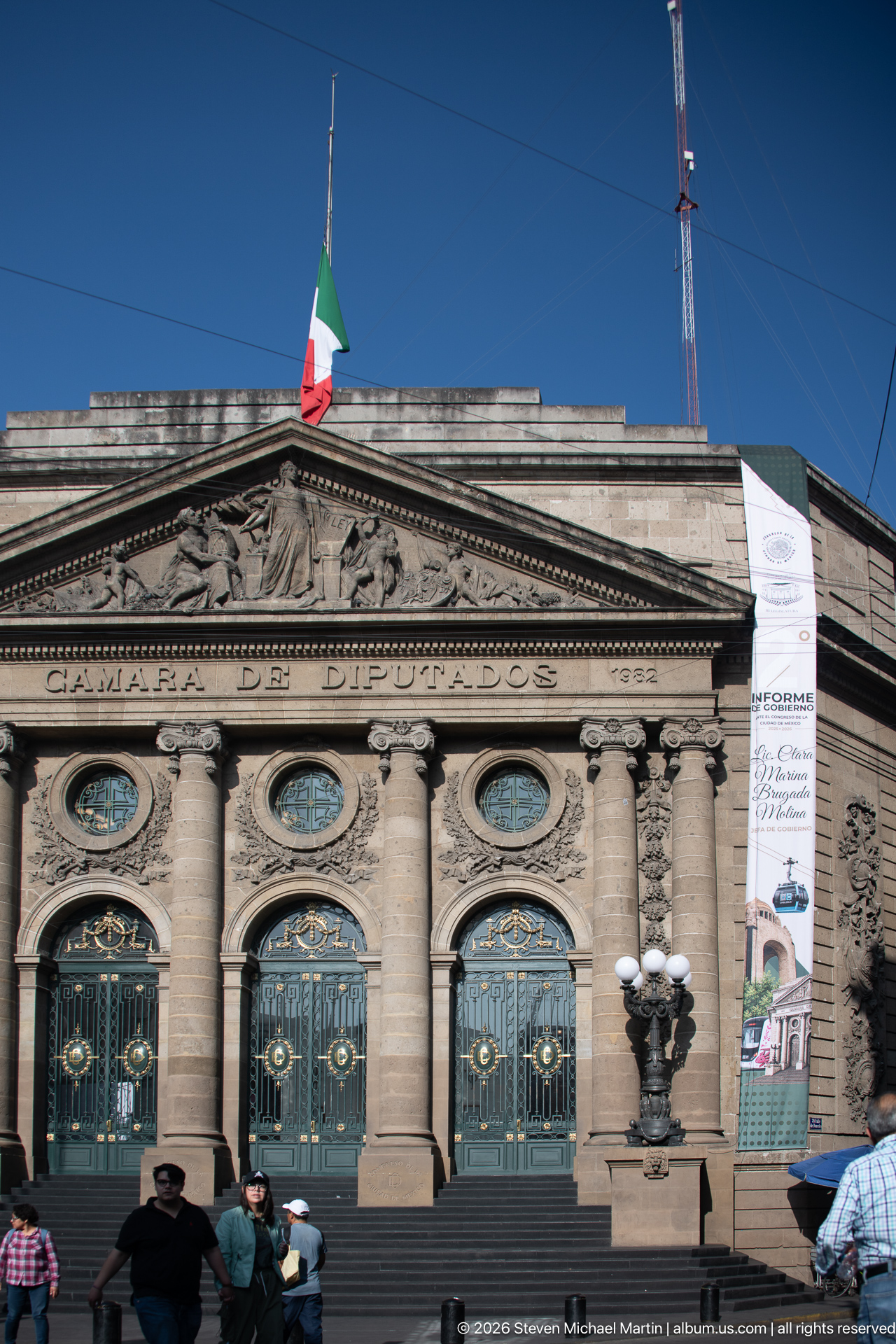
The engraved words “CÁMARA DE DIPUTADOS” identify this formal stone façade as the Chamber of Deputies. A triangular sculpted pediment, round windows, paired columns and three ornate entrances organize the front, while the Mexican flag flies above the roofline. Visitors on the steps provide scale, and a vertical banner at right adds a contemporary civic notice to the historic-looking composition.
Caption
The engraved words “CÁMARA DE DIPUTADOS” identify this formal stone façade as the Chamber of Deputies. A triangular sculpted pediment, round windows, paired columns and three ornate entrances organize the front, while the Mexican flag flies above the roofline. Visitors on the steps provide scale, and a vertical banner at right adds a contemporary civic notice to the historic-looking composition.
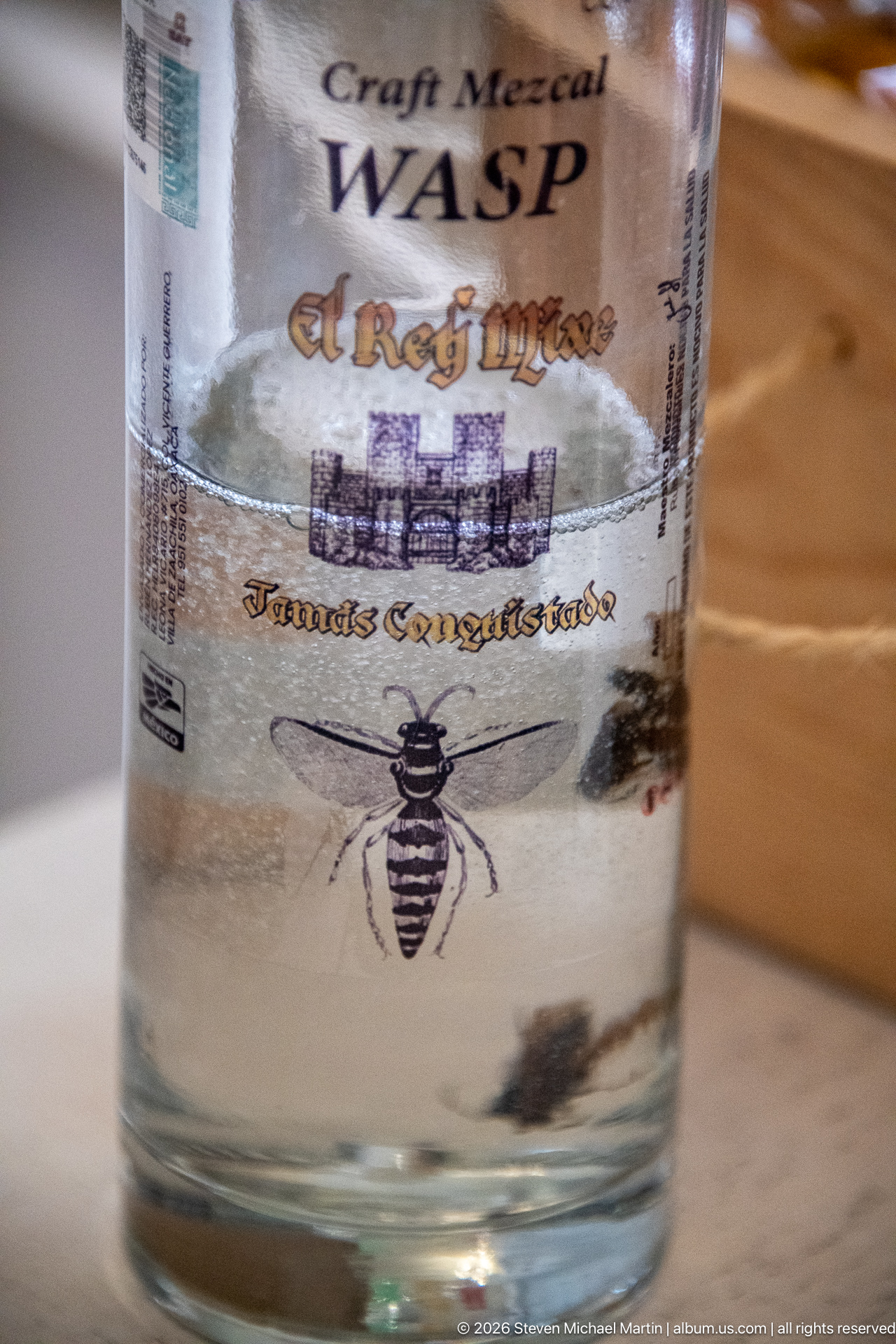
A clear bottle of mezcal stands on a wooden counter, its label reading “Craft Mezcal WASP” and “El Rey Mago.” A black bee illustration and a small architectural drawing decorate the glass, while the shallow focus softens the surrounding bar or shop. The legible label anchors the image in a specific product detail without implying a particular cocktail or tasting.
Caption
A clear bottle of mezcal stands on a wooden counter, its label reading “Craft Mezcal WASP” and “El Rey Mago.” A black bee illustration and a small architectural drawing decorate the glass, while the shallow focus softens the surrounding bar or shop. The legible label anchors the image in a specific product detail without implying a particular cocktail or tasting.
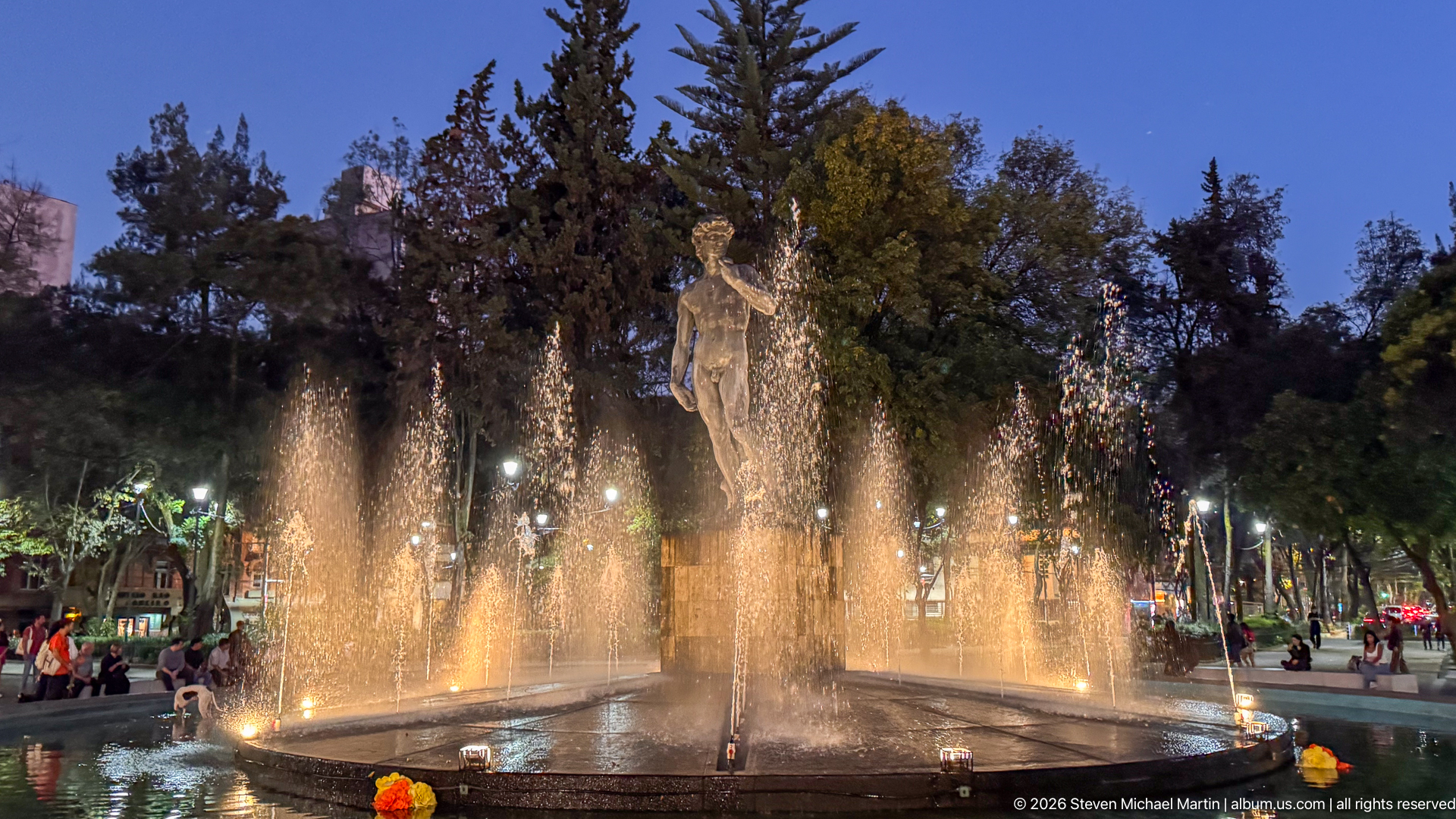
At dusk, jets of water rise around a central standing figure in a circular fountain, lit in warm gold against the deep blue sky. Visitors gather along the basin and under the surrounding trees, while orange flower decorations float near the edge. The central sculpture is not identifiable from this view alone; the photograph’s distinct subject is the illuminated fountain and its evening public setting.
Caption
At dusk, jets of water rise around a central standing figure in a circular fountain, lit in warm gold against the deep blue sky. Visitors gather along the basin and under the surrounding trees, while orange flower decorations float near the edge. The central sculpture is not identifiable from this view alone; the photograph’s distinct subject is the illuminated fountain and its evening public setting.
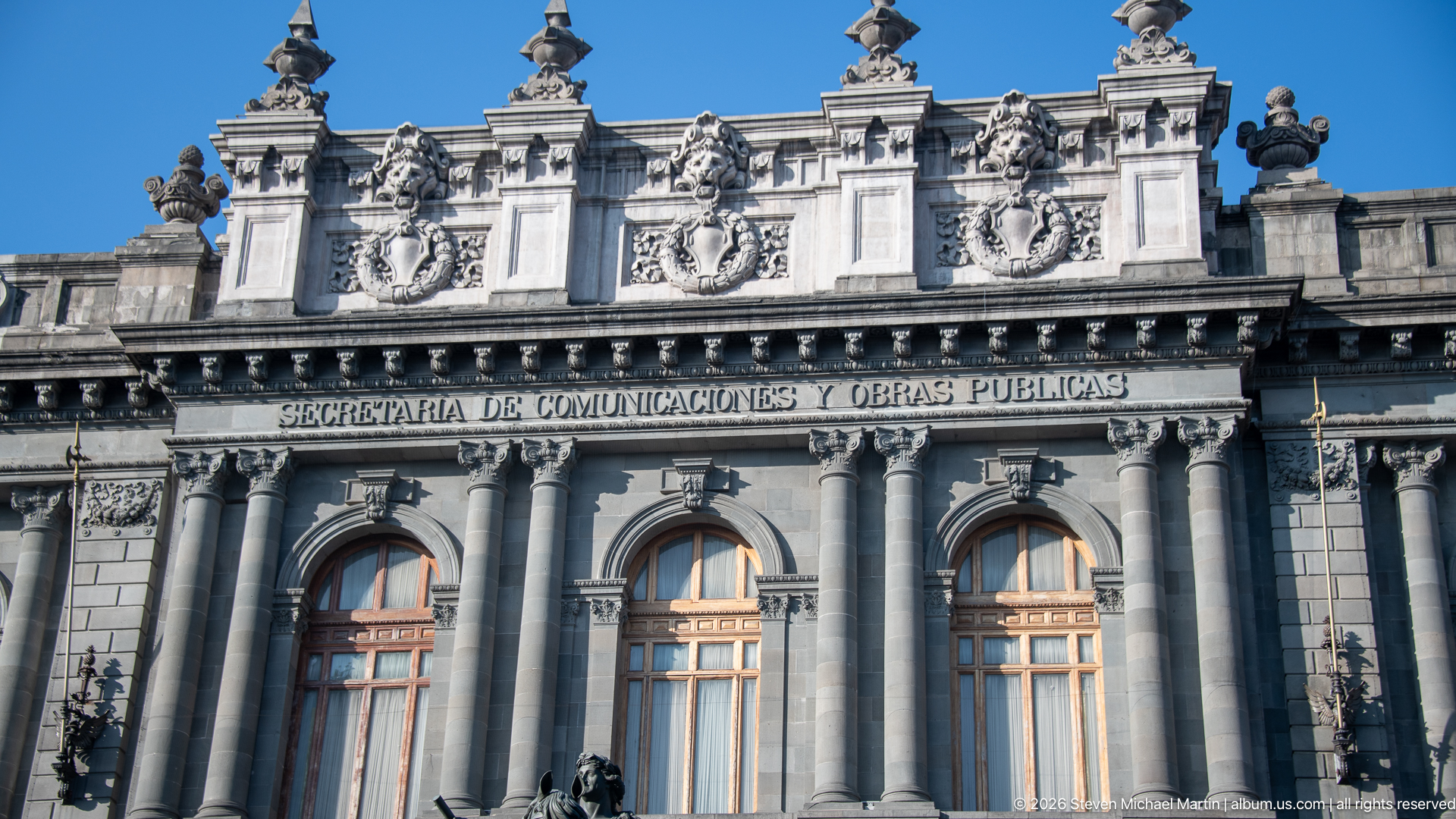
A close upward view isolates the upper façade of the building identified by its carved inscription, “Secretaría de Comunicaciones y Obras Públicas.” Sculpted relief panels, heraldic wreaths, balustrades and a row of classical columns form a dense stone composition beneath a clear blue sky. The photograph favors the ornamental register and carved lettering over the building’s full scale or street setting.
Caption
A close upward view isolates the upper façade of the building identified by its carved inscription, “Secretaría de Comunicaciones y Obras Públicas.” Sculpted relief panels, heraldic wreaths, balustrades and a row of classical columns form a dense stone composition beneath a clear blue sky. The photograph favors the ornamental register and carved lettering over the building’s full scale or street setting.
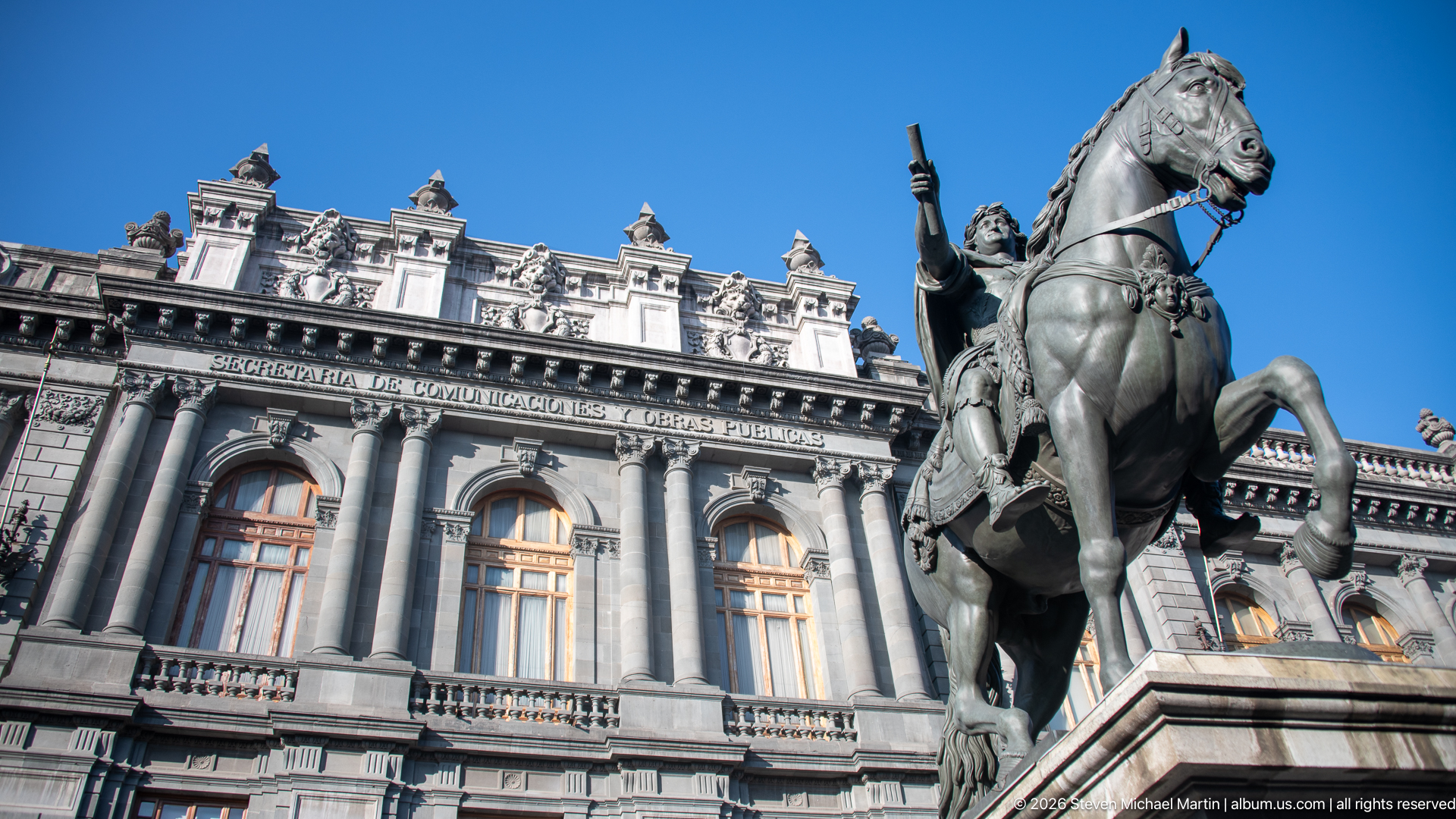
A monumental rider on a rearing horse dominates the foreground, set against the columned façade of the former Secretaría de Comunicaciones y Obras Públicas. The low viewpoint makes the bronze figure appear to surge into the blue sky, while the inscription and repeated windows establish the architectural backdrop. The statue’s identity is not legible here, so the caption emphasizes its scale and relationship to the building.
Caption
A monumental rider on a rearing horse dominates the foreground, set against the columned façade of the former Secretaría de Comunicaciones y Obras Públicas. The low viewpoint makes the bronze figure appear to surge into the blue sky, while the inscription and repeated windows establish the architectural backdrop. The statue’s identity is not legible here, so the caption emphasizes its scale and relationship to the building.
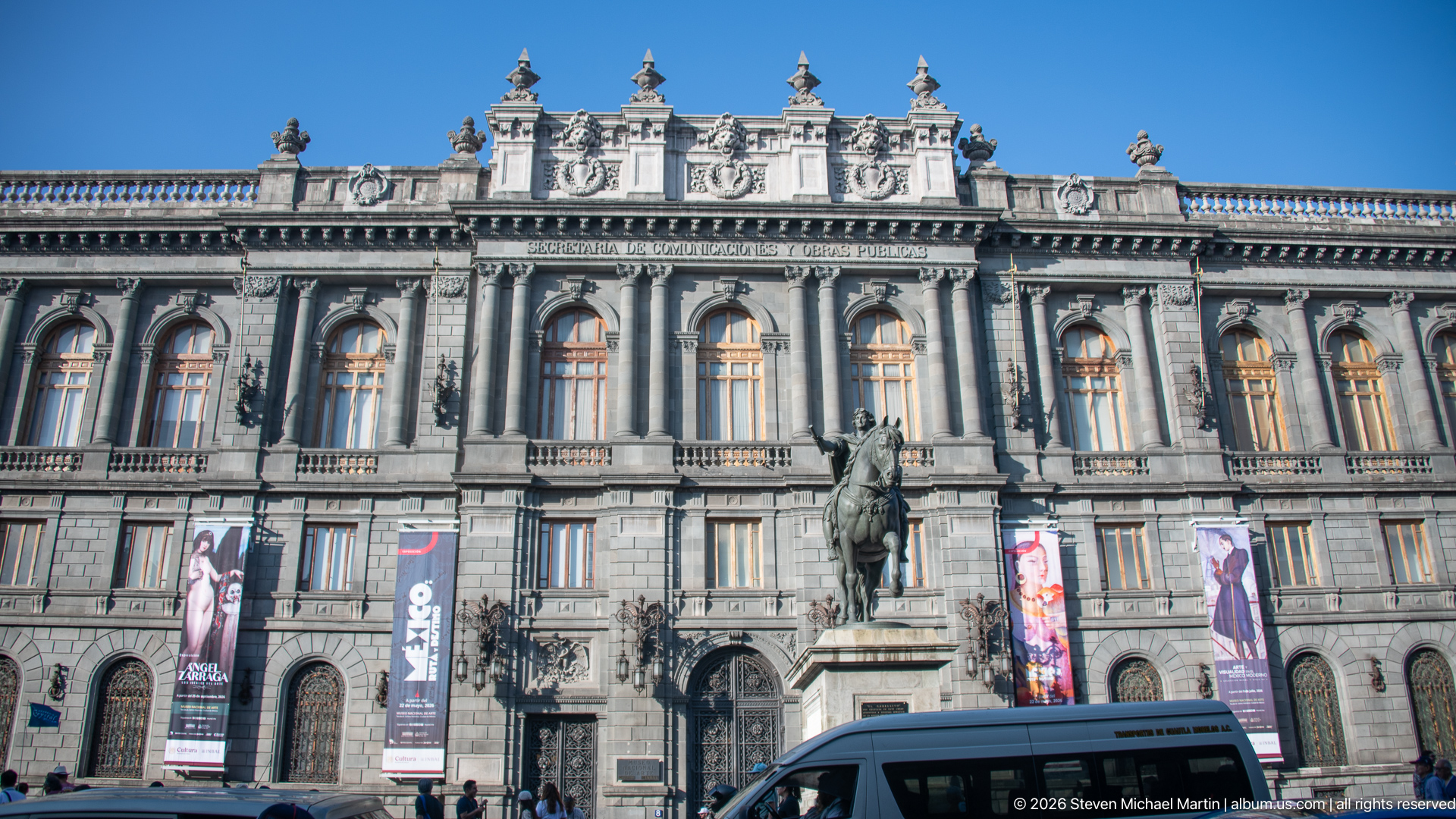
The broad stone façade extends across the frame, its upper balustrade and sculpted panels balanced by long rows of arched windows. A mounted statue stands before the center, while banners and passing traffic at street level give the formal building a present-day civic setting. The wider view reveals the monument’s scale and symmetry more clearly than the preceding close architectural and statue studies.
Caption
The broad stone façade extends across the frame, its upper balustrade and sculpted panels balanced by long rows of arched windows. A mounted statue stands before the center, while banners and passing traffic at street level give the formal building a present-day civic setting. The wider view reveals the monument’s scale and symmetry more clearly than the preceding close architectural and statue studies.
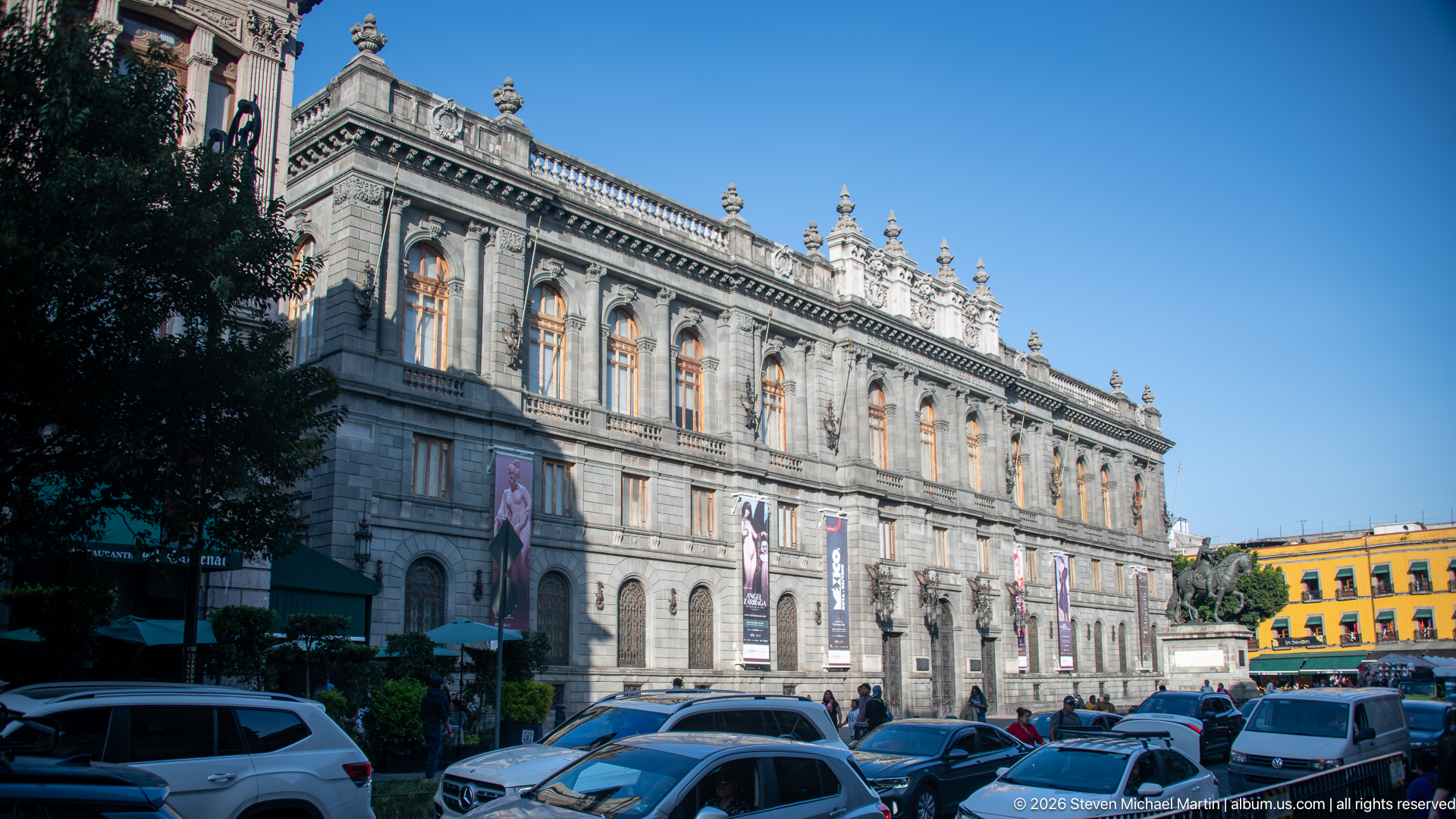
Seen from across the street, the long stone building recedes in perspective beneath a bright blue sky. Cars crowd the foreground and a mustard-yellow neighboring façade appears at the far end, bringing everyday traffic into a view otherwise defined by classical windows, sculpted roof ornaments and banners. The shaded tree at left frames the building and marks the shift from monumental façade to urban streetscape.
Caption
Seen from across the street, the long stone building recedes in perspective beneath a bright blue sky. Cars crowd the foreground and a mustard-yellow neighboring façade appears at the far end, bringing everyday traffic into a view otherwise defined by classical windows, sculpted roof ornaments and banners. The shaded tree at left frames the building and marks the shift from monumental façade to urban streetscape.
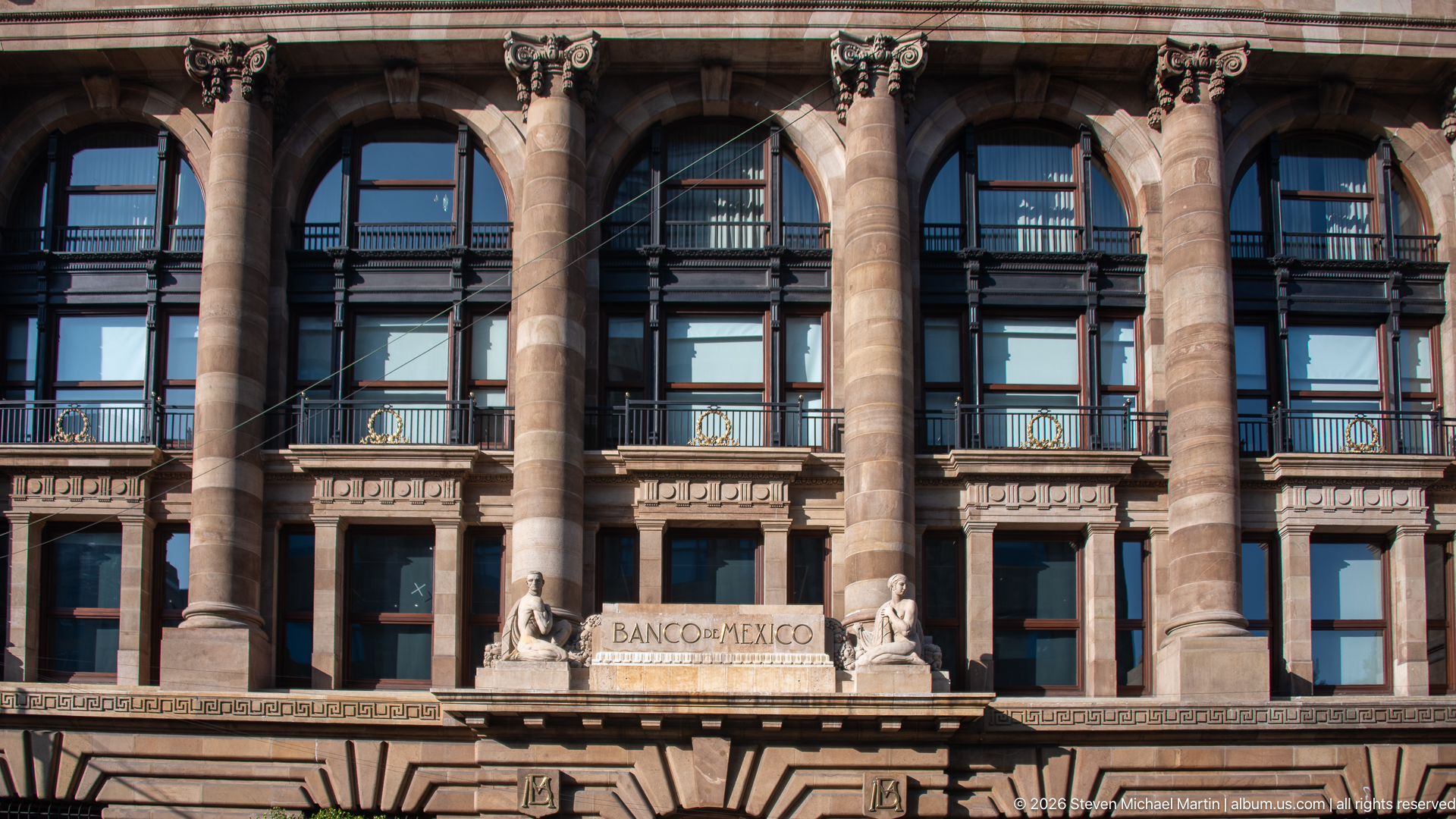
Monumental columns frame the bank’s upper windows, drawing attention to the central sign reading “BANCO DE MÉXICO.” Two seated stone figures flank the inscription, while balconies and carved horizontal bands repeat across the façade. The close, straight-on view turns a financial institution’s name and architectural detailing into the subject, distinct from the nearby government building’s sculpted roofline and equestrian statue.
Caption
Monumental columns frame the bank’s upper windows, drawing attention to the central sign reading “BANCO DE MÉXICO.” Two seated stone figures flank the inscription, while balconies and carved horizontal bands repeat across the façade. The close, straight-on view turns a financial institution’s name and architectural detailing into the subject, distinct from the nearby government building’s sculpted roofline and equestrian statue.
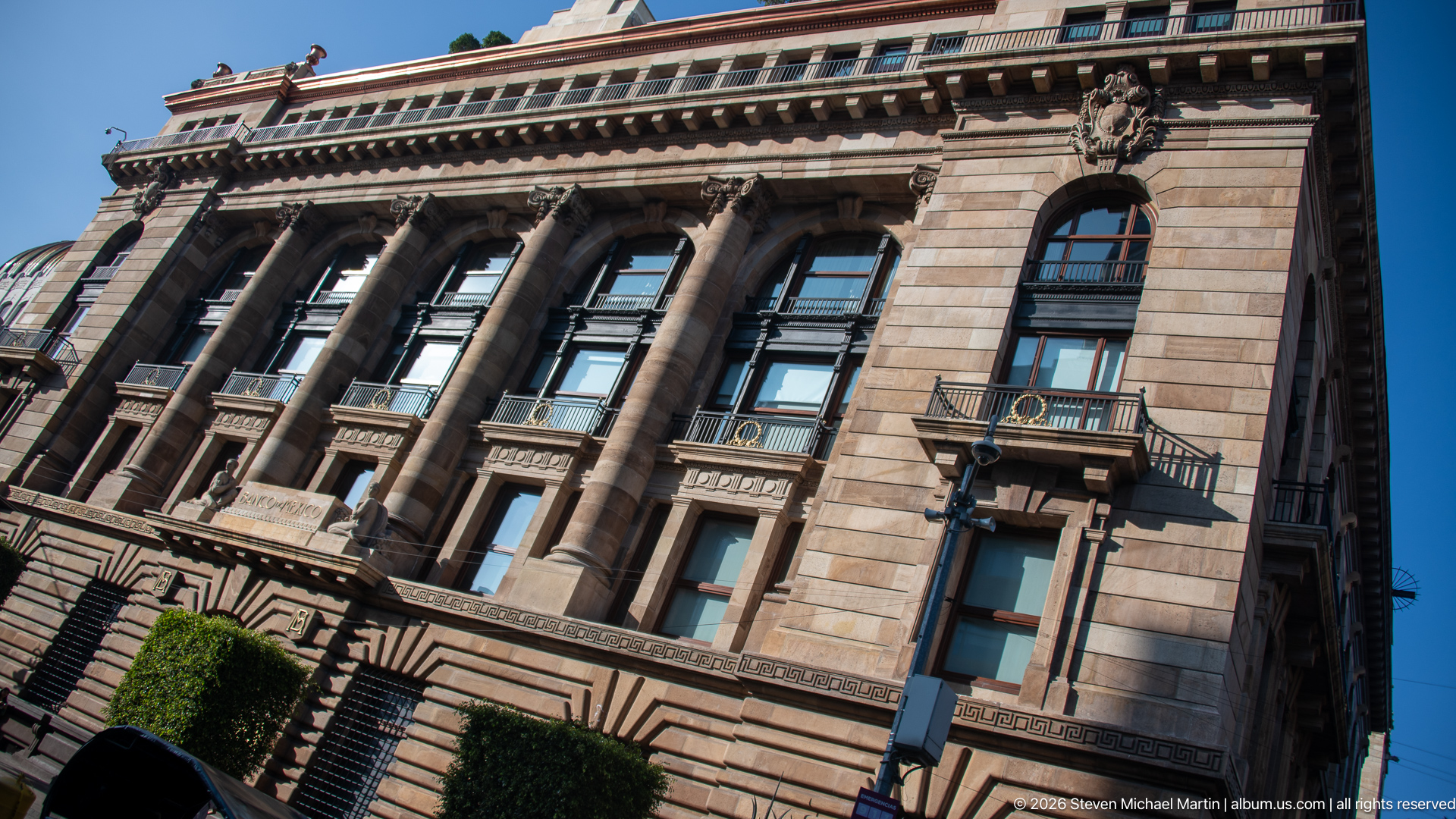
From below, rows of tall windows and narrow balconies climb behind heavy stone columns, creating a strong diagonal toward the upper corner. Sunlight catches the pale masonry and carved bands, while clipped shrubs appear along the bottom edge. The tilted framing emphasizes height and rhythm rather than the bank’s central name, which is shown in the previous detail.
Caption
From below, rows of tall windows and narrow balconies climb behind heavy stone columns, creating a strong diagonal toward the upper corner. Sunlight catches the pale masonry and carved bands, while clipped shrubs appear along the bottom edge. The tilted framing emphasizes height and rhythm rather than the bank’s central name, which is shown in the previous detail.
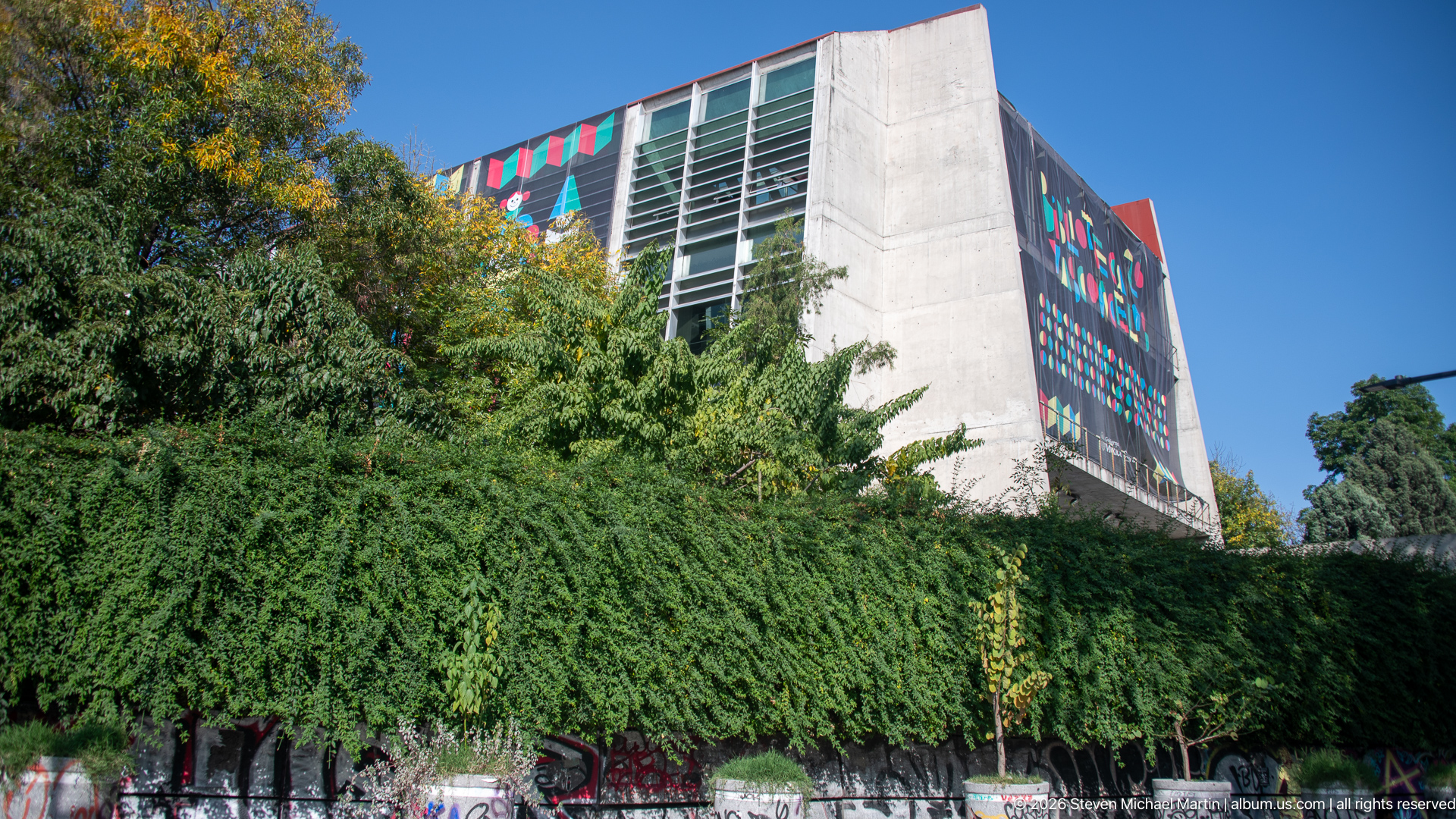
A tall modern building rises behind dense trees, its pale concrete end wall contrasting with bands of glazing and a side surface covered in bright geometric graphics. The view is partly screened by foliage, which softens the hard edges and places the structure within a green urban setting. Without a readable sign, the specific institution remains uncertain; the distinctive subject is the building’s colorful contemporary exterior.
Caption
A tall modern building rises behind dense trees, its pale concrete end wall contrasting with bands of glazing and a side surface covered in bright geometric graphics. The view is partly screened by foliage, which softens the hard edges and places the structure within a green urban setting. Without a readable sign, the specific institution remains uncertain; the distinctive subject is the building’s colorful contemporary exterior.
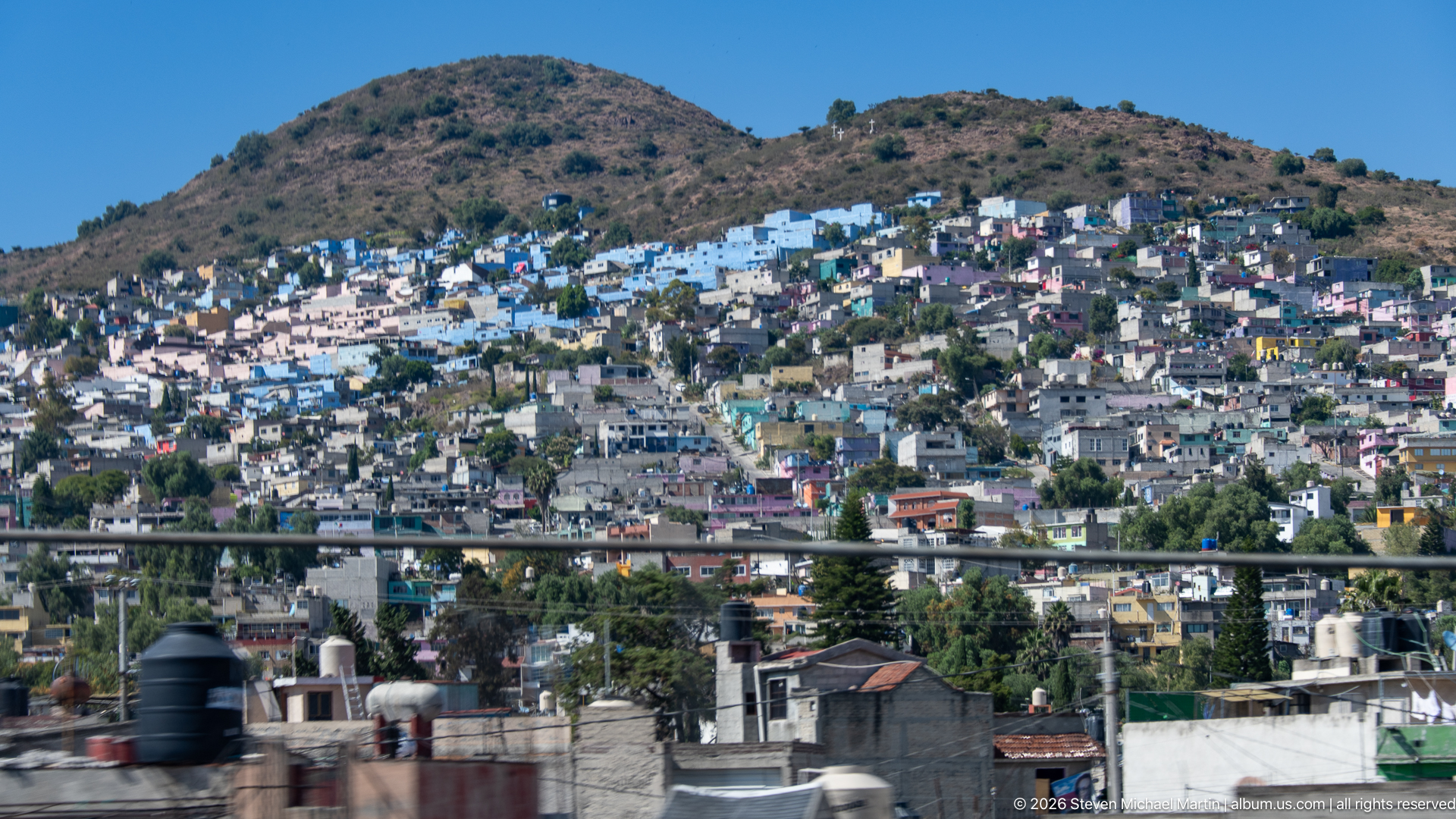
A broad hillside is densely covered with low-rise homes, many painted white or pale blue, with the dry, scrubby ridge rising behind them. Rooftop tanks and compact streets make the settlement’s texture visible across the slope. The elevated viewpoint compresses the houses into a continuous urban field, offering a sharp contrast with the monumental stone façades seen in the neighboring photographs.
Caption
A broad hillside is densely covered with low-rise homes, many painted white or pale blue, with the dry, scrubby ridge rising behind them. Rooftop tanks and compact streets make the settlement’s texture visible across the slope. The elevated viewpoint compresses the houses into a continuous urban field, offering a sharp contrast with the monumental stone façades seen in the neighboring photographs.
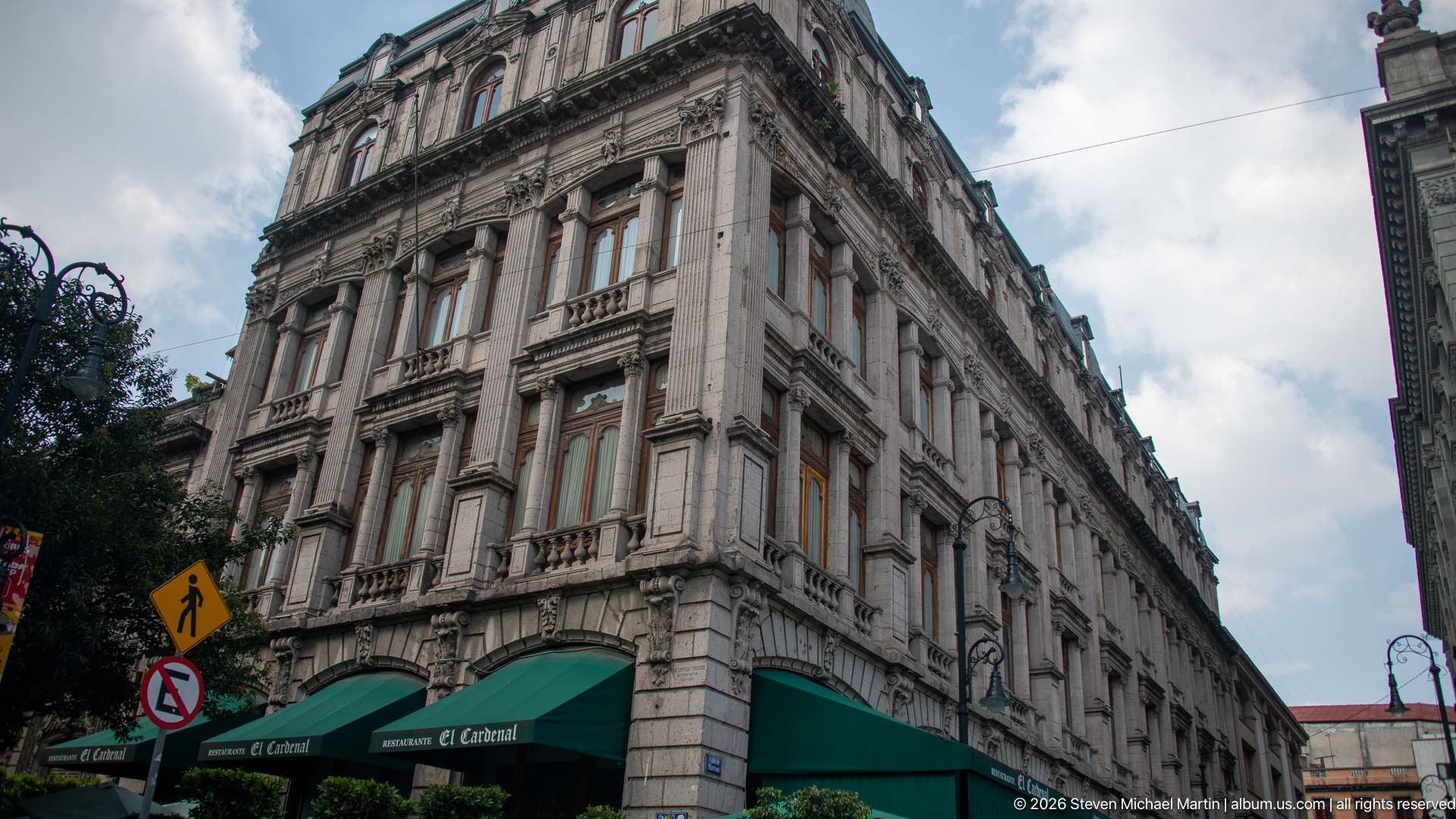
Green awnings bearing the name “El Cardenal” wrap the ground floor of an ornate corner building. The upward street view traces its tall stone bays, carved capitals and balconies toward the roofline, while traffic signs and leafy branches frame the entrance. The legible restaurant name anchors the location; the photograph records its architectural setting rather than a meal or dining room.
Caption
Green awnings bearing the name “El Cardenal” wrap the ground floor of an ornate corner building. The upward street view traces its tall stone bays, carved capitals and balconies toward the roofline, while traffic signs and leafy branches frame the entrance. The legible restaurant name anchors the location; the photograph records its architectural setting rather than a meal or dining room.
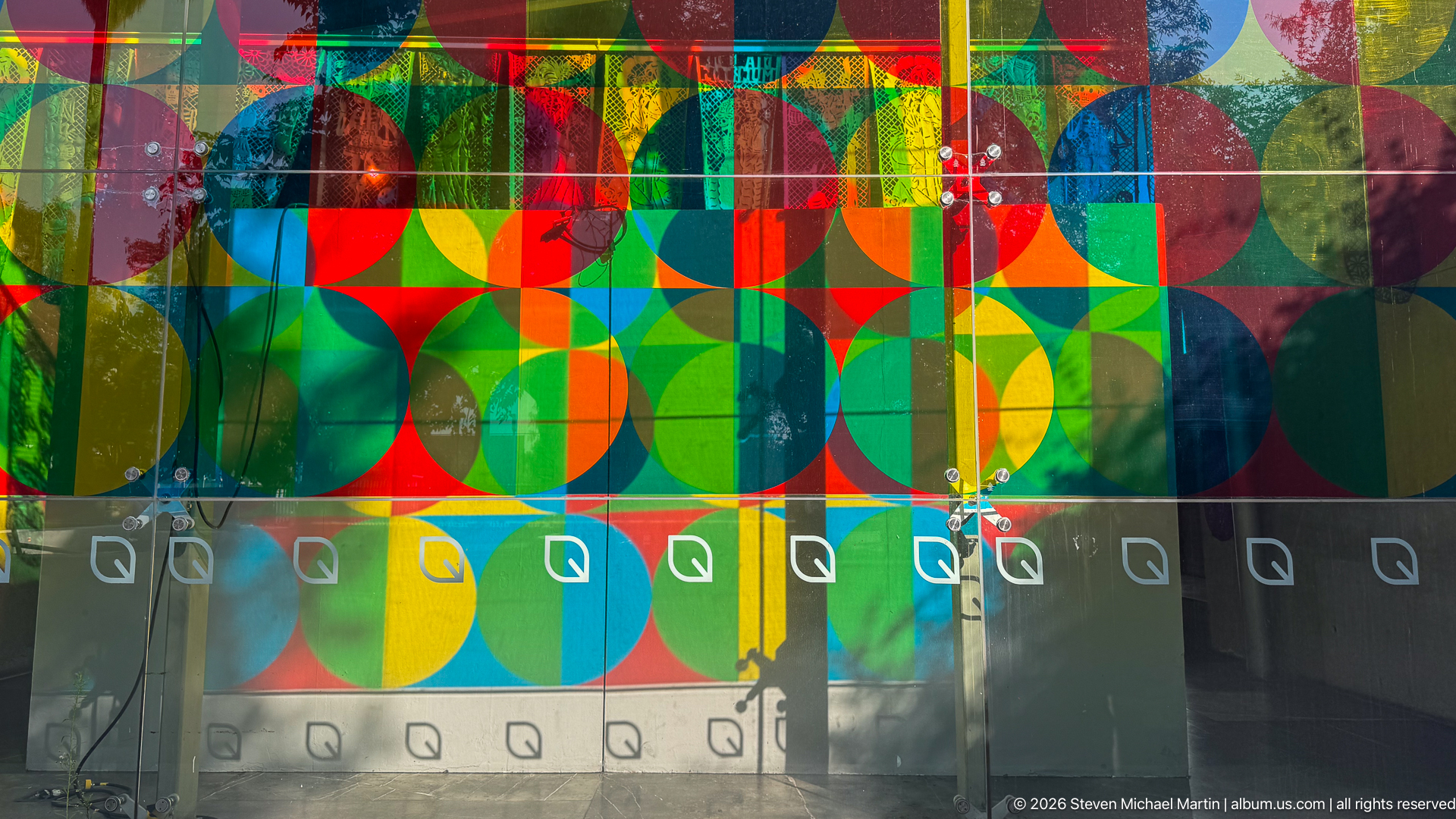
Overlapping circles and rectangles in red, green, blue and yellow cover a glazed wall, with reflections and dark mullions visible beneath the color. The repeated abstract shapes create a dense, almost stained-glass pattern, while a row of small white leaf-like symbols runs across the lower panels. No label identifies the artwork or building, so the image is best read as a vivid architectural surface and urban design detail.
Caption
Overlapping circles and rectangles in red, green, blue and yellow cover a glazed wall, with reflections and dark mullions visible beneath the color. The repeated abstract shapes create a dense, almost stained-glass pattern, while a row of small white leaf-like symbols runs across the lower panels. No label identifies the artwork or building, so the image is best read as a vivid architectural surface and urban design detail.
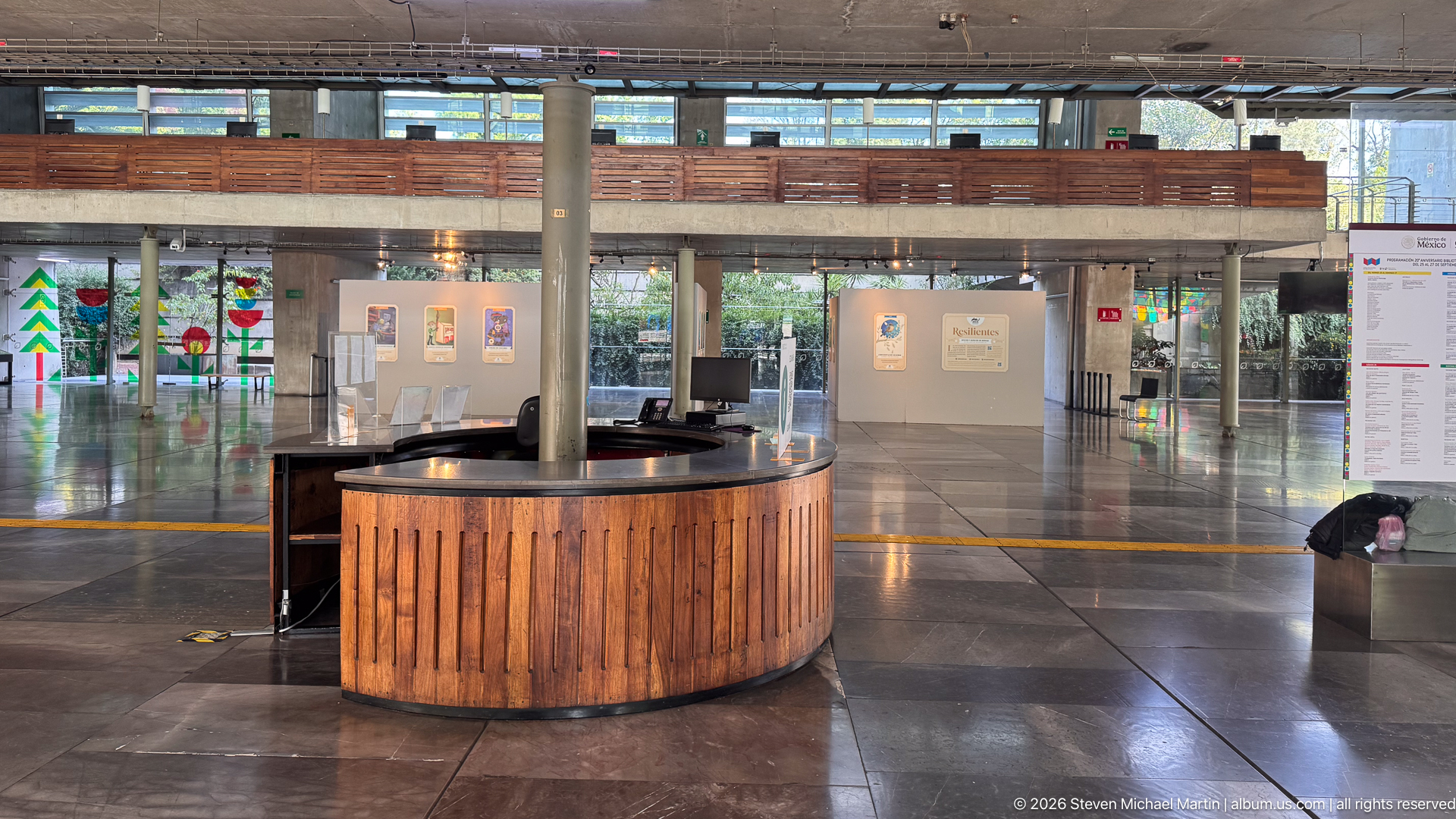
A broad public hall opens around a circular wood-clad desk, with a polished floor, slender columns and a mezzanine lined in horizontal timber. Daylight enters through high windows behind the upper level; illuminated display panels stand across the back of the room. A directory board at right suggests a transit or civic concourse, but its small print is unreadable, so the building is not named.
Caption
A broad public hall opens around a circular wood-clad desk, with a polished floor, slender columns and a mezzanine lined in horizontal timber. Daylight enters through high windows behind the upper level; illuminated display panels stand across the back of the room. A directory board at right suggests a transit or civic concourse, but its small print is unreadable, so the building is not named.
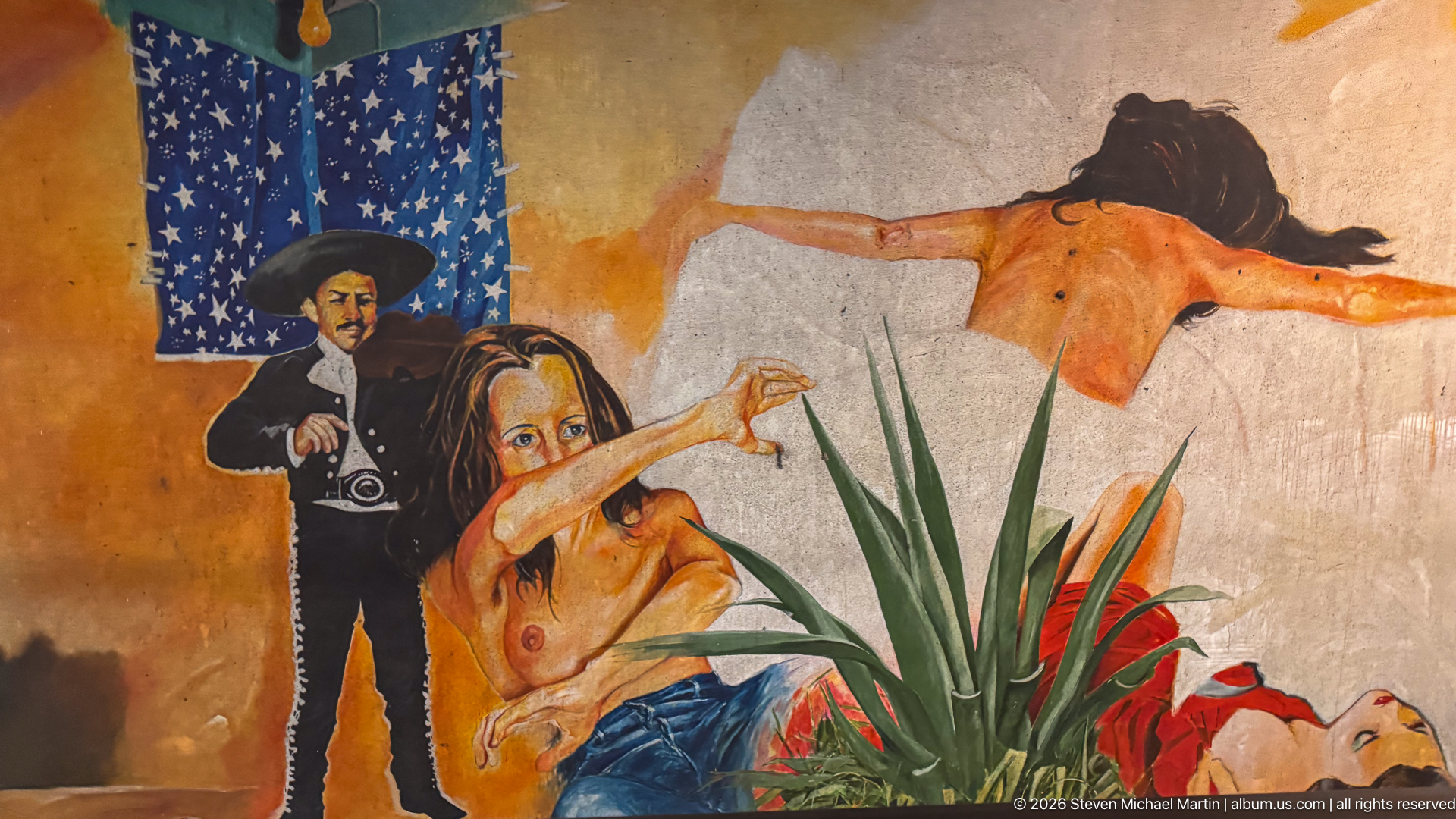
A large painted mural combines human figures, a blue field of stars, and the spiky leaves of an agave plant. Its cropped composition brings the painted bodies and plant forms into close proximity, turning a fragment of wall art into the subject. The visible imagery supports a Mexican cultural setting, but the scene does not establish the mural’s artist or title.
Caption
A large painted mural combines human figures, a blue field of stars, and the spiky leaves of an agave plant. Its cropped composition brings the painted bodies and plant forms into close proximity, turning a fragment of wall art into the subject. The visible imagery supports a Mexican cultural setting, but the scene does not establish the mural’s artist or title.
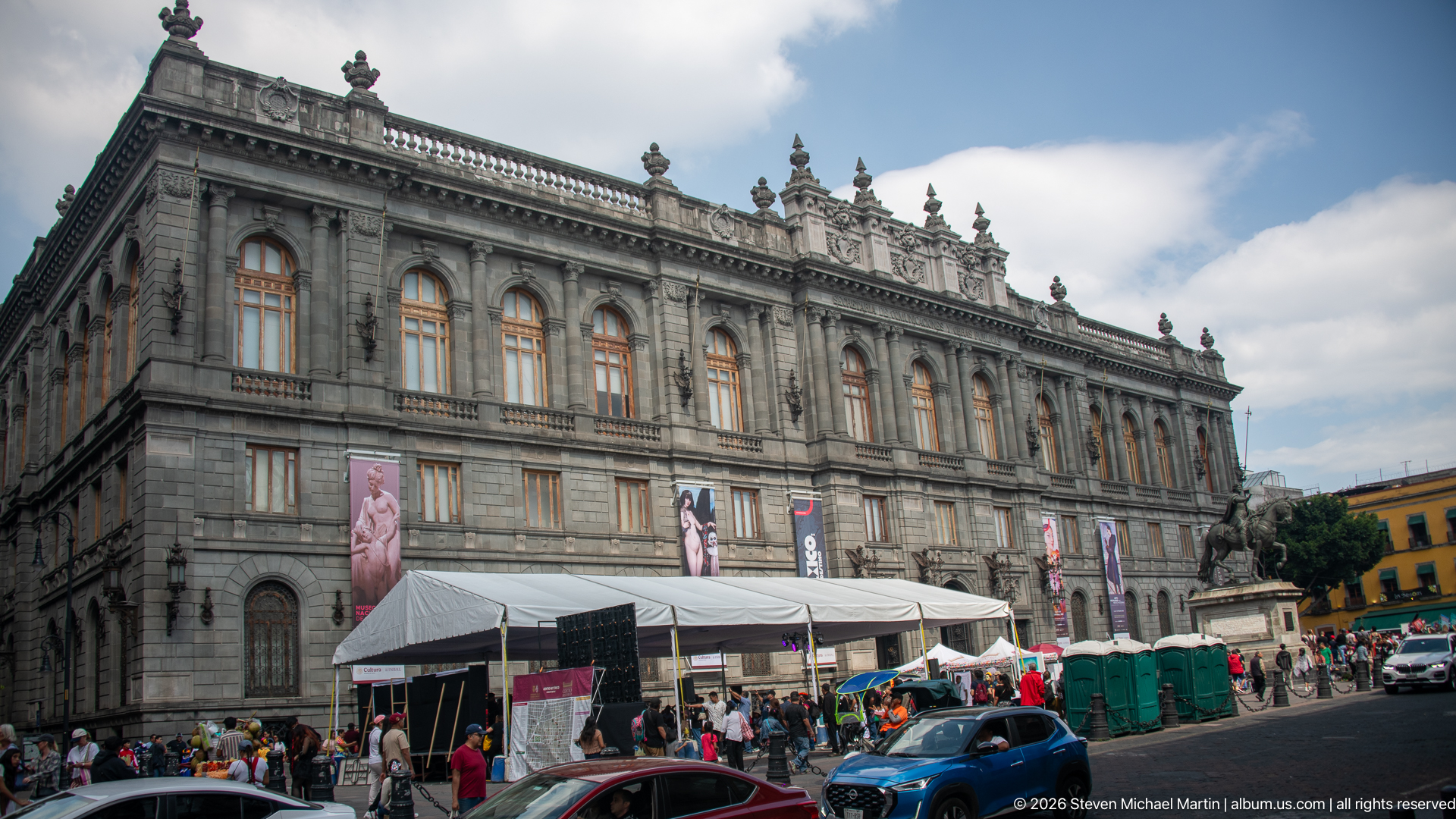
The long stone façade of the Museo Nacional de Arte faces a busy plaza, its repeated arched windows, sculpted details, and projecting cornice set against a bright sky. Temporary event structures and pedestrians occupy the foreground, giving the monumental building a working urban context. The view records both its formal architecture and the changing public activity at street level.
Caption
The long stone façade of the Museo Nacional de Arte faces a busy plaza, its repeated arched windows, sculpted details, and projecting cornice set against a bright sky. Temporary event structures and pedestrians occupy the foreground, giving the monumental building a working urban context. The view records both its formal architecture and the changing public activity at street level.
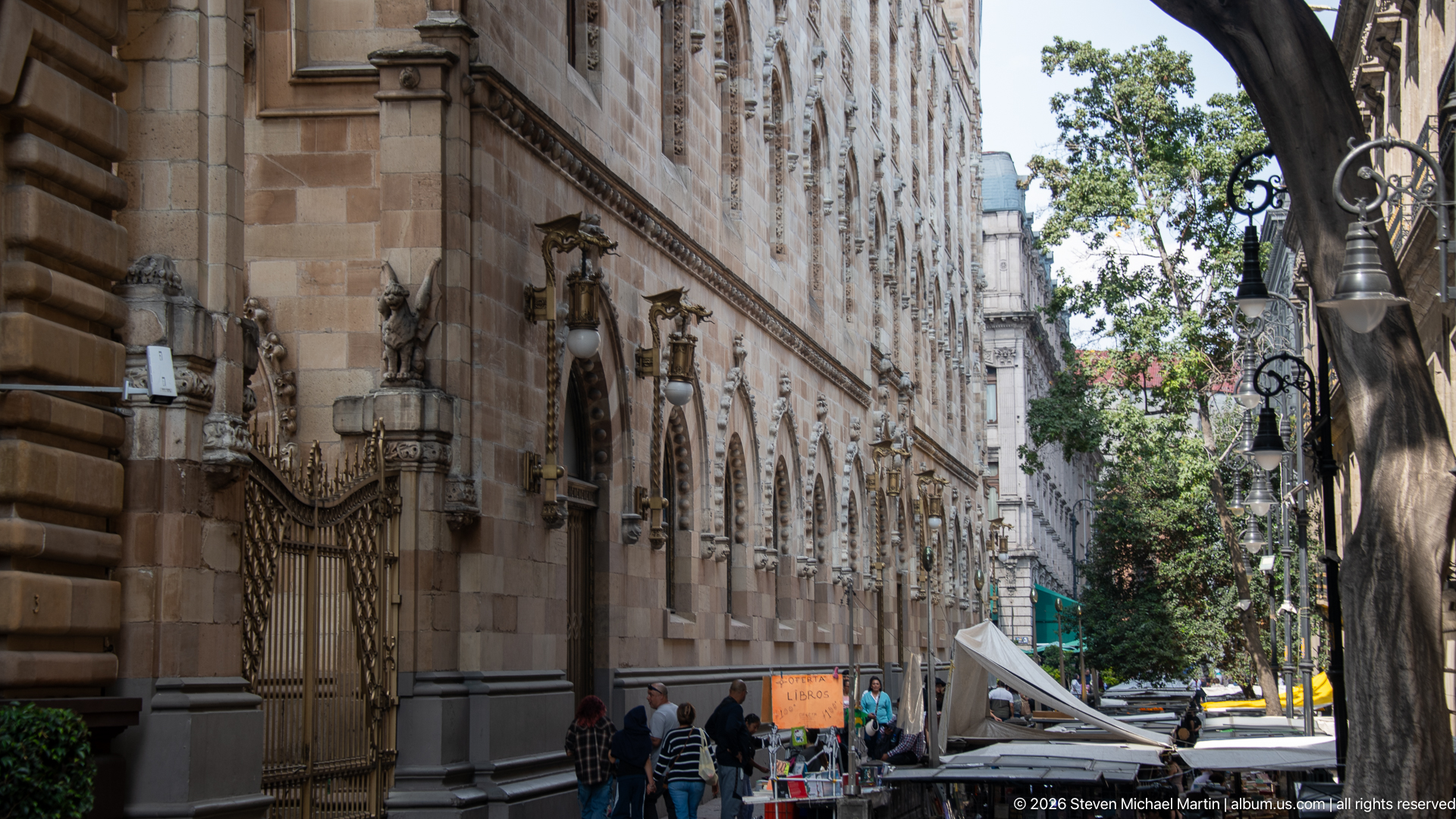
An oblique sidewalk view follows the heavily ornamented stone wall of a historic civic building toward a tree-lined street. Recessed entrances, sculpted lamps, ironwork, and carved masonry repeat along the façade, while pedestrians and small sidewalk stands animate the lower edge. The perspective emphasizes the building’s length and the close relationship between its architecture and the public thoroughfare.
Caption
An oblique sidewalk view follows the heavily ornamented stone wall of a historic civic building toward a tree-lined street. Recessed entrances, sculpted lamps, ironwork, and carved masonry repeat along the façade, while pedestrians and small sidewalk stands animate the lower edge. The perspective emphasizes the building’s length and the close relationship between its architecture and the public thoroughfare.
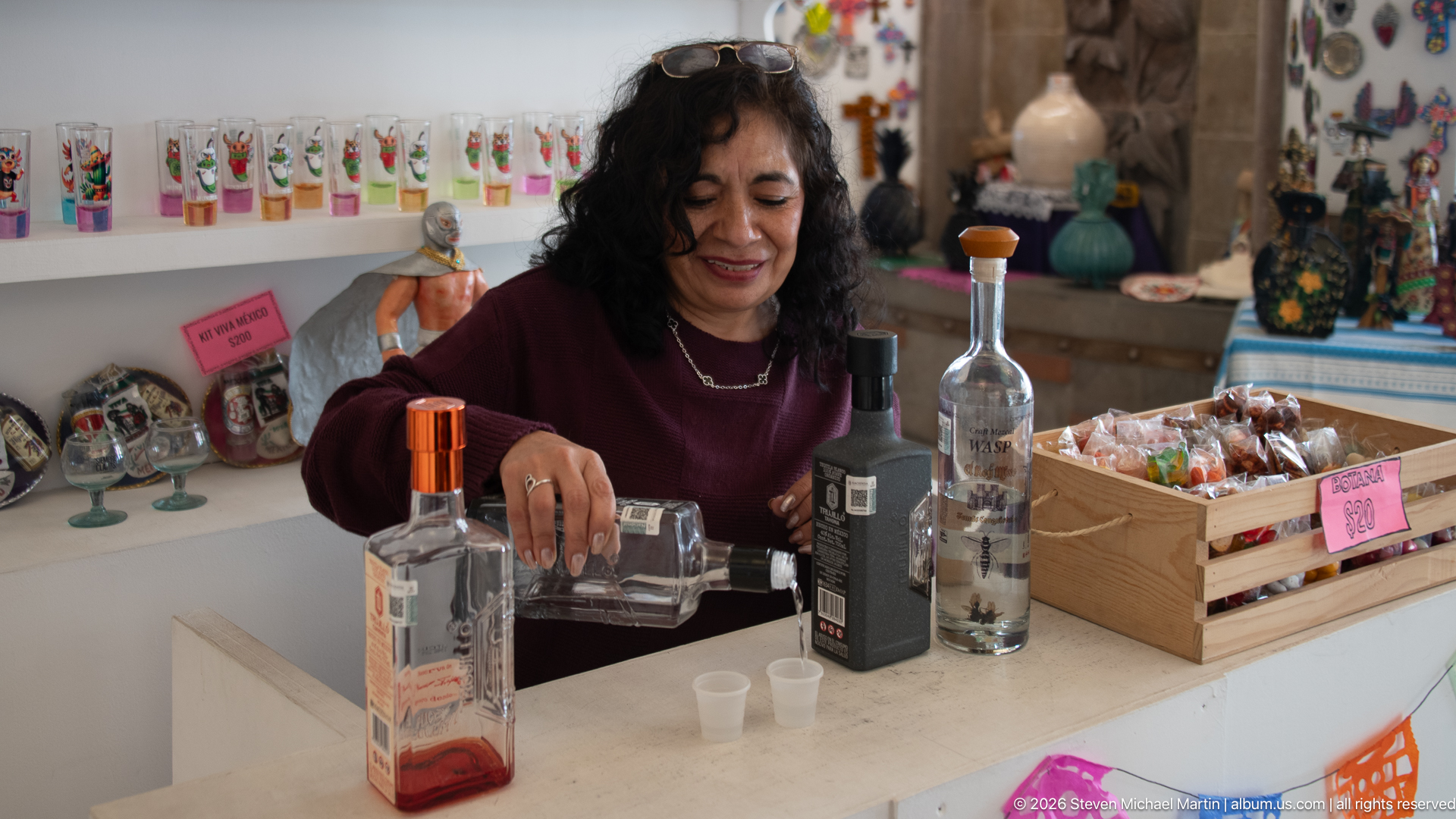
Behind a pale counter, a woman pours a clear spirit from a square bottle into small tasting cups. Bottles, a wooden crate of packaged sweets, and colorful crafts fill the shelves and counter, indicating a retail setting rather than a restaurant table. The image centers on the act of serving and the informal tasting arrangement; no specific drink recipe is visible.
Caption
Behind a pale counter, a woman pours a clear spirit from a square bottle into small tasting cups. Bottles, a wooden crate of packaged sweets, and colorful crafts fill the shelves and counter, indicating a retail setting rather than a restaurant table. The image centers on the act of serving and the informal tasting arrangement; no specific drink recipe is visible.
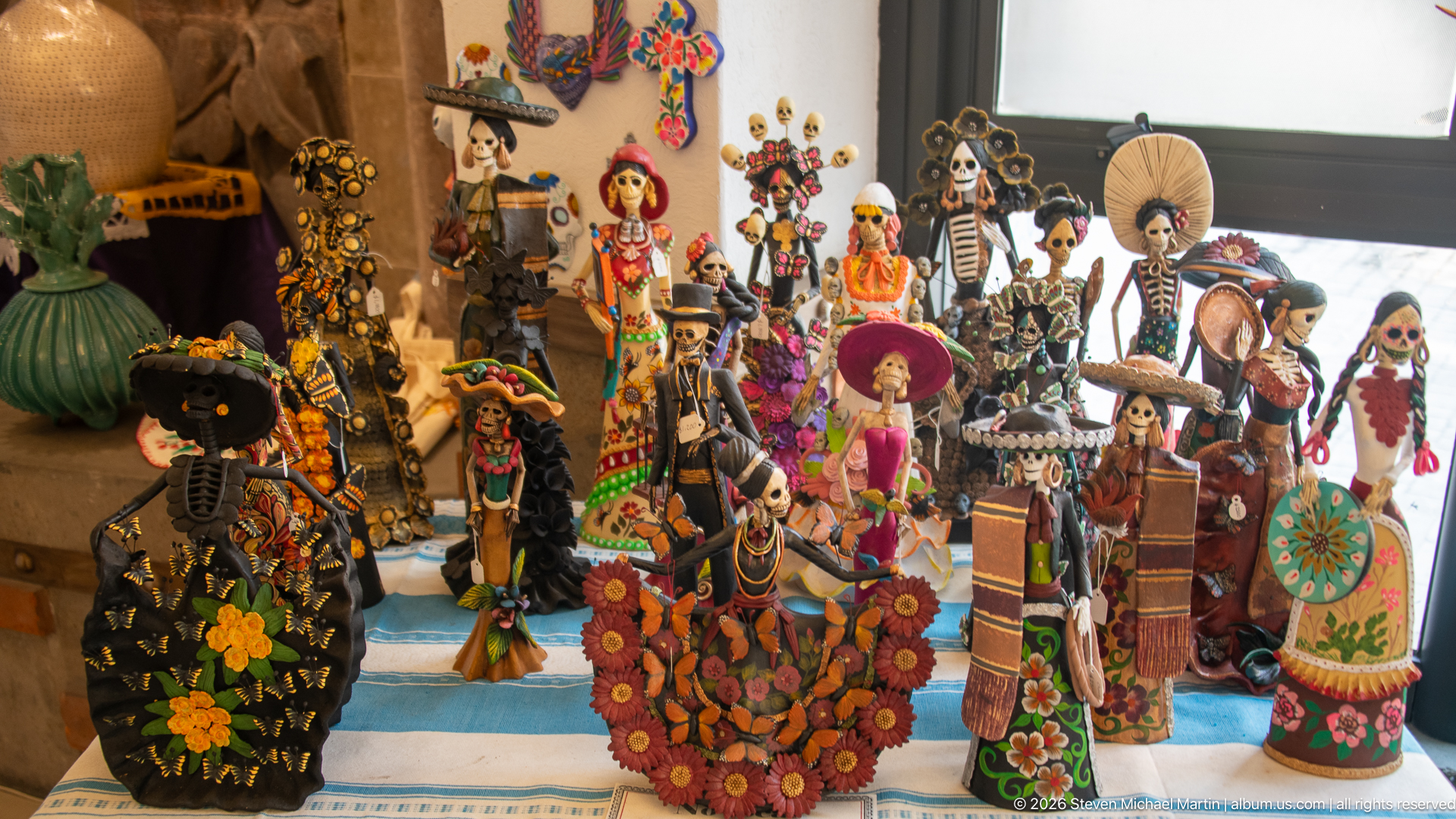
A crowded display of dressed skeleton figures fills a shop window, with miniature musicians, dancers, and elegantly costumed Catrinas arranged among orange marigold blossoms. Their varied clothing and poses turn the familiar calavera motif into a set of small character portraits. Bright folk-art colors and the flowers make the Día de Muertos association visible without relying on the surrounding portfolio context.
Caption
A crowded display of dressed skeleton figures fills a shop window, with miniature musicians, dancers, and elegantly costumed Catrinas arranged among orange marigold blossoms. Their varied clothing and poses turn the familiar calavera motif into a set of small character portraits. Bright folk-art colors and the flowers make the Día de Muertos association visible without relying on the surrounding portfolio context.
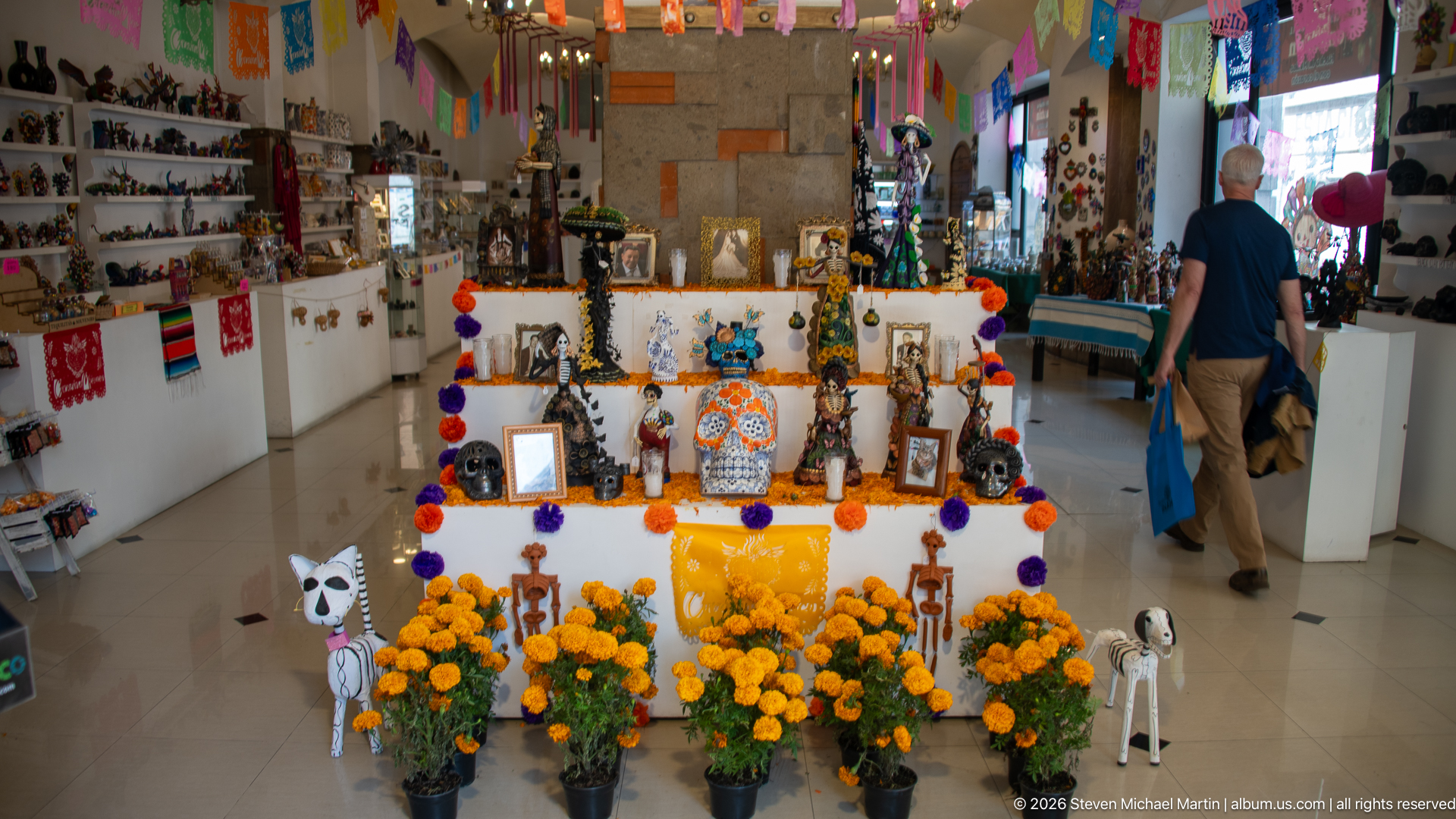
A tiered ofrenda occupies the center of a bright craft shop, its white platforms edged with orange and purple pom-poms and marigolds. Framed portraits, sugar-skull imagery, candles, small skeleton figures, and decorative objects are arranged across the levels. Shoppers and shelves remain visible behind it, placing the Día de Muertos altar within a working retail interior.
Caption
A tiered ofrenda occupies the center of a bright craft shop, its white platforms edged with orange and purple pom-poms and marigolds. Framed portraits, sugar-skull imagery, candles, small skeleton figures, and decorative objects are arranged across the levels. Shoppers and shelves remain visible behind it, placing the Día de Muertos altar within a working retail interior.
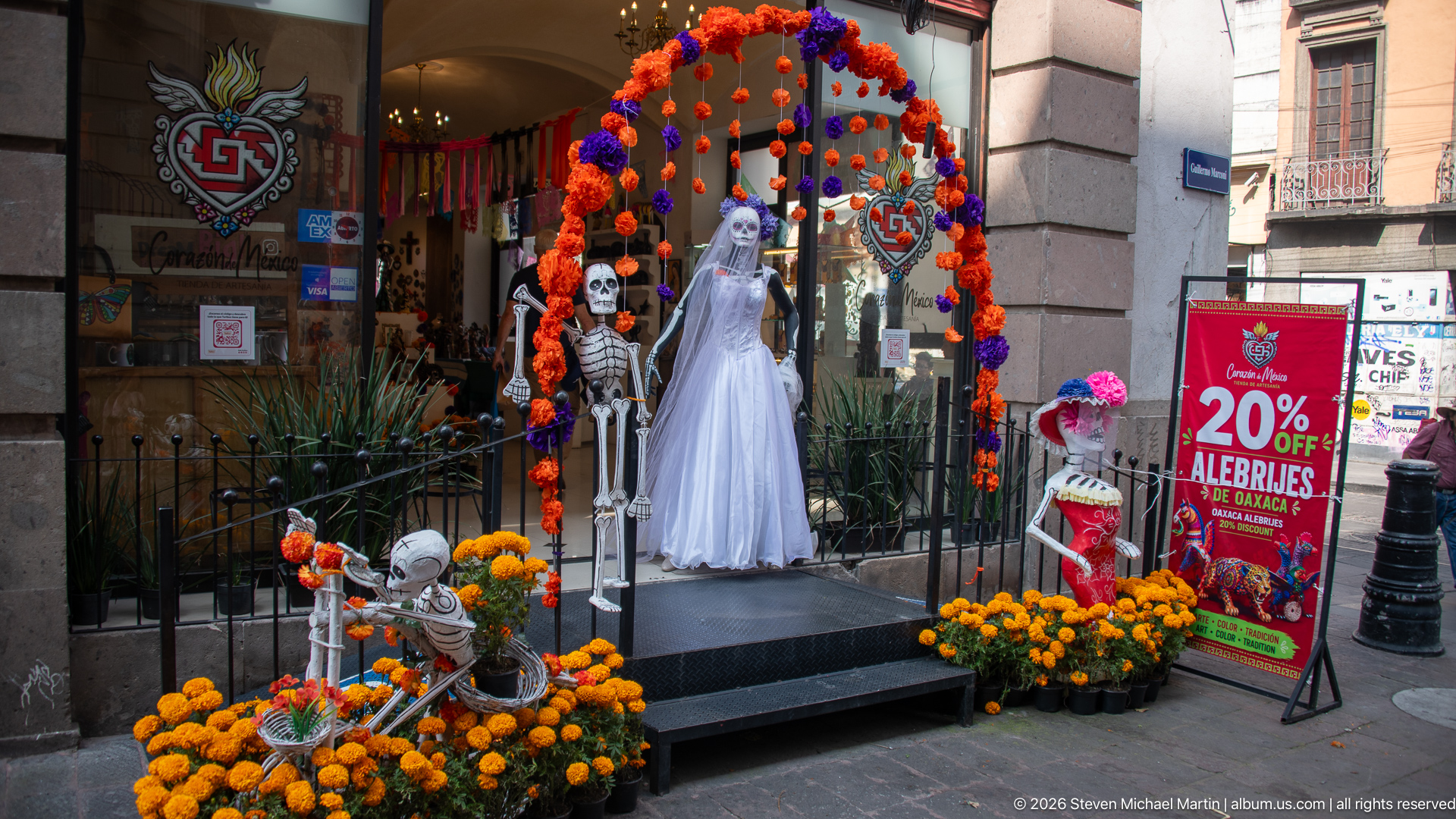
A skeleton dressed as a bride stands beneath an arch of orange marigolds outside a storefront, joined by smaller skeleton figures and colorful alebrije creatures. Potted flowers line the pavement, and a nearby sign advertises a discount on alebrijes. The arrangement brings Día de Muertos imagery directly onto the sidewalk, where it doubles as seasonal decoration and a shopfront invitation.
Caption
A skeleton dressed as a bride stands beneath an arch of orange marigolds outside a storefront, joined by smaller skeleton figures and colorful alebrije creatures. Potted flowers line the pavement, and a nearby sign advertises a discount on alebrijes. The arrangement brings Día de Muertos imagery directly onto the sidewalk, where it doubles as seasonal decoration and a shopfront invitation.
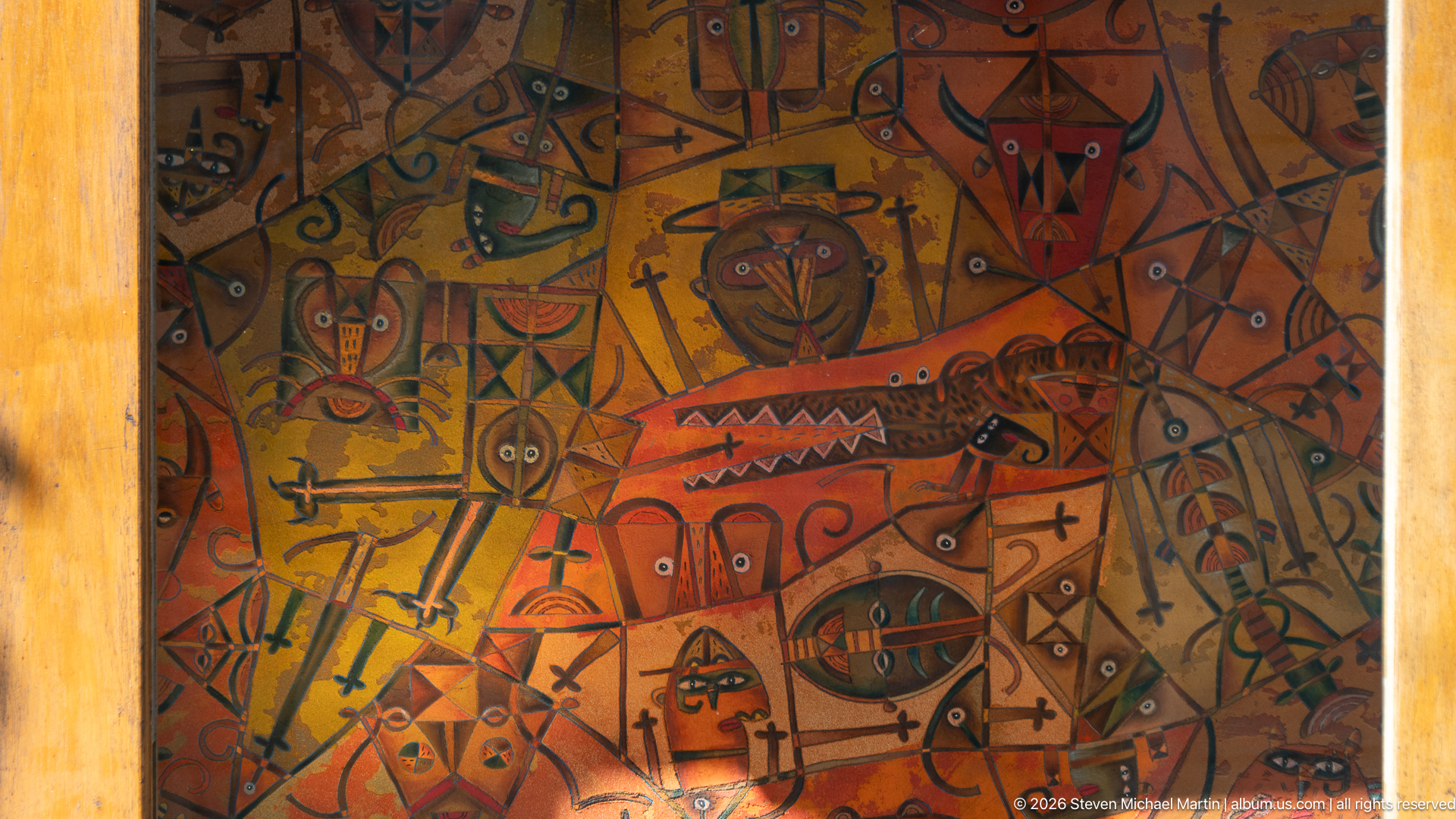
An earth-toned mural covers the wall with a dense arrangement of stylized faces, birds, fish, geometric bands, and repeated eyes. Ochre, rust, black, and muted blue create a compact visual field in which human and animal forms overlap. The image is a close architectural detail; the visible motifs do not establish a particular artist, Indigenous community, or historical period.
Caption
An earth-toned mural covers the wall with a dense arrangement of stylized faces, birds, fish, geometric bands, and repeated eyes. Ochre, rust, black, and muted blue create a compact visual field in which human and animal forms overlap. The image is a close architectural detail; the visible motifs do not establish a particular artist, Indigenous community, or historical period.
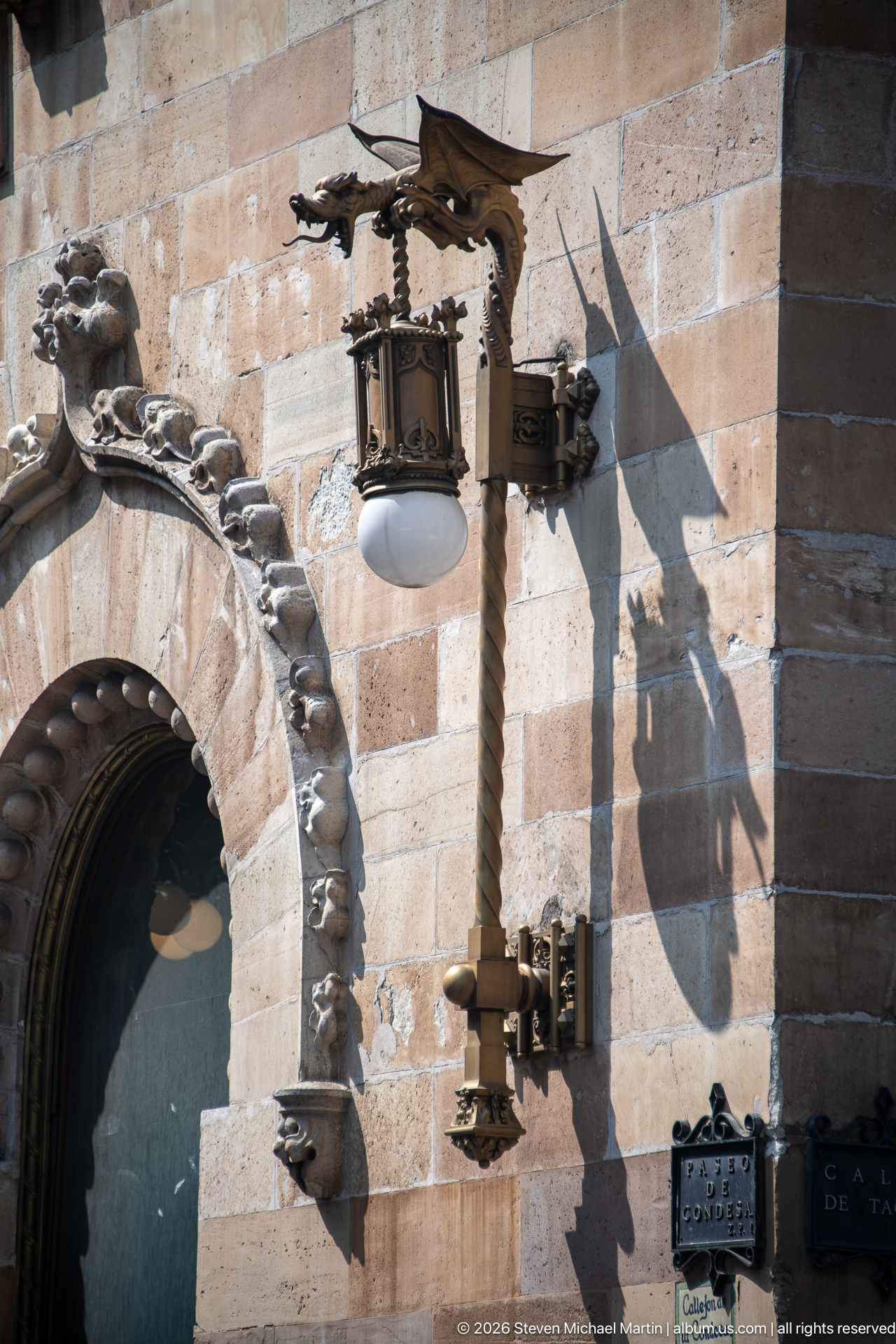
A projecting exterior lantern with a white glass globe is fixed to a carved stone façade. The dark metal bracket has branching, dragonlike ornament, while its sharp shadow falls across the masonry in direct sun. A cropped arched opening and small street plaque establish the lantern as part of a larger historic streetscape, though the building itself is not identified by this detail alone.
Caption
A projecting exterior lantern with a white glass globe is fixed to a carved stone façade. The dark metal bracket has branching, dragonlike ornament, while its sharp shadow falls across the masonry in direct sun. A cropped arched opening and small street plaque establish the lantern as part of a larger historic streetscape, though the building itself is not identified by this detail alone.
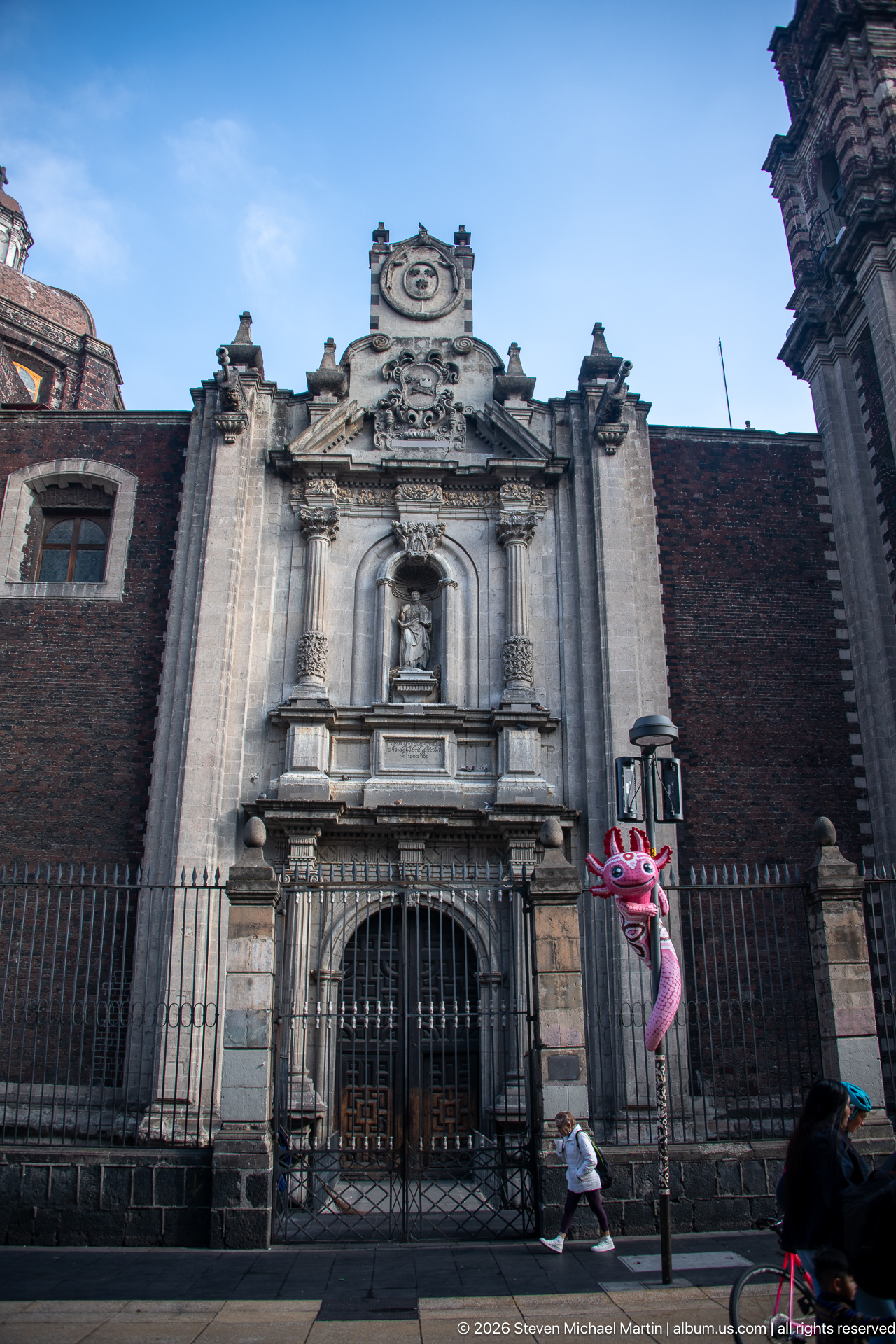
A richly worked stone portal is centered beneath a small clock, with layered moldings, paired columns, a sculptural niche, and a barred arched entrance. A pink costumed figure at the edge of the frame introduces the seasonal street activity without obscuring the façade. The upward view isolates the church front against blue sky and neighboring brickwork.
Caption
A richly worked stone portal is centered beneath a small clock, with layered moldings, paired columns, a sculptural niche, and a barred arched entrance. A pink costumed figure at the edge of the frame introduces the seasonal street activity without obscuring the façade. The upward view isolates the church front against blue sky and neighboring brickwork.
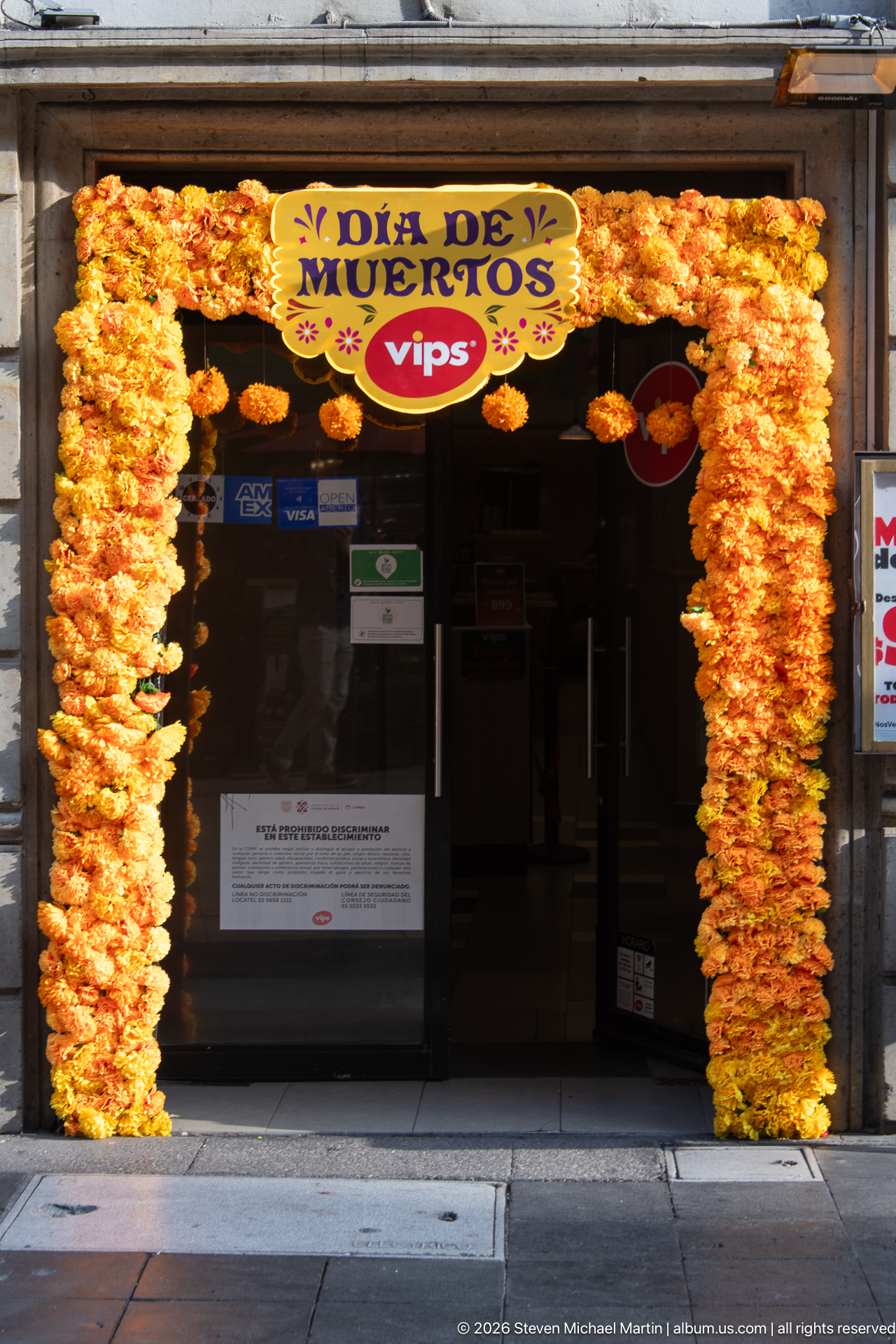
A Vips restaurant entrance is bordered by dense orange marigold garlands, with a printed Día de Muertos sign centered above the doorway. The flowers form a bright rectangular frame around the dark glass doors, and a menu notice is posted at the lower edge. The image documents a commercial seasonal display; the sign identifies the restaurant but does not name a particular dish.
Caption
A Vips restaurant entrance is bordered by dense orange marigold garlands, with a printed Día de Muertos sign centered above the doorway. The flowers form a bright rectangular frame around the dark glass doors, and a menu notice is posted at the lower edge. The image documents a commercial seasonal display; the sign identifies the restaurant but does not name a particular dish.
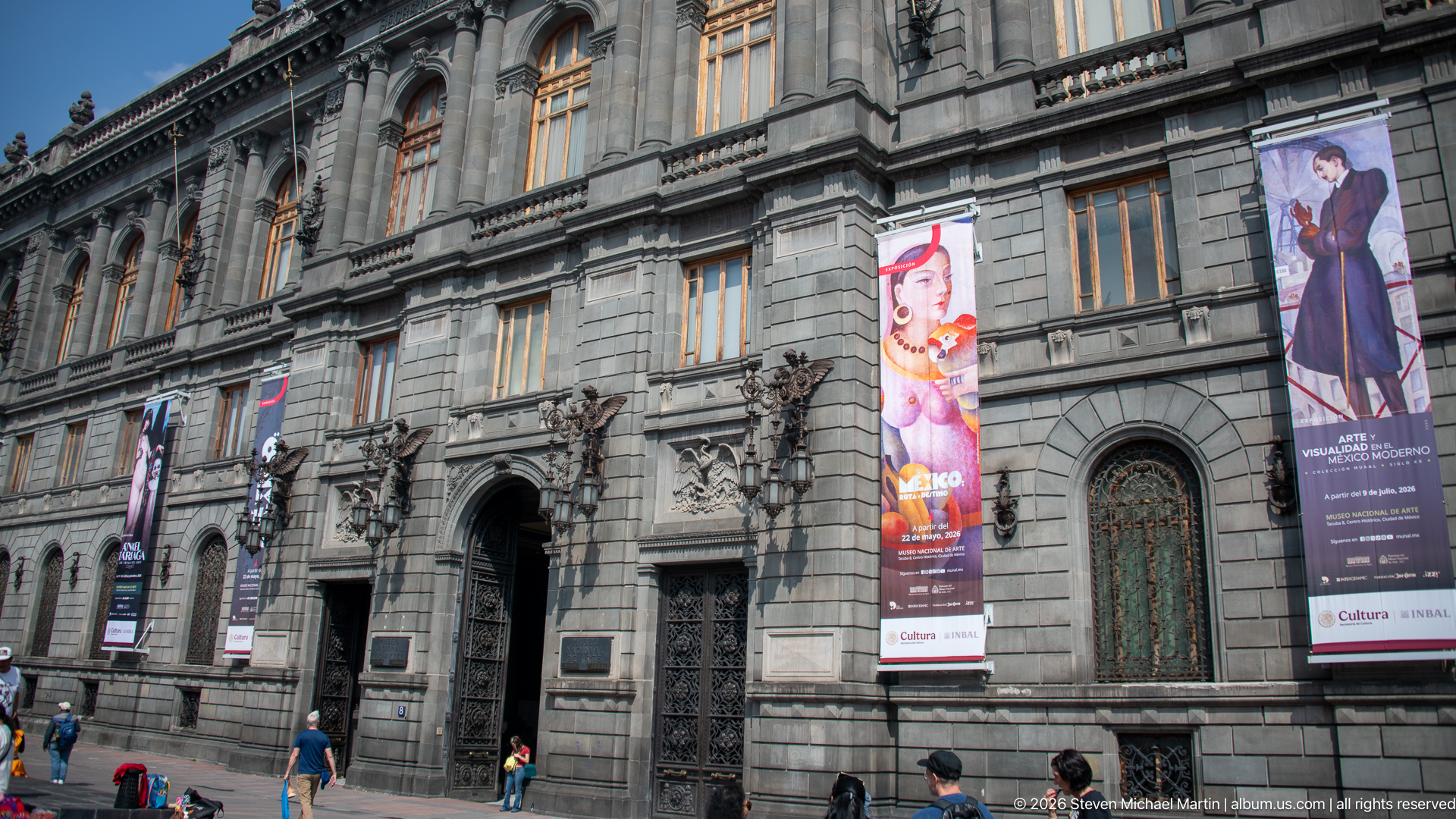
Seen from across the street, the Museo Nacional de Arte presents a broad gray façade of arched ground-floor openings, carved stone panels, balconies, and tall upper windows. Exhibition banners hang between the bays as pedestrians pass along the base. The slightly upward angle makes the building’s height and layered ornament legible while retaining the everyday scale of people at its entrance.
Caption
Seen from across the street, the Museo Nacional de Arte presents a broad gray façade of arched ground-floor openings, carved stone panels, balconies, and tall upper windows. Exhibition banners hang between the bays as pedestrians pass along the base. The slightly upward angle makes the building’s height and layered ornament legible while retaining the everyday scale of people at its entrance.
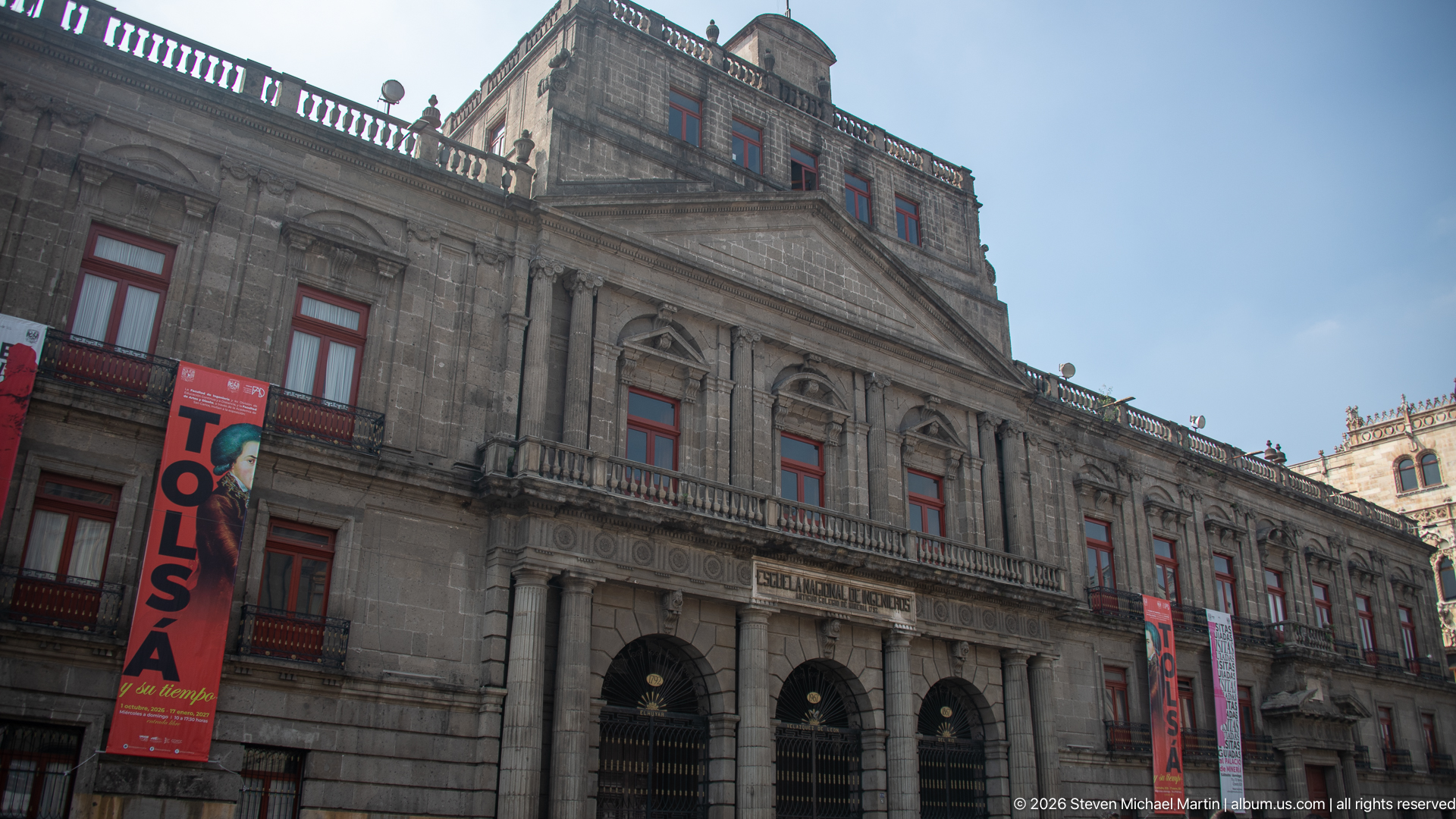
The entrance elevation of the Museo Nacional de Arte is framed by a triangular pediment, a balustraded roofline, rows of red-trimmed windows, and three tall arched doorways. The substantial stone frontage fills nearly the whole frame, with a narrow slice of adjoining architecture at the right. Its frontal viewpoint favors the building’s symmetry and monumental scale.
Caption
The entrance elevation of the Museo Nacional de Arte is framed by a triangular pediment, a balustraded roofline, rows of red-trimmed windows, and three tall arched doorways. The substantial stone frontage fills nearly the whole frame, with a narrow slice of adjoining architecture at the right. Its frontal viewpoint favors the building’s symmetry and monumental scale.
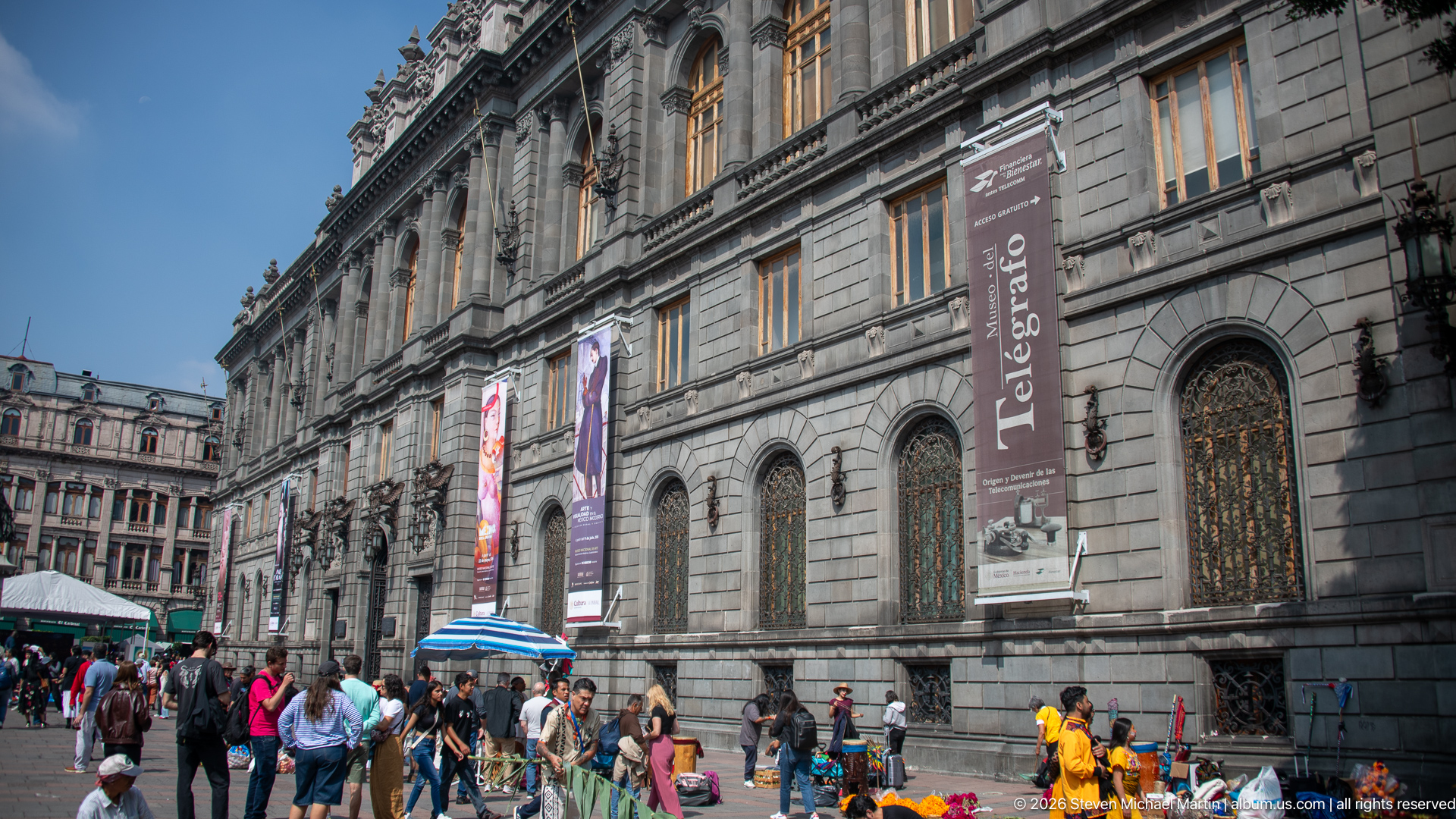
Pedestrians gather beside the long stone façade of the Museo Nacional de Arte, where a banner for the Museo del Telégrafo identifies one of the institutions housed in the building. Vendors and umbrellas cluster at plaza level beneath tall arched windows and sculpted ornament. The broad street view links the museum architecture to the busy civic space in front of it.
Caption
Pedestrians gather beside the long stone façade of the Museo Nacional de Arte, where a banner for the Museo del Telégrafo identifies one of the institutions housed in the building. Vendors and umbrellas cluster at plaza level beneath tall arched windows and sculpted ornament. The broad street view links the museum architecture to the busy civic space in front of it.
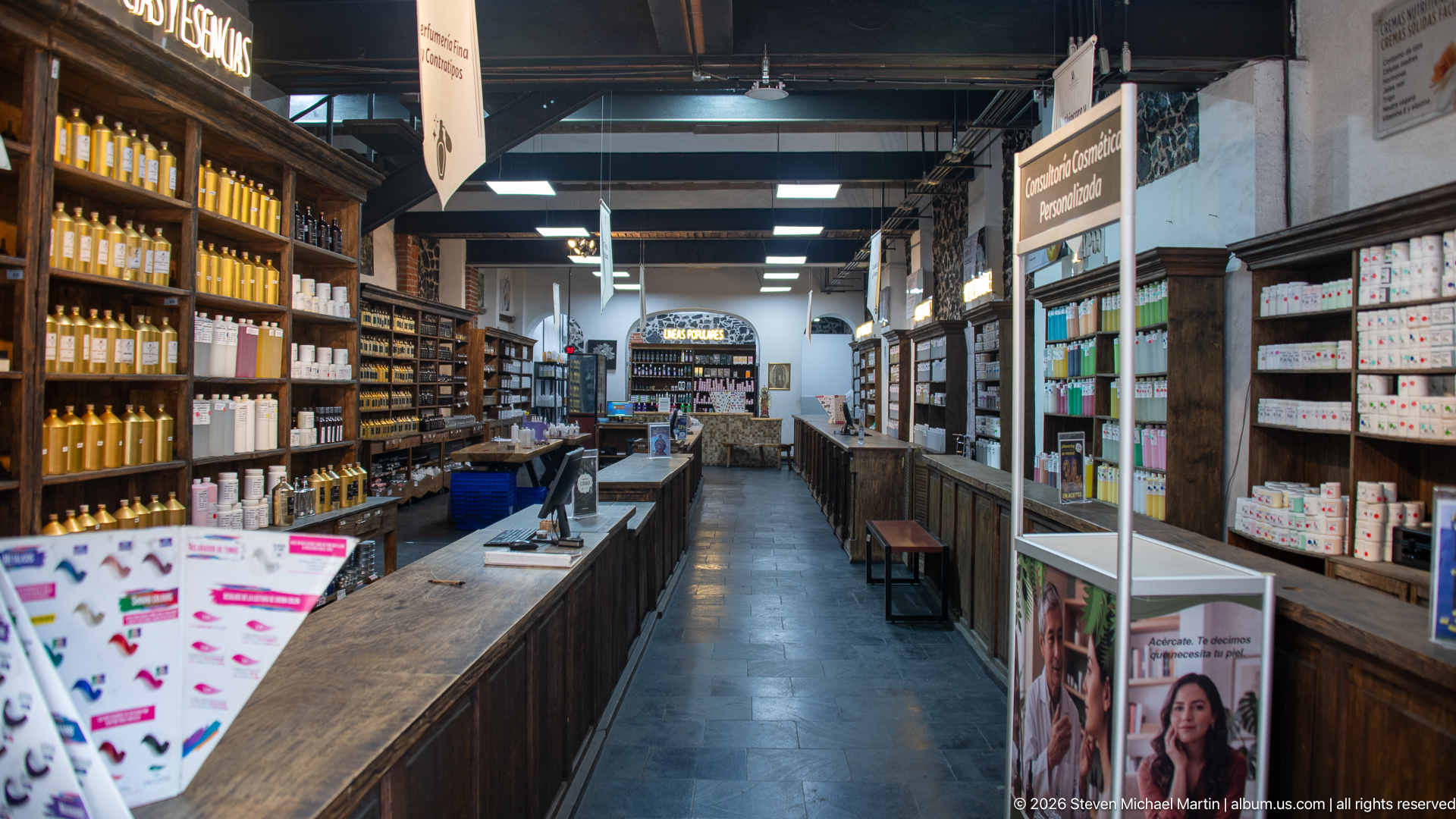
Rows of bottles and boxed products cover tall wooden shelving in a narrow shop, leaving a central aisle leading toward the rear counter. A hanging sign advertises a personalized cosmetics area, while display cards and merchandise crowd the foreground. The view emphasizes the shop’s depth and densely stocked interior; the specific business name is not legible in the proof-sheet image.
Caption
Rows of bottles and boxed products cover tall wooden shelving in a narrow shop, leaving a central aisle leading toward the rear counter. A hanging sign advertises a personalized cosmetics area, while display cards and merchandise crowd the foreground. The view emphasizes the shop’s depth and densely stocked interior; the specific business name is not legible in the proof-sheet image.
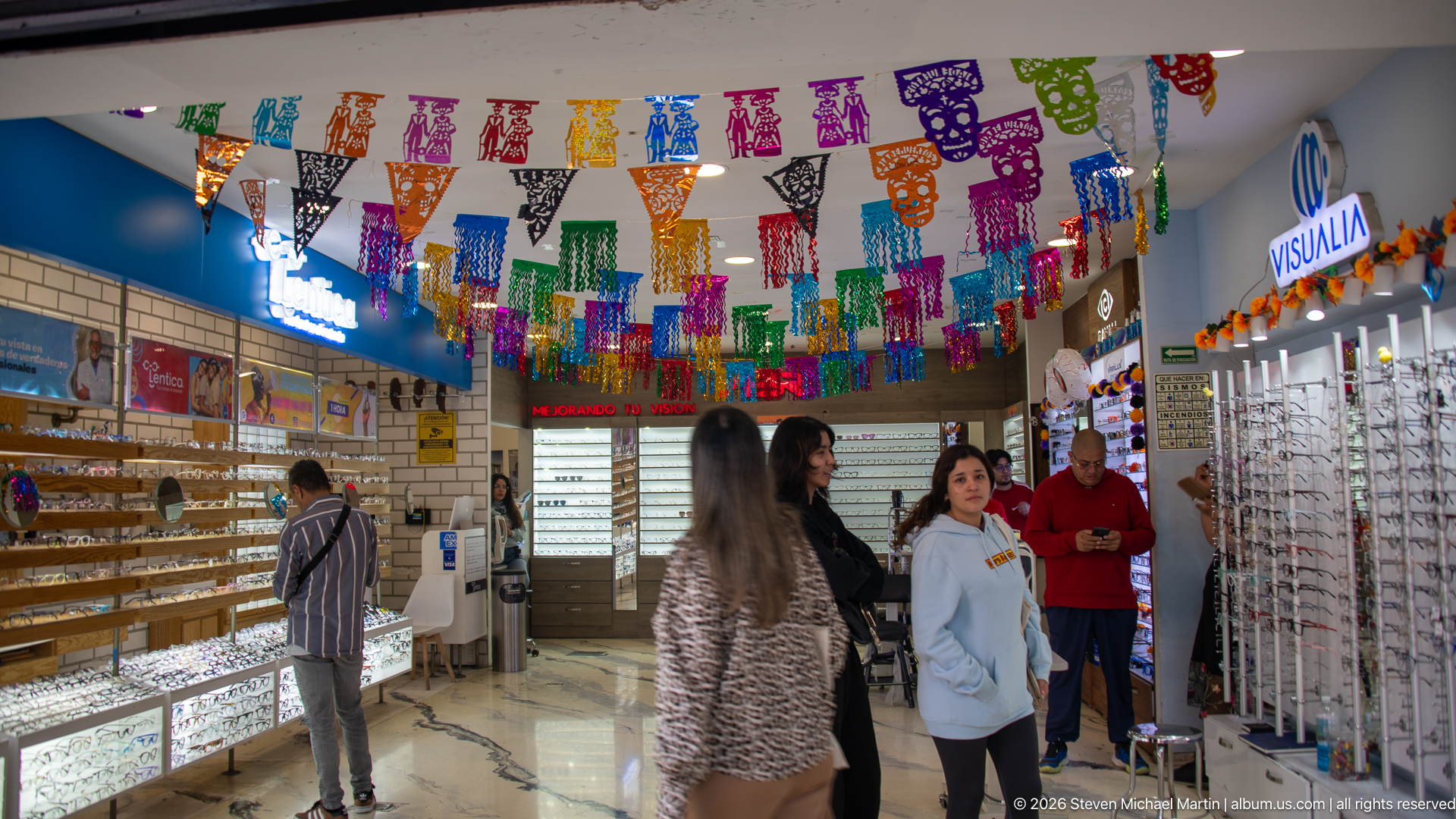
A bright optical shop is decorated with multicolored papel picado suspended across the ceiling. Customers stand among lit display counters and walls of eyeglass frames; the sign “VISUALIA” is visible above the right-hand display. The seasonal cut-paper decorations bring Día de Muertos color into a contemporary retail interior, while the shoppers give the scene its active, everyday character.
Caption
A bright optical shop is decorated with multicolored papel picado suspended across the ceiling. Customers stand among lit display counters and walls of eyeglass frames; the sign “VISUALIA” is visible above the right-hand display. The seasonal cut-paper decorations bring Día de Muertos color into a contemporary retail interior, while the shoppers give the scene its active, everyday character.
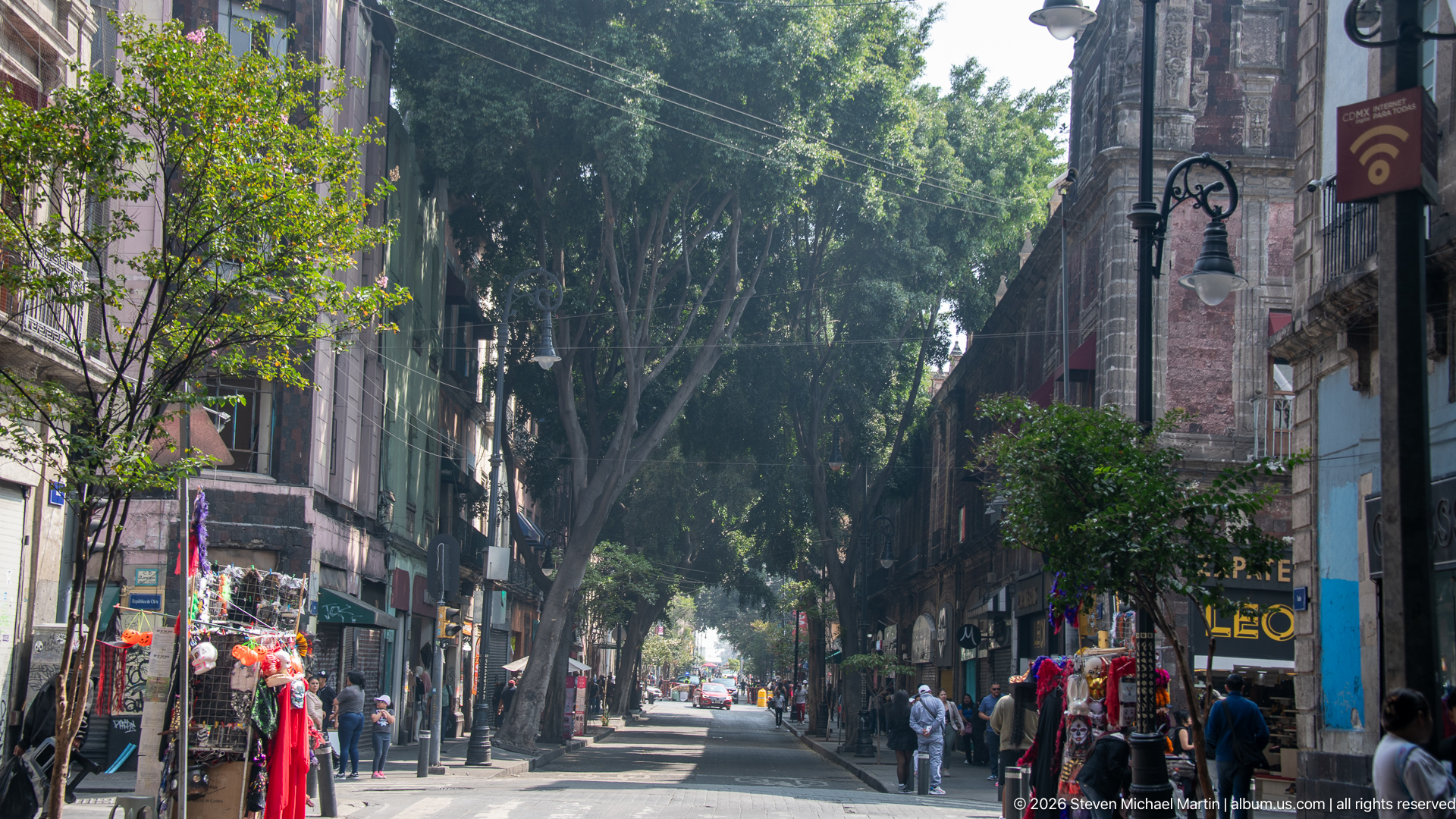
A shaded commercial street recedes beneath a canopy of mature trees, with pedestrians moving between storefronts and sidewalk stands. Día de Muertos costumes and decorations hang near the foreground, while signs and awnings mark the dense retail frontage. The long perspective draws the eye toward the brighter intersection and gives the street scene a distinctly local, pedestrian scale.
Caption
A shaded commercial street recedes beneath a canopy of mature trees, with pedestrians moving between storefronts and sidewalk stands. Día de Muertos costumes and decorations hang near the foreground, while signs and awnings mark the dense retail frontage. The long perspective draws the eye toward the brighter intersection and gives the street scene a distinctly local, pedestrian scale.
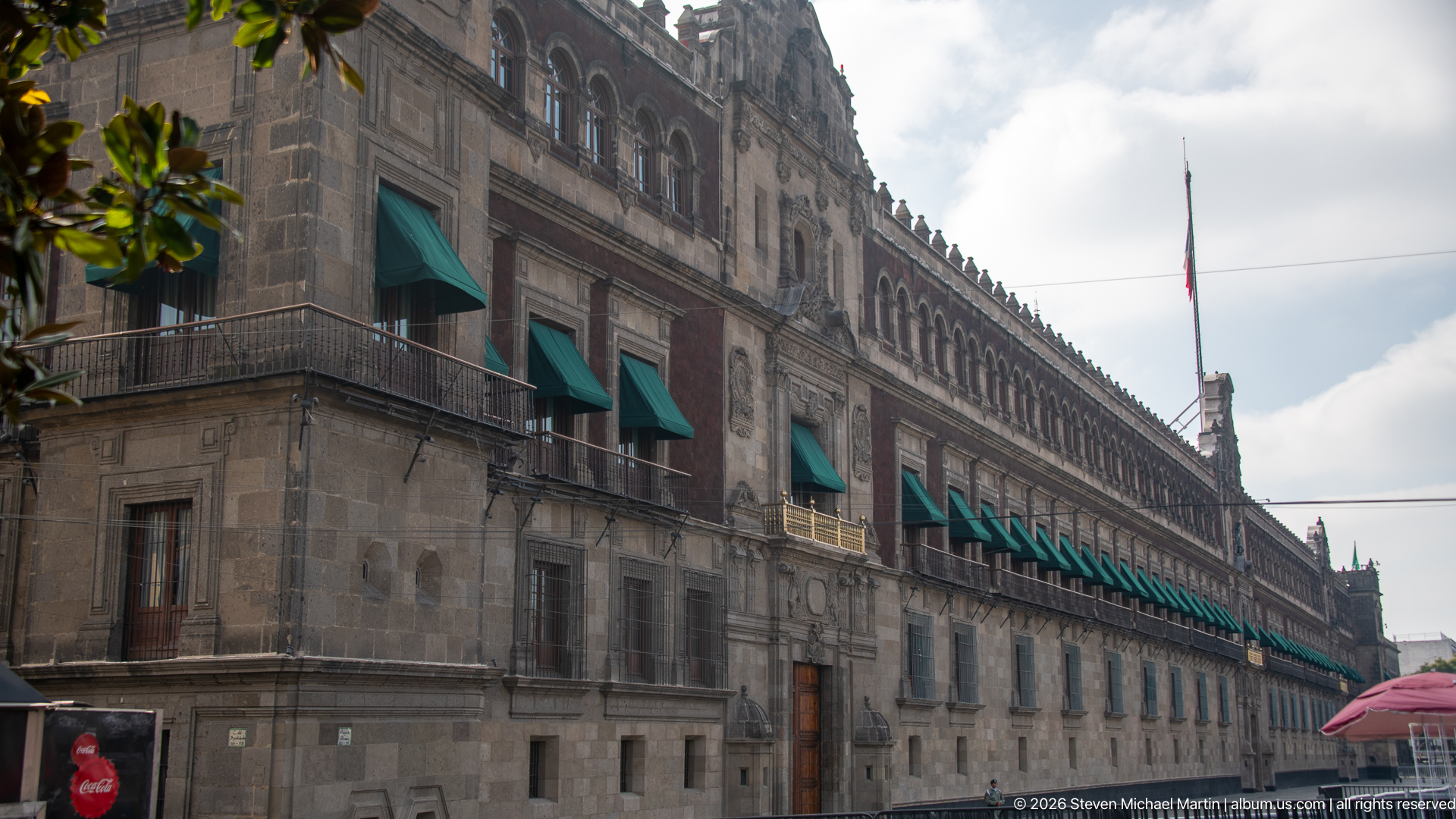
A long stone building recedes toward a distant corner, its upper windows shaded by repeated green awnings and its lower level punctuated by dark doorways. A Mexican flag rises from the roofline, while a red vendor umbrella enters at street level. The perspective highlights the block’s continuity and restrained façade rhythm; no sign in the view confirms the building’s formal name.
Caption
A long stone building recedes toward a distant corner, its upper windows shaded by repeated green awnings and its lower level punctuated by dark doorways. A Mexican flag rises from the roofline, while a red vendor umbrella enters at street level. The perspective highlights the block’s continuity and restrained façade rhythm; no sign in the view confirms the building’s formal name.
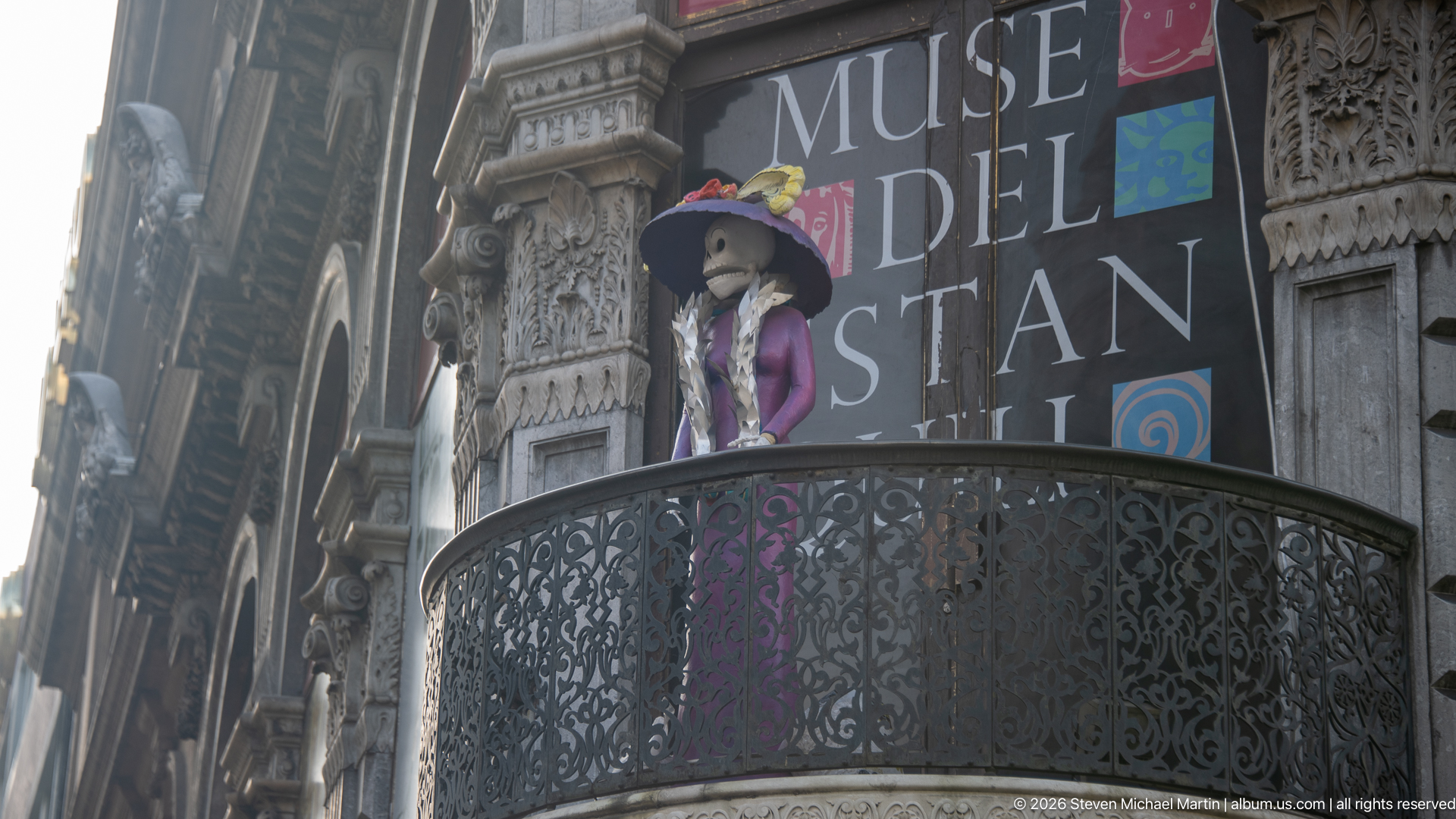
A life-size Catrina mannequin stands behind a curved wrought-iron balcony, dressed in purple with a broad decorated hat. The figure is framed by carved stone columns and a large banner whose visible lettering begins “MUSEO DEL ESTA…”. Backlight from the street softens the façade details, while the seasonal figure links the historic balcony to Día de Muertos display culture.
Caption
A life-size Catrina mannequin stands behind a curved wrought-iron balcony, dressed in purple with a broad decorated hat. The figure is framed by carved stone columns and a large banner whose visible lettering begins “MUSEO DEL ESTA…”. Backlight from the street softens the façade details, while the seasonal figure links the historic balcony to Día de Muertos display culture.
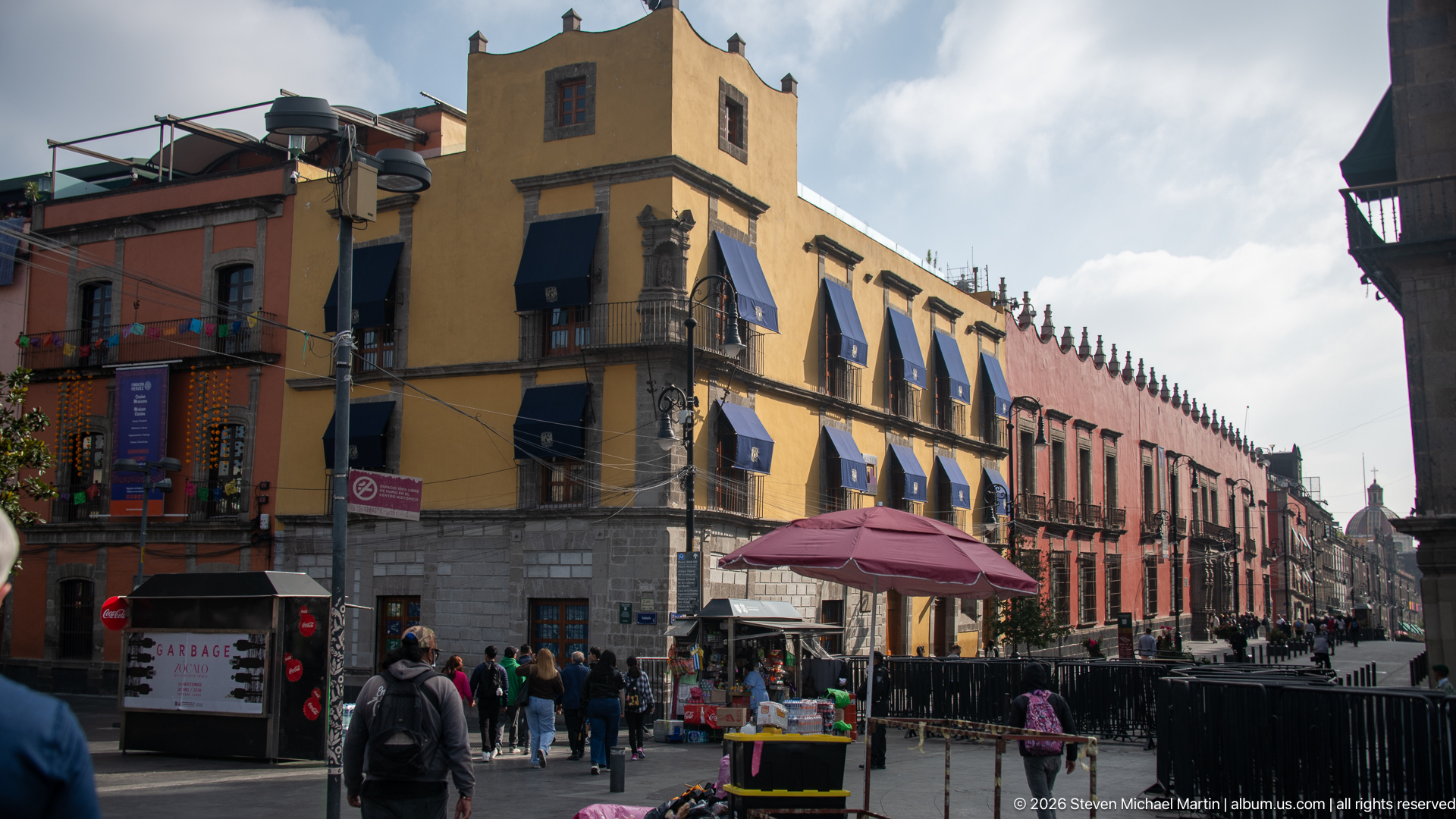
A mustard-yellow corner building with dark blue awnings anchors a street lined by pink and red façades. Pedestrians move beneath a broad magenta umbrella, and temporary barriers and street displays narrow the route. The oblique view combines the district’s vivid building colors with contemporary commerce and foot traffic, offering a street-level counterpart to the nearby architectural details.
Caption
A mustard-yellow corner building with dark blue awnings anchors a street lined by pink and red façades. Pedestrians move beneath a broad magenta umbrella, and temporary barriers and street displays narrow the route. The oblique view combines the district’s vivid building colors with contemporary commerce and foot traffic, offering a street-level counterpart to the nearby architectural details.
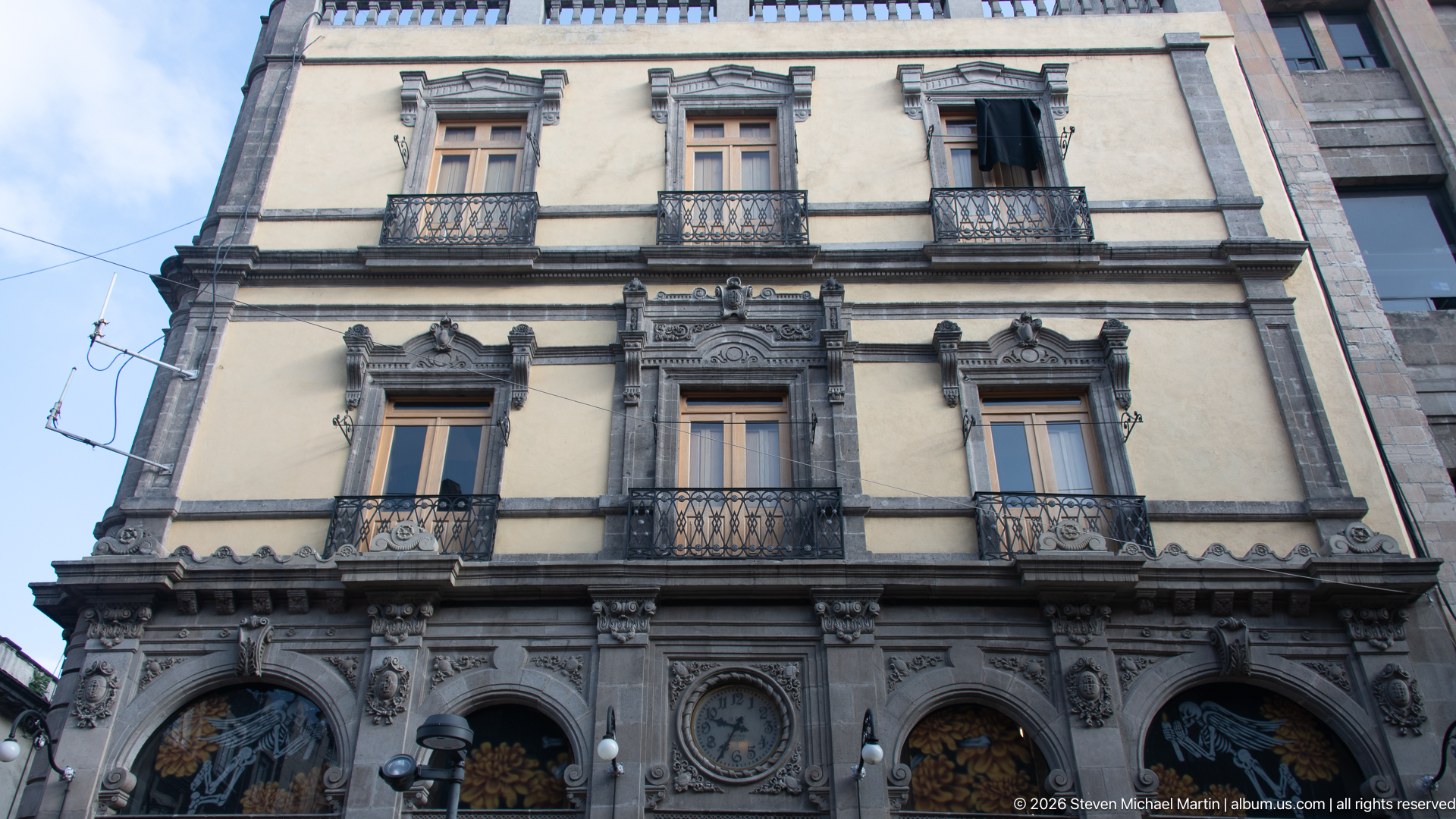
A pale multi-story façade is photographed from below, emphasizing its repeated wrought-iron balconies, tall rectangular windows, and a richly carved central band. The alternating dark stone trim and light wall surface create a strong horizontal rhythm. This architectural detail records the ornamental treatment of an urban commercial building without a visible sign that securely identifies its occupants.
Caption
A pale multi-story façade is photographed from below, emphasizing its repeated wrought-iron balconies, tall rectangular windows, and a richly carved central band. The alternating dark stone trim and light wall surface create a strong horizontal rhythm. This architectural detail records the ornamental treatment of an urban commercial building without a visible sign that securely identifies its occupants.
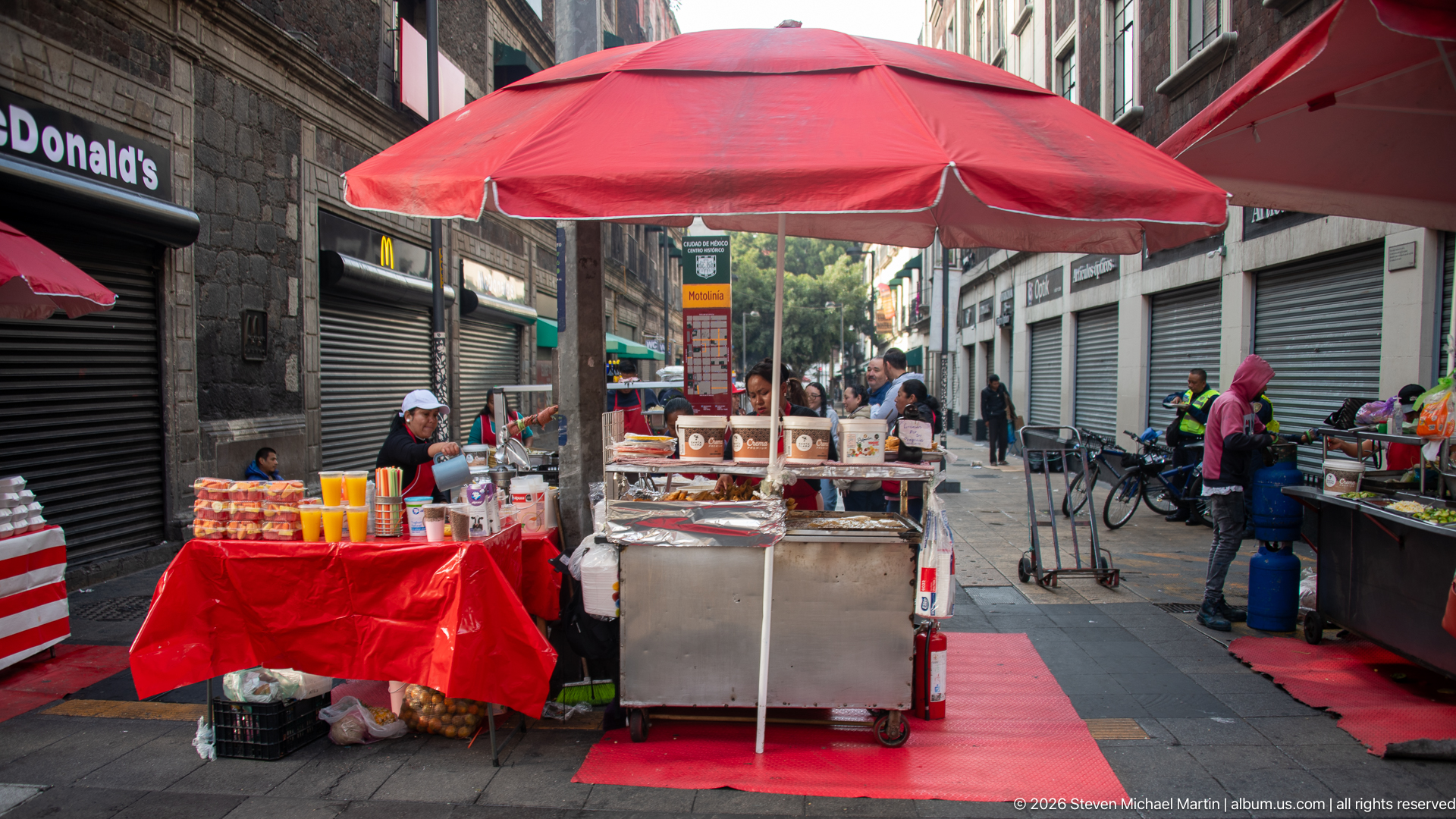
A compact sidewalk food stand operates beneath oversized red umbrellas, its counter lined with cups, bottles, and covered trays. A vendor serves customers on the narrow pedestrian street as neighboring stalls and shuttered storefronts frame the scene. The image records a casual street-side meal setting, but the proof sheet does not show a legible menu or enough detail to identify a particular dish.
Caption
A compact sidewalk food stand operates beneath oversized red umbrellas, its counter lined with cups, bottles, and covered trays. A vendor serves customers on the narrow pedestrian street as neighboring stalls and shuttered storefronts frame the scene. The image records a casual street-side meal setting, but the proof sheet does not show a legible menu or enough detail to identify a particular dish.
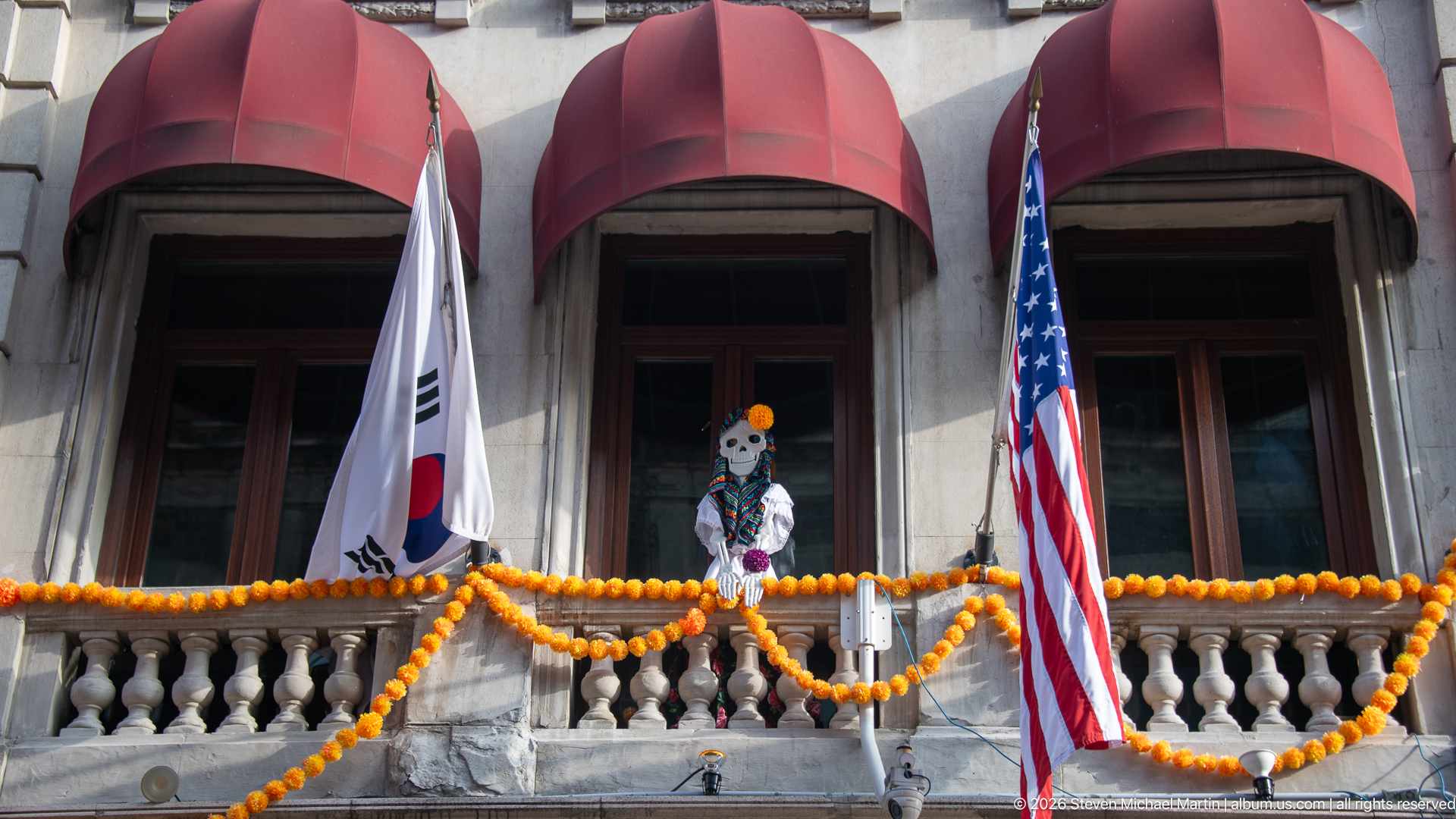
Orange marigold garlands trace the balustrade beneath three rounded red awnings, with a small skeleton figure centered between the South Korean and United States flags. The close crop makes the seasonal decoration and unusual flag pairing the main subject, while the stone balcony supplies an institutional backdrop. The flowers and calavera figure clearly evoke Día de Muertos.
Caption
Orange marigold garlands trace the balustrade beneath three rounded red awnings, with a small skeleton figure centered between the South Korean and United States flags. The close crop makes the seasonal decoration and unusual flag pairing the main subject, while the stone balcony supplies an institutional backdrop. The flowers and calavera figure clearly evoke Día de Muertos.
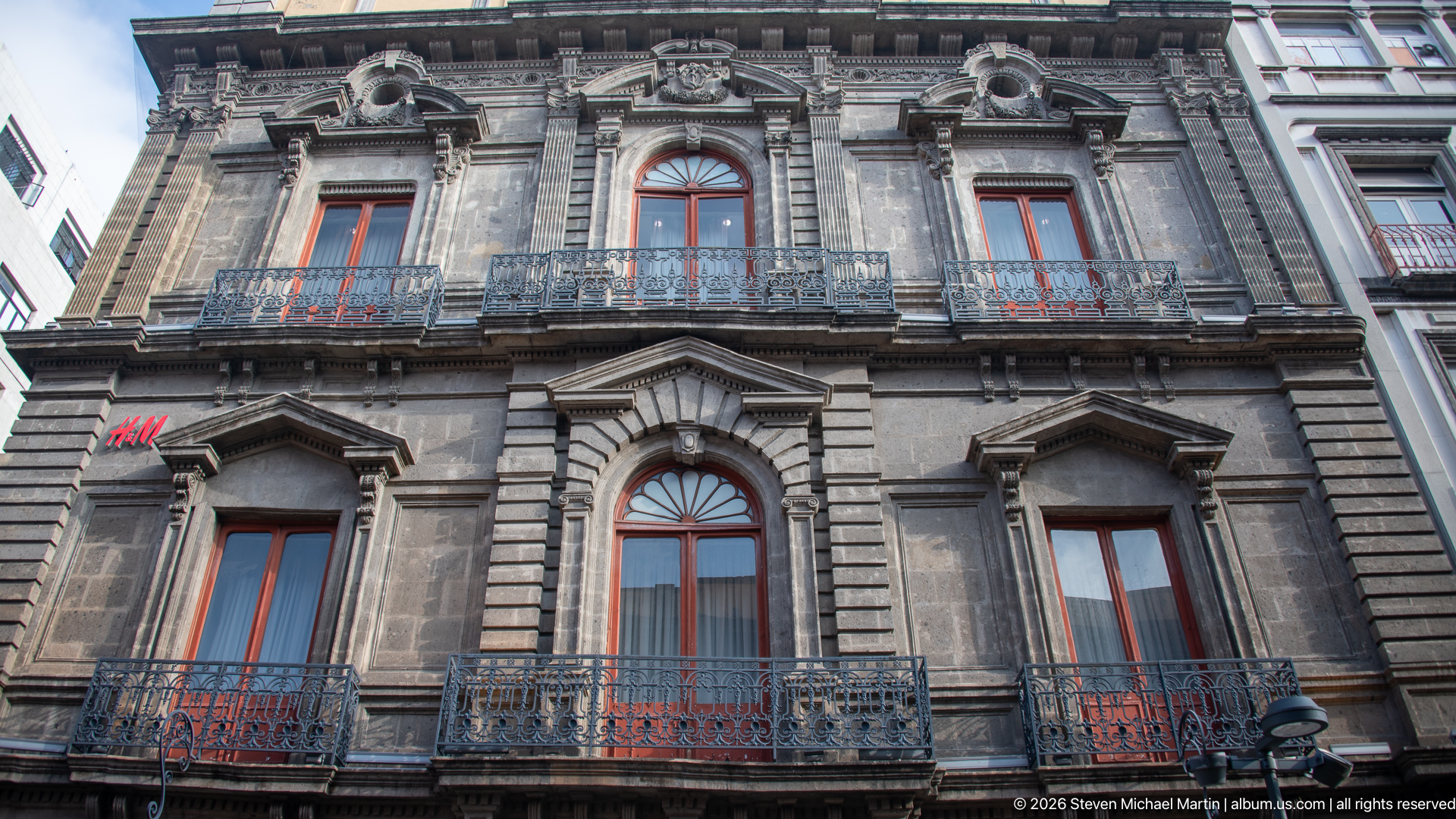
An upward street view records a gray stone building with a richly carved upper façade, iron balconies, arched windows, and a projecting cornice. The red H&M sign at street level shows the building’s current commercial use, while neighboring façades press close on either side. The composition balances contemporary retail signage with the older masonry and decorative detail above it.
Caption
An upward street view records a gray stone building with a richly carved upper façade, iron balconies, arched windows, and a projecting cornice. The red H&M sign at street level shows the building’s current commercial use, while neighboring façades press close on either side. The composition balances contemporary retail signage with the older masonry and decorative detail above it.
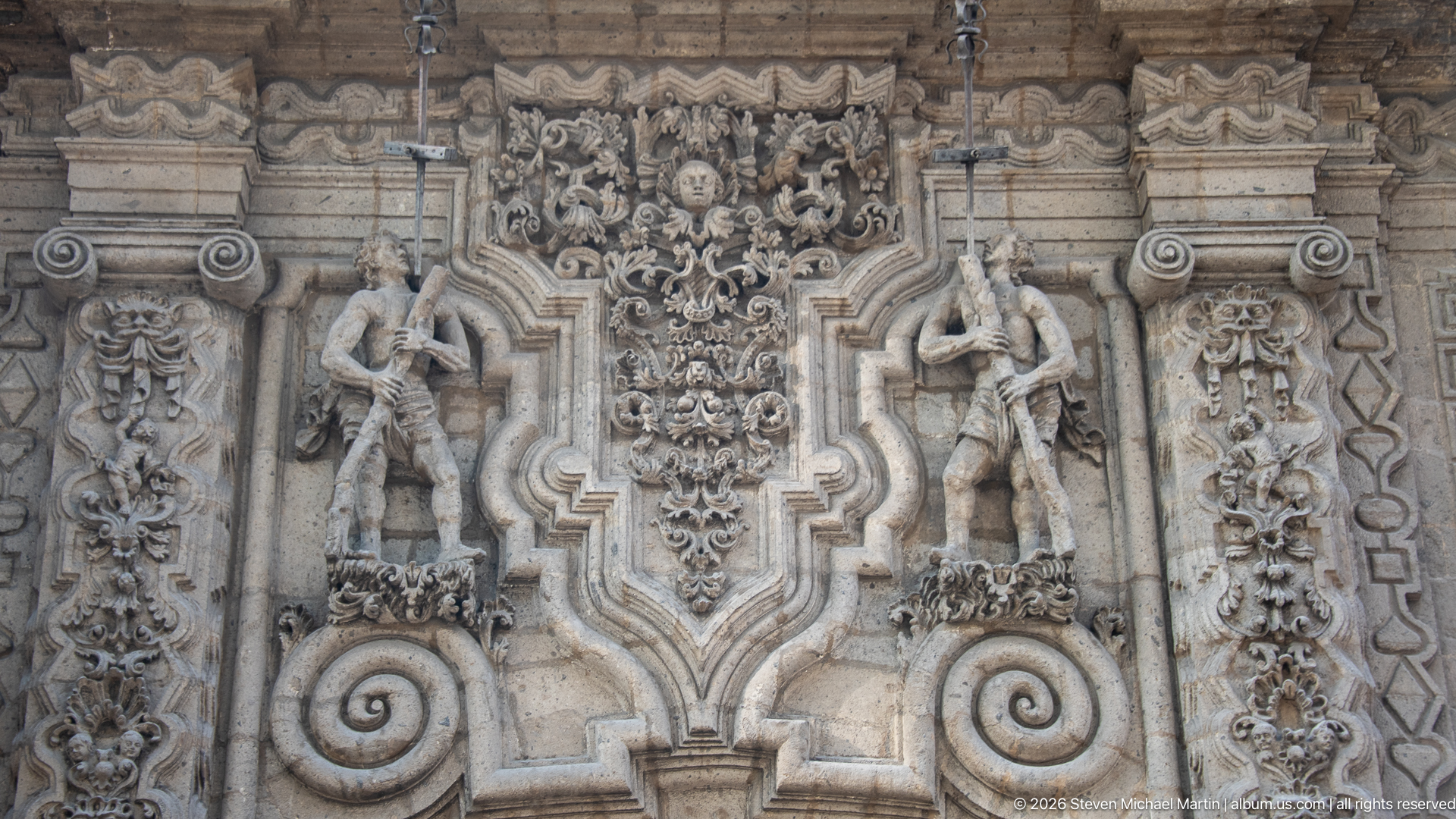
A close view isolates a pale stone relief panel filled with symmetrical scrolls, foliage, small faces, and two standing figures flanking a central shield-like cartouche. The deep carving and weathered surface create strong shadows within the ornament. Cropped from its larger façade, the detail rewards attention to the sculptural layering rather than the building’s overall form.
Caption
A close view isolates a pale stone relief panel filled with symmetrical scrolls, foliage, small faces, and two standing figures flanking a central shield-like cartouche. The deep carving and weathered surface create strong shadows within the ornament. Cropped from its larger façade, the detail rewards attention to the sculptural layering rather than the building’s overall form.
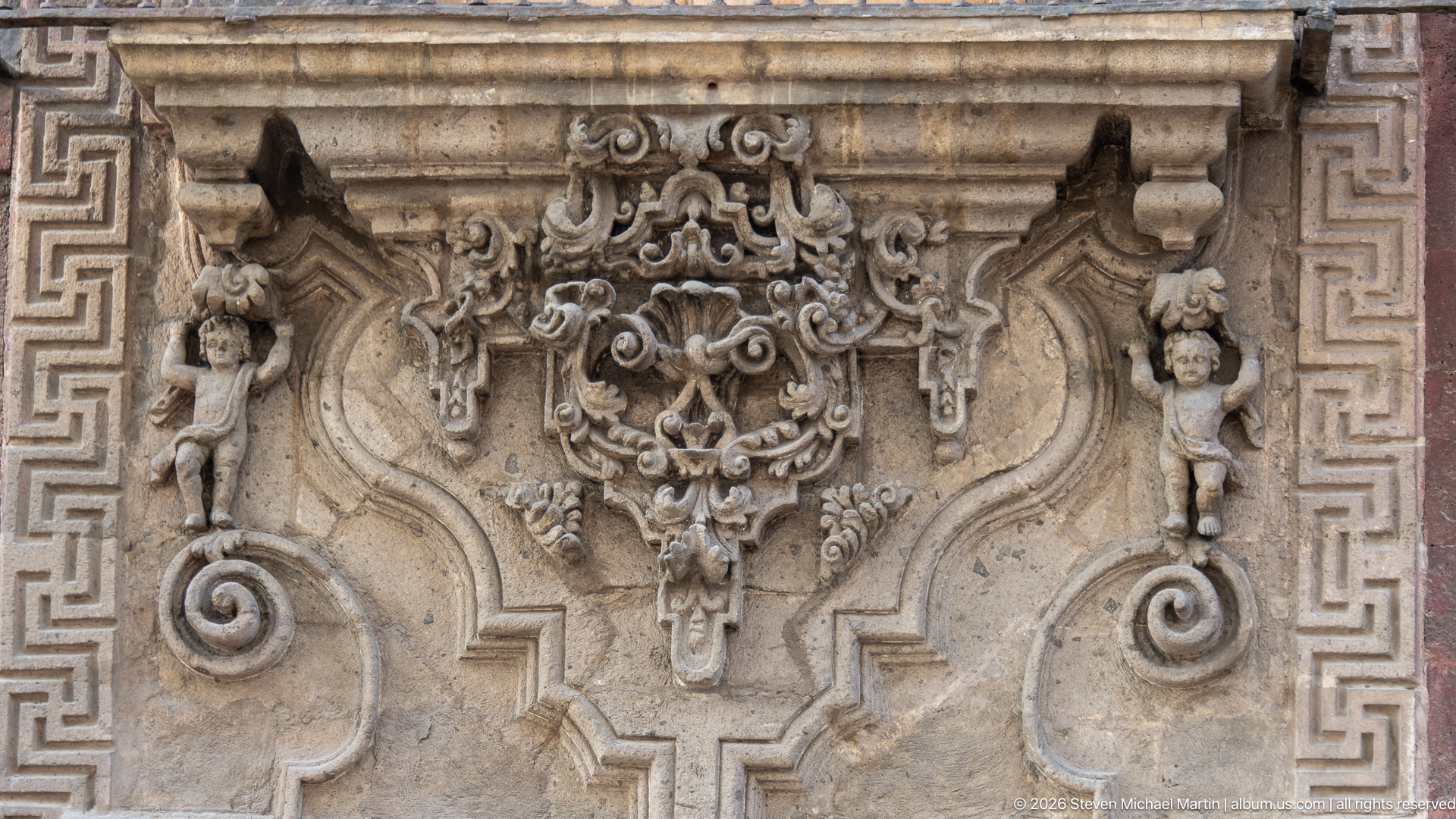
A dense stone panel combines a central mask-like face, curling foliage, and two small standing figures set within a geometric border. The close, frontal view makes the deep shadows in the carving and the weathered surface legible. Its ornamental program belongs to the surrounding historic streetscape, but the photograph offers no inscription or other evidence for assigning the relief to a named building or maker.
Caption
A dense stone panel combines a central mask-like face, curling foliage, and two small standing figures set within a geometric border. The close, frontal view makes the deep shadows in the carving and the weathered surface legible. Its ornamental program belongs to the surrounding historic streetscape, but the photograph offers no inscription or other evidence for assigning the relief to a named building or maker.
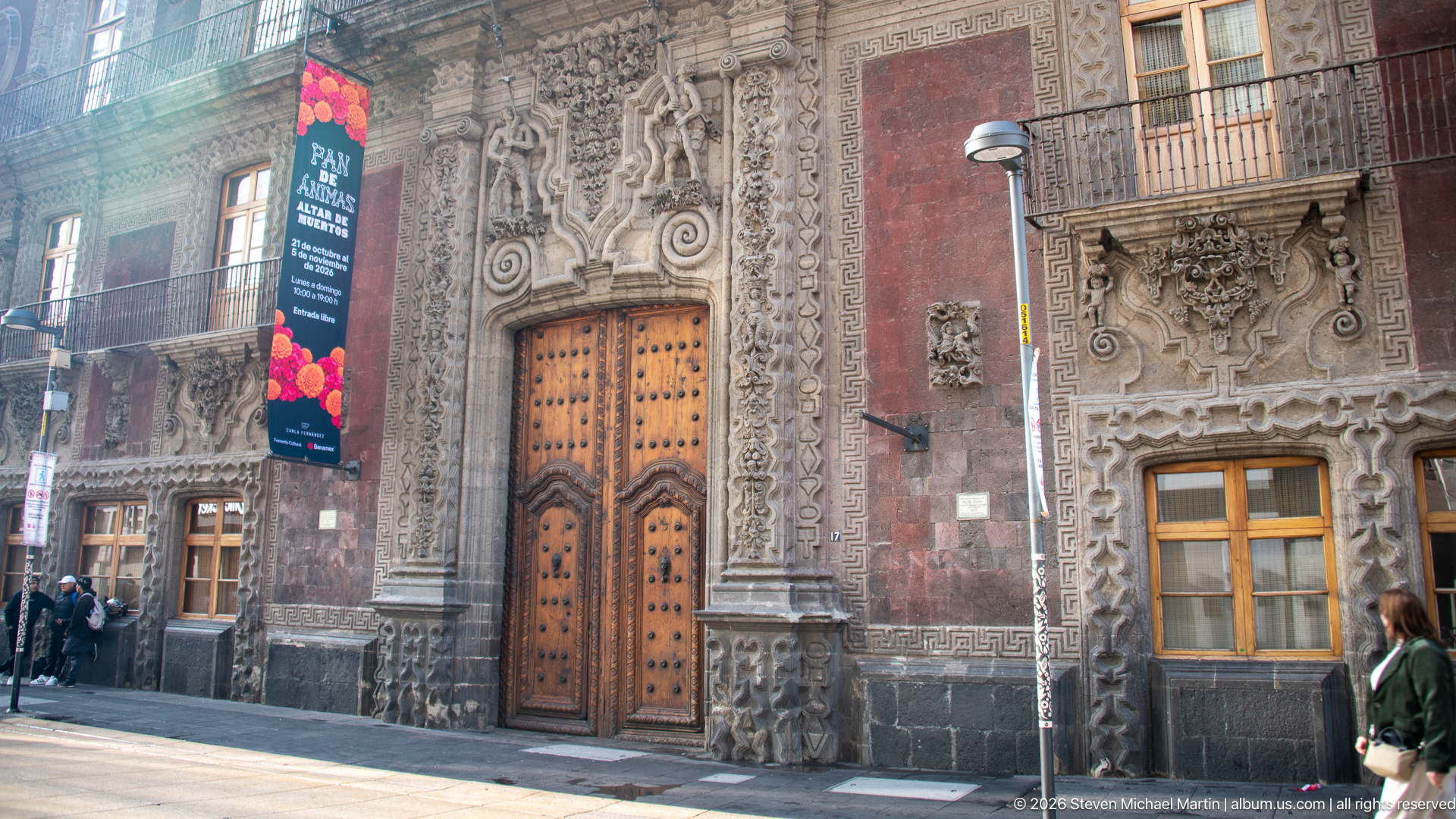
A tall wooden double door anchors a richly carved stone façade, framed by columns, scrollwork, and relief figures. Red-toned masonry and iron balconies continue across the adjoining elevation. A vertical Día de Muertos banner hangs beside the portal, connecting the street’s seasonal decoration with the monumental entrance. The oblique framing records both the doorway’s sculptural detail and its scale within the block.
Caption
A tall wooden double door anchors a richly carved stone façade, framed by columns, scrollwork, and relief figures. Red-toned masonry and iron balconies continue across the adjoining elevation. A vertical Día de Muertos banner hangs beside the portal, connecting the street’s seasonal decoration with the monumental entrance. The oblique framing records both the doorway’s sculptural detail and its scale within the block.
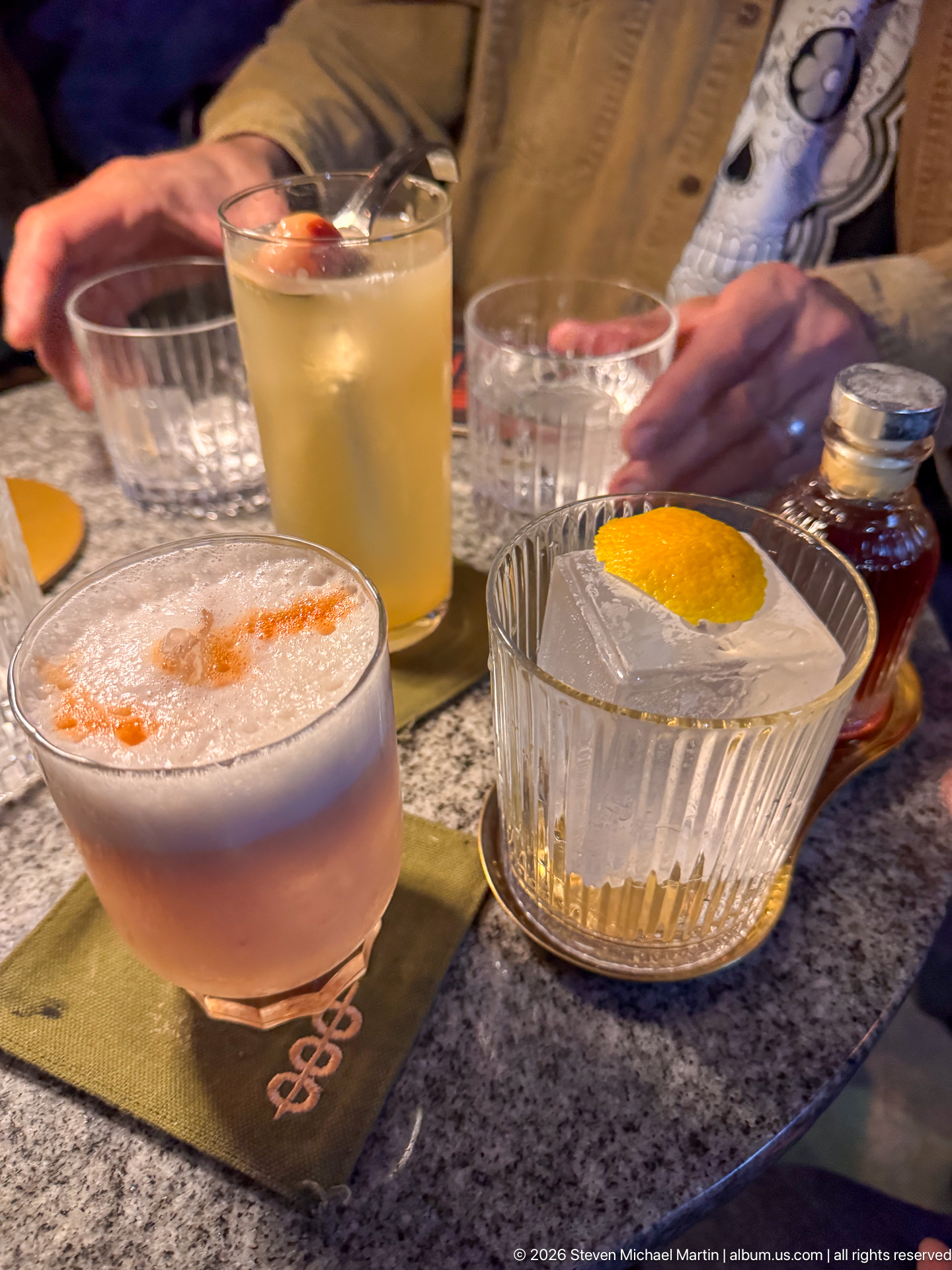
Several drinks cluster across a polished stone bar: a pale foamy cocktail in a coupe, a tall yellow drink, and a clear glass with a large ice cube sit among hands and bar tools. The varied colors and glass shapes suggest a round of mixed beverages, but no recipe or cocktail name is visible. This convivial counter view records the drinks and the social setting without relying on guesswork.
Caption
Several drinks cluster across a polished stone bar: a pale foamy cocktail in a coupe, a tall yellow drink, and a clear glass with a large ice cube sit among hands and bar tools. The varied colors and glass shapes suggest a round of mixed beverages, but no recipe or cocktail name is visible. This convivial counter view records the drinks and the social setting without relying on guesswork.
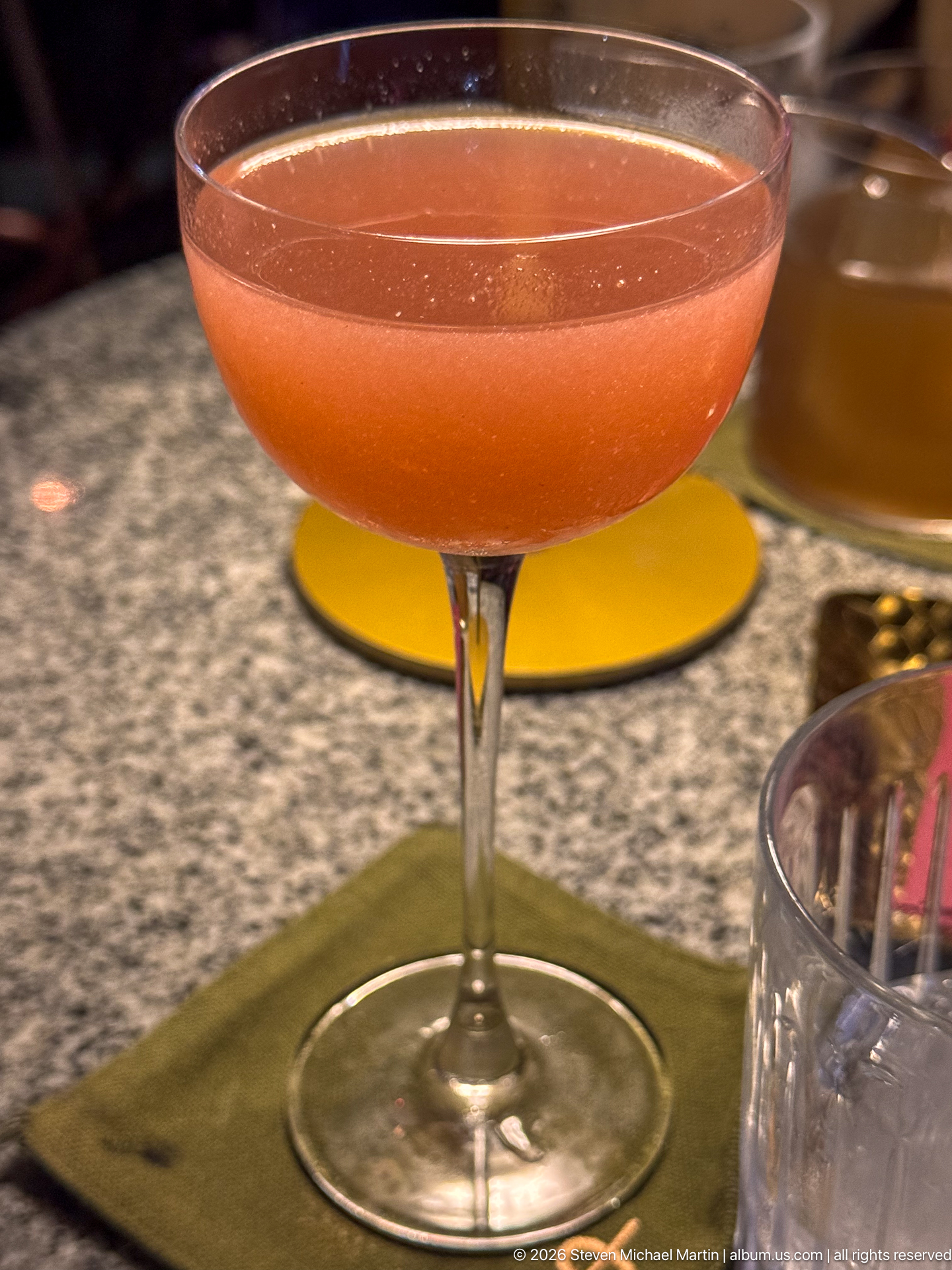
A pink-orange drink fills a shallow coupe set on a yellow coaster, with the close crop isolating its color, fine surface bubbles, and thin stem. A second glass and a reflective counter edge remain partly visible at the margins. No garnish or menu is shown, so the beverage is best identified by its appearance and presentation rather than assigned a specific name.
Caption
A pink-orange drink fills a shallow coupe set on a yellow coaster, with the close crop isolating its color, fine surface bubbles, and thin stem. A second glass and a reflective counter edge remain partly visible at the margins. No garnish or menu is shown, so the beverage is best identified by its appearance and presentation rather than assigned a specific name.
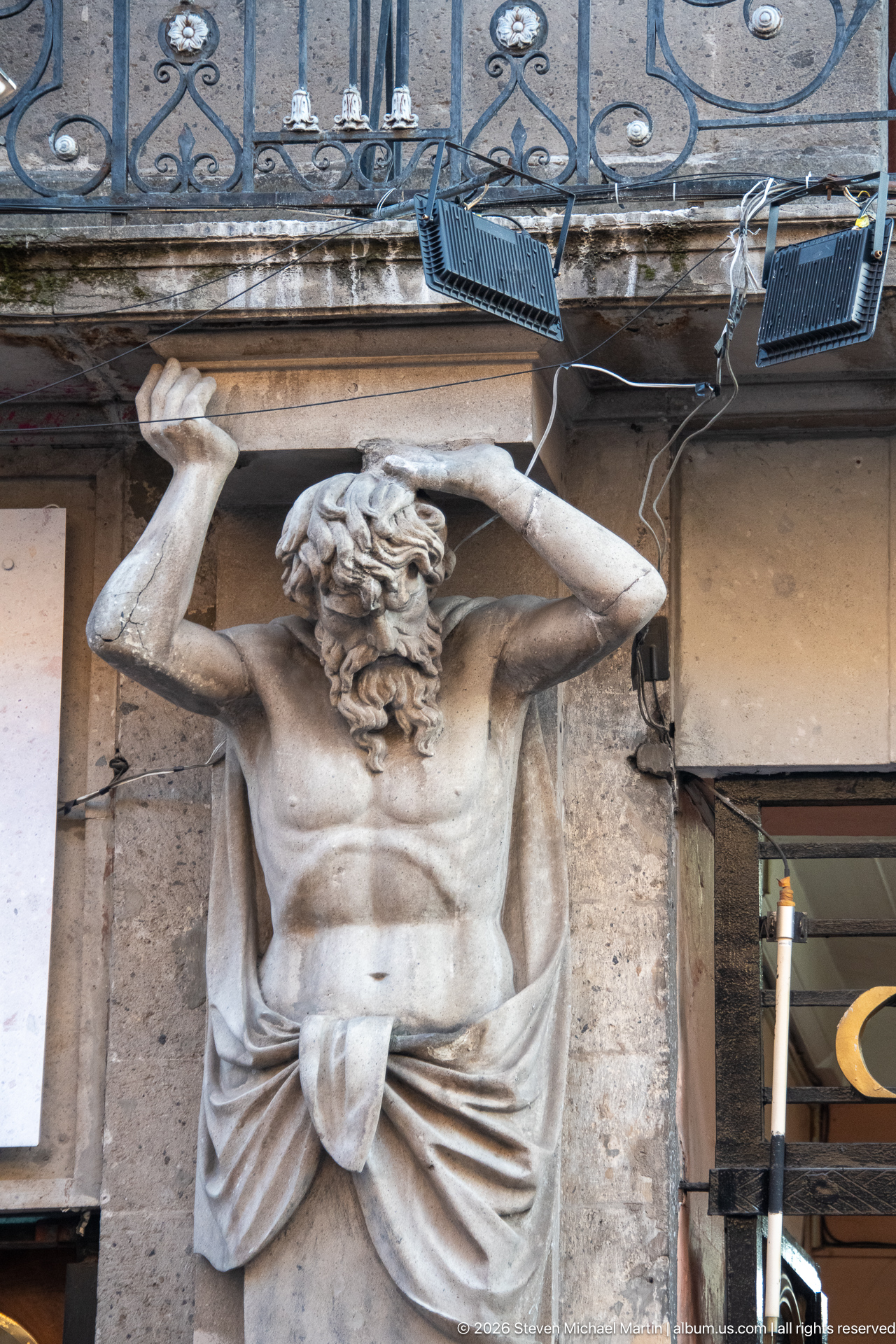
A muscular bearded figure raises both arms beneath a projecting balcony, his torso and draped waist emerging from the wall as an architectural support. The low angle brings the sculpture close while iron railings, electrical cables, and the underside of the balcony reveal its urban setting. The figure’s burdened pose recalls an Atlas motif, although the photograph provides no identifying inscription.
Caption
A muscular bearded figure raises both arms beneath a projecting balcony, his torso and draped waist emerging from the wall as an architectural support. The low angle brings the sculpture close while iron railings, electrical cables, and the underside of the balcony reveal its urban setting. The figure’s burdened pose recalls an Atlas motif, although the photograph provides no identifying inscription.
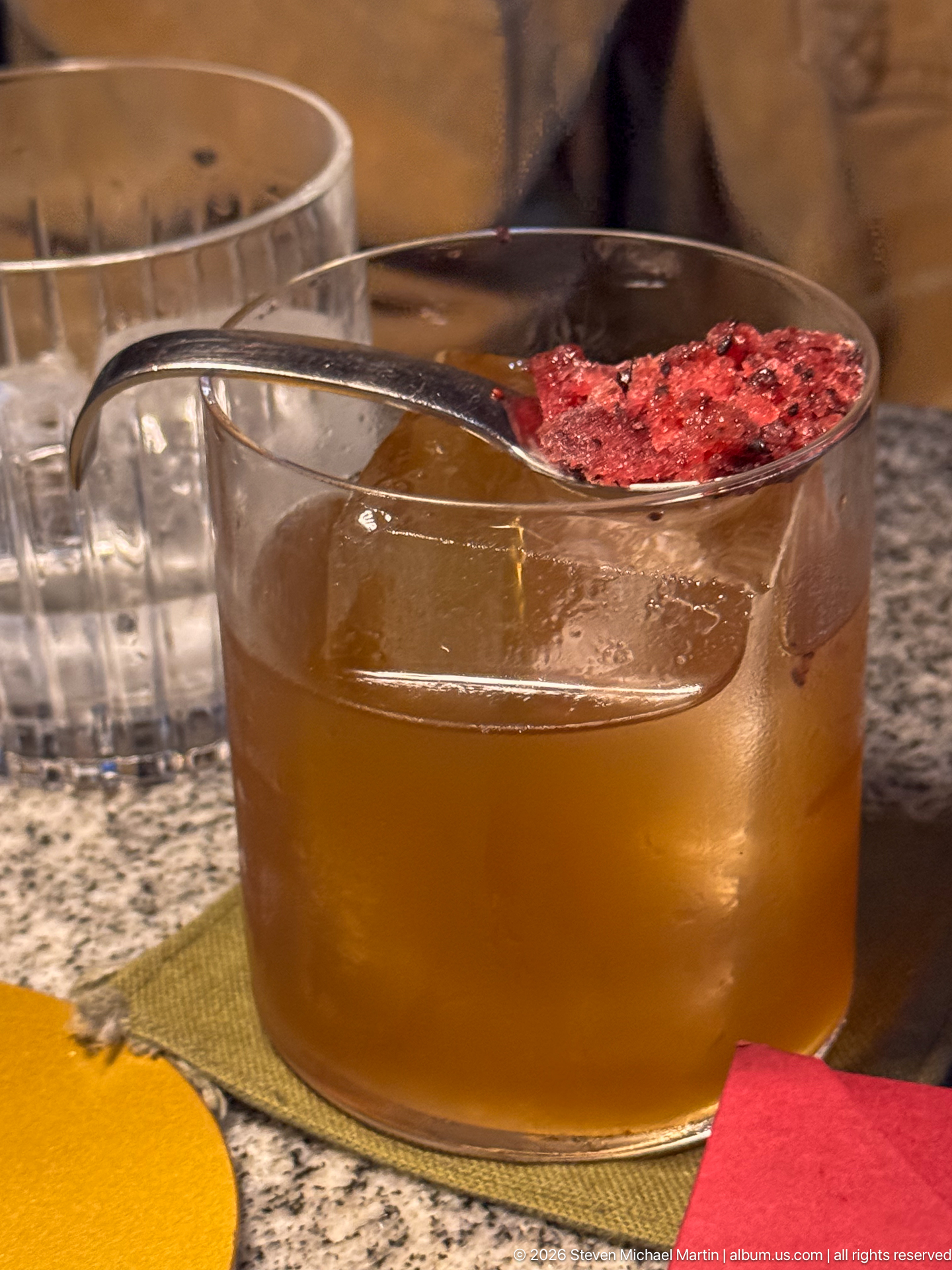
A low, broad glass holds an amber-colored drink topped with a vivid red textured garnish. The tabletop setting includes a yellow coaster and a red napkin, while another glass is softly visible behind it. The tight composition records the drink’s color and presentation, but the ingredients and menu name cannot be determined from appearance alone.
Caption
A low, broad glass holds an amber-colored drink topped with a vivid red textured garnish. The tabletop setting includes a yellow coaster and a red napkin, while another glass is softly visible behind it. The tight composition records the drink’s color and presentation, but the ingredients and menu name cannot be determined from appearance alone.
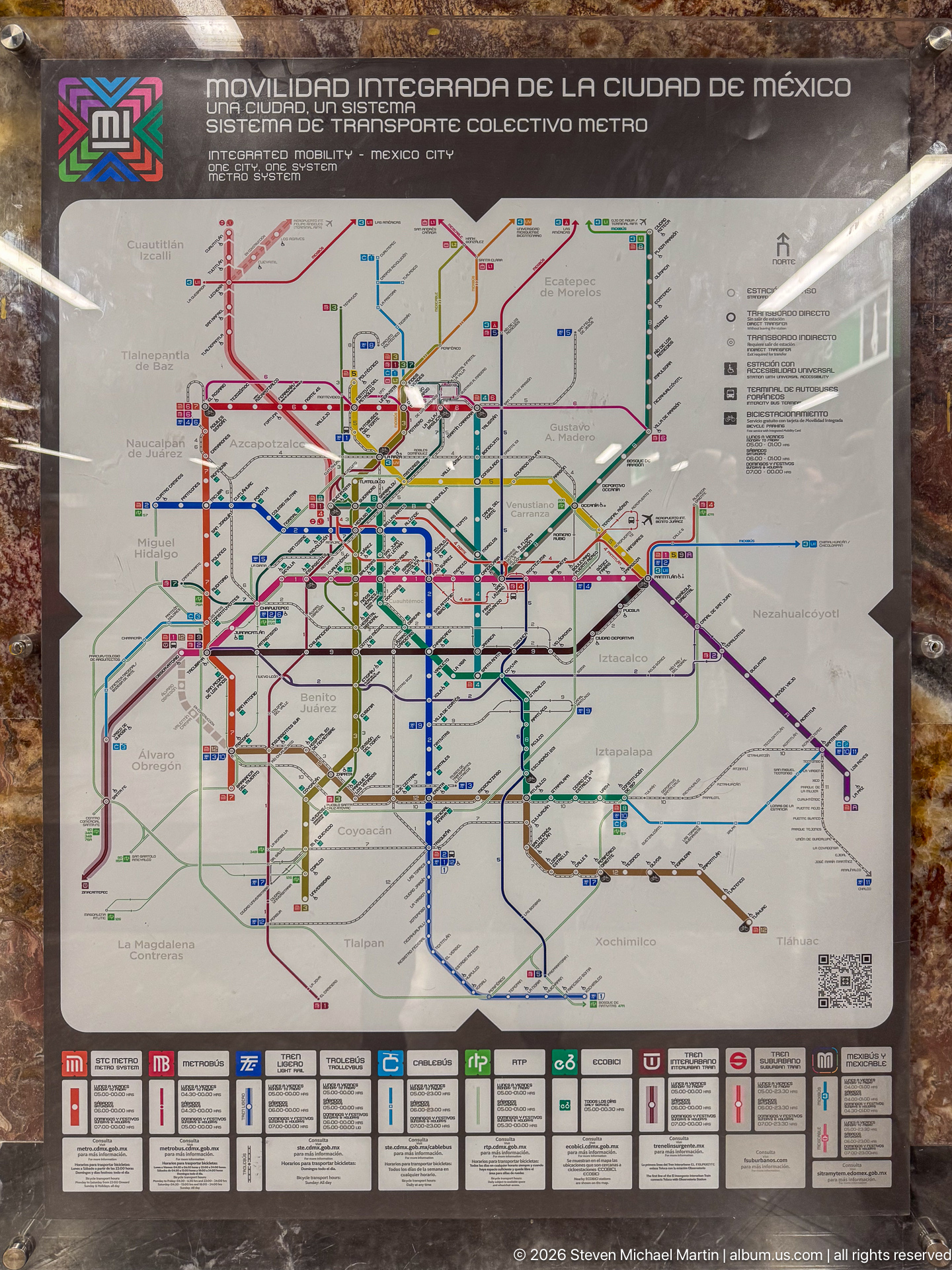
A large printed map presents the Mexico City Metro network as intersecting colored lines, station names, and interchange symbols. The title at the top identifies the city’s integrated public transport system, while a legend along the lower edge explains line and service symbols. Glare from the protective cover crosses the diagram, but the composition still records the map as a practical guide to navigating the metropolis.
Caption
A large printed map presents the Mexico City Metro network as intersecting colored lines, station names, and interchange symbols. The title at the top identifies the city’s integrated public transport system, while a legend along the lower edge explains line and service symbols. Glare from the protective cover crosses the diagram, but the composition still records the map as a practical guide to navigating the metropolis.
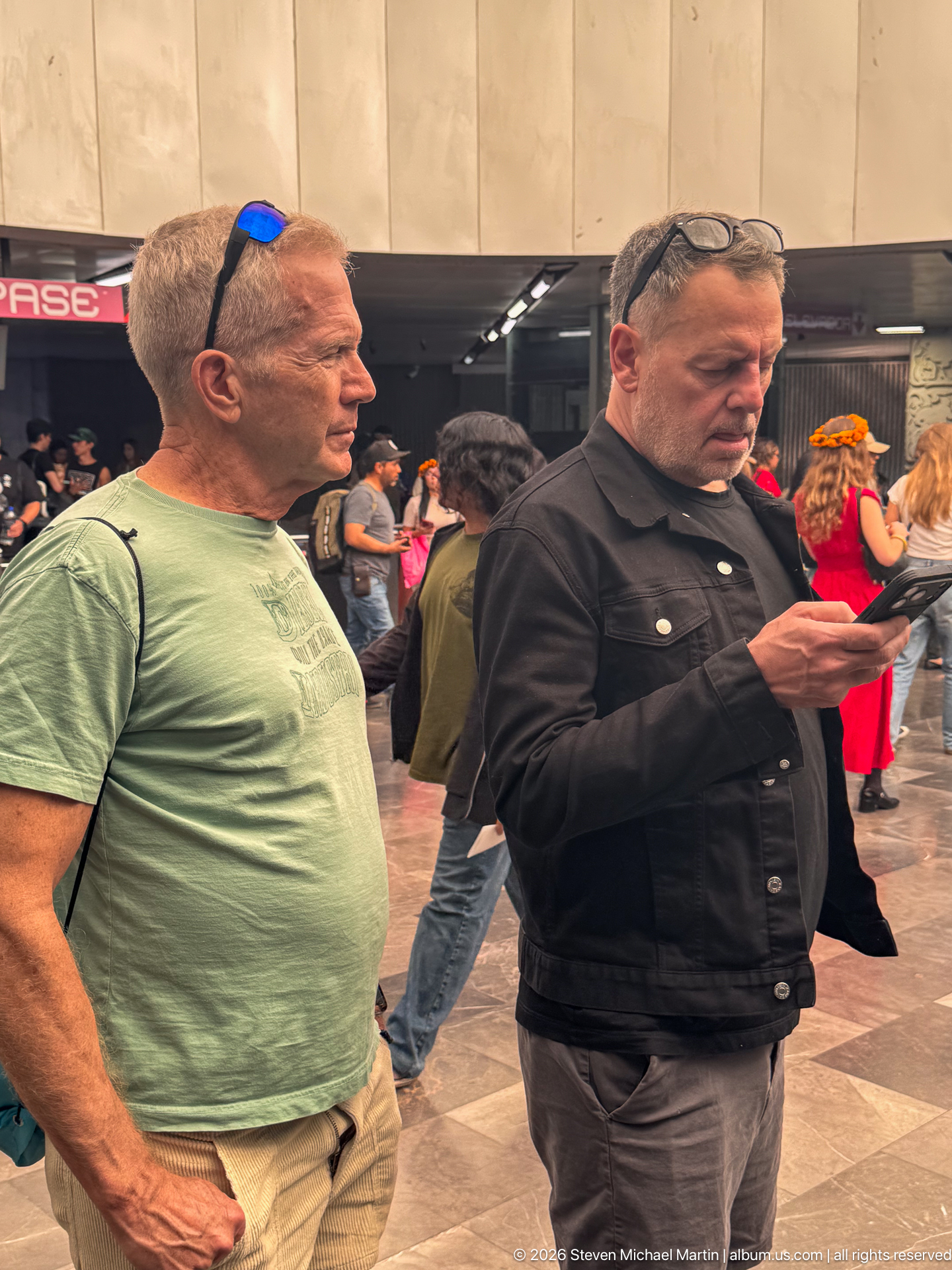
Two visitors stand in the foreground of a crowded transit concourse, one looking at a phone while the other faces the flow of pedestrians. Behind them, travelers wearing orange marigold accessories and colorful clothing move through the hall. The scene connects everyday navigation with the visible festival season, while keeping the focus on the pair’s pause amid the crowd.
Caption
Two visitors stand in the foreground of a crowded transit concourse, one looking at a phone while the other faces the flow of pedestrians. Behind them, travelers wearing orange marigold accessories and colorful clothing move through the hall. The scene connects everyday navigation with the visible festival season, while keeping the focus on the pair’s pause amid the crowd.
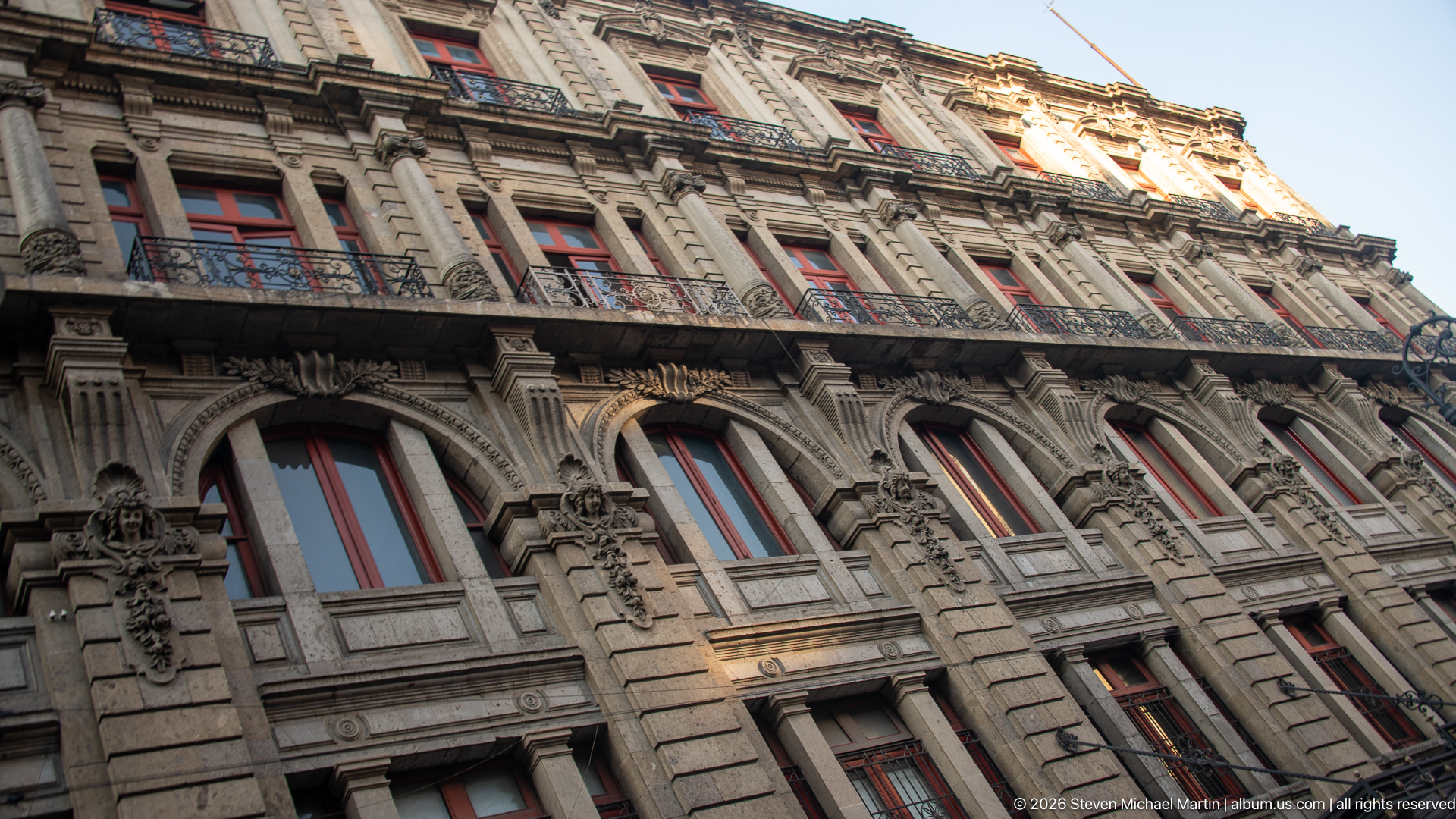
The steep upward view follows a long stone façade articulated by stacked windows, red-painted frames, iron balconies, and repeated sculpted surrounds. Strong afternoon light catches the upper cornice while the lower stories remain in shade, making the building’s vertical rhythm especially clear. No street sign identifies the address, so this image is best treated as an architectural streetscape rather than a named landmark portrait.
Caption
The steep upward view follows a long stone façade articulated by stacked windows, red-painted frames, iron balconies, and repeated sculpted surrounds. Strong afternoon light catches the upper cornice while the lower stories remain in shade, making the building’s vertical rhythm especially clear. No street sign identifies the address, so this image is best treated as an architectural streetscape rather than a named landmark portrait.
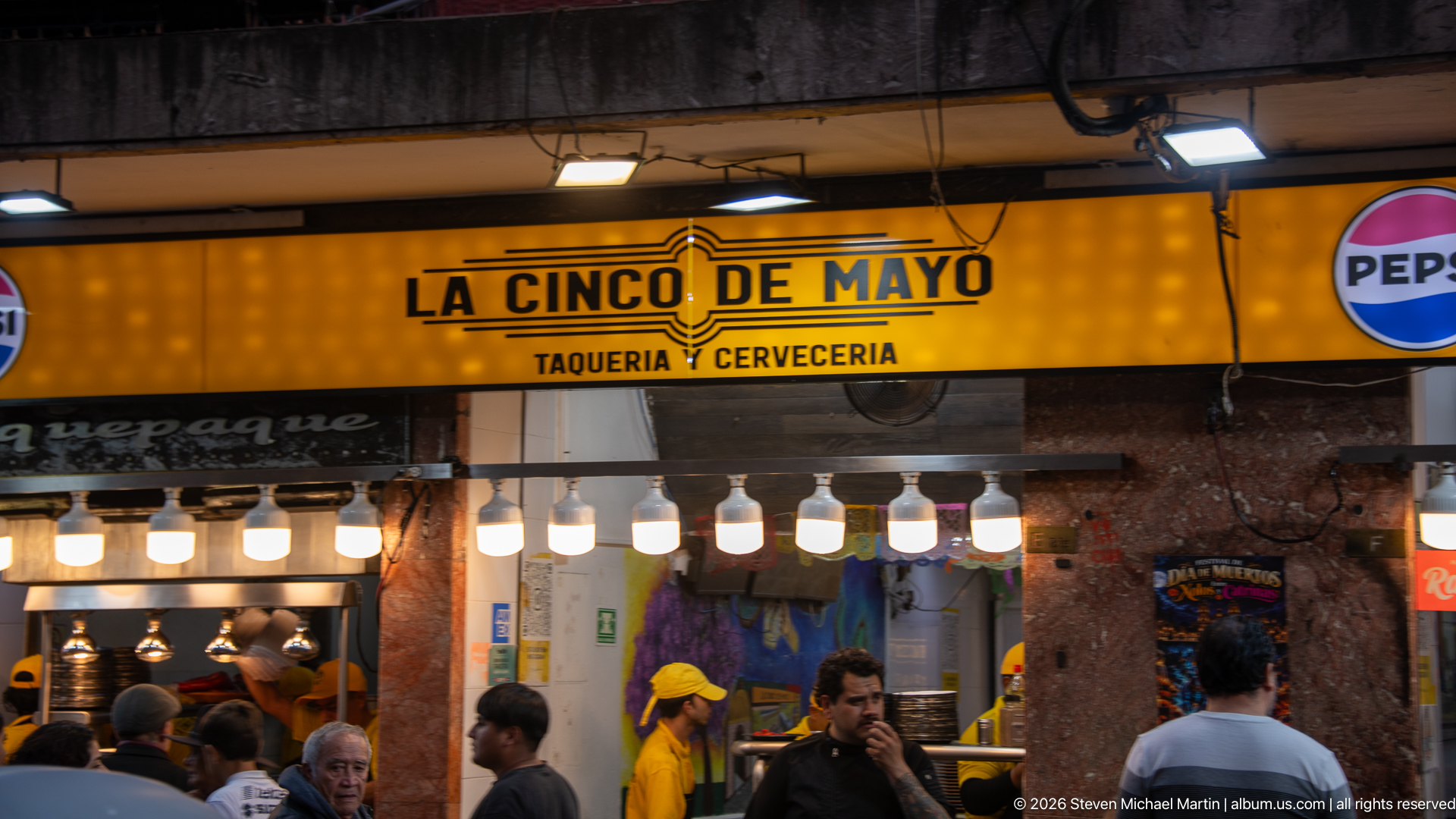
A bright yellow sign names “La Cinco de Mayo” and identifies the business as a taquería y cervecería. Below it, a compact service counter glows under a row of pendant bulbs as customers gather close to the opening. The legible sign grounds the scene in a specific eatery; the photograph documents its street-facing frontage and active counter rather than a particular dish.
Caption
A bright yellow sign names “La Cinco de Mayo” and identifies the business as a taquería y cervecería. Below it, a compact service counter glows under a row of pendant bulbs as customers gather close to the opening. The legible sign grounds the scene in a specific eatery; the photograph documents its street-facing frontage and active counter rather than a particular dish.
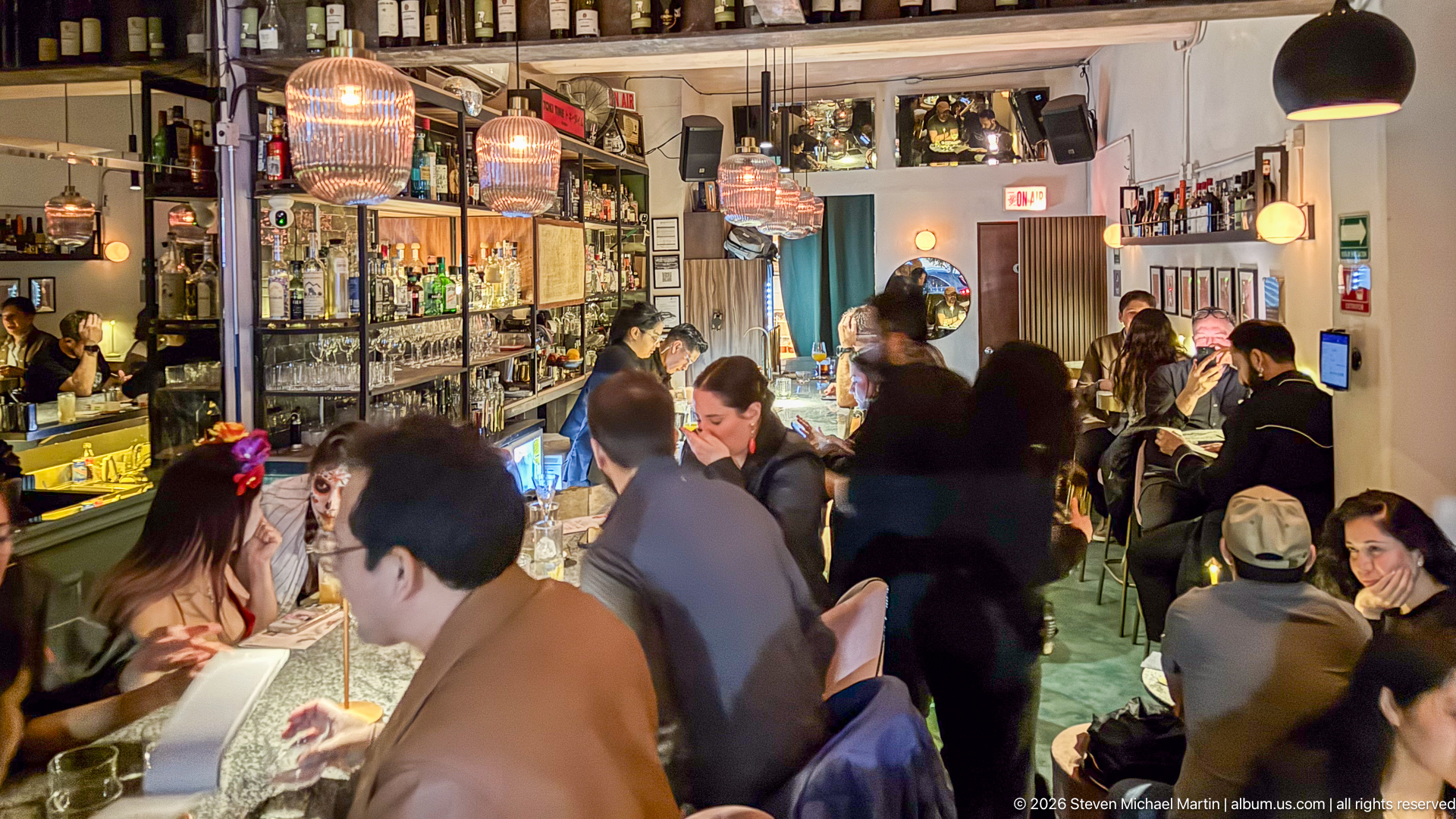
Customers sit shoulder to shoulder along a narrow counter beneath hanging glass lights, with shelves of bottles and glassware lining the wall. A guest with elaborate calavera-style face paint appears near the foreground, linking this restaurant visit to the visible Día de Muertos season. The lively interior and close seating define the scene; no readable name in the frame establishes which venue it is.
Caption
Customers sit shoulder to shoulder along a narrow counter beneath hanging glass lights, with shelves of bottles and glassware lining the wall. A guest with elaborate calavera-style face paint appears near the foreground, linking this restaurant visit to the visible Día de Muertos season. The lively interior and close seating define the scene; no readable name in the frame establishes which venue it is.
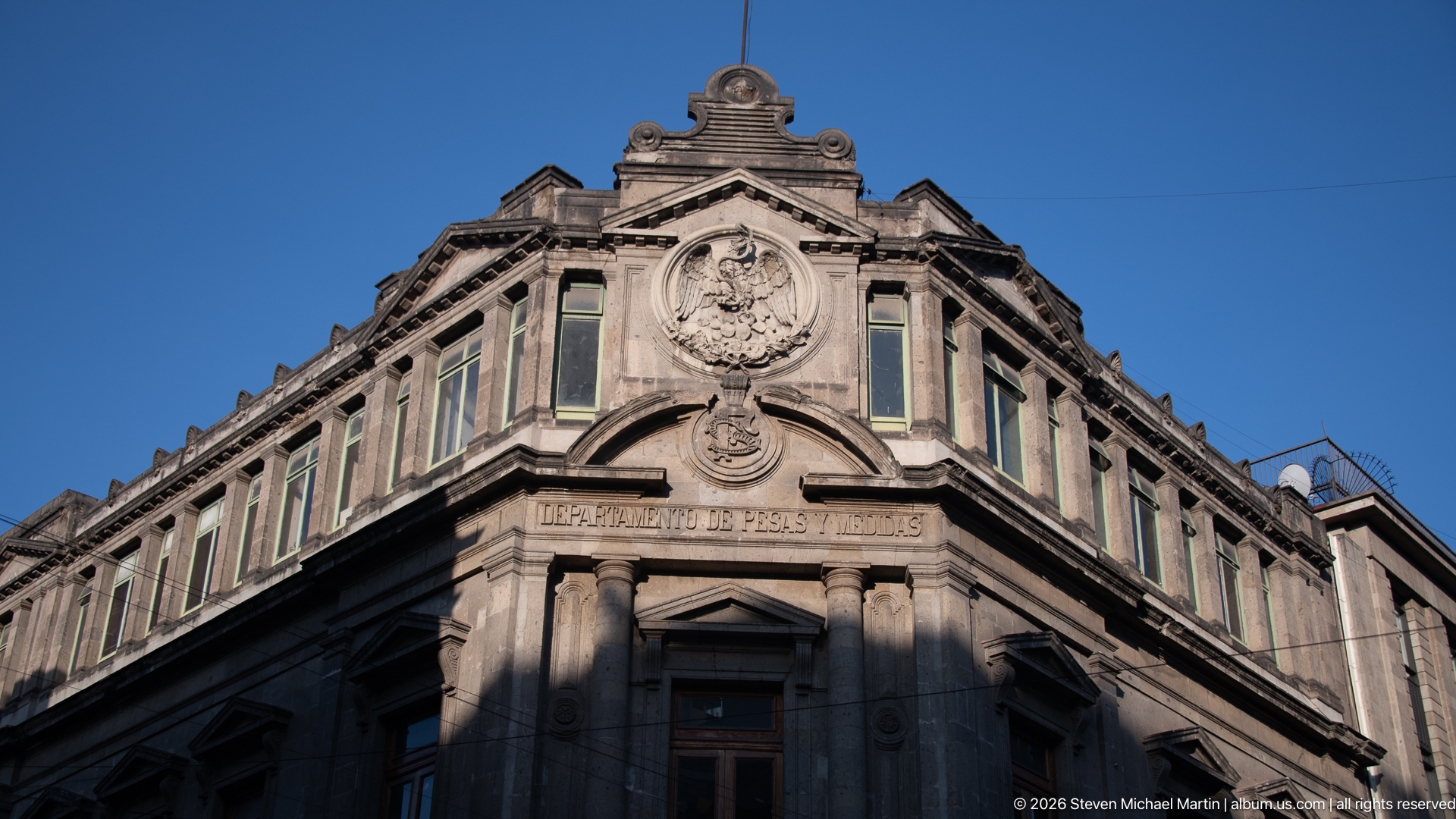
The building’s upper corner rises against a clear blue sky, with an oval relief medallion above the carved words “Departamento de Pesas y Medidas.” Classical columns and layered cornices frame the inscription, which identifies the institution directly on the façade. The upward viewpoint isolates the historic stonework and lettering from street-level activity, making the department name the key documentary feature.
Caption
The building’s upper corner rises against a clear blue sky, with an oval relief medallion above the carved words “Departamento de Pesas y Medidas.” Classical columns and layered cornices frame the inscription, which identifies the institution directly on the façade. The upward viewpoint isolates the historic stonework and lettering from street-level activity, making the department name the key documentary feature.
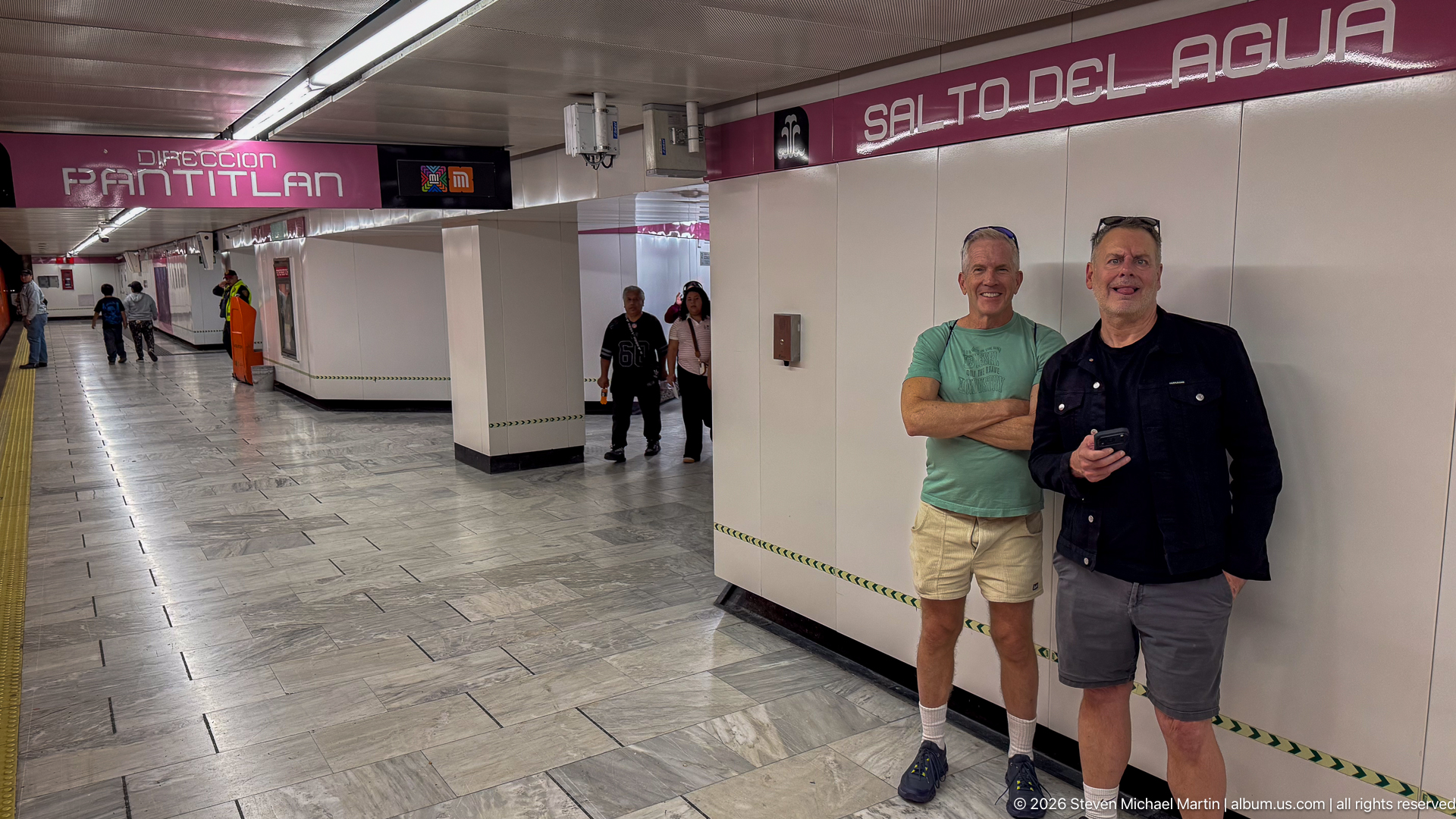
Two travelers stand beside a tiled station wall beneath signs for Salto del Agua and Dirección Pantitlán. The long, bright corridor recedes behind them, where other passengers move through the station. Their posed presence turns a transit space into a personal travel record, while the clearly legible station name fixes the scene within Mexico City’s Metro network.
Caption
Two travelers stand beside a tiled station wall beneath signs for Salto del Agua and Dirección Pantitlán. The long, bright corridor recedes behind them, where other passengers move through the station. Their posed presence turns a transit space into a personal travel record, while the clearly legible station name fixes the scene within Mexico City’s Metro network.
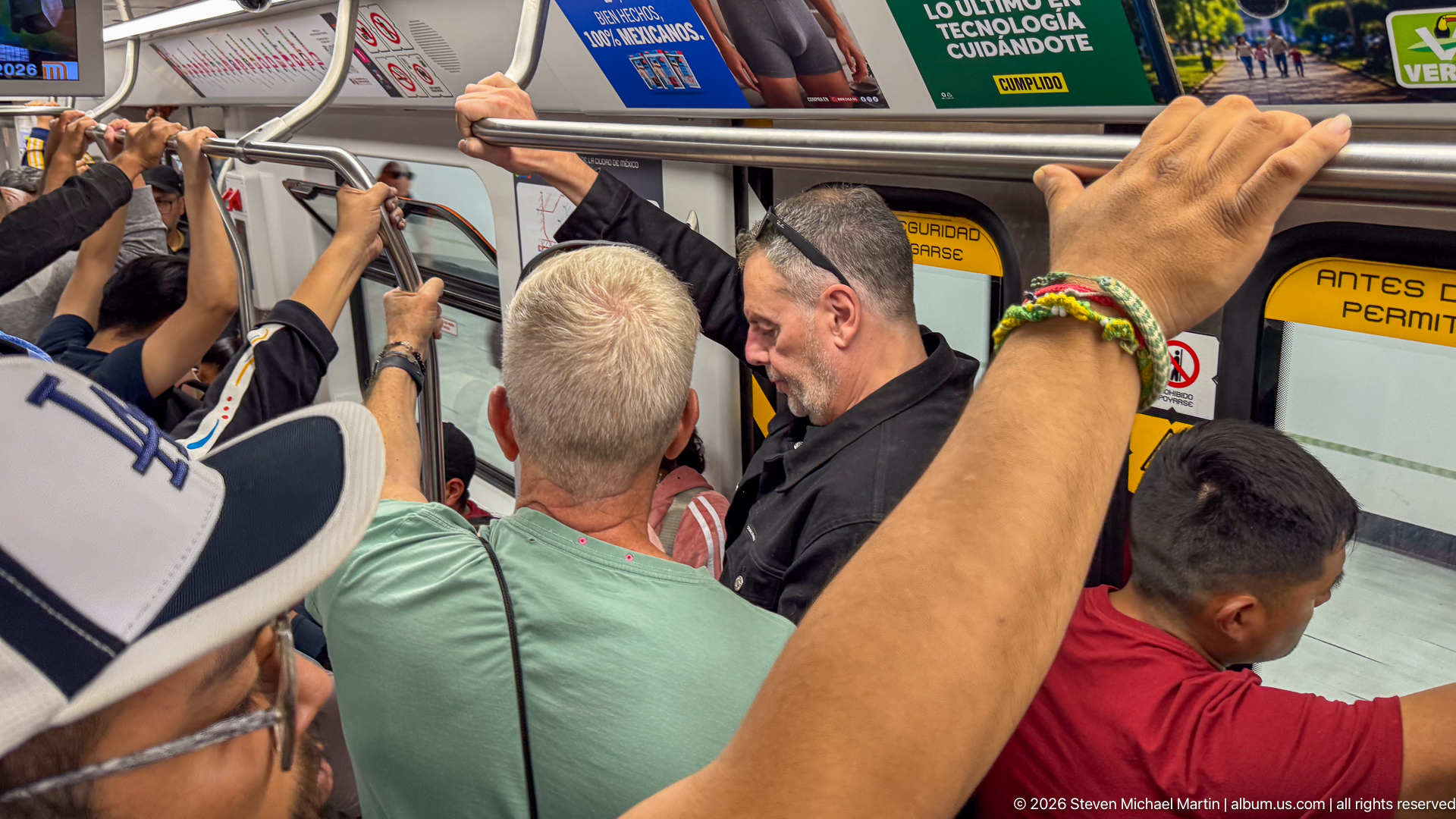
Passengers press around an open train doorway, holding overhead rails as they enter or make room for others. The close perspective places the viewer within the crowd, with safety labels and advertisements visible above the doors. The scene conveys the density and movement of daily transit in Mexico City without establishing a particular time of day or route.
Caption
Passengers press around an open train doorway, holding overhead rails as they enter or make room for others. The close perspective places the viewer within the crowd, with safety labels and advertisements visible above the doors. The scene conveys the density and movement of daily transit in Mexico City without establishing a particular time of day or route.
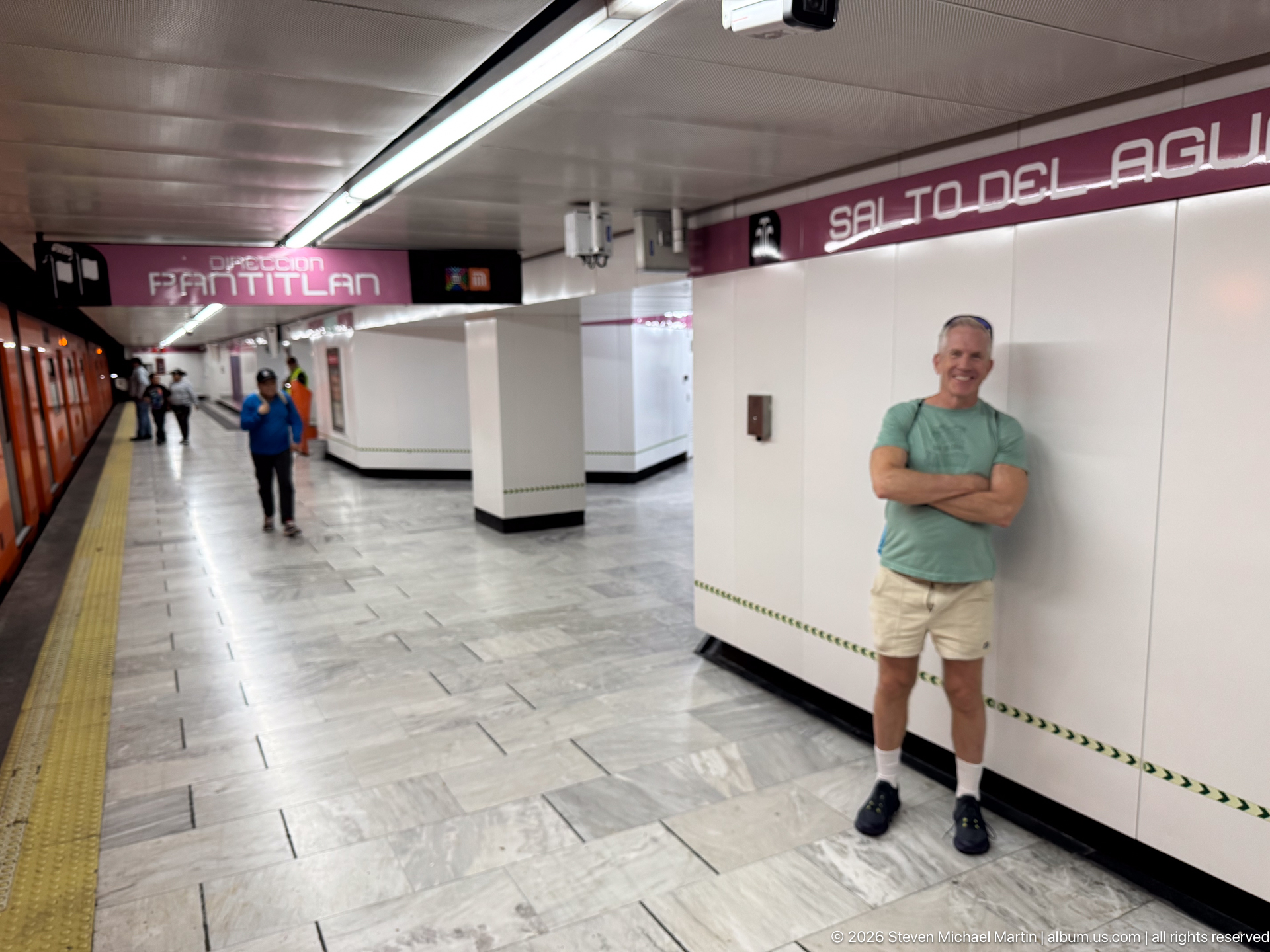
A traveler stands against the clean white-tiled wall of Salto del Agua station, framed by a long, mostly open platform. The magenta station band and directional labels stretch above him, while a yellow tactile strip guides movement along the platform edge. This quieter portrait contrasts with the crowded train interior and makes the station’s modern finishes and wayfinding legible.
Caption
A traveler stands against the clean white-tiled wall of Salto del Agua station, framed by a long, mostly open platform. The magenta station band and directional labels stretch above him, while a yellow tactile strip guides movement along the platform edge. This quieter portrait contrasts with the crowded train interior and makes the station’s modern finishes and wayfinding legible.
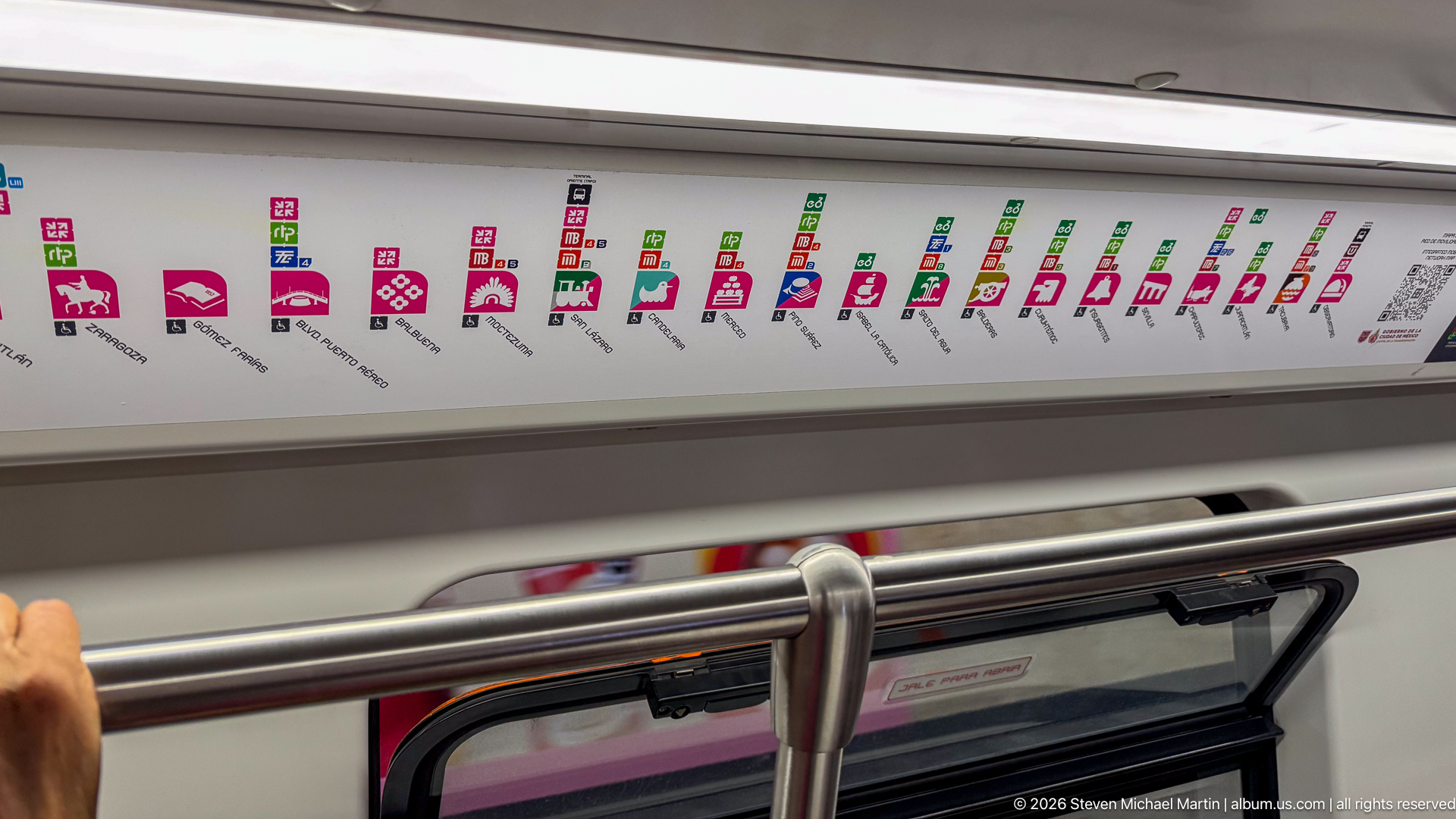
A long route diagram runs above the train windows, using colored line segments, station names, and pictograms to orient riders. The view is cropped closely enough that the map’s sequence, rather than any single station, becomes the subject. Metal grab rails cross the lower frame and the window reflects part of the carriage, placing this wayfinding graphic inside an operating Metro car.
Caption
A long route diagram runs above the train windows, using colored line segments, station names, and pictograms to orient riders. The view is cropped closely enough that the map’s sequence, rather than any single station, becomes the subject. Metal grab rails cross the lower frame and the window reflects part of the carriage, placing this wayfinding graphic inside an operating Metro car.
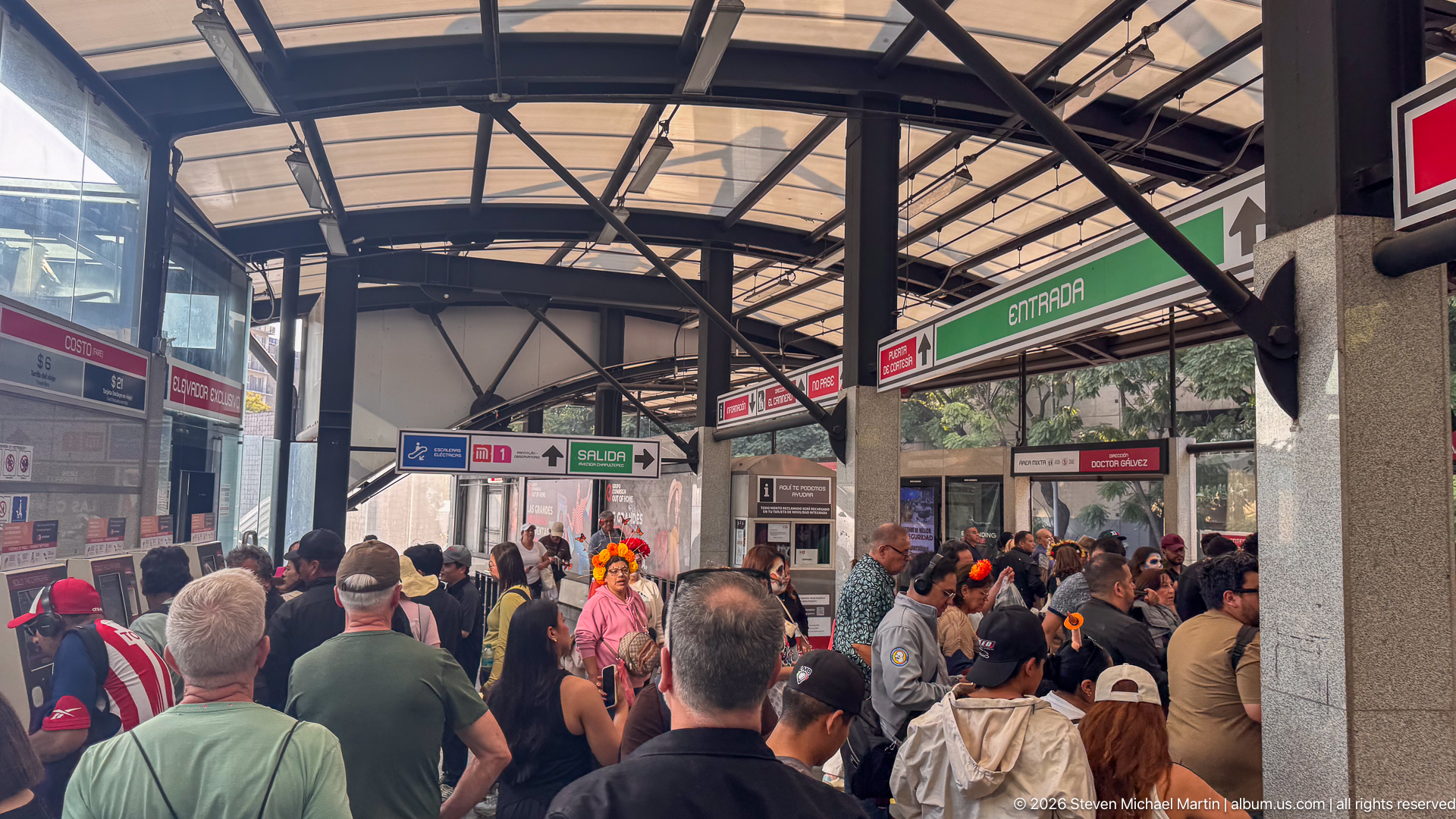
A dense crowd gathers under the steel-and-glass roof of a station entrance, where several people wear orange marigold crowns and colorful clothing associated with Día de Muertos festivities. Green exit signs and route panels hang above the flow of passengers. The broad view captures the intersection of the city’s transit infrastructure and a public celebration without assigning the gathering to a specific event.
Caption
A dense crowd gathers under the steel-and-glass roof of a station entrance, where several people wear orange marigold crowns and colorful clothing associated with Día de Muertos festivities. Green exit signs and route panels hang above the flow of passengers. The broad view captures the intersection of the city’s transit infrastructure and a public celebration without assigning the gathering to a specific event.
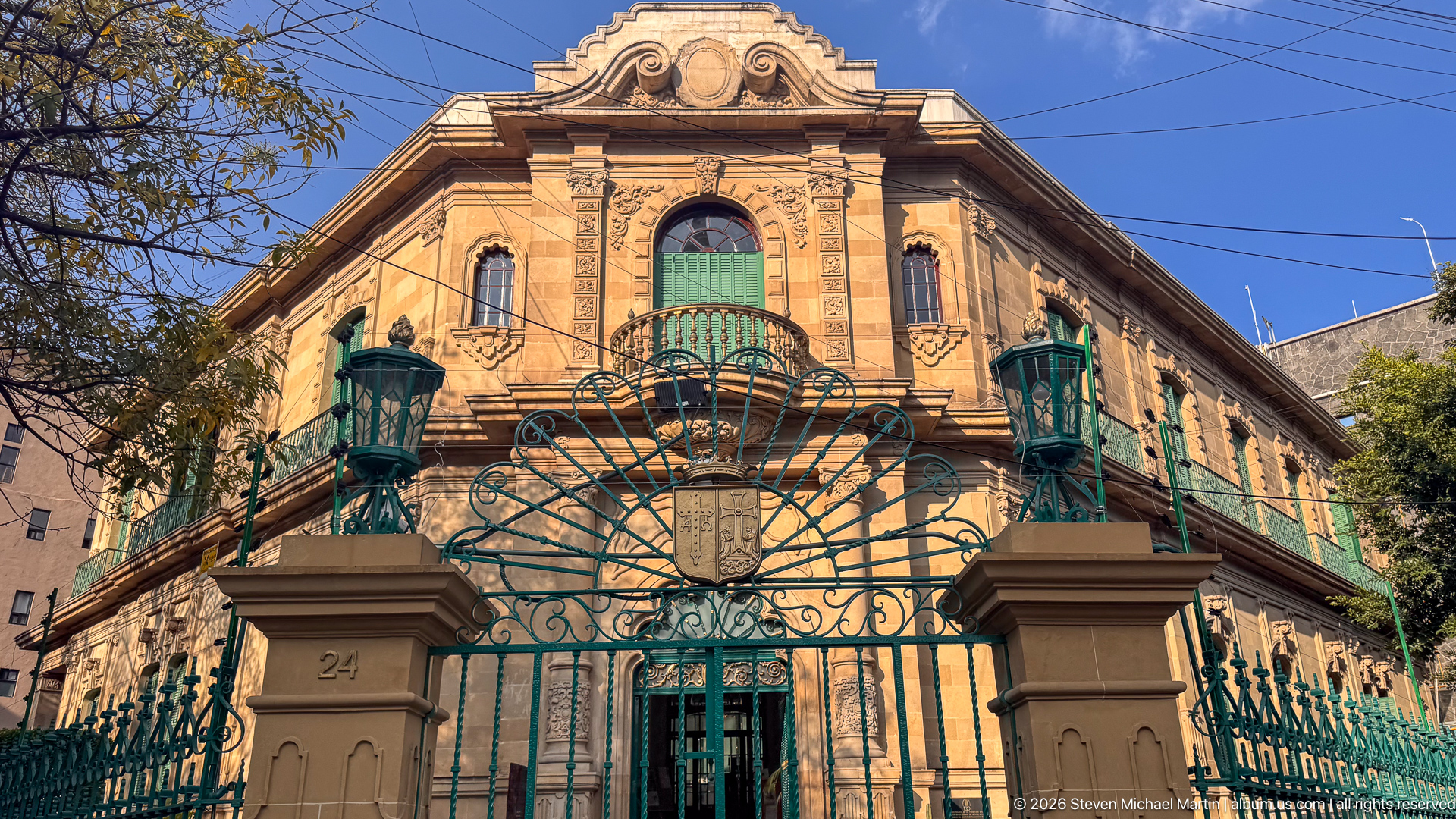
A pale stone corner building rises behind a tall green wrought-iron gate with a fan-shaped scrollwork crest. Carved window surrounds, a small central balcony, and a stepped pediment articulate the upper façade, while overhead cables cross the blue sky. The low viewpoint makes the entrance architecture and the building’s corner address read together as a single urban composition.
Caption
A pale stone corner building rises behind a tall green wrought-iron gate with a fan-shaped scrollwork crest. Carved window surrounds, a small central balcony, and a stepped pediment articulate the upper façade, while overhead cables cross the blue sky. The low viewpoint makes the entrance architecture and the building’s corner address read together as a single urban composition.
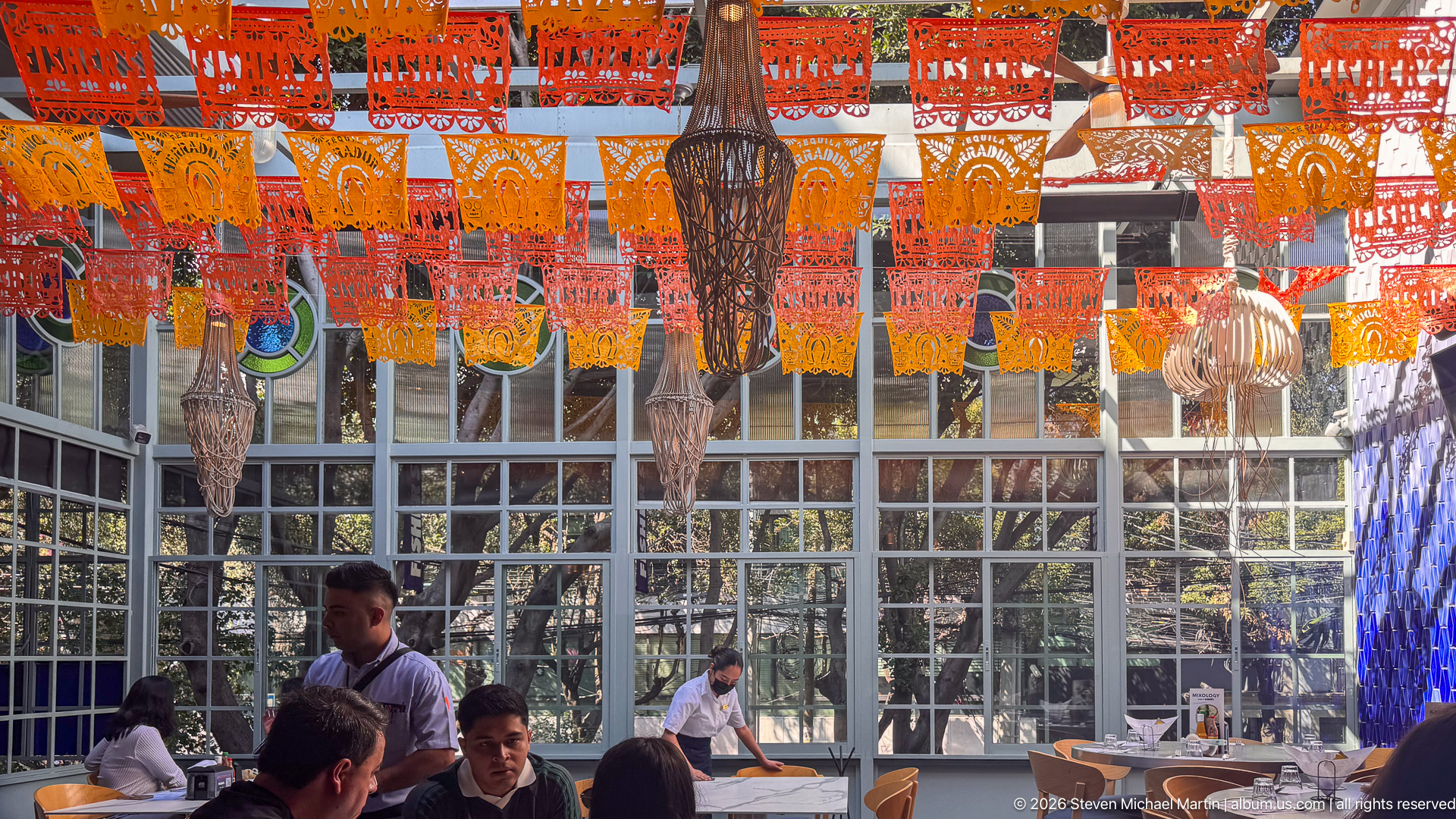
Diners sit at tables in a bright glass-walled restaurant beneath rows of orange and red papel picado. Large windows and a leafy outdoor view give the room an airy, contemporary character, while the cut-paper banners signal Día de Muertos decoration. Staff move between tables and guests converse, placing the festive ornament within an active meal rather than a staged display.
Caption
Diners sit at tables in a bright glass-walled restaurant beneath rows of orange and red papel picado. Large windows and a leafy outdoor view give the room an airy, contemporary character, while the cut-paper banners signal Día de Muertos decoration. Staff move between tables and guests converse, placing the festive ornament within an active meal rather than a staged display.
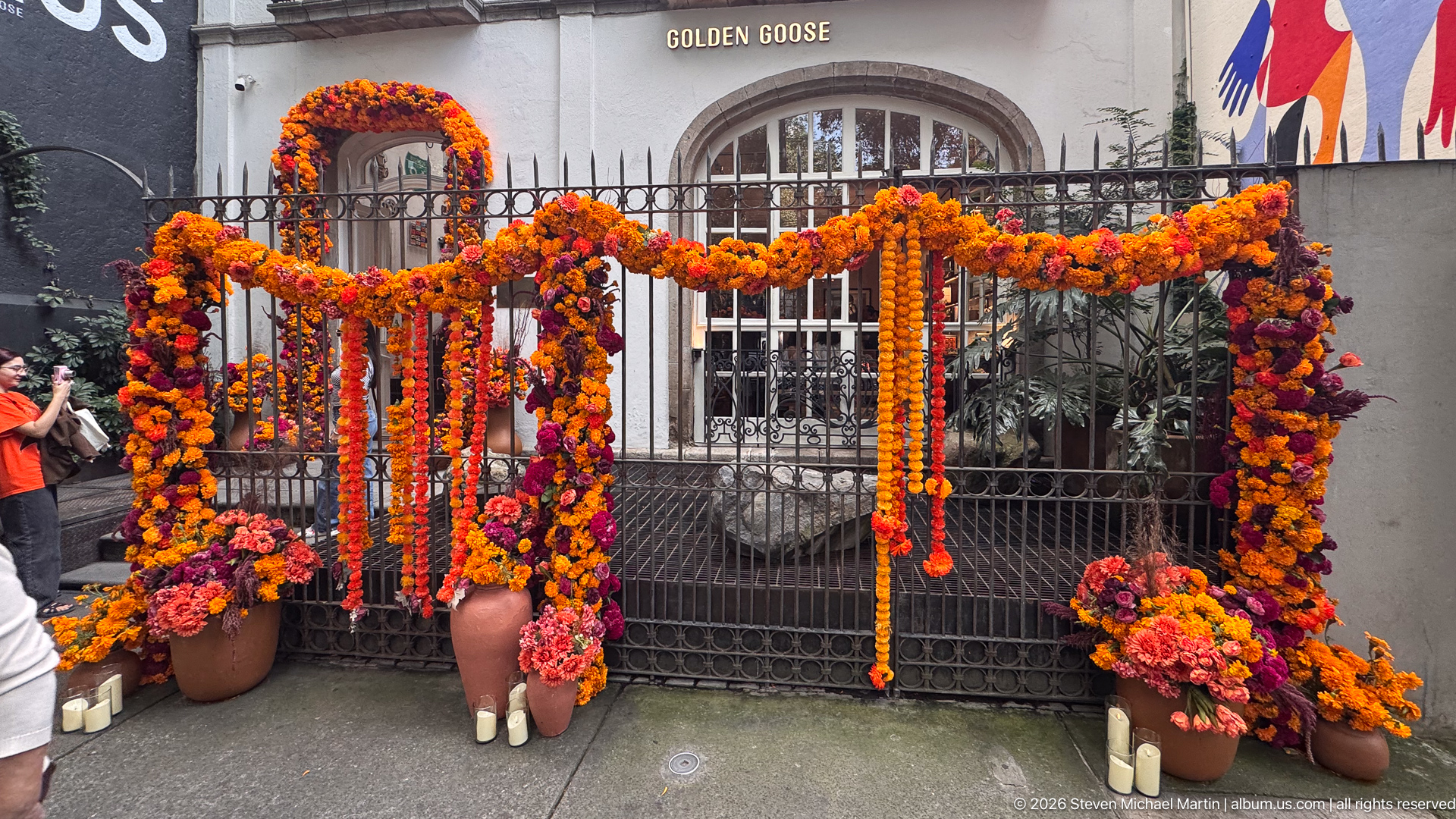
Orange and magenta marigolds form a festive arch and hanging garlands across a black iron fence outside a storefront marked “GOLDEN GOOSE.” Clay pots, small candles, and dense flowers create a Día de Muertos display that transforms the commercial frontage into a seasonal installation. The readable sign situates the arrangement, while the flowers and candles—not the shop itself—dominate the scene.
Caption
Orange and magenta marigolds form a festive arch and hanging garlands across a black iron fence outside a storefront marked “GOLDEN GOOSE.” Clay pots, small candles, and dense flowers create a Día de Muertos display that transforms the commercial frontage into a seasonal installation. The readable sign situates the arrangement, while the flowers and candles—not the shop itself—dominate the scene.
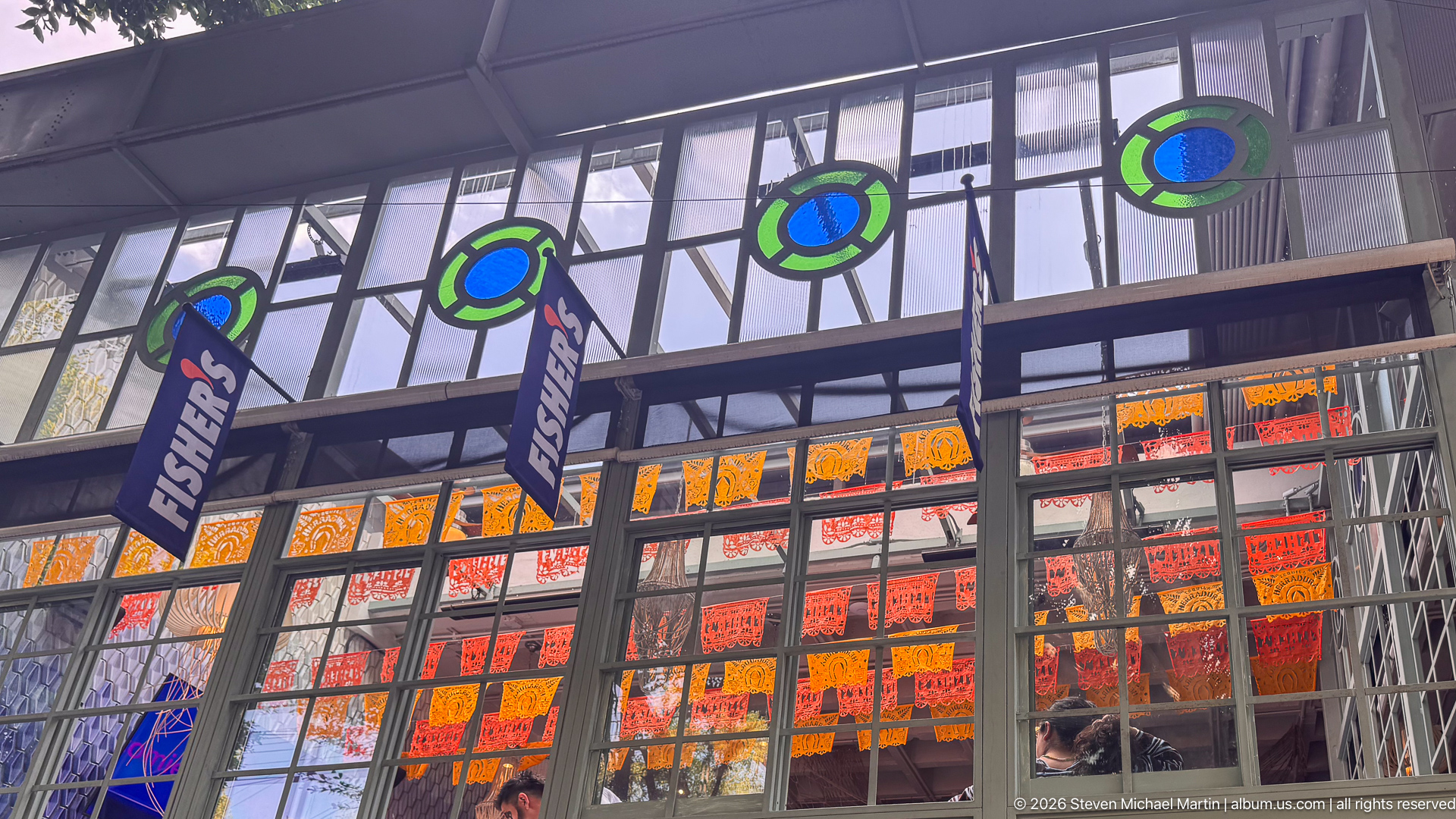
The word “Fisher’s” appears on a dark banner outside a glass-fronted restaurant, whose tall windows reveal orange and red papel picado hanging inside. Blue-green circular ornaments punctuate the upper glazing, creating a strong modern façade composition. The legible branding identifies the venue, while the layered festival decorations connect the restaurant frontage to the city’s Día de Muertos season.
Caption
The word “Fisher’s” appears on a dark banner outside a glass-fronted restaurant, whose tall windows reveal orange and red papel picado hanging inside. Blue-green circular ornaments punctuate the upper glazing, creating a strong modern façade composition. The legible branding identifies the venue, while the layered festival decorations connect the restaurant frontage to the city’s Día de Muertos season.
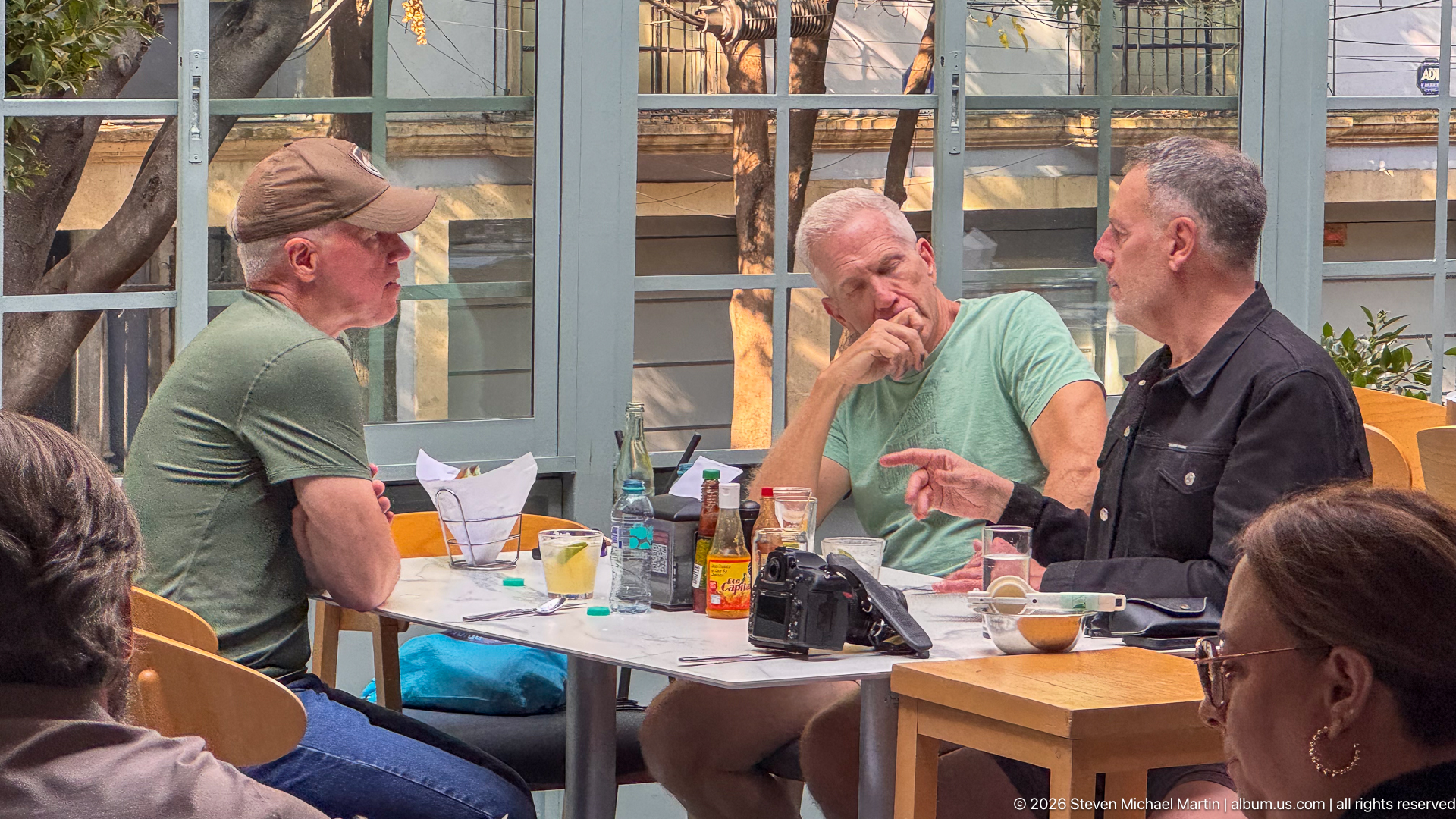
Three companions sit around a table in a bright, glass-walled dining area, leaning toward one another in conversation. Glasses, bottles, condiments, and tableware fill the center, while the window grid and tree trunks outside create a calm backdrop. The candid viewpoint favors the shared meal and social exchange over the room’s architecture, preserving the scene as a personal restaurant moment.
Caption
Three companions sit around a table in a bright, glass-walled dining area, leaning toward one another in conversation. Glasses, bottles, condiments, and tableware fill the center, while the window grid and tree trunks outside create a calm backdrop. The candid viewpoint favors the shared meal and social exchange over the room’s architecture, preserving the scene as a personal restaurant moment.
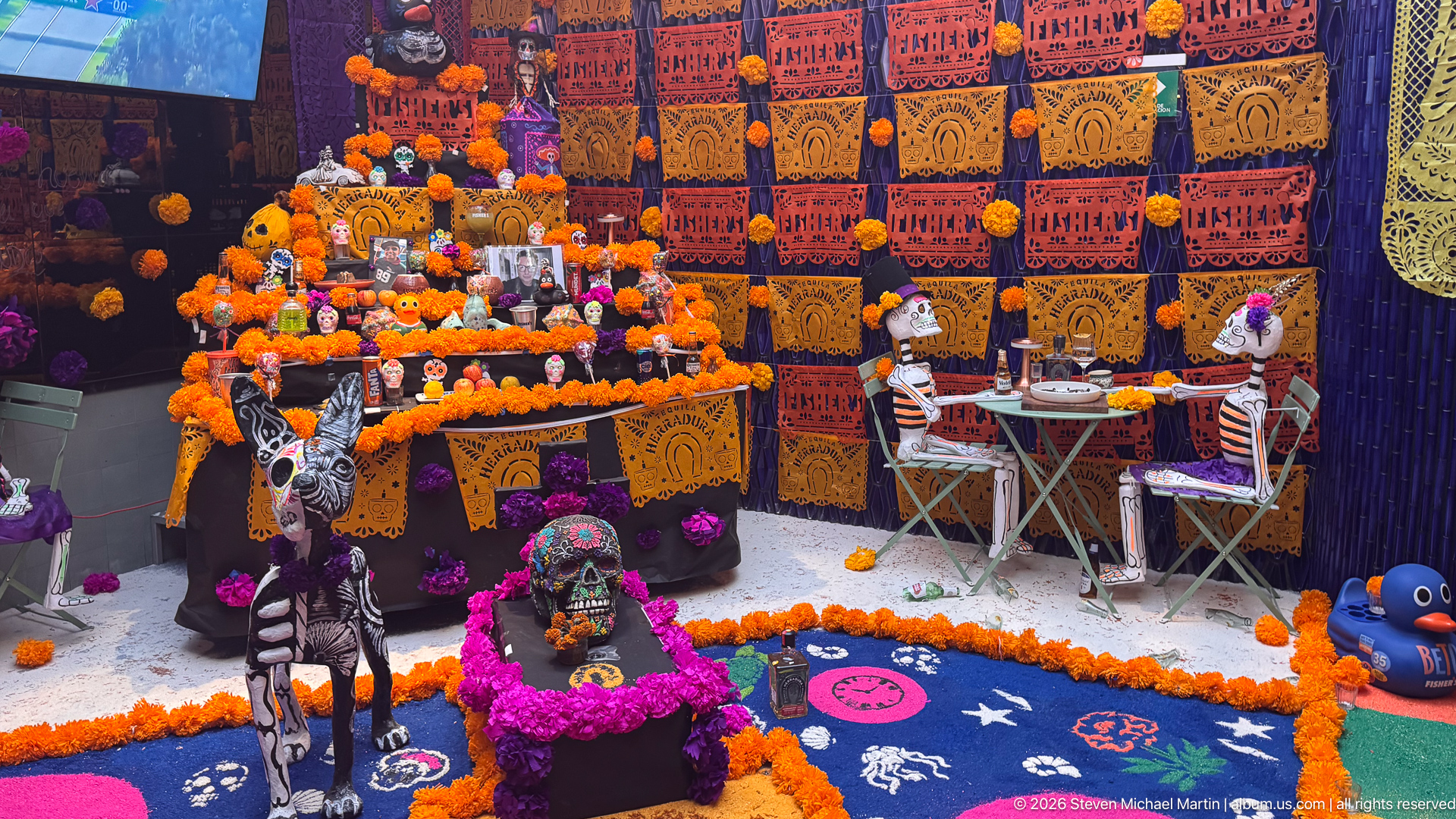
A long display table is covered with marigolds, candles, painted skulls, and small skeleton figures beneath dense rows of orange and red papel picado. An altar-like arrangement extends across the restaurant frontage, with floral borders framing colorful objects and textiles on the floor. These unmistakable seasonal elements make the Día de Muertos setting central to the photograph rather than incidental décor.
Caption
A long display table is covered with marigolds, candles, painted skulls, and small skeleton figures beneath dense rows of orange and red papel picado. An altar-like arrangement extends across the restaurant frontage, with floral borders framing colorful objects and textiles on the floor. These unmistakable seasonal elements make the Día de Muertos setting central to the photograph rather than incidental décor.
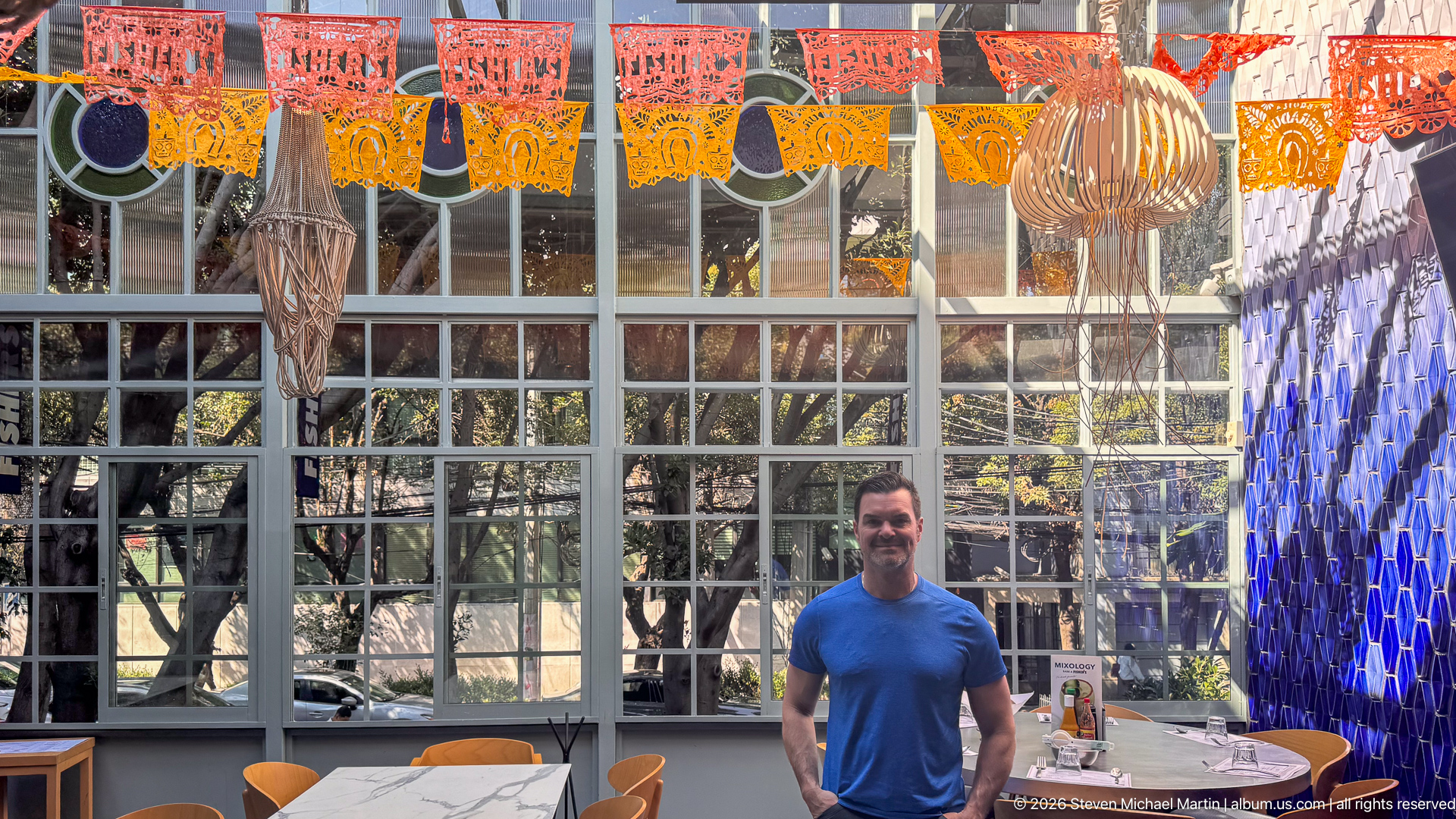
A man in a blue shirt stands between empty dining tables and the glass wall of a restaurant decorated with papel picado. Circular blue-green motifs repeat above the windows, and warm hanging lamps are visible inside. The view includes both the visitor and the venue’s seasonal setting, linking this portrait to the adjoining restaurant scenes while keeping the subject’s relaxed pose distinct.
Caption
A man in a blue shirt stands between empty dining tables and the glass wall of a restaurant decorated with papel picado. Circular blue-green motifs repeat above the windows, and warm hanging lamps are visible inside. The view includes both the visitor and the venue’s seasonal setting, linking this portrait to the adjoining restaurant scenes while keeping the subject’s relaxed pose distinct.
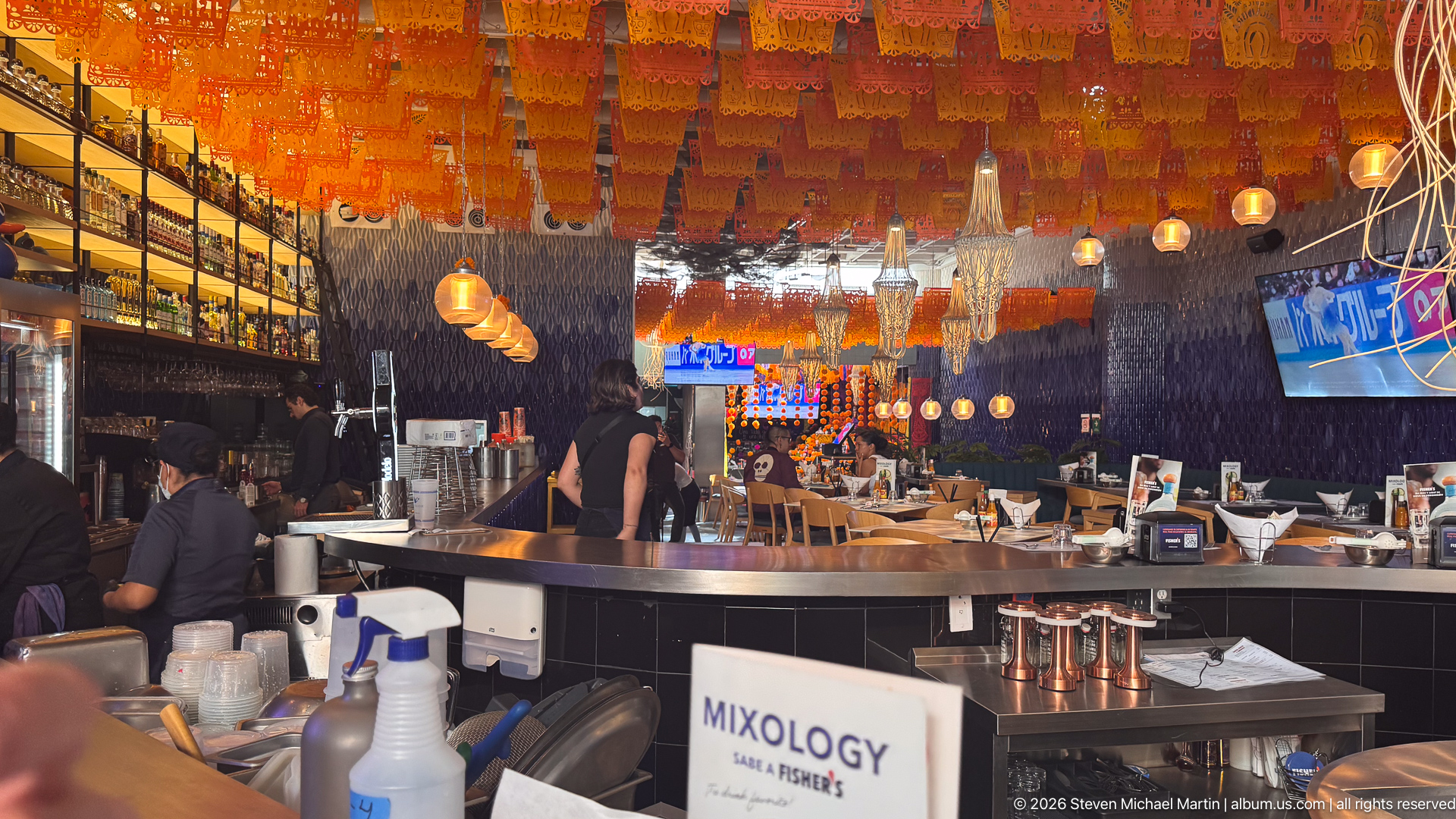
A curved black bar sits beneath rows of orange papel picado and warm pendant lights, with bottles and glassware arranged on illuminated shelves. A prominent counter sign reads “MIXOLOGY BAR AT FISHER’S,” identifying the venue and its cocktail service. Staff work behind the counter while diners occupy the surrounding room, bringing together the restaurant’s bar program and Día de Muertos decoration.
Caption
A curved black bar sits beneath rows of orange papel picado and warm pendant lights, with bottles and glassware arranged on illuminated shelves. A prominent counter sign reads “MIXOLOGY BAR AT FISHER’S,” identifying the venue and its cocktail service. Staff work behind the counter while diners occupy the surrounding room, bringing together the restaurant’s bar program and Día de Muertos decoration.
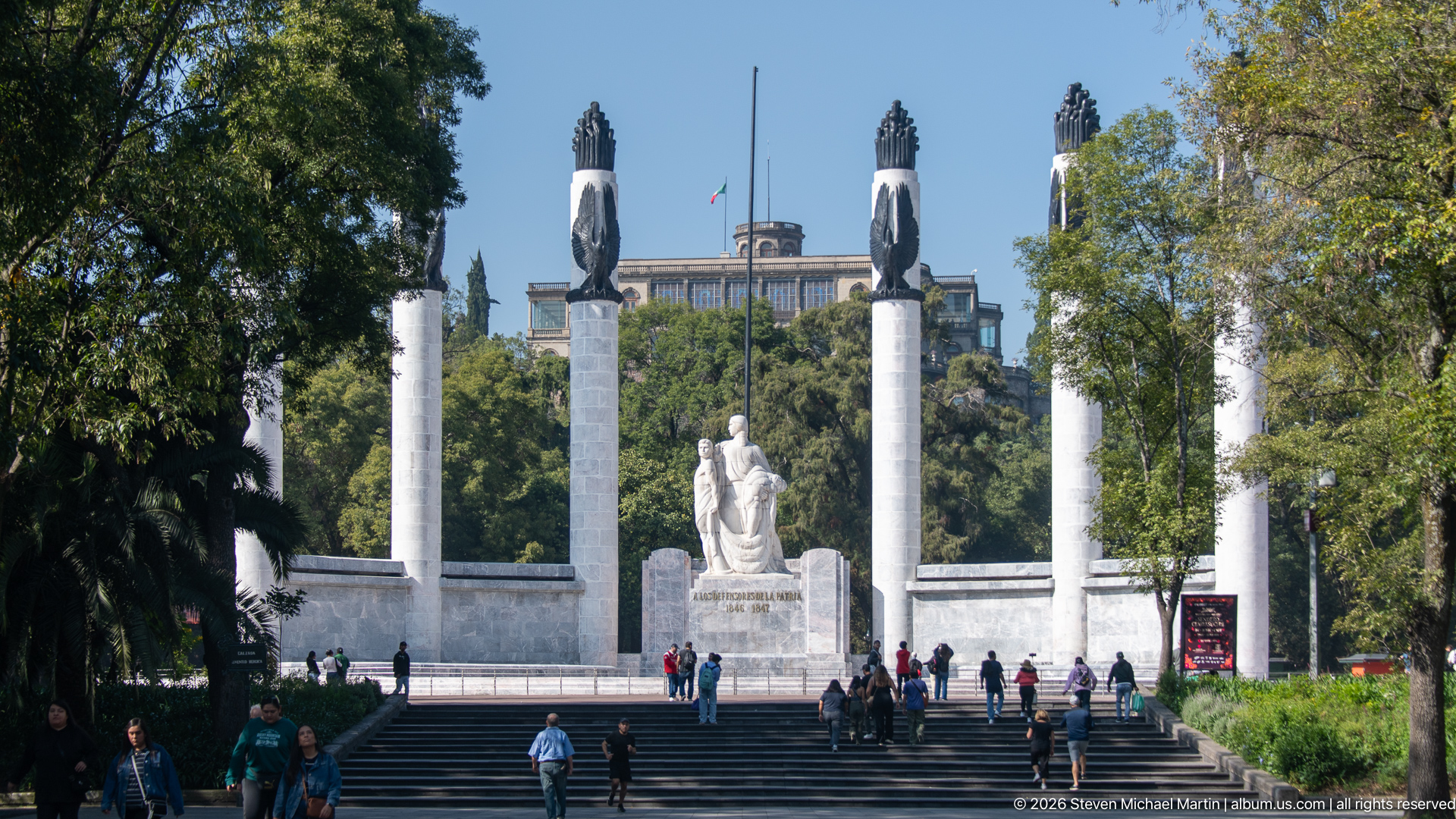
A broad flight of steps leads to a white stone memorial with a central sculptural group and several tall columns topped by dark figures. Visitors gather along the terrace beneath a Mexican flag, while trees frame the view and a formal building rises behind the monument. The image records the memorial as an urban destination, but no legible inscription identifies its exact dedication.
Caption
A broad flight of steps leads to a white stone memorial with a central sculptural group and several tall columns topped by dark figures. Visitors gather along the terrace beneath a Mexican flag, while trees frame the view and a formal building rises behind the monument. The image records the memorial as an urban destination, but no legible inscription identifies its exact dedication.
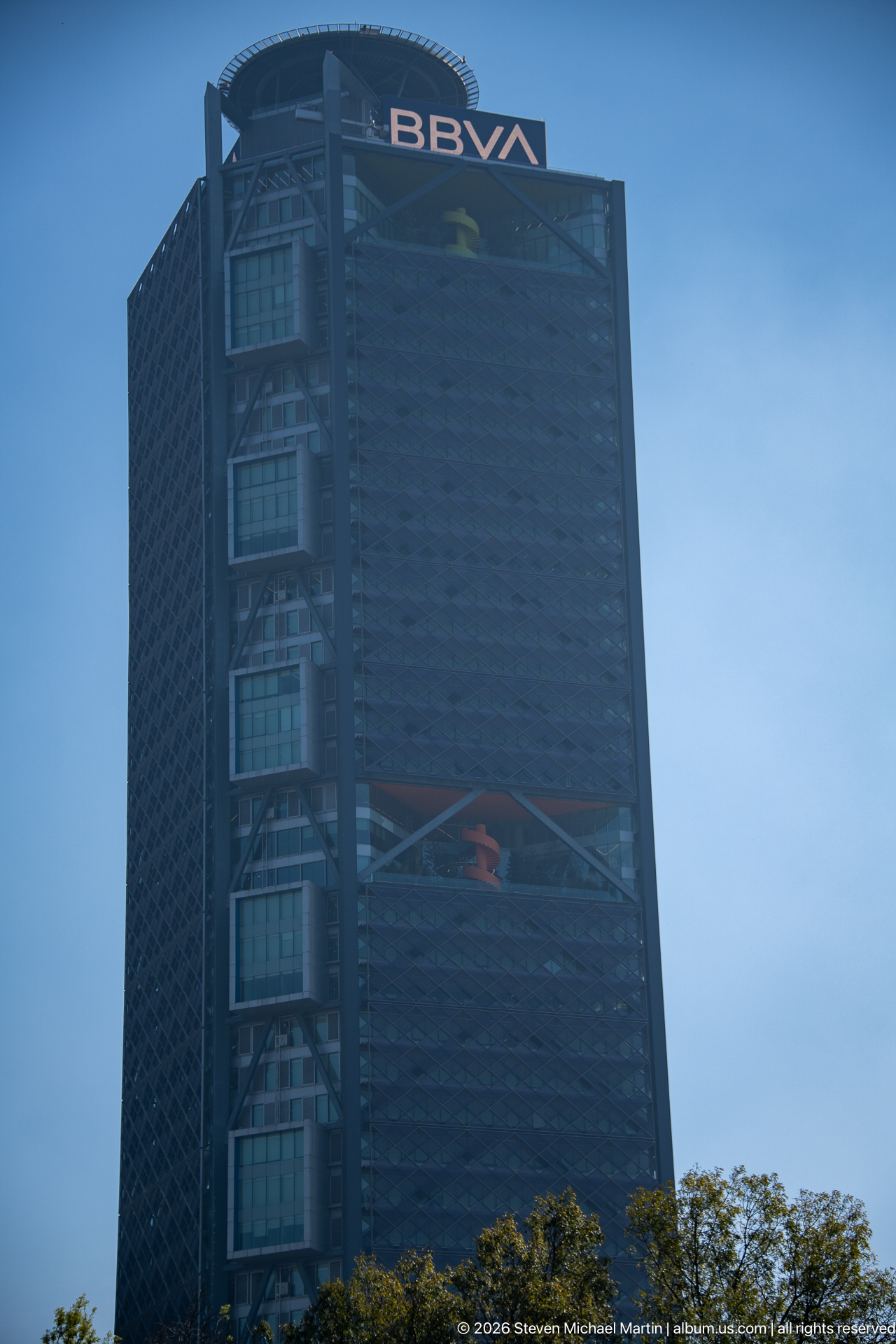
A tall dark-glass office tower rises above a low tree line, its façade arranged in broad reflective planes and a projecting vertical section. The BBVA name is legible near the crown against a clear blue sky. This low-angle city view shifts from the surrounding historic streets to contemporary corporate architecture, documenting the modern skyline within the wider urban center.
Caption
A tall dark-glass office tower rises above a low tree line, its façade arranged in broad reflective planes and a projecting vertical section. The BBVA name is legible near the crown against a clear blue sky. This low-angle city view shifts from the surrounding historic streets to contemporary corporate architecture, documenting the modern skyline within the wider urban center.
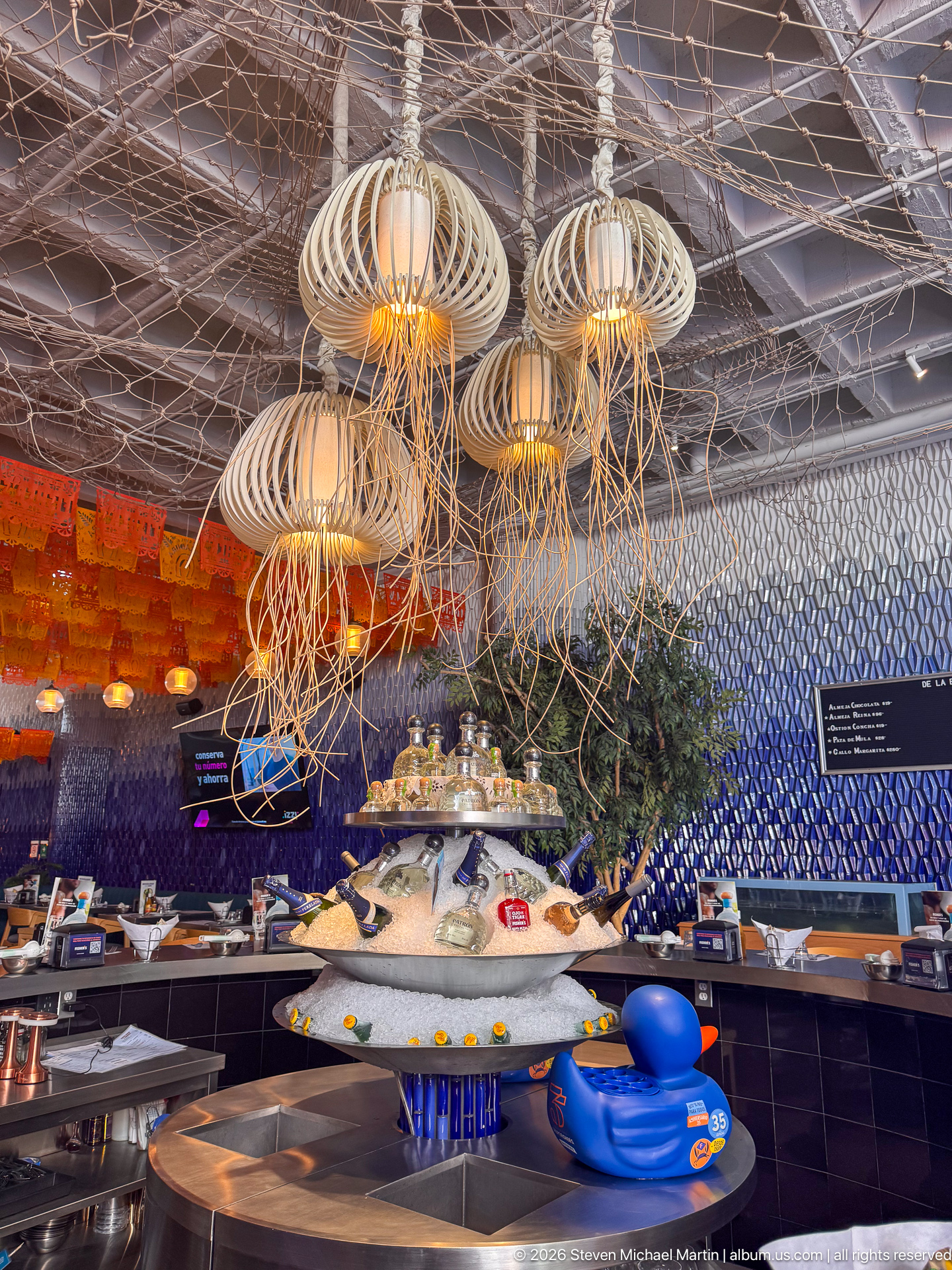
A curved dining counter and display of seafood sit beneath sculptural pendant lights and a web-like ceiling installation. Orange papel picado and warm lamps mark the room for Día de Muertos, while the tiled wall and bar stools give the contemporary restaurant a distinctive interior character. The composition centers on the service counter rather than a plated meal, so no specific dish or menu item can be identified.
Caption
A curved dining counter and display of seafood sit beneath sculptural pendant lights and a web-like ceiling installation. Orange papel picado and warm lamps mark the room for Día de Muertos, while the tiled wall and bar stools give the contemporary restaurant a distinctive interior character. The composition centers on the service counter rather than a plated meal, so no specific dish or menu item can be identified.
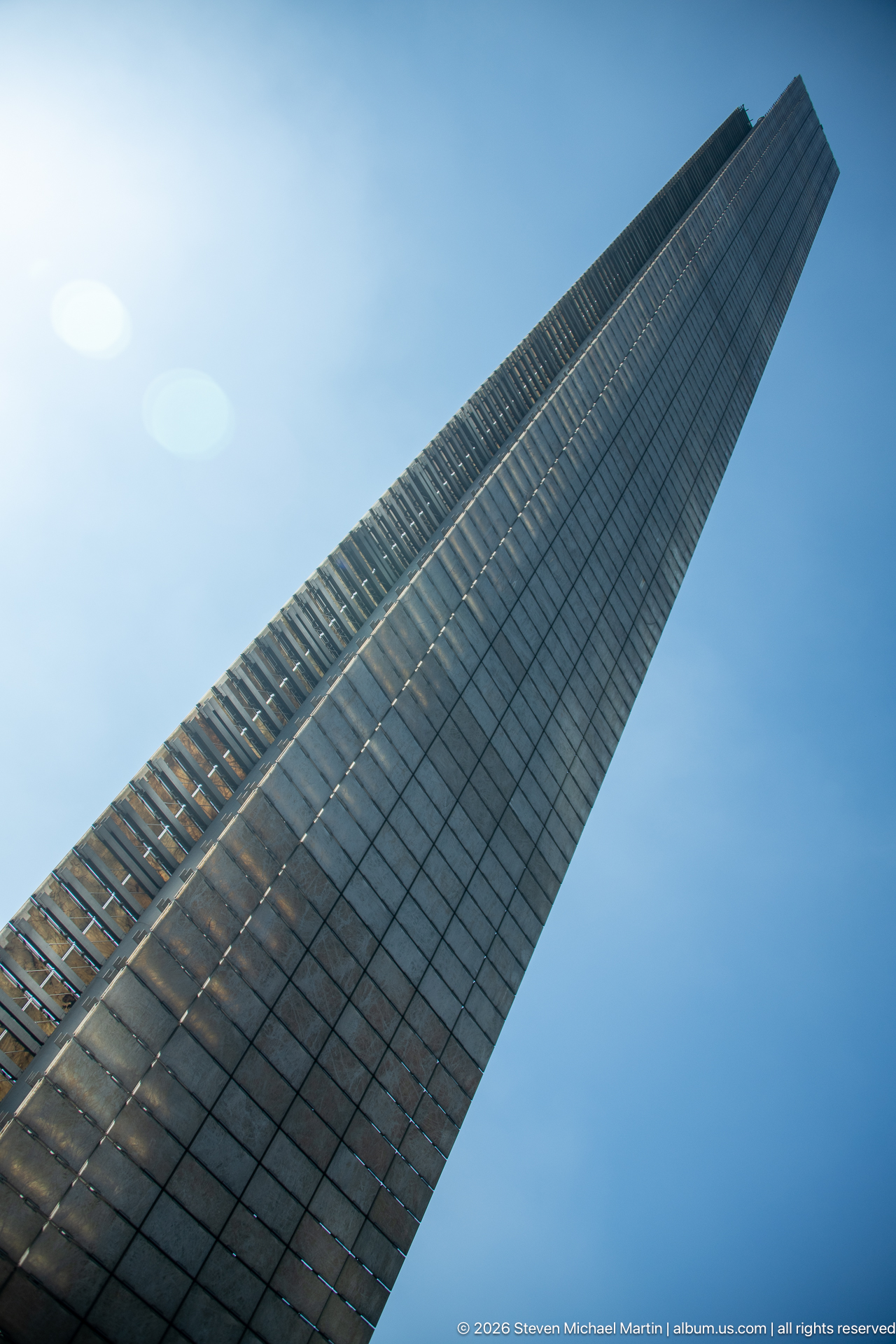
A sharply angled glass tower rises diagonally into a clear sky, its reflective grid narrowing toward a high point. A second curved glass volume adjoins it, and the lower façade bears a visible SAP sign. The low viewpoint stresses the contrast between the tower’s geometric silhouette and the open blue sky, documenting a contemporary business district rather than the historic masonry seen elsewhere in the portfolio.
Caption
A sharply angled glass tower rises diagonally into a clear sky, its reflective grid narrowing toward a high point. A second curved glass volume adjoins it, and the lower façade bears a visible SAP sign. The low viewpoint stresses the contrast between the tower’s geometric silhouette and the open blue sky, documenting a contemporary business district rather than the historic masonry seen elsewhere in the portfolio.
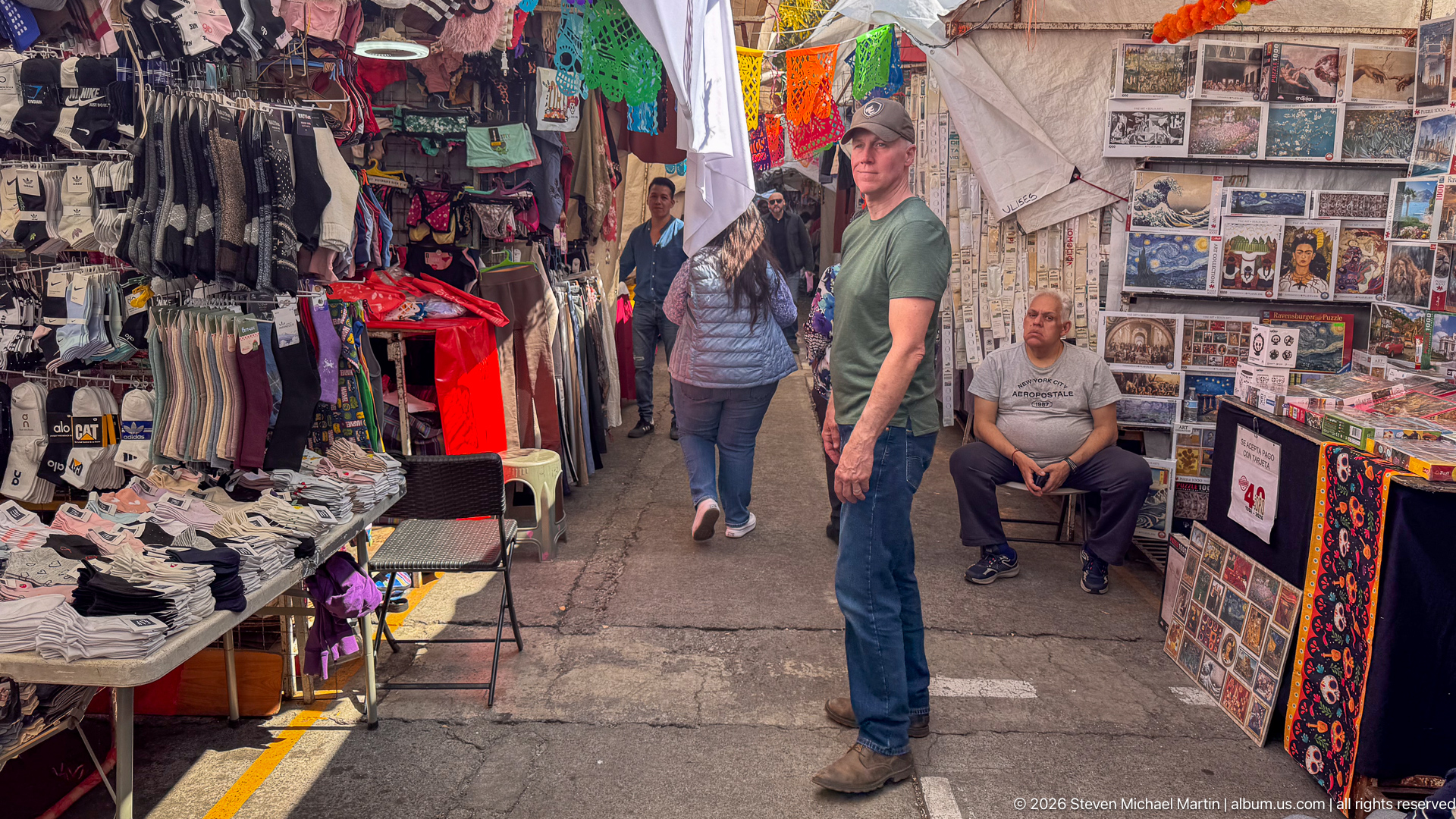
A narrow market aisle is crowded with hanging shirts, textiles, and small souvenirs on one side and framed prints and photographs on the other. A visitor pauses mid-aisle as stallholders and shoppers share the limited space. The compressed view makes the variety of merchandise and the working rhythm of the market more prominent than any single object or named shop.
Caption
A narrow market aisle is crowded with hanging shirts, textiles, and small souvenirs on one side and framed prints and photographs on the other. A visitor pauses mid-aisle as stallholders and shoppers share the limited space. The compressed view makes the variety of merchandise and the working rhythm of the market more prominent than any single object or named shop.
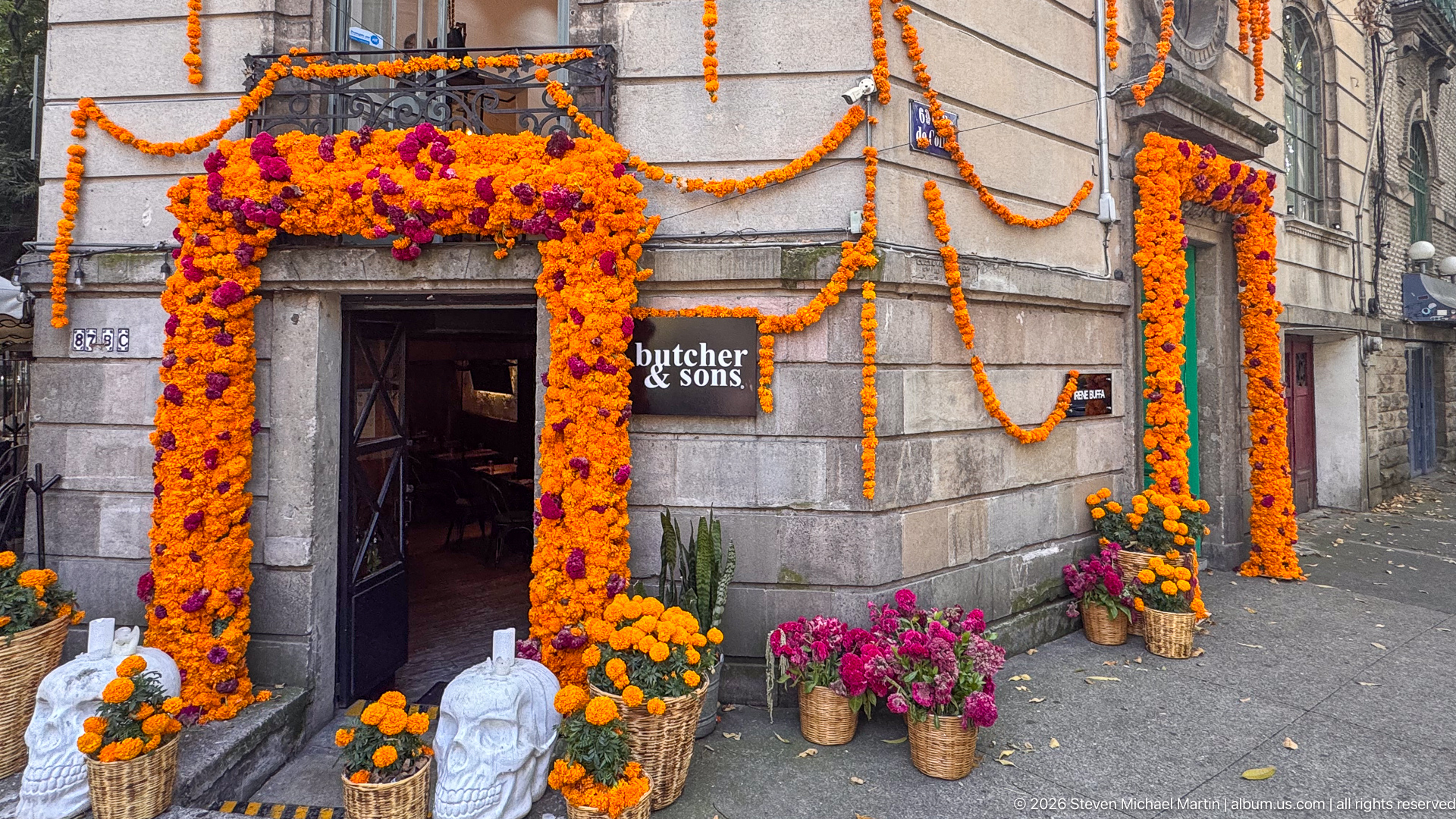
Dense orange and magenta marigolds outline the doorway and trail across the stone façade of a business whose sign reads “butcher & sons.” Baskets of flowers and pale skull-shaped decorations sit at the threshold, making the seasonal Día de Muertos installation unmistakable. The floral framing converts an ordinary commercial entrance into a temporary public display while leaving the shop name readable.
Caption
Dense orange and magenta marigolds outline the doorway and trail across the stone façade of a business whose sign reads “butcher & sons.” Baskets of flowers and pale skull-shaped decorations sit at the threshold, making the seasonal Día de Muertos installation unmistakable. The floral framing converts an ordinary commercial entrance into a temporary public display while leaving the shop name readable.
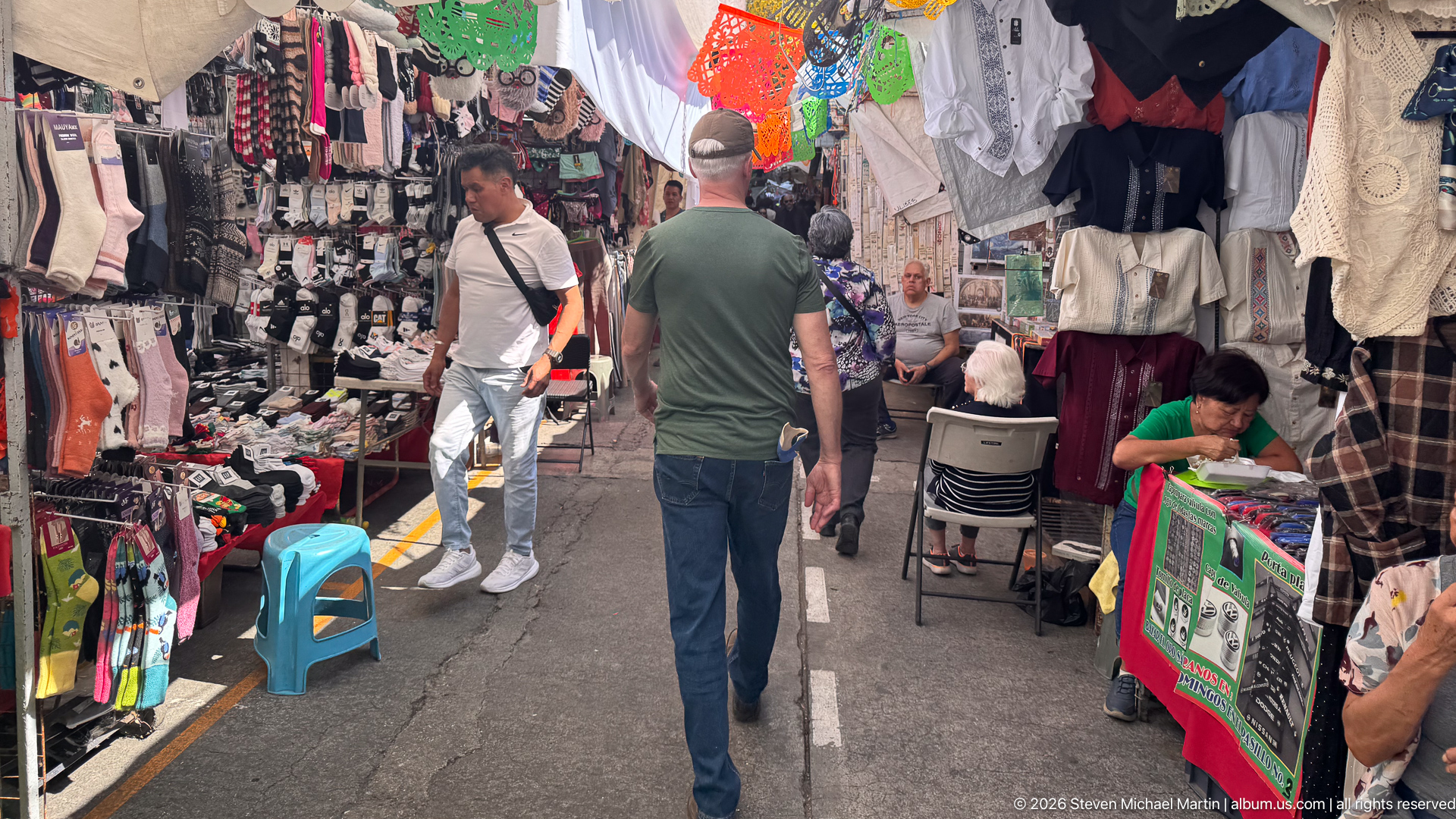
A green-shirted visitor walks down a narrow market passage beneath orange, red, and green papel picado. Clothing, hats, printed textiles, and souvenirs crowd the stalls, while vendors sit or work along the edges. The cut-paper banners indicate Día de Muertos season, but the scene’s strongest detail is the everyday shopping activity beneath the festive canopy.
Caption
A green-shirted visitor walks down a narrow market passage beneath orange, red, and green papel picado. Clothing, hats, printed textiles, and souvenirs crowd the stalls, while vendors sit or work along the edges. The cut-paper banners indicate Día de Muertos season, but the scene’s strongest detail is the everyday shopping activity beneath the festive canopy.
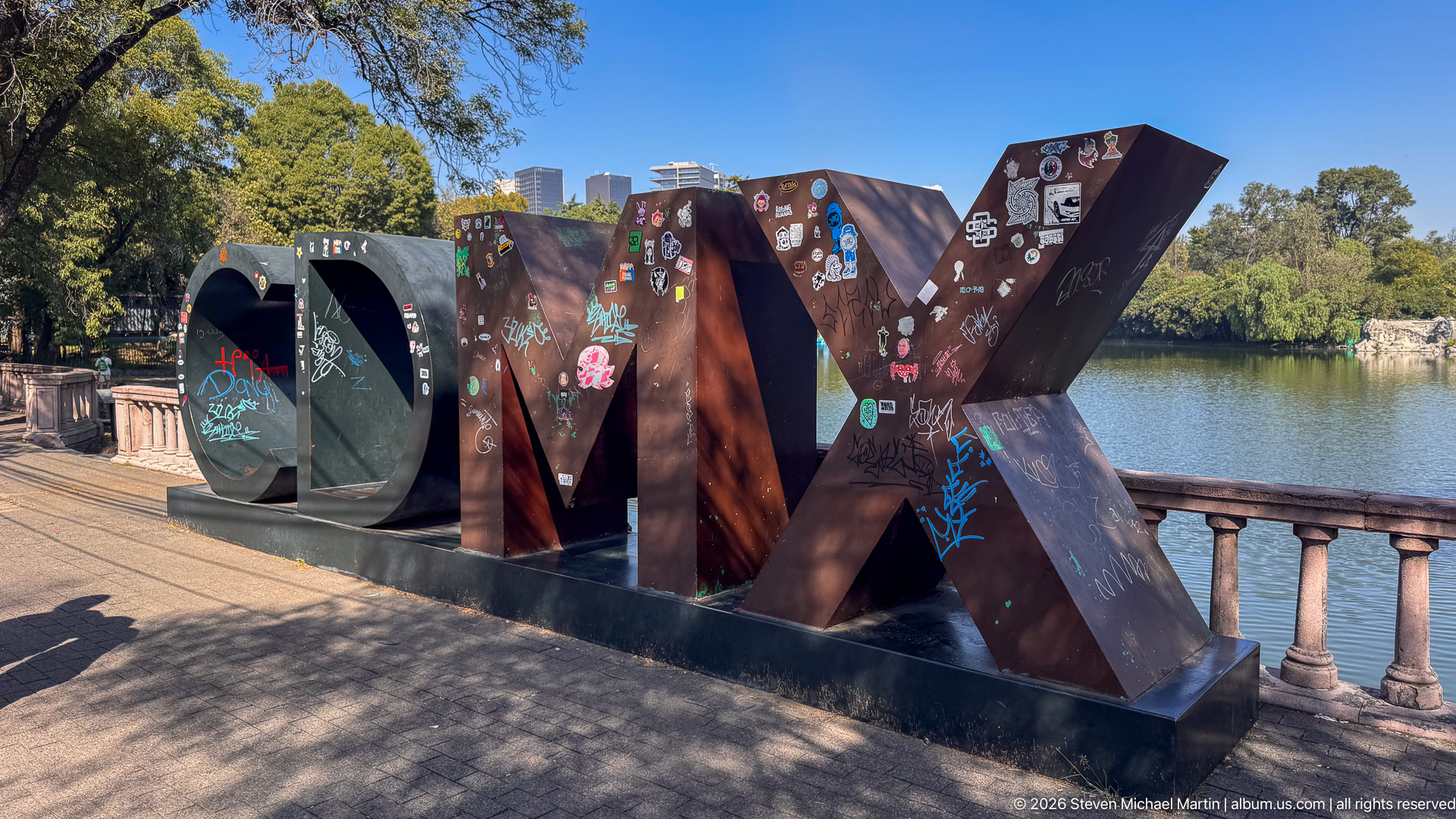
Oversized metal letters spell “CDMX” beside a balustrade and a still lake. Their dark, angular surfaces carry layers of stickers and graffiti, while tree-lined banks and a few distant buildings establish the setting as a landscaped public space. The installation functions as a city sign and a popular photo stop, its marked surface reflecting repeated public contact rather than a pristine finish.
Caption
Oversized metal letters spell “CDMX” beside a balustrade and a still lake. Their dark, angular surfaces carry layers of stickers and graffiti, while tree-lined banks and a few distant buildings establish the setting as a landscaped public space. The installation functions as a city sign and a popular photo stop, its marked surface reflecting repeated public contact rather than a pristine finish.
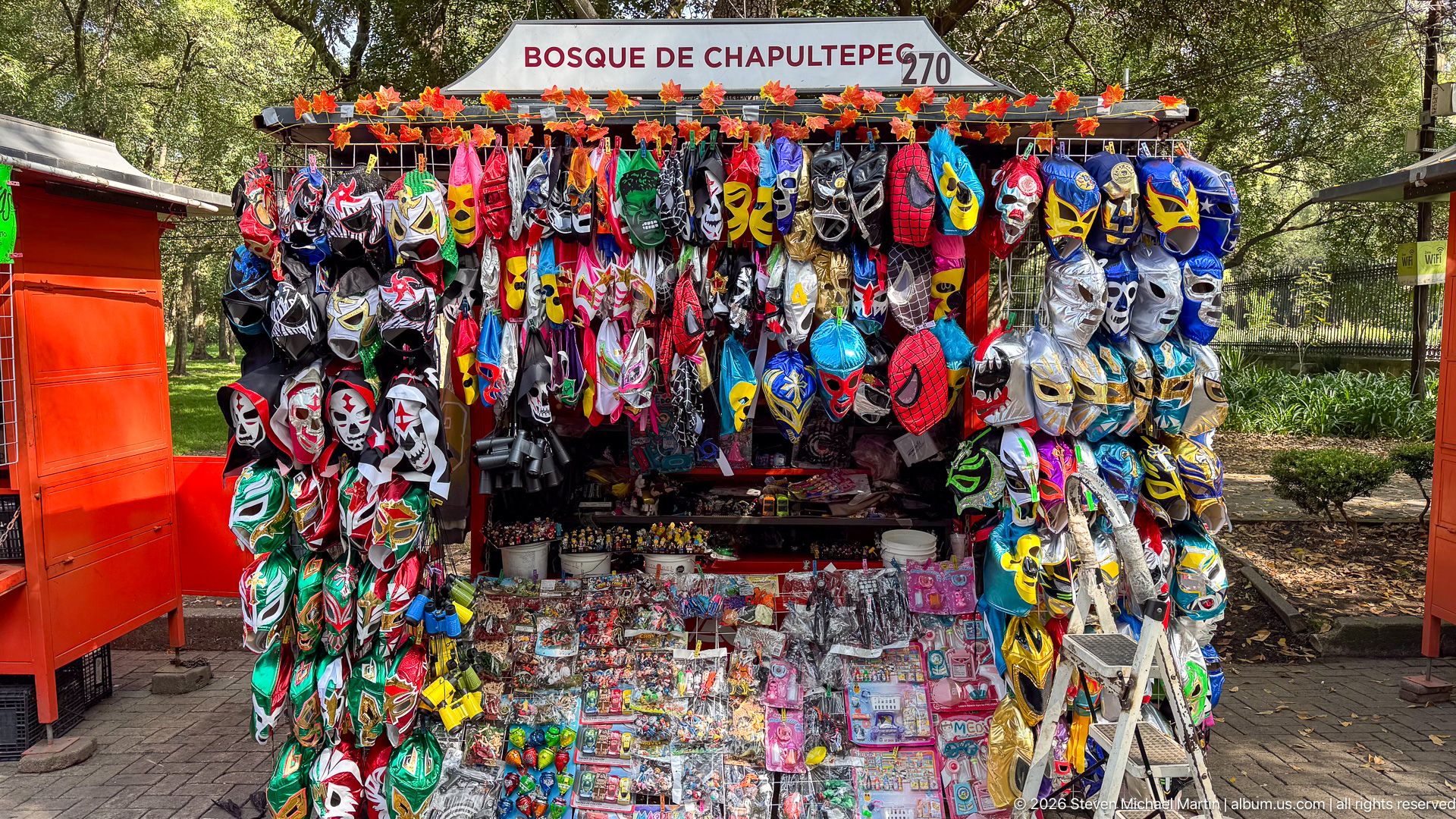
Rows of colorful lucha libre masks hang across a kiosk marked “Bosque de Chapultepec,” with small toys and souvenirs covering the counter below. The display ranges from vivid superhero-like patterns to skull-faced designs, presenting the masks as wearable popular culture and tourist merchandise. The park sign identifies the setting directly, while the dense arrangement makes the stall itself the photograph’s subject.
Caption
Rows of colorful lucha libre masks hang across a kiosk marked “Bosque de Chapultepec,” with small toys and souvenirs covering the counter below. The display ranges from vivid superhero-like patterns to skull-faced designs, presenting the masks as wearable popular culture and tourist merchandise. The park sign identifies the setting directly, while the dense arrangement makes the stall itself the photograph’s subject.
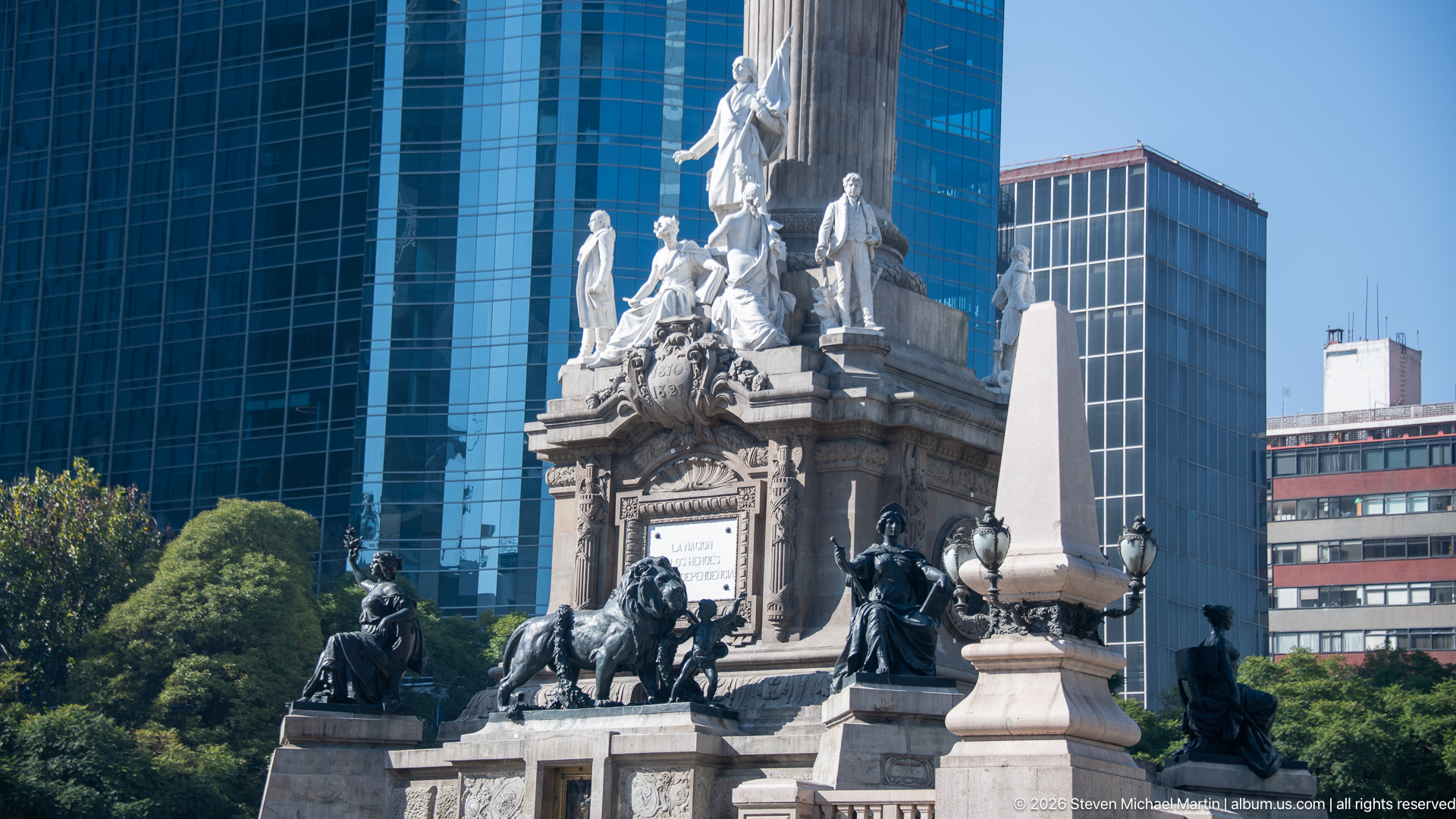
The monument’s lower pedestal is presented with its central inscription panel, crowned by a group of pale stone figures and flanked by darker bronze allegories. The composition reveals the layered sculptural program and formal symmetry of the Angel of Independence memorial, while modern office buildings rise immediately behind it. Sunlight sharpens the contrast between polished bronze, light stone, and reflective glass.
Caption
The monument’s lower pedestal is presented with its central inscription panel, crowned by a group of pale stone figures and flanked by darker bronze allegories. The composition reveals the layered sculptural program and formal symmetry of the Angel of Independence memorial, while modern office buildings rise immediately behind it. Sunlight sharpens the contrast between polished bronze, light stone, and reflective glass.
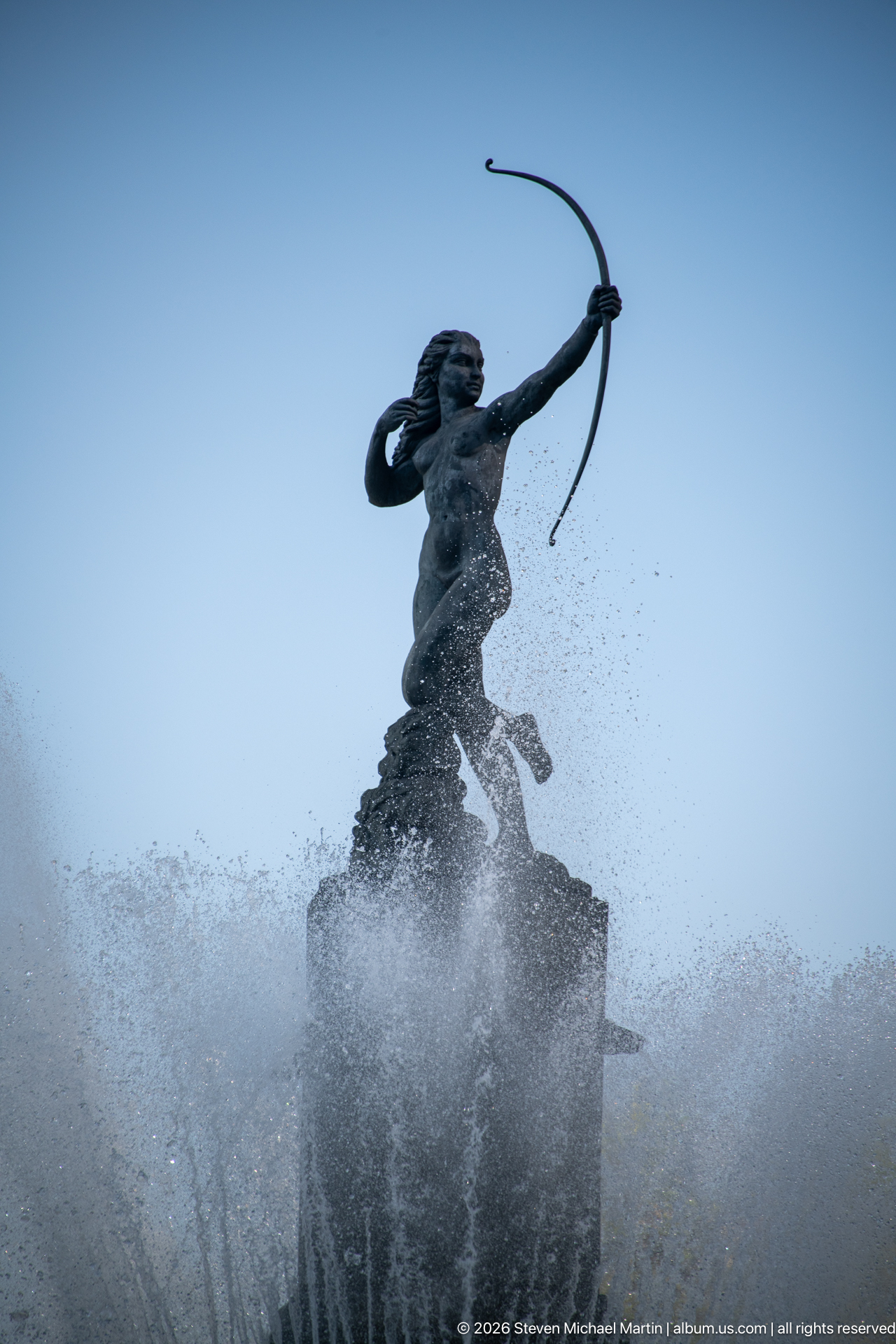
A bronze female archer stands poised with a drawn bow above a fountain basin, water breaking around the pedestal. Her wind-swept drapery and raised weapon identify the familiar Diana the Huntress figure, while the close crop removes most surrounding city context. Spray softens the lower sculpture and adds motion to an otherwise sharply outlined silhouette against the open sky.
Caption
A bronze female archer stands poised with a drawn bow above a fountain basin, water breaking around the pedestal. Her wind-swept drapery and raised weapon identify the familiar Diana the Huntress figure, while the close crop removes most surrounding city context. Spray softens the lower sculpture and adds motion to an otherwise sharply outlined silhouette against the open sky.
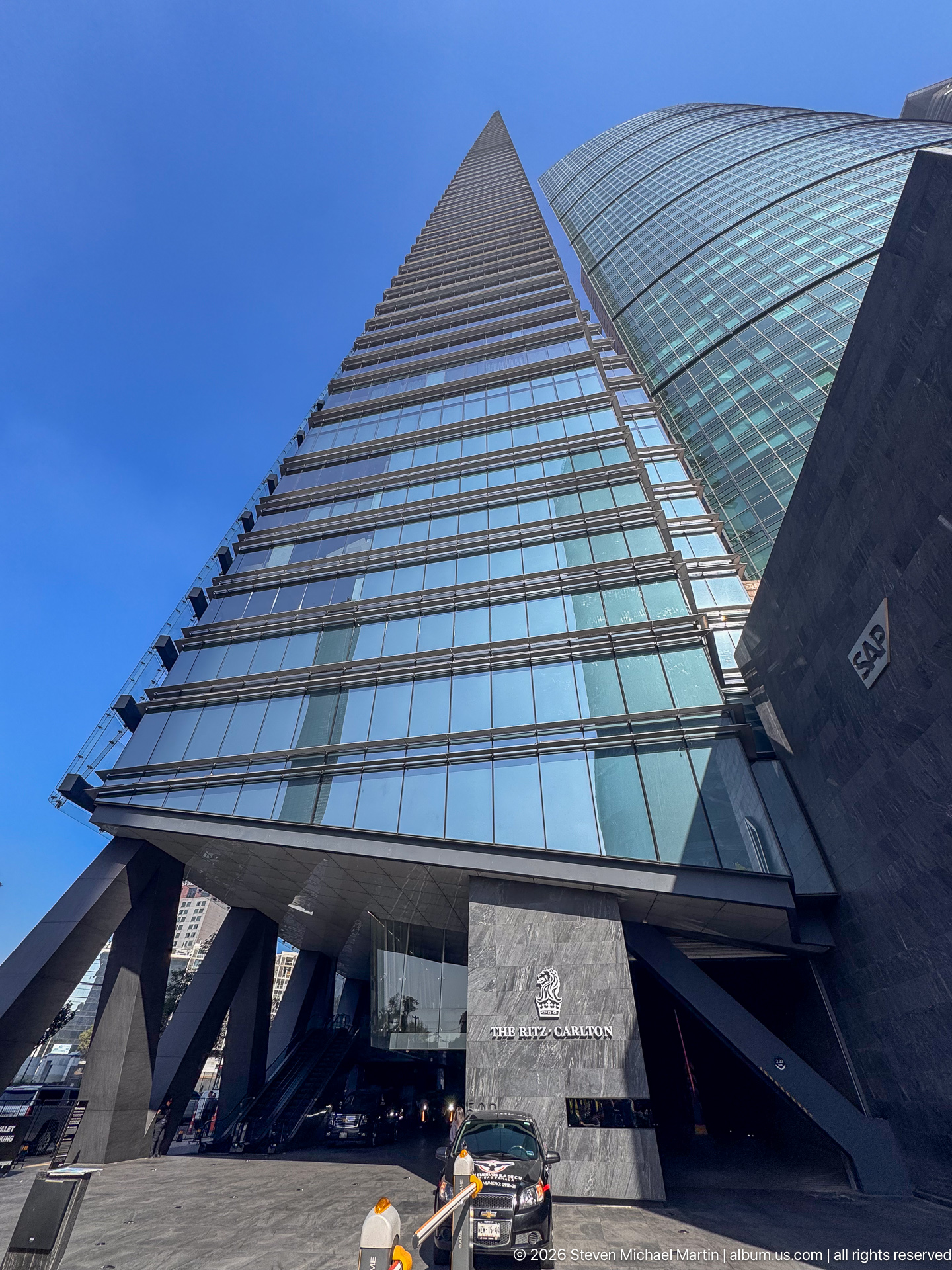
A low-angle view of a glass tower rises above a broad cantilevered entrance canopy, where a stone sign clearly reads “The Ritz-Carlton.” Reflective bands and angled supports give the base a dramatic profile, while a vehicle at the porte-cochère provides scale. The visible hotel name supports a precise identification and distinguishes this contemporary landmark from neighboring towers.
Caption
A low-angle view of a glass tower rises above a broad cantilevered entrance canopy, where a stone sign clearly reads “The Ritz-Carlton.” Reflective bands and angled supports give the base a dramatic profile, while a vehicle at the porte-cochère provides scale. The visible hotel name supports a precise identification and distinguishes this contemporary landmark from neighboring towers.
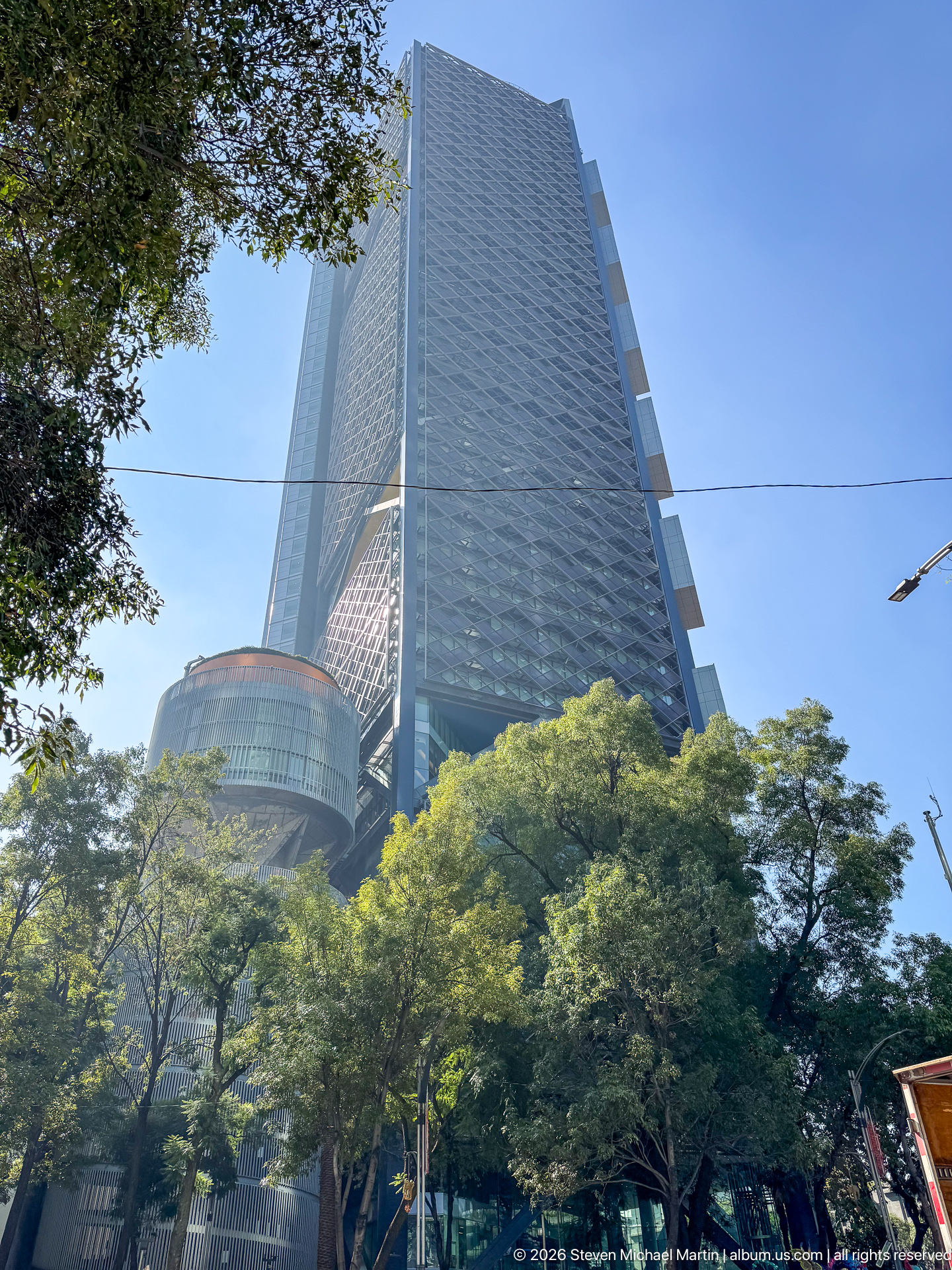
A tall faceted glass tower emerges above the tree canopy, its sharp peak and sloping sides catching the midday light. A dark horizontal cable crosses the sky and a neighboring structure is partly visible behind the trees. Without a readable name or distinctive sign, the image is best understood as a contemporary skyscraper view that records the scale and geometry of the city’s business district.
Caption
A tall faceted glass tower emerges above the tree canopy, its sharp peak and sloping sides catching the midday light. A dark horizontal cable crosses the sky and a neighboring structure is partly visible behind the trees. Without a readable name or distinctive sign, the image is best understood as a contemporary skyscraper view that records the scale and geometry of the city’s business district.
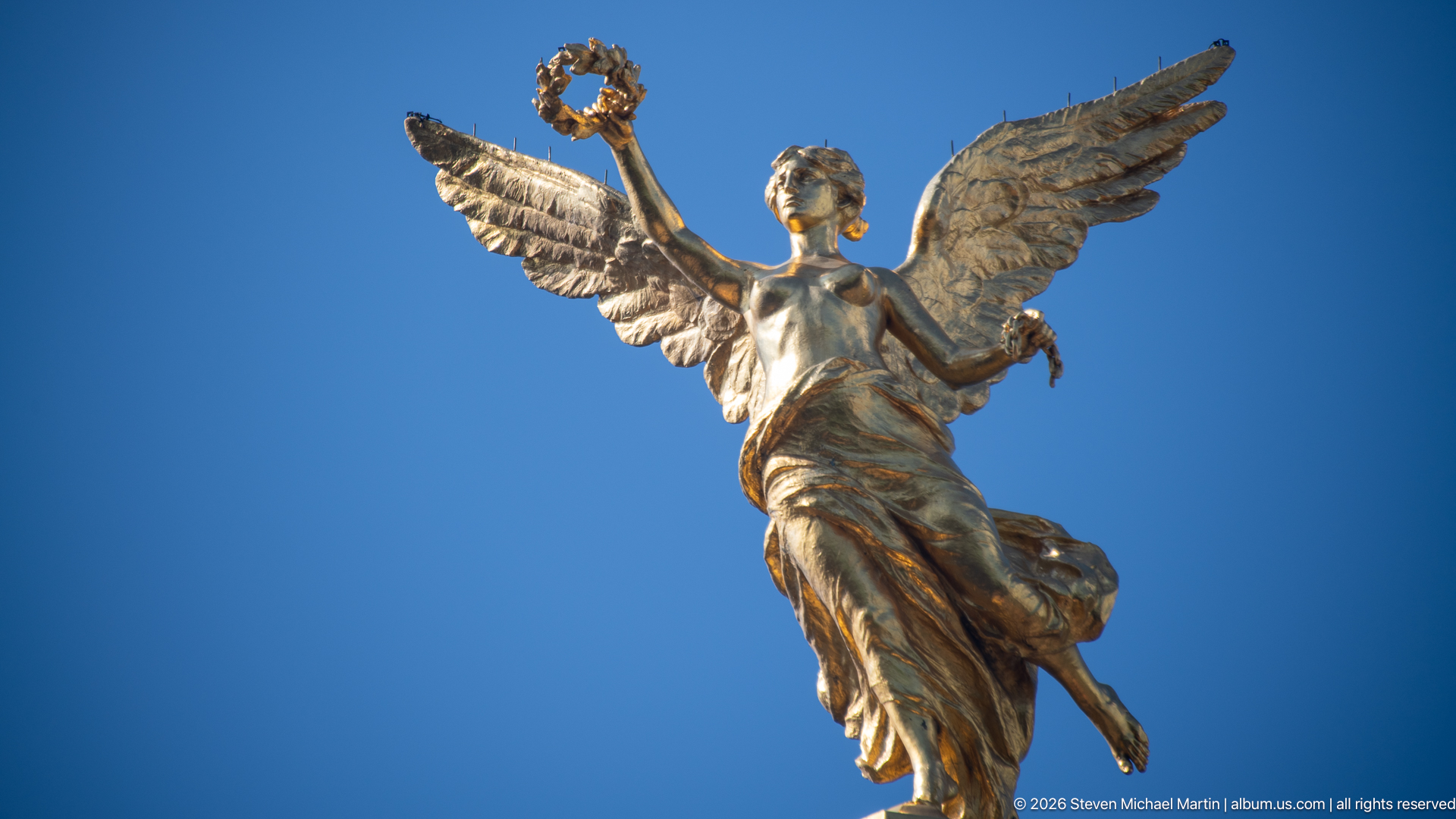
A gilded winged woman lifts a laurel wreath against a cloudless blue sky, her other hand holding a broken chain. The close upward view isolates the figure’s flowing drapery, extended wings, and raised arms at the summit of the Angel of Independence column. The statue’s pose and attributes identify it as the Winged Victory, a defining element of the monument’s silhouette.
Caption
A gilded winged woman lifts a laurel wreath against a cloudless blue sky, her other hand holding a broken chain. The close upward view isolates the figure’s flowing drapery, extended wings, and raised arms at the summit of the Angel of Independence column. The statue’s pose and attributes identify it as the Winged Victory, a defining element of the monument’s silhouette.
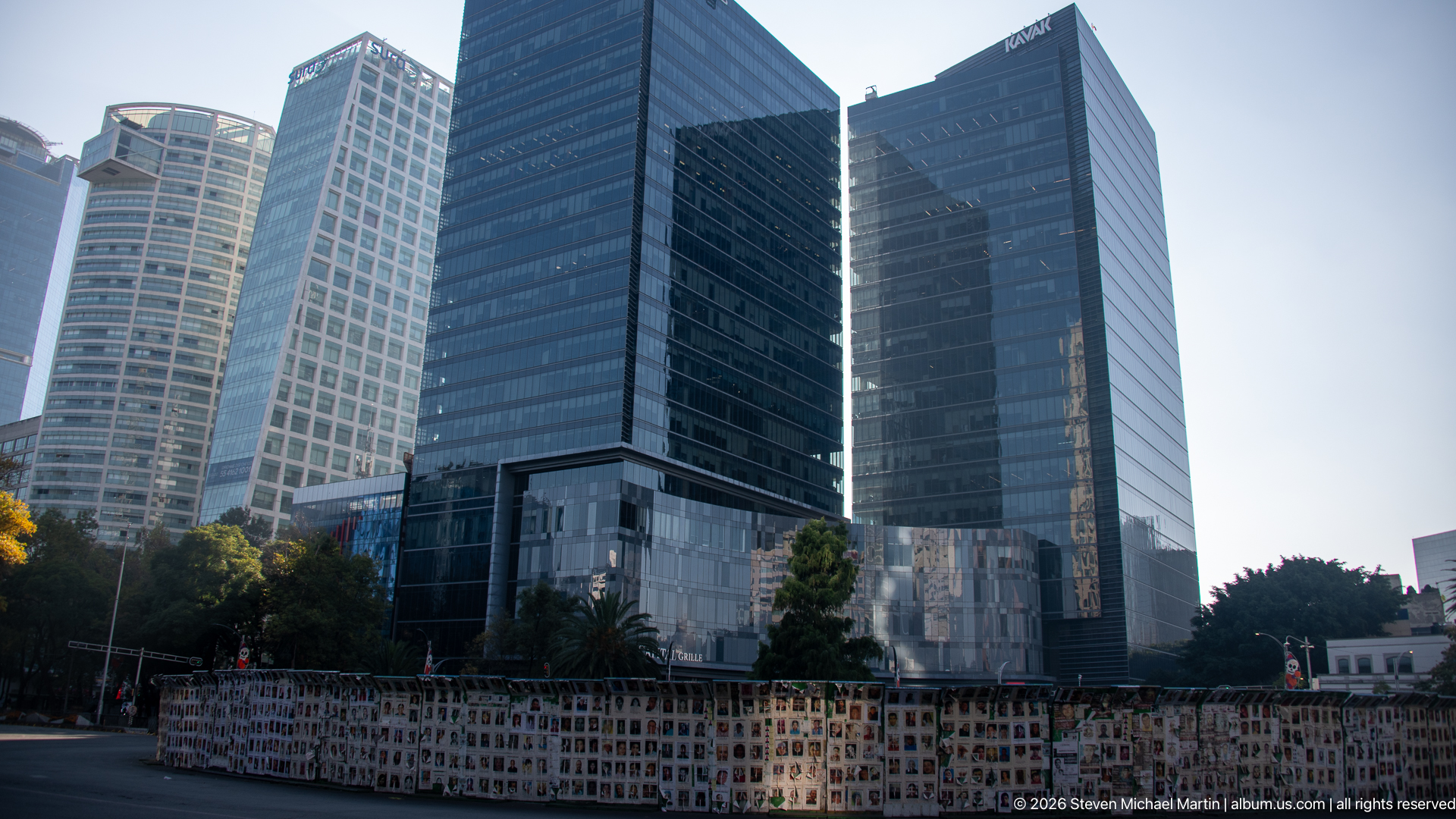
Several glass office towers rise above a long barrier covered edge to edge with portrait photographs. The repeated faces form a public memorial-like display along the street, contrasting with the reflective scale of the corporate buildings behind them. No sign explains the installation’s purpose in this view, so the caption describes its visible form without assigning a cause or organization.
Caption
Several glass office towers rise above a long barrier covered edge to edge with portrait photographs. The repeated faces form a public memorial-like display along the street, contrasting with the reflective scale of the corporate buildings behind them. No sign explains the installation’s purpose in this view, so the caption describes its visible form without assigning a cause or organization.
The proof sheet marks attachment 123247 as “IMAGE NOT FOUND” and states that the original file path is missing. No photograph is available to inspect, so the pictured subject, setting, and materials cannot be described responsibly. This record preserves the attachment’s position and printed filename information while flagging the missing source for replacement or direct review before publication.
Caption
The proof sheet marks attachment 123247 as “IMAGE NOT FOUND” and states that the original file path is missing. No photograph is available to inspect, so the pictured subject, setting, and materials cannot be described responsibly. This record preserves the attachment’s position and printed filename information while flagging the missing source for replacement or direct review before publication.
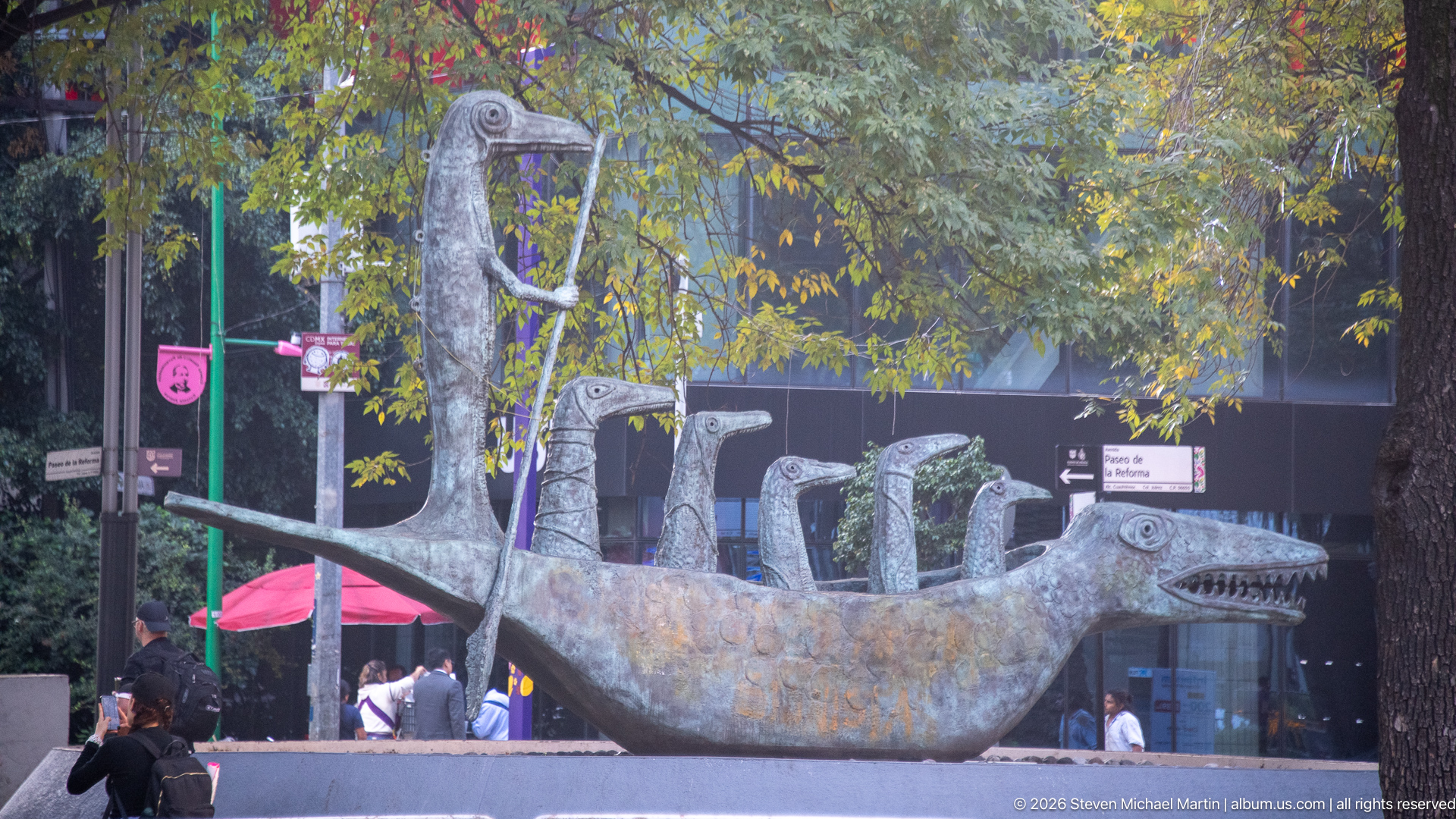
A long gray sculptural creature with an open-mouthed head and several upright necks stretches across a low plinth beside the trees. People gather near the base, and a directional sign points toward Paseo de la Reforma. The imaginative form reads as a public artwork rather than a natural-history specimen; no title or artist is legible in the photograph.
Caption
A long gray sculptural creature with an open-mouthed head and several upright necks stretches across a low plinth beside the trees. People gather near the base, and a directional sign points toward Paseo de la Reforma. The imaginative form reads as a public artwork rather than a natural-history specimen; no title or artist is legible in the photograph.
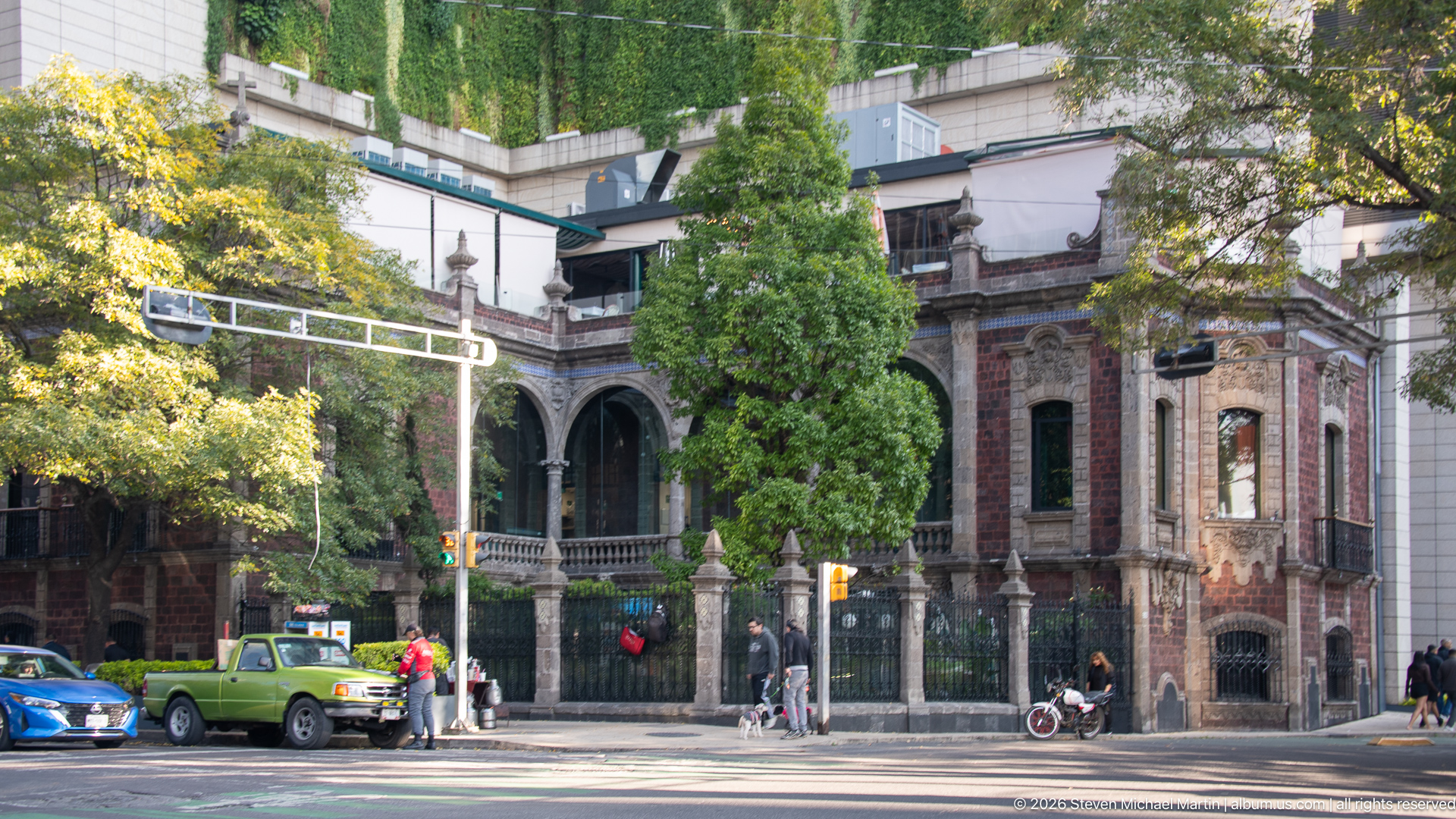
Behind mature trees and a black iron fence, a multi-story stone building presents broad arched openings, carved surrounds, and a deep balcony. Cars and pedestrians move along the foreground street, emphasizing the structure’s continued place in an active urban block. The foliage obscures portions of the façade, and no clear sign identifies the building, so its architectural features remain the focus.
Caption
Behind mature trees and a black iron fence, a multi-story stone building presents broad arched openings, carved surrounds, and a deep balcony. Cars and pedestrians move along the foreground street, emphasizing the structure’s continued place in an active urban block. The foliage obscures portions of the façade, and no clear sign identifies the building, so its architectural features remain the focus.
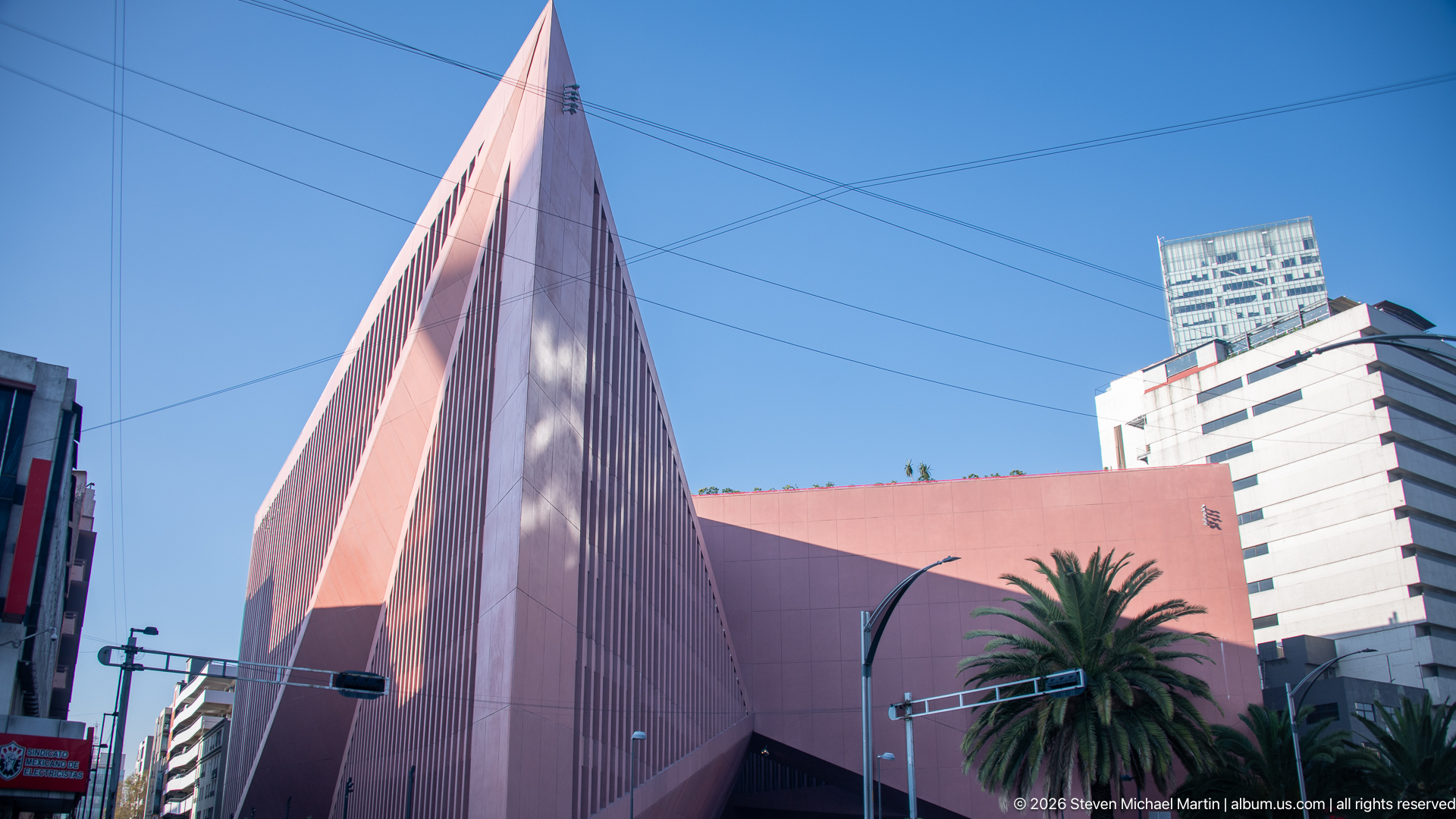
A sharply pointed pink building rises above a palm-lined street, its narrow vertical windows and folded planes creating a striking geometric profile. A second pale tower stands behind it, and overhead cables cross the clear sky. With no readable name or sign in view, the image records the building as an urban architectural landmark without assigning a specific identity.
Caption
A sharply pointed pink building rises above a palm-lined street, its narrow vertical windows and folded planes creating a striking geometric profile. A second pale tower stands behind it, and overhead cables cross the clear sky. With no readable name or sign in view, the image records the building as an urban architectural landmark without assigning a specific identity.
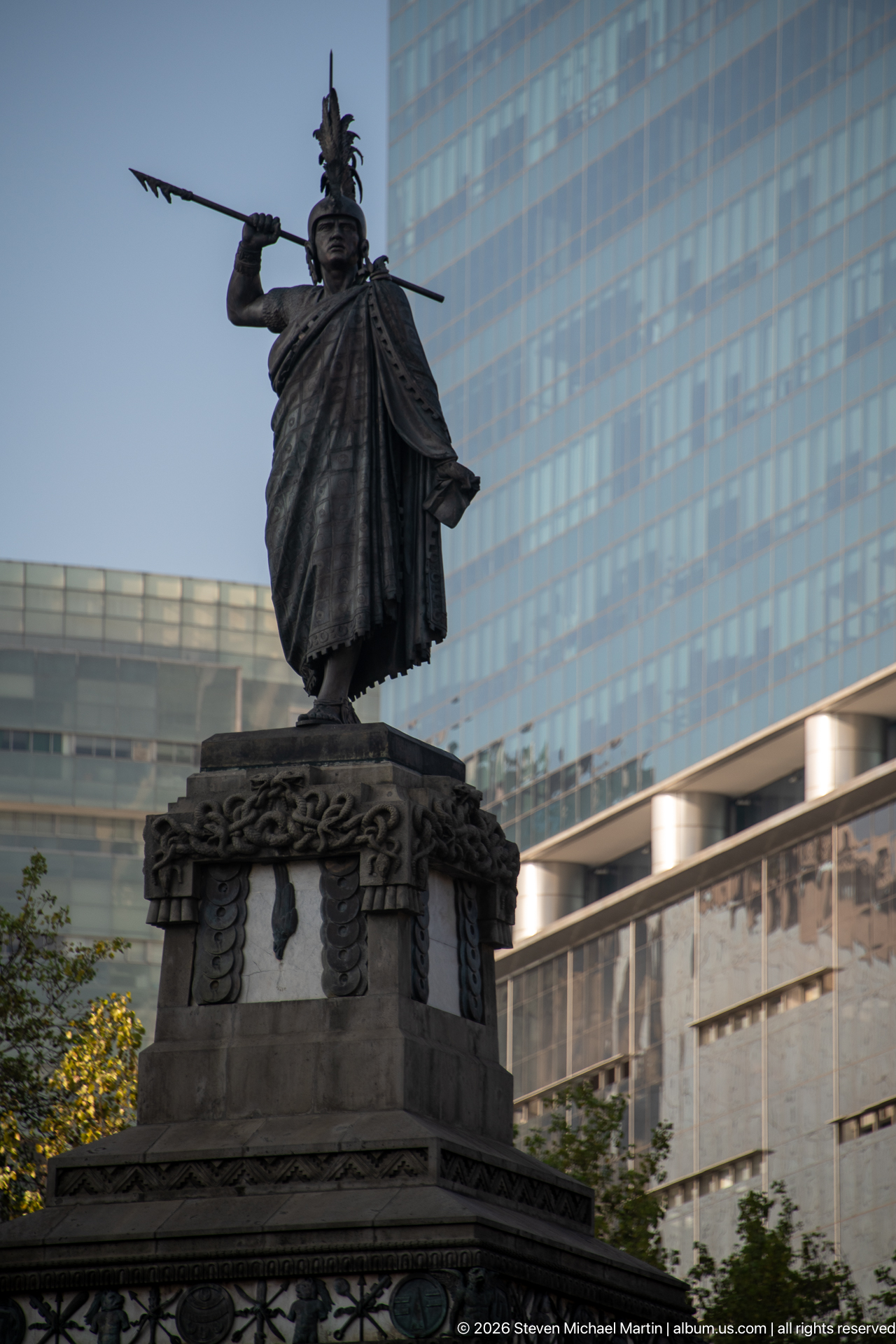
A bronze figure in an elaborate feathered headdress stands atop a tall, richly carved pedestal, one arm lifted beside a modern glass tower. The costume and raised gesture are consistent with the Monument to Cuauhtémoc on Paseo de la Reforma, though the close view excludes its full base and surroundings. The contrast between the dark figure and luminous glazing brings the memorial into the contemporary cityscape.
Caption
A bronze figure in an elaborate feathered headdress stands atop a tall, richly carved pedestal, one arm lifted beside a modern glass tower. The costume and raised gesture are consistent with the Monument to Cuauhtémoc on Paseo de la Reforma, though the close view excludes its full base and surroundings. The contrast between the dark figure and luminous glazing brings the memorial into the contemporary cityscape.
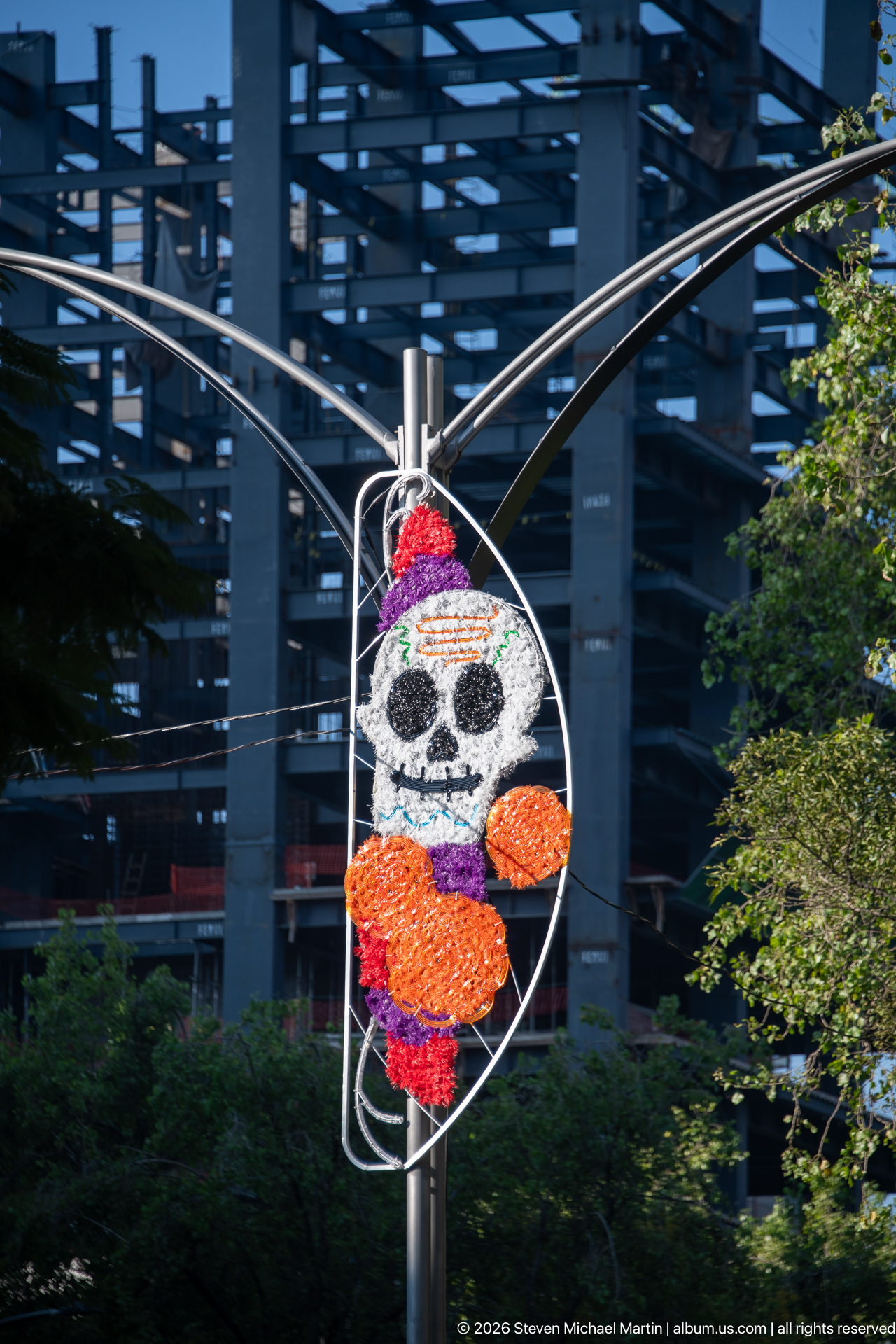
A large floral skull ornament hangs within a metal frame from a curved street pole, its white face, dark eye sockets, and bright orange and purple flowers forming a Catrina-like Día de Muertos figure. The installation stands against a glass office façade and greenery, showing how the seasonal celebration extends into everyday streets. The close framing isolates the decoration from the wider route.
Caption
A large floral skull ornament hangs within a metal frame from a curved street pole, its white face, dark eye sockets, and bright orange and purple flowers forming a Catrina-like Día de Muertos figure. The installation stands against a glass office façade and greenery, showing how the seasonal celebration extends into everyday streets. The close framing isolates the decoration from the wider route.
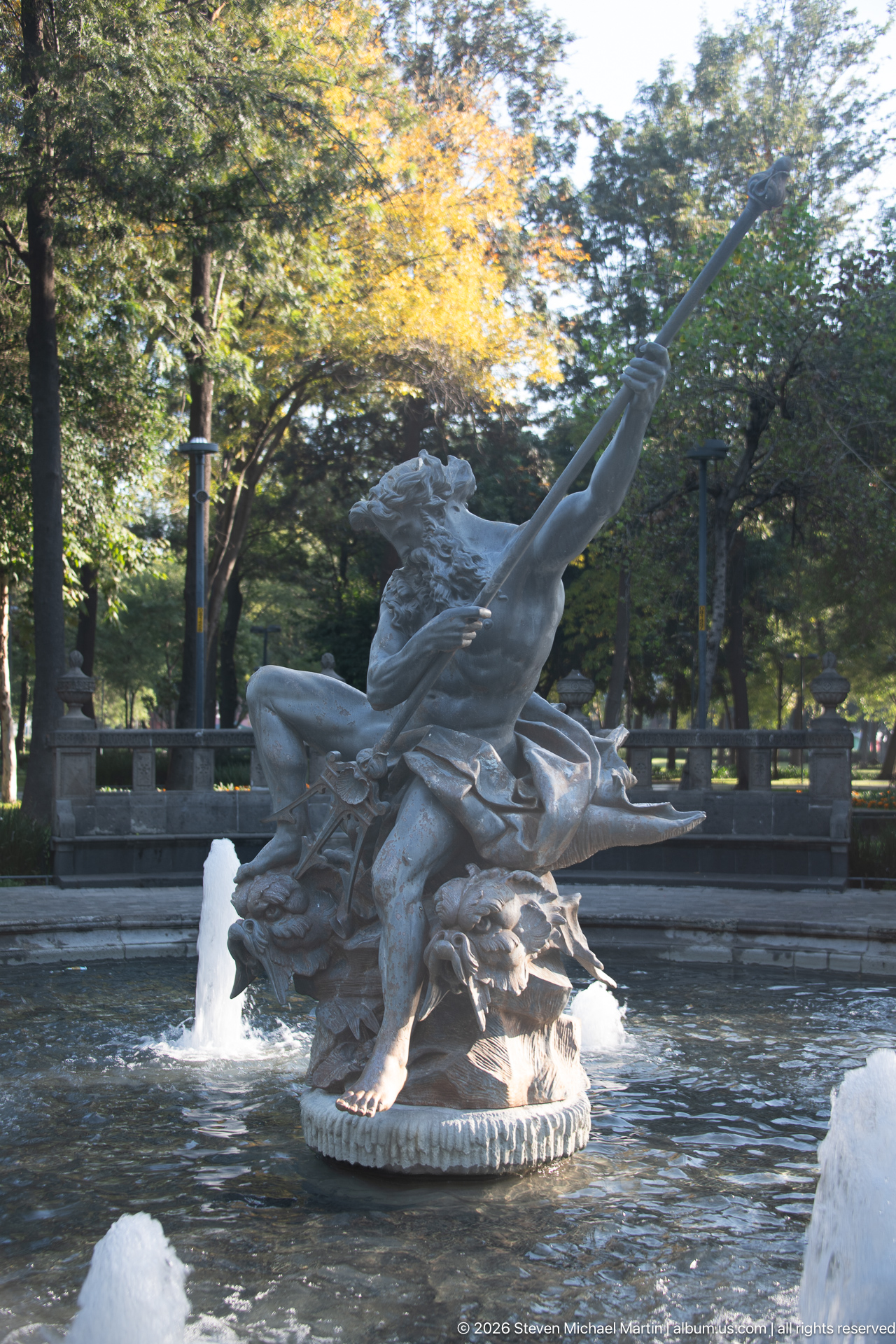
A bronze archer stretches her bow across the center of a circular fountain, surrounded by broad water jets and shaded park trees. The reclining, wind-swept pose and raised bow identify the Diana Cazadora, while the wide view shows the basin and surrounding greenery as part of the public setting. Late sunlight catches the spray and the pale sculptural surfaces.
Caption
A bronze archer stretches her bow across the center of a circular fountain, surrounded by broad water jets and shaded park trees. The reclining, wind-swept pose and raised bow identify the Diana Cazadora, while the wide view shows the basin and surrounding greenery as part of the public setting. Late sunlight catches the spray and the pale sculptural surfaces.
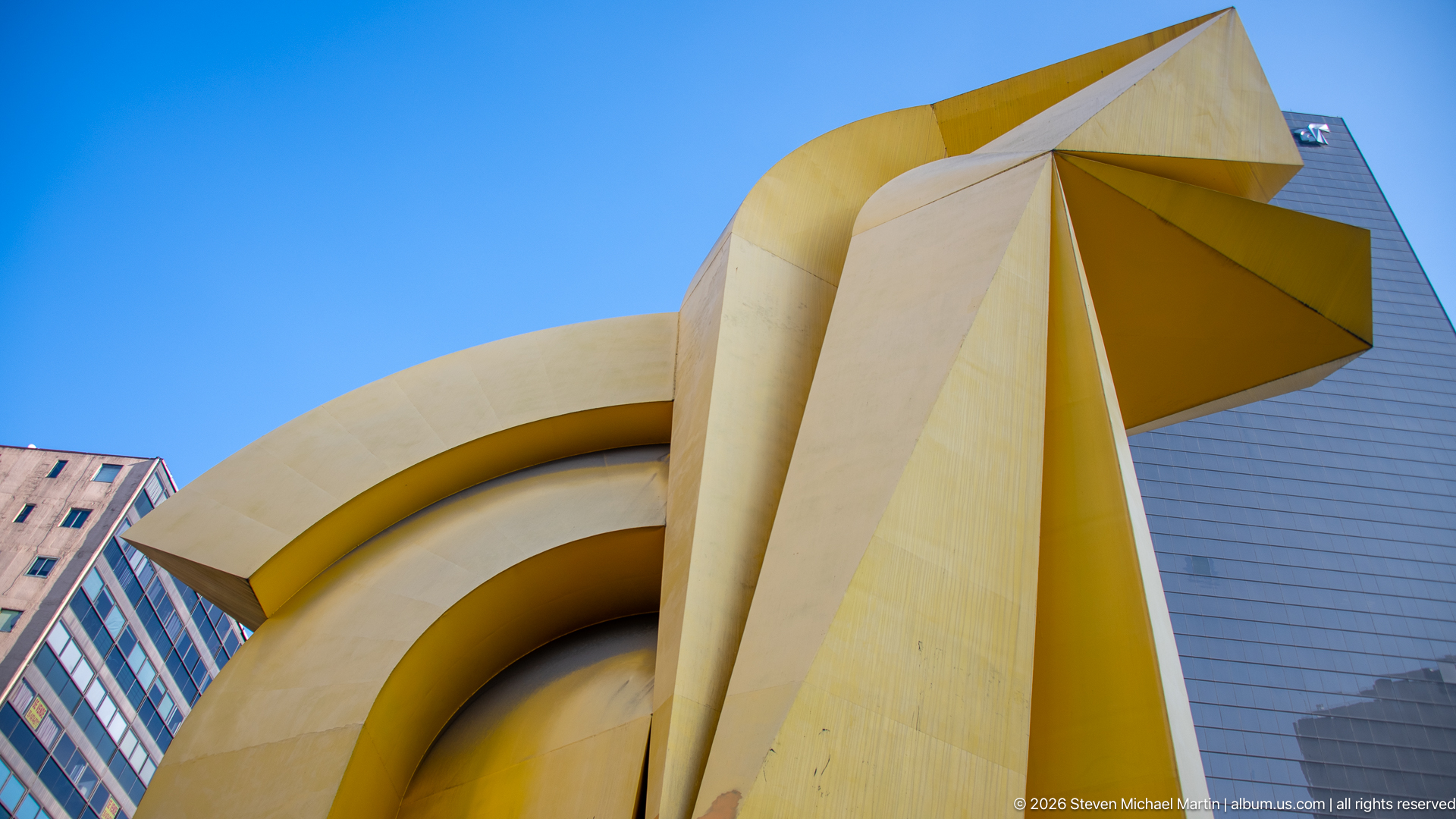
A large yellow structure sweeps through the frame in broad curved and folded planes, creating an abstract architectural form against a vivid blue sky. Its smooth surfaces and sharply joined edges contrast with the gridded glass tower behind it. The tight crop offers no identifying plaque or scale reference, so the object is best described as a sculptural urban installation rather than assigned a title or function.
Caption
A large yellow structure sweeps through the frame in broad curved and folded planes, creating an abstract architectural form against a vivid blue sky. Its smooth surfaces and sharply joined edges contrast with the gridded glass tower behind it. The tight crop offers no identifying plaque or scale reference, so the object is best described as a sculptural urban installation rather than assigned a title or function.
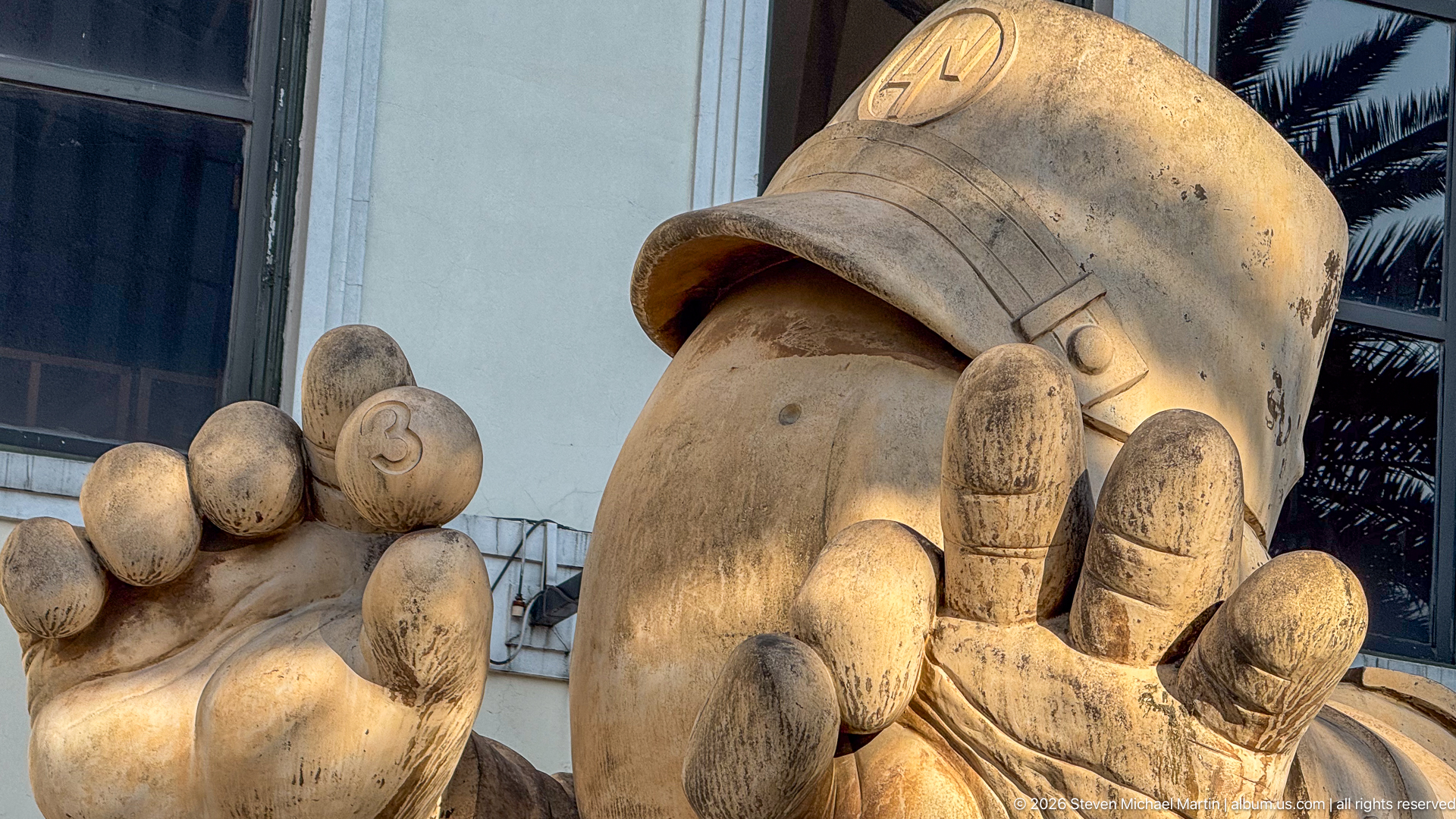
An oversized carved hand rises in the foreground, its fingers curled around a rounded object marked with a bold “3.” Behind it, a large rounded headpiece bears a small geometric emblem, suggesting a monumental figure or sculptural grouping beyond the frame. The close crop emphasizes scale, weathered stone texture, and the unusual juxtaposition of hand and headgear without identifying the work.
Caption
An oversized carved hand rises in the foreground, its fingers curled around a rounded object marked with a bold “3.” Behind it, a large rounded headpiece bears a small geometric emblem, suggesting a monumental figure or sculptural grouping beyond the frame. The close crop emphasizes scale, weathered stone texture, and the unusual juxtaposition of hand and headgear without identifying the work.
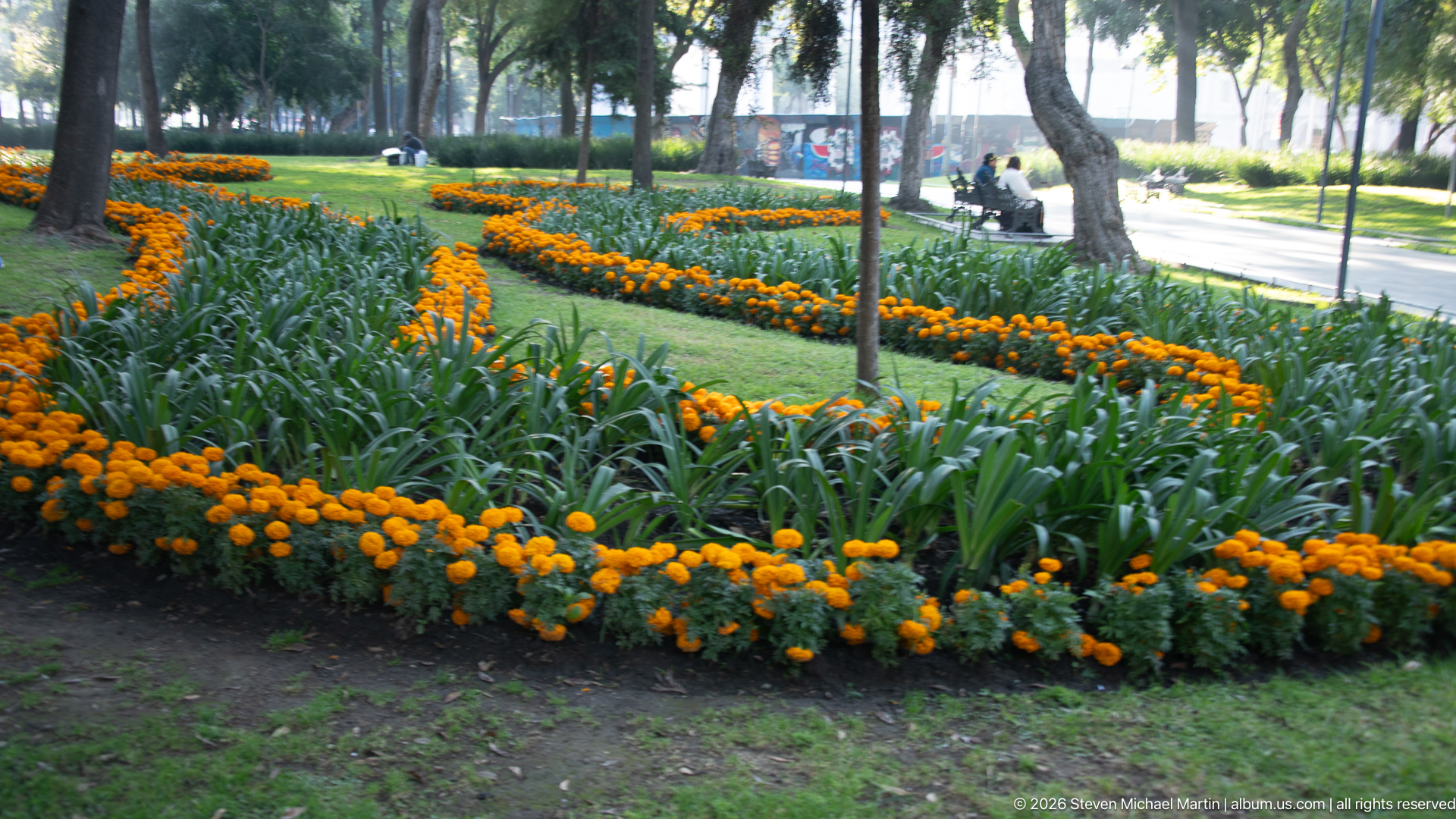
Bright orange marigolds trace long curves through green planting beds beneath mature park trees. A paved path and seated visitors appear in the distance, while the repeated bands of flowers create a deliberate seasonal pattern across the lawn. The blooms evoke Día de Muertos decoration in the city’s public spaces, but no altar or named park feature is visible in this view.
Caption
Bright orange marigolds trace long curves through green planting beds beneath mature park trees. A paved path and seated visitors appear in the distance, while the repeated bands of flowers create a deliberate seasonal pattern across the lawn. The blooms evoke Día de Muertos decoration in the city’s public spaces, but no altar or named park feature is visible in this view.
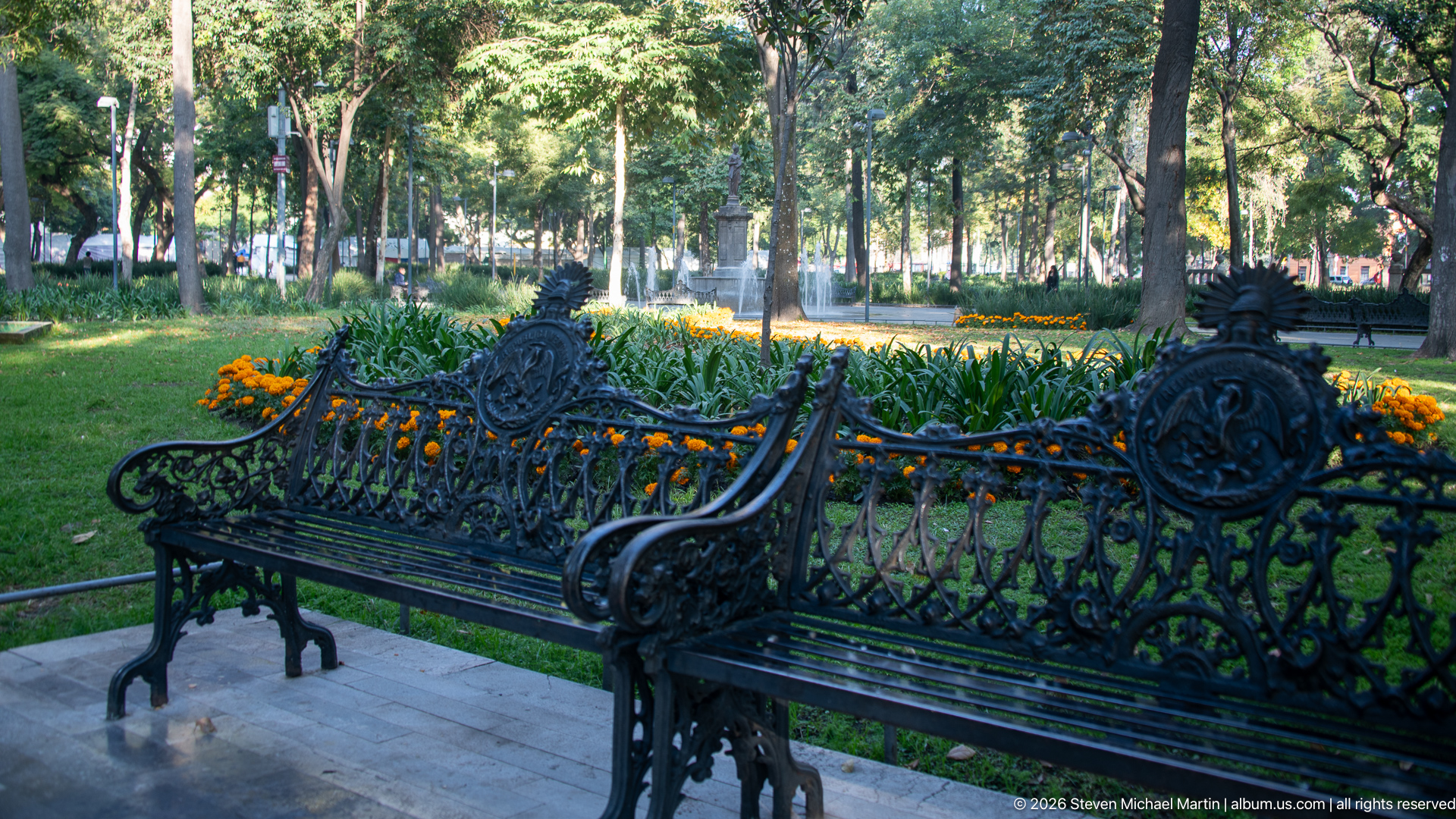
Two black wrought-iron benches with elaborate scrollwork sit beside a planted park bed edged in orange marigolds. Their curved backs and cast ornament stand out against the softer foliage and shaded path. The composition records park furniture as a designed element within the garden, with the seasonal flowers adding a vivid border but not obscuring the benches’ intricate metalwork.
Caption
Two black wrought-iron benches with elaborate scrollwork sit beside a planted park bed edged in orange marigolds. Their curved backs and cast ornament stand out against the softer foliage and shaded path. The composition records park furniture as a designed element within the garden, with the seasonal flowers adding a vivid border but not obscuring the benches’ intricate metalwork.
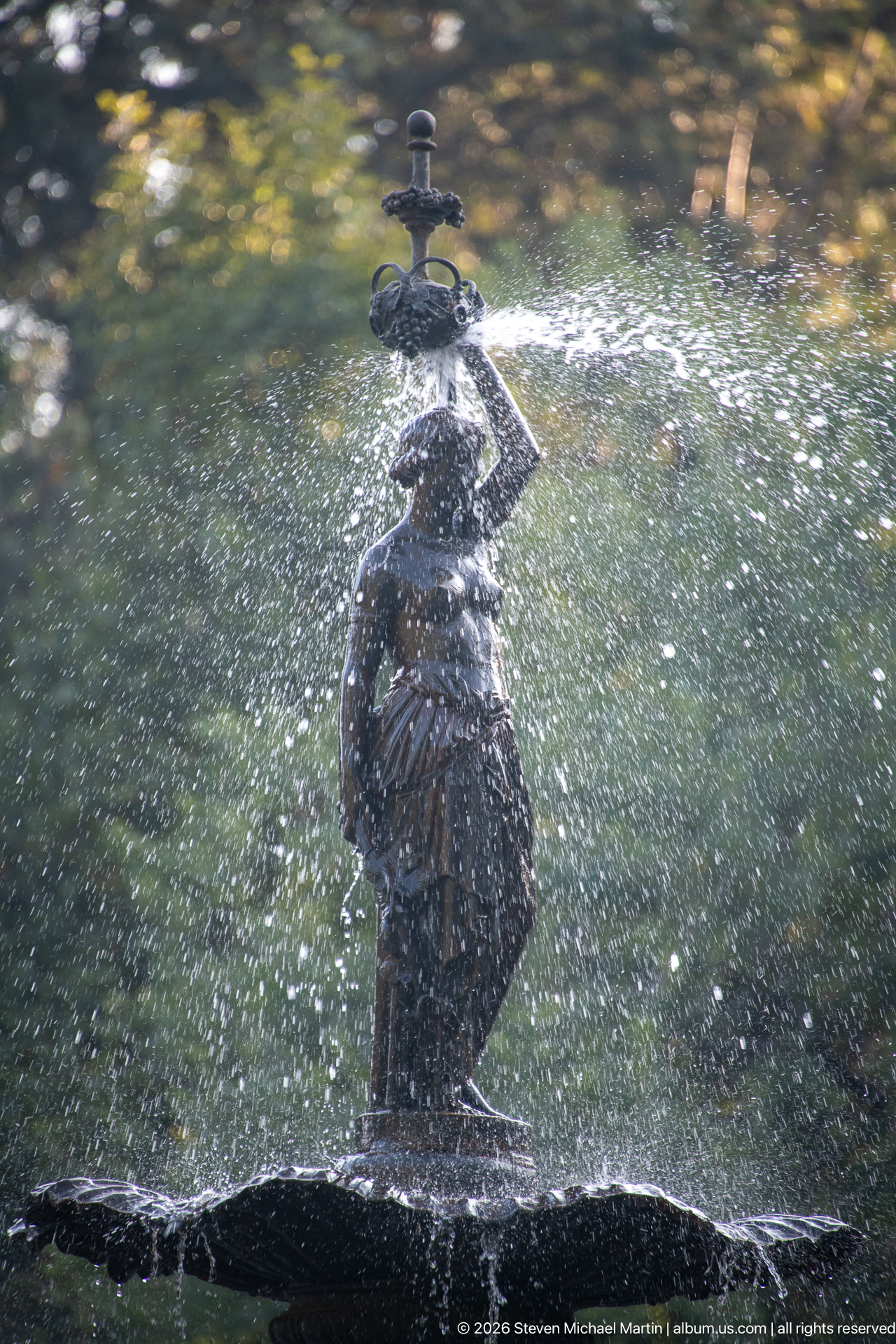
Seen from behind, the bronze archer rises from the fountain with her bow lifted above the water. Sunlit spray fills much of the frame, partially veiling the figure and basin while adding a shimmering texture around the statue’s silhouette. This close view gives the fountain a more immersive, kinetic character than the broader park scenes and emphasizes the relationship between sculpture and moving water.
Caption
Seen from behind, the bronze archer rises from the fountain with her bow lifted above the water. Sunlit spray fills much of the frame, partially veiling the figure and basin while adding a shimmering texture around the statue’s silhouette. This close view gives the fountain a more immersive, kinetic character than the broader park scenes and emphasizes the relationship between sculpture and moving water.
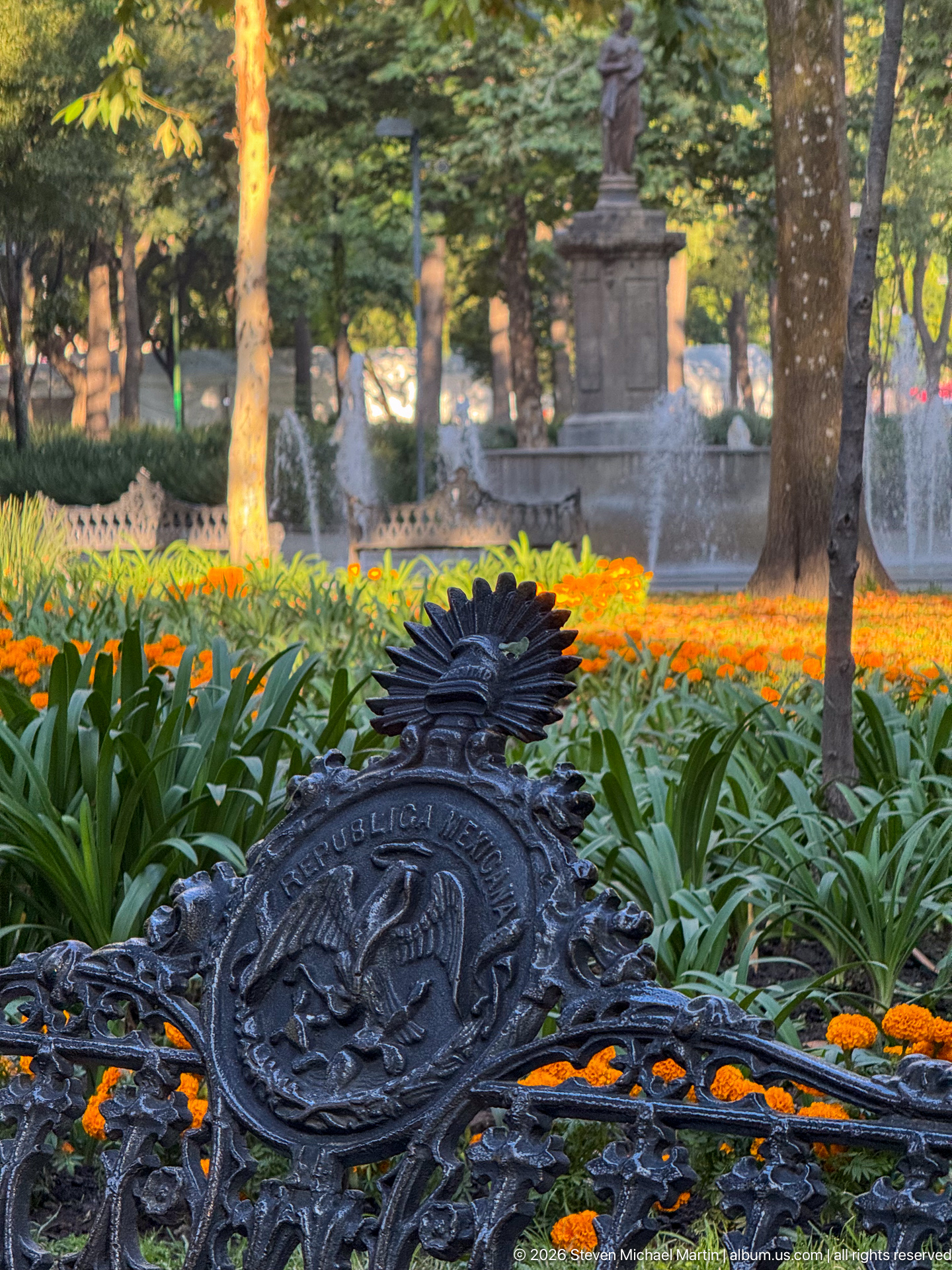
A close view of cast-iron park railing centers the Mexican coat of arms within a circular medallion marked “REPÚBLICA MEXICANA.” Orange marigolds and a stone pedestal blur behind the metalwork, adding a seasonal accent to this civic emblem. The framing draws attention to the eagle-and-serpent device and the decorative rays around the medallion.
Caption
A close view of cast-iron park railing centers the Mexican coat of arms within a circular medallion marked “REPÚBLICA MEXICANA.” Orange marigolds and a stone pedestal blur behind the metalwork, adding a seasonal accent to this civic emblem. The framing draws attention to the eagle-and-serpent device and the decorative rays around the medallion.
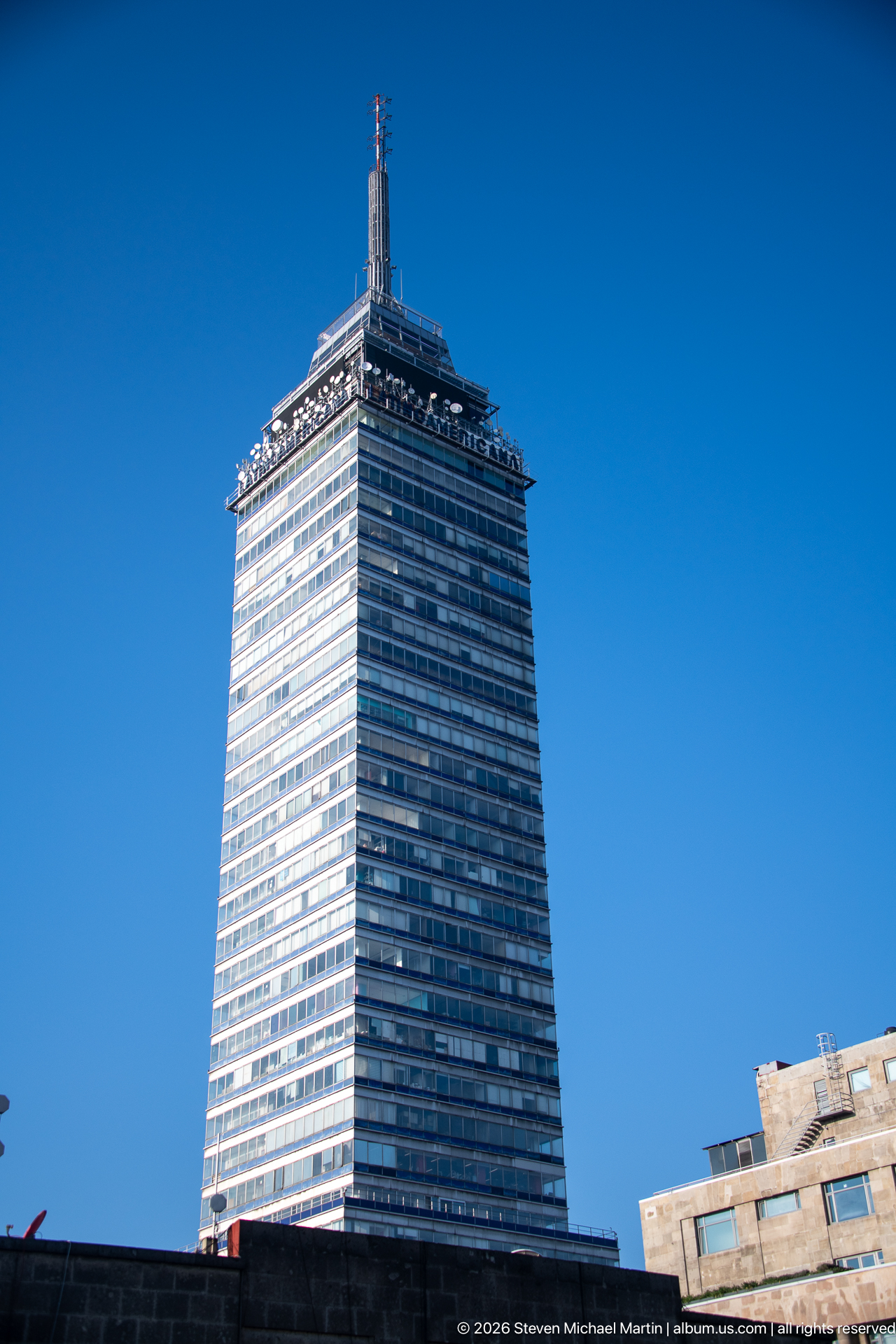
The glass-and-steel shaft of Torre Latinoamericana rises sharply against a cloudless blue sky. Its closely spaced horizontal bands taper toward a rooftop mast, while a low dark roof and fragments of older masonry anchor the base of the composition. The upward framing isolates the tower’s height and places a defining modern landmark above the lower, older city fabric.
Caption
The glass-and-steel shaft of Torre Latinoamericana rises sharply against a cloudless blue sky. Its closely spaced horizontal bands taper toward a rooftop mast, while a low dark roof and fragments of older masonry anchor the base of the composition. The upward framing isolates the tower’s height and places a defining modern landmark above the lower, older city fabric.
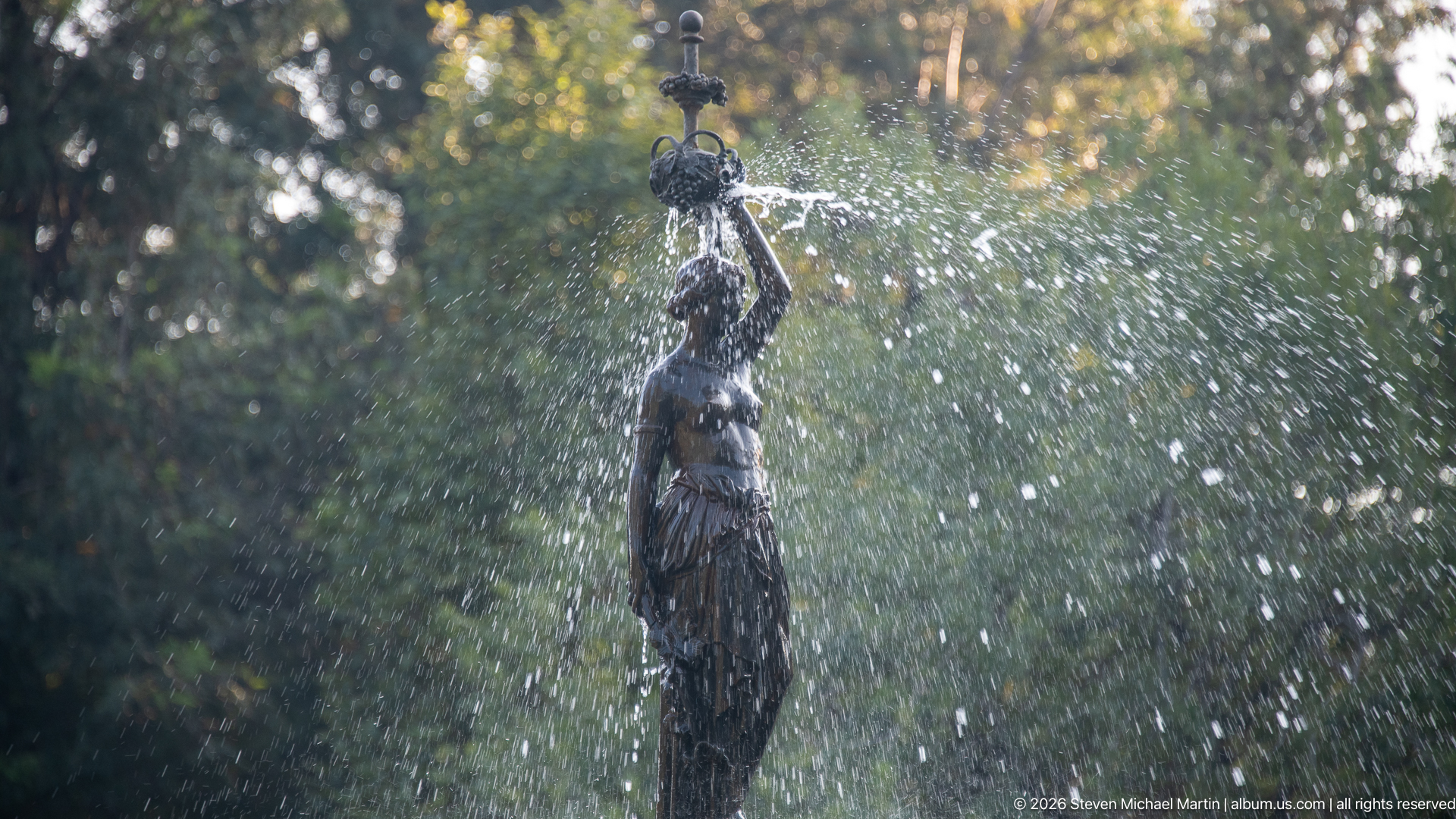
A bronze female figure rises at the center of a fountain, partly veiled by water thrown across the frame. The dark sculpture is seen at close range against a soft background of trees, so the spray becomes both atmosphere and foreground texture. This tight view isolates the figure and the fountain’s movement rather than presenting the surrounding park.
Caption
A bronze female figure rises at the center of a fountain, partly veiled by water thrown across the frame. The dark sculpture is seen at close range against a soft background of trees, so the spray becomes both atmosphere and foreground texture. This tight view isolates the figure and the fountain’s movement rather than presenting the surrounding park.
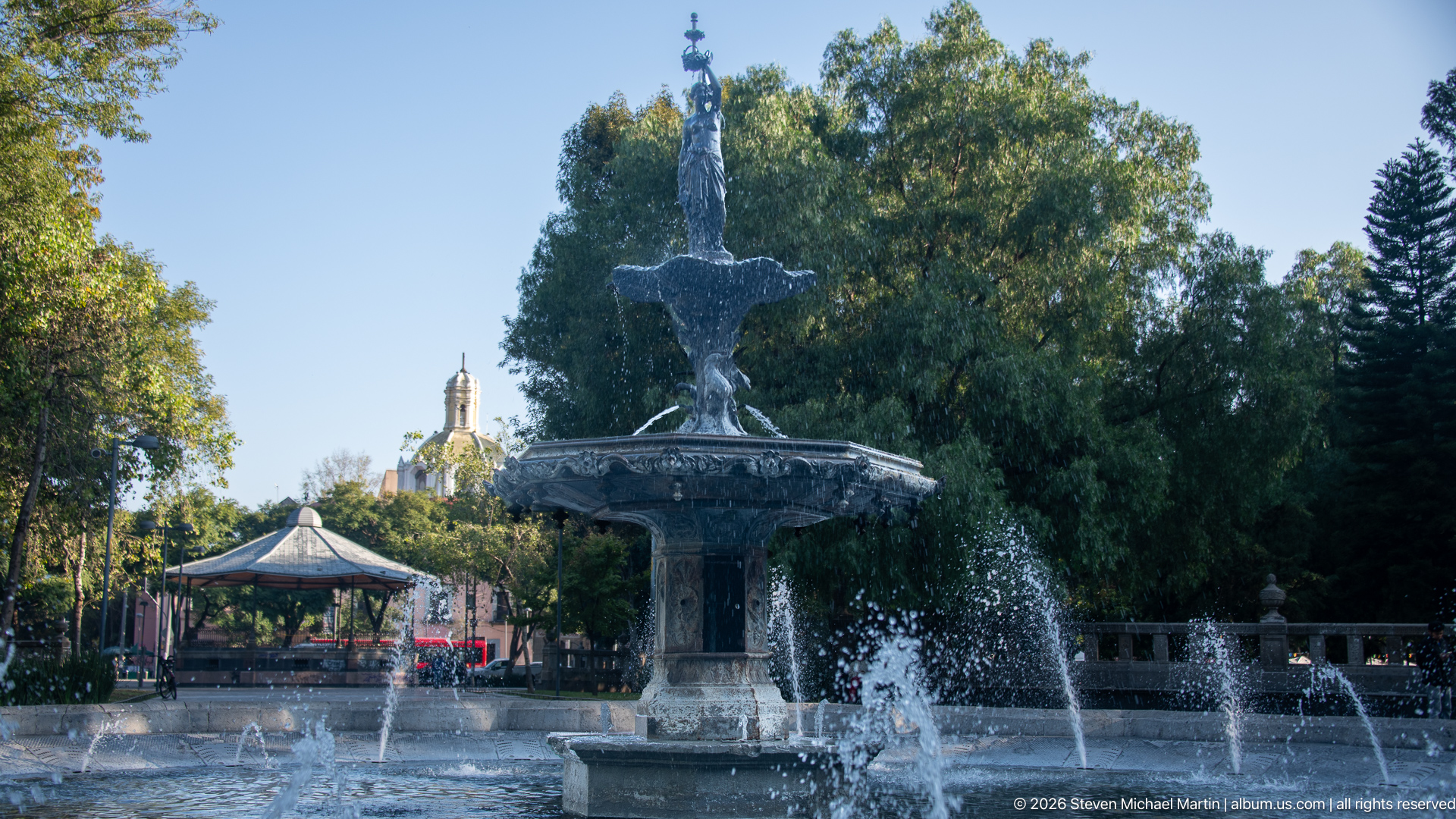
A tiered fountain occupies the center of a leafy urban park, with water spilling from its upper bowl and jets playing around the base. A female statue crowns the structure; a domed pavilion and the top of a church dome appear through the trees behind it. The wide view restores the setting and scale of the fountain glimpsed in the neighboring close-up.
Caption
A tiered fountain occupies the center of a leafy urban park, with water spilling from its upper bowl and jets playing around the base. A female statue crowns the structure; a domed pavilion and the top of a church dome appear through the trees behind it. The wide view restores the setting and scale of the fountain glimpsed in the neighboring close-up.
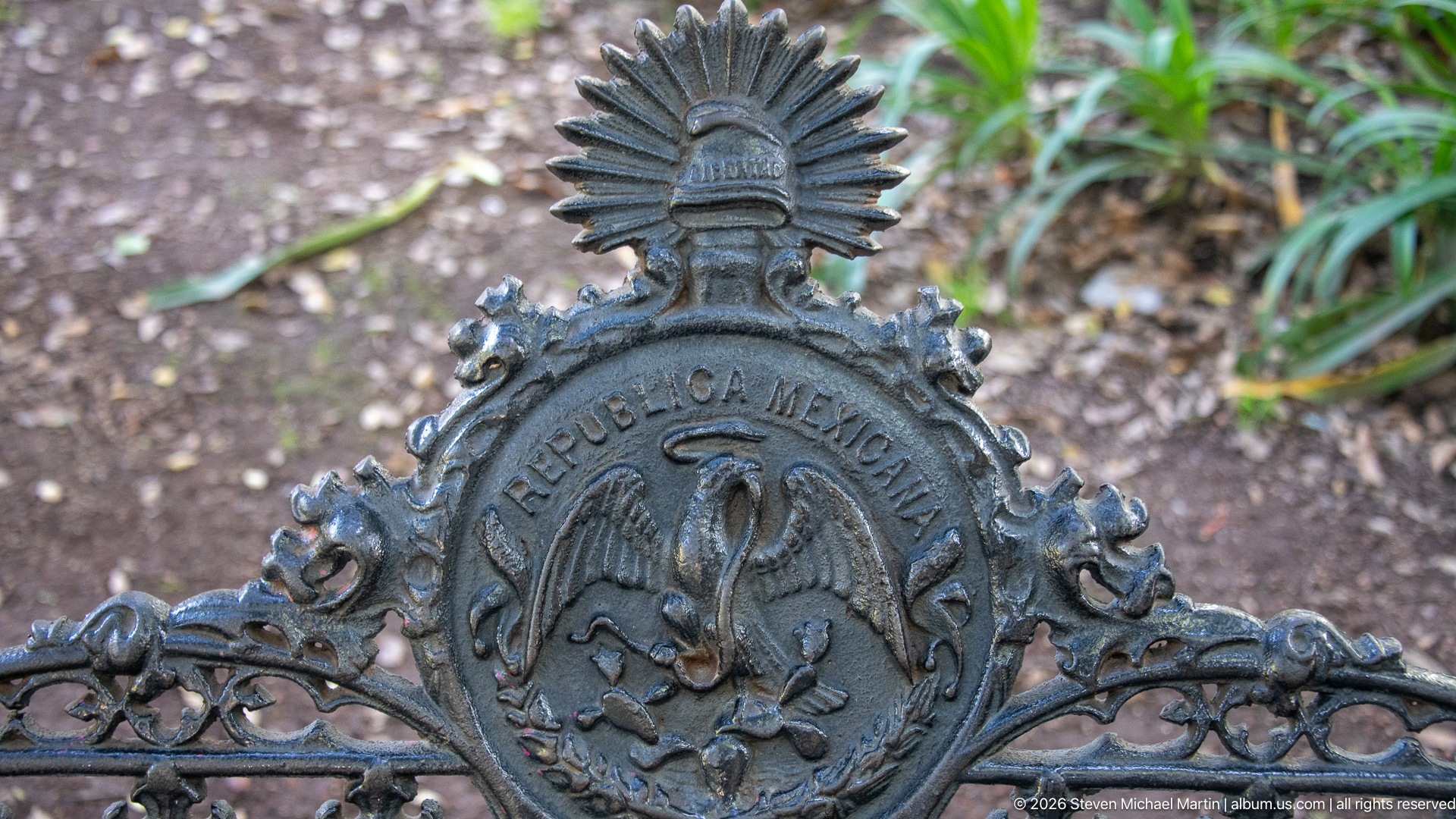
The Mexican coat of arms fills a circular cast-iron medallion, its eagle, serpent, and cactus rendered in raised relief beneath the words “REPÚBLICA MEXICANA.” A fan-shaped crest and curling metal branches extend above and around the emblem. Shallow focus separates the dark iron from the soft green park floor, making the official inscription and ornamental casting the subject.
Caption
The Mexican coat of arms fills a circular cast-iron medallion, its eagle, serpent, and cactus rendered in raised relief beneath the words “REPÚBLICA MEXICANA.” A fan-shaped crest and curling metal branches extend above and around the emblem. Shallow focus separates the dark iron from the soft green park floor, making the official inscription and ornamental casting the subject.
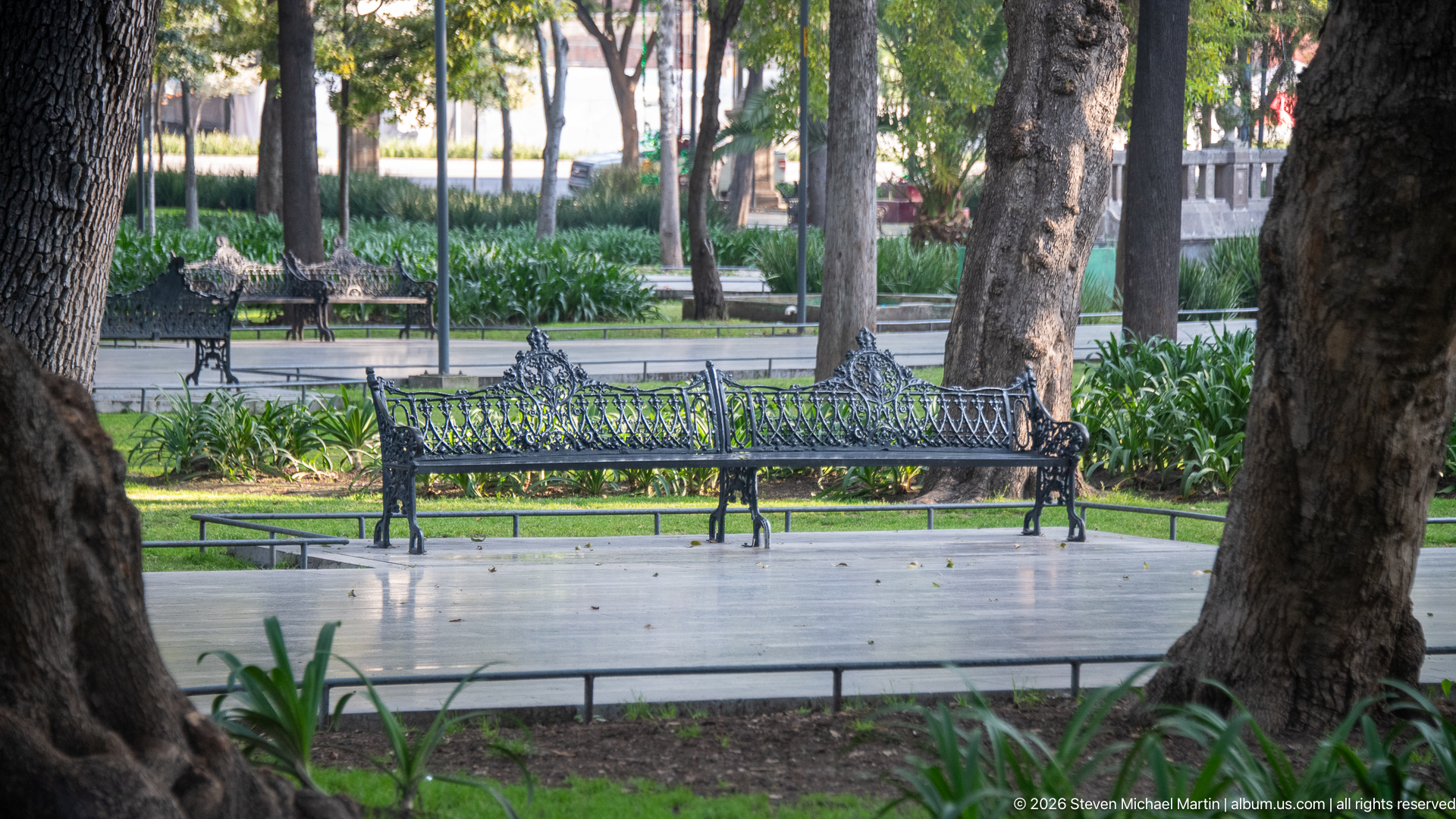
An elaborate cast-iron bench sits empty on a paved path, its openwork back and curved arms set against beds of low green plants and tall tree trunks. The quiet composition turns a familiar park furnishing into a study of decorative metalwork and shade. Sunlight falls in patches across the path, while the empty seat suggests a pause within the larger city garden.
Caption
An elaborate cast-iron bench sits empty on a paved path, its openwork back and curved arms set against beds of low green plants and tall tree trunks. The quiet composition turns a familiar park furnishing into a study of decorative metalwork and shade. Sunlight falls in patches across the path, while the empty seat suggests a pause within the larger city garden.
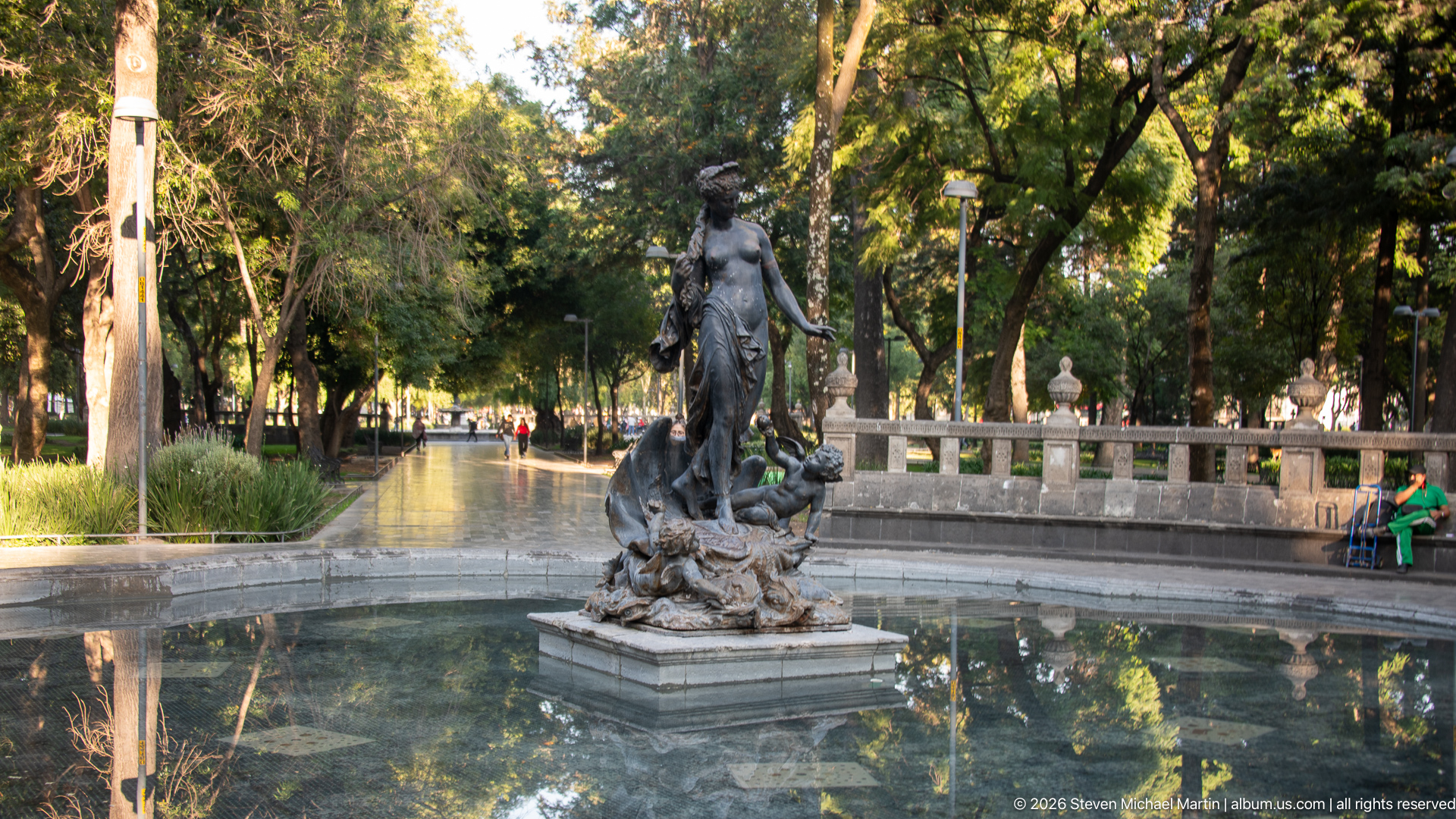
A bronze female figure stands on a sculpted base in the middle of a circular fountain basin, with a low stone balustrade and evenly spaced urns behind her. Reflections of trees and warm late-day light spread across the still water. Unlike the tighter fountain views nearby, this composition emphasizes the statue’s relationship to the surrounding garden and its long central path.
Caption
A bronze female figure stands on a sculpted base in the middle of a circular fountain basin, with a low stone balustrade and evenly spaced urns behind her. Reflections of trees and warm late-day light spread across the still water. Unlike the tighter fountain views nearby, this composition emphasizes the statue’s relationship to the surrounding garden and its long central path.
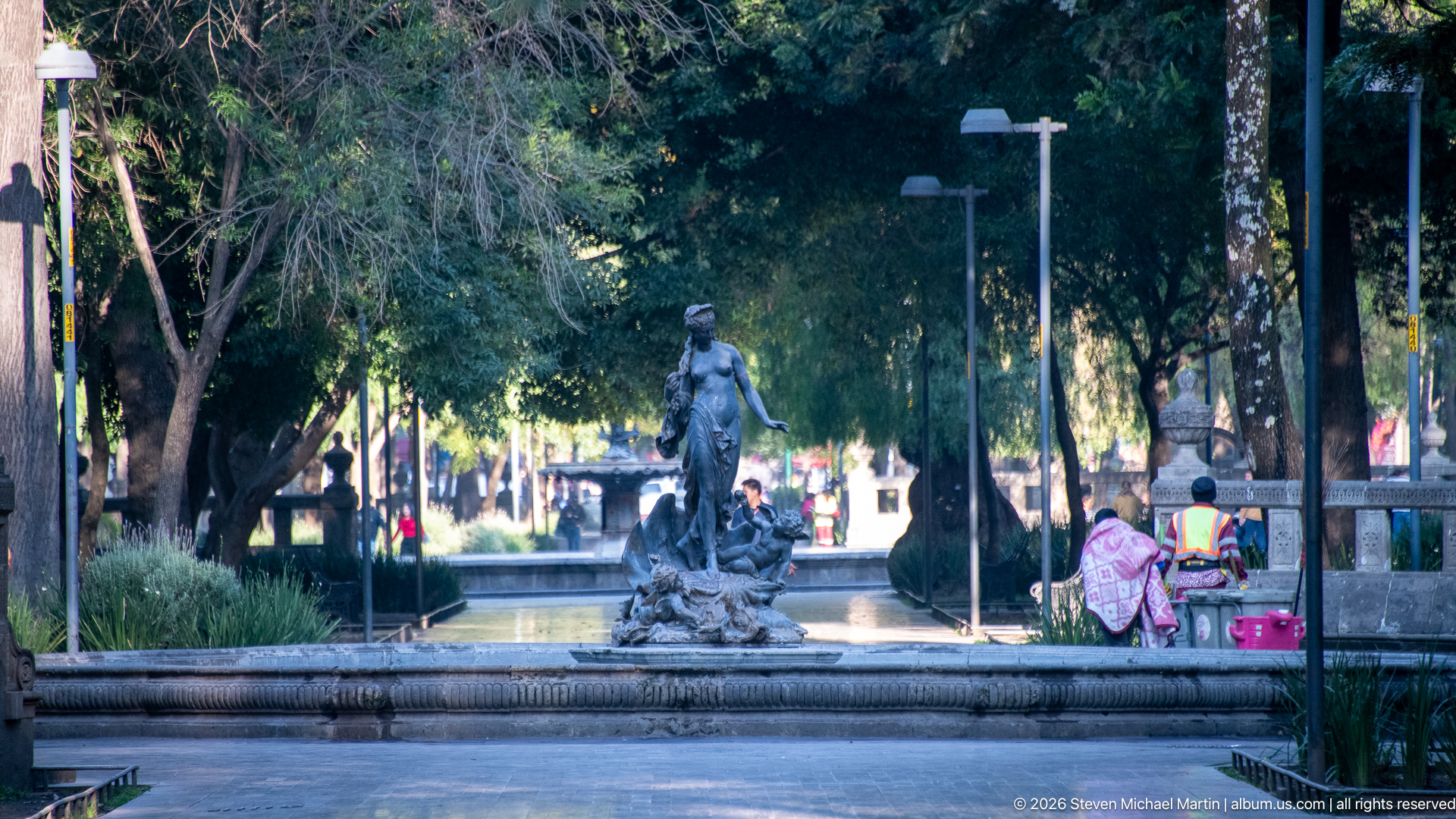
A sculpted fountain stands at the far end of a shaded park promenade, where straight paths and planted borders draw the eye toward its central figure. A visitor sits near the right edge beneath the trees, adding scale to the formal garden setting. The view presents the fountain as part of a sequence of water, sculpture, and walkways rather than as an isolated monument.
Caption
A sculpted fountain stands at the far end of a shaded park promenade, where straight paths and planted borders draw the eye toward its central figure. A visitor sits near the right edge beneath the trees, adding scale to the formal garden setting. The view presents the fountain as part of a sequence of water, sculpture, and walkways rather than as an isolated monument.
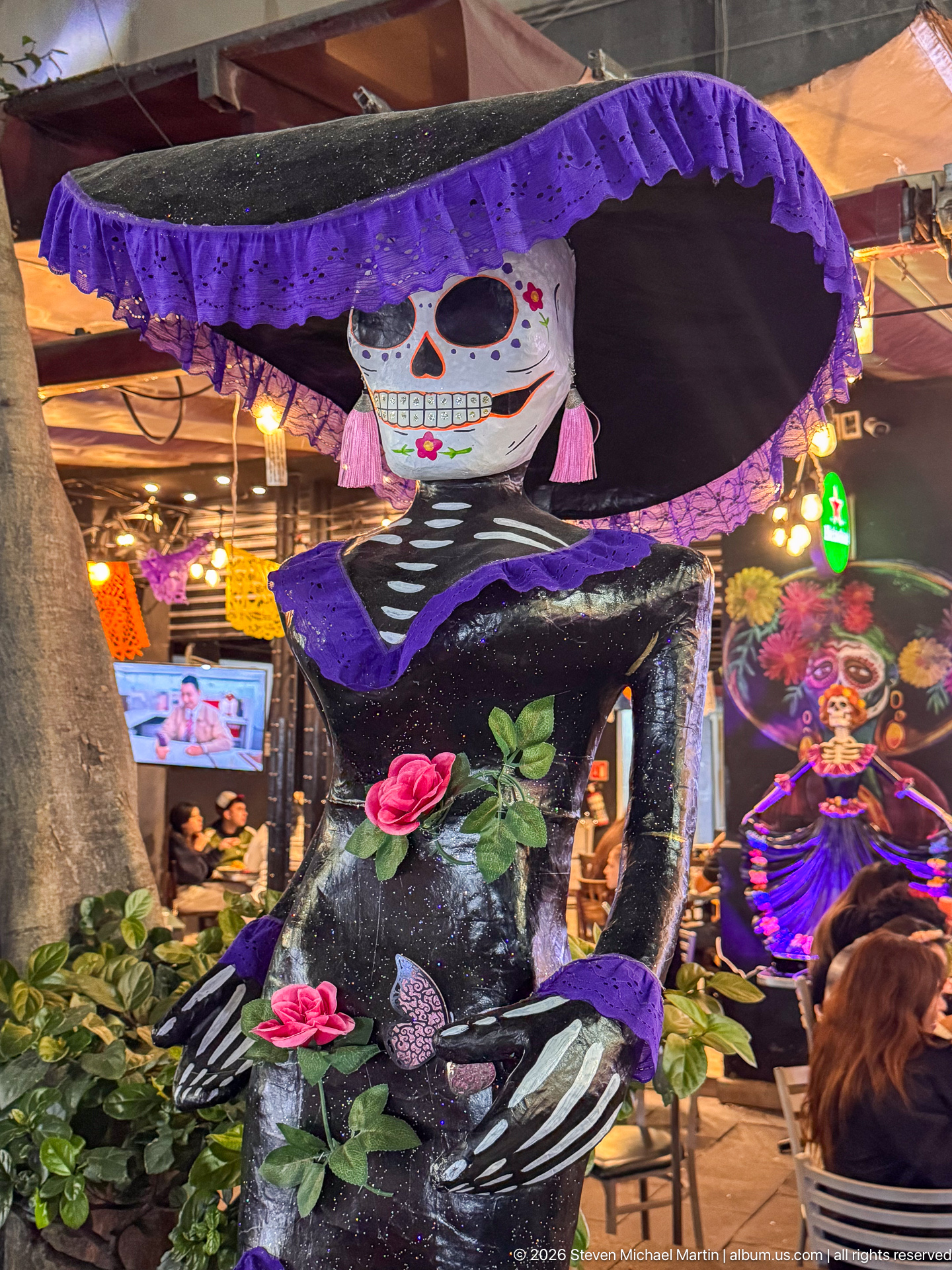
An oversized skeleton figure in a black dress and broad purple hat stands among planters inside a busy dining hall. Papel picado, warm pendant lights, and seated diners fill the background, giving the seasonal figure an unexpected place within an active restaurant interior. Pink flowers and painted details soften the calavera’s dark costume, while the wide hat dominates the upper half of the image.
Caption
An oversized skeleton figure in a black dress and broad purple hat stands among planters inside a busy dining hall. Papel picado, warm pendant lights, and seated diners fill the background, giving the seasonal figure an unexpected place within an active restaurant interior. Pink flowers and painted details soften the calavera’s dark costume, while the wide hat dominates the upper half of the image.
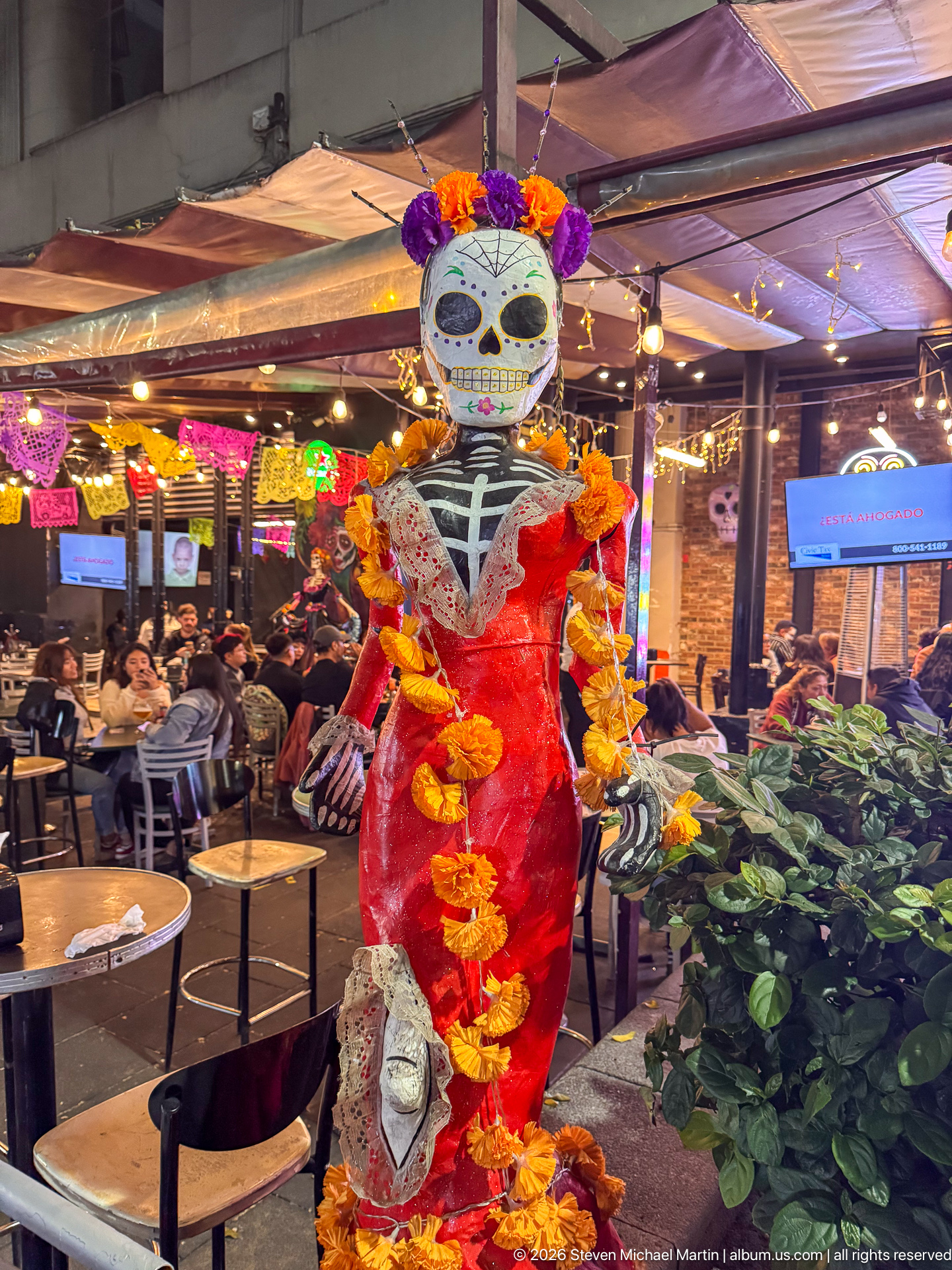
A life-size skeleton mannequin wears a vivid red dress and a crown of orange and purple flowers inside a restaurant dining area. Tables and seated patrons surround the display beneath strings of papel picado and warm lights. The figure’s lace sleeves, floral garland, and decorated skull make the Día de Muertos reference explicit, while the dining room establishes the display’s social setting.
Caption
A life-size skeleton mannequin wears a vivid red dress and a crown of orange and purple flowers inside a restaurant dining area. Tables and seated patrons surround the display beneath strings of papel picado and warm lights. The figure’s lace sleeves, floral garland, and decorated skull make the Día de Muertos reference explicit, while the dining room establishes the display’s social setting.
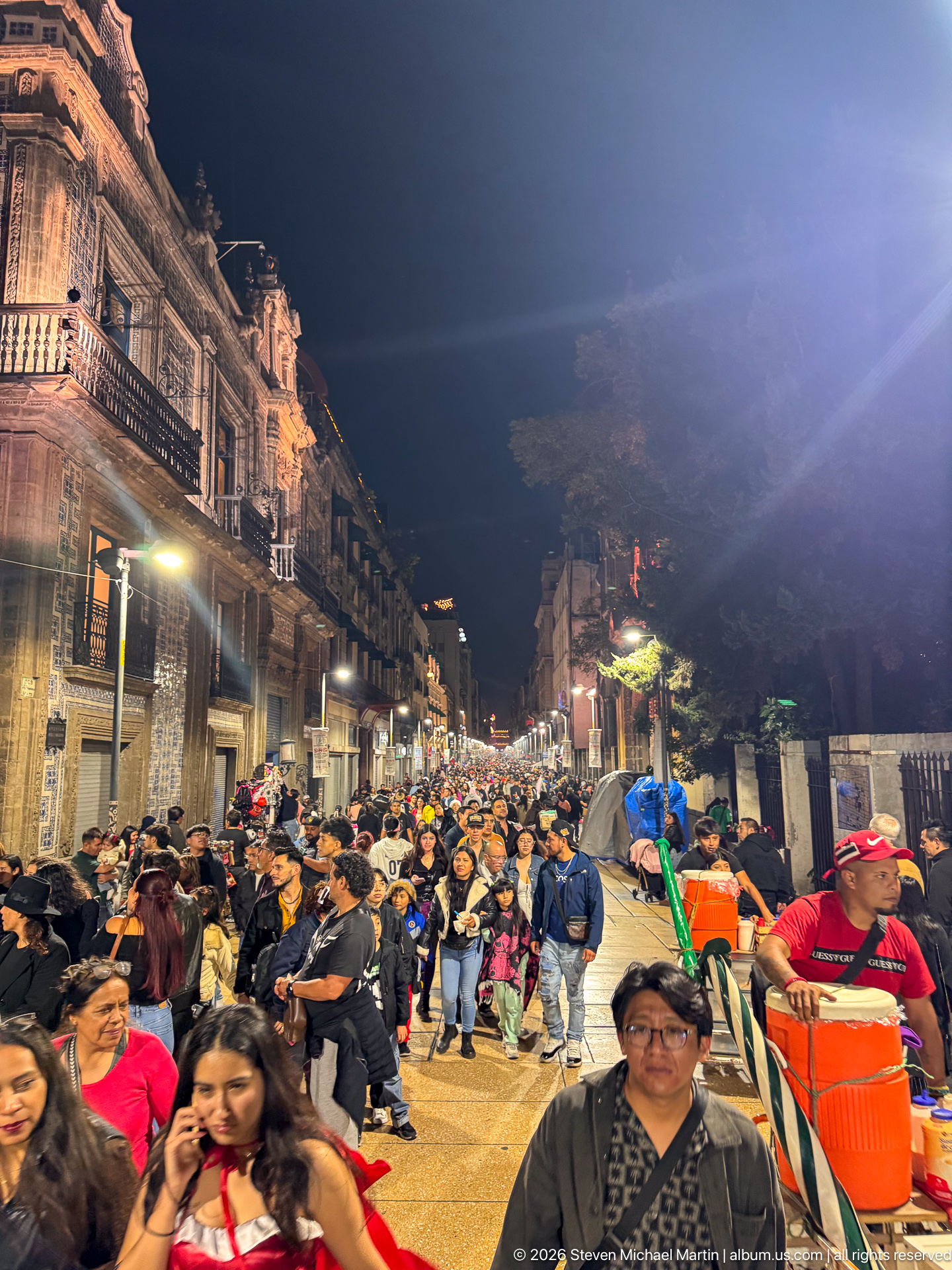
A dense nighttime crowd moves along a historic street lined with illuminated stone façades. A vendor in a red cap pushes an orange drink cooler through the foreground, while shop lights and decorative illumination recede into the distance. The scene is defined by movement and evening foot traffic; the cooler suggests refreshments for sale, but no product or event is named.
Caption
A dense nighttime crowd moves along a historic street lined with illuminated stone façades. A vendor in a red cap pushes an orange drink cooler through the foreground, while shop lights and decorative illumination recede into the distance. The scene is defined by movement and evening foot traffic; the cooler suggests refreshments for sale, but no product or event is named.

A black convertible moves through traffic with two costumed passengers visible above the cabin; one wears a bright orange wig, while a small character doll sits beside them. A large skull-and-marigold motif is painted across the hood. The car’s deliberate decorations and theatrical occupants place the vehicle within a Día de Muertos street celebration, distinct from the surrounding ordinary traffic.
Caption
A black convertible moves through traffic with two costumed passengers visible above the cabin; one wears a bright orange wig, while a small character doll sits beside them. A large skull-and-marigold motif is painted across the hood. The car’s deliberate decorations and theatrical occupants place the vehicle within a Día de Muertos street celebration, distinct from the surrounding ordinary traffic.
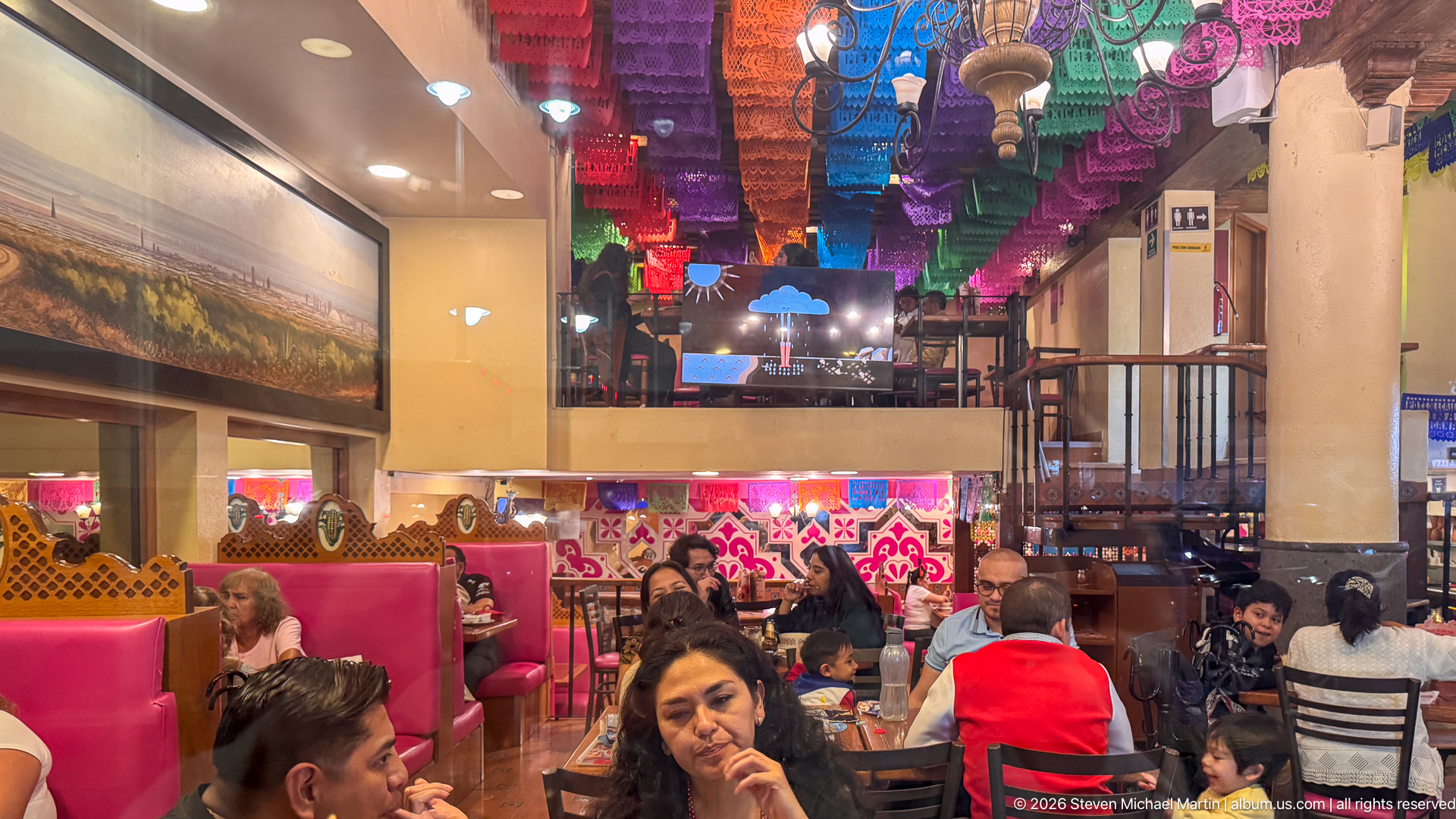
A busy restaurant interior pairs vivid pink upholstered booths with patterned tile, carved wood dividers, and rows of colorful papel picado overhead. Diners occupy the narrow central aisle and tables, giving the room an animated family-dining atmosphere. The camera looks lengthwise through the space, so the repeating booths and ceiling decorations create depth while keeping the active meal service in view.
Caption
A busy restaurant interior pairs vivid pink upholstered booths with patterned tile, carved wood dividers, and rows of colorful papel picado overhead. Diners occupy the narrow central aisle and tables, giving the room an animated family-dining atmosphere. The camera looks lengthwise through the space, so the repeating booths and ceiling decorations create depth while keeping the active meal service in view.
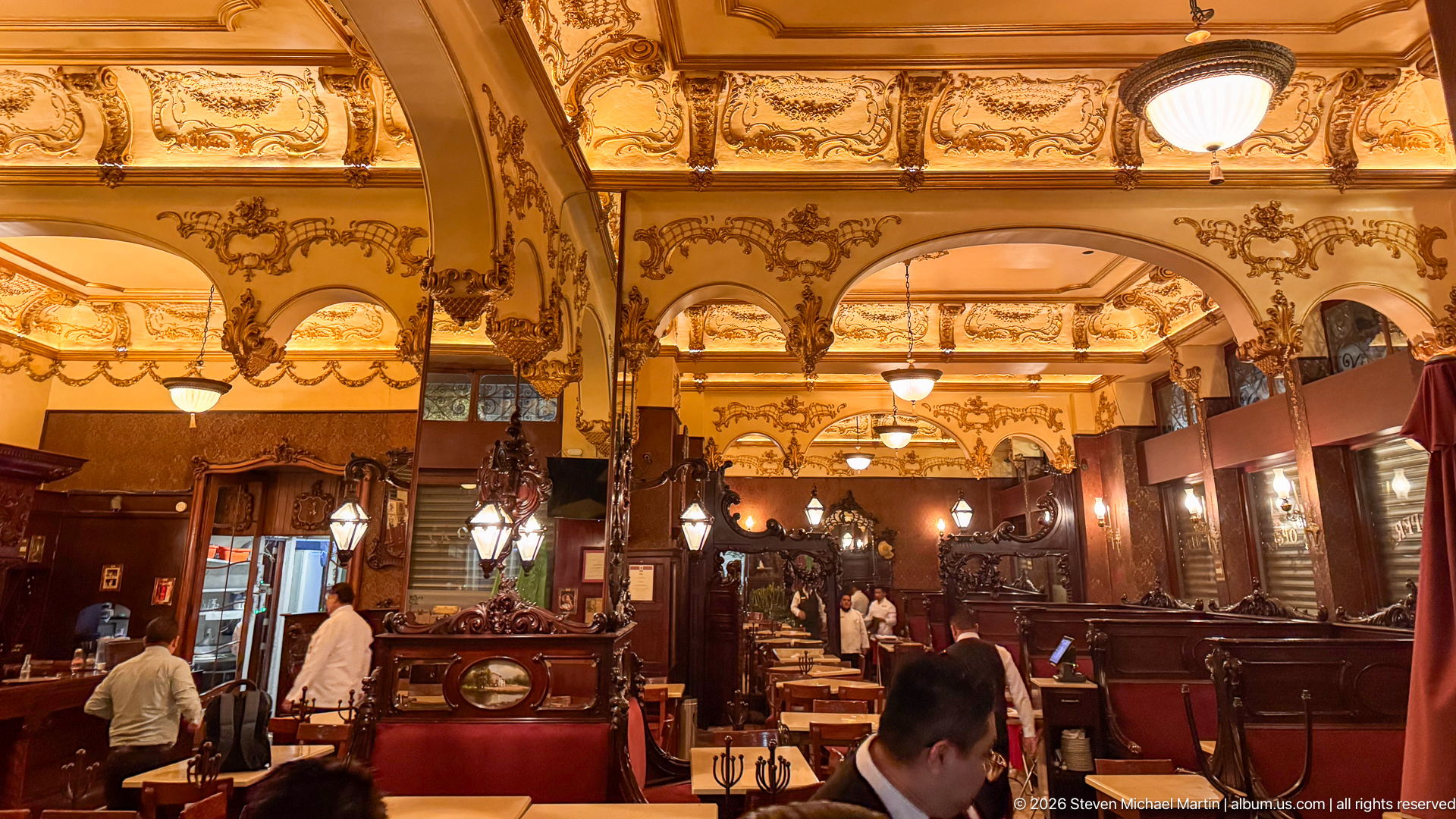
A crowded dining room unfolds beneath an elaborate gilded ceiling of raised scrollwork, framed panels, and broad arches. Dark carved wood furniture, large mirrors, and pendant lamps continue the richly ornamented interior, while diners and servers animate the lower half. The view distinguishes this restaurant through its grand overhead decoration and deep, mirrored perspective rather than through a close view of the meal.
Caption
A crowded dining room unfolds beneath an elaborate gilded ceiling of raised scrollwork, framed panels, and broad arches. Dark carved wood furniture, large mirrors, and pendant lamps continue the richly ornamented interior, while diners and servers animate the lower half. The view distinguishes this restaurant through its grand overhead decoration and deep, mirrored perspective rather than through a close view of the meal.
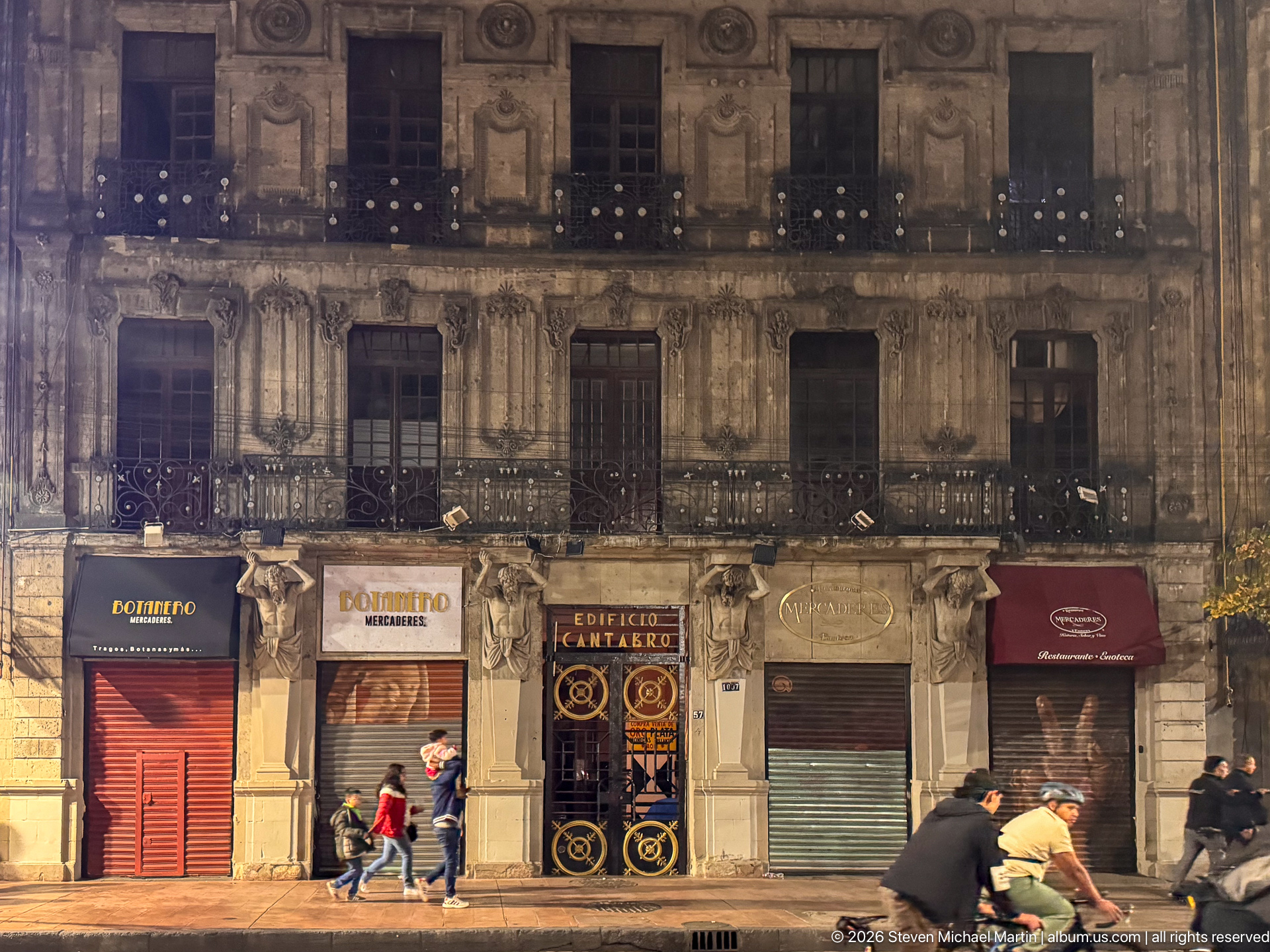
A weathered stone façade spans several narrow storefronts, its upper level lined with tall windows, carved surrounds, and small iron balconies. Shop signs identify bootmaker and leather-goods businesses below, including “Edificio Cantabro,” while pedestrians pass the mostly shuttered entrances. The composition records the building’s mixed commercial life and the strong vertical division between ornamental upper floors and active street frontage.
Caption
A weathered stone façade spans several narrow storefronts, its upper level lined with tall windows, carved surrounds, and small iron balconies. Shop signs identify bootmaker and leather-goods businesses below, including “Edificio Cantabro,” while pedestrians pass the mostly shuttered entrances. The composition records the building’s mixed commercial life and the strong vertical division between ornamental upper floors and active street frontage.
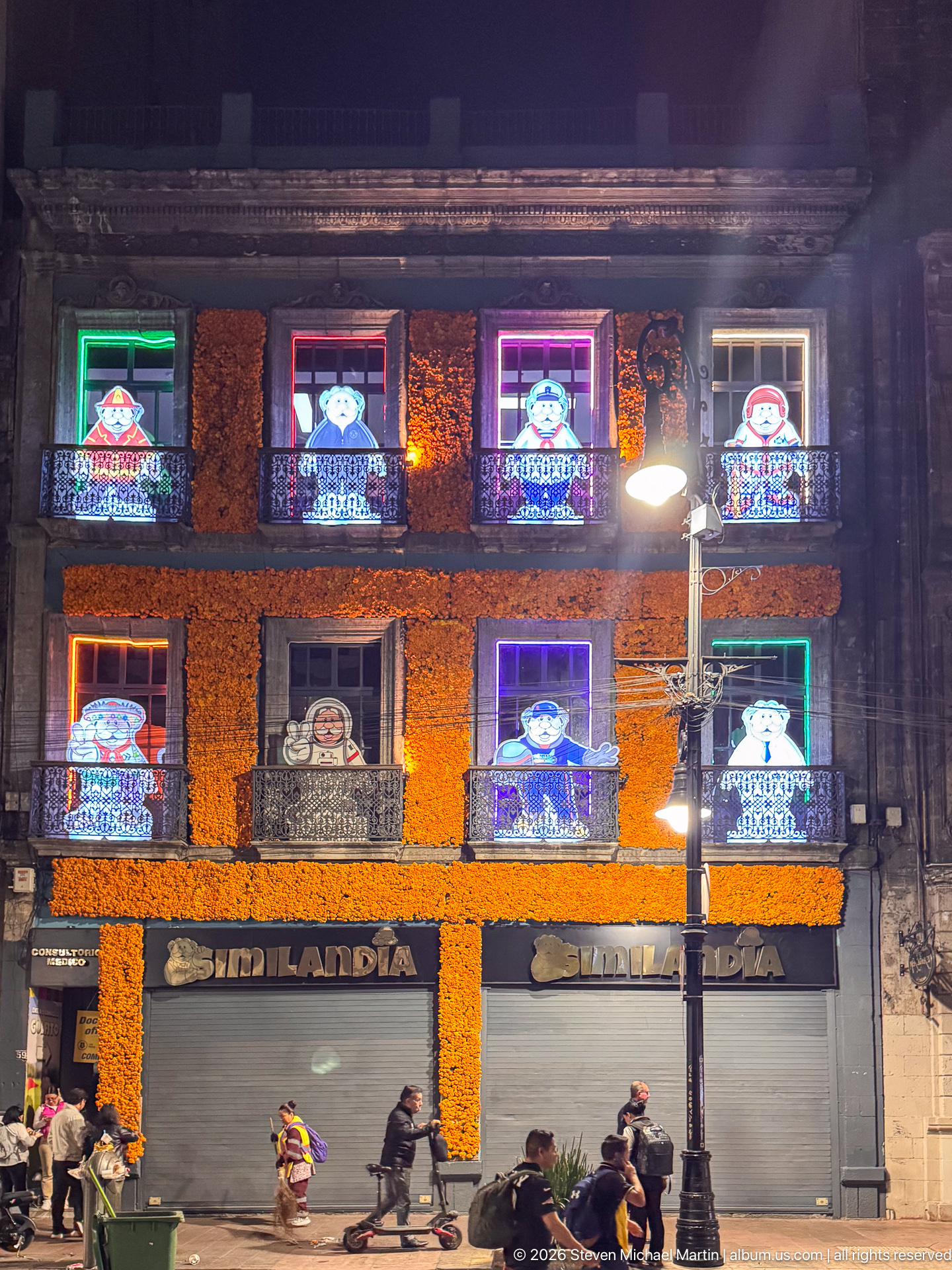
At night, rows of illuminated skeleton figures appear in the windows of a commercial building wrapped in orange marigold garlands. A shop sign reading “SILANDIA” anchors the display at street level as pedestrians pass beneath it. The bright, repeated figures turn the upper façade into a seasonal Día de Muertos tableau, with the surrounding dark masonry acting as a frame.
Caption
At night, rows of illuminated skeleton figures appear in the windows of a commercial building wrapped in orange marigold garlands. A shop sign reading “SILANDIA” anchors the display at street level as pedestrians pass beneath it. The bright, repeated figures turn the upper façade into a seasonal Día de Muertos tableau, with the surrounding dark masonry acting as a frame.
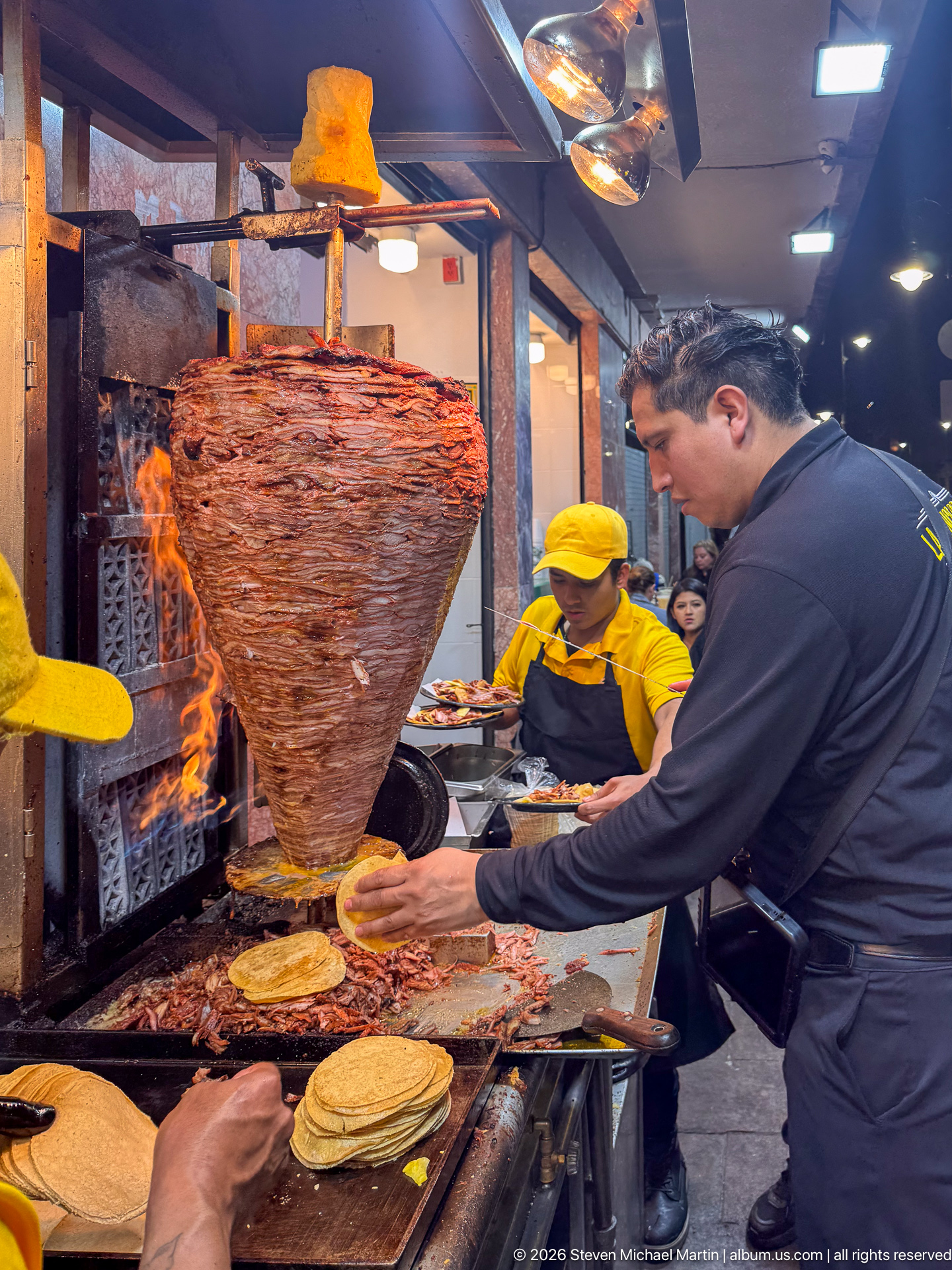
A cook in a yellow shirt shaves browned meat from a tall vertical spit over a hot griddle, guiding the pieces toward a stack of small corn tortillas. Flames lick the side of the roasting meat as another worker and kitchen equipment crowd the narrow service window. The visible preparation is characteristic of tacos al pastor, though no shop name or finished garnish identifies a particular establishment.
Caption
A cook in a yellow shirt shaves browned meat from a tall vertical spit over a hot griddle, guiding the pieces toward a stack of small corn tortillas. Flames lick the side of the roasting meat as another worker and kitchen equipment crowd the narrow service window. The visible preparation is characteristic of tacos al pastor, though no shop name or finished garnish identifies a particular establishment.
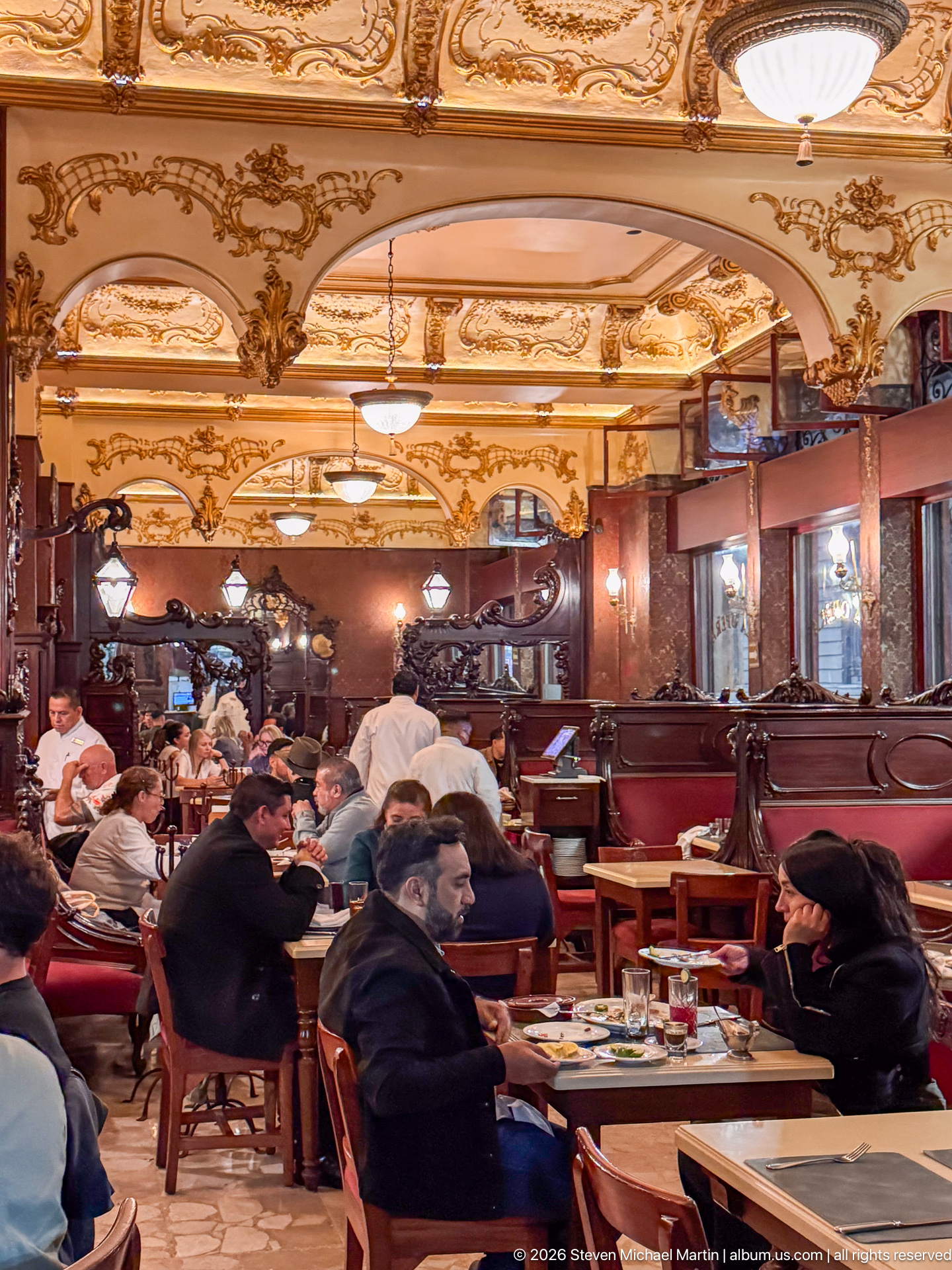
Diners gather at closely spaced tables beneath a richly gilded ceiling articulated by arches, floral scrolls, and framed panels. Dark carved wood, mirrors, and hanging lamps continue the formal interior around the meal, while plates and glasses are visible on tabletops. The room’s elaborate architecture is as prominent as the dining activity, giving this view the character of a historic restaurant interior.
Caption
Diners gather at closely spaced tables beneath a richly gilded ceiling articulated by arches, floral scrolls, and framed panels. Dark carved wood, mirrors, and hanging lamps continue the formal interior around the meal, while plates and glasses are visible on tabletops. The room’s elaborate architecture is as prominent as the dining activity, giving this view the character of a historic restaurant interior.
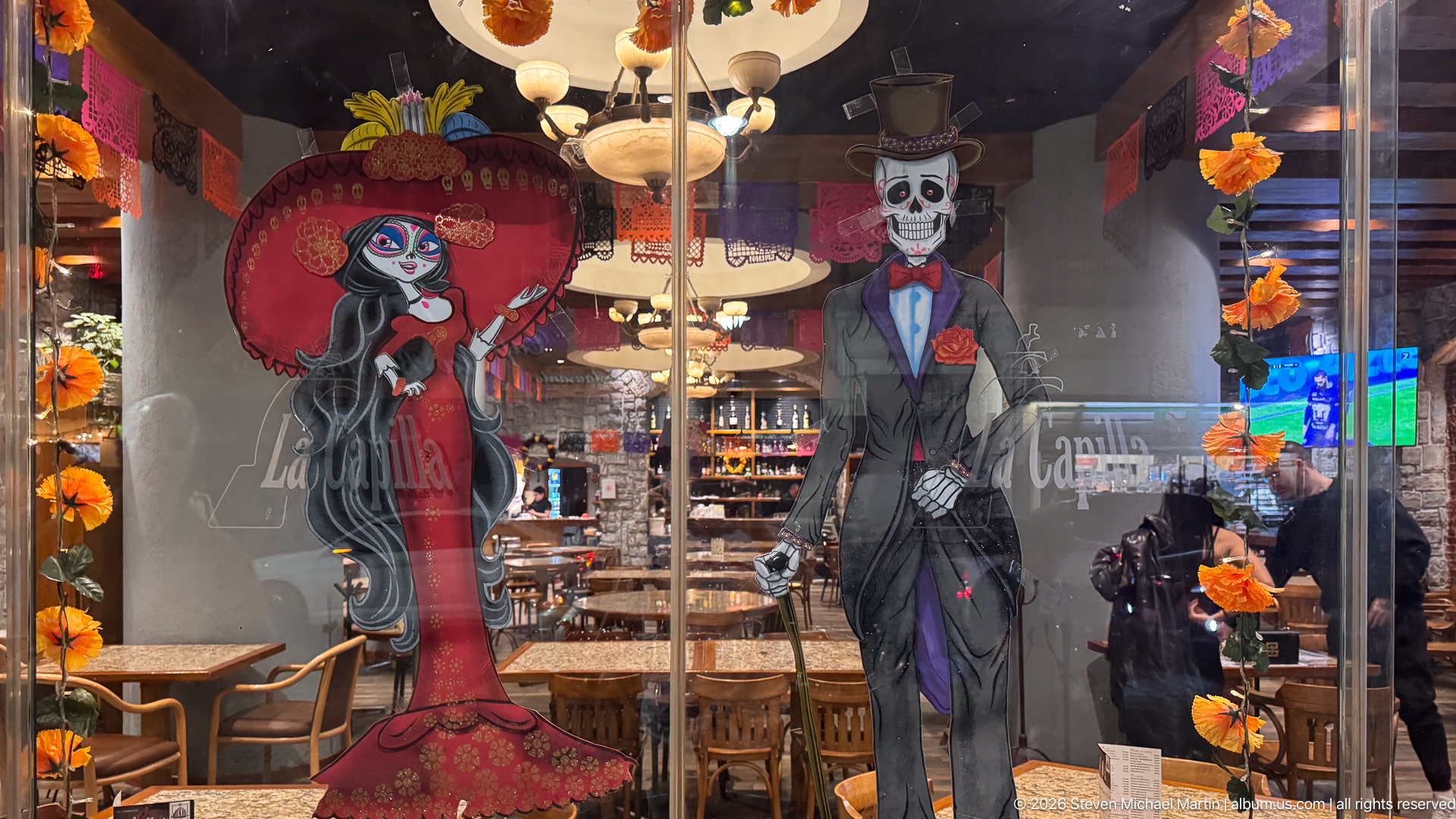
Large painted figures of a Catrina in a red hat and a formally dressed catrín cover a restaurant window. Orange marigolds and cut-paper banners decorate the glass, while tables and warm interior lights are visible behind the artwork. The window functions as both seasonal decoration and a view into the dining room; the partial lettering identifies a restaurant but does not make its full name readable here.
Caption
Large painted figures of a Catrina in a red hat and a formally dressed catrín cover a restaurant window. Orange marigolds and cut-paper banners decorate the glass, while tables and warm interior lights are visible behind the artwork. The window functions as both seasonal decoration and a view into the dining room; the partial lettering identifies a restaurant but does not make its full name readable here.
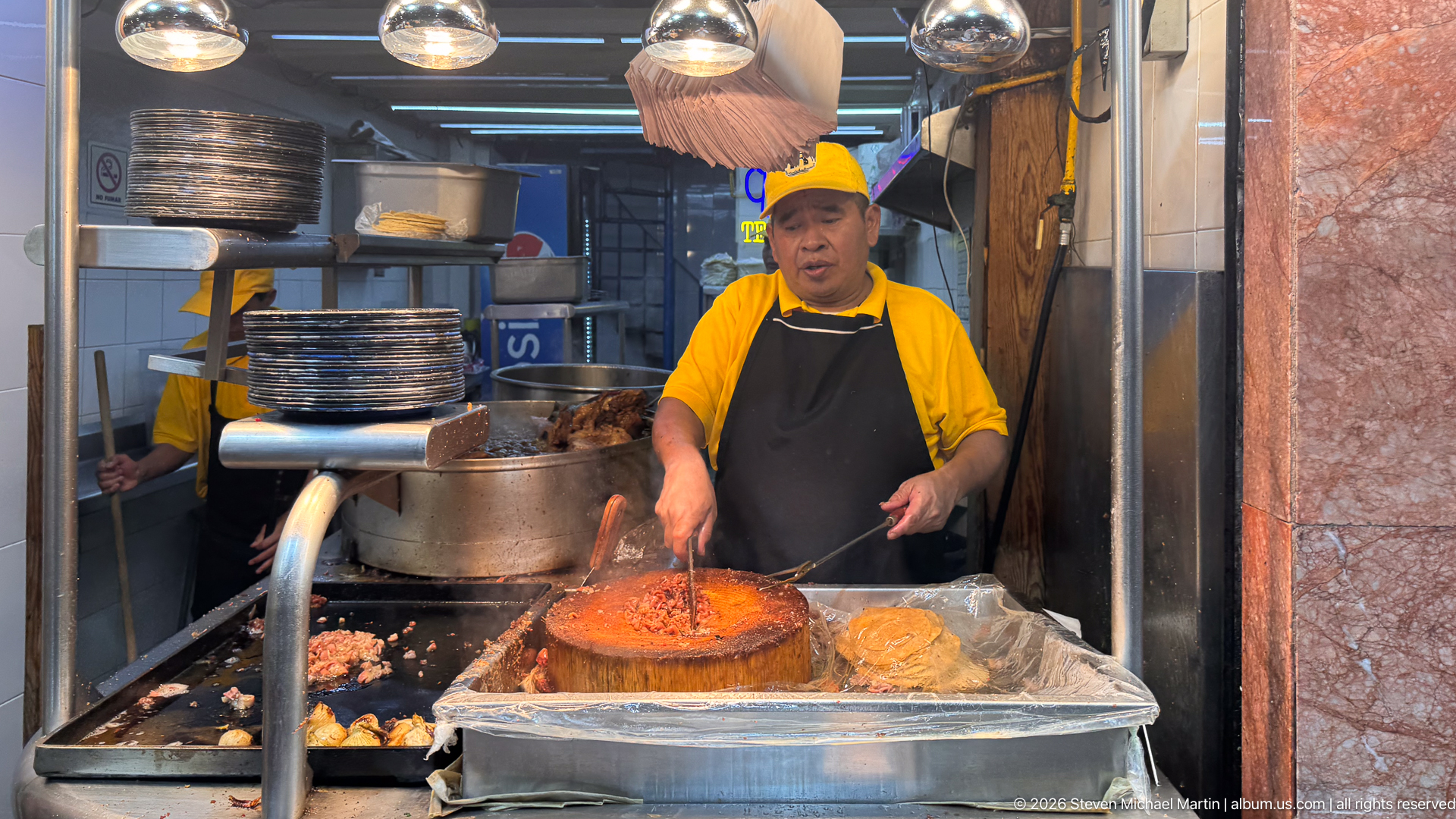
A cook in a yellow shirt works at a compact open counter, lifting a utensil over a hot surface beside a large metal pot and stacks of plates. Prepared ingredients and tortillas sit within reach, while hanging heat lamps illuminate the narrow work area. The image records the labor and equipment behind a quick-service meal without assigning a dish name that the visible ingredients cannot confirm.
Caption
A cook in a yellow shirt works at a compact open counter, lifting a utensil over a hot surface beside a large metal pot and stacks of plates. Prepared ingredients and tortillas sit within reach, while hanging heat lamps illuminate the narrow work area. The image records the labor and equipment behind a quick-service meal without assigning a dish name that the visible ingredients cannot confirm.
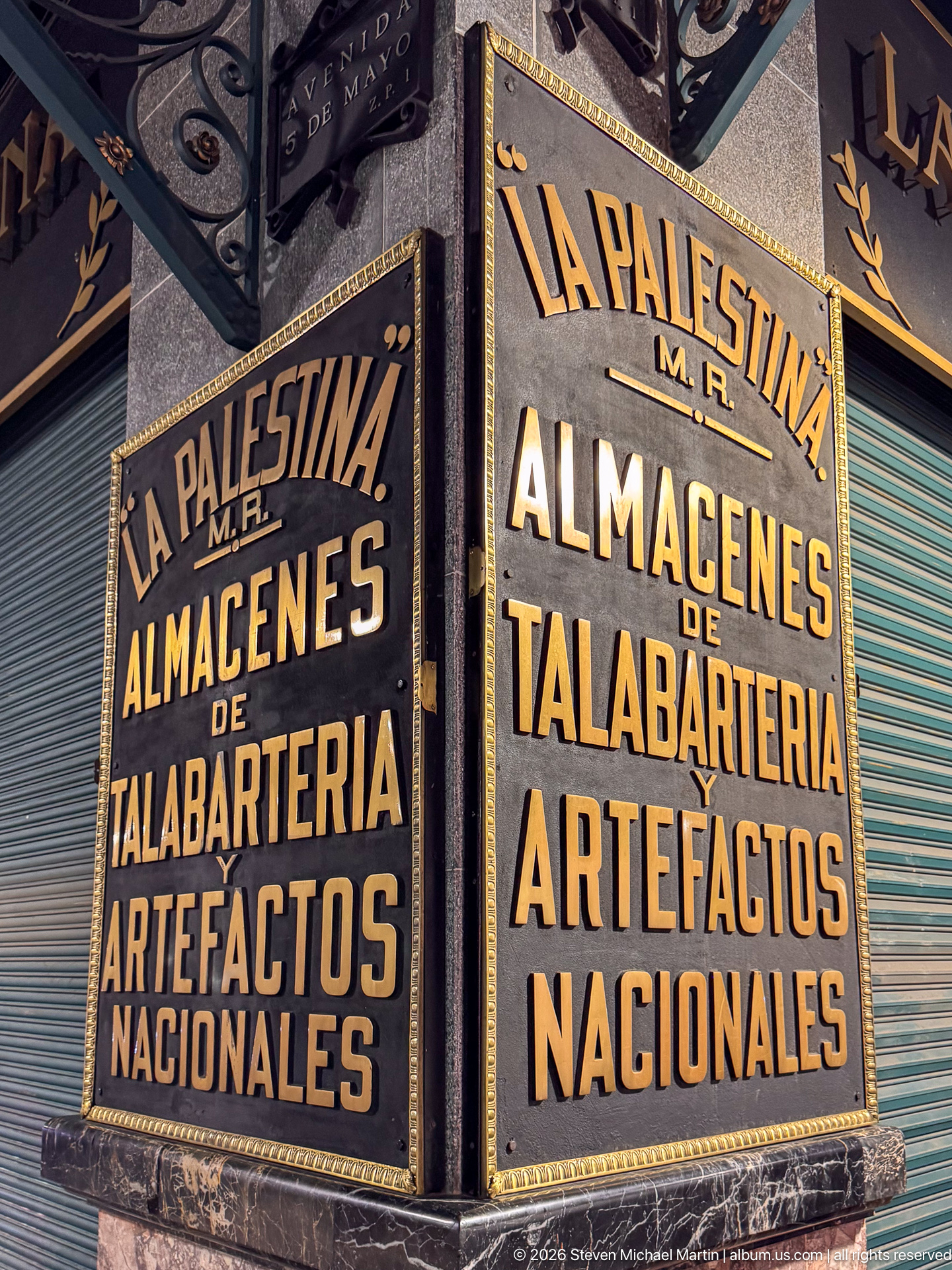
A black-and-gold sign identifies “La Palestrina M.R.” as a shop selling saddlery, leather goods, and national artifacts. A second matching sign wraps the corner above a green metal shutter, and smaller lettering gives the address on Avenida 5 de Mayo. Framed tightly, the image makes the historic commercial lettering and the shop’s stated trade the focus rather than the surrounding street.
Caption
A black-and-gold sign identifies “La Palestrina M.R.” as a shop selling saddlery, leather goods, and national artifacts. A second matching sign wraps the corner above a green metal shutter, and smaller lettering gives the address on Avenida 5 de Mayo. Framed tightly, the image makes the historic commercial lettering and the shop’s stated trade the focus rather than the surrounding street.
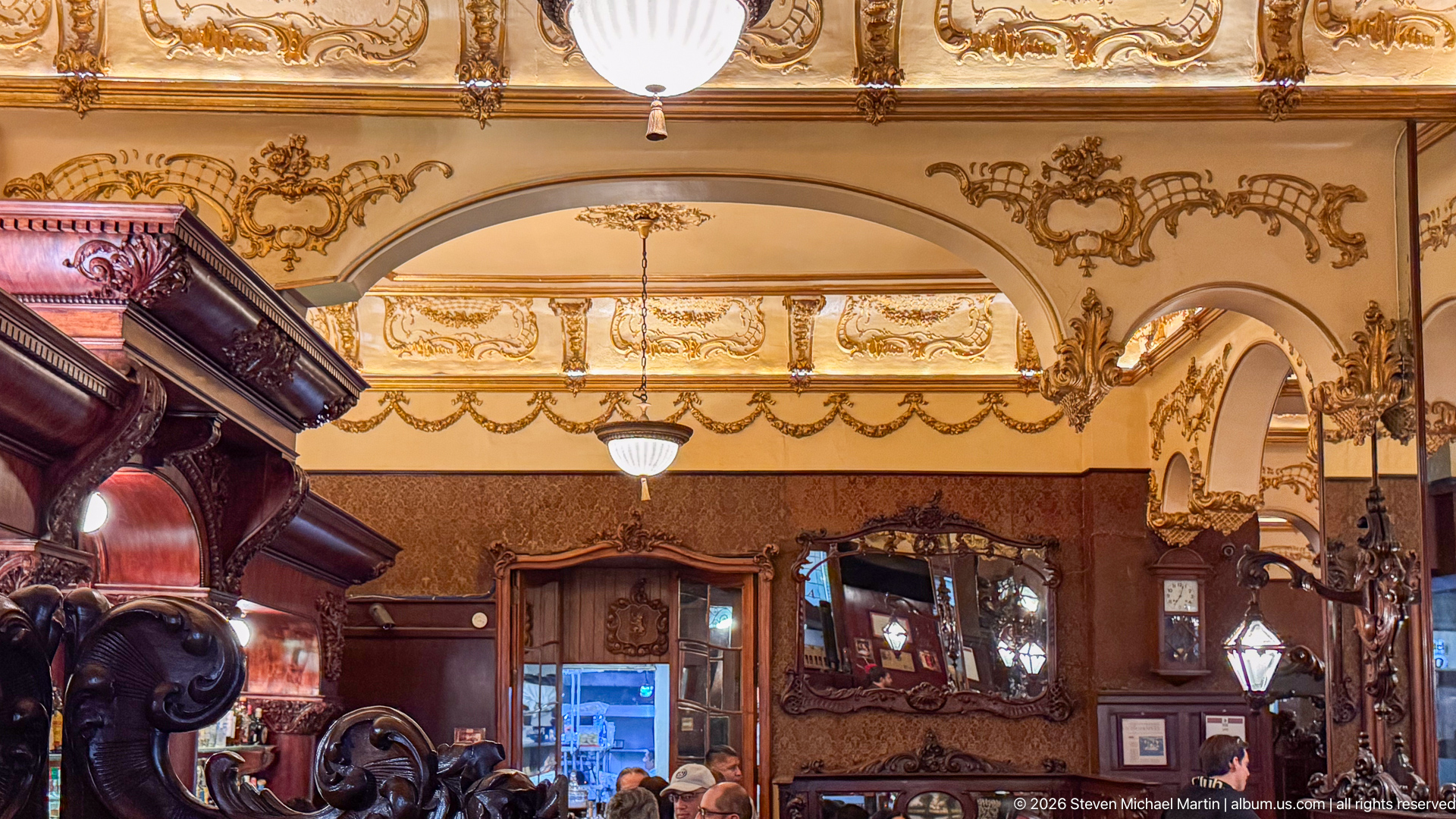
The restaurant interior is seen from farther back, revealing a deep sequence of carved wooden partitions, mirrored panels, pendant lamps, and gilded ceiling bays. Diners fill the lower level beneath the decorative arches, while reflections multiply the warm light across the room. This broader view conveys the scale and continuity of the dining space, complementing the closer architectural and table-level views in the sequence.
Caption
The restaurant interior is seen from farther back, revealing a deep sequence of carved wooden partitions, mirrored panels, pendant lamps, and gilded ceiling bays. Diners fill the lower level beneath the decorative arches, while reflections multiply the warm light across the room. This broader view conveys the scale and continuity of the dining space, complementing the closer architectural and table-level views in the sequence.
🏛️ Cultural Field Guide
📍 Overview
Centro Histórico unfolds through monumental civic buildings, churches, commercial streets, public squares, markets, and the routines of daily life. The photographs range from carved stone façades and crowded pedestrian avenues to Metro platforms, restaurant tables, Día de Muertos displays, and modern towers rising above older rooftops. Together they portray a historic city that remains busy, layered, and closely lived in.
📜 Historical Significance
The city’s past appears in buildings still serving public and commercial purposes. The Museo Nacional de Arte anchors several views with its long stone façade and monumental entrance; nearby photographs identify the Museo del Telégrafo within the same building. Carved portals, civic inscriptions, church fronts, and historic shop signs record different uses of the streets, while the Metro and newer towers show how the city continues to grow and move.
🏛️ Architecture & Built Environment
Stone façades and ornament define many of the street views: arched windows, carved reliefs, clock towers, iron balconies, columns, and elaborate doorways rise above active storefronts and sidewalks. The portfolio also follows the city upward to glass office towers and newer public interiors, and outward to dense hillside neighborhoods crossed by cable cars. Parks, fountains, monuments, transit halls, and plazas add open spaces to the close-knit urban fabric.
🌐 Cultural Importance
Día de Muertos appears across the city rather than in a single setting. Marigolds, Catrinas, sugar skulls, ofrendas, papel picado, and costumed figures decorate shop windows, restaurant entrances, balconies, streets, and public spaces. The photographs also show markets, murals, Metro travel, street food, and shared meals, placing seasonal observance within the broader rhythms of commerce, transit, and social life.
💡 Why It Matters
A historic city is not only a collection of old façades. It is also the streets and institutions people use, the businesses that occupy older buildings, the public art and monuments encountered along the way, and the traditions that shape shared spaces. This portfolio connects architectural details with movement, food, celebration, and everyday encounters to show the Centro Histórico as a living part of a much larger city.
⭐ Highlights
Look for the Museo Nacional de Arte’s arched windows and sculpted stone entrance; the Banco de México’s monumental columns and carved façade; and the Metro scenes at Salto del Agua, where station maps, platforms, trains, and passengers reveal the city’s daily movement. Día de Muertos displays range from small sugar skulls and shop-window Catrinas to marigold-covered public altars and decorated streets. Elsewhere, the Angel of Independence, the Monumento a la Revolución, the Diana Cazadora fountain, and the bronze monument to Cuauhtémoc appear among the city’s parks and towers. Restaurant views include Taquería Orinoco, Fisher’s, El Cardenal, and the dining rooms and mole meal at Casa de los Azulejos.
📷 Photography Notes
Build the story by shifting between scales. Start with wide street and plaza views that show crowds moving beneath façades, then move closer to carved stone, street plaques, shop lettering, murals, and seasonal decorations. Use elevated views for the contrast between dense neighborhoods and newer transit or towers; at street level, include vendors, diners, passengers, and pedestrians to show how the spaces function. In parks and plazas, frame fountains and monuments with the paths, trees, and visitors around them.