Zagreb at Night – Zagreb, Croatia
After sunset the historic center of Zagreb takes on a warm and inviting atmosphere as the city’s squares, churches, and public buildings are illuminated. Lights from cafés and streetlamps highlight the architectural character of the city’s historic districts.
The twin spires of Zagreb Cathedral rise above the skyline, while nearby squares such as Ban Jelačić Square and the cobbled streets of the Upper Town (Gornji Grad) become lively gathering places in the evening hours.
Nighttime views reveal the elegant urban setting of Croatia’s capital, where historic buildings and public spaces reflect the city’s long cultural and political history.

The illuminated twin spires of Zagreb Cathedral rise beyond a row of lower historic buildings, turning the cathedral into a distant vertical marker within the nighttime city. Warm street lighting washes the foreground façades, while the dark sky and elevated viewpoint separate the towers sharply from the surrounding roofline.
Caption
The illuminated twin spires of Zagreb Cathedral rise beyond a row of lower historic buildings, turning the cathedral into a distant vertical marker within the nighttime city. Warm street lighting washes the foreground façades, while the dark sky and elevated viewpoint separate the towers sharply from the surrounding roofline.

A gently curving street passes between contrasting historic and modern façades, with restaurant umbrellas and outdoor seating clustered at the base of a rounded, rusticated corner building. Warm wall lamps and cooler storefront light reflect from the pavement. The viewpoint emphasizes the transition between intimate hospitality spaces and the larger urban blocks of central Zagreb.
Caption
A gently curving street passes between contrasting historic and modern façades, with restaurant umbrellas and outdoor seating clustered at the base of a rounded, rusticated corner building. Warm wall lamps and cooler storefront light reflect from the pavement. The viewpoint emphasizes the transition between intimate hospitality spaces and the larger urban blocks of central Zagreb.

A massive round masonry tower rises from a small landscaped space, its pale upper wall and rough stone base brightly illuminated against the night sky. A steep conical roof, narrow openings, and the heavy cylindrical form preserve the unmistakable character of a historic defensive structure within Zagreb’s Upper Town.
Caption
A massive round masonry tower rises from a small landscaped space, its pale upper wall and rough stone base brightly illuminated against the night sky. A steep conical roof, narrow openings, and the heavy cylindrical form preserve the unmistakable character of a historic defensive structure within Zagreb’s Upper Town.

Zagreb Cathedral’s main entrance fills the frame, with heavy dark doors recessed beneath a deep sequence of pointed arches. Slender colonnettes, statues, foliage, and patterned carving create a dense Gothic Revival surround, dramatically modeled by nighttime illumination and viewed straight on to stress the portal’s symmetry and depth.
Caption
Zagreb Cathedral’s main entrance fills the frame, with heavy dark doors recessed beneath a deep sequence of pointed arches. Slender colonnettes, statues, foliage, and patterned carving create a dense Gothic Revival surround, dramatically modeled by nighttime illumination and viewed straight on to stress the portal’s symmetry and depth.
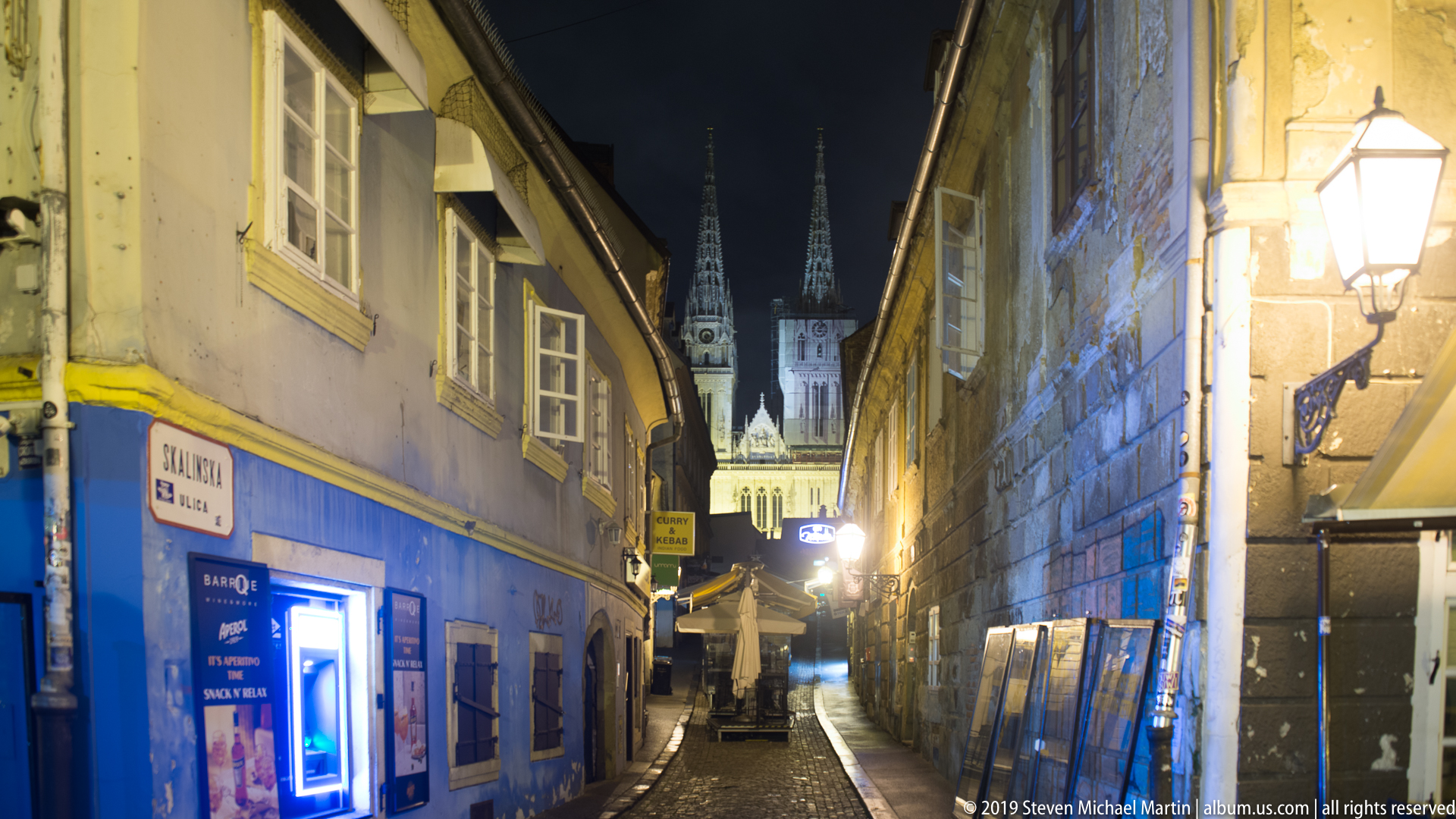
Twin illuminated spires of Zagreb Cathedral rise at the end of a narrow lane, framed tightly by older buildings and a bright wall-mounted lantern. A small stone monument or fountain stands along the centerline farther down the street. The compressed view uses the dark passage as a visual corridor toward the cathedral, making the distant Gothic towers the unmistakable landmark.
Caption
Twin illuminated spires of Zagreb Cathedral rise at the end of a narrow lane, framed tightly by older buildings and a bright wall-mounted lantern. A small stone monument or fountain stands along the centerline farther down the street. The compressed view uses the dark passage as a visual corridor toward the cathedral, making the distant Gothic towers the unmistakable landmark.

A round medieval defensive tower stands fully illuminated beside a small lawn and trees, its rough masonry base transitioning to smoother upper walls beneath a steep conical roof. Decorative streetlamps and the open foreground create a broader contextual view than the closer tower study, emphasizing its freestanding mass within the Upper Town.
Caption
A round medieval defensive tower stands fully illuminated beside a small lawn and trees, its rough masonry base transitioning to smoother upper walls beneath a steep conical roof. Decorative streetlamps and the open foreground create a broader contextual view than the closer tower study, emphasizing its freestanding mass within the Upper Town.

Three standing saints occupy tall niches at the center of Zagreb Cathedral’s entrance sculpture, with smaller narrative reliefs set into pointed recesses on either side. Violet backlighting separates the figures from the pale stone and highlights the tracery, crockets, and layered carving of the cathedral’s Gothic Revival portal.
Caption
Three standing saints occupy tall niches at the center of Zagreb Cathedral’s entrance sculpture, with smaller narrative reliefs set into pointed recesses on either side. Violet backlighting separates the figures from the pale stone and highlights the tracery, crockets, and layered carving of the cathedral’s Gothic Revival portal.

Set back within Ban Jelačić Square, the equestrian monument appears in full on its tall stone pedestal, framed by an extended row of illuminated historic buildings. This wider composition emphasizes the monument’s relationship to the surrounding civic space rather than sculptural detail, with shopfronts and street lighting anchoring the scene at pedestrian level.
Caption
Set back within Ban Jelačić Square, the equestrian monument appears in full on its tall stone pedestal, framed by an extended row of illuminated historic buildings. This wider composition emphasizes the monument’s relationship to the surrounding civic space rather than sculptural detail, with shopfronts and street lighting anchoring the scene at pedestrian level.

The upper section of Zagreb Cathedral’s richly carved entrance rises in tiers of pointed arches, niches, saints, and relief panels. Pale stonework is washed with cool and violet night light, revealing the vertical rhythm of pinnacles and tracery and the dense sculptural program that frames the cathedral’s principal doorway.
Caption
The upper section of Zagreb Cathedral’s richly carved entrance rises in tiers of pointed arches, niches, saints, and relief panels. Pale stonework is washed with cool and violet night light, revealing the vertical rhythm of pinnacles and tracery and the dense sculptural program that frames the cathedral’s principal doorway.

A large cast-metal coat of arms dominates a polished stone surface, surrounded by scrolls, foliage, small emblems, and relief ornament. Strong oblique night lighting reveals the depth of the heraldic shield and crown-like crest, making this a close study of civic symbolism and metalwork rather than the larger structure that carries it.
Caption
A large cast-metal coat of arms dominates a polished stone surface, surrounded by scrolls, foliage, small emblems, and relief ornament. Strong oblique night lighting reveals the depth of the heraldic shield and crown-like crest, making this a close study of civic symbolism and metalwork rather than the larger structure that carries it.

Ivan Kožarić’s large bronze sphere known as Grounded Sun stands on the paving of central Zagreb, its burnished surface densely layered with handwritten marks, stickers, and graffiti. Seen close and nearly front-on at night, the sculpture fills the frame against an ornate historic façade, turning the surrounding street lighting into warm reflections across its weathered metallic skin.
Caption
Ivan Kožarić’s large bronze sphere known as Grounded Sun stands on the paving of central Zagreb, its burnished surface densely layered with handwritten marks, stickers, and graffiti. Seen close and nearly front-on at night, the sculpture fills the frame against an ornate historic façade, turning the surrounding street lighting into warm reflections across its weathered metallic skin.

Grounded Sun occupies the center of a quiet pedestrian street, where shopfronts, paving stones, and blue-white night lighting establish its urban setting. Graffiti and stickers spread across the bronze globe, including a large painted word and symbols on the near face. This wider angle shows the sculpture less as an isolated object than as a familiar piece of Zagreb’s nighttime streetscape.
Caption
Grounded Sun occupies the center of a quiet pedestrian street, where shopfronts, paving stones, and blue-white night lighting establish its urban setting. Graffiti and stickers spread across the bronze globe, including a large painted word and symbols on the near face. This wider angle shows the sculpture less as an isolated object than as a familiar piece of Zagreb’s nighttime streetscape.

A theatrical group of carved figures crowns an arched entrance in Zagreb’s historic center. Two reclining or seated figures flank a central cartouche beneath a deep projecting canopy, while pilasters and molded stonework frame the composition. The upward nighttime viewpoint isolates the ornament from the street and emphasizes the layered modeling, scrollwork, and shadowed recesses of the entrance decoration.
Caption
A theatrical group of carved figures crowns an arched entrance in Zagreb’s historic center. Two reclining or seated figures flank a central cartouche beneath a deep projecting canopy, while pilasters and molded stonework frame the composition. The upward nighttime viewpoint isolates the ornament from the street and emphasizes the layered modeling, scrollwork, and shadowed recesses of the entrance decoration.

The illuminated Serbian Orthodox Cathedral of the Transfiguration rises behind the monument to poet and military officer Petar Preradović on its namesake square. The church’s pale façade and bell tower are picked out against a dark blue sky, while the bronze figure stands on axis in the foreground. Wet paving and autumn trees reflect the cool nighttime lighting around the square.
Caption
The illuminated Serbian Orthodox Cathedral of the Transfiguration rises behind the monument to poet and military officer Petar Preradović on its namesake square. The church’s pale façade and bell tower are picked out against a dark blue sky, while the bronze figure stands on axis in the foreground. Wet paving and autumn trees reflect the cool nighttime lighting around the square.

Petar Preradović’s bronze figure is seen from a low, rear three-quarter angle, silhouetted against the brightly illuminated pediment of the Orthodox cathedral behind him. The close viewpoint suppresses the surrounding square and concentrates on the monument’s long coat, clasped hands, and formal stance, with the warm architectural lighting creating a strong contrast between sculpture and background.
Caption
Petar Preradović’s bronze figure is seen from a low, rear three-quarter angle, silhouetted against the brightly illuminated pediment of the Orthodox cathedral behind him. The close viewpoint suppresses the surrounding square and concentrates on the monument’s long coat, clasped hands, and formal stance, with the warm architectural lighting creating a strong contrast between sculpture and background.

Centered in front of the floodlit Serbian Orthodox Cathedral of the Transfiguration, the monument to Petar Preradović anchors a symmetrical nighttime composition. The poet’s bronze figure rises from a tall stone pedestal while the church’s arched windows, classical pediments, and bell tower form a luminous backdrop. The frontal viewpoint clarifies the monument’s relationship to the square and cathedral.
Caption
Centered in front of the floodlit Serbian Orthodox Cathedral of the Transfiguration, the monument to Petar Preradović anchors a symmetrical nighttime composition. The poet’s bronze figure rises from a tall stone pedestal while the church’s arched windows, classical pediments, and bell tower form a luminous backdrop. The frontal viewpoint clarifies the monument’s relationship to the square and cathedral.

A rounded corner block glows above a nearly empty Zagreb square, its pale historic façade articulated by rows of windows, cornices, and a small rooftop cupola. Streetlamps, kiosks, café seating, and autumn trees occupy the foreground, while wet paving reflects the lights. The broad view records the subdued scale and mixed commercial architecture of the city center after dark.
Caption
A rounded corner block glows above a nearly empty Zagreb square, its pale historic façade articulated by rows of windows, cornices, and a small rooftop cupola. Streetlamps, kiosks, café seating, and autumn trees occupy the foreground, while wet paving reflects the lights. The broad view records the subdued scale and mixed commercial architecture of the city center after dark.

The entrance façade of the Serbian Orthodox Cathedral of the Transfiguration is isolated against the night sky, with its central portal, paired columns, round-arched window, and shallow pediment brightly illuminated. Mosaic or painted saint figures occupy niches on either side of the central window. The steep upward viewpoint emphasizes the vertical progression from doorway to bell tower.
Caption
The entrance façade of the Serbian Orthodox Cathedral of the Transfiguration is isolated against the night sky, with its central portal, paired columns, round-arched window, and shallow pediment brightly illuminated. Mosaic or painted saint figures occupy niches on either side of the central window. The steep upward viewpoint emphasizes the vertical progression from doorway to bell tower.

Warm floodlighting models the side and front of Zagreb’s Serbian Orthodox Cathedral of the Transfiguration, revealing its pale masonry, arched windows, layered roofline, and square bell tower. Photographed obliquely from across the street, the church appears as a freestanding volume behind a dark iron fence, with the amber illumination separating it sharply from the cloudy night sky.
Caption
Warm floodlighting models the side and front of Zagreb’s Serbian Orthodox Cathedral of the Transfiguration, revealing its pale masonry, arched windows, layered roofline, and square bell tower. Photographed obliquely from across the street, the church appears as a freestanding volume behind a dark iron fence, with the amber illumination separating it sharply from the cloudy night sky.

A broader view of the illuminated entrance shows the dark double doors beneath a carved round arch, with paired arched windows directly above. Heavy masonry piers, small sculpted capitals, and symmetrical wall lamps frame the composition. By including the upper openings, the photograph places the portal within the façade’s vertical organization while retaining the doorway as the principal subject.
Caption
A broader view of the illuminated entrance shows the dark double doors beneath a carved round arch, with paired arched windows directly above. Heavy masonry piers, small sculpted capitals, and symmetrical wall lamps frame the composition. By including the upper openings, the photograph places the portal within the façade’s vertical organization while retaining the doorway as the principal subject.

A gilded figure of the Virgin Mary stands against the black night sky, crowned with a halo of stars and extending her hands outward above a sculpted capital and stone pedestal. Isolated from the surrounding square, the luminous figure reads as the devotional summit of a larger public monument.
Caption
A gilded figure of the Virgin Mary stands against the black night sky, crowned with a halo of stars and extending her hands outward above a sculpted capital and stone pedestal. Isolated from the surrounding square, the luminous figure reads as the devotional summit of a larger public monument.

A tall dark wooden door sits within a richly molded round arch, its recessed bands and slender colonnettes picked out by strong ground-level lighting. Twin wall lamps flank the entrance, and shallow steps rise from the pavement to the threshold. The close frontal framing records the portal as an architectural detail rather than identifying the entire building.
Caption
A tall dark wooden door sits within a richly molded round arch, its recessed bands and slender colonnettes picked out by strong ground-level lighting. Twin wall lamps flank the entrance, and shallow steps rise from the pavement to the threshold. The close frontal framing records the portal as an architectural detail rather than identifying the entire building.

Twin tram rails curve through a largely deserted commercial street in central Zagreb, their polished surfaces reflecting a chain of overhead lamps and storefront lighting. The long perspective follows the tracks between multi-story historic buildings, while signs and display windows punctuate the dark façades. The empty roadway gives the infrastructure itself unusual prominence in the nighttime cityscape.
Caption
Twin tram rails curve through a largely deserted commercial street in central Zagreb, their polished surfaces reflecting a chain of overhead lamps and storefront lighting. The long perspective follows the tracks between multi-story historic buildings, while signs and display windows punctuate the dark façades. The empty roadway gives the infrastructure itself unusual prominence in the nighttime cityscape.

A straight tram corridor extends through the illuminated center of Zagreb, framed by tall commercial buildings and bright shop signs. Rails and overhead wires pull the eye toward the distant intersection, while warm streetlamps reflect on the roadway. Unlike the preceding curving view, this composition emphasizes the long axial perspective and continuous urban canyon of the nighttime transit route.
Caption
A straight tram corridor extends through the illuminated center of Zagreb, framed by tall commercial buildings and bright shop signs. Rails and overhead wires pull the eye toward the distant intersection, while warm streetlamps reflect on the roadway. Unlike the preceding curving view, this composition emphasizes the long axial perspective and continuous urban canyon of the nighttime transit route.

Ban Jelačić Square opens beneath bright ornamental streetlamps, with Zagreb’s distinctive blue-faced public clock rising near the center of the composition. Historic façades line the square while closed market or café structures occupy the foreground. The late-hour emptiness exposes the square’s street furniture and broad pedestrian space more clearly than during daytime crowds.
Caption
Ban Jelačić Square opens beneath bright ornamental streetlamps, with Zagreb’s distinctive blue-faced public clock rising near the center of the composition. Historic façades line the square while closed market or café structures occupy the foreground. The late-hour emptiness exposes the square’s street furniture and broad pedestrian space more clearly than during daytime crowds.

A polychrome figural relief wraps around the corner of a building, its clustered human figures modeled in high relief above and beside a projecting window bay. Cream-colored drapery contrasts with darker bronze-toned bodies and gilded details. The close nighttime framing concentrates on the unusual corner treatment and the way the sculptural program bends with the architecture.
Caption
A polychrome figural relief wraps around the corner of a building, its clustered human figures modeled in high relief above and beside a projecting window bay. Cream-colored drapery contrasts with darker bronze-toned bodies and gilded details. The close nighttime framing concentrates on the unusual corner treatment and the way the sculptural program bends with the architecture.

A modern blue ZET tram pauses at a central Zagreb stop, its articulated cars extending across the frame beneath a web of overhead wires. Historic and twentieth-century façades form a layered backdrop, while the illuminated platform sign and tram interior punctuate the quiet street. The photograph records Zagreb’s electric transit system as an active element of the nighttime city center.
Caption
A modern blue ZET tram pauses at a central Zagreb stop, its articulated cars extending across the frame beneath a web of overhead wires. Historic and twentieth-century façades form a layered backdrop, while the illuminated platform sign and tram interior punctuate the quiet street. The photograph records Zagreb’s electric transit system as an active element of the nighttime city center.

A narrow lane bends through Zagreb’s historic center beneath closely spaced lamps, with small shops, bars, and signs crowding the ground floors of older buildings. A parked van and a lone pedestrian give scale to the cobbled or paved passage. The curve, compressed façades, and mixed storefront lighting create a distinctly intimate counterpart to the city’s broad tram avenues.
Caption
A narrow lane bends through Zagreb’s historic center beneath closely spaced lamps, with small shops, bars, and signs crowding the ground floors of older buildings. A parked van and a lone pedestrian give scale to the cobbled or paved passage. The curve, compressed façades, and mixed storefront lighting create a distinctly intimate counterpart to the city’s broad tram avenues.

Large raised letters spelling “ZAGREB” stretch across a softly illuminated wall, their pale faces edged by darker shadow and warm interior color. The tight crop removes nearly all surrounding context, turning the city name into a graphic nighttime study of typography, surface, and artificial light. The visible lettering provides an unambiguous location marker within the portfolio.
Caption
Large raised letters spelling “ZAGREB” stretch across a softly illuminated wall, their pale faces edged by darker shadow and warm interior color. The tight crop removes nearly all surrounding context, turning the city name into a graphic nighttime study of typography, surface, and artificial light. The visible lettering provides an unambiguous location marker within the portfolio.

A timber balcony runs across the upper story of a low historic building on Tkalčićeva Street, above small shopfronts, display windows, and a bicycle resting against the wall. Exposed wooden posts and railings contrast with the white plaster façade and yellow-trimmed windows. Night lighting reveals the intimate domestic scale preserved amid the street’s restaurants and boutiques.
Caption
A timber balcony runs across the upper story of a low historic building on Tkalčićeva Street, above small shopfronts, display windows, and a bicycle resting against the wall. Exposed wooden posts and railings contrast with the white plaster façade and yellow-trimmed windows. Night lighting reveals the intimate domestic scale preserved amid the street’s restaurants and boutiques.

Flower boxes and a continuous wooden balcony animate the façade of a long, low building on Tkalčićeva Street. A row of dormer windows rises from the tiled roof, while shuttered storefronts and graffiti occupy the ground floor after closing. The straight-on nighttime view emphasizes the layered horizontal bands of shopfront, balcony, upper windows, and roof.
Caption
Flower boxes and a continuous wooden balcony animate the façade of a long, low building on Tkalčićeva Street. A row of dormer windows rises from the tiled roof, while shuttered storefronts and graffiti occupy the ground floor after closing. The straight-on nighttime view emphasizes the layered horizontal bands of shopfront, balcony, upper windows, and roof.

Restaurant terraces line both sides of Tkalčićeva Street as the wet pedestrian lane narrows toward the distance. Closed umbrellas, awnings, menu boards, and rows of empty tables mark the street’s hospitality trade after hours, while bright lamps reflect from the paving. The long perspective records the lively commercial fabric in an unusually quiet, nearly deserted state.
Caption
Restaurant terraces line both sides of Tkalčićeva Street as the wet pedestrian lane narrows toward the distance. Closed umbrellas, awnings, menu boards, and rows of empty tables mark the street’s hospitality trade after hours, while bright lamps reflect from the paving. The long perspective records the lively commercial fabric in an unusually quiet, nearly deserted state.

The bronze figure of pioneering Croatian writer and journalist Marija Jurić Zagorka stands below the large wall sundial on Tkalčićeva Street. Seen from close range at night, the statue occupies the lower foreground while the weathered dial, Roman numerals, and radiating hour lines spread across the plaster wall behind her, linking two familiar features of the historic pedestrian street.
Caption
The bronze figure of pioneering Croatian writer and journalist Marija Jurić Zagorka stands below the large wall sundial on Tkalčićeva Street. Seen from close range at night, the statue occupies the lower foreground while the weathered dial, Roman numerals, and radiating hour lines spread across the plaster wall behind her, linking two familiar features of the historic pedestrian street.

A large painted sundial spreads across the rough plaster of an old Tkalčićeva Street façade. Roman numerals and radiating hour lines fan from a dark circular mount near the roofline, interrupted by a small window set into the wall. Night illumination brings out cracks, exposed brick, and patches of worn render, making the timepiece inseparable from the building’s aged surface.
Caption
A large painted sundial spreads across the rough plaster of an old Tkalčićeva Street façade. Roman numerals and radiating hour lines fan from a dark circular mount near the roofline, interrupted by a small window set into the wall. Night illumination brings out cracks, exposed brick, and patches of worn render, making the timepiece inseparable from the building’s aged surface.

Empty café and restaurant terraces recede along Tkalčićeva Street beneath bright lamps and awnings. Transparent wind screens, folded umbrellas, and stacked or vacant seating flank the wet central walkway, while the old façades rise tightly on either side. The composition emphasizes the street’s hospitality infrastructure and reflective surfaces after the evening crowds have dispersed.
Caption
Empty café and restaurant terraces recede along Tkalčićeva Street beneath bright lamps and awnings. Transparent wind screens, folded umbrellas, and stacked or vacant seating flank the wet central walkway, while the old façades rise tightly on either side. The composition emphasizes the street’s hospitality infrastructure and reflective surfaces after the evening crowds have dispersed.

Croatian and European Union flags project from the upper story of an ornate pale façade, joined by a third flag at the center. Strong floodlighting flattens the street-level context and concentrates attention on the building’s tall windows, decorative frieze, and official display. The nighttime view clearly signals an institutional function without providing enough visible evidence to name the building securely.
Caption
Croatian and European Union flags project from the upper story of an ornate pale façade, joined by a third flag at the center. Strong floodlighting flattens the street-level context and concentrates attention on the building’s tall windows, decorative frieze, and official display. The nighttime view clearly signals an institutional function without providing enough visible evidence to name the building securely.

Blue and amber light spills across the wet paving of Tkalčićeva Street, where pub signs, beer-branded awnings, and empty café tables crowd the edges of the pedestrian lane. Low historic buildings and pitched roofs give the scene a compact scale. The late-night view highlights the street’s dense concentration of bars and restaurants after most patrons have departed.
Caption
Blue and amber light spills across the wet paving of Tkalčićeva Street, where pub signs, beer-branded awnings, and empty café tables crowd the edges of the pedestrian lane. Low historic buildings and pitched roofs give the scene a compact scale. The late-night view highlights the street’s dense concentration of bars and restaurants after most patrons have departed.

A broad opening along Tkalčićeva Street is framed by illuminated historic façades, restaurant canopies, kiosks, and a large leafy tree. The rain-darkened pavement reflects white and amber lamps while most seating remains empty. This wider view shows how the restaurant corridor periodically opens into small gathering spaces rather than remaining a uniformly narrow lane.
Caption
A broad opening along Tkalčićeva Street is framed by illuminated historic façades, restaurant canopies, kiosks, and a large leafy tree. The rain-darkened pavement reflects white and amber lamps while most seating remains empty. This wider view shows how the restaurant corridor periodically opens into small gathering spaces rather than remaining a uniformly narrow lane.

A compact Baroque church façade glows yellow beneath the night sky, its central stone portal surmounted by paired niches and a small upper devotional image set into the triangular gable. The building is tightly hemmed in by later urban structures, emphasizing the contrast between its historic religious architecture and the surrounding city blocks. The frontal view records the façade’s simple symmetrical organization.
Caption
A compact Baroque church façade glows yellow beneath the night sky, its central stone portal surmounted by paired niches and a small upper devotional image set into the triangular gable. The building is tightly hemmed in by later urban structures, emphasizing the contrast between its historic religious architecture and the surrounding city blocks. The frontal view records the façade’s simple symmetrical organization.

A weathered stone portal is framed by paired columns, carved capitals, a semicircular fanlight, and a richly ornamented entablature. Warm night lighting brings out the worn masonry, graffiti, and layered surface history, while the closed timber doors and posted notice give the entrance a distinctly urban, after-hours character.
Caption
A weathered stone portal is framed by paired columns, carved capitals, a semicircular fanlight, and a richly ornamented entablature. Warm night lighting brings out the worn masonry, graffiti, and layered surface history, while the closed timber doors and posted notice give the entrance a distinctly urban, after-hours character.
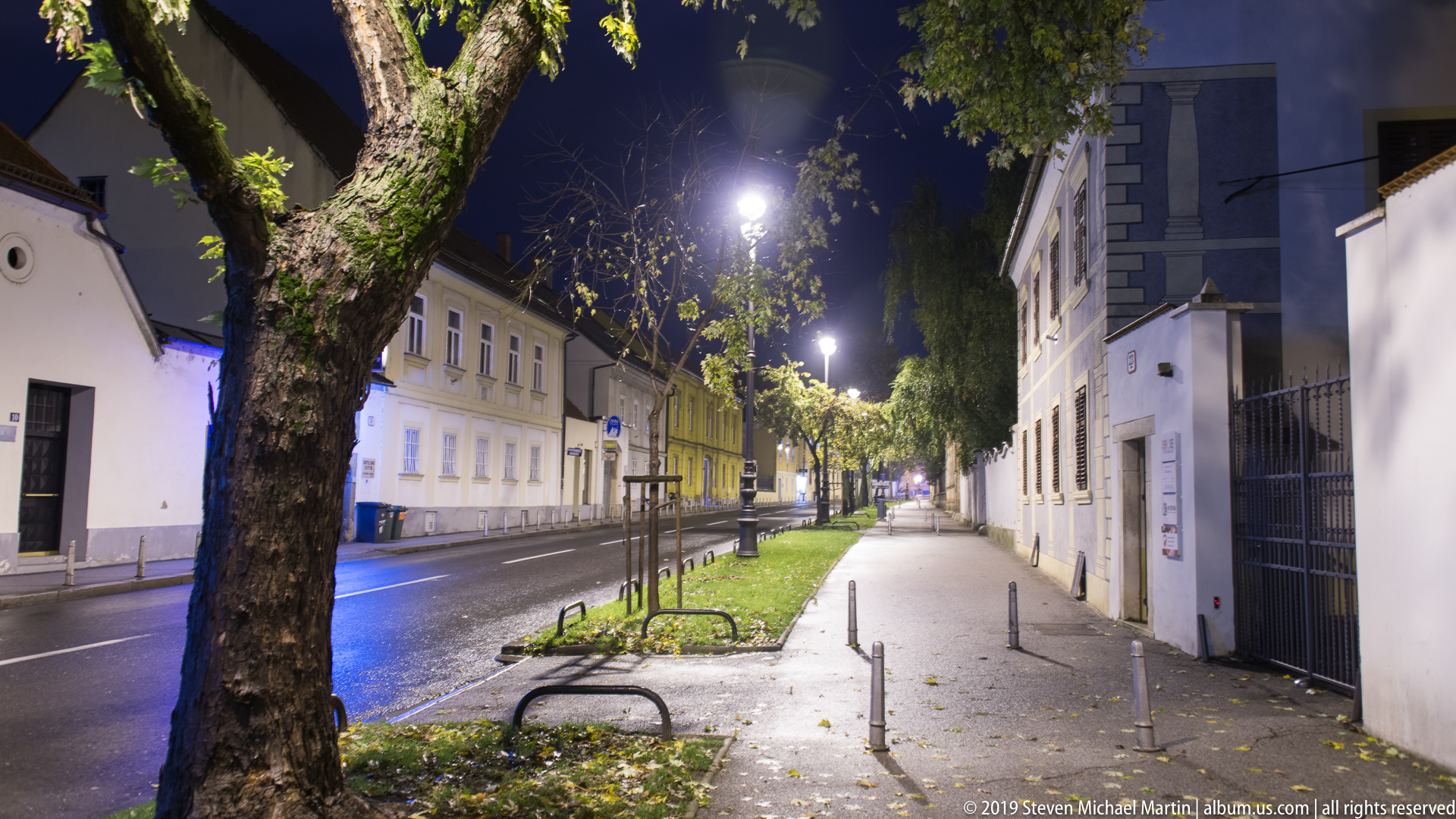
A broad tree trunk anchors a quiet Zagreb streetscape, with wet pavement, a planted verge, bicycle racks, bollards, and low historic buildings extending toward a line of streetlamps. The composition emphasizes the long illuminated sidewalk and the contrast between white façades, dark foliage, and reflected light after rain.
Caption
A broad tree trunk anchors a quiet Zagreb streetscape, with wet pavement, a planted verge, bicycle racks, bollards, and low historic buildings extending toward a line of streetlamps. The composition emphasizes the long illuminated sidewalk and the contrast between white façades, dark foliage, and reflected light after rain.

A symmetrical brick civic or institutional building faces a wet roadway, its central entrance and tall arched windows arranged beneath a steep tiled roof. Decorative brickwork, pale window surrounds, and small roof vents stand out in the artificial light, while the restrained forecourt keeps attention on the carefully ordered façade.
Caption
A symmetrical brick civic or institutional building faces a wet roadway, its central entrance and tall arched windows arranged beneath a steep tiled roof. Decorative brickwork, pale window surrounds, and small roof vents stand out in the artificial light, while the restrained forecourt keeps attention on the carefully ordered façade.

A winged angel emerges from dense Gothic Revival stone carving, its bust set above the Greek letters Alpha and Omega. Floral tracery and layered moldings surround the figure, while colored night illumination picks out the recesses and foliage, turning a small portal detail into a focused study of symbolic architectural sculpture.
Caption
A winged angel emerges from dense Gothic Revival stone carving, its bust set above the Greek letters Alpha and Omega. Floral tracery and layered moldings surround the figure, while colored night illumination picks out the recesses and foliage, turning a small portal detail into a focused study of symbolic architectural sculpture.

A large circular iron clock is fixed directly to a rough masonry wall, its Roman numerals, hands, and radial divisions strongly silhouetted by floodlighting. The contrast between the rust-toned metalwork and irregular historic stone makes the timepiece read as both a functional object and a prominent architectural feature.
Caption
A large circular iron clock is fixed directly to a rough masonry wall, its Roman numerals, hands, and radial divisions strongly silhouetted by floodlighting. The contrast between the rust-toned metalwork and irregular historic stone makes the timepiece read as both a functional object and a prominent architectural feature.

Two slender stone monuments stand before a floodlit fortification wall, one richly Gothic with pinnacles and a small figure, while the large iron clock appears to the left. The wider view establishes the relationship among freestanding memorial sculpture, rough defensive masonry, and the historic timepiece seen in the preceding close-up.
Caption
Two slender stone monuments stand before a floodlit fortification wall, one richly Gothic with pinnacles and a small figure, while the large iron clock appears to the left. The wider view establishes the relationship among freestanding memorial sculpture, rough defensive masonry, and the historic timepiece seen in the preceding close-up.

An elegant pale historic building curves toward a round defensive tower at the corner, combining an arcaded ground level, tall framed windows, a steep metal roof, and restrained classical detailing. Streetlamps illuminate the quiet junction, showing how later civic architecture and older fortifications meet within Zagreb’s Upper Town streetscape.
Caption
An elegant pale historic building curves toward a round defensive tower at the corner, combining an arcaded ground level, tall framed windows, a steep metal roof, and restrained classical detailing. Streetlamps illuminate the quiet junction, showing how later civic architecture and older fortifications meet within Zagreb’s Upper Town streetscape.

An enthroned Virgin and Child occupy the center of an elaborate pointed niche, flanked by kneeling angels beneath curling Gothic foliage. Warm floodlighting and selective gilding accent the crown, figures, and carved canopy, creating a close study of devotional sculpture integrated into Zagreb’s historic architecture.
Caption
An enthroned Virgin and Child occupy the center of an elaborate pointed niche, flanked by kneeling angels beneath curling Gothic foliage. Warm floodlighting and selective gilding accent the crown, figures, and carved canopy, creating a close study of devotional sculpture integrated into Zagreb’s historic architecture.

A pale sculpted relief fills the pointed tympanum of Zagreb Cathedral’s portal, surrounded by concentric bands of foliage, tracery, and small figures. Night illumination models the crowded scene in soft relief while the ornate arch framing creates a strong visual transition between the narrative sculpture and the deeper entrance below.
Caption
A pale sculpted relief fills the pointed tympanum of Zagreb Cathedral’s portal, surrounded by concentric bands of foliage, tracery, and small figures. Night illumination models the crowded scene in soft relief while the ornate arch framing creates a strong visual transition between the narrative sculpture and the deeper entrance below.

A large circular rose window rises above the sculpted entrance of Zagreb Cathedral, linking two of the façade’s most elaborate decorative zones in a single vertical composition. Statues flank the window, while pinnacles, pointed arches, reliefs, and violet-lit niches concentrate ornament around the portal below.
Caption
A large circular rose window rises above the sculpted entrance of Zagreb Cathedral, linking two of the façade’s most elaborate decorative zones in a single vertical composition. Statues flank the window, while pinnacles, pointed arches, reliefs, and violet-lit niches concentrate ornament around the portal below.
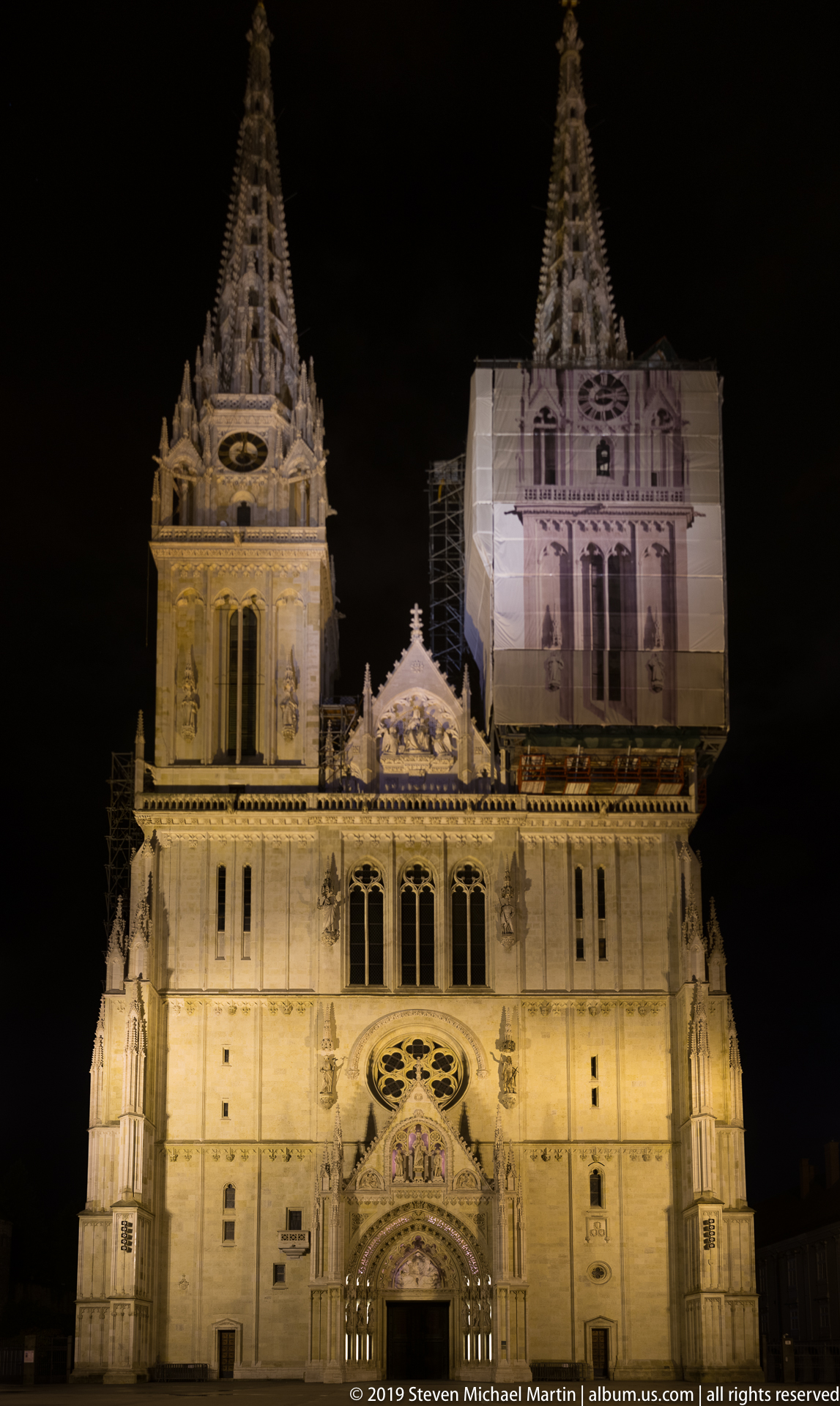
Zagreb Cathedral’s monumental west front rises against a black sky, its twin towers, rose window, sculpted portal, and long arcaded gallery illuminated from below. The frontal nighttime view reveals the façade’s strong vertical organization, while scaffolding or protective sheeting on one tower records the building during a period of exterior work.
Caption
Zagreb Cathedral’s monumental west front rises against a black sky, its twin towers, rose window, sculpted portal, and long arcaded gallery illuminated from below. The frontal nighttime view reveals the façade’s strong vertical organization, while scaffolding or protective sheeting on one tower records the building during a period of exterior work.

Zagreb Cathedral dominates the square at night, its twin towers and bright façade rising behind the Marian monument at right. The wider composition places sacred architecture and public sculpture within the open urban space, with low surrounding buildings and a dark clouded sky providing scale and separation.
Caption
Zagreb Cathedral dominates the square at night, its twin towers and bright façade rising behind the Marian monument at right. The wider composition places sacred architecture and public sculpture within the open urban space, with low surrounding buildings and a dark clouded sky providing scale and separation.

Seen from farther across the square, Zagreb Cathedral rises as a luminous vertical landmark with its twin towers, rose window, and sculpted portal centered in the composition. Open pavement and small foreground objects provide scale, while the dark sky isolates the spires and emphasizes the cathedral’s commanding presence in the nighttime cityscape.
Caption
Seen from farther across the square, Zagreb Cathedral rises as a luminous vertical landmark with its twin towers, rose window, and sculpted portal centered in the composition. Open pavement and small foreground objects provide scale, while the dark sky isolates the spires and emphasizes the cathedral’s commanding presence in the nighttime cityscape.

Three gilded angels stand around a tall decorated monument base, their draped robes and wings catching strong nighttime illumination. The central figure faces forward while the others turn outward, creating a sculptural grouping that is best read here as a close architectural and devotional detail rather than a full view of the monument.
Caption
Three gilded angels stand around a tall decorated monument base, their draped robes and wings catching strong nighttime illumination. The central figure faces forward while the others turn outward, creating a sculptural grouping that is best read here as a close architectural and devotional detail rather than a full view of the monument.

A softly lit historic façade and a massive round tower form a compact architectural group at a Zagreb street corner. Arched ground-floor openings, rectangular upper windows, a steep roof, and the tower’s conical cap are framed by ornate streetlamps, giving a clear nighttime view of the junction between civic architecture and fortification.
Caption
A softly lit historic façade and a massive round tower form a compact architectural group at a Zagreb street corner. Arched ground-floor openings, rectangular upper windows, a steep roof, and the tower’s conical cap are framed by ornate streetlamps, giving a clear nighttime view of the junction between civic architecture and fortification.

Rows of empty wooden market tables stretch across rain-wet pavement at night, their glossy surfaces reflecting streetlights and storefront illumination. With vendors and produce gone, the repeating benches and canopies’ support frames turn Zagreb’s market space into a geometric after-hours scene, while the surrounding arcaded buildings retain the sense of a central urban square.
Caption
Rows of empty wooden market tables stretch across rain-wet pavement at night, their glossy surfaces reflecting streetlights and storefront illumination. With vendors and produce gone, the repeating benches and canopies’ support frames turn Zagreb’s market space into a geometric after-hours scene, while the surrounding arcaded buildings retain the sense of a central urban square.

A shallow curved balcony projects from an ornate historicist façade, its stone balustrade set beneath tall arched windows and elaborate sculpted surrounds. Warm floodlighting flattens the building into a near-monochrome study of moldings, garlands, masks, and window frames, emphasizing decorative craftsmanship above the nighttime street.
Caption
A shallow curved balcony projects from an ornate historicist façade, its stone balustrade set beneath tall arched windows and elaborate sculpted surrounds. Warm floodlighting flattens the building into a near-monochrome study of moldings, garlands, masks, and window frames, emphasizing decorative craftsmanship above the nighttime street.

The bronze figure known as Kumica Barica stands at Dolac Market, portraying a traditional market woman balancing a large woven basket on her head. Night lighting models the apron, skirt, sturdy stance, and basket texture, while nearby storefronts place the sculpture within the commercial setting it commemorates.
Caption
The bronze figure known as Kumica Barica stands at Dolac Market, portraying a traditional market woman balancing a large woven basket on her head. Night lighting models the apron, skirt, sturdy stance, and basket texture, while nearby storefronts place the sculpture within the commercial setting it commemorates.

An elaborate late-historicist commercial façade glows above the nighttime street, with repeated arched windows, sculpted panels, curved corner bays, and a small central balcony. The upward viewpoint compresses several stories into a decorative field, while the lower shopfront zone connects the architecture to the Harmica passage seen more clearly in the next view.
Caption
An elaborate late-historicist commercial façade glows above the nighttime street, with repeated arched windows, sculpted panels, curved corner bays, and a small central balcony. The upward viewpoint compresses several stories into a decorative field, while the lower shopfront zone connects the architecture to the Harmica passage seen more clearly in the next view.

The brightly lit entrance to Harmica passage opens beneath an ornate historic façade, with the name HARMICA displayed across both sides of the ground-floor frontage. Upper stories retain arched windows, balconies, and sculpted ornament, while the open passage draws the eye from the warm exterior into a modern commercial interior.
Caption
The brightly lit entrance to Harmica passage opens beneath an ornate historic façade, with the name HARMICA displayed across both sides of the ground-floor frontage. Upper stories retain arched windows, balconies, and sculpted ornament, while the open passage draws the eye from the warm exterior into a modern commercial interior.

The broad façade of the Gradska štedionica building faces the rain-polished expanse of Ban Jelačić Square, its name legible across the upper stories. Decorative streetlamps and pavement reflections animate the open foreground, while surrounding commercial signs and façades establish the square as a central nighttime gathering space even when largely empty.
Caption
The broad façade of the Gradska štedionica building faces the rain-polished expanse of Ban Jelačić Square, its name legible across the upper stories. Decorative streetlamps and pavement reflections animate the open foreground, while surrounding commercial signs and façades establish the square as a central nighttime gathering space even when largely empty.

An ornate historicist building fills the frame on Ban Jelačić Square, its symmetrical upper façade crowned by sculptural roofline elements and a central pediment. Balconies, arched windows, pilasters, and richly modeled stucco are washed in golden light, while cafés and shopfronts occupy the ground floor beneath the formal residential or commercial frontage.
Caption
An ornate historicist building fills the frame on Ban Jelačić Square, its symmetrical upper façade crowned by sculptural roofline elements and a central pediment. Balconies, arched windows, pilasters, and richly modeled stucco are washed in golden light, while cafés and shopfronts occupy the ground floor beneath the formal residential or commercial frontage.

The equestrian monument to Ban Josip Jelačić rises against the illuminated historic façades of Zagreb’s central square. Seen from a low, close viewpoint, the bronze horse and mounted figure dominate the frame while warm architectural lighting separates the surrounding buildings from the black night sky.
Caption
The equestrian monument to Ban Josip Jelačić rises against the illuminated historic façades of Zagreb’s central square. Seen from a low, close viewpoint, the bronze horse and mounted figure dominate the frame while warm architectural lighting separates the surrounding buildings from the black night sky.

A broad nighttime view across Ban Jelačić Square concentrates on the illuminated historic façades lining its edge. Rows of windows, ornate upper stories, street lamps, and ground-floor commercial spaces define the urban enclosure, while reflections on the pavement and the dark sky reinforce the after-hours atmosphere of Zagreb’s central square.
Caption
A broad nighttime view across Ban Jelačić Square concentrates on the illuminated historic façades lining its edge. Rows of windows, ornate upper stories, street lamps, and ground-floor commercial spaces define the urban enclosure, while reflections on the pavement and the dark sky reinforce the after-hours atmosphere of Zagreb’s central square.

Ban Josip Jelačić and his horse stand sharply outlined in cool illumination before a warm-lit historic façade. The frontal composition isolates the mounted figure, raised sword, horse, and pedestal from the surrounding square, turning the monument into the dominant vertical element while retaining enough architectural context to place it within central Zagreb at night.
Caption
Ban Josip Jelačić and his horse stand sharply outlined in cool illumination before a warm-lit historic façade. The frontal composition isolates the mounted figure, raised sword, horse, and pedestal from the surrounding square, turning the monument into the dominant vertical element while retaining enough architectural context to place it within central Zagreb at night.

Tram rails curve through a nearly empty central Zagreb street, drawing the eye between illuminated shopfronts and multi-story commercial buildings. Overhead transit wires, street lamps, and the polished rails structure the nighttime perspective, while scattered signs and storefront lighting provide the principal activity along the otherwise quiet corridor.
Caption
Tram rails curve through a nearly empty central Zagreb street, drawing the eye between illuminated shopfronts and multi-story commercial buildings. Overhead transit wires, street lamps, and the polished rails structure the nighttime perspective, while scattered signs and storefront lighting provide the principal activity along the otherwise quiet corridor.