Wrocław – Poland
Wrocław lies along several branches of the Oder River in southwestern Poland, where a network of islands and bridges connects the historic districts of the city. Founded more than a thousand years ago, the city has belonged at different times to Bohemia, Austria, Prussia, and Germany before becoming part of modern Poland after the Second World War.
The historic Market Square (Rynek) forms the heart of the city, surrounded by colorful merchant houses and the Gothic Old Town Hall. Nearby stands Cathedral Island (Ostrów Tumski), the oldest part of Wrocław, where towering cathedral spires rise above the river.
With its many bridges and waterways, Wrocław is sometimes referred to as the “Venice of Poland.”

Panoramic view of Wrocław’s Rynek with the brick Old Town Hall at left and a continuous row of richly colored historic townhouses across the square. The broad paved plaza, street activity, and varied gabled façades show the dense civic core of the Old Town, while the Town Hall’s tower and pinnacles provide a vertical counterpoint to the narrow merchant houses.
Caption
Panoramic view of Wrocław’s Rynek with the brick Old Town Hall at left and a continuous row of richly colored historic townhouses across the square. The broad paved plaza, street activity, and varied gabled façades show the dense civic core of the Old Town, while the Town Hall’s tower and pinnacles provide a vertical counterpoint to the narrow merchant houses.

The long side wall of a monumental Gothic brick church rises behind a sculpted stone monument. Tall pointed windows, buttresses, a steep tiled roof, and a square tower capped by a green spire define the building’s vertical medieval character.
Caption
The long side wall of a monumental Gothic brick church rises behind a sculpted stone monument. Tall pointed windows, buttresses, a steep tiled roof, and a square tower capped by a green spire define the building’s vertical medieval character.

A large red-brick Gothic church occupies the foreground while the twin towers of Wrocław Cathedral rise farther down the street. The composition layers separate sacred monuments, orange-roofed buildings, and a stone devotional monument within the dense ecclesiastical landscape of the historic river islands.
Caption
A large red-brick Gothic church occupies the foreground while the twin towers of Wrocław Cathedral rise farther down the street. The composition layers separate sacred monuments, orange-roofed buildings, and a stone devotional monument within the dense ecclesiastical landscape of the historic river islands.

Pedestrians move across the rain-polished cobbles of Wrocław’s Rynek under a deep blue evening sky, surrounded by tall historic townhouses and glowing restaurant fronts. Reflections from streetlamps and shop windows animate the paving, turning the familiar market square into a study of weather, nightlife, and urban movement.
Caption
Pedestrians move across the rain-polished cobbles of Wrocław’s Rynek under a deep blue evening sky, surrounded by tall historic townhouses and glowing restaurant fronts. Reflections from streetlamps and shop windows animate the paving, turning the familiar market square into a study of weather, nightlife, and urban movement.

The twin spires of Wrocław Cathedral rise above the green riverbank while a bright yellow passenger boat travels along the Oder in the foreground. The composition links the monumental skyline of Ostrów Tumski with the everyday recreational life of the river.
Caption
The twin spires of Wrocław Cathedral rise above the green riverbank while a bright yellow passenger boat travels along the Oder in the foreground. The composition links the monumental skyline of Ostrów Tumski with the everyday recreational life of the river.

A visitor sits with a beer at a market-square café directly in front of Wrocław’s Old Town Hall. The tower and stepped brick gables rise behind the table, combining an informal travel portrait with a clear sense of place in the Rynek.
Caption
A visitor sits with a beer at a market-square café directly in front of Wrocław’s Old Town Hall. The tower and stepped brick gables rise behind the table, combining an informal travel portrait with a clear sense of place in the Rynek.

A narrow passage opens between two historic buildings, one plain and pale and the other richly colored with decorative trim. A painted archway and small commercial entrance lead toward an inner courtyard or secondary street, revealing the layered circulation of Wrocław’s historic center.
Caption
A narrow passage opens between two historic buildings, one plain and pale and the other richly colored with decorative trim. A painted archway and small commercial entrance lead toward an inner courtyard or secondary street, revealing the layered circulation of Wrocław’s historic center.

A densely planted mound of purple and white flowers spills over lime-green foliage in a formal urban garden. The close composition shifts attention from Wrocław’s architecture to the carefully maintained seasonal landscaping that softens public spaces around the historic center.
Caption
A densely planted mound of purple and white flowers spills over lime-green foliage in a formal urban garden. The close composition shifts attention from Wrocław’s architecture to the carefully maintained seasonal landscaping that softens public spaces around the historic center.

Seen across temporary market stalls, Wrocław’s Old Town Hall reveals the complexity of its historic massing: steep tiled roofs, copper-capped turrets, sculpted stone bays, and the patterned gable surrounding the clock. The angled viewpoint emphasizes how successive architectural elements cluster around the medieval civic core.
Caption
Seen across temporary market stalls, Wrocław’s Old Town Hall reveals the complexity of its historic massing: steep tiled roofs, copper-capped turrets, sculpted stone bays, and the patterned gable surrounding the clock. The angled viewpoint emphasizes how successive architectural elements cluster around the medieval civic core.

A close view of the Old Town Hall tower isolates its paired clock faces beneath the green copper lantern. Brick masonry, heraldic decoration, and the projecting clock dials reveal details that are easily lost in wider views of the market-square complex.
Caption
A close view of the Old Town Hall tower isolates its paired clock faces beneath the green copper lantern. Brick masonry, heraldic decoration, and the projecting clock dials reveal details that are easily lost in wider views of the market-square complex.

The richly patterned brick gable of Wrocław’s Old Town Hall rises above the market square, centered on its prominent astronomical clock. Pinnacles, sculptural tracery, steep rooflines, and contrasting stone details give the medieval civic building its distinctive silhouette.
Caption
The richly patterned brick gable of Wrocław’s Old Town Hall rises above the market square, centered on its prominent astronomical clock. Pinnacles, sculptural tracery, steep rooflines, and contrasting stone details give the medieval civic building its distinctive silhouette.

A sweeping street-level view follows the east-side frontage of Wrocław’s Rynek, where narrow historic townhouses form a vivid sequence of pastel façades, stepped and curving gables, and closely spaced windows. Café seating and pedestrians occupy the open square below, emphasizing the continued commercial and social use of the medieval market-place fabric.
Caption
A sweeping street-level view follows the east-side frontage of Wrocław’s Rynek, where narrow historic townhouses form a vivid sequence of pastel façades, stepped and curving gables, and closely spaced windows. Café seating and pedestrians occupy the open square below, emphasizing the continued commercial and social use of the medieval market-place fabric.

Wrocław’s Old Town Hall anchors the left side of this dramatic Rynek panorama, its dark brick tower and Gothic roofline silhouetted against heavy storm clouds. A row of narrow merchant houses in yellow, gray, red, and ochre continues across the square, while the wet-looking light and gathering sky give the civic center a markedly different atmosphere from the brighter companion views.
Caption
Wrocław’s Old Town Hall anchors the left side of this dramatic Rynek panorama, its dark brick tower and Gothic roofline silhouetted against heavy storm clouds. A row of narrow merchant houses in yellow, gray, red, and ochre continues across the square, while the wet-looking light and gathering sky give the civic center a markedly different atmosphere from the brighter companion views.

The monumental reinforced-concrete mass of Centennial Hall rises behind a low, ivy-covered perimeter at the edge of its landscaped grounds. Its broad drum, stepped roofline, and continuous bands of tall windows express the building’s early twentieth-century structural modernism, contrasting sharply with the historic brick and stucco architecture seen elsewhere in central Wrocław.
Caption
The monumental reinforced-concrete mass of Centennial Hall rises behind a low, ivy-covered perimeter at the edge of its landscaped grounds. Its broad drum, stepped roofline, and continuous bands of tall windows express the building’s early twentieth-century structural modernism, contrasting sharply with the historic brick and stucco architecture seen elsewhere in central Wrocław.

Curving white bands of the OVO Wrocław complex wrap around a landscaped inner courtyard planted with young trees, grass, and circular stepping stones. Seen from an upper level, the composition emphasizes the development’s smooth horizontal façade and inward-facing public space, a contemporary architectural counterpoint to Wrocław’s historic center.
Caption
Curving white bands of the OVO Wrocław complex wrap around a landscaped inner courtyard planted with young trees, grass, and circular stepping stones. Seen from an upper level, the composition emphasizes the development’s smooth horizontal façade and inward-facing public space, a contemporary architectural counterpoint to Wrocław’s historic center.

A long, minimalist corridor inside the OVO Wrocław hotel complex recedes through a repeated sequence of pale walls, recessed doorways, and circular ceiling lights. The strong central vanishing point and almost monochrome surfaces foreground the building’s contemporary interior design rather than the historic streetscape outside.
Caption
A long, minimalist corridor inside the OVO Wrocław hotel complex recedes through a repeated sequence of pale walls, recessed doorways, and circular ceiling lights. The strong central vanishing point and almost monochrome surfaces foreground the building’s contemporary interior design rather than the historic streetscape outside.

Outdoor tables and folded umbrellas occupy the landscaped courtyard of OVO Wrocław after dark, enclosed by the complex’s flowing white façade and continuous horizontal window bands. Warm interior light spills from the ground-floor restaurants and hotel spaces, turning the protected courtyard into an intimate evening gathering area.
Caption
Outdoor tables and folded umbrellas occupy the landscaped courtyard of OVO Wrocław after dark, enclosed by the complex’s flowing white façade and continuous horizontal window bands. Warm interior light spills from the ground-floor restaurants and hotel spaces, turning the protected courtyard into an intimate evening gathering area.

A spacious lounge inside the DoubleTree by Hilton Wrocław uses pale flooring, rounded white tables, sculptural circular ceiling panels, and a curved wood-clad wall to create a polished contemporary interior. Small groups of guests gather toward the rear, while a luminous green column provides a visual focal point within the otherwise restrained palette.
Caption
A spacious lounge inside the DoubleTree by Hilton Wrocław uses pale flooring, rounded white tables, sculptural circular ceiling panels, and a curved wood-clad wall to create a polished contemporary interior. Small groups of guests gather toward the rear, while a luminous green column provides a visual focal point within the otherwise restrained palette.

A steep Gothic brick church rises beside a sculptural monument on Ostrów Tumski, with the twin spires of Wrocław Cathedral visible farther down the street. The oblique night view layers two major ecclesiastical landmarks in depth and emphasizes the dense sacred architecture of Cathedral Island.
Caption
A steep Gothic brick church rises beside a sculptural monument on Ostrów Tumski, with the twin spires of Wrocław Cathedral visible farther down the street. The oblique night view layers two major ecclesiastical landmarks in depth and emphasizes the dense sacred architecture of Cathedral Island.

The illuminated west front of the Cathedral of St. John the Baptist dominates Ostrów Tumski, its twin brick towers rising above a pointed central portal and Gothic window tracery. Warm floodlighting models the masonry against the black sky, while the tree-lined approach and wet pavement draw the eye directly toward Wrocław’s principal cathedral.
Caption
The illuminated west front of the Cathedral of St. John the Baptist dominates Ostrów Tumski, its twin brick towers rising above a pointed central portal and Gothic window tracery. Warm floodlighting models the masonry against the black sky, while the tree-lined approach and wet pavement draw the eye directly toward Wrocław’s principal cathedral.

A broader night view of Wrocław Cathedral places its floodlit twin towers at the end of Cathedral Square, framed by clipped trees and low historic buildings. The symmetrical approach reveals how the Gothic façade functions as the visual terminus of the street, with rain-darkened paving reflecting the amber architectural lighting.
Caption
A broader night view of Wrocław Cathedral places its floodlit twin towers at the end of Cathedral Square, framed by clipped trees and low historic buildings. The symmetrical approach reveals how the Gothic façade functions as the visual terminus of the street, with rain-darkened paving reflecting the amber architectural lighting.

A low-angle night view of Wrocław’s Old Town Hall emphasizes the massive brick tower, crenellated parapets, green copper rooflets, and irregular accretion of Gothic and later architectural elements. The close perspective makes the civic complex read as a fortified cluster rather than a single façade, revealing the building’s layered medieval form.
Caption
A low-angle night view of Wrocław’s Old Town Hall emphasizes the massive brick tower, crenellated parapets, green copper rooflets, and irregular accretion of Gothic and later architectural elements. The close perspective makes the civic complex read as a fortified cluster rather than a single façade, revealing the building’s layered medieval form.

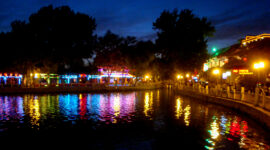
Amber streetlights and building façades reflect in the dark water along Wrocław’s Odra riverfront, where stone embankments, a low pedestrian crossing, and dense historic urban blocks define the channel. The long exposure turns the river into a band of gold and black, emphasizing Wrocław’s close relationship with its waterways and bridges.
Caption
Amber streetlights and building façades reflect in the dark water along Wrocław’s Odra riverfront, where stone embankments, a low pedestrian crossing, and dense historic urban blocks define the channel. The long exposure turns the river into a band of gold and black, emphasizing Wrocław’s close relationship with its waterways and bridges.

The iron truss of Tumski Bridge frames a rain-slicked pedestrian route toward the illuminated church towers of Ostrów Tumski. Dense clusters of padlocks line the bridge rails, a former local custom associated with couples, while the wet deck mirrors the blue-green bridge structure and warm lights beyond.
Caption
The iron truss of Tumski Bridge frames a rain-slicked pedestrian route toward the illuminated church towers of Ostrów Tumski. Dense clusters of padlocks line the bridge rails, a former local custom associated with couples, while the wet deck mirrors the blue-green bridge structure and warm lights beyond.

Visitors carrying umbrellas gather on Wrocław’s rain-slicked Market Square, where reflected amber light pools across the cobblestones. The low viewpoint gives equal weight to the people and the ornate façades beyond, recording the everyday social life of the Rynek during a summer evening shower.
Caption
Visitors carrying umbrellas gather on Wrocław’s rain-slicked Market Square, where reflected amber light pools across the cobblestones. The low viewpoint gives equal weight to the people and the ornate façades beyond, recording the everyday social life of the Rynek during a summer evening shower.

A compact group of historic buildings near Wrocław’s Market Square is seen at blue hour, including narrow plastered houses and a taller decorated façade with painted geometric panels. The irregular rooflines, passage entrance, and close spacing reveal the fine-grained medieval street pattern that survives around the Rynek.
Caption
A compact group of historic buildings near Wrocław’s Market Square is seen at blue hour, including narrow plastered houses and a taller decorated façade with painted geometric panels. The irregular rooflines, passage entrance, and close spacing reveal the fine-grained medieval street pattern that survives around the Rynek.

Three adjoining townhouses on Wrocław’s Market Square present contrasting gable forms, from soft Baroque curves to stepped profiles, all washed in warm evening light. Their narrow plots, tall window grids, and ground-floor shops illustrate the vertical proportions and decorative individuality of the Rynek’s reconstructed historic frontage.
Caption
Three adjoining townhouses on Wrocław’s Market Square present contrasting gable forms, from soft Baroque curves to stepped profiles, all washed in warm evening light. Their narrow plots, tall window grids, and ground-floor shops illustrate the vertical proportions and decorative individuality of the Rynek’s reconstructed historic frontage.

The illuminated glass fountain on Wrocław’s Rynek rises in translucent, angular sheets beside the Gothic Old Town Hall. Water and light shimmer across the glass surfaces while the hall’s ornate gables and neighboring historic façades provide a contrasting masonry backdrop, pairing a contemporary public-space intervention with the medieval civic center.
Caption
The illuminated glass fountain on Wrocław’s Rynek rises in translucent, angular sheets beside the Gothic Old Town Hall. Water and light shimmer across the glass surfaces while the hall’s ornate gables and neighboring historic façades provide a contrasting masonry backdrop, pairing a contemporary public-space intervention with the medieval civic center.

The richly decorated façade of Wrocław’s Old Town Hall is viewed from below, concentrating attention on carved stone window frames, figural sculpture, heraldic ornament, and the steep roof above the entrance. The warm plaster and pale stone detailing stand out against the blue night sky, showing the elaborate civic craftsmanship at close range.
Caption
The richly decorated façade of Wrocław’s Old Town Hall is viewed from below, concentrating attention on carved stone window frames, figural sculpture, heraldic ornament, and the steep roof above the entrance. The warm plaster and pale stone detailing stand out against the blue night sky, showing the elaborate civic craftsmanship at close range.

A woman in a crowded Wrocław beer hall wears white-and-red Polish national colors painted across her cheek, with a stylized white eagle motif above the red stripe. The close portrait isolates a personal expression of football support amid a larger evening gathering centered on a televised match.
Caption
A woman in a crowded Wrocław beer hall wears white-and-red Polish national colors painted across her cheek, with a stylized white eagle motif above the red stripe. The close portrait isolates a personal expression of football support amid a larger evening gathering centered on a televised match.

A tiny bronze dwarf reclines low against the base of a wall, one of Wrocław’s many krasnale placed throughout the city. The close viewpoint emphasizes the sculpture’s exaggerated facial features, hat, and compact scale against the surrounding paving stones.
Caption
A tiny bronze dwarf reclines low against the base of a wall, one of Wrocław’s many krasnale placed throughout the city. The close viewpoint emphasizes the sculpture’s exaggerated facial features, hat, and compact scale against the surrounding paving stones.

The celebrated eastern façade of Wrocław’s Old Town Hall fills the frame at night, with its steep triangular gable, dense Gothic tracery, astronomical clock, and flanking pinnacles brightly illuminated above the Rynek. Temporary market stalls in the foreground add a contemporary layer to the medieval civic landmark.
Caption
The celebrated eastern façade of Wrocław’s Old Town Hall fills the frame at night, with its steep triangular gable, dense Gothic tracery, astronomical clock, and flanking pinnacles brightly illuminated above the Rynek. Temporary market stalls in the foreground add a contemporary layer to the medieval civic landmark.

Wrocław’s Old Town Hall stands isolated against the deep blue evening sky, its eastern gable and astronomical clock illuminated with unusual clarity. Gothic windows, pinnacles, and patterned stone tracery emerge from the brickwork, while small market structures and plantings occupy the lower edge of the square.
Caption
Wrocław’s Old Town Hall stands isolated against the deep blue evening sky, its eastern gable and astronomical clock illuminated with unusual clarity. Gothic windows, pinnacles, and patterned stone tracery emerge from the brickwork, while small market structures and plantings occupy the lower edge of the square.

The Gothic gable and tower of Wrocław’s Old Town Hall rise behind a yellow corner building and the roofs of temporary market stalls. This oblique view shows how the monument is embedded within the dense architecture and commercial activity of the Rynek rather than standing as an isolated object.
Caption
The Gothic gable and tower of Wrocław’s Old Town Hall rise behind a yellow corner building and the roofs of temporary market stalls. This oblique view shows how the monument is embedded within the dense architecture and commercial activity of the Rynek rather than standing as an isolated object.

Rain-darkened paving reflects streetlights around a row of temporary market stalls on Wrocław’s Rynek. Historic commercial buildings rise behind the canopies, while illuminated storefronts and sparse evening foot traffic shift attention from monumental architecture to the ordinary seasonal use of the central square.
Caption
Rain-darkened paving reflects streetlights around a row of temporary market stalls on Wrocław’s Rynek. Historic commercial buildings rise behind the canopies, while illuminated storefronts and sparse evening foot traffic shift attention from monumental architecture to the ordinary seasonal use of the central square.

A narrow cobbled passage glows under warm streetlights, with a long wall of colorful graffiti and stylized faces running toward a distant archway. The contrast between historic masonry, intimate alley scale, and contemporary street art records a less monumental layer of Wrocław’s Old Town after dark.
Caption
A narrow cobbled passage glows under warm streetlights, with a long wall of colorful graffiti and stylized faces running toward a distant archway. The contrast between historic masonry, intimate alley scale, and contemporary street art records a less monumental layer of Wrocław’s Old Town after dark.

A busy Wrocław beer hall is packed with patrons seated at long wooden tables, many looking toward a televised football match outside the frame. Brick walls, beer glasses, shared tables, and close conversation create the communal atmosphere of a sports-night gathering rather than a formal dining scene.
Caption
A busy Wrocław beer hall is packed with patrons seated at long wooden tables, many looking toward a televised football match outside the frame. Brick walls, beer glasses, shared tables, and close conversation create the communal atmosphere of a sports-night gathering rather than a formal dining scene.

Two tall glasses of hazy golden wheat beer stand side by side on a wooden table, each bearing the Bierhalle logo and capped with a thick white head. The close still life shifts the portfolio from city architecture to Wrocław’s contemporary social scene and the beer-hall culture surrounding the evening football gathering.
Caption
Two tall glasses of hazy golden wheat beer stand side by side on a wooden table, each bearing the Bierhalle logo and capped with a thick white head. The close still life shifts the portfolio from city architecture to Wrocław’s contemporary social scene and the beer-hall culture surrounding the evening football gathering.

A large television in the Wrocław beer hall shows a live international football match, with one team in white shirts and red shorts defending its penalty area. The screen is photographed as part of the surrounding social event, documenting how the match structured the evening’s communal attention.
Caption
A large television in the Wrocław beer hall shows a live international football match, with one team in white shirts and red shorts defending its penalty area. The screen is photographed as part of the surrounding social event, documenting how the match structured the evening’s communal attention.

A tall tabletop beer dispenser marked Bierhalle towers over a crowded restaurant table, allowing patrons to pour beer directly from a shared column. Glasses, mugs, and diners cluster around the device, making it a focal point of the convivial beer-hall setting during the football-night gathering.
Caption
A tall tabletop beer dispenser marked Bierhalle towers over a crowded restaurant table, allowing patrons to pour beer directly from a shared column. Glasses, mugs, and diners cluster around the device, making it a focal point of the convivial beer-hall setting during the football-night gathering.

Wooden café stalls and high tables fill a pedestrian square edged by narrow historic façades. The temporary terraces, planters, lights, and serving counters show how Wrocław’s old center functions as an active social and commercial space alongside its monumental architecture.
Caption
Wooden café stalls and high tables fill a pedestrian square edged by narrow historic façades. The temporary terraces, planters, lights, and serving counters show how Wrocław’s old center functions as an active social and commercial space alongside its monumental architecture.

A bicycle decorated with flowering planters anchors this lively view of Wrocław’s historic center. Pedestrians move between small market stalls and colorful façades, emphasizing the market square as both an architectural ensemble and an everyday gathering place.
Caption
A bicycle decorated with flowering planters anchors this lively view of Wrocław’s historic center. Pedestrians move between small market stalls and colorful façades, emphasizing the market square as both an architectural ensemble and an everyday gathering place.

A projecting stone bay punctuates the red-brick wall of Wrocław’s Old Town Hall, its windows framed by dense late-Gothic carving and small figural sculptures. The upward viewpoint isolates the contrast between pale carved stone, brick masonry, and the steep tiled roof.
Caption
A projecting stone bay punctuates the red-brick wall of Wrocław’s Old Town Hall, its windows framed by dense late-Gothic carving and small figural sculptures. The upward viewpoint isolates the contrast between pale carved stone, brick masonry, and the steep tiled roof.

Three small bronze dwarfs stand together on the cobblestones, part of Wrocław’s celebrated network of miniature street sculptures. Their varied poses and polished surfaces invite close inspection at pedestrian level, turning the city pavement itself into a playful layer of public art.
Caption
Three small bronze dwarfs stand together on the cobblestones, part of Wrocław’s celebrated network of miniature street sculptures. Their varied poses and polished surfaces invite close inspection at pedestrian level, turning the city pavement itself into a playful layer of public art.

Wrocław’s Old Town Hall fills the frame from the market square, with its tall brick clock tower, stepped gables, green copper roofs, and irregular wings clearly visible. This wider view shows the building as a layered civic complex rather than a single façade.
Caption
Wrocław’s Old Town Hall fills the frame from the market square, with its tall brick clock tower, stepped gables, green copper roofs, and irregular wings clearly visible. This wider view shows the building as a layered civic complex rather than a single façade.

A symmetrical courtyard is enclosed by pale yellow historic buildings with evenly spaced windows, restrained classical detailing, and a red tiled roof. The centered composition draws attention to the formal entrance axis and the quiet, semi-private character of the space.
Caption
A symmetrical courtyard is enclosed by pale yellow historic buildings with evenly spaced windows, restrained classical detailing, and a red tiled roof. The centered composition draws attention to the formal entrance axis and the quiet, semi-private character of the space.

A large red-brick institutional building presents a strongly vertical façade of pointed gables, arched windows, and a prominent clock tower under green copper roofing. Tram wires crossing the foreground place the historicist architecture within Wrocław’s modern urban streetscape.
Caption
A large red-brick institutional building presents a strongly vertical façade of pointed gables, arched windows, and a prominent clock tower under green copper roofing. Tram wires crossing the foreground place the historicist architecture within Wrocław’s modern urban streetscape.

A bronze dwarf bends over an open book whose pages are covered with small engraved markings, extending Wrocław’s krasnale tradition into a miniature narrative scene. The low-angle close-up makes the figure’s beard, hat, and reading pose the dominant features.
Caption
A bronze dwarf bends over an open book whose pages are covered with small engraved markings, extending Wrocław’s krasnale tradition into a miniature narrative scene. The low-angle close-up makes the figure’s beard, hat, and reading pose the dominant features.

A stout bronze dwarf in a pointed hat extends one hand outward in a theatrical gesture. Photographed at pavement level, the figure’s polished face and green-blue patina stand out against the gray stone surface, characteristic of Wrocław’s small-scale street sculptures.
Caption
A stout bronze dwarf in a pointed hat extends one hand outward in a theatrical gesture. Photographed at pavement level, the figure’s polished face and green-blue patina stand out against the gray stone surface, characteristic of Wrocław’s small-scale street sculptures.

A bright green shared electric scooter rests beneath a red-and-blue directional signpost beside a flower bed and old brick wall. The juxtaposition of contemporary mobility, visitor wayfinding, and historic masonry compresses several layers of present-day Wrocław into one street corner.
Caption
A bright green shared electric scooter rests beneath a red-and-blue directional signpost beside a flower bed and old brick wall. The juxtaposition of contemporary mobility, visitor wayfinding, and historic masonry compresses several layers of present-day Wrocław into one street corner.

Broad stone steps lead toward a contemporary building wrapped in long horizontal bands of reddish cladding and dark glazing. The perspective accentuates the structure’s layered, linear design and its deliberate contrast with Wrocław’s predominantly historic center.
Caption
Broad stone steps lead toward a contemporary building wrapped in long horizontal bands of reddish cladding and dark glazing. The perspective accentuates the structure’s layered, linear design and its deliberate contrast with Wrocław’s predominantly historic center.

A monumental pale stone building stretches along the street with arcaded entrances, paired windows, crenellated parapets, and corner towers. Trees soften the façade while tram wires and pedestrians establish the building’s urban scale and continuing role in the city center.
Caption
A monumental pale stone building stretches along the street with arcaded entrances, paired windows, crenellated parapets, and corner towers. Trees soften the façade while tram wires and pedestrians establish the building’s urban scale and continuing role in the city center.

A sheltered café garden combines wooden decking, modern chairs, dense greenery, and strings of brightly colored hanging decorations. The intimate courtyard setting offers a quieter contrast to Wrocław’s monumental squares and street façades.
Caption
A sheltered café garden combines wooden decking, modern chairs, dense greenery, and strings of brightly colored hanging decorations. The intimate courtyard setting offers a quieter contrast to Wrocław’s monumental squares and street façades.

An elaborate historic commercial building rises above the street with stacked balconies, arched openings, carved stone ornament, and a rhythm of projecting bays. Varied balcony colors and dense façade decoration distinguish it from the plainer neighboring blocks.
Caption
An elaborate historic commercial building rises above the street with stacked balconies, arched openings, carved stone ornament, and a rhythm of projecting bays. Varied balcony colors and dense façade decoration distinguish it from the plainer neighboring blocks.

A bronze dwarf raises a rectangular plaque above its head while seated on a small base. The exaggerated pose and polished details typify Wrocław’s krasnale, miniature public sculptures encountered at street level throughout the city.
Caption
A bronze dwarf raises a rectangular plaque above its head while seated on a small base. The exaggerated pose and polished details typify Wrocław’s krasnale, miniature public sculptures encountered at street level throughout the city.

The Old Town Hall’s tower, stepped gables, projecting bays, and copper-capped roofs are seen together from across the Rynek. This broader composition clarifies the building’s asymmetrical growth and the varied rooflines that define its silhouette.
Caption
The Old Town Hall’s tower, stepped gables, projecting bays, and copper-capped roofs are seen together from across the Rynek. This broader composition clarifies the building’s asymmetrical growth and the varied rooflines that define its silhouette.

An ornamental dark metal fountain stands at the center of a small basin, sending several arcing jets toward the surrounding rim. Flower stalls and a pastel historic façade create a lush market setting around the sculptural centerpiece.
Caption
An ornamental dark metal fountain stands at the center of a small basin, sending several arcing jets toward the surrounding rim. Flower stalls and a pastel historic façade create a lush market setting around the sculptural centerpiece.

Two visitors pose in the Rynek with Wrocław’s Old Town Hall rising behind them. The portrait preserves the scale and social setting of the medieval civic landmark, while the surrounding colorful façades place the scene firmly within the city’s historic market square.
Caption
Two visitors pose in the Rynek with Wrocław’s Old Town Hall rising behind them. The portrait preserves the scale and social setting of the medieval civic landmark, while the surrounding colorful façades place the scene firmly within the city’s historic market square.

A sweep of narrow, brightly colored historic façades lines the Rynek beside the brick mass of Wrocław’s Old Town Hall. The open paved square, clipped trees, pedestrians, and outdoor seating emphasize the ensemble character of the city’s historic commercial heart.
Caption
A sweep of narrow, brightly colored historic façades lines the Rynek beside the brick mass of Wrocław’s Old Town Hall. The open paved square, clipped trees, pedestrians, and outdoor seating emphasize the ensemble character of the city’s historic commercial heart.

A visitor sits at an outdoor table with two glasses of beer while Wrocław’s colorful market-square façades form the backdrop. The scene records the Rynek as a lived social space, not only an architectural landmark.
Caption
A visitor sits at an outdoor table with two glasses of beer while Wrocław’s colorful market-square façades form the backdrop. The scene records the Rynek as a lived social space, not only an architectural landmark.

The Old Town Hall’s large clock face fills the frame, its gold Roman numerals and central solar motif set against a deep blue-green field. Flanking sculpted figures and the surrounding brickwork make the clock an integrated element of the building’s richly ornamented exterior.
Caption
The Old Town Hall’s large clock face fills the frame, its gold Roman numerals and central solar motif set against a deep blue-green field. Flanking sculpted figures and the surrounding brickwork make the clock an integrated element of the building’s richly ornamented exterior.

A richly framed window projects from the brick wall of Wrocław’s Old Town Hall. Interlaced stone patterns, a low carved parapet, leaded glazing, and flower boxes concentrate the building’s late-Gothic decorative vocabulary into a single architectural detail.
Caption
A richly framed window projects from the brick wall of Wrocław’s Old Town Hall. Interlaced stone patterns, a low carved parapet, leaded glazing, and flower boxes concentrate the building’s late-Gothic decorative vocabulary into a single architectural detail.

An elaborate stone monument stands before a red-brick Gothic church wall, framed by flower beds and tall pointed windows. Heraldic and sculptural elements crown the pedestal, while the dark metal enclosure separates the memorial from the surrounding garden.
Caption
An elaborate stone monument stands before a red-brick Gothic church wall, framed by flower beds and tall pointed windows. Heraldic and sculptural elements crown the pedestal, while the dark metal enclosure separates the memorial from the surrounding garden.

The brick tower of Wrocław’s Old Town Hall anchors a long view across the Rynek, framed by historic façades, ornate streetlamps, restaurant terraces, and pedestrians. The composition shows the civic landmark embedded in the everyday spatial life of the market square.
Caption
The brick tower of Wrocław’s Old Town Hall anchors a long view across the Rynek, framed by historic façades, ornate streetlamps, restaurant terraces, and pedestrians. The composition shows the civic landmark embedded in the everyday spatial life of the market square.

Wrocław’s Old Town Hall stands between ornate historic buildings and rows of colorful townhouses under a dramatic overcast sky. The slightly closer viewpoint emphasizes the visual dialogue between the medieval civic complex and the later façades enclosing the Rynek.
Caption
Wrocław’s Old Town Hall stands between ornate historic buildings and rows of colorful townhouses under a dramatic overcast sky. The slightly closer viewpoint emphasizes the visual dialogue between the medieval civic complex and the later façades enclosing the Rynek.

Water surges through a contemporary fountain composed of translucent green glass panels on Wrocław’s market square. Historic gabled façades rise beyond the modern installation, creating a deliberate visual contrast between new public design and the architectural fabric of the Rynek.
Caption
Water surges through a contemporary fountain composed of translucent green glass panels on Wrocław’s market square. Historic gabled façades rise beyond the modern installation, creating a deliberate visual contrast between new public design and the architectural fabric of the Rynek.

Five narrow historic townhouses rise along Wrocław’s Rynek, their varied pastel façades, stepped and scrolled gables, tall windows, and ground-floor cafés illustrating the dense urban frontage of the market square. The straight-on view emphasizes the individual identities of adjoining buildings within a continuous commercial street wall.
Caption
Five narrow historic townhouses rise along Wrocław’s Rynek, their varied pastel façades, stepped and scrolled gables, tall windows, and ground-floor cafés illustrating the dense urban frontage of the market square. The straight-on view emphasizes the individual identities of adjoining buildings within a continuous commercial street wall.

A broad view across Wrocław’s Rynek gathers rows of colorful historic façades beneath a heavy gray sky. Pedestrians and café seating animate the open square, while the irregular rooflines and ornamental gables show the architectural variety that defines the city’s historic commercial center.
Caption
A broad view across Wrocław’s Rynek gathers rows of colorful historic façades beneath a heavy gray sky. Pedestrians and café seating animate the open square, while the irregular rooflines and ornamental gables show the architectural variety that defines the city’s historic commercial center.

Closely packed merchant houses line the edge of Wrocław’s Rynek in a sequence of gray, pink, yellow, cream, and green façades. Stepped and curved gables, regular window grids, and street-level businesses make this composition a useful study of the market square’s architectural rhythm.
Caption
Closely packed merchant houses line the edge of Wrocław’s Rynek in a sequence of gray, pink, yellow, cream, and green façades. Stepped and curved gables, regular window grids, and street-level businesses make this composition a useful study of the market square’s architectural rhythm.

A bronze Wrocław dwarf extends one arm while balancing a decorated heart in the other hand. The small street-level figure, with its pointed hat, beard, and polished surfaces, belongs to the city’s widespread series of krasnale that turn sidewalks and building edges into sites of playful public art.
Caption
A bronze Wrocław dwarf extends one arm while balancing a decorated heart in the other hand. The small street-level figure, with its pointed hat, beard, and polished surfaces, belongs to the city’s widespread series of krasnale that turn sidewalks and building edges into sites of playful public art.

A sharply angled perspective follows a row of narrow historic façades in pastel pink, salmon, blue, and cream. Arched ground-floor openings and close-set upper windows reinforce the compact scale of the old city, while the tilted composition accentuates the continuous rhythm of the street frontage.
Caption
A sharply angled perspective follows a row of narrow historic façades in pastel pink, salmon, blue, and cream. Arched ground-floor openings and close-set upper windows reinforce the compact scale of the old city, while the tilted composition accentuates the continuous rhythm of the street frontage.

A compact row of Wrocław townhouses displays unusually vivid façade decoration: painted block patterns, blue window surrounds, molded scrollwork, and contrasting red doors. The close frontal view isolates how color and ornament individualize each narrow property within the historic streetscape.
Caption
A compact row of Wrocław townhouses displays unusually vivid façade decoration: painted block patterns, blue window surrounds, molded scrollwork, and contrasting red doors. The close frontal view isolates how color and ornament individualize each narrow property within the historic streetscape.

An imposing corner building is articulated by stacked pilasters, projecting cornices, carved window surrounds, balconies, and a sculptural roofline. The three-quarter street view emphasizes the rounded corner bay and the dense historicist detailing wrapping both façades.
Caption
An imposing corner building is articulated by stacked pilasters, projecting cornices, carved window surrounds, balconies, and a sculptural roofline. The three-quarter street view emphasizes the rounded corner bay and the dense historicist detailing wrapping both façades.

An interpretive panel introduces a city history trail and lists milestones in Wrocław’s past, from the medieval bishopric and municipal rights through Habsburg, Prussian, industrial, wartime, Solidarity, and modern European-era events. The display explicitly presents the trail as a sequence of bronze plaques commemorating important moments in the city’s history.
Caption
An interpretive panel introduces a city history trail and lists milestones in Wrocław’s past, from the medieval bishopric and municipal rights through Habsburg, Prussian, industrial, wartime, Solidarity, and modern European-era events. The display explicitly presents the trail as a sequence of bronze plaques commemorating important moments in the city’s history.

A sculpted cartouche fills the crest of a salmon-colored window surround, flanked by two winged creatures and supported by scrolling ornament. The close-up isolates the exuberant plastic decoration of a Baroque or Baroque Revival façade from the surrounding architecture.
Caption
A sculpted cartouche fills the crest of a salmon-colored window surround, flanked by two winged creatures and supported by scrolling ornament. The close-up isolates the exuberant plastic decoration of a Baroque or Baroque Revival façade from the surrounding architecture.

A pale Baroque church façade rises behind an iron fence and trees, its central doorway framed by columns and a triangular pediment. Tall pilasters, stacked windows, a curving upper gable, and a rear bell tower create a restrained yet monumental street elevation.
Caption
A pale Baroque church façade rises behind an iron fence and trees, its central doorway framed by columns and a triangular pediment. Tall pilasters, stacked windows, a curving upper gable, and a rear bell tower create a restrained yet monumental street elevation.

Heavy red-painted steel members intersect in a lattice of riveted plates and diagonal braces, revealing the industrial construction of one of Wrocław’s historic bridges. Graffiti on the metalwork adds a contemporary layer to the close structural study.
Caption
Heavy red-painted steel members intersect in a lattice of riveted plates and diagonal braces, revealing the industrial construction of one of Wrocław’s historic bridges. Graffiti on the metalwork adds a contemporary layer to the close structural study.

A turquoise-painted iron arch frames a roadway leading toward red-roofed churches and towers in Wrocław’s historic river district. Hundreds of padlocks attached to the railings turn the bridge into both a piece of industrial infrastructure and a contemporary social landmark.
Caption
A turquoise-painted iron arch frames a roadway leading toward red-roofed churches and towers in Wrocław’s historic river district. Hundreds of padlocks attached to the railings turn the bridge into both a piece of industrial infrastructure and a contemporary social landmark.

A pale wooden cross with multiple horizontal bars is mounted against a dark wooden door. The distinctive form signals an Eastern Christian context, while the tight framing focuses attention on the religious emblem rather than the surrounding building.
Caption
A pale wooden cross with multiple horizontal bars is mounted against a dark wooden door. The distinctive form signals an Eastern Christian context, while the tight framing focuses attention on the religious emblem rather than the surrounding building.

A monumental ecclesiastical figure wearing a bishop’s mitre holds a bird across his hands, with the brick wall and pointed windows of a church behind him. The close view emphasizes the weathered surface, clerical headdress, and unusual bird attribute.
Caption
A monumental ecclesiastical figure wearing a bishop’s mitre holds a bird across his hands, with the brick wall and pointed windows of a church behind him. The close view emphasizes the weathered surface, clerical headdress, and unusual bird attribute.

A lively carved figure projects horizontally from an ornate stone façade, one arm raised and one leg extended as if in motion. Surrounding relief panels, scrollwork, and architectural carving place the small sculpture within a densely decorated Baroque stone ensemble.
Caption
A lively carved figure projects horizontally from an ornate stone façade, one arm raised and one leg extended as if in motion. Surrounding relief panels, scrollwork, and architectural carving place the small sculpture within a densely decorated Baroque stone ensemble.

Hundreds of padlocks crowd the turquoise metal railing of a Wrocław bridge, overlapping in layers of brass, steel, painted metal, and handwritten inscriptions. The close-up records the cumulative texture created by visitors fastening personal tokens to the historic structure.
Caption
Hundreds of padlocks crowd the turquoise metal railing of a Wrocław bridge, overlapping in layers of brass, steel, painted metal, and handwritten inscriptions. The close-up records the cumulative texture created by visitors fastening personal tokens to the historic structure.

An orange-and-white historic building stands tightly against a red-brick church, its restrained Baroque façade articulated by pilasters, decorative window surrounds, and a sculpted entrance. A crest above the upper windows and formal inscription identify the structure as an ecclesiastical institutional building.
Caption
An orange-and-white historic building stands tightly against a red-brick church, its restrained Baroque façade articulated by pilasters, decorative window surrounds, and a sculpted entrance. A crest above the upper windows and formal inscription identify the structure as an ecclesiastical institutional building.

A bearded bronze dwarf sits beside miniature equipment and an inscribed panel fixed against a brick wall. The carefully staged accessories expand the figure into a small narrative installation, characteristic of Wrocław’s playful krasnale tradition.
Caption
A bearded bronze dwarf sits beside miniature equipment and an inscribed panel fixed against a brick wall. The carefully staged accessories expand the figure into a small narrative installation, characteristic of Wrocław’s playful krasnale tradition.

A stone-framed archway opens through a red historic façade into a sheltered courtyard. Potted palms and café furnishings soften the formal entrance, while a sculpted crest above the arch and barred windows retain the building’s institutional character.
Caption
A stone-framed archway opens through a red historic façade into a sheltered courtyard. Potted palms and café furnishings soften the formal entrance, while a sculpted crest above the arch and barred windows retain the building’s institutional character.

An elaborate Baroque stone monument rises dramatically in front of a Gothic brick church, crowned by a dynamic religious figure holding a cross. The low-angle view emphasizes the contrast between the monument’s swirling sculptural mass and the church’s tall brick tower and pointed windows.
Caption
An elaborate Baroque stone monument rises dramatically in front of a Gothic brick church, crowned by a dynamic religious figure holding a cross. The low-angle view emphasizes the contrast between the monument’s swirling sculptural mass and the church’s tall brick tower and pointed windows.

The monumental west front of Wrocław Cathedral rises above the paved square with two massive brick towers capped by green spires. Gothic pointed arches, a large central window, sculpted portals, and layered masonry make the Cathedral of St. John the Baptist one of the defining landmarks of Ostrów Tumski.
Caption
The monumental west front of Wrocław Cathedral rises above the paved square with two massive brick towers capped by green spires. Gothic pointed arches, a large central window, sculpted portals, and layered masonry make the Cathedral of St. John the Baptist one of the defining landmarks of Ostrów Tumski.

Weathered carved figures stand on slender columns around the exterior of a historic stone church, their capitals and surrounding moldings densely ornamented with foliage and small sculptural details. The close view highlights the medieval architectural sculpture independent of the larger building.
Caption
Weathered carved figures stand on slender columns around the exterior of a historic stone church, their capitals and surrounding moldings densely ornamented with foliage and small sculptural details. The close view highlights the medieval architectural sculpture independent of the larger building.

A pale historic building with flower boxes and a formal entrance stands beside red-brick ecclesiastical structures under steep orange roofs. The compact grouping illustrates the intimate scale of streets around Wrocław’s cathedral district, where clerical residences and churches are tightly interwoven.
Caption
A pale historic building with flower boxes and a formal entrance stands beside red-brick ecclesiastical structures under steep orange roofs. The compact grouping illustrates the intimate scale of streets around Wrocław’s cathedral district, where clerical residences and churches are tightly interwoven.

A group of Catholic clergy moves along a cobbled street, several priests in black cassocks and a senior cleric wearing red liturgical dress over white lace. The procession-like scene records active ecclesiastical life in the historic cathedral quarter rather than architecture alone.
Caption
A group of Catholic clergy moves along a cobbled street, several priests in black cassocks and a senior cleric wearing red liturgical dress over white lace. The procession-like scene records active ecclesiastical life in the historic cathedral quarter rather than architecture alone.

Two Catholic religious sisters walk side by side across a cobbled street, conversing as they pass through Wrocław’s ecclesiastical quarter. Their black-and-white habits provide a human-scale record of the continuing religious life surrounding the city’s historic churches and institutions.
Caption
Two Catholic religious sisters walk side by side across a cobbled street, conversing as they pass through Wrocław’s ecclesiastical quarter. Their black-and-white habits provide a human-scale record of the continuing religious life surrounding the city’s historic churches and institutions.

A senior Catholic cleric in vivid red choir dress walks with a cane across a cobbled street while other visitors and attendants move behind him. The close view records the ceremonial presence of the Church within Wrocław’s cathedral district without relying on an uncertain personal identification.
Caption
A senior Catholic cleric in vivid red choir dress walks with a cane across a cobbled street while other visitors and attendants move behind him. The close view records the ceremonial presence of the Church within Wrocław’s cathedral district without relying on an uncertain personal identification.

A close-up of a heavily carved stone support reveals intertwined human and animal forms, curling foliage, and deeply undercut ornament. Weathering softens individual features, but the compact sculptural surface preserves the expressive visual language of medieval architectural decoration.
Caption
A close-up of a heavily carved stone support reveals intertwined human and animal forms, curling foliage, and deeply undercut ornament. Weathering softens individual features, but the compact sculptural surface preserves the expressive visual language of medieval architectural decoration.

A senior Catholic cleric in red zucchetto and sash walks beside two mounted police officers on brown horses, accompanied by attendants. The juxtaposition of ceremonial church dress, formal policing, and the historic street setting suggests an organized public or ecclesiastical occasion in Wrocław’s cathedral district.
Caption
A senior Catholic cleric in red zucchetto and sash walks beside two mounted police officers on brown horses, accompanied by attendants. The juxtaposition of ceremonial church dress, formal policing, and the historic street setting suggests an organized public or ecclesiastical occasion in Wrocław’s cathedral district.

Two black-and-white historical photographs compare the same Gothic church interior in dramatically different conditions, one showing severe destruction and the other a restored liturgical space with choir stalls and altar. Displayed together, the images document the scale of wartime damage and subsequent reconstruction of Wrocław’s ecclesiastical heritage.
Caption
Two black-and-white historical photographs compare the same Gothic church interior in dramatically different conditions, one showing severe destruction and the other a restored liturgical space with choir stalls and altar. Displayed together, the images document the scale of wartime damage and subsequent reconstruction of Wrocław’s ecclesiastical heritage.

A small bronze architectural model presents a twin-towered Gothic cathedral in three dimensions, including the long nave, buttressed walls, steep roofs, and western towers. Set beside archival photographs on a brick wall, the model serves as a tactile interpretive aid for understanding the building’s overall form.
Caption
A small bronze architectural model presents a twin-towered Gothic cathedral in three dimensions, including the long nave, buttressed walls, steep roofs, and western towers. Set beside archival photographs on a brick wall, the model serves as a tactile interpretive aid for understanding the building’s overall form.

The twin brick towers of Wrocław Cathedral rise behind a large stone devotional sculpture in a low-angle composition. Gothic window tracery, patterned masonry, and green copper spires form the architectural backdrop, while the foreground figure emphasizes the sacred character of the cathedral precinct.
Caption
The twin brick towers of Wrocław Cathedral rise behind a large stone devotional sculpture in a low-angle composition. Gothic window tracery, patterned masonry, and green copper spires form the architectural backdrop, while the foreground figure emphasizes the sacred character of the cathedral precinct.

A monumental stone religious group dominates the foreground while the twin western towers of Wrocław Cathedral rise behind it. The close perspective compresses sculpture and architecture into a single vertical composition, highlighting the layered devotional and monumental character of the cathedral square.
Caption
A monumental stone religious group dominates the foreground while the twin western towers of Wrocław Cathedral rise behind it. The close perspective compresses sculpture and architecture into a single vertical composition, highlighting the layered devotional and monumental character of the cathedral square.

The west façade of Wrocław Cathedral fills the square with two massive brick towers, green spires, a large central Gothic window, and deeply carved portals. The symmetrical frontal view is an establishing portrait of the Cathedral of St. John the Baptist on Ostrów Tumski.
Caption
The west façade of Wrocław Cathedral fills the square with two massive brick towers, green spires, a large central Gothic window, and deeply carved portals. The symmetrical frontal view is an establishing portrait of the Cathedral of St. John the Baptist on Ostrów Tumski.

Wrocław Cathedral’s twin towers rise above its sculpted western portal while a large devotional monument occupies the square in front. This slightly angled view sets the sculpture, entrance, and tower pair into a single architectural ensemble and shows the breadth of the cathedral forecourt.
Caption
Wrocław Cathedral’s twin towers rise above its sculpted western portal while a large devotional monument occupies the square in front. This slightly angled view sets the sculpture, entrance, and tower pair into a single architectural ensemble and shows the breadth of the cathedral forecourt.

The cathedral’s pointed entrance arch is framed by multiple recessed moldings and rows of weathered standing figures. Carved capitals, niches, and sculptural details concentrate the Gothic program around the doorway, making the portal a richly articulated threshold into Wrocław Cathedral.
Caption
The cathedral’s pointed entrance arch is framed by multiple recessed moldings and rows of weathered standing figures. Carved capitals, niches, and sculptural details concentrate the Gothic program around the doorway, making the portal a richly articulated threshold into Wrocław Cathedral.

Two Catholic religious sisters in black habits walk away across a broad cobbled square lined by colorful ecclesiastical buildings. Their movement gives the cathedral precinct a lived, contemporary dimension and records the continuing religious community associated with Wrocław’s historic sacred quarter.
Caption
Two Catholic religious sisters in black habits walk away across a broad cobbled square lined by colorful ecclesiastical buildings. Their movement gives the cathedral precinct a lived, contemporary dimension and records the continuing religious community associated with Wrocław’s historic sacred quarter.

A historic church complex combines red-brick Gothic walling and pointed windows with pale stuccoed additions and green copper roofs. Seen from the side among mature trees, the building presents the layered architectural character common to Wrocław’s long-lived ecclesiastical sites.
Caption
A historic church complex combines red-brick Gothic walling and pointed windows with pale stuccoed additions and green copper roofs. Seen from the side among mature trees, the building presents the layered architectural character common to Wrocław’s long-lived ecclesiastical sites.

A slender stone column rises from a stepped pedestal in a tree-filled urban square, topped by a small sculptural figure. Flower arrangements and formal planting surround the base, creating a quiet commemorative focus within the green public space.
Caption
A slender stone column rises from a stepped pedestal in a tree-filled urban square, topped by a small sculptural figure. Flower arrangements and formal planting surround the base, creating a quiet commemorative focus within the green public space.

A richly detailed brick institutional building spans the street with a broad arched connector. Decorative brick bands, tall arched windows, steep roof forms, and a large devotional portrait mounted on the façade create a distinctive ensemble with strong ecclesiastical associations.
Caption
A richly detailed brick institutional building spans the street with a broad arched connector. Decorative brick bands, tall arched windows, steep roof forms, and a large devotional portrait mounted on the façade create a distinctive ensemble with strong ecclesiastical associations.

An undeveloped urban lot occupies the foreground, where rough ground, spontaneous vegetation, and concrete remnants contrast sharply with mid- and high-rise apartment buildings beyond. The scene records a transitional pocket of Wrocław rather than the polished historic center.
Caption
An undeveloped urban lot occupies the foreground, where rough ground, spontaneous vegetation, and concrete remnants contrast sharply with mid- and high-rise apartment buildings beyond. The scene records a transitional pocket of Wrocław rather than the polished historic center.

A symmetrical institutional façade uses alternating red and pale brick to frame rows of tall windows and a central pointed-arch doorway. Decorative brick bands, a niche sculpture above the entrance, and barred lower windows give the building a disciplined historicist character.
Caption
A symmetrical institutional façade uses alternating red and pale brick to frame rows of tall windows and a central pointed-arch doorway. Decorative brick bands, a niche sculpture above the entrance, and barred lower windows give the building a disciplined historicist character.

Several yellow residential towers rise around a broad urban intersection threaded with tram wires, traffic signals, pedestrians, and cars. Their repetitive balconies and slab-like forms create a distinctly postwar cityscape, contrasting with the Gothic and Baroque architecture elsewhere in Wrocław.
Caption
Several yellow residential towers rise around a broad urban intersection threaded with tram wires, traffic signals, pedestrians, and cars. Their repetitive balconies and slab-like forms create a distinctly postwar cityscape, contrasting with the Gothic and Baroque architecture elsewhere in Wrocław.

A long red-brick historic building stands behind the river embankment, much of its façade wrapped in deep green ivy. Ornate gables, a steep tiled roof, tall windows, and mature trees give the riverside complex a picturesque institutional character.
Caption
A long red-brick historic building stands behind the river embankment, much of its façade wrapped in deep green ivy. Ornate gables, a steep tiled roof, tall windows, and mature trees give the riverside complex a picturesque institutional character.

A large pale stone building faces the Oder with a monumental grid of tall vertical bays and deeply recessed windows. The broad riverside embankment and restrained modernist massing emphasize the building’s institutional scale within central Wrocław.
Caption
A large pale stone building faces the Oder with a monumental grid of tall vertical bays and deeply recessed windows. The broad riverside embankment and restrained modernist massing emphasize the building’s institutional scale within central Wrocław.

Grunwald Bridge crosses the Oder on massive stone pylons linked by blue-painted suspension elements. Seen from mid-river, the bridge’s horizontal deck, cables, and paired towers form one of Wrocław’s most recognizable pieces of early twentieth-century infrastructure.
Caption
Grunwald Bridge crosses the Oder on massive stone pylons linked by blue-painted suspension elements. Seen from mid-river, the bridge’s horizontal deck, cables, and paired towers form one of Wrocław’s most recognizable pieces of early twentieth-century infrastructure.

Two pale abstract metal sculptures stand on the lawn before a historic brick building almost completely covered in ivy. Their angular, folded forms contrast with the soft green façade, while a red exhibition banner introduces another contemporary visual element.
Caption
Two pale abstract metal sculptures stand on the lawn before a historic brick building almost completely covered in ivy. Their angular, folded forms contrast with the soft green façade, while a red exhibition banner introduces another contemporary visual element.

A substantial red-brick institutional building rises behind trees, its corners and window bays emphasized by dark stone bands. Stepped ornamental gables, tall arched lower windows, and ivy climbing the masonry give the façade a richly historicist appearance.
Caption
A substantial red-brick institutional building rises behind trees, its corners and window bays emphasized by dark stone bands. Stepped ornamental gables, tall arched lower windows, and ivy climbing the masonry give the façade a richly historicist appearance.

A long red-and-cream covered excursion boat is moored beside brightly colored paddleboats along a narrow waterway. Rows of seated passengers are visible beneath the canopy, showing Wrocław’s waterways as active recreational and sightseeing spaces.
Caption
A long red-and-cream covered excursion boat is moored beside brightly colored paddleboats along a narrow waterway. Rows of seated passengers are visible beneath the canopy, showing Wrocław’s waterways as active recreational and sightseeing spaces.

A tall Gothic church spire rises above red-tiled roofs and half-timbered façades on Wrocław’s historic river islands. Seen across the water, the layered roofs, brick church mass, and embankment form a compact skyline characteristic of Ostrów Tumski and its neighboring ecclesiastical quarter.
Caption
A tall Gothic church spire rises above red-tiled roofs and half-timbered façades on Wrocław’s historic river islands. Seen across the water, the layered roofs, brick church mass, and embankment form a compact skyline characteristic of Ostrów Tumski and its neighboring ecclesiastical quarter.

People relax and recline in a broad strip of ornamental grass on Wrocław’s riverfront while passenger boats lie along the quay beyond. The informal park use contrasts with the large historic buildings across the water, presenting the Oder as a contemporary leisure landscape.
Caption
People relax and recline in a broad strip of ornamental grass on Wrocław’s riverfront while passenger boats lie along the quay beyond. The informal park use contrasts with the large historic buildings across the water, presenting the Oder as a contemporary leisure landscape.

A bronze dwarf works the controls of a tiny excavator, complete with articulated arm and bucket. The humorous engineering scene is one of Wrocław’s characteristic krasnale, miniature sculptures that place contemporary occupations and playful narratives directly onto the city pavement.
Caption
A bronze dwarf works the controls of a tiny excavator, complete with articulated arm and bucket. The humorous engineering scene is one of Wrocław’s characteristic krasnale, miniature sculptures that place contemporary occupations and playful narratives directly onto the city pavement.

The paired western towers of Wrocław Cathedral dominate a telephoto view under a gray sky. Green needle spires crown richly articulated brick-and-stone tower stages, allowing the Gothic detailing and contrasting masonry of the Cathedral of St. John the Baptist to be read clearly from a distance.
Caption
The paired western towers of Wrocław Cathedral dominate a telephoto view under a gray sky. Green needle spires crown richly articulated brick-and-stone tower stages, allowing the Gothic detailing and contrasting masonry of the Cathedral of St. John the Baptist to be read clearly from a distance.

A rough-hewn stone memorial is divided by a vertical void, its two halves incised with horizontal grooves and a Polish inscription across the lower face. The fractured form gives physical expression to separation and remembrance, while the outdoor park setting keeps the monument integrated with public space.
Caption
A rough-hewn stone memorial is divided by a vertical void, its two halves incised with horizontal grooves and a Polish inscription across the lower face. The fractured form gives physical expression to separation and remembrance, while the outdoor park setting keeps the monument integrated with public space.
⭐ Highlights
- Main Market Square (Rynek): One of the largest and most colorful market squares in Europe.
- Old Town Hall: A Gothic landmark at the center of the square with a highly detailed façade.
- Ostrów Tumski: The oldest part of the city, filled with cathedrals and historic buildings.
- Centennial Hall: A UNESCO-listed modernist structure and landmark of early reinforced concrete architecture.
- Oder River & Bridges: The city is built across islands connected by over 100 bridges.
- Wrocław Dwarfs: Small bronze statues scattered throughout the city, now a symbol of Wrocław.
🏙️ Wrocław Field Guide
Major features observed during this visit:
Wrocław is one of Poland’s most distinctive historic cities, located along the Oder River and built across a network of islands and bridges. Over centuries, the city has been shaped by Polish, Bohemian, Austrian, Prussian, and German influence, resulting in a layered architectural and cultural identity. Today, Wrocław combines a vibrant historic center with modern cultural life and innovative architecture.
🏛️ Signature Landmarks
- Main Market Square – A large central square surrounded by colorful historic buildings.
- Old Town Hall – A Gothic civic building that serves as one of the city’s defining landmarks.
- Ostrów Tumski – The historic cathedral island and oldest part of the city.
- Centennial Hall – A pioneering modernist building and UNESCO World Heritage Site.
- University of Wrocław – A Baroque complex with one of the most impressive ceremonial halls in the city.
🧠 Historical Significance
- Multi-Cultural Past – Wrocław has been shaped by multiple European powers over centuries.
- Postwar Transformation – The city became part of Poland after World War II and was rebuilt.
- Architectural Diversity – Gothic, Baroque, and modern structures coexist throughout the city.
- Cultural Center – Wrocław was named European Capital of Culture in 2016.
🌄 Urban Landscape & Setting
- River Network – The Oder River divides the city into islands connected by numerous bridges.
- Historic Core – The Old Town preserves a strong medieval layout and identity.
- Island City – Wrocław is often described as a city of islands and bridges.
- Public Spaces – Squares, riverbanks, and promenades define the city’s social life.