Tokyo National Museum
The Tokyo National Museum houses one of the largest collections of Japanese art and archaeological material, illustrating cultural development across more than two millennia. The museum’s collections include sculpture, ceramics, textiles, and historical artifacts reflecting both religious and secular traditions. The institution plays an important role in preserving cultural heritage.
Exhibits provide insight into artistic traditions influenced by Buddhism, Shinto belief, and imperial patronage. Artifacts demonstrate technical skill in metalwork, painting, and decorative design associated with different historical periods. The museum provides context for understanding the evolution of Japanese cultural expression.
The Tokyo National Museum illustrates the continuity of artistic production and cultural identity in Japan. Its collections provide important connections between historical traditions and contemporary cultural appreciation.

The Honkan’s formal entrance projects from the pale stone façade beneath a sweeping tiled roof. Visitors move through the recessed doorway while clipped shrubs and a fountain terrace organize the approach, combining monumental symmetry with landscaped foreground.
Caption
The Honkan’s formal entrance projects from the pale stone façade beneath a sweeping tiled roof. Visitors move through the recessed doorway while clipped shrubs and a fountain terrace organize the approach, combining monumental symmetry with landscaped foreground.

Visitors climb the monumental central staircase of the Honkan beneath tall exhibition banners. Marble-like wall surfaces, bronze-toned railings, and symmetrical flights create a ceremonial approach to the upper galleries.
Caption
Visitors climb the monumental central staircase of the Honkan beneath tall exhibition banners. Marble-like wall surfaces, bronze-toned railings, and symmetrical flights create a ceremonial approach to the upper galleries.

A folding screen extends a continuous mountain landscape across multiple hinged panels. Dark trees anchor the foreground, pale ridges recede into mist, and the shifting folds add physical rhythm to the painted depth of the scene.
Caption
A folding screen extends a continuous mountain landscape across multiple hinged panels. Dark trees anchor the foreground, pale ridges recede into mist, and the shifting folds add physical rhythm to the painted depth of the scene.

A broad landscape stretches across the folding screen in soft bands of water, distant mountains, and wooded shorelines. Sparse human and architectural details are subordinated to atmospheric depth, giving the composition a quiet panoramic scale.
Caption
A broad landscape stretches across the folding screen in soft bands of water, distant mountains, and wooded shorelines. Sparse human and architectural details are subordinated to atmospheric depth, giving the composition a quiet panoramic scale.

Seen from below and to the side, the Kanjō-ban descends from its square canopy through layers of pendants and tapering gilt-bronze openwork. The angle clarifies the three-dimensional construction of National Treasure N-58, a seventh-century ritual banner associated with the Buddhist Kanjō initiation ceremony.
Caption
Seen from below and to the side, the Kanjō-ban descends from its square canopy through layers of pendants and tapering gilt-bronze openwork. The angle clarifies the three-dimensional construction of National Treasure N-58, a seventh-century ritual banner associated with the Buddhist Kanjō initiation ceremony.

A seated Buddha occupies the center of a three-figure group, flanked by two standing attendants in elongated robes. Differences in scale, posture, and headdress establish the hierarchy, while the dark background intensifies the surviving traces of gilding and pigment.
Caption
A seated Buddha occupies the center of a three-figure group, flanked by two standing attendants in elongated robes. Differences in scale, posture, and headdress establish the hierarchy, while the dark background intensifies the surviving traces of gilding and pigment.

A central guardian-like figure supports an elaborate mandorla containing a seated Buddha, while four smaller attendants stand in balanced groups to either side. The ensemble combines vertical hierarchy, protective imagery, and devotional focus within a single sculptural installation.
Caption
A central guardian-like figure supports an elaborate mandorla containing a seated Buddha, while four smaller attendants stand in balanced groups to either side. The ensemble combines vertical hierarchy, protective imagery, and devotional focus within a single sculptural installation.

A seated Buddha occupies the center of a compact three-figure ensemble, with two smaller crowned attendants standing on separate lotus bases to either side. The central figure’s larger scale and forward placement establish the hierarchy, while the side figures create a balanced devotional grouping.
Caption
A seated Buddha occupies the center of a compact three-figure ensemble, with two smaller crowned attendants standing on separate lotus bases to either side. The central figure’s larger scale and forward placement establish the hierarchy, while the side figures create a balanced devotional grouping.

The Dragon-Headed Ewer, National Treasure N-243, joins a long-necked vessel of Sasanian-derived form to an East Asian dragon spout and handle. Cast in bronze and finished with gilding and silver plate during the seventh-century Asuka period, its body bears finely engraved pairs of winged horses, creating an exceptional synthesis of motifs transmitted across Eurasia.
Caption
The Dragon-Headed Ewer, National Treasure N-243, joins a long-necked vessel of Sasanian-derived form to an East Asian dragon spout and handle. Cast in bronze and finished with gilding and silver plate during the seventh-century Asuka period, its body bears finely engraved pairs of winged horses, creating an exceptional synthesis of motifs transmitted across Eurasia.

The Kanjō-ban, a gilt-bronze banner made for a Buddhist initiation ceremony, rises as an intricate openwork structure of canopy, suspended ornaments, and vertical supports. Dating to the Asuka period in the seventh century, this National Treasure is one of the foremost works among the Hōryūji Treasures and is cataloged by Tokyo National Museum as N-58.
Caption
The Kanjō-ban, a gilt-bronze banner made for a Buddhist initiation ceremony, rises as an intricate openwork structure of canopy, suspended ornaments, and vertical supports. Dating to the Asuka period in the seventh century, this National Treasure is one of the foremost works among the Hōryūji Treasures and is cataloged by Tokyo National Museum as N-58.

A visitor stands beside a digital display that presents a color reconstruction or enhanced view of a Buddhist mural. The juxtaposition of the screen with the faded original wall painting demonstrates how digital interpretation can restore legibility to damaged historic imagery.
Caption
A visitor stands beside a digital display that presents a color reconstruction or enhanced view of a Buddhist mural. The juxtaposition of the screen with the faded original wall painting demonstrates how digital interpretation can restore legibility to damaged historic imagery.

The square canopy of the Kanjō-ban is formed from gilded-bronze openwork panels and rows of suspended pendants. This close view reveals the textile-like delicacy of the metal construction within the seventh-century National Treasure made for a Buddhist Kanjō initiation ceremony and cataloged by Tokyo National Museum as N-58.
Caption
The square canopy of the Kanjō-ban is formed from gilded-bronze openwork panels and rows of suspended pendants. This close view reveals the textile-like delicacy of the metal construction within the seventh-century National Treasure made for a Buddhist Kanjō initiation ceremony and cataloged by Tokyo National Museum as N-58.

The Hyokeikan’s ceremonial central pavilion combines a rounded stone façade, paired columns, and a copper-clad dome rising above the trees. Completed as an early twentieth-century museum building, its formal symmetry and European-derived classical vocabulary distinguish it from the modern Gallery of Hōryūji Treasures and the Japanese-inflected Honkan elsewhere on the museum grounds.
Caption
The Hyokeikan’s ceremonial central pavilion combines a rounded stone façade, paired columns, and a copper-clad dome rising above the trees. Completed as an early twentieth-century museum building, its formal symmetry and European-derived classical vocabulary distinguish it from the modern Gallery of Hōryūji Treasures and the Japanese-inflected Honkan elsewhere on the museum grounds.

Inside the Gallery of Horyuji Treasures, sunlight passes through tall vertical louvers and casts long striped shadows across the floor. Concrete ceiling planes, glass walls, and sparse red benches create a quiet transitional space whose restrained materials prepare visitors for the delicacy of the collection beyond.
Caption
Inside the Gallery of Horyuji Treasures, sunlight passes through tall vertical louvers and casts long striped shadows across the floor. Concrete ceiling planes, glass walls, and sparse red benches create a quiet transitional space whose restrained materials prepare visitors for the delicacy of the collection beyond.

A seated visitor occupies the edge of the luminous entrance hall, surrounded by the Gallery of Horyuji Treasures’ floor-to-ceiling vertical louvers. The figure and red seating animate the otherwise austere composition, while angled sunlight reveals the scale and openness of the screened interior.
Caption
A seated visitor occupies the edge of the luminous entrance hall, surrounded by the Gallery of Horyuji Treasures’ floor-to-ceiling vertical louvers. The figure and red seating animate the otherwise austere composition, while angled sunlight reveals the scale and openness of the screened interior.

A shallow reflecting pool extends toward the Gallery of Hōryūji Treasures, designed by architect Yoshio Taniguchi. Its broad roof slab, deeply recessed entrance, and full-height vertical screen create a controlled transition from the landscaped museum grounds to galleries built for the conservation and display of more than 300 treasures associated with Hōryūji temple.
Caption
A shallow reflecting pool extends toward the Gallery of Hōryūji Treasures, designed by architect Yoshio Taniguchi. Its broad roof slab, deeply recessed entrance, and full-height vertical screen create a controlled transition from the landscaped museum grounds to galleries built for the conservation and display of more than 300 treasures associated with Hōryūji temple.

A visitor stands on the narrow approach crossing the reflecting pool before the Gallery of Horyuji Treasures. The centered viewpoint aligns the walkway with the recessed entrance, while the façade’s closely spaced vertical members and their reflections form a dense graphic field around the solitary figure.
Caption
A visitor stands on the narrow approach crossing the reflecting pool before the Gallery of Horyuji Treasures. The centered viewpoint aligns the walkway with the recessed entrance, while the façade’s closely spaced vertical members and their reflections form a dense graphic field around the solitary figure.

Seen directly across the water, the Gallery of Horyuji Treasures is reduced to a disciplined grid of white structural lines and dark vertical screening. The recessed doorway interrupts the otherwise continuous façade, and mirrored bands in the pool reinforce the building’s horizontal and vertical order.
Caption
Seen directly across the water, the Gallery of Horyuji Treasures is reduced to a disciplined grid of white structural lines and dark vertical screening. The recessed doorway interrupts the otherwise continuous façade, and mirrored bands in the pool reinforce the building’s horizontal and vertical order.

A bilingual entrance panel identifies the Gallery of Horyuji Treasures in Japanese and English. Mounted against a warm wood-grain wall, the cool gray sign marks the transition from the gallery’s architectural approach to the display of objects associated with Horyuji temple.
Caption
A bilingual entrance panel identifies the Gallery of Horyuji Treasures in Japanese and English. Mounted against a warm wood-grain wall, the cool gray sign marks the transition from the gallery’s architectural approach to the display of objects associated with Horyuji temple.

Two elongated ornamental fittings are displayed horizontally against a pale wall, allowing their dense openwork patterns and surviving gilded surfaces to be compared. Repeated vegetal and geometric motifs turn narrow metal strips into richly textured architectural or furnishing elements, while differences in tone reveal uneven preservation and wear.
Caption
Two elongated ornamental fittings are displayed horizontally against a pale wall, allowing their dense openwork patterns and surviving gilded surfaces to be compared. Repeated vegetal and geometric motifs turn narrow metal strips into richly textured architectural or furnishing elements, while differences in tone reveal uneven preservation and wear.

Four elaborate pendant fittings hang in paired arrangements, each combining a triangular suspension loop with a long openwork body. The pierced vegetal scrolls and small figurative or emblematic forms create an intricate surface, while the neighboring narrow strips suggest that the fittings once belonged to a larger decorated ensemble.
Caption
Four elaborate pendant fittings hang in paired arrangements, each combining a triangular suspension loop with a long openwork body. The pierced vegetal scrolls and small figurative or emblematic forms create an intricate surface, while the neighboring narrow strips suggest that the fittings once belonged to a larger decorated ensemble.

Six slender metal strips stand upright in a row, each pierced with a distinct sequence of scrolling and geometric ornament. Their narrow proportions, small footed mounts, and alternating traces of gilding make the group especially useful for comparing pattern, craftsmanship, and condition across related fittings.
Caption
Six slender metal strips stand upright in a row, each pierced with a distinct sequence of scrolling and geometric ornament. Their narrow proportions, small footed mounts, and alternating traces of gilding make the group especially useful for comparing pattern, craftsmanship, and condition across related fittings.

A tall pierced ornament hangs beside a stair, its narrow shaft expanding into a square, tasseled canopy. The suspended display emphasizes the object’s vertical construction and lace-like metalwork, while the neutral architectural setting makes its intricate silhouette legible from a distance.
Caption
A tall pierced ornament hangs beside a stair, its narrow shaft expanding into a square, tasseled canopy. The suspended display emphasizes the object’s vertical construction and lace-like metalwork, while the neutral architectural setting makes its intricate silhouette legible from a distance.

A compact gilt-bronze figure stands frontally with a high crown, broad shoulders, and objects held in both hands. The layered jewelry and armored or draped costume create a dense, symmetrical silhouette, while the warm case lighting brings out the contrast between polished highlights and darker recessed details.
Caption
A compact gilt-bronze figure stands frontally with a high crown, broad shoulders, and objects held in both hands. The layered jewelry and armored or draped costume create a dense, symmetrical silhouette, while the warm case lighting brings out the contrast between polished highlights and darker recessed details.

Small Buddhist sculptures are isolated in individual glass cases set on dark red plinths across a warmly lit gallery. The regular spacing and restrained installation encourage close comparison of silhouette, gesture, crown, and robe, while the central axial view conveys the contemplative order of the display.
Caption
Small Buddhist sculptures are isolated in individual glass cases set on dark red plinths across a warmly lit gallery. The regular spacing and restrained installation encourage close comparison of silhouette, gesture, crown, and robe, while the central axial view conveys the contemplative order of the display.

Four small bronze devotional figures are arranged across a shared case, including seated and standing types with varied crowns, robes, and hand gestures. The grouped display highlights differences in scale and iconography while preserving each figure as an individual object.
Caption
Four small bronze devotional figures are arranged across a shared case, including seated and standing types with varied crowns, robes, and hand gestures. The grouped display highlights differences in scale and iconography while preserving each figure as an individual object.

A slender crowned figure stands with both hands gathered before the body, framed by a flaring mantle that widens toward the base. The restrained gesture and long vertical folds distinguish this sculpture from the more assertive guardian-like figures nearby.
Caption
A slender crowned figure stands with both hands gathered before the body, framed by a flaring mantle that widens toward the base. The restrained gesture and long vertical folds distinguish this sculpture from the more assertive guardian-like figures nearby.

This small standing figure holds both hands together at the waist beneath an elaborate headdress. Broad, wing-like extensions at the shoulders and the compact, columnar body produce a distinctive silhouette, set off against the softly blurred gallery beyond.
Caption
This small standing figure holds both hands together at the waist beneath an elaborate headdress. Broad, wing-like extensions at the shoulders and the compact, columnar body produce a distinctive silhouette, set off against the softly blurred gallery beyond.

A gilt-bronze guardian-like figure stands with one hand lowered and the other gripping a long vertical attribute. Its broad crown, layered necklace, and belted costume are sharply modeled, and the stronger golden surface sets it apart from the darker bronzes in the same case.
Caption
A gilt-bronze guardian-like figure stands with one hand lowered and the other gripping a long vertical attribute. Its broad crown, layered necklace, and belted costume are sharply modeled, and the stronger golden surface sets it apart from the darker bronzes in the same case.

A dark bronze figure stands with both forearms extended and palms turned outward. The broad crown and long robe establish a calm frontal symmetry, while surface wear and softer focus make the hands and facial features appear less sharply defined than those of neighboring sculptures.
Caption
A dark bronze figure stands with both forearms extended and palms turned outward. The broad crown and long robe establish a calm frontal symmetry, while surface wear and softer focus make the hands and facial features appear less sharply defined than those of neighboring sculptures.

A dark, compact Buddhist figure stands on a low lotus base with one hand raised near the shoulder and the other extended forward. The asymmetrical gesture, flaring crown, and layered robe distinguish it from the more rigidly frontal figures around it.
Caption
A dark, compact Buddhist figure stands on a low lotus base with one hand raised near the shoulder and the other extended forward. The asymmetrical gesture, flaring crown, and layered robe distinguish it from the more rigidly frontal figures around it.

A crowned gilt-bronze figure stands frontally on a lotus pedestal with both hands held open at waist height. The balanced gesture, rounded body, and deeply folded robe create a calm, symmetrical presentation enhanced by the warm gold surface.
Caption
A crowned gilt-bronze figure stands frontally on a lotus pedestal with both hands held open at waist height. The balanced gesture, rounded body, and deeply folded robe create a calm, symmetrical presentation enhanced by the warm gold surface.

This small gilt-bronze figure wears an elaborate crown and layered jewelry while holding separate attributes in each hand. The compact body, frontal stance, and crisp ornamental detail give the sculpture a ceremonial presence despite its modest scale.
Caption
This small gilt-bronze figure wears an elaborate crown and layered jewelry while holding separate attributes in each hand. The compact body, frontal stance, and crisp ornamental detail give the sculpture a ceremonial presence despite its modest scale.

A broad-faced gilt-bronze figure extends one open palm while the opposite hand rests lower beside the body. Beaded jewelry, a high crown, and layered drapery frame the gesture, which becomes the principal identifying feature in this close view.
Caption
A broad-faced gilt-bronze figure extends one open palm while the opposite hand rests lower beside the body. Beaded jewelry, a high crown, and layered drapery frame the gesture, which becomes the principal identifying feature in this close view.

A dark bronze figure stands in a slight contrapposto-like shift, raising one open hand while holding a small object in the other. The asymmetrical stance, broad crown, and looping robe folds separate it from the more static figures in the sequence.
Caption
A dark bronze figure stands in a slight contrapposto-like shift, raising one open hand while holding a small object in the other. The asymmetrical stance, broad crown, and looping robe folds separate it from the more static figures in the sequence.

A dark bronze attendant stands on a lotus base with the right hand raised and the left hand lowered beside long, deeply cut drapery. The broad headdress and elongated robe create a vertical silhouette, while the gesture introduces a quiet sense of address.
Caption
A dark bronze attendant stands on a lotus base with the right hand raised and the left hand lowered beside long, deeply cut drapery. The broad headdress and elongated robe create a vertical silhouette, while the gesture introduces a quiet sense of address.

A dark crowned figure sits or crouches low on its base, extending one hand outward while the other remains closer to the body. The compressed posture, heavy jewelry, and broad headdress give this sculpture a markedly different silhouette from the standing attendants preceding it.
Caption
A dark crowned figure sits or crouches low on its base, extending one hand outward while the other remains closer to the body. The compressed posture, heavy jewelry, and broad headdress give this sculpture a markedly different silhouette from the standing attendants preceding it.

A sturdy guardian-like figure raises one hand beside the shoulder and lowers the other near the hip. Broad shoulder drapery, a flared crown, and a pendant at the chest create a heavier, more martial silhouette than the slender attendants in the same display.
Caption
A sturdy guardian-like figure raises one hand beside the shoulder and lowers the other near the hip. Broad shoulder drapery, a flared crown, and a pendant at the chest create a heavier, more martial silhouette than the slender attendants in the same display.

This crowned bronze figure holds a narrow horizontal object across one hand while the opposite arm descends beside the body. The turned gesture and layered garment create a subtle diagonal movement that contrasts with the sculpture’s otherwise frontal stance.
Caption
This crowned bronze figure holds a narrow horizontal object across one hand while the opposite arm descends beside the body. The turned gesture and layered garment create a subtle diagonal movement that contrasts with the sculpture’s otherwise frontal stance.

A dark bronze figure leans slightly forward, one arm reaching outward while the other drops toward the base. The animated posture, broad headgear, and taut horizontal lines across the torso distinguish it from the calmer, upright figures surrounding it.
Caption
A dark bronze figure leans slightly forward, one arm reaching outward while the other drops toward the base. The animated posture, broad headgear, and taut horizontal lines across the torso distinguish it from the calmer, upright figures surrounding it.

A compact guardian-like figure sits on a rounded base, gripping a long horizontal object across the body. The helmet-like crown, layered armor or drapery, and tightly contained posture give the sculpture a defensive, concentrated presence.
Caption
A compact guardian-like figure sits on a rounded base, gripping a long horizontal object across the body. The helmet-like crown, layered armor or drapery, and tightly contained posture give the sculpture a defensive, concentrated presence.

A gilt-bronze figure stands frontally with both hands extended, one lower and one slightly raised. The high crown, heavy necklace, and straight fall of the garment produce a formal symmetrical outline, softened by the contrasting gestures of the open palms.
Caption
A gilt-bronze figure stands frontally with both hands extended, one lower and one slightly raised. The high crown, heavy necklace, and straight fall of the garment produce a formal symmetrical outline, softened by the contrasting gestures of the open palms.

A small bronze figure stands frontally beneath an elaborate crown, extending both hands in open gestures. Layered necklaces and looping drapery frame the torso, while the broader left sleeve and contrasting hand positions distinguish this sculpture from neighboring examples in the case.
Caption
A small bronze figure stands frontally beneath an elaborate crown, extending both hands in open gestures. Layered necklaces and looping drapery frame the torso, while the broader left sleeve and contrasting hand positions distinguish this sculpture from neighboring examples in the case.

This gilt-bronze figure stands with one hand lowered beside the body and the other extended forward, palm open. A high crown, pendant ornament, and crisply modeled garment folds create a strongly frontal composition, intensified by the bright golden surface under case lighting.
Caption
This gilt-bronze figure stands with one hand lowered beside the body and the other extended forward, palm open. A high crown, pendant ornament, and crisply modeled garment folds create a strongly frontal composition, intensified by the bright golden surface under case lighting.

A close view centers a compact crowned figure with both hands extended at waist height. The broad headdress, rounded face, and heavy necklace dominate the composition, while the cropped lower body draws attention to the sculpture’s symmetrical gesture and facial modeling.
Caption
A close view centers a compact crowned figure with both hands extended at waist height. The broad headdress, rounded face, and heavy necklace dominate the composition, while the cropped lower body draws attention to the sculpture’s symmetrical gesture and facial modeling.

A small bronze figure advances one leg while extending a palm outward, creating a more animated stance than the rigidly frontal sculptures nearby. A rounded headdress, chest ornament, and layered garment folds give the figure a compact but dynamic silhouette.
Caption
A small bronze figure advances one leg while extending a palm outward, creating a more animated stance than the rigidly frontal sculptures nearby. A rounded headdress, chest ornament, and layered garment folds give the figure a compact but dynamic silhouette.

A small gilt-bronze attendant raises one hand beside the shoulder while the other rests lower against the draped garment. The rounded head, broad shoulders, and deeply cut folds produce a compact silhouette, with warm highlights accentuating the polished surface.
Caption
A small gilt-bronze attendant raises one hand beside the shoulder while the other rests lower against the draped garment. The rounded head, broad shoulders, and deeply cut folds produce a compact silhouette, with warm highlights accentuating the polished surface.

Two related bronze attendants kneel on individual lotus bases, each raising one hand in a complementary gesture. Their mirrored postures, layered robes, and matching mounts indicate a paired display, while small differences in gesture and drapery reward close comparison.
Caption
Two related bronze attendants kneel on individual lotus bases, each raising one hand in a complementary gesture. Their mirrored postures, layered robes, and matching mounts indicate a paired display, while small differences in gesture and drapery reward close comparison.

A compact bronze figure stands on a lotus base with one palm raised in a gesture of address and the opposite hand lowered. The crown, necklaces, and long side drapery frame the torso, while the asymmetrical hands animate an otherwise frontal stance.
Caption
A compact bronze figure stands on a lotus base with one palm raised in a gesture of address and the opposite hand lowered. The crown, necklaces, and long side drapery frame the torso, while the asymmetrical hands animate an otherwise frontal stance.

A crowned bronze figure sits in a relaxed royal posture, raising one hand while the other rests near the knee. A long narrow object extends behind the right side, and the layered garments, jewelry, and broad headdress create a commanding seated presence.
Caption
A crowned bronze figure sits in a relaxed royal posture, raising one hand while the other rests near the knee. A long narrow object extends behind the right side, and the layered garments, jewelry, and broad headdress create a commanding seated presence.

A seated bronze figure leans its head into one hand while the opposite hand rests on the knee, creating an unusually introspective pose. The folded leg, heavy drapery, and low seat reinforce the quiet, contemplative character of the sculpture.
Caption
A seated bronze figure leans its head into one hand while the opposite hand rests on the knee, creating an unusually introspective pose. The folded leg, heavy drapery, and low seat reinforce the quiet, contemplative character of the sculpture.

A central seated Buddha is flanked by two smaller standing attendants before a large leaf-shaped mandorla. Additional tiny figures and radiating ornament fill the upper field, creating a compact devotional ensemble in which hierarchy is expressed through scale and central placement.
Caption
A central seated Buddha is flanked by two smaller standing attendants before a large leaf-shaped mandorla. Additional tiny figures and radiating ornament fill the upper field, creating a compact devotional ensemble in which hierarchy is expressed through scale and central placement.

A small seated Buddha raises the right hand while extending the left across the lap. The figure rests on a broad pedestal covered with bold scrolling ornament, whose large abstract forms contrast with the calm, compact body above.
Caption
A small seated Buddha raises the right hand while extending the left across the lap. The figure rests on a broad pedestal covered with bold scrolling ornament, whose large abstract forms contrast with the calm, compact body above.

A seated Buddha rests on a low throne-like support, raising one hand while the other lies across the knee. Broad folds gather over the legs, and the exposed feet project forward, giving the compact figure a grounded, approachable presence.
Caption
A seated Buddha rests on a low throne-like support, raising one hand while the other lies across the knee. Broad folds gather over the legs, and the exposed feet project forward, giving the compact figure a grounded, approachable presence.

A gilt-bronze Buddha stands frontally with the right palm raised and the left hand extended forward. Tight curls cover the head, and layered robes fall in broad bands across the torso, emphasizing the symmetry and calm authority of the figure.
Caption
A gilt-bronze Buddha stands frontally with the right palm raised and the left hand extended forward. Tight curls cover the head, and layered robes fall in broad bands across the torso, emphasizing the symmetry and calm authority of the figure.

A standing bronze figure is enveloped in heavy layered robes, with both hands lowered and slightly extended. The broad garment mass and softened facial features create a solemn vertical silhouette, while surviving gilded traces catch the light across the folds.
Caption
A standing bronze figure is enveloped in heavy layered robes, with both hands lowered and slightly extended. The broad garment mass and softened facial features create a solemn vertical silhouette, while surviving gilded traces catch the light across the folds.

A standing Buddha wears a monastic robe drawn diagonally across the torso, creating a sequence of smooth, parallel folds. One hand is lowered while the other is raised near the waist, and the elongated ears and rounded head reinforce the serene, frontal presentation.
Caption
A standing Buddha wears a monastic robe drawn diagonally across the torso, creating a sequence of smooth, parallel folds. One hand is lowered while the other is raised near the waist, and the elongated ears and rounded head reinforce the serene, frontal presentation.

A gilt-bronze figure stands before an elaborate openwork element that flares outward like wings or a halo. The compact body, symmetrical drapery, and ornate backdrop merge into a single radiant silhouette, making the surrounding metalwork as visually prominent as the figure itself.
Caption
A gilt-bronze figure stands before an elaborate openwork element that flares outward like wings or a halo. The compact body, symmetrical drapery, and ornate backdrop merge into a single radiant silhouette, making the surrounding metalwork as visually prominent as the figure itself.

A seated bronze figure leans the right hand against the cheek while the left hand rests on the knee. The relaxed pose, elaborate crown, and layered robe create an introspective image, with the asymmetrical gesture drawing attention to the face.
Caption
A seated bronze figure leans the right hand against the cheek while the left hand rests on the knee. The relaxed pose, elaborate crown, and layered robe create an introspective image, with the asymmetrical gesture drawing attention to the face.

A seated figure supports the head with one hand while the opposite hand rests on the knee, repeating the contemplative pose in a broader, more compact body. Strong lotus-like patterning across the robe and pedestal distinguishes this version from adjacent examples.
Caption
A seated figure supports the head with one hand while the opposite hand rests on the knee, repeating the contemplative pose in a broader, more compact body. Strong lotus-like patterning across the robe and pedestal distinguishes this version from adjacent examples.

A crowned bronze figure sits with one leg drawn across the seat, resting the head on one hand while the other reaches toward the knee. The angular folds of the garment and strongly bent limbs give this version of the contemplative pose a more compact, geometric structure.
Caption
A crowned bronze figure sits with one leg drawn across the seat, resting the head on one hand while the other reaches toward the knee. The angular folds of the garment and strongly bent limbs give this version of the contemplative pose a more compact, geometric structure.

A richly crowned bronze figure sits with one palm raised and the other hand resting near the knee. A long narrow object projects behind the body, while layered garments and jewelry create a dense, regal silhouette against the dark case interior.
Caption
A richly crowned bronze figure sits with one palm raised and the other hand resting near the knee. A long narrow object projects behind the body, while layered garments and jewelry create a dense, regal silhouette against the dark case interior.

Four fragmentary relief plaques are mounted in a row, ranging from tall standing figures to smaller narrative or devotional scenes. Differences in size, completeness, and carving depth reveal the varied survival of the objects, while the plain wall display keeps their silhouettes and damaged edges visible.
Caption
Four fragmentary relief plaques are mounted in a row, ranging from tall standing figures to smaller narrative or devotional scenes. Differences in size, completeness, and carving depth reveal the varied survival of the objects, while the plain wall display keeps their silhouettes and damaged edges visible.

Two rectangular relief plaques show a seated Buddha elevated on a lotus throne and flanked by attendants. Although the compositions are closely related, differences in preservation, border shape, and surrounding figures make the pair useful for comparing repeated devotional imagery.
Caption
Two rectangular relief plaques show a seated Buddha elevated on a lotus throne and flanked by attendants. Although the compositions are closely related, differences in preservation, border shape, and surrounding figures make the pair useful for comparing repeated devotional imagery.

A seated Buddha occupies the center of a rectangular relief, flanked by two standing attendants with large circular halos. Deeply carved robes and lotus forms organize the composition into a clear hierarchy, with the central figure emphasized by scale and frontal placement.
Caption
A seated Buddha occupies the center of a rectangular relief, flanked by two standing attendants with large circular halos. Deeply carved robes and lotus forms organize the composition into a clear hierarchy, with the central figure emphasized by scale and frontal placement.

An arched openwork panel combines a central shrine-like opening with small Buddhist figures arranged symmetrically around it. Pierced scrolls and flame-like forms create a lace-like structure, suggesting that the panel once framed or accompanied a sacred image.
Caption
An arched openwork panel combines a central shrine-like opening with small Buddhist figures arranged symmetrically around it. Pierced scrolls and flame-like forms create a lace-like structure, suggesting that the panel once framed or accompanied a sacred image.

A shrine-shaped bronze panel is enclosed by a dense border of radiating flame-like elements. Small sacred figures and circular motifs occupy the upper field, while a central recessed or framed area anchors the symmetrical composition.
Caption
A shrine-shaped bronze panel is enclosed by a dense border of radiating flame-like elements. Small sacred figures and circular motifs occupy the upper field, while a central recessed or framed area anchors the symmetrical composition.

Six long-handled metal ornaments are displayed in a row, each topped by a different openwork emblem. Circular, flame-like, and vegetal designs create a varied sequence above the slender shafts, suggesting a related group of ritual or ceremonial implements.
Caption
Six long-handled metal ornaments are displayed in a row, each topped by a different openwork emblem. Circular, flame-like, and vegetal designs create a varied sequence above the slender shafts, suggesting a related group of ritual or ceremonial implements.

A square seal face displays deeply carved characters highlighted in red against a dark ground. The compact, upright format and bold linear script turn the small object into a concentrated field of calligraphy, where the inscription itself serves as both identifying mark and decorative design.
Caption
A square seal face displays deeply carved characters highlighted in red against a dark ground. The compact, upright format and bold linear script turn the small object into a concentrated field of calligraphy, where the inscription itself serves as both identifying mark and decorative design.

A compact double-ended ritual implement terminates in matching sets of curved prongs around a decorated central grip. Its strict bilateral symmetry and dense metal ornament identify it as a vajra-type object associated with esoteric Buddhist practice.
Caption
A compact double-ended ritual implement terminates in matching sets of curved prongs around a decorated central grip. Its strict bilateral symmetry and dense metal ornament identify it as a vajra-type object associated with esoteric Buddhist practice.

One of the pair known as Mirrors with Sea and Islands presents a dense circular design organized around a central boss. Cast in high-tin copper alloy during the Tang dynasty or Nara period in the eighth century, the National Treasure pair depicts forested islands, animals, figures, boats, and surrounding waves; Tokyo National Museum catalogs the two mirrors as N-74 and N-75.
Caption
One of the pair known as Mirrors with Sea and Islands presents a dense circular design organized around a central boss. Cast in high-tin copper alloy during the Tang dynasty or Nara period in the eighth century, the National Treasure pair depicts forested islands, animals, figures, boats, and surrounding waves; Tokyo National Museum catalogs the two mirrors as N-74 and N-75.

A central knob anchors a dense pattern of radiating lines that resemble waves, clouds, or swirling vapor. The evenly distributed design creates strong rotational movement across the circular bronze surface, with four larger motifs interrupting the surrounding texture.
Caption
A central knob anchors a dense pattern of radiating lines that resemble waves, clouds, or swirling vapor. The evenly distributed design creates strong rotational movement across the circular bronze surface, with four larger motifs interrupting the surrounding texture.

The second photographed mirror from the National Treasure pair Mirrors with Sea and Islands repeats the composition of forested peaks and figures encircled by waves around a central boss. The two eighth-century mirrors, cataloged as N-74 and N-75, differ subtly in diameter and in the treatment of the wave pattern nearest the center.
Caption
The second photographed mirror from the National Treasure pair Mirrors with Sea and Islands repeats the composition of forested peaks and figures encircled by waves around a central boss. The two eighth-century mirrors, cataloged as N-74 and N-75, differ subtly in diameter and in the treatment of the wave pattern nearest the center.

A circular bronze mirror back contains a detailed narrative scene of pavilions, trees, figures, and a landscape organized around the central knob. A ring of characters encircles the composition, linking image and inscription within a carefully bordered design.
Caption
A circular bronze mirror back contains a detailed narrative scene of pavilions, trees, figures, and a landscape organized around the central knob. A ring of characters encircles the composition, linking image and inscription within a carefully bordered design.

This large cast bronze mirror is decorated with pine and bamboo rising from a sandbar, a turtle-shaped central knob, and two cranes touching beaks above. Additional family crests and auspicious plants fill the upper field. The scale and heraldic decoration indicate that the mirror was probably made as part of an elite wedding trousseau.
Caption
This large cast bronze mirror is decorated with pine and bamboo rising from a sandbar, a turtle-shaped central knob, and two cranes touching beaks above. Additional family crests and auspicious plants fill the upper field. The scale and heraldic decoration indicate that the mirror was probably made as part of an elite wedding trousseau.

A deep bronze cup is joined to an elongated handle that ends in a hooked support, with a forked ornamental junction near the bowl. The unusual combination of vessel and extended handle suggests a specialized pouring or ritual function rather than ordinary table use.
Caption
A deep bronze cup is joined to an elongated handle that ends in a hooked support, with a forked ornamental junction near the bowl. The unusual combination of vessel and extended handle suggests a specialized pouring or ritual function rather than ordinary table use.

A deep cylindrical cup is attached to a long flat handle that bends sharply downward at the far end. The spare geometry and extended reach distinguish it from the more ornamented ladle nearby, suggesting a related but differently designed ceremonial implement.
Caption
A deep cylindrical cup is attached to a long flat handle that bends sharply downward at the far end. The spare geometry and extended reach distinguish it from the more ornamented ladle nearby, suggesting a related but differently designed ceremonial implement.

A sequence of small bronze bottles recedes along the display shelf, each combining a rounded or pear-shaped body with a narrow neck. Differences in lip, stopper, and shoulder profile create a typological progression, inviting comparison across a related group of vessels.
Caption
A sequence of small bronze bottles recedes along the display shelf, each combining a rounded or pear-shaped body with a narrow neck. Differences in lip, stopper, and shoulder profile create a typological progression, inviting comparison across a related group of vessels.

Long strips and rectangular fragments of dyed textile are arranged flat in a display case, ranging from deep blue and green to orange and red. Their varied lengths, edges, and fading reveal the fragmentary survival of historic fabrics while emphasizing color and weave as primary evidence.
Caption
Long strips and rectangular fragments of dyed textile are arranged flat in a display case, ranging from deep blue and green to orange and red. Their varied lengths, edges, and fading reveal the fragmentary survival of historic fabrics while emphasizing color and weave as primary evidence.

An interpretive panel introduces the Gallery of Horyuji Treasures’ holdings in painting, calligraphy, and textiles. The text describes illustrated biography, donated records, dyed fabrics, and rare surviving fragments, providing curatorial context for the objects displayed nearby.
Caption
An interpretive panel introduces the Gallery of Horyuji Treasures’ holdings in painting, calligraphy, and textiles. The text describes illustrated biography, donated records, dyed fabrics, and rare surviving fragments, providing curatorial context for the objects displayed nearby.

Faded strips of green, orange, red, and pale blue survive in a fragmented geometric arrangement on a light backing. The losses and separated sections make the object read almost like abstraction, while the mounted presentation preserves the relative positions of the remaining color fields.
Caption
Faded strips of green, orange, red, and pale blue survive in a fragmented geometric arrangement on a light backing. The losses and separated sections make the object read almost like abstraction, while the mounted presentation preserves the relative positions of the remaining color fields.

The spout of the National Treasure Dragon-Headed Ewer takes the form of a vigorously modeled dragon with curling horns, open jaws, and pale-green glass eyes. Made of bronze with gilding and silver plate in the Asuka period, the seventh-century vessel combines an East Asian dragon with a ewer form and winged-horse decoration ultimately derived from Sasanian Persia.
Caption
The spout of the National Treasure Dragon-Headed Ewer takes the form of a vigorously modeled dragon with curling horns, open jaws, and pale-green glass eyes. Made of bronze with gilding and silver plate in the Asuka period, the seventh-century vessel combines an East Asian dragon with a ewer form and winged-horse decoration ultimately derived from Sasanian Persia.

From an upper level, the Gallery of Horyuji Treasures’ entrance hall appears as a tall shaft of vertical louvers, pale stone, and patterned sunlight. Visitors and red seating gather at the lower level, providing scale within the restrained modern interior.
Caption
From an upper level, the Gallery of Horyuji Treasures’ entrance hall appears as a tall shaft of vertical louvers, pale stone, and patterned sunlight. Visitors and red seating gather at the lower level, providing scale within the restrained modern interior.

A visitor looks upward from a seated position beside two angular red chairs, seen from a steep overhead viewpoint. The unusual perspective compresses the figure against the dark carpet and pale stone floor, turning a quiet rest area into a graphic study of geometry and scale.
Caption
A visitor looks upward from a seated position beside two angular red chairs, seen from a steep overhead viewpoint. The unusual perspective compresses the figure against the dark carpet and pale stone floor, turning a quiet rest area into a graphic study of geometry and scale.

Vertical dark mullions frame a layered view of the museum garden, where green and yellow foliage fills the middle distance and a copper-green dome appears faintly beyond. The screen transforms the landscape into narrow vertical panels, merging interior architecture with the view outside.
Caption
Vertical dark mullions frame a layered view of the museum garden, where green and yellow foliage fills the middle distance and a copper-green dome appears faintly beyond. The screen transforms the landscape into narrow vertical panels, merging interior architecture with the view outside.

A heavily abraded mural preserves a central haloed Buddhist figure surrounded by attendants and smaller figures. Surface loss has reduced much of the original color and detail, yet the large-scale devotional composition and hierarchical arrangement remain legible.
Caption
A heavily abraded mural preserves a central haloed Buddhist figure surrounded by attendants and smaller figures. Surface loss has reduced much of the original color and detail, yet the large-scale devotional composition and hierarchical arrangement remain legible.

A large yellow garment hangs in a glass case, its broad sleeve and simple drape emphasizing the scale and cut of the textile. Reflections from the gallery overlap the fabric, but the saturated color and intact silhouette remain the dominant visual features.
Caption
A large yellow garment hangs in a glass case, its broad sleeve and simple drape emphasizing the scale and cut of the textile. Reflections from the gallery overlap the fabric, but the saturated color and intact silhouette remain the dominant visual features.

A vividly painted mask combines a green face with red crest, ears, nose, and side ornaments, accented by black, gold, and white details. The symmetrical front view and dangling gold element emphasize its bold theatrical design and sculptural construction.
Caption
A vividly painted mask combines a green face with red crest, ears, nose, and side ornaments, accented by black, gold, and white details. The symmetrical front view and dangling gold element emphasize its bold theatrical design and sculptural construction.

A single seated haloed figure emerges faintly from a heavily worn mural surface. The circular nimbus, folded legs, and central placement remain discernible, while abrasion and discoloration reveal the fragility of the surviving painted layer.
Caption
A single seated haloed figure emerges faintly from a heavily worn mural surface. The circular nimbus, folded legs, and central placement remain discernible, while abrasion and discoloration reveal the fragility of the surviving painted layer.

A standing figure survives as a pale outline against a heavily weathered painted surface. A circular halo, robe contours, and central stance remain visible, while most facial and ornamental details have been lost through abrasion.
Caption
A standing figure survives as a pale outline against a heavily weathered painted surface. A circular halo, robe contours, and central stance remain visible, while most facial and ornamental details have been lost through abrasion.

A seated haloed figure appears in a dynamic pose, with one arm crossing the body and an object or attribute held near the lap. The figure’s robe and circular nimbus survive more clearly than the surrounding field, though the surface remains extensively worn.
Caption
A seated haloed figure appears in a dynamic pose, with one arm crossing the body and an object or attribute held near the lap. The figure’s robe and circular nimbus survive more clearly than the surrounding field, though the surface remains extensively worn.

A large seated Buddha dominates a crowded mural composition of attendants and smaller sacred figures. Although the surface is worn and uneven, the central halo, frontal body, and surrounding hierarchy remain clear enough to convey the scale of the devotional scene.
Caption
A large seated Buddha dominates a crowded mural composition of attendants and smaller sacred figures. Although the surface is worn and uneven, the central halo, frontal body, and surrounding hierarchy remain clear enough to convey the scale of the devotional scene.

A monumental standing figure fills the painted field, enclosed by a broad halo and framed by faint surrounding motifs. The worn surface has softened the face and garment details, but the upright stance and large scale preserve the figure’s commanding presence.
Caption
A monumental standing figure fills the painted field, enclosed by a broad halo and framed by faint surrounding motifs. The worn surface has softened the face and garment details, but the upright stance and large scale preserve the figure’s commanding presence.

A central haloed figure is surrounded by several attendants whose faces and robes survive only in broken lines. The strongly frontal arrangement remains legible despite extensive wear, revealing the underlying symmetry of the devotional composition.
Caption
A central haloed figure is surrounded by several attendants whose faces and robes survive only in broken lines. The strongly frontal arrangement remains legible despite extensive wear, revealing the underlying symmetry of the devotional composition.

A seated haloed figure survives in dark outlines against a pale, damaged surface. The bent arms and compact posture give the figure a distinct silhouette, while missing pigment leaves the surrounding scene nearly abstract.
Caption
A seated haloed figure survives in dark outlines against a pale, damaged surface. The bent arms and compact posture give the figure a distinct silhouette, while missing pigment leaves the surrounding scene nearly abstract.

A small seated haloed figure turns slightly within a circular nimbus, with one arm bent across the torso. Compared with the larger frontal figures nearby, this more compact composition emphasizes gesture and profile, though heavy wear obscures the finer details.
Caption
A small seated haloed figure turns slightly within a circular nimbus, with one arm bent across the torso. Compared with the larger frontal figures nearby, this more compact composition emphasizes gesture and profile, though heavy wear obscures the finer details.

A central seated Buddha appears on a lotus throne between two standing attendants, all three figures framed by halos. Although the painted surface is severely abraded, the balanced triadic arrangement and the larger scale of the central figure remain legible.
Caption
A central seated Buddha appears on a lotus throne between two standing attendants, all three figures framed by halos. Although the painted surface is severely abraded, the balanced triadic arrangement and the larger scale of the central figure remain legible.

A solitary seated figure occupies the center of a worn mural, enclosed by a circular halo and raised on a broad lotus pedestal. The body and robe survive only in faint lines, but the devotional pose and elevated base remain distinct.
Caption
A solitary seated figure occupies the center of a worn mural, enclosed by a circular halo and raised on a broad lotus pedestal. The body and robe survive only in faint lines, but the devotional pose and elevated base remain distinct.

A tall standing Buddhist figure emerges from the pale, worn surface with a broad halo and long robe. The frontal stance is still readable, while facial features, hand gestures, and surrounding details have largely disappeared.
Caption
A tall standing Buddhist figure emerges from the pale, worn surface with a broad halo and long robe. The frontal stance is still readable, while facial features, hand gestures, and surrounding details have largely disappeared.

A traditional-style museum building rises behind dense garden foliage, its broad tiled gable and pale stone wall visible through the trees. The partial view emphasizes the relationship between architecture and the landscaped grounds rather than presenting a full façade.
Caption
A traditional-style museum building rises behind dense garden foliage, its broad tiled gable and pale stone wall visible through the trees. The partial view emphasizes the relationship between architecture and the landscaped grounds rather than presenting a full façade.

A broad rectangular museum building presents a restrained stone-clad façade with a recessed central entrance and a continuous band of clerestory windows. Visitors cross the forecourt beneath trees, giving scale to the low, horizontal composition.
Caption
A broad rectangular museum building presents a restrained stone-clad façade with a recessed central entrance and a continuous band of clerestory windows. Visitors cross the forecourt beneath trees, giving scale to the low, horizontal composition.

A vivid yellow poster announces the special exhibition “Yamato-e: Traditions of Beauty from the Imperial Court.” Bold Japanese calligraphy dominates the design above a lively procession of historical figures, linking the exhibition title to the narrative painting tradition it celebrates.
Caption
A vivid yellow poster announces the special exhibition “Yamato-e: Traditions of Beauty from the Imperial Court.” Bold Japanese calligraphy dominates the design above a lively procession of historical figures, linking the exhibition title to the narrative painting tradition it celebrates.

A broad staircase rises through a bright museum lobby, divided by multiple handrails and flanked by escalators. A tall yellow Yamato-e exhibition banner hangs beside the steps, while visitors ascending toward the upper galleries animate the formal interior.
Caption
A broad staircase rises through a bright museum lobby, divided by multiple handrails and flanked by escalators. A tall yellow Yamato-e exhibition banner hangs beside the steps, while visitors ascending toward the upper galleries animate the formal interior.

Visitors ascend the monumental central staircase of the Honkan, the Japanese Gallery designed by Watanabe Jin in the Emperor’s Crown Style and opened in 1938. Pale stone surfaces, bronze-toned railings, symmetrical flights, and hanging exhibition banners turn circulation through the building into a ceremonial architectural experience.
Caption
Visitors ascend the monumental central staircase of the Honkan, the Japanese Gallery designed by Watanabe Jin in the Emperor’s Crown Style and opened in 1938. Pale stone surfaces, bronze-toned railings, symmetrical flights, and hanging exhibition banners turn circulation through the building into a ceremonial architectural experience.

Two hanging scrolls present contrasting male portraits: one in Japanese dress seated beside a tall object, the other in black European clerical clothing before a narrative background. Displayed side by side, the works emphasize cross-cultural portrait conventions and costume.
Caption
Two hanging scrolls present contrasting male portraits: one in Japanese dress seated beside a tall object, the other in black European clerical clothing before a narrative background. Displayed side by side, the works emphasize cross-cultural portrait conventions and costume.

A monochrome ink landscape centers on windswept trees growing among rugged rocks beside a pale expanse of water. The asymmetrical placement and broad empty sky create a quiet, spacious composition shaped by tonal washes rather than color.
Caption
A monochrome ink landscape centers on windswept trees growing among rugged rocks beside a pale expanse of water. The asymmetrical placement and broad empty sky create a quiet, spacious composition shaped by tonal washes rather than color.

A richly colored mountain landscape unfolds through layered ridges, mist, pine groves, and small settlements connected by winding paths. Fine detail and elevated perspective create a broad narrative field in which human activity is embedded within the natural terrain.
Caption
A richly colored mountain landscape unfolds through layered ridges, mist, pine groves, and small settlements connected by winding paths. Fine detail and elevated perspective create a broad narrative field in which human activity is embedded within the natural terrain.

A woman in patterned robes bends over an open text beneath arching foliage while small animals occupy the ground nearby. The intimate scene combines refined costume, delicate landscape detail, and narrative gesture within a hanging-scroll format.
Caption
A woman in patterned robes bends over an open text beneath arching foliage while small animals occupy the ground nearby. The intimate scene combines refined costume, delicate landscape detail, and narrative gesture within a hanging-scroll format.

A close view isolates the tense hand of a large wooden guardian figure, with long carved fingers pressed against layered drapery and a bent knee. The concentrated detail reveals the sculptor’s attention to muscular tension, fabric weight, and dramatic gesture.
Caption
A close view isolates the tense hand of a large wooden guardian figure, with long carved fingers pressed against layered drapery and a bent knee. The concentrated detail reveals the sculptor’s attention to muscular tension, fabric weight, and dramatic gesture.

A monumental wooden guardian stands with legs apart, layered armor and robes swelling around the body. The stern face, powerful stance, and deeply carved folds create a commanding protective presence within the gallery.
Caption
A monumental wooden guardian stands with legs apart, layered armor and robes swelling around the body. The stern face, powerful stance, and deeply carved folds create a commanding protective presence within the gallery.

A formal kimono spreads its sleeves to reveal a dense composition of cranes, flowers, ribbons, and geometric patterns in blue, purple, red, and gold. The black obi provides a strong visual center against the pale patterned robe.
Caption
A formal kimono spreads its sleeves to reveal a dense composition of cranes, flowers, ribbons, and geometric patterns in blue, purple, red, and gold. The black obi provides a strong visual center against the pale patterned robe.

A kabuki actor is shown in exaggerated profile, with sharply arched brows, a prominent nose, and hands positioned in a dramatic gesture. Bold outlines and flat areas of striped, red, green, and black color give the portrait immediate theatrical force.
Caption
A kabuki actor is shown in exaggerated profile, with sharply arched brows, a prominent nose, and hands positioned in a dramatic gesture. Bold outlines and flat areas of striped, red, green, and black color give the portrait immediate theatrical force.

A seated monk rests cross-legged on a layered lotus base, holding a tall staff in one hand and a small ritual object in the other. The rounded head, beaded necklace, and broad drapery give the figure a calm but authoritative presence.
Caption
A seated monk rests cross-legged on a layered lotus base, holding a tall staff in one hand and a small ritual object in the other. The rounded head, beaded necklace, and broad drapery give the figure a calm but authoritative presence.

A seated monk in layered robes holds a narrow rectangular tablet upright in one hand while extending the other. Subtle traces of color survive on the face and garments, reinforcing the portrait-like individuality of the figure.
Caption
A seated monk in layered robes holds a narrow rectangular tablet upright in one hand while extending the other. Subtle traces of color survive on the face and garments, reinforcing the portrait-like individuality of the figure.

A muscular demon-like figure lies twisted beneath the feet of a larger guardian sculpture. Bulging eyes, curled hair, and compressed limbs convey defeat and strain, while the close crop highlights the dramatic subordinate figure often overlooked in the full composition.
Caption
A muscular demon-like figure lies twisted beneath the feet of a larger guardian sculpture. Bulging eyes, curled hair, and compressed limbs convey defeat and strain, while the close crop highlights the dramatic subordinate figure often overlooked in the full composition.

A serene Buddha sits cross-legged with the right hand raised and the left resting near the lap. The exposed chest, tightly curled hair, and smooth robe folds stand out against the dark gallery, focusing attention on the calm gesture and balanced form.
Caption
A serene Buddha sits cross-legged with the right hand raised and the left resting near the lap. The exposed chest, tightly curled hair, and smooth robe folds stand out against the dark gallery, focusing attention on the calm gesture and balanced form.

A standing guardian-like figure wears a tall cap and layered robes, extending one hand downward while the other crosses the chest. Surviving gold and colored pigments animate the deeply carved folds and emphasize the figure’s formal stance.
Caption
A standing guardian-like figure wears a tall cap and layered robes, extending one hand downward while the other crosses the chest. Surviving gold and colored pigments animate the deeply carved folds and emphasize the figure’s formal stance.

An armored guardian stands forcefully above a prostrate demon-like figure, raising one hand while extending the other. Layered armor, dynamic drapery, and the subdued creature beneath the feet create a vivid image of protective power.
Caption
An armored guardian stands forcefully above a prostrate demon-like figure, raising one hand while extending the other. Layered armor, dynamic drapery, and the subdued creature beneath the feet create a vivid image of protective power.

The Honkan’s formal entrance projects from a pale stone façade beneath a sweeping tiled roof. Designed by Watanabe Jin in the Emperor’s Crown Style, construction began in 1932 and the Japanese Gallery opened in 1938; its combination of monumental modern planning and historicizing roof forms defines the museum’s principal building.
Caption
The Honkan’s formal entrance projects from a pale stone façade beneath a sweeping tiled roof. Designed by Watanabe Jin in the Emperor’s Crown Style, construction began in 1932 and the Japanese Gallery opened in 1938; its combination of monumental modern planning and historicizing roof forms defines the museum’s principal building.

An animal-headed guardian stands with hands pressed together in prayer, dressed in layered robes and sturdy boots. The unusual head, compact body, and reverent gesture combine supernatural identity with devotional posture.
Caption
An animal-headed guardian stands with hands pressed together in prayer, dressed in layered robes and sturdy boots. The unusual head, compact body, and reverent gesture combine supernatural identity with devotional posture.

A dynamic warrior braces the body while drawing a bow across the chest. Layered armor, wind-swept drapery, and the stretched bowstring create strong lateral tension, capturing the figure at the height of action.
Caption
A dynamic warrior braces the body while drawing a bow across the chest. Layered armor, wind-swept drapery, and the stretched bowstring create strong lateral tension, capturing the figure at the height of action.

A complete suit of samurai armor is displayed with a broad gold horned crest rising above the helmet. Layered lamellar plates, red lacing, shoulder guards, and a patterned cuirass reveal the visual complexity and ceremonial impact of the assembled armor.
Caption
A complete suit of samurai armor is displayed with a broad gold horned crest rising above the helmet. Layered lamellar plates, red lacing, shoulder guards, and a patterned cuirass reveal the visual complexity and ceremonial impact of the assembled armor.

A formal purple robe is displayed with its broad sleeves extended, revealing gold embroidery of flowers, foliage, and landscape forms across the body and train. The concentrated decoration near the lower hem creates a rich ceremonial weight against the plain display background.
Caption
A formal purple robe is displayed with its broad sleeves extended, revealing gold embroidery of flowers, foliage, and landscape forms across the body and train. The concentrated decoration near the lower hem creates a rich ceremonial weight against the plain display background.

A fragmentary textile preserves a large dark tree form, scattered red leaves, a small architectural element, and bordered plant designs. Losses along the edges and within the weave reveal the object’s age while leaving the principal decorative scheme legible.
Caption
A fragmentary textile preserves a large dark tree form, scattered red leaves, a small architectural element, and bordered plant designs. Losses along the edges and within the weave reveal the object’s age while leaving the principal decorative scheme legible.

A large porcelain charger centers on a vase overflowing with flowers, surrounded by red, blue, green, and gold panels of blossoms and patterned ornament. The dense radial design and bright overglaze palette are characteristic of richly decorated export-era Japanese porcelain.
Caption
A large porcelain charger centers on a vase overflowing with flowers, surrounded by red, blue, green, and gold panels of blossoms and patterned ornament. The dense radial design and bright overglaze palette are characteristic of richly decorated export-era Japanese porcelain.

Two matching porcelain jars stand side by side, each crowned by a bird-shaped finial and decorated with dense floral panels in red, green, blue, and gold. Their mirrored display emphasizes symmetry, repeated motifs, and the sculptural profile of the domed lids.
Caption
Two matching porcelain jars stand side by side, each crowned by a bird-shaped finial and decorated with dense floral panels in red, green, blue, and gold. Their mirrored display emphasizes symmetry, repeated motifs, and the sculptural profile of the domed lids.

A green textile panel is filled with flowering plants, grasses, and softly outlined cloud-like bands. White, orange, purple, and gold blossoms spread diagonally across the surface, creating a layered seasonal garden effect.
Caption
A green textile panel is filled with flowering plants, grasses, and softly outlined cloud-like bands. White, orange, purple, and gold blossoms spread diagonally across the surface, creating a layered seasonal garden effect.

A dark robe is decorated with repeated gold plant sprays and lively animal motifs across the shoulders and sleeves. The nearly black ground creates strong contrast, while the vertically arranged vegetation gives the garment a formal, rhythmic structure.
Caption
A dark robe is decorated with repeated gold plant sprays and lively animal motifs across the shoulders and sleeves. The nearly black ground creates strong contrast, while the vertically arranged vegetation gives the garment a formal, rhythmic structure.

A purple kimono spreads across the case in a dense field of embroidered flowers, foliage, and looping wave-like bands. The dark ground intensifies the bright pinks, greens, golds, and whites, turning the garment into a richly layered decorative surface.
Caption
A purple kimono spreads across the case in a dense field of embroidered flowers, foliage, and looping wave-like bands. The dark ground intensifies the bright pinks, greens, golds, and whites, turning the garment into a richly layered decorative surface.

A pale robe is decorated with branching blue and black forms that spread across the sleeves and lower body like stylized foliage or clouds. The restrained palette and generous open ground create a quieter effect than the densely embroidered garments nearby.
Caption
A pale robe is decorated with branching blue and black forms that spread across the sleeves and lower body like stylized foliage or clouds. The restrained palette and generous open ground create a quieter effect than the densely embroidered garments nearby.

A powerful armored warrior fills a rectangular painted panel, crouching amid sweeping red, black, and gold forms while gripping a long weapon. Thick outlines and compressed movement give the image the immediate force of theatrical or architectural painting.
Caption
A powerful armored warrior fills a rectangular painted panel, crouching amid sweeping red, black, and gold forms while gripping a long weapon. Thick outlines and compressed movement give the image the immediate force of theatrical or architectural painting.

A luminous orange-gold robe is covered with scattered flowers, foliage, and geometric brocade patterns. Broad sleeves and a long central body create a monumental display, while blue, white, and green accents punctuate the warm metallic ground.
Caption
A luminous orange-gold robe is covered with scattered flowers, foliage, and geometric brocade patterns. Broad sleeves and a long central body create a monumental display, while blue, white, and green accents punctuate the warm metallic ground.

A long narrative painting shows a procession moving across a bridge and along a river valley beneath rounded mountains. Tiny figures, banners, roads, and clustered groups unfold horizontally, guiding the viewer through a journey embedded in the landscape.
Caption
A long narrative painting shows a procession moving across a bridge and along a river valley beneath rounded mountains. Tiny figures, banners, roads, and clustered groups unfold horizontally, guiding the viewer through a journey embedded in the landscape.

A small rustic wooden building sits within a carefully maintained garden of clipped shrubs, rocks, and dense trees. Its low roof, dark timber walls, and secluded setting evoke the intimate scale of traditional tea-garden architecture.
Caption
A small rustic wooden building sits within a carefully maintained garden of clipped shrubs, rocks, and dense trees. Its low roof, dark timber walls, and secluded setting evoke the intimate scale of traditional tea-garden architecture.

Two robes are displayed side by side, each using strong dark-blue geometric bands against natural-colored cloth. The angular, curving motifs concentrate around borders, sleeves, and chest panels, demonstrating a textile tradition in which protective pattern and garment structure are closely integrated.
Caption
Two robes are displayed side by side, each using strong dark-blue geometric bands against natural-colored cloth. The angular, curving motifs concentrate around borders, sleeves, and chest panels, demonstrating a textile tradition in which protective pattern and garment structure are closely integrated.

A pale kimono is covered with a delicate narrative landscape of bridges, waterways, architecture, and tiny figures. The scene extends continuously across the sleeves and body, turning the garment into a wearable painted panorama.
Caption
A pale kimono is covered with a delicate narrative landscape of bridges, waterways, architecture, and tiny figures. The scene extends continuously across the sleeves and body, turning the garment into a wearable painted panorama.

A pale robe presents a colorful landscape of bridges, pavilions, trees, and small travelers, divided by broad purple cloud-like bands. The elevated viewpoint spreads the narrative across the garment’s full width, with the sleeves functioning as extensions of the painted terrain.
Caption
A pale robe presents a colorful landscape of bridges, pavilions, trees, and small travelers, divided by broad purple cloud-like bands. The elevated viewpoint spreads the narrative across the garment’s full width, with the sleeves functioning as extensions of the painted terrain.

A vivid turquoise robe is filled with pink, gold, and pale-green landscape imagery of mountains, water, trees, and figures. The saturated ground creates a dramatic contrast with the fine narrative details spread across the sleeves and body.
Caption
A vivid turquoise robe is filled with pink, gold, and pale-green landscape imagery of mountains, water, trees, and figures. The saturated ground creates a dramatic contrast with the fine narrative details spread across the sleeves and body.

A light brown robe carries widely spaced birds, plants, and small landscape elements across an otherwise open ground. The sparse arrangement gives each motif room to register individually, producing an understated contrast with the denser narrative robes nearby.
Caption
A light brown robe carries widely spaced birds, plants, and small landscape elements across an otherwise open ground. The sparse arrangement gives each motif room to register individually, producing an understated contrast with the denser narrative robes nearby.

A deep purple robe is patterned with repeated gold and multicolored narrative vignettes. Small figures, buildings, and landscape elements appear across the sleeves and body, creating a rhythmic field of miniature scenes over the saturated ground.
Caption
A deep purple robe is patterned with repeated gold and multicolored narrative vignettes. Small figures, buildings, and landscape elements appear across the sleeves and body, creating a rhythmic field of miniature scenes over the saturated ground.

A kabuki actor appears in close profile, his elongated nose, narrowed eye, and sharply outlined topknot dominating the composition. Restrained brown, black, cream, and green tones focus attention on the actor’s expression and stylized costume.
Caption
A kabuki actor appears in close profile, his elongated nose, narrowed eye, and sharply outlined topknot dominating the composition. Restrained brown, black, cream, and green tones focus attention on the actor’s expression and stylized costume.

A stern kabuki actor turns slightly toward the viewer, his shaved forehead, side locks, and green facial accents rendered in bold flat shapes. Circular crests and patterned black robes frame the tense expression, emphasizing theatrical character over naturalistic likeness.
Caption
A stern kabuki actor turns slightly toward the viewer, his shaved forehead, side locks, and green facial accents rendered in bold flat shapes. Circular crests and patterned black robes frame the tense expression, emphasizing theatrical character over naturalistic likeness.

A kabuki actor in a red robe and tied headband looks sharply to the side against a vivid blue background. A floral object or prop appears beside the shoulder, while strong color blocks and angular features heighten the dramatic pose.
Caption
A kabuki actor in a red robe and tied headband looks sharply to the side against a vivid blue background. A floral object or prop appears beside the shoulder, while strong color blocks and angular features heighten the dramatic pose.

A pale kimono is covered with branching trunks and multicolored maple leaves in red, orange, black, and green. Small birds appear among the foliage, creating an autumnal design that spreads continuously across the sleeves and body.
Caption
A pale kimono is covered with branching trunks and multicolored maple leaves in red, orange, black, and green. Small birds appear among the foliage, creating an autumnal design that spreads continuously across the sleeves and body.

A calm lakeside scene is framed by red autumn trees, dark pines, and low hills. Small figures move near a waterside shelter, while the flat color planes and elevated viewpoint organize the landscape into distinct bands of shore, water, and sky.
Caption
A calm lakeside scene is framed by red autumn trees, dark pines, and low hills. Small figures move near a waterside shelter, while the flat color planes and elevated viewpoint organize the landscape into distinct bands of shore, water, and sky.

A large crane sweeps across the upper sky while another stands in a wetland below, framed by bare trees and distant fields. The dramatic scale contrast between the birds turns a quiet marsh landscape into a study of movement and seasonal atmosphere.
Caption
A large crane sweeps across the upper sky while another stands in a wetland below, framed by bare trees and distant fields. The dramatic scale contrast between the birds turns a quiet marsh landscape into a study of movement and seasonal atmosphere.

A complete suit of dark samurai armor is displayed seated, with lamellar plates, shoulder guards, gauntlets, and a domed helmet arranged over a wooden support. Gold fittings punctuate the subdued brown-black surface, emphasizing both protection and formal presentation.
Caption
A complete suit of dark samurai armor is displayed seated, with lamellar plates, shoulder guards, gauntlets, and a domed helmet arranged over a wooden support. Gold fittings punctuate the subdued brown-black surface, emphasizing both protection and formal presentation.

A folding screen presents rows of individual flowering plants in small containers, each isolated against a subdued gold-brown ground. Repetition across the panels creates a botanical catalog effect, while differences in height, leaf shape, and blossom color distinguish each specimen.
Caption
A folding screen presents rows of individual flowering plants in small containers, each isolated against a subdued gold-brown ground. Repetition across the panels creates a botanical catalog effect, while differences in height, leaf shape, and blossom color distinguish each specimen.

A gold-ground folding screen shows several robed figures moving through a landscape of flowering trees, water, and architectural elements. White blossoms spread across the panels, linking the human activity to a richly seasonal setting.
Caption
A gold-ground folding screen shows several robed figures moving through a landscape of flowering trees, water, and architectural elements. White blossoms spread across the panels, linking the human activity to a richly seasonal setting.

A folding screen combines stylized green mountains, cranes, pine trees, and small figures with rectangular calligraphy panels above. The pairing of image and text creates a poetic landscape in which literary and pictorial traditions share equal visual weight.
Caption
A folding screen combines stylized green mountains, cranes, pine trees, and small figures with rectangular calligraphy panels above. The pairing of image and text creates a poetic landscape in which literary and pictorial traditions share equal visual weight.

A wooden court figure sits with legs folded broadly before him, wearing a tall black cap and angular formal robes. The upright torso and rigid costume convey rank and ceremony, while the hands rest quietly within the lap.
Caption
A wooden court figure sits with legs folded broadly before him, wearing a tall black cap and angular formal robes. The upright torso and rigid costume convey rank and ceremony, while the hands rest quietly within the lap.

A second suit of samurai armor combines a rounded helmet, dark cuirass, gold-edged fittings, and blue-laced skirt plates. The seated display highlights differences in lacing, plate construction, and decorative trim when compared with the neighboring suit.
Caption
A second suit of samurai armor combines a rounded helmet, dark cuirass, gold-edged fittings, and blue-laced skirt plates. The seated display highlights differences in lacing, plate construction, and decorative trim when compared with the neighboring suit.

A pale theatrical robe is embroidered with a large dragon moving through clouds above stylized blue waves and architectural forms. The broad sleeves and bold horizontal registers give the garment a stage-ready scale, while red eyes and layered outlines sharpen the dragon’s dramatic presence.
Caption
A pale theatrical robe is embroidered with a large dragon moving through clouds above stylized blue waves and architectural forms. The broad sleeves and bold horizontal registers give the garment a stage-ready scale, while red eyes and layered outlines sharpen the dragon’s dramatic presence.

An open-front theatrical costume combines bright red floral panels with blue sleeves patterned in rolling waves and dark leaves. The purple inner opening and tied waist cords emphasize the layered construction, while the contrasting colors produce a highly ceremonial appearance.
Caption
An open-front theatrical costume combines bright red floral panels with blue sleeves patterned in rolling waves and dark leaves. The purple inner opening and tied waist cords emphasize the layered construction, while the contrasting colors produce a highly ceremonial appearance.

A green robe centers on a large circular archery target pierced by an arrow, with additional curved shapes distributed across the lower field. The spare design relies on one oversized emblem, making the target and arrow immediately legible across the broad garment.
Caption
A green robe centers on a large circular archery target pierced by an arrow, with additional curved shapes distributed across the lower field. The spare design relies on one oversized emblem, making the target and arrow immediately legible across the broad garment.

A small gilt-bronze figure stands on a lotus base with one palm open and the opposite hand lowered beside the body. A jeweled crown, necklace, and layered drapery give the compact sculpture a richly ceremonial appearance.
Caption
A small gilt-bronze figure stands on a lotus base with one palm open and the opposite hand lowered beside the body. A jeweled crown, necklace, and layered drapery give the compact sculpture a richly ceremonial appearance.

A monumental wooden guardian stands firmly with legs apart, layered robes and armor swelling around the body. The stern face, broad shoulders, and deeply carved folds create a powerful protective presence within the open museum gallery.
Caption
A monumental wooden guardian stands firmly with legs apart, layered robes and armor swelling around the body. The stern face, broad shoulders, and deeply carved folds create a powerful protective presence within the open museum gallery.

A rectangular red textile panel stages a tiger and dragon amid curling waves and cloud-like scrolls. Gold, blue, white, and black embroidery creates strong motion across the bright ground, while the long fringe suggests the object may have served as a banner, apron, or ceremonial hanging.
Caption
A rectangular red textile panel stages a tiger and dragon amid curling waves and cloud-like scrolls. Gold, blue, white, and black embroidery creates strong motion across the bright ground, while the long fringe suggests the object may have served as a banner, apron, or ceremonial hanging.

A red costume fragment is dominated by an oversized gold-edged butterfly with dark blue circular accents. White grid lines divide the ground, while attached plaques bearing Japanese characters add a theatrical or festival-like visual vocabulary.
Caption
A red costume fragment is dominated by an oversized gold-edged butterfly with dark blue circular accents. White grid lines divide the ground, while attached plaques bearing Japanese characters add a theatrical or festival-like visual vocabulary.
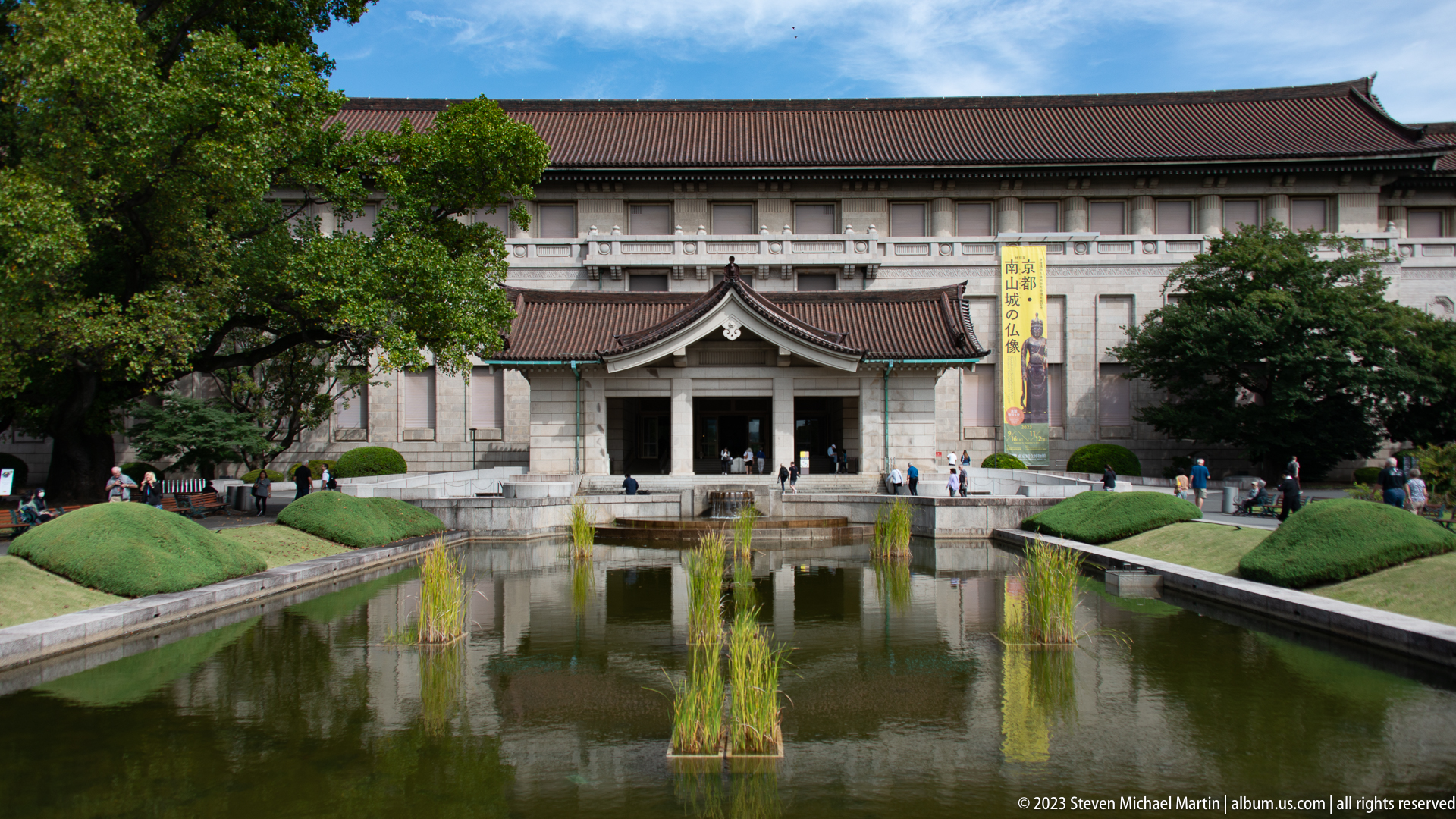
A reflecting pool leads toward the Honkan, the Japanese Gallery designed by Watanabe Jin in the Emperor’s Crown Style and opened in 1938. The water mirrors the central entrance and tiled roof, reinforcing the axial relationship between the museum’s principal façade and its formal landscaped approach.
Caption
A reflecting pool leads toward the Honkan, the Japanese Gallery designed by Watanabe Jin in the Emperor’s Crown Style and opened in 1938. The water mirrors the central entrance and tiled roof, reinforcing the axial relationship between the museum’s principal façade and its formal landscaped approach.

Rows of small Buddhist sculptures occupy individual vitrines on tall dark plinths within a warmly lit gallery. The regular spacing isolates each object for close study while allowing the full installation to read as a carefully ordered field of devotional images.
Caption
Rows of small Buddhist sculptures occupy individual vitrines on tall dark plinths within a warmly lit gallery. The regular spacing isolates each object for close study while allowing the full installation to read as a carefully ordered field of devotional images.

A crowned Buddhist figure sits in a contemplative pose, resting two fingers against the cheek while the other hand lies near the knee. The intimate gesture and downward gaze distinguish the sculpture from more formal frontal images nearby.
Caption
A crowned Buddhist figure sits in a contemplative pose, resting two fingers against the cheek while the other hand lies near the knee. The intimate gesture and downward gaze distinguish the sculpture from more formal frontal images nearby.

An armored guardian stands above a defeated demon-like figure, one arm raised and the other extended. The vertical authority of the guardian contrasts with the compressed body below, creating a dramatic sculptural image of protection and subjugation.
Caption
An armored guardian stands above a defeated demon-like figure, one arm raised and the other extended. The vertical authority of the guardian contrasts with the compressed body below, creating a dramatic sculptural image of protection and subjugation.

A polished Japanese sword blade is displayed horizontally above a white support cloth, allowing its gentle curvature and reflective edge to stand out against the dark case. The minimalist presentation directs attention to profile, proportion, and surface rather than fittings.
Caption
A polished Japanese sword blade is displayed horizontally above a white support cloth, allowing its gentle curvature and reflective edge to stand out against the dark case. The minimalist presentation directs attention to profile, proportion, and surface rather than fittings.

A densely printed broadsheet combines columns of Japanese text, heraldic emblems, and a crowded lower scene filled with warriors, banners, and overlapping figures. Its compressed layout reads as both visual spectacle and information sheet.
Caption
A densely printed broadsheet combines columns of Japanese text, heraldic emblems, and a crowded lower scene filled with warriors, banners, and overlapping figures. Its compressed layout reads as both visual spectacle and information sheet.

An illustrated sheet surrounds an anthropomorphic fish and several human figures with dense columns of Japanese text. The absurd central scene, expressive gestures, and explanatory writing suggest a popular satirical, comic, or topical print.
Caption
An illustrated sheet surrounds an anthropomorphic fish and several human figures with dense columns of Japanese text. The absurd central scene, expressive gestures, and explanatory writing suggest a popular satirical, comic, or topical print.

A pale kimono is covered edge to edge with a small repeating pattern in red and blue. The restrained scale of the motifs produces a uniform textile field, emphasizing weave and rhythm rather than large pictorial decoration.
Caption
A pale kimono is covered edge to edge with a small repeating pattern in red and blue. The restrained scale of the motifs produces a uniform textile field, emphasizing weave and rhythm rather than large pictorial decoration.

A fashionable woman turns her head gently to the side, her elaborate black coiffure secured with long hairpins. Fine linear patterning in the robe and subdued colors focus attention on the graceful profile and carefully arranged hair.
Caption
A fashionable woman turns her head gently to the side, her elaborate black coiffure secured with long hairpins. Fine linear patterning in the robe and subdued colors focus attention on the graceful profile and carefully arranged hair.

A woman raises one hand to adjust her hair beneath a large black coiffure, while her layered robes form broad patterned bands across the lower composition. The intimate grooming gesture and close crop create a private, informal portrait.
Caption
A woman raises one hand to adjust her hair beneath a large black coiffure, while her layered robes form broad patterned bands across the lower composition. The intimate grooming gesture and close crop create a private, informal portrait.

A richly equipped samurai armor display fills the frame, combining deep blue lacing, orange cords, layered plates, fur trim, and a broad gold helmet crest. The frontal view emphasizes the intimidating face guard and ceremonial complexity of the assembled suit.
Caption
A richly equipped samurai armor display fills the frame, combining deep blue lacing, orange cords, layered plates, fur trim, and a broad gold helmet crest. The frontal view emphasizes the intimidating face guard and ceremonial complexity of the assembled suit.

This compact imperial palanquin is carried on long poles at approximately waist height, a form known as yōyo. Purple curtains enclose the passenger compartment beneath a curved lacquered roof and decorative finial. Tokyo National Museum explains that yōyo palanquins were used to transport the emperor within palace grounds and could also serve during emergencies.
Caption
This compact imperial palanquin is carried on long poles at approximately waist height, a form known as yōyo. Purple curtains enclose the passenger compartment beneath a curved lacquered roof and decorative finial. Tokyo National Museum explains that yōyo palanquins were used to transport the emperor within palace grounds and could also serve during emergencies.

The rear of a samurai armor suit reveals the domed helmet, wooden support, broad shoulder guards, and gold-trimmed cuirass fittings. This viewpoint clarifies the construction and suspension of the armor, complementing the frontal displays elsewhere in the gallery.
Caption
The rear of a samurai armor suit reveals the domed helmet, wooden support, broad shoulder guards, and gold-trimmed cuirass fittings. This viewpoint clarifies the construction and suspension of the armor, complementing the frontal displays elsewhere in the gallery.