Tallinn
Tallinn developed as an important port city along the Baltic Sea and became a member of the Hanseatic League, a medieval trade network connecting northern Europe. Its fortified walls, towers, and merchant buildings reflect the economic influence of maritime commerce across the region. The preserved historic center illustrates the importance of trade in shaping urban development.
Architectural features demonstrate influences from German, Scandinavian, and Russian political authority over several centuries. Stone churches, guild halls, and defensive fortifications illustrate the importance of security and commercial organization in medieval society. Tallinn’s urban landscape reflects the interaction of cultural traditions across northern Europe.
Tallinn represents the role of Baltic ports in facilitating trade between eastern and western Europe. Its preserved medieval environment provides insight into the economic networks that shaped the development of the region.

Tallinn Town Hall dominates the edge of Town Hall Square with its long limestone façade, pointed roof, arcaded ground level, and slender tower. Colorful gabled merchant houses line the adjoining side of the square, creating one of the historic center’s most recognizable civic ensembles.
Caption
Tallinn Town Hall dominates the edge of Town Hall Square with its long limestone façade, pointed roof, arcaded ground level, and slender tower. Colorful gabled merchant houses line the adjoining side of the square, creating one of the historic center’s most recognizable civic ensembles.

A cobblestone lane in Tallinn’s Old Town is lined with planted restaurant terraces, small shopfronts, and closely spaced historic buildings. The view emphasizes the intimate scale of the medieval street network, where pedestrian space, outdoor dining, and varied façades create a layered urban scene within the historic center.
Caption
A cobblestone lane in Tallinn’s Old Town is lined with planted restaurant terraces, small shopfronts, and closely spaced historic buildings. The view emphasizes the intimate scale of the medieval street network, where pedestrian space, outdoor dining, and varied façades create a layered urban scene within the historic center.

A broad concrete stairway climbs a grass-covered embankment at Tallinn’s Linnahall, flanked by massive sloping walls and low arched openings. The severe geometry, weathered surfaces, and monumental scale are characteristic of the late-Soviet civic complex, whose terraces form a vast stepped landscape between the city center and the harbor.
Caption
A broad concrete stairway climbs a grass-covered embankment at Tallinn’s Linnahall, flanked by massive sloping walls and low arched openings. The severe geometry, weathered surfaces, and monumental scale are characteristic of the late-Soviet civic complex, whose terraces form a vast stepped landscape between the city center and the harbor.

Red-roofed historic buildings occupy the foreground while Tallinn’s passenger harbor and Baltic shoreline extend across the distance. The elevated composition links the fortified Old Town with the modern port, showing the close physical relationship between the historic city and its maritime setting.
Caption
Red-roofed historic buildings occupy the foreground while Tallinn’s passenger harbor and Baltic shoreline extend across the distance. The elevated composition links the fortified Old Town with the modern port, showing the close physical relationship between the historic city and its maritime setting.

A rectangular masonry opening frames a high view over Tallinn’s rooftops and the lower city beyond. A dark roof and small tower cap fill the foreground, while the distant urban landscape stretches toward the horizon, giving the scene the character of a lookout from within a historic tower or fortification.
Caption
A rectangular masonry opening frames a high view over Tallinn’s rooftops and the lower city beyond. A dark roof and small tower cap fill the foreground, while the distant urban landscape stretches toward the horizon, giving the scene the character of a lookout from within a historic tower or fortification.

A medieval stone arch frames a sunlit Tallinn street lined with narrow historic buildings and parked cars. The dark interior edge of the gateway creates a natural border around the lighter streetscape beyond, emphasizing the transition from the fortified perimeter into the urban fabric of the Old Town.
Caption
A medieval stone arch frames a sunlit Tallinn street lined with narrow historic buildings and parked cars. The dark interior edge of the gateway creates a natural border around the lighter streetscape beyond, emphasizing the transition from the fortified perimeter into the urban fabric of the Old Town.

Church spires punctuate a broad sweep of Tallinn’s red-roofed Old Town, with modern towers rising on the horizon beyond. The slightly softened foreground emphasizes the layered depth of the city, moving from medieval rooflines and ecclesiastical landmarks toward the contemporary skyline.
Caption
Church spires punctuate a broad sweep of Tallinn’s red-roofed Old Town, with modern towers rising on the horizon beyond. The slightly softened foreground emphasizes the layered depth of the city, moving from medieval rooflines and ecclesiastical landmarks toward the contemporary skyline.

Several stone towers with steep red conical roofs rise above Tallinn’s Old Town streets and clustered buildings. Seen from above, the surviving fortifications remain embedded in the urban fabric, marking the line of the medieval defenses while church spires and later development extend beyond.
Caption
Several stone towers with steep red conical roofs rise above Tallinn’s Old Town streets and clustered buildings. Seen from above, the surviving fortifications remain embedded in the urban fabric, marking the line of the medieval defenses while church spires and later development extend beyond.

An adult stands beside Tallinn’s medieval city wall, where a covered timber wall-walk runs along the stone defenses beneath a square tower. Additional red-roofed towers recede into the background, making the portrait a strong contextual view of the surviving fortification system.
Caption
An adult stands beside Tallinn’s medieval city wall, where a covered timber wall-walk runs along the stone defenses beneath a square tower. Additional red-roofed towers recede into the background, making the portrait a strong contextual view of the surviving fortification system.

An arched opening leads into Tallinn’s medieval stone defenses beneath a covered timber wall-walk, while square towers with steep red roofs punctuate the wall line beyond. The street-level view clearly shows the layered construction of the fortification system and its integration with the present-day Old Town.
Caption
An arched opening leads into Tallinn’s medieval stone defenses beneath a covered timber wall-walk, while square towers with steep red roofs punctuate the wall line beyond. The street-level view clearly shows the layered construction of the fortification system and its integration with the present-day Old Town.

From an elevated viewpoint, Tallinn’s Old Town unfolds as a dense field of red-tiled roofs, medieval wall towers, and church spires. The clustered fortifications in the foreground and the tall white church tower beyond convey the layered skyline that defines the historic center and its long relationship to urban defense and ecclesiastical architecture.
Caption
From an elevated viewpoint, Tallinn’s Old Town unfolds as a dense field of red-tiled roofs, medieval wall towers, and church spires. The clustered fortifications in the foreground and the tall white church tower beyond convey the layered skyline that defines the historic center and its long relationship to urban defense and ecclesiastical architecture.

A dark, tiered church spire rises from a pale masonry tower while modern high-rise buildings form a contrasting skyline beyond Tallinn’s historic roofs. A decorative metal weather vane in the foreground adds another layer of old-city detail. The elevated viewpoint makes the relationship between the medieval urban fabric and the newer commercial center especially clear.
Caption
A dark, tiered church spire rises from a pale masonry tower while modern high-rise buildings form a contrasting skyline beyond Tallinn’s historic roofs. A decorative metal weather vane in the foreground adds another layer of old-city detail. The elevated viewpoint makes the relationship between the medieval urban fabric and the newer commercial center especially clear.
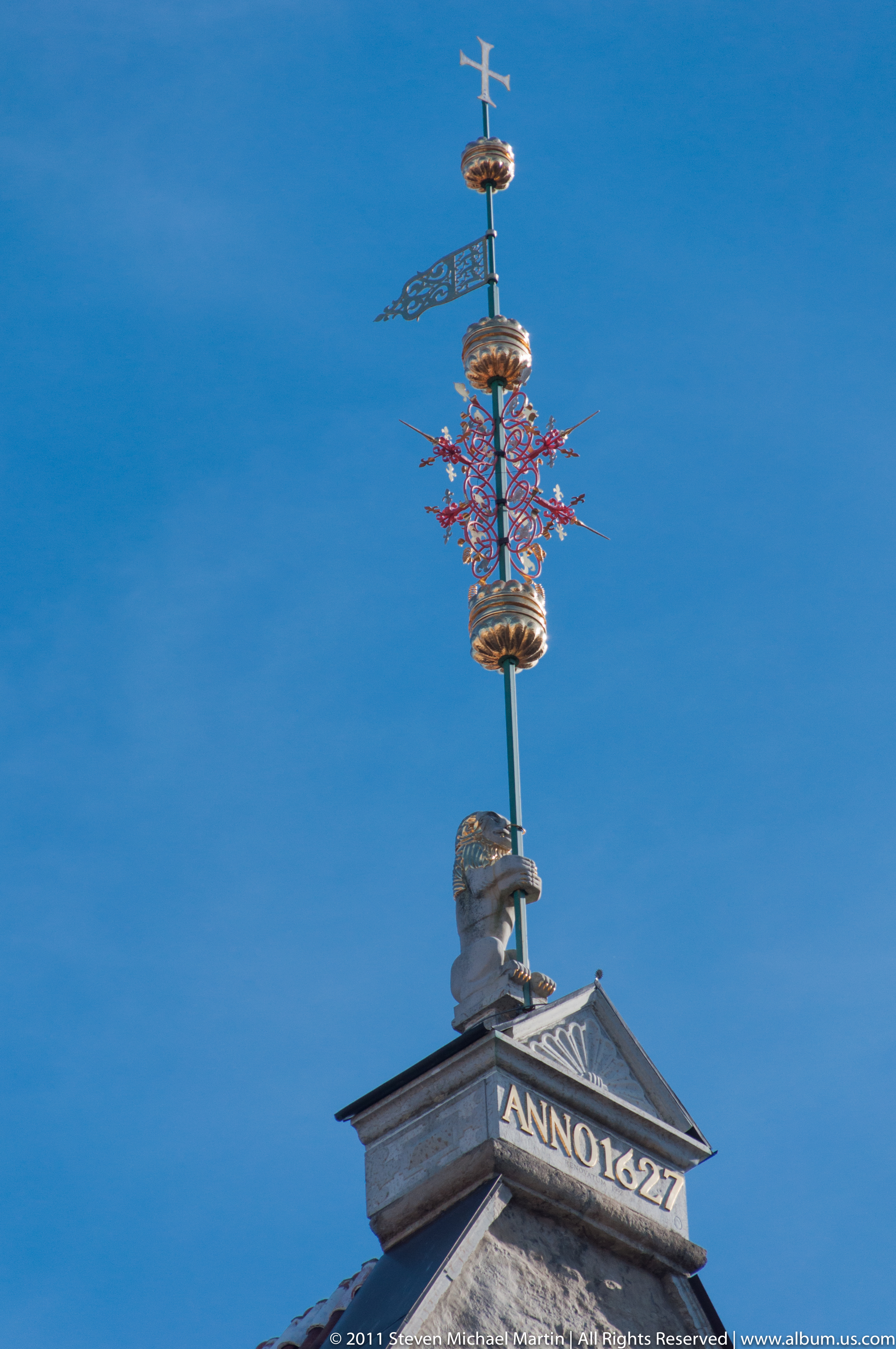
A tall ornamental finial rises above a classical pediment inscribed “ANNO 1427,” its stacked metal rings, cross, and branching decorative elements silhouetted against a clear blue sky. The tightly framed view isolates the roofline ornament and its date, emphasizing the layered metalwork and the architectural crown rather than the surrounding streetscape of Tallinn’s historic center.
Caption
A tall ornamental finial rises above a classical pediment inscribed “ANNO 1427,” its stacked metal rings, cross, and branching decorative elements silhouetted against a clear blue sky. The tightly framed view isolates the roofline ornament and its date, emphasizing the layered metalwork and the architectural crown rather than the surrounding streetscape of Tallinn’s historic center.

A shallow enclosed bay projects from a salmon-colored façade, its white-painted wooden framing divided into multiple rectangular panes above a stepped supporting base. The close architectural study emphasizes the joinery, depth, and shadow of the projection, while a lower window at the edge of the frame hints at the rhythm of the larger street façade.
Caption
A shallow enclosed bay projects from a salmon-colored façade, its white-painted wooden framing divided into multiple rectangular panes above a stepped supporting base. The close architectural study emphasizes the joinery, depth, and shadow of the projection, while a lower window at the edge of the frame hints at the rhythm of the larger street façade.

The Eduard Vilde memorial stands on a green lawn, its paired stone slabs viewed from farther back than the preceding close study. A historic tower rises above the trees in the background, placing the literary monument within Tallinn’s layered urban landscape. The wider composition clarifies the memorial’s scale, spacing, and landscaped setting.
Caption
The Eduard Vilde memorial stands on a green lawn, its paired stone slabs viewed from farther back than the preceding close study. A historic tower rises above the trees in the background, placing the literary monument within Tallinn’s layered urban landscape. The wider composition clarifies the memorial’s scale, spacing, and landscaped setting.

A brightly colored souvenir plate painted with Tallinn’s towers and red-roofed old city stands among decorative beer steins and small model façades. The dense retail display combines idealized city imagery, drinking vessels, and miniature architecture, illustrating how recognizable Old Town motifs are translated into visitor souvenirs and commercial craft objects.
Caption
A brightly colored souvenir plate painted with Tallinn’s towers and red-roofed old city stands among decorative beer steins and small model façades. The dense retail display combines idealized city imagery, drinking vessels, and miniature architecture, illustrating how recognizable Old Town motifs are translated into visitor souvenirs and commercial craft objects.

A curving salmon-pink gable is centered on Estonia’s blue-and-gold coat of arms with three lions, framed by white foliate reliefs and topped by a flagpole. White scroll-like moldings rise above a red tile roof, creating a formal heraldic composition that links decorative architecture with national symbolism.
Caption
A curving salmon-pink gable is centered on Estonia’s blue-and-gold coat of arms with three lions, framed by white foliate reliefs and topped by a flagpole. White scroll-like moldings rise above a red tile roof, creating a formal heraldic composition that links decorative architecture with national symbolism.

A blue paneled double door sits between tall arched windows on a warm ocher façade, all edged with crisp white trim. A hanging flower basket and wall lantern cast strong shadows in the angled sunlight, while the low green-painted base and small street number contribute to the carefully maintained character of the historic streetscape.
Caption
A blue paneled double door sits between tall arched windows on a warm ocher façade, all edged with crisp white trim. A hanging flower basket and wall lantern cast strong shadows in the angled sunlight, while the low green-painted base and small street number contribute to the carefully maintained character of the historic streetscape.

Two upright stone slabs form a memorial to Estonian writer Eduard Vilde. One slab is carved with a sequence of figural relief scenes, while the other carries a portrait medallion, dense text, and Vilde’s signature. Set on a grassy terrace beneath mature trees, the monument combines narrative imagery and written commemoration in a modern sculptural format.
Caption
Two upright stone slabs form a memorial to Estonian writer Eduard Vilde. One slab is carved with a sequence of figural relief scenes, while the other carries a portrait medallion, dense text, and Vilde’s signature. Set on a grassy terrace beneath mature trees, the monument combines narrative imagery and written commemoration in a modern sculptural format.

A rustic dining space is seen through reflective glass, where heavy timber partitions, simple benches, barrel-like furniture, and a tall candle arrangement create a deliberately old-world atmosphere. The reflections soften the boundaries between interior and exterior, while warm light and natural wood dominate the scene.
Caption
A rustic dining space is seen through reflective glass, where heavy timber partitions, simple benches, barrel-like furniture, and a tall candle arrangement create a deliberately old-world atmosphere. The reflections soften the boundaries between interior and exterior, while warm light and natural wood dominate the scene.

The painted exterior clock of Tallinn’s Church of the Holy Spirit is viewed from below at night, set into a pale wall beneath the church roof and tower. Its circular dial, Roman numerals, radiating blue-and-gold center, and colorful carved surround form a vivid focal point in the illuminated façade.
Caption
The painted exterior clock of Tallinn’s Church of the Holy Spirit is viewed from below at night, set into a pale wall beneath the church roof and tower. Its circular dial, Roman numerals, radiating blue-and-gold center, and colorful carved surround form a vivid focal point in the illuminated façade.

Tallinn’s Church of the Holy Spirit is seen at night from street level, with its steep red-tiled roof, pale wall, corner tower, and painted clock illuminated by warm artificial light. The wide view places the famous clock in its architectural setting and shows the compact medieval church rising directly from the surrounding Old Town street.
Caption
Tallinn’s Church of the Holy Spirit is seen at night from street level, with its steep red-tiled roof, pale wall, corner tower, and painted clock illuminated by warm artificial light. The wide view places the famous clock in its architectural setting and shows the compact medieval church rising directly from the surrounding Old Town street.

A close view isolates the painted clock on Tallinn’s Church of the Holy Spirit. Roman numerals ring a dark outer band around a pale blue center filled with radiating gold lines, while sculpted green and red ornament frames the square recess. The tighter composition reveals the craftsmanship and weathering of this celebrated Old Town timepiece.
Caption
A close view isolates the painted clock on Tallinn’s Church of the Holy Spirit. Roman numerals ring a dark outer band around a pale blue center filled with radiating gold lines, while sculpted green and red ornament frames the square recess. The tighter composition reveals the craftsmanship and weathering of this celebrated Old Town timepiece.
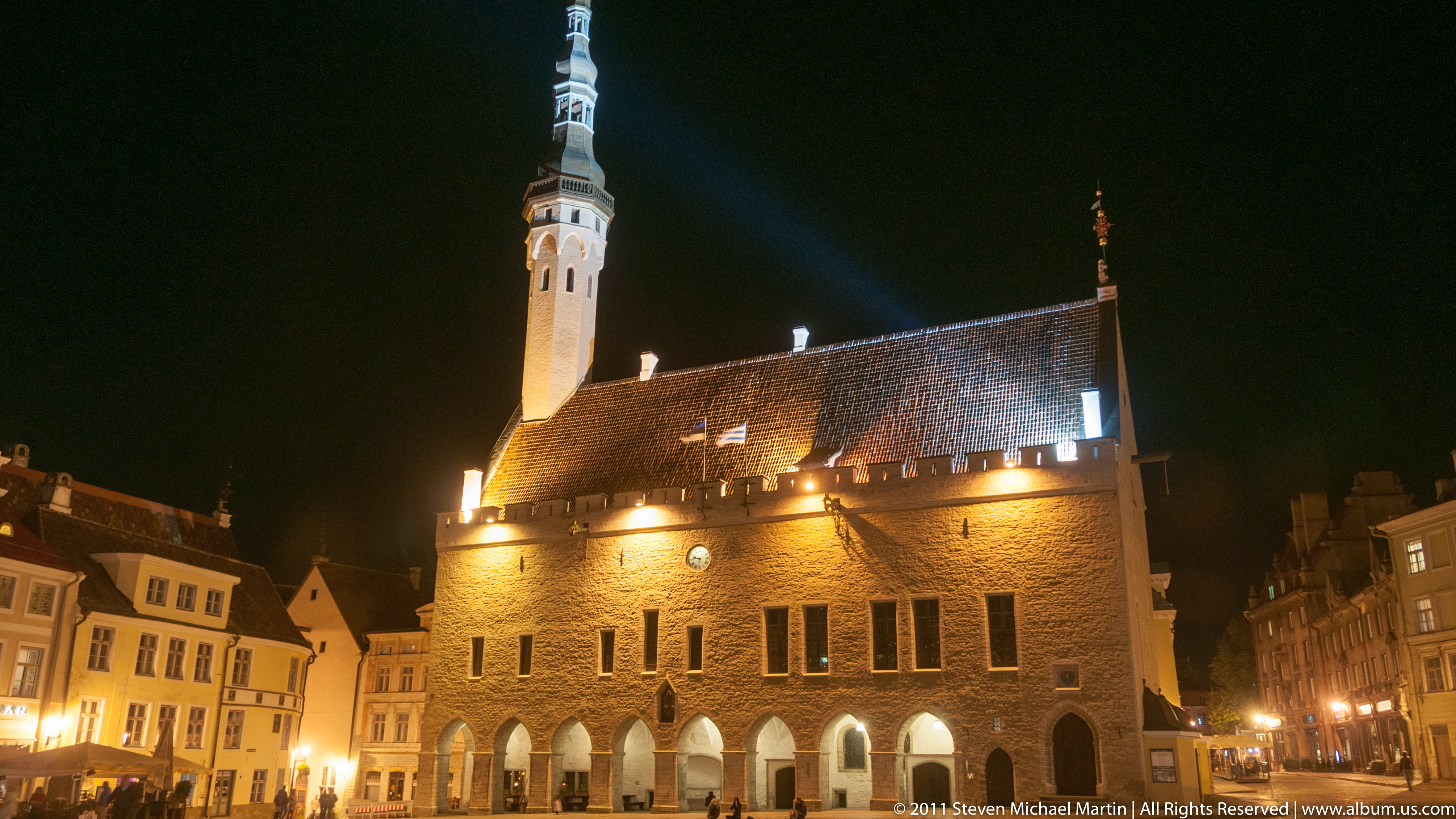
Tallinn Town Hall dominates the square at night, its long Gothic masonry façade lit from below and capped by a steep tiled roof and slender tower. Pointed ground-floor arches and evenly spaced windows articulate the building’s civic frontage, while surrounding merchant houses glow at the edges of the square.
Caption
Tallinn Town Hall dominates the square at night, its long Gothic masonry façade lit from below and capped by a steep tiled roof and slender tower. Pointed ground-floor arches and evenly spaced windows articulate the building’s civic frontage, while surrounding merchant houses glow at the edges of the square.

Heavy timber posts divide a rustic dining area furnished with simple benches, barrel-like tables, and stools. A large beer mug on a small round stand becomes the central accent under a hanging lamp. Warm wood tones and intentionally simple furnishings reinforce the atmosphere of a historic-themed tavern in Tallinn’s Old Town.
Caption
Heavy timber posts divide a rustic dining area furnished with simple benches, barrel-like tables, and stools. A large beer mug on a small round stand becomes the central accent under a hanging lamp. Warm wood tones and intentionally simple furnishings reinforce the atmosphere of a historic-themed tavern in Tallinn’s Old Town.

A brick-fronted bar anchors a spacious restaurant interior decorated with timber beams, hanging greenery, heraldic motifs, and rustic barrels. Diners sit at wooden tables beneath a bright skylight-like roof opening, while the open service area and layered materials give the room the character of a modern venue designed around medieval Old Town imagery.
Caption
A brick-fronted bar anchors a spacious restaurant interior decorated with timber beams, hanging greenery, heraldic motifs, and rustic barrels. Diners sit at wooden tables beneath a bright skylight-like roof opening, while the open service area and layered materials give the room the character of a modern venue designed around medieval Old Town imagery.

Two oversized beer mugs sit on a wooden ledge beneath pendant lamps in a dim, timber-framed interior. The low viewpoint silhouettes posts and beams around the amber-colored beer, turning a simple tavern detail into a study of warm light, glass, and rustic architectural framing.
Caption
Two oversized beer mugs sit on a wooden ledge beneath pendant lamps in a dim, timber-framed interior. The low viewpoint silhouettes posts and beams around the amber-colored beer, turning a simple tavern detail into a study of warm light, glass, and rustic architectural framing.

Nighttime restaurant terraces line Tallinn’s Town Hall Square beneath tall historic merchant-house façades. Outdoor umbrellas, glowing signs, and warm windows create a band of activity at street level, while the upper stories remain comparatively dark and quiet. The broad paved foreground conveys the openness of the square after dusk.
Caption
Nighttime restaurant terraces line Tallinn’s Town Hall Square beneath tall historic merchant-house façades. Outdoor umbrellas, glowing signs, and warm windows create a band of activity at street level, while the upper stories remain comparatively dark and quiet. The broad paved foreground conveys the openness of the square after dusk.

The tower of Tallinn Town Hall rises above the dark pitched roof in a close night view from a narrow Old Town street. Warm lighting grazes the masonry, revealing the tower’s polygonal upper stage while neighboring façades press tightly around the civic building. The unusual angle emphasizes the Town Hall’s mass and vertical silhouette rather than its formal square-facing façade.
Caption
The tower of Tallinn Town Hall rises above the dark pitched roof in a close night view from a narrow Old Town street. Warm lighting grazes the masonry, revealing the tower’s polygonal upper stage while neighboring façades press tightly around the civic building. The unusual angle emphasizes the Town Hall’s mass and vertical silhouette rather than its formal square-facing façade.

Tallinn’s Old Town roofline is compressed into a close architectural study: a pale gable supports an elaborate metal finial, while a dark, tiered tower rises immediately behind it. The framing emphasizes the vertical ornaments, changing roof levels, and mixture of masonry and metalwork that animate the historic skyline.
Caption
Tallinn’s Old Town roofline is compressed into a close architectural study: a pale gable supports an elaborate metal finial, while a dark, tiered tower rises immediately behind it. The framing emphasizes the vertical ornaments, changing roof levels, and mixture of masonry and metalwork that animate the historic skyline.

A wider garden view places colorful planters in the foreground, the Eduard Vilde memorial to the right, and a historic tower above dense trees in the background. The composition shows how sculpture, planted terraces, old masonry, and the surrounding city skyline share a compact public space in central Tallinn.
Caption
A wider garden view places colorful planters in the foreground, the Eduard Vilde memorial to the right, and a historic tower above dense trees in the background. The composition shows how sculpture, planted terraces, old masonry, and the surrounding city skyline share a compact public space in central Tallinn.

A cobbled pedestrian street in Tallinn’s Old Town opens toward a cluster of steep historic gables under warm night lighting. Restaurant terraces occupy the left side while pedestrians move through the center, and hanging banners and signs add to the layered commercial character of the medieval street fabric.
Caption
A cobbled pedestrian street in Tallinn’s Old Town opens toward a cluster of steep historic gables under warm night lighting. Restaurant terraces occupy the left side while pedestrians move through the center, and hanging banners and signs add to the layered commercial character of the medieval street fabric.

A long historic masonry wall runs beside a narrow roadway, its rough surface dramatically lit from below in alternating pools of white and green light. Repeated recessed arches and buttress-like vertical supports create a strong rhythm along the base, while a modern railing traces the top edge above the older fabric.
Caption
A long historic masonry wall runs beside a narrow roadway, its rough surface dramatically lit from below in alternating pools of white and green light. Repeated recessed arches and buttress-like vertical supports create a strong rhythm along the base, while a modern railing traces the top edge above the older fabric.

An ornate historic façade rises above the street with a stepped central gable, small pinnacles, tall paired windows, and patterned brick or stone detailing. Dormers and neighboring towers crowd the skyline, while the upward-looking viewpoint concentrates attention on the richly articulated roofline and upper stories.
Caption
An ornate historic façade rises above the street with a stepped central gable, small pinnacles, tall paired windows, and patterned brick or stone detailing. Dormers and neighboring towers crowd the skyline, while the upward-looking viewpoint concentrates attention on the richly articulated roofline and upper stories.

Brightly planted stone bowls lead up a short flight of steps toward the paired slabs of the Eduard Vilde memorial. The landscaped approach softens the monument’s pale stone surfaces with red, yellow, purple, and green foliage, while a low historic wall and mature trees enclose the setting.
Caption
Brightly planted stone bowls lead up a short flight of steps toward the paired slabs of the Eduard Vilde memorial. The landscaped approach softens the monument’s pale stone surfaces with red, yellow, purple, and green foliage, while a low historic wall and mature trees enclose the setting.

A row of turquoise-green ornamental urns crowns a stone balustrade, each vessel carrying Estonia’s blue shield with three gold lions. Their scrolling handles, molded bodies, and repeated heraldic emblems create a ceremonial rhythm against autumn foliage, turning the boundary feature into a vivid display of national symbolism.
Caption
A row of turquoise-green ornamental urns crowns a stone balustrade, each vessel carrying Estonia’s blue shield with three gold lions. Their scrolling handles, molded bodies, and repeated heraldic emblems create a ceremonial rhythm against autumn foliage, turning the boundary feature into a vivid display of national symbolism.
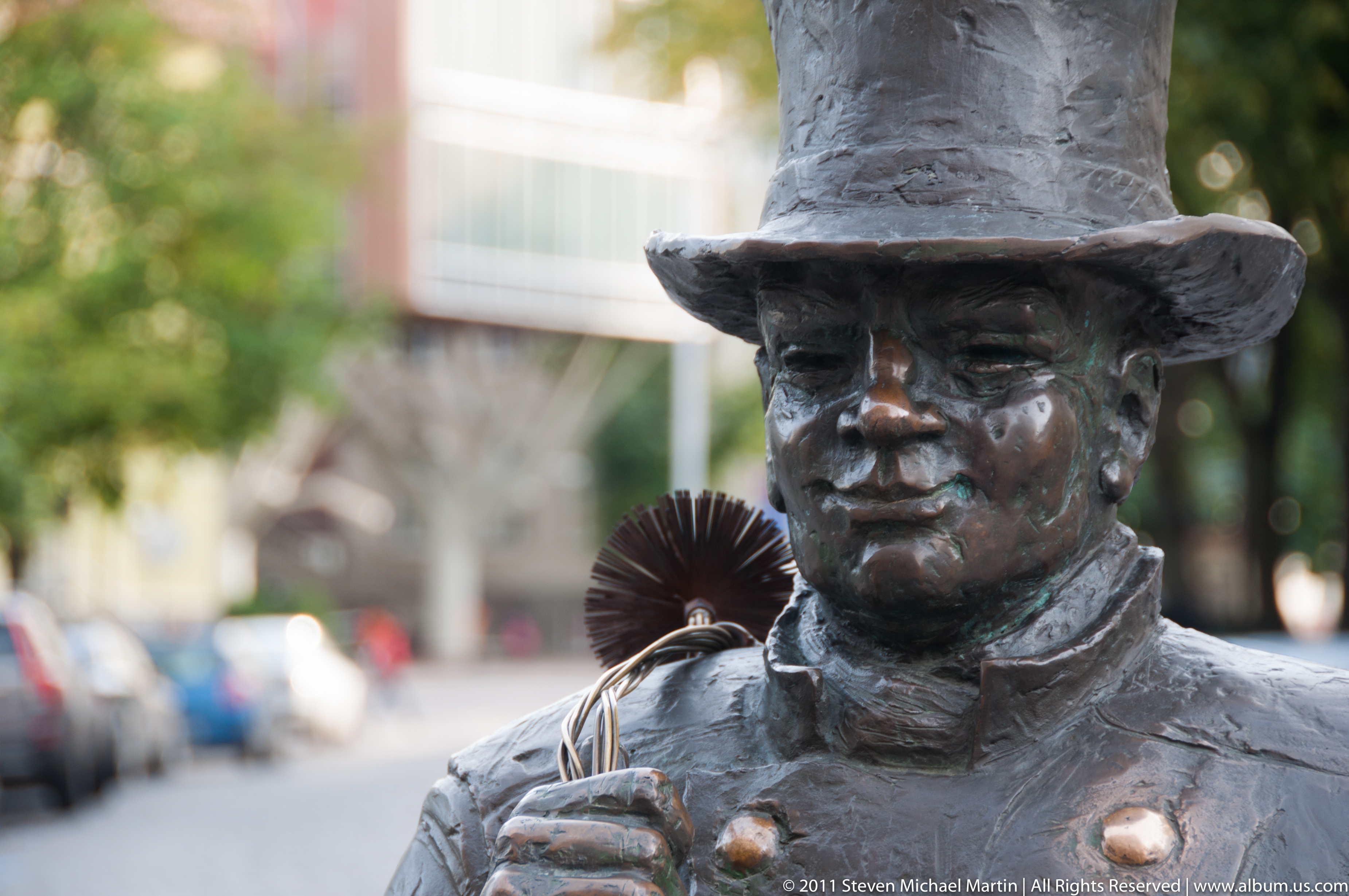
A bronze chimney-sweep figure smiles beneath a tall top hat while holding a round-bristled sweeping brush over one shoulder. The close portrait shows the textured modeling of the face, clothing, and hat, with polished highlights on projecting surfaces suggesting repeated public contact. A softly blurred city street recedes behind the sculpture.
Caption
A bronze chimney-sweep figure smiles beneath a tall top hat while holding a round-bristled sweeping brush over one shoulder. The close portrait shows the textured modeling of the face, clothing, and hat, with polished highlights on projecting surfaces suggesting repeated public contact. A softly blurred city street recedes behind the sculpture.

The Victory Column at Tallinn’s Freedom Square rises as a tall translucent pillar topped by the Cross of Liberty. At its base, the inscription “EESTI VABADUSSÕDA 1918–1920” identifies the Estonian War of Independence. The national flag on the grassy slope behind reinforces the memorial’s civic and commemorative setting.
Caption
The Victory Column at Tallinn’s Freedom Square rises as a tall translucent pillar topped by the Cross of Liberty. At its base, the inscription “EESTI VABADUSSÕDA 1918–1920” identifies the Estonian War of Independence. The national flag on the grassy slope behind reinforces the memorial’s civic and commemorative setting.

A sharply modern rectangular volume of glass and metal projects above an open structural base, contrasting with older pitched-roof buildings on either side. Framed by tree branches and set within a compact urban lot, the building illustrates the insertion of contemporary architecture into Tallinn’s predominantly historic central fabric.
Caption
A sharply modern rectangular volume of glass and metal projects above an open structural base, contrasting with older pitched-roof buildings on either side. Framed by tree branches and set within a compact urban lot, the building illustrates the insertion of contemporary architecture into Tallinn’s predominantly historic central fabric.

Richly carved wooden double doors fill a rounded stone portal, their panels framed by dense foliage, heraldic motifs, and sculpted figures. The pale masonry arch and colonnettes contrast with the dark polished wood, focusing attention on the craftsmanship of the entrance and its ceremonial character.
Caption
Richly carved wooden double doors fill a rounded stone portal, their panels framed by dense foliage, heraldic motifs, and sculpted figures. The pale masonry arch and colonnettes contrast with the dark polished wood, focusing attention on the craftsmanship of the entrance and its ceremonial character.

A carved grotesque face projects from a square stone block beneath a heavy ledge, its curling brows, moustache-like scrolls, and exaggerated features creating a compact piece of architectural sculpture. The close view isolates the weathered carving against rough masonry, revealing how figurative ornament was integrated into the building façade.
Caption
A carved grotesque face projects from a square stone block beneath a heavy ledge, its curling brows, moustache-like scrolls, and exaggerated features creating a compact piece of architectural sculpture. The close view isolates the weathered carving against rough masonry, revealing how figurative ornament was integrated into the building façade.

A steeply pitched gable carries the date “1410” beneath an elaborate metal weather vane composed of scrollwork, directional elements, and a small figurative finial. Framed tightly against the sky, the view isolates a decorative roof feature that signals the age and craftsmanship associated with Tallinn’s historic architecture.
Caption
A steeply pitched gable carries the date “1410” beneath an elaborate metal weather vane composed of scrollwork, directional elements, and a small figurative finial. Framed tightly against the sky, the view isolates a decorative roof feature that signals the age and craftsmanship associated with Tallinn’s historic architecture.

A white tower rises above a steep red-tiled roof, with a historic clock mounted low on the adjoining wall. The sharply stepped roofline, compact tower stages, and painted clock form a distinctive Old Town composition, illustrating how ecclesiastical architecture is woven tightly into Tallinn’s dense medieval fabric.
Caption
A white tower rises above a steep red-tiled roof, with a historic clock mounted low on the adjoining wall. The sharply stepped roofline, compact tower stages, and painted clock form a distinctive Old Town composition, illustrating how ecclesiastical architecture is woven tightly into Tallinn’s dense medieval fabric.

Low, rounded vaults span a warmly lit cellar-like interior furnished with dining tables and high-backed chairs. The masonry and plastered arches create a sequence of compressed bays, suggesting the adaptive reuse of a historic basement or ground-floor commercial space within Tallinn’s Old Town.
Caption
Low, rounded vaults span a warmly lit cellar-like interior furnished with dining tables and high-backed chairs. The masonry and plastered arches create a sequence of compressed bays, suggesting the adaptive reuse of a historic basement or ground-floor commercial space within Tallinn’s Old Town.

An ornate circular wall clock is set into a pale exterior wall and framed by painted vegetal ornament. Roman numerals ring a weathered blue-and-gold dial, while dark hands and a decorative central fitting stand out against the aged surface, making the clock a focal architectural detail.
Caption
An ornate circular wall clock is set into a pale exterior wall and framed by painted vegetal ornament. Roman numerals ring a weathered blue-and-gold dial, while dark hands and a decorative central fitting stand out against the aged surface, making the clock a focal architectural detail.

Two adults appear as a slightly distorted reflection in a shop or building window, with pale historic façades and the street behind them. The reflective surface turns a casual portrait into a layered Old Town scene, combining people, architecture, and the texture of the streetscape in a single frame.
Caption
Two adults appear as a slightly distorted reflection in a shop or building window, with pale historic façades and the street behind them. The reflective surface turns a casual portrait into a layered Old Town scene, combining people, architecture, and the texture of the streetscape in a single frame.

Intersecting ribs spread across a pale vaulted ceiling, with painted linear decoration tracing the geometry of the upper bays. Suspended metal chandeliers hang along the nave axis, adding scale to the soaring interior and drawing attention to the structural rhythm of the Gothic vaulting.
Caption
Intersecting ribs spread across a pale vaulted ceiling, with painted linear decoration tracing the geometry of the upper bays. Suspended metal chandeliers hang along the nave axis, adding scale to the soaring interior and drawing attention to the structural rhythm of the Gothic vaulting.

A large Crucifixion painting occupies the center of an ornate altar ensemble framed by pointed Gothic-style moldings and slender pinnacles. Warm light at the base contrasts with the pale masonry and ribbed vaulting, concentrating attention on the devotional image within the spacious church interior.
Caption
A large Crucifixion painting occupies the center of an ornate altar ensemble framed by pointed Gothic-style moldings and slender pinnacles. Warm light at the base contrasts with the pale masonry and ribbed vaulting, concentrating attention on the devotional image within the spacious church interior.

Two dark robed figures stand on projecting consoles between tall windows, above a pair of brightly painted heraldic shields. The façade combines sculptural decoration with civic or institutional emblems, creating a formal composition that contrasts strongly with the pale plaster wall and pointed-arch details below.
Caption
Two dark robed figures stand on projecting consoles between tall windows, above a pair of brightly painted heraldic shields. The façade combines sculptural decoration with civic or institutional emblems, creating a formal composition that contrasts strongly with the pale plaster wall and pointed-arch details below.

A carved winged creature resembling a griffin perches on a roofline while holding a large shield against its body. Seen from below against a clear sky, the sculpture functions as a dramatic architectural crest or guardian figure and reveals the decorative vocabulary applied to Tallinn’s historic buildings.
Caption
A carved winged creature resembling a griffin perches on a roofline while holding a large shield against its body. Seen from below against a clear sky, the sculpture functions as a dramatic architectural crest or guardian figure and reveals the decorative vocabulary applied to Tallinn’s historic buildings.

A tall, narrow pointed window rises within a high whitewashed church wall, its gridded glazing admitting a shaft of daylight into the interior. The steep vertical proportions and restrained surfaces emphasize the Gothic character of the space and the dramatic scale of the masonry enclosure.
Caption
A tall, narrow pointed window rises within a high whitewashed church wall, its gridded glazing admitting a shaft of daylight into the interior. The steep vertical proportions and restrained surfaces emphasize the Gothic character of the space and the dramatic scale of the masonry enclosure.

A polished central aisle runs between rows of high-backed wooden pews toward an illuminated altar at the far end of a vaulted church. The low viewpoint accentuates symmetry and depth, while the warm reflection on the floor draws the eye through the nave toward the lit sanctuary.
Caption
A polished central aisle runs between rows of high-backed wooden pews toward an illuminated altar at the far end of a vaulted church. The low viewpoint accentuates symmetry and depth, while the warm reflection on the floor draws the eye through the nave toward the lit sanctuary.
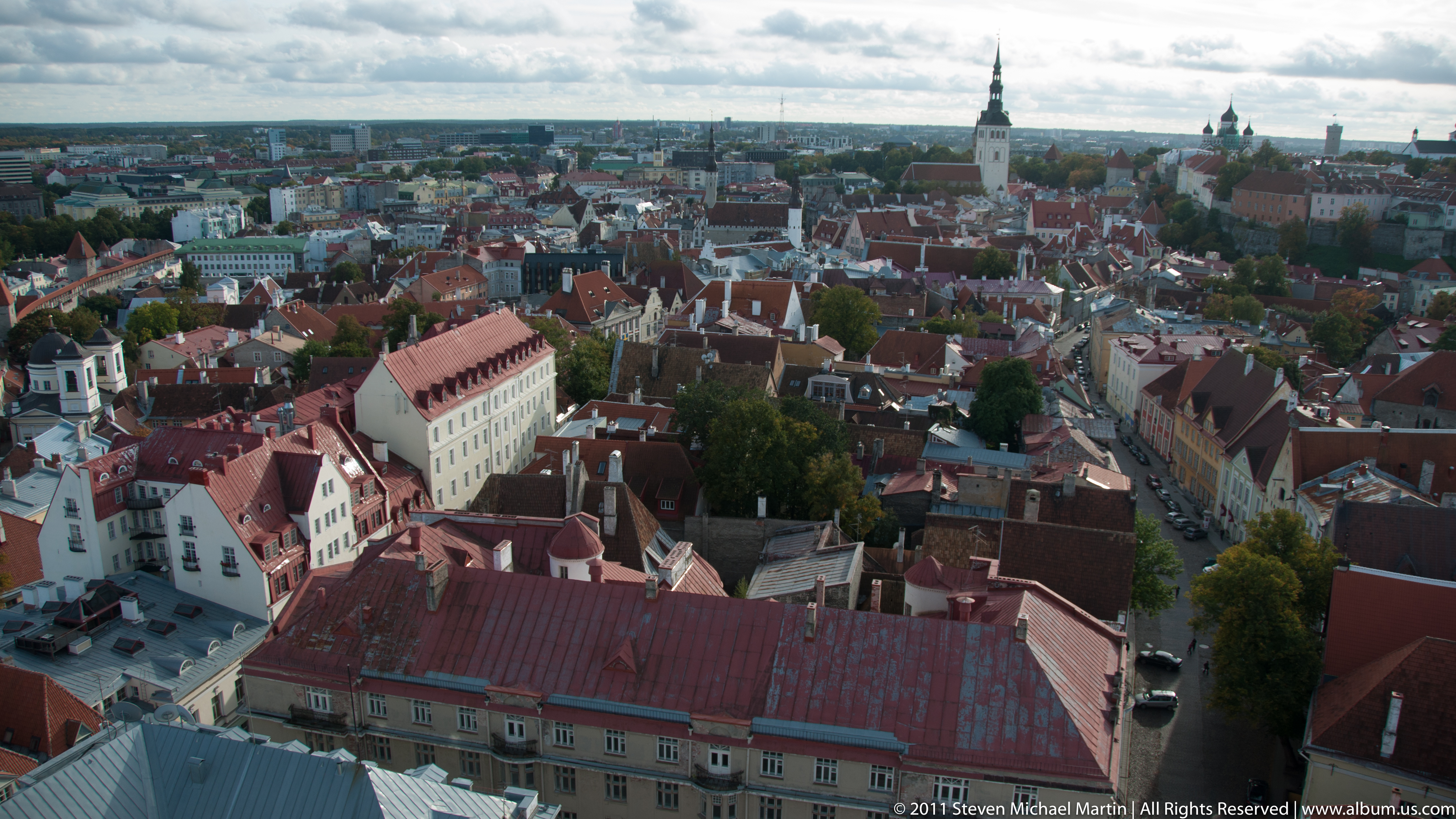
From an elevated viewpoint, Tallinn’s Old Town spreads across the frame in a dense pattern of red-tiled roofs, narrow streets, church towers, and closely packed historic buildings. The panorama reveals the compact urban form of the medieval center and its distinctive skyline of spires rising above the surrounding city.
Caption
From an elevated viewpoint, Tallinn’s Old Town spreads across the frame in a dense pattern of red-tiled roofs, narrow streets, church towers, and closely packed historic buildings. The panorama reveals the compact urban form of the medieval center and its distinctive skyline of spires rising above the surrounding city.

A broad elevated view looks across Tallinn’s red-roofed Old Town toward the modern city beyond. Historic blocks, church spires, courtyards, and irregular street alignments form a textured foreground, showing how the medieval center sits within the larger contemporary urban landscape.
Caption
A broad elevated view looks across Tallinn’s red-roofed Old Town toward the modern city beyond. Historic blocks, church spires, courtyards, and irregular street alignments form a textured foreground, showing how the medieval center sits within the larger contemporary urban landscape.

Large passenger ferries berth beside terminal buildings and service quays in Tallinn’s harbor. The elevated view shows ramps, dock structures, smaller vessels, and the surrounding waterfront infrastructure, illustrating the city’s continuing role as a Baltic maritime gateway linking Estonia with neighboring ports.
Caption
Large passenger ferries berth beside terminal buildings and service quays in Tallinn’s harbor. The elevated view shows ramps, dock structures, smaller vessels, and the surrounding waterfront infrastructure, illustrating the city’s continuing role as a Baltic maritime gateway linking Estonia with neighboring ports.

An adult stands beside Tallinn’s medieval stone wall along a narrow Old Town lane, with the street sign “Suurtüki” visible on the adjacent building. A square defensive tower and red-tiled roof rise behind, placing the portrait directly within the surviving fortified streetscape.
Caption
An adult stands beside Tallinn’s medieval stone wall along a narrow Old Town lane, with the street sign “Suurtüki” visible on the adjacent building. A square defensive tower and red-tiled roof rise behind, placing the portrait directly within the surviving fortified streetscape.

A steep stair climbs through a narrow passage enclosed by rough stone walls and low rock-cut or masonry ceilings. Simple handrails and electric lights guide the route upward, emphasizing the confined, utilitarian character of a historic defensive or service passage.
Caption
A steep stair climbs through a narrow passage enclosed by rough stone walls and low rock-cut or masonry ceilings. Simple handrails and electric lights guide the route upward, emphasizing the confined, utilitarian character of a historic defensive or service passage.

A tall white Gothic church rises abruptly above the surrounding Old Town street, its narrow pointed windows and steep spire accentuating the vertical scale. The oblique low-angle viewpoint, squeezed between neighboring buildings, conveys how monumental church architecture dominates the compact medieval streetscape.
Caption
A tall white Gothic church rises abruptly above the surrounding Old Town street, its narrow pointed windows and steep spire accentuating the vertical scale. The oblique low-angle viewpoint, squeezed between neighboring buildings, conveys how monumental church architecture dominates the compact medieval streetscape.

A quiet narrow lane runs between pale plastered buildings toward a tall green-capped church spire in the distance. Rough masonry at the right edge and restrained façades on the left create a layered street perspective characteristic of Tallinn’s compact Old Town.
Caption
A quiet narrow lane runs between pale plastered buildings toward a tall green-capped church spire in the distance. Rough masonry at the right edge and restrained façades on the left create a layered street perspective characteristic of Tallinn’s compact Old Town.

A cat rests behind a white-painted multi-pane window set into a warm yellow façade beneath a red tiled roof. The intimate domestic detail offers a quiet counterpoint to Tallinn’s monumental churches and fortifications, focusing instead on the lived character of the historic center.
Caption
A cat rests behind a white-painted multi-pane window set into a warm yellow façade beneath a red tiled roof. The intimate domestic detail offers a quiet counterpoint to Tallinn’s monumental churches and fortifications, focusing instead on the lived character of the historic center.

A massive round stone tower with a broad red-tiled roof rises behind a weathered ochre building. The contrast between heavy defensive masonry and the more domestic street façade shows how Tallinn’s surviving fortifications remain interwoven with later residential and commercial architecture.
Caption
A massive round stone tower with a broad red-tiled roof rises behind a weathered ochre building. The contrast between heavy defensive masonry and the more domestic street façade shows how Tallinn’s surviving fortifications remain interwoven with later residential and commercial architecture.

An adult stands in a small paved Old Town space framed by low historic buildings, with a square medieval tower rising above the rooftops behind. The portrait places the human figure at street level against the vertical mass of Tallinn’s surviving defensive architecture.
Caption
An adult stands in a small paved Old Town space framed by low historic buildings, with a square medieval tower rising above the rooftops behind. The portrait places the human figure at street level against the vertical mass of Tallinn’s surviving defensive architecture.

A paved stair climbs between substantial stone retaining walls toward a higher terrace of Tallinn’s historic center. Dense greenery softens the masonry, while railings and stepped paths reveal how the fortified slopes are negotiated by pedestrians moving between different levels of the Old Town.
Caption
A paved stair climbs between substantial stone retaining walls toward a higher terrace of Tallinn’s historic center. Dense greenery softens the masonry, while railings and stepped paths reveal how the fortified slopes are negotiated by pedestrians moving between different levels of the Old Town.

An adult stands in front of a deep arched recess formed by rough medieval stonework. The close view highlights the irregular blocks, thick wall construction, and worn surfaces of Tallinn’s historic defenses, using the person for scale against the massive masonry.
Caption
An adult stands in front of a deep arched recess formed by rough medieval stonework. The close view highlights the irregular blocks, thick wall construction, and worn surfaces of Tallinn’s historic defenses, using the person for scale against the massive masonry.

An adult stands below a series of heavy stone arches built into Tallinn’s historic fortifications. Horizontal railings trace the upper level while layered masonry and recessed openings dominate the composition, emphasizing the thickness and structural complexity of the defensive works.
Caption
An adult stands below a series of heavy stone arches built into Tallinn’s historic fortifications. Horizontal railings trace the upper level while layered masonry and recessed openings dominate the composition, emphasizing the thickness and structural complexity of the defensive works.

A tall white square church tower capped by a dark, tapering spire rises above a broad field of red-roofed buildings. Seen against the Baltic horizon, the tower acts as a strong vertical marker within Tallinn’s historic skyline and demonstrates the visual dominance of church architecture across the Old Town.
Caption
A tall white square church tower capped by a dark, tapering spire rises above a broad field of red-roofed buildings. Seen against the Baltic horizon, the tower acts as a strong vertical marker within Tallinn’s historic skyline and demonstrates the visual dominance of church architecture across the Old Town.

A projecting bay window with white-painted framing and many small panes extends from a salmon-colored historic façade. Its molded base, shallow roof, and faceted form create a refined architectural accent, emphasizing the craftsmanship and varied street elevations found throughout Tallinn’s historic center.
Caption
A projecting bay window with white-painted framing and many small panes extends from a salmon-colored historic façade. Its molded base, shallow roof, and faceted form create a refined architectural accent, emphasizing the craftsmanship and varied street elevations found throughout Tallinn’s historic center.
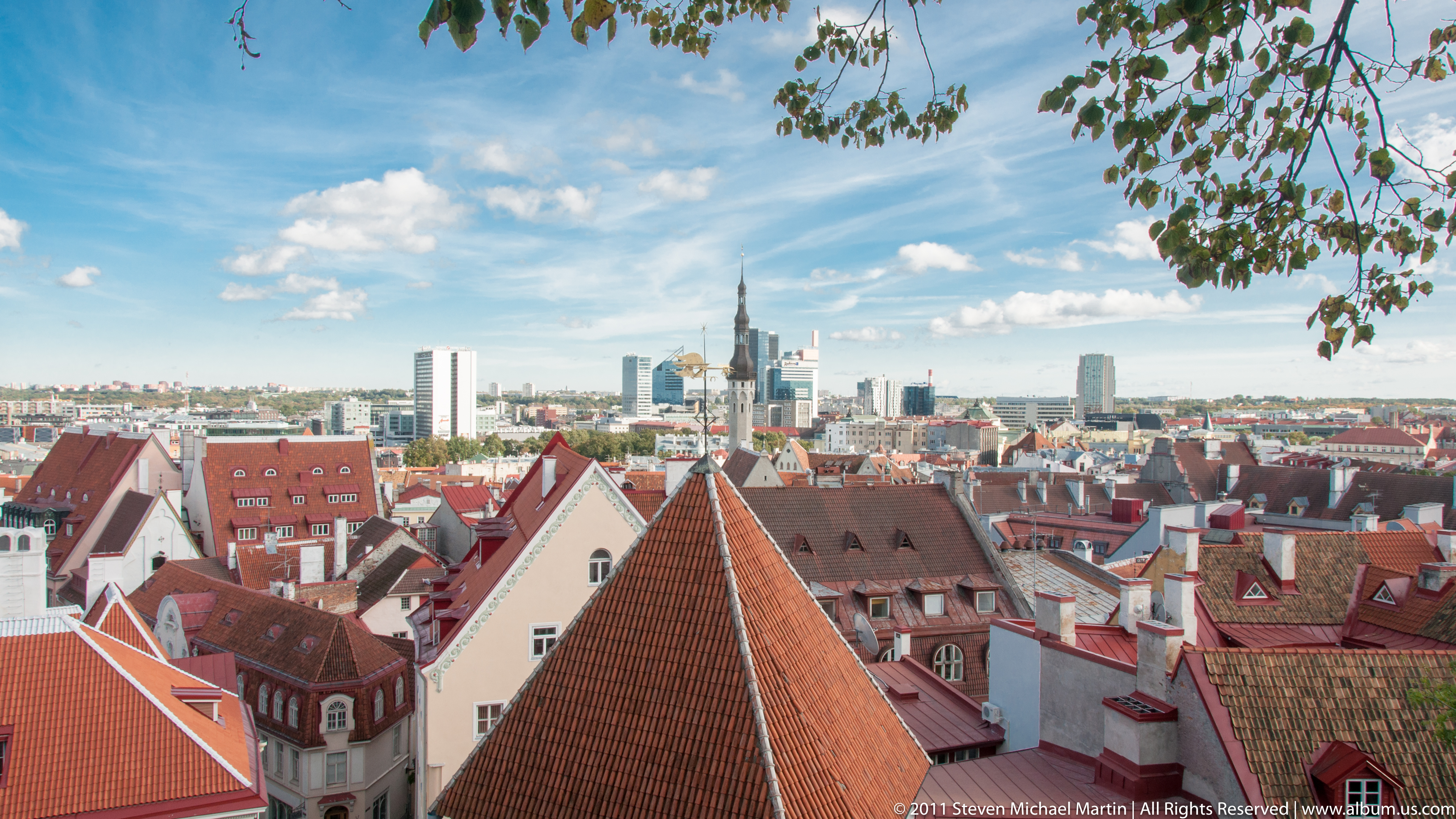
Steep red-tiled roofs and narrow historic buildings fill the foreground while Tallinn’s modern skyline rises in the distance. The elevated composition juxtaposes the compact medieval urban fabric with newer high-rise development, making the contrast between the historic center and contemporary city especially clear.
Caption
Steep red-tiled roofs and narrow historic buildings fill the foreground while Tallinn’s modern skyline rises in the distance. The elevated composition juxtaposes the compact medieval urban fabric with newer high-rise development, making the contrast between the historic center and contemporary city especially clear.

An adult poses at an elevated overlook with Tallinn’s red-roofed Old Town and a pale church tower softly blurred behind. The shallow depth of field separates the portrait from the city while preserving enough architectural context to anchor the scene in the historic center.
Caption
An adult poses at an elevated overlook with Tallinn’s red-roofed Old Town and a pale church tower softly blurred behind. The shallow depth of field separates the portrait from the city while preserving enough architectural context to anchor the scene in the historic center.

A tall pointed-arch window breaks the white masonry wall of a historic church, while a dark spire rises behind the roofline. The low-angle view emphasizes wall thickness, verticality, and the contrast between pale plaster, stone window tracery, and the sharply defined tower above.
Caption
A tall pointed-arch window breaks the white masonry wall of a historic church, while a dark spire rises behind the roofline. The low-angle view emphasizes wall thickness, verticality, and the contrast between pale plaster, stone window tracery, and the sharply defined tower above.

An adult sits on a white bench beside a weathered historic wall, with iron-barred windows, a wall lantern, and pointed-arch doorways opening onto a cobbled passage. The wider composition gives the portrait a strong architectural setting and reveals the irregular surfaces of the Old Town fabric.
Caption
An adult sits on a white bench beside a weathered historic wall, with iron-barred windows, a wall lantern, and pointed-arch doorways opening onto a cobbled passage. The wider composition gives the portrait a strong architectural setting and reveals the irregular surfaces of the Old Town fabric.

An adult sits on a long white bench in front of a pale historic wall fitted with a deeply recessed, iron-barred window. The simple portrait is grounded in Old Town architectural texture, with weathered plaster and heavy window framing providing a restrained backdrop.
Caption
An adult sits on a long white bench in front of a pale historic wall fitted with a deeply recessed, iron-barred window. The simple portrait is grounded in Old Town architectural texture, with weathered plaster and heavy window framing providing a restrained backdrop.

A sculptural memorial plaque honors Voldemar Panso (1920–1977), with a relief portrait and an extended hand projecting from the textured bronze surface. The inscription identifies him as associated with the Estonian Academy of Music and Theatre’s Drama School, linking the commemorative artwork directly to Estonia’s theatrical tradition.
Caption
A sculptural memorial plaque honors Voldemar Panso (1920–1977), with a relief portrait and an extended hand projecting from the textured bronze surface. The inscription identifies him as associated with the Estonian Academy of Music and Theatre’s Drama School, linking the commemorative artwork directly to Estonia’s theatrical tradition.

Heavy paneled wooden doors stand open beneath a deeply molded green-and-terracotta entrance surround. Carved ornament, a semicircular transom, and layered architectural detailing give the portal a ceremonial character, while the open doors draw attention into the dark interior beyond.
Caption
Heavy paneled wooden doors stand open beneath a deeply molded green-and-terracotta entrance surround. Carved ornament, a semicircular transom, and layered architectural detailing give the portal a ceremonial character, while the open doors draw attention into the dark interior beyond.

A small doll dressed in traditional-style clothing stands behind a deep-set window framed with metal corner straps and rivets. The intimate display contrasts painted folk costume with the heavy hardware and muted plaster of the surrounding historic façade.
Caption
A small doll dressed in traditional-style clothing stands behind a deep-set window framed with metal corner straps and rivets. The intimate display contrasts painted folk costume with the heavy hardware and muted plaster of the surrounding historic façade.

A richly ornamented pink-and-white historic façade is framed through a large arcaded passage, creating a layered view from shadow into a sunlit civic space. The composition emphasizes symmetry, heraldic decoration, and the theatrical effect of approaching an important building through monumental arches.
Caption
A richly ornamented pink-and-white historic façade is framed through a large arcaded passage, creating a layered view from shadow into a sunlit civic space. The composition emphasizes symmetry, heraldic decoration, and the theatrical effect of approaching an important building through monumental arches.

The ornate façade and dark onion domes of Alexander Nevsky Cathedral rise against a clear blue sky on Toompea. White stonework, red-brown wall panels, arched windows, mosaic icons, and gilded Orthodox crosses create the richly layered exterior associated with Tallinn’s prominent Russian Orthodox cathedral.
Caption
The ornate façade and dark onion domes of Alexander Nevsky Cathedral rise against a clear blue sky on Toompea. White stonework, red-brown wall panels, arched windows, mosaic icons, and gilded Orthodox crosses create the richly layered exterior associated with Tallinn’s prominent Russian Orthodox cathedral.

Dark onion domes topped by gilded Orthodox crosses crown a side elevation of Alexander Nevsky Cathedral. The close oblique view highlights the contrast between ribbed dome surfaces, white architectural trim, red-brown wall panels, and narrow arched windows rather than presenting the cathedral as a full façade.
Caption
Dark onion domes topped by gilded Orthodox crosses crown a side elevation of Alexander Nevsky Cathedral. The close oblique view highlights the contrast between ribbed dome surfaces, white architectural trim, red-brown wall panels, and narrow arched windows rather than presenting the cathedral as a full façade.

A whitewashed church complex is dominated by a compact dark tower with an open belfry stage and tapering spire. The low, irregular building masses and restrained wall surfaces contrast with the more elaborate religious architecture nearby, creating a quieter architectural presence within Toompea.
Caption
A whitewashed church complex is dominated by a compact dark tower with an open belfry stage and tapering spire. The low, irregular building masses and restrained wall surfaces contrast with the more elaborate religious architecture nearby, creating a quieter architectural presence within Toompea.

A Rolls-Royce Phantom is parked along a cobblestone street between pale historic buildings. Its tall polished grille, rectangular headlamps, and substantial body contrast with the compact Old Town setting, creating a striking juxtaposition of contemporary luxury design and historic urban fabric.
Caption
A Rolls-Royce Phantom is parked along a cobblestone street between pale historic buildings. Its tall polished grille, rectangular headlamps, and substantial body contrast with the compact Old Town setting, creating a striking juxtaposition of contemporary luxury design and historic urban fabric.

Two tall pointed-arch windows sit side by side in a red-brick wall, each framed by layered white moldings and filled with dark leaded glazing. The close architectural study isolates the Gothic vocabulary of pointed arches, slender colonettes, and tracery-like upper details.
Caption
Two tall pointed-arch windows sit side by side in a red-brick wall, each framed by layered white moldings and filled with dark leaded glazing. The close architectural study isolates the Gothic vocabulary of pointed arches, slender colonettes, and tracery-like upper details.

Rounded fieldstones form an irregular cobbled pavement scattered with fallen autumn leaves. The close downward view emphasizes the uneven texture, varied stone sizes, and worn surfaces that give Tallinn’s historic streets and passages much of their tactile character.
Caption
Rounded fieldstones form an irregular cobbled pavement scattered with fallen autumn leaves. The close downward view emphasizes the uneven texture, varied stone sizes, and worn surfaces that give Tallinn’s historic streets and passages much of their tactile character.

A narrow street converges on a white medieval tower pierced by an arched passage and capped with a steep red-tiled roof. Hanging flowers and pastel façades frame the approach, emphasizing how Tallinn’s surviving defensive structures remain embedded in everyday pedestrian routes.
Caption
A narrow street converges on a white medieval tower pierced by an arched passage and capped with a steep red-tiled roof. Hanging flowers and pastel façades frame the approach, emphasizing how Tallinn’s surviving defensive structures remain embedded in everyday pedestrian routes.

An adult stands just beyond a broad stone arch where sunlight cuts across the cobbled pavement and throws a long shadow into the passage. A high stone retaining wall and leafy slope beyond create a strong sense of enclosure associated with Tallinn’s fortified upper town.
Caption
An adult stands just beyond a broad stone arch where sunlight cuts across the cobbled pavement and throws a long shadow into the passage. A high stone retaining wall and leafy slope beyond create a strong sense of enclosure associated with Tallinn’s fortified upper town.

A narrow pedestrian street lined with pastel façades leads toward a prominent white church tower capped by a dark tiered spire. Shop signs, flags, and café activity animate the lower street while the tower anchors the long perspective above the rooftops.
Caption
A narrow pedestrian street lined with pastel façades leads toward a prominent white church tower capped by a dark tiered spire. Shop signs, flags, and café activity animate the lower street while the tower anchors the long perspective above the rooftops.

A quiet lane runs between pale plastered buildings toward a distant tower rising above the rooftops. Sparse pedestrian traffic, projecting signs, and small hanging planters preserve the intimate scale of Tallinn’s Old Town while the vertical landmark provides orientation at the end of the street.
Caption
A quiet lane runs between pale plastered buildings toward a distant tower rising above the rooftops. Sparse pedestrian traffic, projecting signs, and small hanging planters preserve the intimate scale of Tallinn’s Old Town while the vertical landmark provides orientation at the end of the street.

Massive wooden double doors fill a rounded stone opening, each leaf decorated with molded panels and a projecting grotesque or mask-like metal fitting. Carved scrollwork crowns the entrance, giving the doorway a strongly sculptural character and making it a distinctive piece of historic street architecture.
Caption
Massive wooden double doors fill a rounded stone opening, each leaf decorated with molded panels and a projecting grotesque or mask-like metal fitting. Carved scrollwork crowns the entrance, giving the doorway a strongly sculptural character and making it a distinctive piece of historic street architecture.

An adult stands in the foreground of a Tallinn Old Town street lined with pale plastered and red-brick buildings. The shallow depth of field keeps the figure dominant while retaining the narrow street, steep roofs, shopfronts, and varied historic façades as contextual background.
Caption
An adult stands in the foreground of a Tallinn Old Town street lined with pale plastered and red-brick buildings. The shallow depth of field keeps the figure dominant while retaining the narrow street, steep roofs, shopfronts, and varied historic façades as contextual background.

Seen from below, a green dragon-shaped rainwater spout extends from the pale masonry of Tallinn Town Hall. The low-angle composition places the fantastical metal creature against the tower wall and roofline, showing its relationship to the civic building while emphasizing the elaborate iron support beneath it.
Caption
Seen from below, a green dragon-shaped rainwater spout extends from the pale masonry of Tallinn Town Hall. The low-angle composition places the fantastical metal creature against the tower wall and roofline, showing its relationship to the civic building while emphasizing the elaborate iron support beneath it.

White gabled merchant houses line Tallinn’s Town Hall Square, their steep roofs, rows of windows, and stepped silhouettes overlooking busy café terraces at street level. The open square, outdoor seating, and dense historic façades illustrate the civic and commercial life concentrated around the medieval marketplace.
Caption
White gabled merchant houses line Tallinn’s Town Hall Square, their steep roofs, rows of windows, and stepped silhouettes overlooking busy café terraces at street level. The open square, outdoor seating, and dense historic façades illustrate the civic and commercial life concentrated around the medieval marketplace.

Historic façades in white, ochre, green, and red line Tallinn’s Town Hall Square, where café seating and pedestrians animate the broad open space. The Town Hall tower rises behind the roofline, tying the commercial square to the city’s principal medieval civic landmark.
Caption
Historic façades in white, ochre, green, and red line Tallinn’s Town Hall Square, where café seating and pedestrians animate the broad open space. The Town Hall tower rises behind the roofline, tying the commercial square to the city’s principal medieval civic landmark.

A long green dragon-shaped metal spout projects dramatically from Tallinn Town Hall, its open red mouth, curled tongue, and decorative crest silhouetted against the sky. Mounted on ornate iron scrollwork, the fantastical rainwater outlet transforms a practical architectural element into one of the Town Hall’s most memorable details.
Caption
A long green dragon-shaped metal spout projects dramatically from Tallinn Town Hall, its open red mouth, curled tongue, and decorative crest silhouetted against the sky. Mounted on ornate iron scrollwork, the fantastical rainwater outlet transforms a practical architectural element into one of the Town Hall’s most memorable details.

Steep-gabled historic buildings rise above a busy pedestrian space in Tallinn’s Old Town, their pale façades punctuated by rows of windows and decorative roofline details. Market stalls and people fill the lower edge of the frame, contrasting everyday street activity with the tall, narrow proportions of the surrounding medieval urban fabric.
Caption
Steep-gabled historic buildings rise above a busy pedestrian space in Tallinn’s Old Town, their pale façades punctuated by rows of windows and decorative roofline details. Market stalls and people fill the lower edge of the frame, contrasting everyday street activity with the tall, narrow proportions of the surrounding medieval urban fabric.

Tallinn Town Hall’s pale limestone façade stretches behind a traveler in the foreground, with pointed ground-floor arcades, rows of rectangular windows, and the steep tiled roof defining the medieval civic building. The low-angle view emphasizes the rough masonry surface and the rhythmic arcade that opens toward Town Hall Square.
Caption
Tallinn Town Hall’s pale limestone façade stretches behind a traveler in the foreground, with pointed ground-floor arcades, rows of rectangular windows, and the steep tiled roof defining the medieval civic building. The low-angle view emphasizes the rough masonry surface and the rhythmic arcade that opens toward Town Hall Square.

The upper stages of Tallinn Town Hall tower rise against a clear sky, transitioning from pale masonry to dark timbered galleries and a tiered spire. Small arched openings punctuate the tower shaft, while the stacked roof stages create the distinctive vertical silhouette that marks the medieval civic center.
Caption
The upper stages of Tallinn Town Hall tower rise against a clear sky, transitioning from pale masonry to dark timbered galleries and a tiered spire. Small arched openings punctuate the tower shaft, while the stacked roof stages create the distinctive vertical silhouette that marks the medieval civic center.

Green dragon-shaped rainwater spouts project from the upper wall of Tallinn Town Hall, their elongated metal bodies and open mouths silhouetted against the blue sky. Seen from a steep upward angle, the repeated creatures appear alongside simple wall lamps and roofline details, turning functional drainage elements into prominent civic ornament.
Caption
Green dragon-shaped rainwater spouts project from the upper wall of Tallinn Town Hall, their elongated metal bodies and open mouths silhouetted against the blue sky. Seen from a steep upward angle, the repeated creatures appear alongside simple wall lamps and roofline details, turning functional drainage elements into prominent civic ornament.
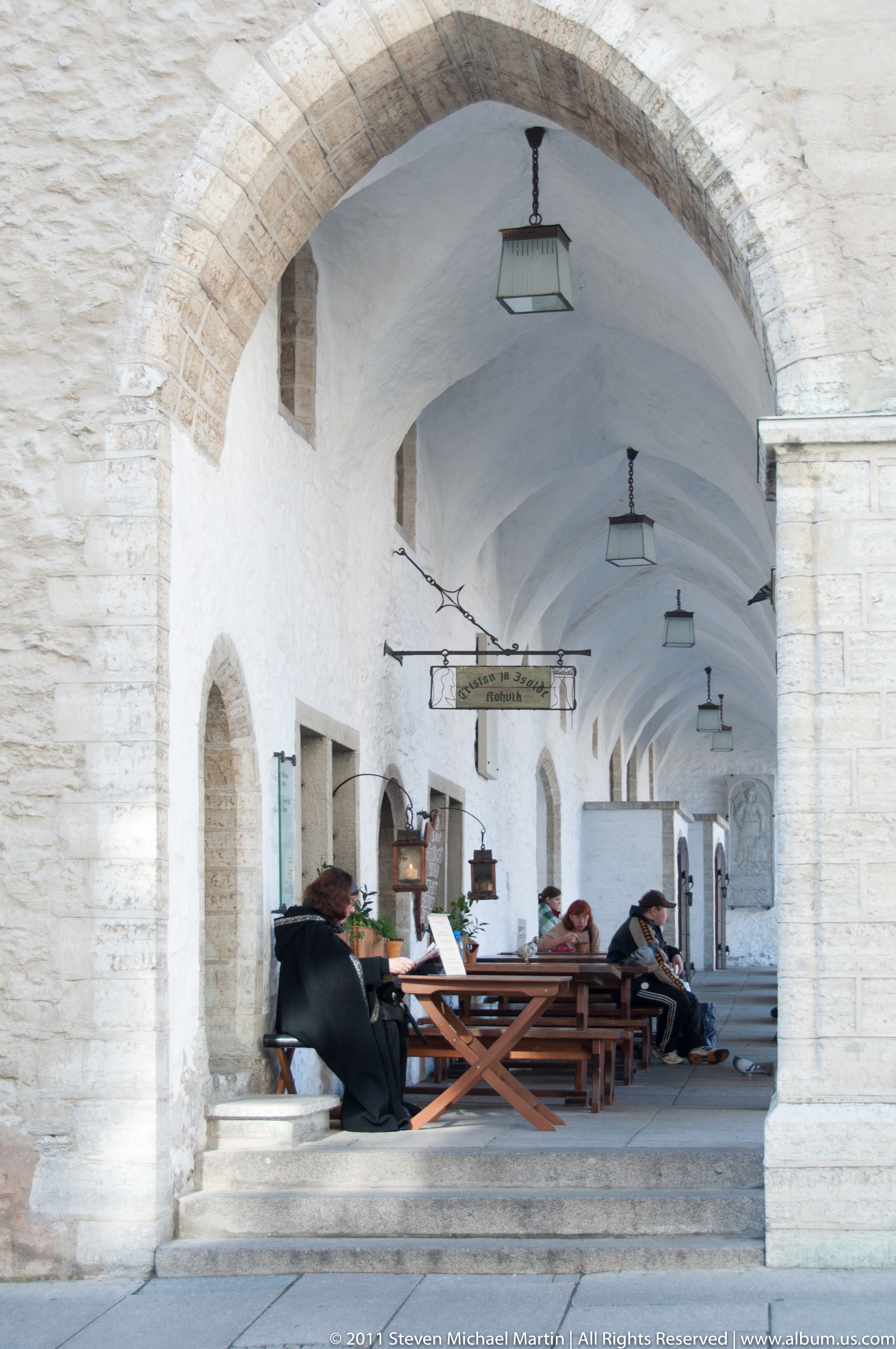
A pointed stone arch opens into the covered ground-floor arcade of Tallinn Town Hall, where café tables and chairs occupy the long vaulted passage. Hanging lamps recede beneath successive arches, creating a strong perspective through the sheltered edge of the medieval civic building and showing its present-day use as an active public space.
Caption
A pointed stone arch opens into the covered ground-floor arcade of Tallinn Town Hall, where café tables and chairs occupy the long vaulted passage. Hanging lamps recede beneath successive arches, creating a strong perspective through the sheltered edge of the medieval civic building and showing its present-day use as an active public space.

A deeply molded pointed stone portal frames monumental wooden double doors reached by a short flight of steps. Weathered carved details, circular stone plaques, and traces of painted or incised decoration surround the entrance, making the doorway a concentrated study of medieval architectural craftsmanship on a historic Tallinn façade.
Caption
A deeply molded pointed stone portal frames monumental wooden double doors reached by a short flight of steps. Weathered carved details, circular stone plaques, and traces of painted or incised decoration surround the entrance, making the doorway a concentrated study of medieval architectural craftsmanship on a historic Tallinn façade.

Tallinn Town Hall tower rises above the square, its pale masonry shaft and dark tiered spire standing beside the broad gabled Town Hall roof. Historic façades frame the view at right, while the crowded lower edge conveys the active civic setting around one of Tallinn’s most recognizable medieval landmarks.
Caption
Tallinn Town Hall tower rises above the square, its pale masonry shaft and dark tiered spire standing beside the broad gabled Town Hall roof. Historic façades frame the view at right, while the crowded lower edge conveys the active civic setting around one of Tallinn’s most recognizable medieval landmarks.

A broad cobbled pedestrian street is lined with steep-gabled historic buildings, outdoor restaurant terraces, hanging signs, and clusters of visitors. The view looks toward a denser group of façades in the distance, illustrating the commercial and social life that occupies Tallinn’s preserved medieval street network.
Caption
A broad cobbled pedestrian street is lined with steep-gabled historic buildings, outdoor restaurant terraces, hanging signs, and clusters of visitors. The view looks toward a denser group of façades in the distance, illustrating the commercial and social life that occupies Tallinn’s preserved medieval street network.

A modern glass-and-metal façade introduces a sharply different architectural language from Tallinn’s nearby medieval streets. Large panes, horizontal louvers, and exposed structural framing form a layered screen across the building front, while oversized lettering on the glazing identifies the commercial space within.
Caption
A modern glass-and-metal façade introduces a sharply different architectural language from Tallinn’s nearby medieval streets. Large panes, horizontal louvers, and exposed structural framing form a layered screen across the building front, while oversized lettering on the glazing identifies the commercial space within.

Tallinn Town Hall tower appears above the surrounding roofline, framed by a large black street lantern and the edges of restaurant awnings below. The compressed view isolates the tower’s dark tiered spire and pale upper stage while preserving the busy commercial character of the Old Town street beneath it.
Caption
Tallinn Town Hall tower appears above the surrounding roofline, framed by a large black street lantern and the edges of restaurant awnings below. The compressed view isolates the tower’s dark tiered spire and pale upper stage while preserving the busy commercial character of the Old Town street beneath it.

A whimsical bronze sculpture groups several animal figures together on a wooden bench, with one large seated figure embracing or leaning against another. The polished high points of the dark metal reveal frequent contact, while the placement beside a public walkway gives the work an informal, approachable presence in the city.
Caption
A whimsical bronze sculpture groups several animal figures together on a wooden bench, with one large seated figure embracing or leaning against another. The polished high points of the dark metal reveal frequent contact, while the placement beside a public walkway gives the work an informal, approachable presence in the city.

Buckets and tables overflow with tightly packed bouquets and cut flowers in vivid pink, yellow, white, purple, and red. The close market view emphasizes abundance and variety rather than architecture, showing a commercial display arranged for quick selection by passersby in central Tallinn.
Caption
Buckets and tables overflow with tightly packed bouquets and cut flowers in vivid pink, yellow, white, purple, and red. The close market view emphasizes abundance and variety rather than architecture, showing a commercial display arranged for quick selection by passersby in central Tallinn.

The surviving round towers of Viru Gate flank the approach into Tallinn’s Old Town, their rough limestone walls and red conical roofs framing the broad cobbled entrance. Café seating, pedestrians, and colorful façades beyond show how the medieval gateway now functions as a lively transition between the historic center and the modern city.
Caption
The surviving round towers of Viru Gate flank the approach into Tallinn’s Old Town, their rough limestone walls and red conical roofs framing the broad cobbled entrance. Café seating, pedestrians, and colorful façades beyond show how the medieval gateway now functions as a lively transition between the historic center and the modern city.

An ornate red-brick corner building fills the frame with layered masonry bands, tall arched windows, projecting bays, and decorative gables. The low-angle viewpoint emphasizes its vertical mass and late-historicist detailing, while a slender green church spire rises behind the roofline.
Caption
An ornate red-brick corner building fills the frame with layered masonry bands, tall arched windows, projecting bays, and decorative gables. The low-angle viewpoint emphasizes its vertical mass and late-historicist detailing, while a slender green church spire rises behind the roofline.

A historic stone church rises behind mature trees, its steep green spire and tall traceried windows visible through the foliage. Dappled sunlight and the partially obscured viewpoint soften the monumental architecture, emphasizing the relationship between the church walls, mature landscaping, and the surrounding Old Town streetscape.
Caption
A historic stone church rises behind mature trees, its steep green spire and tall traceried windows visible through the foliage. Dappled sunlight and the partially obscured viewpoint soften the monumental architecture, emphasizing the relationship between the church walls, mature landscaping, and the surrounding Old Town streetscape.

A closer street-level view passes between the two surviving Viru Gate towers, with ivy climbing one limestone wall and the Town Hall tower visible farther down the street. Pedestrians, café terraces, and colorful façades fill the space between the medieval defenses, creating a layered view from gateway to civic center.
Caption
A closer street-level view passes between the two surviving Viru Gate towers, with ivy climbing one limestone wall and the Town Hall tower visible farther down the street. Pedestrians, café terraces, and colorful façades fill the space between the medieval defenses, creating a layered view from gateway to civic center.

Viru Gate’s surviving stone towers rise behind a line of flower stalls along the edge of the Old Town. Buckets of colorful blooms, green awnings, pedestrians, and the ivy-covered tower create a vivid contrast between the medieval defensive architecture and the everyday market activity now occupying the gateway approach.
Caption
Viru Gate’s surviving stone towers rise behind a line of flower stalls along the edge of the Old Town. Buckets of colorful blooms, green awnings, pedestrians, and the ivy-covered tower create a vivid contrast between the medieval defensive architecture and the everyday market activity now occupying the gateway approach.

An adult stands close to a rough limestone wall in bright sunlight, with the shallow depth of field turning the irregular masonry into a textured backdrop. The tight portrait removes most of the surrounding city, emphasizing the contrast between the figure and the weathered stone surface of Tallinn’s historic fabric.
Caption
An adult stands close to a rough limestone wall in bright sunlight, with the shallow depth of field turning the irregular masonry into a textured backdrop. The tight portrait removes most of the surrounding city, emphasizing the contrast between the figure and the weathered stone surface of Tallinn’s historic fabric.

A rounded dark dome rises above a cluster of pastel historic buildings and red-tiled roofs in Tallinn’s Old Town. Smaller towers and a crenellated stone structure appear among the rooftops, while the clear sky and elevated viewpoint reveal the varied architectural forms packed into the historic center.
Caption
A rounded dark dome rises above a cluster of pastel historic buildings and red-tiled roofs in Tallinn’s Old Town. Smaller towers and a crenellated stone structure appear among the rooftops, while the clear sky and elevated viewpoint reveal the varied architectural forms packed into the historic center.

A broad stone arch frames a gray wooden doorway marked with the number 5 on an ochre plaster façade. Heavy voussoirs, a projecting upper story, and small street-level details create a compact study of an Old Town entrance where medieval masonry and later façade treatments meet.
Caption
A broad stone arch frames a gray wooden doorway marked with the number 5 on an ochre plaster façade. Heavy voussoirs, a projecting upper story, and small street-level details create a compact study of an Old Town entrance where medieval masonry and later façade treatments meet.

A formal pale-stone façade is organized in stacked horizontal courses, with arched lower windows beneath taller rectangular openings framed by sculpted surrounds. Strong side light brings out the projecting cornices, keystones, and window moldings, emphasizing the disciplined classical rhythm of the building elevation.
Caption
A formal pale-stone façade is organized in stacked horizontal courses, with arched lower windows beneath taller rectangular openings framed by sculpted surrounds. Strong side light brings out the projecting cornices, keystones, and window moldings, emphasizing the disciplined classical rhythm of the building elevation.

A white gabled historic building presents an irregular arrangement of small windows above a deep arched doorway and larger ground-floor opening. Thick masonry, stepped corner blocks, and the steep red-tiled roof suggest a former merchant or warehouse function, characteristic of the practical architecture embedded in Tallinn’s trading city.
Caption
A white gabled historic building presents an irregular arrangement of small windows above a deep arched doorway and larger ground-floor opening. Thick masonry, stepped corner blocks, and the steep red-tiled roof suggest a former merchant or warehouse function, characteristic of the practical architecture embedded in Tallinn’s trading city.

Dark paneled wooden double doors sit within a broad white arched surround on a pale clapboard or rendered façade. A fanlight above the doors and oval decorative medallions to either side introduce classical symmetry, while the stone base visually anchors the formal entrance.
Caption
Dark paneled wooden double doors sit within a broad white arched surround on a pale clapboard or rendered façade. A fanlight above the doors and oval decorative medallions to either side introduce classical symmetry, while the stone base visually anchors the formal entrance.

A quiet courtyard or side street is enclosed by pale gabled buildings with red-tiled roofs, irregular windows, and a timber service structure at ground level. A tall green church spire rises beyond the roofs, providing a vertical landmark above the more utilitarian architecture of the foreground.
Caption
A quiet courtyard or side street is enclosed by pale gabled buildings with red-tiled roofs, irregular windows, and a timber service structure at ground level. A tall green church spire rises beyond the roofs, providing a vertical landmark above the more utilitarian architecture of the foreground.

A broad stone gateway spans the street at Tallinn’s Great Coastal Gate complex, its thick medieval masonry pierced by a large arch beneath a red-tiled roof. The road continues through the opening toward the city beyond, while small windows and defensive details in the upper wall convey the structure’s fortified character.
Caption
A broad stone gateway spans the street at Tallinn’s Great Coastal Gate complex, its thick medieval masonry pierced by a large arch beneath a red-tiled roof. The road continues through the opening toward the city beyond, while small windows and defensive details in the upper wall convey the structure’s fortified character.

A pale gabled historic house rises beside leafy trees, its tall arched windows grouped vertically above a projecting white balcony. Molded bands, circular ornament in the gable, and carved balustrade panels give the compact façade a refined decorative character distinct from the heavier medieval fortifications nearby.
Caption
A pale gabled historic house rises beside leafy trees, its tall arched windows grouped vertically above a projecting white balcony. Molded bands, circular ornament in the gable, and carved balustrade panels give the compact façade a refined decorative character distinct from the heavier medieval fortifications nearby.

An adult stands with rolling luggage in front of the massive stone gateway of Tallinn’s Great Coastal Gate complex. The broad arch, heavy defensive wall, and cobbled pavement provide a monumental backdrop, while the traveler and bag supply an immediate sense of scale for the medieval structure.
Caption
An adult stands with rolling luggage in front of the massive stone gateway of Tallinn’s Great Coastal Gate complex. The broad arch, heavy defensive wall, and cobbled pavement provide a monumental backdrop, while the traveler and bag supply an immediate sense of scale for the medieval structure.

Massive limestone defenses of the Great Coastal Gate complex fill the foreground, including the rounded bulk of Fat Margaret and the adjoining arched gateway. Behind the walls, the slender green spire of St. Olaf’s Church rises above the Old Town, linking two of Tallinn’s most prominent elements of defensive and ecclesiastical architecture.
Caption
Massive limestone defenses of the Great Coastal Gate complex fill the foreground, including the rounded bulk of Fat Margaret and the adjoining arched gateway. Behind the walls, the slender green spire of St. Olaf’s Church rises above the Old Town, linking two of Tallinn’s most prominent elements of defensive and ecclesiastical architecture.

A tall tapered brick chimney rises above an elevated industrial structure near Tallinn’s waterfront. Weathered brickwork, metal supports, and the long horizontal conveyor- or bridge-like element evoke the city’s former power and manufacturing infrastructure, contrasting sharply with the medieval architecture documented elsewhere in the historic center.
Caption
A tall tapered brick chimney rises above an elevated industrial structure near Tallinn’s waterfront. Weathered brickwork, metal supports, and the long horizontal conveyor- or bridge-like element evoke the city’s former power and manufacturing infrastructure, contrasting sharply with the medieval architecture documented elsewhere in the historic center.

Fat Margaret’s enormous round limestone mass dominates the frame, with small defensive openings punctuating the thick wall beneath a low red roof. The adjoining gate tower and arched passage appear to the right, while a green church spire rises behind, placing the artillery tower within the layered fortified edge of Tallinn’s Old Town.
Caption
Fat Margaret’s enormous round limestone mass dominates the frame, with small defensive openings punctuating the thick wall beneath a low red roof. The adjoining gate tower and arched passage appear to the right, while a green church spire rises behind, placing the artillery tower within the layered fortified edge of Tallinn’s Old Town.

A freestanding Tallinn visitor map stands beside a landscaped roadway with a massive round medieval tower rising behind the trees. The low, broad masonry form and red roof place the scene near the fortified northern edge of the Old Town, where surviving defenses meet the modern street network leading toward the harbor.
Caption
A freestanding Tallinn visitor map stands beside a landscaped roadway with a massive round medieval tower rising behind the trees. The low, broad masonry form and red roof place the scene near the fortified northern edge of the Old Town, where surviving defenses meet the modern street network leading toward the harbor.

Two oversized sculpted heads sit outdoors, one dark brown with bright blue eyes and the other pale pink behind it. Their simplified facial features, monumental scale, and theatrical coloring create an intentionally surreal presence, turning the surrounding public space into an informal setting for contemporary art.
Caption
Two oversized sculpted heads sit outdoors, one dark brown with bright blue eyes and the other pale pink behind it. Their simplified facial features, monumental scale, and theatrical coloring create an intentionally surreal presence, turning the surrounding public space into an informal setting for contemporary art.

A traveler pulls wheeled luggage along the pavement beside the grass-covered terraces and concrete stairs of Tallinn’s Linnahall. The human figure provides scale for the vast low-slung complex, while the utilitarian roadway and monumental embankment emphasize the building’s position between central Tallinn and the passenger harbor.
Caption
A traveler pulls wheeled luggage along the pavement beside the grass-covered terraces and concrete stairs of Tallinn’s Linnahall. The human figure provides scale for the vast low-slung complex, while the utilitarian roadway and monumental embankment emphasize the building’s position between central Tallinn and the passenger harbor.

The fast passenger catamaran Karolin sits alongside a Tallinn harbor pier, its name clearly painted on the white hull beneath the forward windows. Twin bows, red vertical striping, broad passenger cabin, and compact superstructure identify the vessel as a high-speed ferry designed for short Baltic crossings.
Caption
The fast passenger catamaran Karolin sits alongside a Tallinn harbor pier, its name clearly painted on the white hull beneath the forward windows. Twin bows, red vertical striping, broad passenger cabin, and compact superstructure identify the vessel as a high-speed ferry designed for short Baltic crossings.

An Estonian flag streams from the stern area of a passenger ferry as the vessel moves across open Baltic water. Bright orange rescue craft, white safety railings, and a deck crane occupy the foreground, while the foaming wake at right conveys the ship’s motion away from Tallinn.
Caption
An Estonian flag streams from the stern area of a passenger ferry as the vessel moves across open Baltic water. Bright orange rescue craft, white safety railings, and a deck crane occupy the foreground, while the foaming wake at right conveys the ship’s motion away from Tallinn.