Saint-Pierre – Saint-Pierre and Miquelon, France
The town of Saint-Pierre lies on the island of the same name within the small French territory of Saint-Pierre and Miquelon, located just south of the coast of Newfoundland in the North Atlantic Ocean. Although surrounded by Canadian waters, the islands remain an overseas collectivity of France and preserve a strong French cultural identity.
Colorful houses, fishing docks, and narrow streets line the harbor, reflecting the community’s long connection to the North Atlantic cod fishery. For centuries the islands served as an important base for French fishermen working the rich fishing grounds off Newfoundland.
Today Saint-Pierre offers a unique blend of French and North American maritime culture, with views of rugged coastal landscapes and a harbor shaped by the powerful winds and seas of the North Atlantic.

A stone church faces an open paved square through heavy fog, its central square bell tower rising above a simple gabled nave and lower side sections. Arched doorways, rough multicolored masonry, louvered openings, a clock, and a small cross define the restrained façade, while neighboring colorful buildings establish its urban setting in Saint Pierre.
Caption
A stone church faces an open paved square through heavy fog, its central square bell tower rising above a simple gabled nave and lower side sections. Arched doorways, rough multicolored masonry, louvered openings, a clock, and a small cross define the restrained façade, while neighboring colorful buildings establish its urban setting in Saint Pierre.
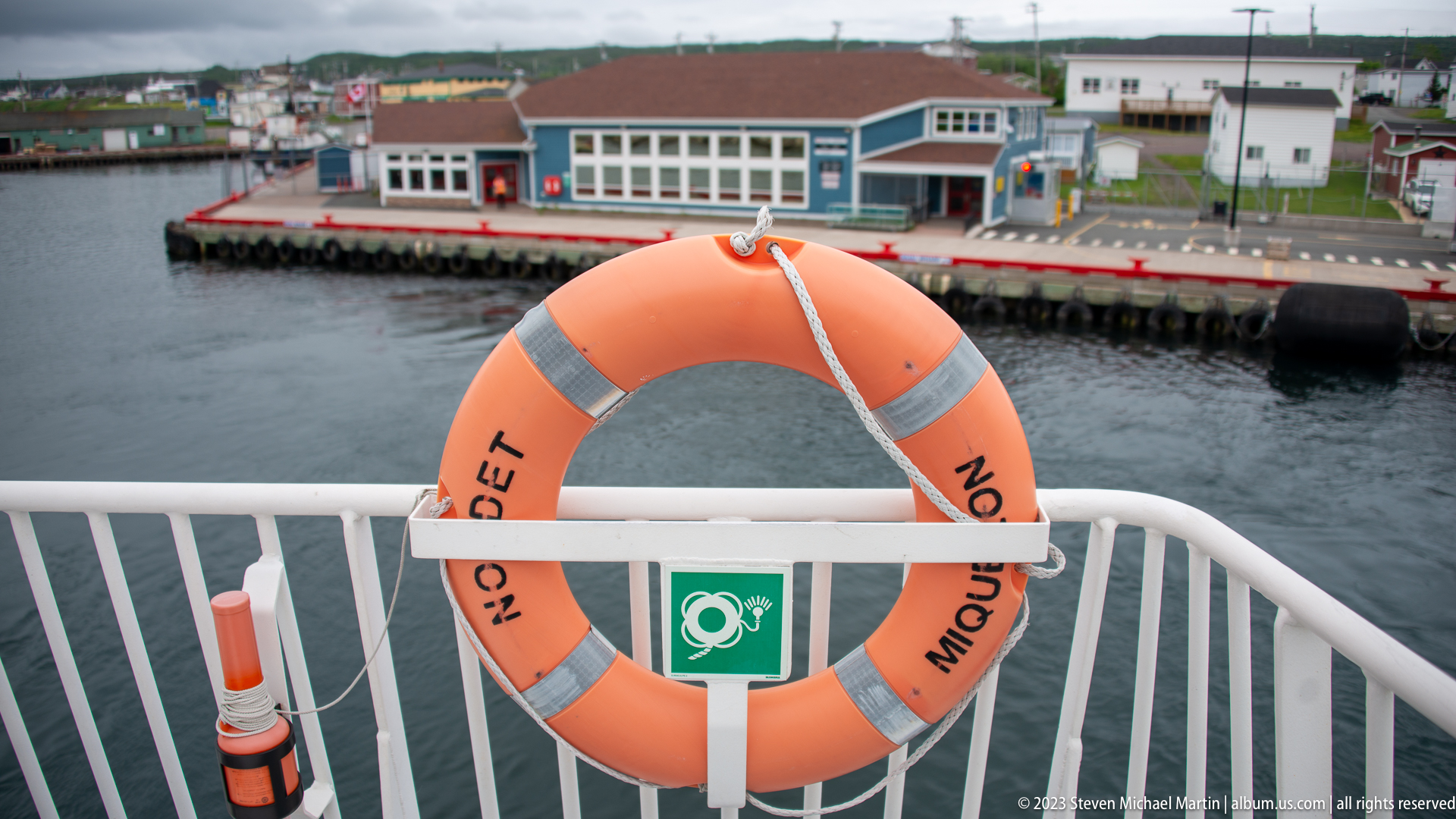
An orange lifebuoy labeled “MIQUELON” hangs on the ferry’s white rail as the vessel approaches a low waterfront terminal. The ring, emergency marker, and quay beyond place maritime safety equipment in direct relationship to the arrival landscape. The composition turns a routine shipboard object into a foreground frame for the small port facilities of Saint Pierre & Miquelon.
Caption
An orange lifebuoy labeled “MIQUELON” hangs on the ferry’s white rail as the vessel approaches a low waterfront terminal. The ring, emergency marker, and quay beyond place maritime safety equipment in direct relationship to the arrival landscape. The composition turns a routine shipboard object into a foreground frame for the small port facilities of Saint Pierre & Miquelon.
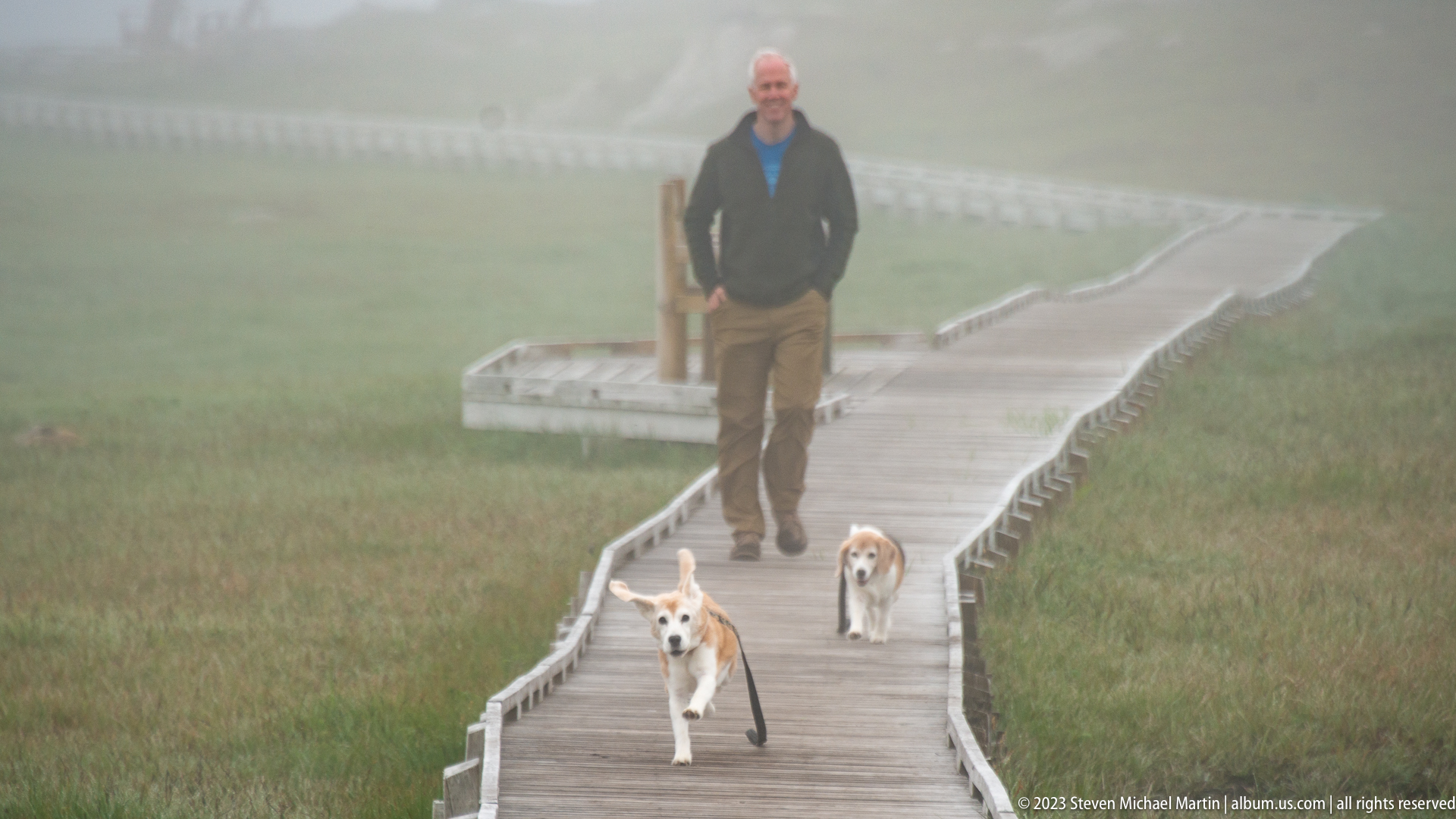
Two beagles trot toward the camera along a narrow wooden boardwalk while their walker follows several paces behind. The compressed perspective emphasizes the dogs in front and the path receding through pale green groundcover, with heavy fog erasing most distant detail and giving the trail a distinctly maritime atmosphere.
Caption
Two beagles trot toward the camera along a narrow wooden boardwalk while their walker follows several paces behind. The compressed perspective emphasizes the dogs in front and the path receding through pale green groundcover, with heavy fog erasing most distant detail and giving the trail a distinctly maritime atmosphere.
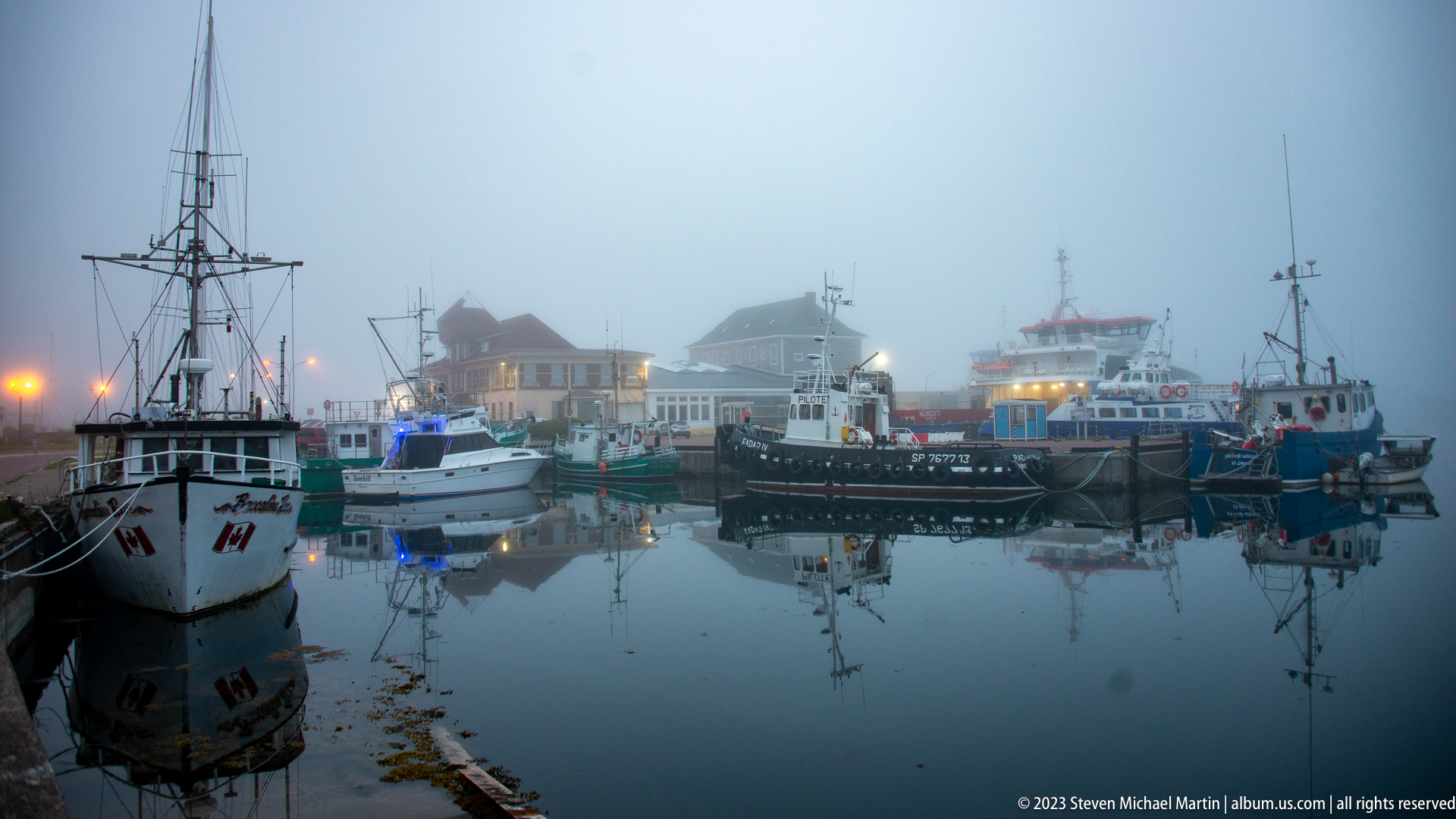
A wider view of the harbor gathers several fishing boats and work vessels into a dense forest of masts, rigging, antennas, and wheelhouses. Fog softens the waterfront buildings beyond, while blue and amber lights reflect across the smooth basin. The expanded framing emphasizes the fleet as a collective working landscape rather than focusing on a single vessel.
Caption
A wider view of the harbor gathers several fishing boats and work vessels into a dense forest of masts, rigging, antennas, and wheelhouses. Fog softens the waterfront buildings beyond, while blue and amber lights reflect across the smooth basin. The expanded framing emphasizes the fleet as a collective working landscape rather than focusing on a single vessel.
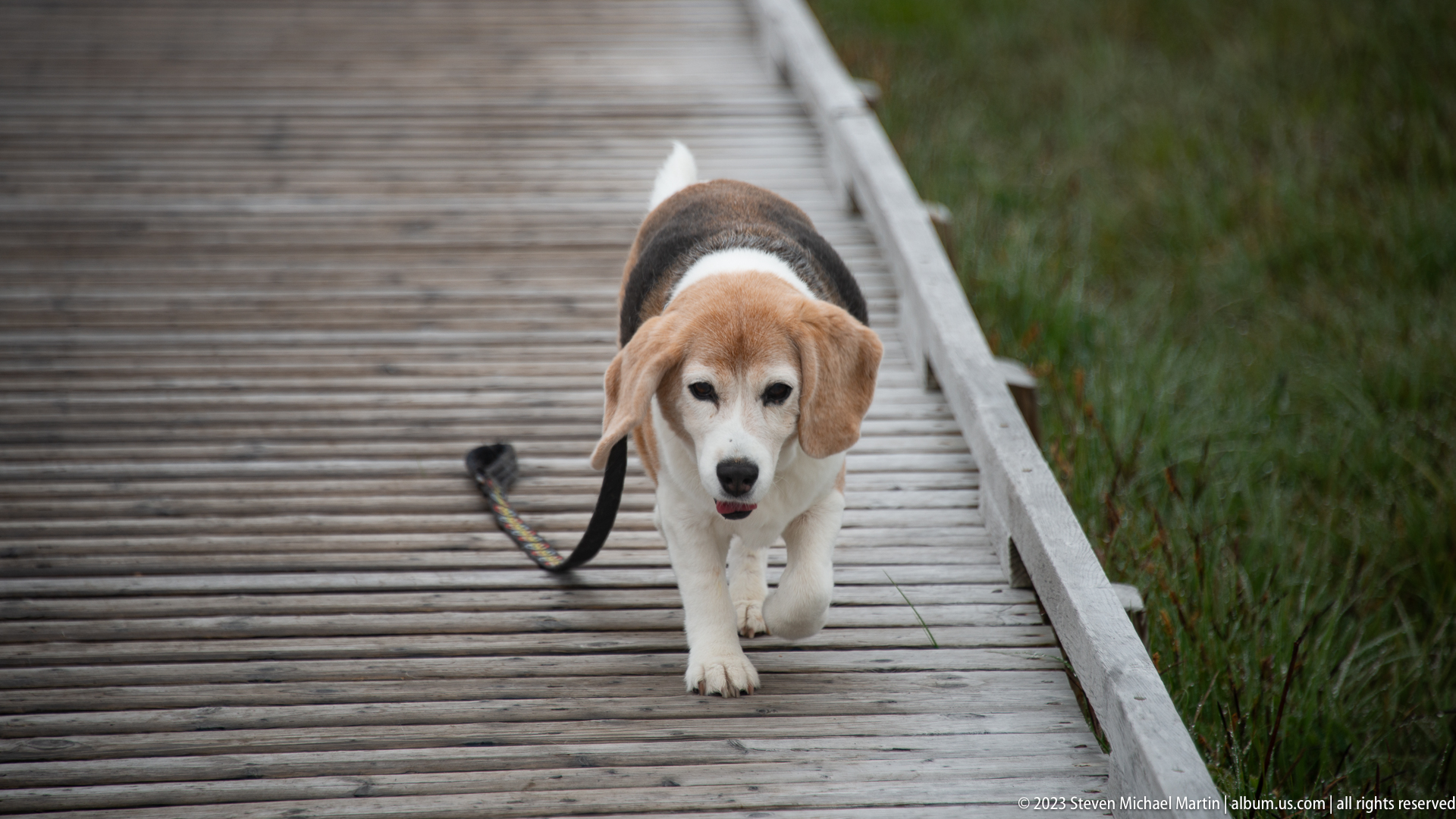
A beagle walks toward the camera along a raised wooden boardwalk through low, damp vegetation. The close viewpoint isolates the dog against the repeating planks while the leash trails behind, turning an ordinary walk into a compact portrait of movement through Saint Pierre & Miquelon’s mist-prone coastal landscape.
Caption
A beagle walks toward the camera along a raised wooden boardwalk through low, damp vegetation. The close viewpoint isolates the dog against the repeating planks while the leash trails behind, turning an ordinary walk into a compact portrait of movement through Saint Pierre & Miquelon’s mist-prone coastal landscape.

Open wrought-iron gates marked “LE SQUARE JOFFRE” frame a formal path leading toward a central monument in a fog-softened civic square. Low lawns, planters, and surrounding buildings create a symmetrical urban setting, while the decorative iron lettering serves as both entrance marker and foreground frame for the public space beyond.
Caption
Open wrought-iron gates marked “LE SQUARE JOFFRE” frame a formal path leading toward a central monument in a fog-softened civic square. Low lawns, planters, and surrounding buildings create a symmetrical urban setting, while the decorative iron lettering serves as both entrance marker and foreground frame for the public space beyond.

A broader harbor view places the prominent stone church near the center of Saint-Pierre’s waterfront district, surrounded by tightly spaced houses and larger civic or commercial buildings. Low fog erases the upper slopes behind town while the calm water mirrors the shoreline. The wider perspective clarifies the church’s position within the compact settlement and the town’s direct orientation toward the harbor.
Caption
A broader harbor view places the prominent stone church near the center of Saint-Pierre’s waterfront district, surrounded by tightly spaced houses and larger civic or commercial buildings. Low fog erases the upper slopes behind town while the calm water mirrors the shoreline. The wider perspective clarifies the church’s position within the compact settlement and the town’s direct orientation toward the harbor.
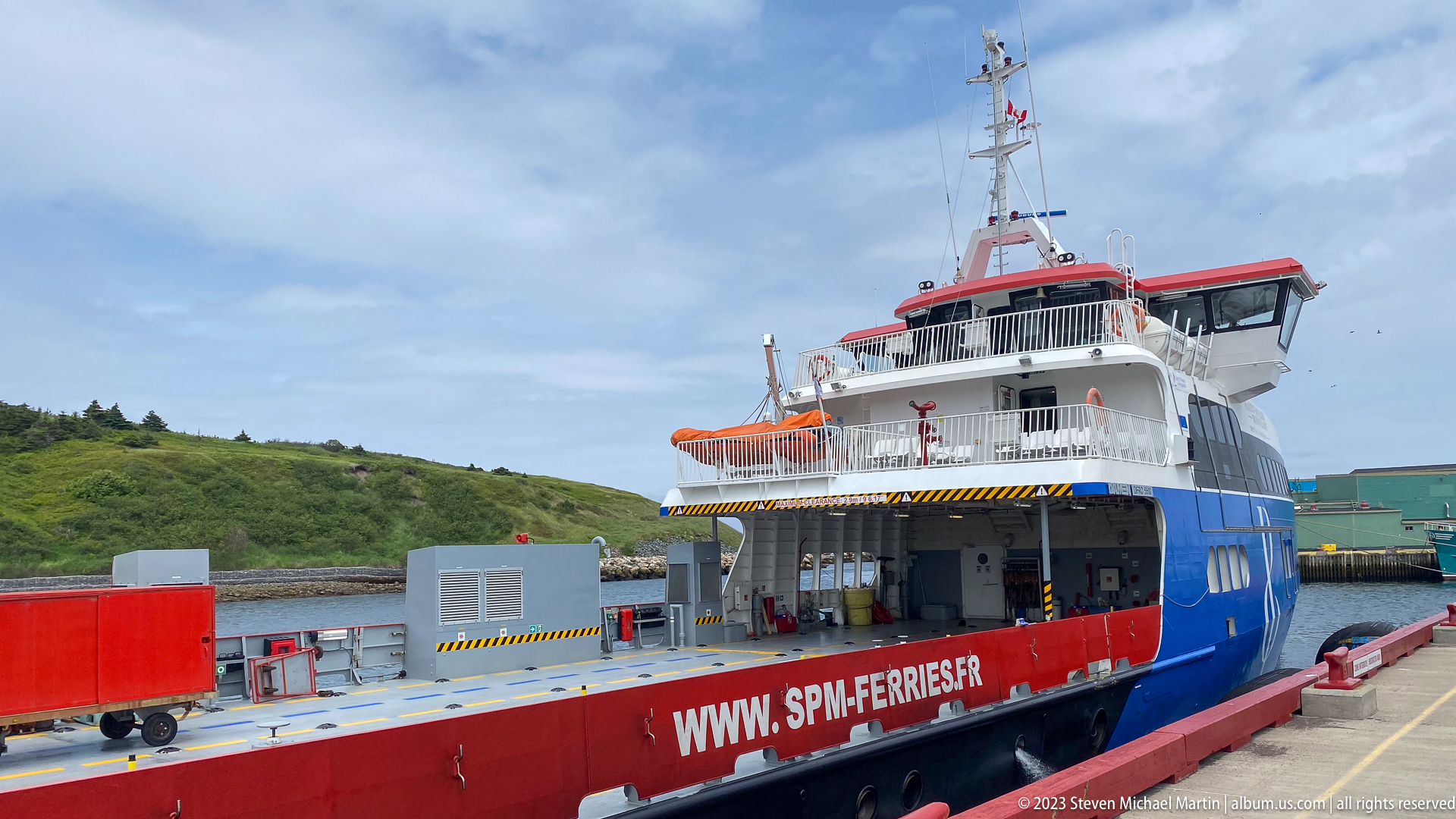
An SPM Ferries vessel is docked stern-first, its open vehicle deck, broad loading ramp area, and boxy superstructure identifying it as a roll-on/roll-off ferry. Red-and-white hull graphics and the large “SPM-FERRIES.FR” web address make the operator explicit, while terminal barriers and quay equipment emphasize the ship’s transportation role.
Caption
An SPM Ferries vessel is docked stern-first, its open vehicle deck, broad loading ramp area, and boxy superstructure identifying it as a roll-on/roll-off ferry. Red-and-white hull graphics and the large “SPM-FERRIES.FR” web address make the operator explicit, while terminal barriers and quay equipment emphasize the ship’s transportation role.
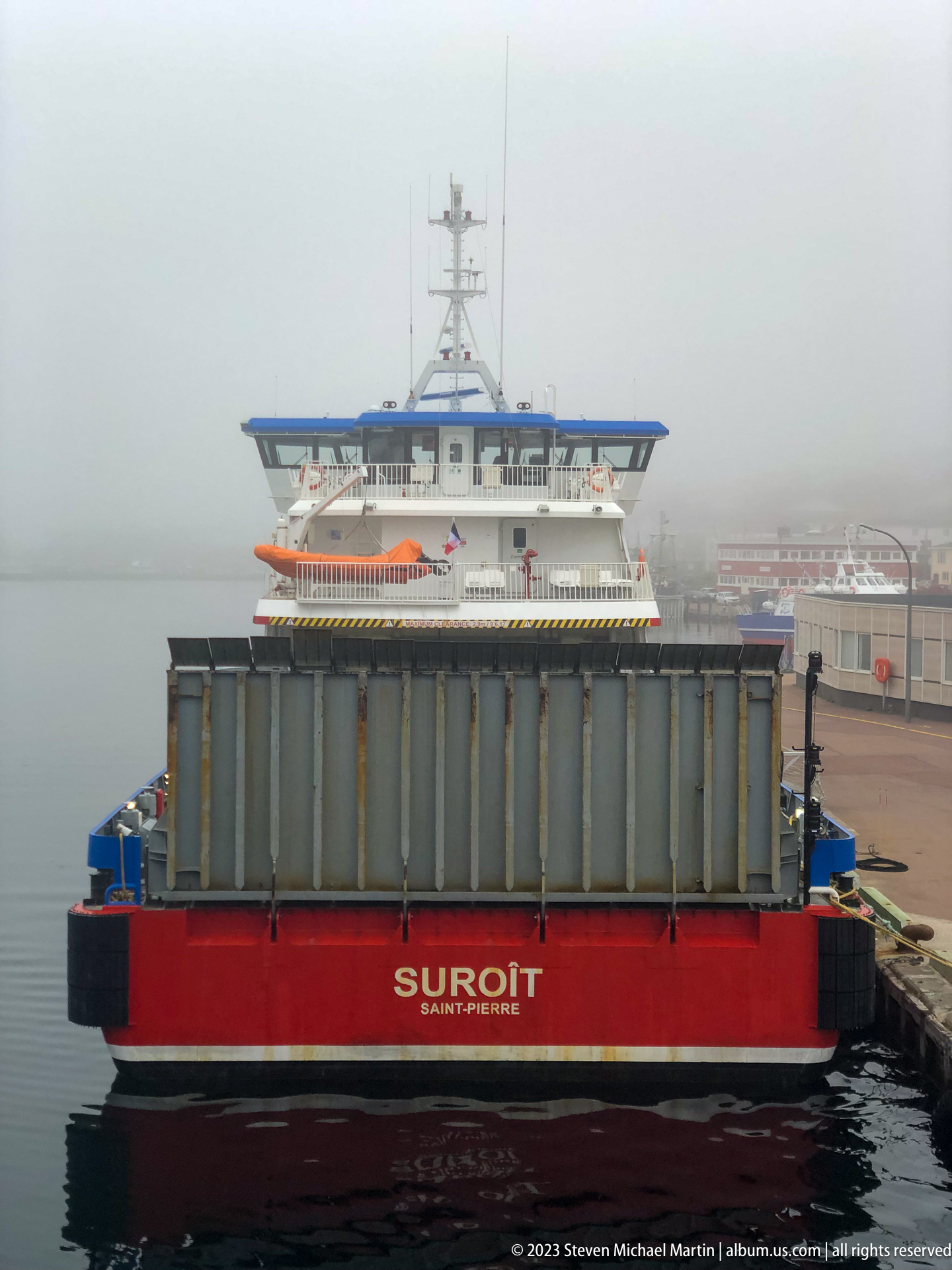
The red work barge SUROÎT sits alongside the quay in fog, its name and “SAINT-PIERRE” marking clearly visible on the hull. Large gray cargo containers or structural bins occupy most of the deck, while a passenger vessel and terminal infrastructure emerge faintly behind. The layered harbor scene distinguishes heavy service craft from the ferries that connect the islands with neighboring ports.
Caption
The red work barge SUROÎT sits alongside the quay in fog, its name and “SAINT-PIERRE” marking clearly visible on the hull. Large gray cargo containers or structural bins occupy most of the deck, while a passenger vessel and terminal infrastructure emerge faintly behind. The layered harbor scene distinguishes heavy service craft from the ferries that connect the islands with neighboring ports.

A purple iris rises among tall blade-like leaves and dense wetland vegetation, accompanied by unopened buds and a small yellow flower near the lower edge. The wider botanical view shows the bloom in its growing context rather than isolating it completely. White-and-yellow markings on the falls remain visible while surrounding foliage establishes the moisture-rich meadow habitat.
Caption
A purple iris rises among tall blade-like leaves and dense wetland vegetation, accompanied by unopened buds and a small yellow flower near the lower edge. The wider botanical view shows the bloom in its growing context rather than isolating it completely. White-and-yellow markings on the falls remain visible while surrounding foliage establishes the moisture-rich meadow habitat.
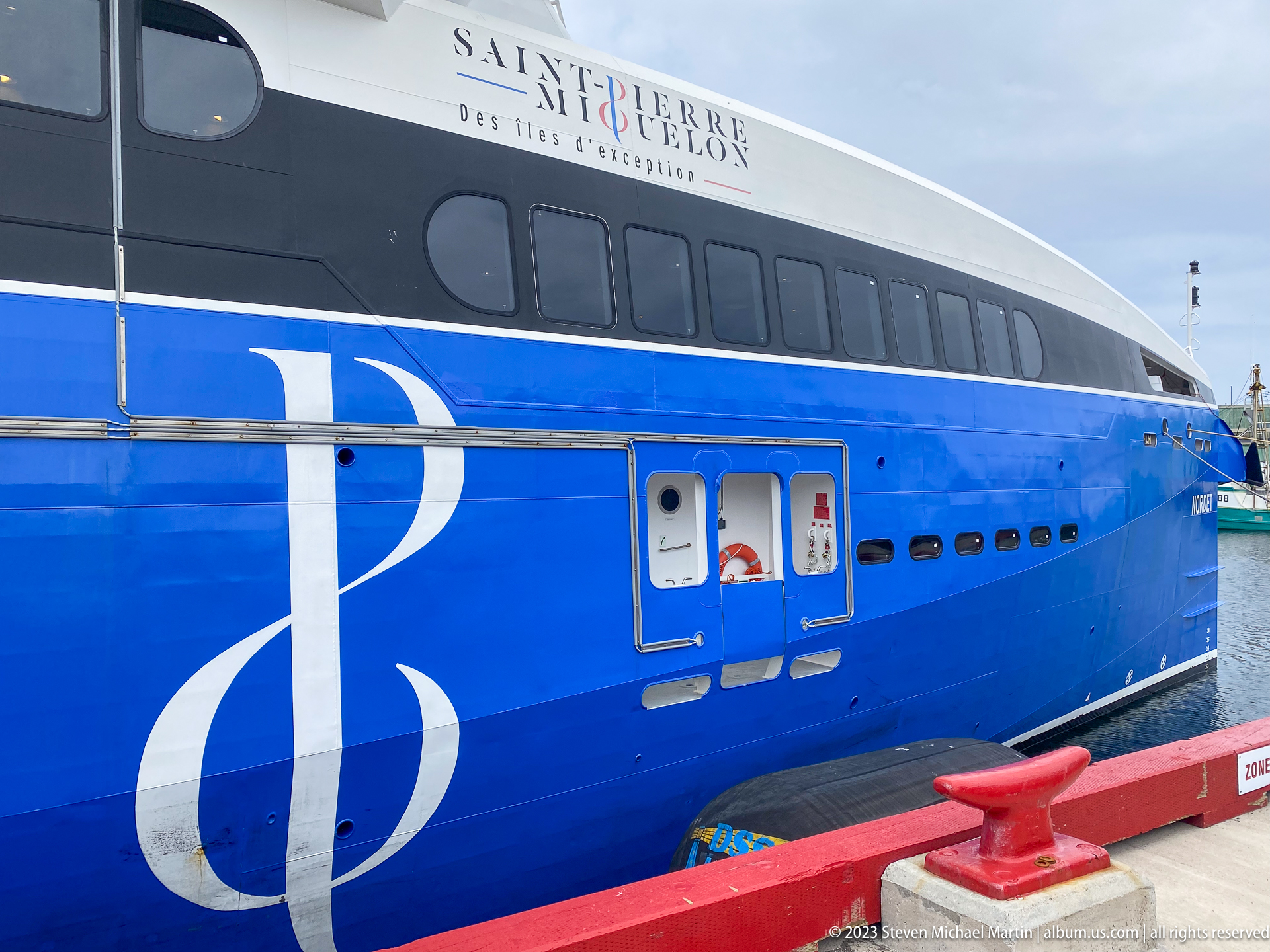
A streamlined blue passenger ferry lies alongside the quay, carrying large territorial branding and the words “SAINT-PIERRE ET MIQUELON” high on its superstructure. Long rows of dark passenger windows and the sleek hull distinguish it from the larger vehicle ferry in the adjacent photograph, underscoring the variety of maritime transport serving the archipelago.
Caption
A streamlined blue passenger ferry lies alongside the quay, carrying large territorial branding and the words “SAINT-PIERRE ET MIQUELON” high on its superstructure. Long rows of dark passenger windows and the sleek hull distinguish it from the larger vehicle ferry in the adjacent photograph, underscoring the variety of maritime transport serving the archipelago.

A French-format registration plate on the rear of a red Renault carries the code “SPM” and a territorial emblem at the right, making the vehicle’s local registration immediately legible. The tight crop turns an everyday automobile detail into a concise marker of Saint-Pierre-et-Miquelon’s administrative relationship with France and its distinct territorial identity.
Caption
A French-format registration plate on the rear of a red Renault carries the code “SPM” and a territorial emblem at the right, making the vehicle’s local registration immediately legible. The tight crop turns an everyday automobile detail into a concise marker of Saint-Pierre-et-Miquelon’s administrative relationship with France and its distinct territorial identity.
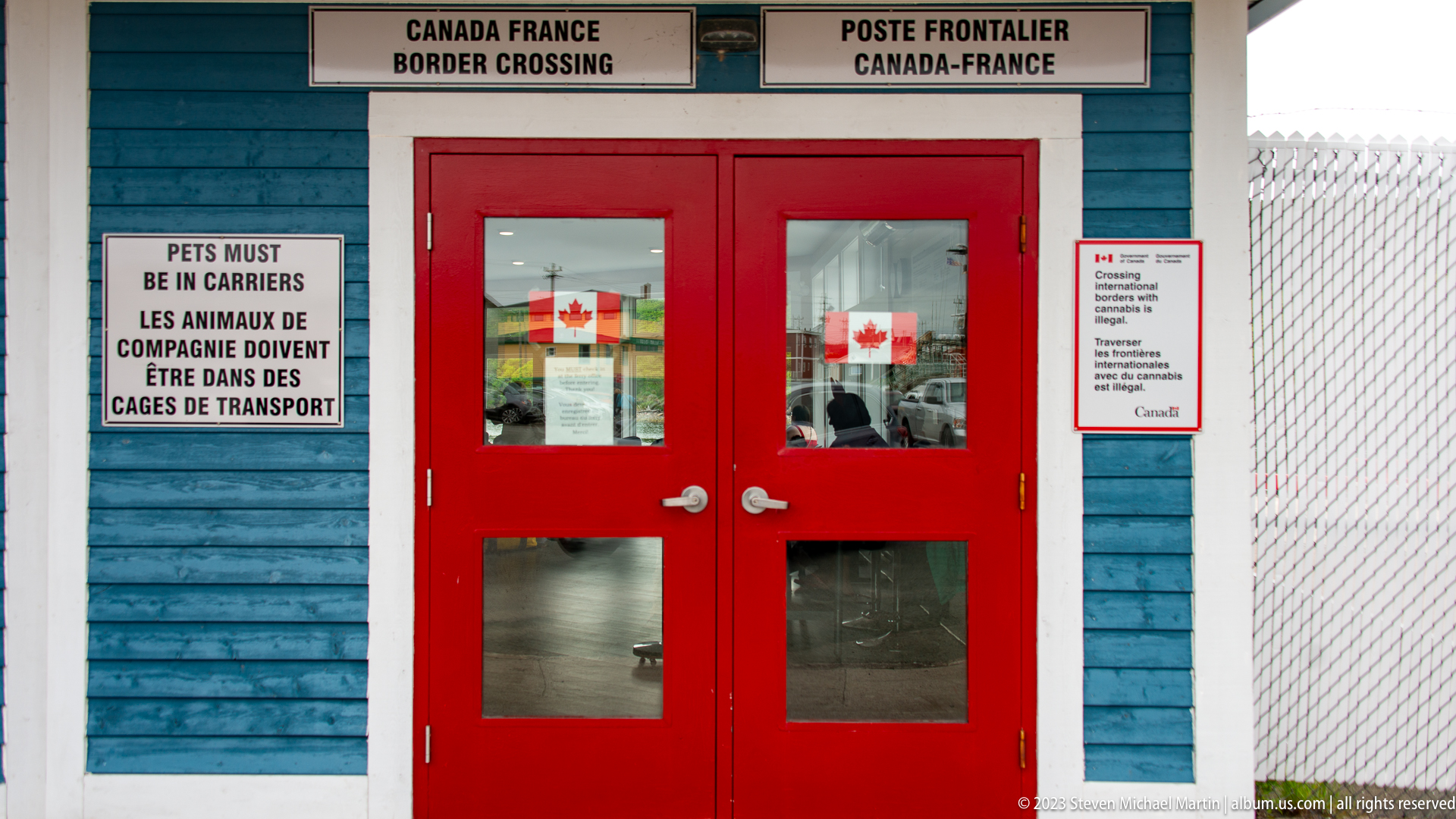
Bright red double doors mark a small Canada–France frontier building, with bilingual signage directing travelers and stating that pets must be carried. The blue-painted siding, Canadian flags, security fencing, and posted crossing instructions give the scene the practical character of an international arrival point linking the ferry journey with the French territory of Saint Pierre & Miquelon.
Caption
Bright red double doors mark a small Canada–France frontier building, with bilingual signage directing travelers and stating that pets must be carried. The blue-painted siding, Canadian flags, security fencing, and posted crossing instructions give the scene the practical character of an international arrival point linking the ferry journey with the French territory of Saint Pierre & Miquelon.

A screen displays the official visual identity of Saint-Pierre et Miquelon, pairing a stylized red sailboat with pale-blue island silhouettes and the words “Collectivité Territoriale.” Seen at the point of arrival, the graphic provides a concise statement of the archipelago’s French territorial identity and maritime character before passengers continue from the ferry into the islands.
Caption
A screen displays the official visual identity of Saint-Pierre et Miquelon, pairing a stylized red sailboat with pale-blue island silhouettes and the words “Collectivité Territoriale.” Seen at the point of arrival, the graphic provides a concise statement of the archipelago’s French territorial identity and maritime character before passengers continue from the ferry into the islands.
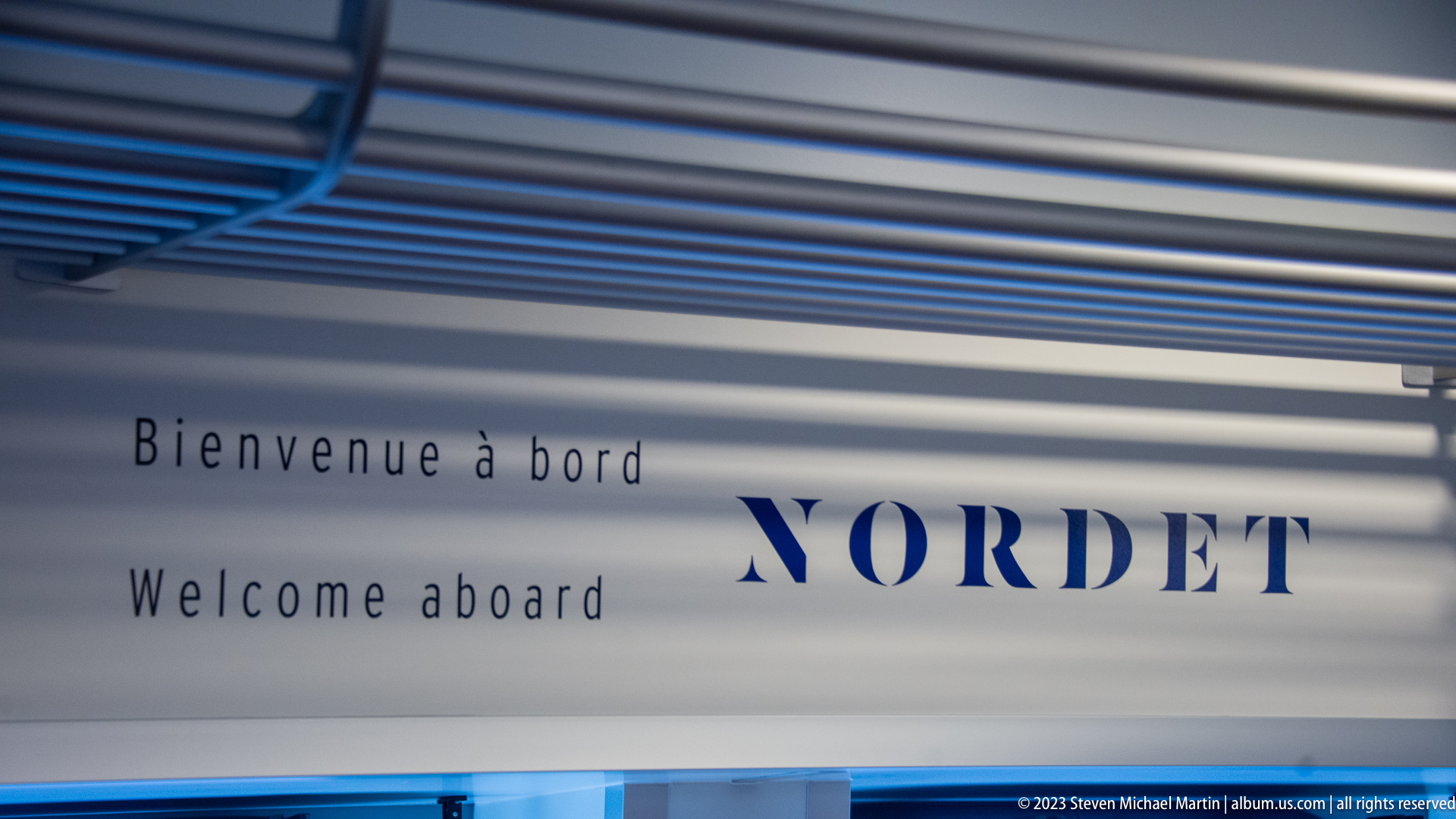
“Bienvenue à bord / Welcome aboard” appears beside the name NORDET on a clean-lined interior panel, introducing passengers to the vessel in both French and English. Blue rails and metallic horizontal bands reinforce the modern ferry setting. The bilingual greeting reflects the cross-border passenger service connecting the Canadian side of the route with the French archipelago.
Caption
“Bienvenue à bord / Welcome aboard” appears beside the name NORDET on a clean-lined interior panel, introducing passengers to the vessel in both French and English. Blue rails and metallic horizontal bands reinforce the modern ferry setting. The bilingual greeting reflects the cross-border passenger service connecting the Canadian side of the route with the French archipelago.
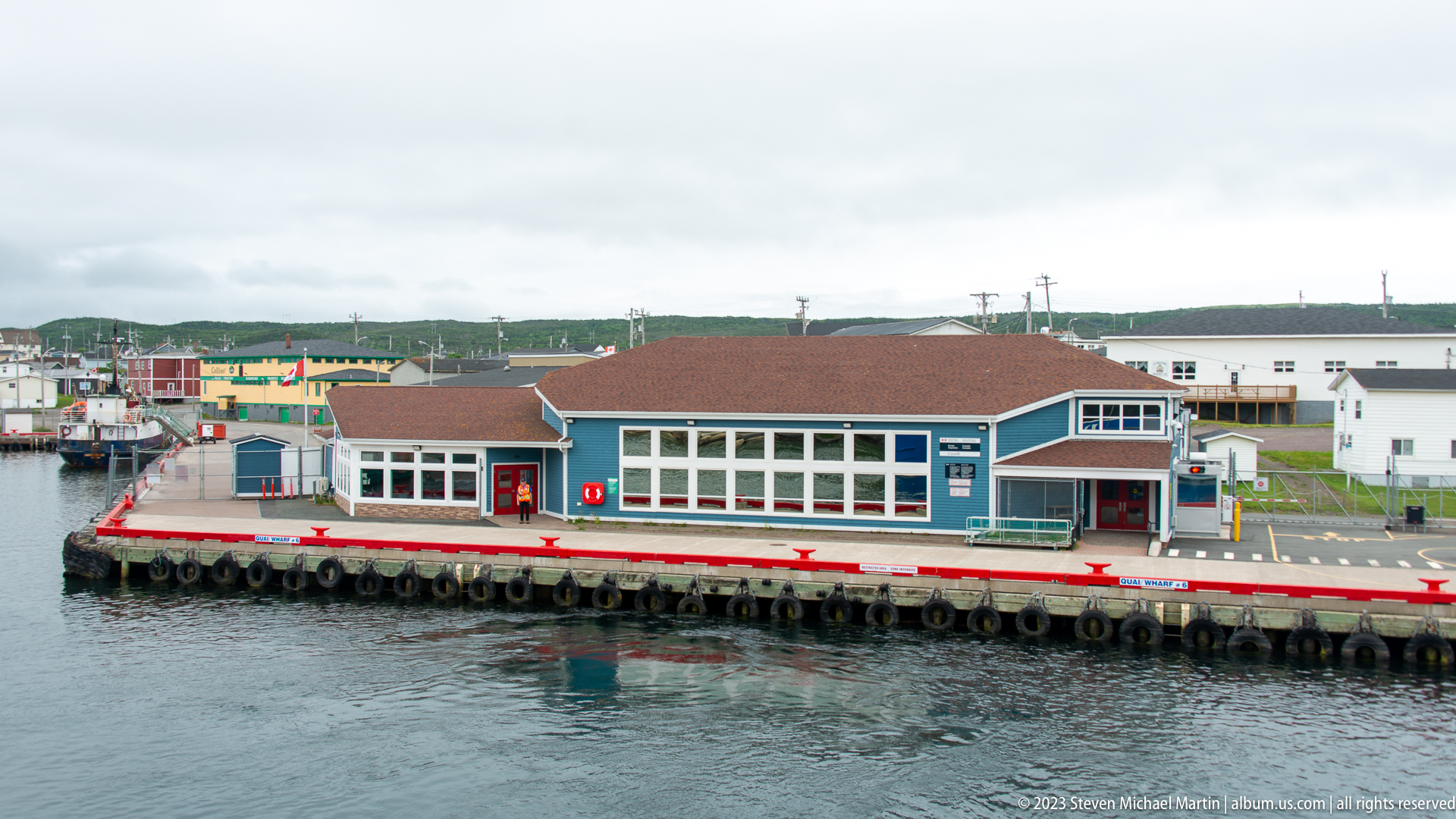
A low blue-gray terminal building stands directly on the quay, its long bank of windows facing the harbor and a red-painted curb tracing the water’s edge. Utility structures and modest houses rise behind it beneath an overcast sky. Viewed from the arriving vessel, the scene establishes the compact scale and working waterfront character of the island port.
Caption
A low blue-gray terminal building stands directly on the quay, its long bank of windows facing the harbor and a red-painted curb tracing the water’s edge. Utility structures and modest houses rise behind it beneath an overcast sky. Viewed from the arriving vessel, the scene establishes the compact scale and working waterfront character of the island port.

The French tricolour fills the foreground, its blue, white, and red panels lifting in the wind above a green coastal slope. The flag is a direct visual marker of national jurisdiction in Saint Pierre & Miquelon, a French collectivity situated off Newfoundland. Isolating the flag against the subdued island landscape gives the arrival sequence a clear transition from Canadian departure to French territory.
Caption
The French tricolour fills the foreground, its blue, white, and red panels lifting in the wind above a green coastal slope. The flag is a direct visual marker of national jurisdiction in Saint Pierre & Miquelon, a French collectivity situated off Newfoundland. Isolating the flag against the subdued island landscape gives the arrival sequence a clear transition from Canadian departure to French territory.

A tight shipboard detail centers on the orange casing of a lifebuoy marked “MIQUELON,” crossed by working ropes and fittings. A small French registration plate sits above the lettering. By moving close to the equipment, the photograph emphasizes the utilitarian materials—painted surface, braided line, fasteners, and hardware—that support routine passenger-vessel safety operations.
Caption
A tight shipboard detail centers on the orange casing of a lifebuoy marked “MIQUELON,” crossed by working ropes and fittings. A small French registration plate sits above the lettering. By moving close to the equipment, the photograph emphasizes the utilitarian materials—painted surface, braided line, fasteners, and hardware—that support routine passenger-vessel safety operations.

Small houses, commercial buildings, parked vehicles, and utility poles line a rocky shore beneath low green hills softened by mist. The view from the water shows how closely settlement, road access, and the harbor edge are compressed together on the island. A concrete marine structure at right and exposed rock along the shoreline reinforce the practical, weather-facing character of the port community.
Caption
Small houses, commercial buildings, parked vehicles, and utility poles line a rocky shore beneath low green hills softened by mist. The view from the water shows how closely settlement, road access, and the harbor edge are compressed together on the island. A concrete marine structure at right and exposed rock along the shoreline reinforce the practical, weather-facing character of the port community.

A passenger stands on the open ferry deck beside a French tricolour, looking upward as the vessel moves through sheltered coastal water. The portrait combines a human arrival moment with the national symbol of Saint Pierre & Miquelon’s French status. Soft gray light, the wake, and a low green shoreline keep the maritime setting present without competing with the figure.
Caption
A passenger stands on the open ferry deck beside a French tricolour, looking upward as the vessel moves through sheltered coastal water. The portrait combines a human arrival moment with the national symbol of Saint Pierre & Miquelon’s French status. Soft gray light, the wake, and a low green shoreline keep the maritime setting present without competing with the figure.
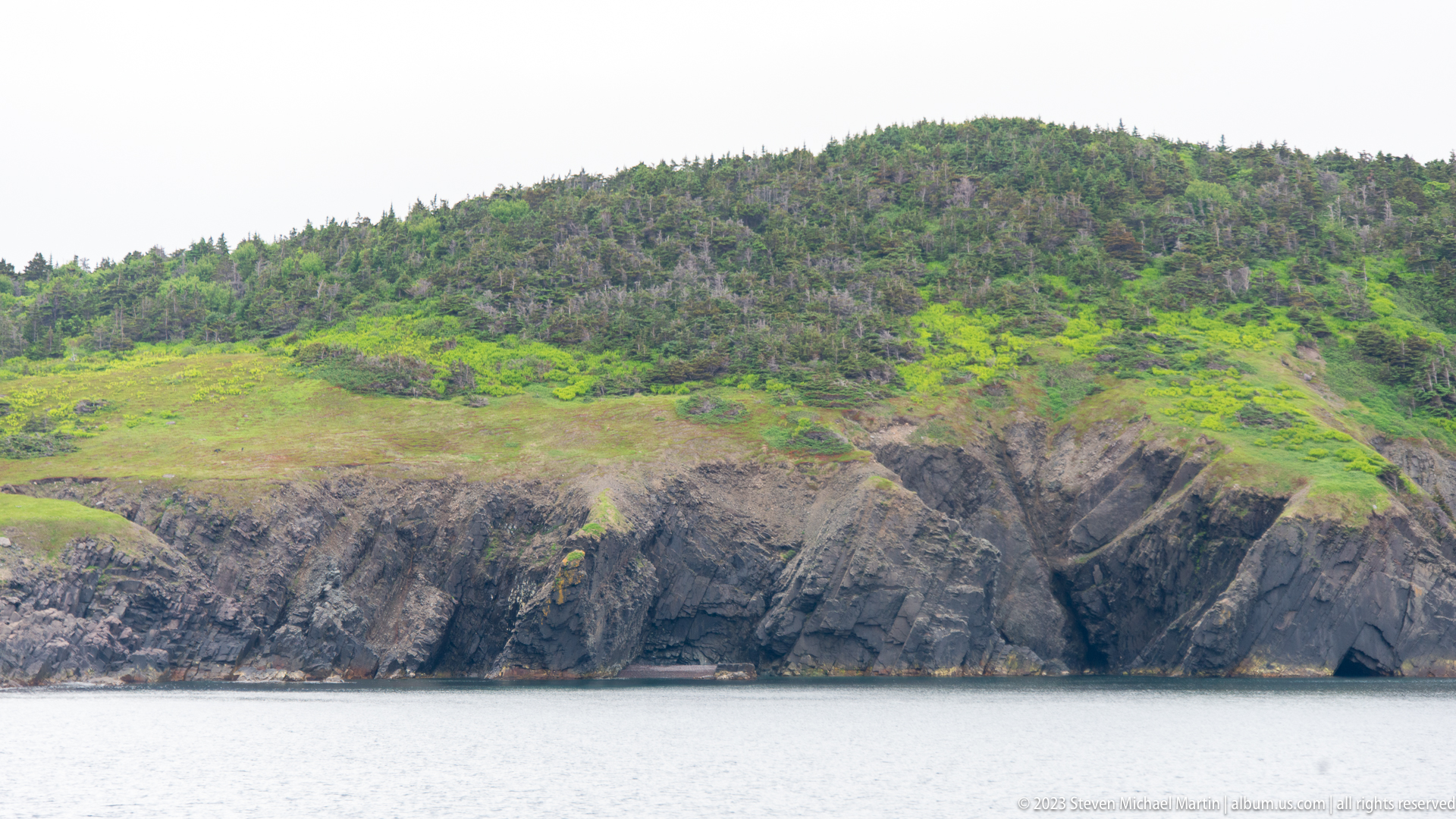
Dark folded rock rises abruptly from calm gray water, topped by a dense patchwork of low conifers, shrubs, and bright green groundcover. The exposed cliff face reveals the hard, weathered coastal geology characteristic of a North Atlantic island environment. With no buildings in view, the photograph isolates the rugged natural shoreline encountered from the ferry approach.
Caption
Dark folded rock rises abruptly from calm gray water, topped by a dense patchwork of low conifers, shrubs, and bright green groundcover. The exposed cliff face reveals the hard, weathered coastal geology characteristic of a North Atlantic island environment. With no buildings in view, the photograph isolates the rugged natural shoreline encountered from the ferry approach.
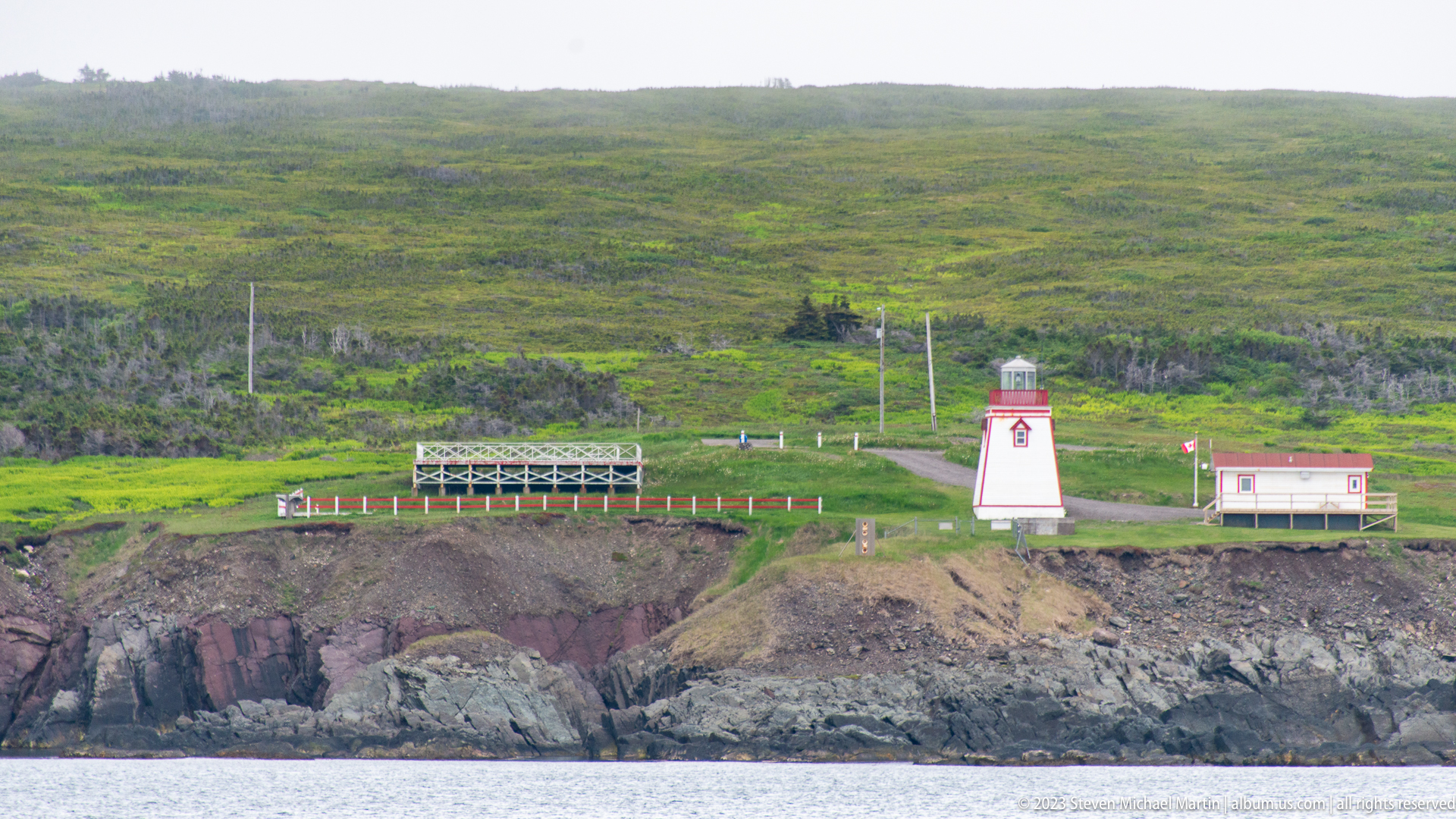
A compact white navigation tower with red upper section stands on a rocky point beside a small service building and elevated walkway. The installation occupies a narrow strip between the sea and a treeless green slope, emphasizing the exposed setting in which harbor and coastal lights guide vessels through the archipelago’s approaches. Its scale distinguishes it from the larger ornamental lighthouse seen later near Saint-Pierre harbor.
Caption
A compact white navigation tower with red upper section stands on a rocky point beside a small service building and elevated walkway. The installation occupies a narrow strip between the sea and a treeless green slope, emphasizing the exposed setting in which harbor and coastal lights guide vessels through the archipelago’s approaches. Its scale distinguishes it from the larger ornamental lighthouse seen later near Saint-Pierre harbor.
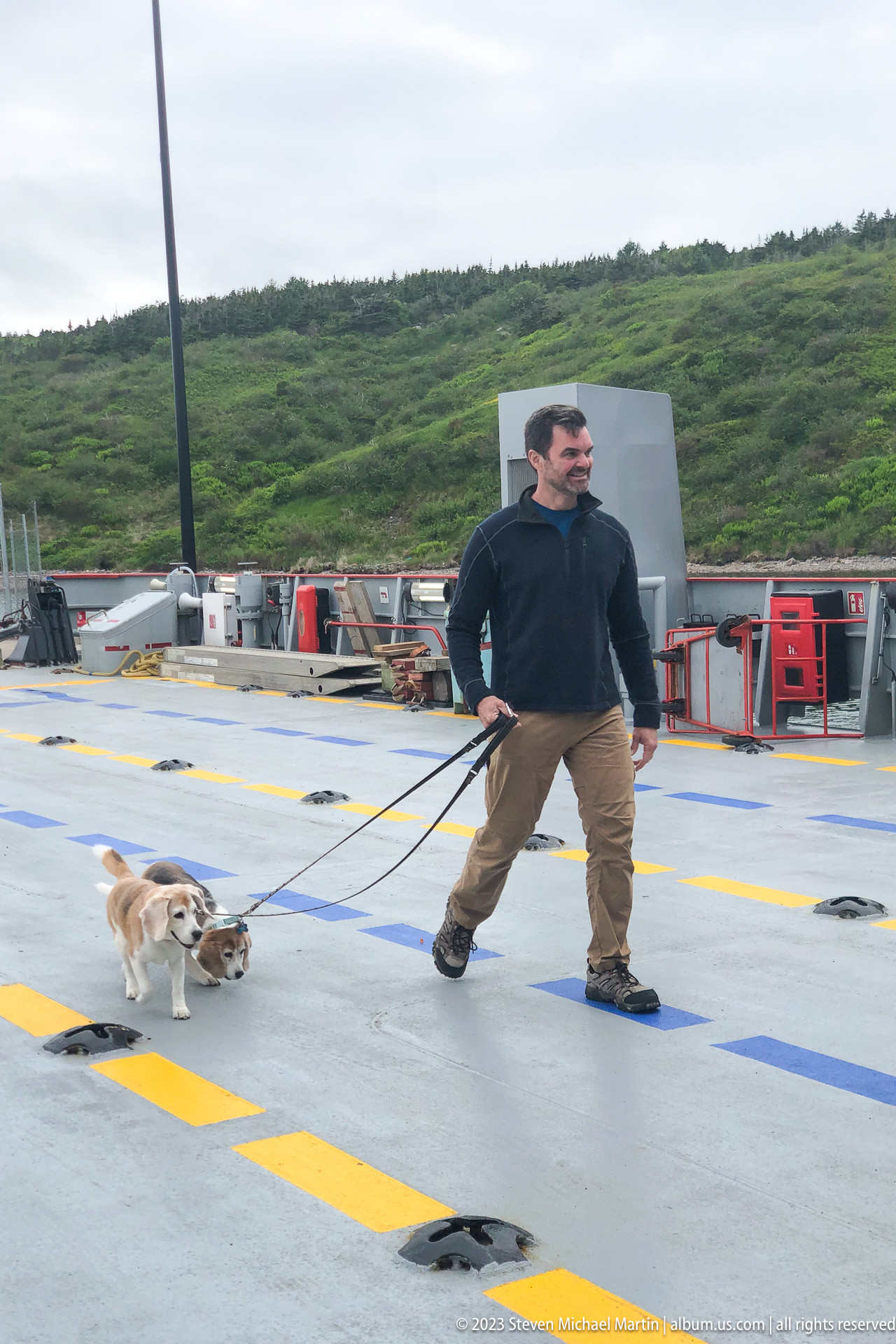
A passenger walks two small dogs across the open vehicle deck of the ferry, their leashes stretched as the animals move in opposite directions. Painted lane markings, deck fittings, and equipment establish the working shipboard environment. The candid scene records an ordinary aspect of island travel: passengers and pets sharing the practical routines of a cross-water connection.
Caption
A passenger walks two small dogs across the open vehicle deck of the ferry, their leashes stretched as the animals move in opposite directions. Painted lane markings, deck fittings, and equipment establish the working shipboard environment. The candid scene records an ordinary aspect of island travel: passengers and pets sharing the practical routines of a cross-water connection.

The white wooden Pointe aux Canons lighthouse stands prominently in the fog, its broad red band carrying the name “POINTE AUX CANONS.” A red-roofed lantern gallery crowns the flared tower, while muted waterfront buildings recede behind it. This close view records both the structure’s distinctive decorative profile and the visible place-name that anchors it securely within Saint-Pierre harbor.
Caption
The white wooden Pointe aux Canons lighthouse stands prominently in the fog, its broad red band carrying the name “POINTE AUX CANONS.” A red-roofed lantern gallery crowns the flared tower, while muted waterfront buildings recede behind it. This close view records both the structure’s distinctive decorative profile and the visible place-name that anchors it securely within Saint-Pierre harbor.

Pointe aux Canons lighthouse occupies a low rocky islet in calm harbor water, with Saint-Pierre’s waterfront spread behind it beneath a blanket of fog. The wider framing shows the beacon’s spatial relationship to the town and harbor rather than isolating its architectural details. A faint reflection below the tower adds to the subdued, nearly monochrome maritime atmosphere.
Caption
Pointe aux Canons lighthouse occupies a low rocky islet in calm harbor water, with Saint-Pierre’s waterfront spread behind it beneath a blanket of fog. The wider framing shows the beacon’s spatial relationship to the town and harbor rather than isolating its architectural details. A faint reflection below the tower adds to the subdued, nearly monochrome maritime atmosphere.
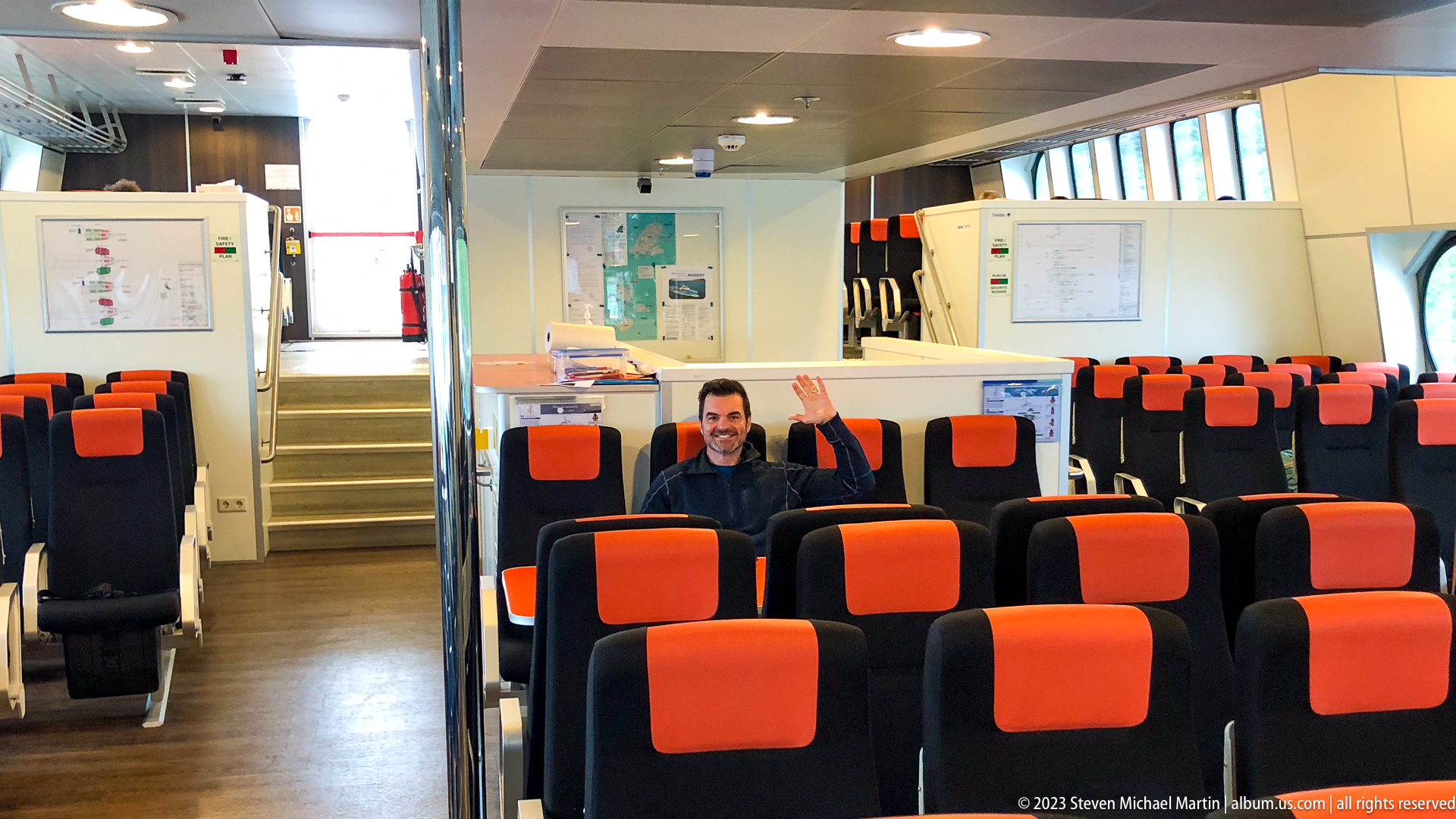
Rows of black passenger seats with bright orange headrests fill the ferry cabin, while a traveler seated near the center raises a hand toward the camera. Stairs, safety equipment, windows, and route information panels define the functional interior. The orderly, compact arrangement documents the passenger accommodations used during the sea crossing to Saint Pierre & Miquelon.
Caption
Rows of black passenger seats with bright orange headrests fill the ferry cabin, while a traveler seated near the center raises a hand toward the camera. Stairs, safety equipment, windows, and route information panels define the functional interior. The orderly, compact arrangement documents the passenger accommodations used during the sea crossing to Saint Pierre & Miquelon.

A small red-and-white beacon rises from a boulder breakwater almost swallowed by dense fog. Only the nearest rocks, still water, and faint landform behind the marker remain visible, illustrating the restricted visibility that can shape navigation around the islands. The understated harbor aid is shown in the precise atmospheric conditions for which such entrance markers are essential.
Caption
A small red-and-white beacon rises from a boulder breakwater almost swallowed by dense fog. Only the nearest rocks, still water, and faint landform behind the marker remain visible, illustrating the restricted visibility that can shape navigation around the islands. The understated harbor aid is shown in the precise atmospheric conditions for which such entrance markers are essential.
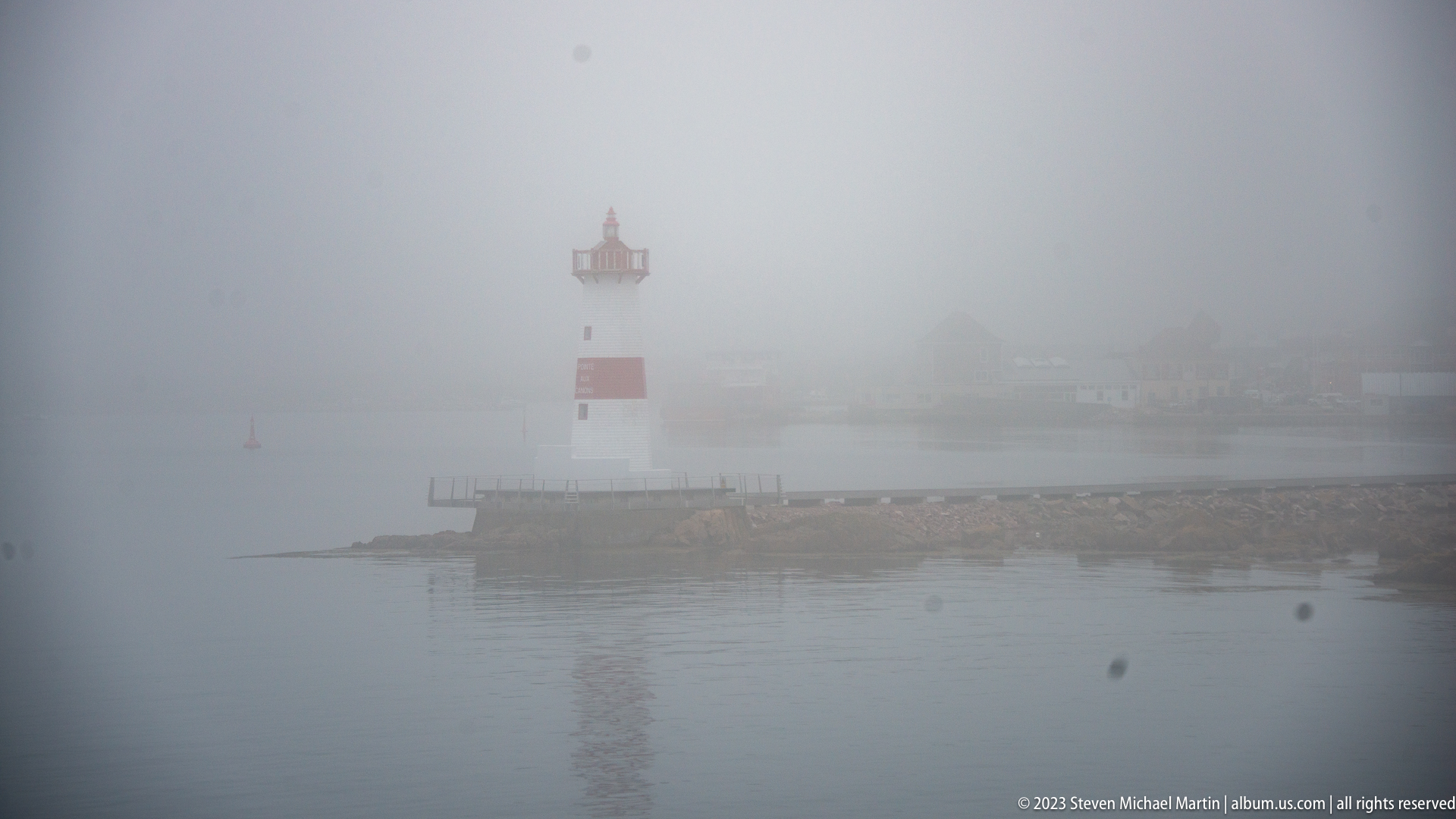
The Pointe aux Canons lighthouse emerges through heavy fog at the end of a low harbor breakwater, its white tower crossed by a broad red band and capped by a red lantern structure. Reflections soften into the still water while nearby buildings nearly disappear. The view emphasizes the lighthouse’s role as a conspicuous harbor landmark under the archipelago’s frequently reduced visibility.
Caption
The Pointe aux Canons lighthouse emerges through heavy fog at the end of a low harbor breakwater, its white tower crossed by a broad red band and capped by a red lantern structure. Reflections soften into the still water while nearby buildings nearly disappear. The view emphasizes the lighthouse’s role as a conspicuous harbor landmark under the archipelago’s frequently reduced visibility.
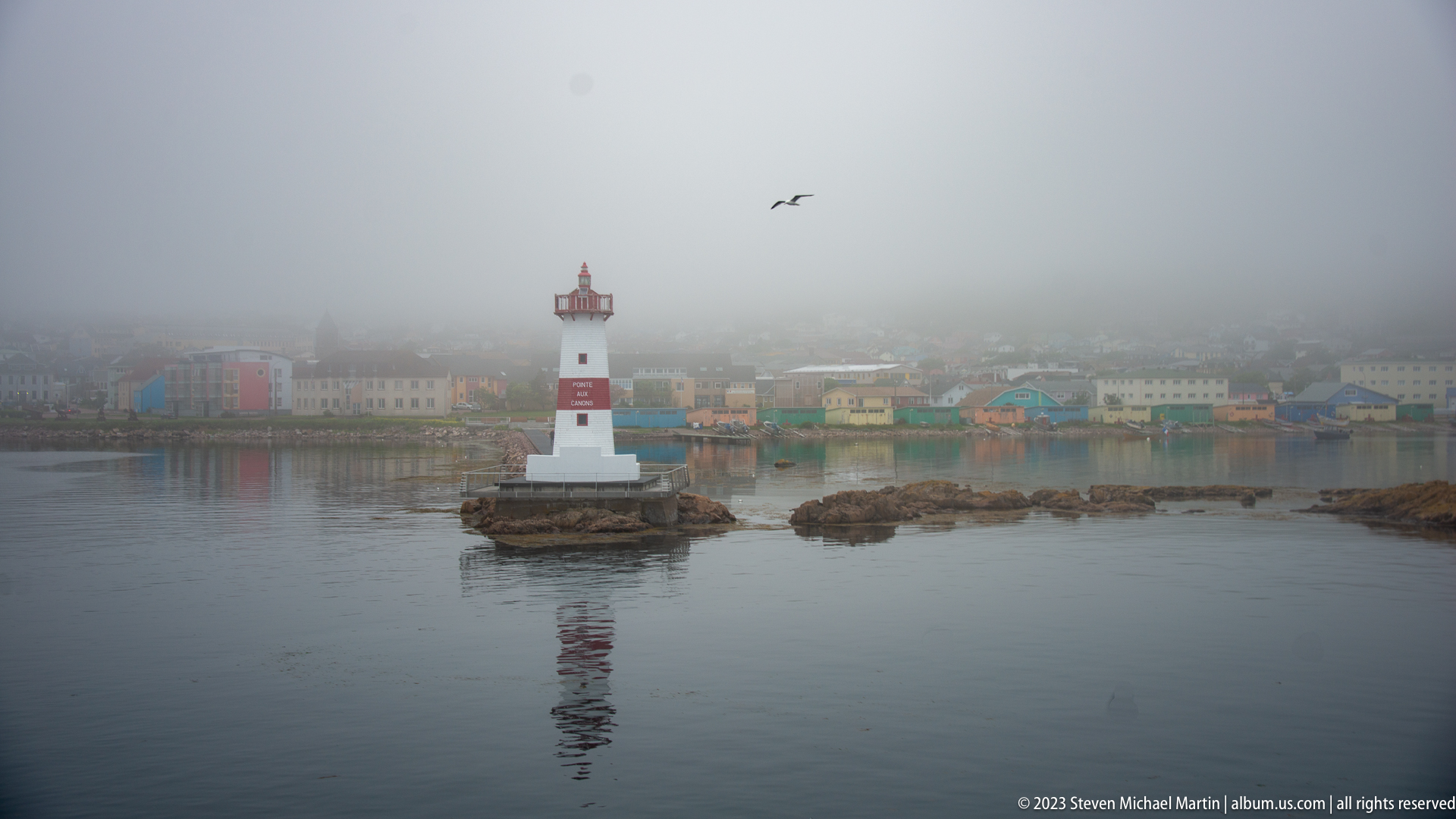
Seen from farther across the harbor, Pointe aux Canons lighthouse rises from its rocky base against a strip of colorful Saint-Pierre waterfront buildings softened by mist. A seabird crosses the pale sky and the tower reflects in the quiet water. The composition places the navigation landmark within the lived port landscape, linking beacon, shoreline settlement, and sheltered harbor in a single view.
Caption
Seen from farther across the harbor, Pointe aux Canons lighthouse rises from its rocky base against a strip of colorful Saint-Pierre waterfront buildings softened by mist. A seabird crosses the pale sky and the tower reflects in the quiet water. The composition places the navigation landmark within the lived port landscape, linking beacon, shoreline settlement, and sheltered harbor in a single view.

Saint-Pierre’s waterfront stretches faintly across the harbor, with pastel buildings and a church tower dissolving into low fog. A broad band of still water occupies the foreground, making the settlement appear compressed beneath the weather. The distant view records how quickly the island town’s architectural profile can fade under North Atlantic mist while remaining closely tied to the sheltered harbor edge.
Caption
Saint-Pierre’s waterfront stretches faintly across the harbor, with pastel buildings and a church tower dissolving into low fog. A broad band of still water occupies the foreground, making the settlement appear compressed beneath the weather. The distant view records how quickly the island town’s architectural profile can fade under North Atlantic mist while remaining closely tied to the sheltered harbor edge.

A bright red navigation buoy punctuates the calm harbor in front of Saint-Pierre’s colorful waterfront. Rows of low commercial and civic buildings extend along the shore, their reflections muted by mist and gray light. The buoy provides a vivid foreground marker of the navigable harbor channel while the compact town behind demonstrates the close relationship between maritime traffic and the urban waterfront.
Caption
A bright red navigation buoy punctuates the calm harbor in front of Saint-Pierre’s colorful waterfront. Rows of low commercial and civic buildings extend along the shore, their reflections muted by mist and gray light. The buoy provides a vivid foreground marker of the navigable harbor channel while the compact town behind demonstrates the close relationship between maritime traffic and the urban waterfront.
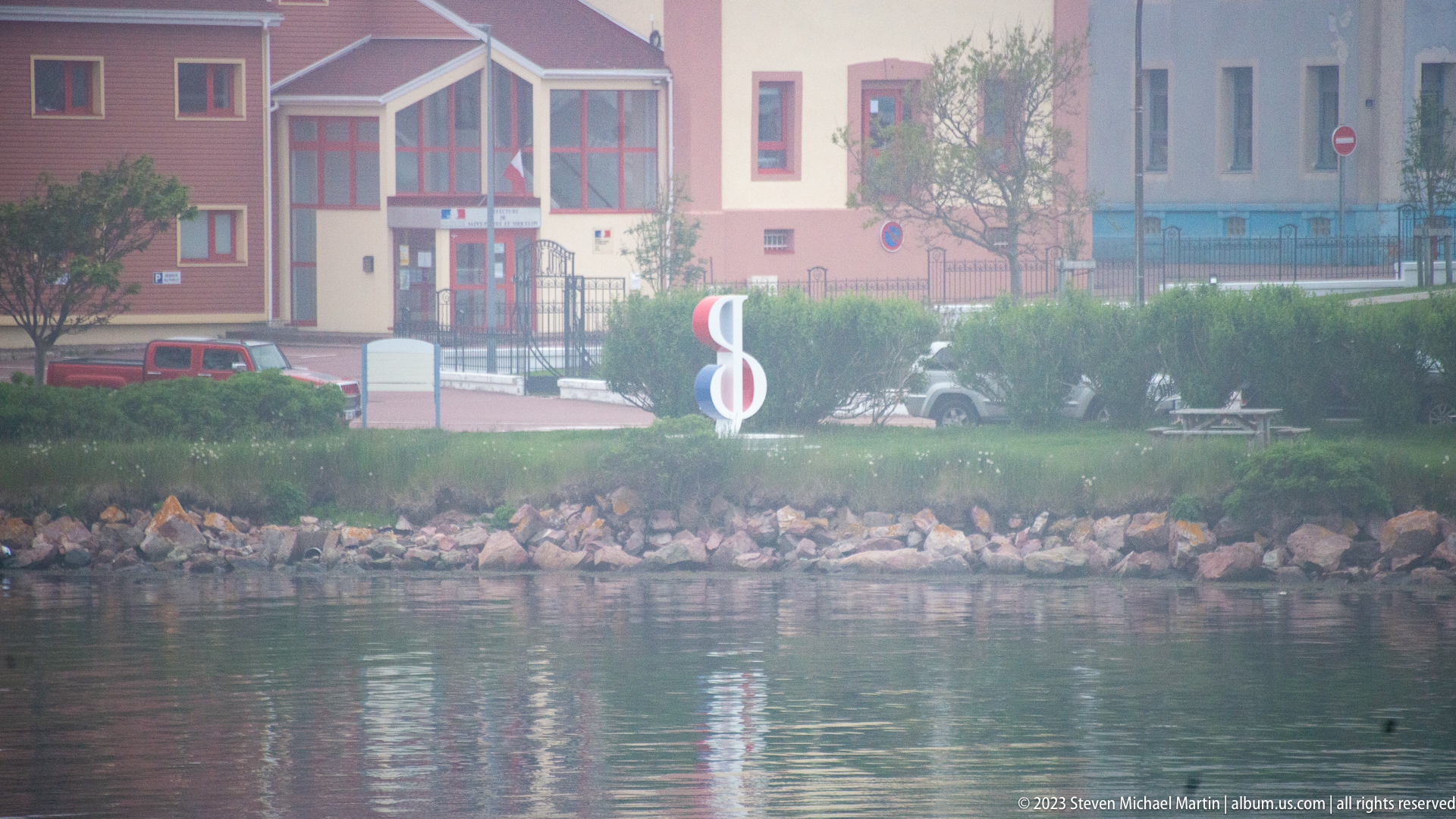
A compressed telephoto view isolates a short section of Saint-Pierre’s shoreline, where pastel buildings, clipped greenery, a rocky revetment, and a red-and-white waterside marker meet the harbor. The narrow framing emphasizes small-scale urban details rather than a landmark, showing how residential and institutional architecture sits immediately behind the engineered edge of the port.
Caption
A compressed telephoto view isolates a short section of Saint-Pierre’s shoreline, where pastel buildings, clipped greenery, a rocky revetment, and a red-and-white waterside marker meet the harbor. The narrow framing emphasizes small-scale urban details rather than a landmark, showing how residential and institutional architecture sits immediately behind the engineered edge of the port.
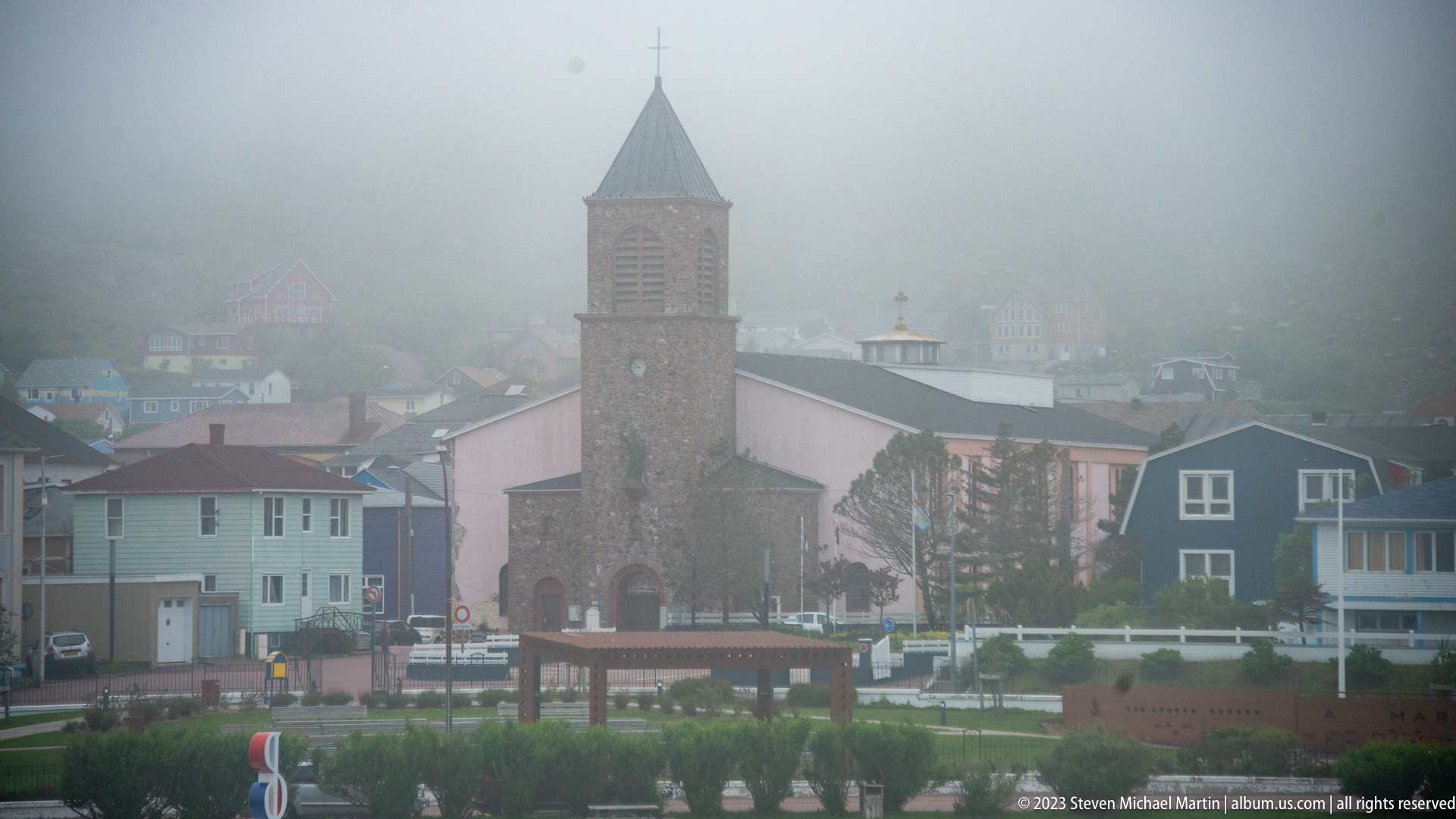
A stone church tower rises above Saint-Pierre’s low houses in dense mist, its pointed roof and tall louvered openings forming one of the strongest vertical accents in the townscape. The nave extends toward the waterfront behind a small landscaped area. Framed from across the harbor, the view emphasizes the church’s architectural prominence without relying on details too obscured by fog for a more exact attribution.
Caption
A stone church tower rises above Saint-Pierre’s low houses in dense mist, its pointed roof and tall louvered openings forming one of the strongest vertical accents in the townscape. The nave extends toward the waterfront behind a small landscaped area. Framed from across the harbor, the view emphasizes the church’s architectural prominence without relying on details too obscured by fog for a more exact attribution.
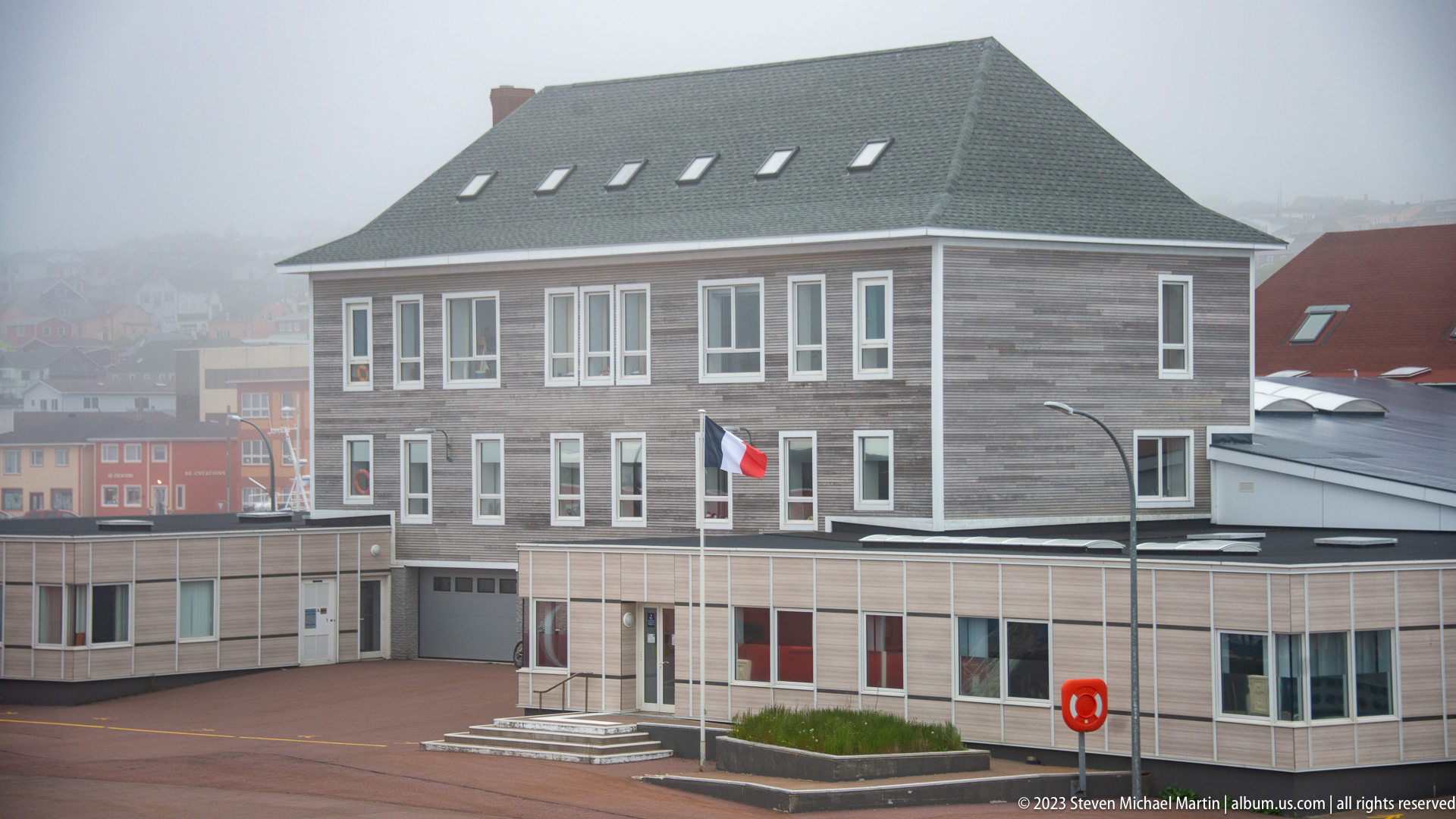
A French tricolour flies before a large wood-clad institutional building overlooking the harbor. Regular rows of tall windows, a broad hipped roof with skylights, and a lower modern wing give the complex an administrative rather than residential scale. The restrained façade and national flag provide a civic counterpoint to Saint-Pierre’s smaller houses and maritime structures visible nearby.
Caption
A French tricolour flies before a large wood-clad institutional building overlooking the harbor. Regular rows of tall windows, a broad hipped roof with skylights, and a lower modern wing give the complex an administrative rather than residential scale. The restrained façade and national flag provide a civic counterpoint to Saint-Pierre’s smaller houses and maritime structures visible nearby.
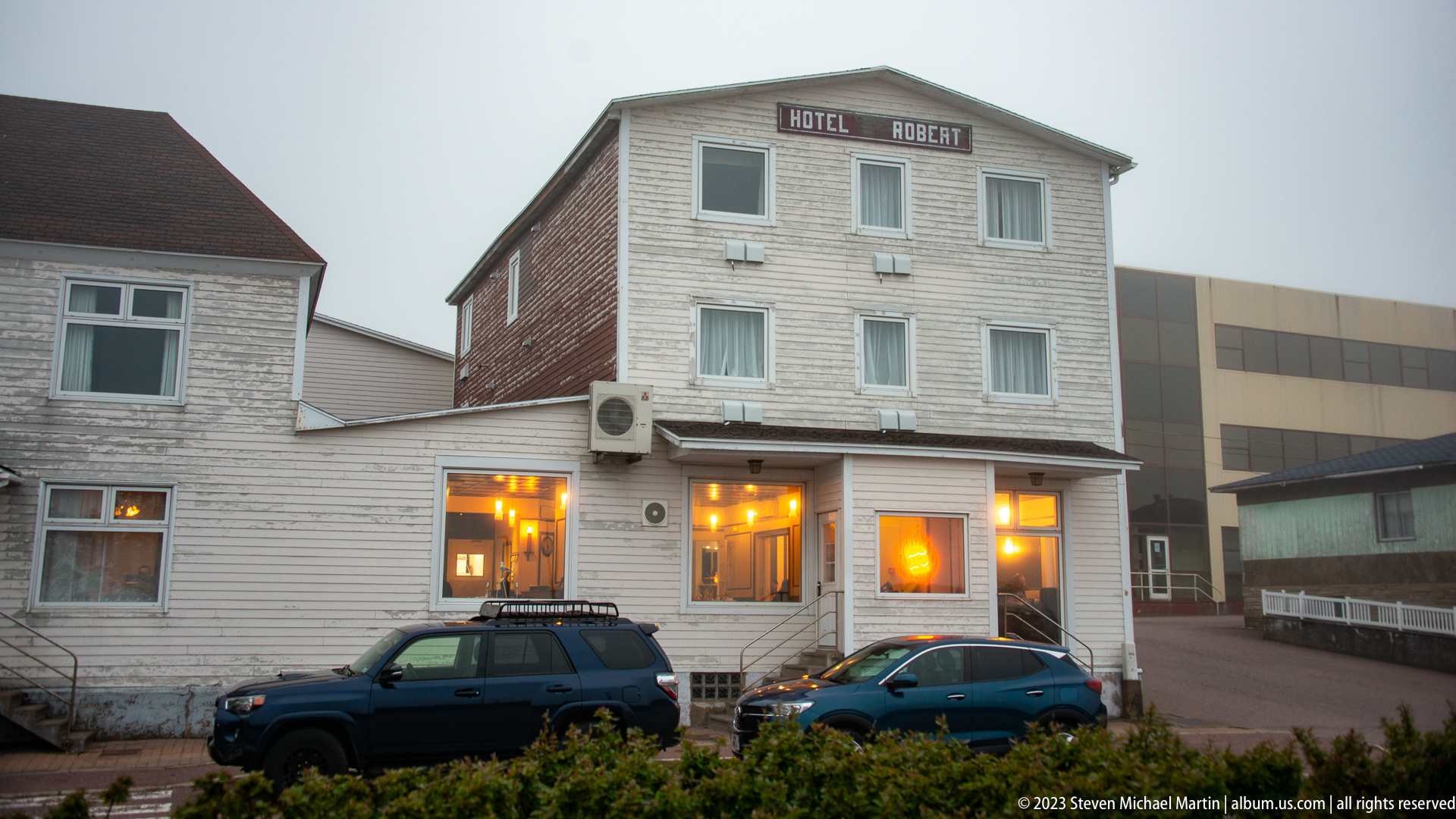
The Hôtel Robert name appears high on the weathered wood-clad façade of a compact multi-story building, while warm interior light glows from the ground-floor windows. Parked cars and adjoining structures place the hotel directly within Saint-Pierre’s dense town fabric. The contrast between gray exterior boards and welcoming amber light gives the scene an intimate evening character without obscuring the clearly visible establishment name.
Caption
The Hôtel Robert name appears high on the weathered wood-clad façade of a compact multi-story building, while warm interior light glows from the ground-floor windows. Parked cars and adjoining structures place the hotel directly within Saint-Pierre’s dense town fabric. The contrast between gray exterior boards and welcoming amber light gives the scene an intimate evening character without obscuring the clearly visible establishment name.

Fishing and service vessels lie tightly moored along Saint-Pierre’s harbor in dense fog, their hulls, masts, antennas, and deck gear doubled in unusually still water. Navigation lights and work lights glow through the gray atmosphere. The close grouping conveys the harbor’s practical maritime role, where small commercial craft and port services occupy the sheltered basin beside the town.
Caption
Fishing and service vessels lie tightly moored along Saint-Pierre’s harbor in dense fog, their hulls, masts, antennas, and deck gear doubled in unusually still water. Navigation lights and work lights glow through the gray atmosphere. The close grouping conveys the harbor’s practical maritime role, where small commercial craft and port services occupy the sheltered basin beside the town.

The French tricolour and a blue territorial flag angle outward from a green wooden façade above a graphic emblem associated with Saint Pierre & Miquelon. Their crossed placement turns the building front into a compact display of civic identity. Weathered horizontal siding, a small gable, and the close crop keep attention on the flags and emblem rather than the larger structure.
Caption
The French tricolour and a blue territorial flag angle outward from a green wooden façade above a graphic emblem associated with Saint Pierre & Miquelon. Their crossed placement turns the building front into a compact display of civic identity. Weathered horizontal siding, a small gable, and the close crop keep attention on the flags and emblem rather than the larger structure.
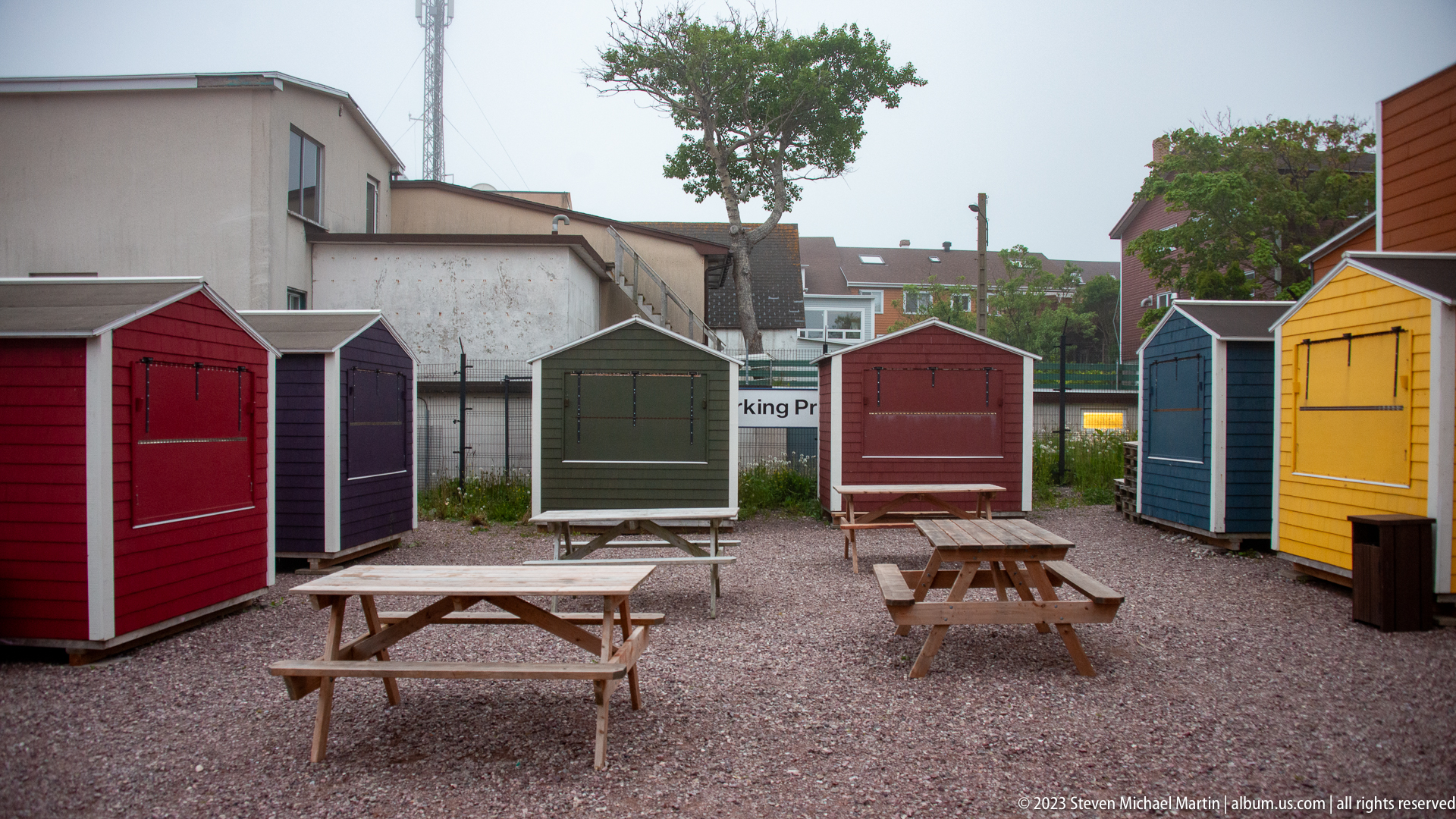
Bright red, purple, green, blue, and yellow wooden sheds form a loose ring around picnic tables on a gravel courtyard. Their simple gabled forms and saturated paint create a compact ensemble distinct from the larger buildings behind. The arrangement suggests a reused or visitor-oriented cluster of small structures while preserving the practical vernacular character of painted timber construction.
Caption
Bright red, purple, green, blue, and yellow wooden sheds form a loose ring around picnic tables on a gravel courtyard. Their simple gabled forms and saturated paint create a compact ensemble distinct from the larger buildings behind. The arrangement suggests a reused or visitor-oriented cluster of small structures while preserving the practical vernacular character of painted timber construction.

A compact wood-paneled bar combines beer taps, bottles, glassware, and a polished commercial espresso machine beneath warm pendant light. Handwritten chalkboard menus above advertise coffee drinks and other offerings, giving the counter the layered character of a café and pub. The close interior view shifts the portfolio from harbor infrastructure to the everyday hospitality culture of Saint-Pierre.
Caption
A compact wood-paneled bar combines beer taps, bottles, glassware, and a polished commercial espresso machine beneath warm pendant light. Handwritten chalkboard menus above advertise coffee drinks and other offerings, giving the counter the layered character of a café and pub. The close interior view shifts the portfolio from harbor infrastructure to the everyday hospitality culture of Saint-Pierre.

A small bar display combines a potted plant, miniature painted birdhouses, bottles, and a retro-style “Le Bar du Quai” sign. One bottle bears maritime-themed branding and another contains an amber spirit, reinforcing the coastal identity of the establishment. The tightly framed still life turns ordinary bar décor into a compact expression of local hospitality and seafaring imagery in Saint-Pierre.
Caption
A small bar display combines a potted plant, miniature painted birdhouses, bottles, and a retro-style “Le Bar du Quai” sign. One bottle bears maritime-themed branding and another contains an amber spirit, reinforcing the coastal identity of the establishment. The tightly framed still life turns ordinary bar décor into a compact expression of local hospitality and seafaring imagery in Saint-Pierre.
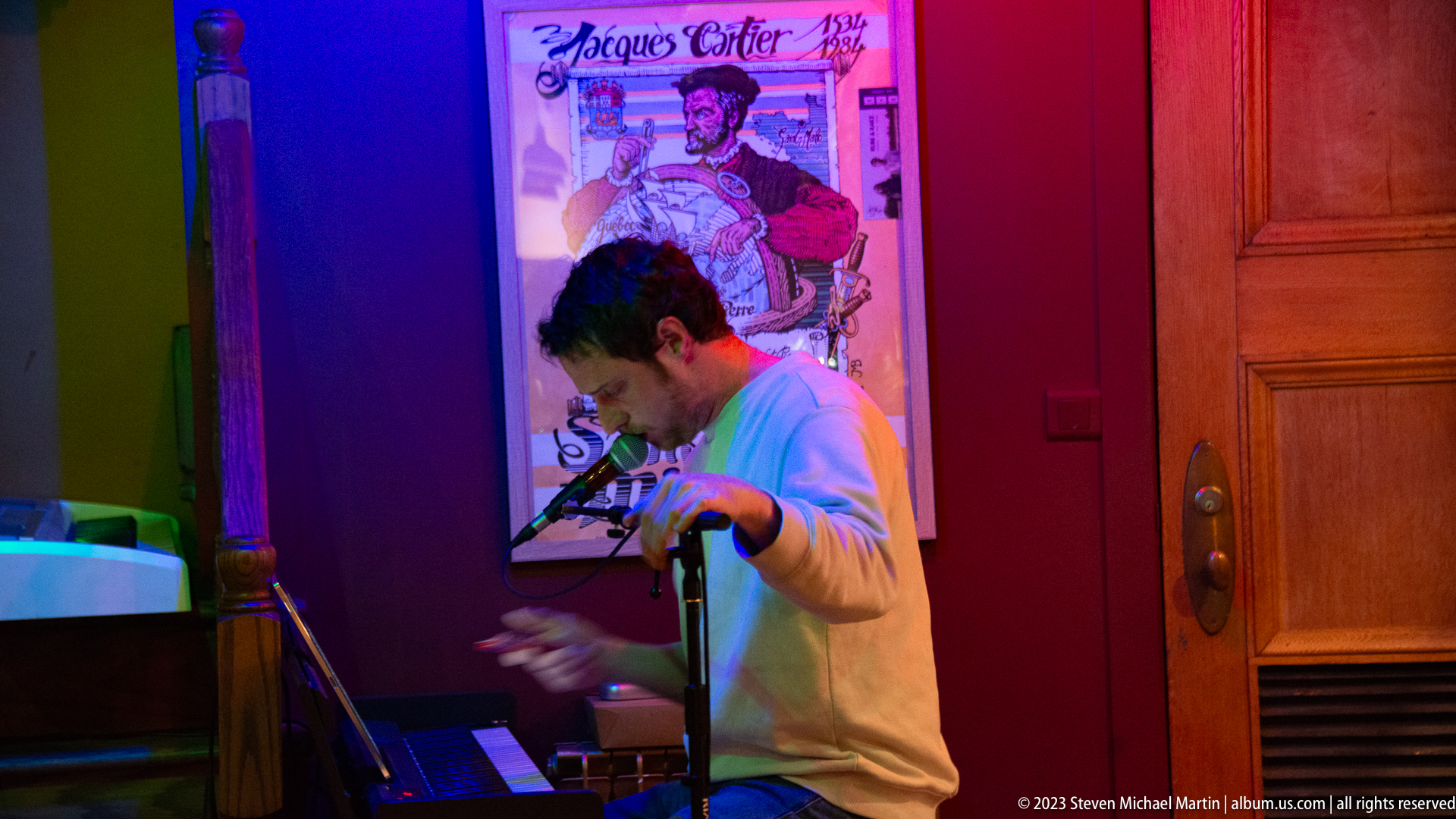
A musician performs at an electronic keyboard under saturated blue, magenta, and green lighting, his hands poised over the keys while a framed poster hangs behind him. The intimate scale and improvised-looking performance corner suggest live entertainment within a bar or café rather than a formal stage. Colored light gives the scene the energetic atmosphere of an evening gathering in Saint-Pierre.
Caption
A musician performs at an electronic keyboard under saturated blue, magenta, and green lighting, his hands poised over the keys while a framed poster hangs behind him. The intimate scale and improvised-looking performance corner suggest live entertainment within a bar or café rather than a formal stage. Colored light gives the scene the energetic atmosphere of an evening gathering in Saint-Pierre.
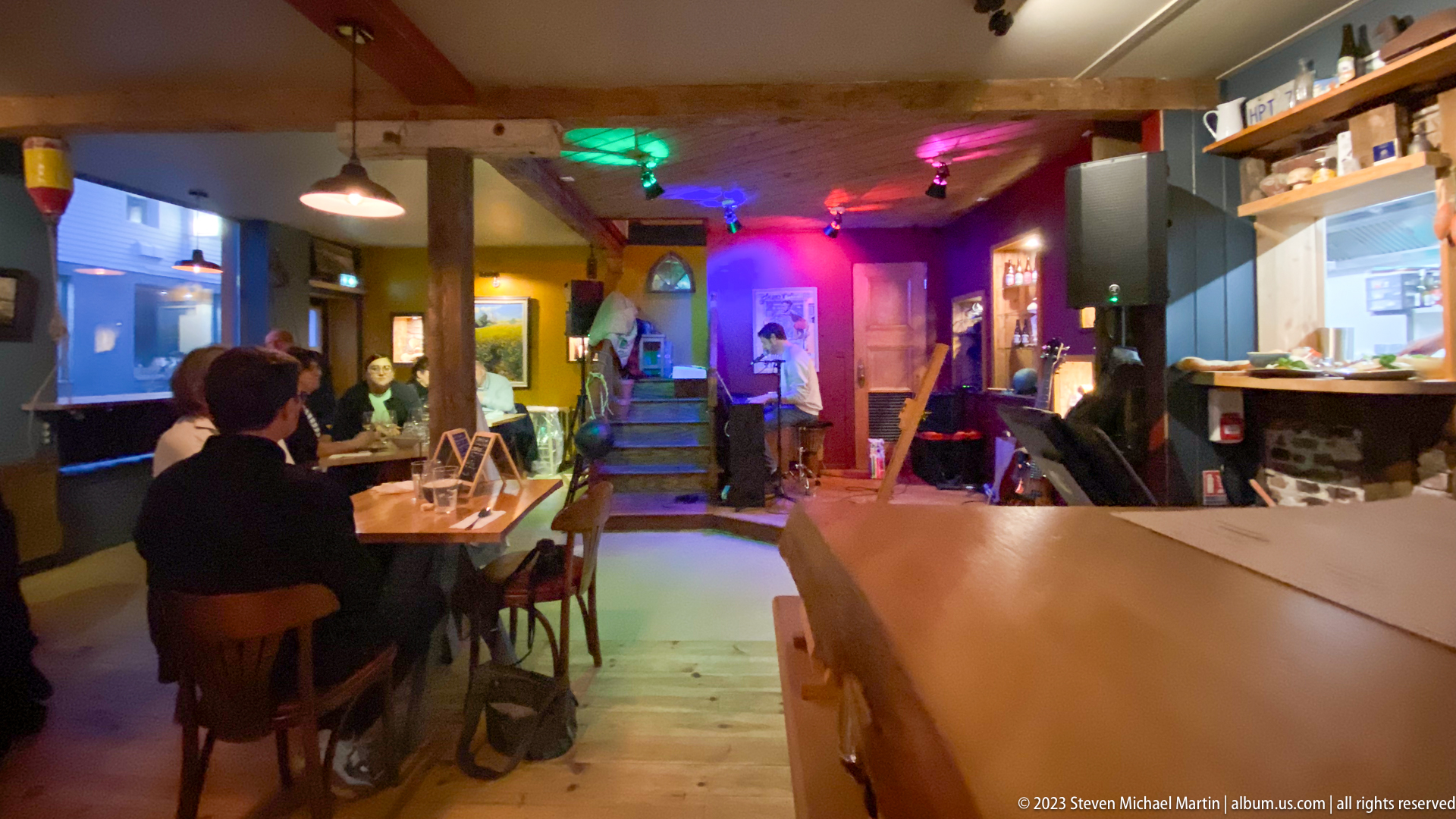
A long wooden bar occupies the right side of a narrow café interior, while patrons sit at tables beneath pendant lights and multicolored illumination. At the far end, a keyboard and microphone stand define a small performance area reached by a few steps. The view establishes the full social space behind the closer music and food details, combining dining, drinking, and live entertainment in one compact room.
Caption
A long wooden bar occupies the right side of a narrow café interior, while patrons sit at tables beneath pendant lights and multicolored illumination. At the far end, a keyboard and microphone stand define a small performance area reached by a few steps. The view establishes the full social space behind the closer music and food details, combining dining, drinking, and live entertainment in one compact room.

Patrons gather around a wooden table beneath a salon-style arrangement of framed landscape paintings. Warm wall lighting and the timber surfaces create a subdued setting distinct from the brighter performance area elsewhere in the room. The photograph shifts attention from the bar itself to the establishment’s social and decorative character, where local or regional scenery forms the backdrop for an evening meal.
Caption
Patrons gather around a wooden table beneath a salon-style arrangement of framed landscape paintings. Warm wall lighting and the timber surfaces create a subdued setting distinct from the brighter performance area elsewhere in the room. The photograph shifts attention from the bar itself to the establishment’s social and decorative character, where local or regional scenery forms the backdrop for an evening meal.

Two carefully plated dishes sit on the bar beside tall glasses of amber beer. Each plate combines a vivid green purée or sauce with roasted components, leafy greens, and a large white soft cheese or creamy garnish. The close view emphasizes contemporary presentation and texture, documenting a specific meal rather than the surrounding restaurant interior while retaining the convivial context of drinks and counter service.
Caption
Two carefully plated dishes sit on the bar beside tall glasses of amber beer. Each plate combines a vivid green purée or sauce with roasted components, leafy greens, and a large white soft cheese or creamy garnish. The close view emphasizes contemporary presentation and texture, documenting a specific meal rather than the surrounding restaurant interior while retaining the convivial context of drinks and counter service.
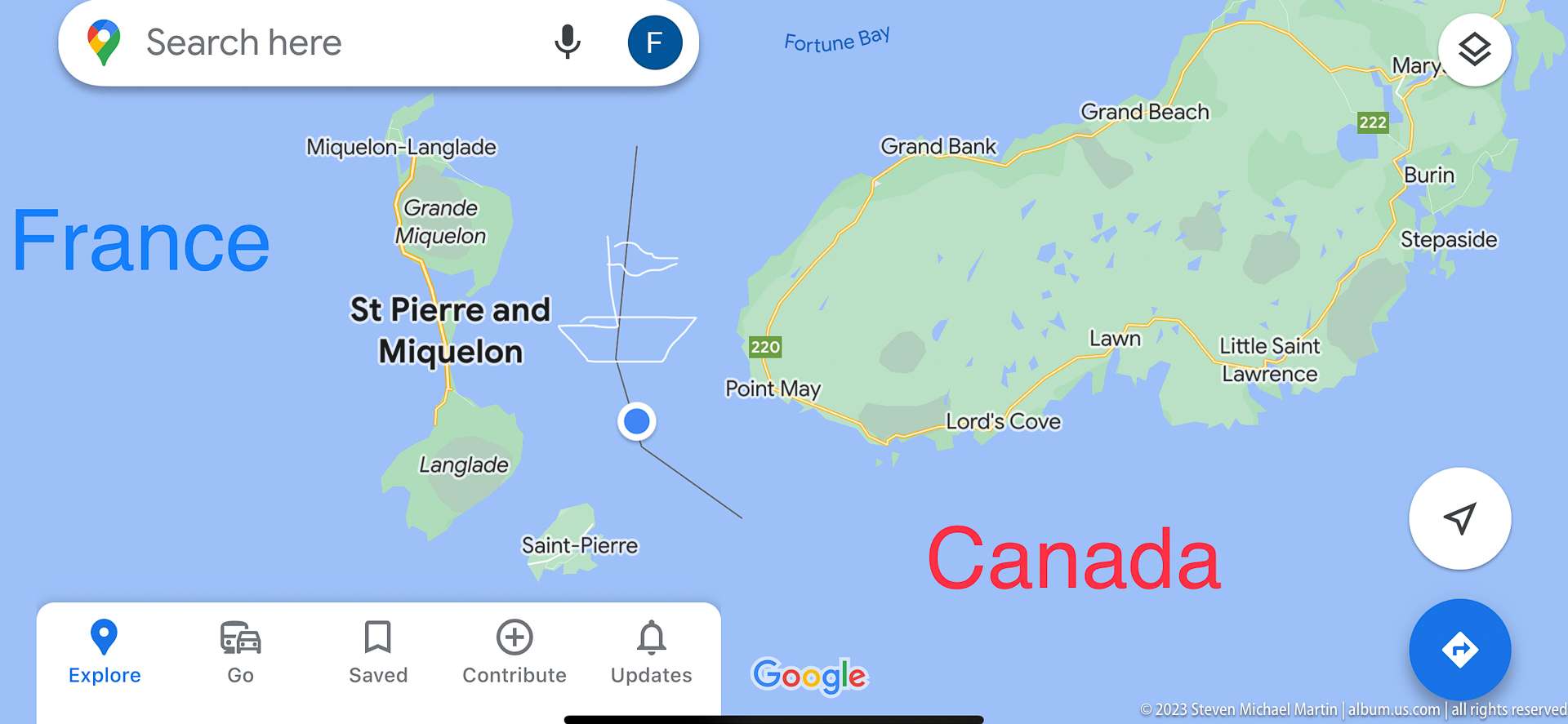
A phone screen shows Saint Pierre and Miquelon between Newfoundland’s Burin Peninsula and the open North Atlantic, with the international boundary between France and Canada made explicit by the map labels. The screenshot gives geographic context to the ferry journey, illustrating the archipelago’s unusual position as French territory immediately off the Canadian coast.
Caption
A phone screen shows Saint Pierre and Miquelon between Newfoundland’s Burin Peninsula and the open North Atlantic, with the international boundary between France and Canada made explicit by the map labels. The screenshot gives geographic context to the ferry journey, illustrating the archipelago’s unusual position as French territory immediately off the Canadian coast.

A composed dessert centers on a round, cocoa-colored cake or pastry capped with a pale filling, accompanied by dollops of cream, blueberries, berry sauce, and a crumb garnish. A small green leaf adds contrast to the dark plate. The close framing records the restaurant’s dessert presentation while avoiding an exact recipe identification that cannot be established from appearance alone.
Caption
A composed dessert centers on a round, cocoa-colored cake or pastry capped with a pale filling, accompanied by dollops of cream, blueberries, berry sauce, and a crumb garnish. A small green leaf adds contrast to the dark plate. The close framing records the restaurant’s dessert presentation while avoiding an exact recipe identification that cannot be established from appearance alone.
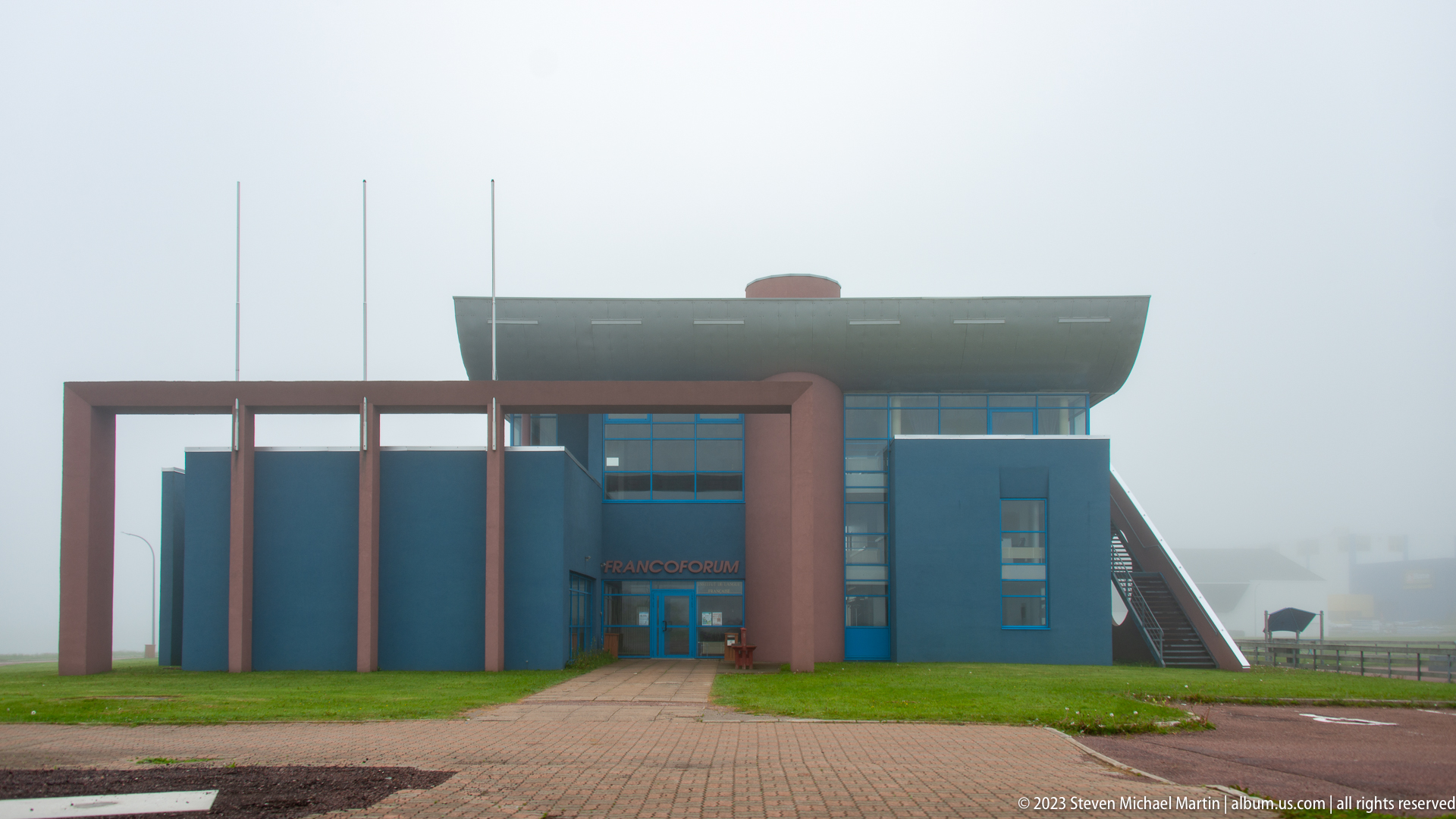
A modern institutional building stands alone in heavy fog, with blue wall panels, rose-colored structural frames, tall windows, exterior stairs, and a broad curved roofline. A sign above the entrance is present but not fully legible at proof-sheet scale. The frontal composition emphasizes the building’s geometric design and public-facing entrance while preserving uncertainty about its exact institutional function.
Caption
A modern institutional building stands alone in heavy fog, with blue wall panels, rose-colored structural frames, tall windows, exterior stairs, and a broad curved roofline. A sign above the entrance is present but not fully legible at proof-sheet scale. The frontal composition emphasizes the building’s geometric design and public-facing entrance while preserving uncertainty about its exact institutional function.
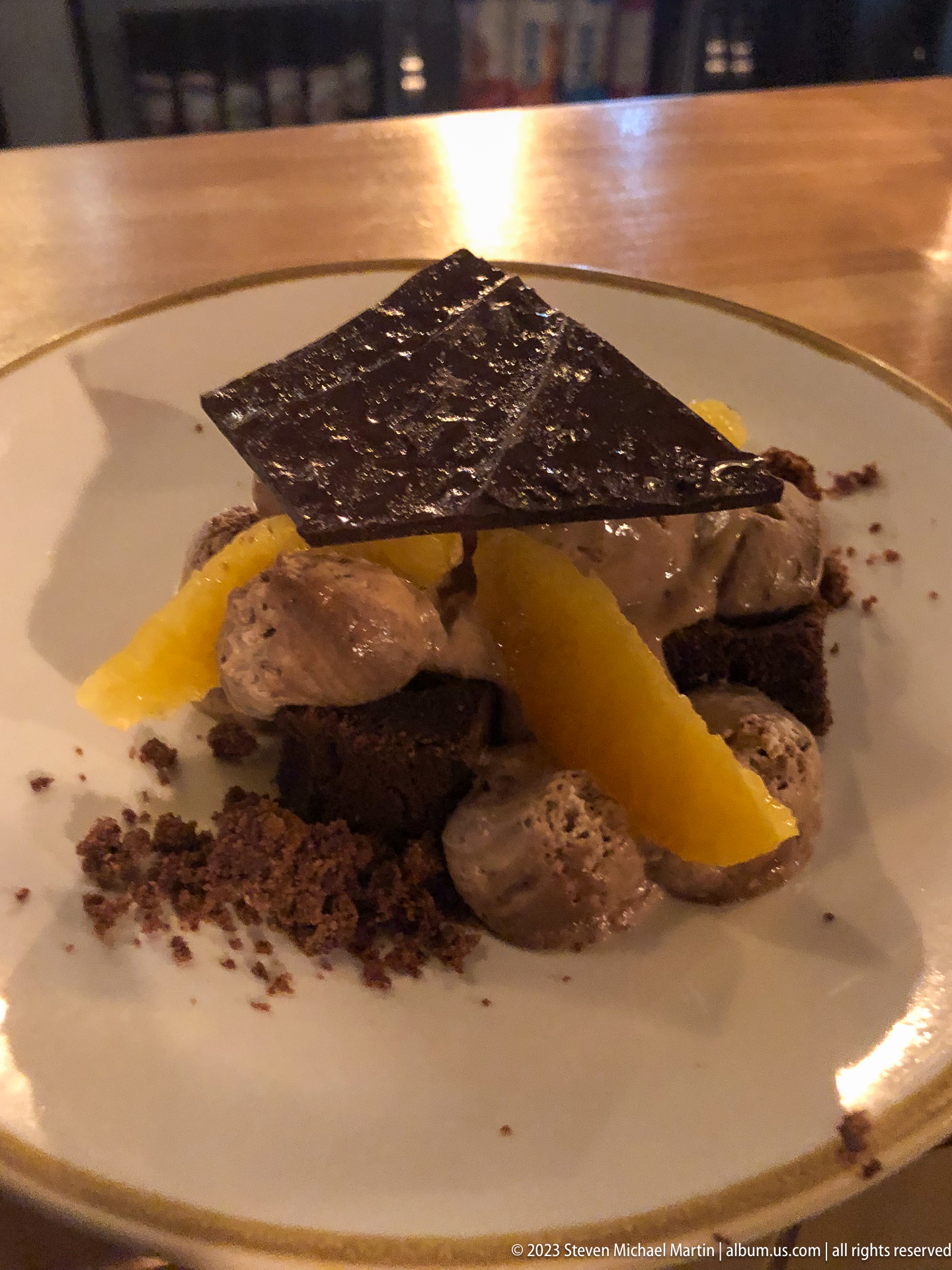
A large glossy chocolate shard rests over a layered dessert of dark cake or crumbs, pale cream, and bright orange citrus segments. Small piped dollops and scattered chocolate crumbs create a carefully arranged restaurant presentation. The low viewpoint emphasizes the contrast between brittle chocolate, soft cream, and fruit while leaving the precise dessert name appropriately unspecified.
Caption
A large glossy chocolate shard rests over a layered dessert of dark cake or crumbs, pale cream, and bright orange citrus segments. Small piped dollops and scattered chocolate crumbs create a carefully arranged restaurant presentation. The low viewpoint emphasizes the contrast between brittle chocolate, soft cream, and fruit while leaving the precise dessert name appropriately unspecified.
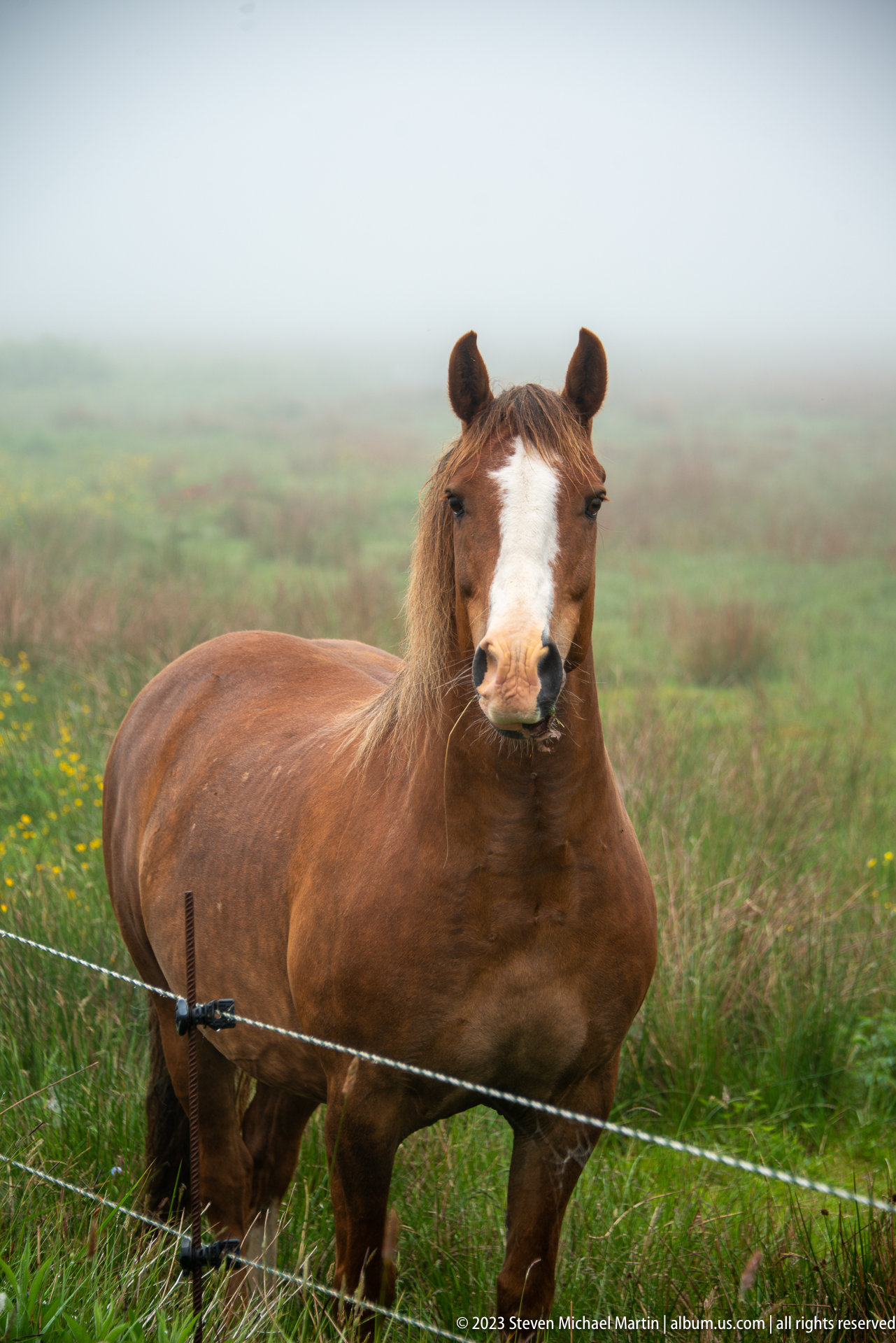
A stocky chestnut horse stands behind an electric fence in a wet meadow, turning its head toward the camera. A broad white facial marking, pale muzzle, and thick tousled mane distinguish the animal, while yellow wildflowers punctuate the fog-softened pasture behind. The medium-distance portrait balances individual markings with the lush grassland setting.
Caption
A stocky chestnut horse stands behind an electric fence in a wet meadow, turning its head toward the camera. A broad white facial marking, pale muzzle, and thick tousled mane distinguish the animal, while yellow wildflowers punctuate the fog-softened pasture behind. The medium-distance portrait balances individual markings with the lush grassland setting.

A sailboat is viewed head-on from below, its bow painted with the large number “830” split by the stem. The mast and standing rigging rise into a blank gray sky, creating a strict vertical geometry above the broad blue-and-white hull. The elevated position indicates the vessel is hauled out rather than afloat.
Caption
A sailboat is viewed head-on from below, its bow painted with the large number “830” split by the stem. The mast and standing rigging rise into a blank gray sky, creating a strict vertical geometry above the broad blue-and-white hull. The elevated position indicates the vessel is hauled out rather than afloat.
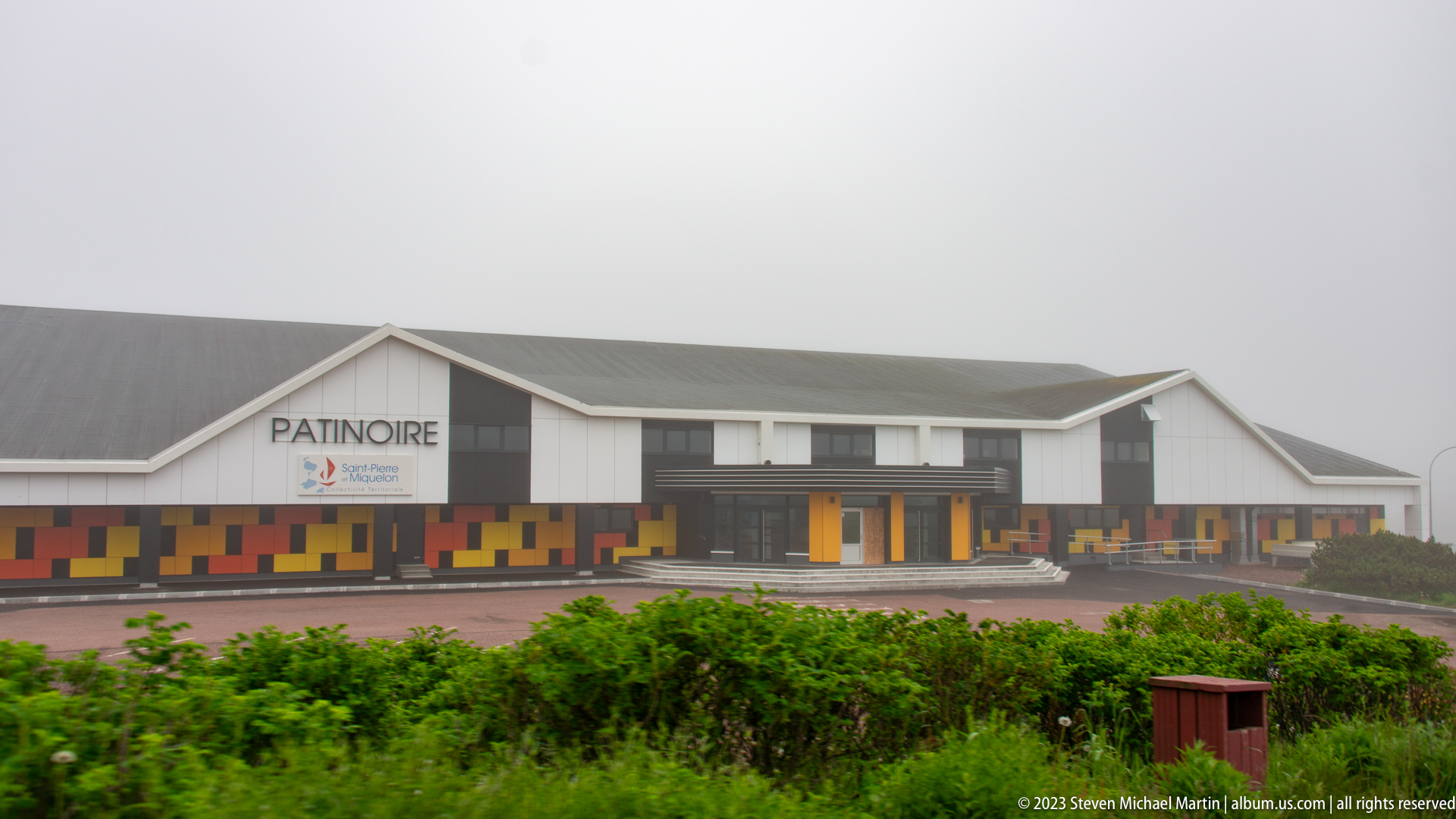
A low, broad recreational building bears the prominent word “PATINOIRE” above its entrance, identifying it as an ice rink. The façade combines gray siding with blocks of warm orange, yellow, and red at ground level, while dense fog obscures the surroundings. The color accents and large roof volume give the otherwise utilitarian sports facility a distinctive presence in Saint-Pierre’s subdued weather.
Caption
A low, broad recreational building bears the prominent word “PATINOIRE” above its entrance, identifying it as an ice rink. The façade combines gray siding with blocks of warm orange, yellow, and red at ground level, while dense fog obscures the surroundings. The color accents and large roof volume give the otherwise utilitarian sports facility a distinctive presence in Saint-Pierre’s subdued weather.
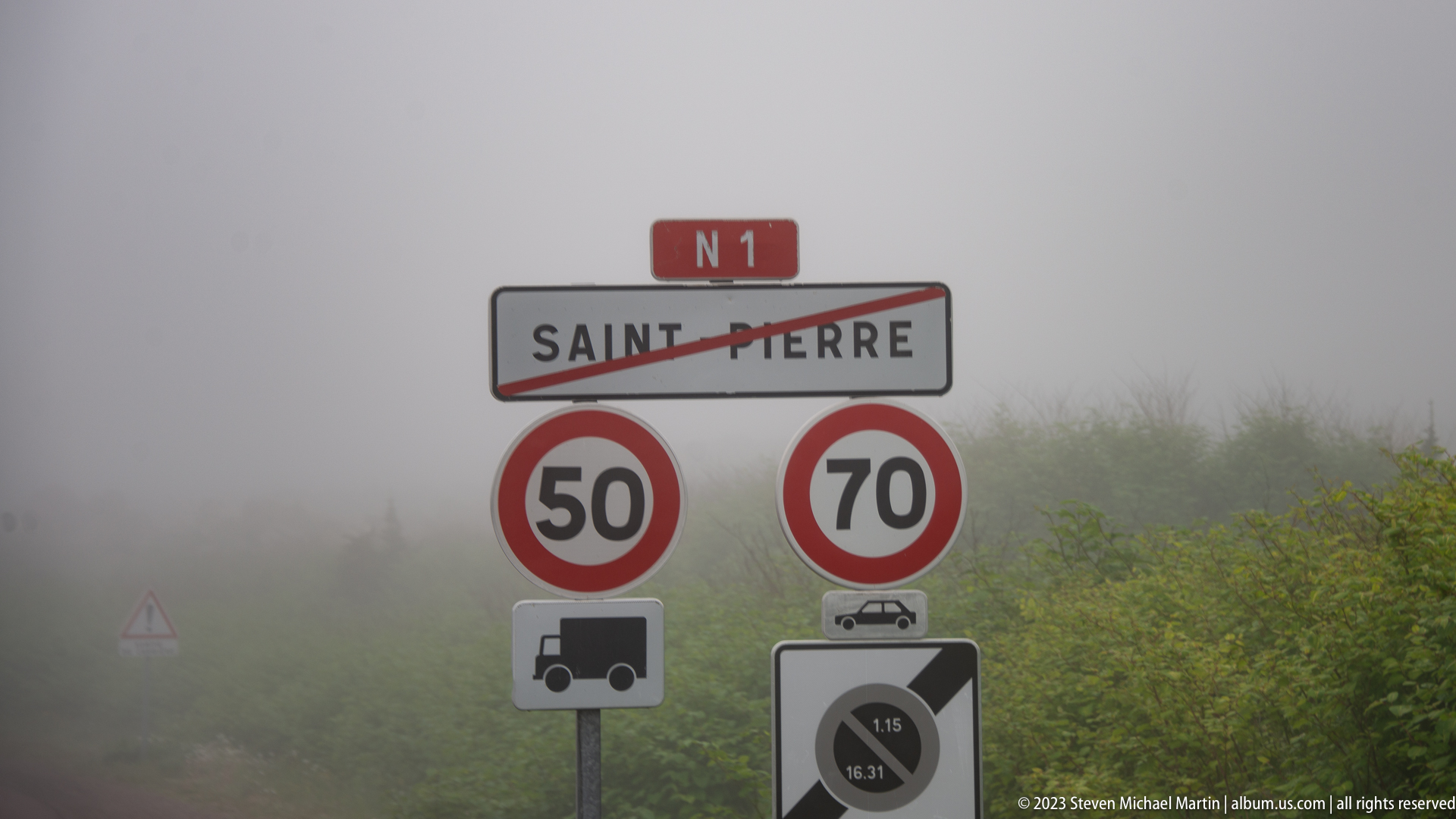
A roadside sign on route N1 shows the name SAINT-PIERRE crossed by a red diagonal bar, indicating departure from the built-up area. Circular 50 and 70 speed-limit signs appear below with vehicle symbols, while dense fog reduces the road and vegetation behind to pale silhouettes. The scene records the transition from town streets to the island road network under characteristic low visibility.
Caption
A roadside sign on route N1 shows the name SAINT-PIERRE crossed by a red diagonal bar, indicating departure from the built-up area. Circular 50 and 70 speed-limit signs appear below with vehicle symbols, while dense fog reduces the road and vegetation behind to pale silhouettes. The scene records the transition from town streets to the island road network under characteristic low visibility.
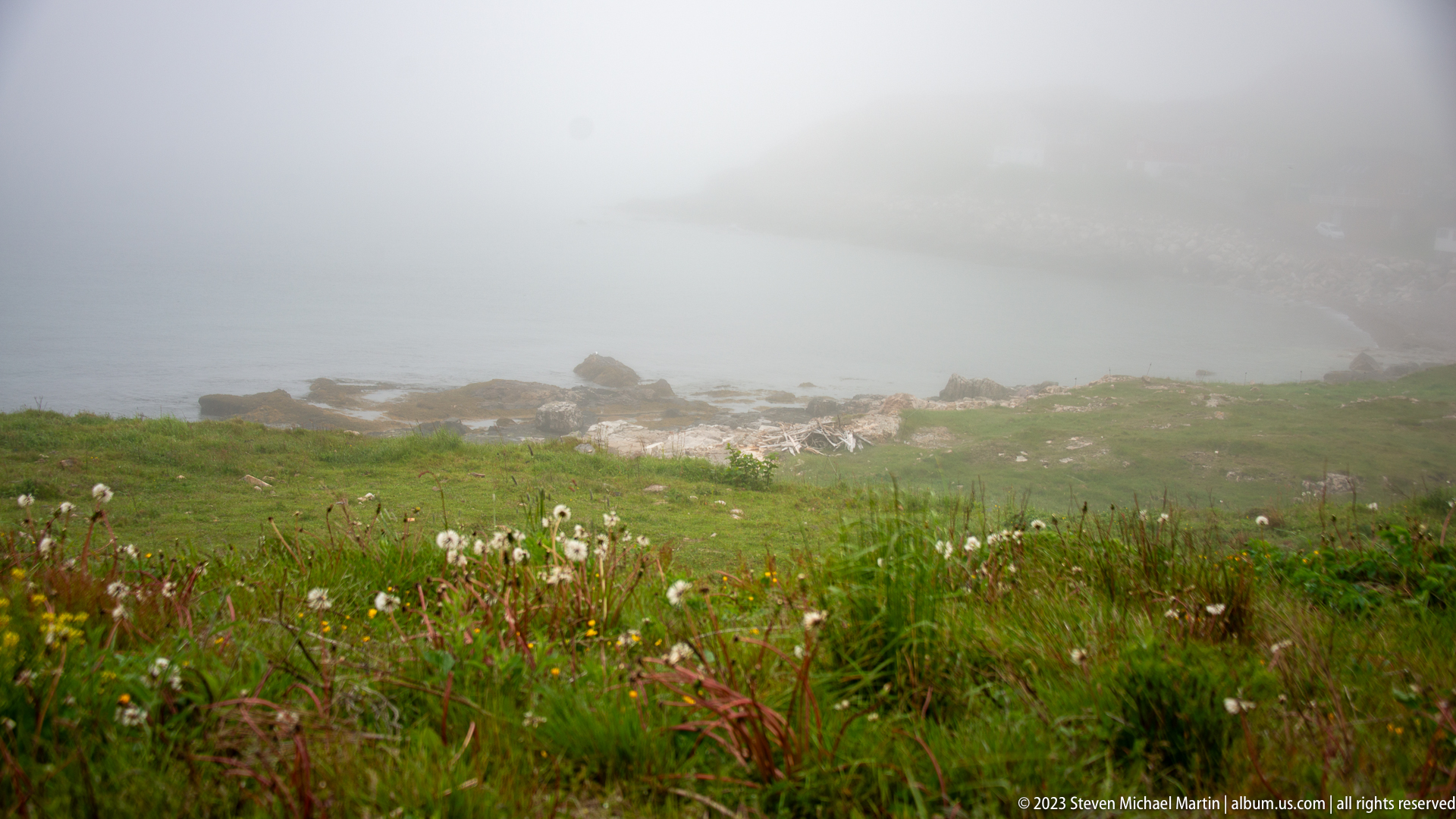
A wet green meadow dotted with white and yellow wildflowers slopes toward a rocky shoreline almost erased by fog. The water beyond merges with the gray sky, leaving only scattered rocks and a faint coastal edge visible. The view emphasizes the low, windswept vegetation and saturated ground of the island landscape rather than a named geographic feature.
Caption
A wet green meadow dotted with white and yellow wildflowers slopes toward a rocky shoreline almost erased by fog. The water beyond merges with the gray sky, leaving only scattered rocks and a faint coastal edge visible. The view emphasizes the low, windswept vegetation and saturated ground of the island landscape rather than a named geographic feature.
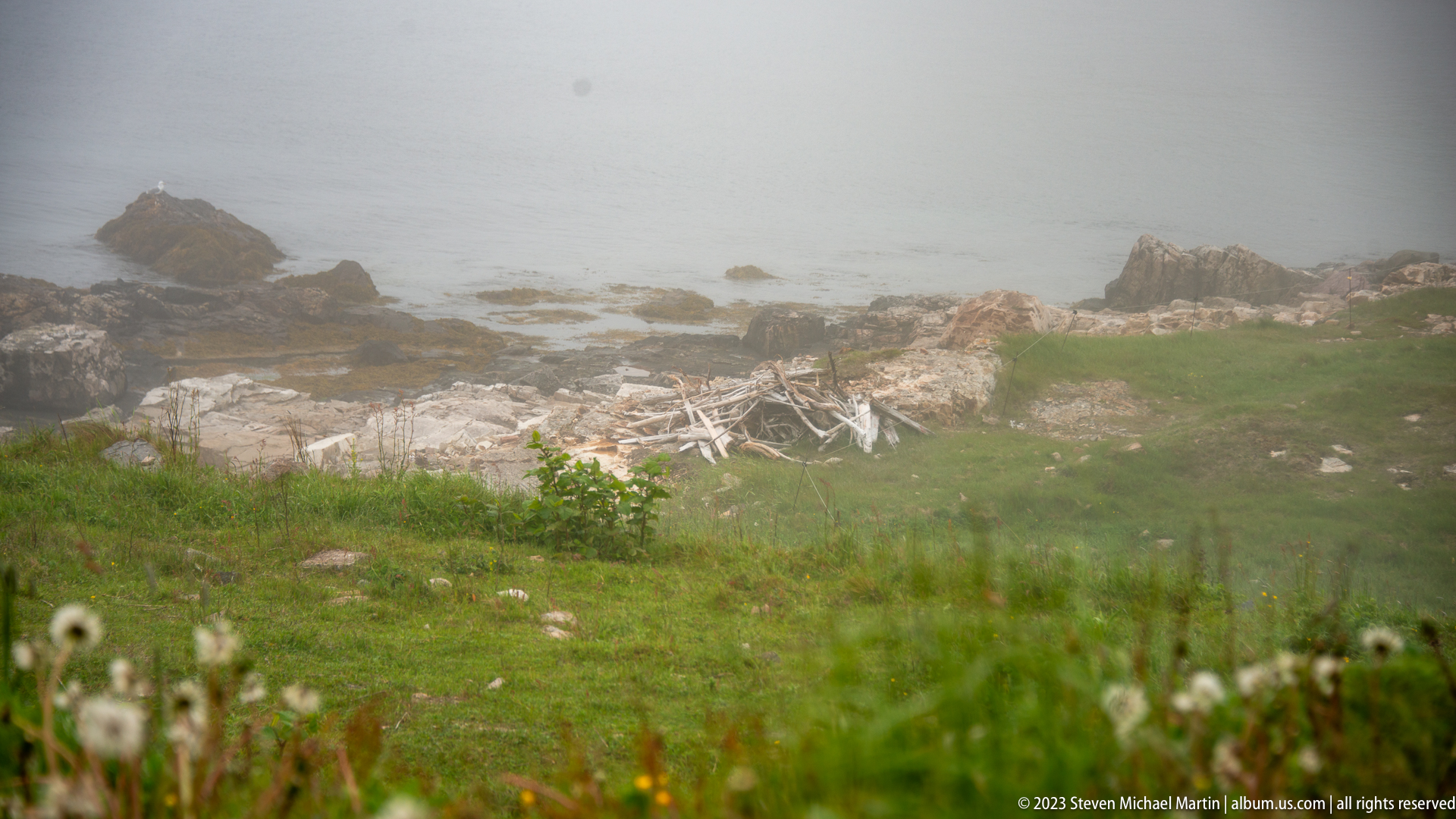
Weathered driftwood and pale timber fragments collect among exposed rocks at the edge of a foggy shoreline. Green turf surrounds the debris while dark rock ledges descend toward calm water beyond. The photograph isolates the material carried and deposited by the sea, showing the meeting point of maritime weather, rocky geology, and low coastal vegetation.
Caption
Weathered driftwood and pale timber fragments collect among exposed rocks at the edge of a foggy shoreline. Green turf surrounds the debris while dark rock ledges descend toward calm water beyond. The photograph isolates the material carried and deposited by the sea, showing the meeting point of maritime weather, rocky geology, and low coastal vegetation.

A chestnut horse faces the camera in a misty pasture, its long forelock and mane dampened by the weather and a broad white blaze running down its face. A turquoise halter provides a bright contrast against the reddish coat. The close portrait separates the animal from the wider grazing landscape and focuses attention on expression, coat texture, and tack.
Caption
A chestnut horse faces the camera in a misty pasture, its long forelock and mane dampened by the weather and a broad white blaze running down its face. A turquoise halter provides a bright contrast against the reddish coat. The close portrait separates the animal from the wider grazing landscape and focuses attention on expression, coat texture, and tack.
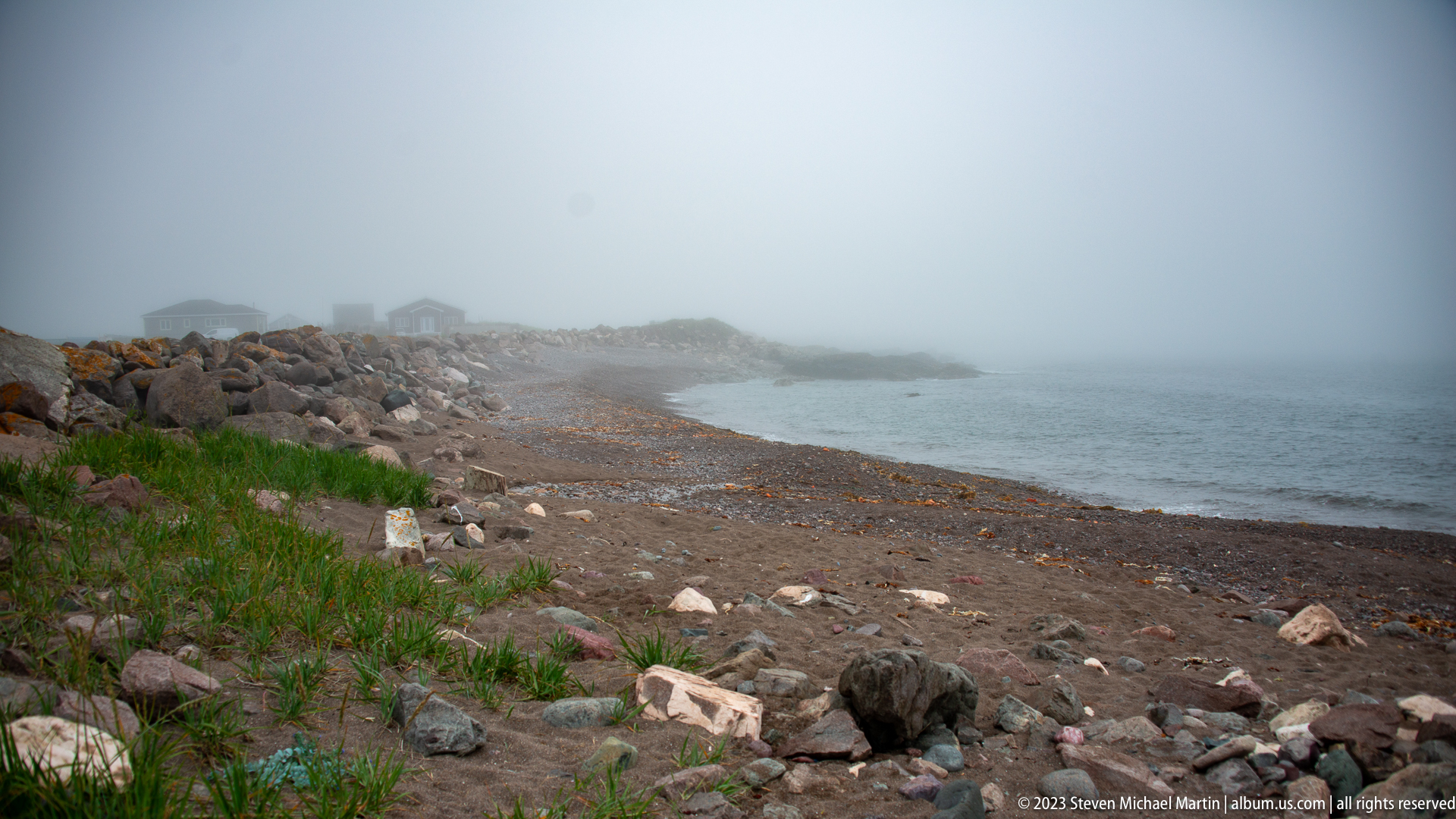
A narrow beach of dark gravel and rounded stones curves into thick fog beside calm gray water. Larger boulders and sparse coastal plants occupy the foreground, while a low rocky point and faint structure nearly disappear in the distance. The subdued view records a shoreline shaped more by rock and weather than by sand, characteristic of an exposed North Atlantic island coast.
Caption
A narrow beach of dark gravel and rounded stones curves into thick fog beside calm gray water. Larger boulders and sparse coastal plants occupy the foreground, while a low rocky point and faint structure nearly disappear in the distance. The subdued view records a shoreline shaped more by rock and weather than by sand, characteristic of an exposed North Atlantic island coast.

White cottony seedheads rise on slender stems among gray rocks splashed with vivid orange lichen. The close focus contrasts delicate wetland vegetation with the hard, weathered stone of the coast, while a dark rock face recedes behind. The detail view records the small-scale plant and lichen textures that animate the otherwise muted maritime landscape.
Caption
White cottony seedheads rise on slender stems among gray rocks splashed with vivid orange lichen. The close focus contrasts delicate wetland vegetation with the hard, weathered stone of the coast, while a dark rock face recedes behind. The detail view records the small-scale plant and lichen textures that animate the otherwise muted maritime landscape.

Two horses stand in a foggy coastal pasture behind a simple electric fence. A light-colored horse wearing a turquoise halter looks toward the camera while a darker horse lowers its head to graze. The paired view shifts from portraiture to animal behavior and setting, showing domestic horses occupying open grassland under the island’s damp, low-visibility conditions.
Caption
Two horses stand in a foggy coastal pasture behind a simple electric fence. A light-colored horse wearing a turquoise halter looks toward the camera while a darker horse lowers its head to graze. The paired view shifts from portraiture to animal behavior and setting, showing domestic horses occupying open grassland under the island’s damp, low-visibility conditions.
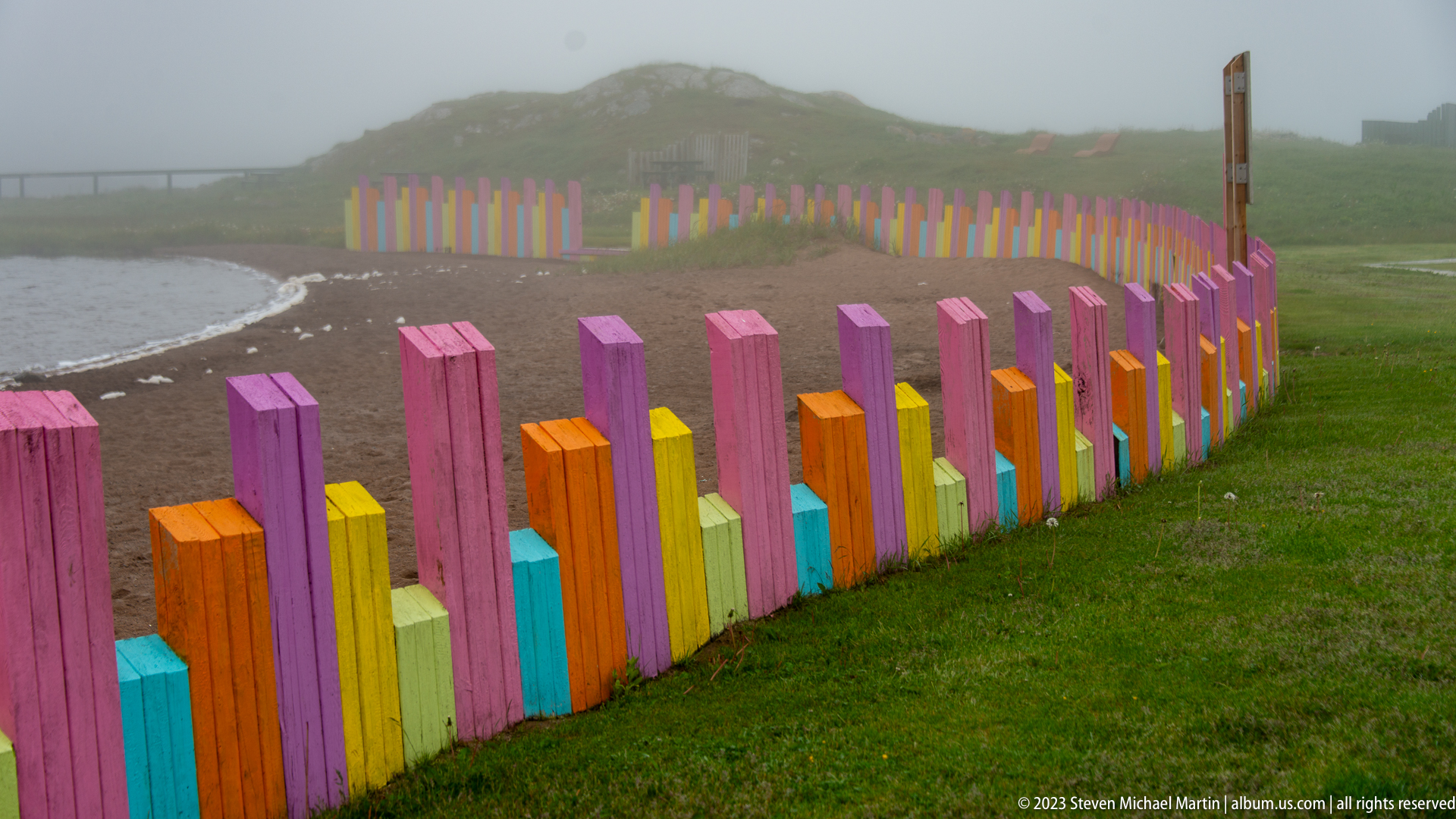
A long fence of brightly painted timber posts curves along the edge of a dark pebbly beach, alternating pink, orange, yellow, turquoise, and green against heavy fog. The repeating verticals follow the shoreline into the distance, transforming a simple boundary into a vivid landscape feature. Wet grass and muted sea emphasize the contrast between the installation’s saturated colors and the subdued coastal weather.
Caption
A long fence of brightly painted timber posts curves along the edge of a dark pebbly beach, alternating pink, orange, yellow, turquoise, and green against heavy fog. The repeating verticals follow the shoreline into the distance, transforming a simple boundary into a vivid landscape feature. Wet grass and muted sea emphasize the contrast between the installation’s saturated colors and the subdued coastal weather.

Viewed from closer range, the painted beach fence becomes a rhythmic sequence of tall pink uprights interspersed with shorter orange, yellow, turquoise, and green posts. The line bends sharply with the shore and recedes into fog, emphasizing its constructed geometry against the natural beach. This perspective distinguishes the design and spacing of the posts more clearly than the wider establishing view.
Caption
Viewed from closer range, the painted beach fence becomes a rhythmic sequence of tall pink uprights interspersed with shorter orange, yellow, turquoise, and green posts. The line bends sharply with the shore and recedes into fog, emphasizing its constructed geometry against the natural beach. This perspective distinguishes the design and spacing of the posts more clearly than the wider establishing view.

Two compact barrel-shaped timber shelters stand in low grass beside a narrow boardwalk. Each has a dark rounded end wall, small vertical windows, and an individual stovepipe rising above the curved wooden shell. Their unusual pod-like form and isolated placement suggest small lodging or retreat structures, but the photograph does not establish their precise use.
Caption
Two compact barrel-shaped timber shelters stand in low grass beside a narrow boardwalk. Each has a dark rounded end wall, small vertical windows, and an individual stovepipe rising above the curved wooden shell. Their unusual pod-like form and isolated placement suggest small lodging or retreat structures, but the photograph does not establish their precise use.
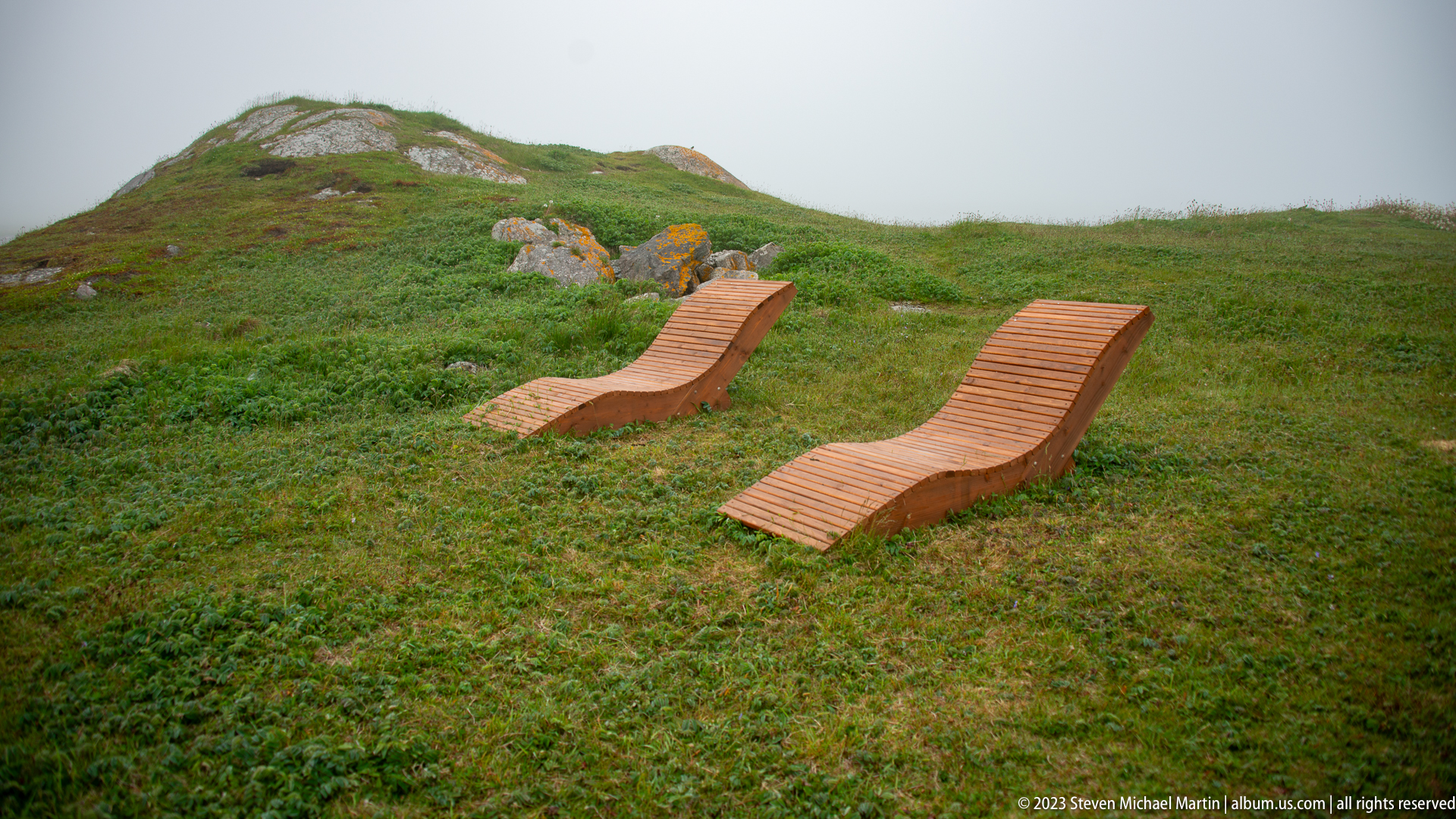
Two curved wooden recliners sit directly on a low green hillside, facing outward toward the unseen coast. Their slatted surfaces follow a wave-like profile designed for reclining, while fog erases any distant view they might ordinarily frame. The minimal composition turns the furniture into a quiet landscape element and suggests a visitor rest area integrated into the coastal terrain.
Caption
Two curved wooden recliners sit directly on a low green hillside, facing outward toward the unseen coast. Their slatted surfaces follow a wave-like profile designed for reclining, while fog erases any distant view they might ordinarily frame. The minimal composition turns the furniture into a quiet landscape element and suggests a visitor rest area integrated into the coastal terrain.
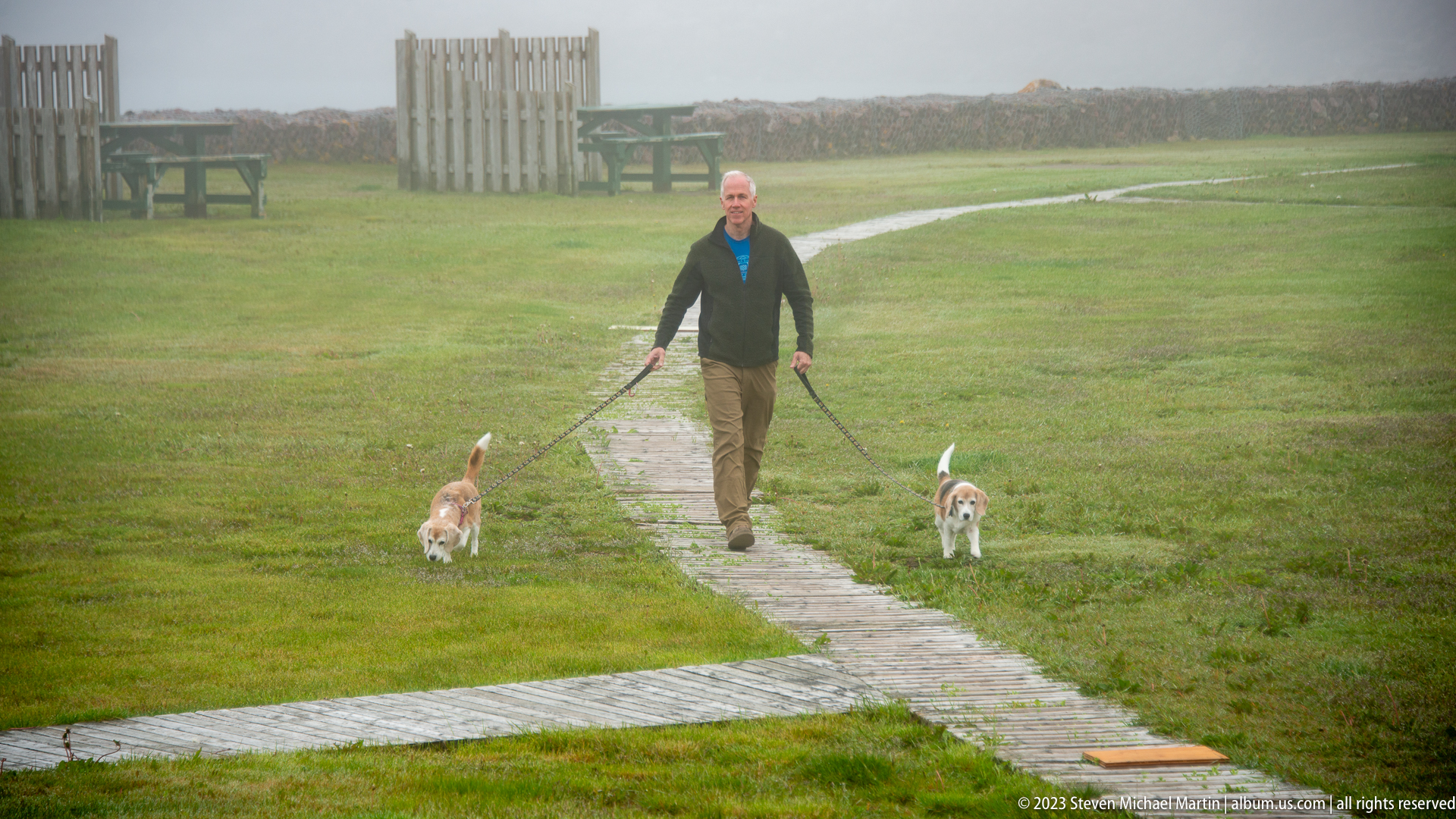
A man walks two small dogs along a narrow boardwalk that crosses a broad, fog-soaked lawn or meadow. The dogs range to either side on leashes while rustic outdoor furniture and fencing fade into the background. The candid scene documents pedestrian use of the coastal recreation area and provides human scale for the low, open landscape.
Caption
A man walks two small dogs along a narrow boardwalk that crosses a broad, fog-soaked lawn or meadow. The dogs range to either side on leashes while rustic outdoor furniture and fencing fade into the background. The candid scene documents pedestrian use of the coastal recreation area and provides human scale for the low, open landscape.

A deep-green timber wind shelter encloses a picnic-style bench and table, with high vertical boards protecting the rear and sides while leaving the front open to the landscape. Weathering on the floorboards and bench surfaces shows prolonged outdoor exposure. The structure is a practical response to an exposed coastal environment, offering seated visitors refuge without completely separating them from the surrounding meadow.
Caption
A deep-green timber wind shelter encloses a picnic-style bench and table, with high vertical boards protecting the rear and sides while leaving the front open to the landscape. Weathering on the floorboards and bench surfaces shows prolonged outdoor exposure. The structure is a practical response to an exposed coastal environment, offering seated visitors refuge without completely separating them from the surrounding meadow.
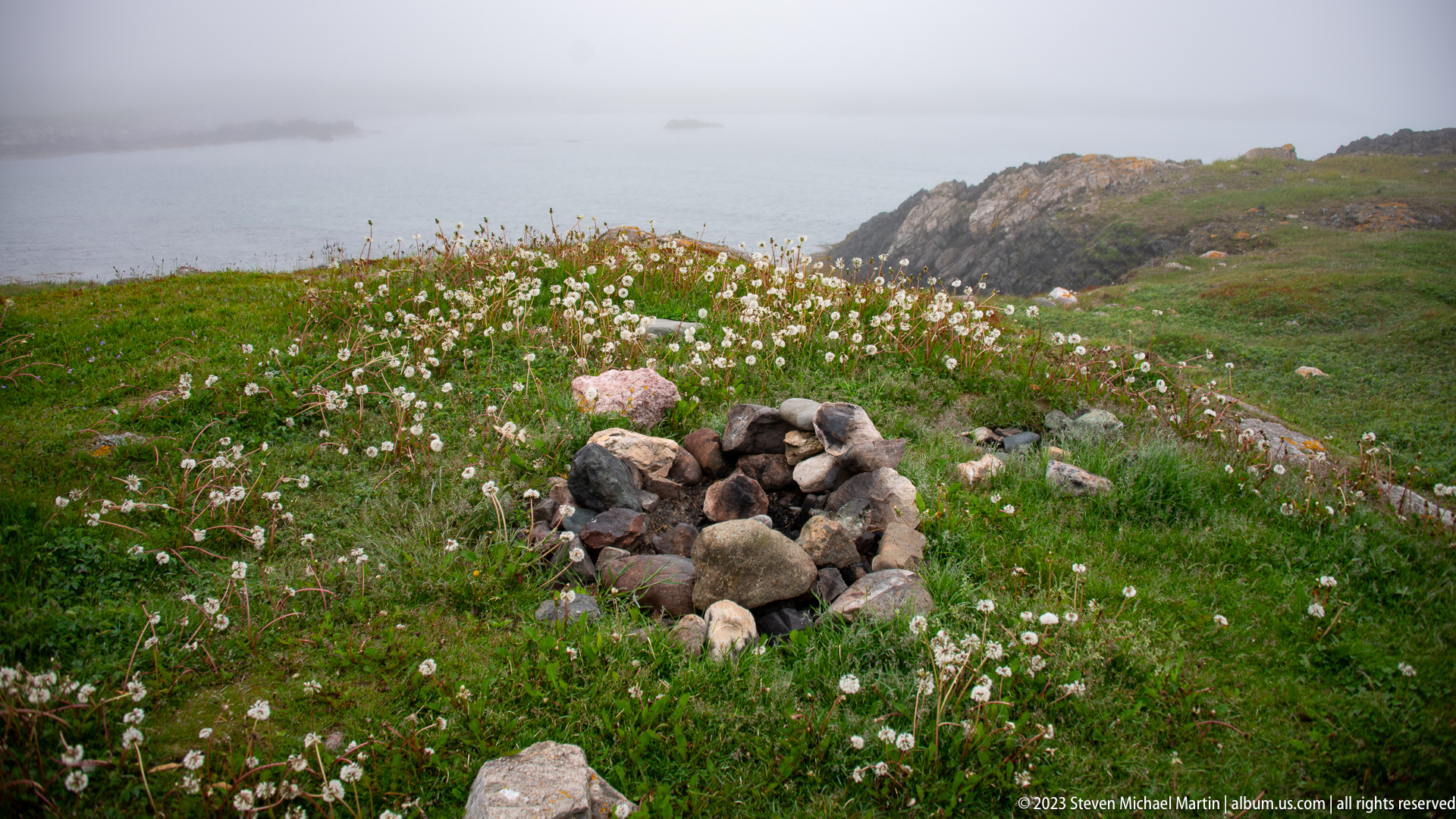
A small circular arrangement of rounded stones sits amid low coastal vegetation and abundant white seedheads, with the rocky shoreline and fog-softened sea beyond. The ring resembles either a simple fire pit or deliberately arranged cairn-like feature, but no ash or signage confirms its intended use. The photograph therefore emphasizes the constructed stone circle within the exposed meadow setting.
Caption
A small circular arrangement of rounded stones sits amid low coastal vegetation and abundant white seedheads, with the rocky shoreline and fog-softened sea beyond. The ring resembles either a simple fire pit or deliberately arranged cairn-like feature, but no ash or signage confirms its intended use. The photograph therefore emphasizes the constructed stone circle within the exposed meadow setting.
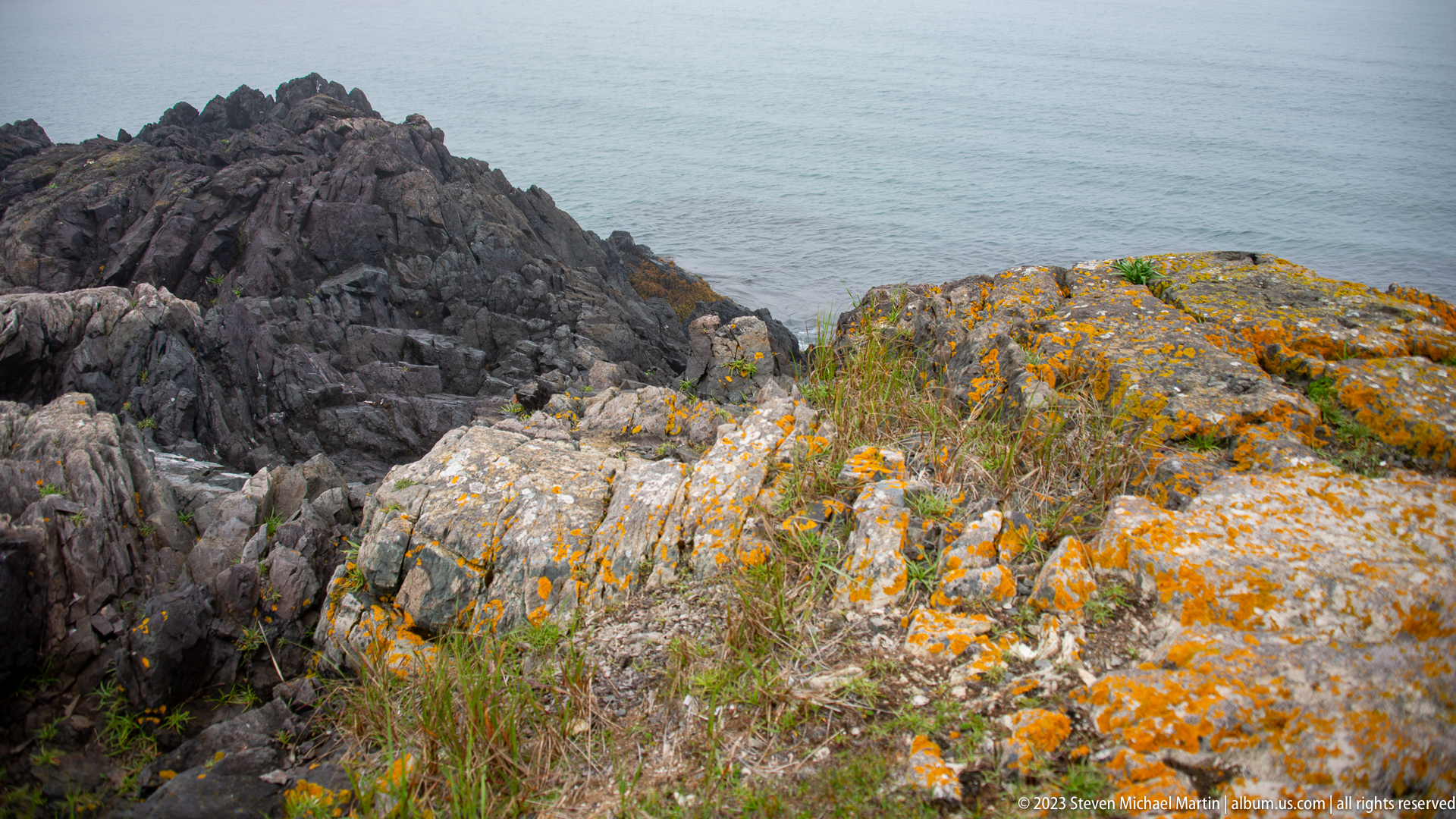
Bright orange lichen spreads across pale, fractured bedrock above a darker rock cleft and calm sea. Fine grasses grow from cracks in the stone, softening the transition between exposed geology and coastal vegetation. The close landscape study emphasizes weathered rock surfaces and biological colonization rather than a broader shoreline vista, bringing the island’s textures into sharp focus.
Caption
Bright orange lichen spreads across pale, fractured bedrock above a darker rock cleft and calm sea. Fine grasses grow from cracks in the stone, softening the transition between exposed geology and coastal vegetation. The close landscape study emphasizes weathered rock surfaces and biological colonization rather than a broader shoreline vista, bringing the island’s textures into sharp focus.
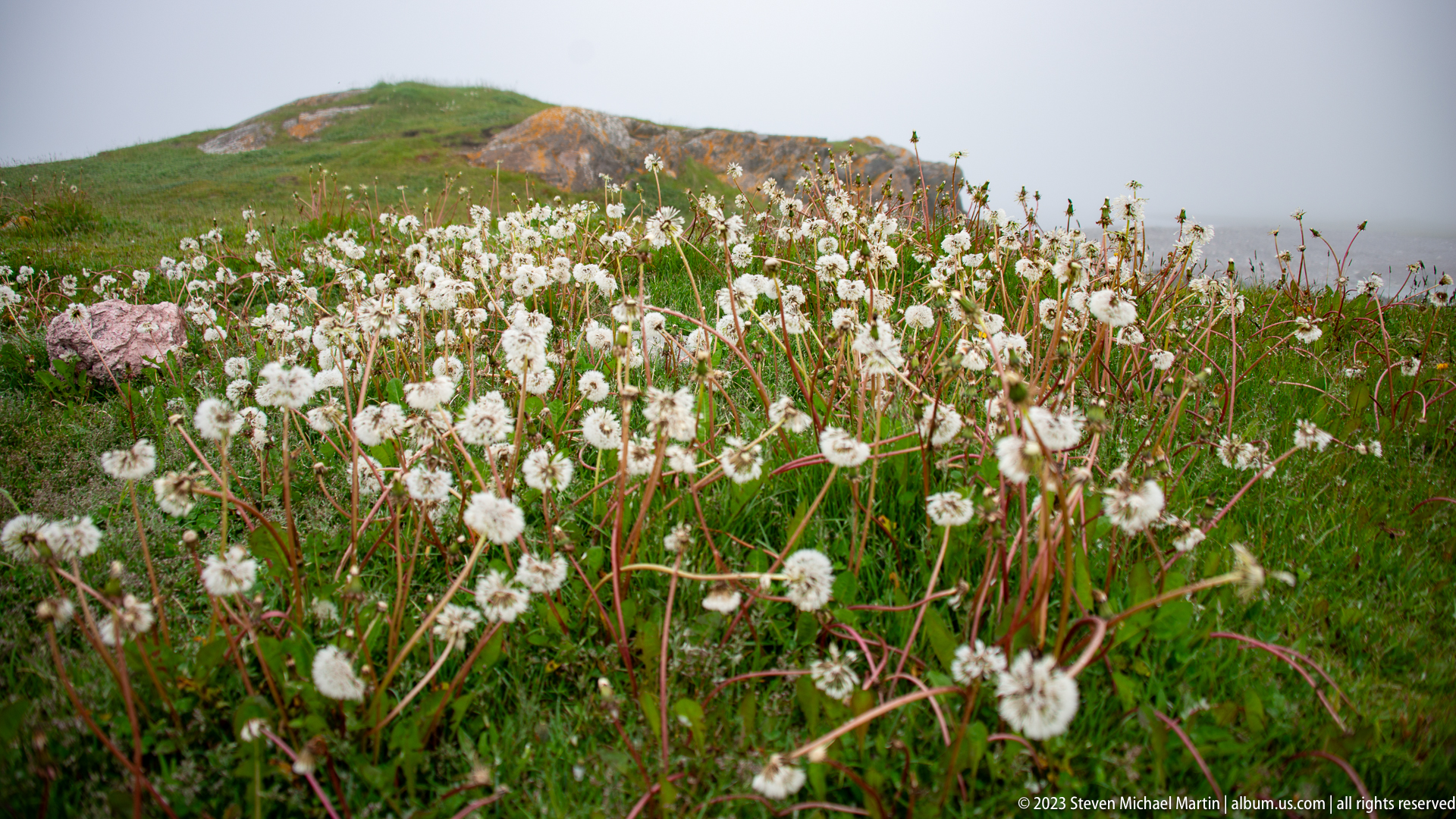
A dense stand of white cottony seedheads fills the foreground, their slender reddish stems rising above low green vegetation and scattered rocks. The foggy shoreline is only faintly visible beyond. By moving in close, the photograph makes the meadow’s delicate plant texture the principal subject, contrasting soft seed tufts with the hard stone and muted maritime atmosphere.
Caption
A dense stand of white cottony seedheads fills the foreground, their slender reddish stems rising above low green vegetation and scattered rocks. The foggy shoreline is only faintly visible beyond. By moving in close, the photograph makes the meadow’s delicate plant texture the principal subject, contrasting soft seed tufts with the hard stone and muted maritime atmosphere.

A low viewpoint looks directly along the multicolored timber fence as it runs beside the dark beach, making the nearest lime, yellow, pink, orange, and turquoise posts tower over the frame. The repeating pattern rapidly diminishes into fog and bends around the shoreline. Compared with earlier views, this angle emphasizes perspective, height variation, and the tactile construction of the painted boards.
Caption
A low viewpoint looks directly along the multicolored timber fence as it runs beside the dark beach, making the nearest lime, yellow, pink, orange, and turquoise posts tower over the frame. The repeating pattern rapidly diminishes into fog and bends around the shoreline. Compared with earlier views, this angle emphasizes perspective, height variation, and the tactile construction of the painted boards.
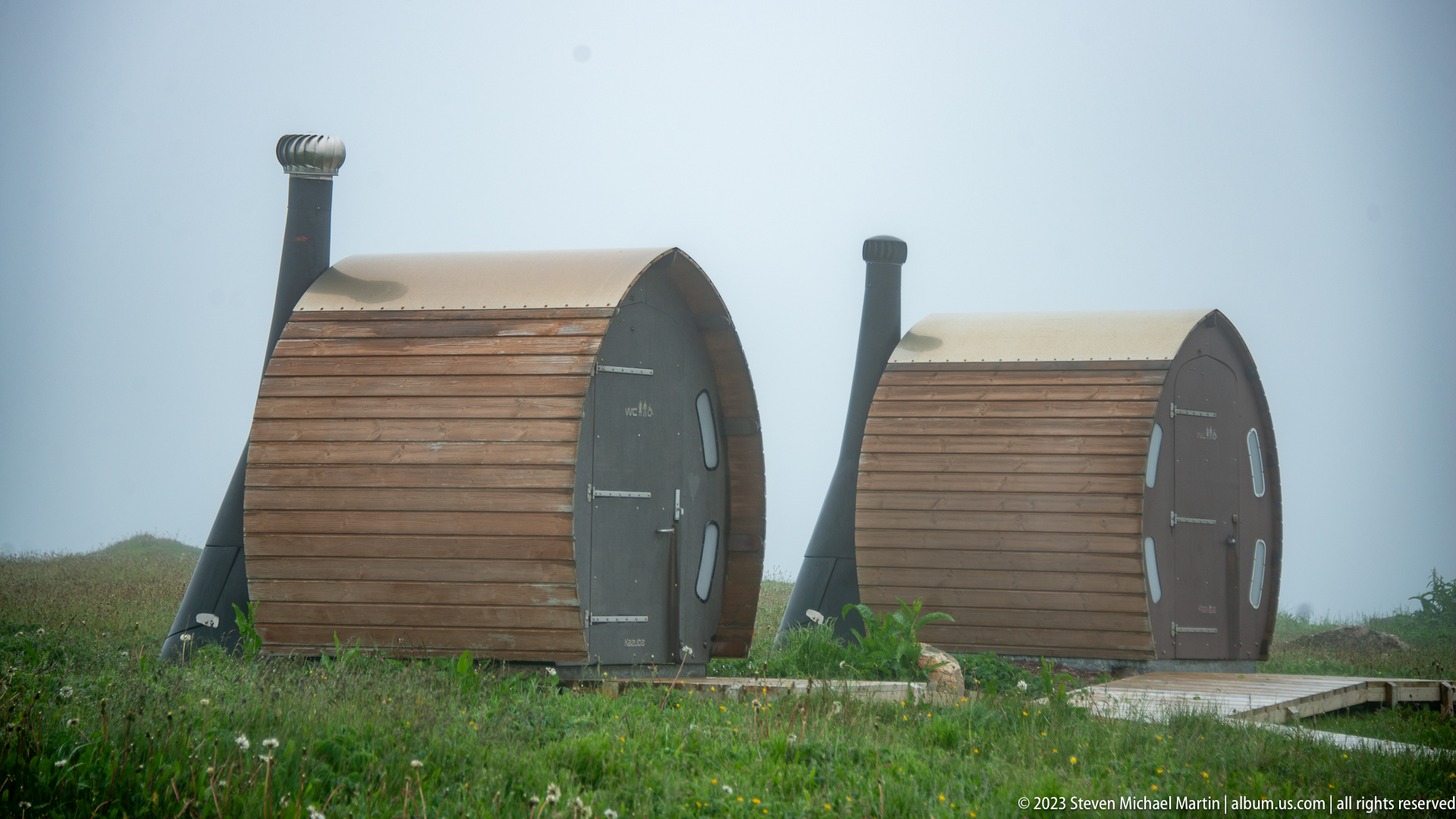
Two barrel-shaped timber pods stand side by side in thick fog, their curved roofs clad in horizontal wood boards and black end walls punctuated by narrow windows. Each has a short stovepipe, reinforcing the impression of weather-protected interior space. The closer side view clarifies the shelters’ construction and differing sizes while still leaving their exact designated use unconfirmed.
Caption
Two barrel-shaped timber pods stand side by side in thick fog, their curved roofs clad in horizontal wood boards and black end walls punctuated by narrow windows. Each has a short stovepipe, reinforcing the impression of weather-protected interior space. The closer side view clarifies the shelters’ construction and differing sizes while still leaving their exact designated use unconfirmed.
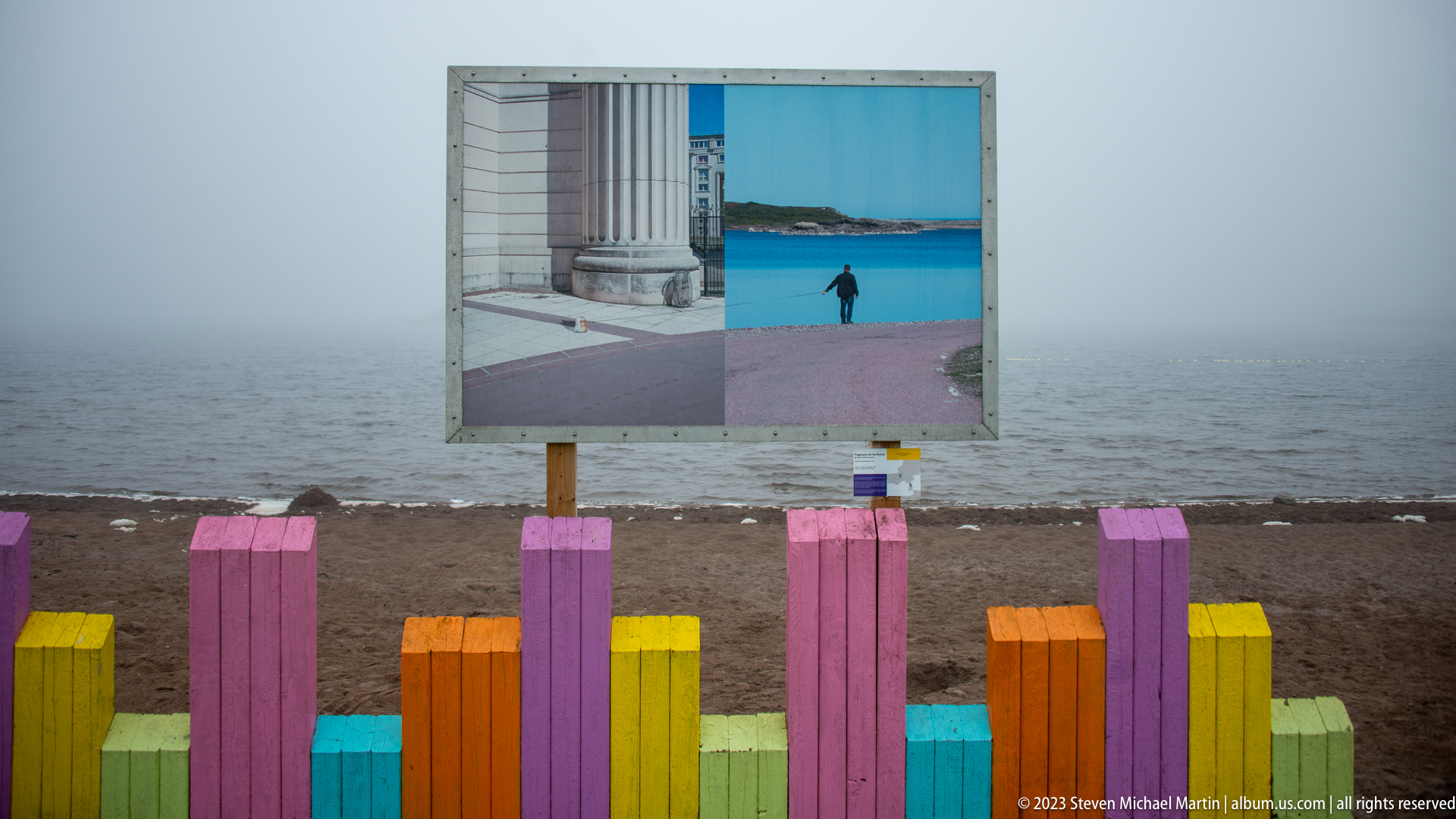
A freestanding outdoor panel reproduces two photographic scenes—one architectural and one coastal—above the same multicolored fence that lines the beach. Beyond it, gray water disappears into fog. The display introduces an interpretive or artistic layer to the recreation area, setting printed imagery against the real shoreline and creating a deliberate dialogue between representation, place, and the brightly painted boundary.
Caption
A freestanding outdoor panel reproduces two photographic scenes—one architectural and one coastal—above the same multicolored fence that lines the beach. Beyond it, gray water disappears into fog. The display introduces an interpretive or artistic layer to the recreation area, setting printed imagery against the real shoreline and creating a deliberate dialogue between representation, place, and the brightly painted boundary.
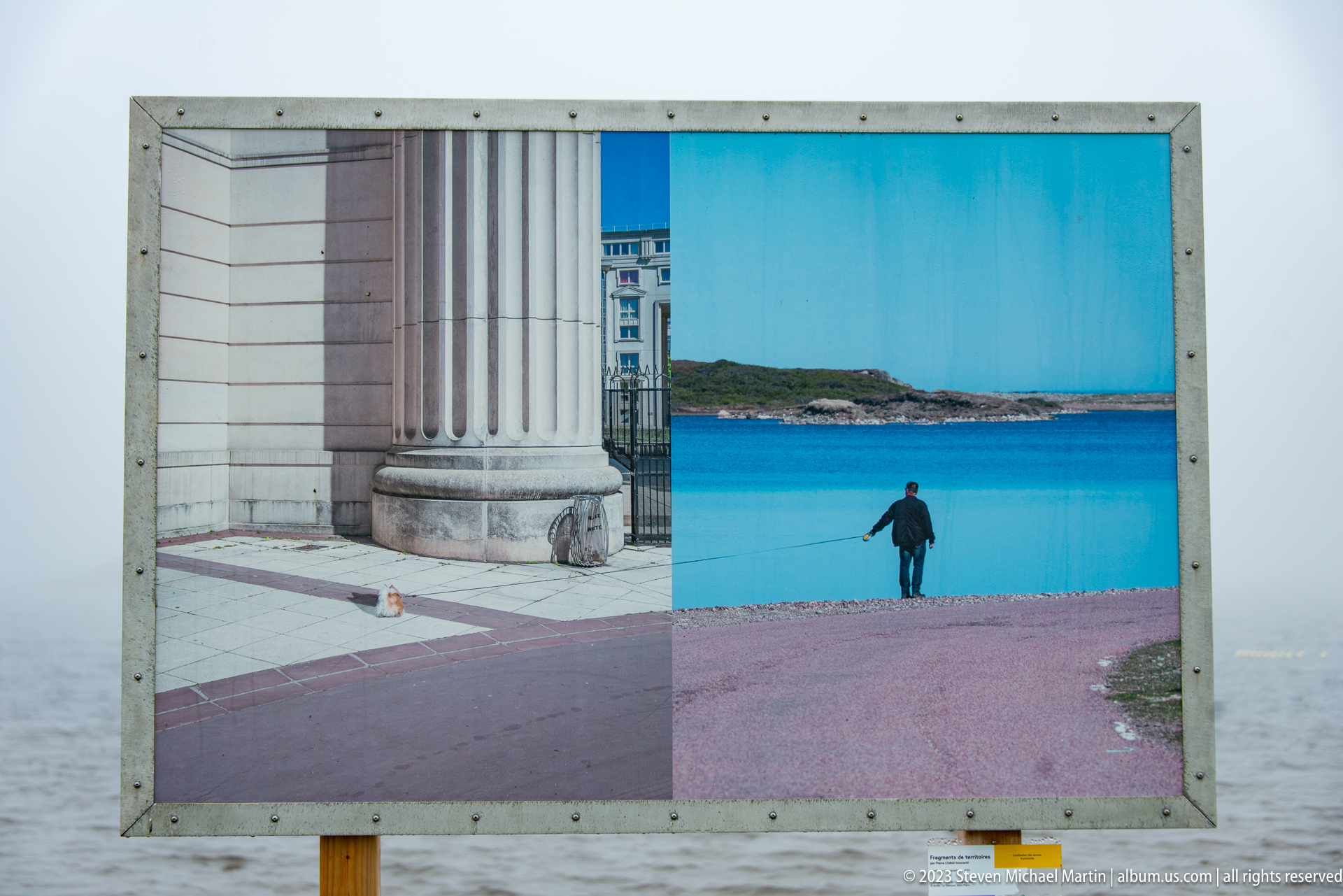
A large outdoor panel presents two contrasting photographic scenes: monumental classical columns and paving at left, and a lone figure beside intensely blue coastal water at right. Mounted in a weather-resistant frame near the shore, the display introduces an artistic or interpretive element into the coastal landscape, juxtaposing built form, human scale, and open water without revealing a legible title or authorship.
Caption
A large outdoor panel presents two contrasting photographic scenes: monumental classical columns and paving at left, and a lone figure beside intensely blue coastal water at right. Mounted in a weather-resistant frame near the shore, the display introduces an artistic or interpretive element into the coastal landscape, juxtaposing built form, human scale, and open water without revealing a legible title or authorship.

A white horse and a dark horse stand apart in a rough green pasture dotted with rocks and low vegetation. Behind them, a small red shed with a steep dark roof emerges through dense fog. The composition combines domestic animals with the sparse built landscape of the island interior, where fencing, exposed stone, and reduced visibility define the setting.
Caption
A white horse and a dark horse stand apart in a rough green pasture dotted with rocks and low vegetation. Behind them, a small red shed with a steep dark roof emerges through dense fog. The composition combines domestic animals with the sparse built landscape of the island interior, where fencing, exposed stone, and reduced visibility define the setting.

A chestnut horse wearing a turquoise halter stands alone amid low coastal vegetation, with a broad rocky hill almost completely veiled by fog behind it. The animal provides a warm focal point against the subdued green and gray landscape. This wider environmental portrait emphasizes the scale of the open pasture and the abrupt way low cloud can erase the island’s higher ground.
Caption
A chestnut horse wearing a turquoise halter stands alone amid low coastal vegetation, with a broad rocky hill almost completely veiled by fog behind it. The animal provides a warm focal point against the subdued green and gray landscape. This wider environmental portrait emphasizes the scale of the open pasture and the abrupt way low cloud can erase the island’s higher ground.
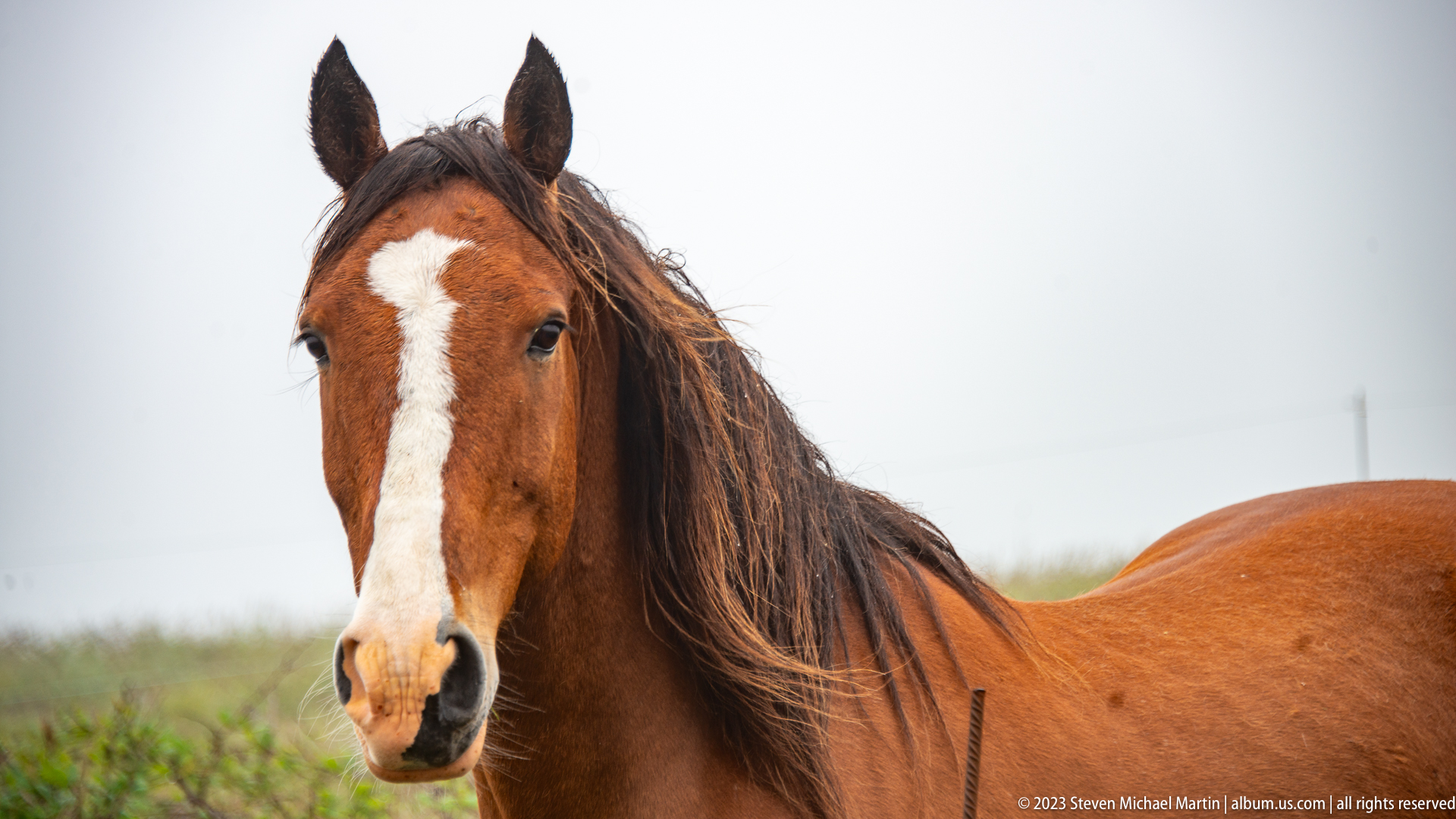
A chestnut horse fills the frame in a close portrait, its broad irregular white blaze extending from forehead to muzzle and its long damp mane falling across the neck. The shallow background reduces the foggy pasture to soft tones, concentrating attention on the animal’s facial markings, coat, and alert ears. The image complements the wider pasture views by isolating individual character and physical detail.
Caption
A chestnut horse fills the frame in a close portrait, its broad irregular white blaze extending from forehead to muzzle and its long damp mane falling across the neck. The shallow background reduces the foggy pasture to soft tones, concentrating attention on the animal’s facial markings, coat, and alert ears. The image complements the wider pasture views by isolating individual character and physical detail.
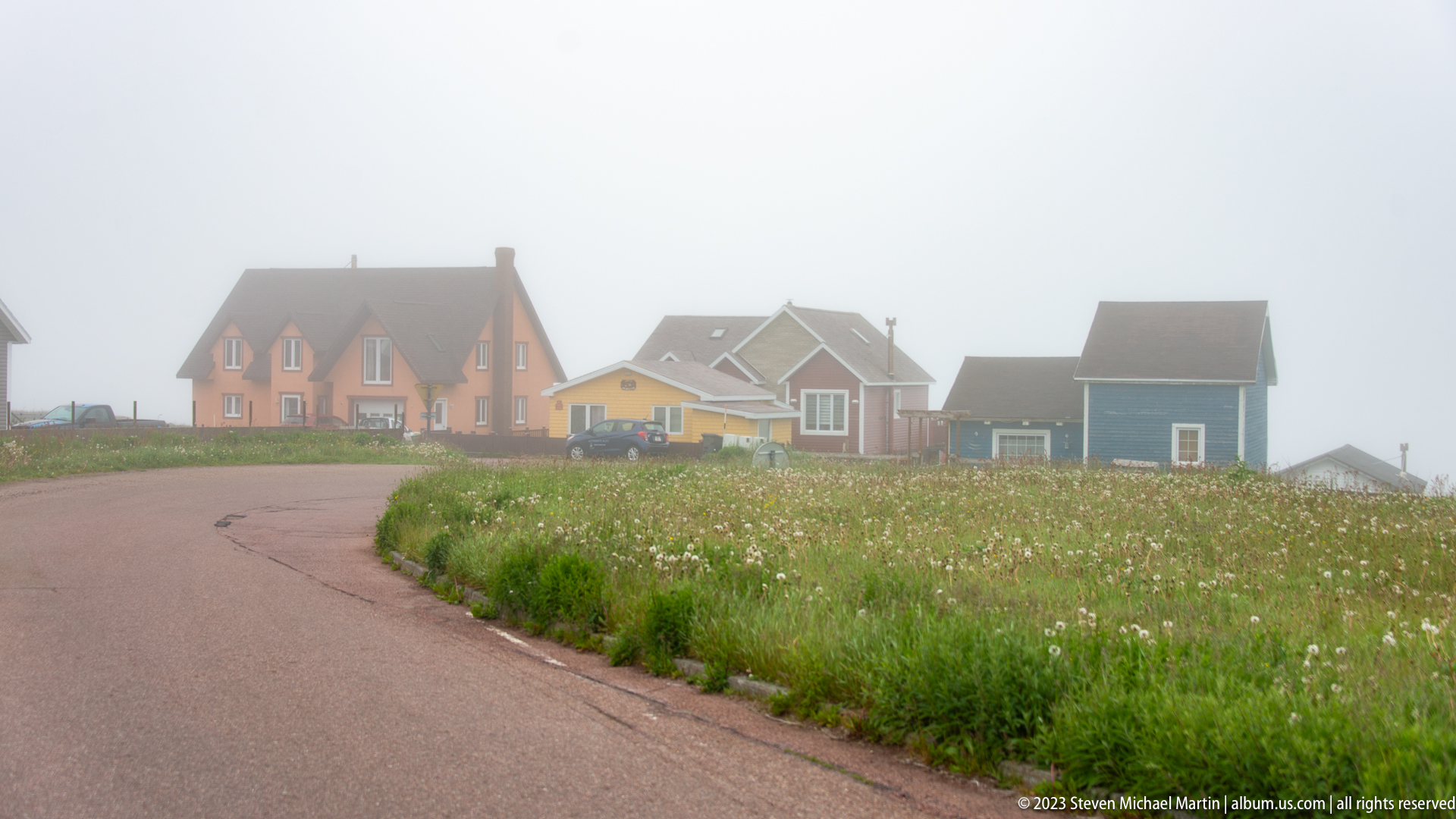
A paved lane curves past a cluster of detached houses painted in muted salmon, yellow, gray, and blue tones. Tall meadow grasses and white seedheads line the road while fog removes nearly all distant context. The scene records the small-scale residential fabric beyond Saint-Pierre’s denser waterfront, where individual houses sit directly against open grassland and quickly disappear into maritime mist.
Caption
A paved lane curves past a cluster of detached houses painted in muted salmon, yellow, gray, and blue tones. Tall meadow grasses and white seedheads line the road while fog removes nearly all distant context. The scene records the small-scale residential fabric beyond Saint-Pierre’s denser waterfront, where individual houses sit directly against open grassland and quickly disappear into maritime mist.

A freestanding display pairs a rocky track through open terrain with a sharply geometric urban scene of tall modern buildings and two pedestrians. The side-by-side images contrast sparsely settled landscape with dense architecture, while the physical panel itself stands outdoors in the island environment. No readable caption identifies the exhibition, so the record remains focused on the visible photographic juxtaposition.
Caption
A freestanding display pairs a rocky track through open terrain with a sharply geometric urban scene of tall modern buildings and two pedestrians. The side-by-side images contrast sparsely settled landscape with dense architecture, while the physical panel itself stands outdoors in the island environment. No readable caption identifies the exhibition, so the record remains focused on the visible photographic juxtaposition.
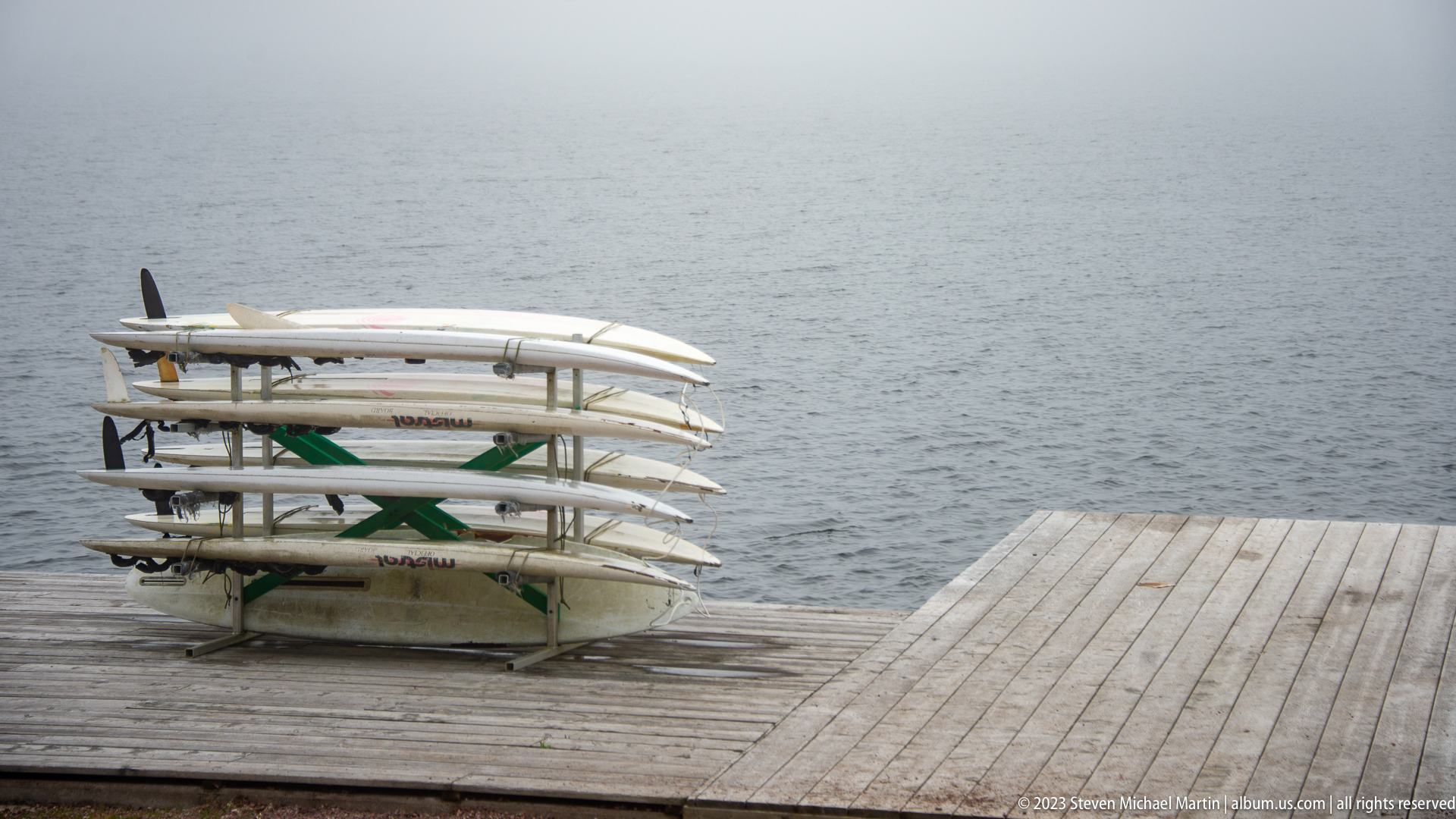
A stack of long, narrow recreational watercraft rests on a metal rack at the edge of a wooden deck, with gray water filling the background. Their pointed ends and shallow hulls indicate paddle craft stored horizontally between uses. The utilitarian arrangement connects the coastal recreation area directly to water access while the fog-muted sea keeps the emphasis on equipment rather than scenery.
Caption
A stack of long, narrow recreational watercraft rests on a metal rack at the edge of a wooden deck, with gray water filling the background. Their pointed ends and shallow hulls indicate paddle craft stored horizontally between uses. The utilitarian arrangement connects the coastal recreation area directly to water access while the fog-muted sea keeps the emphasis on equipment rather than scenery.
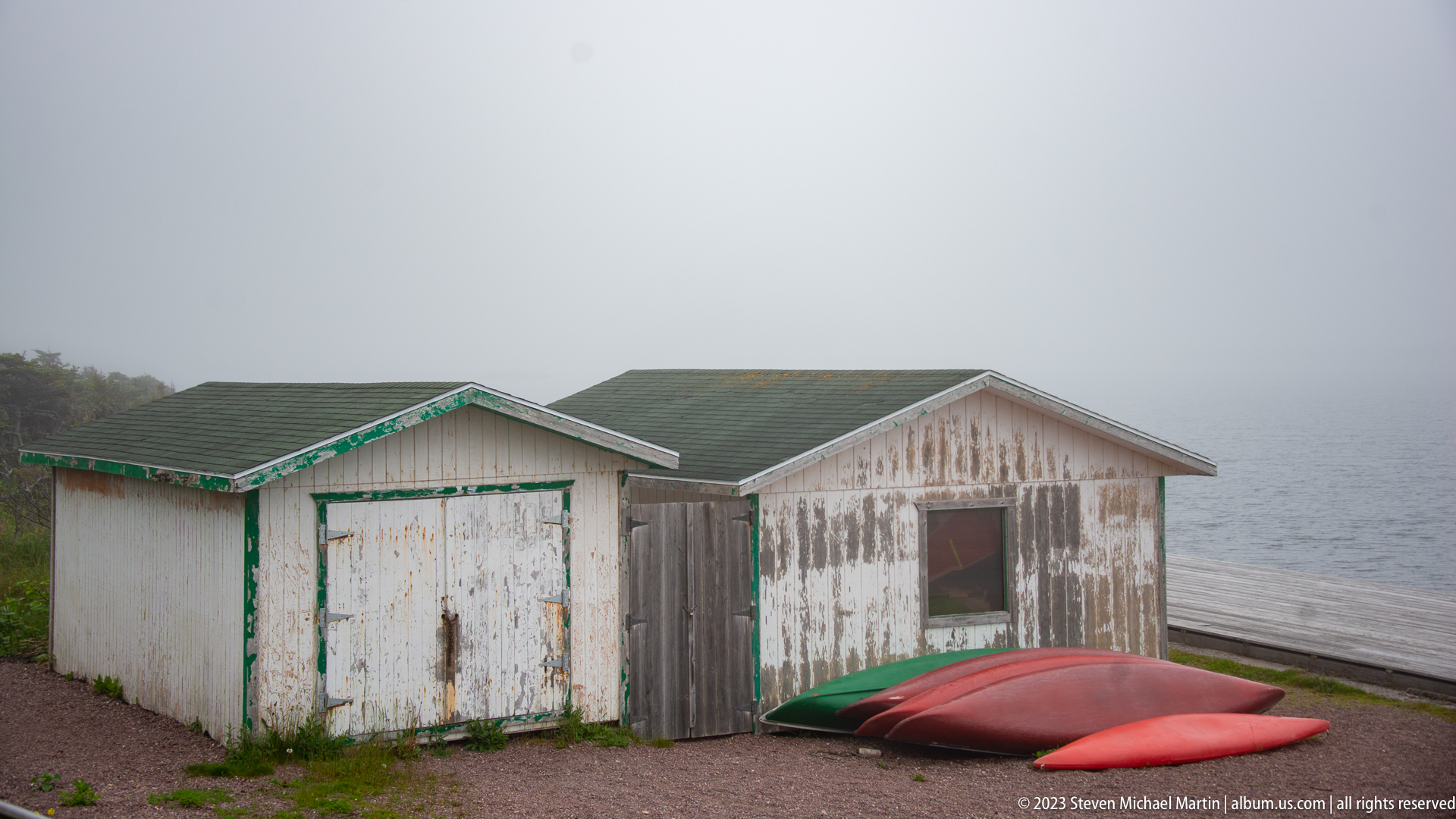
Two small weathered wooden sheds stand beside the water, their peeling white boards and simple gable roofs showing prolonged exposure to the coastal climate. Several red and green canoes or kayaks lie overturned in front. The grouping reads as practical waterside storage, combining vernacular timber construction with the recreational craft used along the island shore.
Caption
Two small weathered wooden sheds stand beside the water, their peeling white boards and simple gable roofs showing prolonged exposure to the coastal climate. Several red and green canoes or kayaks lie overturned in front. The grouping reads as practical waterside storage, combining vernacular timber construction with the recreational craft used along the island shore.

A young bay horse stands squarely behind an electric fence in a meadow scattered with yellow flowers. Its slender legs, compact body, dark lower limbs, and short mane distinguish it from the heavier adult horses nearby. Fog softens the open grassland beyond, allowing the animal’s posture and developing proportions to remain the central visual subject.
Caption
A young bay horse stands squarely behind an electric fence in a meadow scattered with yellow flowers. Its slender legs, compact body, dark lower limbs, and short mane distinguish it from the heavier adult horses nearby. Fog softens the open grassland beyond, allowing the animal’s posture and developing proportions to remain the central visual subject.
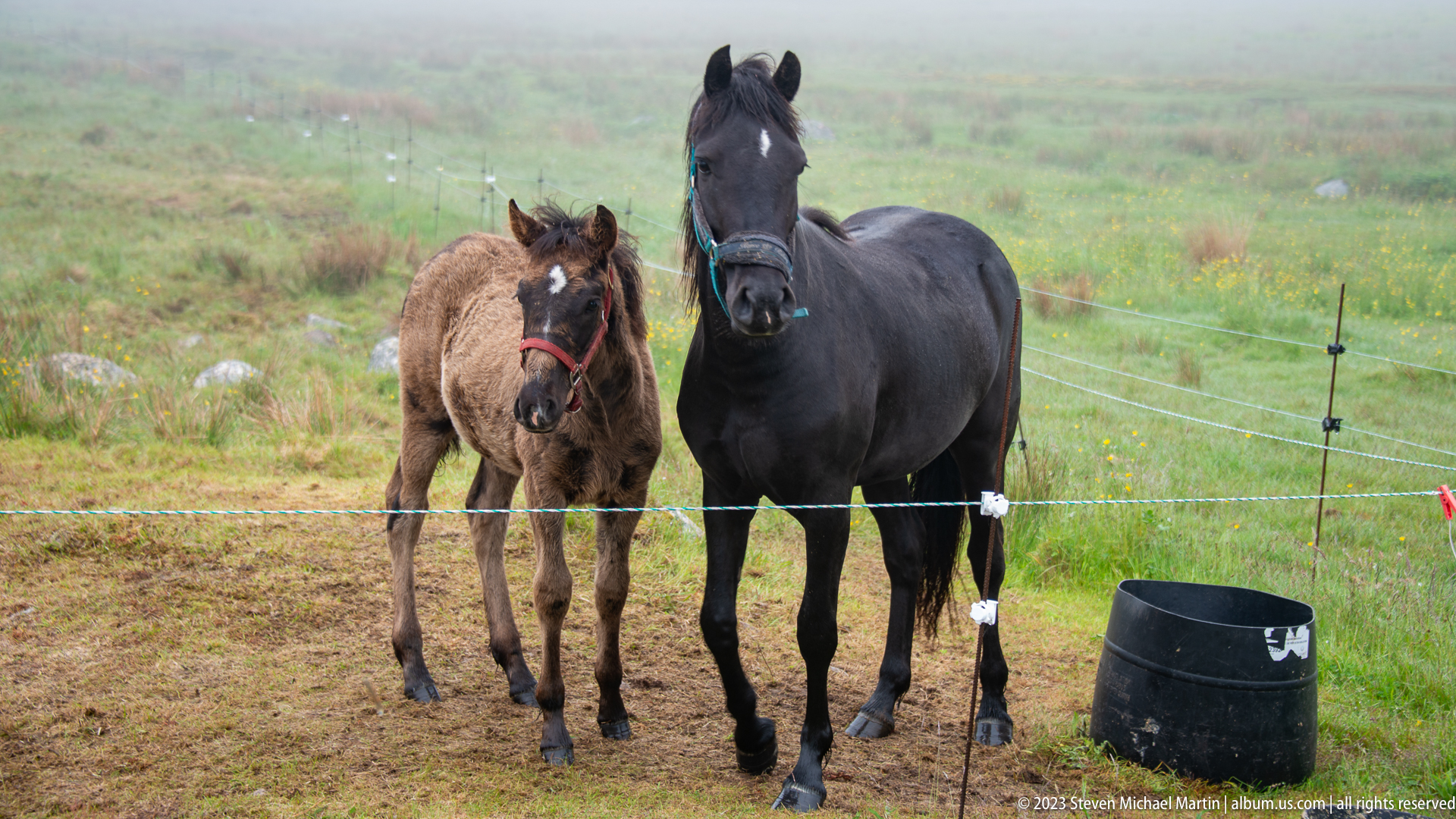
A dark mare and a small brown foal stand close together inside an electric-fenced pasture. The mare wears a turquoise halter while the foal has a reddish halter, making the pair easy to distinguish against the foggy meadow. Their side-by-side stance provides a clear study of adult and juvenile proportions within the island’s working or recreational horse landscape.
Caption
A dark mare and a small brown foal stand close together inside an electric-fenced pasture. The mare wears a turquoise halter while the foal has a reddish halter, making the pair easy to distinguish against the foggy meadow. Their side-by-side stance provides a clear study of adult and juvenile proportions within the island’s working or recreational horse landscape.
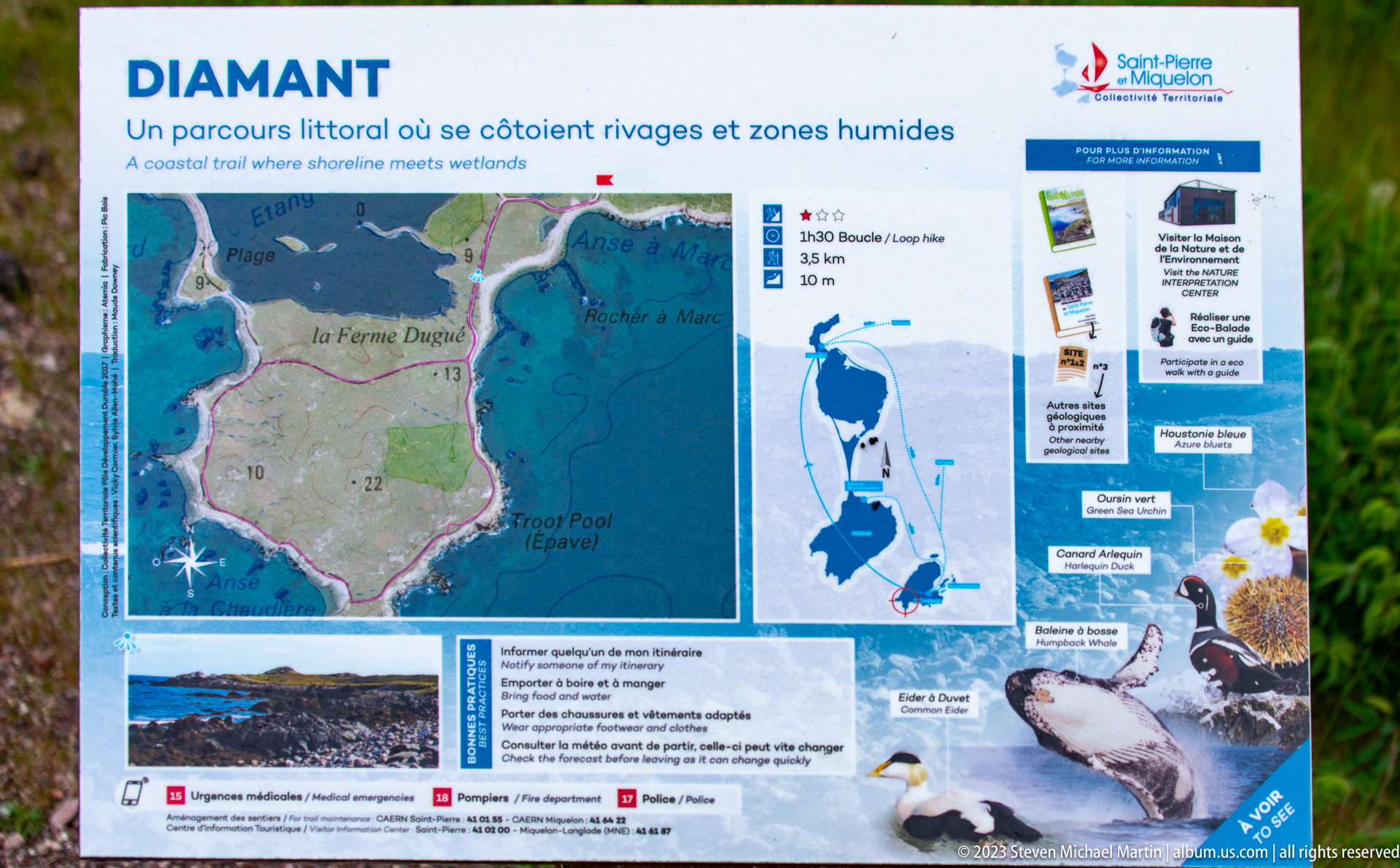
An interpretive panel maps a coastal wetland area and explains its shoreline and wetland environments in French, supplemented by photographs of birds, plants, and landscape features. The Saint-Pierre & Miquelon identity appears at upper right. The sign provides ecological context for the surrounding boardwalk, meadows, and shore, linking visitor recreation with conservation-oriented interpretation of local habitats.
Caption
An interpretive panel maps a coastal wetland area and explains its shoreline and wetland environments in French, supplemented by photographs of birds, plants, and landscape features. The Saint-Pierre & Miquelon identity appears at upper right. The sign provides ecological context for the surrounding boardwalk, meadows, and shore, linking visitor recreation with conservation-oriented interpretation of local habitats.

Two beagle-type dogs lean from an open car window, their tan-and-white faces side by side above the rain-speckled door. Collars and tags are visible, and the dark vehicle interior frames their attentive expressions. The close portrait introduces the dogs as recurring companions within the coastal outing, distinct from the earlier wider scenes of them walking through the recreation area.
Caption
Two beagle-type dogs lean from an open car window, their tan-and-white faces side by side above the rain-speckled door. Collars and tags are visible, and the dark vehicle interior frames their attentive expressions. The close portrait introduces the dogs as recurring companions within the coastal outing, distinct from the earlier wider scenes of them walking through the recreation area.
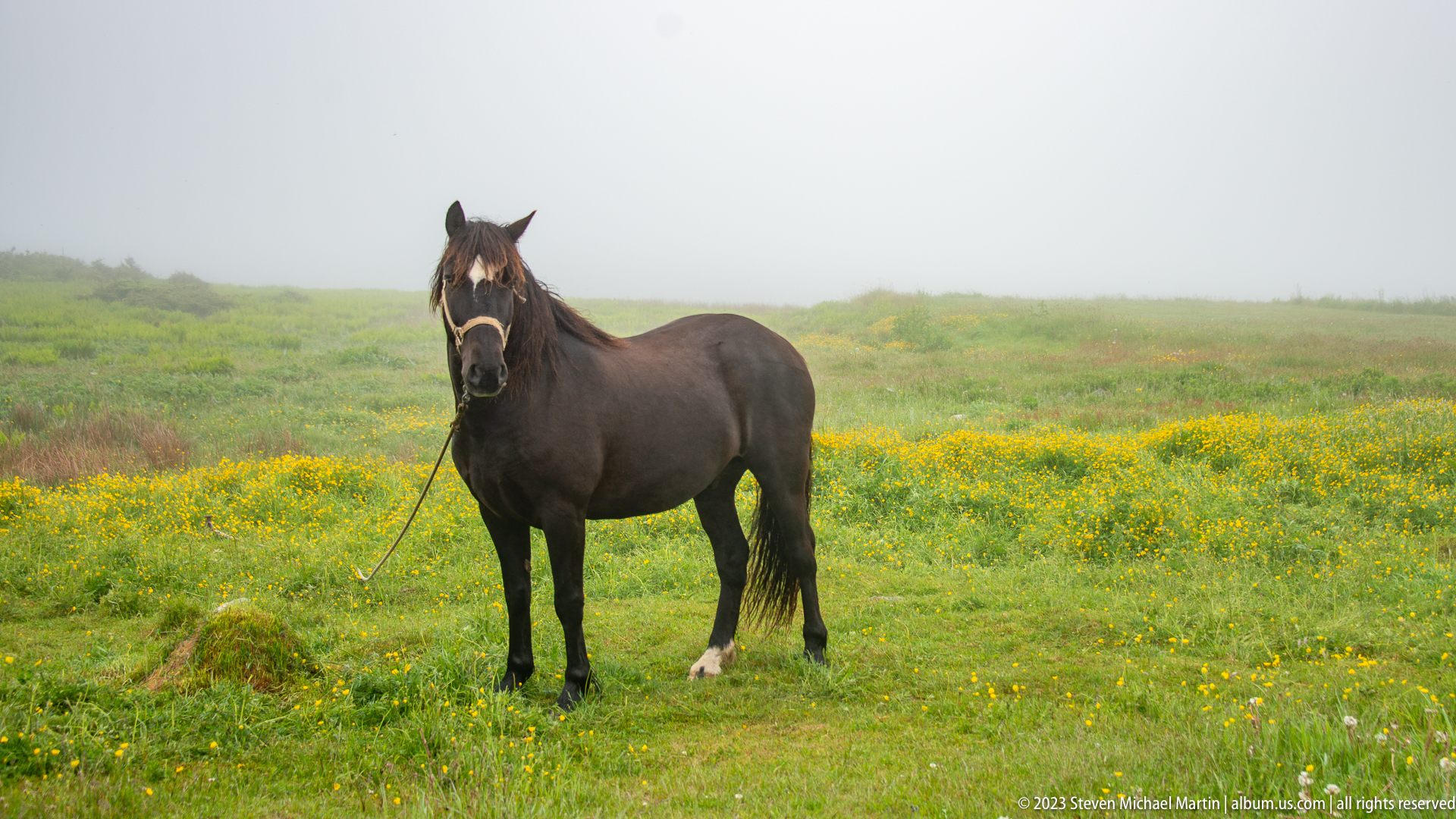
A dark horse stands alone in a meadow carpeted with yellow wildflowers, a long lead or tether extending from its halter toward the ground. A white facial marking and one pale lower leg break up the nearly black coat. The broad, fog-muted landscape gives the animal an isolated presence while also showing the richness of the low coastal grassland.
Caption
A dark horse stands alone in a meadow carpeted with yellow wildflowers, a long lead or tether extending from its halter toward the ground. A white facial marking and one pale lower leg break up the nearly black coat. The broad, fog-muted landscape gives the animal an isolated presence while also showing the richness of the low coastal grassland.
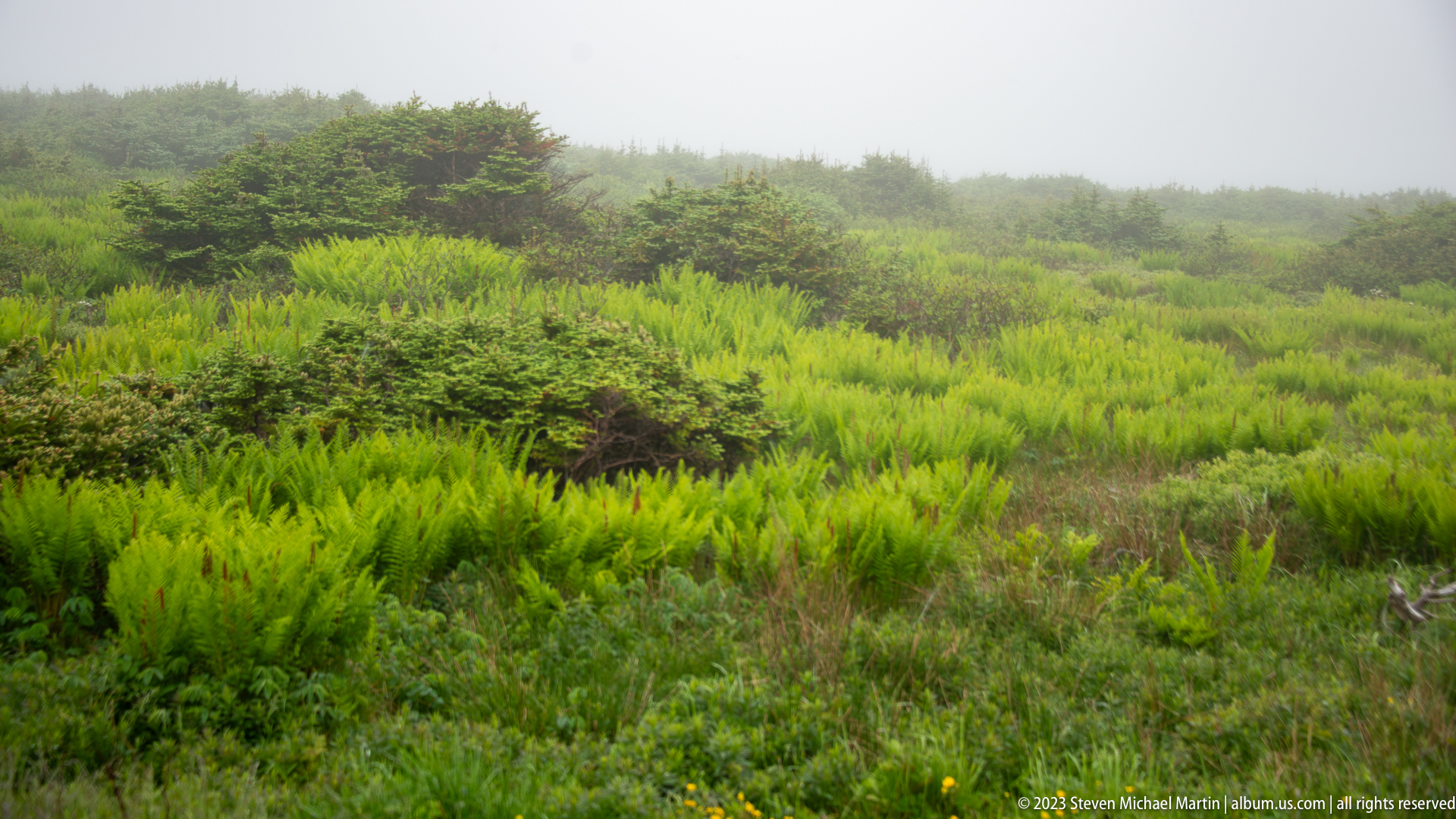
Dense bands of low conifers, shrubs, and vivid green fern-like vegetation cover gently rolling ground beneath a pale fog. The absence of buildings or paths allows the plant community itself to dominate the frame. Variations in height and texture show a transition between compact evergreen growth and softer herbaceous cover characteristic of exposed, moisture-rich island terrain.
Caption
Dense bands of low conifers, shrubs, and vivid green fern-like vegetation cover gently rolling ground beneath a pale fog. The absence of buildings or paths allows the plant community itself to dominate the frame. Variations in height and texture show a transition between compact evergreen growth and softer herbaceous cover characteristic of exposed, moisture-rich island terrain.
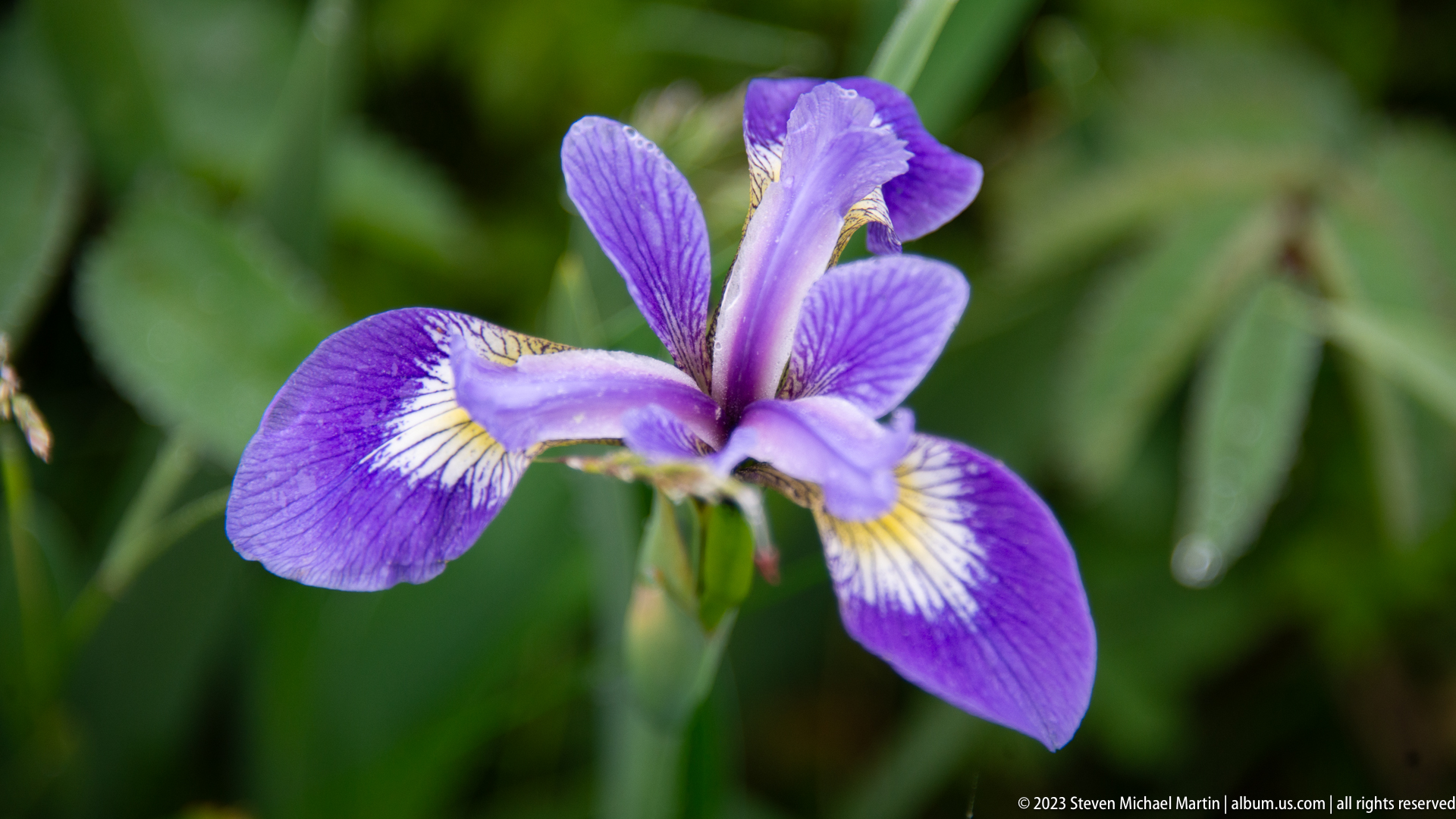
A purple iris opens against a soft green background, its three broad outer falls marked with white and yellow veining and its upright petals forming a sculptural center. The close focus isolates the bloom from the surrounding wet vegetation. Rather than assigning a species from color alone, the record emphasizes the unmistakable iris form and intricate patterning visible on the flower.
Caption
A purple iris opens against a soft green background, its three broad outer falls marked with white and yellow veining and its upright petals forming a sculptural center. The close focus isolates the bloom from the surrounding wet vegetation. Rather than assigning a species from color alone, the record emphasizes the unmistakable iris form and intricate patterning visible on the flower.
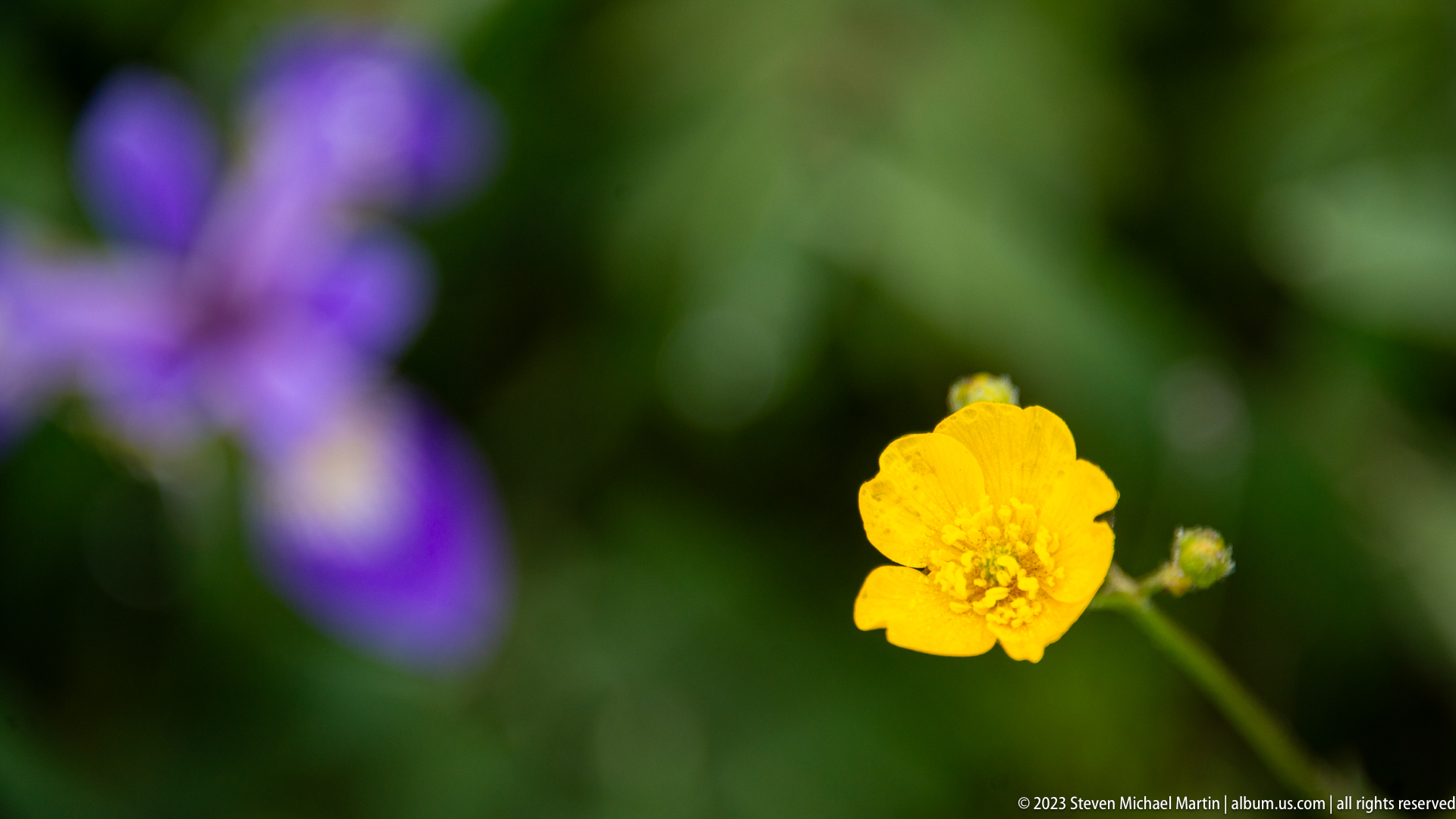
A single glossy yellow flower stands sharply against a deeply blurred green background, with a purple iris reduced to soft color behind it. Five rounded petals surround a dense yellow center, and a small developing bud appears nearby. The selective focus creates a precise botanical detail while leaving species-level identification appropriately open.
Caption
A single glossy yellow flower stands sharply against a deeply blurred green background, with a purple iris reduced to soft color behind it. Five rounded petals surround a dense yellow center, and a small developing bud appears nearby. The selective focus creates a precise botanical detail while leaving species-level identification appropriately open.
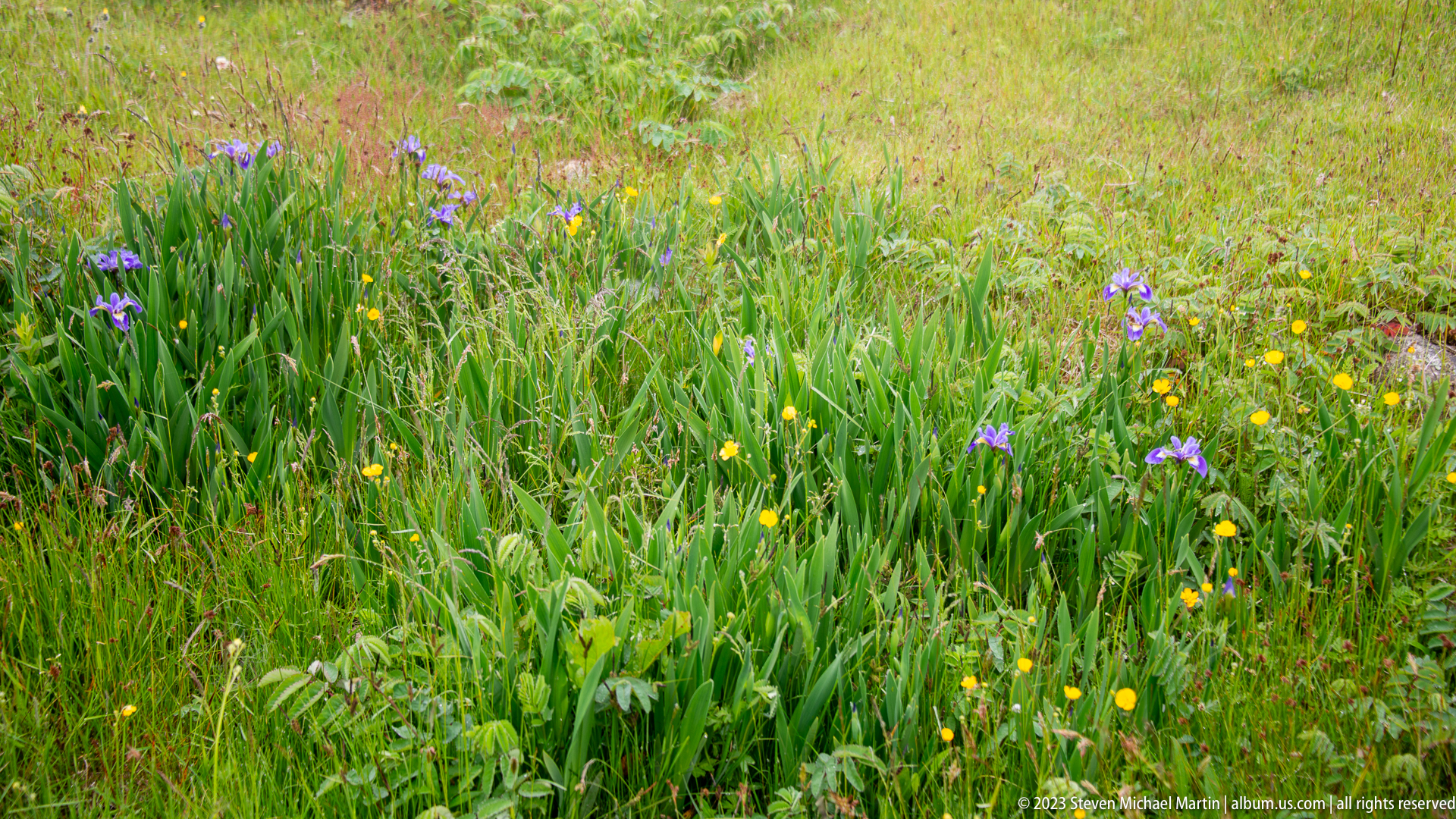
Purple irises and numerous small yellow blooms are scattered through a lush meadow of tall grasses and broad-leaved plants. The wider view reveals the mixed plant community that surrounds the individual flowers shown in adjacent close-ups. Rather than privileging one species, the composition records color, density, and varied leaf forms across a moisture-rich patch of coastal vegetation.
Caption
Purple irises and numerous small yellow blooms are scattered through a lush meadow of tall grasses and broad-leaved plants. The wider view reveals the mixed plant community that surrounds the individual flowers shown in adjacent close-ups. Rather than privileging one species, the composition records color, density, and varied leaf forms across a moisture-rich patch of coastal vegetation.
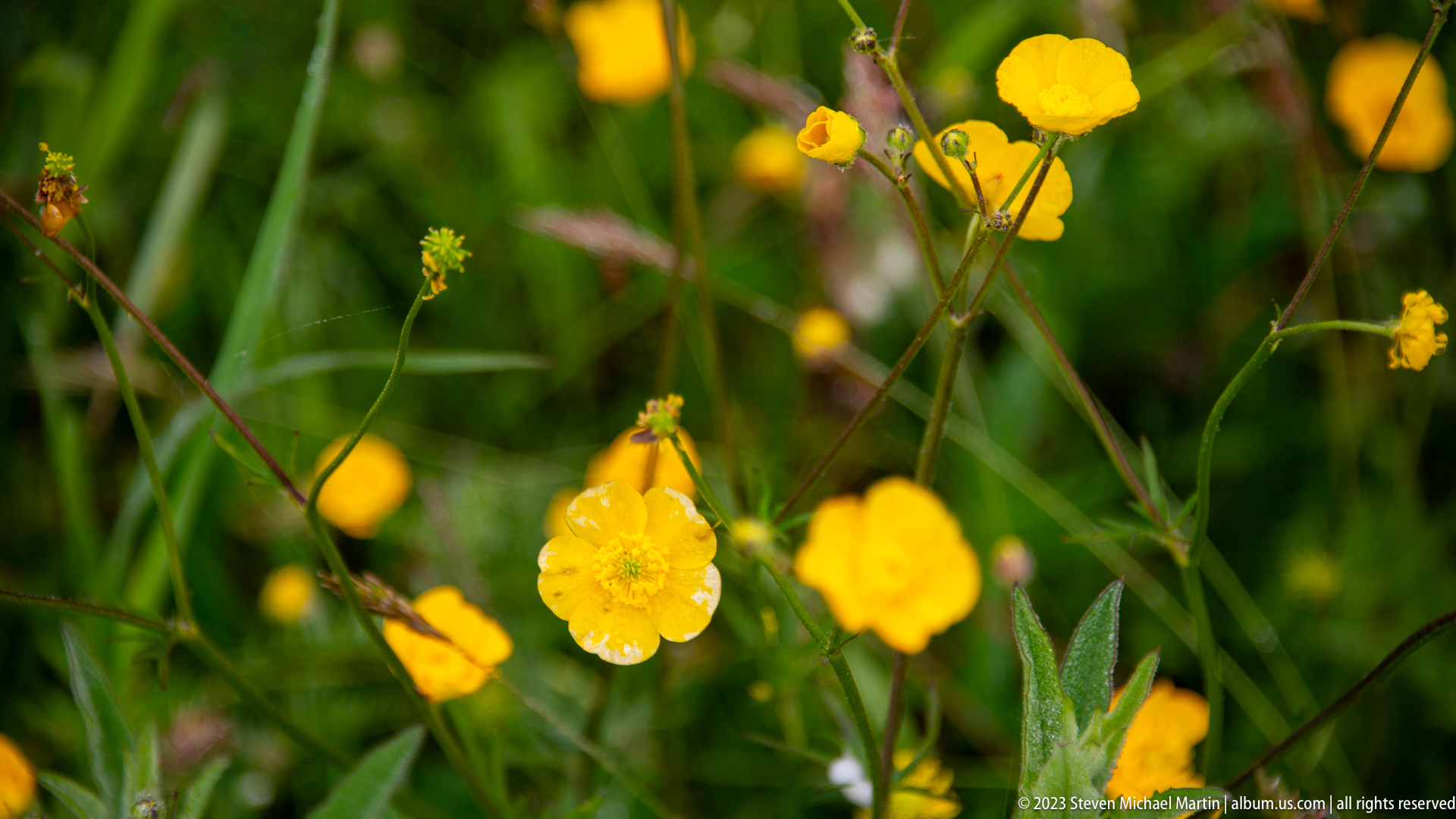
Several small yellow flowers rise on branching stems amid grasses, with droplets of moisture visible on petals and foliage. The closest bloom shows a glossy, cup-like form while additional flowers dissolve into the background. This tighter botanical study complements the meadow overview by emphasizing the delicate stems, bright color, and rain-dampened surfaces of the island’s low wildflowers.
Caption
Several small yellow flowers rise on branching stems amid grasses, with droplets of moisture visible on petals and foliage. The closest bloom shows a glossy, cup-like form while additional flowers dissolve into the background. This tighter botanical study complements the meadow overview by emphasizing the delicate stems, bright color, and rain-dampened surfaces of the island’s low wildflowers.

A solitary horse appears as a small dark figure near the horizon of a broad meadow thick with yellow flowers. Dense fog erases the background entirely, leaving animal, grassland, and atmosphere as the only major elements. The distant scale distinguishes this view from the horse portraits, emphasizing isolation and the limited visibility of the coastal landscape.
Caption
A solitary horse appears as a small dark figure near the horizon of a broad meadow thick with yellow flowers. Dense fog erases the background entirely, leaving animal, grassland, and atmosphere as the only major elements. The distant scale distinguishes this view from the horse portraits, emphasizing isolation and the limited visibility of the coastal landscape.
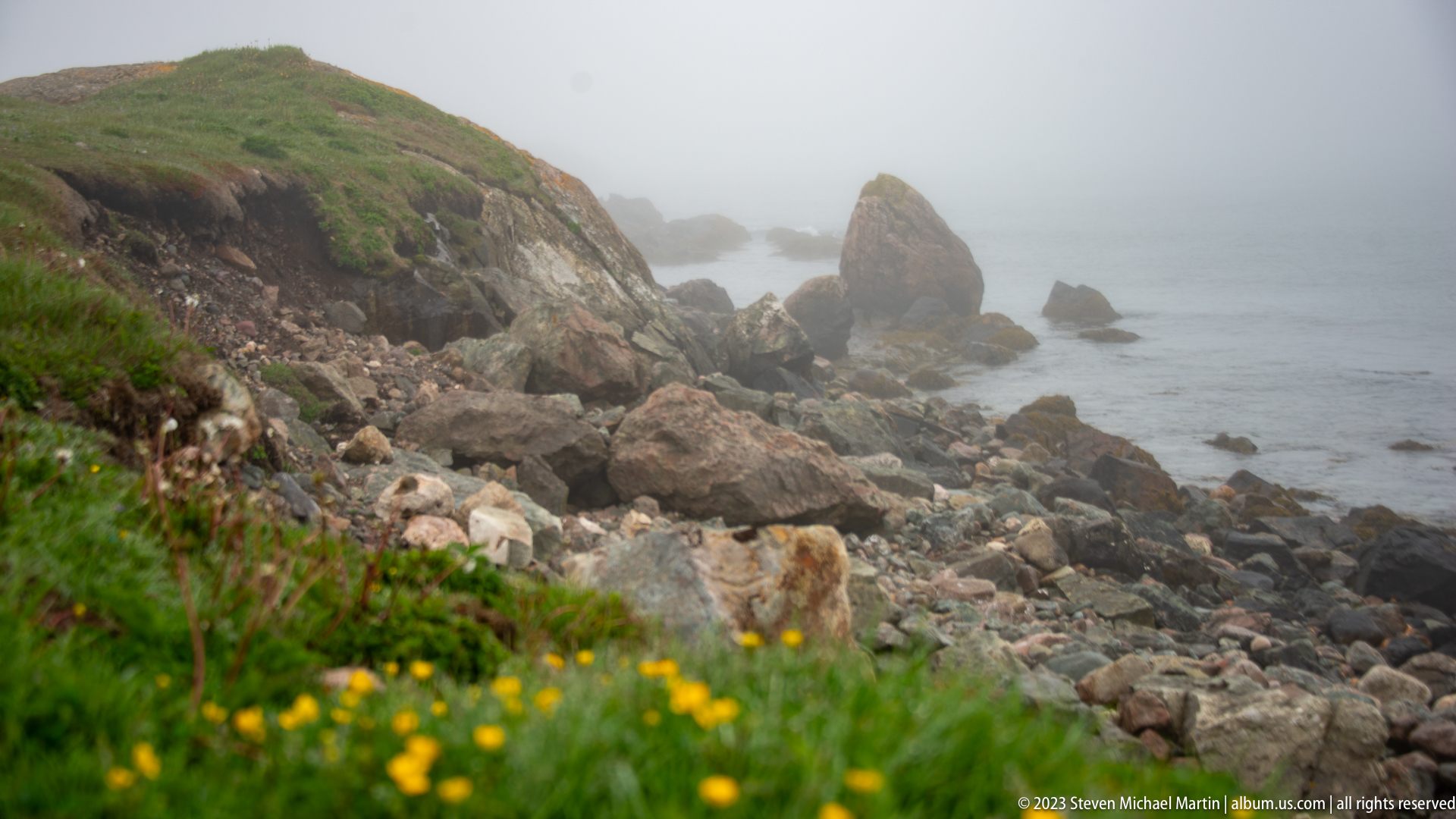
A rugged boulder shoreline descends toward gray water, where a tall pointed rock stack rises just offshore through mist. Yellow flowers and green vegetation brighten the foreground while broken rock fragments line the narrow coastal edge. The oblique view emphasizes the transition from vegetated slope to fractured shore and isolated marine rock formation.
Caption
A rugged boulder shoreline descends toward gray water, where a tall pointed rock stack rises just offshore through mist. Yellow flowers and green vegetation brighten the foreground while broken rock fragments line the narrow coastal edge. The oblique view emphasizes the transition from vegetated slope to fractured shore and isolated marine rock formation.

A steep-sided sea stack dominates the foggy shoreline, rising from shallow water among smaller dark boulders. Its weathered face carries patches of vegetation near the top, while the surrounding coast disappears into mist. The tighter framing isolates the erosional rock form from the broader shore, making its mass, pointed profile, and relationship to neighboring rocks the central subject.
Caption
A steep-sided sea stack dominates the foggy shoreline, rising from shallow water among smaller dark boulders. Its weathered face carries patches of vegetation near the top, while the surrounding coast disappears into mist. The tighter framing isolates the erosional rock form from the broader shore, making its mass, pointed profile, and relationship to neighboring rocks the central subject.

A narrow wooden boardwalk runs in a nearly straight line through low green wetland vegetation before rising gently into fog. Simple edge rails or curbs define the walkway without interrupting the open character of the landscape. The strong central perspective turns practical visitor infrastructure into a visual guide through terrain that would otherwise be wet and difficult to cross.
Caption
A narrow wooden boardwalk runs in a nearly straight line through low green wetland vegetation before rising gently into fog. Simple edge rails or curbs define the walkway without interrupting the open character of the landscape. The strong central perspective turns practical visitor infrastructure into a visual guide through terrain that would otherwise be wet and difficult to cross.
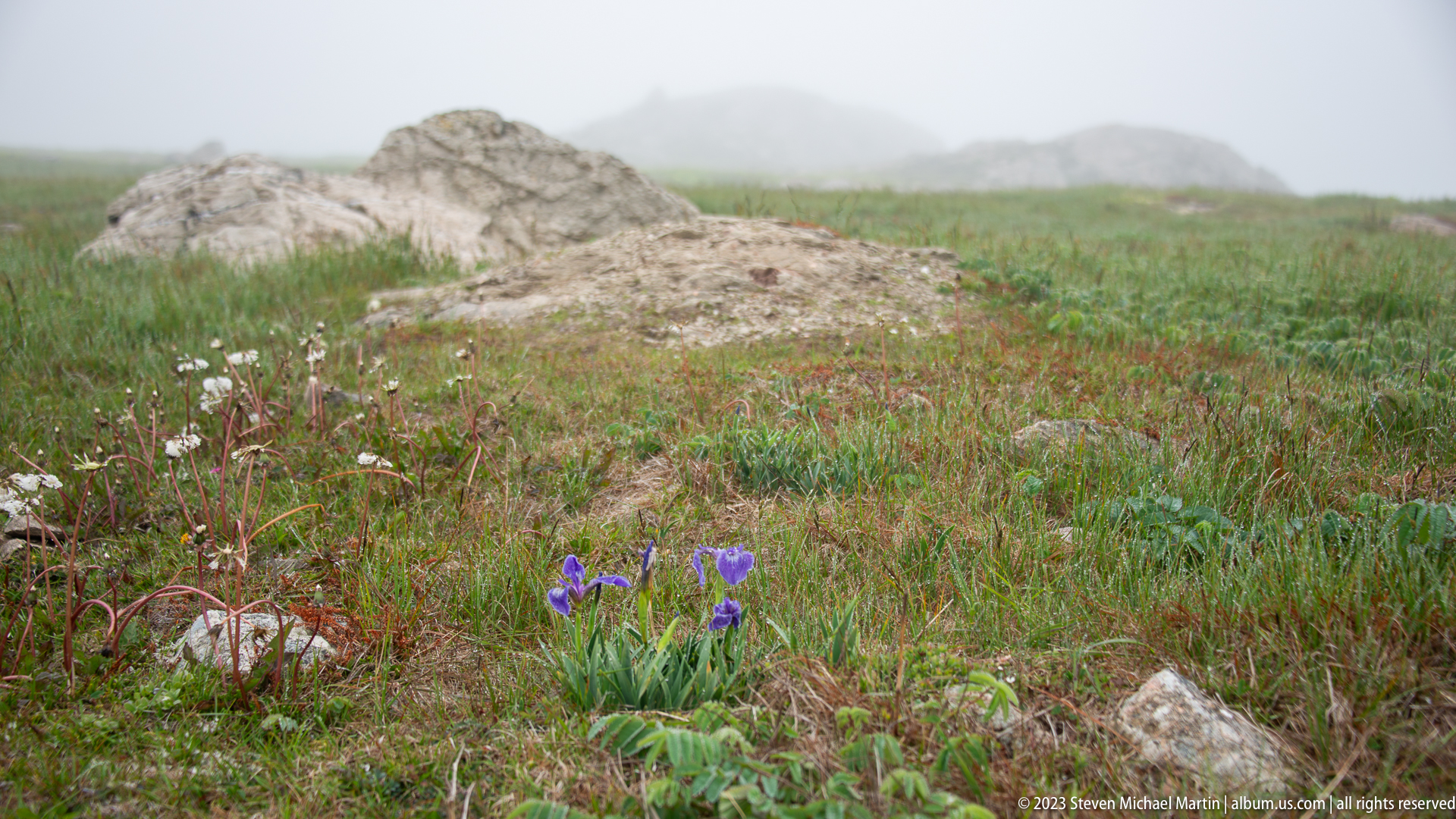
A purple iris blooms low in a mixed coastal meadow where white cottony seedheads, reddish stems, grasses, and exposed pale rocks create a varied foreground. Large bedrock outcrops rise softly through fog beyond. The image broadens the botanical close-ups into an environmental study, showing how flowering plants occupy shallow soils and crevices across the rocky island terrain.
Caption
A purple iris blooms low in a mixed coastal meadow where white cottony seedheads, reddish stems, grasses, and exposed pale rocks create a varied foreground. Large bedrock outcrops rise softly through fog beyond. The image broadens the botanical close-ups into an environmental study, showing how flowering plants occupy shallow soils and crevices across the rocky island terrain.

Two beagle-type dogs face one another from opposite benches of a weathered wooden picnic table on a coastal deck. One braces its front paws against the tabletop while the other stands alert on the far bench. Fog-softened water and rocky grassland beyond give the playful interaction a distinctly maritime setting and connect the dogs to the recreation area seen throughout the sequence.
Caption
Two beagle-type dogs face one another from opposite benches of a weathered wooden picnic table on a coastal deck. One braces its front paws against the tabletop while the other stands alert on the far bench. Fog-softened water and rocky grassland beyond give the playful interaction a distinctly maritime setting and connect the dogs to the recreation area seen throughout the sequence.
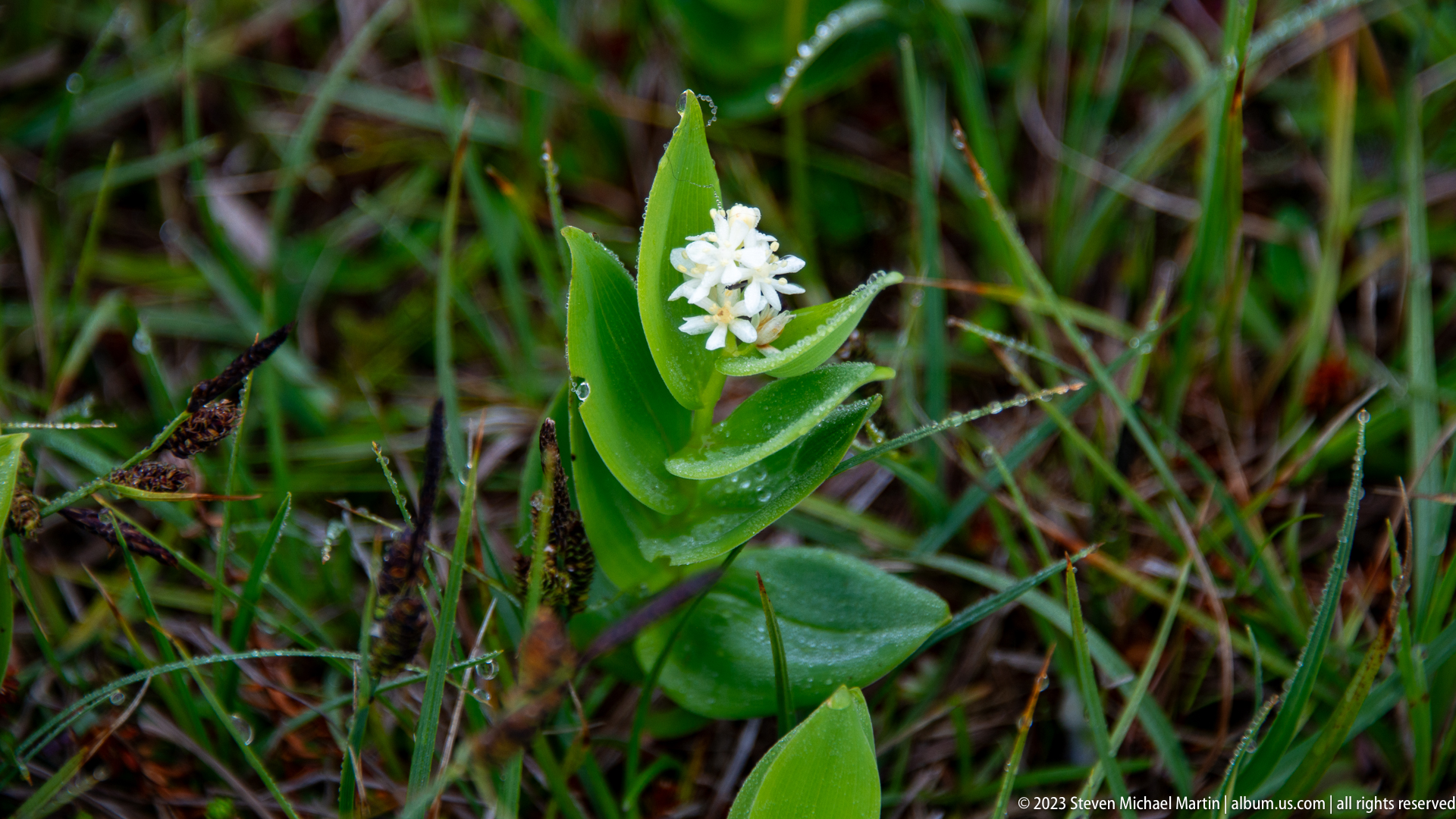
A compact cluster of small white star-shaped flowers rises from broad green leaves close to the ground. Fine grasses and darker seed stalks surround the plant, while shallow focus separates the bloom from its wet meadow habitat. The close botanical view records leaf form, flower arrangement, and scale without assigning a species that cannot be confirmed from the photograph alone.
Caption
A compact cluster of small white star-shaped flowers rises from broad green leaves close to the ground. Fine grasses and darker seed stalks surround the plant, while shallow focus separates the bloom from its wet meadow habitat. The close botanical view records leaf form, flower arrangement, and scale without assigning a species that cannot be confirmed from the photograph alone.

Two simple wooden benches face one another across a small square table on a rain-darkened deck overlooking the rocky coast. The sturdy handmade construction and wet surfaces reinforce the exposed outdoor setting, while a boardwalk continues along the right edge. The arrangement provides a practical stopping place from which visitors can sit within the coastal landscape despite damp weather.
Caption
Two simple wooden benches face one another across a small square table on a rain-darkened deck overlooking the rocky coast. The sturdy handmade construction and wet surfaces reinforce the exposed outdoor setting, while a boardwalk continues along the right edge. The arrangement provides a practical stopping place from which visitors can sit within the coastal landscape despite damp weather.

Two beagle-type dogs sit separately in oversized wooden Adirondack chairs on a wet deck, facing the camera against a backdrop of low vegetation and pale bedrock. Their posed placement gives the scene a humorous portrait quality while also showing the rustic visitor furniture used at the coastal recreation site. Fog keeps the background subdued and attention centered on the paired animals.
Caption
Two beagle-type dogs sit separately in oversized wooden Adirondack chairs on a wet deck, facing the camera against a backdrop of low vegetation and pale bedrock. Their posed placement gives the scene a humorous portrait quality while also showing the rustic visitor furniture used at the coastal recreation site. Fog keeps the background subdued and attention centered on the paired animals.
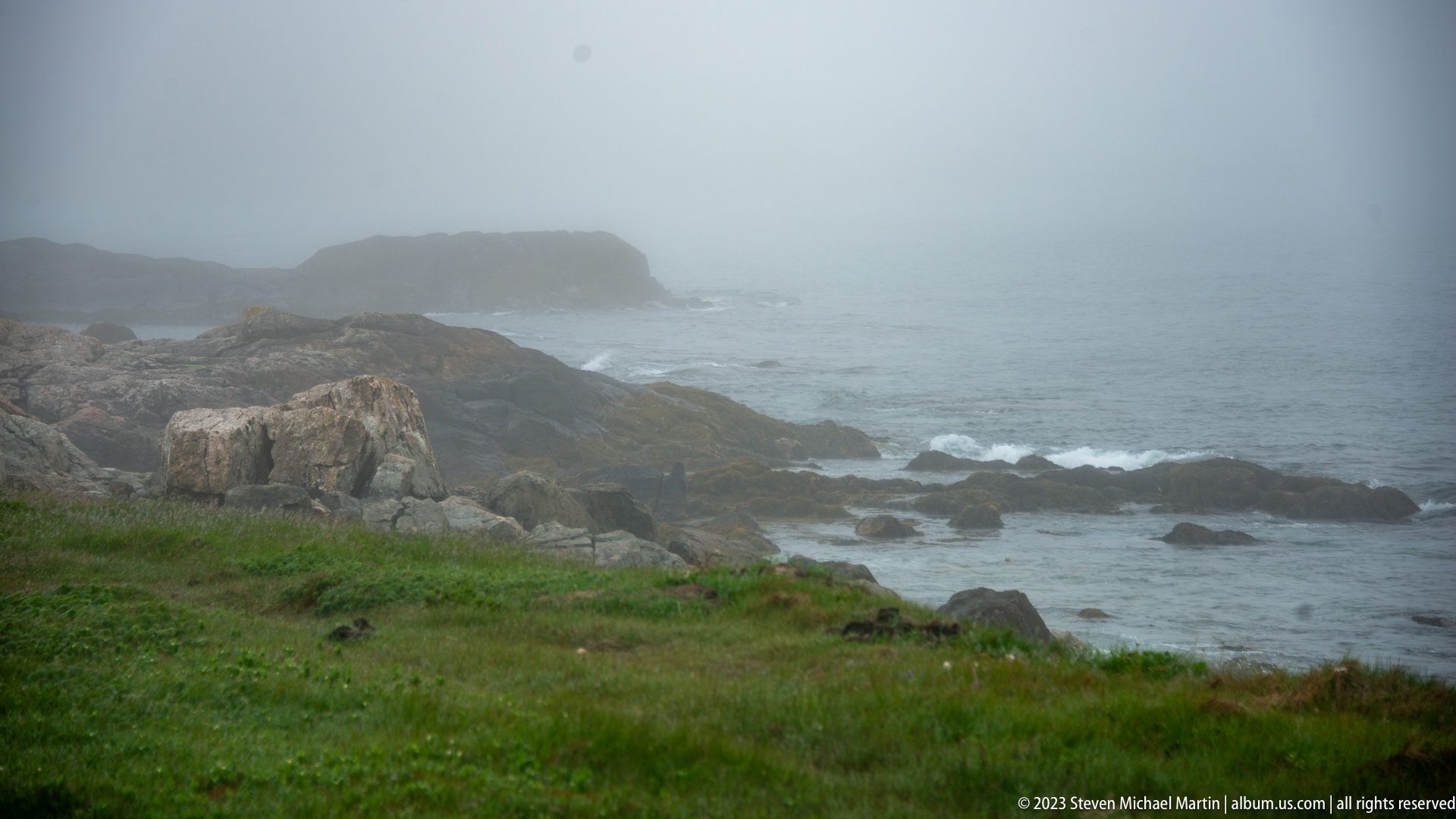
Dark rock ledges and pale fractured outcrops extend into gray water beneath dense fog, with small waves breaking through narrow channels along the shore. A low headland is barely visible in the distance while green grass occupies the immediate foreground. The view closes the sequence on the exposed natural coast, emphasizing subdued color, wet geology, and restricted North Atlantic visibility.
Caption
Dark rock ledges and pale fractured outcrops extend into gray water beneath dense fog, with small waves breaking through narrow channels along the shore. A low headland is barely visible in the distance while green grass occupies the immediate foreground. The view closes the sequence on the exposed natural coast, emphasizing subdued color, wet geology, and restricted North Atlantic visibility.

A man pauses on a winding boardwalk with two beagles as dense fog softens the surrounding lowland and rocky rise beyond. The serpentine timber path and a small bench establish the trail setting, while the dogs provide scale and foreground activity in a landscape where visibility is sharply reduced by maritime weather.
Caption
A man pauses on a winding boardwalk with two beagles as dense fog softens the surrounding lowland and rocky rise beyond. The serpentine timber path and a small bench establish the trail setting, while the dogs provide scale and foreground activity in a landscape where visibility is sharply reduced by maritime weather.
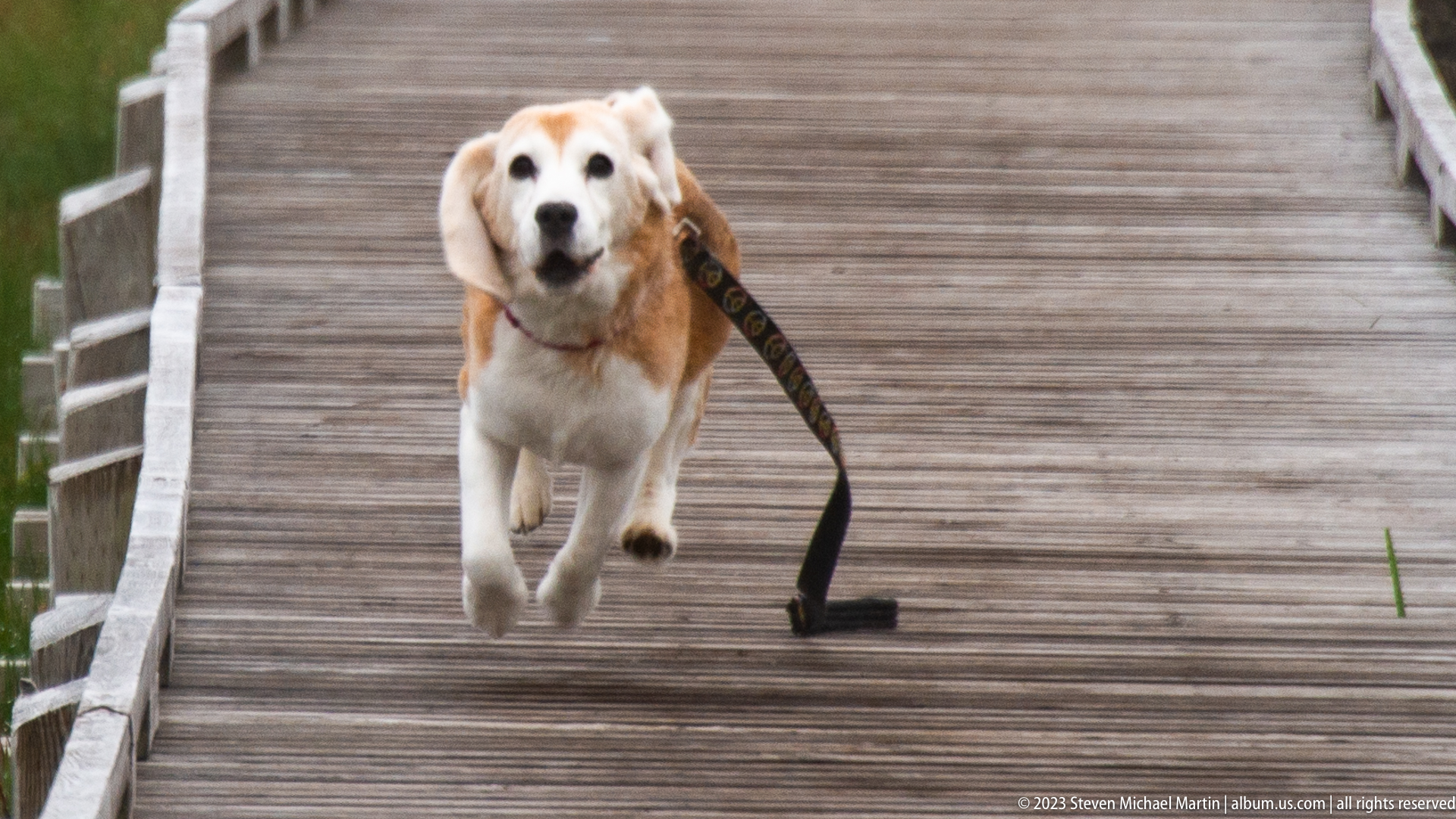
A beagle runs directly toward the camera on a wooden boardwalk, ears lifted by its stride and leash arcing beside its body. The tight frontal composition suppresses most of the landscape, concentrating attention on the dog’s motion, expression, and the strong linear pattern of weathered planks beneath its paws.
Caption
A beagle runs directly toward the camera on a wooden boardwalk, ears lifted by its stride and leash arcing beside its body. The tight frontal composition suppresses most of the landscape, concentrating attention on the dog’s motion, expression, and the strong linear pattern of weathered planks beneath its paws.
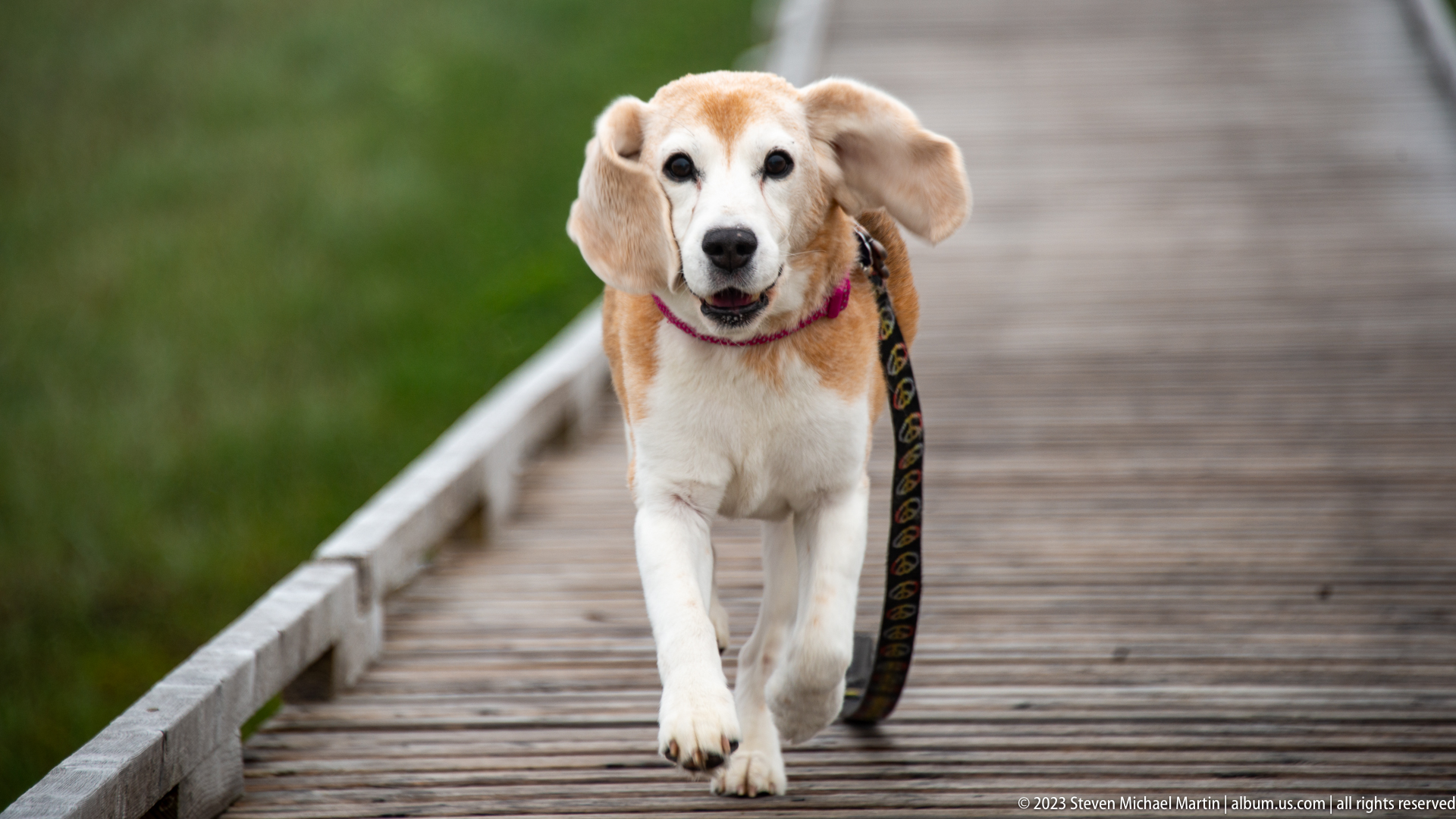
A beagle advances along the boardwalk in a close, low-angle portrait, one front paw lifted and its ears spread outward. Shallow depth of field softens the timber path and green verge behind, making the dog’s face, collar, and dangling leash the dominant visual elements while retaining a clear sense of the trail environment.
Caption
A beagle advances along the boardwalk in a close, low-angle portrait, one front paw lifted and its ears spread outward. Shallow depth of field softens the timber path and green verge behind, making the dog’s face, collar, and dangling leash the dominant visual elements while retaining a clear sense of the trail environment.

A solitary man walks toward the camera along a straight wooden boardwalk laid across low green coastal ground. Fog removes the horizon and reduces the rocky terrain to faint shapes, leaving the dark figure and converging rails of the walkway as the strongest elements in this spare study of travel through Saint Pierre & Miquelon’s damp maritime landscape.
Caption
A solitary man walks toward the camera along a straight wooden boardwalk laid across low green coastal ground. Fog removes the horizon and reduces the rocky terrain to faint shapes, leaving the dark figure and converging rails of the walkway as the strongest elements in this spare study of travel through Saint Pierre & Miquelon’s damp maritime landscape.

A close head-and-shoulders portrait places a smiling man against an almost featureless field of maritime fog. The neutral background removes geographic detail and concentrates attention on facial expression, wind-tousled gray hair, and the textured dark fleece at the lower edge of the frame.
Caption
A close head-and-shoulders portrait places a smiling man against an almost featureless field of maritime fog. The neutral background removes geographic detail and concentrates attention on facial expression, wind-tousled gray hair, and the textured dark fleece at the lower edge of the frame.
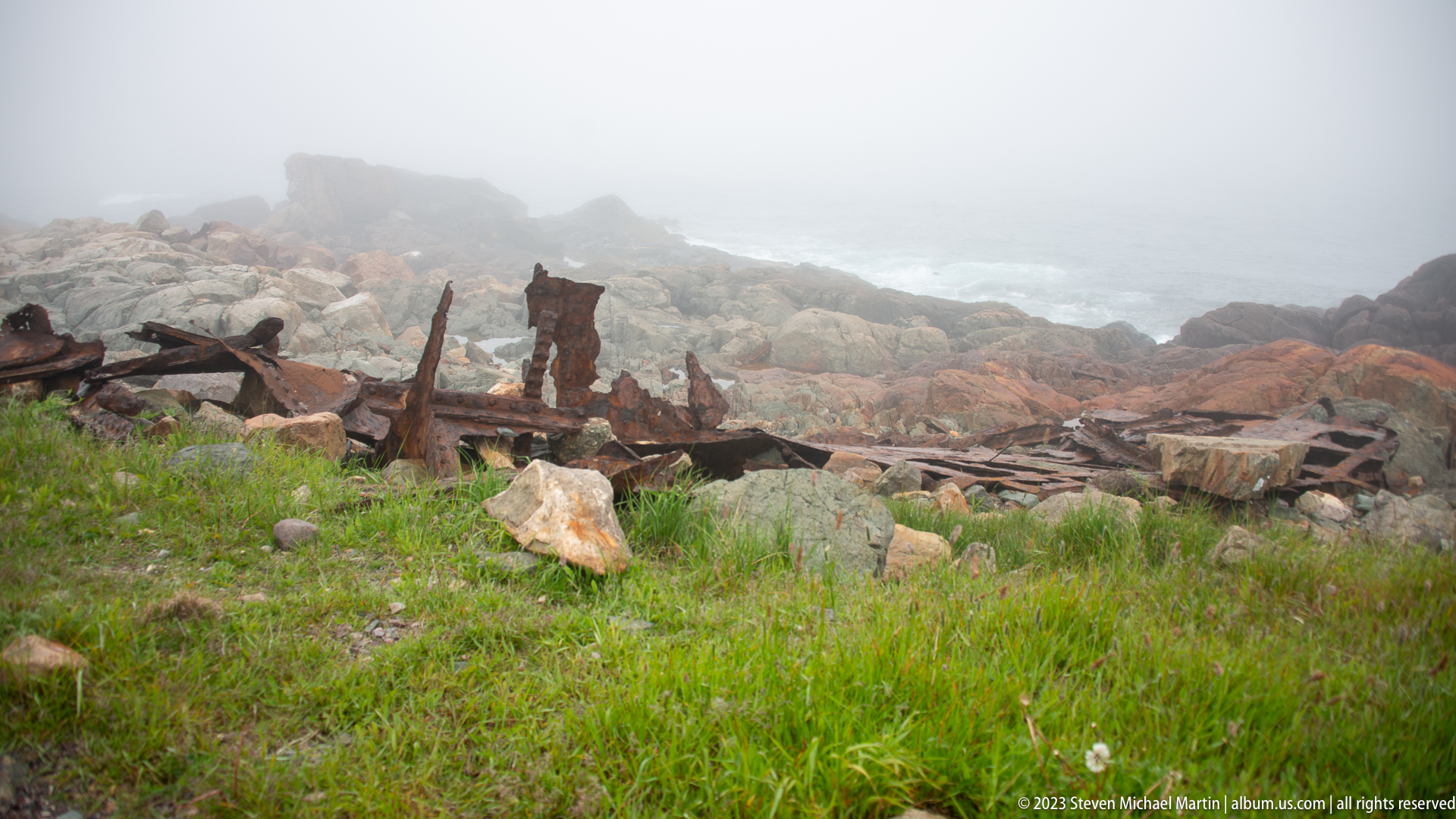
Heavily corroded iron fragments lie scattered across a rocky, grass-edged shoreline, their jagged plates and structural members contrasting with pale boulders and wet vegetation. Fog and surf obscure the distance. The remains suggest maritime or industrial wreckage, but the surviving forms are too fragmentary in this view to identify a specific vessel or structure securely.
Caption
Heavily corroded iron fragments lie scattered across a rocky, grass-edged shoreline, their jagged plates and structural members contrasting with pale boulders and wet vegetation. Fog and surf obscure the distance. The remains suggest maritime or industrial wreckage, but the surviving forms are too fragmentary in this view to identify a specific vessel or structure securely.
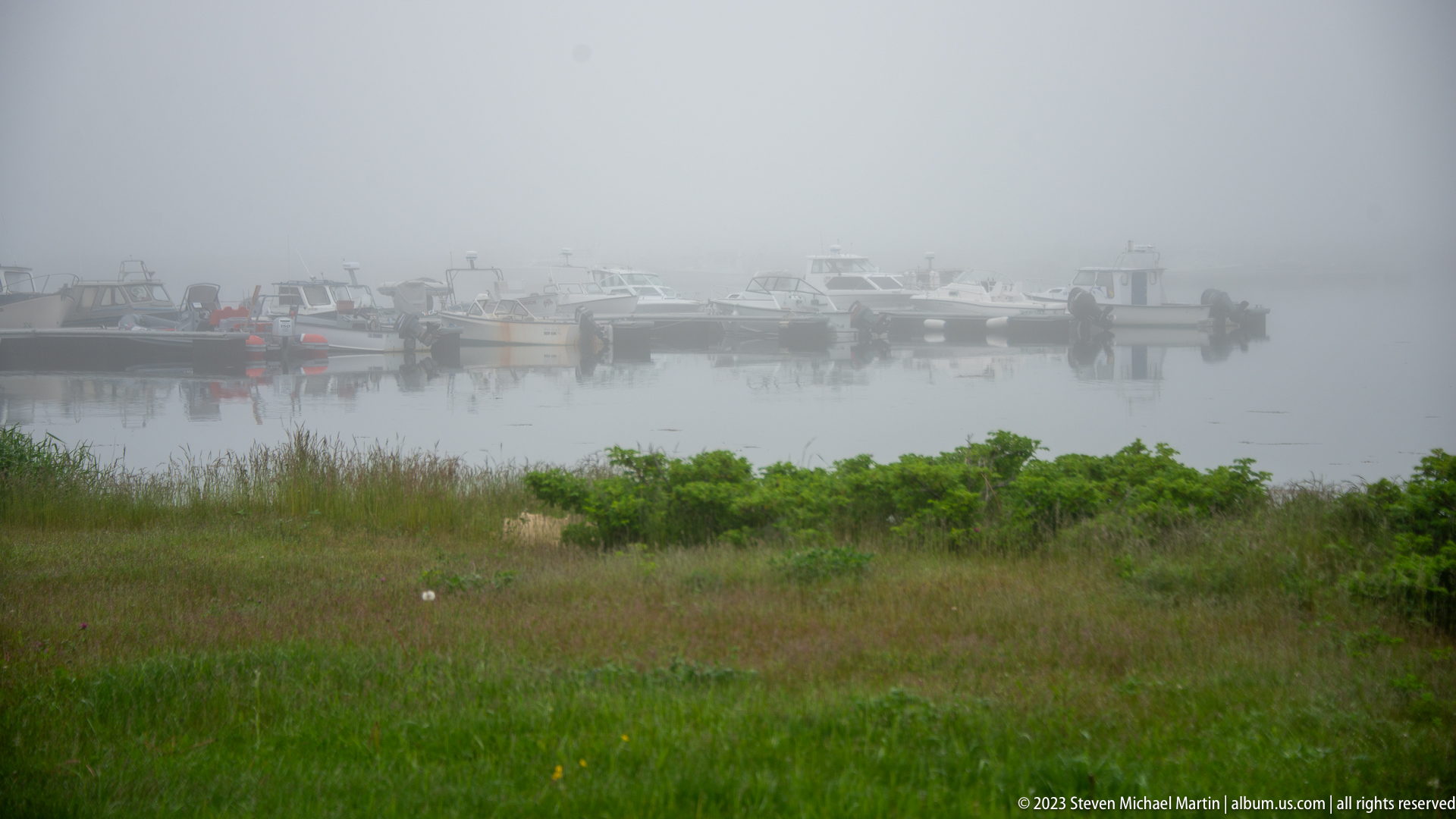
Rows of small motorboats and working craft sit moored in a harbor nearly swallowed by fog. Their pale hulls and cabins form a muted band across still water, where soft reflections survive despite the low visibility. Grassy shoreline vegetation in the foreground reinforces the intimate scale of this sheltered maritime setting.
Caption
Rows of small motorboats and working craft sit moored in a harbor nearly swallowed by fog. Their pale hulls and cabins form a muted band across still water, where soft reflections survive despite the low visibility. Grassy shoreline vegetation in the foreground reinforces the intimate scale of this sheltered maritime setting.
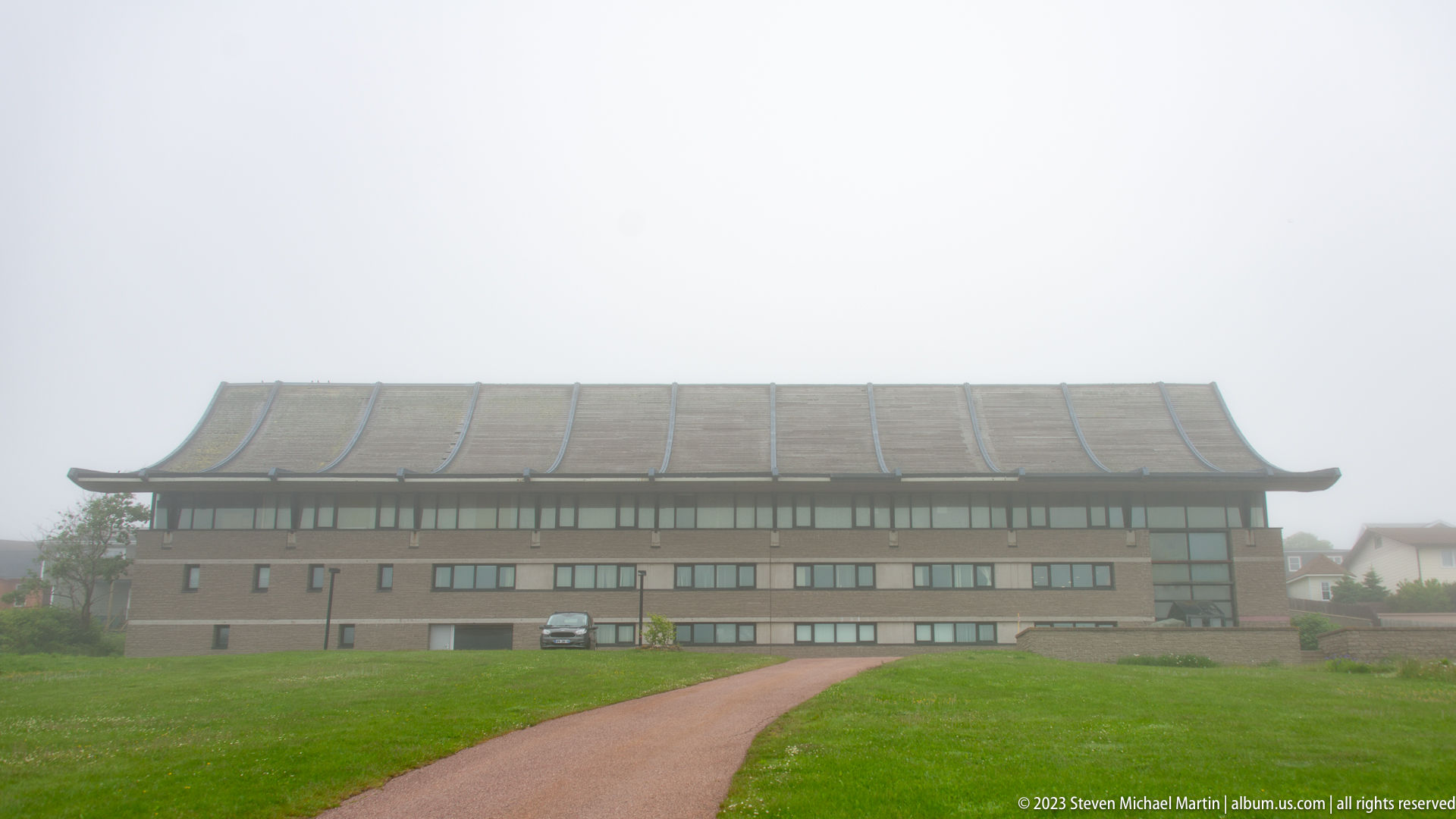
A broad, symmetrical institutional building faces a straight approach path across a clipped lawn. Its most distinctive feature is an oversized shallow roof whose edges sweep upward at both ends, sheltering a long band of upper windows. Fog mutes the surrounding settlement and makes the unusual roofline the dominant architectural element.
Caption
A broad, symmetrical institutional building faces a straight approach path across a clipped lawn. Its most distinctive feature is an oversized shallow roof whose edges sweep upward at both ends, sheltering a long band of upper windows. Fog mutes the surrounding settlement and makes the unusual roofline the dominant architectural element.
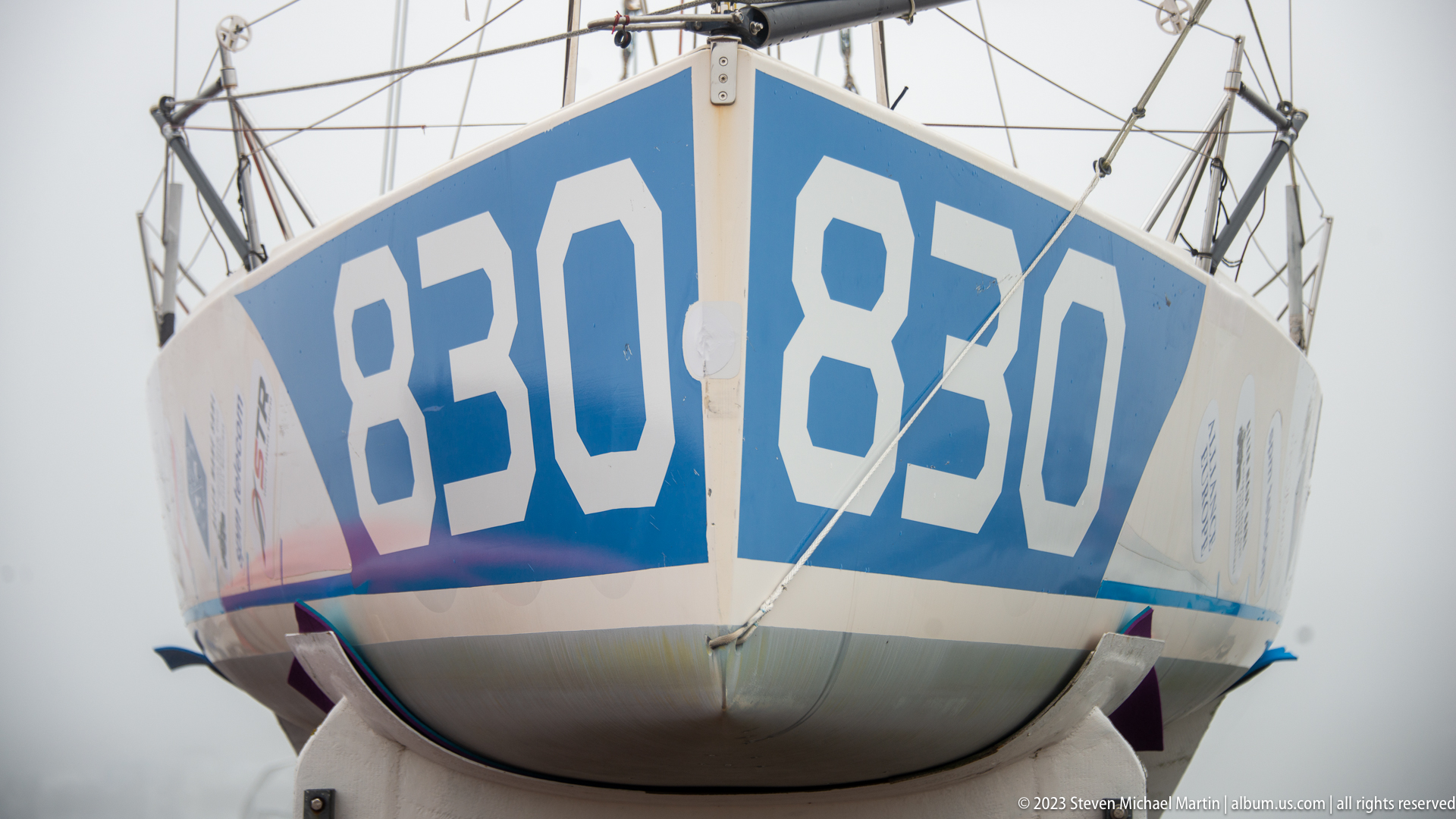
The rounded bow of sailboat 830 fills the frame, emphasizing the oversized white numerals painted across blue hull panels. Seen from ground level while the vessel is hauled out, the view reveals the underside of the hull, central stem, support lines, and portions of rigging above, turning the boat’s graphic identification into the principal subject.
Caption
The rounded bow of sailboat 830 fills the frame, emphasizing the oversized white numerals painted across blue hull panels. Seen from ground level while the vessel is hauled out, the view reveals the underside of the hull, central stem, support lines, and portions of rigging above, turning the boat’s graphic identification into the principal subject.
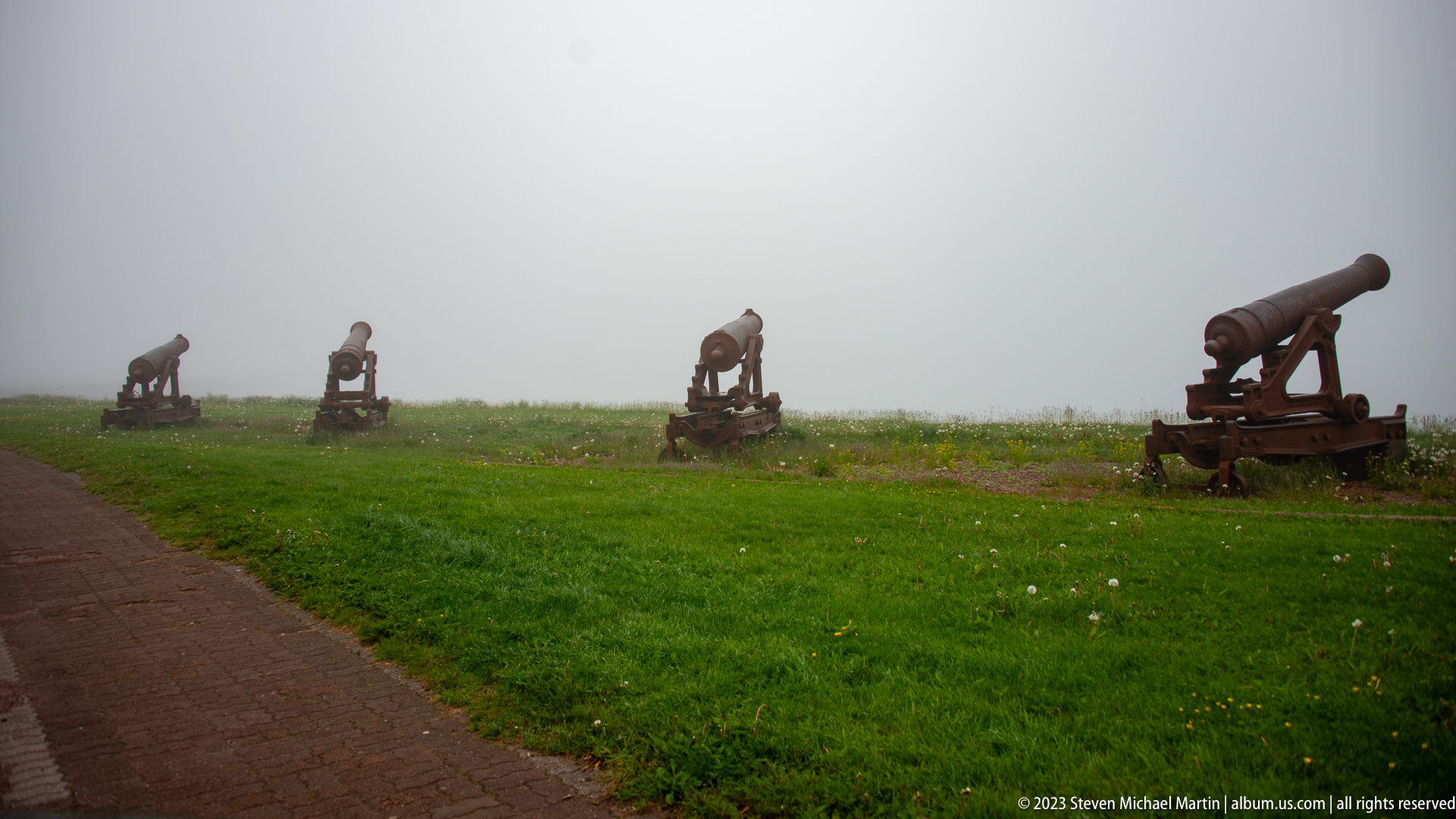
A row of historic iron cannon stands on individual wooden carriages along the edge of a grassy coastal park. The nearest gun points toward the right while others recede into dense fog, creating a measured sequence beside a paved path. The display evokes the islands’ defensive history without revealing enough detail to assign the pieces a precise date.
Caption
A row of historic iron cannon stands on individual wooden carriages along the edge of a grassy coastal park. The nearest gun points toward the right while others recede into dense fog, creating a measured sequence beside a paved path. The display evokes the islands’ defensive history without revealing enough detail to assign the pieces a precise date.
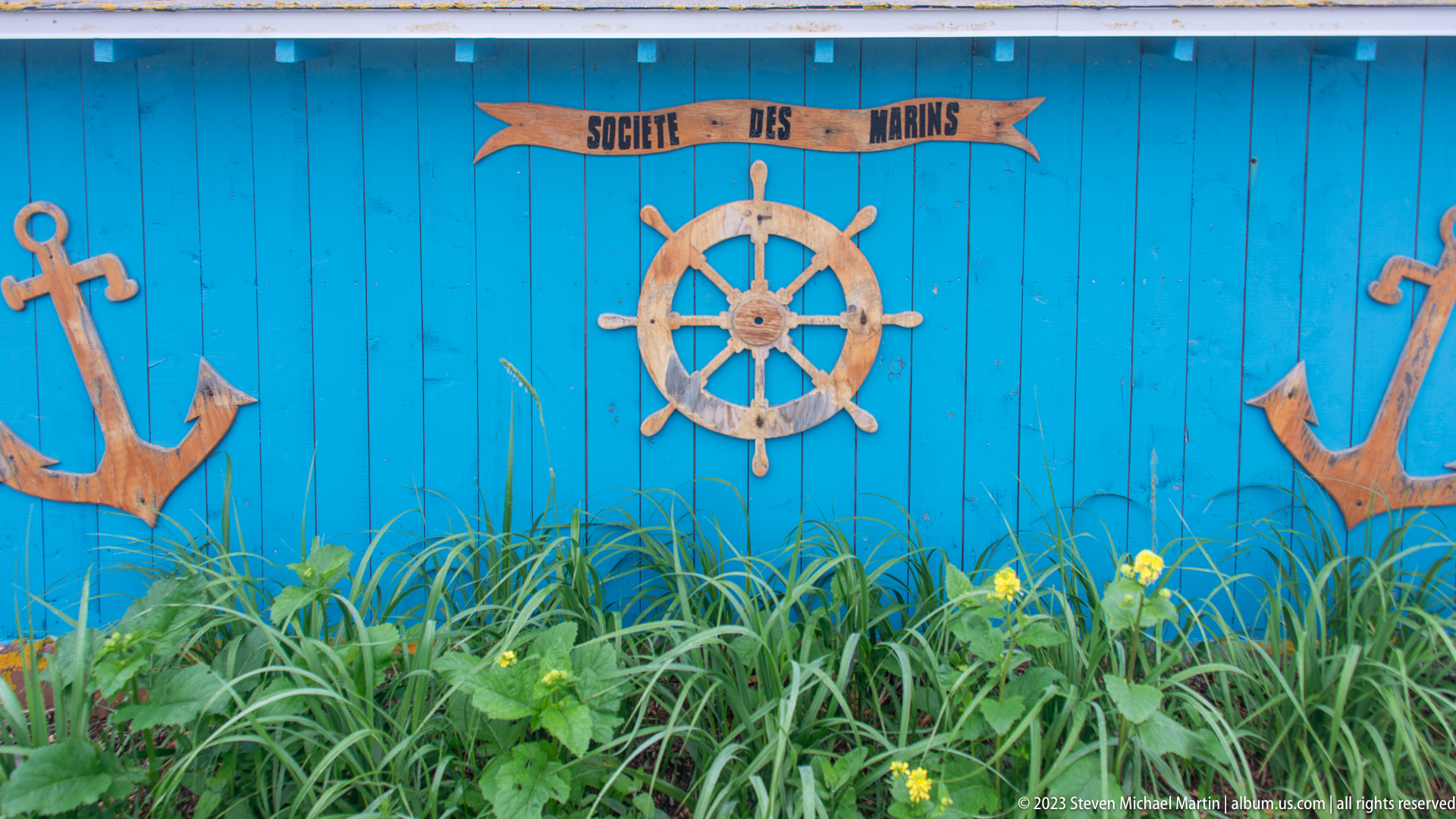
A bright blue plank wall carries carved maritime emblems—anchors at the sides and a ship’s wheel at center—beneath a wooden banner reading “SOCIETE DES MARINS.” Tall coastal plants partly cover the lower boards. The handcrafted decoration makes seafaring identity explicit through familiar symbols rather than through a working harbor scene.
Caption
A bright blue plank wall carries carved maritime emblems—anchors at the sides and a ship’s wheel at center—beneath a wooden banner reading “SOCIETE DES MARINS.” Tall coastal plants partly cover the lower boards. The handcrafted decoration makes seafaring identity explicit through familiar symbols rather than through a working harbor scene.

Blue, salmon, green, and pale-painted wooden sheds line a narrow gravel lane, their large doors and simple utilitarian forms suggesting storage or small-boat use near the waterfront. Fog softens the row as it recedes, while peeling paint, hoses, and hardware give the buildings the practical character of a working maritime district.
Caption
Blue, salmon, green, and pale-painted wooden sheds line a narrow gravel lane, their large doors and simple utilitarian forms suggesting storage or small-boat use near the waterfront. Fog softens the row as it recedes, while peeling paint, hoses, and hardware give the buildings the practical character of a working maritime district.

Small open motorboats rest on parallel timber launching rails that run down a rocky shore into calm water. Behind them, a row of brightly painted utility sheds extends through the fog. Outboard motors, rails, rough stones, and simple storage buildings together present the practical infrastructure of a small-boat working waterfront.
Caption
Small open motorboats rest on parallel timber launching rails that run down a rocky shore into calm water. Behind them, a row of brightly painted utility sheds extends through the fog. Outboard motors, rails, rough stones, and simple storage buildings together present the practical infrastructure of a small-boat working waterfront.
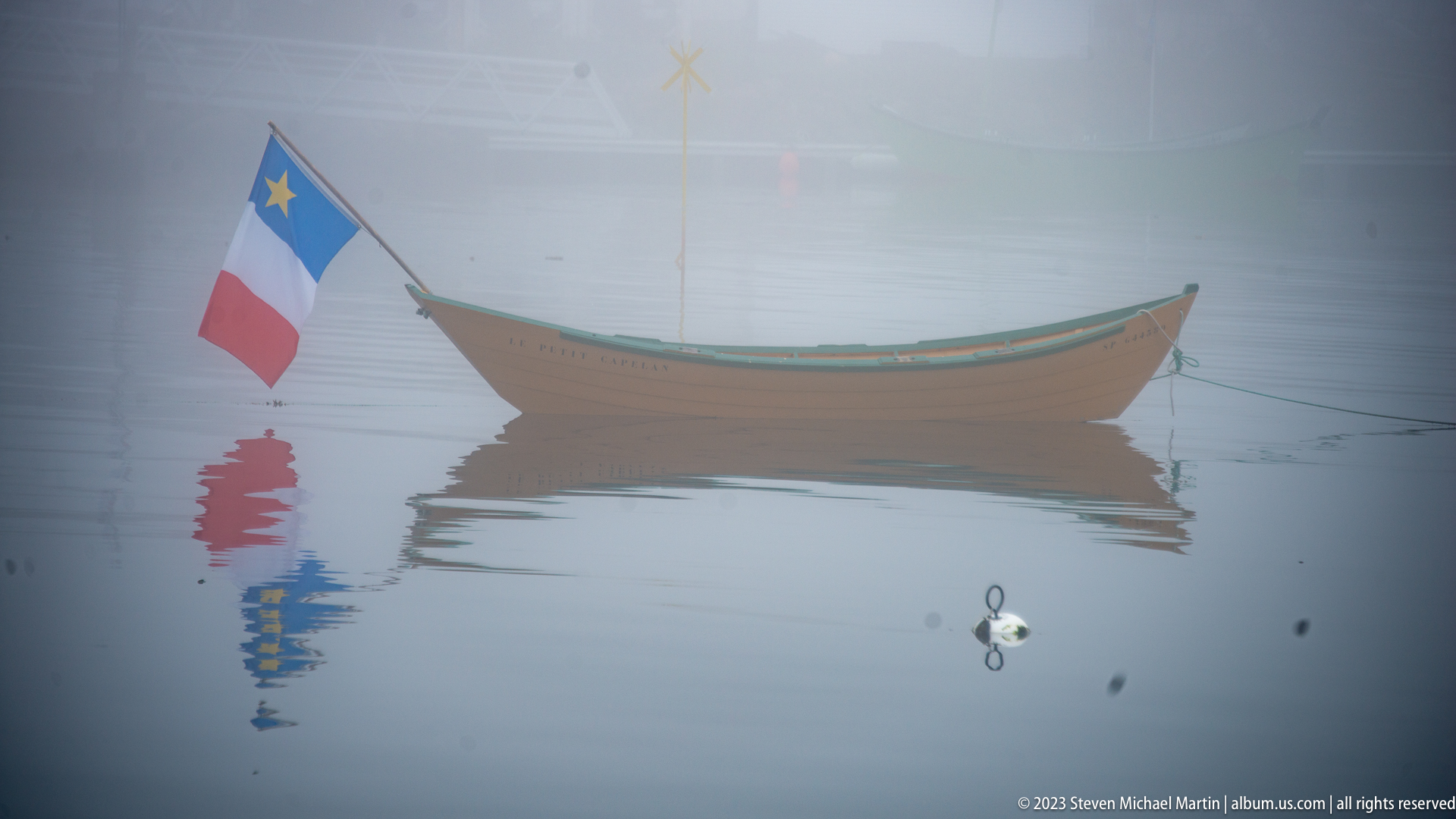
A small, traditional-looking wooden boat floats quietly on glassy water with an Acadian tricolor flag flying from its stern. Green trim outlines the warm brown hull, while the flag’s blue canton and yellow star provide the strongest color accent. Fog reduces the harbor beyond to faint silhouettes and soft reflections.
Caption
A small, traditional-looking wooden boat floats quietly on glassy water with an Acadian tricolor flag flying from its stern. Green trim outlines the warm brown hull, while the flag’s blue canton and yellow star provide the strongest color accent. Fog reduces the harbor beyond to faint silhouettes and soft reflections.

Several gulls perch on a broken line of low rocks emerging from still water, their pale bodies barely separating from the dense gray fog. The sparse composition reduces shoreline context to a few dark stones and reflections, emphasizing the birds’ quiet presence in a sheltered, low-visibility coastal setting.
Caption
Several gulls perch on a broken line of low rocks emerging from still water, their pale bodies barely separating from the dense gray fog. The sparse composition reduces shoreline context to a few dark stones and reflections, emphasizing the birds’ quiet presence in a sheltered, low-visibility coastal setting.
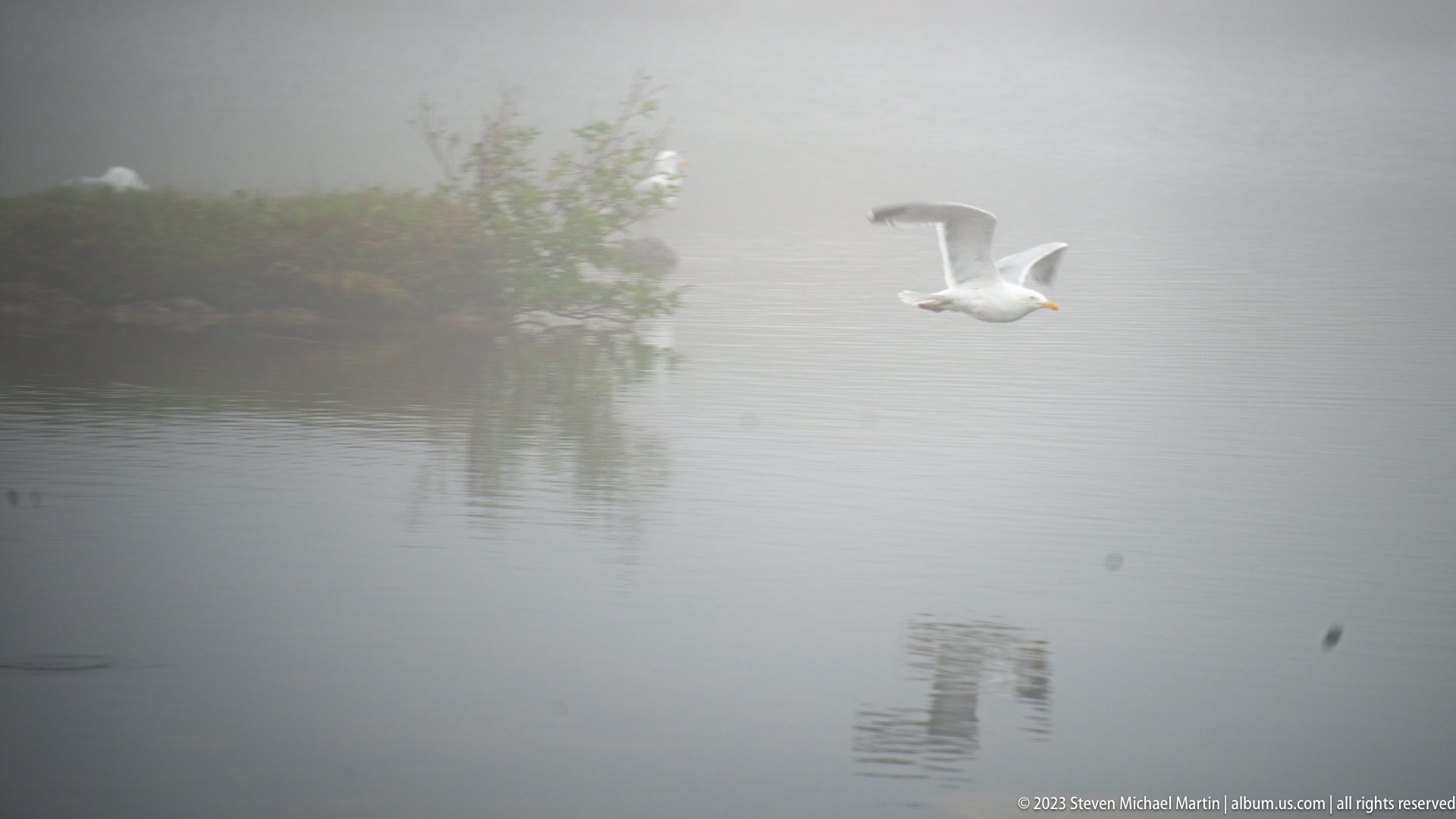
A gull crosses low over calm water with wings extended, its pale body standing out against a veil of fog. A shrub-covered bank and another perched bird fade into the left background, while the flying gull and its soft reflection provide the only strong movement in the otherwise still coastal scene.
Caption
A gull crosses low over calm water with wings extended, its pale body standing out against a veil of fog. A shrub-covered bank and another perched bird fade into the left background, while the flying gull and its soft reflection provide the only strong movement in the otherwise still coastal scene.
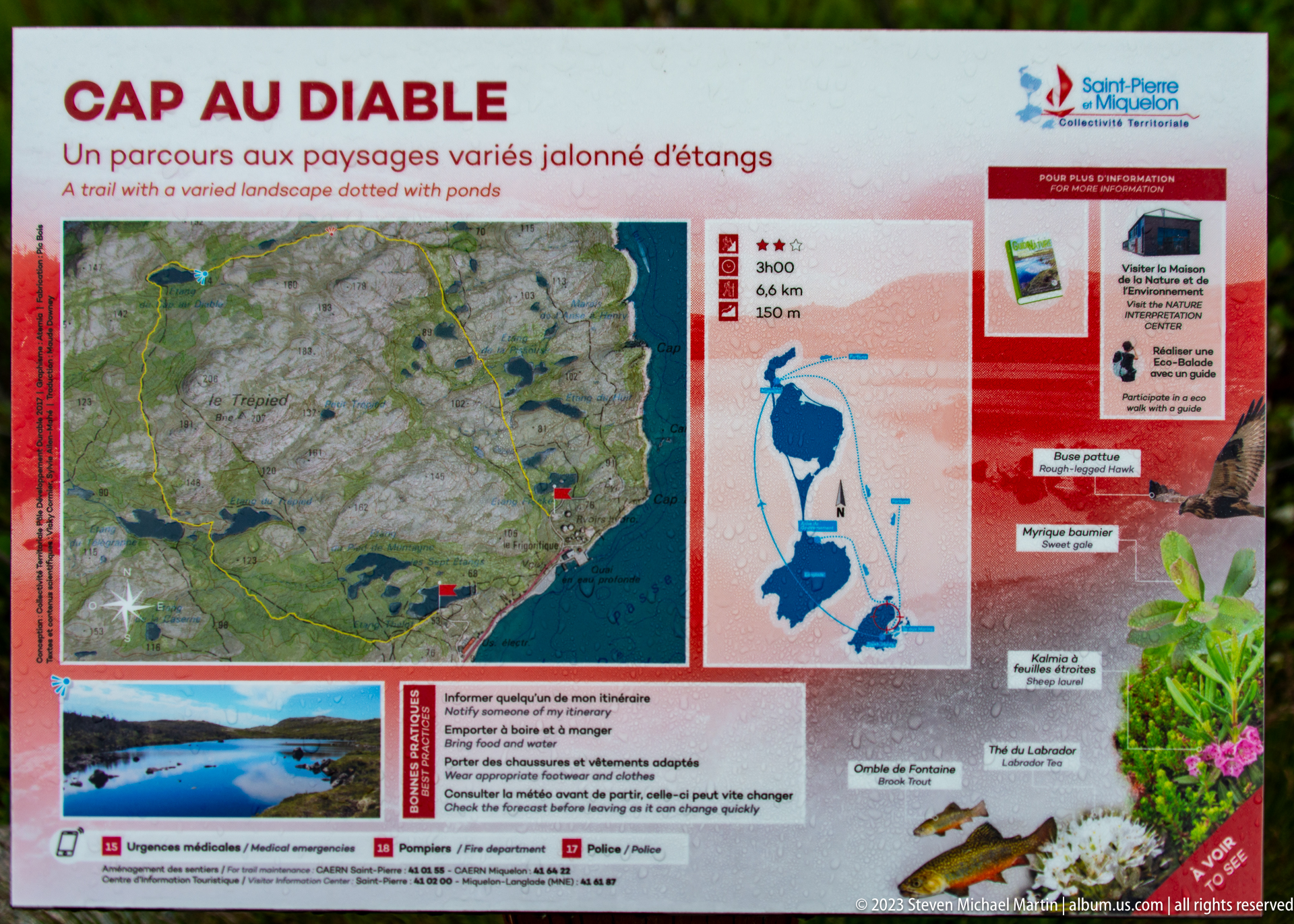
An outdoor interpretation panel presents a mapped walking route through a landscape of ponds and wetlands, with bilingual French and English text, elevation information, route graphics, and local nature imagery. The Saint-Pierre-et-Miquelon tourism mark identifies the regional context, while the map functions as practical orientation for hikers.
Caption
An outdoor interpretation panel presents a mapped walking route through a landscape of ponds and wetlands, with bilingual French and English text, elevation information, route graphics, and local nature imagery. The Saint-Pierre-et-Miquelon tourism mark identifies the regional context, while the map functions as practical orientation for hikers.
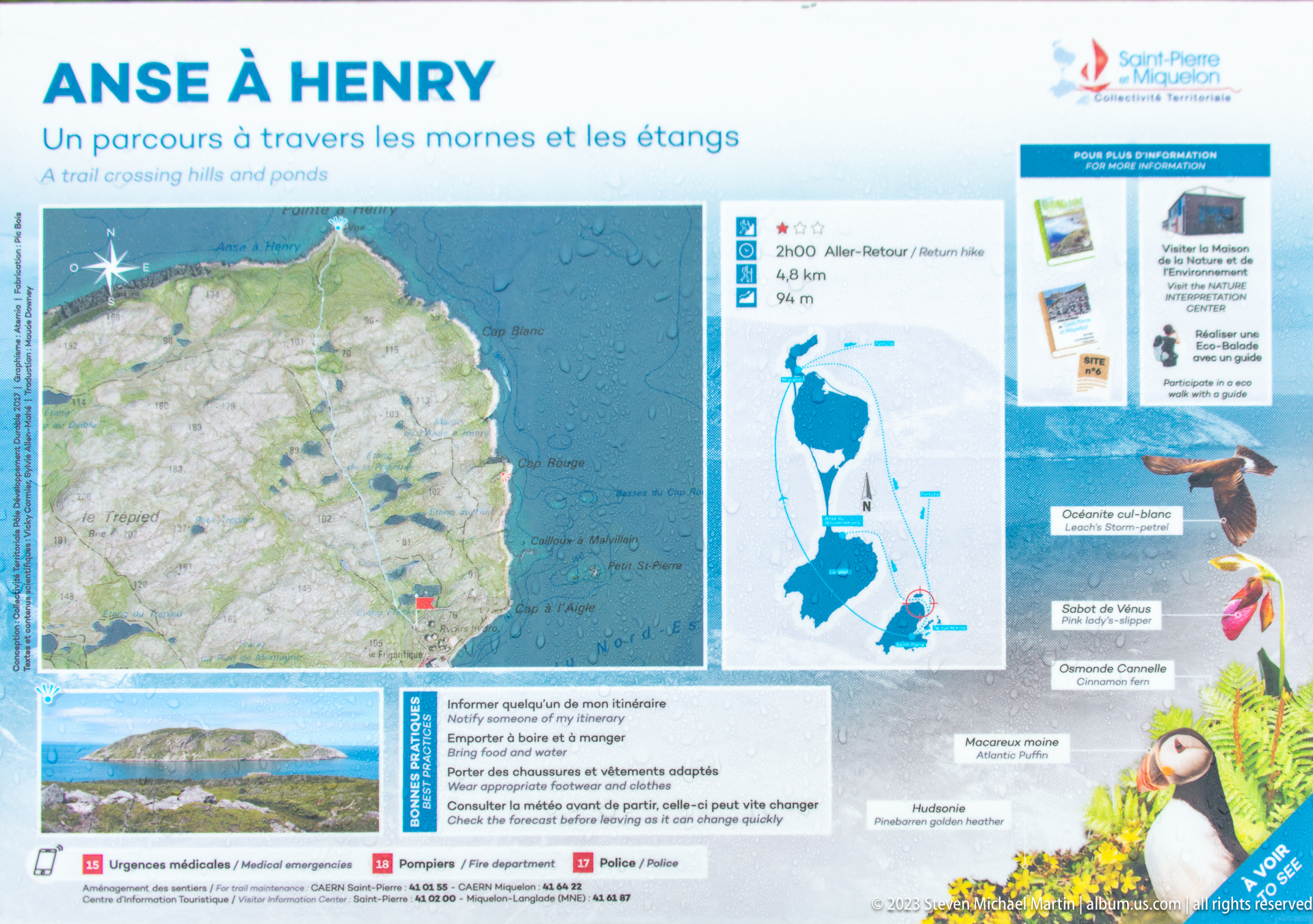
A bilingual trail panel headed “CAP A HENRY” maps a walking route through moors and ponds, combining an aerial-style map with distance, duration, route profile, wildlife illustrations, and visitor guidance. The sign translates the surrounding terrain into a compact field guide, linking navigation with interpretation of local landscape and fauna.
Caption
A bilingual trail panel headed “CAP A HENRY” maps a walking route through moors and ponds, combining an aerial-style map with distance, duration, route profile, wildlife illustrations, and visitor guidance. The sign translates the surrounding terrain into a compact field guide, linking navigation with interpretation of local landscape and fauna.
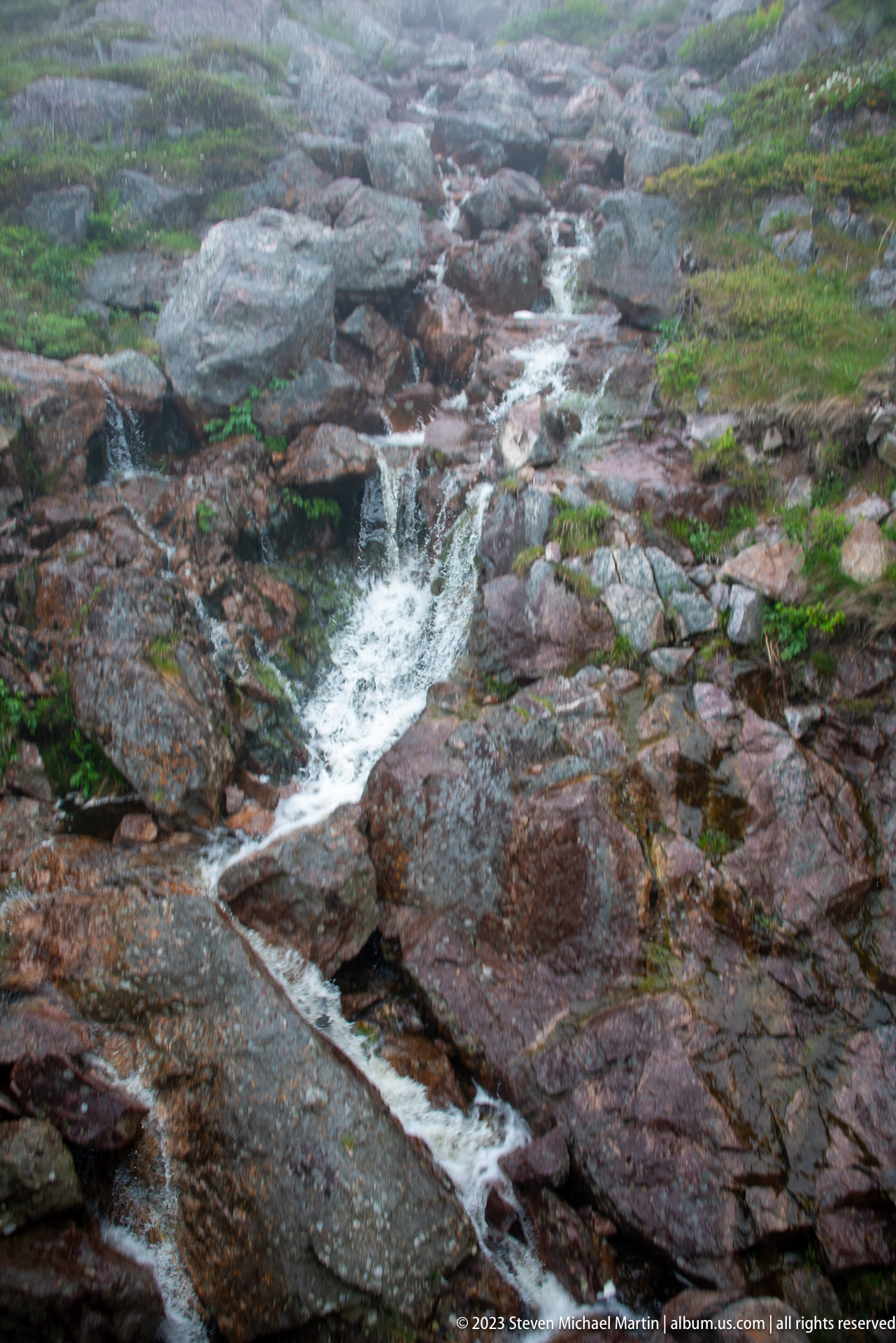
A narrow stream descends across exposed reddish-brown bedrock in a series of shallow cascades and channels. Sparse low vegetation clings to cracks and margins, while the close viewpoint follows the white water diagonally through the stone. The scene records the wet, rock-dominated character of the islands’ open upland terrain.
Caption
A narrow stream descends across exposed reddish-brown bedrock in a series of shallow cascades and channels. Sparse low vegetation clings to cracks and margins, while the close viewpoint follows the white water diagonally through the stone. The scene records the wet, rock-dominated character of the islands’ open upland terrain.

The Monument aux Marins Disparus centers a stone figure of a mariner gripping a large ship’s wheel above a granite pedestal inscribed “NOS MARINS DISPARUS.” Floral wreaths and bouquets lie at the base, reinforcing its commemorative purpose. Fog and a restrained civic setting keep attention on remembrance of sailors who did not return from the sea.
Caption
The Monument aux Marins Disparus centers a stone figure of a mariner gripping a large ship’s wheel above a granite pedestal inscribed “NOS MARINS DISPARUS.” Floral wreaths and bouquets lie at the base, reinforcing its commemorative purpose. Fog and a restrained civic setting keep attention on remembrance of sailors who did not return from the sea.
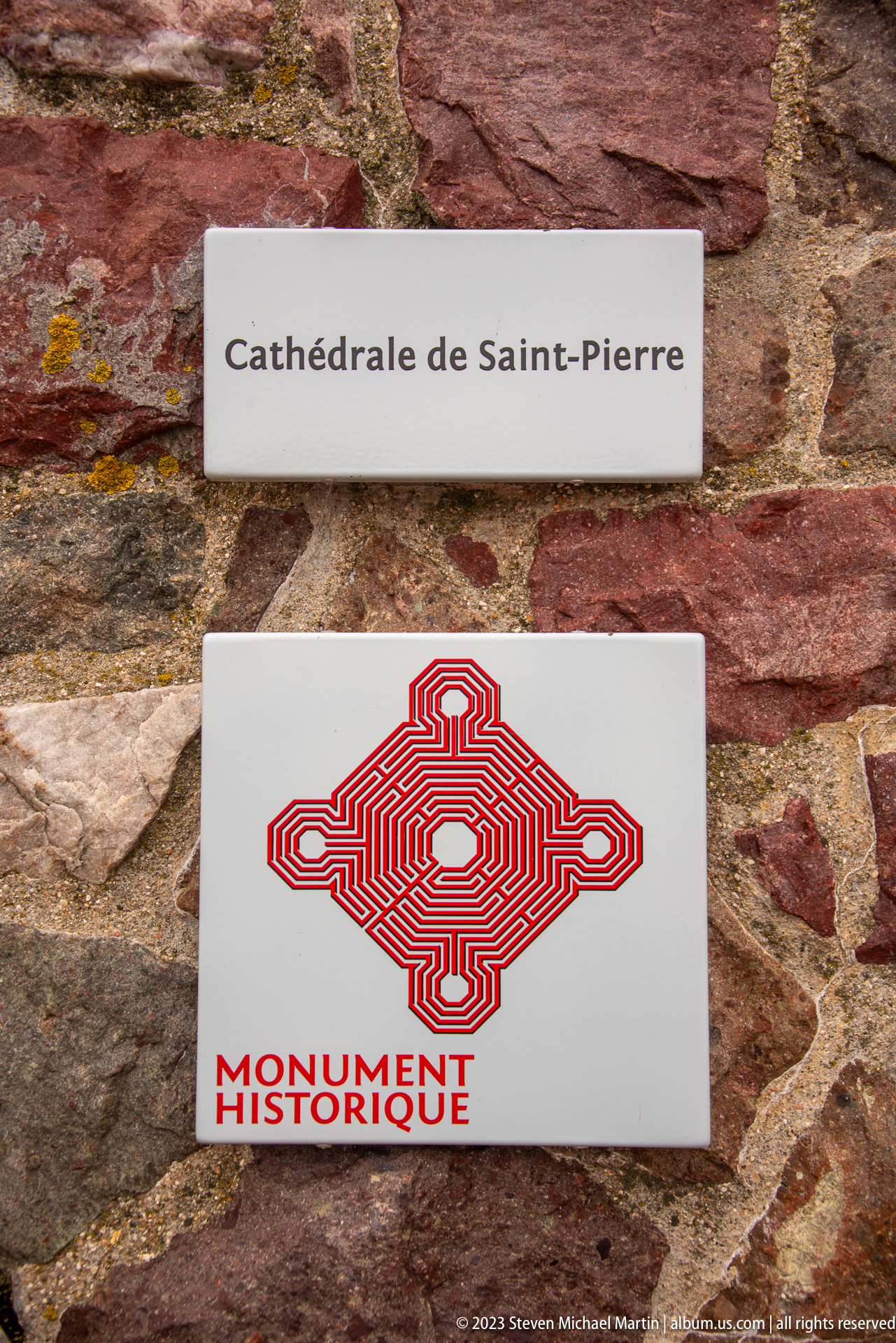
Two mounted plaques on a rough stone wall identify the Cathédrale de Saint-Pierre, including a red-and-white Monument Historique emblem. The close view isolates the building’s official designation rather than its architecture, linking the cathedral to France’s heritage-protection system while preserving the texture of the masonry behind the signs.
Caption
Two mounted plaques on a rough stone wall identify the Cathédrale de Saint-Pierre, including a red-and-white Monument Historique emblem. The close view isolates the building’s official designation rather than its architecture, linking the cathedral to France’s heritage-protection system while preserving the texture of the masonry behind the signs.

Coordinates “46°46′49″ N” and “56°10′15″ W” are cut through a rust-colored perforated metal panel, turning geographic location into a graphic design element. Rows of circular holes and exposed fasteners establish the industrial material, while the dark stencil-like numerals and letters give the exact position visual prominence.
Caption
Coordinates “46°46′49″ N” and “56°10′15″ W” are cut through a rust-colored perforated metal panel, turning geographic location into a graphic design element. Rows of circular holes and exposed fasteners establish the industrial material, while the dark stencil-like numerals and letters give the exact position visual prominence.
A school-like arrangement of fish silhouettes is cut through a rust-colored perforated steel panel. The openings reveal muted blue-gray color behind the metal, while rows of circular holes and bright fasteners create a regular field around the organic fish shapes. The maritime motif links contemporary metalwork with the islands’ fishing culture.
Caption
A school-like arrangement of fish silhouettes is cut through a rust-colored perforated steel panel. The openings reveal muted blue-gray color behind the metal, while rows of circular holes and bright fasteners create a regular field around the organic fish shapes. The maritime motif links contemporary metalwork with the islands’ fishing culture.

A bold black-and-cutout maritime emblem combines an anchor with interlocking graphic forms on a rust-colored perforated steel panel. Small circular holes and fasteners repeat across the surface, while a narrow opening at the bottom reveals vegetation beyond. The close detail emphasizes contemporary design rooted in Saint Pierre & Miquelon’s seafaring identity.
Caption
A bold black-and-cutout maritime emblem combines an anchor with interlocking graphic forms on a rust-colored perforated steel panel. Small circular holes and fasteners repeat across the surface, while a narrow opening at the bottom reveals vegetation beyond. The close detail emphasizes contemporary design rooted in Saint Pierre & Miquelon’s seafaring identity.
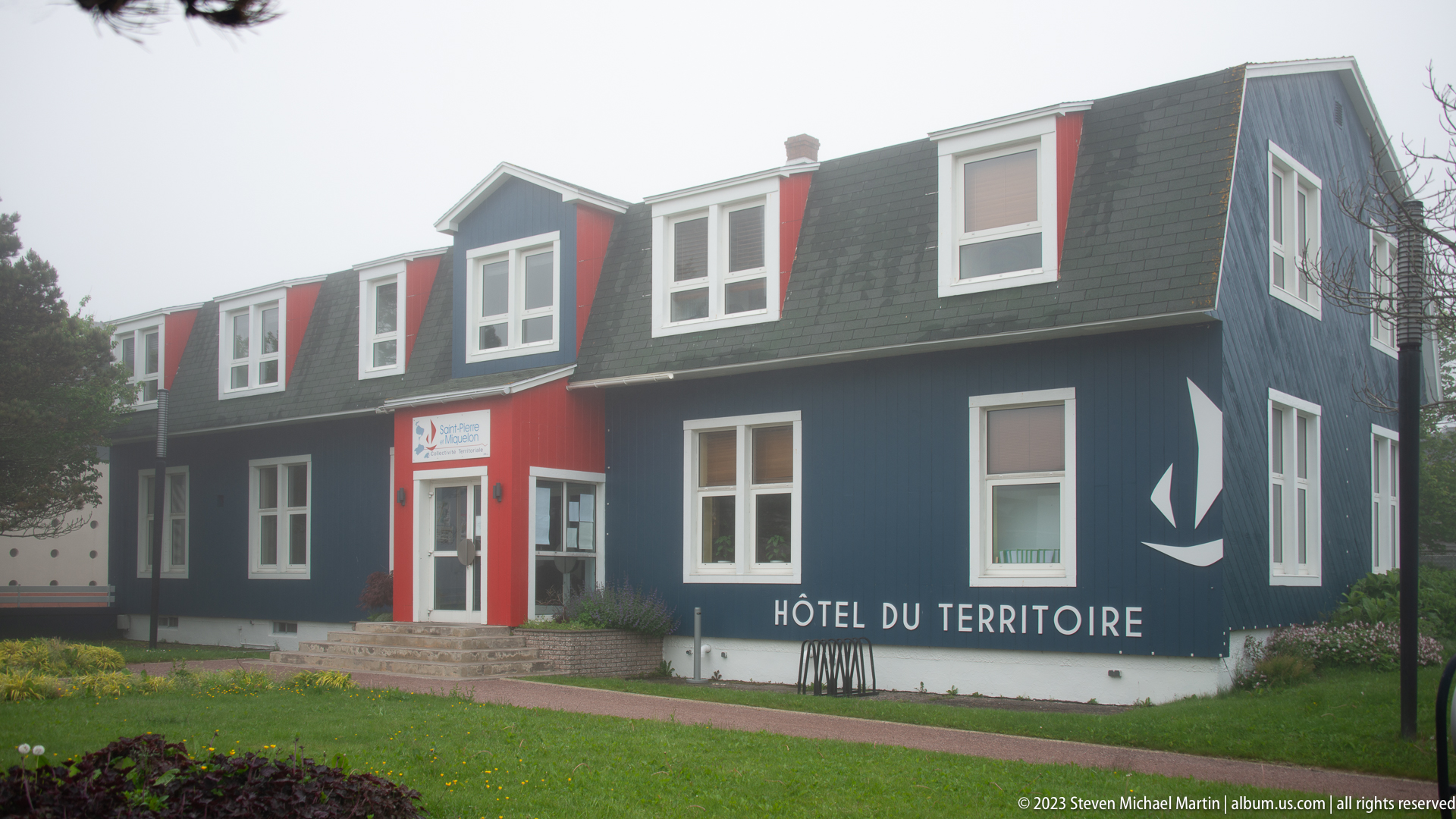
The Hôtel du Territoire presents a compact, domestic-scaled civic façade painted dark blue with a bright red entrance bay. White-trimmed windows, dormers, and a steep roof echo local residential forms, while the large “HÔTEL DU TERRITOIRE” lettering and sail-like emblem identify the building’s official function within Saint Pierre & Miquelon.
Caption
The Hôtel du Territoire presents a compact, domestic-scaled civic façade painted dark blue with a bright red entrance bay. White-trimmed windows, dormers, and a steep roof echo local residential forms, while the large “HÔTEL DU TERRITOIRE” lettering and sail-like emblem identify the building’s official function within Saint Pierre & Miquelon.
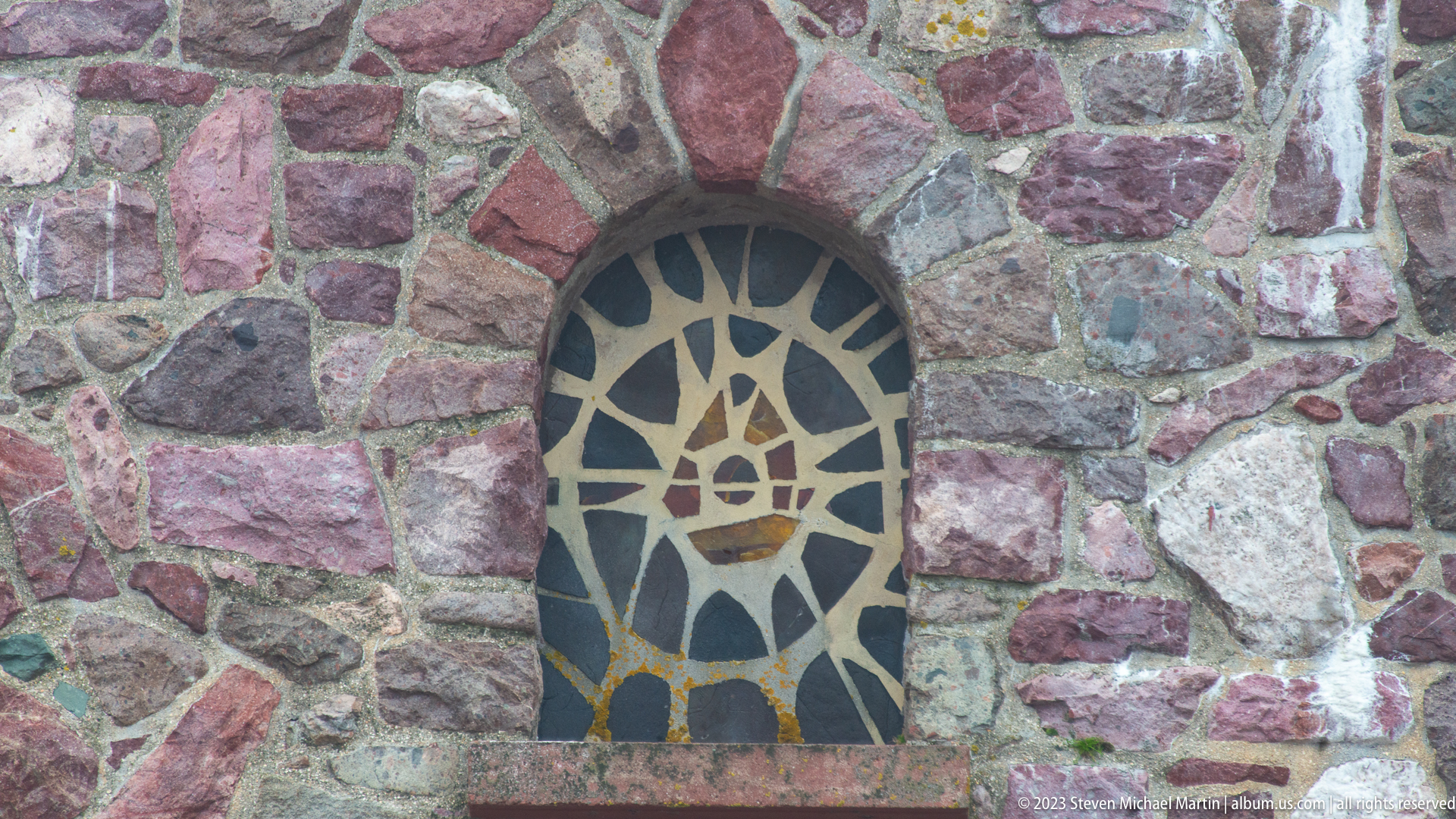
An arched mosaic panel is embedded in a wall of irregular pink, gray, and green stone. Dark and cream tesserae form a radiating pattern around a small stylized vessel or maritime emblem, with yellow lines descending toward the base. The handcrafted inset introduces a vivid symbolic detail into the otherwise rough masonry surface.
Caption
An arched mosaic panel is embedded in a wall of irregular pink, gray, and green stone. Dark and cream tesserae form a radiating pattern around a small stylized vessel or maritime emblem, with yellow lines descending toward the base. The handcrafted inset introduces a vivid symbolic detail into the otherwise rough masonry surface.
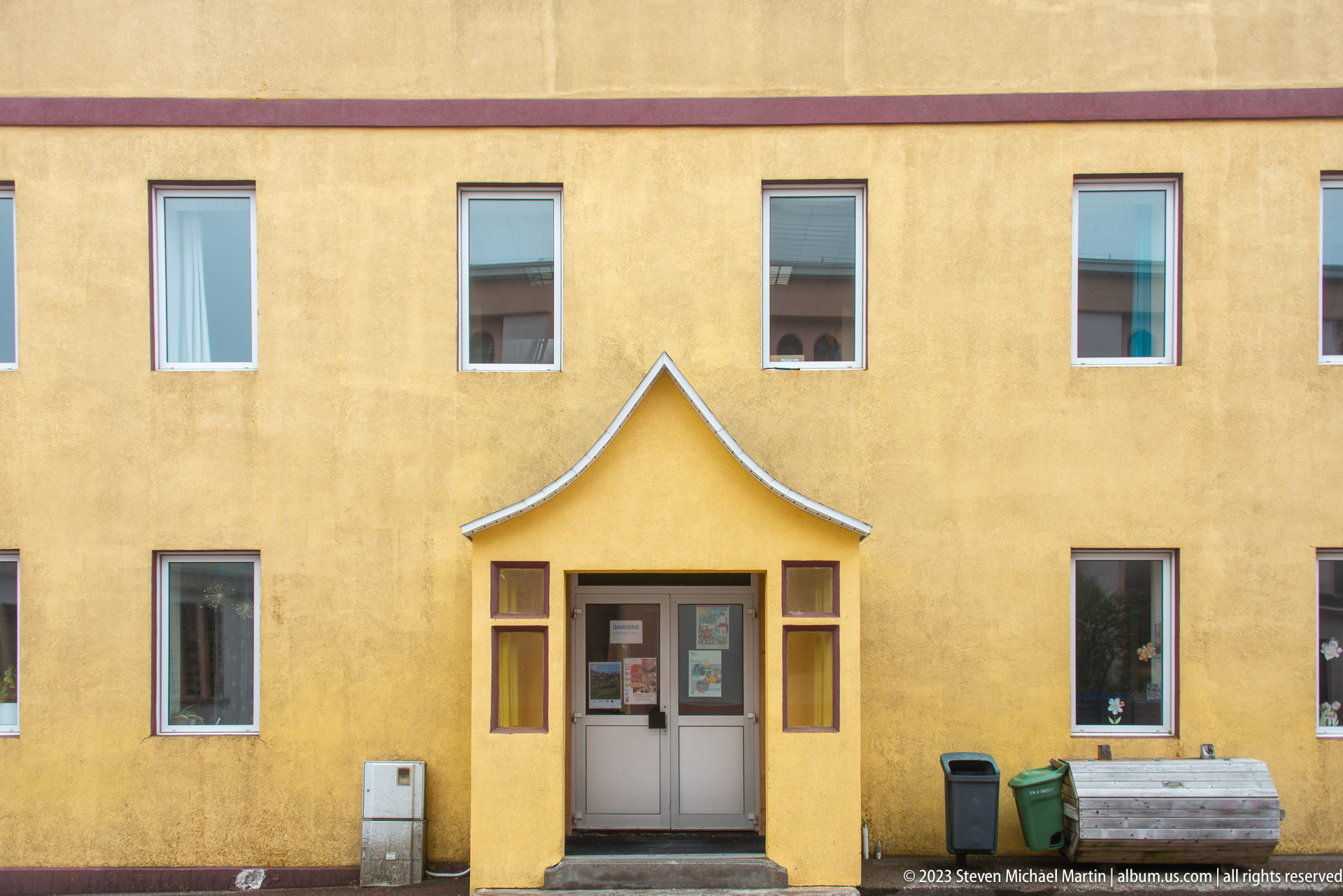
A restrained yellow façade faces the street with evenly spaced windows and a small entrance canopy outlined by a pointed, wave-like profile. The symmetrical composition and utilitarian fixtures suggest a civic or institutional use, while refuse bins and a service container at curb level keep the view grounded in the everyday streetscape of Saint-Pierre.
Caption
A restrained yellow façade faces the street with evenly spaced windows and a small entrance canopy outlined by a pointed, wave-like profile. The symmetrical composition and utilitarian fixtures suggest a civic or institutional use, while refuse bins and a service container at curb level keep the view grounded in the everyday streetscape of Saint-Pierre.
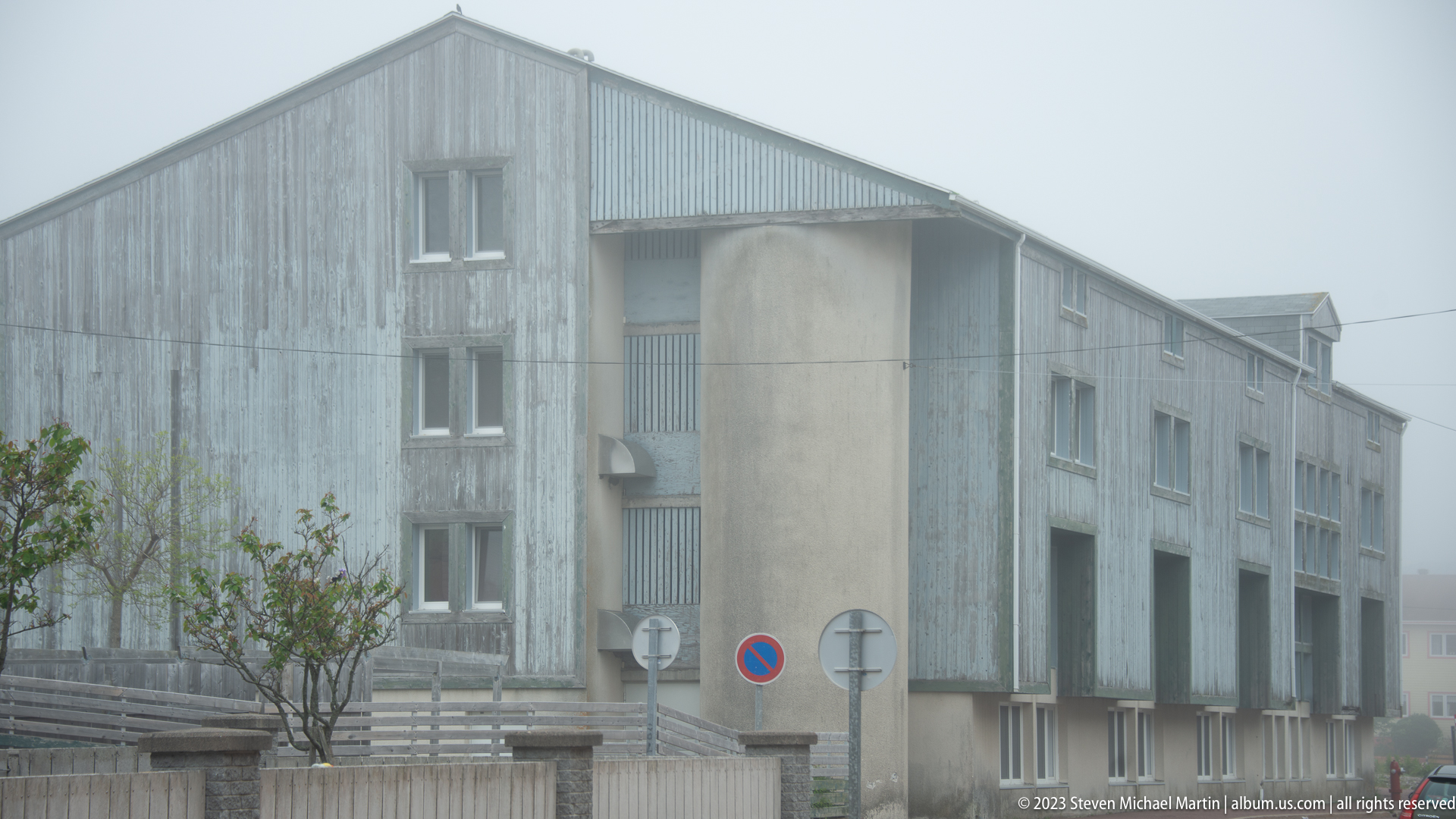
A large gray institutional building rises through coastal fog, its long elevations divided into repetitive vertical bays and deeply recessed openings. The damp atmosphere softens the structure’s scale while emphasizing its heavy concrete massing and functional character. Road signs and a low wall in the foreground situate the building within Saint-Pierre’s compact urban fabric.
Caption
A large gray institutional building rises through coastal fog, its long elevations divided into repetitive vertical bays and deeply recessed openings. The damp atmosphere softens the structure’s scale while emphasizing its heavy concrete massing and functional character. Road signs and a low wall in the foreground situate the building within Saint-Pierre’s compact urban fabric.
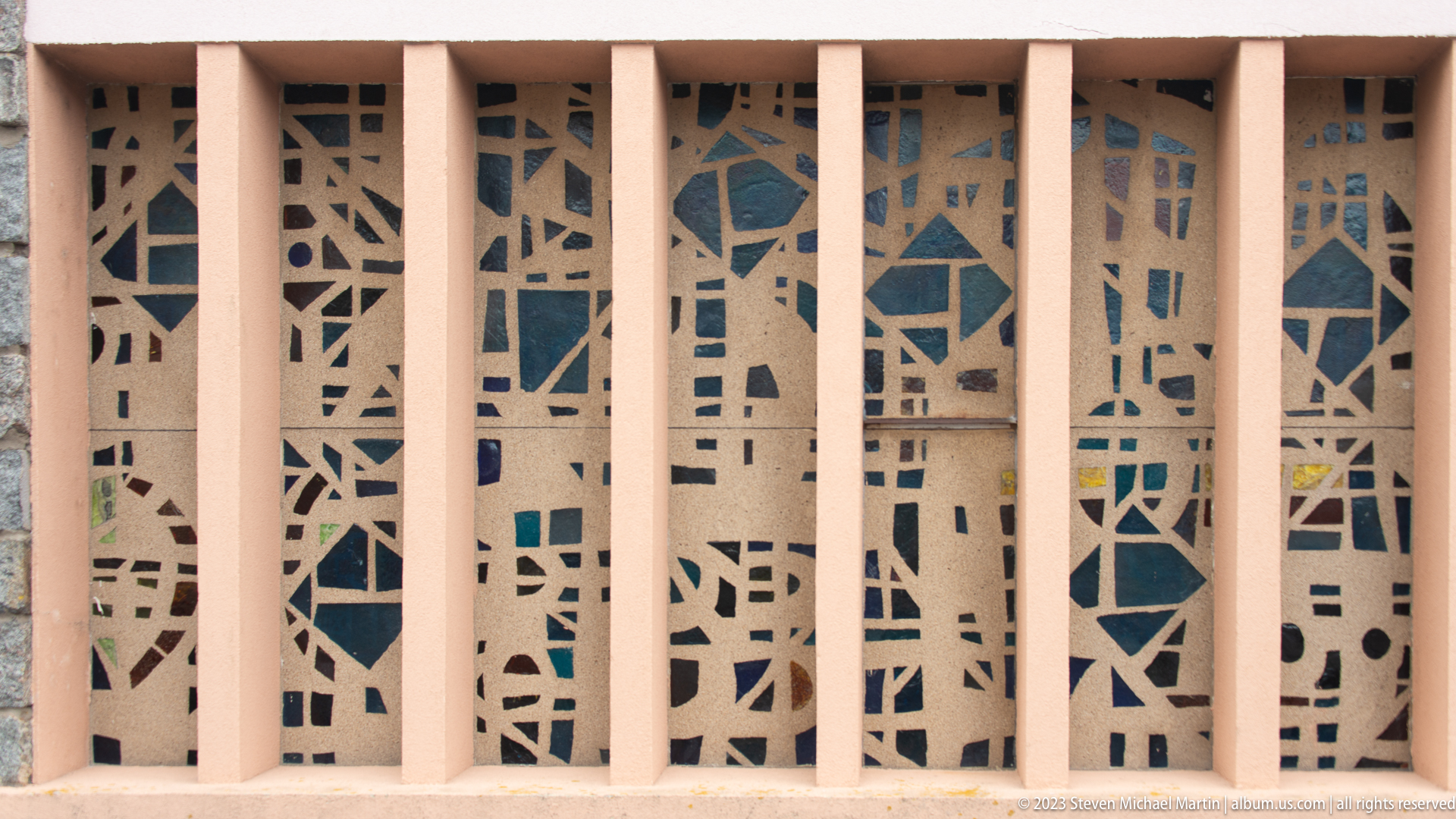
An abstract concrete screen fills the frame with irregular openings that read like a fractured mosaic behind a row of pale pink vertical supports. The close composition emphasizes pattern, depth, and shadow rather than the larger building. Small glimpses through the openings suggest the screen functions as both enclosure and ornament on a modern structure in Saint-Pierre.
Caption
An abstract concrete screen fills the frame with irregular openings that read like a fractured mosaic behind a row of pale pink vertical supports. The close composition emphasizes pattern, depth, and shadow rather than the larger building. Small glimpses through the openings suggest the screen functions as both enclosure and ornament on a modern structure in Saint-Pierre.

Bright blue paneled double doors punctuate a weathered white clapboard façade, with matching trim and a glazed transom arranged in a geometric fan-like pattern above. The tightly framed view turns a practical entrance into an architectural detail, highlighting the vivid paint traditions and close-grained wooden construction visible throughout Saint-Pierre’s streetscape.
Caption
Bright blue paneled double doors punctuate a weathered white clapboard façade, with matching trim and a glazed transom arranged in a geometric fan-like pattern above. The tightly framed view turns a practical entrance into an architectural detail, highlighting the vivid paint traditions and close-grained wooden construction visible throughout Saint-Pierre’s streetscape.
Two blue street-name plaques intersect visually beneath pine branches: “Rue du Poitou” above and “Avenue du Commandant Roger Birot” below. The lower sign adds “Compagnon de la Libération,” turning an ordinary junction marker into a small commemorative element within Saint-Pierre’s urban fabric and preserving a French historical reference in the street nomenclature.
Caption
Two blue street-name plaques intersect visually beneath pine branches: “Rue du Poitou” above and “Avenue du Commandant Roger Birot” below. The lower sign adds “Compagnon de la Libération,” turning an ordinary junction marker into a small commemorative element within Saint-Pierre’s urban fabric and preserving a French historical reference in the street nomenclature.
The coat of arms of Saint-Pierre-et-Miquelon fills the frame with a sailing ship over a blue field, three historic regional banners above, and the motto “A Mare Labor” below. Rendered as a painted or printed emblem, it condenses the territory’s maritime identity and French cultural associations into a single heraldic composition.
Caption
The coat of arms of Saint-Pierre-et-Miquelon fills the frame with a sailing ship over a blue field, three historic regional banners above, and the motto “A Mare Labor” below. Rendered as a painted or printed emblem, it condenses the territory’s maritime identity and French cultural associations into a single heraldic composition.
A blue enamel-style plaque marked “Rue de Paris” is fixed to a weathered wall painted in faded turquoise and ochre tones. The close framing records both the French street name and the layered surface around it, pairing formal municipal signage with the patina of Saint-Pierre’s maritime climate and compact urban streetscape.
Caption
A blue enamel-style plaque marked “Rue de Paris” is fixed to a weathered wall painted in faded turquoise and ochre tones. The close framing records both the French street name and the layered surface around it, pairing formal municipal signage with the patina of Saint-Pierre’s maritime climate and compact urban streetscape.
A gray wooden fence becomes an outdoor decorative surface through a sequence of brightly painted circular, floral, and geometric motifs. Barrel-like planters and clipped trees line the walkway in front, while modest houses rise behind. The scene records the individualized color and craft that enliven residential spaces in Saint-Pierre despite the subdued coastal weather.
Caption
A gray wooden fence becomes an outdoor decorative surface through a sequence of brightly painted circular, floral, and geometric motifs. Barrel-like planters and clipped trees line the walkway in front, while modest houses rise behind. The scene records the individualized color and craft that enliven residential spaces in Saint-Pierre despite the subdued coastal weather.

A freestanding outdoor panel presents a large photograph of a dense modern city skyline, creating a striking contrast with the foggy, low-rise surroundings visible beyond its frame. Mounted on a simple support above a wall, the installation reads as public art or interpretation rather than a view of Saint-Pierre itself, and the coastal mist heightens that visual disjunction.
Caption
A freestanding outdoor panel presents a large photograph of a dense modern city skyline, creating a striking contrast with the foggy, low-rise surroundings visible beyond its frame. Mounted on a simple support above a wall, the installation reads as public art or interpretation rather than a view of Saint-Pierre itself, and the coastal mist heightens that visual disjunction.
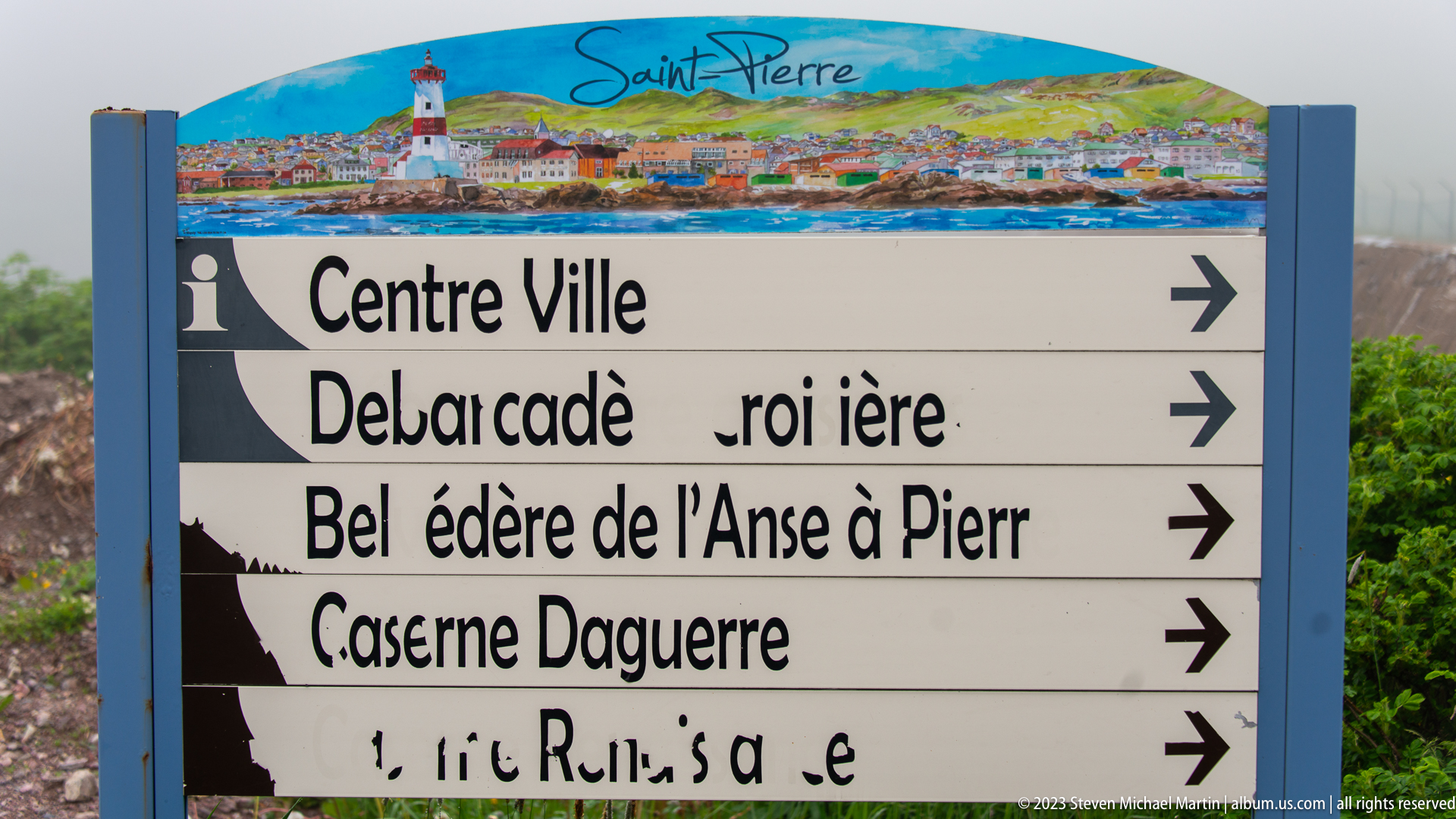
A visitor wayfinding sign headed “Saint-Pierre” directs travelers toward Centre Ville and several local sites, including Caserne Daguerre. The illustrated harbor panorama across the top gives the utilitarian sign a distinctly local identity, while multiple arrows emphasize the compact network of civic, scenic, and historic destinations within the town.
Caption
A visitor wayfinding sign headed “Saint-Pierre” directs travelers toward Centre Ville and several local sites, including Caserne Daguerre. The illustrated harbor panorama across the top gives the utilitarian sign a distinctly local identity, while multiple arrows emphasize the compact network of civic, scenic, and historic destinations within the town.
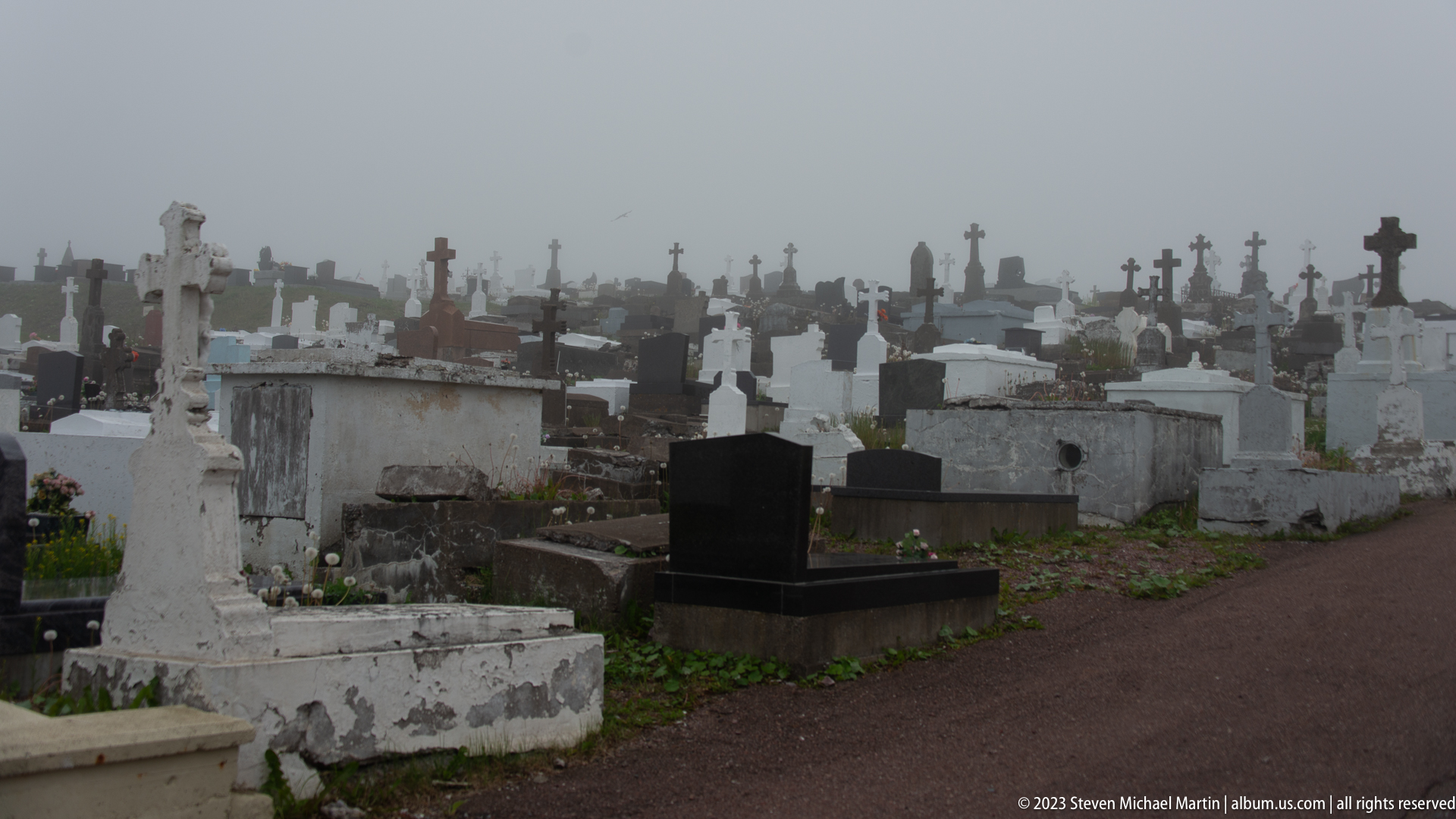
Rows of crosses, tombs, and low family monuments recede into thick fog, producing a compressed view of Saint-Pierre’s cemetery landscape. Whitewashed and dark stone memorials stand close together along a reddish path, revealing a dense funerary tradition in which individual markers vary widely in form while remaining strongly Christian in iconography.
Caption
Rows of crosses, tombs, and low family monuments recede into thick fog, producing a compressed view of Saint-Pierre’s cemetery landscape. Whitewashed and dark stone memorials stand close together along a reddish path, revealing a dense funerary tradition in which individual markers vary widely in form while remaining strongly Christian in iconography.

A white stepped memorial supports two dark bronze figures, one standing high with the French tricolor while a second figure reaches upward from below. Set among cemetery graves and softened by fog, the monument presents military remembrance through a compact patriotic tableau. The plaque is too small to read here, so the exact dedication is not asserted.
Caption
A white stepped memorial supports two dark bronze figures, one standing high with the French tricolor while a second figure reaches upward from below. Set among cemetery graves and softened by fog, the monument presents military remembrance through a compact patriotic tableau. The plaque is too small to read here, so the exact dedication is not asserted.
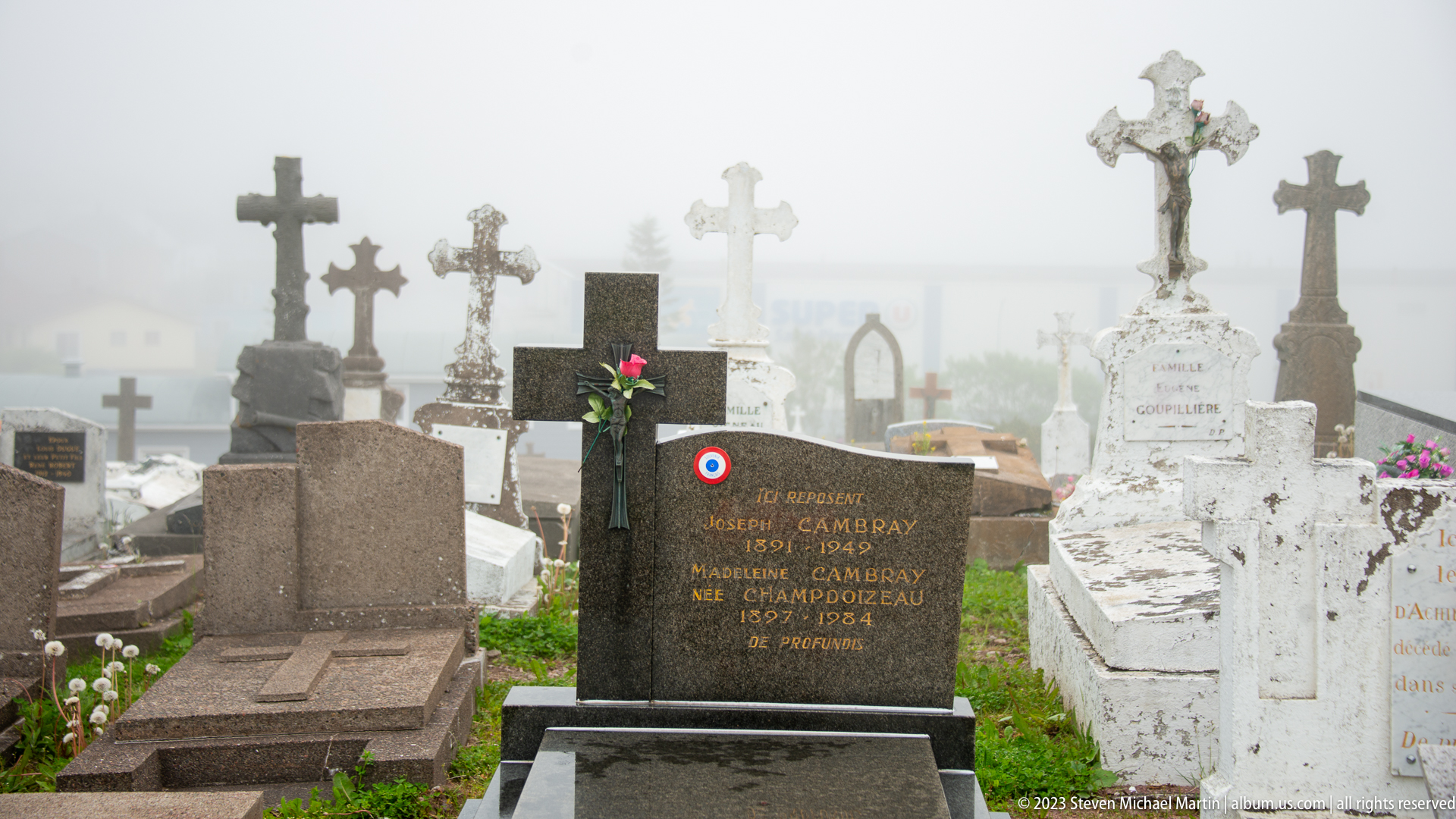
A dark polished grave marker for Joseph Cambray stands among weathered crosses and white funerary monuments in the foggy cemetery. A small French tricolor roundel punctuates the inscription, distinguishing this memorial from neighboring graves. The tight view preserves both an individual commemoration and the crowded visual texture of Saint-Pierre’s burial ground.
Caption
A dark polished grave marker for Joseph Cambray stands among weathered crosses and white funerary monuments in the foggy cemetery. A small French tricolor roundel punctuates the inscription, distinguishing this memorial from neighboring graves. The tight view preserves both an individual commemoration and the crowded visual texture of Saint-Pierre’s burial ground.
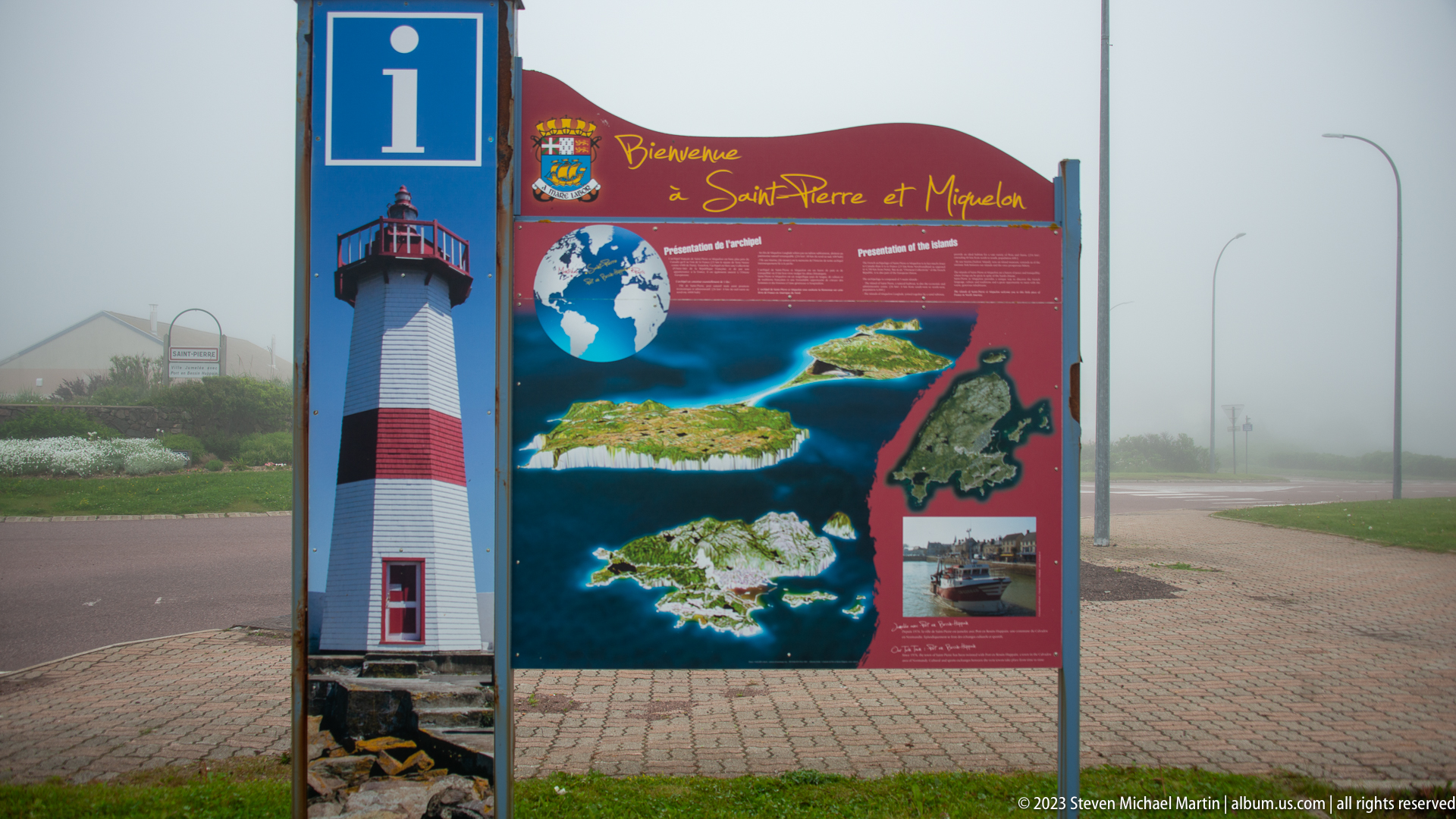
A colorful welcome panel introduces Saint-Pierre-et-Miquelon through an illustrated lighthouse, map imagery, and aerial views of the islands. Positioned beside a paved roadside area in fog, it functions as both orientation and territorial branding. The display’s mix of cartography, photography, and maritime imagery presents the archipelago to arriving visitors at a glance.
Caption
A colorful welcome panel introduces Saint-Pierre-et-Miquelon through an illustrated lighthouse, map imagery, and aerial views of the islands. Positioned beside a paved roadside area in fog, it functions as both orientation and territorial branding. The display’s mix of cartography, photography, and maritime imagery presents the archipelago to arriving visitors at a glance.
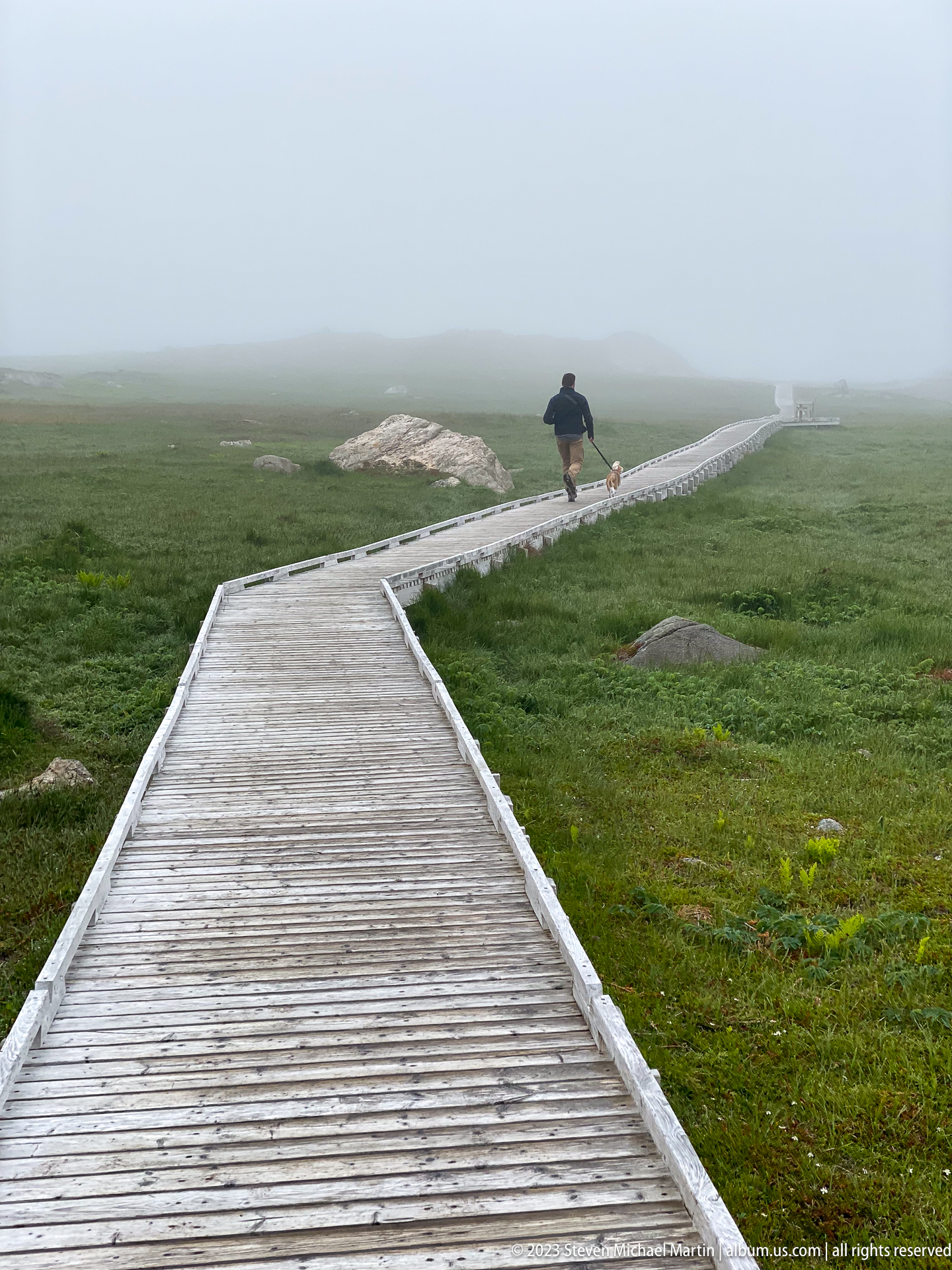
A weathered wooden boardwalk curves across low green coastal vegetation and disappears into dense fog, with a lone walker providing scale near the bend. The open, treeless terrain and subdued horizon emphasize exposure to Atlantic weather, while the raised path protects both visitors and the fragile ground beneath it.
Caption
A weathered wooden boardwalk curves across low green coastal vegetation and disappears into dense fog, with a lone walker providing scale near the bend. The open, treeless terrain and subdued horizon emphasize exposure to Atlantic weather, while the raised path protects both visitors and the fragile ground beneath it.
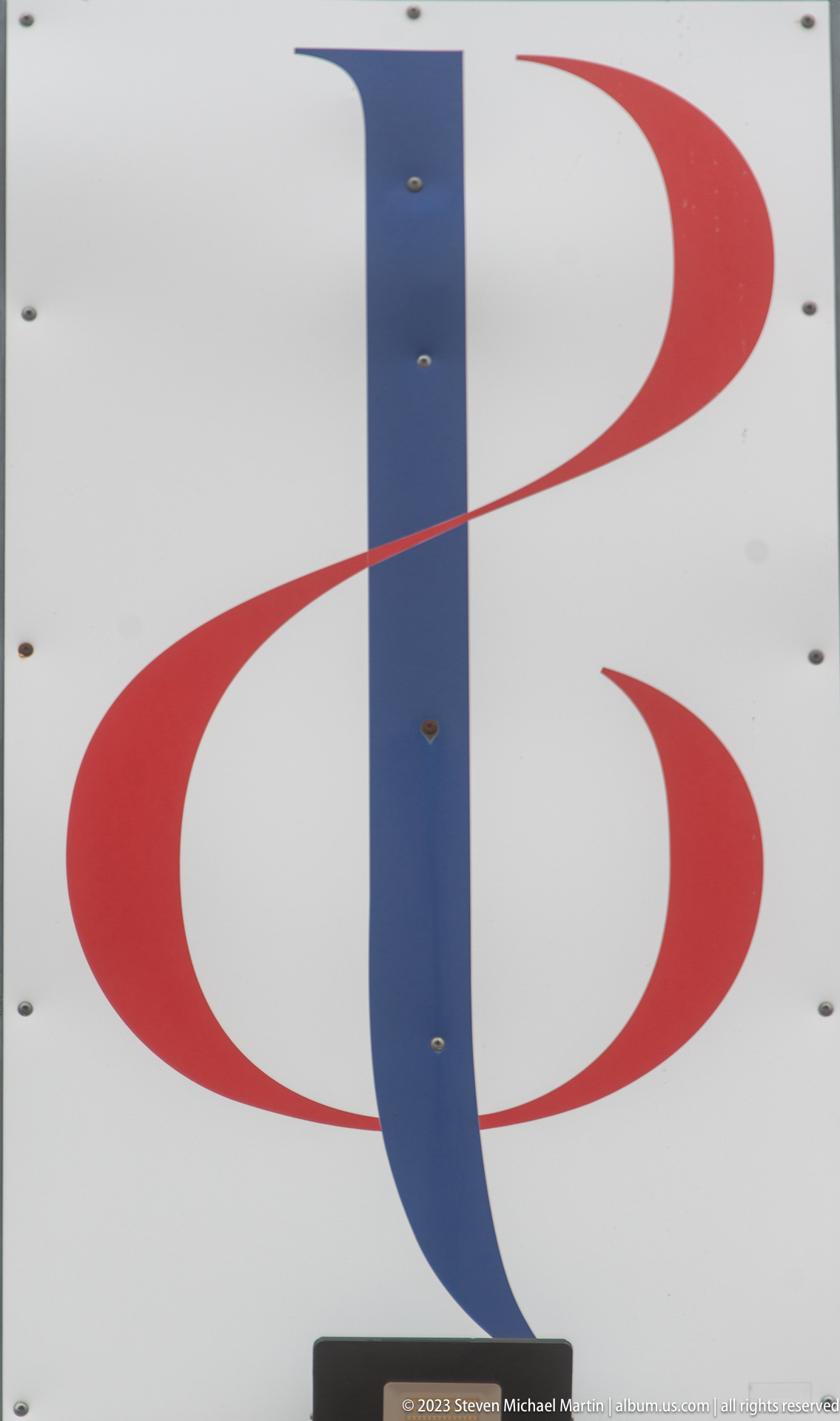
A bold abstract emblem composed of a vertical blue stroke and two sweeping red curves fills a white sign panel. The close crop isolates the graphic from any accompanying text, emphasizing its sculptural letterform and tricolor palette. A related three-dimensional version appears elsewhere in the sequence, indicating its use as local visual branding in Saint-Pierre.
Caption
A bold abstract emblem composed of a vertical blue stroke and two sweeping red curves fills a white sign panel. The close crop isolates the graphic from any accompanying text, emphasizing its sculptural letterform and tricolor palette. A related three-dimensional version appears elsewhere in the sequence, indicating its use as local visual branding in Saint-Pierre.
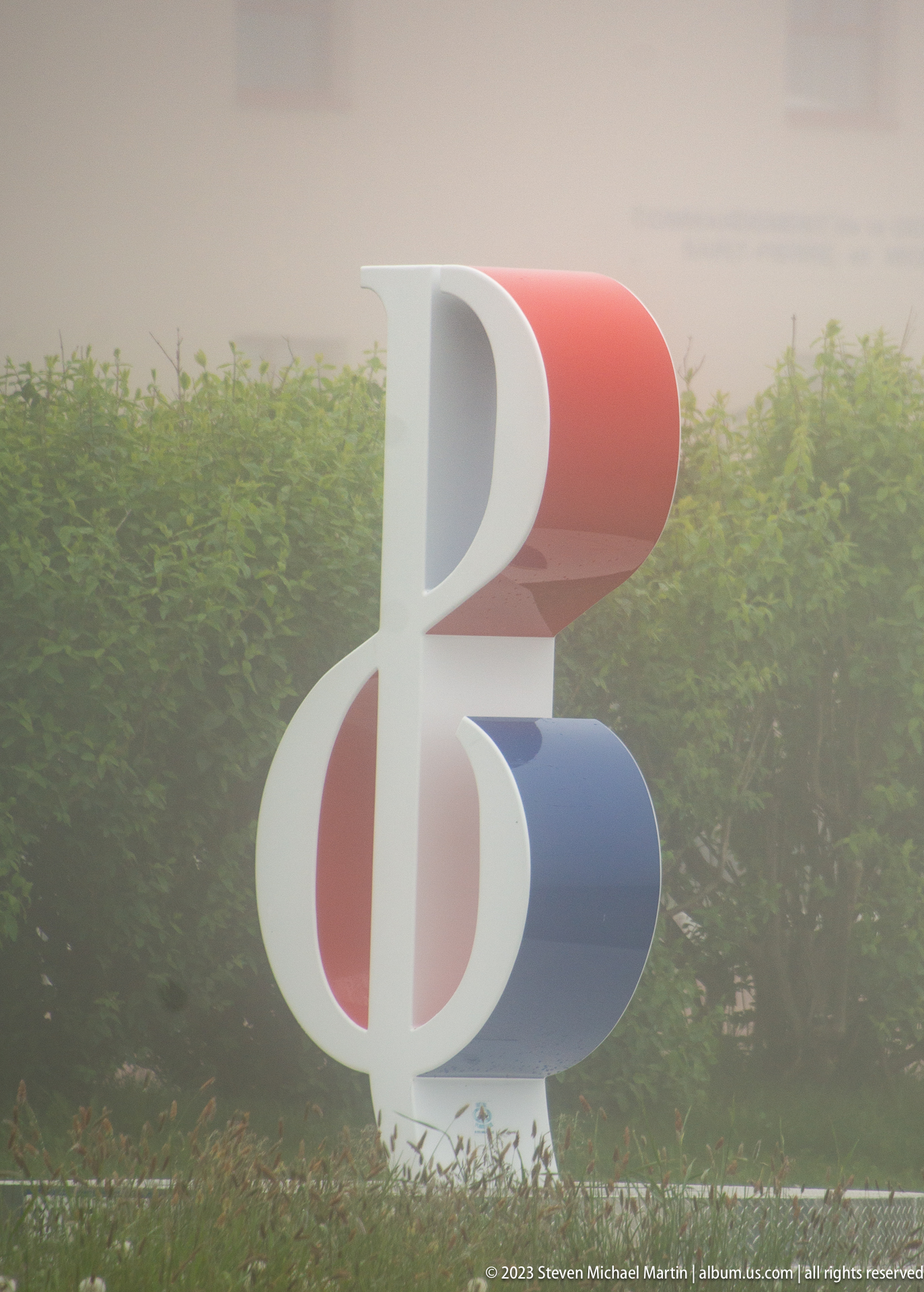
A freestanding three-dimensional emblem repeats the red, white, and blue graphic form seen on nearby signage, set against a low hedge in misty weather. Its sculptural construction turns a flat branding device into a roadside landmark, with deep curved elements that reveal the design’s layered geometry when viewed obliquely.
Caption
A freestanding three-dimensional emblem repeats the red, white, and blue graphic form seen on nearby signage, set against a low hedge in misty weather. Its sculptural construction turns a flat branding device into a roadside landmark, with deep curved elements that reveal the design’s layered geometry when viewed obliquely.

A smartphone held in front of a vehicle dashboard shows 10:18 while the in-dash navigation screen reads 8:48 and the upper console reads 9:58. The deliberately layered clocks document conflicting time settings during travel, turning the car interior into a record of changing or mismatched time references rather than a conventional destination view.
Caption
A smartphone held in front of a vehicle dashboard shows 10:18 while the in-dash navigation screen reads 8:48 and the upper console reads 9:58. The deliberately layered clocks document conflicting time settings during travel, turning the car interior into a record of changing or mismatched time references rather than a conventional destination view.
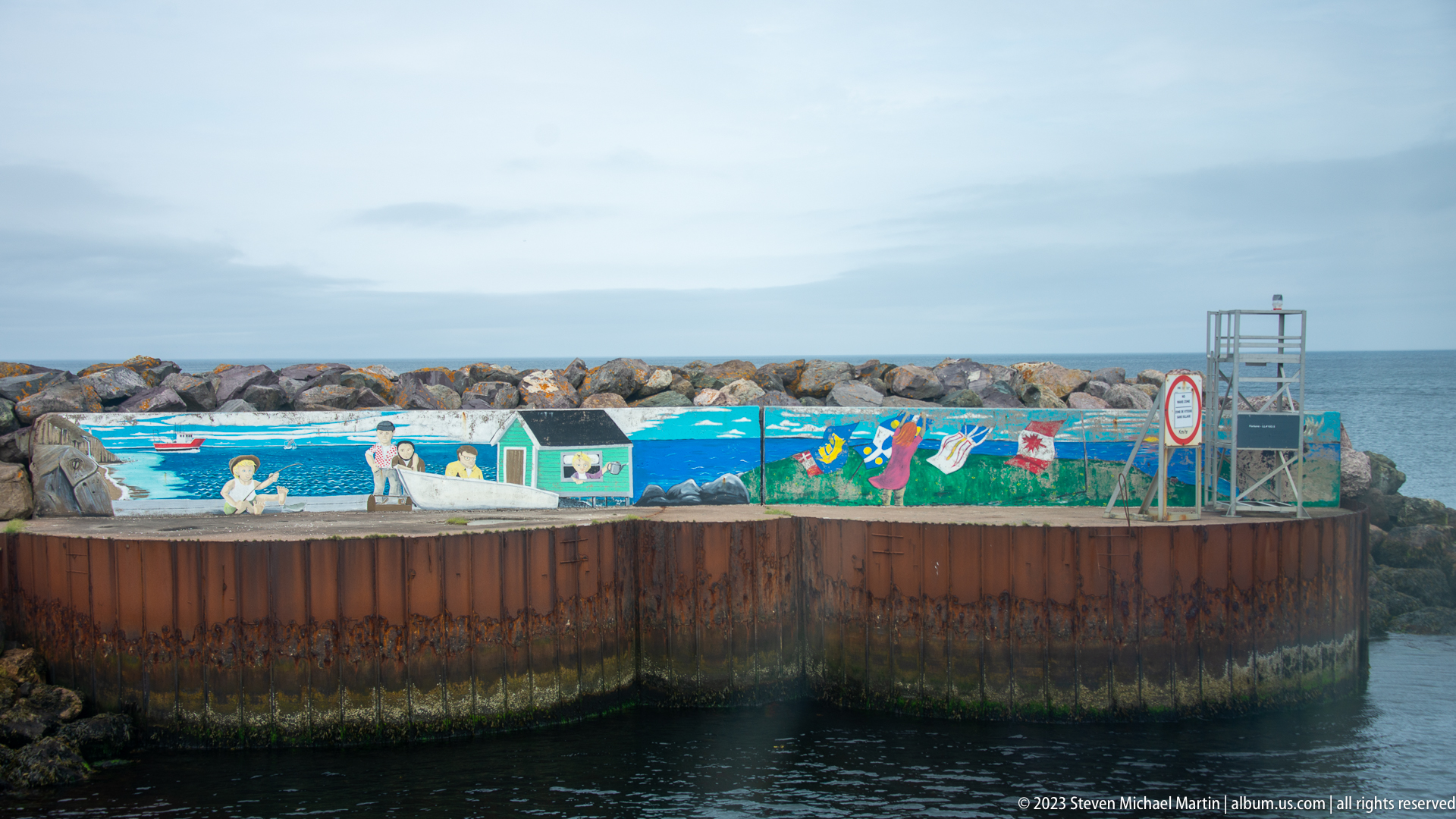
A curved harbor breakwater carries a continuous band of brightly painted maritime scenes, including birds, boats, sea life, and coastal motifs. Rusted steel sheeting below the artwork contrasts with the cheerful mural, while open water and the rock armor beyond place the decoration firmly within Saint-Pierre’s working waterfront environment.
Caption
A curved harbor breakwater carries a continuous band of brightly painted maritime scenes, including birds, boats, sea life, and coastal motifs. Rusted steel sheeting below the artwork contrasts with the cheerful mural, while open water and the rock armor beyond place the decoration firmly within Saint-Pierre’s working waterfront environment.

A small group of mallards crosses a grassy verge and gravel path, led and followed by adult female-type birds with several smaller juveniles between them. Their mottled brown plumage and orange legs stand out against the vivid green ground, adding an everyday wildlife moment to the otherwise urban and maritime Saint-Pierre sequence.
Caption
A small group of mallards crosses a grassy verge and gravel path, led and followed by adult female-type birds with several smaller juveniles between them. Their mottled brown plumage and orange legs stand out against the vivid green ground, adding an everyday wildlife moment to the otherwise urban and maritime Saint-Pierre sequence.

The final proof-sheet slot contains no visible photograph; the image area is blank while the attachment identifier and source filename remain present below it. Because no subject, setting, object, or activity can be inspected, a publication-facing identification cannot be made from this proof sheet. The source image should be reopened or regenerated before editorial metadata is finalized.
Caption
The final proof-sheet slot contains no visible photograph; the image area is blank while the attachment identifier and source filename remain present below it. Because no subject, setting, object, or activity can be inspected, a publication-facing identification cannot be made from this proof sheet. The source image should be reopened or regenerated before editorial metadata is finalized.