Royal Tombs of Aigai (Vergina) – Greece
The remarkable burial complex of the Royal Tombs of Aigai lies beneath a large earthen mound near the modern town of Vergina in northern Greece. Ancient Aigai served as the first capital of the Macedonian kingdom.
In 1977, archaeologists uncovered a series of royal tombs containing extraordinary treasures, including gold funerary objects, weapons, armor, and ceremonial artifacts. One of the tombs is widely believed to belong to Philip II of Macedon, the father of Alexander the Great.
Today the site is preserved within an underground museum that protects the tombs and displays the remarkable artifacts discovered within them. The Archaeological Site of Aigai stands as one of the most important archaeological discoveries related to ancient Macedonia.

A descending paved approach leads below the landscaped surface toward the Museum of the Royal Tombs of Aigai. Stone-faced retaining walls and dense planting screen the doorway, reinforcing the museum’s subterranean relationship to the Great Tumulus and creating a gradual transition from daylight into the protected archaeological interior.
Caption
A descending paved approach leads below the landscaped surface toward the Museum of the Royal Tombs of Aigai. Stone-faced retaining walls and dense planting screen the doorway, reinforcing the museum’s subterranean relationship to the Great Tumulus and creating a gradual transition from daylight into the protected archaeological interior.

The smooth grass-covered rise of the Great Tumulus dominates this exterior view at Aigai. Trees and low plantings frame the reconstructed mound, whose deliberately simple landscape form marks the protected burial area while keeping the archaeological remains themselves concealed beneath the earth.
Caption
The smooth grass-covered rise of the Great Tumulus dominates this exterior view at Aigai. Trees and low plantings frame the reconstructed mound, whose deliberately simple landscape form marks the protected burial area while keeping the archaeological remains themselves concealed beneath the earth.

The sealed marble double doors of the Tomb of Philip II dominate this closer frontal view. Doric semi-columns and pilasters frame the entrance, while painted architectural bands survive above. The massive stone doors imitate wooden construction, an exceptionally well-preserved feature of the temple-like Macedonian tomb façade protected within the Great Tumulus.
Caption
The sealed marble double doors of the Tomb of Philip II dominate this closer frontal view. Doric semi-columns and pilasters frame the entrance, while painted architectural bands survive above. The massive stone doors imitate wooden construction, an exceptionally well-preserved feature of the temple-like Macedonian tomb façade protected within the Great Tumulus.

A wide landscape view shows the ancient theater at Aigai as a low semicircle of surviving stone seats surrounding a broad grassy orchestra. Trees shade the upper edges, while the open plain stretches toward the horizon under a clear blue sky. The elevated viewpoint makes the theater's geometry and its relationship to the surrounding Macedonian landscape especially easy to understand.
Caption
A wide landscape view shows the ancient theater at Aigai as a low semicircle of surviving stone seats surrounding a broad grassy orchestra. Trees shade the upper edges, while the open plain stretches toward the horizon under a clear blue sky. The elevated viewpoint makes the theater's geometry and its relationship to the surrounding Macedonian landscape especially easy to understand.

Low stone foundations and retaining walls cross a dry grassy slope within the archaeological landscape at Aigai. Modern protective railings follow the excavated edges, while trees line the upper ground beneath a clear blue sky. The oblique viewpoint emphasizes the fragmentary character of the surviving masonry and its relationship to the natural contours of the site rather than presenting a reconstructed monument.
Caption
Low stone foundations and retaining walls cross a dry grassy slope within the archaeological landscape at Aigai. Modern protective railings follow the excavated edges, while trees line the upper ground beneath a clear blue sky. The oblique viewpoint emphasizes the fragmentary character of the surviving masonry and its relationship to the natural contours of the site rather than presenting a reconstructed monument.

From a higher vantage point, the ancient theater's semicircular plan becomes more explicit. Several surviving rows of stone seating curve around the open grassy center, with mature trees and the distant plain visible beyond. The photograph emphasizes the theater's placement in the wider landscape and the modest height of the preserved seating rather than isolating individual architectural details.
Caption
From a higher vantage point, the ancient theater's semicircular plan becomes more explicit. Several surviving rows of stone seating curve around the open grassy center, with mature trees and the distant plain visible beyond. The photograph emphasizes the theater's placement in the wider landscape and the modest height of the preserved seating rather than isolating individual architectural details.

A museum model cuts through the Great Tumulus to show how monumental tomb structures and smaller burials relate to the mound above them. The sectional presentation translates an otherwise hidden archaeological landscape into a readable three-dimensional plan, clarifying the placement of built tombs beneath the reconstructed earthwork.
Caption
A museum model cuts through the Great Tumulus to show how monumental tomb structures and smaller burials relate to the mound above them. The sectional presentation translates an otherwise hidden archaeological landscape into a readable three-dimensional plan, clarifying the placement of built tombs beneath the reconstructed earthwork.

A worn painted surface preserves scattered brown, red, and dark outlines of a once more extensive figural composition. Large areas have faded into the warm plaster ground, leaving only fragments of bodies and movement legible. The close framing records the mural's fragile condition and the uneven survival of ancient pigment within the royal burial complex.
Caption
A worn painted surface preserves scattered brown, red, and dark outlines of a once more extensive figural composition. Large areas have faded into the warm plaster ground, leaving only fragments of bodies and movement legible. The close framing records the mural's fragile condition and the uneven survival of ancient pigment within the royal burial complex.

The gold larnax from the main chamber of the Tomb of Philip II served as the container for the king’s cremated remains. A large multi-rayed star dominates its lid, while the chest itself is enriched with precisely worked borders and relief ornament. Together with the gold oak wreath, it forms the most iconic surviving ensemble from the unlooted royal burial.
Caption
The gold larnax from the main chamber of the Tomb of Philip II served as the container for the king’s cremated remains. A large multi-rayed star dominates its lid, while the chest itself is enriched with precisely worked borders and relief ornament. Together with the gold oak wreath, it forms the most iconic surviving ensemble from the unlooted royal burial.

A museum case groups vessels of varied shapes and sizes, dominated by a large turquoise-patinated circular object at center. Bowls, jars, handled containers, stands, and small lidded forms occupy stepped plinths around it. The ensemble highlights both the diversity of metal tableware and the striking range of surface preservation among objects from the royal funerary assemblage.
Caption
A museum case groups vessels of varied shapes and sizes, dominated by a large turquoise-patinated circular object at center. Bowls, jars, handled containers, stands, and small lidded forms occupy stepped plinths around it. The ensemble highlights both the diversity of metal tableware and the striking range of surface preservation among objects from the royal funerary assemblage.

A museum text panel reproduces Manolis Andronikos's account of opening the sarcophagus and confronting the cremated remains inside the gold chest. The quotation records the archaeologist's emotional response to the discovery, including his conviction that the bones were royal and his sense of handling the remains of Philip. Presented as testimony, the panel turns archaeological discovery into a first-person historical document.
Caption
A museum text panel reproduces Manolis Andronikos's account of opening the sarcophagus and confronting the cremated remains inside the gold chest. The quotation records the archaeologist's emotional response to the discovery, including his conviction that the bones were royal and his sense of handling the remains of Philip. Presented as testimony, the panel turns archaeological discovery into a first-person historical document.

An extensive silver service from the Prince’s Tomb is arranged by vessel type and scale, including cups, bowls, plates, jugs, and lidded containers. The ensemble illustrates the importance of banqueting equipment among elite Macedonian grave goods and the exceptional completeness of Tomb III, which was found unlooted beneath the Great Tumulus.
Caption
An extensive silver service from the Prince’s Tomb is arranged by vessel type and scale, including cups, bowls, plates, jugs, and lidded containers. The ensemble illustrates the importance of banqueting equipment among elite Macedonian grave goods and the exceptional completeness of Tomb III, which was found unlooted beneath the Great Tumulus.

A visitor map places the archaeological site of Aigai within the modern road network of northern Greece, pairing a detailed site plan with a broader regional diagram. The two scales help orient the museum and royal-tomb complex in relation to nearby settlements and routes before entering the archaeological presentation.
Caption
A visitor map places the archaeological site of Aigai within the modern road network of northern Greece, pairing a detailed site plan with a broader regional diagram. The two scales help orient the museum and royal-tomb complex in relation to nearby settlements and routes before entering the archaeological presentation.

A bilingual notice at the Archaeological Site of Aigai and Museum of the Royal Tombs sets out visitor-access rules during the COVID-19 period. The sign documents a specific moment in the museum’s operational history, including restrictions on entry and instructions for visitors before proceeding into the site.
Caption
A bilingual notice at the Archaeological Site of Aigai and Museum of the Royal Tombs sets out visitor-access rules during the COVID-19 period. The sign documents a specific moment in the museum’s operational history, including restrictions on entry and instructions for visitors before proceeding into the site.

A small stone funerary monument combines a shallow pediment with a framed painted panel. Although the surviving pigments are fragmentary, several human figures remain discernible across the surface, giving the display unusual evidence for the use of color and narrative imagery in ancient Macedonian funerary commemoration.
Caption
A small stone funerary monument combines a shallow pediment with a framed painted panel. Although the surviving pigments are fragmentary, several human figures remain discernible across the surface, giving the display unusual evidence for the use of color and narrative imagery in ancient Macedonian funerary commemoration.

The entrance sign identifies the Museum of the Royal Tombs of Aigai and presents its opening hours in Greek and English. Temporary paper notices alter the posted schedule, making this a useful record of the visitor-facing entrance information and the bilingual presentation of the archaeological museum.
Caption
The entrance sign identifies the Museum of the Royal Tombs of Aigai and presents its opening hours in Greek and English. Temporary paper notices alter the posted schedule, making this a useful record of the visitor-facing entrance information and the bilingual presentation of the archaeological museum.

A narrow interior passage within the Museum of the Royal Tombs of Aigai channels visitors between pale stone-clad walls toward daylight at the far end. Wall-mounted lights, a tiled floor, and a metal security gate emphasize the controlled circulation of the subterranean museum built around the preserved tombs.
Caption
A narrow interior passage within the Museum of the Royal Tombs of Aigai channels visitors between pale stone-clad walls toward daylight at the far end. Wall-mounted lights, a tiled floor, and a metal security gate emphasize the controlled circulation of the subterranean museum built around the preserved tombs.

The museum’s “Great Tumulus” panel explains the monumental mound that covered the royal cemetery at Aigai and summarizes its excavation and construction history. Displayed as a dense bilingual-style interpretive text, it provides visitors with archaeological context before they encounter the preserved tombs and associated grave monuments.
Caption
The museum’s “Great Tumulus” panel explains the monumental mound that covered the royal cemetery at Aigai and summarizes its excavation and construction history. Displayed as a dense bilingual-style interpretive text, it provides visitors with archaeological context before they encounter the preserved tombs and associated grave monuments.

A tall stone funerary monument is crowned by a low pediment and preserves a framed painted scene across its upper face. The surviving composition appears to include seated and standing human figures, while losses and cracking expose the pale stone substrate and underscore the fragile survival of ancient painted decoration.
Caption
A tall stone funerary monument is crowned by a low pediment and preserves a framed painted scene across its upper face. The surviving composition appears to include seated and standing human figures, while losses and cracking expose the pale stone substrate and underscore the fragile survival of ancient painted decoration.

A large two-handled red-figure vessel presents a lively mythological or heroic scene centered on a horse and human figures. Added white highlights stand out against the orange-red figures and glossy black ground, while patterned bands around the neck and lower body organize the composition into a carefully framed pictorial field.
Caption
A large two-handled red-figure vessel presents a lively mythological or heroic scene centered on a horse and human figures. Added white highlights stand out against the orange-red figures and glossy black ground, while patterned bands around the neck and lower body organize the composition into a carefully framed pictorial field.

Two narrow stone grave markers stand side by side, demonstrating contrasting forms of funerary commemoration. One carries a large palmette-like crowning ornament; the other has a small pediment and a faint painted panel. Their juxtaposition makes differences in silhouette, surface treatment, and preservation immediately legible.
Caption
Two narrow stone grave markers stand side by side, demonstrating contrasting forms of funerary commemoration. One carries a large palmette-like crowning ornament; the other has a small pediment and a faint painted panel. Their juxtaposition makes differences in silhouette, surface treatment, and preservation immediately legible.

Three stone grave markers are arranged as a comparative museum display. The central monument is distinguished by a large carved palmette crown, while the flanking examples use lower architectural tops and retain traces of painted or incised decoration. Their varied forms illustrate the visual vocabulary of funerary markers from the Aigai cemetery.
Caption
Three stone grave markers are arranged as a comparative museum display. The central monument is distinguished by a large carved palmette crown, while the flanking examples use lower architectural tops and retain traces of painted or incised decoration. Their varied forms illustrate the visual vocabulary of funerary markers from the Aigai cemetery.

Two slender stone grave markers emphasize how little decoration may survive on excavated funerary monuments. One retains a shaped architectural top; the other has a simple cap and faint reddish painted forms on its face. Cracks, repairs, and missing edges make their archaeological condition especially visible.
Caption
Two slender stone grave markers emphasize how little decoration may survive on excavated funerary monuments. One retains a shaped architectural top; the other has a simple cap and faint reddish painted forms on its face. Cracks, repairs, and missing edges make their archaeological condition especially visible.

Viewed from above, a silver-colored bowl reveals a richly textured interior centered on a small gilded medallion bearing a human head in relief. The contrast between the bright rim, hammered or repoussé-like inner surface, and gold-toned portrait element makes the vessel’s decorative hierarchy particularly clear.
Caption
Viewed from above, a silver-colored bowl reveals a richly textured interior centered on a small gilded medallion bearing a human head in relief. The contrast between the bright rim, hammered or repoussé-like inner surface, and gold-toned portrait element makes the vessel’s decorative hierarchy particularly clear.

A broad red-figure vessel is wrapped with a densely populated scene of standing and seated figures. The horizontal composition, framed by ornamental bands and anchored by large side handles, invites the viewer to read the painted action around the vessel rather than from a single frontal viewpoint.
Caption
A broad red-figure vessel is wrapped with a densely populated scene of standing and seated figures. The horizontal composition, framed by ornamental bands and anchored by large side handles, invites the viewer to read the painted action around the vessel rather than from a single frontal viewpoint.

A compact two-handled red-figure vessel features a large human figure whose garment or body is picked out in added white, creating a striking focal point against the black-glazed neck and orange clay. The close frontal view also shows the vessel’s heavy handles and narrow decorative bands.
Caption
A compact two-handled red-figure vessel features a large human figure whose garment or body is picked out in added white, creating a striking focal point against the black-glazed neck and orange clay. The close frontal view also shows the vessel’s heavy handles and narrow decorative bands.

A two-handled red-figure vessel centers its decoration on a horse and adjacent human figures, with areas of added white intensifying the action. The compact pictorial zone is bounded by ornamental bands, while the black-glazed neck and handles form a dark architectural frame around the painted narrative.
Caption
A two-handled red-figure vessel centers its decoration on a horse and adjacent human figures, with areas of added white intensifying the action. The compact pictorial zone is bounded by ornamental bands, while the black-glazed neck and handles form a dark architectural frame around the painted narrative.

A monumental Macedonian tomb façade is presented frontally, with a central double door framed by slender engaged supports and a painted architectural entablature. The restrained symmetry and pale surfaces make the doorway the dominant feature, while the colored upper band preserves the impression of an intentionally polychrome funerary architecture.
Caption
A monumental Macedonian tomb façade is presented frontally, with a central double door framed by slender engaged supports and a painted architectural entablature. The restrained symmetry and pale surfaces make the doorway the dominant feature, while the colored upper band preserves the impression of an intentionally polychrome funerary architecture.

A museum panel headed “Philip II” summarizes the Macedonian king’s ancestry, accession, political and military achievements, and role in the rise of Macedon. Its placement within the Royal Tombs presentation provides historical context for the archaeological material traditionally associated with the royal dynasty at Aigai.
Caption
A museum panel headed “Philip II” summarizes the Macedonian king’s ancestry, accession, political and military achievements, and role in the rise of Macedon. Its placement within the Royal Tombs presentation provides historical context for the archaeological material traditionally associated with the royal dynasty at Aigai.

Illuminated archaeological remains reveal a rectangular funerary structure articulated by slender columns and substantial masonry. The low-light museum setting isolates the surviving architectural elements against the surrounding earth, allowing visitors to examine the tomb’s built form while it remains embedded within the protected archaeological context.
Caption
Illuminated archaeological remains reveal a rectangular funerary structure articulated by slender columns and substantial masonry. The low-light museum setting isolates the surviving architectural elements against the surrounding earth, allowing visitors to examine the tomb’s built form while it remains embedded within the protected archaeological context.

A line drawing reconstructs the elevation of a Macedonian tomb façade, reducing its architecture to the essential relationship between doorway, columns or pilasters, entablature, and roofline. Presented beside the archaeological remains, the diagram helps visitors read missing or fragmentary structural elements as parts of a coherent façade.
Caption
A line drawing reconstructs the elevation of a Macedonian tomb façade, reducing its architecture to the essential relationship between doorway, columns or pilasters, entablature, and roofline. Presented beside the archaeological remains, the diagram helps visitors read missing or fragmentary structural elements as parts of a coherent façade.

The “Tomb IV” panel describes a small Macedonian-type tomb at the edge of the Great Tumulus and summarizes its construction, façade, decoration, and associated finds. The text also discusses fragmentary terracotta, ivory, and glass material, framing the surviving structure within the broader study of elite burial at Aigai.
Caption
The “Tomb IV” panel describes a small Macedonian-type tomb at the edge of the Great Tumulus and summarizes its construction, façade, decoration, and associated finds. The text also discusses fragmentary terracotta, ivory, and glass material, framing the surviving structure within the broader study of elite burial at Aigai.

The “Tomb I” panel describes a cist grave built of poros blocks and summarizes the painted decoration of its interior, including the abduction of Persephone. It also discusses the tomb’s dating and the historical significance of its wall painting, providing essential context for one of Aigai’s most important surviving funerary interiors.
Caption
The “Tomb I” panel describes a cist grave built of poros blocks and summarizes the painted decoration of its interior, including the abduction of Persephone. It also discusses the tomb’s dating and the historical significance of its wall painting, providing essential context for one of Aigai’s most important surviving funerary interiors.

A mounted hunter dominates this fragment of the painted hunt, his orange garment and sweeping violet cloak forming strong arcs around the horse. The rider leans forward as the animal moves across the composition, while fine linear drawing supplies anatomical detail. The concentrated color distinguishes this figure from the more abraded surrounding plaster.
Caption
A mounted hunter dominates this fragment of the painted hunt, his orange garment and sweeping violet cloak forming strong arcs around the horse. The rider leans forward as the animal moves across the composition, while fine linear drawing supplies anatomical detail. The concentrated color distinguishes this figure from the more abraded surrounding plaster.

Two small sculpted male heads are displayed against a dark background, one youthful and clean-shaven and the other bearded with deeply cut hair. Their intimate scale and contrasting physiognomies suggest components of a larger decorative assemblage, while the isolated mounting allows close inspection of the carving and surviving surface.
Caption
Two small sculpted male heads are displayed against a dark background, one youthful and clean-shaven and the other bearded with deeply cut hair. Their intimate scale and contrasting physiognomies suggest components of a larger decorative assemblage, while the isolated mounting allows close inspection of the carving and surviving surface.

A wall-mounted assemblage brings together the two carved male heads with numerous smaller fragments of hands, limbs, moldings, plaques, and ornamental pieces. Arranged against a dark field, the display emphasizes the fragmentary nature of the Tomb IV finds while preserving clues to a once elaborate program of funerary decoration.
Caption
A wall-mounted assemblage brings together the two carved male heads with numerous smaller fragments of hands, limbs, moldings, plaques, and ornamental pieces. Arranged against a dark field, the display emphasizes the fragmentary nature of the Tomb IV finds while preserving clues to a once elaborate program of funerary decoration.

Broad stone slabs and low block walls survive at floor level within the excavated complex south of the Great Tumulus. Seen under warm museum lighting, the remains make the monument’s footprint and construction more legible than a distant overview, with large fitted blocks defining edges and changes in level.
Caption
Broad stone slabs and low block walls survive at floor level within the excavated complex south of the Great Tumulus. Seen under warm museum lighting, the remains make the monument’s footprint and construction more legible than a distant overview, with large fitted blocks defining edges and changes in level.

A close view of the masonry associated with Tomb I shows roughened rectangular blocks laid in horizontal courses, with breaks and displaced stones revealing the structure’s archaeological condition. The tight framing shifts attention from the tomb as a monument to the texture, joints, and survival of its ancient construction.
Caption
A close view of the masonry associated with Tomb I shows roughened rectangular blocks laid in horizontal courses, with breaks and displaced stones revealing the structure’s archaeological condition. The tight framing shifts attention from the tomb as a monument to the texture, joints, and survival of its ancient construction.

The museum panel titled “The Heroön” explains the foundations of a monument discovered south of the Great Tumulus and discusses its possible function as a shrine connected with the neighboring tombs. The text explicitly presents the interpretation as archaeological reasoning rather than certainty, reflecting how fragmentary architecture is used to reconstruct ritual landscapes at Aigai.
Caption
The museum panel titled “The Heroön” explains the foundations of a monument discovered south of the Great Tumulus and discusses its possible function as a shrine connected with the neighboring tombs. The text explicitly presents the interpretation as archaeological reasoning rather than certainty, reflecting how fragmentary architecture is used to reconstruct ritual landscapes at Aigai.

Heavy stone blocks and rough surviving wall fabric form a compact mass within the excavated area identified as the Heroön. Low spotlights rake across the uneven surfaces, revealing joints, broken edges, and differing masonry textures that are difficult to discern in the broader view of the monument’s foundations.
Caption
Heavy stone blocks and rough surviving wall fabric form a compact mass within the excavated area identified as the Heroön. Low spotlights rake across the uneven surfaces, revealing joints, broken edges, and differing masonry textures that are difficult to discern in the broader view of the monument’s foundations.

A group of small funerary ornaments is arranged against a neutral museum wall, centered on a strand of large spherical and textured beads. A blue-and-white leaf-shaped element and a small dark rectangular fitting flank the strand. The display isolates differences in surface, color, and workmanship while preserving the objects as a coherent archaeological group.
Caption
A group of small funerary ornaments is arranged against a neutral museum wall, centered on a strand of large spherical and textured beads. A blue-and-white leaf-shaped element and a small dark rectangular fitting flank the strand. The display isolates differences in surface, color, and workmanship while preserving the objects as a coherent archaeological group.
A broad section of ancient wall painting survives in pale red, ocher, black, and violet tones, with several lightly drawn figures distributed across the plaster. Stronger color survives at the right, where overlapping human and animal forms create a more animated passage. Abrasion and losses expose the fragility of the painted surface while leaving the overall narrative composition legible.
Caption
A broad section of ancient wall painting survives in pale red, ocher, black, and violet tones, with several lightly drawn figures distributed across the plaster. Stronger color survives at the right, where overlapping human and animal forms create a more animated passage. Abrasion and losses expose the fragility of the painted surface while leaving the overall narrative composition legible.

A faint male figure emerges from the weathered plaster, his head, torso, and drapery or clothing defined by thin brown and gray lines. Red linear ornament remains at the left edge, while scattered pigment and surface losses interrupt the body. The close view records both the painterly drawing and the physical deterioration of the ancient wall surface.
Caption
A faint male figure emerges from the weathered plaster, his head, torso, and drapery or clothing defined by thin brown and gray lines. Red linear ornament remains at the left edge, while scattered pigment and surface losses interrupt the body. The close view records both the painterly drawing and the physical deterioration of the ancient wall surface.

Violet-clad riders and vigorously drawn animals fill this close section of a Macedonian funerary painting. Curving bodies, raised limbs, and overlapping outlines convey rapid movement despite substantial losses to the plaster. Red-orange and purple pigments remain especially vivid, allowing the energetic structure of the hunt to stand out from the mottled background.
Caption
Violet-clad riders and vigorously drawn animals fill this close section of a Macedonian funerary painting. Curving bodies, raised limbs, and overlapping outlines convey rapid movement despite substantial losses to the plaster. Red-orange and purple pigments remain especially vivid, allowing the energetic structure of the hunt to stand out from the mottled background.

Seen at closer range, a rider bends over the neck of his horse while orange and violet garments sweep behind him. The horse's head and the rider's face retain delicate linear modeling, contrasting with areas where pigment has thinned or vanished. This detail emphasizes the painter's combination of colored masses and economical contour drawing.
Caption
Seen at closer range, a rider bends over the neck of his horse while orange and violet garments sweep behind him. The horse's head and the rider's face retain delicate linear modeling, contrasting with areas where pigment has thinned or vanished. This detail emphasizes the painter's combination of colored masses and economical contour drawing.

A solitary seated figure survives in delicate orange-brown outlines above a dark ornamental frieze. The body is rendered with long folds of drapery, while the lower border preserves scrolling vegetal forms in deeper blue-green and brown tones. Heavy abrasion across the plaster makes the contrast between figural drawing and decorative band especially clear.
Caption
A solitary seated figure survives in delicate orange-brown outlines above a dark ornamental frieze. The body is rendered with long folds of drapery, while the lower border preserves scrolling vegetal forms in deeper blue-green and brown tones. Heavy abrasion across the plaster makes the contrast between figural drawing and decorative band especially clear.

Only ghostlike traces of figures and color remain across this long expanse of painted plaster. Pale red, blue-green, and dark marks interrupt the warm ground, while a horizontal decorative band anchors the lower edge. The view is valuable for showing the uneven preservation of the mural, where isolated passages survive beside areas reduced almost to preparatory outlines.
Caption
Only ghostlike traces of figures and color remain across this long expanse of painted plaster. Pale red, blue-green, and dark marks interrupt the warm ground, while a horizontal decorative band anchors the lower edge. The view is valuable for showing the uneven preservation of the mural, where isolated passages survive beside areas reduced almost to preparatory outlines.

A vertically organized museum case presents a funerary assemblage around a large circular shield-like object and a long central weapon. Spearheads and other elongated metal fittings line the side panels, while turquoise-patinated vessels and a ceramic container occupy the lower level. The arrangement communicates the range of equipment and grave goods recovered from the royal burial context.
Caption
A vertically organized museum case presents a funerary assemblage around a large circular shield-like object and a long central weapon. Spearheads and other elongated metal fittings line the side panels, while turquoise-patinated vessels and a ceramic container occupy the lower level. The arrangement communicates the range of equipment and grave goods recovered from the royal burial context.

Red-orange and blue-green pigment survives in irregular patches across this severely abraded painted surface. Curving outlines suggest portions of a larger figural composition, but losses prevent a secure reading of individual subjects. The close view foregrounds the material condition of the mural: granular plaster, stains, scratches, and isolated islands of ancient color.
Caption
Red-orange and blue-green pigment survives in irregular patches across this severely abraded painted surface. Curving outlines suggest portions of a larger figural composition, but losses prevent a secure reading of individual subjects. The close view foregrounds the material condition of the mural: granular plaster, stains, scratches, and isolated islands of ancient color.

Two small bronze vessels stand side by side, their swelling bodies narrowing toward short bases and irregular rims. Blue-green corrosion covers much of each surface, interrupted by darker brown areas where the underlying metal or different corrosion layers remain visible. Their paired display makes subtle differences in profile and preservation easy to compare.
Caption
Two small bronze vessels stand side by side, their swelling bodies narrowing toward short bases and irregular rims. Blue-green corrosion covers much of each surface, interrupted by darker brown areas where the underlying metal or different corrosion layers remain visible. Their paired display makes subtle differences in profile and preservation easy to compare.

An elaborate gold sheet fitting is divided into several embossed panels framed by repeating borders. Narrative figures, animals, and dense vegetal or geometric ornament cover nearly every surface, while the raised relief catches the museum lighting. The object's curved profile and richly worked skin demonstrate the use of thin precious-metal sheet to embellish a larger piece of equipment.
Caption
An elaborate gold sheet fitting is divided into several embossed panels framed by repeating borders. Narrative figures, animals, and dense vegetal or geometric ornament cover nearly every surface, while the raised relief catches the museum lighting. The object's curved profile and richly worked skin demonstrate the use of thin precious-metal sheet to embellish a larger piece of equipment.

Five embossed gold fittings from the Tomb of Philip II preserve the sumptuous surface decoration of the king’s military equipment. Their small scale belies the precision of the repoussé work: framed figural and ornamental motifs transform functional fittings into courtly objects. Displayed together, the surviving pieces help convey the exceptional richness of the gold-embellished panoply buried with the Macedonian king.
Caption
Five embossed gold fittings from the Tomb of Philip II preserve the sumptuous surface decoration of the king’s military equipment. Their small scale belies the precision of the repoussé work: framed figural and ornamental motifs transform functional fittings into courtly objects. Displayed together, the surviving pieces help convey the exceptional richness of the gold-embellished panoply buried with the Macedonian king.

A crowded mythological scene fills this gold repoussé fitting from the rich military assemblage associated with Philip II. Seated and standing figures are compressed into a miniature field beneath winged forms, demonstrating the extraordinary narrative ambition of Macedonian luxury metalwork. The close view reveals how figural imagery was integrated into the king’s elaborately ornamented equipment.
Caption
A crowded mythological scene fills this gold repoussé fitting from the rich military assemblage associated with Philip II. Seated and standing figures are compressed into a miniature field beneath winged forms, demonstrating the extraordinary narrative ambition of Macedonian luxury metalwork. The close view reveals how figural imagery was integrated into the king’s elaborately ornamented equipment.

A standing figure emerges in shallow repoussé from one of the gilded fittings associated with the military equipment of Philip II. The tight framing makes the minute workmanship legible: the body, drapery, border, and surrounding ornament are modeled in relief on a very small gold surface, turning an element of martial equipment into a miniature work of court art.
Caption
A standing figure emerges in shallow repoussé from one of the gilded fittings associated with the military equipment of Philip II. The tight framing makes the minute workmanship legible: the body, drapery, border, and surrounding ornament are modeled in relief on a very small gold surface, turning an element of martial equipment into a miniature work of court art.

A rounded bronze vessel combines a broad shoulder and narrow mouth with an elaborate cast handle attachment. A female face projects from the front below palmette-like ornament, while green and reddish corrosion mottles the metal surface. The sculptural attachment transforms a functional container into an object of display, joining vessel form with figural bronze work.
Caption
A rounded bronze vessel combines a broad shoulder and narrow mouth with an elaborate cast handle attachment. A female face projects from the front below palmette-like ornament, while green and reddish corrosion mottles the metal surface. The sculptural attachment transforms a functional container into an object of display, joining vessel form with figural bronze work.

A squat rounded metal vessel is fitted with a tall arched handle and a hinged or clasp-like fitting at the front. Fine repeated marks create a dense textured field across the body, contrasting with smoother bands at the rim and base. Green-blue corrosion around the upper surface and fittings records the object's age while leaving its carefully patterned finish legible.
Caption
A squat rounded metal vessel is fitted with a tall arched handle and a hinged or clasp-like fitting at the front. Fine repeated marks create a dense textured field across the body, contrasting with smoother bands at the rim and base. Green-blue corrosion around the upper surface and fittings records the object's age while leaving its carefully patterned finish legible.

A broad crescent-shaped gold ornament is covered with concentric fields of repoussé and punched decoration. Rosettes, circular bosses, beading, and a central band of figural medallions follow the curve of the piece, while the broken inner edge exposes its layered construction. The scale and density of ornament make this one of the most visually commanding pieces in the display.
Caption
A broad crescent-shaped gold ornament is covered with concentric fields of repoussé and punched decoration. Rosettes, circular bosses, beading, and a central band of figural medallions follow the curve of the piece, while the broken inner edge exposes its layered construction. The scale and density of ornament make this one of the most visually commanding pieces in the display.

At close range, the gold ornament resolves into tightly packed rosettes, spiral bosses, beaded borders, and circular medallions containing small relief figures. Triangular and linear divisions organize the surface into repeating units without eliminating variation. The detail demonstrates the extraordinary density of repoussé, punching, and applied decorative vocabulary concentrated on the piece.
Caption
At close range, the gold ornament resolves into tightly packed rosettes, spiral bosses, beaded borders, and circular medallions containing small relief figures. Triangular and linear divisions organize the surface into repeating units without eliminating variation. The detail demonstrates the extraordinary density of repoussé, punching, and applied decorative vocabulary concentrated on the piece.

A small gold face appliqué is modeled with large eyes, full lips, and masses of curling hair framing the cheeks. A horizontal attachment bar extends behind the head, indicating that the ornament belonged to a larger object or fitting. Strong frontal symmetry and sharply chased locks give the tiny relief a striking sculptural presence against the dark display background.
Caption
A small gold face appliqué is modeled with large eyes, full lips, and masses of curling hair framing the cheeks. A horizontal attachment bar extends behind the head, indicating that the ornament belonged to a larger object or fitting. Strong frontal symmetry and sharply chased locks give the tiny relief a striking sculptural presence against the dark display background.
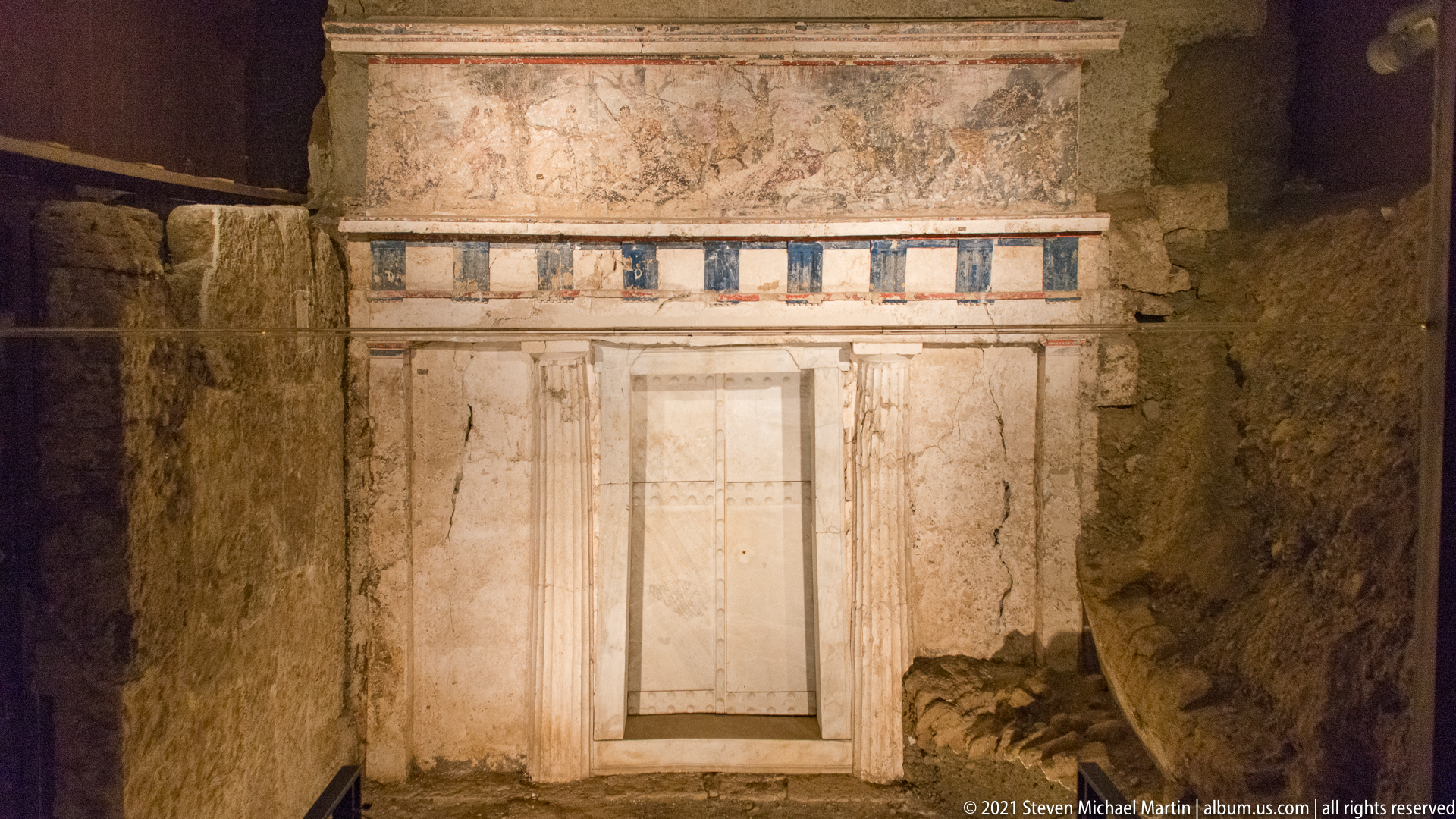
The façade of Tomb II, conventionally identified as the Tomb of Philip II, survives in situ beneath the protective Great Tumulus. Marble double doors are framed by Doric architectural elements, while the unusually tall painted Ionic frieze above carries the celebrated royal hunt. The combination of preserved architecture and monumental painting makes this one of Aigai’s defining late-Classical funerary monuments.
Caption
The façade of Tomb II, conventionally identified as the Tomb of Philip II, survives in situ beneath the protective Great Tumulus. Marble double doors are framed by Doric architectural elements, while the unusually tall painted Ionic frieze above carries the celebrated royal hunt. The combination of preserved architecture and monumental painting makes this one of Aigai’s defining late-Classical funerary monuments.

An interpretive panel explains groups of objects recovered from the Tomb of Philip II, including vessels used in funerary bathing, metal containers, weapons, and items connected with royal authority. The dense text situates individual exhibits within burial practice and courtly symbolism, providing museum context for the objects displayed nearby rather than presenting an archaeological object itself.
Caption
An interpretive panel explains groups of objects recovered from the Tomb of Philip II, including vessels used in funerary bathing, metal containers, weapons, and items connected with royal authority. The dense text situates individual exhibits within burial practice and courtly symbolism, providing museum context for the objects displayed nearby rather than presenting an archaeological object itself.

Visitors descend through the darkened Royal Tombs exhibition toward the illuminated façade of Tomb II, conventionally identified as the Tomb of Philip II. The museum’s subterranean design preserves the tomb in situ beneath a tumulus-shaped protective shell, allowing the ancient façade to appear almost theatrically from the surrounding darkness.
Caption
Visitors descend through the darkened Royal Tombs exhibition toward the illuminated façade of Tomb II, conventionally identified as the Tomb of Philip II. The museum’s subterranean design preserves the tomb in situ beneath a tumulus-shaped protective shell, allowing the ancient façade to appear almost theatrically from the surrounding darkness.

Hundreds of small archaeological finds are organized across trays and raised platforms in a long museum case. Metal fragments, beads, fittings, ornaments, blades, and other objects are separated into visual groups, with a few larger vessels punctuating the display. The installation makes the scale of the burial assemblage evident while preserving distinctions among material classes and object types.
Caption
Hundreds of small archaeological finds are organized across trays and raised platforms in a long museum case. Metal fragments, beads, fittings, ornaments, blades, and other objects are separated into visual groups, with a few larger vessels punctuating the display. The installation makes the scale of the burial assemblage evident while preserving distinctions among material classes and object types.

Two trapezoidal textile fragments preserve intricate gold decoration against a deep purple ground. Mirrored vegetal scrolls, palmettes, tendrils, and small figural or animal motifs form symmetrical compositions within patterned borders. The contrast between gold and purple makes the fragments unusually vivid, while breaks and irregular edges reveal the survival of only portions of a larger luxury textile.
Caption
Two trapezoidal textile fragments preserve intricate gold decoration against a deep purple ground. Mirrored vegetal scrolls, palmettes, tendrils, and small figural or animal motifs form symmetrical compositions within patterned borders. The contrast between gold and purple makes the fragments unusually vivid, while breaks and irregular edges reveal the survival of only portions of a larger luxury textile.

The gold oak wreath from the Tomb of Philip II is assembled from delicately hammered leaves and acorns attached to fine stems, recreating a natural crown in precious metal. Its botanical realism and fragile construction contrast with the permanence of gold, making the wreath one of the most distinctive emblems of the unlooted royal burial at Aigai.
Caption
The gold oak wreath from the Tomb of Philip II is assembled from delicately hammered leaves and acorns attached to fine stems, recreating a natural crown in precious metal. Its botanical realism and fragile construction contrast with the permanence of gold, making the wreath one of the most distinctive emblems of the unlooted royal burial at Aigai.

An exceptionally intricate gold wreath spreads into a dense crown of curling tendrils, leaves, flowers, and clustered botanical forms. Small dark spherical elements punctuate the luminous metalwork, while coiled wires and delicate stems create depth far beyond the narrow supporting band. Against the deep red case lining, the fragile construction and three-dimensional virtuosity of Macedonian funerary goldwork are especially clear.
Caption
An exceptionally intricate gold wreath spreads into a dense crown of curling tendrils, leaves, flowers, and clustered botanical forms. Small dark spherical elements punctuate the luminous metalwork, while coiled wires and delicate stems create depth far beyond the narrow supporting band. Against the deep red case lining, the fragile construction and three-dimensional virtuosity of Macedonian funerary goldwork are especially clear.

A reconstruction of the chryselephantine funerary couch from the main chamber of the Tomb of Philip II incorporates surviving ivory and gilded decoration into the furniture’s original architectural framework. The couch once stood above the marble sarcophagus; its elaborate figural frieze included small ivory heads and relief figures, combining luxury furniture, portraiture, and funerary display.
Caption
A reconstruction of the chryselephantine funerary couch from the main chamber of the Tomb of Philip II incorporates surviving ivory and gilded decoration into the furniture’s original architectural framework. The couch once stood above the marble sarcophagus; its elaborate figural frieze included small ivory heads and relief figures, combining luxury furniture, portraiture, and funerary display.

Nine small plaques are arranged in a grid to show the surviving decorative vocabulary of the funerary couch. Several retain gilded human figures in shallow relief; others preserve faded painted surfaces or pale carved ornament with intertwined forms. Presented together, the fragments reveal both the richness of the original furniture and the uneven survival of its fragile ivory, paint, and gold decoration.
Caption
Nine small plaques are arranged in a grid to show the surviving decorative vocabulary of the funerary couch. Several retain gilded human figures in shallow relief; others preserve faded painted surfaces or pale carved ornament with intertwined forms. Presented together, the fragments reveal both the richness of the original furniture and the uneven survival of its fragile ivory, paint, and gold decoration.

Fragmentary ivory figures from the chryselephantine couch in the Tomb of Philip II are mounted to suggest their original relationships within the furniture’s figural frieze. Heads, torsos, limbs, and drapery survive unevenly, but the carving retains remarkable individuality. The group belongs to the extraordinary ivory miniature sculpture recovered from the sealed royal chamber.
Caption
Fragmentary ivory figures from the chryselephantine couch in the Tomb of Philip II are mounted to suggest their original relationships within the furniture’s figural frieze. Heads, torsos, limbs, and drapery survive unevenly, but the carving retains remarkable individuality. The group belongs to the extraordinary ivory miniature sculpture recovered from the sealed royal chamber.

Hands, forearms, feet, legs, and portions of torsos are spread across a dark mount, their separated arrangement emphasizing the fragmentary state of the surviving ivory decoration. Some pieces retain modeled musculature and drapery, while others are reduced to irregular remnants. The display functions almost as an anatomical inventory of the sculptural components once attached to a richly decorated funerary couch.
Caption
Hands, forearms, feet, legs, and portions of torsos are spread across a dark mount, their separated arrangement emphasizing the fragmentary state of the surviving ivory decoration. Some pieces retain modeled musculature and drapery, while others are reduced to irregular remnants. The display functions almost as an anatomical inventory of the sculptural components once attached to a richly decorated funerary couch.

A second group of small furniture plaques combines bright gilded figural scenes with pale carved ornament and heavily darkened fragments. Several panels preserve paired or grouped human figures, while others retain only partial motifs where the surface has deteriorated. Their regular arrangement invites close comparison of carving, gilding, and preservation across the surviving decorative program.
Caption
A second group of small furniture plaques combines bright gilded figural scenes with pale carved ornament and heavily darkened fragments. Several panels preserve paired or grouped human figures, while others retain only partial motifs where the surface has deteriorated. Their regular arrangement invites close comparison of carving, gilding, and preservation across the surviving decorative program.

Bright gold fittings punctuate the dark, deteriorated surface of the funerary furniture. Circular lion-head masks with rings alternate with rectangular plaques and narrow embossed borders, creating a rhythmic framework around the panel. The close view isolates the contrast between the preserved precious-metal attachments and the fragile organic material to which they were originally fixed.
Caption
Bright gold fittings punctuate the dark, deteriorated surface of the funerary furniture. Circular lion-head masks with rings alternate with rectangular plaques and narrow embossed borders, creating a rhythmic framework around the panel. The close view isolates the contrast between the preserved precious-metal attachments and the fragile organic material to which they were originally fixed.

Two exceptional elements of Philip II’s burial display appear together: the reconstructed chryselephantine funerary couch and the large ceremonial shield decorated with gold and ivory. Both demonstrate the integration of precious materials, figural imagery, and elite craftsmanship in the king’s grave goods, whose survival in an unlooted tomb transformed the study of ancient Macedonian court art.
Caption
Two exceptional elements of Philip II’s burial display appear together: the reconstructed chryselephantine funerary couch and the large ceremonial shield decorated with gold and ivory. Both demonstrate the integration of precious materials, figural imagery, and elite craftsmanship in the king’s grave goods, whose survival in an unlooted tomb transformed the study of ancient Macedonian court art.

The gold larnax and oak wreath from the Tomb of Philip II are displayed together as the central funerary ensemble of the royal chamber. The larnax contained the cremated remains, while the extraordinarily delicate wreath evokes an oak crown in hammered gold. Their juxtaposition brings together the burial’s most recognizable expressions of royal identity, ritual, and Macedonian goldworking.
Caption
The gold larnax and oak wreath from the Tomb of Philip II are displayed together as the central funerary ensemble of the royal chamber. The larnax contained the cremated remains, while the extraordinarily delicate wreath evokes an oak crown in hammered gold. Their juxtaposition brings together the burial’s most recognizable expressions of royal identity, ritual, and Macedonian goldworking.

The museum panel identifies Tomb III as the Prince’s Tomb, the unlooted two-chamber Macedonian tomb commonly associated with Alexander IV, son of Alexander the Great. Its grave goods included a silver hydria containing cremated remains, a gold wreath, silver banqueting vessels, weapons, and richly decorated funerary furniture, underscoring the exceptional status of the young deceased.
Caption
The museum panel identifies Tomb III as the Prince’s Tomb, the unlooted two-chamber Macedonian tomb commonly associated with Alexander IV, son of Alexander the Great. Its grave goods included a silver hydria containing cremated remains, a gold wreath, silver banqueting vessels, weapons, and richly decorated funerary furniture, underscoring the exceptional status of the young deceased.

The ceremonial shield from the Tomb of Philip II is organized as a sequence of concentric ornamental bands around a richly worked central figural composition. Gold and ivory decoration transforms a piece of military equipment into an object of royal display. Its elaborate surface belongs to the exceptional gold-and-ivory assemblage deposited with the king at Aigai.
Caption
The ceremonial shield from the Tomb of Philip II is organized as a sequence of concentric ornamental bands around a richly worked central figural composition. Gold and ivory decoration transforms a piece of military equipment into an object of royal display. Its elaborate surface belongs to the exceptional gold-and-ivory assemblage deposited with the king at Aigai.

This museum panel identifies the chryselephantine couch that stood in the main chamber of the Tomb of Philip II, above the marble sarcophagus containing the king’s cremated remains. The surviving ivory heads and figural fragments came from its elaborate decorative frieze, one of the most important groups of ancient ivory miniature sculpture recovered at Aigai.
Caption
This museum panel identifies the chryselephantine couch that stood in the main chamber of the Tomb of Philip II, above the marble sarcophagus containing the king’s cremated remains. The surviving ivory heads and figural fragments came from its elaborate decorative frieze, one of the most important groups of ancient ivory miniature sculpture recovered at Aigai.

Seen obliquely, the gold larnax from the Tomb of Philip II reveals details less apparent in the frontal display: lion-paw feet lift the chest above its support, while rosettes, circular bosses, and embossed friezes articulate the walls beneath the fitted lid. The precious container held the cremated remains placed inside the king’s marble sarcophagus.
Caption
Seen obliquely, the gold larnax from the Tomb of Philip II reveals details less apparent in the frontal display: lion-paw feet lift the chest above its support, while rosettes, circular bosses, and embossed friezes articulate the walls beneath the fitted lid. The precious container held the cremated remains placed inside the king’s marble sarcophagus.

A closer view of Philip II’s gold oak wreath resolves the crown into individually worked leaves, acorns, flower-like elements, and fine branching stems. The minute components reproduce the irregular abundance of a living oak crown while remaining visibly handmade. Its fragile naturalism is among the most remarkable achievements of the royal tomb’s goldwork.
Caption
A closer view of Philip II’s gold oak wreath resolves the crown into individually worked leaves, acorns, flower-like elements, and fine branching stems. The minute components reproduce the irregular abundance of a living oak crown while remaining visibly handmade. Its fragile naturalism is among the most remarkable achievements of the royal tomb’s goldwork.

The full reconstruction of the chryselephantine funerary couch from Philip II’s tomb restores the scale and organization of a furnishing otherwise known from scattered ivory, gilded, and organic fragments. Figural decoration once animated the couch front, while the reconstructed frame clarifies how the surviving miniature sculpture belonged to a monumental object placed above the royal sarcophagus.
Caption
The full reconstruction of the chryselephantine funerary couch from Philip II’s tomb restores the scale and organization of a furnishing otherwise known from scattered ivory, gilded, and organic fragments. Figural decoration once animated the couch front, while the reconstructed frame clarifies how the surviving miniature sculpture belonged to a monumental object placed above the royal sarcophagus.

Large surviving fragments of couch decoration combine carved pale faces and limbs with extensive gold-colored drapery or backing. Several heads remain detached around the principal groups, while a fragmentary upper border runs above them. The arrangement reveals the original interaction of sculpted ivory, gilding, and colored materials even though much of the supporting furniture and many bodies are lost.
Caption
Large surviving fragments of couch decoration combine carved pale faces and limbs with extensive gold-colored drapery or backing. Several heads remain detached around the principal groups, while a fragmentary upper border runs above them. The arrangement reveals the original interaction of sculpted ivory, gilding, and colored materials even though much of the supporting furniture and many bodies are lost.

Two substantial ivory figures survive almost complete enough to convey their contrasting poses: a youthful reclining or seated nude at left and an older bearded male seated at right. Fragmentary support elements and additional remains continue beyond the pair. The scale, individualized heads, modeled anatomy, and traces of color make these among the most sculpturally legible survivals from the couch.
Caption
Two substantial ivory figures survive almost complete enough to convey their contrasting poses: a youthful reclining or seated nude at left and an older bearded male seated at right. Fragmentary support elements and additional remains continue beyond the pair. The scale, individualized heads, modeled anatomy, and traces of color make these among the most sculpturally legible survivals from the couch.

A small winged figure stands out among irregular fragments of pale carved material. The body survives from head to legs, with clearly modeled wings spreading behind the shoulders and one arm crossing the torso. Mounted against black beside broken plaques, the figure demonstrates the miniature sculptural detail incorporated into the funerary couch's decorative program.
Caption
A small winged figure stands out among irregular fragments of pale carved material. The body survives from head to legs, with clearly modeled wings spreading behind the shoulders and one arm crossing the torso. Mounted against black beside broken plaques, the figure demonstrates the miniature sculptural detail incorporated into the funerary couch's decorative program.

Magnification turns the gold funerary wreath into a dense botanical landscape of crumpled leaves, buds, stems, and smooth fruit-like forms. Individual elements overlap on fine wire supports, and slight bends or losses reveal the delicacy of the ancient construction. The close view emphasizes hand-worked variation that is difficult to see in the full wreath.
Caption
Magnification turns the gold funerary wreath into a dense botanical landscape of crumpled leaves, buds, stems, and smooth fruit-like forms. Individual elements overlap on fine wire supports, and slight bends or losses reveal the delicacy of the ancient construction. The close view emphasizes hand-worked variation that is difficult to see in the full wreath.

A close section of the gold chest reveals the precision of its layered ornament. A lower embossed band combines scrolling foliage, palmettes, birds or animal forms, and a central flower, while a narrow upper strip is punctuated by pale multi-petaled rosettes. The enlargement makes chased lines, raised relief, and contrasting inlays legible as separate decorative techniques.
Caption
A close section of the gold chest reveals the precision of its layered ornament. A lower embossed band combines scrolling foliage, palmettes, birds or animal forms, and a central flower, while a narrow upper strip is punctuated by pale multi-petaled rosettes. The enlargement makes chased lines, raised relief, and contrasting inlays legible as separate decorative techniques.

Tomb III, traditionally known as the Prince’s Tomb and commonly associated with Alexander IV, appears illuminated at the end of the dark subterranean gallery. The distant viewpoint emphasizes the museum’s preservation strategy: the Macedonian tomb remains in situ beneath the reconstructed Great Tumulus while visitors approach through controlled low light.
Caption
Tomb III, traditionally known as the Prince’s Tomb and commonly associated with Alexander IV, appears illuminated at the end of the dark subterranean gallery. The distant viewpoint emphasizes the museum’s preservation strategy: the Macedonian tomb remains in situ beneath the reconstructed Great Tumulus while visitors approach through controlled low light.

The façade of Tomb III, the Prince’s Tomb, is shown frontally with its central marble doorway and painted architectural decoration. This unlooted Macedonian tomb contained the cremated remains of a young male and an exceptionally rich assemblage, including a silver hydria, gold wreath, silver vessels, weapons, and decorated funerary furniture.
Caption
The façade of Tomb III, the Prince’s Tomb, is shown frontally with its central marble doorway and painted architectural decoration. This unlooted Macedonian tomb contained the cremated remains of a young male and an exceptionally rich assemblage, including a silver hydria, gold wreath, silver vessels, weapons, and decorated funerary furniture.

Three carved ivory figures from the funerary couch of the Prince’s Tomb survive in dramatic high relief. A muscular bearded male dominates the center, flanked by smaller figures whose gestures create a compact narrative group. These fragments belonged to the lavish gold-and-ivory furniture deposited in Tomb III with the young royal burial.
Caption
Three carved ivory figures from the funerary couch of the Prince’s Tomb survive in dramatic high relief. A muscular bearded male dominates the center, flanked by smaller figures whose gestures create a compact narrative group. These fragments belonged to the lavish gold-and-ivory furniture deposited in Tomb III with the young royal burial.

A bearded male figure survives with both arms extended horizontally, creating a commanding frontal silhouette against the black display. The carved garment is cinched by an ornate belt and falls in deeply modeled folds, while traces of warmer color remain in the hair, beard, and clothing details. Missing hands and lower portions expose the fragmentary condition of the original couch sculpture.
Caption
A bearded male figure survives with both arms extended horizontally, creating a commanding frontal silhouette against the black display. The carved garment is cinched by an ornate belt and falls in deeply modeled folds, while traces of warmer color remain in the hair, beard, and clothing details. Missing hands and lower portions expose the fragmentary condition of the original couch sculpture.

A silver hydria and gold wreath form the principal cremation ensemble from Tomb III, the Prince’s Tomb. The hydria served as the cinerary vessel for the young deceased, while the gold botanical wreath rested with the burial. Their pairing closely parallels the use of precious containers and wreaths in the neighboring royal tomb while remaining distinct in vessel form.
Caption
A silver hydria and gold wreath form the principal cremation ensemble from Tomb III, the Prince’s Tomb. The hydria served as the cinerary vessel for the young deceased, while the gold botanical wreath rested with the burial. Their pairing closely parallels the use of precious containers and wreaths in the neighboring royal tomb while remaining distinct in vessel form.

A close museum view focuses on a gilded palmette-like motif applied to the side of a larger metal object. Above it, two narrow vertical attachments pass through a shaped mounting plate, their surfaces showing wear and darkened corrosion. The framing deliberately excludes the full artifact, emphasizing the relationship between ornamental relief, structural fittings, and the object's carefully finished metal surface.
Caption
A close museum view focuses on a gilded palmette-like motif applied to the side of a larger metal object. Above it, two narrow vertical attachments pass through a shaped mounting plate, their surfaces showing wear and darkened corrosion. The framing deliberately excludes the full artifact, emphasizing the relationship between ornamental relief, structural fittings, and the object's carefully finished metal surface.

A shallow silver bowl rests on a museum plinth, its interior covered with an irregular hammered or textured finish. At the center, a raised circular medallion contains a human face, creating a focal point within the broad dish. The low oblique angle shows both the vessel's gently flared rim and the contrast between the textured field and smoother central relief.
Caption
A shallow silver bowl rests on a museum plinth, its interior covered with an irregular hammered or textured finish. At the center, a raised circular medallion contains a human face, creating a focal point within the broad dish. The low oblique angle shows both the vessel's gently flared rim and the contrast between the textured field and smoother central relief.

The handle of a shallow silver pan ends in a finely modeled ram's or horned-animal head, turning a utilitarian grip into a small sculptural element. Ridged sections articulate the handle shaft before it meets the bowl, while the animal terminal preserves eyes, muzzle, ears, and curled horn forms. The close focus isolates the craftsmanship of a feature easily missed in the larger vessel display.
Caption
The handle of a shallow silver pan ends in a finely modeled ram's or horned-animal head, turning a utilitarian grip into a small sculptural element. Ridged sections articulate the handle shaft before it meets the bowl, while the animal terminal preserves eyes, muzzle, ears, and curled horn forms. The close focus isolates the craftsmanship of a feature easily missed in the larger vessel display.

A silver drinking cup rises from a short foot to a flared rim, with two long looping handles sweeping upward from the lower body. The handles terminate near the rim in small hooked attachments, giving the vessel an elegant open silhouette. Its polished, undecorated surfaces place emphasis on proportion, balance, and the precise shaping of the metal.
Caption
A silver drinking cup rises from a short foot to a flared rim, with two long looping handles sweeping upward from the lower body. The handles terminate near the rim in small hooked attachments, giving the vessel an elegant open silhouette. Its polished, undecorated surfaces place emphasis on proportion, balance, and the precise shaping of the metal.

A sculptural ram's head forms the terminal of a thick silver vessel handle. Curled horns, textured fleece, almond-shaped eye, muzzle, and pointed ear are all modeled in the metal, while transverse ridges continue along the cylindrical grip behind the head. The tight composition reveals how naturalistic animal imagery was integrated into functional luxury tableware.
Caption
A sculptural ram's head forms the terminal of a thick silver vessel handle. Curled horns, textured fleece, almond-shaped eye, muzzle, and pointed ear are all modeled in the metal, while transverse ridges continue along the cylindrical grip behind the head. The tight composition reveals how naturalistic animal imagery was integrated into functional luxury tableware.

Weapons and ceremonial equipment from the Prince’s Tomb are assembled around a large round shield, paired greaves, tripod, cauldron, wreath, and long iron weapons. The display conveys the martial and aristocratic character of the burial while preserving the variety of materials—iron, bronze, silver, and gold—recovered from the unlooted Tomb III.
Caption
Weapons and ceremonial equipment from the Prince’s Tomb are assembled around a large round shield, paired greaves, tripod, cauldron, wreath, and long iron weapons. The display conveys the martial and aristocratic character of the burial while preserving the variety of materials—iron, bronze, silver, and gold—recovered from the unlooted Tomb III.

A formal color portrait presents an elderly bearded scholar wearing glasses and a white shirt against a neutral background. Within the Royal Tombs of Aigai museum context, the likeness is presented as Manolis Andronikos, the archaeologist associated with the discovery and excavation of the royal tombs at Vergina. The tightly framed face gives the introductory display a strongly personal focus.
Caption
A formal color portrait presents an elderly bearded scholar wearing glasses and a white shirt against a neutral background. Within the Royal Tombs of Aigai museum context, the likeness is presented as Manolis Andronikos, the archaeologist associated with the discovery and excavation of the royal tombs at Vergina. The tightly framed face gives the introductory display a strongly personal focus.

A close detail of a gold funerary wreath isolates a cluster of thin hammered leaves, small buds, and wire-mounted botanical elements. Several leaves are folded or crushed, exposing the extreme delicacy of the metalwork and the effects of burial and recovery. Warm museum lighting intensifies the gold surfaces while the shallow focus separates individual components from the larger wreath.
Caption
A close detail of a gold funerary wreath isolates a cluster of thin hammered leaves, small buds, and wire-mounted botanical elements. Several leaves are folded or crushed, exposing the extreme delicacy of the metalwork and the effects of burial and recovery. Warm museum lighting intensifies the gold surfaces while the shallow focus separates individual components from the larger wreath.

Seen from directly above, a shallow silver bowl is organized around a small central human face in relief. Fine radial fluting spreads outward from the medallion toward a broad smooth rim, giving the interior a sunburst effect. The regular geometry and reflective metal surface make the compact figural center appear especially prominent within the otherwise restrained vessel design.
Caption
Seen from directly above, a shallow silver bowl is organized around a small central human face in relief. Fine radial fluting spreads outward from the medallion toward a broad smooth rim, giving the interior a sunburst effect. The regular geometry and reflective metal surface make the compact figural center appear especially prominent within the otherwise restrained vessel design.

A second shallow silver bowl repeats the radiating fluted design but differs in the central relief, where a rounded, curly-haired face emerges in higher contrast. Concentric rings frame the medallion before the ribs extend toward the rim. The overhead viewpoint allows the vessel's precise radial symmetry and distinctive central portrait-like ornament to be compared with neighboring silverware.
Caption
A second shallow silver bowl repeats the radiating fluted design but differs in the central relief, where a rounded, curly-haired face emerges in higher contrast. Concentric rings frame the medallion before the ribs extend toward the rim. The overhead viewpoint allows the vessel's precise radial symmetry and distinctive central portrait-like ornament to be compared with neighboring silverware.

A broad curving line of stone seating encloses part of a level grassy performance area, creating the recognizable geometry of an ancient theater. Trees and olive-like vegetation border the site, while modern railings protect the excavated structure. From the elevated side viewpoint, the surviving cavea and open central space can be read as a single architectural composition.
Caption
A broad curving line of stone seating encloses part of a level grassy performance area, creating the recognizable geometry of an ancient theater. Trees and olive-like vegetation border the site, while modern railings protect the excavated structure. From the elevated side viewpoint, the surviving cavea and open central space can be read as a single architectural composition.

Dozens of small weapon components are arranged in disciplined horizontal rows across a dark museum mount. Most are narrow pointed metal arrowheads or similar projectile fittings, while several larger gold-covered pieces form a separate upper group and a long cord lies below. The display highlights repetition, variation in size, and the mixture of utilitarian iron with more prestigious decorative or protective fittings.
Caption
Dozens of small weapon components are arranged in disciplined horizontal rows across a dark museum mount. Most are narrow pointed metal arrowheads or similar projectile fittings, while several larger gold-covered pieces form a separate upper group and a long cord lies below. The display highlights repetition, variation in size, and the mixture of utilitarian iron with more prestigious decorative or protective fittings.

The museum panel “The Weapons of Philip II (336 B.C.)” places the king’s arms within the exceptional military assemblage recovered from Tomb II. Aigai’s royal burial included iron, bronze, and gold-embellished equipment whose technical sophistication and costly decoration expressed both battlefield function and royal status at the end of Philip’s reign.
Caption
The museum panel “The Weapons of Philip II (336 B.C.)” places the king’s arms within the exceptional military assemblage recovered from Tomb II. Aigai’s royal burial included iron, bronze, and gold-embellished equipment whose technical sophistication and costly decoration expressed both battlefield function and royal status at the end of Philip’s reign.

Two heavily corroded iron objects are displayed together, one long and narrow with a pale rounded terminal and the other a large cylindrical or curved fragment with a broad opening. Thick reddish-brown corrosion obscures much of their original finish, making exact typology difficult from the proof sheet. The display nevertheless conveys the dramatically different preservation of iron compared with the burial's surviving precious-metal objects.
Caption
Two heavily corroded iron objects are displayed together, one long and narrow with a pale rounded terminal and the other a large cylindrical or curved fragment with a broad opening. Thick reddish-brown corrosion obscures much of their original finish, making exact typology difficult from the proof sheet. The display nevertheless conveys the dramatically different preservation of iron compared with the burial's surviving precious-metal objects.

The museum panel “The Funeral Pyre of Philip II” explains the cremation rite that preceded deposition of the king’s remains in Tomb II. Archaeological evidence from the pyre is central to interpreting the burial sequence: after cremation, the bones were gathered and placed in the gold larnax within the marble sarcophagus of the sealed royal chamber.
Caption
The museum panel “The Funeral Pyre of Philip II” explains the cremation rite that preceded deposition of the king’s remains in Tomb II. Archaeological evidence from the pyre is central to interpreting the burial sequence: after cremation, the bones were gathered and placed in the gold larnax within the marble sarcophagus of the sealed royal chamber.

The same tomb façade is viewed from farther back along the descending museum stair, where a lone visitor crosses the landing before the entrance. Dark rails, structural supports, and earthen sidewalls frame the pale monument at the end of the gallery. This wider composition emphasizes the protective underground setting and the carefully controlled approach visitors make toward the ancient architecture.
Caption
The same tomb façade is viewed from farther back along the descending museum stair, where a lone visitor crosses the landing before the entrance. Dark rails, structural supports, and earthen sidewalls frame the pale monument at the end of the gallery. This wider composition emphasizes the protective underground setting and the carefully controlled approach visitors make toward the ancient architecture.

Two silver jugs of related form stand on separate plinths, one noticeably larger than the other. Each has a rounded body, narrow neck, broad lip, and high looping handle finished with ornamental attachments where it joins the vessel. Their side-by-side display invites comparison of scale and proportion while demonstrating the refined metal tableware included among the royal grave goods.
Caption
Two silver jugs of related form stand on separate plinths, one noticeably larger than the other. Each has a rounded body, narrow neck, broad lip, and high looping handle finished with ornamental attachments where it joins the vessel. Their side-by-side display invites comparison of scale and proportion while demonstrating the refined metal tableware included among the royal grave goods.

A visitor's silhouette stands before a monumental Macedonian tomb façade, providing scale for its tall central doorway and painted architectural zones. A blue-and-white frieze runs across the structure beneath a broader, weathered painted band. The darkened protective gallery isolates the illuminated monument, while excavated earth and rough masonry remain visible around the carefully finished façade.
Caption
A visitor's silhouette stands before a monumental Macedonian tomb façade, providing scale for its tall central doorway and painted architectural zones. A blue-and-white frieze runs across the structure beneath a broader, weathered painted band. The darkened protective gallery isolates the illuminated monument, while excavated earth and rough masonry remain visible around the carefully finished façade.

Mounted against deep red, the gold oak wreath from the Tomb of Philip II spreads as a delicate network of hammered leaves, acorns, flowers, and fine stems. The open presentation makes its construction especially legible, revealing how numerous individually fashioned botanical elements were assembled into a royal crown of extraordinary naturalism and technical refinement.
Caption
Mounted against deep red, the gold oak wreath from the Tomb of Philip II spreads as a delicate network of hammered leaves, acorns, flowers, and fine stems. The open presentation makes its construction especially legible, revealing how numerous individually fashioned botanical elements were assembled into a royal crown of extraordinary naturalism and technical refinement.

Viewed more closely, the funerary wreath resolves into clusters of hammered leaves, flower-like elements, fine stems, and curled botanical forms. Circular gold appliqués remain visible around the edges, but the wreath itself dominates the frame. Small bends and irregular overlaps reveal the fragile hand-worked construction, while the deep red textile backing heightens the contrast of the ancient gold.
Caption
Viewed more closely, the funerary wreath resolves into clusters of hammered leaves, flower-like elements, fine stems, and curled botanical forms. Circular gold appliqués remain visible around the edges, but the wreath itself dominates the frame. Small bends and irregular overlaps reveal the fragile hand-worked construction, while the deep red textile backing heightens the contrast of the ancient gold.
The full circular form of Philip II’s gold oak wreath is especially clear in this view. Dense hammered leaves and acorns gather along branching stems while the center remains open, reproducing the structure of a living crown. The wreath is one of the signature objects from the unlooted royal tomb discovered beneath the Great Tumulus.
Caption
The full circular form of Philip II’s gold oak wreath is especially clear in this view. Dense hammered leaves and acorns gather along branching stems while the center remains open, reproducing the structure of a living crown. The wreath is one of the signature objects from the unlooted royal tomb discovered beneath the Great Tumulus.

A cast mask-like face forms the lower attachment of a silver vessel handle, framed by curling hair or foliage and topped by a narrow decorated strap. The facial features project strongly from the otherwise flat vessel wall, converting a structural joint into a sculptural accent. Fine engraved and modeled details remain visible despite the reflective, slightly worn metal surface.
Caption
A cast mask-like face forms the lower attachment of a silver vessel handle, framed by curling hair or foliage and topped by a narrow decorated strap. The facial features project strongly from the otherwise flat vessel wall, converting a structural joint into a sculptural accent. Fine engraved and modeled details remain visible despite the reflective, slightly worn metal surface.

A broad silver basin is fitted with a heavy arched handle whose straps meet the rim above a richly modeled animal-mask attachment. The mask projects outward beneath curling relief ornament, while the long handle bands extend back into the vessel. The close framing emphasizes how functional lifting hardware was transformed into an elaborate sculptural feature on luxury Macedonian metalware.
Caption
A broad silver basin is fitted with a heavy arched handle whose straps meet the rim above a richly modeled animal-mask attachment. The mask projects outward beneath curling relief ornament, while the long handle bands extend back into the vessel. The close framing emphasizes how functional lifting hardware was transformed into an elaborate sculptural feature on luxury Macedonian metalware.

A dark museum mount gathers surviving decorative elements from an elaborate funerary furnishing. Long carved strips, small rectangular plaques, gilded relief fragments, pale inlays, and rounded elements are arranged by type rather than reconstructed into a single object. The display allows materials, motifs, and degrees of preservation to be compared while making clear how little of the original organic structure survives.
Caption
A dark museum mount gathers surviving decorative elements from an elaborate funerary furnishing. Long carved strips, small rectangular plaques, gilded relief fragments, pale inlays, and rounded elements are arranged by type rather than reconstructed into a single object. The display allows materials, motifs, and degrees of preservation to be compared while making clear how little of the original organic structure survives.

Two silver bowls are displayed together to reveal complementary aspects of their decoration. The bowl at left is turned outward, showing a radiating fluted pattern centered on a floral rosette, while the bowl at right exposes its interior and a raised human-face medallion. The pairing demonstrates how relief ornament was distributed across both visible and concealed surfaces of luxury tableware.
Caption
Two silver bowls are displayed together to reveal complementary aspects of their decoration. The bowl at left is turned outward, showing a radiating fluted pattern centered on a floral rosette, while the bowl at right exposes its interior and a raised human-face medallion. The pairing demonstrates how relief ornament was distributed across both visible and concealed surfaces of luxury tableware.

An embossed gold panel compresses a crowded narrative into shallow relief, with several standing and seated figures overlapping across the narrow field. Garments, limbs, hair, and surrounding decorative forms are modeled through repoussé and chased lines, while a beaded or tongue-pattern border separates the scene from an upper register. The tight crop emphasizes the density and energy of the figural metalwork.
Caption
An embossed gold panel compresses a crowded narrative into shallow relief, with several standing and seated figures overlapping across the narrow field. Garments, limbs, hair, and surrounding decorative forms are modeled through repoussé and chased lines, while a beaded or tongue-pattern border separates the scene from an upper register. The tight crop emphasizes the density and energy of the figural metalwork.

A large circular frame is preserved horizontally within the museum display, reinforced by four broad cross-braces meeting at a square central fitting. Metal clamps and small projecting attachments occur around the rim, while surviving surfaces show corrosion and loss. Its construction suggests a substantial piece of wheeled or military equipment, but the proof sheet does not securely establish the exact object type.
Caption
A large circular frame is preserved horizontally within the museum display, reinforced by four broad cross-braces meeting at a square central fitting. Metal clamps and small projecting attachments occur around the rim, while surviving surfaces show corrosion and loss. Its construction suggests a substantial piece of wheeled or military equipment, but the proof sheet does not securely establish the exact object type.

A fragmentary wreath retains its basic circular outline even though most of the delicate botanical decoration has been lost. Clusters of thin gold leaves survive most densely along the lower edge, while the exposed supporting ring shows dark and green corrosion. The object provides a revealing contrast with the more complete gold wreaths, making both the underlying construction and the extent of ancient loss visible.
Caption
A fragmentary wreath retains its basic circular outline even though most of the delicate botanical decoration has been lost. Clusters of thin gold leaves survive most densely along the lower edge, while the exposed supporting ring shows dark and green corrosion. The object provides a revealing contrast with the more complete gold wreaths, making both the underlying construction and the extent of ancient loss visible.

A rectangular stone relief preserves two large draped figures facing across a central space, with smaller carved forms below and between them. A molded upper frame rises into a shallow pediment-like profile, giving the slab an architectural outline. Surface wear softens the faces and garment folds, but the principal figural arrangement remains legible under the museum lighting.
Caption
A rectangular stone relief preserves two large draped figures facing across a central space, with smaller carved forms below and between them. A molded upper frame rises into a shallow pediment-like profile, giving the slab an architectural outline. Surface wear softens the faces and garment folds, but the principal figural arrangement remains legible under the museum lighting.

A carefully arranged group of decorative fragments combines pale carved material, two translucent circular disks, curved inlays, narrow pointed elements, and surviving gilded fittings. The pieces are distributed symmetrically around a central rectangular fragment, suggesting components from a richly ornamented object rather than independent grave goods. Their varied materials and incomplete state make the display especially useful for understanding composite ancient craftsmanship.
Caption
A carefully arranged group of decorative fragments combines pale carved material, two translucent circular disks, curved inlays, narrow pointed elements, and surviving gilded fittings. The pieces are distributed symmetrically around a central rectangular fragment, suggesting components from a richly ornamented object rather than independent grave goods. Their varied materials and incomplete state make the display especially useful for understanding composite ancient craftsmanship.

The silver hydria and gold wreath from the Prince’s Tomb are shown in a tightly framed display that emphasizes their contrasting materials. The tall lidded hydria served as the cinerary container for the young deceased, while the delicate gold botanical crown surrounds it in a dense mass of leaves and stems. Together they form the defining funerary ensemble of Tomb III.
Caption
The silver hydria and gold wreath from the Prince’s Tomb are shown in a tightly framed display that emphasizes their contrasting materials. The tall lidded hydria served as the cinerary container for the young deceased, while the delicate gold botanical crown surrounds it in a dense mass of leaves and stems. Together they form the defining funerary ensemble of Tomb III.

A sculptural mask projects from the attachment of a silver vessel handle, its rounded face framed by a dramatic halo of radiating locks or leaf-like forms. Above it, the broad handle strap carries symmetrical incised ornament before joining the vessel rim. The tight crop isolates the junction of sculpture and hardware, showing how a functional attachment was transformed into an elaborate decorative focal point.
Caption
A sculptural mask projects from the attachment of a silver vessel handle, its rounded face framed by a dramatic halo of radiating locks or leaf-like forms. Above it, the broad handle strap carries symmetrical incised ornament before joining the vessel rim. The tight crop isolates the junction of sculpture and hardware, showing how a functional attachment was transformed into an elaborate decorative focal point.

A large silver vessel carries an imposing bearded mask at the lower attachment of a broad vertical handle strap. The face is modeled with heavy brows, deep-set eyes, curling hair, and a full beard, while engraved vegetal ornament decorates the strap above. Seen against the vessel’s swelling body, the sculptural fitting demonstrates the close integration of functional handle construction and expressive figural ornament in luxury metalwork.
Caption
A large silver vessel carries an imposing bearded mask at the lower attachment of a broad vertical handle strap. The face is modeled with heavy brows, deep-set eyes, curling hair, and a full beard, while engraved vegetal ornament decorates the strap above. Seen against the vessel’s swelling body, the sculptural fitting demonstrates the close integration of functional handle construction and expressive figural ornament in luxury metalwork.