Rome at Night – Rome, Italy
After sunset the monuments and piazzas of Rome are illuminated against the evening sky, creating one of the most atmospheric historic cityscapes in Europe. Ancient ruins, Renaissance churches, and Baroque fountains glow under soft lighting that highlights the architectural beauty of the Eternal City.
Strolling through the quiet streets after dark offers a different perspective on the city’s great landmarks. The Trevi Fountain, the Pantheon, and the illuminated façades of historic buildings reveal the timeless character of Rome.
Rome at night captures the enduring romance and grandeur of this extraordinary city.

A red bicycle rests beside planters and a brightly lit shop on a narrow cobbled street, while the lane recedes between old masonry façades into the darkness. The low viewpoint places the bicycle and foliage prominently in the foreground, turning an ordinary streetside scene into a study of texture, warm light, and nighttime neighborhood scale.
Caption
A red bicycle rests beside planters and a brightly lit shop on a narrow cobbled street, while the lane recedes between old masonry façades into the darkness. The low viewpoint places the bicycle and foliage prominently in the foreground, turning an ordinary streetside scene into a study of texture, warm light, and nighttime neighborhood scale.

The Colosseum is photographed from close range and below, its illuminated arcades stepping diagonally across a dark blue sky. Warm light fills the upper openings while cooler light reaches the ground-level bays, accentuating the thickness of the ancient masonry. The upward perspective suppresses the surrounding streetscape and turns the familiar amphitheater into a study of repeating arches, weathered stone, and the irregular silhouette of its surviving upper wall.
Caption
The Colosseum is photographed from close range and below, its illuminated arcades stepping diagonally across a dark blue sky. Warm light fills the upper openings while cooler light reaches the ground-level bays, accentuating the thickness of the ancient masonry. The upward perspective suppresses the surrounding streetscape and turns the familiar amphitheater into a study of repeating arches, weathered stone, and the irregular silhouette of its surviving upper wall.

Victor Emmanuel II’s bronze equestrian statue rises directly before the illuminated colonnade of the Vittoriano. Framed tightly, the king and horse stand against a rhythmic screen of Corinthian columns and gilded interior details, while the sculpted pedestal remains partly visible below. The view concentrates on the monument’s central commemorative figure rather than the vast architectural ensemble around it.
Caption
Victor Emmanuel II’s bronze equestrian statue rises directly before the illuminated colonnade of the Vittoriano. Framed tightly, the king and horse stand against a rhythmic screen of Corinthian columns and gilded interior details, while the sculpted pedestal remains partly visible below. The view concentrates on the monument’s central commemorative figure rather than the vast architectural ensemble around it.

A night walkway along the Imperial Fora leads toward Trajan’s Column and the dome of Santa Maria di Loreto in the distance, while the high wall of the Forum of Augustus runs along the right. Silhouetted pedestrians and railings give the scene a contemporary street-level scale. The composition links several chronological layers of central Rome, using the receding path to connect the ancient forum enclosure with later monuments beyond.
Caption
A night walkway along the Imperial Fora leads toward Trajan’s Column and the dome of Santa Maria di Loreto in the distance, while the high wall of the Forum of Augustus runs along the right. Silhouetted pedestrians and railings give the scene a contemporary street-level scale. The composition links several chronological layers of central Rome, using the receding path to connect the ancient forum enclosure with later monuments beyond.

Floodlit against a black sky, the Vittoriano appears beyond a low lawn and flower bed, with traffic passing across Piazza Venezia. The central equestrian statue and broad sculptural base align beneath the long colonnade, while rooftop quadrigas mark the outer pavilions. The deeper nighttime exposure produces a stark contrast between the luminous marble monument and its dark urban surroundings.
Caption
Floodlit against a black sky, the Vittoriano appears beyond a low lawn and flower bed, with traffic passing across Piazza Venezia. The central equestrian statue and broad sculptural base align beneath the long colonnade, while rooftop quadrigas mark the outer pavilions. The deeper nighttime exposure produces a stark contrast between the luminous marble monument and its dark urban surroundings.

The Fontana del Nettuno anchors the foreground of this long view down Piazza Navona, while Sant’Agnese in Agone and the obelisk of the Fontana dei Quattro Fiumi rise farther along the square. Illuminated sculpture, church towers, and the crowded pedestrian axis reveal the elongated Baroque space as a connected ensemble rather than a single monument.
Caption
The Fontana del Nettuno anchors the foreground of this long view down Piazza Navona, while Sant’Agnese in Agone and the obelisk of the Fontana dei Quattro Fiumi rise farther along the square. Illuminated sculpture, church towers, and the crowded pedestrian axis reveal the elongated Baroque space as a connected ensemble rather than a single monument.

Castel Sant’Angelo rises above the riverfront in warm floodlighting, its cylindrical ancient core crowned by later fortifications and the rooftop angel. The Italian flag hangs from the upper works as pedestrians gather at street level. Night illumination makes the layered masonry especially legible, revealing how the former imperial mausoleum was repeatedly adapted into a fortress and papal stronghold while retaining its unmistakable circular mass.
Caption
Castel Sant’Angelo rises above the riverfront in warm floodlighting, its cylindrical ancient core crowned by later fortifications and the rooftop angel. The Italian flag hangs from the upper works as pedestrians gather at street level. Night illumination makes the layered masonry especially legible, revealing how the former imperial mausoleum was repeatedly adapted into a fortress and papal stronghold while retaining its unmistakable circular mass.

A weathered wall serves as an informal collage of stickers, pasted graphics, tags, and small street-art characters. Bright cartoon forms and monochrome portraits overlap remnants of older paper and adhesive, creating a dense record of successive interventions. The close framing treats the urban surface itself as the subject rather than using it merely as background.
Caption
A weathered wall serves as an informal collage of stickers, pasted graphics, tags, and small street-art characters. Bright cartoon forms and monochrome portraits overlap remnants of older paper and adhesive, creating a dense record of successive interventions. The close framing treats the urban surface itself as the subject rather than using it merely as background.

A marble angel on Ponte Sant’Angelo is isolated against the dark blue night sky, turning the bridge’s sculptural program into a close study of drapery, wings, and gesture. Strong upward lighting models the folds of the robe and the figure’s face while the surrounding architecture disappears from view. The low angle gives the sculpture a monumental presence distinct from wider photographs of the bridge and river.
Caption
A marble angel on Ponte Sant’Angelo is isolated against the dark blue night sky, turning the bridge’s sculptural program into a close study of drapery, wings, and gesture. Strong upward lighting models the folds of the robe and the figure’s face while the surrounding architecture disappears from view. The low angle gives the sculpture a monumental presence distinct from wider photographs of the bridge and river.

A wider night view of the Forum of Augustus places the illuminated Temple of Mars Ultor columns near the center while exposing more of the excavated forum floor and the long masonry enclosure behind them. Broken architectural blocks are scattered across the grass and paving, creating a textured foreground. The broader framing is especially useful for understanding the surviving scale of the complex and the way its ancient wall borders later Roman buildings.
Caption
A wider night view of the Forum of Augustus places the illuminated Temple of Mars Ultor columns near the center while exposing more of the excavated forum floor and the long masonry enclosure behind them. Broken architectural blocks are scattered across the grass and paving, creating a textured foreground. The broader framing is especially useful for understanding the surviving scale of the complex and the way its ancient wall borders later Roman buildings.

Trajan’s Column is shown at close range with two principal bands of relief, each crowded with figures engaged in military and construction activity. Fortified architecture, shields, tools, and tightly grouped soldiers create a complex field of overlapping forms. The oblique illumination casts deep shadows into the carving, giving the shallow marble relief unusual depth and making this frame particularly useful for studying the sculptural technique of the continuous Dacian War narrative.
Caption
Trajan’s Column is shown at close range with two principal bands of relief, each crowded with figures engaged in military and construction activity. Fortified architecture, shields, tools, and tightly grouped soldiers create a complex field of overlapping forms. The oblique illumination casts deep shadows into the carving, giving the shallow marble relief unusual depth and making this frame particularly useful for studying the sculptural technique of the continuous Dacian War narrative.

Ponte Vittorio Emanuele II spans the Tiber under a deep blue evening sky, its lamps and pale stone arches reflected in the dark water. The broad crossing and riverside embankments form a luminous horizontal band between the shadowed riverbanks, while Rome’s low skyline recedes beyond the bridge. The view emphasizes the bridge’s urban setting and the changing color of twilight rather than a close architectural detail.
Caption
Ponte Vittorio Emanuele II spans the Tiber under a deep blue evening sky, its lamps and pale stone arches reflected in the dark water. The broad crossing and riverside embankments form a luminous horizontal band between the shadowed riverbanks, while Rome’s low skyline recedes beyond the bridge. The view emphasizes the bridge’s urban setting and the changing color of twilight rather than a close architectural detail.

Ponte Sant’Angelo is illuminated across the Tiber, its ancient stone arches mirrored in broken bands of gold on the river. Sculptures rise along the balustrade while the bridge’s massive piers divide the current below. Seen after sunset, the crossing reads as both a ceremonial approach to Castel Sant’Angelo and a working element of Rome’s riverfront, with apartment façades and trees lining the opposite bank.
Caption
Ponte Sant’Angelo is illuminated across the Tiber, its ancient stone arches mirrored in broken bands of gold on the river. Sculptures rise along the balustrade while the bridge’s massive piers divide the current below. Seen after sunset, the crossing reads as both a ceremonial approach to Castel Sant’Angelo and a working element of Rome’s riverfront, with apartment façades and trees lining the opposite bank.

The arcaded exterior of the Theatre of Marcellus fills the left side of this night view, while three surviving columns of the Temple of Apollo Sosianus stand beyond the archaeological ground to the right. Warm lighting picks out the theatre’s stacked arches and weathered stone against the dark sky. The composition brings two neighboring monuments into a single frame, showing the dense layering of ancient structures in the Campus Martius.
Caption
The arcaded exterior of the Theatre of Marcellus fills the left side of this night view, while three surviving columns of the Temple of Apollo Sosianus stand beyond the archaeological ground to the right. Warm lighting picks out the theatre’s stacked arches and weathered stone against the dark sky. The composition brings two neighboring monuments into a single frame, showing the dense layering of ancient structures in the Campus Martius.

The surviving colonnade of the Temple of Hadrian is dramatically lit along Piazza di Pietra, its tall fluted Corinthian columns incorporated into a later building façade. Raking light emphasizes the deep grooves of the shafts, projecting capitals, and uneven ancient stone surfaces. Pedestrians at the base provide scale, underscoring how the monumental Roman remains remain embedded in the fabric of the modern city rather than isolated within an archaeological park.
Caption
The surviving colonnade of the Temple of Hadrian is dramatically lit along Piazza di Pietra, its tall fluted Corinthian columns incorporated into a later building façade. Raking light emphasizes the deep grooves of the shafts, projecting capitals, and uneven ancient stone surfaces. Pedestrians at the base provide scale, underscoring how the monumental Roman remains remain embedded in the fabric of the modern city rather than isolated within an archaeological park.

Trajan’s Column stands at left beside the illuminated dome of Santa Maria di Loreto, pairing an ancient imperial monument with a Renaissance church at the edge of Trajan’s Forum. The column’s shaft glows against the night sky while the church’s drum, lantern, and curving dome dominate the center of the composition. Excavated columns in the foreground mark the archaeological level below the surrounding modern streets.
Caption
Trajan’s Column stands at left beside the illuminated dome of Santa Maria di Loreto, pairing an ancient imperial monument with a Renaissance church at the edge of Trajan’s Forum. The column’s shaft glows against the night sky while the church’s drum, lantern, and curving dome dominate the center of the composition. Excavated columns in the foreground mark the archaeological level below the surrounding modern streets.

Three towering Corinthian columns of the Temple of Mars Ultor stand illuminated against the massive enclosing wall of the Forum of Augustus. Their fluted shafts and richly carved capitals rise from a darker archaeological foreground, while later openings and masonry alterations reveal the site’s long urban afterlife. The tight night composition emphasizes the surviving temple elevation and the formidable stone boundary that once separated the forum from the Subura.
Caption
Three towering Corinthian columns of the Temple of Mars Ultor stand illuminated against the massive enclosing wall of the Forum of Augustus. Their fluted shafts and richly carved capitals rise from a darker archaeological foreground, while later openings and masonry alterations reveal the site’s long urban afterlife. The tight night composition emphasizes the surviving temple elevation and the formidable stone boundary that once separated the forum from the Subura.

The Forum of Augustus spreads across the foreground as a field of foundations, column fragments, and paving beneath the illuminated remains of the Temple of Mars Ultor. The forum’s high perimeter wall forms a continuous backdrop, making the surviving temple columns appear almost embedded within it. Seen from an elevated viewpoint, the photograph records the relationship between scattered ground-level remains and the monumental vertical structures that still define the site.
Caption
The Forum of Augustus spreads across the foreground as a field of foundations, column fragments, and paving beneath the illuminated remains of the Temple of Mars Ultor. The forum’s high perimeter wall forms a continuous backdrop, making the surviving temple columns appear almost embedded within it. Seen from an elevated viewpoint, the photograph records the relationship between scattered ground-level remains and the monumental vertical structures that still define the site.

Two brick arches divide a night view of the Forum of Augustus, with a surviving coffered vault visible through the right opening and floodlit ancient masonry beyond the left. The alternating circles and polygonal recesses in the vault create a striking decorative pattern under artificial light. Deep shadow in the foreground contrasts with the illuminated ruins, making this photograph a focused study of surviving Roman spatial and ceiling detail.
Caption
Two brick arches divide a night view of the Forum of Augustus, with a surviving coffered vault visible through the right opening and floodlit ancient masonry beyond the left. The alternating circles and polygonal recesses in the vault create a striking decorative pattern under artificial light. Deep shadow in the foreground contrasts with the illuminated ruins, making this photograph a focused study of surviving Roman spatial and ceiling detail.

A broad brick arch frames floodlit ancient masonry within the Forum of Augustus, turning the surrounding passage into a dark architectural border around the ruins. The illuminated structure beyond shows a curved wall, columnar elements, and layered stonework against the blue evening sky. Rather than presenting the forum as an open panorama, this view uses the arch to emphasize the site’s surviving depth, enclosure, and overlapping construction phases.
Caption
A broad brick arch frames floodlit ancient masonry within the Forum of Augustus, turning the surrounding passage into a dark architectural border around the ruins. The illuminated structure beyond shows a curved wall, columnar elements, and layered stonework against the blue evening sky. Rather than presenting the forum as an open panorama, this view uses the arch to emphasize the site’s surviving depth, enclosure, and overlapping construction phases.

A close oblique view of the Colosseum concentrates on its lower and middle arcades, where contrasting pools of cool and warm light reveal the depth of the openings. Modern barriers and railings trace the pavement along the base, separating visitors from the ancient structure. By cropping away much of the amphitheater’s upper profile, the photograph emphasizes the rhythm, scale, and heavy masonry of the surviving exterior bays.
Caption
A close oblique view of the Colosseum concentrates on its lower and middle arcades, where contrasting pools of cool and warm light reveal the depth of the openings. Modern barriers and railings trace the pavement along the base, separating visitors from the ancient structure. By cropping away much of the amphitheater’s upper profile, the photograph emphasizes the rhythm, scale, and heavy masonry of the surviving exterior bays.

The so-called Colonnacce of the Forum of Nerva are isolated by floodlighting, revealing fluted Corinthian columns and the richly carved entablature above them. The surviving architectural fragment is pressed close to later buildings, a reminder of how the narrow imperial forum was absorbed into the medieval and modern city. The close view favors carved ornament and column proportions over the broader archaeological setting, with the pale stone sharply defined against the night.
Caption
The so-called Colonnacce of the Forum of Nerva are isolated by floodlighting, revealing fluted Corinthian columns and the richly carved entablature above them. The surviving architectural fragment is pressed close to later buildings, a reminder of how the narrow imperial forum was absorbed into the medieval and modern city. The close view favors carved ornament and column proportions over the broader archaeological setting, with the pale stone sharply defined against the night.

The Colosseum’s curved exterior fills the frame after sunset, with warm amber light glowing through the upper arcades and cooler illumination at ground level. Visitors gather along the base, giving scale to the amphitheater’s immense travertine elevation. The oblique viewpoint reveals the succession of superimposed arches and the partially surviving upper wall, while the dark blue sky isolates the monument from the surrounding city.
Caption
The Colosseum’s curved exterior fills the frame after sunset, with warm amber light glowing through the upper arcades and cooler illumination at ground level. Visitors gather along the base, giving scale to the amphitheater’s immense travertine elevation. The oblique viewpoint reveals the succession of superimposed arches and the partially surviving upper wall, while the dark blue sky isolates the monument from the surrounding city.

The Arch of Constantine stands fully illuminated against the night sky, its three passageways and dense program of reused relief sculpture clearly visible across the façade. Roundels, rectangular narrative panels, columns, and the long attic inscription create a layered surface above the central arch. A security fence runs across the foreground, while the dark opening through the monument draws the eye toward the road beyond.
Caption
The Arch of Constantine stands fully illuminated against the night sky, its three passageways and dense program of reused relief sculpture clearly visible across the façade. Roundels, rectangular narrative panels, columns, and the long attic inscription create a layered surface above the central arch. A security fence runs across the foreground, while the dark opening through the monument draws the eye toward the road beyond.

The Colosseum occupies the left foreground while the Arch of Constantine glows in the distance along the pedestrian route beside it. Warm light inside the amphitheater’s upper arches contrasts with cooler illumination in the lower bays and the pale triumphal arch beyond. By placing both monuments in one receding composition, the photograph records their close physical relationship and the open archaeological landscape surrounding them after dark.
Caption
The Colosseum occupies the left foreground while the Arch of Constantine glows in the distance along the pedestrian route beside it. Warm light inside the amphitheater’s upper arches contrasts with cooler illumination in the lower bays and the pale triumphal arch beyond. By placing both monuments in one receding composition, the photograph records their close physical relationship and the open archaeological landscape surrounding them after dark.

A broad section of the Colosseum’s curved exterior is seen from close range, with illuminated arches sweeping across the frame from the foreground into the distance. The surviving upper wall is more prominent here than in the tighter arcade studies, showing the amphitheater’s uneven ancient profile. Mixed warm and cool lighting reveals the depth of the openings and the heavy travertine piers between them.
Caption
A broad section of the Colosseum’s curved exterior is seen from close range, with illuminated arches sweeping across the frame from the foreground into the distance. The surviving upper wall is more prominent here than in the tighter arcade studies, showing the amphitheater’s uneven ancient profile. Mixed warm and cool lighting reveals the depth of the openings and the heavy travertine piers between them.

The Colosseum’s lower arcades form a massive illuminated wall at left as the Arch of Constantine anchors the far end of the walkway. Small groups of pedestrians move through the open space between the monuments, providing scale and a sense of the site after dark. This framing gives more weight to the route itself than the earlier paired view, using the pavement and barriers to lead directly toward the triumphal arch.
Caption
The Colosseum’s lower arcades form a massive illuminated wall at left as the Arch of Constantine anchors the far end of the walkway. Small groups of pedestrians move through the open space between the monuments, providing scale and a sense of the site after dark. This framing gives more weight to the route itself than the earlier paired view, using the pavement and barriers to lead directly toward the triumphal arch.

The upper tiers of the Colosseum dominate this tightly cropped night study, with a sequence of amber-lit arches set beneath the rough, partially surviving top wall. The camera’s steep upward angle makes the curved façade appear to rise almost vertically, while shadowed piers separate each glowing opening. With the street and visitors excluded, attention shifts to the amphitheater’s repetitive structural rhythm and weathered travertine surface.
Caption
The upper tiers of the Colosseum dominate this tightly cropped night study, with a sequence of amber-lit arches set beneath the rough, partially surviving top wall. The camera’s steep upward angle makes the curved façade appear to rise almost vertically, while shadowed piers separate each glowing opening. With the street and visitors excluded, attention shifts to the amphitheater’s repetitive structural rhythm and weathered travertine surface.

A frontal section of the Colosseum’s exterior rises against the saturated blue night sky, showing three architectural zones from the dark ground-level openings to the illuminated middle arcades and massive upper wall. The relatively centered viewpoint makes the regular bay spacing especially clear. Warm light inside the arches contrasts with the pale stone, while the surviving top story reveals the irregular scars and openings left by centuries of alteration.
Caption
A frontal section of the Colosseum’s exterior rises against the saturated blue night sky, showing three architectural zones from the dark ground-level openings to the illuminated middle arcades and massive upper wall. The relatively centered viewpoint makes the regular bay spacing especially clear. Warm light inside the arches contrasts with the pale stone, while the surviving top story reveals the irregular scars and openings left by centuries of alteration.

The Vittoriano rises above a dark foreground in brilliant white illumination, its monumental Corinthian portico and stepped marble mass sharply outlined against the blue night sky. One of the rooftop quadrigae silhouettes the summit, while a tall victory column and gilded figure appear at right. The low-angle composition emphasizes the monument’s vertical scale and theatrical skyline rather than its broad symmetrical façade on Piazza Venezia.
Caption
The Vittoriano rises above a dark foreground in brilliant white illumination, its monumental Corinthian portico and stepped marble mass sharply outlined against the blue night sky. One of the rooftop quadrigae silhouettes the summit, while a tall victory column and gilded figure appear at right. The low-angle composition emphasizes the monument’s vertical scale and theatrical skyline rather than its broad symmetrical façade on Piazza Venezia.

The illuminated Vittoriano fills the evening skyline, with the bronze equestrian statue of Victor Emmanuel II silhouetted prominently before the monument’s long colonnaded façade. Rooftop quadrigae crown the two ends, while a warmly lit doorway punctuates the darker base. This wider view restores the building’s broad ceremonial composition and shows how the central royal monument projects forward from the vast white marble complex on Piazza Venezia.
Caption
The illuminated Vittoriano fills the evening skyline, with the bronze equestrian statue of Victor Emmanuel II silhouetted prominently before the monument’s long colonnaded façade. Rooftop quadrigae crown the two ends, while a warmly lit doorway punctuates the darker base. This wider view restores the building’s broad ceremonial composition and shows how the central royal monument projects forward from the vast white marble complex on Piazza Venezia.

Raking night light reveals several coils of the continuous narrative frieze spiraling around Trajan’s Column. Crowded ranks of soldiers, fortified structures, trees, and landscape elements are compressed into shallow marble relief, with each band separated only by the rising course of the story. The close crop removes the column from its architectural setting and instead highlights the extraordinary density of carving that records episodes from Trajan’s Dacian campaigns.
Caption
Raking night light reveals several coils of the continuous narrative frieze spiraling around Trajan’s Column. Crowded ranks of soldiers, fortified structures, trees, and landscape elements are compressed into shallow marble relief, with each band separated only by the rising course of the story. The close crop removes the column from its architectural setting and instead highlights the extraordinary density of carving that records episodes from Trajan’s Dacian campaigns.

A closer section of Trajan’s Column concentrates on two densely populated turns of the spiral frieze. Soldiers gather around standards, structures, and landscape features in the upper band, while the lower register includes a boat and figures arranged along a riverine or logistical scene. Strong side lighting deepens the carved shadows, making armor, drapery, architecture, and overlapping bodies legible despite the relief’s compact scale.
Caption
A closer section of Trajan’s Column concentrates on two densely populated turns of the spiral frieze. Soldiers gather around standards, structures, and landscape features in the upper band, while the lower register includes a boat and figures arranged along a riverine or logistical scene. Strong side lighting deepens the carved shadows, making armor, drapery, architecture, and overlapping bodies legible despite the relief’s compact scale.

Successive coils of Trajan’s Column show a tightly packed sequence of marching, building, and military activity under dramatic artificial light. Figures cluster around architectural forms and equipment, while the spiral boundary carries the narrative upward across the shaft. This photograph is framed slightly wider than the adjacent detail, allowing several episodes to be read together and showing how the sculptors used changing terrain and structures to separate scenes without rigid panels.
Caption
Successive coils of Trajan’s Column show a tightly packed sequence of marching, building, and military activity under dramatic artificial light. Figures cluster around architectural forms and equipment, while the spiral boundary carries the narrative upward across the shaft. This photograph is framed slightly wider than the adjacent detail, allowing several episodes to be read together and showing how the sculptors used changing terrain and structures to separate scenes without rigid panels.

A tightly cropped portion of Trajan’s Column emphasizes the landscape and architectural devices woven through its military narrative. Buildings, walls, water or terrain patterns, and small groups of figures flow continuously across the marble surface, with the spiral division cutting diagonally through the composition. Strong night lighting brings out the texture of the carving and demonstrates how setting, movement, and human action are compressed into a remarkably shallow sculptural field.
Caption
A tightly cropped portion of Trajan’s Column emphasizes the landscape and architectural devices woven through its military narrative. Buildings, walls, water or terrain patterns, and small groups of figures flow continuously across the marble surface, with the spiral division cutting diagonally through the composition. Strong night lighting brings out the texture of the carving and demonstrates how setting, movement, and human action are compressed into a remarkably shallow sculptural field.

A tight twilight view isolates the upper portion of Trajan’s Column, its spiral relief bands rising toward the illuminated capital and the bronze statue of Saint Peter. The low viewpoint makes the carved narrative frieze and projecting cornice especially legible against the deep blue sky, turning a monumental Roman commemorative column into a study of surface, silhouette, and later Christian reuse.
Caption
A tight twilight view isolates the upper portion of Trajan’s Column, its spiral relief bands rising toward the illuminated capital and the bronze statue of Saint Peter. The low viewpoint makes the carved narrative frieze and projecting cornice especially legible against the deep blue sky, turning a monumental Roman commemorative column into a study of surface, silhouette, and later Christian reuse.

Trajan’s Column stands fully illuminated at dusk beside the domed church of Santa Maria di Loreto, placing ancient imperial commemoration against the layered architecture of later Rome. The column’s densely carved shaft glows under artificial light while pedestrians and surrounding buildings establish the scale and active urban setting of the Forum of Trajan area.
Caption
Trajan’s Column stands fully illuminated at dusk beside the domed church of Santa Maria di Loreto, placing ancient imperial commemoration against the layered architecture of later Rome. The column’s densely carved shaft glows under artificial light while pedestrians and surrounding buildings establish the scale and active urban setting of the Forum of Trajan area.

Seen nearly full height against a cobalt evening sky, Trajan’s Column dominates the surrounding piazza. Artificial lighting rakes across the shaft and makes the continuous spiral of sculpted relief visible from base to capital, while the statue above forms a dark silhouette. The broad framing preserves the modern buildings and street-level activity that now surround the ancient monument.
Caption
Seen nearly full height against a cobalt evening sky, Trajan’s Column dominates the surrounding piazza. Artificial lighting rakes across the shaft and makes the continuous spiral of sculpted relief visible from base to capital, while the statue above forms a dark silhouette. The broad framing preserves the modern buildings and street-level activity that now surround the ancient monument.

Bronze and stone sculpture fills the foreground below the illuminated colonnade of the Vittoriano. The equestrian statue of Victor Emmanuel II rises farther back on its richly carved pedestal, while an Italian tricolor adds a strong vertical accent. The compressed view emphasizes the monument’s dense layering of allegorical sculpture, ceremonial architecture, and national symbolism after dark.
Caption
Bronze and stone sculpture fills the foreground below the illuminated colonnade of the Vittoriano. The equestrian statue of Victor Emmanuel II rises farther back on its richly carved pedestal, while an Italian tricolor adds a strong vertical accent. The compressed view emphasizes the monument’s dense layering of allegorical sculpture, ceremonial architecture, and national symbolism after dark.

An upward night view centers on a richly modeled Roman church façade, where paired columns frame the entrance beneath a projecting entablature and upper pediment. Sculptural and heraldic details occupy the layered stonework, while a bright doorway and streetlamp draw attention to the lower register. The oblique perspective emphasizes depth, column spacing, and the theatrical character of the façade.
Caption
An upward night view centers on a richly modeled Roman church façade, where paired columns frame the entrance beneath a projecting entablature and upper pediment. Sculptural and heraldic details occupy the layered stonework, while a bright doorway and streetlamp draw attention to the lower register. The oblique perspective emphasizes depth, column spacing, and the theatrical character of the façade.

A monochrome night view presents the Vittoriano symmetrically across Piazza Venezia, with its long colonnade, corner pavilions, rooftop quadrigas, and central equestrian monument clearly articulated by floodlighting. Cars and street traffic form a low band across the foreground, contrasting everyday movement with the monumental scale and formal axial composition of the national memorial.
Caption
A monochrome night view presents the Vittoriano symmetrically across Piazza Venezia, with its long colonnade, corner pavilions, rooftop quadrigas, and central equestrian monument clearly articulated by floodlighting. Cars and street traffic form a low band across the foreground, contrasting everyday movement with the monumental scale and formal axial composition of the national memorial.

The Vittoriano glows at blue hour above the traffic of Piazza Venezia, its white marble colonnade and projecting temple-like wings illuminated in warm light. Victor Emmanuel II’s equestrian statue anchors the center, while bronze quadrigas crown the two upper pavilions. Flower beds and moving vehicles in the foreground place the ceremonial monument within the contemporary city.
Caption
The Vittoriano glows at blue hour above the traffic of Piazza Venezia, its white marble colonnade and projecting temple-like wings illuminated in warm light. Victor Emmanuel II’s equestrian statue anchors the center, while bronze quadrigas crown the two upper pavilions. Flower beds and moving vehicles in the foreground place the ceremonial monument within the contemporary city.

A wide evening view sets the entire Vittoriano above the converging traffic of Piazza Venezia. Warm interior lighting picks out the long colonnade and central equestrian monument, while the paired rooftop quadrigas silhouette against the fading sky. Headlights, buses, and cars animate the foreground, showing the memorial as both a monumental civic backdrop and a working center of modern Rome.
Caption
A wide evening view sets the entire Vittoriano above the converging traffic of Piazza Venezia. Warm interior lighting picks out the long colonnade and central equestrian monument, while the paired rooftop quadrigas silhouette against the fading sky. Headlights, buses, and cars animate the foreground, showing the memorial as both a monumental civic backdrop and a working center of modern Rome.

Three tall arched windows glow warmly within an ornate stone façade, revealing painted and vaulted interior surfaces beyond the glass. Curving pediments, pilasters, cornices, and a balustrade create a strongly modeled Baroque frame around each opening. The close architectural study contrasts the cool exterior masonry with the golden interior light rather than attempting a broader identification of the building.
Caption
Three tall arched windows glow warmly within an ornate stone façade, revealing painted and vaulted interior surfaces beyond the glass. Curving pediments, pilasters, cornices, and a balustrade create a strongly modeled Baroque frame around each opening. The close architectural study contrasts the cool exterior masonry with the golden interior light rather than attempting a broader identification of the building.

Warm light shines through the lower arcades of the Colosseum in this close nighttime study of its weathered exterior. Massive piers, repeated arches, and the irregular ancient masonry dominate the composition, with the upper arcade only partly visible. By moving close to the structure, the view stresses the thickness, texture, and accumulated wear of the amphitheater’s surviving envelope.
Caption
Warm light shines through the lower arcades of the Colosseum in this close nighttime study of its weathered exterior. Massive piers, repeated arches, and the irregular ancient masonry dominate the composition, with the upper arcade only partly visible. By moving close to the structure, the view stresses the thickness, texture, and accumulated wear of the amphitheater’s surviving envelope.

The Theatre of Marcellus rises in warm night lighting, its surviving ancient arcades supporting later masonry and residential-looking upper stories. Repeated semicircular openings define the curved façade, while fenced archaeological remains occupy the foreground. The layered elevation makes the building’s long adaptation especially visible, joining Roman theater fabric with substantial construction from later periods.
Caption
The Theatre of Marcellus rises in warm night lighting, its surviving ancient arcades supporting later masonry and residential-looking upper stories. Repeated semicircular openings define the curved façade, while fenced archaeological remains occupy the foreground. The layered elevation makes the building’s long adaptation especially visible, joining Roman theater fabric with substantial construction from later periods.

The illuminated Palazzo Senatorio closes the view at the top of the Capitoline Hill, its central clock tower rising above the long façade. Dark statues and balustrades frame the ascending approach in the foreground, creating a strongly axial composition. The night lighting separates the pale civic architecture from the black sky and emphasizes the ceremonial sequence leading toward Piazza del Campidoglio.
Caption
The illuminated Palazzo Senatorio closes the view at the top of the Capitoline Hill, its central clock tower rising above the long façade. Dark statues and balustrades frame the ascending approach in the foreground, creating a strongly axial composition. The night lighting separates the pale civic architecture from the black sky and emphasizes the ceremonial sequence leading toward Piazza del Campidoglio.

An ornate Roman church nave leads toward a brightly framed high altar beneath a painted apse, while worshippers sit in rows of wooden chairs and clergy gather near the sanctuary. Colored marble columns, gilded moldings, side paintings, and a coffered ceiling create a richly layered interior. The active congregation distinguishes this view as both architectural record and lived religious space.
Caption
An ornate Roman church nave leads toward a brightly framed high altar beneath a painted apse, while worshippers sit in rows of wooden chairs and clergy gather near the sanctuary. Colored marble columns, gilded moldings, side paintings, and a coffered ceiling create a richly layered interior. The active congregation distinguishes this view as both architectural record and lived religious space.

From directly below the portico, the Pantheon’s massive granite Corinthian columns rise toward the triangular pediment, their capitals and entablature sharply lit against the night sky. The steep angle exaggerates the scale of the ancient temple front and reveals portions of the timbered roof behind the colonnade. Warm artificial light models the stone surfaces and deepens the spaces between columns.
Caption
From directly below the portico, the Pantheon’s massive granite Corinthian columns rise toward the triangular pediment, their capitals and entablature sharply lit against the night sky. The steep angle exaggerates the scale of the ancient temple front and reveals portions of the timbered roof behind the colonnade. Warm artificial light models the stone surfaces and deepens the spaces between columns.

The Pantheon’s portico fills the frame from a steep angle, bringing the great Corinthian columns into close relationship with the inscribed frieze and triangular pediment above. The surviving dedication beginning “M·AGRIPPA” is clearly legible across the entablature. Warm interior lighting reveals the timber roof behind the columns, while the night sky isolates the ancient façade.
Caption
The Pantheon’s portico fills the frame from a steep angle, bringing the great Corinthian columns into close relationship with the inscribed frieze and triangular pediment above. The surviving dedication beginning “M·AGRIPPA” is clearly legible across the entablature. Warm interior lighting reveals the timber roof behind the columns, while the night sky isolates the ancient façade.

The obelisk above Bernini’s Fountain of the Four Rivers rises into the night sky at Piazza Navona, while the fountain’s pale sculptural base spreads across the crowded square below. Surrounding façades form a warm architectural backdrop and visitors gather around the basin. The vertical framing links the Egyptian-style obelisk, Baroque sculpture, and animated public space in one compact view.
Caption
The obelisk above Bernini’s Fountain of the Four Rivers rises into the night sky at Piazza Navona, while the fountain’s pale sculptural base spreads across the crowded square below. Surrounding façades form a warm architectural backdrop and visitors gather around the basin. The vertical framing links the Egyptian-style obelisk, Baroque sculpture, and animated public space in one compact view.

Colored marble revetment, tall columns, niches, and layered cornices articulate the lower interior wall of the Pantheon. The broad curved composition follows the rotunda and includes a small lit chapel area, rope barriers, and visitors near the perimeter. Rather than centering the dome, this view records the richly patterned architectural zone where ancient materials and later Christian furnishings meet.
Caption
Colored marble revetment, tall columns, niches, and layered cornices articulate the lower interior wall of the Pantheon. The broad curved composition follows the rotunda and includes a small lit chapel area, rope barriers, and visitors near the perimeter. Rather than centering the dome, this view records the richly patterned architectural zone where ancient materials and later Christian furnishings meet.

A wider view of the Pantheon’s Christian sanctuary places the altar beneath a richly decorated semicircular apse and between towering columns. The sculpted altar frontal, rows of gilded candlesticks, choir stalls, and side devotional image are all visible within the architectural frame. Looking upward as well as forward connects the liturgical furnishings to the monumental scale of the ancient rotunda.
Caption
A wider view of the Pantheon’s Christian sanctuary places the altar beneath a richly decorated semicircular apse and between towering columns. The sculpted altar frontal, rows of gilded candlesticks, choir stalls, and side devotional image are all visible within the architectural frame. Looking upward as well as forward connects the liturgical furnishings to the monumental scale of the ancient rotunda.

A broad nocturnal view shows the Theatre of Marcellus curving across the frame, with two tiers of ancient arcades illuminated from below and later upper construction rising above them. Archaeological fragments and barriers occupy the foreground, while neighboring monuments peek into the edges of the composition. The lighting clarifies the rhythm of arches and the theater’s layered architectural history.
Caption
A broad nocturnal view shows the Theatre of Marcellus curving across the frame, with two tiers of ancient arcades illuminated from below and later upper construction rising above them. Archaeological fragments and barriers occupy the foreground, while neighboring monuments peek into the edges of the composition. The lighting clarifies the rhythm of arches and the theater’s layered architectural history.

Standing beneath the Pantheon’s portico, the camera looks between enormous granite columns toward the monumental bronze entrance doors. Visitors clustered at the threshold provide an immediate sense of scale, while the coffered and timbered overhead structure recedes into shadow. The frontal perspective emphasizes the transition from the deep classical porch into the illuminated rotunda beyond.
Caption
Standing beneath the Pantheon’s portico, the camera looks between enormous granite columns toward the monumental bronze entrance doors. Visitors clustered at the threshold provide an immediate sense of scale, while the coffered and timbered overhead structure recedes into shadow. The frontal perspective emphasizes the transition from the deep classical porch into the illuminated rotunda beyond.

Open bronze doors frame a dramatic nighttime view from the Pantheon toward the busy piazza outside. The heavy paneled leaves and massive stone jambs create a dark architectural border, while portico columns and the illuminated square align beyond the threshold. Crowds gathered outside contrast with the comparatively shadowed interior, making the doorway itself the central spatial subject.
Caption
Open bronze doors frame a dramatic nighttime view from the Pantheon toward the busy piazza outside. The heavy paneled leaves and massive stone jambs create a dark architectural border, while portico columns and the illuminated square align beyond the threshold. Crowds gathered outside contrast with the comparatively shadowed interior, making the doorway itself the central spatial subject.

The Christian sanctuary inside the Pantheon is centered on a white-clothed altar before dark wooden choir stalls and a tiered arrangement of gilded candlesticks. A sculpted frontal occupies the foreground, its dense relief figures contrasting with the restrained geometry of the marble floor and tall flanking columns. The composition records the building’s continuing use as the Basilica of Santa Maria ad Martyres.
Caption
The Christian sanctuary inside the Pantheon is centered on a white-clothed altar before dark wooden choir stalls and a tiered arrangement of gilded candlesticks. A sculpted frontal occupies the foreground, its dense relief figures contrasting with the restrained geometry of the marble floor and tall flanking columns. The composition records the building’s continuing use as the Basilica of Santa Maria ad Martyres.

The Pantheon’s coffered dome sweeps upward from the richly articulated lower rotunda to the dark circular oculus at its center. A decorated apse and altar sit low in the composition, providing scale beneath the vast concrete vault. Concentric rings of coffers diminish toward the opening, making the engineering logic and visual geometry of the ancient dome immediately legible.
Caption
The Pantheon’s coffered dome sweeps upward from the richly articulated lower rotunda to the dark circular oculus at its center. A decorated apse and altar sit low in the composition, providing scale beneath the vast concrete vault. Concentric rings of coffers diminish toward the opening, making the engineering logic and visual geometry of the ancient dome immediately legible.

The Pantheon’s dome dominates this broad interior composition, with the oculus high above and the Christian sanctuary centered at the base. Repeating coffers draw the eye upward, while marble wall panels, columns, and the decorated apse form a richly colored band around the rotunda. Visitors at floor level underscore the extraordinary scale of the ancient vaulted space.
Caption
The Pantheon’s dome dominates this broad interior composition, with the oculus high above and the Christian sanctuary centered at the base. Repeating coffers draw the eye upward, while marble wall panels, columns, and the decorated apse form a richly colored band around the rotunda. Visitors at floor level underscore the extraordinary scale of the ancient vaulted space.

The Fontana del Pantheon fills the foreground with carved masks, volutes, rockwork, and flowing water, while the Egyptian obelisk rises from its sculptural base into the dark sky. Seen from close range in Piazza della Rotonda, the composition isolates the fountain’s exuberant stone carving and vertical centerpiece rather than the surrounding Pantheon façade.
Caption
The Fontana del Pantheon fills the foreground with carved masks, volutes, rockwork, and flowing water, while the Egyptian obelisk rises from its sculptural base into the dark sky. Seen from close range in Piazza della Rotonda, the composition isolates the fountain’s exuberant stone carving and vertical centerpiece rather than the surrounding Pantheon façade.

The Pantheon’s sanctuary is framed by massive columns and flanking niches containing statues, with the decorated apse glowing above the altar. Colored marble panels and architectural moldings wrap around the curved rotunda wall, while the altar frontal and candlesticks establish the building’s Christian liturgical use. The symmetrical composition emphasizes the sanctuary as an insertion within the much older Roman interior.
Caption
The Pantheon’s sanctuary is framed by massive columns and flanking niches containing statues, with the decorated apse glowing above the altar. Colored marble panels and architectural moldings wrap around the curved rotunda wall, while the altar frontal and candlesticks establish the building’s Christian liturgical use. The symmetrical composition emphasizes the sanctuary as an insertion within the much older Roman interior.

An oblique interior view follows the Pantheon’s coffered dome as it springs from the richly paneled rotunda wall. The frame includes tall columns, statue niches, marble revetment, and the lower edge of the dome, revealing how the vertical wall composition transitions into the great circular vault. Warm illumination brings out the varied stone colors and the repeated geometry of the coffers.
Caption
An oblique interior view follows the Pantheon’s coffered dome as it springs from the richly paneled rotunda wall. The frame includes tall columns, statue niches, marble revetment, and the lower edge of the dome, revealing how the vertical wall composition transitions into the great circular vault. Warm illumination brings out the varied stone colors and the repeated geometry of the coffers.

Looking almost straight upward, this view centers the Pantheon’s open oculus within concentric rings of recessed coffers. The diminishing rectangular panels create a precise radial rhythm across the concrete dome, while the dark circular opening provides the only strong interruption in the pale vault. By excluding most of the rotunda below, the composition becomes a direct study of Roman spatial geometry and engineering.
Caption
Looking almost straight upward, this view centers the Pantheon’s open oculus within concentric rings of recessed coffers. The diminishing rectangular panels create a precise radial rhythm across the concrete dome, while the dark circular opening provides the only strong interruption in the pale vault. By excluding most of the rotunda below, the composition becomes a direct study of Roman spatial geometry and engineering.

A sweeping interior view combines the Pantheon’s coffered dome with the richly articulated lower rotunda, where columns, marble panels, niches, and the sanctuary form a continuous architectural ring. The oculus sits near the top edge rather than at the center, shifting attention toward the transition between wall and vault. Warm lighting reveals the varied materials and depth of the ancient interior.
Caption
A sweeping interior view combines the Pantheon’s coffered dome with the richly articulated lower rotunda, where columns, marble panels, niches, and the sanctuary form a continuous architectural ring. The oculus sits near the top edge rather than at the center, shifting attention toward the transition between wall and vault. Warm lighting reveals the varied materials and depth of the ancient interior.

The Pantheon’s monumental portico rises dramatically under artificial light, with granite columns leading toward the bronze entrance doors beneath the deep coffered roof. The low viewpoint stresses the scale of the Corinthian colonnade and the surviving Latin inscription across the pediment, turning the ancient temple-front façade into a strongly vertical nighttime architectural study.
Caption
The Pantheon’s monumental portico rises dramatically under artificial light, with granite columns leading toward the bronze entrance doors beneath the deep coffered roof. The low viewpoint stresses the scale of the Corinthian colonnade and the surviving Latin inscription across the pediment, turning the ancient temple-front façade into a strongly vertical nighttime architectural study.

The Pantheon and Fontana del Pantheon share the nighttime view across Piazza della Rotonda, pairing the ancient portico with the fountain’s obelisk and sculptural base. Visitors gathered around the square provide scale, while warm architectural lighting separates the temple façade, fountain, and surrounding palazzi against the deep blue-black sky.
Caption
The Pantheon and Fontana del Pantheon share the nighttime view across Piazza della Rotonda, pairing the ancient portico with the fountain’s obelisk and sculptural base. Visitors gathered around the square provide scale, while warm architectural lighting separates the temple façade, fountain, and surrounding palazzi against the deep blue-black sky.

Floodlighting reveals the Pantheon’s temple-front façade almost symmetrically, from the broad pediment and Agrippa inscription to the ranks of Corinthian columns below. The frontal viewpoint makes the geometry of the portico especially legible, while small figures at the entrance emphasize the immense scale of one of Rome’s best-preserved ancient monumental exteriors.
Caption
Floodlighting reveals the Pantheon’s temple-front façade almost symmetrically, from the broad pediment and Agrippa inscription to the ranks of Corinthian columns below. The frontal viewpoint makes the geometry of the portico especially legible, while small figures at the entrance emphasize the immense scale of one of Rome’s best-preserved ancient monumental exteriors.

Bernini’s Fontana dei Quattro Fiumi occupies the foreground of Piazza Navona, its rocky mass and river figure rising beneath the obelisk, while the illuminated façade and dome of Sant’Agnese in Agone form the architectural backdrop. The nighttime framing brings fountain sculpture, Baroque church, and urban square into a single layered view.
Caption
Bernini’s Fontana dei Quattro Fiumi occupies the foreground of Piazza Navona, its rocky mass and river figure rising beneath the obelisk, while the illuminated façade and dome of Sant’Agnese in Agone form the architectural backdrop. The nighttime framing brings fountain sculpture, Baroque church, and urban square into a single layered view.

A reclining river figure from Bernini’s Fontana dei Quattro Fiumi dominates this close nighttime view, modeled in pale stone against the fountain’s rugged artificial rockwork. Water spills into the illuminated basin below, while the Baroque façade of Sant’Agnese in Agone remains visible behind the sculpture, anchoring the detail within Piazza Navona.
Caption
A reclining river figure from Bernini’s Fontana dei Quattro Fiumi dominates this close nighttime view, modeled in pale stone against the fountain’s rugged artificial rockwork. Water spills into the illuminated basin below, while the Baroque façade of Sant’Agnese in Agone remains visible behind the sculpture, anchoring the detail within Piazza Navona.

The Fontana del Pantheon occupies the foreground while the Pantheon’s illuminated portico rises directly behind it, creating a compact nighttime portrait of Piazza della Rotonda. The fountain’s carved stone base and obelisk contrast with the ordered Corinthian colonnade and pediment, while reflections and green-blue water enliven the lower edge of the scene.
Caption
The Fontana del Pantheon occupies the foreground while the Pantheon’s illuminated portico rises directly behind it, creating a compact nighttime portrait of Piazza della Rotonda. The fountain’s carved stone base and obelisk contrast with the ordered Corinthian colonnade and pediment, while reflections and green-blue water enliven the lower edge of the scene.

The illuminated Fontana dei Quattro Fiumi spreads across the foreground while the obelisk rises between the dome and bell tower of Sant’Agnese in Agone. This wider nighttime composition emphasizes the vertical dialogue between fountain, obelisk, and church, with the turquoise-lit basin and pale Baroque stonework standing out against the dark Roman sky.
Caption
The illuminated Fontana dei Quattro Fiumi spreads across the foreground while the obelisk rises between the dome and bell tower of Sant’Agnese in Agone. This wider nighttime composition emphasizes the vertical dialogue between fountain, obelisk, and church, with the turquoise-lit basin and pale Baroque stonework standing out against the dark Roman sky.

The obelisk of the Fontana dei Quattro Fiumi rises sharply above Bernini’s sprawling rocky base in this side-on nighttime view. Sculptural forms and water jets cluster around the illuminated basin, while the surrounding façades of Piazza Navona remain secondary, allowing the fountain’s unusual combination of ancient-style monumentality and Baroque theatricality to dominate.
Caption
The obelisk of the Fontana dei Quattro Fiumi rises sharply above Bernini’s sprawling rocky base in this side-on nighttime view. Sculptural forms and water jets cluster around the illuminated basin, while the surrounding façades of Piazza Navona remain secondary, allowing the fountain’s unusual combination of ancient-style monumentality and Baroque theatricality to dominate.

Neptune twists forcefully above the basin of Piazza Navona’s Fontana del Nettuno, his muscular figure leaning into the struggle with a sea creature amid carved rock and splashing water. The close side view strips away most of the larger fountain ensemble, concentrating attention on the dynamic anatomy and theatrical action of the central sculptural group.
Caption
Neptune twists forcefully above the basin of Piazza Navona’s Fontana del Nettuno, his muscular figure leaning into the struggle with a sea creature amid carved rock and splashing water. The close side view strips away most of the larger fountain ensemble, concentrating attention on the dynamic anatomy and theatrical action of the central sculptural group.

Sant’Agnese in Agone glows behind the sculptural mass of the Fontana dei Quattro Fiumi, with the fountain’s obelisk cutting upward beside the church dome. The angled view gives greater prominence to the church façade while retaining the illuminated basin, river figure, and rockwork that define Bernini’s centerpiece of Piazza Navona.
Caption
Sant’Agnese in Agone glows behind the sculptural mass of the Fontana dei Quattro Fiumi, with the fountain’s obelisk cutting upward beside the church dome. The angled view gives greater prominence to the church façade while retaining the illuminated basin, river figure, and rockwork that define Bernini’s centerpiece of Piazza Navona.

A monumental reclining river figure projects from the rugged travertine-like rockwork of the Fontana dei Quattro Fiumi, surrounded by streams of water falling into the blue-green basin. The close viewpoint concentrates on Bernini’s theatrical fusion of anatomy, stone, and moving water, with only fragments of Piazza Navona’s surrounding buildings visible beyond.
Caption
A monumental reclining river figure projects from the rugged travertine-like rockwork of the Fontana dei Quattro Fiumi, surrounded by streams of water falling into the blue-green basin. The close viewpoint concentrates on Bernini’s theatrical fusion of anatomy, stone, and moving water, with only fragments of Piazza Navona’s surrounding buildings visible beyond.

A carved mask and projecting water spout form the focal point of this close frontal study of the Fontana del Pantheon. Scrolls, heraldic forms, and weathered stone surround the falling stream, while the dark water and warmly lit buildings of Piazza della Rotonda recede behind, emphasizing the fountain’s richly modeled surface.
Caption
A carved mask and projecting water spout form the focal point of this close frontal study of the Fontana del Pantheon. Scrolls, heraldic forms, and weathered stone surround the falling stream, while the dark water and warmly lit buildings of Piazza della Rotonda recede behind, emphasizing the fountain’s richly modeled surface.

The curving Baroque façade of Sant’Agnese in Agone fills the frame under warm nighttime illumination, with its central dome and flanking bell towers rising above paired columns and layered architectural moldings. Cropped closely from Piazza Navona, the view minimizes the surrounding square to concentrate on the church’s strongly modeled façade and vertical silhouette.
Caption
The curving Baroque façade of Sant’Agnese in Agone fills the frame under warm nighttime illumination, with its central dome and flanking bell towers rising above paired columns and layered architectural moldings. Cropped closely from Piazza Navona, the view minimizes the surrounding square to concentrate on the church’s strongly modeled façade and vertical silhouette.

A tall arched window glows amber within a pale stone façade, revealing a richly illuminated interior beyond its divided panes and small iron balcony. The tight nighttime framing isolates this architectural detail from the surrounding building, contrasting the warm interior light with the subdued exterior wall and emphasizing the layered window moldings.
Caption
A tall arched window glows amber within a pale stone façade, revealing a richly illuminated interior beyond its divided panes and small iron balcony. The tight nighttime framing isolates this architectural detail from the surrounding building, contrasting the warm interior light with the subdued exterior wall and emphasizing the layered window moldings.

The Fontana del Nettuno spreads across the northern end of Piazza Navona, its central sculptural group surrounded by smaller figures and creatures along the basin. Artificial lighting picks out pale marble forms against the darker palazzo façades, while people around the square establish the fountain’s scale and active urban setting after dark.
Caption
The Fontana del Nettuno spreads across the northern end of Piazza Navona, its central sculptural group surrounded by smaller figures and creatures along the basin. Artificial lighting picks out pale marble forms against the darker palazzo façades, while people around the square establish the fountain’s scale and active urban setting after dark.

A circular contemporary relief is saturated in glossy red, its surface densely packed with recognizable everyday objects including stringed instruments, paddles, tools, and assorted fragments. Presented against a plain gallery wall, the monochrome treatment unifies the disparate materials into a single sculptural field while projecting several objects beyond the disk’s edge.
Caption
A circular contemporary relief is saturated in glossy red, its surface densely packed with recognizable everyday objects including stringed instruments, paddles, tools, and assorted fragments. Presented against a plain gallery wall, the monochrome treatment unifies the disparate materials into a single sculptural field while projecting several objects beyond the disk’s edge.

The entrance to Orologio glows warmly behind glass-paneled wooden doors, with diners and interior furnishings visible beyond the threshold. Greenery frames the storefront and softens the surrounding masonry, while the centered nighttime composition emphasizes the transition from the dark street to the intimate, brightly lit dining room.
Caption
The entrance to Orologio glows warmly behind glass-paneled wooden doors, with diners and interior furnishings visible beyond the threshold. Greenery frames the storefront and softens the surrounding masonry, while the centered nighttime composition emphasizes the transition from the dark street to the intimate, brightly lit dining room.

The red-painted storefront of Cantina dei Papi stands brightly illuminated at night, its sign identifying the shop as a prosciutteria and advertising wine and panini. Food displays, chalk lettering, wooden counters, and a black-and-white tiled threshold give the compact façade the character of a traditional Roman specialty-food stop.
Caption
The red-painted storefront of Cantina dei Papi stands brightly illuminated at night, its sign identifying the shop as a prosciutteria and advertising wine and panini. Food displays, chalk lettering, wooden counters, and a black-and-white tiled threshold give the compact façade the character of a traditional Roman specialty-food stop.

A bearded marine mask emerges from curling stone forms at the edge of the Fontana del Nettuno, its open mouth and deeply cut features facing the basin. Nearby figures and water remain partially visible behind it, but the close viewpoint isolates this expressive fountain ornament and the carved textures that animate the ensemble after dark.
Caption
A bearded marine mask emerges from curling stone forms at the edge of the Fontana del Nettuno, its open mouth and deeply cut features facing the basin. Nearby figures and water remain partially visible behind it, but the close viewpoint isolates this expressive fountain ornament and the carved textures that animate the ensemble after dark.

A kneeling male figure rises from the Fontana del Nettuno basin, gripping a vessel or shell-like form close to his chest as water streams below. Seen nearly frontally, the sculpture is isolated against the busy nighttime length of Piazza Navona, where pedestrians and distant lights form a soft backdrop to the pale carved figure.
Caption
A kneeling male figure rises from the Fontana del Nettuno basin, gripping a vessel or shell-like form close to his chest as water streams below. Seen nearly frontally, the sculpture is isolated against the busy nighttime length of Piazza Navona, where pedestrians and distant lights form a soft backdrop to the pale carved figure.

A small chalkboard advertises a six-euro spritz with handwritten choices including Aperol, Campari, limoncello, Bisaronno, Hugo, and Espresso Martini. Set beside a prepared outdoor table with glasses and plates, the sign records the informal nighttime dining culture of central Rome through a practical piece of streetside restaurant ephemera.
Caption
A small chalkboard advertises a six-euro spritz with handwritten choices including Aperol, Campari, limoncello, Bisaronno, Hugo, and Espresso Martini. Set beside a prepared outdoor table with glasses and plates, the sign records the informal nighttime dining culture of central Rome through a practical piece of streetside restaurant ephemera.

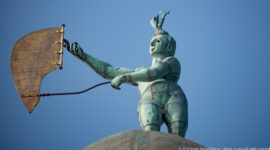
A marble angel on Ponte Sant’Angelo turns in a sweeping contrapposto, one arm extended while deeply carved drapery billows around the body. Floodlighting against the blue-black sky accentuates the folds and theatrical gesture. The close upward view isolates the bridge sculpture from its urban setting and emphasizes the Baroque movement of the figure.
Caption
A marble angel on Ponte Sant’Angelo turns in a sweeping contrapposto, one arm extended while deeply carved drapery billows around the body. Floodlighting against the blue-black sky accentuates the folds and theatrical gesture. The close upward view isolates the bridge sculpture from its urban setting and emphasizes the Baroque movement of the figure.

The Angel with the Crown of Thorns holds Christ’s circular thorn crown prominently across its body on Ponte Sant’Angelo. Paolo Naldini carved the bridge version after Gian Lorenzo Bernini’s design; Bernini’s original was retained and is now in Sant’Andrea delle Fratte. Seen from below at night, the floodlit marble figure’s spread wings, turning head, and billowing drapery stand sharply against the deep blue sky.
Caption
The Angel with the Crown of Thorns holds Christ’s circular thorn crown prominently across its body on Ponte Sant’Angelo. Paolo Naldini carved the bridge version after Gian Lorenzo Bernini’s design; Bernini’s original was retained and is now in Sant’Andrea delle Fratte. Seen from below at night, the floodlit marble figure’s spread wings, turning head, and billowing drapery stand sharply against the deep blue sky.

Castel Sant’Angelo glows at the end of Ponte Sant’Angelo, framed by monumental statues lining the bridge and a stream of evening pedestrians. The axial viewpoint draws directly toward the cylindrical fortress, while the bronze archangel on its summit stands against the dark sky, linking bridge sculpture and castle in one of Rome’s most recognizable nighttime approaches.
Caption
Castel Sant’Angelo glows at the end of Ponte Sant’Angelo, framed by monumental statues lining the bridge and a stream of evening pedestrians. The axial viewpoint draws directly toward the cylindrical fortress, while the bronze archangel on its summit stands against the dark sky, linking bridge sculpture and castle in one of Rome’s most recognizable nighttime approaches.

A printed tourist map presents central Rome in dense detail, marking streets, monuments, parks, the Tiber, and archaeological areas with colored blocks and small pictorial symbols. The visible section includes the Colosseum, Roman Forum, Circus Maximus, and surrounding neighborhoods, providing a practical orientation view rather than a nighttime streetscape.
Caption
A printed tourist map presents central Rome in dense detail, marking streets, monuments, parks, the Tiber, and archaeological areas with colored blocks and small pictorial symbols. The visible section includes the Colosseum, Roman Forum, Circus Maximus, and surrounding neighborhoods, providing a practical orientation view rather than a nighttime streetscape.

A winged marble angel leans forward above Ponte Sant’Angelo, its layered garments sweeping diagonally across the body as it supports a large object at one side. The upward nighttime viewpoint silhouettes the wings and animated drapery against a clear dark-blue sky, emphasizing the sculptural drama of the bridge’s celebrated Baroque angel sequence.
Caption
A winged marble angel leans forward above Ponte Sant’Angelo, its layered garments sweeping diagonally across the body as it supports a large object at one side. The upward nighttime viewpoint silhouettes the wings and animated drapery against a clear dark-blue sky, emphasizing the sculptural drama of the bridge’s celebrated Baroque angel sequence.

Domenico Guidi’s Angel with the Lance rises above Ponte Sant’Angelo, carrying the spear associated with Christ’s Passion diagonally across its body. Designed within Gian Lorenzo Bernini’s sculptural program for the bridge and executed in the late 1660s, the marble figure is animated by deeply cut, wind-swept drapery. Strong upward lighting isolates the angel and its long attribute against the dark blue Roman sky.
Caption
Domenico Guidi’s Angel with the Lance rises above Ponte Sant’Angelo, carrying the spear associated with Christ’s Passion diagonally across its body. Designed within Gian Lorenzo Bernini’s sculptural program for the bridge and executed in the late 1660s, the marble figure is animated by deeply cut, wind-swept drapery. Strong upward lighting isolates the angel and its long attribute against the dark blue Roman sky.

Castel Sant’Angelo glows at the end of Ponte Sant’Angelo, where marble angels frame the approach and evening pedestrians move toward the fortress. The centered viewpoint emphasizes the bridge’s ceremonial axis and the castle’s massive cylindrical form, while the bronze Archangel Michael crowns the illuminated upper terrace against the deep blue Roman night sky.
Caption
Castel Sant’Angelo glows at the end of Ponte Sant’Angelo, where marble angels frame the approach and evening pedestrians move toward the fortress. The centered viewpoint emphasizes the bridge’s ceremonial axis and the castle’s massive cylindrical form, while the bronze Archangel Michael crowns the illuminated upper terrace against the deep blue Roman night sky.

Ponte Sant’Angelo spans the Tiber under warm nighttime illumination, its broad stone arches reflected in the dark river below. Marble statues line the balustrades above, while streetlights and surrounding buildings recede toward the far bank. The oblique viewpoint from beside the river emphasizes the bridge’s masonry structure and the rhythmic sequence of arches supporting its sculptural promenade.
Caption
Ponte Sant’Angelo spans the Tiber under warm nighttime illumination, its broad stone arches reflected in the dark river below. Marble statues line the balustrades above, while streetlights and surrounding buildings recede toward the far bank. The oblique viewpoint from beside the river emphasizes the bridge’s masonry structure and the rhythmic sequence of arches supporting its sculptural promenade.