Rialto – Venice, Italy
The historic Rialto Bridge spans the Grand Canal and stands as one of the most recognizable landmarks in Venice. Completed in 1591, the elegant stone bridge replaced earlier wooden crossings and became the principal connection between the commercial districts on either side of the canal.
For centuries the surrounding area formed the economic heart of Venice, where merchants traded goods arriving from across the Mediterranean and beyond. Shops built directly along the bridge continue the long tradition of commerce in this historic marketplace.
Today the Rialto Bridge remains one of the most iconic architectural symbols of Venice.

An elevated view from the Rialto Bridge looks along the Grand Canal through dense boat traffic and continuous rows of palazzi. A vaporetto approaches the foreground among gondolas, landing stages, and timber posts, while awnings and waterside businesses animate both banks. The broad perspective presents the canal as Venice’s principal transportation corridor.
Caption
An elevated view from the Rialto Bridge looks along the Grand Canal through dense boat traffic and continuous rows of palazzi. A vaporetto approaches the foreground among gondolas, landing stages, and timber posts, while awnings and waterside businesses animate both banks. The broad perspective presents the canal as Venice’s principal transportation corridor.

San Giacomo di Rialto faces the campo with its famous oversized clock centered high on the brick façade above a deep columned portico. The low, broad church front is framed by arcaded buildings on either side, while pedestrians crossing the square provide scale to one of the Rialto district’s most recognizable historic landmarks.
Caption
San Giacomo di Rialto faces the campo with its famous oversized clock centered high on the brick façade above a deep columned portico. The low, broad church front is framed by arcaded buildings on either side, while pedestrians crossing the square provide scale to one of the Rialto district’s most recognizable historic landmarks.

The Rialto Bridge rises across the Grand Canal in a long axial view framed by dense waterfront buildings. Its pale stone arch and central superstructure form the distant focal point while boats move through the broad channel, showing the bridge in its larger urban setting as both a crossing and a defining landmark of the canal.
Caption
The Rialto Bridge rises across the Grand Canal in a long axial view framed by dense waterfront buildings. Its pale stone arch and central superstructure form the distant focal point while boats move through the broad channel, showing the bridge in its larger urban setting as both a crossing and a defining landmark of the canal.

Boat traffic spreads across the Grand Canal beneath an elevated Rialto viewpoint, with a white motorboat moving toward the camera and vaporetti farther upstream. At right, gondolas cluster among dense timber posts beside waterfront awnings, while monumental palazzi line the opposite bank in a layered urban panorama.
Caption
Boat traffic spreads across the Grand Canal beneath an elevated Rialto viewpoint, with a white motorboat moving toward the camera and vaporetti farther upstream. At right, gondolas cluster among dense timber posts beside waterfront awnings, while monumental palazzi line the opposite bank in a layered urban panorama.

A vaporetto passes directly beneath the Rialto Bridge, giving a strong sense of scale to the crossing’s broad stone arch and shop-lined crest. Red-and-white mooring poles rise at right while pedestrians crowd the balustrades above, combining Venice’s public water transport, pedestrian traffic, and monumental architecture in one tightly composed view.
Caption
A vaporetto passes directly beneath the Rialto Bridge, giving a strong sense of scale to the crossing’s broad stone arch and shop-lined crest. Red-and-white mooring poles rise at right while pedestrians crowd the balustrades above, combining Venice’s public water transport, pedestrian traffic, and monumental architecture in one tightly composed view.

The Rialto Bridge spans the Grand Canal in a close side view, revealing the great pale stone arch, balustraded ramps, and the enclosed shop range along its crest. Timber mooring posts rise in the foreground, reinforcing the low waterside viewpoint and allowing the bridge’s engineering mass to dominate the composition.
Caption
The Rialto Bridge spans the Grand Canal in a close side view, revealing the great pale stone arch, balustraded ramps, and the enclosed shop range along its crest. Timber mooring posts rise in the foreground, reinforcing the low waterside viewpoint and allowing the bridge’s engineering mass to dominate the composition.

Four gondoliers gather in conversation beside a worn Venetian wall, their striped shirts, dark padded vests, and brimmed hats marking the occupational dress associated with the city’s gondola service. Rather than showing passengers underway, the scene records the social and working life around a Rialto gondola station between trips.
Caption
Four gondoliers gather in conversation beside a worn Venetian wall, their striped shirts, dark padded vests, and brimmed hats marking the occupational dress associated with the city’s gondola service. Rather than showing passengers underway, the scene records the social and working life around a Rialto gondola station between trips.

The Rialto Bridge sweeps across the Grand Canal in a close three-quarter view, revealing its single stone arch, balustraded ramps, and continuous range of shop openings above. Red-and-white striped mooring poles stand in the foreground, providing scale and a distinctly Venetian frame for the bridge’s massive pale masonry.
Caption
The Rialto Bridge sweeps across the Grand Canal in a close three-quarter view, revealing its single stone arch, balustraded ramps, and continuous range of shop openings above. Red-and-white striped mooring poles stand in the foreground, providing scale and a distinctly Venetian frame for the bridge’s massive pale masonry.

A worn green double door is set into a patched stucco-and-brick wall beneath the number 176. A long-handled twig broom leans diagonally across the entrance, turning an ordinary service doorway into a concise study of color, texture, and everyday maintenance within the historic Rialto streetscape.
Caption
A worn green double door is set into a patched stucco-and-brick wall beneath the number 176. A long-handled twig broom leans diagonally across the entrance, turning an ordinary service doorway into a concise study of color, texture, and everyday maintenance within the historic Rialto streetscape.

Late light warms a long sequence of palazzi along the Grand Canal, where Gothic window groups, arcades, balconies, and varied plaster colors create a continuous architectural frontage. A motorboat cuts across the water while mooring posts and the prow of a gondola occupy the foreground, contrasting modern movement with Venice’s traditional canal infrastructure.
Caption
Late light warms a long sequence of palazzi along the Grand Canal, where Gothic window groups, arcades, balconies, and varied plaster colors create a continuous architectural frontage. A motorboat cuts across the water while mooring posts and the prow of a gondola occupy the foreground, contrasting modern movement with Venice’s traditional canal infrastructure.

The Rialto Bridge fills the frame from canal level, its broad stone arch rising beneath the shop-lined superstructure and balustraded ramps. Red-and-white mooring poles punctuate the foreground while the covered openings above trace the bridge’s commercial spine, giving a clear architectural view of Venice’s best-known crossing of the Grand Canal.
Caption
The Rialto Bridge fills the frame from canal level, its broad stone arch rising beneath the shop-lined superstructure and balustraded ramps. Red-and-white mooring poles punctuate the foreground while the covered openings above trace the bridge’s commercial spine, giving a clear architectural view of Venice’s best-known crossing of the Grand Canal.

A broad Grand Canal view centers on a salmon-colored Venetian palace whose façade combines pointed Gothic windows, traceried openings, balconies, and later Renaissance detailing. Mooring poles, gondolas, and working waterfront structures line the water-level frontage, placing the building within the dense architectural fabric of the Rialto district rather than isolating it as a monument.
Caption
A broad Grand Canal view centers on a salmon-colored Venetian palace whose façade combines pointed Gothic windows, traceried openings, balconies, and later Renaissance detailing. Mooring poles, gondolas, and working waterfront structures line the water-level frontage, placing the building within the dense architectural fabric of the Rialto district rather than isolating it as a monument.

A tightly framed market display presents a glistening mass of small cephalopods laid out for sale, their tentacles, mantles, and mottled surfaces filling the composition edge to edge. The close view emphasizes the texture and abundance of fresh seafood associated with the Rialto market, without the distractions of stalls or shoppers.
Caption
A tightly framed market display presents a glistening mass of small cephalopods laid out for sale, their tentacles, mantles, and mottled surfaces filling the composition edge to edge. The close view emphasizes the texture and abundance of fresh seafood associated with the Rialto market, without the distractions of stalls or shoppers.

A gull stands alert on a weathered stone parapet while a bundled visitor occupies the near foreground. The shallow viewpoint compresses bird, balustrade, and warm-toned Venetian façades into a layered street scene, turning an everyday encounter at the Rialto into a close observation of wildlife sharing the heavily visited waterfront.
Caption
A gull stands alert on a weathered stone parapet while a bundled visitor occupies the near foreground. The shallow viewpoint compresses bird, balustrade, and warm-toned Venetian façades into a layered street scene, turning an everyday encounter at the Rialto into a close observation of wildlife sharing the heavily visited waterfront.

A woven basket of local scallops is presented at the fish market beneath a handwritten sign reading “Capesante Nostrane” and a price of €14.80. The tight composition keeps attention on the ridged shells, market labeling, and practical retail presentation, documenting the commercial seafood traditions that continue around Rialto.
Caption
A woven basket of local scallops is presented at the fish market beneath a handwritten sign reading “Capesante Nostrane” and a price of €14.80. The tight composition keeps attention on the ridged shells, market labeling, and practical retail presentation, documenting the commercial seafood traditions that continue around Rialto.

A weathered carved stone base combines a Latin inscription with layered bands of foliate and geometric ornament. The close frontal view records the softened edges, staining, and surface wear of the masonry, emphasizing the object’s age and decorative carving while leaving its original function to the surviving inscription and architectural context.
Caption
A weathered carved stone base combines a Latin inscription with layered bands of foliate and geometric ornament. The close frontal view records the softened edges, staining, and surface wear of the masonry, emphasizing the object’s age and decorative carving while leaving its original function to the surviving inscription and architectural context.

A marble inscription on the Rialto Bridge records Doge Pasquale Cicogna and the completion era of the stone crossing, accompanied by carved architectural and figural ornament. The oblique view also reveals the bridge’s heavy masonry arch, making the commemorative tablet part of the structure rather than a detached historical marker.
Caption
A marble inscription on the Rialto Bridge records Doge Pasquale Cicogna and the completion era of the stone crossing, accompanied by carved architectural and figural ornament. The oblique view also reveals the bridge’s heavy masonry arch, making the commemorative tablet part of the structure rather than a detached historical marker.

A narrow pedestrian calle threads between closely spaced residential façades, with green shutters, barred windows, exposed brick, utility lines, and patches of worn plaster revealing the practical texture of central Venice. The long perspective draws toward a lone pedestrian and shows how the Rialto district extends beyond its canal frontage into an intimate network of lanes.
Caption
A narrow pedestrian calle threads between closely spaced residential façades, with green shutters, barred windows, exposed brick, utility lines, and patches of worn plaster revealing the practical texture of central Venice. The long perspective draws toward a lone pedestrian and shows how the Rialto district extends beyond its canal frontage into an intimate network of lanes.

Ca’ Rezzonico presents its monumental white Baroque façade to the Grand Canal, organized by stacked arcades, tall windows, balustrades, and deep sculptural shadow. A small arched footbridge enters from the left while neighboring palazzi continue the canal wall, situating the museum palace within Venice’s continuous sequence of elite waterfront residences.
Caption
Ca’ Rezzonico presents its monumental white Baroque façade to the Grand Canal, organized by stacked arcades, tall windows, balustrades, and deep sculptural shadow. A small arched footbridge enters from the left while neighboring palazzi continue the canal wall, situating the museum palace within Venice’s continuous sequence of elite waterfront residences.

A row of elaborate wall lanterns projects from a pale stone façade, each fixture carried on scrolling wrought-iron brackets enriched with dense floral and foliate ornament. Seen in diminishing perspective, the repeated lamps create a decorative rhythm along the building and highlight the craftsmanship applied to functional street lighting in Venice’s historic center.
Caption
A row of elaborate wall lanterns projects from a pale stone façade, each fixture carried on scrolling wrought-iron brackets enriched with dense floral and foliate ornament. Seen in diminishing perspective, the repeated lamps create a decorative rhythm along the building and highlight the craftsmanship applied to functional street lighting in Venice’s historic center.

Palazzo Pisani Moretta’s richly patterned Venetian Gothic façade faces the Grand Canal behind a foreground screen of red-and-white striped mooring poles. Pointed windows and broad traceried openings give the palace a delicate surface, while the poles emphasize the working waterway and create a distinctly Venetian frame for the historic residence.
Caption
Palazzo Pisani Moretta’s richly patterned Venetian Gothic façade faces the Grand Canal behind a foreground screen of red-and-white striped mooring poles. Pointed windows and broad traceried openings give the palace a delicate surface, while the poles emphasize the working waterway and create a distinctly Venetian frame for the historic residence.

Sunlight filters into a narrow canal enclosed by tall, weathered masonry façades, catching the water around two small boats and a low arched pedestrian bridge in the distance. Exposed brick, patched plaster, shutters, and waterside openings make this a close study of Venice’s secondary canals, where everyday circulation occurs away from the Grand Canal.
Caption
Sunlight filters into a narrow canal enclosed by tall, weathered masonry façades, catching the water around two small boats and a low arched pedestrian bridge in the distance. Exposed brick, patched plaster, shutters, and waterside openings make this a close study of Venice’s secondary canals, where everyday circulation occurs away from the Grand Canal.

The Rialto Bridge appears through a busy foreground of blue-and-gold mooring poles, gondolas, timber posts, and a street vendor’s display. By placing everyday commerce and transport ahead of the landmark, the composition shows the bridge as part of an active waterfront rather than an isolated architectural icon.
Caption
The Rialto Bridge appears through a busy foreground of blue-and-gold mooring poles, gondolas, timber posts, and a street vendor’s display. By placing everyday commerce and transport ahead of the landmark, the composition shows the bridge as part of an active waterfront rather than an isolated architectural icon.

A polished black gondola rests between timber mooring posts at a canal landing, its upholstered passenger seats, decorative textiles, metal prow fitting, and gondolier’s hat all visible from above. The close viewpoint turns the vessel into a study of equipment and finish, with another gondola and passing boats supplying the working waterfront context.
Caption
A polished black gondola rests between timber mooring posts at a canal landing, its upholstered passenger seats, decorative textiles, metal prow fitting, and gondolier’s hat all visible from above. The close viewpoint turns the vessel into a study of equipment and finish, with another gondola and passing boats supplying the working waterfront context.

A sculpted coat of arms fills an exuberant scrolling cartouche, its shield, crest, and surrounding volutes retaining traces of warm ochre, pink, and dark pigment. Mounted directly on a pale wall, the heraldic relief reads as an architectural emblem whose worn polychromy and softened carving reveal long exposure and repeated restoration.
Caption
A sculpted coat of arms fills an exuberant scrolling cartouche, its shield, crest, and surrounding volutes retaining traces of warm ochre, pink, and dark pigment. Mounted directly on a pale wall, the heraldic relief reads as an architectural emblem whose worn polychromy and softened carving reveal long exposure and repeated restoration.

An interpretive panel pairs English historical text with a comparative drawing of a Venetian building complex. The text discusses two adjacent buildings, later alterations, and their civic administrative use, while the architectural illustration below provides a visual reference for the façades. The photograph documents on-site interpretation rather than the buildings themselves.
Caption
An interpretive panel pairs English historical text with a comparative drawing of a Venetian building complex. The text discusses two adjacent buildings, later alterations, and their civic administrative use, while the architectural illustration below provides a visual reference for the façades. The photograph documents on-site interpretation rather than the buildings themselves.

A weathered residential façade encloses a confined Venetian courtyard, its surface alternating between exposed brick, gray plaster, and patched masonry. Irregular windows, green shutters, flower boxes, drainage pipes, and enclosed ground-level openings reveal layers of adaptation, while the elevated viewpoint emphasizes the tight interior spaces hidden behind Venice’s public streets and canals.
Caption
A weathered residential façade encloses a confined Venetian courtyard, its surface alternating between exposed brick, gray plaster, and patched masonry. Irregular windows, green shutters, flower boxes, drainage pipes, and enclosed ground-level openings reveal layers of adaptation, while the elevated viewpoint emphasizes the tight interior spaces hidden behind Venice’s public streets and canals.

Several gondolas lie tightly moored among tall timber posts at the edge of the Grand Canal, with a small blue motorboat occupying the nearest berth. Across the water, sunlit palazzi form a continuous backdrop. The view emphasizes the dense organization of a working gondola landing and the coexistence of traditional and motorized craft.
Caption
Several gondolas lie tightly moored among tall timber posts at the edge of the Grand Canal, with a small blue motorboat occupying the nearest berth. Across the water, sunlit palazzi form a continuous backdrop. The view emphasizes the dense organization of a working gondola landing and the coexistence of traditional and motorized craft.

A narrow canal recedes between tall masonry walls into bright haze, its reflective surface catching a strong shaft of backlight. A small balcony projects from the right façade above worn plaster and waterside openings, while the compressed passage illustrates the intimate scale of Venice’s secondary waterways.
Caption
A narrow canal recedes between tall masonry walls into bright haze, its reflective surface catching a strong shaft of backlight. A small balcony projects from the right façade above worn plaster and waterside openings, while the compressed passage illustrates the intimate scale of Venice’s secondary waterways.

A broad masonry arch frames a short stairway descending toward a Venetian street, where pedestrians move between historic façades. Iron railings, a heavy gate, worn plaster, and layered stonework give the passage a fortified, transitional character, linking an enclosed architectural space with the brighter urban scene beyond.
Caption
A broad masonry arch frames a short stairway descending toward a Venetian street, where pedestrians move between historic façades. Iron railings, a heavy gate, worn plaster, and layered stonework give the passage a fortified, transitional character, linking an enclosed architectural space with the brighter urban scene beyond.

A gondolier stands beside a canal landing beneath a dark canopy prominently marked “GONDOLA.” His striped shirt, dark vest, and brimmed hat identify the occupation, while mooring posts and water behind him locate the portrait within the practical infrastructure of a Venetian gondola station.
Caption
A gondolier stands beside a canal landing beneath a dark canopy prominently marked “GONDOLA.” His striped shirt, dark vest, and brimmed hat identify the occupation, while mooring posts and water behind him locate the portrait within the practical infrastructure of a Venetian gondola station.

Two gondoliers pause on the paved waterfront beside a covered gondola station, one facing the other across the entrance to the landing. Matching striped shirts, dark vests, and traditional hats distinguish the workers, while the signed canopy and timber posts connect this candid interaction directly to Venice’s passenger gondola service.
Caption
Two gondoliers pause on the paved waterfront beside a covered gondola station, one facing the other across the entrance to the landing. Matching striped shirts, dark vests, and traditional hats distinguish the workers, while the signed canopy and timber posts connect this candid interaction directly to Venice’s passenger gondola service.

Three adjoining palazzi rise directly from the Grand Canal, contrasting a formal white façade with two warmer, more weathered residences. Repeated arched windows, balconies, green shutters, water doors, and mooring posts reveal the vertical organization of Venetian canal houses from water-level access to upper residential floors.
Caption
Three adjoining palazzi rise directly from the Grand Canal, contrasting a formal white façade with two warmer, more weathered residences. Repeated arched windows, balconies, green shutters, water doors, and mooring posts reveal the vertical organization of Venetian canal houses from water-level access to upper residential floors.

Two gondoliers stand beside black gondolas at a paved Grand Canal landing, one attending to the boats while the other faces the waterfront. Red-and-white mooring poles punctuate the scene and a layered wall of Venetian residences fills the opposite bank, presenting the gondola service as everyday work embedded in the city’s architecture.
Caption
Two gondoliers stand beside black gondolas at a paved Grand Canal landing, one attending to the boats while the other faces the waterfront. Red-and-white mooring poles punctuate the scene and a layered wall of Venetian residences fills the opposite bank, presenting the gondola service as everyday work embedded in the city’s architecture.

Two gondoliers walk together across a bright stone waterfront while moored gondolas rest behind them. Their contrasting red-and-white and black-and-white striped shirts, straw hats, and dark trousers make occupational dress the focus of the scene, with the hazy canal and pale architecture reducing the background to a luminous Venetian setting.
Caption
Two gondoliers walk together across a bright stone waterfront while moored gondolas rest behind them. Their contrasting red-and-white and black-and-white striped shirts, straw hats, and dark trousers make occupational dress the focus of the scene, with the hazy canal and pale architecture reducing the background to a luminous Venetian setting.

Three round stone arches open from a shaded passage toward a sunlit Venetian square, creating a strong sequence of dark interior, silhouetted masonry, and bright exterior space. Brick side walls and the patterned paving retain the texture of the historic fabric, while distant pedestrians give scale to the monumental arcade.
Caption
Three round stone arches open from a shaded passage toward a sunlit Venetian square, creating a strong sequence of dark interior, silhouetted masonry, and bright exterior space. Brick side walls and the patterned paving retain the texture of the historic fabric, while distant pedestrians give scale to the monumental arcade.

A close market study fills the frame with fresh octopus, their curled arms and rows of pale suction cups creating a dense repeating pattern. Moist surfaces and natural color variations emphasize the seafood’s texture and freshness, making the photograph a direct record of the produce sold in the Rialto fish market.
Caption
A close market study fills the frame with fresh octopus, their curled arms and rows of pale suction cups creating a dense repeating pattern. Moist surfaces and natural color variations emphasize the seafood’s texture and freshness, making the photograph a direct record of the produce sold in the Rialto fish market.

Fresh whole fish are arranged in a radial market display around a handwritten sign reading “Branzini Freschi” with a price of €8.60. Silvery scales, intact heads, and the dense presentation make the merchandise visually immediate, while the label identifies the fish as fresh branzino, or European sea bass.
Caption
Fresh whole fish are arranged in a radial market display around a handwritten sign reading “Branzini Freschi” with a price of €8.60. Silvery scales, intact heads, and the dense presentation make the merchandise visually immediate, while the label identifies the fish as fresh branzino, or European sea bass.

A dense foreground of green-and-blue striped poles, timber moorings, and black gondolas marks a Rialto landing while public water buses pass across the Grand Canal behind. The layered traffic compresses traditional gondola service and modern mass transit into a single view, illustrating the variety of craft sharing Venice’s principal waterway.
Caption
A dense foreground of green-and-blue striped poles, timber moorings, and black gondolas marks a Rialto landing while public water buses pass across the Grand Canal behind. The layered traffic compresses traditional gondola service and modern mass transit into a single view, illustrating the variety of craft sharing Venice’s principal waterway.

Small cephalopods lie in a dense, glistening market display, their pale mantles, tentacles, mottled skin, and dark eyes creating a study in texture and form. The tight crop removes the surrounding stall and concentrates attention on the fresh seafood itself, a characteristic product of the fish market associated with Venice’s Rialto district.
Caption
Small cephalopods lie in a dense, glistening market display, their pale mantles, tentacles, mottled skin, and dark eyes creating a study in texture and form. The tight crop removes the surrounding stall and concentrates attention on the fresh seafood itself, a characteristic product of the fish market associated with Venice’s Rialto district.

A monumental canal-side façade is organized by tall arched openings separated by marble piers and sculptural niches. Standing figures occupy recessed bays between the windows, while a balustraded upper level carries flags above the waterline. The frontal composition emphasizes the building’s formal symmetry and its direct relationship to the Grand Canal.
Caption
A monumental canal-side façade is organized by tall arched openings separated by marble piers and sculptural niches. Standing figures occupy recessed bays between the windows, while a balustraded upper level carries flags above the waterline. The frontal composition emphasizes the building’s formal symmetry and its direct relationship to the Grand Canal.

Small motorboats and covered craft occupy a dense field of timber mooring posts along the Grand Canal, with a long sequence of pastel palazzi rising behind them. The view gives equal weight to the practical waterfront infrastructure and the architectural backdrop, showing how private boats, docks, and historic residences share the canal edge.
Caption
Small motorboats and covered craft occupy a dense field of timber mooring posts along the Grand Canal, with a long sequence of pastel palazzi rising behind them. The view gives equal weight to the practical waterfront infrastructure and the architectural backdrop, showing how private boats, docks, and historic residences share the canal edge.

Opened scallop shells display plump white muscles and vivid orange roe against a bed of darker shells. Presented without packaging or signage in this close market view, the seafood becomes an almost graphic arrangement of fan-shaped shells, glossy flesh, and contrasting color, while remaining a direct record of fresh shellfish sold around Rialto.
Caption
Opened scallop shells display plump white muscles and vivid orange roe against a bed of darker shells. Presented without packaging or signage in this close market view, the seafood becomes an almost graphic arrangement of fan-shaped shells, glossy flesh, and contrasting color, while remaining a direct record of fresh shellfish sold around Rialto.

A heap of orange-pink langoustines fills the frame with overlapping claws, segmented tails, antennae, and glossy shells. The close viewpoint records the crustaceans as market produce rather than a prepared dish, emphasizing their delicate coloration and repeated anatomical forms within the abundant seafood displays of the Rialto market.
Caption
A heap of orange-pink langoustines fills the frame with overlapping claws, segmented tails, antennae, and glossy shells. The close viewpoint records the crustaceans as market produce rather than a prepared dish, emphasizing their delicate coloration and repeated anatomical forms within the abundant seafood displays of the Rialto market.

A broad Grand Canal view opens across rows of small boats and timber moorings toward a continuous frontage of historic palazzi. Gothic and Renaissance window patterns, pale stone, colored plaster, and waterside arcades distinguish the individual buildings, while the open water and working docks establish the scale of the canal near Rialto.
Caption
A broad Grand Canal view opens across rows of small boats and timber moorings toward a continuous frontage of historic palazzi. Gothic and Renaissance window patterns, pale stone, colored plaster, and waterside arcades distinguish the individual buildings, while the open water and working docks establish the scale of the canal near Rialto.

A small motorboat moves through a narrow canal bordered by brick and stucco buildings, passing moored utility craft beneath a low pedestrian bridge. Chimneys, shuttered windows, balconies, and water-stained masonry crowd the scene, illustrating the intimate scale and everyday traffic of Venice’s secondary waterways beyond the Grand Canal.
Caption
A small motorboat moves through a narrow canal bordered by brick and stucco buildings, passing moored utility craft beneath a low pedestrian bridge. Chimneys, shuttered windows, balconies, and water-stained masonry crowd the scene, illustrating the intimate scale and everyday traffic of Venice’s secondary waterways beyond the Grand Canal.

The bridge’s sloping balustrade fills the foreground, its weathered stone rail and bulbous balusters leading toward the broad arch over the Grand Canal. Dark shutters line the shop range at left, while a pale waterfront building appears beyond the opening, creating a compact study of the Rialto Bridge’s circulation, commerce, and masonry construction.
Caption
The bridge’s sloping balustrade fills the foreground, its weathered stone rail and bulbous balusters leading toward the broad arch over the Grand Canal. Dark shutters line the shop range at left, while a pale waterfront building appears beyond the opening, creating a compact study of the Rialto Bridge’s circulation, commerce, and masonry construction.

A deep arcaded portico recedes through repeated stone columns and shallow vaults, its hanging lanterns and worn paving reinforcing the strong linear perspective. Closed shutters and service openings along the sides leave the passage nearly empty, revealing the architectural framework of the Rialto market district without the usual daytime commercial activity.
Caption
A deep arcaded portico recedes through repeated stone columns and shallow vaults, its hanging lanterns and worn paving reinforcing the strong linear perspective. Closed shutters and service openings along the sides leave the passage nearly empty, revealing the architectural framework of the Rialto market district without the usual daytime commercial activity.

A brightly lit seafood counter curves through the Rialto market beneath hanging lamps, presenting heaps of shrimp, fish, and shellfish on ice and green garnish. Handwritten price cards punctuate the display while vendors and shoppers stand behind it, expanding the portfolio from individual seafood studies to the commercial setting in which the products are sold.
Caption
A brightly lit seafood counter curves through the Rialto market beneath hanging lamps, presenting heaps of shrimp, fish, and shellfish on ice and green garnish. Handwritten price cards punctuate the display while vendors and shoppers stand behind it, expanding the portfolio from individual seafood studies to the commercial setting in which the products are sold.

A waterfront promenade and a cluster of small boats lead the eye into a long bend of the Grand Canal, where tightly packed palazzi recede into atmospheric haze. Timber posts, floating landings, awnings, and brightly colored hulls animate the near shore, contrasting the practical docking area with the formal residential façades beyond.
Caption
A waterfront promenade and a cluster of small boats lead the eye into a long bend of the Grand Canal, where tightly packed palazzi recede into atmospheric haze. Timber posts, floating landings, awnings, and brightly colored hulls animate the near shore, contrasting the practical docking area with the formal residential façades beyond.

A broad flight of worn stone steps rises between pale balustrades to a pointed arch opening in a brick wall. The bridge-like passage frames a narrow Venetian street beyond, where a Gothic window and warm stucco façade appear through the opening. The composition emphasizes the layered transitions between canal edge, stair, arch, and pedestrian route.
Caption
A broad flight of worn stone steps rises between pale balustrades to a pointed arch opening in a brick wall. The bridge-like passage frames a narrow Venetian street beyond, where a Gothic window and warm stucco façade appear through the opening. The composition emphasizes the layered transitions between canal edge, stair, arch, and pedestrian route.

Ca’ d’Oro presents its celebrated Venetian Gothic façade across the Grand Canal, with open loggias, pointed arches, quatrefoils, delicate tracery, and a crenellated roofline concentrated on the waterfront elevation. A passing motorboat and mooring posts keep the palace embedded in the working canal scene rather than treating its ornate stonework as an isolated architectural study.
Caption
Ca’ d’Oro presents its celebrated Venetian Gothic façade across the Grand Canal, with open loggias, pointed arches, quatrefoils, delicate tracery, and a crenellated roofline concentrated on the waterfront elevation. A passing motorboat and mooring posts keep the palace embedded in the working canal scene rather than treating its ornate stonework as an isolated architectural study.

A close oblique view follows the Rialto Bridge’s stone stair and balustrade toward the crown of its arch. Repeating vase-shaped balusters, heavy coping, dark shop shutters, and the canal visible through the opening emphasize the bridge as a piece of occupied architecture, not merely a silhouette seen from the water.
Caption
A close oblique view follows the Rialto Bridge’s stone stair and balustrade toward the crown of its arch. Repeating vase-shaped balusters, heavy coping, dark shop shutters, and the canal visible through the opening emphasize the bridge as a piece of occupied architecture, not merely a silhouette seen from the water.

A pale Renaissance palazzo rises immediately beside the Rialto Bridge, its façade ordered by stacked arched windows, pilasters, carved roundels, and a ground-level arcade. Flags hang from the upper story while the Grand Canal extends behind the building, situating this formal civic architecture within the dense monumental ensemble around the bridge.
Caption
A pale Renaissance palazzo rises immediately beside the Rialto Bridge, its façade ordered by stacked arched windows, pilasters, carved roundels, and a ground-level arcade. Flags hang from the upper story while the Grand Canal extends behind the building, situating this formal civic architecture within the dense monumental ensemble around the bridge.

From the Rialto Bridge, the Grand Canal stretches between dense rows of palazzi and commercial waterfronts while vaporetti and smaller craft travel the central channel. Landing stages, awnings, mooring posts, and riverside activity crowd both banks, making this elevated view a broad record of the canal’s architecture and transportation network.
Caption
From the Rialto Bridge, the Grand Canal stretches between dense rows of palazzi and commercial waterfronts while vaporetti and smaller craft travel the central channel. Landing stages, awnings, mooring posts, and riverside activity crowd both banks, making this elevated view a broad record of the canal’s architecture and transportation network.

A broad stone landing on the Rialto Bridge opens toward a vivid red palazzo and neighboring canal-side buildings. The foreground balustrade and striped paving create a strong architectural frame, while green shutters, arched windows, and layered façades across the way show the dense urban fabric encountered while crossing the bridge.
Caption
A broad stone landing on the Rialto Bridge opens toward a vivid red palazzo and neighboring canal-side buildings. The foreground balustrade and striped paving create a strong architectural frame, while green shutters, arched windows, and layered façades across the way show the dense urban fabric encountered while crossing the bridge.

Dark stone treads striped with pale joints descend beside the Rialto Bridge’s heavy balustrade toward an orange arcaded building. The elevated angle emphasizes the steep pedestrian route over the Grand Canal, while flags, shutters, and the civic-looking façade beyond provide a colorful urban terminus to the otherwise austere bridge masonry.
Caption
Dark stone treads striped with pale joints descend beside the Rialto Bridge’s heavy balustrade toward an orange arcaded building. The elevated angle emphasizes the steep pedestrian route over the Grand Canal, while flags, shutters, and the civic-looking façade beyond provide a colorful urban terminus to the otherwise austere bridge masonry.

The Grand Canal curves away beneath an elevated Rialto Bridge viewpoint, bordered by tall palazzi and a busy right-bank waterfront of gondolas, striped mooring poles, awnings, and landing stages. A small motorboat travels mid-channel, giving the broad architectural panorama a clear sense of movement and scale.
Caption
The Grand Canal curves away beneath an elevated Rialto Bridge viewpoint, bordered by tall palazzi and a busy right-bank waterfront of gondolas, striped mooring poles, awnings, and landing stages. A small motorboat travels mid-channel, giving the broad architectural panorama a clear sense of movement and scale.

Arcaded buildings define an open paved square in the Rialto market district, with café tables arranged beneath the long colonnade. Repeated round arches unify the red-brick and pale stucco façades, while the nearly empty space exposes the scale and regularity of a commercial precinct usually animated by market and dining activity.
Caption
Arcaded buildings define an open paved square in the Rialto market district, with café tables arranged beneath the long colonnade. Repeated round arches unify the red-brick and pale stucco façades, while the nearly empty space exposes the scale and regularity of a commercial precinct usually animated by market and dining activity.

A covered walkway alternates red-brick piers with pale stone columns and pointed openings, creating a rhythmic corridor toward the waterfront. The worn paving, timber ceiling, hanging lamps, and metal gates retain a utilitarian market character, while bright canal light entering from the left marks the arcade’s close relationship to the water.
Caption
A covered walkway alternates red-brick piers with pale stone columns and pointed openings, creating a rhythmic corridor toward the waterfront. The worn paving, timber ceiling, hanging lamps, and metal gates retain a utilitarian market character, while bright canal light entering from the left marks the arcade’s close relationship to the water.

A freestanding pale masonry building presents three levels of regularly spaced arched windows above a ground-floor arcade. Classical moldings and restrained carved details give the long block a formal civic character, while its position beside the Rialto market arcades links monumental architecture with the district’s historic commercial functions.
Caption
A freestanding pale masonry building presents three levels of regularly spaced arched windows above a ground-floor arcade. Classical moldings and restrained carved details give the long block a formal civic character, while its position beside the Rialto market arcades links monumental architecture with the district’s historic commercial functions.

The Banco Giro storefront occupies a deep arched bay beneath a weathered stone arcade, its wooden doors and bold lettering set below a small devotional image in an ornate frame. Benches line the foreground, while the heavy masonry and layered opening preserve the architectural character of the Rialto market’s arcaded commercial spaces.
Caption
The Banco Giro storefront occupies a deep arched bay beneath a weathered stone arcade, its wooden doors and bold lettering set below a small devotional image in an ornate frame. Benches line the foreground, while the heavy masonry and layered opening preserve the architectural character of the Rialto market’s arcaded commercial spaces.

Heavy stone piers and round arches form a deep covered walkway along the Rialto market district. Worn surfaces, iron grilles, recessed doors, and the repeating bays reveal the utilitarian character of the historic arcade, while the oblique perspective emphasizes the thickness and age of its masonry construction.
Caption
Heavy stone piers and round arches form a deep covered walkway along the Rialto market district. Worn surfaces, iron grilles, recessed doors, and the repeating bays reveal the utilitarian character of the historic arcade, while the oblique perspective emphasizes the thickness and age of its masonry construction.

The Rialto Bridge balustrade cuts across the foreground of an elevated Grand Canal view, where motorboats travel between closely packed palazzi. The stone rail anchors the viewpoint unmistakably on the bridge and contrasts with the colorful, vertically layered façades lining the water beyond.
Caption
The Rialto Bridge balustrade cuts across the foreground of an elevated Grand Canal view, where motorboats travel between closely packed palazzi. The stone rail anchors the viewpoint unmistakably on the bridge and contrasts with the colorful, vertically layered façades lining the water beyond.
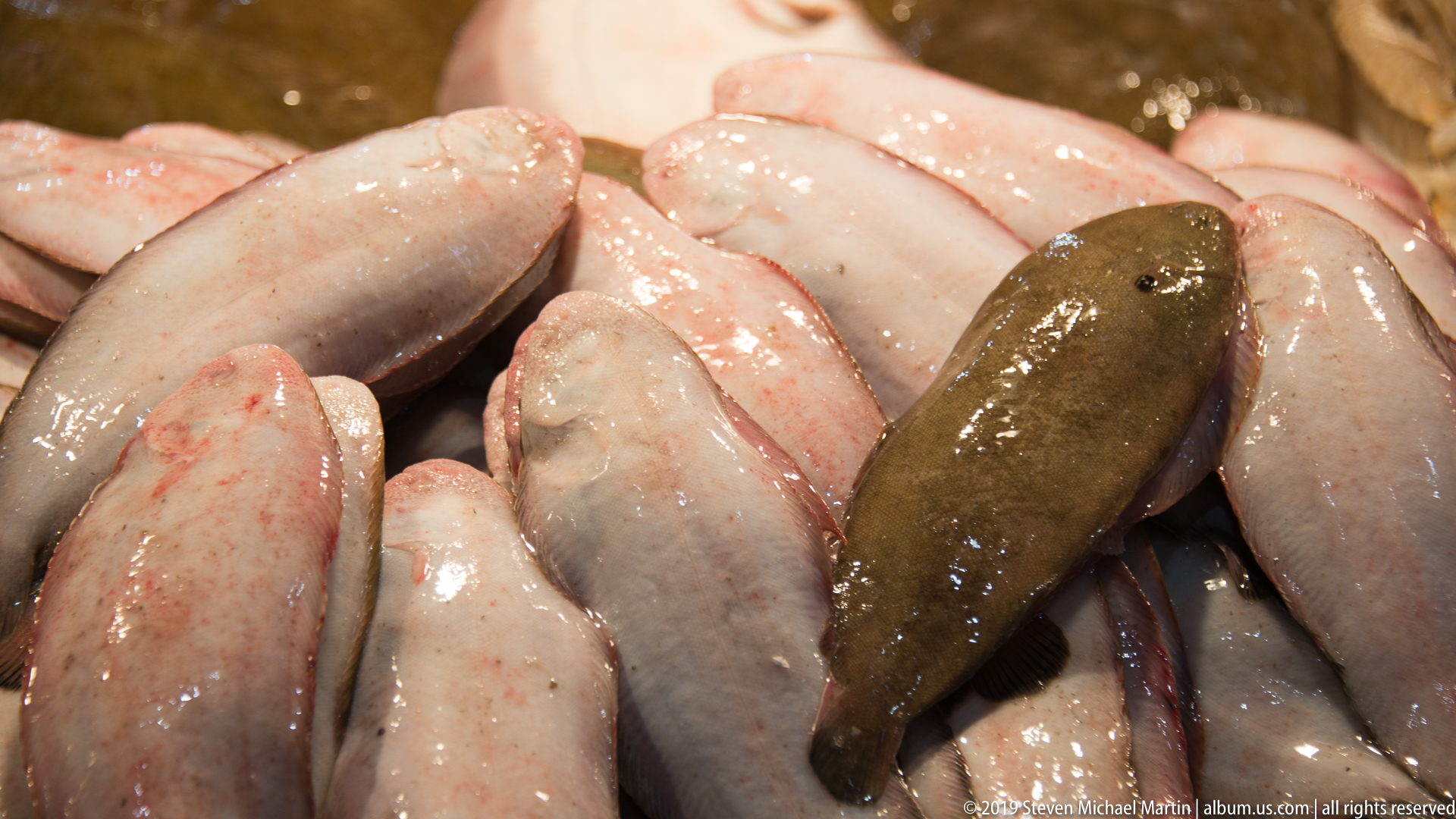
A close market display shows smooth, pale whole fish packed tightly together, their wet skin ranging from pinkish white to gray-brown. With no visible label or distinctive diagnostic feature at proof-sheet scale, the photograph is best read as a texture-rich study of fresh seafood rather than a species-specific record.
Caption
A close market display shows smooth, pale whole fish packed tightly together, their wet skin ranging from pinkish white to gray-brown. With no visible label or distinctive diagnostic feature at proof-sheet scale, the photograph is best read as a texture-rich study of fresh seafood rather than a species-specific record.

Rows of mantis shrimp are packed tightly across a seafood display, their segmented tan-orange bodies, dark eye spots, and armored tails forming a repeated pattern. The close crop highlights the unusual crustaceans’ ridged exoskeletons and abundance, documenting one of the distinctive shellfish types offered at the Rialto fish market.
Caption
Rows of mantis shrimp are packed tightly across a seafood display, their segmented tan-orange bodies, dark eye spots, and armored tails forming a repeated pattern. The close crop highlights the unusual crustaceans’ ridged exoskeletons and abundance, documenting one of the distinctive shellfish types offered at the Rialto fish market.

A long flight of striped stone steps descends between the Rialto Bridge’s balustrade and dark shuttered shopfronts toward an orange arcaded building. The near-symmetrical perspective emphasizes the bridge as a pedestrian street, with its steep grade, commercial edges, and civic architecture unfolding along a single axis.
Caption
A long flight of striped stone steps descends between the Rialto Bridge’s balustrade and dark shuttered shopfronts toward an orange arcaded building. The near-symmetrical perspective emphasizes the bridge as a pedestrian street, with its steep grade, commercial edges, and civic architecture unfolding along a single axis.

A narrow paved calle extends between tall brick and stucco buildings, its façades crowded with shutters, projecting signs, awnings, pipes, balconies, and shopfronts. A few pedestrians occupy the distant center, allowing the long perspective to emphasize the dense vertical character of the Rialto district away from its canals and market squares.
Caption
A narrow paved calle extends between tall brick and stucco buildings, its façades crowded with shutters, projecting signs, awnings, pipes, balconies, and shopfronts. A few pedestrians occupy the distant center, allowing the long perspective to emphasize the dense vertical character of the Rialto district away from its canals and market squares.

Ca’ d’Oro rises across the Grand Canal behind a foreground of small covered boats, timber posts, and a low landing. Its ornate Venetian Gothic loggias, pointed arches, quatrefoils, and crenellated roofline remain the architectural focus, while the mooring field gives the palace a practical contemporary waterfront context.
Caption
Ca’ d’Oro rises across the Grand Canal behind a foreground of small covered boats, timber posts, and a low landing. Its ornate Venetian Gothic loggias, pointed arches, quatrefoils, and crenellated roofline remain the architectural focus, while the mooring field gives the palace a practical contemporary waterfront context.

Warm artificial light models the Rialto Bridge against the night sky, illuminating its marble arch, balustrade, and arcaded shop range while reflections shimmer beneath. Two red-and-white mooring poles stand at the right edge, adding a vertical counterpoint to the sweeping arch and locating the nocturnal view firmly within the working canal landscape.
Caption
Warm artificial light models the Rialto Bridge against the night sky, illuminating its marble arch, balustrade, and arcaded shop range while reflections shimmer beneath. Two red-and-white mooring poles stand at the right edge, adding a vertical counterpoint to the sweeping arch and locating the nocturnal view firmly within the working canal landscape.

A close nighttime view isolates the Rialto Bridge’s masonry arch, carved relief panel, balustrade, and dark shop openings. Bright light pours through the large terminal arch above, sharpening the contrast between pale Istrian stone and the night sky while revealing the layered construction of the bridge at a more intimate scale.
Caption
A close nighttime view isolates the Rialto Bridge’s masonry arch, carved relief panel, balustrade, and dark shop openings. Bright light pours through the large terminal arch above, sharpening the contrast between pale Istrian stone and the night sky while revealing the layered construction of the bridge at a more intimate scale.

An open Venice guidebook combines a drawn map of the Grand Canal with photographs and short interpretive entries for Rialto and nearby landmarks. The hand-held spread documents the visitor’s navigational context for the district, linking the photographed streets and waterways to a schematic overview of central Venice rather than depicting the city directly.
Caption
An open Venice guidebook combines a drawn map of the Grand Canal with photographs and short interpretive entries for Rialto and nearby landmarks. The hand-held spread documents the visitor’s navigational context for the district, linking the photographed streets and waterways to a schematic overview of central Venice rather than depicting the city directly.

A hand-held guidebook spread follows the sinuous Grand Canal through a dense illustrated plan of Venice, with inset photographs identifying major sights along the route. The composition emphasizes the map itself, including the canal’s bends, bridge crossings, and surrounding neighborhoods, providing geographic context for the Rialto portfolio’s sequence of waterfront photographs.
Caption
A hand-held guidebook spread follows the sinuous Grand Canal through a dense illustrated plan of Venice, with inset photographs identifying major sights along the route. The composition emphasizes the map itself, including the canal’s bends, bridge crossings, and surrounding neighborhoods, providing geographic context for the Rialto portfolio’s sequence of waterfront photographs.

Another guidebook spread combines a detailed Grand Canal map with photographs and text on Venetian transport and landmarks, including a prominent section on gondolas. Seen immediately before the portfolio returns to the streets, the page functions as a compact interpretive reference to the waterway, buildings, and boat culture encountered around Rialto.
Caption
Another guidebook spread combines a detailed Grand Canal map with photographs and text on Venetian transport and landmarks, including a prominent section on gondolas. Seen immediately before the portfolio returns to the streets, the page functions as a compact interpretive reference to the waterway, buildings, and boat culture encountered around Rialto.

A yellow wall sign marked “PER RIALTO” points left beneath an elaborate dark metal ornament shaped as a winged creature. A colorful faceted hanging lamp projects beside it, while exposed brick and a commemorative plaque complete the layered streetscape. The scene records the practical wayfinding signs that guide pedestrians through Venice’s maze of lanes.
Caption
A yellow wall sign marked “PER RIALTO” points left beneath an elaborate dark metal ornament shaped as a winged creature. A colorful faceted hanging lamp projects beside it, while exposed brick and a commemorative plaque complete the layered streetscape. The scene records the practical wayfinding signs that guide pedestrians through Venice’s maze of lanes.

The Rialto Bridge rises diagonally above the Grand Canal, exposing its massive arch, balustrade, carved plaques, and shuttered shop openings. At lower right, seated musicians perform beside the water, adding a human-scale foreground to the monumental crossing and distinguishing this view from the portfolio’s more purely architectural studies.
Caption
The Rialto Bridge rises diagonally above the Grand Canal, exposing its massive arch, balustrade, carved plaques, and shuttered shop openings. At lower right, seated musicians perform beside the water, adding a human-scale foreground to the monumental crossing and distinguishing this view from the portfolio’s more purely architectural studies.

From the Rialto Bridge, the Grand Canal curves between colorful façades, crowded landing stages, and striped mooring poles. Small motorboats occupy the near water while gondolas and larger passenger craft gather farther along the channel. The right bank’s awnings and pedestrians make this view especially attentive to the commercial waterfront below the bridge.
Caption
From the Rialto Bridge, the Grand Canal curves between colorful façades, crowded landing stages, and striped mooring poles. Small motorboats occupy the near water while gondolas and larger passenger craft gather farther along the channel. The right bank’s awnings and pedestrians make this view especially attentive to the commercial waterfront below the bridge.

Pedestrians climb and descend the central stairway of the Rialto Bridge between rows of small shops. Pale stone piers, projecting awnings, display windows, and overhead decorative lights frame the stepped passage, emphasizing that the famous bridge functions simultaneously as a crossing, shopping street, and elevated public space.
Caption
Pedestrians climb and descend the central stairway of the Rialto Bridge between rows of small shops. Pale stone piers, projecting awnings, display windows, and overhead decorative lights frame the stepped passage, emphasizing that the famous bridge functions simultaneously as a crossing, shopping street, and elevated public space.

The large clock on San Giacomo di Rialto is set into a brick wall beneath a small bell opening, its pale circular dial marked with Roman numerals around a weathered center. A gilded sunburst and hand animate the face, making the timepiece one of the church’s most distinctive exterior details in the historic Rialto market district.
Caption
The large clock on San Giacomo di Rialto is set into a brick wall beneath a small bell opening, its pale circular dial marked with Roman numerals around a weathered center. A gilded sunburst and hand animate the face, making the timepiece one of the church’s most distinctive exterior details in the historic Rialto market district.

The Grand Canal stretches away from the Rialto Bridge beneath an overcast sky, its water busy with vaporetti, gondolas, and smaller motorboats. Continuous palace façades and awning-covered waterfront businesses define both banks, while the high viewpoint gives a balanced overview of architecture, commerce, and transportation around Rialto.
Caption
The Grand Canal stretches away from the Rialto Bridge beneath an overcast sky, its water busy with vaporetti, gondolas, and smaller motorboats. Continuous palace façades and awning-covered waterfront businesses define both banks, while the high viewpoint gives a balanced overview of architecture, commerce, and transportation around Rialto.

A red-brick market building stands directly beside the canal, its ground floor opened by broad pointed arches while paired Gothic windows and a small loggia articulate the upper story. A narrow arched footbridge climbs at the right edge, tying the building to the pedestrian network of the Rialto market district.
Caption
A red-brick market building stands directly beside the canal, its ground floor opened by broad pointed arches while paired Gothic windows and a small loggia articulate the upper story. A narrow arched footbridge climbs at the right edge, tying the building to the pedestrian network of the Rialto market district.

A salmon-colored façade is enriched with pointed Venetian Gothic windows, quatrefoil openings, carved white surrounds, and small stone balconies. Flags hang from the central balcony beneath a row of quatrefoils, creating a compact study of the polychrome surface decoration and delicate tracery characteristic of historic Venetian architecture.
Caption
A salmon-colored façade is enriched with pointed Venetian Gothic windows, quatrefoil openings, carved white surrounds, and small stone balconies. Flags hang from the central balcony beneath a row of quatrefoils, creating a compact study of the polychrome surface decoration and delicate tracery characteristic of historic Venetian architecture.

A close view isolates a deeply carved pale-stone capital whose curling leaves merge with animal and marine forms. A fish-like body, scaled surfaces, scrolls, and projecting heads emerge from the weathered carving, demonstrating the inventive sculptural detail used on the columns of Rialto’s historic market architecture.
Caption
A close view isolates a deeply carved pale-stone capital whose curling leaves merge with animal and marine forms. A fish-like body, scaled surfaces, scrolls, and projecting heads emerge from the weathered carving, demonstrating the inventive sculptural detail used on the columns of Rialto’s historic market architecture.

A weathered capital combines curling acanthus-like foliage with a prominent grotesque mask and elongated animal forms. Darkened recesses sharpen the expressive face and deep undercutting, while the adjacent brickwork shows the sculpture in its architectural setting rather than as a detached object.
Caption
A weathered capital combines curling acanthus-like foliage with a prominent grotesque mask and elongated animal forms. Darkened recesses sharpen the expressive face and deep undercutting, while the adjacent brickwork shows the sculpture in its architectural setting rather than as a detached object.

Several gulls wheel above the Grand Canal while others perch on weathered timber mooring posts. The birds animate a long view of pastel palazzi receding along the water, shifting attention from Venice’s architecture to the urban wildlife that occupies the same canal infrastructure.
Caption
Several gulls wheel above the Grand Canal while others perch on weathered timber mooring posts. The birds animate a long view of pastel palazzi receding along the water, shifting attention from Venice’s architecture to the urban wildlife that occupies the same canal infrastructure.

Massive stone arches of the Rialto market frame bright canal-side palazzi across the water, turning the shaded portico into a sequence of architectural apertures. Heavy piers and dark interior surfaces dominate the foreground while the luminous façades beyond emphasize the market building’s immediate relationship to the Grand Canal.
Caption
Massive stone arches of the Rialto market frame bright canal-side palazzi across the water, turning the shaded portico into a sequence of architectural apertures. Heavy piers and dark interior surfaces dominate the foreground while the luminous façades beyond emphasize the market building’s immediate relationship to the Grand Canal.

Dense souvenir stalls spread across an open square beneath historic residential façades, their displays packed with masks, textiles, trinkets, and brightly colored merchandise. The temporary canopies and crowded racks contrast with the weathered upper stories behind them, documenting the contemporary visitor economy embedded in the historic Rialto district.
Caption
Dense souvenir stalls spread across an open square beneath historic residential façades, their displays packed with masks, textiles, trinkets, and brightly colored merchandise. The temporary canopies and crowded racks contrast with the weathered upper stories behind them, documenting the contemporary visitor economy embedded in the historic Rialto district.

A gilded sculptural ornament rises from a gondola, combining a lively human figure with curling, dragon-like or marine forms. Shallow depth of field isolates the polished gold decoration against dark lacquered boat fittings and canal water, highlighting the elaborate personalized embellishment found on some Venetian gondolas.
Caption
A gilded sculptural ornament rises from a gondola, combining a lively human figure with curling, dragon-like or marine forms. Shallow depth of field isolates the polished gold decoration against dark lacquered boat fittings and canal water, highlighting the elaborate personalized embellishment found on some Venetian gondolas.

A gondolier propels a black gondola across the canal while three passengers sit low in upholstered seats. The vessel’s red interior accents and curved prow stand out against the green water, with striped mooring poles and waterside doors behind. The side-on view clearly shows the working relationship between rower, boat, and passengers.
Caption
A gondolier propels a black gondola across the canal while three passengers sit low in upholstered seats. The vessel’s red interior accents and curved prow stand out against the green water, with striped mooring poles and waterside doors behind. The side-on view clearly shows the working relationship between rower, boat, and passengers.

A gondolier stands beside a green-and-white striped mooring pole, wearing a broad straw hat, striped sweater, dark padded vest, and scarf. The close crop isolates his working attire and relaxed stance from the surrounding canal, creating a direct occupational portrait rather than a general gondola scene.
Caption
A gondolier stands beside a green-and-white striped mooring pole, wearing a broad straw hat, striped sweater, dark padded vest, and scarf. The close crop isolates his working attire and relaxed stance from the surrounding canal, creating a direct occupational portrait rather than a general gondola scene.

A gondolier leans into a long oar as he propels a black gondola past green-and-yellow striped mooring poles. His striped shirt, dark padded vest, and knit cap stand out against the pale stone wall behind, while the tight crop concentrates on the physical technique of rowing rather than passengers or the wider canal.
Caption
A gondolier leans into a long oar as he propels a black gondola past green-and-yellow striped mooring poles. His striped shirt, dark padded vest, and knit cap stand out against the pale stone wall behind, while the tight crop concentrates on the physical technique of rowing rather than passengers or the wider canal.

A long black gondola glides past green-and-yellow striped mooring poles with several passengers seated beneath a dark cover. The gondolier stands high at the stern, his striped shirt echoing the vertical pattern of the posts, while a pale arched doorway and flower boxes create a formal architectural backdrop across the canal.
Caption
A long black gondola glides past green-and-yellow striped mooring poles with several passengers seated beneath a dark cover. The gondolier stands high at the stern, his striped shirt echoing the vertical pattern of the posts, while a pale arched doorway and flower boxes create a formal architectural backdrop across the canal.

Black gondolas rest among timber mooring posts along the Grand Canal, their curved prows forming a dark foreground against pale and brick waterfront palazzi. The broad view balances Venice’s traditional passenger craft with the dense architectural frontage beyond, where arched water entrances and rows of windows rise directly from the canal.
Caption
Black gondolas rest among timber mooring posts along the Grand Canal, their curved prows forming a dark foreground against pale and brick waterfront palazzi. The broad view balances Venice’s traditional passenger craft with the dense architectural frontage beyond, where arched water entrances and rows of windows rise directly from the canal.

A formal pale-stone palazzo faces the canal behind a row of green-and-yellow striped mooring poles. Its central arched doorway, upper balustrade, flags, flower-filled window boxes, and symmetrical fenestration create a composed waterfront façade, while the adjoining red-brick building underscores the varied architectural fabric of the Rialto area.
Caption
A formal pale-stone palazzo faces the canal behind a row of green-and-yellow striped mooring poles. Its central arched doorway, upper balustrade, flags, flower-filled window boxes, and symmetrical fenestration create a composed waterfront façade, while the adjoining red-brick building underscores the varied architectural fabric of the Rialto area.

A group of adjoining palazzi rises directly from the Grand Canal, centered on a cream-and-white residence with balconies, flags, and a tall arched entrance. Green-and-yellow striped mooring poles punctuate the waterline, while neighboring façades range from exposed brick to weathered stucco, illustrating the tightly layered character of the Rialto waterfront.
Caption
A group of adjoining palazzi rises directly from the Grand Canal, centered on a cream-and-white residence with balconies, flags, and a tall arched entrance. Green-and-yellow striped mooring poles punctuate the waterline, while neighboring façades range from exposed brick to weathered stucco, illustrating the tightly layered character of the Rialto waterfront.

A gondolier rows passengers toward the Rialto Bridge, placing the long black craft diagonally across the green canal beneath the bridge’s pale stone arch. Two red-and-white mooring poles mark the landing at right, while the low viewpoint links traditional gondola travel directly to Venice’s monumental Grand Canal crossing.
Caption
A gondolier rows passengers toward the Rialto Bridge, placing the long black craft diagonally across the green canal beneath the bridge’s pale stone arch. Two red-and-white mooring poles mark the landing at right, while the low viewpoint links traditional gondola travel directly to Venice’s monumental Grand Canal crossing.

Rustic cured salami are stacked in a food-shop window beside jars and packaged specialties, their white-dusted casings tied at the ends. A handwritten sign identifies the product as “Salame Nostrano Intero” and gives a price per kilogram, turning the display into a detailed record of traditional Italian provisions sold around Rialto.
Caption
Rustic cured salami are stacked in a food-shop window beside jars and packaged specialties, their white-dusted casings tied at the ends. A handwritten sign identifies the product as “Salame Nostrano Intero” and gives a price per kilogram, turning the display into a detailed record of traditional Italian provisions sold around Rialto.

A storefront window marked “FOLPERIA” uses a large white octopus graphic as its visual identity, with handwritten cards advertising items including oysters, spritz, and other seafood offerings below. Reflections of the surrounding street mingle with the interior display, documenting a contemporary food business drawing on Rialto’s longstanding association with seafood.
Caption
A storefront window marked “FOLPERIA” uses a large white octopus graphic as its visual identity, with handwritten cards advertising items including oysters, spritz, and other seafood offerings below. Reflections of the surrounding street mingle with the interior display, documenting a contemporary food business drawing on Rialto’s longstanding association with seafood.

Stone steps descend directly into canal water, their lower courses coated in vivid green algae and moss at the tidal zone. A metal ring set into the masonry marks the practical waterfront function of the landing, while the purple-brown water above the submerged edge emphasizes the constant contact between Venice’s built fabric and the lagoon environment.
Caption
Stone steps descend directly into canal water, their lower courses coated in vivid green algae and moss at the tidal zone. A metal ring set into the masonry marks the practical waterfront function of the landing, while the purple-brown water above the submerged edge emphasizes the constant contact between Venice’s built fabric and the lagoon environment.

A richly varied group of palazzi lines the Grand Canal, combining arcaded ground floors, balconies, pointed Gothic windows, carved tracery, and pale stucco façades. Seen straight across the water, the ensemble reads as a compact survey of Venetian residential architecture, with each building maintaining a distinct rhythm while contributing to the continuous canal wall.
Caption
A richly varied group of palazzi lines the Grand Canal, combining arcaded ground floors, balconies, pointed Gothic windows, carved tracery, and pale stucco façades. Seen straight across the water, the ensemble reads as a compact survey of Venetian residential architecture, with each building maintaining a distinct rhythm while contributing to the continuous canal wall.

A large gull balances on the top of a weathered timber mooring post, sharply isolated against warm Venetian façades. A carved stone column and ornate hanging lantern frame the bird at left, combining urban wildlife with the architectural details of the Rialto waterfront in a close, carefully layered composition.
Caption
A large gull balances on the top of a weathered timber mooring post, sharply isolated against warm Venetian façades. A carved stone column and ornate hanging lantern frame the bird at left, combining urban wildlife with the architectural details of the Rialto waterfront in a close, carefully layered composition.

A fishmonger’s counter occupies the shadowed Rialto market arcade, its chilled display spread with fillets, whole fish, and shellfish beneath suspended task lights. Stone columns and wet paving frame the stall, while crates and work equipment behind the counter reveal the practical setting of seafood preparation and sale.
Caption
A fishmonger’s counter occupies the shadowed Rialto market arcade, its chilled display spread with fillets, whole fish, and shellfish beneath suspended task lights. Stone columns and wet paving frame the stall, while crates and work equipment behind the counter reveal the practical setting of seafood preparation and sale.

Bright citrus, strawberries, tomatoes, radicchio, fennel, and other produce crowd a Rialto market stall in tightly packed crates and baskets. Handwritten price cards rise throughout the display, while the varied colors and textures turn an everyday retail arrangement into a dense record of the fresh foods sold in the historic market district.
Caption
Bright citrus, strawberries, tomatoes, radicchio, fennel, and other produce crowd a Rialto market stall in tightly packed crates and baskets. Handwritten price cards rise throughout the display, while the varied colors and textures turn an everyday retail arrangement into a dense record of the fresh foods sold in the historic market district.

A shopper stands at a produce stall while vendors work behind a layered display of tomatoes, citrus, berries, leafy greens, herbs, and other vegetables. Wooden crates and handwritten price signs spill toward the walkway, making the human exchange between customer and market the focus rather than any single food item.
Caption
A shopper stands at a produce stall while vendors work behind a layered display of tomatoes, citrus, berries, leafy greens, herbs, and other vegetables. Wooden crates and handwritten price signs spill toward the walkway, making the human exchange between customer and market the focus rather than any single food item.

Seafood vendors work beneath a deep stone portico, their illuminated counters arranged along the open side of the Rialto market arcade. Massive columns, a broad arch, wet paving, crates, and suspended equipment establish the historic architectural setting while the active stalls demonstrate its continuing commercial use.
Caption
Seafood vendors work beneath a deep stone portico, their illuminated counters arranged along the open side of the Rialto market arcade. Massive columns, a broad arch, wet paving, crates, and suspended equipment establish the historic architectural setting while the active stalls demonstrate its continuing commercial use.

A narrow wooden landing projects between rows of small motorboats and tall timber mooring posts, drawing the eye toward a broad canal lined with multistory Venetian façades. The low, centered perspective makes the dock itself the organizing feature, emphasizing everyday private water transport and the infrastructure needed to secure boats in the city.
Caption
A narrow wooden landing projects between rows of small motorboats and tall timber mooring posts, drawing the eye toward a broad canal lined with multistory Venetian façades. The low, centered perspective makes the dock itself the organizing feature, emphasizing everyday private water transport and the infrastructure needed to secure boats in the city.

Small boats lie among dense timber moorings along the Grand Canal, backed by a long sequence of ochre, pink, cream, and brick palazzi. Gothic window groups, balconies, and water-level openings punctuate the façades, while the broad waterfront view introduces Rialto through the everyday relationship between architecture, boats, and canal infrastructure.
Caption
Small boats lie among dense timber moorings along the Grand Canal, backed by a long sequence of ochre, pink, cream, and brick palazzi. Gothic window groups, balconies, and water-level openings punctuate the façades, while the broad waterfront view introduces Rialto through the everyday relationship between architecture, boats, and canal infrastructure.