Carcassonne
The fortified city of Carcassonne occupies a strategic position along historic trade routes linking the Mediterranean coast with the interior of southern France. Located in the Aude River valley between the Pyrenees Mountains and the Massif Central, the site has served as a defensive stronghold since the Roman period. Its elevated position allowed control of regional movement across Languedoc, contributing to its importance as a fortified settlement during both classical antiquity and the medieval period.
The present citadel reflects extensive medieval fortification, with double defensive walls, towers, and gates constructed primarily between the twelfth and fourteenth centuries. These fortifications illustrate the architectural adaptation of military design to evolving siege technologies during the Middle Ages. The restoration of the fortified city in the nineteenth century under architect Eugène Viollet-le-Duc contributed to preservation of the site, emphasizing characteristic features of medieval defensive architecture including crenellated walls, conical tower roofs, and enclosed courtyards.
Today, Carcassonne represents one of the most complete surviving examples of a medieval fortified city in Europe. Its walls, towers, and narrow streets illustrate the relationship between geography, defensive planning, and urban development during a period when fortified settlements played a central role in regional political and economic networks. The preserved citadel provides insight into the architectural and strategic considerations that shaped medieval urban landscapes across southern France.

A floodlit gateway opens through the outer defenses of the Cité de Carcassonne beneath two massive round towers capped by steep conical roofs. Warm illumination reveals crenellations, projecting wall sections, and the depth of the arched passage, while the black night sky isolates the medieval forms and heightens the monumental character of this approach to the fortified city.
Caption
A floodlit gateway opens through the outer defenses of the Cité de Carcassonne beneath two massive round towers capped by steep conical roofs. Warm illumination reveals crenellations, projecting wall sections, and the depth of the arched passage, while the black night sky isolates the medieval forms and heightens the monumental character of this approach to the fortified city.

The Cité de Carcassonne rises above the surrounding greenery as a continuous ensemble of curtain walls, round and square towers, crenellated parapets, and steep conical roofs. This broad exterior view conveys the layered defensive character of the medieval fortified city, with the stone ramparts forming a strong horizontal base beneath a varied skyline of towers.
Caption
The Cité de Carcassonne rises above the surrounding greenery as a continuous ensemble of curtain walls, round and square towers, crenellated parapets, and steep conical roofs. This broad exterior view conveys the layered defensive character of the medieval fortified city, with the stone ramparts forming a strong horizontal base beneath a varied skyline of towers.

A close exterior view concentrates on the layered defenses of the Cité de Carcassonne: tall curtain walls, cylindrical towers capped by slate-colored conical roofs, and blockier tower forms rising behind them. The tighter scale reveals slit-like openings, masonry texture, and the stepped relationship between defensive elements more clearly than the distant panoramic views.
Caption
A close exterior view concentrates on the layered defenses of the Cité de Carcassonne: tall curtain walls, cylindrical towers capped by slate-colored conical roofs, and blockier tower forms rising behind them. The tighter scale reveals slit-like openings, masonry texture, and the stepped relationship between defensive elements more clearly than the distant panoramic views.

A wide exterior view gathers many of Carcassonne’s defining forms into one skyline: long stone curtain walls, round and square defensive towers, steep conical roofs, and the higher mass of the basilica within the enclosure. Cypress-like trees and mixed vegetation fill the foreground, giving depth to the fortified city and separating its pale masonry from the open sky.
Caption
A wide exterior view gathers many of Carcassonne’s defining forms into one skyline: long stone curtain walls, round and square defensive towers, steep conical roofs, and the higher mass of the basilica within the enclosure. Cypress-like trees and mixed vegetation fill the foreground, giving depth to the fortified city and separating its pale masonry from the open sky.

Two visitors stand together at an overlook with the Cité de Carcassonne extending across the background. One holds camera equipment while the other faces the camera, and the fortified skyline of towers, walls, and steep roofs remains clearly legible behind them. The image records both the monumental setting and the experience of viewing it from outside the medieval city.
Caption
Two visitors stand together at an overlook with the Cité de Carcassonne extending across the background. One holds camera equipment while the other faces the camera, and the fortified skyline of towers, walls, and steep roofs remains clearly legible behind them. The image records both the monumental setting and the experience of viewing it from outside the medieval city.

The Cité de Carcassonne appears as a distant fortified silhouette beyond rows of cultivated vines and trees, with morning or evening haze softening the low hills behind it. Smoke or mist rises near the city, and the long view places the medieval walls within the agricultural landscape that surrounds the historic center rather than isolating them as a monument.
Caption
The Cité de Carcassonne appears as a distant fortified silhouette beyond rows of cultivated vines and trees, with morning or evening haze softening the low hills behind it. Smoke or mist rises near the city, and the long view places the medieval walls within the agricultural landscape that surrounds the historic center rather than isolating them as a monument.

A broad landscape view places the Cité de Carcassonne beyond layers of green and autumn-toned vegetation. The distant walls and towers stretch across the horizon beneath a large cloud-filled sky, presenting the fortified city as part of its surrounding terrain. The lower vantage and generous foreground reduce architectural detail but strengthen the sense of scale and setting.
Caption
A broad landscape view places the Cité de Carcassonne beyond layers of green and autumn-toned vegetation. The distant walls and towers stretch across the horizon beneath a large cloud-filled sky, presenting the fortified city as part of its surrounding terrain. The lower vantage and generous foreground reduce architectural detail but strengthen the sense of scale and setting.

Massive stone walls and towers of the Cité de Carcassonne rise above white houses and red-tiled roofs in the lower foreground. The elevated view makes the vertical hierarchy especially clear: modern or later urban fabric at the base, then the thick curtain walls, projecting towers, and crenellated skyline of the fortified medieval city above.
Caption
Massive stone walls and towers of the Cité de Carcassonne rise above white houses and red-tiled roofs in the lower foreground. The elevated view makes the vertical hierarchy especially clear: modern or later urban fabric at the base, then the thick curtain walls, projecting towers, and crenellated skyline of the fortified medieval city above.

A concentrated view of Carcassonne’s fortifications shows several roofed round towers alternating with square masonry towers and high curtain walls. The varied silhouettes reveal the complexity of the defensive perimeter, while warm sunlight catches the stone surfaces and autumn-colored foliage appears within and below the walls. The framing emphasizes tower geometry rather than the city as a whole.
Caption
A concentrated view of Carcassonne’s fortifications shows several roofed round towers alternating with square masonry towers and high curtain walls. The varied silhouettes reveal the complexity of the defensive perimeter, while warm sunlight catches the stone surfaces and autumn-colored foliage appears within and below the walls. The framing emphasizes tower geometry rather than the city as a whole.

A visitor is framed from the waist up against a broad sweep of Carcassonne’s defensive walls, with a square crenellated tower and large round roofed tower behind her. Strong low sunlight illuminates the figure and warm stone while dark clouds gather overhead, creating a striking contrast between portrait foreground and monumental medieval backdrop.
Caption
A visitor is framed from the waist up against a broad sweep of Carcassonne’s defensive walls, with a square crenellated tower and large round roofed tower behind her. Strong low sunlight illuminates the figure and warm stone while dark clouds gather overhead, creating a striking contrast between portrait foreground and monumental medieval backdrop.

A carved stone corbel projects from a masonry support at Carcassonne, its broad-faced human figure modeled with an exaggerated smile and rounded features. The close view isolates the sculpture against softly blurred stone architecture, emphasizing the weathered surface, shallow carving, and the way figurative ornament was incorporated into the fortified historic setting.
Caption
A carved stone corbel projects from a masonry support at Carcassonne, its broad-faced human figure modeled with an exaggerated smile and rounded features. The close view isolates the sculpture against softly blurred stone architecture, emphasizing the weathered surface, shallow carving, and the way figurative ornament was incorporated into the fortified historic setting.

A visitor bends over a tripod on a flat concrete roof or platform while the Cité de Carcassonne stretches across the distant horizon. Graffiti on the structure below contrasts with the historic ramparts beyond, creating a layered contemporary viewpoint in which the practical setup of a camera becomes part of the visual record of the fortified landscape.
Caption
A visitor bends over a tripod on a flat concrete roof or platform while the Cité de Carcassonne stretches across the distant horizon. Graffiti on the structure below contrasts with the historic ramparts beyond, creating a layered contemporary viewpoint in which the practical setup of a camera becomes part of the visual record of the fortified landscape.

A visitor in a red shirt stands beside a camera tripod on a raised overlook, with the fortified Cité de Carcassonne filling the background. The composition links the act of photographing with the city’s layered towers and ramparts, while autumnal vegetation and tall cypress-like trees separate the foreground viewpoint from the medieval defensive skyline.
Caption
A visitor in a red shirt stands beside a camera tripod on a raised overlook, with the fortified Cité de Carcassonne filling the background. The composition links the act of photographing with the city’s layered towers and ramparts, while autumnal vegetation and tall cypress-like trees separate the foreground viewpoint from the medieval defensive skyline.

Seen from behind, a visitor in a red shirt works at a camera on a tripod while the Cité de Carcassonne dominates the middle distance. The tighter framing brings the city’s towers, crenellated walls, and varied roof forms closer, turning the photographer into a scale figure and emphasizing the elevated, panoramic character of this exterior viewpoint.
Caption
Seen from behind, a visitor in a red shirt works at a camera on a tripod while the Cité de Carcassonne dominates the middle distance. The tighter framing brings the city’s towers, crenellated walls, and varied roof forms closer, turning the photographer into a scale figure and emphasizing the elevated, panoramic character of this exterior viewpoint.

A photographer stands at a tripod on a low concrete platform, framed against a broad view of the Cité de Carcassonne and the vegetation surrounding its walls. Compared with the closer companion views, this composition emphasizes distance and scale, showing the fortified city as a long horizontal silhouette across the landscape rather than as an isolated architectural detail.
Caption
A photographer stands at a tripod on a low concrete platform, framed against a broad view of the Cité de Carcassonne and the vegetation surrounding its walls. Compared with the closer companion views, this composition emphasizes distance and scale, showing the fortified city as a long horizontal silhouette across the landscape rather than as an isolated architectural detail.

Two visitors sit at an outdoor café table in the evening, one examining a camera while bottles and glasses of beer and another pale drink occupy the tabletop. Warm interior lighting and stone architectural surfaces create an informal urban setting, shifting the portfolio from monumental fortifications to the social experience surrounding a day of photographing Carcassonne.
Caption
Two visitors sit at an outdoor café table in the evening, one examining a camera while bottles and glasses of beer and another pale drink occupy the tabletop. Warm interior lighting and stone architectural surfaces create an informal urban setting, shifting the portfolio from monumental fortifications to the social experience surrounding a day of photographing Carcassonne.

A quiet restaurant terrace glows beneath intense amber lighting, with empty tables and chairs arranged under the spreading branches of a mature tree. Windows and a stone wall reflect the warm light, producing an intimate nighttime streetscape that contrasts sharply with the daylight views of Carcassonne’s ramparts and towers elsewhere in the portfolio.
Caption
A quiet restaurant terrace glows beneath intense amber lighting, with empty tables and chairs arranged under the spreading branches of a mature tree. Windows and a stone wall reflect the warm light, producing an intimate nighttime streetscape that contrasts sharply with the daylight views of Carcassonne’s ramparts and towers elsewhere in the portfolio.

A long section of Carcassonne’s outer defensive wall extends across the frame, punctuated by round towers with steep conical roofs. Houses and trees occupy the lower edge while a wide blue sky opens above, emphasizing the length and continuity of the stone defenses and their commanding position over the surrounding urban landscape.
Caption
A long section of Carcassonne’s outer defensive wall extends across the frame, punctuated by round towers with steep conical roofs. Houses and trees occupy the lower edge while a wide blue sky opens above, emphasizing the length and continuity of the stone defenses and their commanding position over the surrounding urban landscape.

The fortified mass of the Cité de Carcassonne fills the upper frame, with thick stone walls, round towers, square towers, crenellations, and steep roofs layered tightly together. Low houses in the foreground provide scale and reinforce the abrupt rise of the defensive enclosure above the surrounding settlement, while heavy clouds sharpen the contrast with sunlit masonry.
Caption
The fortified mass of the Cité de Carcassonne fills the upper frame, with thick stone walls, round towers, square towers, crenellations, and steep roofs layered tightly together. Low houses in the foreground provide scale and reinforce the abrupt rise of the defensive enclosure above the surrounding settlement, while heavy clouds sharpen the contrast with sunlit masonry.

Two prominent cylindrical towers with steep reddish conical roofs anchor a crenellated stone curtain wall at the Cité de Carcassonne. A smaller roofed turret projects from the lower wall, creating a clear hierarchy of defensive forms. This close view emphasizes masonry texture, narrow openings, battlements, and the repetitive tower-and-wall system characteristic of the fortified enclosure.
Caption
Two prominent cylindrical towers with steep reddish conical roofs anchor a crenellated stone curtain wall at the Cité de Carcassonne. A smaller roofed turret projects from the lower wall, creating a clear hierarchy of defensive forms. This close view emphasizes masonry texture, narrow openings, battlements, and the repetitive tower-and-wall system characteristic of the fortified enclosure.

The Cité de Carcassonne rises above a dense screen of trees, its numerous towers and crenellated walls forming a compact stone skyline. The softened, slightly distant view emphasizes the ensemble rather than individual structures, while the mix of red and dark conical roofs gives visual rhythm to the defenses against a pale blue sky and scattered clouds.
Caption
The Cité de Carcassonne rises above a dense screen of trees, its numerous towers and crenellated walls forming a compact stone skyline. The softened, slightly distant view emphasizes the ensemble rather than individual structures, while the mix of red and dark conical roofs gives visual rhythm to the defenses against a pale blue sky and scattered clouds.

Large stone crosses and grave monuments fill the foreground of a cemetery while a round, conical-roofed fortification tower rises behind them. The compressed view layers funerary architecture against the medieval defenses, creating a strong juxtaposition of carved memorial forms, dark cypress foliage, and warm late-day light on the tower and stone monuments.
Caption
Large stone crosses and grave monuments fill the foreground of a cemetery while a round, conical-roofed fortification tower rises behind them. The compressed view layers funerary architecture against the medieval defenses, creating a strong juxtaposition of carved memorial forms, dark cypress foliage, and warm late-day light on the tower and stone monuments.

Low-angle sunlight washes across the massive stone curtain wall of the Cité de Carcassonne, bringing out its rough masonry and the projecting forms of round towers. The narrow foreground path and deep shadows intensify the wall’s height, while the repeated conical roofs and crenellations lead the eye along the defensive perimeter toward the distance.
Caption
Low-angle sunlight washes across the massive stone curtain wall of the Cité de Carcassonne, bringing out its rough masonry and the projecting forms of round towers. The narrow foreground path and deep shadows intensify the wall’s height, while the repeated conical roofs and crenellations lead the eye along the defensive perimeter toward the distance.

A broad masonry arch forms a dark frame around a round conical-roofed tower and sections of Carcassonne’s ramparts beyond. A heavy chain crosses the opening diagonally, adding a functional defensive detail to the composition. The view emphasizes layered access and enclosure, using the arch itself to reveal successive walls and towers within the fortified complex.
Caption
A broad masonry arch forms a dark frame around a round conical-roofed tower and sections of Carcassonne’s ramparts beyond. A heavy chain crosses the opening diagonally, adding a functional defensive detail to the composition. The view emphasizes layered access and enclosure, using the arch itself to reveal successive walls and towers within the fortified complex.

From beneath a dark stone arch, the camera looks toward a sunlit fortified wall and round masonry structure inside the Cité de Carcassonne. Strong geometric shadows divide the composition, while the warm stone beyond reveals small openings and rooflines. The photograph emphasizes the sequence of passages, walls, and enclosed spaces that structure movement through a fortified complex.
Caption
From beneath a dark stone arch, the camera looks toward a sunlit fortified wall and round masonry structure inside the Cité de Carcassonne. Strong geometric shadows divide the composition, while the warm stone beyond reveals small openings and rooflines. The photograph emphasizes the sequence of passages, walls, and enclosed spaces that structure movement through a fortified complex.

A low stone building with shuttered windows faces a small paved square inside Carcassonne as dusk settles over the historic streetscape. Warm lamps illuminate the corners of the façade and surrounding passages, while the deepening blue sky preserves detail in the masonry. The quiet, people-free scene shifts attention from military architecture to the inhabited urban fabric within the walls.
Caption
A low stone building with shuttered windows faces a small paved square inside Carcassonne as dusk settles over the historic streetscape. Warm lamps illuminate the corners of the façade and surrounding passages, while the deepening blue sky preserves detail in the masonry. The quiet, people-free scene shifts attention from military architecture to the inhabited urban fabric within the walls.

Two tall pointed openings pierce a heavy stone defensive wall at the Cité de Carcassonne, with towers and crenellations rising behind. Warm light catches the interior of one opening while the surrounding masonry remains cooler and darker, drawing attention to the controlled passage through the wall and to the thickness of the fortification fabric.
Caption
Two tall pointed openings pierce a heavy stone defensive wall at the Cité de Carcassonne, with towers and crenellations rising behind. Warm light catches the interior of one opening while the surrounding masonry remains cooler and darker, drawing attention to the controlled passage through the wall and to the thickness of the fortification fabric.

A broad exterior view shows a fortified entrance zone in the Cité de Carcassonne, where arched openings cut through the wall beneath two tall roofed towers. Additional towers extend along the rampart to the left, revealing how the gateway is integrated into a larger defensive system rather than functioning as an isolated architectural feature.
Caption
A broad exterior view shows a fortified entrance zone in the Cité de Carcassonne, where arched openings cut through the wall beneath two tall roofed towers. Additional towers extend along the rampart to the left, revealing how the gateway is integrated into a larger defensive system rather than functioning as an isolated architectural feature.

A pointed stone arch opens onto a narrow, blue-hour view of a round tower and wall inside the Cité de Carcassonne. Deep shadow fills the foreground passage while cool twilight outlines the masonry beyond, turning the opening into a strong geometric frame. The photograph emphasizes circulation through the fortifications and the dramatic contrast between enclosed passage and open sky.
Caption
A pointed stone arch opens onto a narrow, blue-hour view of a round tower and wall inside the Cité de Carcassonne. Deep shadow fills the foreground passage while cool twilight outlines the masonry beyond, turning the opening into a strong geometric frame. The photograph emphasizes circulation through the fortifications and the dramatic contrast between enclosed passage and open sky.

Warm floodlighting traces the steep outer ramparts of the Cité de Carcassonne in a dramatic low-angle night view. A massive wall sweeps diagonally toward a round tower at upper right, while additional towers and roofs step upward in the distance. The composition makes the defensive masonry appear especially imposing and reveals the vertical relationship between slope, wall, and tower.
Caption
Warm floodlighting traces the steep outer ramparts of the Cité de Carcassonne in a dramatic low-angle night view. A massive wall sweeps diagonally toward a round tower at upper right, while additional towers and roofs step upward in the distance. The composition makes the defensive masonry appear especially imposing and reveals the vertical relationship between slope, wall, and tower.
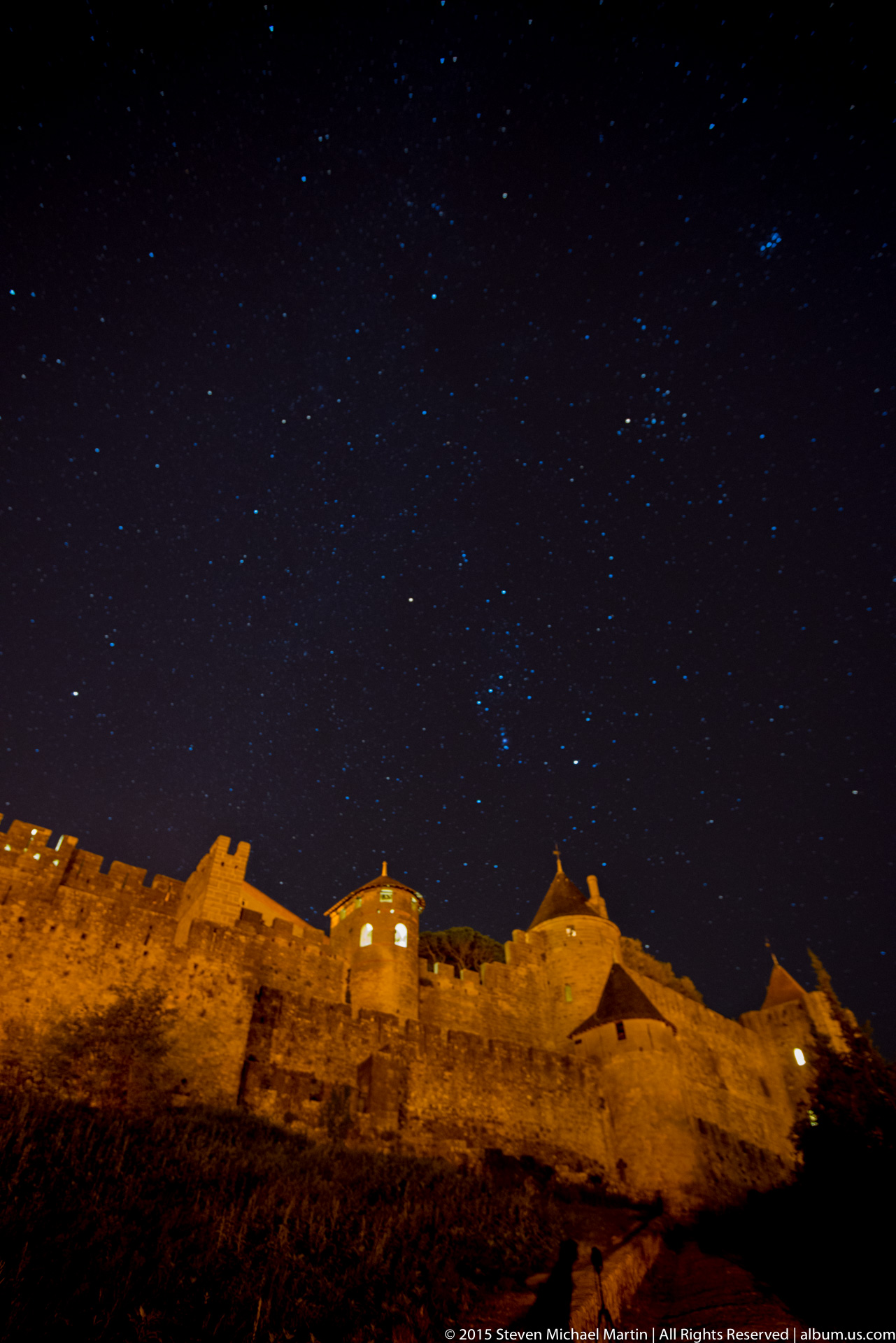
The Cité de Carcassonne stretches across the lower frame as a band of warmly illuminated walls and towers beneath a dark, star-filled sky. The long exposure separates the golden fortifications from the surrounding black landscape, reducing architectural detail but giving the medieval skyline a dramatic nocturnal silhouette and emphasizing the contrast between artificial light and the open night sky.
Caption
The Cité de Carcassonne stretches across the lower frame as a band of warmly illuminated walls and towers beneath a dark, star-filled sky. The long exposure separates the golden fortifications from the surrounding black landscape, reducing architectural detail but giving the medieval skyline a dramatic nocturnal silhouette and emphasizing the contrast between artificial light and the open night sky.

The floodlit towers and walls of the Cité de Carcassonne glow against a starry night sky, but slight camera movement softens the architectural edges. The resulting blur gives the illuminated fortress a more atmospheric appearance than the sharper nighttime views, while the warm stone and dark open sky still preserve the recognizable horizontal profile of the fortified city.
Caption
The floodlit towers and walls of the Cité de Carcassonne glow against a starry night sky, but slight camera movement softens the architectural edges. The resulting blur gives the illuminated fortress a more atmospheric appearance than the sharper nighttime views, while the warm stone and dark open sky still preserve the recognizable horizontal profile of the fortified city.

A simple cross-shaped stone marker stands close to a rough masonry wall, casting a sharply defined dark cross onto the illuminated surface behind it. The tight nighttime composition reduces the scene to stone texture, monument, and shadow, creating a visually distinct detail study within the Carcassonne portfolio without requiring an uncertain identification of the marker’s exact commemorative or religious function.
Caption
A simple cross-shaped stone marker stands close to a rough masonry wall, casting a sharply defined dark cross onto the illuminated surface behind it. The tight nighttime composition reduces the scene to stone texture, monument, and shadow, creating a visually distinct detail study within the Carcassonne portfolio without requiring an uncertain identification of the marker’s exact commemorative or religious function.

A close night view follows the floodlit walls of the Cité de Carcassonne toward a tall square tower and a round conical-roofed tower. In the foreground, an arched opening and parapet create depth along the defensive line. Warm artificial light reveals the stone surfaces while the black sky isolates the angular silhouettes of the towers.
Caption
A close night view follows the floodlit walls of the Cité de Carcassonne toward a tall square tower and a round conical-roofed tower. In the foreground, an arched opening and parapet create depth along the defensive line. Warm artificial light reveals the stone surfaces while the black sky isolates the angular silhouettes of the towers.

Seen slightly farther back, the illuminated entrance defenses of Carcassonne combine a deep arched passage, heavy wall mass, and paired round towers rising directly behind the gate. The asymmetrical framing includes additional ramparts and a square tower at right, showing how the entrance is embedded within a larger defensive perimeter rather than standing alone.
Caption
Seen slightly farther back, the illuminated entrance defenses of Carcassonne combine a deep arched passage, heavy wall mass, and paired round towers rising directly behind the gate. The asymmetrical framing includes additional ramparts and a square tower at right, showing how the entrance is embedded within a larger defensive perimeter rather than standing alone.

A cobbled roadway leads directly beneath a broad stone arch into the floodlit fortifications of Carcassonne. The low viewpoint stresses the thickness of the gateway and the transition from open forecourt to enclosed passage, while large round towers rise behind the battlemented wall. The composition gives a strong sense of movement through the city’s layered defenses.
Caption
A cobbled roadway leads directly beneath a broad stone arch into the floodlit fortifications of Carcassonne. The low viewpoint stresses the thickness of the gateway and the transition from open forecourt to enclosed passage, while large round towers rise behind the battlemented wall. The composition gives a strong sense of movement through the city’s layered defenses.

A seated visitor smiles while holding a drink at an outdoor table, with a bottle and menu resting in front of him. A large wooden barrel, stone walls, a tree canopy, and warm lamps define the intimate courtyard or terrace setting. The scene documents the social side of the visit, away from the monumental fortifications featured elsewhere in the portfolio.
Caption
A seated visitor smiles while holding a drink at an outdoor table, with a bottle and menu resting in front of him. A large wooden barrel, stone walls, a tree canopy, and warm lamps define the intimate courtyard or terrace setting. The scene documents the social side of the visit, away from the monumental fortifications featured elsewhere in the portfolio.

Massive stone arches and ribbed vaulting frame the nave of the Basilica of Saints Nazarius and Celsus inside the Cité de Carcassonne. The view looks toward a raised organ loft or gallery at the far end, while clustered columns and layered arcades reveal the building’s transition between Romanesque mass and Gothic verticality. Warm interior lighting accentuates the pale stone structure.
Caption
Massive stone arches and ribbed vaulting frame the nave of the Basilica of Saints Nazarius and Celsus inside the Cité de Carcassonne. The view looks toward a raised organ loft or gallery at the far end, while clustered columns and layered arcades reveal the building’s transition between Romanesque mass and Gothic verticality. Warm interior lighting accentuates the pale stone structure.

A long floodlit curtain wall runs diagonally across the frame toward a large round tower with a steep conical roof. Smaller towers and upper fortifications rise behind it, making the depth of Carcassonne’s defensive system visible. Warm artificial light catches the irregular stonework, while the dark sky and grassy foreground simplify the scene into wall, tower, and silhouette.
Caption
A long floodlit curtain wall runs diagonally across the frame toward a large round tower with a steep conical roof. Smaller towers and upper fortifications rise behind it, making the depth of Carcassonne’s defensive system visible. Warm artificial light catches the irregular stonework, while the dark sky and grassy foreground simplify the scene into wall, tower, and silhouette.

A projecting stone gargoyle takes the form of a crouched, open-mouthed humanlike creature emerging from the church’s sculpted masonry. Its elongated body, bent limbs, and deeply carved face stand out against tracery and molded arches behind it. The close view highlights how drainage sculpture could also become expressive architectural ornament on a Gothic exterior.
Caption
A projecting stone gargoyle takes the form of a crouched, open-mouthed humanlike creature emerging from the church’s sculpted masonry. Its elongated body, bent limbs, and deeply carved face stand out against tracery and molded arches behind it. The close view highlights how drainage sculpture could also become expressive architectural ornament on a Gothic exterior.

The choir of the Basilica of Saints Nazarius and Celsus is framed by soaring pointed arches and ribbed vaults, with tall stained-glass windows filling the eastern end in jewel-like color. Rows of dark seating lead toward the altar, creating a strong central axis and emphasizing the vertical proportions, clustered supports, and luminous glazing of the Gothic interior.
Caption
The choir of the Basilica of Saints Nazarius and Celsus is framed by soaring pointed arches and ribbed vaults, with tall stained-glass windows filling the eastern end in jewel-like color. Rows of dark seating lead toward the altar, creating a strong central axis and emphasizing the vertical proportions, clustered supports, and luminous glazing of the Gothic interior.

A rising stone path and steps lead between massive defensive walls toward an arched gateway and square tower. The camera looks upward through a confined corridor of masonry, emphasizing the restricted approach and controlled lines of movement within the fortifications. Birds cross the blue sky above, adding a small sense of scale to the otherwise solid architectural enclosure.
Caption
A rising stone path and steps lead between massive defensive walls toward an arched gateway and square tower. The camera looks upward through a confined corridor of masonry, emphasizing the restricted approach and controlled lines of movement within the fortifications. Birds cross the blue sky above, adding a small sense of scale to the otherwise solid architectural enclosure.

A deep stone archway opens onto a small roofed building or tower inside the fortified city, its dark silhouette framed against a luminous evening sky. Steps rise through the foreground passage, while the arch compresses the view into a simple sequence of threshold, open court, and architecture beyond. The image emphasizes enclosure and transition rather than monumentality.
Caption
A deep stone archway opens onto a small roofed building or tower inside the fortified city, its dark silhouette framed against a luminous evening sky. Steps rise through the foreground passage, while the arch compresses the view into a simple sequence of threshold, open court, and architecture beyond. The image emphasizes enclosure and transition rather than monumentality.

This close study isolates a dark stone gargoyle projecting from the basilica’s exterior masonry. The creature’s head is thrown forward with mouth agape, while folded limbs and a compact body merge into the supporting stonework. Curving moldings and tracery behind it provide architectural context and make the grotesque sculpture stand out as a deliberate decorative and functional element.
Caption
This close study isolates a dark stone gargoyle projecting from the basilica’s exterior masonry. The creature’s head is thrown forward with mouth agape, while folded limbs and a compact body merge into the supporting stonework. Curving moldings and tracery behind it provide architectural context and make the grotesque sculpture stand out as a deliberate decorative and functional element.

A stone bridge crosses a dry or grassy defensive space between heavy walls inside the Cité de Carcassonne. Two roofed towers rise beyond the bridge while a large round tower dominates the left foreground. The layered walls, arches, and elevated walkway illustrate the complex circulation routes and successive defensive barriers within the fortified city.
Caption
A stone bridge crosses a dry or grassy defensive space between heavy walls inside the Cité de Carcassonne. Two roofed towers rise beyond the bridge while a large round tower dominates the left foreground. The layered walls, arches, and elevated walkway illustrate the complex circulation routes and successive defensive barriers within the fortified city.

From the elevated fortifications, the view opens across the lower city of Carcassonne, where dense tile-roofed neighborhoods spread toward distant fields and low hills. A strip of grass and path occupies the foreground, reinforcing the height of the vantage point. Warm late-day light picks out trees and rooftops beneath a broad, cloud-streaked sky.
Caption
From the elevated fortifications, the view opens across the lower city of Carcassonne, where dense tile-roofed neighborhoods spread toward distant fields and low hills. A strip of grass and path occupies the foreground, reinforcing the height of the vantage point. Warm late-day light picks out trees and rooftops beneath a broad, cloud-streaked sky.

A visitor stands beside a pointed stone arch opening onto a shadowed passage and crenellated wall within the Cité de Carcassonne. Warm low-angle sunlight illuminates his face and the weathered masonry, while the darker passage behind creates strong contrast. The portrait uses the medieval arch as both architectural subject and natural frame.
Caption
A visitor stands beside a pointed stone arch opening onto a shadowed passage and crenellated wall within the Cité de Carcassonne. Warm low-angle sunlight illuminates his face and the weathered masonry, while the darker passage behind creates strong contrast. The portrait uses the medieval arch as both architectural subject and natural frame.

A visitor in a red shirt stands beneath a large rectangular gateway, with a second pointed arch receding behind him and the massive Carcassonne fortifications rising to the left. The nested openings create a strong sequence of thresholds, while warm sunlight reveals the thickness and rough texture of the masonry. The figure provides scale for the defensive architecture.
Caption
A visitor in a red shirt stands beneath a large rectangular gateway, with a second pointed arch receding behind him and the massive Carcassonne fortifications rising to the left. The nested openings create a strong sequence of thresholds, while warm sunlight reveals the thickness and rough texture of the masonry. The figure provides scale for the defensive architecture.
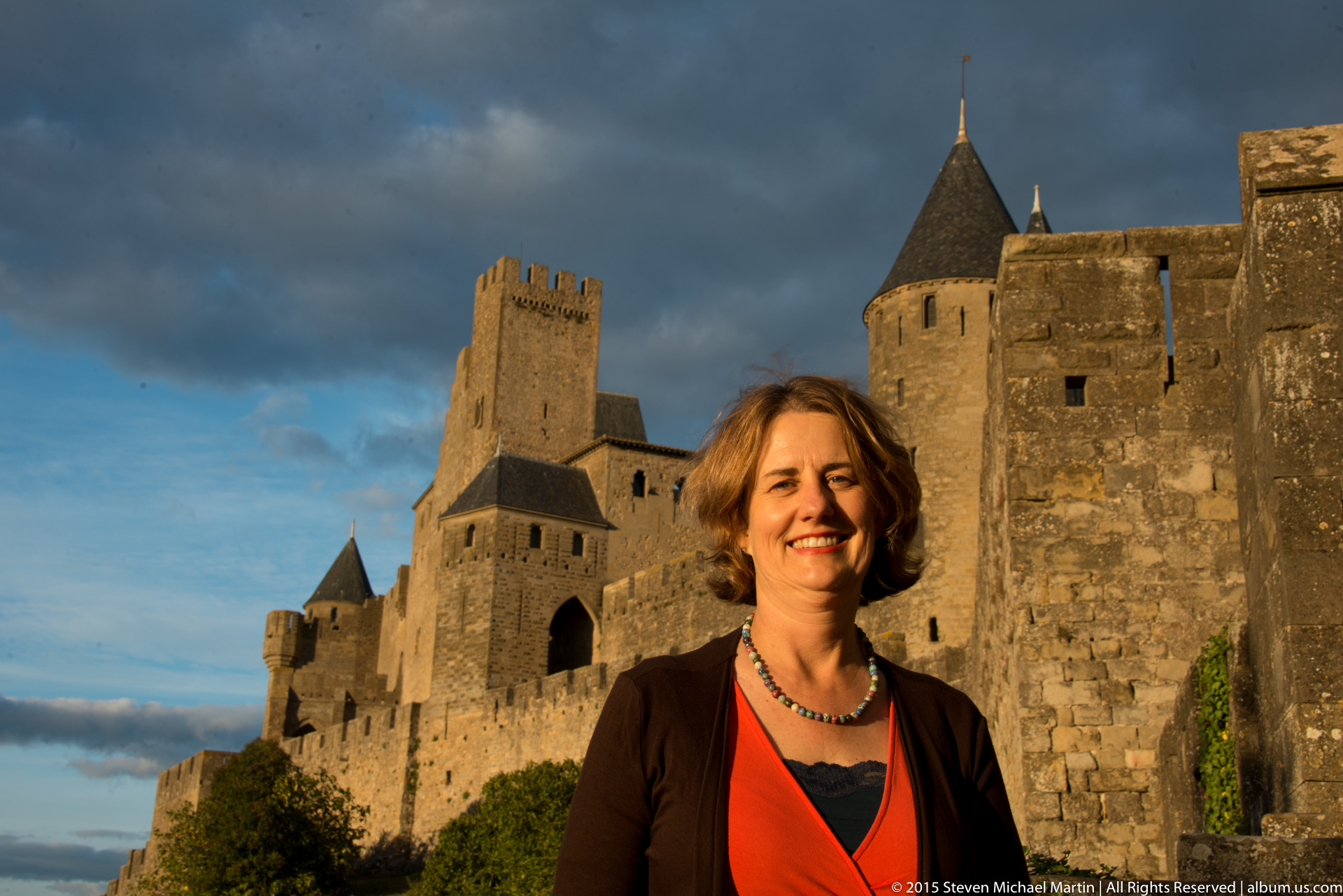
A visitor stands in warm evening light with the massive stone walls and towers of the Cité de Carcassonne immediately behind her. The close portrait retains enough architectural detail to show a square tower, round conical-roofed tower, curtain walls, and an arched opening, linking the individual directly to the monumental scale of the fortifications.
Caption
A visitor stands in warm evening light with the massive stone walls and towers of the Cité de Carcassonne immediately behind her. The close portrait retains enough architectural detail to show a square tower, round conical-roofed tower, curtain walls, and an arched opening, linking the individual directly to the monumental scale of the fortifications.

A long stretch of Carcassonne’s outer wall follows a gently curving path, punctuated by round towers with broad conical roofs. The low eye level and receding line of masonry emphasize the length and continuity of the defensive perimeter, while grass and shrubs soften the base of the wall beneath an overcast evening sky.
Caption
A long stretch of Carcassonne’s outer wall follows a gently curving path, punctuated by round towers with broad conical roofs. The low eye level and receding line of masonry emphasize the length and continuity of the defensive perimeter, while grass and shrubs soften the base of the wall beneath an overcast evening sky.

A simple cross-shaped stone marker stands directly against a rough stone wall, its pale surface catching warm light. The compact composition isolates the monument from the larger fortifications and reveals irregular tool marks and weathering on the stone. Without an inscription or other identifying evidence, the marker is best treated as an architectural or funerary detail rather than assigned a specific dedication.
Caption
A simple cross-shaped stone marker stands directly against a rough stone wall, its pale surface catching warm light. The compact composition isolates the monument from the larger fortifications and reveals irregular tool marks and weathering on the stone. Without an inscription or other identifying evidence, the marker is best treated as an architectural or funerary detail rather than assigned a specific dedication.

Golden late-day light strikes a massive section of the Cité de Carcassonne, revealing layered curtain walls, a large square tower, rounded roofed towers, and a high defensive platform above dense vegetation. Dark storm clouds behind the sunlit stone heighten the relief of the architecture and give the fortifications a dramatic sense of mass and elevation.
Caption
Golden late-day light strikes a massive section of the Cité de Carcassonne, revealing layered curtain walls, a large square tower, rounded roofed towers, and a high defensive platform above dense vegetation. Dark storm clouds behind the sunlit stone heighten the relief of the architecture and give the fortifications a dramatic sense of mass and elevation.

Two visitors sit together on a low stone wall with the Cité de Carcassonne filling the background. The broad view includes a long curtain wall, square crenellated tower, and round conical-roofed tower, while the seated figures provide scale and a relaxed human counterpoint to the imposing defensive architecture behind them.
Caption
Two visitors sit together on a low stone wall with the Cité de Carcassonne filling the background. The broad view includes a long curtain wall, square crenellated tower, and round conical-roofed tower, while the seated figures provide scale and a relaxed human counterpoint to the imposing defensive architecture behind them.

Two visitors pose on a cobbled path directly below the outer walls of the Cité de Carcassonne. Behind them, round defensive towers and crenellated stonework step across the slope, while the path curves toward the fortified enclosure. The low viewpoint makes the medieval walls loom above the figures and gives strong scale to the defensive architecture.
Caption
Two visitors pose on a cobbled path directly below the outer walls of the Cité de Carcassonne. Behind them, round defensive towers and crenellated stonework step across the slope, while the path curves toward the fortified enclosure. The low viewpoint makes the medieval walls loom above the figures and gives strong scale to the defensive architecture.

A small masonry bell gable rises above a roofline, formed by two arched openings beneath a simple triangular cap. Decorative ironwork curls across the façade and a cross-like metal finial crowns the structure, all silhouetted against a darkening sky. The close architectural study emphasizes religious or civic detail rather than the city’s larger fortifications.
Caption
A small masonry bell gable rises above a roofline, formed by two arched openings beneath a simple triangular cap. Decorative ironwork curls across the façade and a cross-like metal finial crowns the structure, all silhouetted against a darkening sky. The close architectural study emphasizes religious or civic detail rather than the city’s larger fortifications.

Two visitors stand together at the base of the Cité de Carcassonne, where steep walls, towers, and an arched opening rise behind them. The camera’s relatively close position gives equal visual weight to the people and the masonry, while warm evening light reinforces the texture of the ramparts and the slope on which the fortifications stand.
Caption
Two visitors stand together at the base of the Cité de Carcassonne, where steep walls, towers, and an arched opening rise behind them. The camera’s relatively close position gives equal visual weight to the people and the masonry, while warm evening light reinforces the texture of the ramparts and the slope on which the fortifications stand.

A narrow path climbs gently toward the Cité de Carcassonne, bordered by grassy banks and low stone edging beneath a sequence of round towers and crenellated walls. The view places the fortifications above the viewer and emphasizes how the defenses follow the slope, with successive towers marking the route along the outer perimeter.
Caption
A narrow path climbs gently toward the Cité de Carcassonne, bordered by grassy banks and low stone edging beneath a sequence of round towers and crenellated walls. The view places the fortifications above the viewer and emphasizes how the defenses follow the slope, with successive towers marking the route along the outer perimeter.

A tall, irregular masonry building rises above the sloping ground of Carcassonne, combining a high square tower, stepped gable-like wall profile, narrow openings, and attached defensive walls. Warm low-angle light brightens the upper stonework while heavy clouds darken the sky, making the vertical mass of the structure stand out against the landscape.
Caption
A tall, irregular masonry building rises above the sloping ground of Carcassonne, combining a high square tower, stepped gable-like wall profile, narrow openings, and attached defensive walls. Warm low-angle light brightens the upper stonework while heavy clouds darken the sky, making the vertical mass of the structure stand out against the landscape.

A visitor in a red shirt stands on a gravel path that curves beneath Carcassonne’s stone ramparts and round towers. The walls rise sharply behind him, while grass, shrubs, and trees define the lower edge of the defenses. The portrait uses the path as a leading line and gives a clear sense of the scale of the fortified perimeter.
Caption
A visitor in a red shirt stands on a gravel path that curves beneath Carcassonne’s stone ramparts and round towers. The walls rise sharply behind him, while grass, shrubs, and trees define the lower edge of the defenses. The portrait uses the path as a leading line and gives a clear sense of the scale of the fortified perimeter.

An ochre-plastered house façade is punctuated by white-trimmed windows and pale blue-gray wooden shutters, some open and some closed. The upward-looking composition isolates the domestic architecture from the fortified monuments elsewhere in the portfolio and highlights the restrained color palette, simple proportions, and weathered surfaces of Carcassonne’s historic streetscape.
Caption
An ochre-plastered house façade is punctuated by white-trimmed windows and pale blue-gray wooden shutters, some open and some closed. The upward-looking composition isolates the domestic architecture from the fortified monuments elsewhere in the portfolio and highlights the restrained color palette, simple proportions, and weathered surfaces of Carcassonne’s historic streetscape.

Two visitors stand together in an open field with the Cité de Carcassonne visible across the landscape behind them. The distant towers and ramparts form a recognizable skyline above trees and low vegetation, while the foreground field and broad sky create a spacious setting. The photograph combines a personal travel portrait with a classic exterior view of the fortified city.
Caption
Two visitors stand together in an open field with the Cité de Carcassonne visible across the landscape behind them. The distant towers and ramparts form a recognizable skyline above trees and low vegetation, while the foreground field and broad sky create a spacious setting. The photograph combines a personal travel portrait with a classic exterior view of the fortified city.

A narrow residential street climbs between modest historic houses toward the massive fortifications of Carcassonne. Shuttered façades, a traditional street lamp, and leafy trees occupy the foreground, while round towers and high stone walls rise above the rooftops. The layered view shows how everyday urban fabric sits directly beneath the monumental defensive complex.
Caption
A narrow residential street climbs between modest historic houses toward the massive fortifications of Carcassonne. Shuttered façades, a traditional street lamp, and leafy trees occupy the foreground, while round towers and high stone walls rise above the rooftops. The layered view shows how everyday urban fabric sits directly beneath the monumental defensive complex.

A long section of Carcassonne’s stone ramparts runs behind dense trees, punctuated by broad round towers capped with red tile roofs and a smaller dark conical roof in the foreground. The tighter composition isolates one portion of the defensive perimeter, emphasizing the contrast among roof forms, masonry walls, and vegetation beneath a band of heavy cloud.
Caption
A long section of Carcassonne’s stone ramparts runs behind dense trees, punctuated by broad round towers capped with red tile roofs and a smaller dark conical roof in the foreground. The tighter composition isolates one portion of the defensive perimeter, emphasizing the contrast among roof forms, masonry walls, and vegetation beneath a band of heavy cloud.

A visitor poses in an open field with one hand raised toward the distant Cité de Carcassonne, visually presenting the fortified skyline behind her. The city’s towers and walls extend across the horizon beyond trees and cultivated ground, while strong late-day sunlight illuminates the figure against a sky filled with layered clouds.
Caption
A visitor poses in an open field with one hand raised toward the distant Cité de Carcassonne, visually presenting the fortified skyline behind her. The city’s towers and walls extend across the horizon beyond trees and cultivated ground, while strong late-day sunlight illuminates the figure against a sky filled with layered clouds.

A visitor stands at the edge of a cultivated field with the Cité de Carcassonne forming a long, distant backdrop above dense trees. The portrait keeps both figure and landscape legible, showing the towers and walls as part of the surrounding countryside rather than as a close architectural study. Warm sunlight contrasts with the cloud-shadowed sky.
Caption
A visitor stands at the edge of a cultivated field with the Cité de Carcassonne forming a long, distant backdrop above dense trees. The portrait keeps both figure and landscape legible, showing the towers and walls as part of the surrounding countryside rather than as a close architectural study. Warm sunlight contrasts with the cloud-shadowed sky.

A visitor in a red shirt stands in the foreground with the fortified city of Carcassonne visible across fields and trees behind him. The shallow separation between portrait and distant skyline keeps the person dominant while retaining recognizable towers and walls in the background, linking the travel portrait directly to the surrounding historic landscape.
Caption
A visitor in a red shirt stands in the foreground with the fortified city of Carcassonne visible across fields and trees behind him. The shallow separation between portrait and distant skyline keeps the person dominant while retaining recognizable towers and walls in the background, linking the travel portrait directly to the surrounding historic landscape.

A visitor in a red shirt extends an open hand toward the Cité de Carcassonne, which appears softly behind him beyond a cultivated field and trees. The playful presenting gesture makes the fortified city an explicit part of the portrait, while the shallow focus keeps attention on the figure and leaves the medieval skyline recognizable but subdued.
Caption
A visitor in a red shirt extends an open hand toward the Cité de Carcassonne, which appears softly behind him beyond a cultivated field and trees. The playful presenting gesture makes the fortified city an explicit part of the portrait, while the shallow focus keeps attention on the figure and leaves the medieval skyline recognizable but subdued.

The Cité de Carcassonne stretches across the middle distance above dense green vegetation, its long defensive walls punctuated by numerous round and square towers with red and dark conical roofs. The broad exterior view clearly presents the fortified ensemble as a whole, while large cumulus clouds provide a dramatic backdrop to the pale stone skyline.
Caption
The Cité de Carcassonne stretches across the middle distance above dense green vegetation, its long defensive walls punctuated by numerous round and square towers with red and dark conical roofs. The broad exterior view clearly presents the fortified ensemble as a whole, while large cumulus clouds provide a dramatic backdrop to the pale stone skyline.

The Cité de Carcassonne’s defensive walls and conical-roofed towers fill the foreground while the Basilica of Saints Nazarius and Celsus rises behind them, identifiable by its taller ecclesiastical roofline and slender Gothic elements. The layered view brings religious and military architecture into the same composition, showing the basilica embedded within the dense fabric of the fortified medieval city.
Caption
The Cité de Carcassonne’s defensive walls and conical-roofed towers fill the foreground while the Basilica of Saints Nazarius and Celsus rises behind them, identifiable by its taller ecclesiastical roofline and slender Gothic elements. The layered view brings religious and military architecture into the same composition, showing the basilica embedded within the dense fabric of the fortified medieval city.

The Cité de Carcassonne forms a low, distant band of towers and walls beneath an expansive sky dominated by dark, sculptural clouds. Trees occupy the lower edge while the fortifications remain small but recognizable along the horizon. The composition gives the weather and surrounding landscape unusual prominence, presenting the medieval city as a compact landmark within a much broader environment.
Caption
The Cité de Carcassonne forms a low, distant band of towers and walls beneath an expansive sky dominated by dark, sculptural clouds. Trees occupy the lower edge while the fortifications remain small but recognizable along the horizon. The composition gives the weather and surrounding landscape unusual prominence, presenting the medieval city as a compact landmark within a much broader environment.
Carcassonne Field Guide
Carcassonne is one of the most complete fortified medieval cities in Europe, preserving double defensive walls, watchtowers, and fortified gates that illustrate the evolution of military architecture from the Roman period through the Middle Ages. Located along historic trade routes between the Mediterranean coast and interior France, the site reflects the strategic importance of controlling movement across the Languedoc region. The present appearance of the citadel reflects both medieval construction and nineteenth-century restoration efforts that helped preserve its distinctive architectural character.
The fortified city demonstrates how geography influenced settlement patterns and defensive planning. Elevated above the Aude River valley, Carcassonne provided a strategic vantage point for monitoring regional travel corridors linking Iberia, southern France, and the Mediterranean world. Over time, successive periods of Roman occupation, Visigothic rule, and medieval administration contributed to the layered architectural character visible throughout the site today.
📍 Site Overview
Location: Occitanie region, southern France
Period of significance: Roman foundations; major medieval construction (12th–14th centuries)
Type: Fortified medieval city
UNESCO Status: Historic Fortified City of Carcassonne (1997)
⭐ What Makes Carcassonne Unique
- Extensive double-ring defensive walls with multiple watchtowers
- Strategic hilltop position overlooking historic trade routes
- Architectural layering reflecting Roman, medieval, and modern restoration periods
- One of the most complete surviving fortified medieval cities in Europe
🧭 Historical Context
The site originated as a Roman fortified settlement before evolving into an important medieval stronghold during periods of regional conflict. Fortifications were expanded to strengthen defensive capacity as siege technologies advanced. In the nineteenth century, restoration by Eugène Viollet-le-Duc contributed to preservation of the site, reinforcing architectural elements associated with medieval defensive design while shaping modern perceptions of fortified European cities.
📷 Photography Notes
- Exterior views best capture the scale of the double defensive walls
- Elevated viewpoints emphasize the strategic hilltop position
- Early morning or late afternoon light highlights stone textures
- Narrow interior streets provide strong leading lines and depth
- Wide-angle compositions help convey the density of towers and walls
🔎 Highlights
- Encircling double walls with regularly spaced defensive towers
- Medieval gates controlling access to the fortified interior
- Stone streets illustrating the density of medieval urban planning
- Views across the surrounding countryside emphasizing geographic context