Nazaré
Nazaré developed as a coastal settlement influenced by fishing traditions and maritime activity along the Atlantic Ocean. Its location along important sea routes contributed to the economic and cultural life of western Portugal. The surrounding cliffs provide views across the ocean that reflect the importance of maritime geography in regional development.
Religious traditions associated with Marian devotion contributed to the town’s historical significance as a pilgrimage destination. Coastal communities such as Nazaré played an important role in supporting maritime trade and navigation. The town’s character illustrates the relationship between religious belief and seafaring culture.
Nazaré reflects the broader maritime traditions that supported Portuguese exploration during the early modern period. Its coastal environment illustrates the connection between local communities and ocean travel.

From the high cliffs of Sítio, Nazaré’s lower town stretches around the broad curve of the bay, its white façades and terracotta roofs lining the beach. The eroded cliff occupies the near edge of the view, creating a strong vertical counterpoint to the calm sweep of water and dense urban waterfront.
Caption
From the high cliffs of Sítio, Nazaré’s lower town stretches around the broad curve of the bay, its white façades and terracotta roofs lining the beach. The eroded cliff occupies the near edge of the view, creating a strong vertical counterpoint to the calm sweep of water and dense urban waterfront.

A high viewpoint above Nazaré looks north along a broad Atlantic beach, where parallel bands of surf meet an almost empty sweep of sand. The cliff-edge foreground and long coastal perspective emphasize the exposed shoreline and the relationship between Nazaré’s elevated headland and the ocean below.
Caption
A high viewpoint above Nazaré looks north along a broad Atlantic beach, where parallel bands of surf meet an almost empty sweep of sand. The cliff-edge foreground and long coastal perspective emphasize the exposed shoreline and the relationship between Nazaré’s elevated headland and the ocean below.

From the high ground above Nazaré, dense blocks of white buildings and terracotta roofs spread toward the Atlantic shoreline. The steep vegetated cliff occupies the near left foreground, while the town’s street grid and beachfront development extend across the middle distance. This elevated perspective emphasizes the sharp topographic relationship between the upper headland and the lower coastal settlement.
Caption
From the high ground above Nazaré, dense blocks of white buildings and terracotta roofs spread toward the Atlantic shoreline. The steep vegetated cliff occupies the near left foreground, while the town’s street grid and beachfront development extend across the middle distance. This elevated perspective emphasizes the sharp topographic relationship between the upper headland and the lower coastal settlement.

A towering wave rises behind a line of spectators gathered on the waterfront near Nazaré’s fort, dwarfing the people and foreground structures. Wind-blown spray streams from the crest as the face steepens, visually conveying the exceptional scale of the Atlantic swell for which Praia do Norte is internationally known.
Caption
A towering wave rises behind a line of spectators gathered on the waterfront near Nazaré’s fort, dwarfing the people and foreground structures. Wind-blown spray streams from the crest as the face steepens, visually conveying the exceptional scale of the Atlantic swell for which Praia do Norte is internationally known.

Several surfers float beyond the breaking zone off Nazaré, spaced across the blue Atlantic while waiting for incoming swell. Their small scale against the open water conveys the distance from shore and the ocean conditions that have made surfing a defining contemporary activity along this exposed Portuguese coast.
Caption
Several surfers float beyond the breaking zone off Nazaré, spaced across the blue Atlantic while waiting for incoming swell. Their small scale against the open water conveys the distance from shore and the ocean conditions that have made surfing a defining contemporary activity along this exposed Portuguese coast.

Atlantic surf surges against stratified rock ledges at the base of Nazaré’s cliffs, where erosion has opened a dark recess resembling a small sea cave. Broken slabs and angular boulders along the waterline reveal the active contact between the ocean and the layered coastal rock.
Caption
Atlantic surf surges against stratified rock ledges at the base of Nazaré’s cliffs, where erosion has opened a dark recess resembling a small sea cave. Broken slabs and angular boulders along the waterline reveal the active contact between the ocean and the layered coastal rock.

A powerful Atlantic swell explodes into spray against the base of Nazaré’s high sea cliff. The lighthouse structure is visible on the cliff rim while seabirds cross the turbulent air, giving scale to the impact zone and showing the exposed conditions along the headland.
Caption
A powerful Atlantic swell explodes into spray against the base of Nazaré’s high sea cliff. The lighthouse structure is visible on the cliff rim while seabirds cross the turbulent air, giving scale to the impact zone and showing the exposed conditions along the headland.

Souvenir shops occupy a low whitewashed frontage along the edge of a broad cobbled square, their awnings and outdoor displays forming a busy commercial strip. A small tiled-gable chapel stands separately to the right, creating a visual contrast between everyday retail activity and religious architecture. The expansive patterned paving in the foreground establishes the scale and openness of the public space.
Caption
Souvenir shops occupy a low whitewashed frontage along the edge of a broad cobbled square, their awnings and outdoor displays forming a busy commercial strip. A small tiled-gable chapel stands separately to the right, creating a visual contrast between everyday retail activity and religious architecture. The expansive patterned paving in the foreground establishes the scale and openness of the public space.

A glass pastry case fills the foreground of a compact café, displaying breads, pastries, and sweets beneath a working bar stocked with bottles, cups, and coffee equipment. The curved white ceiling and blue trim frame the counter area, where a staff member works behind the display. The scene records the everyday food-service environment of Nazaré at close range.
Caption
A glass pastry case fills the foreground of a compact café, displaying breads, pastries, and sweets beneath a working bar stocked with bottles, cups, and coffee equipment. The curved white ceiling and blue trim frame the counter area, where a staff member works behind the display. The scene records the everyday food-service environment of Nazaré at close range.

A cliffside path frames a layered view toward Nazaré, with pedestrians in the foreground and the town’s dense white-and-red-roofed buildings spread around the beach below. The composition connects the sheer coastal geology, elevated Sítio area, lower settlement, and sheltered curve of shoreline in a single view.
Caption
A cliffside path frames a layered view toward Nazaré, with pedestrians in the foreground and the town’s dense white-and-red-roofed buildings spread around the beach below. The composition connects the sheer coastal geology, elevated Sítio area, lower settlement, and sheltered curve of shoreline in a single view.

The vivid red lantern of the lighthouse at Forte de São Miguel Arcanjo rises above the fort’s pale masonry against a streaked blue sky. Seen from below, the compact cylindrical lantern, gallery rail, and domed cap form a graphic maritime marker associated with Nazaré’s cliff-top fort and ocean lookout.
Caption
The vivid red lantern of the lighthouse at Forte de São Miguel Arcanjo rises above the fort’s pale masonry against a streaked blue sky. Seen from below, the compact cylindrical lantern, gallery rail, and domed cap form a graphic maritime marker associated with Nazaré’s cliff-top fort and ocean lookout.

A weathered directional sign, almost completely layered with travel and surf stickers, stands against an uninterrupted Atlantic horizon above Nazaré. Its improvised surface records the heavy visitor presence at the headland while the open sea behind it keeps the composition firmly tied to the exposed coastal setting.
Caption
A weathered directional sign, almost completely layered with travel and surf stickers, stands against an uninterrupted Atlantic horizon above Nazaré. Its improvised surface records the heavy visitor presence at the headland while the open sea behind it keeps the composition firmly tied to the exposed coastal setting.

A rough masonry wall surrounds a small arched entrance topped by carved stone ornament and a rectangular plaque reading “NAZARÉ.” The contrast between irregular local stonework and the more formal pale architectural fragments suggests an adapted historic structure, but the proof sheet does not establish the building’s exact identity.
Caption
A rough masonry wall surrounds a small arched entrance topped by carved stone ornament and a rectangular plaque reading “NAZARÉ.” The contrast between irregular local stonework and the more formal pale architectural fragments suggests an adapted historic structure, but the proof sheet does not establish the building’s exact identity.

A close view isolates the lighthouse weather vane, with white cardinal letters mounted on red arms above the rounded red cap. The arrow and directional indicators stand sharply against the sky, turning a functional navigational detail into an abstract composition of maritime hardware, color, and geometry.
Caption
A close view isolates the lighthouse weather vane, with white cardinal letters mounted on red arms above the rounded red cap. The arrow and directional indicators stand sharply against the sky, turning a functional navigational detail into an abstract composition of maritime hardware, color, and geometry.

A pale carved stone element rests on a rough masonry ledge above the Atlantic, its sweeping volutes and layered curves silhouetted by backlight. The isolated fragment appears to be an architectural or sculptural piece on display, though the proof sheet does not provide enough evidence to determine its original function or date.
Caption
A pale carved stone element rests on a rough masonry ledge above the Atlantic, its sweeping volutes and layered curves silhouetted by backlight. The isolated fragment appears to be an architectural or sculptural piece on display, though the proof sheet does not provide enough evidence to determine its original function or date.

A blue-toned relief map presents the seabed off Nazaré, with a deep branching submarine channel cutting toward the Portuguese coast. The display translates the Nazaré Canyon into an immediately legible physical form, helping explain the offshore bathymetry associated with the area’s unusually powerful wave conditions.
Caption
A blue-toned relief map presents the seabed off Nazaré, with a deep branching submarine channel cutting toward the Portuguese coast. The display translates the Nazaré Canyon into an immediately legible physical form, helping explain the offshore bathymetry associated with the area’s unusually powerful wave conditions.

Visitors crowd the seaward terrace beside the red lighthouse at Forte de São Miguel Arcanjo as an immense wall of white water breaks immediately beyond the fort. The elevated viewpoint compresses people, lighthouse, and wave into one frame, providing a striking measure of the swell’s scale along Nazaré’s exposed headland.
Caption
Visitors crowd the seaward terrace beside the red lighthouse at Forte de São Miguel Arcanjo as an immense wall of white water breaks immediately beyond the fort. The elevated viewpoint compresses people, lighthouse, and wave into one frame, providing a striking measure of the swell’s scale along Nazaré’s exposed headland.

A row of brightly colored surfboards stands upright beneath a rough stone barrel vault, turning the historic interior into an exhibition space devoted to Nazaré’s surf culture. Spot lighting picks out the boards against irregular masonry, linking contemporary big-wave equipment with the older fabric of the fort.
Caption
A row of brightly colored surfboards stands upright beneath a rough stone barrel vault, turning the historic interior into an exhibition space devoted to Nazaré’s surf culture. Spot lighting picks out the boards against irregular masonry, linking contemporary big-wave equipment with the older fabric of the fort.

The Atlantic horizon appears through a deep, irregular opening in the thick stonework of Nazaré’s coastal fort. A low parapet and tiny figures outside provide scale, while the dark interior framing emphasizes the defensive mass of the masonry and the fort’s commanding position above the sea.
Caption
The Atlantic horizon appears through a deep, irregular opening in the thick stonework of Nazaré’s coastal fort. A low parapet and tiny figures outside provide scale, while the dark interior framing emphasizes the defensive mass of the masonry and the fort’s commanding position above the sea.

The red lighthouse lantern fills the frame from a close frontal viewpoint, its glazed enclosure surrounded by a circular gallery and capped by a directional weather vane. Strong backlighting reduces the surrounding setting to sky, emphasizing the lantern’s compact metalwork and saturated maritime red.
Caption
The red lighthouse lantern fills the frame from a close frontal viewpoint, its glazed enclosure surrounded by a circular gallery and capped by a directional weather vane. Strong backlighting reduces the surrounding setting to sky, emphasizing the lantern’s compact metalwork and saturated maritime red.

The entrance to Forte de São Miguel Arcanjo is set into a thick wall of irregular stone masonry, approached by a narrow wooden ramp. Pale carved elements and a small plaque punctuate the otherwise rugged façade, revealing the layered construction of Nazaré’s cliff-top defensive complex.
Caption
The entrance to Forte de São Miguel Arcanjo is set into a thick wall of irregular stone masonry, approached by a narrow wooden ramp. Pale carved elements and a small plaque punctuate the otherwise rugged façade, revealing the layered construction of Nazaré’s cliff-top defensive complex.

The red lighthouse at Forte de São Miguel Arcanjo stands in the foreground while Nazaré’s lower town and curving bay spread across the distance. This side view places the maritime beacon in its wider coastal setting, linking the fort on the headland with the settlement, beach, and Atlantic waters below.
Caption
The red lighthouse at Forte de São Miguel Arcanjo stands in the foreground while Nazaré’s lower town and curving bay spread across the distance. This side view places the maritime beacon in its wider coastal setting, linking the fort on the headland with the settlement, beach, and Atlantic waters below.

A dramatically tilted viewpoint looks north from Nazaré’s headland across dark blue Atlantic water toward the long sandy expanse of Praia do Norte. Rocky cliff edges and white surf trace the boundary between sea and land, while the diagonal horizon gives the coastal panorama an intentionally dynamic composition.
Caption
A dramatically tilted viewpoint looks north from Nazaré’s headland across dark blue Atlantic water toward the long sandy expanse of Praia do Norte. Rocky cliff edges and white surf trace the boundary between sea and land, while the diagonal horizon gives the coastal panorama an intentionally dynamic composition.

A minimalist white graphic spells “NAZARÉ” beneath angular forms suggesting the headland, fort, and an offshore rock. Set against a dark textured surface, the design reduces the town’s coastal landmarks to a clean geometric emblem used for interpretation or wayfinding.
Caption
A minimalist white graphic spells “NAZARÉ” beneath angular forms suggesting the headland, fort, and an offshore rock. Set against a dark textured surface, the design reduces the town’s coastal landmarks to a clean geometric emblem used for interpretation or wayfinding.

An interpretive diagram explains submarine-canyon topography with bilingual labels for the continental shelf, continental slope, submarine canyon, submarine delta, and abyssal plain. The simplified cutaway clarifies how a canyon incises the continental margin, providing geological context for the deep offshore feature at Nazaré.
Caption
An interpretive diagram explains submarine-canyon topography with bilingual labels for the continental shelf, continental slope, submarine canyon, submarine delta, and abyssal plain. The simplified cutaway clarifies how a canyon incises the continental margin, providing geological context for the deep offshore feature at Nazaré.

A monumental pale stone figure with a stag’s head stands beside an upright surfboard, seen from behind against open sky. The hybrid surfer sculpture evokes Nazaré’s fusion of local legend and contemporary big-wave culture; an inscription is present at the base but is not fully legible in the proof sheet.
Caption
A monumental pale stone figure with a stag’s head stands beside an upright surfboard, seen from behind against open sky. The hybrid surfer sculpture evokes Nazaré’s fusion of local legend and contemporary big-wave culture; an inscription is present at the base but is not fully legible in the proof sheet.

A compact whitewashed chapel faces the square through a dark rectangular doorway framed in stone. Blue-and-white azulejos cover the triangular pediment and form a decorative panel above the entrance, while dressed stone marks the corners and a simple cross crowns the roofline. The frontal composition emphasizes the chapel’s restrained scale and the contrast between masonry, tilework, and white plaster.
Caption
A compact whitewashed chapel faces the square through a dark rectangular doorway framed in stone. Blue-and-white azulejos cover the triangular pediment and form a decorative panel above the entrance, while dressed stone marks the corners and a simple cross crowns the roofline. The frontal composition emphasizes the chapel’s restrained scale and the contrast between masonry, tilework, and white plaster.
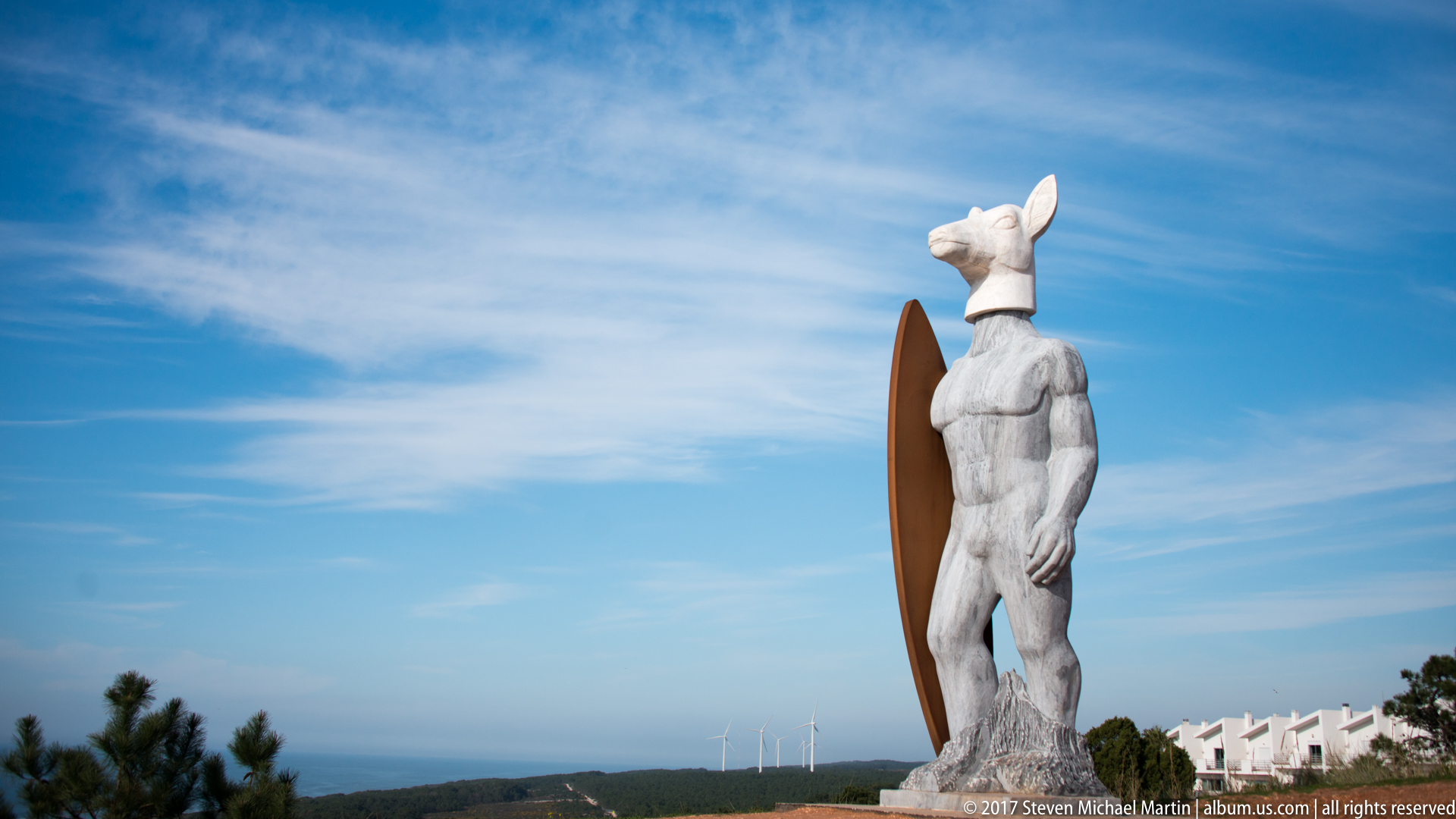
Seen in profile, Nazaré’s deer-headed surfer figure stands rigidly beside a tall surfboard, its pale sculpted body isolated against blue sky and distant Atlantic horizon. The wider view establishes the sculpture as an outdoor monument on the elevated Sítio area rather than an interior museum object.
Caption
Seen in profile, Nazaré’s deer-headed surfer figure stands rigidly beside a tall surfboard, its pale sculpted body isolated against blue sky and distant Atlantic horizon. The wider view establishes the sculpture as an outdoor monument on the elevated Sítio area rather than an interior museum object.

A large gateway announces “Bem-vindo às maiores ondas do mundo / Welcome to the Biggest Waves in the World” at Praia do Norte, framing the road toward Nazaré’s giant-wave viewpoint. Surf-related graphics and the distant deer-headed surfer statue reinforce the site’s identity with big-wave culture.
Caption
A large gateway announces “Bem-vindo às maiores ondas do mundo / Welcome to the Biggest Waves in the World” at Praia do Norte, framing the road toward Nazaré’s giant-wave viewpoint. Surf-related graphics and the distant deer-headed surfer statue reinforce the site’s identity with big-wave culture.

A whitewashed corner building in Nazaré is lined with balconies, green awnings, restaurant signage, and dense displays of clothing and souvenirs at street level. The scene shifts from the dramatic headland to the everyday visitor economy of the town, with merchandise spilling onto the pavement beneath traditional tiled roofs.
Caption
A whitewashed corner building in Nazaré is lined with balconies, green awnings, restaurant signage, and dense displays of clothing and souvenirs at street level. The scene shifts from the dramatic headland to the everyday visitor economy of the town, with merchandise spilling onto the pavement beneath traditional tiled roofs.

Small bottles labeled “Porto” and “Portugal” are arranged in pale wooden gift holders, each marked with handwritten destination names and prices. The tightly framed shop display presents Portuguese fortified wine as a tourist souvenir, with repeated packaging creating a rhythmic retail still life.
Caption
Small bottles labeled “Porto” and “Portugal” are arranged in pale wooden gift holders, each marked with handwritten destination names and prices. The tightly framed shop display presents Portuguese fortified wine as a tourist souvenir, with repeated packaging creating a rhythmic retail still life.

An outdoor cart labeled “Frutos Secos” is piled with clear bags and trays of nuts and dried foods beneath a blue-and-yellow umbrella. Pedestrians and the patterned pavement of Nazaré form the background, placing the vendor within a busy public space rather than a formal indoor market.
Caption
An outdoor cart labeled “Frutos Secos” is piled with clear bags and trays of nuts and dried foods beneath a blue-and-yellow umbrella. Pedestrians and the patterned pavement of Nazaré form the background, placing the vendor within a busy public space rather than a formal indoor market.

Textiles, hats, garments, and other regional goods crowd the open frontage beneath a colonnaded white building. The awning reads “Artigos Regionais / Regional Articles” and “Casa Palácio Real,” clearly identifying the shop’s tourist-oriented trade while a church tower rises behind the roofline.
Caption
Textiles, hats, garments, and other regional goods crowd the open frontage beneath a colonnaded white building. The awning reads “Artigos Regionais / Regional Articles” and “Casa Palácio Real,” clearly identifying the shop’s tourist-oriented trade while a church tower rises behind the roofline.

A whitewashed church complex with terracotta roofs, formal stone trim, exterior stairs, and a tall bell tower occupies a paved square in Nazaré’s Sítio district. The architecture is consistent with the Sanctuary of Our Lady of Nazaré complex, although this oblique side view does not show enough of the principal façade for absolute visual confirmation.
Caption
A whitewashed church complex with terracotta roofs, formal stone trim, exterior stairs, and a tall bell tower occupies a paved square in Nazaré’s Sítio district. The architecture is consistent with the Sanctuary of Our Lady of Nazaré complex, although this oblique side view does not show enough of the principal façade for absolute visual confirmation.

An octagonal bandstand anchors a paved civic square in Nazaré, its dark metal columns and railings rising from a bright yellow-and-white masonry base. Benches, palms, patterned Portuguese pavement, and white façades with red-tiled roofs frame the open space, giving the structure a clear relationship to the surrounding townscape rather than isolating it as an architectural detail.
Caption
An octagonal bandstand anchors a paved civic square in Nazaré, its dark metal columns and railings rising from a bright yellow-and-white masonry base. Benches, palms, patterned Portuguese pavement, and white façades with red-tiled roofs frame the open space, giving the structure a clear relationship to the surrounding townscape rather than isolating it as an architectural detail.

The Sanctuary of Our Lady of Nazaré presents a symmetrical white façade dominated by twin bell towers and a central arched entrance reached by a broad stair. A mature palm rises in front of the church, partially crossing the left tower, while the long lower wings extend horizontally across the square. The frontal view records the sanctuary as the principal monumental building in its immediate civic setting.
Caption
The Sanctuary of Our Lady of Nazaré presents a symmetrical white façade dominated by twin bell towers and a central arched entrance reached by a broad stair. A mature palm rises in front of the church, partially crossing the left tower, while the long lower wings extend horizontally across the square. The frontal view records the sanctuary as the principal monumental building in its immediate civic setting.

A framed painting compresses Nazaré’s coastal geography into a sweeping view of the bay, beach, cliff, and settlement. Brightly painted traditional boats occupy the foreground surf and sand, while the town curves around the shore below a steep headland topped by buildings. The work offers an interpretive, pictorial counterpart to the portfolio’s photographic views of the same dramatic coastal setting.
Caption
A framed painting compresses Nazaré’s coastal geography into a sweeping view of the bay, beach, cliff, and settlement. Brightly painted traditional boats occupy the foreground surf and sand, while the town curves around the shore below a steep headland topped by buildings. The work offers an interpretive, pictorial counterpart to the portfolio’s photographic views of the same dramatic coastal setting.

A gently curving street in Nazaré is lined with white façades, red-tiled roofs, balconies, and ground-floor shops displaying clothing and souvenirs. Short bollards separate the pedestrian edge from the roadway, while parked vehicles and signs add the texture of an active commercial district. The oblique view emphasizes the continuity of traditional low-rise buildings along the street.
Caption
A gently curving street in Nazaré is lined with white façades, red-tiled roofs, balconies, and ground-floor shops displaying clothing and souvenirs. Short bollards separate the pedestrian edge from the roadway, while parked vehicles and signs add the texture of an active commercial district. The oblique view emphasizes the continuity of traditional low-rise buildings along the street.

A weathered stone monument supports a dark, stylized metal cross against an open blue sky. Its projecting rectangular block carries a deeply cut Portuguese inscription, with the word “NAZARÉ” clearly visible on the lowest line. Cropped tightly against the sky, the photograph concentrates attention on the monument’s cross, rough masonry, and commemorative text rather than its wider setting.
Caption
A weathered stone monument supports a dark, stylized metal cross against an open blue sky. Its projecting rectangular block carries a deeply cut Portuguese inscription, with the word “NAZARÉ” clearly visible on the lowest line. Cropped tightly against the sky, the photograph concentrates attention on the monument’s cross, rough masonry, and commemorative text rather than its wider setting.

Weathered masonry meets exposed pale rock along the edge of Nazaré’s high ground, with scrub-covered slopes falling away toward the surrounding landscape. White buildings sit beyond the rough stonework at the upper left, while fractured rock surfaces and vegetation dominate the foreground. The close contextual view records the built edge of the clifftop without assigning the remains to a specific structure.
Caption
Weathered masonry meets exposed pale rock along the edge of Nazaré’s high ground, with scrub-covered slopes falling away toward the surrounding landscape. White buildings sit beyond the rough stonework at the upper left, while fractured rock surfaces and vegetation dominate the foreground. The close contextual view records the built edge of the clifftop without assigning the remains to a specific structure.

Nazaré’s broad crescent of sand sweeps along the Atlantic below an elevated cliff viewpoint, with the lower town packed tightly behind the beachfront. The shoreline curves into the distance beneath a calm blue sea, while open sand dominates the right half of the composition. Compared with the adjacent town-focused panorama, this view gives greater weight to the beach’s scale and the geometry of the bay.
Caption
Nazaré’s broad crescent of sand sweeps along the Atlantic below an elevated cliff viewpoint, with the lower town packed tightly behind the beachfront. The shoreline curves into the distance beneath a calm blue sea, while open sand dominates the right half of the composition. Compared with the adjacent town-focused panorama, this view gives greater weight to the beach’s scale and the geometry of the bay.

Black and white stone setts form a bold geometric pavement of radiating triangles and diamond-like fields. The tightly framed composition removes surrounding architecture and turns the calçada portuguesa itself into the subject, revealing changes in stone tone, joint pattern, and small patches of vegetation between setts. The design demonstrates how patterned pavement contributes decorative structure to Nazaré’s public spaces.
Caption
Black and white stone setts form a bold geometric pavement of radiating triangles and diamond-like fields. The tightly framed composition removes surrounding architecture and turns the calçada portuguesa itself into the subject, revealing changes in stone tone, joint pattern, and small patches of vegetation between setts. The design demonstrates how patterned pavement contributes decorative structure to Nazaré’s public spaces.