Murchison Falls – Uganda
Murchison Falls lies within Murchison Falls National Park in northwestern Uganda, where the mighty Nile River is forced through a narrow gorge before plunging dramatically into the river below. At the narrowest point, the entire flow of the Nile squeezes through a gap only a few meters wide, creating an immense surge of water and mist.
The falls mark one of the most powerful natural spectacles along the Nile. From viewpoints above the gorge, visitors can watch the river explode through the rock before continuing its long journey northward toward the Mediterranean Sea.
The surrounding national park protects vast savanna landscapes and is one of Uganda’s most important wildlife reserves.
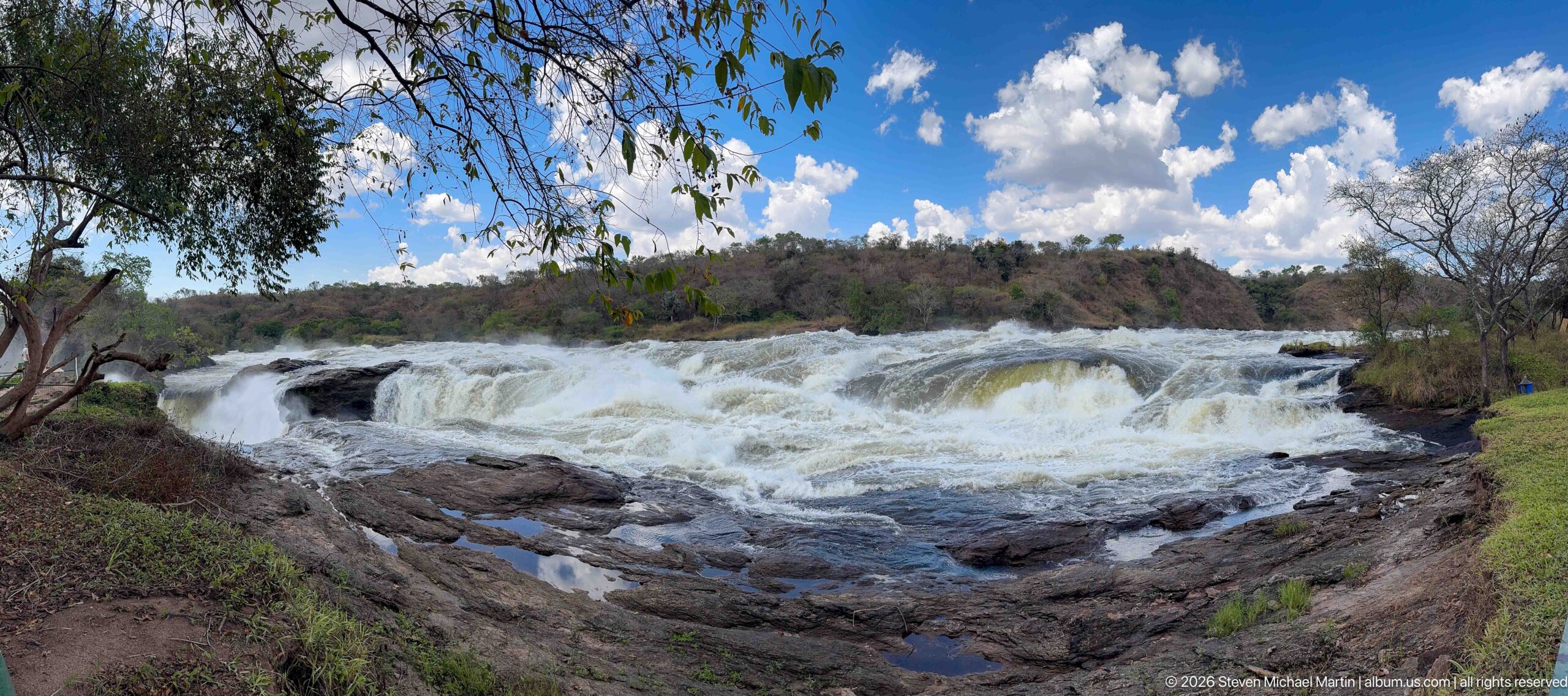
Whitewater spreads across a broad rock-studded channel above the main drop at Murchison Falls. Multiple low cascades break around dark bedrock before the river narrows downstream, with wooded slopes enclosing the scene under a bright sky. The viewpoint emphasizes the turbulent approach to the falls rather than the confined plunge visible in later photographs.
Caption
Whitewater spreads across a broad rock-studded channel above the main drop at Murchison Falls. Multiple low cascades break around dark bedrock before the river narrows downstream, with wooded slopes enclosing the scene under a bright sky. The viewpoint emphasizes the turbulent approach to the falls rather than the confined plunge visible in later photographs.
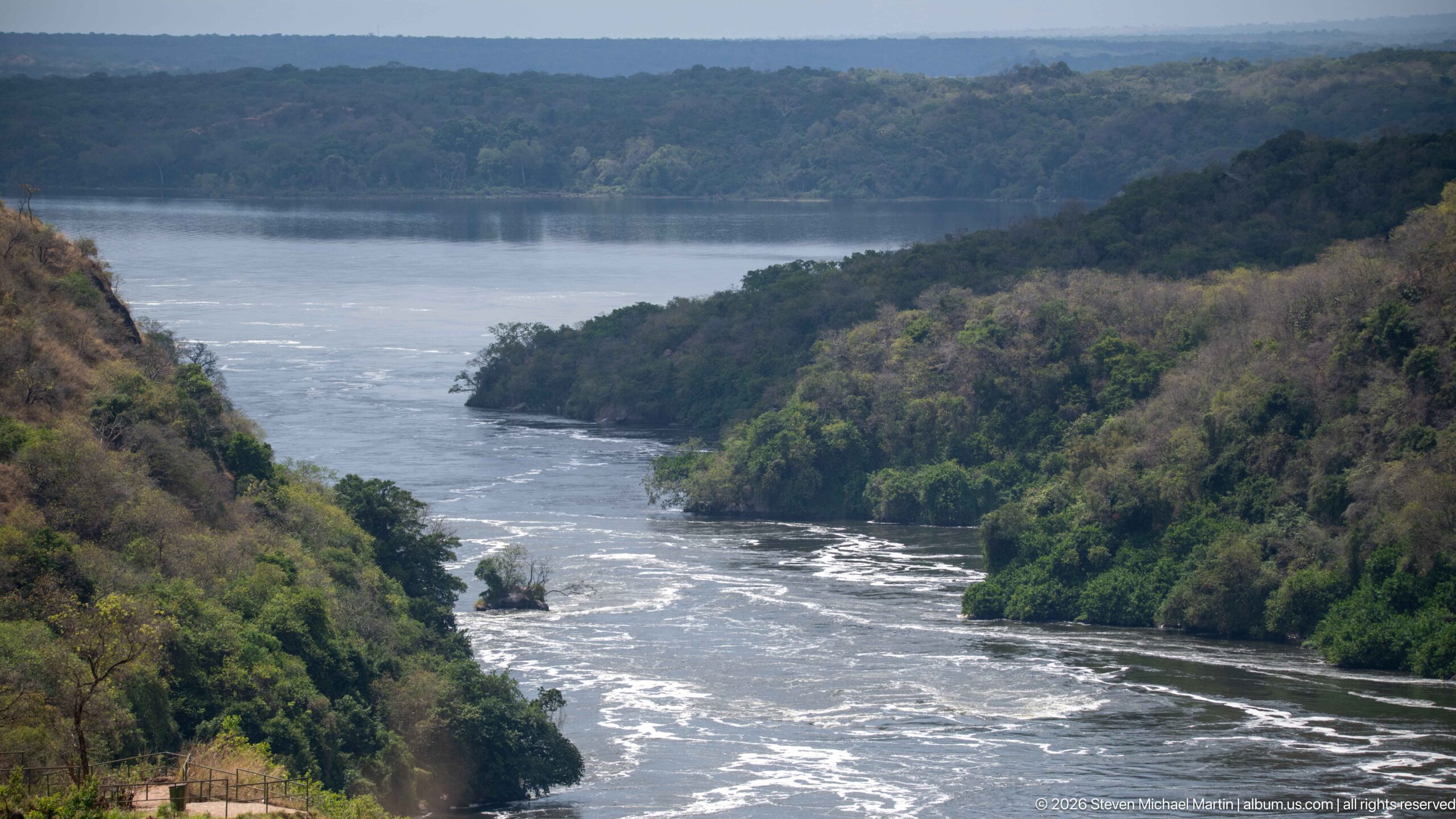
The Victoria Nile winds between steep, densely vegetated banks in Murchison Falls National Park, its broad surface narrowing around a wooded projection before continuing into the distance. Elevated framing reveals the river’s sinuous course and the transition from turbulent foreground water to a calmer reach upstream or downstream.
Caption
The Victoria Nile winds between steep, densely vegetated banks in Murchison Falls National Park, its broad surface narrowing around a wooded projection before continuing into the distance. Elevated framing reveals the river’s sinuous course and the transition from turbulent foreground water to a calmer reach upstream or downstream.
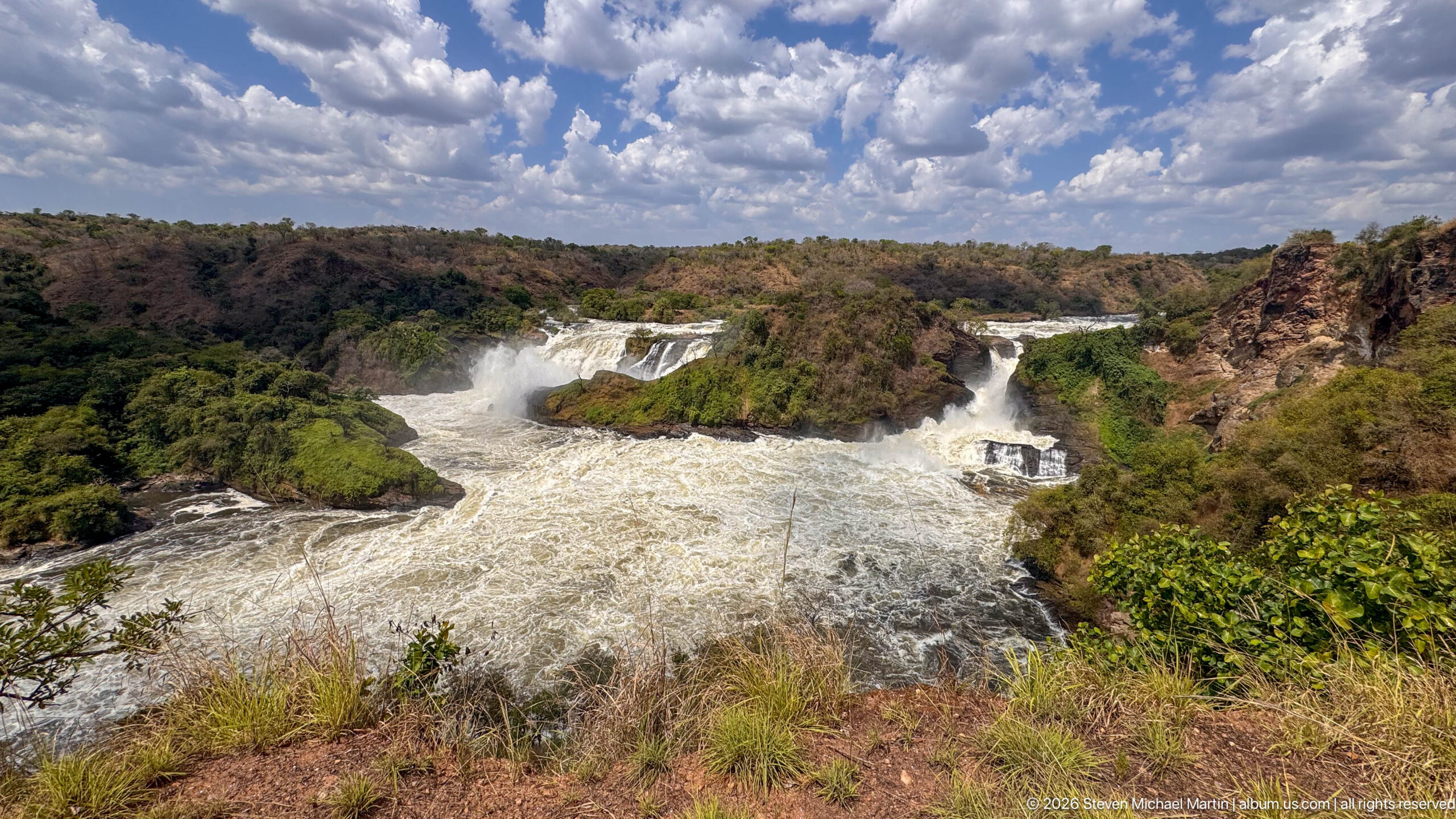
From a high overlook, Murchison Falls spreads across a complex series of channels before the river funnels into the gorge. Whitewater surrounds green rock islands and plunges at several points, while dry wooded hills and a cloud-filled sky frame the wider landscape. The broad composition provides geographic context for the tighter waterfall studies elsewhere in the sequence.
Caption
From a high overlook, Murchison Falls spreads across a complex series of channels before the river funnels into the gorge. Whitewater surrounds green rock islands and plunges at several points, while dry wooded hills and a cloud-filled sky frame the wider landscape. The broad composition provides geographic context for the tighter waterfall studies elsewhere in the sequence.
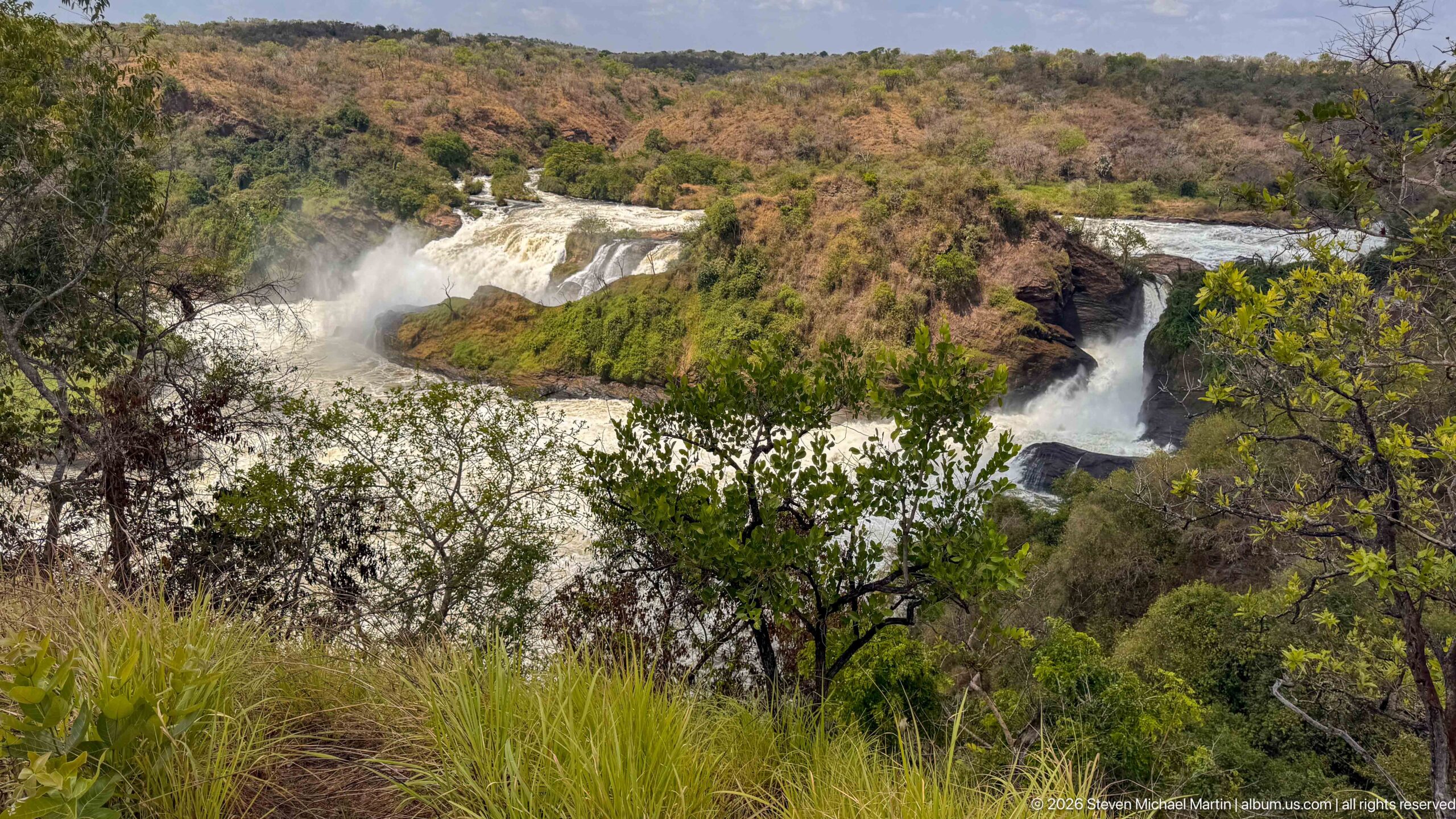
Murchison Falls appears through foreground trees and tall grass from a more distant hillside viewpoint. Separate white cascades and a plume of mist remain visible across the gorge, but branches partially screen the river and emphasize the falls within its broader woodland setting. The layered composition records how the attraction is encountered from the surrounding trail rather than only from formal overlooks.
Caption
Murchison Falls appears through foreground trees and tall grass from a more distant hillside viewpoint. Separate white cascades and a plume of mist remain visible across the gorge, but branches partially screen the river and emphasize the falls within its broader woodland setting. The layered composition records how the attraction is encountered from the surrounding trail rather than only from formal overlooks.
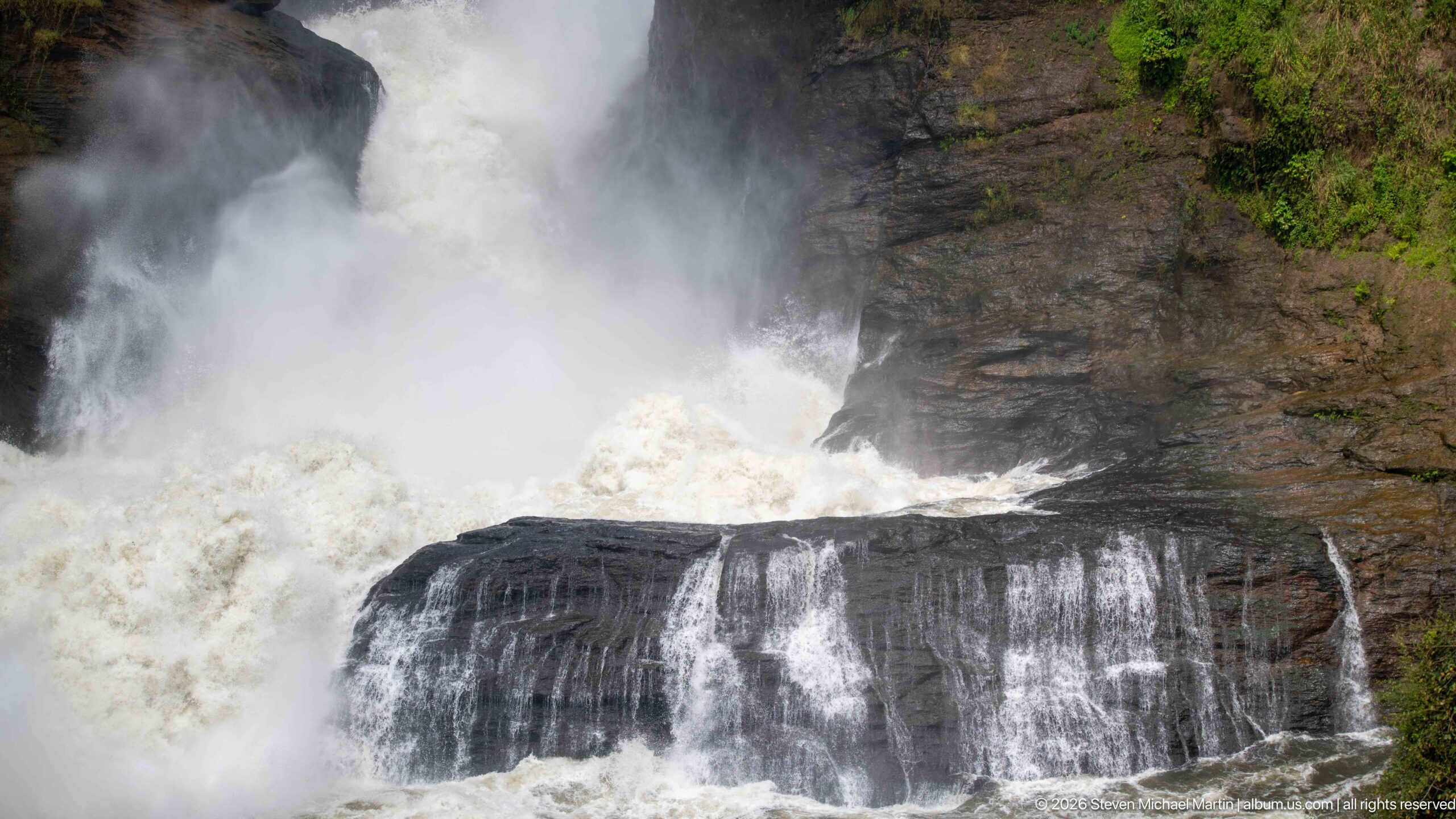
A concentrated mass of whitewater crashes beside a dark bedrock block at Murchison Falls, throwing mist upward against the gorge wall. The tight composition removes most of the surrounding landscape and focuses on the force of the river as it drops through resistant rock. Wet streaks on the foreground slab reveal the continuous spray generated by the cascade.
Caption
A concentrated mass of whitewater crashes beside a dark bedrock block at Murchison Falls, throwing mist upward against the gorge wall. The tight composition removes most of the surrounding landscape and focuses on the force of the river as it drops through resistant rock. Wet streaks on the foreground slab reveal the continuous spray generated by the cascade.
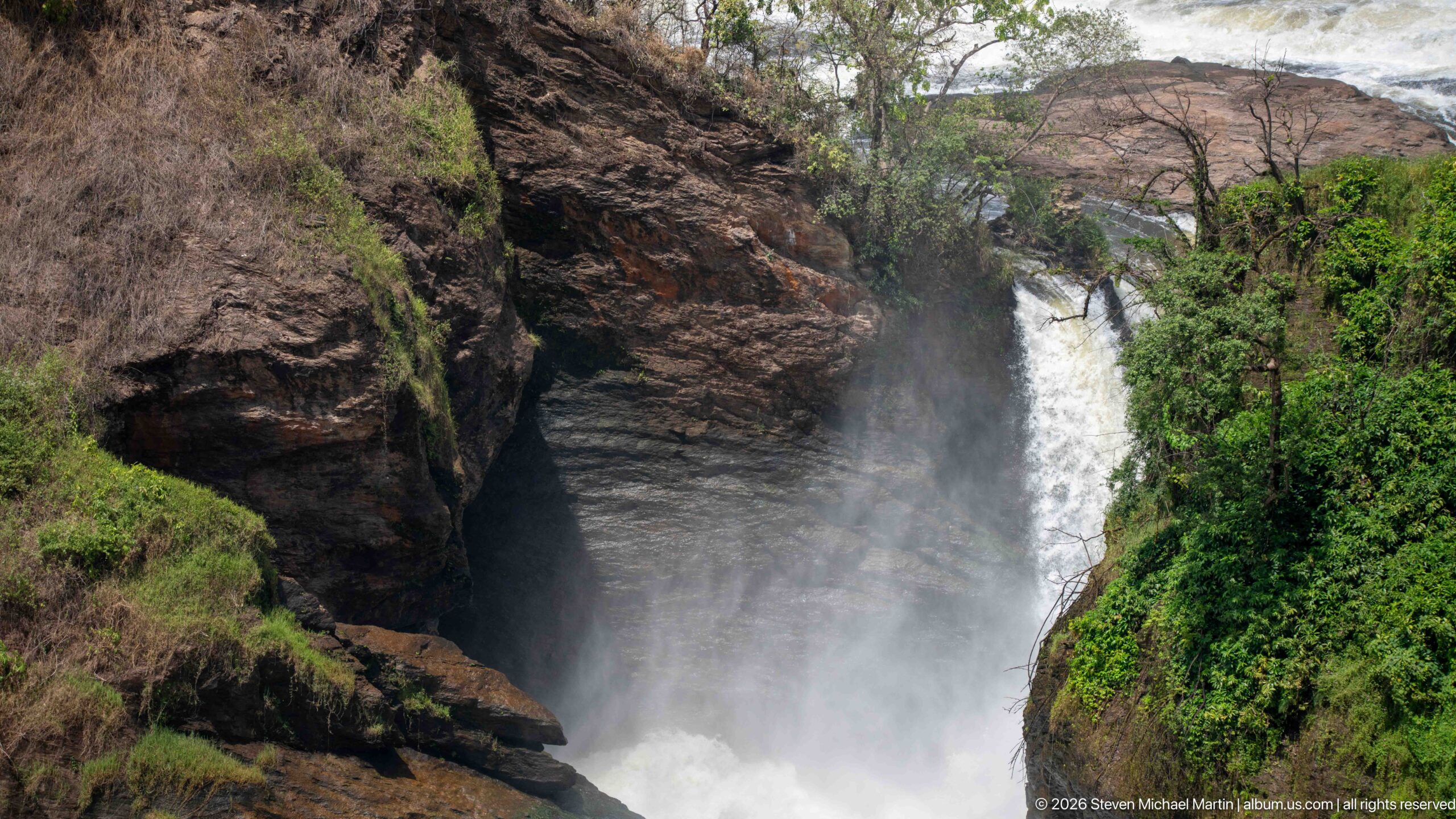
A narrow vertical chute of whitewater drops between steep dark rock walls in the Murchison Falls gorge. Dense green vegetation clings to the right wall while exposed, layered bedrock dominates the left, and spray rises from the unseen base. The compressed viewpoint highlights the confined rock passage that gives the falls much of their dramatic hydraulic force.
Caption
A narrow vertical chute of whitewater drops between steep dark rock walls in the Murchison Falls gorge. Dense green vegetation clings to the right wall while exposed, layered bedrock dominates the left, and spray rises from the unseen base. The compressed viewpoint highlights the confined rock passage that gives the falls much of their dramatic hydraulic force.
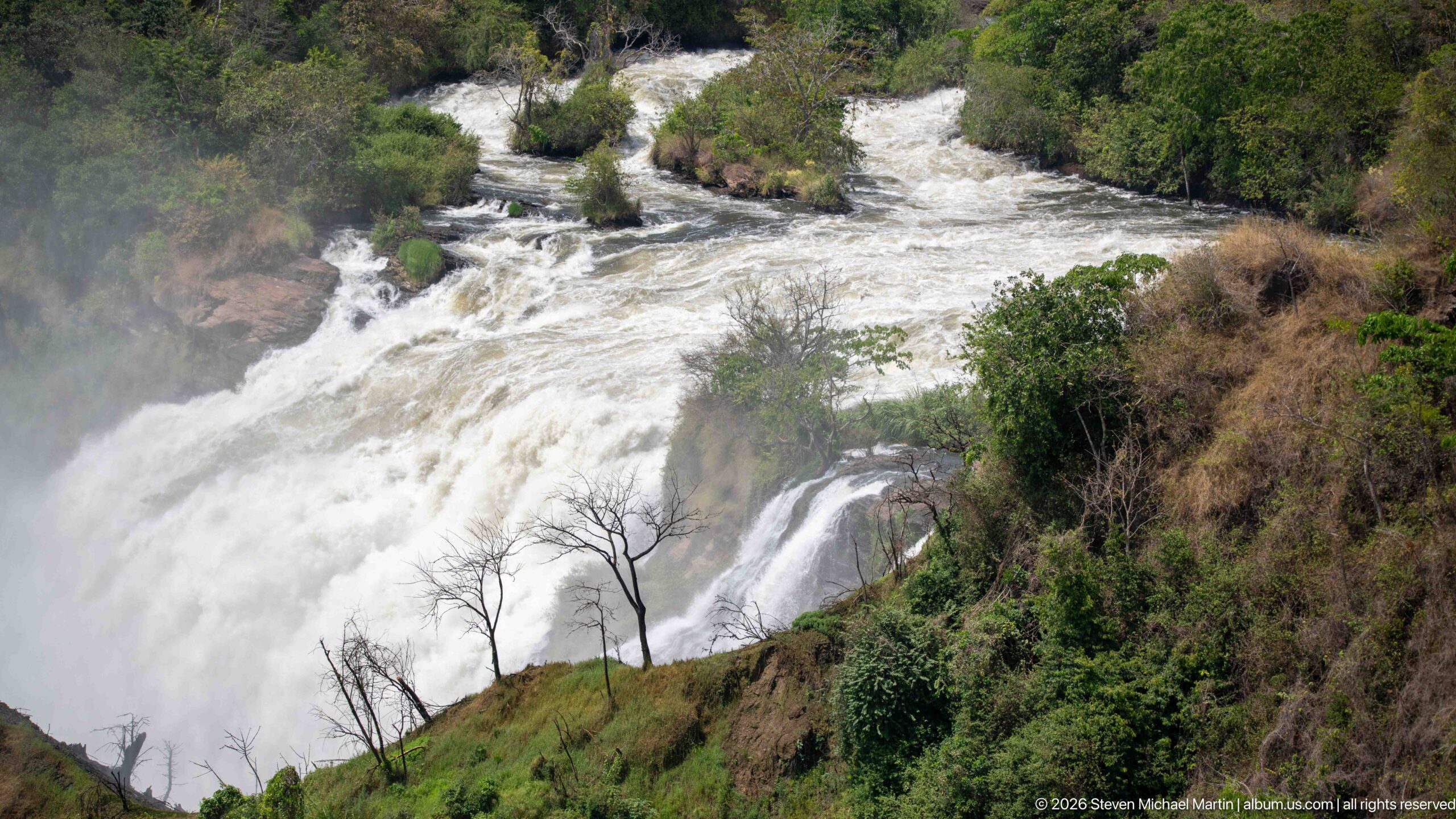
Stepped rapids sweep diagonally across the upper river at Murchison Falls, splitting around low vegetated rocks before disappearing toward the mist-filled gorge. A steep green slope and scattered leafless trees frame the near bank. Compared with the adjacent view, the reduced spray exposes more of the individual channels and rock shelves guiding the water toward the main drop.
Caption
Stepped rapids sweep diagonally across the upper river at Murchison Falls, splitting around low vegetated rocks before disappearing toward the mist-filled gorge. A steep green slope and scattered leafless trees frame the near bank. Compared with the adjacent view, the reduced spray exposes more of the individual channels and rock shelves guiding the water toward the main drop.
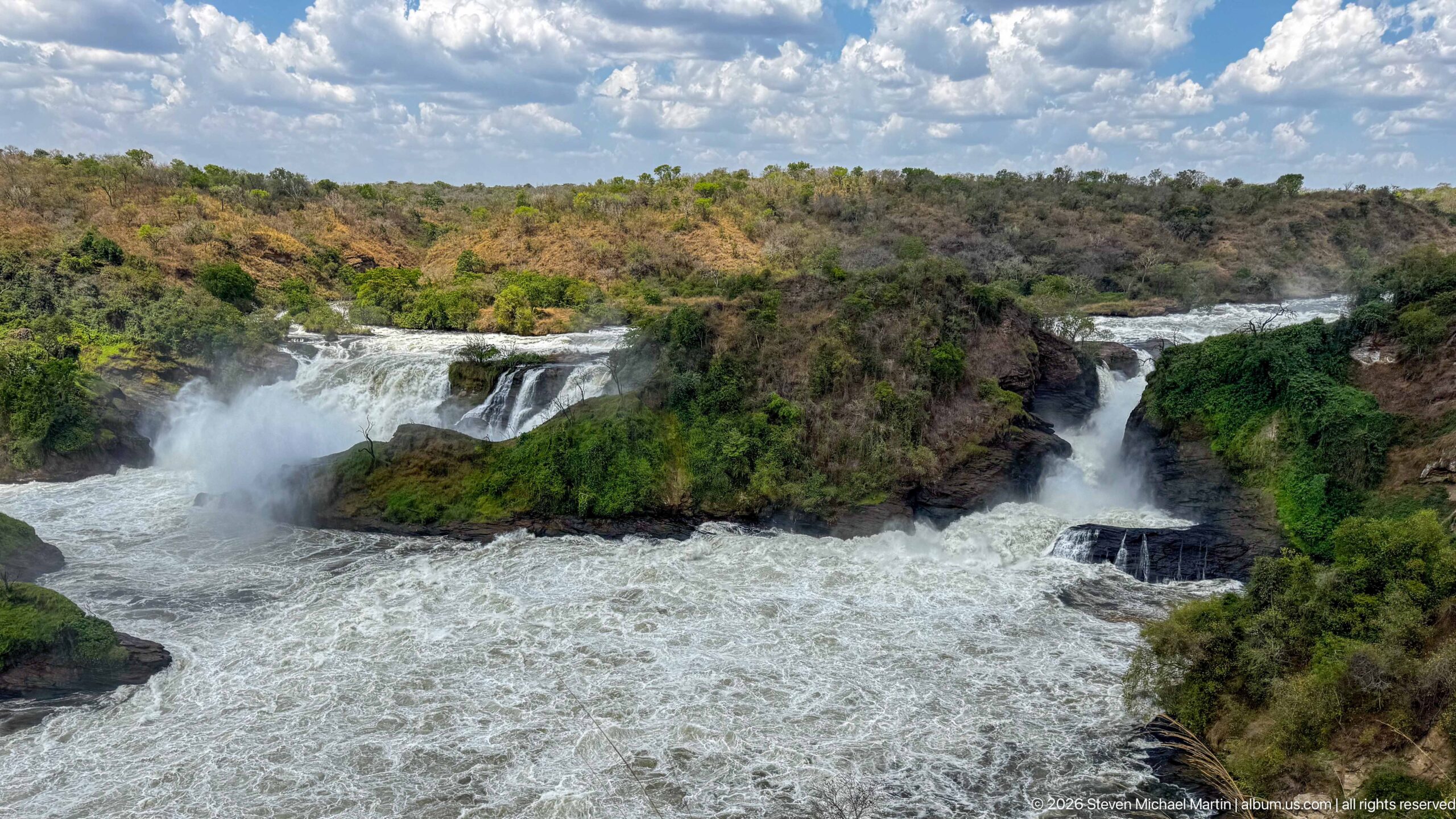
Two prominent cascades descend on opposite sides of a vegetated rock mass at Murchison Falls, feeding a broad expanse of churning whitewater below. The elevated viewpoint clearly separates the river’s channels and exposes the irregular bedrock that controls their paths. Dry-season woodland across the horizon contrasts with the vivid green vegetation sustained close to the spray zone.
Caption
Two prominent cascades descend on opposite sides of a vegetated rock mass at Murchison Falls, feeding a broad expanse of churning whitewater below. The elevated viewpoint clearly separates the river’s channels and exposes the irregular bedrock that controls their paths. Dry-season woodland across the horizon contrasts with the vivid green vegetation sustained close to the spray zone.
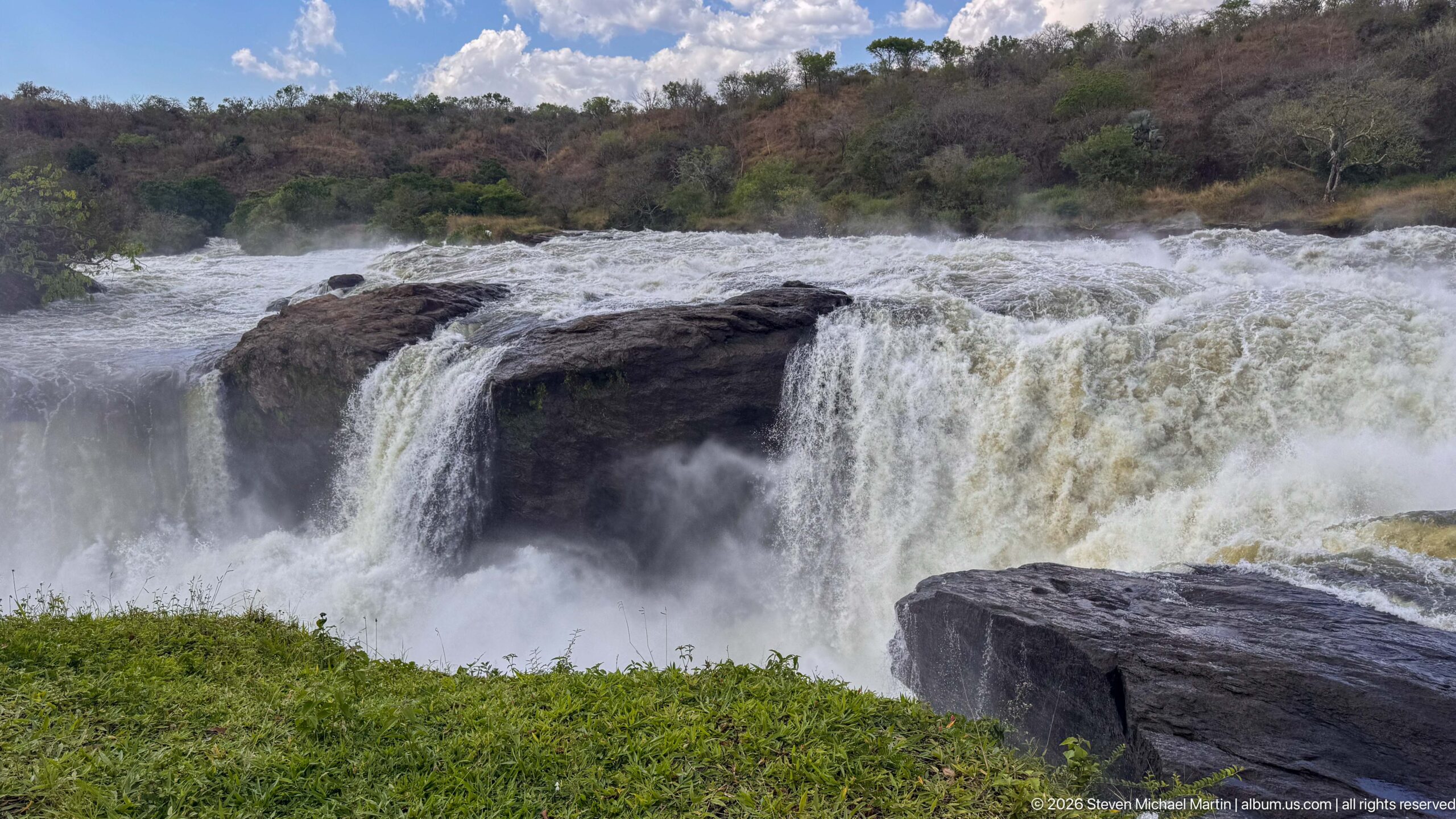
A broad frontal view shows the White Nile breaking into heavy cascades at Murchison Falls, with dark bedrock dividing the descending water into distinct curtains. Mist rises from the plunge zone while a grassy foreground edge and wooded opposite bank establish the viewpoint above the gorge. The composition balances the river’s breadth with the abrupt vertical drop.
Caption
A broad frontal view shows the White Nile breaking into heavy cascades at Murchison Falls, with dark bedrock dividing the descending water into distinct curtains. Mist rises from the plunge zone while a grassy foreground edge and wooded opposite bank establish the viewpoint above the gorge. The composition balances the river’s breadth with the abrupt vertical drop.
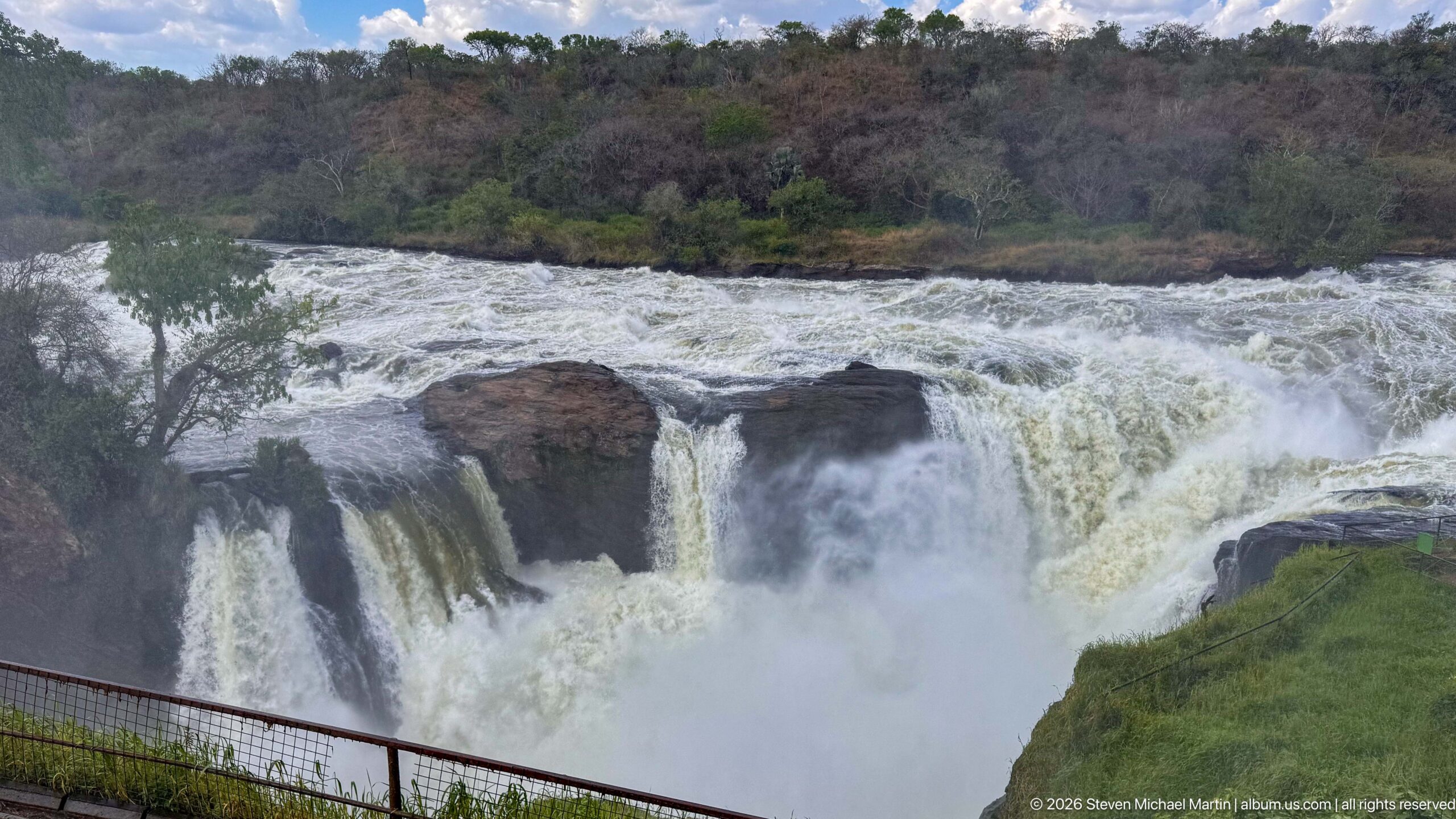
Murchison Falls fills the view beyond a metal safety railing at the edge of the overlook. The river surges across the upper rock shelf before dropping in multiple white curtains, while a dark central outcrop divides the flow and mist obscures the lower gorge. Including the railing makes the photograph especially useful for documenting the visitor viewpoint and scale.
Caption
Murchison Falls fills the view beyond a metal safety railing at the edge of the overlook. The river surges across the upper rock shelf before dropping in multiple white curtains, while a dark central outcrop divides the flow and mist obscures the lower gorge. Including the railing makes the photograph especially useful for documenting the visitor viewpoint and scale.
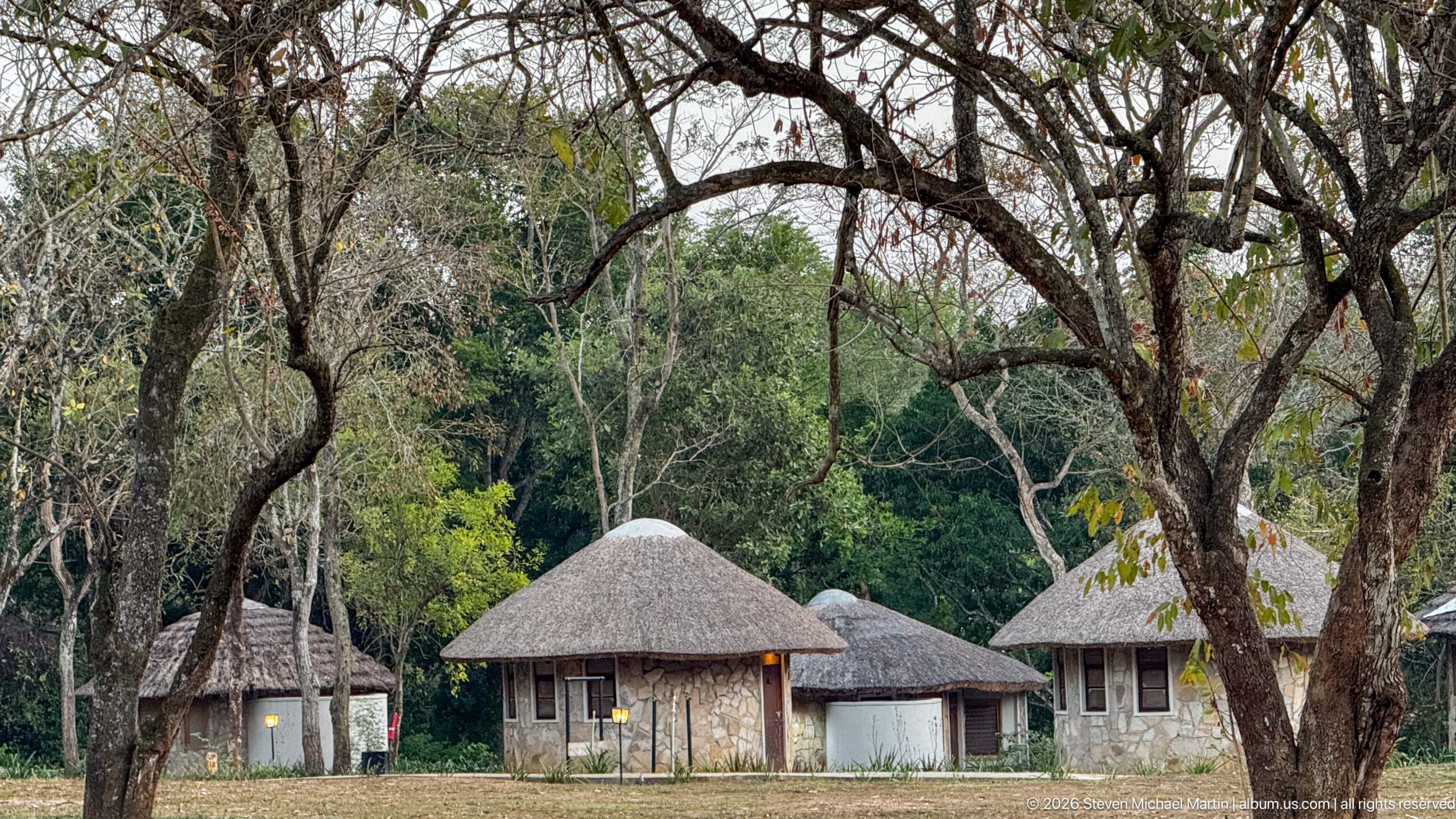
Round thatched guest cottages stand beneath mature trees in the wooded grounds of a Murchison Falls-area safari lodge. The compact buildings combine pale masonry walls, timber-framed openings, and steep conical roofs, while the open spacing preserves the character of the surrounding dry woodland. The view establishes the accommodation setting before the portfolio turns toward the falls.
Caption
Round thatched guest cottages stand beneath mature trees in the wooded grounds of a Murchison Falls-area safari lodge. The compact buildings combine pale masonry walls, timber-framed openings, and steep conical roofs, while the open spacing preserves the character of the surrounding dry woodland. The view establishes the accommodation setting before the portfolio turns toward the falls.
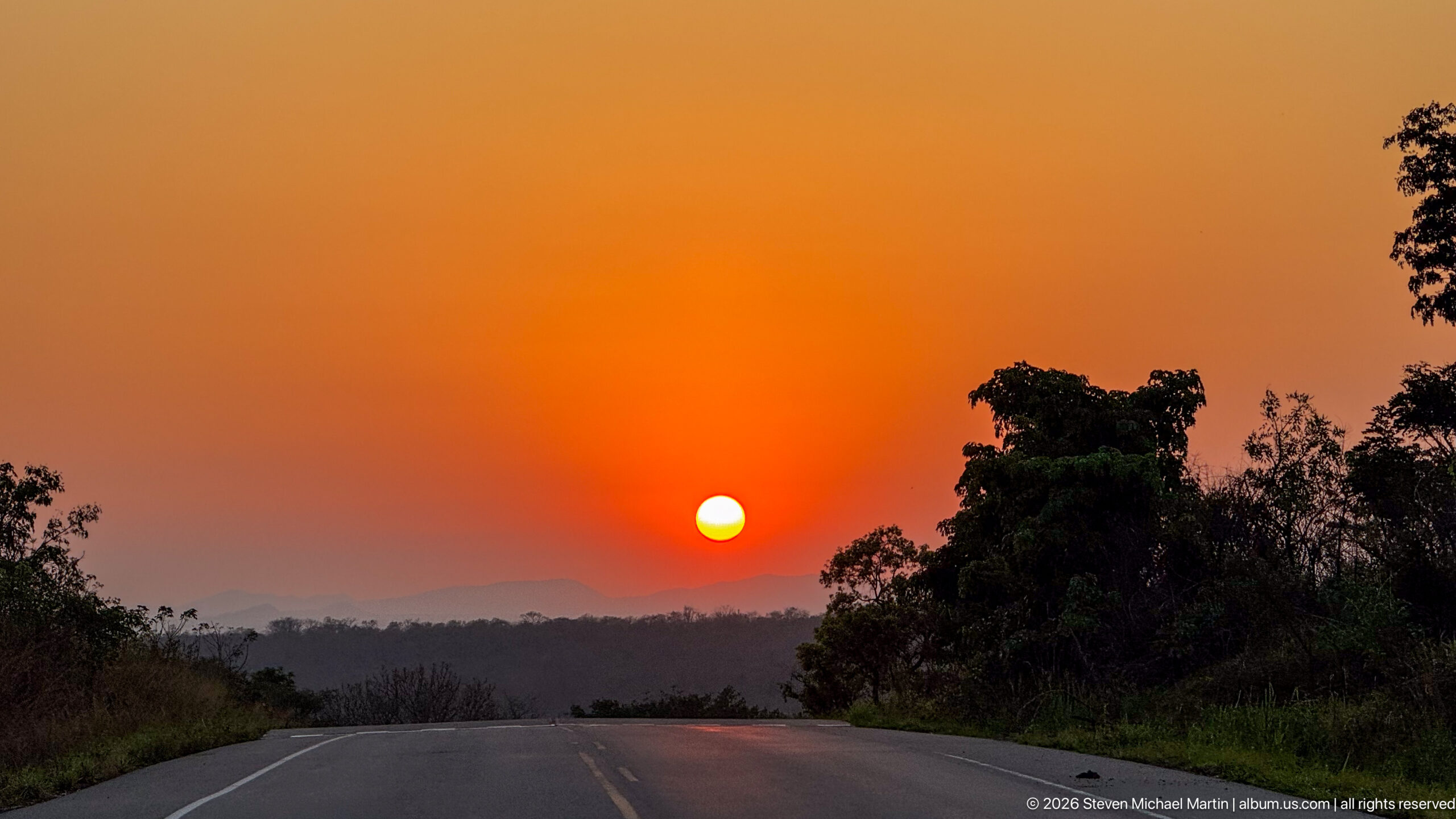
The setting sun glows orange above a paved road running through wooded savanna near Murchison Falls. Low hills recede beneath the horizon while dark roadside trees frame the open roadway, turning the landscape into a strong transitional view between lodge and park. The photograph records the broad, dry-season character of the surrounding terrain rather than the waterfall itself.
Caption
The setting sun glows orange above a paved road running through wooded savanna near Murchison Falls. Low hills recede beneath the horizon while dark roadside trees frame the open roadway, turning the landscape into a strong transitional view between lodge and park. The photograph records the broad, dry-season character of the surrounding terrain rather than the waterfall itself.
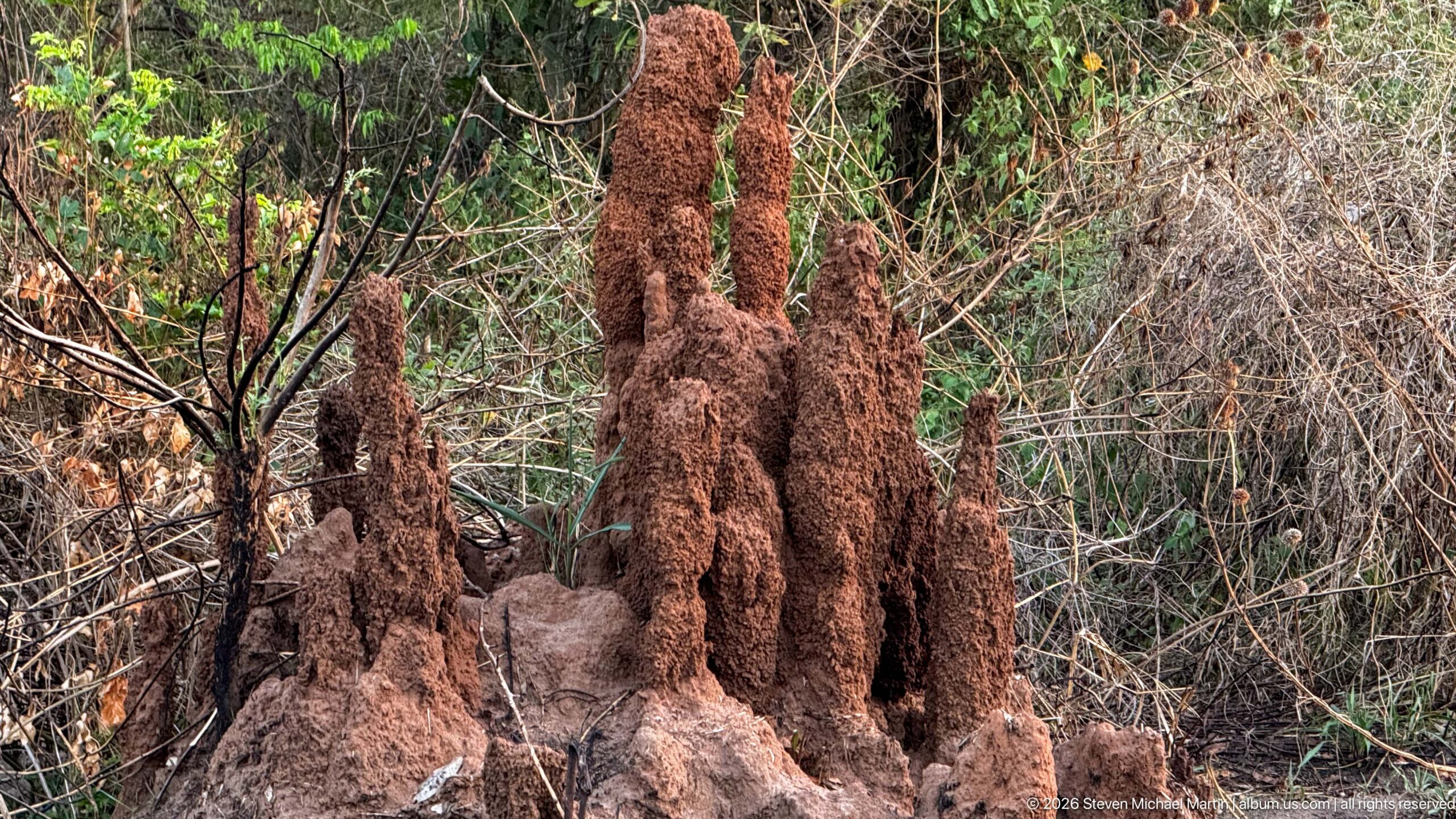
A weathered termite mound rises in clustered earthen pinnacles from dry woodland near Murchison Falls. Its irregular towers and rough, compacted surface reflect the soil-built architecture of a termite colony, while leaf litter, vines, and scrub place the structure directly within its savanna-woodland habitat. The close view emphasizes form and texture rather than landscape scale.
Caption
A weathered termite mound rises in clustered earthen pinnacles from dry woodland near Murchison Falls. Its irregular towers and rough, compacted surface reflect the soil-built architecture of a termite colony, while leaf litter, vines, and scrub place the structure directly within its savanna-woodland habitat. The close view emphasizes form and texture rather than landscape scale.
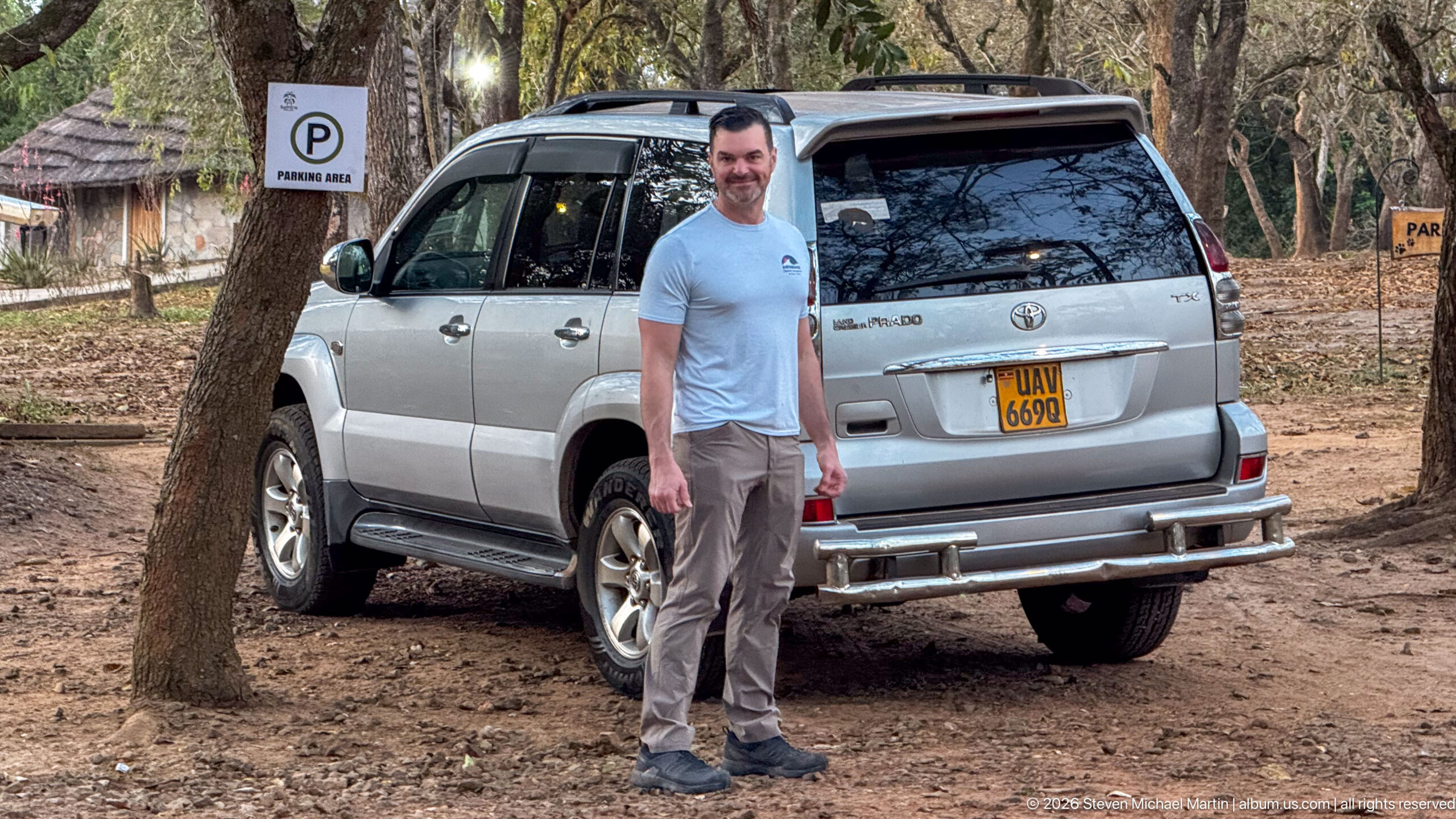
A traveler stands beside a silver Toyota Land Cruiser at a wooded parking area in the Murchison Falls region. The high-clearance four-wheel-drive vehicle, carrying Ugandan registration, represents the road transport commonly used to reach wildlife areas and waterfall viewpoints. Trees, dry ground, and parking signs provide a practical sense of the visitor infrastructure surrounding the natural attraction.
Caption
A traveler stands beside a silver Toyota Land Cruiser at a wooded parking area in the Murchison Falls region. The high-clearance four-wheel-drive vehicle, carrying Ugandan registration, represents the road transport commonly used to reach wildlife areas and waterfall viewpoints. Trees, dry ground, and parking signs provide a practical sense of the visitor infrastructure surrounding the natural attraction.
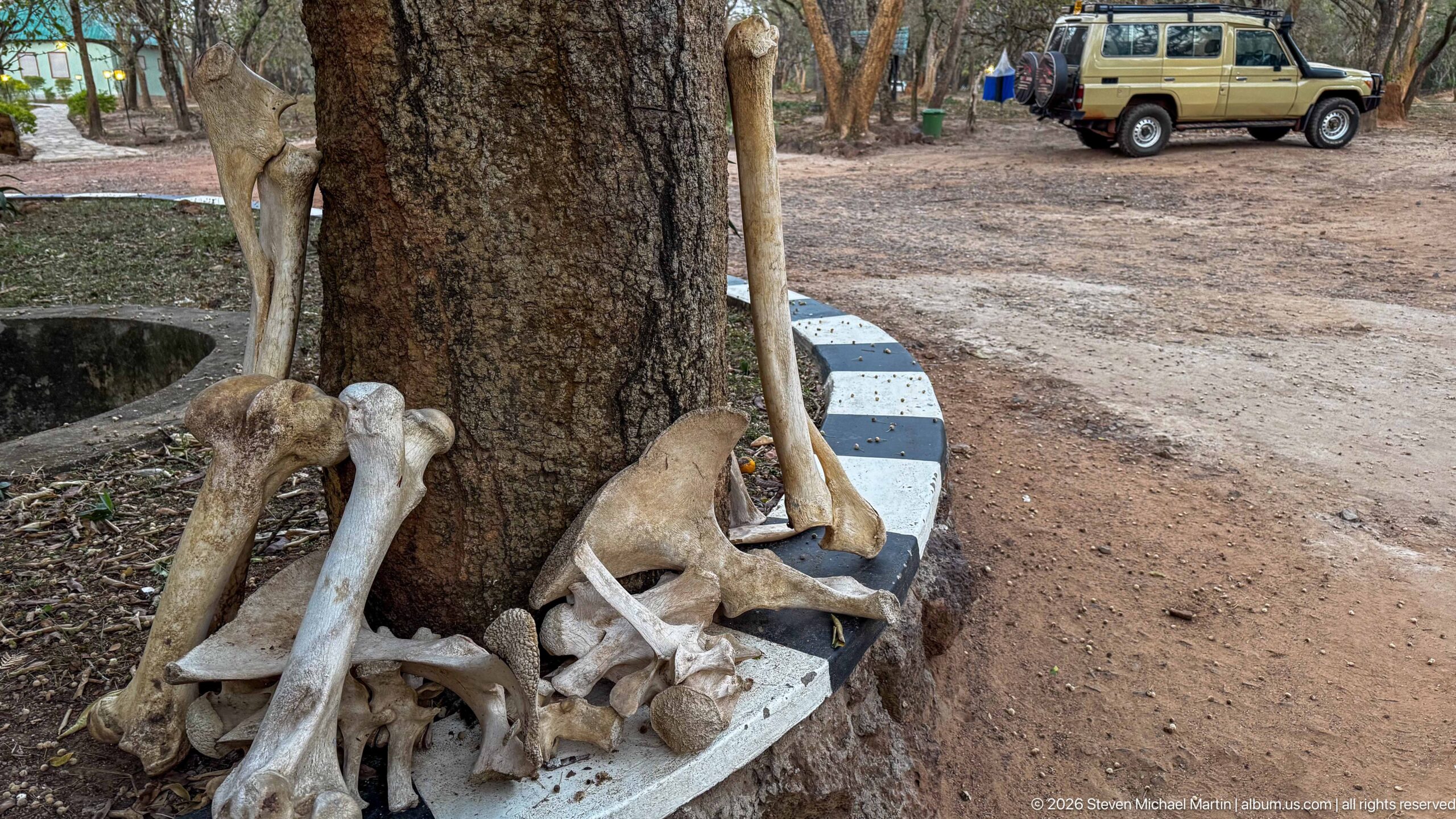
Large mammal bones are arranged around the base of a tree in a lodge or visitor-area setting near Murchison Falls. Long limb bones, a pelvis, vertebral elements, and other robust fragments form an informal natural-history display beside a painted curb. Their scale suggests a very large mammal, but the proof sheet does not support a secure species-level identification.
Caption
Large mammal bones are arranged around the base of a tree in a lodge or visitor-area setting near Murchison Falls. Long limb bones, a pelvis, vertebral elements, and other robust fragments form an informal natural-history display beside a painted curb. Their scale suggests a very large mammal, but the proof sheet does not support a secure species-level identification.
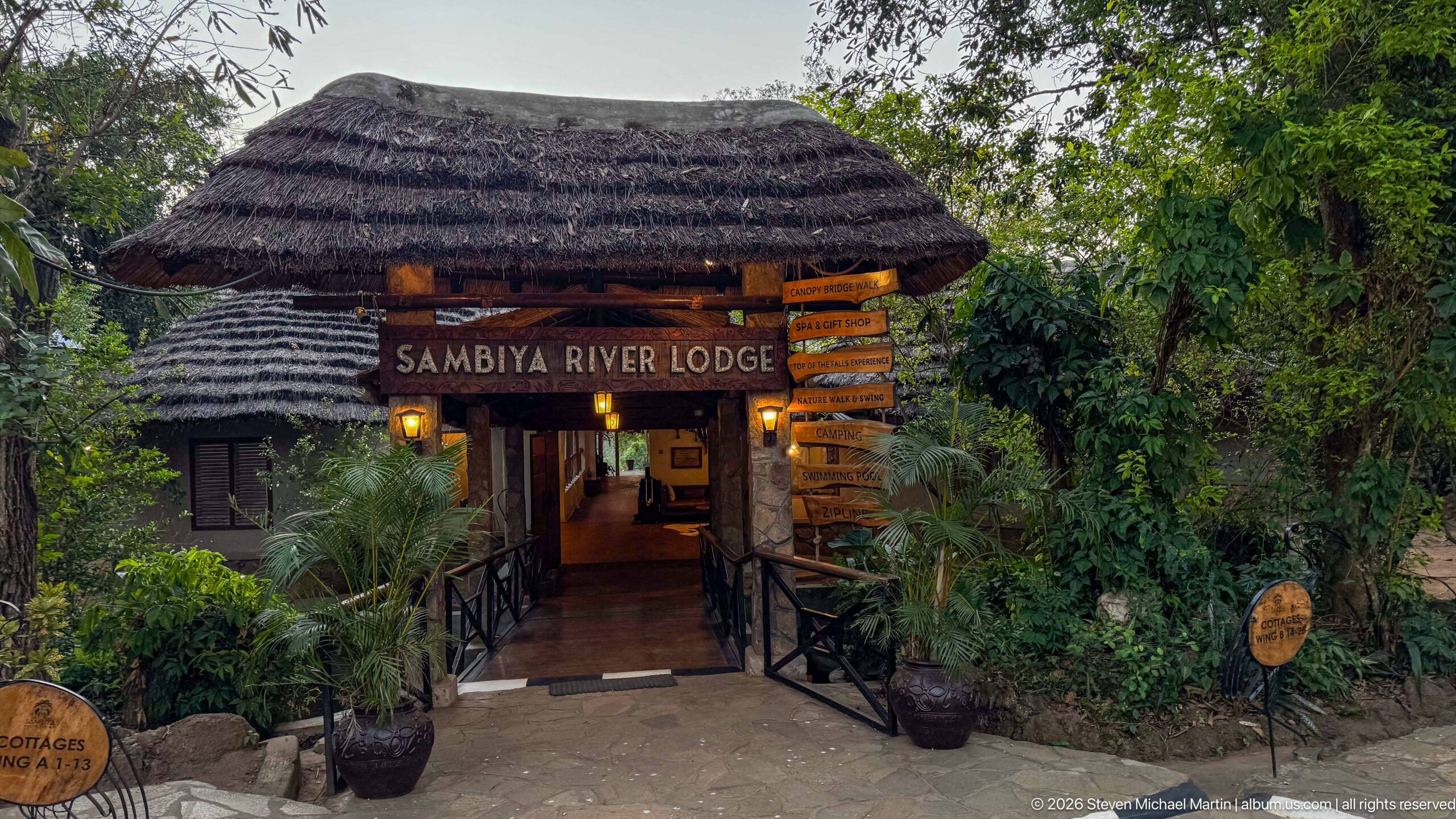
The entrance to Sambiya River Lodge is set beneath a broad thatched roof and surrounded by dense tropical greenery. A timber sign names the lodge above the open reception passage, while smaller directional boards cluster beside the doorway. The architecture and vegetation establish the accommodation base associated with this Murchison Falls journey in a more specific way than the earlier cottage view.
Caption
The entrance to Sambiya River Lodge is set beneath a broad thatched roof and surrounded by dense tropical greenery. A timber sign names the lodge above the open reception passage, while smaller directional boards cluster beside the doorway. The architecture and vegetation establish the accommodation base associated with this Murchison Falls journey in a more specific way than the earlier cottage view.
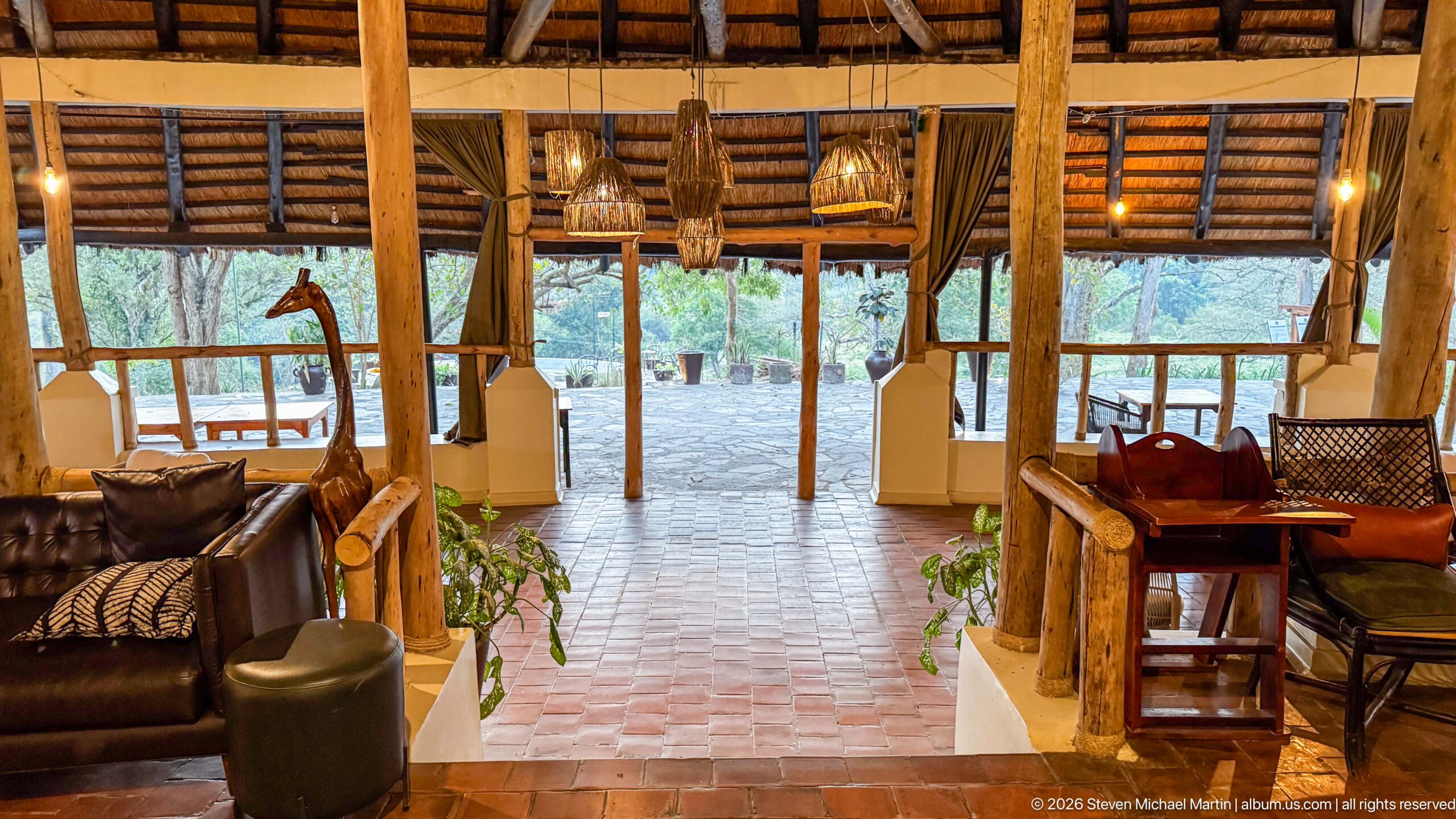
An open-air lounge at Sambiya River Lodge looks through timber posts toward the surrounding woodland. Leather seating, carved wood furniture, hanging basket lamps, brick flooring, and a high thatched roof create a sheltered communal space while broad openings maintain visual contact with the landscape. The interior view complements the exterior lodge photographs by showing the property’s guest-facing architecture.
Caption
An open-air lounge at Sambiya River Lodge looks through timber posts toward the surrounding woodland. Leather seating, carved wood furniture, hanging basket lamps, brick flooring, and a high thatched roof create a sheltered communal space while broad openings maintain visual contact with the landscape. The interior view complements the exterior lodge photographs by showing the property’s guest-facing architecture.
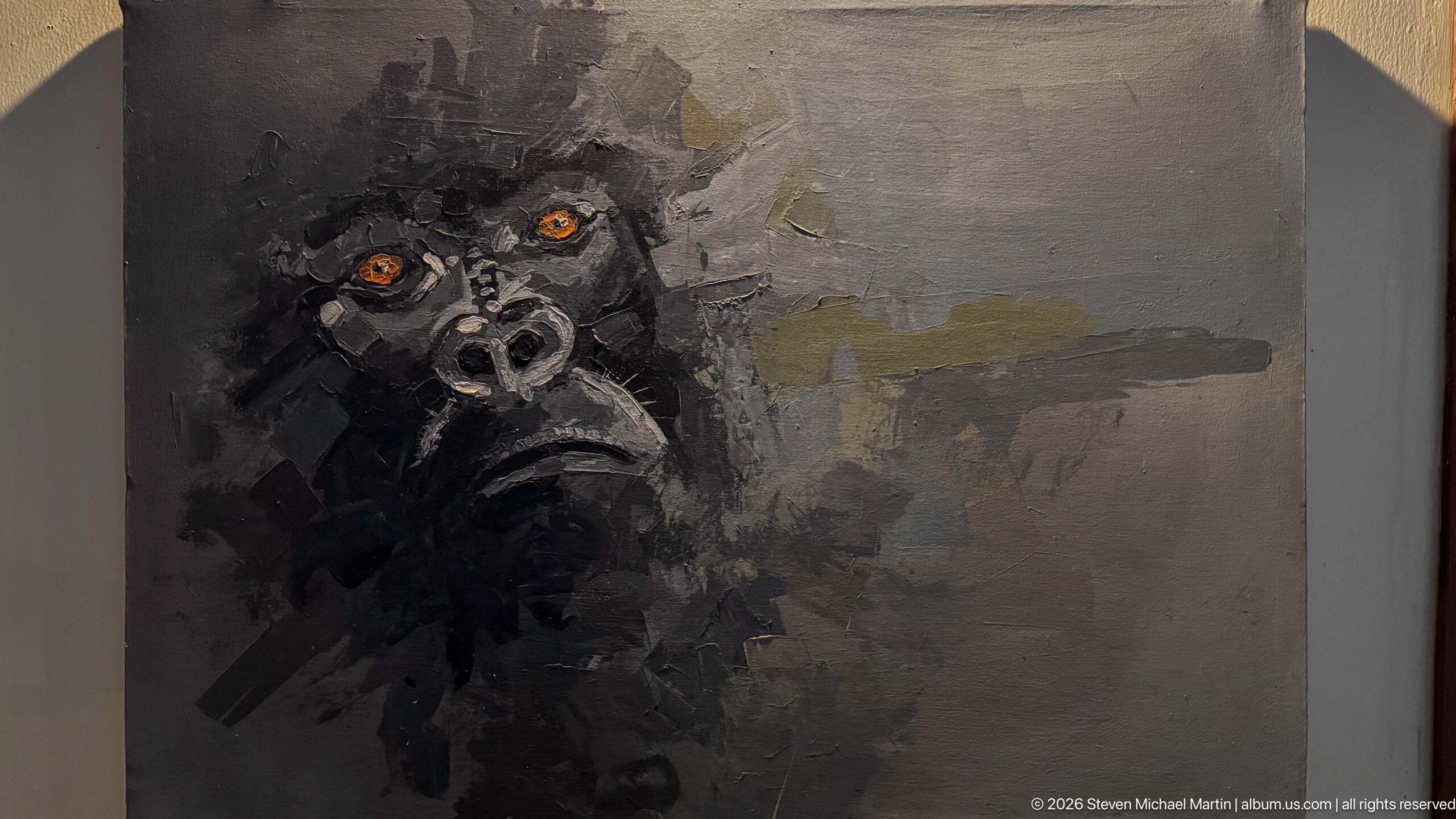
A dark, expressionistic gorilla portrait emerges from a field of layered gray and black brushwork. Orange-brown eyes provide the strongest color accent, while the face and upper torso are only partly resolved against the abstract background. Displayed in the lodge context, the painting introduces a wildlife motif without claiming that gorillas occur at the waterfall itself.
Caption
A dark, expressionistic gorilla portrait emerges from a field of layered gray and black brushwork. Orange-brown eyes provide the strongest color accent, while the face and upper torso are only partly resolved against the abstract background. Displayed in the lodge context, the painting introduces a wildlife motif without claiming that gorillas occur at the waterfall itself.
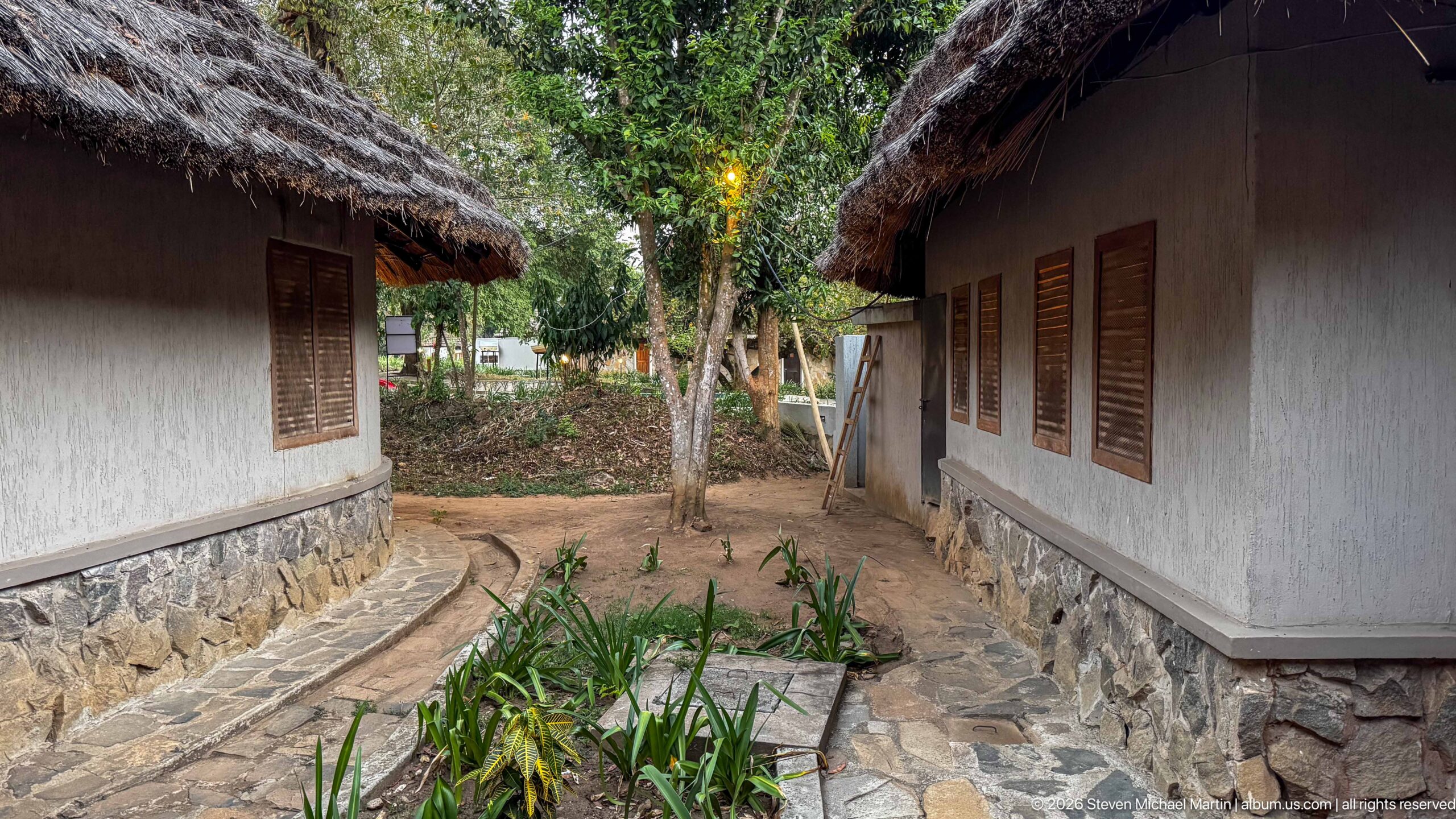
A narrow stone-edged path passes between two low guest buildings with thatched eaves at Sambiya River Lodge. Shuttered windows, rough stone foundations, pale rendered walls, and planted borders define the intimate scale of the accommodation area. Unlike the broader establishing view of the cottages, this photograph concentrates on circulation and the relationship between buildings and vegetation.
Caption
A narrow stone-edged path passes between two low guest buildings with thatched eaves at Sambiya River Lodge. Shuttered windows, rough stone foundations, pale rendered walls, and planted borders define the intimate scale of the accommodation area. Unlike the broader establishing view of the cottages, this photograph concentrates on circulation and the relationship between buildings and vegetation.
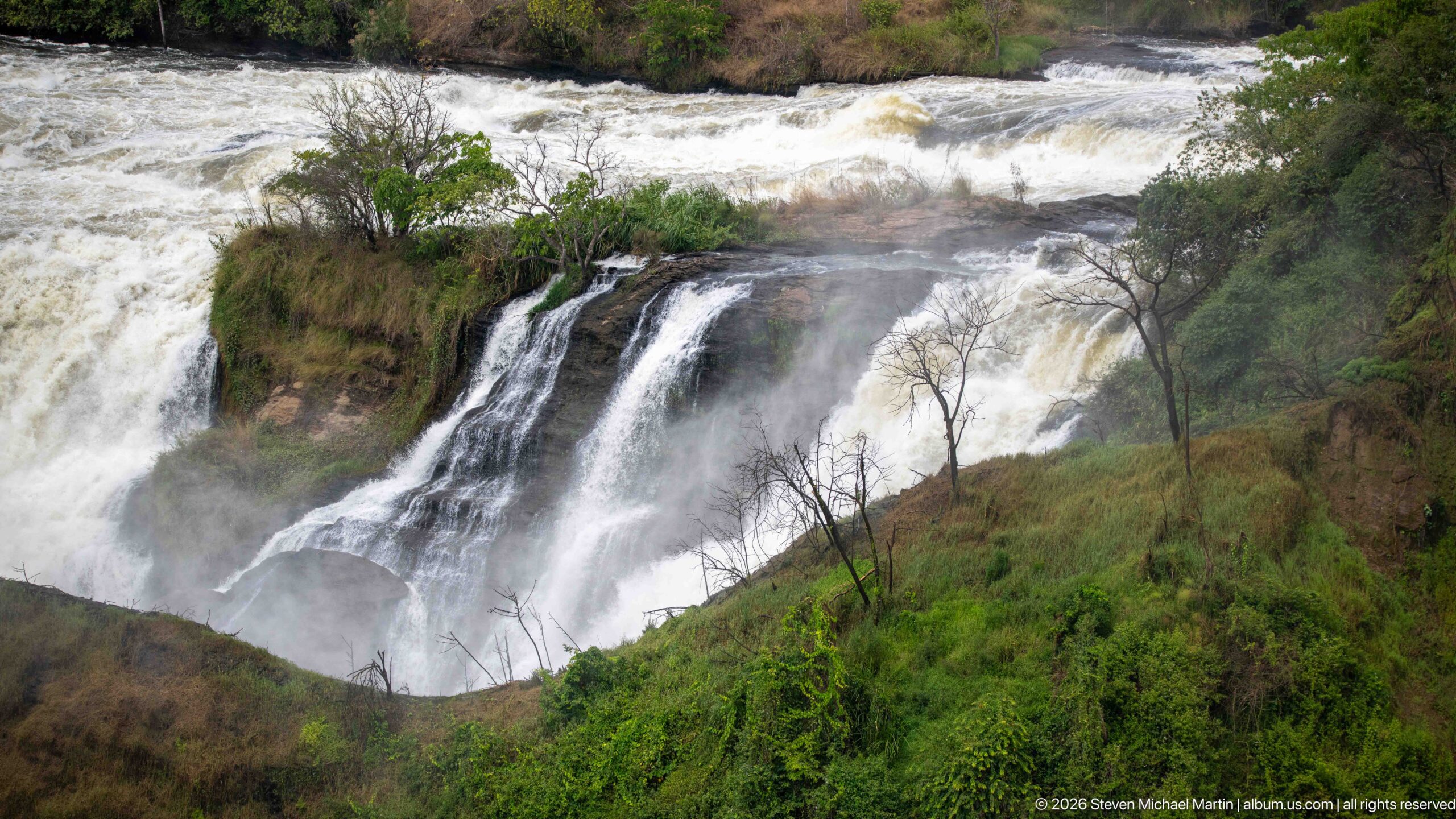
Seen obliquely from above, a side cascade drops over a dark rock lip while the upper river races across a broken channel behind it. Green vegetation clings to the steep slopes and islands around the whitewater, contrasting with the dry woodland farther upslope. The angle reveals how separate channels and rock ledges shape the falls before the water converges below.
Caption
Seen obliquely from above, a side cascade drops over a dark rock lip while the upper river races across a broken channel behind it. Green vegetation clings to the steep slopes and islands around the whitewater, contrasting with the dry woodland farther upslope. The angle reveals how separate channels and rock ledges shape the falls before the water converges below.
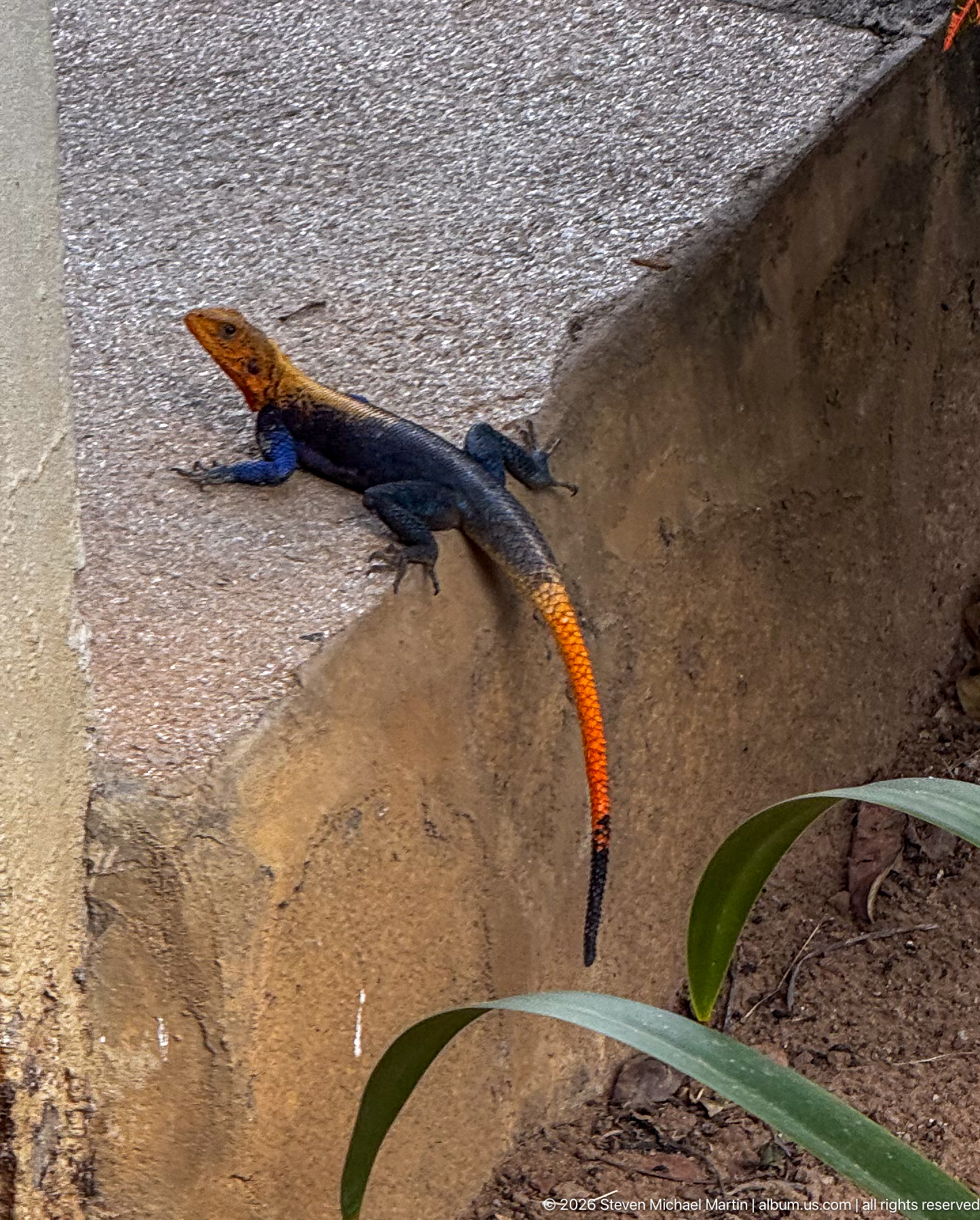
A brightly colored male rock agama rests on a concrete edge near Murchison Falls. Its orange head and tail contrast sharply with a deep blue body and limbs, a breeding coloration characteristic of male red-headed rock agamas. The low, lateral posture and long tapering tail are clearly visible, making this one of the portfolio’s most specific wildlife close-ups.
Caption
A brightly colored male rock agama rests on a concrete edge near Murchison Falls. Its orange head and tail contrast sharply with a deep blue body and limbs, a breeding coloration characteristic of male red-headed rock agamas. The low, lateral posture and long tapering tail are clearly visible, making this one of the portfolio’s most specific wildlife close-ups.
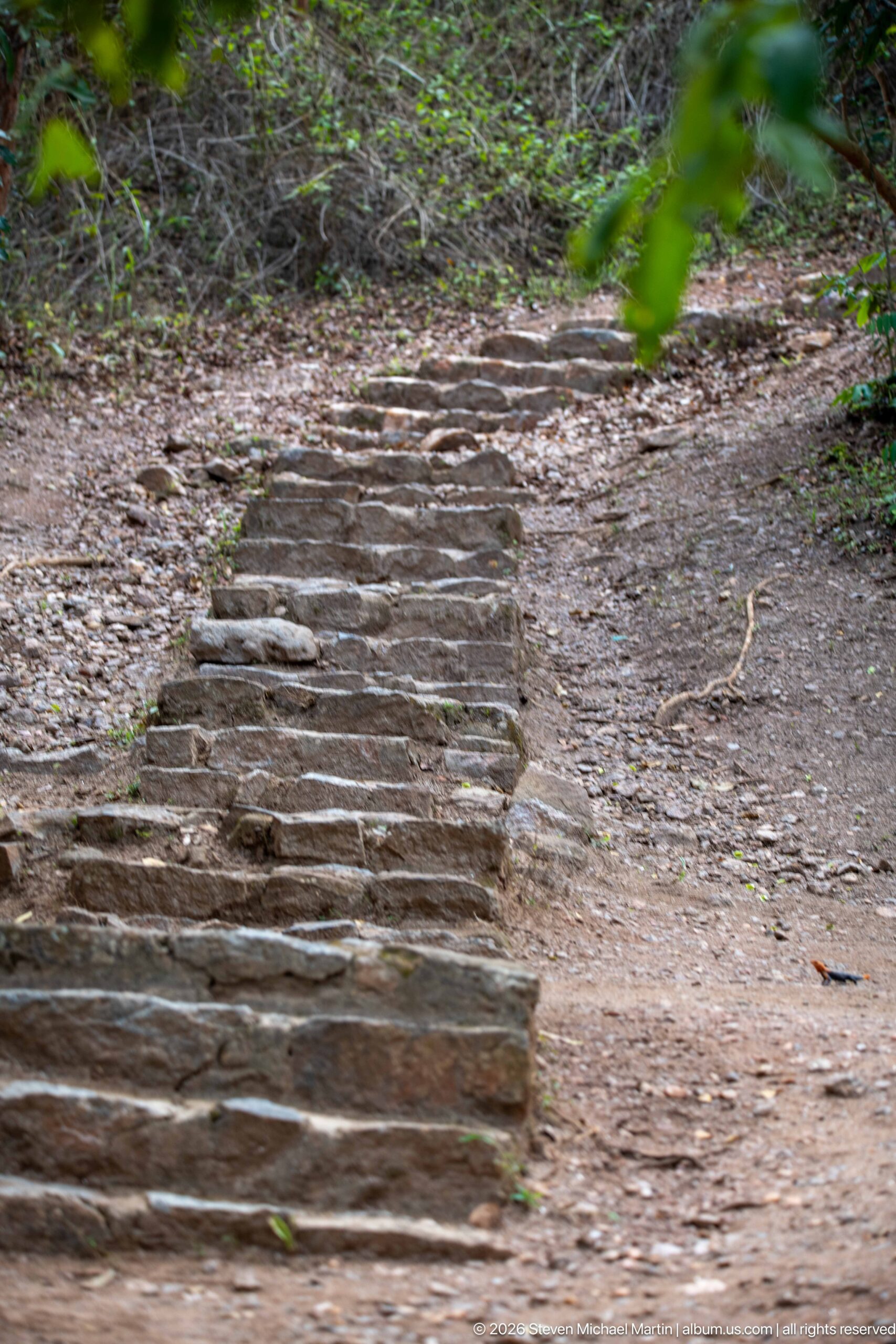
A rough flight of stone steps climbs through dry woodland on the walking route around the top of Murchison Falls. Irregular rock treads have been set directly into the slope, creating a durable footpath through exposed soil and leaf litter. The close, ground-level view emphasizes the physical ascent and the minimally engineered character of the trail.
Caption
A rough flight of stone steps climbs through dry woodland on the walking route around the top of Murchison Falls. Irregular rock treads have been set directly into the slope, creating a durable footpath through exposed soil and leaf litter. The close, ground-level view emphasizes the physical ascent and the minimally engineered character of the trail.
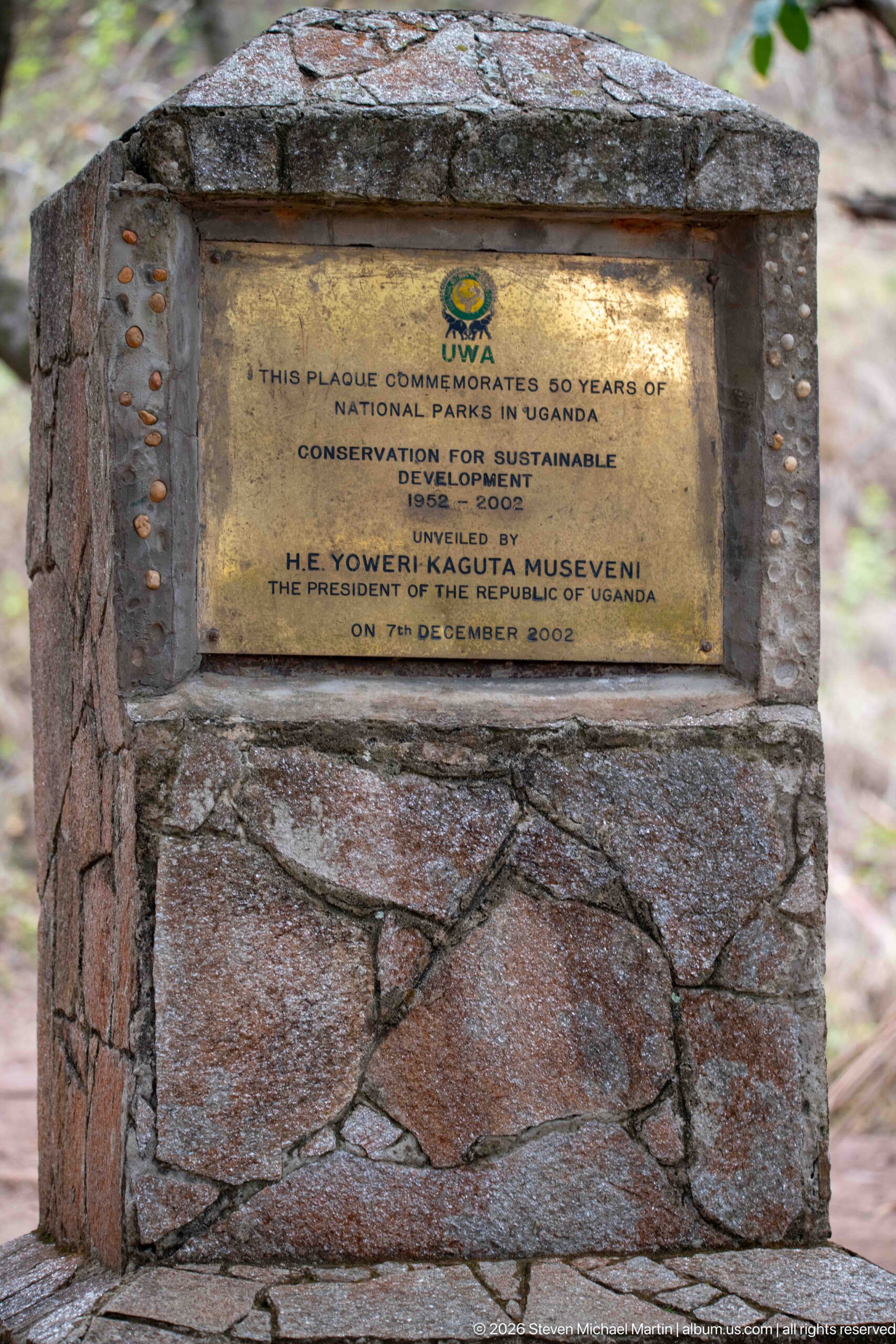
A brass plaque mounted in a stone pedestal commemorates fifty years of national parks in Uganda, 1952–2002, under the theme “Conservation for Sustainable Development.” The inscription records its unveiling by President Yoweri K. Museveni on 7 December 2002, preserving an official marker of Uganda’s protected-area history at Murchison Falls.
Caption
A brass plaque mounted in a stone pedestal commemorates fifty years of national parks in Uganda, 1952–2002, under the theme “Conservation for Sustainable Development.” The inscription records its unveiling by President Yoweri K. Museveni on 7 December 2002, preserving an official marker of Uganda’s protected-area history at Murchison Falls.
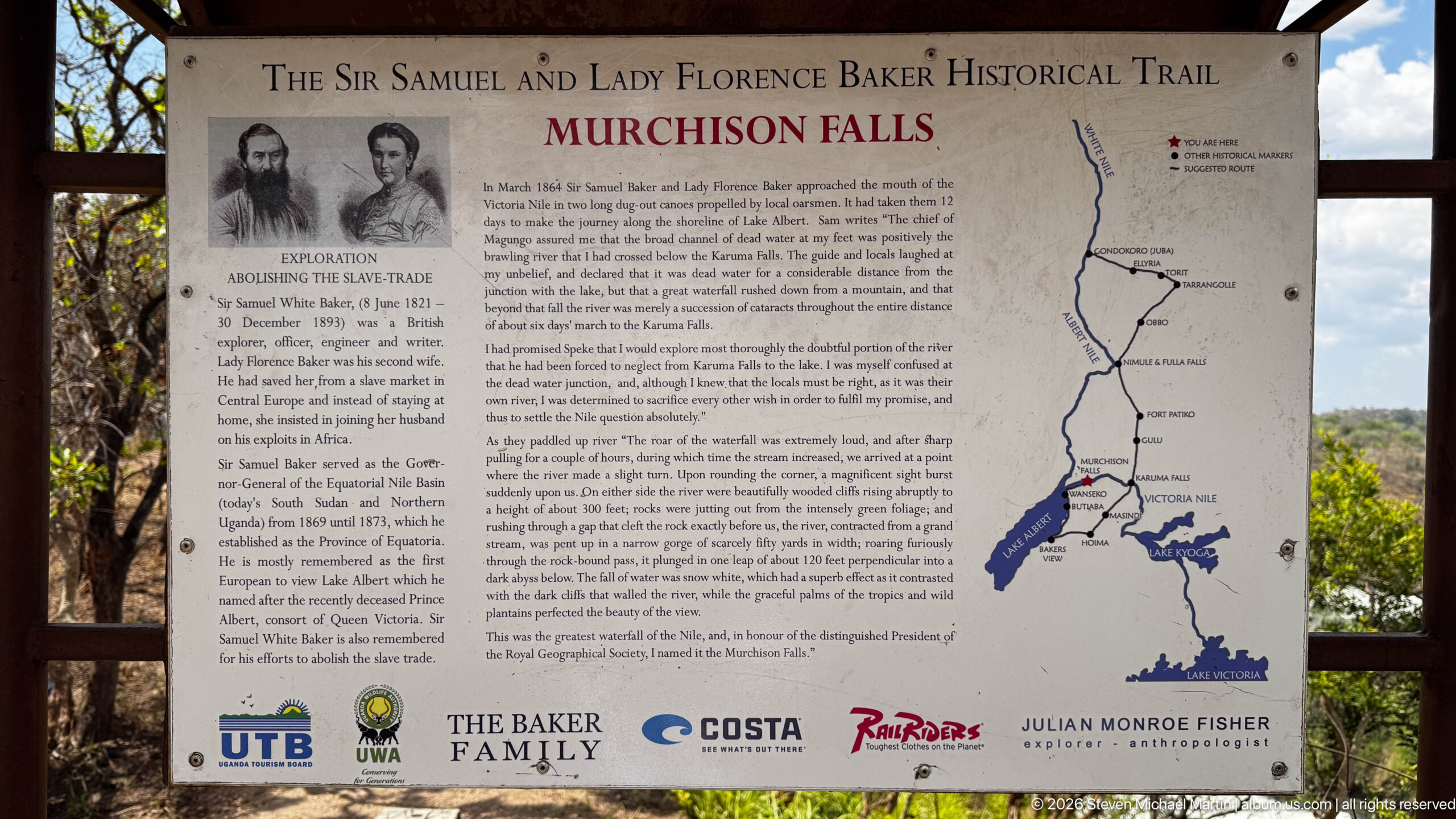
An interpretive panel for the Sir Samuel and Lady Florence Baker Historical Trail presents Murchison Falls history alongside a route map and archival imagery. The sign links the viewpoint to nineteenth-century European exploration narratives and modern heritage interpretation. Its prominent “Murchison Falls” heading and mapped trail make this photograph a documentary record of on-site historical interpretation rather than a landscape view.
Caption
An interpretive panel for the Sir Samuel and Lady Florence Baker Historical Trail presents Murchison Falls history alongside a route map and archival imagery. The sign links the viewpoint to nineteenth-century European exploration narratives and modern heritage interpretation. Its prominent “Murchison Falls” heading and mapped trail make this photograph a documentary record of on-site historical interpretation rather than a landscape view.
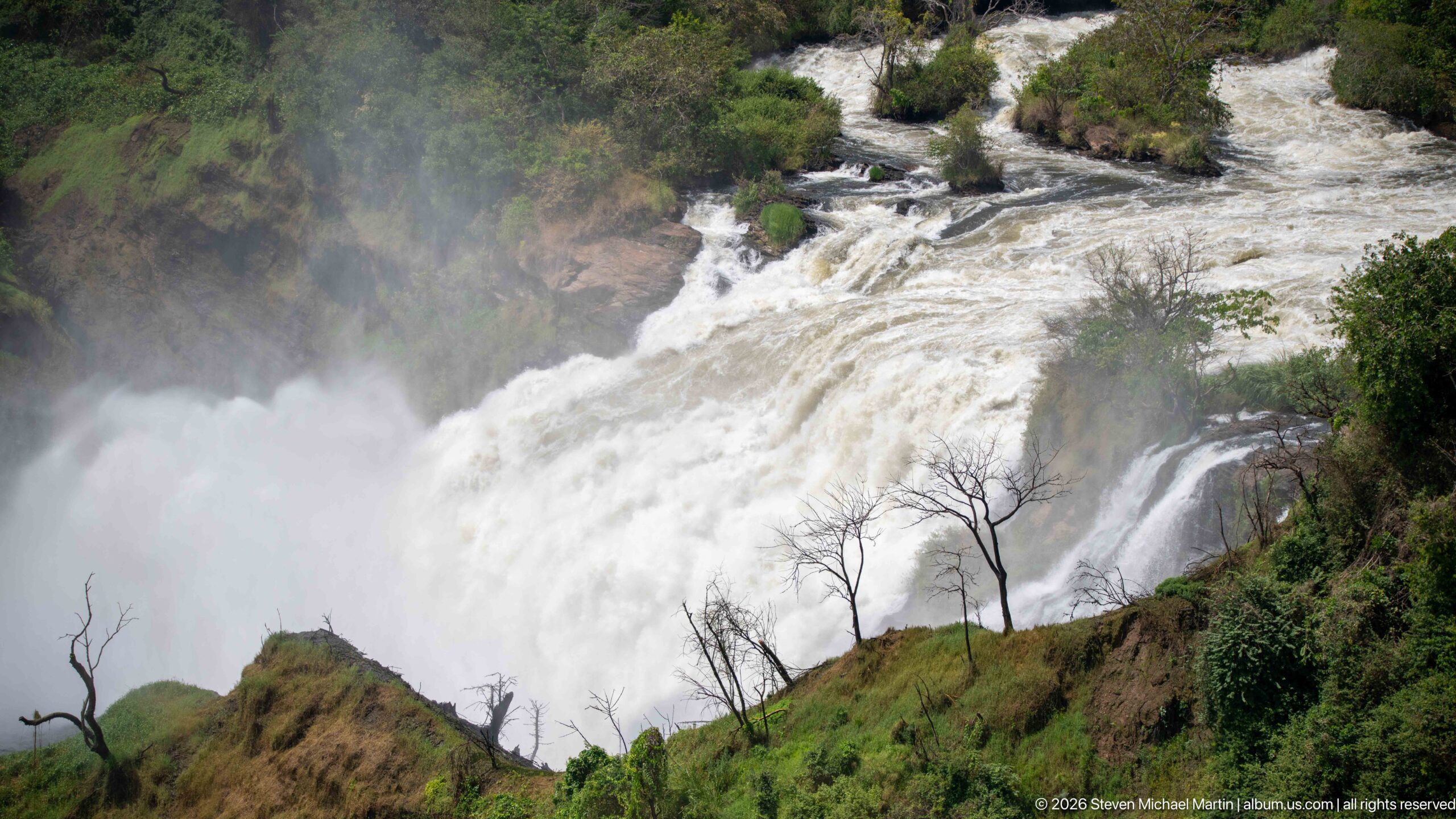
From above the gorge, the White Nile pours across stepped rock channels toward Murchison Falls, generating a dense cloud of spray at the left edge. Bare-limbed trees stand on a green ridge above the plunge zone, providing scale against the river’s broad, fast-moving surface. The viewpoint emphasizes the transition from upper rapids to the obscured drop.
Caption
From above the gorge, the White Nile pours across stepped rock channels toward Murchison Falls, generating a dense cloud of spray at the left edge. Bare-limbed trees stand on a green ridge above the plunge zone, providing scale against the river’s broad, fast-moving surface. The viewpoint emphasizes the transition from upper rapids to the obscured drop.
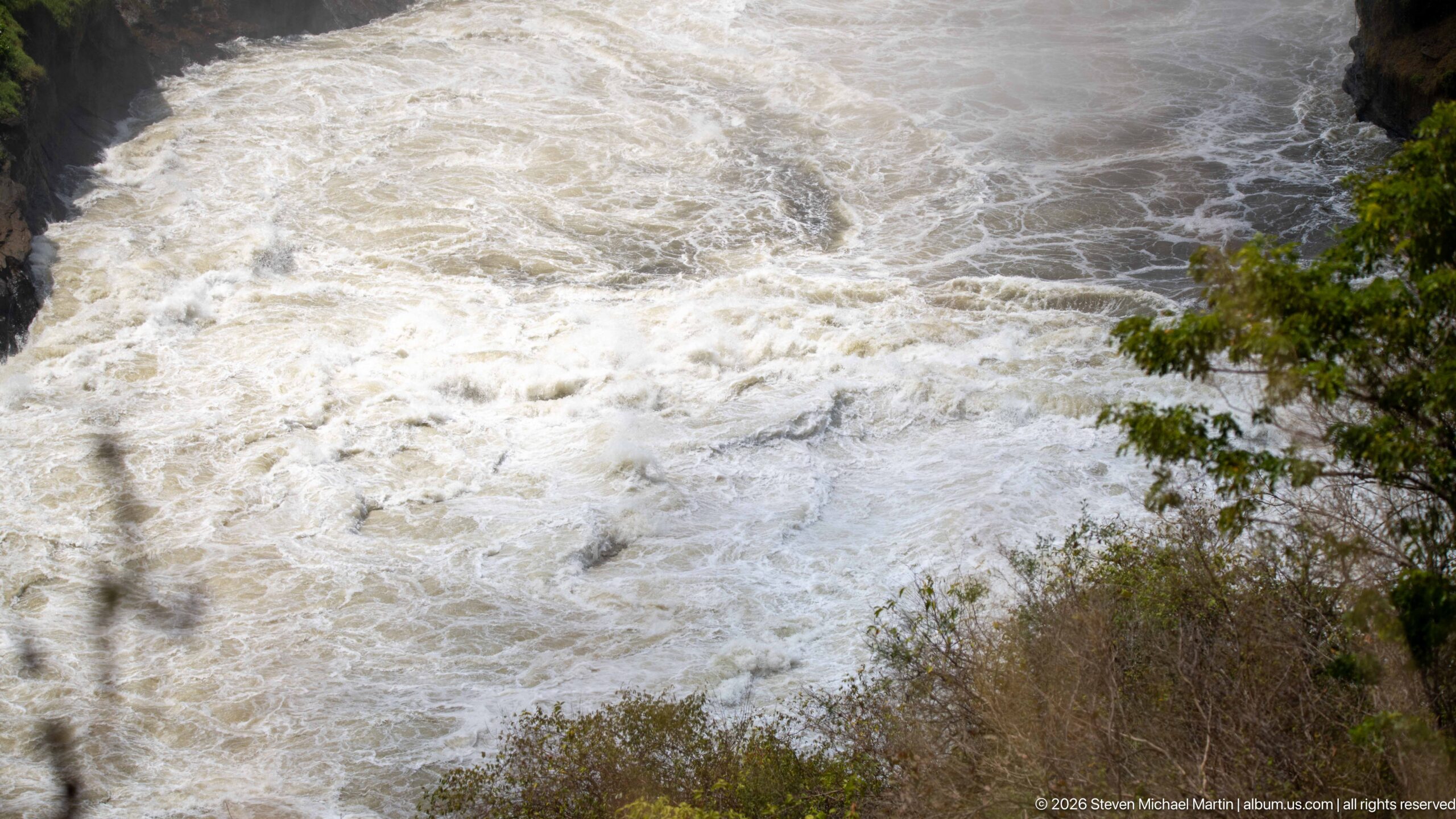
A tight downward view isolates the violently churning White Nile near Murchison Falls. Cream-colored water folds into overlapping waves, foam lines, and circular eddies, with only a narrow strip of foliage at the edge to orient the viewer. By excluding the horizon and rock walls, the photograph turns the river’s turbulence itself into the principal natural-history subject.
Caption
A tight downward view isolates the violently churning White Nile near Murchison Falls. Cream-colored water folds into overlapping waves, foam lines, and circular eddies, with only a narrow strip of foliage at the edge to orient the viewer. By excluding the horizon and rock walls, the photograph turns the river’s turbulence itself into the principal natural-history subject.
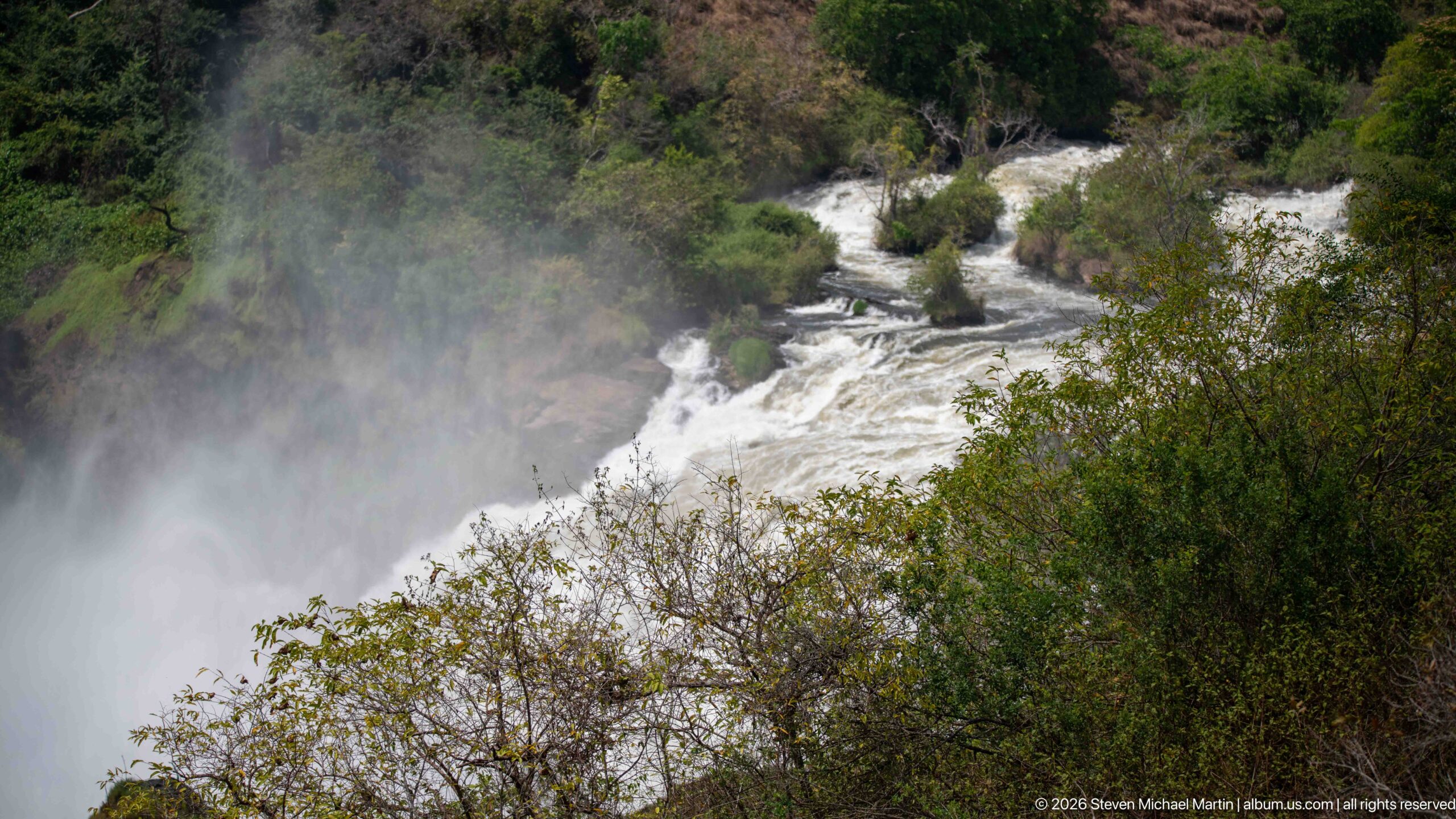
Whitewater races through the upper channels of Murchison Falls behind a screen of shrubs and small trees. A broad spray plume rises at left while rock-divided rapids remain visible across the upper half of the frame. The partially obstructed viewpoint records the falls from the trail environment, where dense vegetation alternately reveals and conceals the river.
Caption
Whitewater races through the upper channels of Murchison Falls behind a screen of shrubs and small trees. A broad spray plume rises at left while rock-divided rapids remain visible across the upper half of the frame. The partially obstructed viewpoint records the falls from the trail environment, where dense vegetation alternately reveals and conceals the river.
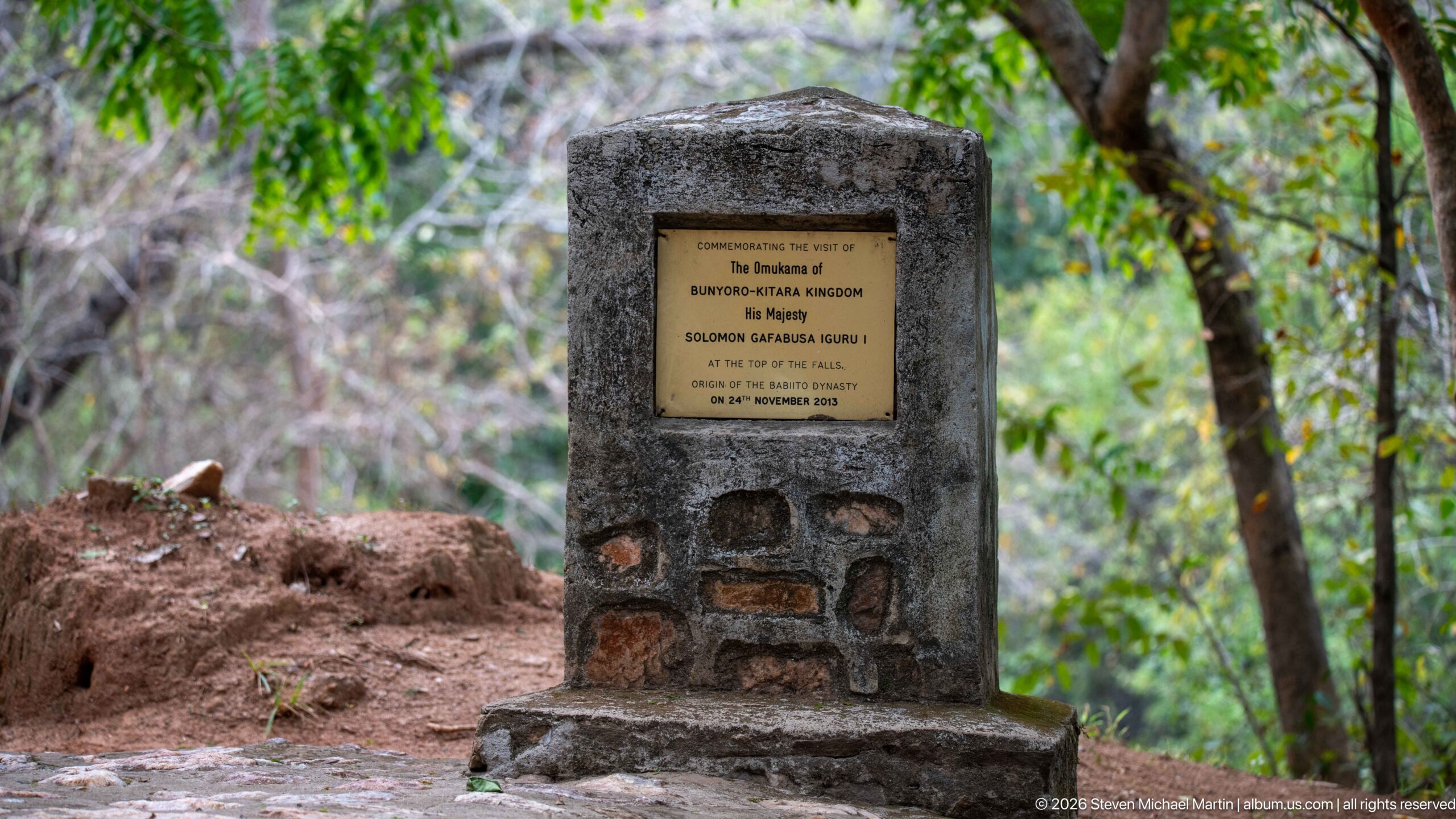
A small brass plaque is set into a tall stone monument beneath trees near Murchison Falls. Its inscription commemorates an official visit to the site, while the masonry base and weathered concrete cap distinguish the marker from the nearby anniversary memorial. The photograph records the monument in its woodland setting rather than isolating the text alone.
Caption
A small brass plaque is set into a tall stone monument beneath trees near Murchison Falls. Its inscription commemorates an official visit to the site, while the masonry base and weathered concrete cap distinguish the marker from the nearby anniversary memorial. The photograph records the monument in its woodland setting rather than isolating the text alone.
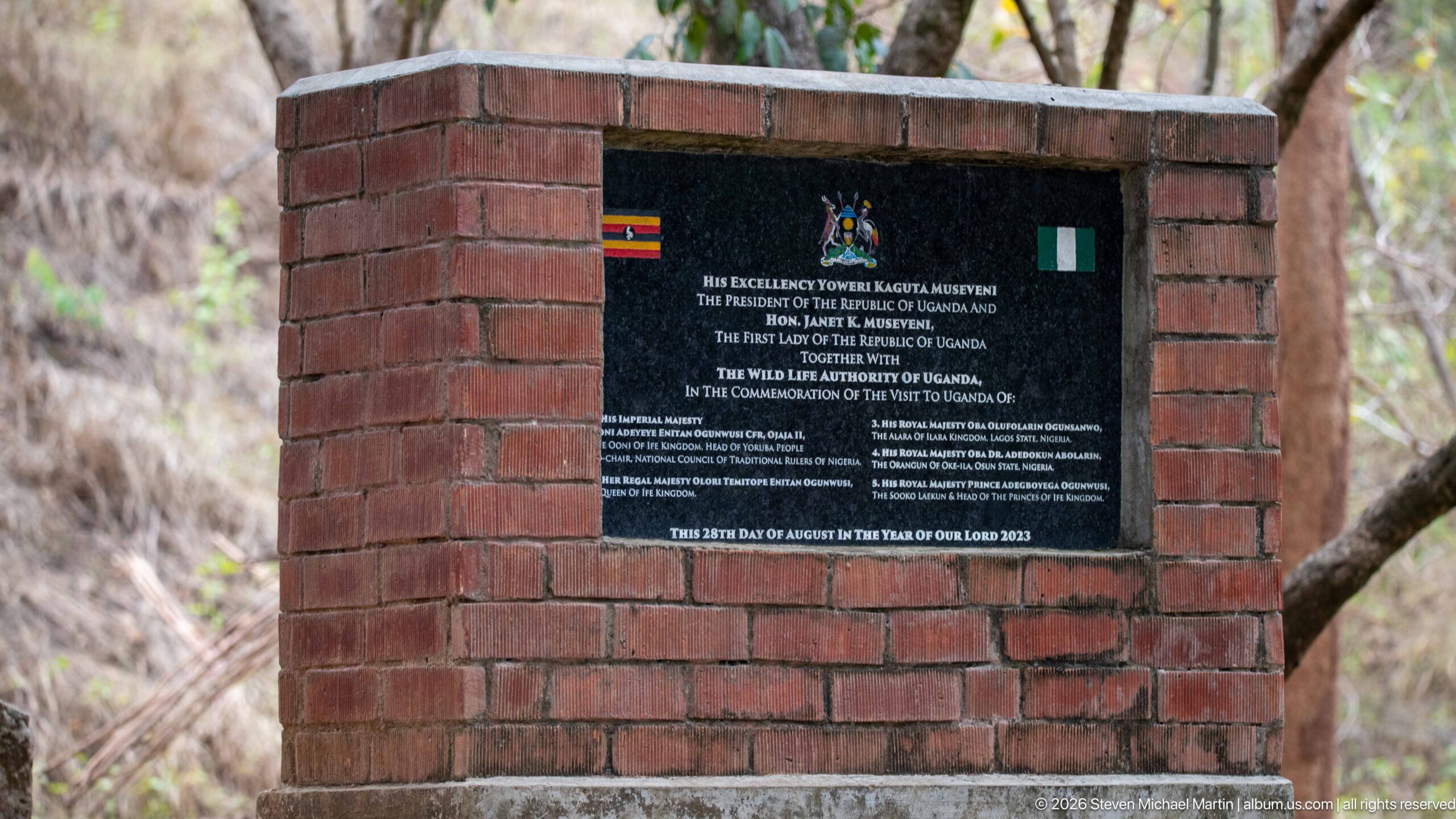
A polished black commemorative plaque set into a red-brick monument displays the flags of Uganda and Nigeria and records an official visit involving representatives of the two countries. The formal inscription and paired national flags give the marker a diplomatic character, while the surrounding dry woodland situates it among the memorials near Murchison Falls.
Caption
A polished black commemorative plaque set into a red-brick monument displays the flags of Uganda and Nigeria and records an official visit involving representatives of the two countries. The formal inscription and paired national flags give the marker a diplomatic character, while the surrounding dry woodland situates it among the memorials near Murchison Falls.
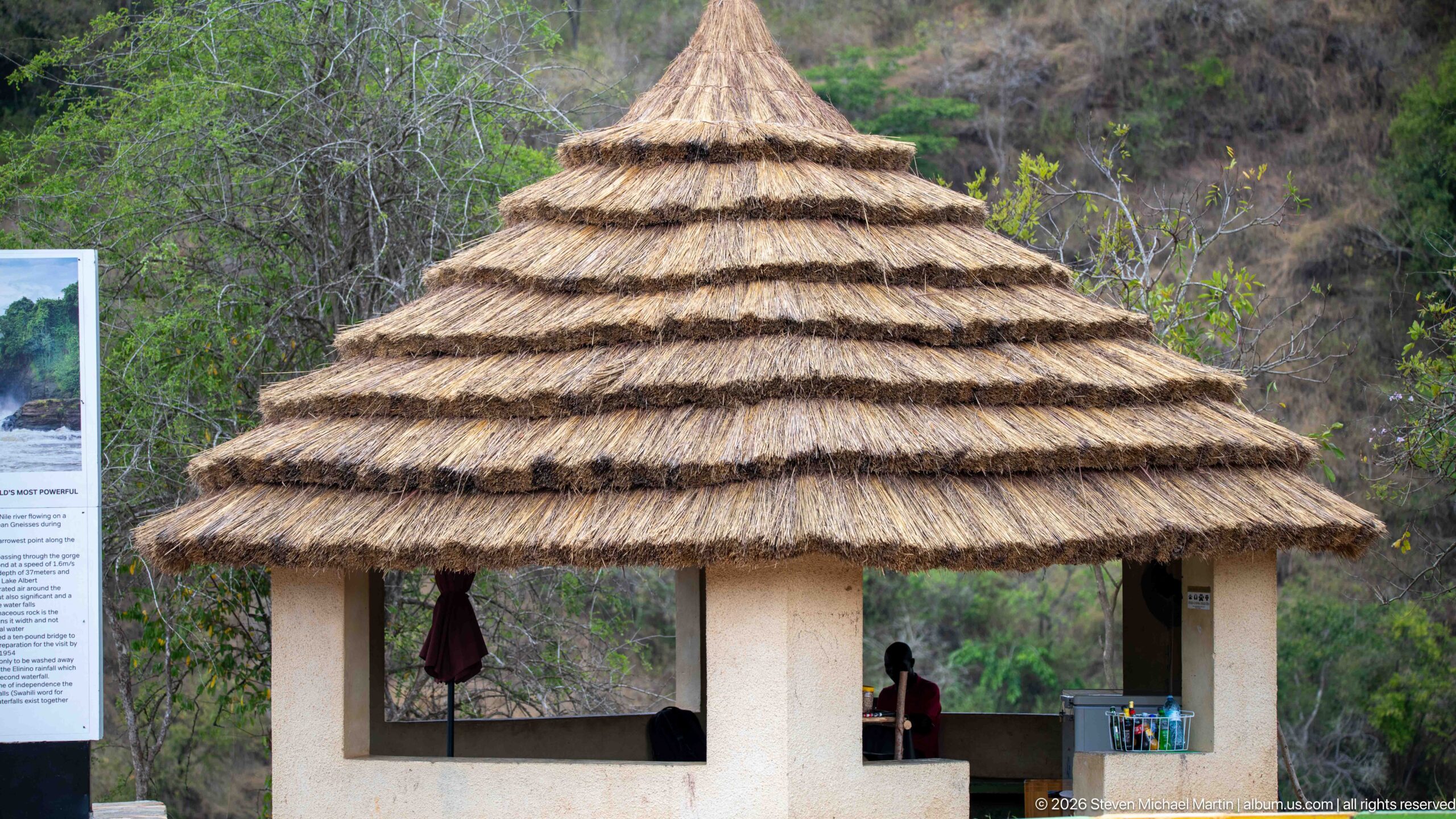
A small open-sided visitor kiosk stands beneath a steep, tiered thatched roof near the top of Murchison Falls. Deep eaves shade the service opening and counter, while an interpretive panel at the edge of the frame links the shelter to the developed visitor area. The layered grass roofing provides the structure’s most distinctive architectural feature.
Caption
A small open-sided visitor kiosk stands beneath a steep, tiered thatched roof near the top of Murchison Falls. Deep eaves shade the service opening and counter, while an interpretive panel at the edge of the frame links the shelter to the developed visitor area. The layered grass roofing provides the structure’s most distinctive architectural feature.
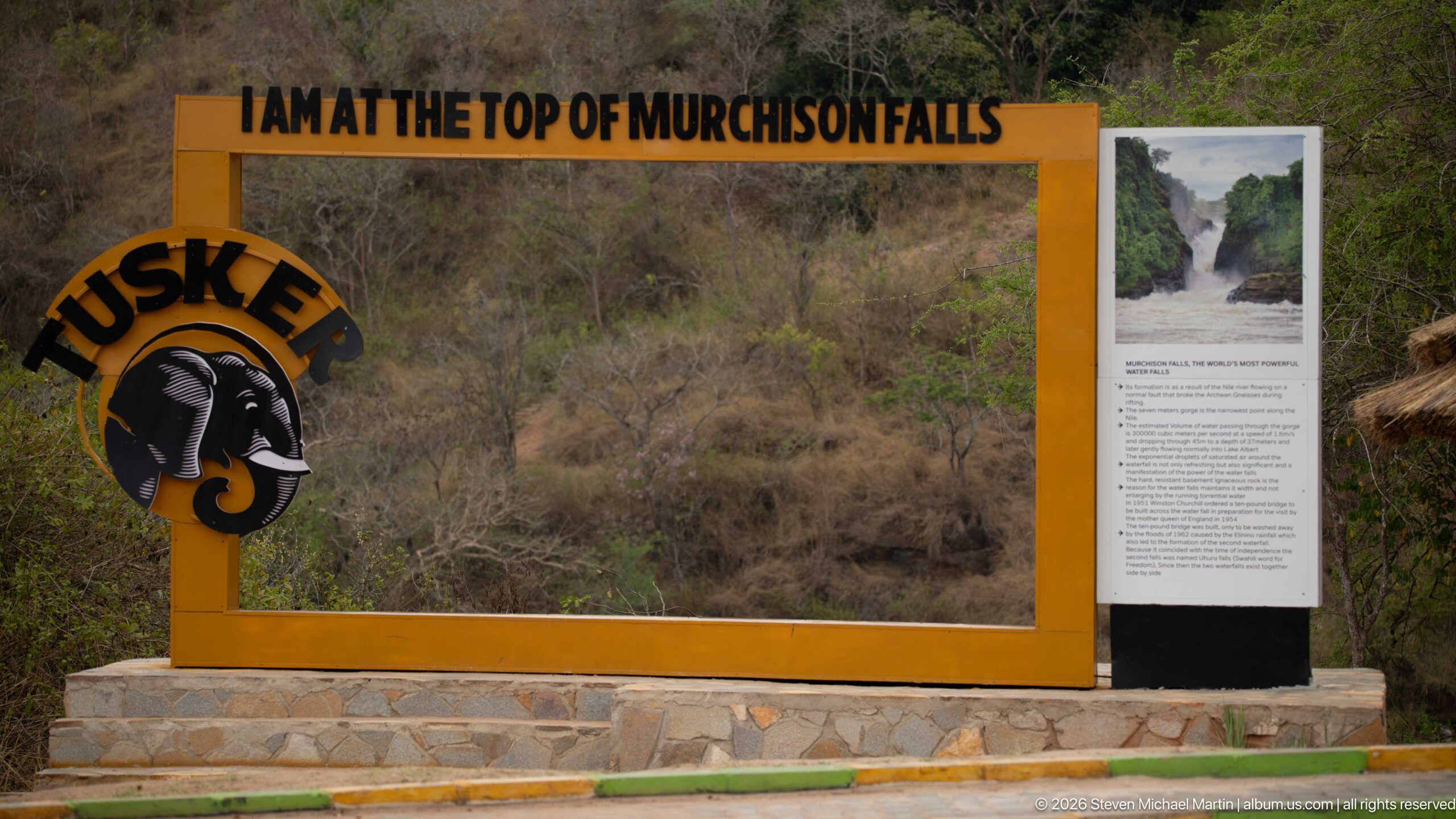
A large yellow frame marks the “Top of Murchison Falls,” incorporating Tusker branding and an elephant emblem beside an interpretive panel about the falls. Designed as both a destination marker and a photographic viewpoint, the installation stands against dry wooded slopes and announces arrival at the developed visitor area above the waterfall.
Caption
A large yellow frame marks the “Top of Murchison Falls,” incorporating Tusker branding and an elephant emblem beside an interpretive panel about the falls. Designed as both a destination marker and a photographic viewpoint, the installation stands against dry wooded slopes and announces arrival at the developed visitor area above the waterfall.
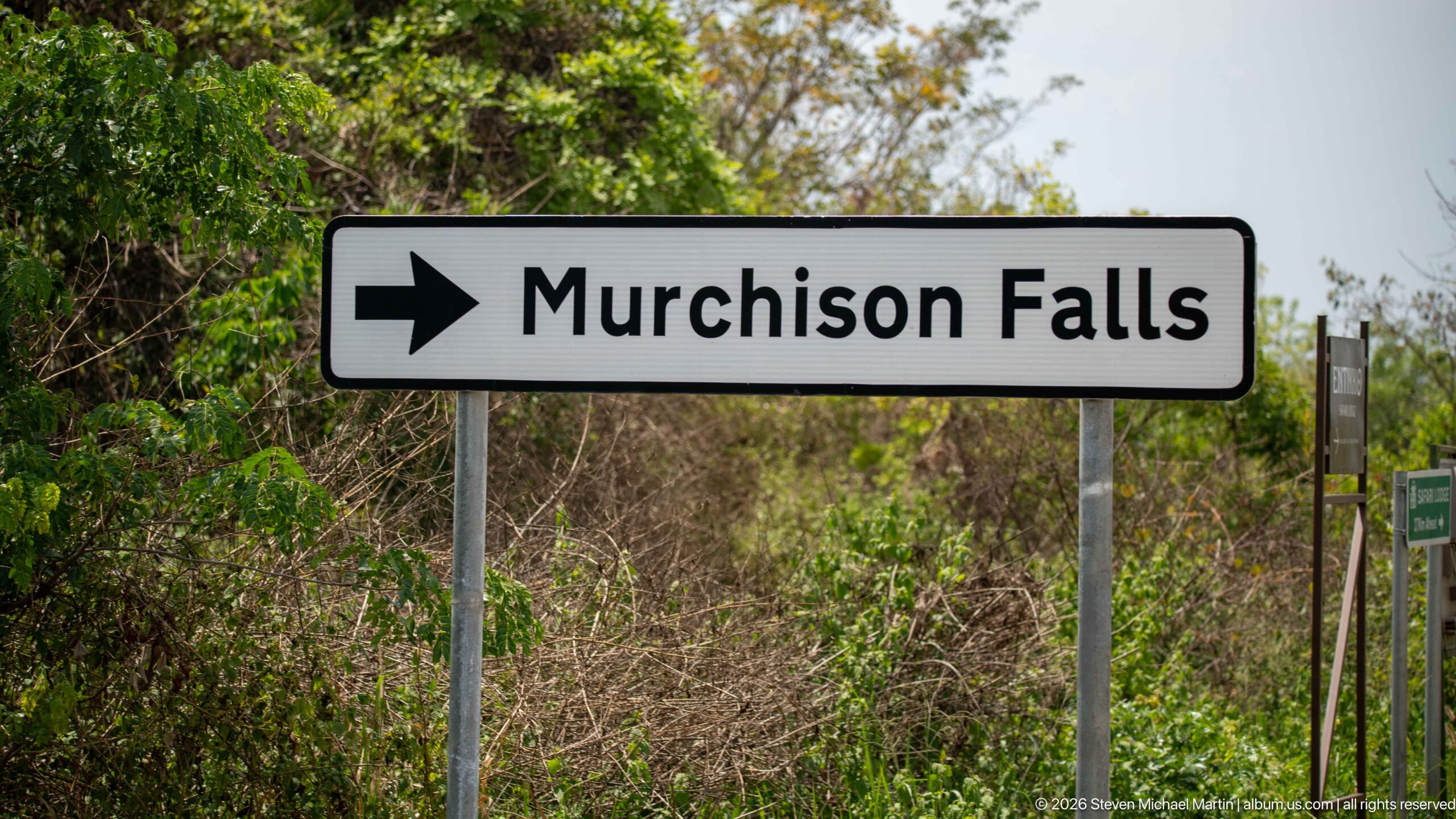
A roadside sign points toward Murchison Falls, its bold black arrow and lettering set against dry-season woodland. The utilitarian marker provides a clear transition from the surrounding road network toward the falls, grounding the journey in the protected landscape without relying on a distant scenic view.
Caption
A roadside sign points toward Murchison Falls, its bold black arrow and lettering set against dry-season woodland. The utilitarian marker provides a clear transition from the surrounding road network toward the falls, grounding the journey in the protected landscape without relying on a distant scenic view.
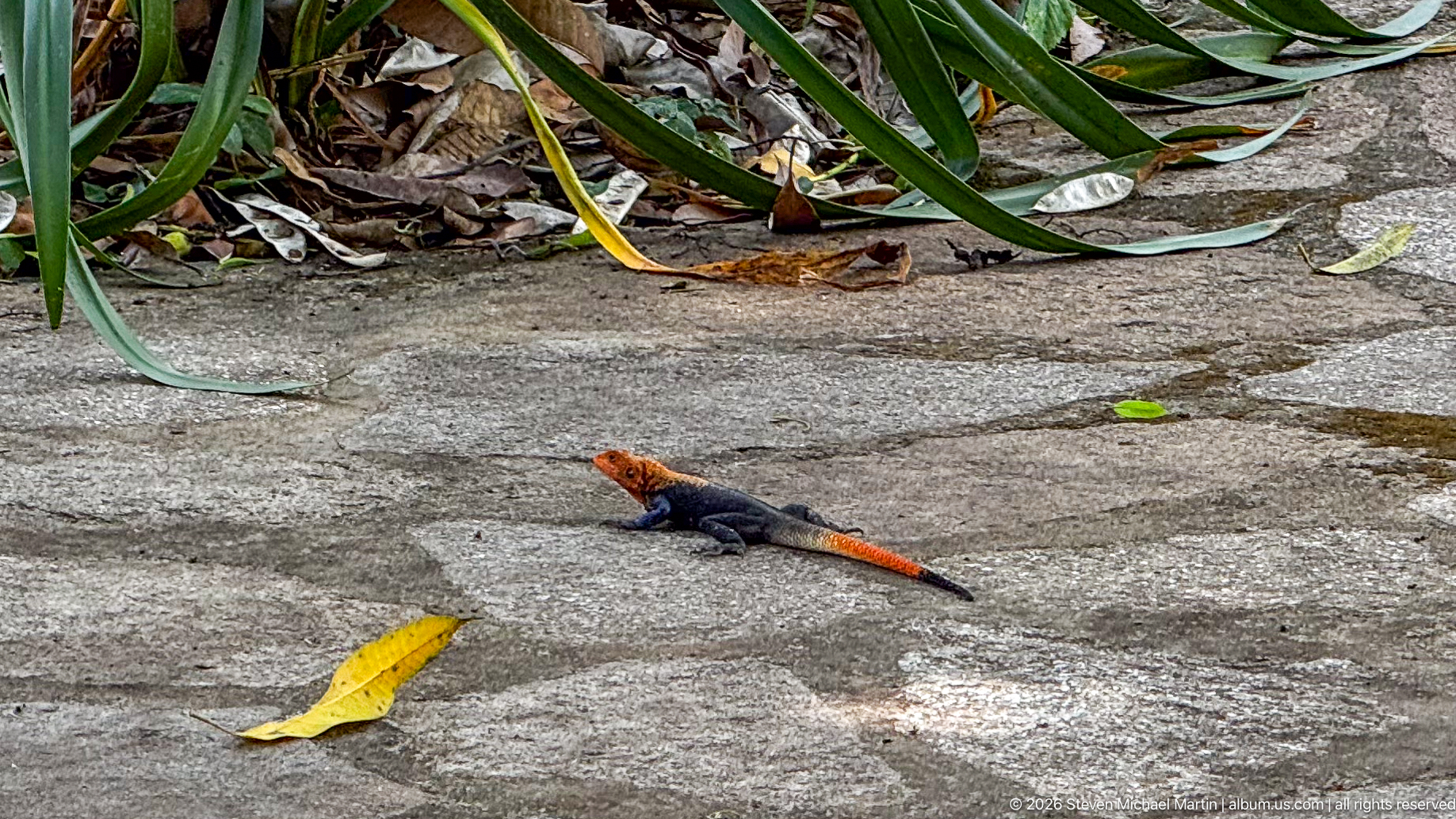
A brightly colored agama pauses on bare concrete beside fallen leaves, showing an orange-red head and tail against a dark blue-gray body. The contrasting breeding coloration is characteristic of an adult male red-headed agama, a conspicuous reptile often encountered on warm, exposed surfaces in East Africa.
Caption
A brightly colored agama pauses on bare concrete beside fallen leaves, showing an orange-red head and tail against a dark blue-gray body. The contrasting breeding coloration is characteristic of an adult male red-headed agama, a conspicuous reptile often encountered on warm, exposed surfaces in East Africa.

A smiling man in a white polo shirt stands in soft shade at an open-sided lodge, with a thatched-roof structure and greenery blurred behind him. The shallow depth of field isolates the portrait while retaining enough architectural context to place the sitter within the lodge setting near Murchison Falls.
Caption
A smiling man in a white polo shirt stands in soft shade at an open-sided lodge, with a thatched-roof structure and greenery blurred behind him. The shallow depth of field isolates the portrait while retaining enough architectural context to place the sitter within the lodge setting near Murchison Falls.

Framed from the chest up, a smiling man in a black polo stands beneath the timber-and-thatch structure of an open safari lodge. Warm background light and strongly blurred furnishings create a relaxed environmental portrait while keeping the lodge’s rustic construction visible as context.
Caption
Framed from the chest up, a smiling man in a black polo stands beneath the timber-and-thatch structure of an open safari lodge. Warm background light and strongly blurred furnishings create a relaxed environmental portrait while keeping the lodge’s rustic construction visible as context.

A close portrait centers a bearded man in a dark polo against the warm geometry of a thatched lodge roof and shaded veranda. Compared with the preceding view, the tighter framing gives greater emphasis to facial expression while the diagonal roof structure and sunlit vegetation remain recognizable in the background.
Caption
A close portrait centers a bearded man in a dark polo against the warm geometry of a thatched lodge roof and shaded veranda. Compared with the preceding view, the tighter framing gives greater emphasis to facial expression while the diagonal roof structure and sunlit vegetation remain recognizable in the background.
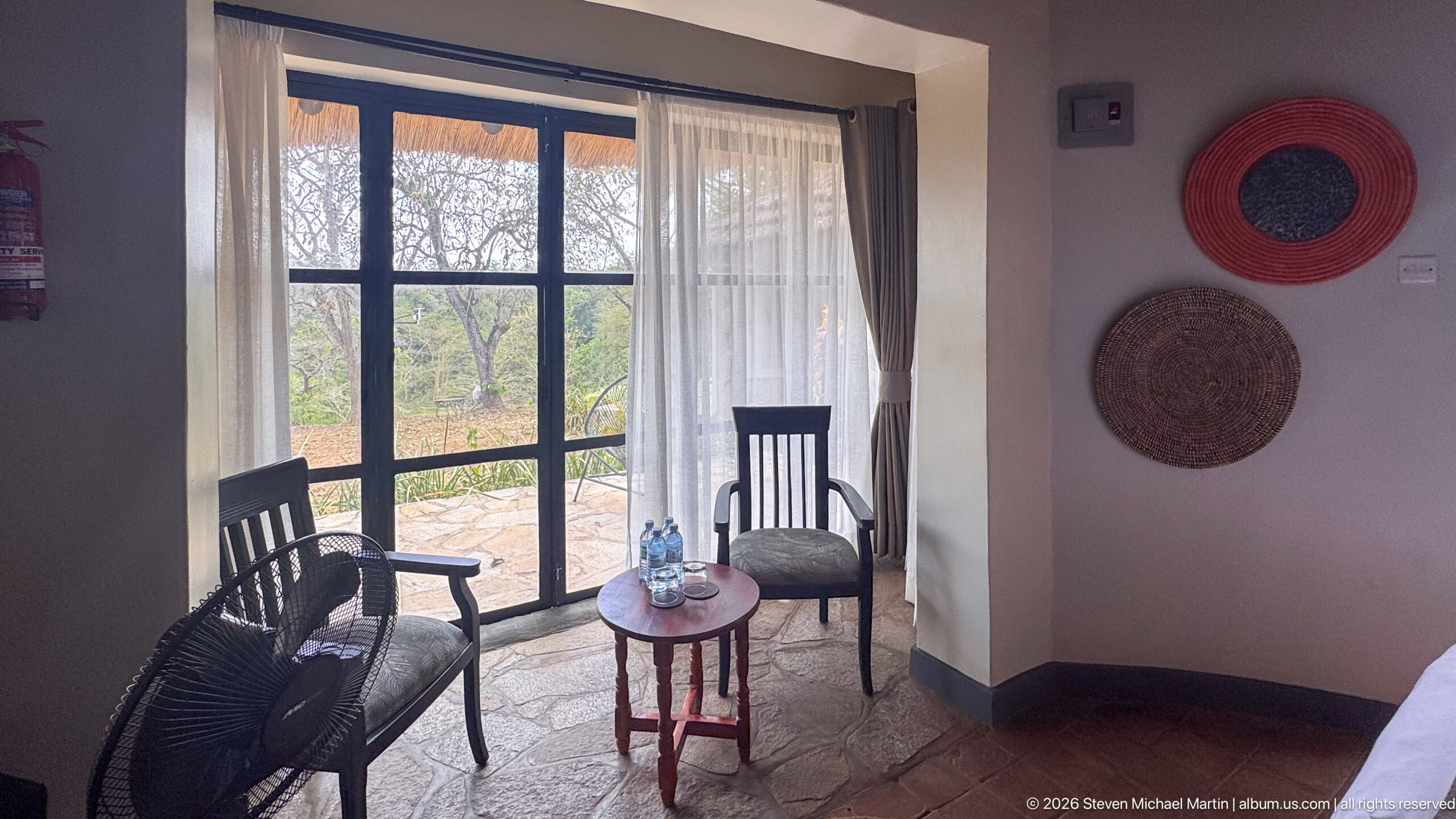
A small sitting area occupies the edge of a lodge guest room, with dark woven chairs gathered around a round wooden table beside tall glazed doors. Water bottles and glasses suggest a prepared guest space, while woven wall pieces and views into dry woodland add local texture and a strong connection to the outdoors.
Caption
A small sitting area occupies the edge of a lodge guest room, with dark woven chairs gathered around a round wooden table beside tall glazed doors. Water bottles and glasses suggest a prepared guest space, while woven wall pieces and views into dry woodland add local texture and a strong connection to the outdoors.
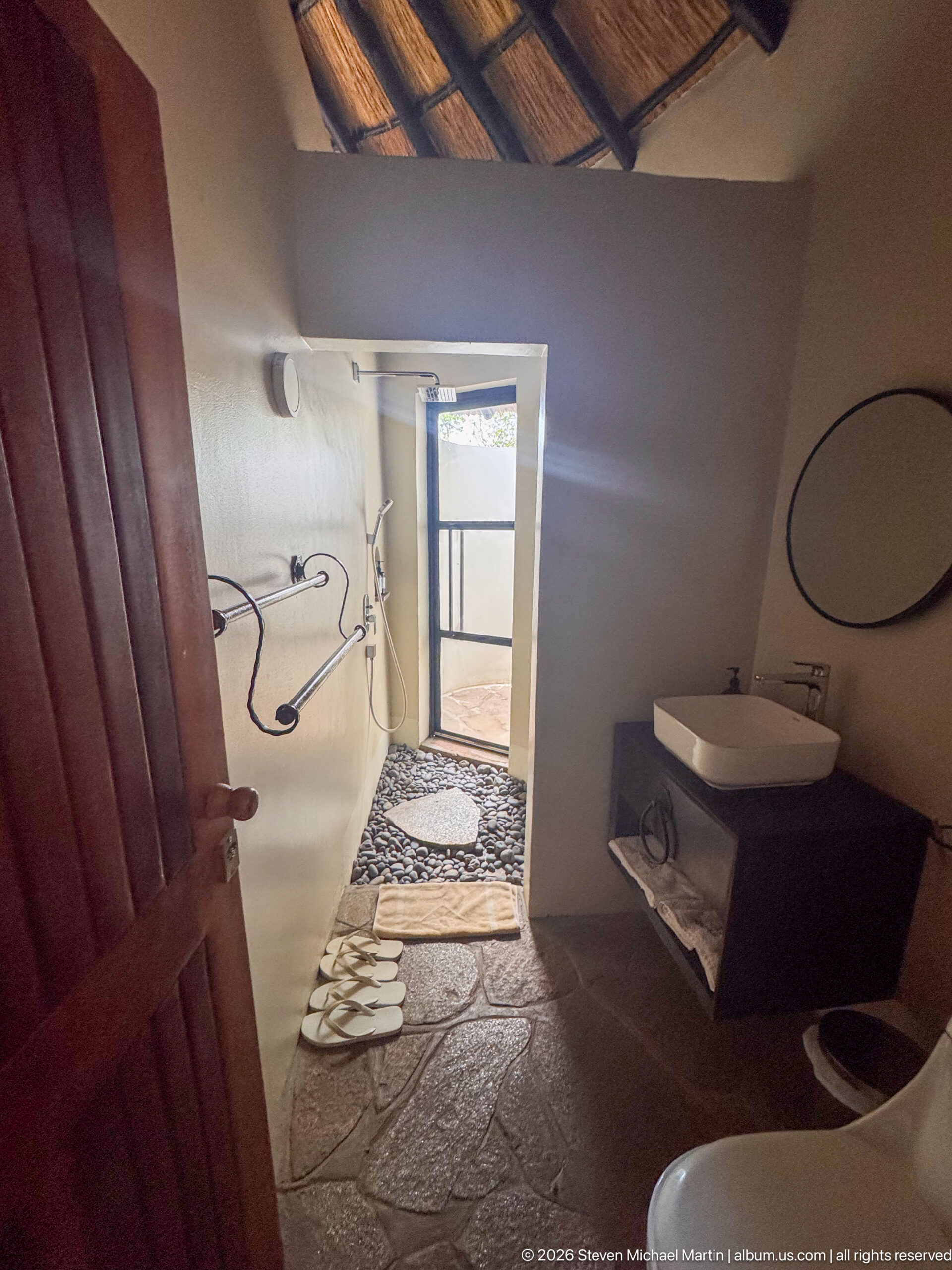
A compact lodge bathroom combines rough-textured stone flooring with simple white fixtures and a walk-in shower. Daylight enters through an exterior doorway at the far end, drawing the eye past the shower fittings and towels toward the threshold while the exposed thatch overhead reinforces the room’s safari-lodge character.
Caption
A compact lodge bathroom combines rough-textured stone flooring with simple white fixtures and a walk-in shower. Daylight enters through an exterior doorway at the far end, drawing the eye past the shower fittings and towels toward the threshold while the exposed thatch overhead reinforces the room’s safari-lodge character.
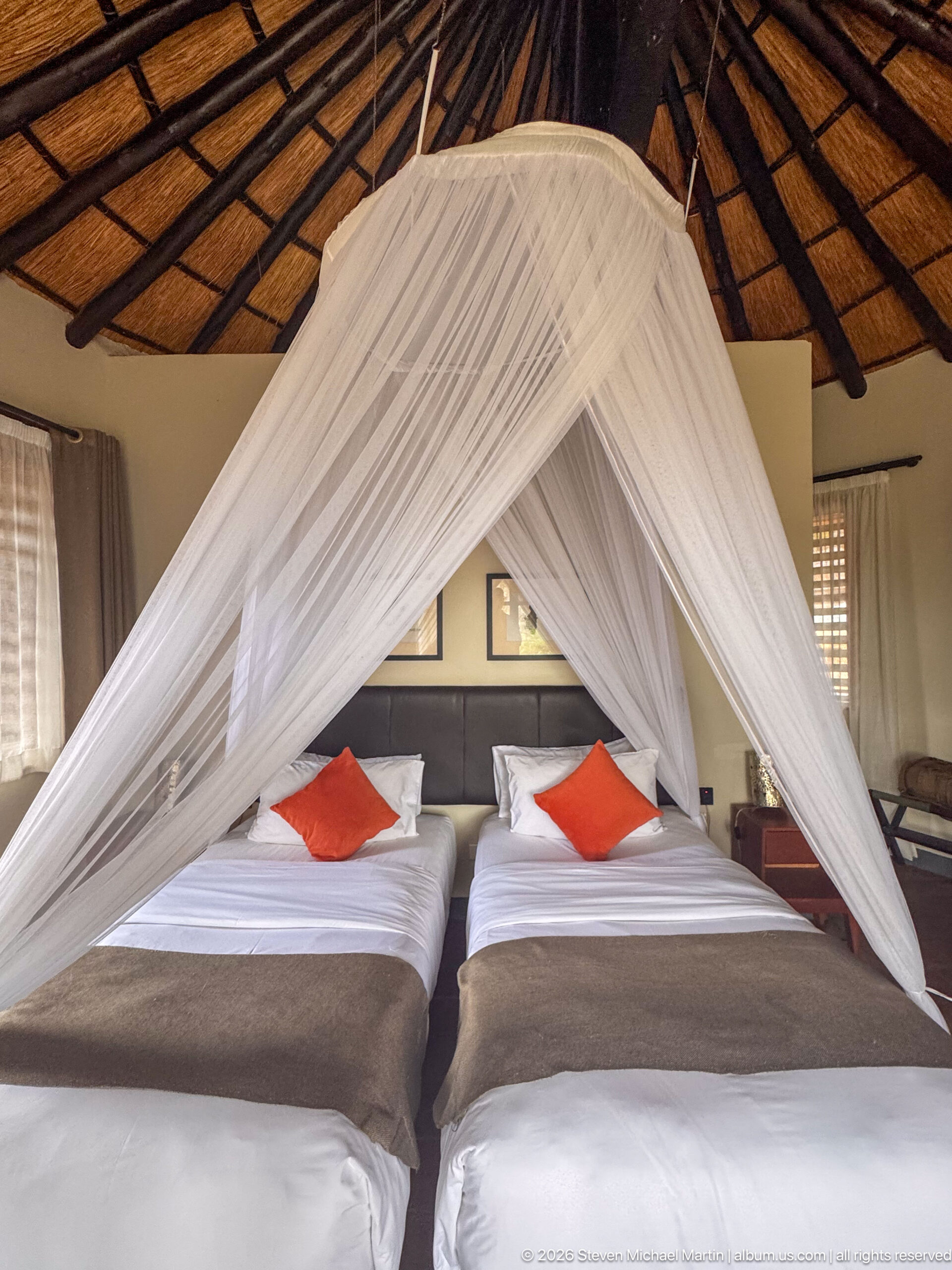
Two single beds sit side by side beneath a broad white mosquito net suspended from the high thatched roof. Orange accent cushions punctuate the otherwise neutral bedding, while the generous netting forms a protective canopy that visually defines the sleeping area within the safari-lodge room.
Caption
Two single beds sit side by side beneath a broad white mosquito net suspended from the high thatched roof. Orange accent cushions punctuate the otherwise neutral bedding, while the generous netting forms a protective canopy that visually defines the sleeping area within the safari-lodge room.
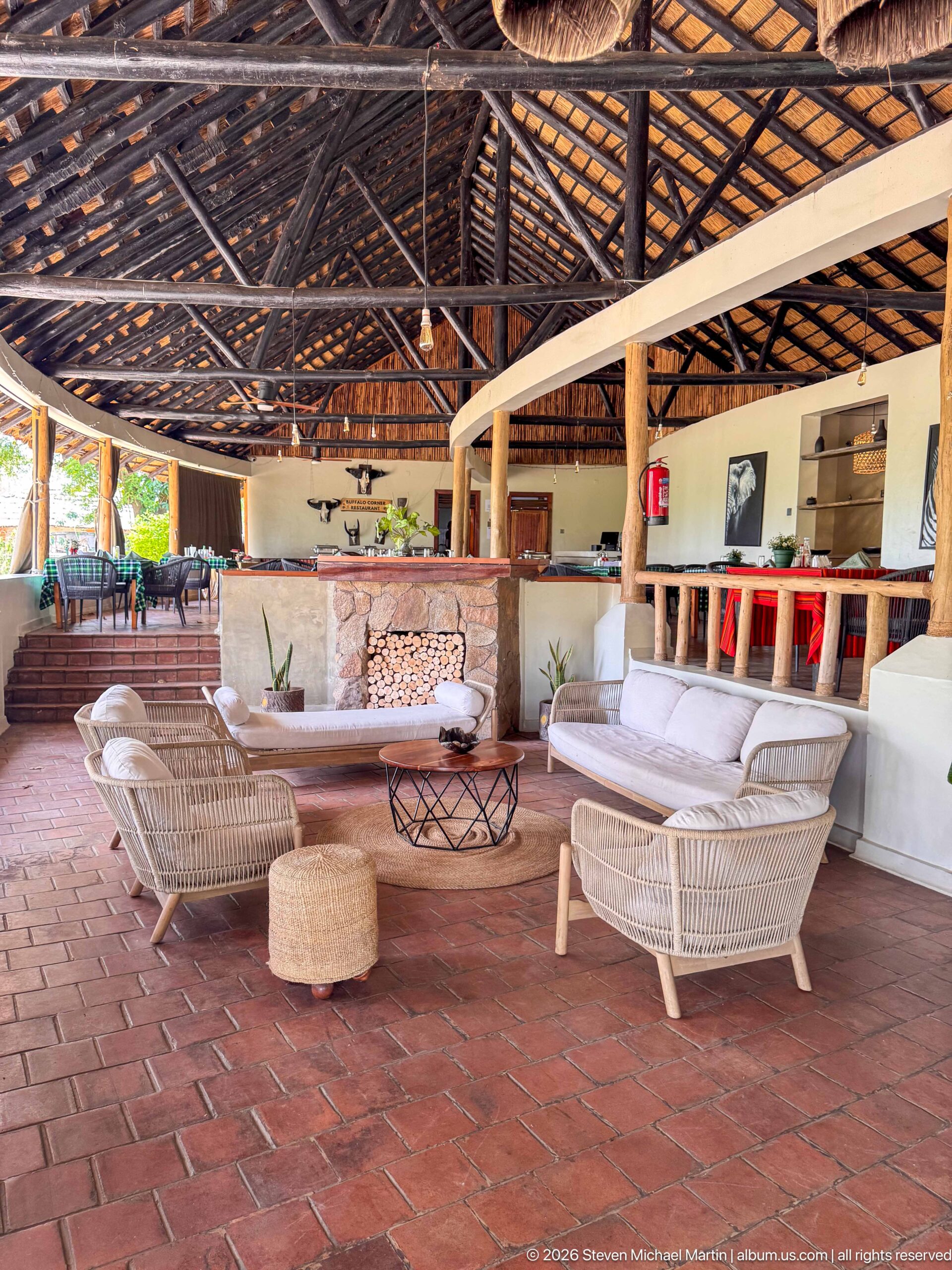
An expansive open-air lodge lounge spreads beneath a high timber-and-thatch roof, with pale wicker sofas and chairs arranged around low tables on a red-tile floor. A raised bar and stacked firewood anchor the far side, while open perimeter walls allow daylight and vegetation to become part of the interior.
Caption
An expansive open-air lodge lounge spreads beneath a high timber-and-thatch roof, with pale wicker sofas and chairs arranged around low tables on a red-tile floor. A raised bar and stacked firewood anchor the far side, while open perimeter walls allow daylight and vegetation to become part of the interior.
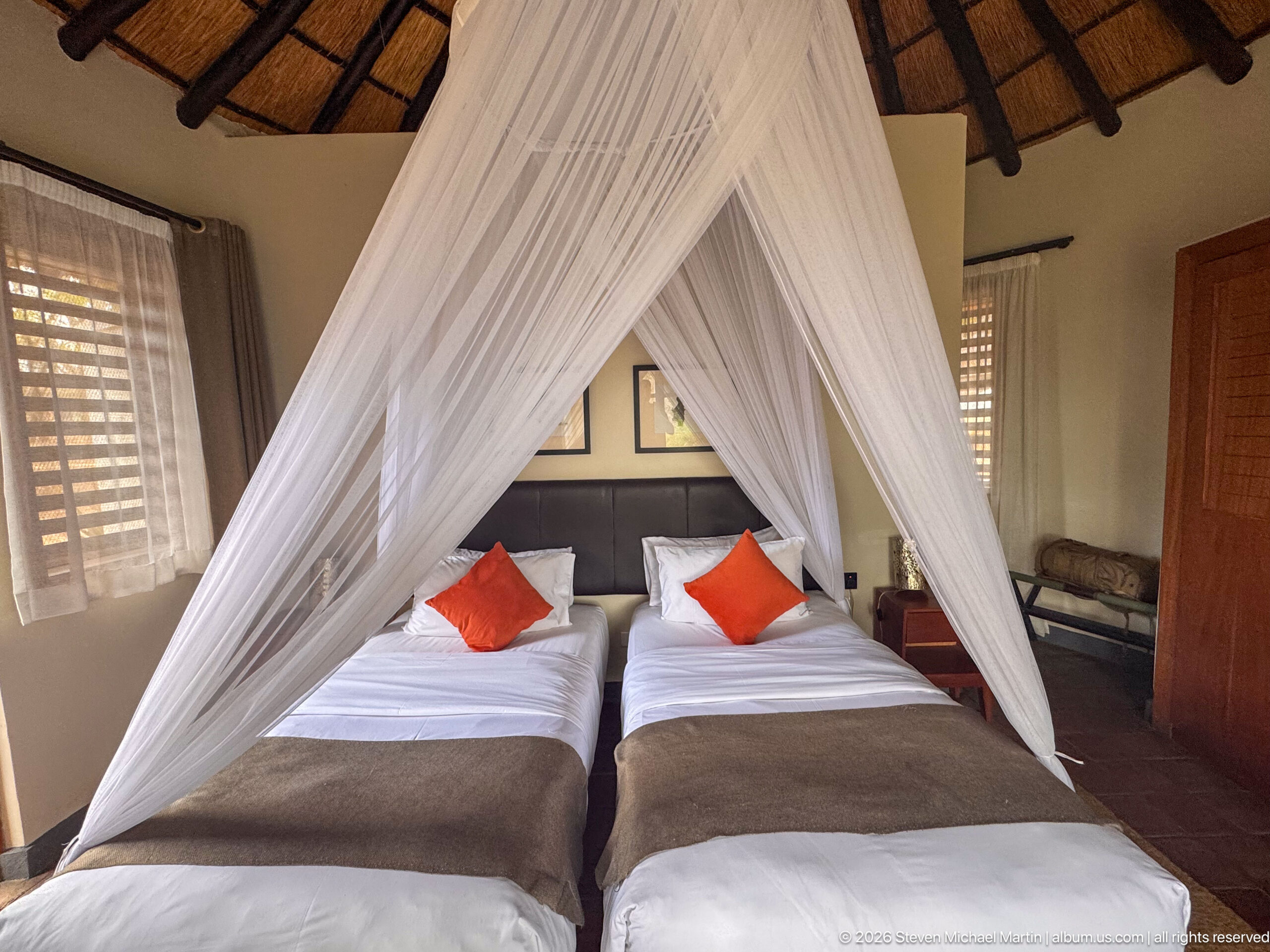
A frontal composition emphasizes the triangular fall of a white mosquito net over paired single beds. The symmetrical bedding, matching orange cushions, and centered canopy create a more formal view of the sleeping arrangement, while louvered windows and exposed roof timbers situate the beds within a naturally ventilated lodge room.
Caption
A frontal composition emphasizes the triangular fall of a white mosquito net over paired single beds. The symmetrical bedding, matching orange cushions, and centered canopy create a more formal view of the sleeping arrangement, while louvered windows and exposed roof timbers situate the beds within a naturally ventilated lodge room.
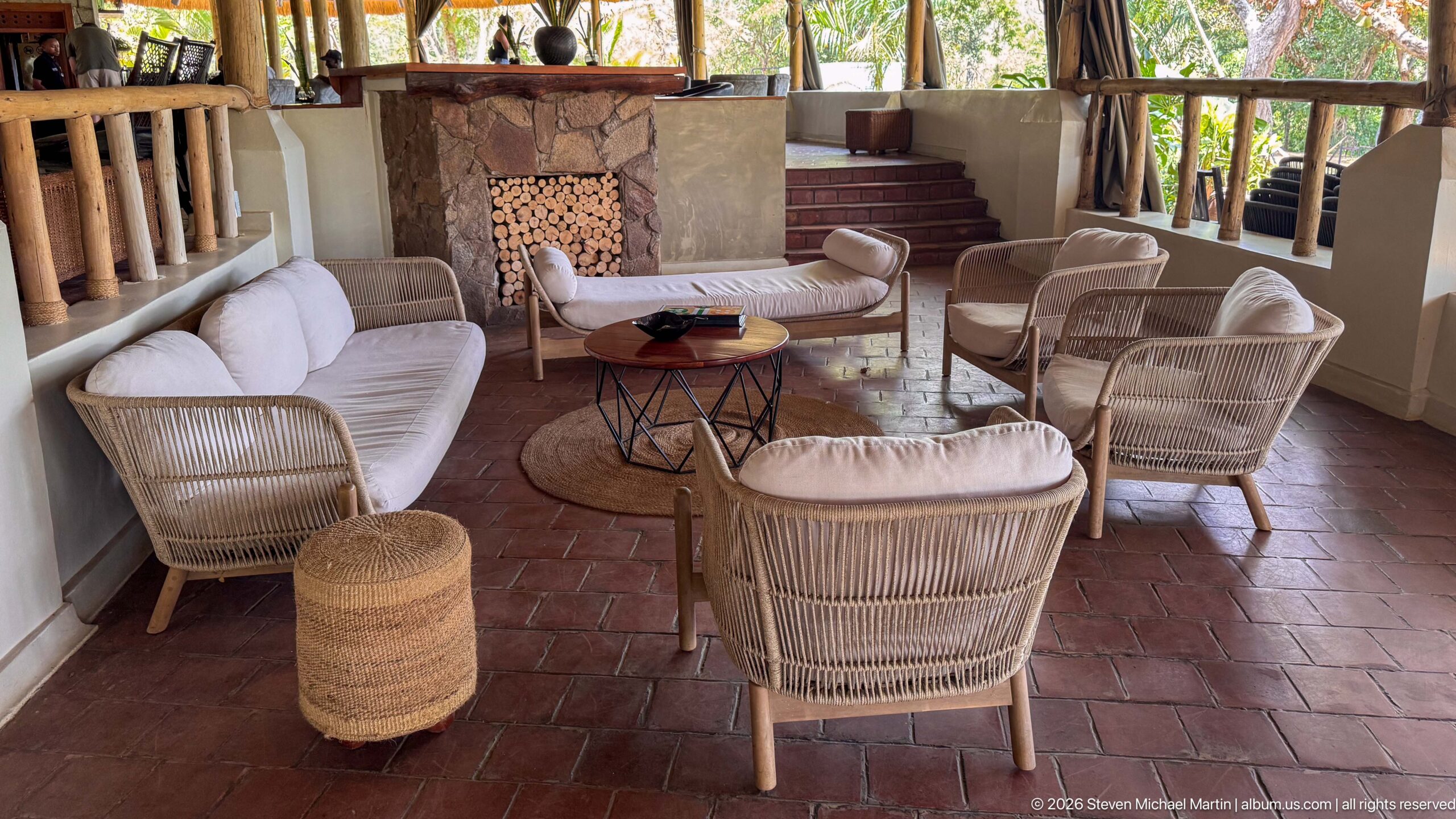
Pale wicker chairs and sofas gather around a small round table and woven rug beside a stone-faced fireplace or hearth. Seen from above the seating group, the composition stresses the lounge’s intimate scale, with red floor tiles, short steps, and timber railings defining the surrounding circulation space.
Caption
Pale wicker chairs and sofas gather around a small round table and woven rug beside a stone-faced fireplace or hearth. Seen from above the seating group, the composition stresses the lounge’s intimate scale, with red floor tiles, short steps, and timber railings defining the surrounding circulation space.
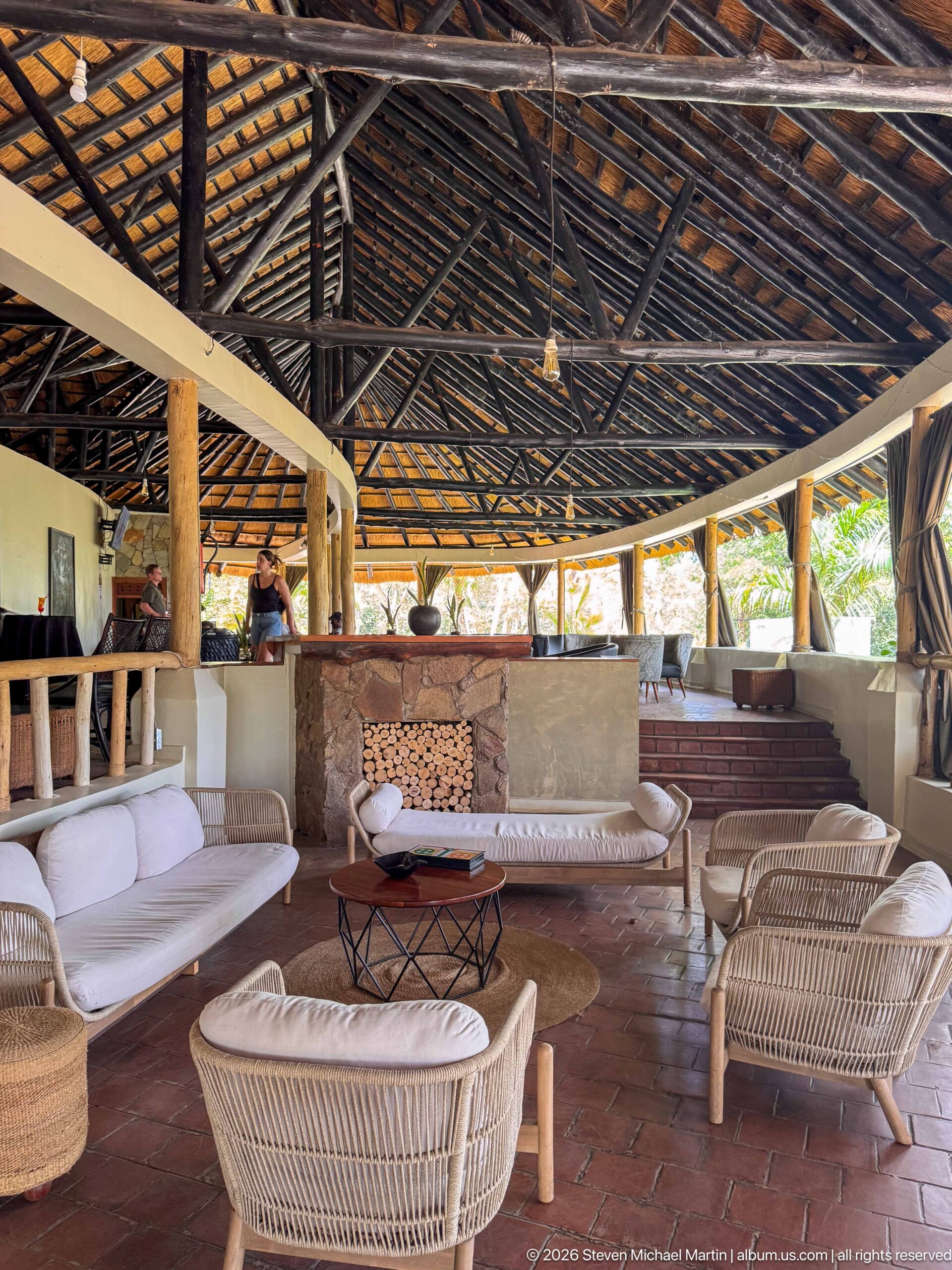
A central seating group of pale wicker chairs and sofas forms a conversational circle beneath the lodge’s exposed roof trusses. The lower viewpoint gives the furniture greater prominence than the adjacent overview, while the bar, firewood niche, steps, and open edges reveal how the lounge connects several levels and functions.
Caption
A central seating group of pale wicker chairs and sofas forms a conversational circle beneath the lodge’s exposed roof trusses. The lower viewpoint gives the furniture greater prominence than the adjacent overview, while the bar, firewood niche, steps, and open edges reveal how the lounge connects several levels and functions.
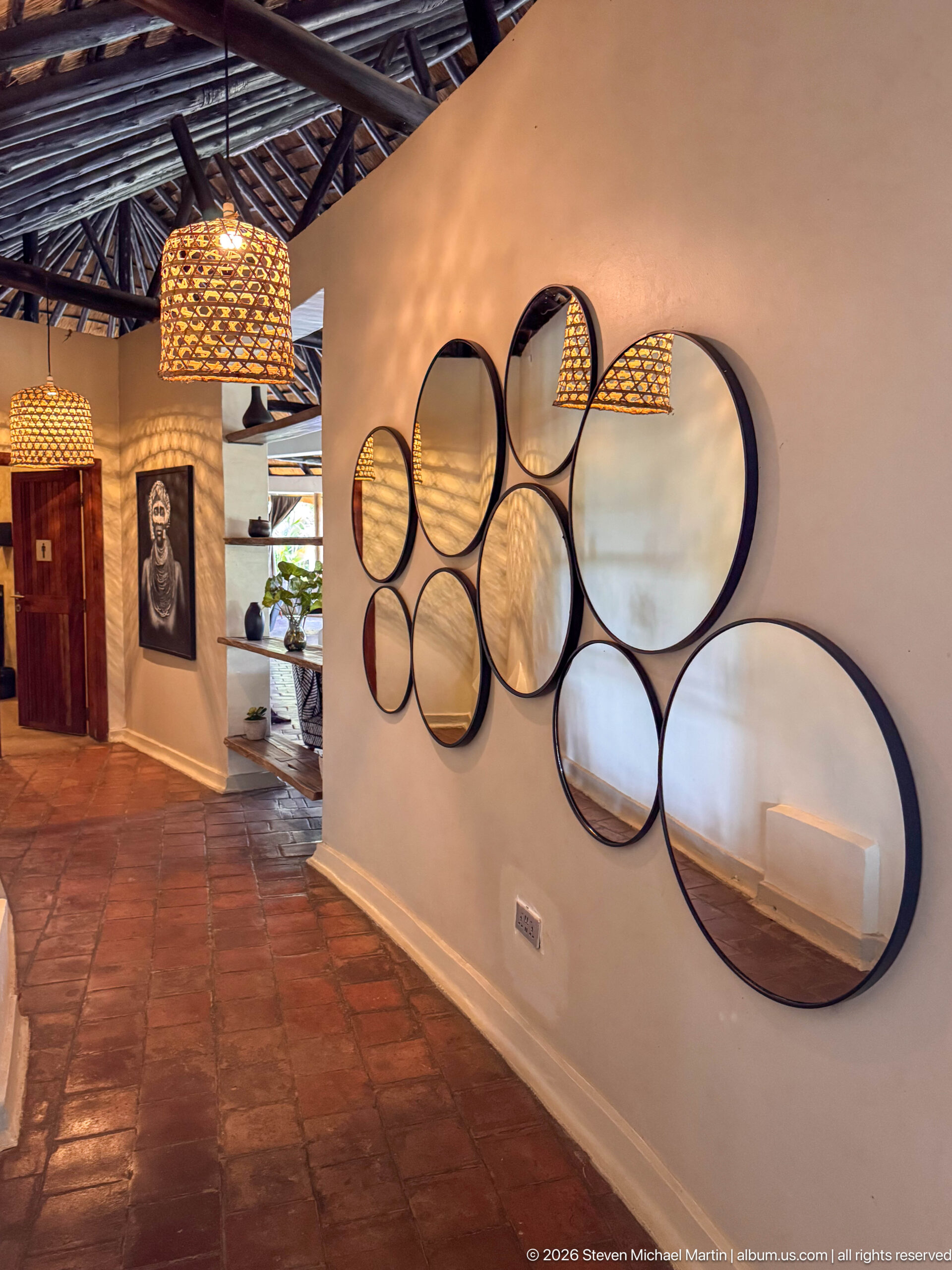
A sculptural cluster of round mirrors in varied diameters spreads across a pale interior wall, reflecting fragments of the lodge and patterned pendant lights. The overlapping black-edged circles turn a functional object into a graphic decorative installation, contrasting with the earthy red-tile floor and exposed roof structure.
Caption
A sculptural cluster of round mirrors in varied diameters spreads across a pale interior wall, reflecting fragments of the lodge and patterned pendant lights. The overlapping black-edged circles turn a functional object into a graphic decorative installation, contrasting with the earthy red-tile floor and exposed roof structure.
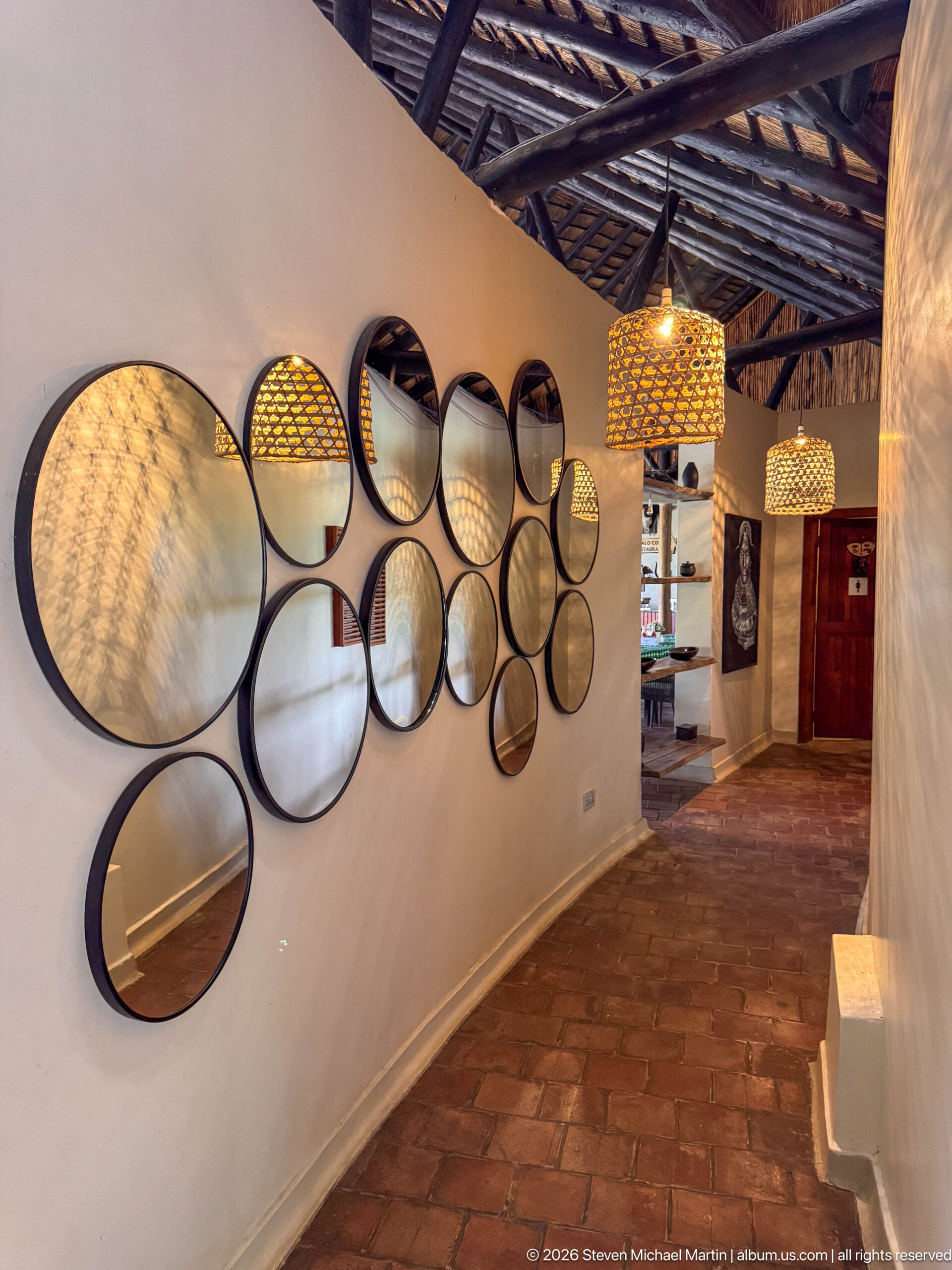
An extended view of the mirror installation reveals a larger rhythm of black-rimmed circles stretching along the lodge wall. Reflections of woven pendant shades and interior openings animate the otherwise pale surface, while the oblique viewpoint shows how the decorative feature guides movement through the adjoining corridor.
Caption
An extended view of the mirror installation reveals a larger rhythm of black-rimmed circles stretching along the lodge wall. Reflections of woven pendant shades and interior openings animate the otherwise pale surface, while the oblique viewpoint shows how the decorative feature guides movement through the adjoining corridor.
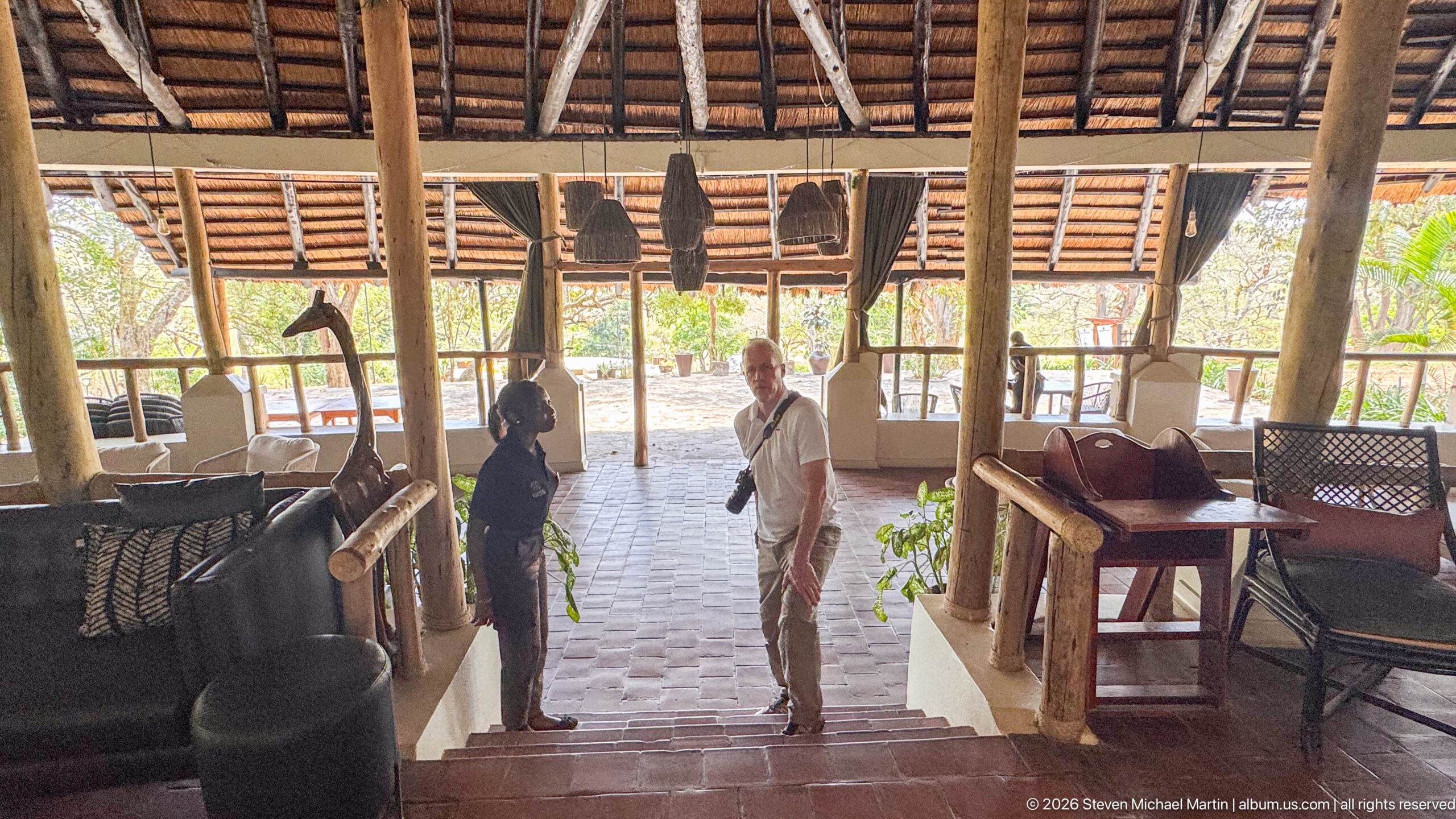
Two people converse at the foot of short steps within an open-sided lodge passage, surrounded by heavy timber posts, woven seating, and suspended basket-like light shades. The scene records the lodge as an active social space rather than an empty interior, with bright vegetation visible beyond the shaded structure.
Caption
Two people converse at the foot of short steps within an open-sided lodge passage, surrounded by heavy timber posts, woven seating, and suspended basket-like light shades. The scene records the lodge as an active social space rather than an empty interior, with bright vegetation visible beyond the shaded structure.
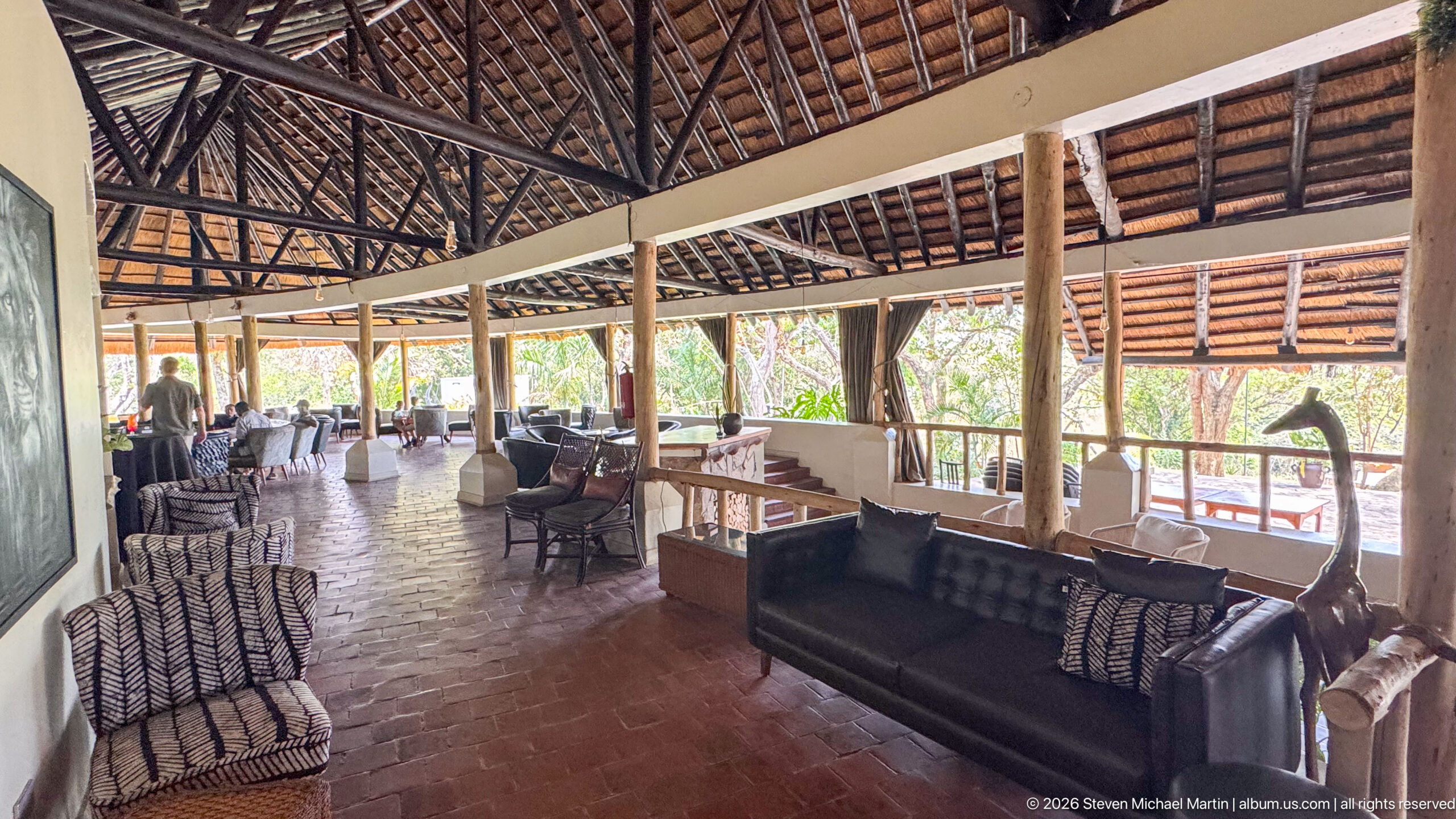
A long veranda-like gallery runs beneath a steep timber-and-thatch roof, furnished with dark leather and patterned chairs along a red-tile floor. Repeated posts and roof trusses create strong perspective toward the distant end, while the open right side admits daylight and views of surrounding vegetation.
Caption
A long veranda-like gallery runs beneath a steep timber-and-thatch roof, furnished with dark leather and patterned chairs along a red-tile floor. Repeated posts and roof trusses create strong perspective toward the distant end, while the open right side admits daylight and views of surrounding vegetation.
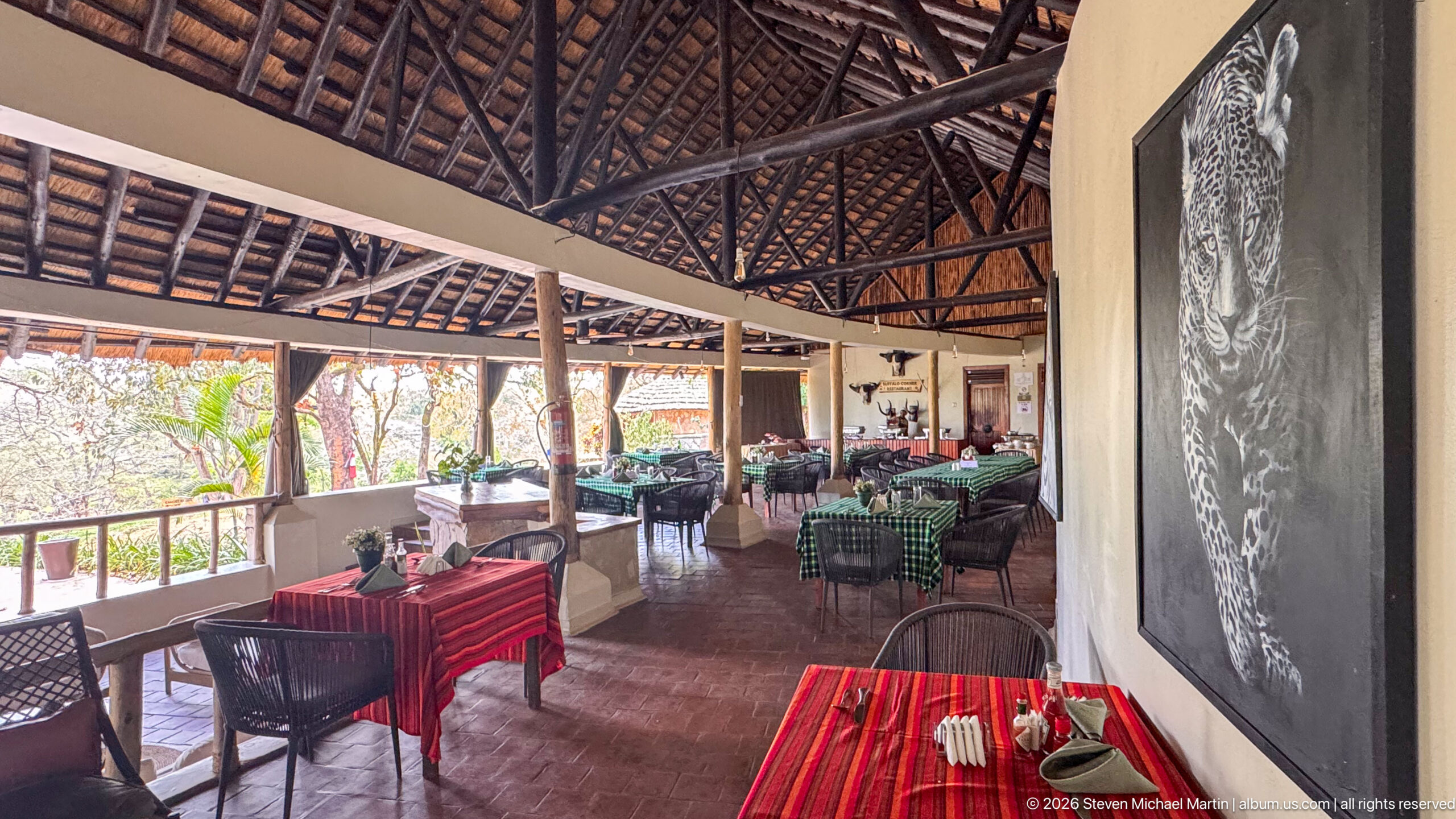
Dining tables dressed in red-striped textiles line an open-sided lodge terrace beneath exposed timber trusses. A large monochrome leopard portrait dominates the near wall, linking the dining space visually to the region’s wildlife while the open railing and trees keep the room connected to the surrounding landscape.
Caption
Dining tables dressed in red-striped textiles line an open-sided lodge terrace beneath exposed timber trusses. A large monochrome leopard portrait dominates the near wall, linking the dining space visually to the region’s wildlife while the open railing and trees keep the room connected to the surrounding landscape.
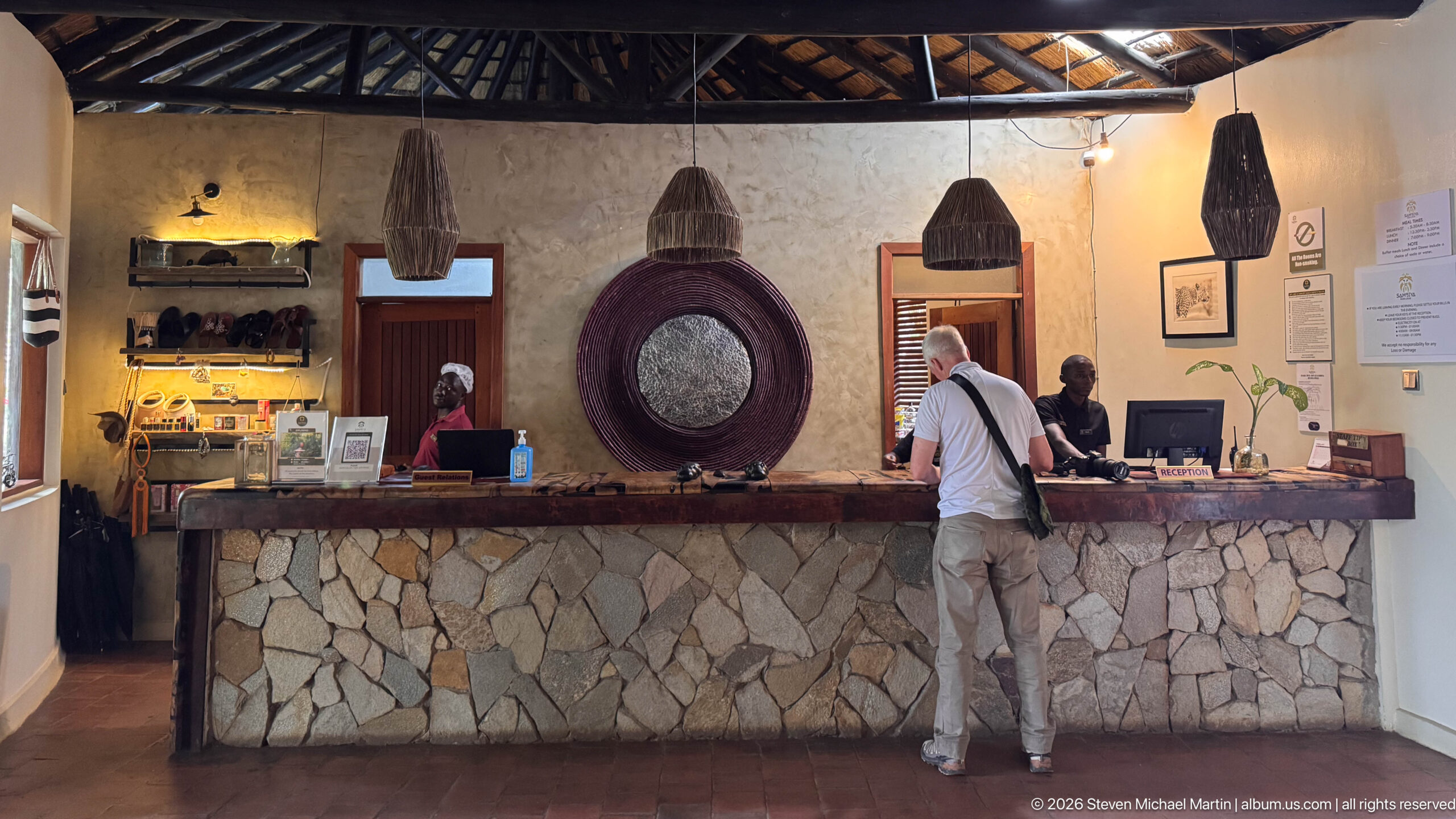
A stone-faced reception counter spans the lodge entrance area beneath woven pendant shades and a high exposed roof. A guest stands at the desk speaking with staff, while shelves, notices, framed artwork, and a large circular woven wall piece identify the space as the practical arrival and service point.
Caption
A stone-faced reception counter spans the lodge entrance area beneath woven pendant shades and a high exposed roof. A guest stands at the desk speaking with staff, while shelves, notices, framed artwork, and a large circular woven wall piece identify the space as the practical arrival and service point.
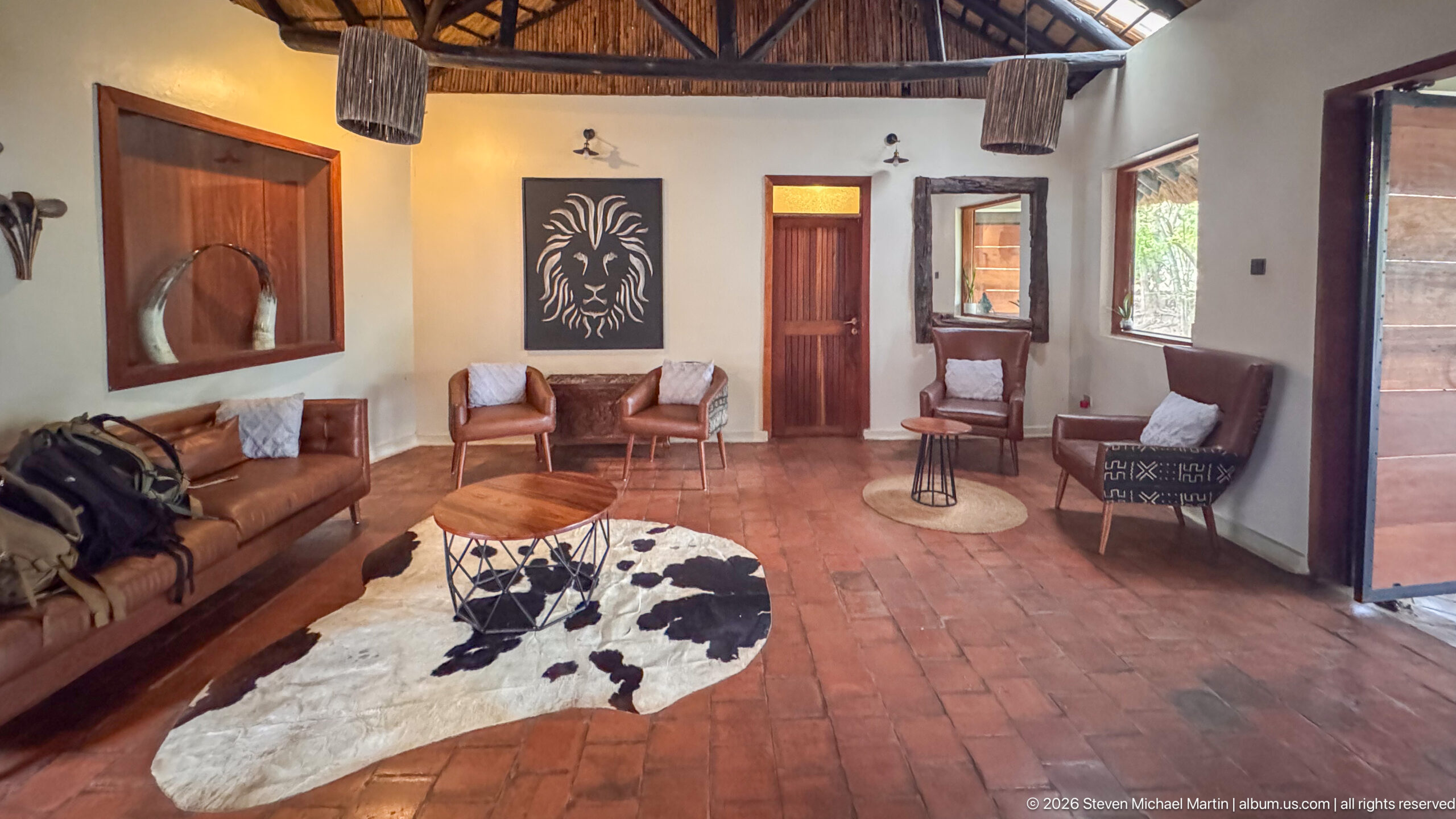
A lodge sitting room combines leather and upholstered seating with a round wooden table and a black-and-white hide rug on terracotta tiles. A stylized lion portrait anchors the central wall, while wooden doors, mirrors, woven light shades, and an open exterior doorway give the room a layered, residential character.
Caption
A lodge sitting room combines leather and upholstered seating with a round wooden table and a black-and-white hide rug on terracotta tiles. A stylized lion portrait anchors the central wall, while wooden doors, mirrors, woven light shades, and an open exterior doorway give the room a layered, residential character.
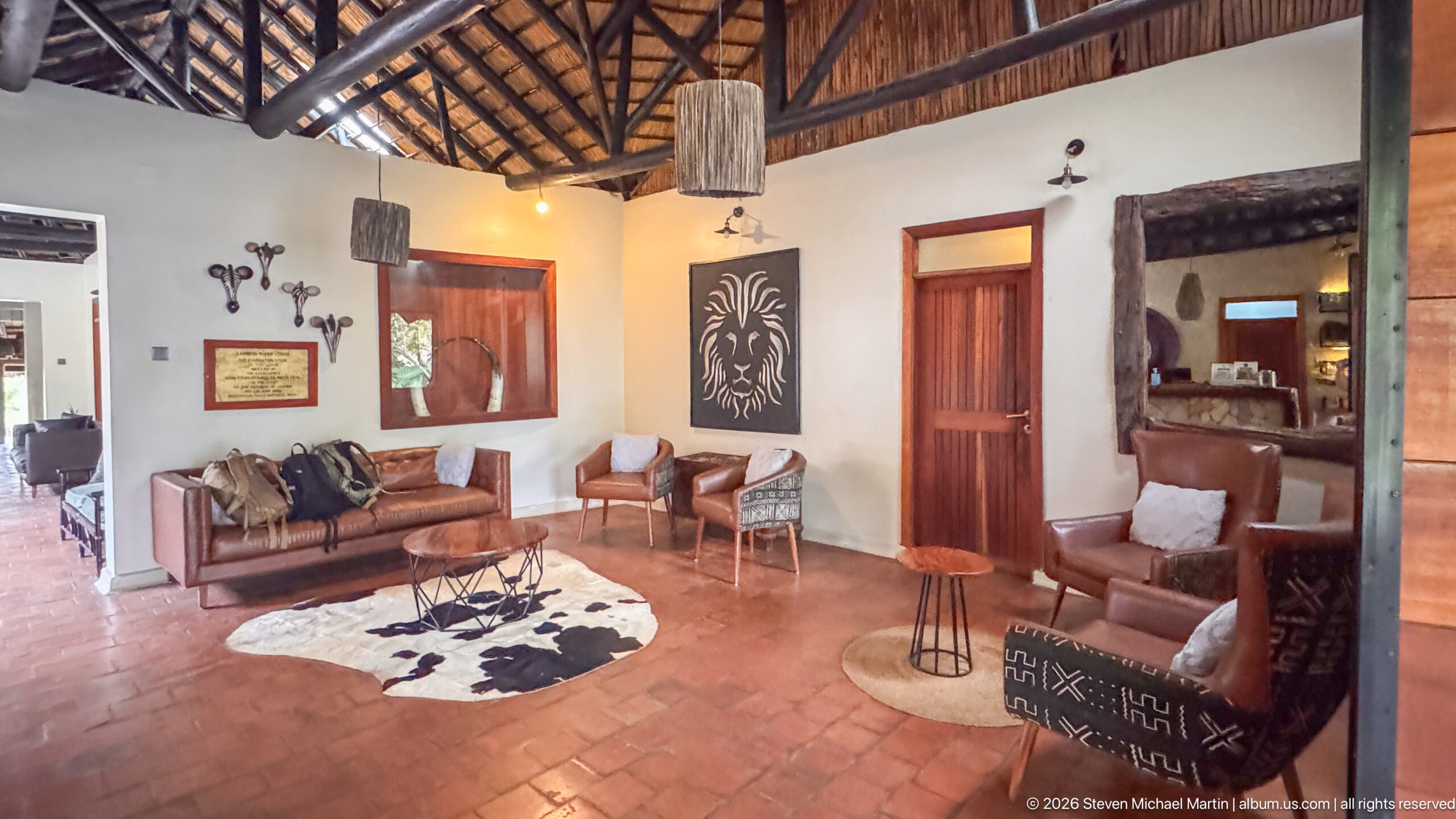
Seen diagonally across the room, the lounge’s seating, hide rug, wooden doors, mirrors, and wildlife-themed wall decoration form a compact ensemble beneath the thatched roof. The angled viewpoint reveals adjoining openings and gives greater prominence to the carved or patterned furniture at right, distinguishing this view from the broader architectural overview.
Caption
Seen diagonally across the room, the lounge’s seating, hide rug, wooden doors, mirrors, and wildlife-themed wall decoration form a compact ensemble beneath the thatched roof. The angled viewpoint reveals adjoining openings and gives greater prominence to the carved or patterned furniture at right, distinguishing this view from the broader architectural overview.
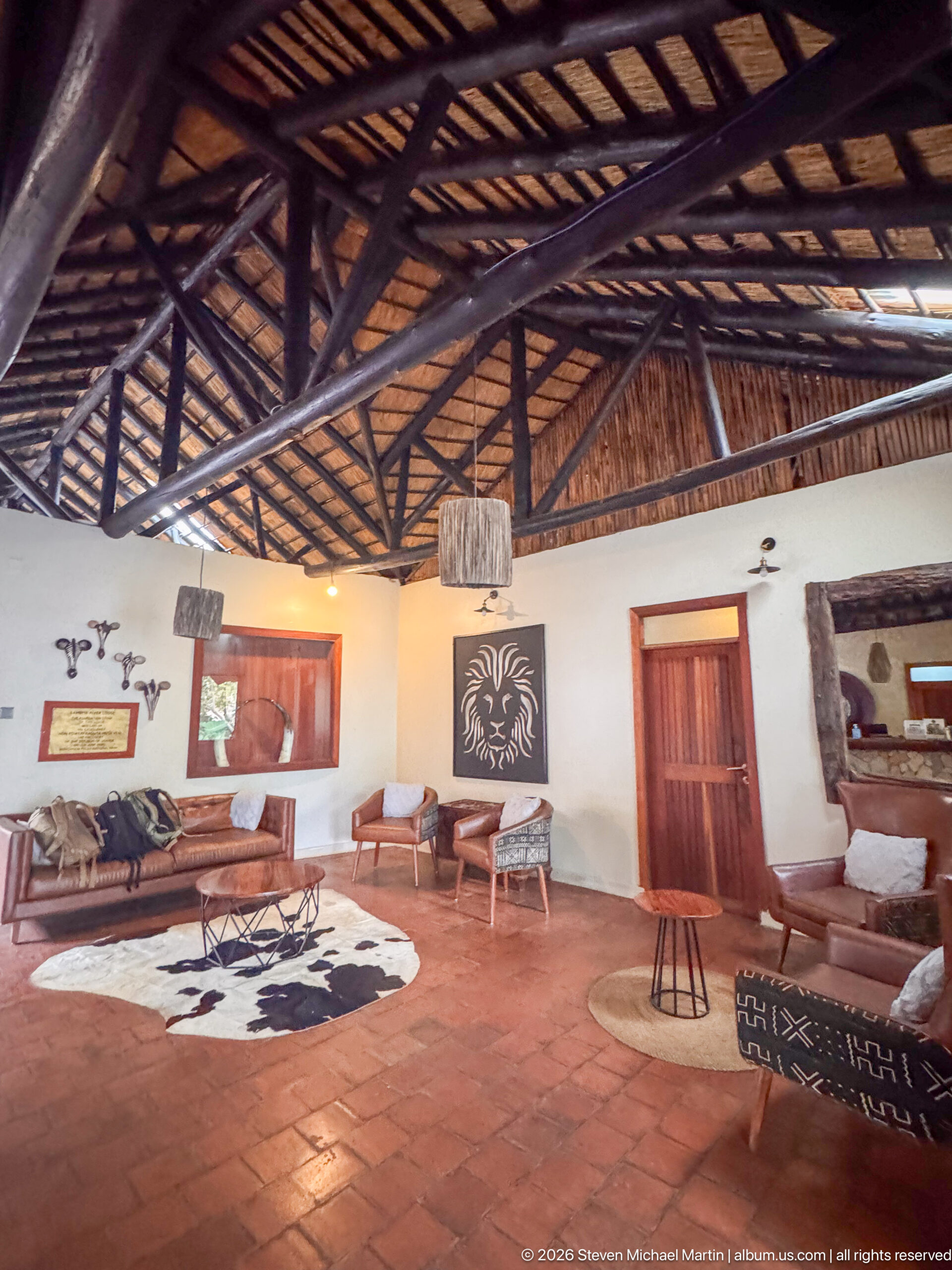
A wide-angle view opens the sitting room beneath an expansive lattice of dark timber rafters. Seating is dispersed around small tables and layered rugs, while the stylized lion panel remains a visual focal point on the white wall; the broader framing emphasizes the scale and roof construction more than the individual furnishings.
Caption
A wide-angle view opens the sitting room beneath an expansive lattice of dark timber rafters. Seating is dispersed around small tables and layered rugs, while the stylized lion panel remains a visual focal point on the white wall; the broader framing emphasizes the scale and roof construction more than the individual furnishings.
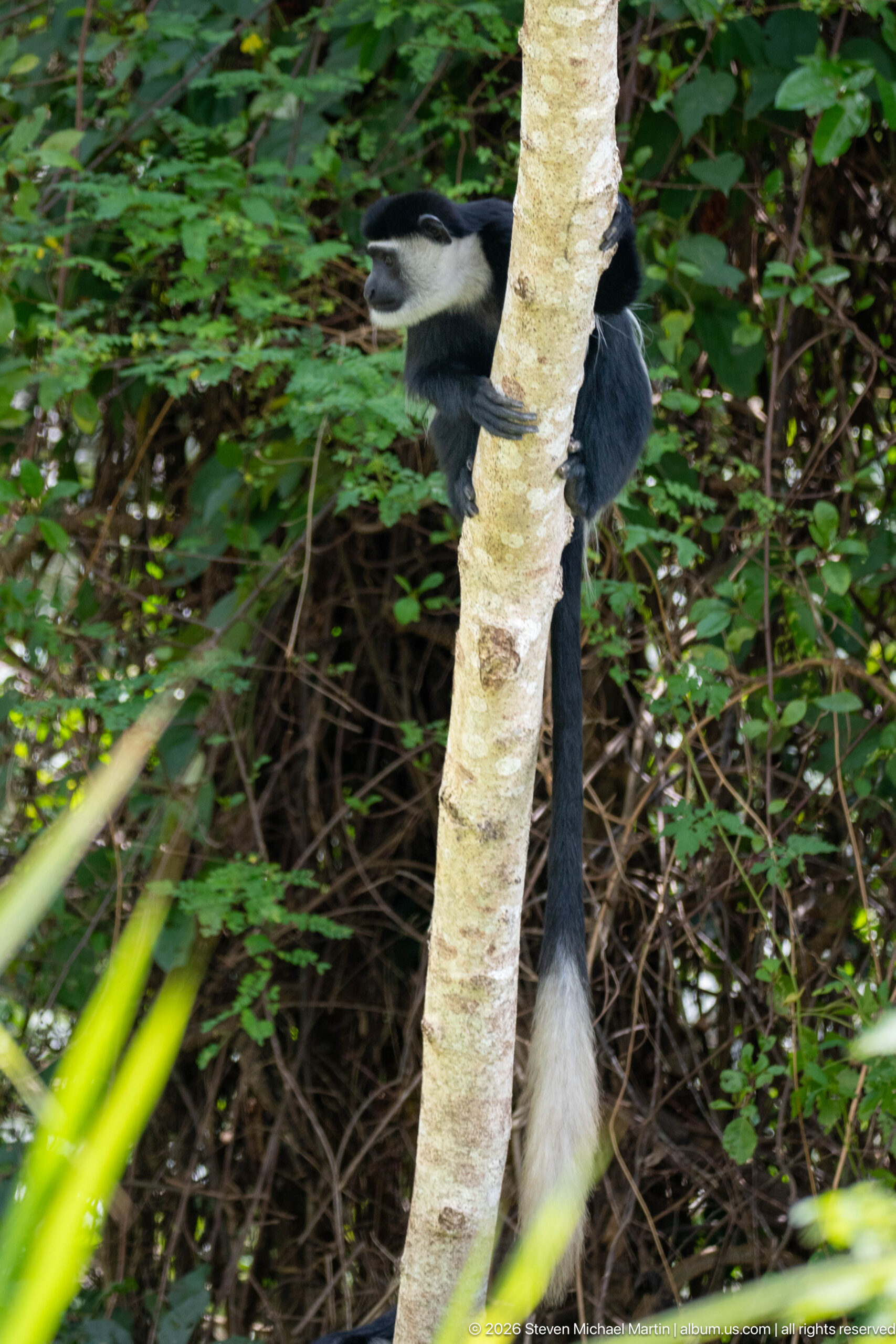
A mantled guereza clings to a pale tree trunk in dense forest, partly concealed by foliage. Its black body, white facial fringe, and long white mantle and tail contrast strongly with the surrounding green vegetation, emphasizing the arboreal habits of this distinctive black-and-white colobus monkey.
Caption
A mantled guereza clings to a pale tree trunk in dense forest, partly concealed by foliage. Its black body, white facial fringe, and long white mantle and tail contrast strongly with the surrounding green vegetation, emphasizing the arboreal habits of this distinctive black-and-white colobus monkey.
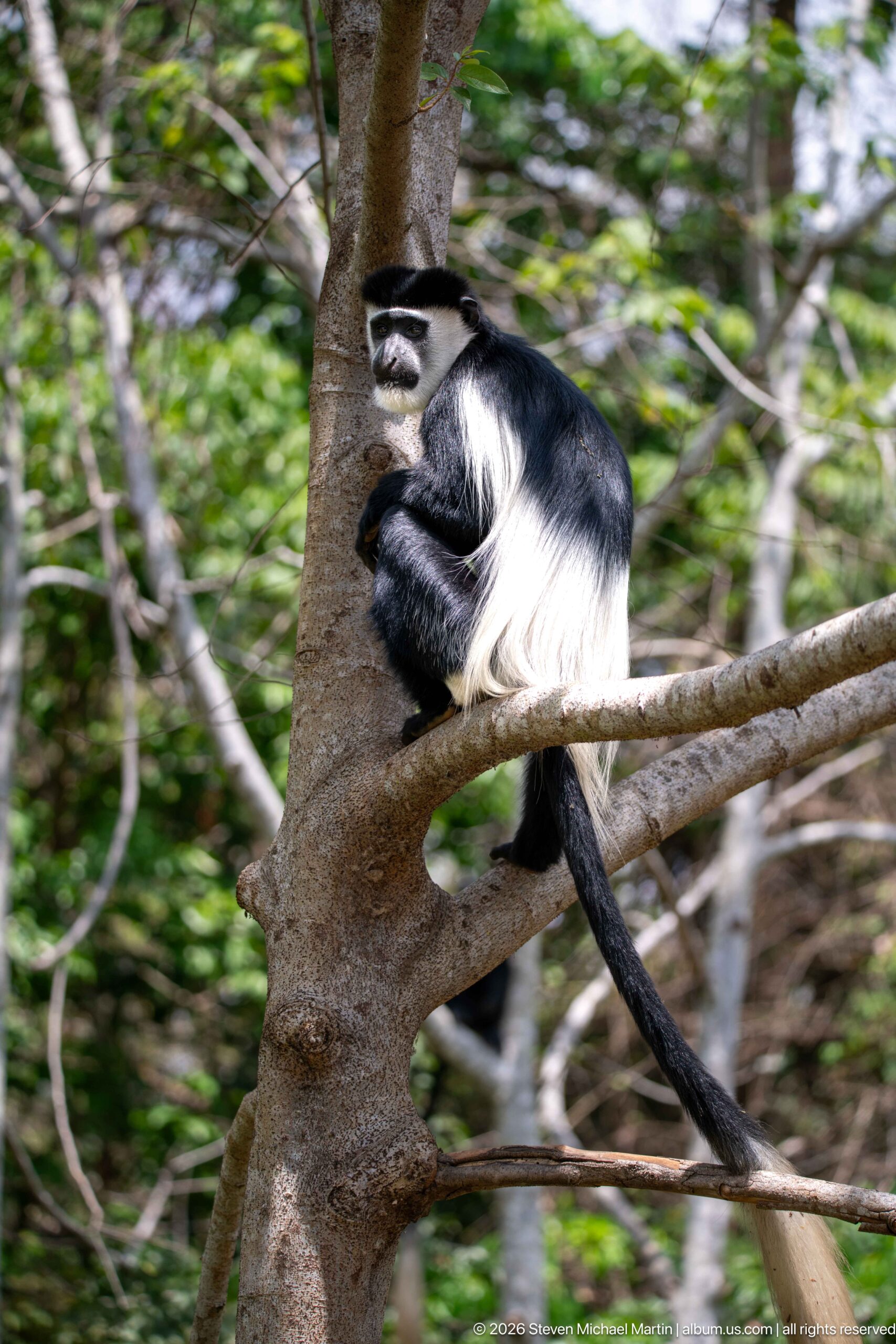
Perched in the fork of a tree, a mantled guereza folds its limbs close to the trunk while its long tail drops behind the branches. White facial and shoulder hair frame the otherwise black body, and the elevated resting position places the monkey securely within its wooded habitat.
Caption
Perched in the fork of a tree, a mantled guereza folds its limbs close to the trunk while its long tail drops behind the branches. White facial and shoulder hair frame the otherwise black body, and the elevated resting position places the monkey securely within its wooded habitat.
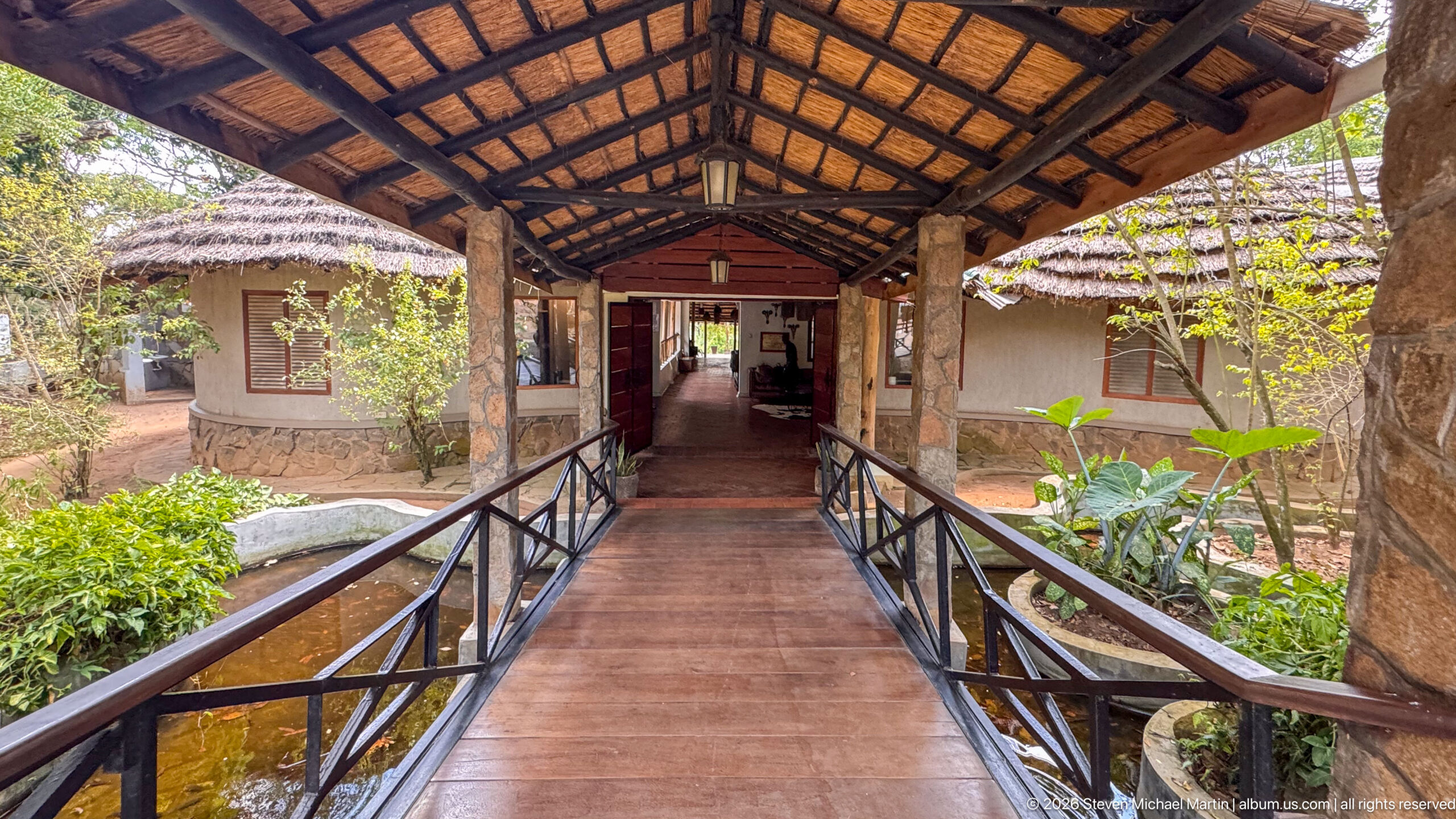
A raised wooden walkway leads beneath a pitched thatched canopy toward the lodge interior, with black railings crossing a landscaped drainage or garden area. Round thatched guest structures stand to either side, creating a clear transition between separate buildings while keeping circulation sheltered from sun and rain.
Caption
A raised wooden walkway leads beneath a pitched thatched canopy toward the lodge interior, with black railings crossing a landscaped drainage or garden area. Round thatched guest structures stand to either side, creating a clear transition between separate buildings while keeping circulation sheltered from sun and rain.
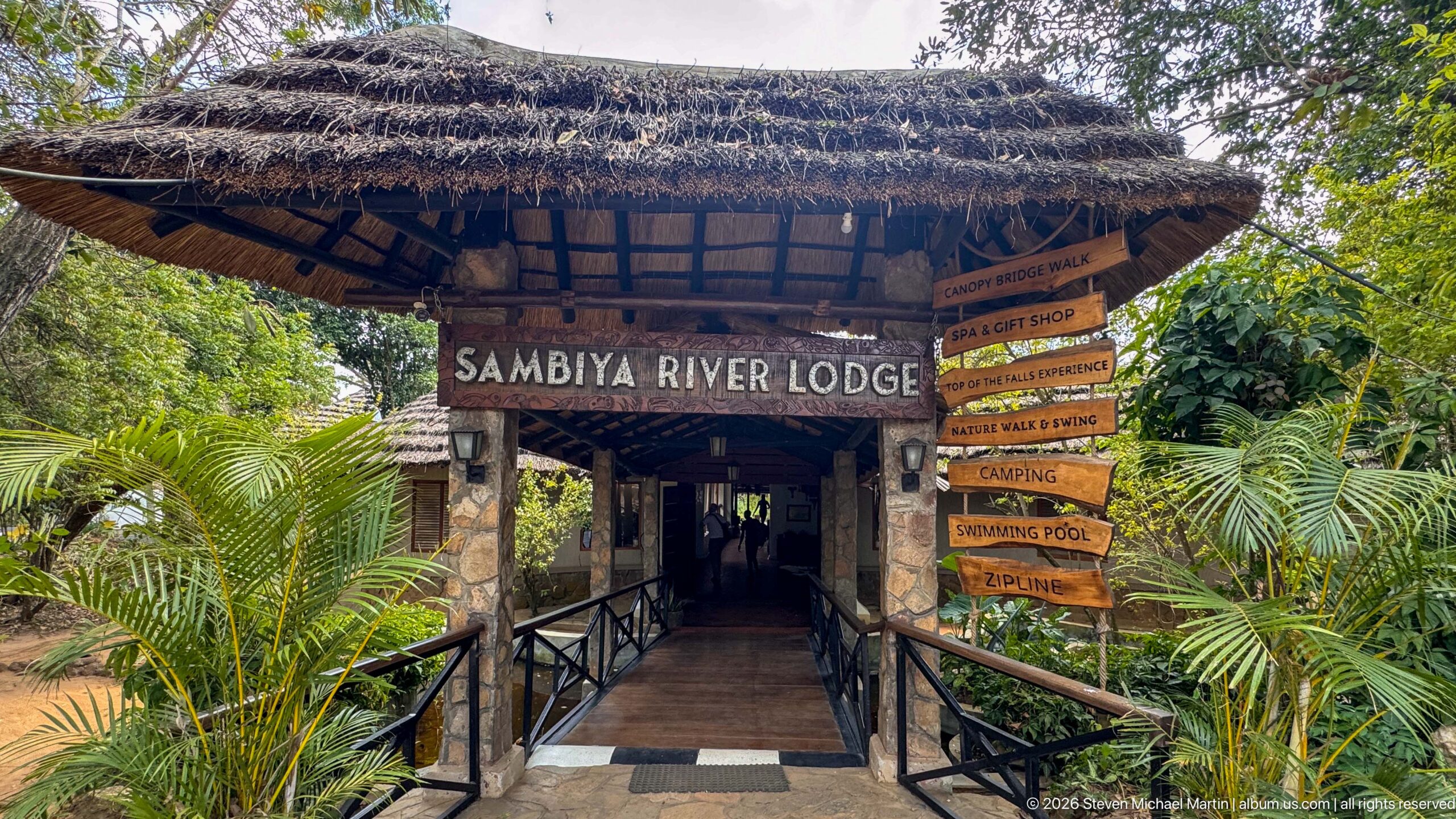
The covered entrance to Sambiya River Lodge is marked by a prominent wooden name sign suspended beneath a thatched roof. Smaller directional boards point toward facilities including the bar and gift shop, while palms, stone piers, and the raised walkway frame the arrival route into the lodge complex.
Caption
The covered entrance to Sambiya River Lodge is marked by a prominent wooden name sign suspended beneath a thatched roof. Smaller directional boards point toward facilities including the bar and gift shop, while palms, stone piers, and the raised walkway frame the arrival route into the lodge complex.
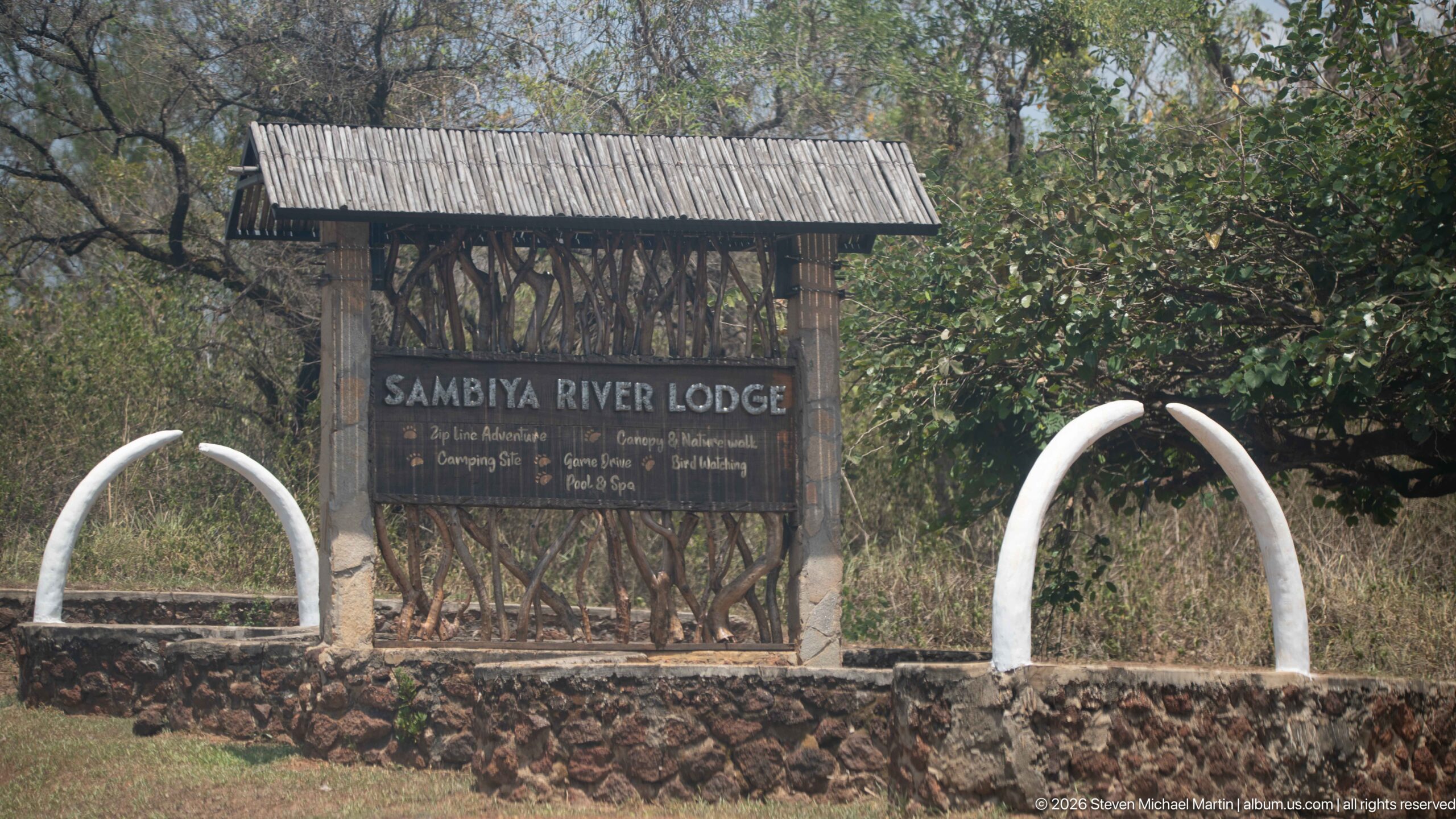
A rustic roadside marker announces Sambiya River Lodge with lettering set into a branch-built wooden panel beneath a small pitched roof. White tusk-shaped arches flank the sign above a low stone base, creating a conspicuous gateway feature against the dry woodland bordering the road.
Caption
A rustic roadside marker announces Sambiya River Lodge with lettering set into a branch-built wooden panel beneath a small pitched roof. White tusk-shaped arches flank the sign above a low stone base, creating a conspicuous gateway feature against the dry woodland bordering the road.
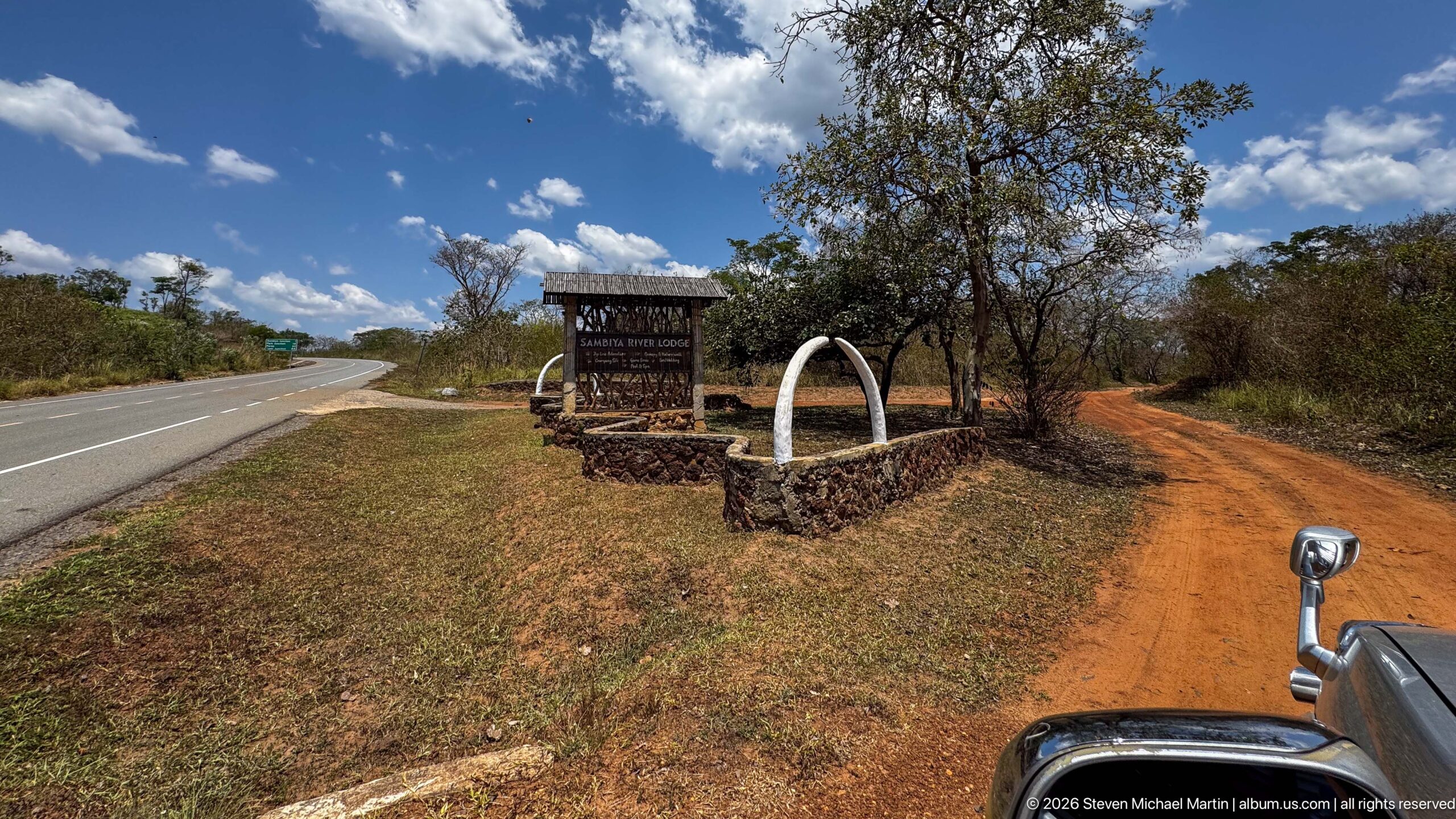
The Sambiya River Lodge entrance marker stands between a paved highway and a red-earth access track, showing how the lodge connects to the surrounding road network. The rustic sign and white tusk-shaped arches occupy a small stone platform, while a safari vehicle edge in the foreground reinforces the roadside arrival perspective.
Caption
The Sambiya River Lodge entrance marker stands between a paved highway and a red-earth access track, showing how the lodge connects to the surrounding road network. The rustic sign and white tusk-shaped arches occupy a small stone platform, while a safari vehicle edge in the foreground reinforces the roadside arrival perspective.
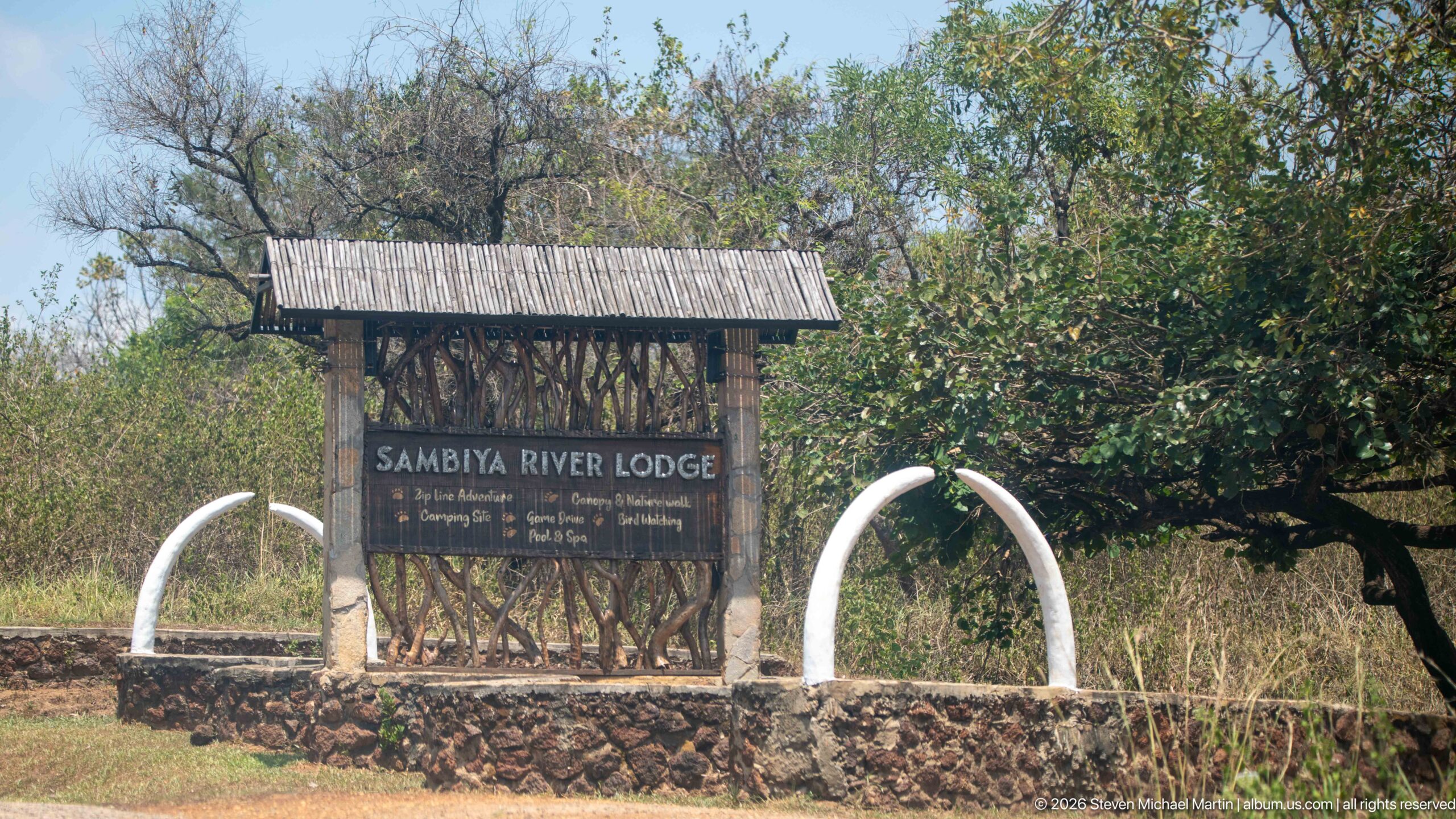
A closer view centers the rustic Sambiya River Lodge sign, its branch-like wooden framework and small roof framed by dry-season trees. Paired white tusk-shaped arches rise from the low stone base on either side, making the decorative gateway elements more legible than in the wider roadside view.
Caption
A closer view centers the rustic Sambiya River Lodge sign, its branch-like wooden framework and small roof framed by dry-season trees. Paired white tusk-shaped arches rise from the low stone base on either side, making the decorative gateway elements more legible than in the wider roadside view.
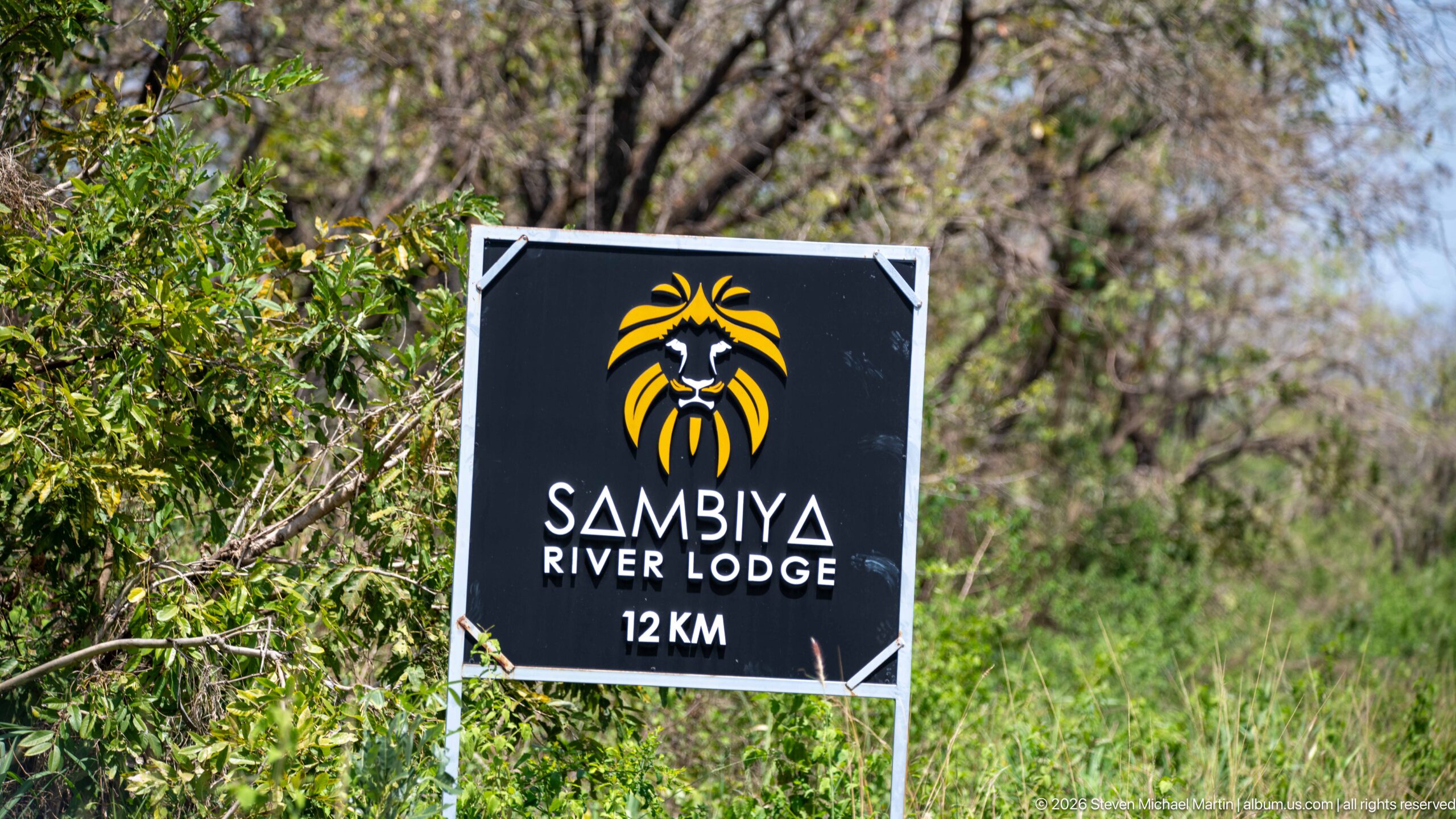
A black roadside sign directs travelers toward Sambiya River Lodge, giving the distance as 12 km beneath the lodge’s stylized lion emblem. Set among tall grass and shrubs, the simple marker records the approach route before the lodge itself comes into view.
Caption
A black roadside sign directs travelers toward Sambiya River Lodge, giving the distance as 12 km beneath the lodge’s stylized lion emblem. Set among tall grass and shrubs, the simple marker records the approach route before the lodge itself comes into view.
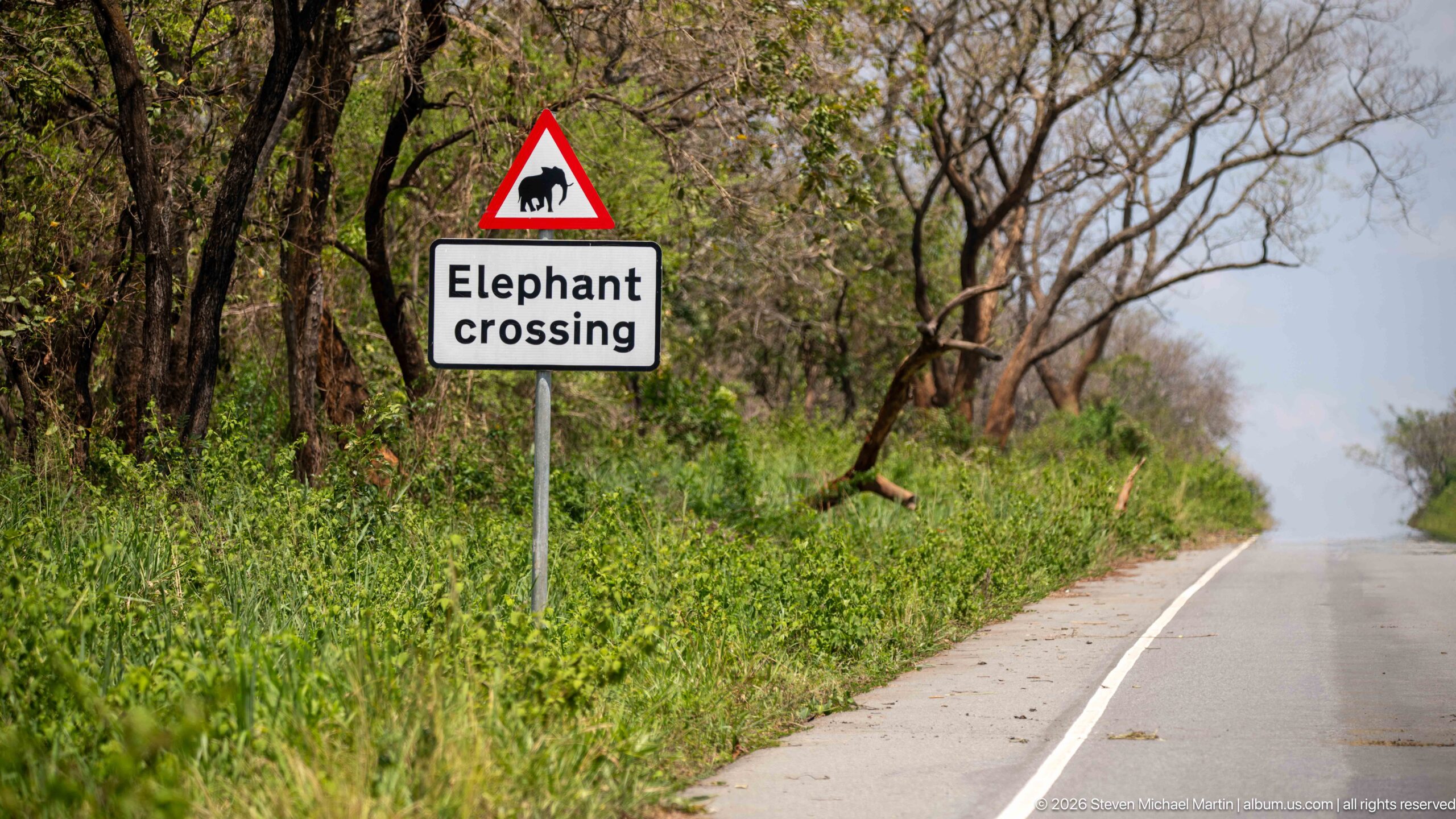
An elephant-crossing warning sign stands beside a paved road running through woodland, pairing a triangular animal symbol with a bold rectangular text panel. The sign signals the possibility of large wildlife moving across the roadway, an important practical reminder where vehicle routes intersect elephant habitat.
Caption
An elephant-crossing warning sign stands beside a paved road running through woodland, pairing a triangular animal symbol with a bold rectangular text panel. The sign signals the possibility of large wildlife moving across the roadway, an important practical reminder where vehicle routes intersect elephant habitat.
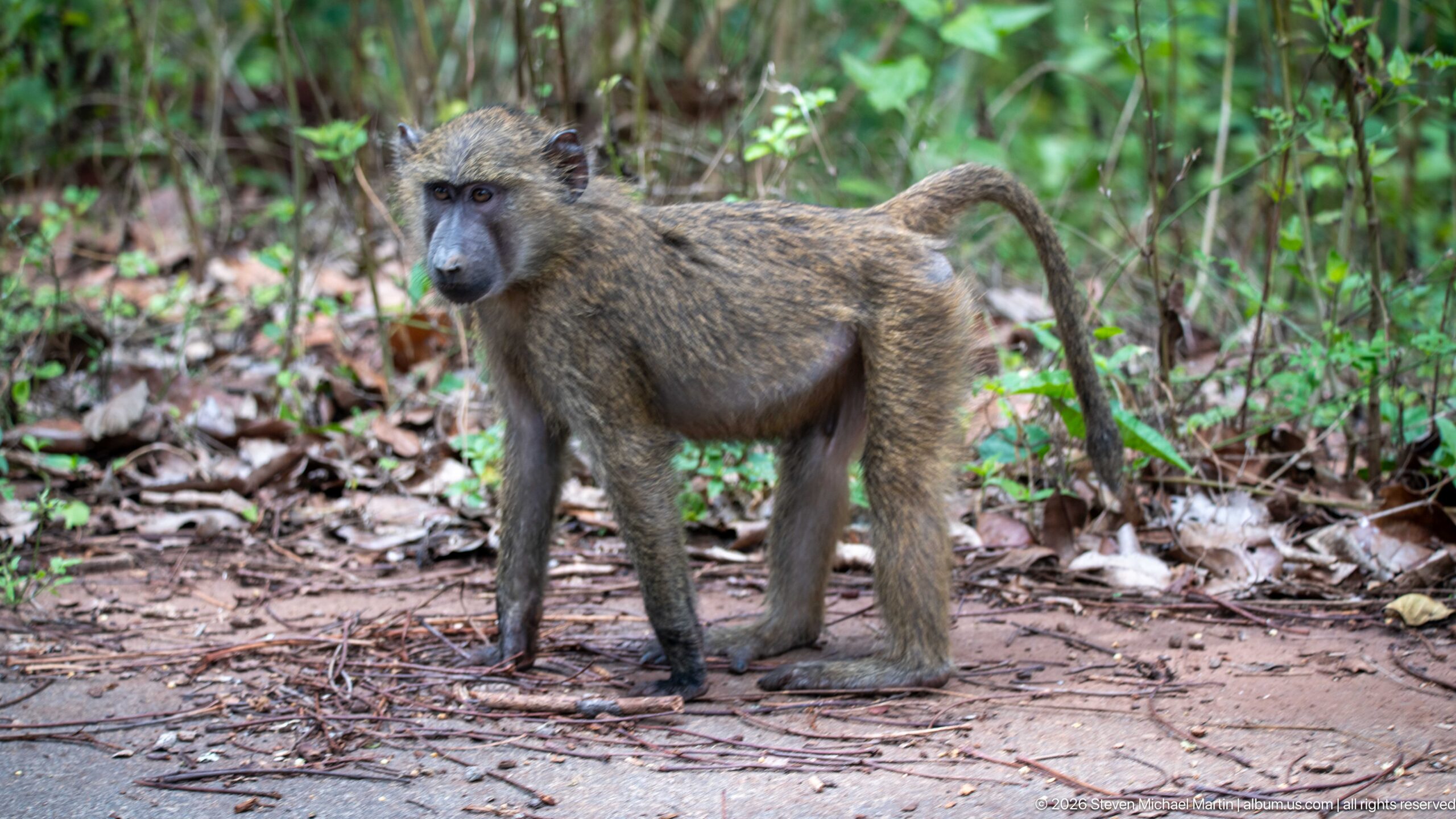
An olive baboon stands alert on a bare forest path, its long muzzle, grizzled olive-brown coat, sturdy limbs, and arched tail clearly visible against dense green undergrowth. The ground-level portrait isolates the primate from the surrounding vegetation while retaining enough habitat to show a typical terrestrial foraging environment.
Caption
An olive baboon stands alert on a bare forest path, its long muzzle, grizzled olive-brown coat, sturdy limbs, and arched tail clearly visible against dense green undergrowth. The ground-level portrait isolates the primate from the surrounding vegetation while retaining enough habitat to show a typical terrestrial foraging environment.
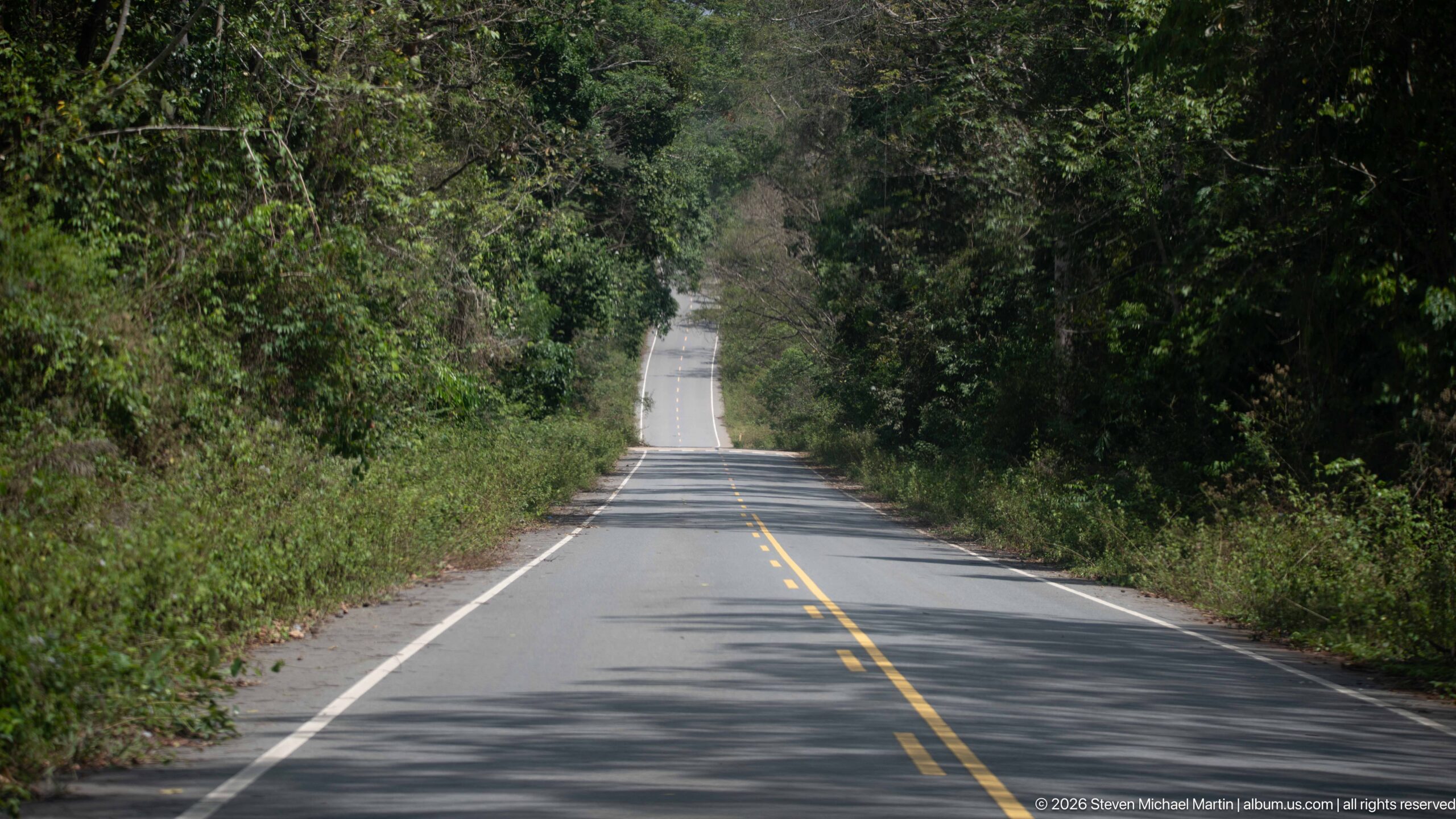
A two-lane paved road rises and falls through a corridor of dense woodland, its yellow center line drawing the eye toward a distant crest. Deep shade at the margins contrasts with the sunlit pavement, emphasizing the enclosed character of the route through the vegetated landscape.
Caption
A two-lane paved road rises and falls through a corridor of dense woodland, its yellow center line drawing the eye toward a distant crest. Deep shade at the margins contrasts with the sunlit pavement, emphasizing the enclosed character of the route through the vegetated landscape.
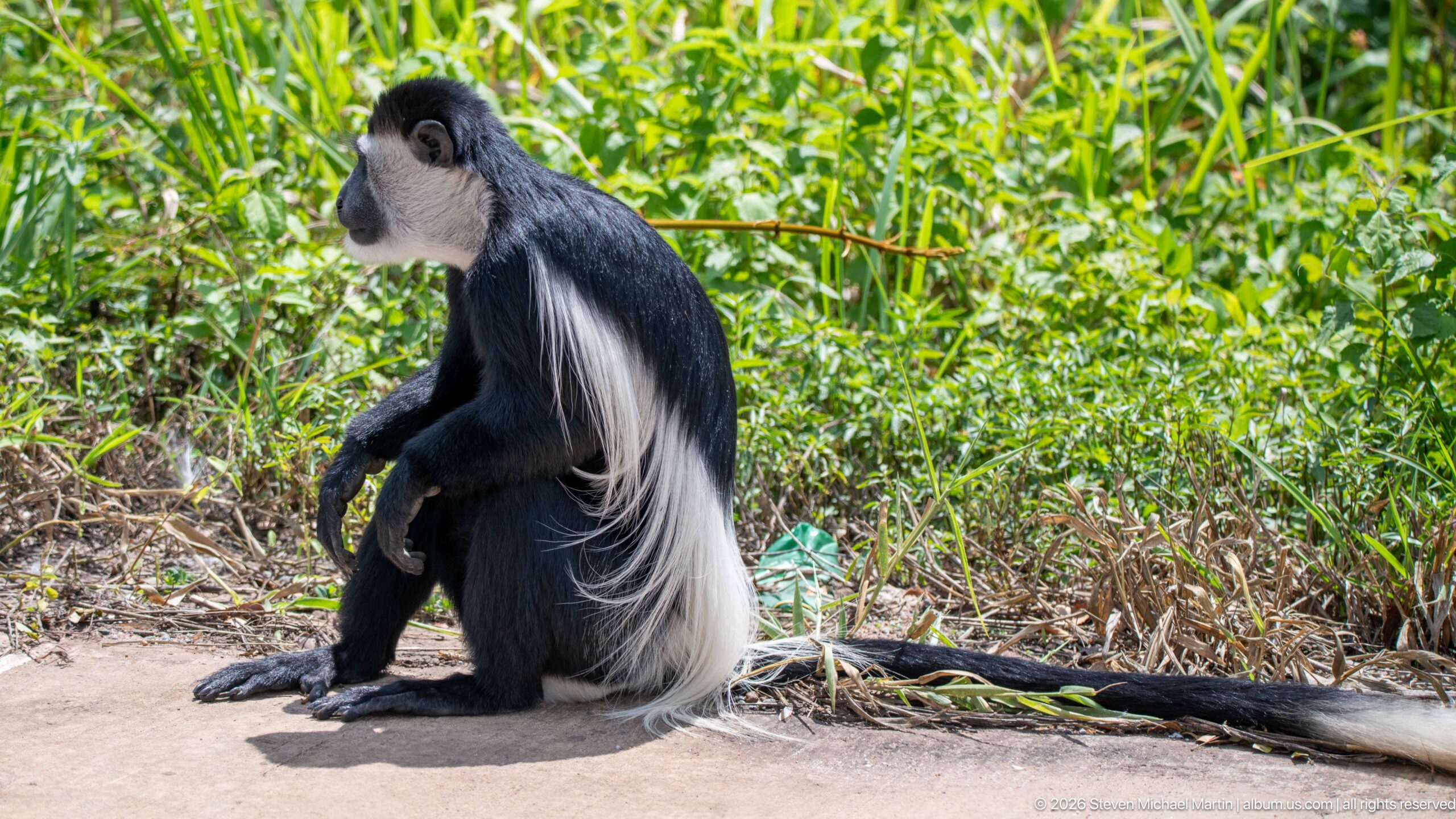
A mantled guereza sits upright at the edge of thick vegetation, its elongated white mantle cascading over the flanks and contrasting with black limbs and torso. The unobstructed side view clearly shows the species’ characteristic coat pattern and long tail while recording a quiet terrestrial pause beside forest cover.
Caption
A mantled guereza sits upright at the edge of thick vegetation, its elongated white mantle cascading over the flanks and contrasting with black limbs and torso. The unobstructed side view clearly shows the species’ characteristic coat pattern and long tail while recording a quiet terrestrial pause beside forest cover.
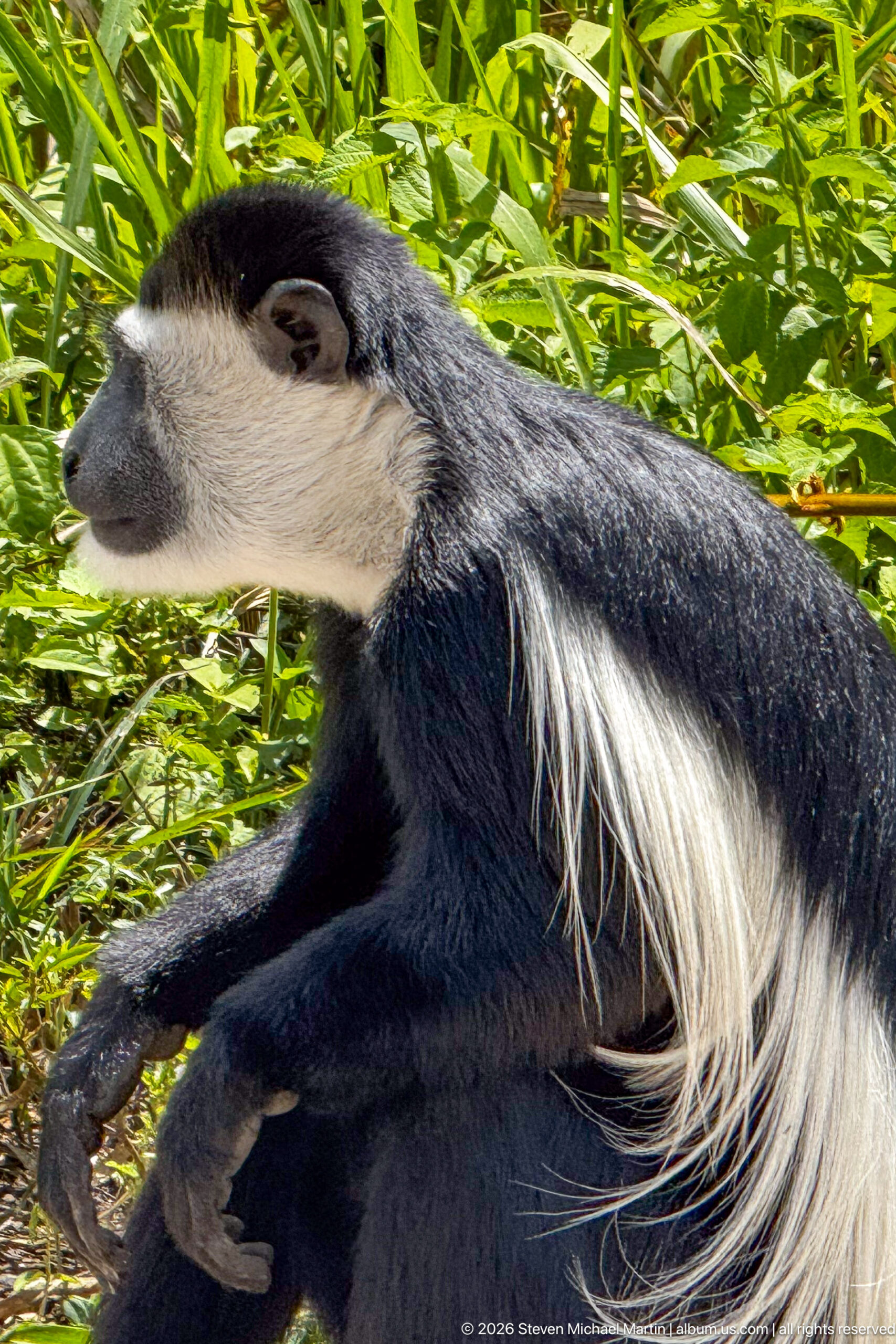
A close side portrait isolates the head and upper body of a mantled guereza against bright green foliage. The photograph reveals the grayish face, white cheek fringe, black crown and shoulders, and long silky white mantle hairs in unusually clear detail, making the species’ contrasting pelage the principal subject.
Caption
A close side portrait isolates the head and upper body of a mantled guereza against bright green foliage. The photograph reveals the grayish face, white cheek fringe, black crown and shoulders, and long silky white mantle hairs in unusually clear detail, making the species’ contrasting pelage the principal subject.
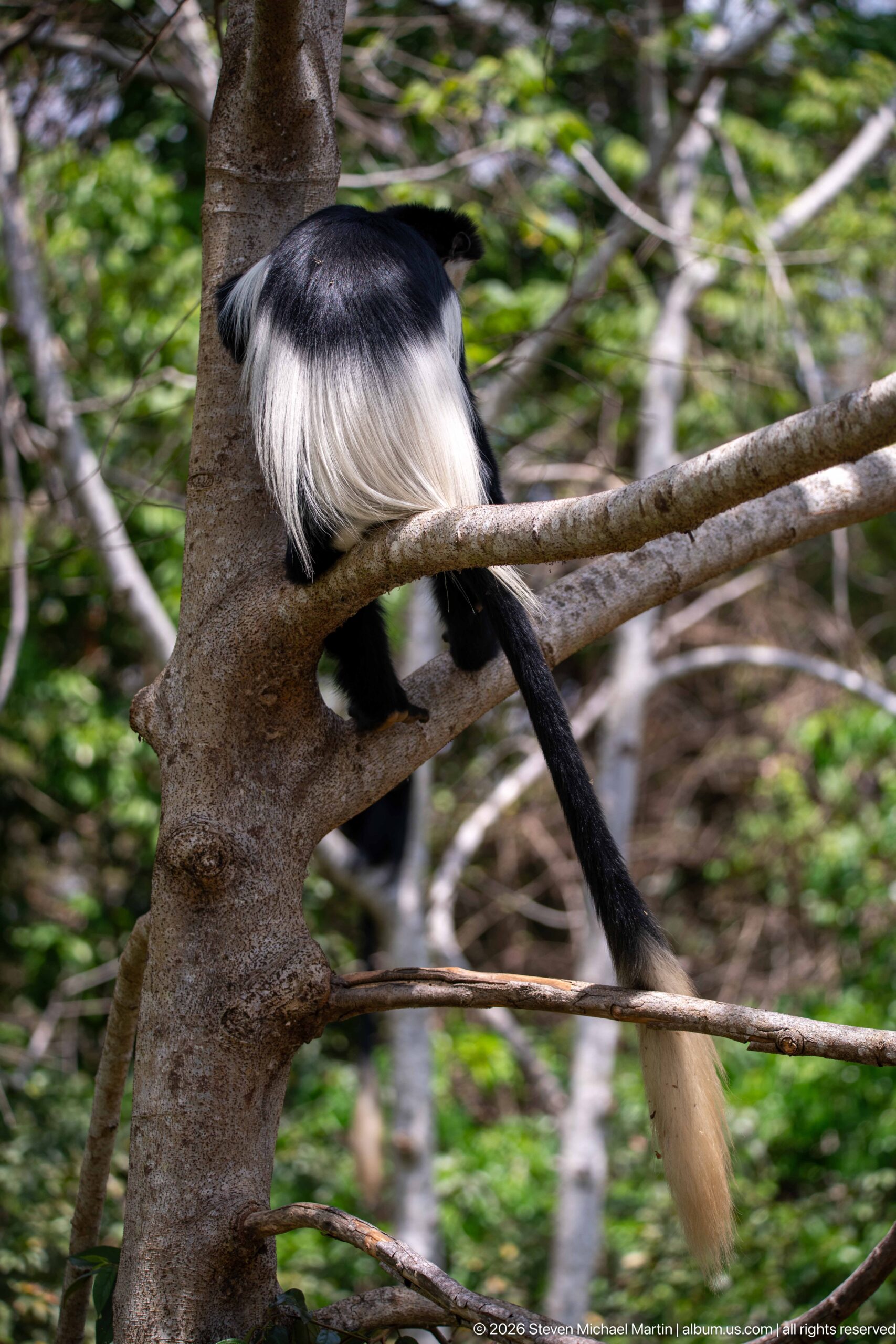
Seen from behind, a mantled guereza straddles a tree fork with its long tail hanging below the branch. The rear viewpoint emphasizes the sweeping white mantle over the hips and the dark crown and limbs, offering a behavioral and anatomical complement to the more conventional portraits in the sequence.
Caption
Seen from behind, a mantled guereza straddles a tree fork with its long tail hanging below the branch. The rear viewpoint emphasizes the sweeping white mantle over the hips and the dark crown and limbs, offering a behavioral and anatomical complement to the more conventional portraits in the sequence.
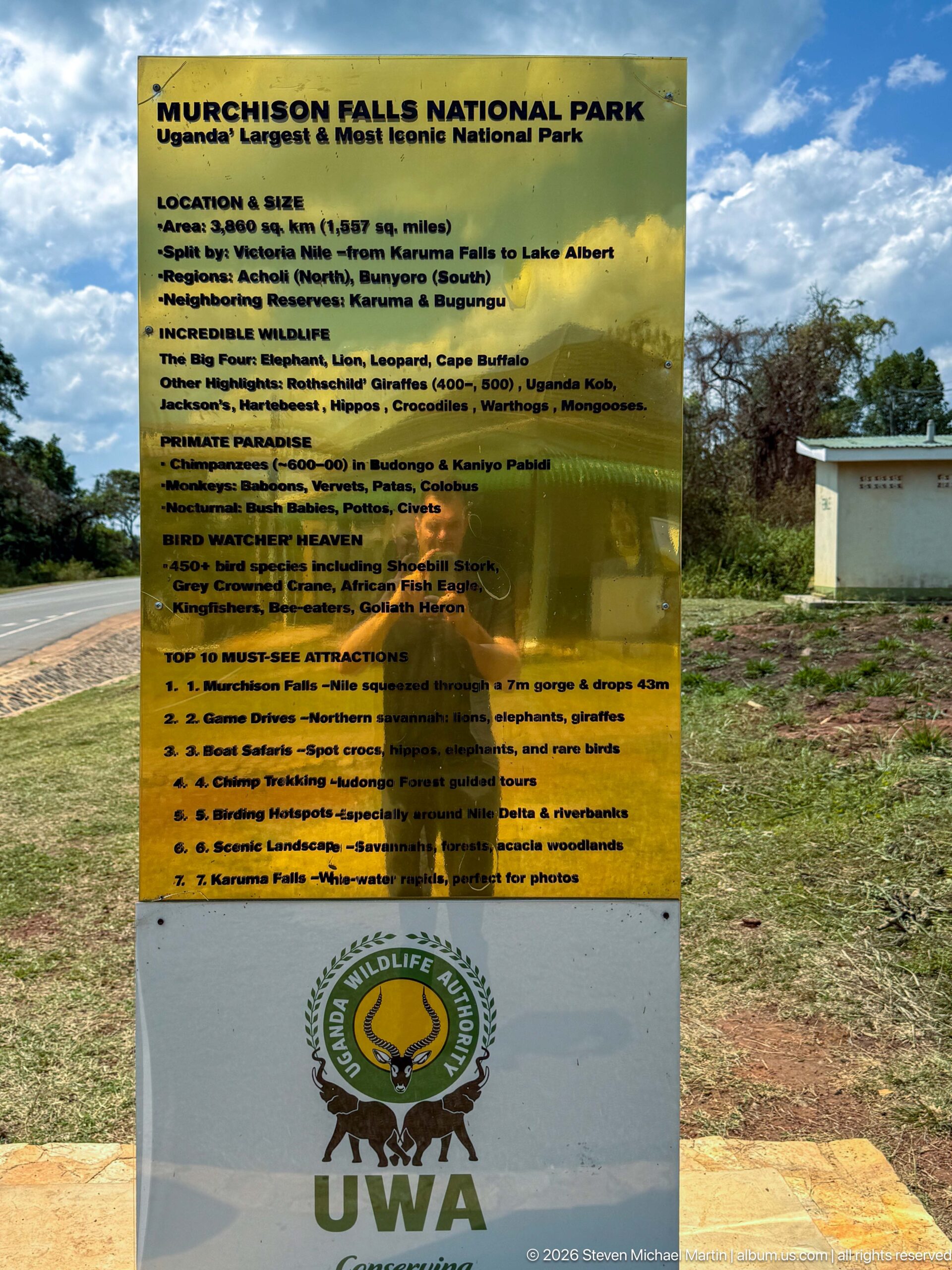
A Uganda Wildlife Authority information panel at Murchison Falls National Park presents visitor guidance, wildlife notes, and park regulations beside the roadway. The dense text and UWA emblem make the sign an administrative introduction to the protected area, contrasting with the wildlife portraits and landscape views elsewhere in the portfolio.
Caption
A Uganda Wildlife Authority information panel at Murchison Falls National Park presents visitor guidance, wildlife notes, and park regulations beside the roadway. The dense text and UWA emblem make the sign an administrative introduction to the protected area, contrasting with the wildlife portraits and landscape views elsewhere in the portfolio.
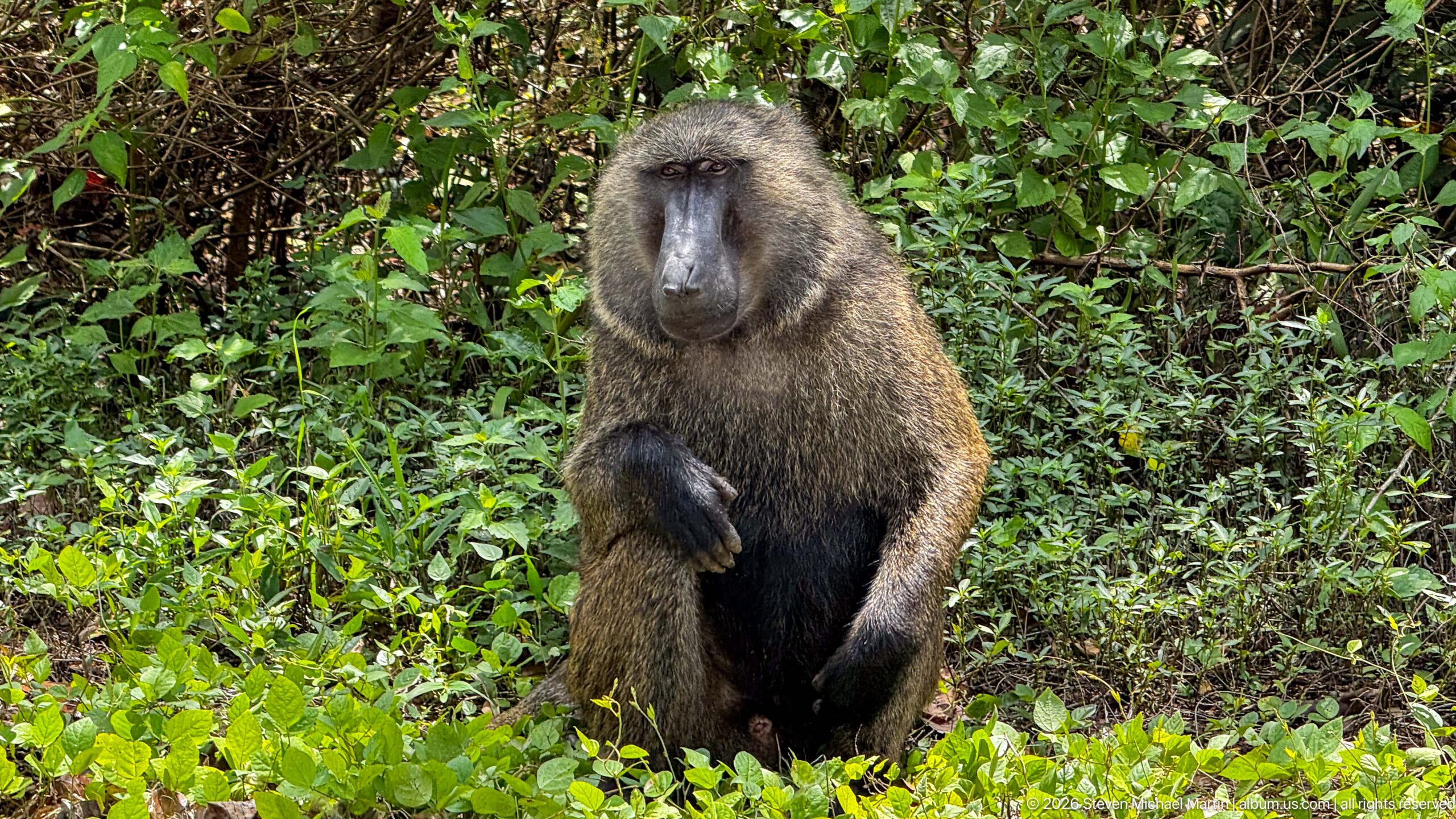
An olive baboon sits upright at the edge of dense vegetation, facing the camera with forearms held loosely before its body. The long dark muzzle, heavy brow, coarse olive-brown coat, and robust build are clearly visible, creating a direct wildlife portrait against the shaded forest margin.
Caption
An olive baboon sits upright at the edge of dense vegetation, facing the camera with forearms held loosely before its body. The long dark muzzle, heavy brow, coarse olive-brown coat, and robust build are clearly visible, creating a direct wildlife portrait against the shaded forest margin.
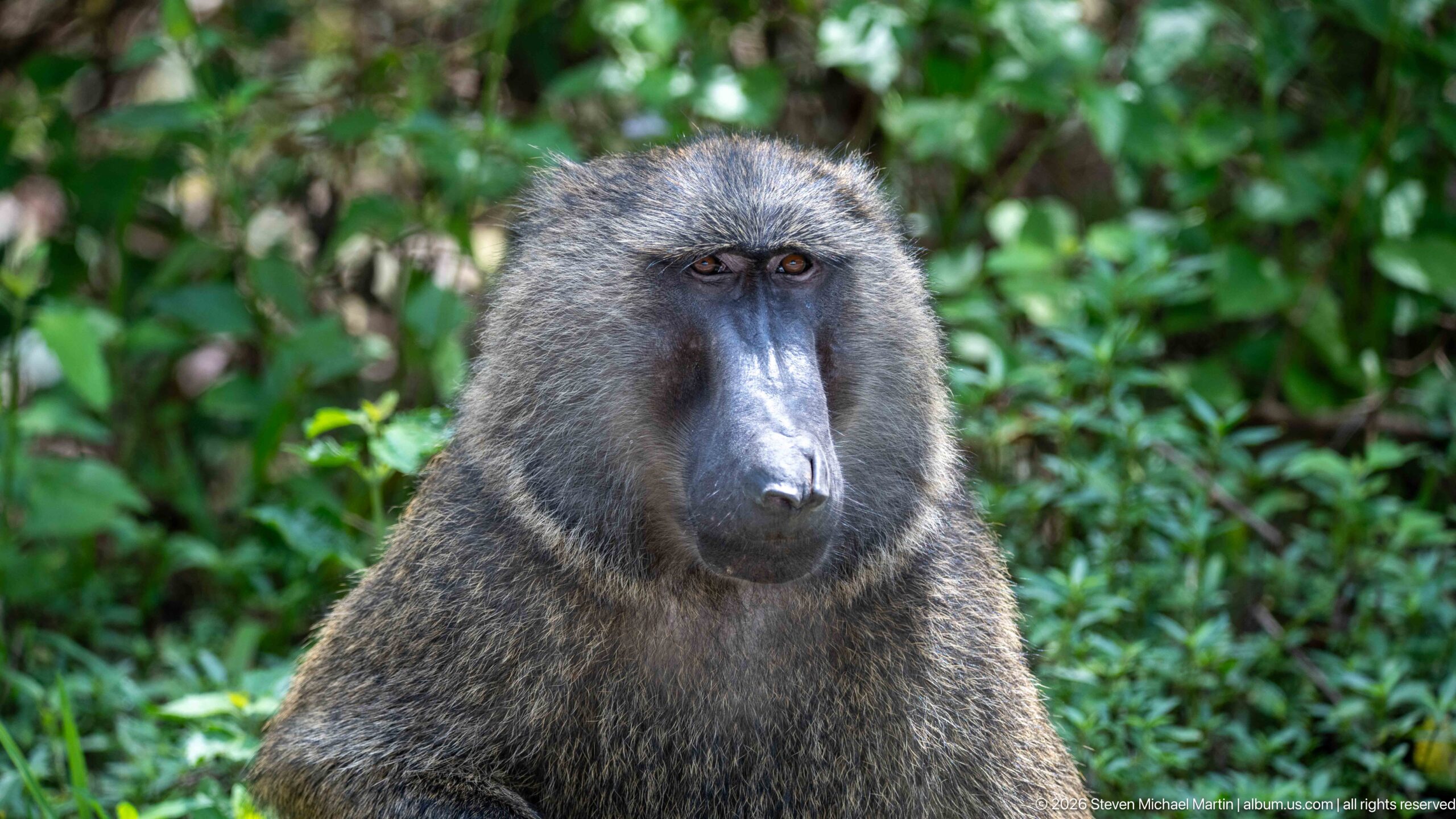
A close frontal portrait fills the frame with the face and shoulders of an olive baboon. Fine grizzled hairs surround the dark elongated muzzle and deep-set amber-brown eyes, while the softly blurred green background removes distractions and brings the animal’s facial structure and coat texture into sharp relief.
Caption
A close frontal portrait fills the frame with the face and shoulders of an olive baboon. Fine grizzled hairs surround the dark elongated muzzle and deep-set amber-brown eyes, while the softly blurred green background removes distractions and brings the animal’s facial structure and coat texture into sharp relief.
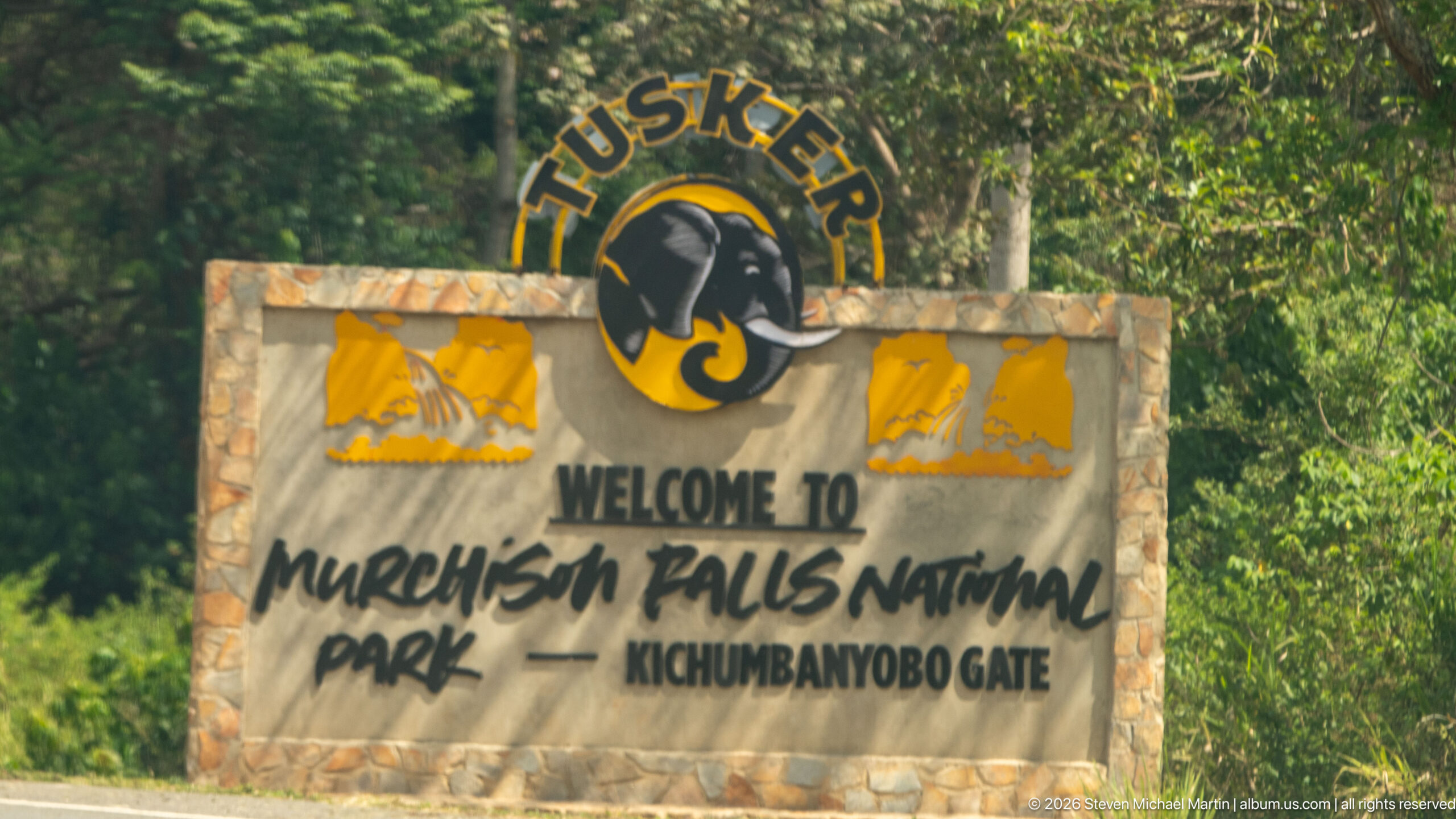
A stone entrance monument welcomes visitors to Murchison Falls National Park at Kichumbanyobo Gate. The Tusker branding above the sign and stylized wildlife motifs frame the hand-lettered park name, making this roadside marker a clear record of arrival at one of the park’s access points.
Caption
A stone entrance monument welcomes visitors to Murchison Falls National Park at Kichumbanyobo Gate. The Tusker branding above the sign and stylized wildlife motifs frame the hand-lettered park name, making this roadside marker a clear record of arrival at one of the park’s access points.
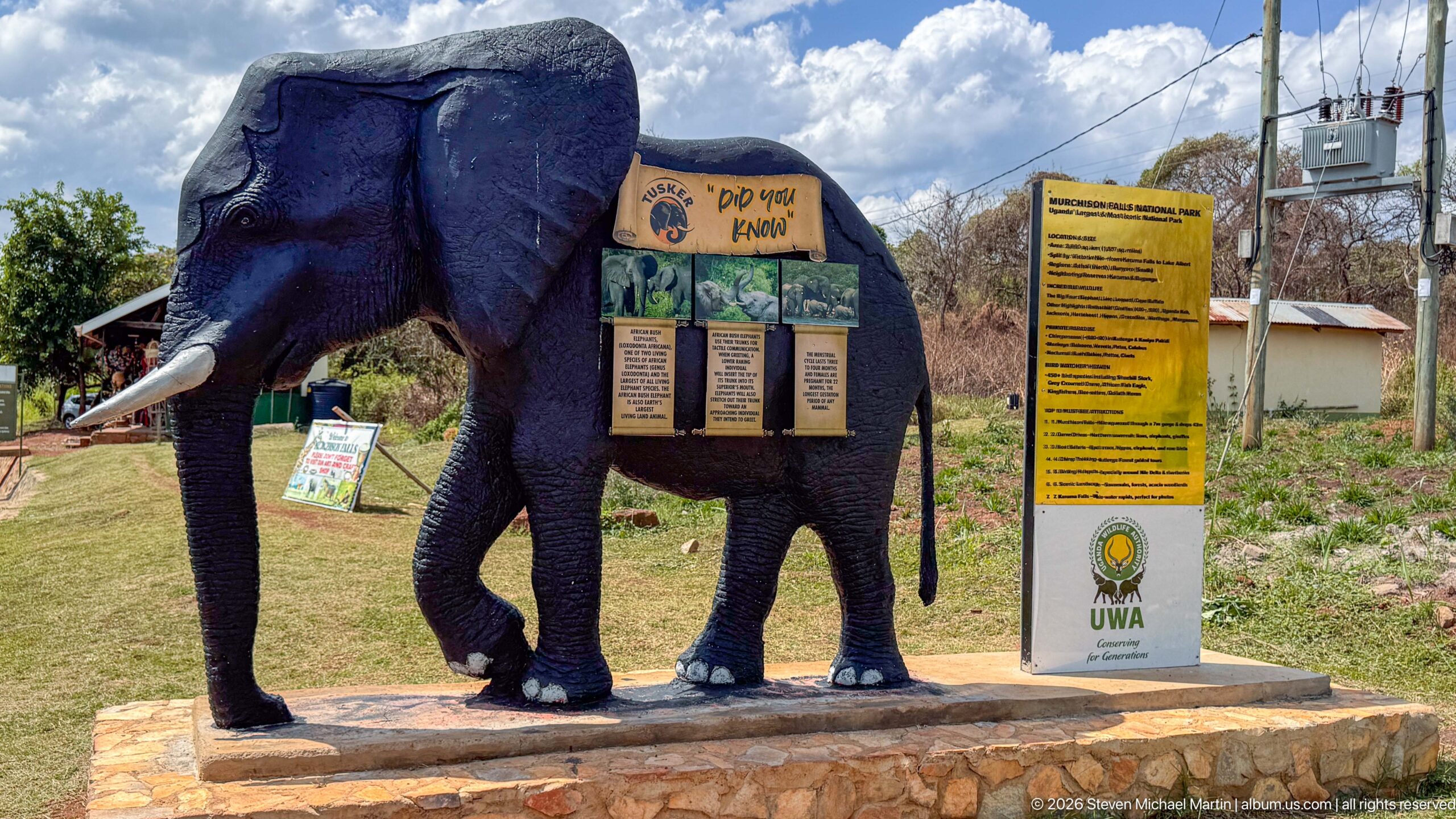
A life-size elephant model serves as an interpretive display beside a Uganda Wildlife Authority information board at Murchison Falls National Park. Educational panels are mounted across the elephant’s side beneath a small “Do you know” sign, turning an immediately recognizable wildlife form into a visitor-engagement feature near the park entrance.
Caption
A life-size elephant model serves as an interpretive display beside a Uganda Wildlife Authority information board at Murchison Falls National Park. Educational panels are mounted across the elephant’s side beneath a small “Do you know” sign, turning an immediately recognizable wildlife form into a visitor-engagement feature near the park entrance.
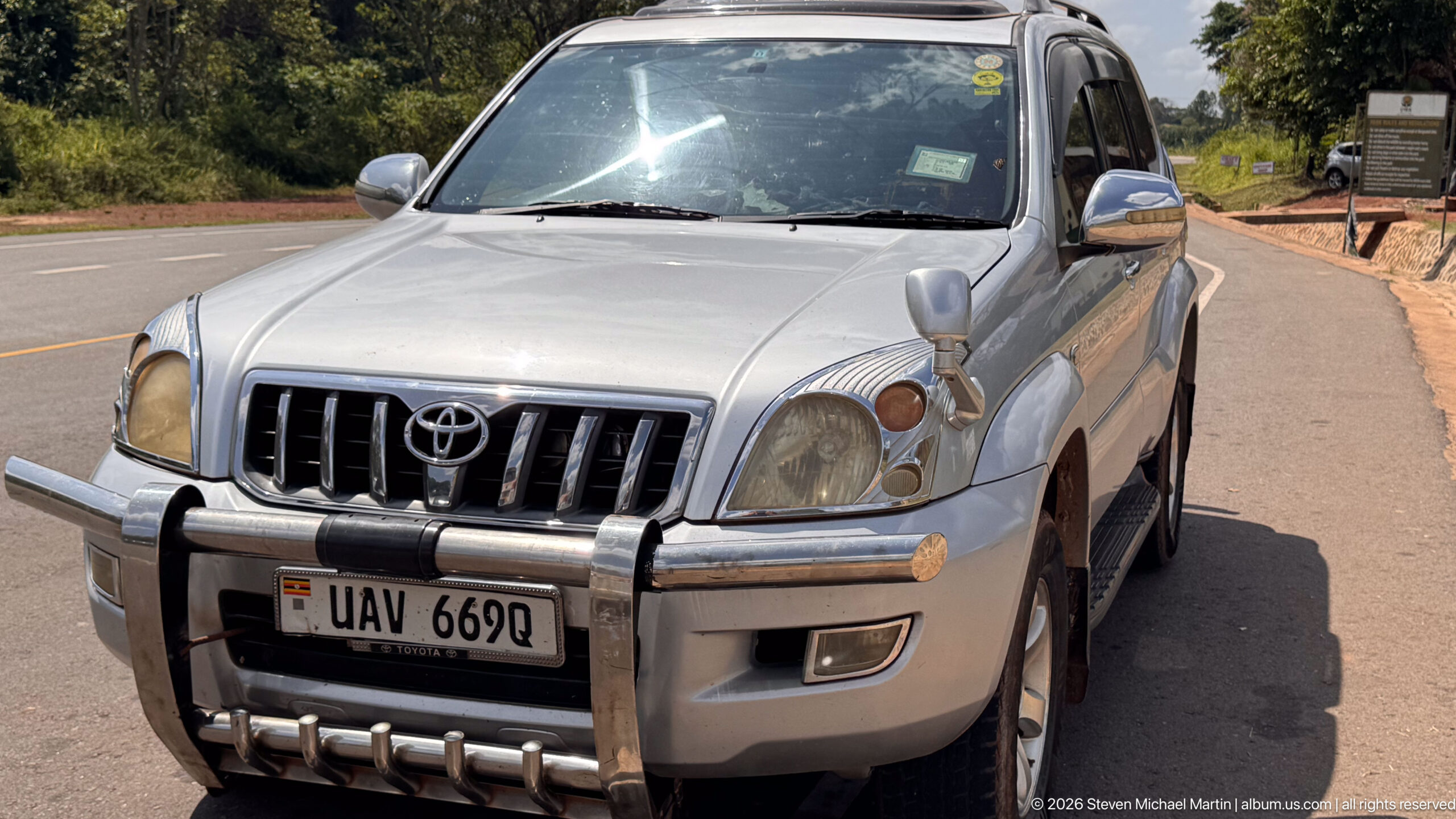
A silver Toyota Land Cruiser is parked beside the roadway near the Murchison Falls National Park entrance. The front three-quarter view emphasizes its high ground clearance, bull bar, and rugged four-wheel-drive configuration, equipment well suited to travel on the park’s paved and unpaved routes.
Caption
A silver Toyota Land Cruiser is parked beside the roadway near the Murchison Falls National Park entrance. The front three-quarter view emphasizes its high ground clearance, bull bar, and rugged four-wheel-drive configuration, equipment well suited to travel on the park’s paved and unpaved routes.
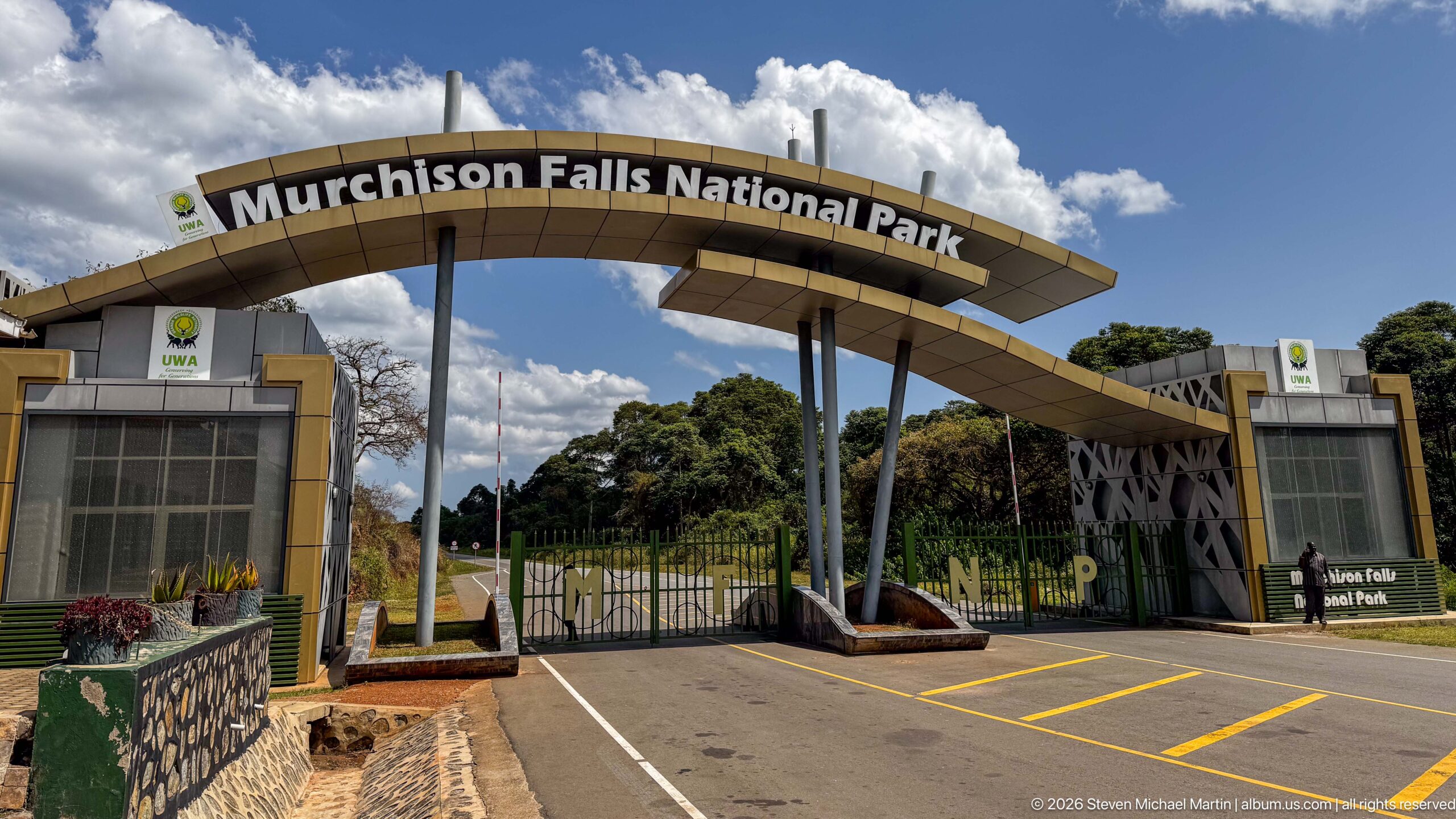
A modern gateway spans the entrance road to Murchison Falls National Park, with the park name carried across a broad curved canopy. Uganda Wildlife Authority emblems mark the flanking gate structures, while barriers and lane markings organize vehicle entry beneath a bright equatorial sky.
Caption
A modern gateway spans the entrance road to Murchison Falls National Park, with the park name carried across a broad curved canopy. Uganda Wildlife Authority emblems mark the flanking gate structures, while barriers and lane markings organize vehicle entry beneath a bright equatorial sky.
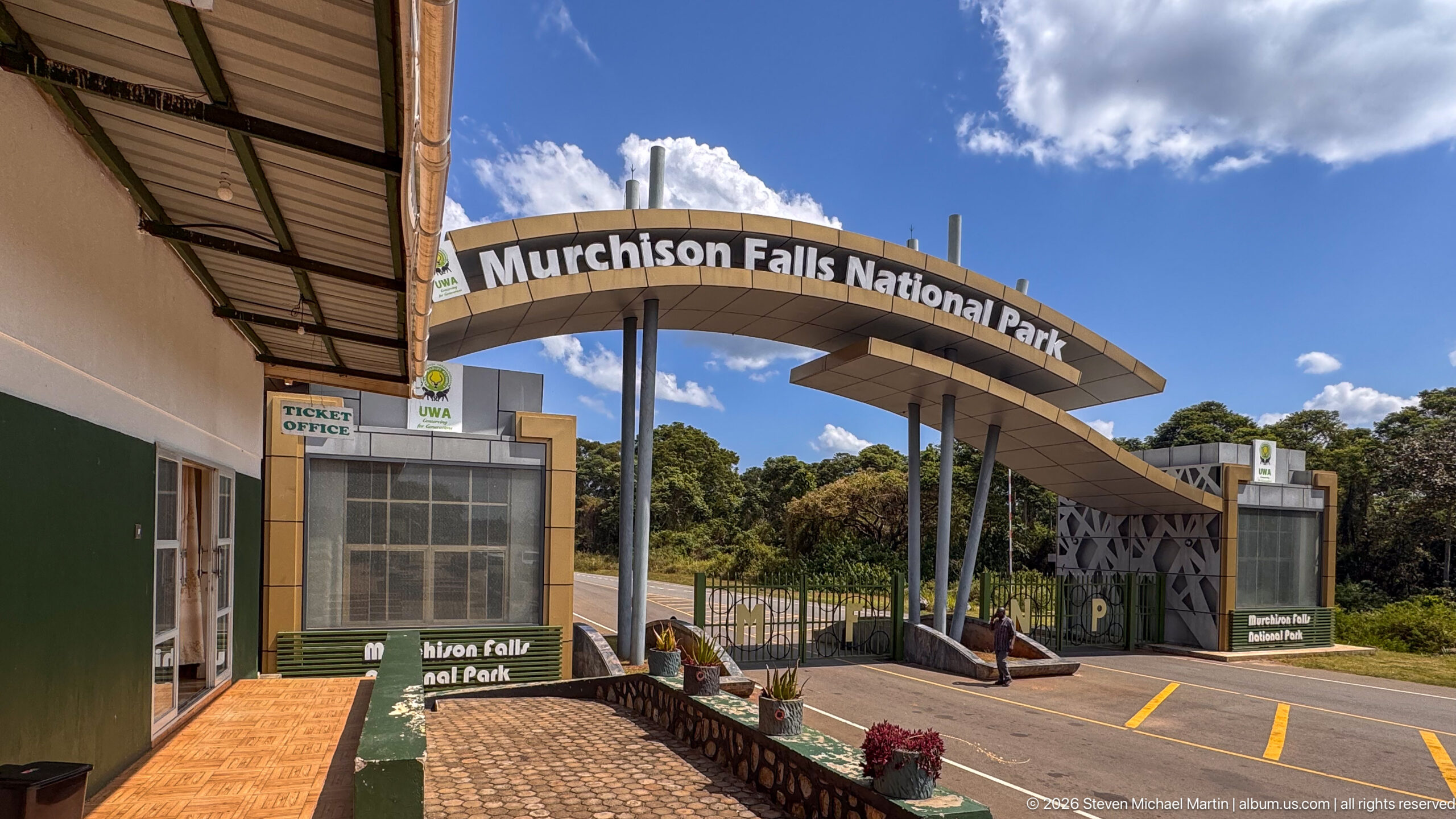
Viewed from the ticket-office side, the Murchison Falls National Park gateway arches across the entry road beneath a vivid blue sky. The oblique angle reveals the ticket window, planted forecourt, security gate, and layered canopy supports, providing a fuller architectural context for the formal entrance complex.
Caption
Viewed from the ticket-office side, the Murchison Falls National Park gateway arches across the entry road beneath a vivid blue sky. The oblique angle reveals the ticket window, planted forecourt, security gate, and layered canopy supports, providing a fuller architectural context for the formal entrance complex.
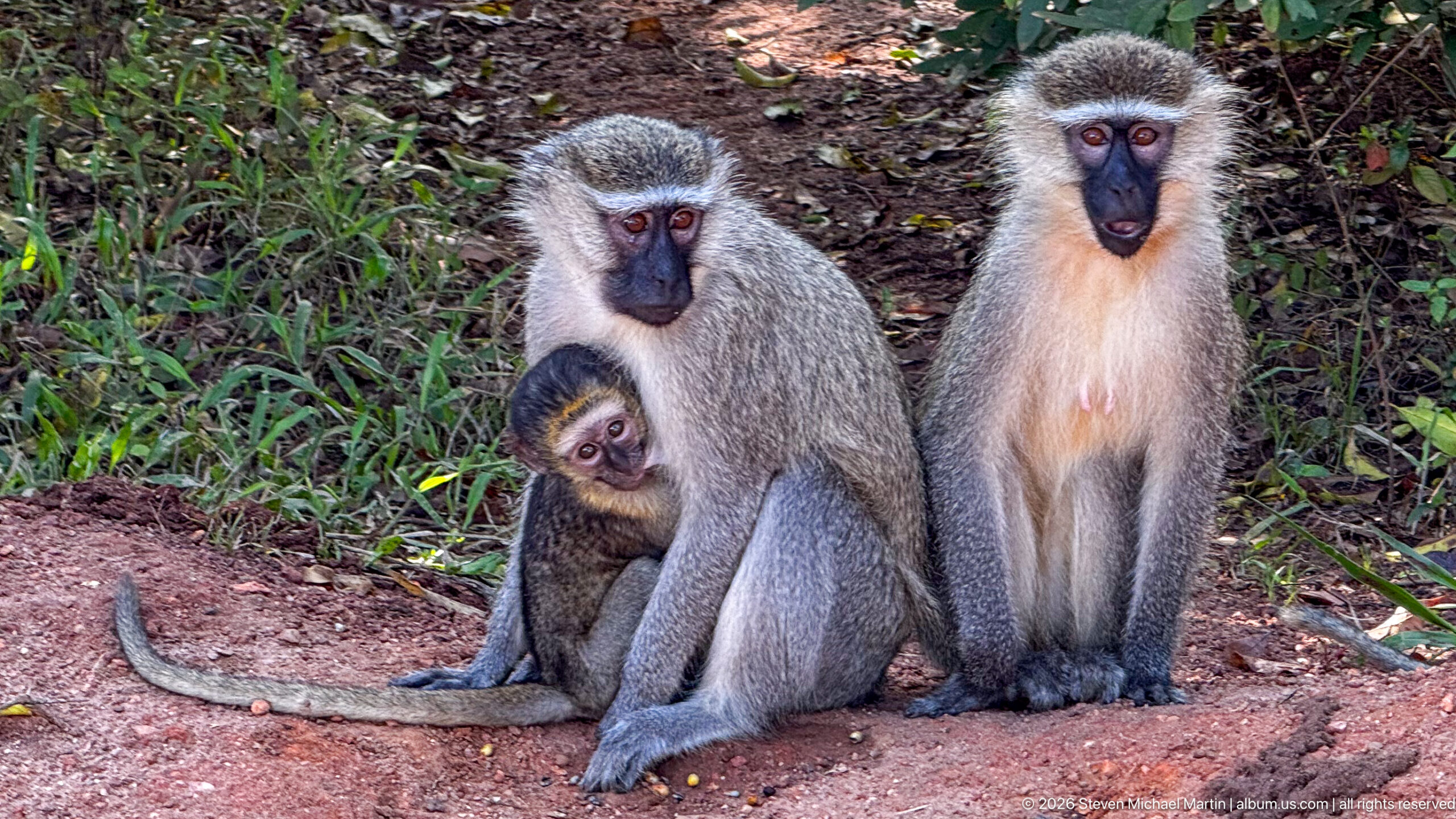
Three vervet monkeys sit together on bare red earth at the forest edge, including an infant pressed against an adult’s body. Gray coats, pale underparts, black faces, and long tails identify the species, while the close grouping records both social proximity and maternal care within the troop.
Caption
Three vervet monkeys sit together on bare red earth at the forest edge, including an infant pressed against an adult’s body. Gray coats, pale underparts, black faces, and long tails identify the species, while the close grouping records both social proximity and maternal care within the troop.
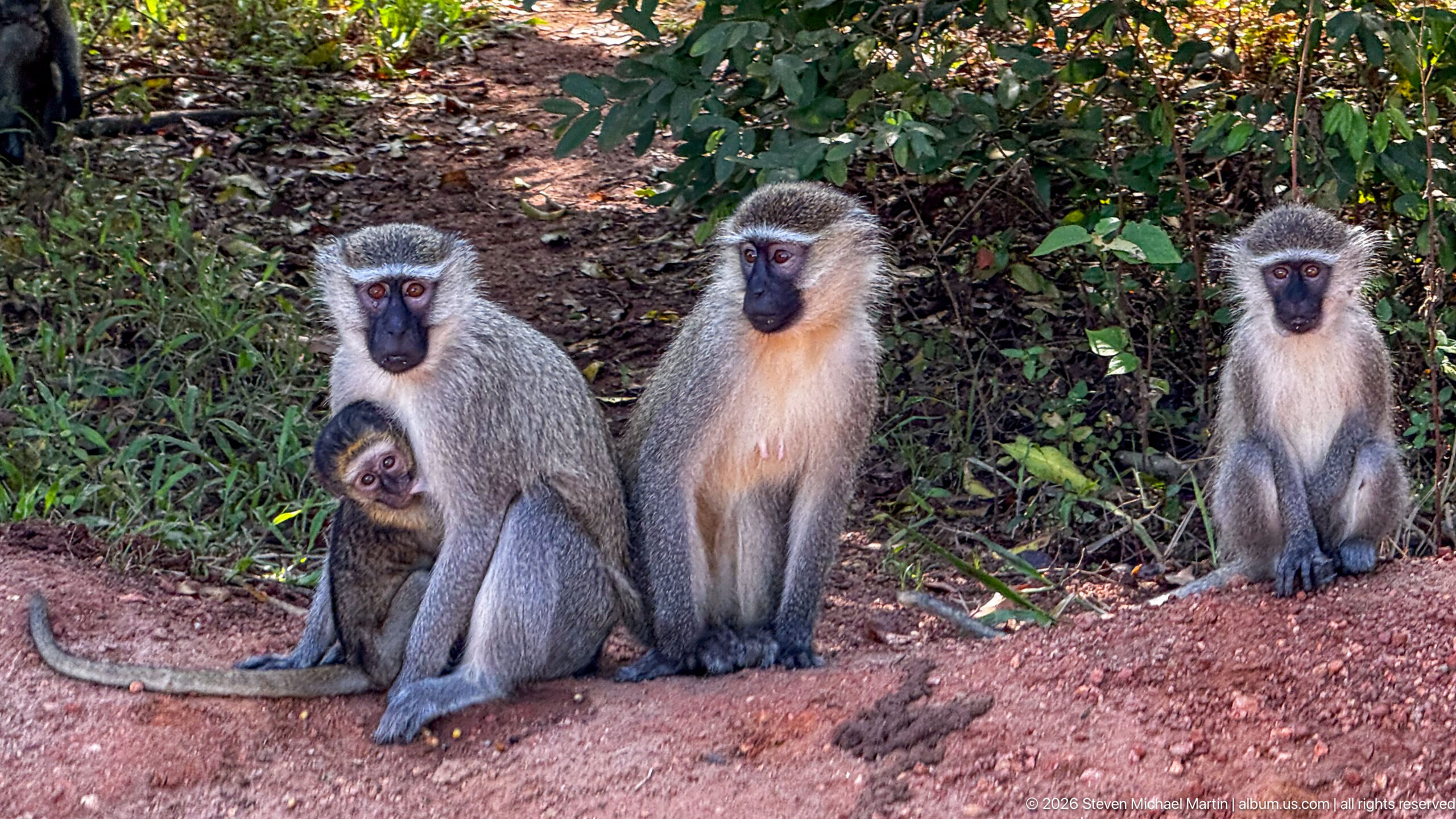
A wider view shows three vervet monkeys spaced along the edge of a wooded slope, with an infant nestled against the left adult. The additional ground and foliage provide more habitat context than the preceding portrait, while the animals’ black faces, gray coats, and pale bellies remain clearly visible.
Caption
A wider view shows three vervet monkeys spaced along the edge of a wooded slope, with an infant nestled against the left adult. The additional ground and foliage provide more habitat context than the preceding portrait, while the animals’ black faces, gray coats, and pale bellies remain clearly visible.
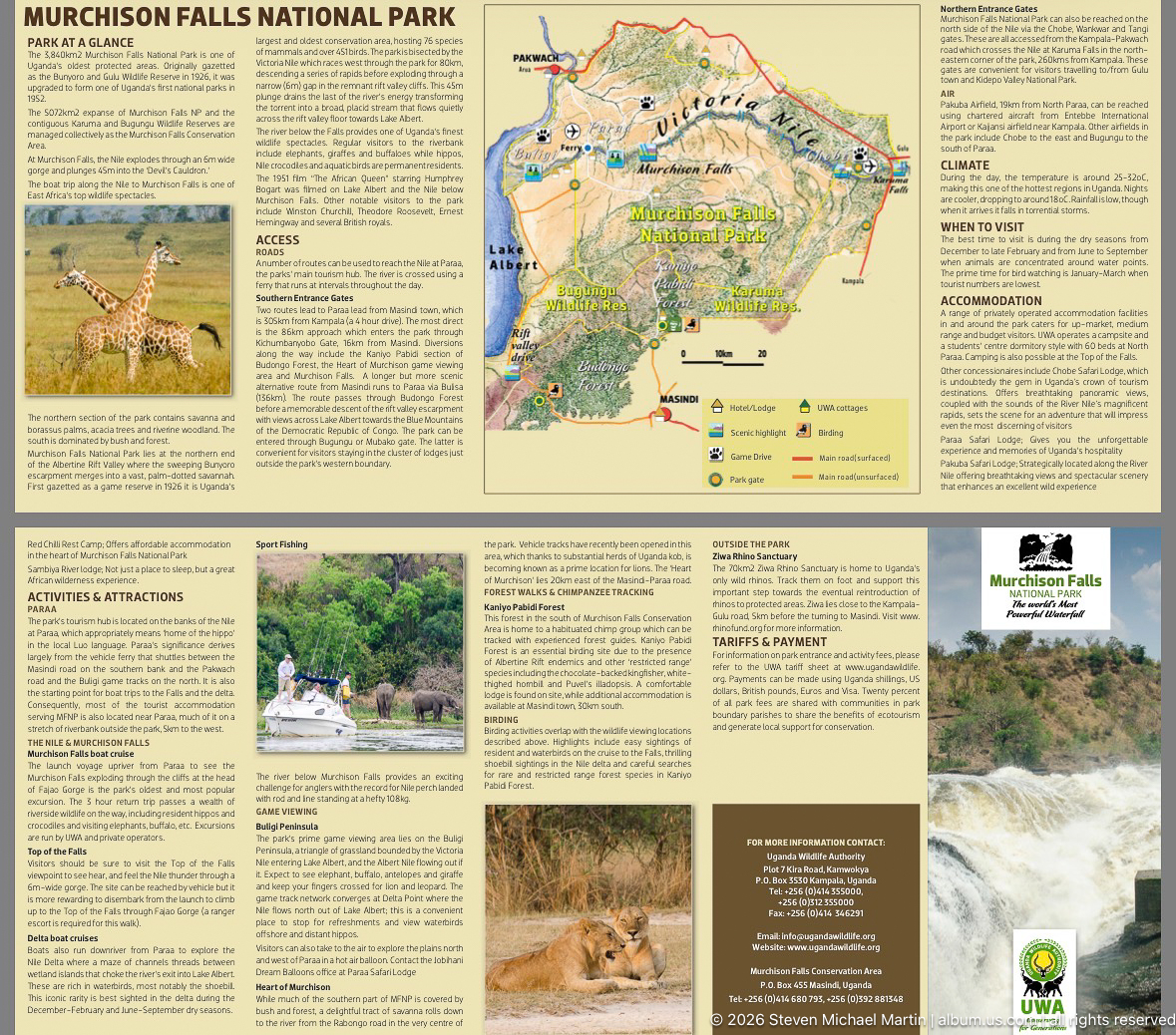
A large interpretive panel introduces Murchison Falls National Park through a central map, wildlife photographs, landscape images, and explanatory text. Sections on attractions, activities, conservation, and visitor information organize the display as a compact field guide to the park’s geography and natural history.
Caption
A large interpretive panel introduces Murchison Falls National Park through a central map, wildlife photographs, landscape images, and explanatory text. Sections on attractions, activities, conservation, and visitor information organize the display as a compact field guide to the park’s geography and natural history.
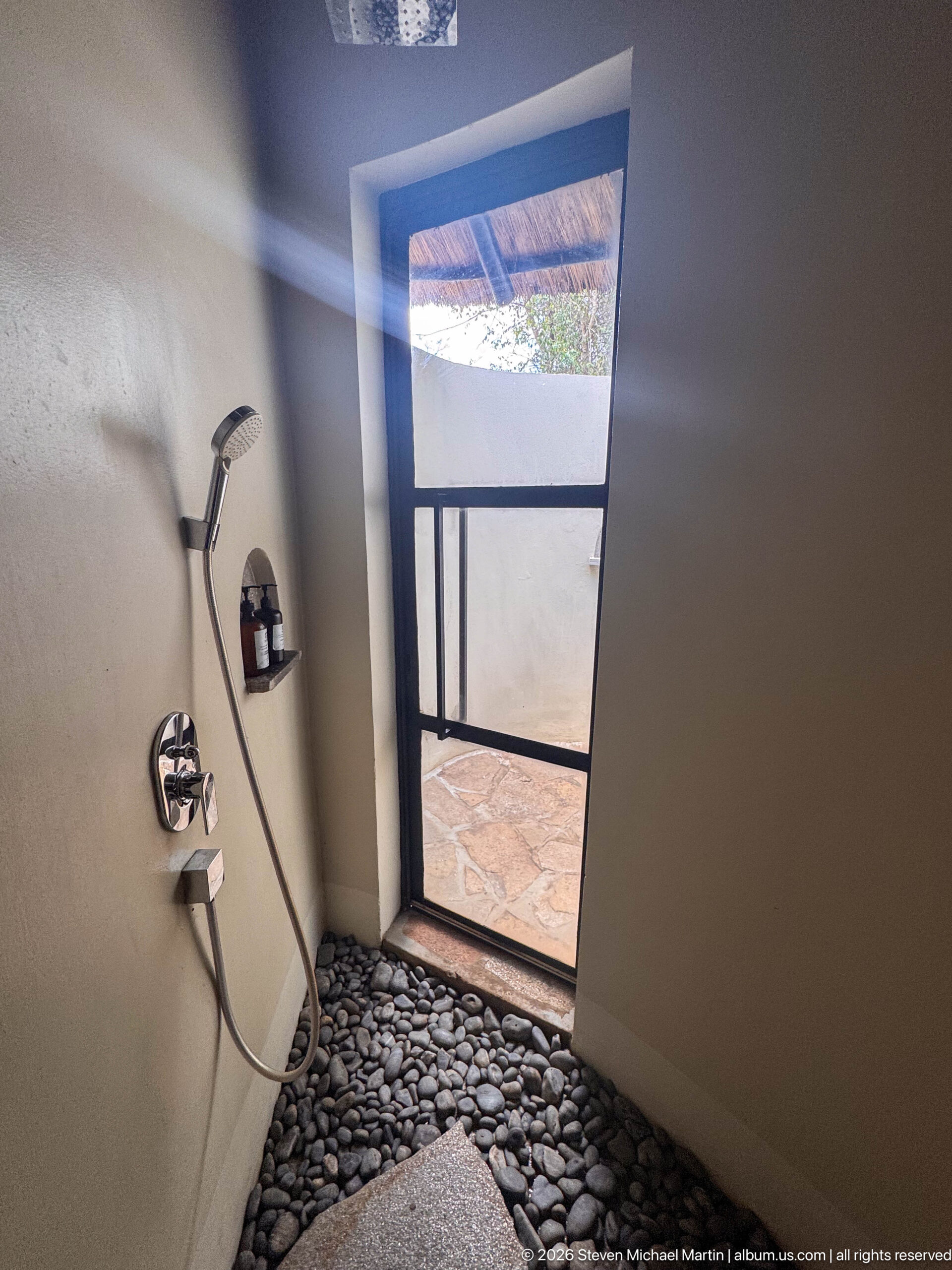
A walk-in shower combines smooth pale walls with a floor of rounded dark river stones and a wall-mounted handheld shower. An open doorway leads directly to a tiled exterior or semi-open area, using natural light and simple materials to create a strong indoor-outdoor connection within the lodge accommodation.
Caption
A walk-in shower combines smooth pale walls with a floor of rounded dark river stones and a wall-mounted handheld shower. An open doorway leads directly to a tiled exterior or semi-open area, using natural light and simple materials to create a strong indoor-outdoor connection within the lodge accommodation.
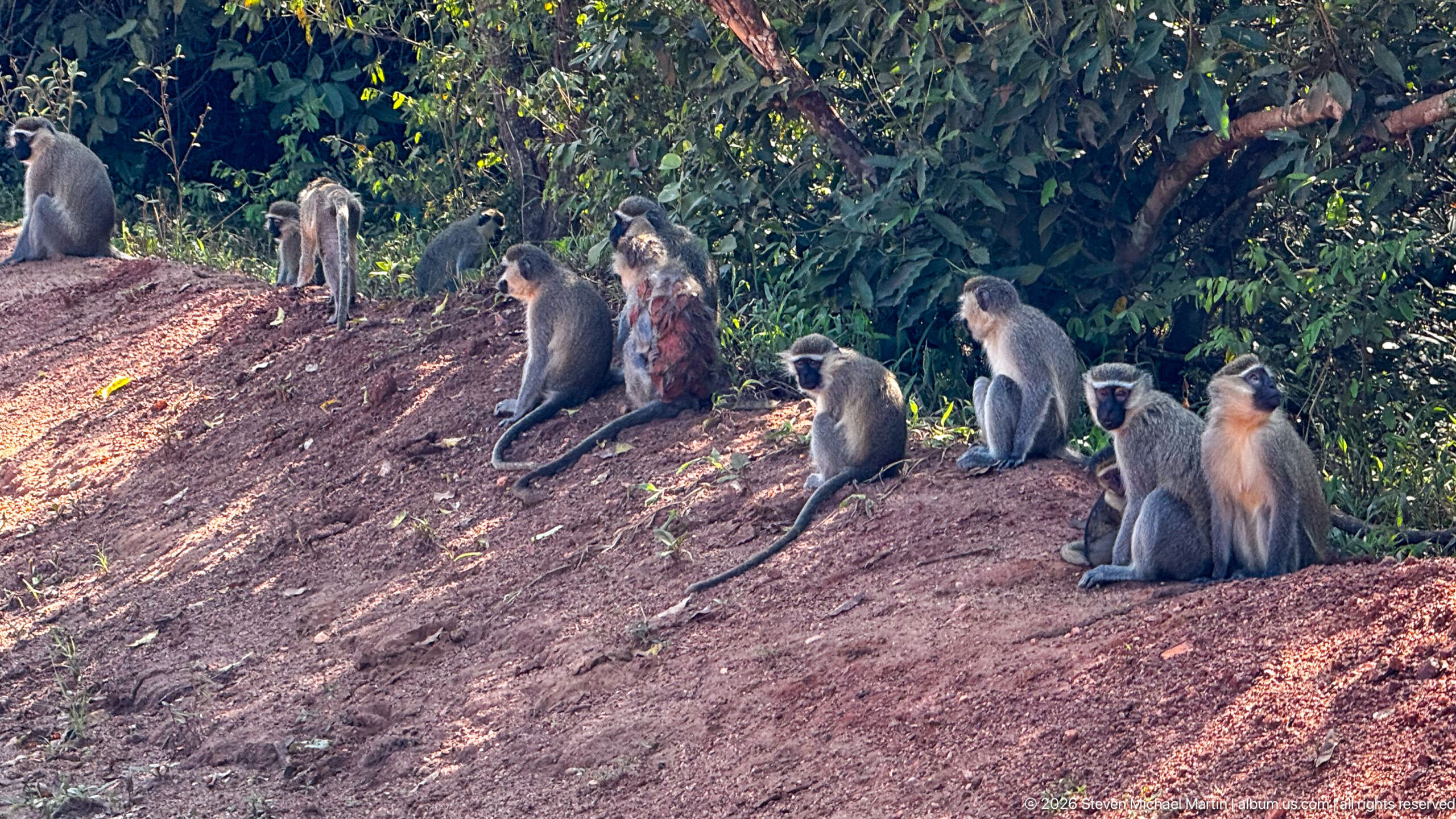
A troop of vervet monkeys gathers across a shaded red-earth bank beneath dense trees. Adults and younger animals sit at varying distances, their gray coats, black faces, pale underparts, and long tails repeated across the group, giving a broader view of troop structure and social spacing than the closer family portraits.
Caption
A troop of vervet monkeys gathers across a shaded red-earth bank beneath dense trees. Adults and younger animals sit at varying distances, their gray coats, black faces, pale underparts, and long tails repeated across the group, giving a broader view of troop structure and social spacing than the closer family portraits.
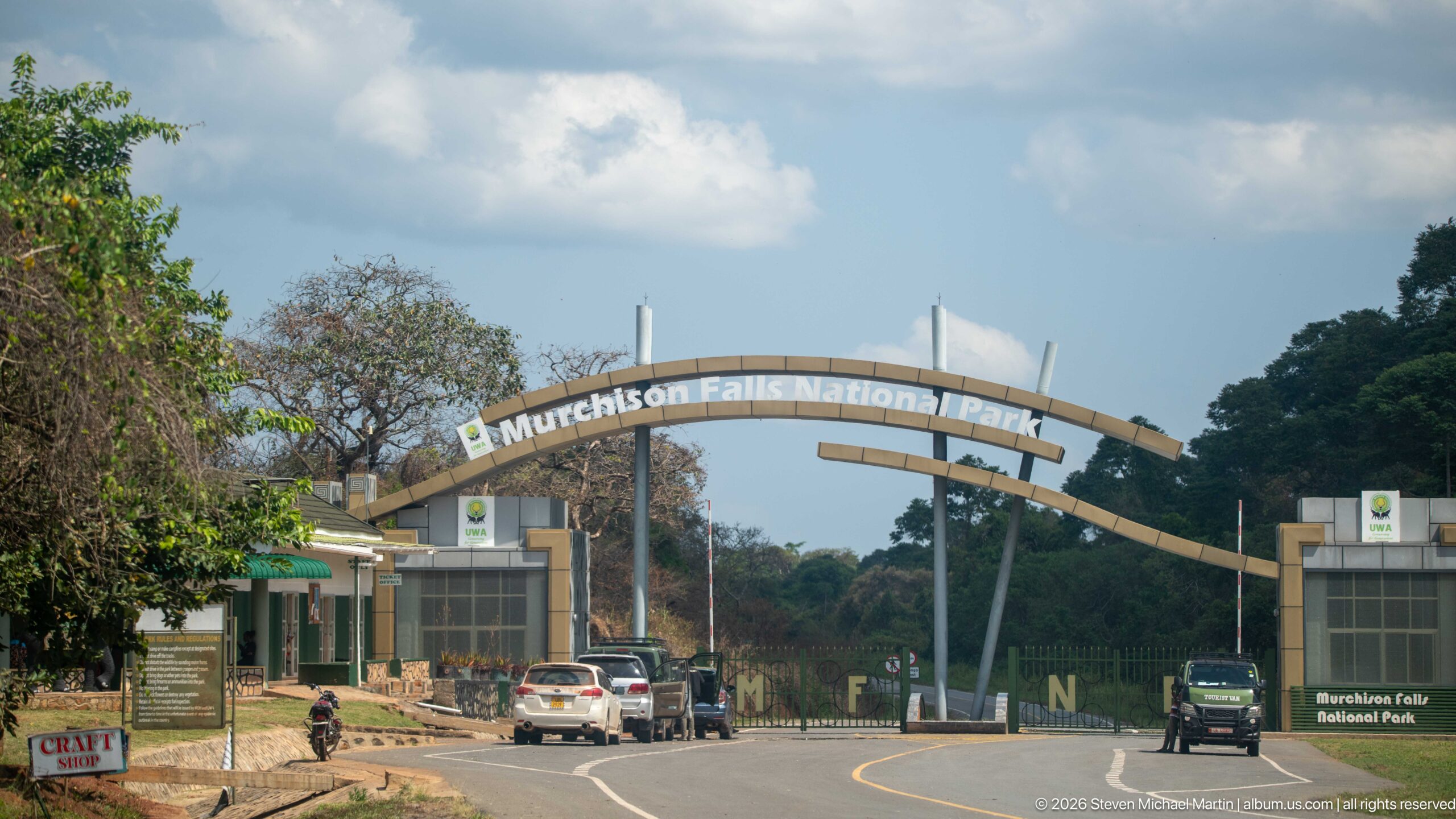
Vehicles approach the Murchison Falls National Park gateway along the paved entrance road, placing the curved overhead sign and Uganda Wildlife Authority gate structures within an active arrival scene. The more distant viewpoint shows the full roadway, traffic flow, roadside buildings, and surrounding trees as visitors enter or leave the protected area.
Caption
Vehicles approach the Murchison Falls National Park gateway along the paved entrance road, placing the curved overhead sign and Uganda Wildlife Authority gate structures within an active arrival scene. The more distant viewpoint shows the full roadway, traffic flow, roadside buildings, and surrounding trees as visitors enter or leave the protected area.
Highlights
- The Nile exploding through a narrow gorge at Murchison Falls
- Game drives across open savannah with elephants, giraffes, and buffalo
- Boat safari along the Nile with hippos and crocodiles
- Colobus and vervet monkeys along the forested roads
- One of Uganda’s most diverse and wildlife-rich national parks
Field Guide
📍 Location
Murchison Falls National Park sits in northwestern Uganda, where the Victoria Nile cuts through savannah and forest before plunging dramatically toward Lake Albert.
🌍 Landscape
The park is split by the Nile into two distinct worlds: open savannah in the north and dense woodland and forest in the south. The river dominates everything—wide and calm in places, then violently compressed through a narrow gorge at the falls.
🌊 The Falls
Murchison Falls is often called the most powerful waterfall in the world. Here, the Nile forces itself through a gap only about 7 meters wide before plunging more than 40 meters below, creating a thunderous roar and constant mist.
🦁 Wildlife
The park is home to over 140 mammal species and hundreds of bird species. Common sightings include elephants, giraffes, buffalo, and lions, along with hippos and crocodiles along the riverbanks. :
🦅 Birdlife
With more than 450 bird species, Murchison Falls is one of the best birding destinations in East Africa, including iconic species like the shoebill stork and numerous eagles, kingfishers, and herons. :
🚙 Experience
A typical visit combines game drives across the savannah, boat cruises along the Nile, and hikes to viewpoints above the falls—each offering a completely different perspective of the park.
Story & Experience
🚪 Entering the Park
The journey into Murchison Falls begins quietly—roadside monkeys, warning signs, and long stretches of empty road. But even before reaching the gate, wildlife is already part of the landscape.
Crossing into the park feels like a transition. The road opens up, the air changes, and the sense of scale begins to reveal itself.
🐒 First Encounters
Colobus and vervet monkeys line the forest edges, often the first wildlife seen. Baboons appear in groups along the road, watching vehicles pass with calm familiarity.
🌍 Understanding the Landscape
Maps, viewpoints, and the first glimpses of the Nile help orient the experience. The river becomes the thread connecting everything—wildlife, terrain, and movement through the park.
🌊 The Nile
From above, the Nile winds through the park in broad, quiet curves. Along its banks, animals gather—drawn by water in an otherwise dry landscape.
🔥 The Falls
Everything builds toward Murchison Falls. The calm river suddenly narrows, compresses, and explodes through rock with incredible force. The sound arrives first, then the mist, then the full power of the water itself.
It’s not just a waterfall—it’s the defining moment of the park.
Photography Notes
- Early morning and late afternoon provide the best light across the savannah
- Use a longer lens (200–400mm) for wildlife along the Nile
- Watch backgrounds—grasses and riverbanks can clutter compositions
- At the falls, protect gear from mist and spray
- Look for storytelling moments: roads, signs, and transitions between habitats
Tips for Visiting
- Combine game drives with a Nile boat safari for the full experience
- The dry seasons (Dec–Feb, Jun–Sep) offer the best wildlife viewing
- Expect long drives—the park is large and spread out
- Bring dust protection for gear during dry conditions
- Be patient—wildlife sightings build gradually throughout the day