Cenacolo Vinciano (The Last Supper) – Milan, Italy
The Cenacolo Vinciano, or “Last Supper,” is one of the most famous works of art in the world and is located within the refectory of the Convent of Santa Maria delle Grazie in Milan. Painted by Leonardo da Vinci between 1495 and 1498, the mural depicts the dramatic moment when Christ announces that one of his disciples will betray him.
Leonardo’s composition captures the emotional reactions of the twelve apostles, arranged in groups around the table as they respond to Christ’s statement. The painting is celebrated for its innovative use of perspective and its powerful portrayal of human emotion.
Despite centuries of deterioration and restoration, the mural remains one of the most important masterpieces of the Italian Renaissance and a defining cultural landmark of Milan.

A second interior view of Santa Maria delle Grazie looks through the same sequence of stone columns and richly patterned vaulted bays from a slightly shifted position. The central aisle remains open in the foreground while chairs cluster to the right, and warm artificial light accentuates the painted ribs and coffering. The repeated architecture creates a strong sense of depth toward the distant lit bay.
Caption
A second interior view of Santa Maria delle Grazie looks through the same sequence of stone columns and richly patterned vaulted bays from a slightly shifted position. The central aisle remains open in the foreground while chairs cluster to the right, and warm artificial light accentuates the painted ribs and coffering. The repeated architecture creates a strong sense of depth toward the distant lit bay.

An English label identifies Giovanni Donato da Montorfano and his 1495 Crucifixion on the south wall of the refectory, describing its traditional fresco technique and late-Gothic Lombard style. The text also identifies saints and blessed Dominicans around the cross, Jerusalem in the background, and the now-faint donor portraits of Ludovico il Moro and Beatrice d’Este.
Caption
An English label identifies Giovanni Donato da Montorfano and his 1495 Crucifixion on the south wall of the refectory, describing its traditional fresco technique and late-Gothic Lombard style. The text also identifies saints and blessed Dominicans around the cross, Jerusalem in the background, and the now-faint donor portraits of Ludovico il Moro and Beatrice d’Este.

An English museum label introduces Leonardo da Vinci’s The Last Supper, explaining the apostles’ reactions to Christ’s words, the lunettes above the mural, Leonardo’s experimental dry technique, and the consequences of that fragile method. The text also notes completion of the latest restoration in 1999, providing visitors with a concise account of subject, technique, deterioration, and conservation.
Caption
An English museum label introduces Leonardo da Vinci’s The Last Supper, explaining the apostles’ reactions to Christ’s words, the lunettes above the mural, Leonardo’s experimental dry technique, and the consequences of that fragile method. The text also notes completion of the latest restoration in 1999, providing visitors with a concise account of subject, technique, deterioration, and conservation.

A multilingual identification list names figures represented in Donato Montorfano’s Crucifixion, including St. Vincent Ferrer, Ludovico il Moro, St. Peter Martyr, the Virgin Mary, St. Dominic, Mary Magdalene, St. Thomas Aquinas, St. John, St. Catherine of Siena, Beatrice d’Este, and St. Margaret of Hungary. The key supports close reading of the densely populated fresco.
Caption
A multilingual identification list names figures represented in Donato Montorfano’s Crucifixion, including St. Vincent Ferrer, Ludovico il Moro, St. Peter Martyr, the Virgin Mary, St. Dominic, Mary Magdalene, St. Thomas Aquinas, St. John, St. Catherine of Siena, Beatrice d’Este, and St. Margaret of Hungary. The key supports close reading of the densely populated fresco.

Donato Montorfano’s monumental Crucifixion fills the south wall of the Santa Maria delle Grazie refectory. Christ occupies the central cross between the two thieves, while saints, Dominican figures, patrons, mourners, soldiers, and horsemen crowd the foreground before an imagined Jerusalem. The wide view reveals how the fresco is fitted around the room’s arched architecture and balanced against Leonardo’s Last Supper on the opposite wall.
Caption
Donato Montorfano’s monumental Crucifixion fills the south wall of the Santa Maria delle Grazie refectory. Christ occupies the central cross between the two thieves, while saints, Dominican figures, patrons, mourners, soldiers, and horsemen crowd the foreground before an imagined Jerusalem. The wide view reveals how the fresco is fitted around the room’s arched architecture and balanced against Leonardo’s Last Supper on the opposite wall.

The modest stuccoed entrance building for the Cenacolo Vinciano stands directly beside the red-brick church of Santa Maria delle Grazie. A vertical red banner identifies the museum, while Italian and European flags flank the doorway. The juxtaposition makes clear how access to Leonardo’s Last Supper is routed through a modern museum entrance integrated into the historic convent complex.
Caption
The modest stuccoed entrance building for the Cenacolo Vinciano stands directly beside the red-brick church of Santa Maria delle Grazie. A vertical red banner identifies the museum, while Italian and European flags flank the doorway. The juxtaposition makes clear how access to Leonardo’s Last Supper is routed through a modern museum entrance integrated into the historic convent complex.

A museum timeline summarizes major phases in the modern conservation history of The Last Supper, including the 1979–1999 restoration by Pinin Brambilla Barcilon, earlier work by Mauro Pellicioli, the 1943 bombing, and later preventive conservation. Archival photographs, diagrams, and bilingual captions are arranged above a chronological band, presenting preservation as a sequence of changing technical responses.
Caption
A museum timeline summarizes major phases in the modern conservation history of The Last Supper, including the 1979–1999 restoration by Pinin Brambilla Barcilon, earlier work by Mauro Pellicioli, the 1943 bombing, and later preventive conservation. Archival photographs, diagrams, and bilingual captions are arranged above a chronological band, presenting preservation as a sequence of changing technical responses.

An archival photograph records the destruction of the Chiostro dei Morti after the August 1943 bombing of Santa Maria delle Grazie. Rubble blankets the courtyard, rooflines are shattered, and surviving walls stand open to the sky. The museum panel circles a surviving section of the complex, helping visitors understand how extensively the monastery and refectory surroundings were damaged during the air raids.
Caption
An archival photograph records the destruction of the Chiostro dei Morti after the August 1943 bombing of Santa Maria delle Grazie. Rubble blankets the courtyard, rooflines are shattered, and surviving walls stand open to the sky. The museum panel circles a surviving section of the complex, helping visitors understand how extensively the monastery and refectory surroundings were damaged during the air raids.

The polygonal Renaissance tribune of Santa Maria delle Grazie rises above a quiet cloister garden planted with palms and shrubs. Red brick, pale plaster panels, arcaded upper levels, and the broad octagonal mass contrast with the lower covered walkway in the foreground. The view reconnects the Cenacolo Vinciano to the larger monastic complex that surrounds the refectory.
Caption
The polygonal Renaissance tribune of Santa Maria delle Grazie rises above a quiet cloister garden planted with palms and shrubs. Red brick, pale plaster panels, arcaded upper levels, and the broad octagonal mass contrast with the lower covered walkway in the foreground. The view reconnects the Cenacolo Vinciano to the larger monastic complex that surrounds the refectory.

Donato Montorfano’s monumental Crucifixion fills the wall opposite Leonardo’s Last Supper in the Santa Maria delle Grazie refectory. The three crosses rise above a dense assembly of mourners, saints, Dominicans, soldiers, and patrons, with Jerusalem imagined in the distance. Seen from across the nearly empty hall, the fresco’s scale and architectural placement become as important as its individual narrative details.
Caption
Donato Montorfano’s monumental Crucifixion fills the wall opposite Leonardo’s Last Supper in the Santa Maria delle Grazie refectory. The three crosses rise above a dense assembly of mourners, saints, Dominicans, soldiers, and patrons, with Jerusalem imagined in the distance. Seen from across the nearly empty hall, the fresco’s scale and architectural placement become as important as its individual narrative details.

Behind the figures of Montorfano’s Crucifixion, an elaborate walled city represents Jerusalem with towers, domes, gates, and crenellated architecture. Soldiers and attendants crowd the foreground beneath a tall vertical cross, creating a layered transition from the Passion narrative to an imagined urban backdrop. The detail preserves the late-Gothic taste for densely descriptive architecture within the 1495 fresco.
Caption
Behind the figures of Montorfano’s Crucifixion, an elaborate walled city represents Jerusalem with towers, domes, gates, and crenellated architecture. Soldiers and attendants crowd the foreground beneath a tall vertical cross, creating a layered transition from the Passion narrative to an imagined urban backdrop. The detail preserves the late-Gothic taste for densely descriptive architecture within the 1495 fresco.

Leonardo da Vinci’s The Last Supper fills the end wall of the former Dominican refectory at Santa Maria delle Grazie. Christ sits at the center of the long table as the apostles react in tightly organized groups to his announcement of betrayal. The mural’s architectural perspective extends the real dining hall, making the painted chamber appear to continue beyond the wall.
Caption
Leonardo da Vinci’s The Last Supper fills the end wall of the former Dominican refectory at Santa Maria delle Grazie. Christ sits at the center of the long table as the apostles react in tightly organized groups to his announcement of betrayal. The mural’s architectural perspective extends the real dining hall, making the painted chamber appear to continue beyond the wall.

The polygonal exterior of the tribune at Santa Maria delle Grazie is articulated with red-brick pilasters, pale plaster panels, circular windows, and a continuous band of sculpted roundels and wreaths. This close architectural view isolates the Renaissance decorative program associated with the church complex that contains Leonardo’s Last Supper, emphasizing the contrast between brick structure and pale ornamental surfaces.
Caption
The polygonal exterior of the tribune at Santa Maria delle Grazie is articulated with red-brick pilasters, pale plaster panels, circular windows, and a continuous band of sculpted roundels and wreaths. This close architectural view isolates the Renaissance decorative program associated with the church complex that contains Leonardo’s Last Supper, emphasizing the contrast between brick structure and pale ornamental surfaces.

The tribune of Santa Maria delle Grazie rises in layered volumes above its rounded lower wall, combining Lombard red brick with pale plaster, arcaded openings, circular windows, and classical ornament. Seen from below, the composition reveals how the richly decorated drum is integrated with the taller crossing structure and roofline of the church beside the Cenacolo Vinciano.
Caption
The tribune of Santa Maria delle Grazie rises in layered volumes above its rounded lower wall, combining Lombard red brick with pale plaster, arcaded openings, circular windows, and classical ornament. Seen from below, the composition reveals how the richly decorated drum is integrated with the taller crossing structure and roofline of the church beside the Cenacolo Vinciano.

A sculpted portrait bust projects from the decorative frieze of Santa Maria delle Grazie, framed by brick and pale stone or stucco panels. Circular wreath motifs occupy the neighboring compartments, while painted or incised lettering curves around the central head. The close view records the individualized figural ornament embedded in the Renaissance exterior of the tribune.
Caption
A sculpted portrait bust projects from the decorative frieze of Santa Maria delle Grazie, framed by brick and pale stone or stucco panels. Circular wreath motifs occupy the neighboring compartments, while painted or incised lettering curves around the central head. The close view records the individualized figural ornament embedded in the Renaissance exterior of the tribune.

A circular architectural medallion on Santa Maria delle Grazie centers a shield bearing a coiled serpent motif, set against radiating flutes and surrounded by a blue interlaced border. The emblem belongs to the heraldic decoration of the church’s Renaissance exterior, where individual devices punctuate the brick-and-plaster architecture of the tribune.
Caption
A circular architectural medallion on Santa Maria delle Grazie centers a shield bearing a coiled serpent motif, set against radiating flutes and surrounded by a blue interlaced border. The emblem belongs to the heraldic decoration of the church’s Renaissance exterior, where individual devices punctuate the brick-and-plaster architecture of the tribune.

A second circular medallion on the tribune exterior displays a vertically elongated shield divided into several heraldic fields, including serpent-like devices and small figural or emblematic forms. Radiating stonework and a blue vegetal border frame the shield, demonstrating the repeated but individually varied heraldic program across the Renaissance façade.
Caption
A second circular medallion on the tribune exterior displays a vertically elongated shield divided into several heraldic fields, including serpent-like devices and small figural or emblematic forms. Radiating stonework and a blue vegetal border frame the shield, demonstrating the repeated but individually varied heraldic program across the Renaissance façade.

Set into the brick exterior of Santa Maria delle Grazie, this roundel carries a divided shield with repeated serpent-like devices and small heraldic charges. A ring of radiating flutes separates the central coat of arms from a broad blue ornamental border, giving the medallion a layered, textile-like richness against the rough masonry.
Caption
Set into the brick exterior of Santa Maria delle Grazie, this roundel carries a divided shield with repeated serpent-like devices and small heraldic charges. A ring of radiating flutes separates the central coat of arms from a broad blue ornamental border, giving the medallion a layered, textile-like richness against the rough masonry.

Another roundel in the tribune’s exterior decoration centers a shield bearing a prominent animal or heraldic creature above a small lower device. The pale carved shield stands out against radial fluting and a blue scrolling vegetal band, while the surrounding red brick makes the medallion’s Renaissance ornament especially legible.
Caption
Another roundel in the tribune’s exterior decoration centers a shield bearing a prominent animal or heraldic creature above a small lower device. The pale carved shield stands out against radial fluting and a blue scrolling vegetal band, while the surrounding red brick makes the medallion’s Renaissance ornament especially legible.

This medallion presents one of the more complex coats of arms on the exterior of Santa Maria delle Grazie. The shield is divided into multiple vertical and horizontal fields with repeated small charges, framed by a deeply fluted circular ground and a blue geometric-interlace border. The surrounding brickwork preserves the decorative unit as part of the tribune’s rhythmic façade.
Caption
This medallion presents one of the more complex coats of arms on the exterior of Santa Maria delle Grazie. The shield is divided into multiple vertical and horizontal fields with repeated small charges, framed by a deeply fluted circular ground and a blue geometric-interlace border. The surrounding brickwork preserves the decorative unit as part of the tribune’s rhythmic façade.

A crowned shield occupies the center of this circular architectural medallion, its intertwined central emblem carved in low relief above a tapering lower point. Blue foliate scrollwork circles the fluted inner disk, and a pale rectangular wall panel replaces the exposed brick seen around neighboring roundels, distinguishing this section of the tribune’s exterior decoration.
Caption
A crowned shield occupies the center of this circular architectural medallion, its intertwined central emblem carved in low relief above a tapering lower point. Blue foliate scrollwork circles the fluted inner disk, and a pale rectangular wall panel replaces the exposed brick seen around neighboring roundels, distinguishing this section of the tribune’s exterior decoration.

Seen sharply from below, the rounded tribune of Santa Maria delle Grazie is organized by slender brick pilasters, pale vertical panels, circular windows, and a sculpted lower frieze. The oblique viewpoint emphasizes the repeated rhythm of the façade and the projecting roofline, linking the individual heraldic and portrait details to their larger architectural setting.
Caption
Seen sharply from below, the rounded tribune of Santa Maria delle Grazie is organized by slender brick pilasters, pale vertical panels, circular windows, and a sculpted lower frieze. The oblique viewpoint emphasizes the repeated rhythm of the façade and the projecting roofline, linking the individual heraldic and portrait details to their larger architectural setting.

Stacks of red-covered books devoted to Leonardo da Vinci form a concentrated museum-shop display near the Cenacolo Vinciano. The repeated “LEONARDO da Vinci” titles and a nearby upright volume turn the artist’s name and portrait into graphic elements, recording the modern publishing and interpretive culture that surrounds visits to The Last Supper.
Caption
Stacks of red-covered books devoted to Leonardo da Vinci form a concentrated museum-shop display near the Cenacolo Vinciano. The repeated “LEONARDO da Vinci” titles and a nearby upright volume turn the artist’s name and portrait into graphic elements, recording the modern publishing and interpretive culture that surrounds visits to The Last Supper.

An outdoor interpretive panel traces a stage in the modern conservation history of Leonardo’s Last Supper, pairing bilingual explanatory text with a black-and-white photograph of the refectory. The prominently printed date “1957” anchors the display chronologically. Such museum interpretation frames the mural not only as a Renaissance masterpiece but also as a fragile work repeatedly studied, stabilized, and restored.
Caption
An outdoor interpretive panel traces a stage in the modern conservation history of Leonardo’s Last Supper, pairing bilingual explanatory text with a black-and-white photograph of the refectory. The prominently printed date “1957” anchors the display chronologically. Such museum interpretation frames the mural not only as a Renaissance masterpiece but also as a fragile work repeatedly studied, stabilized, and restored.

A museum panel dated “1915” documents an earlier phase in the conservation and display history of The Last Supper. Bilingual text occupies the upper field, while a large archival photograph below shows the refectory with framed material lining the walls and Leonardo’s mural at the far end. The display underscores how changing restoration practices and museum presentation have shaped modern encounters with the painting.
Caption
A museum panel dated “1915” documents an earlier phase in the conservation and display history of The Last Supper. Bilingual text occupies the upper field, while a large archival photograph below shows the refectory with framed material lining the walls and Leonardo’s mural at the far end. The display underscores how changing restoration practices and museum presentation have shaped modern encounters with the painting.

A freestanding interpretive panel headed “Cenacolo: da monumento a museo” presents the refectory’s transition from historic monument to museum. The date “1895” is highlighted above a large archival interior photograph showing furniture and display arrangements within the hall. The panel situates the present visitor experience within more than a century of documentation, preservation, and changing exhibition practice.
Caption
A freestanding interpretive panel headed “Cenacolo: da monumento a museo” presents the refectory’s transition from historic monument to museum. The date “1895” is highlighted above a large archival interior photograph showing furniture and display arrangements within the hall. The panel situates the present visitor experience within more than a century of documentation, preservation, and changing exhibition practice.

A conservation display enlarges selected details from The Last Supper, including a profile head and a heavily abraded facial fragment, against a background grid of technical images. By separating small passages from the full composition, the installation directs attention to Leonardo’s surviving paint surface, losses, and the visual evidence examined during study and restoration.
Caption
A conservation display enlarges selected details from The Last Supper, including a profile head and a heavily abraded facial fragment, against a background grid of technical images. By separating small passages from the full composition, the installation directs attention to Leonardo’s surviving paint surface, losses, and the visual evidence examined during study and restoration.

Three horizontally aligned black-and-white reproductions present The Last Supper at different documented states or moments in its modern history. Displayed one above another, the images make changes in visibility, damage, and treatment easier to compare across the full mural. The installation belongs to the Cenacolo Vinciano’s interpretation of the painting’s unusually complex conservation record.
Caption
Three horizontally aligned black-and-white reproductions present The Last Supper at different documented states or moments in its modern history. Displayed one above another, the images make changes in visibility, damage, and treatment easier to compare across the full mural. The installation belongs to the Cenacolo Vinciano’s interpretation of the painting’s unusually complex conservation record.

An interpretive panel titled “L’Ultima Cena per immagini” enlarges a damaged passage of The Last Supper centered on Christ and adjacent apostles. The reproduction makes losses and abrasion conspicuous while bilingual text below discusses the painting’s condition and documentary record. The panel helps visitors read the mural through evidence of survival rather than through a seamless modern reconstruction.
Caption
An interpretive panel titled “L’Ultima Cena per immagini” enlarges a damaged passage of The Last Supper centered on Christ and adjacent apostles. The reproduction makes losses and abrasion conspicuous while bilingual text below discusses the painting’s condition and documentary record. The panel helps visitors read the mural through evidence of survival rather than through a seamless modern reconstruction.

A conservation panel headed “I restauri del Novecento” compares details of The Last Supper labeled 1977 and 1992, illustrating the condition of the mural before and during the major late-20th-century restoration campaign. The paired images and bilingual text turn restoration into a visible historical process, showing how technical intervention changed the legibility of Leonardo’s surviving work.
Caption
A conservation panel headed “I restauri del Novecento” compares details of The Last Supper labeled 1977 and 1992, illustrating the condition of the mural before and during the major late-20th-century restoration campaign. The paired images and bilingual text turn restoration into a visible historical process, showing how technical intervention changed the legibility of Leonardo’s surviving work.

English text on a Cenacolo Vinciano panel summarizes successive attempts to stabilize The Last Supper, naming early-20th-century work, postwar consolidation, and the restoration begun in 1977 by Pinin Brambilla Barcilon and completed in 1999. The close framing records the museum’s explanation of preventive conservation, including control of temperature, humidity, air filtration, and visitor numbers.
Caption
English text on a Cenacolo Vinciano panel summarizes successive attempts to stabilize The Last Supper, naming early-20th-century work, postwar consolidation, and the restoration begun in 1977 by Pinin Brambilla Barcilon and completed in 1999. The close framing records the museum’s explanation of preventive conservation, including control of temperature, humidity, air filtration, and visitor numbers.

Enlarged fragments of The Last Supper are arranged over a field of smaller monochrome study images, creating a visual index of the mural’s material condition. The selected passages emphasize cracked, abraded, and fragmentary paint rather than complete figures, reflecting the technical scrutiny required to conserve Leonardo’s experimental and exceptionally vulnerable wall painting.
Caption
Enlarged fragments of The Last Supper are arranged over a field of smaller monochrome study images, creating a visual index of the mural’s material condition. The selected passages emphasize cracked, abraded, and fragmentary paint rather than complete figures, reflecting the technical scrutiny required to conserve Leonardo’s experimental and exceptionally vulnerable wall painting.

Two archival photographs document the devastation around the refectory of Santa Maria delle Grazie after the Allied bombing of Milan in August 1943. Rubble fills the foreground and adjoining structures stand roofless or collapsed. The images provide essential context for the survival of The Last Supper, whose wall remained standing despite the destruction of much of the surrounding building.
Caption
Two archival photographs document the devastation around the refectory of Santa Maria delle Grazie after the Allied bombing of Milan in August 1943. Rubble fills the foreground and adjoining structures stand roofless or collapsed. The images provide essential context for the survival of The Last Supper, whose wall remained standing despite the destruction of much of the surrounding building.

A close-up of the museum’s English text explains how The Last Supper was protected with heavy sandbags and scaffolding during World War II and recounts the direct hit of 15–16 August 1943 that collapsed the refectory roof and east wall. The passage emphasizes the mural’s survival amid destruction and its subsequent exposure to the elements.
Caption
A close-up of the museum’s English text explains how The Last Supper was protected with heavy sandbags and scaffolding during World War II and recounts the direct hit of 15–16 August 1943 that collapsed the refectory roof and east wall. The passage emphasizes the mural’s survival amid destruction and its subsequent exposure to the elements.

An archival photograph shows the wall of The Last Supper enclosed behind dense protective sandbagging and a grid of scaffolding, measures installed during World War II to reduce the risk of destruction. Presented within the Cenacolo Vinciano’s conservation narrative, the image records the extraordinary physical precautions taken around Leonardo’s mural before the 1943 bombing of the refectory.
Caption
An archival photograph shows the wall of The Last Supper enclosed behind dense protective sandbagging and a grid of scaffolding, measures installed during World War II to reduce the risk of destruction. Presented within the Cenacolo Vinciano’s conservation narrative, the image records the extraordinary physical precautions taken around Leonardo’s mural before the 1943 bombing of the refectory.

A second historical view records the massive protective barrier erected in front of The Last Supper during World War II. Sandbags rise across nearly the entire wall beneath the refectory vaults, while timber or metal scaffolding forms a rigid framework around them. The photograph conveys the scale of the emergency intervention undertaken to shield Leonardo’s mural from blast damage.
Caption
A second historical view records the massive protective barrier erected in front of The Last Supper during World War II. Sandbags rise across nearly the entire wall beneath the refectory vaults, while timber or metal scaffolding forms a rigid framework around them. The photograph conveys the scale of the emergency intervention undertaken to shield Leonardo’s mural from blast damage.

A group of Dominican women in black-and-white habits appears in a detail of Donato Montorfano’s Crucifixion, painted in 1495 on the wall opposite Leonardo’s Last Supper in the refectory of Santa Maria delle Grazie. Books and devotional objects accompany the figures, while areas of worn plaster interrupt the painted surface, making the mural’s material history visible at close range.
Caption
A group of Dominican women in black-and-white habits appears in a detail of Donato Montorfano’s Crucifixion, painted in 1495 on the wall opposite Leonardo’s Last Supper in the refectory of Santa Maria delle Grazie. Books and devotional objects accompany the figures, while areas of worn plaster interrupt the painted surface, making the mural’s material history visible at close range.

A tightly packed crowd of soldiers and attendants fills this section of Donato Montorfano’s Crucifixion. A long vertical weapon or staff divides the composition, while helmets, spears, patterned garments, and partially obscured faces overlap behind two foreground figures in yellow and red. The crop emphasizes the mural’s bustling narrative periphery rather than the central crosses.
Caption
A tightly packed crowd of soldiers and attendants fills this section of Donato Montorfano’s Crucifixion. A long vertical weapon or staff divides the composition, while helmets, spears, patterned garments, and partially obscured faces overlap behind two foreground figures in yellow and red. The crop emphasizes the mural’s bustling narrative periphery rather than the central crosses.

Armored horsemen crowd this detail of Donato Montorfano’s Crucifixion in the Santa Maria delle Grazie refectory. Helmets, lances, horse tack, and layered garments create a dense military procession, while a circular inscribed element is partly visible among the figures. The close view highlights Montorfano’s narrative detail and the late-15th-century costume vocabulary surrounding the central Crucifixion scene.
Caption
Armored horsemen crowd this detail of Donato Montorfano’s Crucifixion in the Santa Maria delle Grazie refectory. Helmets, lances, horse tack, and layered garments create a dense military procession, while a circular inscribed element is partly visible among the figures. The close view highlights Montorfano’s narrative detail and the late-15th-century costume vocabulary surrounding the central Crucifixion scene.

A haloed woman in a purple mantle and yellow dress forms the emotional center of this detail from Donato Montorfano’s Crucifixion. Her tilted head and downcast expression are framed by soldiers, weapons, and tall standards behind her, contrasting devotional grief with the crowded military setting. The close crop reveals the mural’s vivid surviving color as well as localized abrasion and loss.
Caption
A haloed woman in a purple mantle and yellow dress forms the emotional center of this detail from Donato Montorfano’s Crucifixion. Her tilted head and downcast expression are framed by soldiers, weapons, and tall standards behind her, contrasting devotional grief with the crowded military setting. The close crop reveals the mural’s vivid surviving color as well as localized abrasion and loss.

Soldiers in colorful Renaissance dress stand beside a white horse in this detail of Donato Montorfano’s Crucifixion. One central figure wears a pale green fitted garment, while another turns in a gold-brown cloak and purple hose. The close view isolates the secular military entourage at the edge of the sacred narrative and preserves details of costume, tack, and weaponry.
Caption
Soldiers in colorful Renaissance dress stand beside a white horse in this detail of Donato Montorfano’s Crucifixion. One central figure wears a pale green fitted garment, while another turns in a gold-brown cloak and purple hose. The close view isolates the secular military entourage at the edge of the sacred narrative and preserves details of costume, tack, and weaponry.

Christ’s face fills this close study from the center of Leonardo’s Last Supper. His lowered gaze, long hair, and red-and-blue garments remain legible despite extensive abrasion and paint loss across the face and surrounding wall. The tight framing exposes the fragile surviving surface that makes the mural’s present appearance inseparable from centuries of deterioration and conservation.
Caption
Christ’s face fills this close study from the center of Leonardo’s Last Supper. His lowered gaze, long hair, and red-and-blue garments remain legible despite extensive abrasion and paint loss across the face and surrounding wall. The tight framing exposes the fragile surviving surface that makes the mural’s present appearance inseparable from centuries of deterioration and conservation.

A bilingual accessibility label introduces a tactile bas-relief of Leonardo da Vinci’s Last Supper intended for visitors with visual impairments. The panel states that the relief was donated by Fondazione Cittaitalia and created by the Museo tattile Anteros at the Istituto dei Ciechi Francesco Cavazza in Bologna, documenting an interpretive approach that translates the mural’s composition into touch.
Caption
A bilingual accessibility label introduces a tactile bas-relief of Leonardo da Vinci’s Last Supper intended for visitors with visual impairments. The panel states that the relief was donated by Fondazione Cittaitalia and created by the Museo tattile Anteros at the Istituto dei Ciechi Francesco Cavazza in Bologna, documenting an interpretive approach that translates the mural’s composition into touch.

A skull beside Donato Montorfano’s painted signature anchors a close detail of the 1495 Crucifixion on the south wall of the Santa Maria delle Grazie refectory. The inscription identifies the Milanese painter, while the skull evokes Golgotha, the traditional place of Christ’s crucifixion. Abraded plaster and surviving foliage make the mural’s age and material condition especially apparent.
Caption
A skull beside Donato Montorfano’s painted signature anchors a close detail of the 1495 Crucifixion on the south wall of the Santa Maria delle Grazie refectory. The inscription identifies the Milanese painter, while the skull evokes Golgotha, the traditional place of Christ’s crucifixion. Abraded plaster and surviving foliage make the mural’s age and material condition especially apparent.

A cluster of mourning women gathers beneath the crosses in Donato Montorfano’s Crucifixion. The central figure wears a blue mantle over purple, while companions in yellow, green, and pale patterned garments press closely around her. Their lowered faces, clasped bodies, and overlapping drapery create an intimate zone of grief within the much larger, crowded 1495 fresco.
Caption
A cluster of mourning women gathers beneath the crosses in Donato Montorfano’s Crucifixion. The central figure wears a blue mantle over purple, while companions in yellow, green, and pale patterned garments press closely around her. Their lowered faces, clasped bodies, and overlapping drapery create an intimate zone of grief within the much larger, crowded 1495 fresco.

Dominican figures occupy the foreground of Montorfano’s Crucifixion, including a black-and-white habited friar and a bishop or prelate wearing a jeweled mitre. A bearded man in a dark habit looks upward while a mourning woman in yellow and green enters at right. The detail demonstrates how the fresco combines the Passion narrative with saints and blessed figures of the Dominican order.
Caption
Dominican figures occupy the foreground of Montorfano’s Crucifixion, including a black-and-white habited friar and a bishop or prelate wearing a jeweled mitre. A bearded man in a dark habit looks upward while a mourning woman in yellow and green enters at right. The detail demonstrates how the fresco combines the Passion narrative with saints and blessed figures of the Dominican order.

Three apostles lean into an animated exchange on the right side of Christ in Leonardo da Vinci’s The Last Supper. Their interlocking gestures, inclined heads, and contrasting blue, green, and rose garments embody the wave of reaction that follows Christ’s announcement of betrayal. The close view also reveals the mural’s fragile, granular surface and extensive losses from Leonardo’s experimental wall-painting technique.
Caption
Three apostles lean into an animated exchange on the right side of Christ in Leonardo da Vinci’s The Last Supper. Their interlocking gestures, inclined heads, and contrasting blue, green, and rose garments embody the wave of reaction that follows Christ’s announcement of betrayal. The close view also reveals the mural’s fragile, granular surface and extensive losses from Leonardo’s experimental wall-painting technique.

At the far right of The Last Supper, three apostles respond with sharply differentiated gestures: one raises both hands, another turns toward him, and a third leans inward from the edge. Leonardo uses hands, glances, and overlapping bodies to turn the group into a compact conversation. The damaged paint surface remains highly visible, particularly across faces, garments, and the tabletop.
Caption
At the far right of The Last Supper, three apostles respond with sharply differentiated gestures: one raises both hands, another turns toward him, and a third leans inward from the edge. Leonardo uses hands, glances, and overlapping bodies to turn the group into a compact conversation. The damaged paint surface remains highly visible, particularly across faces, garments, and the tabletop.

The painted inscription “CARNEM VESTRAM DOMATE” appears within an oval cartouche amid looping red cords and green-and-gold ornamental forms above Leonardo’s Last Supper. The surviving decoration belongs to the refectory wall’s upper register, where heraldic and devotional imagery extends beyond the famous table scene. Its faded pigments and interrupted plaster surface reveal the vulnerability of the room’s Renaissance decoration.
Caption
The painted inscription “CARNEM VESTRAM DOMATE” appears within an oval cartouche amid looping red cords and green-and-gold ornamental forms above Leonardo’s Last Supper. The surviving decoration belongs to the refectory wall’s upper register, where heraldic and devotional imagery extends beyond the famous table scene. Its faded pigments and interrupted plaster surface reveal the vulnerability of the room’s Renaissance decoration.

A crucified figure occupies one of the arched upper fields of Montorfano’s Crucifixion, his pale body silhouetted against a dark painted sky. Below, banners and standards rise from the crowded narrative zone, while cloud forms and an angelic figure appear near the arch. The framing emphasizes how the monumental fresco distributes the three crosses across the refectory’s architectural bays.
Caption
A crucified figure occupies one of the arched upper fields of Montorfano’s Crucifixion, his pale body silhouetted against a dark painted sky. Below, banners and standards rise from the crowded narrative zone, while cloud forms and an angelic figure appear near the arch. The framing emphasizes how the monumental fresco distributes the three crosses across the refectory’s architectural bays.

Another of the three crosses rises within an arched compartment of Montorfano’s Crucifixion. The bound or nailed figure is set against a dark atmospheric field, while tall painted standards and fragments of the surrounding fresco occupy the lower register. This oblique view also shows the decorated architectural border that organizes the vast wall painting within the refectory.
Caption
Another of the three crosses rises within an arched compartment of Montorfano’s Crucifixion. The bound or nailed figure is set against a dark atmospheric field, while tall painted standards and fragments of the surrounding fresco occupy the lower register. This oblique view also shows the decorated architectural border that organizes the vast wall painting within the refectory.

Leonardo’s Last Supper is seen together with the painted lunettes and architectural decoration above it, restoring a sense of the mural’s full placement on the refectory wall. Christ and the apostles occupy the long table below, while the upper semicircular fields contain heraldic ornament. The wider framing reveals the relationship between Leonardo’s perspectival painted room and the actual architecture surrounding it.
Caption
Leonardo’s Last Supper is seen together with the painted lunettes and architectural decoration above it, restoring a sense of the mural’s full placement on the refectory wall. Christ and the apostles occupy the long table below, while the upper semicircular fields contain heraldic ornament. The wider framing reveals the relationship between Leonardo’s perspectival painted room and the actual architecture surrounding it.

A centered view isolates Leonardo da Vinci’s Last Supper from most of the surrounding wall, allowing the long table, Christ’s central position, and the apostles’ four groups of three to dominate the frame. Three bright landscape openings reinforce the painting’s one-point perspective, while the doorway cut into the wall below the table records a later physical alteration to the mural.
Caption
A centered view isolates Leonardo da Vinci’s Last Supper from most of the surrounding wall, allowing the long table, Christ’s central position, and the apostles’ four groups of three to dominate the frame. Three bright landscape openings reinforce the painting’s one-point perspective, while the doorway cut into the wall below the table records a later physical alteration to the mural.

Christ anchors the left side of this close crop from The Last Supper while three apostles to his right lean and gesture in rapid succession. The broad red-and-blue folds of Christ’s clothing contrast with the tighter overlapping bodies beside him. Bread, dishes, glasses, and fruit remain visible across the table, reinforcing Leonardo’s fusion of sacred drama with the material details of a shared meal.
Caption
Christ anchors the left side of this close crop from The Last Supper while three apostles to his right lean and gesture in rapid succession. The broad red-and-blue folds of Christ’s clothing contrast with the tighter overlapping bodies beside him. Bread, dishes, glasses, and fruit remain visible across the table, reinforcing Leonardo’s fusion of sacred drama with the material details of a shared meal.

Leonardo places Christ in a calm triangular silhouette at the center of The Last Supper, framed by the bright central window and the agitation of apostles on either side. This crop preserves both the stillness of Christ’s lowered hands and the contrasting gestures around him. The scarred paint surface is especially evident across the faces, wall, and tablecloth.
Caption
Leonardo places Christ in a calm triangular silhouette at the center of The Last Supper, framed by the bright central window and the agitation of apostles on either side. This crop preserves both the stillness of Christ’s lowered hands and the contrasting gestures around him. The scarred paint surface is especially evident across the faces, wall, and tablecloth.

The rightmost apostolic group in The Last Supper is shown at close range, with one figure leaning forward, another raising both hands, and companions turning toward the unfolding conversation. Leonardo distinguishes each response through posture and gesture rather than isolating the men as static portraits. Bread, cups, and serving vessels along the table remain integral to the scene’s carefully observed human setting.
Caption
The rightmost apostolic group in The Last Supper is shown at close range, with one figure leaning forward, another raising both hands, and companions turning toward the unfolding conversation. Leonardo distinguishes each response through posture and gesture rather than isolating the men as static portraits. Bread, cups, and serving vessels along the table remain integral to the scene’s carefully observed human setting.

Five figures on the right half of The Last Supper create a chain of reactions through turned heads, pointing hands, and bodies leaning across one another. The crop stops just before Christ’s full figure, concentrating attention on Leonardo’s orchestration of conversational movement. Through the windows behind them, pale blue landscape views provide spatial depth beyond the dark interior.
Caption
Five figures on the right half of The Last Supper create a chain of reactions through turned heads, pointing hands, and bodies leaning across one another. The crop stops just before Christ’s full figure, concentrating attention on Leonardo’s orchestration of conversational movement. Through the windows behind them, pale blue landscape views provide spatial depth beyond the dark interior.

Christ and the apostles to his right fill this balanced detail of The Last Supper. Christ’s red tunic and blue mantle establish the composition’s visual center, while neighboring men point, lean, and confer in a rising sequence of gestures. The bright landscape openings behind the figures strengthen the mural’s illusion of a room continuing beyond the refectory wall.
Caption
Christ and the apostles to his right fill this balanced detail of The Last Supper. Christ’s red tunic and blue mantle establish the composition’s visual center, while neighboring men point, lean, and confer in a rising sequence of gestures. The bright landscape openings behind the figures strengthen the mural’s illusion of a room continuing beyond the refectory wall.

The long vaulted refectory of Santa Maria delle Grazie leads directly toward Leonardo’s Last Supper on the far wall, where a small group of visitors gathers beneath the mural. Benches, controlled lighting, and broad undecorated wall surfaces emphasize the room’s present museum function. From this distance, Leonardo’s painted architecture appears almost like an extension of the real hall.
Caption
The long vaulted refectory of Santa Maria delle Grazie leads directly toward Leonardo’s Last Supper on the far wall, where a small group of visitors gathers beneath the mural. Benches, controlled lighting, and broad undecorated wall surfaces emphasize the room’s present museum function. From this distance, Leonardo’s painted architecture appears almost like an extension of the real hall.

A museum diagram reproduces Montorfano’s entire Crucifixion and numbers the principal figures for identification against an adjacent multilingual key. The three crosses dominate the upper register, while saints, Dominican figures, patrons, soldiers, and mourners crowd the foreground before the painted city of Jerusalem. The guide makes the fresco’s unusually large cast of sacred and historical figures easier to distinguish.
Caption
A museum diagram reproduces Montorfano’s entire Crucifixion and numbers the principal figures for identification against an adjacent multilingual key. The three crosses dominate the upper register, while saints, Dominican figures, patrons, soldiers, and mourners crowd the foreground before the painted city of Jerusalem. The guide makes the fresco’s unusually large cast of sacred and historical figures easier to distinguish.

A painted lunette above the refectory murals centers a pale heraldic shield within a dense wreath of green foliage and fruit. Faded letters and ornamental motifs spread across the reddish field around it, while a classical egg-and-dart border runs below. The surviving fragment demonstrates how heraldic decoration once enriched the upper wall beyond the principal narrative paintings.
Caption
A painted lunette above the refectory murals centers a pale heraldic shield within a dense wreath of green foliage and fruit. Faded letters and ornamental motifs spread across the reddish field around it, while a classical egg-and-dart border runs below. The surviving fragment demonstrates how heraldic decoration once enriched the upper wall beyond the principal narrative paintings.

A monochrome tactile bas-relief translates The Last Supper into three-dimensional form, giving Christ, the apostles, table, architectural walls, windows, and coffered ceiling raised contours that can be explored by touch. The adaptation preserves Leonardo’s central arrangement and perspectival room while converting painted color and depth into sculptural volume for accessible museum interpretation.
Caption
A monochrome tactile bas-relief translates The Last Supper into three-dimensional form, giving Christ, the apostles, table, architectural walls, windows, and coffered ceiling raised contours that can be explored by touch. The adaptation preserves Leonardo’s central arrangement and perspectival room while converting painted color and depth into sculptural volume for accessible museum interpretation.

Four women in Dominican black-and-white habits form a tightly cropped devotional group in Montorfano’s Crucifixion. The foremost figure wears a white veil and floral crown, while the women behind her are differentiated by dark veils, pale wimples, and individualized expressions. The close view brings attention to costume and portrait-like characterization that can be lost within the monumental fresco.
Caption
Four women in Dominican black-and-white habits form a tightly cropped devotional group in Montorfano’s Crucifixion. The foremost figure wears a white veil and floral crown, while the women behind her are differentiated by dark veils, pale wimples, and individualized expressions. The close view brings attention to costume and portrait-like characterization that can be lost within the monumental fresco.

Helmeted soldiers cluster behind the pale diagonal arm of a cross in this damaged section of Montorfano’s Crucifixion. A tall vertical staff or weapon divides the group, while fragmented purple drapery and yellow architectural or cross elements frame the scene. Large areas of missing plaster interrupt the figures, making the fresco’s physical losses especially prominent.
Caption
Helmeted soldiers cluster behind the pale diagonal arm of a cross in this damaged section of Montorfano’s Crucifixion. A tall vertical staff or weapon divides the group, while fragmented purple drapery and yellow architectural or cross elements frame the scene. Large areas of missing plaster interrupt the figures, making the fresco’s physical losses especially prominent.

Women gather in a compact mourning group beneath Montorfano’s Crucifixion, their bodies linked by overlapping arms and sweeping blue, purple, green, yellow, and red drapery. The central woman in blue appears supported by companions as she bends with grief. Seen more broadly than neighboring details, the group reads as a coordinated devotional ensemble within the fresco’s crowded foreground.
Caption
Women gather in a compact mourning group beneath Montorfano’s Crucifixion, their bodies linked by overlapping arms and sweeping blue, purple, green, yellow, and red drapery. The central woman in blue appears supported by companions as she bends with grief. Seen more broadly than neighboring details, the group reads as a coordinated devotional ensemble within the fresco’s crowded foreground.

A richly dressed kneeling figure occupies the foreground of Donato Montorfano’s 1495 Crucifixion, his red mantle spreading across the painted ground as an attendant or soldier stands behind him. The low viewpoint isolates one of the fresco’s donor or courtly figures from the surrounding Passion narrative, while abrasion and losses across the garments reveal the mural’s fragile surviving surface.
Caption
A richly dressed kneeling figure occupies the foreground of Donato Montorfano’s 1495 Crucifixion, his red mantle spreading across the painted ground as an attendant or soldier stands behind him. The low viewpoint isolates one of the fresco’s donor or courtly figures from the surrounding Passion narrative, while abrasion and losses across the garments reveal the mural’s fragile surviving surface.

A close grouping of Dominican men in Montorfano’s Crucifixion includes a dark-hooded friar, a mitred ecclesiastical figure, and a bearded friar gazing upward. Their black-and-white habits and solemn expressions distinguish this devotional assembly from the soldiers and mourners elsewhere in the fresco. The crop also reveals subtle differences in faces, headwear, and surviving painted texture.
Caption
A close grouping of Dominican men in Montorfano’s Crucifixion includes a dark-hooded friar, a mitred ecclesiastical figure, and a bearded friar gazing upward. Their black-and-white habits and solemn expressions distinguish this devotional assembly from the soldiers and mourners elsewhere in the fresco. The crop also reveals subtle differences in faces, headwear, and surviving painted texture.

The imagined city of Jerusalem stretches behind the central cross in Montorfano’s Crucifixion, with towers, domes, gates, and crenellated walls rising above a dense crowd of soldiers and attendants. Two tall banners flank the cross and guide the eye toward the distant architecture. This section demonstrates the fresco’s layered construction of sacred narrative, military procession, and late-15th-century urban fantasy.
Caption
The imagined city of Jerusalem stretches behind the central cross in Montorfano’s Crucifixion, with towers, domes, gates, and crenellated walls rising above a dense crowd of soldiers and attendants. Two tall banners flank the cross and guide the eye toward the distant architecture. This section demonstrates the fresco’s layered construction of sacred narrative, military procession, and late-15th-century urban fantasy.

Christ hangs on the central cross in the upper register of Donato Montorfano’s Crucifixion, framed by kneeling and flying angels against a dark painted sky. The INRI tablet appears above his head, while banners and the distant city of Jerusalem rise from the crowded lower scene. The arched framing emphasizes the monumental vertical axis around which the 1495 composition is organized.
Caption
Christ hangs on the central cross in the upper register of Donato Montorfano’s Crucifixion, framed by kneeling and flying angels against a dark painted sky. The INRI tablet appears above his head, while banners and the distant city of Jerusalem rise from the crowded lower scene. The arched framing emphasizes the monumental vertical axis around which the 1495 composition is organized.

A tighter view of Montorfano’s Crucifixion centers Christ’s body on the cross beneath the INRI inscription. Four angels occupy clouds around him, two in vivid yellow and red on the left and two in green and purple on the right. The close crop suppresses most of the crowded earthly narrative below, concentrating attention on the celestial witnesses and the fresco’s surviving color.
Caption
A tighter view of Montorfano’s Crucifixion centers Christ’s body on the cross beneath the INRI inscription. Four angels occupy clouds around him, two in vivid yellow and red on the left and two in green and purple on the right. The close crop suppresses most of the crowded earthly narrative below, concentrating attention on the celestial witnesses and the fresco’s surviving color.

Saints, patrons, soldiers, and attendants overlap densely in the foreground of Montorfano’s Crucifixion. A kneeling red-clad figure, black-habited religious figures, mounted soldiers, and a standing woman in purple and yellow occupy the same compressed space beneath the central cross. The detail conveys the fresco’s deliberate mingling of sacred figures, Dominican identities, and contemporary courtly portraiture.
Caption
Saints, patrons, soldiers, and attendants overlap densely in the foreground of Montorfano’s Crucifixion. A kneeling red-clad figure, black-habited religious figures, mounted soldiers, and a standing woman in purple and yellow occupy the same compressed space beneath the central cross. The detail conveys the fresco’s deliberate mingling of sacred figures, Dominican identities, and contemporary courtly portraiture.

A group of mourning women in blue, red, yellow, and purple stands beside black-habited religious figures in the lower register of Montorfano’s Crucifixion. Behind them, a white horse and armed attendants connect the devotional foreground to the military procession beyond. The close view shows how Montorfano uses contrasting dress and posture to distinguish sacred grief from the surrounding bustle.
Caption
A group of mourning women in blue, red, yellow, and purple stands beside black-habited religious figures in the lower register of Montorfano’s Crucifixion. Behind them, a white horse and armed attendants connect the devotional foreground to the military procession beyond. The close view shows how Montorfano uses contrasting dress and posture to distinguish sacred grief from the surrounding bustle.

Visitors stand quietly before Leonardo da Vinci’s The Last Supper on the north wall of the Santa Maria delle Grazie refectory. The mural’s perspectival chamber appears beyond the group, while the three heraldic lunettes above it remain visible within the real vaulted room. Human scale and controlled museum lighting make this view as much about the present-day encounter with the work as the painting itself.
Caption
Visitors stand quietly before Leonardo da Vinci’s The Last Supper on the north wall of the Santa Maria delle Grazie refectory. The mural’s perspectival chamber appears beyond the group, while the three heraldic lunettes above it remain visible within the real vaulted room. Human scale and controlled museum lighting make this view as much about the present-day encounter with the work as the painting itself.

Leonardo’s Last Supper is framed together with the three semicircular lunettes above it, giving a nearly complete view of the decorated north wall. Christ sits at the compositional center beneath the middle opening, while the apostles form four groups of three across the long table. Above, faded heraldic devices and inscriptions preserve the wall’s broader Sforza-era decorative program.
Caption
Leonardo’s Last Supper is framed together with the three semicircular lunettes above it, giving a nearly complete view of the decorated north wall. Christ sits at the compositional center beneath the middle opening, while the apostles form four groups of three across the long table. Above, faded heraldic devices and inscriptions preserve the wall’s broader Sforza-era decorative program.

Two tall rectangular windows interrupt a richly painted wall of the Santa Maria delle Grazie refectory. Faux-marble borders frame the openings, while bands of red, green, and ocher geometric ornament run horizontally between them. A small oval inscription and looping painted cords survive below, documenting decorative elements that extend the Renaissance program beyond the two famous end-wall murals.
Caption
Two tall rectangular windows interrupt a richly painted wall of the Santa Maria delle Grazie refectory. Faux-marble borders frame the openings, while bands of red, green, and ocher geometric ornament run horizontally between them. A small oval inscription and looping painted cords survive below, documenting decorative elements that extend the Renaissance program beyond the two famous end-wall murals.

Jude Thaddeus turns toward the elderly Simon at the far right of Leonardo’s Last Supper, extending his hands as if asking for an explanation. Simon’s pale profile and white beard answer the younger apostle’s animated gesture. The close crop isolates Leonardo’s final conversational pair, where the reaction to Christ’s announcement continues all the way to the edge of the table.
Caption
Jude Thaddeus turns toward the elderly Simon at the far right of Leonardo’s Last Supper, extending his hands as if asking for an explanation. Simon’s pale profile and white beard answer the younger apostle’s animated gesture. The close crop isolates Leonardo’s final conversational pair, where the reaction to Christ’s announcement continues all the way to the edge of the table.

Montorfano’s Crucifixion dominates the end of the long refectory wall, its crowded lower register surmounted by three arched crucifixion fields. Seen from farther back, the painting is framed by broad white walls and the room’s architectural edges rather than by a tight crop. This contextual view records the fresco as an integral part of the Cenacolo Vinciano interior rather than an isolated image.
Caption
Montorfano’s Crucifixion dominates the end of the long refectory wall, its crowded lower register surmounted by three arched crucifixion fields. Seen from farther back, the painting is framed by broad white walls and the room’s architectural edges rather than by a tight crop. This contextual view records the fresco as an integral part of the Cenacolo Vinciano interior rather than an isolated image.

Matthew, Jude Thaddeus, and Simon form the final group at the far right of Leonardo’s Last Supper. Matthew leans back toward the others with both hands extended, Jude turns toward the white-bearded Simon, and the three create a chain of questioning gestures. The detail makes Leonardo’s method clear: emotional reaction is carried through hands, heads, and overlapping bodies rather than through a single dramatic pose.
Caption
Matthew, Jude Thaddeus, and Simon form the final group at the far right of Leonardo’s Last Supper. Matthew leans back toward the others with both hands extended, Jude turns toward the white-bearded Simon, and the three create a chain of questioning gestures. The detail makes Leonardo’s method clear: emotional reaction is carried through hands, heads, and overlapping bodies rather than through a single dramatic pose.

Thomas, James the Greater, and Philip react immediately to Christ’s right in Leonardo’s Last Supper. Thomas raises his characteristic index finger behind the group, James spreads his arms in alarm, and Philip presses his hands to his chest as if asking whether he could be the betrayer. The close crop brings together three of Leonardo’s most individualized gestures within the mural.
Caption
Thomas, James the Greater, and Philip react immediately to Christ’s right in Leonardo’s Last Supper. Thomas raises his characteristic index finger behind the group, James spreads his arms in alarm, and Philip presses his hands to his chest as if asking whether he could be the betrayer. The close crop brings together three of Leonardo’s most individualized gestures within the mural.

Christ’s head and shoulders are isolated against the bright central landscape opening in Leonardo’s Last Supper. His downcast gaze, long hair, red tunic, and blue mantle remain readable despite extensive abrasion across the face and background. The intimate crop emphasizes the extraordinary fragility of the surviving paint surface while preserving the calm expression at the exact center of Leonardo’s turbulent composition.
Caption
Christ’s head and shoulders are isolated against the bright central landscape opening in Leonardo’s Last Supper. His downcast gaze, long hair, red tunic, and blue mantle remain readable despite extensive abrasion across the face and background. The intimate crop emphasizes the extraordinary fragility of the surviving paint surface while preserving the calm expression at the exact center of Leonardo’s turbulent composition.

Christ sits before the central window while Thomas and James the Greater react immediately to his right. Thomas’s raised finger punctuates the darker vertical wall behind him, and James opens his hands in a broad gesture of surprise. Bread, dishes, fruit, and glassware remain visible across the table, grounding the spiritual crisis in the concrete setting of a meal.
Caption
Christ sits before the central window while Thomas and James the Greater react immediately to his right. Thomas’s raised finger punctuates the darker vertical wall behind him, and James opens his hands in a broad gesture of surprise. Bread, dishes, fruit, and glassware remain visible across the table, grounding the spiritual crisis in the concrete setting of a meal.

Matthew leans into the final apostolic group at the right edge of The Last Supper, his blue sleeve and outstretched hands directing the conversation toward Jude Thaddeus and Simon. The crop cuts off parts of the neighboring figures, intensifying the sense of movement from one apostle to the next. Leonardo’s repeated hand gestures visually transmit the shock of Christ’s announcement across the table.
Caption
Matthew leans into the final apostolic group at the right edge of The Last Supper, his blue sleeve and outstretched hands directing the conversation toward Jude Thaddeus and Simon. The crop cuts off parts of the neighboring figures, intensifying the sense of movement from one apostle to the next. Leonardo’s repeated hand gestures visually transmit the shock of Christ’s announcement across the table.

The trio immediately to Christ’s right is cropped even more tightly here: Thomas’s raised finger appears behind James the Greater, while Philip folds his hands toward his chest. James’s bearded face and open gesture occupy the center. The damaged, mottled paint surface remains conspicuous, reminding viewers that these expressive figures survive through a complex history of loss and restoration.
Caption
The trio immediately to Christ’s right is cropped even more tightly here: Thomas’s raised finger appears behind James the Greater, while Philip folds his hands toward his chest. James’s bearded face and open gesture occupy the center. The damaged, mottled paint surface remains conspicuous, reminding viewers that these expressive figures survive through a complex history of loss and restoration.

Christ occupies the center of this detail from The Last Supper, his red tunic and blue mantle framed by the bright landscape opening behind him. To the right, James the Greater gestures while Thomas’s raised finger appears from behind. A partial apostle at left and the closely cropped tabletop make this view less symmetrical than a full portrait, emphasizing Christ within the surrounding wave of reaction.
Caption
Christ occupies the center of this detail from The Last Supper, his red tunic and blue mantle framed by the bright landscape opening behind him. To the right, James the Greater gestures while Thomas’s raised finger appears from behind. A partial apostle at left and the closely cropped tabletop make this view less symmetrical than a full portrait, emphasizing Christ within the surrounding wave of reaction.

Peter leans urgently toward the youthful John in the group immediately to Christ’s left, while Judas occupies the darker foreground below them. John’s head inclines toward Peter as the older apostle speaks close to his ear. The compact knot of bodies and faces contrasts with the broader gestures elsewhere in The Last Supper and concentrates the drama around betrayal and whispered questioning.
Caption
Peter leans urgently toward the youthful John in the group immediately to Christ’s left, while Judas occupies the darker foreground below them. John’s head inclines toward Peter as the older apostle speaks close to his ear. The compact knot of bodies and faces contrasts with the broader gestures elsewhere in The Last Supper and concentrates the drama around betrayal and whispered questioning.

Andrew raises both hands at the edge of this close crop while Judas, Peter, and John overlap beside him in Leonardo’s Last Supper. Judas remains lower and more shadowed near the table, Peter presses forward behind him, and John inclines his youthful face toward the center. The cluster shows Leonardo differentiating four reactions through hand position, age, profile, and spatial depth.
Caption
Andrew raises both hands at the edge of this close crop while Judas, Peter, and John overlap beside him in Leonardo’s Last Supper. Judas remains lower and more shadowed near the table, Peter presses forward behind him, and John inclines his youthful face toward the center. The cluster shows Leonardo differentiating four reactions through hand position, age, profile, and spatial depth.

Bartholomew, James the Less, and Andrew form the far-left trio in Leonardo’s Last Supper. Bartholomew leans forward from the edge, James turns toward the center, and Andrew lifts both palms in startled refusal. Their rising sequence of bodies and hands initiates the chain of reactions that travels across the table toward Christ.
Caption
Bartholomew, James the Less, and Andrew form the far-left trio in Leonardo’s Last Supper. Bartholomew leans forward from the edge, James turns toward the center, and Andrew lifts both palms in startled refusal. Their rising sequence of bodies and hands initiates the chain of reactions that travels across the table toward Christ.

A direct, nearly full-frame view of The Last Supper emphasizes Leonardo’s rigorous perspective and the balanced arrangement of Christ with twelve apostles. The later doorway cut into the wall beneath Christ interrupts the painted table and lower center of the composition. Bright windows open onto a distant landscape behind Christ, reinforcing the illusion that the refectory continues into the painted chamber.
Caption
A direct, nearly full-frame view of The Last Supper emphasizes Leonardo’s rigorous perspective and the balanced arrangement of Christ with twelve apostles. The later doorway cut into the wall beneath Christ interrupts the painted table and lower center of the composition. Bright windows open onto a distant landscape behind Christ, reinforcing the illusion that the refectory continues into the painted chamber.

A second archival view looks into the bomb-damaged east side of the Chiostro dei Morti, where vaults remain overhead but exterior walls and windows have been torn open. Debris covers the floor and daylight pours through gaping breaches. The accompanying museum text notes that the internal wall of the refectory could be seen from this devastated section of the cloister.
Caption
A second archival view looks into the bomb-damaged east side of the Chiostro dei Morti, where vaults remain overhead but exterior walls and windows have been torn open. Debris covers the floor and daylight pours through gaping breaches. The accompanying museum text notes that the internal wall of the refectory could be seen from this devastated section of the cloister.

Scaffolding covers a long damaged wall of Santa Maria delle Grazie during postwar reconstruction after the 1943 bombing. Workers, timber framing, ladders, and piles of masonry occupy the foreground beneath a surviving tiled roofline. The archival record shows the labor-intensive rebuilding campaign that followed the destruction, complementing the museum’s account of emergency protection and restoration around the refectory.
Caption
Scaffolding covers a long damaged wall of Santa Maria delle Grazie during postwar reconstruction after the 1943 bombing. Workers, timber framing, ladders, and piles of masonry occupy the foreground beneath a surviving tiled roofline. The archival record shows the labor-intensive rebuilding campaign that followed the destruction, complementing the museum’s account of emergency protection and restoration around the refectory.

An archival photograph shows the interior of Santa Maria delle Grazie after the August 1943 air raid, with debris and temporary supports scattered beneath surviving decorated vaults. Large openings in the roof admit harsh daylight into the nave and crossing. The museum display places the damage within the broader wartime destruction that also threatened the adjacent refectory and Leonardo’s Last Supper.
Caption
An archival photograph shows the interior of Santa Maria delle Grazie after the August 1943 air raid, with debris and temporary supports scattered beneath surviving decorated vaults. Large openings in the roof admit harsh daylight into the nave and crossing. The museum display places the damage within the broader wartime destruction that also threatened the adjacent refectory and Leonardo’s Last Supper.

Workers remove rubble from the east side of the Chiostro dei Morti in this post-bombing archival photograph. Broken masonry fills the courtyard and damaged walls expose the interior structure, while surviving arches remain amid the ruins. The image shifts the museum’s wartime narrative from immediate destruction to the first physical work of clearing and recovering the damaged complex.
Caption
Workers remove rubble from the east side of the Chiostro dei Morti in this post-bombing archival photograph. Broken masonry fills the courtyard and damaged walls expose the interior structure, while surviving arches remain amid the ruins. The image shifts the museum’s wartime narrative from immediate destruction to the first physical work of clearing and recovering the damaged complex.

The east side of the Chiostro dei Morti is shown under reconstruction, with fresh masonry and arched openings rising in front of the recognizable tribune of Santa Maria delle Grazie. Workers move across the site while temporary beams and supports cross the foreground. The archival photograph documents the transition from wartime ruin to the restored cloister visible around the Cenacolo Vinciano today.
Caption
The east side of the Chiostro dei Morti is shown under reconstruction, with fresh masonry and arched openings rising in front of the recognizable tribune of Santa Maria delle Grazie. Workers move across the site while temporary beams and supports cross the foreground. The archival photograph documents the transition from wartime ruin to the restored cloister visible around the Cenacolo Vinciano today.

A museum panel pairs two archival photographs from the postwar rebuilding of Santa Maria delle Grazie. One view looks across ruined masonry toward the church’s tribune, while the other records scaffolding and repair work along a damaged wall. Together they show the transition from bomb damage to reconstruction after the August 1943 air raids that devastated sections of the convent complex.
Caption
A museum panel pairs two archival photographs from the postwar rebuilding of Santa Maria delle Grazie. One view looks across ruined masonry toward the church’s tribune, while the other records scaffolding and repair work along a damaged wall. Together they show the transition from bomb damage to reconstruction after the August 1943 air raids that devastated sections of the convent complex.
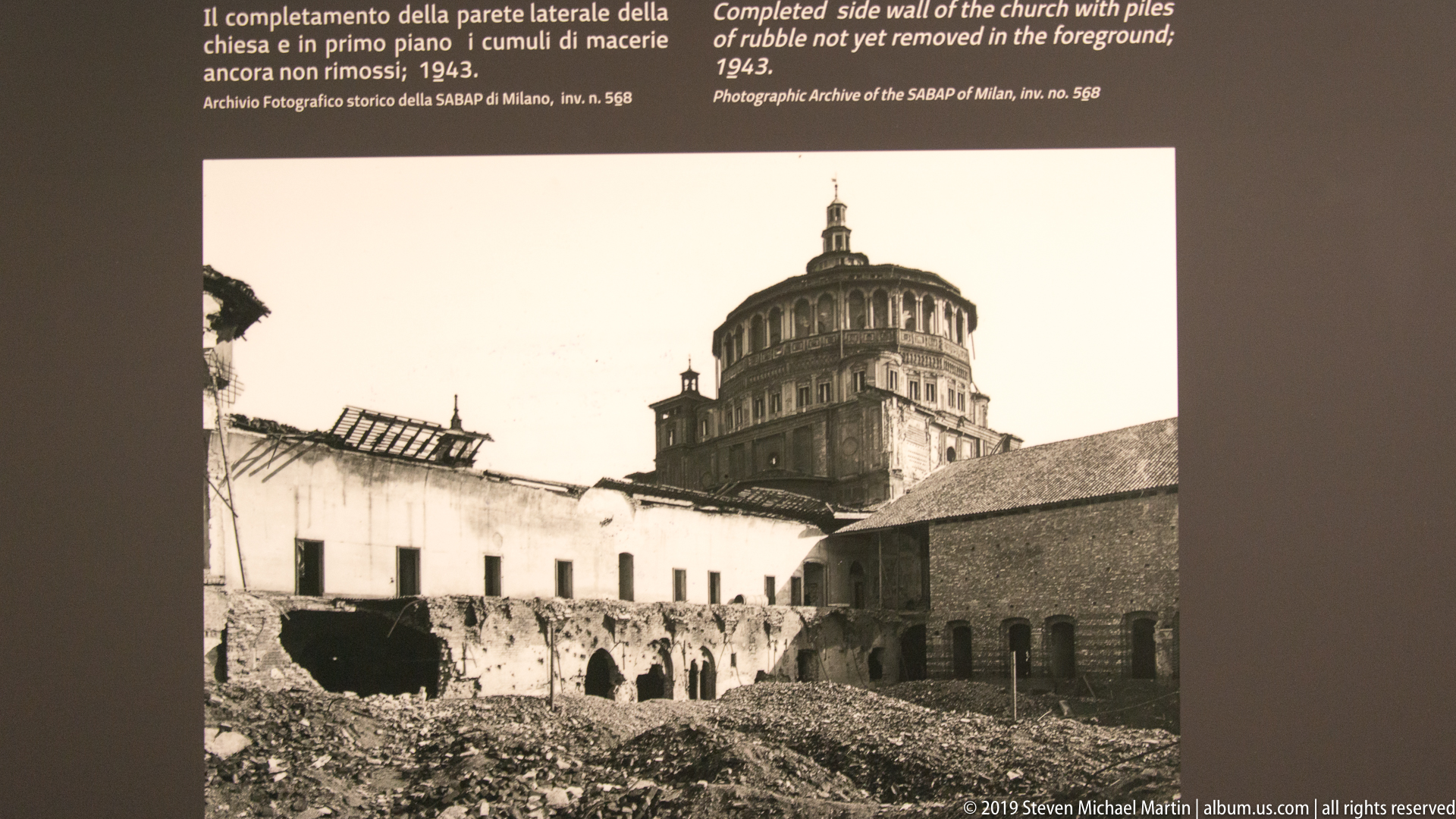
An archival photograph records the south side of Santa Maria delle Grazie after postwar reconstruction, with the rebuilt wall stretching across the foreground and the Renaissance tribune rising intact behind it. Piles of earth and construction debris remain in the yard, indicating that the wider restoration campaign was still underway even after the principal masonry had been re-established.
Caption
An archival photograph records the south side of Santa Maria delle Grazie after postwar reconstruction, with the rebuilt wall stretching across the foreground and the Renaissance tribune rising intact behind it. Piles of earth and construction debris remain in the yard, indicating that the wider restoration campaign was still underway even after the principal masonry had been re-established.

This archival view shows the side wall of the church after re-plastering during the 1946–47 rebuilding campaign. Fresh pale surfaces and regular arched openings contrast with the rough construction ground below, while the great tribune rises above the roofline. The photograph records an intermediate stage between wartime ruin and the restored complex seen today.
Caption
This archival view shows the side wall of the church after re-plastering during the 1946–47 rebuilding campaign. Fresh pale surfaces and regular arched openings contrast with the rough construction ground below, while the great tribune rises above the roofline. The photograph records an intermediate stage between wartime ruin and the restored complex seen today.

Fragments of Renaissance wall painting survive high on a pale plaster wall beneath the groin-vaulted ceiling of the Santa Maria delle Grazie complex. Large losses interrupt the painted scene, leaving isolated figures, drapery, and architectural forms suspended within later neutral plaster. The oblique upward view emphasizes the mural as an archaeological survival embedded in the building fabric.
Caption
Fragments of Renaissance wall painting survive high on a pale plaster wall beneath the groin-vaulted ceiling of the Santa Maria delle Grazie complex. Large losses interrupt the painted scene, leaving isolated figures, drapery, and architectural forms suspended within later neutral plaster. The oblique upward view emphasizes the mural as an archaeological survival embedded in the building fabric.

A bilingual museum panel titled “Il convento sotto le bombe” recounts the August 1943 bombing of the Santa Maria delle Grazie convent. The English text explains that sections of the cloister, church, and refectory were damaged during the Allied air raids, while the large “MILANO 1943” footer situates the destruction within the broader wartime experience of the city.
Caption
A bilingual museum panel titled “Il convento sotto le bombe” recounts the August 1943 bombing of the Santa Maria delle Grazie convent. The English text explains that sections of the cloister, church, and refectory were damaged during the Allied air raids, while the large “MILANO 1943” footer situates the destruction within the broader wartime experience of the city.

A conservation panel explains the preventive measures used to protect Leonardo da Vinci’s Last Supper, combining a reproduction of the mural with technical text and institutional credits. The display discusses the controlled environment required for the fragile wall painting, including management of air quality and visitor access, making conservation practice part of the museum experience rather than an invisible backstage process.
Caption
A conservation panel explains the preventive measures used to protect Leonardo da Vinci’s Last Supper, combining a reproduction of the mural with technical text and institutional credits. The display discusses the controlled environment required for the fragile wall painting, including management of air quality and visitor access, making conservation practice part of the museum experience rather than an invisible backstage process.

The rear of Santa Maria delle Grazie reveals the full architectural complexity of its Renaissance tribune, with layered polygonal volumes, blind arcades, circular medallions, pale framed panels, and richly patterned brickwork. Seen straight on, the composition reads almost as a stacked series of drums and apsidal projections. This rear view provides the clearest exterior counterpart to the refectory and church spaces associated with the Cenacolo Vinciano.
Caption
The rear of Santa Maria delle Grazie reveals the full architectural complexity of its Renaissance tribune, with layered polygonal volumes, blind arcades, circular medallions, pale framed panels, and richly patterned brickwork. Seen straight on, the composition reads almost as a stacked series of drums and apsidal projections. This rear view provides the clearest exterior counterpart to the refectory and church spaces associated with the Cenacolo Vinciano.

A large fragment of wall painting preserves several seated or kneeling figures beneath faint architectural forms and long vertical elements that may represent staffs, standards, or structural details. The surrounding plaster has disappeared in broad irregular areas, turning the surviving scene into a patchwork of color and line. Its worn surface provides direct evidence of the convent’s layered decorative history.
Caption
A large fragment of wall painting preserves several seated or kneeling figures beneath faint architectural forms and long vertical elements that may represent staffs, standards, or structural details. The surrounding plaster has disappeared in broad irregular areas, turning the surviving scene into a patchwork of color and line. Its worn surface provides direct evidence of the convent’s layered decorative history.

An irregular island of surviving wall painting contains three closely grouped figures beneath a faded blue upper field, with a small cross visible at the right edge. Warm ocher and red tones suggest an architectural or landscape setting behind them. The fragment’s isolated survival against bare plaster makes the losses as visually important as the remaining iconography.
Caption
An irregular island of surviving wall painting contains three closely grouped figures beneath a faded blue upper field, with a small cross visible at the right edge. Warm ocher and red tones suggest an architectural or landscape setting behind them. The fragment’s isolated survival against bare plaster makes the losses as visually important as the remaining iconography.

A pale stone plaque inscribed “CENACOLO VINCIANO” marks the museum associated with Leonardo da Vinci’s Last Supper. Its understated lettering is set directly against the warm plaster wall, creating a restrained institutional marker rather than a monumental entrance sign. The close framing isolates the name that now identifies the protected refectory and its visitor route.
Caption
A pale stone plaque inscribed “CENACOLO VINCIANO” marks the museum associated with Leonardo da Vinci’s Last Supper. Its understated lettering is set directly against the warm plaster wall, creating a restrained institutional marker rather than a monumental entrance sign. The close framing isolates the name that now identifies the protected refectory and its visitor route.

The upper lantern of Santa Maria delle Grazie rises against a pale sky above the curved roofline of the Renaissance tribune. Slender columns open the lantern on multiple sides, while a smaller enclosed stage and metal finial crown the composition. The tight upward crop isolates the vertical termination of the church’s distinctive tribune from the richer brick-and-plaster masses below.
Caption
The upper lantern of Santa Maria delle Grazie rises against a pale sky above the curved roofline of the Renaissance tribune. Slender columns open the lantern on multiple sides, while a smaller enclosed stage and metal finial crown the composition. The tight upward crop isolates the vertical termination of the church’s distinctive tribune from the richer brick-and-plaster masses below.

A close exterior view of the Santa Maria delle Grazie tribune emphasizes its arcaded upper drum, patterned brickwork, pale inset panels, and slender lantern. The layered circular and polygonal masses create the vertical climax of the church complex. Cropping out the lower walls concentrates attention on the rhythm of arches and the ornamental brick-and-plaster surface treatment.
Caption
A close exterior view of the Santa Maria delle Grazie tribune emphasizes its arcaded upper drum, patterned brickwork, pale inset panels, and slender lantern. The layered circular and polygonal masses create the vertical climax of the church complex. Cropping out the lower walls concentrates attention on the rhythm of arches and the ornamental brick-and-plaster surface treatment.

The red-brick nave of Santa Maria delle Grazie stretches diagonally toward the monumental Renaissance tribune rising behind it. Tall lancet windows, circular oculi, and pale stone surrounds articulate the comparatively austere Gothic wall, while the tribune introduces a more elaborate arcaded and paneled vocabulary. Visitors gathered at street level provide scale for the church complex.
Caption
The red-brick nave of Santa Maria delle Grazie stretches diagonally toward the monumental Renaissance tribune rising behind it. Tall lancet windows, circular oculi, and pale stone surrounds articulate the comparatively austere Gothic wall, while the tribune introduces a more elaborate arcaded and paneled vocabulary. Visitors gathered at street level provide scale for the church complex.

From the piazza, Santa Maria delle Grazie presents a long red-brick Gothic body crowned at the east end by its elaborate Renaissance tribune. Circular oculi and tall pointed windows repeat along the nave, while the tribune rises in layered arcades and pale framed panels. People clustered near the entrance emphasize the church’s urban setting and the scale of the complex.
Caption
From the piazza, Santa Maria delle Grazie presents a long red-brick Gothic body crowned at the east end by its elaborate Renaissance tribune. Circular oculi and tall pointed windows repeat along the nave, while the tribune rises in layered arcades and pale framed panels. People clustered near the entrance emphasize the church’s urban setting and the scale of the complex.

A green metal cross crowns the apex of Santa Maria delle Grazie’s red-brick façade above a small stone finial. Below it, a refined Lombard cornice of miniature arches and molded brick courses follows the gable line. The close crop isolates the church’s roofline ornament, where simple Christian symbolism meets the highly crafted brick detailing characteristic of the façade.
Caption
A green metal cross crowns the apex of Santa Maria delle Grazie’s red-brick façade above a small stone finial. Below it, a refined Lombard cornice of miniature arches and molded brick courses follows the gable line. The close crop isolates the church’s roofline ornament, where simple Christian symbolism meets the highly crafted brick detailing characteristic of the façade.

A painted lunette above the main portal of Santa Maria delle Grazie centers the Virgin and Child amid kneeling and standing figures. The semicircular composition is encircled by a Latin inscription and framed by richly carved stone moldings. Set beneath the church’s brick façade, the devotional image marks the threshold with a distinctly Marian subject appropriate to Santa Maria delle Grazie.
Caption
A painted lunette above the main portal of Santa Maria delle Grazie centers the Virgin and Child amid kneeling and standing figures. The semicircular composition is encircled by a Latin inscription and framed by richly carved stone moldings. Set beneath the church’s brick façade, the devotional image marks the threshold with a distinctly Marian subject appropriate to Santa Maria delle Grazie.

The west façade of Santa Maria delle Grazie is organized as a broad red-brick gable pierced by a large central oculus, smaller circular openings, and tall pointed windows. A pale stone portal anchors the center, while slender brick buttress-like divisions articulate the wall vertically. The restrained Gothic façade contrasts with the more elaborate Renaissance tribune at the opposite end of the church.
Caption
The west façade of Santa Maria delle Grazie is organized as a broad red-brick gable pierced by a large central oculus, smaller circular openings, and tall pointed windows. A pale stone portal anchors the center, while slender brick buttress-like divisions articulate the wall vertically. The restrained Gothic façade contrasts with the more elaborate Renaissance tribune at the opposite end of the church.

Santa Maria delle Grazie faces the piazza with a broad red-brick façade articulated by circular oculi, tall pointed windows, and a pale stone central portal. Visitors gather near the entrances at street level, reinforcing the building’s continued use as both church and major cultural destination. The simple Gothic front provides a strong visual counterpoint to the ornate Renaissance tribune behind the church.
Caption
Santa Maria delle Grazie faces the piazza with a broad red-brick façade articulated by circular oculi, tall pointed windows, and a pale stone central portal. Visitors gather near the entrances at street level, reinforcing the building’s continued use as both church and major cultural destination. The simple Gothic front provides a strong visual counterpoint to the ornate Renaissance tribune behind the church.

Inside Santa Maria delle Grazie, rows of stone columns divide the nave from side aisles beneath richly decorated ribbed vaults. Painted and patterned surfaces cover arches, vault webs, and spandrels, while rows of chairs and worshippers occupy the lower space. The view looks lengthwise through the church, emphasizing the repeated bays and the dense ornamental treatment of the interior.
Caption
Inside Santa Maria delle Grazie, rows of stone columns divide the nave from side aisles beneath richly decorated ribbed vaults. Painted and patterned surfaces cover arches, vault webs, and spandrels, while rows of chairs and worshippers occupy the lower space. The view looks lengthwise through the church, emphasizing the repeated bays and the dense ornamental treatment of the interior.

A closer frontal view concentrates on the central portal and upper half of Santa Maria delle Grazie’s façade. The large circular window, four smaller oculi, and pointed side windows are set into red brick divided by narrow vertical strips. The stone portal projects forward beneath the central oculus, marking the principal entrance with a more sculptural treatment than the surrounding masonry.
Caption
A closer frontal view concentrates on the central portal and upper half of Santa Maria delle Grazie’s façade. The large circular window, four smaller oculi, and pointed side windows are set into red brick divided by narrow vertical strips. The stone portal projects forward beneath the central oculus, marking the principal entrance with a more sculptural treatment than the surrounding masonry.

The main portal of Santa Maria delle Grazie is framed by pale stone columns and a semicircular painted lunette, with the large brick-ringed oculus directly above. Carved circular reliefs line the entablature beneath the lunette. The tight vertical framing links the church’s devotional entrance imagery to the geometric rhythm of its Gothic brick façade.
Caption
The main portal of Santa Maria delle Grazie is framed by pale stone columns and a semicircular painted lunette, with the large brick-ringed oculus directly above. Carved circular reliefs line the entablature beneath the lunette. The tight vertical framing links the church’s devotional entrance imagery to the geometric rhythm of its Gothic brick façade.
⭐ Highlights
- The Last Supper: Leonardo da Vinci’s masterpiece depicting the moment Jesus announces his betrayal.
- Santa Maria delle Grazie: The Dominican convent where the mural is located.
- Monumental Scale: The painting covers an entire wall of the refectory dining hall.
- Innovative Technique: Leonardo used a non-traditional method, contributing to both its detail and fragility.
- Controlled Viewing: Access is strictly limited to protect the artwork.
- Renaissance Masterpiece: One of the most studied and influential works in art history.
🎨 Cenacolo Vinciano Field Guide
Major features observed during this visit:
The Cenacolo Vinciano houses Leonardo da Vinci’s “The Last Supper,” one of the most important works of the Renaissance. Painted between the late 15th century, the mural occupies the wall of the refectory at the convent of Santa Maria delle Grazie in Milan. It depicts the dramatic moment when Christ announces that one of his disciples will betray him, capturing a range of human reactions and emotions.
🏛️ Signature Features
- The Last Supper Mural – A large-scale wall painting covering the end wall of the dining hall.
- Central Composition – Christ is positioned at the center, with perspective lines drawing focus toward him.
- Grouped Apostles – The twelve apostles are arranged in dynamic groups reacting to Christ’s words.
- Refectory Setting – The painting is integrated into the original dining space of the monastery.
- Subtle Detail – Expressions, gestures, and perspective create a highly controlled composition.
🧠 Historical Significance
- Painted c. 1494–1498 – Commissioned by Ludovico Sforza, Duke of Milan.
- Renaissance Innovation – Leonardo experimented with technique rather than traditional fresco methods.
- Fragile Legacy – The painting deteriorated early due to its experimental materials and environment.
- Enduring Influence – Considered one of the most important and influential artworks in the world.
🌄 Setting & Experience
- Santa Maria delle Grazie – The mural is located within a functioning historic religious complex.
- Controlled Environment – Temperature, humidity, and visitor numbers are strictly regulated.
- Brief Viewing Time – Visits are limited to short time slots to preserve the artwork.
- Immersive Space – The scale and setting create a powerful, focused viewing experience.