Moscow
Moscow developed as one of the principal political and cultural centers of Russia, shaped by medieval principalities and later imperial governance. The city expanded as a fortified settlement that became the administrative center of a growing state. Its historic landmarks illustrate the consolidation of political authority across multiple centuries.
Architectural styles reflect influences from Byzantine religious traditions as well as later imperial and Soviet periods. Churches, palaces, and civic buildings demonstrate the evolving identity of the Russian capital. Urban development illustrates the relationship between political leadership and cultural expression.
Moscow represents the historical continuity of Russian governance from medieval foundations through modern state formation. Its architectural diversity illustrates the interaction between religious tradition, political authority, and urban development.

Seen from below and at an angle, Moscow State University's main building reveals the depth and vertical layering of its monumental Stalin-era composition. A clock tower fills the left foreground while the taller central spire rises behind it, allowing the photograph to emphasize the complex's stepped towers, pale stone façades, and imposing scale.
Caption
Seen from below and at an angle, Moscow State University's main building reveals the depth and vertical layering of its monumental Stalin-era composition. A clock tower fills the left foreground while the taller central spire rises behind it, allowing the photograph to emphasize the complex's stepped towers, pale stone façades, and imposing scale.

Dark storm clouds hang over a wide Moscow cityscape, where monumental pale buildings and distant high-rises stretch across the horizon above autumn foliage. Strong sunlight on portions of the city contrasts with the approaching weather, turning the view into a study of Moscow's varied urban scale and dramatic seasonal atmosphere.
Caption
Dark storm clouds hang over a wide Moscow cityscape, where monumental pale buildings and distant high-rises stretch across the horizon above autumn foliage. Strong sunlight on portions of the city contrasts with the approaching weather, turning the view into a study of Moscow's varied urban scale and dramatic seasonal atmosphere.

The glass towers of Moscow City rise at the left of a sweeping urban panorama, while a broad belt of autumn parkland and a curving river corridor occupy the foreground. Farther right, one of Moscow's tall Stalin-era towers punctuates the horizon, illustrating the contrast between the capital's twenty-first-century business district and its monumental mid-century skyline.
Caption
The glass towers of Moscow City rise at the left of a sweeping urban panorama, while a broad belt of autumn parkland and a curving river corridor occupy the foreground. Farther right, one of Moscow's tall Stalin-era towers punctuates the horizon, illustrating the contrast between the capital's twenty-first-century business district and its monumental mid-century skyline.

The Moscow Kremlin extends across the far bank of the Moscow River, with red-brick towers, green-roofed palace buildings, and gilded church domes layered along the skyline. Bridges cross the river in the middle distance and traffic follows the embankment, placing the fortified UNESCO World Heritage complex within the movement and infrastructure of central Moscow.
Caption
The Moscow Kremlin extends across the far bank of the Moscow River, with red-brick towers, green-roofed palace buildings, and gilded church domes layered along the skyline. Bridges cross the river in the middle distance and traffic follows the embankment, placing the fortified UNESCO World Heritage complex within the movement and infrastructure of central Moscow.

A broad Moscow skyline rises beyond a large ribbed glass roof, with the golden dome of the Cathedral of Christ the Saviour prominent among dense residential and commercial blocks. The elevated viewpoint compresses old and new elements of the city into one layered urban panorama beneath broken blue clouds.
Caption
A broad Moscow skyline rises beyond a large ribbed glass roof, with the golden dome of the Cathedral of Christ the Saviour prominent among dense residential and commercial blocks. The elevated viewpoint compresses old and new elements of the city into one layered urban panorama beneath broken blue clouds.

The Cathedral of Christ the Saviour rises above the Moscow River while a long sightseeing boat passes across the foreground. Patriarshy Bridge curves toward the cathedral from the right, linking river traffic, embankment, and the white-and-gold church in a single cityscape; autumn trees form a warm band beneath the gray sky.
Caption
The Cathedral of Christ the Saviour rises above the Moscow River while a long sightseeing boat passes across the foreground. Patriarshy Bridge curves toward the cathedral from the right, linking river traffic, embankment, and the white-and-gold church in a single cityscape; autumn trees form a warm band beneath the gray sky.

The monumental main building of Moscow State University rises symmetrically above a formal forecourt, its central spire flanked by lower wings and clock towers. One of Moscow's characteristic Stalin-era skyscrapers, the composition is shown frontally so that the stepped massing, vertical emphasis, and balanced arrangement of the complex are especially clear.
Caption
The monumental main building of Moscow State University rises symmetrically above a formal forecourt, its central spire flanked by lower wings and clock towers. One of Moscow's characteristic Stalin-era skyscrapers, the composition is shown frontally so that the stepped massing, vertical emphasis, and balanced arrangement of the complex are especially clear.

The gilded domes of the Cathedral of Christ the Saviour rise above a dense foreground of apartment blocks, while a Stalinist high-rise stands farther back on the skyline. The telephoto compression layers Orthodox church architecture, Soviet-era monumental building, and contemporary urban fabric into a compact cross-section of central Moscow.
Caption
The gilded domes of the Cathedral of Christ the Saviour rise above a dense foreground of apartment blocks, while a Stalinist high-rise stands farther back on the skyline. The telephoto compression layers Orthodox church architecture, Soviet-era monumental building, and contemporary urban fabric into a compact cross-section of central Moscow.

A pale stone memorial composed of three tall, angular slabs stands in an open plaza, with Moscow State University's main building aligned in the distance. Wreaths and flowers at the base indicate a commemorative function, while the axial composition visually links the monument to the university skyline beyond.
Caption
A pale stone memorial composed of three tall, angular slabs stands in an open plaza, with Moscow State University's main building aligned in the distance. Wreaths and flowers at the base indicate a commemorative function, while the axial composition visually links the monument to the university skyline beyond.

The former Hotel Ukraina, one of Moscow’s Stalinist high-rises and now the Radisson Collection Hotel, rises above the surrounding city with a tall central spire and stepped crown. Seen from a distant elevated viewpoint, the pale tower is isolated against a dark gray sky, making its tiered vertical composition and needle-like finial especially legible.
Caption
The former Hotel Ukraina, one of Moscow’s Stalinist high-rises and now the Radisson Collection Hotel, rises above the surrounding city with a tall central spire and stepped crown. Seen from a distant elevated viewpoint, the pale tower is isolated against a dark gray sky, making its tiered vertical composition and needle-like finial especially legible.

Red-brick walls and towers of the Moscow Kremlin extend along the Moskva River, with the Grand Kremlin Palace and gilded church domes rising behind the fortifications. The river embankment anchors the foreground, while the layered skyline brings together defensive architecture, palace buildings, and ecclesiastical forms in one broad contextual view.
Caption
Red-brick walls and towers of the Moscow Kremlin extend along the Moskva River, with the Grand Kremlin Palace and gilded church domes rising behind the fortifications. The river embankment anchors the foreground, while the layered skyline brings together defensive architecture, palace buildings, and ecclesiastical forms in one broad contextual view.

A tall leaded-glass window is patterned with narrow diamond panes and six colorful floral medallions. Seen from indoors, the decorative glazing frames a hazy urban view beyond, making the craftsmanship of the window itself the dominant subject while retaining a sense of its elevated Moscow setting.
Caption
A tall leaded-glass window is patterned with narrow diamond panes and six colorful floral medallions. Seen from indoors, the decorative glazing frames a hazy urban view beyond, making the craftsmanship of the window itself the dominant subject while retaining a sense of its elevated Moscow setting.

An ornate standing candelabrum is doubled by a tall mirror, creating the appearance of a matched pair beneath a ceiling enriched with molded reliefs. Curling metal branches carry candle-form lamps, while the vertical mirrored seam divides the composition and turns a functional light fixture into a study of symmetry and reflection.
Caption
An ornate standing candelabrum is doubled by a tall mirror, creating the appearance of a matched pair beneath a ceiling enriched with molded reliefs. Curling metal branches carry candle-form lamps, while the vertical mirrored seam divides the composition and turns a functional light fixture into a study of symmetry and reflection.

A monumental gilded chandelier hangs beneath a richly patterned coffered ceiling in a marble-lined Moscow interior. A dark veined column rises beside the fixture, while a small sculpture and stair landing establish the scale of the hall. The view emphasizes the contrast between luminous metalwork, pale stone surfaces, and the heavy architectural column.
Caption
A monumental gilded chandelier hangs beneath a richly patterned coffered ceiling in a marble-lined Moscow interior. A dark veined column rises beside the fixture, while a small sculpture and stair landing establish the scale of the hall. The view emphasizes the contrast between luminous metalwork, pale stone surfaces, and the heavy architectural column.

An elaborate doorway is framed by gilded relief panels, fluted and paneled uprights, and a triangular ornamental composition against deep red walls. A small hanging light marks the centerline, while a mirror and console table are visible through the opening. The close frontal view records the portal as a decorative architectural feature rather than a general room view.
Caption
An elaborate doorway is framed by gilded relief panels, fluted and paneled uprights, and a triangular ornamental composition against deep red walls. A small hanging light marks the centerline, while a mirror and console table are visible through the opening. The close frontal view records the portal as a decorative architectural feature rather than a general room view.

A towering gilded chandelier fills the upper foreground of a marble-lined hall, with a dark sculptural column or figure rising beneath it. Additional chandeliers, stairs, seating, and artworks recede through the room, giving the photograph a strong sense of vertical scale and layered decoration in this formal Moscow interior.
Caption
A towering gilded chandelier fills the upper foreground of a marble-lined hall, with a dark sculptural column or figure rising beneath it. Additional chandeliers, stairs, seating, and artworks recede through the room, giving the photograph a strong sense of vertical scale and layered decoration in this formal Moscow interior.

Curving gilded arms, pierced metal ornament, and ranks of candle-form lamps crowd this close view of a large chandelier. The fixture hangs beneath a decorated ceiling beside a stained-glass window, allowing the photograph to isolate the dense metalwork and repeated light sources that define the room’s formal decorative scheme.
Caption
Curving gilded arms, pierced metal ornament, and ranks of candle-form lamps crowd this close view of a large chandelier. The fixture hangs beneath a decorated ceiling beside a stained-glass window, allowing the photograph to isolate the dense metalwork and repeated light sources that define the room’s formal decorative scheme.

An illuminated multi-tier chandelier hangs against a pale stone wall, its dozens of candle-form lamps forming bright horizontal rings in the otherwise subdued interior. With little surrounding architecture visible, the composition concentrates attention on the fixture’s branching metalwork, suspended finial, and symmetrical tiers.
Caption
An illuminated multi-tier chandelier hangs against a pale stone wall, its dozens of candle-form lamps forming bright horizontal rings in the otherwise subdued interior. With little surrounding architecture visible, the composition concentrates attention on the fixture’s branching metalwork, suspended finial, and symmetrical tiers.

A broad chandelier with concentric tiers of candle-form lamps hangs in front of pale stone walls, balanced visually by a dark veined column at the left edge. The restrained composition separates the fixture from the more elaborate ceiling views elsewhere in the sequence and emphasizes its suspended mass, symmetry, and warm illumination.
Caption
A broad chandelier with concentric tiers of candle-form lamps hangs in front of pale stone walls, balanced visually by a dark veined column at the left edge. The restrained composition separates the fixture from the more elaborate ceiling views elsewhere in the sequence and emphasizes its suspended mass, symmetry, and warm illumination.

A short marble staircase rises between two tall branching candelabra toward dark double doors. Above the landing, a circular figural relief is set into the pale stone wall beneath a richly ornamented ceiling. The frontal symmetry and paired lighting fixtures give this Moscow interior the character of a formal ceremonial approach.
Caption
A short marble staircase rises between two tall branching candelabra toward dark double doors. Above the landing, a circular figural relief is set into the pale stone wall beneath a richly ornamented ceiling. The frontal symmetry and paired lighting fixtures give this Moscow interior the character of a formal ceremonial approach.

Viewed upward through a bright atrium or stairwell, a long ornamental metal fixture descends from a glazed ceiling. Leaf-like forms, scrolling arms, and suspended elements are echoed by decorative railings at the edges. The unusual angle emphasizes the vertical relationship between the hanging object and the modern glass opening above.
Caption
Viewed upward through a bright atrium or stairwell, a long ornamental metal fixture descends from a glazed ceiling. Leaf-like forms, scrolling arms, and suspended elements are echoed by decorative railings at the edges. The unusual angle emphasizes the vertical relationship between the hanging object and the modern glass opening above.

A gilded floral finial crowns a polished rail in a tightly focused architectural detail. Its layered leaf or petal forms rise from a turned base, while the surrounding interior dissolves into soft focus. The photograph isolates the craftsmanship of a small ornamental fitting that would otherwise be secondary within the larger decorative scheme.
Caption
A gilded floral finial crowns a polished rail in a tightly focused architectural detail. Its layered leaf or petal forms rise from a turned base, while the surrounding interior dissolves into soft focus. The photograph isolates the craftsmanship of a small ornamental fitting that would otherwise be secondary within the larger decorative scheme.
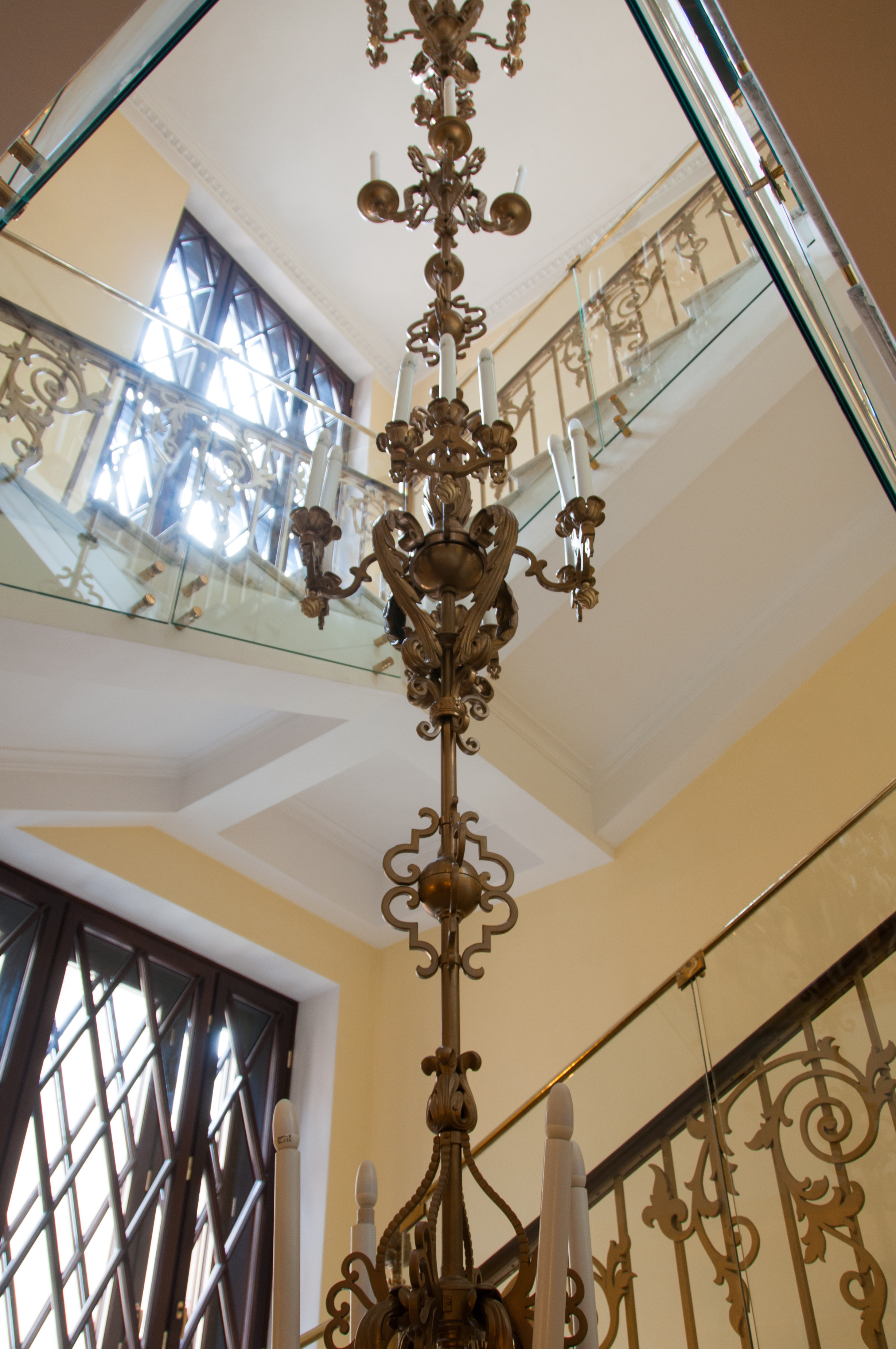
A tall branching metal fixture hangs through the center of a light-filled stairwell, extending past multiple levels of decorative railing. The upward perspective reveals its repeated scrolls, floral forms, and suspended elements against a glazed roof, while dark window framing at lower left adds depth to the otherwise pale interior.
Caption
A tall branching metal fixture hangs through the center of a light-filled stairwell, extending past multiple levels of decorative railing. The upward perspective reveals its repeated scrolls, floral forms, and suspended elements against a glazed roof, while dark window framing at lower left adds depth to the otherwise pale interior.

A compact chandelier hangs close beneath a richly molded white plaster ceiling. Curled metal arms support candle-form lamps around an openwork central ring, and a tassel-like finial descends below. The low-angle close view pairs the fixture’s warm metal tones with the ceiling’s crisp rosettes and linear plaster ornament.
Caption
A compact chandelier hangs close beneath a richly molded white plaster ceiling. Curled metal arms support candle-form lamps around an openwork central ring, and a tassel-like finial descends below. The low-angle close view pairs the fixture’s warm metal tones with the ceiling’s crisp rosettes and linear plaster ornament.

Two matching wall sconces glow against a warm yellow wall, each combining a faceted or lattice-like backplate with small candle-form lamps and curling metal arms. Their symmetrical placement and overlapping shadows create a compact study of decorative lighting, while a molded ceiling edge is just visible above.
Caption
Two matching wall sconces glow against a warm yellow wall, each combining a faceted or lattice-like backplate with small candle-form lamps and curling metal arms. Their symmetrical placement and overlapping shadows create a compact study of decorative lighting, while a molded ceiling edge is just visible above.

A single berth in a wood-paneled railway compartment is dressed with red-and-blue plaid upholstery and a white pillow. A mirror, luggage rack, reading fixture, towel, and heavy curtain compress the amenities into a narrow sleeping space, documenting the practical interior arrangement of overnight rail travel associated with the Moscow journey.
Caption
A single berth in a wood-paneled railway compartment is dressed with red-and-blue plaid upholstery and a white pillow. A mirror, luggage rack, reading fixture, towel, and heavy curtain compress the amenities into a narrow sleeping space, documenting the practical interior arrangement of overnight rail travel associated with the Moscow journey.

Two facing berths with red-and-blue plaid upholstery fill this compact railway sleeping compartment. White pillows lean against the wood-paneled walls, and a small table beneath the curtained window holds flowers, dishes, and reading material. The centered view records both the symmetry and close quarters of overnight train accommodation connected with the Moscow itinerary.
Caption
Two facing berths with red-and-blue plaid upholstery fill this compact railway sleeping compartment. White pillows lean against the wood-paneled walls, and a small table beneath the curtained window holds flowers, dishes, and reading material. The centered view records both the symmetry and close quarters of overnight train accommodation connected with the Moscow itinerary.

A frontal view centers a marble staircase between matching ornate candelabra, with dark double doors at the landing and a circular figural relief above. Gilded ceiling ornament frames the upper edge, reinforcing the room’s formal symmetry. This wider repetition of the hall gives greater emphasis to the architectural approach and balanced decorative program.
Caption
A frontal view centers a marble staircase between matching ornate candelabra, with dark double doors at the landing and a circular figural relief above. Gilded ceiling ornament frames the upper edge, reinforcing the room’s formal symmetry. This wider repetition of the hall gives greater emphasis to the architectural approach and balanced decorative program.

A fountain sprays from the river in the foreground, its white plume partly obscuring the distant Peter the Great monument. The monument’s tall dark ship-like silhouette rises on the opposite bank amid low waterfront buildings under a heavy gray sky. The layered view connects public water display, river setting, and one of Moscow’s conspicuous modern monuments.
Caption
A fountain sprays from the river in the foreground, its white plume partly obscuring the distant Peter the Great monument. The monument’s tall dark ship-like silhouette rises on the opposite bank amid low waterfront buildings under a heavy gray sky. The layered view connects public water display, river setting, and one of Moscow’s conspicuous modern monuments.

A bride holding a compact bouquet of pink roses stands with her groom beside an ornamental iron railing on a Moscow river embankment. Their formal wedding clothes and close pose make the couple the clear subject, while autumn foliage and the waterside setting place the portrait within the city rather than a studio setting.
Caption
A bride holding a compact bouquet of pink roses stands with her groom beside an ornamental iron railing on a Moscow river embankment. Their formal wedding clothes and close pose make the couple the clear subject, while autumn foliage and the waterside setting place the portrait within the city rather than a studio setting.

A Moscow streetscape detail records a Dunkin’ Donuts storefront, pairing the familiar English-language coffee-cup logo with illuminated Cyrillic lettering reading the brand name. The sign is mounted on a stone-faced urban building with an arched upper window, illustrating the visual coexistence of international branding and Russian-language commercial signage.
Caption
A Moscow streetscape detail records a Dunkin’ Donuts storefront, pairing the familiar English-language coffee-cup logo with illuminated Cyrillic lettering reading the brand name. The sign is mounted on a stone-faced urban building with an arched upper window, illustrating the visual coexistence of international branding and Russian-language commercial signage.

Large red Cyrillic lettering for Wendy’s spans the facade of a Moscow restaurant, accompanied by the chain’s circular red-haired mascot logo. Red awnings and a pale exterior wall reinforce the brand’s visual identity. The close crop focuses on commercial signage rather than the surrounding street, documenting an international fast-food presence in the city.
Caption
Large red Cyrillic lettering for Wendy’s spans the facade of a Moscow restaurant, accompanied by the chain’s circular red-haired mascot logo. Red awnings and a pale exterior wall reinforce the brand’s visual identity. The close crop focuses on commercial signage rather than the surrounding street, documenting an international fast-food presence in the city.

A monumental stone cultural building stands behind mature evergreens and clipped shrubs, its entrance marked by a deep classical portico of tall columns and a sculpted frieze. Vertical exhibition banners hang between the columns. The landscaped foreground softens the formal facade while preserving a clear view of its pedimented entrance and museum-like civic scale.
Caption
A monumental stone cultural building stands behind mature evergreens and clipped shrubs, its entrance marked by a deep classical portico of tall columns and a sculpted frieze. Vertical exhibition banners hang between the columns. The landscaped foreground softens the formal facade while preserving a clear view of its pedimented entrance and museum-like civic scale.

Members of a tour group stand in the foreground of a landscaped Moscow plaza, with a monumental columned cultural building rising behind them. The photograph shifts attention from architecture to the human experience of the site: rain jackets, scarves, and close grouping suggest cool, damp weather during a guided stop.
Caption
Members of a tour group stand in the foreground of a landscaped Moscow plaza, with a monumental columned cultural building rising behind them. The photograph shifts attention from architecture to the human experience of the site: rain jackets, scarves, and close grouping suggest cool, damp weather during a guided stop.

A smiling male visitor stands amid a tour group in front of a monumental columned building and formal landscaping. Other travelers overlap the foreground, while evergreen trees and exhibition banners frame the architecture behind. The shallow human-centered composition distinguishes this view from the adjacent architectural and crowd photographs without requiring identification of the individual.
Caption
A smiling male visitor stands amid a tour group in front of a monumental columned building and formal landscaping. Other travelers overlap the foreground, while evergreen trees and exhibition banners frame the architecture behind. The shallow human-centered composition distinguishes this view from the adjacent architectural and crowd photographs without requiring identification of the individual.

A long queue stretches down a wet Moscow sidewalk beside parked and passing vehicles. Visitors in coats cluster along the curb, several carrying umbrellas, while trees and city buildings recede into the distance. The image records the scale of attendance and rainy street conditions rather than a single landmark or individual.
Caption
A long queue stretches down a wet Moscow sidewalk beside parked and passing vehicles. Visitors in coats cluster along the curb, several carrying umbrellas, while trees and city buildings recede into the distance. The image records the scale of attendance and rainy street conditions rather than a single landmark or individual.

Two elaborate gilded metal gates stand open beneath a matching scrollwork transom, creating a ceremonial threshold into a polished formal room. Through the opening, symmetrical furnishings and a richly framed central architectural feature align on the main axis. The photograph emphasizes layered metalwork, reflective flooring, and the controlled symmetry of the interior approach.
Caption
Two elaborate gilded metal gates stand open beneath a matching scrollwork transom, creating a ceremonial threshold into a polished formal room. Through the opening, symmetrical furnishings and a richly framed central architectural feature align on the main axis. The photograph emphasizes layered metalwork, reflective flooring, and the controlled symmetry of the interior approach.

A white multi-story classical building rises beyond a broad green lawn under an overcast sky. Its facade is organized by tall vertical windows and restrained ornament, while a cylindrical rooftop pavilion capped in green provides the most distinctive silhouette. The photograph functions as an establishing architectural view within central Moscow.
Caption
A white multi-story classical building rises beyond a broad green lawn under an overcast sky. Its facade is organized by tall vertical windows and restrained ornament, while a cylindrical rooftop pavilion capped in green provides the most distinctive silhouette. The photograph functions as an establishing architectural view within central Moscow.

A tiered fountain sends a tall central jet above a dark sculptural centerpiece, while smaller jets arc outward around a rough-stone basin. Flower beds and tree-lined paths extend behind it beneath an overcast sky. The centered composition uses the fountain’s vertical spray to organize a broader view of the formal park landscape.
Caption
A tiered fountain sends a tall central jet above a dark sculptural centerpiece, while smaller jets arc outward around a rough-stone basin. Flower beds and tree-lined paths extend behind it beneath an overcast sky. The centered composition uses the fountain’s vertical spray to organize a broader view of the formal park landscape.

A male visitor poses in front of broad geometric flower beds filled with orange, yellow, red, and pale foliage plants. Tree-lined paths and white park lights recede behind him, placing the portrait within a carefully maintained Moscow public garden in early autumn. The shallow depth of field keeps the traveler prominent while retaining the seasonal landscape.
Caption
A male visitor poses in front of broad geometric flower beds filled with orange, yellow, red, and pale foliage plants. Tree-lined paths and white park lights recede behind him, placing the portrait within a carefully maintained Moscow public garden in early autumn. The shallow depth of field keeps the traveler prominent while retaining the seasonal landscape.

A bride in a white gown and a groom in dark formalwear stand with companions near broad outdoor steps on a rain-darkened Moscow walkway. Pedestrians pass around them, and a decorated tree-like installation rises at the top of the stairs. The candid street scene contrasts ceremonial dress with the ordinary movement of a damp city day.
Caption
A bride in a white gown and a groom in dark formalwear stand with companions near broad outdoor steps on a rain-darkened Moscow walkway. Pedestrians pass around them, and a decorated tree-like installation rises at the top of the stairs. The candid street scene contrasts ceremonial dress with the ordinary movement of a damp city day.
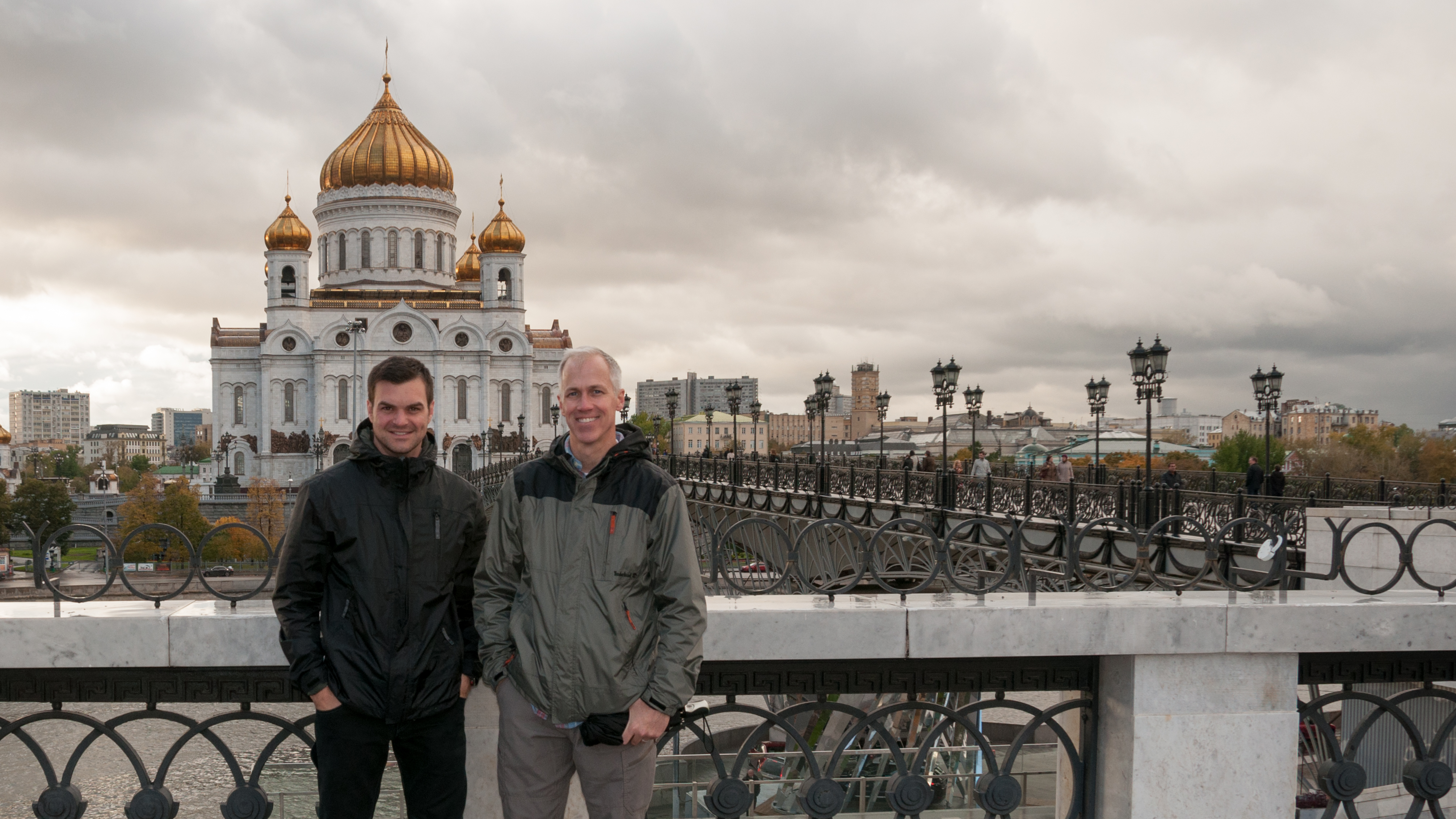
Two travelers pose at the railing of Patriarshy Bridge with the Cathedral of Christ the Saviour centered behind them. The viewpoint places the cathedral’s gilded domes above the figures and carries the bridge’s repeating lamps and ironwork into the distance, combining a personal travel portrait with a clear architectural setting on an overcast autumn day.
Caption
Two travelers pose at the railing of Patriarshy Bridge with the Cathedral of Christ the Saviour centered behind them. The viewpoint places the cathedral’s gilded domes above the figures and carries the bridge’s repeating lamps and ironwork into the distance, combining a personal travel portrait with a clear architectural setting on an overcast autumn day.

Hundreds of colorful padlocks crowd a tree-shaped metal installation on a Moscow embankment, a public expression of couples marking relationships in the urban landscape. Red locks dominate the dense mass, with ribbons and differently shaped locks layered across the branches; the river and city buildings remain secondary beyond the railing.
Caption
Hundreds of colorful padlocks crowd a tree-shaped metal installation on a Moscow embankment, a public expression of couples marking relationships in the urban landscape. Red locks dominate the dense mass, with ribbons and differently shaped locks layered across the branches; the river and city buildings remain secondary beyond the railing.

Zurab Tsereteli’s monumental statue of Peter I rises from the Moscow River on a ship-like base, its stacked sails, rigging, flags, and sculptural prow forming a complex vertical silhouette. Seen from across the water, the monument is isolated against the cloudy sky, with the Cathedral of Christ the Saviour visible at a much smaller scale in the distance.
Caption
Zurab Tsereteli’s monumental statue of Peter I rises from the Moscow River on a ship-like base, its stacked sails, rigging, flags, and sculptural prow forming a complex vertical silhouette. Seen from across the water, the monument is isolated against the cloudy sky, with the Cathedral of Christ the Saviour visible at a much smaller scale in the distance.

A close view of the Peter the Great Monument isolates the armored figure of Peter I holding a golden scroll above the prow of the sculpted vessel. Ropes, masts, suspended lines, and dark sail forms create a dense nautical framework behind him, revealing details that are compressed into the silhouette in more distant views of Zurab Tsereteli’s monument.
Caption
A close view of the Peter the Great Monument isolates the armored figure of Peter I holding a golden scroll above the prow of the sculpted vessel. Ropes, masts, suspended lines, and dark sail forms create a dense nautical framework behind him, revealing details that are compressed into the silhouette in more distant views of Zurab Tsereteli’s monument.

The Peter the Great Monument stands fully visible from base to mast in the Moscow River, allowing the scale of Zurab Tsereteli’s composition to read against lower waterfront buildings. The figure of Peter I occupies the center of an elaborate ship structure whose repeated sails and rigging climb upward, while fountain jets break the water around the base.
Caption
The Peter the Great Monument stands fully visible from base to mast in the Moscow River, allowing the scale of Zurab Tsereteli’s composition to read against lower waterfront buildings. The figure of Peter I occupies the center of an elaborate ship structure whose repeated sails and rigging climb upward, while fountain jets break the water around the base.

The Cathedral of Christ the Saviour anchors the end of a broad pedestrian approach beneath a dramatic overcast sky. Ornate black streetlamps recede in a strong line along the bridge, while the cathedral’s white mass and gilded central dome remain luminous against the dark clouds; a few pedestrians provide scale on the wet-looking pavement.
Caption
The Cathedral of Christ the Saviour anchors the end of a broad pedestrian approach beneath a dramatic overcast sky. Ornate black streetlamps recede in a strong line along the bridge, while the cathedral’s white mass and gilded central dome remain luminous against the dark clouds; a few pedestrians provide scale on the wet-looking pavement.

A large dark bell hangs within an arched opening high in one of the Cathedral of Christ the Saviour’s white towers. Cropped tightly beneath the gilded roof, the view shifts attention from the cathedral’s overall silhouette to its bell chamber, masonry moldings, supporting metalwork, and the deep shadow surrounding the suspended bell.
Caption
A large dark bell hangs within an arched opening high in one of the Cathedral of Christ the Saviour’s white towers. Cropped tightly beneath the gilded roof, the view shifts attention from the cathedral’s overall silhouette to its bell chamber, masonry moldings, supporting metalwork, and the deep shadow surrounding the suspended bell.

A full-length portrait of two men on Patriarshy Bridge places the Cathedral of Christ the Saviour directly behind them across the railing. More of the bridge deck and balustrade is visible than in the adjacent portrait, emphasizing the elevated pedestrian setting and the cathedral’s position beyond the Moscow River corridor under heavy gray clouds.
Caption
A full-length portrait of two men on Patriarshy Bridge places the Cathedral of Christ the Saviour directly behind them across the railing. More of the bridge deck and balustrade is visible than in the adjacent portrait, emphasizing the elevated pedestrian setting and the cathedral’s position beyond the Moscow River corridor under heavy gray clouds.

Across the Moscow River, the Cathedral of Christ the Saviour dominates the riverfront as Patriarshy Bridge sweeps toward its entrance. A white-and-blue passenger vessel crosses the lower frame, giving the scene a strong horizontal counterpoint to the cathedral’s central dome and towers, while breaks in the storm clouds add cool light to the façade.
Caption
Across the Moscow River, the Cathedral of Christ the Saviour dominates the riverfront as Patriarshy Bridge sweeps toward its entrance. A white-and-blue passenger vessel crosses the lower frame, giving the scene a strong horizontal counterpoint to the cathedral’s central dome and towers, while breaks in the storm clouds add cool light to the façade.

A close travel portrait frames a man in a dark jacket against the softly focused façade and gilded domes of the Cathedral of Christ the Saviour. The shallow depth of field keeps attention on the sitter while retaining enough of the cathedral’s white arches, towers, and gold roof forms to establish the Moscow setting.
Caption
A close travel portrait frames a man in a dark jacket against the softly focused façade and gilded domes of the Cathedral of Christ the Saviour. The shallow depth of field keeps attention on the sitter while retaining enough of the cathedral’s white arches, towers, and gold roof forms to establish the Moscow setting.

A man wearing a gray jacket and backpack stands before the Cathedral of Christ the Saviour, whose central gilded dome and flanking towers fill the background. The tighter composition brings the cathedral’s arched windows and white stonework close behind the sitter, making the portrait both personal and strongly tied to this landmark setting.
Caption
A man wearing a gray jacket and backpack stands before the Cathedral of Christ the Saviour, whose central gilded dome and flanking towers fill the background. The tighter composition brings the cathedral’s arched windows and white stonework close behind the sitter, making the portrait both personal and strongly tied to this landmark setting.

The Cathedral of Christ the Saviour stands squarely at the end of Patriarshy Bridge, its white façade and gilded domes reflected faintly in the damp pedestrian surface. Repeating lamps and railings frame the approach symmetrically, while clusters of visitors near the entrance convey the scale of the cathedral beneath turbulent gray clouds.
Caption
The Cathedral of Christ the Saviour stands squarely at the end of Patriarshy Bridge, its white façade and gilded domes reflected faintly in the damp pedestrian surface. Repeating lamps and railings frame the approach symmetrically, while clusters of visitors near the entrance convey the scale of the cathedral beneath turbulent gray clouds.

A low frontal viewpoint gives the Cathedral of Christ the Saviour a monumental presence, filling the frame with its white arched façade, sculptural reliefs, and large gilded central dome. The symmetrical towers and smaller domes stand against a patch of blue opening through the clouds, while visitors remain small along the base of the building.
Caption
A low frontal viewpoint gives the Cathedral of Christ the Saviour a monumental presence, filling the frame with its white arched façade, sculptural reliefs, and large gilded central dome. The symmetrical towers and smaller domes stand against a patch of blue opening through the clouds, while visitors remain small along the base of the building.

A crowded market display brings together small metal figurines, candlesticks, vessels, and decorative objects in varied finishes. Human figures dominate the foreground, including a standing woman and a seated male figure, while dozens of smaller bronze- and silver-toned objects overlap behind them, conveying the dense visual texture of a Moscow souvenir or antiques stall.
Caption
A crowded market display brings together small metal figurines, candlesticks, vessels, and decorative objects in varied finishes. Human figures dominate the foreground, including a standing woman and a seated male figure, while dozens of smaller bronze- and silver-toned objects overlap behind them, conveying the dense visual texture of a Moscow souvenir or antiques stall.

Rows of brightly painted matryoshka dolls fill the frame, their floral patterns, headscarves, and stylized faces creating a dense field of red, green, yellow, black, and pink. Different sizes are packed together at a Moscow souvenir stall, emphasizing both the repeated nesting-doll form and the considerable variation in painted decoration.
Caption
Rows of brightly painted matryoshka dolls fill the frame, their floral patterns, headscarves, and stylized faces creating a dense field of red, green, yellow, black, and pink. Different sizes are packed together at a Moscow souvenir stall, emphasizing both the repeated nesting-doll form and the considerable variation in painted decoration.

Three shelves display an extensive selection of matryoshka dolls painted with dense floral ornament and jewel-like color. The repeated rounded forms vary in scale, palette, and facial treatment, from small green and purple figures to larger blue and red examples, presenting the Russian nesting doll as both souvenir and decorative folk craft.
Caption
Three shelves display an extensive selection of matryoshka dolls painted with dense floral ornament and jewel-like color. The repeated rounded forms vary in scale, palette, and facial treatment, from small green and purple figures to larger blue and red examples, presenting the Russian nesting doll as both souvenir and decorative folk craft.

A broad Moscow cityscape stretches beneath a dark storm front, with dense residential and office development rising beyond a wide band of autumn woodland. A large pale-roofed building occupies the middle distance, while scattered high-rises punctuate the horizon; the elevated viewpoint emphasizes the scale of the modern city beyond its green spaces.
Caption
A broad Moscow cityscape stretches beneath a dark storm front, with dense residential and office development rising beyond a wide band of autumn woodland. A large pale-roofed building occupies the middle distance, while scattered high-rises punctuate the horizon; the elevated viewpoint emphasizes the scale of the modern city beyond its green spaces.

The Ministry of Foreign Affairs tower rises over central Moscow, its ornate Stalinist Gothic crown and slender spire set against a deep blue-gray sky. Modern apartment and office blocks cluster around its lower stories, sharpening the contrast between the monumental mid-twentieth-century skyscraper and the more utilitarian forms of the surrounding city.
Caption
The Ministry of Foreign Affairs tower rises over central Moscow, its ornate Stalinist Gothic crown and slender spire set against a deep blue-gray sky. Modern apartment and office blocks cluster around its lower stories, sharpening the contrast between the monumental mid-twentieth-century skyscraper and the more utilitarian forms of the surrounding city.

A spired Stalinist high-rise forms the focal point of a compressed Moscow skyline, surrounded by lower historic blocks, newer mid-rise construction, and cranes. The long-lens view reduces the spaces between architectural periods, allowing the tower’s pale vertical profile to stand out against blue sky while development fills the foreground and middle distance.
Caption
A spired Stalinist high-rise forms the focal point of a compressed Moscow skyline, surrounded by lower historic blocks, newer mid-rise construction, and cranes. The long-lens view reduces the spaces between architectural periods, allowing the tower’s pale vertical profile to stand out against blue sky while development fills the foreground and middle distance.

The Presidium building of the Russian Academy of Sciences rises above a wooded foreground, its broad white tower capped by an intricate golden-brown metal crown. The distant telephoto view isolates the distinctive rooftop structure against storm-darkened clouds, emphasizing the building’s symmetrical twin vertical sections and elaborate technological silhouette.
Caption
The Presidium building of the Russian Academy of Sciences rises above a wooded foreground, its broad white tower capped by an intricate golden-brown metal crown. The distant telephoto view isolates the distinctive rooftop structure against storm-darkened clouds, emphasizing the building’s symmetrical twin vertical sections and elaborate technological silhouette.

The Novodevichy Convent appears beyond autumn trees, with onion domes clustered at left and a tall red-and-white bell tower rising at right. Telephoto compression brings the historic Orthodox ensemble close to the dense modern apartment blocks behind it, underscoring the convent’s survival within the contemporary Moscow cityscape.
Caption
The Novodevichy Convent appears beyond autumn trees, with onion domes clustered at left and a tall red-and-white bell tower rising at right. Telephoto compression brings the historic Orthodox ensemble close to the dense modern apartment blocks behind it, underscoring the convent’s survival within the contemporary Moscow cityscape.

The red-and-white bell tower of Novodevichy Convent rises prominently above the autumn canopy, its gilded onion dome and stacked architectural stages set against pale apartment blocks. Foreground leaves partially veil the view, giving the telephoto composition a layered depth while the tower remains the unmistakable vertical focus of the UNESCO-listed convent complex.
Caption
The red-and-white bell tower of Novodevichy Convent rises prominently above the autumn canopy, its gilded onion dome and stacked architectural stages set against pale apartment blocks. Foreground leaves partially veil the view, giving the telephoto composition a layered depth while the tower remains the unmistakable vertical focus of the UNESCO-listed convent complex.

The Ministry of Foreign Affairs skyscraper dominates a layered Moscow cityscape beneath a dark, even sky. Its massive central shaft, clock-like façade detail, stepped crown, and spire rise well above surrounding residential and office blocks, while warm sunlight on the stone tower separates the Stalinist landmark from the cooler background.
Caption
The Ministry of Foreign Affairs skyscraper dominates a layered Moscow cityscape beneath a dark, even sky. Its massive central shaft, clock-like façade detail, stepped crown, and spire rise well above surrounding residential and office blocks, while warm sunlight on the stone tower separates the Stalinist landmark from the cooler background.

Glass towers of the Moscow International Business Center rise together on the horizon, several still under construction with cranes visible at their upper levels. Curving blue façades, reflective curtain walls, and sharply different tower profiles contrast with the low-rise city in front, marking the modern high-rise district commonly known as Moscow City.
Caption
Glass towers of the Moscow International Business Center rise together on the horizon, several still under construction with cranes visible at their upper levels. Curving blue façades, reflective curtain walls, and sharply different tower profiles contrast with the low-rise city in front, marking the modern high-rise district commonly known as Moscow City.

A man stands in bright autumn sunlight at an elevated Moscow viewpoint, with the glass towers of Moscow City softened in the background. The shallow depth of field keeps attention on the subject while retaining enough of the skyline and seasonal foliage to establish the urban setting.
Caption
A man stands in bright autumn sunlight at an elevated Moscow viewpoint, with the glass towers of Moscow City softened in the background. The shallow depth of field keeps attention on the subject while retaining enough of the skyline and seasonal foliage to establish the urban setting.

The Presidium of the Russian Academy of Sciences stands above a broad band of trees, its white rectangular mass topped by the complex metal crown that gives the building its distinctive skyline profile. Compared with the tighter adjacent view, this wider composition includes more of the wooded foreground and surrounding horizon, setting the institutional tower within southwest Moscow.
Caption
The Presidium of the Russian Academy of Sciences stands above a broad band of trees, its white rectangular mass topped by the complex metal crown that gives the building its distinctive skyline profile. Compared with the tighter adjacent view, this wider composition includes more of the wooded foreground and surrounding horizon, setting the institutional tower within southwest Moscow.

A tall roadside directory advertises a Moscow shopping center through stacked brand signs, topped by a large stylized red logo. International and Russian retail names share the vertical structure, making the scene a concise record of the city's commercial landscape in 2011 rather than a monumental or historic view.
Caption
A tall roadside directory advertises a Moscow shopping center through stacked brand signs, topped by a large stylized red logo. International and Russian retail names share the vertical structure, making the scene a concise record of the city's commercial landscape in 2011 rather than a monumental or historic view.

A high viewpoint looks down through several levels of a modern Moscow shopping complex, where escalators, glass balustrades, storefronts, and oversized orange hanging decorations animate the central atrium. The dense layering of retail floors and circulation routes contrasts sharply with the monumental historic interiors seen elsewhere in the city.
Caption
A high viewpoint looks down through several levels of a modern Moscow shopping complex, where escalators, glass balustrades, storefronts, and oversized orange hanging decorations animate the central atrium. The dense layering of retail floors and circulation routes contrasts sharply with the monumental historic interiors seen elsewhere in the city.

Moscow State University's main building stands beyond landscaped grounds and mature evergreens, its central spire framed by the lower clock towers and wings. The greater distance gives the monumental complex breathing room and shows how the skyscraper dominates its surroundings while retaining the strict axial symmetry of its Stalin-era design.
Caption
Moscow State University's main building stands beyond landscaped grounds and mature evergreens, its central spire framed by the lower clock towers and wings. The greater distance gives the monumental complex breathing room and shows how the skyscraper dominates its surroundings while retaining the strict axial symmetry of its Stalin-era design.

Customers gather at a Burger King counter beneath a large Cyrillic sign reading “БУРГЕР КИНГ.” Illuminated menu boards, international branding, and overhead wayfinding signs place the scene inside a busy Moscow commercial complex, documenting the everyday globalized retail environment encountered alongside the city's historic landmarks.
Caption
Customers gather at a Burger King counter beneath a large Cyrillic sign reading “БУРГЕР КИНГ.” Illuminated menu boards, international branding, and overhead wayfinding signs place the scene inside a busy Moscow commercial complex, documenting the everyday globalized retail environment encountered alongside the city's historic landmarks.

GUM's grand interior stretches beneath a barrel-vaulted glass roof, with ornate cream-colored arcades lining both sides of the long central passage. Seen from an upper gallery, the view reveals bridges, decorative ironwork, patterned flooring, kiosks, and shoppers, all organized within the celebrated shopping complex facing Red Square.
Caption
GUM's grand interior stretches beneath a barrel-vaulted glass roof, with ornate cream-colored arcades lining both sides of the long central passage. Seen from an upper gallery, the view reveals bridges, decorative ironwork, patterned flooring, kiosks, and shoppers, all organized within the celebrated shopping complex facing Red Square.

An upper-level bridge crosses the interior of GUM directly beneath the vast iron-and-glass roof, placing a visitor against the repeating grid of the vaulted canopy. The close architectural framing shifts attention from the length of the shopping arcade to its engineered roof structure and the suspended circulation connecting the galleries.
Caption
An upper-level bridge crosses the interior of GUM directly beneath the vast iron-and-glass roof, placing a visitor against the repeating grid of the vaulted canopy. The close architectural framing shifts attention from the length of the shopping arcade to its engineered roof structure and the suspended circulation connecting the galleries.

The iron-and-glass canopy of GUM fills nearly the entire frame, reducing the celebrated shopping arcade to a geometric study of its roof. Repeating metal ribs and rectangular glazing panels curve across the vaulted span, demonstrating the light structural system that admits daylight deep into the historic commercial interior.
Caption
The iron-and-glass canopy of GUM fills nearly the entire frame, reducing the celebrated shopping arcade to a geometric study of its roof. Repeating metal ribs and rectangular glazing panels curve across the vaulted span, demonstrating the light structural system that admits daylight deep into the historic commercial interior.

Bright café umbrellas and tables occupy an upper bridge inside GUM, while the shopping arcade drops away through multiple levels below. Timberland banners hang along the opening, and the glazed roof floods the ornate cream interior with diffuse daylight, showing how contemporary retail and dining occupy the historic arcade.
Caption
Bright café umbrellas and tables occupy an upper bridge inside GUM, while the shopping arcade drops away through multiple levels below. Timberland banners hang along the opening, and the glazed roof floods the ornate cream interior with diffuse daylight, showing how contemporary retail and dining occupy the historic arcade.

A long elevated view follows GUM's central arcade through repeating cream arches, hanging Timberland banners, bridges, and striped awnings. Shoppers move along the lower level while the glass roof extends overhead, emphasizing the department store's remarkable depth and the rhythmic architectural framework that unifies its retail spaces.
Caption
A long elevated view follows GUM's central arcade through repeating cream arches, hanging Timberland banners, bridges, and striped awnings. Shoppers move along the lower level while the glass roof extends overhead, emphasizing the department store's remarkable depth and the rhythmic architectural framework that unifies its retail spaces.

A tightly spaced row of bicycles recedes diagonally through the frame, with leather-look saddles, rear cargo racks, handlebars, and brightly colored frames creating a repeating pattern. The shallow focus isolates the nearest bicycles while the rest dissolve into color, turning an everyday urban subject into a detailed study of form and repetition.
Caption
A tightly spaced row of bicycles recedes diagonally through the frame, with leather-look saddles, rear cargo racks, handlebars, and brightly colored frames creating a repeating pattern. The shallow focus isolates the nearest bicycles while the rest dissolve into color, turning an everyday urban subject into a detailed study of form and repetition.

A man poses in bright daylight with the colorful onion domes and red-and-white towers of Saint Basil's Cathedral softly focused behind him. The shallow depth of field separates the portrait from one of Moscow's most recognizable architectural settings while retaining the cathedral's distinctive forms as a clear sense of place.
Caption
A man poses in bright daylight with the colorful onion domes and red-and-white towers of Saint Basil's Cathedral softly focused behind him. The shallow depth of field separates the portrait from one of Moscow's most recognizable architectural settings while retaining the cathedral's distinctive forms as a clear sense of place.

Two men pose together near Red Square with the colorful towers of Saint Basil's Cathedral behind them. The cathedral is kept slightly soft while the subjects remain sharp, preserving the patterned brickwork, green roof forms, and vivid onion domes as recognizable context for the paired travel portrait.
Caption
Two men pose together near Red Square with the colorful towers of Saint Basil's Cathedral behind them. The cathedral is kept slightly soft while the subjects remain sharp, preserving the patterned brickwork, green roof forms, and vivid onion domes as recognizable context for the paired travel portrait.

Tall fountain jets partially obscure bronze horse sculptures, while the façade behind carries Cyrillic lettering for the Central Exhibition Hall Manege. This tighter urban composition layers water, sculpture, and civic architecture, with the rushing vertical jets repeatedly interrupting the monumental figures and the pale building beyond.
Caption
Tall fountain jets partially obscure bronze horse sculptures, while the façade behind carries Cyrillic lettering for the Central Exhibition Hall Manege. This tighter urban composition layers water, sculpture, and civic architecture, with the rushing vertical jets repeatedly interrupting the monumental figures and the pale building beyond.

The ornate historic façade of GUM faces Red Square, its central arched entrance set beneath rows of richly framed windows and steep roof towers. The rooftop letters “ГУМ” identify the department store directly, while the frontal composition records the building's elaborate late nineteenth-century commercial architecture at street level.
Caption
The ornate historic façade of GUM faces Red Square, its central arched entrance set beneath rows of richly framed windows and steep roof towers. The rooftop letters “ГУМ” identify the department store directly, while the frontal composition records the building's elaborate late nineteenth-century commercial architecture at street level.

The Cathedral of Christ the Saviour rises above a screen of autumn trees, its immense central gilded dome surrounded by four smaller domes and pale masonry walls. The foliage conceals the lower building, concentrating attention on the cathedral's monumental roofline and the contrast between gold cupolas and a gray Moscow sky.
Caption
The Cathedral of Christ the Saviour rises above a screen of autumn trees, its immense central gilded dome surrounded by four smaller domes and pale masonry walls. The foliage conceals the lower building, concentrating attention on the cathedral's monumental roofline and the contrast between gold cupolas and a gray Moscow sky.

A dark bronze group of rearing horses surges through a large urban fountain as white jets of water rise around the figures. The dynamic sculptural forms contrast with the calm trees and city buildings beyond, creating a close view of one of Moscow's monumental public-fountain ensembles.
Caption
A dark bronze group of rearing horses surges through a large urban fountain as white jets of water rise around the figures. The dynamic sculptural forms contrast with the calm trees and city buildings beyond, creating a close view of one of Moscow's monumental public-fountain ensembles.

A glowing storefront sign spells Starbucks Coffee in Cyrillic as “СТАРБАКС КОФЕ,” rendered in bright turquoise-white letters against the night. Isolated from the surrounding storefront, the sign records the adaptation of an international brand into Russian-language urban signage in Moscow.
Caption
A glowing storefront sign spells Starbucks Coffee in Cyrillic as “СТАРБАКС КОФЕ,” rendered in bright turquoise-white letters against the night. Isolated from the surrounding storefront, the sign records the adaptation of an international brand into Russian-language urban signage in Moscow.

The Bolshoi Theatre glows against the night sky, its neoclassical portico, triangular pediment, and quadriga dramatically illuminated above the entrance. Seen frontally across the forecourt, the composition emphasizes the building's symmetrical columned façade and rooftop sculptural group, among Moscow's most recognizable cultural landmarks.
Caption
The Bolshoi Theatre glows against the night sky, its neoclassical portico, triangular pediment, and quadriga dramatically illuminated above the entrance. Seen frontally across the forecourt, the composition emphasizes the building's symmetrical columned façade and rooftop sculptural group, among Moscow's most recognizable cultural landmarks.

A man stands at the base of massive white classical columns, whose scale and broad stone steps dominate the surrounding architecture. The slightly blurred low-light portrait emphasizes the contrast between the human figure and the monumental colonnade without providing enough visible façade detail for a secure identification of the building.
Caption
A man stands at the base of massive white classical columns, whose scale and broad stone steps dominate the surrounding architecture. The slightly blurred low-light portrait emphasizes the contrast between the human figure and the monumental colonnade without providing enough visible façade detail for a secure identification of the building.

Rows of warm bulbs trace the projecting cornices, window surrounds, and upper edges of an ornate Moscow building at night. The sharply angled close view turns the façade into a pattern of illuminated architectural detail, with only fragments of the larger structure visible against the black sky.
Caption
Rows of warm bulbs trace the projecting cornices, window surrounds, and upper edges of an ornate Moscow building at night. The sharply angled close view turns the façade into a pattern of illuminated architectural detail, with only fragments of the larger structure visible against the black sky.

A low-angle view looks up the richly modeled entrance façade of Hotel National Moscow, where dark stone piers frame a deep arched portal beneath a tall vertical block of windows. Decorative reliefs, red masonry panels, and the imposing upward perspective give the historic hotel entrance a distinctly monumental presence.
Caption
A low-angle view looks up the richly modeled entrance façade of Hotel National Moscow, where dark stone piers frame a deep arched portal beneath a tall vertical block of windows. Decorative reliefs, red masonry panels, and the imposing upward perspective give the historic hotel entrance a distinctly monumental presence.

The entrance to Hotel National Moscow is framed by massive dark stone piers and an ornate arched soffit, with polished wooden doors centered between carefully clipped potted shrubs. Symmetrical details and the close frontal viewpoint isolate the ceremonial doorway from the taller façade, emphasizing the hotel's substantial materials and formal street presence.
Caption
The entrance to Hotel National Moscow is framed by massive dark stone piers and an ornate arched soffit, with polished wooden doors centered between carefully clipped potted shrubs. Symmetrical details and the close frontal viewpoint isolate the ceremonial doorway from the taller façade, emphasizing the hotel's substantial materials and formal street presence.

Deep blue vaulting enriched with gold arabesque ornament crowns a richly appointed Moscow interior, where broad white arches spring from gilded corbels beneath a glazed ceiling. Pendant lanterns, wall sconces, dark wood doorways, and exposed ceiling beams add layers of decorative detail. The setting appears consistent with the historic Hotel National sequence, although the room itself is not identified from visible signage.
Caption
Deep blue vaulting enriched with gold arabesque ornament crowns a richly appointed Moscow interior, where broad white arches spring from gilded corbels beneath a glazed ceiling. Pendant lanterns, wall sconces, dark wood doorways, and exposed ceiling beams add layers of decorative detail. The setting appears consistent with the historic Hotel National sequence, although the room itself is not identified from visible signage.

Broad steps lead directly to the recessed entrance of Hotel National Moscow, where dark stone piers, decorative ceiling panels, polished wooden doors, and paired topiary planters create a formal arrival sequence. The wider framing includes more of the entrance bay than the adjacent close view, clarifying its symmetry and relationship to the pavement.
Caption
Broad steps lead directly to the recessed entrance of Hotel National Moscow, where dark stone piers, decorative ceiling panels, polished wooden doors, and paired topiary planters create a formal arrival sequence. The wider framing includes more of the entrance bay than the adjacent close view, clarifying its symmetry and relationship to the pavement.