Punda Maria – Kruger National Park, South Africa
The remote region of Punda Maria Camp lies in the northern part of Kruger National Park. Surrounded by woodlands and rolling hills, this area offers a quieter and less-visited landscape compared to the central portions of the park.
The region supports a diverse variety of wildlife including elephants, antelope, and numerous bird species that thrive in the mopane woodlands and river valleys nearby. Because of its relative isolation, the Punda Maria area often provides more peaceful wildlife viewing experiences.
For travelers exploring the northern section of Kruger, Punda Maria offers a gateway into one of the park’s most scenic and wildlife-rich environments.
Photos:

A broad river corridor winds through low bushveld beneath a softly orange dusk sky, seen from an elevated rocky slope. Tall succulent euphorbia-like plants frame the foreground, while exposed rock, sand, shallow channels, and vegetated bars reveal the braided character of the watercourse during a low-flow period.
Caption
A broad river corridor winds through low bushveld beneath a softly orange dusk sky, seen from an elevated rocky slope. Tall succulent euphorbia-like plants frame the foreground, while exposed rock, sand, shallow channels, and vegetated bars reveal the braided character of the watercourse during a low-flow period.
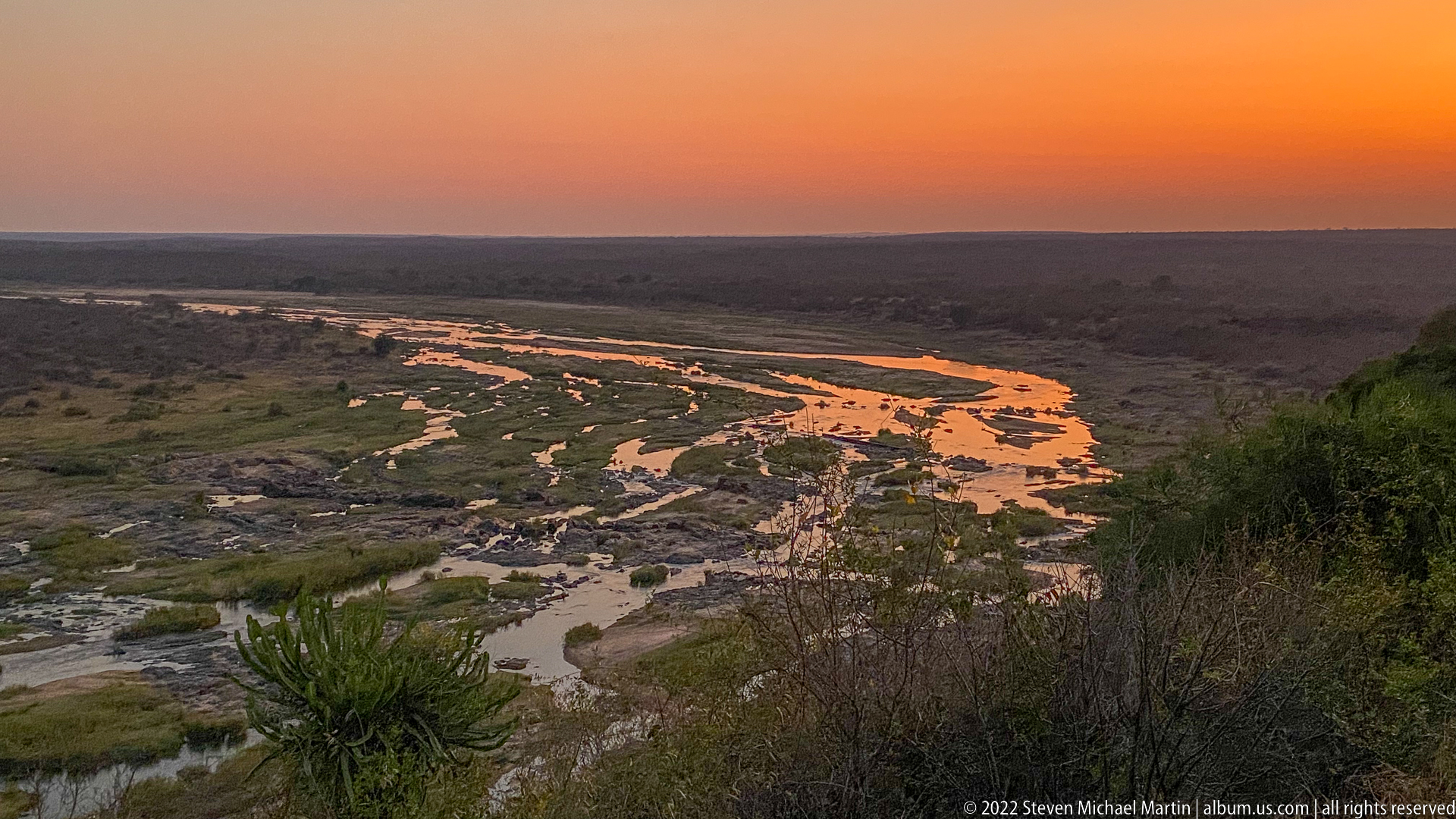
Orange afterglow saturates the sky and reflects across winding channels of a braided river below a darkening bushveld horizon. Seen from the same elevated terrain as the preceding landscapes, the later light transforms pale sand and shallow water into luminous ribbons, emphasizing the river’s branching geometry at dusk.
Caption
Orange afterglow saturates the sky and reflects across winding channels of a braided river below a darkening bushveld horizon. Seen from the same elevated terrain as the preceding landscapes, the later light transforms pale sand and shallow water into luminous ribbons, emphasizing the river’s branching geometry at dusk.
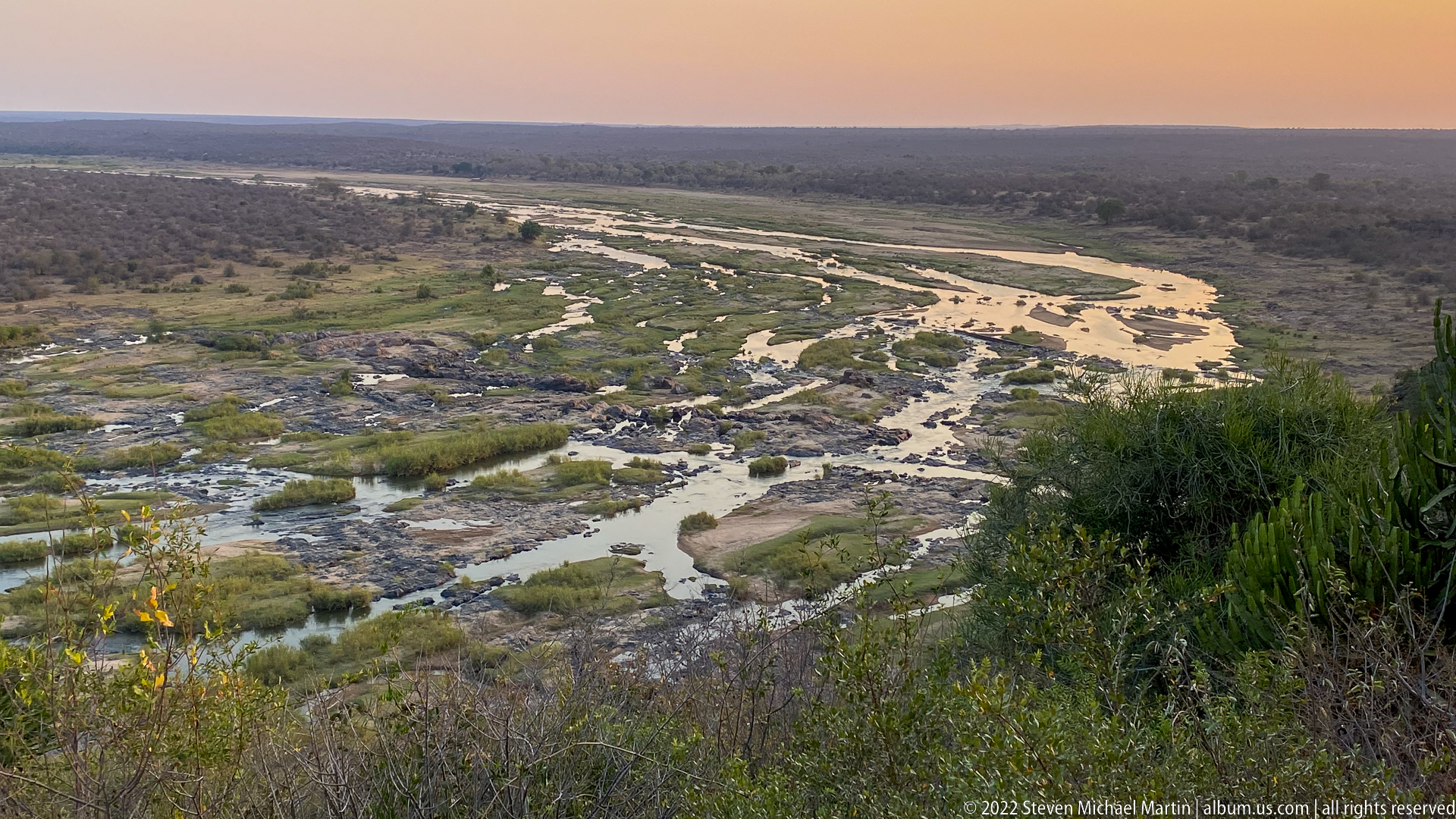
From a high overlook, a braided river spreads across a broad rocky bed in a network of shallow channels, pools, pale sand, and green vegetated islands. The wider composition minimizes the foreground plants and gives the river system itself prominence, showing how water threads through an otherwise dry northern Kruger landscape.
Caption
From a high overlook, a braided river spreads across a broad rocky bed in a network of shallow channels, pools, pale sand, and green vegetated islands. The wider composition minimizes the foreground plants and gives the river system itself prominence, showing how water threads through an otherwise dry northern Kruger landscape.

A mobile airline screen lists multiple afternoon departures from Washington National Airport to Newark, with several flights marked delayed and one cancelled. The travel-disruption view establishes the journey before the wildlife sequence, preserving the practical uncertainty of the departure day rather than the destination itself.
Caption
A mobile airline screen lists multiple afternoon departures from Washington National Airport to Newark, with several flights marked delayed and one cancelled. The travel-disruption view establishes the journey before the wildlife sequence, preserving the practical uncertainty of the departure day rather than the destination itself.

A smiling traveler in a blue shirt sits at a table in a bright terminal-like interior, marking the human beginning of the trip before departure. The close portrait contrasts with the logistical flight screen and the later in-flight views, shifting attention from itinerary to the traveler waiting to continue the journey.
Caption
A smiling traveler in a blue shirt sits at a table in a bright terminal-like interior, marking the human beginning of the trip before departure. The close portrait contrasts with the logistical flight screen and the later in-flight views, shifting attention from itinerary to the traveler waiting to continue the journey.

An aircraft wing and engine emerge through a dark window beneath intense magenta-purple light, likely reflected from the illuminated cabin interior. The abstracted color and low-light conditions turn a routine in-flight view into a nocturnal travel study while retaining the recognizable forms of the wing and engine nacelle.
Caption
An aircraft wing and engine emerge through a dark window beneath intense magenta-purple light, likely reflected from the illuminated cabin interior. The abstracted color and low-light conditions turn a routine in-flight view into a nocturnal travel study while retaining the recognizable forms of the wing and engine nacelle.
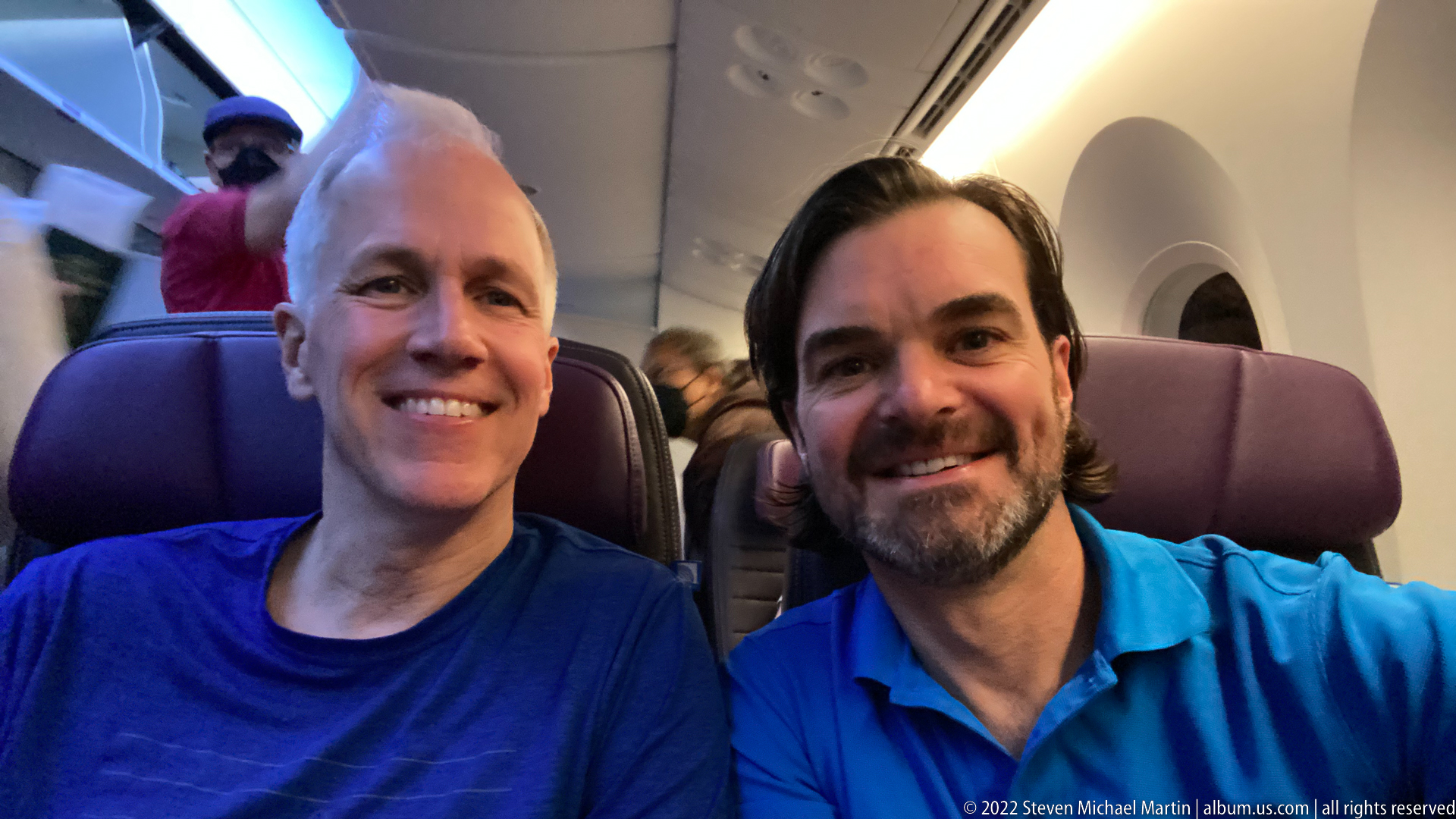
Two travelers pose side by side in an aircraft cabin, framed tightly by high-backed seats and the curved interior wall. Their relaxed expressions record the transition from airport waiting to the flight itself, while the visible cabin fittings anchor the scene unmistakably in the passenger compartment.
Caption
Two travelers pose side by side in an aircraft cabin, framed tightly by high-backed seats and the curved interior wall. Their relaxed expressions record the transition from airport waiting to the flight itself, while the visible cabin fittings anchor the scene unmistakably in the passenger compartment.
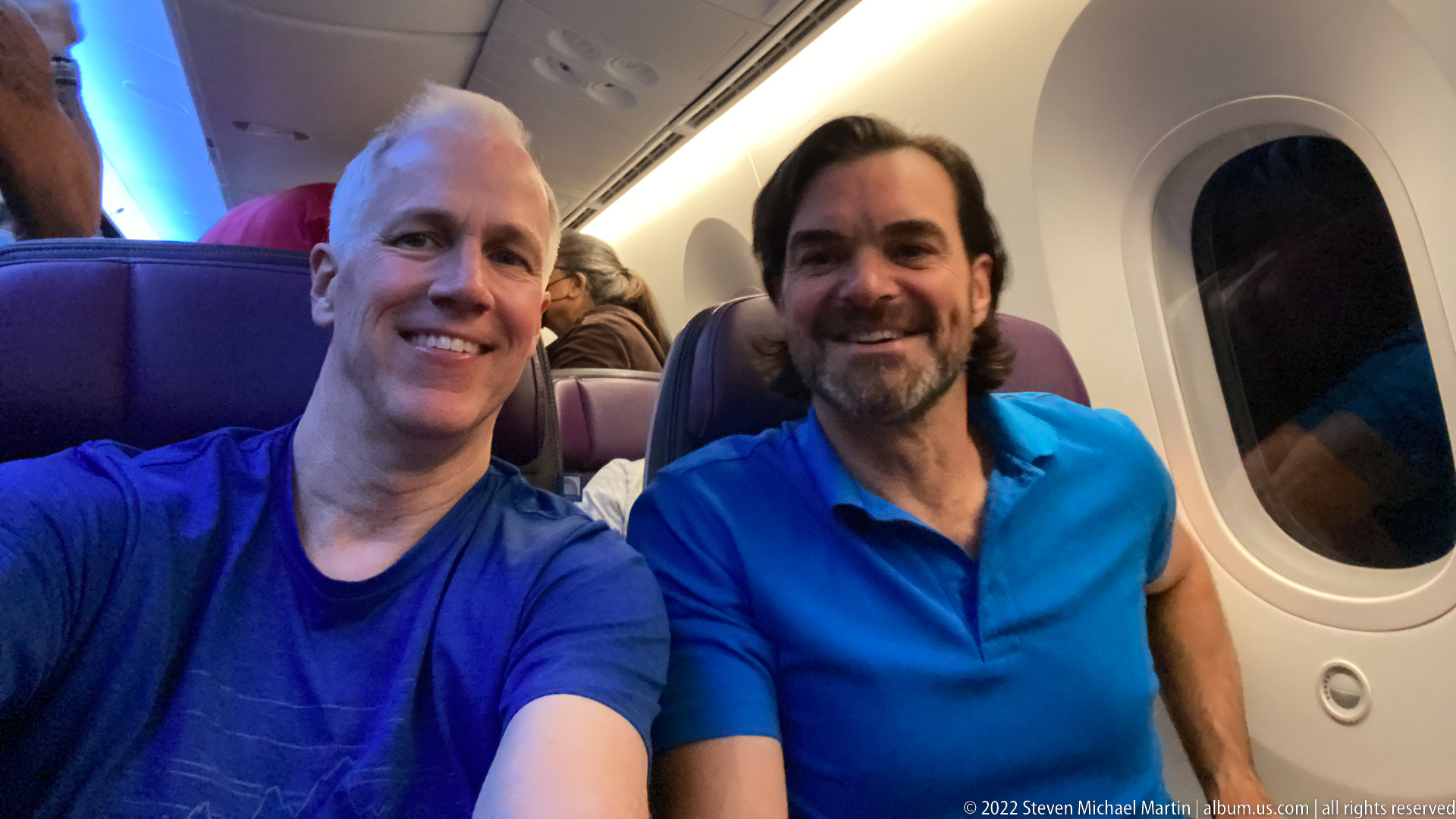
Two travelers sit together beside an aircraft window, smiling toward the camera as the cabin darkens beyond the glass. The wider framing includes the window, seat backs, and neighboring passengers, giving this view more environmental context than the preceding close portrait and documenting their shared long-haul travel setting.
Caption
Two travelers sit together beside an aircraft window, smiling toward the camera as the cabin darkens beyond the glass. The wider framing includes the window, seat backs, and neighboring passengers, giving this view more environmental context than the preceding close portrait and documenting their shared long-haul travel setting.
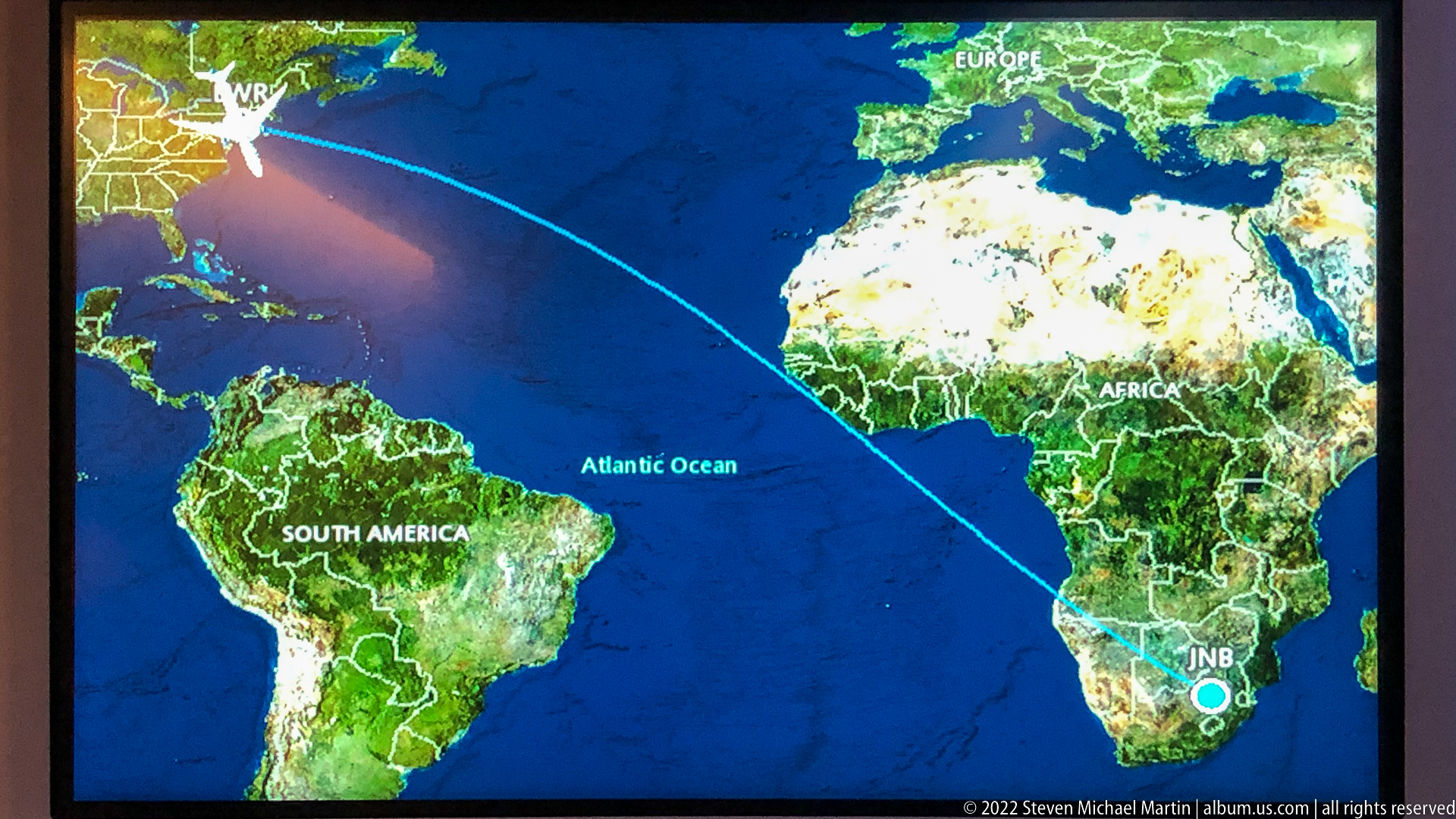
An in-flight map traces a long blue route across the Atlantic from North America toward southern Africa, terminating at Johannesburg, labeled JNB. Continental labels for South America, Africa, and Europe place the journey at global scale and visually bridge the departure sequence with arrival in South Africa.
Caption
An in-flight map traces a long blue route across the Atlantic from North America toward southern Africa, terminating at Johannesburg, labeled JNB. Continental labels for South America, Africa, and Europe place the journey at global scale and visually bridge the departure sequence with arrival in South Africa.
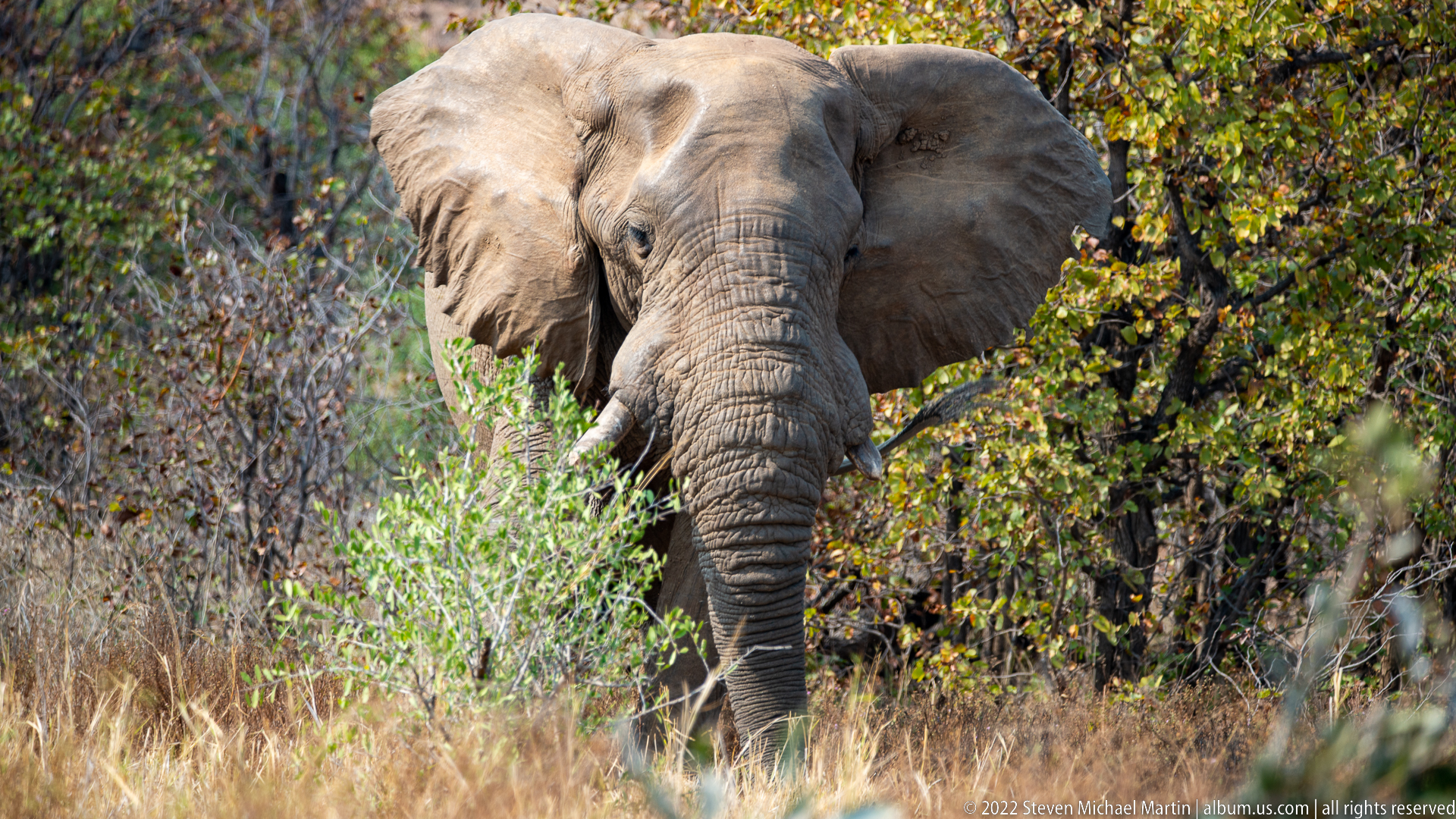
An African bush elephant advances through tawny grass and dense scrub, facing almost directly toward the camera with ears relaxed and trunk hanging low. The frontal posture emphasizes the animal’s broad head, wrinkled skin, and massive shoulders while the mixed woodland vegetation places it within Kruger’s dry-season bushveld.
Caption
An African bush elephant advances through tawny grass and dense scrub, facing almost directly toward the camera with ears relaxed and trunk hanging low. The frontal posture emphasizes the animal’s broad head, wrinkled skin, and massive shoulders while the mixed woodland vegetation places it within Kruger’s dry-season bushveld.
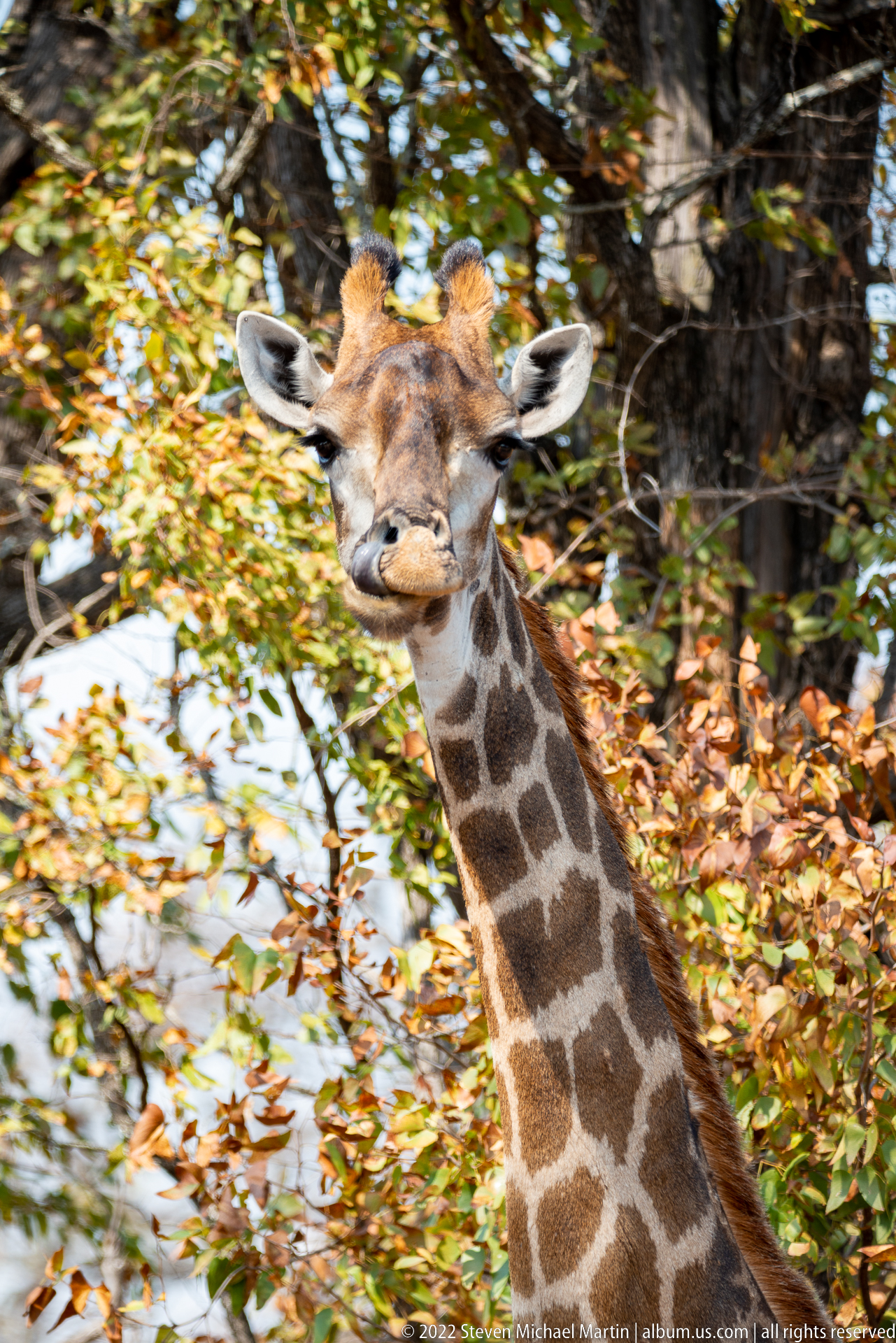
A giraffe raises its head above autumn-toned woodland, its ossicones, large ears, long eyelashes, and irregular brown coat patches sharply defined against the foliage. The close crop concentrates on facial structure and neck pattern rather than full-body scale, creating an intimate field-guide portrait of one of Kruger’s tallest browsers.
Caption
A giraffe raises its head above autumn-toned woodland, its ossicones, large ears, long eyelashes, and irregular brown coat patches sharply defined against the foliage. The close crop concentrates on facial structure and neck pattern rather than full-body scale, creating an intimate field-guide portrait of one of Kruger’s tallest browsers.
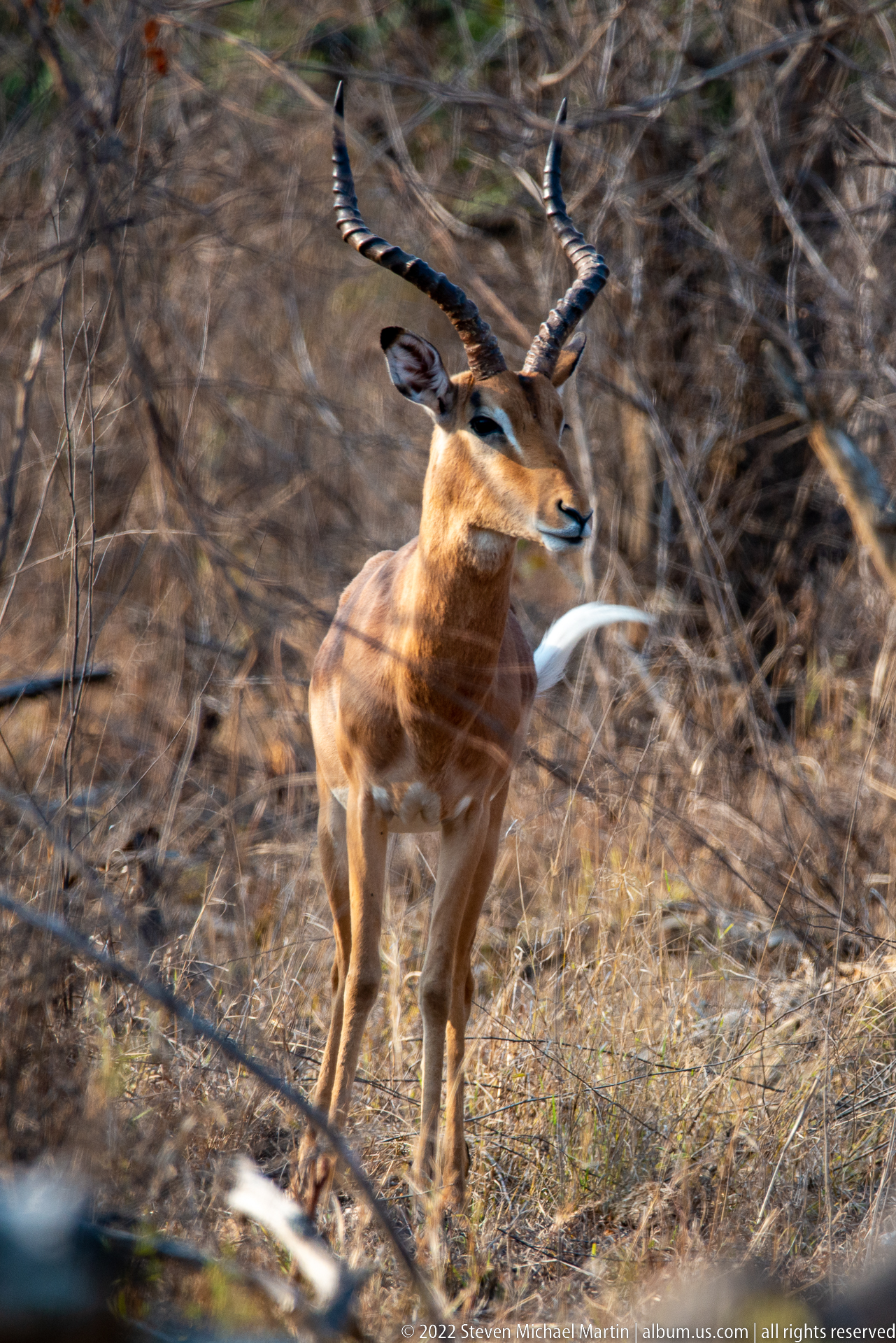
A male impala pauses in dry scrub with its head turned in profile, displaying the species’ elegant lyre-shaped, ridged horns and contrasting facial markings. Sunlight catches the tawny coat and white underparts while tangled branches behind the animal reinforce the dense bushveld setting.
Caption
A male impala pauses in dry scrub with its head turned in profile, displaying the species’ elegant lyre-shaped, ridged horns and contrasting facial markings. Sunlight catches the tawny coat and white underparts while tangled branches behind the animal reinforce the dense bushveld setting.
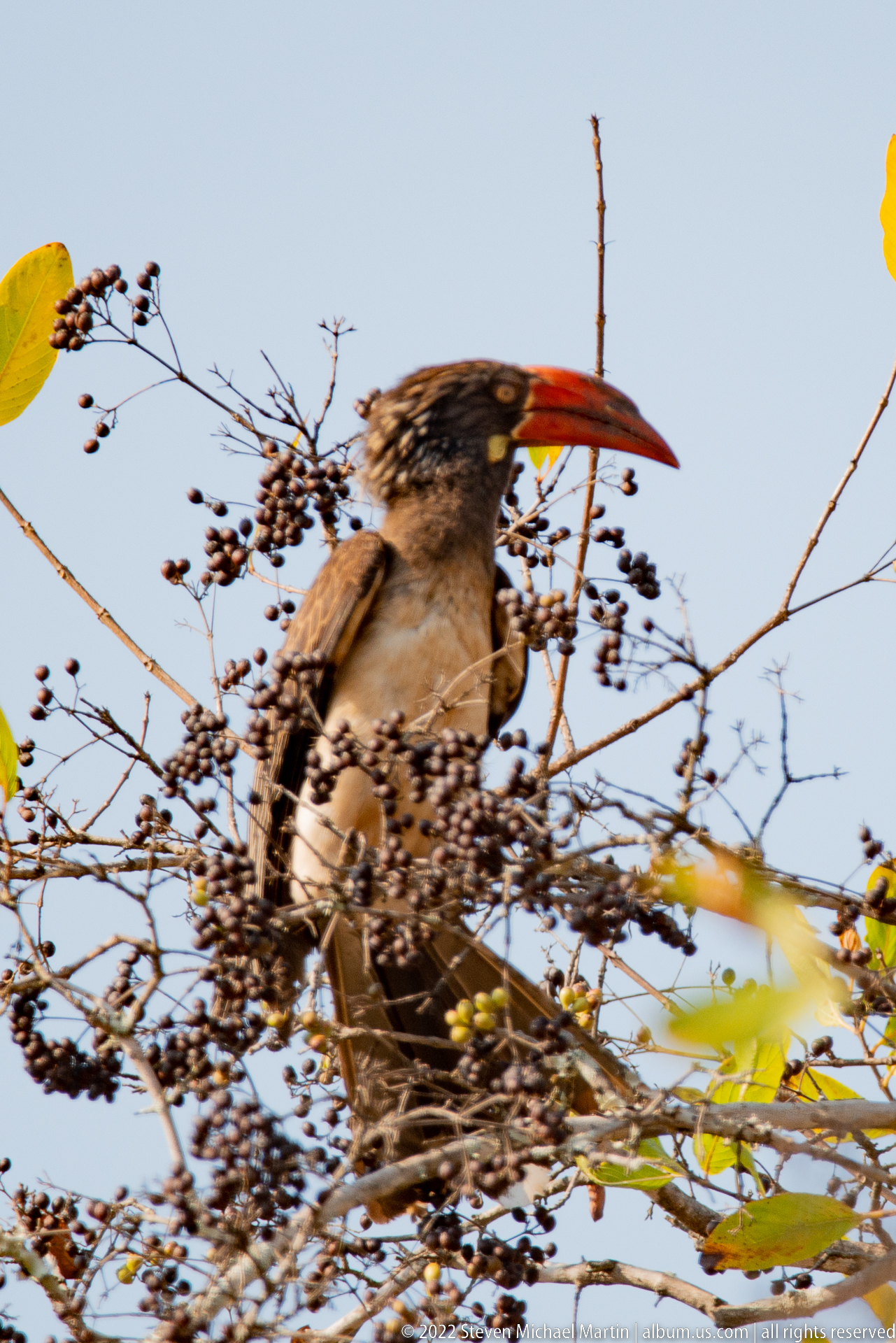
A southern red-billed hornbill moves through a tangle of fruiting branches, its long red-orange bill projecting beyond mottled brown-and-white plumage. Unlike the cleaner perched profile on the preceding page, this view places the bird within active foraging habitat and partially screens its body with stems and dark berries.
Caption
A southern red-billed hornbill moves through a tangle of fruiting branches, its long red-orange bill projecting beyond mottled brown-and-white plumage. Unlike the cleaner perched profile on the preceding page, this view places the bird within active foraging habitat and partially screens its body with stems and dark berries.
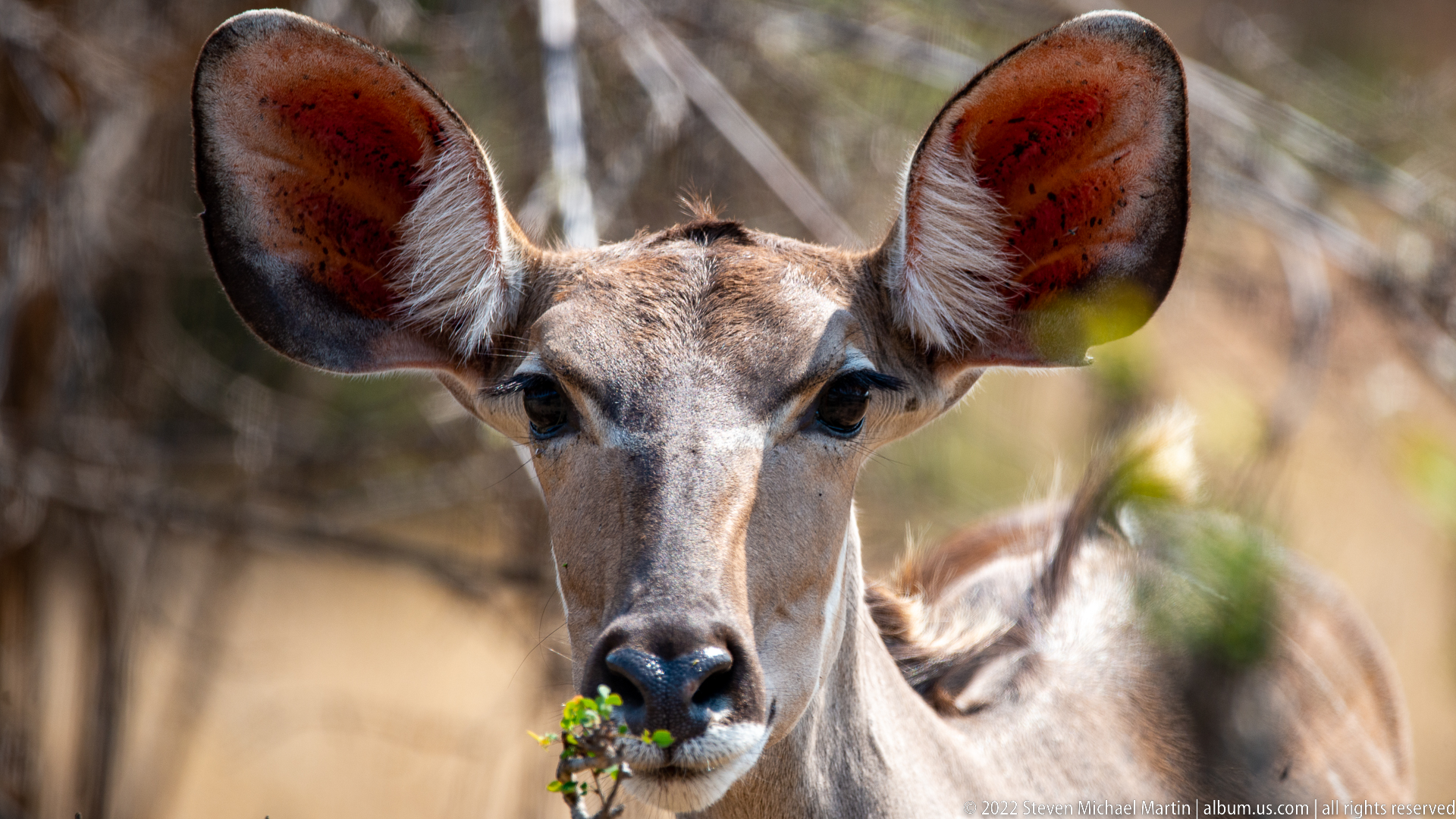
A female greater kudu faces the camera at close range, holding leafy browse at the edge of her mouth. Her oversized rounded ears, narrow face, gray-brown coat, and absence of horns distinguish this portrait from the horned male kudu seen later, while the shallow background isolates the alert expression.
Caption
A female greater kudu faces the camera at close range, holding leafy browse at the edge of her mouth. Her oversized rounded ears, narrow face, gray-brown coat, and absence of horns distinguish this portrait from the horned male kudu seen later, while the shallow background isolates the alert expression.
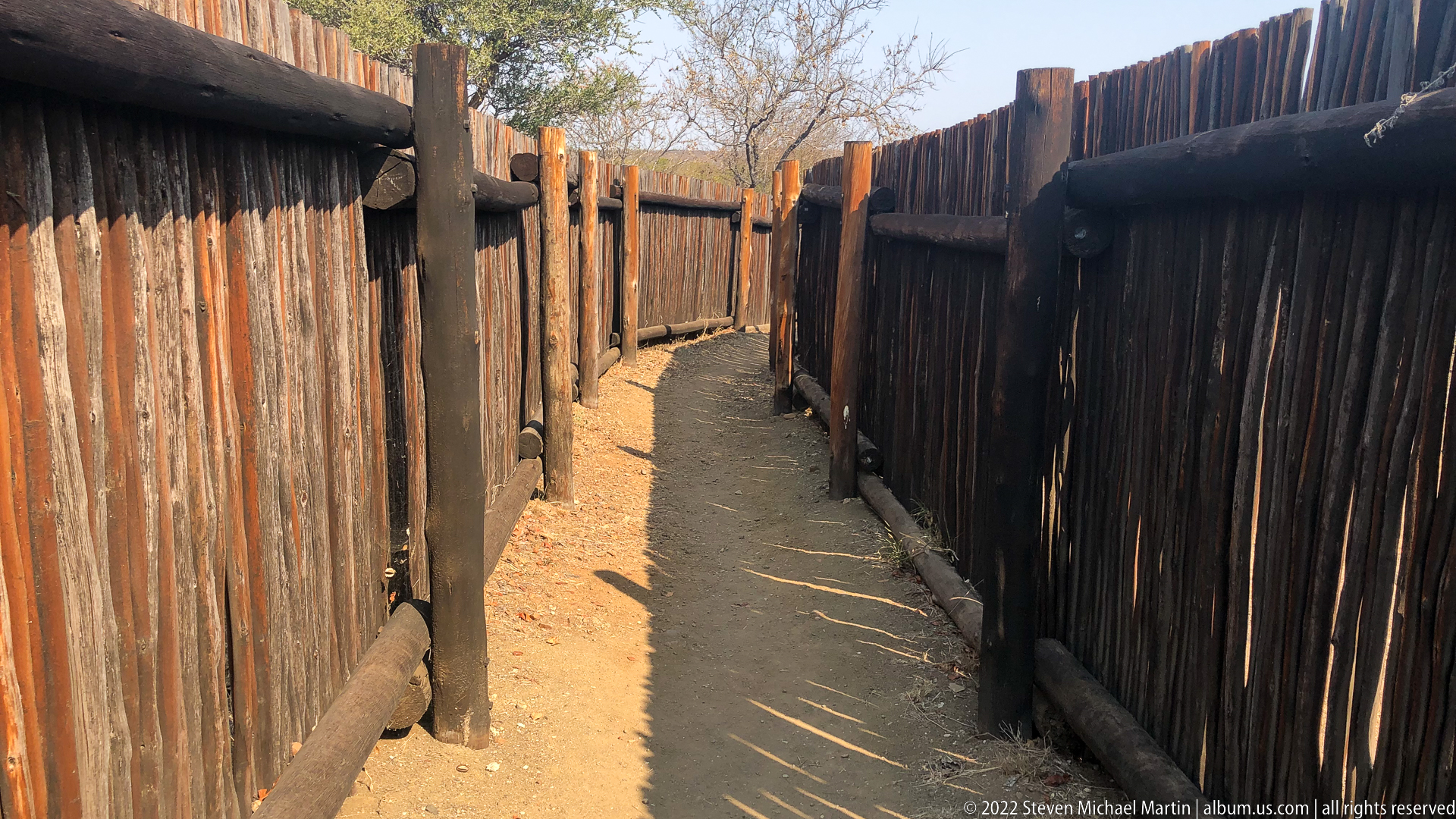
A narrow sandy path runs between tall walls of closely spaced timber poles, bending slightly as it leads through the enclosed passage. Strong afternoon shadows stripe the ground, emphasizing the utilitarian construction and confined geometry of a visitor walkway within the safari setting.
Caption
A narrow sandy path runs between tall walls of closely spaced timber poles, bending slightly as it leads through the enclosed passage. Strong afternoon shadows stripe the ground, emphasizing the utilitarian construction and confined geometry of a visitor walkway within the safari setting.
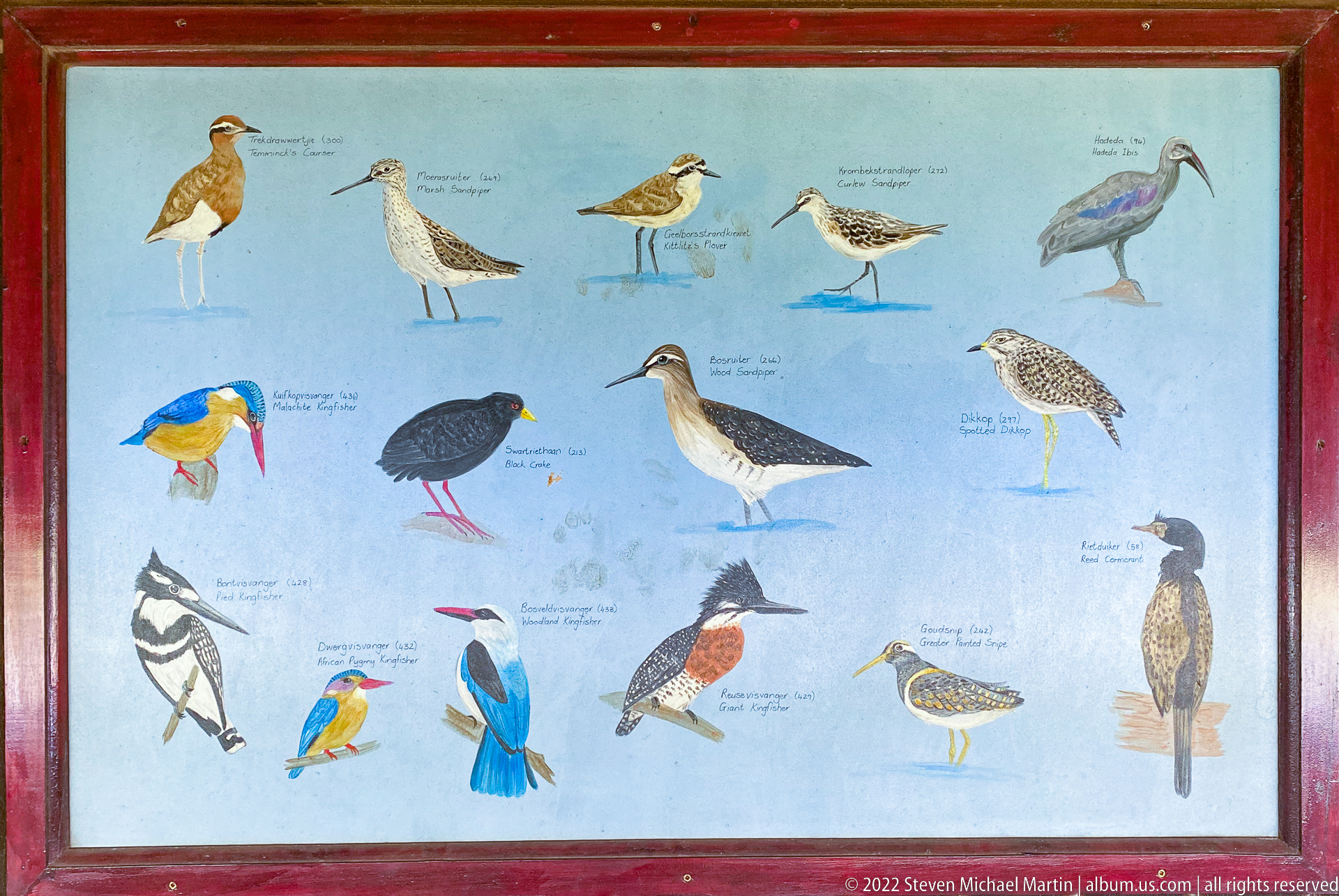
A framed identification panel presents painted profiles of numerous southern African birds, each accompanied by small labels. The display functions as a field-reference aid for visitors, grouping varied shorebirds, kingfishers, hornbills, and other species into a single visual guide rather than documenting one live animal.
Caption
A framed identification panel presents painted profiles of numerous southern African birds, each accompanied by small labels. The display functions as a field-reference aid for visitors, grouping varied shorebirds, kingfishers, hornbills, and other species into a single visual guide rather than documenting one live animal.
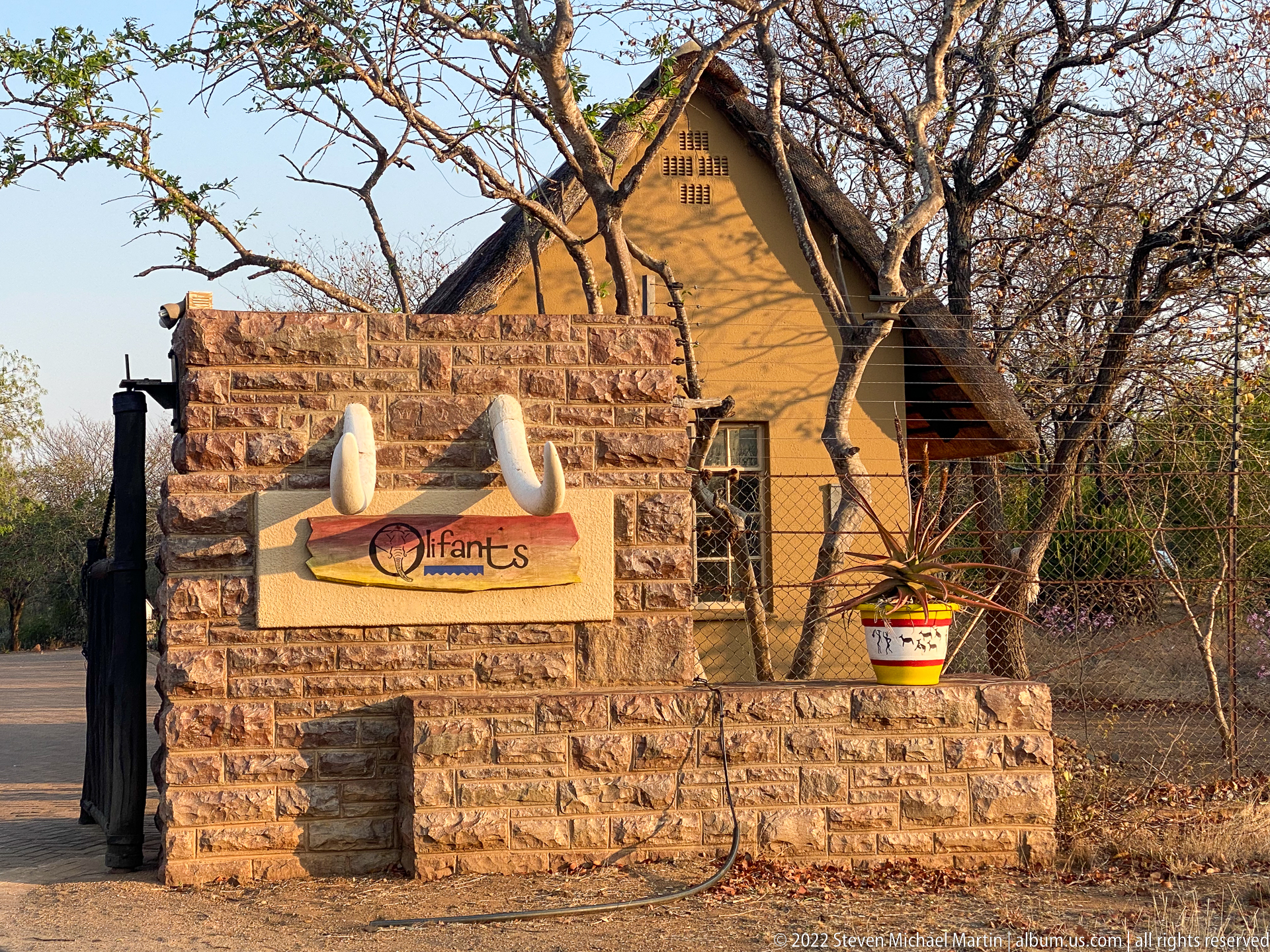
A stone entrance monument bearing the name “Olifants” stands before a steep-roofed lodge-style building, flanked by tusk-like white ornaments and dry woodland. The clearly readable sign anchors this stop to a named Kruger facility, while the warm masonry and pitched roof reflect the park’s rustic visitor architecture.
Caption
A stone entrance monument bearing the name “Olifants” stands before a steep-roofed lodge-style building, flanked by tusk-like white ornaments and dry woodland. The clearly readable sign anchors this stop to a named Kruger facility, while the warm masonry and pitched roof reflect the park’s rustic visitor architecture.
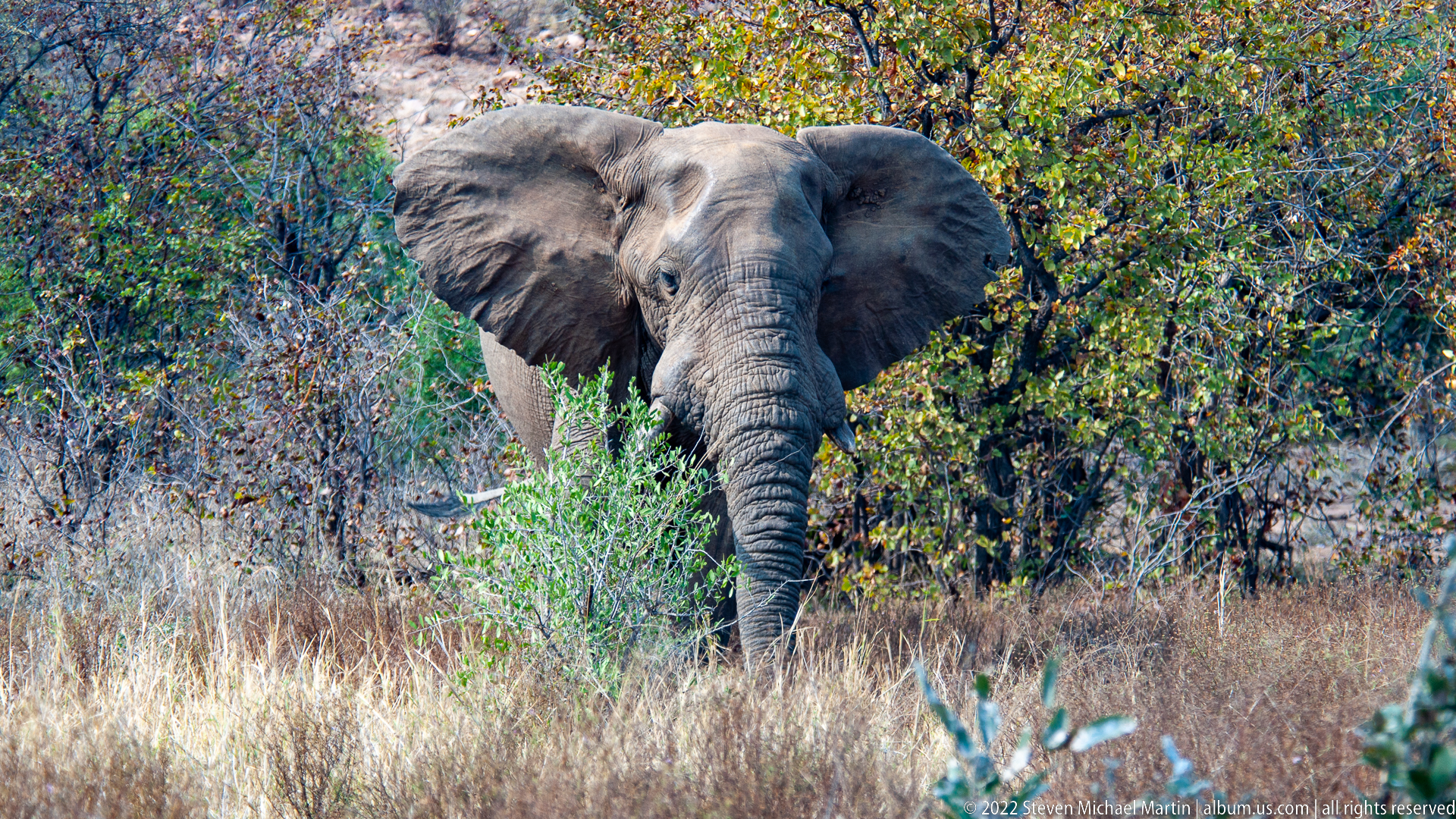
An African bush elephant steps out from dense leafy scrub into dry grass, facing forward with ears spread slightly and trunk lowered. Vegetation partially conceals the body, making the animal’s head and shoulders the dominant forms and conveying how readily a large elephant can merge into Kruger’s mixed woodland.
Caption
An African bush elephant steps out from dense leafy scrub into dry grass, facing forward with ears spread slightly and trunk lowered. Vegetation partially conceals the body, making the animal’s head and shoulders the dominant forms and conveying how readily a large elephant can merge into Kruger’s mixed woodland.
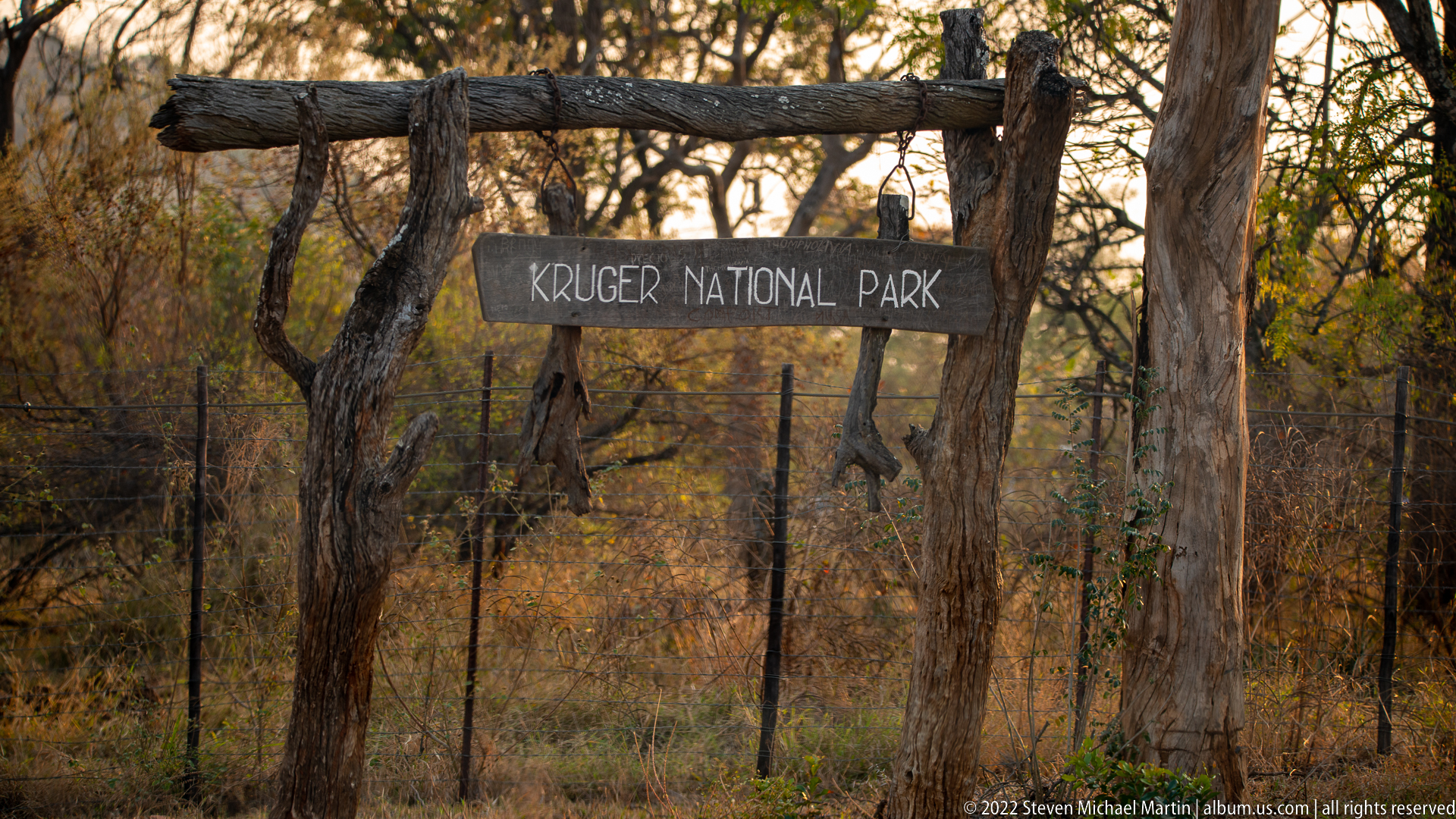
A hand-painted wooden sign reading “KRUGER NATIONAL PARK” hangs from a rustic timber frame beside a wire fence in dry woodland. Rather than a formal entrance monument, this modest boundary marker integrates with the surrounding bush and visually establishes the protected-area setting of the wildlife sequence.
Caption
A hand-painted wooden sign reading “KRUGER NATIONAL PARK” hangs from a rustic timber frame beside a wire fence in dry woodland. Rather than a formal entrance monument, this modest boundary marker integrates with the surrounding bush and visually establishes the protected-area setting of the wildlife sequence.
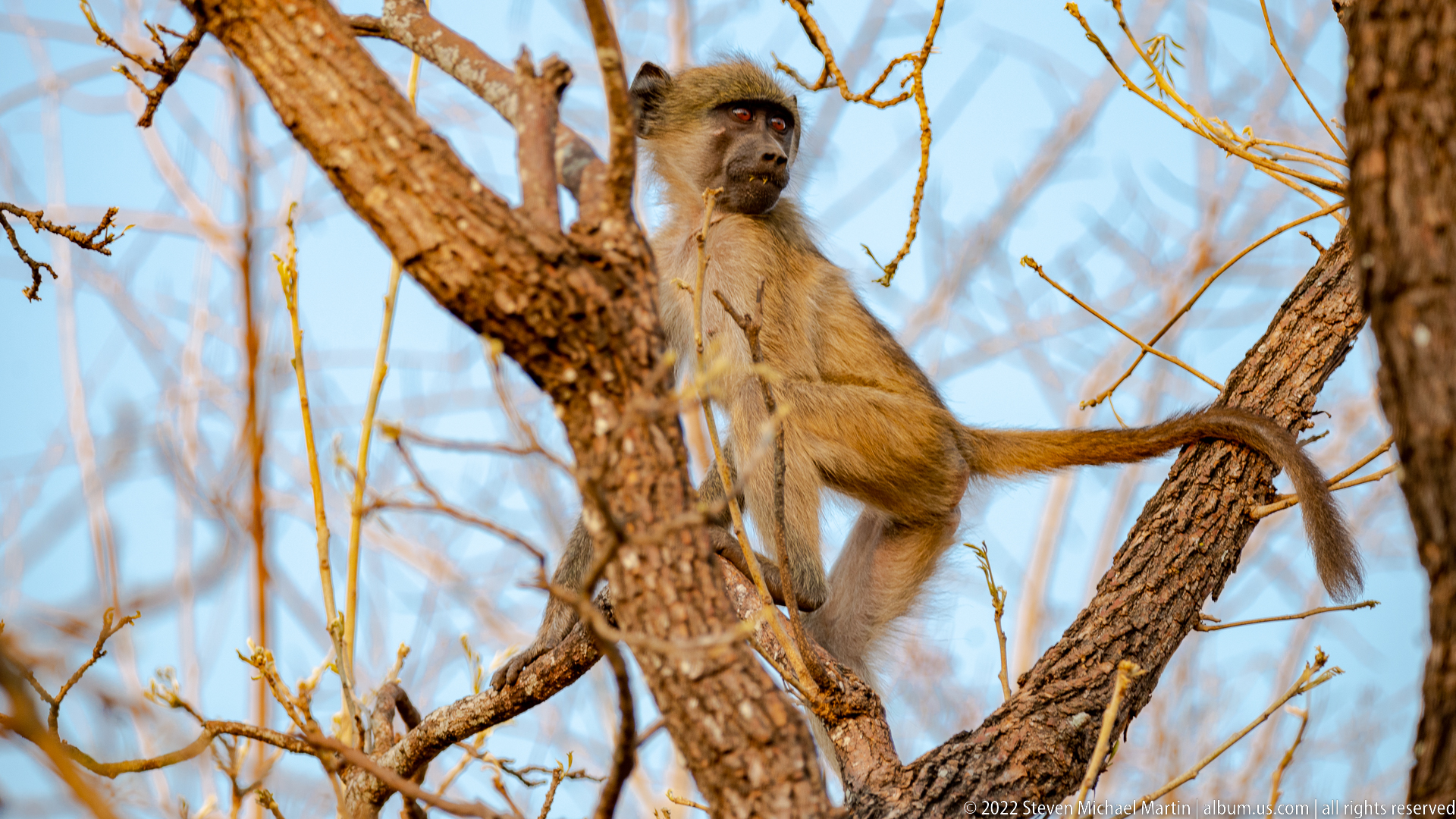
A chacma baboon straddles the fork of a leafless tree, one leg braced on the trunk and its long tail extending along a branch. The elevated perch and open blue sky isolate the primate’s dog-like muzzle, gray-brown coat, and long limbs, characteristics typical of this widespread Kruger species.
Caption
A chacma baboon straddles the fork of a leafless tree, one leg braced on the trunk and its long tail extending along a branch. The elevated perch and open blue sky isolate the primate’s dog-like muzzle, gray-brown coat, and long limbs, characteristics typical of this widespread Kruger species.
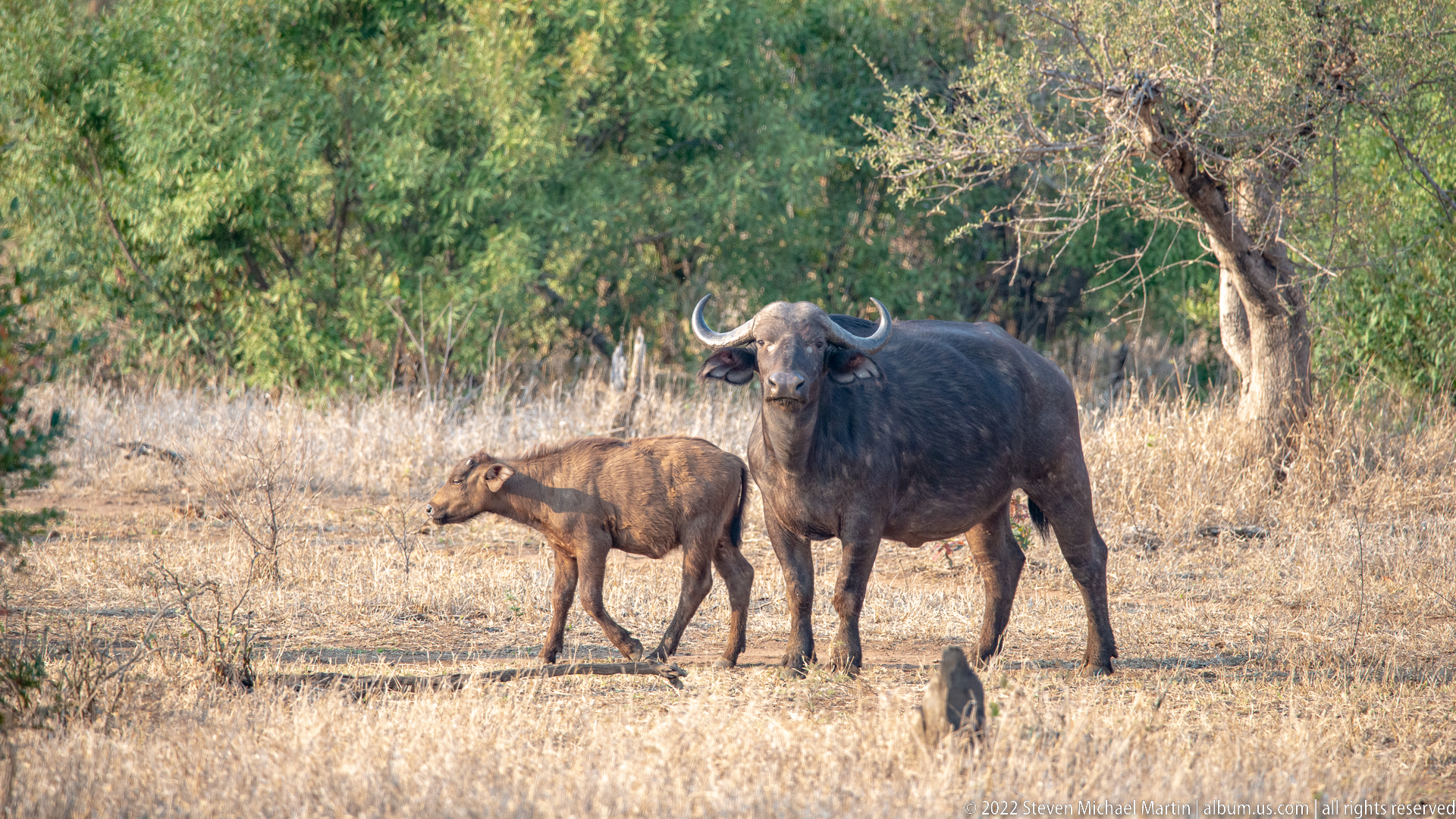
An adult African buffalo stands protectively beside a calf in dry woodland, both animals oriented toward the camera. The adult’s heavy dark body and sweeping horns contrast with the calf’s smaller, reddish-brown form, making age and size differences especially clear in this family-group field view.
Caption
An adult African buffalo stands protectively beside a calf in dry woodland, both animals oriented toward the camera. The adult’s heavy dark body and sweeping horns contrast with the calf’s smaller, reddish-brown form, making age and size differences especially clear in this family-group field view.
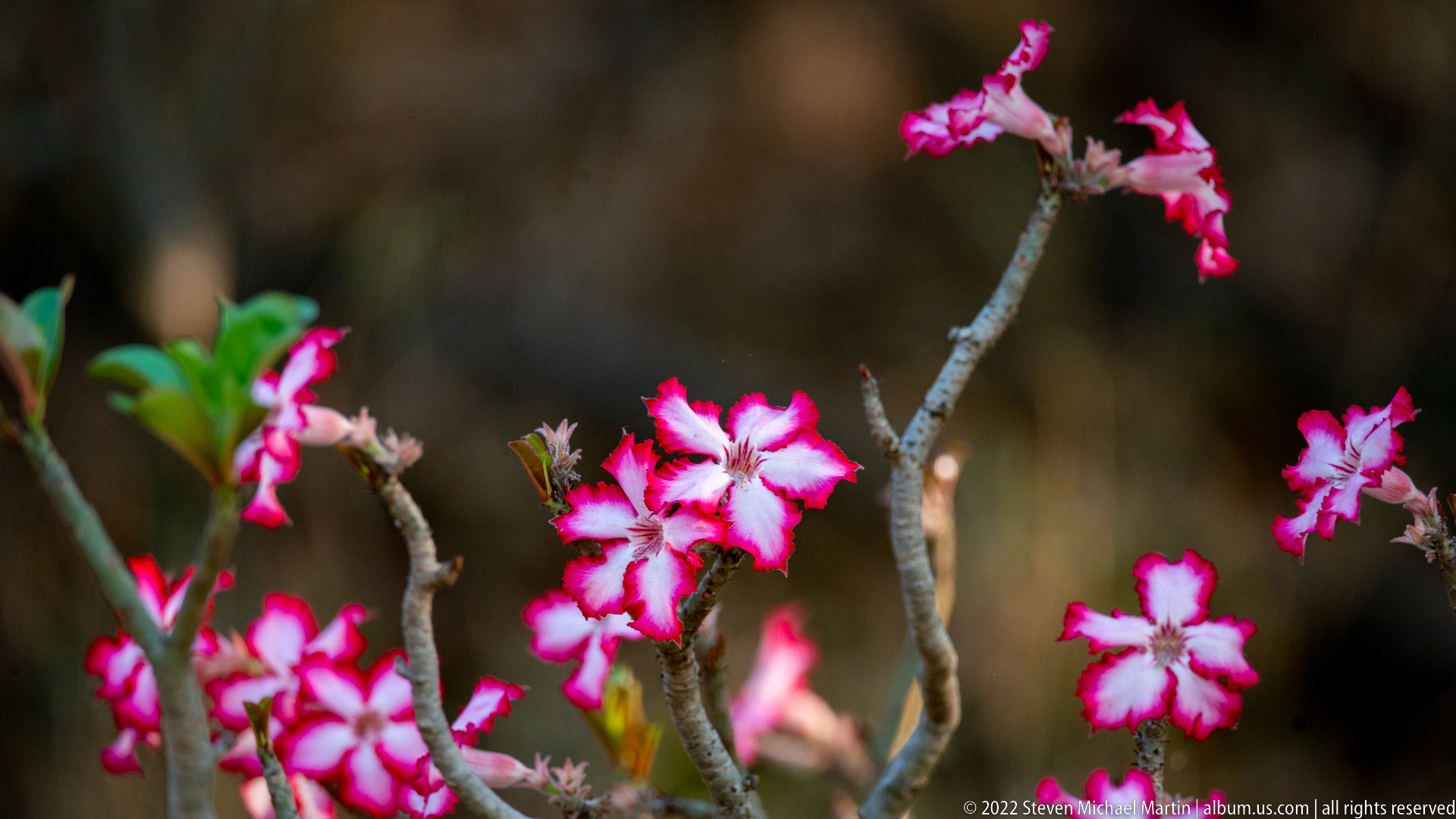
Brilliant pink-and-white impala lily blossoms open along thick gray succulent branches against a dark, softly blurred background. The close botanical study isolates the five-lobed flowers and sparse glossy leaves, highlighting a conspicuous dry-season bloom associated with the northern Kruger landscape.
Caption
Brilliant pink-and-white impala lily blossoms open along thick gray succulent branches against a dark, softly blurred background. The close botanical study isolates the five-lobed flowers and sparse glossy leaves, highlighting a conspicuous dry-season bloom associated with the northern Kruger landscape.
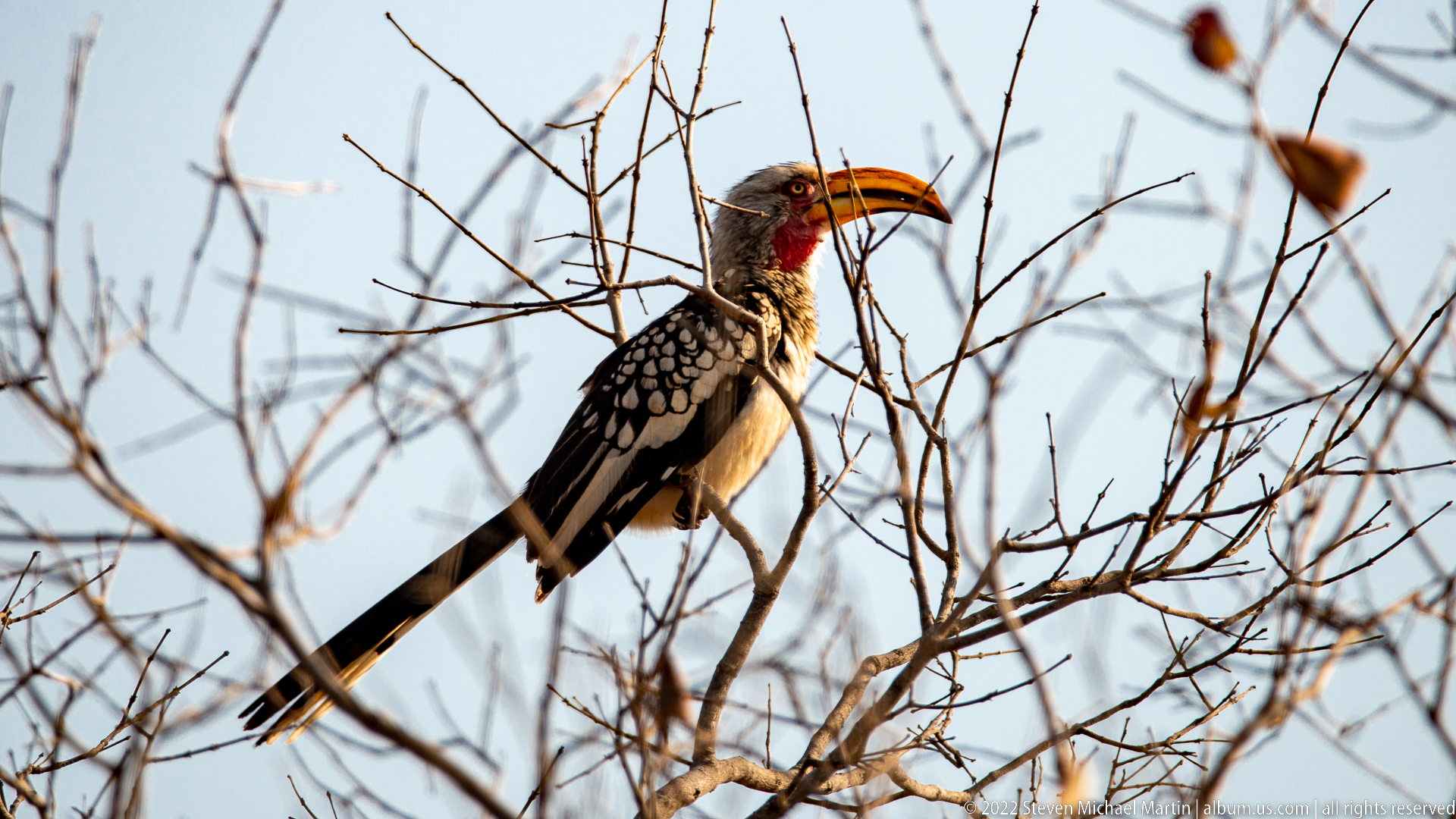
A southern red-billed hornbill perches amid fine bare branches, its long red-orange bill, pale underparts, and boldly spotted black-and-white wings standing out against the sky. The side profile gives a clear field-guide view of the bill and plumage pattern used to distinguish this common dry-woodland hornbill.
Caption
A southern red-billed hornbill perches amid fine bare branches, its long red-orange bill, pale underparts, and boldly spotted black-and-white wings standing out against the sky. The side profile gives a clear field-guide view of the bill and plumage pattern used to distinguish this common dry-woodland hornbill.
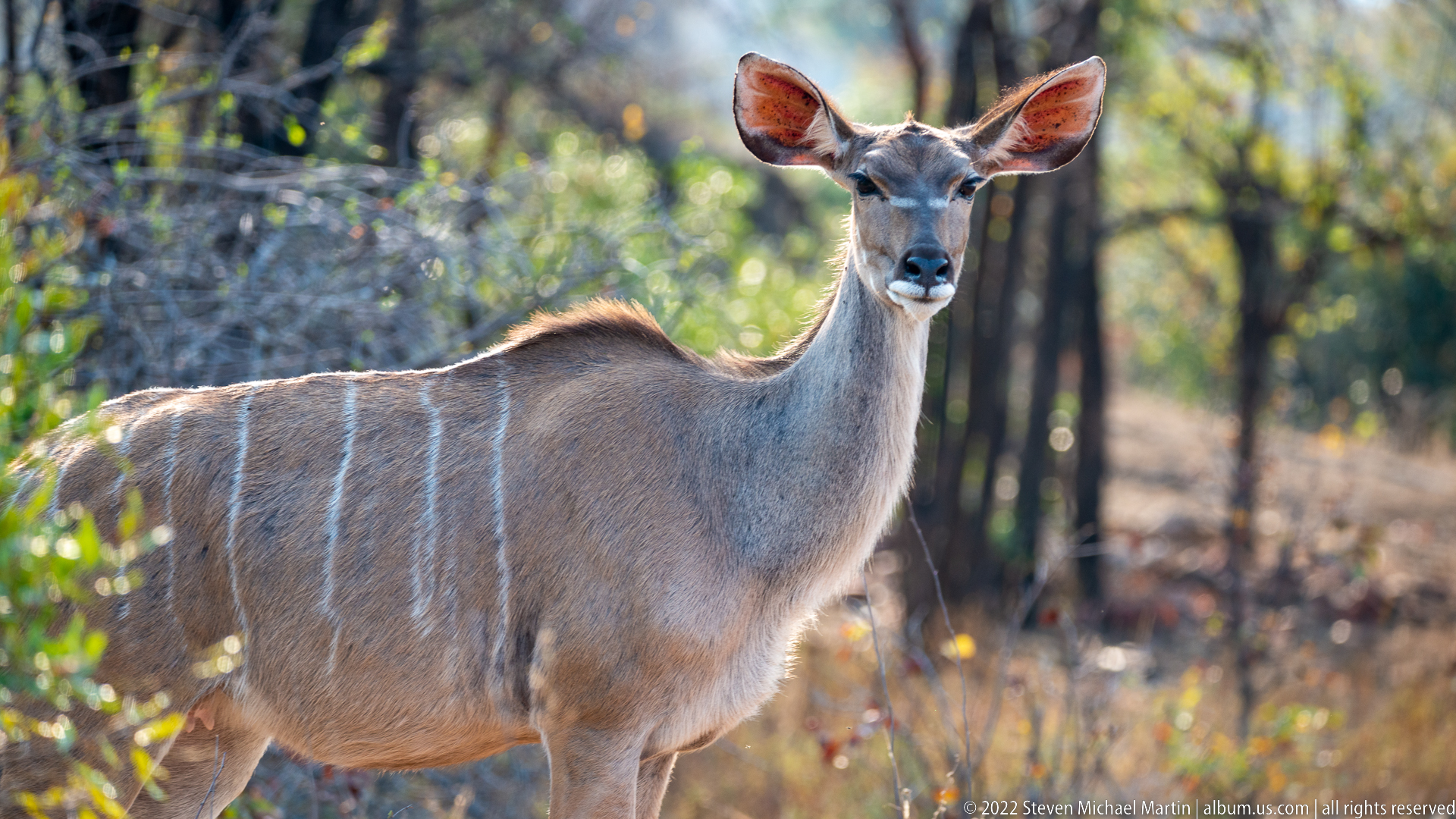
A female greater kudu stands broadside at the edge of woodland, turning her head directly toward the camera. Fine vertical white stripes cross the gray-tan torso, and the large ears and hornless head distinguish the cow from an adult male while backlighting outlines the ears and shoulders.
Caption
A female greater kudu stands broadside at the edge of woodland, turning her head directly toward the camera. Fine vertical white stripes cross the gray-tan torso, and the large ears and hornless head distinguish the cow from an adult male while backlighting outlines the ears and shoulders.
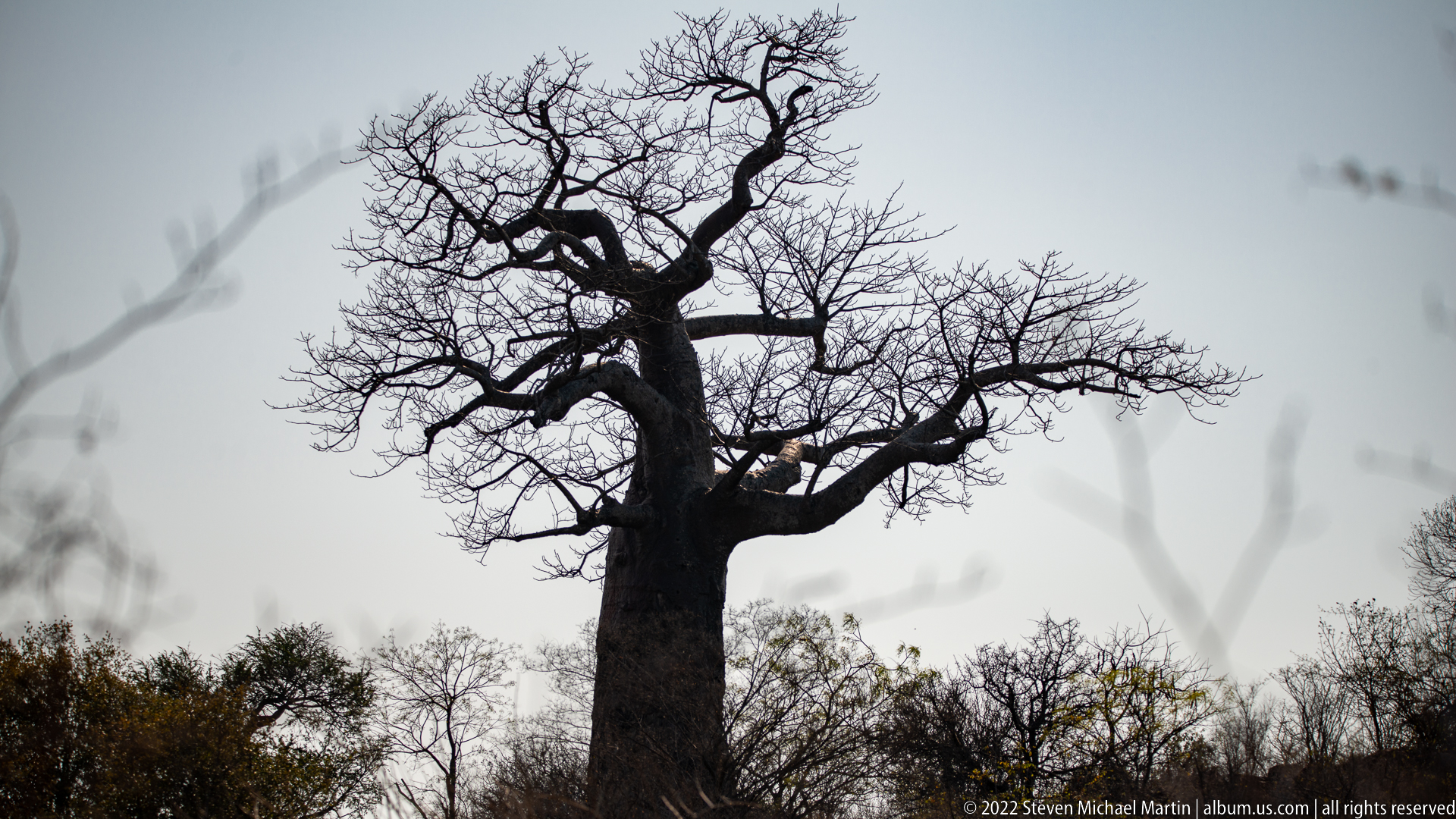
A massive leafless baobab rises above the surrounding woodland, its swollen trunk supporting an irregular crown of thick, twisting branches. Photographed against a pale sky, the tree’s sculptural silhouette and disproportionate trunk make its characteristic form especially legible in the northern Kruger landscape.
Caption
A massive leafless baobab rises above the surrounding woodland, its swollen trunk supporting an irregular crown of thick, twisting branches. Photographed against a pale sky, the tree’s sculptural silhouette and disproportionate trunk make its characteristic form especially legible in the northern Kruger landscape.
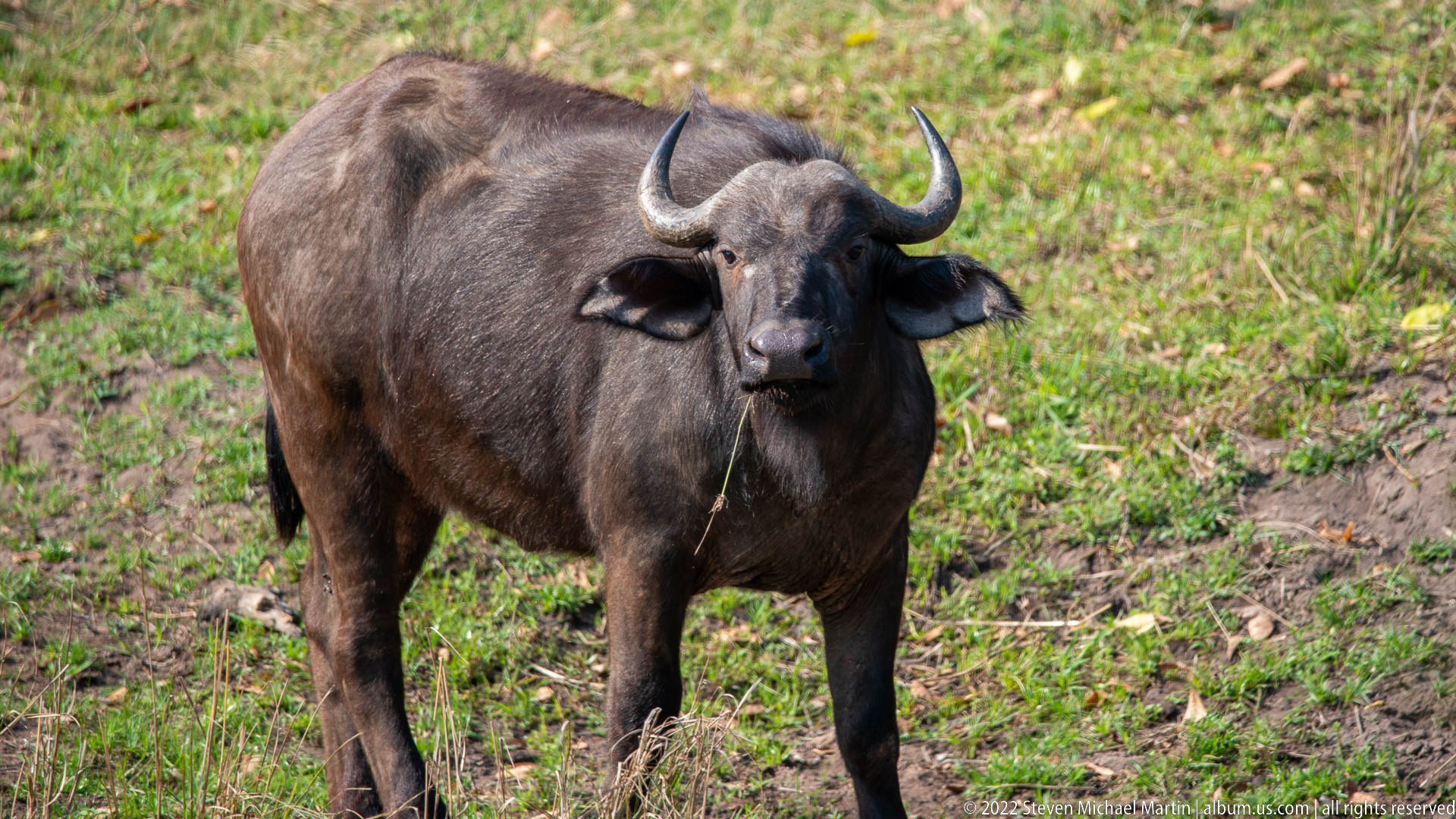
An African buffalo stands nearly square to the camera on a patch of green ground, chewing with a strand of vegetation hanging from its mouth. The close frontal view emphasizes the heavy muzzle, dark hide, and broad horn bosses, offering a more individual portrait than the adult-and-calf group seen earlier.
Caption
An African buffalo stands nearly square to the camera on a patch of green ground, chewing with a strand of vegetation hanging from its mouth. The close frontal view emphasizes the heavy muzzle, dark hide, and broad horn bosses, offering a more individual portrait than the adult-and-calf group seen earlier.
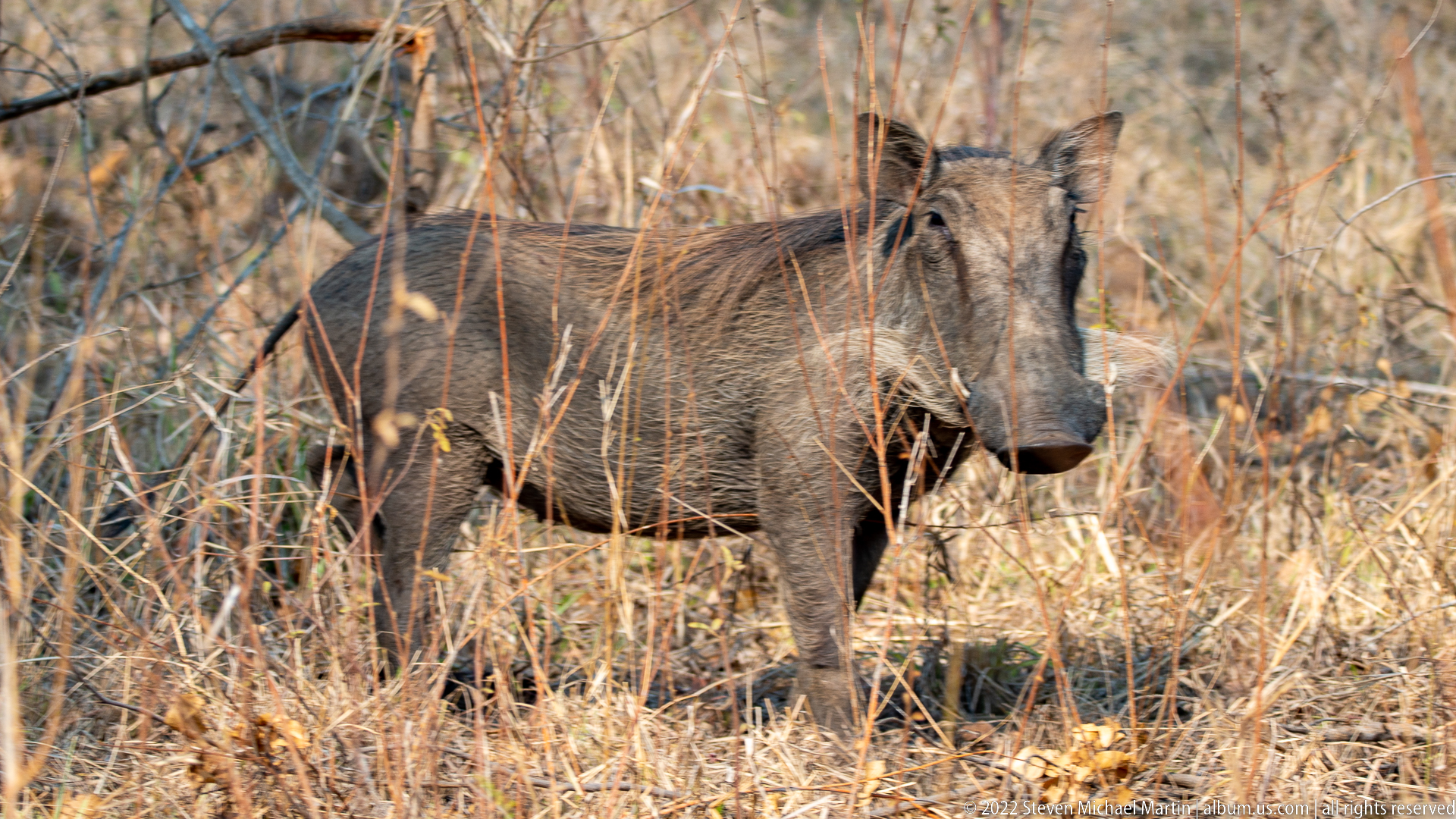
A common warthog stands amid tall dry stems, facing slightly toward the camera with its coarse mane raised along the neck and back. The elongated head, facial warts, and sturdy forequarters are visible through the grass, giving a close habitat portrait of this characteristic Kruger grazer and rooter.
Caption
A common warthog stands amid tall dry stems, facing slightly toward the camera with its coarse mane raised along the neck and back. The elongated head, facial warts, and sturdy forequarters are visible through the grass, giving a close habitat portrait of this characteristic Kruger grazer and rooter.
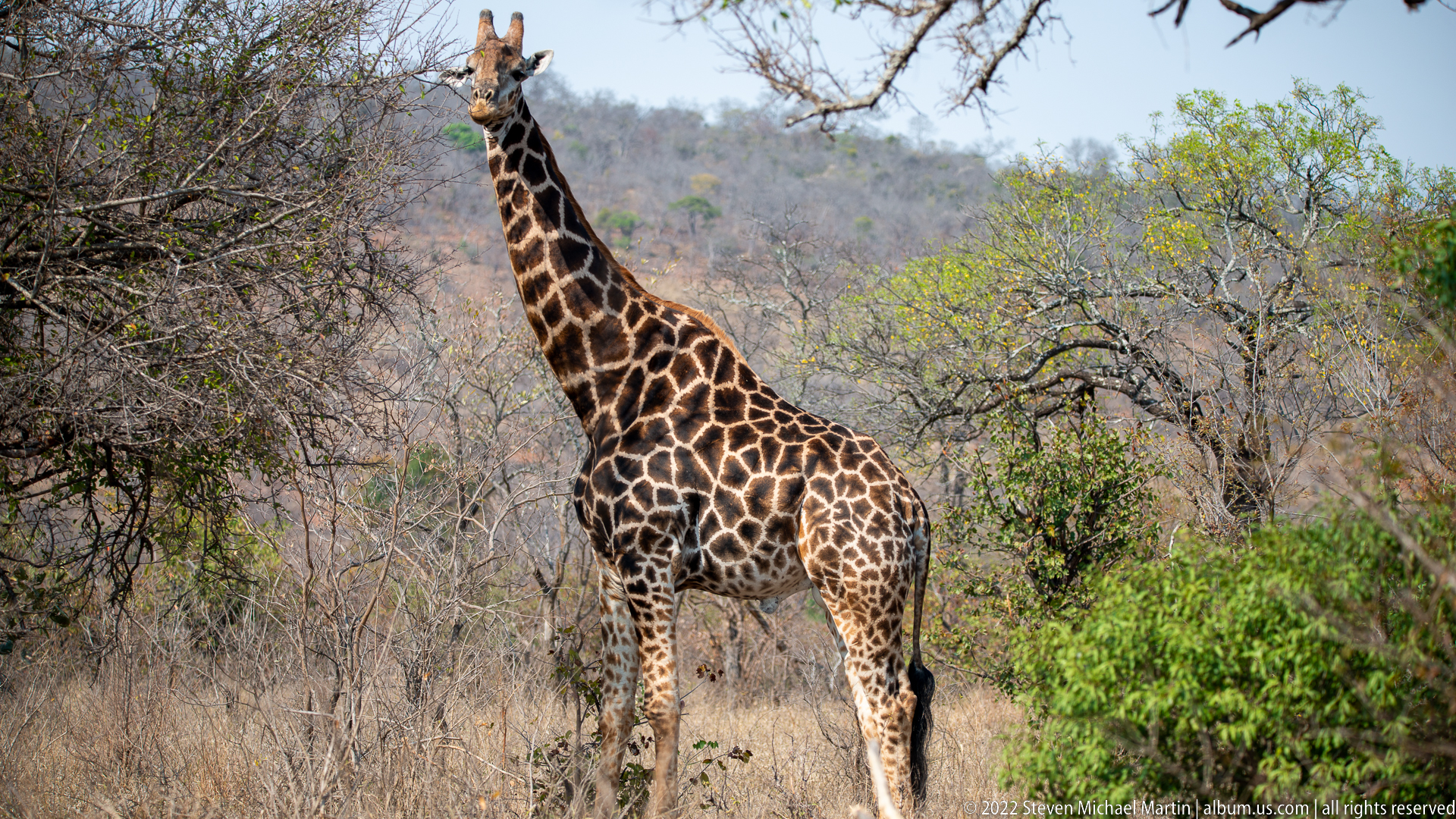
A giraffe stands nearly full length in open woodland, its patterned body rising above surrounding shrubs and dry grass. The vertical composition reveals the animal’s exceptional height, long legs, sloping back, and elongated neck more completely than the earlier head portrait, while a wooded hillside recedes behind it.
Caption
A giraffe stands nearly full length in open woodland, its patterned body rising above surrounding shrubs and dry grass. The vertical composition reveals the animal’s exceptional height, long legs, sloping back, and elongated neck more completely than the earlier head portrait, while a wooded hillside recedes behind it.
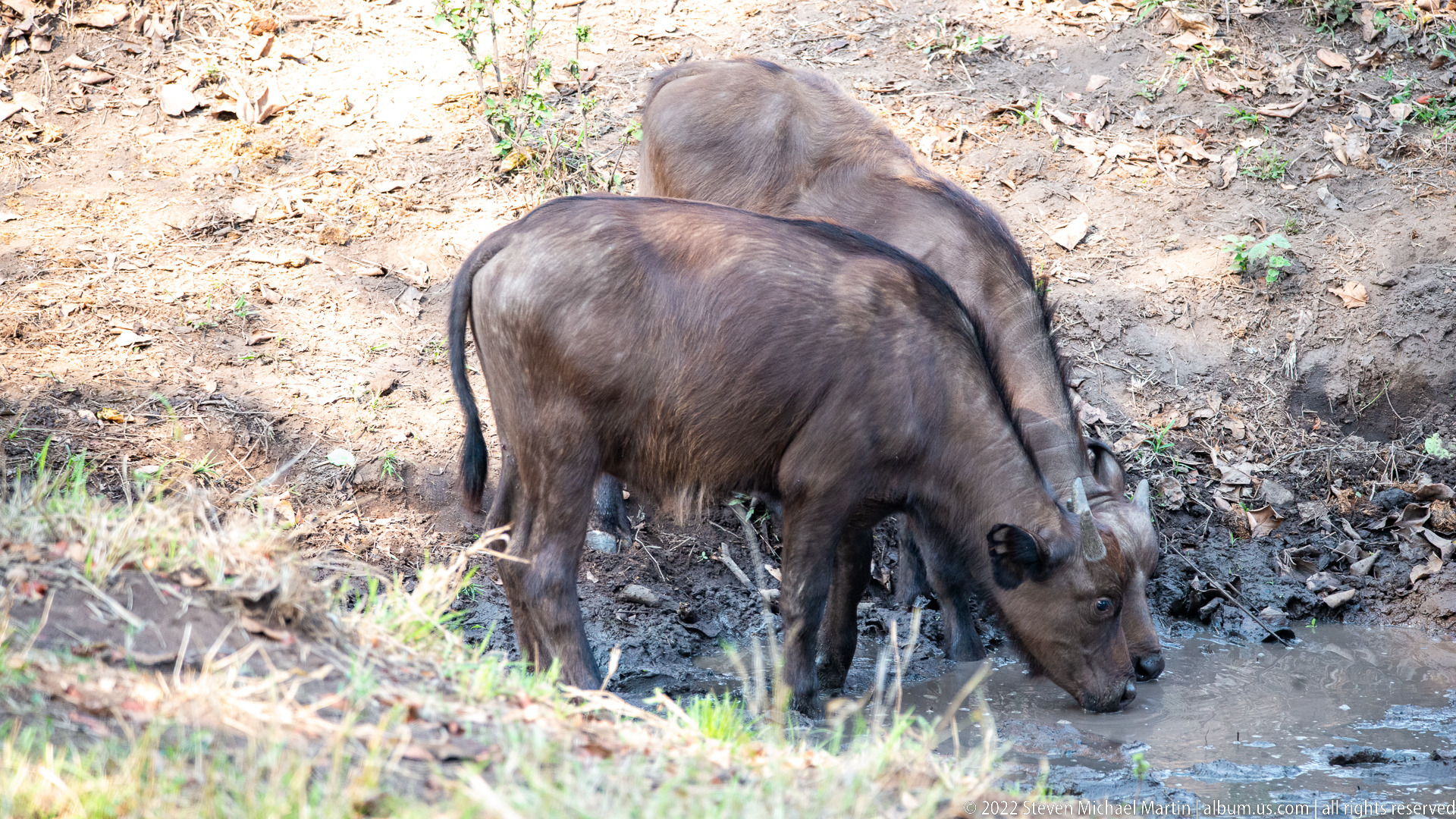
Two African buffalo lower their heads to drink from a small muddy pool at the base of a bank. Their bodies overlap as both animals concentrate on the water, documenting a resource-use behavior rather than a static portrait and showing the compact, shaded water source within otherwise dry ground.
Caption
Two African buffalo lower their heads to drink from a small muddy pool at the base of a bank. Their bodies overlap as both animals concentrate on the water, documenting a resource-use behavior rather than a static portrait and showing the compact, shaded water source within otherwise dry ground.
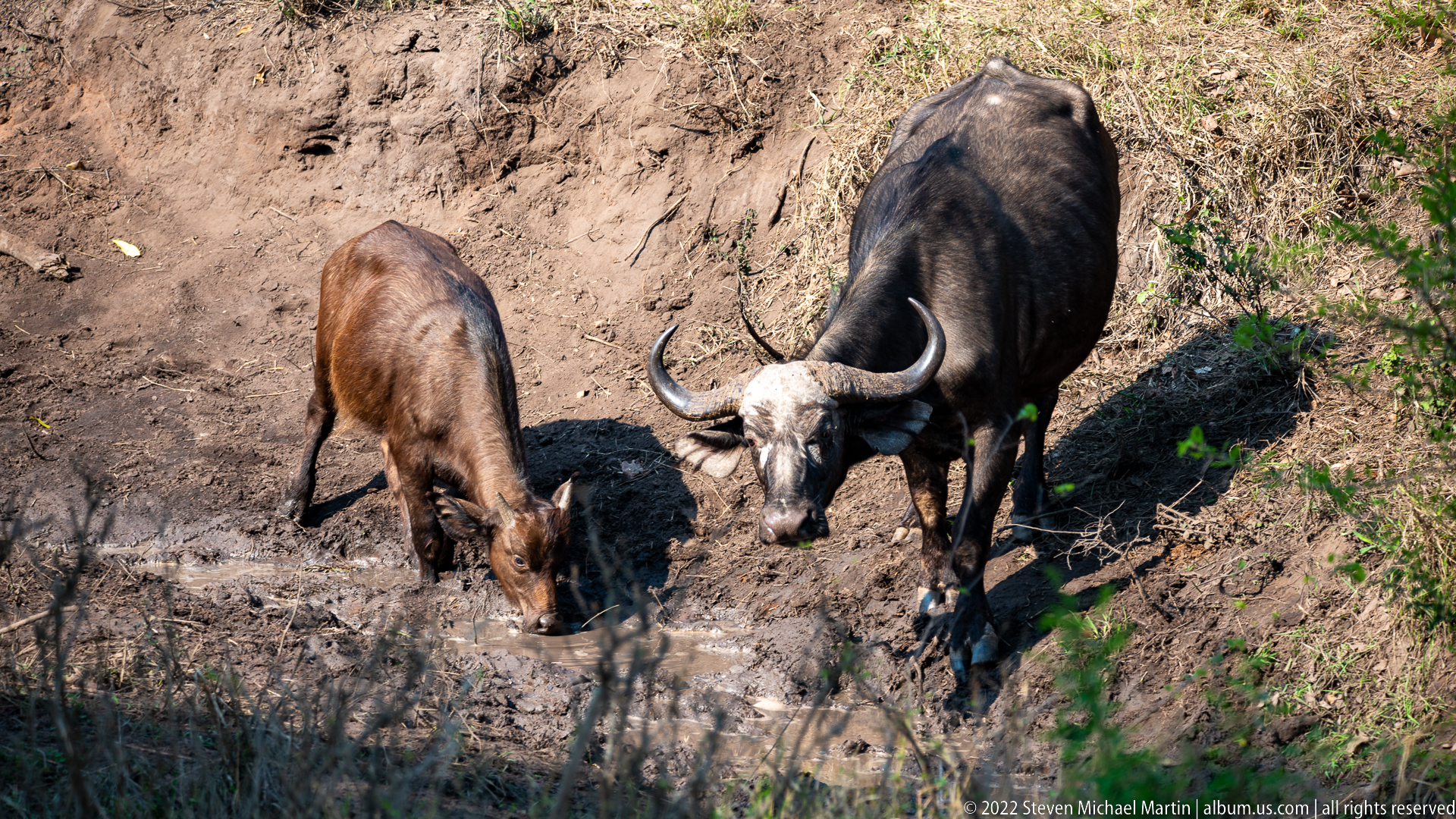
An adult African buffalo and a smaller reddish-brown calf stand at the edge of a muddy waterhole below a steep earthen bank. Seen from above, the adult’s broad horns and dark body contrast with the calf’s compact form, while their position at the water adds behavioral context to the earlier family-group portrait.
Caption
An adult African buffalo and a smaller reddish-brown calf stand at the edge of a muddy waterhole below a steep earthen bank. Seen from above, the adult’s broad horns and dark body contrast with the calf’s compact form, while their position at the water adds behavioral context to the earlier family-group portrait.
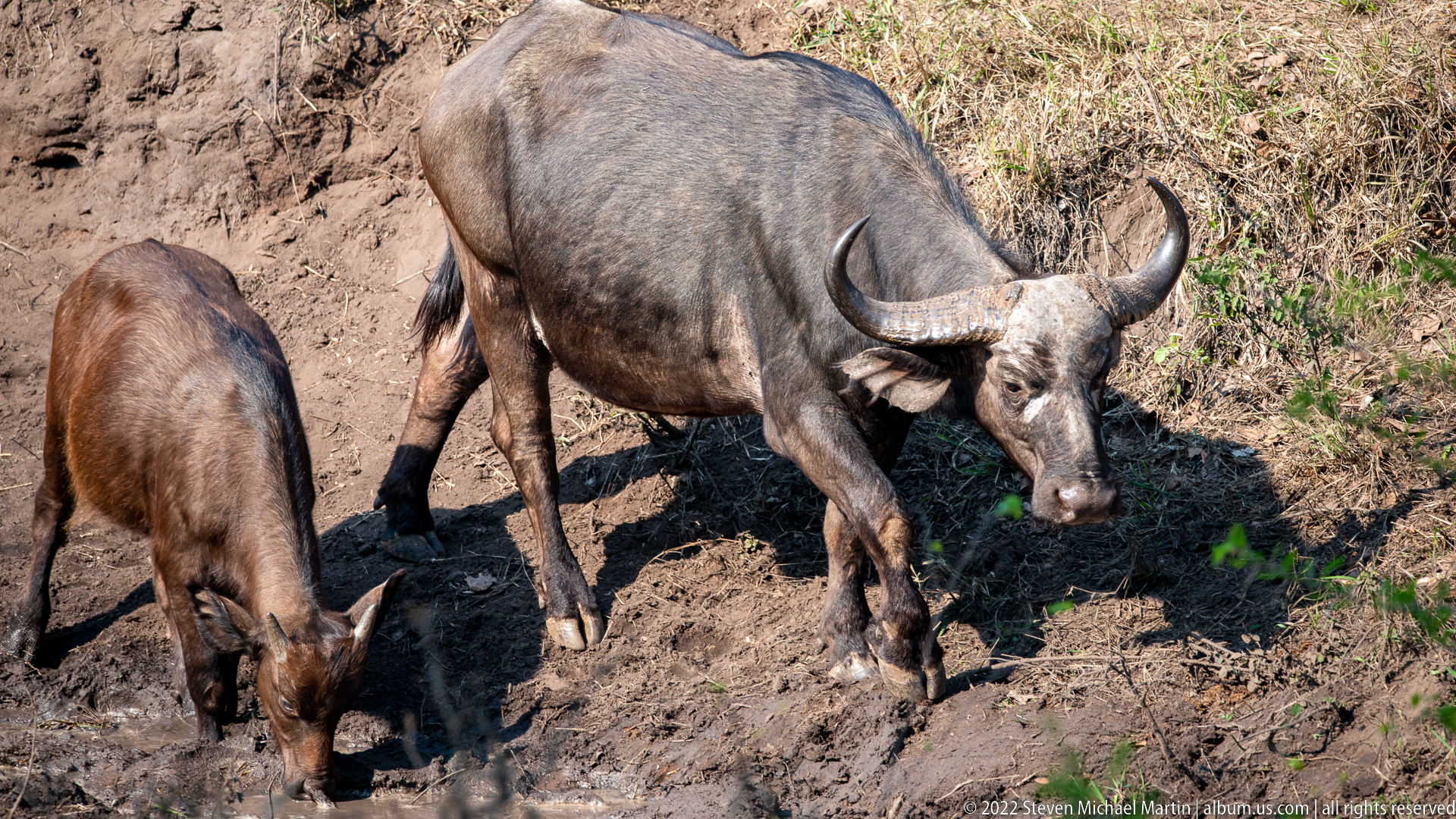
An adult African buffalo stands beside a calf at a muddy patch in the dry woodland near Punda Maria. The adult’s massive horn bases and outward-curving horns contrast with the calf’s smaller, hornless profile, while both animals keep their heads low near the disturbed soil. The paired view records an age difference within one of Kruger National Park’s characteristic large bovids.
Caption
An adult African buffalo stands beside a calf at a muddy patch in the dry woodland near Punda Maria. The adult’s massive horn bases and outward-curving horns contrast with the calf’s smaller, hornless profile, while both animals keep their heads low near the disturbed soil. The paired view records an age difference within one of Kruger National Park’s characteristic large bovids.
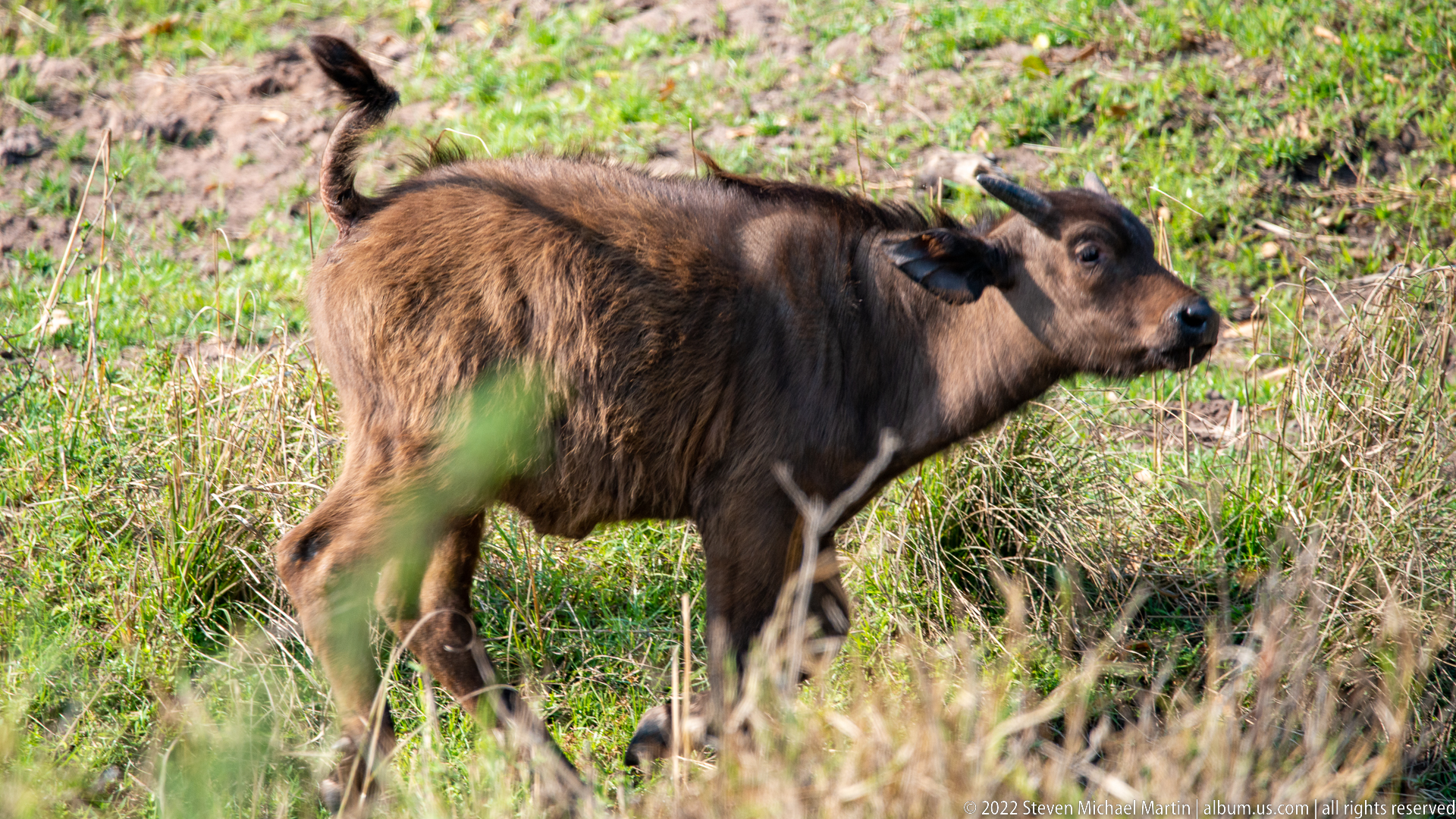
A young African buffalo walks through sunlit grass, its compact body still covered in warm brown juvenile pelage. Small developing horn buds, broad ears, and the characteristic buffalo muzzle are visible in profile. The close view isolates the calf from the herd and emphasizes the proportions and coat color that distinguish a young animal from the dark, heavy-bodied adults.
Caption
A young African buffalo walks through sunlit grass, its compact body still covered in warm brown juvenile pelage. Small developing horn buds, broad ears, and the characteristic buffalo muzzle are visible in profile. The close view isolates the calf from the herd and emphasizes the proportions and coat color that distinguish a young animal from the dark, heavy-bodied adults.
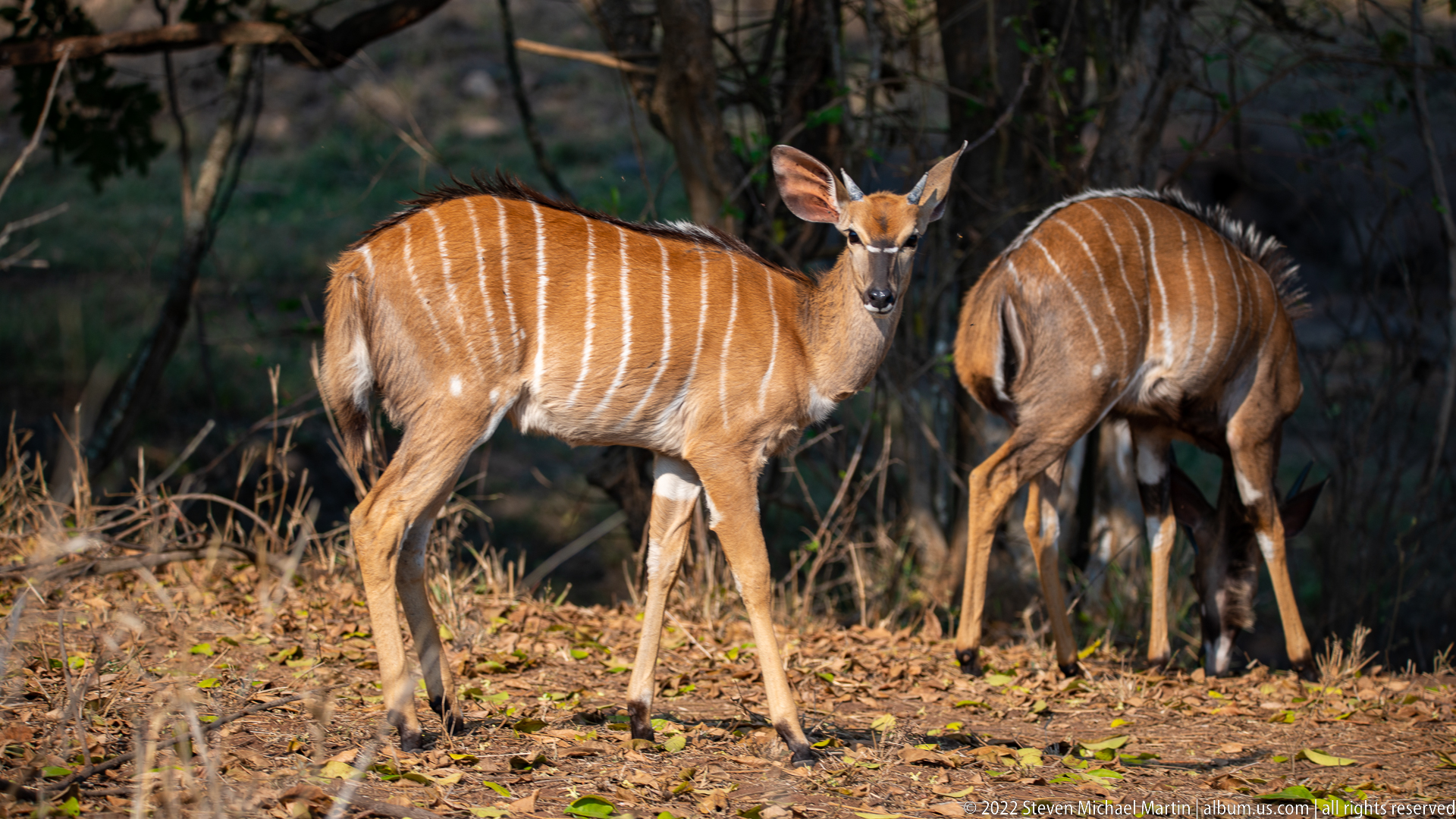
Two female nyala stand in dappled woodland, one facing the camera while the second browses behind her. Their rich chestnut coats carry narrow white vertical stripes and scattered pale markings, a pattern typical of female and juvenile nyala. The foreground animal’s large ears and slender, hornless head are sharply defined against the shaded understory.
Caption
Two female nyala stand in dappled woodland, one facing the camera while the second browses behind her. Their rich chestnut coats carry narrow white vertical stripes and scattered pale markings, a pattern typical of female and juvenile nyala. The foreground animal’s large ears and slender, hornless head are sharply defined against the shaded understory.
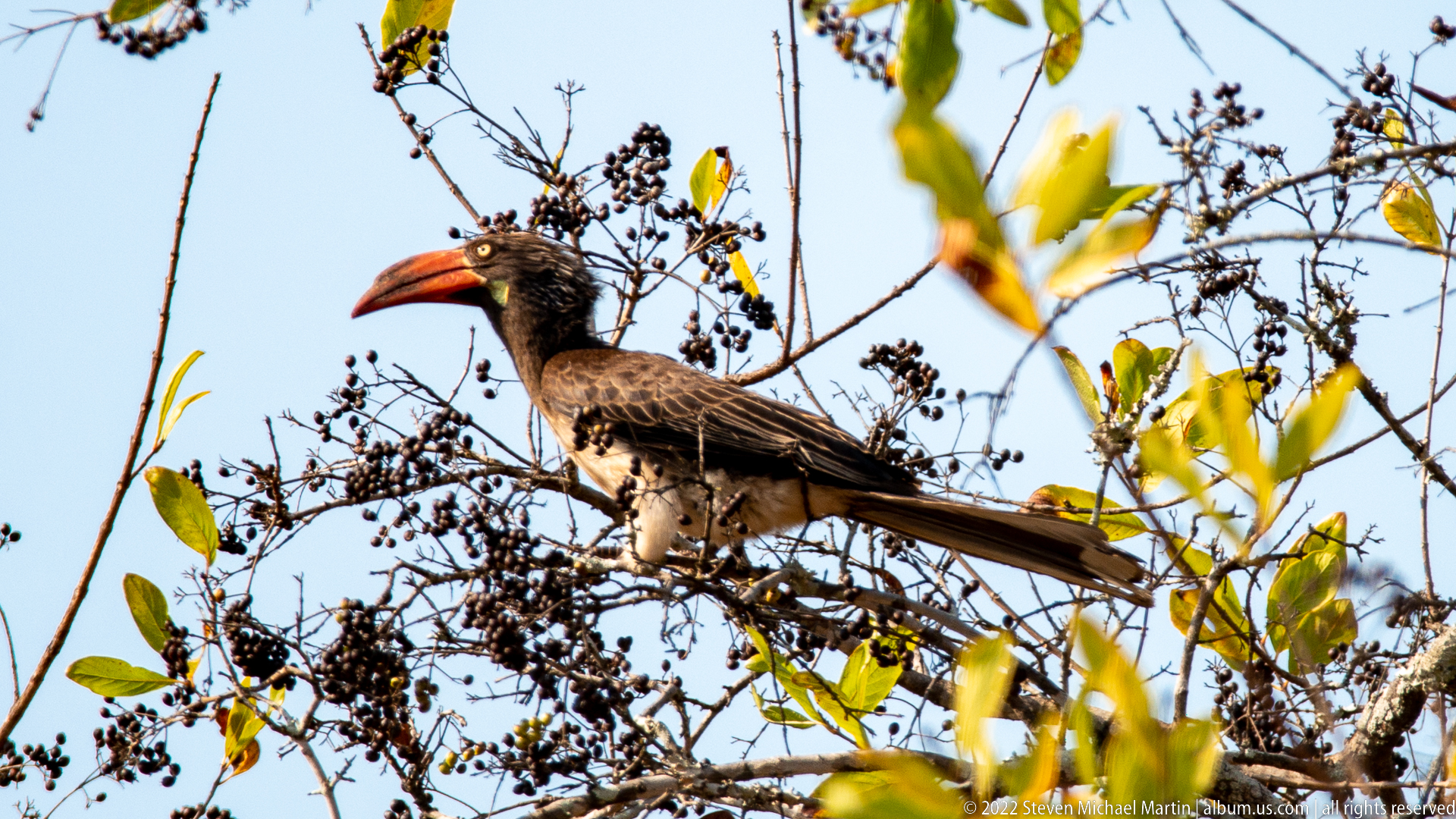
A southern yellow-billed hornbill perches among fruiting branches, presenting its long tail, spotted wing coverts, and oversized yellow-orange bill in profile. The bird is framed against open sky while leaves and dark fruit clusters mark the surrounding canopy. This elevated perch provides a clear field-guide view of the hornbill’s distinctive bill and pied plumage.
Caption
A southern yellow-billed hornbill perches among fruiting branches, presenting its long tail, spotted wing coverts, and oversized yellow-orange bill in profile. The bird is framed against open sky while leaves and dark fruit clusters mark the surrounding canopy. This elevated perch provides a clear field-guide view of the hornbill’s distinctive bill and pied plumage.
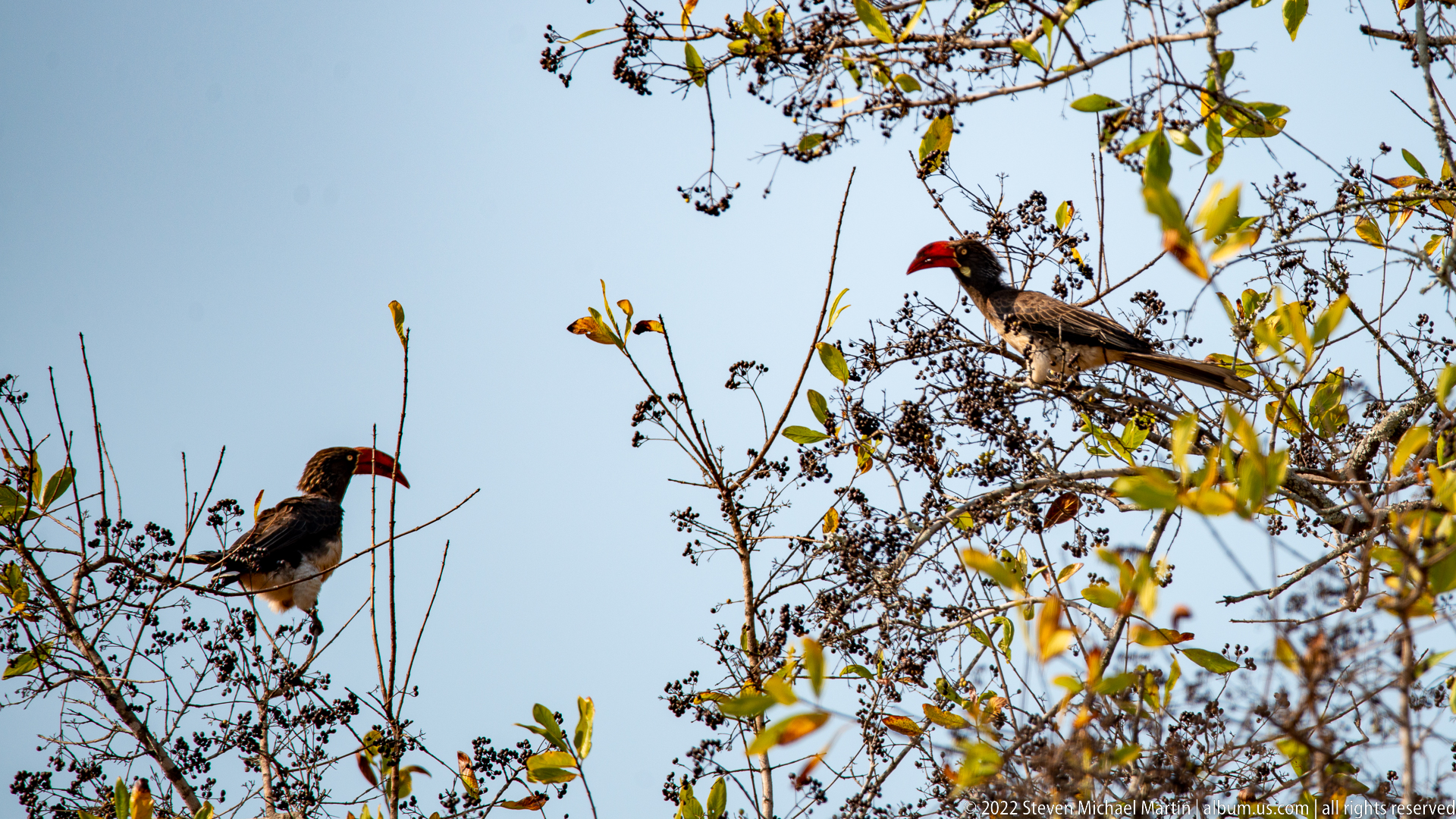
Two southern yellow-billed hornbills occupy separate branches of the same fruiting tree, creating a wider behavioral context than the adjacent portrait. Their bright bills punctuate the fine lattice of twigs, while the upper bird is silhouetted more strongly against the sky. The composition shows how the species uses exposed woodland perches while retaining the birds’ diagnostic long tails and patterned wings.
Caption
Two southern yellow-billed hornbills occupy separate branches of the same fruiting tree, creating a wider behavioral context than the adjacent portrait. Their bright bills punctuate the fine lattice of twigs, while the upper bird is silhouetted more strongly against the sky. The composition shows how the species uses exposed woodland perches while retaining the birds’ diagnostic long tails and patterned wings.
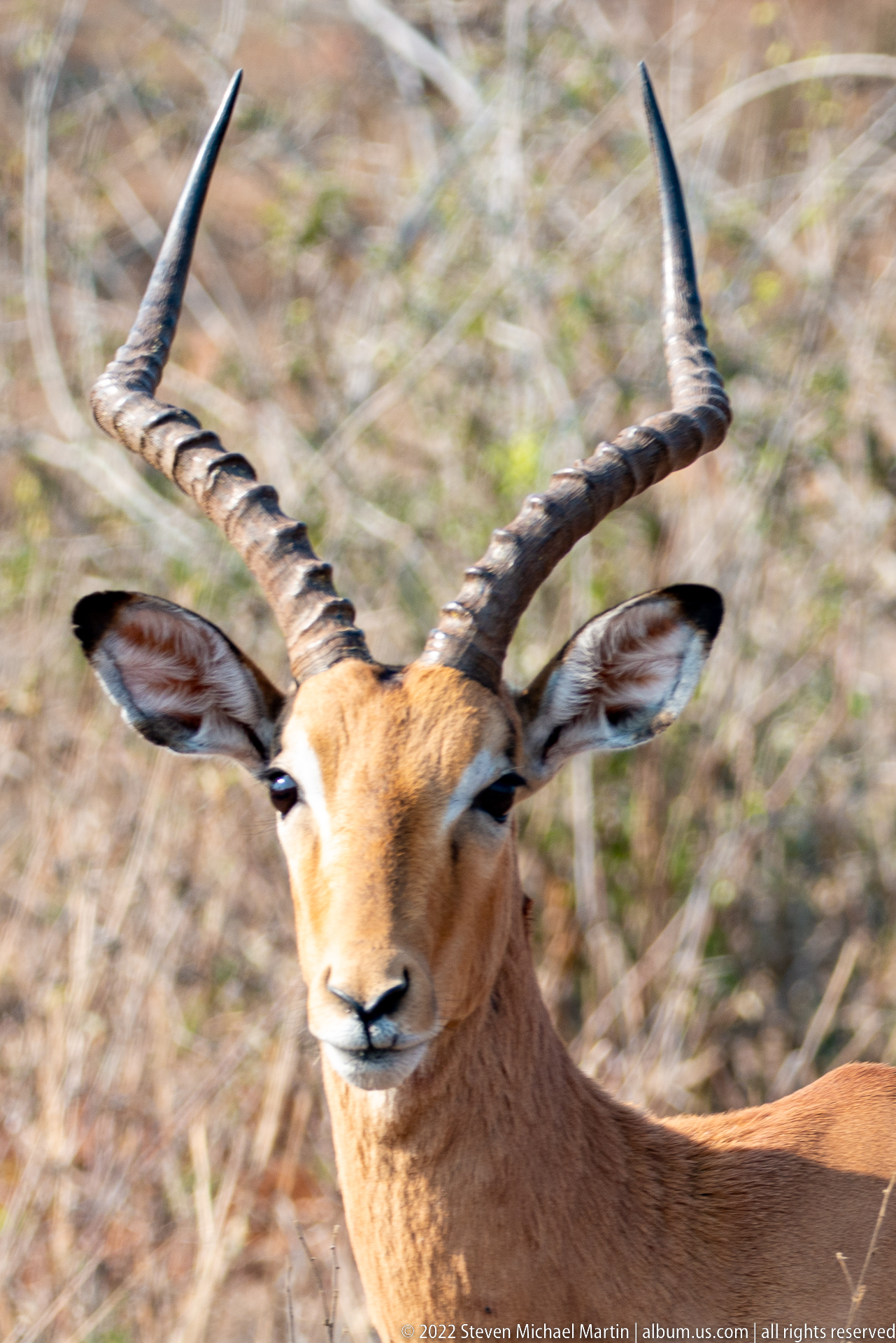
A male impala fills the frame in a close head-and-shoulders portrait. The animal’s lyre-shaped, ridged horns rise above large ears, while the warm tawny face and pale muzzle are sharply separated from the softly blurred dry-season vegetation. The tight composition concentrates attention on the horn structure and facial markings used to recognize an adult ram.
Caption
A male impala fills the frame in a close head-and-shoulders portrait. The animal’s lyre-shaped, ridged horns rise above large ears, while the warm tawny face and pale muzzle are sharply separated from the softly blurred dry-season vegetation. The tight composition concentrates attention on the horn structure and facial markings used to recognize an adult ram.
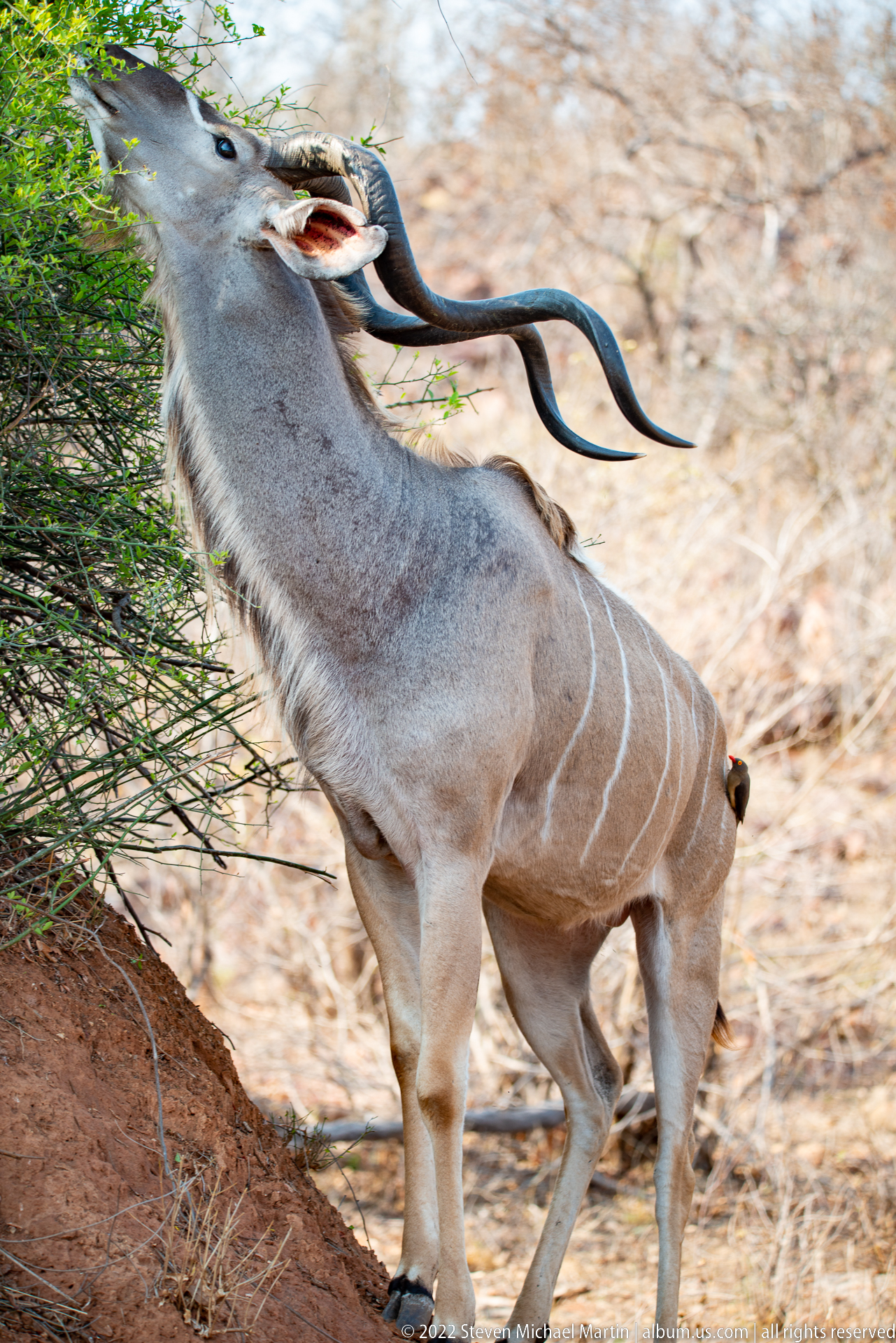
A greater kudu bull stretches his neck upward into a leafy shrub to browse. The feeding posture lifts the muzzle above the foliage and sets the animal’s long spiral horns against the open background. White flank stripes, a gray coat, and the dark neck mane remain visible, but the emphasis here is behavioral: a tall browser reaching into woody vegetation.
Caption
A greater kudu bull stretches his neck upward into a leafy shrub to browse. The feeding posture lifts the muzzle above the foliage and sets the animal’s long spiral horns against the open background. White flank stripes, a gray coat, and the dark neck mane remain visible, but the emphasis here is behavioral: a tall browser reaching into woody vegetation.
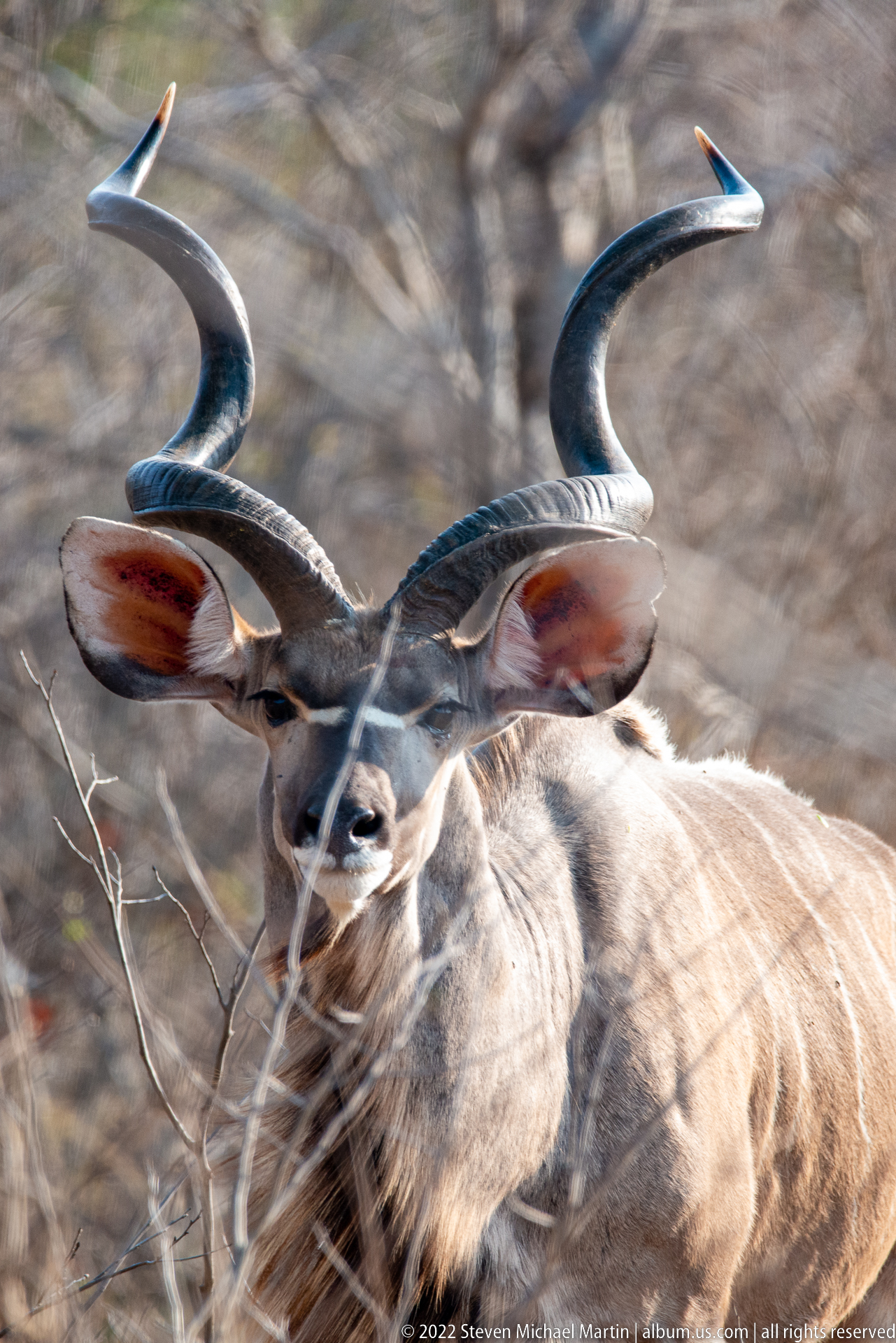
A greater kudu bull emerges through dry brush in a tight frontal portrait. The sweeping spiral horns dominate the upper frame, while broad reddish inner ears, pale facial markings, and the gray forehead remain visible between foreground stems. The shallow depth of field isolates the animal’s head and emphasizes the elaborate horn structure of a mature male.
Caption
A greater kudu bull emerges through dry brush in a tight frontal portrait. The sweeping spiral horns dominate the upper frame, while broad reddish inner ears, pale facial markings, and the gray forehead remain visible between foreground stems. The shallow depth of field isolates the animal’s head and emphasizes the elaborate horn structure of a mature male.
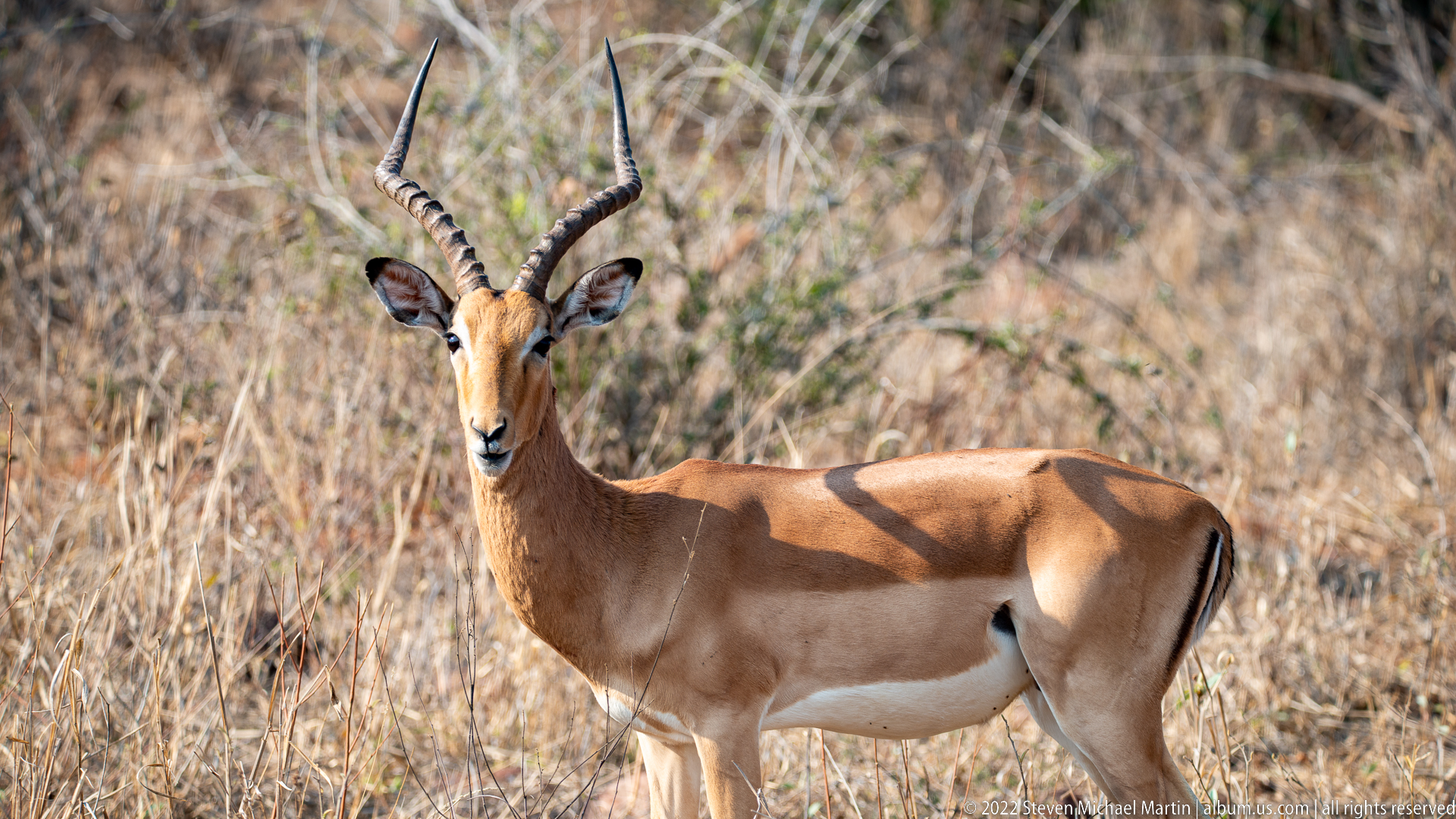
A male impala stands broadside in pale dry grass, turning his head toward the camera. Long ridged horns form a symmetrical lyre above the face, and the animal’s reddish-tan back, white belly, and dark rump markings are visible in the open side view. Sunlight and sparse brush place the ram clearly within Kruger’s dry-season savanna.
Caption
A male impala stands broadside in pale dry grass, turning his head toward the camera. Long ridged horns form a symmetrical lyre above the face, and the animal’s reddish-tan back, white belly, and dark rump markings are visible in the open side view. Sunlight and sparse brush place the ram clearly within Kruger’s dry-season savanna.
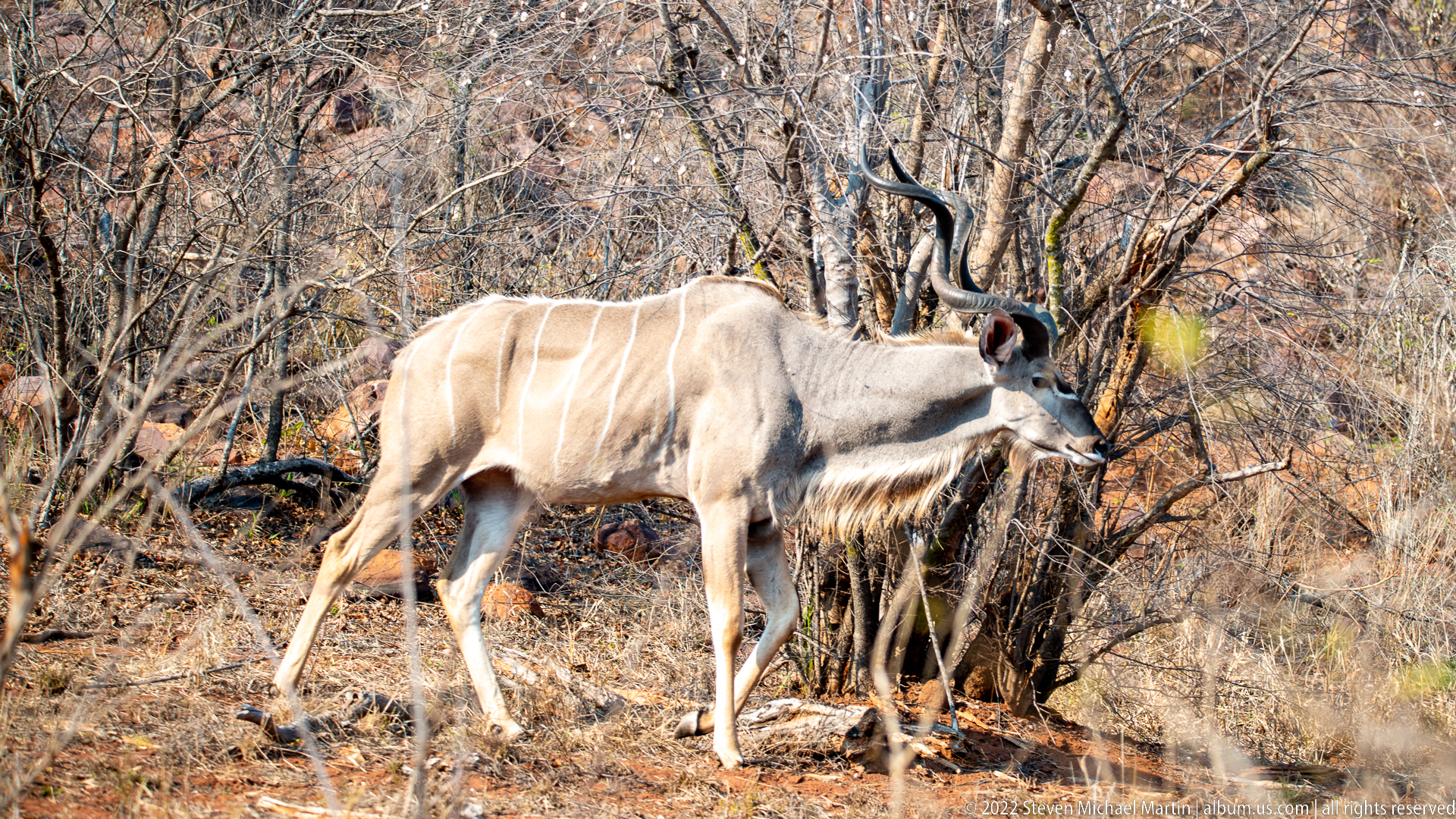
A greater kudu bull walks through dry woodland in full side profile. His gray-brown coat carries thin white vertical stripes, while tall spiral horns rise above the head and visually echo the surrounding branches. The broadside view shows the kudu’s long legs, sloping back, neck mane, and large ears—features that make this large browsing antelope distinctive.
Caption
A greater kudu bull walks through dry woodland in full side profile. His gray-brown coat carries thin white vertical stripes, while tall spiral horns rise above the head and visually echo the surrounding branches. The broadside view shows the kudu’s long legs, sloping back, neck mane, and large ears—features that make this large browsing antelope distinctive.
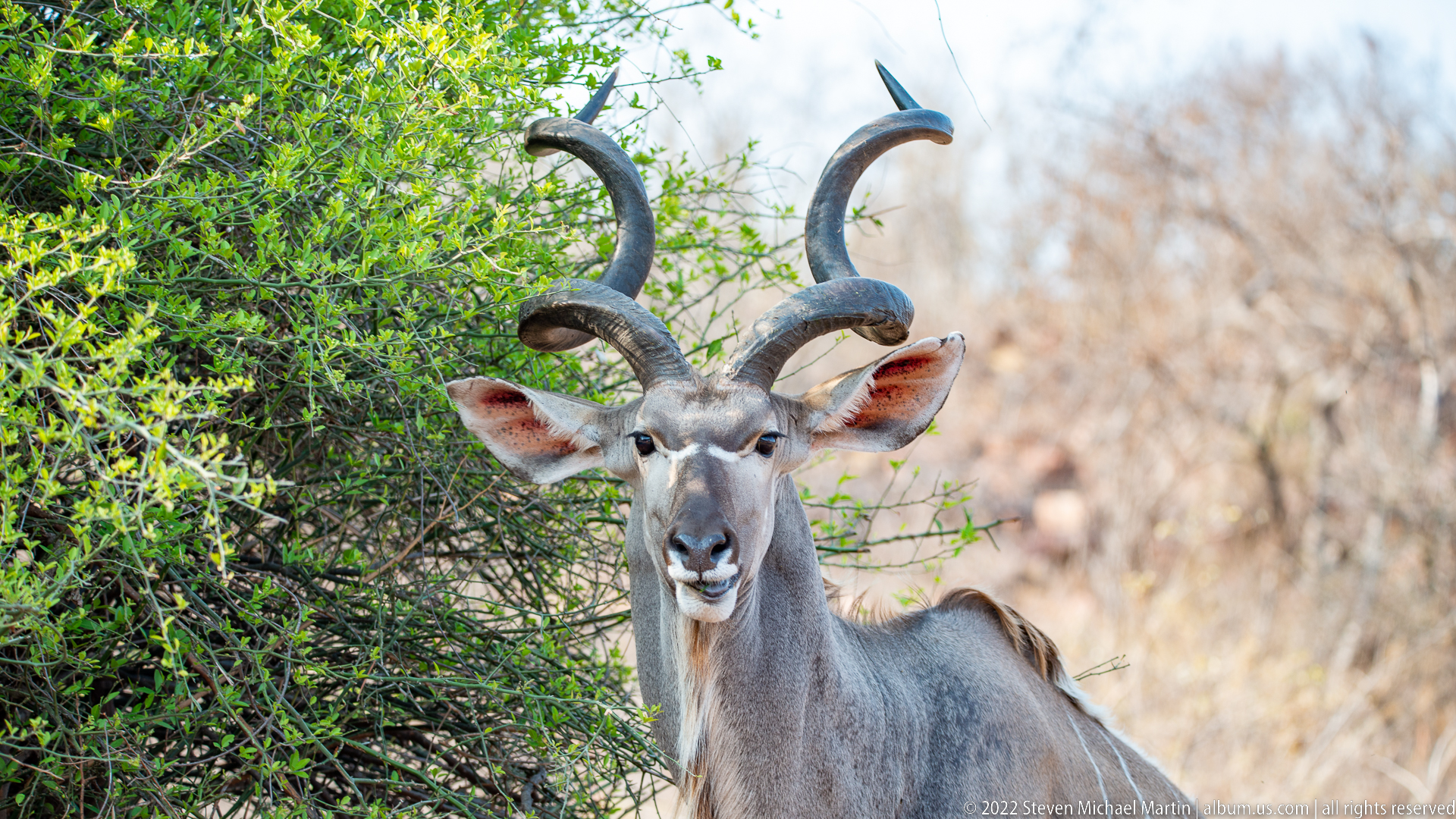
A greater kudu bull faces the camera from the edge of green brush, with both spiral horns fully visible above his head. The frontal angle reveals the horns’ sweeping twists, broad ears, pale facial markings, and shaggy throat fringe. Contrasting green foliage and dry woodland behind the animal give this portrait a strong sense of the mixed browsing habitat around Punda Maria.
Caption
A greater kudu bull faces the camera from the edge of green brush, with both spiral horns fully visible above his head. The frontal angle reveals the horns’ sweeping twists, broad ears, pale facial markings, and shaggy throat fringe. Contrasting green foliage and dry woodland behind the animal give this portrait a strong sense of the mixed browsing habitat around Punda Maria.

At close range, a greater kudu bull pushes his muzzle into dense green twigs while feeding. His gray shoulder and neck dominate the frame, and the sweeping spiral horns extend across the upper edge, partly intersecting the foliage. The compressed view emphasizes the physical relationship between this large browser and the woody vegetation it feeds upon.
Caption
At close range, a greater kudu bull pushes his muzzle into dense green twigs while feeding. His gray shoulder and neck dominate the frame, and the sweeping spiral horns extend across the upper edge, partly intersecting the foliage. The compressed view emphasizes the physical relationship between this large browser and the woody vegetation it feeds upon.
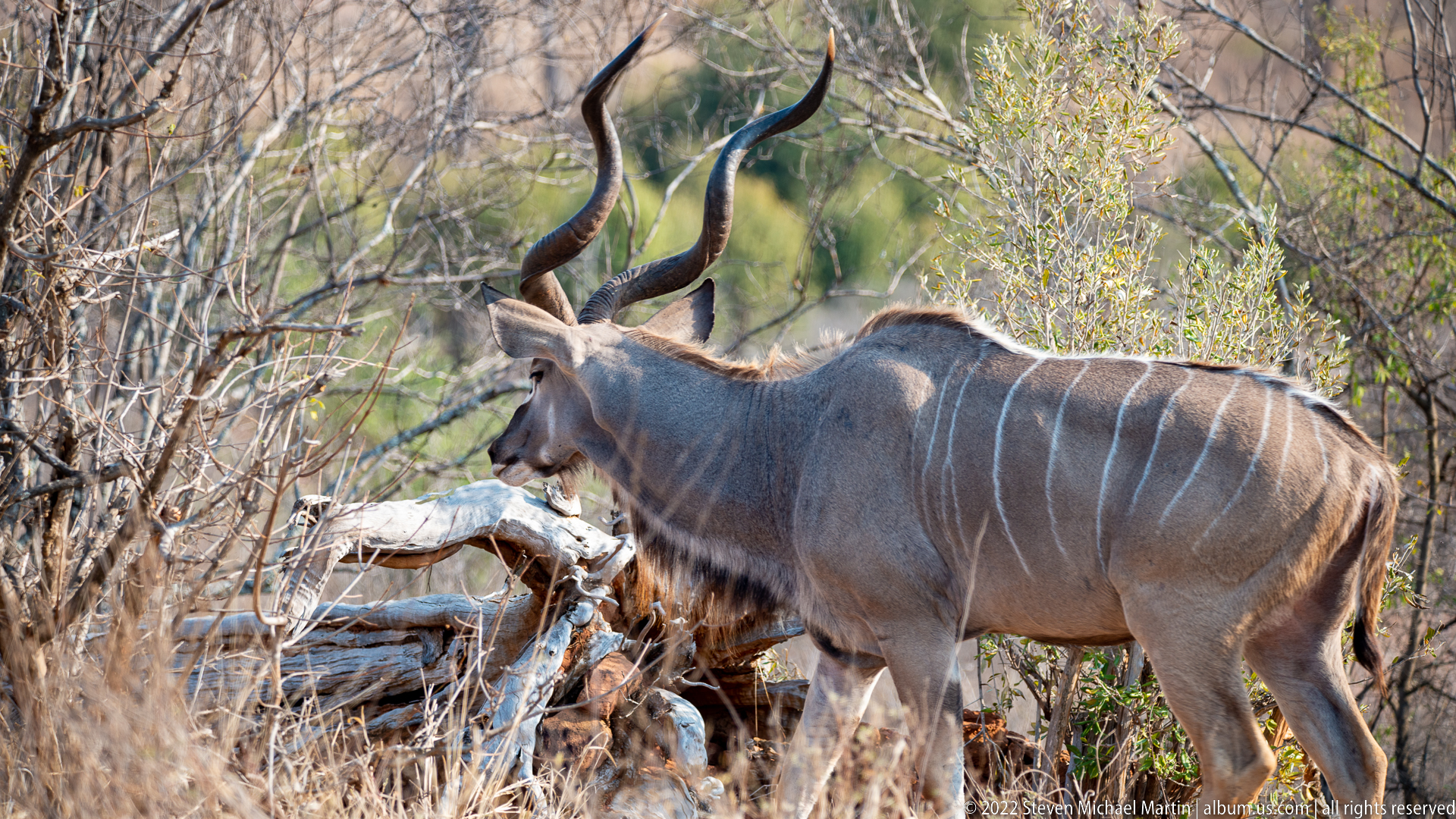
A mature greater kudu stands in profile among tangled branches and fallen wood. The animal’s dark gray coat, narrow white flank stripes, shoulder hump, and tall spiraling horns are clearly visible against the dry woodland. Unlike the feeding views on this page, the bull is stationary and alert, providing a complete side study of body proportions and horn shape.
Caption
A mature greater kudu stands in profile among tangled branches and fallen wood. The animal’s dark gray coat, narrow white flank stripes, shoulder hump, and tall spiraling horns are clearly visible against the dry woodland. Unlike the feeding views on this page, the bull is stationary and alert, providing a complete side study of body proportions and horn shape.
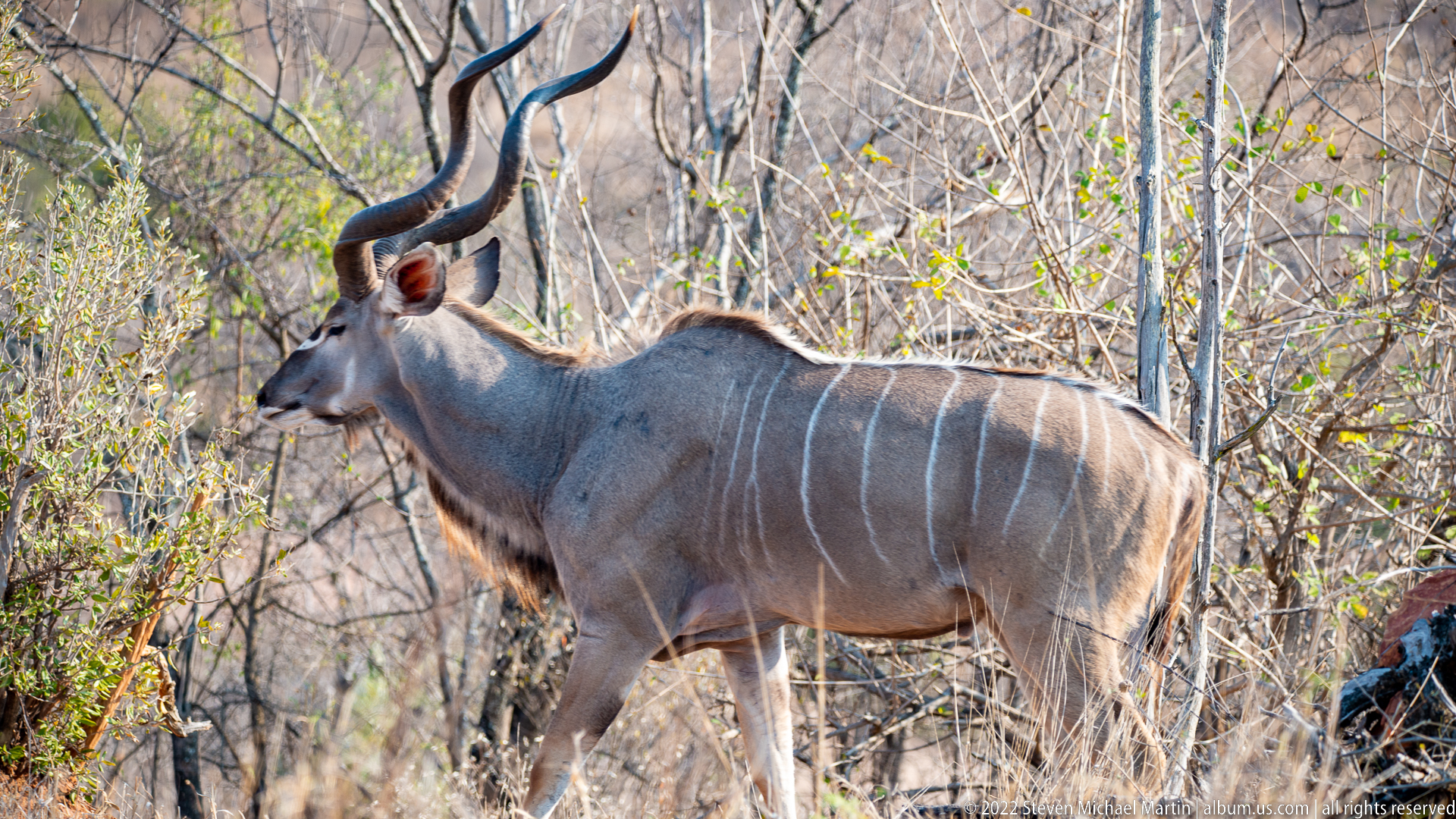
A greater kudu bull pauses in dense, dry woodland, his body shown broadside while his head turns slightly into the brush. Thin white stripes cross the gray flank and long spiral horns rise above the surrounding stems. The close woodland setting demonstrates the visual camouflage created by the kudu’s muted coat and vertical striping among trunks and branches.
Caption
A greater kudu bull pauses in dense, dry woodland, his body shown broadside while his head turns slightly into the brush. Thin white stripes cross the gray flank and long spiral horns rise above the surrounding stems. The close woodland setting demonstrates the visual camouflage created by the kudu’s muted coat and vertical striping among trunks and branches.
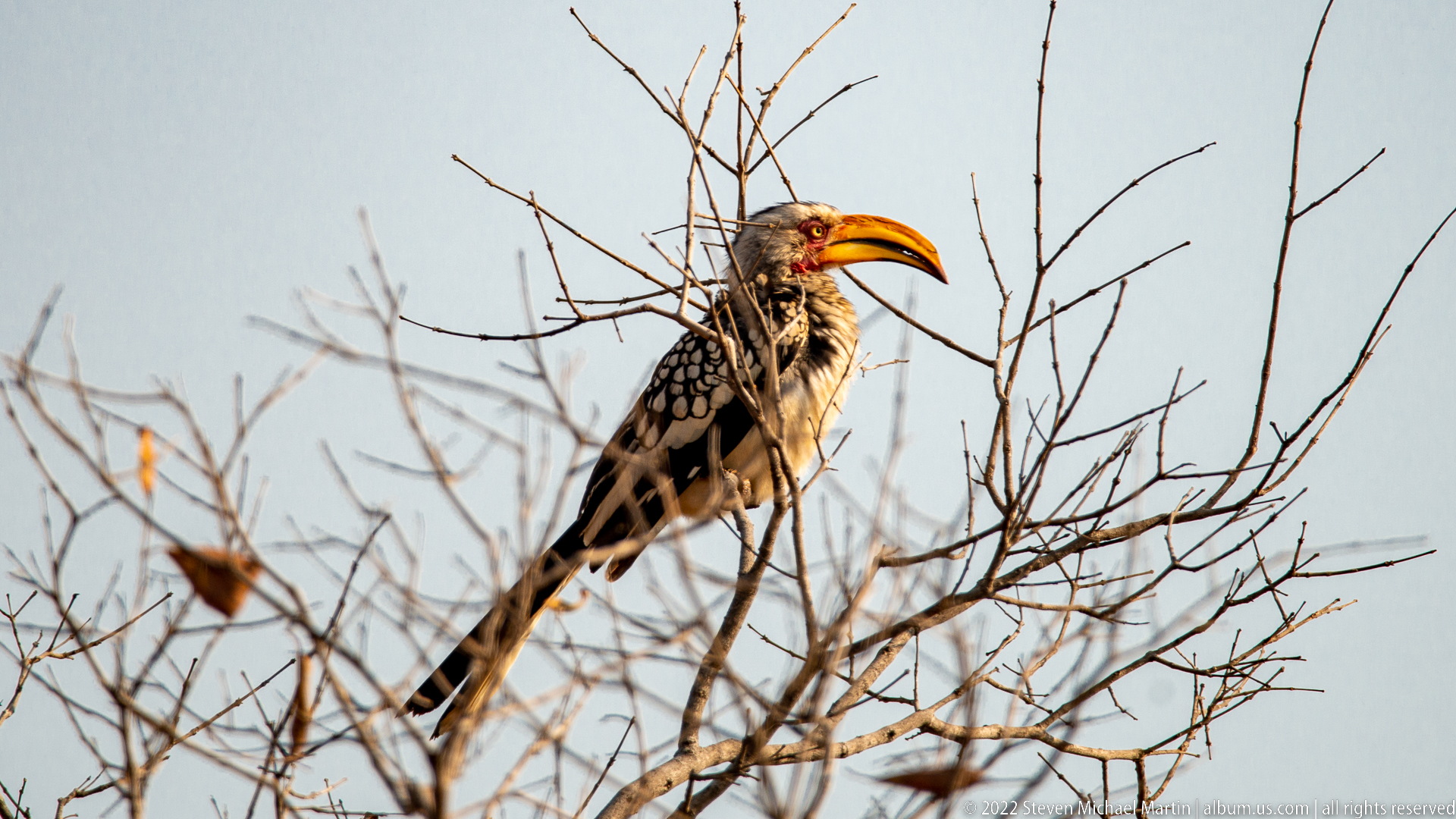
A southern yellow-billed hornbill perches high in a mostly leafless tree, its oversized yellow-orange bill and patterned black-and-white wings sharply outlined against the pale sky. The long tail drops below the branch and the bird faces right in profile. Sparse twigs make this a particularly clear view of the species’ characteristic silhouette.
Caption
A southern yellow-billed hornbill perches high in a mostly leafless tree, its oversized yellow-orange bill and patterned black-and-white wings sharply outlined against the pale sky. The long tail drops below the branch and the bird faces right in profile. Sparse twigs make this a particularly clear view of the species’ characteristic silhouette.
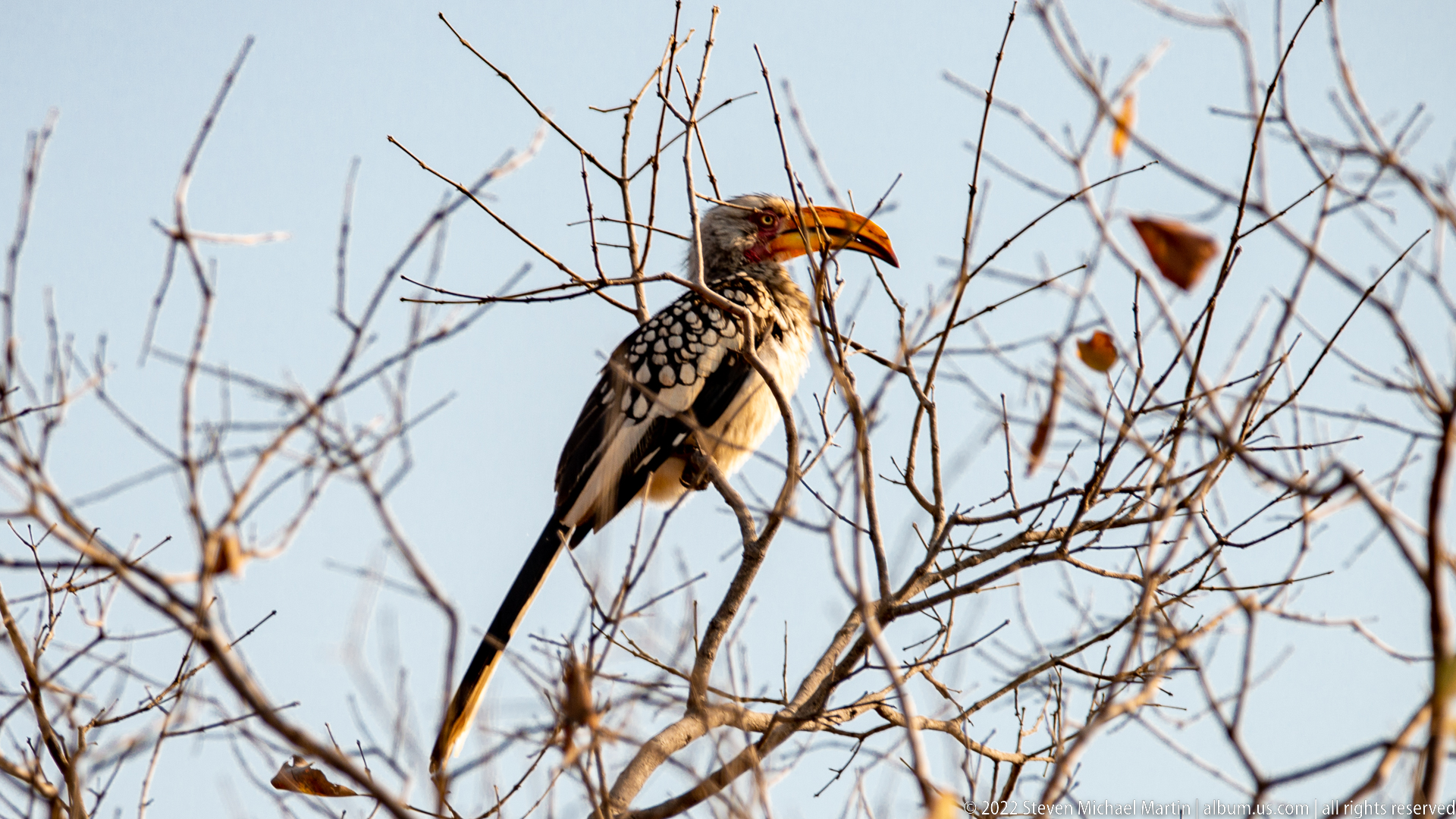
Framed by a network of bare twigs, a southern yellow-billed hornbill sits upright with its bill angled slightly forward. Sunlight picks out the pale spotted wing coverts, mottled head, and warm yellow-orange bill, while the tail forms a dark vertical line below the perch. The uncluttered sky provides strong contrast for the bird’s field marks.
Caption
Framed by a network of bare twigs, a southern yellow-billed hornbill sits upright with its bill angled slightly forward. Sunlight picks out the pale spotted wing coverts, mottled head, and warm yellow-orange bill, while the tail forms a dark vertical line below the perch. The uncluttered sky provides strong contrast for the bird’s field marks.
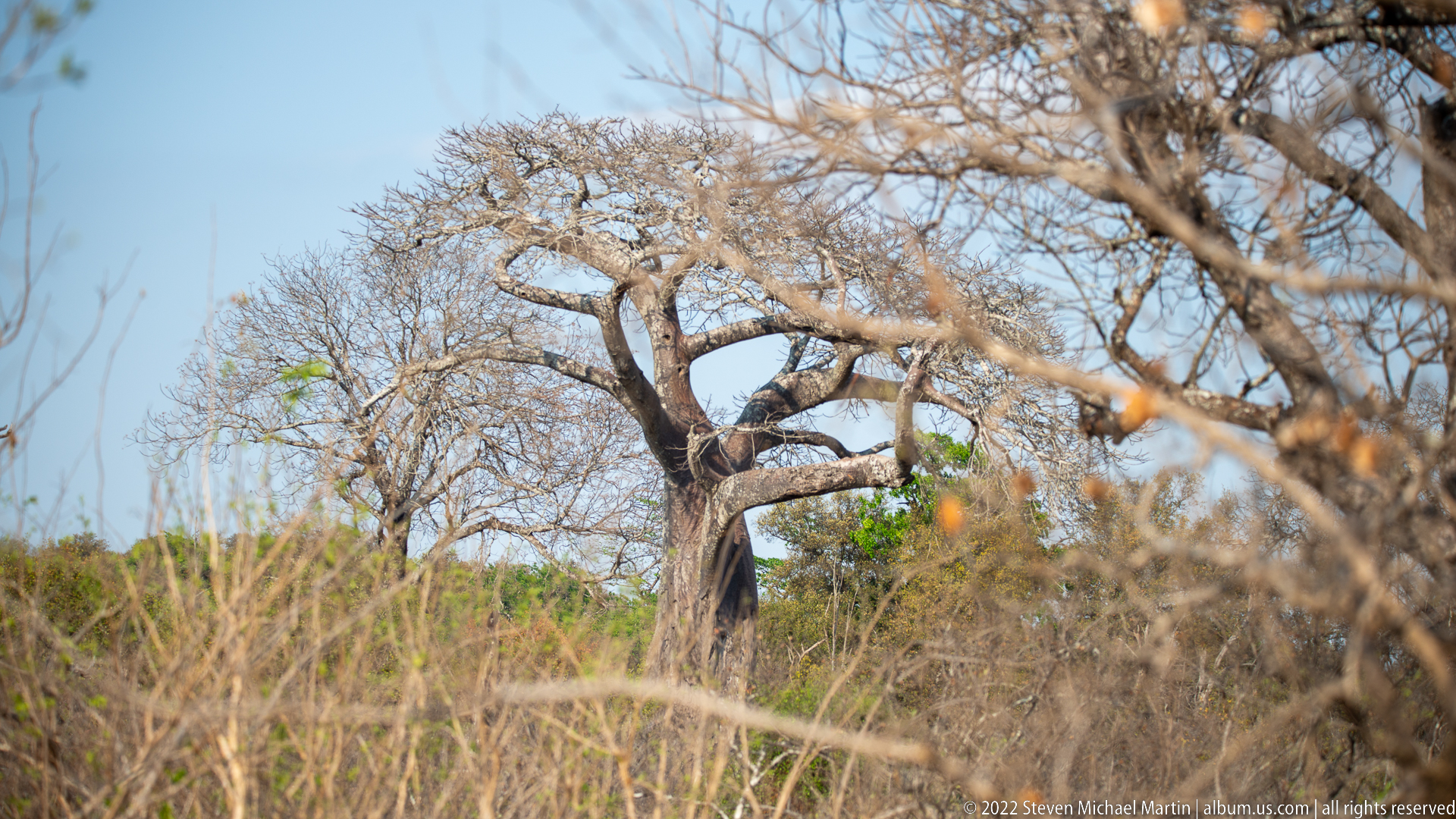
A massive baobab rises above dry grass and low woodland near Punda Maria, its thick trunk supporting heavy, spreading limbs that are largely bare of leaves. Foreground branches partially screen the view, reinforcing the tree’s scale within the surrounding savanna. The swollen trunk and powerful branching architecture are characteristic of the African baobab.
Caption
A massive baobab rises above dry grass and low woodland near Punda Maria, its thick trunk supporting heavy, spreading limbs that are largely bare of leaves. Foreground branches partially screen the view, reinforcing the tree’s scale within the surrounding savanna. The swollen trunk and powerful branching architecture are characteristic of the African baobab.
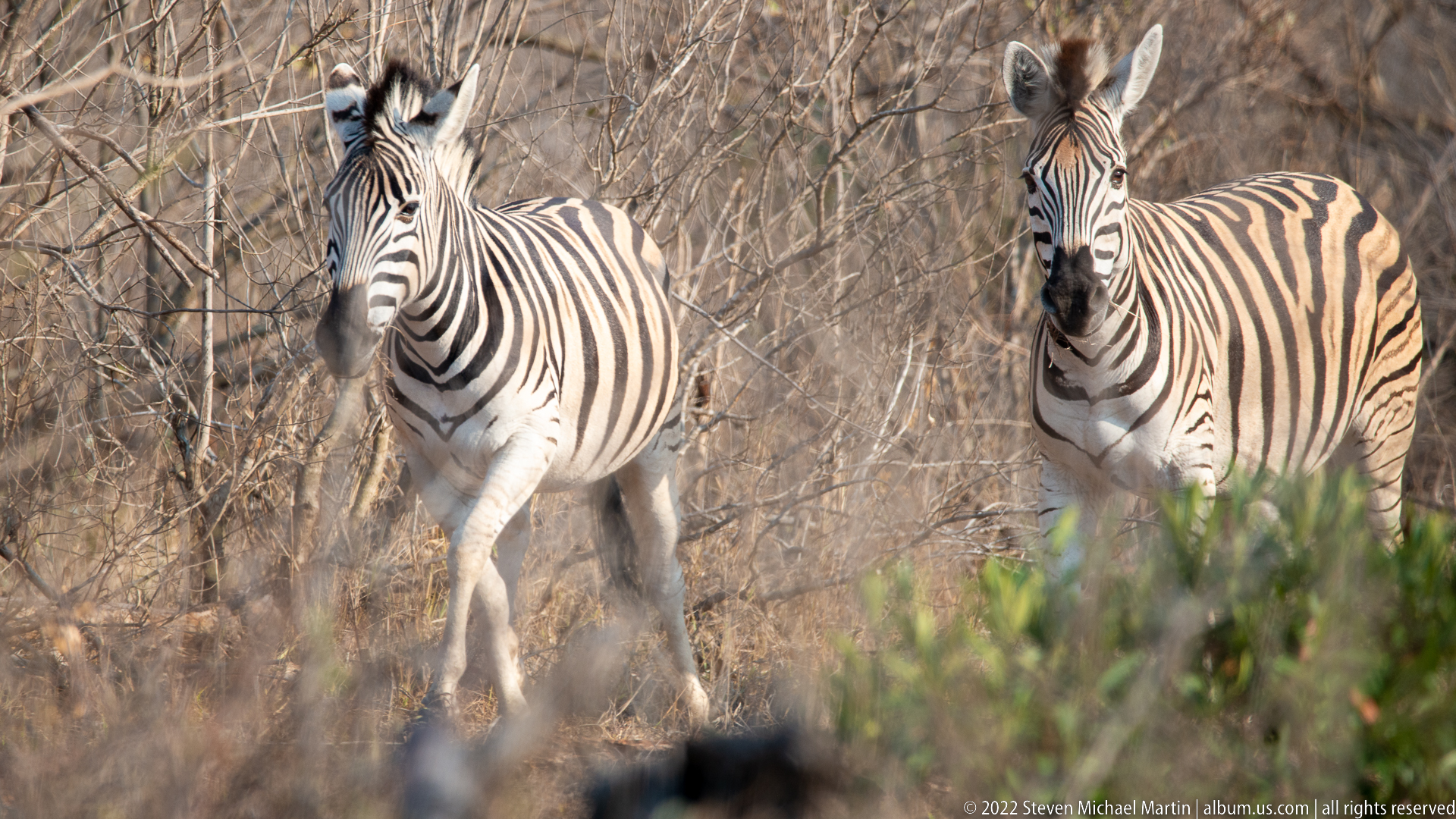
Two plains zebras stand amid dry thorny woodland, both facing generally toward the camera. Their black-and-white striping remains visually prominent against the brown understory, while the nearer zebra steps forward through a lightly dusty patch. The paired composition shows individual variation in stripe patterns while placing the animals in a dry-season bushveld setting.
Caption
Two plains zebras stand amid dry thorny woodland, both facing generally toward the camera. Their black-and-white striping remains visually prominent against the brown understory, while the nearer zebra steps forward through a lightly dusty patch. The paired composition shows individual variation in stripe patterns while placing the animals in a dry-season bushveld setting.
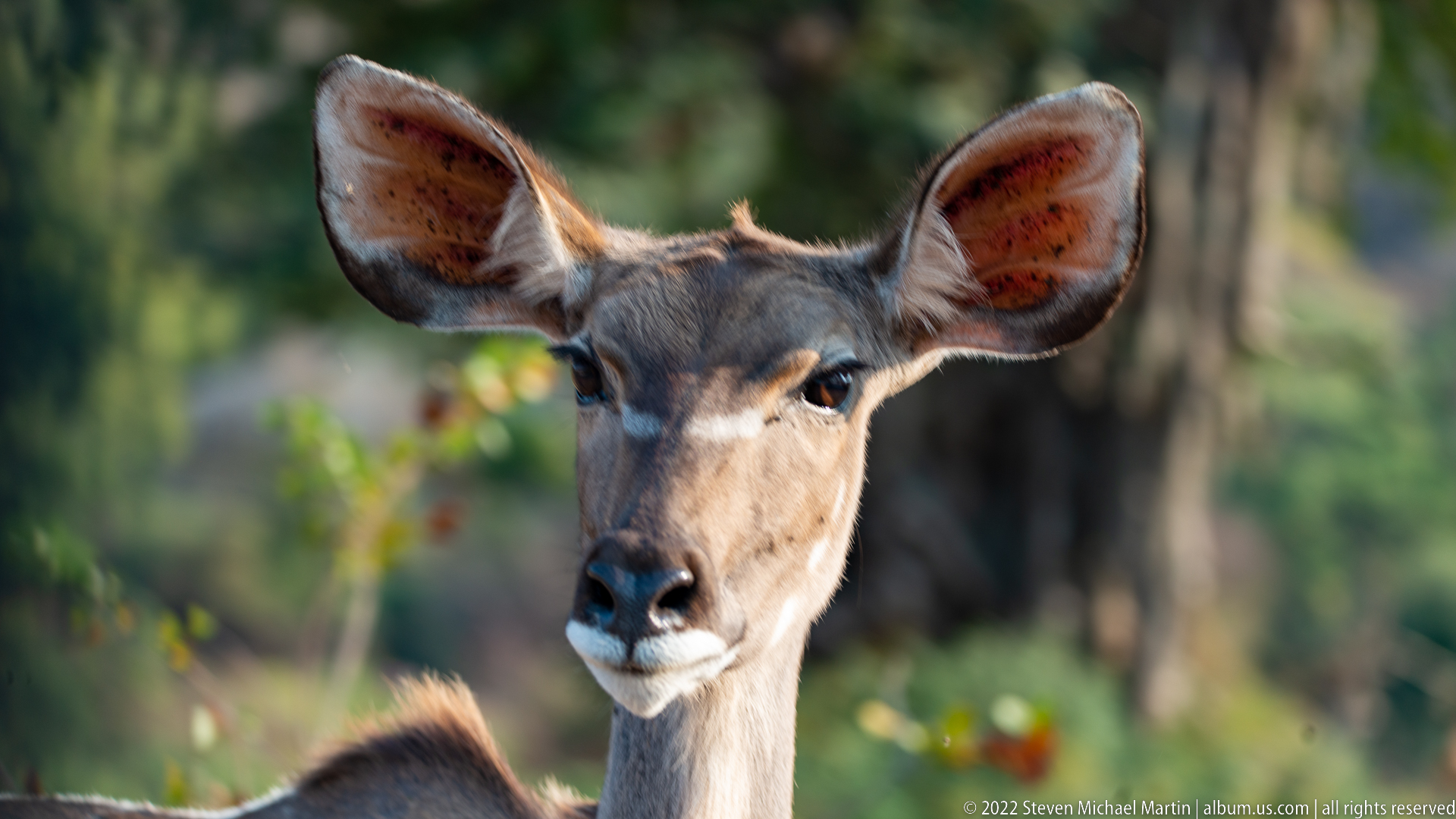
A female greater kudu looks directly toward the camera in a close portrait, her oversized ears spread broadly to either side. The hornless head, gray-brown coat, pale muzzle, and subtle facial markings distinguish the ewe from the spiral-horned bulls seen earlier in the sequence. Soft woodland foliage behind her keeps attention on the alert expression and ear shape.
Caption
A female greater kudu looks directly toward the camera in a close portrait, her oversized ears spread broadly to either side. The hornless head, gray-brown coat, pale muzzle, and subtle facial markings distinguish the ewe from the spiral-horned bulls seen earlier in the sequence. Soft woodland foliage behind her keeps attention on the alert expression and ear shape.
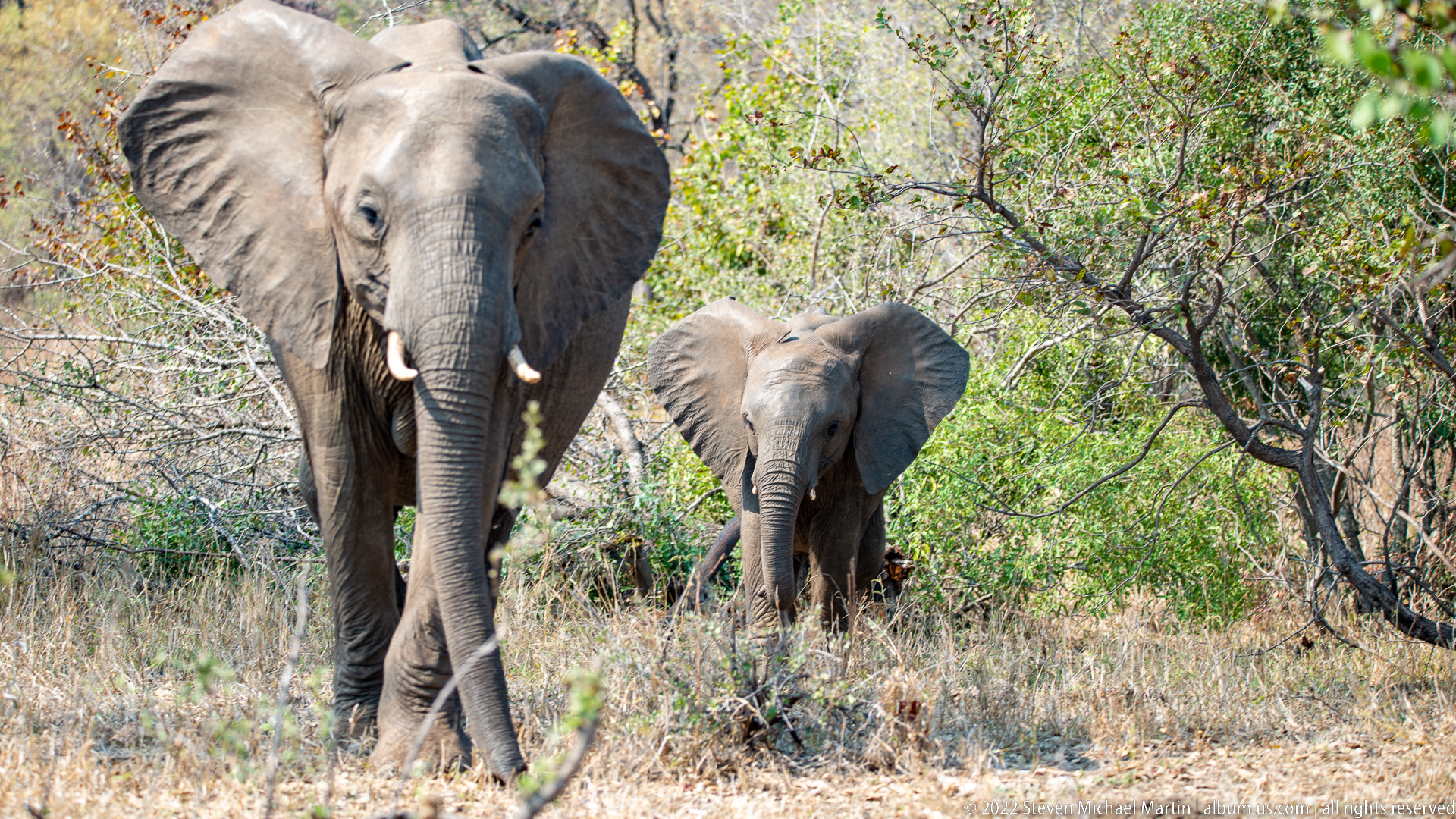
An adult African bush elephant advances through scrub with a smaller juvenile following several paces behind. The adult’s tusks and long trunk are visible head-on, while the youngster’s spread ears stand out against greener vegetation. The staggered alignment gives the scene depth and records a close association between two differently sized members of the group.
Caption
An adult African bush elephant advances through scrub with a smaller juvenile following several paces behind. The adult’s tusks and long trunk are visible head-on, while the youngster’s spread ears stand out against greener vegetation. The staggered alignment gives the scene depth and records a close association between two differently sized members of the group.
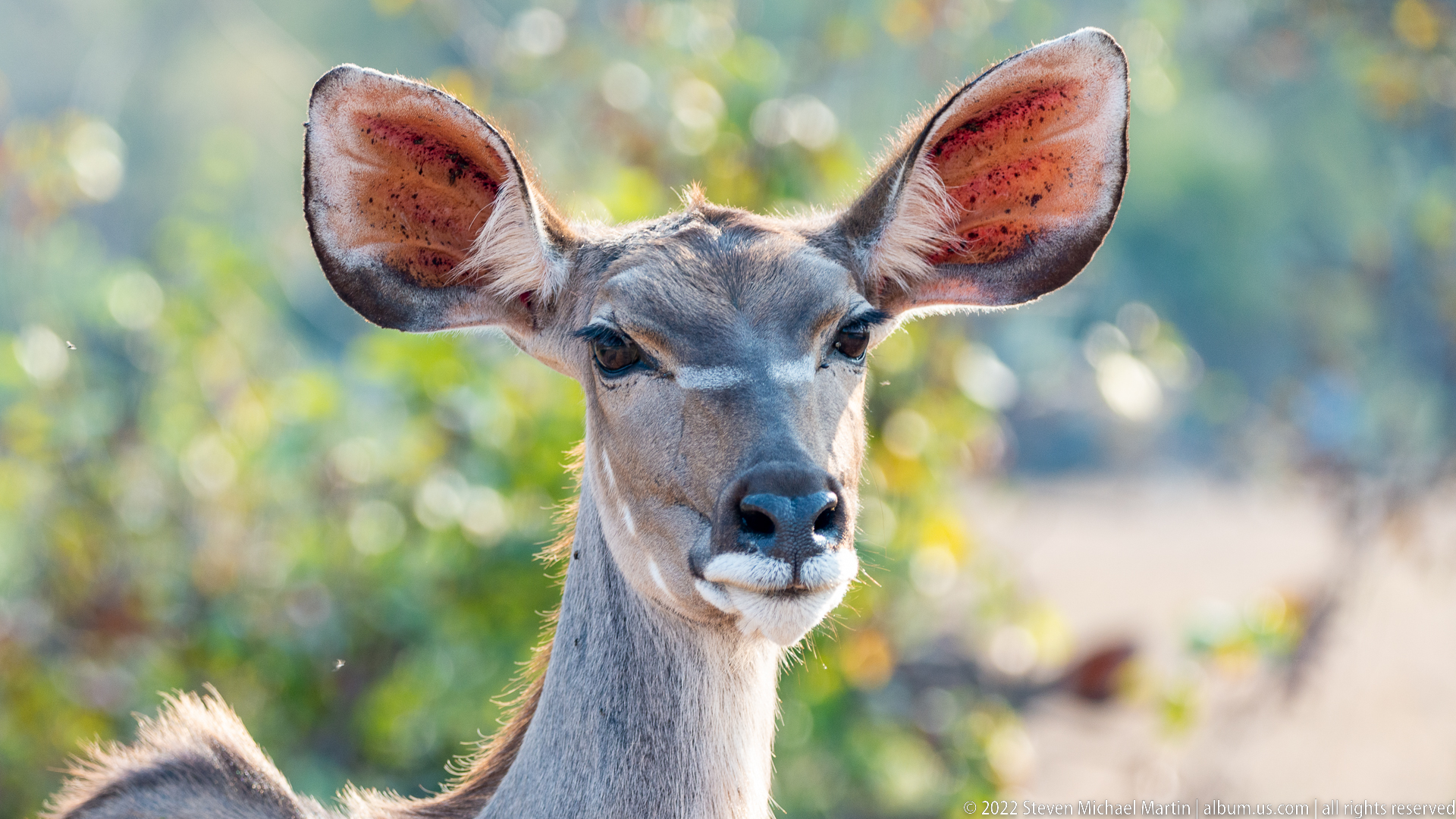
Sunlit from the front, a female greater kudu holds her head high with both large ears fully open. The absence of horns, long narrow face, gray coat, and pale chin identify the animal as a kudu ewe. Bright circular highlights in the vegetation create a softer setting than the preceding portrait while retaining a clear field-guide view of the head.
Caption
Sunlit from the front, a female greater kudu holds her head high with both large ears fully open. The absence of horns, long narrow face, gray coat, and pale chin identify the animal as a kudu ewe. Bright circular highlights in the vegetation create a softer setting than the preceding portrait while retaining a clear field-guide view of the head.
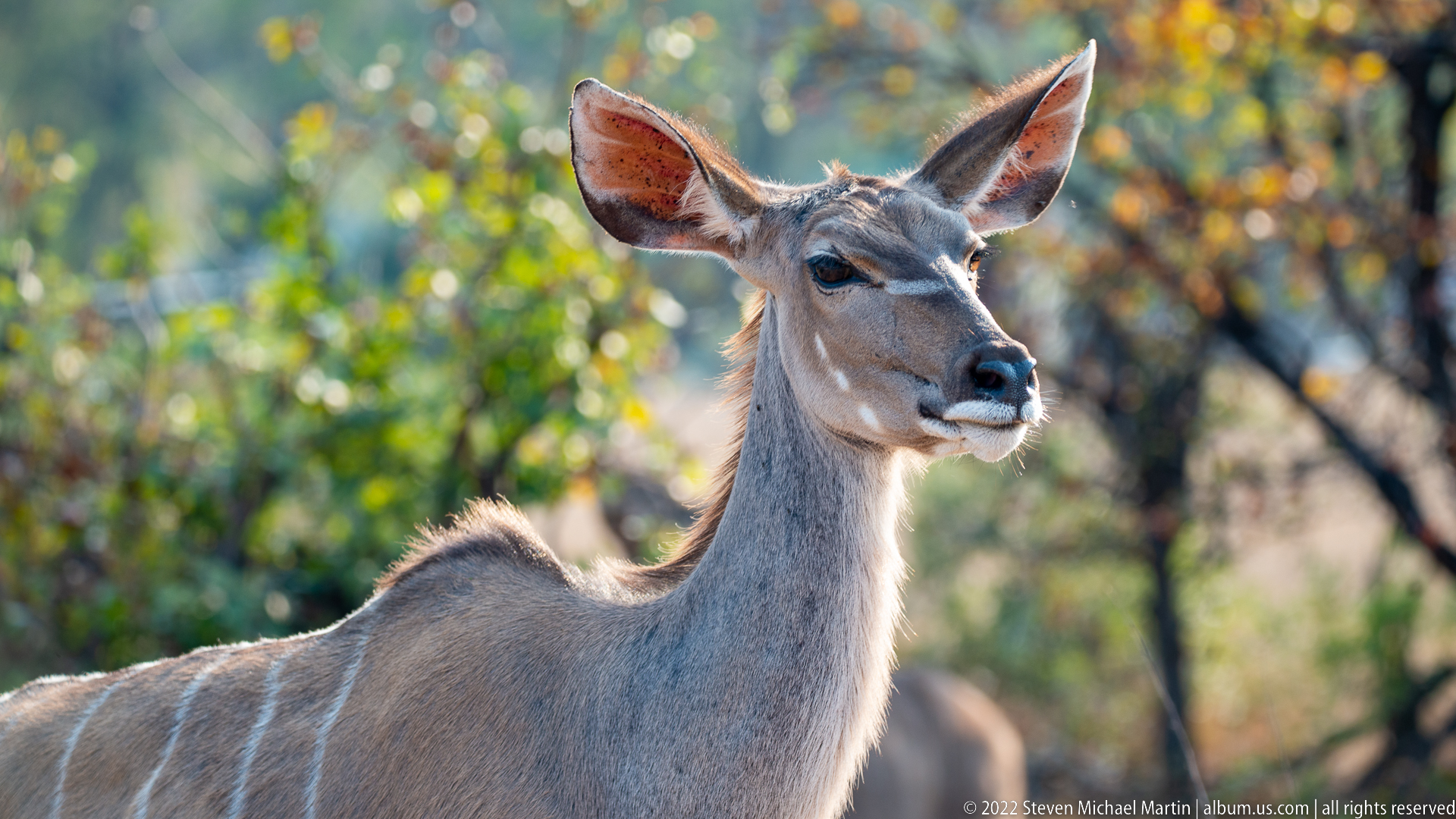
A female greater kudu turns into a three-quarter profile, showing the long neck and sloping shoulder as well as the species’ exceptionally large ears. Warm backlighting edges the gray-brown coat and separates the animal from green and amber foliage. The wider framing extends beyond the head to show more of the ewe’s upper body and posture.
Caption
A female greater kudu turns into a three-quarter profile, showing the long neck and sloping shoulder as well as the species’ exceptionally large ears. Warm backlighting edges the gray-brown coat and separates the animal from green and amber foliage. The wider framing extends beyond the head to show more of the ewe’s upper body and posture.

A female greater kudu stands in full side profile beside a fruiting shrub, extending her muzzle toward the leaves and berries. Fine pale stripes are visible along the gray-brown flank, while the hornless head and large ears identify the animal as a female. The complete-body view links the kudu’s tall, long-legged build with its browsing behavior in woody vegetation.
Caption
A female greater kudu stands in full side profile beside a fruiting shrub, extending her muzzle toward the leaves and berries. Fine pale stripes are visible along the gray-brown flank, while the hornless head and large ears identify the animal as a female. The complete-body view links the kudu’s tall, long-legged build with its browsing behavior in woody vegetation.
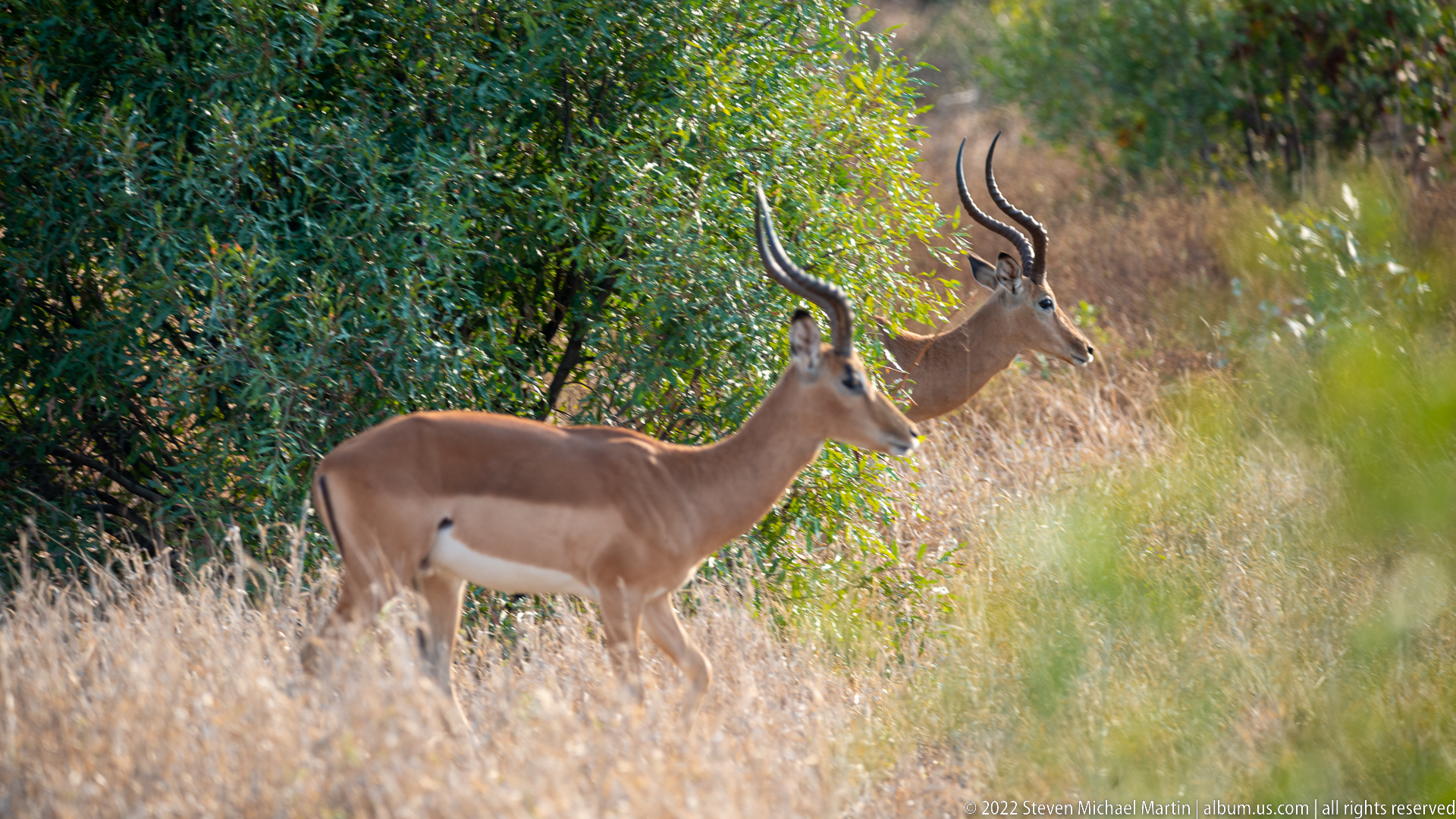
Two male impalas stand partly concealed by tall dry grass at the edge of a green shrub. Both carry long lyre-shaped horns, but their different positions create a layered view, with one ram broadside in front and the second rising behind him. The scene places the sleek antelopes within the transitional cover between open grass and denser browse.
Caption
Two male impalas stand partly concealed by tall dry grass at the edge of a green shrub. Both carry long lyre-shaped horns, but their different positions create a layered view, with one ram broadside in front and the second rising behind him. The scene places the sleek antelopes within the transitional cover between open grass and denser browse.
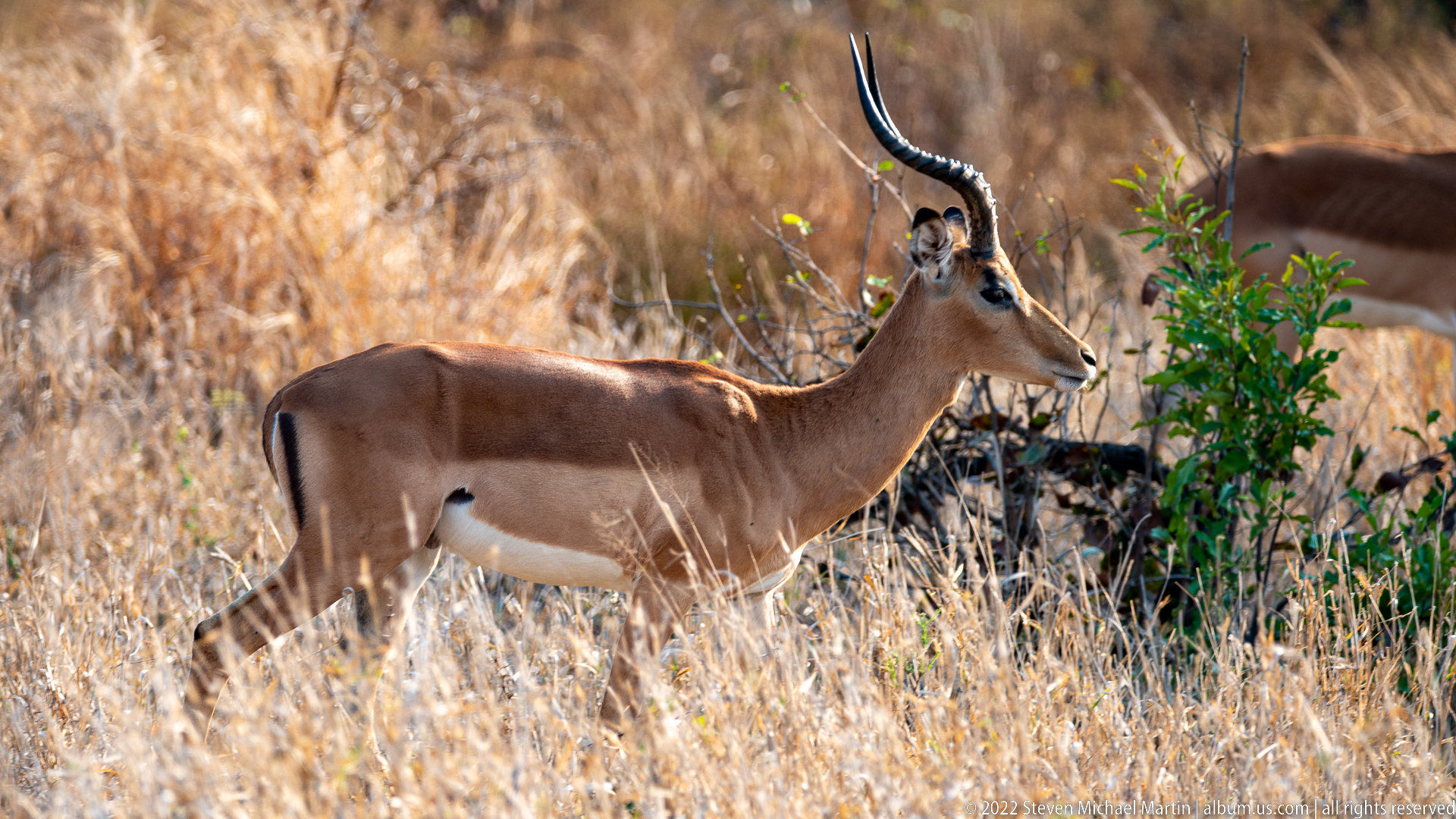
A male impala walks through tall golden grass with his head turned slightly to the right. His long lyre-shaped horns, reddish-tan back, white belly, and black tail markings are clearly visible in the side view. Sparse green shrubs interrupt the dry-season palette, placing the ram in a typical open savanna setting near Punda Maria.
Caption
A male impala walks through tall golden grass with his head turned slightly to the right. His long lyre-shaped horns, reddish-tan back, white belly, and black tail markings are clearly visible in the side view. Sparse green shrubs interrupt the dry-season palette, placing the ram in a typical open savanna setting near Punda Maria.
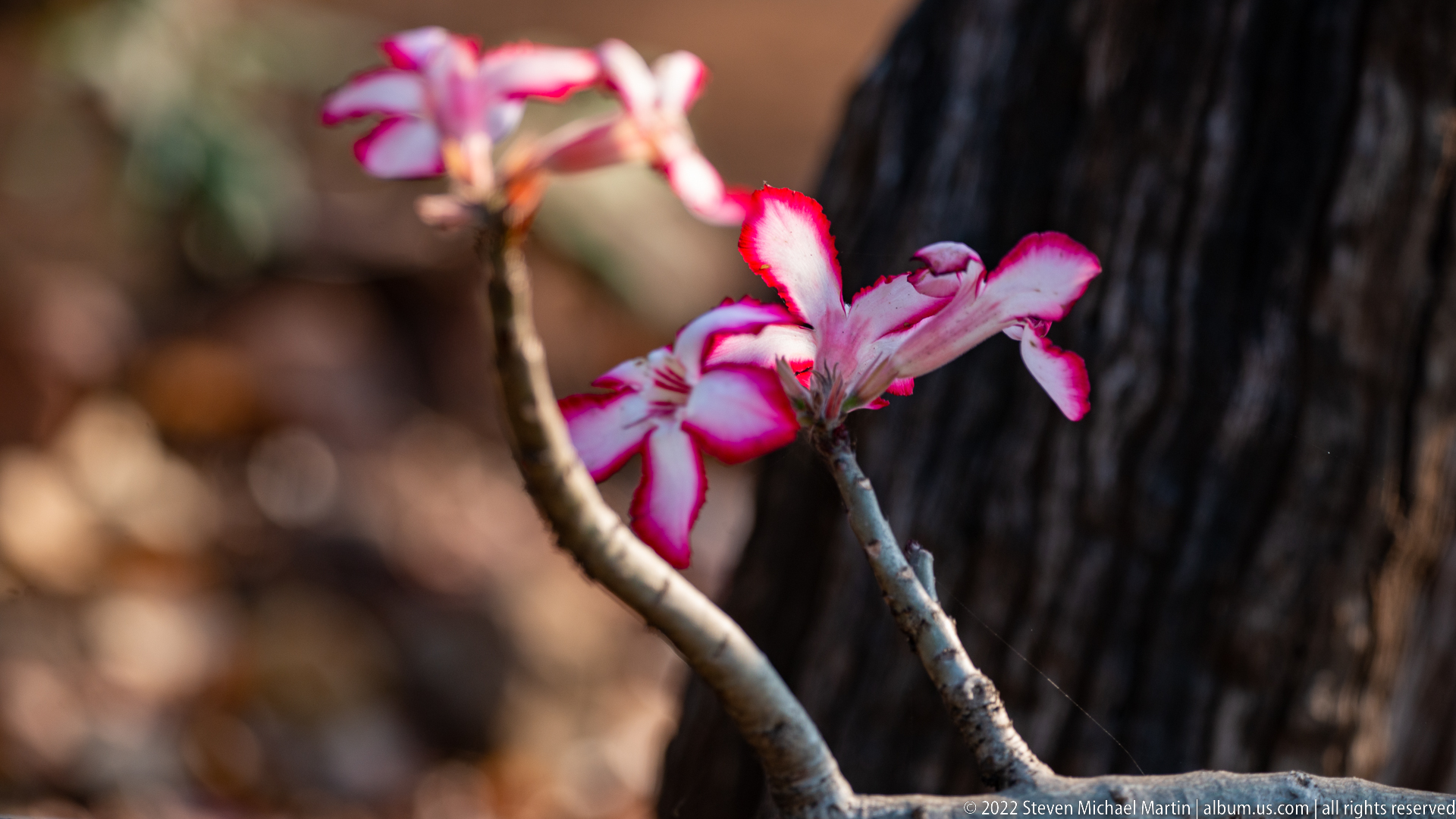
Pink-and-white impala lily blossoms open at the tips of thick gray stems beside a dark tree trunk. Each flower has a white center edged by vivid crimson-pink margins, while the mostly leafless succulent branches reflect the plant’s dry-season flowering habit. The shallow focus turns this into a botanical detail rather than a broader habitat view.
Caption
Pink-and-white impala lily blossoms open at the tips of thick gray stems beside a dark tree trunk. Each flower has a white center edged by vivid crimson-pink margins, while the mostly leafless succulent branches reflect the plant’s dry-season flowering habit. The shallow focus turns this into a botanical detail rather than a broader habitat view.
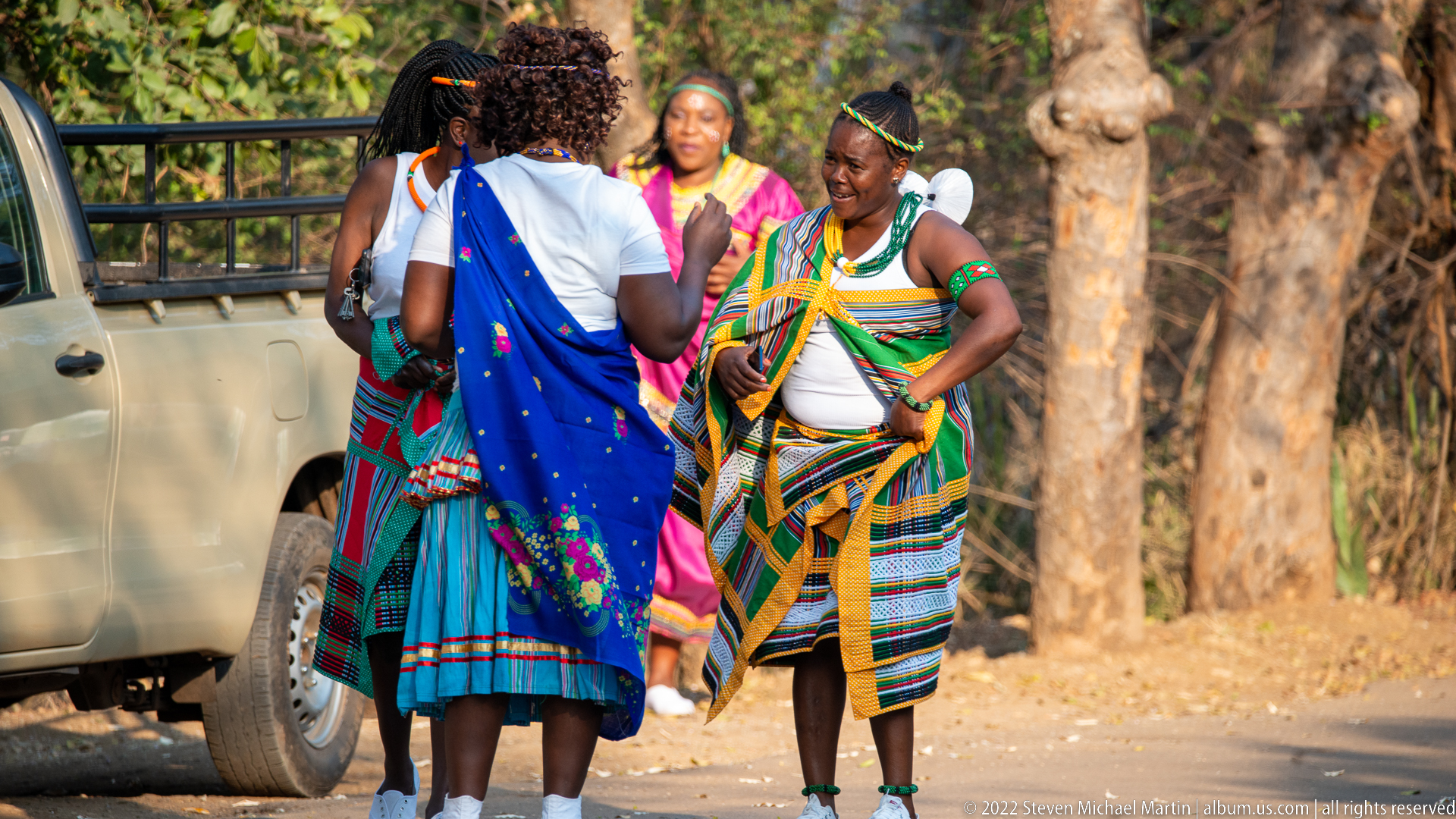
A small group of women in brightly colored dresses and patterned wraps gathers beside a parked safari vehicle in the Punda Maria area. Layered textiles, beadwork, and vivid blue, green, yellow, and red garments dominate the scene, while the roadside woodland provides context. The photograph records human presence and social interaction without requiring a more specific cultural identification from dress alone.
Caption
A small group of women in brightly colored dresses and patterned wraps gathers beside a parked safari vehicle in the Punda Maria area. Layered textiles, beadwork, and vivid blue, green, yellow, and red garments dominate the scene, while the roadside woodland provides context. The photograph records human presence and social interaction without requiring a more specific cultural identification from dress alone.
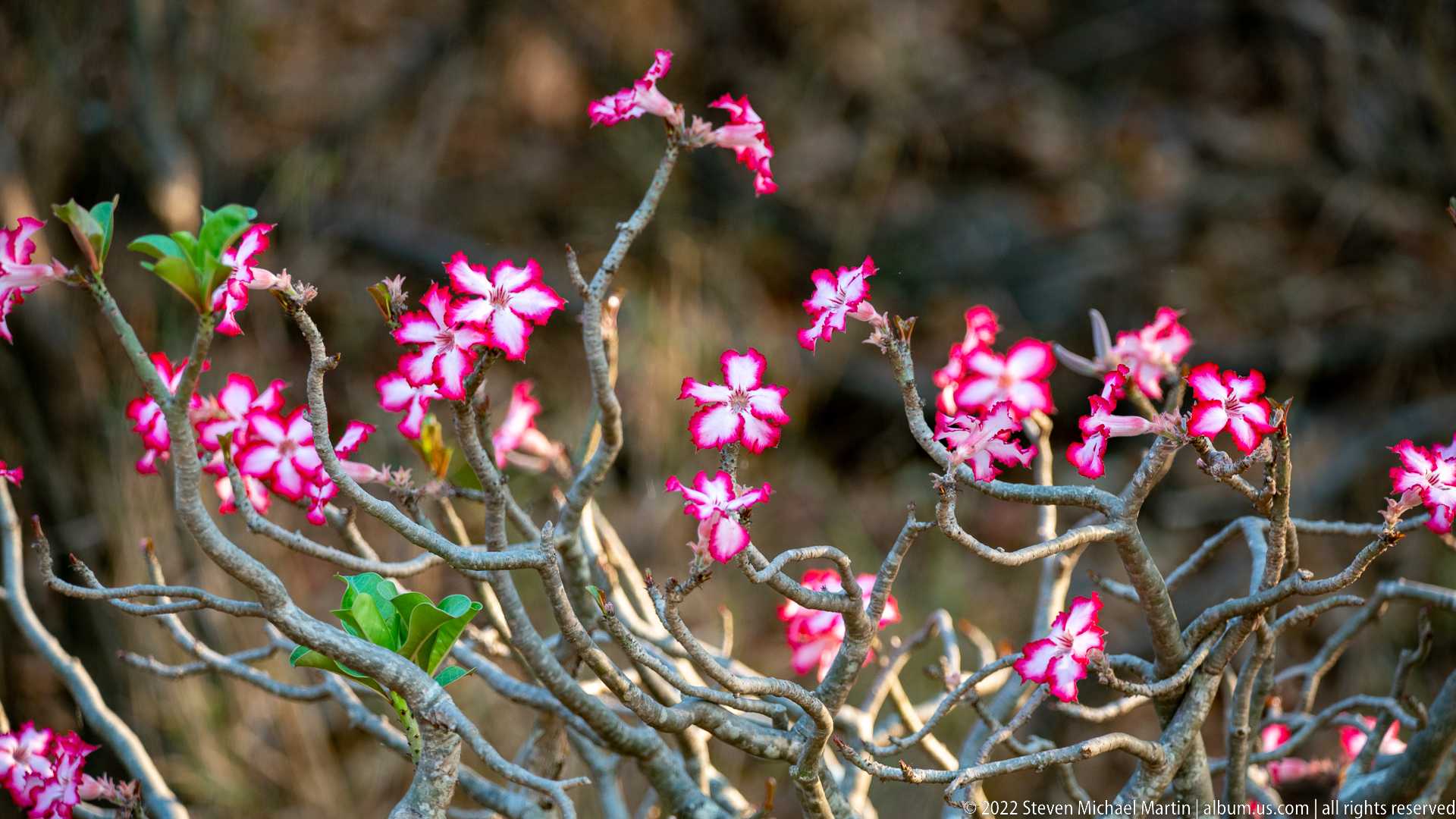
An impala lily spreads a network of thick gray branches tipped with numerous pink-and-white flowers. Unlike the preceding close detail, this wider view shows the plant’s branching form, sparse green leaves, and profuse blossoms together. The vivid flowers stand out against the subdued brown-green woodland background, making the dry-season flowering shrub the clear botanical subject.
Caption
An impala lily spreads a network of thick gray branches tipped with numerous pink-and-white flowers. Unlike the preceding close detail, this wider view shows the plant’s branching form, sparse green leaves, and profuse blossoms together. The vivid flowers stand out against the subdued brown-green woodland background, making the dry-season flowering shrub the clear botanical subject.
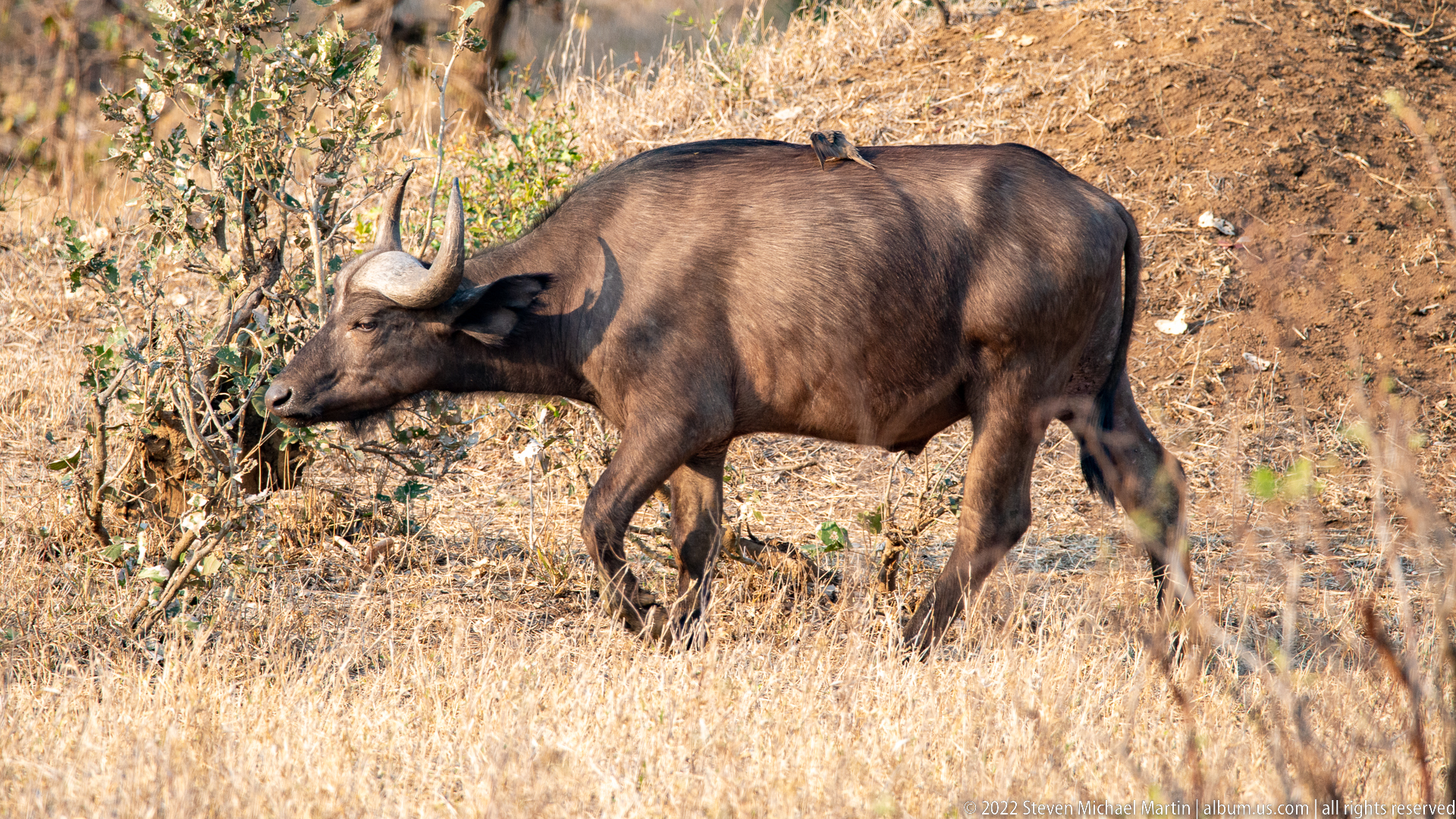
A solitary African buffalo walks across dry grass at the base of a bare earthen bank. Its heavy dark body, low-slung head, broad muzzle, and thick outward-curving horns are visible in side profile. Sunlight catches the ridges of the animal’s flank while the sparse vegetation emphasizes the buffalo’s massive build and deliberate gait.
Caption
A solitary African buffalo walks across dry grass at the base of a bare earthen bank. Its heavy dark body, low-slung head, broad muzzle, and thick outward-curving horns are visible in side profile. Sunlight catches the ridges of the animal’s flank while the sparse vegetation emphasizes the buffalo’s massive build and deliberate gait.
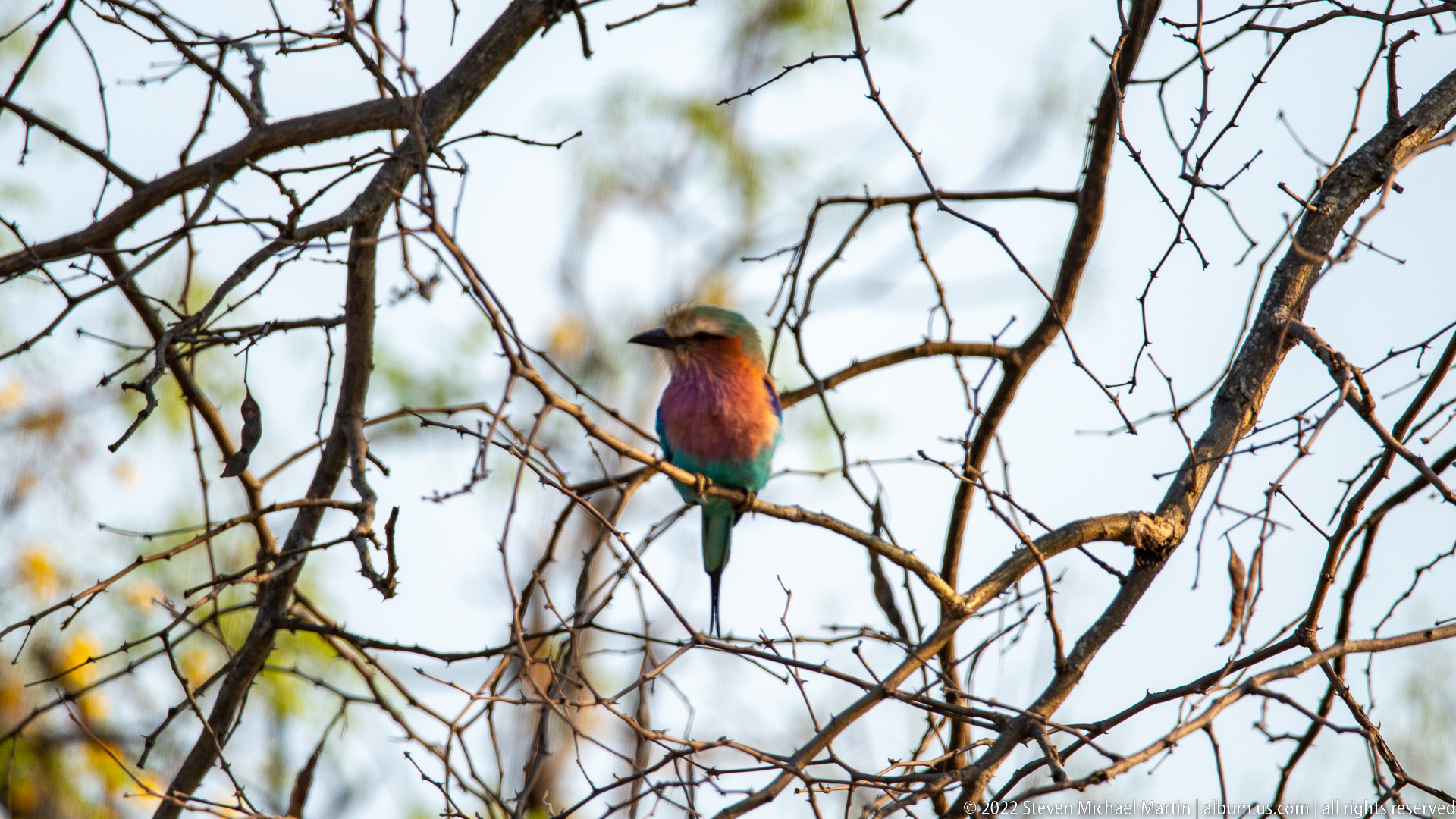
A lilac-breasted roller perches on a bare branch amid a fine lattice of twigs. Even at distance, the bird’s lilac-purple breast, turquoise lower body and tail, greenish-blue crown, and stout dark bill create a vivid block of color against the pale woodland background. The exposed perch is typical of the elevated lookout positions used by rollers while scanning open ground.
Caption
A lilac-breasted roller perches on a bare branch amid a fine lattice of twigs. Even at distance, the bird’s lilac-purple breast, turquoise lower body and tail, greenish-blue crown, and stout dark bill create a vivid block of color against the pale woodland background. The exposed perch is typical of the elevated lookout positions used by rollers while scanning open ground.
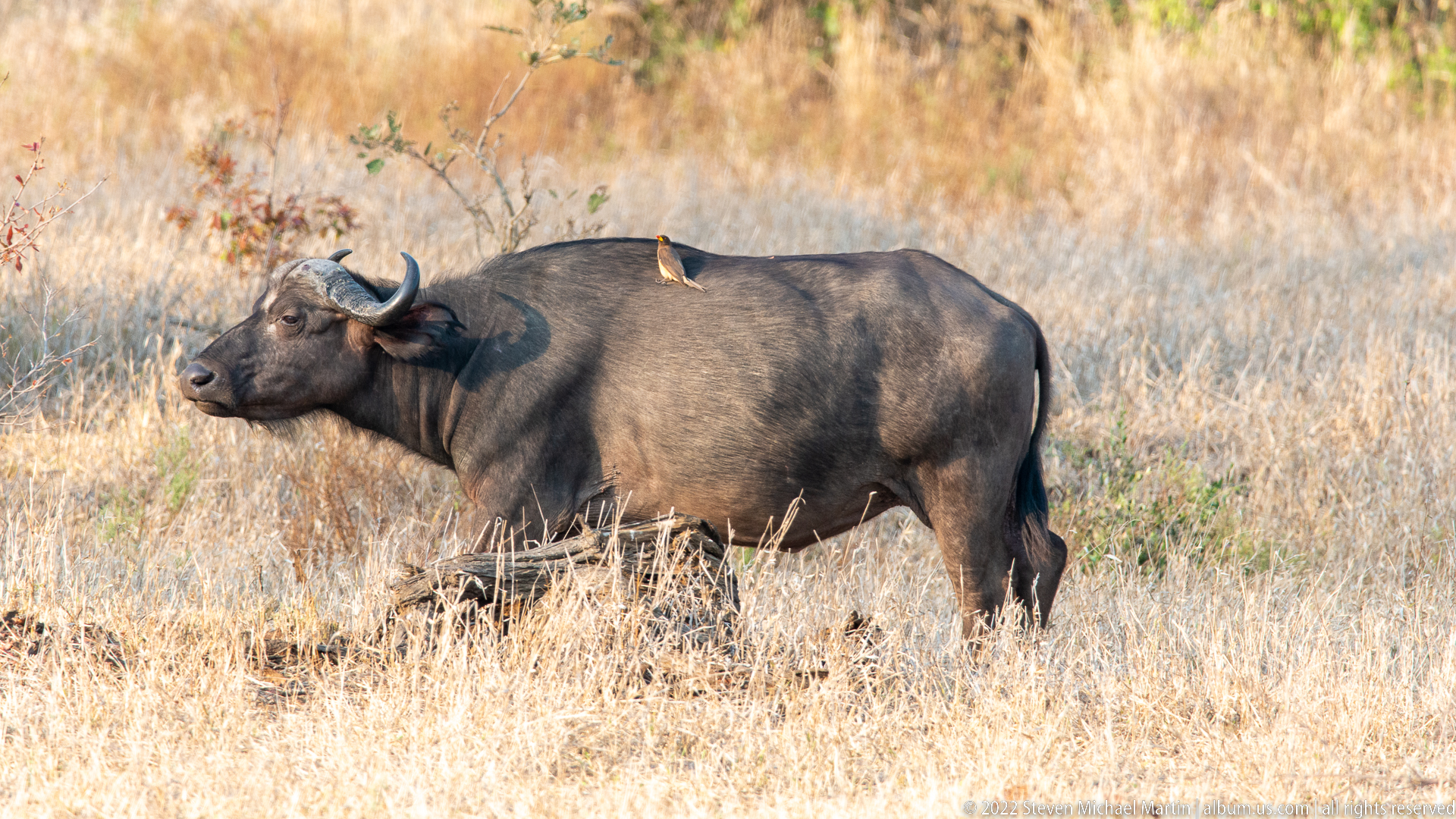
An African buffalo stands broadside in pale dry grass with a small oxpecker perched on its back. The buffalo’s heavy dark body, broad muzzle, and thick horn bases are clearly visible, while the bird adds a characteristic large-mammal association often encountered in Kruger’s savanna. The side view separates both subjects cleanly from the sunlit vegetation.
Caption
An African buffalo stands broadside in pale dry grass with a small oxpecker perched on its back. The buffalo’s heavy dark body, broad muzzle, and thick horn bases are clearly visible, while the bird adds a characteristic large-mammal association often encountered in Kruger’s savanna. The side view separates both subjects cleanly from the sunlit vegetation.
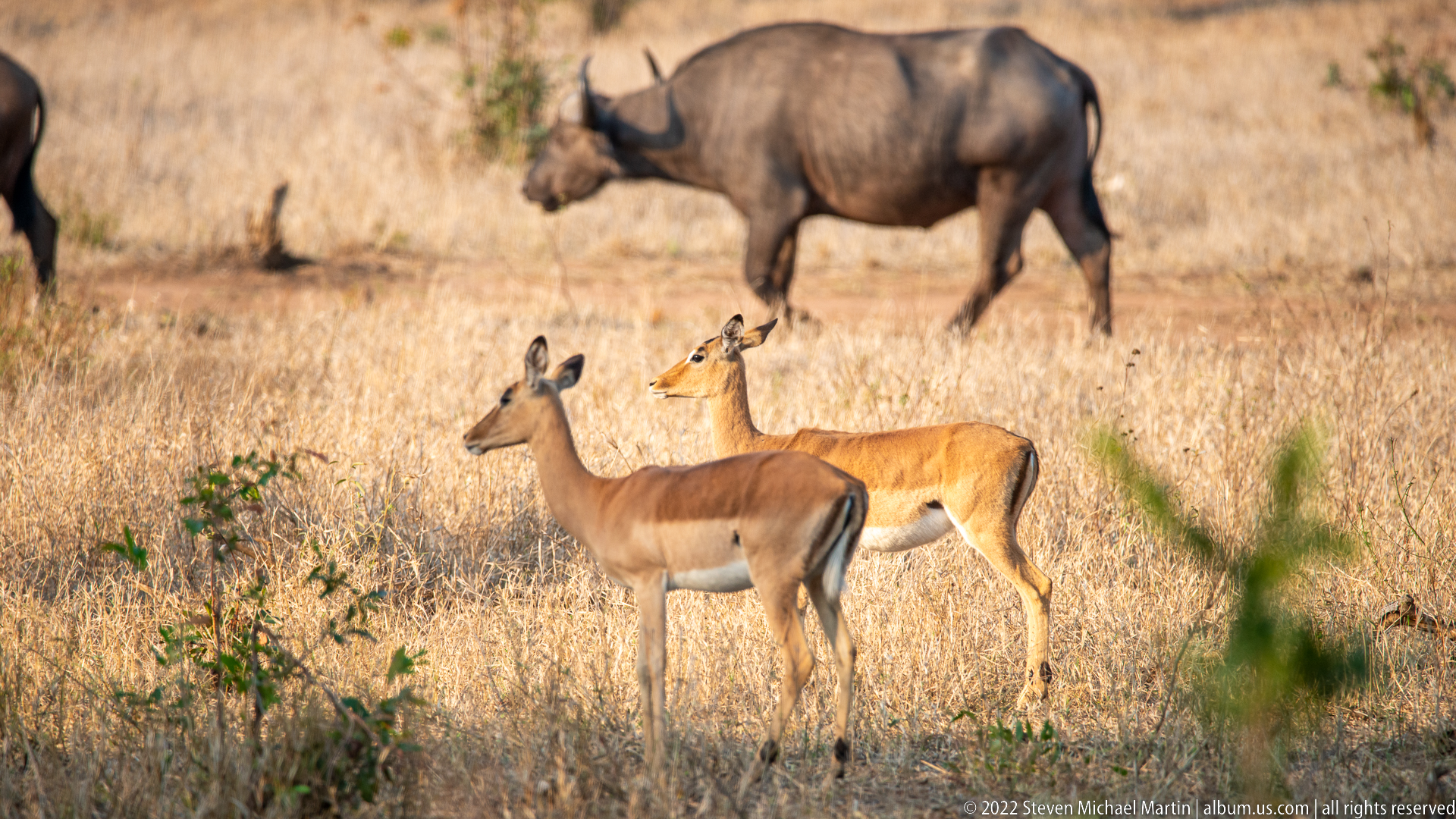
Two hornless impalas stand alert in tawny grass while an African buffalo crosses the background on a separate plane. Their slim bodies, pale underparts, and fine facial markings contrast with the buffalo’s massive dark silhouette. The layered composition records two common Kruger herbivores sharing the same dry-season habitat without collapsing them into a single herd scene.
Caption
Two hornless impalas stand alert in tawny grass while an African buffalo crosses the background on a separate plane. Their slim bodies, pale underparts, and fine facial markings contrast with the buffalo’s massive dark silhouette. The layered composition records two common Kruger herbivores sharing the same dry-season habitat without collapsing them into a single herd scene.
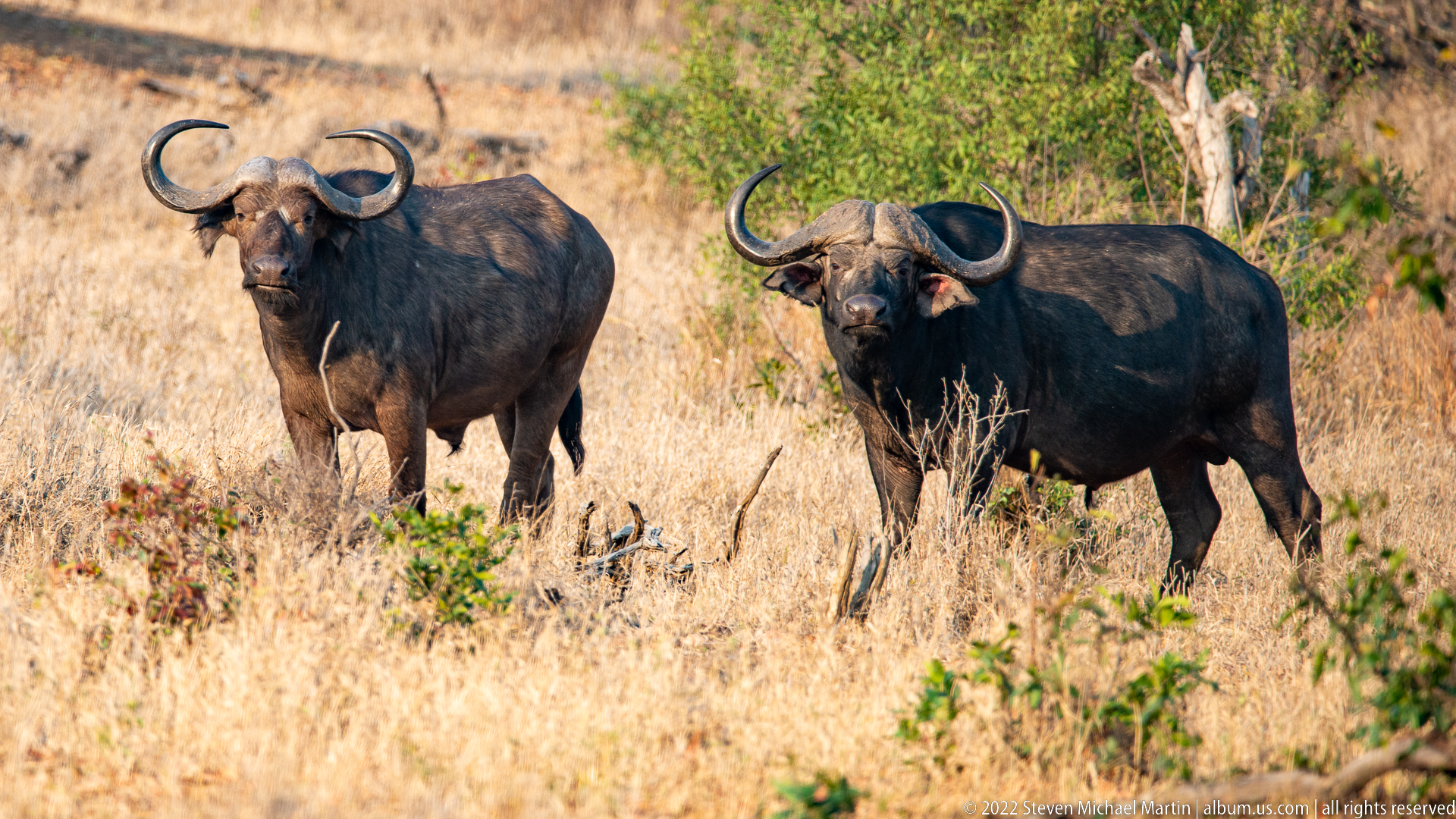
Two African buffalo face the camera from dry bushveld, their broad horn bosses and outward-curving horns forming mirrored arcs above dark foreheads. One animal stands slightly behind and to the left, creating a compact paired portrait. Sparse green shrubs and straw-colored grass frame the buffalo without obscuring their massive shoulders, muzzles, and characteristic horn structure.
Caption
Two African buffalo face the camera from dry bushveld, their broad horn bosses and outward-curving horns forming mirrored arcs above dark foreheads. One animal stands slightly behind and to the left, creating a compact paired portrait. Sparse green shrubs and straw-colored grass frame the buffalo without obscuring their massive shoulders, muzzles, and characteristic horn structure.
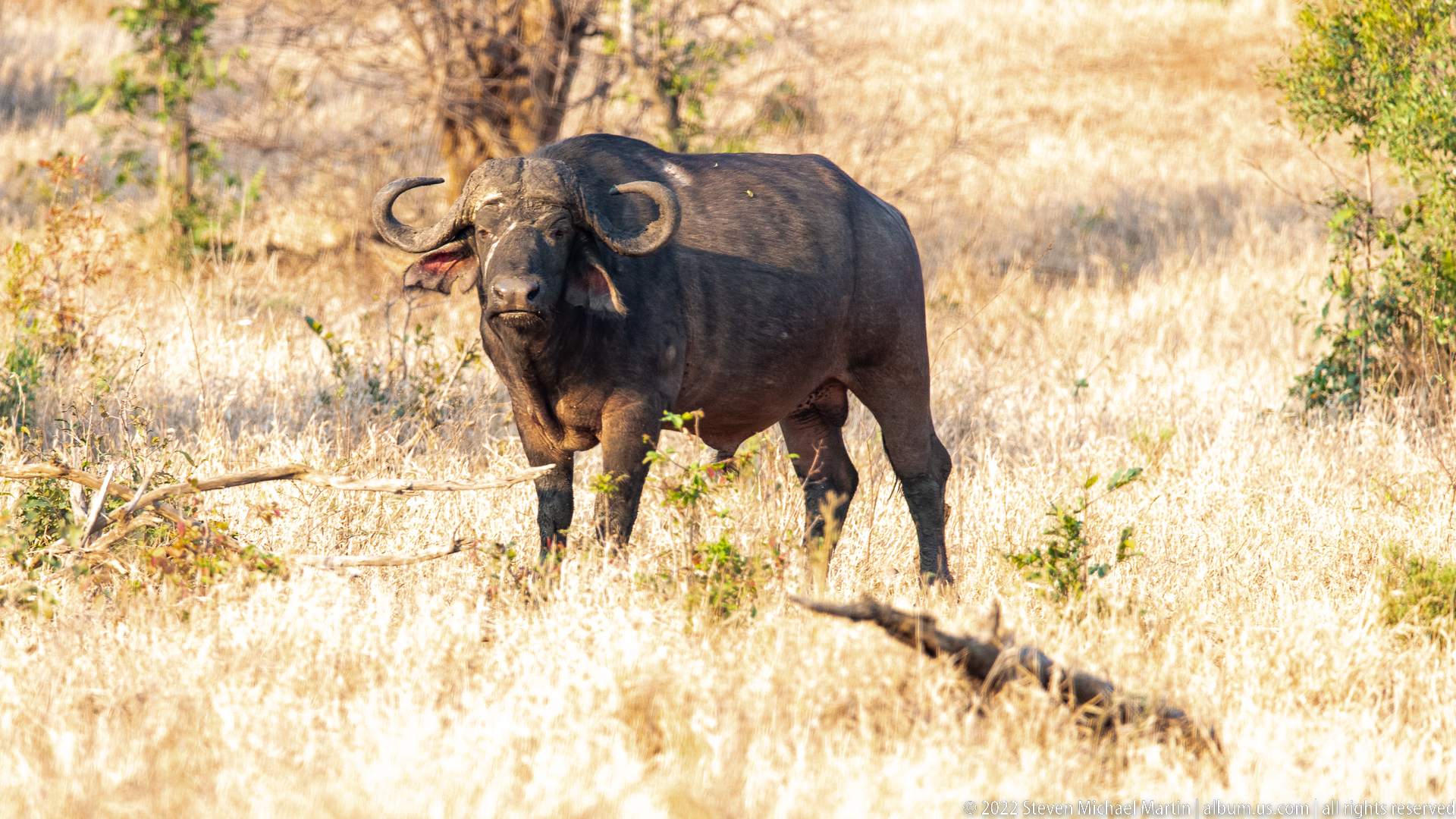
A solitary African buffalo stands squarely in sunlit grass, looking directly toward the camera. The heavy horn boss, sweeping horns, deep chest, and dark hide are strongly defined, while a reddish ear interior adds a small point of color. The uncluttered frontal posture makes this an especially useful field-guide view of the species’ imposing head and shoulder proportions.
Caption
A solitary African buffalo stands squarely in sunlit grass, looking directly toward the camera. The heavy horn boss, sweeping horns, deep chest, and dark hide are strongly defined, while a reddish ear interior adds a small point of color. The uncluttered frontal posture makes this an especially useful field-guide view of the species’ imposing head and shoulder proportions.
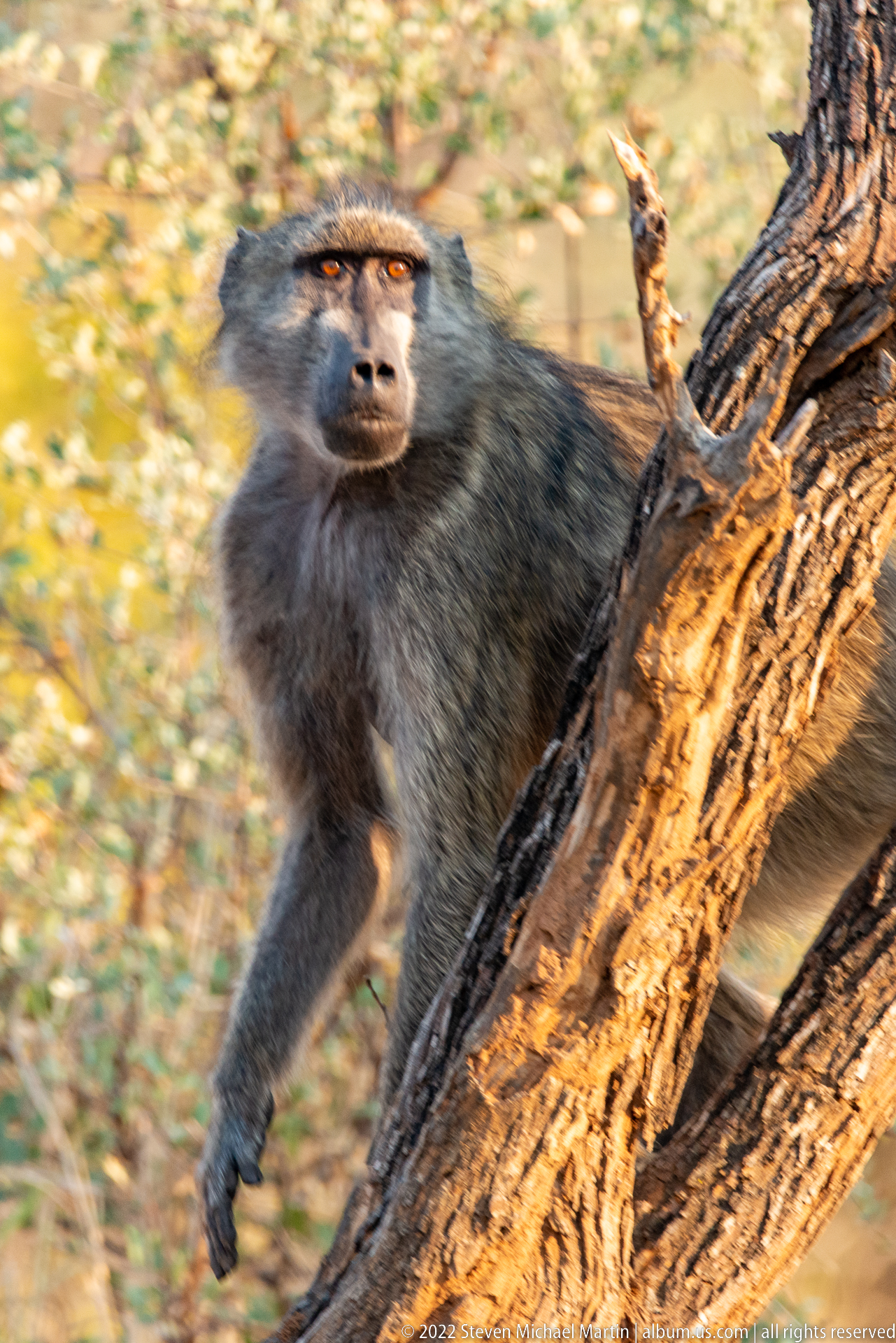
A chacma baboon moves along the angled trunk of a mature tree, one forelimb extended as it climbs. The animal’s dark grizzled coat, elongated muzzle, close-set eyes, and robust limbs are visible despite the motion and shallow focus. The arboreal position differs from the ground-level wildlife portraits around it, emphasizing the baboon’s ease in woodland trees.
Caption
A chacma baboon moves along the angled trunk of a mature tree, one forelimb extended as it climbs. The animal’s dark grizzled coat, elongated muzzle, close-set eyes, and robust limbs are visible despite the motion and shallow focus. The arboreal position differs from the ground-level wildlife portraits around it, emphasizing the baboon’s ease in woodland trees.
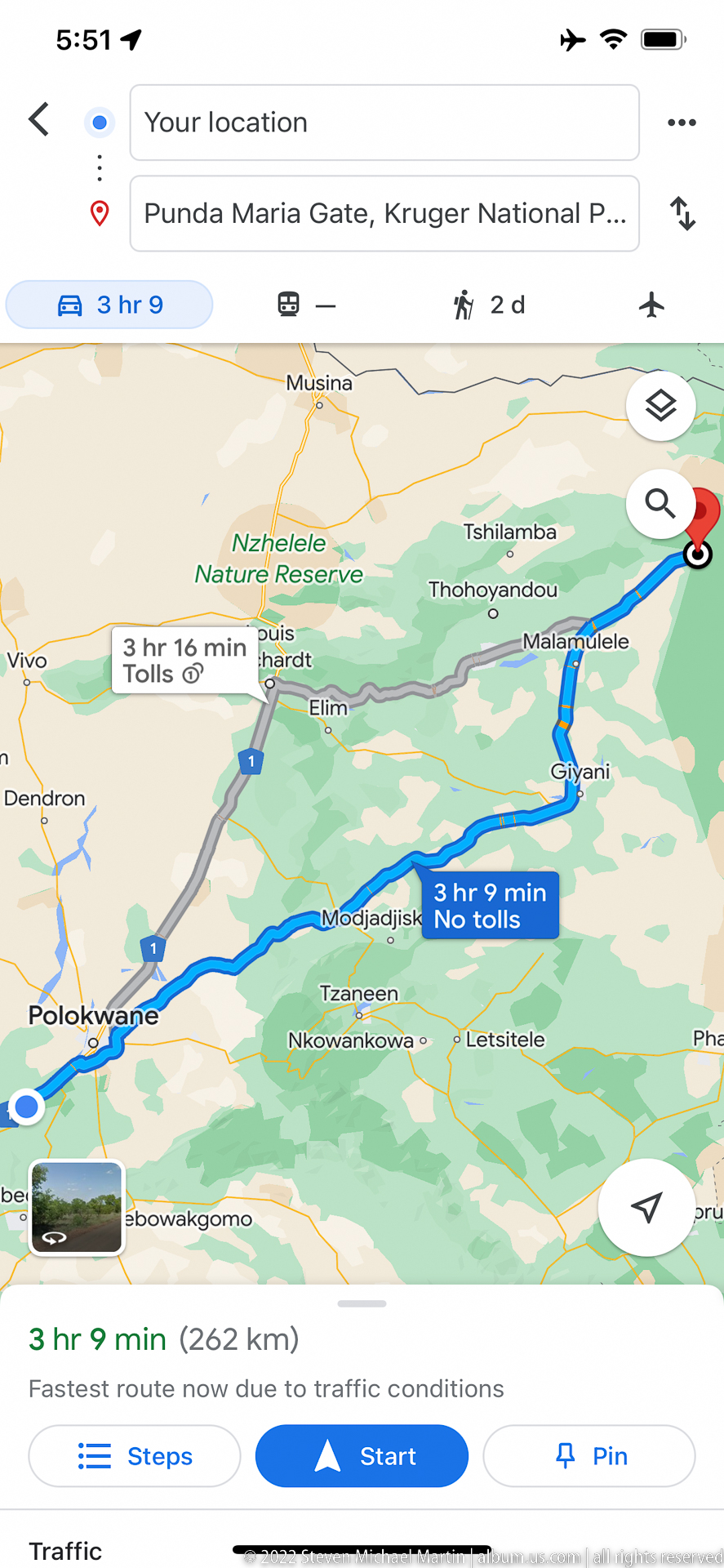
A smartphone navigation screen displays a Google Maps driving route across northeastern South Africa toward Punda Maria Gate in Kruger National Park. The map shows the route threading through and around the park’s green protected-area outline, with travel time and distance displayed below. The frame preserves the practical journey planning that accompanied the photographic field trip.
Caption
A smartphone navigation screen displays a Google Maps driving route across northeastern South Africa toward Punda Maria Gate in Kruger National Park. The map shows the route threading through and around the park’s green protected-area outline, with travel time and distance displayed below. The frame preserves the practical journey planning that accompanied the photographic field trip.

A mobile Google search displays a dollar-to-rand currency conversion, stating that one United States dollar equals 17.63 South African rand at the time shown. A small exchange-rate graph runs beneath the result. The screenshot records a practical detail of international travel and spending rather than a scene within Kruger National Park itself.
Caption
A mobile Google search displays a dollar-to-rand currency conversion, stating that one United States dollar equals 17.63 South African rand at the time shown. A small exchange-rate graph runs beneath the result. The screenshot records a practical detail of international travel and spending rather than a scene within Kruger National Park itself.
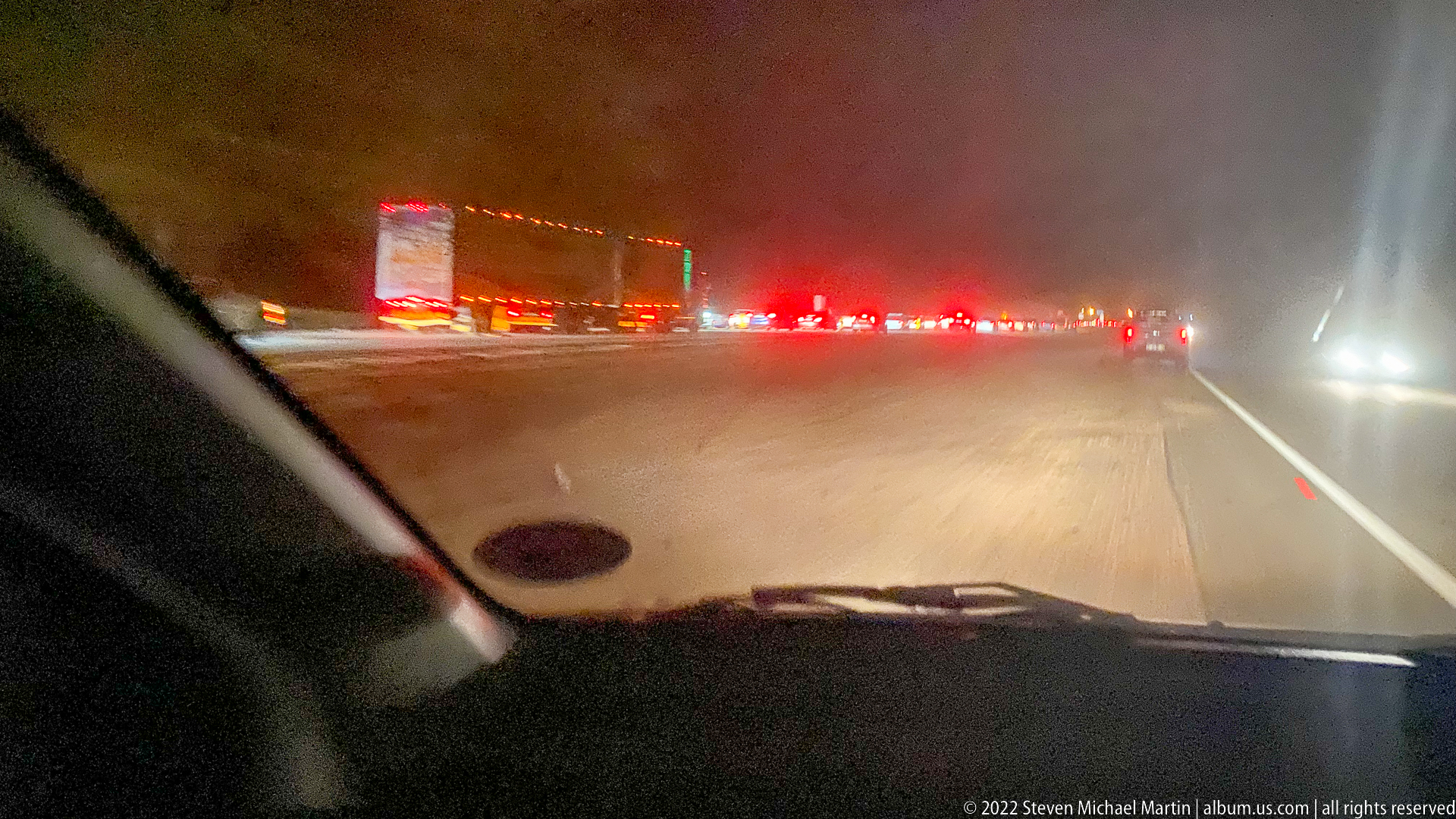
A nighttime highway is seen through a vehicle windshield, with red taillights and illuminated trucks stretching ahead into haze or dust. The dashboard and windshield edge anchor the viewpoint inside the moving vehicle, while oncoming headlights flare at the right margin. Rather than wildlife, this frame records the road-travel context surrounding the safari itinerary.
Caption
A nighttime highway is seen through a vehicle windshield, with red taillights and illuminated trucks stretching ahead into haze or dust. The dashboard and windshield edge anchor the viewpoint inside the moving vehicle, while oncoming headlights flare at the right margin. Rather than wildlife, this frame records the road-travel context surrounding the safari itinerary.
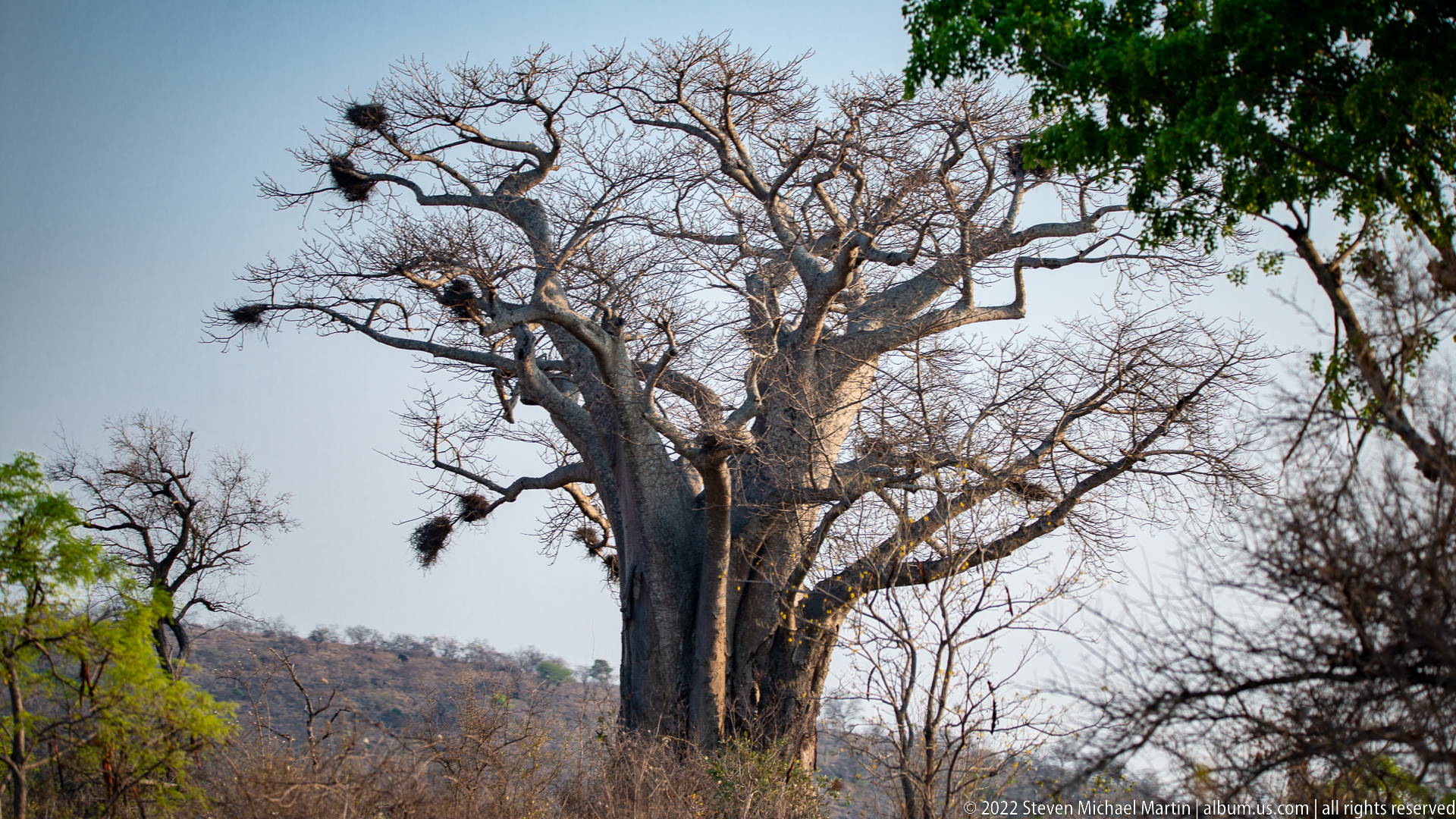
A monumental African baobab dominates the dry woodland, its swollen trunk dividing into thick, leafless branches high above the surrounding trees. Several dark hanging structures, likely woven bird nests, are suspended among the limbs. The wide field view emphasizes the baobab’s massive architecture and its role as a conspicuous vertical landmark in the northern Kruger landscape.
Caption
A monumental African baobab dominates the dry woodland, its swollen trunk dividing into thick, leafless branches high above the surrounding trees. Several dark hanging structures, likely woven bird nests, are suspended among the limbs. The wide field view emphasizes the baobab’s massive architecture and its role as a conspicuous vertical landmark in the northern Kruger landscape.
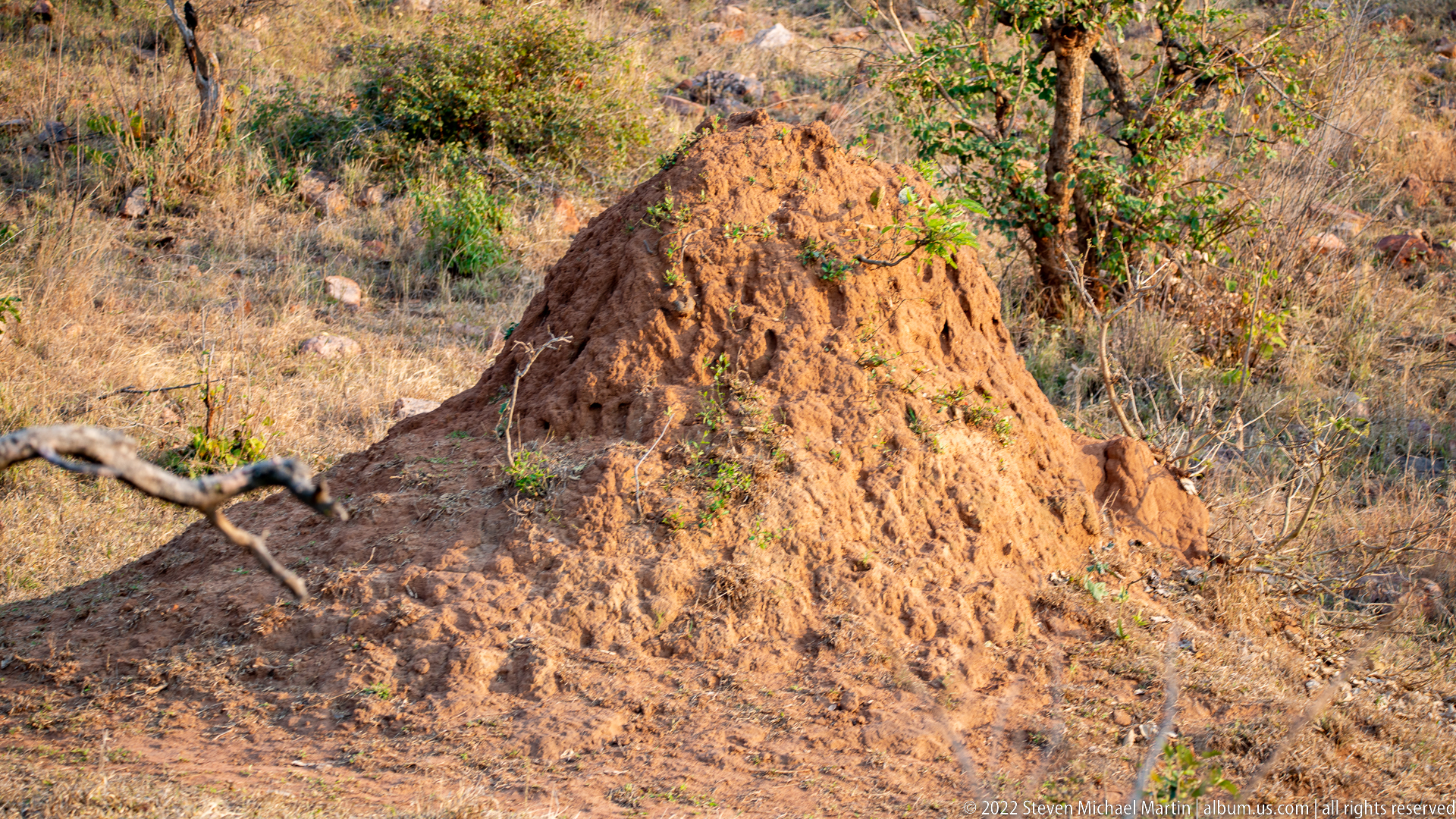
A tall reddish-brown termite mound rises beside a small tree in dry bushveld. Weathered ridges and cavities break up the compact earthen surface, while scattered stones and sparse grass reveal the arid ground around its base. The close contextual view treats the mound as an ecological structure in its own right rather than merely background to larger wildlife.
Caption
A tall reddish-brown termite mound rises beside a small tree in dry bushveld. Weathered ridges and cavities break up the compact earthen surface, while scattered stones and sparse grass reveal the arid ground around its base. The close contextual view treats the mound as an ecological structure in its own right rather than merely background to larger wildlife.

The South African National Parks Security Services emblem is displayed on a khaki-colored surface. A green-and-white SANParks mark sits within a star-like shield, while a curved ribbon carries the words “SECURITY SERVICES.” The tight crop records institutional identity associated with park protection and management rather than the surrounding landscape.
Caption
The South African National Parks Security Services emblem is displayed on a khaki-colored surface. A green-and-white SANParks mark sits within a star-like shield, while a curved ribbon carries the words “SECURITY SERVICES.” The tight crop records institutional identity associated with park protection and management rather than the surrounding landscape.

A weathered wooden sign carved with the words “KRUGER NATIONAL PARK” spans two rough timber posts in woodland. Scratched names and incidental graffiti cover parts of the plank, contrasting with the large white park lettering. The close view records a vernacular entrance or boundary marker whose aging surface reveals years of exposure and visitor contact.
Caption
A weathered wooden sign carved with the words “KRUGER NATIONAL PARK” spans two rough timber posts in woodland. Scratched names and incidental graffiti cover parts of the plank, contrasting with the large white park lettering. The close view records a vernacular entrance or boundary marker whose aging surface reveals years of exposure and visitor contact.
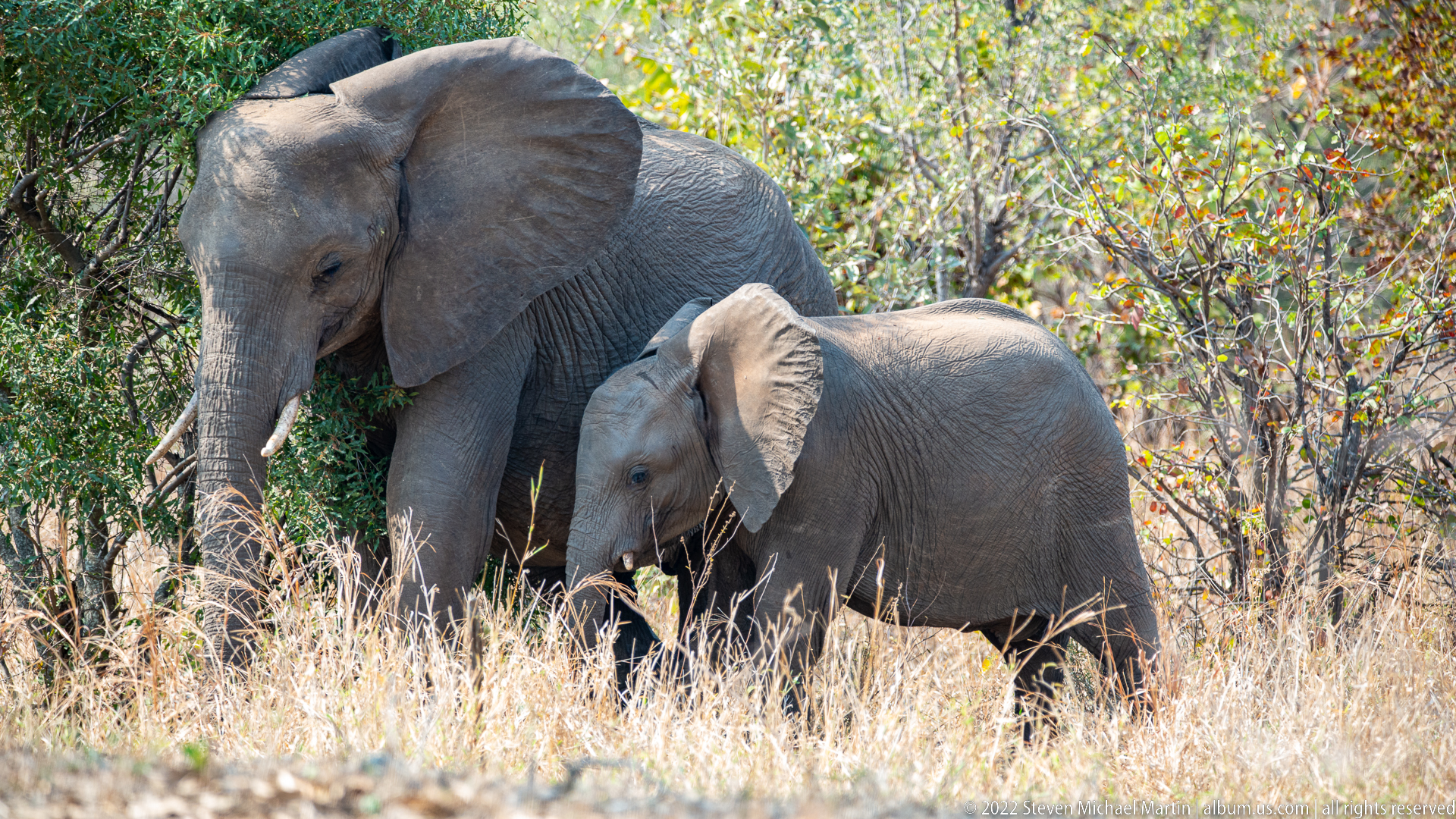
An adult African bush elephant and a smaller juvenile move together through sunlit grass at the edge of dense foliage. The youngster walks slightly ahead, its shorter trunk and smaller ears contrasting with the adult’s larger head and heavier body. Their close spacing gives the scene an intimate family-group quality while retaining a clear view of differences in age and scale.
Caption
An adult African bush elephant and a smaller juvenile move together through sunlit grass at the edge of dense foliage. The youngster walks slightly ahead, its shorter trunk and smaller ears contrasting with the adult’s larger head and heavier body. Their close spacing gives the scene an intimate family-group quality while retaining a clear view of differences in age and scale.
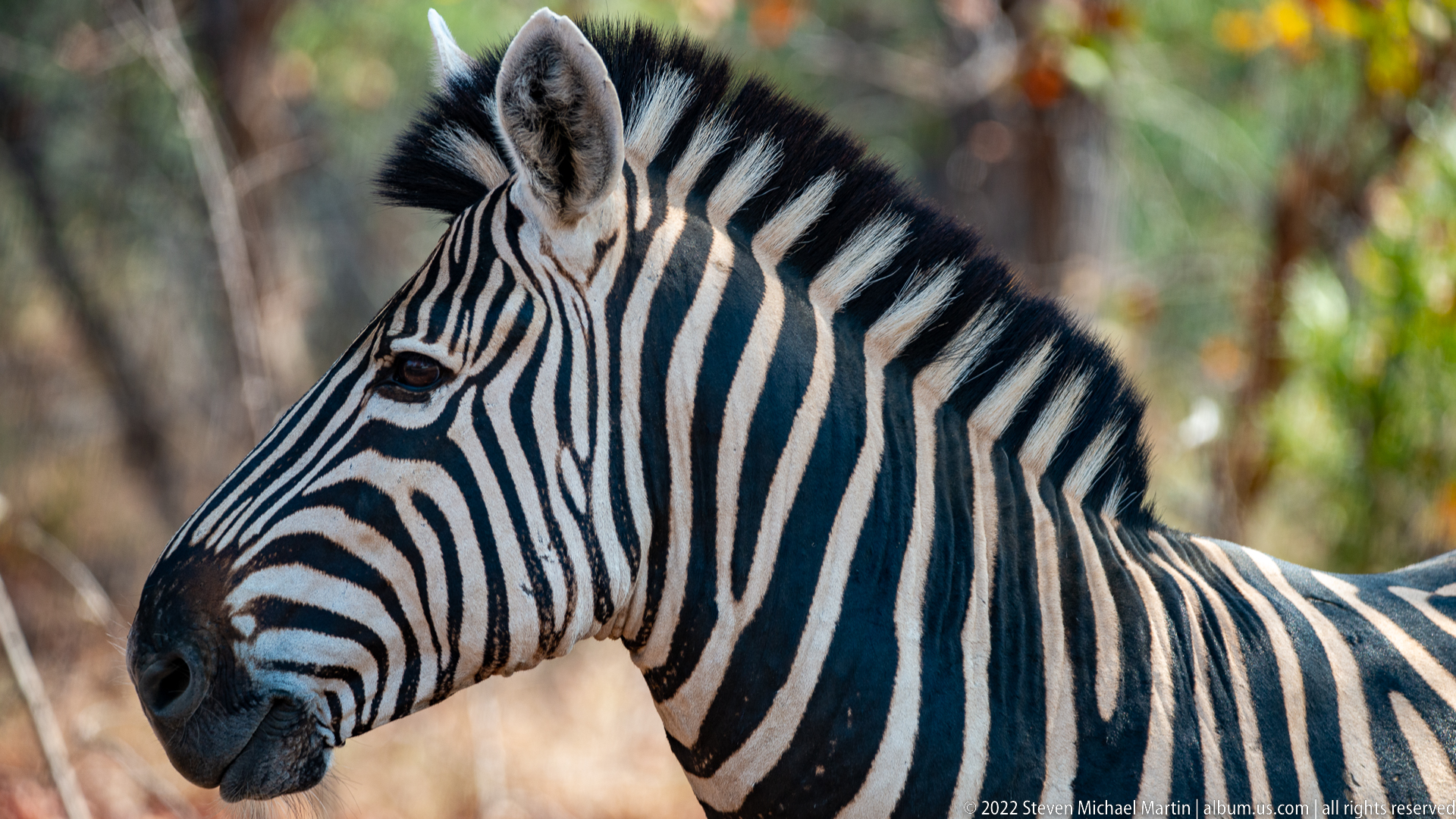
A plains zebra fills the frame in a close head-and-neck profile, revealing the intricate stripe pattern across the muzzle, cheek, mane, and shoulder. The erect mane forms a dark serrated line along the neck, while the eye and rounded ear are sharply defined against a softly blurred woodland background. The crop turns the zebra’s individual striping into the central visual subject.
Caption
A plains zebra fills the frame in a close head-and-neck profile, revealing the intricate stripe pattern across the muzzle, cheek, mane, and shoulder. The erect mane forms a dark serrated line along the neck, while the eye and rounded ear are sharply defined against a softly blurred woodland background. The crop turns the zebra’s individual striping into the central visual subject.
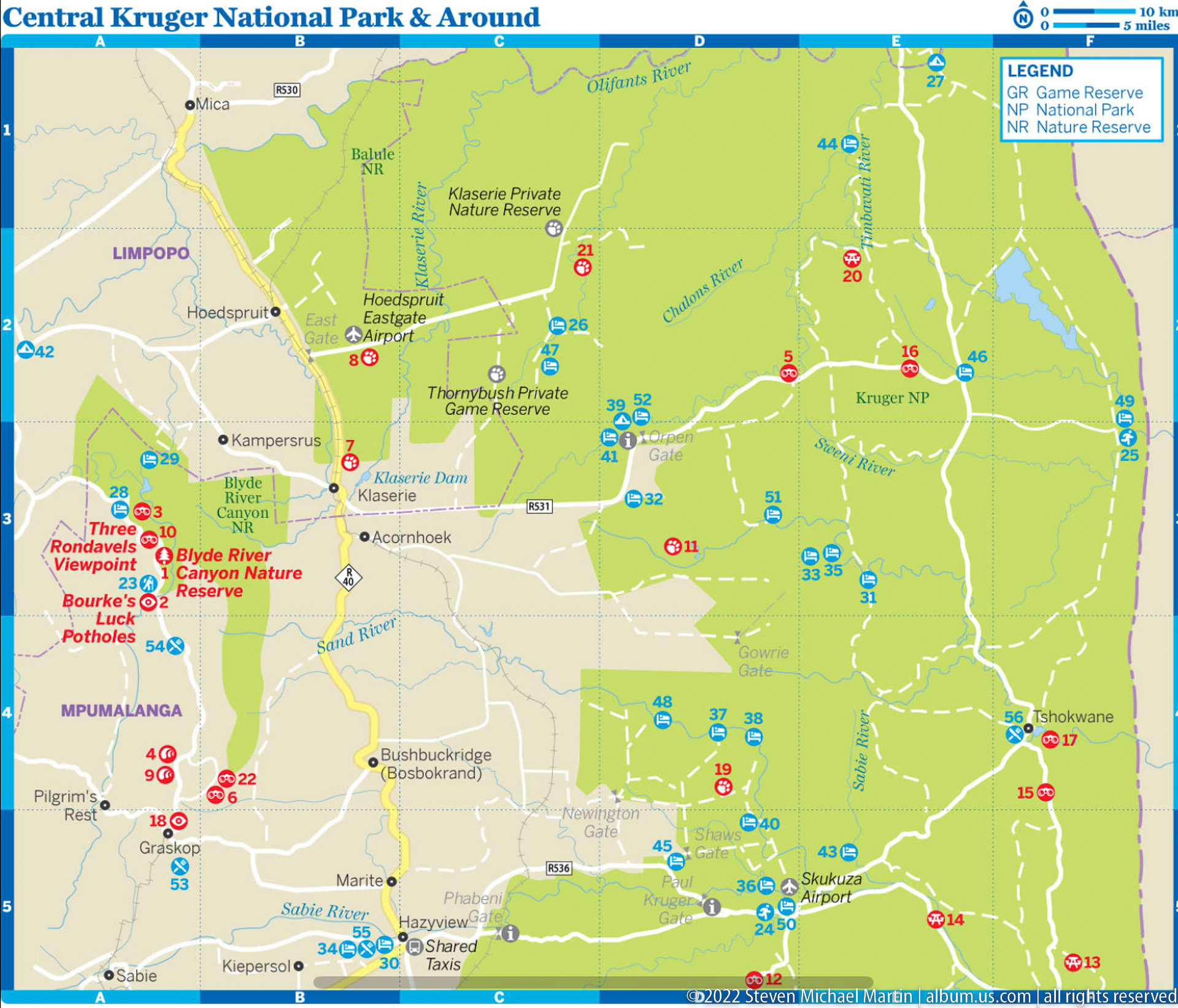
A printed tourist map titled “Central Kruger National Park & Around” shows the park’s road network, rivers, rest camps, gates, and neighboring private reserves. Numbered points and colored symbols organize visitor information across the green park area. The frame functions as trip-planning documentation, situating the safari within the broader geography of central Kruger and adjacent conservation lands.
Caption
A printed tourist map titled “Central Kruger National Park & Around” shows the park’s road network, rivers, rest camps, gates, and neighboring private reserves. Numbered points and colored symbols organize visitor information across the green park area. The frame functions as trip-planning documentation, situating the safari within the broader geography of central Kruger and adjacent conservation lands.
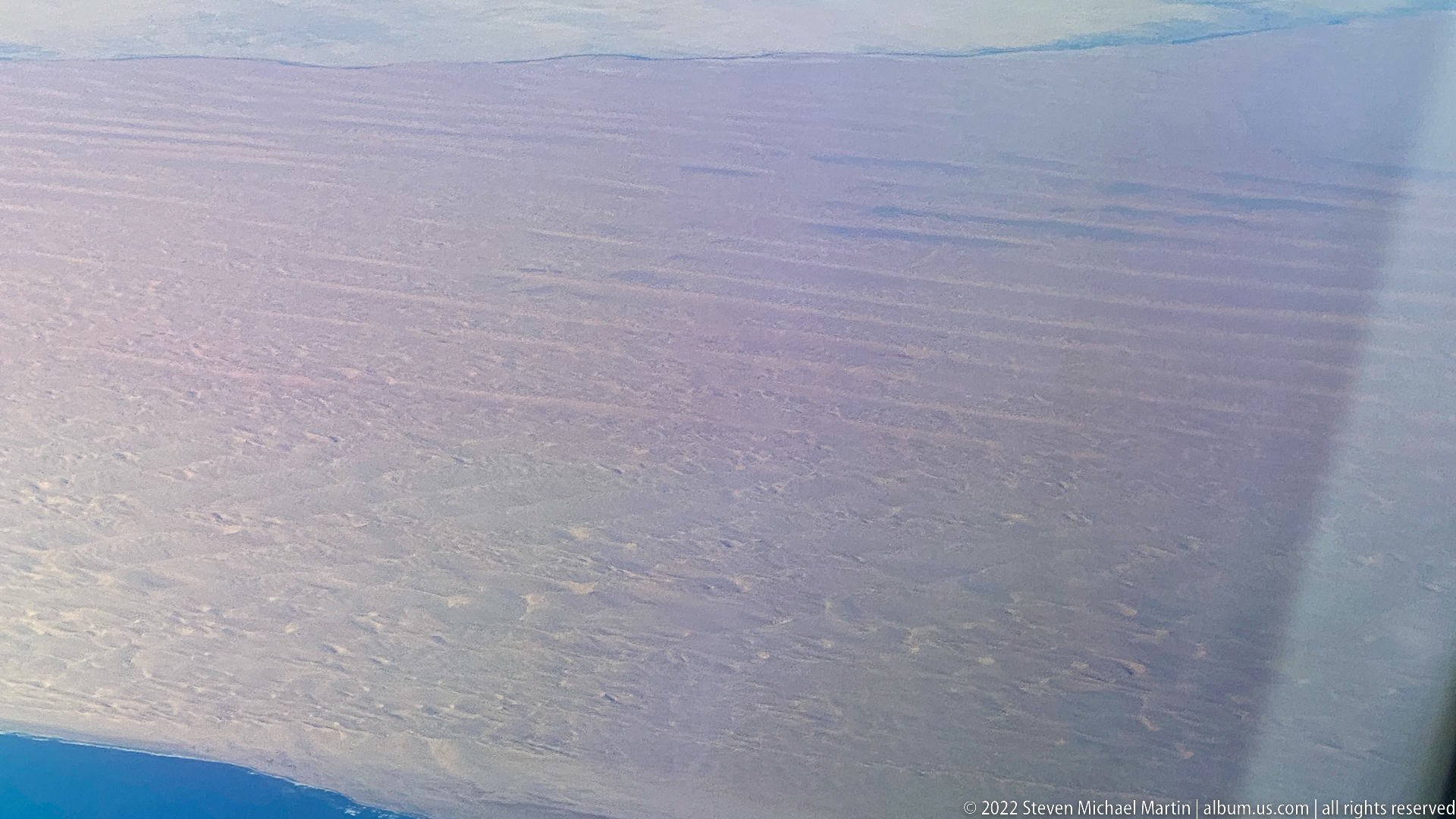
An oblique aerial view looks across an expansive dry landscape broken by faint tracks, low vegetation, and subtle ridges. A blue aircraft wing or engine edge enters the lower left corner, making the in-flight viewpoint explicit. The broad, hazy scene records the transition over southern African terrain without providing enough visible landmarks for a defensible local geographic identification.
Caption
An oblique aerial view looks across an expansive dry landscape broken by faint tracks, low vegetation, and subtle ridges. A blue aircraft wing or engine edge enters the lower left corner, making the in-flight viewpoint explicit. The broad, hazy scene records the transition over southern African terrain without providing enough visible landmarks for a defensible local geographic identification.
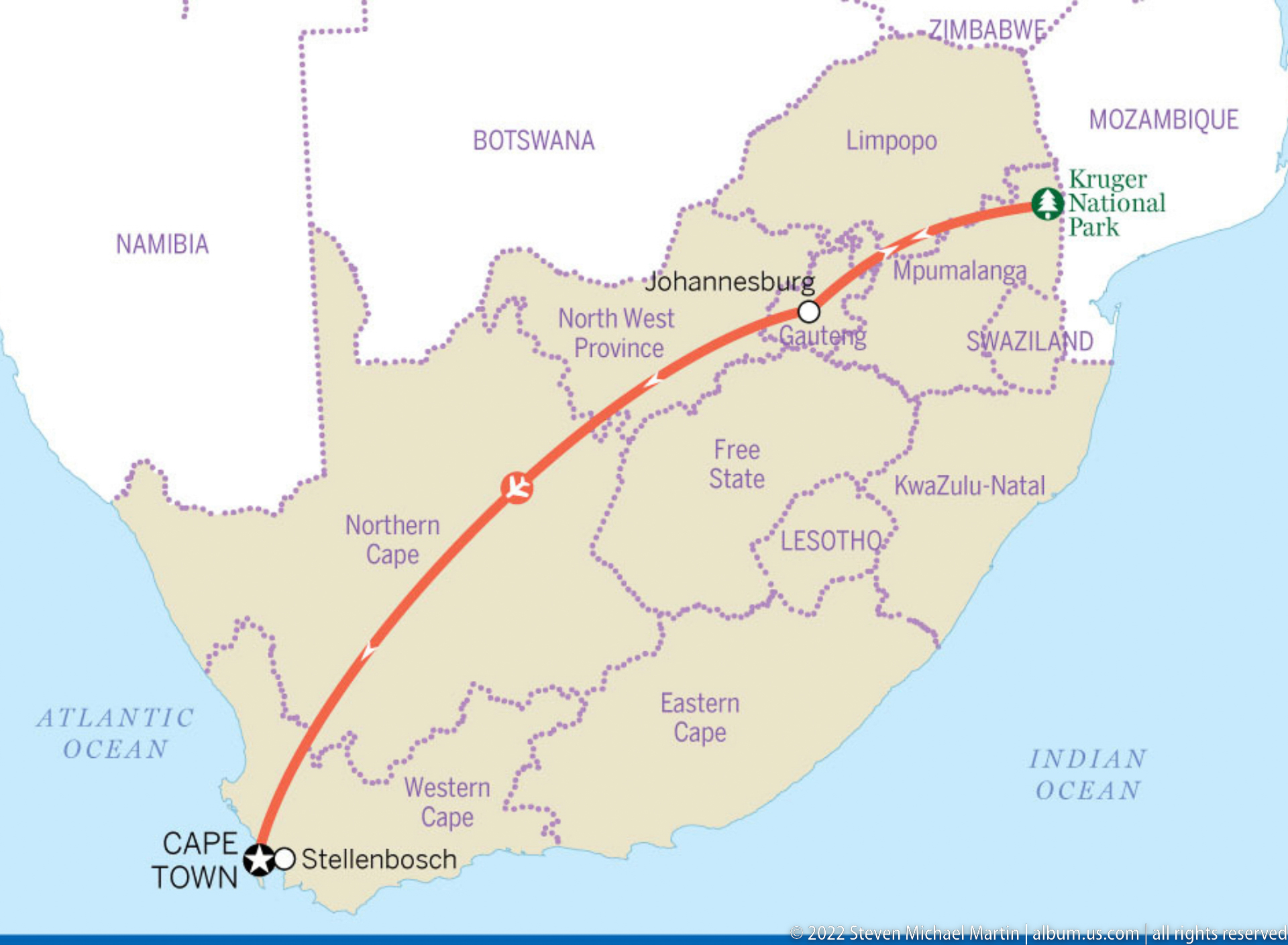
A map of South Africa traces a long red route between Cape Town in the southwest and Kruger National Park in the northeast, with Johannesburg and provincial boundaries also labeled. The graphic compresses the cross-country scale of the journey into a single view, linking the safari destination to the broader South African itinerary rather than to a specific wildlife encounter.
Caption
A map of South Africa traces a long red route between Cape Town in the southwest and Kruger National Park in the northeast, with Johannesburg and provincial boundaries also labeled. The graphic compresses the cross-country scale of the journey into a single view, linking the safari destination to the broader South African itinerary rather than to a specific wildlife encounter.
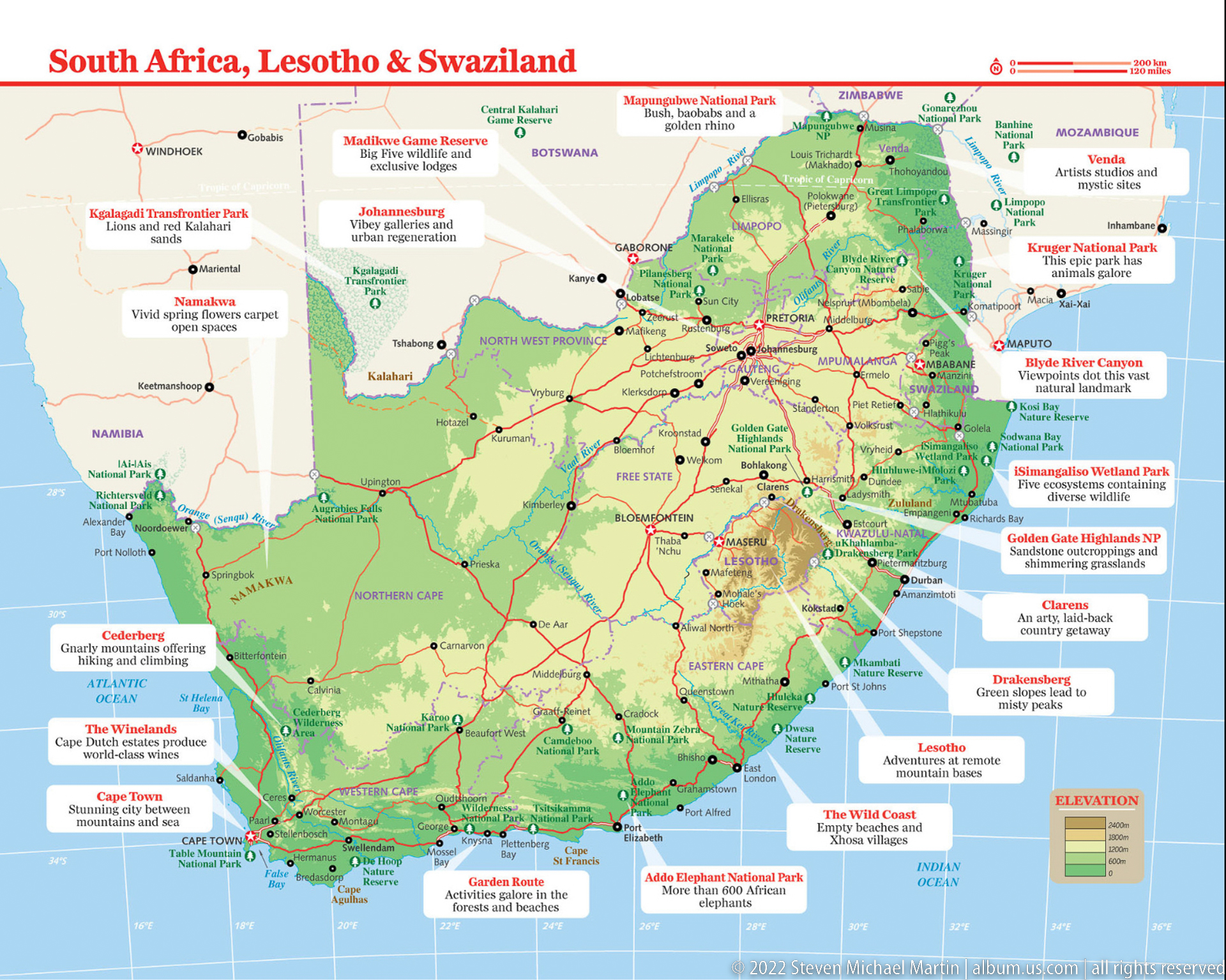
A colorful tourist map of South Africa marks major roads, cities, national parks, wildlife reserves, and visitor destinations across the country. Numerous callout boxes surround the central map, turning the sheet into both a geographic overview and a catalog of attractions. Within the Punda Maria sequence, it serves as broader itinerary context for travel through South Africa’s protected areas.
Caption
A colorful tourist map of South Africa marks major roads, cities, national parks, wildlife reserves, and visitor destinations across the country. Numerous callout boxes surround the central map, turning the sheet into both a geographic overview and a catalog of attractions. Within the Punda Maria sequence, it serves as broader itinerary context for travel through South Africa’s protected areas.
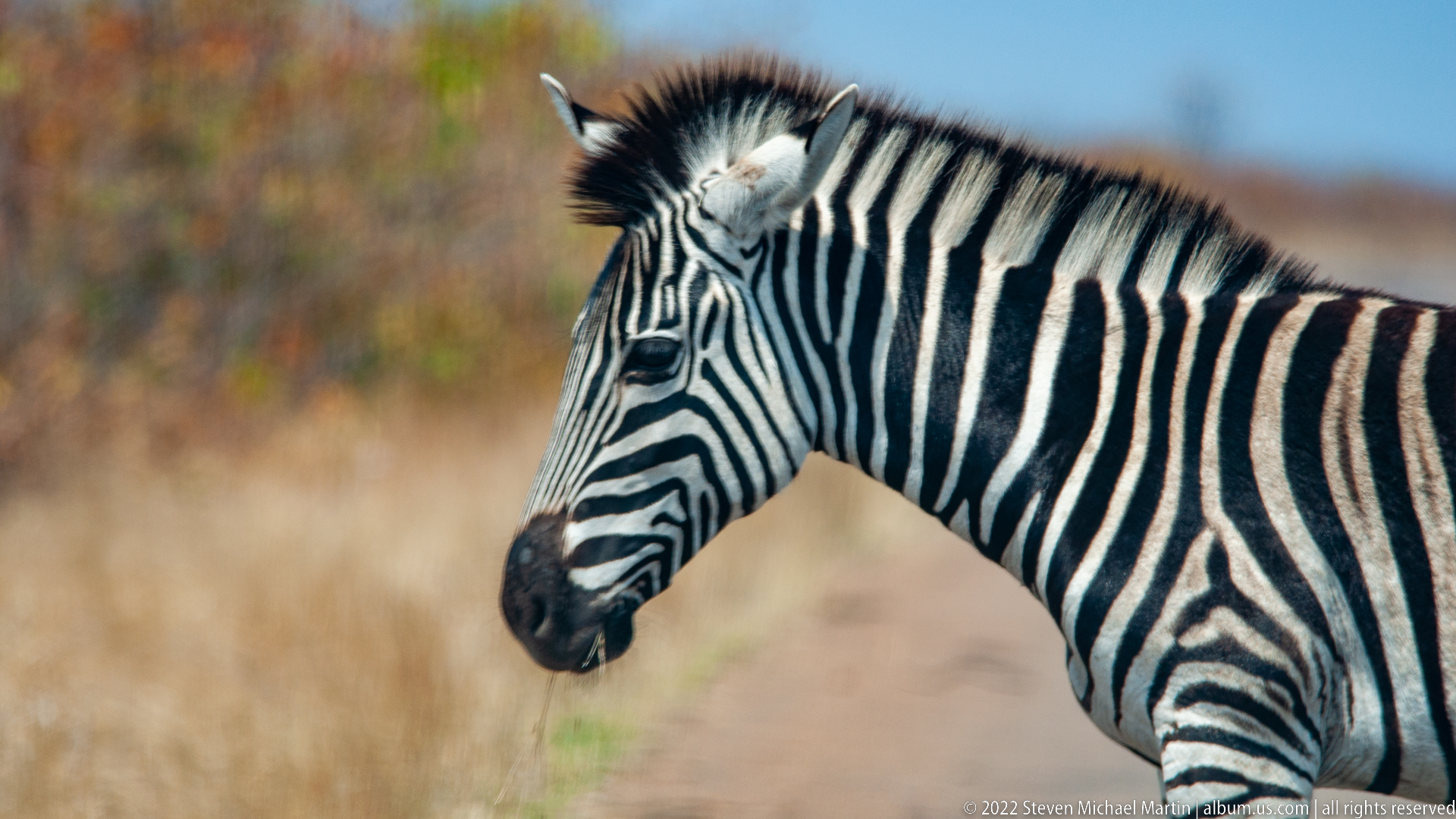
A plains zebra turns its head into a clean side profile beside a pale dirt track. Bold black-and-white stripes curve across the face and neck, while the short upright mane shows alternating dark and light bands. The shallow depth of field isolates the animal against dry grass and blue sky, producing a concise field-guide portrait of head shape and stripe pattern.
Caption
A plains zebra turns its head into a clean side profile beside a pale dirt track. Bold black-and-white stripes curve across the face and neck, while the short upright mane shows alternating dark and light bands. The shallow depth of field isolates the animal against dry grass and blue sky, producing a concise field-guide portrait of head shape and stripe pattern.
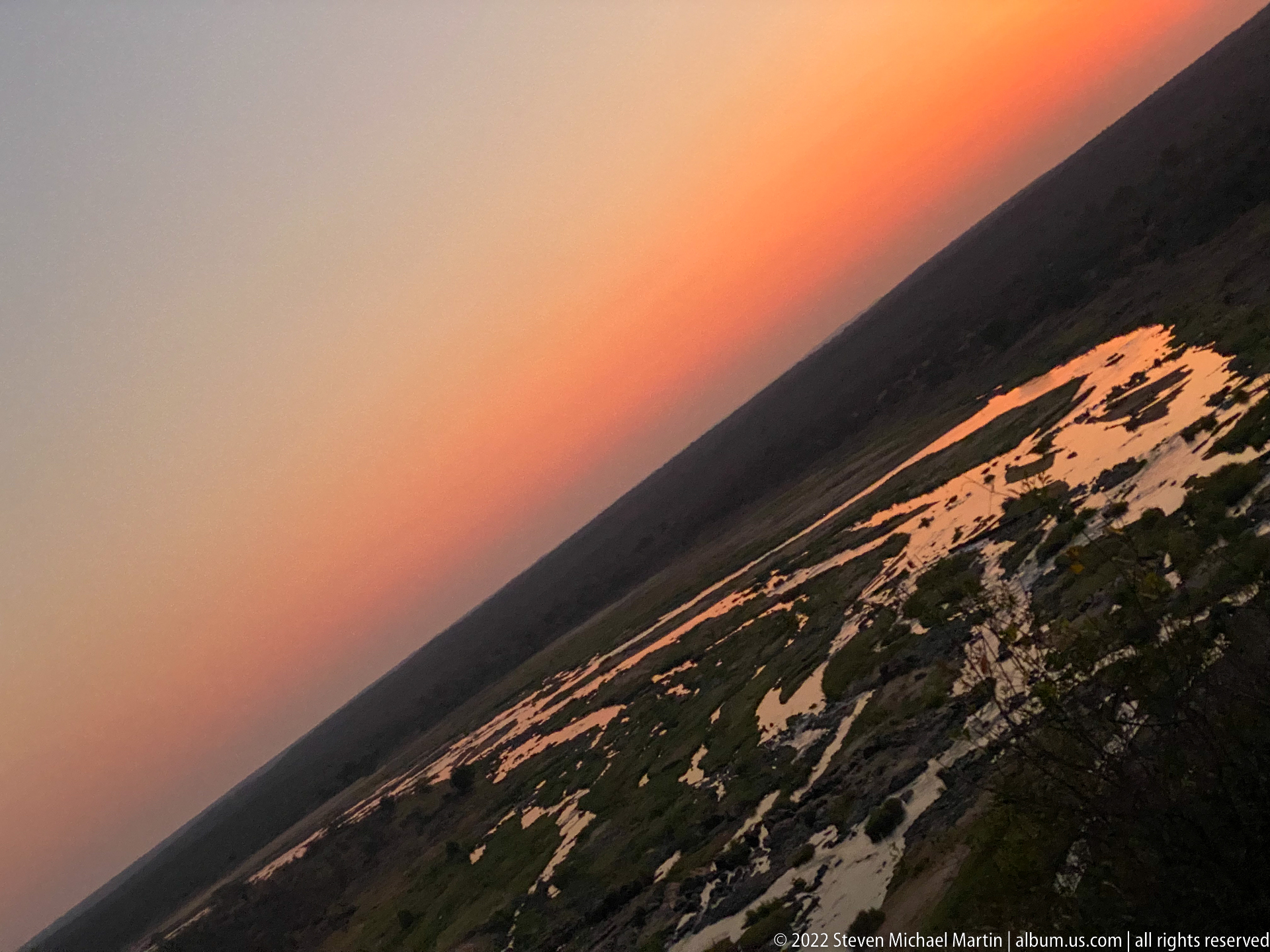
Warm orange light spreads across a broad wetland or riverine floodplain seen from an elevated viewpoint. Reflective channels and pools catch the sunset beneath a darkening horizon, while the camera’s diagonal angle makes the scene feel momentarily tilted. The landscape is visually distinctive, but no landmark or water body is legible enough for a secure site-level identification.
Caption
Warm orange light spreads across a broad wetland or riverine floodplain seen from an elevated viewpoint. Reflective channels and pools catch the sunset beneath a darkening horizon, while the camera’s diagonal angle makes the scene feel momentarily tilted. The landscape is visually distinctive, but no landmark or water body is legible enough for a secure site-level identification.

From an elevated overlook, shallow water divides into multiple channels across a broad bed of exposed rock, reeds, and vegetated islands. Brown hills rise beyond the watercourse, reinforcing the dry-season character of the scene. The pattern of pools and narrow streams is clear, but the exact river or dam cannot be established confidently from the photograph alone.
Caption
From an elevated overlook, shallow water divides into multiple channels across a broad bed of exposed rock, reeds, and vegetated islands. Brown hills rise beyond the watercourse, reinforcing the dry-season character of the scene. The pattern of pools and narrow streams is clear, but the exact river or dam cannot be established confidently from the photograph alone.
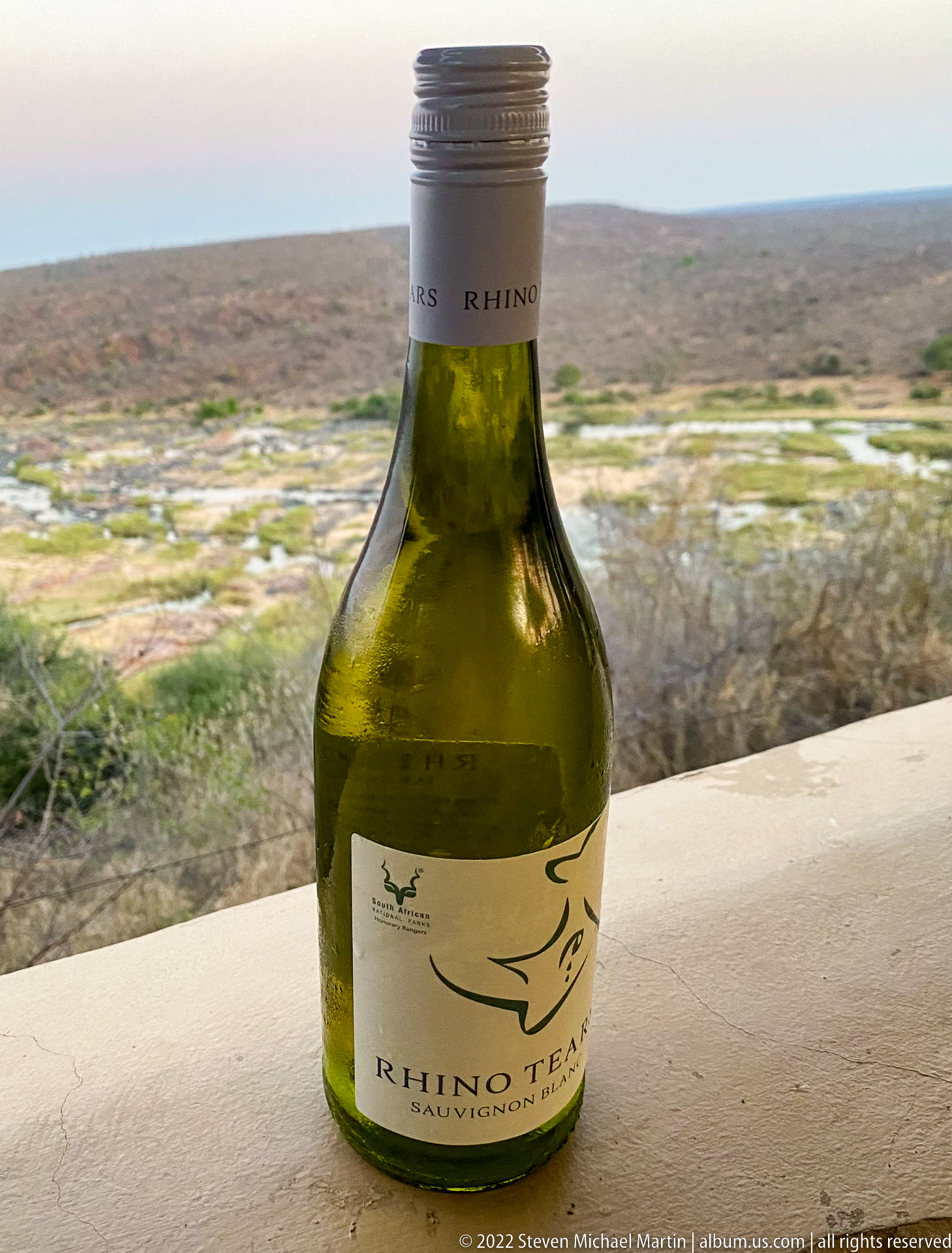
A small green bottle labeled “Rhino Tears” stands on a ledge above an expansive riverine landscape. The rhinoceros-themed label and metal screw cap are in sharp focus, while the floodplain or watercourse beyond falls softly into the distance. The composition deliberately pairs a conservation-branded beverage with the wildlife setting visible from the overlook.
Caption
A small green bottle labeled “Rhino Tears” stands on a ledge above an expansive riverine landscape. The rhinoceros-themed label and metal screw cap are in sharp focus, while the floodplain or watercourse beyond falls softly into the distance. The composition deliberately pairs a conservation-branded beverage with the wildlife setting visible from the overlook.

A chacma baboon straddles a tree branch while gripping the trunk with one hand, its body stretched diagonally across the frame. The animal’s dark face, long muzzle, shaggy coat, and dexterous fingers are sharply visible against open sky. This close arboreal study emphasizes balance and limb placement rather than the more distant troop behavior often associated with baboons.
Caption
A chacma baboon straddles a tree branch while gripping the trunk with one hand, its body stretched diagonally across the frame. The animal’s dark face, long muzzle, shaggy coat, and dexterous fingers are sharply visible against open sky. This close arboreal study emphasizes balance and limb placement rather than the more distant troop behavior often associated with baboons.
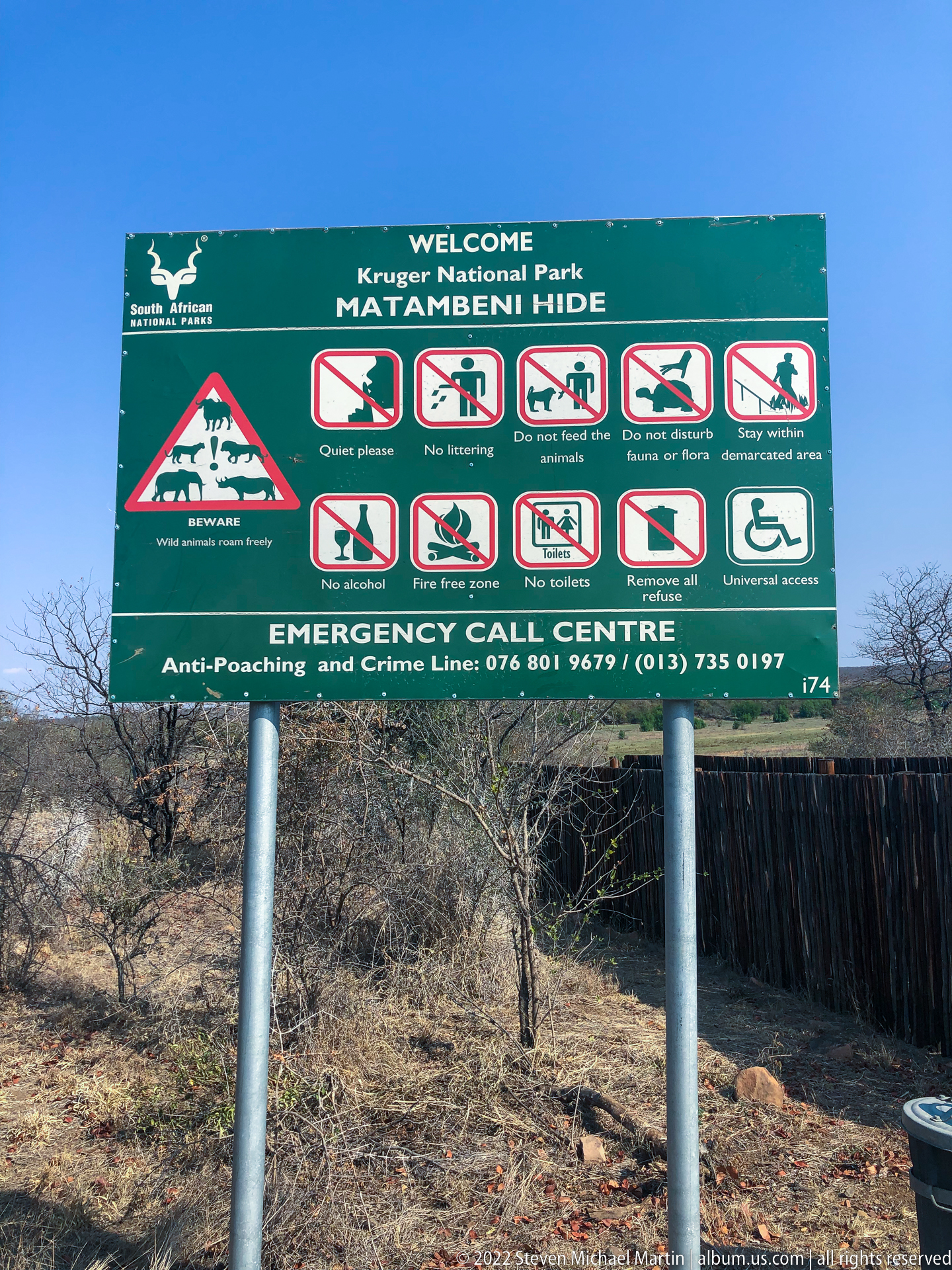
A green South African National Parks sign welcomes visitors to Matambeni Hide and presents safety rules with pictograms, including warnings about wildlife, feeding animals, littering, fires, and leaving designated areas. Emergency call-centre information appears along the bottom. The sign establishes the managed wildlife-viewing setting before the sequence moves inside the hide itself.
Caption
A green South African National Parks sign welcomes visitors to Matambeni Hide and presents safety rules with pictograms, including warnings about wildlife, feeding animals, littering, fires, and leaving designated areas. Emergency call-centre information appears along the bottom. The sign establishes the managed wildlife-viewing setting before the sequence moves inside the hide itself.
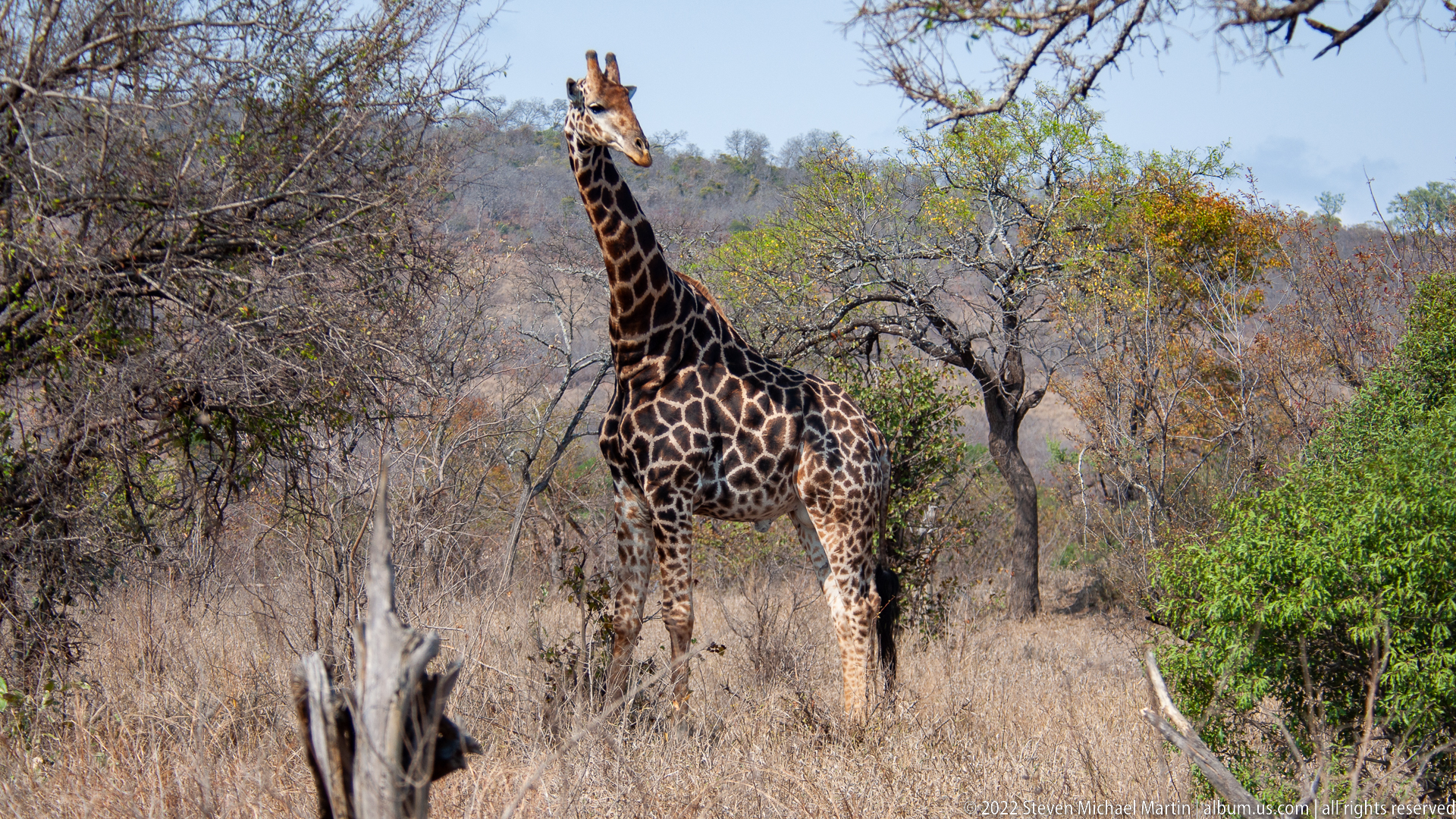
A giraffe stands nearly full length in dry woodland, its long neck rising above leafless shrubs and scattered green foliage. The irregular dark-brown patches, pale lower legs, small ossicones, and towering proportions remain clearly visible despite surrounding branches. The vertical composition emphasizes how the giraffe’s height allows it to occupy a browsing layer far above most other Kruger herbivores.
Caption
A giraffe stands nearly full length in dry woodland, its long neck rising above leafless shrubs and scattered green foliage. The irregular dark-brown patches, pale lower legs, small ossicones, and towering proportions remain clearly visible despite surrounding branches. The vertical composition emphasizes how the giraffe’s height allows it to occupy a browsing layer far above most other Kruger herbivores.
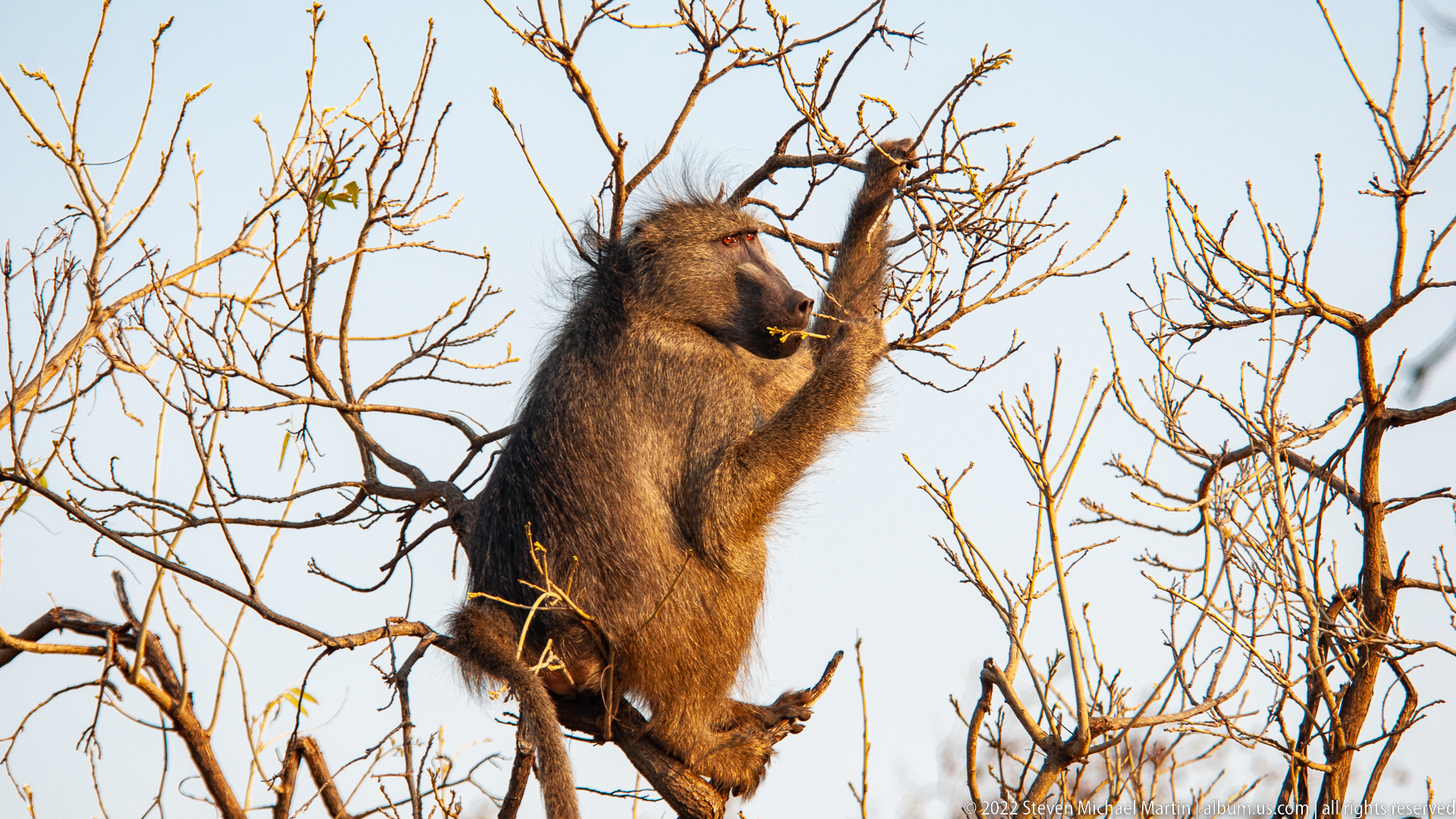
A chacma baboon sits high among bare branches and reaches toward twigs with both hands while feeding or inspecting the branch tips. Side lighting reveals the animal’s shaggy brown-gray coat, elongated muzzle, and powerful forearms. The open sky behind the canopy isolates the primate’s arboreal posture and manual dexterity against the angular branch network.
Caption
A chacma baboon sits high among bare branches and reaches toward twigs with both hands while feeding or inspecting the branch tips. Side lighting reveals the animal’s shaggy brown-gray coat, elongated muzzle, and powerful forearms. The open sky behind the canopy isolates the primate’s arboreal posture and manual dexterity against the angular branch network.
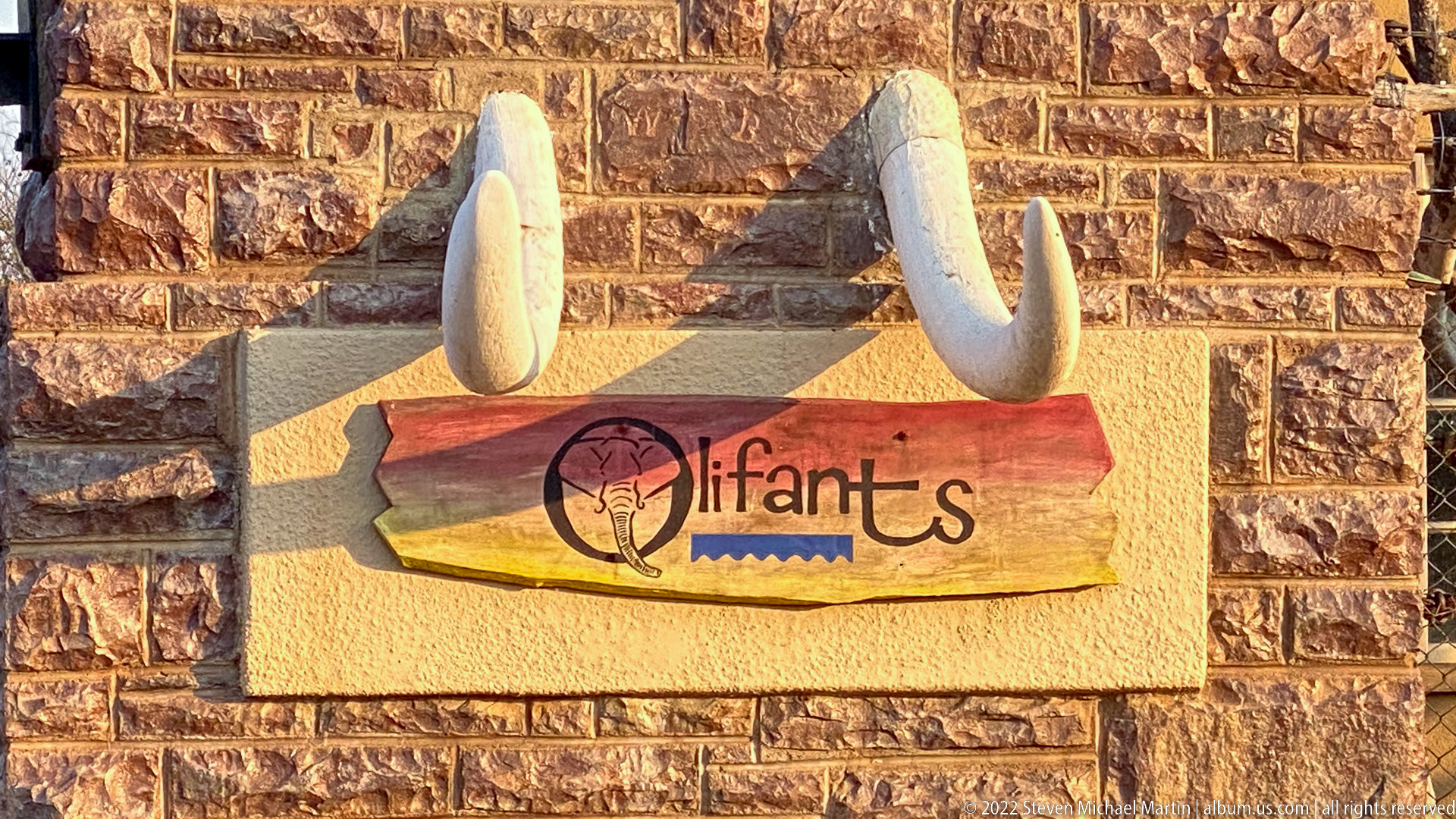
A decorative sign reading “Olifants” is mounted on a stone-and-plaster wall beneath two sculptural elephant tusks. The painted panel uses earthy red and yellow tones and incorporates an elephant graphic beside the name. The close detail identifies the Olifants destination visually while emphasizing the wildlife-themed design language used at the park facility.
Caption
A decorative sign reading “Olifants” is mounted on a stone-and-plaster wall beneath two sculptural elephant tusks. The painted panel uses earthy red and yellow tones and incorporates an elephant graphic beside the name. The close detail identifies the Olifants destination visually while emphasizing the wildlife-themed design language used at the park facility.

The entrance to Olifants Rest Camp is framed by low stone walls bearing matching elephant-tusk signs on either side of the road. A steeply roofed building stands beyond the gate amid dry woodland, while small directional signs and barriers organize vehicle access. The wider view places the decorative Olifants identity seen in the preceding close-up within its functional camp entrance setting.
Caption
The entrance to Olifants Rest Camp is framed by low stone walls bearing matching elephant-tusk signs on either side of the road. A steeply roofed building stands beyond the gate amid dry woodland, while small directional signs and barriers organize vehicle access. The wider view places the decorative Olifants identity seen in the preceding close-up within its functional camp entrance setting.
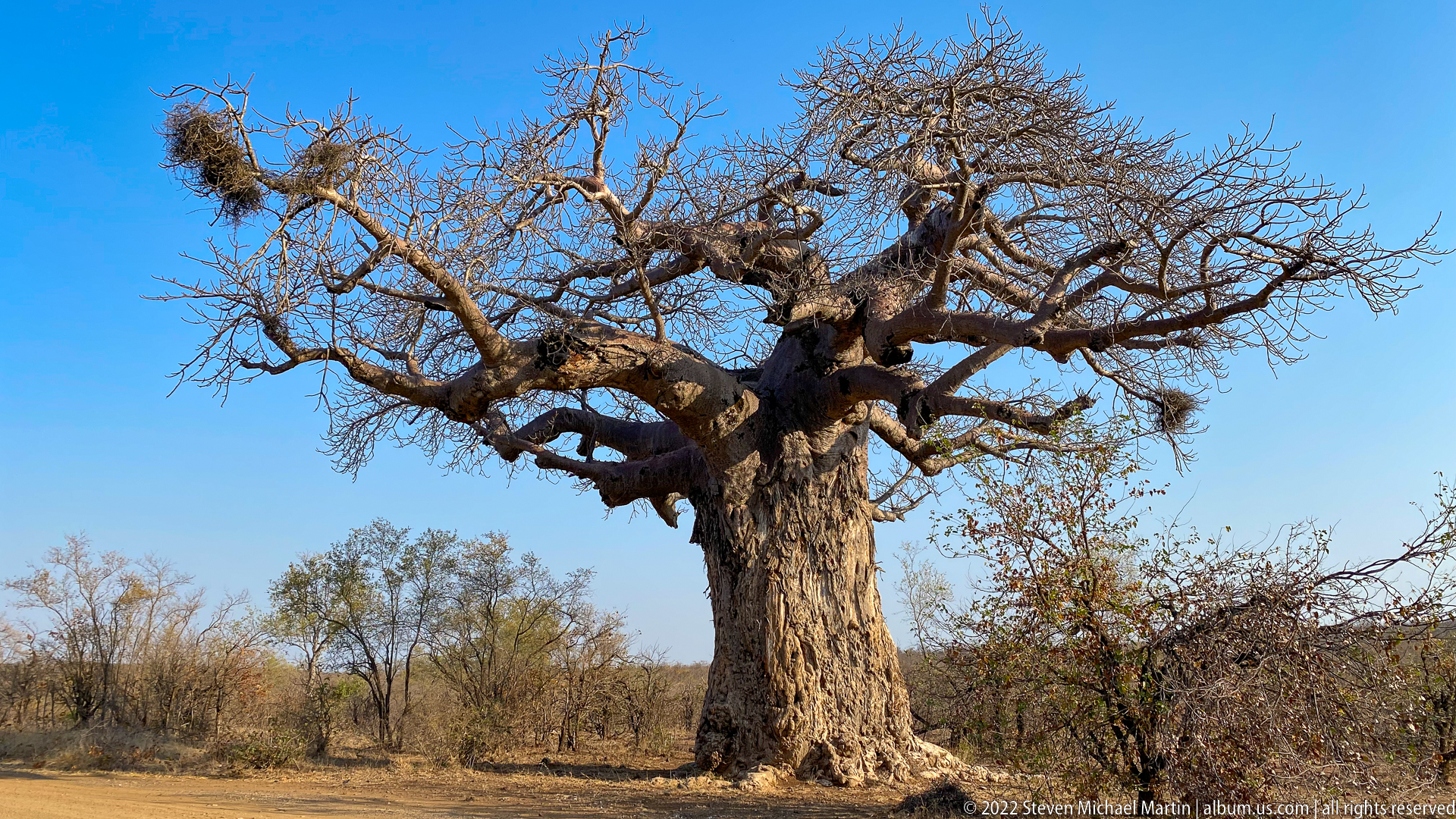
A mature African baobab stands alone in open dry woodland beneath a clear blue sky. Its enormous textured trunk divides into a broad crown of thick, mostly leafless branches, giving the tree a sculptural silhouette. The unobstructed full-tree view makes the baobab’s swollen trunk, heavy limbs, and exceptional scale legible against the lower surrounding vegetation.
Caption
A mature African baobab stands alone in open dry woodland beneath a clear blue sky. Its enormous textured trunk divides into a broad crown of thick, mostly leafless branches, giving the tree a sculptural silhouette. The unobstructed full-tree view makes the baobab’s swollen trunk, heavy limbs, and exceptional scale legible against the lower surrounding vegetation.
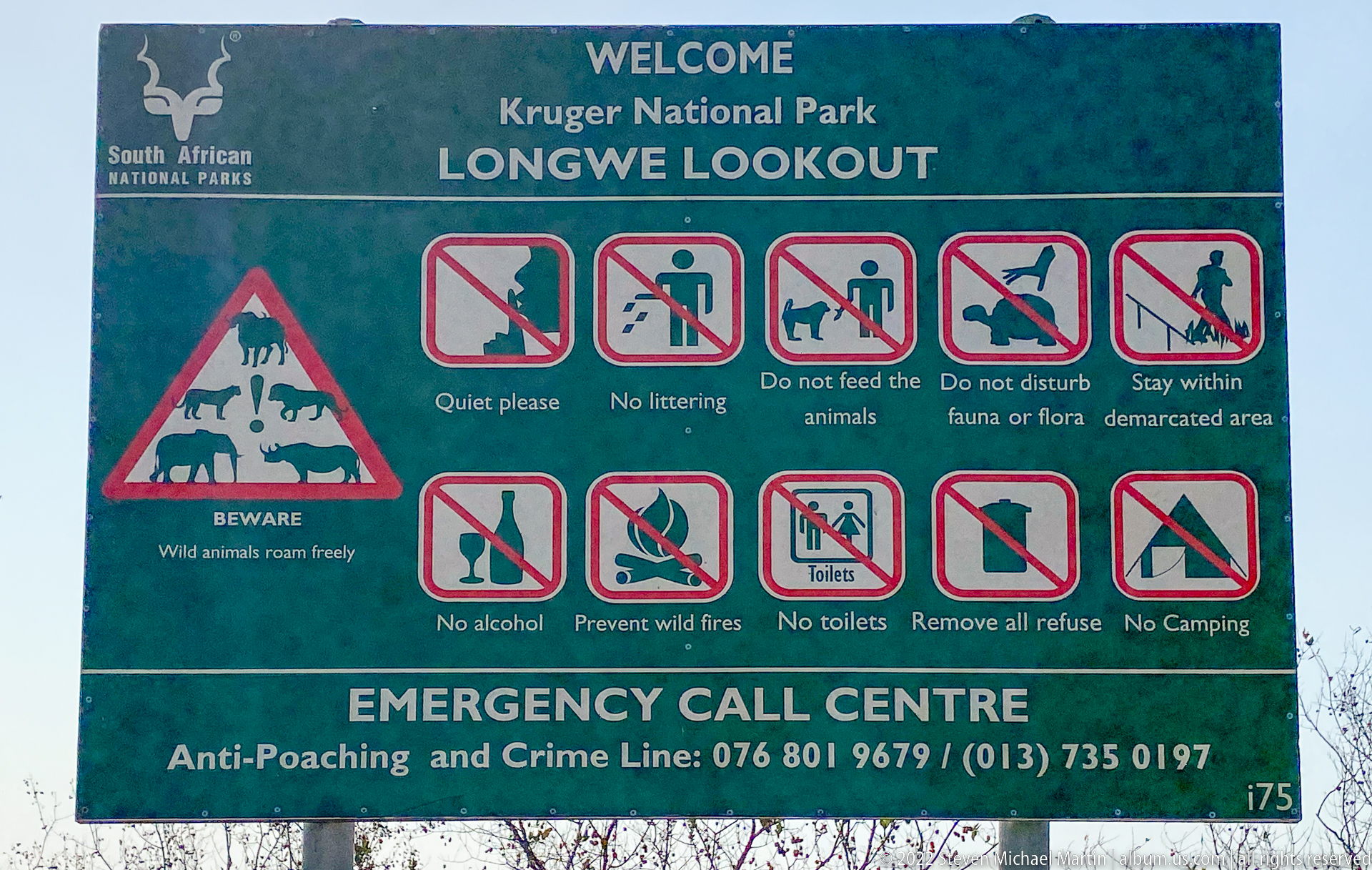
A green Kruger National Park sign welcomes visitors to “LONGWE LOOKOUT” and presents a grid of safety and conduct rules. Pictograms warn against approaching wildlife, littering, feeding animals, disturbing fauna, leaving designated areas, alcohol, fires, camping, and other prohibited behavior. Emergency anti-poaching and crime-line information runs across the bottom, making the sign both visitor guidance and conservation infrastructure.
Caption
A green Kruger National Park sign welcomes visitors to “LONGWE LOOKOUT” and presents a grid of safety and conduct rules. Pictograms warn against approaching wildlife, littering, feeding animals, disturbing fauna, leaving designated areas, alcohol, fires, camping, and other prohibited behavior. Emergency anti-poaching and crime-line information runs across the bottom, making the sign both visitor guidance and conservation infrastructure.
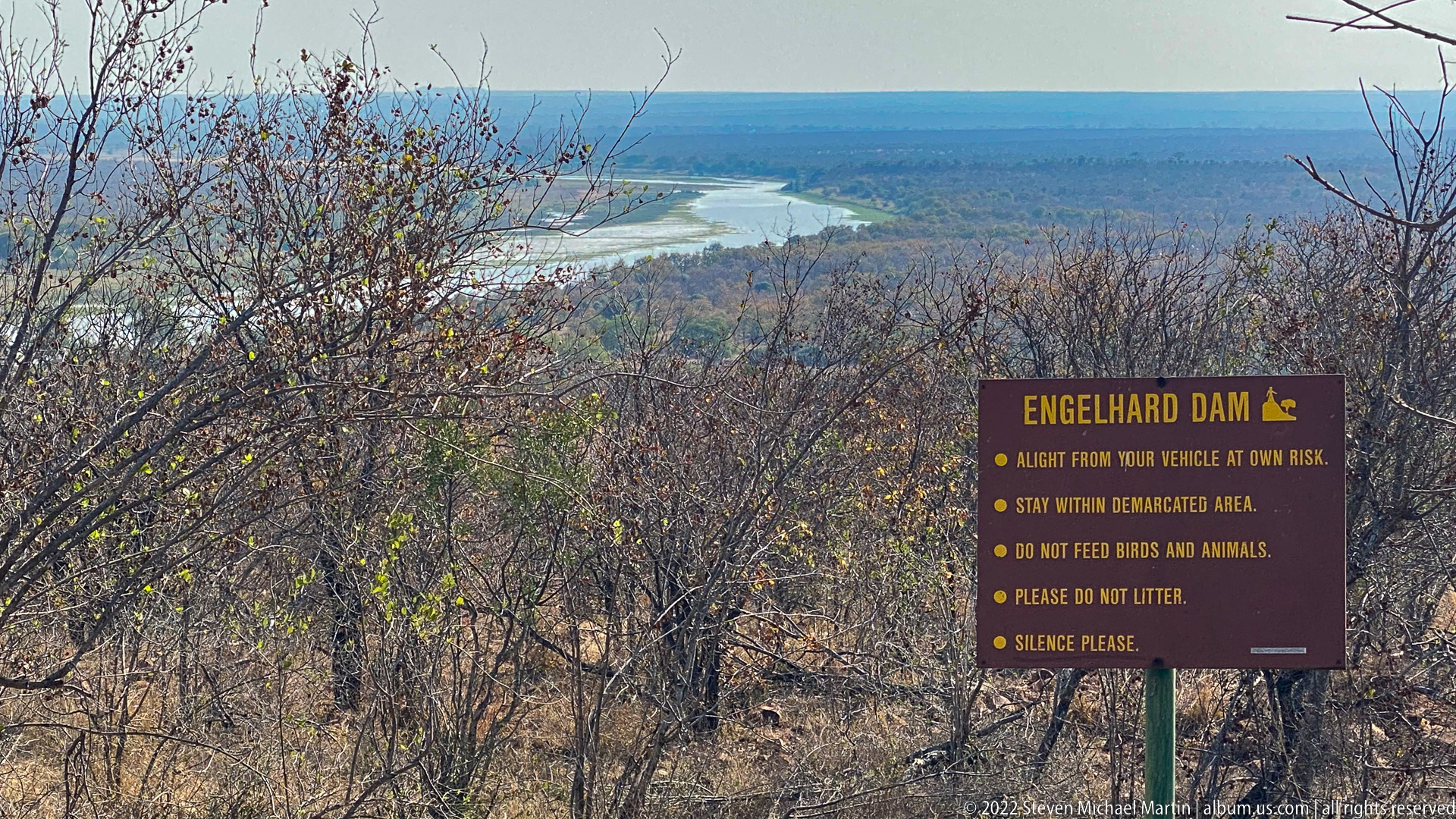
A brown sign reading “ENGELHARD DAM” stands beside an elevated viewpoint over a distant water body winding through the dry landscape. The posted rules instruct visitors to alight from vehicles at their own risk, remain within the demarcated area, avoid feeding animals, and keep the site quiet and litter-free. The composition links the managed lookout directly to the dam visible beyond.
Caption
A brown sign reading “ENGELHARD DAM” stands beside an elevated viewpoint over a distant water body winding through the dry landscape. The posted rules instruct visitors to alight from vehicles at their own risk, remain within the demarcated area, avoid feeding animals, and keep the site quiet and litter-free. The composition links the managed lookout directly to the dam visible beyond.
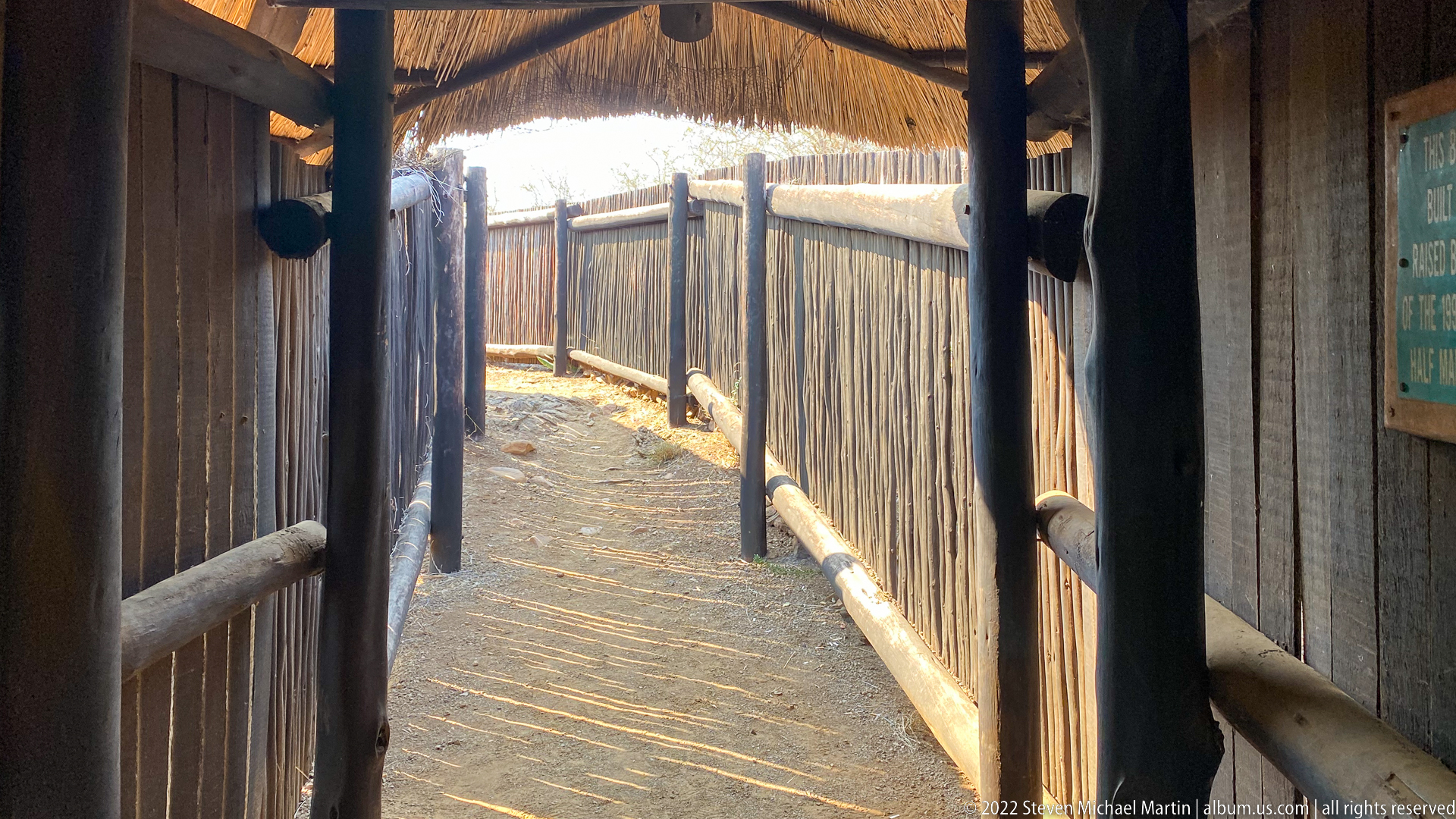
A narrow timber passage curves around the exterior of Matambeni Hide, enclosed by vertical reed or pole screening that limits views from the surrounding habitat. Strong sunlight casts striped shadows across the wooden floor and handrails. The view emphasizes the hide’s screened approach, designed to move visitors between viewing areas with minimal exposure to nearby animals.
Caption
A narrow timber passage curves around the exterior of Matambeni Hide, enclosed by vertical reed or pole screening that limits views from the surrounding habitat. Strong sunlight casts striped shadows across the wooden floor and handrails. The view emphasizes the hide’s screened approach, designed to move visitors between viewing areas with minimal exposure to nearby animals.
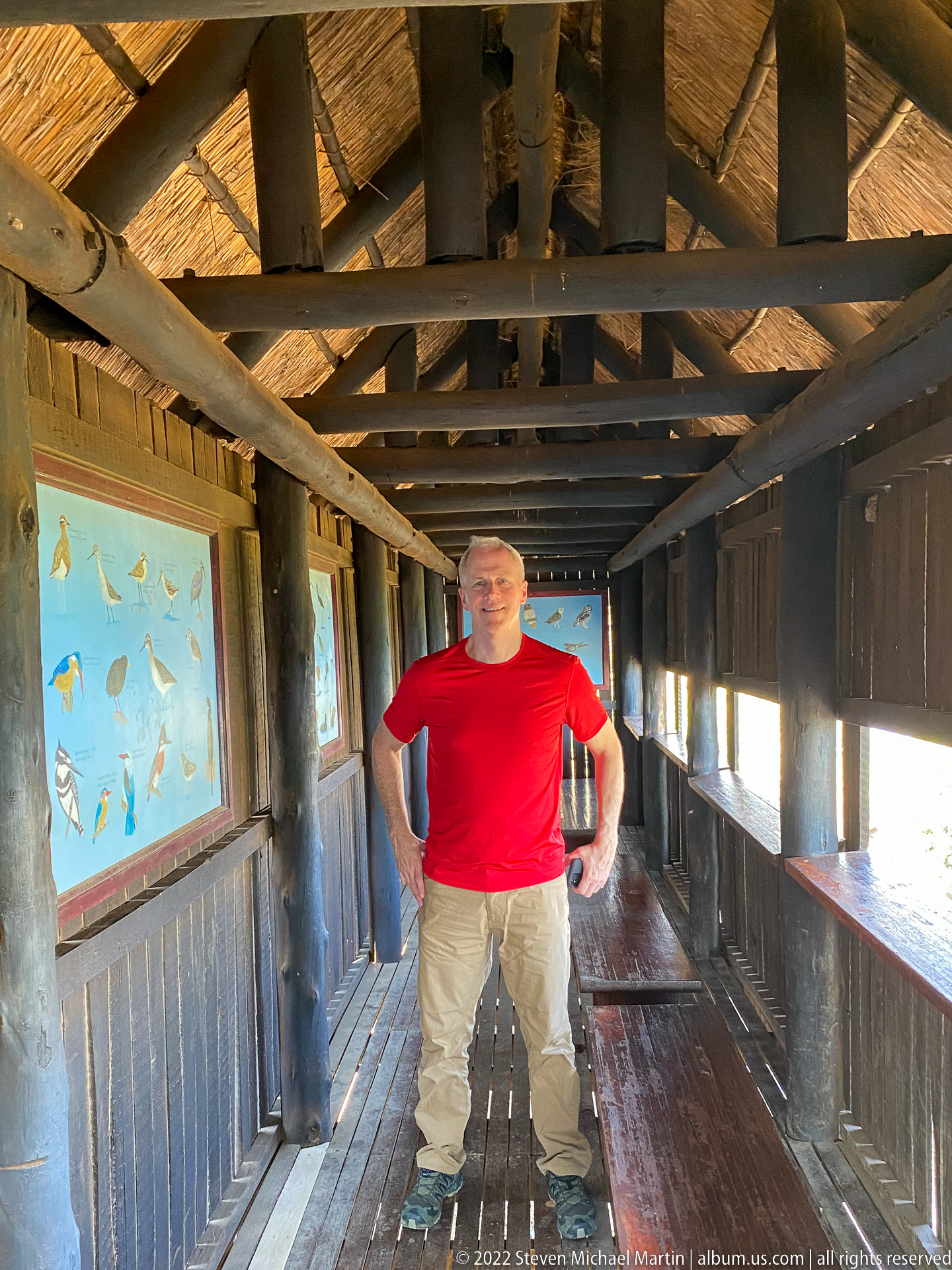
A visitor stands in the center aisle of Matambeni Hide, a long timber viewing structure with a thatched roof, wooden benches, and narrow observation openings along both sides. Painted bird-identification panels hang on the interior walls. The symmetrical perspective shows how the hide is designed to conceal viewers while providing seated sightlines toward nearby water and wildlife.
Caption
A visitor stands in the center aisle of Matambeni Hide, a long timber viewing structure with a thatched roof, wooden benches, and narrow observation openings along both sides. Painted bird-identification panels hang on the interior walls. The symmetrical perspective shows how the hide is designed to conceal viewers while providing seated sightlines toward nearby water and wildlife.
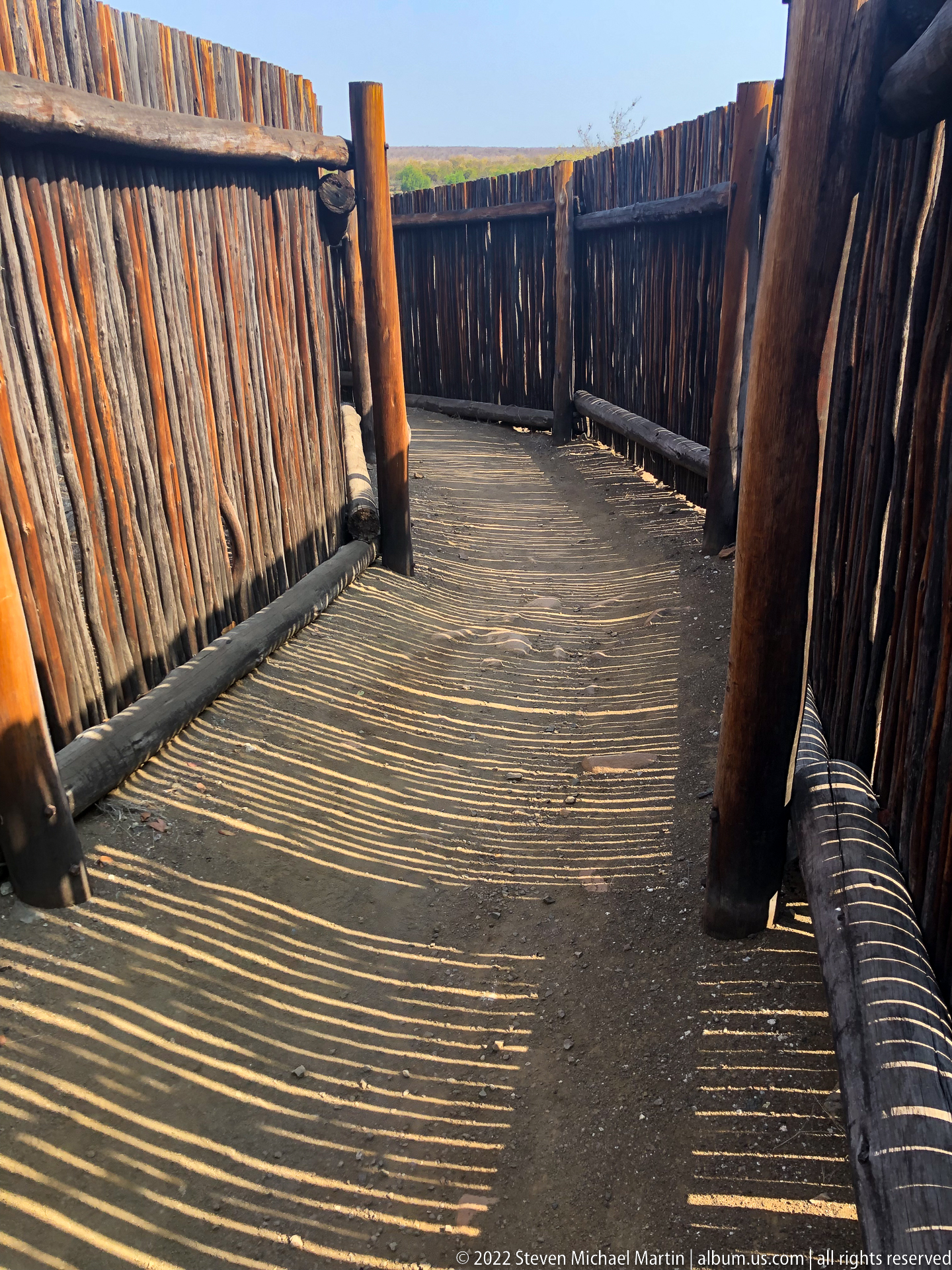
Sunlight stripes the floor of a curving wooden access walkway enclosed by tall vertical poles. Thick support posts and simple handrails create a protected corridor leading around Matambeni Hide, keeping visitors visually screened from the surrounding habitat. The repeating shadows become the dominant graphic feature while still revealing the practical design of the wildlife-viewing structure.
Caption
Sunlight stripes the floor of a curving wooden access walkway enclosed by tall vertical poles. Thick support posts and simple handrails create a protected corridor leading around Matambeni Hide, keeping visitors visually screened from the surrounding habitat. The repeating shadows become the dominant graphic feature while still revealing the practical design of the wildlife-viewing structure.
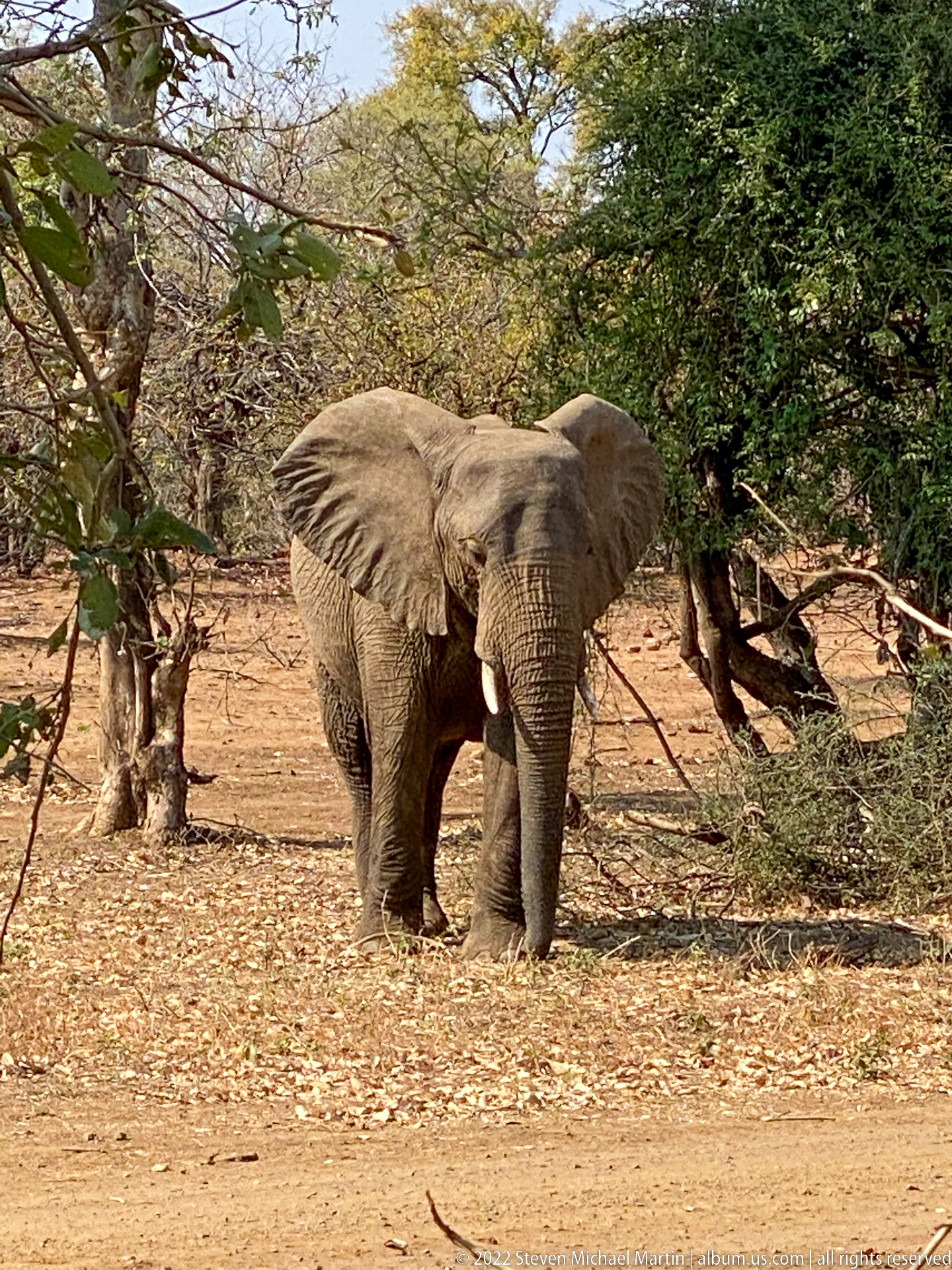
An African bush elephant pauses beneath spreading trees at the edge of a dirt road, body angled slightly toward the camera. Its ears are partly extended, trunk relaxed, and one tusk visible against the shaded face. Fallen leaves and dry soil cover the ground, placing the animal squarely within Kruger’s late dry-season woodland.
Caption
An African bush elephant pauses beneath spreading trees at the edge of a dirt road, body angled slightly toward the camera. Its ears are partly extended, trunk relaxed, and one tusk visible against the shaded face. Fallen leaves and dry soil cover the ground, placing the animal squarely within Kruger’s late dry-season woodland.
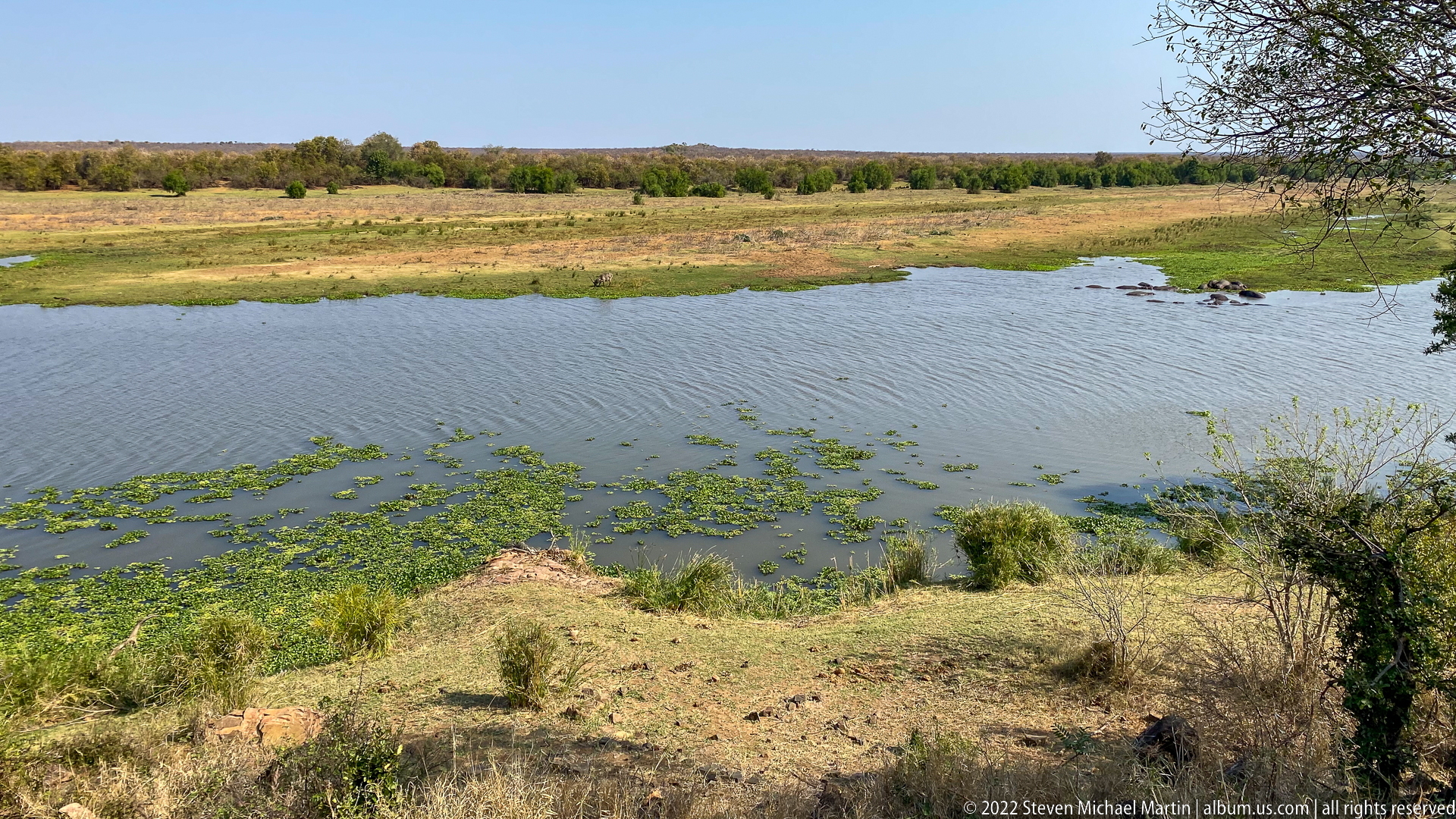
A broad waterhole stretches below the viewing area, edged by green aquatic vegetation and pale dry-season grass. Low woodland forms a continuous horizon beneath a clear blue sky, while a few dark shapes near the far bank suggest distant wildlife. The elevated viewpoint and open water explain the strategic placement of the nearby hide for unobtrusive observation.
Caption
A broad waterhole stretches below the viewing area, edged by green aquatic vegetation and pale dry-season grass. Low woodland forms a continuous horizon beneath a clear blue sky, while a few dark shapes near the far bank suggest distant wildlife. The elevated viewpoint and open water explain the strategic placement of the nearby hide for unobtrusive observation.
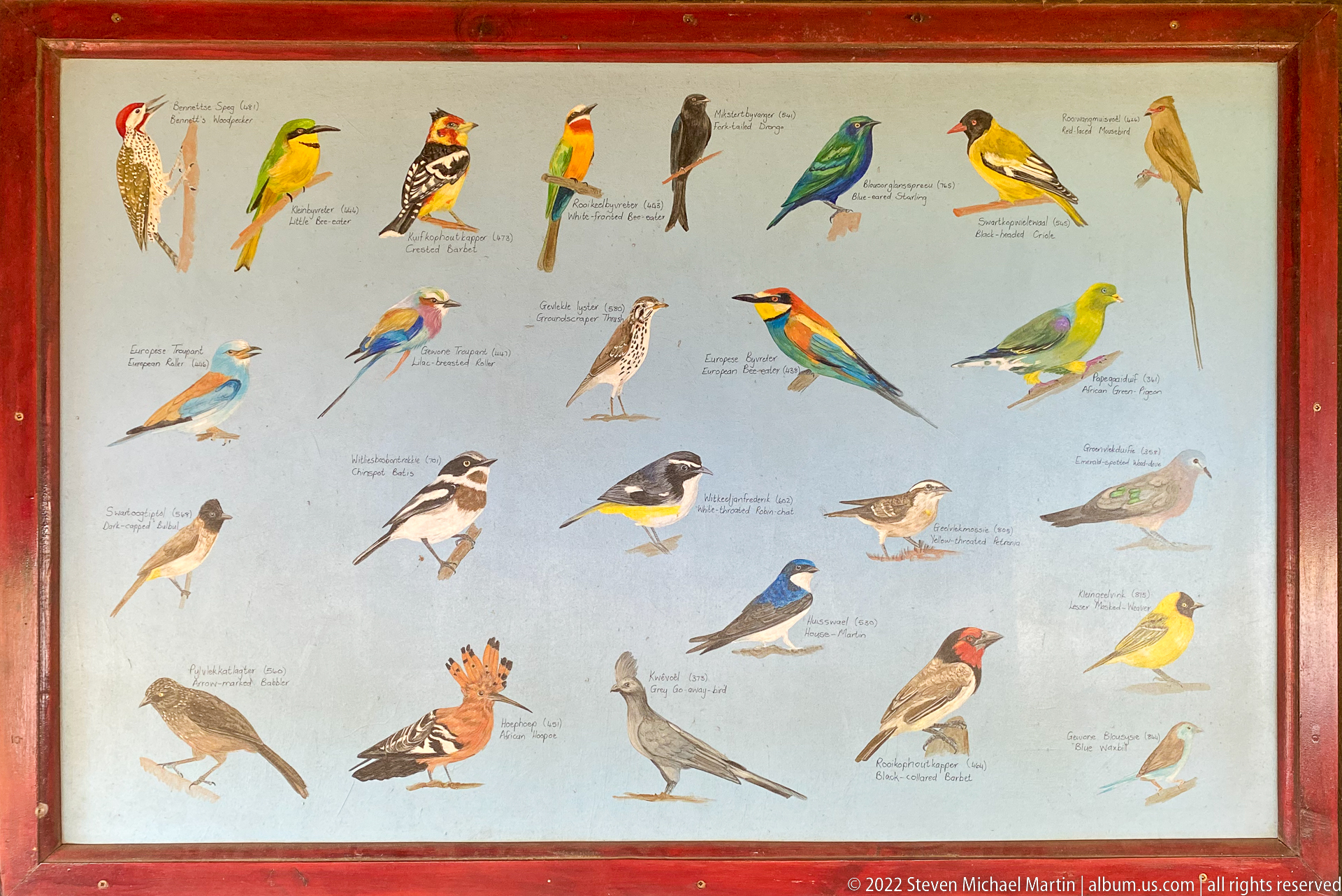
An illustrated identification board displays a selection of smaller woodland and savanna birds, each painted in profile and labeled with common and scientific names. Colorful bee-eaters, rollers, hornbills, shrikes, and other species are arranged against a pale blue background. Installed inside the hide, the panel serves as a practical field-guide aid for visitors scanning the surrounding habitat.
Caption
An illustrated identification board displays a selection of smaller woodland and savanna birds, each painted in profile and labeled with common and scientific names. Colorful bee-eaters, rollers, hornbills, shrikes, and other species are arranged against a pale blue background. Installed inside the hide, the panel serves as a practical field-guide aid for visitors scanning the surrounding habitat.
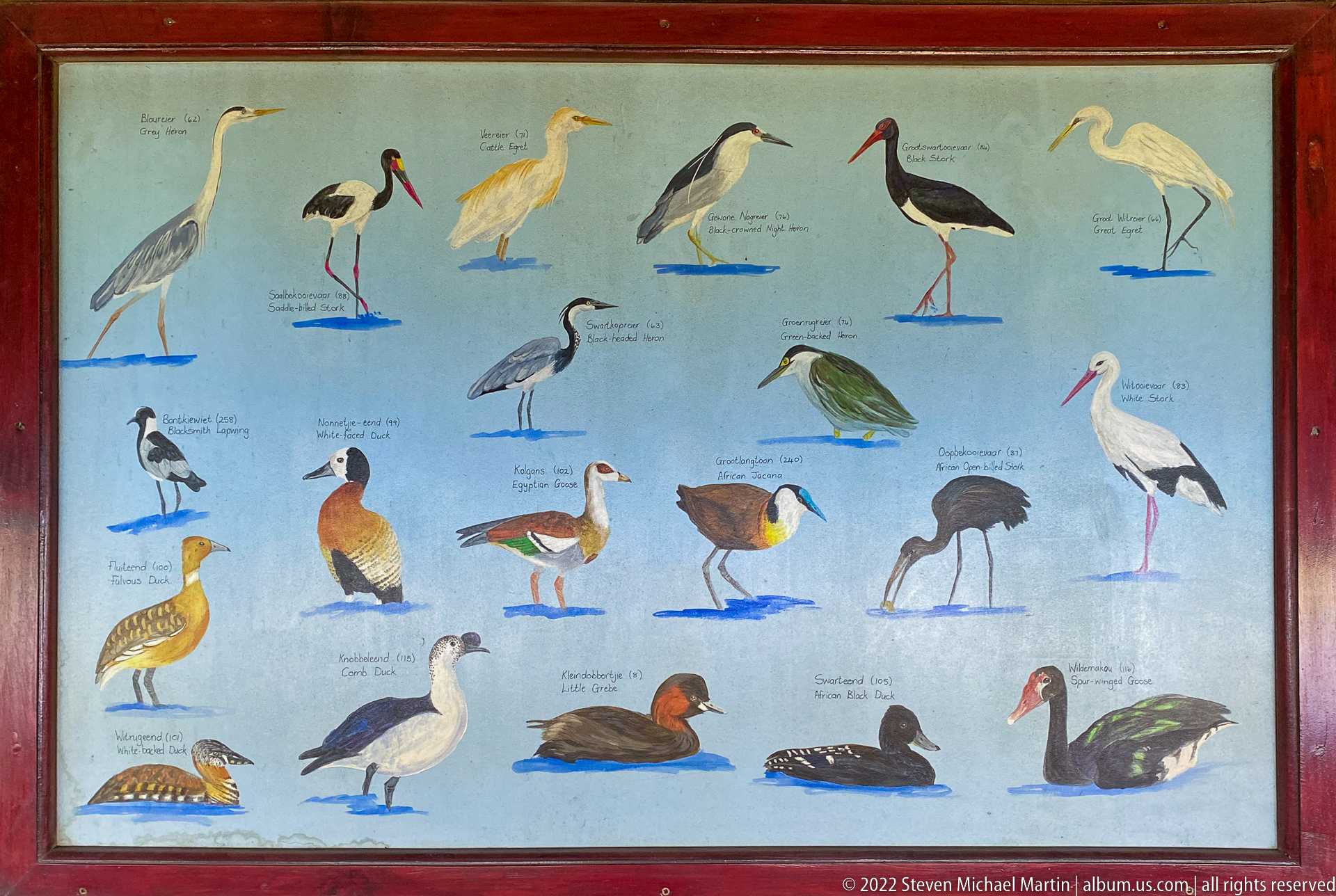
A framed identification panel presents wading birds, ducks, geese, storks, herons, and other water-associated species likely to be encountered from the hide. Painted figures stand or swim over blue ground marks and are labeled individually. The panel complements the waterhole outlook by giving visitors a visual reference for distinguishing the wetland birds using the site.
Caption
A framed identification panel presents wading birds, ducks, geese, storks, herons, and other water-associated species likely to be encountered from the hide. Painted figures stand or swim over blue ground marks and are labeled individually. The panel complements the waterhole outlook by giving visitors a visual reference for distinguishing the wetland birds using the site.
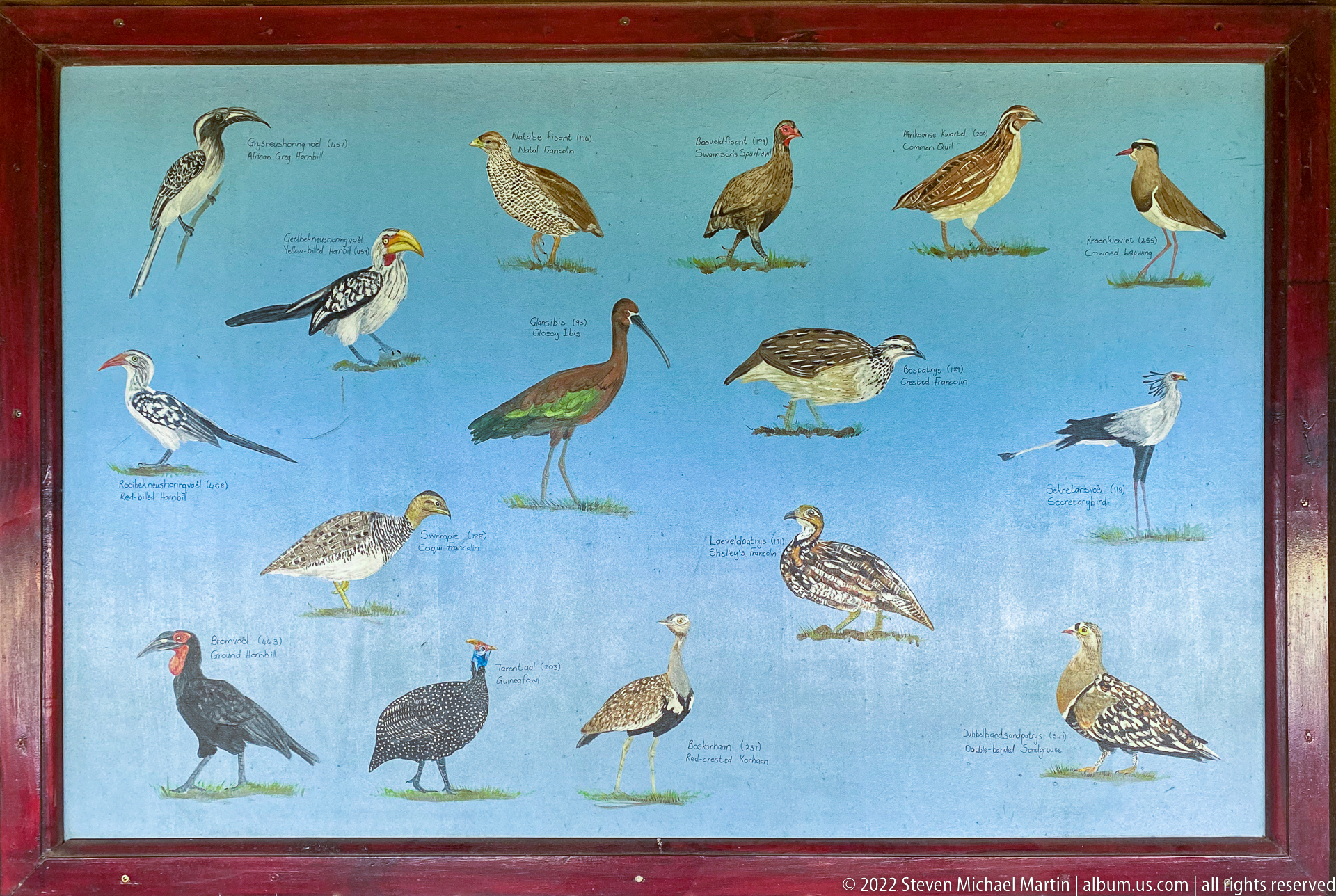
A blue identification board groups terrestrial and open-country birds, including francolins, guineafowl, bustards, coursers, and other ground-oriented species. Each painted bird is labeled, allowing visitors to compare body shape, plumage, and leg structure at a glance. The panel broadens the hide’s field-guide coverage beyond waterbirds to species found in the surrounding grassland and woodland.
Caption
A blue identification board groups terrestrial and open-country birds, including francolins, guineafowl, bustards, coursers, and other ground-oriented species. Each painted bird is labeled, allowing visitors to compare body shape, plumage, and leg structure at a glance. The panel broadens the hide’s field-guide coverage beyond waterbirds to species found in the surrounding grassland and woodland.
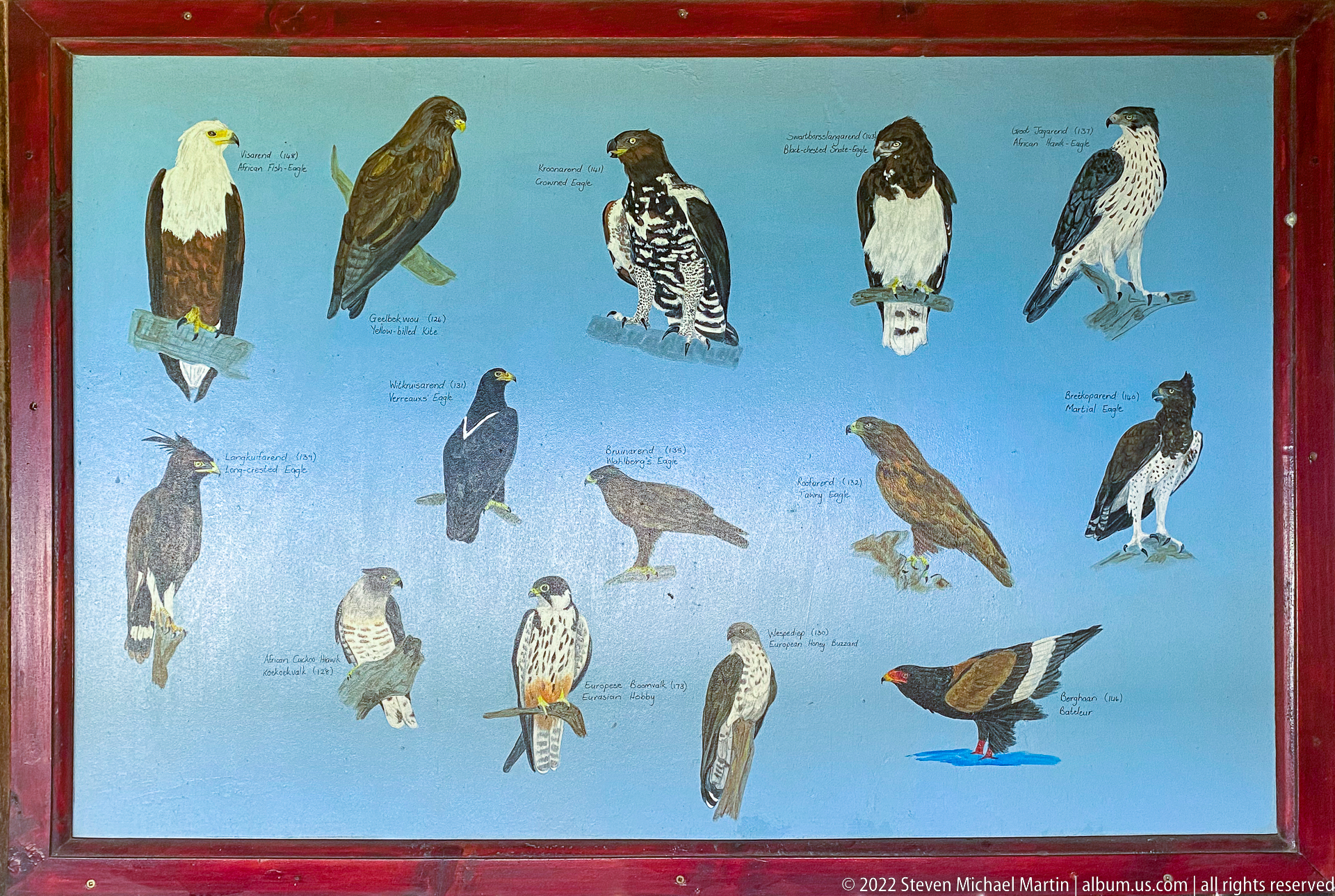
Eagles, hawks, falcons, vultures, and other raptors are arranged across a framed identification board inside Matambeni Hide. Differences in wing shape, body proportions, plumage, and bill form are rendered in individual painted profiles. The display gives visitors a comparative reference for recognizing predatory birds that may be seen circling above or perched around the waterhole.
Caption
Eagles, hawks, falcons, vultures, and other raptors are arranged across a framed identification board inside Matambeni Hide. Differences in wing shape, body proportions, plumage, and bill form are rendered in individual painted profiles. The display gives visitors a comparative reference for recognizing predatory birds that may be seen circling above or perched around the waterhole.
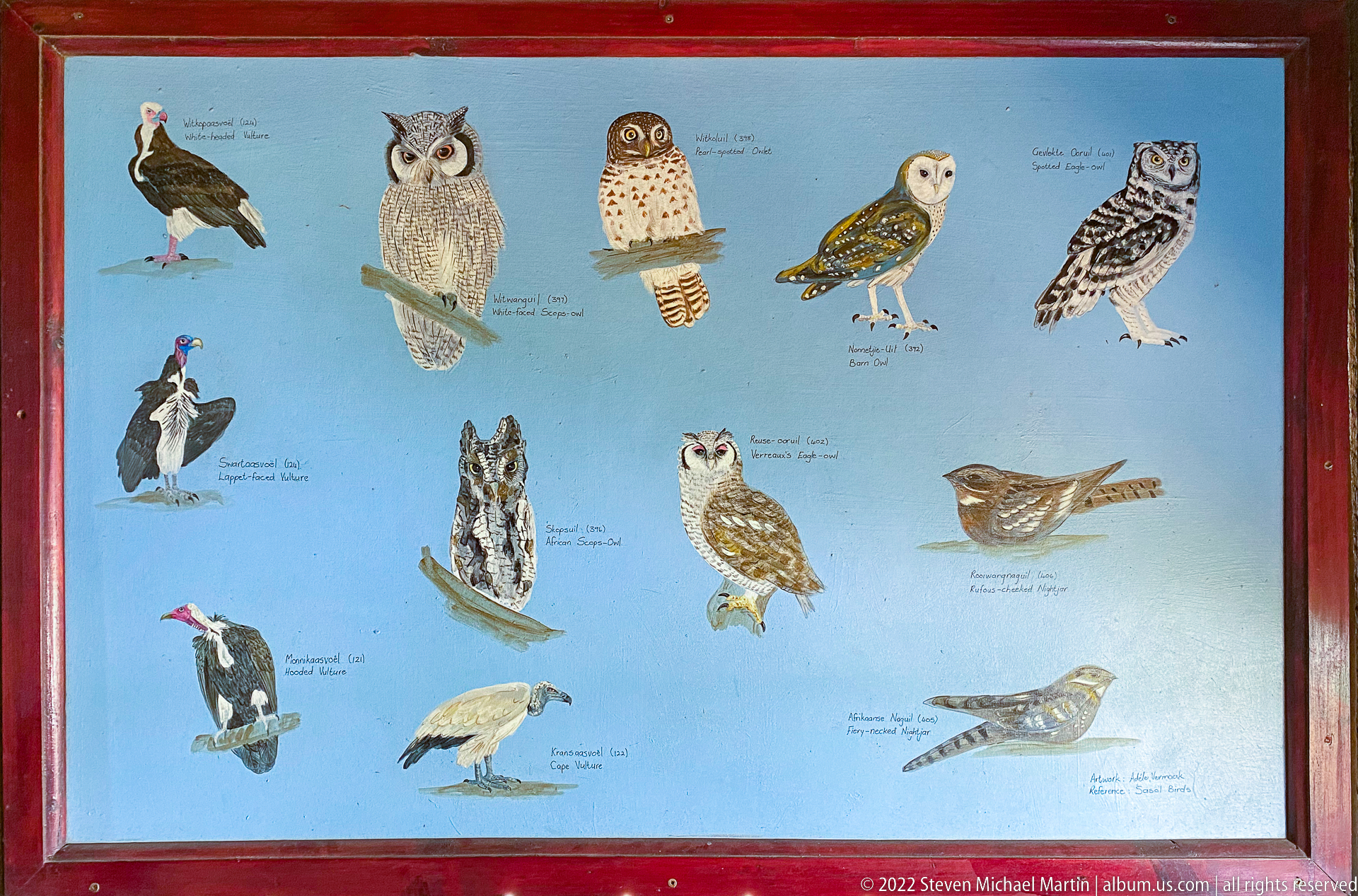
Owl species dominate this identification board, joined by other nocturnal or crepuscular birds. Round facial disks, forward-facing eyes, mottled plumage, and differing body sizes make the owl illustrations especially distinctive. By including night-active birds, the educational display extends the field-guide function of the hide beyond the daylight species visible at the waterhole.
Caption
Owl species dominate this identification board, joined by other nocturnal or crepuscular birds. Round facial disks, forward-facing eyes, mottled plumage, and differing body sizes make the owl illustrations especially distinctive. By including night-active birds, the educational display extends the field-guide function of the hide beyond the daylight species visible at the waterhole.
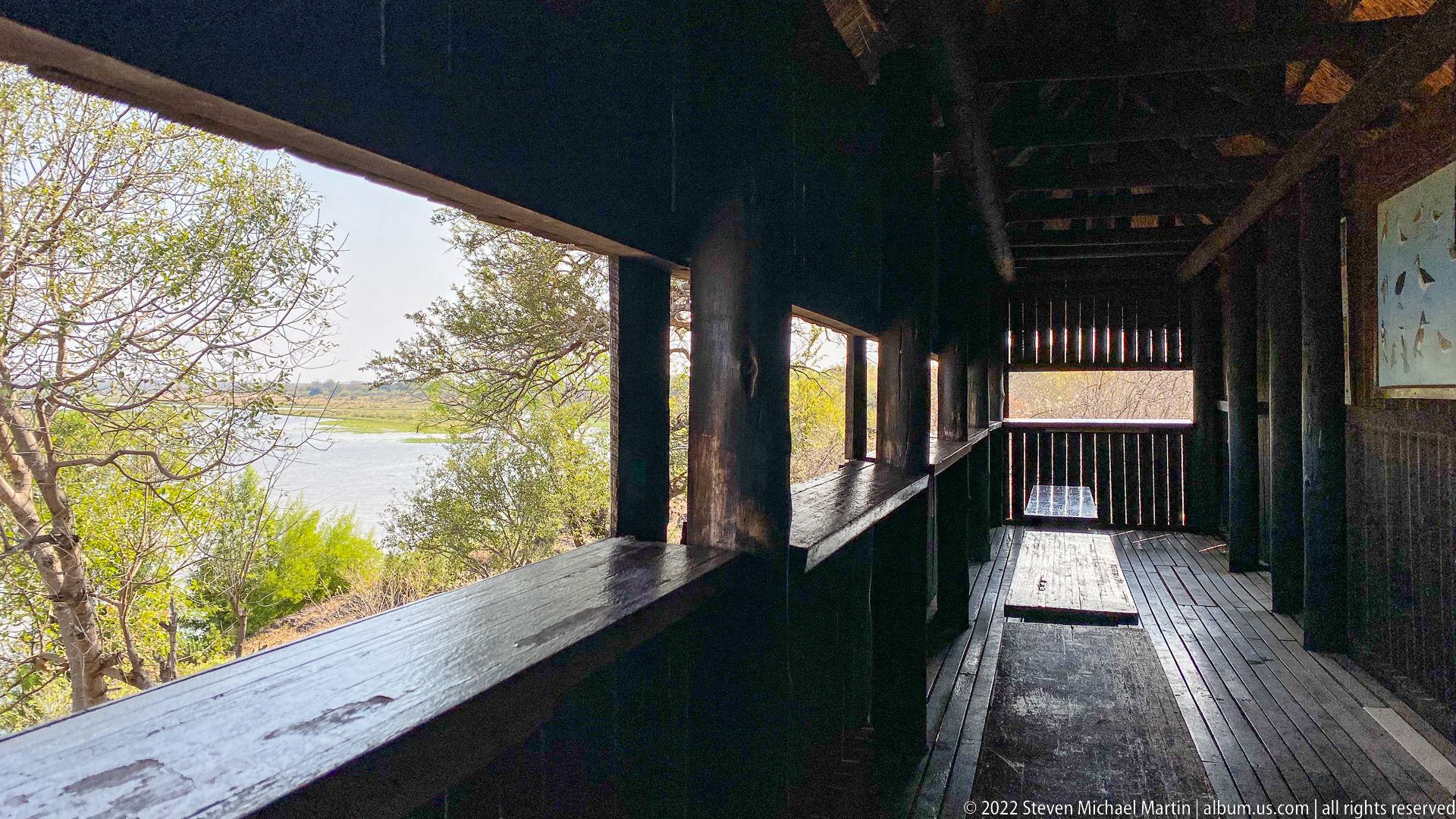
A long wooden bench runs beneath the open observation slot of Matambeni Hide, with the waterhole and shoreline vegetation visible through the wide horizontal opening. Heavy timber posts, dark walls, and a slatted floor keep the interior subdued while the exterior remains brightly lit. The composition demonstrates the contrast that allows visitors to watch wildlife from concealment.
Caption
A long wooden bench runs beneath the open observation slot of Matambeni Hide, with the waterhole and shoreline vegetation visible through the wide horizontal opening. Heavy timber posts, dark walls, and a slatted floor keep the interior subdued while the exterior remains brightly lit. The composition demonstrates the contrast that allows visitors to watch wildlife from concealment.
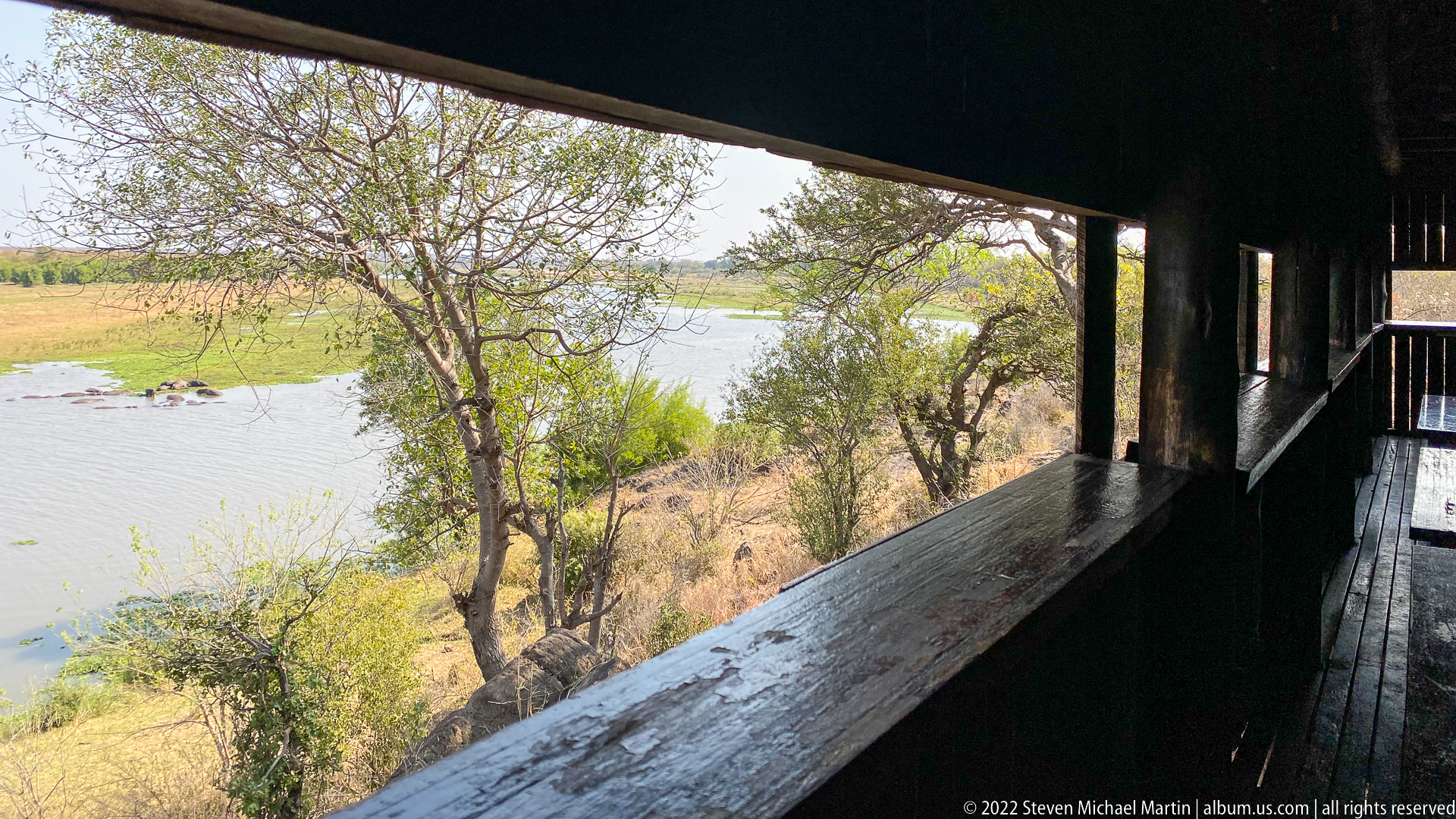
The waterhole is framed from inside Matambeni Hide by a dark timber sill and roof, producing a natural viewing aperture. A tree leans across the left side while green shoreline vegetation and open water occupy the middle distance. The photograph records the observer’s actual sightline from the hide rather than presenting the wetland as an unframed landscape.
Caption
The waterhole is framed from inside Matambeni Hide by a dark timber sill and roof, producing a natural viewing aperture. A tree leans across the left side while green shoreline vegetation and open water occupy the middle distance. The photograph records the observer’s actual sightline from the hide rather than presenting the wetland as an unframed landscape.
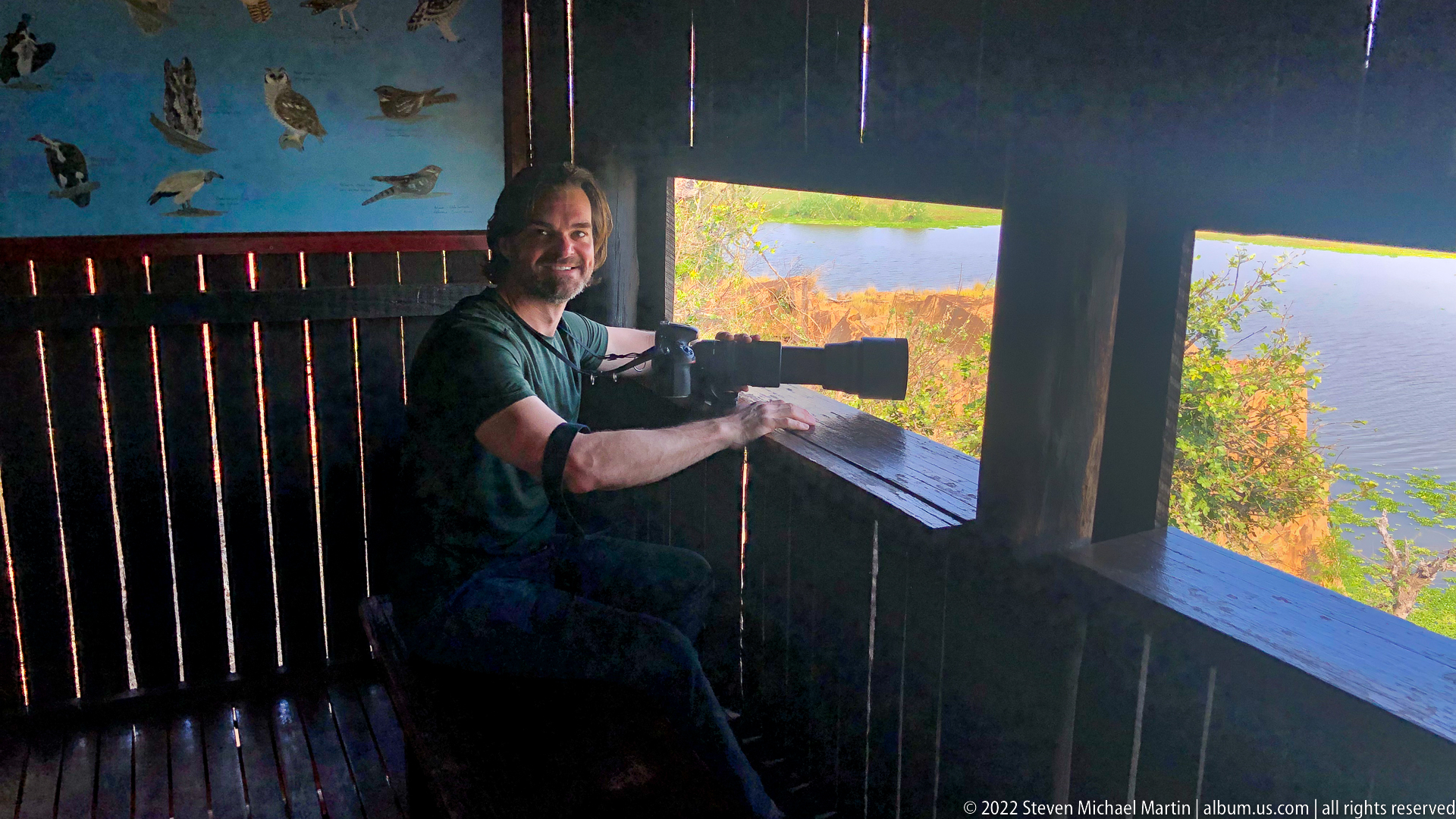
A seated visitor looks through binoculars from one of Matambeni Hide’s narrow viewing openings. Bright water and shoreline vegetation fill the exterior beyond the dark timber wall, while bird-identification artwork appears overhead. The scene shows the hide in use: low light conceals the observer while optics extend the reach of wildlife watching across the waterhole.
Caption
A seated visitor looks through binoculars from one of Matambeni Hide’s narrow viewing openings. Bright water and shoreline vegetation fill the exterior beyond the dark timber wall, while bird-identification artwork appears overhead. The scene shows the hide in use: low light conceals the observer while optics extend the reach of wildlife watching across the waterhole.
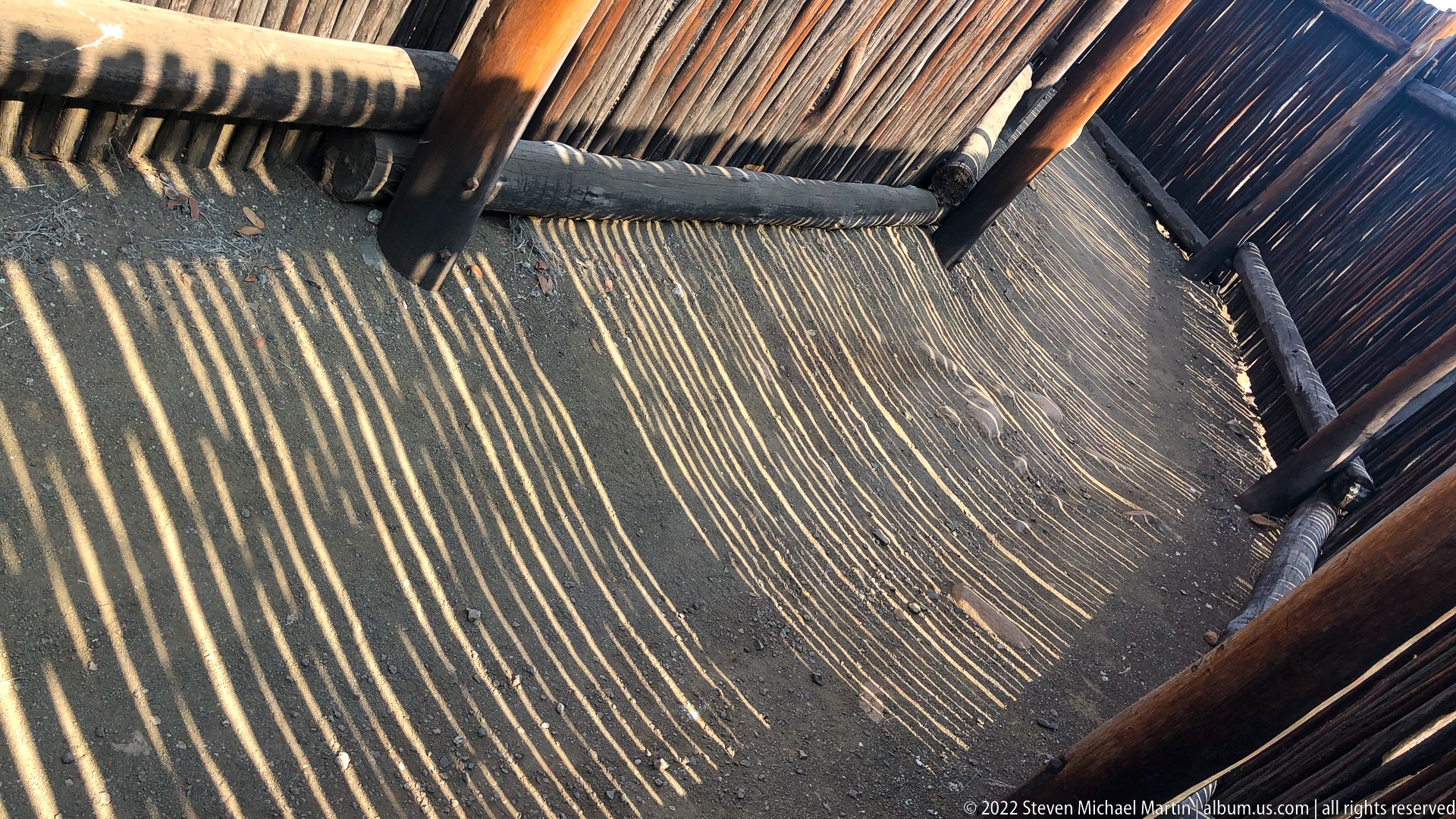
A downward view isolates the patterned shadows cast by Matambeni Hide’s vertical screening across the wooden walkway. Parallel bands of light bend with the curve of the passage and intersect thick posts at the perimeter. This architectural detail shifts attention from wildlife observation to the hide’s material construction and the rhythmic effects created by direct sun.
Caption
A downward view isolates the patterned shadows cast by Matambeni Hide’s vertical screening across the wooden walkway. Parallel bands of light bend with the curve of the passage and intersect thick posts at the perimeter. This architectural detail shifts attention from wildlife observation to the hide’s material construction and the rhythmic effects created by direct sun.
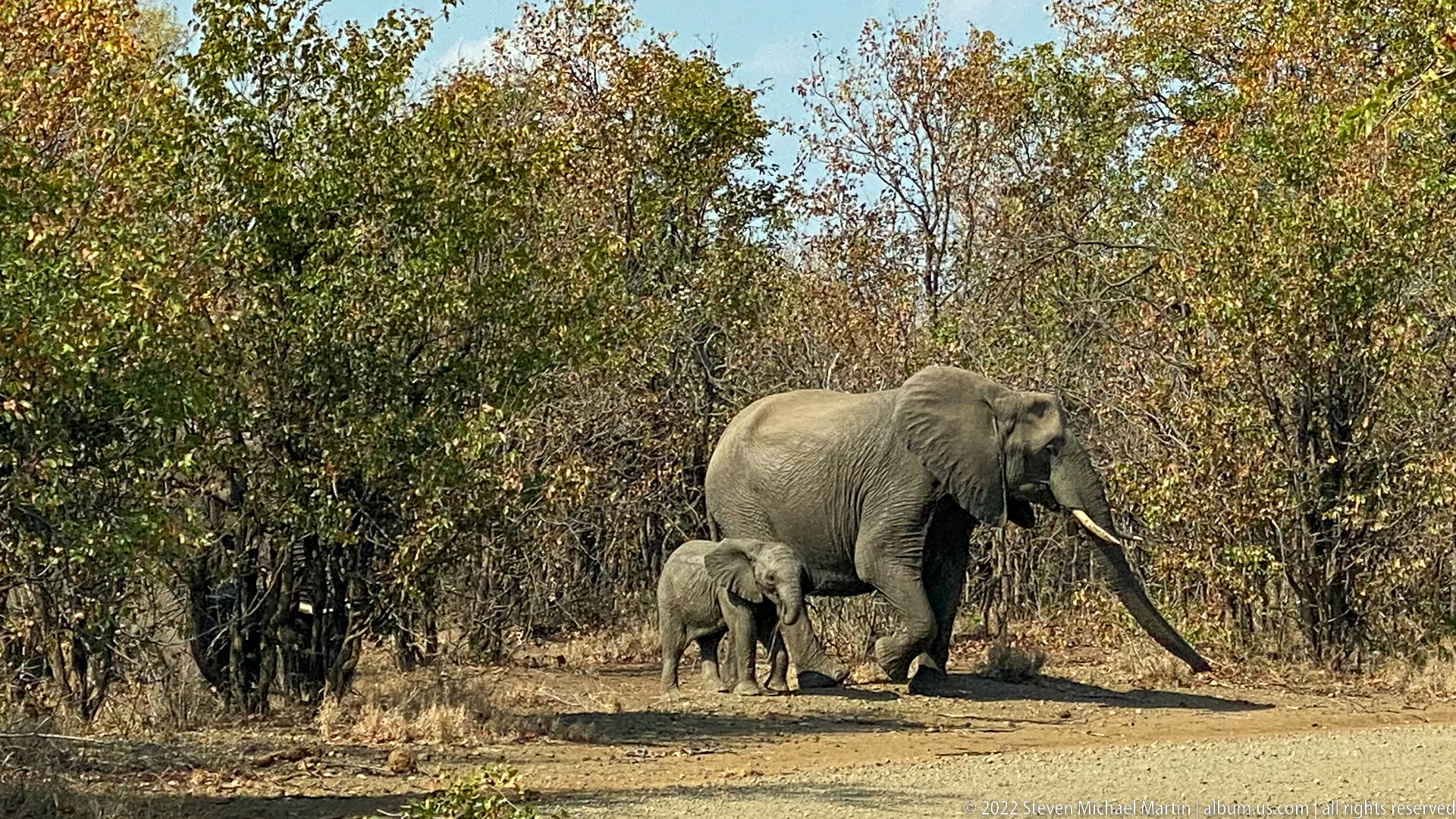
An adult African bush elephant crosses a dirt road with a small calf tucked close beside its forelegs. The adult’s long tusks and trunk extend forward while the calf’s compact body and short trunk emphasize the age difference. Dense dry woodland forms a protective backdrop, and the pair’s close spacing suggests coordinated movement across the open roadway.
Caption
An adult African bush elephant crosses a dirt road with a small calf tucked close beside its forelegs. The adult’s long tusks and trunk extend forward while the calf’s compact body and short trunk emphasize the age difference. Dense dry woodland forms a protective backdrop, and the pair’s close spacing suggests coordinated movement across the open roadway.
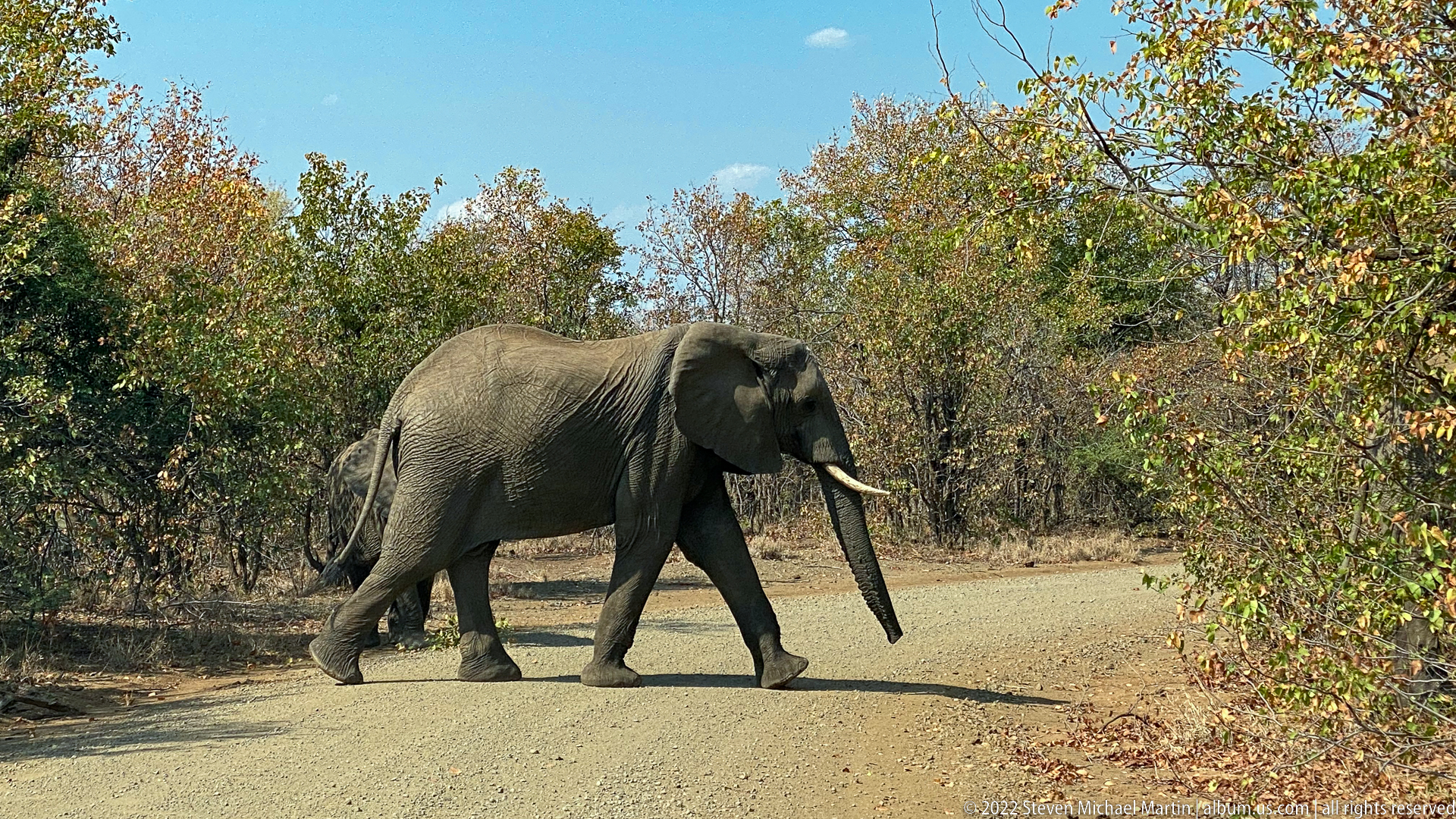
A tusked African bush elephant strides broadside across a pale gravel road, its trunk hanging nearly to the ground. One foreleg is lifted in mid-step, clearly conveying movement between dense patches of dry woodland. The unobstructed side profile provides a strong field-guide view of body mass, ear shape, tusks, trunk, and columnar legs.
Caption
A tusked African bush elephant strides broadside across a pale gravel road, its trunk hanging nearly to the ground. One foreleg is lifted in mid-step, clearly conveying movement between dense patches of dry woodland. The unobstructed side profile provides a strong field-guide view of body mass, ear shape, tusks, trunk, and columnar legs.
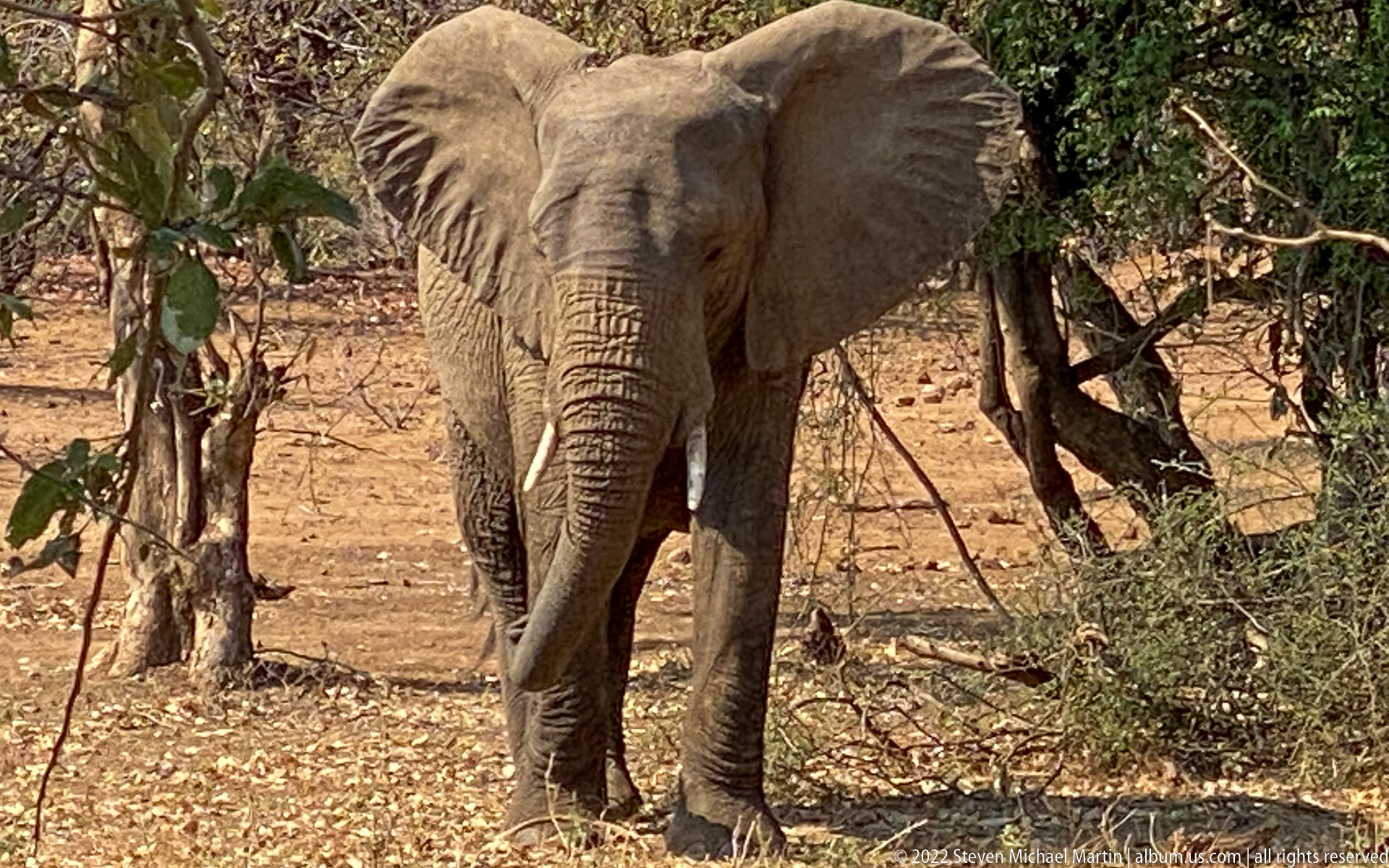
An African bush elephant stands nearly head-on beneath trees, its broad ears extended and trunk hanging straight toward the ground. Small tusks project on either side of the trunk, while deeply wrinkled skin catches alternating sun and shade. The close frontal composition emphasizes the elephant’s face, ear span, and massive forequarters within a dry woodland setting.
Caption
An African bush elephant stands nearly head-on beneath trees, its broad ears extended and trunk hanging straight toward the ground. Small tusks project on either side of the trunk, while deeply wrinkled skin catches alternating sun and shade. The close frontal composition emphasizes the elephant’s face, ear span, and massive forequarters within a dry woodland setting.
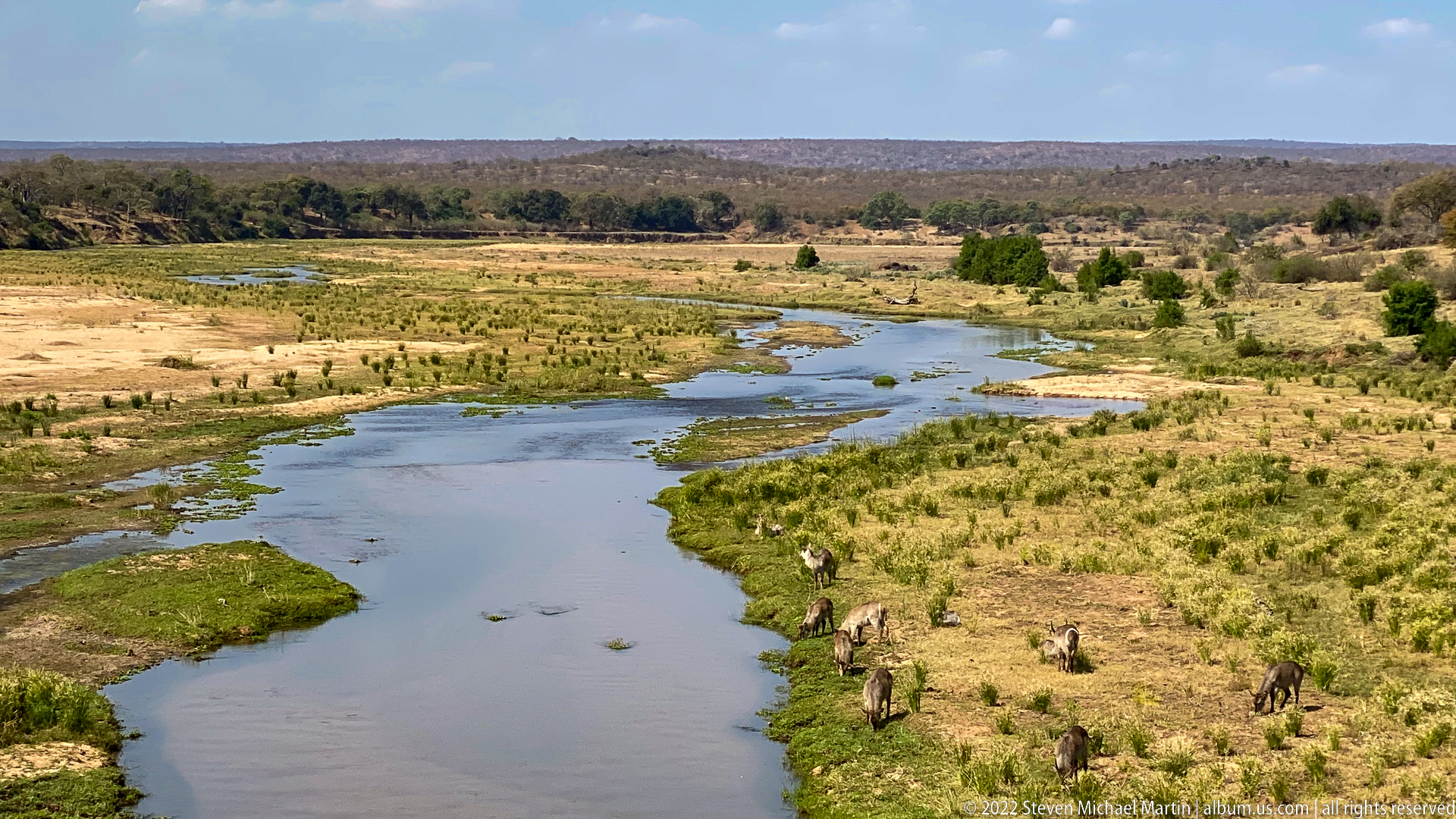
A broad river channel winds through a dry floodplain where numerous African elephants are dispersed along both banks. Some animals stand close to the water while others move across open grass and scrub, their dark forms giving scale to the expansive landscape. The elevated viewpoint transforms individual sightings into a larger ecological scene centered on water during the dry season.
Caption
A broad river channel winds through a dry floodplain where numerous African elephants are dispersed along both banks. Some animals stand close to the water while others move across open grass and scrub, their dark forms giving scale to the expansive landscape. The elevated viewpoint transforms individual sightings into a larger ecological scene centered on water during the dry season.
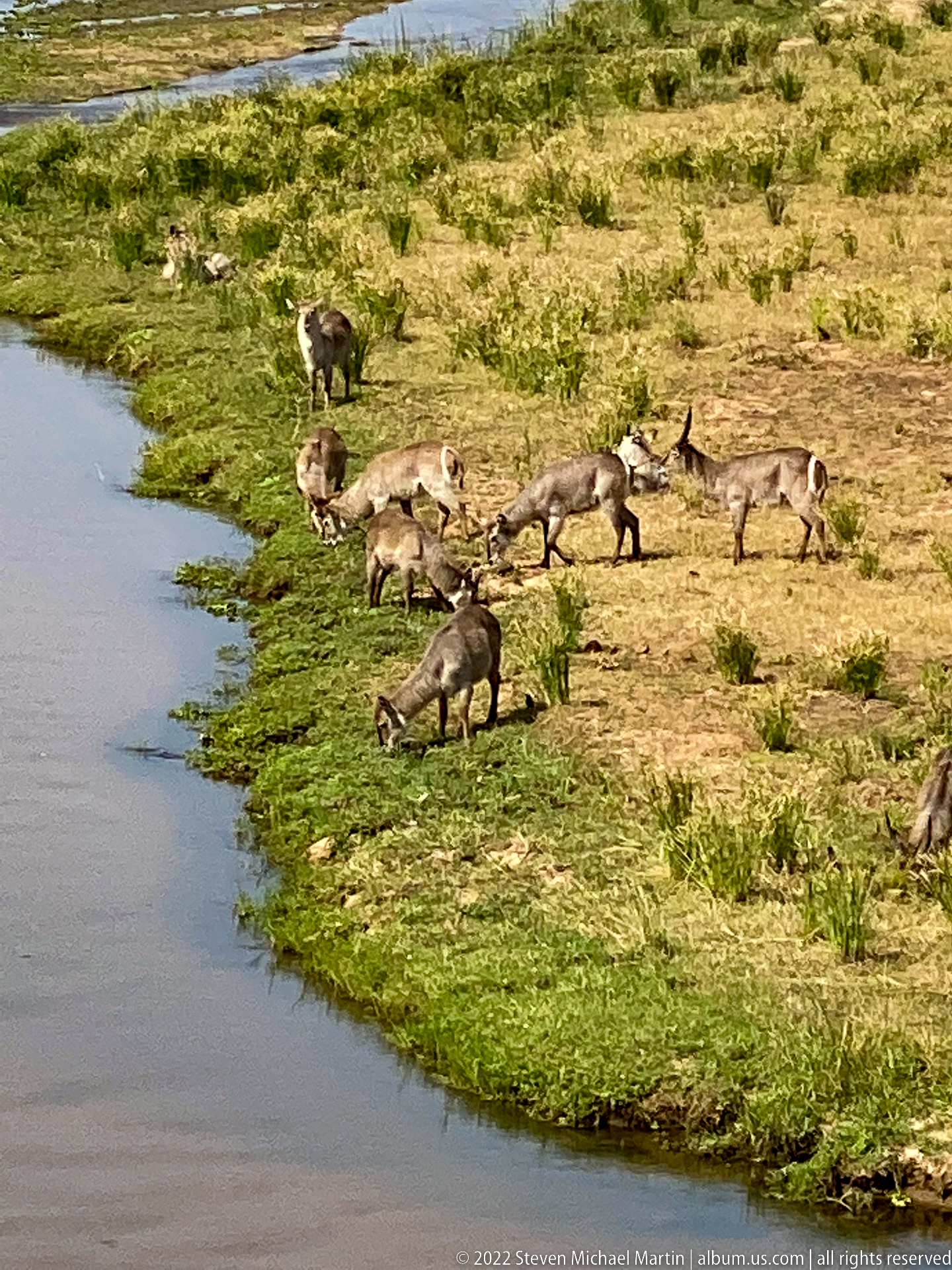
A group of waterbuck gathers along the green margin of a waterhole, several animals lowering their heads to graze or drink while others stand farther back on dry ground. Their shaggy gray-brown coats and robust antelope build distinguish them from the smaller impalas seen elsewhere in the portfolio. The shoreline congregation shows the species closely tied to permanent water.
Caption
A group of waterbuck gathers along the green margin of a waterhole, several animals lowering their heads to graze or drink while others stand farther back on dry ground. Their shaggy gray-brown coats and robust antelope build distinguish them from the smaller impalas seen elsewhere in the portfolio. The shoreline congregation shows the species closely tied to permanent water.
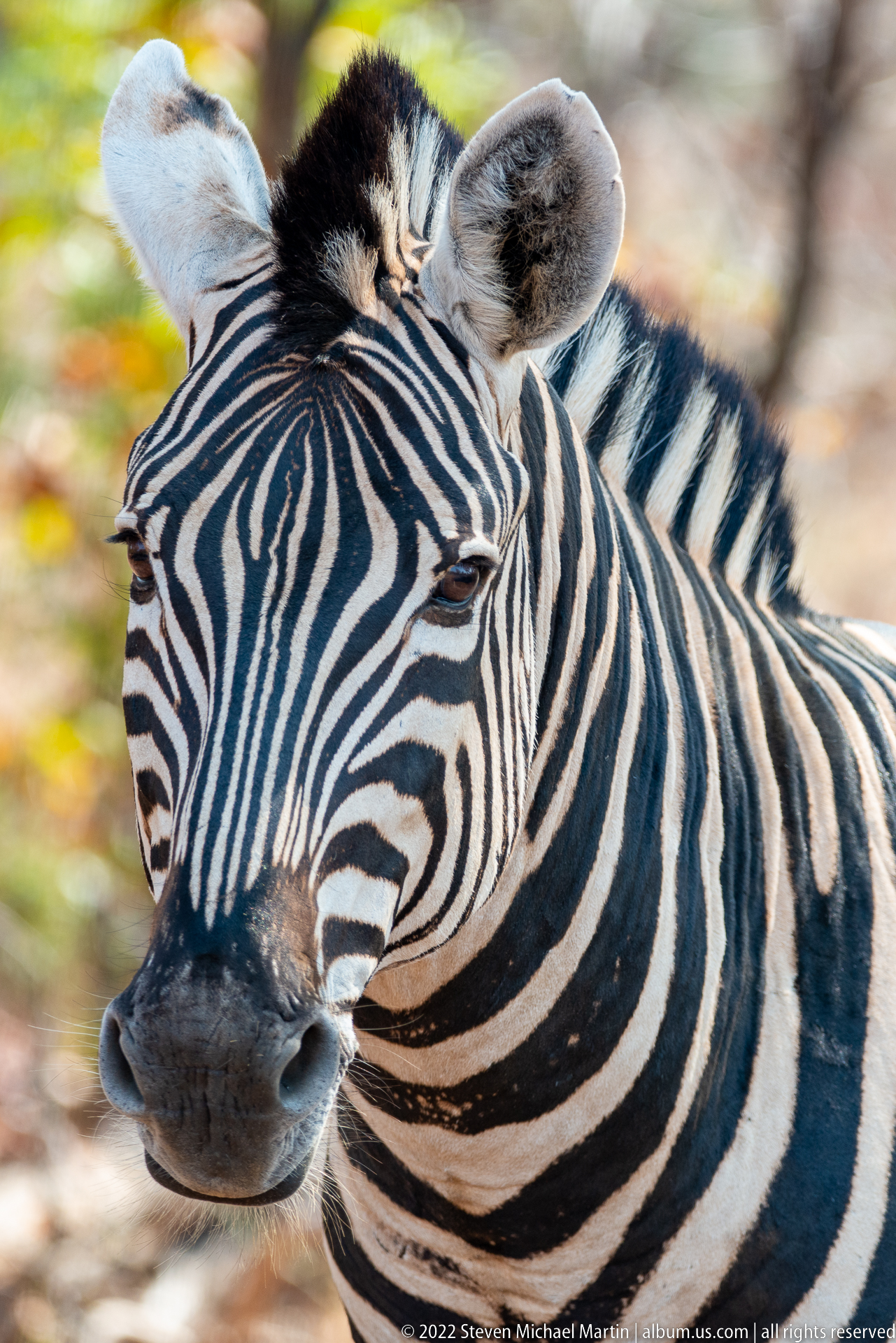
A plains zebra fills the frame from muzzle to mane, turning slightly toward the camera. Fine black-and-white stripes converge around the eye and broaden across the cheek and neck, while the upright mane continues the pattern in alternating bands. The close crop makes the animal’s individual stripe geometry and facial texture the dominant subject.
Caption
A plains zebra fills the frame from muzzle to mane, turning slightly toward the camera. Fine black-and-white stripes converge around the eye and broaden across the cheek and neck, while the upright mane continues the pattern in alternating bands. The close crop makes the animal’s individual stripe geometry and facial texture the dominant subject.
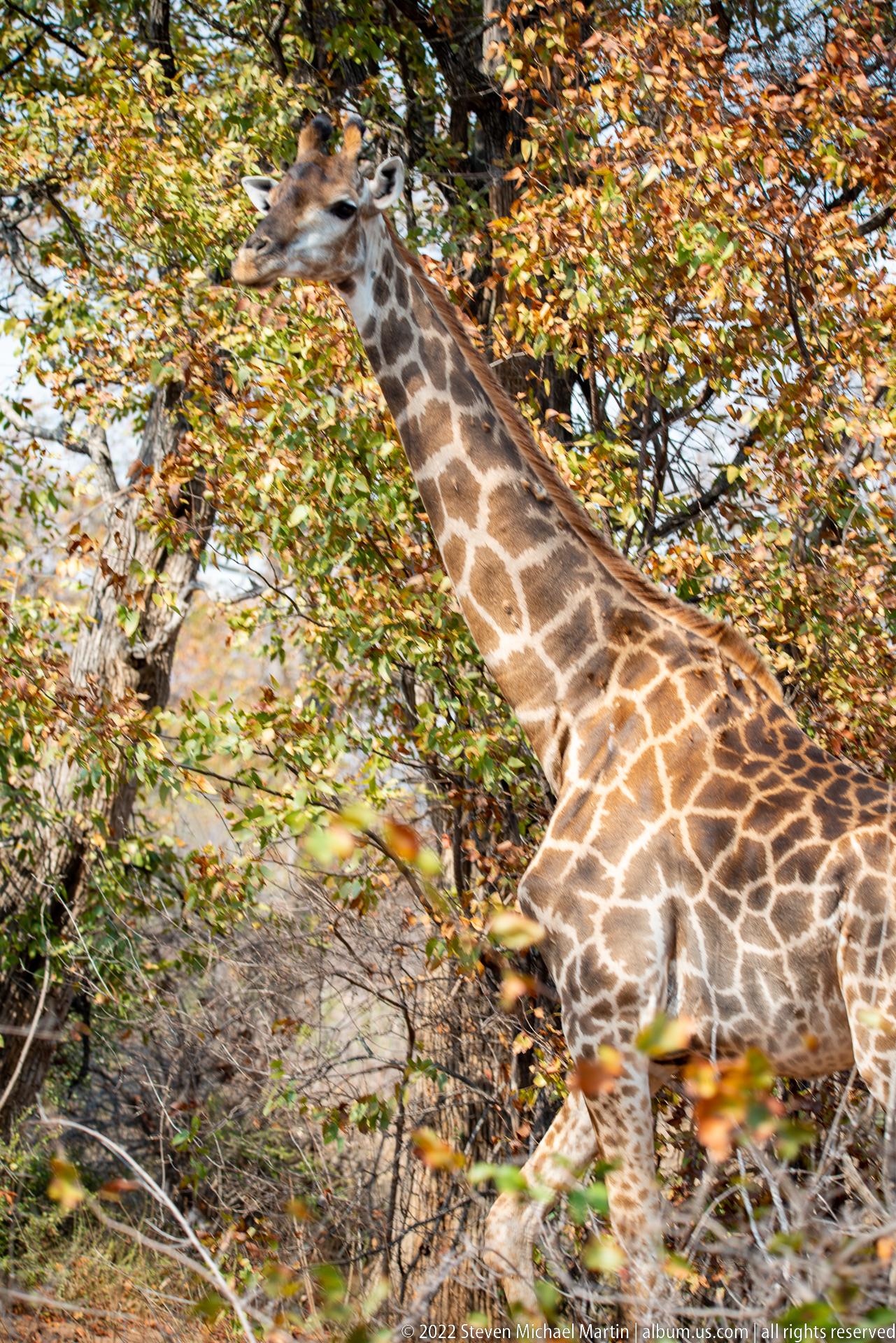
A giraffe moves through sunlit woodland in broad side profile, its patterned body crossing a layered background of orange, green, and gray foliage. The long neck extends forward slightly as the animal walks, while the black tail tuft and long legs remain visible below the canopy. Motion blur in the surroundings adds a sense of movement to this behavioral field view.
Caption
A giraffe moves through sunlit woodland in broad side profile, its patterned body crossing a layered background of orange, green, and gray foliage. The long neck extends forward slightly as the animal walks, while the black tail tuft and long legs remain visible below the canopy. Motion blur in the surroundings adds a sense of movement to this behavioral field view.
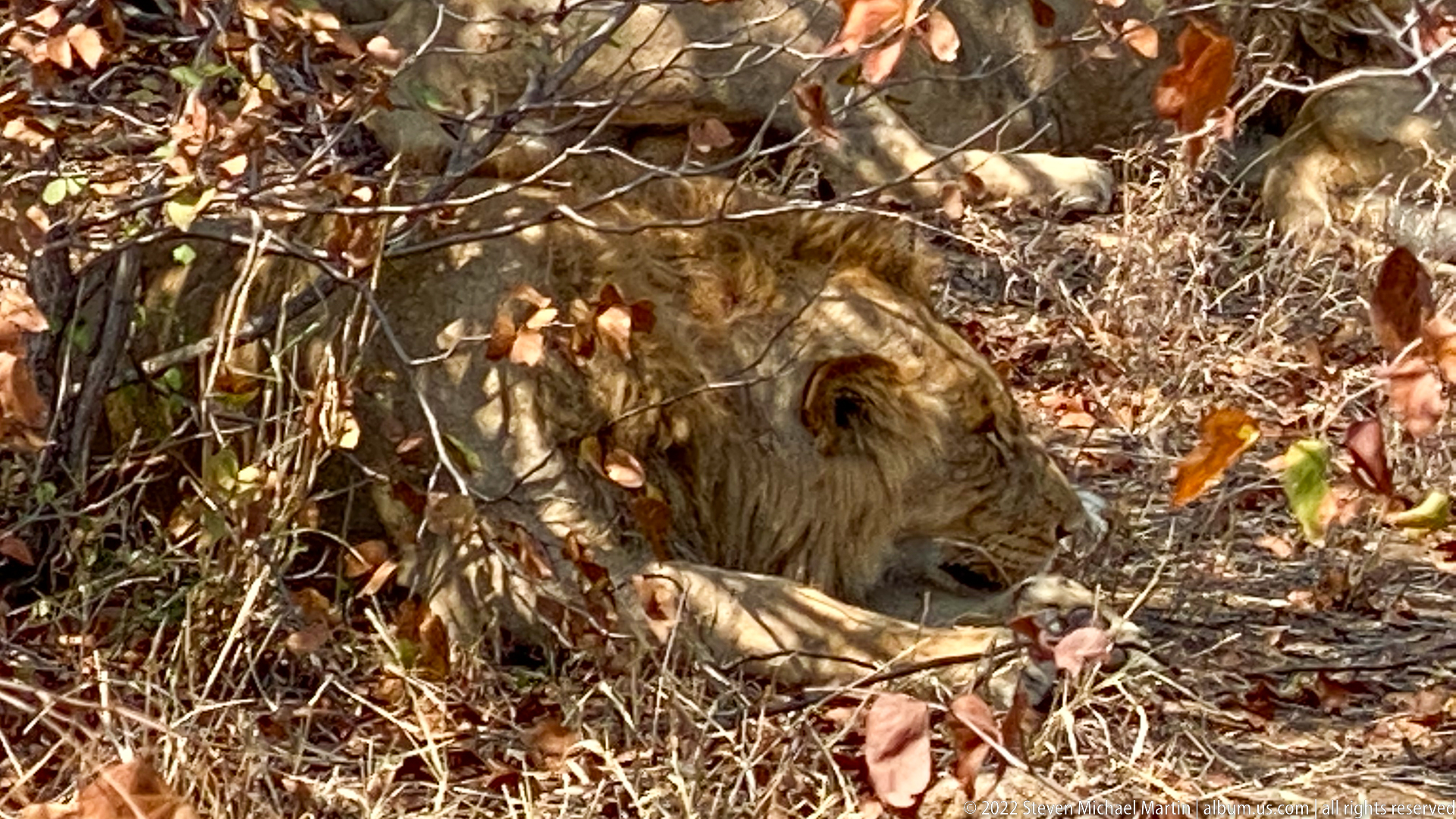
A lioness rests in deep shade beneath tangled dry branches, her tawny head and foreleg visible through the leaf litter. Rounded ears, pale muzzle, dark nose, and the heavy feline face identify the predator despite the partial concealment. The close view conveys how effectively a resting lion can disappear into the muted browns of dry-season woodland.
Caption
A lioness rests in deep shade beneath tangled dry branches, her tawny head and foreleg visible through the leaf litter. Rounded ears, pale muzzle, dark nose, and the heavy feline face identify the predator despite the partial concealment. The close view conveys how effectively a resting lion can disappear into the muted browns of dry-season woodland.
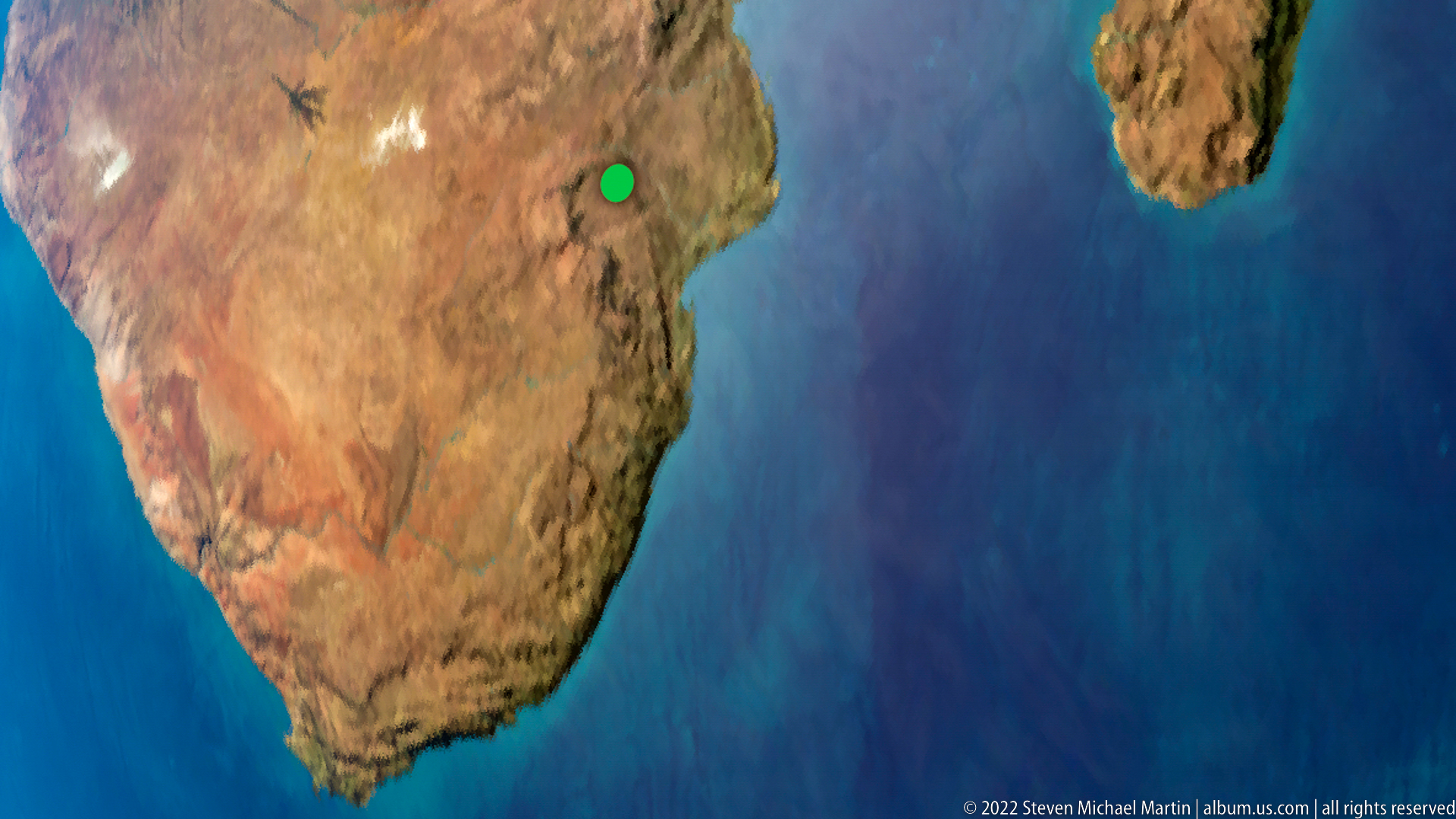
A satellite-style map of southern Africa places a green location marker in northeastern South Africa, near the Mozambique and Zimbabwe borders. The continent’s southern tip and Madagascar are visible at this scale, situating the safari geographically before returning to close wildlife studies. No finer locality is legible on the map itself.
Caption
A satellite-style map of southern Africa places a green location marker in northeastern South Africa, near the Mozambique and Zimbabwe borders. The continent’s southern tip and Madagascar are visible at this scale, situating the safari geographically before returning to close wildlife studies. No finer locality is legible on the map itself.

Dozens of impalas are scattered across a broad, dusty floodplain, some grazing while others stand alert in small clusters. Their small tawny bodies create a loose pattern across the open ground, with sparse trees and fallen trunks marking the far edge. The elevated view emphasizes herd distribution and habitat scale rather than individual anatomy.
Caption
Dozens of impalas are scattered across a broad, dusty floodplain, some grazing while others stand alert in small clusters. Their small tawny bodies create a loose pattern across the open ground, with sparse trees and fallen trunks marking the far edge. The elevated view emphasizes herd distribution and habitat scale rather than individual anatomy.

A female greater kudu turns her head slightly in a close portrait framed by dry twigs. Her hornless head, elongated muzzle, exceptionally large ears, and soft gray-brown coat are rendered in fine detail. The tight crop removes most of the body, focusing attention on the sensory features and delicate facial proportions that distinguish a kudu ewe.
Caption
A female greater kudu turns her head slightly in a close portrait framed by dry twigs. Her hornless head, elongated muzzle, exceptionally large ears, and soft gray-brown coat are rendered in fine detail. The tight crop removes most of the body, focusing attention on the sensory features and delicate facial proportions that distinguish a kudu ewe.
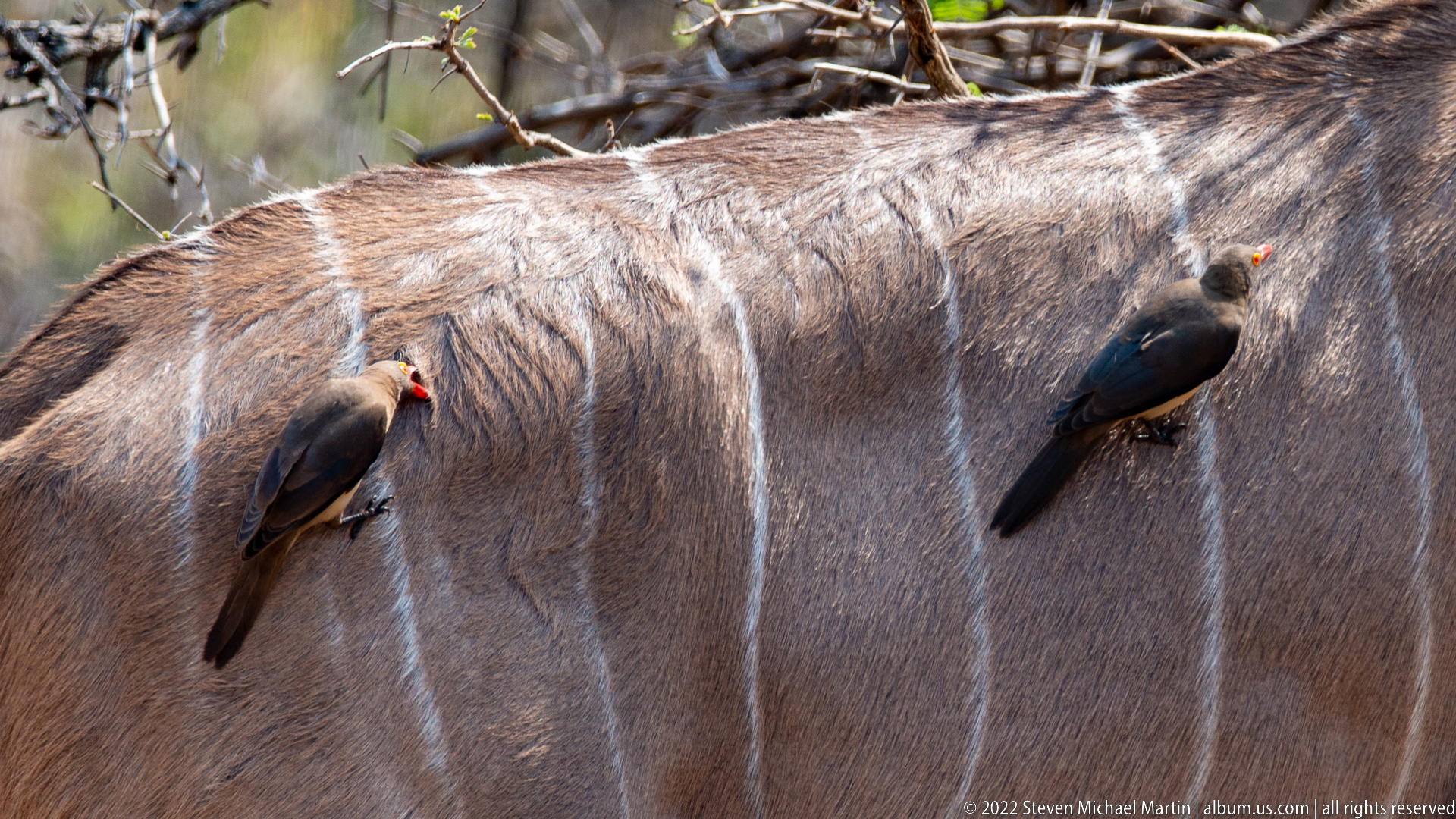
Two red-billed oxpeckers cling to the flank of a greater kudu, their dark bodies, pale underparts, and vivid red-orange bills standing out against the antelope’s gray coat and white vertical stripes. The tight crop excludes the kudu’s head, concentrating on the birds’ feeding position. The association illustrates the close contact between oxpeckers and large African ungulates.
Caption
Two red-billed oxpeckers cling to the flank of a greater kudu, their dark bodies, pale underparts, and vivid red-orange bills standing out against the antelope’s gray coat and white vertical stripes. The tight crop excludes the kudu’s head, concentrating on the birds’ feeding position. The association illustrates the close contact between oxpeckers and large African ungulates.
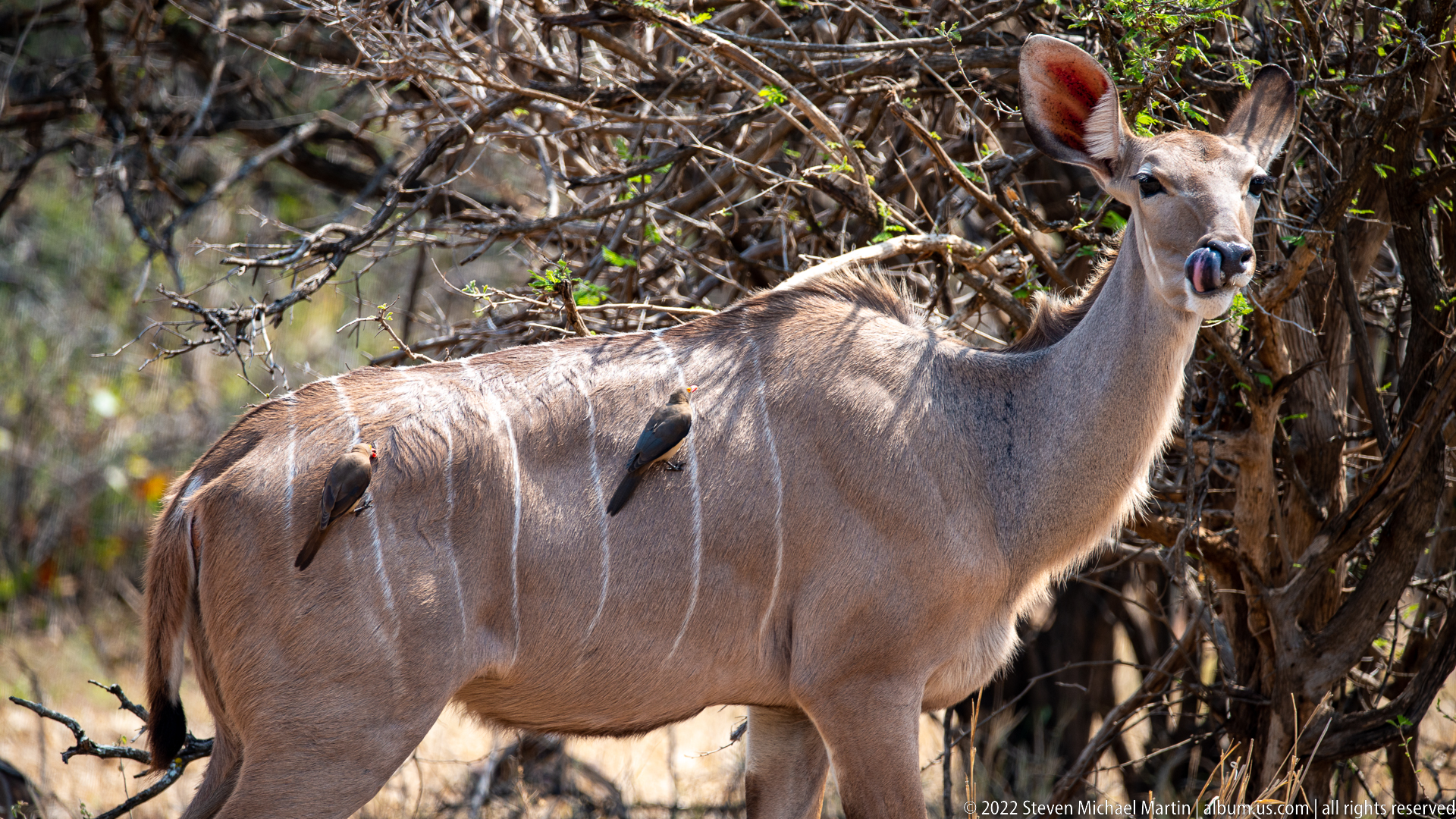
A female greater kudu stands broadside beneath tangled branches with two red-billed oxpeckers perched on her flank. White vertical stripes run down the gray-brown body, while the hornless head and large ears identify the animal as a ewe. The birds’ small dark silhouettes and bright bills add a behavioral detail to an otherwise classic full-body kudu study.
Caption
A female greater kudu stands broadside beneath tangled branches with two red-billed oxpeckers perched on her flank. White vertical stripes run down the gray-brown body, while the hornless head and large ears identify the animal as a ewe. The birds’ small dark silhouettes and bright bills add a behavioral detail to an otherwise classic full-body kudu study.
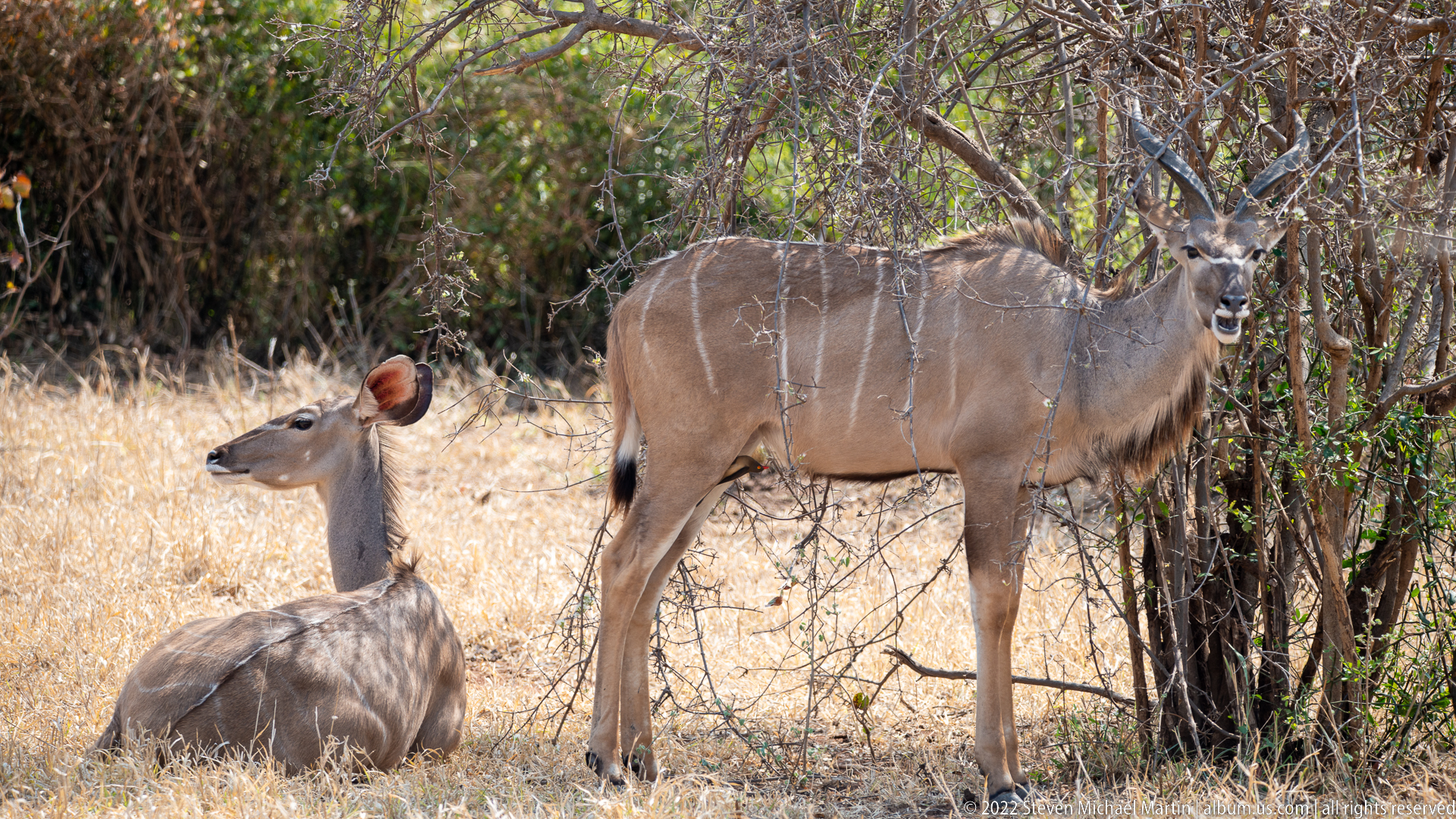
Two female greater kudus occupy the same shaded woodland clearing, one standing beneath a shrub while the other lies in pale dry grass. Both are hornless, with large ears and muted gray-brown coats marked by fine white flank stripes. Their contrasting postures create a quiet social study of the species at rest within dense cover.
Caption
Two female greater kudus occupy the same shaded woodland clearing, one standing beneath a shrub while the other lies in pale dry grass. Both are hornless, with large ears and muted gray-brown coats marked by fine white flank stripes. Their contrasting postures create a quiet social study of the species at rest within dense cover.
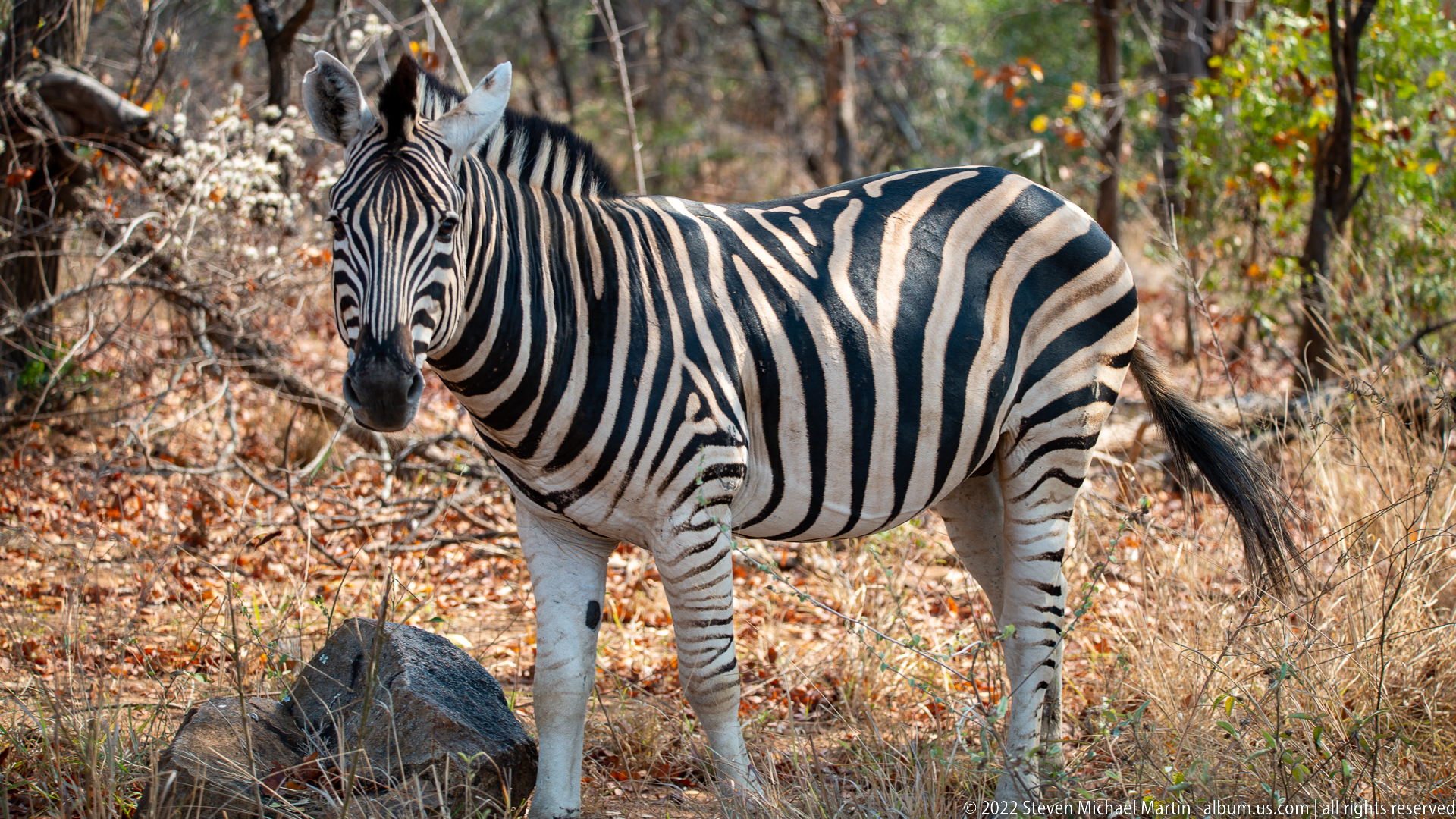
A plains zebra stands nearly broadside in dry woodland, its entire body visible from upright ears to black-tufted tail. Bold stripes wrap across the barrel and legs, while a dark rock and fallen leaves anchor the foreground. The complete-body view contrasts with the preceding close portrait and clearly records the zebra’s proportions in habitat.
Caption
A plains zebra stands nearly broadside in dry woodland, its entire body visible from upright ears to black-tufted tail. Bold stripes wrap across the barrel and legs, while a dark rock and fallen leaves anchor the foreground. The complete-body view contrasts with the preceding close portrait and clearly records the zebra’s proportions in habitat.
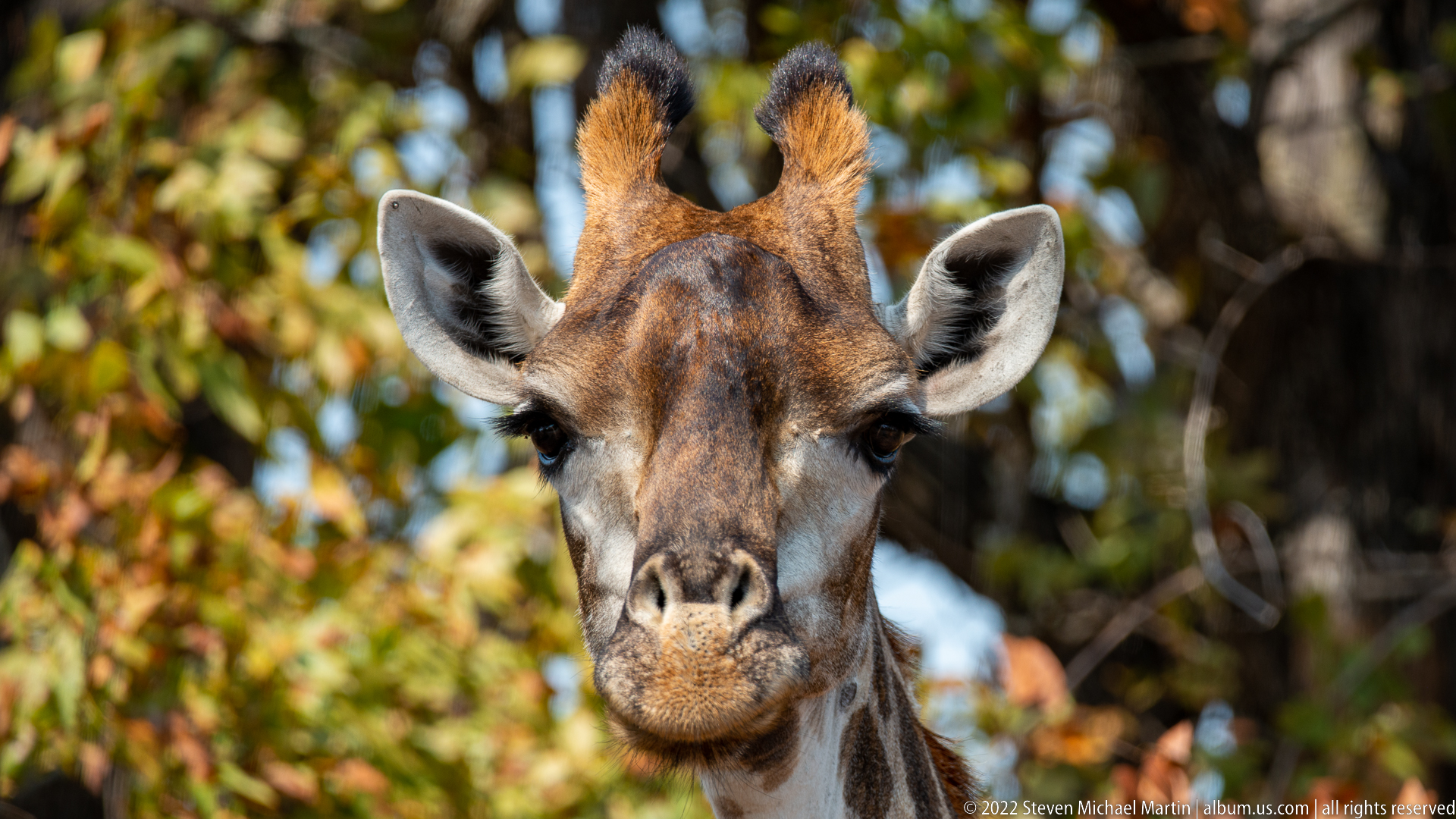
A giraffe faces the camera in a tight head portrait, with both ossicones, large pale-edged ears, dark eyes, and broad muzzle fully visible. Warm brown forehead markings stand out against softly blurred woodland. By excluding the animal’s famously long neck, the composition concentrates on the distinctive facial anatomy and horn-like ossicones used to recognize the species.
Caption
A giraffe faces the camera in a tight head portrait, with both ossicones, large pale-edged ears, dark eyes, and broad muzzle fully visible. Warm brown forehead markings stand out against softly blurred woodland. By excluding the animal’s famously long neck, the composition concentrates on the distinctive facial anatomy and horn-like ossicones used to recognize the species.
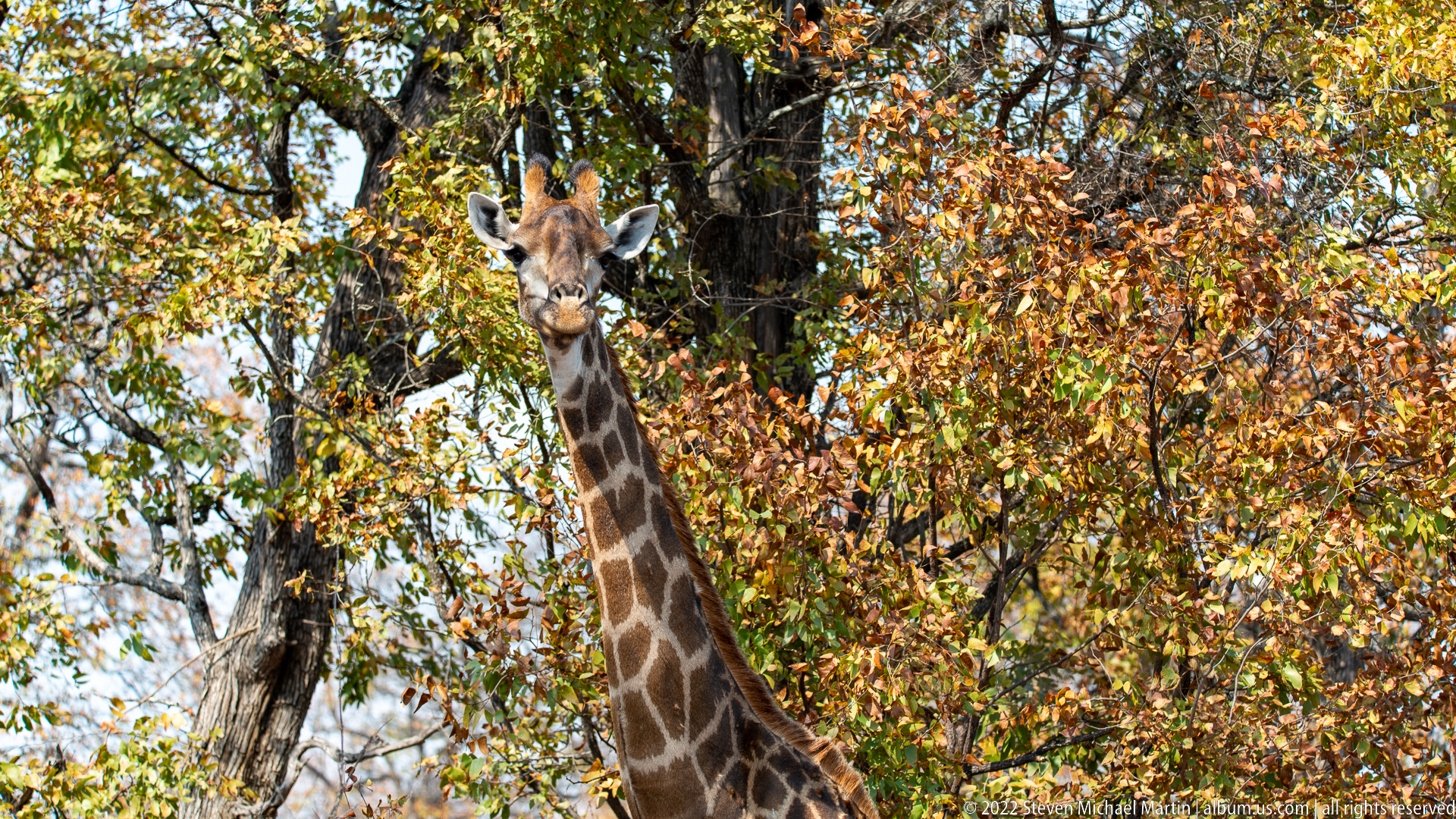
A giraffe looks directly toward the camera from among dense woodland, its long neck rising vertically through mottled autumn-toned foliage. The small ossicones, broad ears, dark eyes, and patchwork coat remain clearly visible despite the busy background. The frontal orientation differs from nearby side views, emphasizing the animal’s towering height and alert head posture within wooded habitat.
Caption
A giraffe looks directly toward the camera from among dense woodland, its long neck rising vertically through mottled autumn-toned foliage. The small ossicones, broad ears, dark eyes, and patchwork coat remain clearly visible despite the busy background. The frontal orientation differs from nearby side views, emphasizing the animal’s towering height and alert head posture within wooded habitat.
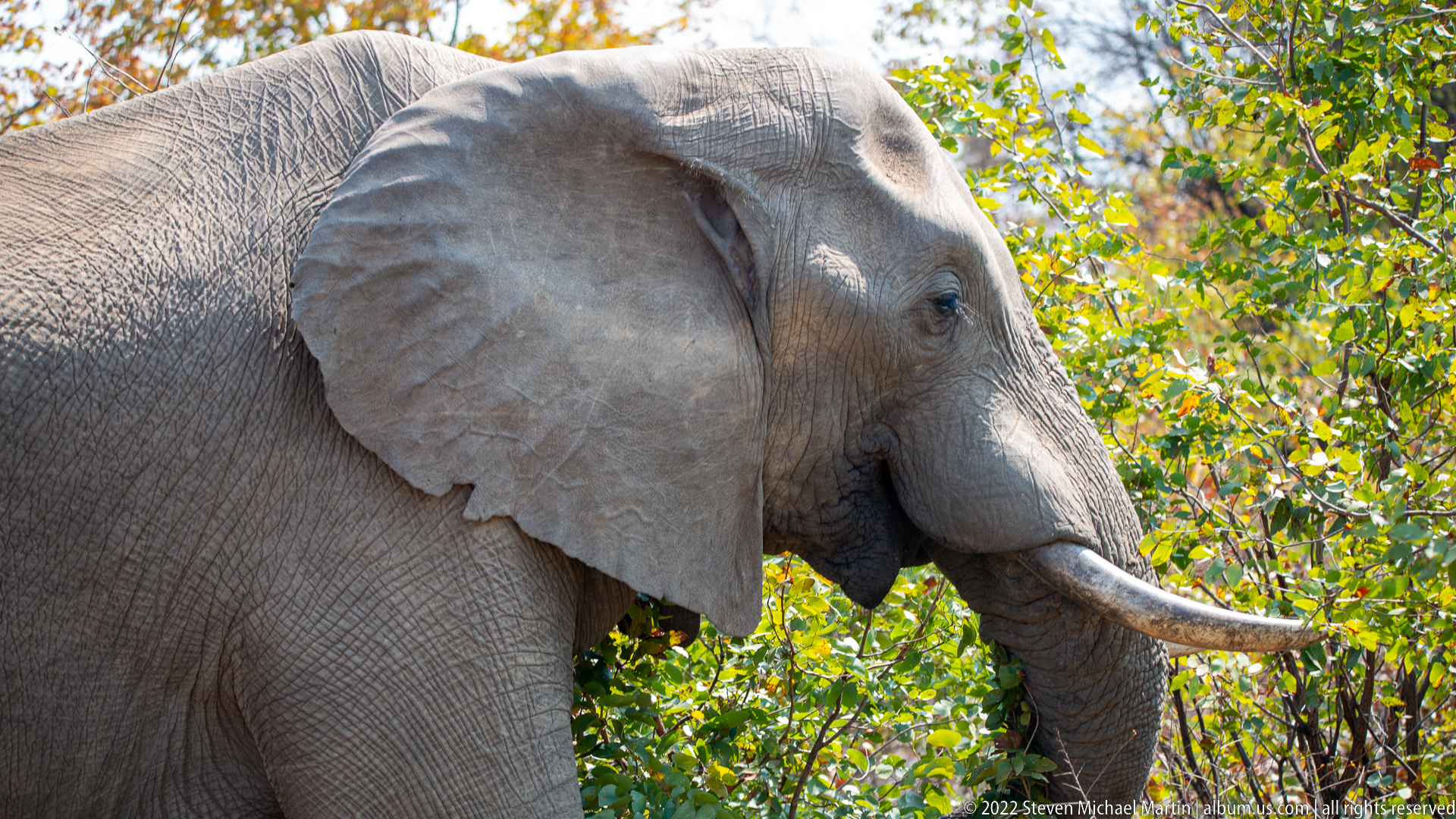
An African bush elephant fills the frame from shoulder to tusk in a close side portrait. The broad ear, deeply wrinkled skin, small eye, and long ivory tusk are sharply defined against bright green foliage. Cropping away most of the body turns attention toward the elephant’s head anatomy and the textural contrast between skin, ear folds, and smooth tusk.
Caption
An African bush elephant fills the frame from shoulder to tusk in a close side portrait. The broad ear, deeply wrinkled skin, small eye, and long ivory tusk are sharply defined against bright green foliage. Cropping away most of the body turns attention toward the elephant’s head anatomy and the textural contrast between skin, ear folds, and smooth tusk.
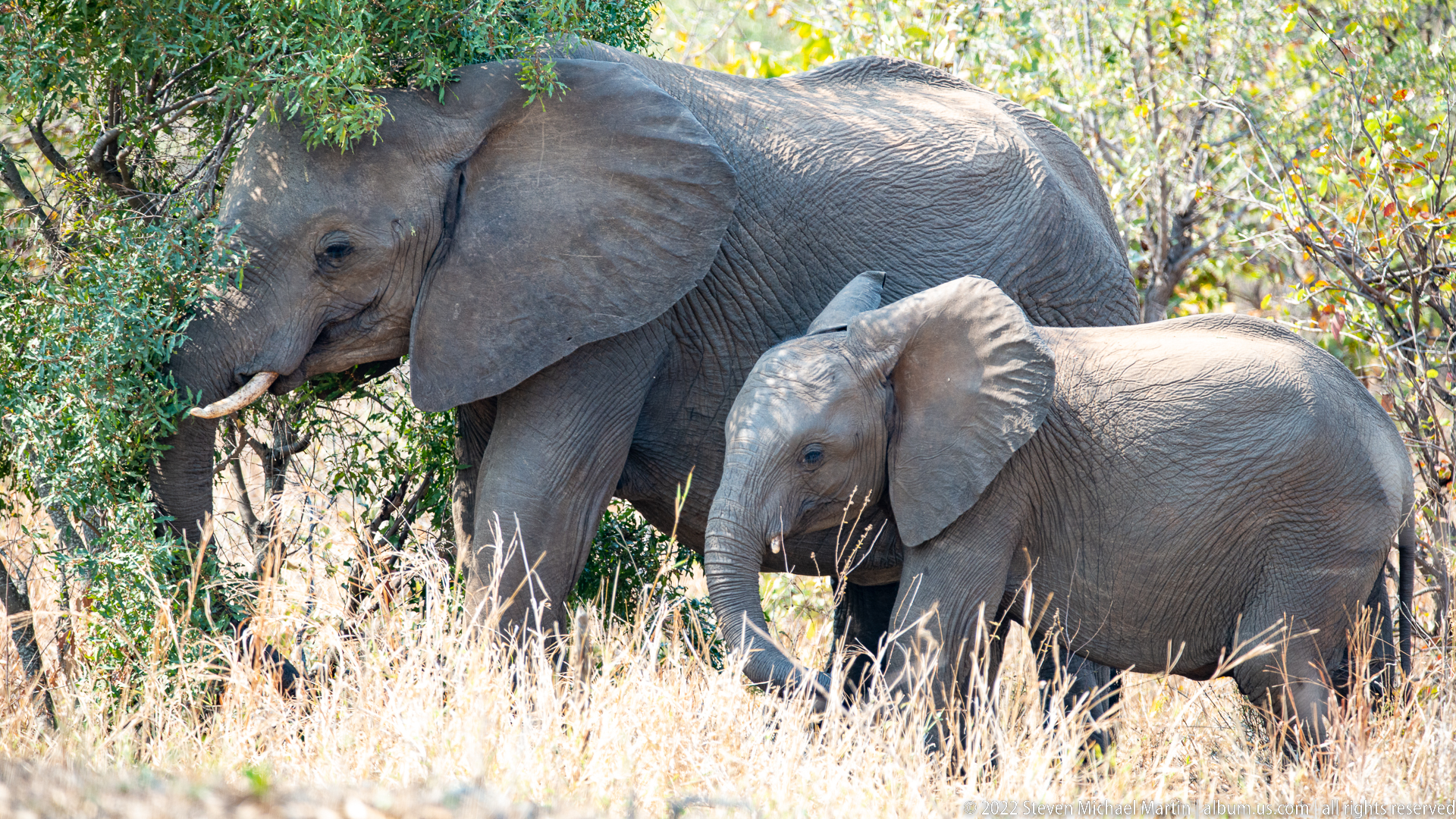
An adult African bush elephant walks through tall dry grass with a juvenile closely beside it. The adult’s tusks and large body contrast with the smaller youngster’s shorter trunk and compact proportions, while both move in the same direction beneath dappled woodland light. Their close spacing creates a clear age comparison within a family-group scene.
Caption
An adult African bush elephant walks through tall dry grass with a juvenile closely beside it. The adult’s tusks and large body contrast with the smaller youngster’s shorter trunk and compact proportions, while both move in the same direction beneath dappled woodland light. Their close spacing creates a clear age comparison within a family-group scene.
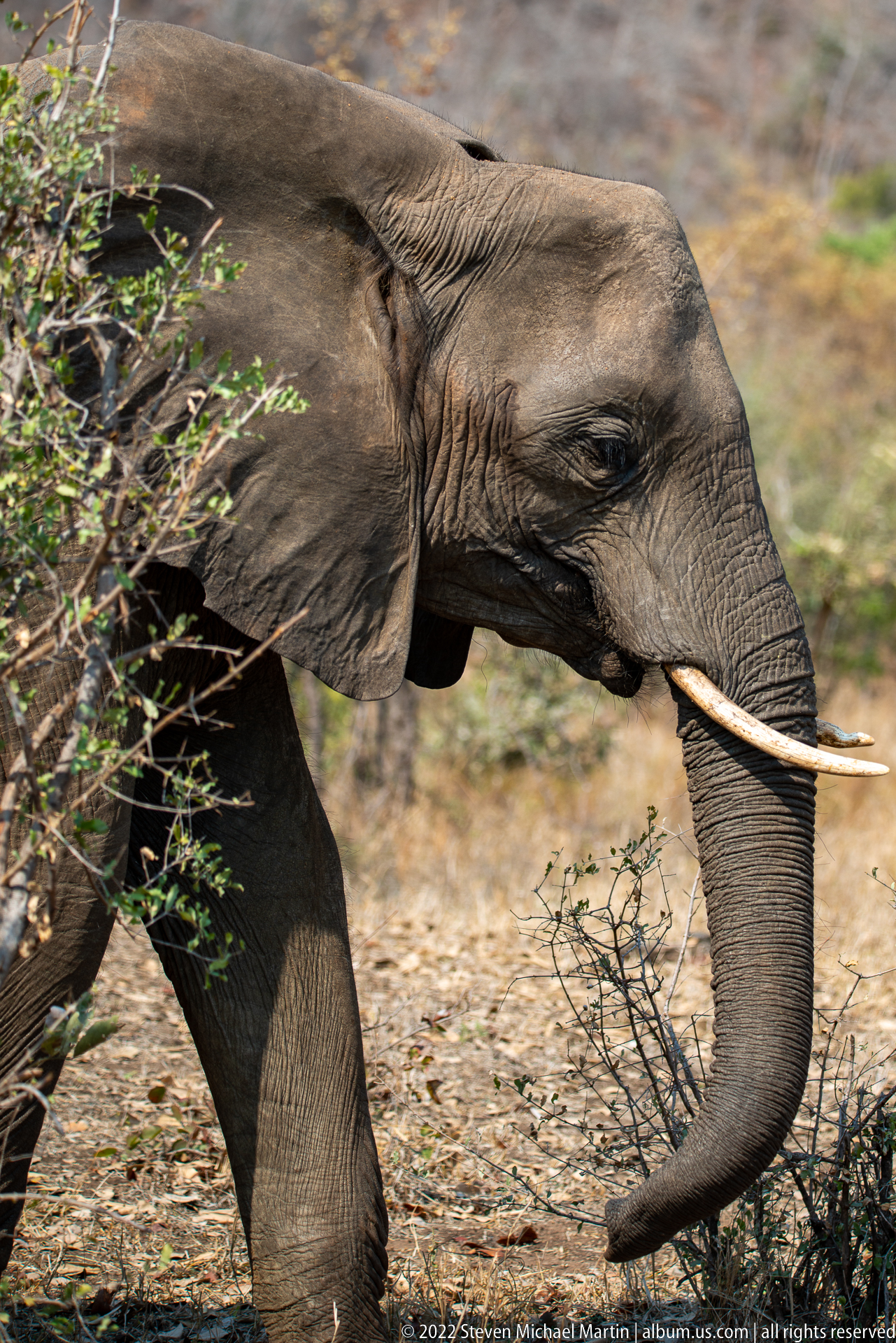
A tusked African bush elephant strides through dry woodland while curling the tip of its trunk upward toward its mouth. The full side profile reveals the animal’s columnar legs, broad ear, textured skin, and two forward-pointing tusks. The lifted trunk gives this frame a distinct behavioral emphasis compared with more static elephant portraits in the sequence.
Caption
A tusked African bush elephant strides through dry woodland while curling the tip of its trunk upward toward its mouth. The full side profile reveals the animal’s columnar legs, broad ear, textured skin, and two forward-pointing tusks. The lifted trunk gives this frame a distinct behavioral emphasis compared with more static elephant portraits in the sequence.
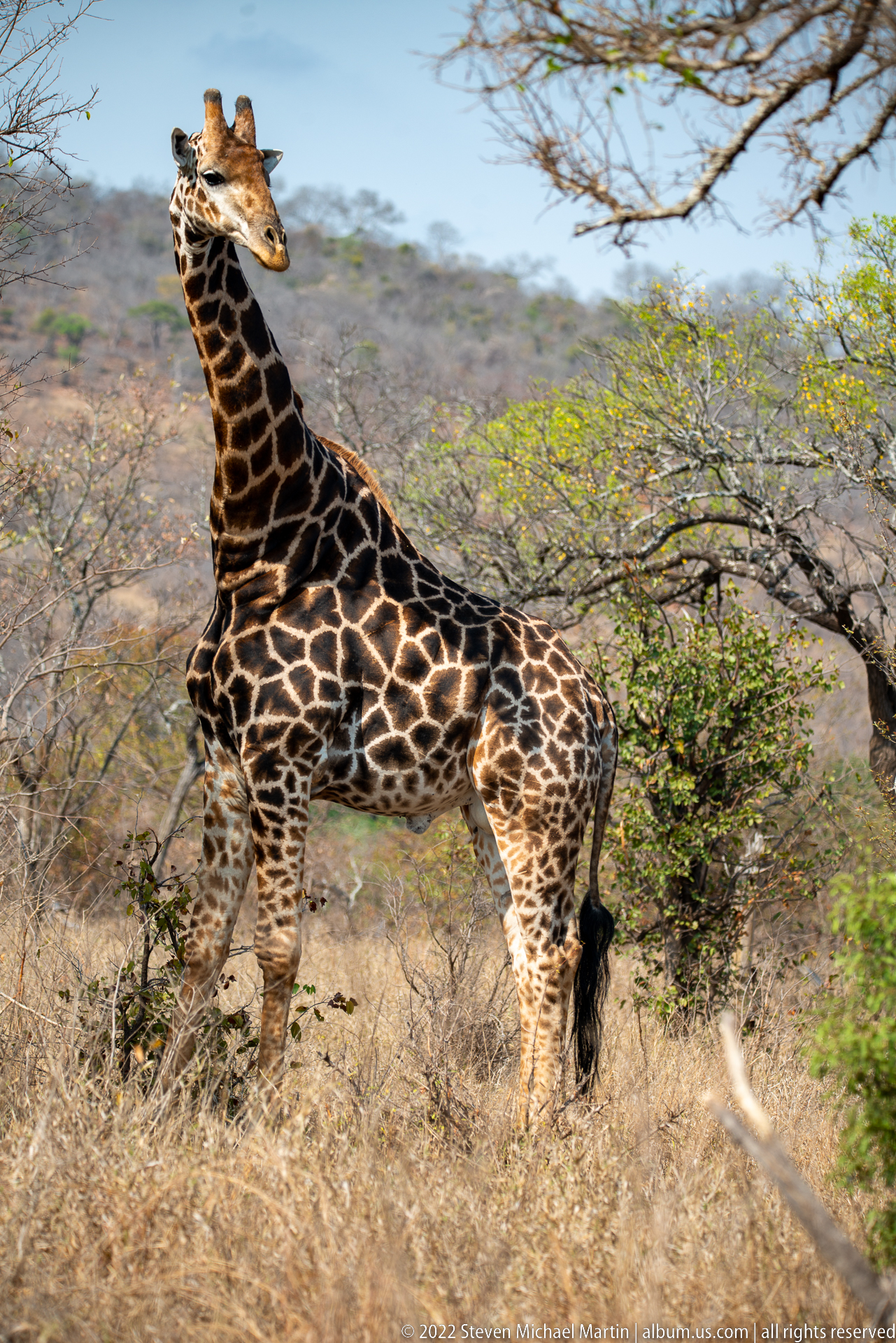
A giraffe stands in a dry woodland clearing in nearly complete side profile, its long legs and patterned body fully visible from hooves to neck. Sparse shrubs overlap parts of the torso, while the dark tail tuft hangs behind the rump. The broad framing provides a useful sense of the giraffe’s full proportions against low bushveld vegetation.
Caption
A giraffe stands in a dry woodland clearing in nearly complete side profile, its long legs and patterned body fully visible from hooves to neck. Sparse shrubs overlap parts of the torso, while the dark tail tuft hangs behind the rump. The broad framing provides a useful sense of the giraffe’s full proportions against low bushveld vegetation.

A giraffe’s head and upper neck fill the frame against a softly blurred landscape. The paired ossicones, large ears, dark eye, patterned cheek, and broad muzzle are sharply rendered in profile. The tight crop isolates the animal from its habitat and emphasizes the angular facial structure and irregular coat markings unique to the individual.
Caption
A giraffe’s head and upper neck fill the frame against a softly blurred landscape. The paired ossicones, large ears, dark eye, patterned cheek, and broad muzzle are sharply rendered in profile. The tight crop isolates the animal from its habitat and emphasizes the angular facial structure and irregular coat markings unique to the individual.
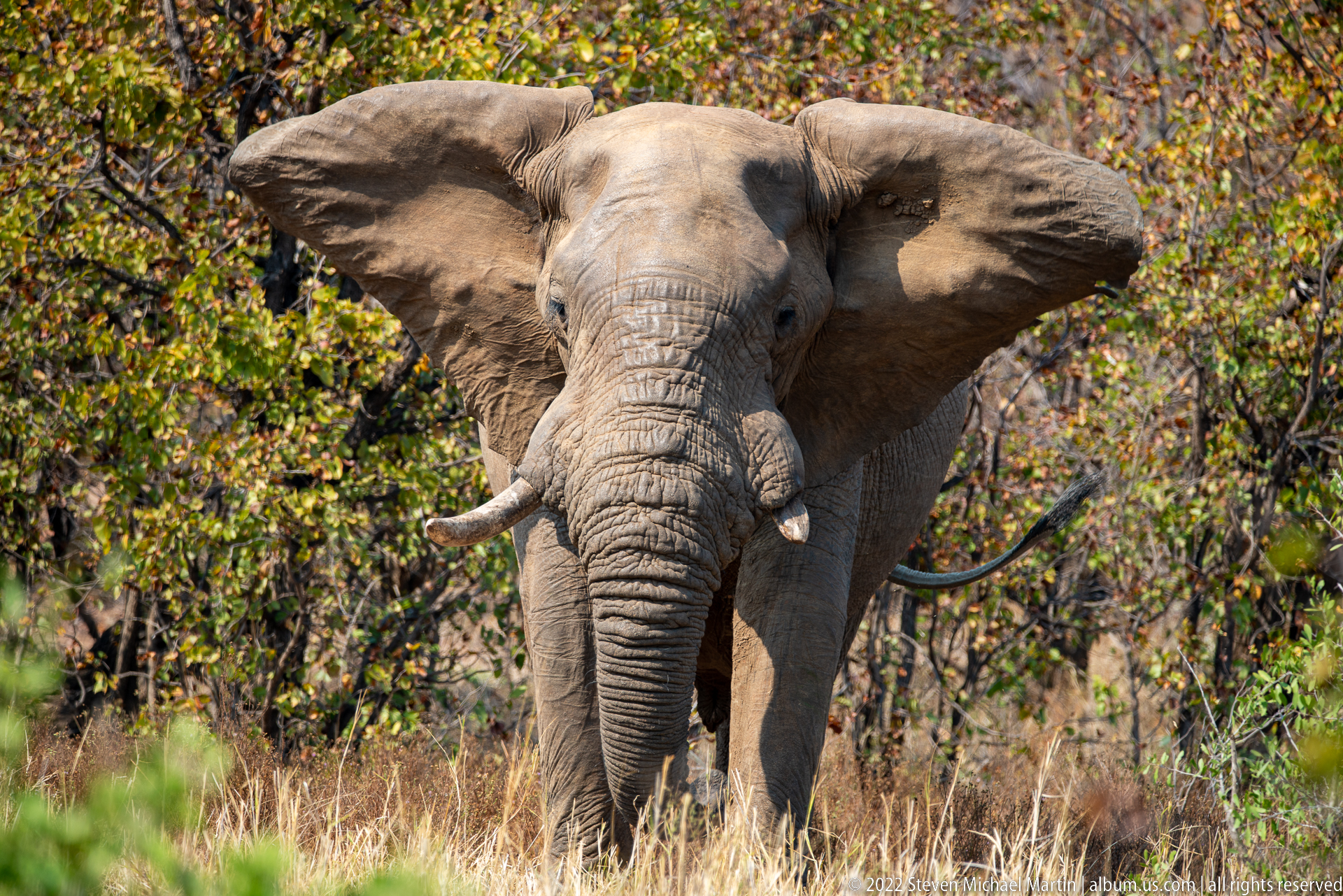
An African bush elephant faces the camera with both ears spread broadly, presenting a large frontal silhouette in dry woodland. The trunk hangs down the center, one tusk is more prominent than the other, and the forelegs are planted squarely beneath the head. The expanded ears create an assertive posture while also providing a strong field-guide view of elephant facial proportions.
Caption
An African bush elephant faces the camera with both ears spread broadly, presenting a large frontal silhouette in dry woodland. The trunk hangs down the center, one tusk is more prominent than the other, and the forelegs are planted squarely beneath the head. The expanded ears create an assertive posture while also providing a strong field-guide view of elephant facial proportions.
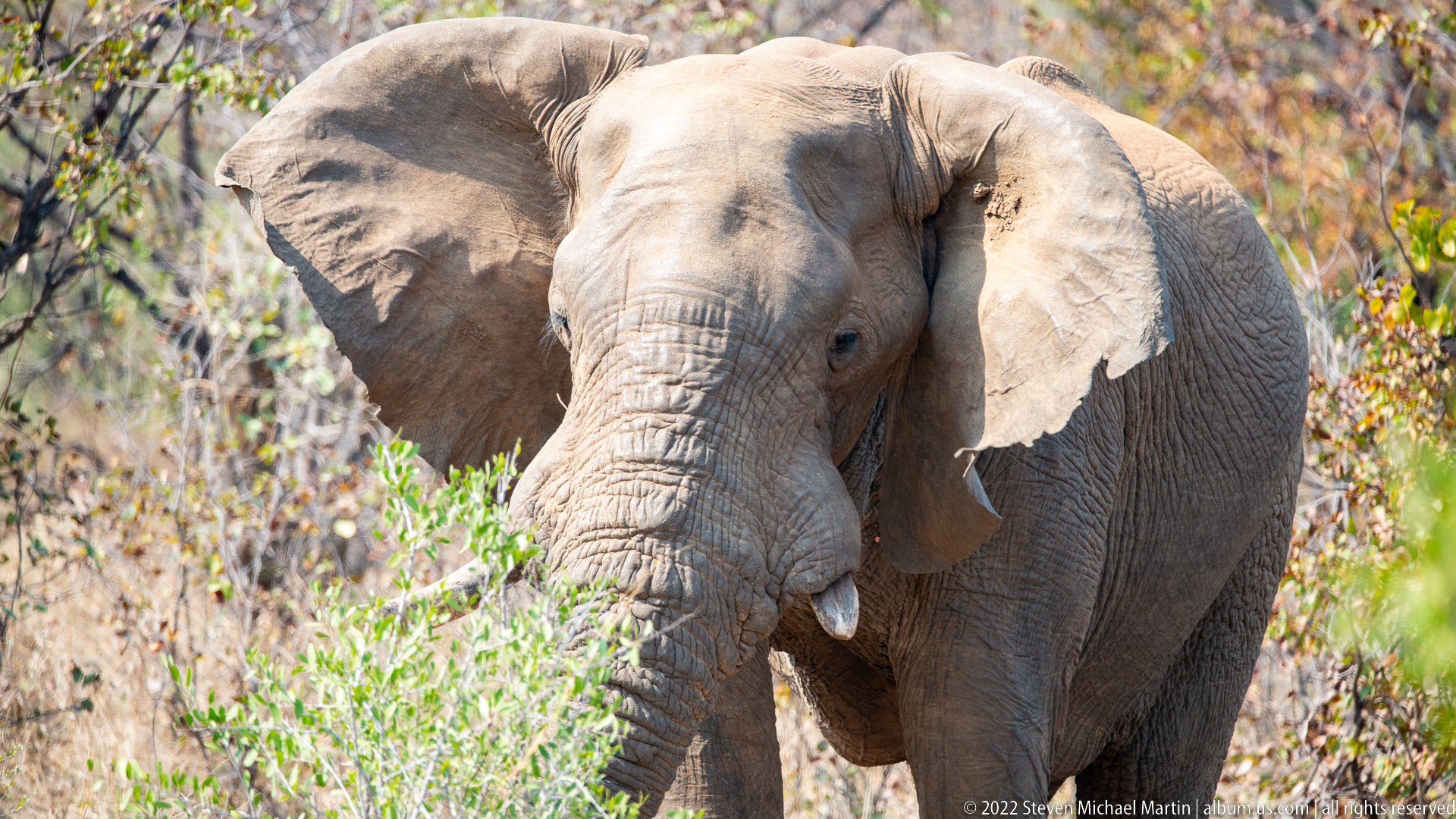
An African bush elephant approaches through low green brush, its head nearly filling the frame while the body remains partly screened by vegetation. One tusk and the hanging trunk are visible beneath broad ears, and the textured forehead catches strong sunlight. The close frontal angle creates a more intimate view than the wider elephant studies preceding it.
Caption
An African bush elephant approaches through low green brush, its head nearly filling the frame while the body remains partly screened by vegetation. One tusk and the hanging trunk are visible beneath broad ears, and the textured forehead catches strong sunlight. The close frontal angle creates a more intimate view than the wider elephant studies preceding it.
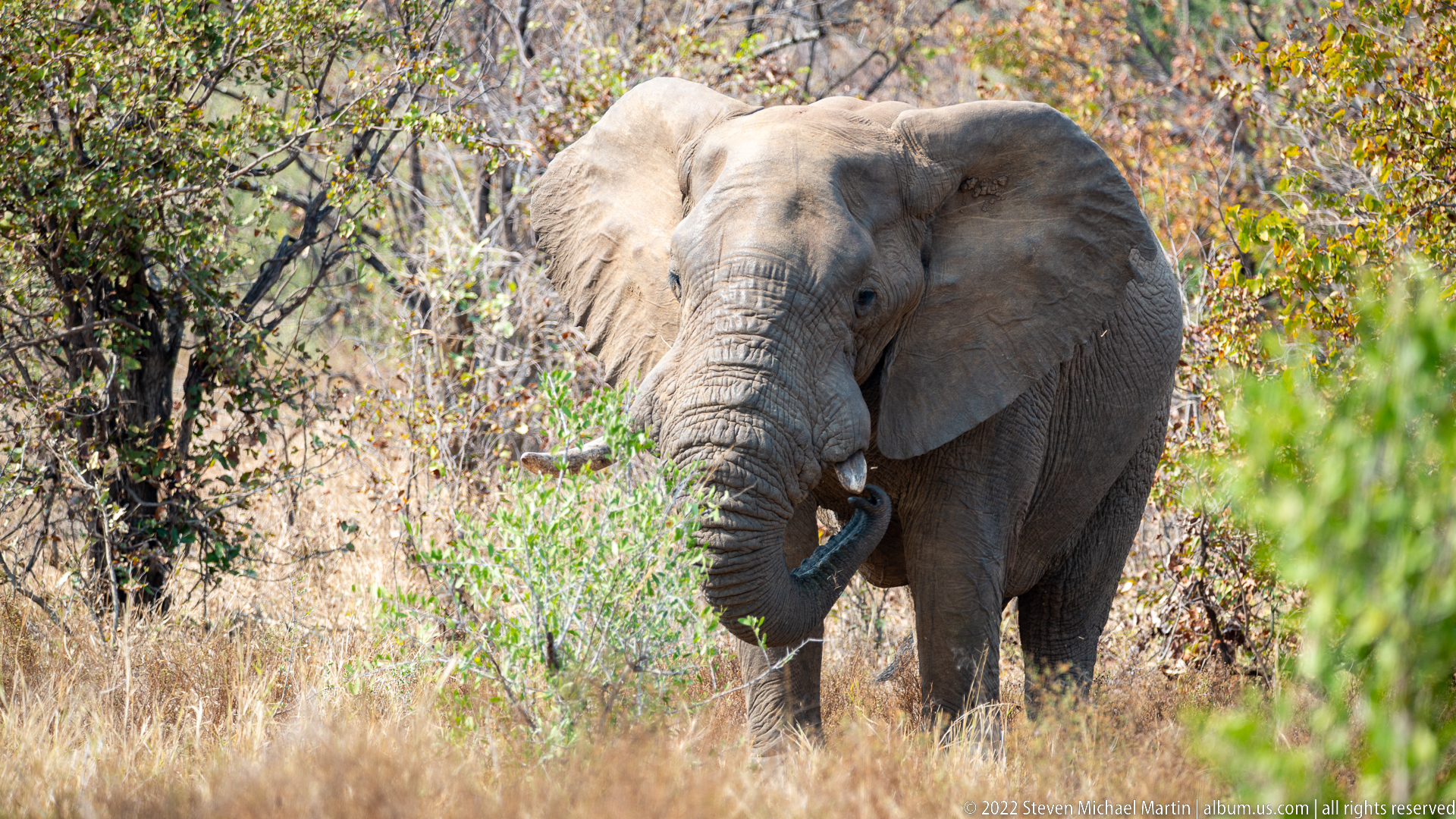
A tusked African bush elephant stands in tall dry grass while curling its trunk around or toward vegetation near its mouth. The animal faces almost directly forward, with both ears relaxed and the trunk’s muscular curve forming the central action. This frame emphasizes feeding or investigative trunk use rather than simple movement through the habitat.
Caption
A tusked African bush elephant stands in tall dry grass while curling its trunk around or toward vegetation near its mouth. The animal faces almost directly forward, with both ears relaxed and the trunk’s muscular curve forming the central action. This frame emphasizes feeding or investigative trunk use rather than simple movement through the habitat.
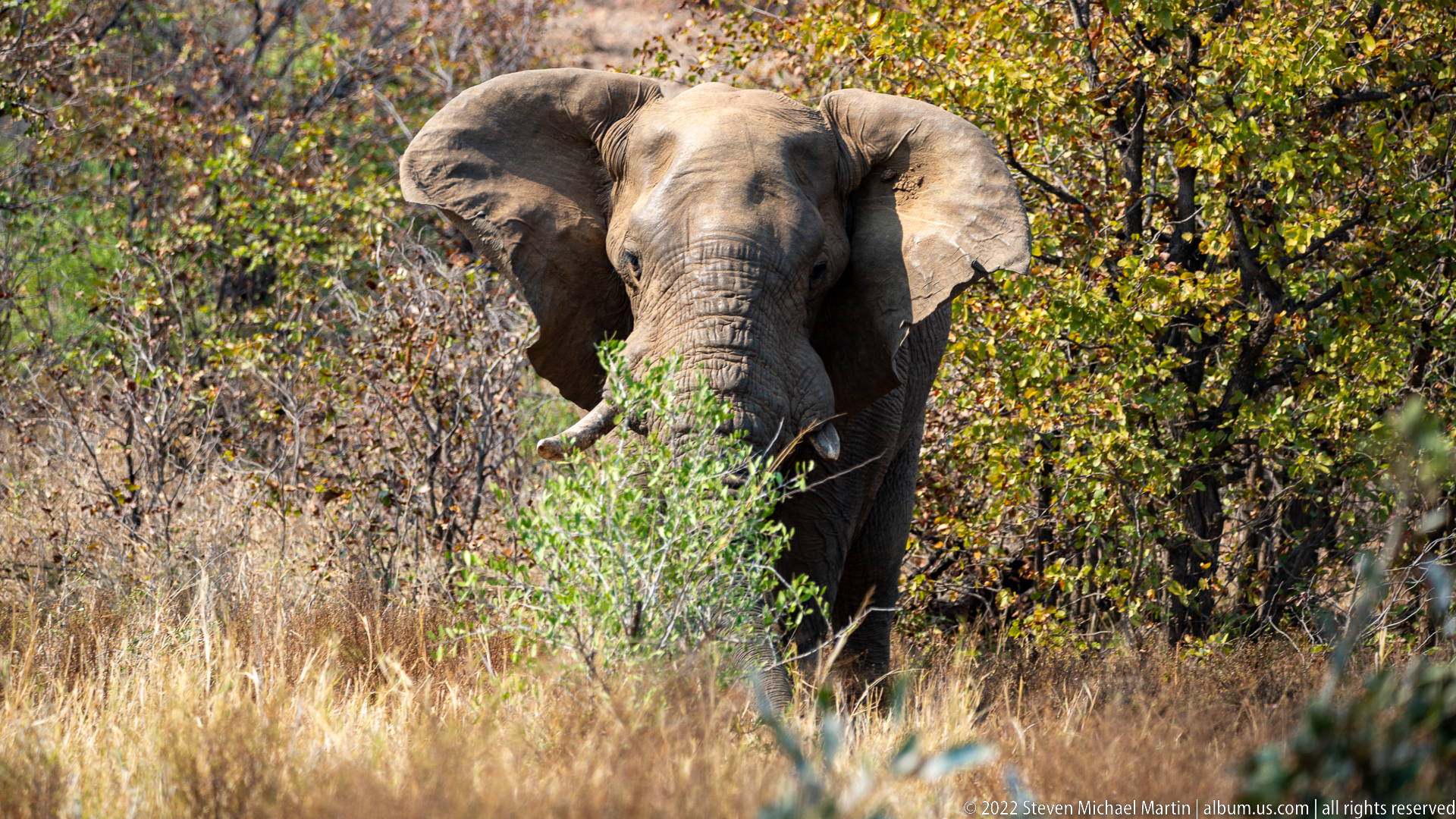
An African bush elephant stands behind a bright green shrub, with its trunk, tusks, head, and shoulders emerging through the foliage. Dry golden grass fills the foreground while orange-brown woodland forms the backdrop. The vegetation partially masks the lower face, showing how even a massive elephant can become visually fragmented within dense bush.
Caption
An African bush elephant stands behind a bright green shrub, with its trunk, tusks, head, and shoulders emerging through the foliage. Dry golden grass fills the foreground while orange-brown woodland forms the backdrop. The vegetation partially masks the lower face, showing how even a massive elephant can become visually fragmented within dense bush.
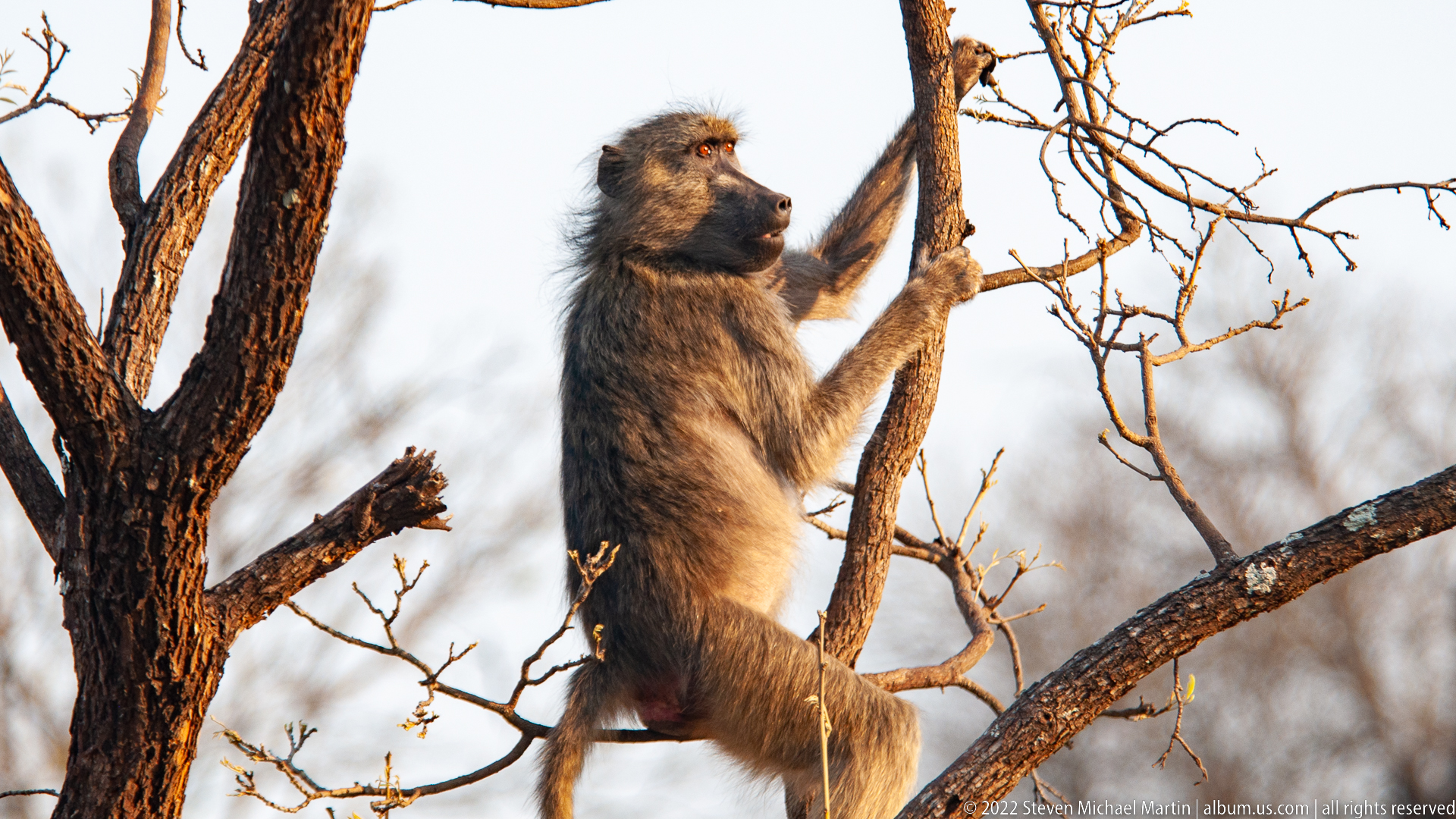
A chacma baboon sits upright in the fork of a bare-branched tree, gripping two limbs with its hands while looking outward. Warm sunlight picks out the shaggy brown-gray coat, elongated dark muzzle, and reddish skin around the eyes. The elevated posture and exposed branch network make this a clear study of arboreal balance and manual grasping.
Caption
A chacma baboon sits upright in the fork of a bare-branched tree, gripping two limbs with its hands while looking outward. Warm sunlight picks out the shaggy brown-gray coat, elongated dark muzzle, and reddish skin around the eyes. The elevated posture and exposed branch network make this a clear study of arboreal balance and manual grasping.
Kruger National Park – Punda Maria
Punda Maria sits in the far northern reaches of Kruger National Park, where the landscape transitions into dense woodland and scattered baobab trees. This quieter region offers a slower safari rhythm, rewarding patience with intimate wildlife encounters and rich birdlife diversity.
Compared with the open grasslands of central Kruger, the north feels more secluded and reflective. Elephants move quietly through dry bushveld, greater kudu browse among thick vegetation, and colorful birds perch along winding river corridors. Observation hides and elevated viewpoints encourage visitors to pause, observe carefully, and appreciate the subtleties of the ecosystem.
Portfolio Highlights
- Elephants moving through quiet northern bushveld terrain
- Greater kudu browsing within dense woodland habitat
- Giraffes feeding among scattered trees and rolling hills
- Bird hides offering close observation of wetland species
- Baobab trees defining the northern Kruger landscape
- Zebra and antelope adapted to mixed woodland environments
- River systems sustaining life across dry terrain
- Intimate portraits emphasizing texture and natural light
Northern Kruger Landscape
The Punda Maria region demonstrates the ecological diversity found across Kruger National Park. Vegetation becomes thicker toward the north, supporting browsing species that feed on leaves rather than grasses. Baobab trees and termite mounds punctuate the terrain, creating distinctive visual markers of the northern bushveld environment.
The terrain is shaped by winding river channels that support both wildlife and plant diversity. Elevated viewpoints reveal broad patterns across the landscape, illustrating how water influences animal movement and habitat distribution.
Wildlife Encounters
Elephants are frequently encountered moving through woodland corridors, often accompanied by calves navigating the dry grasses. Greater kudu are particularly well adapted to this habitat, using their large ears to detect subtle sounds within dense vegetation. Giraffes browse high branches, while zebra move through open clearings between wooded areas.
Primates add energy to the environment, climbing branches and scanning the surroundings. These quieter wildlife encounters highlight the importance of observation and patience within woodland ecosystems.
Birdlife and Observation Hides
Bird hides provide opportunities to observe wildlife with minimal disturbance. Elevated walkways lead to sheltered viewing areas overlooking water sources that attract birds and mammals throughout the day.
Interpretive displays assist with identifying species, encouraging visitors to appreciate the diversity of birdlife found in northern Kruger. The calm atmosphere of these locations contrasts with the more dynamic predator sightings often associated with central regions of the park.
Photography Notes
- Woodland environments create soft, diffused lighting conditions
- Long lenses help isolate subjects within dense vegetation
- Neutral earth tones emphasize texture and natural color variation
- Baobab trees provide strong compositional focal points
- Observation hides allow steady, unobtrusive photography
- Close wildlife encounters highlight expression and detail
Field Guide
Northern Kruger supports species adapted to woodland browsing conditions. Greater kudu thrive in areas with abundant leaves and shrubs, while giraffes feed at higher canopy levels. Elephants move steadily between feeding areas, shaping vegetation patterns as they travel.
- Greater kudu prefer dense woodland vegetation
- Baobab trees indicate transition to northern ecosystems
- Bird hides provide opportunities to observe wetland species
- Elephants influence vegetation structure through feeding patterns
- Mixed terrain supports both grazers and browsers
- River systems sustain biodiversity across dry landscapes
Park Guide:
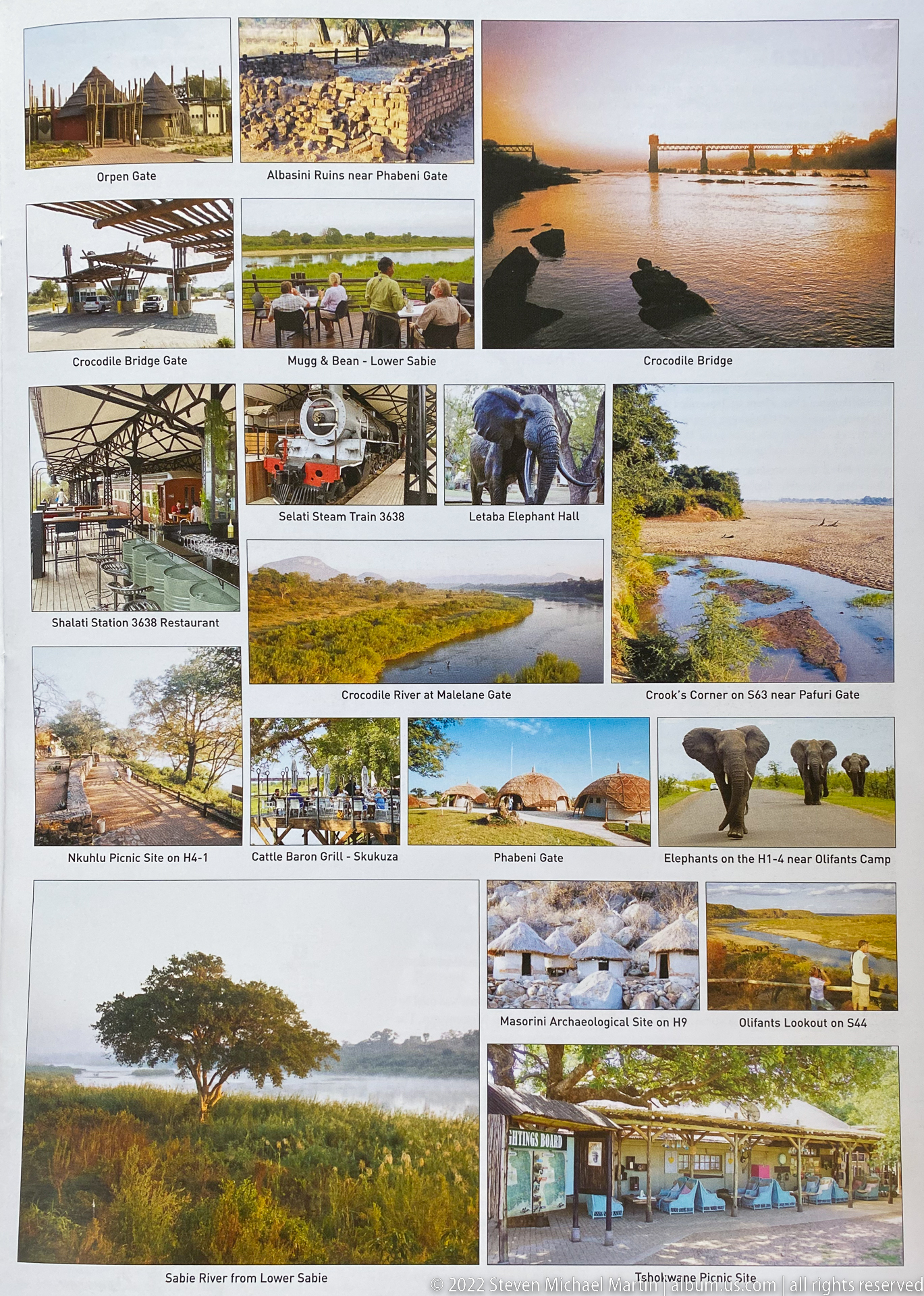
A montage page presents Kruger National Park through labeled photographs of camp facilities, gates, river crossings, landscapes, and visitor sites. The varied scenes move from architecture and bridges to broad river views and woodland, providing a visual index to the park's built and natural environments.
Caption
A montage page presents Kruger National Park through labeled photographs of camp facilities, gates, river crossings, landscapes, and visitor sites. The varied scenes move from architecture and bridges to broad river views and woodland, providing a visual index to the park's built and natural environments.
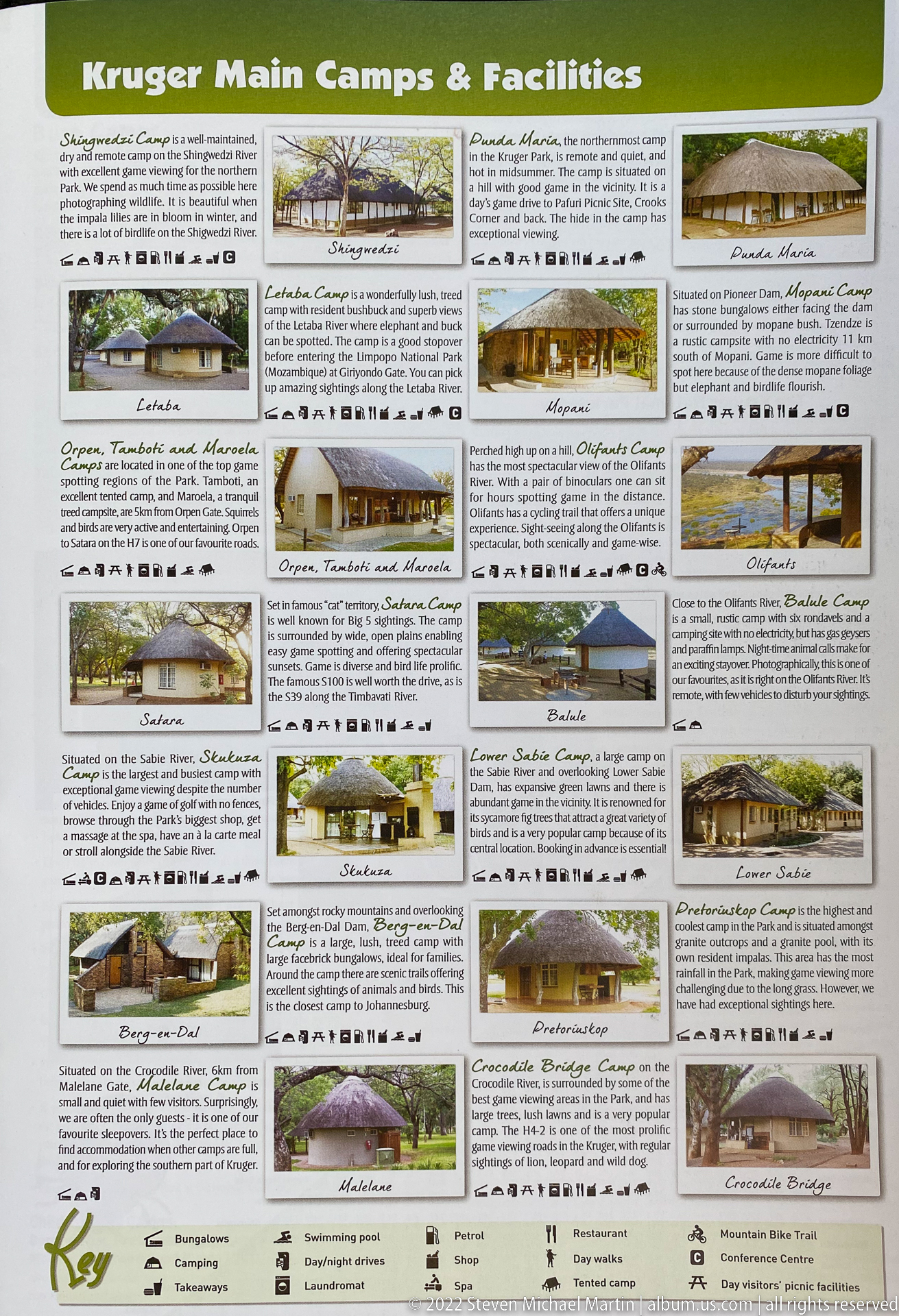
An illustrated guide page surveys Kruger National Park's main camps and visitor facilities through small photographs and short descriptive entries. Camp names are paired with images of accommodation, landscapes, and amenities, while a symbol key along the bottom summarizes services available across the park.
Caption
An illustrated guide page surveys Kruger National Park's main camps and visitor facilities through small photographs and short descriptive entries. Camp names are paired with images of accommodation, landscapes, and amenities, while a symbol key along the bottom summarizes services available across the park.

A densely illustrated Kruger National Park visitor-information page combines gate and camp times, speed-limit reminders, a checklist of visitor rules, park contact numbers, shop and restaurant hours, and malaria guidance. Photographs and icons reinforce the practical information, making this a compact reference page for navigating the park responsibly and safely.
Caption
A densely illustrated Kruger National Park visitor-information page combines gate and camp times, speed-limit reminders, a checklist of visitor rules, park contact numbers, shop and restaurant hours, and malaria guidance. Photographs and icons reinforce the practical information, making this a compact reference page for navigating the park responsibly and safely.
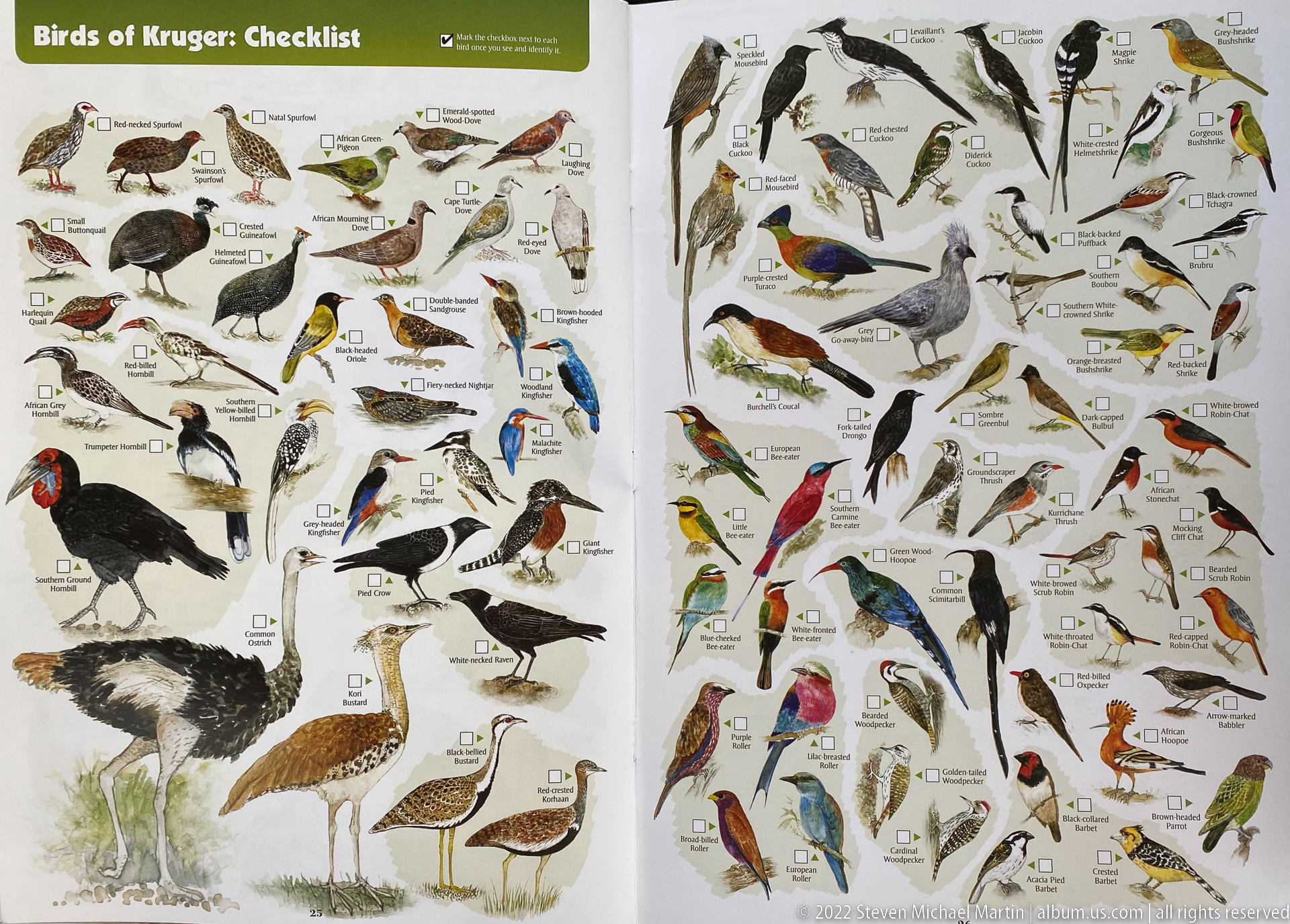
A second bird-checklist spread expands the visual field guide with hornbills, kingfishers, woodpeckers, rollers, bee-eaters, passerines, and other woodland and open-country birds. The dense arrangement encourages comparison of plumage, body shape, bill form, and size across many species.
Caption
A second bird-checklist spread expands the visual field guide with hornbills, kingfishers, woodpeckers, rollers, bee-eaters, passerines, and other woodland and open-country birds. The dense arrangement encourages comparison of plumage, body shape, bill form, and size across many species.

A two-page bird checklist presents a broad range of Kruger species, including raptors, owls, gamebirds, waterbirds, storks, herons, and other conspicuous groups. Labeled illustrations and check boxes support field identification and allow visitors to record species observed during a park visit.
Caption
A two-page bird checklist presents a broad range of Kruger species, including raptors, owls, gamebirds, waterbirds, storks, herons, and other conspicuous groups. Labeled illustrations and check boxes support field identification and allow visitors to record species observed during a park visit.
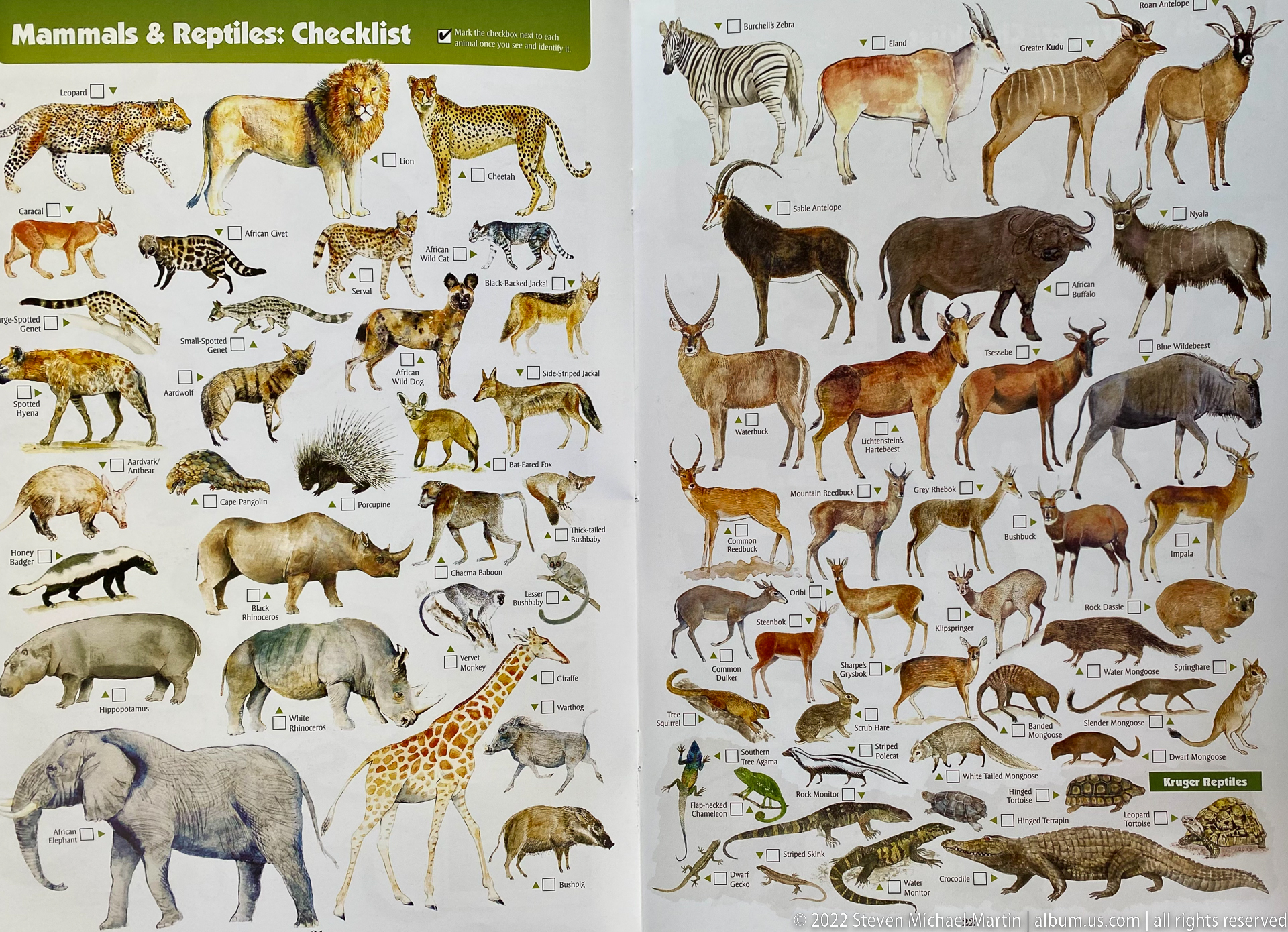
An illustrated checklist assembles Kruger's mammals in comparative groups, from large predators and ungulates to primates, small carnivores, rodents, and other species, with a smaller reptile section along the bottom. Labeled drawings and check boxes make the spread a compact visual index for recording sightings.
Caption
An illustrated checklist assembles Kruger's mammals in comparative groups, from large predators and ungulates to primates, small carnivores, rodents, and other species, with a smaller reptile section along the bottom. Labeled drawings and check boxes make the spread a compact visual index for recording sightings.

A final illustrated bird-checklist page features an especially varied selection of Kruger species, from large hornbills and long-tailed birds to bright weavers, bee-eaters, rollers, shrikes, and other savanna birds. The labeled artwork and check boxes form a compact visual record for comparing and logging sightings.
Caption
A final illustrated bird-checklist page features an especially varied selection of Kruger species, from large hornbills and long-tailed birds to bright weavers, bee-eaters, rollers, shrikes, and other savanna birds. The labeled artwork and check boxes form a compact visual record for comparing and logging sightings.

A 'Hot Spots in the Park' guide page organizes recommended wildlife-viewing areas into seasonal categories, pairing short location notes with photographs of waterholes, rivers, large mammals, and birds. The layout emphasizes how changing rainfall and water availability influence where visitors may encounter wildlife across Kruger.
Caption
A 'Hot Spots in the Park' guide page organizes recommended wildlife-viewing areas into seasonal categories, pairing short location notes with photographs of waterholes, rivers, large mammals, and birds. The layout emphasizes how changing rainfall and water availability influence where visitors may encounter wildlife across Kruger.
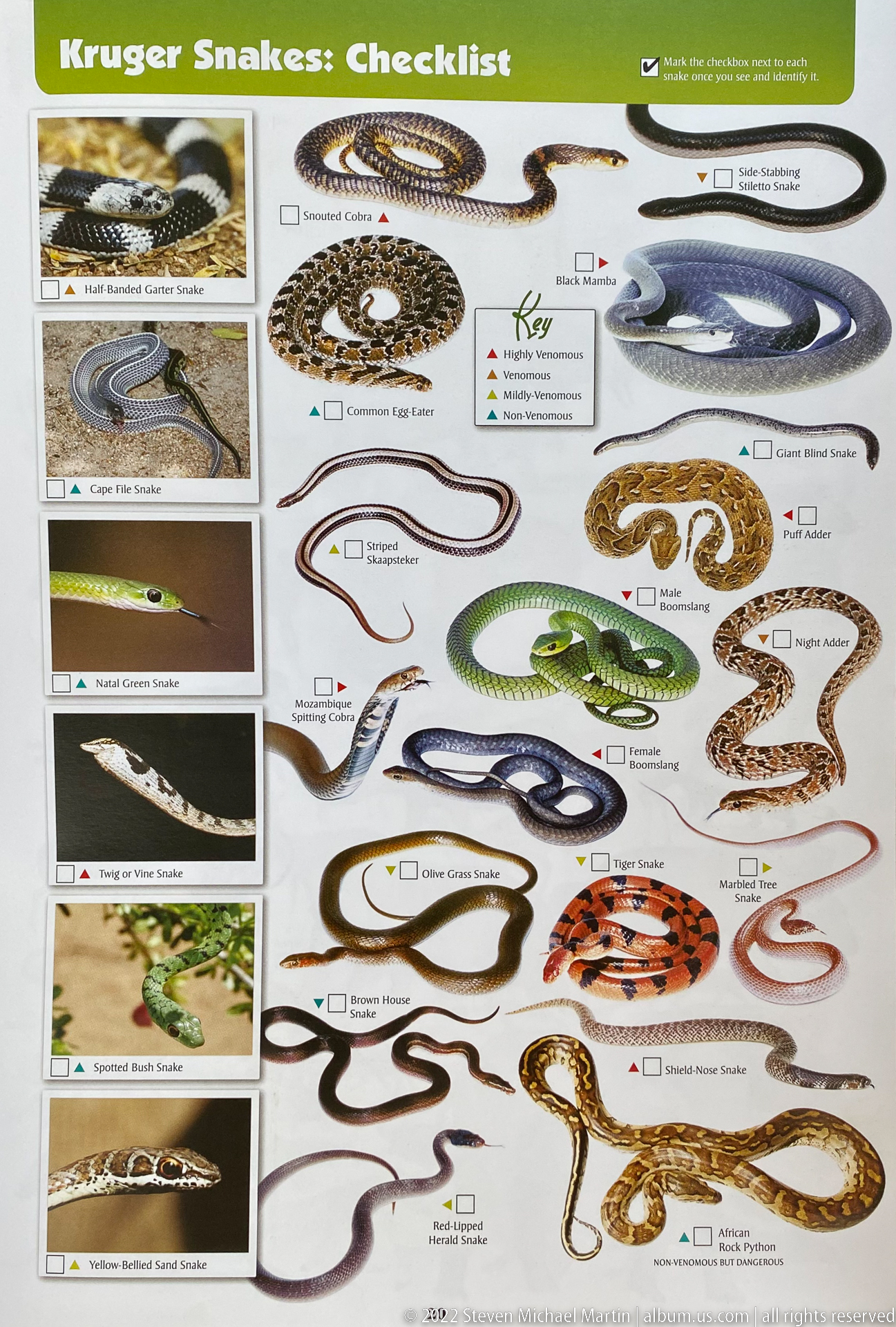
An illustrated snake checklist presents numerous Kruger reptiles in comparative rows, pairing drawings or photographs with species names and check boxes. Differences in body color, banding, head shape, and pattern are shown side by side, making the page a visual field reference rather than a photograph of a single species.
Caption
An illustrated snake checklist presents numerous Kruger reptiles in comparative rows, pairing drawings or photographs with species names and check boxes. Differences in body color, banding, head shape, and pattern are shown side by side, making the page a visual field reference rather than a photograph of a single species.
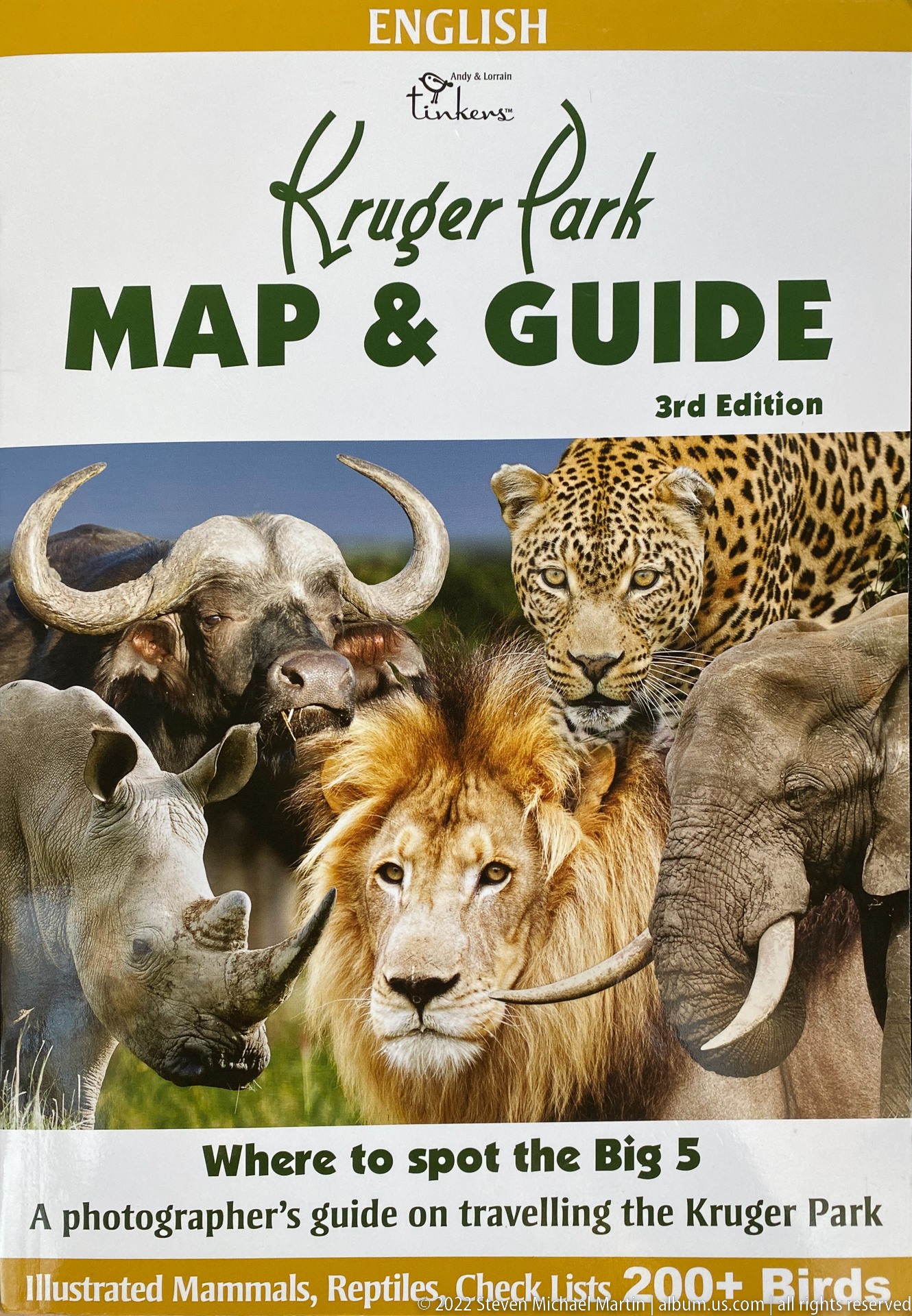
The cover of an English-language 'Kruger Park Map & Guide,' 3rd Edition, combines photographs of prominent park wildlife including buffalo, leopard, rhinoceros, lion, and elephant. Its subtitle promotes guidance on where to spot the 'Big 5,' while additional cover text advertises illustrated mammals, reptiles, checklists, and more than 200 birds.
Caption
The cover of an English-language 'Kruger Park Map & Guide,' 3rd Edition, combines photographs of prominent park wildlife including buffalo, leopard, rhinoceros, lion, and elephant. Its subtitle promotes guidance on where to spot the 'Big 5,' while additional cover text advertises illustrated mammals, reptiles, checklists, and more than 200 birds.

A reference page combines a short history of Kruger National Park with landmark dates, a large triangular distance-and-time chart, and illustrated natural-history details. Photographs of rhinoceros, flowers, archaeological remains, and an insect broaden the page from travel logistics into the park's cultural and ecological context.
Caption
A reference page combines a short history of Kruger National Park with landmark dates, a large triangular distance-and-time chart, and illustrated natural-history details. Photographs of rhinoceros, flowers, archaeological remains, and an insect broaden the page from travel logistics into the park's cultural and ecological context.
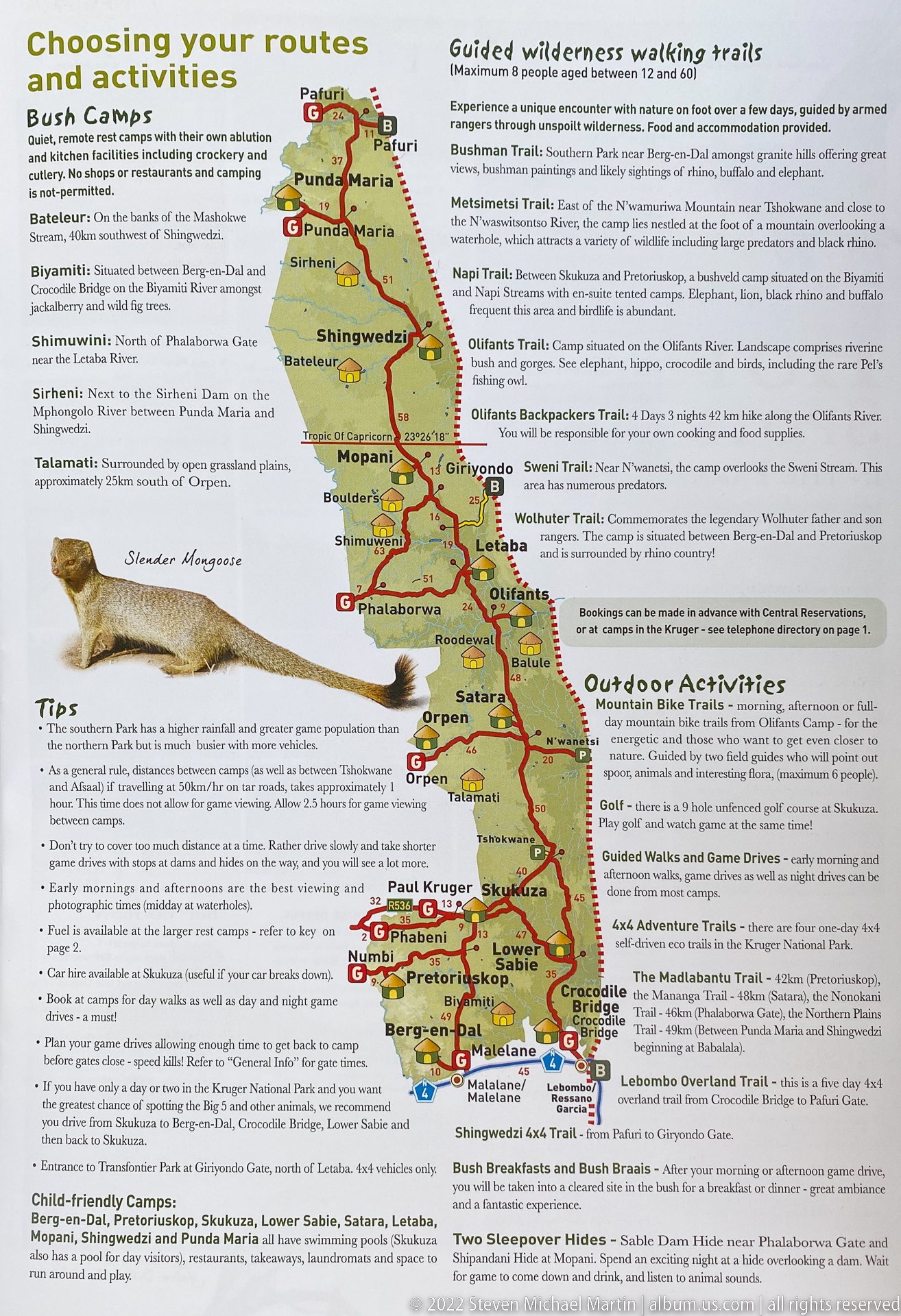
A full-height map of Kruger National Park anchors a page devoted to route planning and outdoor activities. Colored roads connect named camps from north to south, while surrounding text introduces guided wilderness walking trails, suggested drives, tips, outdoor activities, and child-friendly camp options.
Caption
A full-height map of Kruger National Park anchors a page devoted to route planning and outdoor activities. Colored roads connect named camps from north to south, while surrounding text introduces guided wilderness walking trails, suggested drives, tips, outdoor activities, and child-friendly camp options.
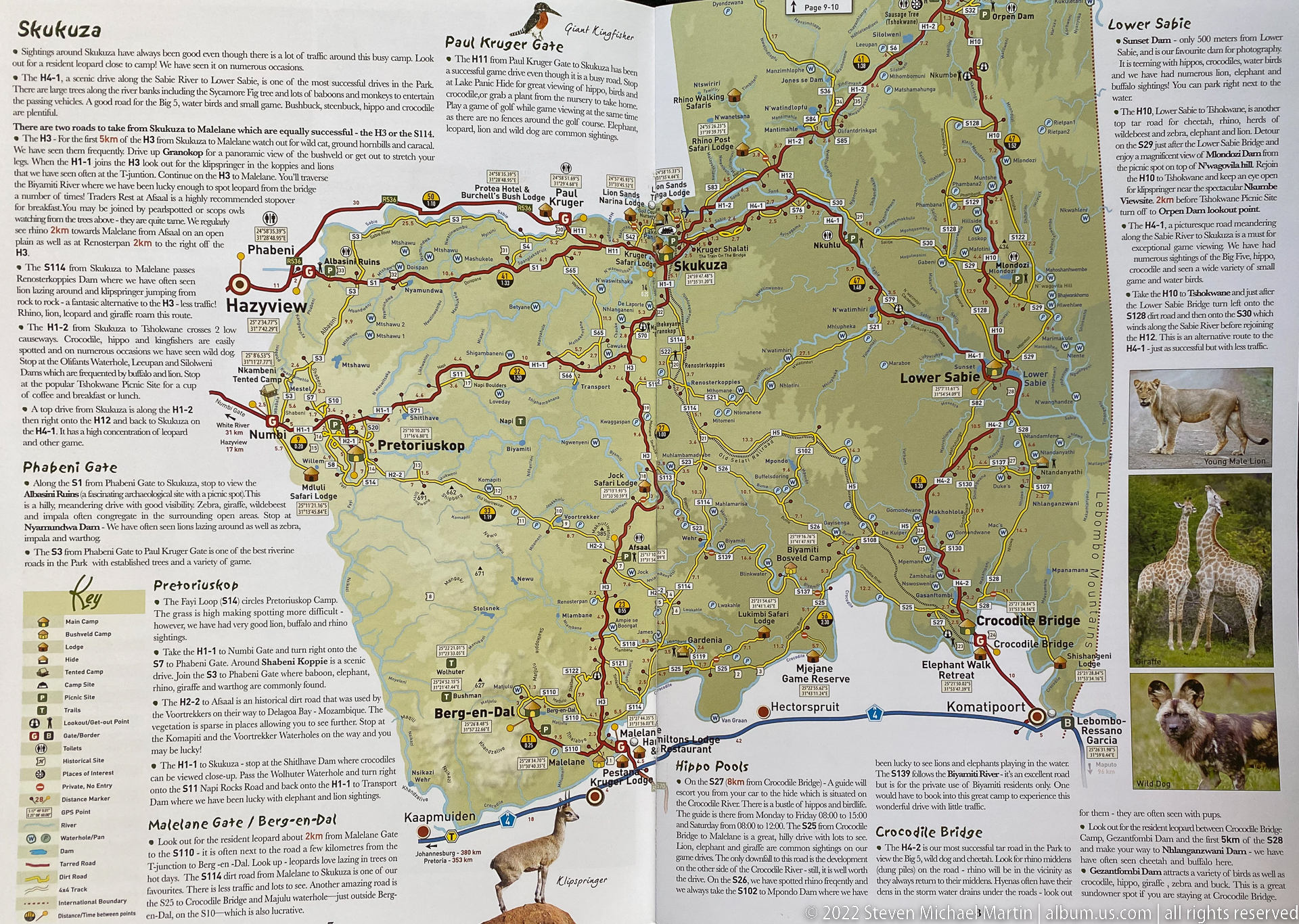
A detailed regional map covers the southern portion of Kruger National Park, with roads, rivers, camps, gates, and nearby towns plotted across the landscape. Insets and surrounding text highlight destinations and wildlife, turning the map into both a navigation aid and a compact introduction to the park's southern sector.
Caption
A detailed regional map covers the southern portion of Kruger National Park, with roads, rivers, camps, gates, and nearby towns plotted across the landscape. Insets and surrounding text highlight destinations and wildlife, turning the map into both a navigation aid and a compact introduction to the park's southern sector.
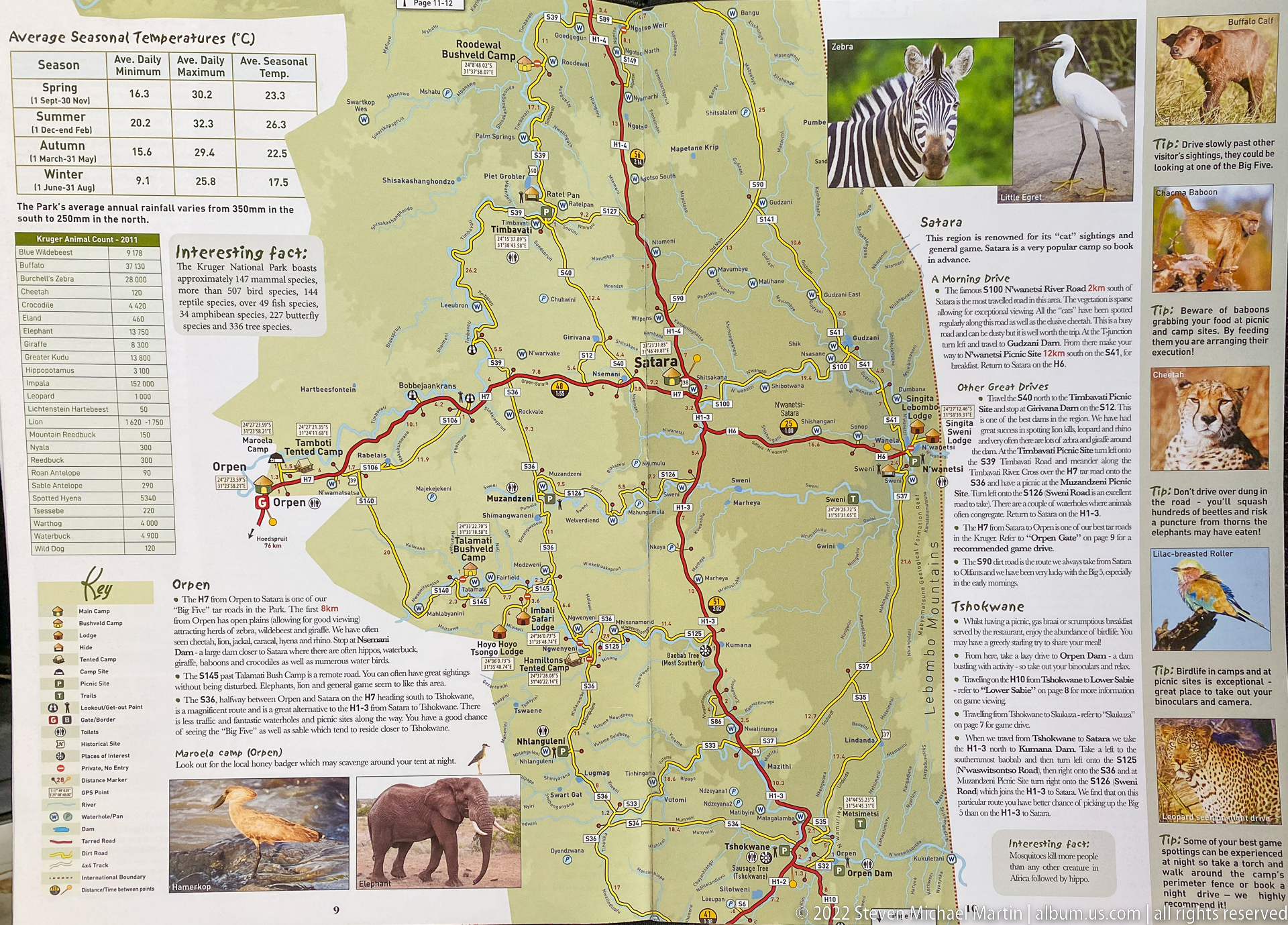
A regional map focuses on central Kruger National Park around Satara, tracing major roads, rivers, camps, and junctions through the central savanna. Wildlife photographs and route notes flank the map, linking practical navigation with species and places visitors may encounter in this part of the park.
Caption
A regional map focuses on central Kruger National Park around Satara, tracing major roads, rivers, camps, and junctions through the central savanna. Wildlife photographs and route notes flank the map, linking practical navigation with species and places visitors may encounter in this part of the park.
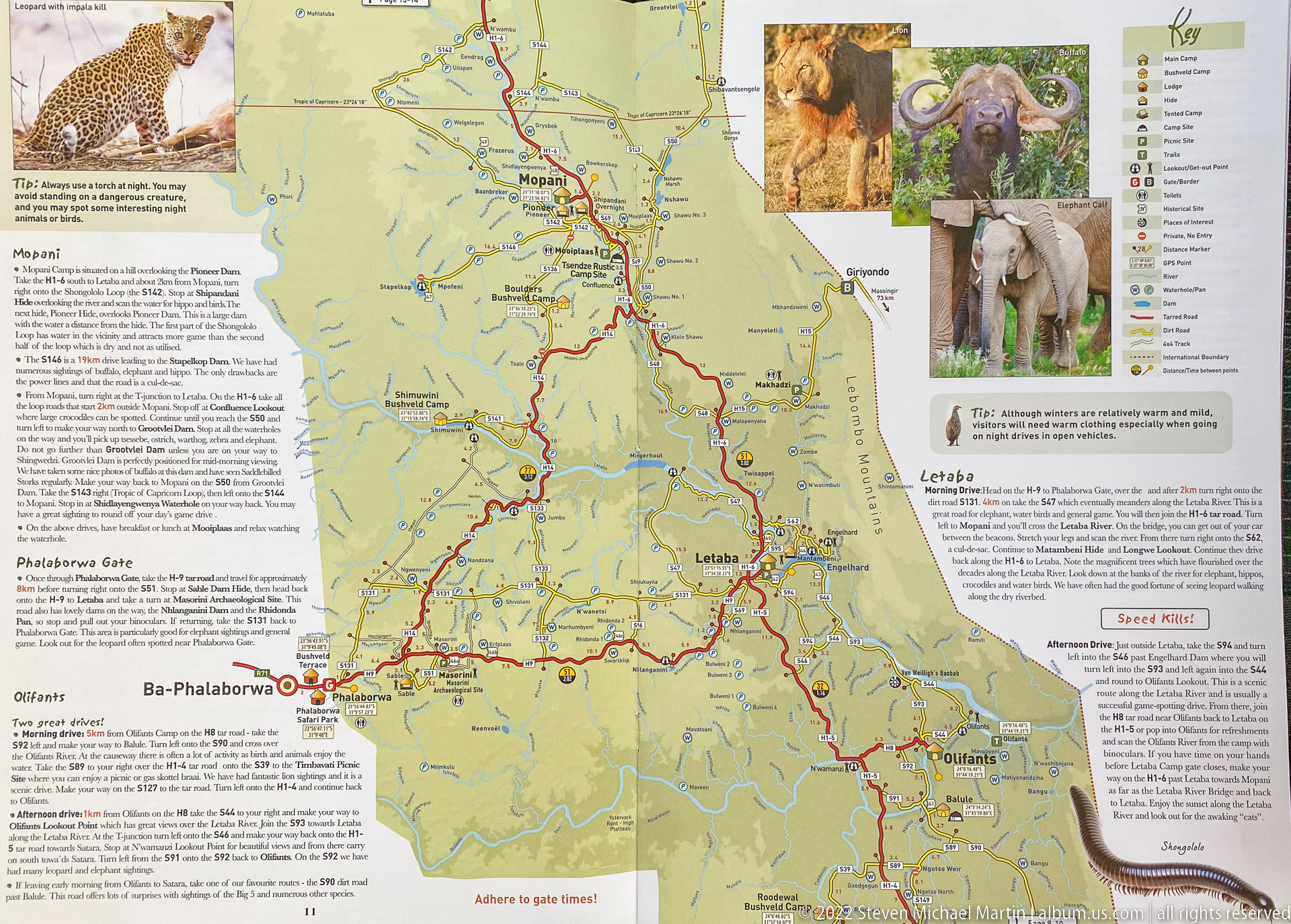
A regional map charts central-northern Kruger around Mopani, Letaba, and the Phalaborwa area, with roads and waterways linking camps and viewpoints. Photographs of large mammals and smaller wildlife accompany destination notes, combining route planning with a visual introduction to the region's fauna.
Caption
A regional map charts central-northern Kruger around Mopani, Letaba, and the Phalaborwa area, with roads and waterways linking camps and viewpoints. Photographs of large mammals and smaller wildlife accompany destination notes, combining route planning with a visual introduction to the region's fauna.
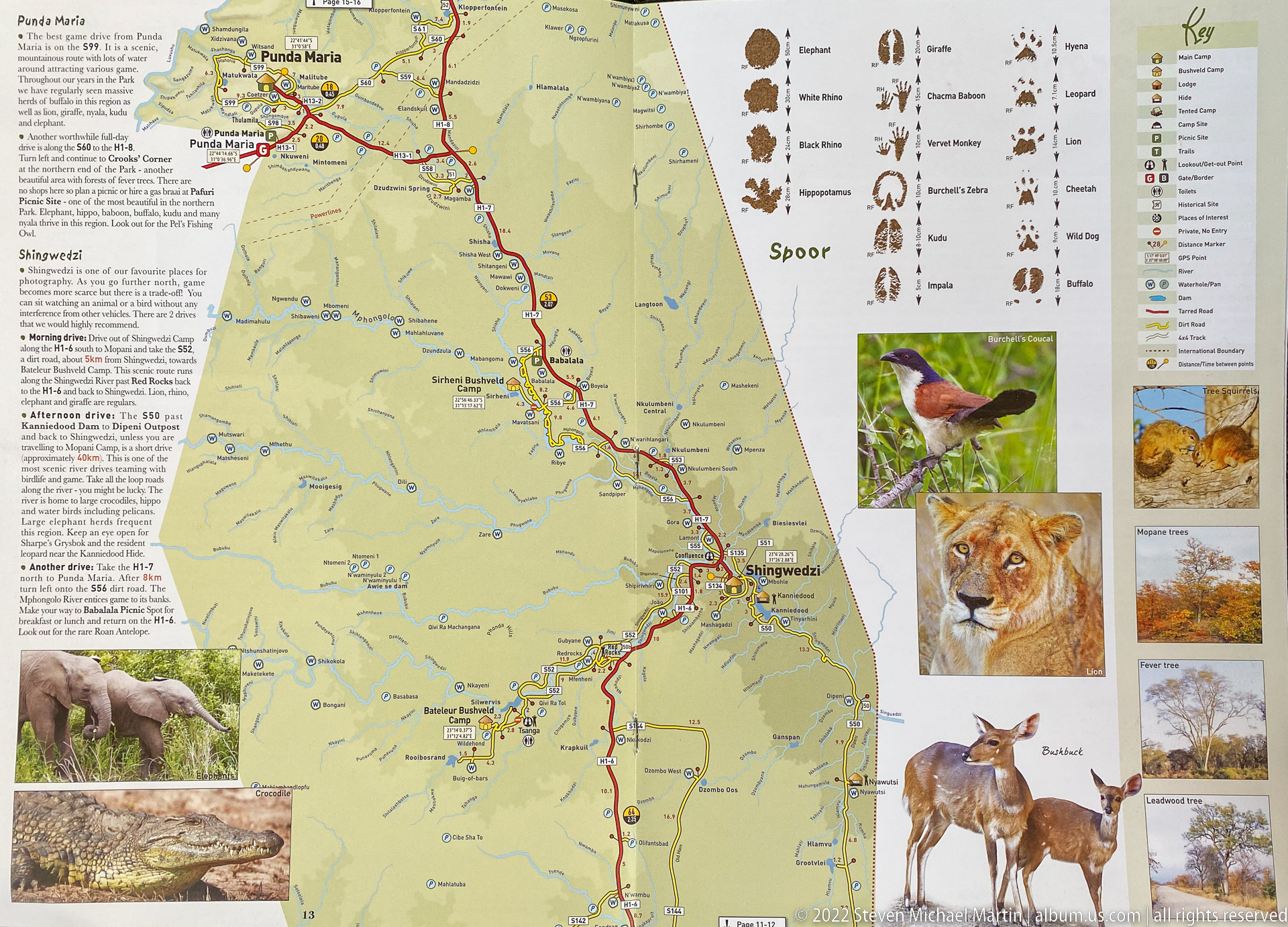
A regional map of northern Kruger is paired with a compact spoor-identification panel and wildlife illustrations. Roads and rivers run through the map while surrounding images depict mammals, birds, reptiles, and landscapes, expanding the page from route planning into field identification and natural-history observation.
Caption
A regional map of northern Kruger is paired with a compact spoor-identification panel and wildlife illustrations. Roads and rivers run through the map while surrounding images depict mammals, birds, reptiles, and landscapes, expanding the page from route planning into field identification and natural-history observation.
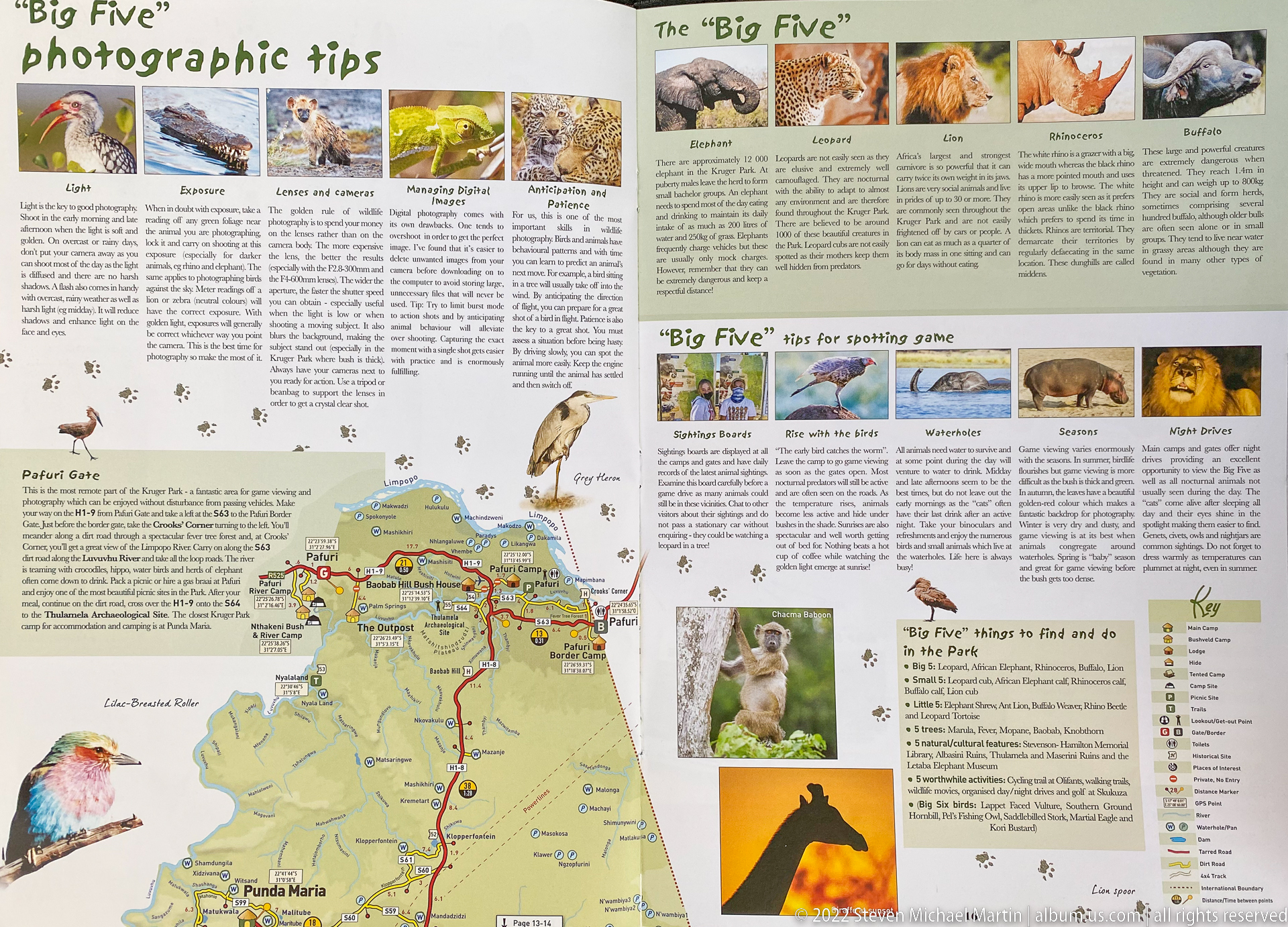
A 'Big Five' guide page introduces lion, elephant, leopard, rhinoceros, and buffalo through short species profiles, photographs, and practical spotting tips. A park map and additional bird and mammal illustrations broaden the field-guide function, helping visitors connect species identification with likely viewing areas.
Caption
A 'Big Five' guide page introduces lion, elephant, leopard, rhinoceros, and buffalo through short species profiles, photographs, and practical spotting tips. A park map and additional bird and mammal illustrations broaden the field-guide function, helping visitors connect species identification with likely viewing areas.
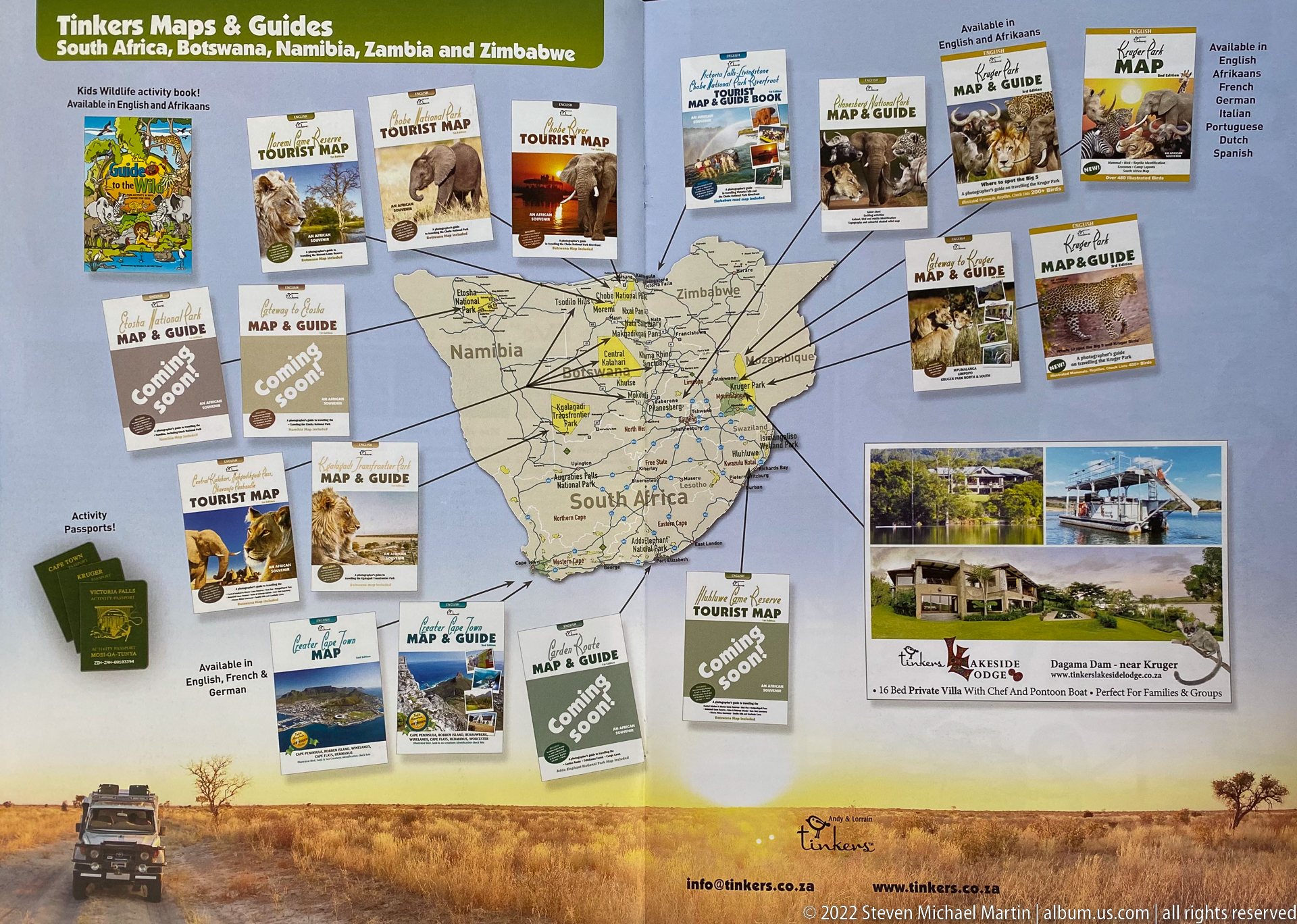
An advertisement for Tinkers Maps & Guides arranges numerous regional map and guidebook covers around a map of southern Africa. Publications for national parks, countries, cities, and tourist regions surround the central map, presenting the wider travel-reference series to which the Kruger guide belongs.
Caption
An advertisement for Tinkers Maps & Guides arranges numerous regional map and guidebook covers around a map of southern Africa. Publications for national parks, countries, cities, and tourist regions surround the central map, presenting the wider travel-reference series to which the Kruger guide belongs.

A color-coded ecoregions map divides Kruger National Park into broad ecological zones, with descriptive text blocks naming vegetation and landscape types along both sides. The diagram emphasizes the park's north-south environmental variation and provides ecological context for differences in habitat and wildlife distribution.
Caption
A color-coded ecoregions map divides Kruger National Park into broad ecological zones, with descriptive text blocks naming vegetation and landscape types along both sides. The diagram emphasizes the park's north-south environmental variation and provides ecological context for differences in habitat and wildlife distribution.
Videos: