Budongo Forest – Uganda
Budongo Forest lies on the southern edge of Murchison Falls National Park and forms one of the largest remaining tropical rainforests in Uganda. The forest is known for its towering mahogany trees, dense canopy, and extraordinary biodiversity.
Budongo is particularly famous for its population of wild chimpanzees, which inhabit the forest along with numerous other primates, birds, and forest animals. Guided walks through the forest allow visitors to experience the quiet atmosphere of the rainforest while learning about the complex ecosystems that thrive beneath the canopy.
The forest forms an important part of the wider conservation landscape surrounding Murchison Falls.
Budongo Forest is also one of the best locations in Uganda to observe wild chimpanzees in their natural habitat, offering rare opportunities to witness complex social and feeding behaviors.
Trek Overview
-
Location: Budongo Forest, Uganda
-
Experience: Guided forest walk
-
Focus: Chimpanzee tracking and behavior
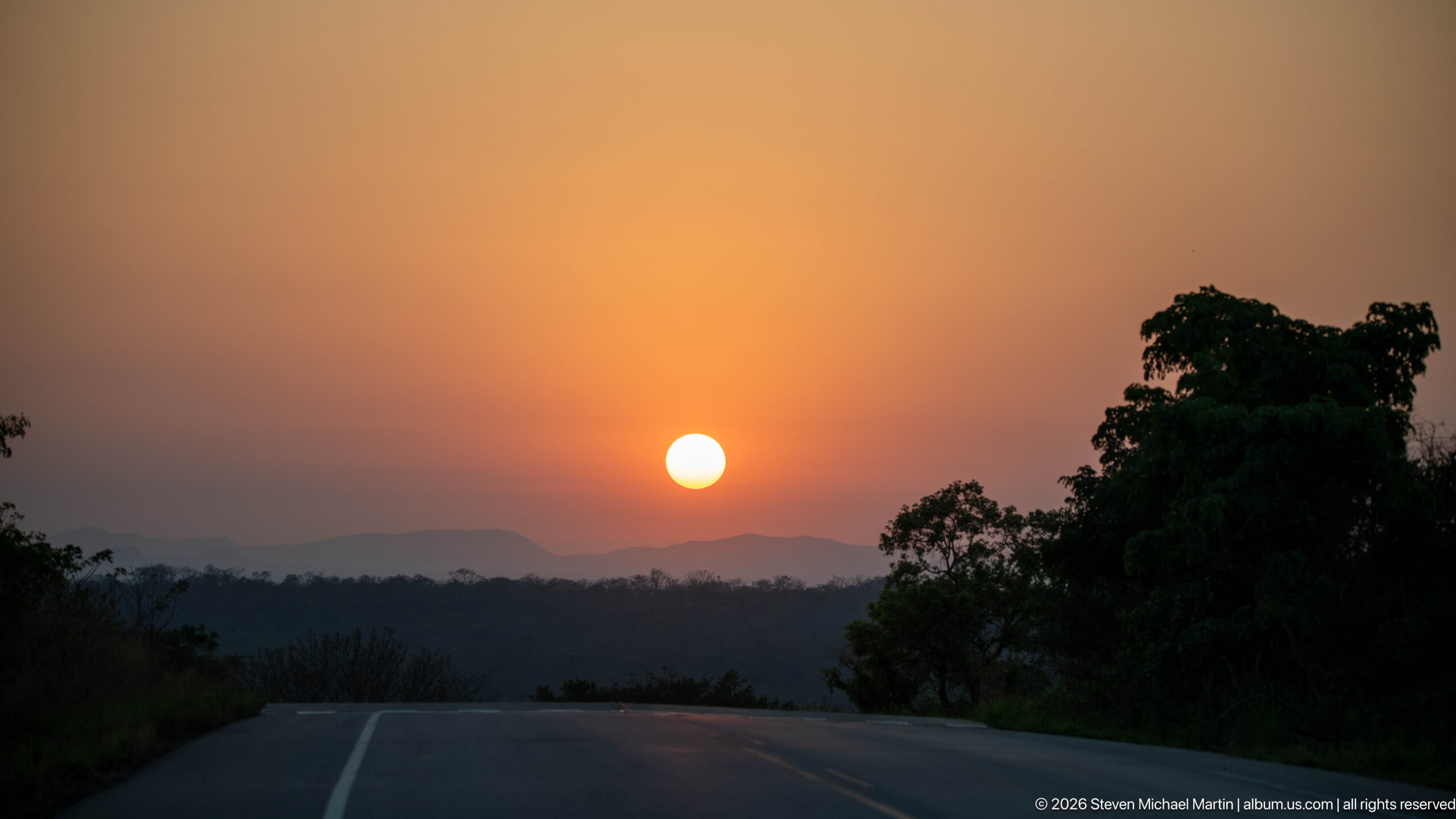
The sun drops toward a hazy ridge beyond a paved road bordered by dense forest on the approach to Budongo Forest. The low, warm light silhouettes the canopy and distant relief, giving this opening landscape view a strong sense of the forest’s setting in western Uganda.
Caption
The sun drops toward a hazy ridge beyond a paved road bordered by dense forest on the approach to Budongo Forest. The low, warm light silhouettes the canopy and distant relief, giving this opening landscape view a strong sense of the forest’s setting in western Uganda.
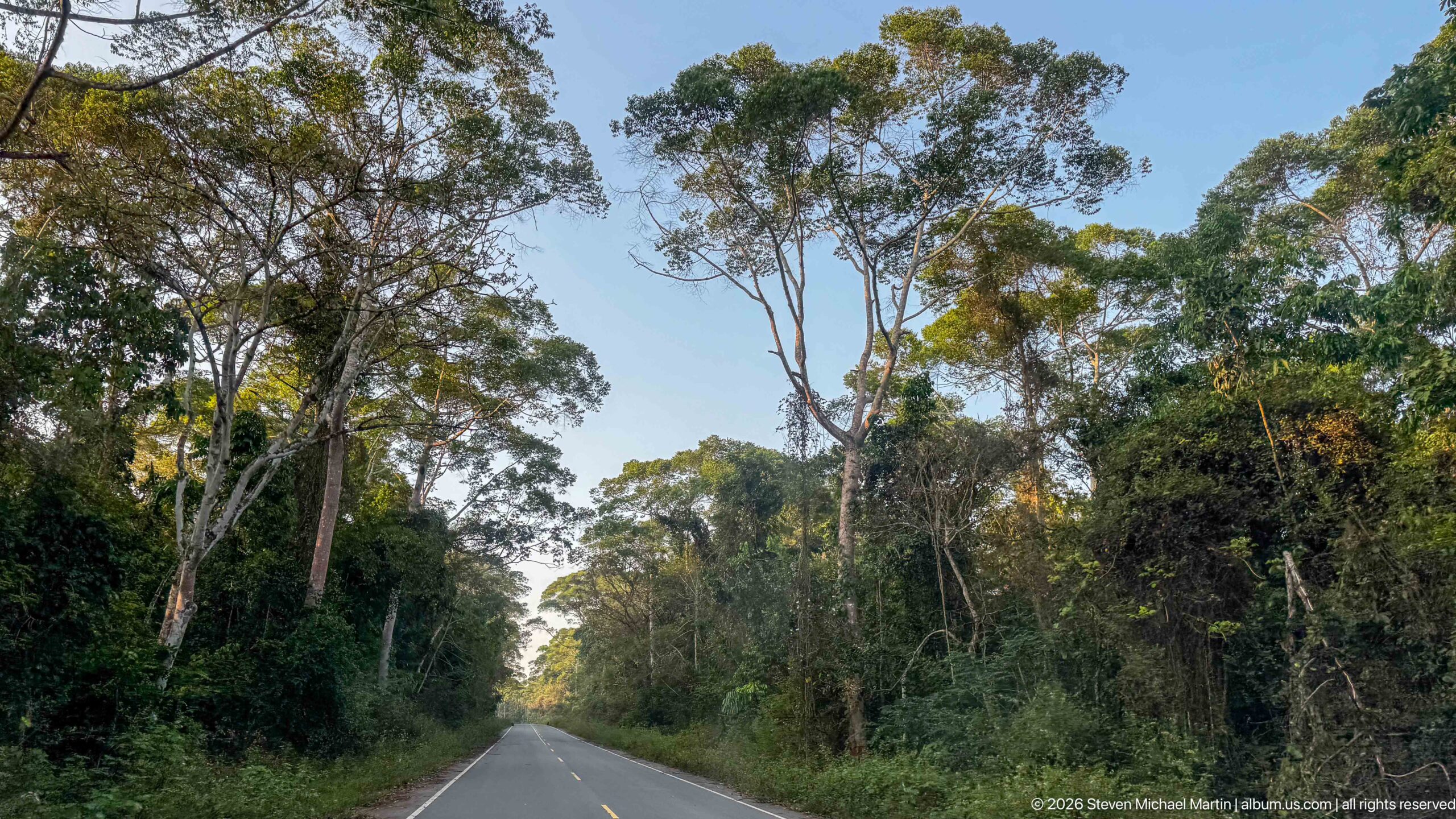
A paved two-lane road runs straight through tall, closed tropical forest, with mature trees rising above dense understory on both sides. The roadway provides a clear contextual view of the forest edge and vertical canopy structure encountered while traveling through the Budongo landscape.
Caption
A paved two-lane road runs straight through tall, closed tropical forest, with mature trees rising above dense understory on both sides. The roadway provides a clear contextual view of the forest edge and vertical canopy structure encountered while traveling through the Budongo landscape.
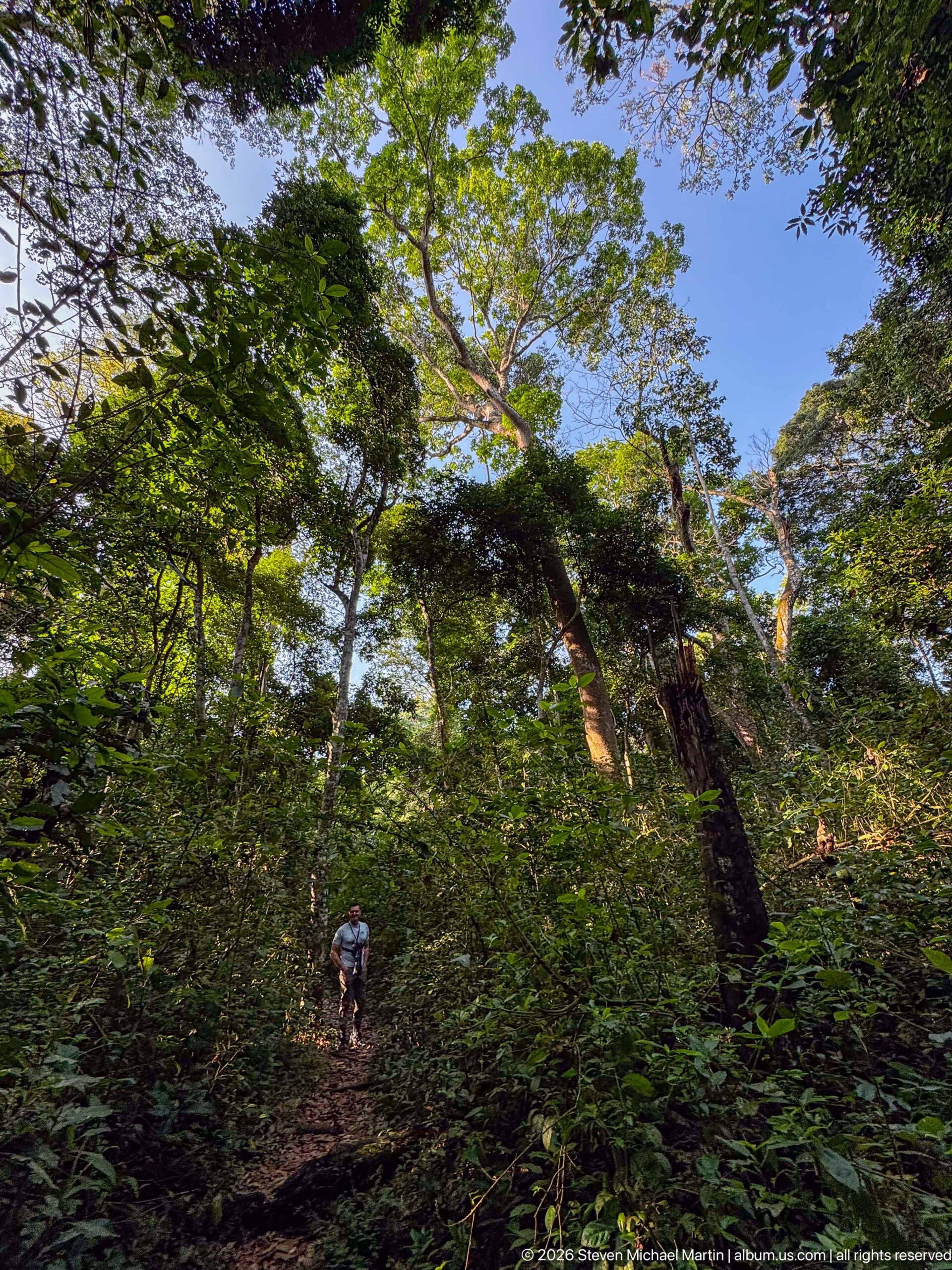
A wider forest view opens toward patches of blue sky above a dense understory, while a visitor walks along the shaded trail below. Large spreading crowns and irregular trunks create a layered canopy, giving this image a stronger sense of overall forest architecture than the closer trail views.
Caption
A wider forest view opens toward patches of blue sky above a dense understory, while a visitor walks along the shaded trail below. Large spreading crowns and irregular trunks create a layered canopy, giving this image a stronger sense of overall forest architecture than the closer trail views.
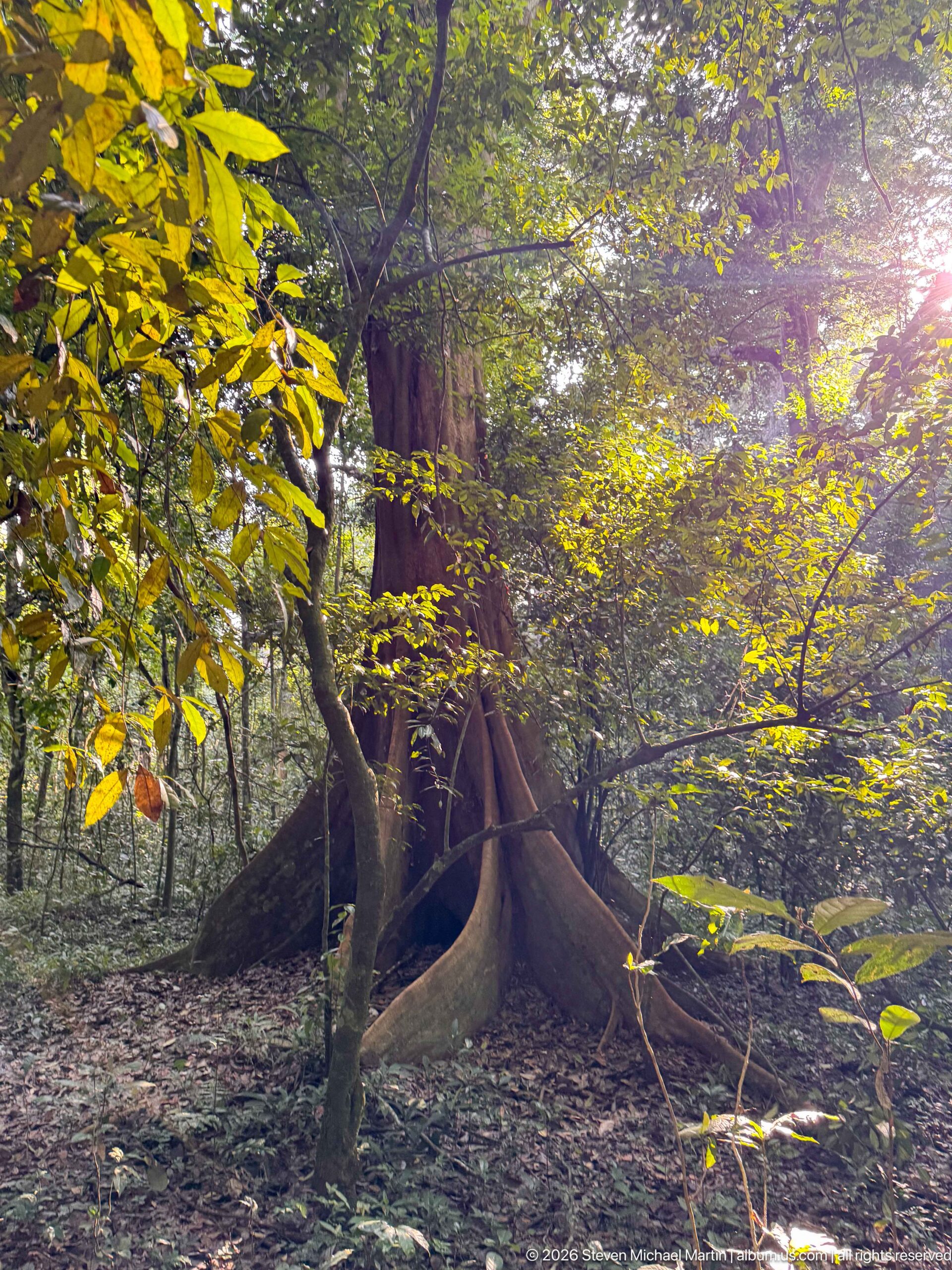
A massive mature tree rises from broad plank-like buttress roots in the shaded forest interior. Sunlight filters through surrounding leaves and catches the trunk, while the flared base extends across the leaf-littered ground, illustrating the scale and structural complexity of Budongo Forest’s old-growth trees.
Caption
A massive mature tree rises from broad plank-like buttress roots in the shaded forest interior. Sunlight filters through surrounding leaves and catches the trunk, while the flared base extends across the leaf-littered ground, illustrating the scale and structural complexity of Budongo Forest’s old-growth trees.
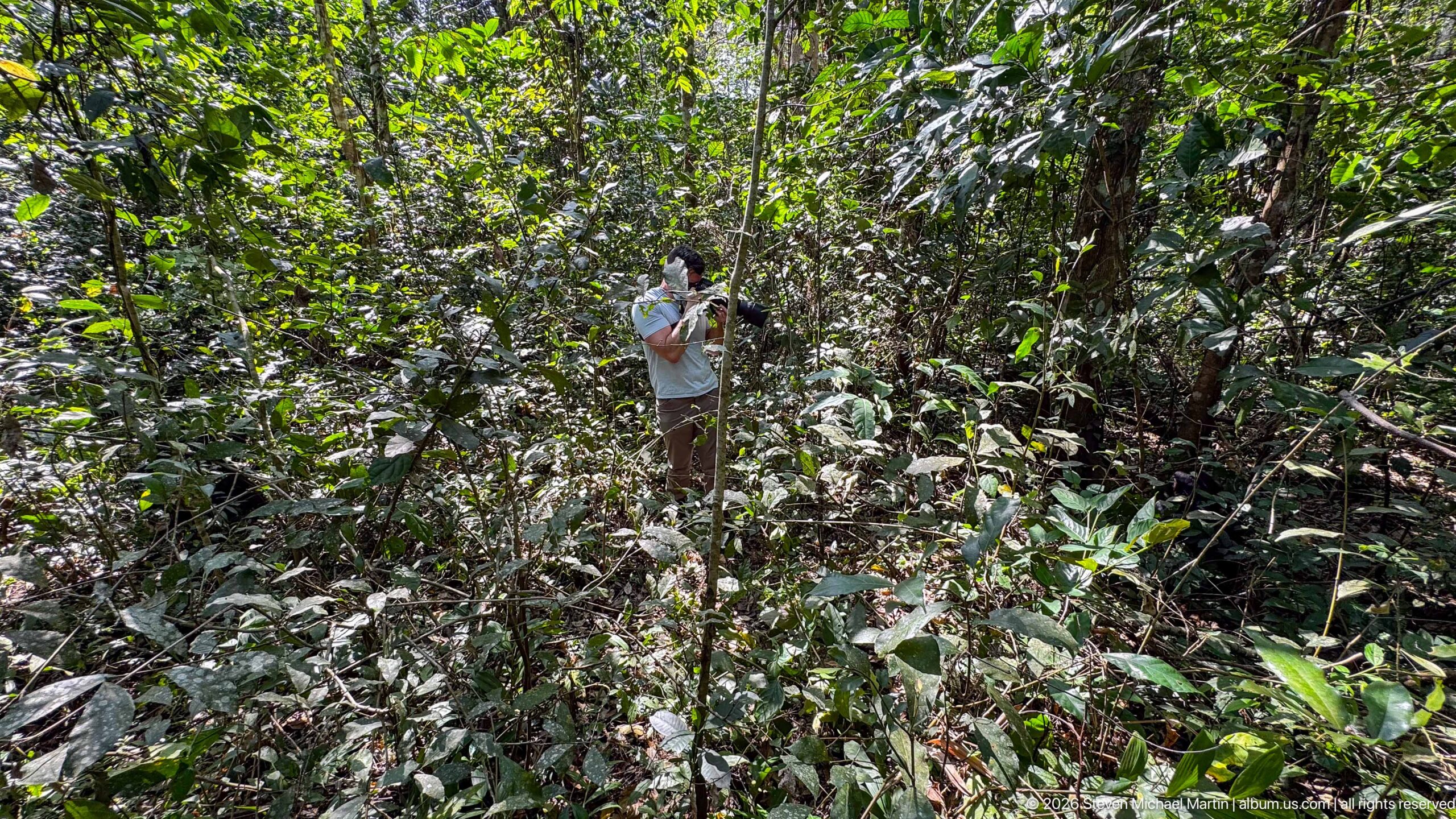
A visitor stands nearly enclosed by dense tropical understory, looking upward while holding optical or camera equipment close to the body. The wide view emphasizes the layered vegetation—saplings, vines, broad leaves, and shaded trunks—that shapes wildlife observation in Budongo Forest.
Caption
A visitor stands nearly enclosed by dense tropical understory, looking upward while holding optical or camera equipment close to the body. The wide view emphasizes the layered vegetation—saplings, vines, broad leaves, and shaded trunks—that shapes wildlife observation in Budongo Forest.
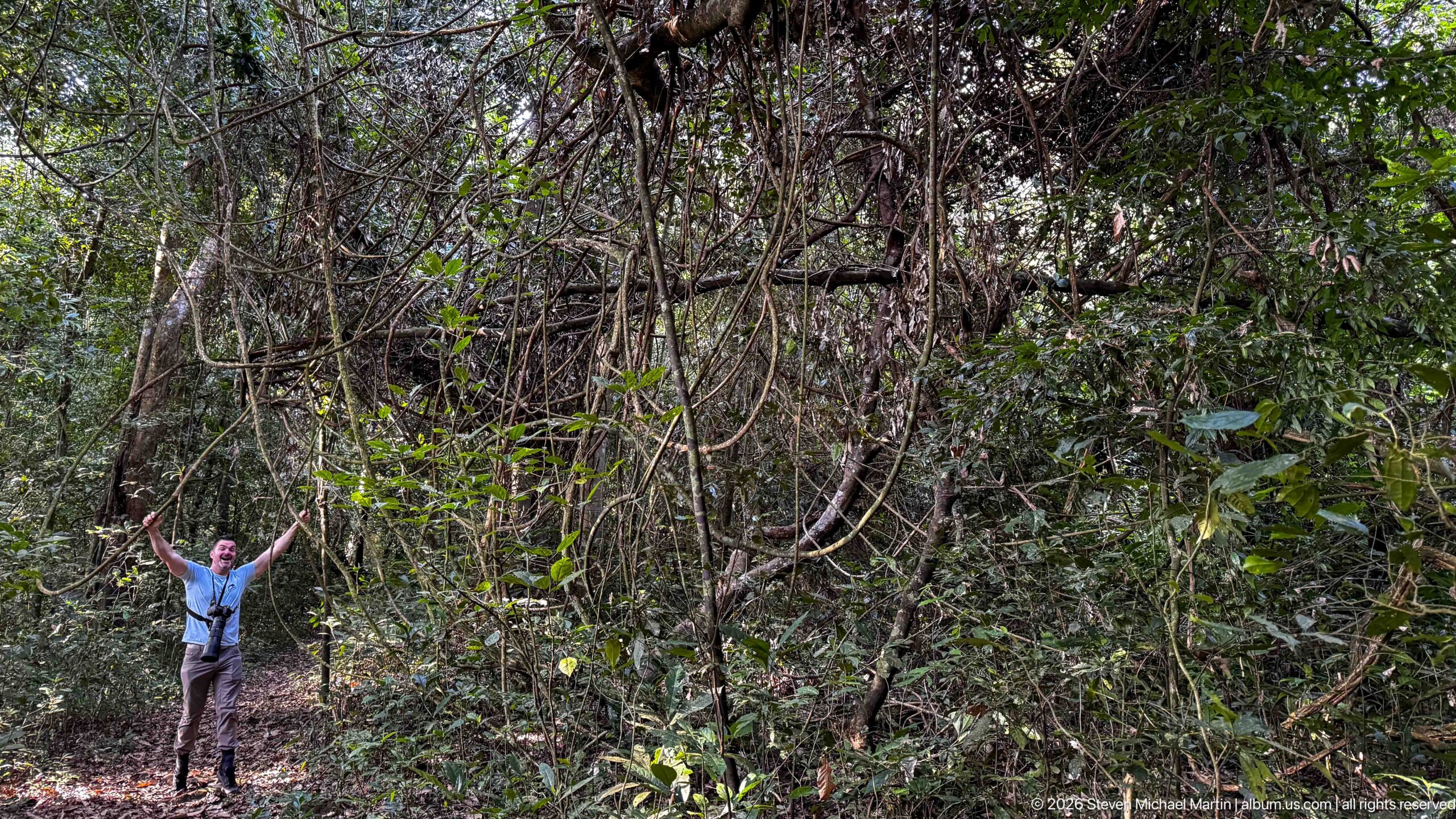
A visitor stands beneath a dense curtain of woody lianas and looping vines suspended from the forest canopy. The intertwined stems fill the upper frame and descend nearly to the ground, demonstrating the complex climbing-plant structure characteristic of tropical forest interiors.
Caption
A visitor stands beneath a dense curtain of woody lianas and looping vines suspended from the forest canopy. The intertwined stems fill the upper frame and descend nearly to the ground, demonstrating the complex climbing-plant structure characteristic of tropical forest interiors.
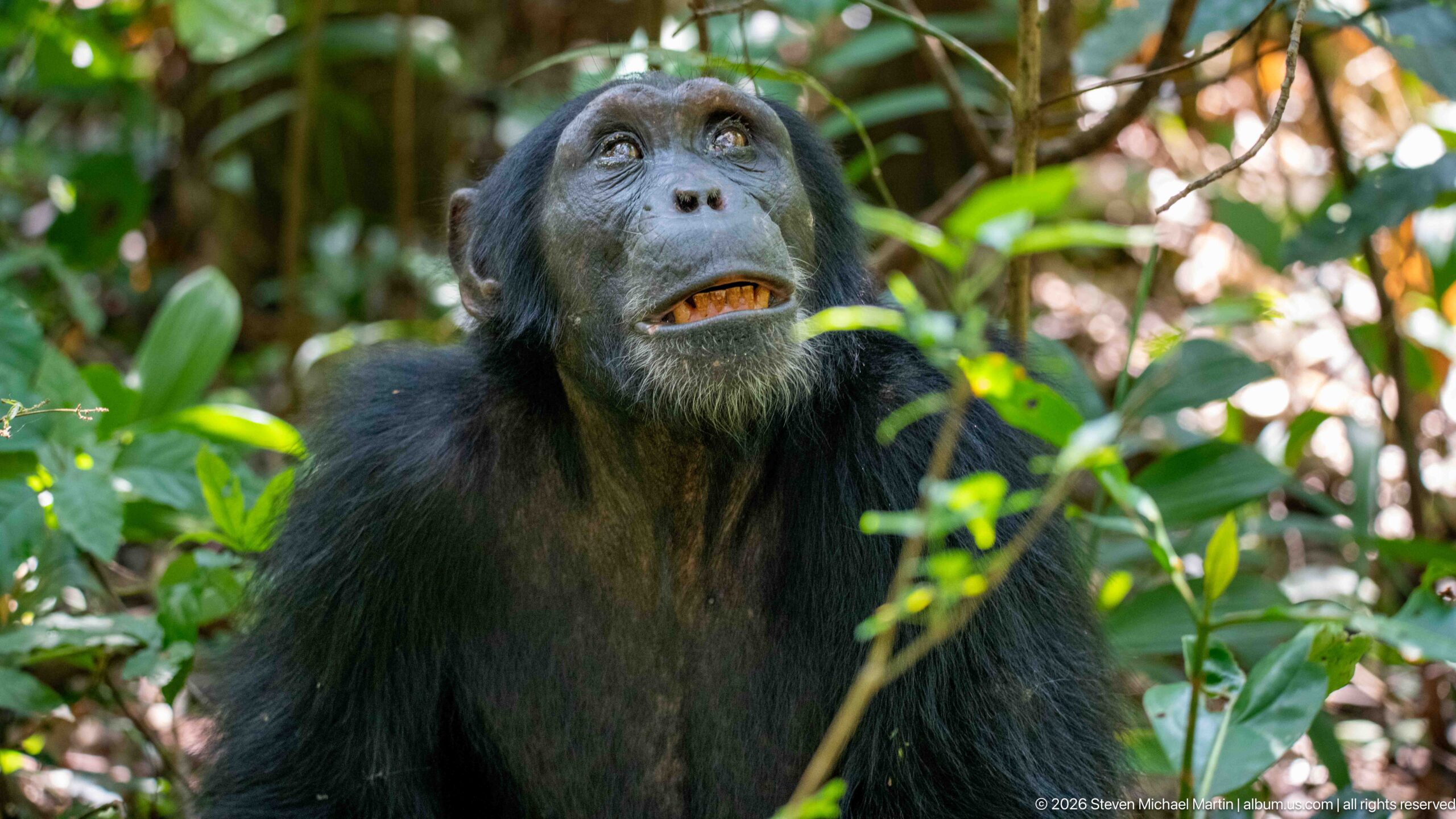
An eastern chimpanzee sits among leafy vegetation, facing forward with the mouth slightly open. The dark coat, bare expressive face, rounded ears, and heavy brow identify the ape, while the close portrait reveals the individual’s facial texture and alert gaze within the forest understory.
Caption
An eastern chimpanzee sits among leafy vegetation, facing forward with the mouth slightly open. The dark coat, bare expressive face, rounded ears, and heavy brow identify the ape, while the close portrait reveals the individual’s facial texture and alert gaze within the forest understory.
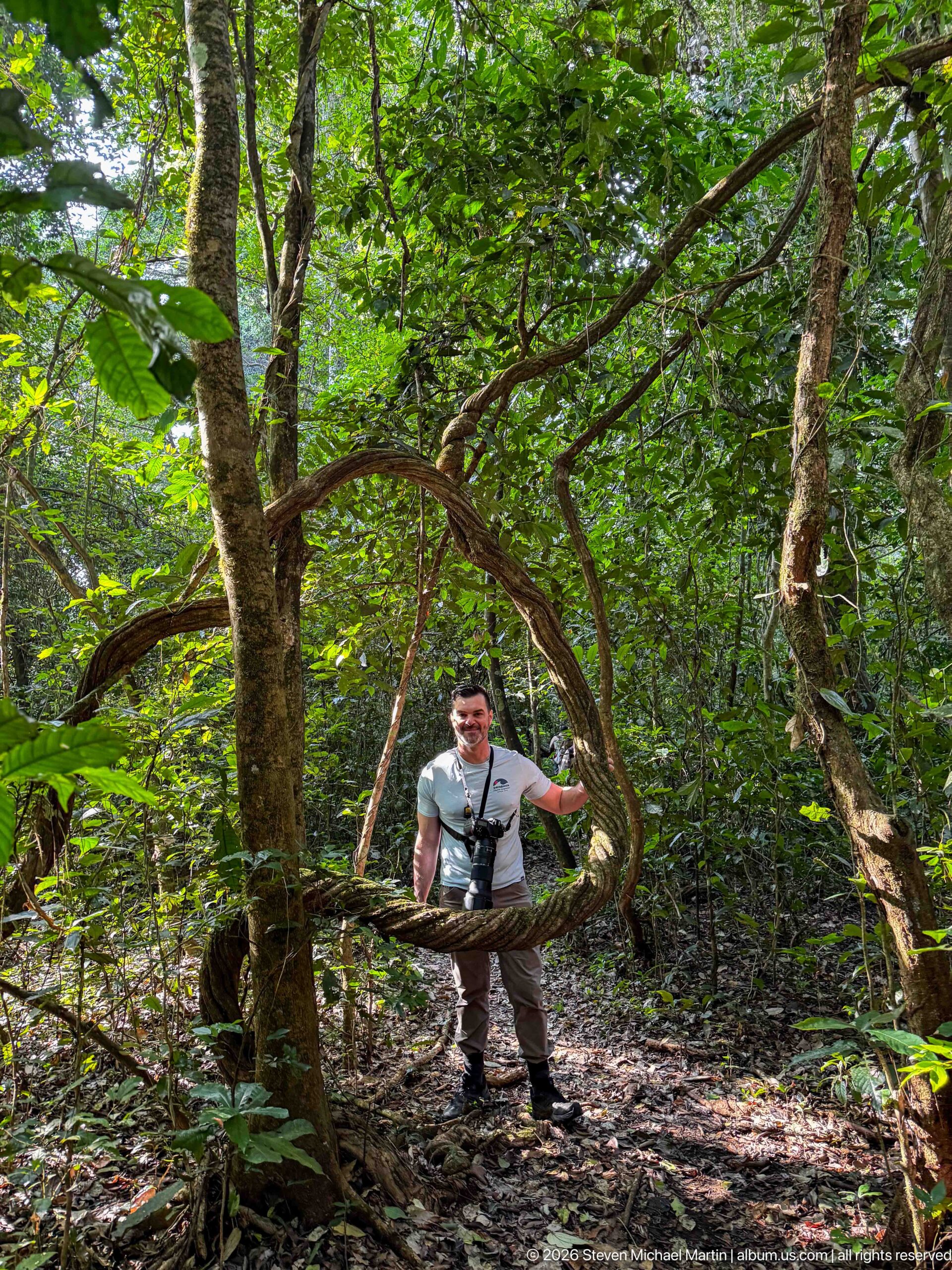
A thick woody liana arcs down and around a standing tree, forming an almost complete loop at human height. A visitor behind it provides scale, while the intertwined stems illustrate the climbing growth forms that contribute to the complex vertical structure of mature tropical forest.
Caption
A thick woody liana arcs down and around a standing tree, forming an almost complete loop at human height. A visitor behind it provides scale, while the intertwined stems illustrate the climbing growth forms that contribute to the complex vertical structure of mature tropical forest.
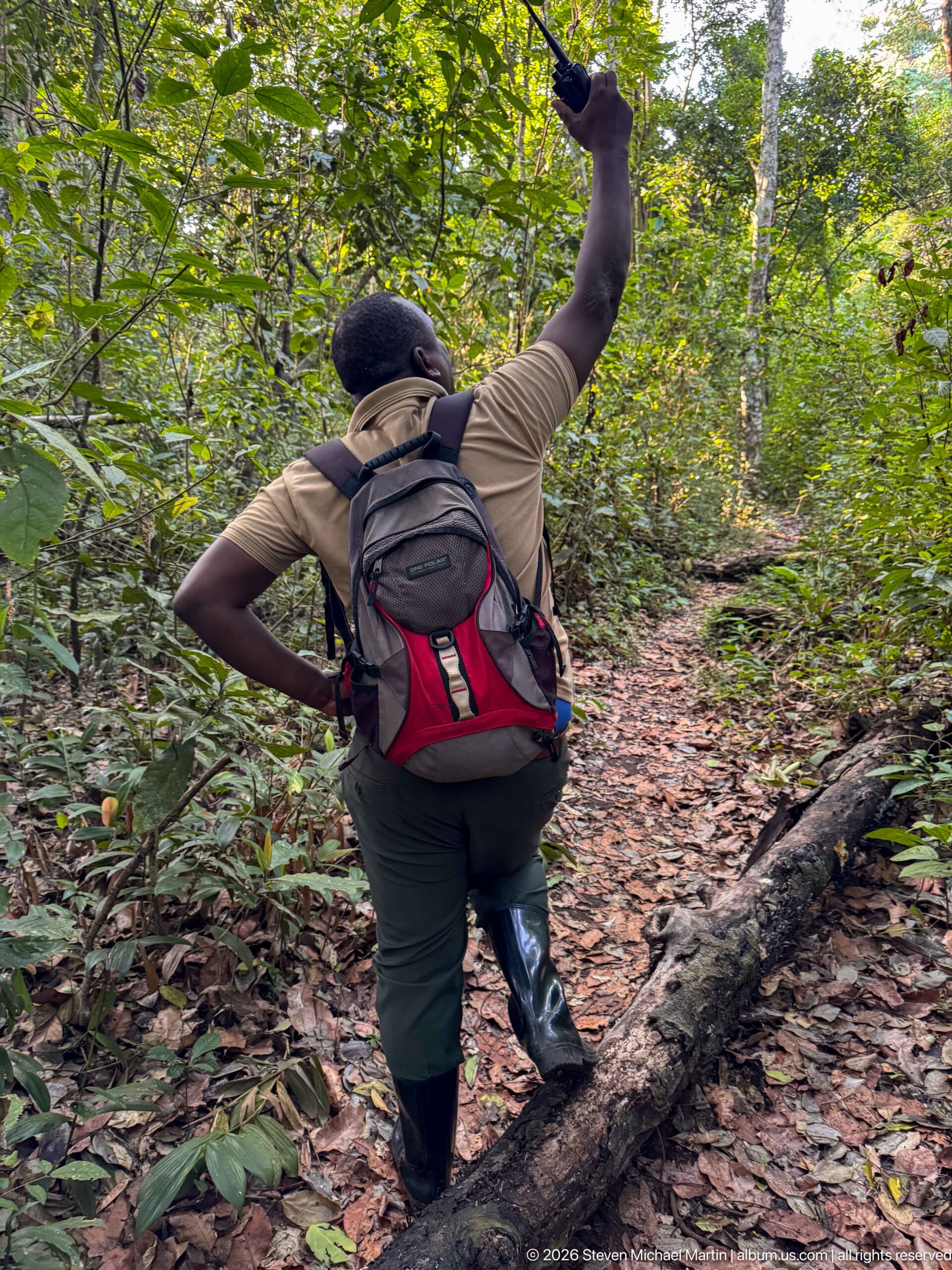
A forest guide steps over a fallen trunk on a narrow leaf-covered trail while raising an arm to indicate something ahead or above. The scene records guided movement through dense Budongo vegetation, where roots, fallen wood, and understory growth make the walking route part of the field experience.
Caption
A forest guide steps over a fallen trunk on a narrow leaf-covered trail while raising an arm to indicate something ahead or above. The scene records guided movement through dense Budongo vegetation, where roots, fallen wood, and understory growth make the walking route part of the field experience.
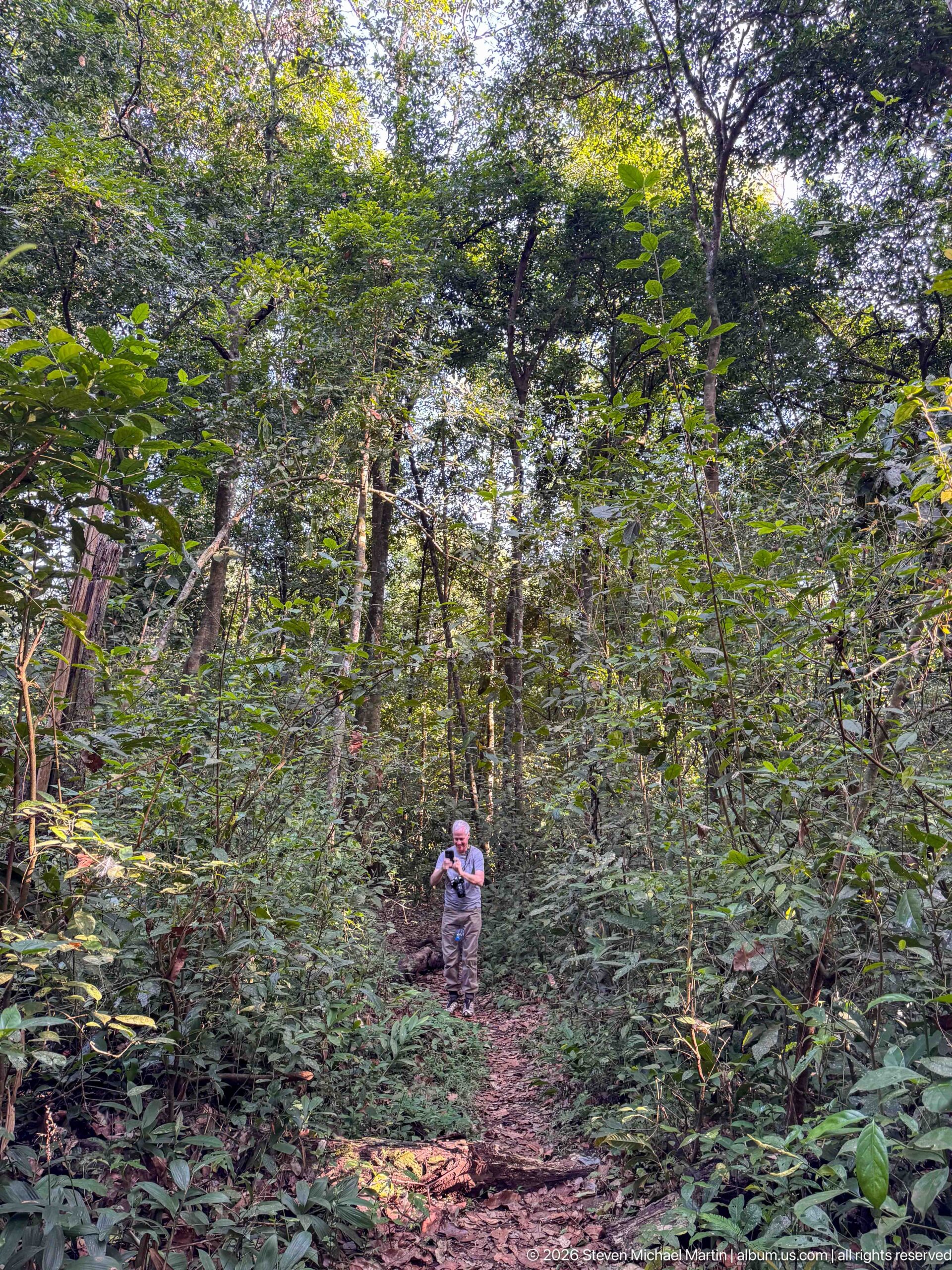
A narrow leaf-covered path threads between dense shrubs, saplings, and taller trees, with a visitor standing farther along the route. The long view records the enclosed, green corridor of the forest floor and the limited sightlines encountered while walking through Budongo Forest.
Caption
A narrow leaf-covered path threads between dense shrubs, saplings, and taller trees, with a visitor standing farther along the route. The long view records the enclosed, green corridor of the forest floor and the limited sightlines encountered while walking through Budongo Forest.
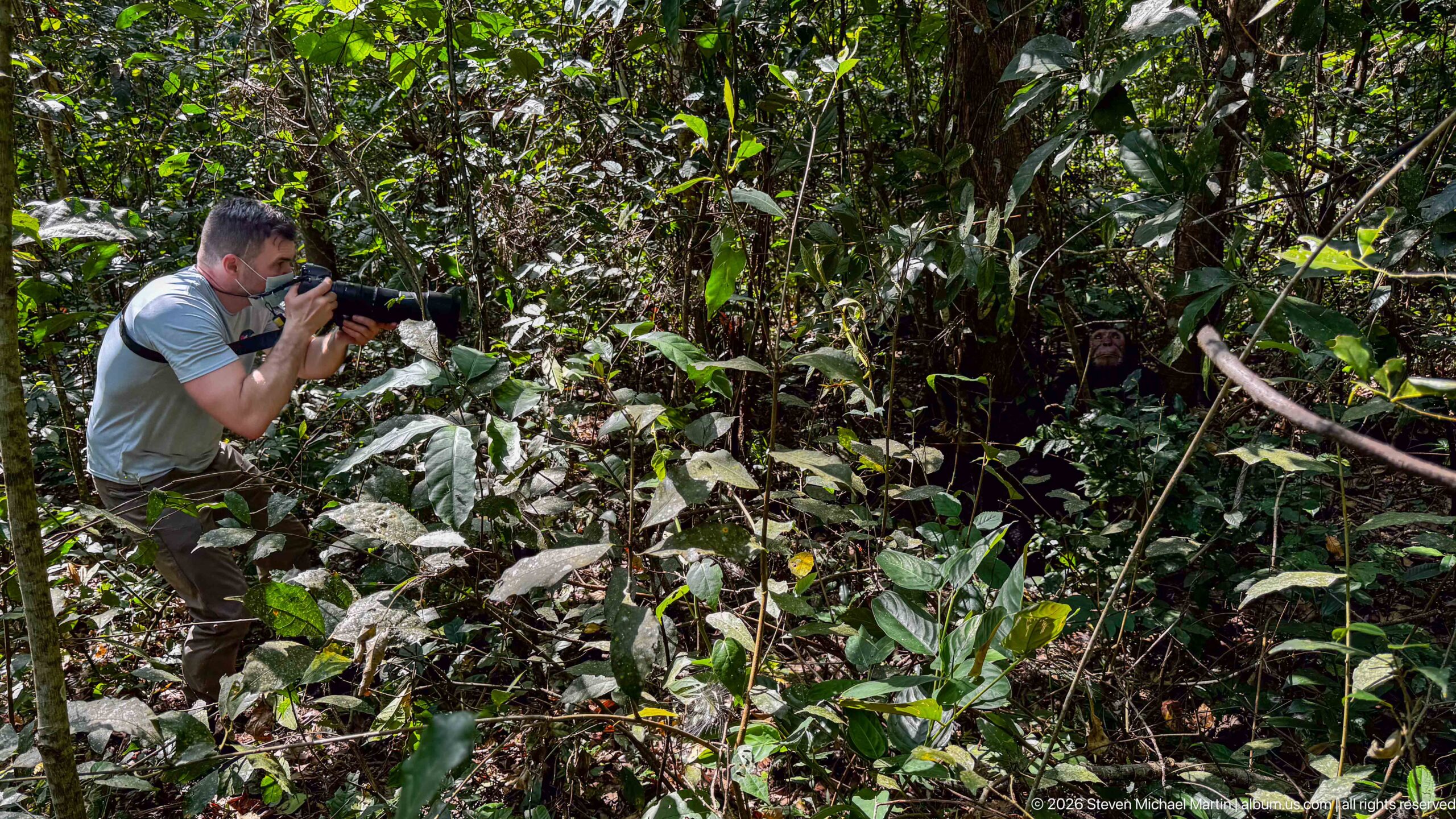
A photographer crouches low in dense vegetation, aiming a long telephoto lens through a narrow opening in the understory. The posture and restricted sightline show the practical challenge of photographing forest wildlife where vines, saplings, and broad leaves interrupt nearly every view.
Caption
A photographer crouches low in dense vegetation, aiming a long telephoto lens through a narrow opening in the understory. The posture and restricted sightline show the practical challenge of photographing forest wildlife where vines, saplings, and broad leaves interrupt nearly every view.
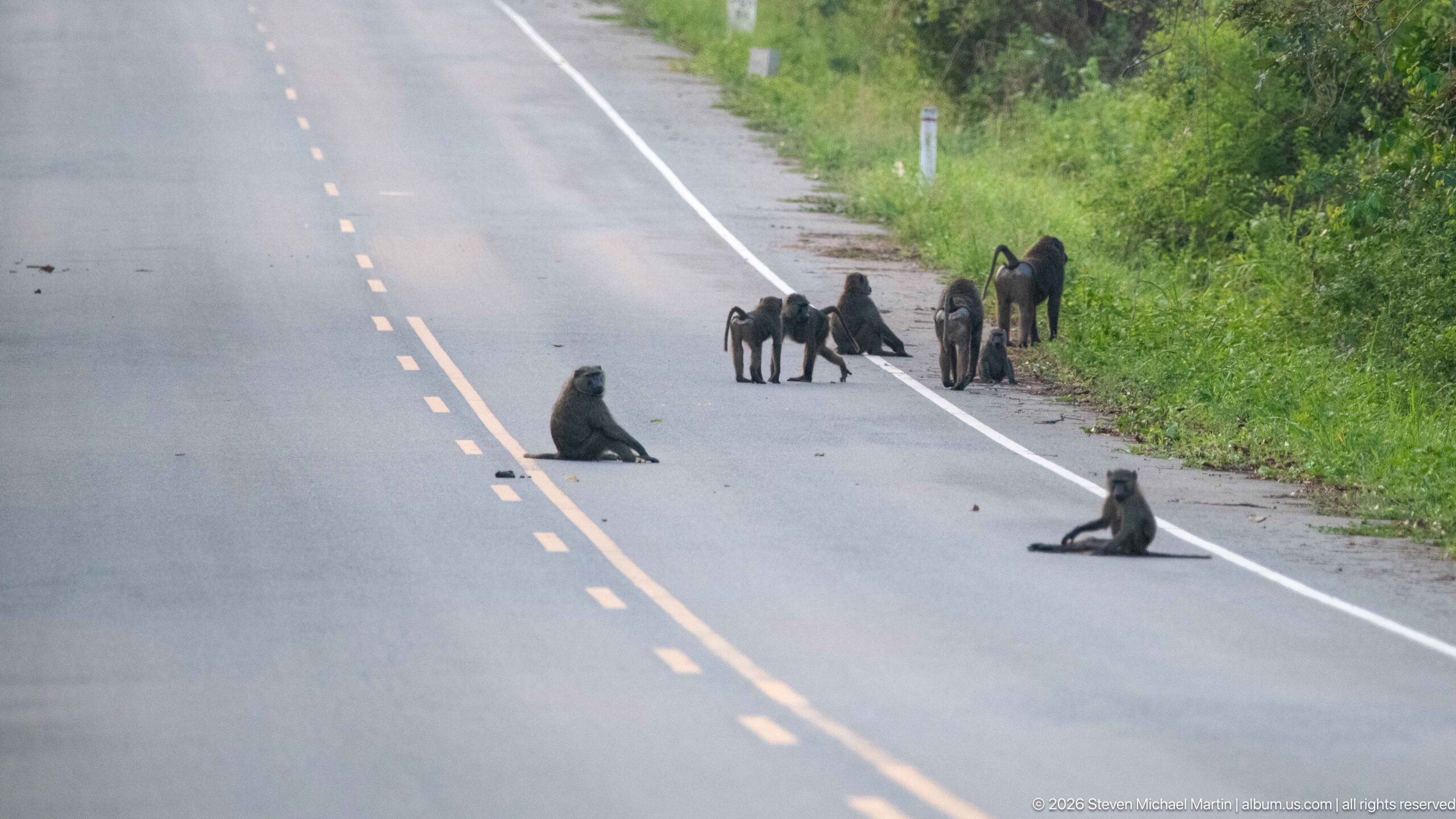
A troop of olive baboons occupies the paved road at the forest margin, with animals sitting, walking, and gathering near the shoulder. Their doglike muzzles, robust bodies, and gray-brown coats support the identification, while the dispersed group illustrates the species’ terrestrial use of open travel corridors beside forest habitat.
Caption
A troop of olive baboons occupies the paved road at the forest margin, with animals sitting, walking, and gathering near the shoulder. Their doglike muzzles, robust bodies, and gray-brown coats support the identification, while the dispersed group illustrates the species’ terrestrial use of open travel corridors beside forest habitat.
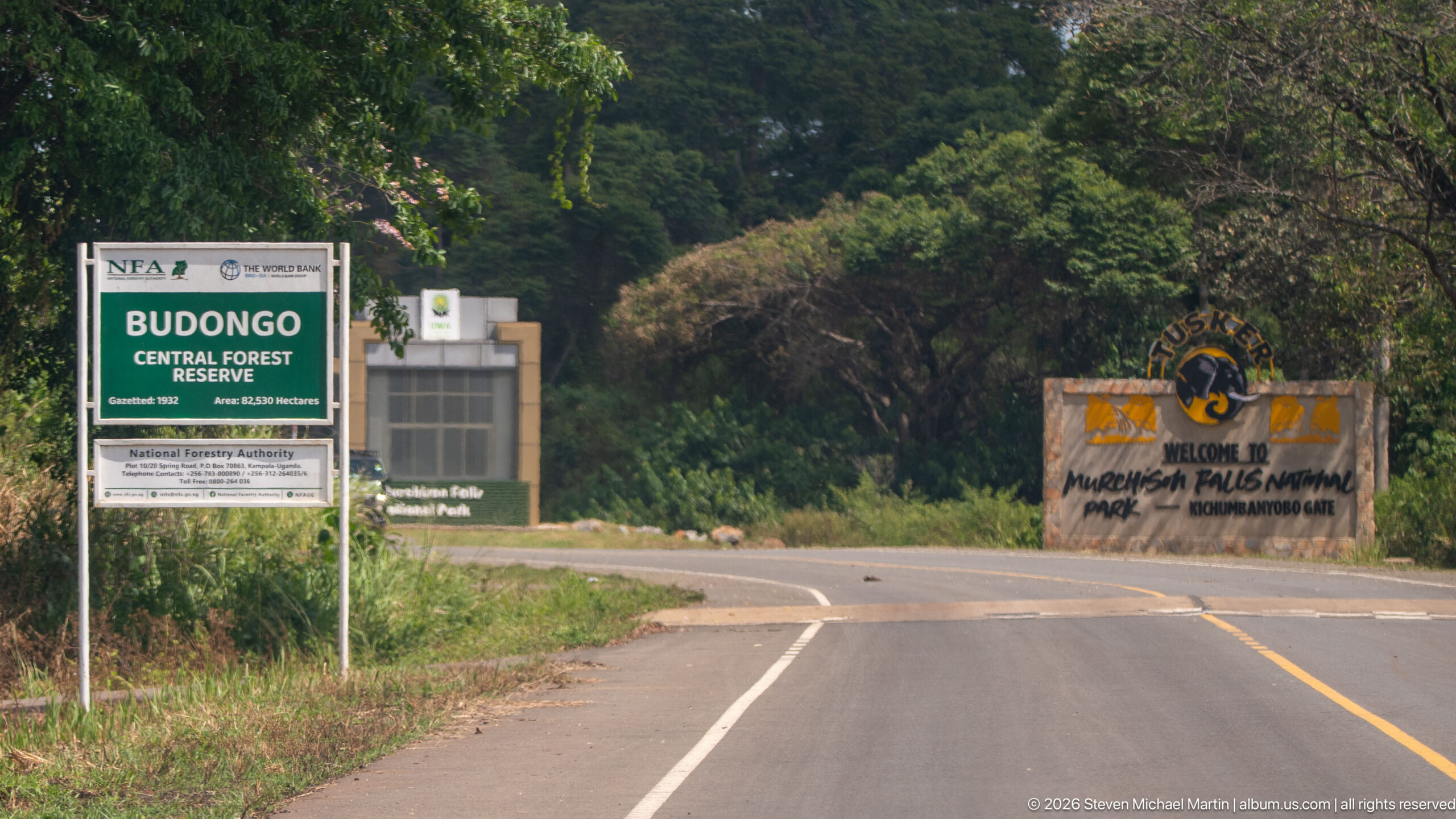
Roadside signs mark the entrance to Budongo Central Forest Reserve, including a National Forestry Authority panel and a larger welcome sign beyond the junction. The view establishes the protected-forest setting and the managed access point before the portfolio moves into the forest interior.
Caption
Roadside signs mark the entrance to Budongo Central Forest Reserve, including a National Forestry Authority panel and a larger welcome sign beyond the junction. The view establishes the protected-forest setting and the managed access point before the portfolio moves into the forest interior.
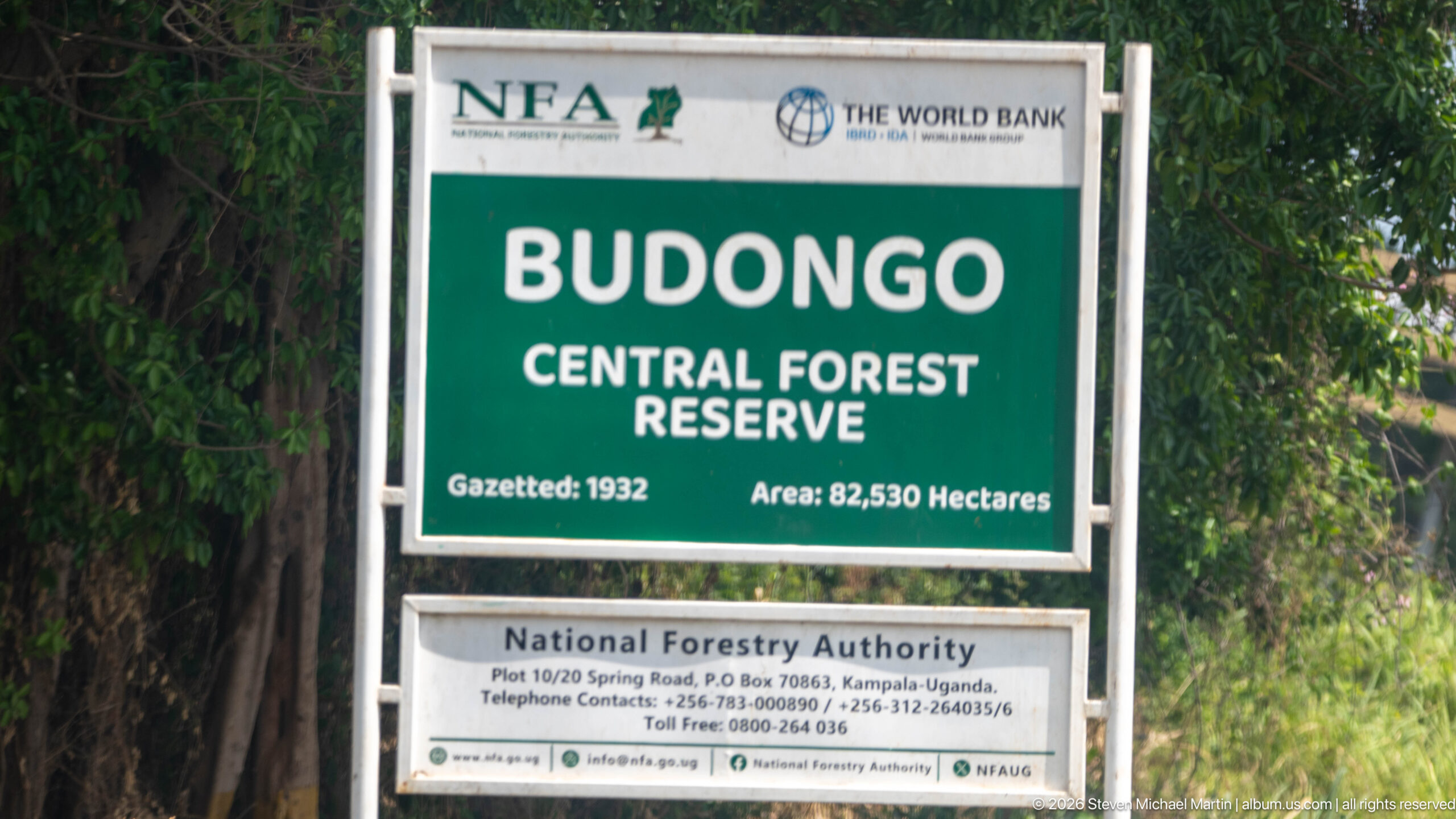
A close view of the Budongo Central Forest Reserve sign records the reserve’s name along with the printed statements “Gazetted: 1932” and “Area: 82,530 Hectares.” National Forestry Authority branding and contact information appear below, making the sign a useful documentary record of the forest’s official designation.
Caption
A close view of the Budongo Central Forest Reserve sign records the reserve’s name along with the printed statements “Gazetted: 1932” and “Area: 82,530 Hectares.” National Forestry Authority branding and contact information appear below, making the sign a useful documentary record of the forest’s official designation.
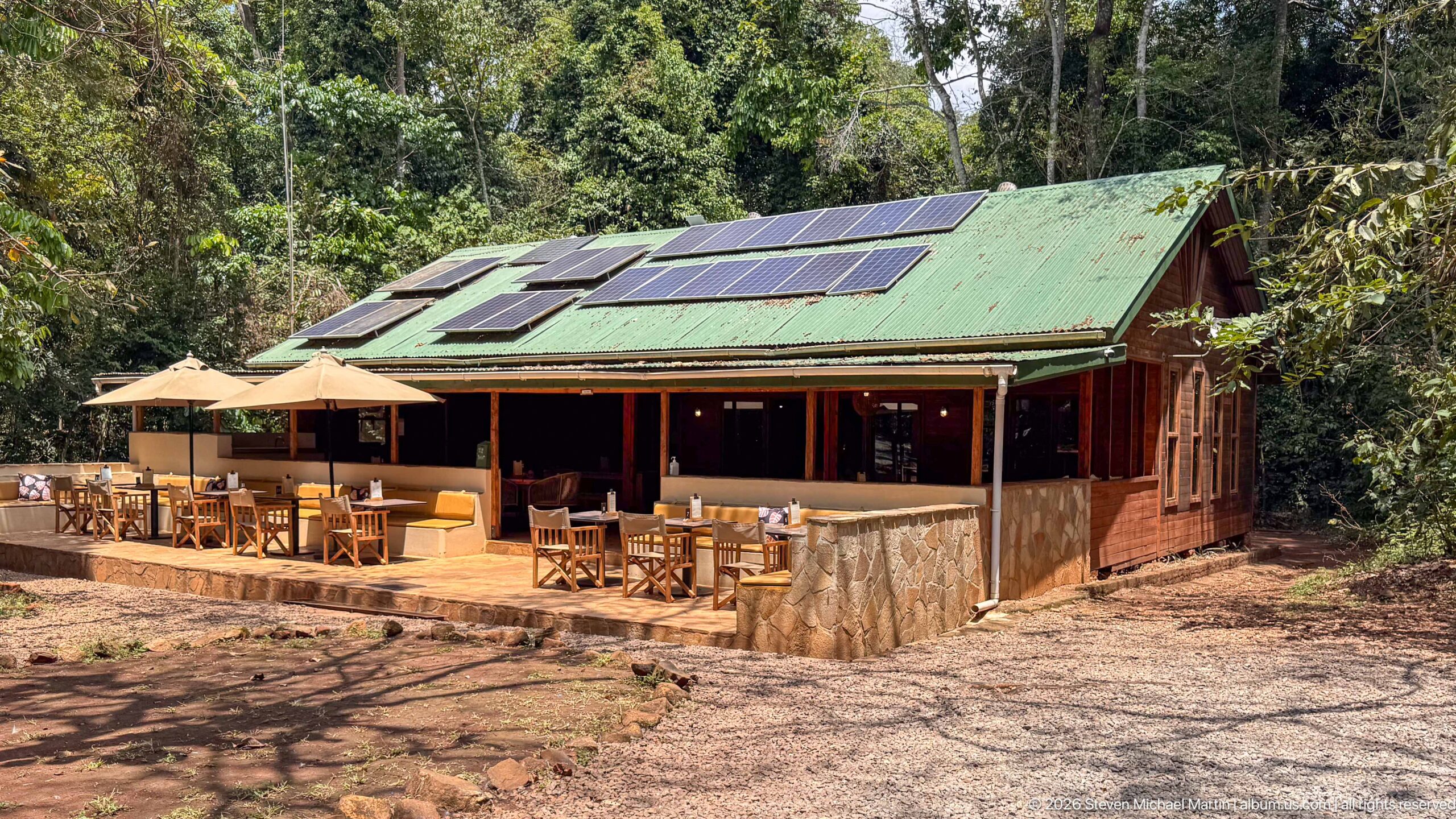
A timber lodge building with a green metal roof stands at the forest edge, its open veranda arranged with dining tables and shaded umbrellas. Solar panels cover part of the roof, combining visitor facilities with an off-grid energy feature in the wooded setting.
Caption
A timber lodge building with a green metal roof stands at the forest edge, its open veranda arranged with dining tables and shaded umbrellas. Solar panels cover part of the roof, combining visitor facilities with an off-grid energy feature in the wooded setting.
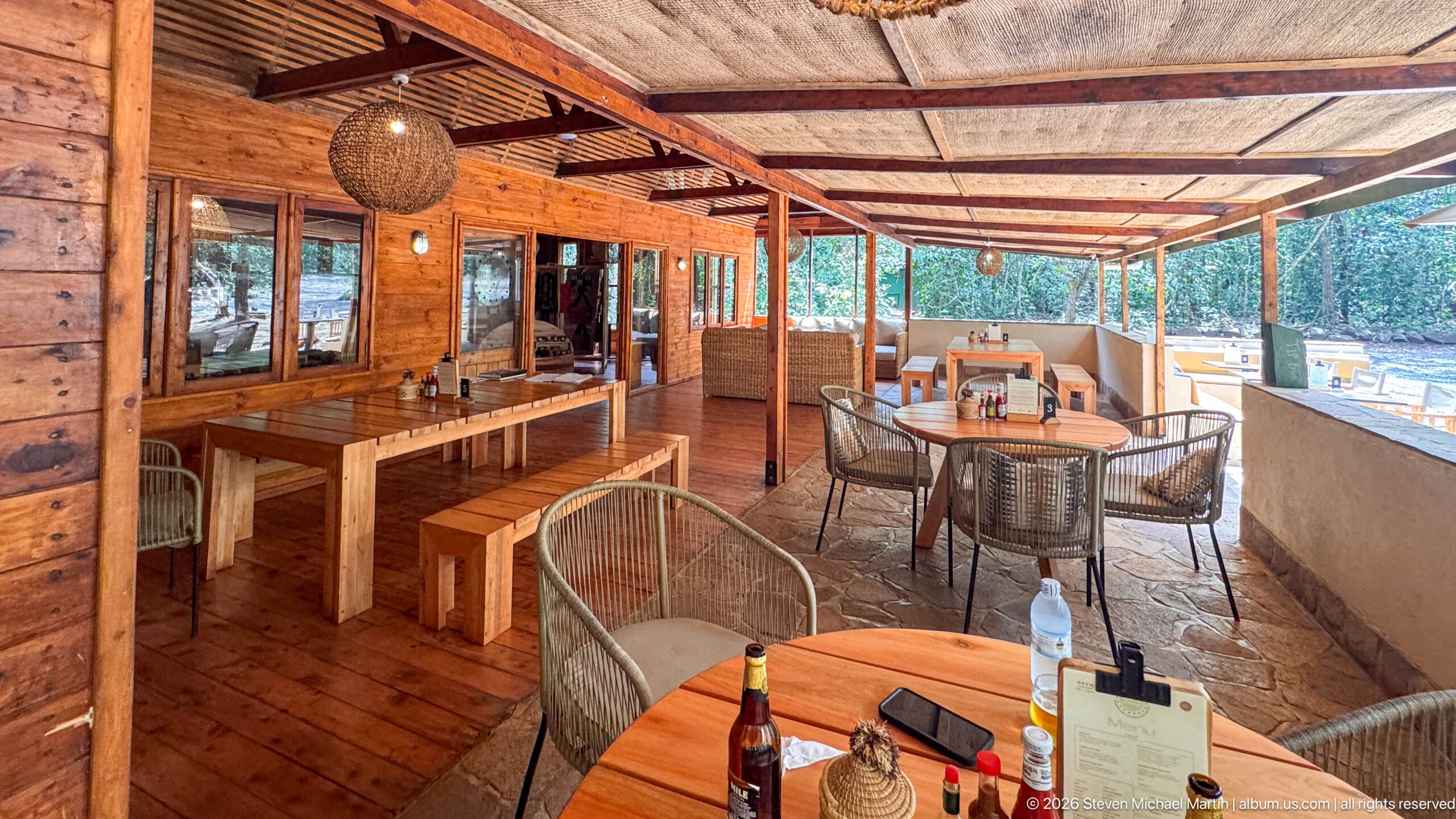
Wooden floors, walls, benches, and tables define an open-sided café or lodge dining area overlooking surrounding greenery. Woven chairs and simple table settings create an informal visitor space, while the screened or open perimeter keeps the forest immediately present beyond the structure.
Caption
Wooden floors, walls, benches, and tables define an open-sided café or lodge dining area overlooking surrounding greenery. Woven chairs and simple table settings create an informal visitor space, while the screened or open perimeter keeps the forest immediately present beyond the structure.
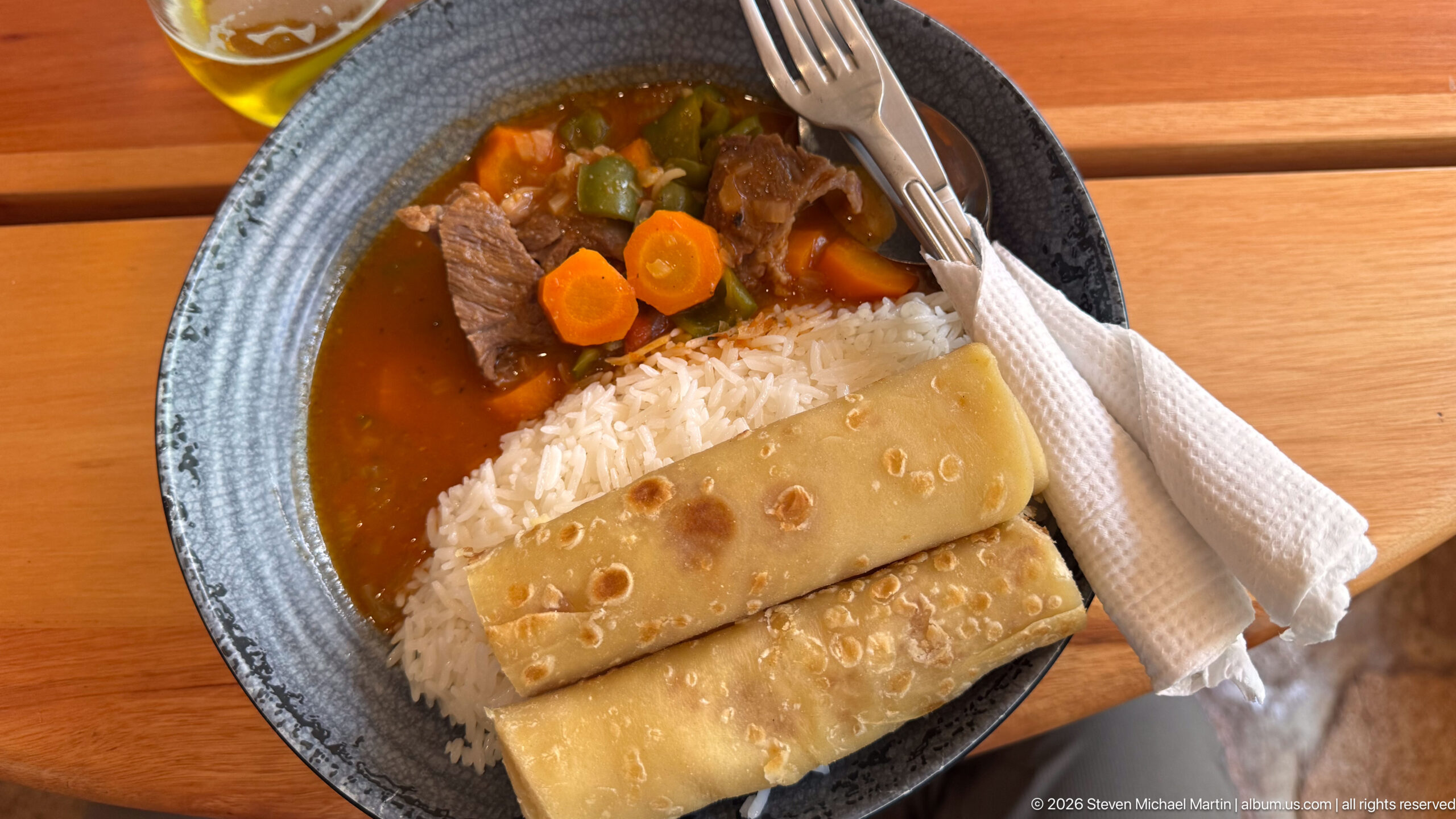
A bowl combines a rich meat-and-vegetable stew with white rice and folded chapati, a common East African flatbread. Carrot rounds and green vegetables remain visible in the sauce, while the close overhead framing records a substantial lodge meal served during the Budongo Forest visit.
Caption
A bowl combines a rich meat-and-vegetable stew with white rice and folded chapati, a common East African flatbread. Carrot rounds and green vegetables remain visible in the sauce, while the close overhead framing records a substantial lodge meal served during the Budongo Forest visit.
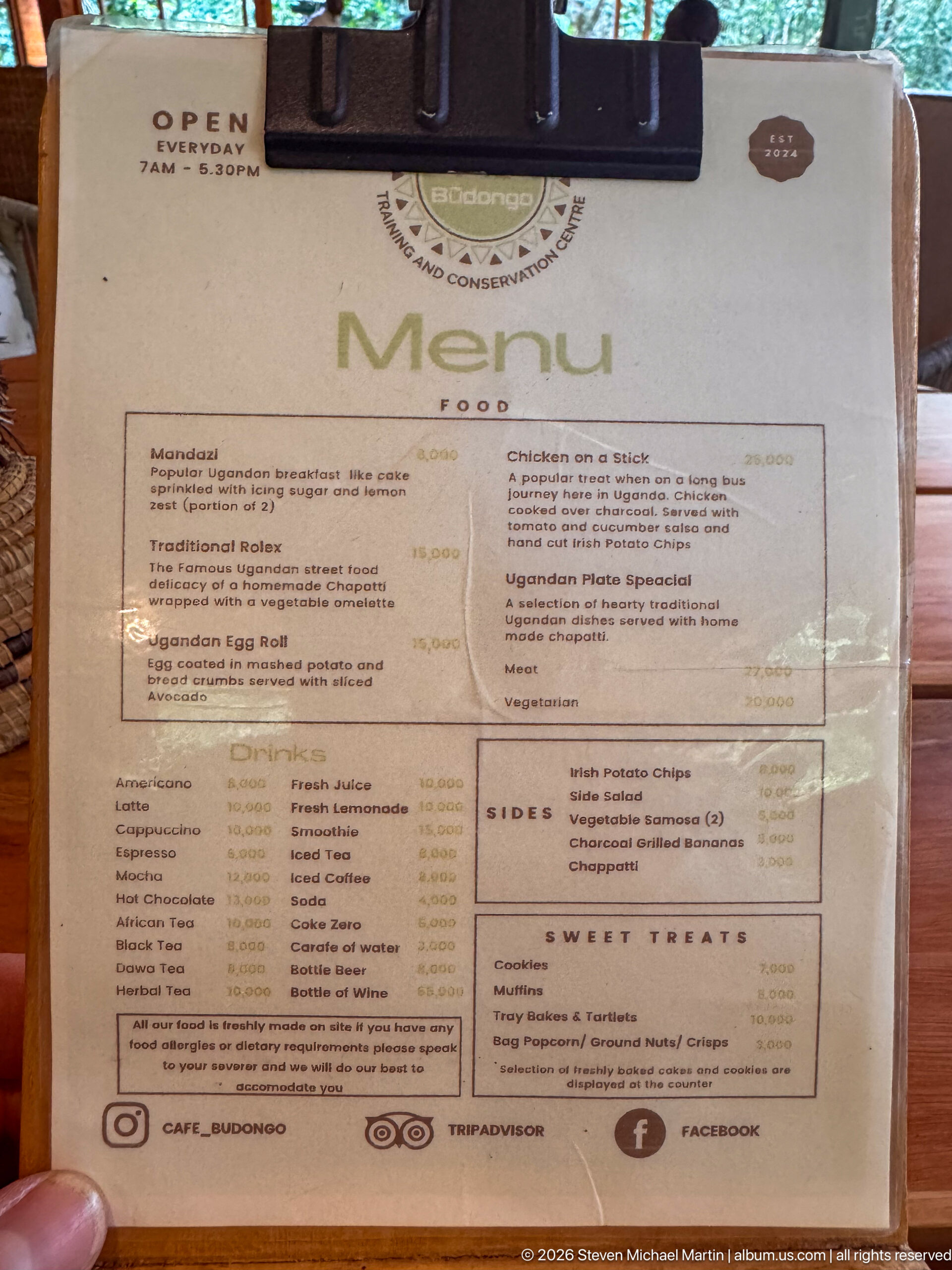
A printed café menu clipped to a board lists breakfast, traditional dishes, chicken, snacks, sides, and beverages for visitors near Budongo Forest. The document adds a human-scale detail to the field experience, showing the practical hospitality infrastructure supporting travelers and forest excursions.
Caption
A printed café menu clipped to a board lists breakfast, traditional dishes, chicken, snacks, sides, and beverages for visitors near Budongo Forest. The document adds a human-scale detail to the field experience, showing the practical hospitality infrastructure supporting travelers and forest excursions.
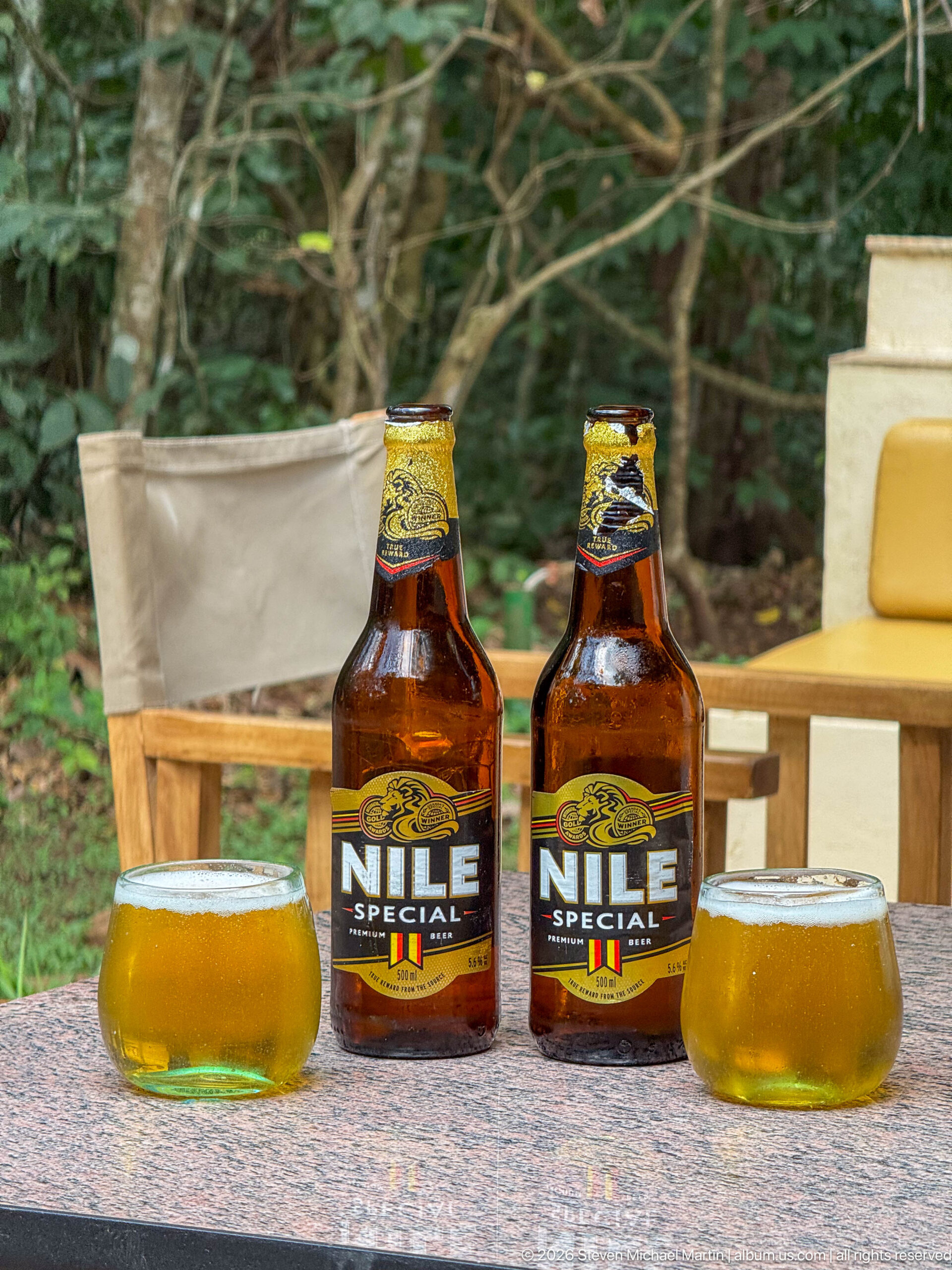
Two bottles of Nile Special lager stand between short glasses of golden beer on an outdoor table, with forest vegetation behind. The arrangement records a familiar Ugandan beverage in the lodge setting and contrasts the commercial label and amber bottles with the surrounding greenery.
Caption
Two bottles of Nile Special lager stand between short glasses of golden beer on an outdoor table, with forest vegetation behind. The arrangement records a familiar Ugandan beverage in the lodge setting and contrasts the commercial label and amber bottles with the surrounding greenery.
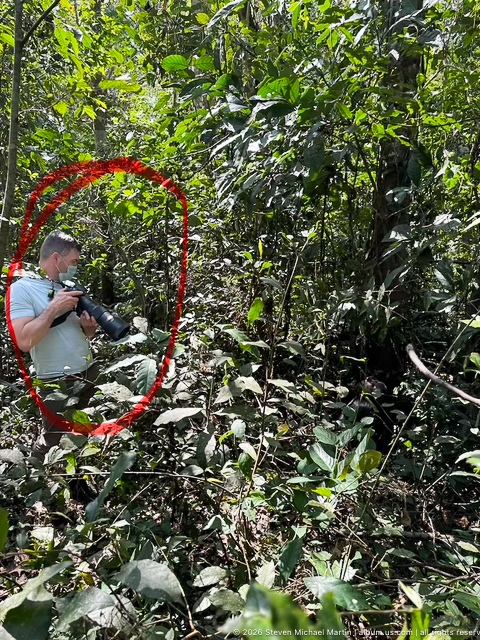
A photographer stands amid dense understory vegetation, raising a camera with a long lens toward a subject concealed beyond the frame. Tangled stems, broad leaves, and uneven light convey the visual difficulty of wildlife observation and photography inside Budongo Forest’s layered vegetation.
Caption
A photographer stands amid dense understory vegetation, raising a camera with a long lens toward a subject concealed beyond the frame. Tangled stems, broad leaves, and uneven light convey the visual difficulty of wildlife observation and photography inside Budongo Forest’s layered vegetation.

Two rounded bird-shaped vessels with painted circular spots and small beaks sit on a similarly patterned tray. Their paired openings suggest condiment or table-service containers, adding a playful handcrafted detail to the lodge dining setting without enough evidence to assign a specific maker or craft tradition.
Caption
Two rounded bird-shaped vessels with painted circular spots and small beaks sit on a similarly patterned tray. Their paired openings suggest condiment or table-service containers, adding a playful handcrafted detail to the lodge dining setting without enough evidence to assign a specific maker or craft tradition.
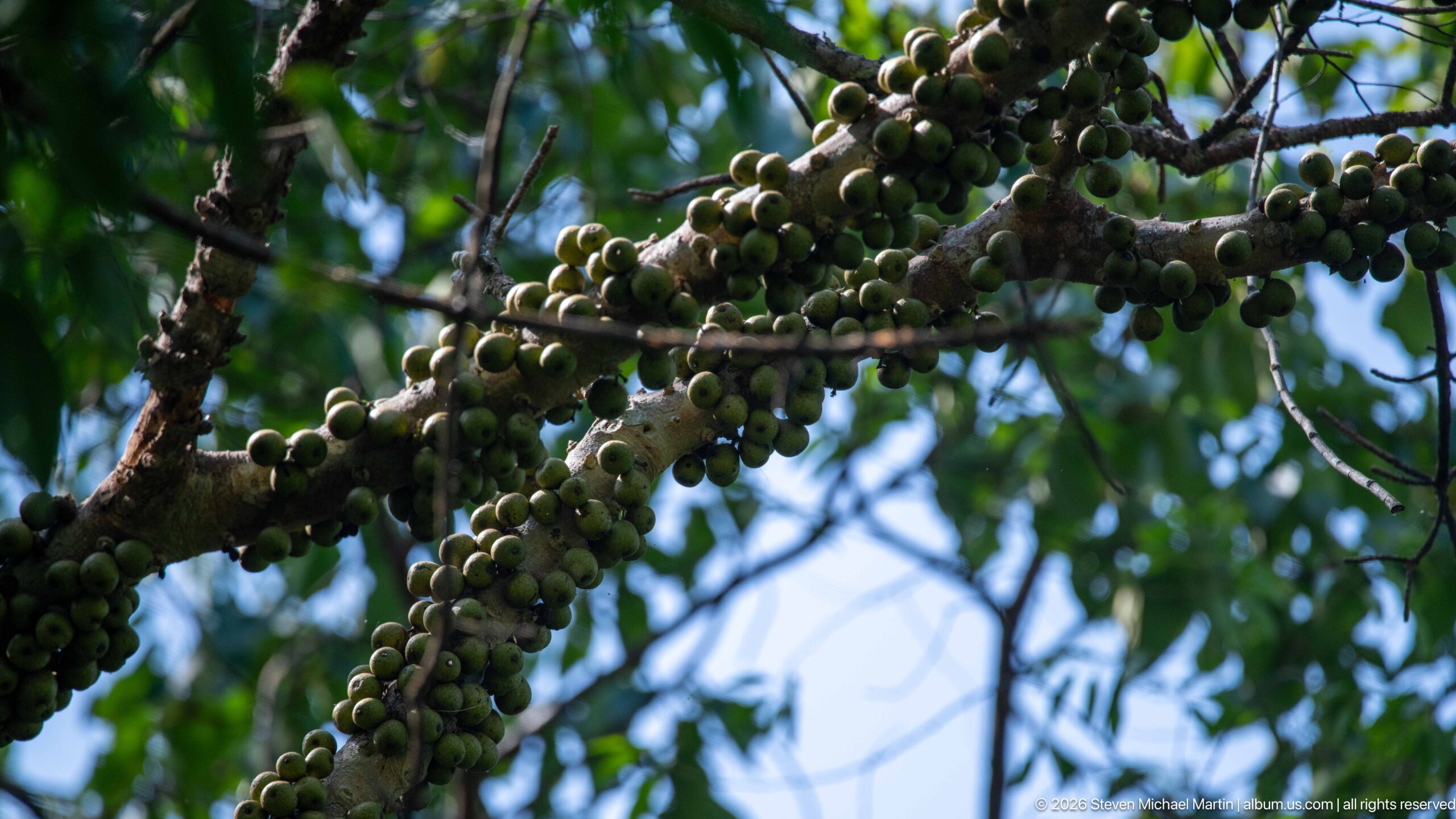
Dense clusters of small spherical green fruits grow directly along woody branches beneath the forest canopy. The cauliflorous or ramiflorous arrangement is consistent with several tropical fig species, an ecologically important fruit form in African forests, but the proof sheet does not support a species-level identification.
Caption
Dense clusters of small spherical green fruits grow directly along woody branches beneath the forest canopy. The cauliflorous or ramiflorous arrangement is consistent with several tropical fig species, an ecologically important fruit form in African forests, but the proof sheet does not support a species-level identification.
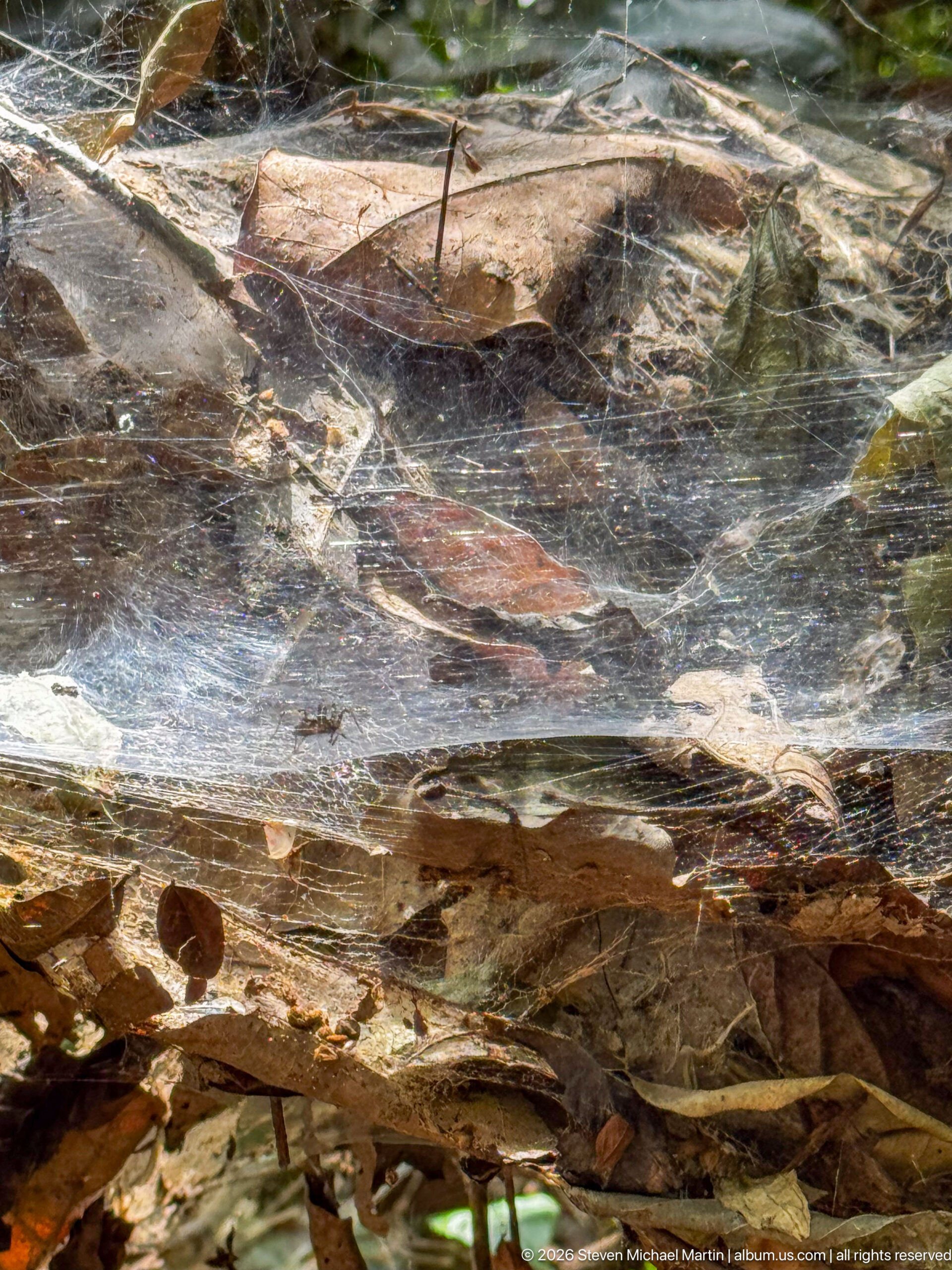
A broad sheet of fine silk stretches across dry leaves, twigs, and low vegetation on the forest floor. The web’s layered, nearly horizontal surface catches the light and reveals how small invertebrates create conspicuous microhabitats within the otherwise dark leaf-litter layer.
Caption
A broad sheet of fine silk stretches across dry leaves, twigs, and low vegetation on the forest floor. The web’s layered, nearly horizontal surface catches the light and reveals how small invertebrates create conspicuous microhabitats within the otherwise dark leaf-litter layer.
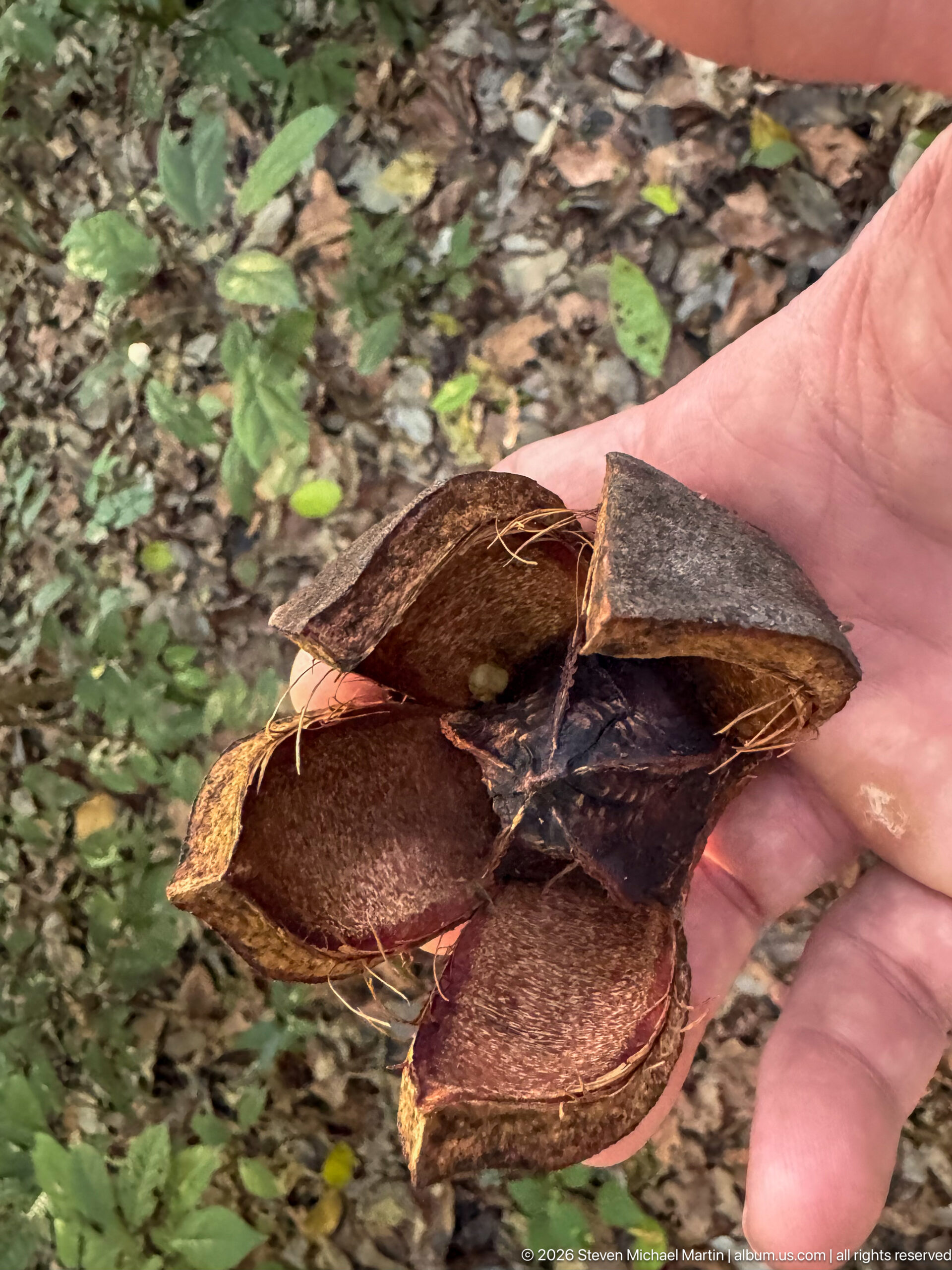
A hand holds a large woody pod split into several thick, boat-shaped valves around a dark central interior. The opened fruit reveals a robust dehiscent structure adapted to releasing seeds, but without the parent plant, intact fruit, or diagnostic seeds, a reliable species identification is not possible.
Caption
A hand holds a large woody pod split into several thick, boat-shaped valves around a dark central interior. The opened fruit reveals a robust dehiscent structure adapted to releasing seeds, but without the parent plant, intact fruit, or diagnostic seeds, a reliable species identification is not possible.
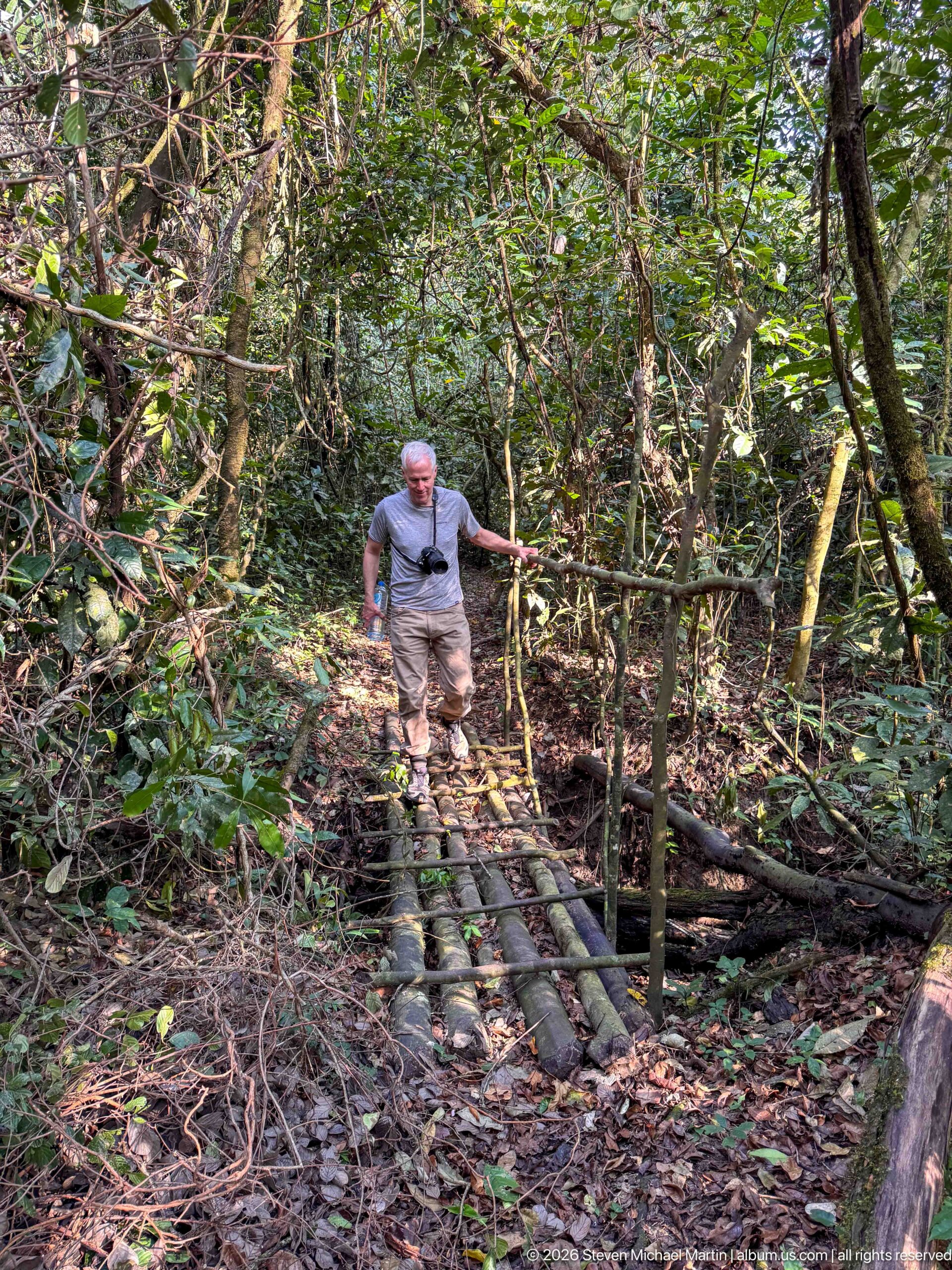
A visitor carefully crosses a narrow footbridge made from parallel logs laid over a wet or uneven section of forest floor. Tangled vines, fallen branches, and dense shade surround the crossing, showing the simple trail infrastructure used to negotiate difficult terrain inside the forest.
Caption
A visitor carefully crosses a narrow footbridge made from parallel logs laid over a wet or uneven section of forest floor. Tangled vines, fallen branches, and dense shade surround the crossing, showing the simple trail infrastructure used to negotiate difficult terrain inside the forest.
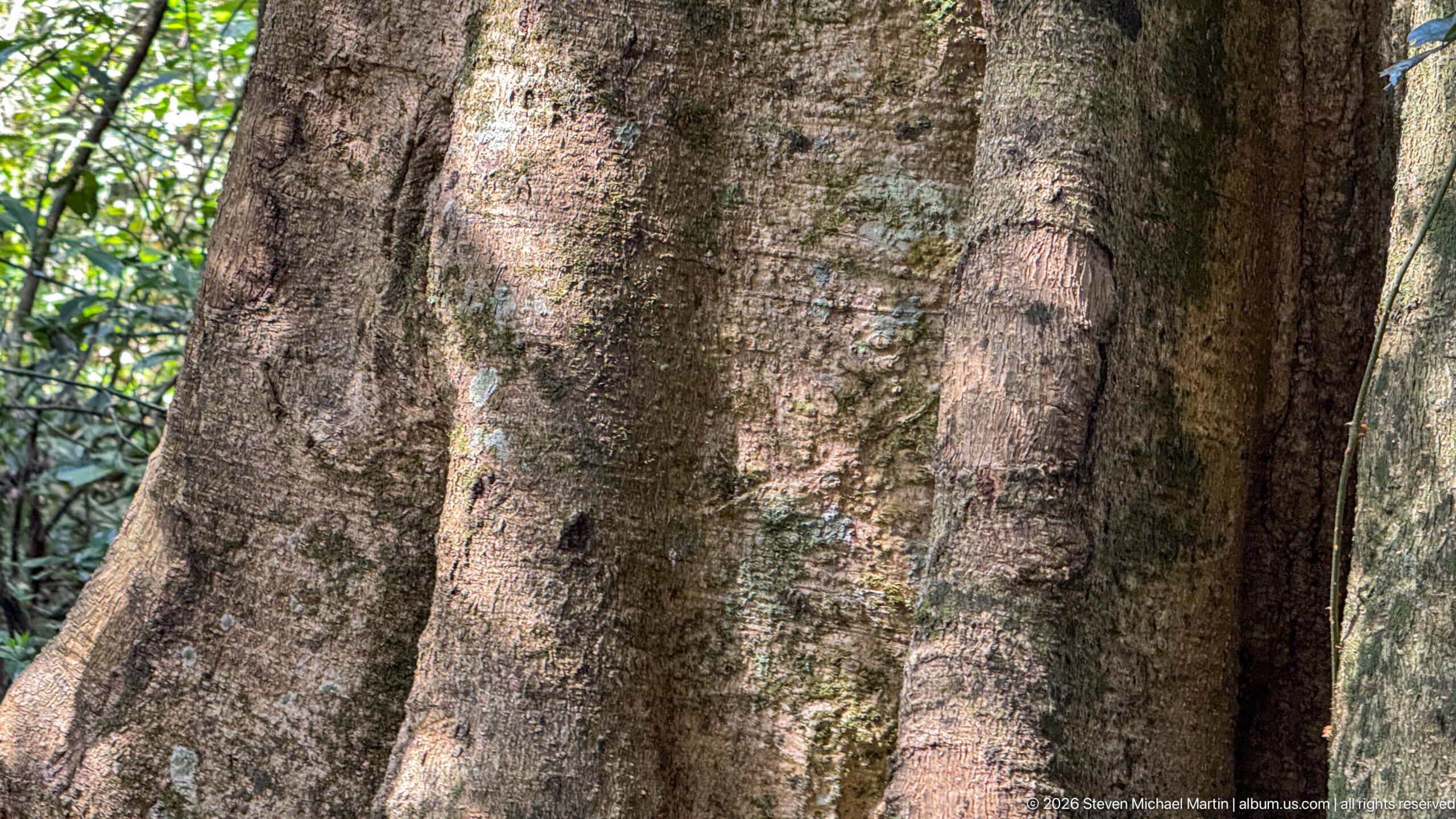
The base of a mature forest tree expands into broad vertical buttresses, a common structural adaptation among large tropical trees growing in shallow, nutrient-cycling forest soils. The close framing emphasizes bark texture, trunk mass, and the flared supports that anchor the tree above the surrounding understory.
Caption
The base of a mature forest tree expands into broad vertical buttresses, a common structural adaptation among large tropical trees growing in shallow, nutrient-cycling forest soils. The close framing emphasizes bark texture, trunk mass, and the flared supports that anchor the tree above the surrounding understory.
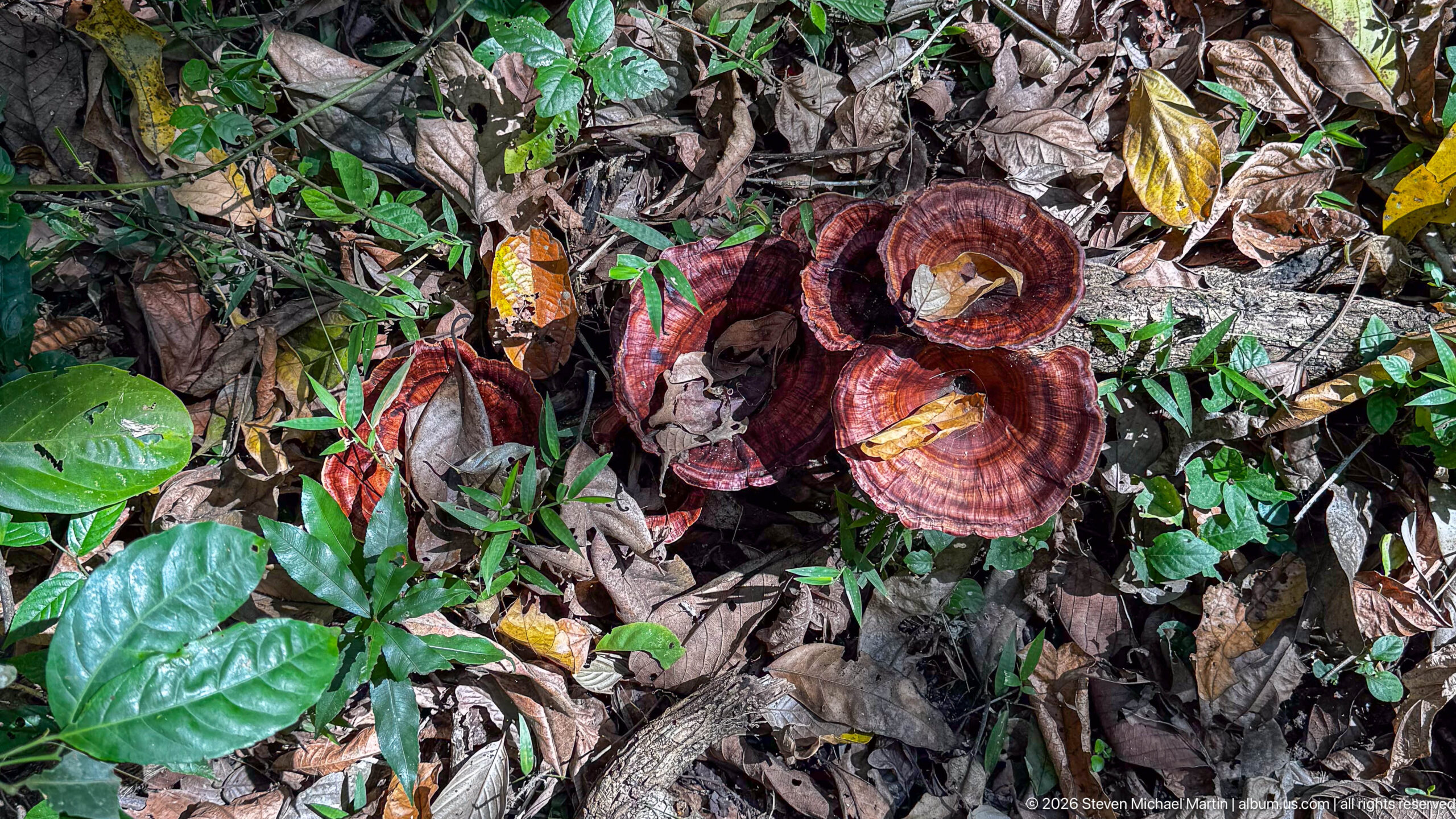
Several glossy red-brown bracket fungi emerge among damp leaf litter and low plants, their concentric bands and shelf-like caps standing out against the forest floor. These wood-decaying fungi are part of the decomposition community that recycles woody material in tropical forests, though the exact genus cannot be confirmed here.
Caption
Several glossy red-brown bracket fungi emerge among damp leaf litter and low plants, their concentric bands and shelf-like caps standing out against the forest floor. These wood-decaying fungi are part of the decomposition community that recycles woody material in tropical forests, though the exact genus cannot be confirmed here.
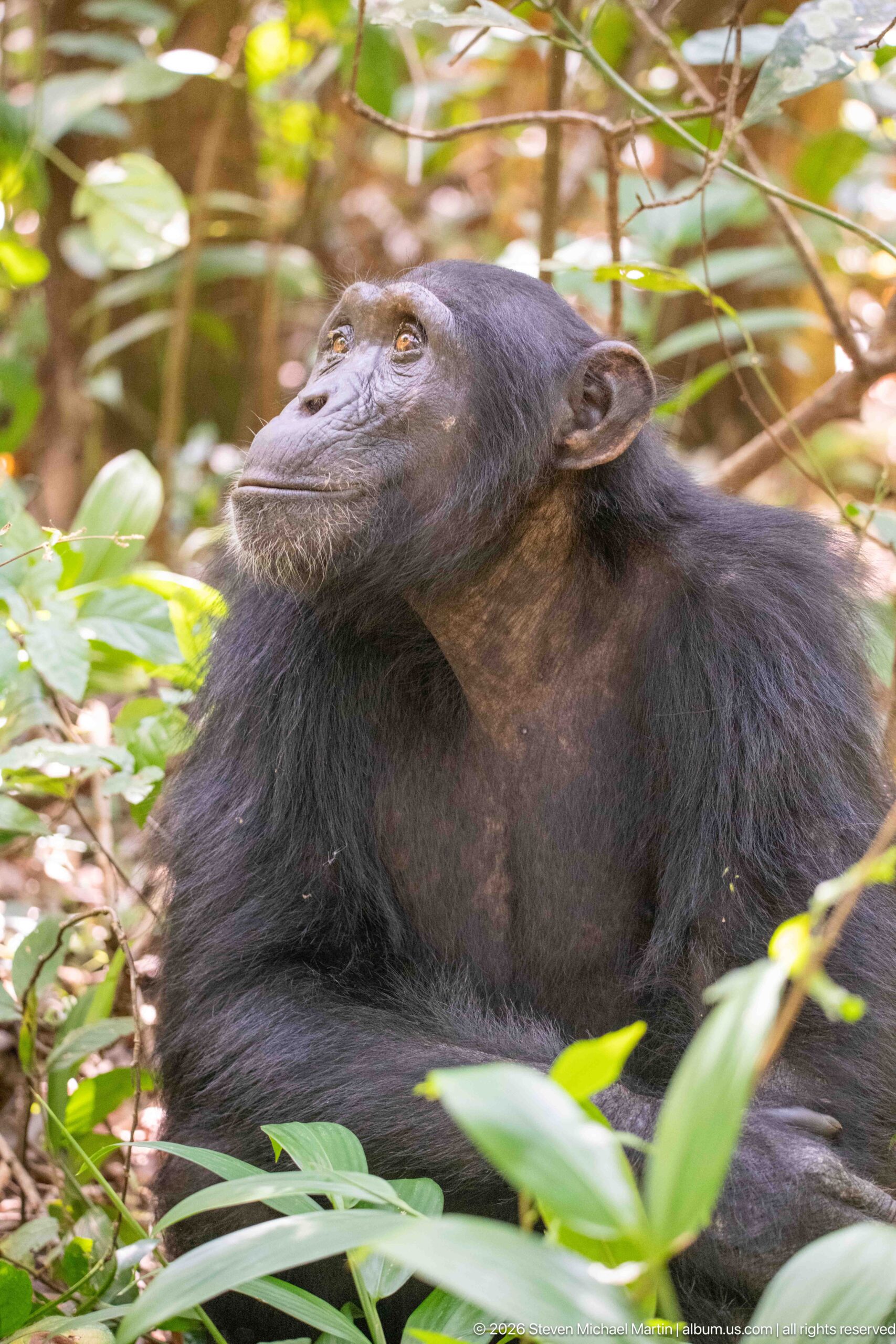
An eastern chimpanzee reclines on the forest floor or low vegetation, its body turned sideways and face lifted toward the canopy. Warm light catches the eye and facial profile while surrounding leaves partly frame the animal, distinguishing this quiet resting posture from the more frontal portraits in the sequence.
Caption
An eastern chimpanzee reclines on the forest floor or low vegetation, its body turned sideways and face lifted toward the canopy. Warm light catches the eye and facial profile while surrounding leaves partly frame the animal, distinguishing this quiet resting posture from the more frontal portraits in the sequence.
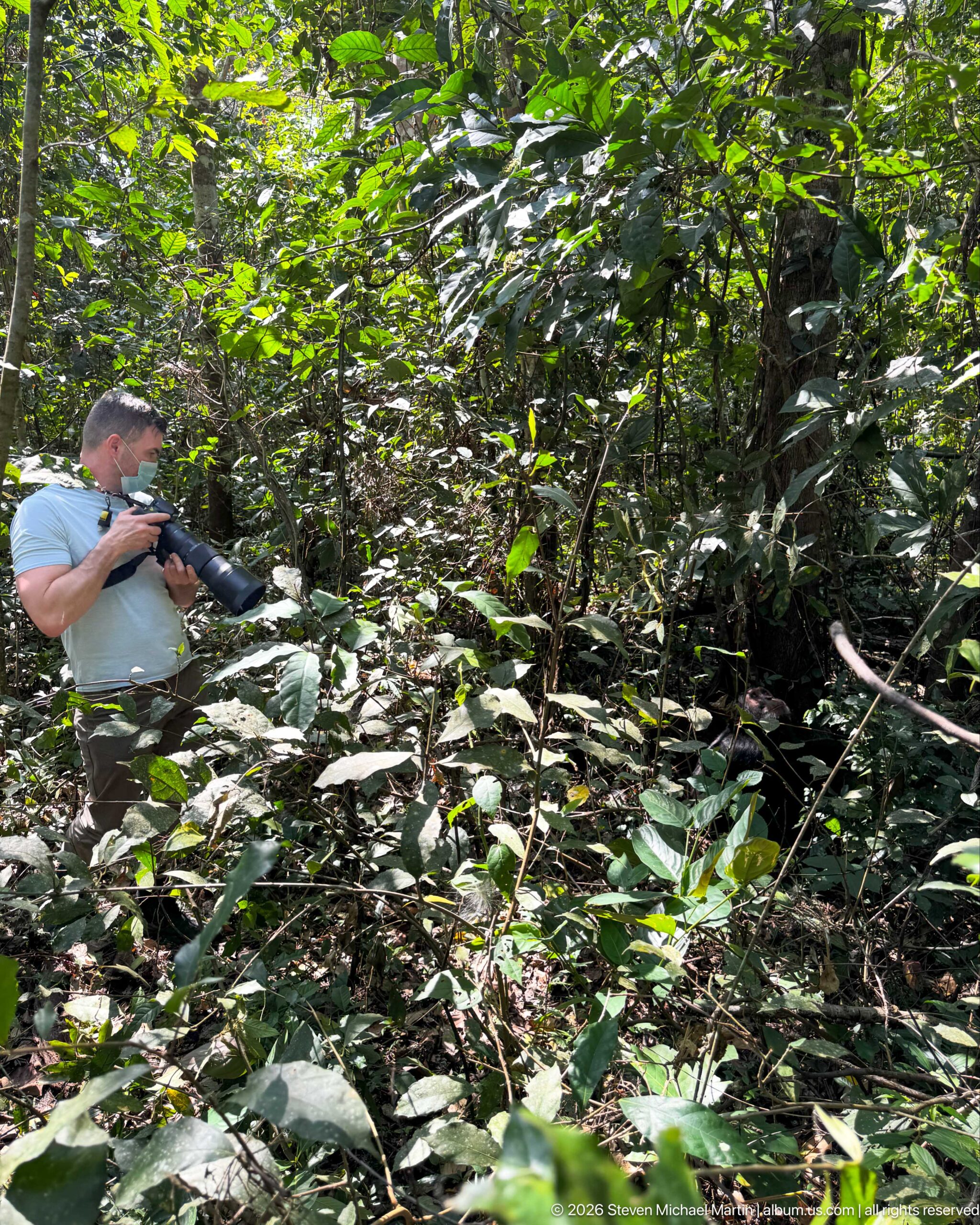
A photographer holds a long-lens camera at chest height while scanning dense forest vegetation. Broad leaves, vines, and closely spaced stems dominate the frame, making the person comparatively small and underscoring how limited visibility shapes wildlife photography and observation in Budongo Forest.
Caption
A photographer holds a long-lens camera at chest height while scanning dense forest vegetation. Broad leaves, vines, and closely spaced stems dominate the frame, making the person comparatively small and underscoring how limited visibility shapes wildlife photography and observation in Budongo Forest.
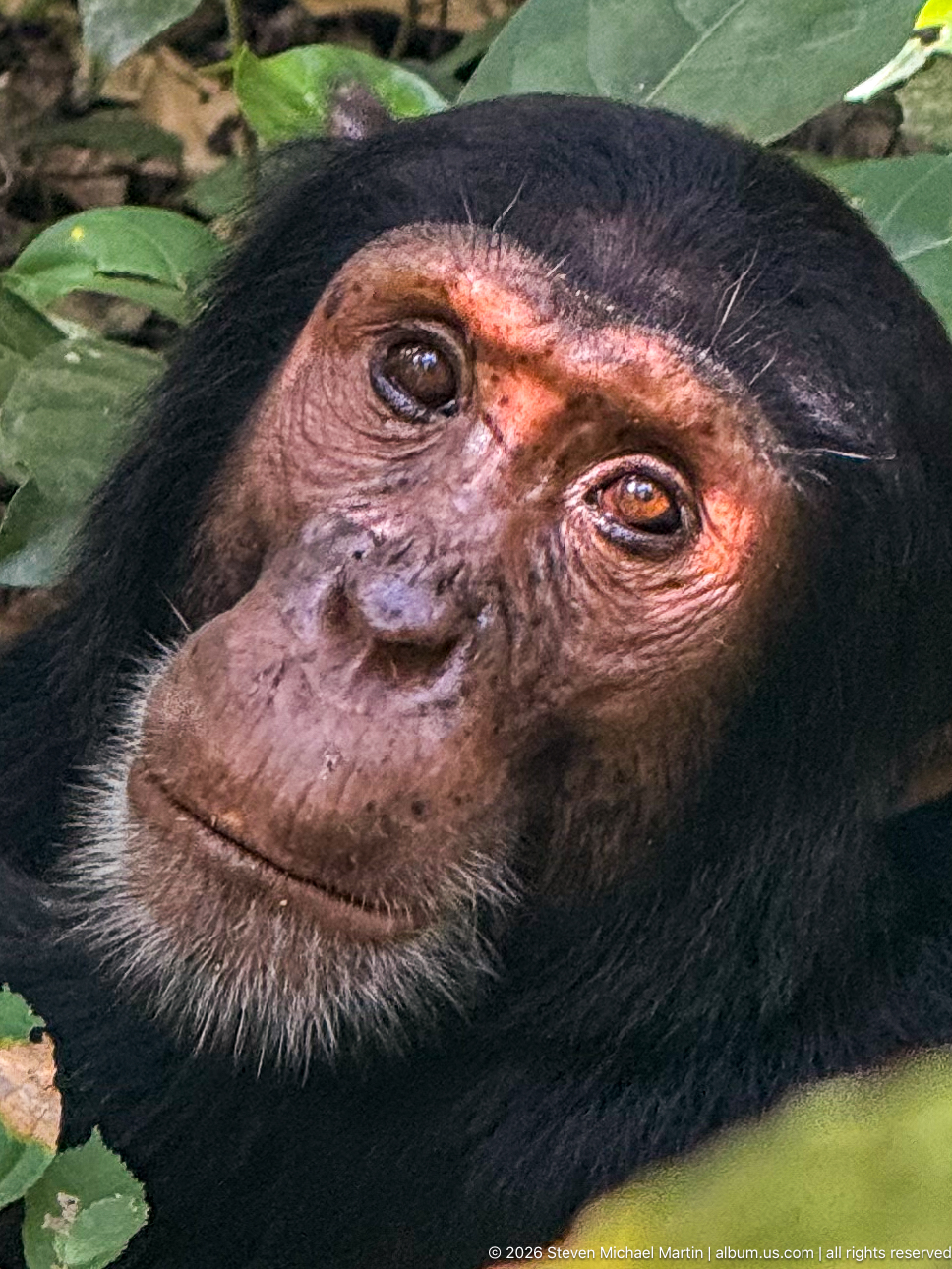
An eastern chimpanzee rests low among broad leaves, looking directly toward the camera. A narrow band of warm sunlight crosses the forehead and eyes, drawing attention to the wrinkled face and pale beard while the surrounding vegetation forms a close natural frame.
Caption
An eastern chimpanzee rests low among broad leaves, looking directly toward the camera. A narrow band of warm sunlight crosses the forehead and eyes, drawing attention to the wrinkled face and pale beard while the surrounding vegetation forms a close natural frame.
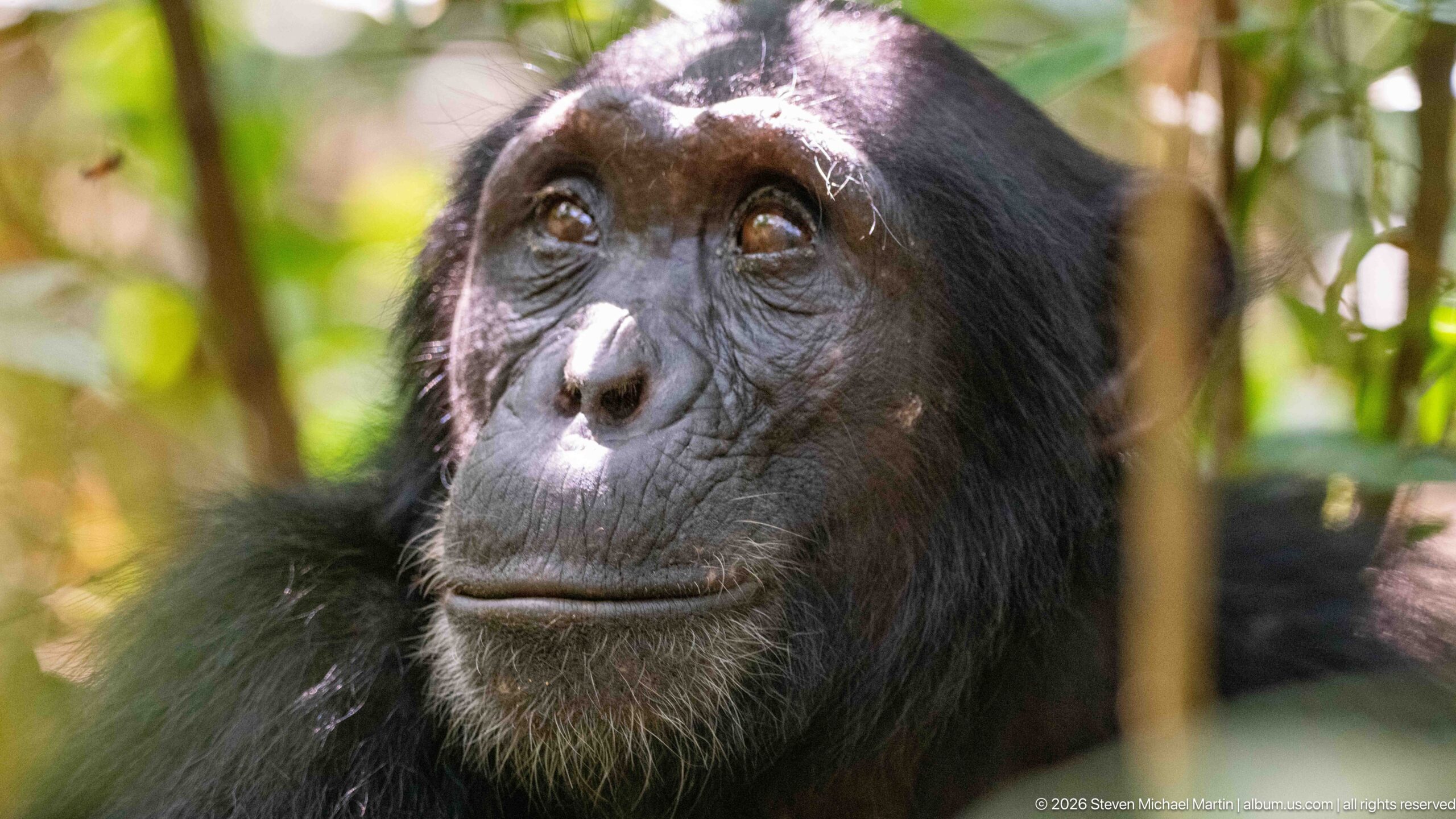
A close portrait isolates an eastern chimpanzee’s face against softly blurred forest vegetation. Fine wrinkles around the eyes and muzzle, sparse pale hairs along the chin, and reflected canopy light in the eyes create an unusually detailed study of the ape’s facial features.
Caption
A close portrait isolates an eastern chimpanzee’s face against softly blurred forest vegetation. Fine wrinkles around the eyes and muzzle, sparse pale hairs along the chin, and reflected canopy light in the eyes create an unusually detailed study of the ape’s facial features.
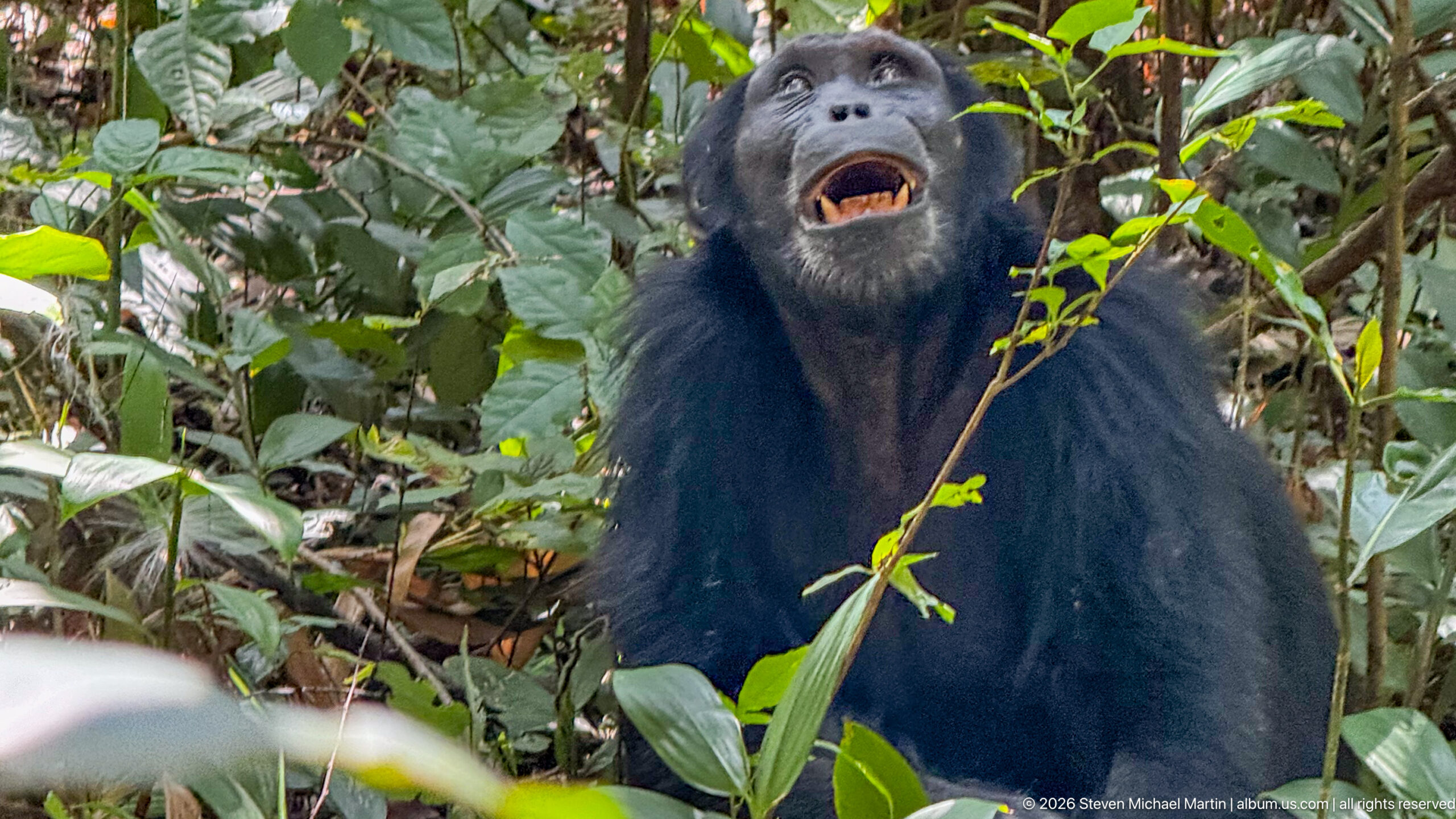
An eastern chimpanzee sits upright amid dense understory with its mouth open and head slightly raised. The visible posture may accompany a call or other social expression, but the still image cannot establish the sound or behavioral context; the photograph instead records the animal’s expressive face and powerful upper body.
Caption
An eastern chimpanzee sits upright amid dense understory with its mouth open and head slightly raised. The visible posture may accompany a call or other social expression, but the still image cannot establish the sound or behavioral context; the photograph instead records the animal’s expressive face and powerful upper body.
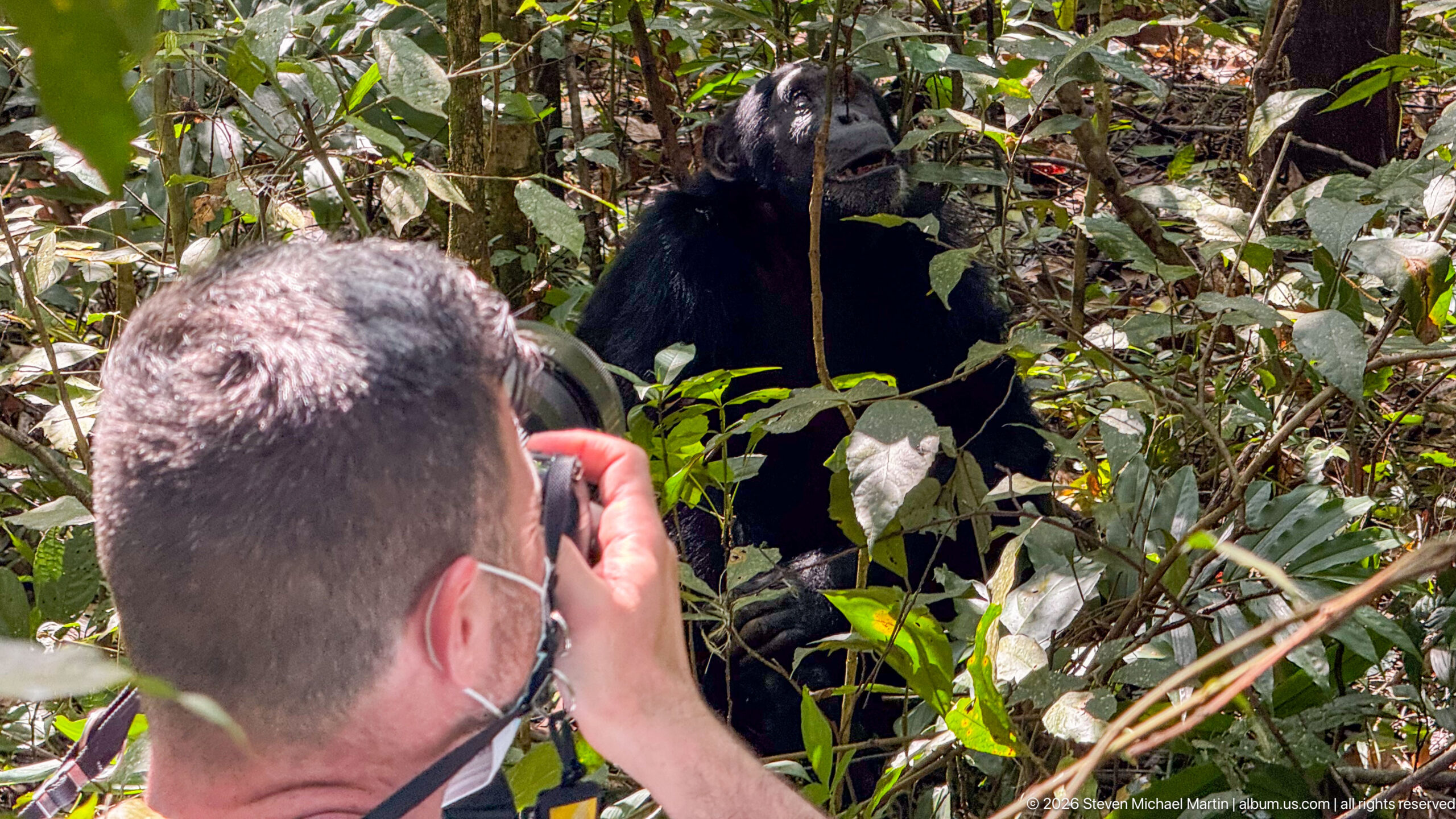
A photographer raises a camera toward an eastern chimpanzee sitting only a short distance away in dense forest vegetation. The over-the-shoulder composition records the encounter itself, placing human observation and wild ape in the same frame while emphasizing the obstructed sightlines of the understory.
Caption
A photographer raises a camera toward an eastern chimpanzee sitting only a short distance away in dense forest vegetation. The over-the-shoulder composition records the encounter itself, placing human observation and wild ape in the same frame while emphasizing the obstructed sightlines of the understory.
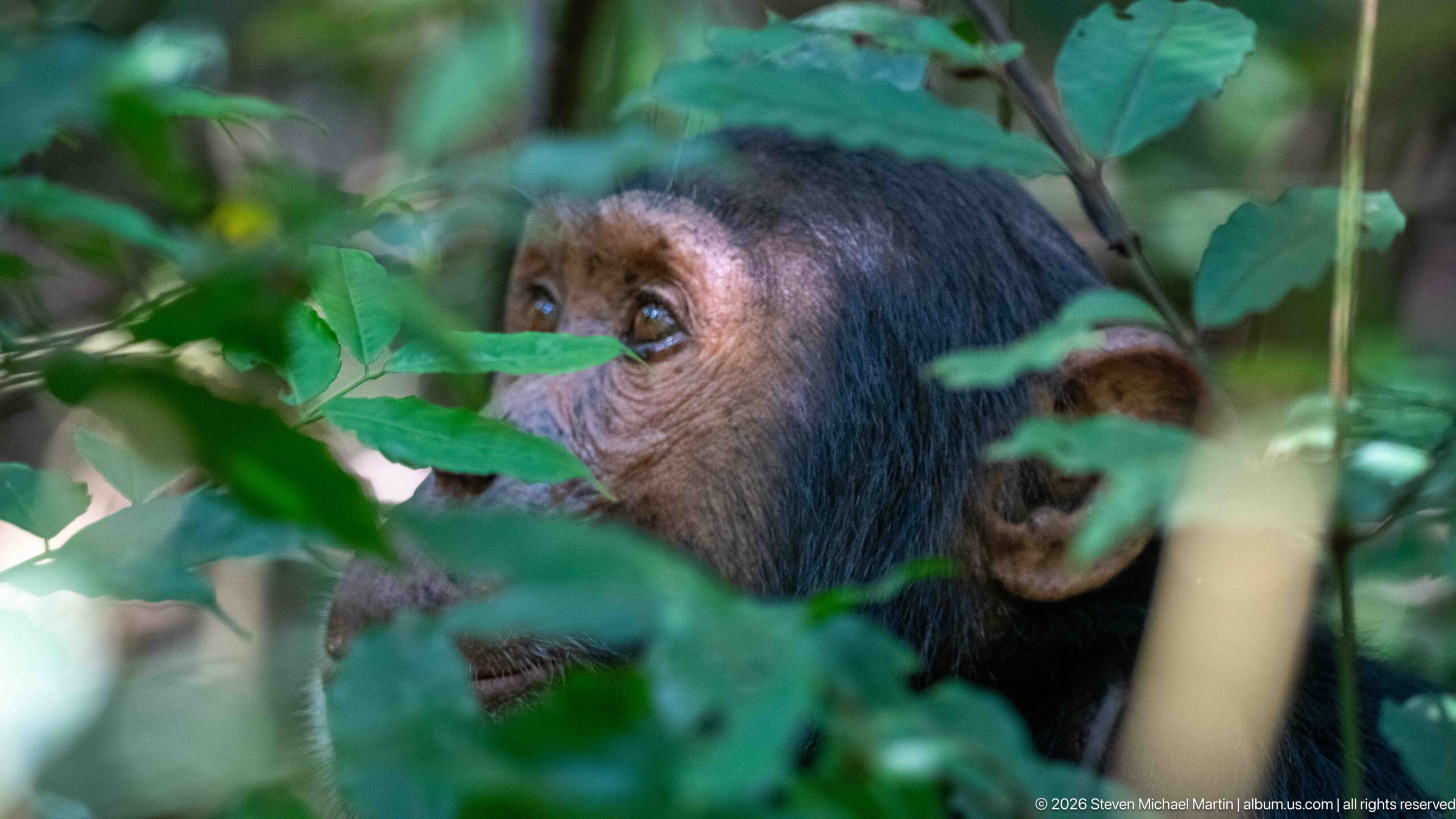
Leaves and slender stems partly conceal an eastern chimpanzee’s face, leaving one eye, ear, and the brown-black facial skin sharply visible through the vegetation. The obstructed portrait conveys the fragmented views typical of observing great apes in dense tropical forest.
Caption
Leaves and slender stems partly conceal an eastern chimpanzee’s face, leaving one eye, ear, and the brown-black facial skin sharply visible through the vegetation. The obstructed portrait conveys the fragmented views typical of observing great apes in dense tropical forest.
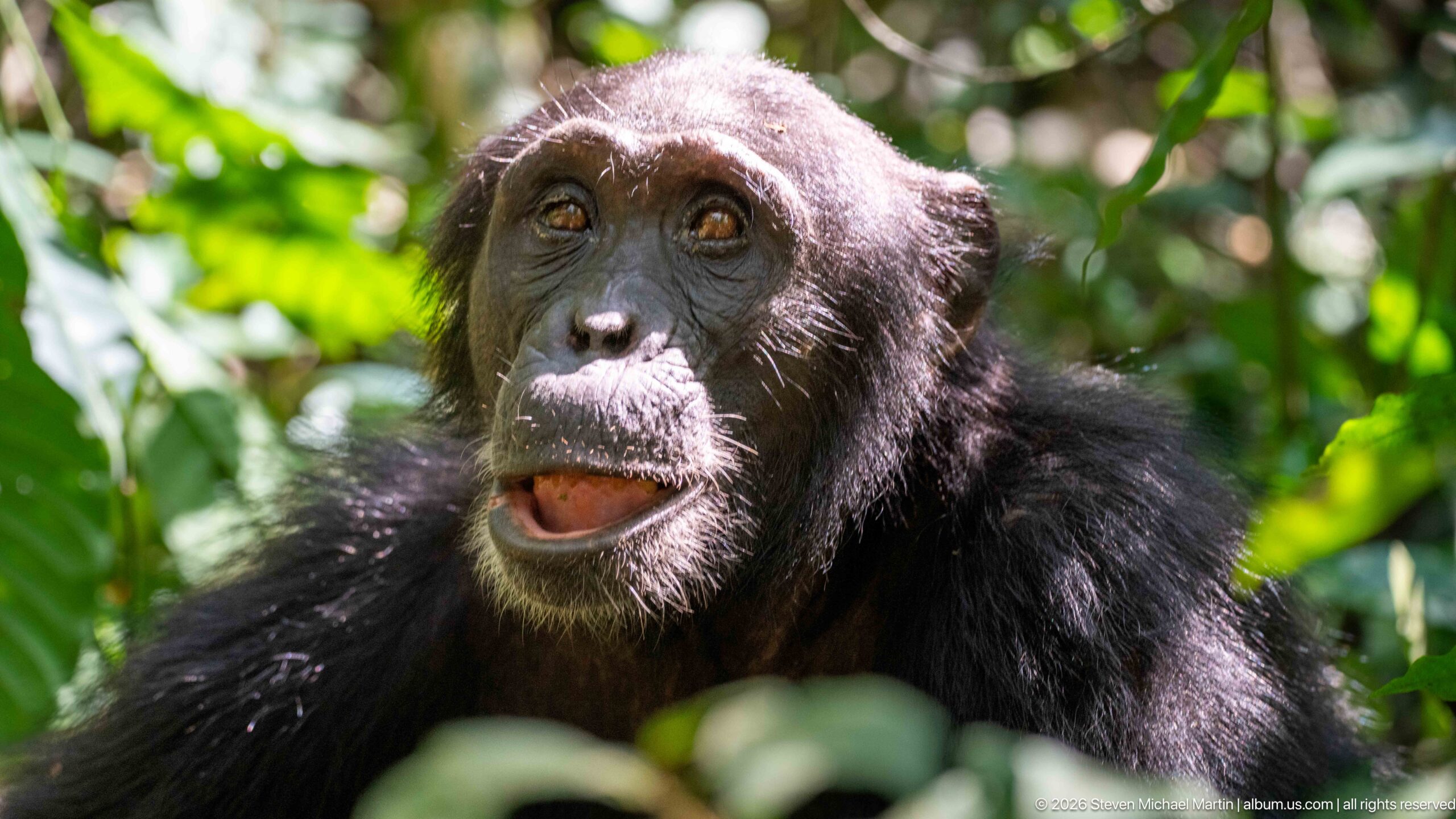
Dappled sunlight illuminates an eastern chimpanzee’s face and shoulders as it looks forward with its mouth open. Pale hairs around the muzzle and chin contrast with the dark coat, while the shallow depth of field separates the animal from the bright green forest behind.
Caption
Dappled sunlight illuminates an eastern chimpanzee’s face and shoulders as it looks forward with its mouth open. Pale hairs around the muzzle and chin contrast with the dark coat, while the shallow depth of field separates the animal from the bright green forest behind.
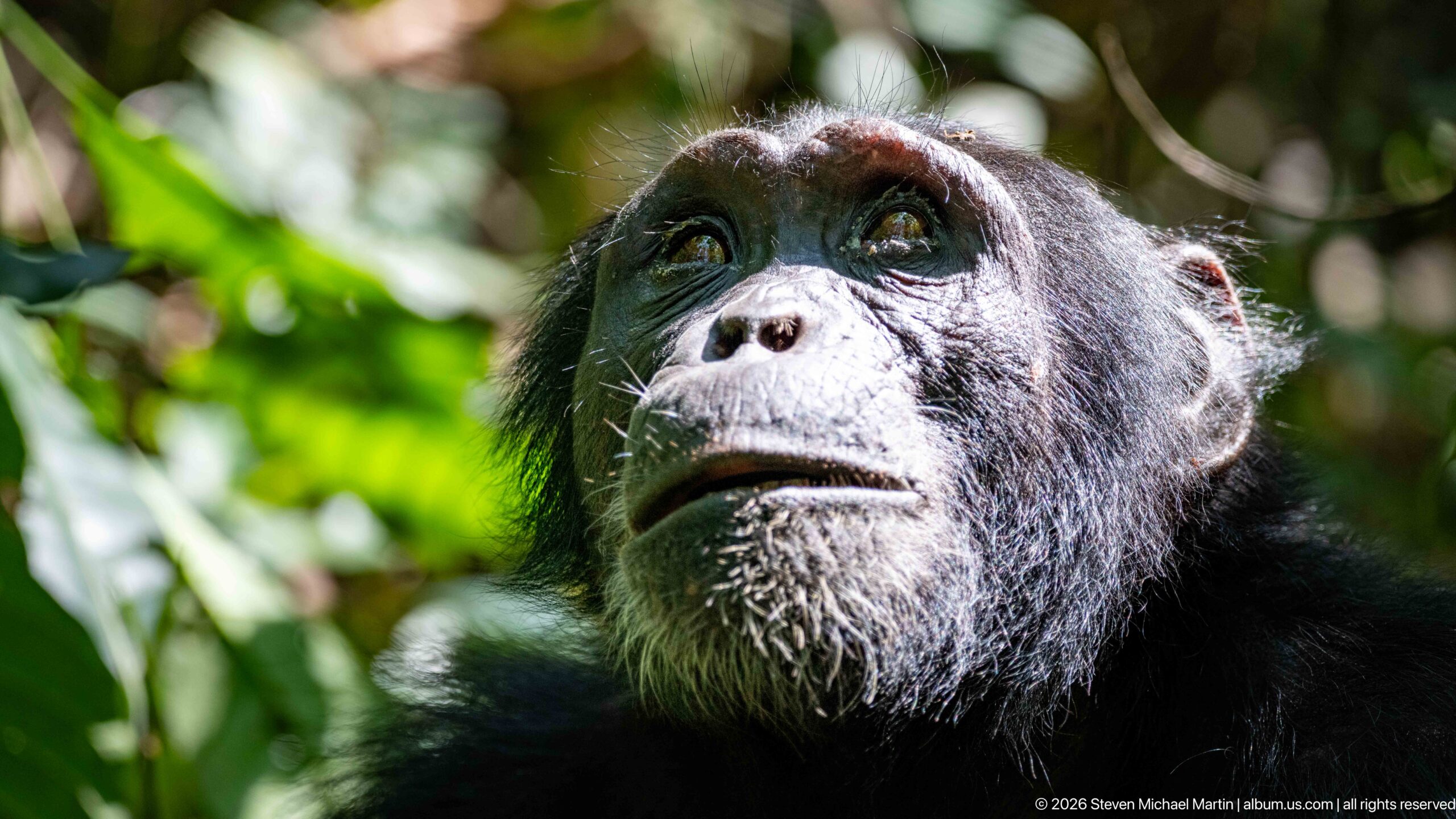
An eastern chimpanzee tilts its face toward the canopy as broken sunlight illuminates the brow, muzzle, and silvered chin hairs. The upward gaze and tight framing distinguish this portrait from neighboring views, while the dark coat and characteristic facial anatomy clearly identify the great ape in Budongo Forest.
Caption
An eastern chimpanzee tilts its face toward the canopy as broken sunlight illuminates the brow, muzzle, and silvered chin hairs. The upward gaze and tight framing distinguish this portrait from neighboring views, while the dark coat and characteristic facial anatomy clearly identify the great ape in Budongo Forest.
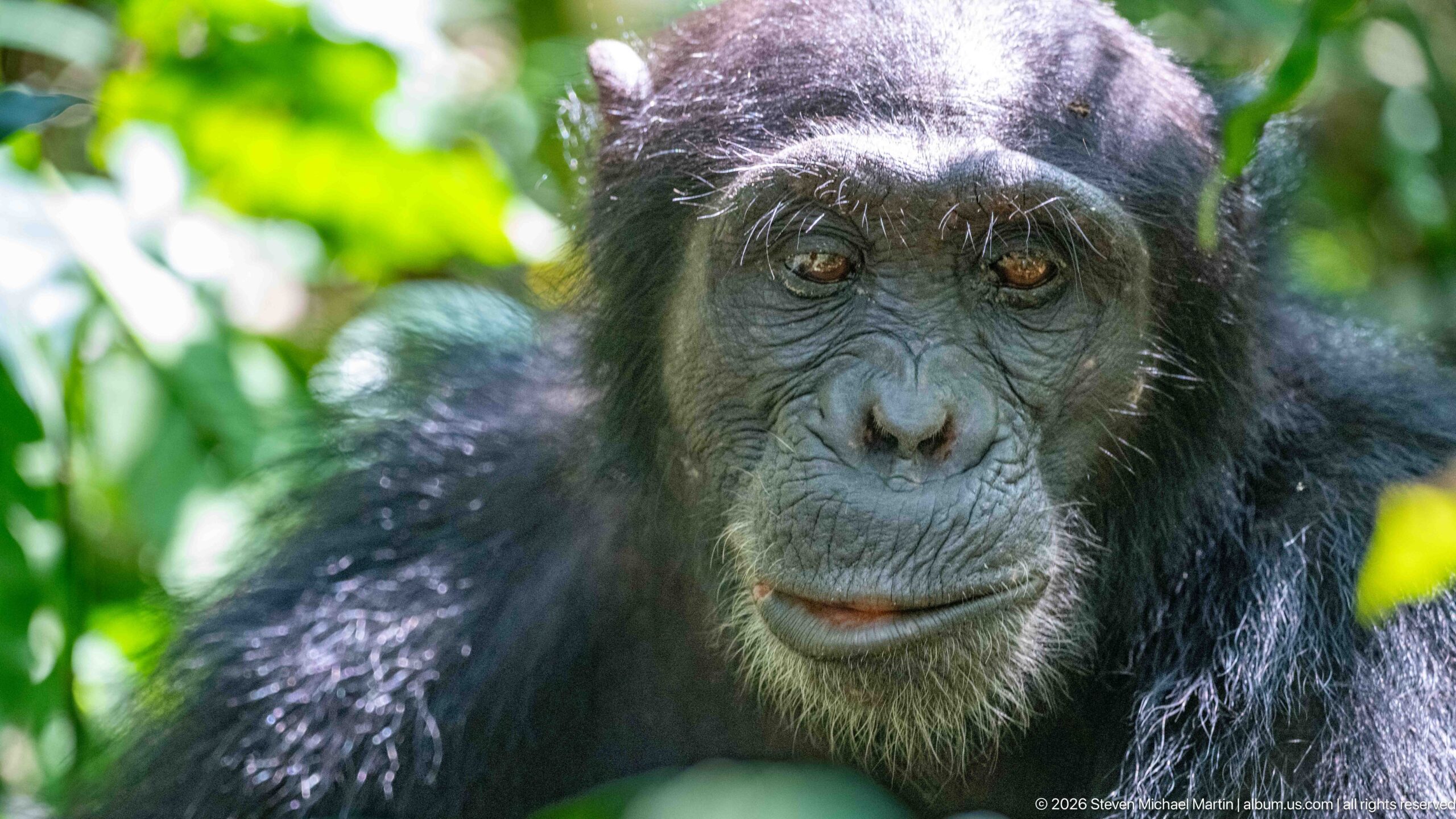
A close frontal view of an eastern chimpanzee records deep facial creases, amber-brown eyes, sparse muzzle hair, and dense black pelage. Soft green foliage surrounds the head, creating an intimate field-guide portrait in which facial structure rather than behavior is the principal subject.
Caption
A close frontal view of an eastern chimpanzee records deep facial creases, amber-brown eyes, sparse muzzle hair, and dense black pelage. Soft green foliage surrounds the head, creating an intimate field-guide portrait in which facial structure rather than behavior is the principal subject.
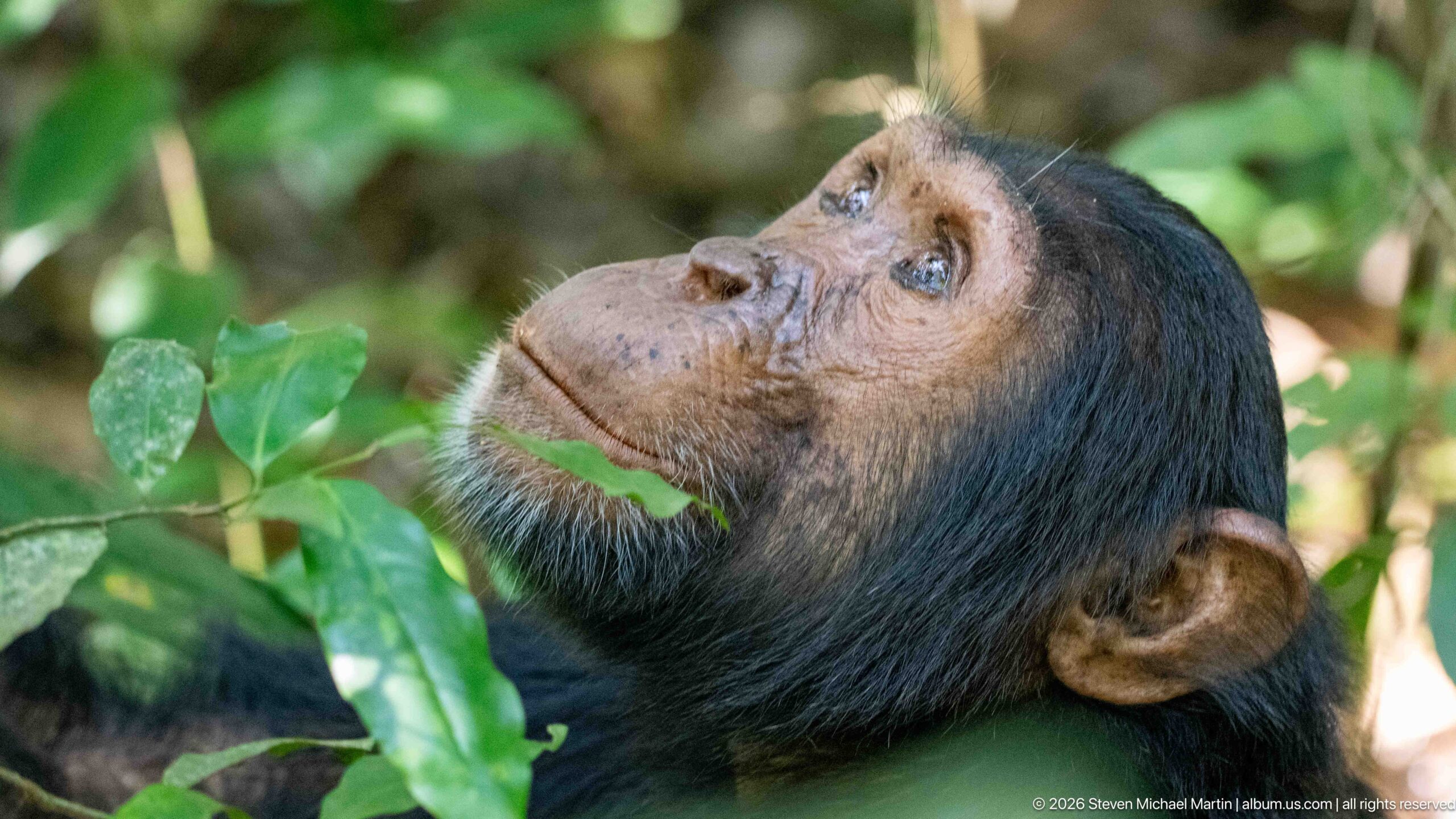
An eastern chimpanzee reclines or sits low among broad leaves, turning its face upward toward something beyond the frame. The profile exposes the ear, long muzzle, and pale beard while foreground foliage places the animal firmly within the shaded forest understory.
Caption
An eastern chimpanzee reclines or sits low among broad leaves, turning its face upward toward something beyond the frame. The profile exposes the ear, long muzzle, and pale beard while foreground foliage places the animal firmly within the shaded forest understory.
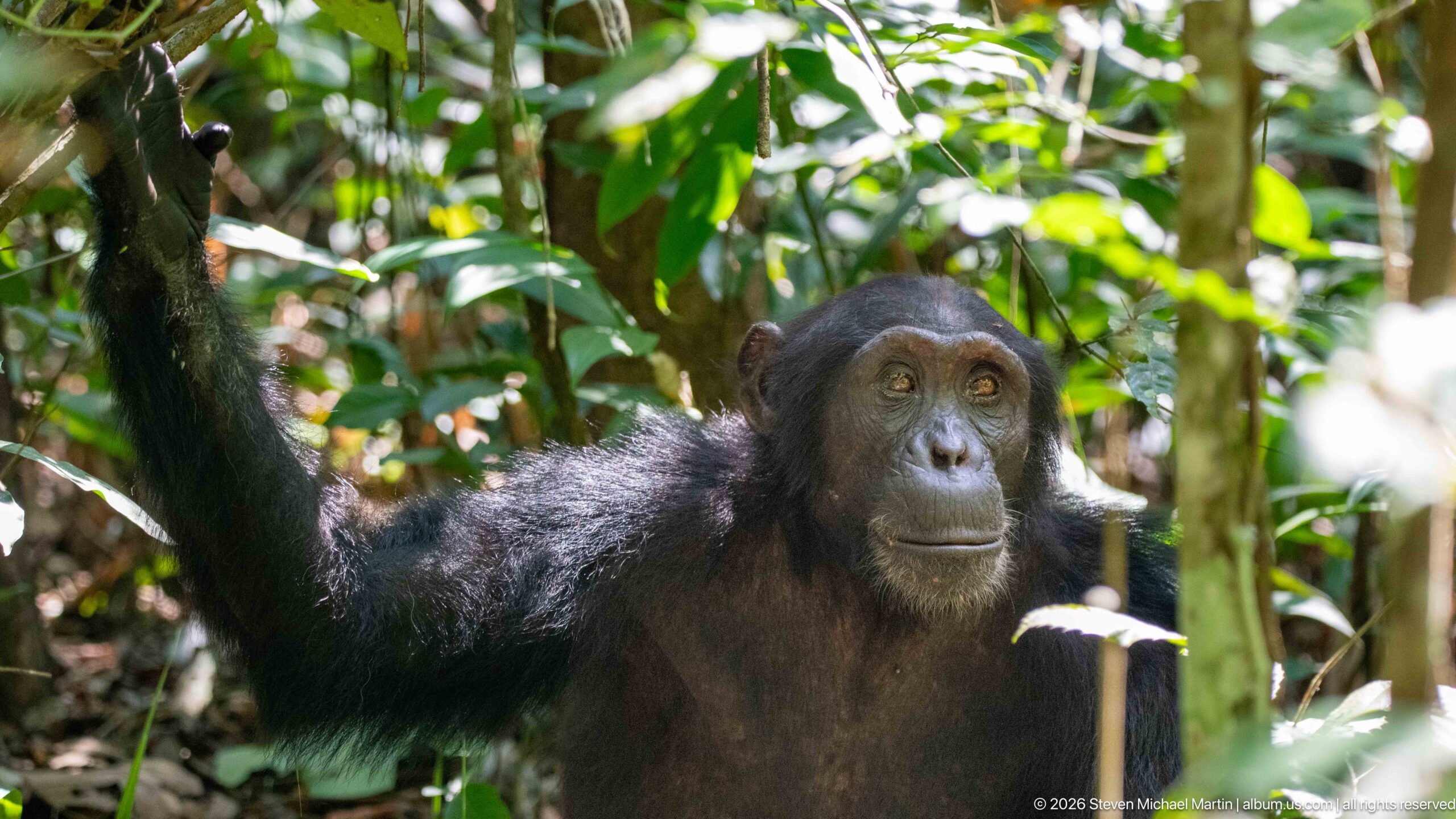
An eastern chimpanzee sits upright in dense forest with one arm extended overhead to grasp or brace against vegetation. Sunlight catches the shoulder and face while the raised limb reveals the ape’s long-arm proportions and its close physical relationship with the surrounding understory.
Caption
An eastern chimpanzee sits upright in dense forest with one arm extended overhead to grasp or brace against vegetation. Sunlight catches the shoulder and face while the raised limb reveals the ape’s long-arm proportions and its close physical relationship with the surrounding understory.
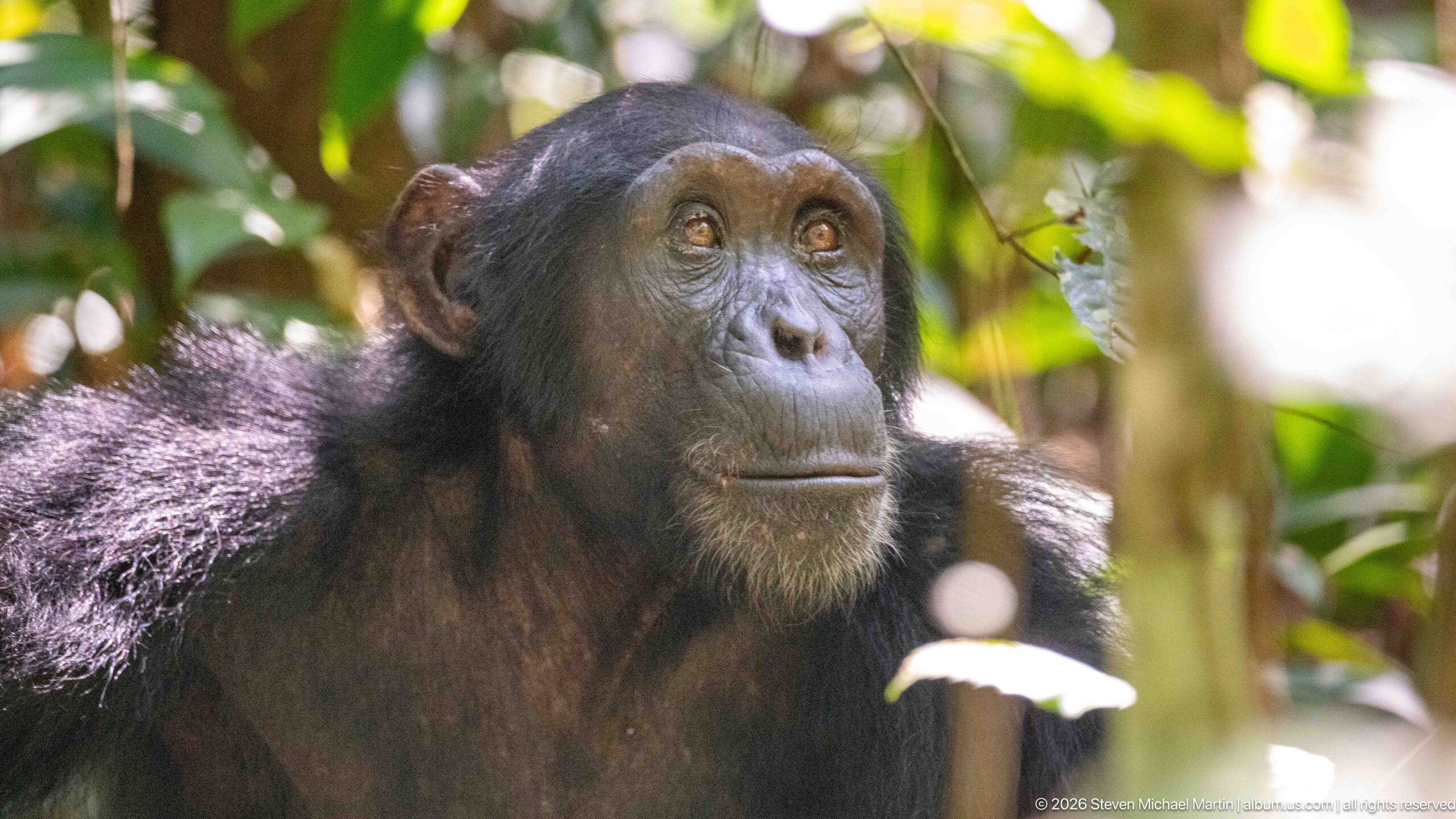
An eastern chimpanzee faces slightly to one side in a softly lit forest portrait. Bright patches of sun strike the shoulder and surrounding leaves, while the calm expression, rounded ear, dark coat, and fine chin hairs remain sharply defined against the blurred understory.
Caption
An eastern chimpanzee faces slightly to one side in a softly lit forest portrait. Bright patches of sun strike the shoulder and surrounding leaves, while the calm expression, rounded ear, dark coat, and fine chin hairs remain sharply defined against the blurred understory.
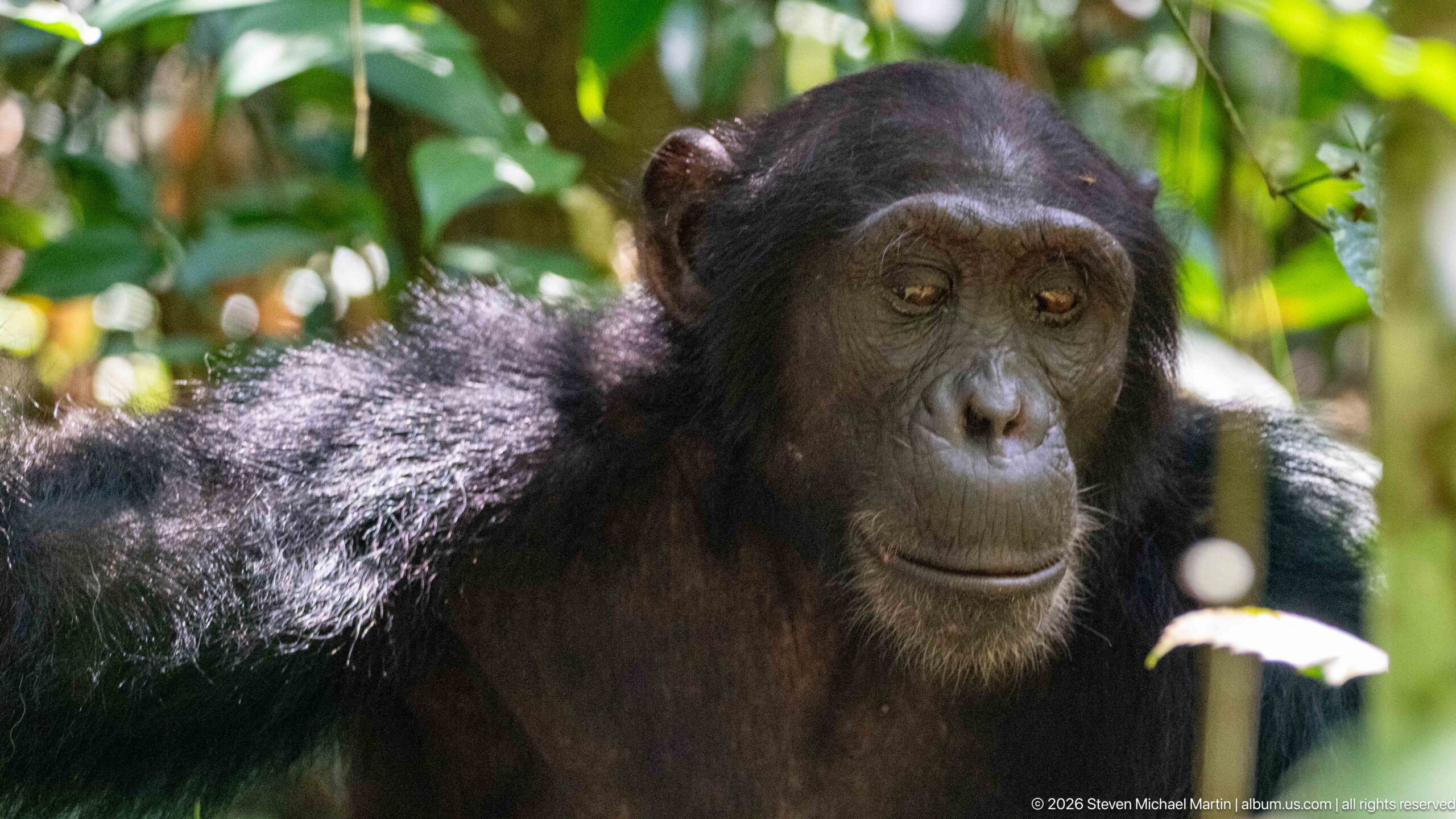
An eastern chimpanzee lowers its gaze in a close portrait framed by sunlit foliage. The subdued posture, heavy brow, dark face, and silver-gray hairs along the chin create a quieter study than the adjacent alert views, while retaining strong diagnostic detail for the species.
Caption
An eastern chimpanzee lowers its gaze in a close portrait framed by sunlit foliage. The subdued posture, heavy brow, dark face, and silver-gray hairs along the chin create a quieter study than the adjacent alert views, while retaining strong diagnostic detail for the species.
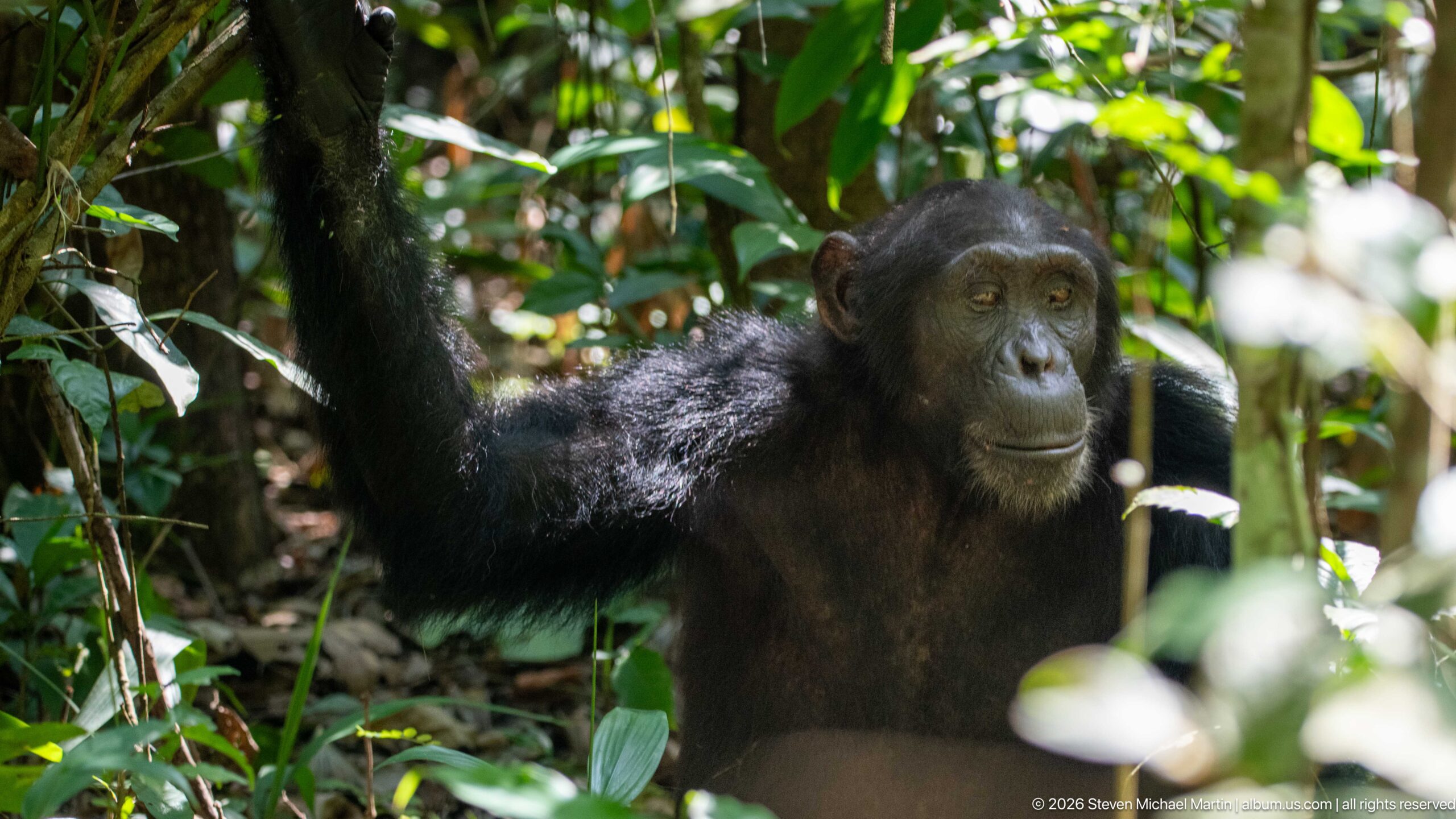
A seated eastern chimpanzee holds one arm high against the surrounding vegetation, its body partly illuminated by shafts of forest light. The wider composition shows more of the torso and habitat than the preceding portraits, placing the ape among tangled stems, leaves, and shaded ground.
Caption
A seated eastern chimpanzee holds one arm high against the surrounding vegetation, its body partly illuminated by shafts of forest light. The wider composition shows more of the torso and habitat than the preceding portraits, placing the ape among tangled stems, leaves, and shaded ground.
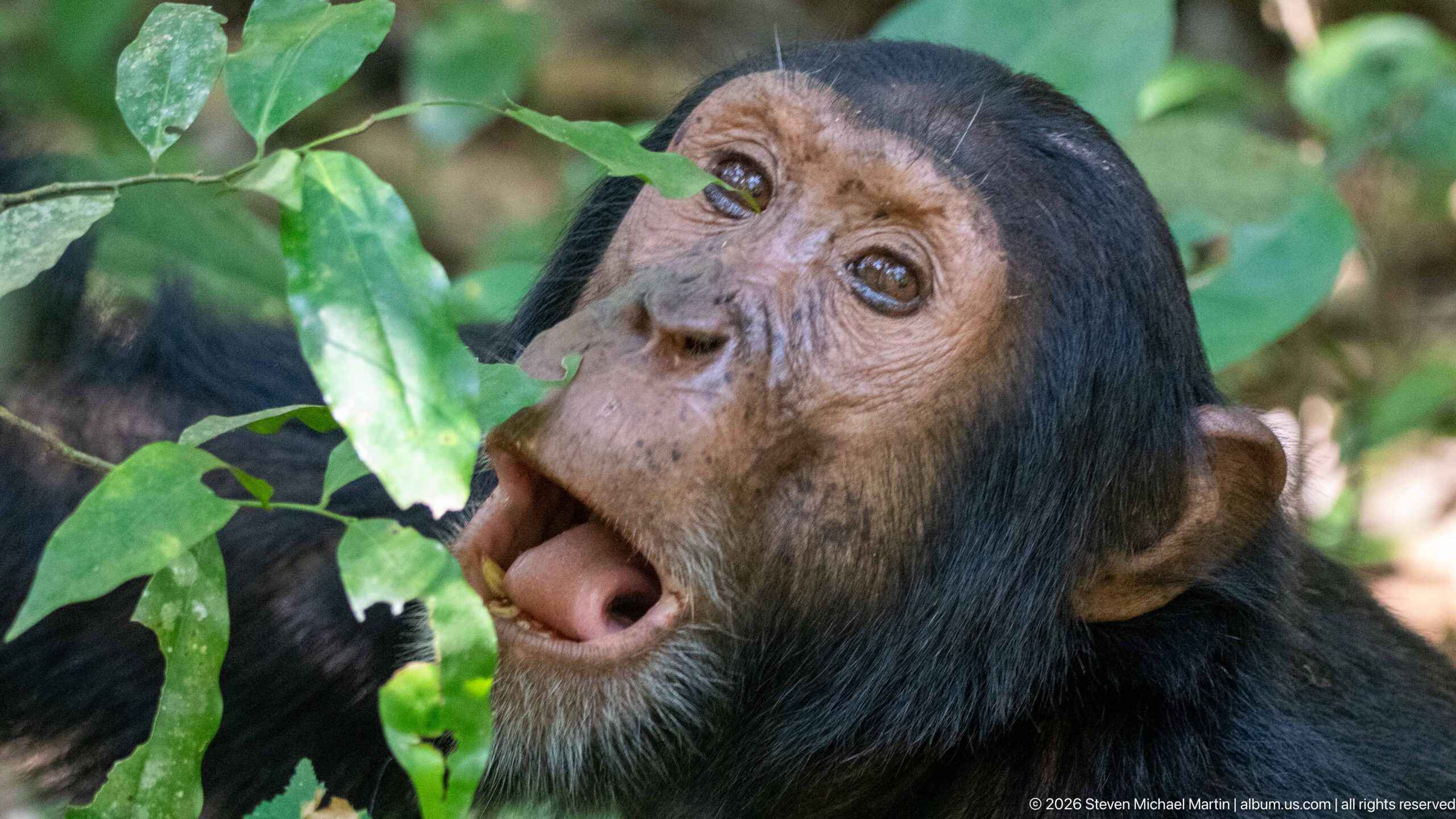
An eastern chimpanzee turns upward with its mouth open beside broad green leaves. The close view exposes the tongue and mouth while retaining detailed facial wrinkles and a pale chin fringe; the still photograph records the expression without establishing whether the animal was calling, yawning, or feeding.
Caption
An eastern chimpanzee turns upward with its mouth open beside broad green leaves. The close view exposes the tongue and mouth while retaining detailed facial wrinkles and a pale chin fringe; the still photograph records the expression without establishing whether the animal was calling, yawning, or feeding.
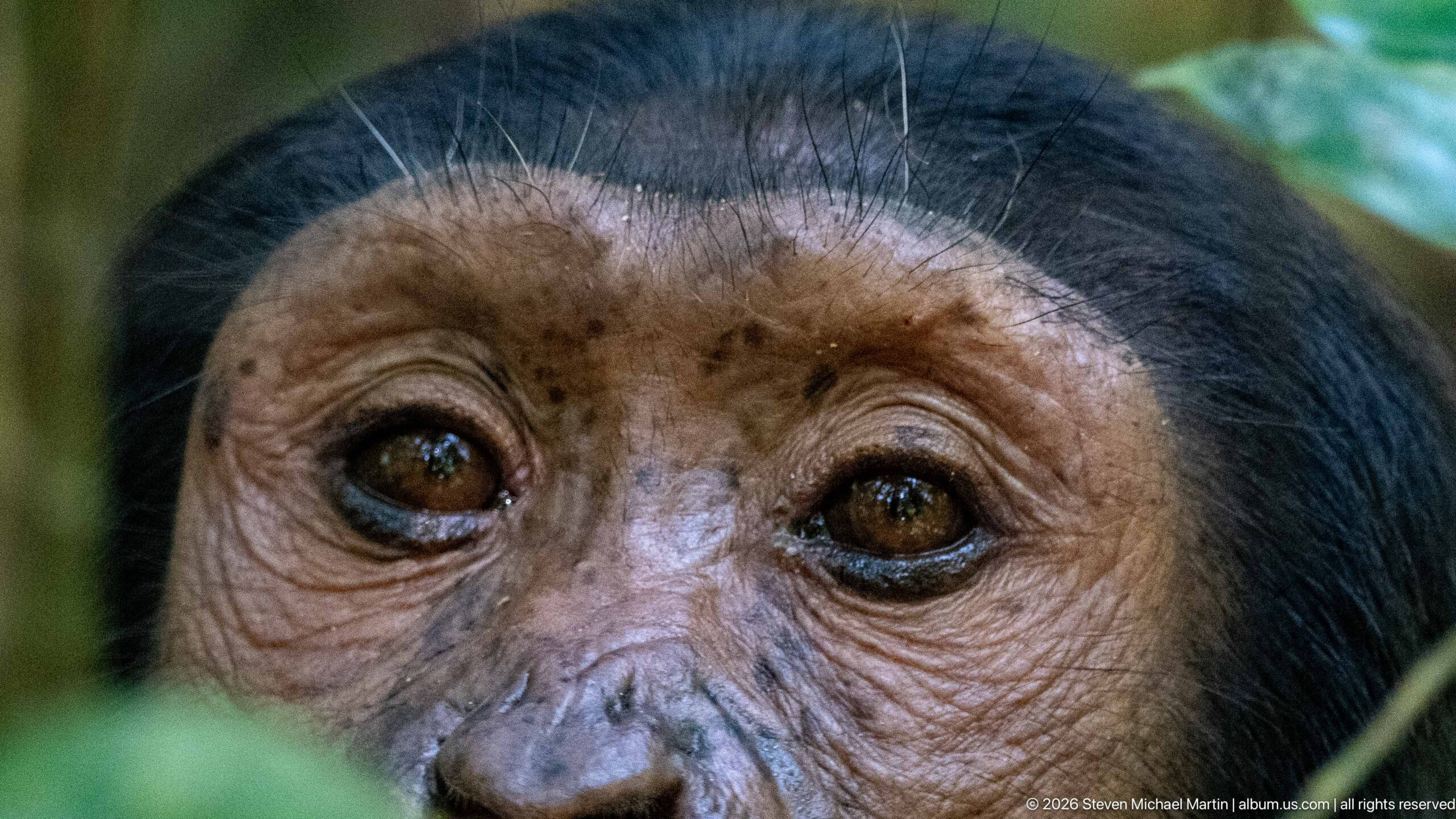
An extreme close-up concentrates on an eastern chimpanzee’s eyes, brow, and upper muzzle. Reflections of the surrounding forest appear in the moist eyes, while fine wrinkles, sparse facial hairs, and skin texture turn this frame into a detailed anatomical study rather than a conventional wildlife portrait.
Caption
An extreme close-up concentrates on an eastern chimpanzee’s eyes, brow, and upper muzzle. Reflections of the surrounding forest appear in the moist eyes, while fine wrinkles, sparse facial hairs, and skin texture turn this frame into a detailed anatomical study rather than a conventional wildlife portrait.
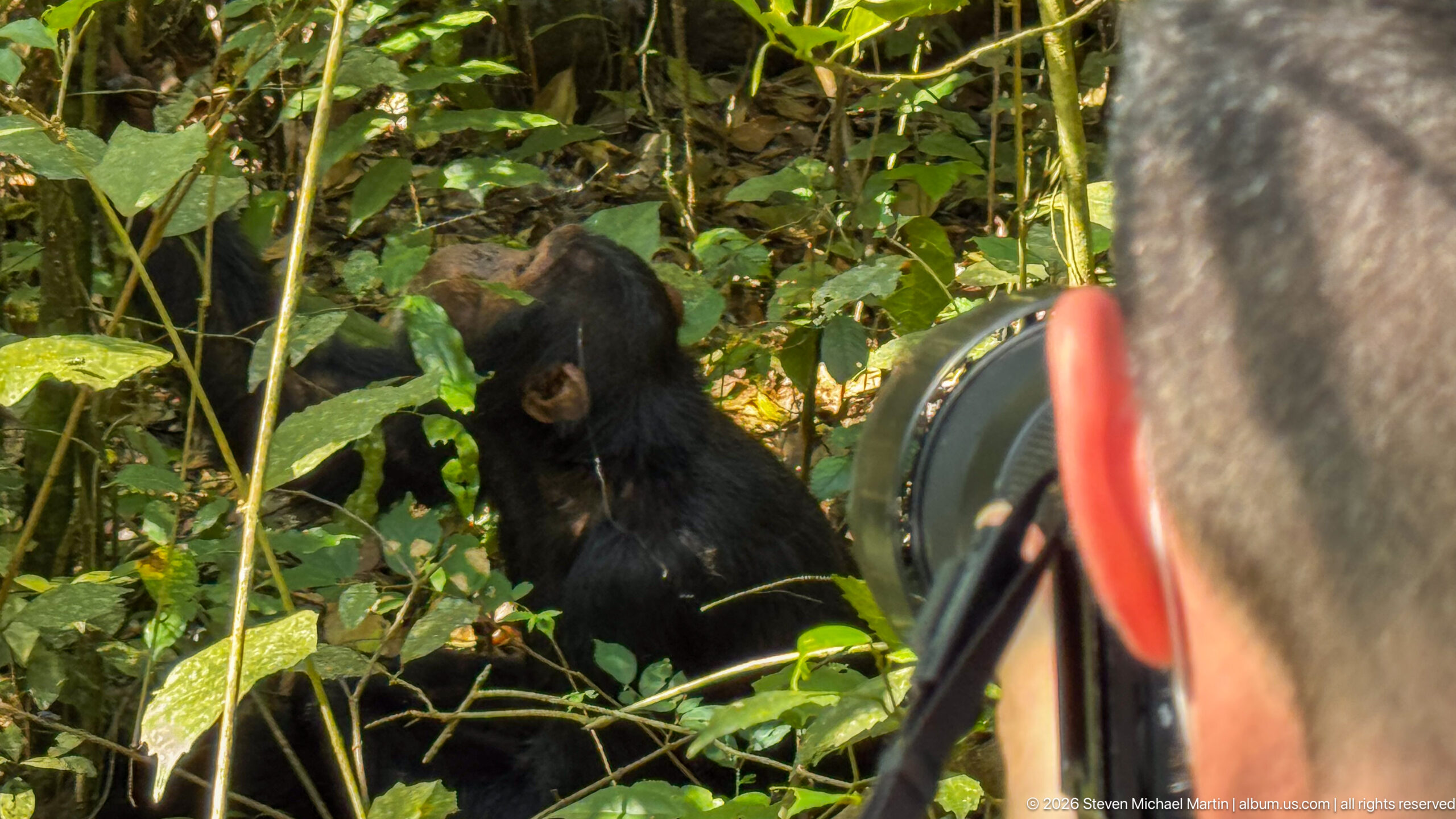
A photographer’s head and telephoto lens fill the foreground while an eastern chimpanzee sits a short distance away among dense vegetation. The layered composition records the practical reality of chimpanzee observation in Budongo Forest, where wildlife is often viewed through narrow openings in the understory.
Caption
A photographer’s head and telephoto lens fill the foreground while an eastern chimpanzee sits a short distance away among dense vegetation. The layered composition records the practical reality of chimpanzee observation in Budongo Forest, where wildlife is often viewed through narrow openings in the understory.
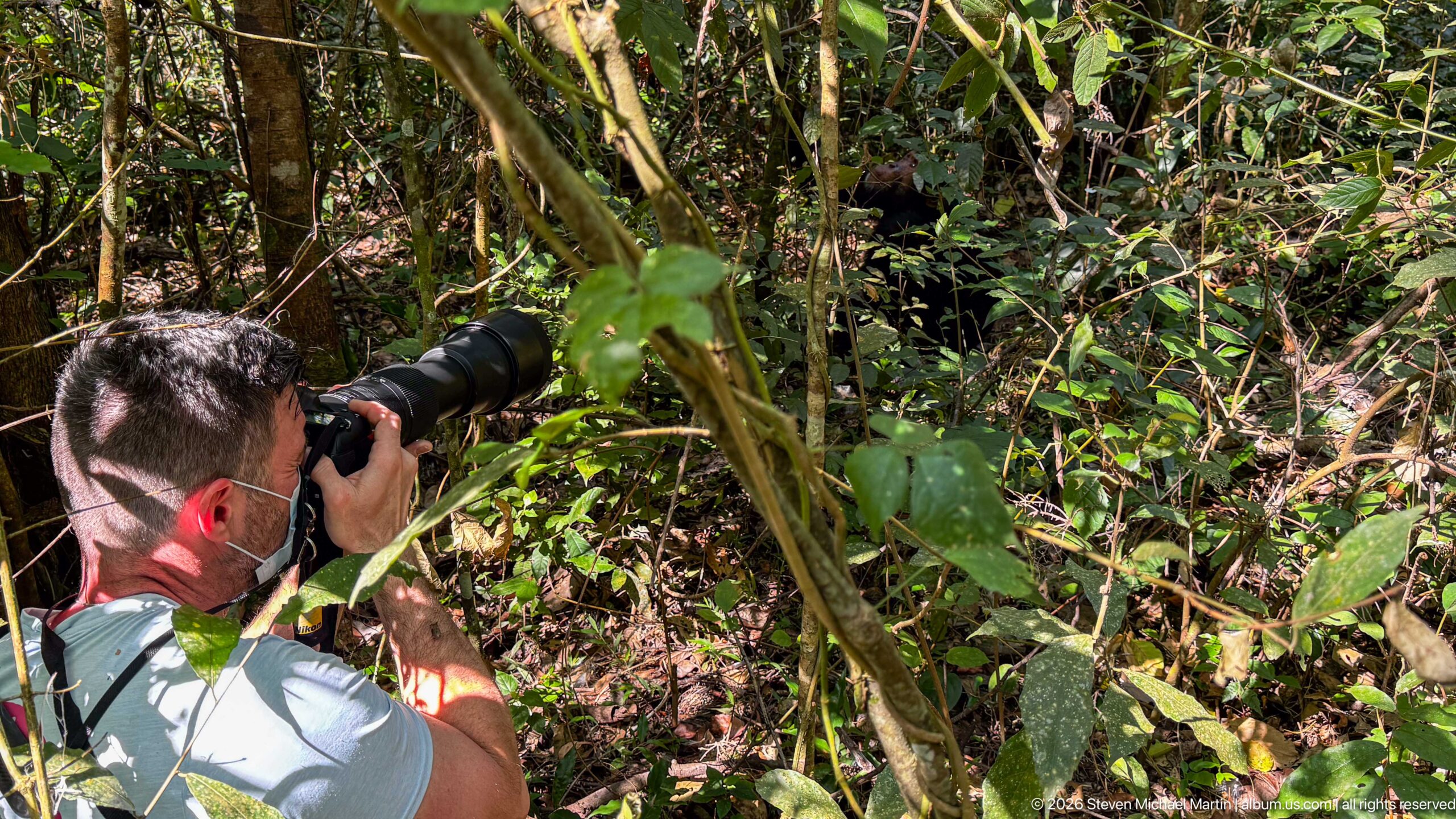
A photographer braces a camera fitted with a long telephoto lens while working at close range in dense forest. Slender trunks, vines, and leaves crowd the sightline, showing the constrained shooting conditions encountered when following primates through Budongo Forest’s understory.
Caption
A photographer braces a camera fitted with a long telephoto lens while working at close range in dense forest. Slender trunks, vines, and leaves crowd the sightline, showing the constrained shooting conditions encountered when following primates through Budongo Forest’s understory.
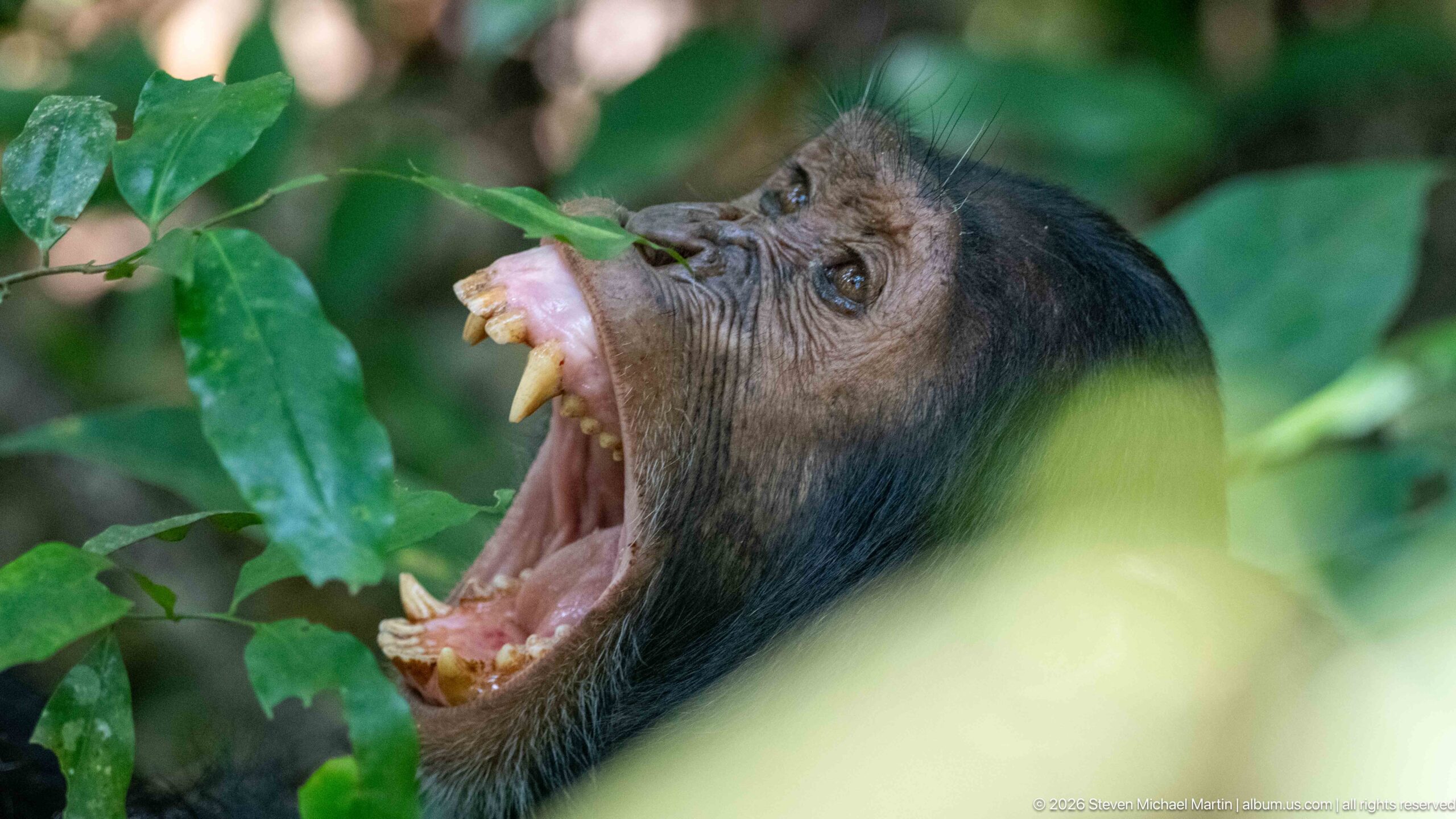
An eastern chimpanzee throws its head back with the jaws widely open, revealing large canine teeth, tongue, and palate. Leaves partly frame the dramatic profile. The still image documents a pronounced open-mouth expression but does not by itself establish whether it represents a yawn, call, or social display.
Caption
An eastern chimpanzee throws its head back with the jaws widely open, revealing large canine teeth, tongue, and palate. Leaves partly frame the dramatic profile. The still image documents a pronounced open-mouth expression but does not by itself establish whether it represents a yawn, call, or social display.
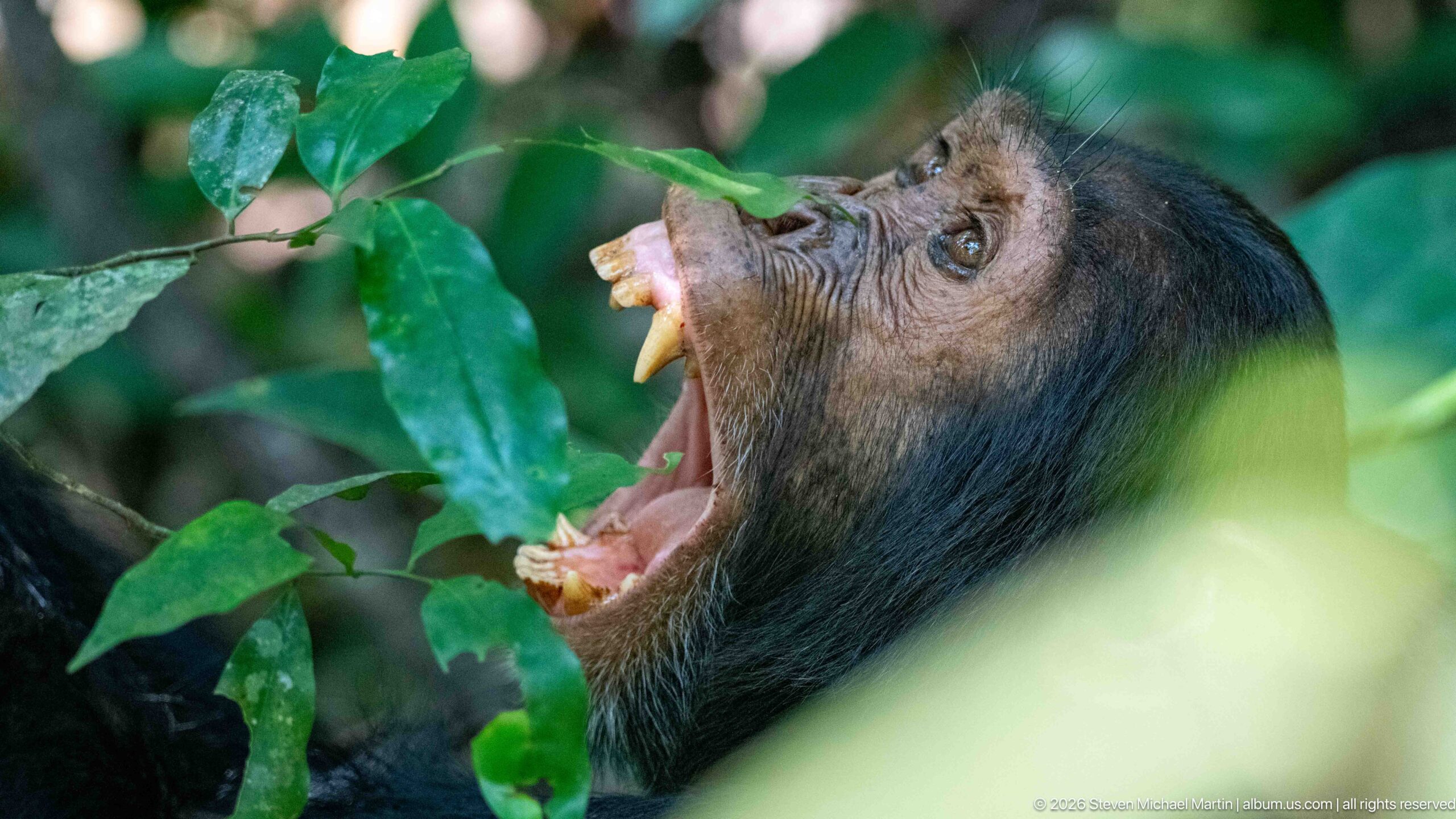
Seen in profile, an eastern chimpanzee opens its jaws widely beneath overhanging leaves, exposing the tongue and prominent canine teeth. The tight crop emphasizes dentition and facial musculature; the photograph does not provide enough temporal context to distinguish a yawn from a vocal or social display.
Caption
Seen in profile, an eastern chimpanzee opens its jaws widely beneath overhanging leaves, exposing the tongue and prominent canine teeth. The tight crop emphasizes dentition and facial musculature; the photograph does not provide enough temporal context to distinguish a yawn from a vocal or social display.
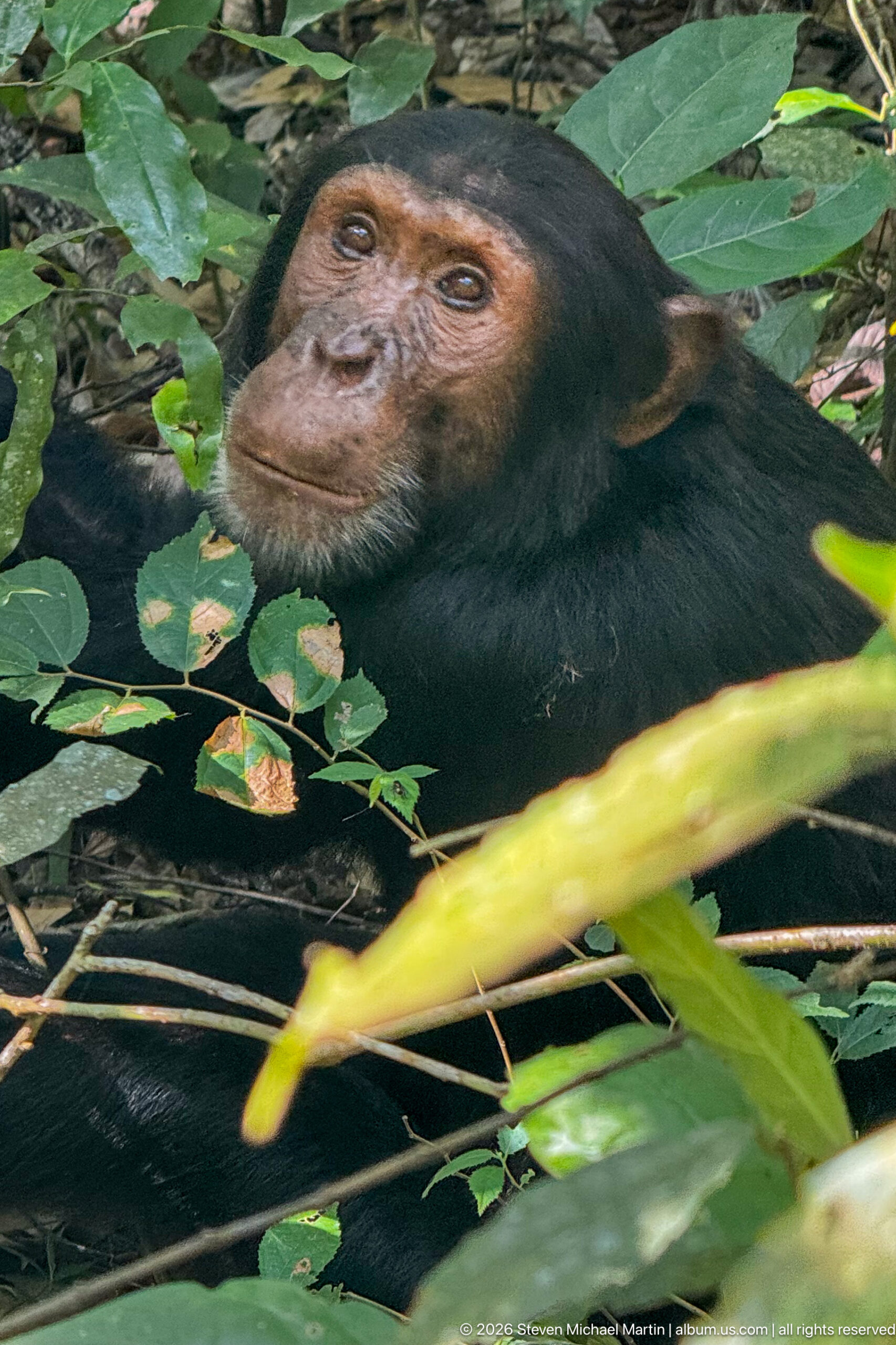
A reclining eastern chimpanzee lies amid low foliage and leaf litter, its head raised toward the camera while the dark body extends across the frame. The wider view emphasizes resting posture and habitat, with foreground stems partially screening the ape in the forest understory.
Caption
A reclining eastern chimpanzee lies amid low foliage and leaf litter, its head raised toward the camera while the dark body extends across the frame. The wider view emphasizes resting posture and habitat, with foreground stems partially screening the ape in the forest understory.
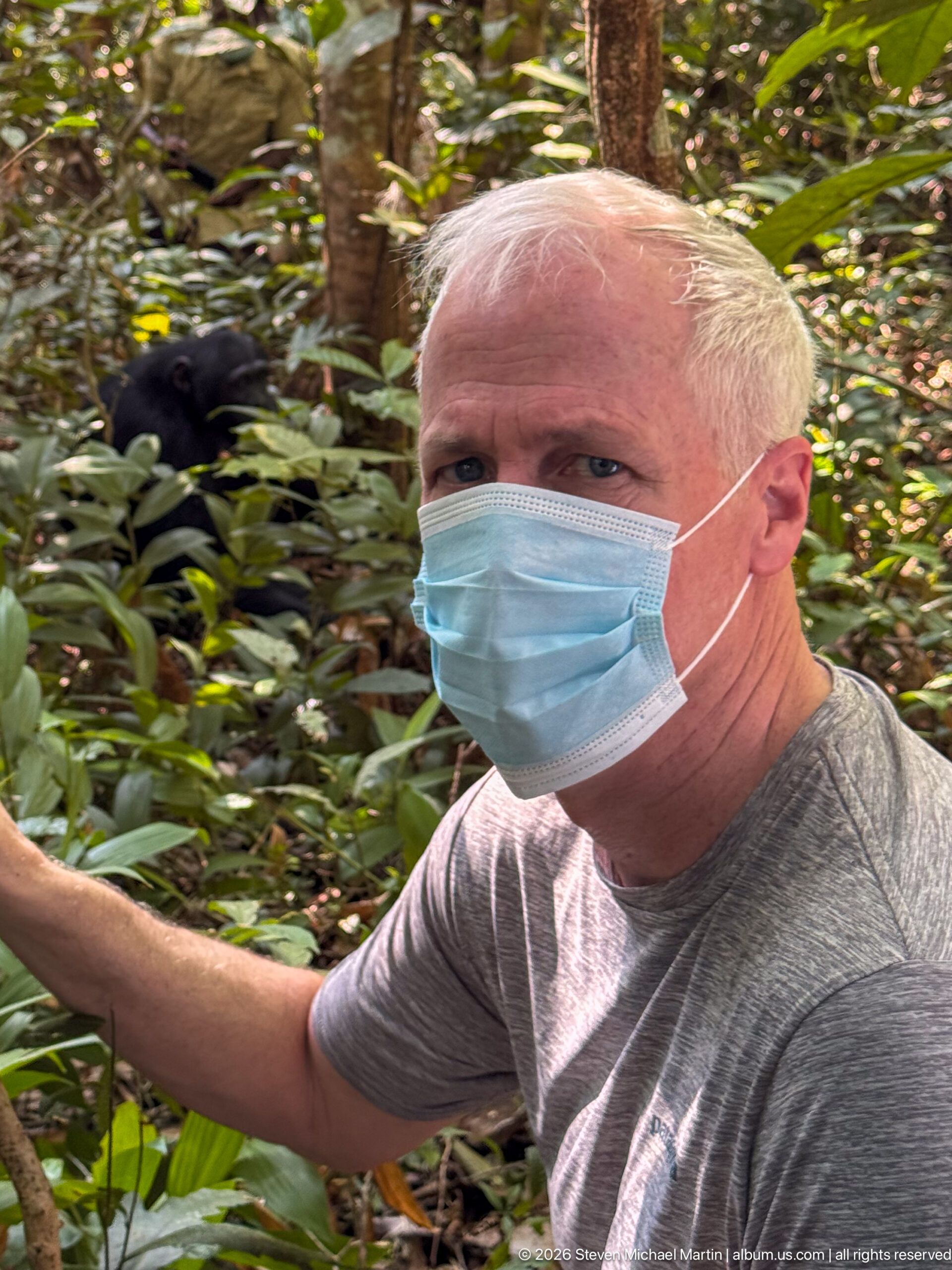
A visitor wearing a surgical face mask pauses amid dense forest vegetation, with a chimpanzee visible in the background through the leaves. The composition records the human side of a close primate encounter while keeping both observer and wild ape within the same forest context.
Caption
A visitor wearing a surgical face mask pauses amid dense forest vegetation, with a chimpanzee visible in the background through the leaves. The composition records the human side of a close primate encounter while keeping both observer and wild ape within the same forest context.
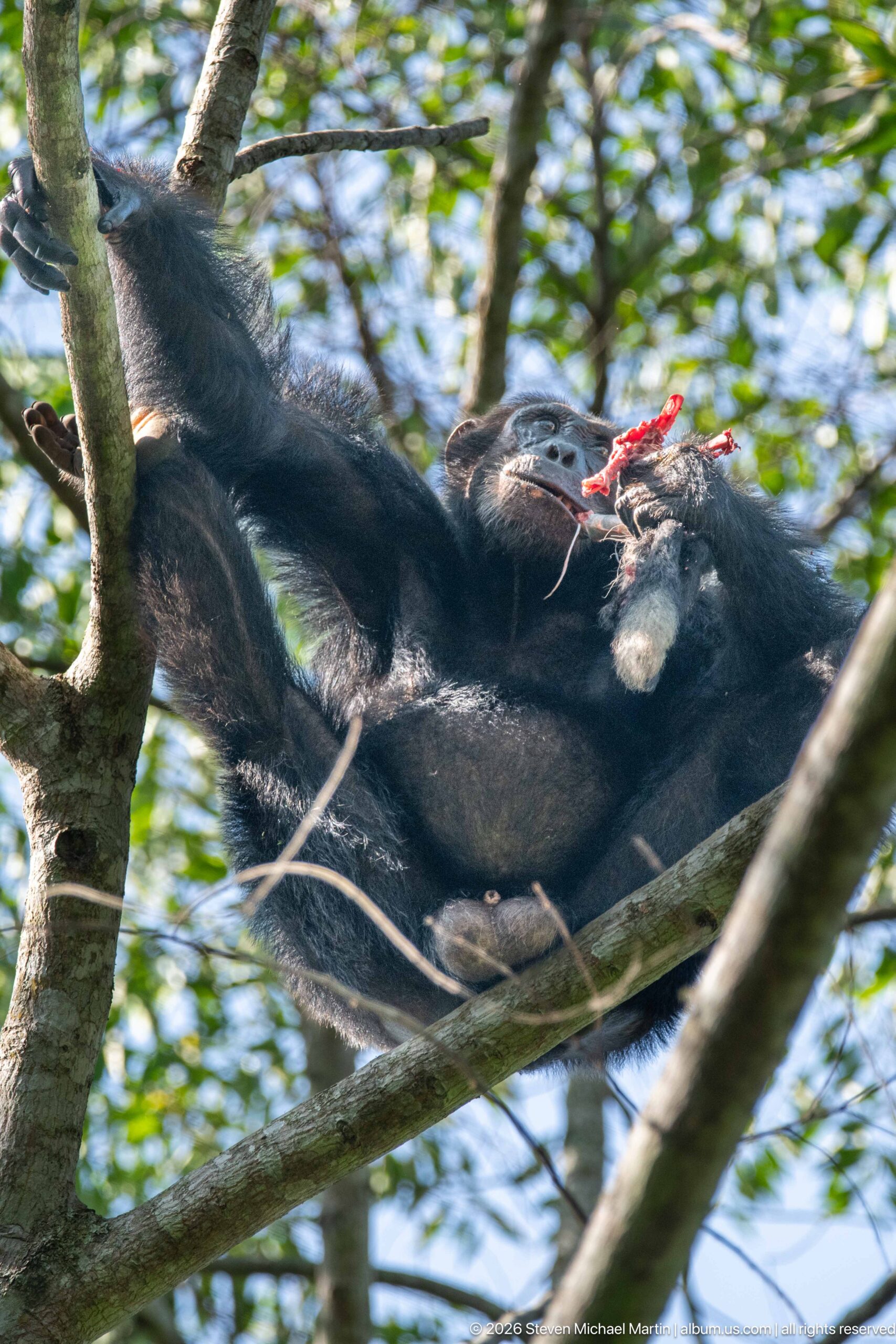
An eastern chimpanzee reclines lengthwise along a broad branch, body stretched almost horizontally while holding bright red food near its face. The unusual relaxed posture contrasts with the upright feeding views around it, showing how a sturdy limb can serve as both perch and resting platform high above the forest floor.
Caption
An eastern chimpanzee reclines lengthwise along a broad branch, body stretched almost horizontally while holding bright red food near its face. The unusual relaxed posture contrasts with the upright feeding views around it, showing how a sturdy limb can serve as both perch and resting platform high above the forest floor.
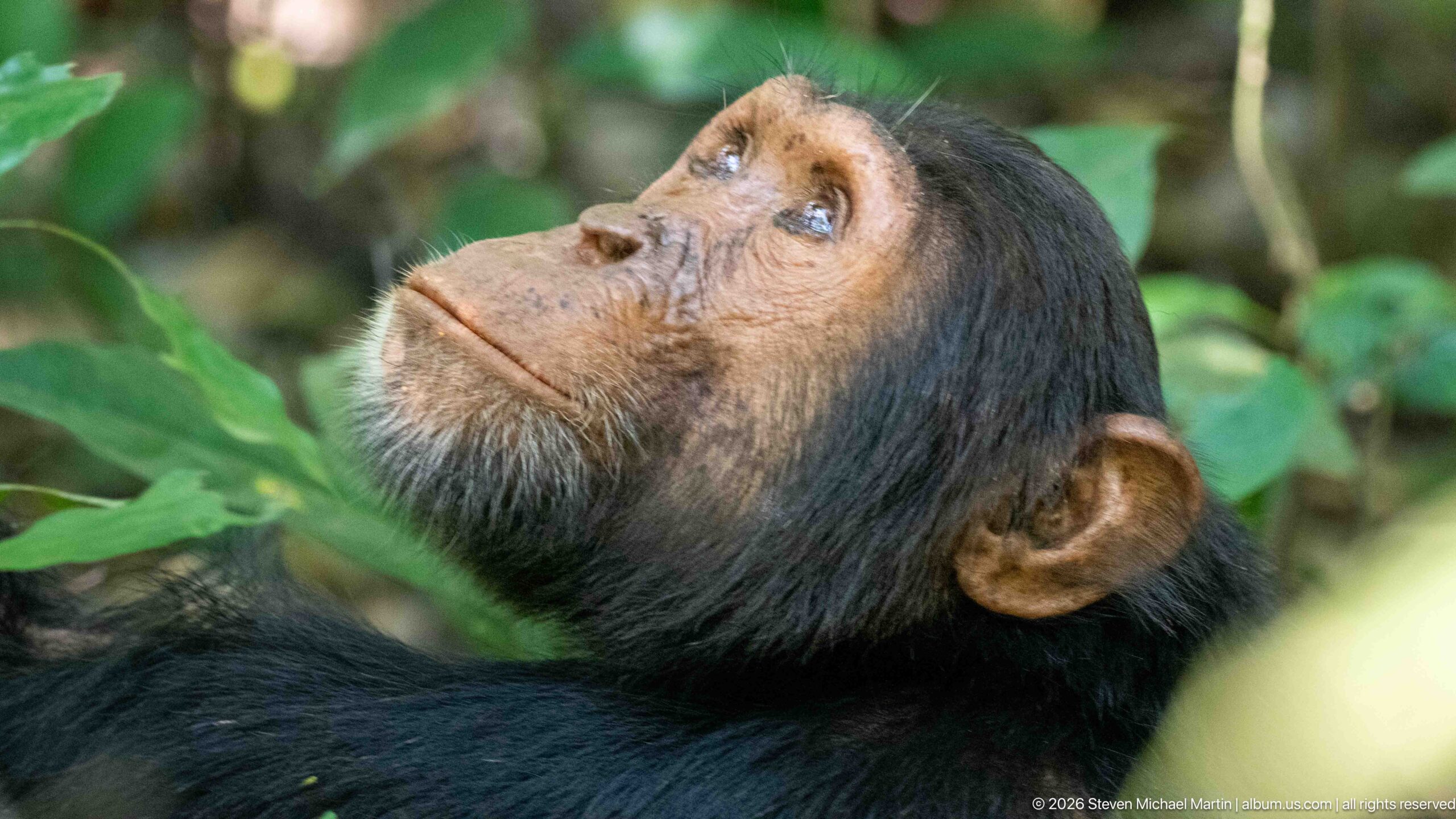
An eastern chimpanzee raises its face toward the canopy, presenting a clean side profile with rounded ear, projecting muzzle, and pale chin hairs. Soft foreground leaves blur across the lower frame, reinforcing the sense of watching the ape through dense Budongo Forest vegetation.
Caption
An eastern chimpanzee raises its face toward the canopy, presenting a clean side profile with rounded ear, projecting muzzle, and pale chin hairs. Soft foreground leaves blur across the lower frame, reinforcing the sense of watching the ape through dense Budongo Forest vegetation.
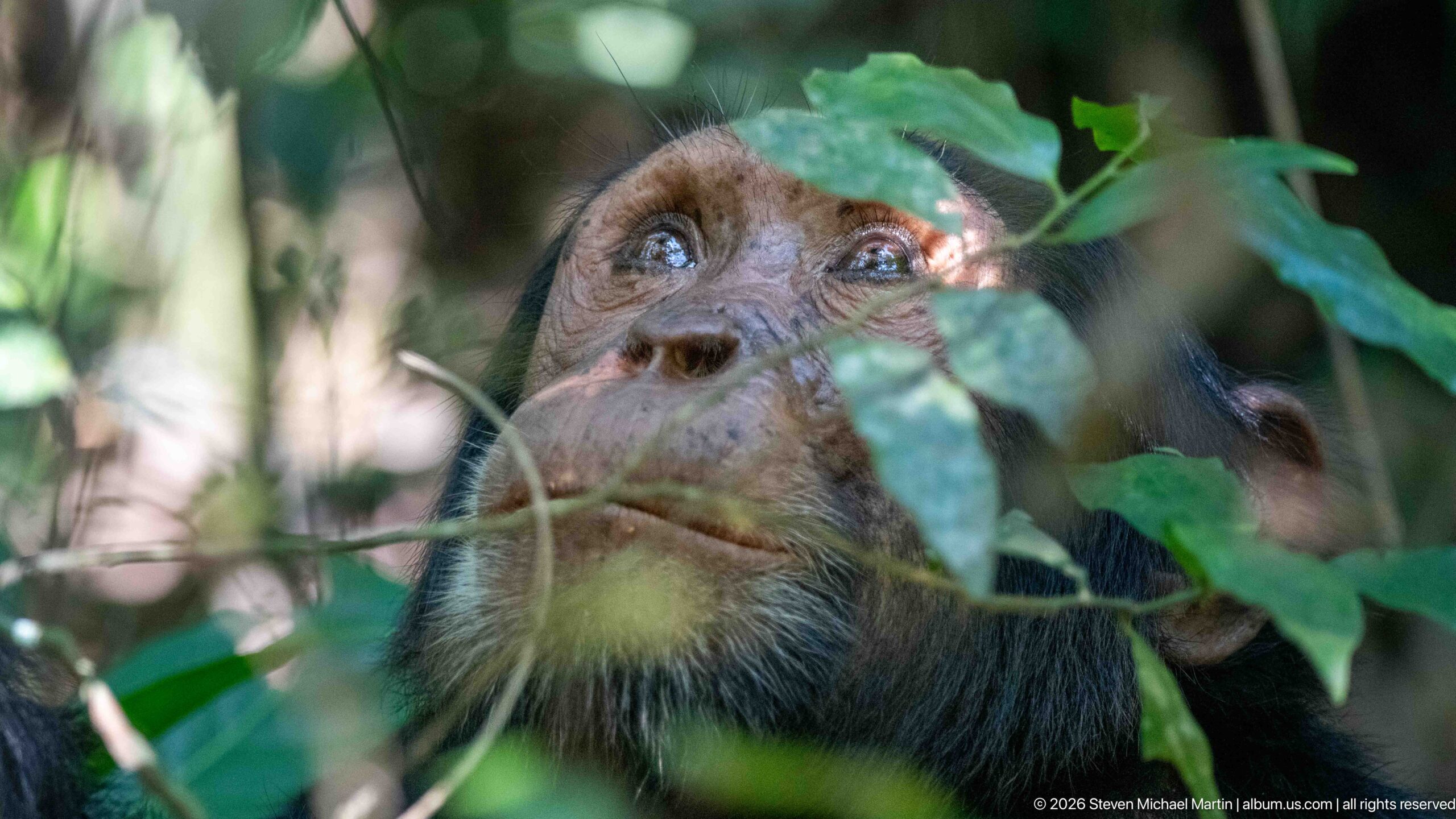
Leaves and thin branches cross the foreground as an eastern chimpanzee looks upward from the understory. The partial concealment leaves the eyes, brow, muzzle, and beard visible, creating a field-realistic portrait shaped by the obstructed sightlines of dense tropical forest.
Caption
Leaves and thin branches cross the foreground as an eastern chimpanzee looks upward from the understory. The partial concealment leaves the eyes, brow, muzzle, and beard visible, creating a field-realistic portrait shaped by the obstructed sightlines of dense tropical forest.
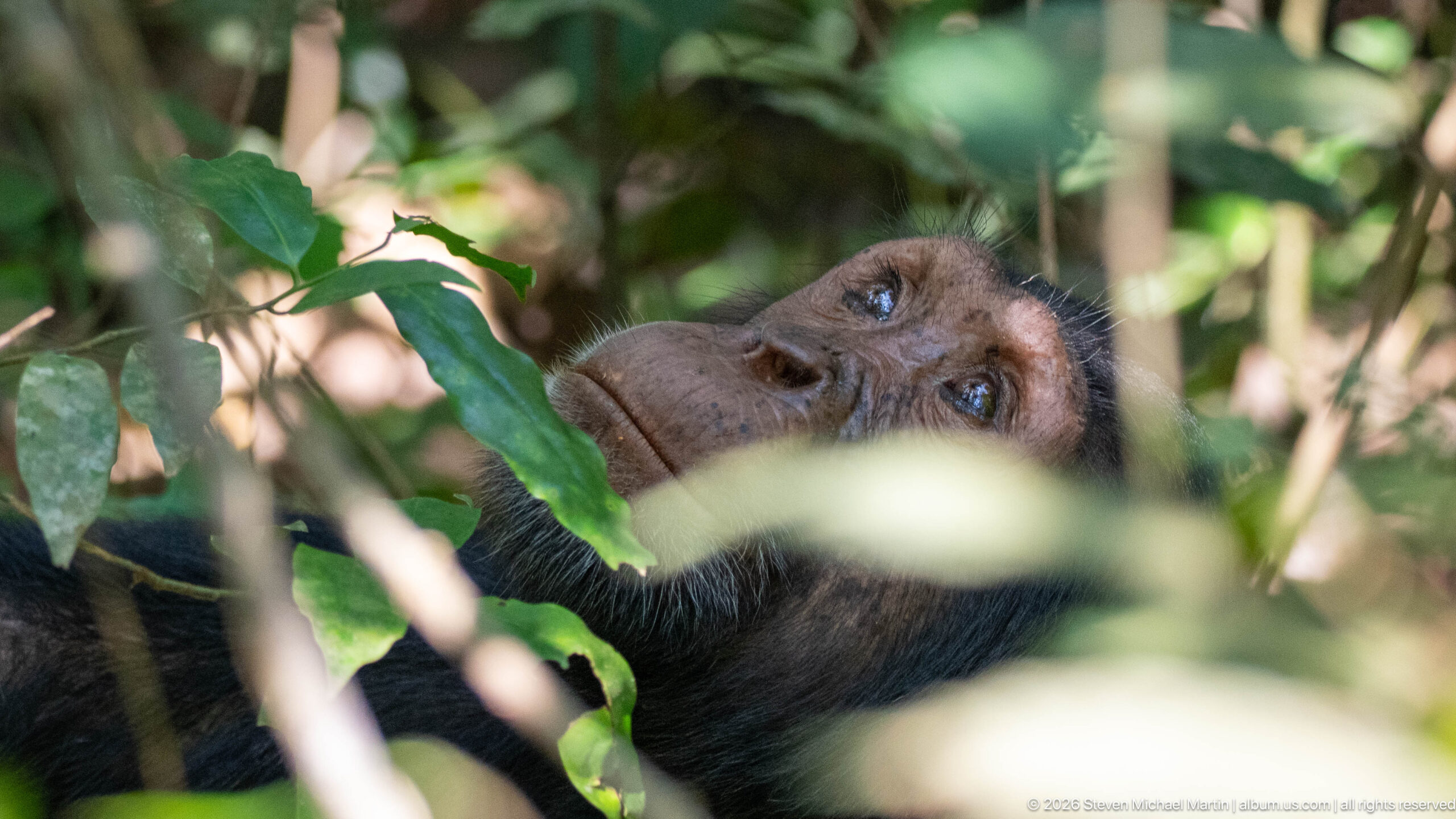
An eastern chimpanzee reclines behind a screen of leaves and stems, its face angled upward and catching small points of reflected light in the eyes. The horizontal posture and heavy foreground vegetation distinguish this view as an intimate glimpse rather than an unobstructed portrait.
Caption
An eastern chimpanzee reclines behind a screen of leaves and stems, its face angled upward and catching small points of reflected light in the eyes. The horizontal posture and heavy foreground vegetation distinguish this view as an intimate glimpse rather than an unobstructed portrait.
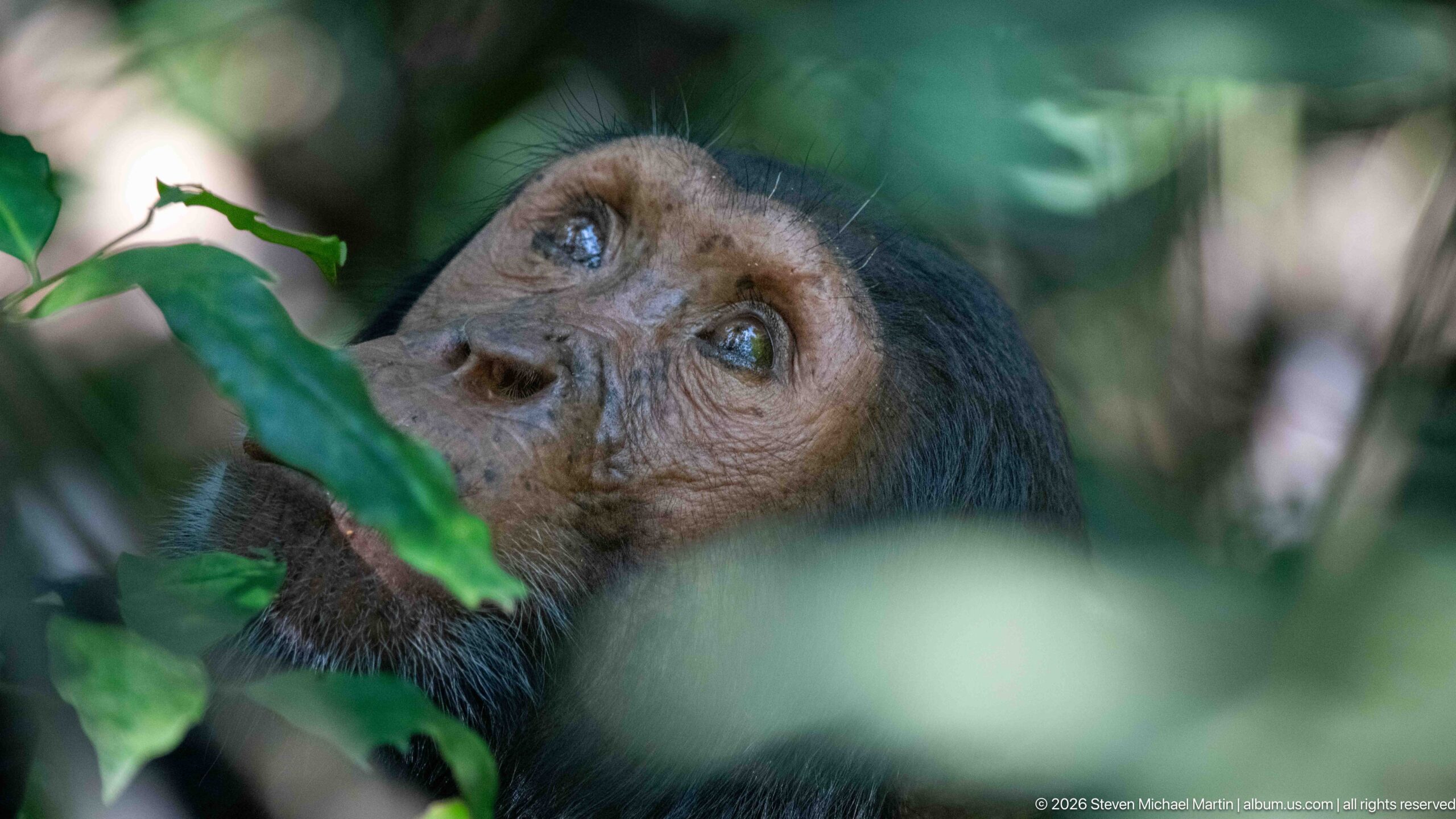
An eastern chimpanzee peers upward from behind overlapping leaves, its eyes, brow, muzzle, and pale chin hair visible through a narrow opening. The composition emphasizes how vegetation repeatedly interrupts clear views of primates in Budongo Forest while preserving enough facial detail for confident identification.
Caption
An eastern chimpanzee peers upward from behind overlapping leaves, its eyes, brow, muzzle, and pale chin hair visible through a narrow opening. The composition emphasizes how vegetation repeatedly interrupts clear views of primates in Budongo Forest while preserving enough facial detail for confident identification.
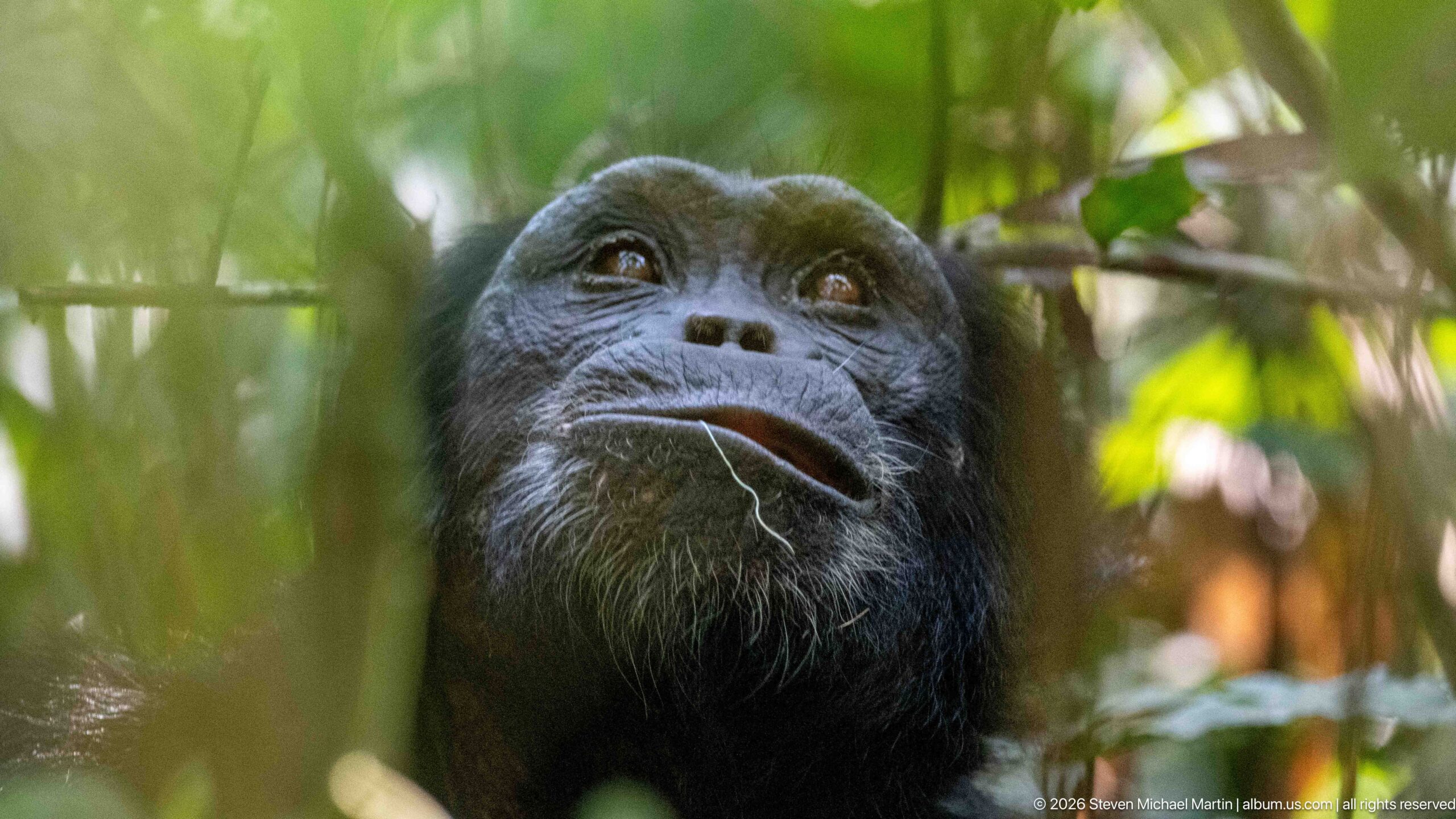
A pale strand of plant material hangs from the mouth of an eastern chimpanzee as it looks upward through the forest. The close portrait records a small feeding-related detail without identifying the plant itself, while the dark face, heavy brow, and chin hairs remain sharply rendered.
Caption
A pale strand of plant material hangs from the mouth of an eastern chimpanzee as it looks upward through the forest. The close portrait records a small feeding-related detail without identifying the plant itself, while the dark face, heavy brow, and chin hairs remain sharply rendered.
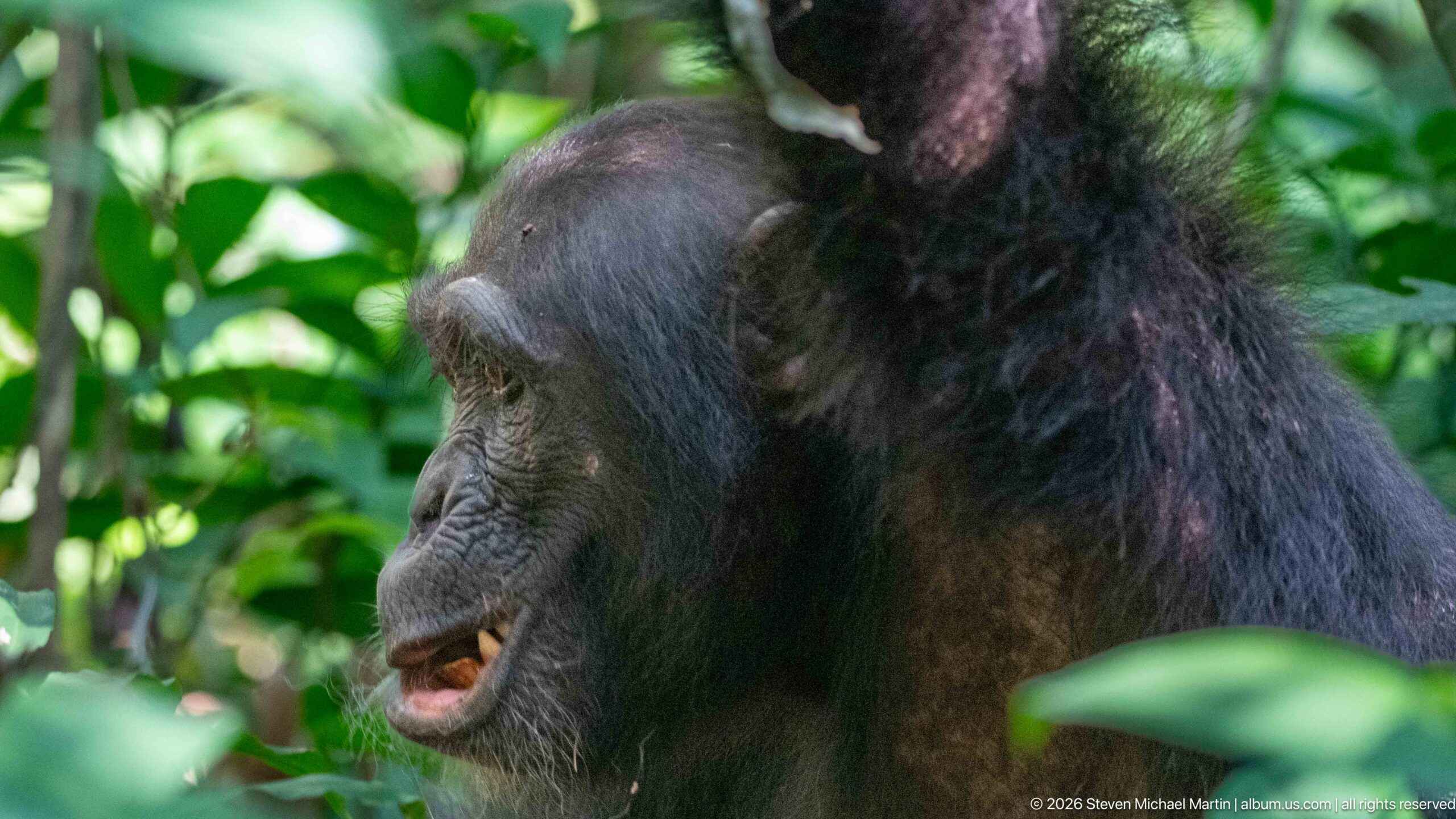
An eastern chimpanzee turns in profile with one arm lifted above the head, mouth slightly open and body partly hidden by vegetation. The frame combines facial expression with the species’ long-limbed form, while surrounding leaves and stems establish the close forest setting.
Caption
An eastern chimpanzee turns in profile with one arm lifted above the head, mouth slightly open and body partly hidden by vegetation. The frame combines facial expression with the species’ long-limbed form, while surrounding leaves and stems establish the close forest setting.

An eastern chimpanzee sits astride branching limbs above the forest floor while holding strips of reddish plant material in both hands. The elevated position, broad torso, and active manipulation of vegetation provide a wider behavioral view than the close portraits, though the plant item cannot be identified confidently.
Caption
An eastern chimpanzee sits astride branching limbs above the forest floor while holding strips of reddish plant material in both hands. The elevated position, broad torso, and active manipulation of vegetation provide a wider behavioral view than the close portraits, though the plant item cannot be identified confidently.
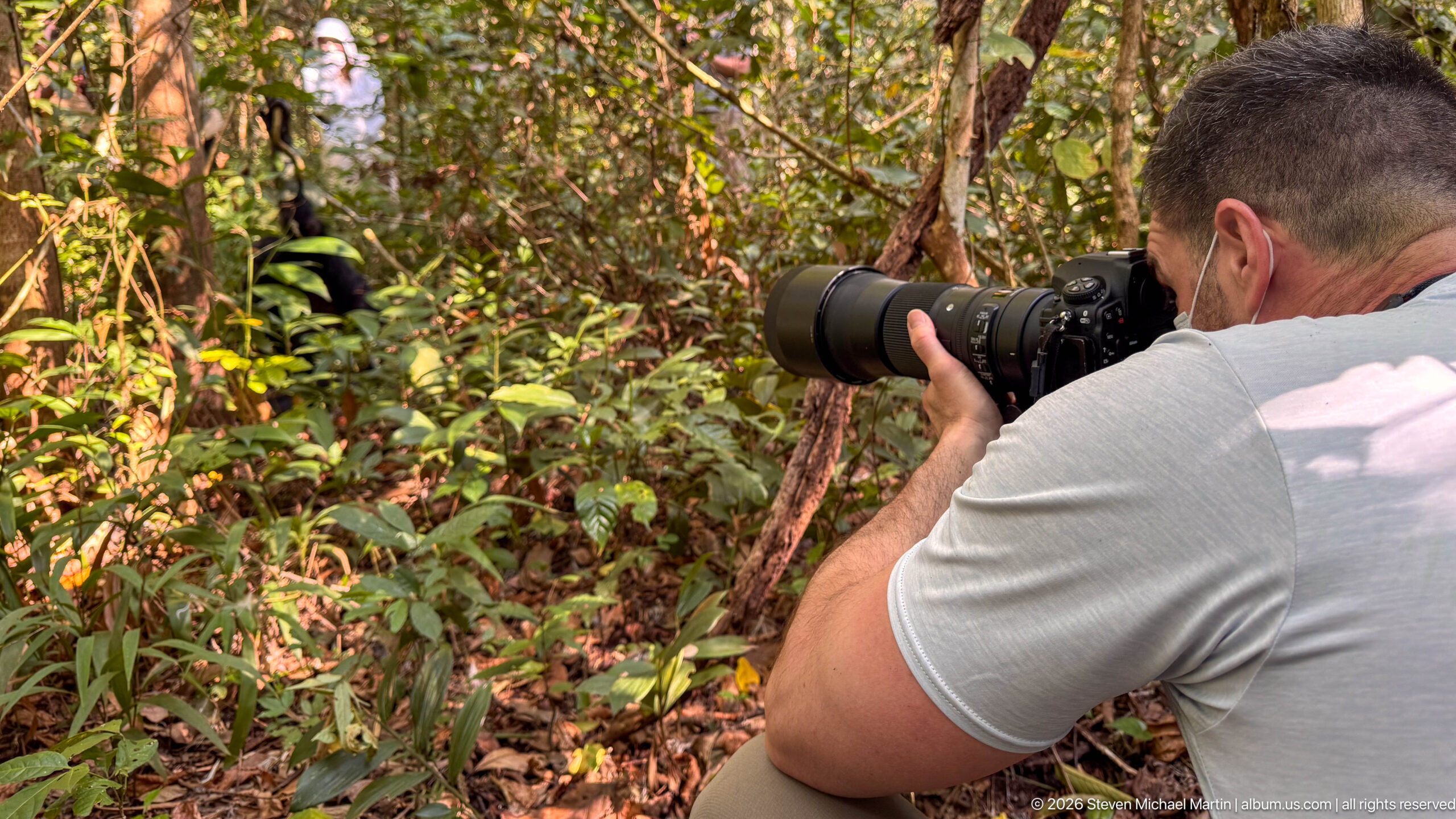
A photographer crouches at the edge of the forest trail and aims a large telephoto lens into dense understory. Leaf litter, saplings, and tangled vegetation surround the shooting position, illustrating the low, constrained angles often required for close-range primate photography in Budongo Forest.
Caption
A photographer crouches at the edge of the forest trail and aims a large telephoto lens into dense understory. Leaf litter, saplings, and tangled vegetation surround the shooting position, illustrating the low, constrained angles often required for close-range primate photography in Budongo Forest.
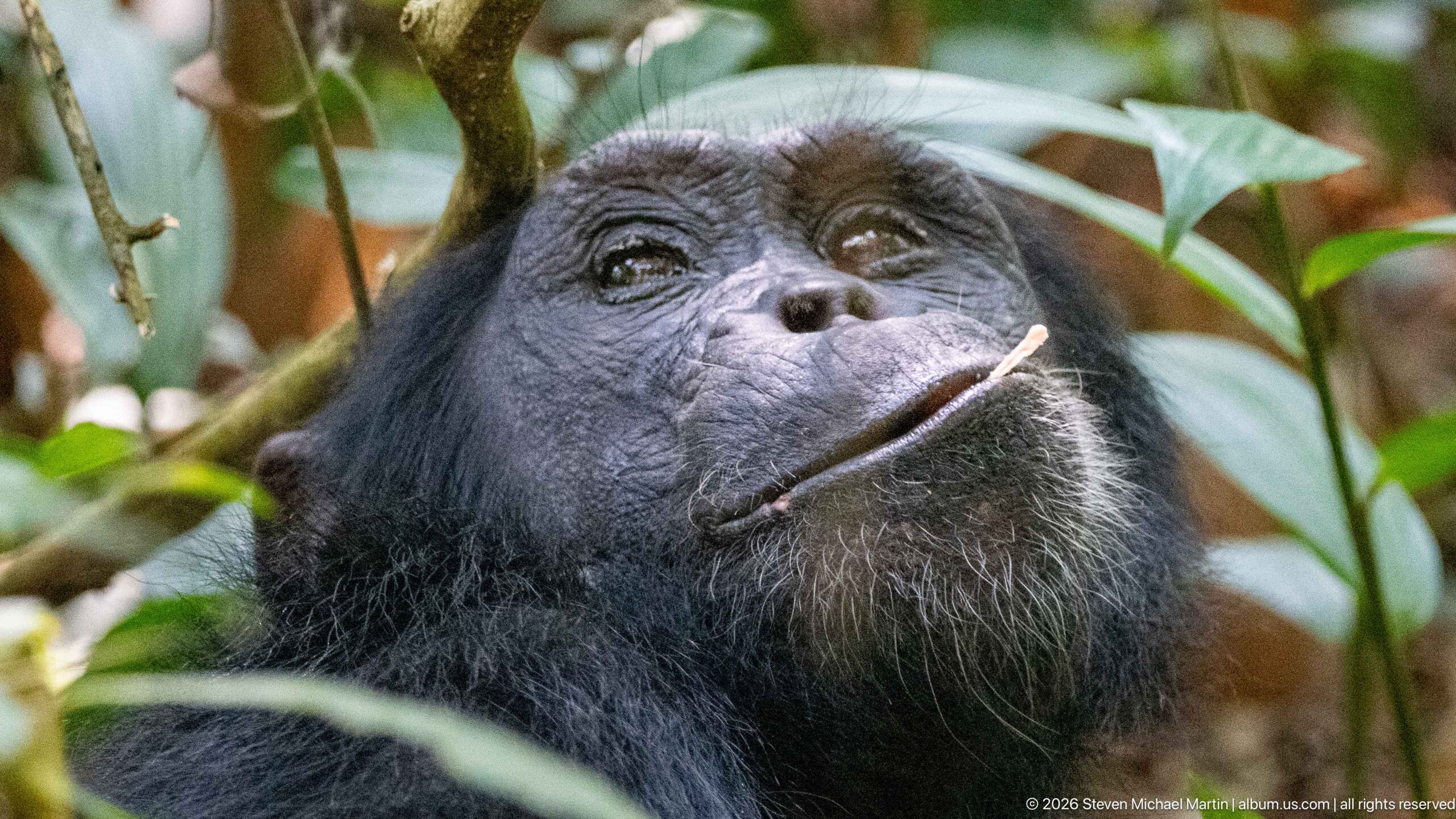
A slender twig or plant stem rests across the mouth of an eastern chimpanzee in this close forest portrait. The animal’s upward glance, textured black facial skin, and gray-flecked beard are sharply visible, while surrounding leaves provide a soft frame around the head.
Caption
A slender twig or plant stem rests across the mouth of an eastern chimpanzee in this close forest portrait. The animal’s upward glance, textured black facial skin, and gray-flecked beard are sharply visible, while surrounding leaves provide a soft frame around the head.
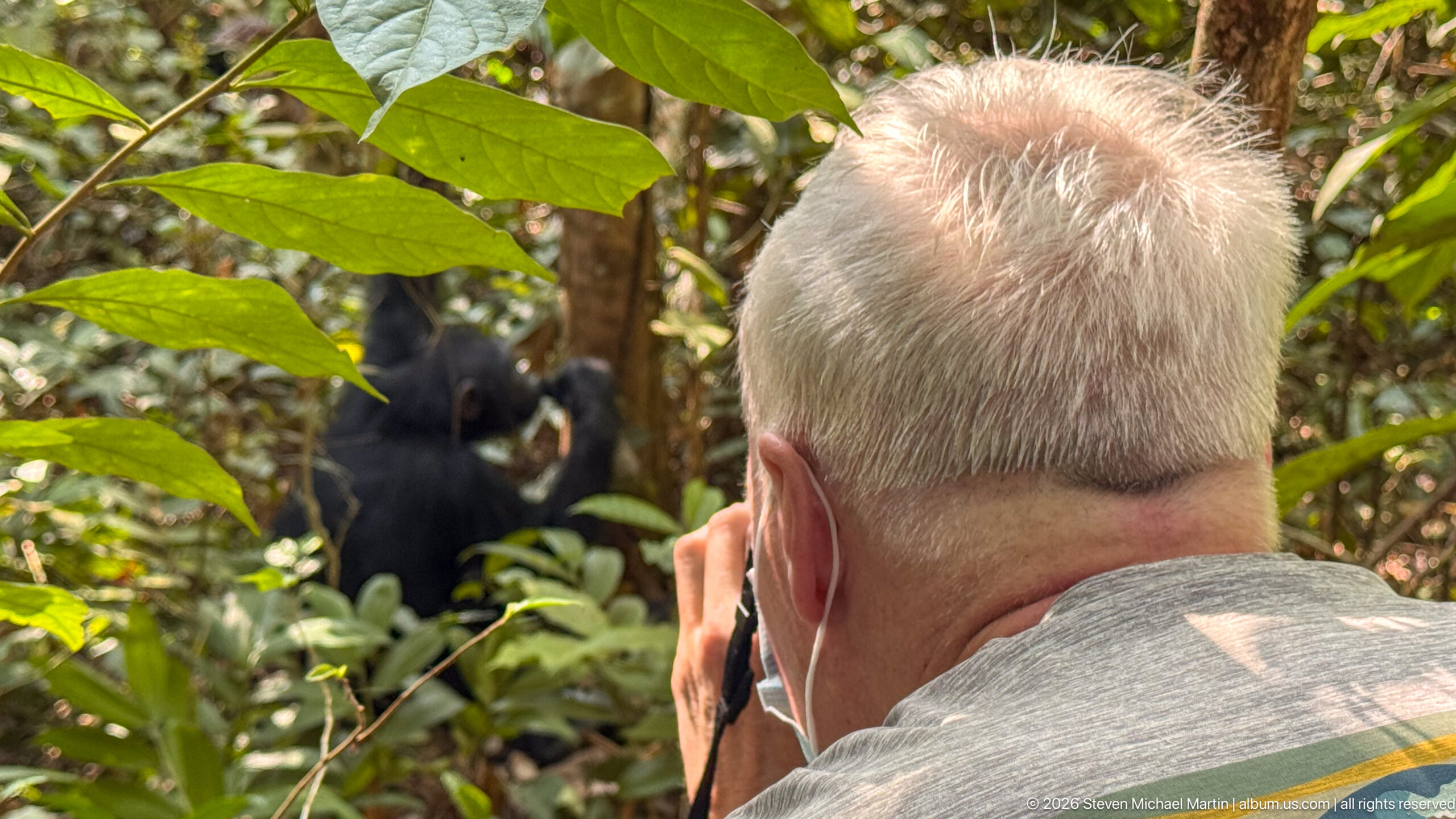
Seen over a visitor’s shoulder, an eastern chimpanzee sits among trees and dense vegetation only a short distance ahead. The human foreground gives scale and records the constrained sightline of a close forest encounter, with the ape partly screened by leaves and trunks.
Caption
Seen over a visitor’s shoulder, an eastern chimpanzee sits among trees and dense vegetation only a short distance ahead. The human foreground gives scale and records the constrained sightline of a close forest encounter, with the ape partly screened by leaves and trunks.
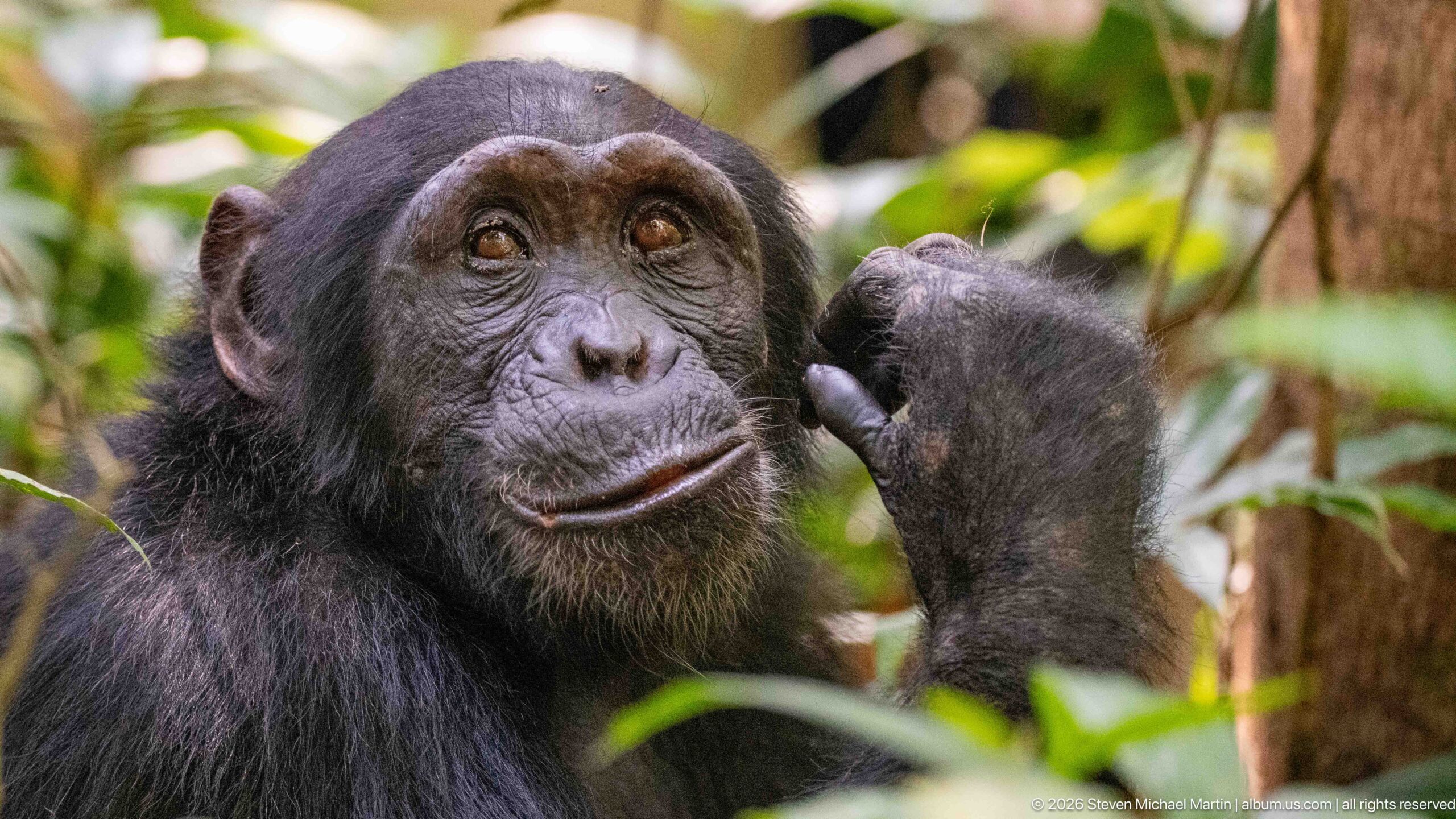
An eastern chimpanzee raises a curled hand beside its face, bringing the powerful fingers and dark knuckles into the same plane as its alert expression. The close view highlights hand anatomy and facial detail while soft leaves and tree trunks locate the animal in the forest understory.
Caption
An eastern chimpanzee raises a curled hand beside its face, bringing the powerful fingers and dark knuckles into the same plane as its alert expression. The close view highlights hand anatomy and facial detail while soft leaves and tree trunks locate the animal in the forest understory.
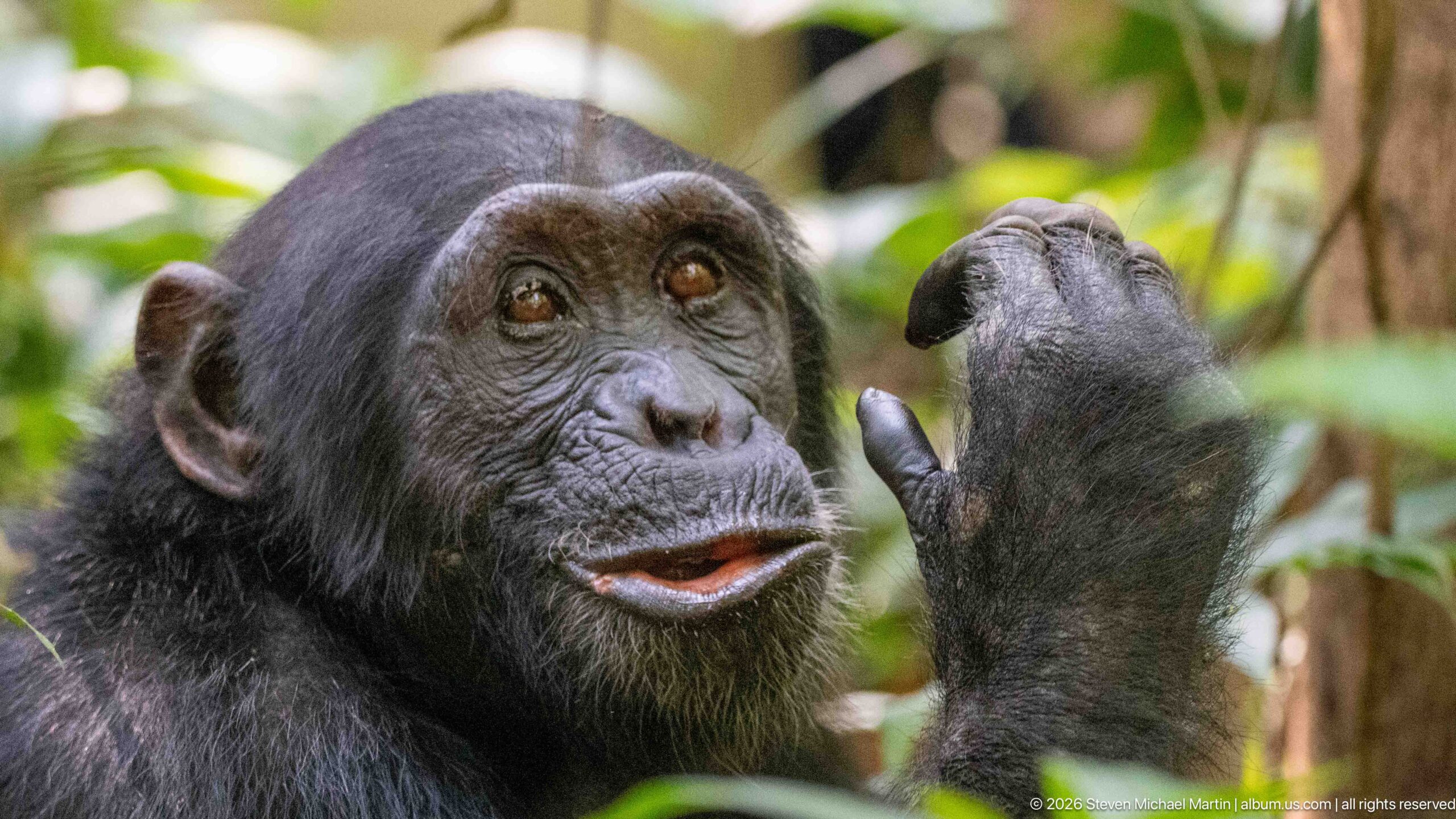
An eastern chimpanzee holds a curled hand near its cheek while the mouth opens slightly, exposing the lower teeth. The portrait pairs expressive facial detail with the animal’s broad fingers and knuckles, offering a close study of two defining anatomical features against a softly blurred forest background.
Caption
An eastern chimpanzee holds a curled hand near its cheek while the mouth opens slightly, exposing the lower teeth. The portrait pairs expressive facial detail with the animal’s broad fingers and knuckles, offering a close study of two defining anatomical features against a softly blurred forest background.
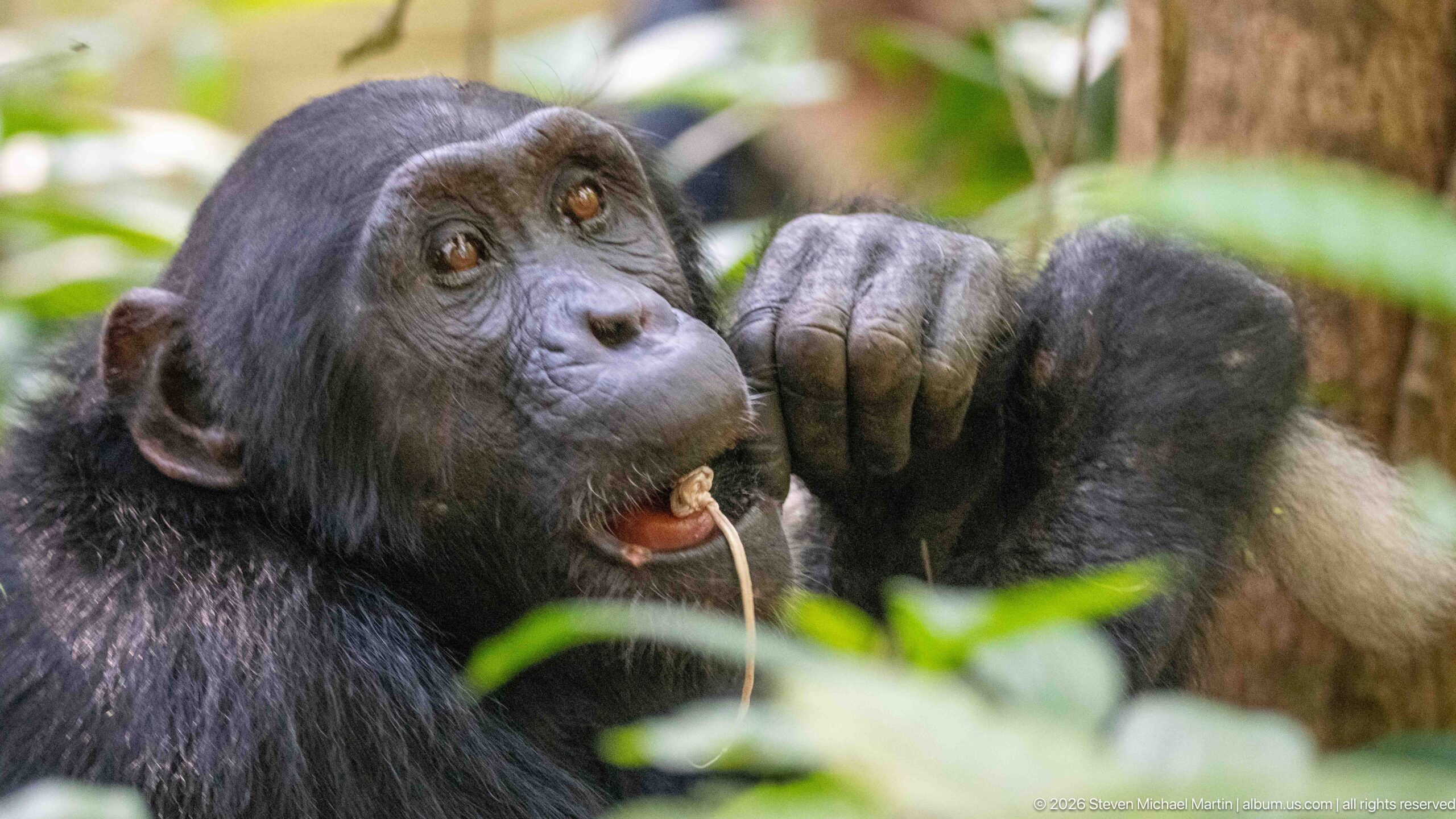
An eastern chimpanzee draws a thin plant stem toward its mouth while one hand rests prominently beside the face. The close framing shows dexterous fingers, lips, and facial wrinkles in detail, suggesting active manipulation of vegetation without requiring identification of the plant or exact feeding behavior.
Caption
An eastern chimpanzee draws a thin plant stem toward its mouth while one hand rests prominently beside the face. The close framing shows dexterous fingers, lips, and facial wrinkles in detail, suggesting active manipulation of vegetation without requiring identification of the plant or exact feeding behavior.
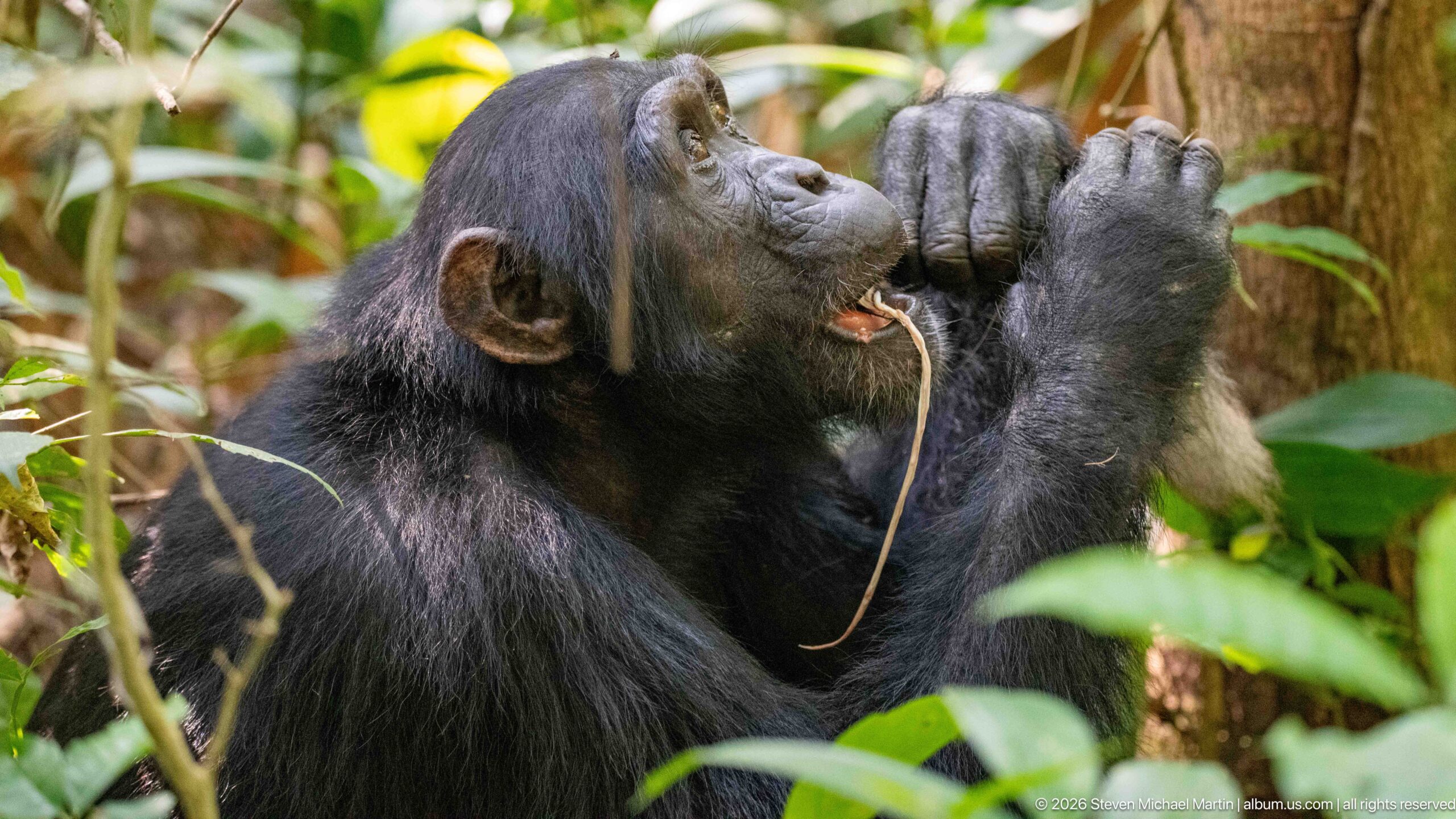
In profile, an eastern chimpanzee brings both hands and a long flexible stem toward its mouth. The coordinated grip, curled fingers, and taut plant material create a detailed view of manual manipulation, while trunks and foliage keep the behavior embedded in the Budongo Forest understory.
Caption
In profile, an eastern chimpanzee brings both hands and a long flexible stem toward its mouth. The coordinated grip, curled fingers, and taut plant material create a detailed view of manual manipulation, while trunks and foliage keep the behavior embedded in the Budongo Forest understory.
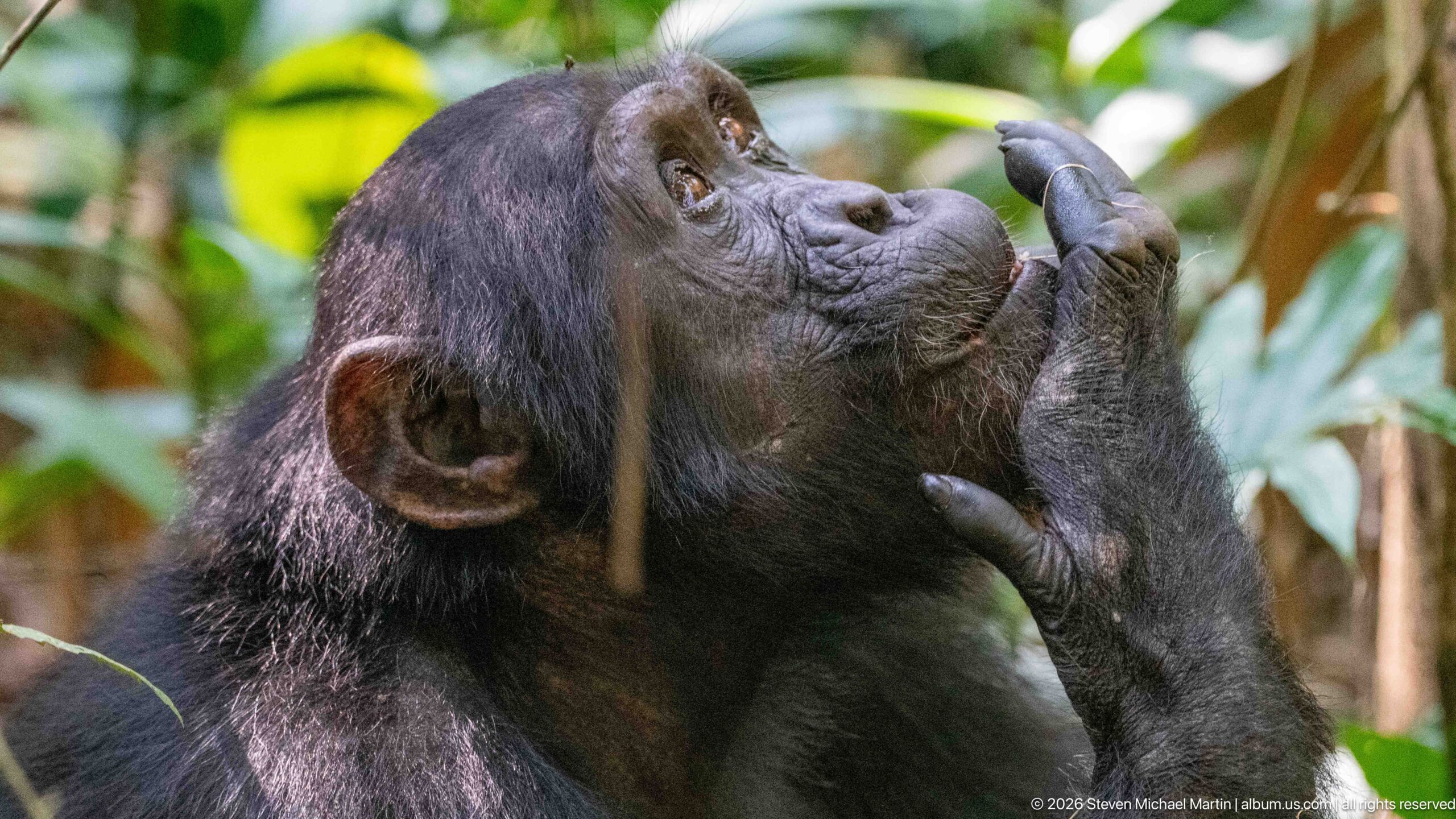
An eastern chimpanzee raises one hand to its mouth while seated in the forest understory, its head tipped slightly upward. The close profile emphasizes the dexterity of the fingers and the ape’s wrinkled facial anatomy, while nearby leaves and stems place this feeding-related action within Budongo Forest’s dense vegetation.
Caption
An eastern chimpanzee raises one hand to its mouth while seated in the forest understory, its head tipped slightly upward. The close profile emphasizes the dexterity of the fingers and the ape’s wrinkled facial anatomy, while nearby leaves and stems place this feeding-related action within Budongo Forest’s dense vegetation.
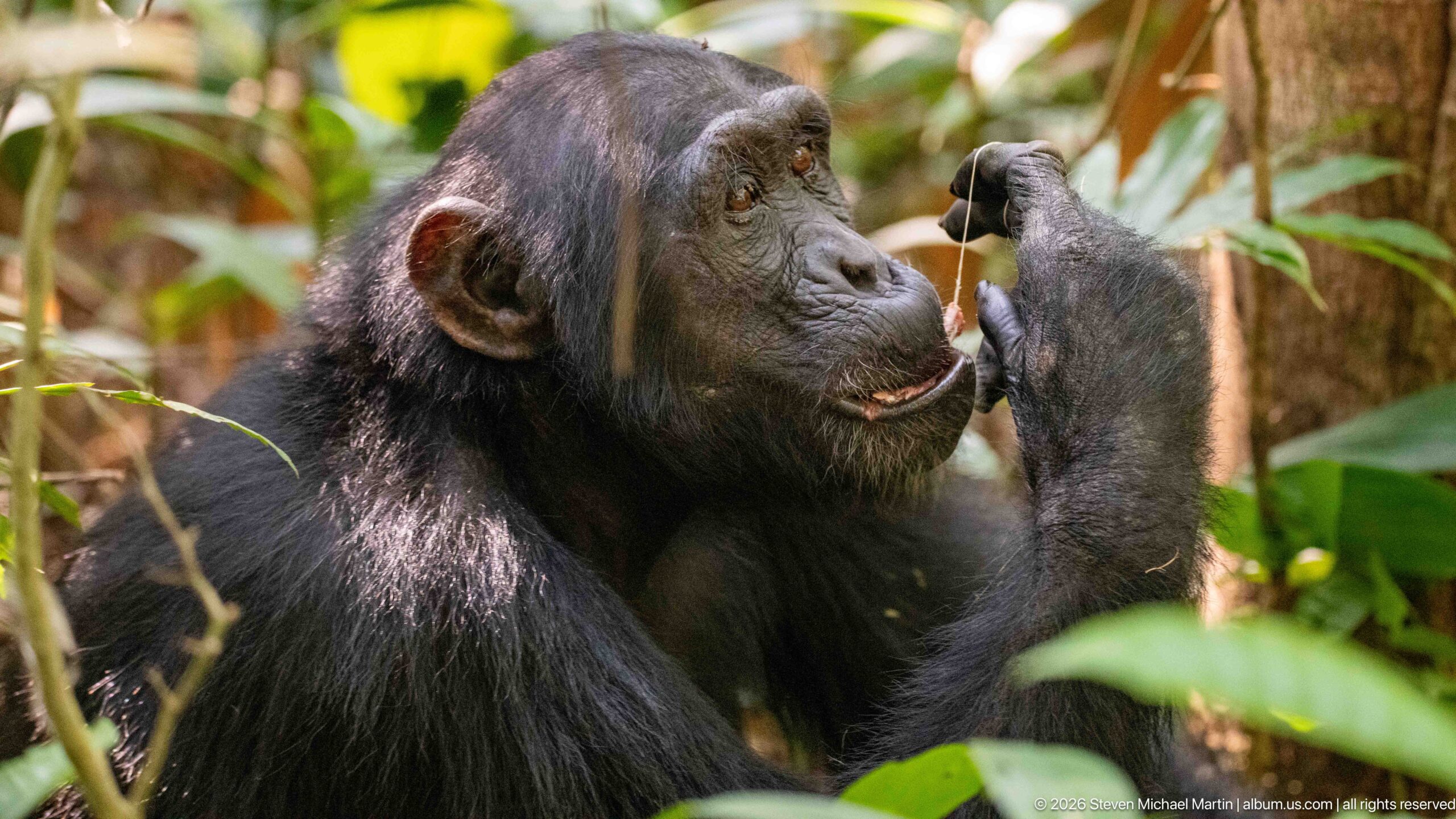
An eastern chimpanzee holds a thin strand of plant material between the fingers and brings it toward the mouth. The profile view clearly shows the opposable grip, lips, and attentive gaze, offering a close study of manual manipulation during a likely feeding sequence without identifying the plant itself.
Caption
An eastern chimpanzee holds a thin strand of plant material between the fingers and brings it toward the mouth. The profile view clearly shows the opposable grip, lips, and attentive gaze, offering a close study of manual manipulation during a likely feeding sequence without identifying the plant itself.
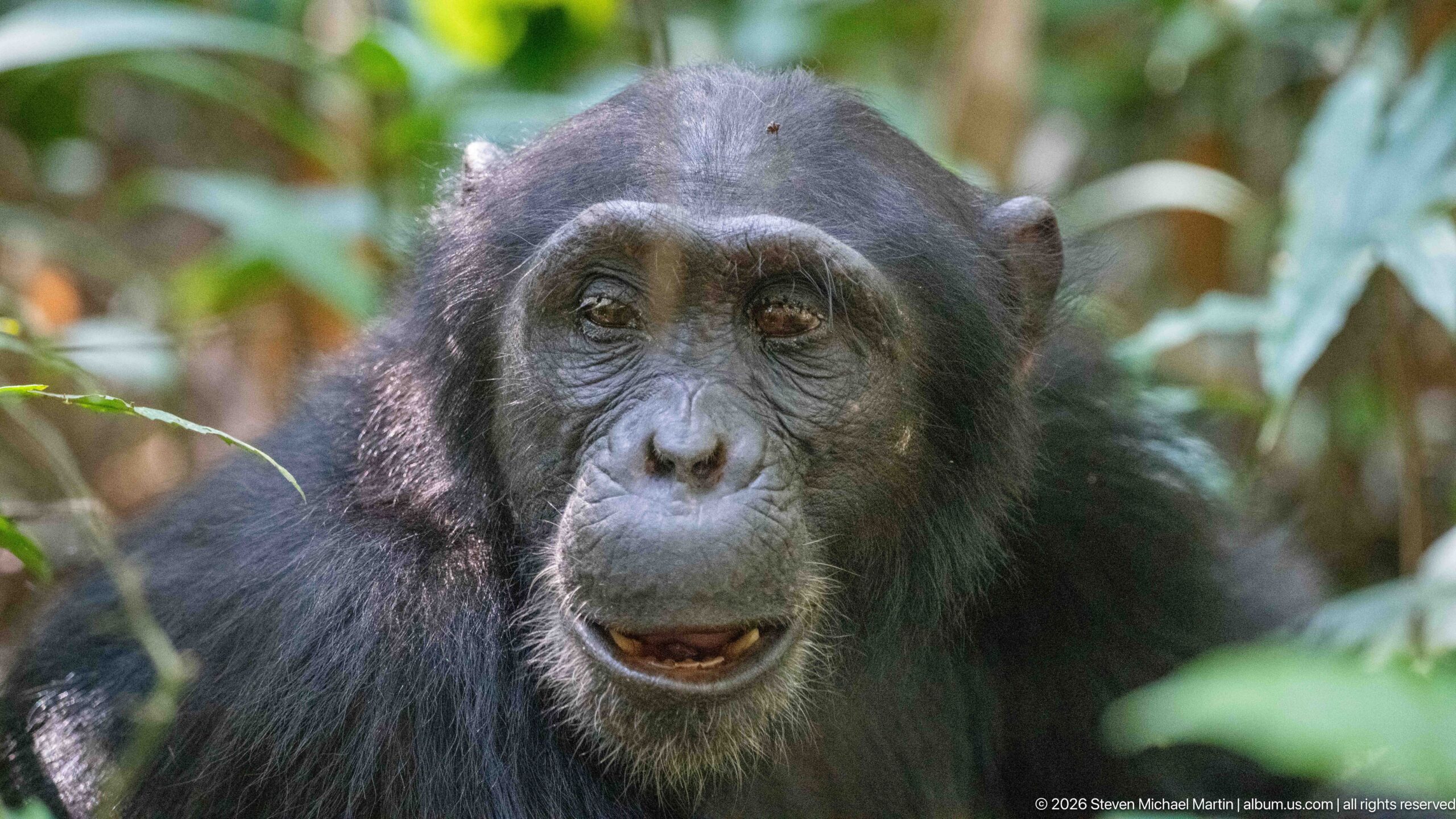
A frontal portrait of an eastern chimpanzee centers the broad brow, deep-set eyes, short muzzle, and sparse gray hairs along the chin. The mouth is slightly open, and soft forest foliage surrounds the shoulders, producing a direct field-guide view of facial morphology rather than a strongly behavioral moment.
Caption
A frontal portrait of an eastern chimpanzee centers the broad brow, deep-set eyes, short muzzle, and sparse gray hairs along the chin. The mouth is slightly open, and soft forest foliage surrounds the shoulders, producing a direct field-guide view of facial morphology rather than a strongly behavioral moment.
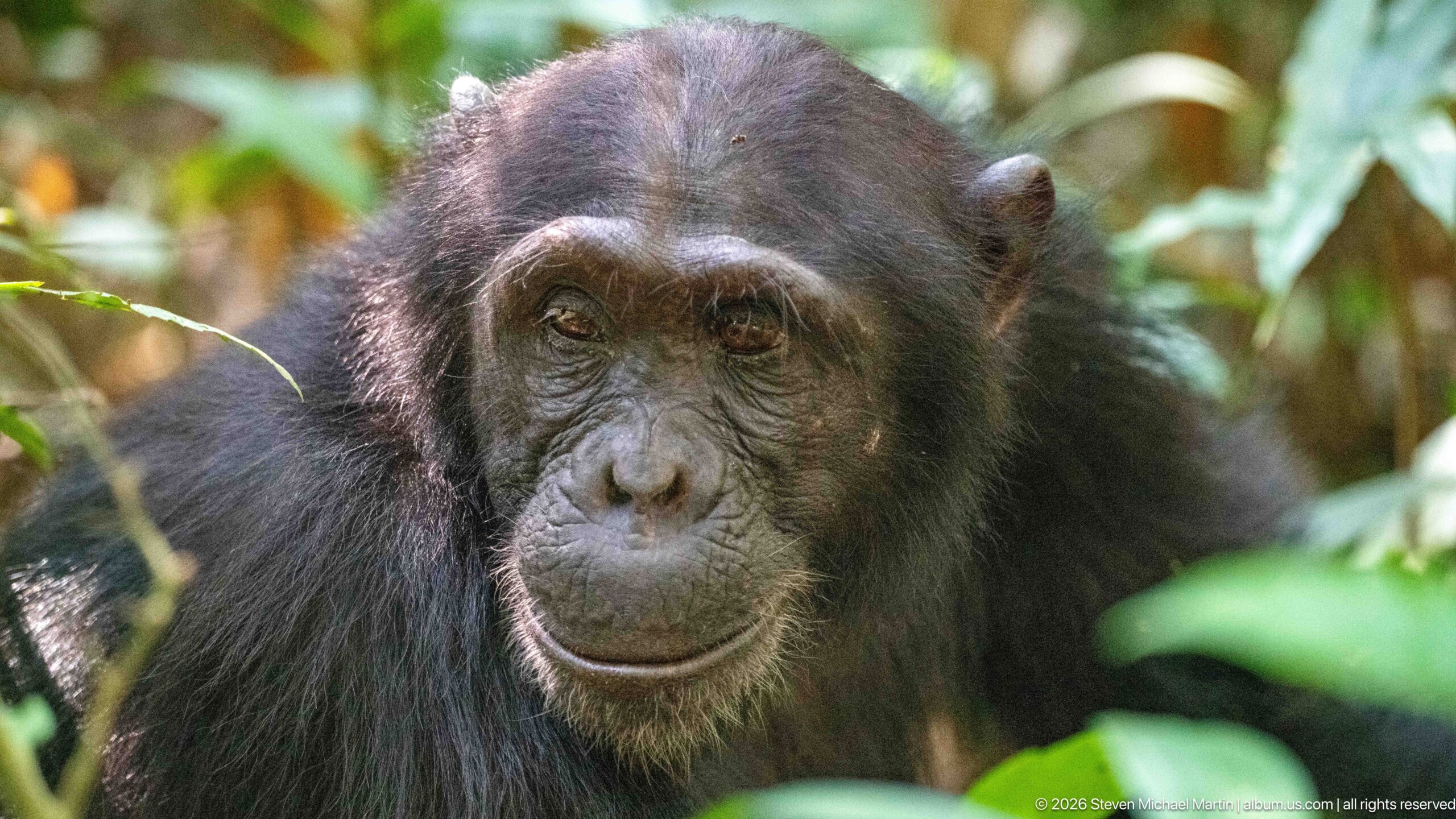
An eastern chimpanzee faces the camera with a calm, closed-mouth expression, the face framed by dark fur and softly blurred foliage. Fine wrinkles around the eyes and muzzle, along with pale hairs beneath the lower lip, distinguish this quieter portrait from the more active feeding views in the sequence.
Caption
An eastern chimpanzee faces the camera with a calm, closed-mouth expression, the face framed by dark fur and softly blurred foliage. Fine wrinkles around the eyes and muzzle, along with pale hairs beneath the lower lip, distinguish this quieter portrait from the more active feeding views in the sequence.
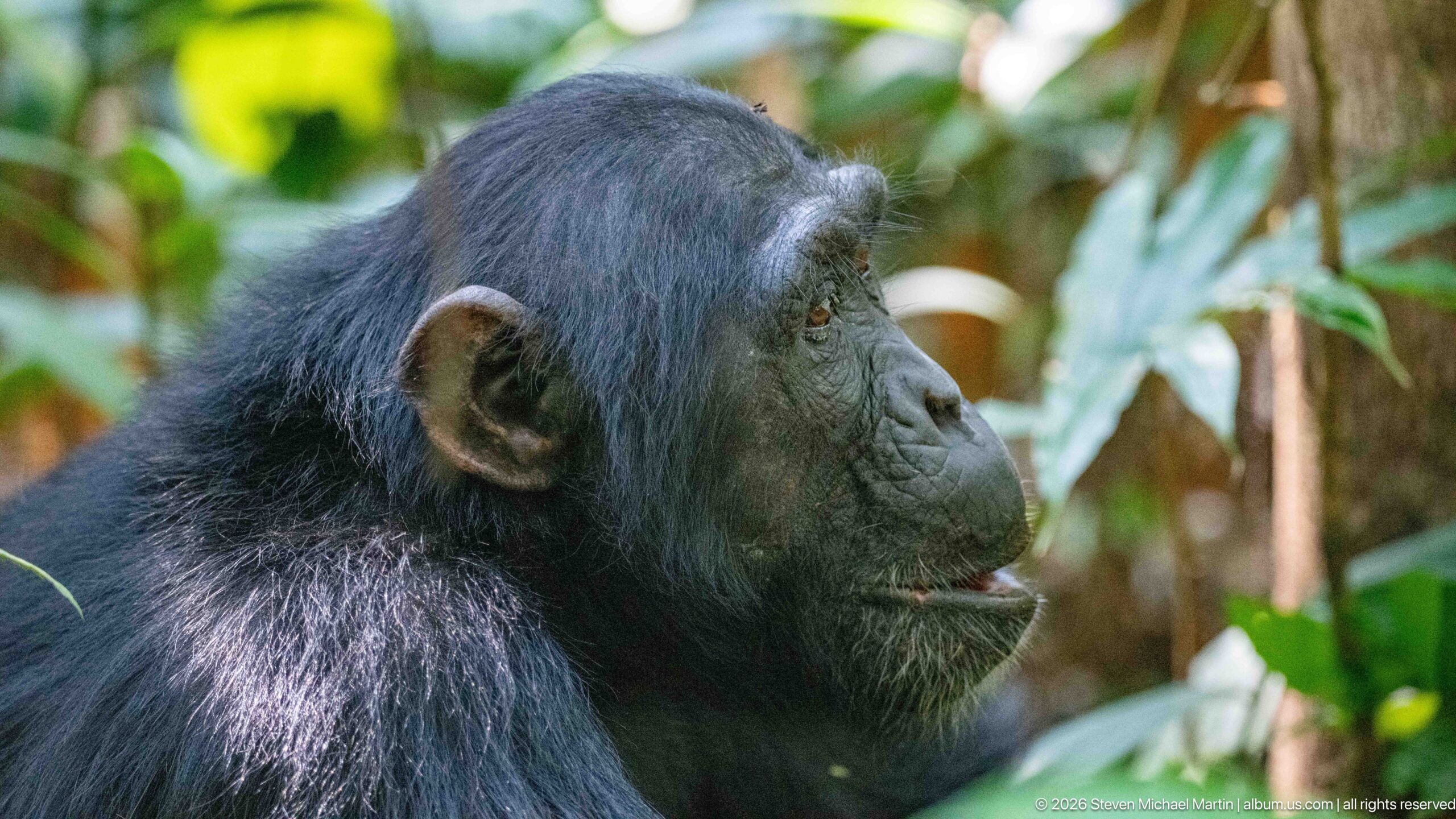
Seen in side profile, an eastern chimpanzee looks across the forest with the rounded ear, sloping forehead, projecting muzzle, and gray-flecked beard sharply defined. Sunlight catches the shoulder and surrounding leaves, giving this frame a clear anatomical profile distinct from the frontal portraits nearby.
Caption
Seen in side profile, an eastern chimpanzee looks across the forest with the rounded ear, sloping forehead, projecting muzzle, and gray-flecked beard sharply defined. Sunlight catches the shoulder and surrounding leaves, giving this frame a clear anatomical profile distinct from the frontal portraits nearby.
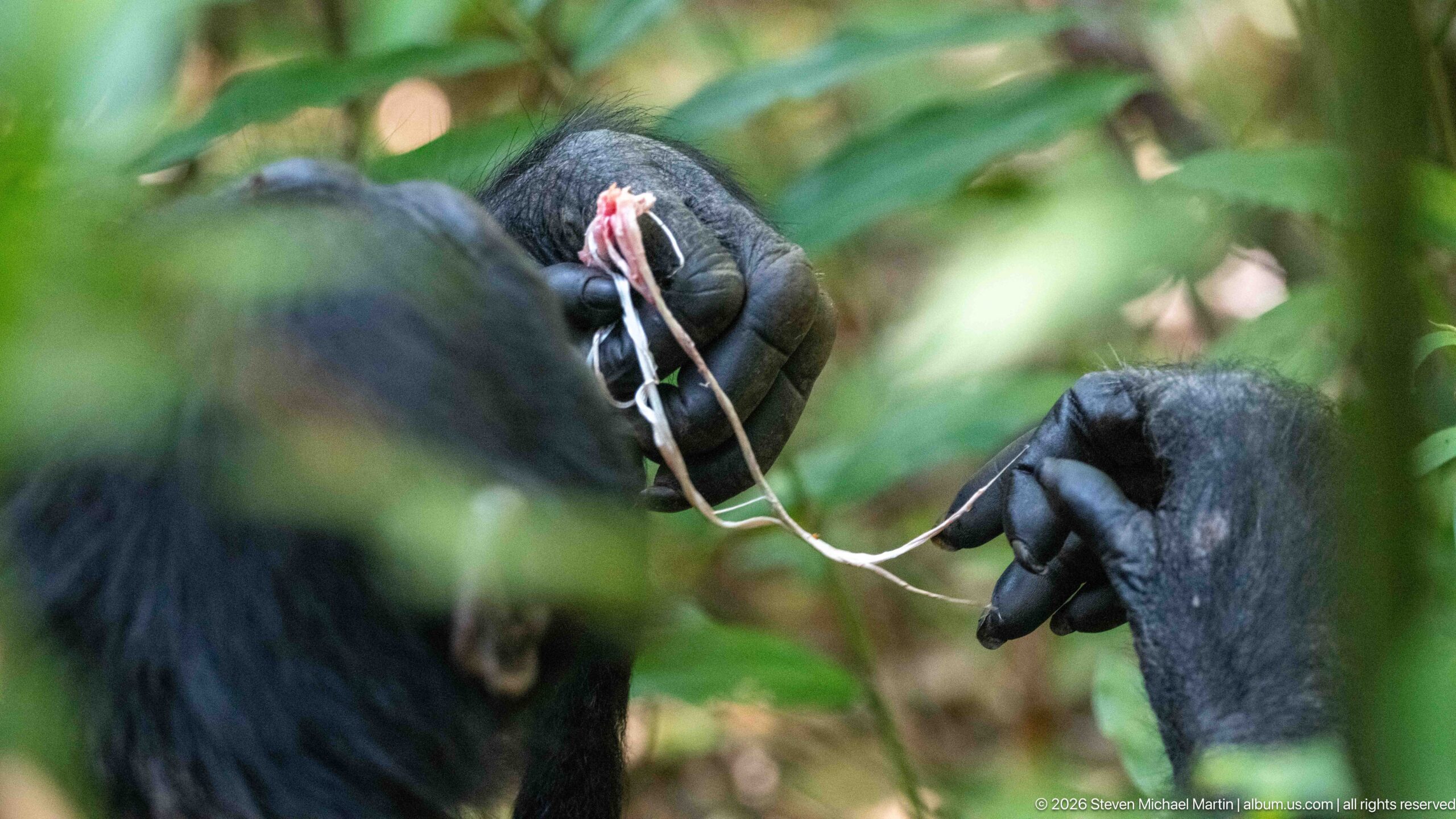
Two chimpanzee hands manipulate a fibrous red food item and a trailing pale strand among the forest vegetation. The tight crop removes most of the animal’s face, turning attention to strong fingers, black skin, and precise handling of the food; the exact fruit or plant species cannot be determined from this view alone.
Caption
Two chimpanzee hands manipulate a fibrous red food item and a trailing pale strand among the forest vegetation. The tight crop removes most of the animal’s face, turning attention to strong fingers, black skin, and precise handling of the food; the exact fruit or plant species cannot be determined from this view alone.
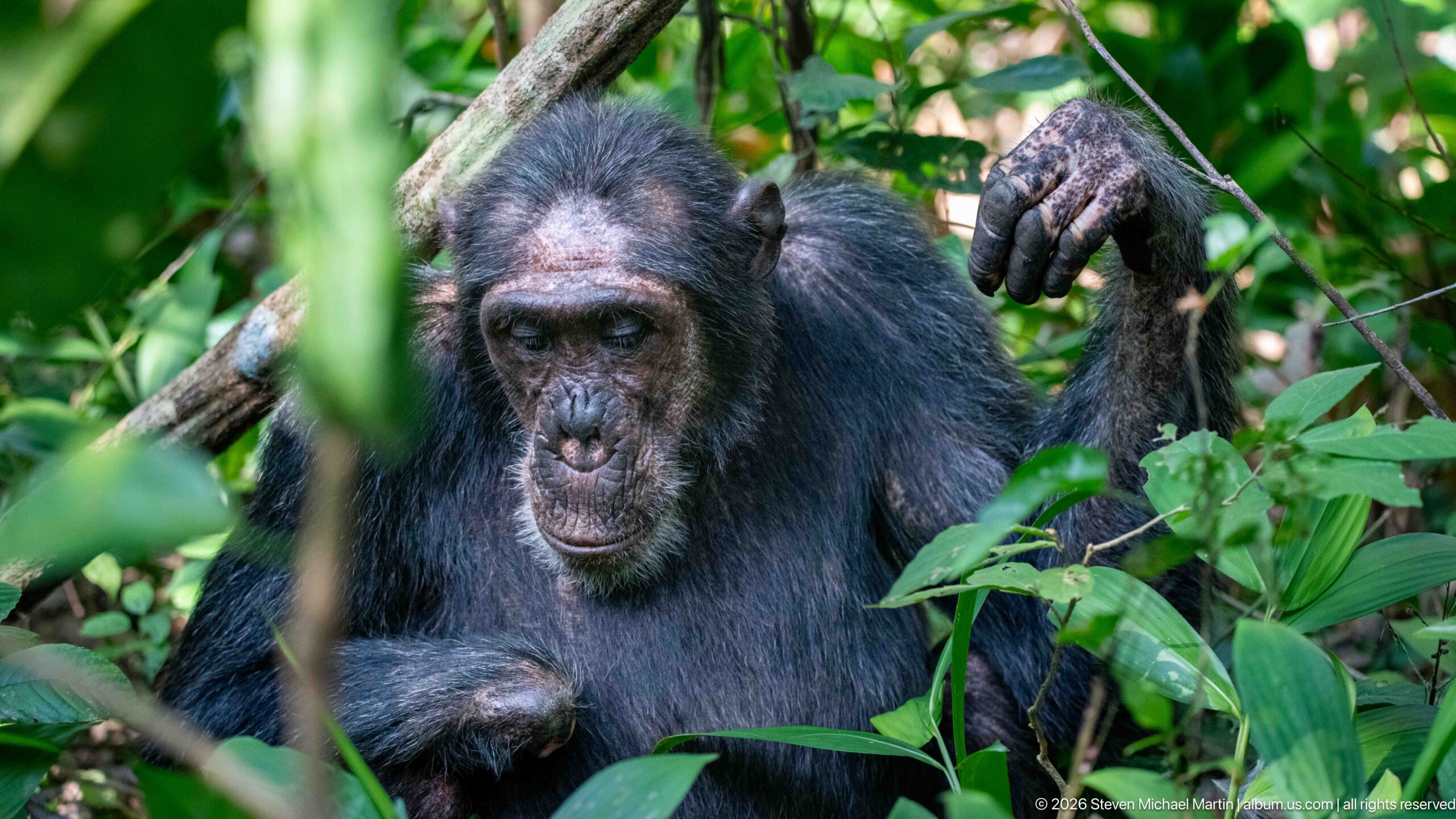
An eastern chimpanzee sits amid vines and broad leaves with one arm lifted and the other resting across the body. The relatively wide framing shows the ape’s long arms, powerful shoulders, and compact seated posture while retaining the dense understory as an important part of the composition.
Caption
An eastern chimpanzee sits amid vines and broad leaves with one arm lifted and the other resting across the body. The relatively wide framing shows the ape’s long arms, powerful shoulders, and compact seated posture while retaining the dense understory as an important part of the composition.
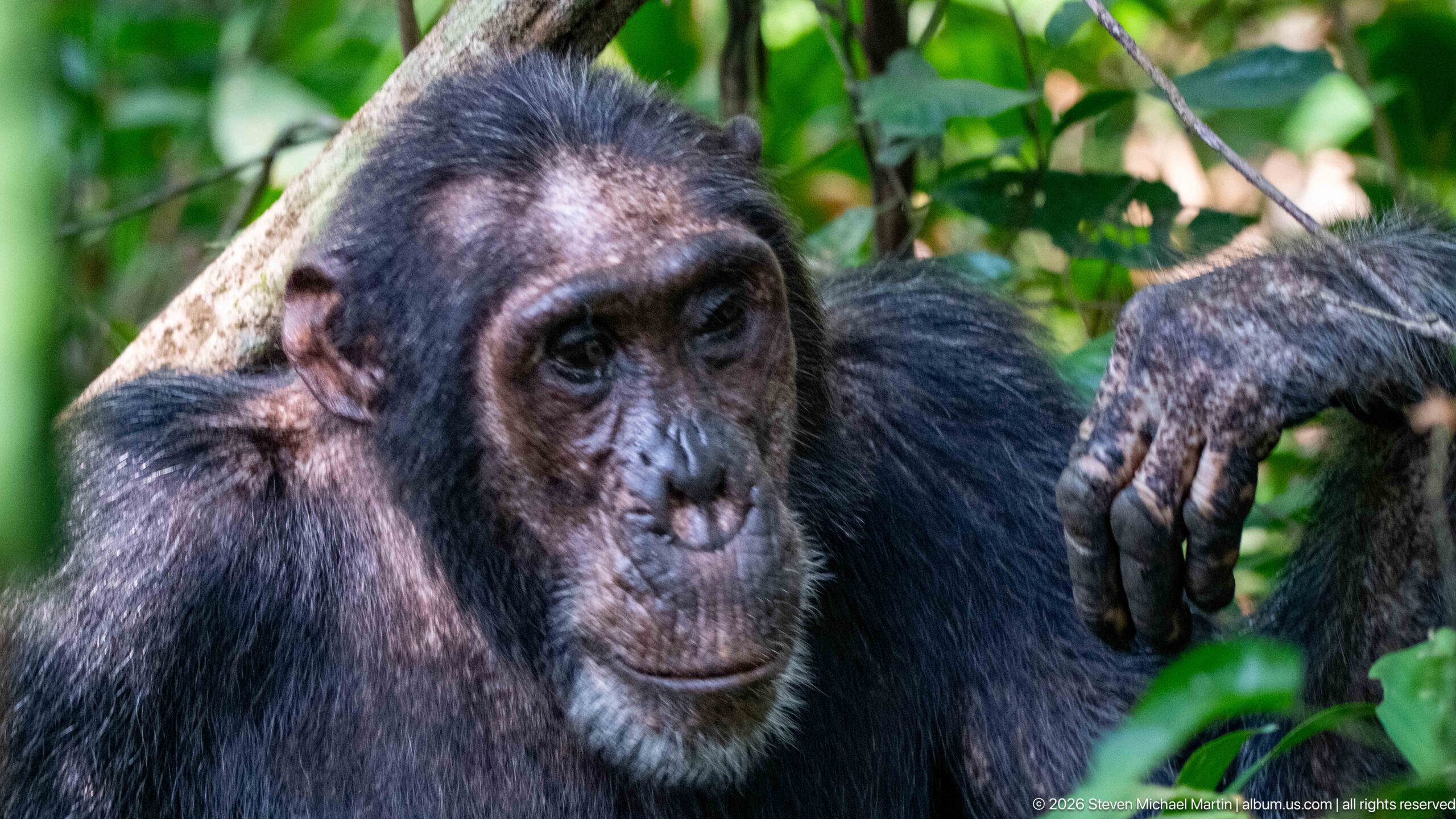
An eastern chimpanzee leans within the understory with one long arm draped over a branch or vine. Its face is turned forward, showing the broad brow, deep-set eyes, dark muzzle, and gray chin hairs, while the relaxed arm position gives the portrait a distinctive resting character.
Caption
An eastern chimpanzee leans within the understory with one long arm draped over a branch or vine. Its face is turned forward, showing the broad brow, deep-set eyes, dark muzzle, and gray chin hairs, while the relaxed arm position gives the portrait a distinctive resting character.
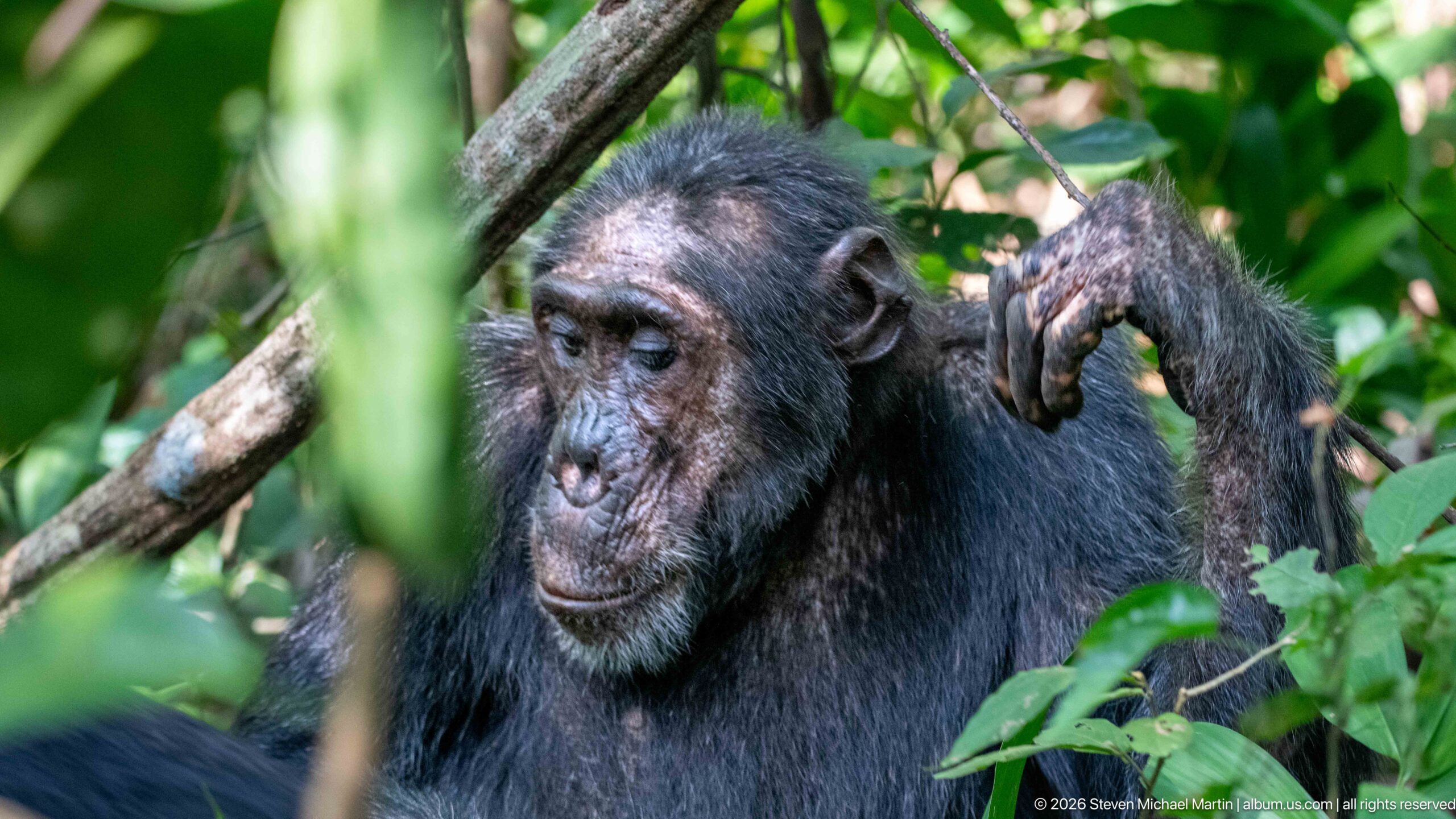
An eastern chimpanzee sits in dense vegetation with its gaze lowered, one arm bent high beside the shoulder. Sunlight filters across the head and forearm, revealing coarse black hair and the weathered facial skin while the surrounding leaves partially screen the lower body.
Caption
An eastern chimpanzee sits in dense vegetation with its gaze lowered, one arm bent high beside the shoulder. Sunlight filters across the head and forearm, revealing coarse black hair and the weathered facial skin while the surrounding leaves partially screen the lower body.
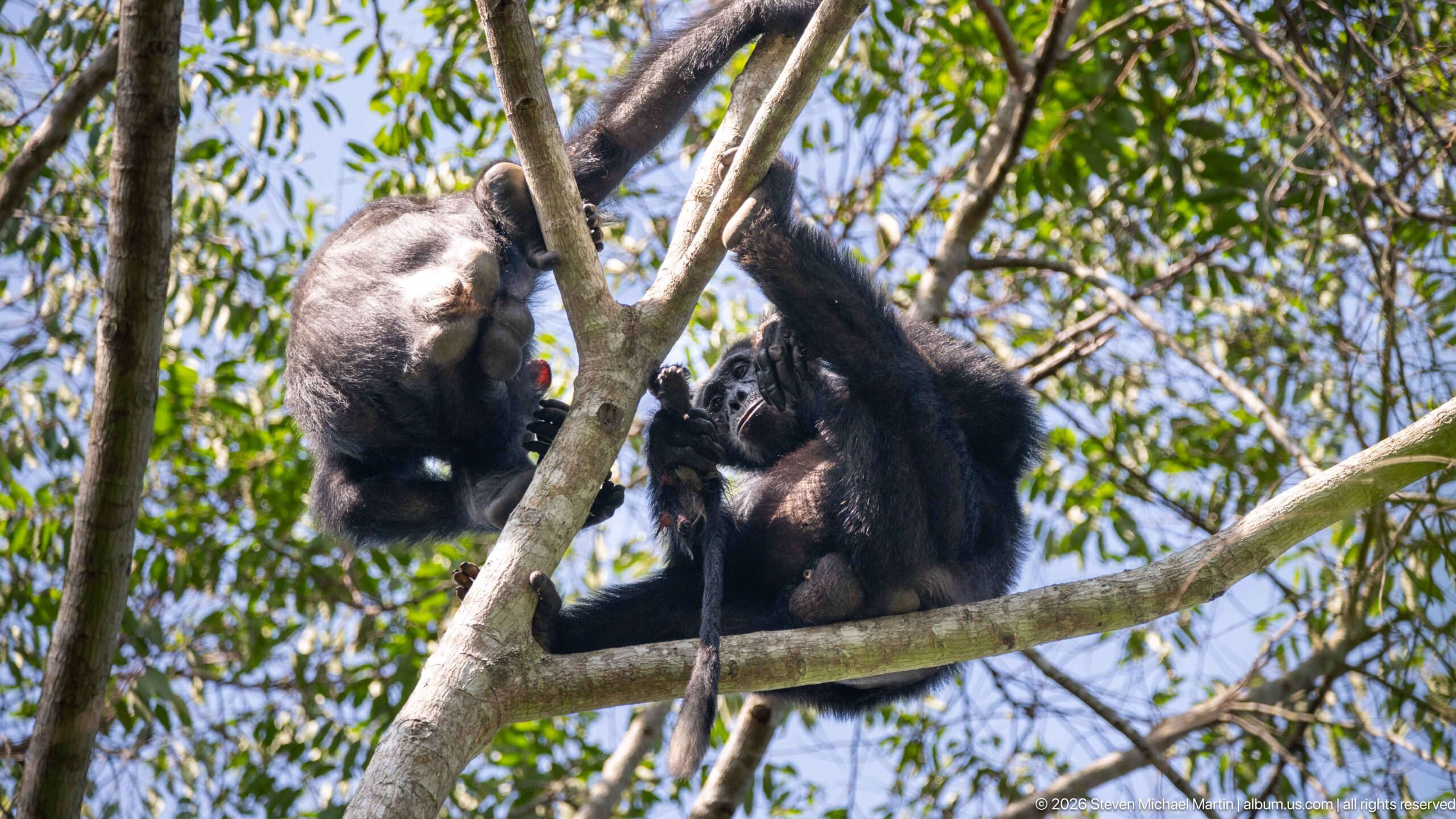
Two eastern chimpanzees share a branching perch high in the forest, one seated lower while the other reaches down from above. A bright red food item is visible between them, suggesting a feeding interaction, while the wider view shows how the apes use intersecting limbs as platforms in the canopy.
Caption
Two eastern chimpanzees share a branching perch high in the forest, one seated lower while the other reaches down from above. A bright red food item is visible between them, suggesting a feeding interaction, while the wider view shows how the apes use intersecting limbs as platforms in the canopy.
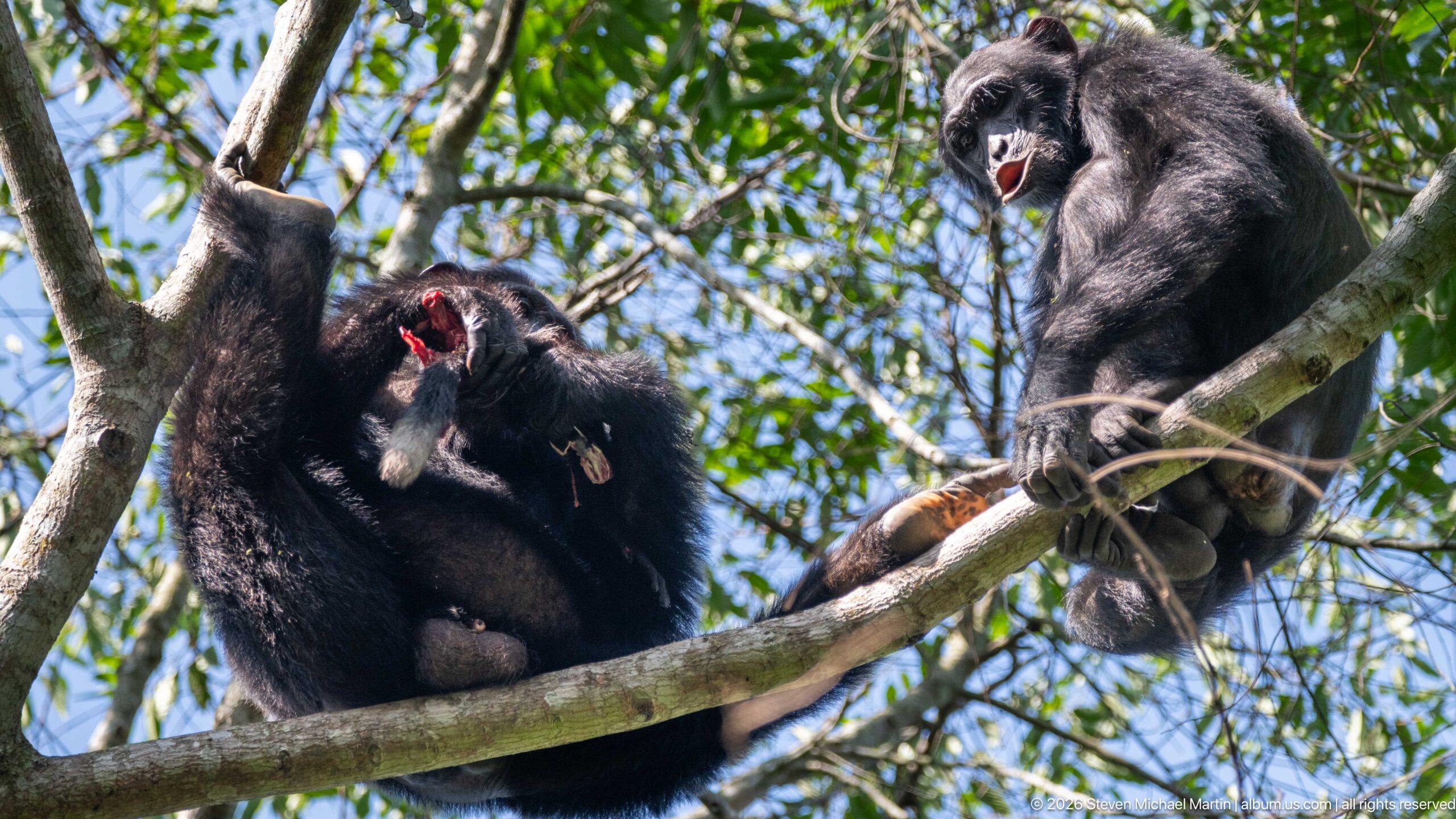
One eastern chimpanzee sits on a broad branch holding vivid red food material while a second individual perches immediately beside it with mouth open. Their close spacing and contrasting postures create a strong social scene, with bright sky and small leaves breaking through the canopy behind them.
Caption
One eastern chimpanzee sits on a broad branch holding vivid red food material while a second individual perches immediately beside it with mouth open. Their close spacing and contrasting postures create a strong social scene, with bright sky and small leaves breaking through the canopy behind them.
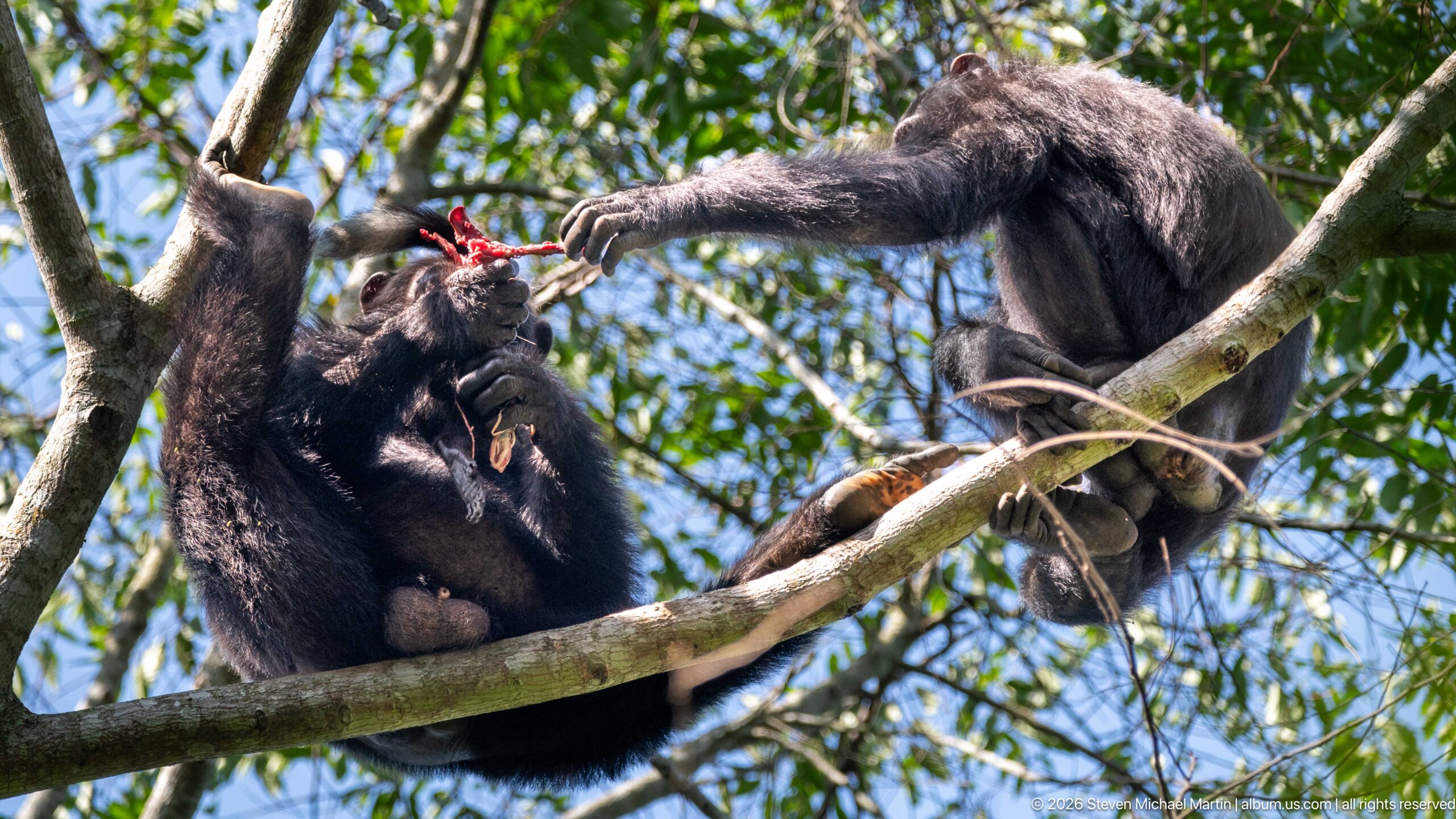
Two eastern chimpanzees interact on a tree branch as the higher animal extends an arm toward a vivid red food item held by the lower one. The extended reach, opposing body positions, and shared focus on the food create a particularly clear view of social proximity during feeding in the forest canopy.
Caption
Two eastern chimpanzees interact on a tree branch as the higher animal extends an arm toward a vivid red food item held by the lower one. The extended reach, opposing body positions, and shared focus on the food create a particularly clear view of social proximity during feeding in the forest canopy.
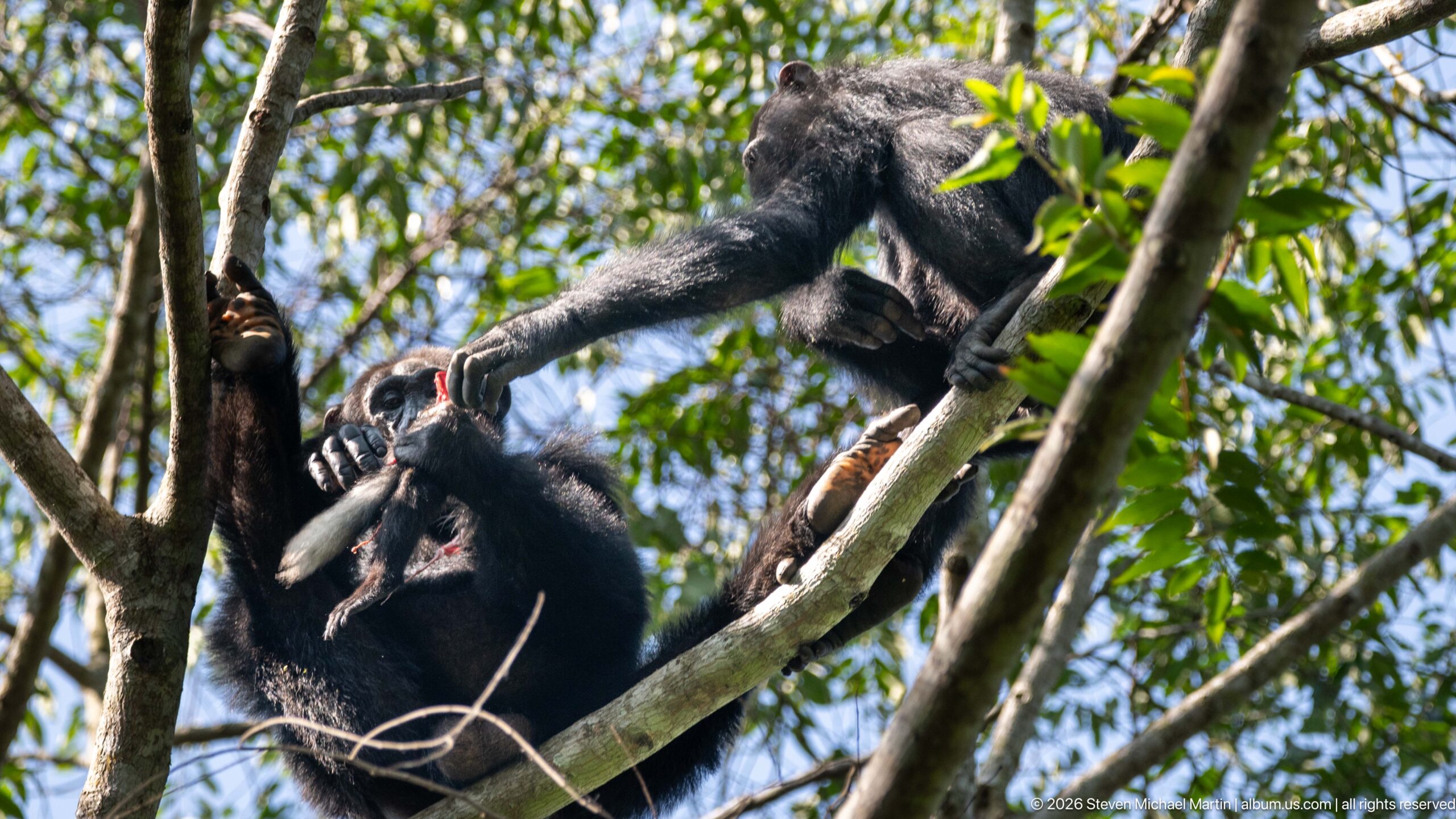
Two eastern chimpanzees occupy separate limbs of the same tree, the upper animal stretching a long arm down toward the lower individual. Bright red food material remains visible near the lower chimpanzee’s face, and the diagonal branches frame the interaction against a sunlit canopy.
Caption
Two eastern chimpanzees occupy separate limbs of the same tree, the upper animal stretching a long arm down toward the lower individual. Bright red food material remains visible near the lower chimpanzee’s face, and the diagonal branches frame the interaction against a sunlit canopy.
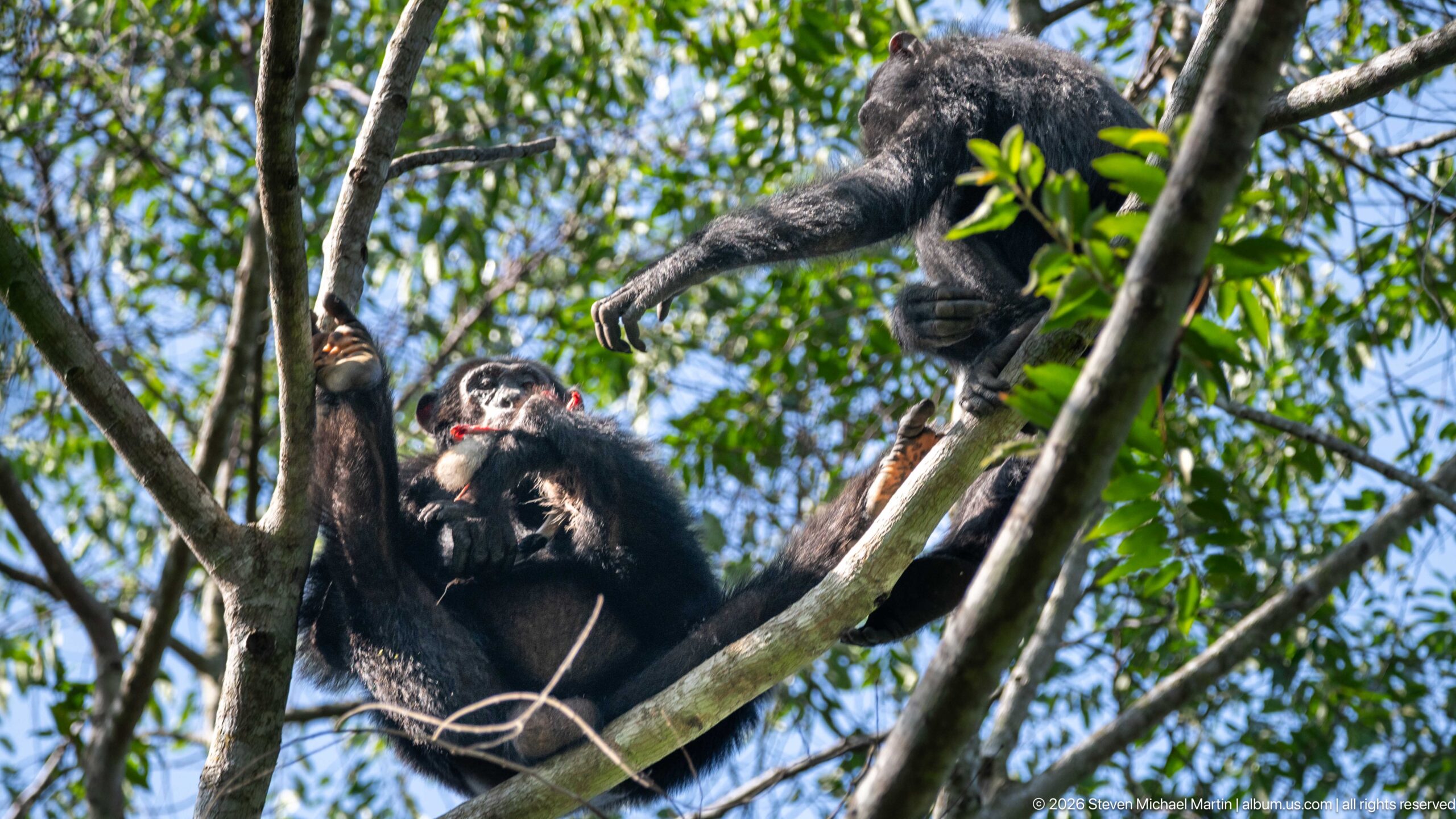
A lower eastern chimpanzee holds bright red fibrous food close to its mouth while a second chimpanzee reaches down from an upper branch. The scene places feeding and social proximity within the canopy, where a web of trunks and leafy twigs surrounds both animals.
Caption
A lower eastern chimpanzee holds bright red fibrous food close to its mouth while a second chimpanzee reaches down from an upper branch. The scene places feeding and social proximity within the canopy, where a web of trunks and leafy twigs surrounds both animals.
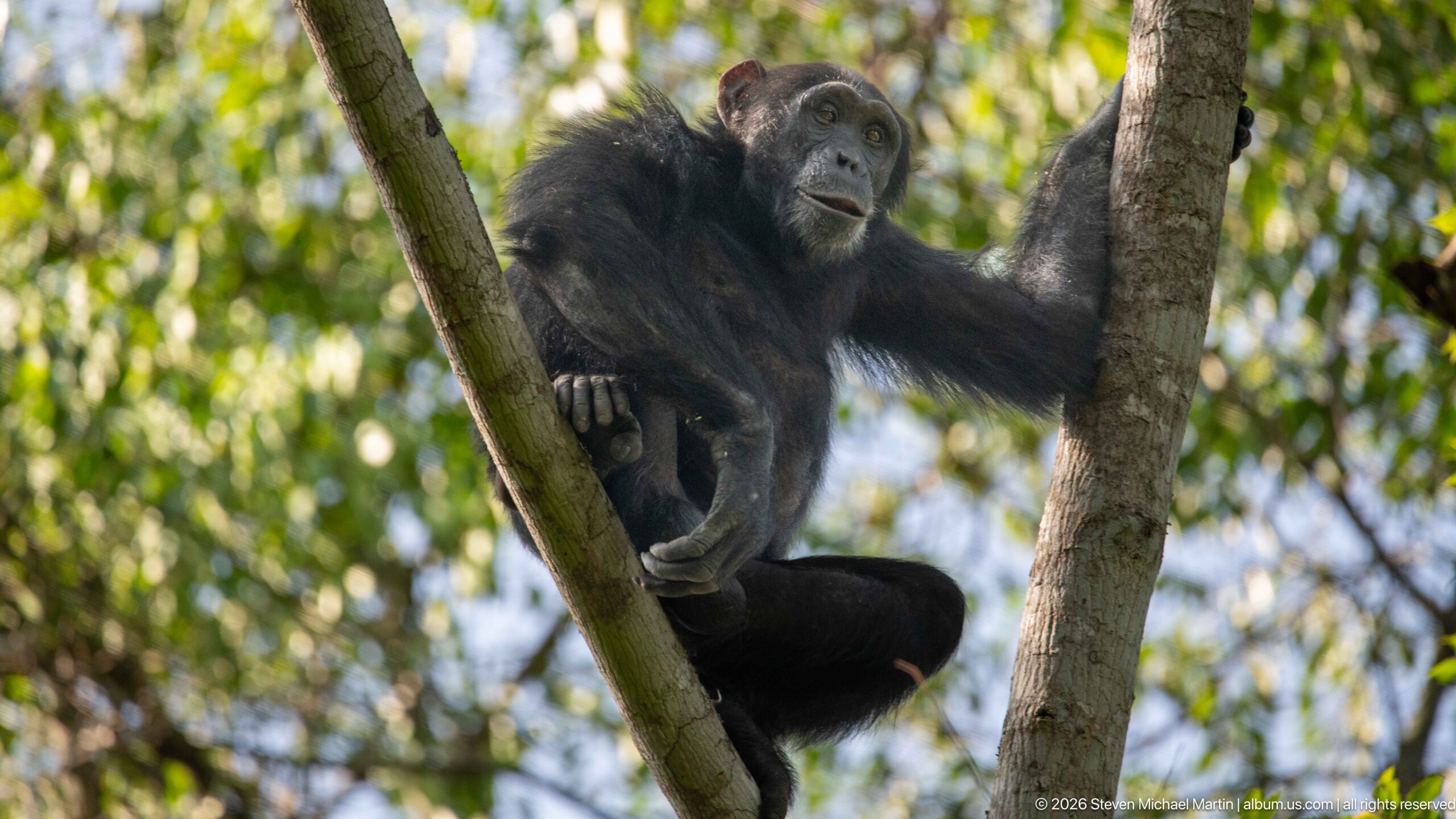
An eastern chimpanzee braces between two near-vertical trunks, gripping one with a hand while its bent legs anchor the body against the branches. The full-body view emphasizes climbing posture, long limbs, and muscular build, with a softly lit forest background opening beyond the tree.
Caption
An eastern chimpanzee braces between two near-vertical trunks, gripping one with a hand while its bent legs anchor the body against the branches. The full-body view emphasizes climbing posture, long limbs, and muscular build, with a softly lit forest background opening beyond the tree.
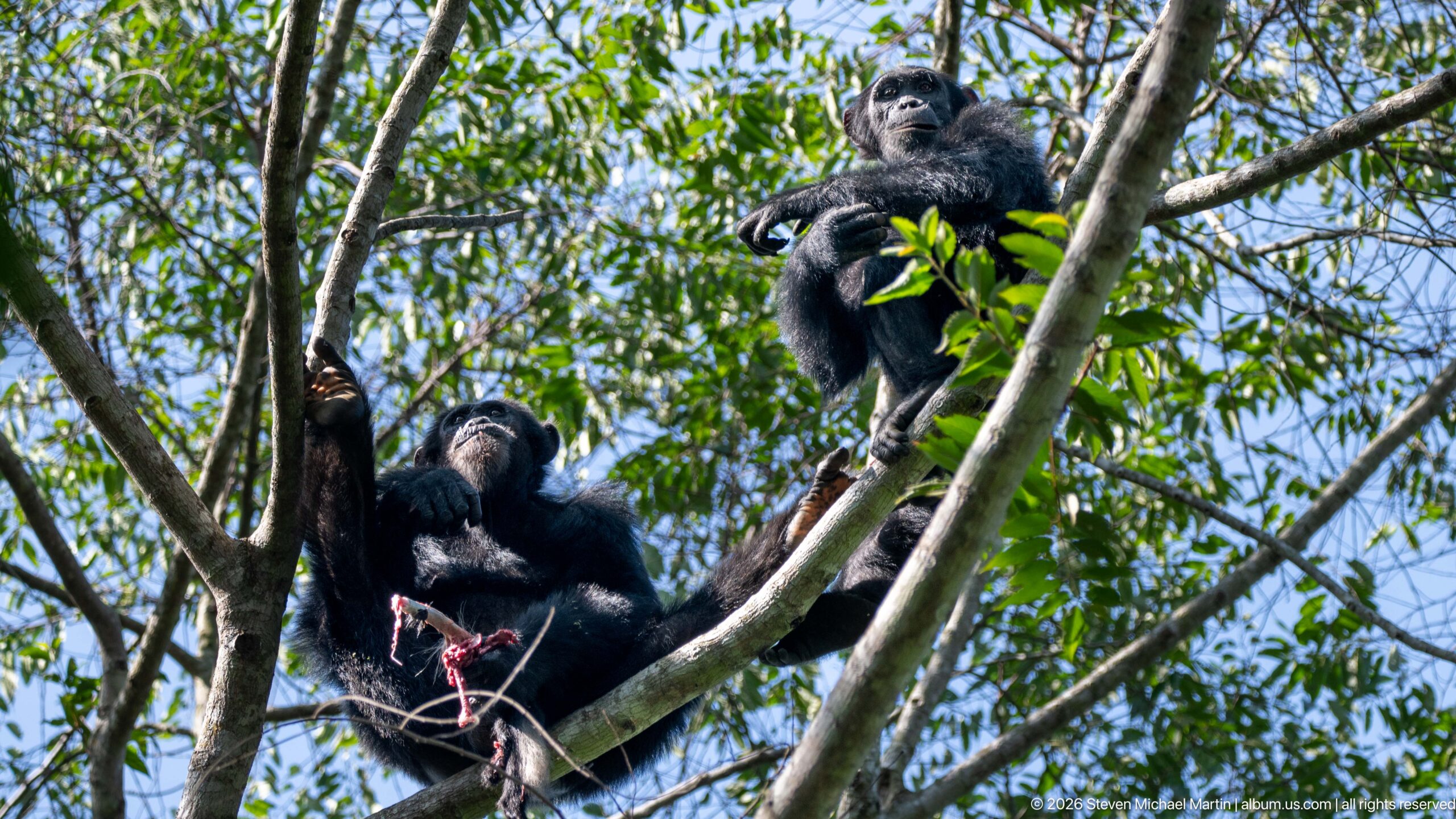
Two eastern chimpanzees rest at different heights in the same tree, one lower in a branch fork and the other perched above to the right. Their separated positions provide a useful contextual view of multiple apes using the branching canopy simultaneously, with bright sky visible through the leaves.
Caption
Two eastern chimpanzees rest at different heights in the same tree, one lower in a branch fork and the other perched above to the right. Their separated positions provide a useful contextual view of multiple apes using the branching canopy simultaneously, with bright sky visible through the leaves.
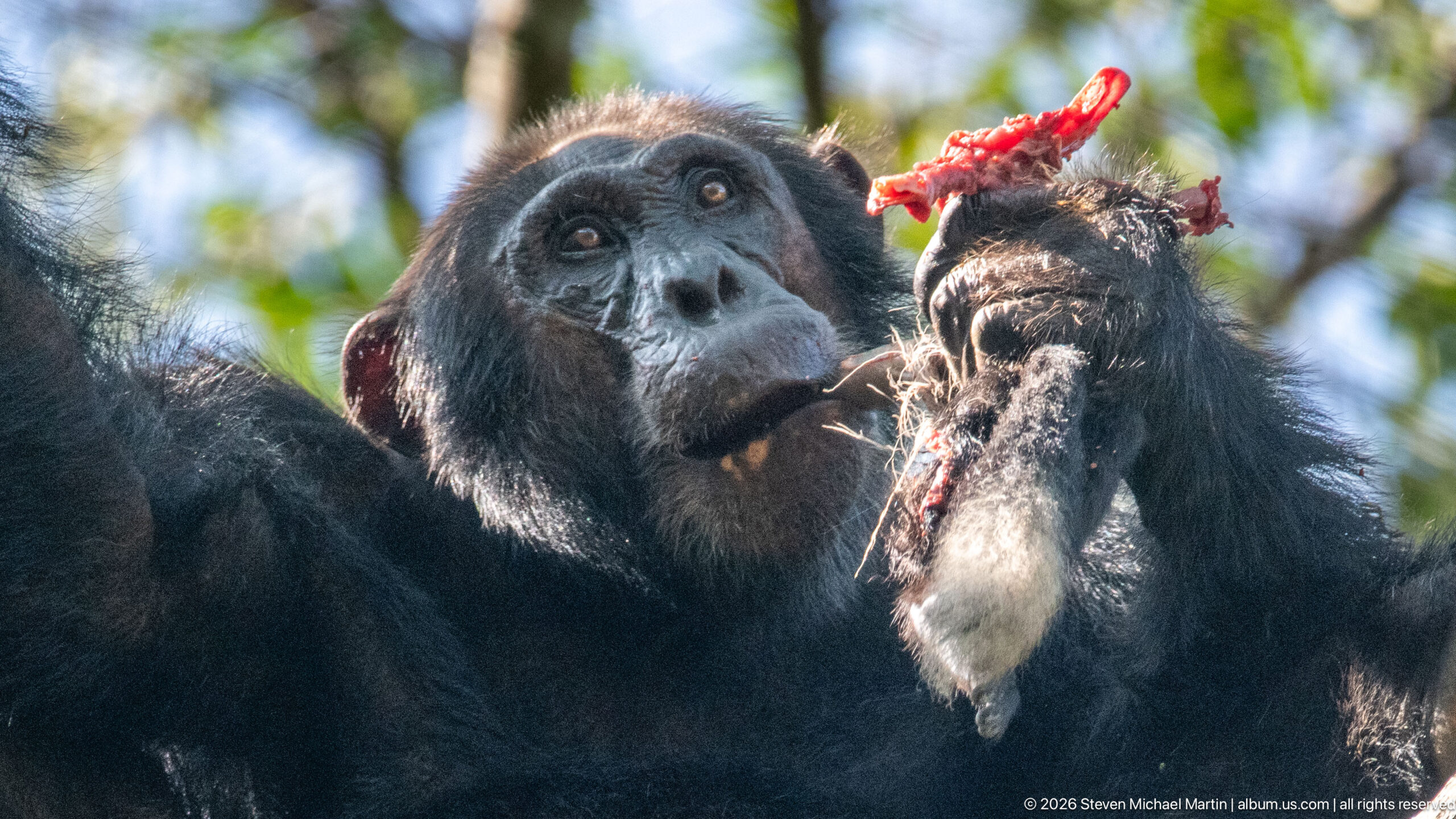
An eastern chimpanzee holds a bright red, fibrous food item close to its mouth, with strands trailing across the hand and wrist. The tight upward view shows the ape’s face, fingers, and food in strong detail, making manual food handling the central subject while leaving the plant species unresolved.
Caption
An eastern chimpanzee holds a bright red, fibrous food item close to its mouth, with strands trailing across the hand and wrist. The tight upward view shows the ape’s face, fingers, and food in strong detail, making manual food handling the central subject while leaving the plant species unresolved.
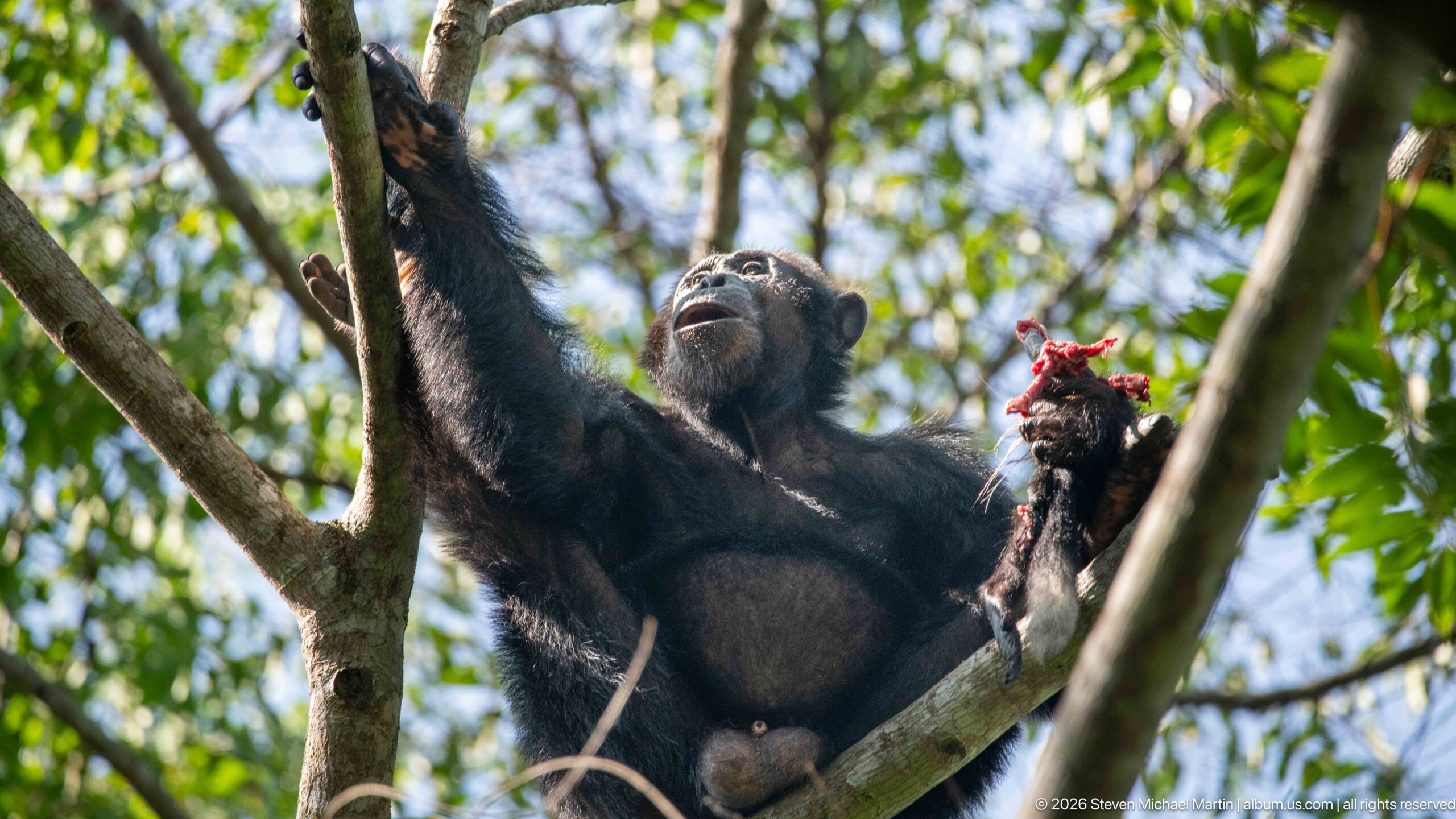
An eastern chimpanzee sits astride a branch with one arm extended high and the other hand holding vivid red food. The low viewpoint reveals the ape’s torso and long reach against the bright canopy, combining feeding with an active arboreal posture in a single frame.
Caption
An eastern chimpanzee sits astride a branch with one arm extended high and the other hand holding vivid red food. The low viewpoint reveals the ape’s torso and long reach against the bright canopy, combining feeding with an active arboreal posture in a single frame.
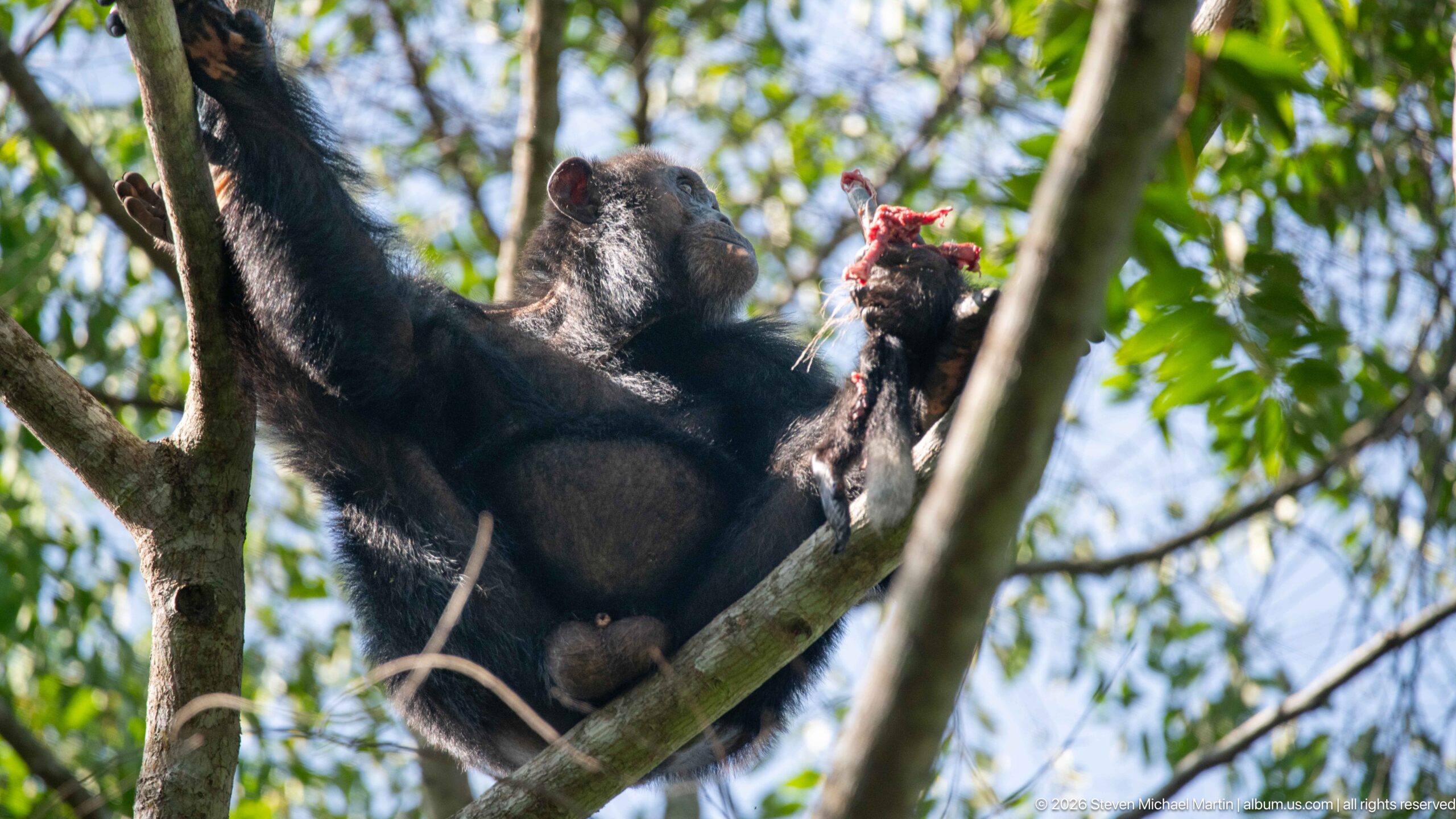
An eastern chimpanzee sits high in a forked tree, holding vivid red fibrous food near its mouth while extending the opposite arm along a branch. The low camera angle accentuates the animal’s torso and long arms and places the feeding episode against patches of blue sky and sunlit foliage.
Caption
An eastern chimpanzee sits high in a forked tree, holding vivid red fibrous food near its mouth while extending the opposite arm along a branch. The low camera angle accentuates the animal’s torso and long arms and places the feeding episode against patches of blue sky and sunlit foliage.
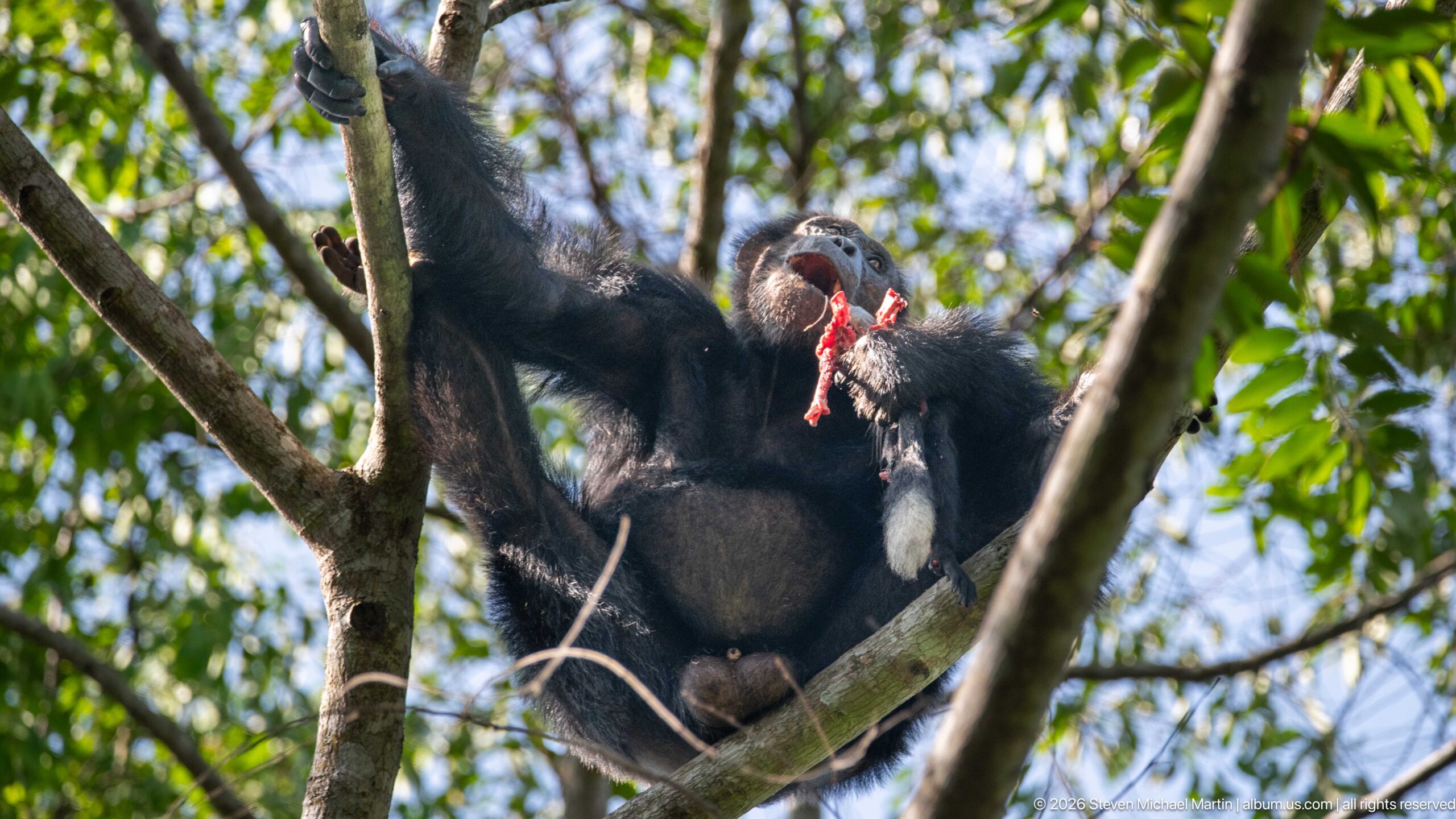
Perched between branches, an eastern chimpanzee raises a bright red food item toward its open mouth while the opposite arm reaches upward for support. The photograph combines the mechanics of arboreal balance with feeding, emphasizing both the hand-to-mouth action and the ape’s long-limbed form.
Caption
Perched between branches, an eastern chimpanzee raises a bright red food item toward its open mouth while the opposite arm reaches upward for support. The photograph combines the mechanics of arboreal balance with feeding, emphasizing both the hand-to-mouth action and the ape’s long-limbed form.
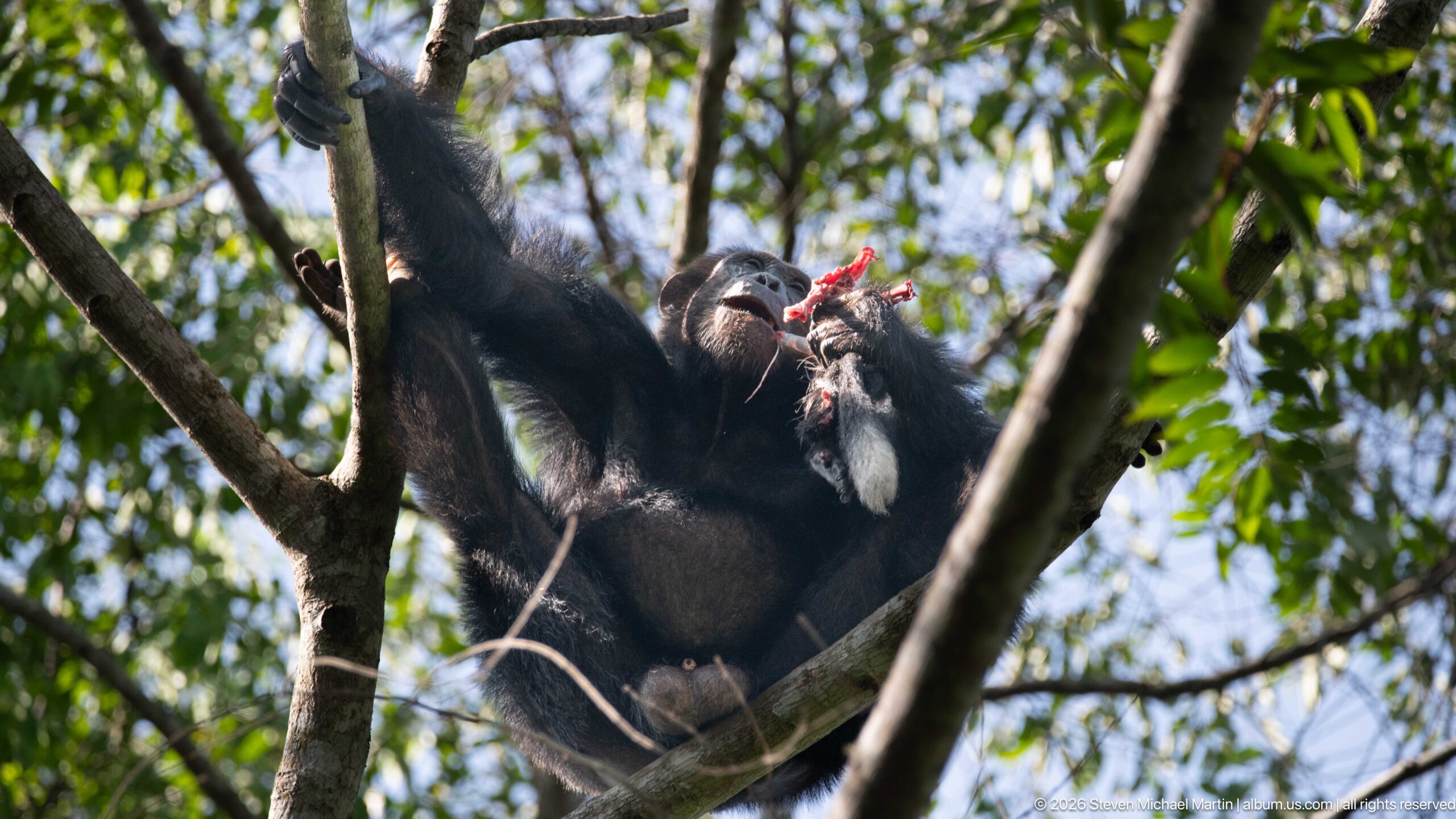
An eastern chimpanzee sits securely in a branching tree while holding red fibrous food directly to its mouth. One arm remains extended upward along the trunk, showing how feeding and balance are combined in the canopy. The slightly wider framing preserves the surrounding lattice of branches and leaves.
Caption
An eastern chimpanzee sits securely in a branching tree while holding red fibrous food directly to its mouth. One arm remains extended upward along the trunk, showing how feeding and balance are combined in the canopy. The slightly wider framing preserves the surrounding lattice of branches and leaves.
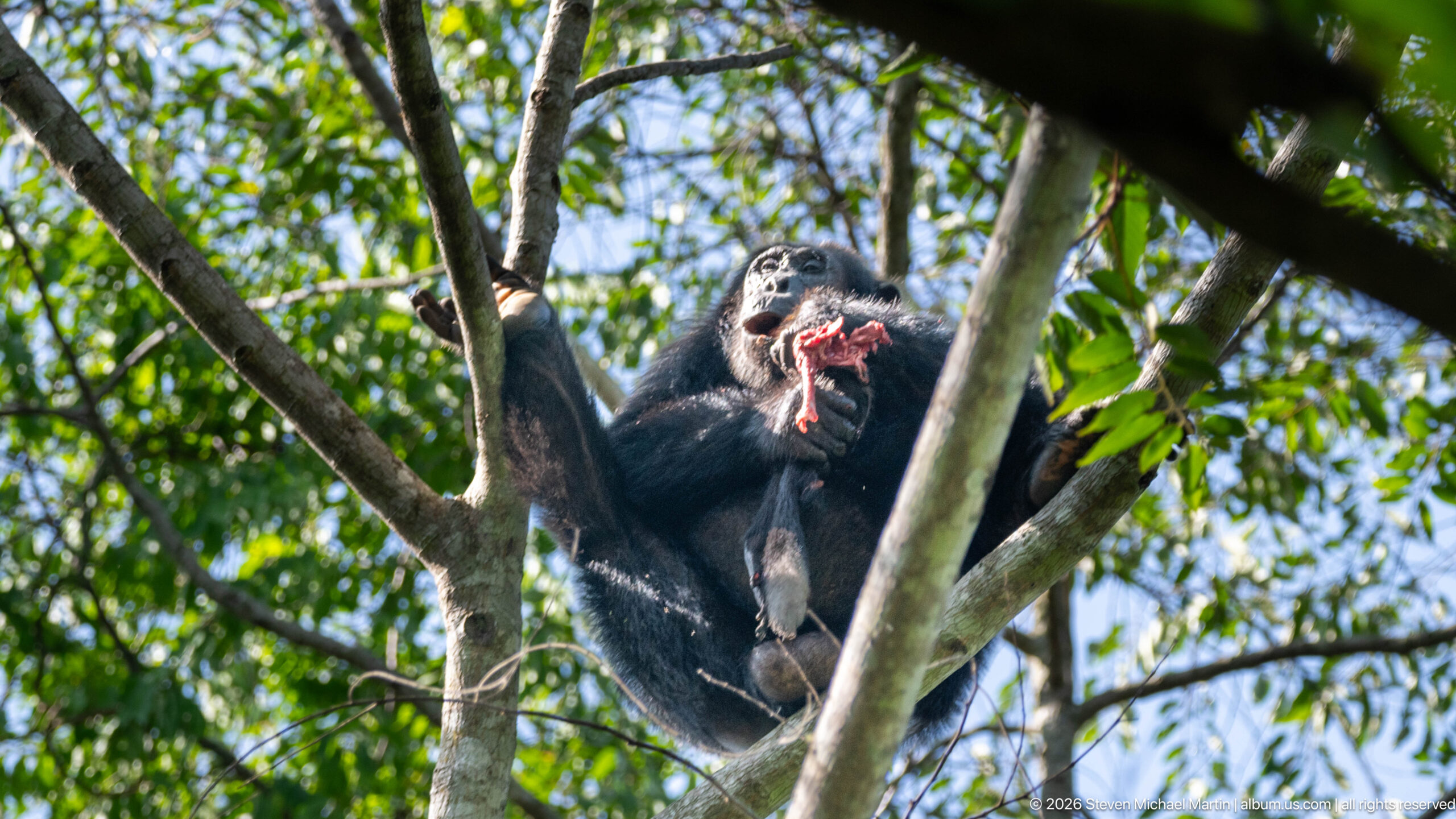
Framed by several crossing trunks, an eastern chimpanzee sits in the canopy holding a bright red food item before its face. The branches partially interrupt the view, but the ape’s upright torso, dark coat, and feeding hand remain clear, giving the scene a strong sense of observation through a dense arboreal structure.
Caption
Framed by several crossing trunks, an eastern chimpanzee sits in the canopy holding a bright red food item before its face. The branches partially interrupt the view, but the ape’s upright torso, dark coat, and feeding hand remain clear, giving the scene a strong sense of observation through a dense arboreal structure.
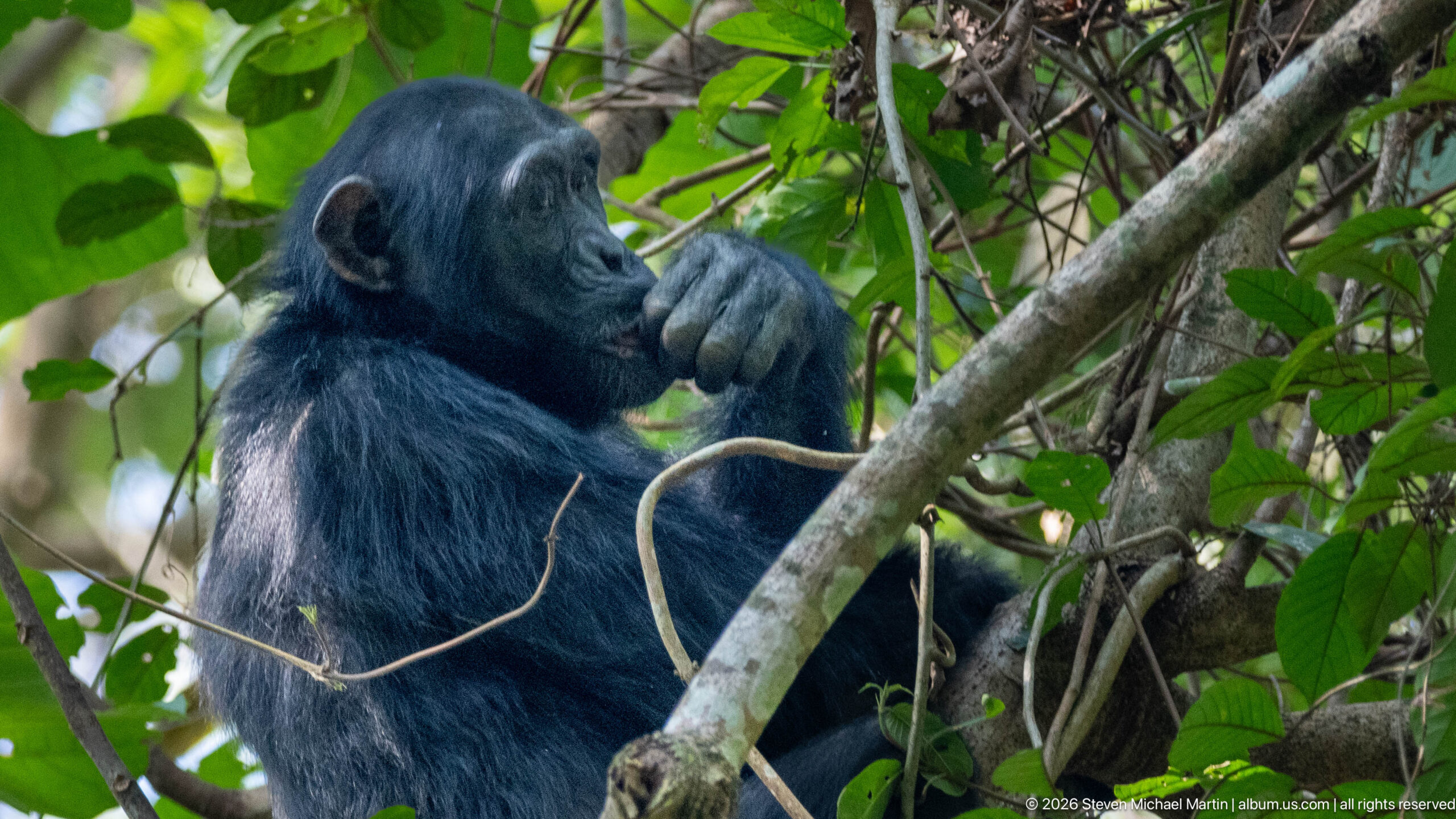
An eastern chimpanzee sits amid a dense tangle of lianas and leafy branches, one hand raised toward the mouth while the other arm braces against the vegetation. The side view emphasizes the ape’s shoulder mass, long forearm, and rounded ear within a particularly cluttered section of the forest canopy.
Caption
An eastern chimpanzee sits amid a dense tangle of lianas and leafy branches, one hand raised toward the mouth while the other arm braces against the vegetation. The side view emphasizes the ape’s shoulder mass, long forearm, and rounded ear within a particularly cluttered section of the forest canopy.
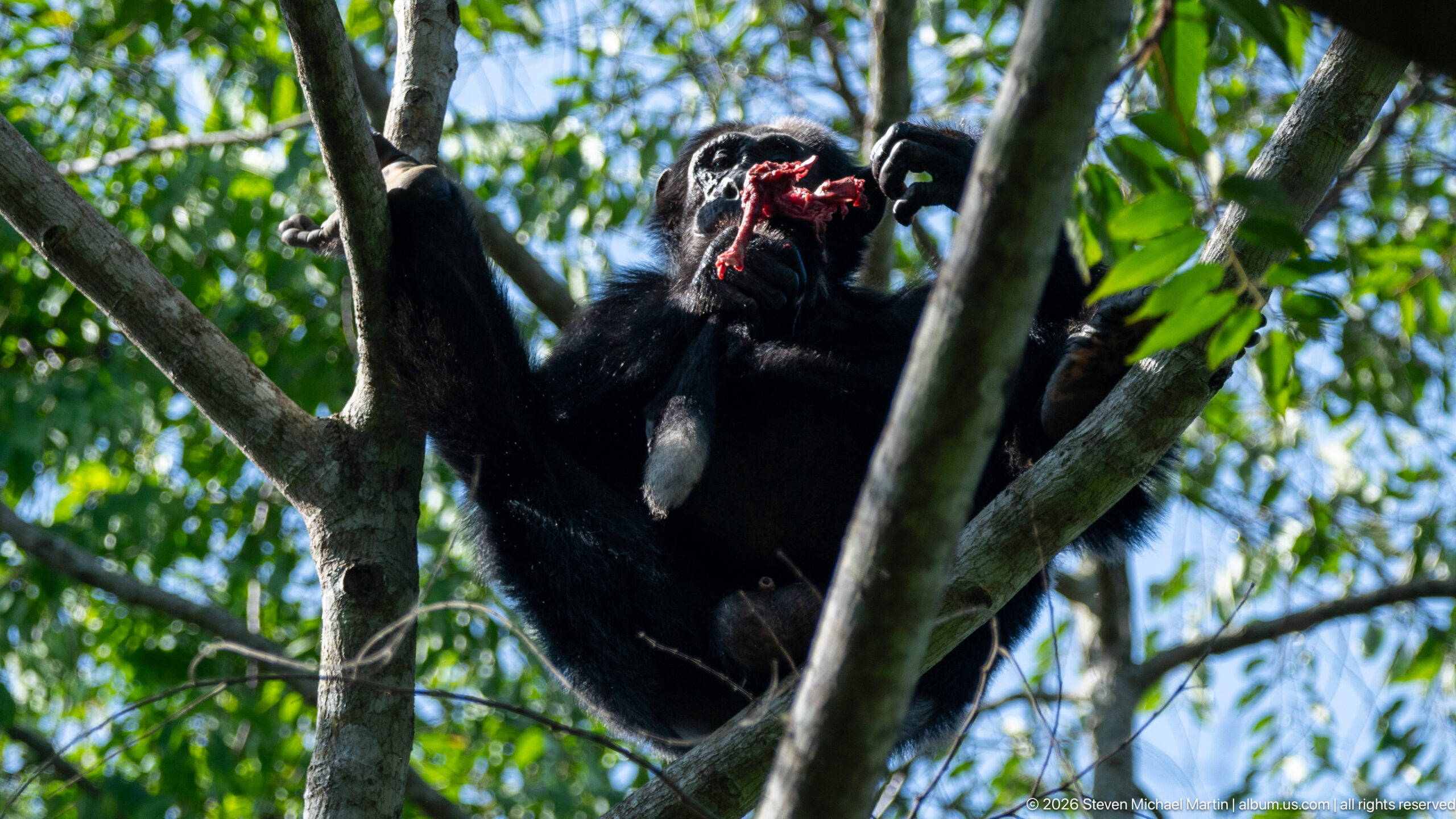
An eastern chimpanzee sits in a high branch fork with vivid red fibrous food held directly in front of its mouth. One hand grips the food while the other rests against nearby wood, and the upward viewpoint sets the dark body against patches of bright canopy and sky.
Caption
An eastern chimpanzee sits in a high branch fork with vivid red fibrous food held directly in front of its mouth. One hand grips the food while the other rests against nearby wood, and the upward viewpoint sets the dark body against patches of bright canopy and sky.
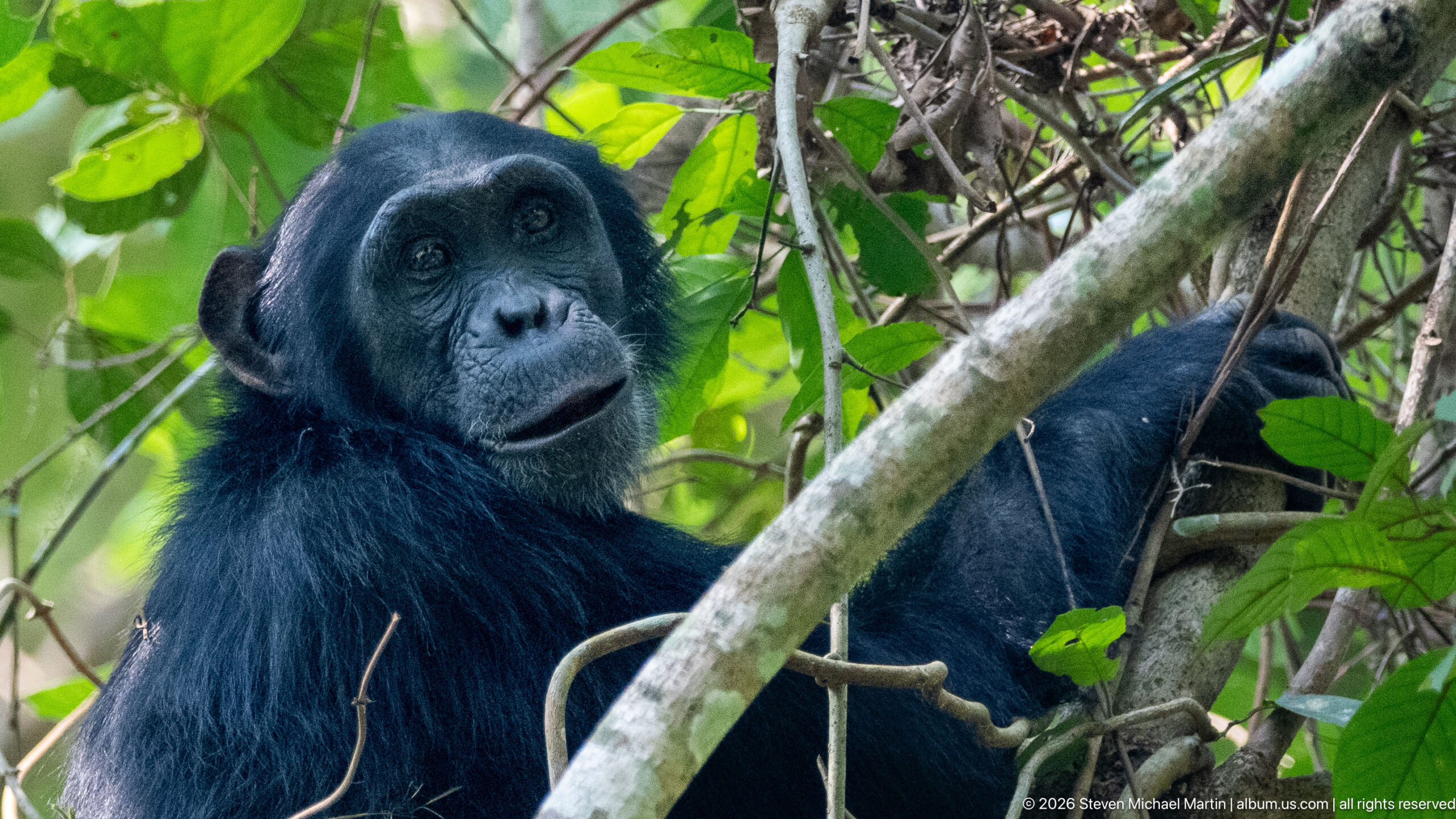
An eastern chimpanzee pauses among interwoven branches and lianas, looking outward with its mouth slightly open. The relatively close view shows the smooth dark face, rounded ear, black coat, and upper body while foreground vines form a natural frame around the animal.
Caption
An eastern chimpanzee pauses among interwoven branches and lianas, looking outward with its mouth slightly open. The relatively close view shows the smooth dark face, rounded ear, black coat, and upper body while foreground vines form a natural frame around the animal.
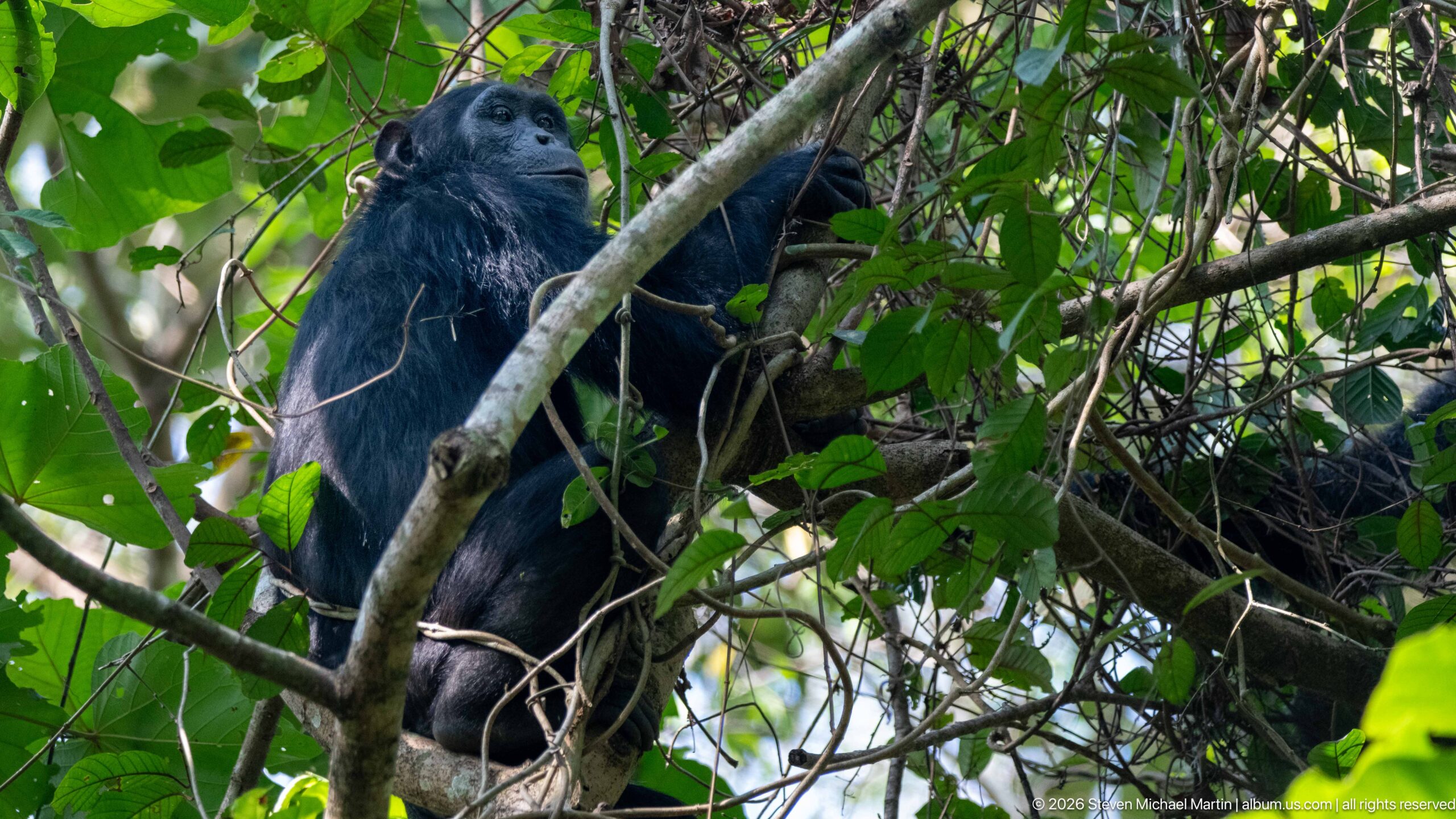
An eastern chimpanzee sits partially enclosed by a dense network of vines and angled branches, its body upright and face turned toward the camera. The wider composition shows how thoroughly the canopy structure can surround an ape, with only limited open space between leaves and woody stems.
Caption
An eastern chimpanzee sits partially enclosed by a dense network of vines and angled branches, its body upright and face turned toward the camera. The wider composition shows how thoroughly the canopy structure can surround an ape, with only limited open space between leaves and woody stems.
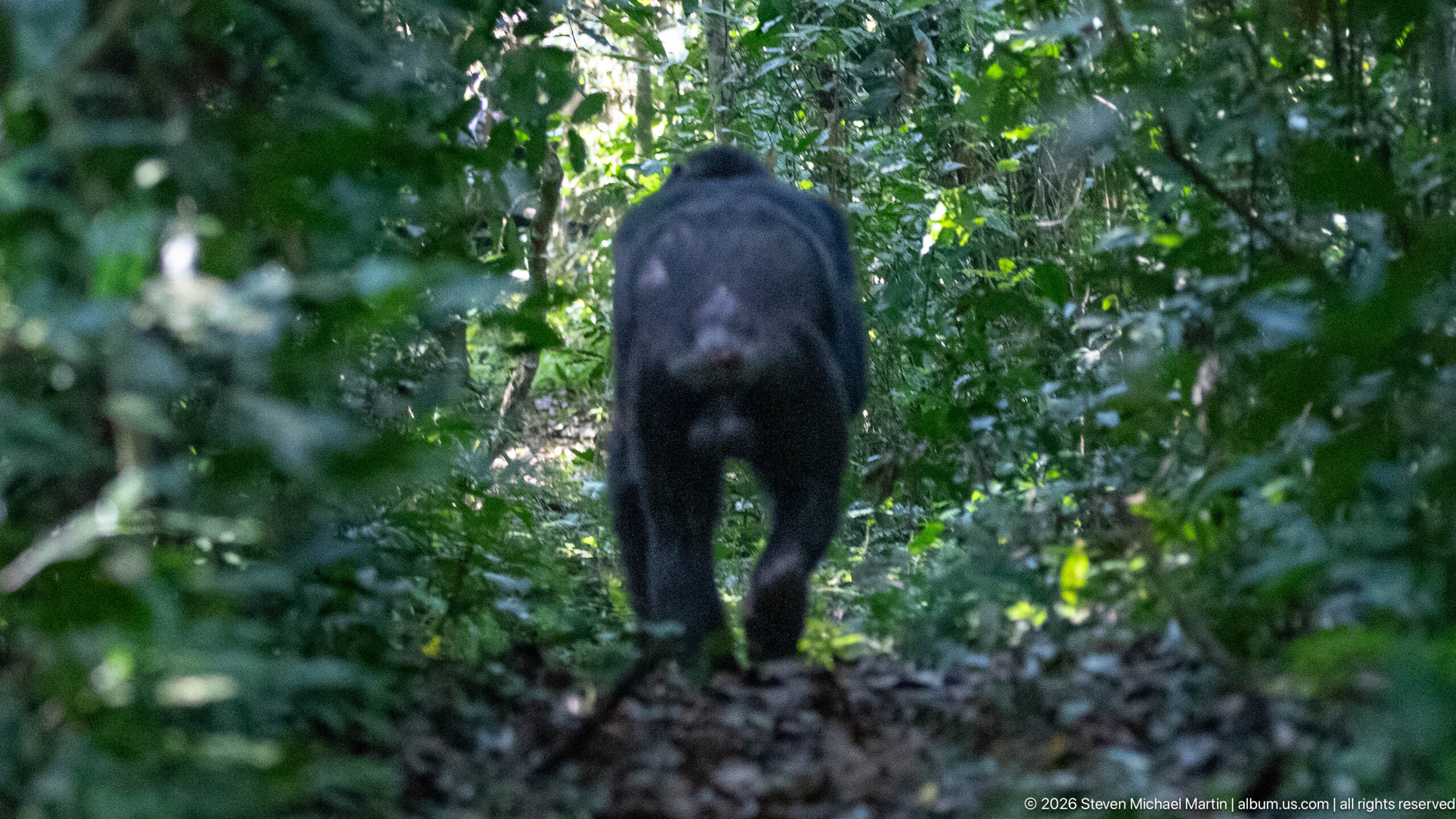
An eastern chimpanzee moves away along a leaf-covered forest path, seen from behind at ground level. The ape’s long arms, short hindquarters, and dark coat are visible as it travels through a tunnel of dense vegetation, providing a rare terrestrial movement view within a sequence dominated by close portraits and canopy feeding.
Caption
An eastern chimpanzee moves away along a leaf-covered forest path, seen from behind at ground level. The ape’s long arms, short hindquarters, and dark coat are visible as it travels through a tunnel of dense vegetation, providing a rare terrestrial movement view within a sequence dominated by close portraits and canopy feeding.
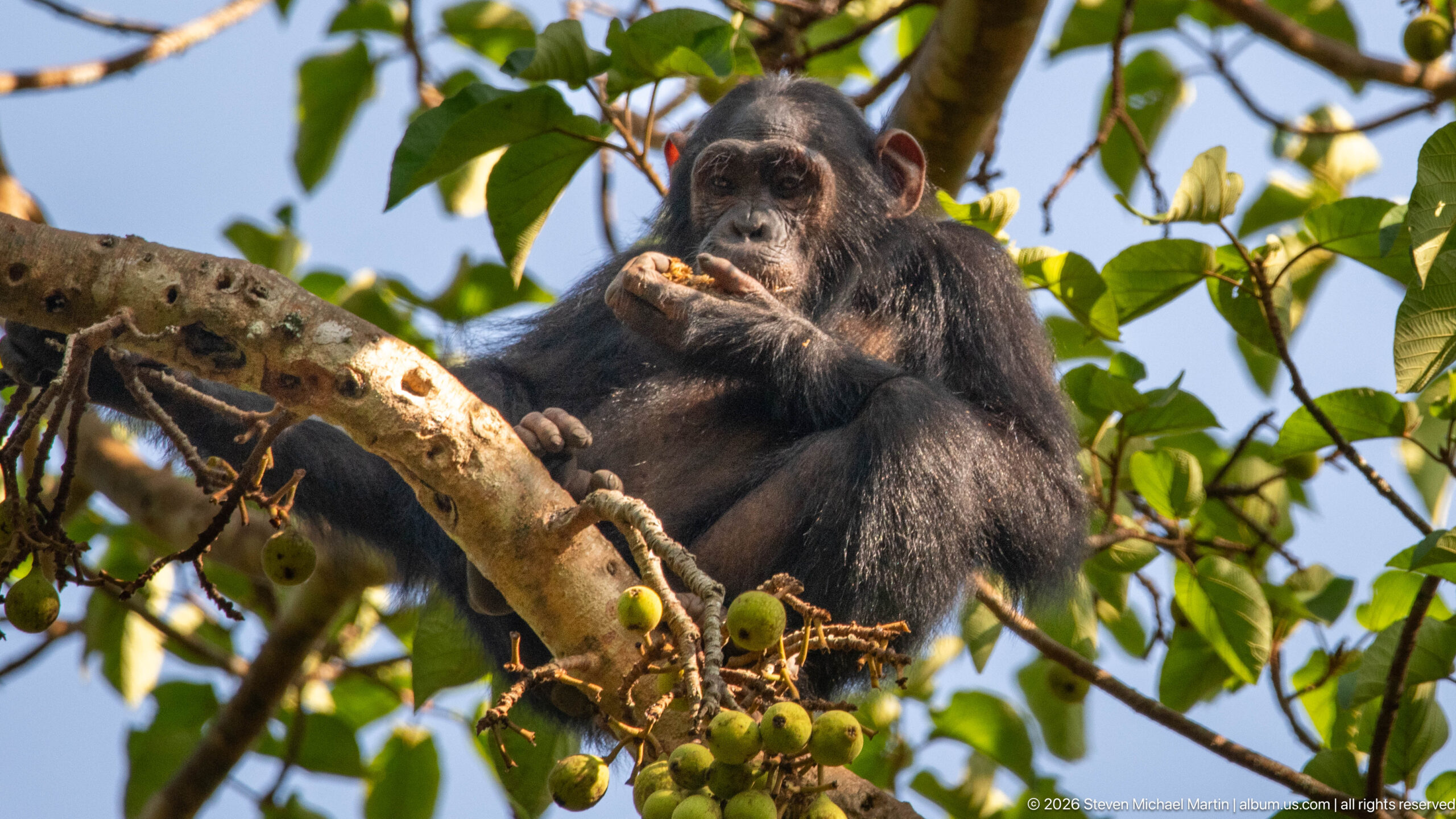
An eastern chimpanzee sits astride a fruiting branch, using one hand to bring food to its mouth while clusters of small green fruits hang below. The open canopy and blue sky make this a bright arboreal feeding view, but the fruiting tree cannot be identified securely from the proof sheet alone.
Caption
An eastern chimpanzee sits astride a fruiting branch, using one hand to bring food to its mouth while clusters of small green fruits hang below. The open canopy and blue sky make this a bright arboreal feeding view, but the fruiting tree cannot be identified securely from the proof sheet alone.
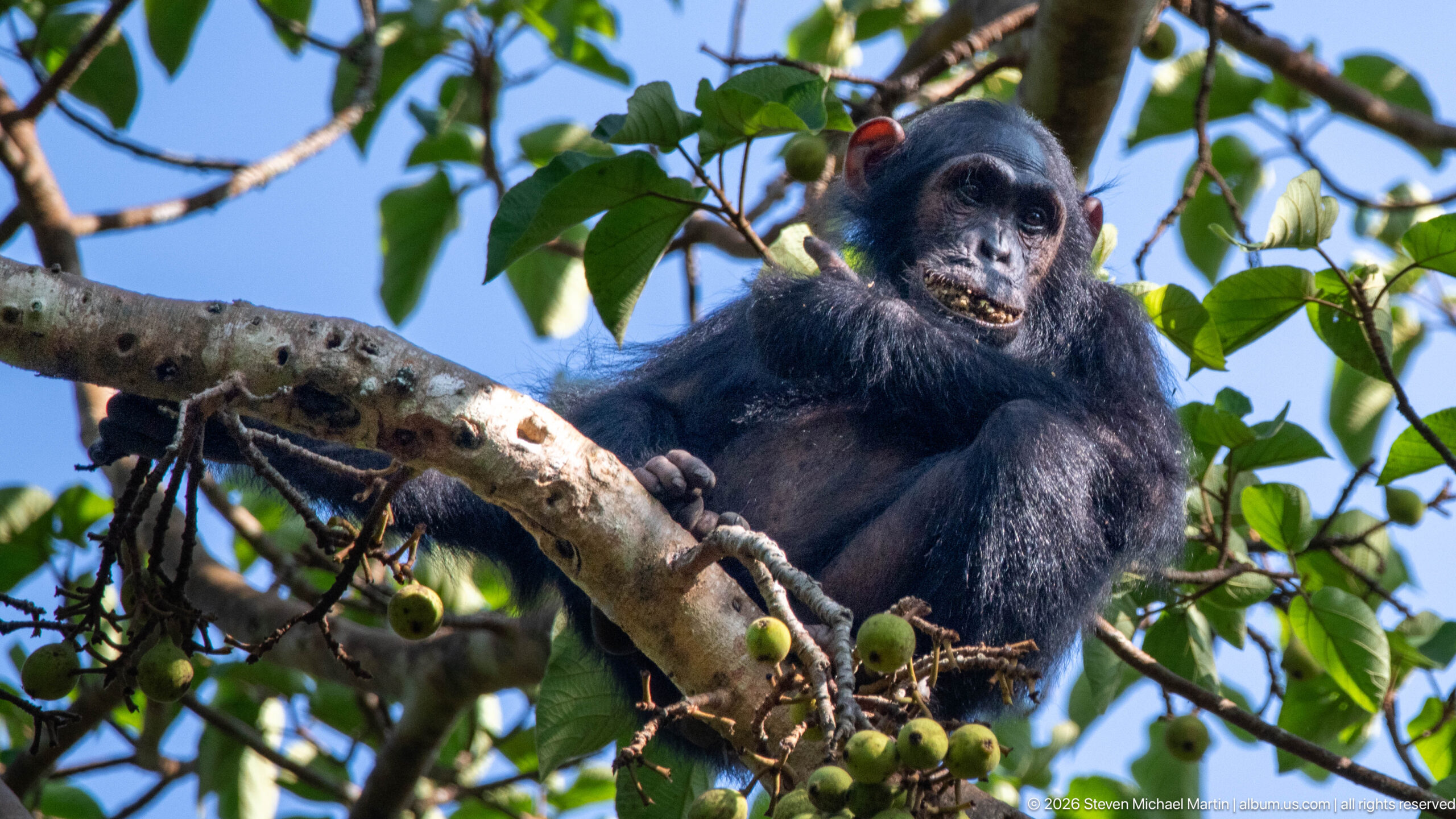
An eastern chimpanzee rests on a thick branch surrounded by clusters of small round green fruits and broad leaves. With one arm draped along the limb and the face turned toward the camera, the frame gives a clear view of the ape within a food-bearing tree while preserving the wider canopy setting.
Caption
An eastern chimpanzee rests on a thick branch surrounded by clusters of small round green fruits and broad leaves. With one arm draped along the limb and the face turned toward the camera, the frame gives a clear view of the ape within a food-bearing tree while preserving the wider canopy setting.
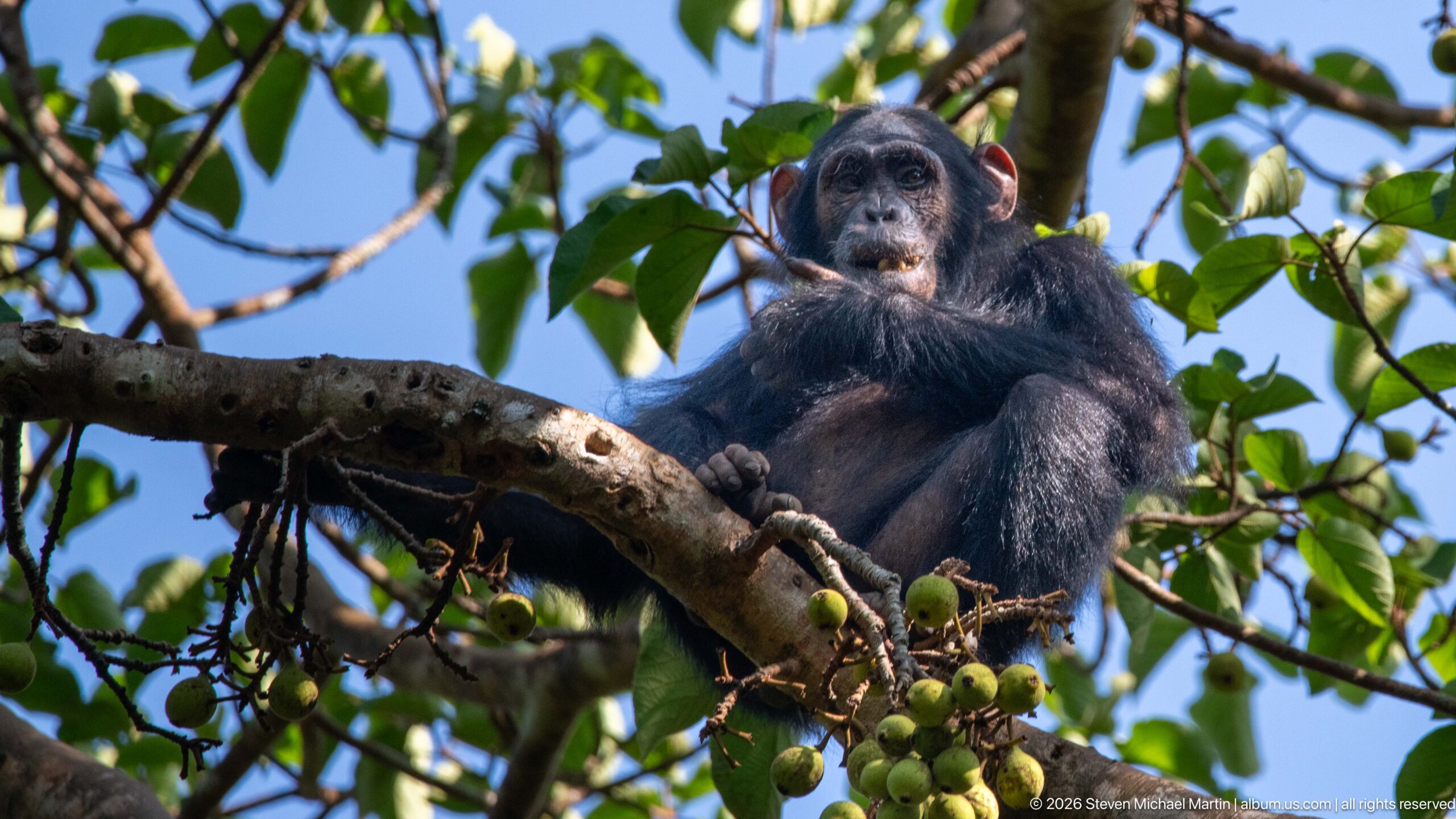
An eastern chimpanzee sits astride a broad branch above dense clusters of small green fruits, one arm relaxed across its body. The low viewpoint opens the canopy to blue sky and sunlit leaves, placing the ape within a visibly productive fruiting tree while preserving a clear view of its dark coat, face, and long limbs.
Caption
An eastern chimpanzee sits astride a broad branch above dense clusters of small green fruits, one arm relaxed across its body. The low viewpoint opens the canopy to blue sky and sunlit leaves, placing the ape within a visibly productive fruiting tree while preserving a clear view of its dark coat, face, and long limbs.
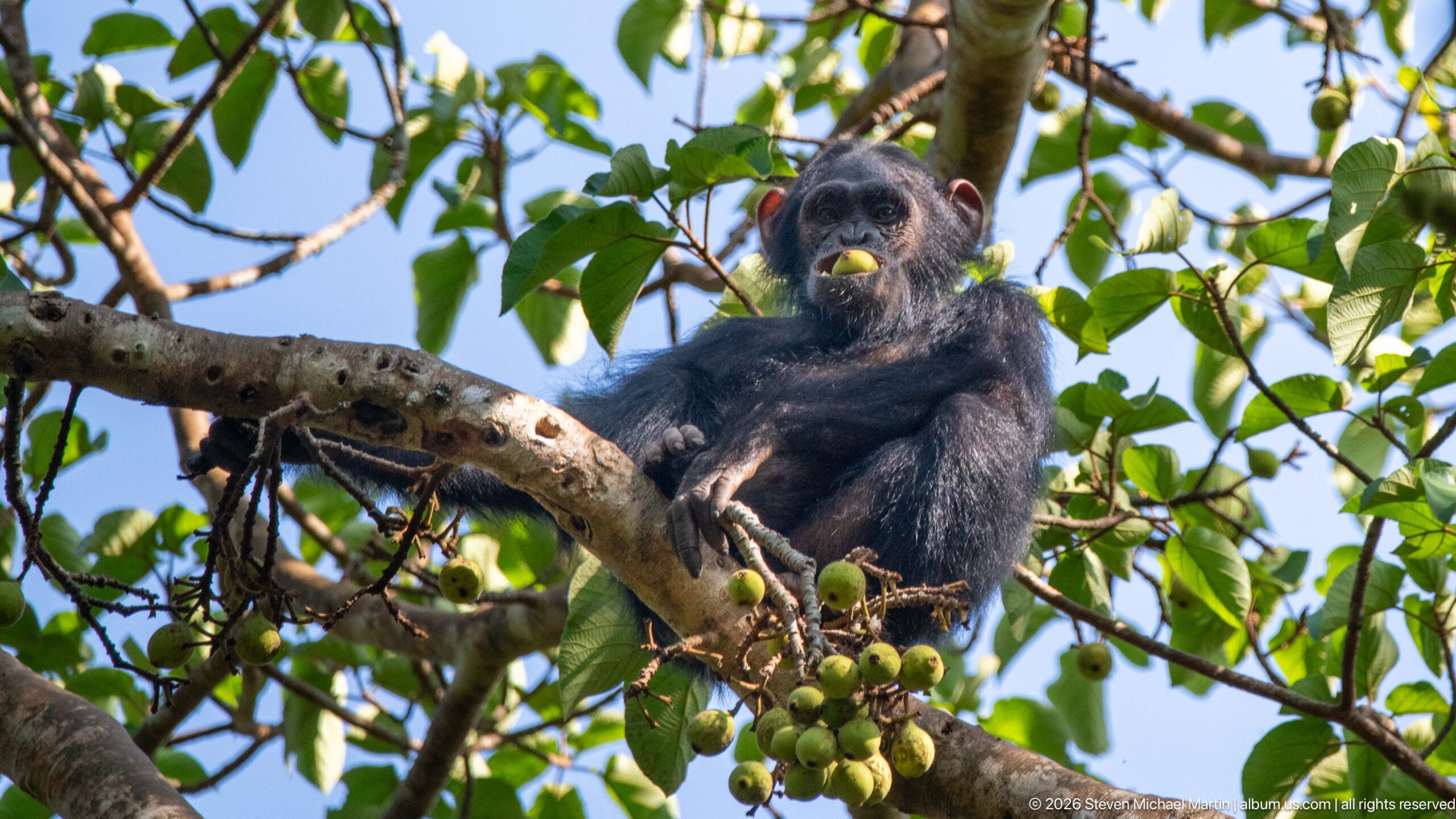
An eastern chimpanzee looks outward from a fruiting branch with a small green fruit held between its lips. Clusters of similar fruits hang immediately below, linking the portrait directly to feeding activity. The close view also records the ape’s dark facial skin, pale chin hairs, and relaxed seated posture against bright canopy foliage.
Caption
An eastern chimpanzee looks outward from a fruiting branch with a small green fruit held between its lips. Clusters of similar fruits hang immediately below, linking the portrait directly to feeding activity. The close view also records the ape’s dark facial skin, pale chin hairs, and relaxed seated posture against bright canopy foliage.
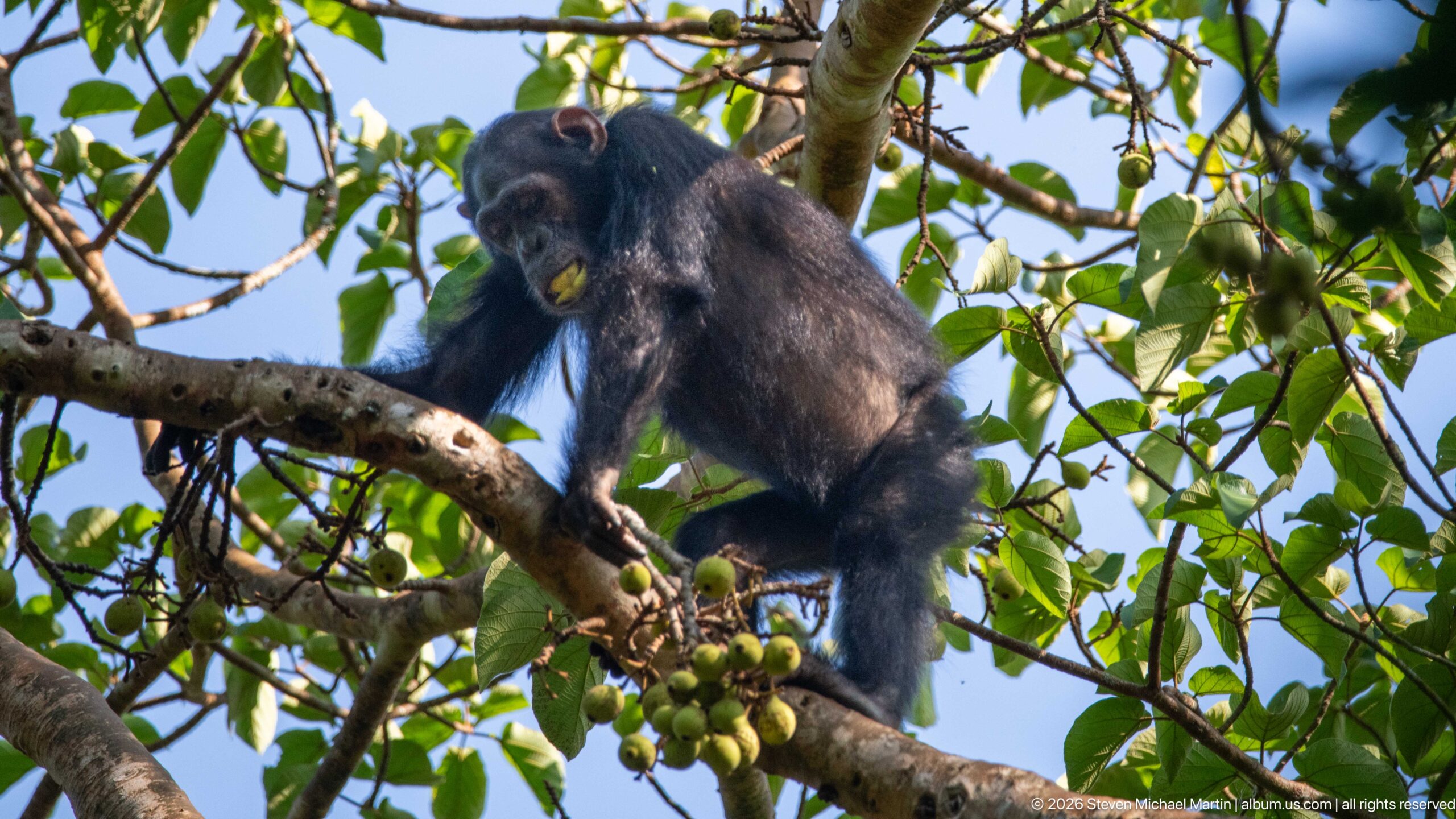
Leaning forward on a branch, an eastern chimpanzee chews a small green fruit while surrounded by clusters of similar fruits. The body is shown more fully than in the adjacent portrait, revealing a braced hand, bent legs, and long arms as the ape feeds within the tree’s branching canopy.
Caption
Leaning forward on a branch, an eastern chimpanzee chews a small green fruit while surrounded by clusters of similar fruits. The body is shown more fully than in the adjacent portrait, revealing a braced hand, bent legs, and long arms as the ape feeds within the tree’s branching canopy.
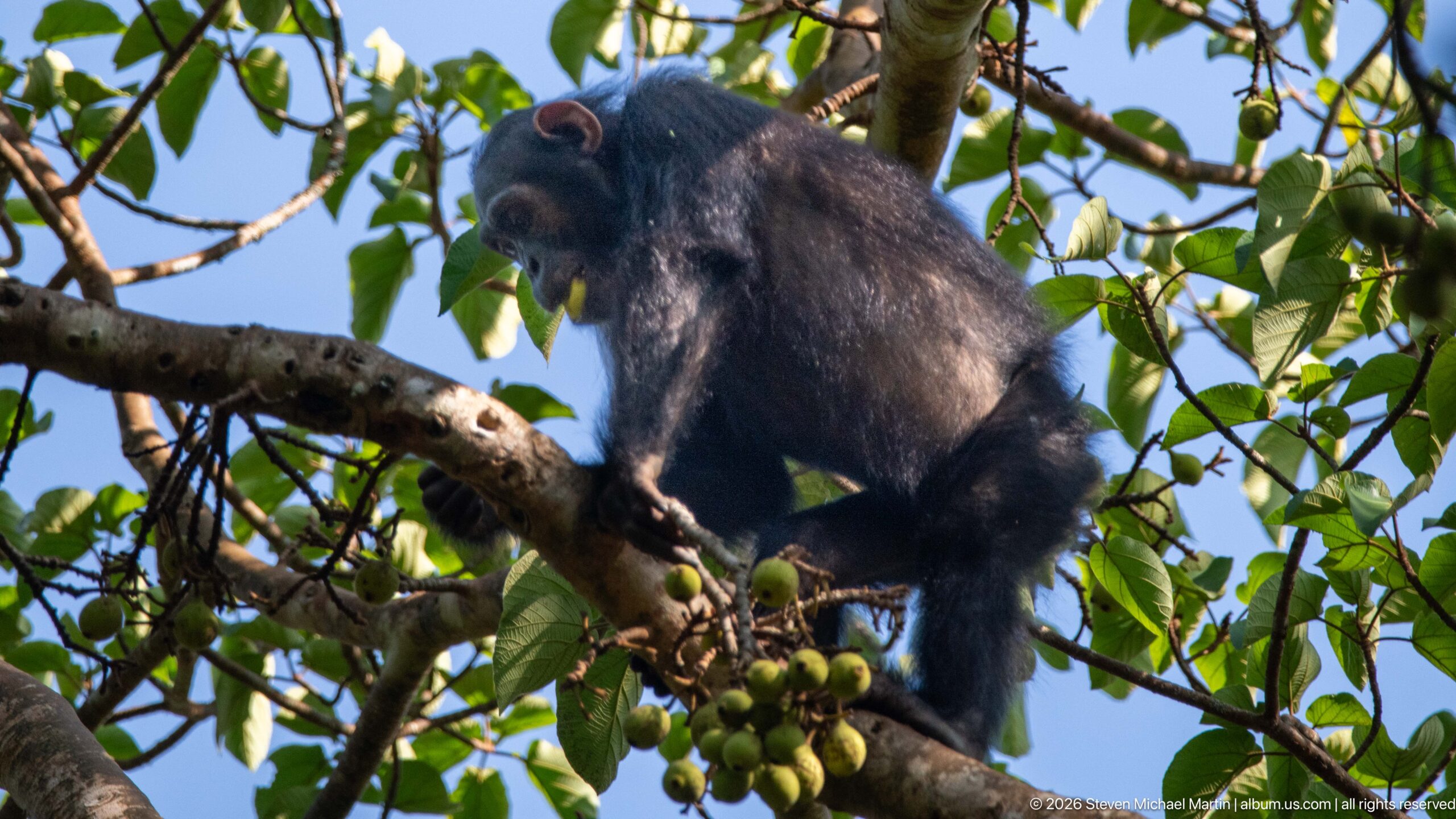
An eastern chimpanzee bends over a fruit-laden branch, one hand gripping the wood while the other works among hanging green fruits. The downward posture and concentrated attention distinguish this frame from the more static portraits, recording active foraging within the tree canopy.
Caption
An eastern chimpanzee bends over a fruit-laden branch, one hand gripping the wood while the other works among hanging green fruits. The downward posture and concentrated attention distinguish this frame from the more static portraits, recording active foraging within the tree canopy.
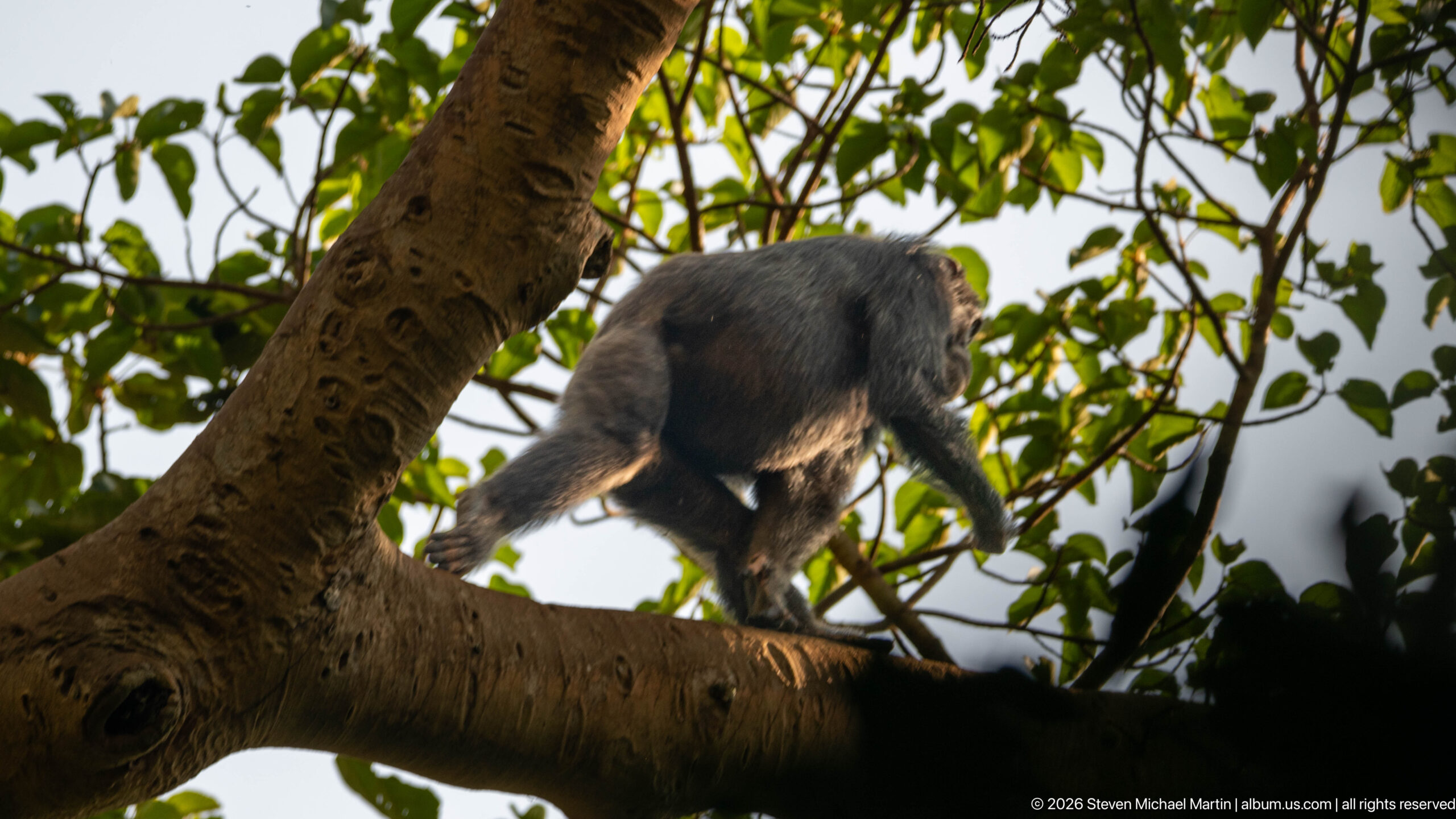
An eastern chimpanzee moves along a broad, nearly horizontal limb, its body stretched forward and one hand reaching ahead for support. Backlighting silhouettes much of the dark coat while leaves frame the animal from below, emphasizing arboreal movement rather than feeding.
Caption
An eastern chimpanzee moves along a broad, nearly horizontal limb, its body stretched forward and one hand reaching ahead for support. Backlighting silhouettes much of the dark coat while leaves frame the animal from below, emphasizing arboreal movement rather than feeding.
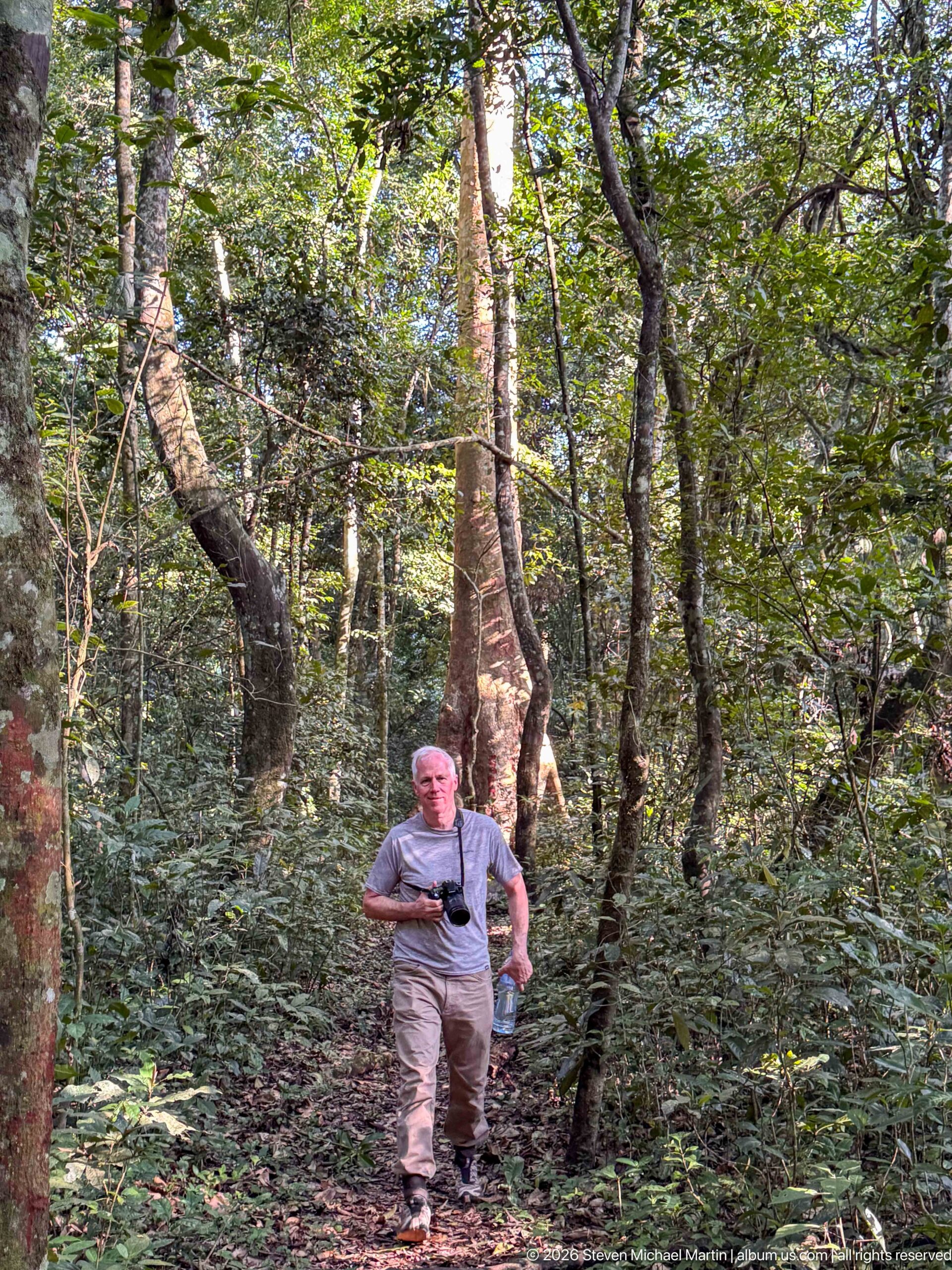
A visitor walks along a narrow trail through mature Budongo Forest, camera in hand, beneath tall straight trunks and a layered understory. The human figure provides scale for the surrounding trees and conveys the enclosed character of the forest interior.
Caption
A visitor walks along a narrow trail through mature Budongo Forest, camera in hand, beneath tall straight trunks and a layered understory. The human figure provides scale for the surrounding trees and conveys the enclosed character of the forest interior.
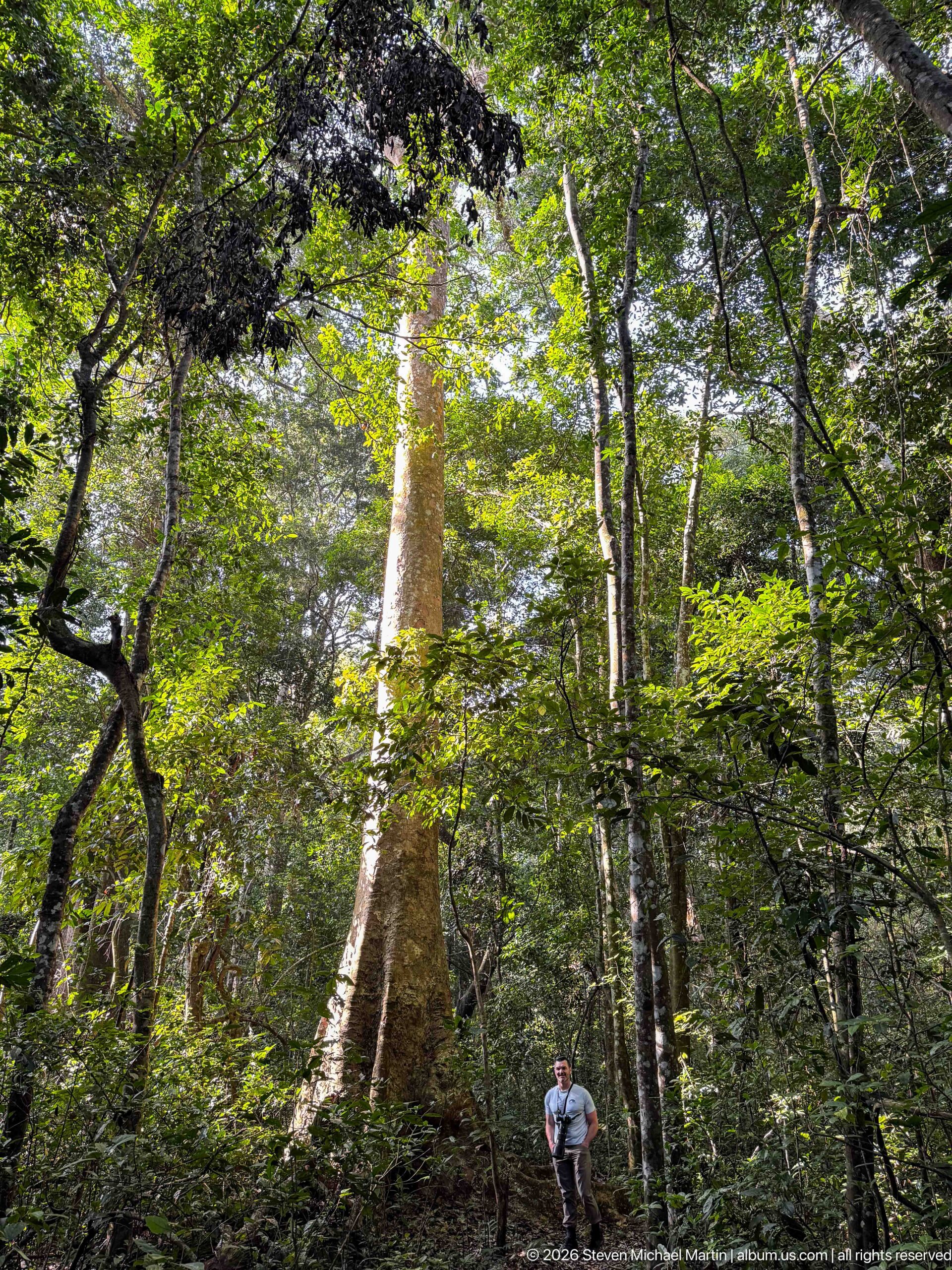
A tall, pale-barked tree rises through the dense midstory, its trunk catching bright shafts of sunlight while a visitor at the base provides scale. The composition emphasizes vertical structure from forest floor to canopy and the exceptional height of mature trees within Budongo Forest.
Caption
A tall, pale-barked tree rises through the dense midstory, its trunk catching bright shafts of sunlight while a visitor at the base provides scale. The composition emphasizes vertical structure from forest floor to canopy and the exceptional height of mature trees within Budongo Forest.
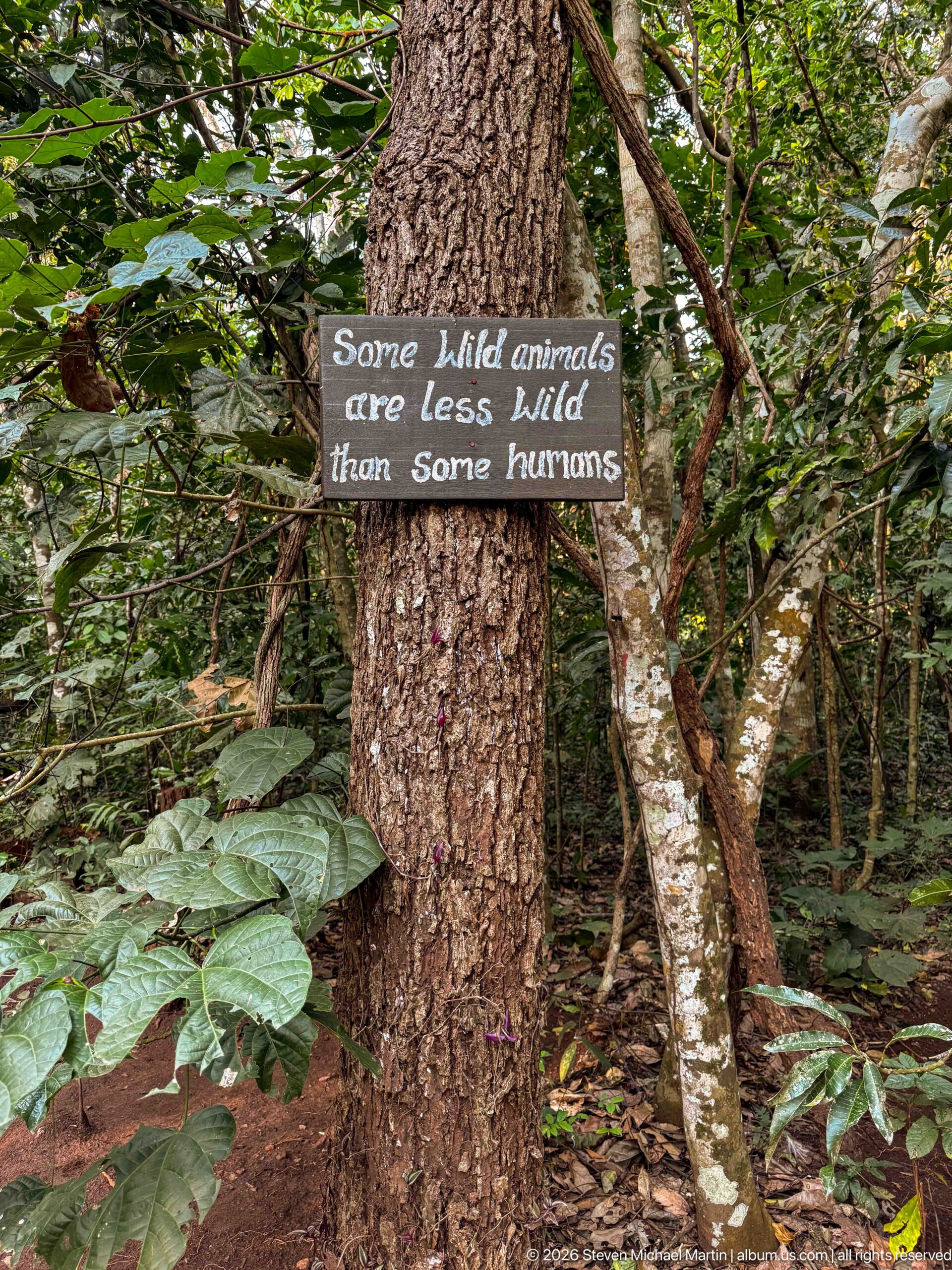
A small wooden sign fixed to a tree reads, “Some wild animals are less wild than some humans.” Surrounded by vines and broad forest leaves, the message introduces a humorous conservation-minded human element into the otherwise natural-history sequence.
Caption
A small wooden sign fixed to a tree reads, “Some wild animals are less wild than some humans.” Surrounded by vines and broad forest leaves, the message introduces a humorous conservation-minded human element into the otherwise natural-history sequence.
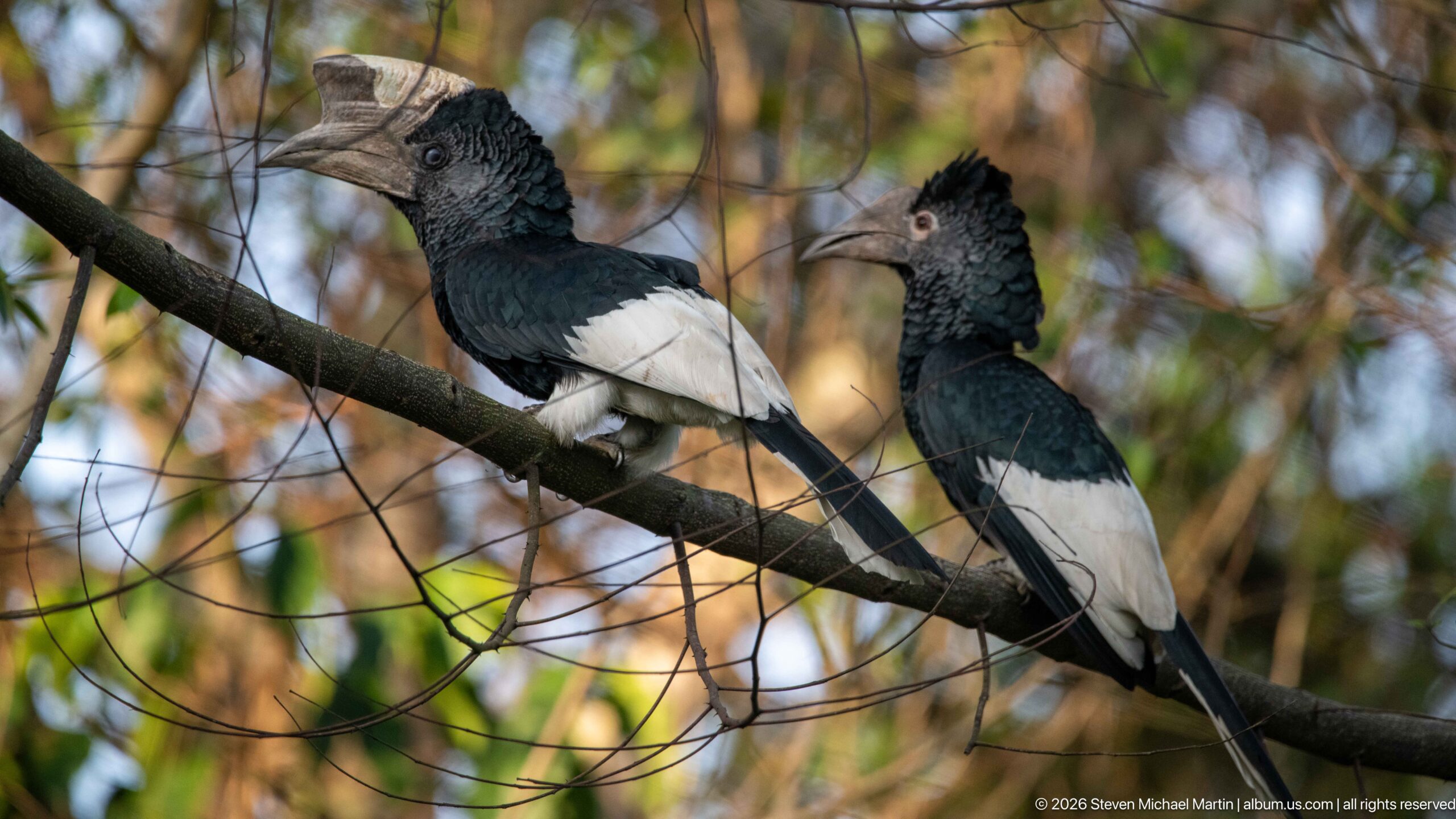
Two black-and-white-casqued hornbills perch side by side on a slender branch, their long tails, broad white wing panels, massive pale bills, and dark ridged casques clearly visible. The paired portrait provides a strong field-guide view of this conspicuous West and Central African forest hornbill.
Caption
Two black-and-white-casqued hornbills perch side by side on a slender branch, their long tails, broad white wing panels, massive pale bills, and dark ridged casques clearly visible. The paired portrait provides a strong field-guide view of this conspicuous West and Central African forest hornbill.
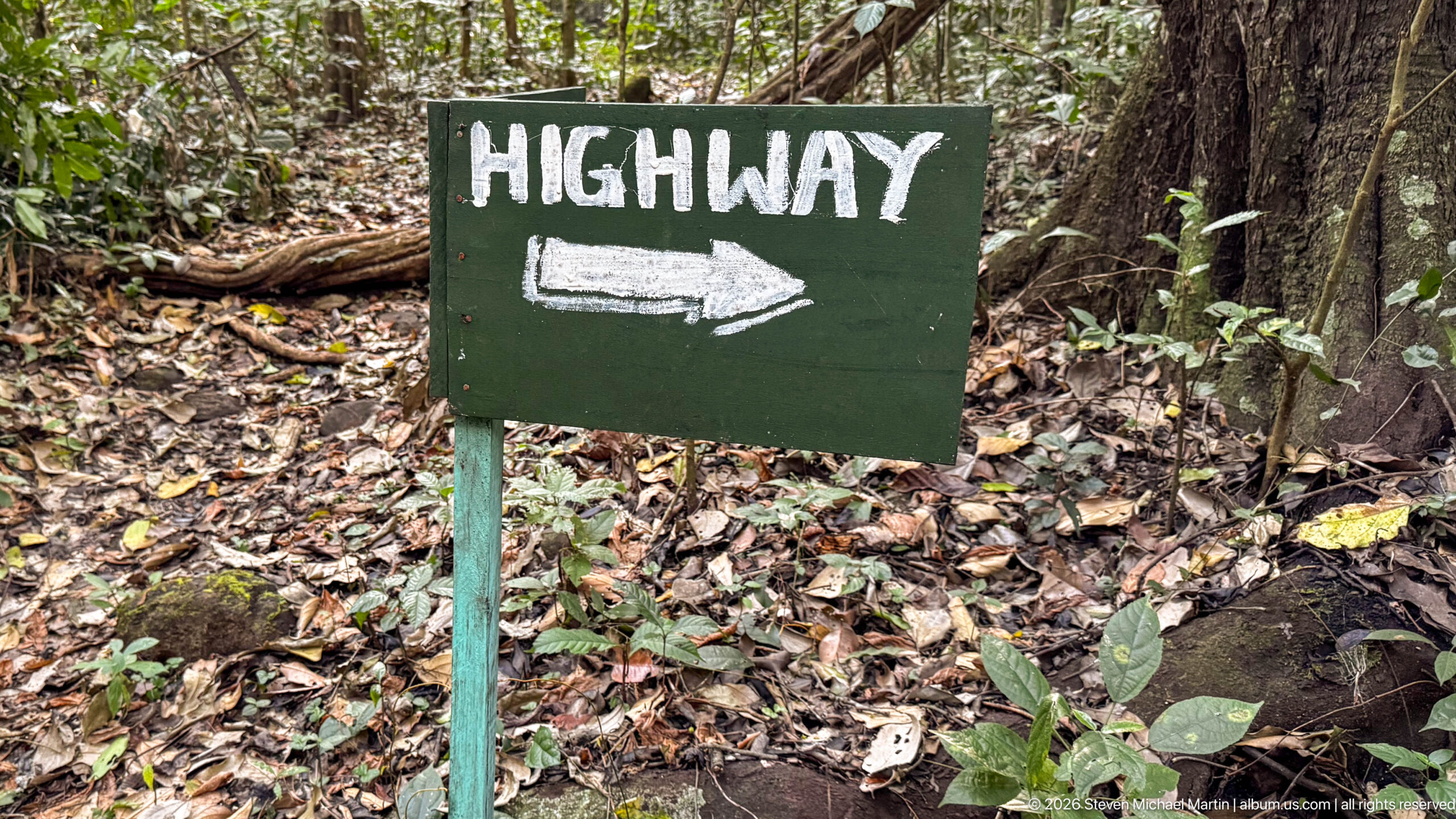
A hand-painted green sign marked “HIGHWAY” and a white arrow points along a forest path. Set among leaf litter, roots, and tree trunks, the modest trail marker records the informal wayfinding used within the Budongo Forest visitor route.
Caption
A hand-painted green sign marked “HIGHWAY” and a white arrow points along a forest path. Set among leaf litter, roots, and tree trunks, the modest trail marker records the informal wayfinding used within the Budongo Forest visitor route.
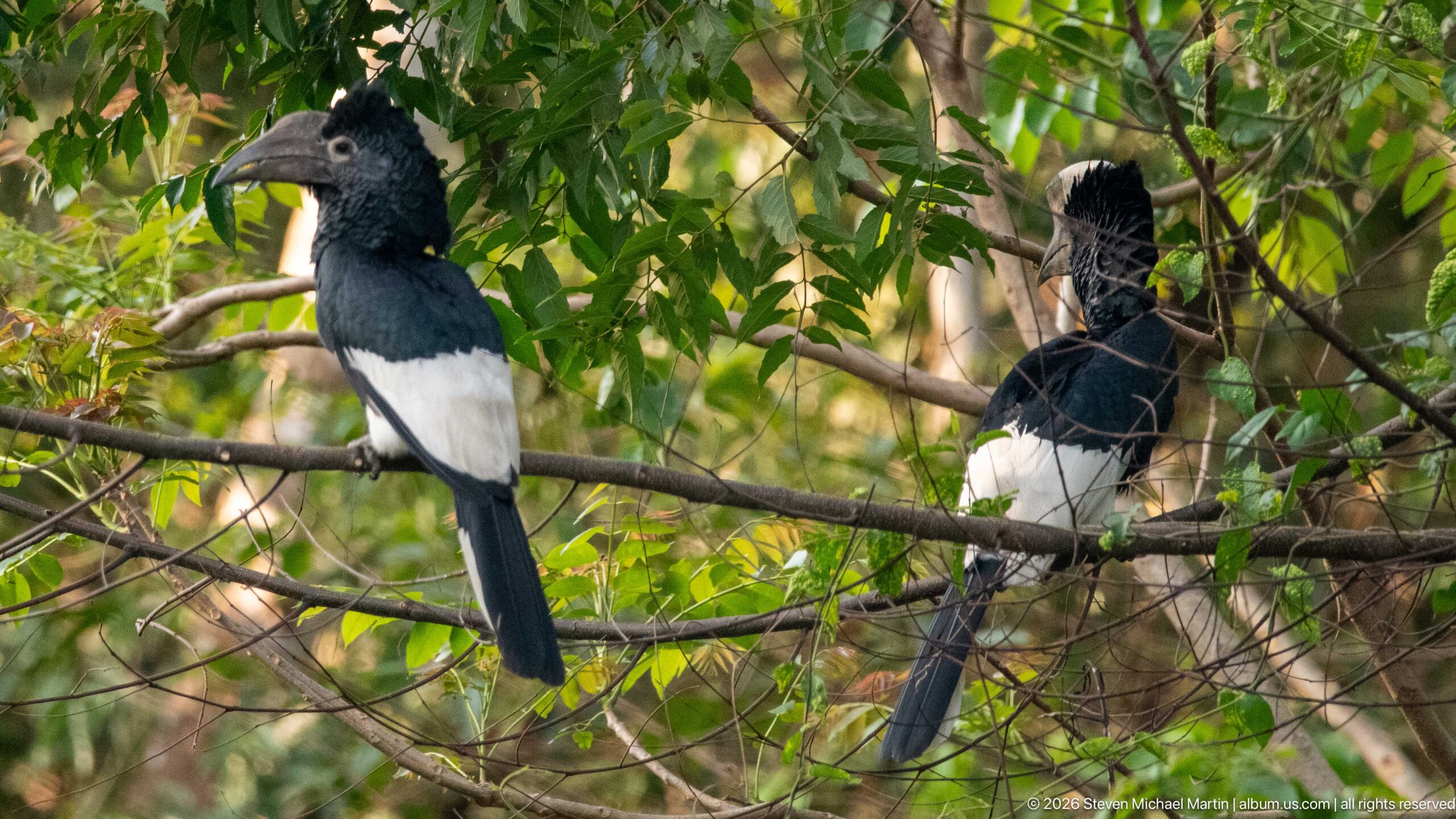
Two black-and-white-casqued hornbills perch on intersecting branches beneath leafy cover, both showing black upperparts, white lower wing and belly areas, long tails, and heavy casque-topped bills. The more enclosed setting contrasts with the cleaner paired portrait on the preceding page.
Caption
Two black-and-white-casqued hornbills perch on intersecting branches beneath leafy cover, both showing black upperparts, white lower wing and belly areas, long tails, and heavy casque-topped bills. The more enclosed setting contrasts with the cleaner paired portrait on the preceding page.
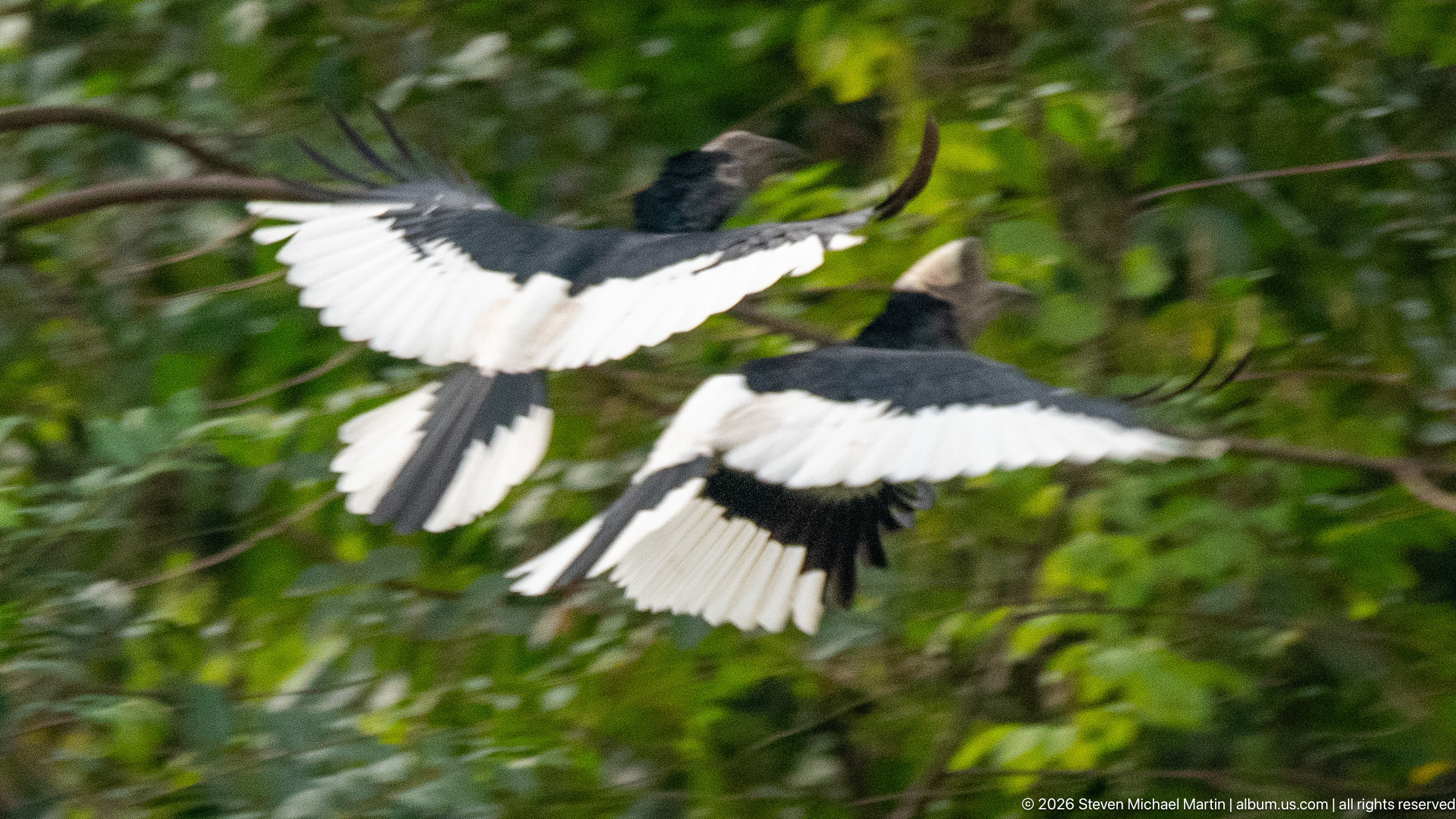
Two black-and-white-casqued hornbills fly side by side through the forest, broad wings spread to reveal striking white panels against otherwise black plumage. Long tails stream behind and the massive bills remain visible in profile, turning a normally perched field-guide subject into a dynamic flight study.
Caption
Two black-and-white-casqued hornbills fly side by side through the forest, broad wings spread to reveal striking white panels against otherwise black plumage. Long tails stream behind and the massive bills remain visible in profile, turning a normally perched field-guide subject into a dynamic flight study.
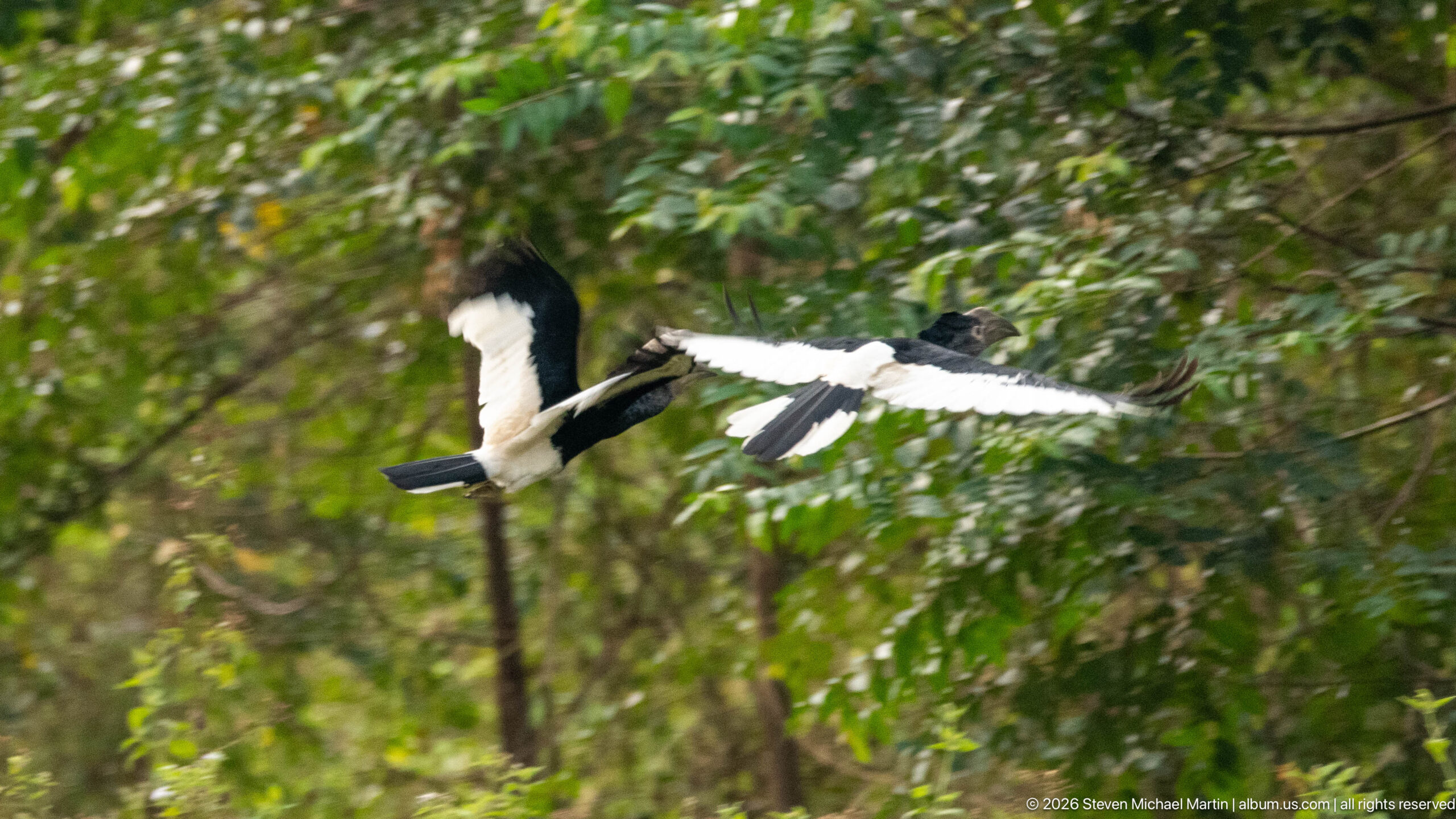
A pair of black-and-white-casqued hornbills crosses a forest opening with wings extended at different angles, revealing alternating black flight feathers and bold white coverts. The panning blur of the green background reinforces their speed while the large bills and long tails remain recognizable.
Caption
A pair of black-and-white-casqued hornbills crosses a forest opening with wings extended at different angles, revealing alternating black flight feathers and bold white coverts. The panning blur of the green background reinforces their speed while the large bills and long tails remain recognizable.
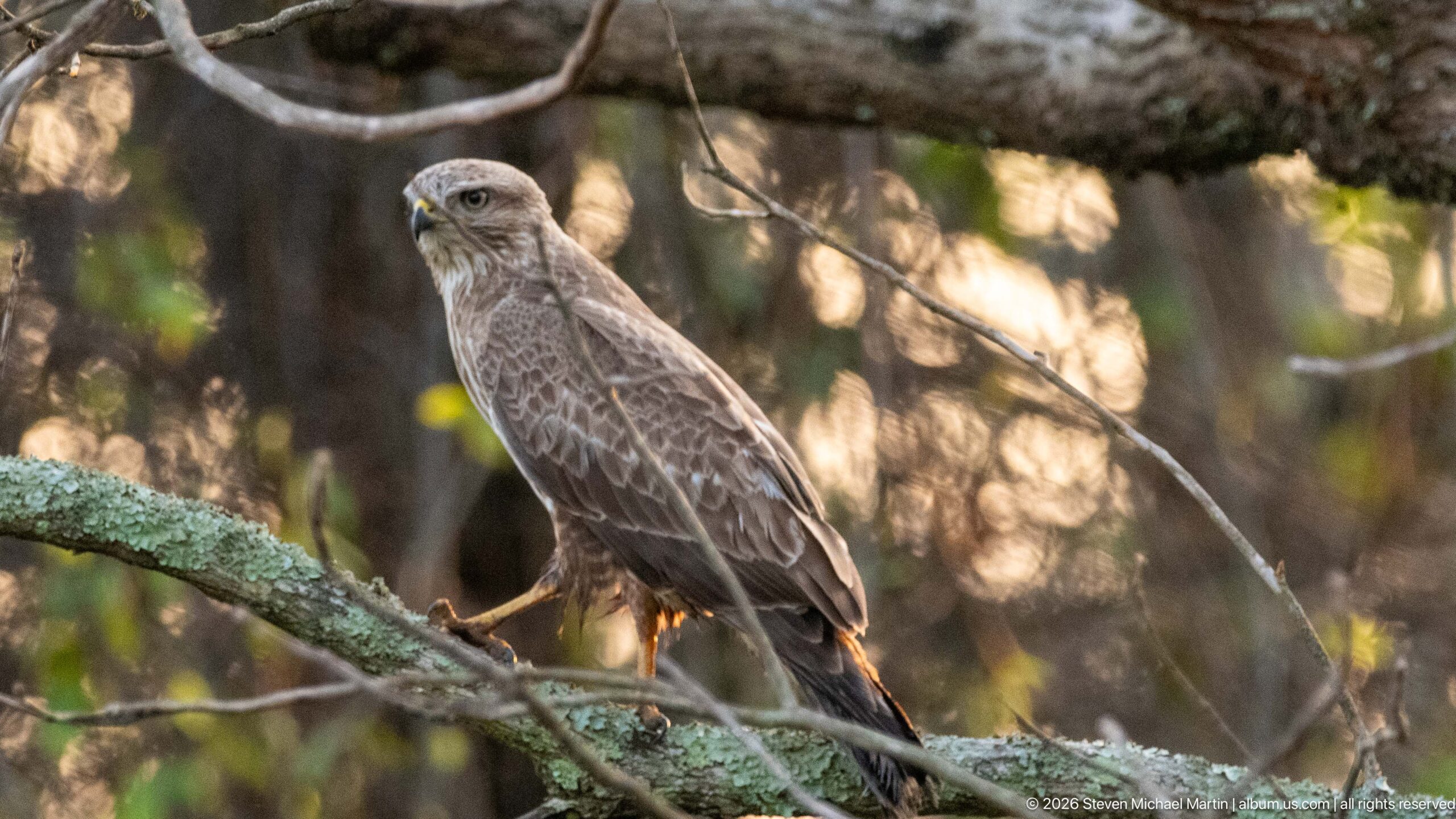
A medium-sized brown raptor perches quietly on a lichen-covered branch, showing a pale eye, hooked bill, barred or mottled underparts, and patterned upperwing coverts. The proof-sheet view supports a forest hawk or buzzard identification, but lacks enough diagnostic detail for a secure species-level assignment.
Caption
A medium-sized brown raptor perches quietly on a lichen-covered branch, showing a pale eye, hooked bill, barred or mottled underparts, and patterned upperwing coverts. The proof-sheet view supports a forest hawk or buzzard identification, but lacks enough diagnostic detail for a secure species-level assignment.
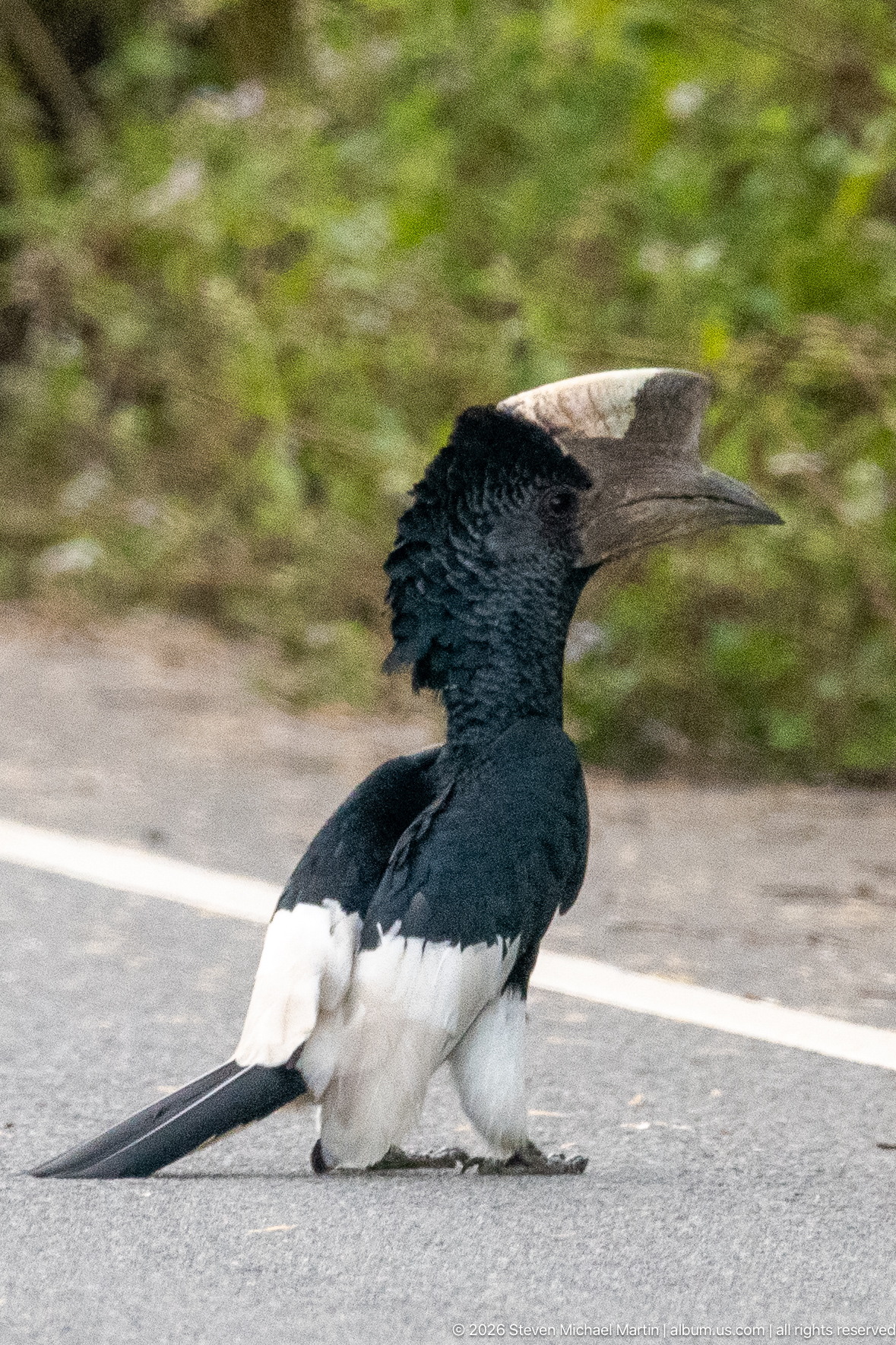
A black-and-white-casqued hornbill stands directly on a paved road, offering an unusual ground-level view of its enormous pale bill and dark casque. The black head and chest contrast with a white belly and wing panel, while the long tail lies almost parallel to the roadway.
Caption
A black-and-white-casqued hornbill stands directly on a paved road, offering an unusual ground-level view of its enormous pale bill and dark casque. The black head and chest contrast with a white belly and wing panel, while the long tail lies almost parallel to the roadway.
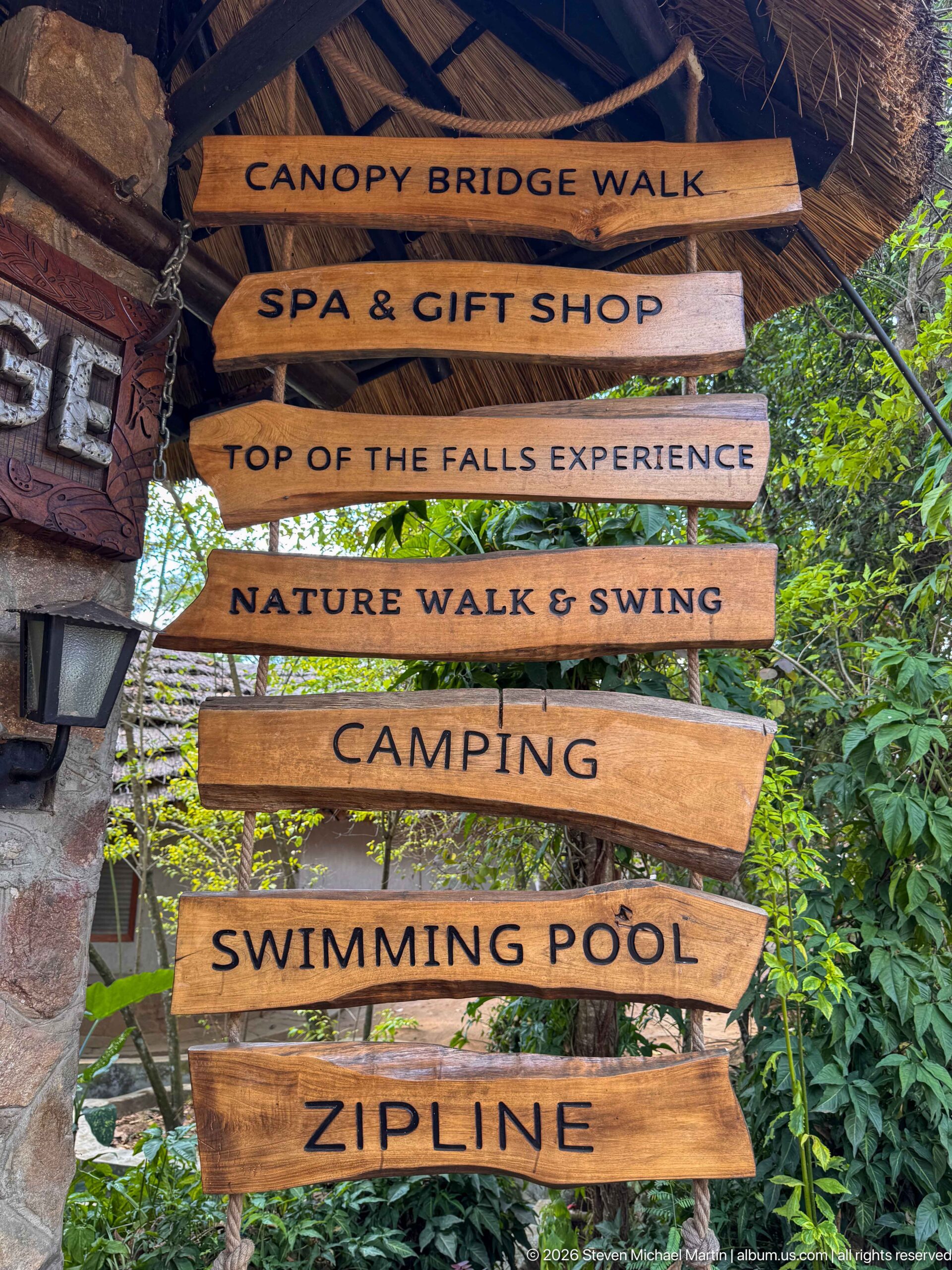
Stacked wooden arrows advertise visitor activities including canopy bridge walk, spa and gift shop, top-of-the-falls experience, nature walk and swing, camping, swimming pool, and zip line. The sign records the broader tourism infrastructure associated with the Budongo-area stop rather than the forest’s natural features.
Caption
Stacked wooden arrows advertise visitor activities including canopy bridge walk, spa and gift shop, top-of-the-falls experience, nature walk and swing, camping, swimming pool, and zip line. The sign records the broader tourism infrastructure associated with the Budongo-area stop rather than the forest’s natural features.
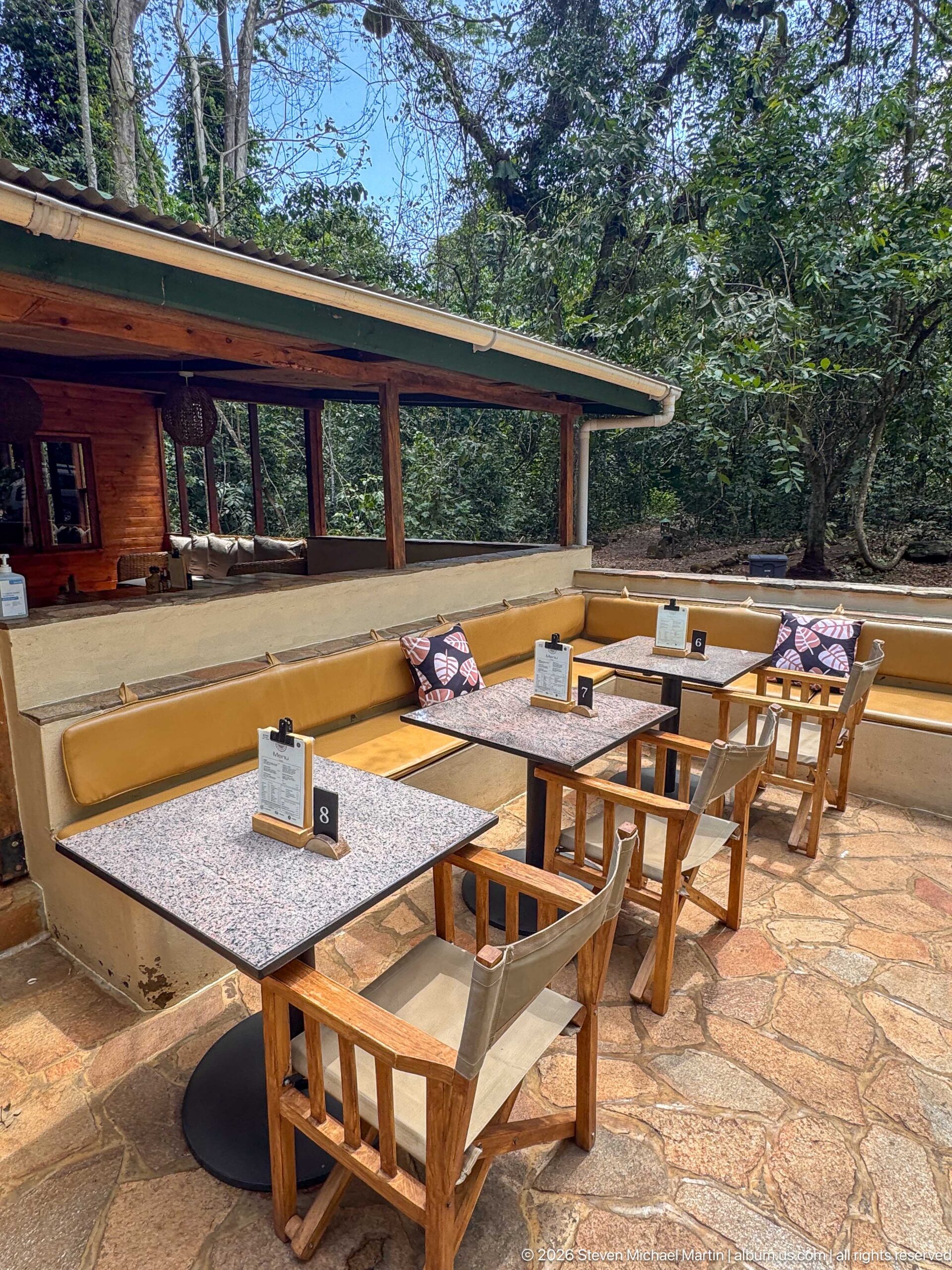
An open-air lodge terrace combines wooden tables and chairs with long cushioned banquettes beneath a broad green roof. Forest trees surround the paved patio, creating a sheltered dining or lounge area that remains visually connected to the wooded setting.
Caption
An open-air lodge terrace combines wooden tables and chairs with long cushioned banquettes beneath a broad green roof. Forest trees surround the paved patio, creating a sheltered dining or lounge area that remains visually connected to the wooded setting.
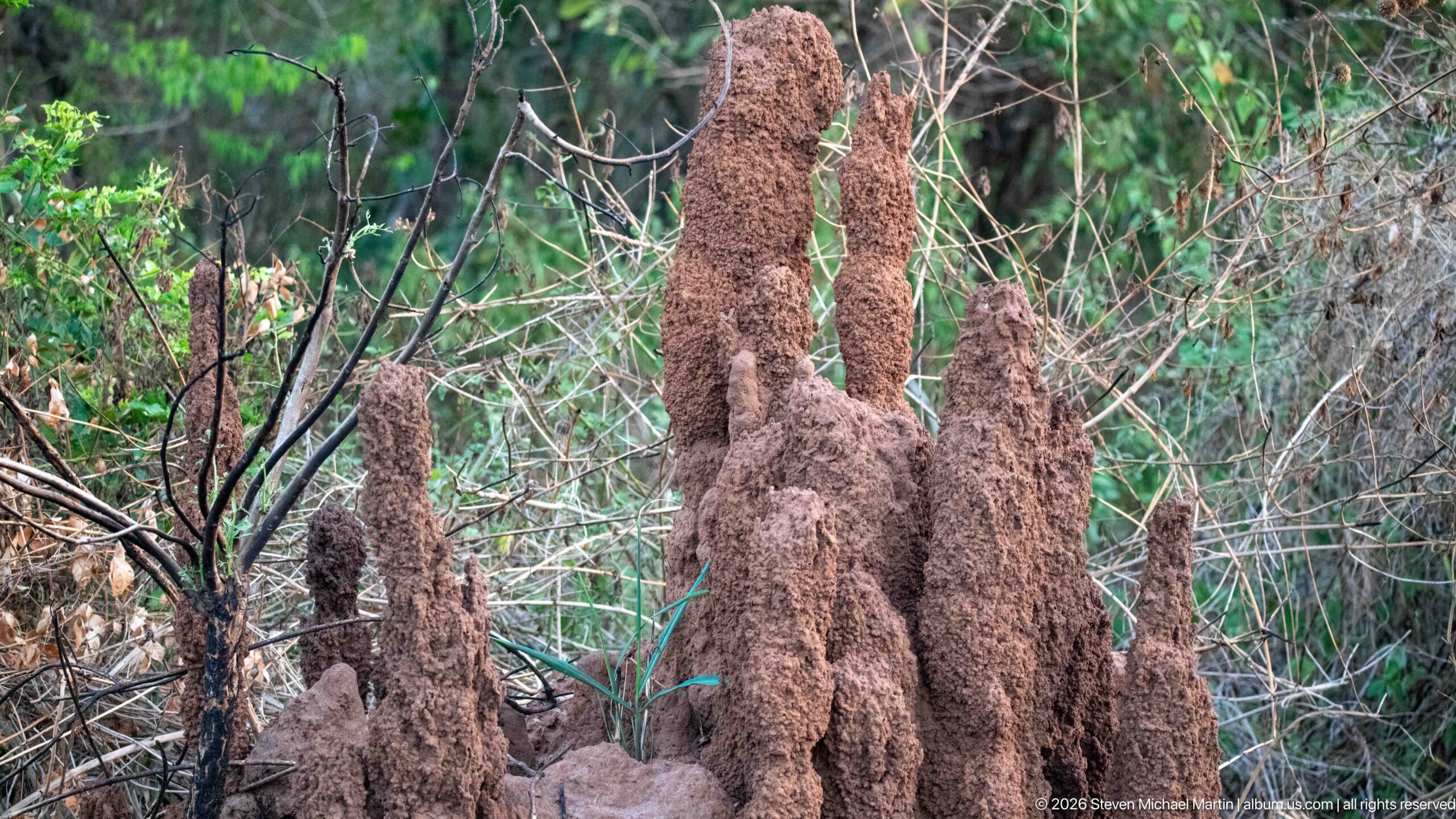
A cluster of tall earthen termite towers rises from low vegetation, with narrow pinnacles and irregular buttressed surfaces built from reddish-brown soil. The sculptural mound records the large-scale engineering of social insects and provides a striking natural-history detail outside the closed forest interior.
Caption
A cluster of tall earthen termite towers rises from low vegetation, with narrow pinnacles and irregular buttressed surfaces built from reddish-brown soil. The sculptural mound records the large-scale engineering of social insects and provides a striking natural-history detail outside the closed forest interior.
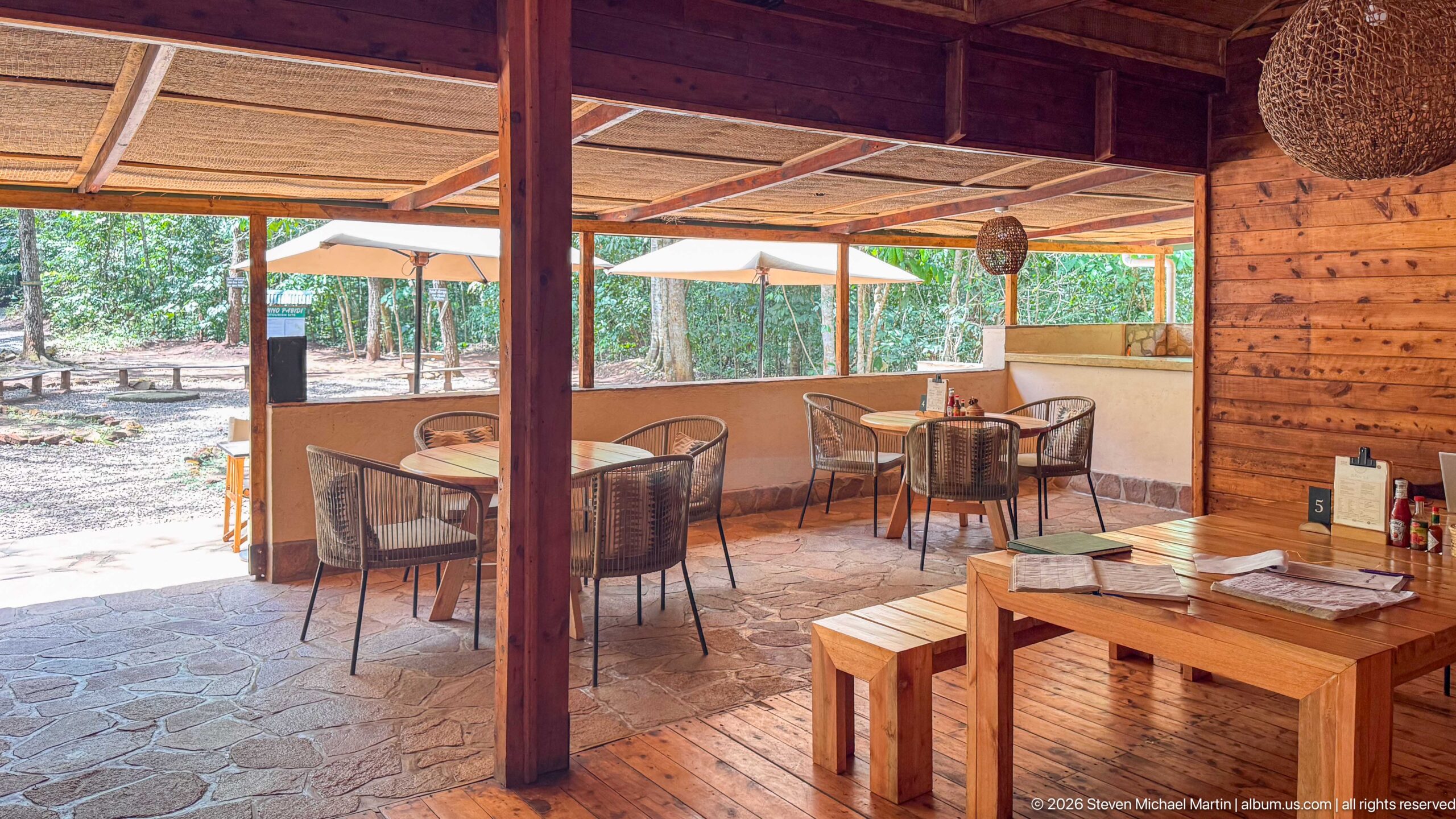
A covered wooden terrace opens onto a forested courtyard, with round café tables, woven chairs, a service table, and hanging basket-style lamps. The open sides and shaded roof create an indoor-outdoor dining space designed for the tropical setting.
Caption
A covered wooden terrace opens onto a forested courtyard, with round café tables, woven chairs, a service table, and hanging basket-style lamps. The open sides and shaded roof create an indoor-outdoor dining space designed for the tropical setting.
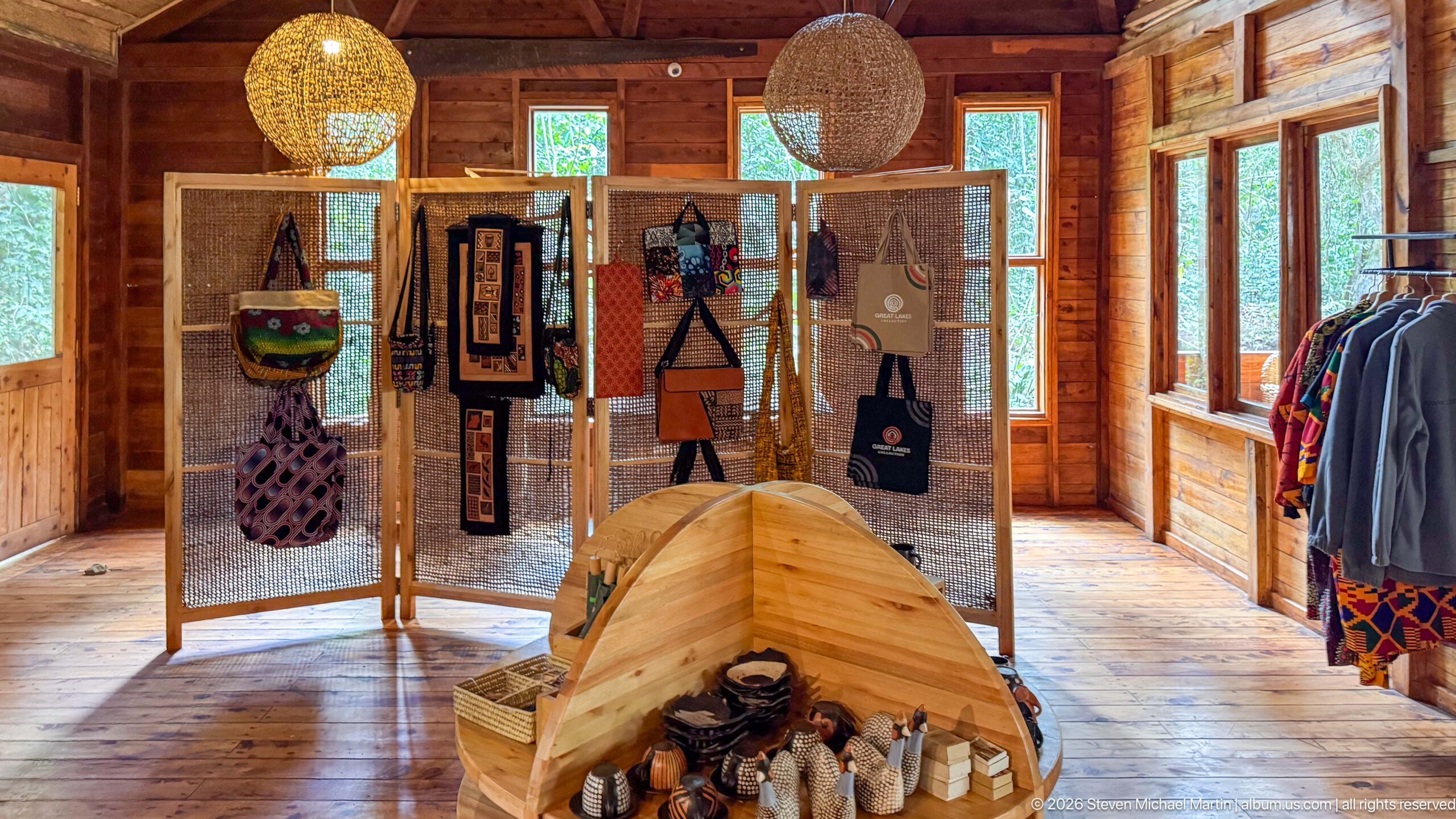
A small wooden gift shop displays bags, textiles, clothing, and other handicrafts on freestanding mesh panels and racks. Woven pendant lamps and timber walls reinforce the handcrafted atmosphere, while a central canoe-shaped display holds smaller souvenir items.
Caption
A small wooden gift shop displays bags, textiles, clothing, and other handicrafts on freestanding mesh panels and racks. Woven pendant lamps and timber walls reinforce the handcrafted atmosphere, while a central canoe-shaped display holds smaller souvenir items.
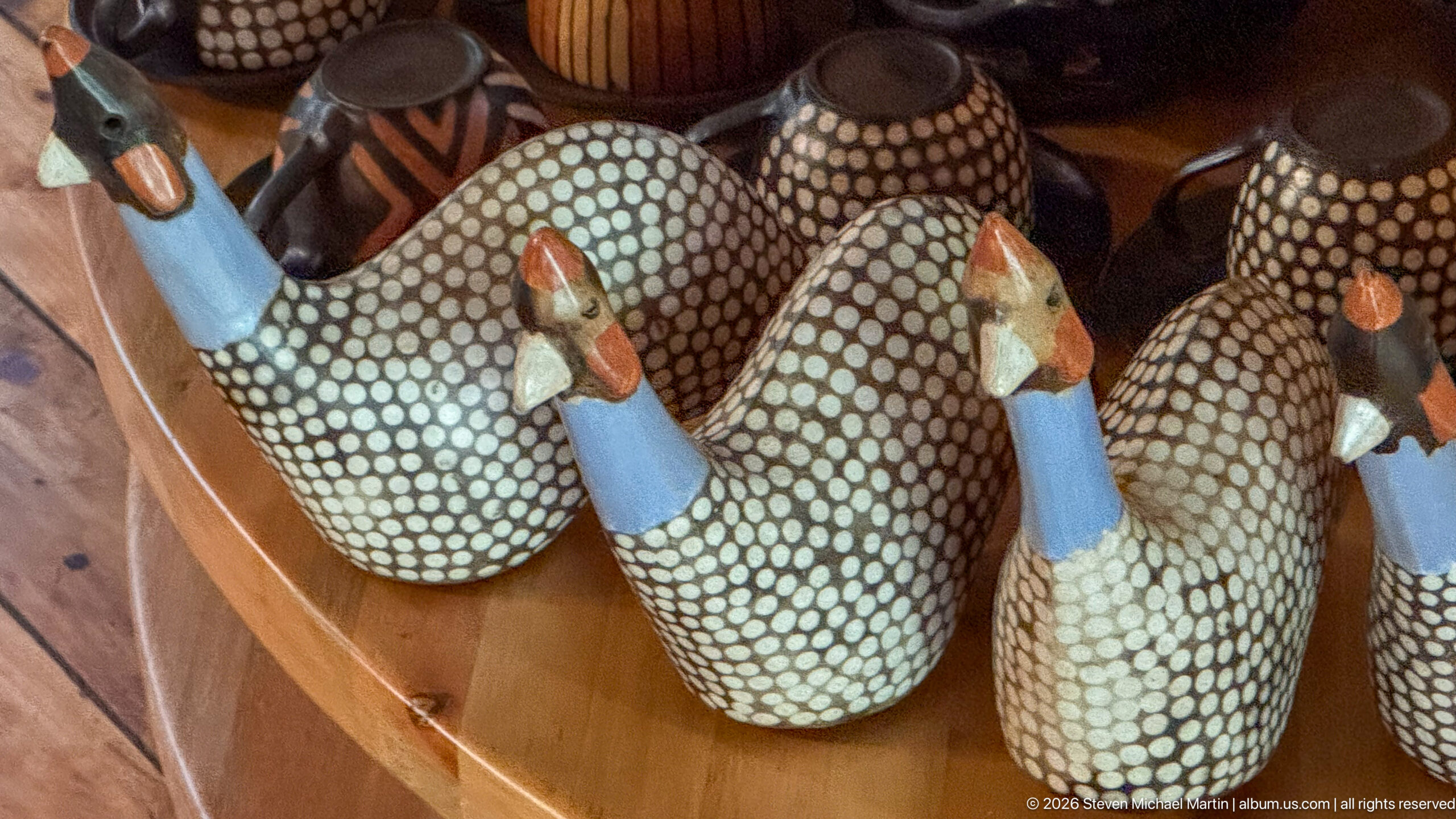
Several stylized bird sculptures with rounded black bodies, dense white dot patterns, blue necks, and red facial accents fill a wooden display. Their painted plumage recalls guinea fowl, making them a recognizable decorative craft motif even though the maker and specific craft tradition are not identified.
Caption
Several stylized bird sculptures with rounded black bodies, dense white dot patterns, blue necks, and red facial accents fill a wooden display. Their painted plumage recalls guinea fowl, making them a recognizable decorative craft motif even though the maker and specific craft tradition are not identified.
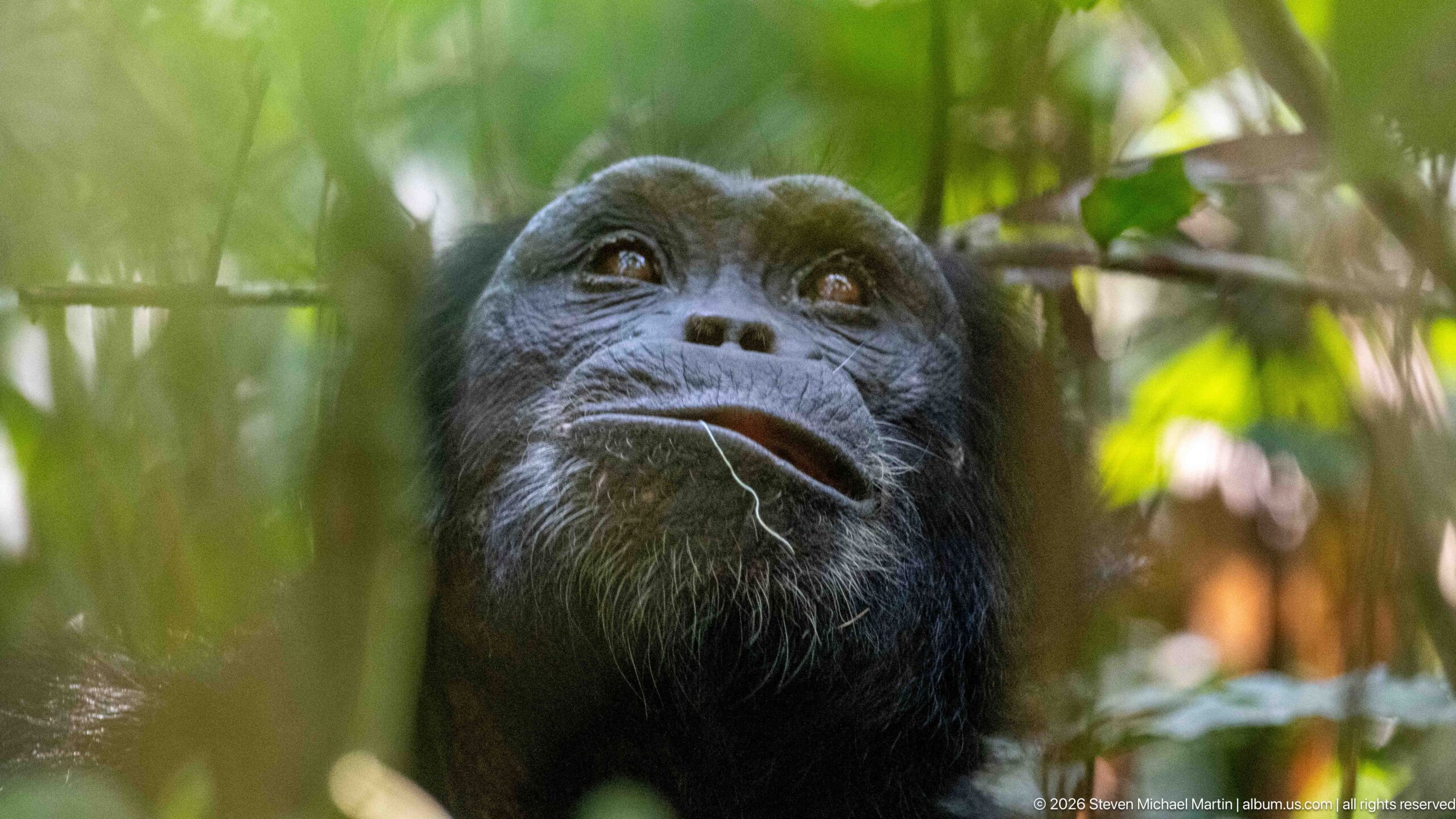
An eastern chimpanzee looks upward through the understory with a thin pale strand of plant fiber hanging from the corner of its mouth. Soft green foliage frames the face, while the eyes, broad brow, wrinkled muzzle, and gray chin hairs are rendered in close detail.
Caption
An eastern chimpanzee looks upward through the understory with a thin pale strand of plant fiber hanging from the corner of its mouth. Soft green foliage frames the face, while the eyes, broad brow, wrinkled muzzle, and gray chin hairs are rendered in close detail.
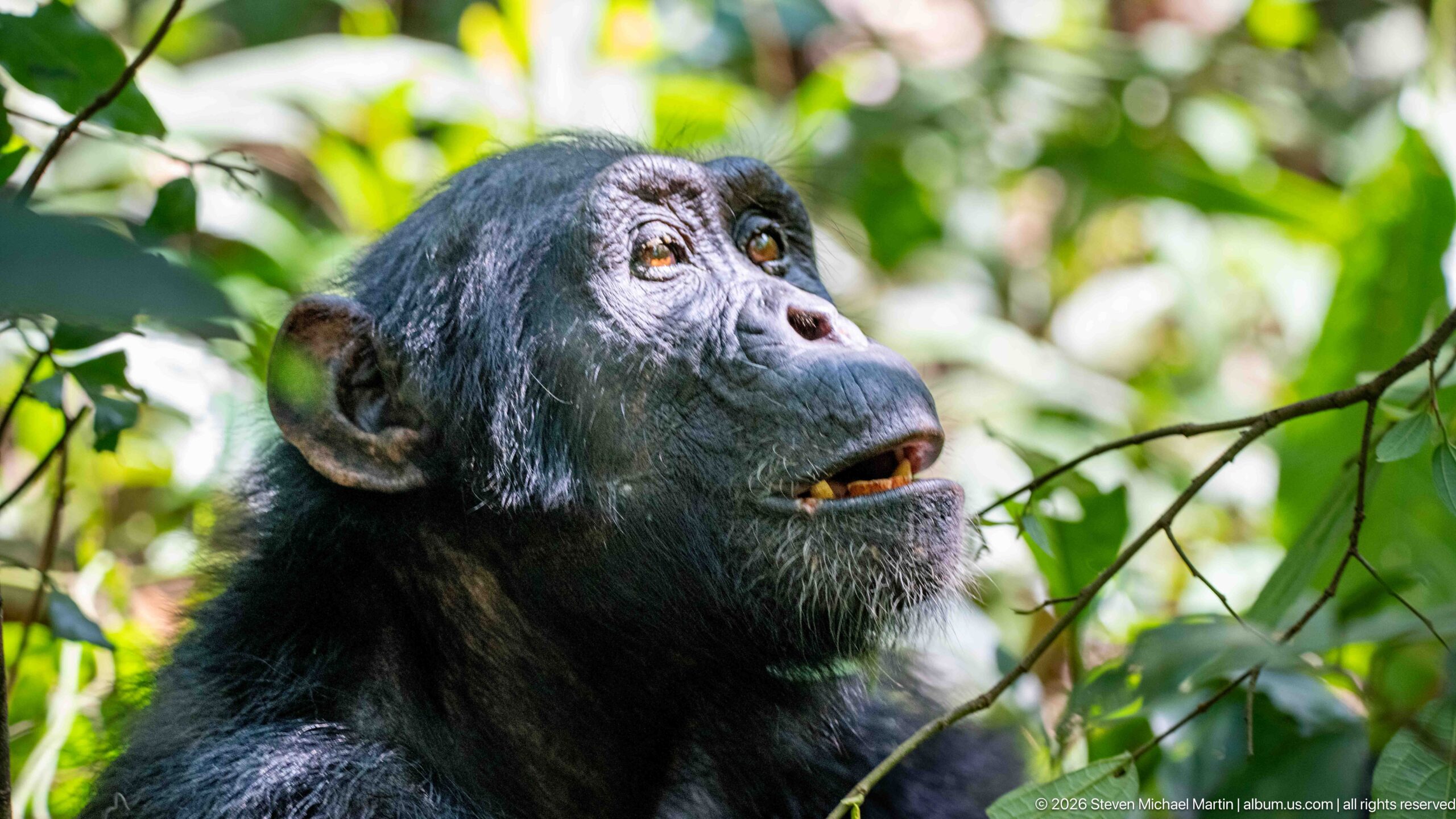
A close side portrait shows an eastern chimpanzee gazing upward, mouth slightly open, against a luminous green forest background. Bright light reveals the smooth dark facial skin, rounded ear, amber-brown eye, and gray hairs around the chin, creating a detailed concluding portrait of the Budongo chimpanzee sequence.
Caption
A close side portrait shows an eastern chimpanzee gazing upward, mouth slightly open, against a luminous green forest background. Bright light reveals the smooth dark facial skin, rounded ear, amber-brown eye, and gray hairs around the chin, creating a detailed concluding portrait of the Budongo chimpanzee sequence.
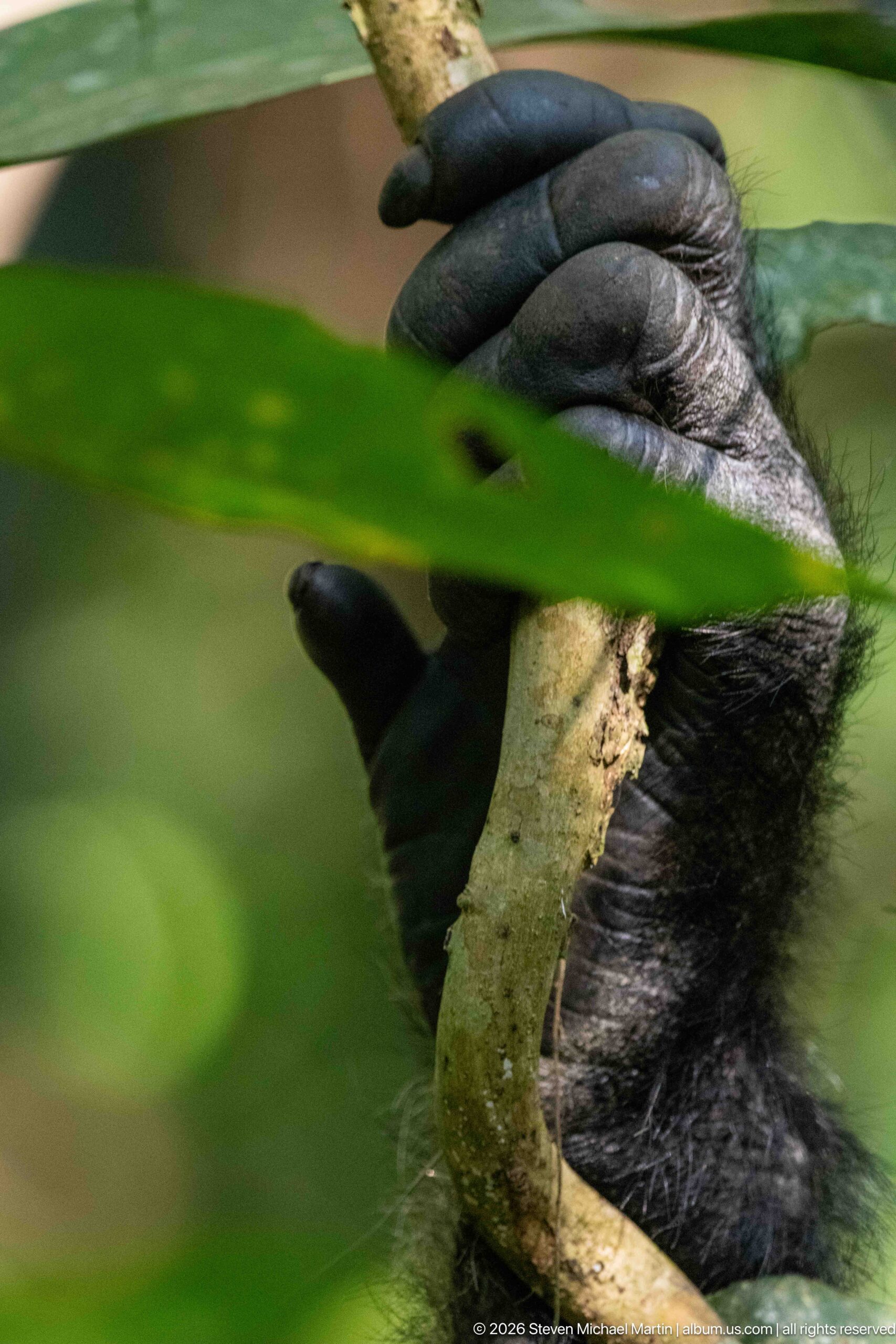
A close detail isolates an eastern chimpanzee’s hand wrapped firmly around a vertical branch. Thick fingers, dark leathery skin, and coarse hair on the wrist fill most of the frame, providing an anatomical study of the powerful grasp used during climbing and movement through forest vegetation.
Caption
A close detail isolates an eastern chimpanzee’s hand wrapped firmly around a vertical branch. Thick fingers, dark leathery skin, and coarse hair on the wrist fill most of the frame, providing an anatomical study of the powerful grasp used during climbing and movement through forest vegetation.
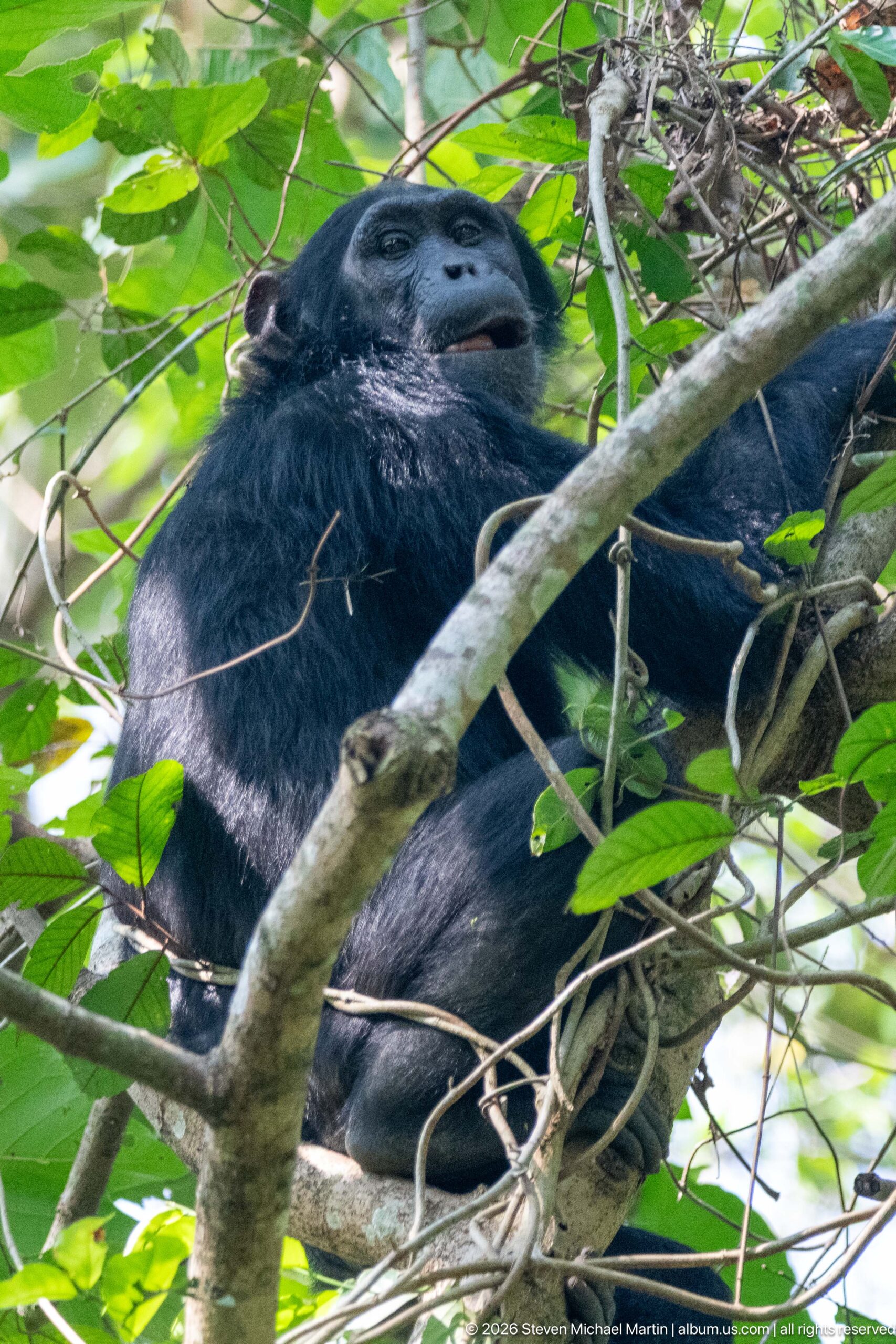
An eastern chimpanzee reclines high among crossing branches and vines, its body stretched across the canopy while one arm rests above the head. The upward viewpoint shows the ape relaxed within a dense lattice of woody stems and leaves, emphasizing arboreal resting behavior.
Caption
An eastern chimpanzee reclines high among crossing branches and vines, its body stretched across the canopy while one arm rests above the head. The upward viewpoint shows the ape relaxed within a dense lattice of woody stems and leaves, emphasizing arboreal resting behavior.
Highlights
- Chimpanzee Hunting Behavior: A rare and dramatic sequence of chimpanzees feeding on a monkey in the canopy, followed by social interaction and food transfer on the forest floor.
- Close-Range Encounters: Dense vegetation allowed for intimate, eye-level views of chimpanzees in their natural habitat.
- Budongo Forest Immersion: Towering mahogany trees and layered canopy create a fully enclosed rainforest experience.
- Primate Diversity: In addition to chimpanzees, colobus monkeys and other species highlight the richness of the forest ecosystem.
- Guided Tracking Experience: Moving through dense forest with an experienced guide adds context and depth to wildlife encounters.
Notable Encounter: Chimpanzee Hunt and Social Exchange
During our trek through Budongo Forest, we witnessed a rare and powerful sequence of chimpanzee behavior. High in the canopy, a chimpanzee had captured a monkey and was feeding while others gathered nearby.
Below, another chimpanzee lingered and begged persistently. After repeated attempts, it was allowed a portion — the tail — which it carried to the forest floor and consumed.
This moment revealed the complex social dynamics of chimpanzees, including hierarchy, cooperation, and food-sharing behavior — offering a rare glimpse into interactions that closely parallel aspects of human social structure.
Forest Ecosystem
Budongo Forest is one of East Africa’s largest remaining tropical forests, characterized by dense vegetation and a multi-layered canopy. Towering mahogany trees form the upper structure, while thick understory vegetation limits visibility and shapes wildlife movement.
Unlike open savannah environments, the forest creates an immersive experience where wildlife is often encountered at close range. Sound, motion, and subtle changes in the vegetation become key indicators of animal presence, making each sighting feel immediate and personal.
Experience & Setting
Staying within Budongo Forest provides direct access to the reserve, allowing early entry for guided tracking experiences. The lodge blends into the surrounding environment, offering a quiet and comfortable base surrounded by forest sounds and activity.
From shared meals to early morning departures into the forest, the experience combines wildlife observation with a strong sense of place, emphasizing both the natural environment and the rhythm of life within the forest.
🐒 Budongo Forest Wildlife Field Guide
Wildlife observed during this forest trek:
Budongo Forest supports a diverse range of primates, birds, and forest-adapted species that rely on dense vegetation and vertical habitat structure. Encounters are typically close and behavior-focused, offering a detailed look at interaction and movement within a tropical ecosystem.
🐾 Mammals
- Chimpanzee – Highly social primates observed feeding, interacting, and displaying complex behaviors including hunting and food sharing.
- Black-and-White Colobus Monkey – Arboreal species often seen moving through the upper canopy.
🦜 Birds
- Hornbill – Large forest bird typically perched or moving between canopy layers.
- Woodland Raptors – Birds of prey observed along forest edges and open areas.
🦎 Other Wildlife
- Forest Insects & Arachnids – Includes intricate spider webs and diverse insect life within the understory.
🌿 Habitat & Landscape
- Tropical Forest Canopy – Multi-layered structure supporting diverse wildlife.
- Mahogany Trees – Towering hardwoods forming the dominant forest structure.
- Dense Understory – Thick vegetation shaping movement and visibility.
- Forest Trails – Narrow paths used for guided tracking through the reserve.