A robed figure kneels in prayer at the center of a landscaped setting while two companions slump or kneel nearby. Across the background, a dense body of armed men advances with spears and banners. The contrast between quiet foreground devotion and the approaching military crowd creates the scene’s dramatic tension.
Caption
A robed figure kneels in prayer at the center of a landscaped setting while two companions slump or kneel nearby. Across the background, a dense body of armed men advances with spears and banners. The contrast between quiet foreground devotion and the approaching military crowd creates the scene’s dramatic tension.
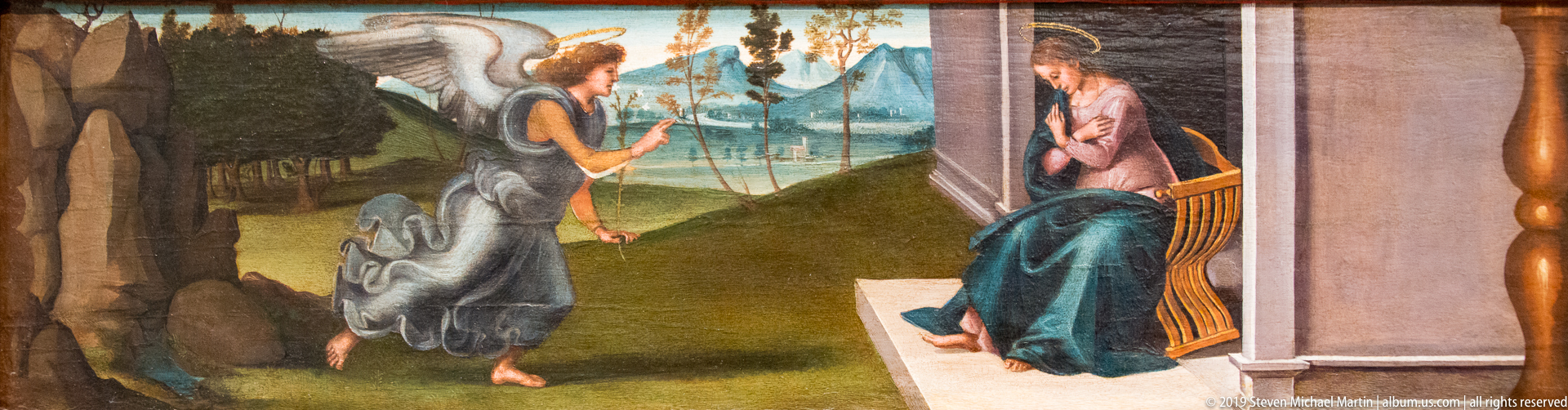
A winged angel advances from the left toward the Virgin, who sits beneath a columned architectural opening at right. The angel carries a slender stem and raises one hand in greeting, while a broad green landscape recedes behind the figures. The separation between garden and architecture gives the Annunciation a clear spatial and narrative structure.
Caption
A winged angel advances from the left toward the Virgin, who sits beneath a columned architectural opening at right. The angel carries a slender stem and raises one hand in greeting, while a broad green landscape recedes behind the figures. The separation between garden and architecture gives the Annunciation a clear spatial and narrative structure.
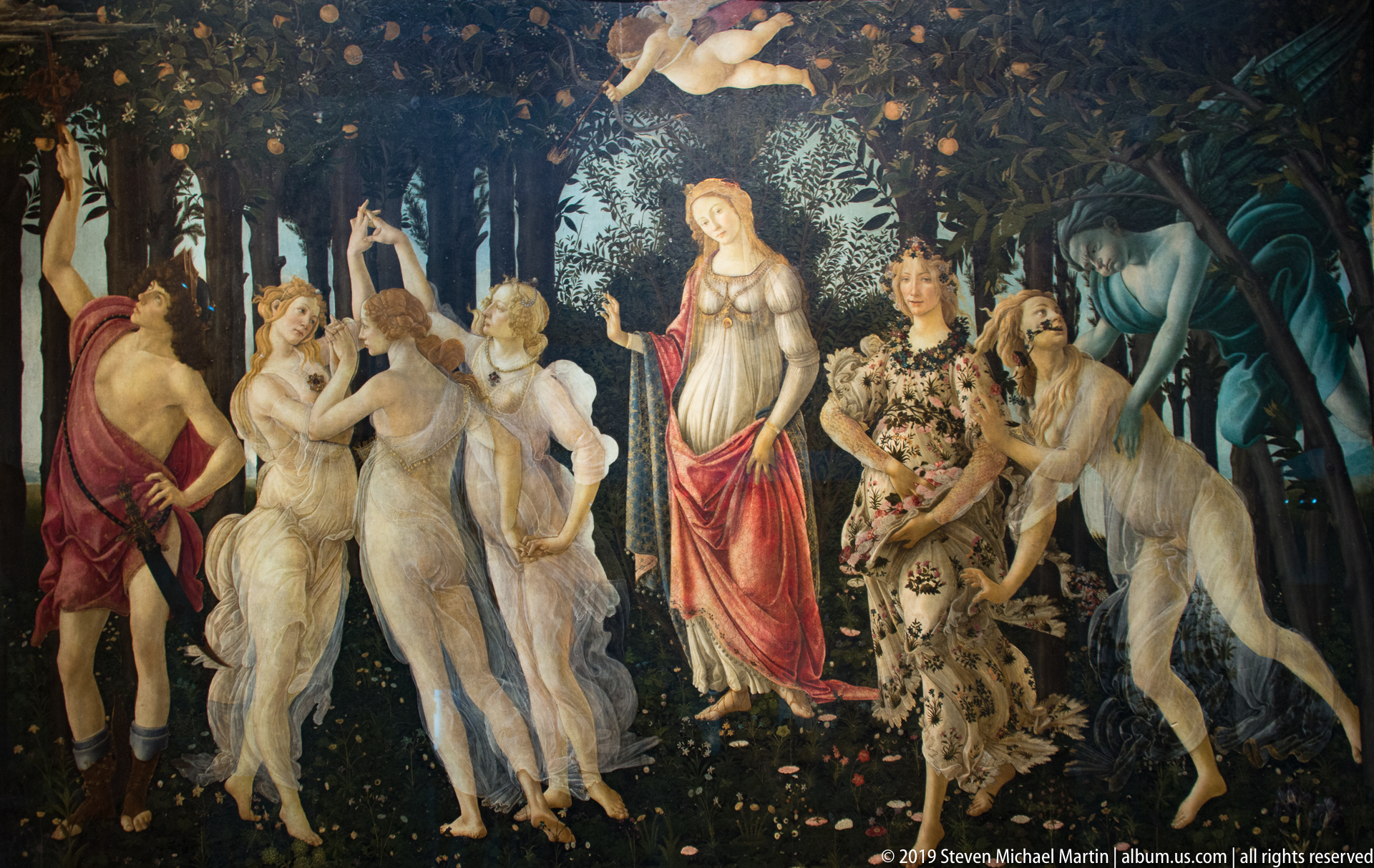
Botticelli’s Primavera (c. 1480) assembles nine mythological figures in a flowering grove of orange and laurel. Venus presides at center beneath blindfolded Cupid; the Three Graces dance beside Mercury at left, while Zephyrus pursues Chloris at right as she transforms into flower-strewing Flora. Hundreds of carefully observed plants turn the meadow into an emblematic spring landscape, while the figures unfold like a ceremonial frieze across its dark woodland backdrop.
Caption
Botticelli’s Primavera (c. 1480) assembles nine mythological figures in a flowering grove of orange and laurel. Venus presides at center beneath blindfolded Cupid; the Three Graces dance beside Mercury at left, while Zephyrus pursues Chloris at right as she transforms into flower-strewing Flora. Hundreds of carefully observed plants turn the meadow into an emblematic spring landscape, while the figures unfold like a ceremonial frieze across its dark woodland backdrop.
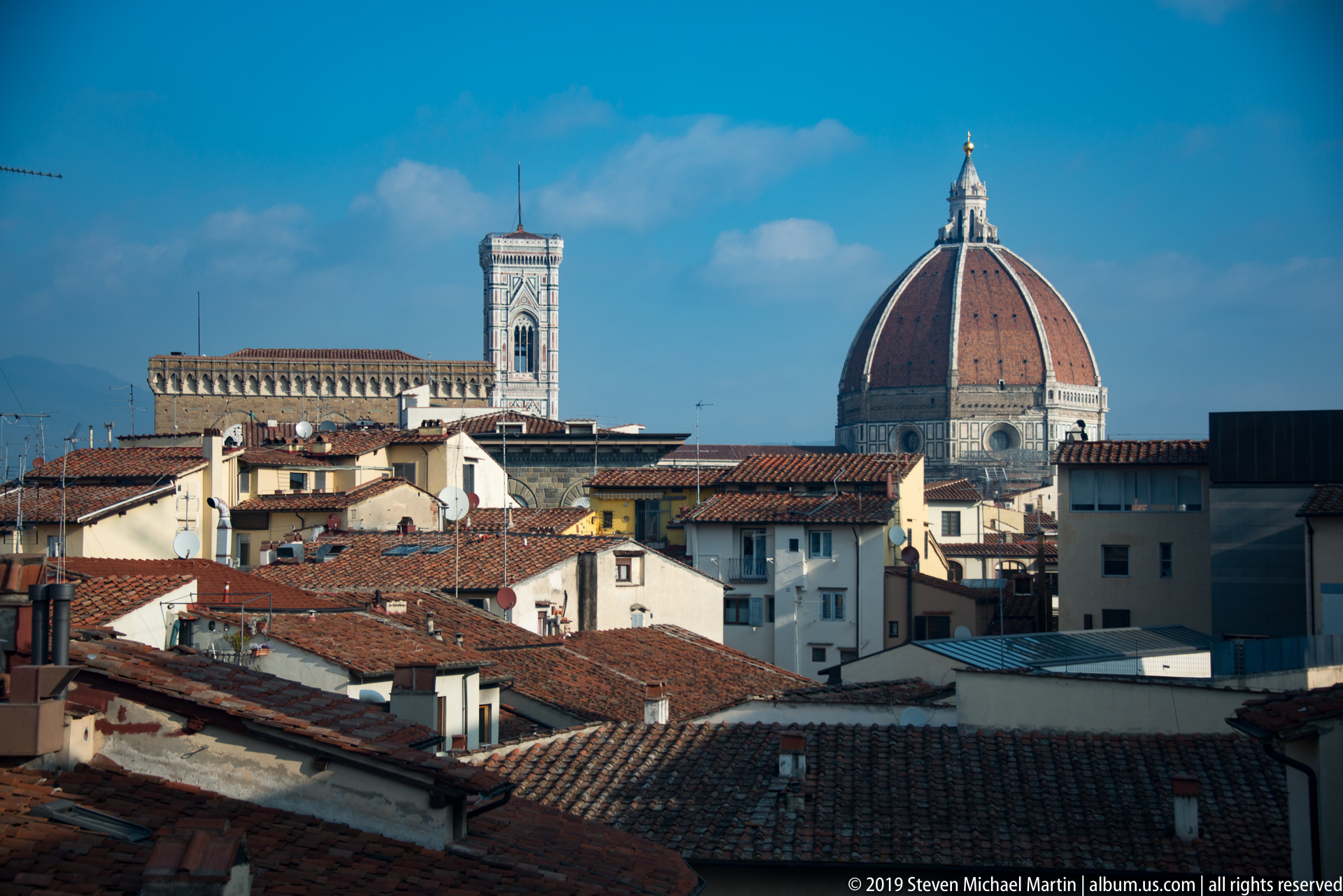
Terracotta rooftops spread across central Florence beneath a clear blue sky, with Brunelleschi’s great dome of Santa Maria del Fiore rising prominently at right and Giotto’s Campanile visible to the left. Seen from an elevated museum viewpoint, the cityscape places the Uffizi visit within the dense historic fabric of Florence.
Caption
Terracotta rooftops spread across central Florence beneath a clear blue sky, with Brunelleschi’s great dome of Santa Maria del Fiore rising prominently at right and Giotto’s Campanile visible to the left. Seen from an elevated museum viewpoint, the cityscape places the Uffizi visit within the dense historic fabric of Florence.
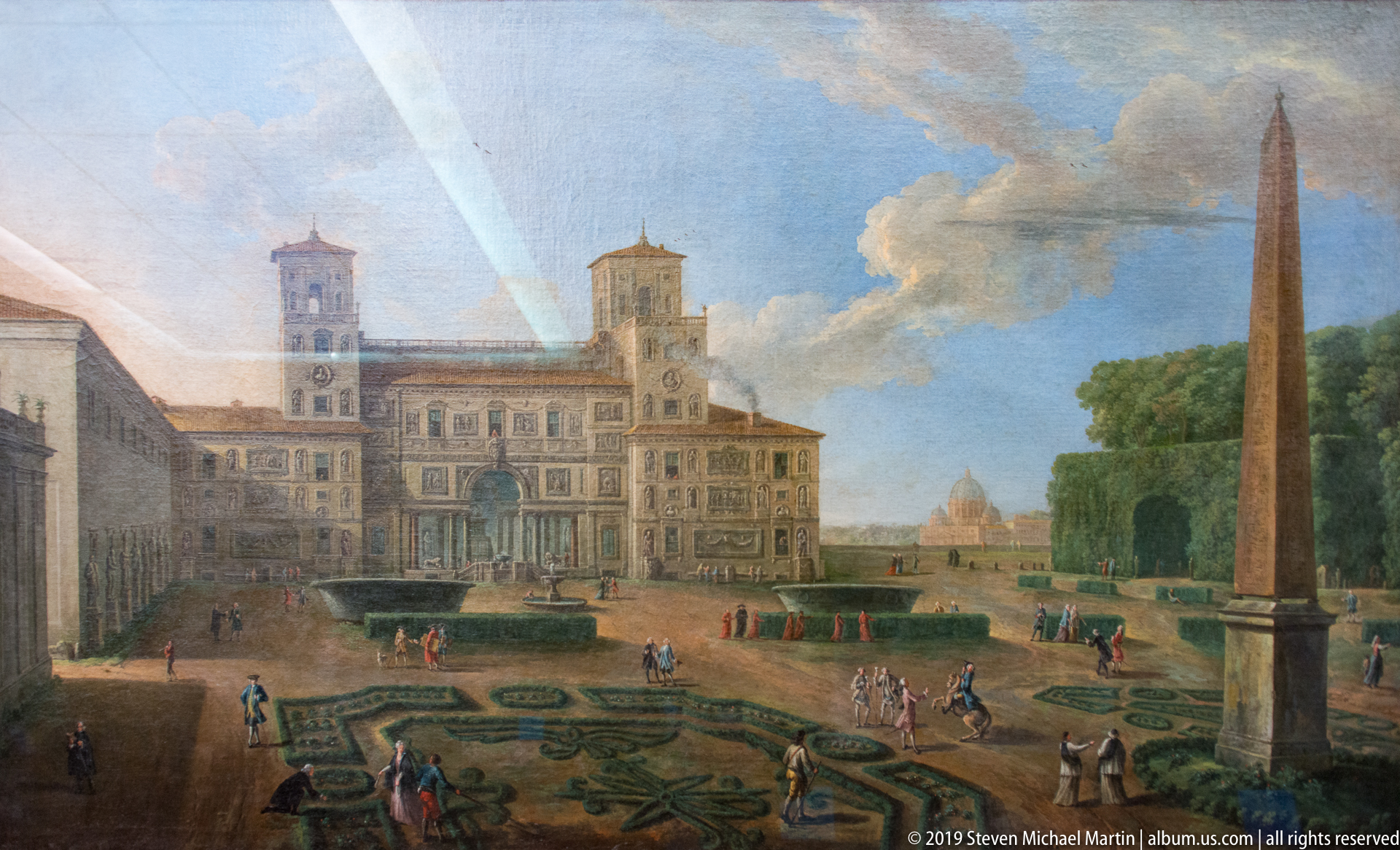
A broad palace complex encloses a formal garden animated by small strolling figures. Geometric parterres fill the foreground, while an obelisk rises prominently at the right and a domed structure appears in the far distance. The elevated viewpoint and carefully ordered architecture turn the scene into a detailed record of ceremonial urban space.
Caption
A broad palace complex encloses a formal garden animated by small strolling figures. Geometric parterres fill the foreground, while an obelisk rises prominently at the right and a domed structure appears in the far distance. The elevated viewpoint and carefully ordered architecture turn the scene into a detailed record of ceremonial urban space.
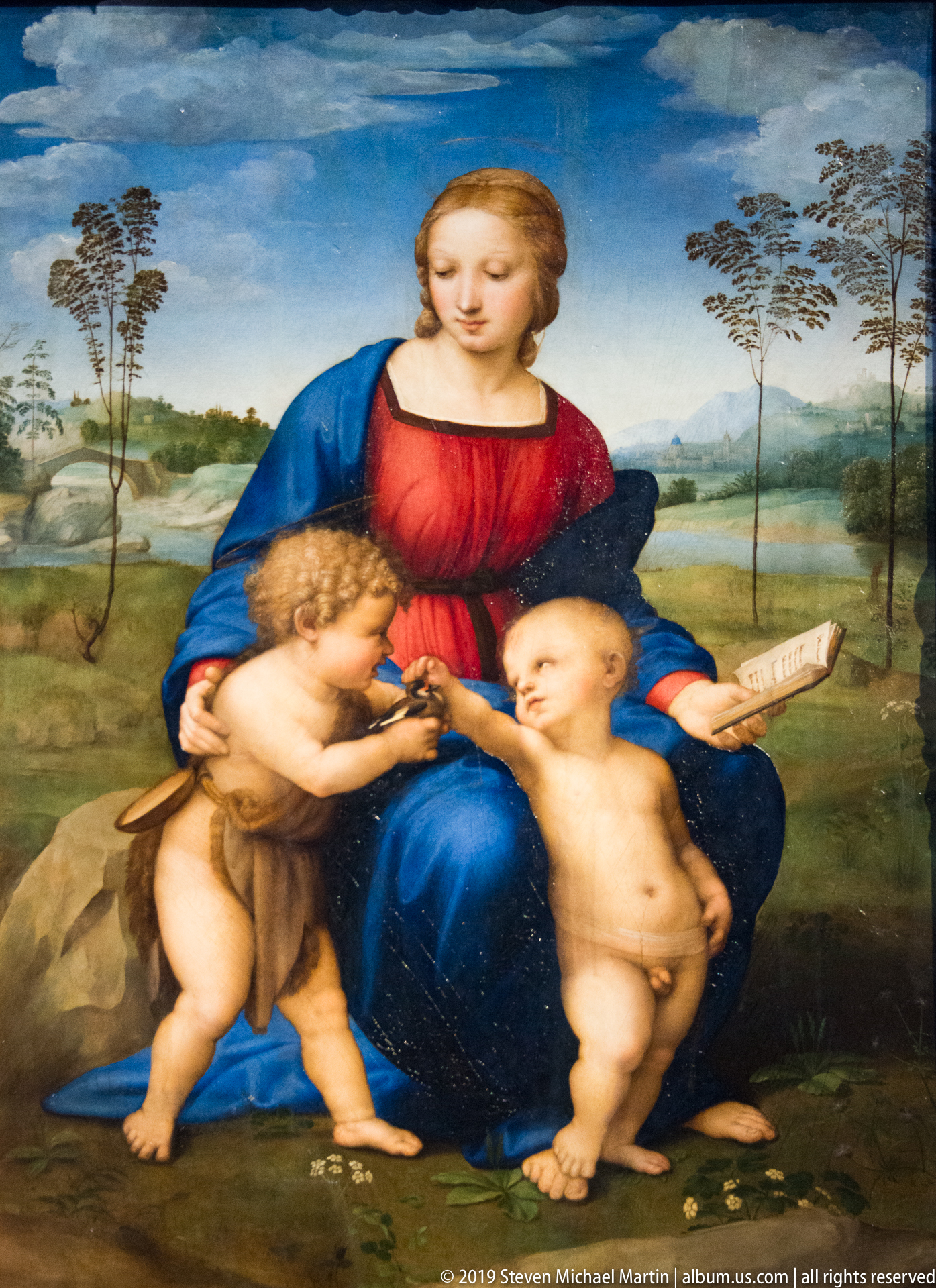
Raphael’s Madonna of the Goldfinch, painted before February 1506, arranges Mary, the Christ Child, and the young John the Baptist in a serene pyramidal group. John offers Christ a goldfinch, whose red markings traditionally foreshadow the Passion, while Mary watches over the exchange with a small book in hand. The gentle gestures, atmospheric landscape, and balanced geometry exemplify Raphael’s Florentine synthesis of Leonardo and Michelangelo.
Caption
Raphael’s Madonna of the Goldfinch, painted before February 1506, arranges Mary, the Christ Child, and the young John the Baptist in a serene pyramidal group. John offers Christ a goldfinch, whose red markings traditionally foreshadow the Passion, while Mary watches over the exchange with a small book in hand. The gentle gestures, atmospheric landscape, and balanced geometry exemplify Raphael’s Florentine synthesis of Leonardo and Michelangelo.
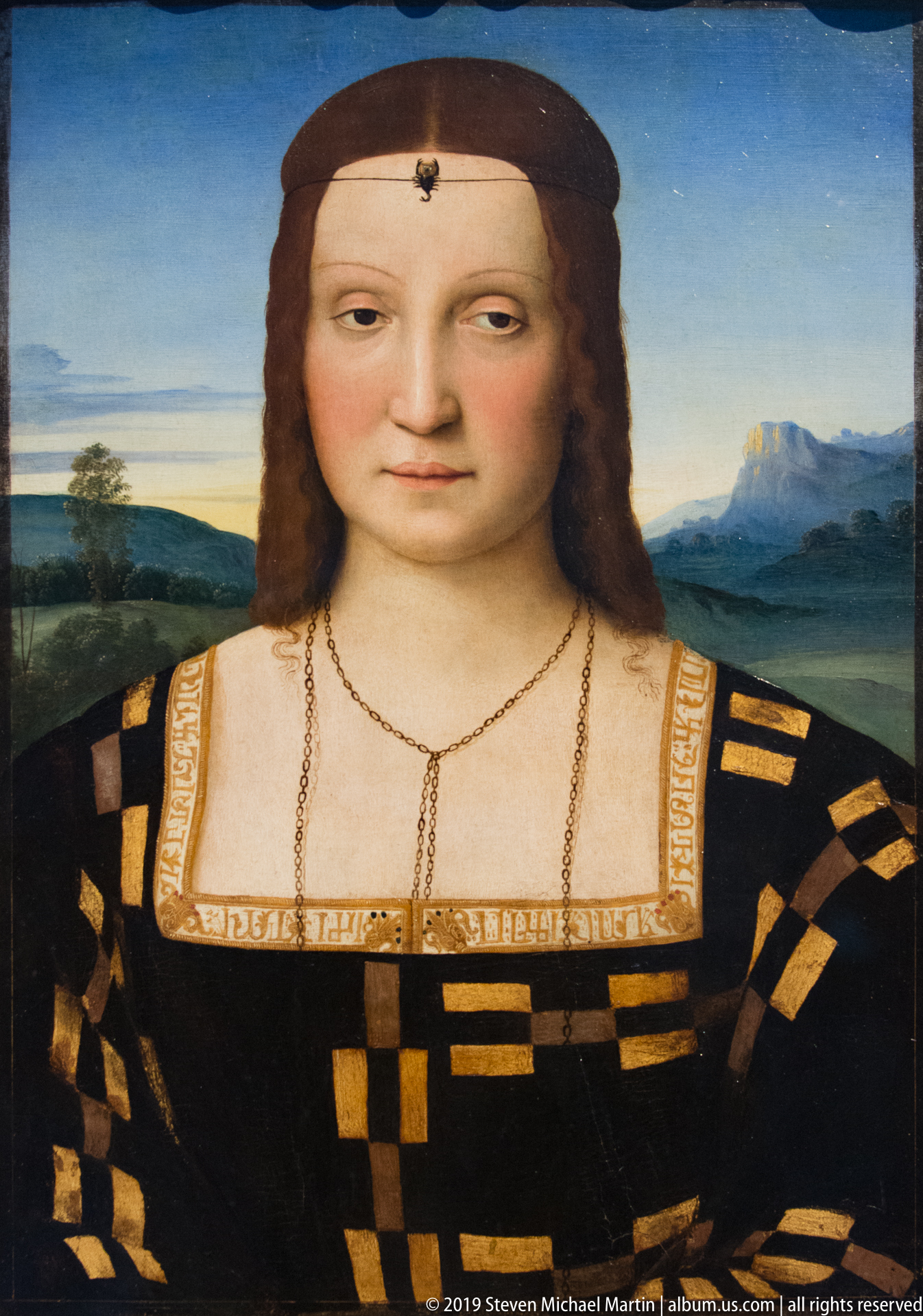
A young woman faces the viewer in a formal bust-length portrait, wearing a black dress patterned with gold rectangular bands and a delicate necklace. Her center-parted hair falls smoothly to the shoulders, and a small forehead ornament punctuates the restrained costume. A broad landscape with distant hills forms the quiet background.
Caption
A young woman faces the viewer in a formal bust-length portrait, wearing a black dress patterned with gold rectangular bands and a delicate necklace. Her center-parted hair falls smoothly to the shoulders, and a small forehead ornament punctuates the restrained costume. A broad landscape with distant hills forms the quiet background.
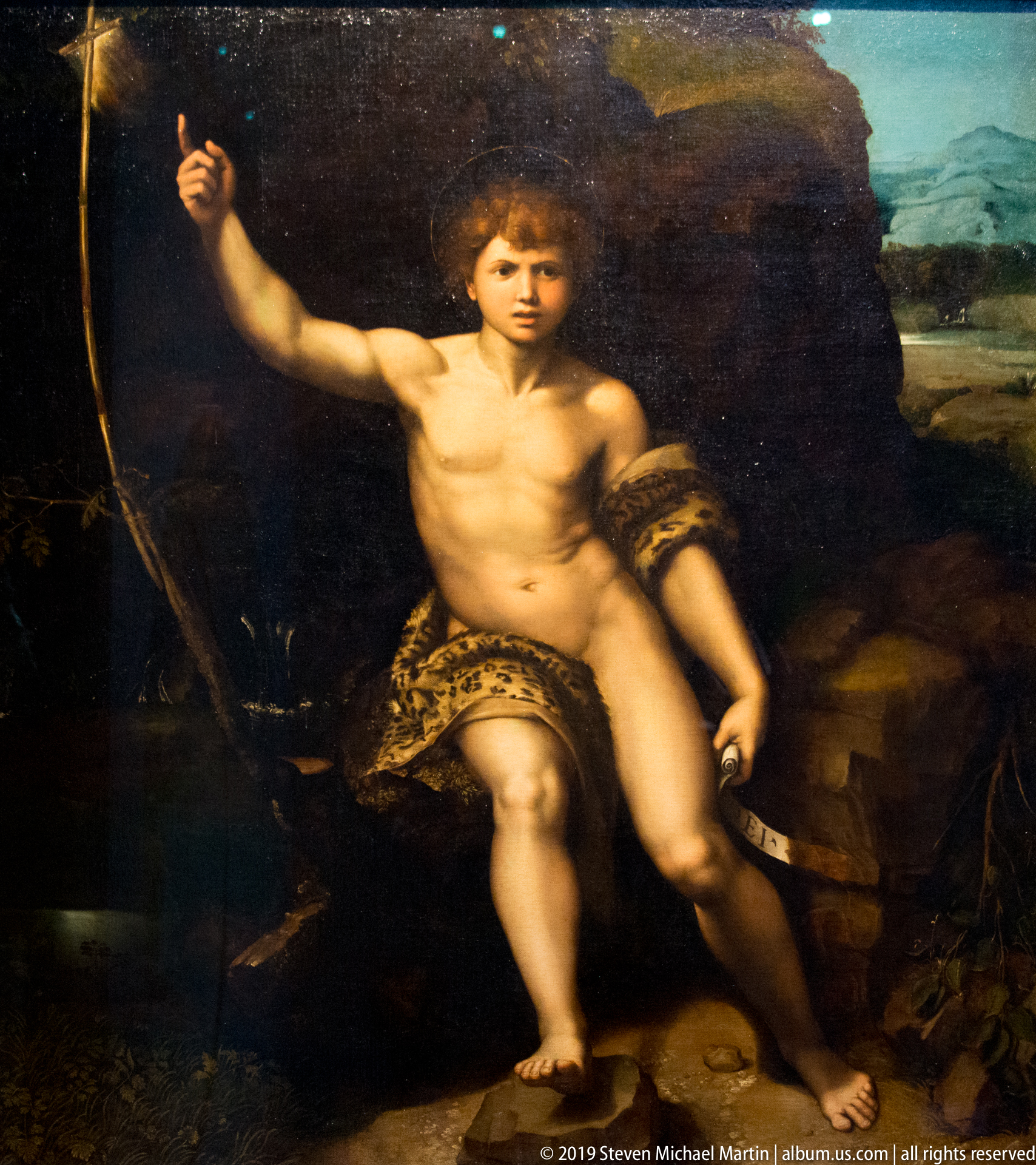
Raphael’s St John the Baptist as a Boy (c. 1518) presents Florence’s patron saint as an athletic young hermit in a rocky wilderness. Wrapped in leopard skin, John raises his hand toward the cross while carrying the scroll associated with his proclamation of Christ as the Lamb of God. The warm-lit body and emphatic gesture combine Raphael’s study of ancient sculpture with a distinctly Leonardesque atmosphere.
Caption
Raphael’s St John the Baptist as a Boy (c. 1518) presents Florence’s patron saint as an athletic young hermit in a rocky wilderness. Wrapped in leopard skin, John raises his hand toward the cross while carrying the scroll associated with his proclamation of Christ as the Lamb of God. The warm-lit body and emphatic gesture combine Raphael’s study of ancient sculpture with a distinctly Leonardesque atmosphere.
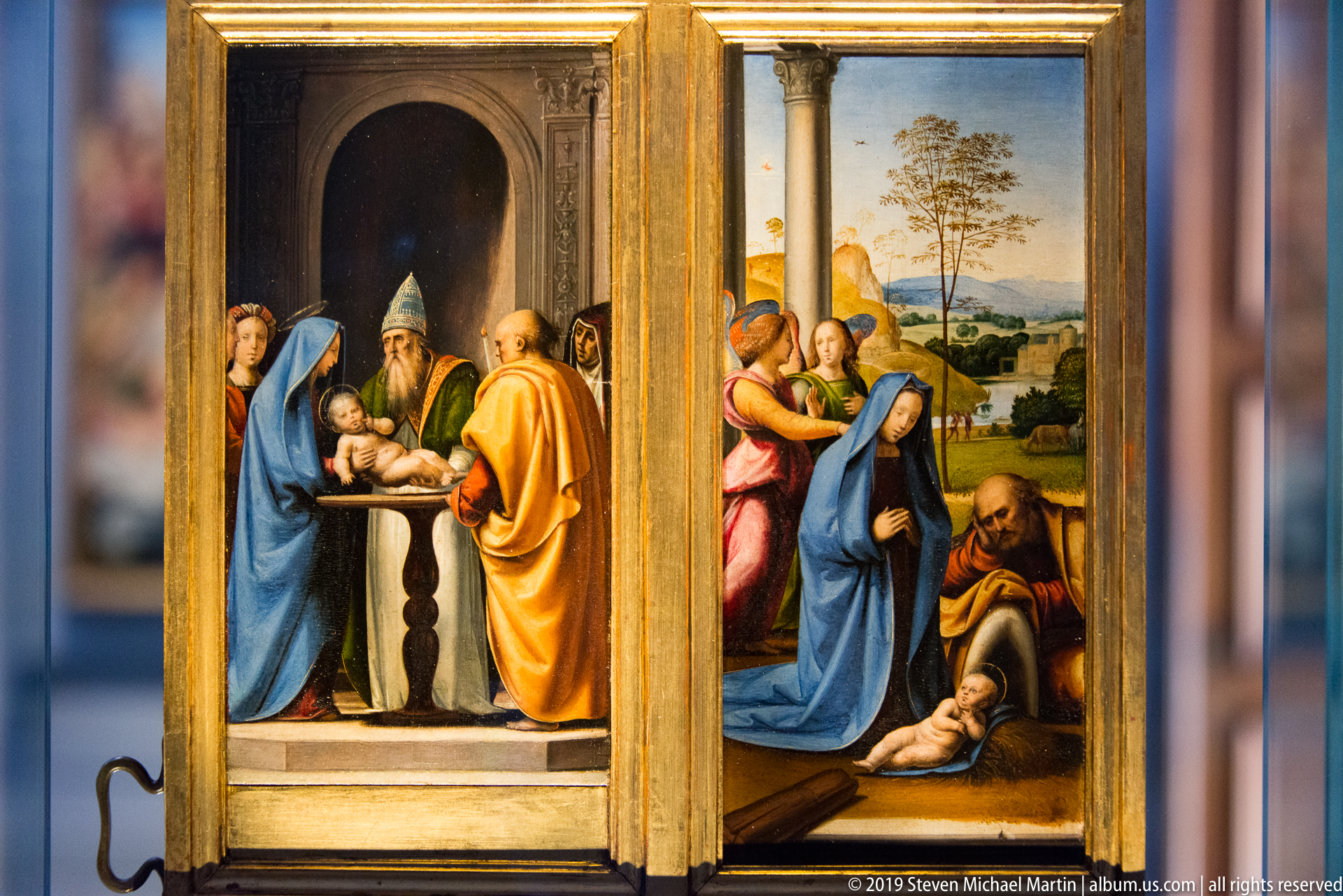
A small two-panel devotional work presents separate episodes from the life of Christ within slender gilded frames. The left scene gathers figures around an infant at an altar or temple setting, while the right places the Virgin and attendants near a newborn child in an open landscape. Architectural and landscape details give each compact scene unusual spatial depth.
Caption
A small two-panel devotional work presents separate episodes from the life of Christ within slender gilded frames. The left scene gathers figures around an infant at an altar or temple setting, while the right places the Virgin and attendants near a newborn child in an open landscape. Architectural and landscape details give each compact scene unusual spatial depth.
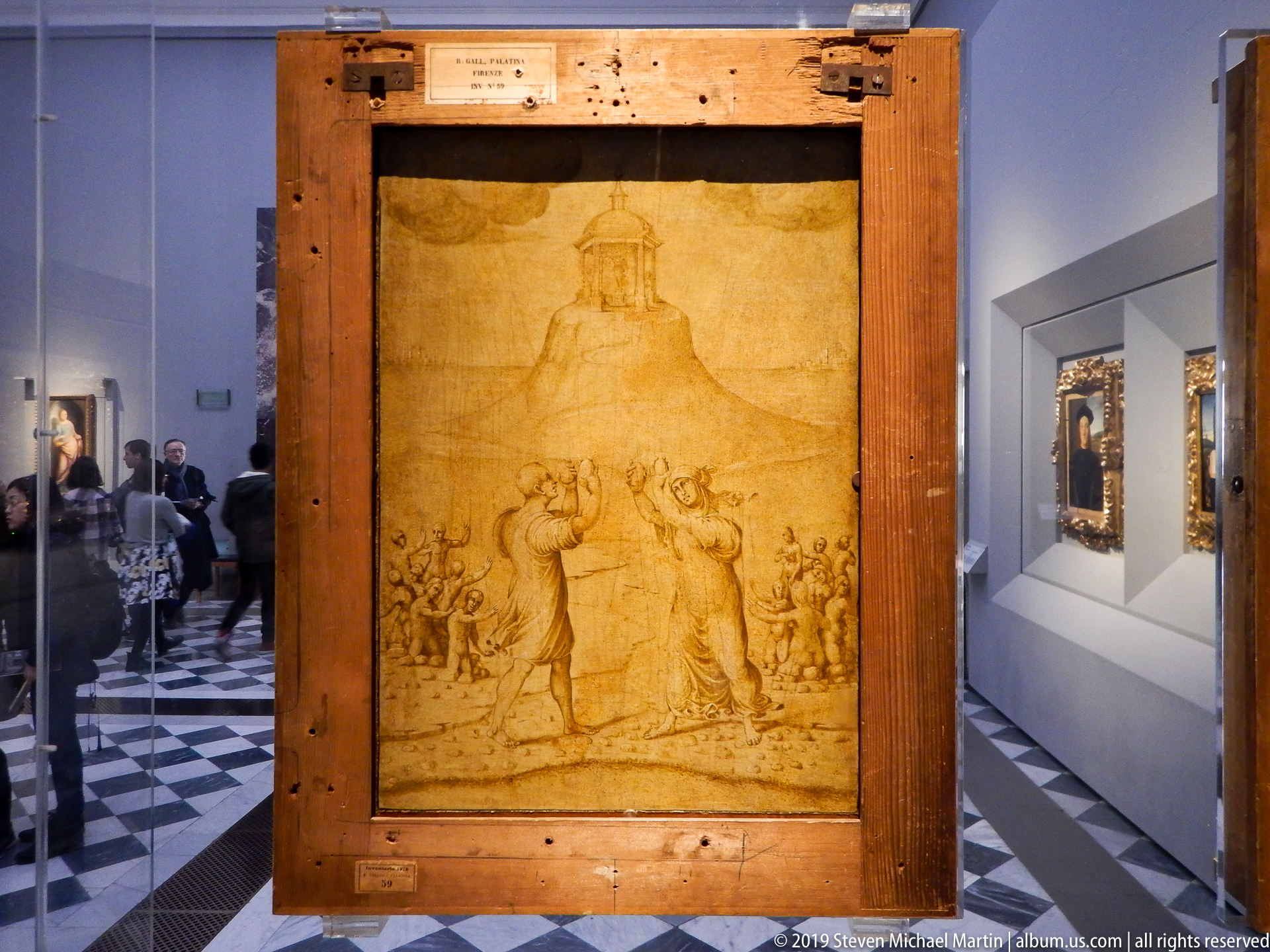
A large drawing or cartoon is displayed upright within a substantial wooden conservation frame. Fine brown lines describe a central standing figure surrounded by smaller figures and ornamental or narrative forms, while a lightly indicated architectural shape rises above. The gallery setting and protective mounting make the work’s material character and museum presentation clearly visible.
Caption
A large drawing or cartoon is displayed upright within a substantial wooden conservation frame. Fine brown lines describe a central standing figure surrounded by smaller figures and ornamental or narrative forms, while a lightly indicated architectural shape rises above. The gallery setting and protective mounting make the work’s material character and museum presentation clearly visible.
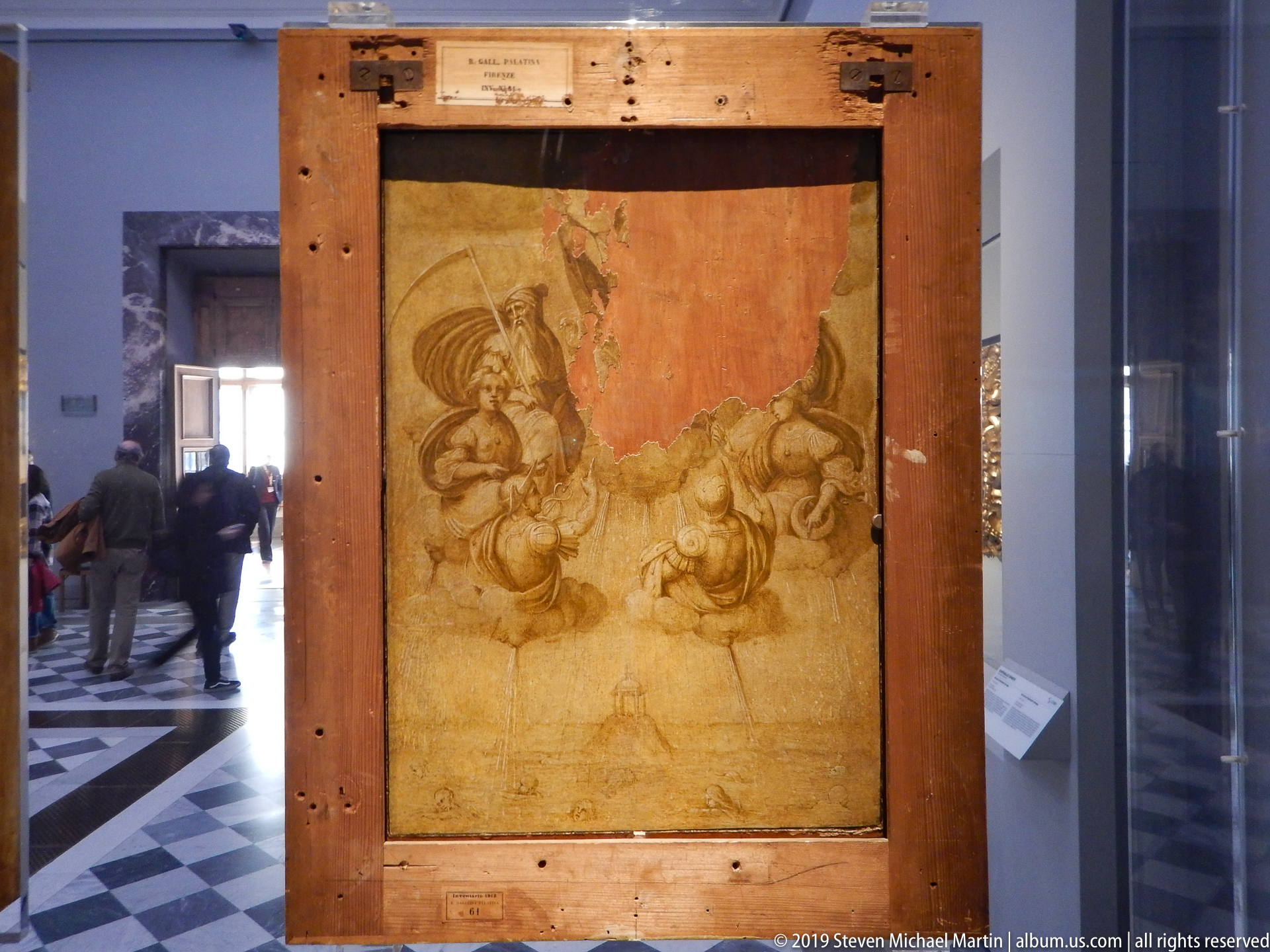
A mounted Renaissance drawing shows a dense cluster of reclining or crouching figures beneath a broad area of drapery. A red-toned painted or drawn study occupies the upper portion, contrasting with the brown linear work below. Displayed in a heavy wooden conservation frame, the sheet reveals both preparatory draftsmanship and later museum preservation.
Caption
A mounted Renaissance drawing shows a dense cluster of reclining or crouching figures beneath a broad area of drapery. A red-toned painted or drawn study occupies the upper portion, contrasting with the brown linear work below. Displayed in a heavy wooden conservation frame, the sheet reveals both preparatory draftsmanship and later museum preservation.
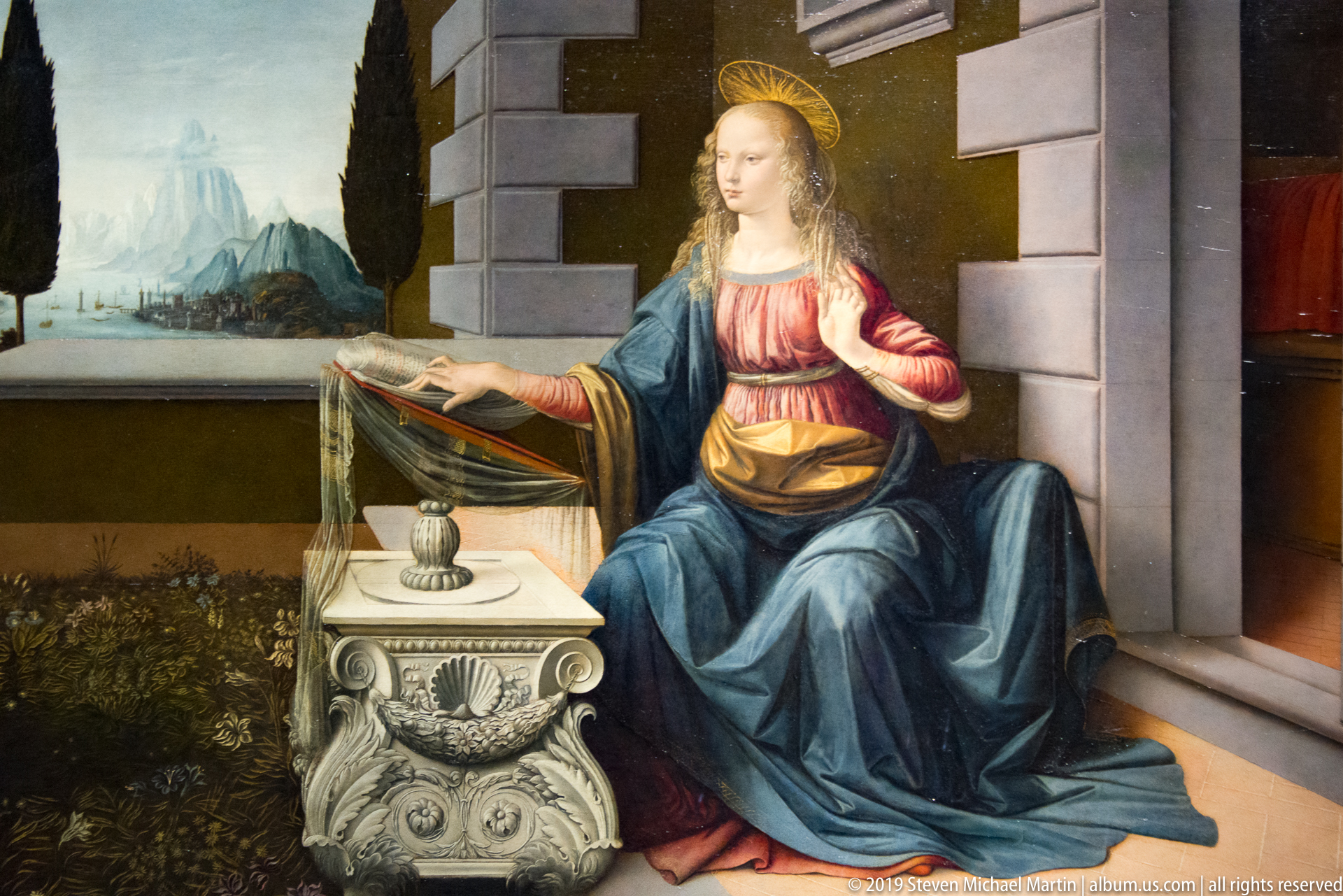
A haloed young woman sits beside an elaborately carved stone table or altar, one hand extended toward a book or cloth and the other raised near her chest. Her blue mantle falls in broad folds over a red dress, while a distant mountainous landscape appears through the opening at left. The attributes suggest a female saint, though the exact identity is uncertain.
Caption
A haloed young woman sits beside an elaborately carved stone table or altar, one hand extended toward a book or cloth and the other raised near her chest. Her blue mantle falls in broad folds over a red dress, while a distant mountainous landscape appears through the opening at left. The attributes suggest a female saint, though the exact identity is uncertain.
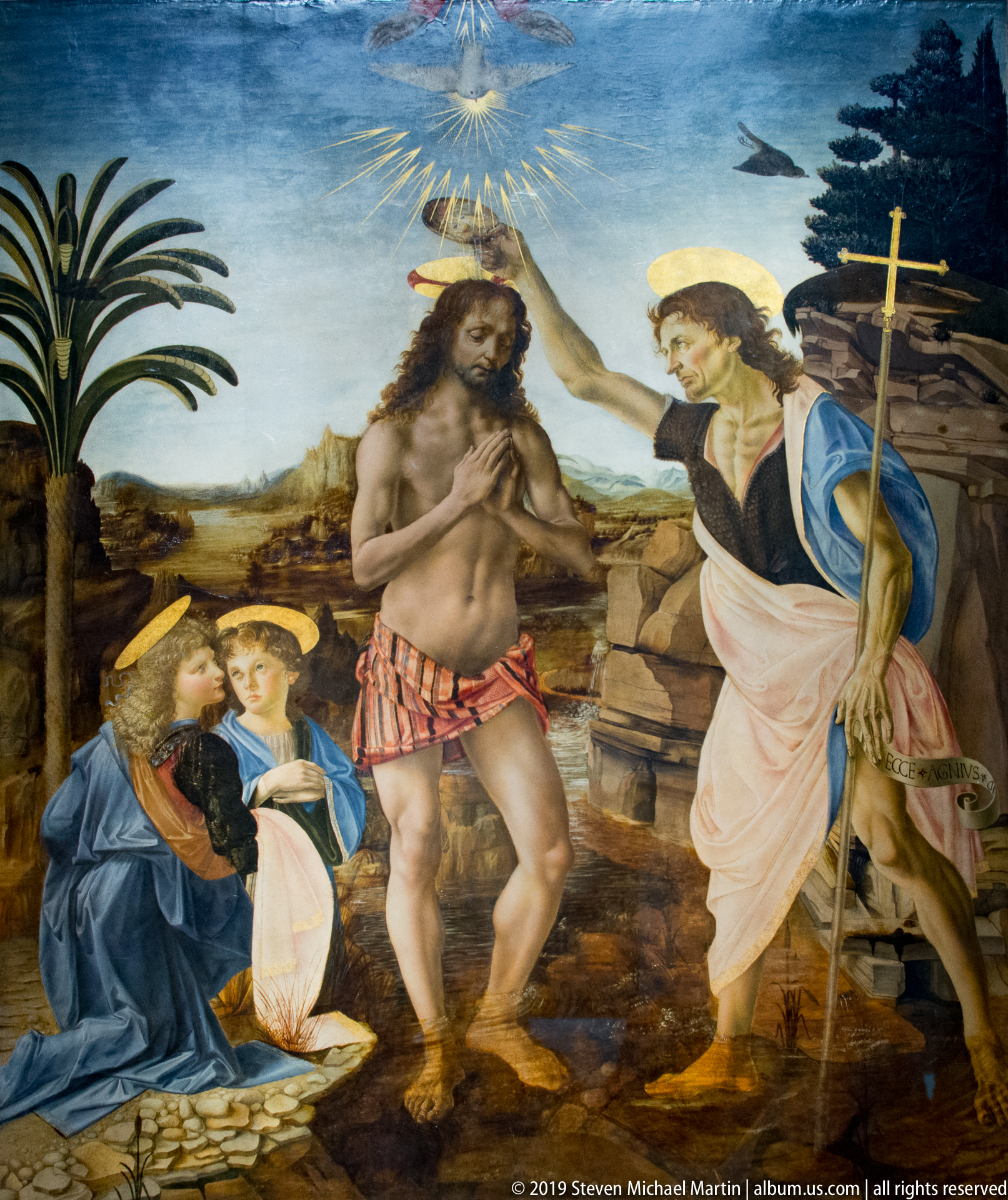
Verrocchio’s Baptism of Christ, with important contributions by the young Leonardo da Vinci, shows Christ standing in the Jordan as John pours water over his head. Two kneeling angels wait at left beneath the descending dove of the Holy Spirit. Leonardo is traditionally associated with the leftmost angel and with parts of the luminous landscape and figure of Christ, making the panel a landmark of his emergence from Verrocchio’s workshop.
Caption
Verrocchio’s Baptism of Christ, with important contributions by the young Leonardo da Vinci, shows Christ standing in the Jordan as John pours water over his head. Two kneeling angels wait at left beneath the descending dove of the Holy Spirit. Leonardo is traditionally associated with the leftmost angel and with parts of the luminous landscape and figure of Christ, making the panel a landmark of his emergence from Verrocchio’s workshop.
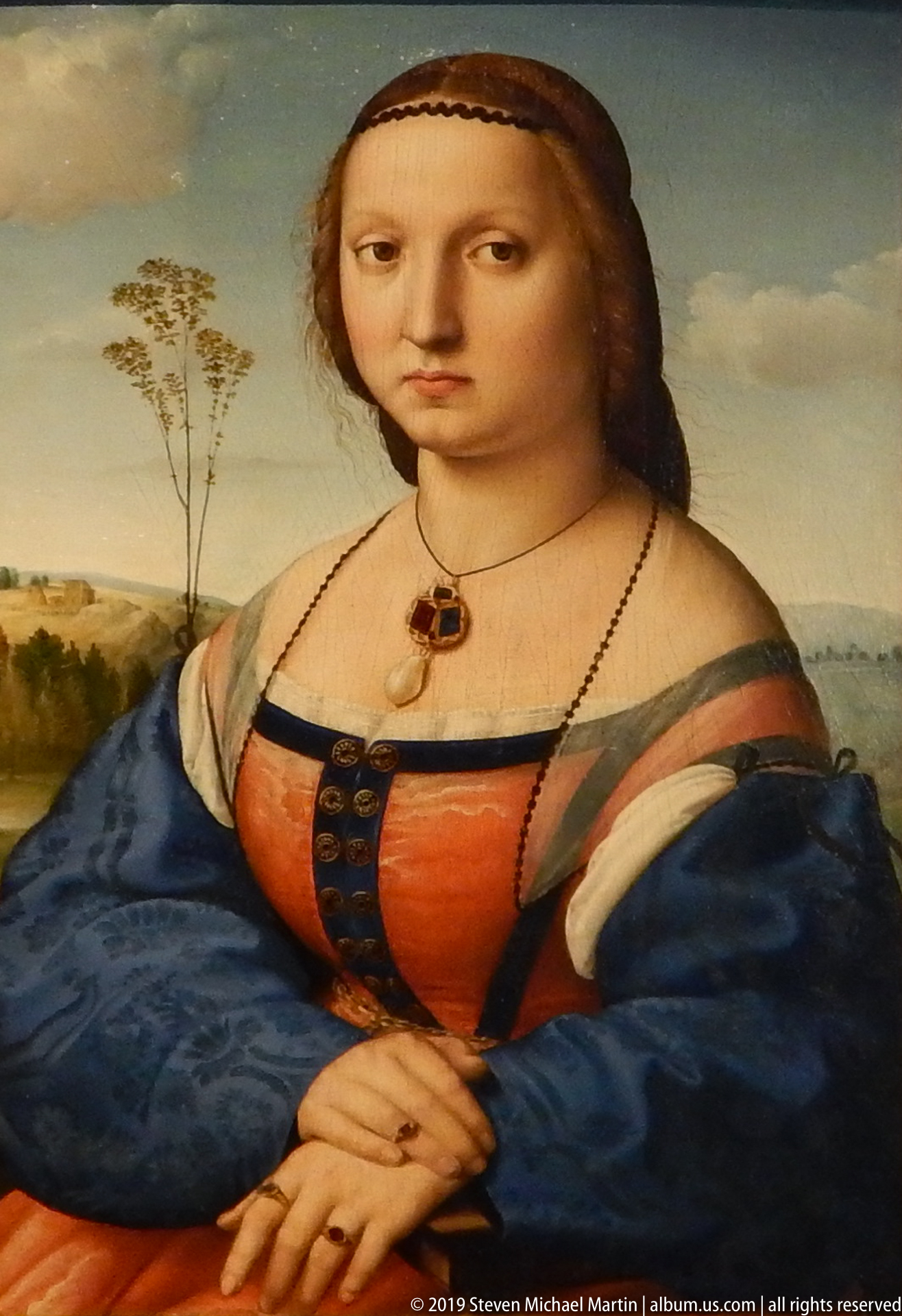
A young woman sits before a broad landscape, her hands folded calmly at the lower edge of the composition. A red bodice, deep blue sleeves, fine necklace, and jeweled pendant provide restrained points of ornament, while the softly modeled face turns slightly toward the viewer. The distant trees and pale horizon extend the portrait beyond its intimate foreground.
Caption
A young woman sits before a broad landscape, her hands folded calmly at the lower edge of the composition. A red bodice, deep blue sleeves, fine necklace, and jeweled pendant provide restrained points of ornament, while the softly modeled face turns slightly toward the viewer. The distant trees and pale horizon extend the portrait beyond its intimate foreground.
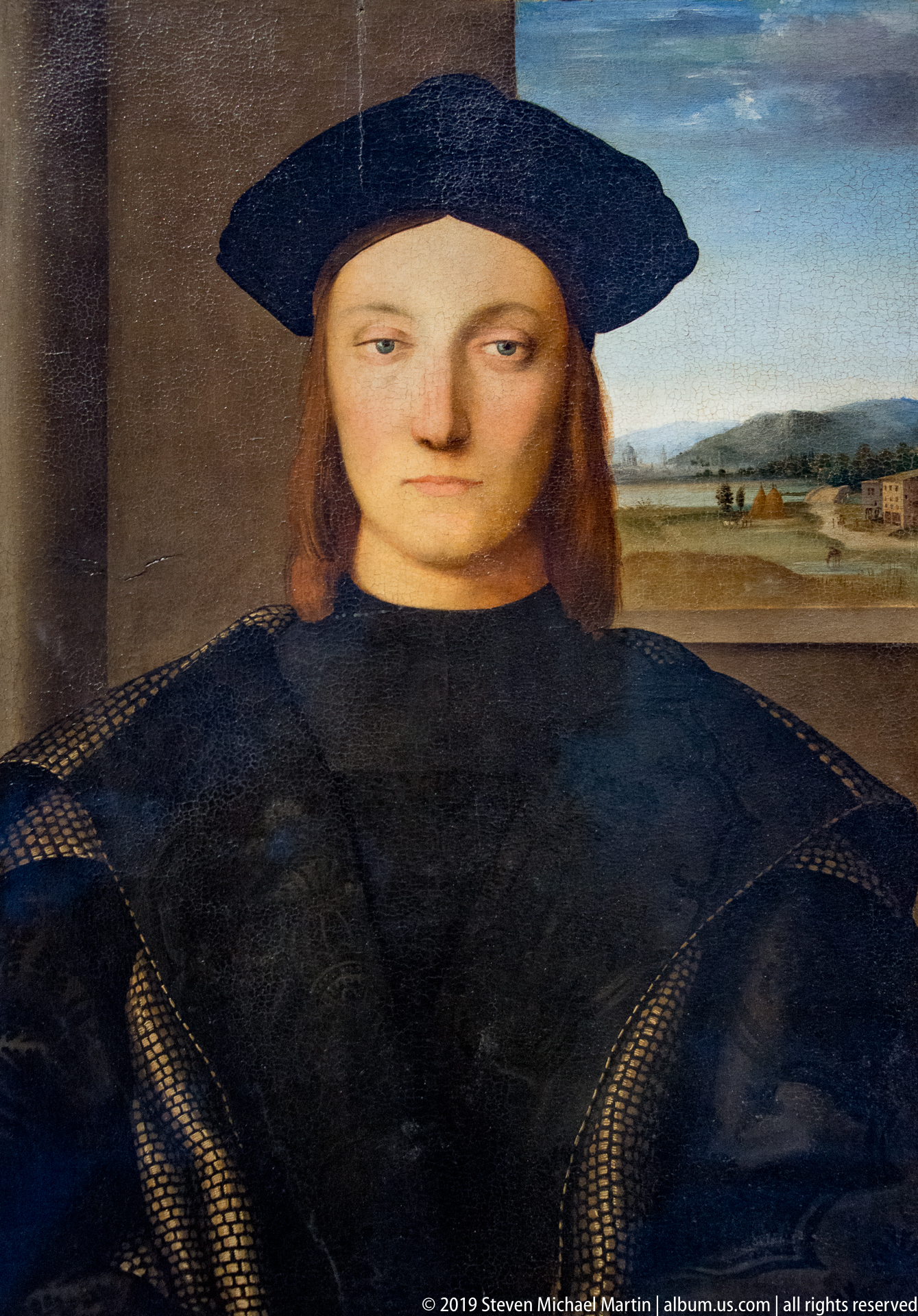
A young man faces forward in a sober black costume and broad dark cap, his reddish hair falling to the shoulders. Fine gold-toned edging traces the sleeves, while an opening behind him reveals a pale river landscape and distant hills. The restrained palette and frontal pose place particular emphasis on the sitter’s face and clothing.
Caption
A young man faces forward in a sober black costume and broad dark cap, his reddish hair falling to the shoulders. Fine gold-toned edging traces the sleeves, while an opening behind him reveals a pale river landscape and distant hills. The restrained palette and frontal pose place particular emphasis on the sitter’s face and clothing.
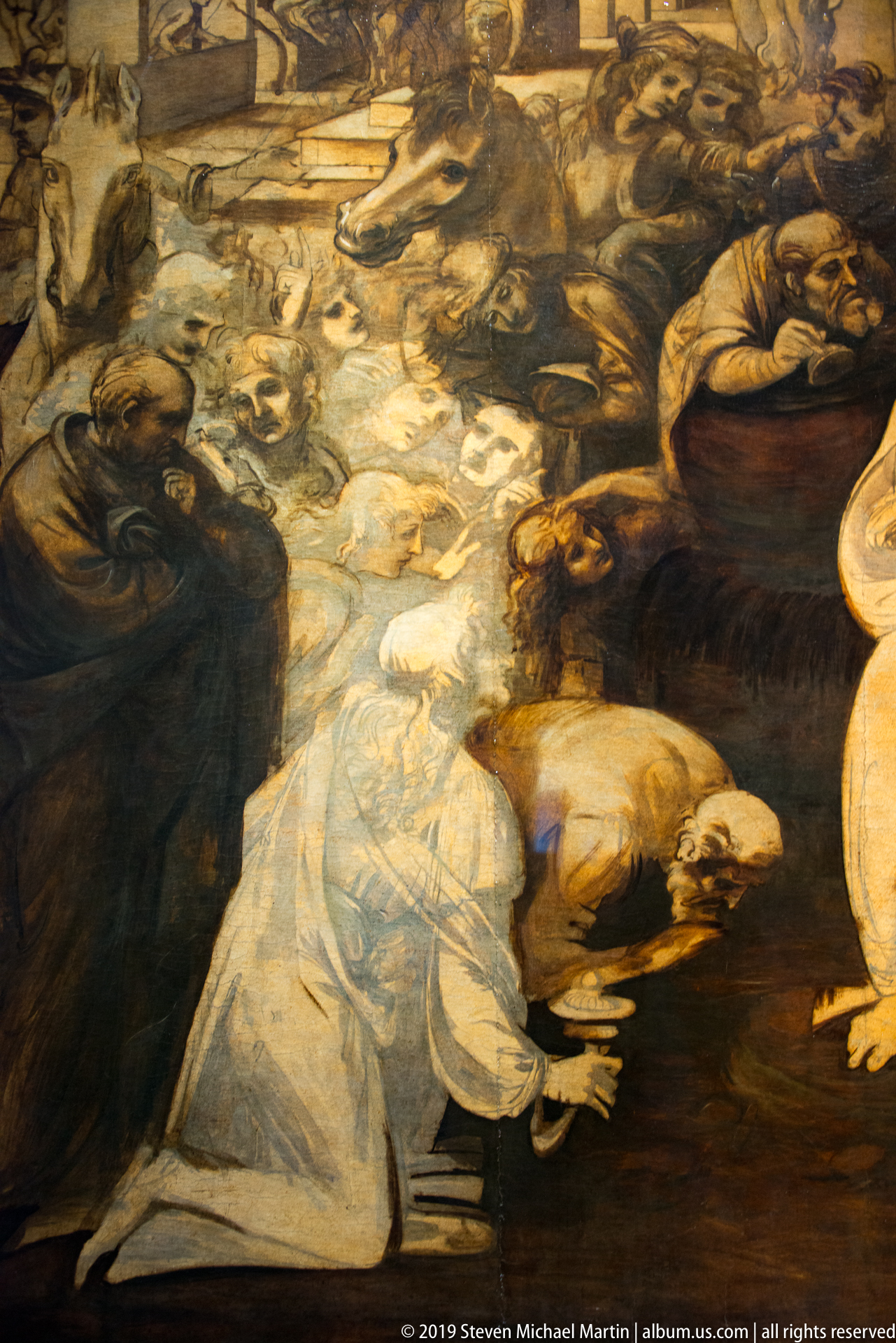
Leonardo da Vinci’s unfinished Adoration of the Magi (c. 1482) surrounds the Virgin and Child with a turbulent semicircle of worshippers, horses, gestures, and half-realized ideas. Commissioned for San Donato in Scopeto, the panel remained incomplete when Leonardo left Florence for Milan. Its exposed drawing, washes, and partially developed passages make the work an exceptional record of Leonardo thinking directly on the panel.
Caption
Leonardo da Vinci’s unfinished Adoration of the Magi (c. 1482) surrounds the Virgin and Child with a turbulent semicircle of worshippers, horses, gestures, and half-realized ideas. Commissioned for San Donato in Scopeto, the panel remained incomplete when Leonardo left Florence for Milan. Its exposed drawing, washes, and partially developed passages make the work an exceptional record of Leonardo thinking directly on the panel.
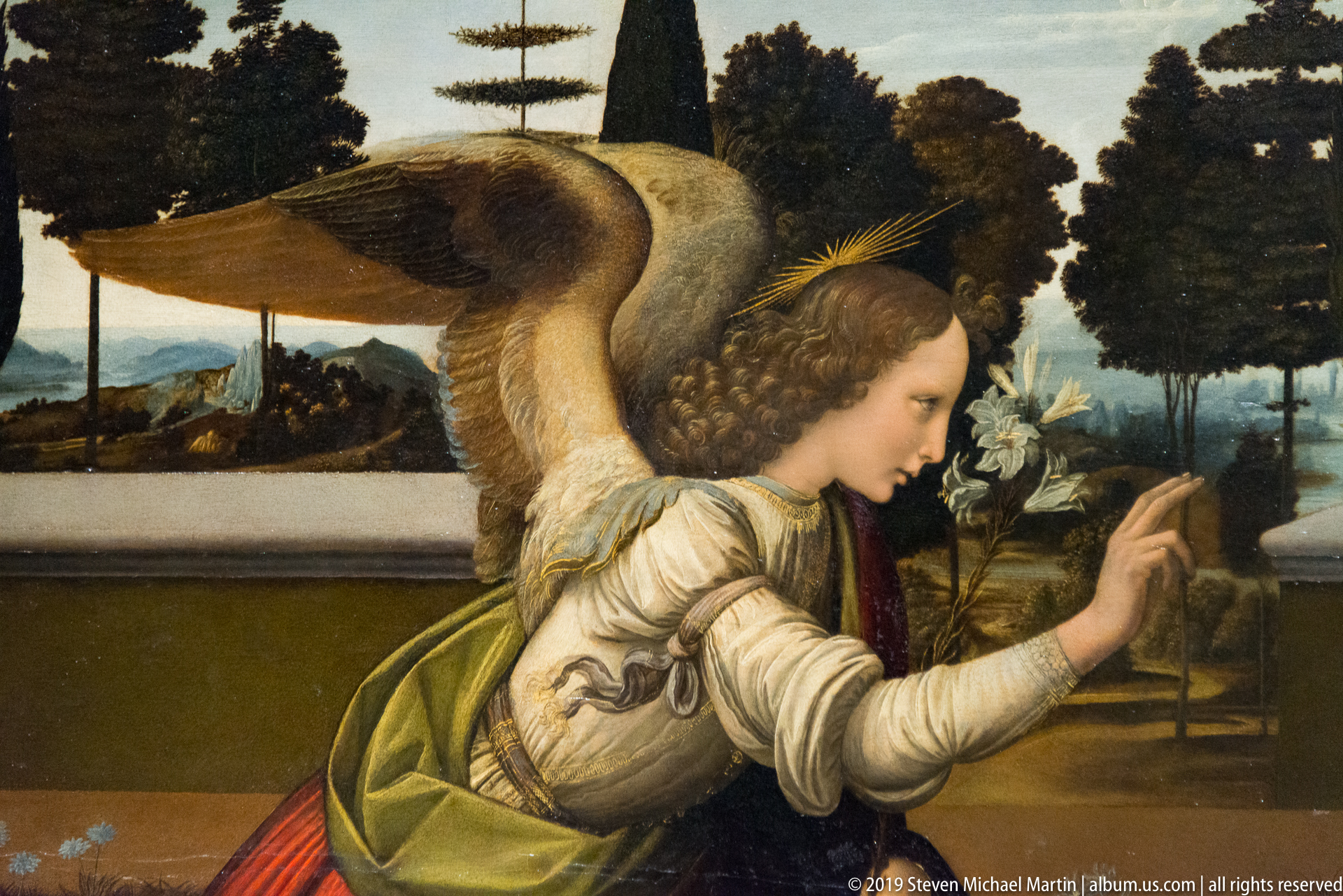
In this detail from Leonardo da Vinci’s Annunciation (c. 1472), Gabriel kneels on the flowering lawn and extends lilies toward Mary while raising his other hand in greeting. Leonardo gives the angel unusual physical presence through carefully observed drapery, a cast shadow, and wings informed by the anatomy of real birds. The garden setting belongs to the enclosed landscape symbolically associated with Mary’s purity.
Caption
In this detail from Leonardo da Vinci’s Annunciation (c. 1472), Gabriel kneels on the flowering lawn and extends lilies toward Mary while raising his other hand in greeting. Leonardo gives the angel unusual physical presence through carefully observed drapery, a cast shadow, and wings informed by the anatomy of real birds. The garden setting belongs to the enclosed landscape symbolically associated with Mary’s purity.
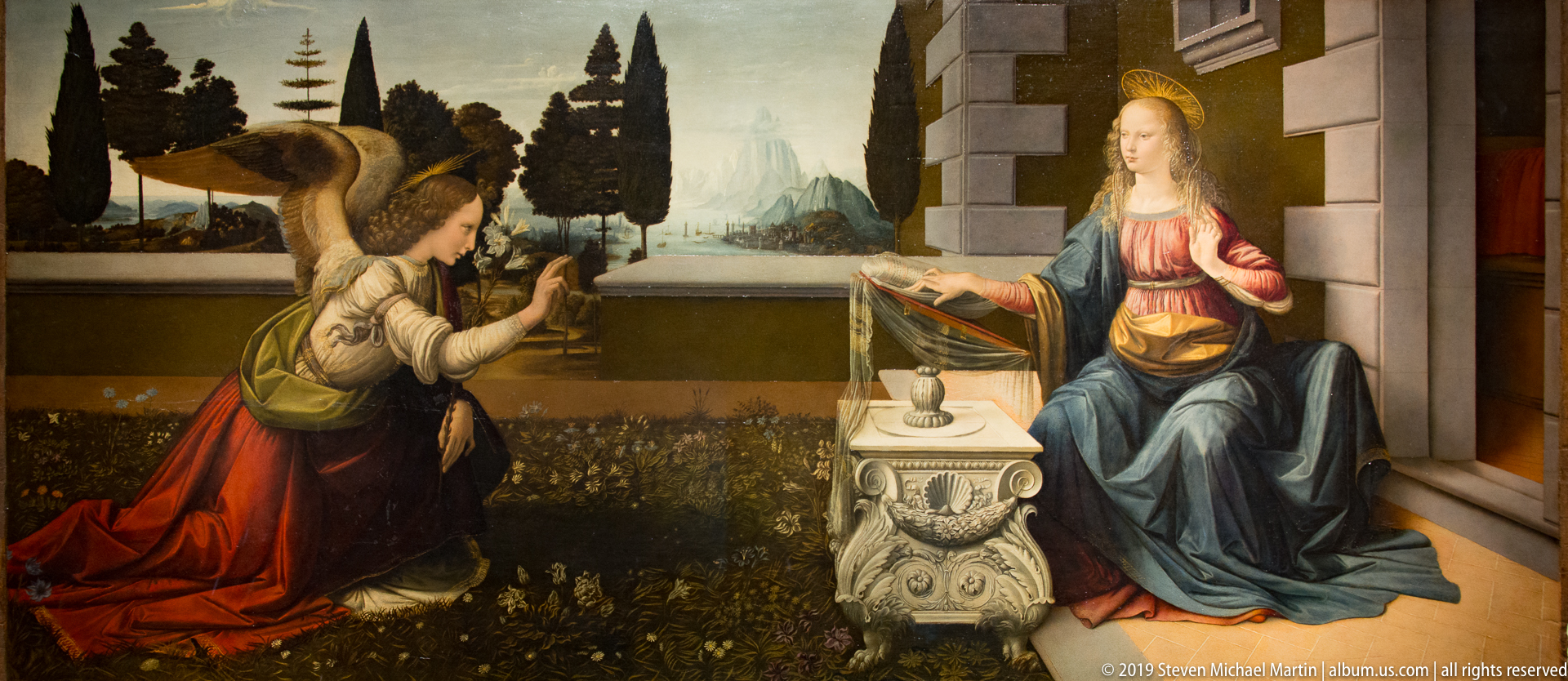
Leonardo da Vinci’s Annunciation (c. 1472) sets Gabriel’s message to Mary in a meticulously observed Renaissance garden. The angel kneels at left with lilies while Mary turns from her reading at an ornate lectern; beyond the dark trees, an atmospheric river-and-mountain landscape dissolves into blue distance. The work already demonstrates Leonardo’s fascination with natural observation, light, spatial recession, and the physical credibility of sacred figures.
Caption
Leonardo da Vinci’s Annunciation (c. 1472) sets Gabriel’s message to Mary in a meticulously observed Renaissance garden. The angel kneels at left with lilies while Mary turns from her reading at an ornate lectern; beyond the dark trees, an atmospheric river-and-mountain landscape dissolves into blue distance. The work already demonstrates Leonardo’s fascination with natural observation, light, spatial recession, and the physical credibility of sacred figures.
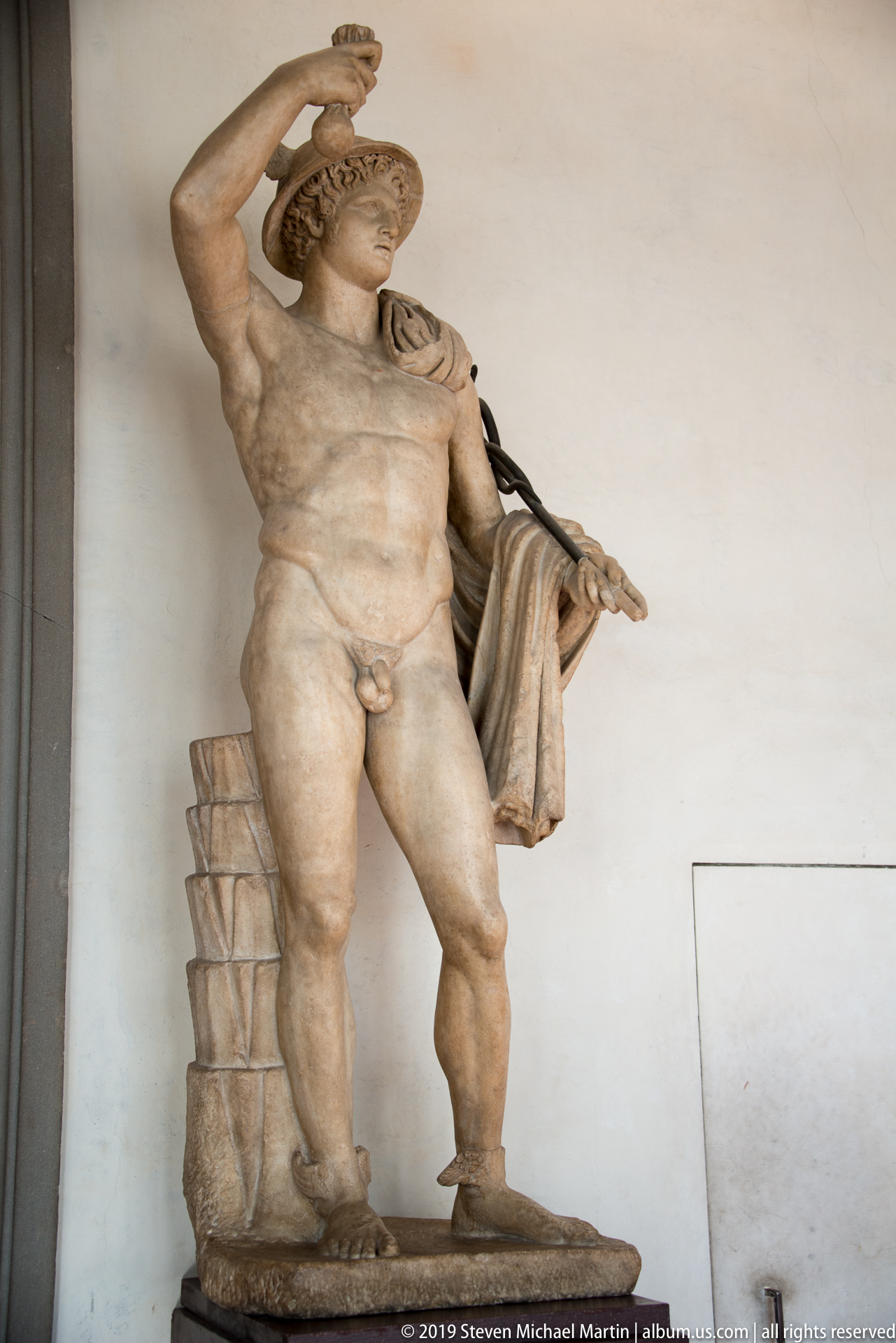
A muscular nude male figure twists through a wide, unstable stance, one arm lifted above the head and the other extended outward with drapery falling behind it. A block-like support rises beside the rear leg. The pronounced turn of the torso and uneven weight distribution give the marble an emphatically active silhouette.
Caption
A muscular nude male figure twists through a wide, unstable stance, one arm lifted above the head and the other extended outward with drapery falling behind it. A block-like support rises beside the rear leg. The pronounced turn of the torso and uneven weight distribution give the marble an emphatically active silhouette.
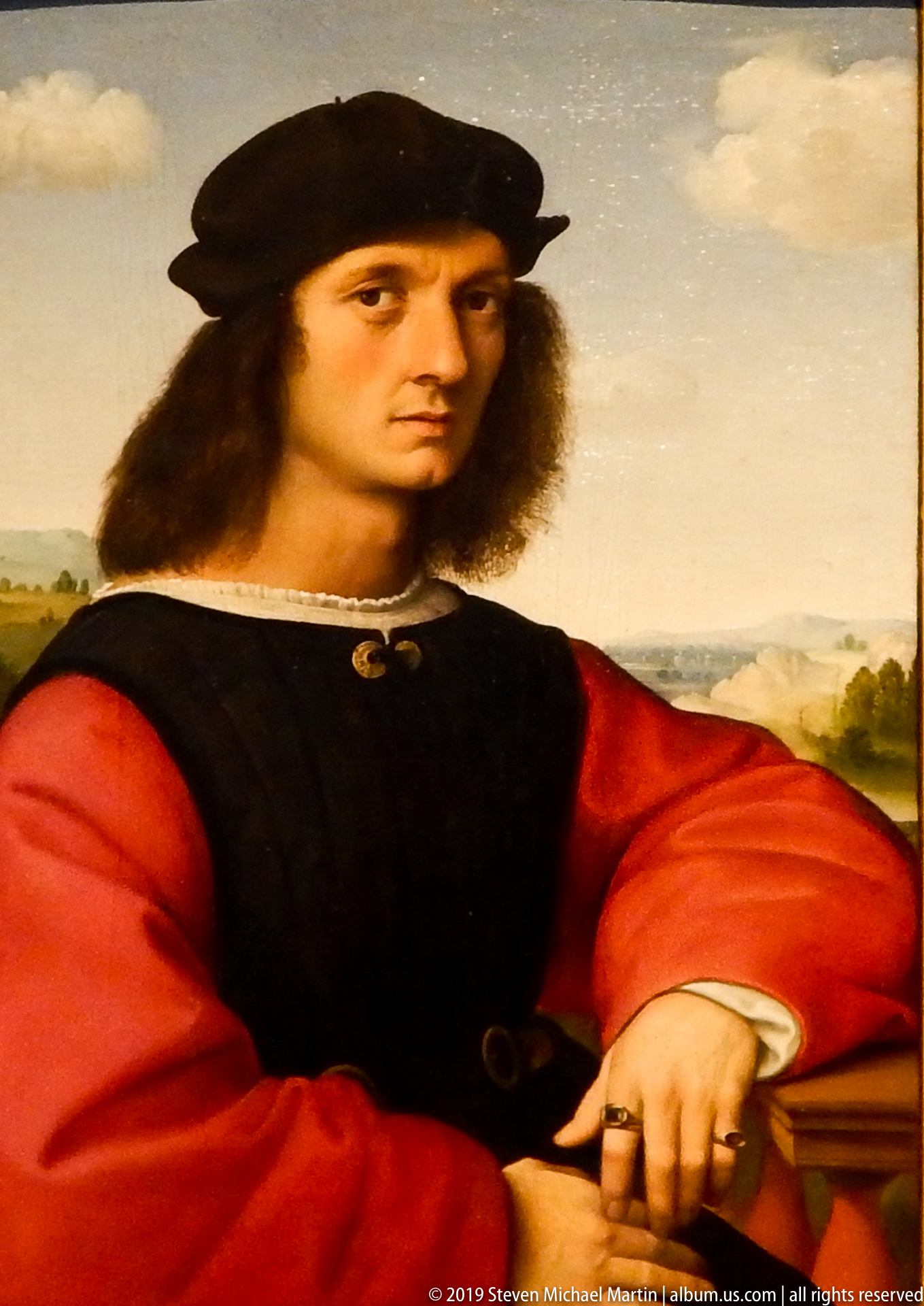
A young man sits against a distant landscape wearing a black doublet with voluminous red sleeves and a flat dark cap. One hand rests prominently on a book or ledge, displaying a ring, while the other arm anchors the broad horizontal pose. The sitter’s direct gaze and saturated sleeves give the portrait a commanding visual presence.
Caption
A young man sits against a distant landscape wearing a black doublet with voluminous red sleeves and a flat dark cap. One hand rests prominently on a book or ledge, displaying a ring, while the other arm anchors the broad horizontal pose. The sitter’s direct gaze and saturated sleeves give the portrait a commanding visual presence.
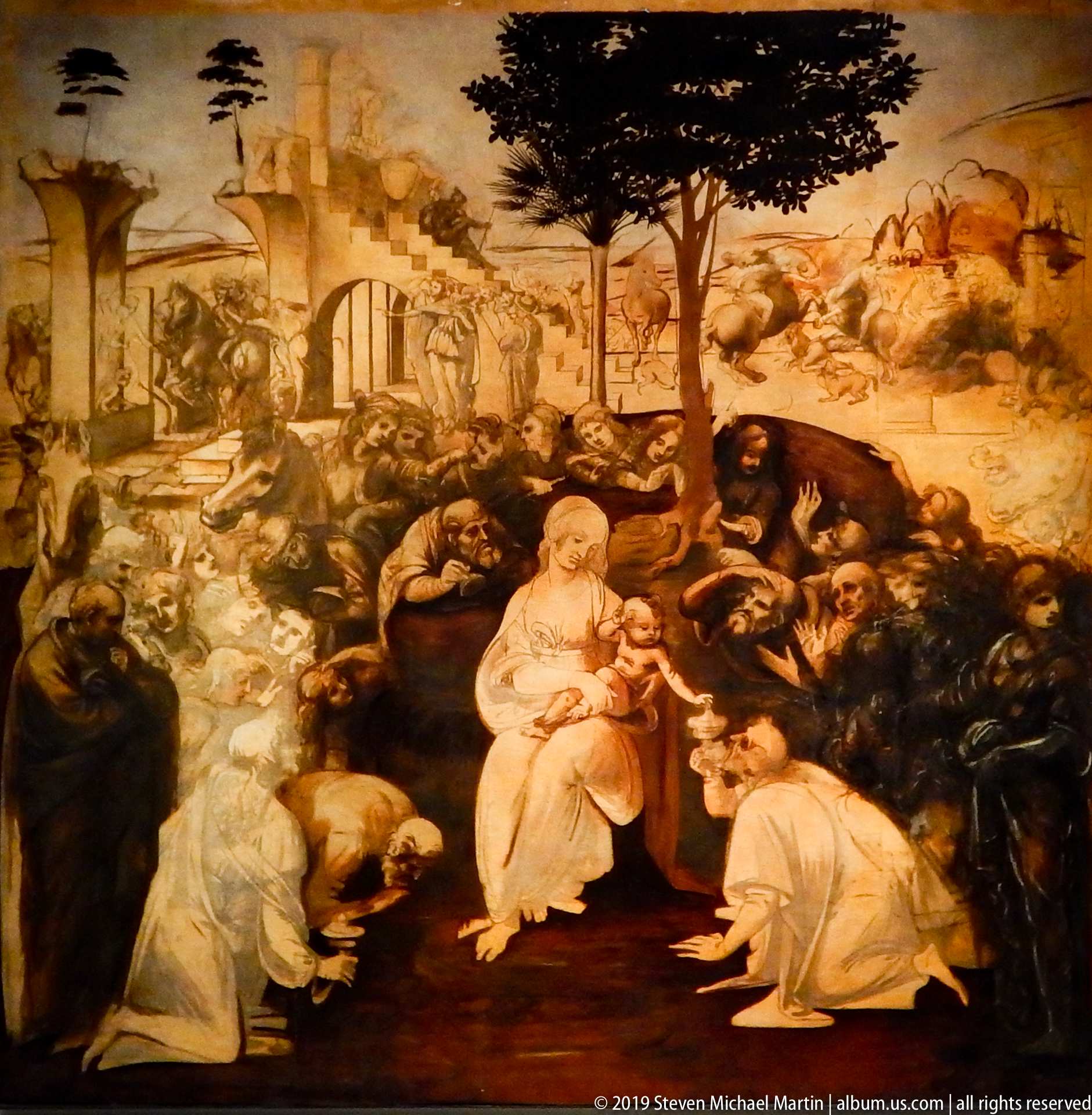
This closer view of Leonardo’s unfinished Adoration of the Magi concentrates on the Virgin and Child beneath the tree and the worshippers pressing toward them. Darker developed passages coexist with lightly stated figures, making changes of pose and emphasis unusually legible. The incomplete surface is not a later loss but a defining feature of the work Leonardo left behind when he departed Florence for Milan.
Caption
This closer view of Leonardo’s unfinished Adoration of the Magi concentrates on the Virgin and Child beneath the tree and the worshippers pressing toward them. Darker developed passages coexist with lightly stated figures, making changes of pose and emphasis unusually legible. The incomplete surface is not a later loss but a defining feature of the work Leonardo left behind when he departed Florence for Milan.
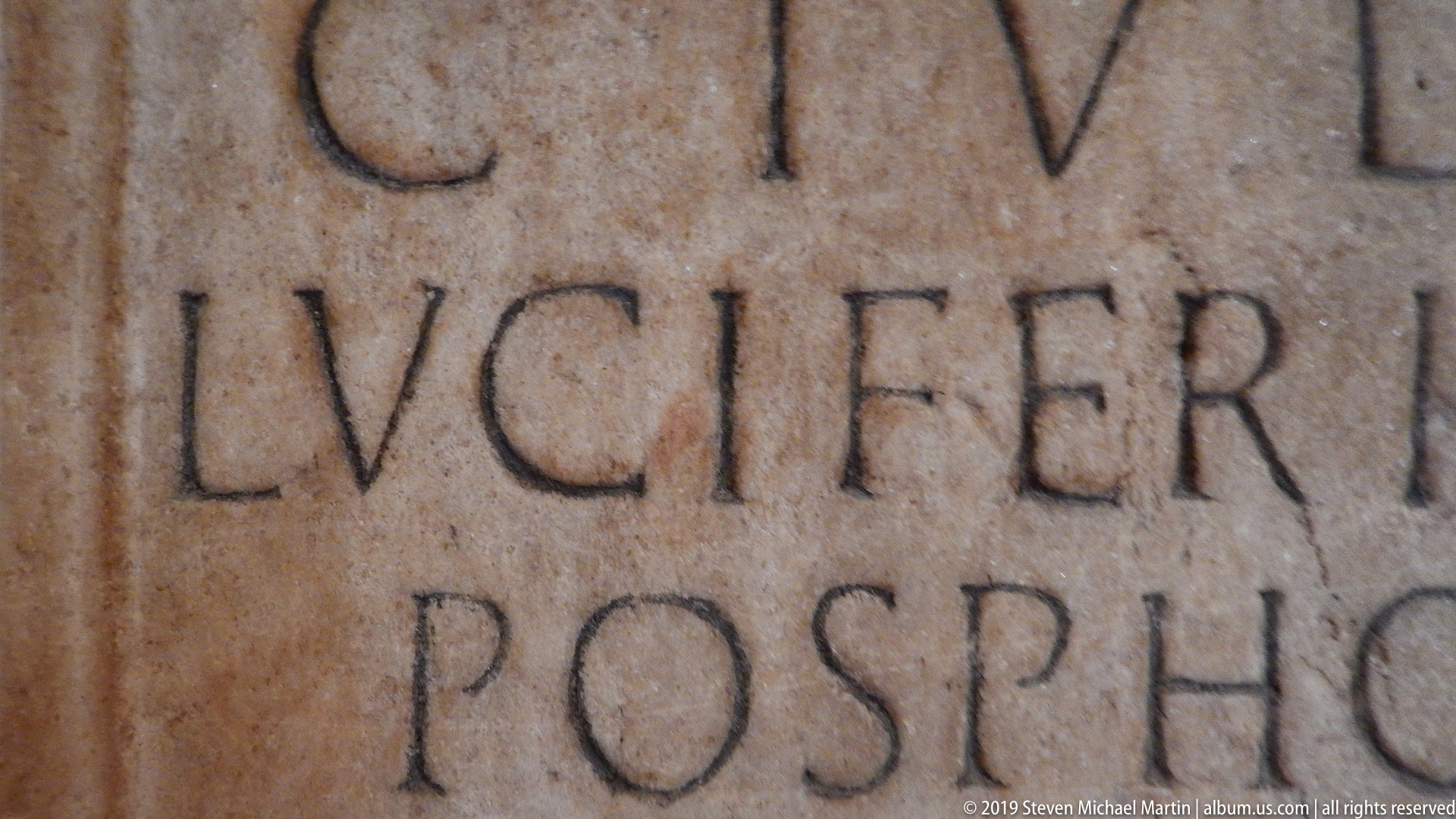
Deeply incised capital letters fill this close study of a weathered stone inscription. The surviving lines include clearly legible fragments such as “LVCIFER” and “POSPH,” while adjacent letters are cropped by the frame. Raking light and the tight viewpoint emphasize the cut letterforms, surface wear, and material texture rather than the monument as a whole.
Caption
Deeply incised capital letters fill this close study of a weathered stone inscription. The surviving lines include clearly legible fragments such as “LVCIFER” and “POSPH,” while adjacent letters are cropped by the frame. Raking light and the tight viewpoint emphasize the cut letterforms, surface wear, and material texture rather than the monument as a whole.

A crowded marble relief arranges standing and seated figures around a large circular shield or medallion framed by a wreath. Several nude male bodies lean and turn across the lower register, while draped figures occupy the upper field against an architectural backdrop. The shallow carving compresses multiple actions into a continuous ceremonial or mythological scene.
Caption
A crowded marble relief arranges standing and seated figures around a large circular shield or medallion framed by a wreath. Several nude male bodies lean and turn across the lower register, while draped figures occupy the upper field against an architectural backdrop. The shallow carving compresses multiple actions into a continuous ceremonial or mythological scene.
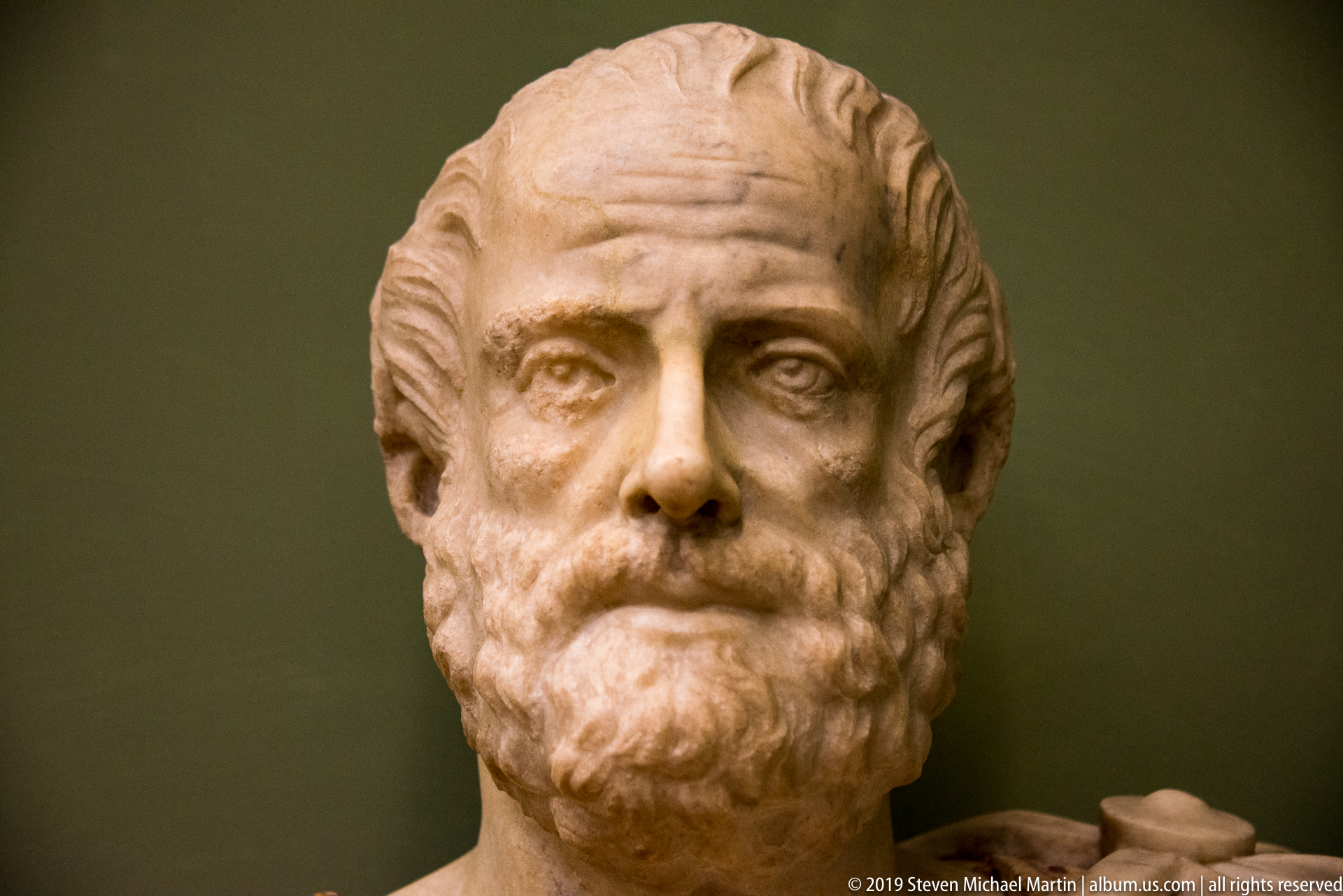
A mature bearded man is rendered frontally in pale marble, with deeply set eyes, a broad brow, and hair swept back from the forehead. The beard is cut in compact curls that contrast with the smoother cheeks and temples. The tight crop isolates the individualized facial modeling against the gallery’s muted green wall.
Caption
A mature bearded man is rendered frontally in pale marble, with deeply set eyes, a broad brow, and hair swept back from the forehead. The beard is cut in compact curls that contrast with the smoother cheeks and temples. The tight crop isolates the individualized facial modeling against the gallery’s muted green wall.
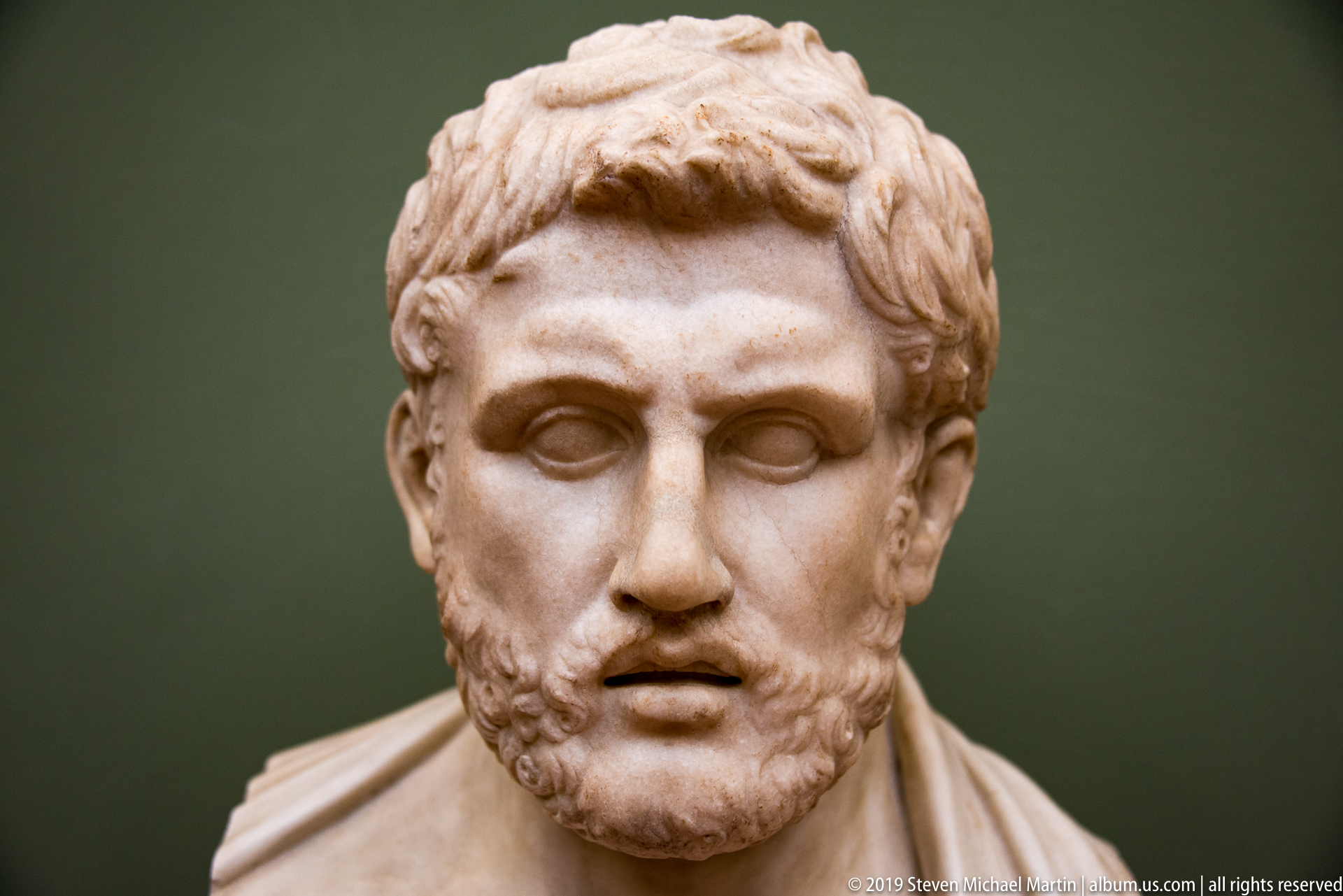
A youthful male head with short curls and a neatly modeled beard faces directly forward. The blank carved eyes, slightly parted lips, and crisp treatment of the hair stand out against the dark green wall. A small portion of drapery survives at the shoulders, indicating that the portrait was conceived as a bust rather than an isolated head.
Caption
A youthful male head with short curls and a neatly modeled beard faces directly forward. The blank carved eyes, slightly parted lips, and crisp treatment of the hair stand out against the dark green wall. A small portion of drapery survives at the shoulders, indicating that the portrait was conceived as a bust rather than an isolated head.
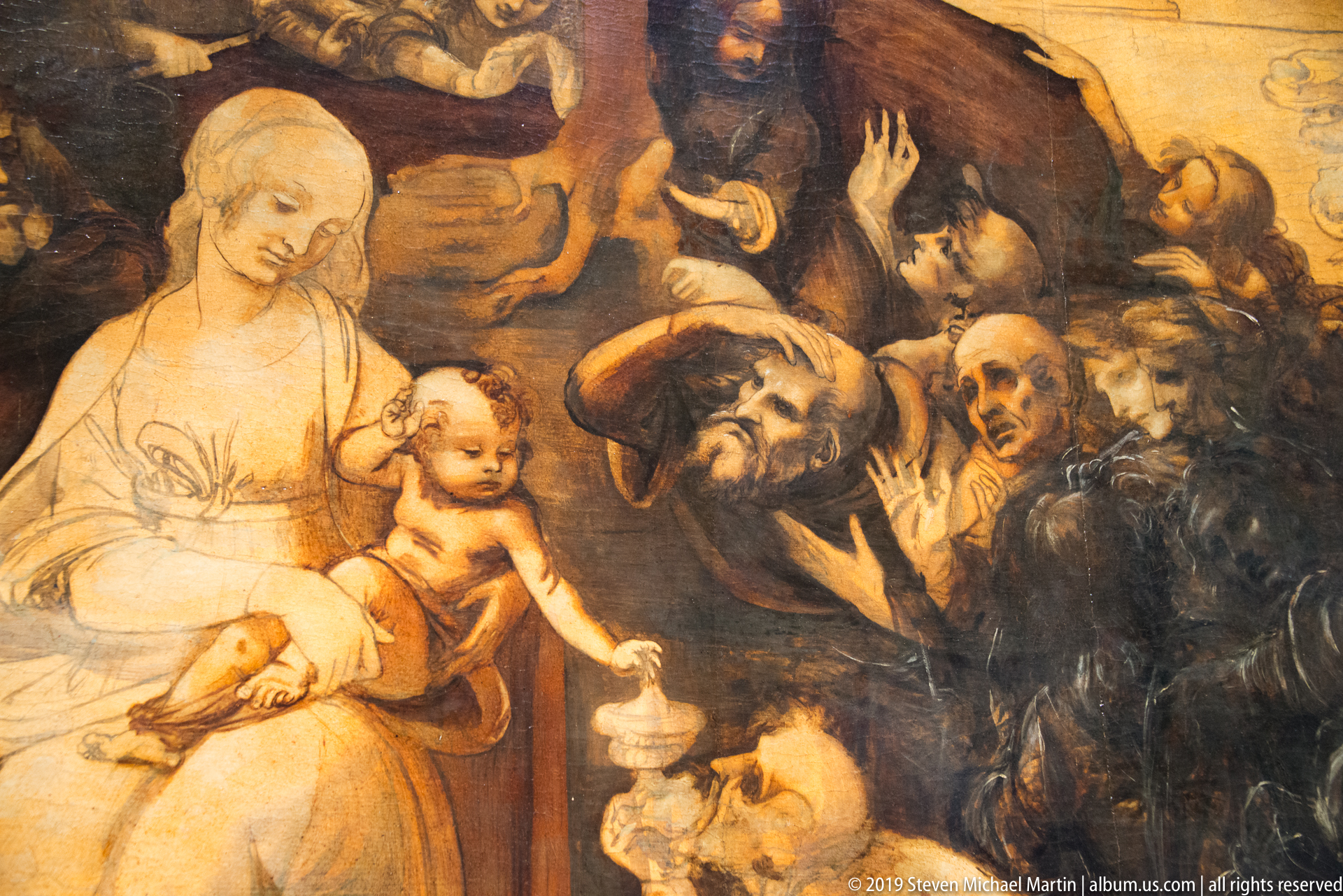
This close view enters the emotional center of Leonardo’s unfinished Adoration of the Magi. The Virgin and Child anchor a vortex of kneeling and gesturing men whose varied faces register astonishment at the Epiphany. Because Leonardo left the panel incomplete, drawing, modeling, and revision remain visible together, allowing the clustered heads and hands to reveal the experimental process behind the larger composition.
Caption
This close view enters the emotional center of Leonardo’s unfinished Adoration of the Magi. The Virgin and Child anchor a vortex of kneeling and gesturing men whose varied faces register astonishment at the Epiphany. Because Leonardo left the panel incomplete, drawing, modeling, and revision remain visible together, allowing the clustered heads and hands to reveal the experimental process behind the larger composition.

A wider view of Leonardo’s Adoration of the Magi reveals how the Virgin and Child sit within an extraordinary field of competing actions. Worshippers kneel and turn in the foreground, horses and riders animate the distance, and unfinished architecture and landscape emerge through the brown preparatory layers. Leonardo abandoned the commission on leaving Florence in 1482, preserving the panel at multiple stages of invention.
Caption
A wider view of Leonardo’s Adoration of the Magi reveals how the Virgin and Child sit within an extraordinary field of competing actions. Worshippers kneel and turn in the foreground, horses and riders animate the distance, and unfinished architecture and landscape emerge through the brown preparatory layers. Leonardo abandoned the commission on leaving Florence in 1482, preserving the panel at multiple stages of invention.
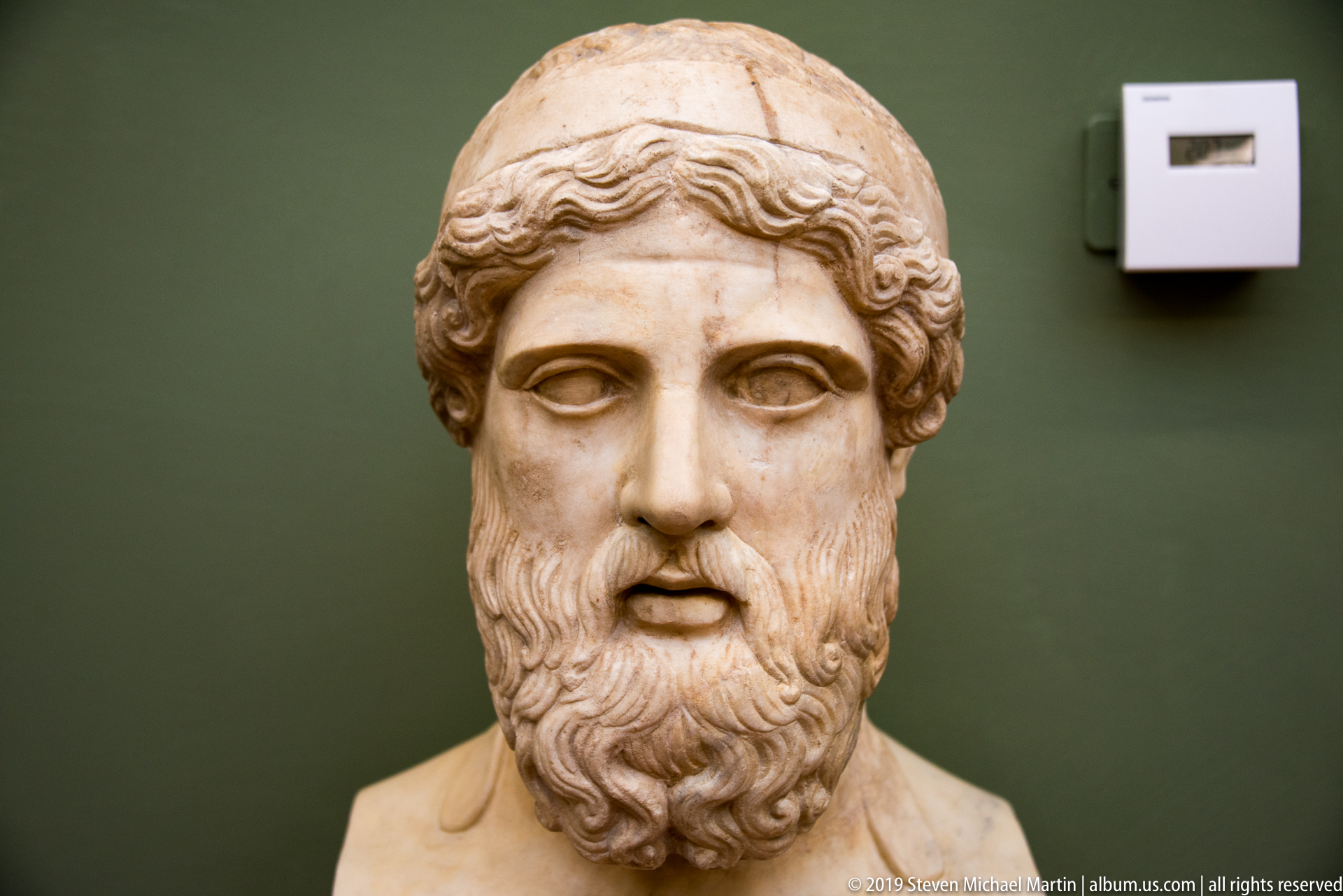
A solemn male head faces forward beneath center-parted, softly waved hair. A long, carefully drilled beard descends in layered curls around the chin, balancing the smooth planes of the forehead and cheeks. The symmetrical frontal presentation and neutral gallery background make the differences between hair, beard, and facial modeling especially easy to compare.
Caption
A solemn male head faces forward beneath center-parted, softly waved hair. A long, carefully drilled beard descends in layered curls around the chin, balancing the smooth planes of the forehead and cheeks. The symmetrical frontal presentation and neutral gallery background make the differences between hair, beard, and facial modeling especially easy to compare.
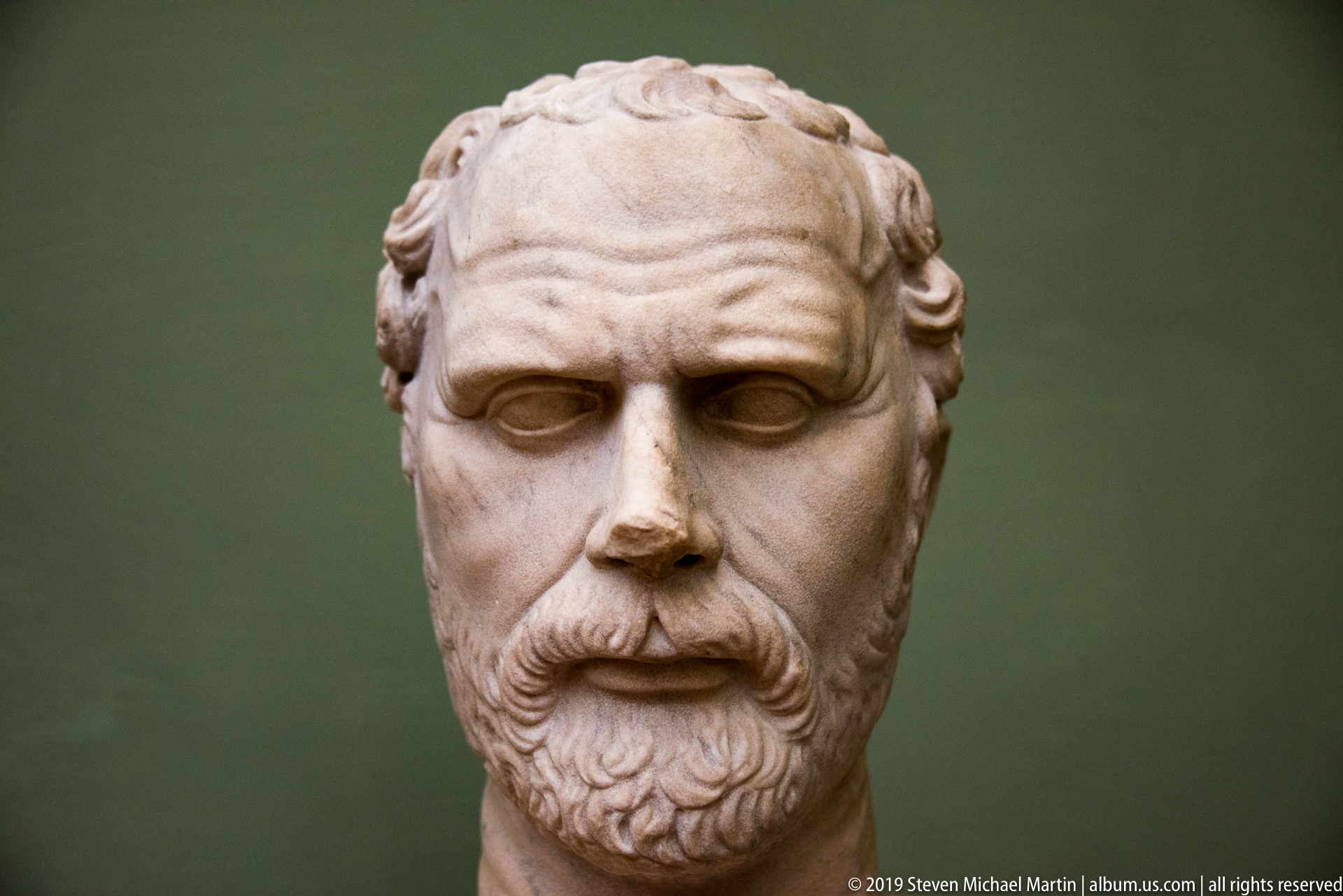
A male portrait with close-cropped hair, heavy brow, mustache, and compact beard is shown in a direct frontal view. The features are broad and strongly individualized, with pronounced creases across the forehead and around the eyes. The restrained treatment of the hair contrasts with the denser carving of the beard and mustache.
Caption
A male portrait with close-cropped hair, heavy brow, mustache, and compact beard is shown in a direct frontal view. The features are broad and strongly individualized, with pronounced creases across the forehead and around the eyes. The restrained treatment of the hair contrasts with the denser carving of the beard and mustache.
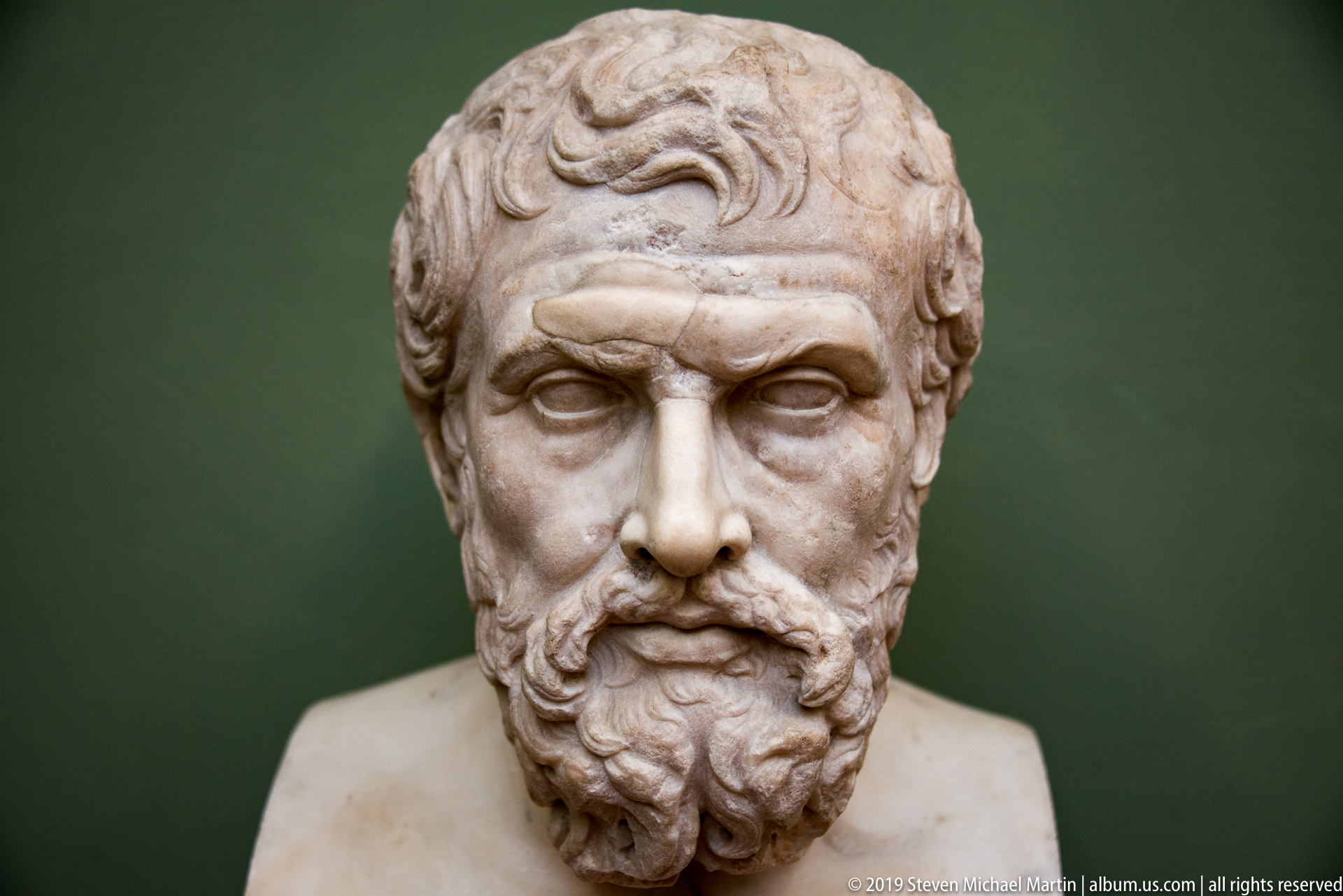
A mature man with a deeply furrowed brow and strongly modeled beard looks straight ahead from a pale marble bust. Thick locks sweep across the forehead, while the beard separates into curling masses around the mouth and chin. The concentrated expression and frontal lighting accentuate the portrait’s rugged, individualized surface.
Caption
A mature man with a deeply furrowed brow and strongly modeled beard looks straight ahead from a pale marble bust. Thick locks sweep across the forehead, while the beard separates into curling masses around the mouth and chin. The concentrated expression and frontal lighting accentuate the portrait’s rugged, individualized surface.
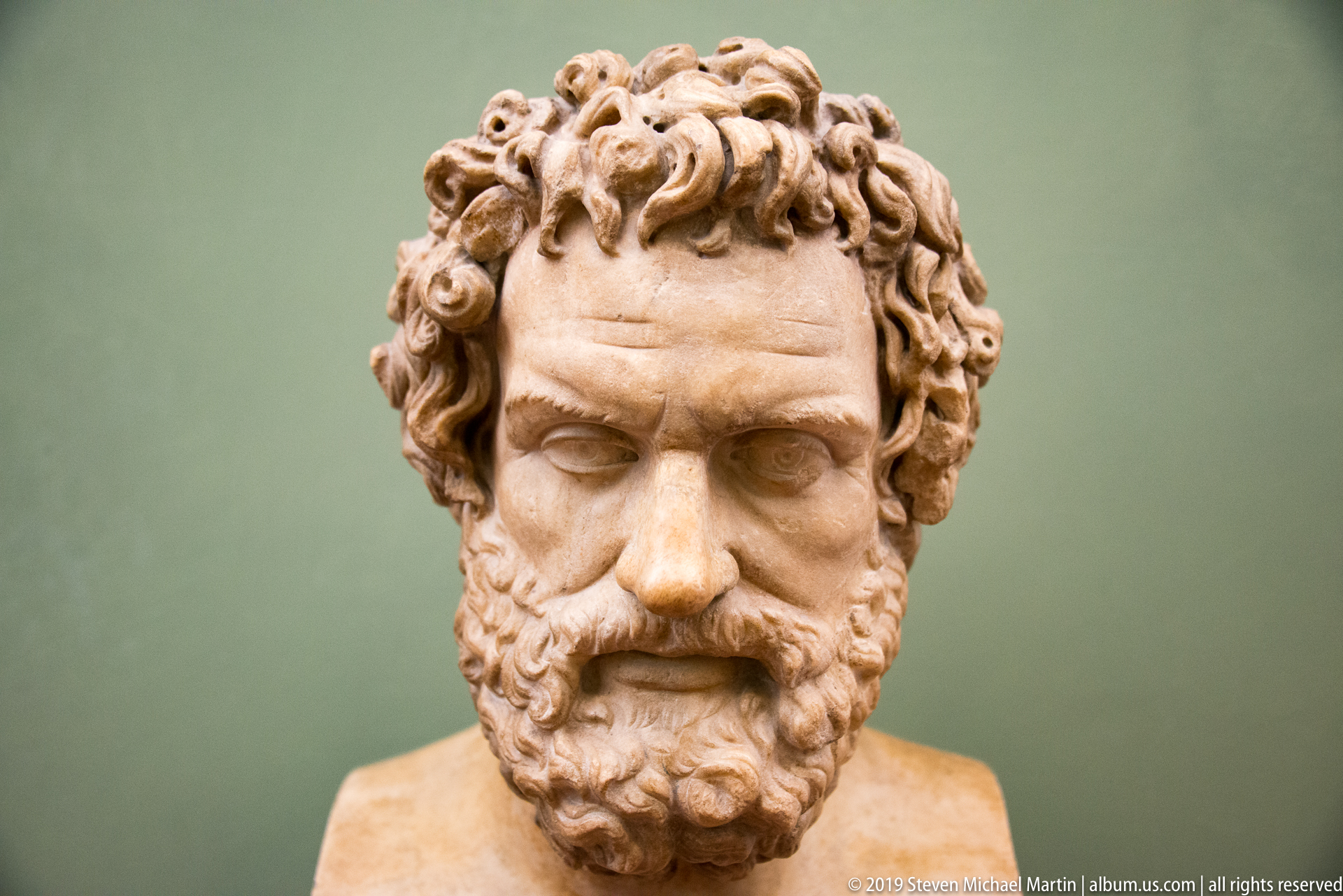
A bearded male portrait is distinguished by thick, tightly curled hair and a dense beard composed of deeply drilled locks. The eyes are uncarved, and the face is comparatively smooth between the elaborate masses of hair. Frontal lighting brings out the sculptural depth of the curls and the compact proportions of the head.
Caption
A bearded male portrait is distinguished by thick, tightly curled hair and a dense beard composed of deeply drilled locks. The eyes are uncarved, and the face is comparatively smooth between the elaborate masses of hair. Frontal lighting brings out the sculptural depth of the curls and the compact proportions of the head.
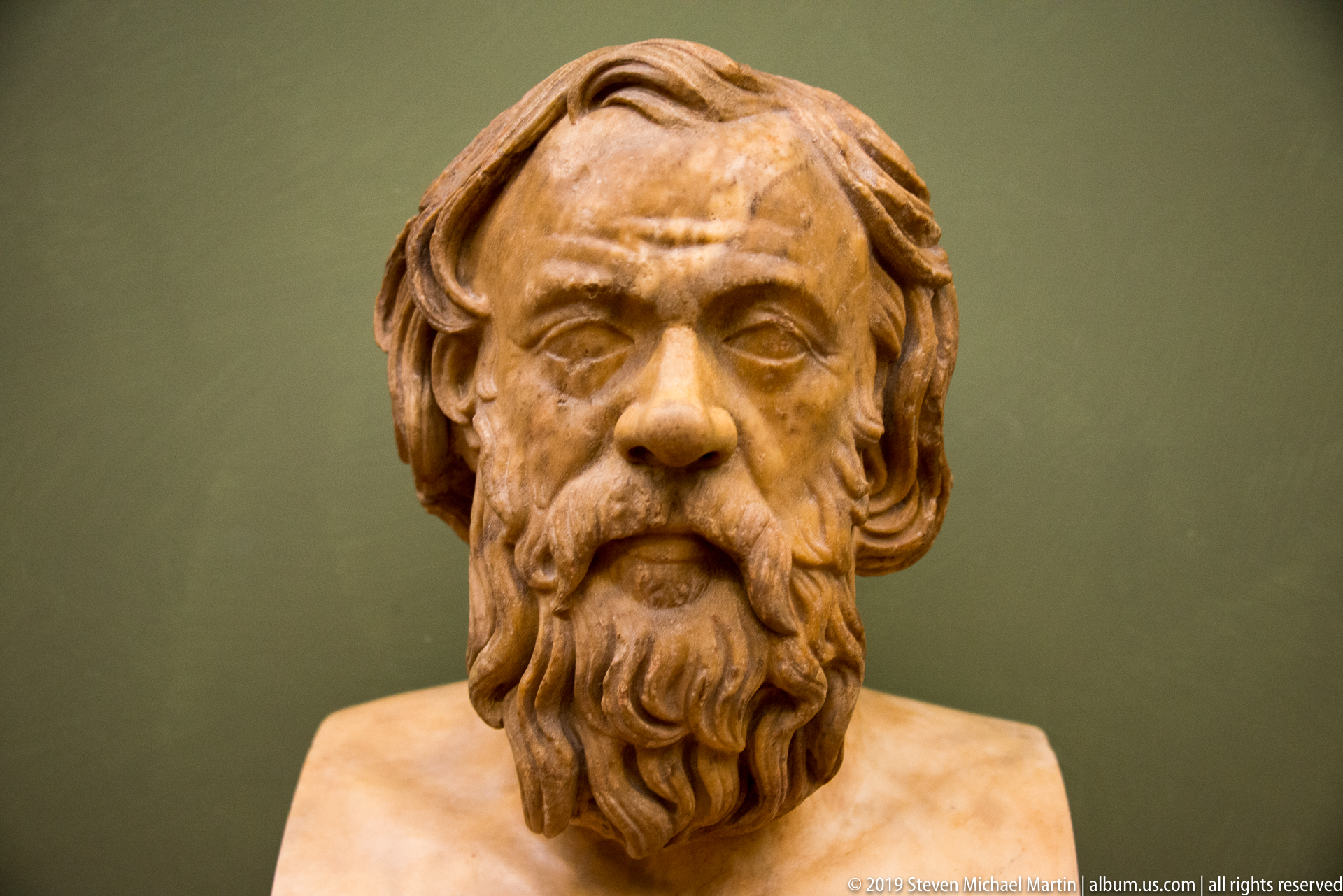
A mature male portrait combines shoulder-length, centrally parted hair with a long beard divided into heavy curling locks. The broad forehead and fixed frontal gaze are framed by the strongly textured hair, giving the bust a markedly different silhouette from the shorter-haired portraits nearby. Warm gallery lighting reveals subtle staining and surface variation in the marble.
Caption
A mature male portrait combines shoulder-length, centrally parted hair with a long beard divided into heavy curling locks. The broad forehead and fixed frontal gaze are framed by the strongly textured hair, giving the bust a markedly different silhouette from the shorter-haired portraits nearby. Warm gallery lighting reveals subtle staining and surface variation in the marble.
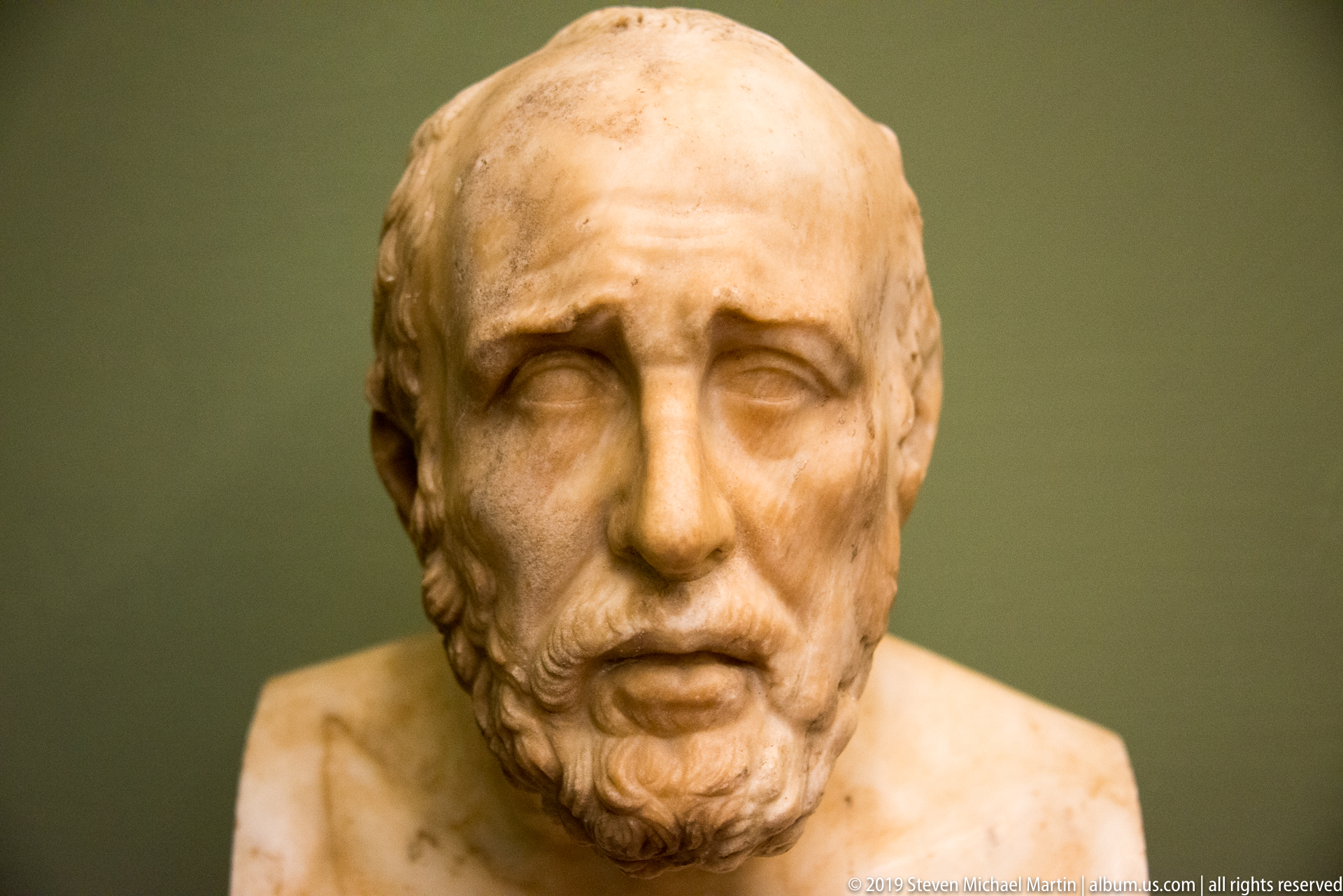
An older male head is modeled with a high balding forehead, sunken eyes, and a short beard concentrated along the jaw and chin. The slightly open mouth and asymmetrical facial creases lend the portrait an unusually vulnerable expression. The close crop and plain background isolate the age-related details of the face.
Caption
An older male head is modeled with a high balding forehead, sunken eyes, and a short beard concentrated along the jaw and chin. The slightly open mouth and asymmetrical facial creases lend the portrait an unusually vulnerable expression. The close crop and plain background isolate the age-related details of the face.
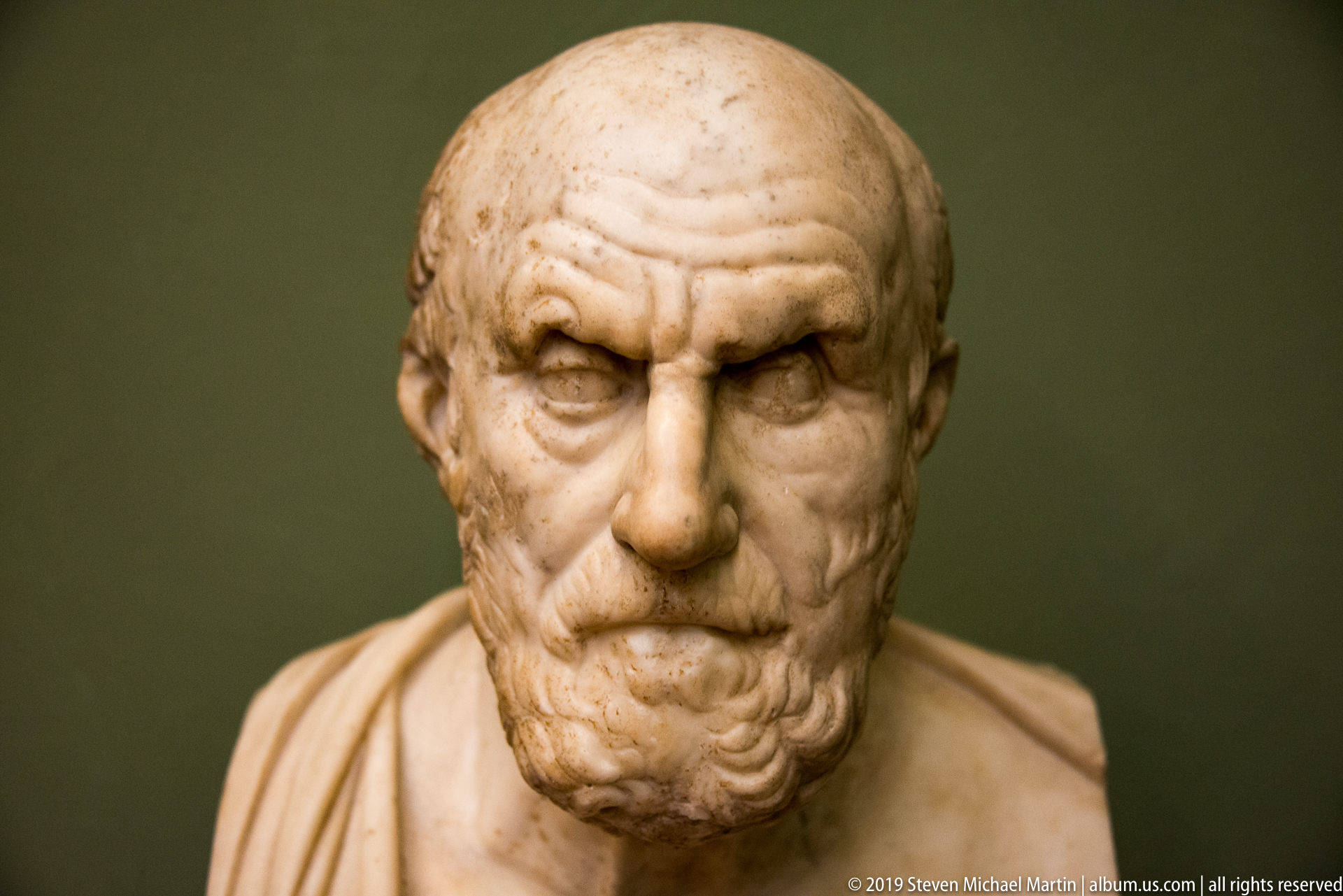
A bald, older man faces forward with knitted brows, narrow eyes, and a compressed mouth. Sparse facial hair follows the jaw, while a carved mantle rises over one shoulder at the lower edge. The sharply incised forehead creases and severe expression distinguish this portrait from the softer, more idealized heads in the sequence.
Caption
A bald, older man faces forward with knitted brows, narrow eyes, and a compressed mouth. Sparse facial hair follows the jaw, while a carved mantle rises over one shoulder at the lower edge. The sharply incised forehead creases and severe expression distinguish this portrait from the softer, more idealized heads in the sequence.
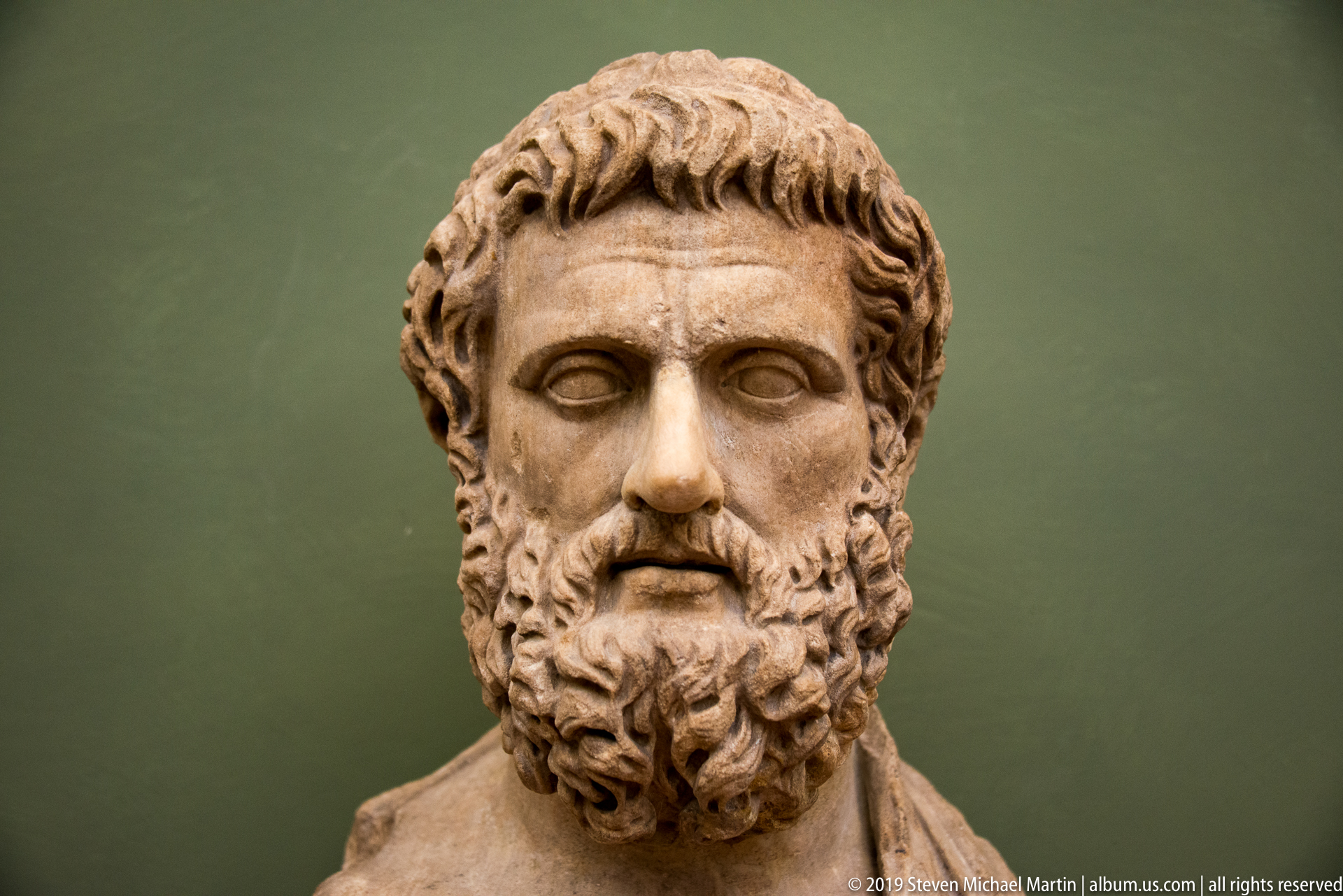
A youthful bearded man is presented frontally with short curls arranged close to the skull and a full beard spreading broadly across the cheeks and chin. The blank eyes and parted lips contrast with the vigorous drilling of the facial hair. The even green background allows the head’s rounded silhouette and dense beard texture to dominate.
Caption
A youthful bearded man is presented frontally with short curls arranged close to the skull and a full beard spreading broadly across the cheeks and chin. The blank eyes and parted lips contrast with the vigorous drilling of the facial hair. The even green background allows the head’s rounded silhouette and dense beard texture to dominate.
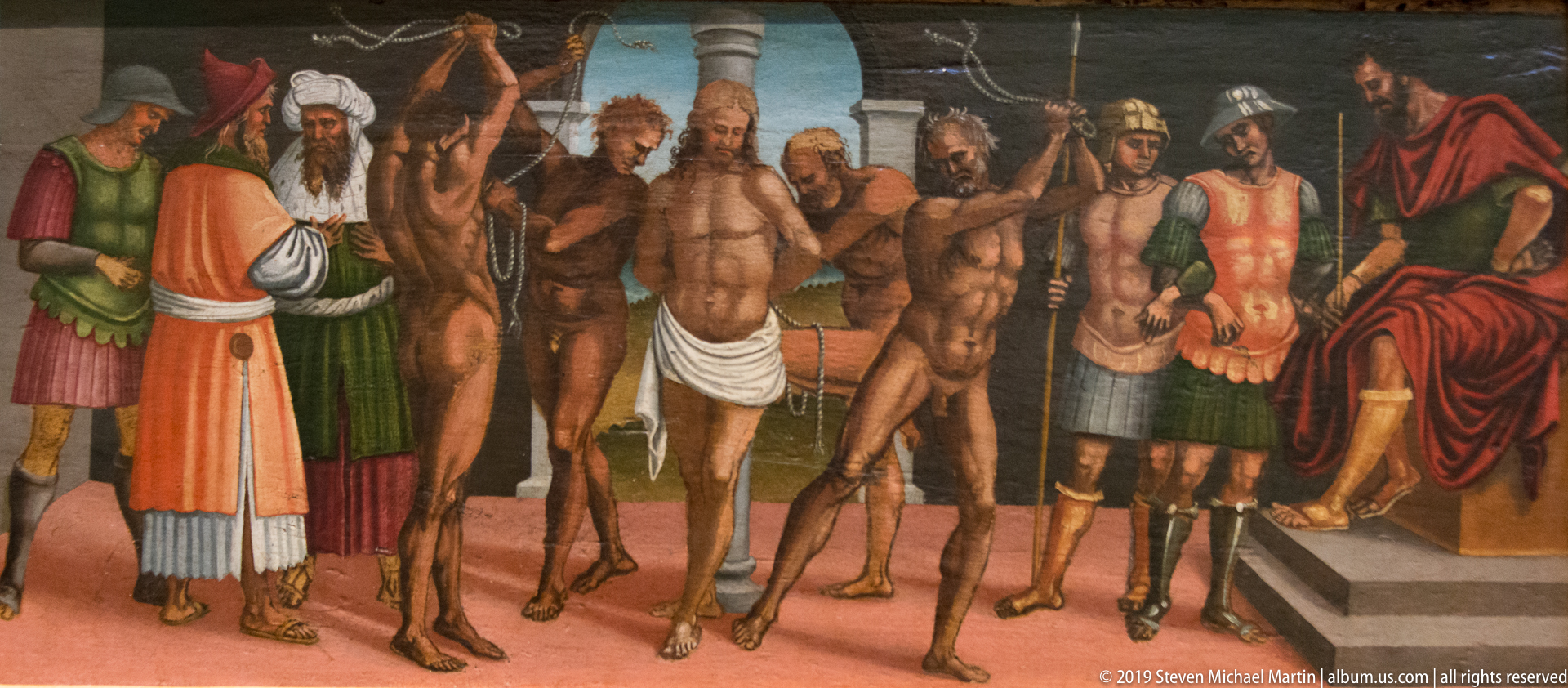
A group of nearly nude men stands at the center of a crowded narrative scene, surrounded by richly dressed and armed figures. One central man wears only a white cloth, while another extends an arm toward the seated or elevated authority at right. Spears, armor, and varied costumes create the atmosphere of a public judgment, presentation, or captivity scene.
Caption
A group of nearly nude men stands at the center of a crowded narrative scene, surrounded by richly dressed and armed figures. One central man wears only a white cloth, while another extends an arm toward the seated or elevated authority at right. Spears, armor, and varied costumes create the atmosphere of a public judgment, presentation, or captivity scene.

Christ and the apostles gather around a long white-clothed table set with small dishes, cups, and bread. The figures form a dense semicircle, their brightly colored robes alternating across the dark interior, while one standing figure occupies the foreground with his back to the viewer. The meal setting and apostolic group identify the subject as the Last Supper.
Caption
Christ and the apostles gather around a long white-clothed table set with small dishes, cups, and bread. The figures form a dense semicircle, their brightly colored robes alternating across the dark interior, while one standing figure occupies the foreground with his back to the viewer. The meal setting and apostolic group identify the subject as the Last Supper.
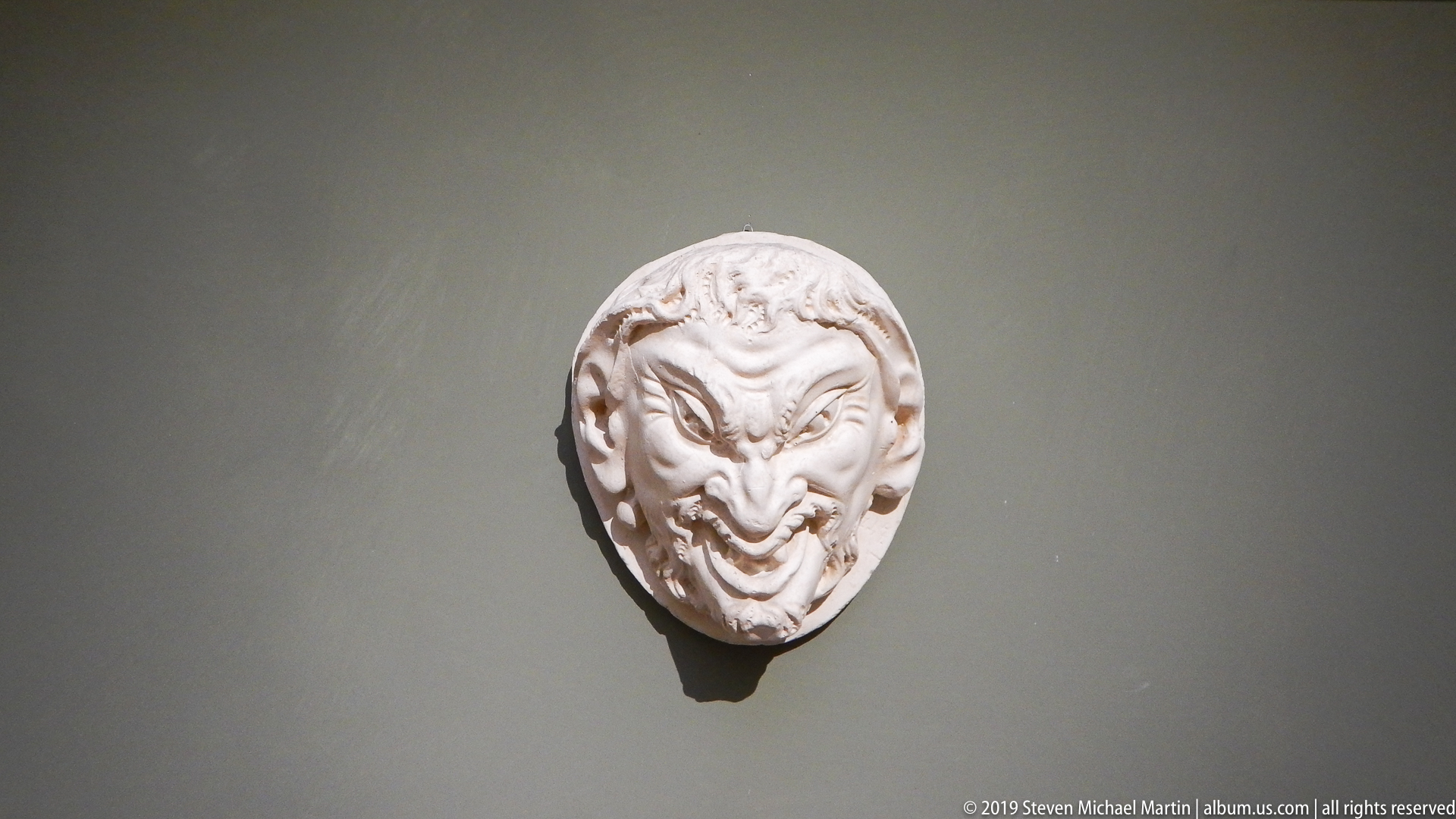
A small white marble mask projects from a plain gray wall, its face compressed into an exaggerated grimace. Pointed ears, arched brows, curling cheek forms, and a broad nose create a fantastic or grotesque appearance. Strong directional light throws a compact shadow beneath the carving and accentuates its shallow relief.
Caption
A small white marble mask projects from a plain gray wall, its face compressed into an exaggerated grimace. Pointed ears, arched brows, curling cheek forms, and a broad nose create a fantastic or grotesque appearance. Strong directional light throws a compact shadow beneath the carving and accentuates its shallow relief.
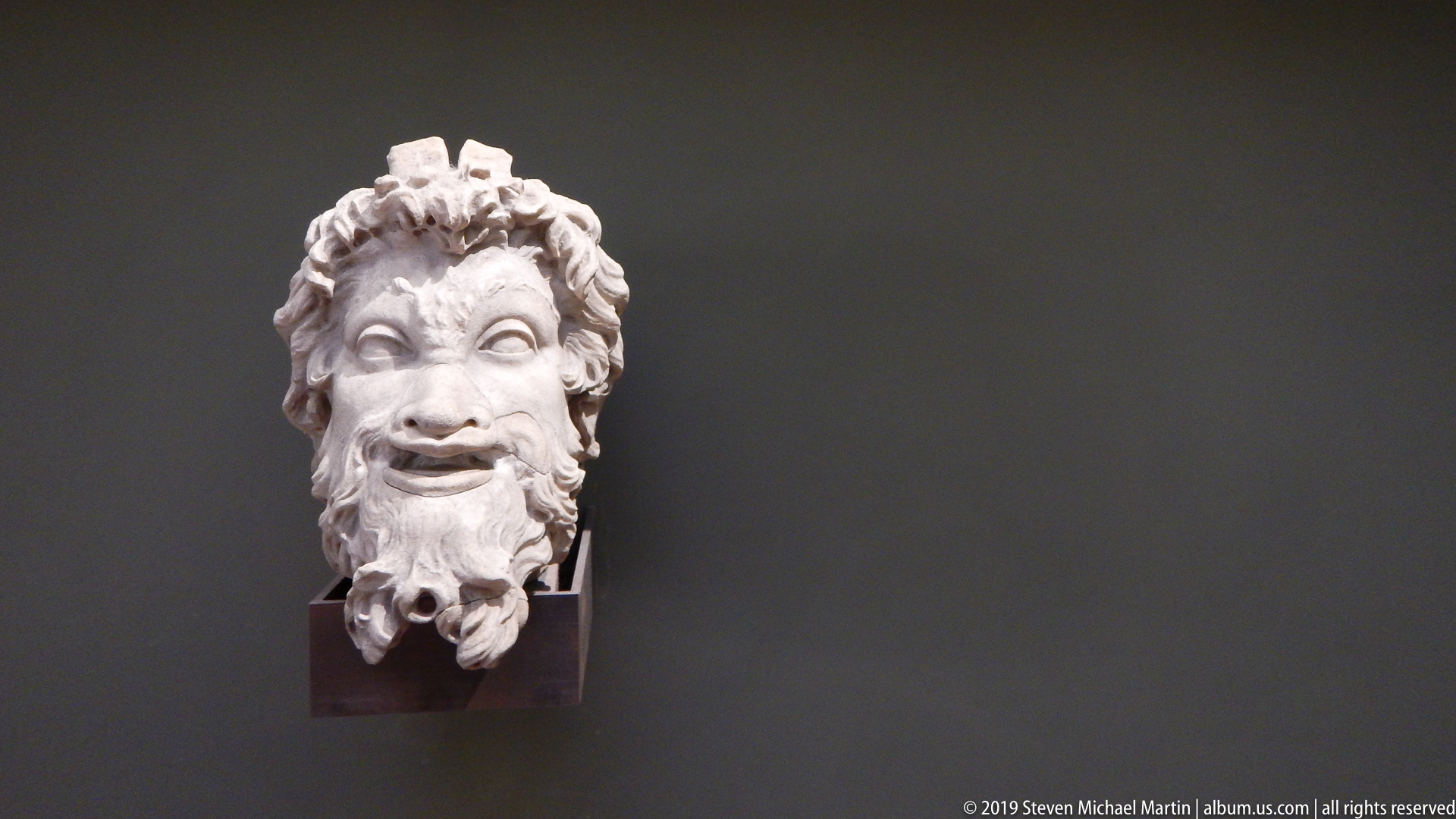
A small marble head is mounted against a dark wall, its face animated by an open smiling mouth, raised brows, and a luxuriant curling beard. Short irregular locks frame the forehead, and the exaggerated expression gives the object a theatrical or grotesque character. Spotlighting sharply separates the pale carving from its subdued display setting.
Caption
A small marble head is mounted against a dark wall, its face animated by an open smiling mouth, raised brows, and a luxuriant curling beard. Short irregular locks frame the forehead, and the exaggerated expression gives the object a theatrical or grotesque character. Spotlighting sharply separates the pale carving from its subdued display setting.
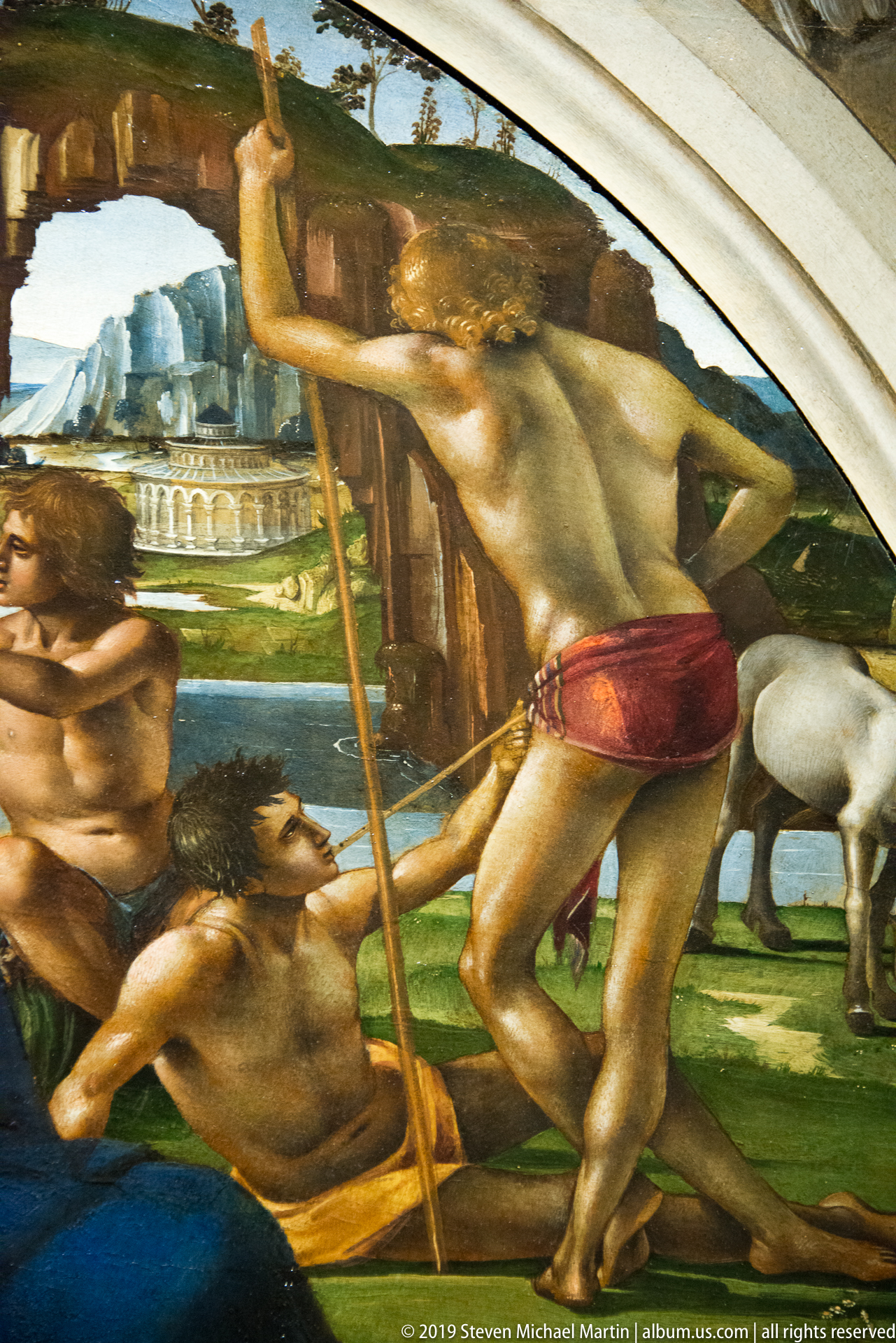
A tightly cropped passage shows several nude or nearly nude men struggling across a grassy landscape. One standing figure braces a long staff while another reaches toward his waist, and additional bodies overlap at the left. The energetic diagonals, twisting limbs, and compressed framing emphasize physical action rather than the larger narrative to which the episode belongs.
Caption
A tightly cropped passage shows several nude or nearly nude men struggling across a grassy landscape. One standing figure braces a long staff while another reaches toward his waist, and additional bodies overlap at the left. The energetic diagonals, twisting limbs, and compressed framing emphasize physical action rather than the larger narrative to which the episode belongs.

Richly dressed men and attendants approach the seated Virgin and Child from the left, some carrying staffs or weapons, while another figure kneels prominently before the infant. A distant landscape and architectural fragments open behind the gathering. The varied costumes, gestures, and compact procession distinguish this episode as a ceremonial act of homage.
Caption
Richly dressed men and attendants approach the seated Virgin and Child from the left, some carrying staffs or weapons, while another figure kneels prominently before the infant. A distant landscape and architectural fragments open behind the gathering. The varied costumes, gestures, and compact procession distinguish this episode as a ceremonial act of homage.
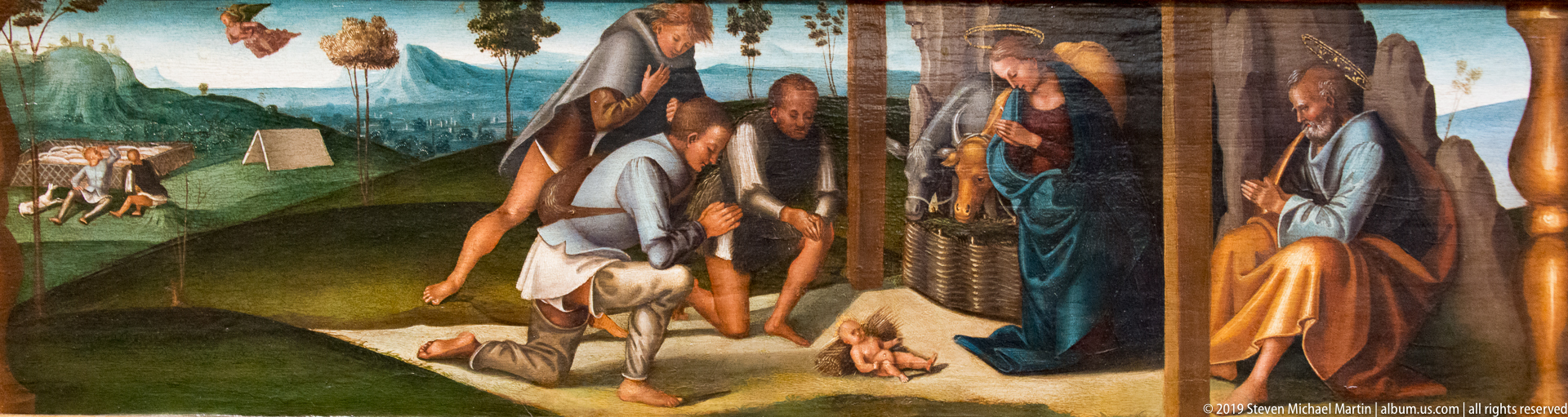
A group of men kneels and bends toward a haloed seated woman at the right edge of an architectural setting. One foreground figure reaches toward the ground, while others cluster behind him; a small distant episode unfolds across the green landscape at left. The painting combines a close devotional encounter with secondary narrative action in the background.
Caption
A group of men kneels and bends toward a haloed seated woman at the right edge of an architectural setting. One foreground figure reaches toward the ground, while others cluster behind him; a small distant episode unfolds across the green landscape at left. The painting combines a close devotional encounter with secondary narrative action in the background.
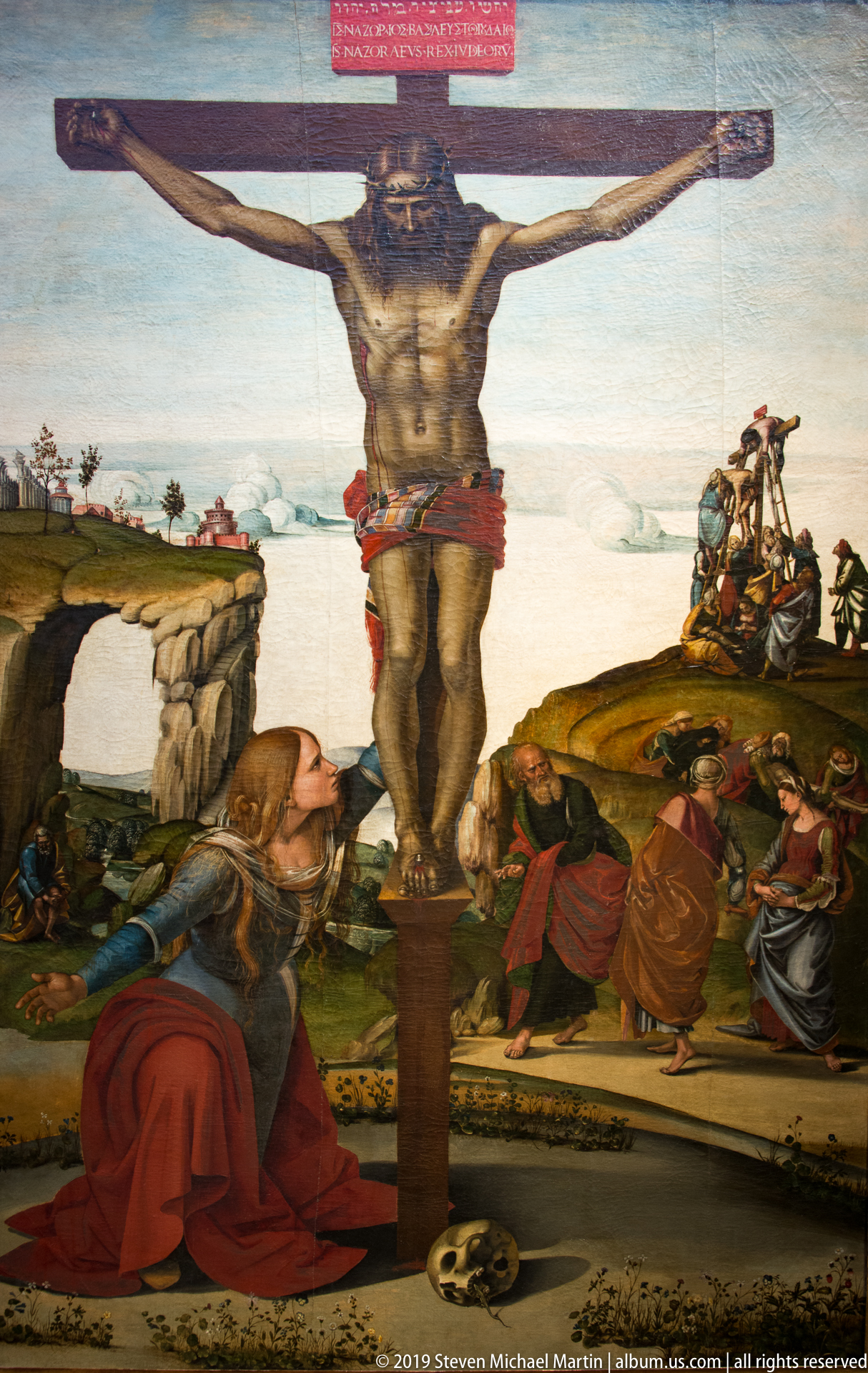
Christ hangs on a tall cross at the center of a broad landscape, his body silhouetted against a pale sky. Mourners gather at the base, including a kneeling woman in red, while mounted figures and attendants occupy the middle distance. Rocky outcrops and a distant settlement extend the Passion scene across a wide narrative setting.
Caption
Christ hangs on a tall cross at the center of a broad landscape, his body silhouetted against a pale sky. Mourners gather at the base, including a kneeling woman in red, while mounted figures and attendants occupy the middle distance. Rocky outcrops and a distant settlement extend the Passion scene across a wide narrative setting.
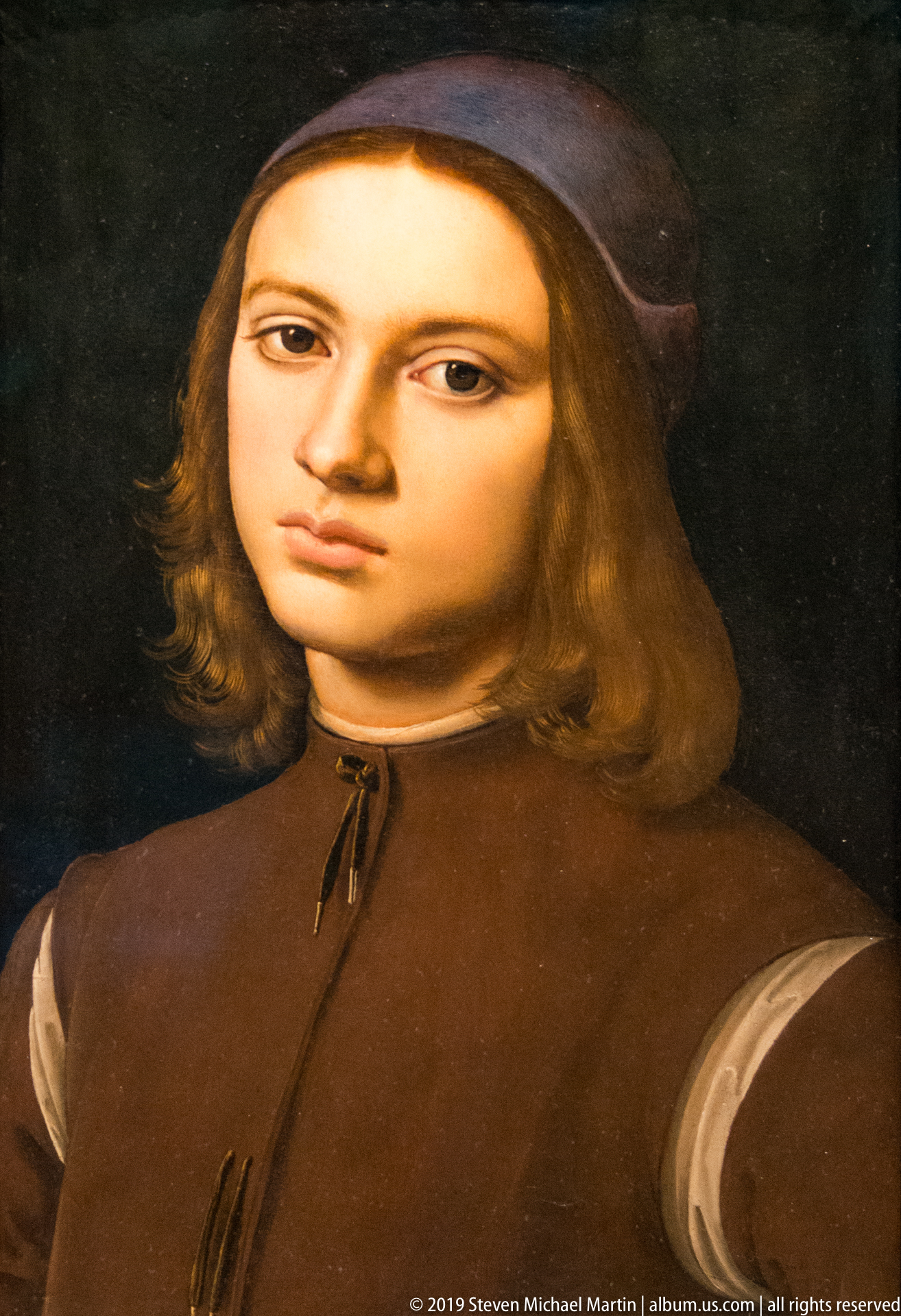
A young man fills the frame from the chest upward, wearing a dark cap and a close-fitting brown doublet fastened at the neck. Shoulder-length light brown hair frames a smooth, serious face set against an almost black background. The tight crop and subdued clothing concentrate attention on the sitter’s direct gaze and carefully modeled features.
Caption
A young man fills the frame from the chest upward, wearing a dark cap and a close-fitting brown doublet fastened at the neck. Shoulder-length light brown hair frames a smooth, serious face set against an almost black background. The tight crop and subdued clothing concentrate attention on the sitter’s direct gaze and carefully modeled features.
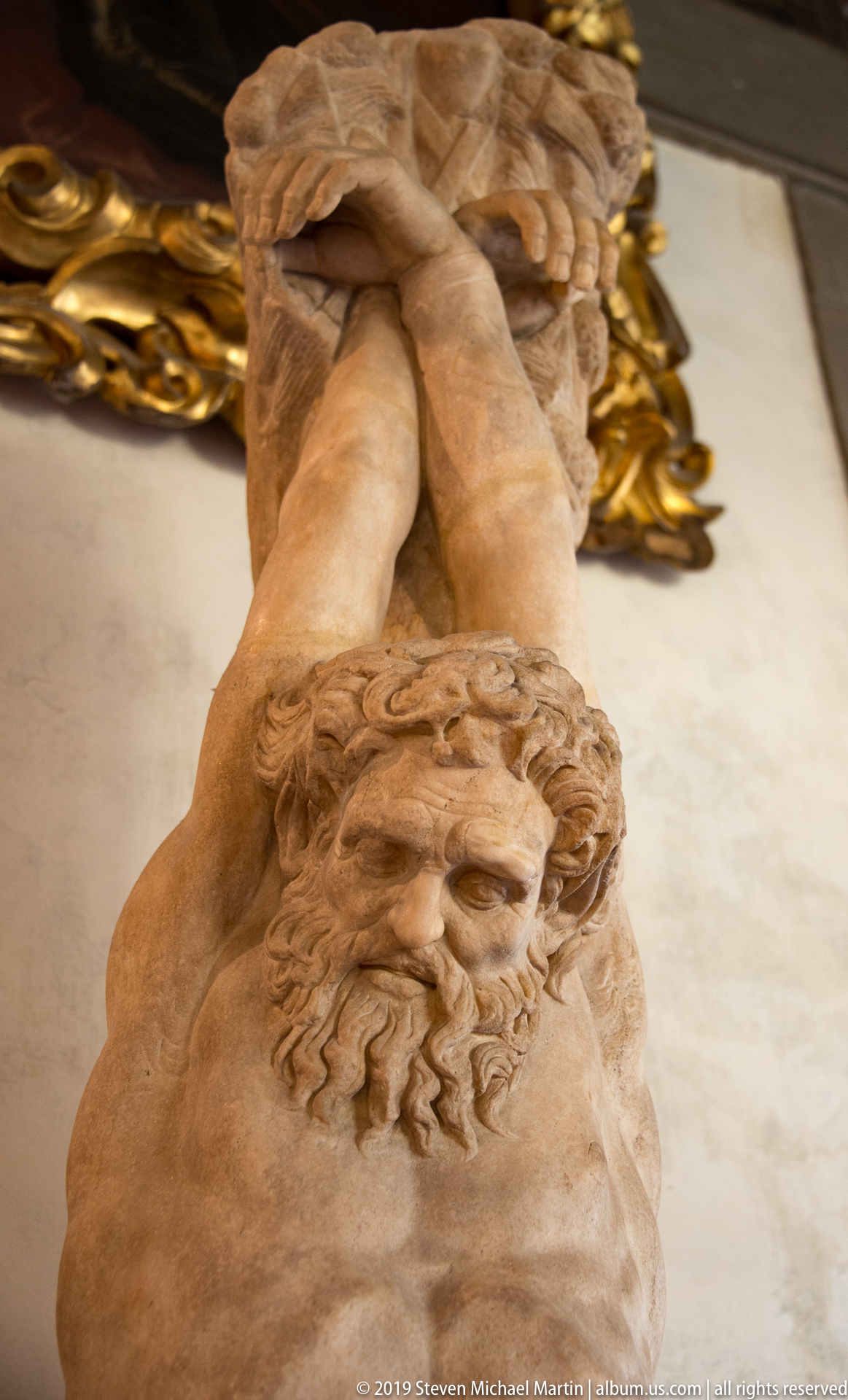
A bearded male head appears inverted in this close detail of a reclining marble figure. Thick curling hair and beard frame the face, while the neck and upper torso recede upward through the composition. The unusual orientation turns a larger sculptural pose into a concentrated study of carving, anatomy, and expressive facial detail.
Caption
A bearded male head appears inverted in this close detail of a reclining marble figure. Thick curling hair and beard frame the face, while the neck and upper torso recede upward through the composition. The unusual orientation turns a larger sculptural pose into a concentrated study of carving, anatomy, and expressive facial detail.
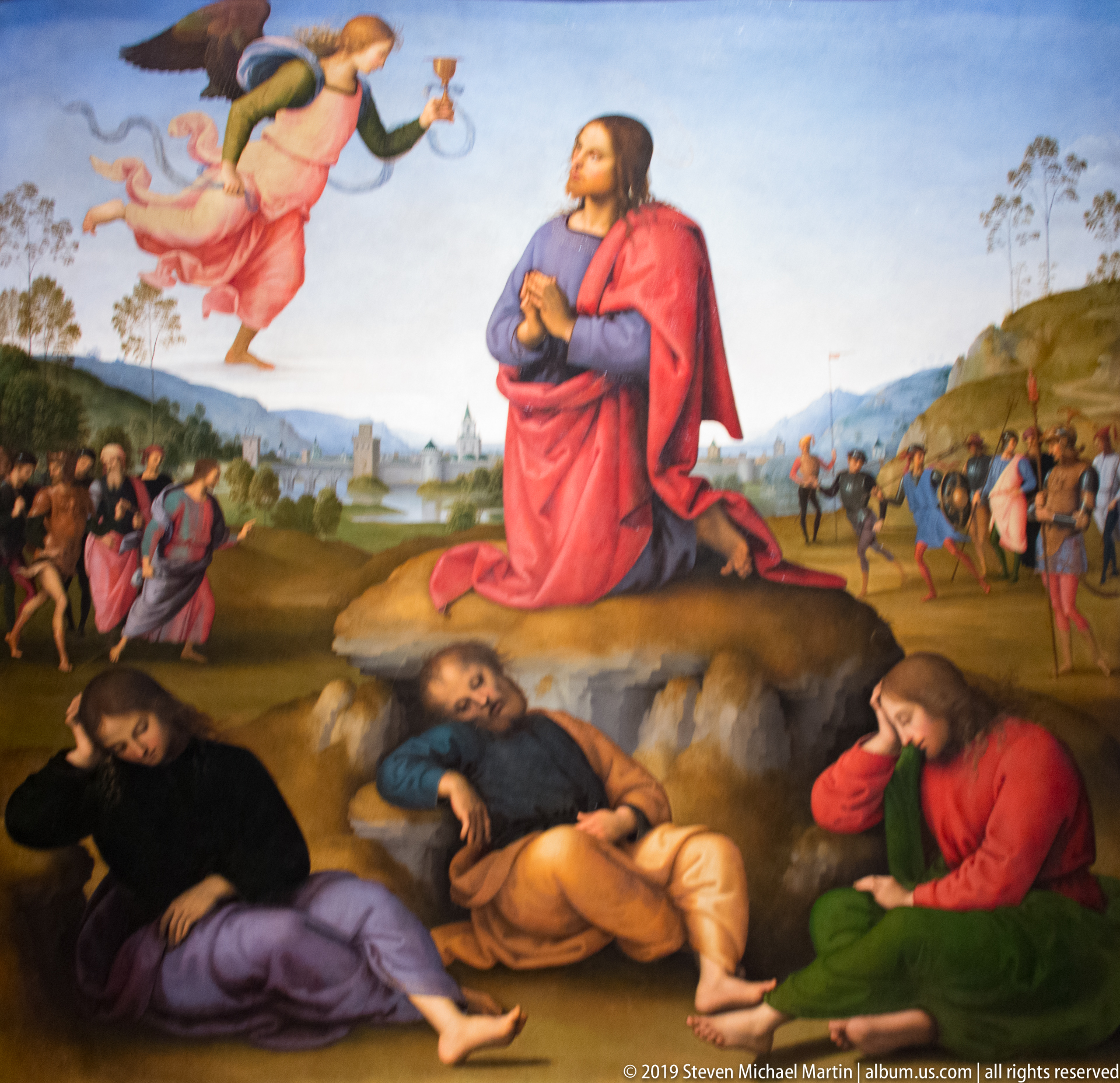
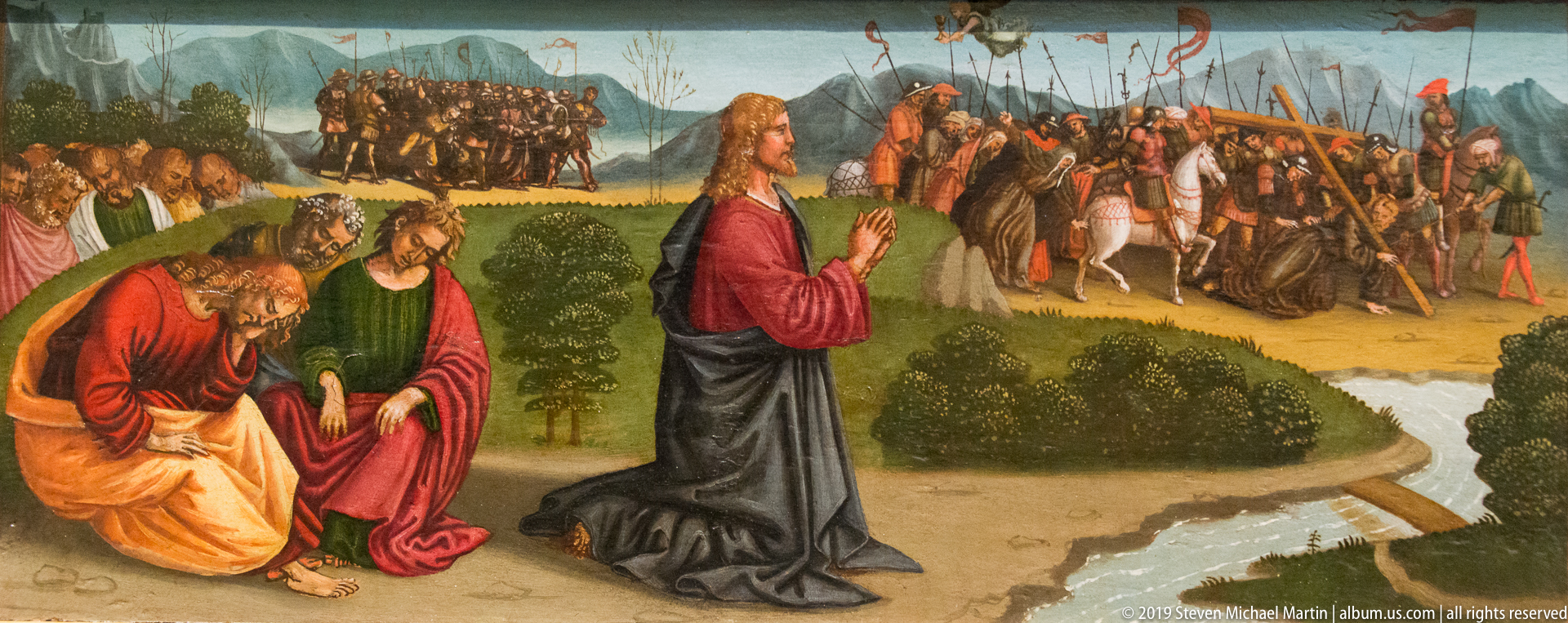
Christ kneels in prayer on a rocky rise, looking upward toward an angel who presents a chalice from the sky. Three disciples sleep in the foreground, while armed men approach through the landscape at right. The layered composition joins private devotion, sleeping companions, and the imminent arrest within one continuous setting.
Caption
Christ kneels in prayer on a rocky rise, looking upward toward an angel who presents a chalice from the sky. Three disciples sleep in the foreground, while armed men approach through the landscape at right. The layered composition joins private devotion, sleeping companions, and the imminent arrest within one continuous setting.

The dead Christ lies horizontally across the Virgin’s lap as mourners gather closely around them beneath a monumental classical arch. Mary’s deep blue mantle anchors the center, while flanking figures bend inward in grief. The controlled symmetry and open landscape beyond the architecture give the lamentation a solemn, balanced setting.
Caption
The dead Christ lies horizontally across the Virgin’s lap as mourners gather closely around them beneath a monumental classical arch. Mary’s deep blue mantle anchors the center, while flanking figures bend inward in grief. The controlled symmetry and open landscape beyond the architecture give the lamentation a solemn, balanced setting.
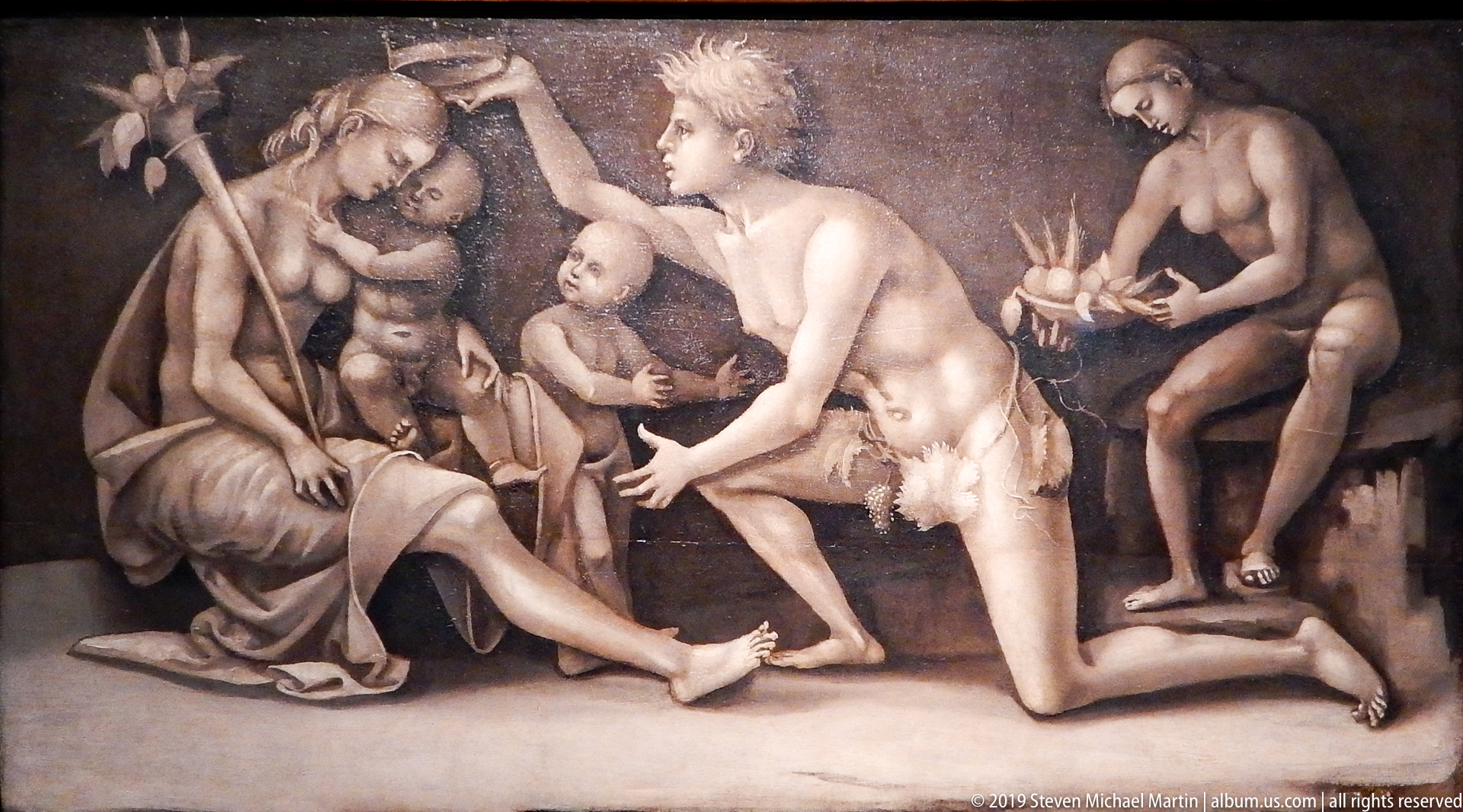
A pale monochrome composition gathers nude and partially draped figures around a seated woman at left. A youthful figure kneels prominently in the center, reaching toward her, while other bodies turn and gesture from behind. The restricted palette exposes the modeling, contours, and interlocking poses more strongly than narrative color would.
Caption
A pale monochrome composition gathers nude and partially draped figures around a seated woman at left. A youthful figure kneels prominently in the center, reaching toward her, while other bodies turn and gesture from behind. The restricted palette exposes the modeling, contours, and interlocking poses more strongly than narrative color would.
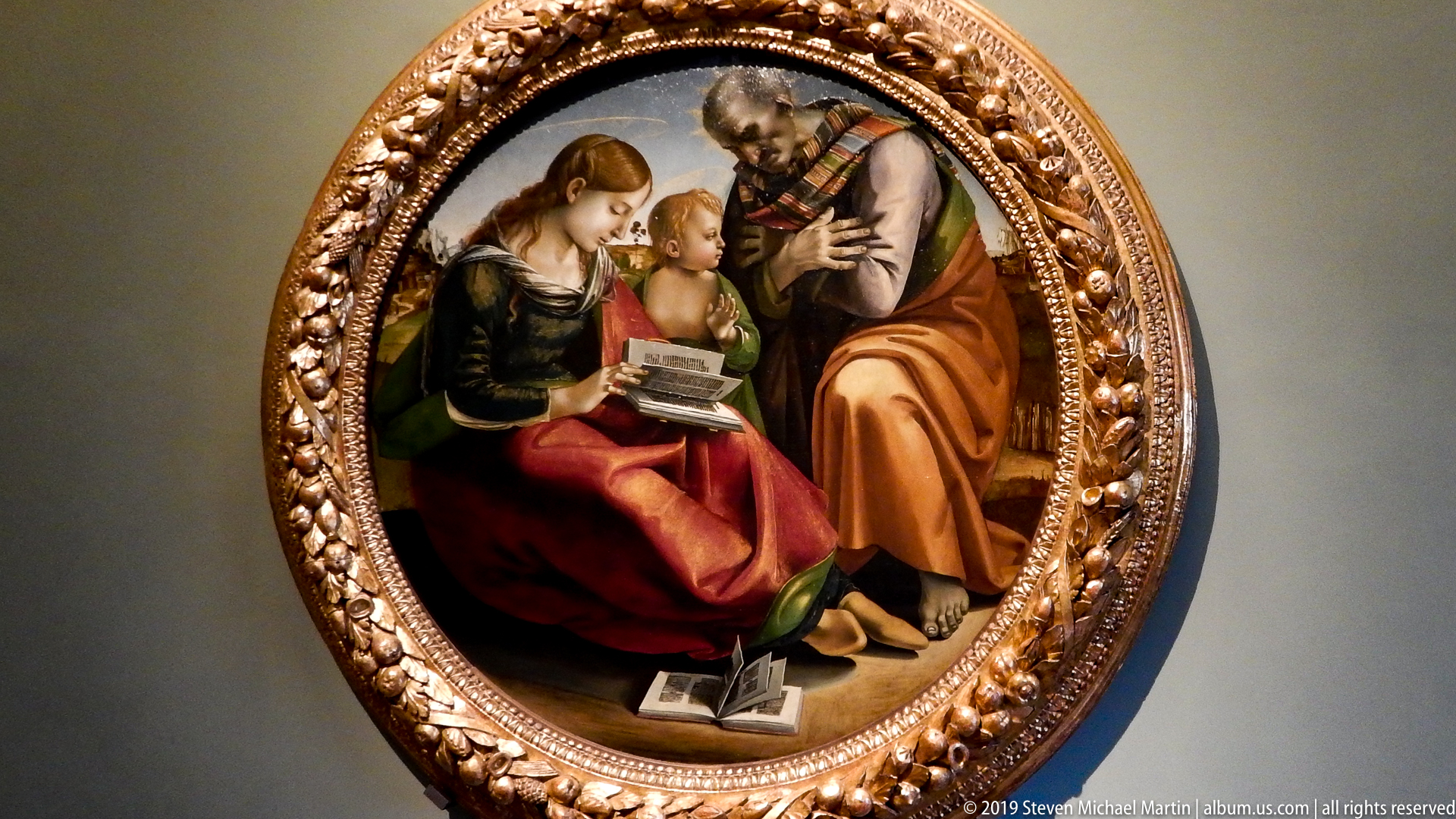
Mary, the Christ Child, and an older bearded man form a compact family group within a circular painting. An open book rests across Mary’s lap, drawing the figures’ hands and attention toward its pages. The richly carved gilded tondo frame reinforces the intimate scale and self-contained geometry of the devotional image.
Caption
Mary, the Christ Child, and an older bearded man form a compact family group within a circular painting. An open book rests across Mary’s lap, drawing the figures’ hands and attention toward its pages. The richly carved gilded tondo frame reinforces the intimate scale and self-contained geometry of the devotional image.
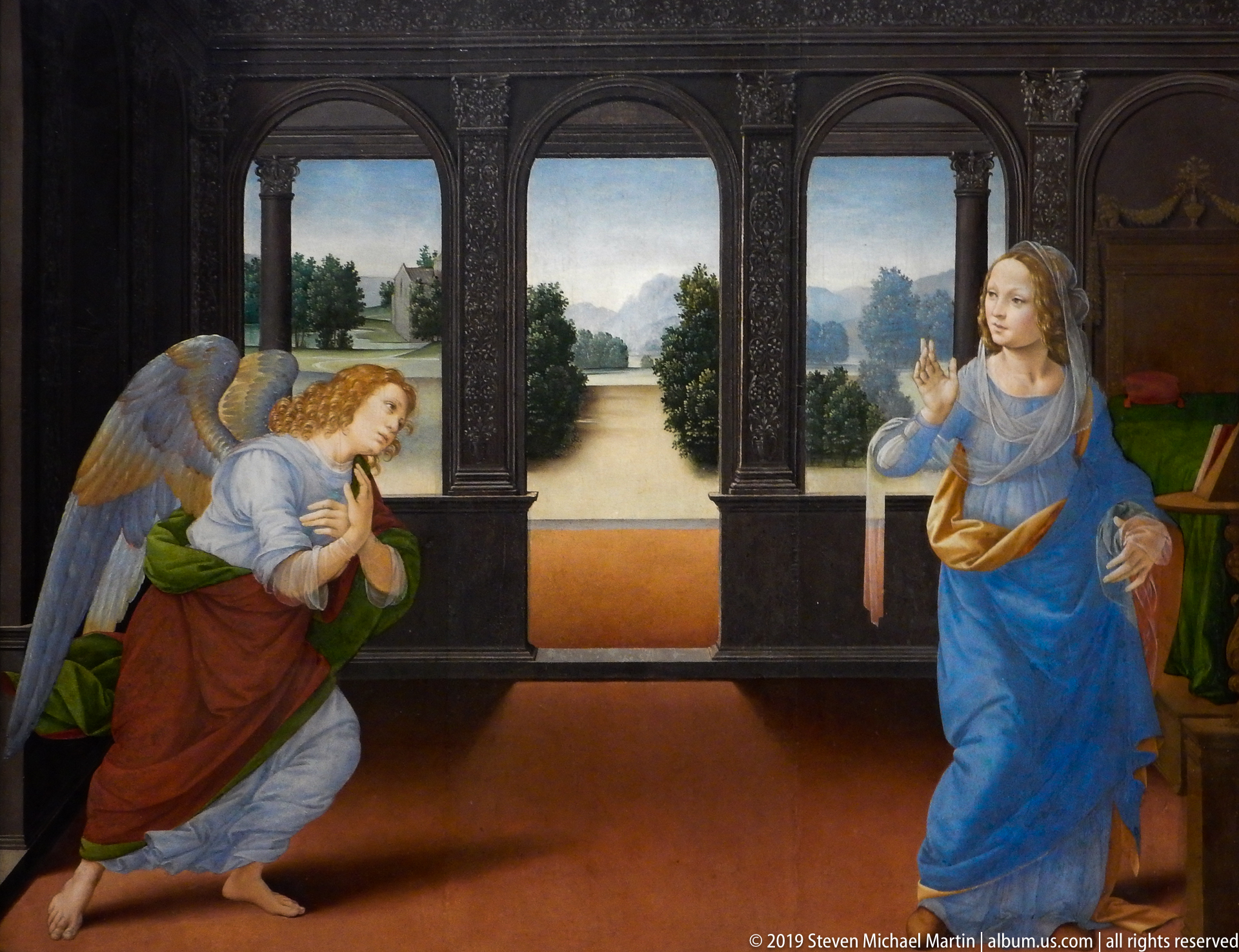
A kneeling angel at left bows toward the Virgin, who stands at right in a blue gown and raises one hand in response. Three arched openings reveal a tree-lined landscape beyond the dark architectural interior. The clear separation of the two figures and their reciprocal gestures establish the scene as an Annunciation.
Caption
A kneeling angel at left bows toward the Virgin, who stands at right in a blue gown and raises one hand in response. Three arched openings reveal a tree-lined landscape beyond the dark architectural interior. The clear separation of the two figures and their reciprocal gestures establish the scene as an Annunciation.
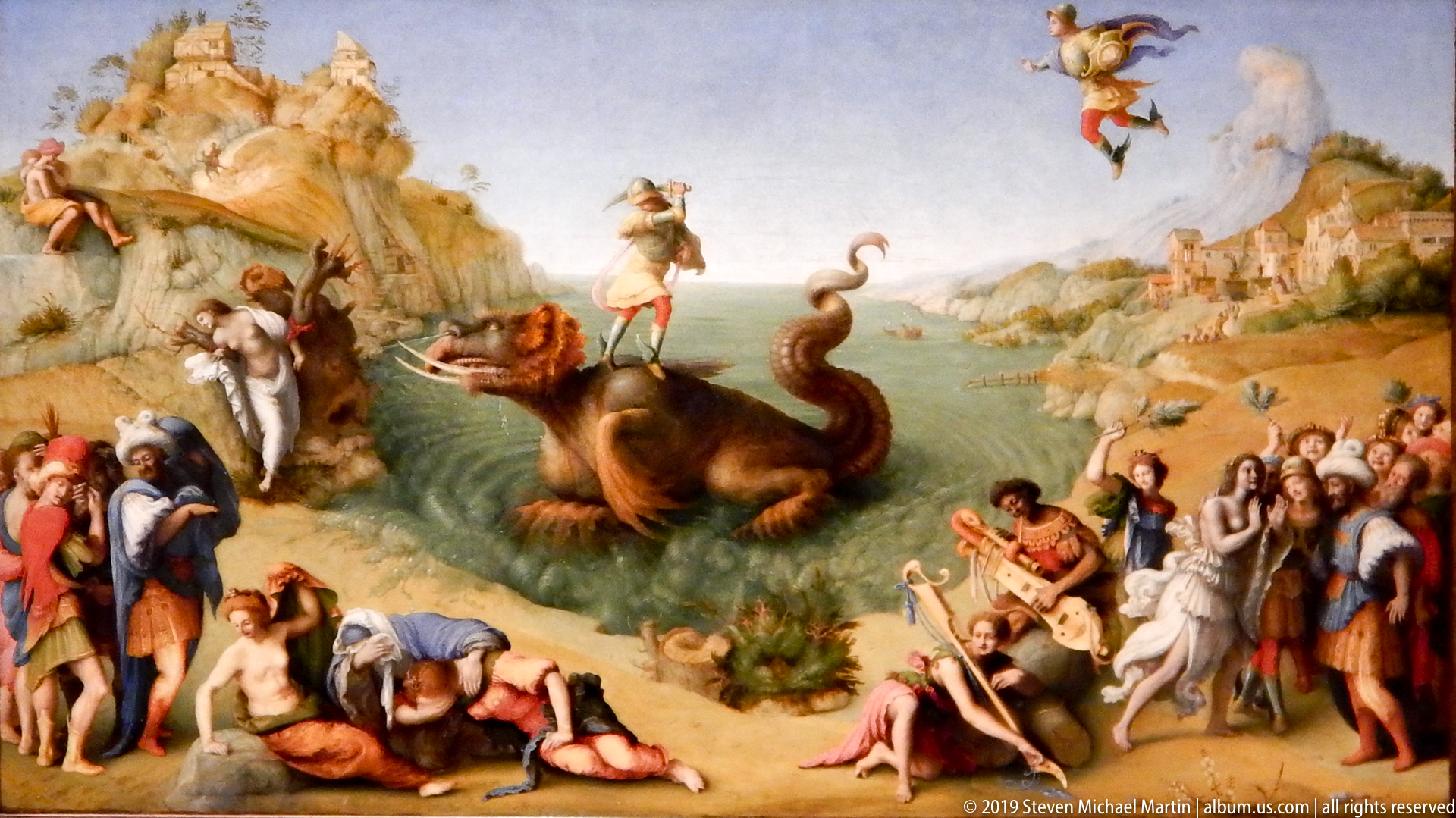
A fantastic sea creature with a leonine body and curling tail rises from the water at the center of a crowded coastal narrative. Groups of figures react from both shores, while a hero-like figure stands above the monster and a small airborne figure descends from the sky. The bright landscape and theatrical gestures create a densely animated mythological episode.
Caption
A fantastic sea creature with a leonine body and curling tail rises from the water at the center of a crowded coastal narrative. Groups of figures react from both shores, while a hero-like figure stands above the monster and a small airborne figure descends from the sky. The bright landscape and theatrical gestures create a densely animated mythological episode.
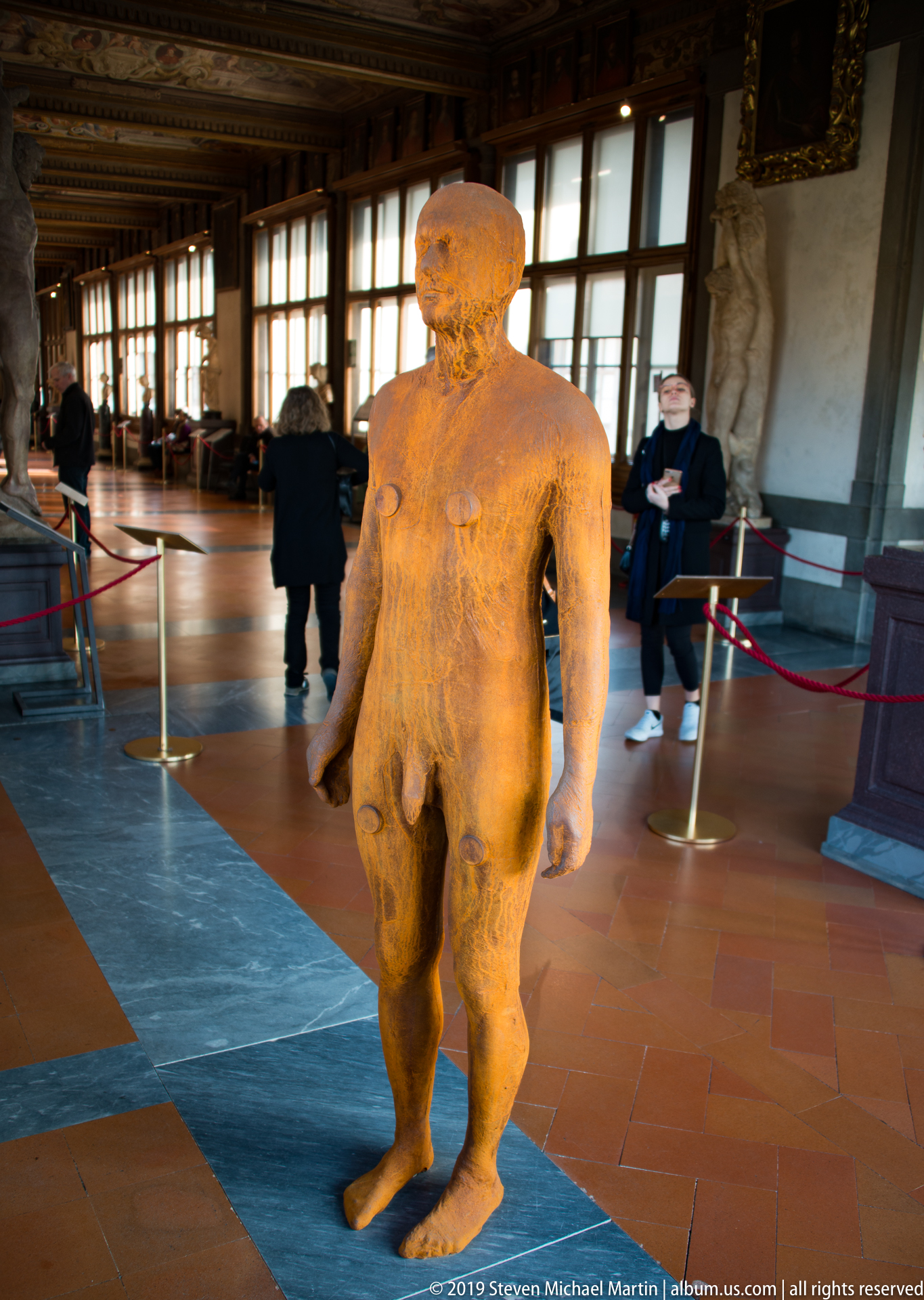
A life-size nude male statue stands freely in the center of a long museum corridor, one arm lowered and the body held in a relaxed stance. Warm light from the windows catches the weathered marble surface, while visitors, red barriers, and other sculptures establish the modern gallery context around the ancient figure.
Caption
A life-size nude male statue stands freely in the center of a long museum corridor, one arm lowered and the body held in a relaxed stance. Warm light from the windows catches the weathered marble surface, while visitors, red barriers, and other sculptures establish the modern gallery context around the ancient figure.
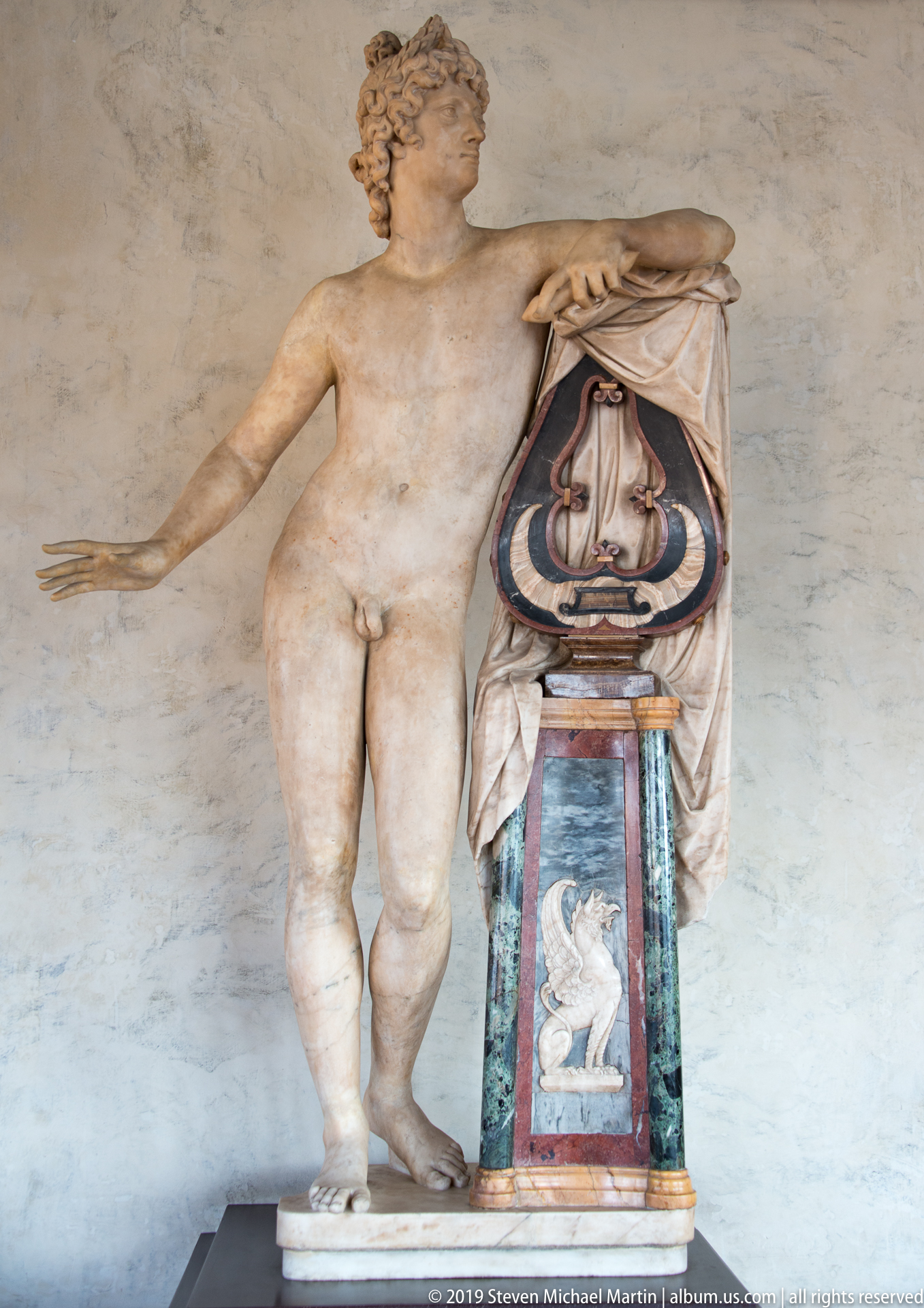
A nude female figure stands with her weight shifted to one leg, extending one arm while resting the other near an elaborate support. Drapery falls around a decorated pedestal-like structure beside her, incorporating a small inset figure and colored stone elements. The frontal installation emphasizes the contrast between pale anatomy and the richly articulated support.
Caption
A nude female figure stands with her weight shifted to one leg, extending one arm while resting the other near an elaborate support. Drapery falls around a decorated pedestal-like structure beside her, incorporating a small inset figure and colored stone elements. The frontal installation emphasizes the contrast between pale anatomy and the richly articulated support.
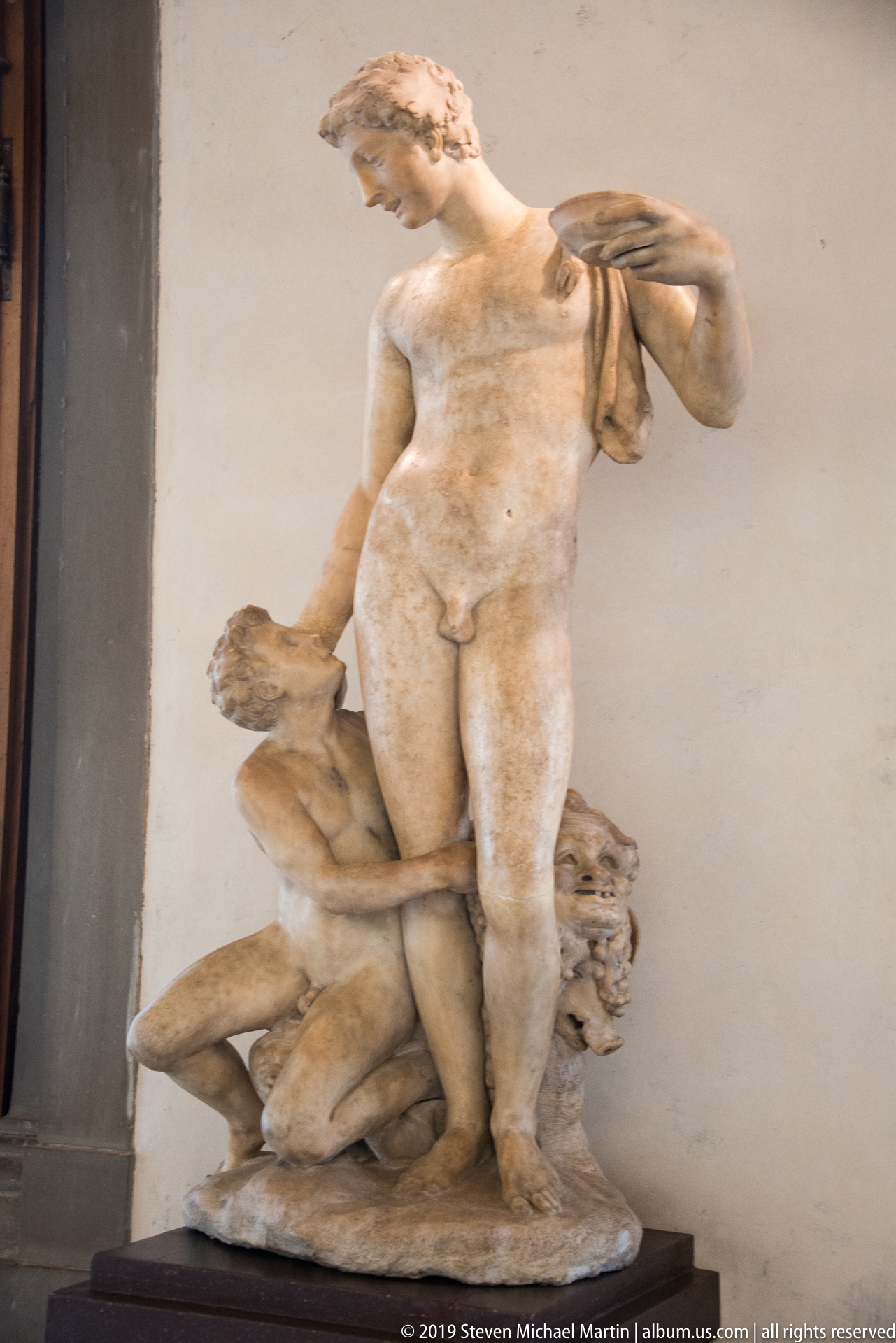
A nude female figure stands in a pronounced contrapposto, turning her head while lifting drapery across one shoulder. At her feet, a crouching animal or mythological form provides a complex sculptural support. The sideward twist of the torso and layered base create a more animated silhouette than a conventional freestanding female nude.
Caption
A nude female figure stands in a pronounced contrapposto, turning her head while lifting drapery across one shoulder. At her feet, a crouching animal or mythological form provides a complex sculptural support. The sideward twist of the torso and layered base create a more animated silhouette than a conventional freestanding female nude.
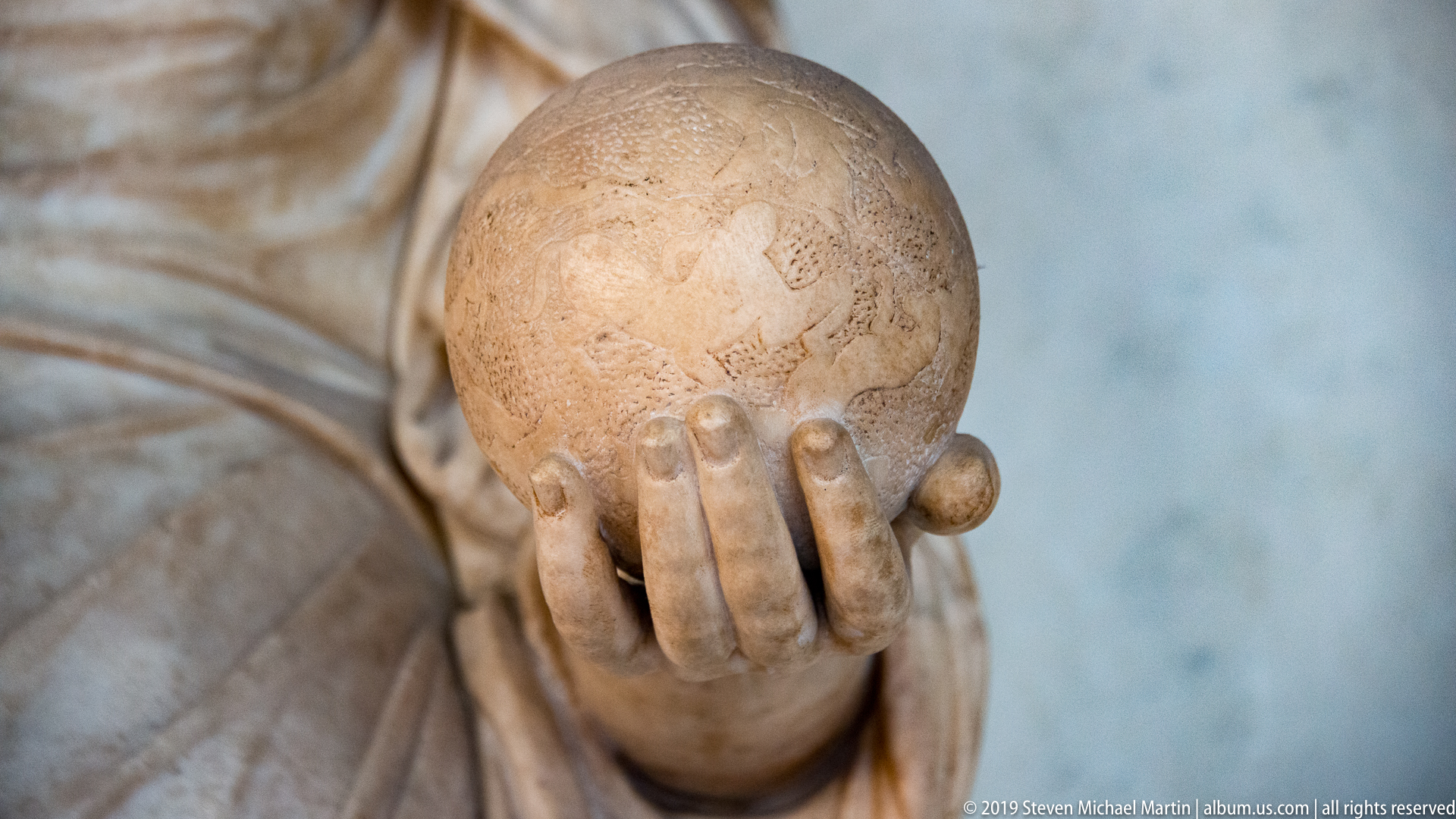
A large spherical stone object rests in the carved fingers of a marble figure, filling most of the frame. Faint incised or worn markings remain visible across the globe’s mottled surface, while folds of the larger statue blur into the background. The close view isolates an attribute that is easy to overlook in a full-length presentation.
Caption
A large spherical stone object rests in the carved fingers of a marble figure, filling most of the frame. Faint incised or worn markings remain visible across the globe’s mottled surface, while folds of the larger statue blur into the background. The close view isolates an attribute that is easy to overlook in a full-length presentation.
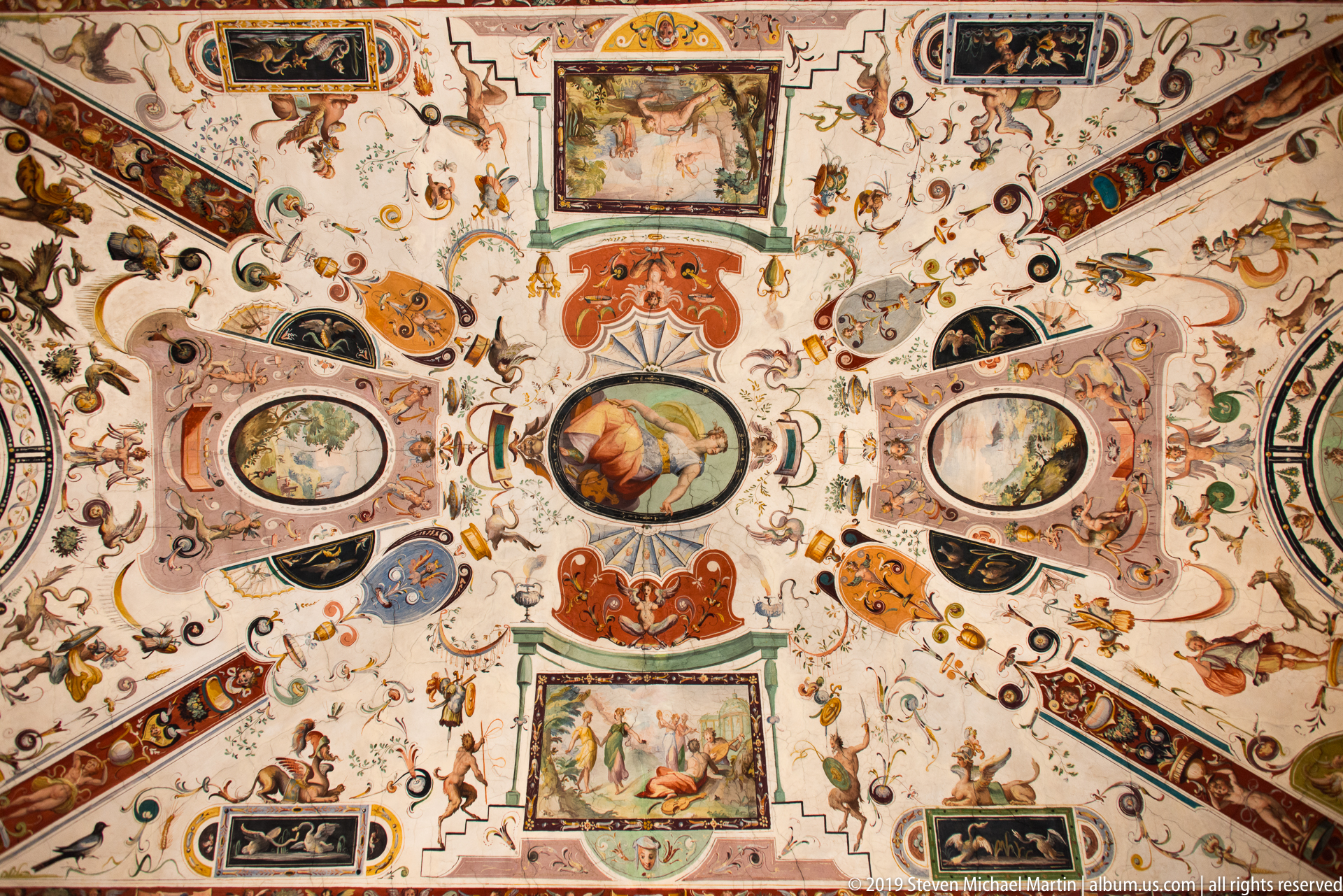
Painted grotesques, scrolling foliage, masks, animals, and small figures spread symmetrically across an ornate Uffizi ceiling. Circular medallions and rectangular narrative panels punctuate the dense ornamental field, while colored borders organize the surface into geometric compartments. The upward view records the decorative program as an integrated architectural composition.
Caption
Painted grotesques, scrolling foliage, masks, animals, and small figures spread symmetrically across an ornate Uffizi ceiling. Circular medallions and rectangular narrative panels punctuate the dense ornamental field, while colored borders organize the surface into geometric compartments. The upward view records the decorative program as an integrated architectural composition.

Two nude male figures stand closely together in a compact marble group, the taller figure extending one arm while the smaller companion leans inward beneath drapery. Their overlapping bodies and shared base create a unified silhouette, while carved foliage or ornamental forms rise near the lower left. The frontal view emphasizes differences in scale and posture.
Caption
Two nude male figures stand closely together in a compact marble group, the taller figure extending one arm while the smaller companion leans inward beneath drapery. Their overlapping bodies and shared base create a unified silhouette, while carved foliage or ornamental forms rise near the lower left. The frontal view emphasizes differences in scale and posture.
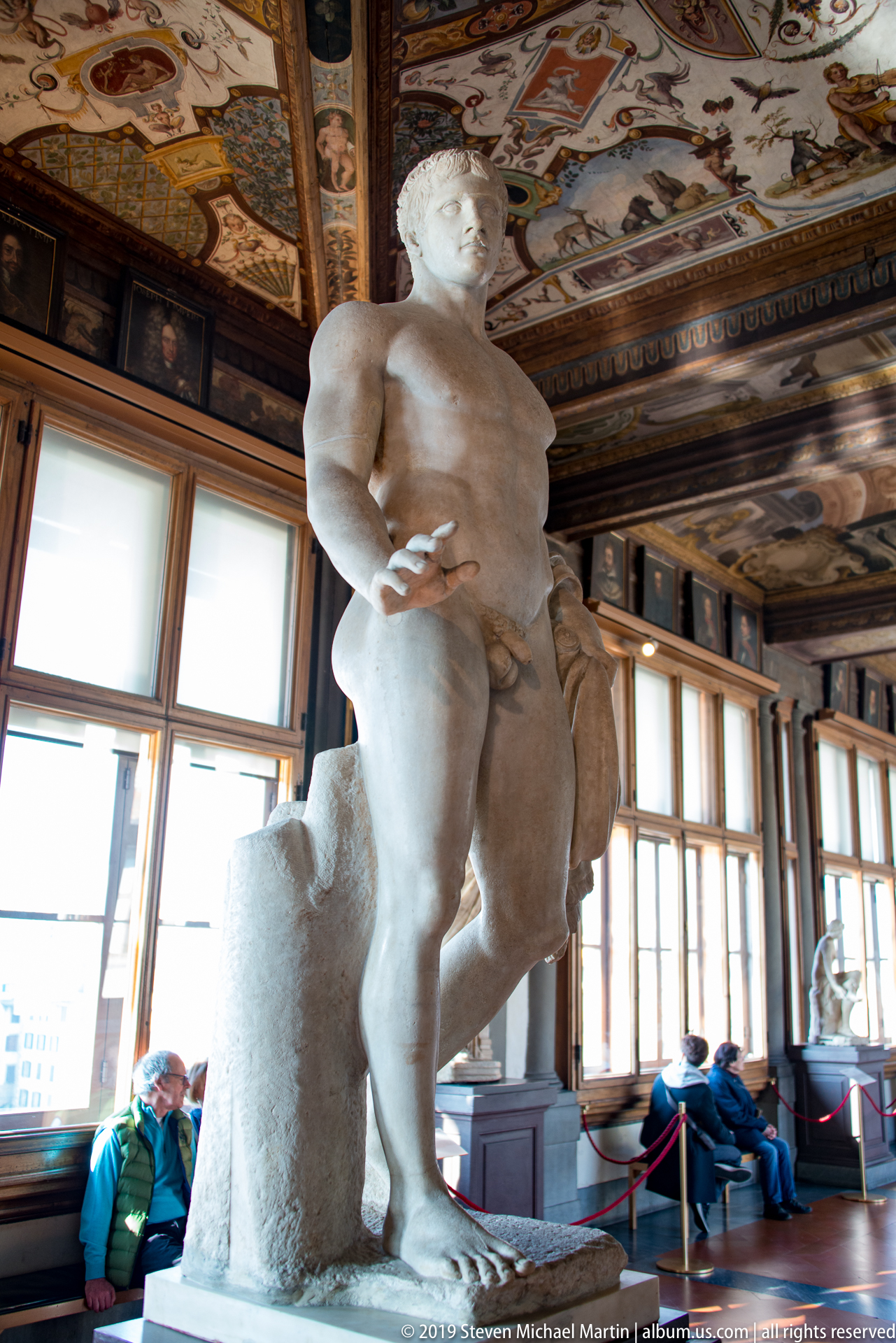
A nude male statue stands beside a tall rough-textured support, one hand lowered near the abdomen and the body subtly shifting weight through the hips. Large windows, seated visitors, and the richly painted ceiling place the sculpture within the Uffizi’s long corridor. The low viewpoint makes the figure appear especially monumental against the decorated interior.
Caption
A nude male statue stands beside a tall rough-textured support, one hand lowered near the abdomen and the body subtly shifting weight through the hips. Large windows, seated visitors, and the richly painted ceiling place the sculpture within the Uffizi’s long corridor. The low viewpoint makes the figure appear especially monumental against the decorated interior.
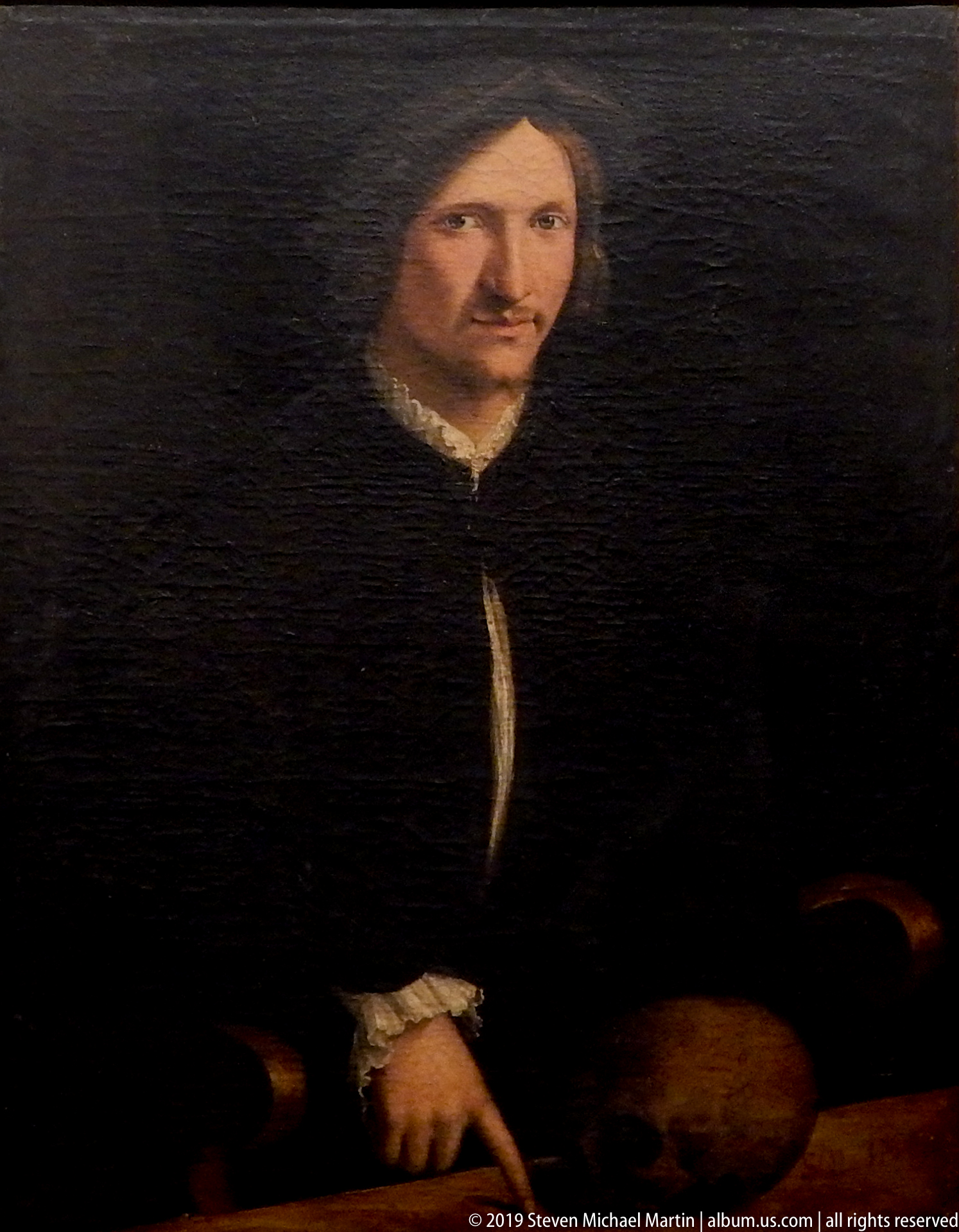
A dark-haired man sits against a nearly black field, his face and one resting hand emerging from the subdued palette. He wears a black garment with a small white collar and a narrow pendant or cord at the chest. The restrained pose and sparse setting give the sitter’s direct expression and hand gesture unusual prominence.
Caption
A dark-haired man sits against a nearly black field, his face and one resting hand emerging from the subdued palette. He wears a black garment with a small white collar and a narrow pendant or cord at the chest. The restrained pose and sparse setting give the sitter’s direct expression and hand gesture unusual prominence.
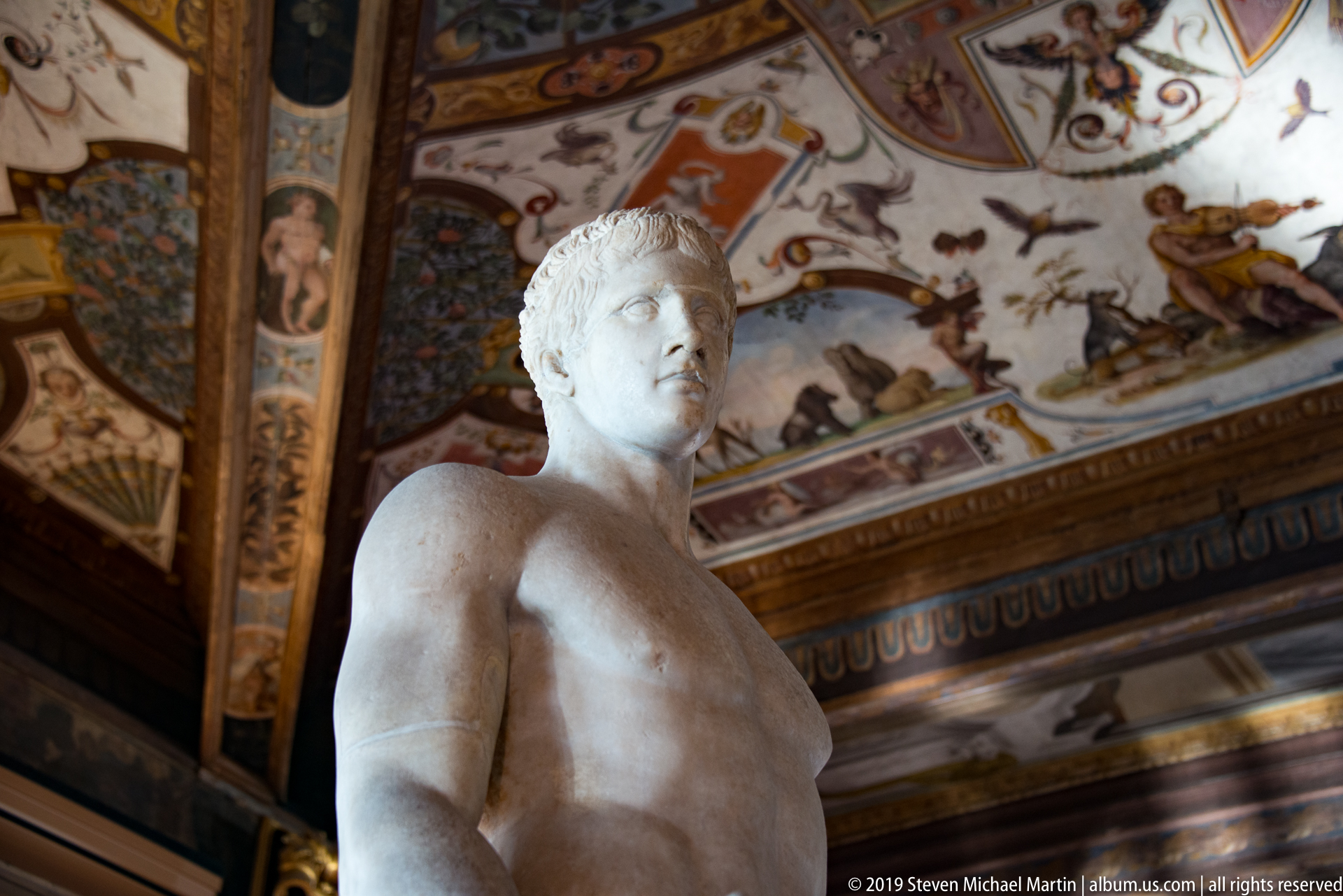
Seen from below, the youthful marble figure turns his head slightly to one side while the chest and shoulders rise against the richly decorated ceiling. Short textured hair frames a smooth, idealized face, and the low-angle crop removes most of the statue’s lower body. The viewpoint emphasizes the sculpture’s scale and calm facial modeling.
Caption
Seen from below, the youthful marble figure turns his head slightly to one side while the chest and shoulders rise against the richly decorated ceiling. Short textured hair frames a smooth, idealized face, and the low-angle crop removes most of the statue’s lower body. The viewpoint emphasizes the sculpture’s scale and calm facial modeling.
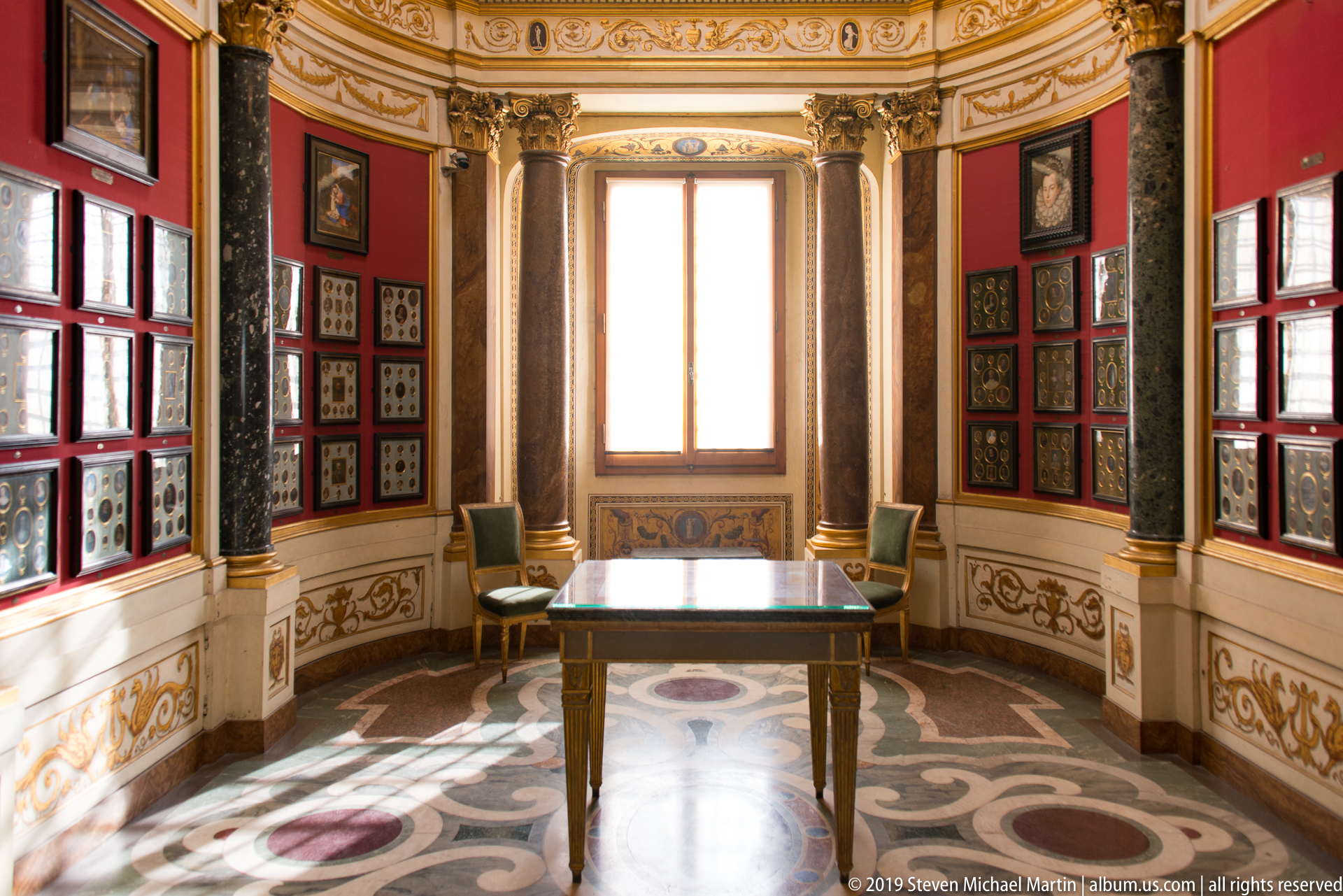
An intimate Uffizi room is organized around a tall central window, with red wall panels, dark columns, gilded ornament, and numerous small framed works arranged symmetrically on either side. A polished geometric marble floor leads toward a simple table and chairs. The carefully balanced interior reads as a display space in which architecture and collection are equally prominent.
Caption
An intimate Uffizi room is organized around a tall central window, with red wall panels, dark columns, gilded ornament, and numerous small framed works arranged symmetrically on either side. A polished geometric marble floor leads toward a simple table and chairs. The carefully balanced interior reads as a display space in which architecture and collection are equally prominent.
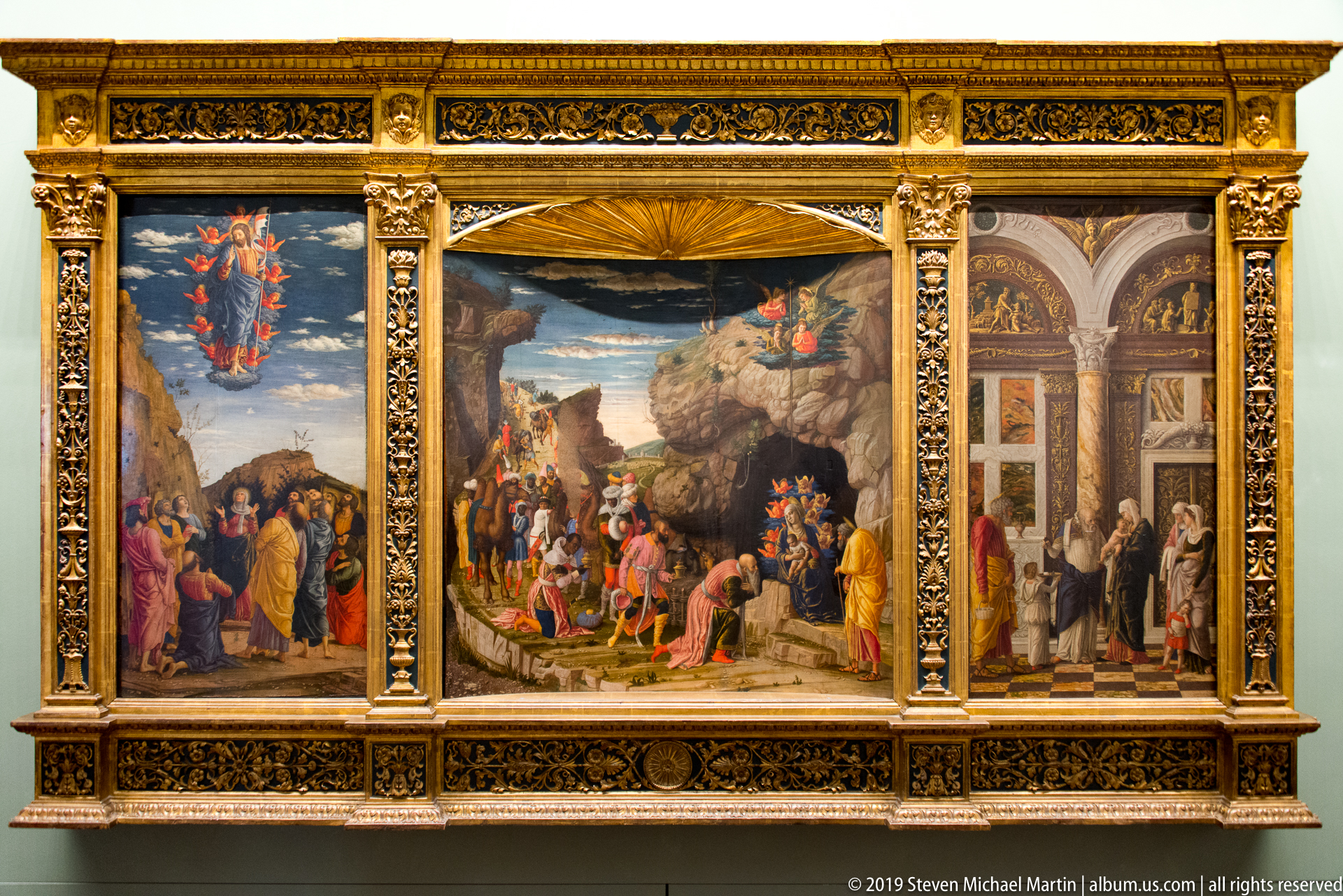
Three painted scenes are set within an elaborate gilded architectural frame, each panel presenting a separate episode with densely grouped figures and carefully rendered settings. The broad central scene unfolds outdoors beneath a dramatic landscape, while the flanking panels provide related narratives. Carved columns, entablature, and ornament unify the triptych as a single display object.
Caption
Three painted scenes are set within an elaborate gilded architectural frame, each panel presenting a separate episode with densely grouped figures and carefully rendered settings. The broad central scene unfolds outdoors beneath a dramatic landscape, while the flanking panels provide related narratives. Carved columns, entablature, and ornament unify the triptych as a single display object.
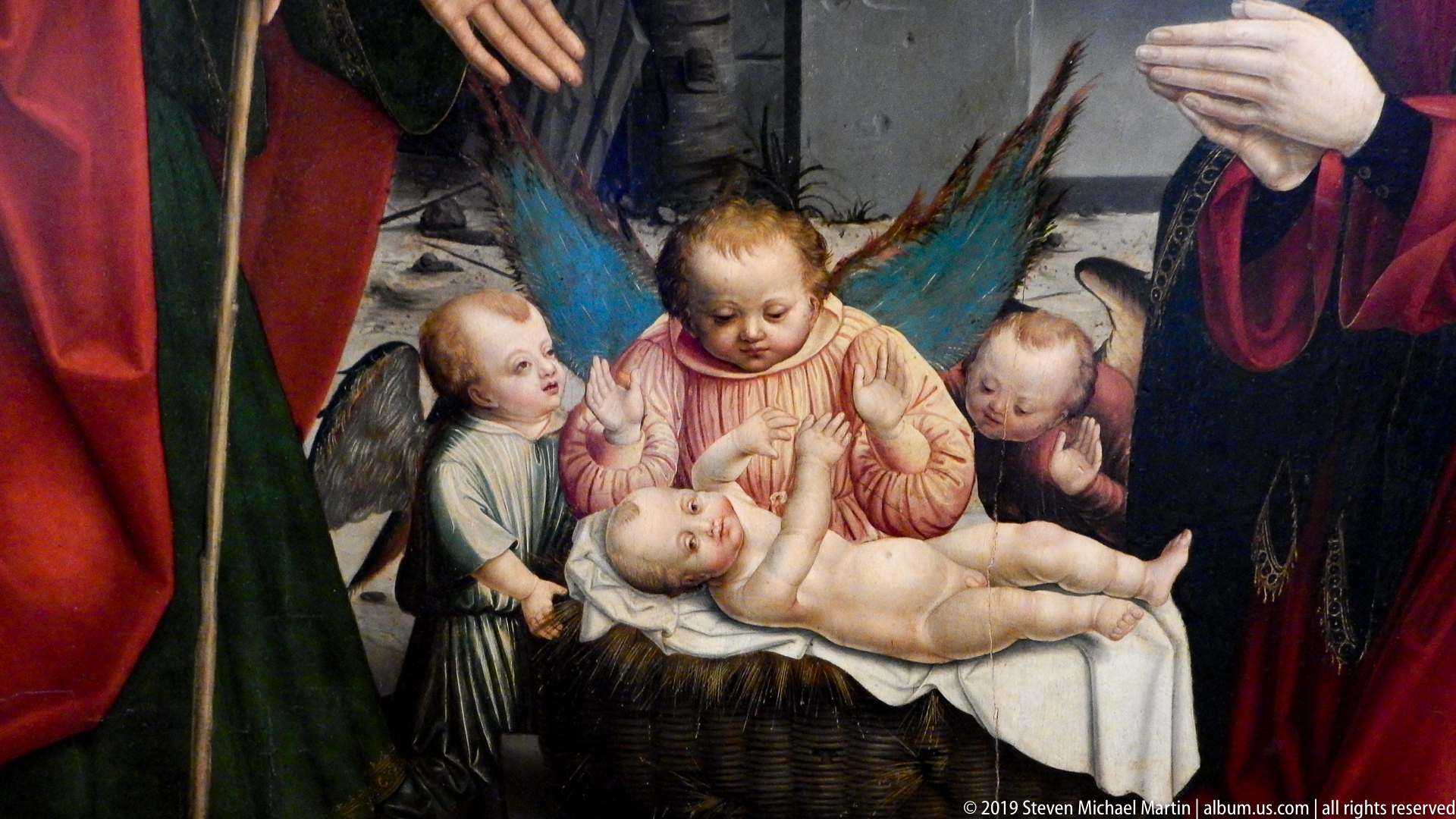
The infant Christ lies on a white cloth in a wicker cradle while four small angels gather closely around him. One brightly winged angel leans forward at the center, flanked by companions who gesture toward the child. Cropped adult hands and richly colored garments at the edges indicate a larger sacred composition beyond this intimate detail.
Caption
The infant Christ lies on a white cloth in a wicker cradle while four small angels gather closely around him. One brightly winged angel leans forward at the center, flanked by companions who gesture toward the child. Cropped adult hands and richly colored garments at the edges indicate a larger sacred composition beyond this intimate detail.
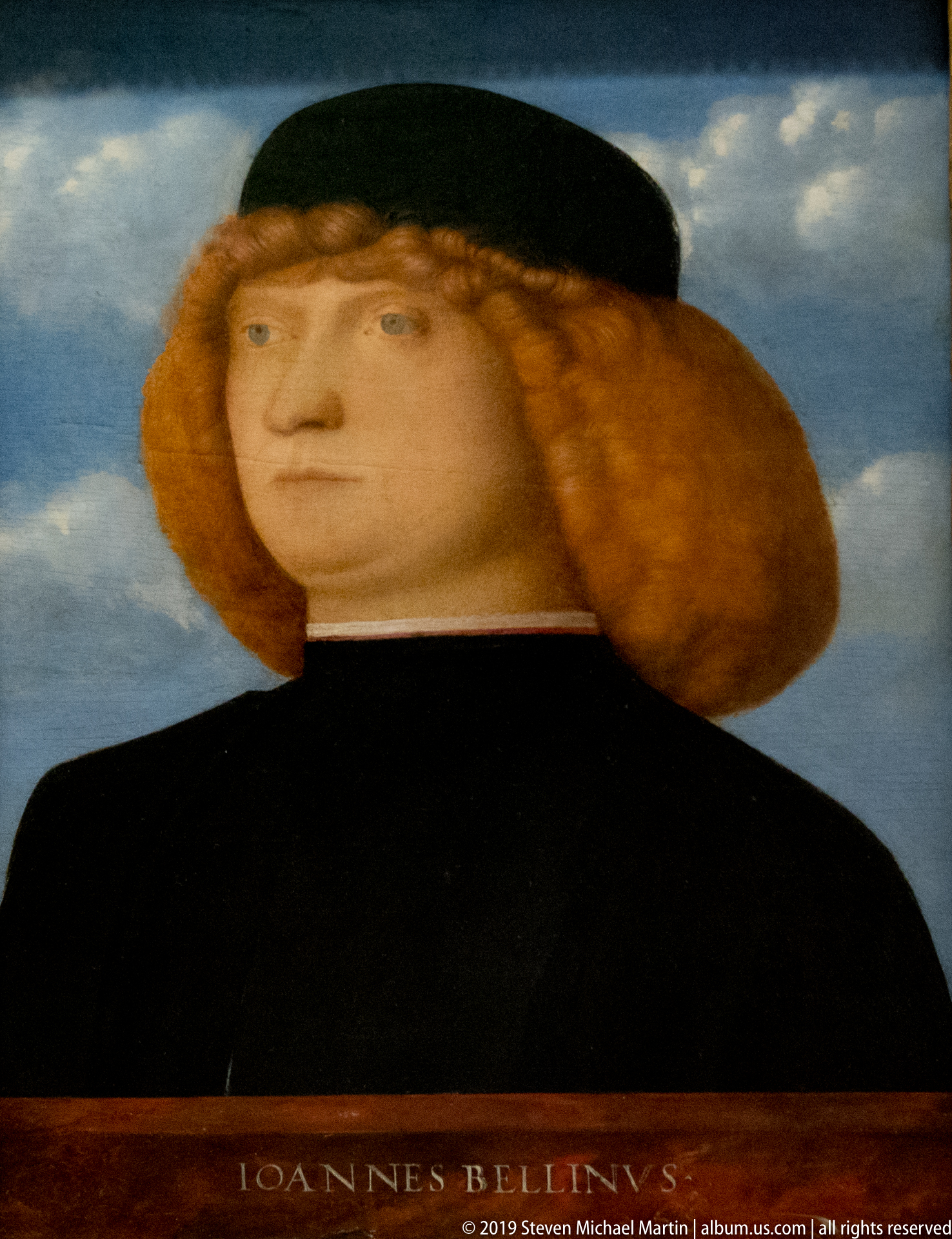
A red-haired man appears bust-length against a cloudy blue sky, wearing a flat black cap and high-necked black garment. The inscription “IOANNES BELLINI” runs along the lower ledge, providing a visible historical label within the painting itself. The frontal pose and simplified costume keep attention on the sitter’s pale face and distinctive copper-colored hair.
Caption
A red-haired man appears bust-length against a cloudy blue sky, wearing a flat black cap and high-necked black garment. The inscription “IOANNES BELLINI” runs along the lower ledge, providing a visible historical label within the painting itself. The frontal pose and simplified costume keep attention on the sitter’s pale face and distinctive copper-colored hair.
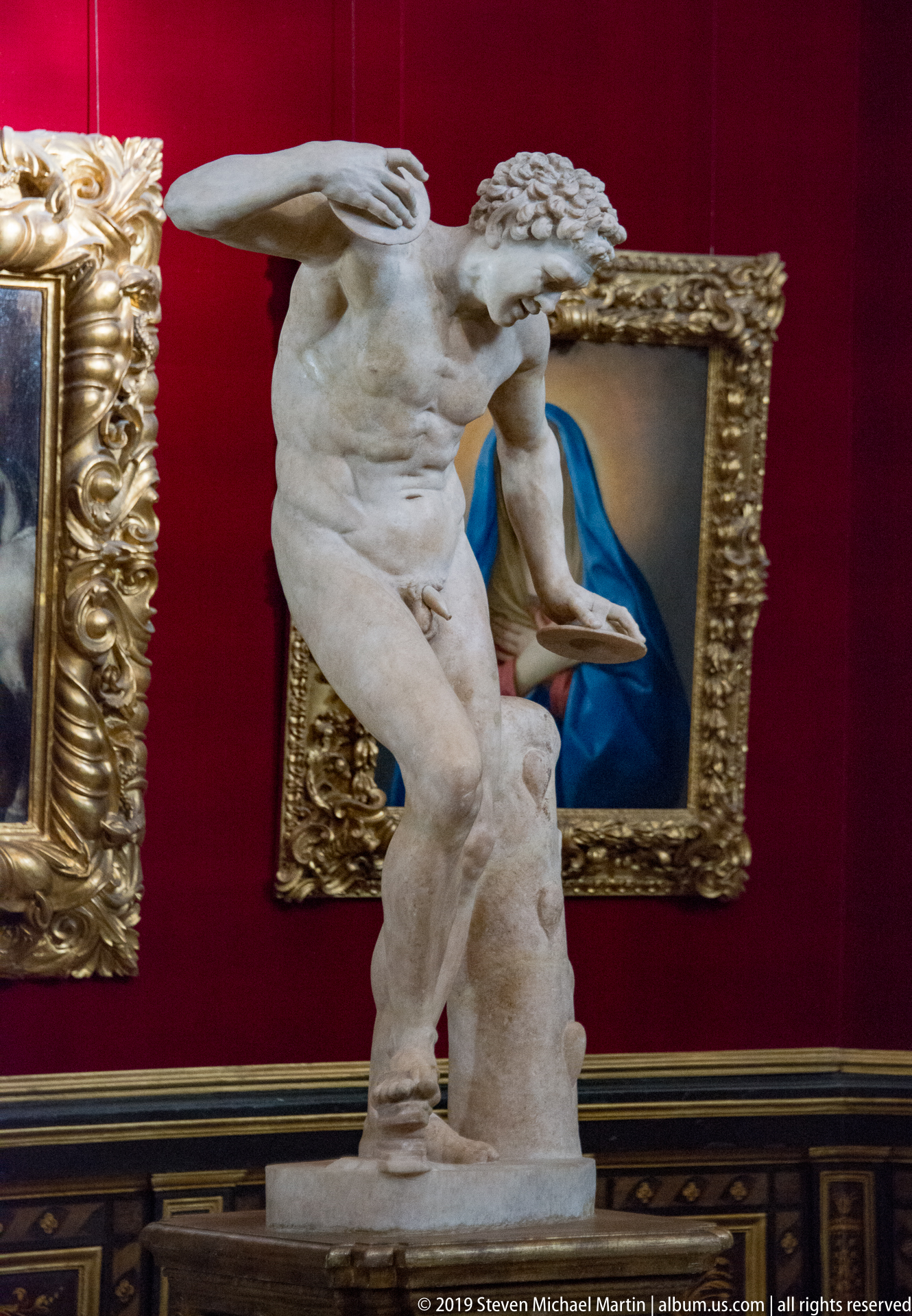
A nude male figure twists sharply through the torso while extending one arm horizontally and stepping across an irregular support. The head turns in the opposite direction, intensifying the sense of movement. Installed against a deep red gallery wall, the pale marble stands out between large gilded paintings and a seated female image in the background.
Caption
A nude male figure twists sharply through the torso while extending one arm horizontally and stepping across an irregular support. The head turns in the opposite direction, intensifying the sense of movement. Installed against a deep red gallery wall, the pale marble stands out between large gilded paintings and a seated female image in the background.
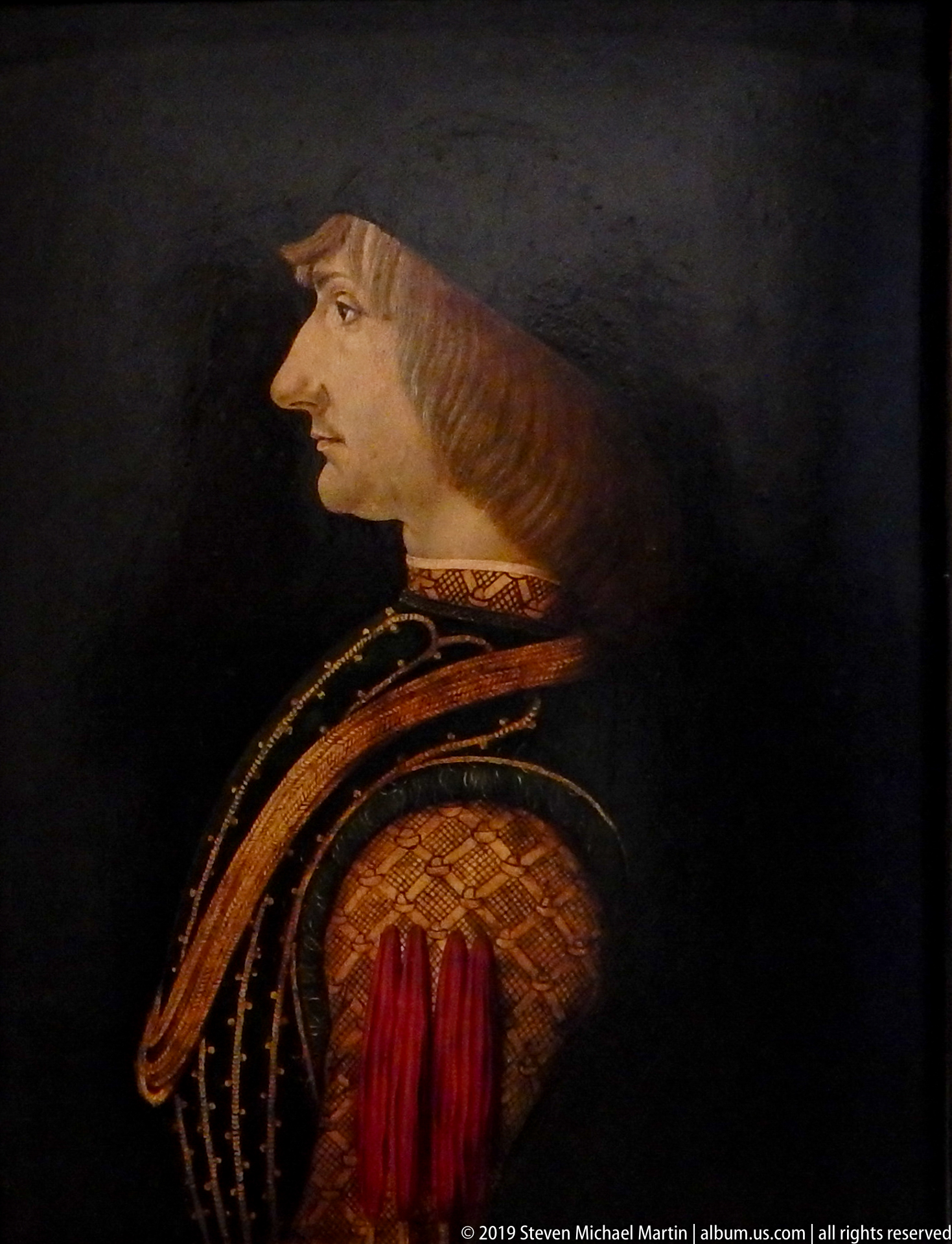
A young man is shown in strict profile against a dark background, his long brown hair cut evenly around the jaw. He wears a richly patterned red-and-brown garment with dark bands and fine decorative edging. The sharply defined nose, chin, and costume silhouette recall the formal profile tradition used for elite Renaissance portraiture.
Caption
A young man is shown in strict profile against a dark background, his long brown hair cut evenly around the jaw. He wears a richly patterned red-and-brown garment with dark bands and fine decorative edging. The sharply defined nose, chin, and costume silhouette recall the formal profile tradition used for elite Renaissance portraiture.
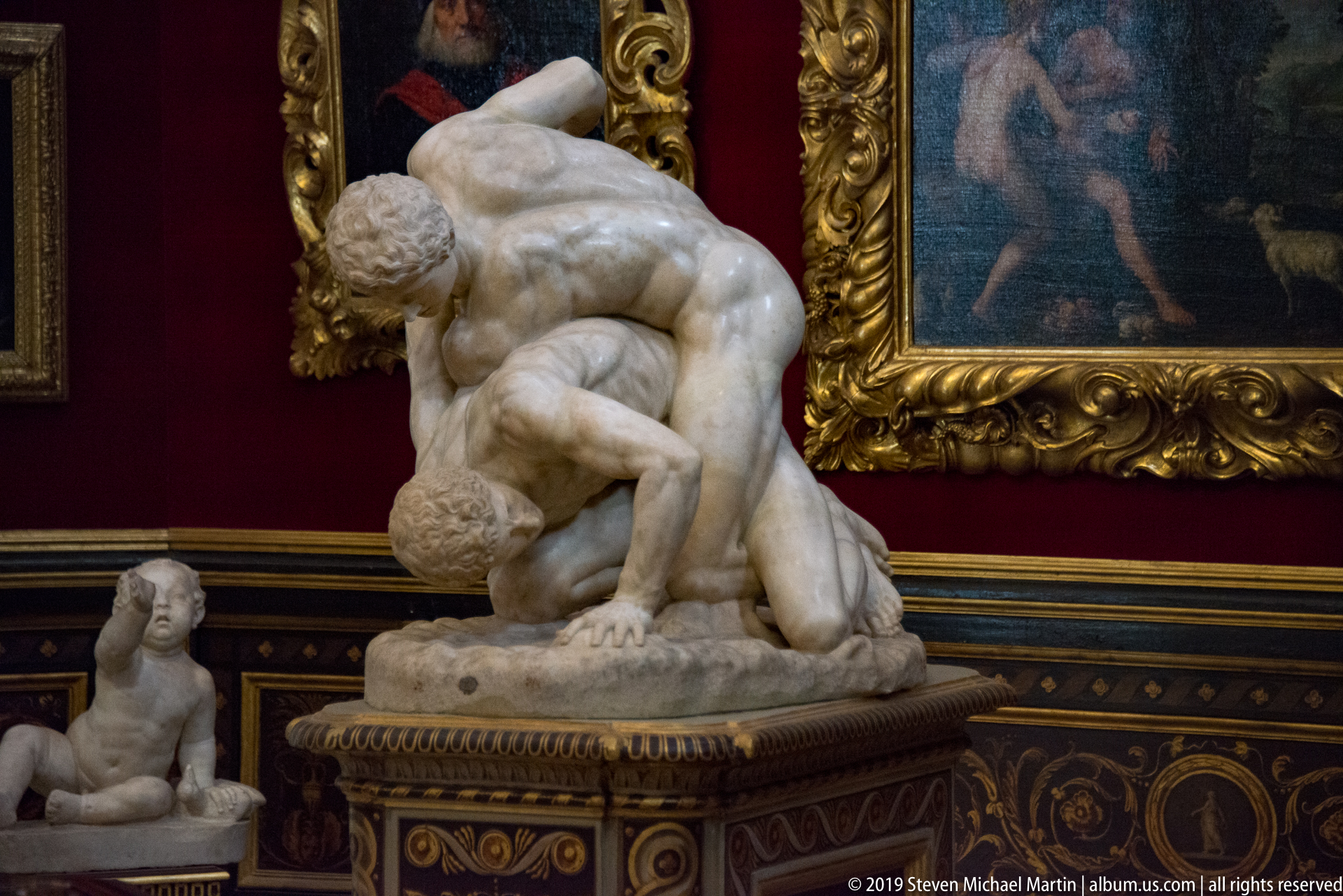
Two muscular nude men are locked in a compact wrestling struggle, one figure crouching over the other while gripping and pinning his opponent close to the ground. Interlaced limbs and sharply flexed torsos make the physical contest legible from every angle. The group is displayed on an ornate pedestal against the Uffizi’s deep red gallery walls.
Caption
Two muscular nude men are locked in a compact wrestling struggle, one figure crouching over the other while gripping and pinning his opponent close to the ground. Interlaced limbs and sharply flexed torsos make the physical contest legible from every angle. The group is displayed on an ornate pedestal against the Uffizi’s deep red gallery walls.
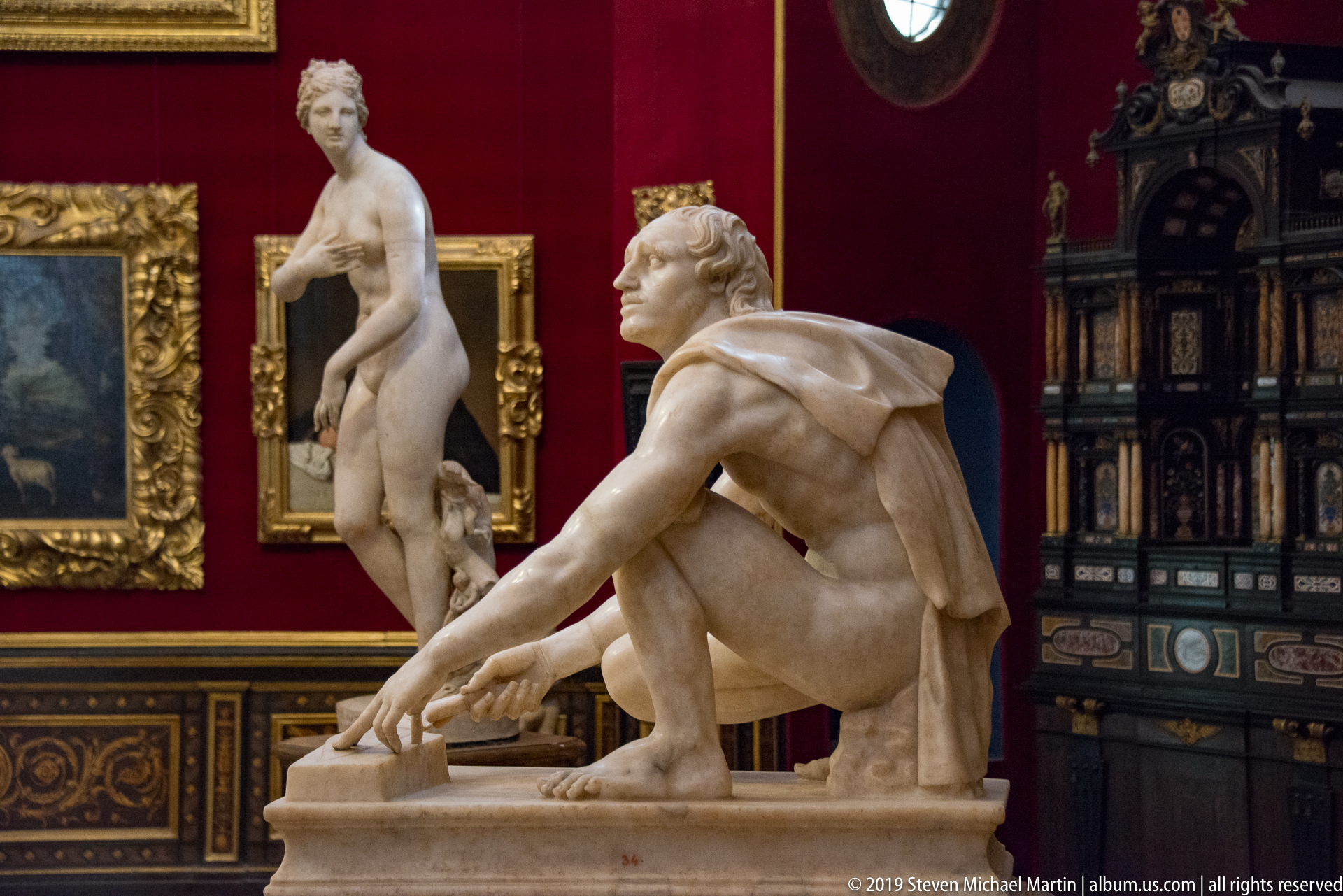
A muscular nude male figure crouches low with both arms reaching forward, the head lifted and torso twisting above deeply bent legs. A mantle or animal-skin-like form drapes across the back and shoulder, adding weight to the silhouette. The low pose contrasts with a standing nude statue behind him and the tall cabinet at the far right.
Caption
A muscular nude male figure crouches low with both arms reaching forward, the head lifted and torso twisting above deeply bent legs. A mantle or animal-skin-like form drapes across the back and shoulder, adding weight to the silhouette. The low pose contrasts with a standing nude statue behind him and the tall cabinet at the far right.
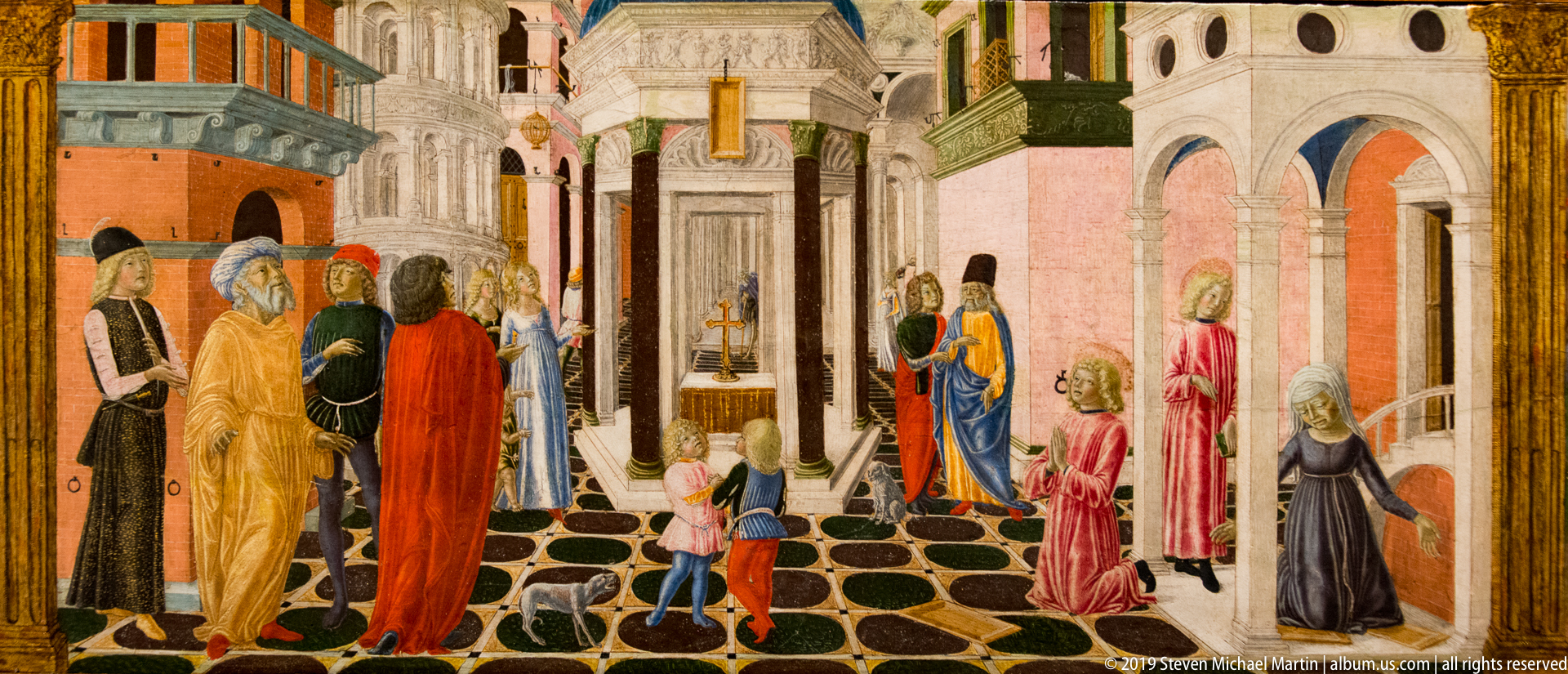
A carefully constructed Renaissance interior opens around a small central altar beneath a tall architectural canopy. Groups of richly dressed figures stand to either side, while a child and attendant occupy the foreground. Patterned pavement, arcades, and colored wall surfaces create a deep ceremonial space whose architecture is as prominent as the narrative action.
Caption
A carefully constructed Renaissance interior opens around a small central altar beneath a tall architectural canopy. Groups of richly dressed figures stand to either side, while a child and attendant occupy the foreground. Patterned pavement, arcades, and colored wall surfaces create a deep ceremonial space whose architecture is as prominent as the narrative action.

A polygonal ceiling panel presents a turbulent battle before a burning city, with mounted and foot soldiers moving through smoke and fire. The narrative scene is embedded within a pale decorative field of grotesques, birds, foliage, masks, and colored geometric borders. The photograph records both the central history painting and the surrounding ornamental system.
Caption
A polygonal ceiling panel presents a turbulent battle before a burning city, with mounted and foot soldiers moving through smoke and fire. The narrative scene is embedded within a pale decorative field of grotesques, birds, foliage, masks, and colored geometric borders. The photograph records both the central history painting and the surrounding ornamental system.
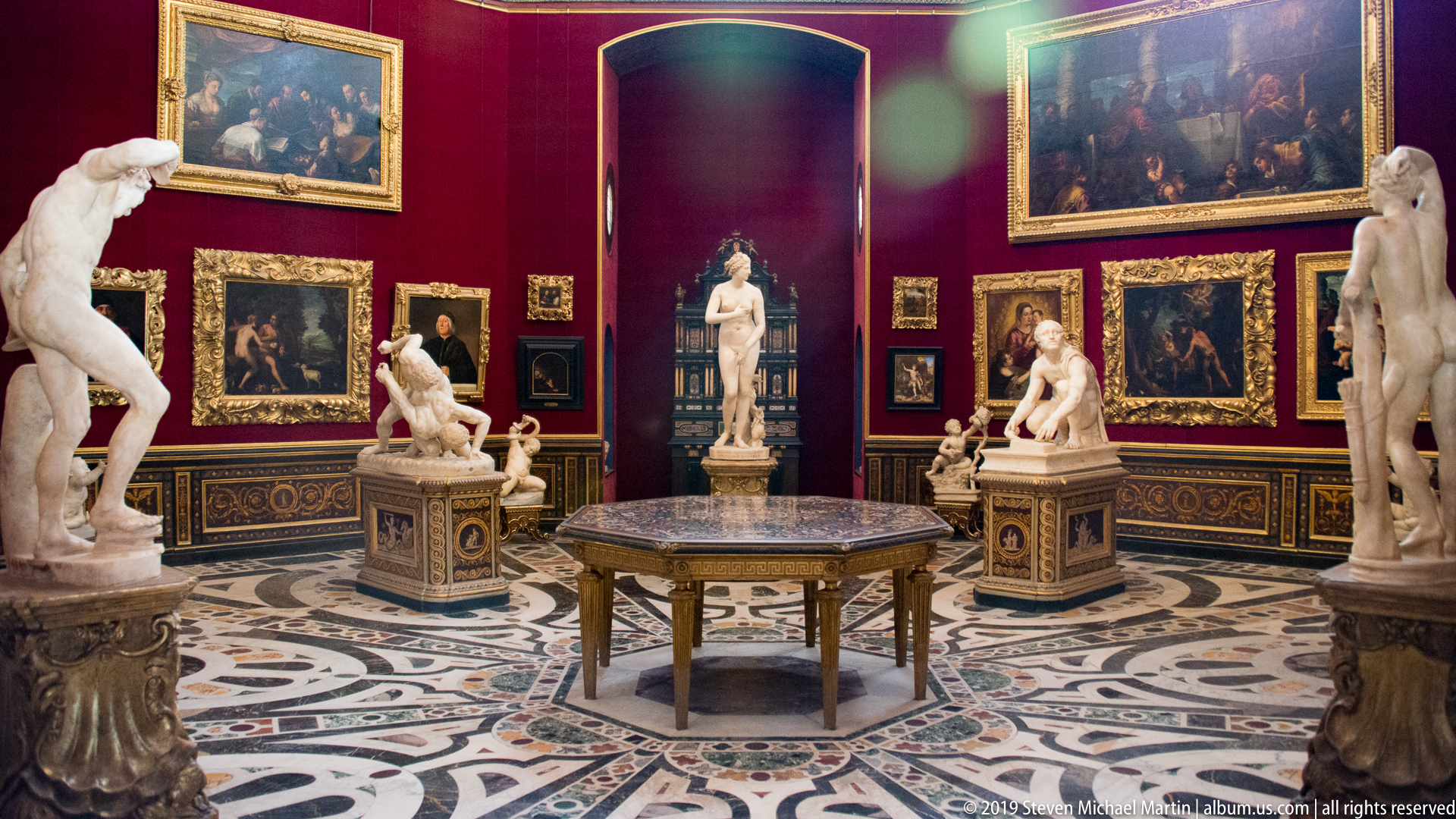
The Uffizi’s octagonal Tribuna is seen as an integrated display environment, with classical statues and smaller sculptural groups arranged among densely hung gilded paintings. A central table stands on an elaborate inlaid marble floor, while deep red walls and a high decorated drum intensify the room’s jewel-box effect. The wide view emphasizes the historic relationship between architecture, furnishings, and collection.
Caption
The Uffizi’s octagonal Tribuna is seen as an integrated display environment, with classical statues and smaller sculptural groups arranged among densely hung gilded paintings. A central table stands on an elaborate inlaid marble floor, while deep red walls and a high decorated drum intensify the room’s jewel-box effect. The wide view emphasizes the historic relationship between architecture, furnishings, and collection.
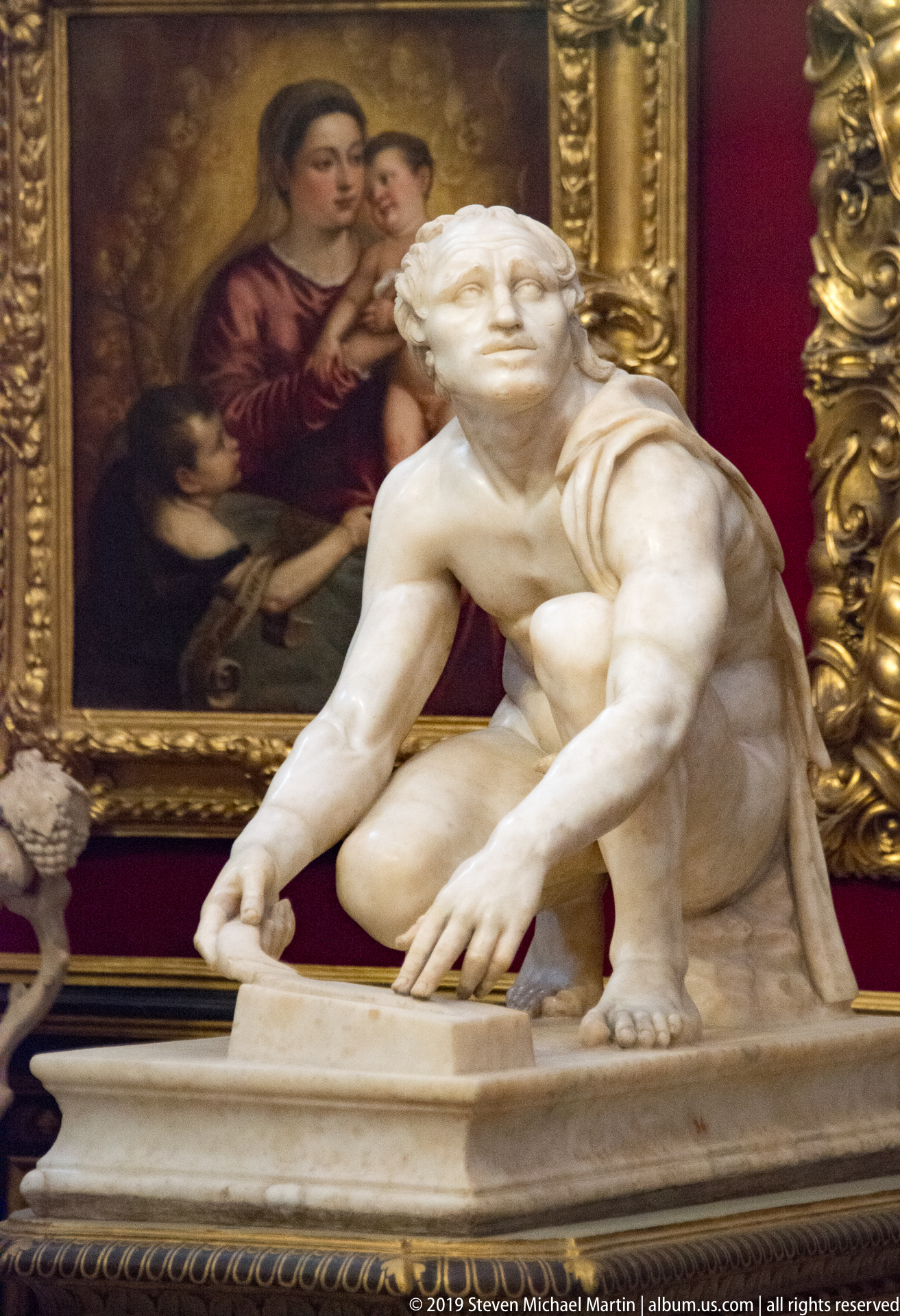
A muscular nude male crouches deeply over a low rectangular support, both hands reaching downward as the torso twists toward the viewer. The bent knees and compressed pose create a strong sense of physical effort. Installed before a large gilded painting on the red gallery wall, the pale marble stands out sharply against its ornate surroundings.
Caption
A muscular nude male crouches deeply over a low rectangular support, both hands reaching downward as the torso twists toward the viewer. The bent knees and compressed pose create a strong sense of physical effort. Installed before a large gilded painting on the red gallery wall, the pale marble stands out sharply against its ornate surroundings.
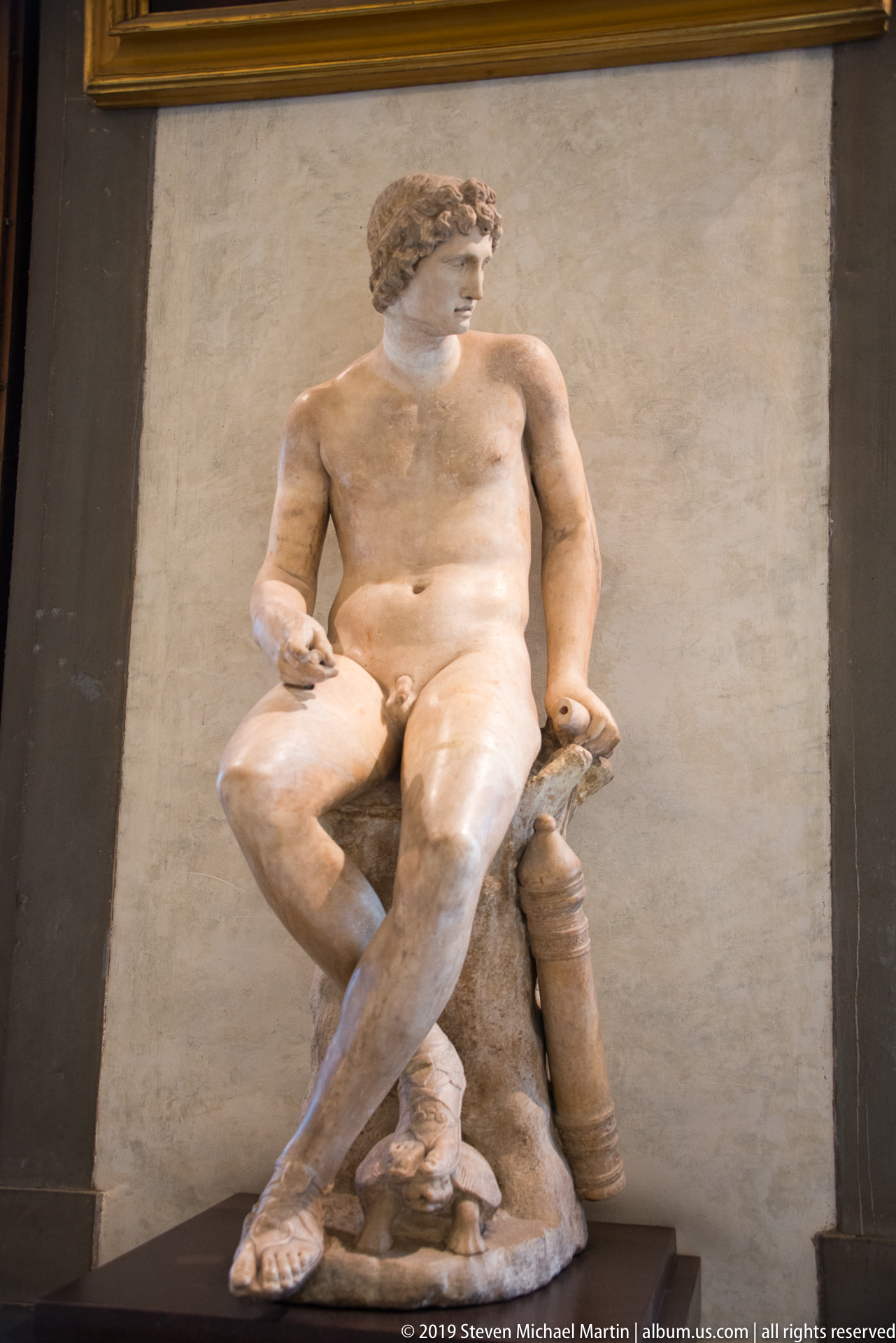
A youthful nude male sits on a rough rocky support with one leg crossed over the other, turning his head slightly while extending one hand. The relaxed seated pose contrasts with the angular tree-trunk-like support at his side. Soft gallery light reveals the smooth modeling of the torso and limbs against a plain wall.
Caption
A youthful nude male sits on a rough rocky support with one leg crossed over the other, turning his head slightly while extending one hand. The relaxed seated pose contrasts with the angular tree-trunk-like support at his side. Soft gallery light reveals the smooth modeling of the torso and limbs against a plain wall.
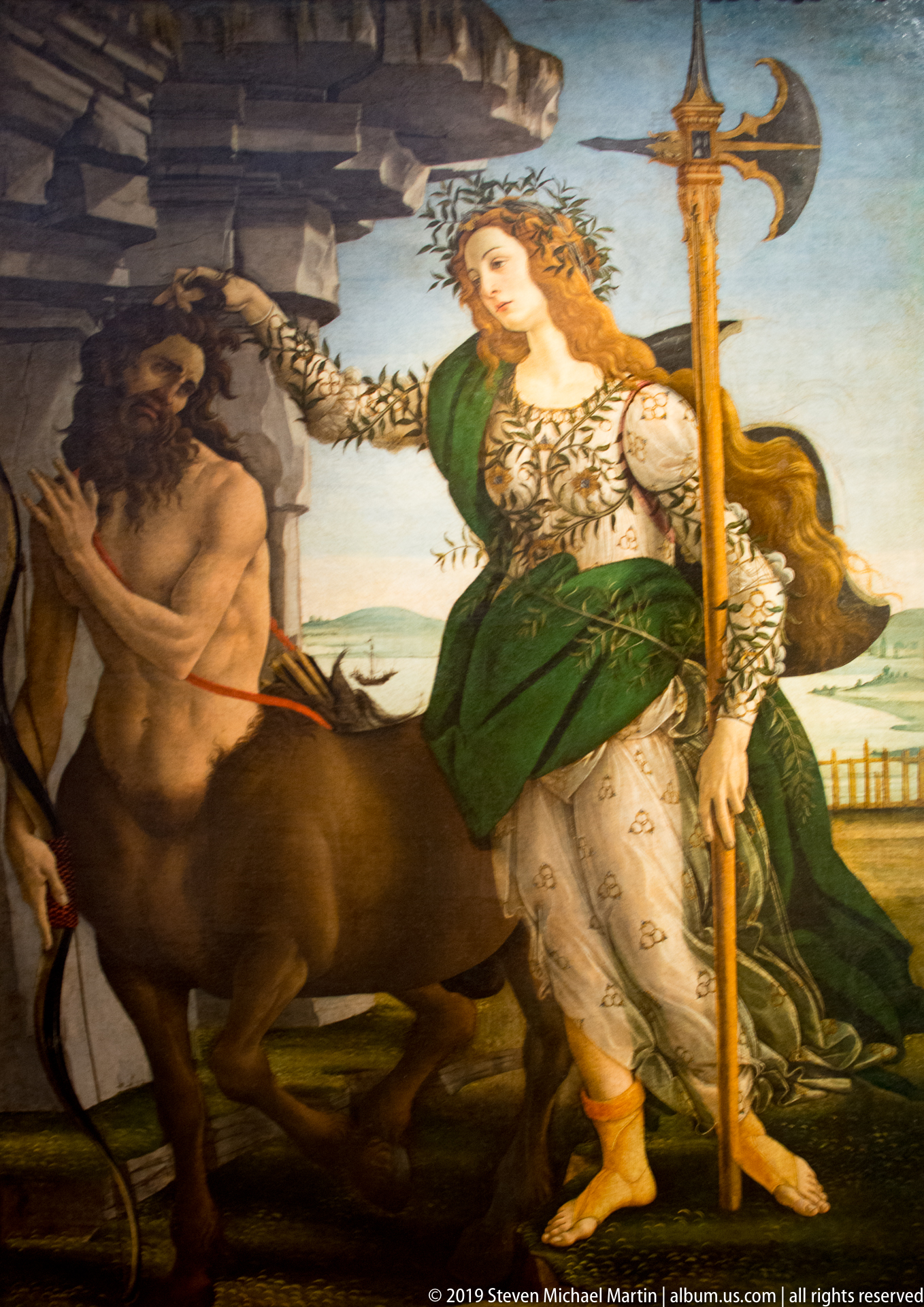
Botticelli’s Pallas and the Centaur (c. 1480–1485) stages a controlled confrontation between a richly dressed armed woman and a centaur. Pallas, or possibly the warrior Camilla, grips the creature by the hair while carrying a battle axe; her garment repeats the Medici three-ring emblem. The centaur’s submission has long encouraged readings of the painting as an allegory of reason or virtue restraining unruly instinct.
Caption
Botticelli’s Pallas and the Centaur (c. 1480–1485) stages a controlled confrontation between a richly dressed armed woman and a centaur. Pallas, or possibly the warrior Camilla, grips the creature by the hair while carrying a battle axe; her garment repeats the Medici three-ring emblem. The centaur’s submission has long encouraged readings of the painting as an allegory of reason or virtue restraining unruly instinct.
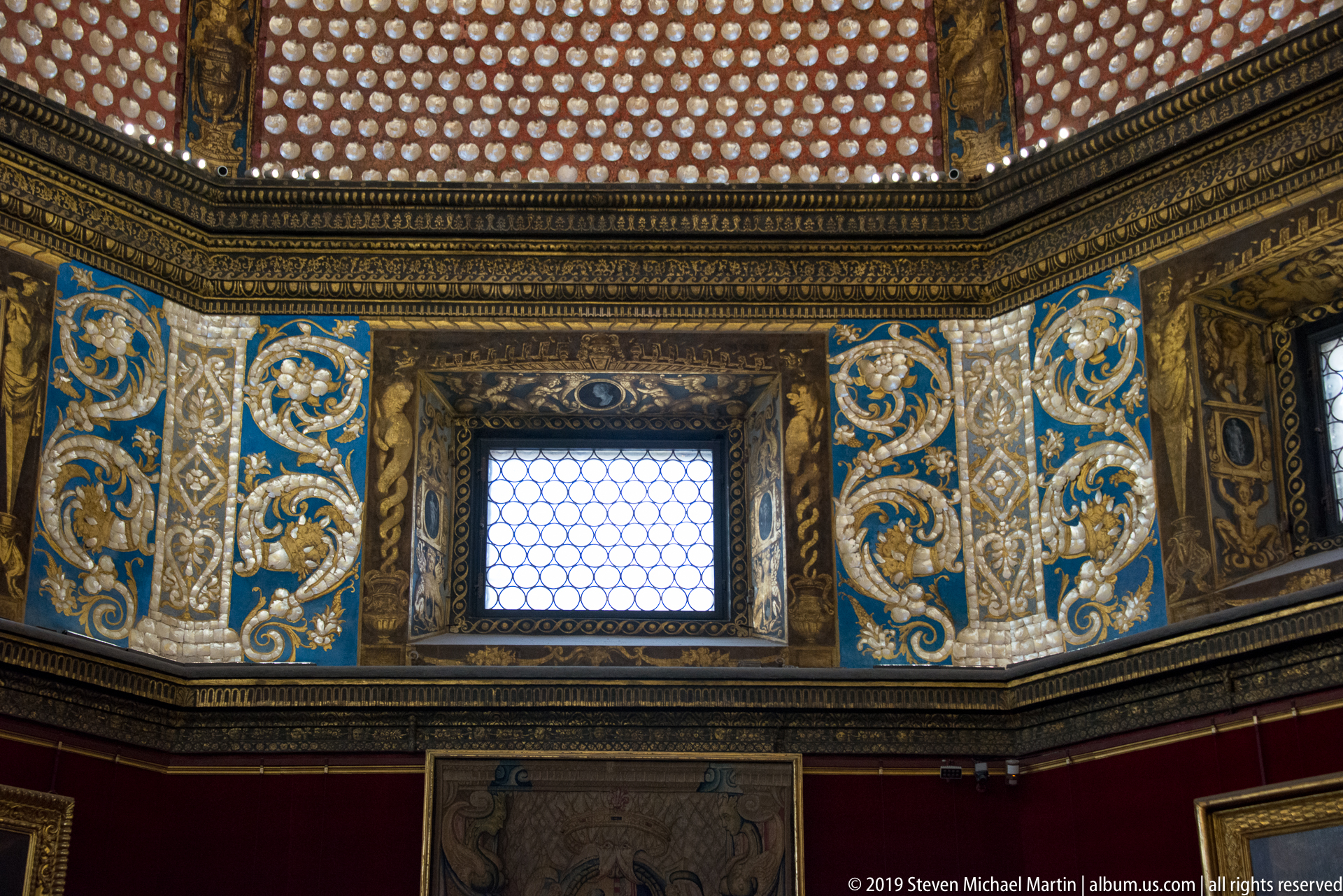
Blue-and-gold arabesque panels, dark architectural moldings, and a small lattice window form the richly layered upper wall of the Tribuna. Above them, the dome is densely surfaced with pale shell-like elements set against a warm red ground. The upward view isolates the room’s extraordinary decorative materials and precise geometric organization.
Caption
Blue-and-gold arabesque panels, dark architectural moldings, and a small lattice window form the richly layered upper wall of the Tribuna. Above them, the dome is densely surfaced with pale shell-like elements set against a warm red ground. The upward view isolates the room’s extraordinary decorative materials and precise geometric organization.
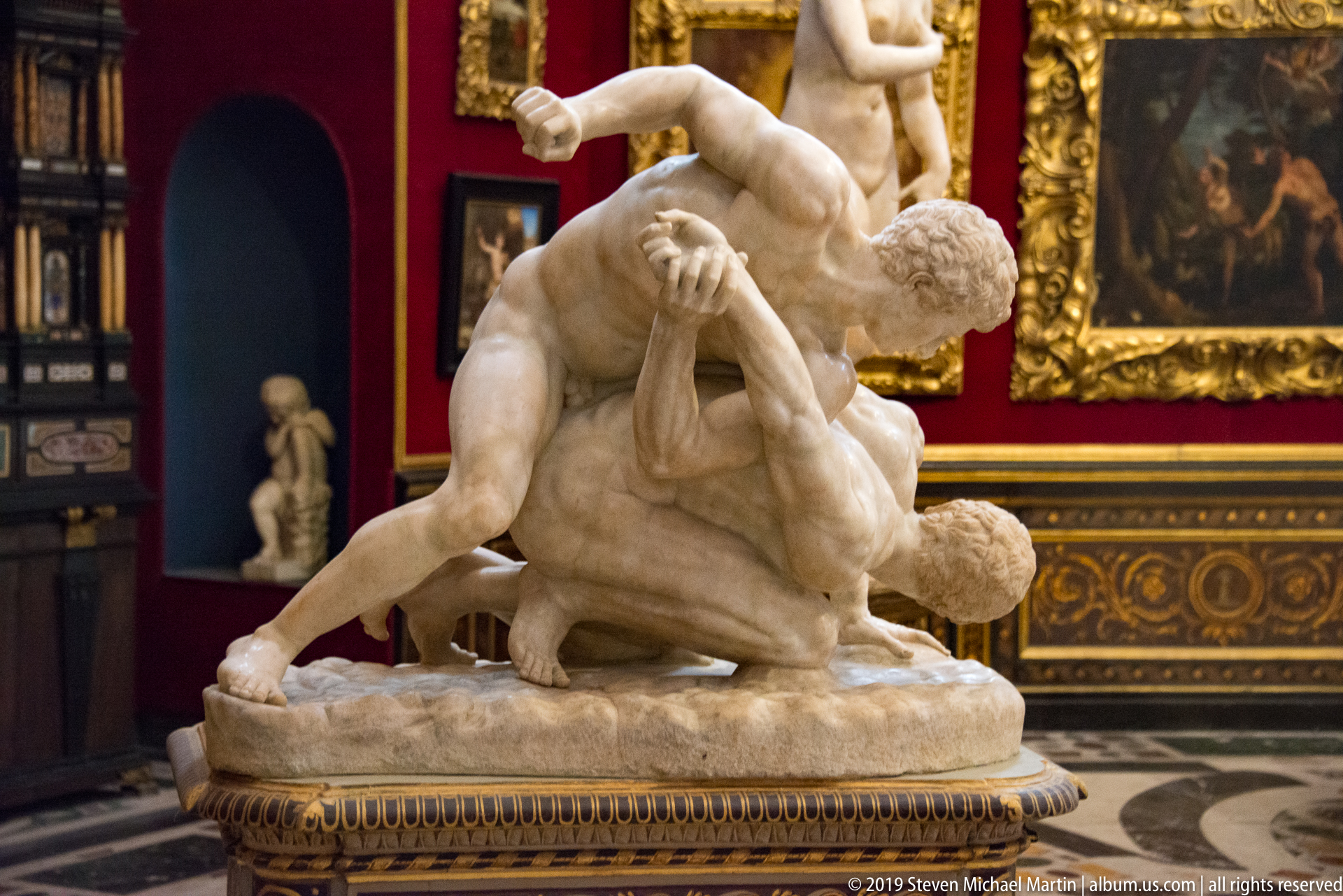
Two muscular nude men are locked in a compact wrestling contest, the upper figure twisting over his opponent while gripping him at the shoulder and arm. Interlaced legs, flexed torsos, and the low oval base compress the action into a powerful sculptural knot. The close view makes the physical strain and carefully modeled anatomy especially legible.
Caption
Two muscular nude men are locked in a compact wrestling contest, the upper figure twisting over his opponent while gripping him at the shoulder and arm. Interlaced legs, flexed torsos, and the low oval base compress the action into a powerful sculptural knot. The close view makes the physical strain and carefully modeled anatomy especially legible.
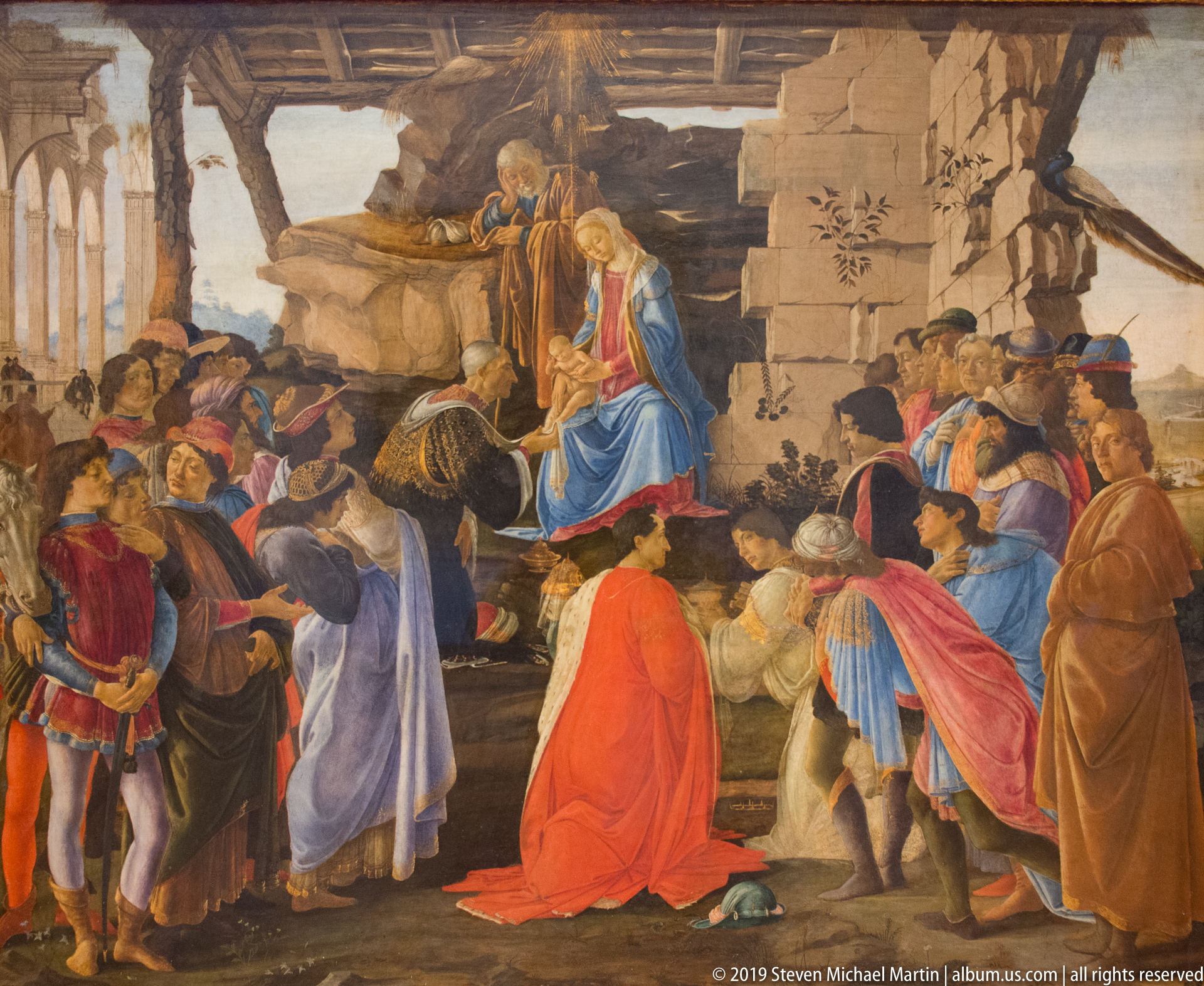
Botticelli’s Adoration of the Magi (c. 1470–1475) transforms the Epiphany into a gathering of contemporary Florentine society around the Virgin and Child. The kneeling kings and richly dressed retinue converge beneath the ruined architecture, while individualized faces turn the sacred event into a display of portraiture closely associated with Medici Florence. The panel’s fame helped establish Botticelli among the city’s leading painters.
Caption
Botticelli’s Adoration of the Magi (c. 1470–1475) transforms the Epiphany into a gathering of contemporary Florentine society around the Virgin and Child. The kneeling kings and richly dressed retinue converge beneath the ruined architecture, while individualized faces turn the sacred event into a display of portraiture closely associated with Medici Florence. The panel’s fame helped establish Botticelli among the city’s leading painters.
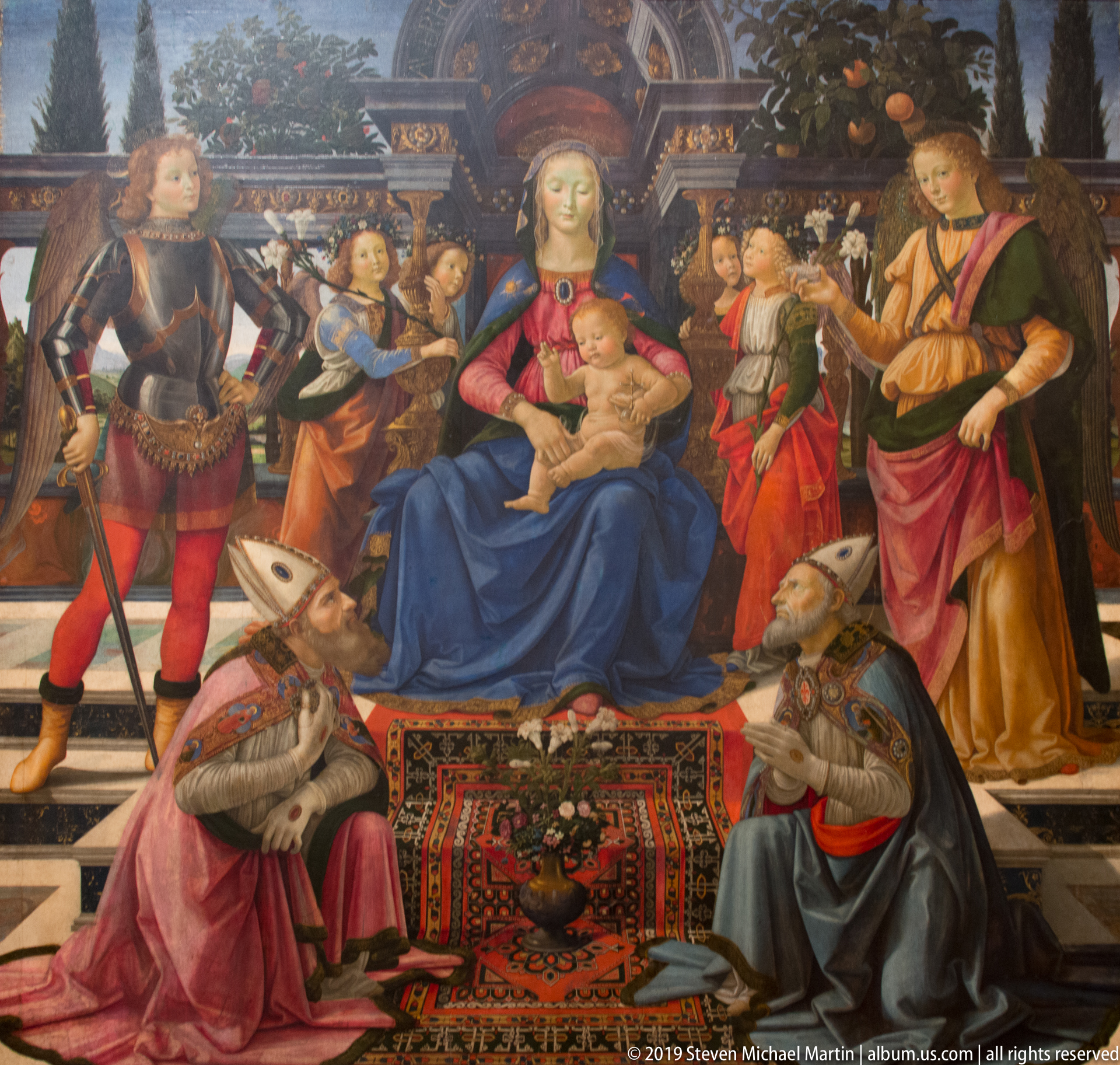
The Virgin sits enthroned with the Christ Child at the center of an elaborate sacred assembly. Angels and standing saints flank the throne, while two richly dressed kneeling figures occupy the foreground beside a patterned carpet. Fruit-bearing foliage and architectural ornament frame the upper register, giving the altarpiece a densely ceremonial character.
Caption
The Virgin sits enthroned with the Christ Child at the center of an elaborate sacred assembly. Angels and standing saints flank the throne, while two richly dressed kneeling figures occupy the foreground beside a patterned carpet. Fruit-bearing foliage and architectural ornament frame the upper register, giving the altarpiece a densely ceremonial character.
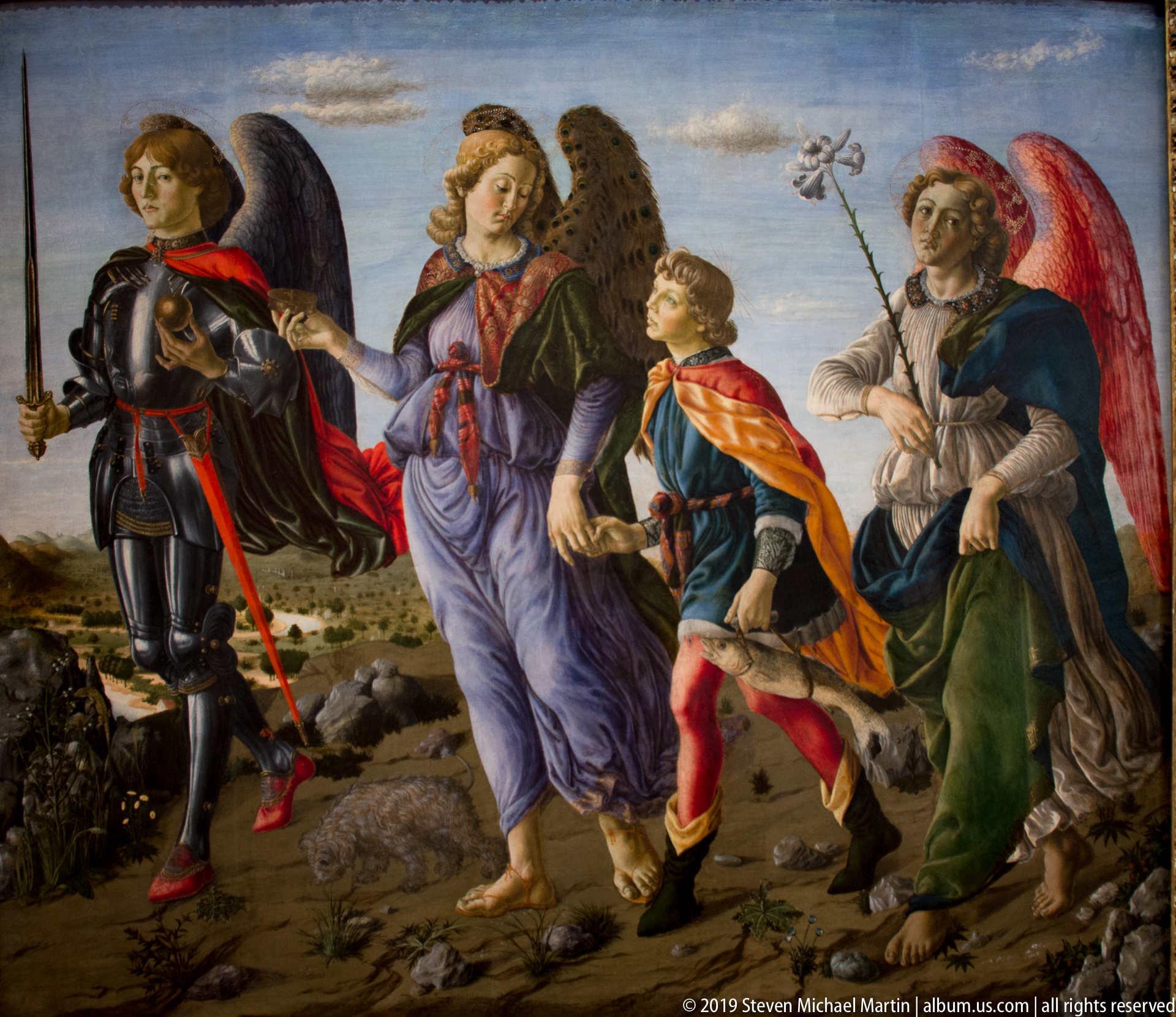
A youthful traveler walks through a rocky landscape between two winged companions, one dressed in blue-violet and the other in green. A small dog follows at their feet, while one angel carries a staff. The walking figures, protective angelic escorts, and journey setting support identification with the biblical story of Tobias and the angel.
Caption
A youthful traveler walks through a rocky landscape between two winged companions, one dressed in blue-violet and the other in green. A small dog follows at their feet, while one angel carries a staff. The walking figures, protective angelic escorts, and journey setting support identification with the biblical story of Tobias and the angel.
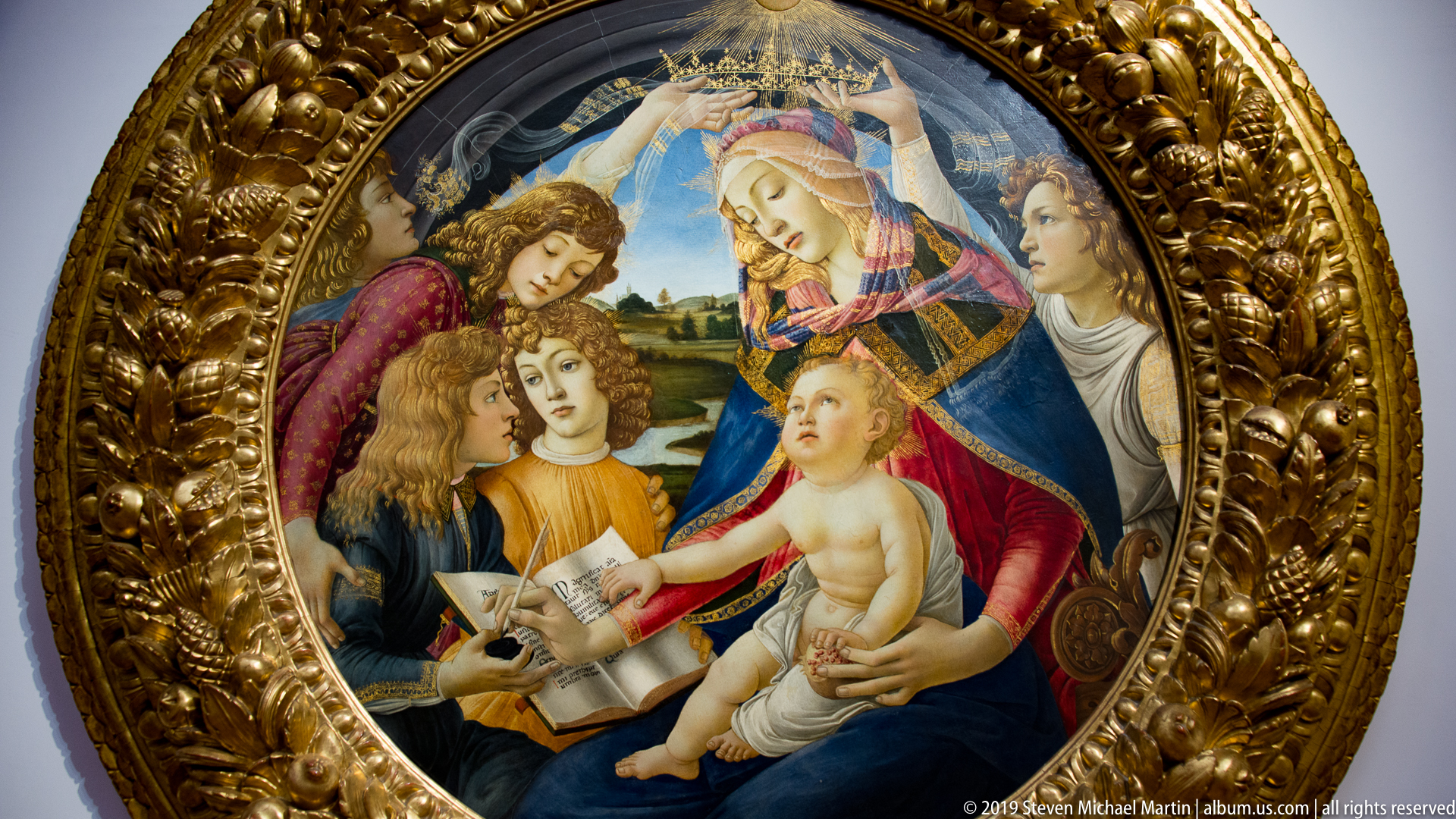
A crowned Virgin bends over an open book while the Christ Child sits on her lap and touches her hand. Several youthful angels crowd closely around them, two holding the crown above Mary’s veil. The circular composition and lavish carved frame concentrate the figures into an intimate devotional group centered on the act of writing.
Caption
A crowned Virgin bends over an open book while the Christ Child sits on her lap and touches her hand. Several youthful angels crowd closely around them, two holding the crown above Mary’s veil. The circular composition and lavish carved frame concentrate the figures into an intimate devotional group centered on the act of writing.
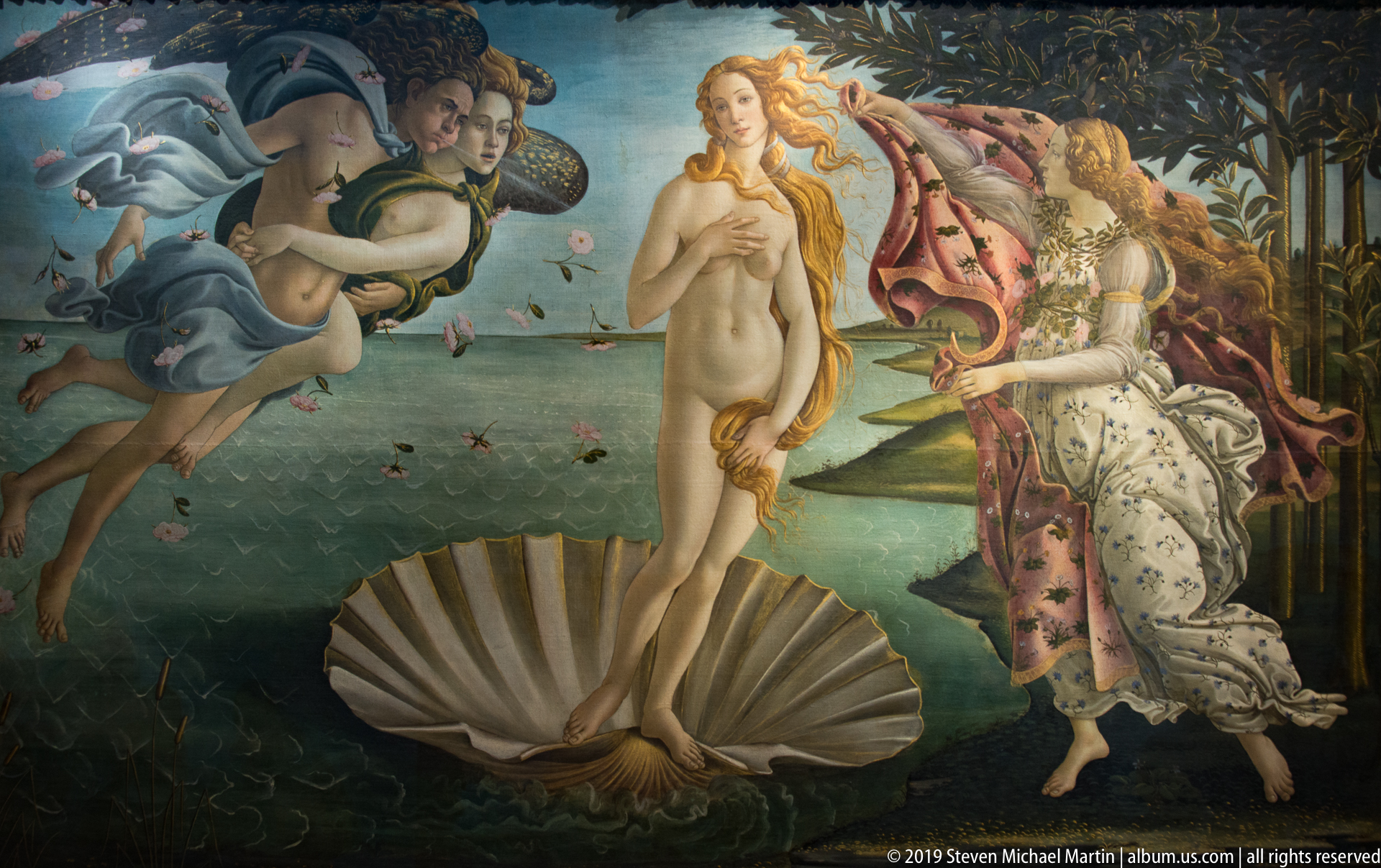
Sandro Botticelli’s Birth of Venus (c. 1485) shows the goddess arriving on the shore of Cyprus rather than the instant of her birth. Venus balances on a giant scallop shell as Zephyrus and a companion blow her landward, scattering roses, while a richly dressed attendant reaches forward with a flowered mantle. The flowing contours, pale sea, and wind-driven hair turn the mythological arrival into one of the defining images of the Florentine Renaissance.
Caption
Sandro Botticelli’s Birth of Venus (c. 1485) shows the goddess arriving on the shore of Cyprus rather than the instant of her birth. Venus balances on a giant scallop shell as Zephyrus and a companion blow her landward, scattering roses, while a richly dressed attendant reaches forward with a flowered mantle. The flowing contours, pale sea, and wind-driven hair turn the mythological arrival into one of the defining images of the Florentine Renaissance.
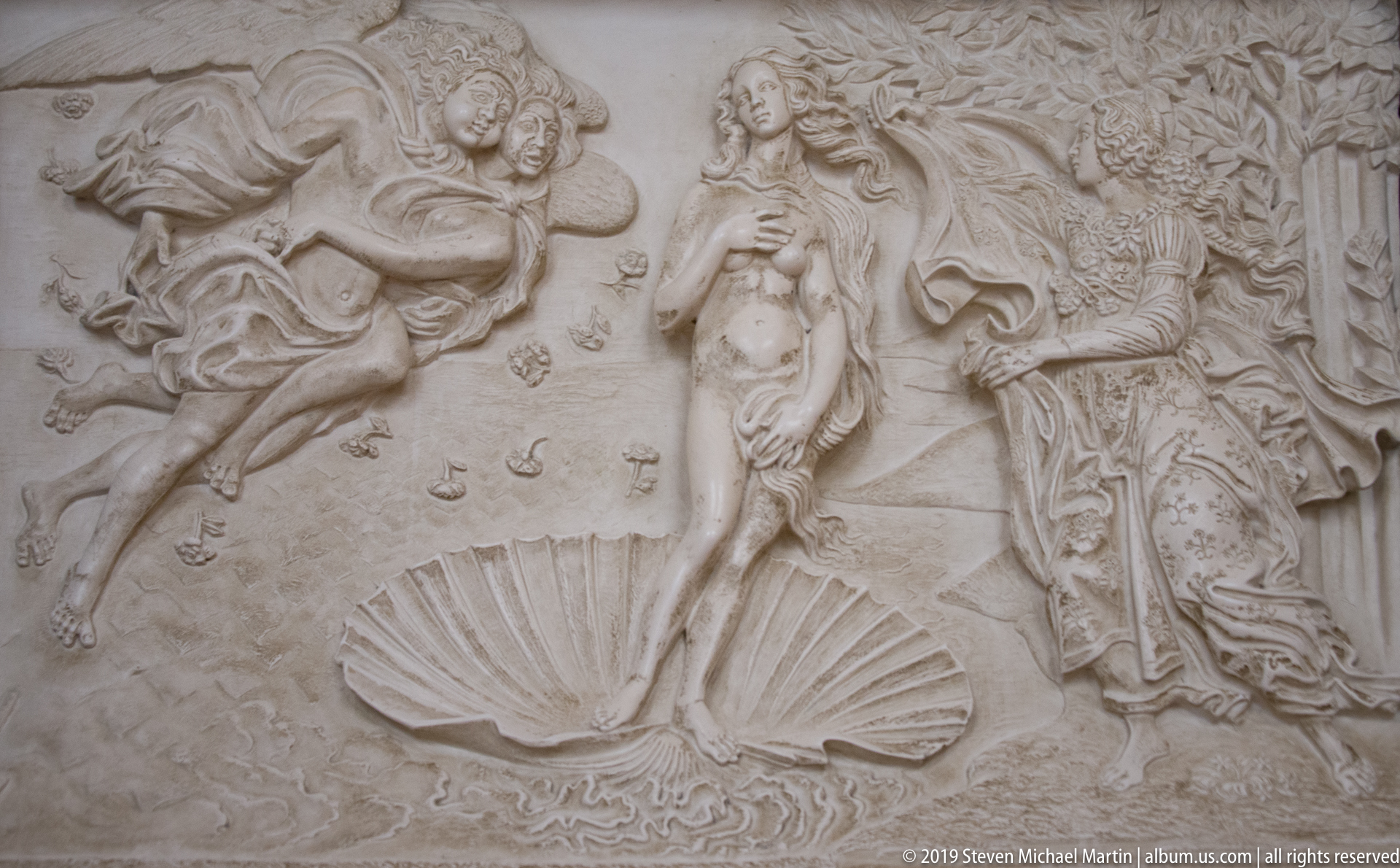
A pale relief translates the central arrangement of the Birth of Venus into sculptural form. Venus stands above the scallop shell at center, with wind-borne figures approaching from the left and a draped attendant at right. Shallow modeling of hair, fabric, foliage, and scattered blossoms creates a monochrome counterpart to the familiar painted composition.
Caption
A pale relief translates the central arrangement of the Birth of Venus into sculptural form. Venus stands above the scallop shell at center, with wind-borne figures approaching from the left and a draped attendant at right. Shallow modeling of hair, fabric, foliage, and scattered blossoms creates a monochrome counterpart to the familiar painted composition.
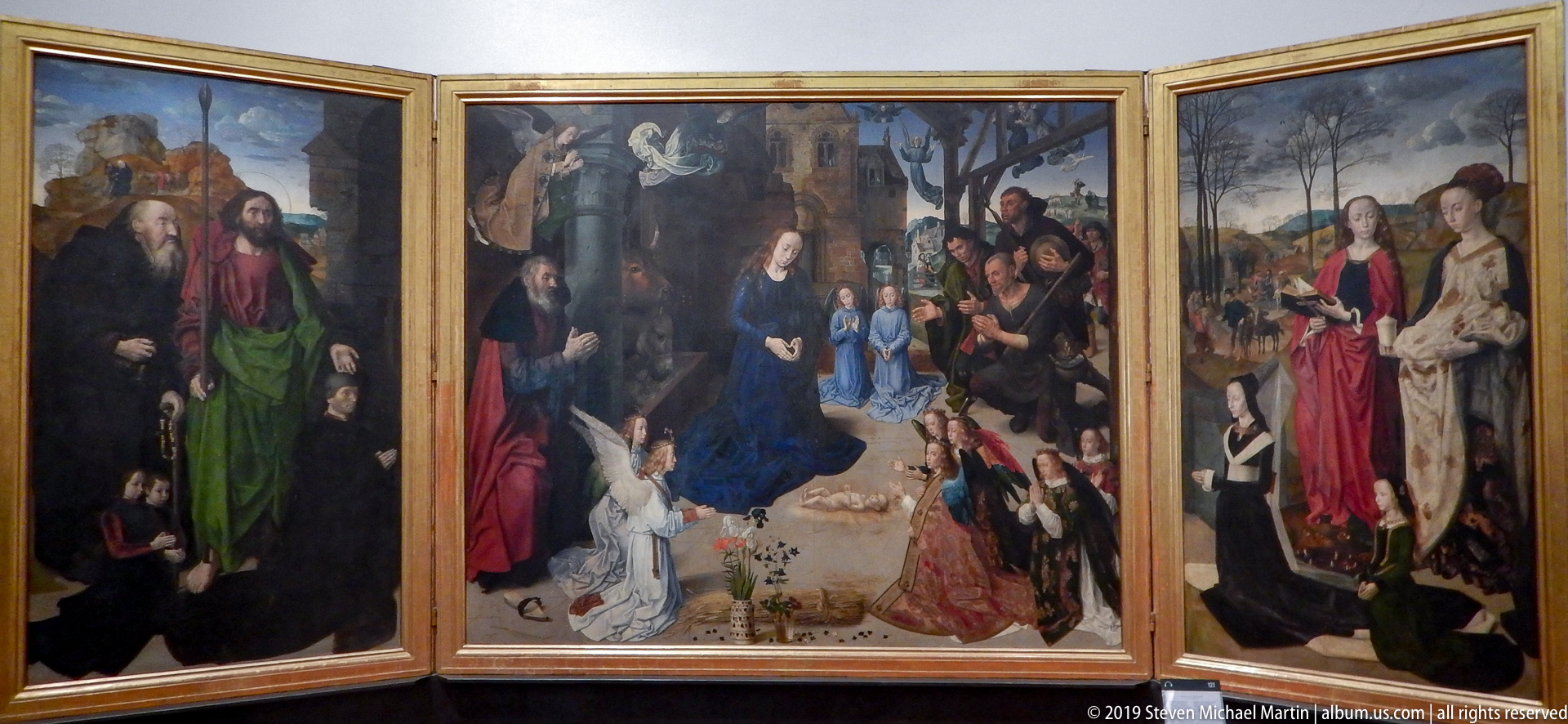
A hinged triptych opens around a central devotional scene of the Virgin and Child surrounded by worshippers and angels. The narrower wings contain standing sacred figures and smaller attendant groups, while the center expands into a densely populated outdoor setting. The visible hinges and separate framed panels preserve the object’s character as a multipart altarpiece.
Caption
A hinged triptych opens around a central devotional scene of the Virgin and Child surrounded by worshippers and angels. The narrower wings contain standing sacred figures and smaller attendant groups, while the center expands into a densely populated outdoor setting. The visible hinges and separate framed panels preserve the object’s character as a multipart altarpiece.

The Virgin sits frontally beneath a monumental shell-like architectural canopy, holding the nude Christ Child securely across her lap. The child turns outward and raises one hand, while cropped hands and attributes of flanking saints enter from both edges. Strong architectural symmetry and saturated blue, red, and green drapery focus attention on the central pair.
Caption
The Virgin sits frontally beneath a monumental shell-like architectural canopy, holding the nude Christ Child securely across her lap. The child turns outward and raises one hand, while cropped hands and attributes of flanking saints enter from both edges. Strong architectural symmetry and saturated blue, red, and green drapery focus attention on the central pair.
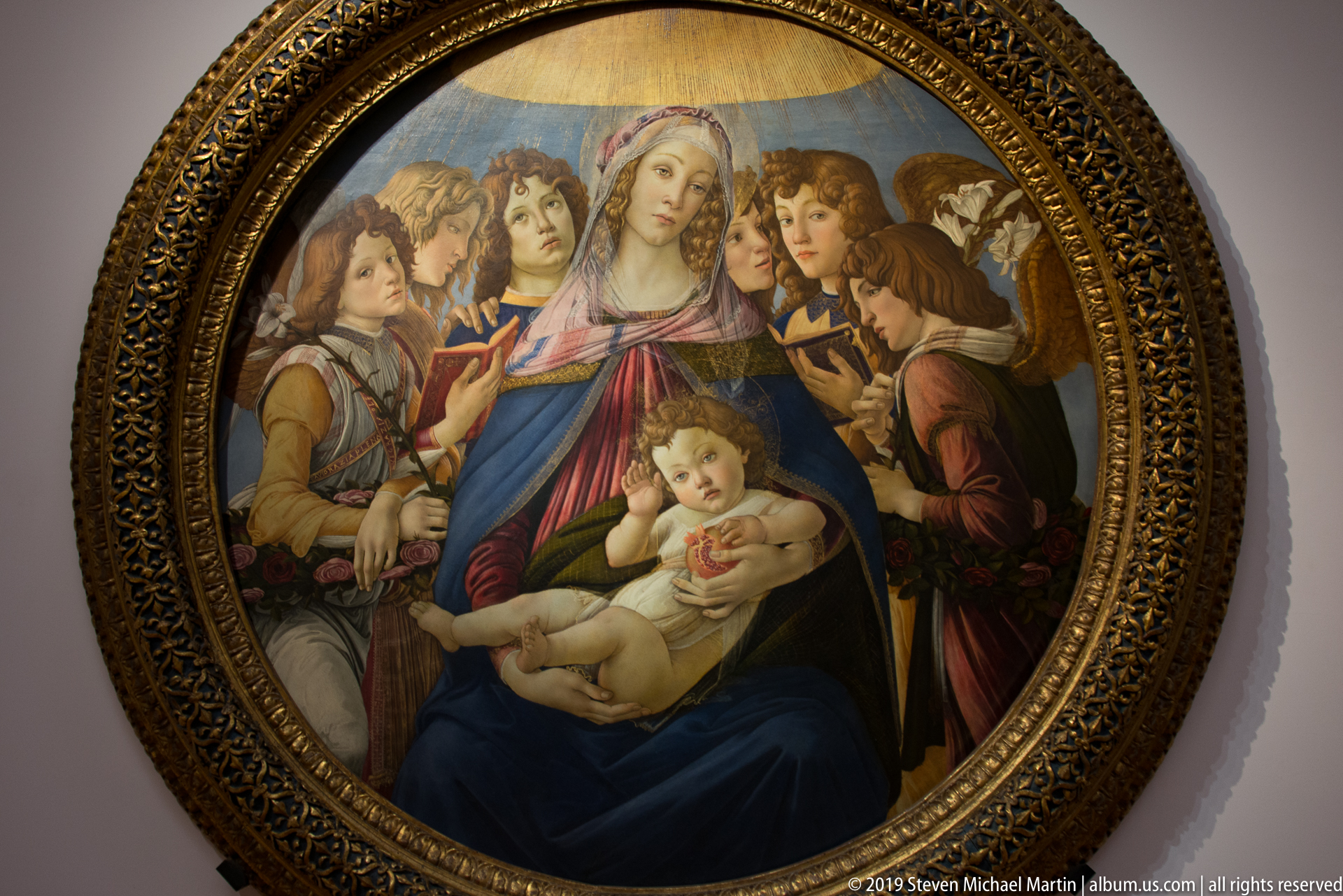
Botticelli’s Madonna of the Pomegranate (c. 1487) gathers the Virgin, Christ Child, and six angels into a solemn circular design. Mary and Jesus hold the pomegranate whose red seeds evoke Christ’s future Passion, while angels present lilies and roses associated with the Virgin. The strict symmetry and surviving carved, gilded, and painted frame give this devotional tondo an unusually monumental presence despite its intimate subject.
Caption
Botticelli’s Madonna of the Pomegranate (c. 1487) gathers the Virgin, Christ Child, and six angels into a solemn circular design. Mary and Jesus hold the pomegranate whose red seeds evoke Christ’s future Passion, while angels present lilies and roses associated with the Virgin. The strict symmetry and surviving carved, gilded, and painted frame give this devotional tondo an unusually monumental presence despite its intimate subject.
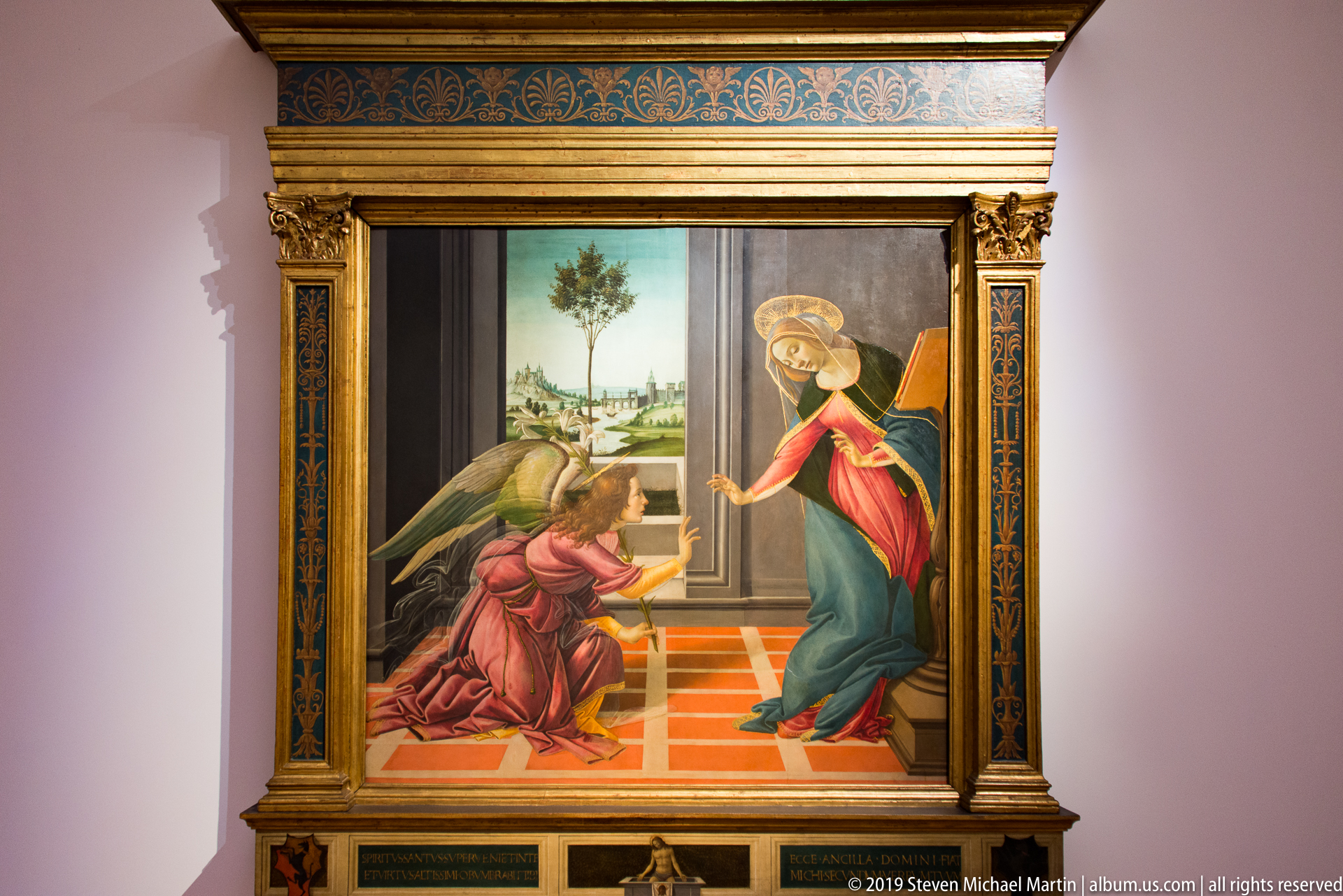
A winged angel kneels at left and extends a hand toward the Virgin, who bends forward at right beside a tall lectern. Red floor tiles and dark architectural openings establish a carefully measured interior, while a distant river landscape appears through the central window. The reciprocal gestures create a quiet, sharply organized Annunciation.
Caption
A winged angel kneels at left and extends a hand toward the Virgin, who bends forward at right beside a tall lectern. Red floor tiles and dark architectural openings establish a carefully measured interior, while a distant river landscape appears through the central window. The reciprocal gestures create a quiet, sharply organized Annunciation.
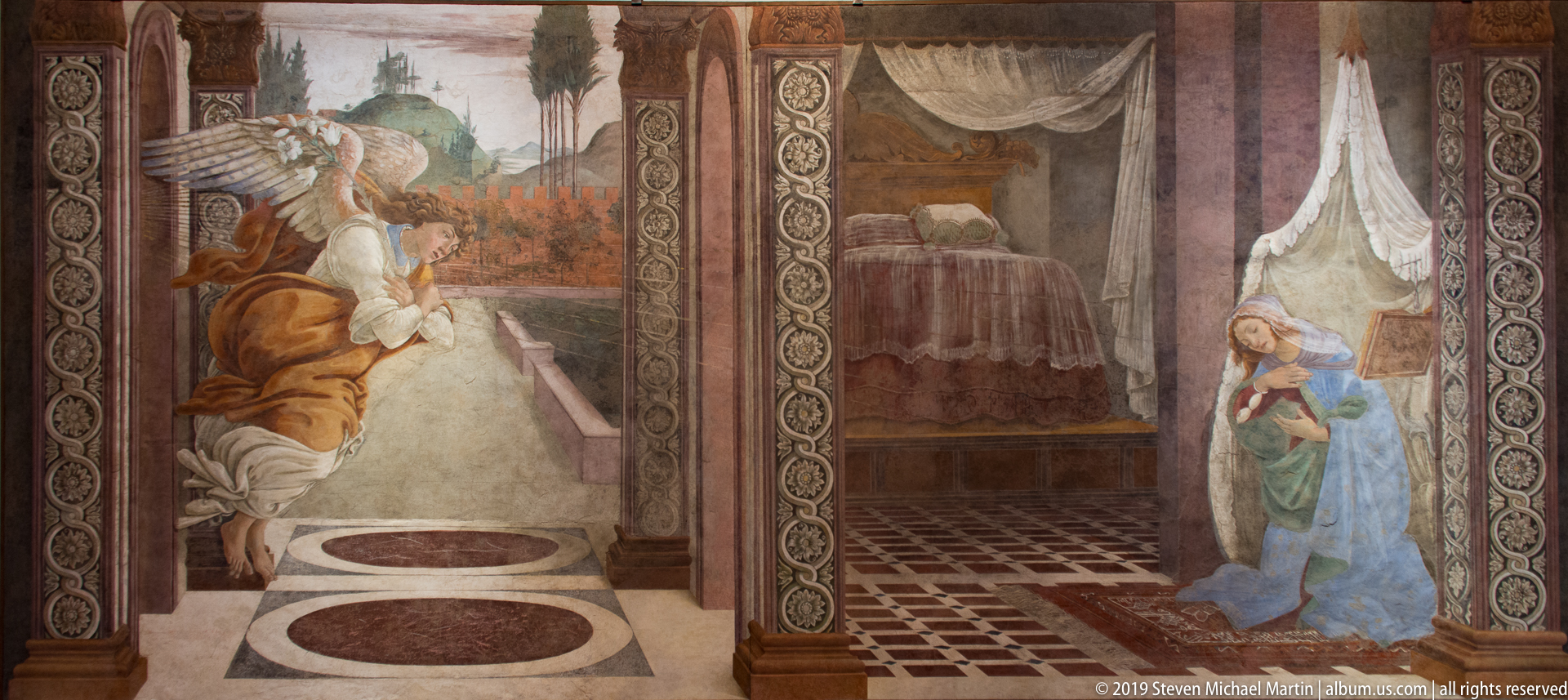
A kneeling angel enters from the left with one hand raised while the Virgin turns from a reading position at right. A tall partition and patterned floor divide the domestic interior, and a curtained bed is visible in the adjoining chamber. The carefully staged architecture transforms the Annunciation into an intimate household encounter.
Caption
A kneeling angel enters from the left with one hand raised while the Virgin turns from a reading position at right. A tall partition and patterned floor divide the domestic interior, and a curtained bed is visible in the adjoining chamber. The carefully staged architecture transforms the Annunciation into an intimate household encounter.
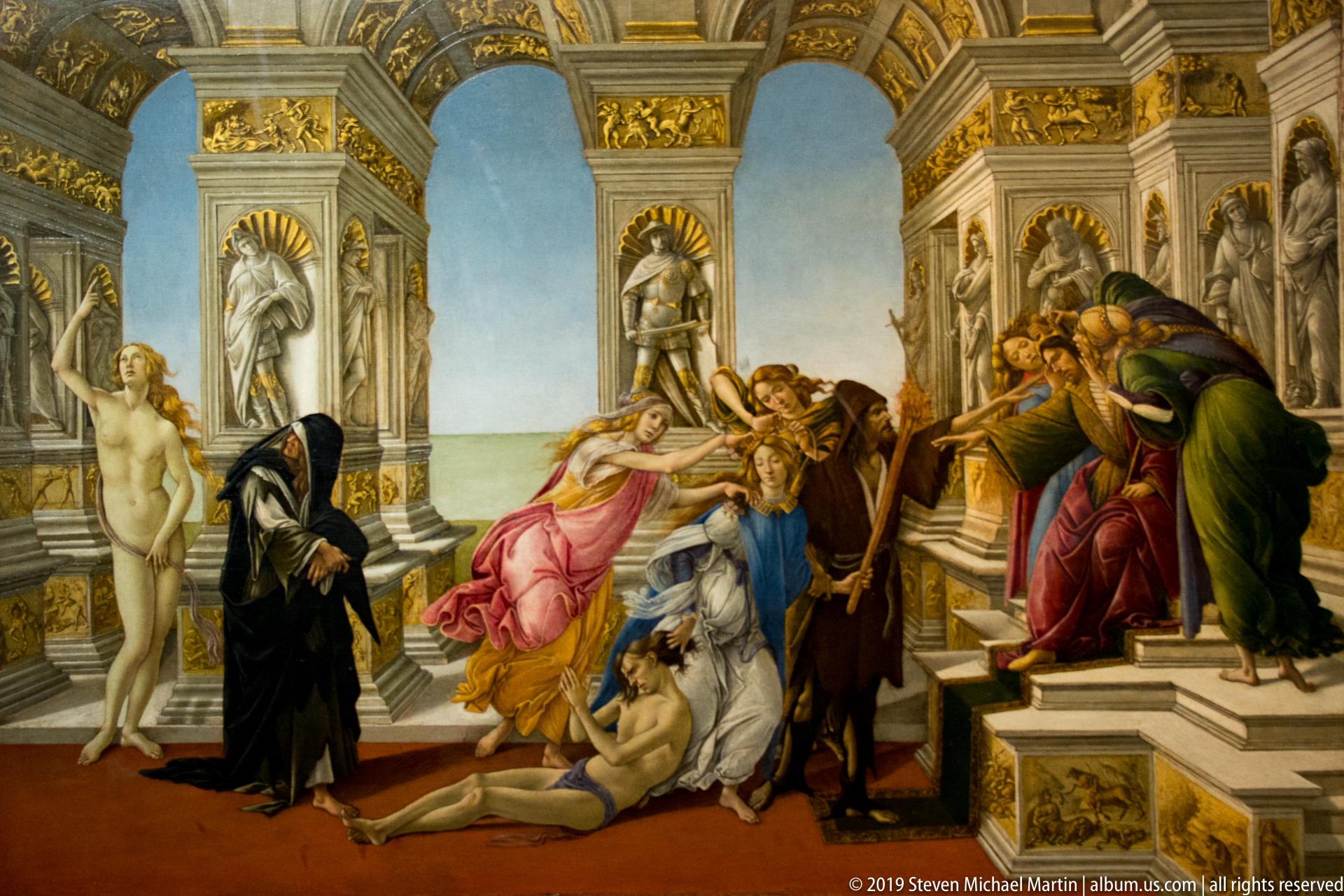
Botticelli’s Calumny of Apelles (c. 1495) translates a lost ancient painting described by Lucian into an elaborate Renaissance allegory. At right, the donkey-eared King Midas listens to Ignorance and Suspicion as Calumny drags an innocent man before him, accompanied by Deceit and Fraud. Repentance and the nude figure of Truth stand apart at left, all enclosed within fantastically ornamented classical architecture.
Caption
Botticelli’s Calumny of Apelles (c. 1495) translates a lost ancient painting described by Lucian into an elaborate Renaissance allegory. At right, the donkey-eared King Midas listens to Ignorance and Suspicion as Calumny drags an innocent man before him, accompanied by Deceit and Fraud. Repentance and the nude figure of Truth stand apart at left, all enclosed within fantastically ornamented classical architecture.
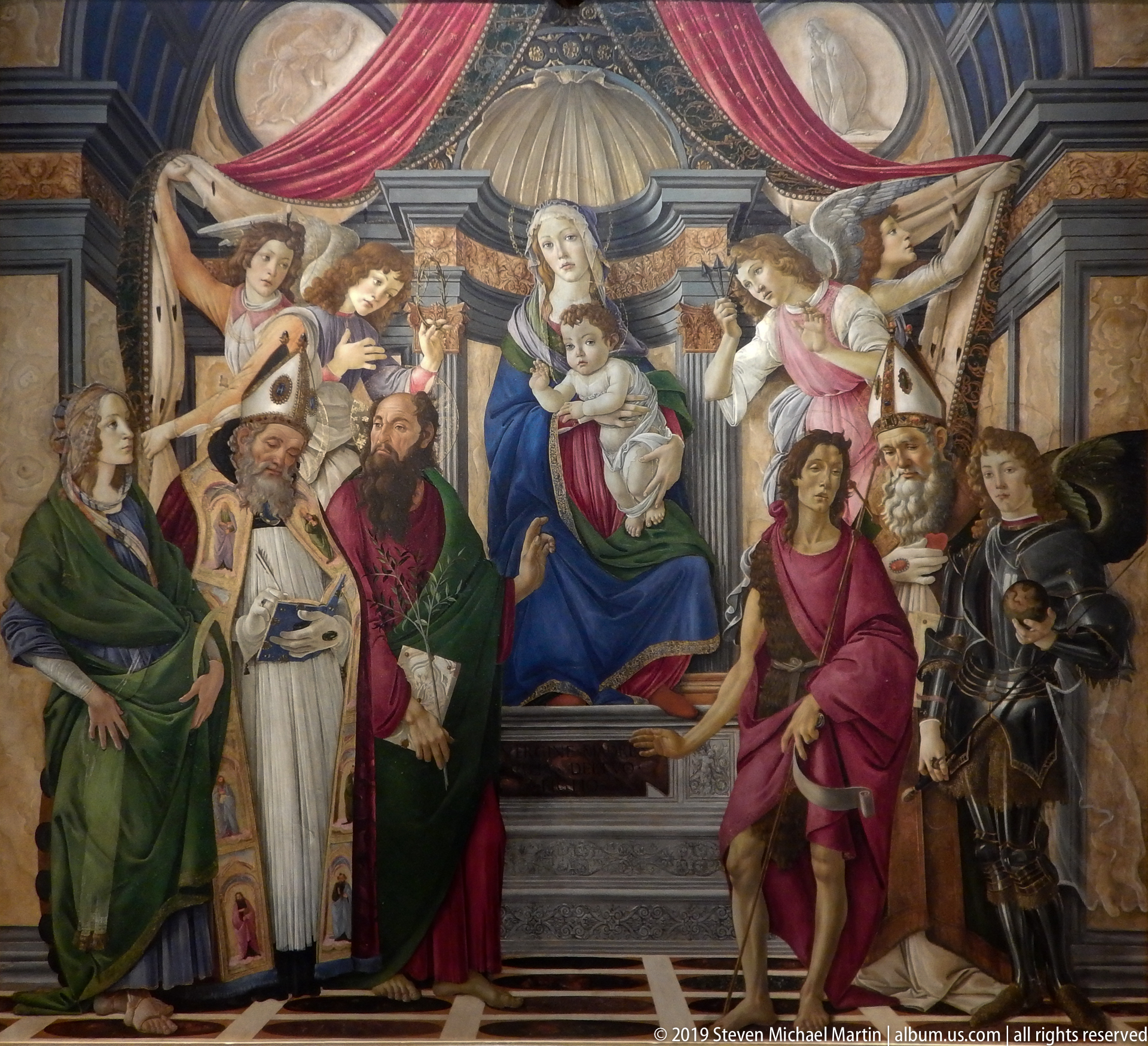
The Virgin and Christ Child sit elevated beneath a shell-like canopy as saints, clerics, angels, and armored figures gather in a symmetrical sacred assembly. Strong vertical columns and red drapery frame the throne, while the foreground figures create a ceremonial approach toward the central pair. The crowded composition combines devotional intimacy with monumental architectural staging.
Caption
The Virgin and Christ Child sit elevated beneath a shell-like canopy as saints, clerics, angels, and armored figures gather in a symmetrical sacred assembly. Strong vertical columns and red drapery frame the throne, while the foreground figures create a ceremonial approach toward the central pair. The crowded composition combines devotional intimacy with monumental architectural staging.
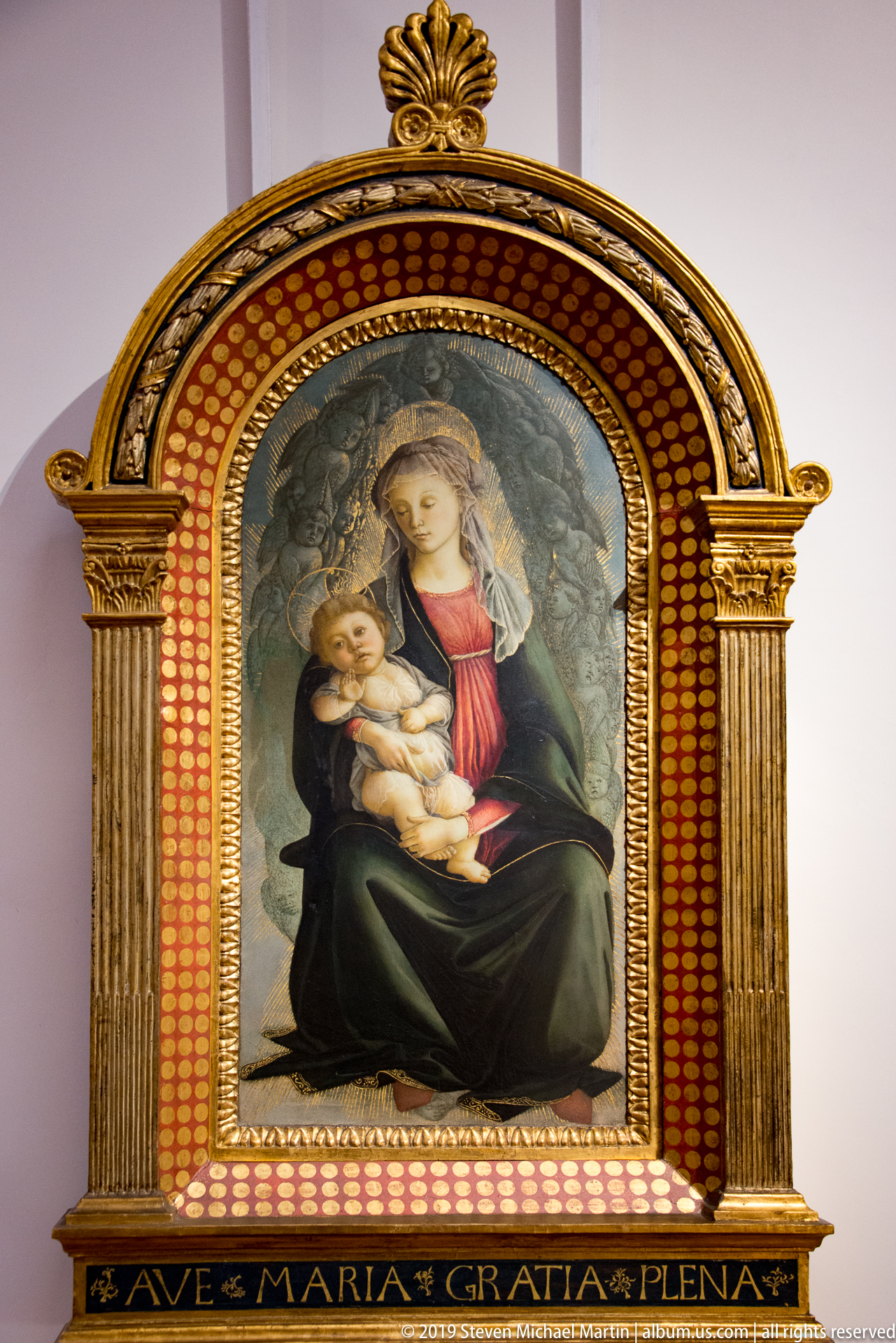
The Virgin sits in a dark green mantle and red dress, gently cradling the infant Christ against her chest. Their intimate pose is enclosed by an elaborate gilded architectural frame whose lower inscription reads “AVE MARIA GRATIA PLENA.” The restrained dark background keeps attention on the tender exchange between mother and child.
Caption
The Virgin sits in a dark green mantle and red dress, gently cradling the infant Christ against her chest. Their intimate pose is enclosed by an elaborate gilded architectural frame whose lower inscription reads “AVE MARIA GRATIA PLENA.” The restrained dark background keeps attention on the tender exchange between mother and child.
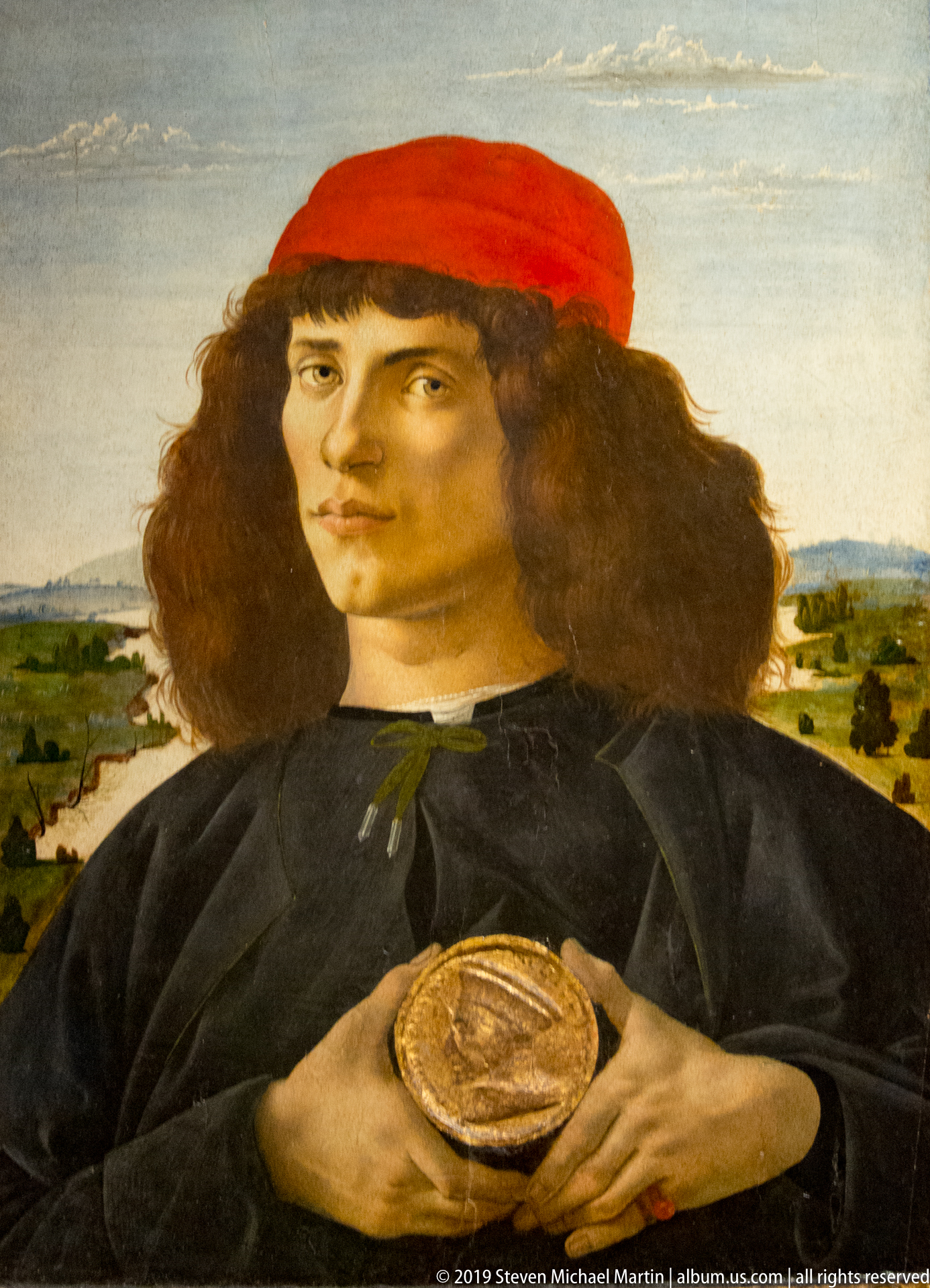
Botticelli’s Portrait of a Young Man with a Medal (c. 1475) confronts the viewer with an unidentified Florentine youth holding a gilded stucco likeness of Cosimo de’ Medici, Pater Patriae. His dark clothing and direct gaze keep attention on the inserted medal, modeled on a commemorative Medici coin. The unusual combination of painted portrait and relief object turns private likeness into a statement of political and dynastic allegiance.
Caption
Botticelli’s Portrait of a Young Man with a Medal (c. 1475) confronts the viewer with an unidentified Florentine youth holding a gilded stucco likeness of Cosimo de’ Medici, Pater Patriae. His dark clothing and direct gaze keep attention on the inserted medal, modeled on a commemorative Medici coin. The unusual combination of painted portrait and relief object turns private likeness into a statement of political and dynastic allegiance.

Botticelli’s early Madonna della Loggia (c. 1466–1467) turns the Virgin and Child into an exceptionally intimate exchange. Jesus reaches around his mother and presses his face close to hers while Mary supports him with a quiet, reflective expression. The affectionate pose derives from the Byzantine Glykophilousa, or Virgin of Tenderness, but Botticelli translates the inherited type into the natural emotional language of fifteenth-century Florence.
Caption
Botticelli’s early Madonna della Loggia (c. 1466–1467) turns the Virgin and Child into an exceptionally intimate exchange. Jesus reaches around his mother and presses his face close to hers while Mary supports him with a quiet, reflective expression. The affectionate pose derives from the Byzantine Glykophilousa, or Virgin of Tenderness, but Botticelli translates the inherited type into the natural emotional language of fifteenth-century Florence.
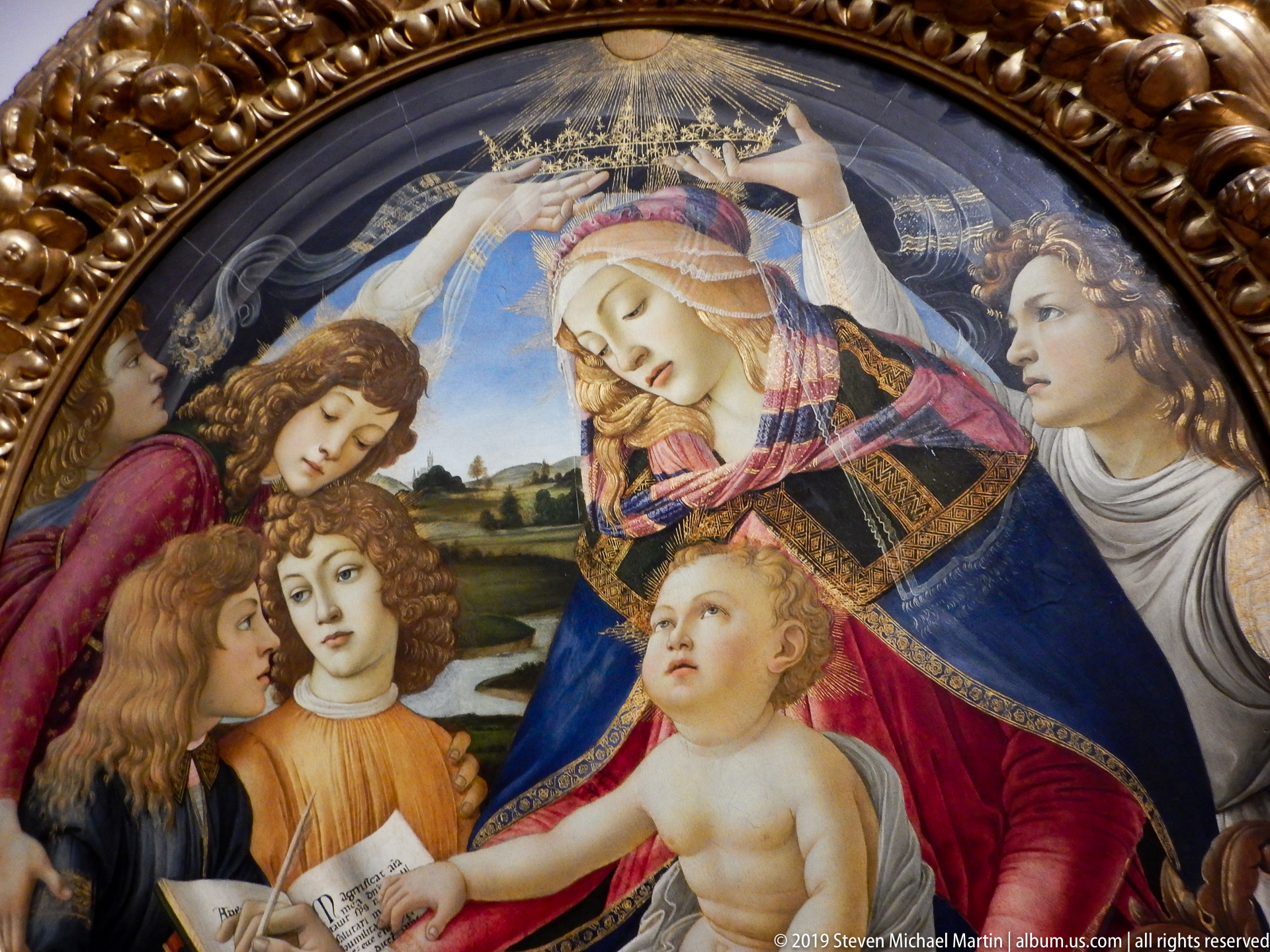
A close view of Botticelli’s Madonna of the Magnificat focuses on the crowned Virgin, Christ Child, and the angels pressing gently around them. Mary lowers her eyes toward the manuscript in which she writes the Magnificat, while Christ guides her hand and touches a pomegranate associated with his future Passion. The crop reveals the delicacy of Botticelli’s faces, veils, jeweled crown, and interlaced gestures.
Caption
A close view of Botticelli’s Madonna of the Magnificat focuses on the crowned Virgin, Christ Child, and the angels pressing gently around them. Mary lowers her eyes toward the manuscript in which she writes the Magnificat, while Christ guides her hand and touches a pomegranate associated with his future Passion. The crop reveals the delicacy of Botticelli’s faces, veils, jeweled crown, and interlaced gestures.
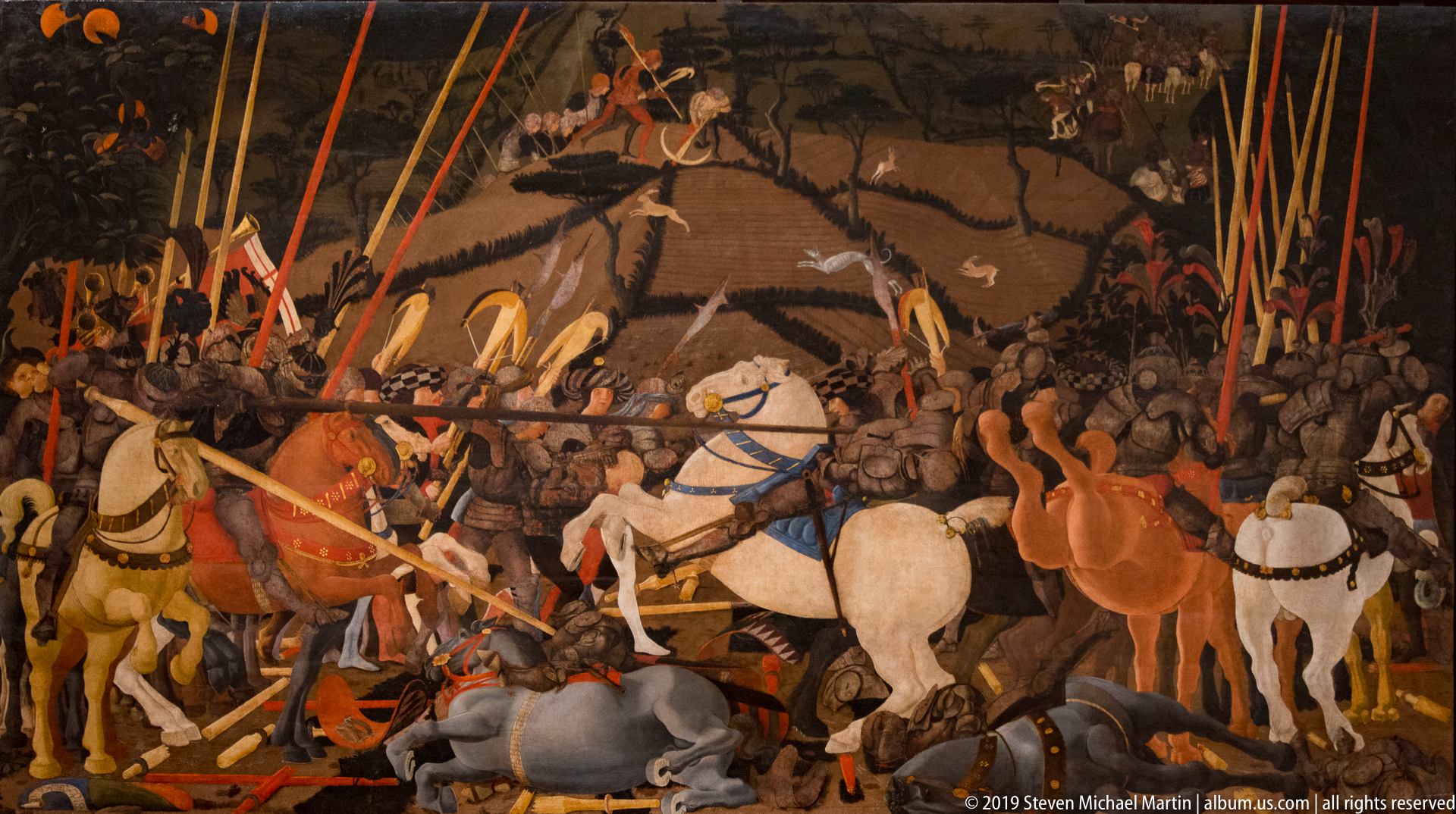
A dense cavalry battle fills the panel with thrusting lances, armored riders, rearing horses, and fallen men compressed across the foreground. Long red and orange shafts create a sharp linear rhythm against the dark landscape, while pale horses stand out amid the crowded melee. The scene emphasizes the confusion and geometry of mounted combat rather than a single heroic figure.
Caption
A dense cavalry battle fills the panel with thrusting lances, armored riders, rearing horses, and fallen men compressed across the foreground. Long red and orange shafts create a sharp linear rhythm against the dark landscape, while pale horses stand out amid the crowded melee. The scene emphasizes the confusion and geometry of mounted combat rather than a single heroic figure.
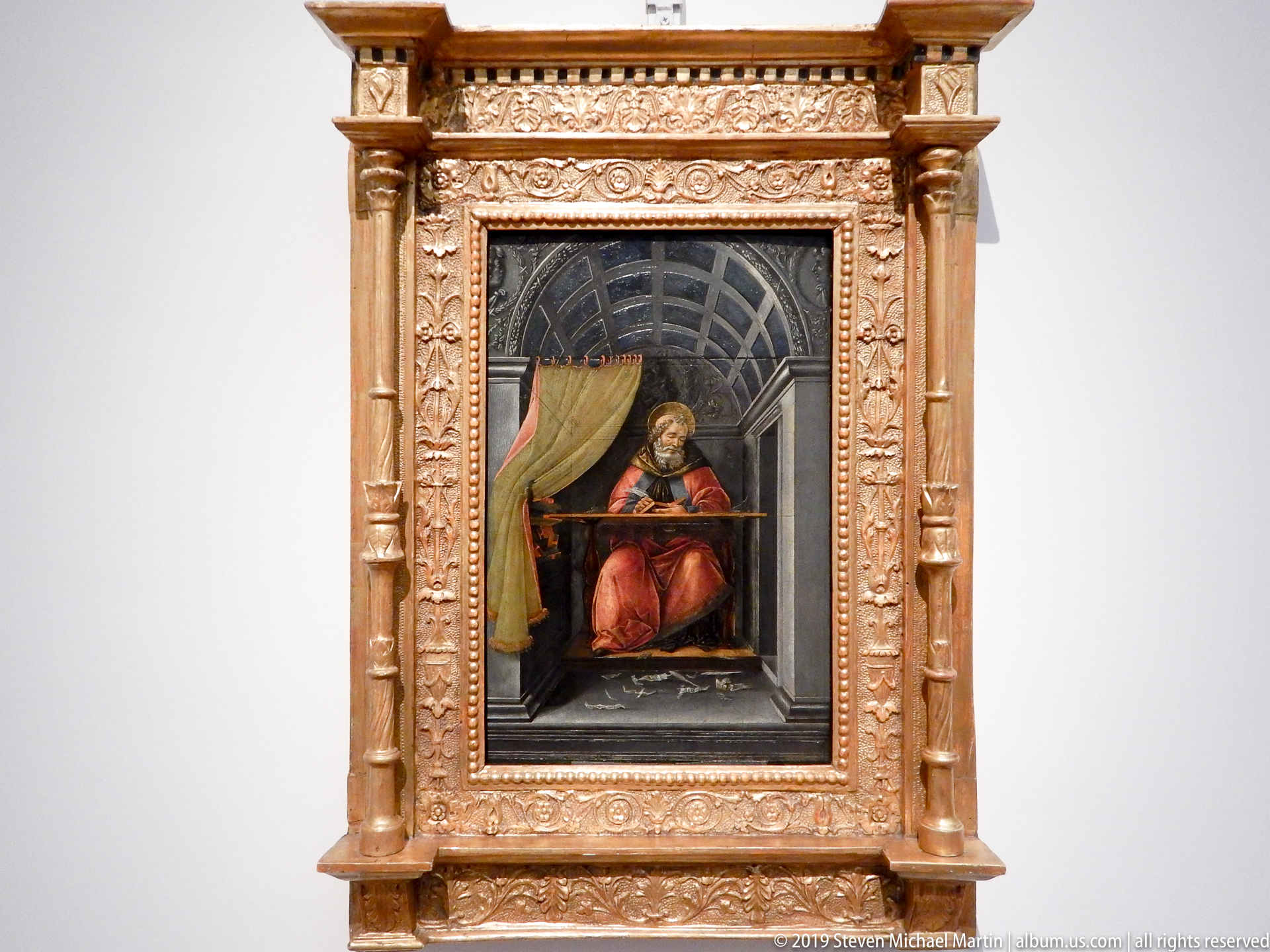
An elderly bearded man in a red robe sits reading at a desk within a deep, coffered architectural study. A green curtain hangs to one side, and the sharply receding ceiling and floor create a small but convincing interior space. The scholar’s age, red clothing, and contemplative setting support identification as Saint Jerome in his study.
Caption
An elderly bearded man in a red robe sits reading at a desk within a deep, coffered architectural study. A green curtain hangs to one side, and the sharply receding ceiling and floor create a small but convincing interior space. The scholar’s age, red clothing, and contemplative setting support identification as Saint Jerome in his study.
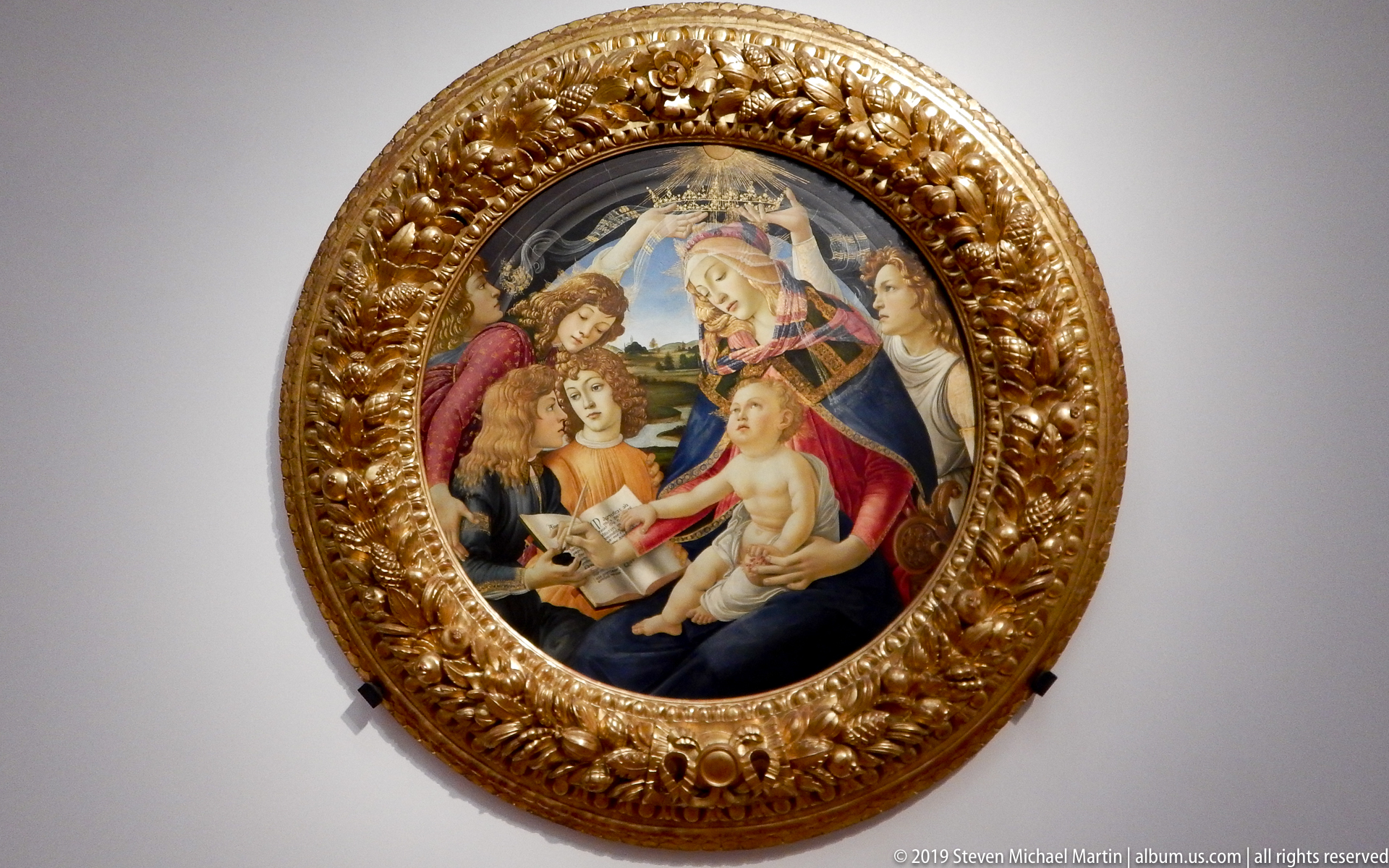
Botticelli’s Madonna of the Magnificat (c. 1483) is presented here as a complete tondo within its broad carved and gilded frame. Two angels crown the Virgin as she writes the opening of the Magnificat under the guidance of the Christ Child, who also touches a pomegranate. The circular format gathers the figures into an intimate ring while the window beyond opens onto a luminous Florentine Renaissance landscape.
Caption
Botticelli’s Madonna of the Magnificat (c. 1483) is presented here as a complete tondo within its broad carved and gilded frame. Two angels crown the Virgin as she writes the opening of the Magnificat under the guidance of the Christ Child, who also touches a pomegranate. The circular format gathers the figures into an intimate ring while the window beyond opens onto a luminous Florentine Renaissance landscape.
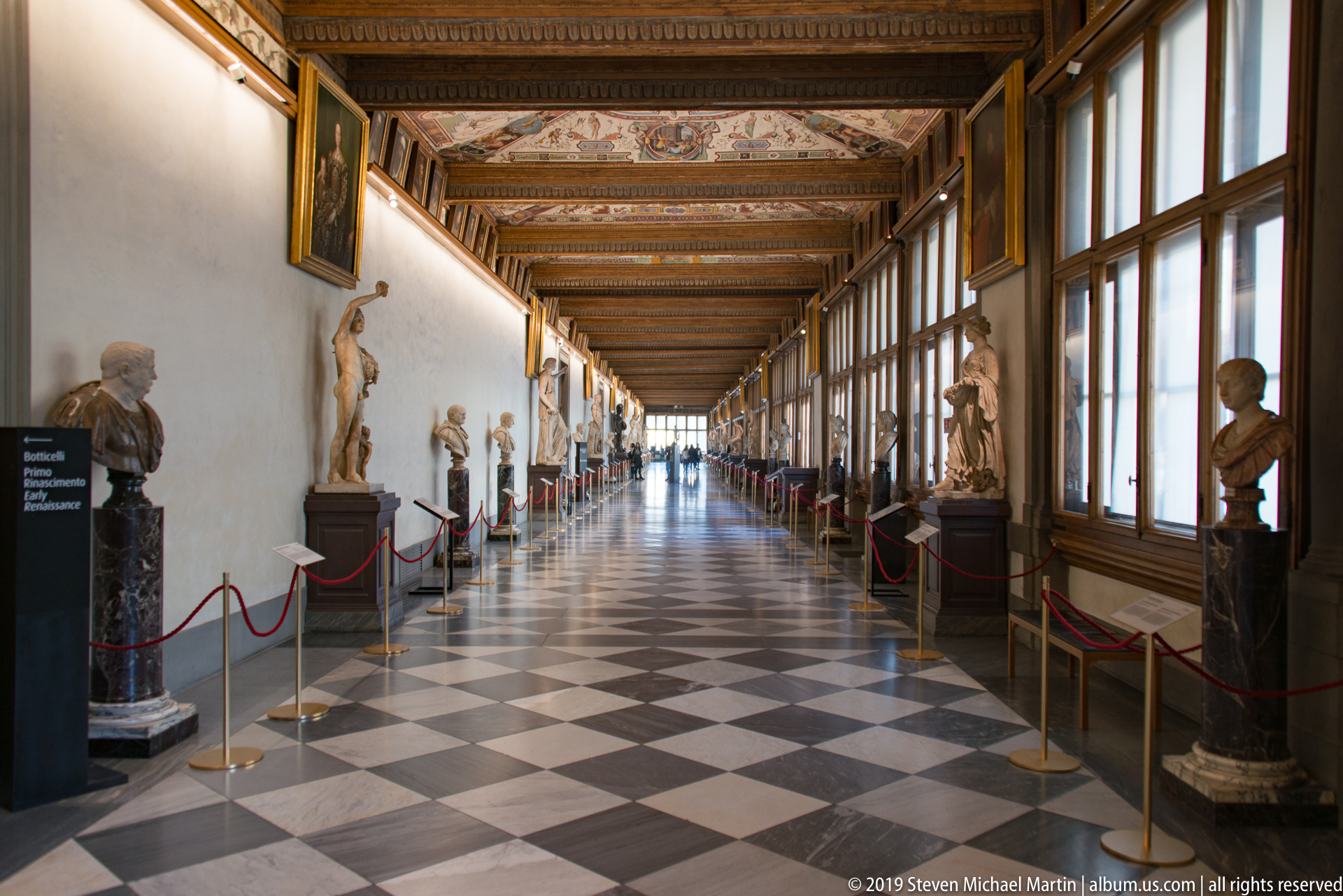
A long Uffizi corridor recedes toward a distant vanishing point, its black-and-white checkered floor bordered by classical statues and portrait busts. Tall windows line the right side, while an elaborately painted and coffered ceiling extends overhead. Red ropes guide visitors through a space where the architecture itself forms part of the museum experience.
Caption
A long Uffizi corridor recedes toward a distant vanishing point, its black-and-white checkered floor bordered by classical statues and portrait busts. Tall windows line the right side, while an elaborately painted and coffered ceiling extends overhead. Red ropes guide visitors through a space where the architecture itself forms part of the museum experience.
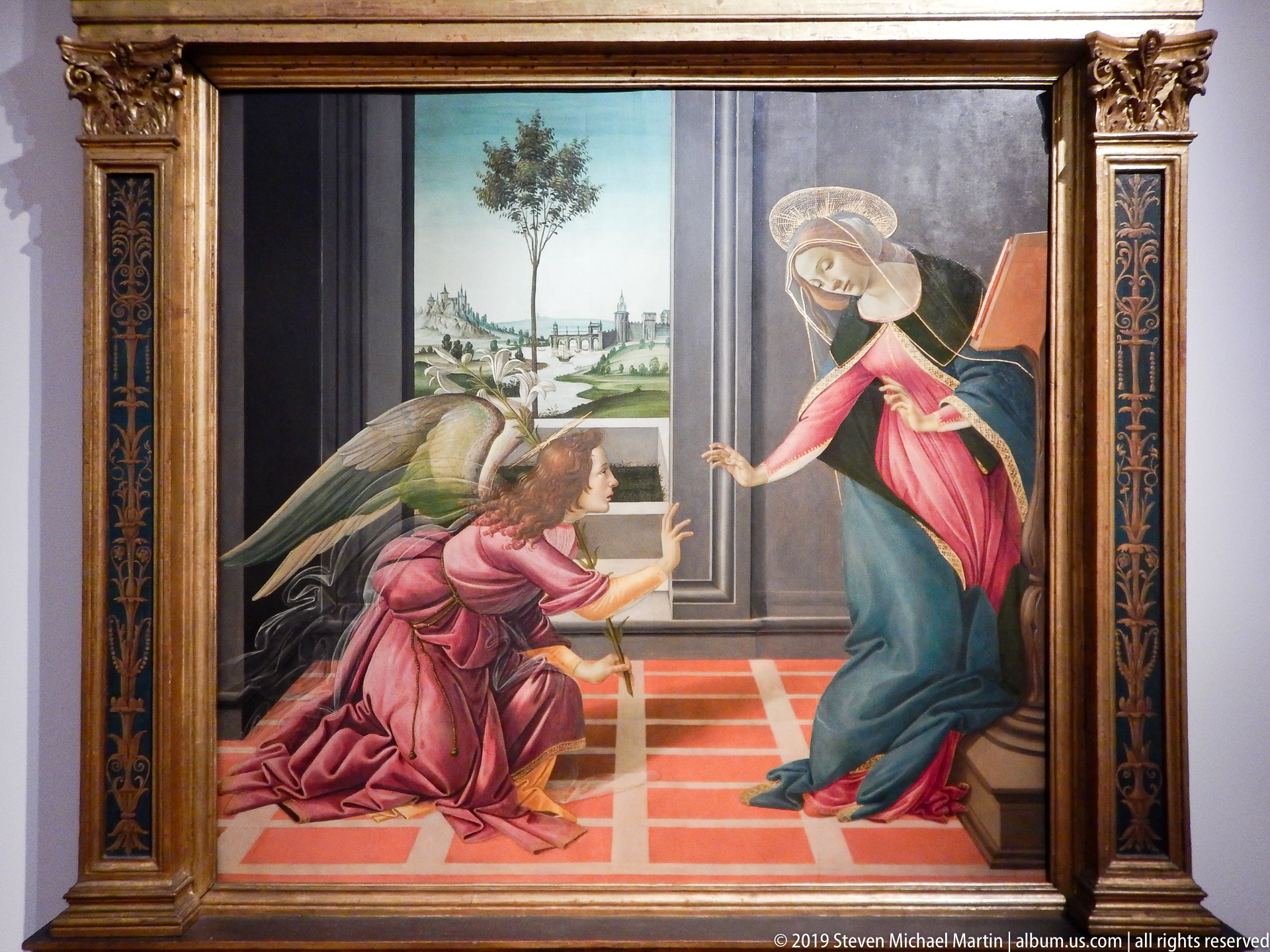
Botticelli’s Annunciation (1489–1490) reduces the encounter between Gabriel and Mary to an austere, intensely expressive exchange across a tiled Renaissance interior. The angel kneels as Mary recoils and turns toward the divine message, their sweeping gestures carrying the drama through an otherwise restrained setting. Painted during Florence’s growing Savonarolan religious fervor, the panel combines disciplined architecture with an increasingly urgent devotional language.
Caption
Botticelli’s Annunciation (1489–1490) reduces the encounter between Gabriel and Mary to an austere, intensely expressive exchange across a tiled Renaissance interior. The angel kneels as Mary recoils and turns toward the divine message, their sweeping gestures carrying the drama through an otherwise restrained setting. Painted during Florence’s growing Savonarolan religious fervor, the panel combines disciplined architecture with an increasingly urgent devotional language.
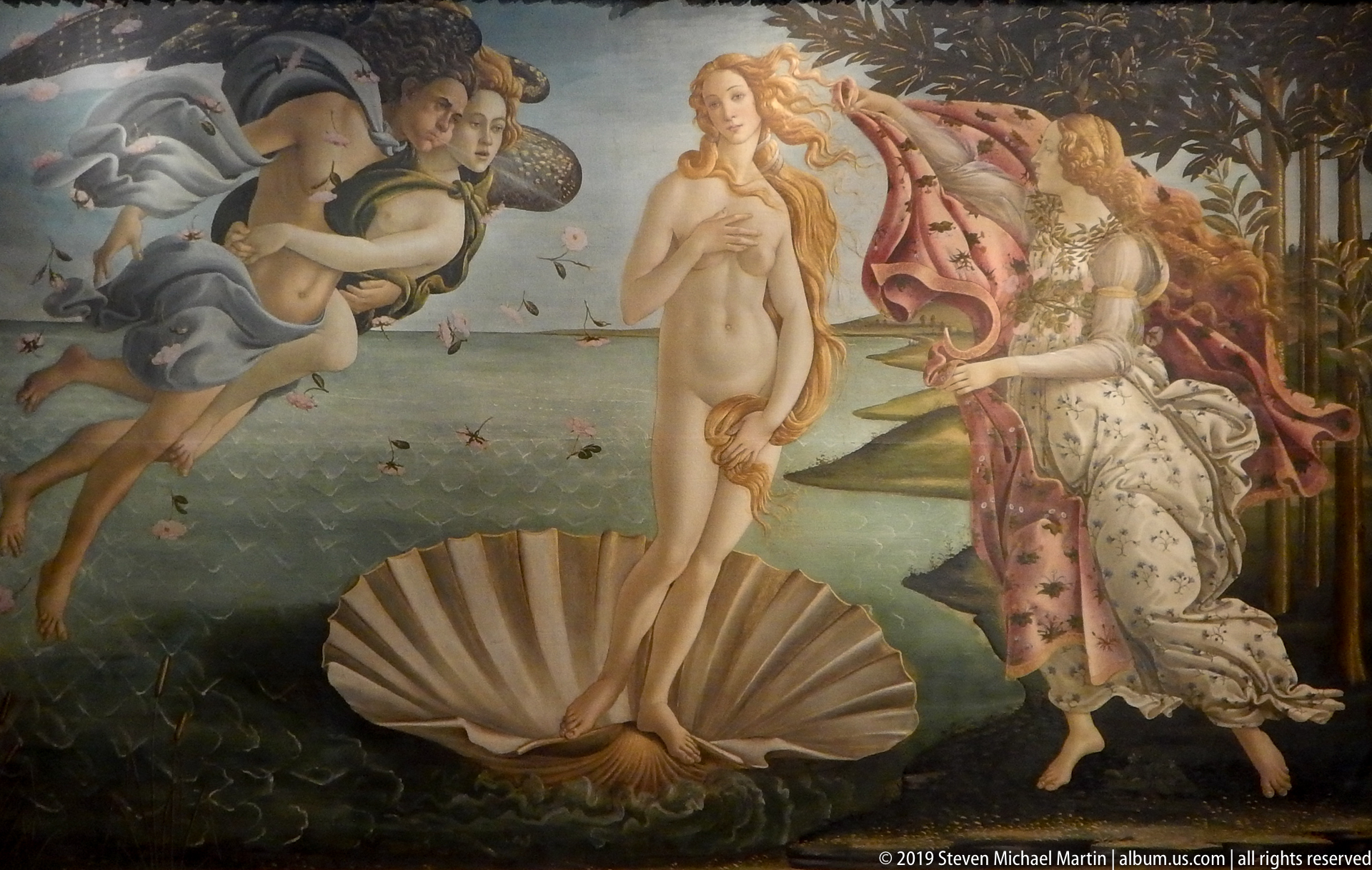
This full view of Botticelli’s Birth of Venus (c. 1485) makes the painting’s carefully balanced procession especially clear. Venus arrives on Cyprus standing on a scallop shell; Zephyrus and a companion propel her from the sea at left, while an attendant associated with spring advances from the wooded shore with a flower-covered mantle. Windblown hair, drapery, and roses animate a composition whose linear grace became an emblem of Renaissance Florence.
Caption
This full view of Botticelli’s Birth of Venus (c. 1485) makes the painting’s carefully balanced procession especially clear. Venus arrives on Cyprus standing on a scallop shell; Zephyrus and a companion propel her from the sea at left, while an attendant associated with spring advances from the wooded shore with a flower-covered mantle. Windblown hair, drapery, and roses animate a composition whose linear grace became an emblem of Renaissance Florence.
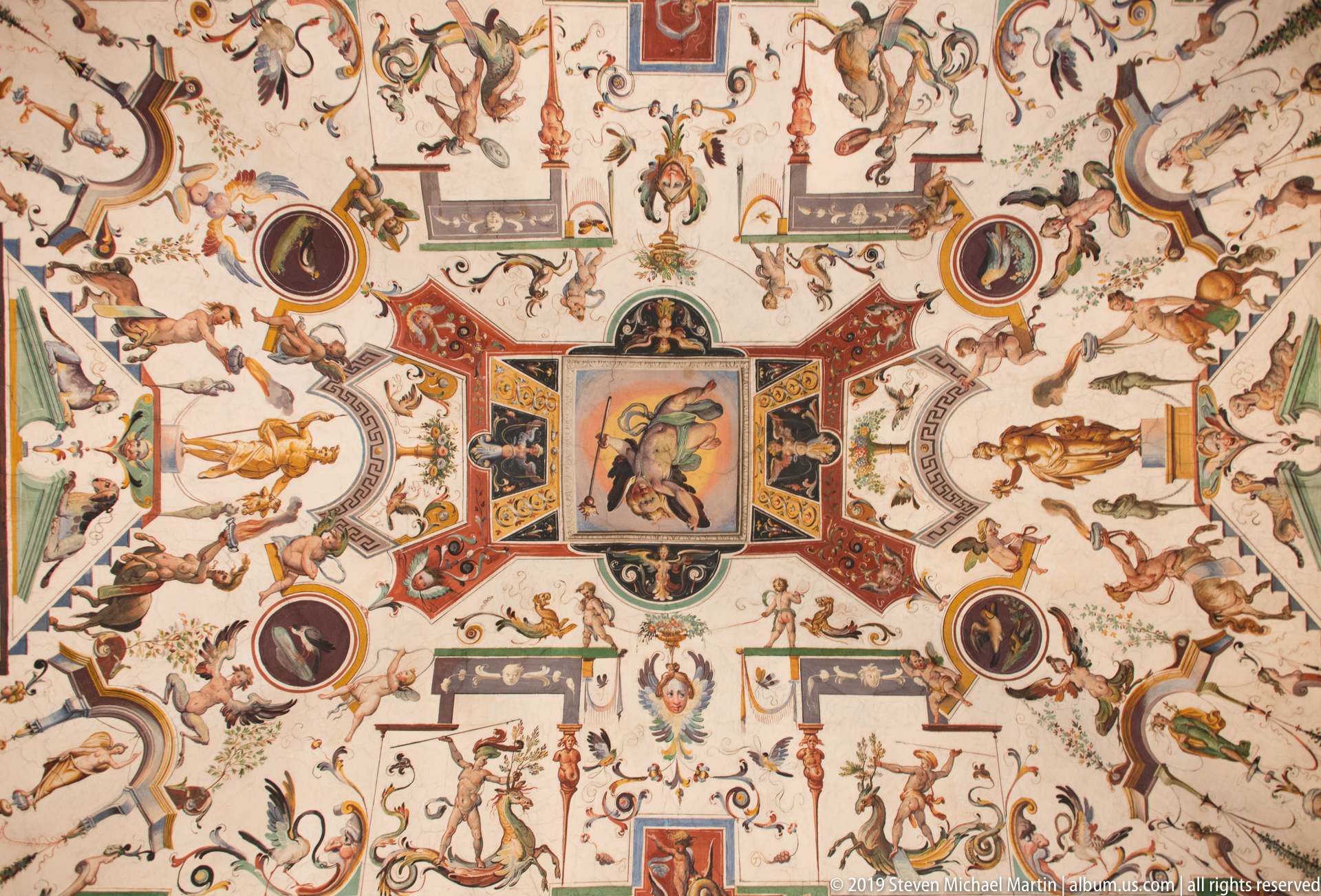
A richly painted ceiling spreads outward in a symmetrical network of grotesques, scrolling foliage, animals, masks, and small figural scenes. Circular medallions and rectangular panels punctuate the pale ground, while red, green, and gold borders organize the ornament into geometric compartments. The centered upward view records the decorative program as a complete architectural surface.
Caption
A richly painted ceiling spreads outward in a symmetrical network of grotesques, scrolling foliage, animals, masks, and small figural scenes. Circular medallions and rectangular panels punctuate the pale ground, while red, green, and gold borders organize the ornament into geometric compartments. The centered upward view records the decorative program as a complete architectural surface.
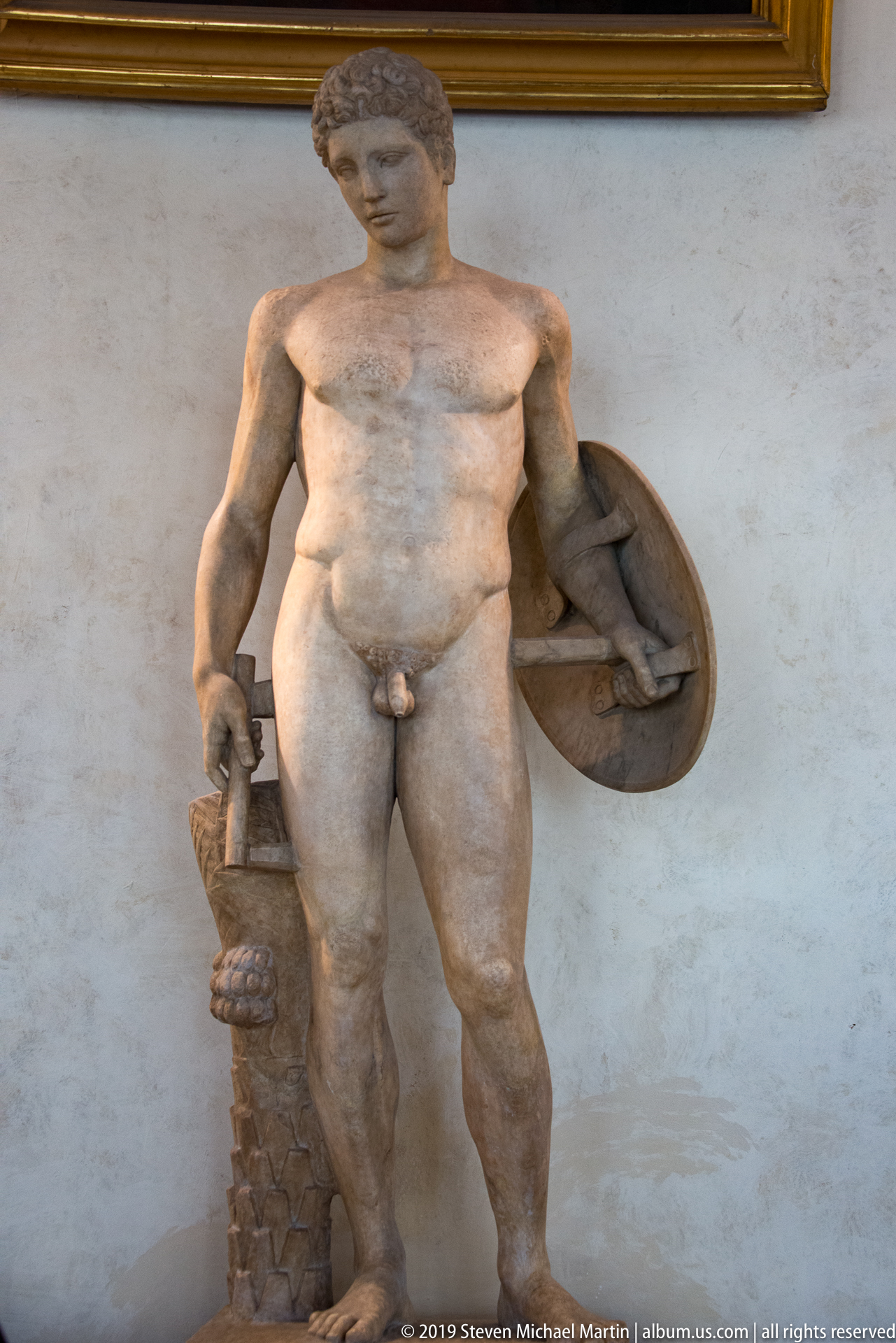
A muscular nude male stands in a relaxed but alert pose, holding a large round shield at his left side while the opposite hand rests near a rough tree-trunk support. The head turns slightly downward and away from the shield. The combination of athletic anatomy and defensive equipment gives the figure the character of a warrior or heroic nude.
Caption
A muscular nude male stands in a relaxed but alert pose, holding a large round shield at his left side while the opposite hand rests near a rough tree-trunk support. The head turns slightly downward and away from the shield. The combination of athletic anatomy and defensive equipment gives the figure the character of a warrior or heroic nude.
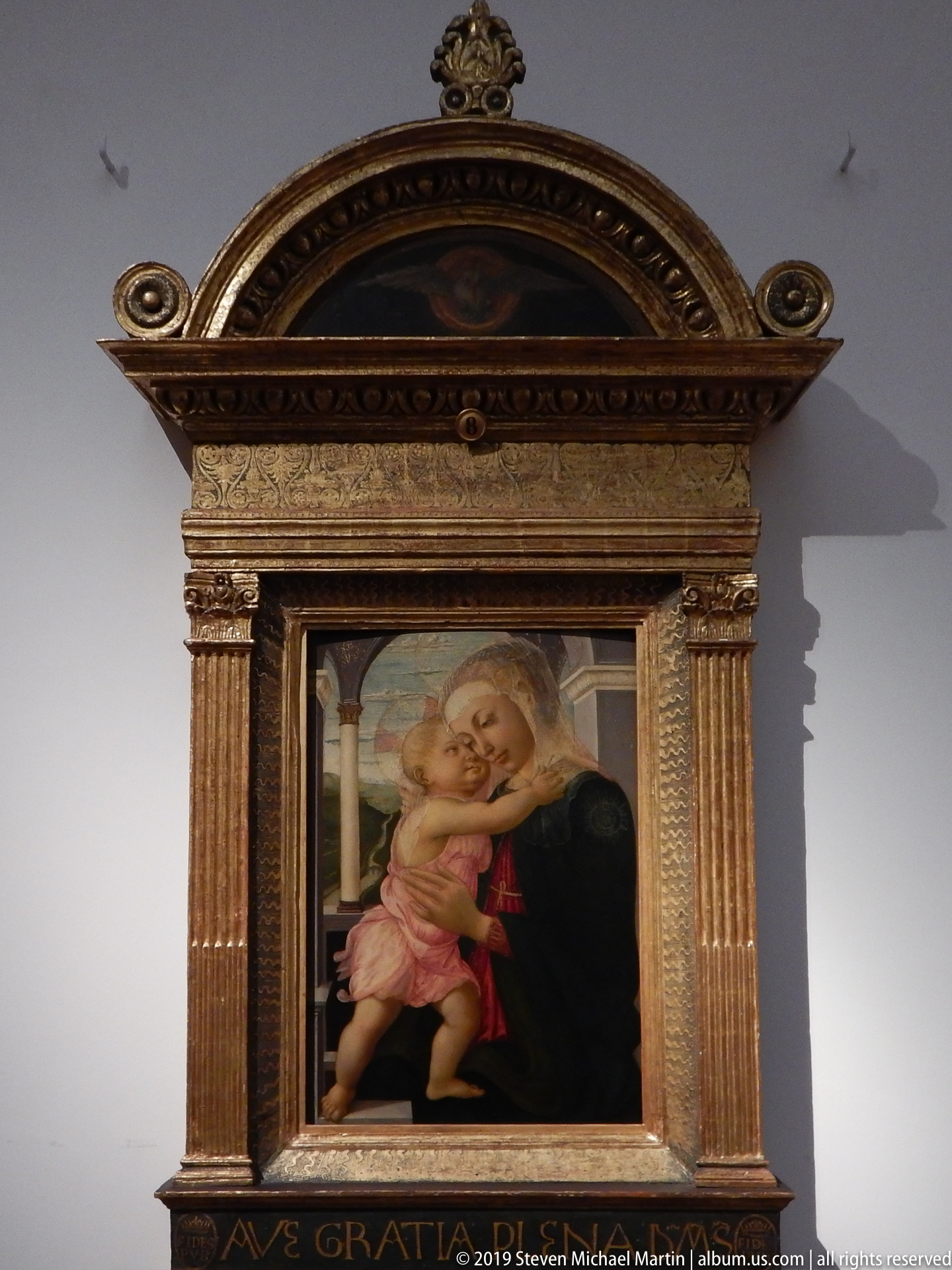
Botticelli’s Madonna della Loggia (c. 1466–1467) places the tender embrace of Mary and the Christ Child within Renaissance architecture opening toward a distant landscape. Jesus reaches around his mother and presses his face near hers, adapting the Byzantine Glykophilousa tradition to a distinctly Florentine setting. The youthful work still reflects Filippo Lippi’s influence while anticipating Botticelli’s characteristic linear elegance and emotional restraint.
Caption
Botticelli’s Madonna della Loggia (c. 1466–1467) places the tender embrace of Mary and the Christ Child within Renaissance architecture opening toward a distant landscape. Jesus reaches around his mother and presses his face near hers, adapting the Byzantine Glykophilousa tradition to a distinctly Florentine setting. The youthful work still reflects Filippo Lippi’s influence while anticipating Botticelli’s characteristic linear elegance and emotional restraint.

Two muscular nude men strain against one another in a complex marble wrestling group. The upper figure braces across his opponent’s shoulders while the lower man bends forward, their limbs and torsos interlocking around a central axis. Seen in the gallery with painted ceiling and framed works behind, the sculpture’s twisting anatomy and physical tension dominate the room.
Caption
Two muscular nude men strain against one another in a complex marble wrestling group. The upper figure braces across his opponent’s shoulders while the lower man bends forward, their limbs and torsos interlocking around a central axis. Seen in the gallery with painted ceiling and framed works behind, the sculpture’s twisting anatomy and physical tension dominate the room.
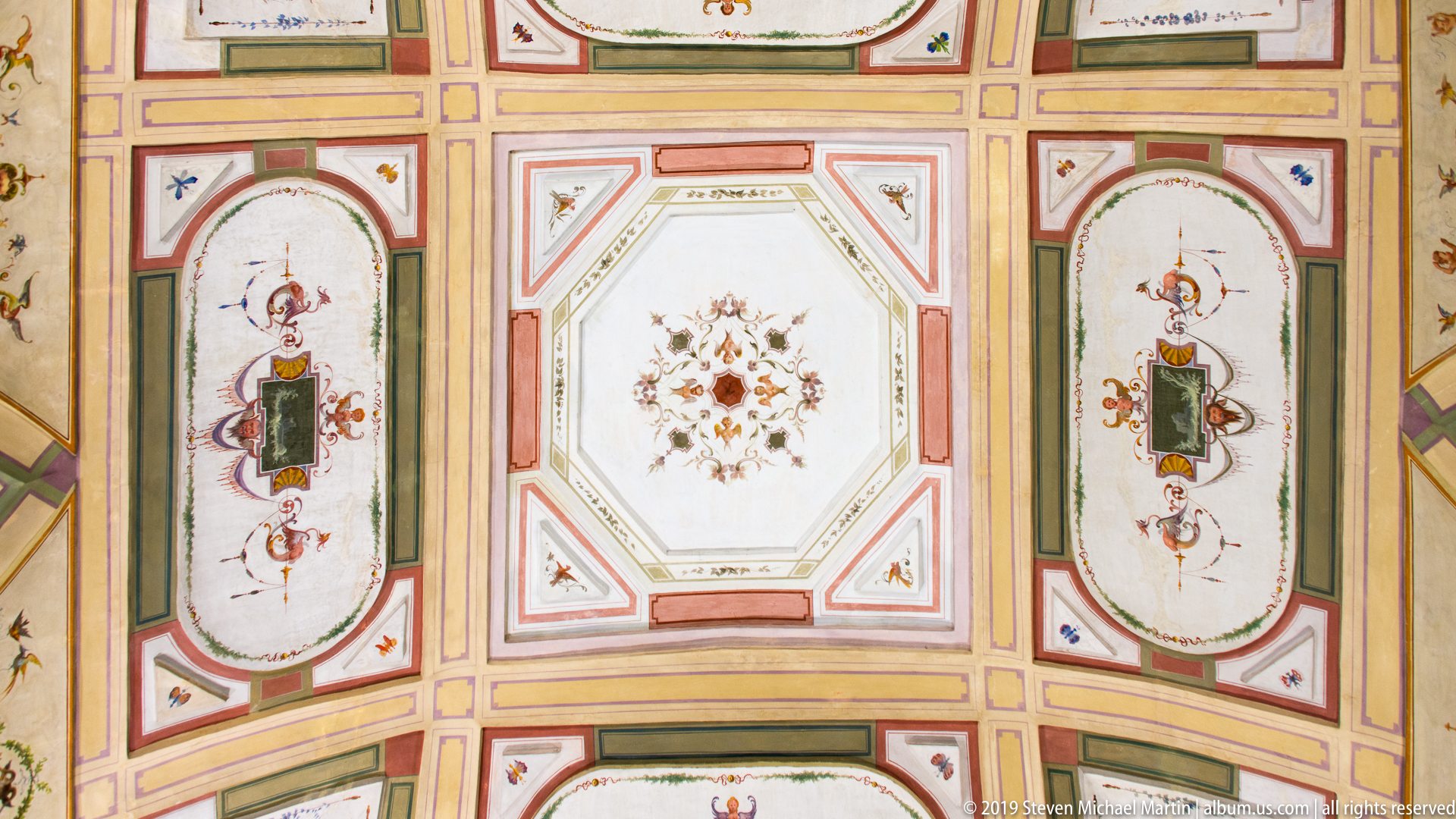
A pale vaulted ceiling is divided into crisp pink, green, cream, and gold compartments centered on an octagonal floral rosette. Long oval panels contain small grotesque or emblematic figures, while narrow borders and corner motifs reinforce the symmetrical design. The upward view isolates the architectural decoration and its restrained palette from the artworks displayed below.
Caption
A pale vaulted ceiling is divided into crisp pink, green, cream, and gold compartments centered on an octagonal floral rosette. Long oval panels contain small grotesque or emblematic figures, while narrow borders and corner motifs reinforce the symmetrical design. The upward view isolates the architectural decoration and its restrained palette from the artworks displayed below.