Ávila
Ávila is known for its remarkably well-preserved medieval defensive walls, which encircle the historic center with towers and fortified gates. Constructed primarily during the eleventh and twelfth centuries, the walls illustrate the need for protection during periods of conflict on the Iberian Peninsula. The elevated setting provided strategic advantages for surveillance and defense.
The city became associated with religious reform movements, including the life of Saint Teresa of Ávila, whose writings contributed to Catholic spiritual thought. Romanesque and Gothic churches reflect the importance of religious institutions in shaping the urban landscape. The preserved fortifications illustrate the architectural priorities of medieval Christian communities.
Ávila demonstrates the role of fortified cities in securing political and religious stability during the medieval period. Its intact walls provide insight into defensive construction techniques used throughout Europe.

The west façade of the Basilica of San Vicente faces its open plaza outside Ávila’s walls, centered on a deeply recessed Romanesque portal beneath the great rose window. Begun in the twelfth century, San Vicente is one of the city’s defining Romanesque monuments and forms part of the UNESCO-listed ensemble of Ávila and its extramural churches.
Caption
The west façade of the Basilica of San Vicente faces its open plaza outside Ávila’s walls, centered on a deeply recessed Romanesque portal beneath the great rose window. Begun in the twelfth century, San Vicente is one of the city’s defining Romanesque monuments and forms part of the UNESCO-listed ensemble of Ávila and its extramural churches.

Ávila’s fortified wall stretches diagonally across the hillside, its repeated stone towers rising above a crenellated curtain wall. The nearest tower dominates the right side of the composition while progressively smaller towers lead the eye toward a distant gate or bell-tower element. Boulders and winter grass in the foreground reinforce the wall’s elevated setting and make the scale of the defensive circuit especially legible.
Caption
Ávila’s fortified wall stretches diagonally across the hillside, its repeated stone towers rising above a crenellated curtain wall. The nearest tower dominates the right side of the composition while progressively smaller towers lead the eye toward a distant gate or bell-tower element. Boulders and winter grass in the foreground reinforce the wall’s elevated setting and make the scale of the defensive circuit especially legible.

A broad lawn opens toward a long elevation of Ávila’s medieval wall, where rounded and squared towers alternate beneath continuous crenellations. The wider foreground and lower horizon allow the defensive line to be read laterally, emphasizing spacing, repetition and the monumental length of the surviving enclosure.
Caption
A broad lawn opens toward a long elevation of Ávila’s medieval wall, where rounded and squared towers alternate beneath continuous crenellations. The wider foreground and lower horizon allow the defensive line to be read laterally, emphasizing spacing, repetition and the monumental length of the surviving enclosure.

A long stretch of Ávila’s stone fortifications climbs a grassy slope beneath broken cloud, with closely spaced crenellated towers defining the defensive perimeter. The oblique viewpoint makes the wall’s repeating rhythm and adaptation to the terrain especially clear, presenting the medieval enclosure as an integrated work of urban defense.
Caption
A long stretch of Ávila’s stone fortifications climbs a grassy slope beneath broken cloud, with closely spaced crenellated towers defining the defensive perimeter. The oblique viewpoint makes the wall’s repeating rhythm and adaptation to the terrain especially clear, presenting the medieval enclosure as an integrated work of urban defense.

A wide landscape view sets Ávila’s medieval enclosure beneath an expansive, turbulent sky. The crenellated walls form a low horizontal band around the city while open land occupies the foreground, emphasizing the fortified settlement’s compact footprint and commanding position within the surrounding plateau.
Caption
A wide landscape view sets Ávila’s medieval enclosure beneath an expansive, turbulent sky. The crenellated walls form a low horizontal band around the city while open land occupies the foreground, emphasizing the fortified settlement’s compact footprint and commanding position within the surrounding plateau.

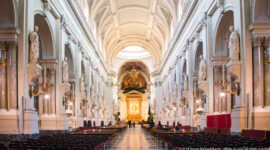
The nave of Ávila’s Cathedral of El Salvador rises through massive stone arcades to ribbed Gothic vaults, revealing the fortress-like solidity for which the building is known. The cathedral’s sanctuary is physically integrated with the medieval city wall, joining ecclesiastical architecture to Ávila’s defensive system.
Caption
The nave of Ávila’s Cathedral of El Salvador rises through massive stone arcades to ribbed Gothic vaults, revealing the fortress-like solidity for which the building is known. The cathedral’s sanctuary is physically integrated with the medieval city wall, joining ecclesiastical architecture to Ávila’s defensive system.

Seen from the base of a grassy, boulder-strewn slope, Ávila’s stone towers rise in a powerful sequence toward the skyline. The low perspective exaggerates their height and projection from the curtain wall, while scattered granite rocks in the foreground connect the masonry visually to the rugged terrain.
Caption
Seen from the base of a grassy, boulder-strewn slope, Ávila’s stone towers rise in a powerful sequence toward the skyline. The low perspective exaggerates their height and projection from the curtain wall, while scattered granite rocks in the foreground connect the masonry visually to the rugged terrain.

A line of substantial crenellated towers follows a rocky green slope beside the historic center, with church bell structures and tiled roofs rising immediately behind. The oblique view shows the fortifications as both a defensive edge and an architectural boundary integrated tightly with the city’s monumental buildings.
Caption
A line of substantial crenellated towers follows a rocky green slope beside the historic center, with church bell structures and tiled roofs rising immediately behind. The oblique view shows the fortifications as both a defensive edge and an architectural boundary integrated tightly with the city’s monumental buildings.

Ávila’s dense historic center rises behind a sweeping section of its medieval walls, with closely spaced towers enclosing red-tiled roofs and prominent church architecture. The elevated distant viewpoint shows how the defensive circuit wraps the urban fabric and follows the contours of the hillside.
Caption
Ávila’s dense historic center rises behind a sweeping section of its medieval walls, with closely spaced towers enclosing red-tiled roofs and prominent church architecture. The elevated distant viewpoint shows how the defensive circuit wraps the urban fabric and follows the contours of the hillside.

A columned stone cross monument occupies the rocky foreground while Ávila’s fortified city spreads across the distant hillside. By pairing devotional architecture with the medieval enclosure, the viewpoint establishes the monument’s elevated position and creates a layered visual relationship between an outlying landmark and the historic city.
Caption
A columned stone cross monument occupies the rocky foreground while Ávila’s fortified city spreads across the distant hillside. By pairing devotional architecture with the medieval enclosure, the viewpoint establishes the monument’s elevated position and creates a layered visual relationship between an outlying landmark and the historic city.

A sculpted brass hand forms an elaborate door knocker against a dark wooden door, its fingers gripping a rounded striker ornamented with a small star. The close detail isolates craftsmanship and tactile design, contrasting the polished metal fitting with the vertical grain and deep brown tone of the door.
Caption
A sculpted brass hand forms an elaborate door knocker against a dark wooden door, its fingers gripping a rounded striker ornamented with a small star. The close detail isolates craftsmanship and tactile design, contrasting the polished metal fitting with the vertical grain and deep brown tone of the door.

Two dark armored figures stand before a vivid red heraldic textile in a museum display, creating a staged evocation of martial history. The textile centers a portrait medallion within scrolling decoration and coats of arms, while patterned wall tiles and weaponry reinforce the ceremonial character of the installation.
Caption
Two dark armored figures stand before a vivid red heraldic textile in a museum display, creating a staged evocation of martial history. The textile centers a portrait medallion within scrolling decoration and coats of arms, while patterned wall tiles and weaponry reinforce the ceremonial character of the installation.

An imposing stone entrance is framed by heavily carved masonry, iron gates and a projecting upper cornice supported on robust brackets. The pebble-paved approach leads directly through the deep arched opening, emphasizing the portal’s formal symmetry and the contrast between sculpted stonework and the darker passage beyond.
Caption
An imposing stone entrance is framed by heavily carved masonry, iron gates and a projecting upper cornice supported on robust brackets. The pebble-paved approach leads directly through the deep arched opening, emphasizing the portal’s formal symmetry and the contrast between sculpted stonework and the darker passage beyond.

A museum gallery presents military and historical material in glass cases, with a substantial metal weapon or mechanical apparatus displayed prominently at left. Wood floors, white walls, interpretive panels and tabletop displays create a chronological exhibition setting rather than an architectural interior intended as the principal subject.
Caption
A museum gallery presents military and historical material in glass cases, with a substantial metal weapon or mechanical apparatus displayed prominently at left. Wood floors, white walls, interpretive panels and tabletop displays create a chronological exhibition setting rather than an architectural interior intended as the principal subject.

A didactic panel traces heraldic emblems associated with Spain, arranging crowned royal arms and numerous regional shields in a dense comparative chart. The display foregrounds changing symbols of monarchy and territory, with rows of colorful escutcheons, crowns and heraldic animals organized for historical interpretation.
Caption
A didactic panel traces heraldic emblems associated with Spain, arranging crowned royal arms and numerous regional shields in a dense comparative chart. The display foregrounds changing symbols of monarchy and territory, with rows of colorful escutcheons, crowns and heraldic animals organized for historical interpretation.

Massive stone towers project from Ávila’s curtain wall in a close exterior view, their crenellated parapets stepping away toward the horizon. The low vantage point emphasizes masonry scale, wall thickness and the regular sequence of defensive projections that gives the fortified city its distinctive profile.
Caption
Massive stone towers project from Ávila’s curtain wall in a close exterior view, their crenellated parapets stepping away toward the horizon. The low vantage point emphasizes masonry scale, wall thickness and the regular sequence of defensive projections that gives the fortified city its distinctive profile.

A rectangular courtyard is enclosed by two levels of arcades, with slender stone columns below and a balustraded upper gallery enriched by carved heraldic shields. Pebble paving forms geometric compartments across the open court, while glazed openings and patterned tilework add layers of texture to the surrounding façades.
Caption
A rectangular courtyard is enclosed by two levels of arcades, with slender stone columns below and a balustraded upper gallery enriched by carved heraldic shields. Pebble paving forms geometric compartments across the open court, while glazed openings and patterned tilework add layers of texture to the surrounding façades.

A richly embroidered banner combines a crowned multiquartered coat of arms with large cursive lettering on yellow and faded red silk. Fringe, seams and worn fabric surfaces reveal its character as a historic ceremonial textile, while the heraldic composition links the object to Spanish military or institutional identity.
Caption
A richly embroidered banner combines a crowned multiquartered coat of arms with large cursive lettering on yellow and faded red silk. Fringe, seams and worn fabric surfaces reveal its character as a historic ceremonial textile, while the heraldic composition links the object to Spanish military or institutional identity.

A solitary crenellated stone tower rises from a rugged rocky hill outside Ávila, its narrow vertical profile silhouetted against a pale overcast sky. Low scrub and exposed boulders surround the ruin, separating this isolated defensive structure from the city-wall views elsewhere in the portfolio.
Caption
A solitary crenellated stone tower rises from a rugged rocky hill outside Ávila, its narrow vertical profile silhouetted against a pale overcast sky. Low scrub and exposed boulders surround the ruin, separating this isolated defensive structure from the city-wall views elsewhere in the portfolio.

A tall cross emerges through dense mist above a dark, indistinct hillside, reducing the landscape to a nearly monochrome study of silhouette and atmosphere. The obscured terrain and faint suggestion of structures below make the cross the sole sharply readable landmark in an otherwise enveloping bank of cloud.
Caption
A tall cross emerges through dense mist above a dark, indistinct hillside, reducing the landscape to a nearly monochrome study of silhouette and atmosphere. The obscured terrain and faint suggestion of structures below make the cross the sole sharply readable landmark in an otherwise enveloping bank of cloud.

Ávila’s fortified circuit extends across a broad green slope, punctuated at regular intervals by tall crenellated towers. Seen from a moderate distance, the wall reads as a continuous defensive system rather than a series of individual structures, with the open foreground providing a clear sense of scale and topography.
Caption
Ávila’s fortified circuit extends across a broad green slope, punctuated at regular intervals by tall crenellated towers. Seen from a moderate distance, the wall reads as a continuous defensive system rather than a series of individual structures, with the open foreground providing a clear sense of scale and topography.

Red-tiled roofs fill the foreground beneath a massive square ecclesiastical tower that dominates Ávila’s skyline. The layered cityscape places monumental religious architecture amid lower domestic buildings, illustrating the vertical hierarchy of the historic center while retaining a close urban rather than panoramic scale.
Caption
Red-tiled roofs fill the foreground beneath a massive square ecclesiastical tower that dominates Ávila’s skyline. The layered cityscape places monumental religious architecture amid lower domestic buildings, illustrating the vertical hierarchy of the historic center while retaining a close urban rather than panoramic scale.

Multiple segments of Ávila’s crenellated defenses converge across sloping ground, with large projecting towers anchoring a bend in the circuit. The elevated viewpoint reveals changes in wall direction and elevation, making the engineering response to uneven terrain more legible than in the closer façade studies.
Caption
Multiple segments of Ávila’s crenellated defenses converge across sloping ground, with large projecting towers anchoring a bend in the circuit. The elevated viewpoint reveals changes in wall direction and elevation, making the engineering response to uneven terrain more legible than in the closer façade studies.

A massive crenellated tower and curtain wall occupy the foreground while two bell structures rise behind the defenses. The composition tightly layers military and religious architecture, showing how monumental buildings of the historic city sit immediately within and beyond the fortified perimeter.
Caption
A massive crenellated tower and curtain wall occupy the foreground while two bell structures rise behind the defenses. The composition tightly layers military and religious architecture, showing how monumental buildings of the historic city sit immediately within and beyond the fortified perimeter.

Ávila’s complete defensive silhouette stretches across a low ridge beyond winter-brown fields and scattered vegetation. Numerous towers punctuate the long curtain wall, while the historic center rises compactly behind it beneath a luminous overcast sky, presenting the city as a unified fortified landscape.
Caption
Ávila’s complete defensive silhouette stretches across a low ridge beyond winter-brown fields and scattered vegetation. Numerous towers punctuate the long curtain wall, while the historic center rises compactly behind it beneath a luminous overcast sky, presenting the city as a unified fortified landscape.

A simple stone cross stands on a stepped base beneath a rectangular canopy supported by four robust columns. Set against an open gray sky and rocky ground, the austere monument is isolated from the city, giving the photograph a strong geometric composition of vertical supports, horizontal lintels and central cross.
Caption
A simple stone cross stands on a stepped base beneath a rectangular canopy supported by four robust columns. Set against an open gray sky and rocky ground, the austere monument is isolated from the city, giving the photograph a strong geometric composition of vertical supports, horizontal lintels and central cross.

A uniformed military mannequin sits astride a white horse mount in a life-size museum tableau, carrying a small red-and-yellow heraldic standard. Saddle equipment, broad-brimmed hat and period-style uniform create a vivid reconstruction of mounted service, staged against a dark paneled backdrop.
Caption
A uniformed military mannequin sits astride a white horse mount in a life-size museum tableau, carrying a small red-and-yellow heraldic standard. Saddle equipment, broad-brimmed hat and period-style uniform create a vivid reconstruction of mounted service, staged against a dark paneled backdrop.

An elaborate dark-stone portal survives as an architectural fragment, with paired openings, sculpted jambs, relief ornament, and a broad semicircular crown. The weathered masonry and missing wall around it make the doorway read almost as a sculptural object, while the view through the arches reveals adjacent stone buildings in Ávila.
Caption
An elaborate dark-stone portal survives as an architectural fragment, with paired openings, sculpted jambs, relief ornament, and a broad semicircular crown. The weathered masonry and missing wall around it make the doorway read almost as a sculptural object, while the view through the arches reveals adjacent stone buildings in Ávila.

Bare shrubs and ochre vegetation frame a distant view of Ávila’s crenellated enclosure, adding depth between the viewer and the fortified ridge. The walls and towers remain the architectural focus, but the foreground vegetation gives this image a more seasonal, landscape-oriented character than neighboring panoramic views.
Caption
Bare shrubs and ochre vegetation frame a distant view of Ávila’s crenellated enclosure, adding depth between the viewer and the fortified ridge. The walls and towers remain the architectural focus, but the foreground vegetation gives this image a more seasonal, landscape-oriented character than neighboring panoramic views.

A yellow ceremonial banner displays a black double-headed eagle carrying a crowned composite shield, with the motto “PLVS VLTRA” on a scroll below. Blue ornamental borders frame the textile, making the heraldic emblem the dominant subject and linking the display to Spanish imperial symbolism.
Caption
A yellow ceremonial banner displays a black double-headed eagle carrying a crowned composite shield, with the motto “PLVS VLTRA” on a scroll below. Blue ornamental borders frame the textile, making the heraldic emblem the dominant subject and linking the display to Spanish imperial symbolism.

An ornate two-story courtyard combines a ground-level colonnade with a balustraded and glazed upper gallery. Carved coats of arms punctuate the richly worked stone frieze, while patterned pebble paving and blue-and-white tilework give the enclosed patio a highly decorative surface treatment.
Caption
An ornate two-story courtyard combines a ground-level colonnade with a balustraded and glazed upper gallery. Carved coats of arms punctuate the richly worked stone frieze, while patterned pebble paving and blue-and-white tilework give the enclosed patio a highly decorative surface treatment.

A low-angle detail isolates the elaborate stone carving at a courtyard corner, where a heraldic shield, scrolling ornament and a sculpted corbel support the upper gallery. Turned balusters and glazed windows rise above, revealing the dense decorative program that distinguishes this interior architecture from the broader courtyard views.
Caption
A low-angle detail isolates the elaborate stone carving at a courtyard corner, where a heraldic shield, scrolling ornament and a sculpted corbel support the upper gallery. Turned balusters and glazed windows rise above, revealing the dense decorative program that distinguishes this interior architecture from the broader courtyard views.

Painted miniature soldiers, mounted figures and standard-bearers are arranged in formation inside a glass museum case. Their varied uniforms and flags suggest a historical military tableau, while the elevated display surface and reflected case walls make the collection’s small scale and exhibition context explicit.
Caption
Painted miniature soldiers, mounted figures and standard-bearers are arranged in formation inside a glass museum case. Their varied uniforms and flags suggest a historical military tableau, while the elevated display surface and reflected case walls make the collection’s small scale and exhibition context explicit.

An interpretive panel titled “Evolución Bandera España” arranges historical Spanish flag designs in chronological rows, culminating in the modern red-yellow-red national flag. The comparative display uses changing emblems, color arrangements and dates to present the visual development of state and dynastic symbolism.
Caption
An interpretive panel titled “Evolución Bandera España” arranges historical Spanish flag designs in chronological rows, culminating in the modern red-yellow-red national flag. The comparative display uses changing emblems, color arrangements and dates to present the visual development of state and dynastic symbolism.

The nave of the Basilica of Saint Teresa leads toward the richly furnished high altar beneath a barrel-vaulted ceiling articulated with geometric plasterwork. Built as part of the Carmelite complex on the site traditionally identified with Teresa de Cepeda y Ahumada’s birthplace, the church makes the saint’s memory central to its architecture and devotional program.
Caption
The nave of the Basilica of Saint Teresa leads toward the richly furnished high altar beneath a barrel-vaulted ceiling articulated with geometric plasterwork. Built as part of the Carmelite complex on the site traditionally identified with Teresa de Cepeda y Ahumada’s birthplace, the church makes the saint’s memory central to its architecture and devotional program.

An expressive sculpture of Saint Teresa of Ávila reaches upward from a gilded setting, her face lifted and one hand extended in a gesture associated with mystical devotion. The close viewpoint isolates the emotional intensity of the figure, a fitting emphasis in the church complex dedicated to the Carmelite reformer and Doctor of the Church born in Ávila.
Caption
An expressive sculpture of Saint Teresa of Ávila reaches upward from a gilded setting, her face lifted and one hand extended in a gesture associated with mystical devotion. The close viewpoint isolates the emotional intensity of the figure, a fitting emphasis in the church complex dedicated to the Carmelite reformer and Doctor of the Church born in Ávila.

Saint Teresa of Ávila kneels before an apparition of Christ in this stained-glass devotional scene, one of several works in the Teresian complex that narrate episodes from her spiritual life. Teresa, the sixteenth-century Carmelite reformer born in Ávila, is shown in her religious habit reaching toward the radiant figure of Christ.
Caption
Saint Teresa of Ávila kneels before an apparition of Christ in this stained-glass devotional scene, one of several works in the Teresian complex that narrate episodes from her spiritual life. Teresa, the sixteenth-century Carmelite reformer born in Ávila, is shown in her religious habit reaching toward the radiant figure of Christ.

A large devotional canvas in the Basilica of Saint Teresa complex presents an episode associated with Teresa of Ávila, framed by gilded columns and smaller sacred images. The central young female figure and Carmelite context place the work within the visual cycle devoted to the Ávila-born mystic, although the precise episode is not securely legible from the proof sheet.
Caption
A large devotional canvas in the Basilica of Saint Teresa complex presents an episode associated with Teresa of Ávila, framed by gilded columns and smaller sacred images. The central young female figure and Carmelite context place the work within the visual cycle devoted to the Ávila-born mystic, although the precise episode is not securely legible from the proof sheet.

A life-size robed friar stands in a shallow arched niche at the center of an elaborate gilded retable, one hand raised and the other holding an open book. Tall fluted columns frame the figure, with painted narrative panels arranged along the base. The frontal composition highlights the combination of sculpture, painting, and classical architectural ornament.
Caption
A life-size robed friar stands in a shallow arched niche at the center of an elaborate gilded retable, one hand raised and the other holding an open book. Tall fluted columns frame the figure, with painted narrative panels arranged along the base. The frontal composition highlights the combination of sculpture, painting, and classical architectural ornament.

A large crucifix dominates the foreground, its carved figure of Christ projecting against a richly gilded retable behind it. The low, angled viewpoint separates the pale body and dark wooden cross from the densely carved architectural backdrop. Painted and sculpted religious scenes remain visible beyond, creating layered devotional imagery around the cross.
Caption
A large crucifix dominates the foreground, its carved figure of Christ projecting against a richly gilded retable behind it. The low, angled viewpoint separates the pale body and dark wooden cross from the densely carved architectural backdrop. Painted and sculpted religious scenes remain visible beyond, creating layered devotional imagery around the cross.

Saint Teresa of Ávila sits at a writing desk in Carmelite habit, evoking the literary work that made her one of the major voices of Spanish Christian mysticism. The stained-glass composition places the writer beside an open window and manuscript, emphasizing the intellectual as well as devotional identity of the Ávila-born reformer.
Caption
Saint Teresa of Ávila sits at a writing desk in Carmelite habit, evoking the literary work that made her one of the major voices of Spanish Christian mysticism. The stained-glass composition places the writer beside an open window and manuscript, emphasizing the intellectual as well as devotional identity of the Ávila-born reformer.

An exuberantly gilded altar centers a sculpted image of Saint Teresa of Ávila in Carmelite dress. Surrounded by dense Baroque ornament, the saint occupies the visual focus of a devotional ensemble in the complex built around the traditional site of her birthplace, reinforcing the unusually concentrated Teresian iconography found throughout the church.
Caption
An exuberantly gilded altar centers a sculpted image of Saint Teresa of Ávila in Carmelite dress. Surrounded by dense Baroque ornament, the saint occupies the visual focus of a devotional ensemble in the complex built around the traditional site of her birthplace, reinforcing the unusually concentrated Teresian iconography found throughout the church.

Saint Teresa of Ávila appears in a richly dressed devotional sculpture set within a gilded niche. Her Carmelite identity is reinforced by the brown habit and white mantle, while the radiant metalwork behind her head gives the figure a strong focal presence within the Baroque altar dedicated to Ávila’s most celebrated saint.
Caption
Saint Teresa of Ávila appears in a richly dressed devotional sculpture set within a gilded niche. Her Carmelite identity is reinforced by the brown habit and white mantle, while the radiant metalwork behind her head gives the figure a strong focal presence within the Baroque altar dedicated to Ávila’s most celebrated saint.

A canopied bed with deep red hangings anchors a historic-room display in the Saint Teresa birthplace complex. The museum occupies the Carmelite church-and-convent ensemble erected on the site traditionally identified with the Cepeda y Ahumada family home, where Teresa was born in 1515; the room evokes the domestic world associated with her early life.
Caption
A canopied bed with deep red hangings anchors a historic-room display in the Saint Teresa birthplace complex. The museum occupies the Carmelite church-and-convent ensemble erected on the site traditionally identified with the Cepeda y Ahumada family home, where Teresa was born in 1515; the room evokes the domestic world associated with her early life.

A large painting framed by exuberant gilded carving shows Christ in a luminous upper register while a group of dark-robed friars kneel below. The vertical arrangement links the celestial apparition with the gathered religious community. Sculpted columns, foliage, and an arched crest integrate the painting into a richly ornamented Baroque retable.
Caption
A large painting framed by exuberant gilded carving shows Christ in a luminous upper register while a group of dark-robed friars kneel below. The vertical arrangement links the celestial apparition with the gathered religious community. Sculpted columns, foliage, and an arched crest integrate the painting into a richly ornamented Baroque retable.

Two large narrative paintings form part of the decorative cycle devoted to Saint Teresa of Ávila in her birthplace complex. Set high beneath an elaborately patterned ceiling, the canvases present episodes from the saint’s religious life and visions, integrating painted narrative with the Baroque architectural setting.
Caption
Two large narrative paintings form part of the decorative cycle devoted to Saint Teresa of Ávila in her birthplace complex. Set high beneath an elaborately patterned ceiling, the canvases present episodes from the saint’s religious life and visions, integrating painted narrative with the Baroque architectural setting.

A broad narrative canvas stretches above an interior arch in the Saint Teresa complex, presenting several episodes or groups within a single painted field. Its placement among repeated images of the Carmelite saint identifies it as part of the extensive visual program devoted to Teresa of Ávila, while the proof sheet does not permit a secure reading of the individual episode.
Caption
A broad narrative canvas stretches above an interior arch in the Saint Teresa complex, presenting several episodes or groups within a single painted field. Its placement among repeated images of the Carmelite saint identifies it as part of the extensive visual program devoted to Teresa of Ávila, while the proof sheet does not permit a secure reading of the individual episode.

The stone façade of the Basilica of Saint Teresa rises above the plaza on the site traditionally identified with the house where Teresa de Cepeda y Ahumada was born in 1515. Begun in 1629 under the Carmelite architect Fray Alonso de San José, the church presents the retable-like organization characteristic of Carmelite Baroque architecture.
Caption
The stone façade of the Basilica of Saint Teresa rises above the plaza on the site traditionally identified with the house where Teresa de Cepeda y Ahumada was born in 1515. Begun in 1629 under the Carmelite architect Fray Alonso de San José, the church presents the retable-like organization characteristic of Carmelite Baroque architecture.

Warm orange façades enclose a small stone-paved courtyard lined with barred windows, balconies, wooden doors, potted plants, and traditional wall lanterns. The intimate space contrasts with Ávila’s monumental churches and fortifications, documenting the domestic scale and color of the historic city. Wet paving and overcast light soften the saturated walls.
Caption
Warm orange façades enclose a small stone-paved courtyard lined with barred windows, balconies, wooden doors, potted plants, and traditional wall lanterns. The intimate space contrasts with Ávila’s monumental churches and fortifications, documenting the domestic scale and color of the historic city. Wet paving and overcast light soften the saturated walls.

A long defensive masonry wall rises directly from irregular exposed bedrock, emphasizing the physical mass of Ávila’s historic construction. Small openings puncture the rough stonework, while a projecting rounded architectural element appears farther along the elevation. The oblique viewpoint makes the relationship between natural rock foundation and built fortification especially clear.
Caption
A long defensive masonry wall rises directly from irregular exposed bedrock, emphasizing the physical mass of Ávila’s historic construction. Small openings puncture the rough stonework, while a projecting rounded architectural element appears farther along the elevation. The oblique viewpoint makes the relationship between natural rock foundation and built fortification especially clear.

A split stone staircase rises to a sculpted portal set within a broad masonry elevation. Pilasters, a projecting entablature, and a niche with a standing religious figure give the entrance a ceremonial character, while the surrounding wall remains comparatively austere. The frontal angle clearly records the portal’s symmetry and its elevated relationship to the street.
Caption
A split stone staircase rises to a sculpted portal set within a broad masonry elevation. Pilasters, a projecting entablature, and a niche with a standing religious figure give the entrance a ceremonial character, while the surrounding wall remains comparatively austere. The frontal angle clearly records the portal’s symmetry and its elevated relationship to the street.

A square stone bell tower rises above tiled roofs with the broad Castilian plain extending behind it under a gray sky. Open belfry arches reveal a bell, while the pyramidal slate roof supports a small lantern and weather vane. Beyond the city edge, pale winding watercourses or flooded channels trace bright lines across the distant lowlands.
Caption
A square stone bell tower rises above tiled roofs with the broad Castilian plain extending behind it under a gray sky. Open belfry arches reveal a bell, while the pyramidal slate roof supports a small lantern and weather vane. Beyond the city edge, pale winding watercourses or flooded channels trace bright lines across the distant lowlands.

Two white storks stand on a large stick nest built atop a brick-and-stone church roof. An iron cross rises immediately behind them, creating a distinctive silhouette against the pale sky and distant landscape. The close telephoto view documents the birds’ use of historic architecture as a nesting platform, a familiar feature of many Castilian towns.
Caption
Two white storks stand on a large stick nest built atop a brick-and-stone church roof. An iron cross rises immediately behind them, creating a distinctive silhouette against the pale sky and distant landscape. The close telephoto view documents the birds’ use of historic architecture as a nesting platform, a familiar feature of many Castilian towns.

A tall pale-stone monument stands against a rough historic masonry wall, combining angular architectural forms with several stylized human figures. Weathering and green staining mark parts of the sculpture, while an inscription runs along the low base. The modern work forms a deliberate material contrast with the irregular stone blocks of the older wall behind it.
Caption
A tall pale-stone monument stands against a rough historic masonry wall, combining angular architectural forms with several stylized human figures. Weathering and green staining mark parts of the sculpture, while an inscription runs along the low base. The modern work forms a deliberate material contrast with the irregular stone blocks of the older wall behind it.

A formal stone staircase climbs to an ornate doorway inserted into a massive defensive-looking wall. The entrance is framed by classical moldings and a sculpted niche, while heavy corbels support a crenellated parapet above. The oblique view stresses the contrast between the refined portal and the thick, blocky masonry surrounding it.
Caption
A formal stone staircase climbs to an ornate doorway inserted into a massive defensive-looking wall. The entrance is framed by classical moldings and a sculpted niche, while heavy corbels support a crenellated parapet above. The oblique view stresses the contrast between the refined portal and the thick, blocky masonry surrounding it.

A richly gilded architectural structure rises behind a dark wooden gallery rail beneath a frescoed stone vault. Painted figures occupy the curved ceiling compartments, while carved columns, scrollwork, and sculptural ornament concentrate around the central gilded feature. The upward view emphasizes the vertical layering of gallery, Baroque woodwork, and painted vault.
Caption
A richly gilded architectural structure rises behind a dark wooden gallery rail beneath a frescoed stone vault. Painted figures occupy the curved ceiling compartments, while carved columns, scrollwork, and sculptural ornament concentrate around the central gilded feature. The upward view emphasizes the vertical layering of gallery, Baroque woodwork, and painted vault.

A wet cobbled street extends into Ávila’s historic center from the shadow of a massive stone archway. Rough masonry buildings line the narrow route, and a few pedestrians move through the overcast scene. Framing the street from beneath the arch emphasizes how defensive gateways and everyday urban circulation remain physically intertwined in the walled city.
Caption
A wet cobbled street extends into Ávila’s historic center from the shadow of a massive stone archway. Rough masonry buildings line the narrow route, and a few pedestrians move through the overcast scene. Framing the street from beneath the arch emphasizes how defensive gateways and everyday urban circulation remain physically intertwined in the walled city.

A stone dome is divided into painted radial compartments containing individual religious figures, with a colorful heraldic shield set prominently near the crown. Gilded ribs outline the segments and a sculptural finial rises into the lower foreground. The upward composition records the dome as a coordinated program of architecture, heraldry, painting, and gilded ornament.
Caption
A stone dome is divided into painted radial compartments containing individual religious figures, with a colorful heraldic shield set prominently near the crown. Gilded ribs outline the segments and a sculptural finial rises into the lower foreground. The upward composition records the dome as a coordinated program of architecture, heraldry, painting, and gilded ornament.

A crowded religious fresco fills a broad curved ceiling panel, with numerous figures arranged around a luminous central zone and clouds. The painting is framed by pale stone ribs that accentuate its elongated, concave shape. Seen from directly below, the composition creates an expansive celestial scene across the vault rather than a conventional framed wall painting.
Caption
A crowded religious fresco fills a broad curved ceiling panel, with numerous figures arranged around a luminous central zone and clouds. The painting is framed by pale stone ribs that accentuate its elongated, concave shape. Seen from directly below, the composition creates an expansive celestial scene across the vault rather than a conventional framed wall painting.

A repeating row of heavy stone posts defines the edge of a paved urban space, several topped by crouching carved lions. The shallow diagonal viewpoint turns the bollards into a rhythmic sequence receding toward the background. Their heraldic animal finials and substantial masonry construction give an otherwise functional boundary a distinctly ceremonial character.
Caption
A repeating row of heavy stone posts defines the edge of a paved urban space, several topped by crouching carved lions. The shallow diagonal viewpoint turns the bollards into a rhythmic sequence receding toward the background. Their heraldic animal finials and substantial masonry construction give an otherwise functional boundary a distinctly ceremonial character.

A narrow street in Ávila’s historic center is lined with multi-story façades, wrought-iron balconies, hanging hotel signs, shopfronts, and flags. Pedestrians move along the paved route beneath projecting lamps and signs. The street-level view records the active commercial use of historic urban fabric rather than a monumental landmark.
Caption
A narrow street in Ávila’s historic center is lined with multi-story façades, wrought-iron balconies, hanging hotel signs, shopfronts, and flags. Pedestrians move along the paved route beneath projecting lamps and signs. The street-level view records the active commercial use of historic urban fabric rather than a monumental landmark.

The deeply recessed Gothic Door of the Apostles opens through the north side of Ávila Cathedral, its pointed archivolts, sculpted figures and tracery forming one of the building’s principal medieval entrances. The thirteenth-century portal was moved to the north wall in the later fifteenth century when the cathedral’s west front was reworked.
Caption
The deeply recessed Gothic Door of the Apostles opens through the north side of Ávila Cathedral, its pointed archivolts, sculpted figures and tracery forming one of the building’s principal medieval entrances. The thirteenth-century portal was moved to the north wall in the later fifteenth century when the cathedral’s west front was reworked.

A devotional painting in the Ávila Cathedral collection centers on the Christ Child, surrounded by adult sacred figures in a carefully staged interior. The work belongs to the cathedral’s broader treasury of painting and devotional art; the proof sheet supports the general Holy Family or Christ Child subject but not a more precise attribution or title.
Caption
A devotional painting in the Ávila Cathedral collection centers on the Christ Child, surrounded by adult sacred figures in a carefully staged interior. The work belongs to the cathedral’s broader treasury of painting and devotional art; the proof sheet supports the general Holy Family or Christ Child subject but not a more precise attribution or title.

A bearded cleric or religious figure in a dark robe and white collar is presented against a restrained brown background in the Ávila Cathedral collection. The sober pose and limited attributes focus attention on the sitter’s face and hands; the proof sheet does not provide enough evidence to assign a secure identity or artist.
Caption
A bearded cleric or religious figure in a dark robe and white collar is presented against a restrained brown background in the Ávila Cathedral collection. The sober pose and limited attributes focus attention on the sitter’s face and hands; the proof sheet does not provide enough evidence to assign a secure identity or artist.

A recumbent stone lion rests on a low pedestal against the massive masonry of a historic building in Ávila. Its rounded muzzle, stylized mane, and forward-facing paws give the carving a heraldic presence, while weathering softens the surface details. The close viewpoint isolates the sculpture from its architectural setting and emphasizes its role as a sculptural guardian or decorative element.
Caption
A recumbent stone lion rests on a low pedestal against the massive masonry of a historic building in Ávila. Its rounded muzzle, stylized mane, and forward-facing paws give the carving a heraldic presence, while weathering softens the surface details. The close viewpoint isolates the sculpture from its architectural setting and emphasizes its role as a sculptural guardian or decorative element.

The monumental Renaissance retrochoir of Ávila Cathedral closes the rear of the choir with an intricate screen of pale stone reliefs. Commissioned in 1531 and executed by Juan Rodríguez and Lucas Giraldo, its Plateresque program includes biblical scenes framed by pilasters, medallions, prophets and animated ornamental carving.
Caption
The monumental Renaissance retrochoir of Ávila Cathedral closes the rear of the choir with an intricate screen of pale stone reliefs. Commissioned in 1531 and executed by Juan Rodríguez and Lucas Giraldo, its Plateresque program includes biblical scenes framed by pilasters, medallions, prophets and animated ornamental carving.

A closer view of Ávila Cathedral’s retrochoir reveals the dense sculptural program created by Juan Rodríguez and Lucas Giraldo in the sixteenth century. Large biblical reliefs occupy the principal bays while smaller figures, medallions and classical ornament fill nearly every surrounding surface, exemplifying the elaborate Plateresque treatment of the choir enclosure.
Caption
A closer view of Ávila Cathedral’s retrochoir reveals the dense sculptural program created by Juan Rodríguez and Lucas Giraldo in the sixteenth century. Large biblical reliefs occupy the principal bays while smaller figures, medallions and classical ornament fill nearly every surrounding surface, exemplifying the elaborate Plateresque treatment of the choir enclosure.

Figures crowd a deeply carved biblical scene on the Renaissance retrochoir of Ávila Cathedral. Seen at close range, the relief demonstrates the sculptors’ emphasis on expressive gesture, layered bodies and richly worked drapery within the larger Plateresque screen made by Juan Rodríguez and Lucas Giraldo for the cathedral choir.
Caption
Figures crowd a deeply carved biblical scene on the Renaissance retrochoir of Ávila Cathedral. Seen at close range, the relief demonstrates the sculptors’ emphasis on expressive gesture, layered bodies and richly worked drapery within the larger Plateresque screen made by Juan Rodríguez and Lucas Giraldo for the cathedral choir.

Ranks of organ pipes rise above the carved choir enclosure in Ávila Cathedral, framed by the cathedral’s Gothic stone vaulting. The instrument and its richly worked wooden case form part of the ceremonial core around the Renaissance choir, where music, carved stalls and monumental sculpture occupy the central body of the nave.
Caption
Ranks of organ pipes rise above the carved choir enclosure in Ávila Cathedral, framed by the cathedral’s Gothic stone vaulting. The instrument and its richly worked wooden case form part of the ceremonial core around the Renaissance choir, where music, carved stalls and monumental sculpture occupy the central body of the nave.

The main chapel of Ávila Cathedral opens beneath soaring Gothic vaults toward the monumental painted high altarpiece. Created between 1499 and 1512, the retablo combines work by Pedro Berruguete, Santa Cruz and Juan de Borgoña, bringing late Gothic architecture into dialogue with Renaissance and Hispano-Flemish painting.
Caption
The main chapel of Ávila Cathedral opens beneath soaring Gothic vaults toward the monumental painted high altarpiece. Created between 1499 and 1512, the retablo combines work by Pedro Berruguete, Santa Cruz and Juan de Borgoña, bringing late Gothic architecture into dialogue with Renaissance and Hispano-Flemish painting.

Double tiers of carved wooden stalls enclose the choir of Ávila Cathedral, creating an intimate liturgical space within the much larger Gothic nave. Produced by several craftsmen between 1536 and 1547, the choir belongs to the cathedral’s major sixteenth-century campaign of Renaissance furnishings and sculpture.
Caption
Double tiers of carved wooden stalls enclose the choir of Ávila Cathedral, creating an intimate liturgical space within the much larger Gothic nave. Produced by several craftsmen between 1536 and 1547, the choir belongs to the cathedral’s major sixteenth-century campaign of Renaissance furnishings and sculpture.

The high altarpiece fills the apse of Ávila Cathedral with stacked painted narratives separated by gilded architectural framing. Executed between 1499 and 1512 by Pedro Berruguete, Santa Cruz and Juan de Borgoña, the ensemble is one of the cathedral’s principal works, combining Italian Renaissance influence with traditions associated with the Flemish school.
Caption
The high altarpiece fills the apse of Ávila Cathedral with stacked painted narratives separated by gilded architectural framing. Executed between 1499 and 1512 by Pedro Berruguete, Santa Cruz and Juan de Borgoña, the ensemble is one of the cathedral’s principal works, combining Italian Renaissance influence with traditions associated with the Flemish school.

A frontal close view isolates the painted narrative panels and gilded framework of Ávila Cathedral’s high retablo. The ensemble was produced from 1499 to 1512 by Pedro Berruguete, Santa Cruz and Juan de Borgoña, whose contributions form a major cycle of sacred painting at the transition from the late medieval to Renaissance period in Castile.
Caption
A frontal close view isolates the painted narrative panels and gilded framework of Ávila Cathedral’s high retablo. The ensemble was produced from 1499 to 1512 by Pedro Berruguete, Santa Cruz and Juan de Borgoña, whose contributions form a major cycle of sacred painting at the transition from the late medieval to Renaissance period in Castile.

A side chapel unfolds around thick stone columns, round and pointed arches, and a richly patterned vault whose painted or carved surface is visible overhead. Framed sculptural monuments and painted panels occupy the walls and piers, creating a dense devotional interior distinct from the open nave. Cool window light enters from the right, sharpening the contrast between polished monument surfaces and the rougher medieval masonry.
Caption
A side chapel unfolds around thick stone columns, round and pointed arches, and a richly patterned vault whose painted or carved surface is visible overhead. Framed sculptural monuments and painted panels occupy the walls and piers, creating a dense devotional interior distinct from the open nave. Cool window light enters from the right, sharpening the contrast between polished monument surfaces and the rougher medieval masonry.

A tall pale-stone monument rises against the center wall of a vaulted chapel, framed by dark wooden stalls and paintings. Sculpted figures, niches, relief panels, and an ornate crest-like upper section create a strongly vertical composition below a round window. The symmetrical view emphasizes the monument as the chapel’s focal point and contrasts its pale carving with the warm stone vault and dark surrounding woodwork.
Caption
A tall pale-stone monument rises against the center wall of a vaulted chapel, framed by dark wooden stalls and paintings. Sculpted figures, niches, relief panels, and an ornate crest-like upper section create a strongly vertical composition below a round window. The symmetrical view emphasizes the monument as the chapel’s focal point and contrasts its pale carving with the warm stone vault and dark surrounding woodwork.

A recumbent stone lion occupies the foreground while a deeply recessed pointed doorway rises behind it. Repeated archivolts create a strong Gothic frame around the wooden entrance, and the lion’s carved mane and paws echo the sculptural detail of the portal. The shallow viewpoint juxtaposes guardian-like sculpture and architecture, making the animal a foreground anchor rather than an isolated object.
Caption
A recumbent stone lion occupies the foreground while a deeply recessed pointed doorway rises behind it. Repeated archivolts create a strong Gothic frame around the wooden entrance, and the lion’s carved mane and paws echo the sculptural detail of the portal. The shallow viewpoint juxtaposes guardian-like sculpture and architecture, making the animal a foreground anchor rather than an isolated object.

A broad paved square opens beneath an overcast sky, bordered on the right by a long two-story building with continuous ground-floor arcades and balconies above. A church tower and additional arcaded structures close the far side, while scattered pedestrians cross the wet pavement. The spacious civic layout and surrounding colonnades suggest one of Ávila’s principal historic plazas.
Caption
A broad paved square opens beneath an overcast sky, bordered on the right by a long two-story building with continuous ground-floor arcades and balconies above. A church tower and additional arcaded structures close the far side, while scattered pedestrians cross the wet pavement. The spacious civic layout and surrounding colonnades suggest one of Ávila’s principal historic plazas.

A symmetrical stone civic façade rises above a ground-floor arcade, its central bay marked by paired columns, balconies, pedimented windows, and a small clock structure along the roofline. Warmer brick wings extend to either side around the square. The frontal composition isolates the building’s ceremonial elevation and shows how monumental stonework distinguishes the municipal center from the surrounding arcaded fabric.
Caption
A symmetrical stone civic façade rises above a ground-floor arcade, its central bay marked by paired columns, balconies, pedimented windows, and a small clock structure along the roofline. Warmer brick wings extend to either side around the square. The frontal composition isolates the building’s ceremonial elevation and shows how monumental stonework distinguishes the municipal center from the surrounding arcaded fabric.

Massive cylindrical towers project at regular intervals from Ávila’s stone curtain wall as it recedes across a grassy slope. Crenellations crown the towers and connecting wall, while the low viewpoint emphasizes the thickness and repeated defensive rhythm of the fortification. Sparse grass and an open sky keep attention on the masonry, making this a direct study of the city’s preserved defensive architecture.
Caption
Massive cylindrical towers project at regular intervals from Ávila’s stone curtain wall as it recedes across a grassy slope. Crenellations crown the towers and connecting wall, while the low viewpoint emphasizes the thickness and repeated defensive rhythm of the fortification. Sparse grass and an open sky keep attention on the masonry, making this a direct study of the city’s preserved defensive architecture.