Okaukuejo – Evening – Etosha National Park
The famous waterhole at Okaukuejo Camp becomes especially active after sunset. Illuminated by floodlights, the waterhole allows visitors to observe wildlife that comes to drink throughout the night.
Elephants, rhinoceroses, giraffes, and antelope frequently gather at the water’s edge, creating dramatic scenes against the surrounding darkness. The quiet atmosphere and close proximity to wildlife make evening viewing at Okaukuejo one of the most memorable safari experiences in Etosha National Park.
The camp’s waterhole has become one of the most iconic wildlife viewing locations in Namibia.
Photos:

Five giraffes gather on the rocky approach to Okaukuejo Waterhole, their bodies overlapping at different depths. Adults and smaller individuals face several directions, creating a layered study of neck height, patterned coats, and alert posture. One animal at right stands partly behind a zebra, adding another species to the scene while the giraffes remain the dominant vertical forms against sparse trees.
Caption
Five giraffes gather on the rocky approach to Okaukuejo Waterhole, their bodies overlapping at different depths. Adults and smaller individuals face several directions, creating a layered study of neck height, patterned coats, and alert posture. One animal at right stands partly behind a zebra, adding another species to the scene while the giraffes remain the dominant vertical forms against sparse trees.

A black-backed jackal reaches the edge of Okaukuejo Waterhole and lowers its muzzle to drink between the rocks. The close frontal angle reveals its tall ears and narrow face while the dark saddle remains visible along its back. Shallow reflective water fills the lower edge of the frame, distinguishing this moment of drinking from the preceding approach across the limestone rubble.
Caption
A black-backed jackal reaches the edge of Okaukuejo Waterhole and lowers its muzzle to drink between the rocks. The close frontal angle reveals its tall ears and narrow face while the dark saddle remains visible along its back. Shallow reflective water fills the lower edge of the frame, distinguishing this moment of drinking from the preceding approach across the limestone rubble.

A black rhinoceros occupies the rocky foreground while giraffes and plains zebras assemble across the middle distance. Five giraffes form a loose line above the lower zebra herd, creating distinct tiers of body height and pattern across the open landscape. The broad view captures the evening convergence of large herbivores at Okaukuejo, with the waterhole’s pale limestone apron serving as a shared approach and waiting area.
Caption
A black rhinoceros occupies the rocky foreground while giraffes and plains zebras assemble across the middle distance. Five giraffes form a loose line above the lower zebra herd, creating distinct tiers of body height and pattern across the open landscape. The broad view captures the evening convergence of large herbivores at Okaukuejo, with the waterhole’s pale limestone apron serving as a shared approach and waiting area.

Three black rhinoceroses occupy different levels of the rocky waterhole margin: one drinks at the left edge, another approaches across the stones, and a third stands farther upslope. Their spacing reveals how the waterhole functions as a shared evening gathering point rather than a single-animal portrait. The broad Etosha landscape extends behind them in pale limestone rubble, sparse scrub, and a distant line of trees.
Caption
Three black rhinoceroses occupy different levels of the rocky waterhole margin: one drinks at the left edge, another approaches across the stones, and a third stands farther upslope. Their spacing reveals how the waterhole functions as a shared evening gathering point rather than a single-animal portrait. The broad Etosha landscape extends behind them in pale limestone rubble, sparse scrub, and a distant line of trees.

A mixed group of African savanna elephants crowds the shallows at Okaukuejo Waterhole, with adults and younger animals standing at different depths. Mud stains several bodies, and one large adult extends its trunk toward the water while smaller elephants remain close by. A giraffe stands far beyond the pool, adding scale to the open Etosha landscape and underscoring the waterhole’s role as a meeting point for multiple species.
Caption
A mixed group of African savanna elephants crowds the shallows at Okaukuejo Waterhole, with adults and younger animals standing at different depths. Mud stains several bodies, and one large adult extends its trunk toward the water while smaller elephants remain close by. A giraffe stands far beyond the pool, adding scale to the open Etosha landscape and underscoring the waterhole’s role as a meeting point for multiple species.

A black rhinoceros wades through the shallow edge of the Okaukuejo waterhole, stepping between scattered limestone rocks with its head held low. The animal’s two horns and pointed, prehensile upper lip are visible in profile, distinguishing it from the square-lipped white rhinoceros. Reflected evening light brightens the water beneath its feet while the pale stony shore fills the background.
Caption
A black rhinoceros wades through the shallow edge of the Okaukuejo waterhole, stepping between scattered limestone rocks with its head held low. The animal’s two horns and pointed, prehensile upper lip are visible in profile, distinguishing it from the square-lipped white rhinoceros. Reflected evening light brightens the water beneath its feet while the pale stony shore fills the background.

A black rhinoceros drinks in the foreground while giraffes and plains zebras gather across the rocky ground behind it; a springbok stands at the lower left edge. The composition layers several characteristic Etosha herbivores by height, pattern, and distance. Giraffes browse or stand upright among sparse trees, zebras cluster at center, and the rhinoceros remains closest to the water, creating a compact field-guide view of the evening assemblage.
Caption
A black rhinoceros drinks in the foreground while giraffes and plains zebras gather across the rocky ground behind it; a springbok stands at the lower left edge. The composition layers several characteristic Etosha herbivores by height, pattern, and distance. Giraffes browse or stand upright among sparse trees, zebras cluster at center, and the rhinoceros remains closest to the water, creating a compact field-guide view of the evening assemblage.

A black rhinoceros lowers its muzzle directly to the water at Okaukuejo, drinking from a narrow pool between scattered stones. The close side view reveals the animal’s long front horn, shorter rear horn, pointed upper lip, rounded ears, and deeply folded skin. Its reflection breaks across the shallow surface, while the pale rubble behind the animal makes the drinking posture especially clear.
Caption
A black rhinoceros lowers its muzzle directly to the water at Okaukuejo, drinking from a narrow pool between scattered stones. The close side view reveals the animal’s long front horn, shorter rear horn, pointed upper lip, rounded ears, and deeply folded skin. Its reflection breaks across the shallow surface, while the pale rubble behind the animal makes the drinking posture especially clear.

A loose group of giraffes stands and walks across the pale, open ground near Okaukuejo Waterhole. Two tall adults overlap at left while smaller individuals and additional adults are spaced across the middle distance, allowing differences in height and body size to read clearly. Their reticulated coats rise above the low scrub and limestone plain, making the group conspicuous in the fading evening light.
Caption
A loose group of giraffes stands and walks across the pale, open ground near Okaukuejo Waterhole. Two tall adults overlap at left while smaller individuals and additional adults are spaced across the middle distance, allowing differences in height and body size to read clearly. Their reticulated coats rise above the low scrub and limestone plain, making the group conspicuous in the fading evening light.

A compact guest bungalow stands among mature trees at Okaukuejo, its pale walls and tiled roof catching the low evening light. Two screened doors, a small window, exterior utility fixtures, and a short reed privacy enclosure define the simple lodging structure. The view establishes the built setting from which visitors walk to the nearby waterhole for evening wildlife watching.
Caption
A compact guest bungalow stands among mature trees at Okaukuejo, its pale walls and tiled roof catching the low evening light. Two screened doors, a small window, exterior utility fixtures, and a short reed privacy enclosure define the simple lodging structure. The view establishes the built setting from which visitors walk to the nearby waterhole for evening wildlife watching.

A stone-walled camp building meets a tall enclosure made from closely spaced rough wooden poles, creating a strong contrast between masonry and vernacular-style fencing. Evening light filters through the trees beyond the enclosure, while a low stone wall and gravel ground mark the edge of the developed camp. The photograph records a quieter architectural detail of Okaukuejo away from the waterhole itself.
Caption
A stone-walled camp building meets a tall enclosure made from closely spaced rough wooden poles, creating a strong contrast between masonry and vernacular-style fencing. Evening light filters through the trees beyond the enclosure, while a low stone wall and gravel ground mark the edge of the developed camp. The photograph records a quieter architectural detail of Okaukuejo away from the waterhole itself.

Several dome tents fill a campsite at Okaukuejo, with clothing hung to dry between the shelters and a camper moving among them. Stone edging, posts, and the neighboring camp structure frame a lived-in evening scene before wildlife activity intensifies at the waterhole. The tents range from muted khaki and green to a pale shelter glowing softly in the warm late-day light.
Caption
Several dome tents fill a campsite at Okaukuejo, with clothing hung to dry between the shelters and a camper moving among them. Stone edging, posts, and the neighboring camp structure frame a lived-in evening scene before wildlife activity intensifies at the waterhole. The tents range from muted khaki and green to a pale shelter glowing softly in the warm late-day light.

A black rhinoceros strides across the pale limestone rubble surrounding Okaukuejo Waterhole, isolated against the bright, broken surface. Seen in close profile, the animal shows two prominent horns, a pointed upper lip, heavy folded skin, and a rounded belly. The warm light along its flank contrasts with the cool white stones and gives this frame the character of a direct field-guide portrait.
Caption
A black rhinoceros strides across the pale limestone rubble surrounding Okaukuejo Waterhole, isolated against the bright, broken surface. Seen in close profile, the animal shows two prominent horns, a pointed upper lip, heavy folded skin, and a rounded belly. The warm light along its flank contrasts with the cool white stones and gives this frame the character of a direct field-guide portrait.

Three black rhinoceroses gather tightly on the rocky margin of Okaukuejo Waterhole. The left animal brings its horn and muzzle toward the face of the smaller central rhinoceros while a larger individual stands immediately behind, creating a compact moment of social investigation. Pale limestone rubble strips away most background distraction, concentrating attention on the animals’ horn profiles, ears, skin folds, and relative sizes.
Caption
Three black rhinoceroses gather tightly on the rocky margin of Okaukuejo Waterhole. The left animal brings its horn and muzzle toward the face of the smaller central rhinoceros while a larger individual stands immediately behind, creating a compact moment of social investigation. Pale limestone rubble strips away most background distraction, concentrating attention on the animals’ horn profiles, ears, skin folds, and relative sizes.

A tight view isolates three black rhinoceroses, including a smaller youngster between two larger animals. Horns overlap across the frame as the adults angle their heads inward, while the young rhinoceros lowers its face toward the ground. The close composition emphasizes differences in horn development and body size that are less apparent in the wider waterhole scenes, with Etosha’s white rubble forming a neutral background.
Caption
A tight view isolates three black rhinoceroses, including a smaller youngster between two larger animals. Horns overlap across the frame as the adults angle their heads inward, while the young rhinoceros lowers its face toward the ground. The close composition emphasizes differences in horn development and body size that are less apparent in the wider waterhole scenes, with Etosha’s white rubble forming a neutral background.

A solitary black rhinoceros stands broadside on the pale rubble surrounding Okaukuejo Waterhole, its head slightly lowered as it moves across the uneven ground. The clean side view shows the species’ two horns, pointed browsing lip, compact neck, and heavy skin folds. Soft evening illumination models the animal’s shoulders and ribs while leaving the stony Etosha setting bright and spare.
Caption
A solitary black rhinoceros stands broadside on the pale rubble surrounding Okaukuejo Waterhole, its head slightly lowered as it moves across the uneven ground. The clean side view shows the species’ two horns, pointed browsing lip, compact neck, and heavy skin folds. Soft evening illumination models the animal’s shoulders and ribs while leaving the stony Etosha setting bright and spare.

Four black rhinoceroses cluster on the stony margin of Okaukuejo Waterhole, three forming a close group in the foreground while a fourth walks behind them. The animals face different directions, creating overlapping horn profiles and a layered study of body size and posture. Sparse wildlife is also visible far across the open pan, reinforcing the scale of the dry evening landscape around this concentrated gathering.
Caption
Four black rhinoceroses cluster on the stony margin of Okaukuejo Waterhole, three forming a close group in the foreground while a fourth walks behind them. The animals face different directions, creating overlapping horn profiles and a layered study of body size and posture. Sparse wildlife is also visible far across the open pan, reinforcing the scale of the dry evening landscape around this concentrated gathering.

A wider evening view places several black rhinoceroses within the expansive limestone apron around Okaukuejo Waterhole. Three animals dominate the foreground and middle distance, while additional wildlife appears as small silhouettes across the pale plain beyond. Low trees and scrub mark the horizon. Compared with the close portraits, this frame emphasizes the unusual concentration of large mammals within Etosha’s stark, open waterhole environment.
Caption
A wider evening view places several black rhinoceroses within the expansive limestone apron around Okaukuejo Waterhole. Three animals dominate the foreground and middle distance, while additional wildlife appears as small silhouettes across the pale plain beyond. Low trees and scrub mark the horizon. Compared with the close portraits, this frame emphasizes the unusual concentration of large mammals within Etosha’s stark, open waterhole environment.

An African savanna elephant stands knee-deep in Okaukuejo Waterhole, its body darkened and mottled by wet mud. The elephant curls its trunk upward toward its mouth while other elephants remain partly submerged behind it. Large fan-shaped ears, tusks, and the trunk identify the species, while the mud coating records active bathing behavior during the evening congregation at this permanent viewing site.
Caption
An African savanna elephant stands knee-deep in Okaukuejo Waterhole, its body darkened and mottled by wet mud. The elephant curls its trunk upward toward its mouth while other elephants remain partly submerged behind it. Large fan-shaped ears, tusks, and the trunk identify the species, while the mud coating records active bathing behavior during the evening congregation at this permanent viewing site.

Two black rhinoceroses pass so closely that their bodies overlap almost completely against the pale limestone ground. The larger foreground animal presents a strong side profile with two horns and a pointed upper lip, while the head and legs of the second rhinoceros emerge beneath and behind it. This compressed composition turns a routine crossing into a layered study of the species’ massive form and distinctive horned silhouette.
Caption
Two black rhinoceroses pass so closely that their bodies overlap almost completely against the pale limestone ground. The larger foreground animal presents a strong side profile with two horns and a pointed upper lip, while the head and legs of the second rhinoceros emerge beneath and behind it. This compressed composition turns a routine crossing into a layered study of the species’ massive form and distinctive horned silhouette.

Adult and juvenile African savanna elephants gather in the shallow water at Okaukuejo, their bodies ranging from dark wet gray to pale mud-streaked brown. Several young elephants stand between larger animals, while an adult at right faces forward with tusks and trunk clearly visible. Warm evening light catches the herd from the side, separating individual forms within the crowded bathing group.
Caption
Adult and juvenile African savanna elephants gather in the shallow water at Okaukuejo, their bodies ranging from dark wet gray to pale mud-streaked brown. Several young elephants stand between larger animals, while an adult at right faces forward with tusks and trunk clearly visible. Warm evening light catches the herd from the side, separating individual forms within the crowded bathing group.

Three black rhinoceroses move across the bright limestone rubble near Okaukuejo Waterhole. Two occupy the foreground in opposing orientations while a third is partly hidden between them, producing a dense arrangement of horns and gray bodies. The nearest animals’ pointed upper lips and compact profiles remain visible despite the overlap. The frame records the close spacing possible when several rhinoceroses converge on the same evening water source.
Caption
Three black rhinoceroses move across the bright limestone rubble near Okaukuejo Waterhole. Two occupy the foreground in opposing orientations while a third is partly hidden between them, producing a dense arrangement of horns and gray bodies. The nearest animals’ pointed upper lips and compact profiles remain visible despite the overlap. The frame records the close spacing possible when several rhinoceroses converge on the same evening water source.

A black rhinoceros pauses among the white rocks of Okaukuejo as a band of warm evening light crosses its face, shoulder, and flank. The frontal three-quarter view gives unusual prominence to the long anterior horn and shorter second horn, while one ear turns outward. A small dark bird perches on the rhinoceros’s back, adding a living detail to this otherwise spare portrait against the pale Etosha ground.
Caption
A black rhinoceros pauses among the white rocks of Okaukuejo as a band of warm evening light crosses its face, shoulder, and flank. The frontal three-quarter view gives unusual prominence to the long anterior horn and shorter second horn, while one ear turns outward. A small dark bird perches on the rhinoceros’s back, adding a living detail to this otherwise spare portrait against the pale Etosha ground.

Two black rhinoceroses advance through the limestone rubble in single-file depth, the nearer animal facing almost directly toward the camera and the second following behind. Low evening sun casts a warm horizontal band across both gray bodies. The front rhinoceros’s paired horns, pointed upper lip, and alert ears are especially prominent, while the staggered arrangement gives the portrait a strong sense of approach.
Caption
Two black rhinoceroses advance through the limestone rubble in single-file depth, the nearer animal facing almost directly toward the camera and the second following behind. Low evening sun casts a warm horizontal band across both gray bodies. The front rhinoceros’s paired horns, pointed upper lip, and alert ears are especially prominent, while the staggered arrangement gives the portrait a strong sense of approach.

Two black rhinoceroses stand in the foreground while a giraffe and a broad scattering of smaller ungulates occupy the open plain behind them. The wide composition shifts attention from individual portraits to the layered evening community around Okaukuejo Waterhole. Pale limestone ground links the animals across the frame, with the giraffe’s height providing a vertical counterpoint to the heavy, low profiles of the rhinoceroses.
Caption
Two black rhinoceroses stand in the foreground while a giraffe and a broad scattering of smaller ungulates occupy the open plain behind them. The wide composition shifts attention from individual portraits to the layered evening community around Okaukuejo Waterhole. Pale limestone ground links the animals across the frame, with the giraffe’s height providing a vertical counterpoint to the heavy, low profiles of the rhinoceroses.

Three black rhinoceroses form an unusually intimate grouping on a patch of bare earth amid the white stones. One animal lies resting on its side with legs folded while two others stand close enough that their bodies nearly touch it. The low posture of the resting rhinoceros contrasts with the massive hindquarters and legs of the standing animals, documenting a quieter interval in the evening waterhole congregation.
Caption
Three black rhinoceroses form an unusually intimate grouping on a patch of bare earth amid the white stones. One animal lies resting on its side with legs folded while two others stand close enough that their bodies nearly touch it. The low posture of the resting rhinoceros contrasts with the massive hindquarters and legs of the standing animals, documenting a quieter interval in the evening waterhole congregation.

The sun hangs low over Okaukuejo’s rocky plain, turning the sky orange while a giraffe stands in dark profile near the horizon. Fallen branches and low scrub create layered silhouettes across the foreground, and the giraffe’s long neck rises as the principal living form beneath the glowing sky. The frame marks the transition from late-day wildlife viewing toward the nocturnal activity for which the waterhole is known.
Caption
The sun hangs low over Okaukuejo’s rocky plain, turning the sky orange while a giraffe stands in dark profile near the horizon. Fallen branches and low scrub create layered silhouettes across the foreground, and the giraffe’s long neck rises as the principal living form beneath the glowing sky. The frame marks the transition from late-day wildlife viewing toward the nocturnal activity for which the waterhole is known.

A black rhinoceros crosses the pale rubble in the foreground while a herd of plains zebras gathers behind it. The rhinoceros’s solid gray mass and paired horns contrast sharply with the zebras’ striped coats and clustered, upright postures. By holding both species in a single plane of view, the photograph shows the mixed-species traffic around Okaukuejo Waterhole as evening animals arrive, drink, and reposition across the open ground.
Caption
A black rhinoceros crosses the pale rubble in the foreground while a herd of plains zebras gathers behind it. The rhinoceros’s solid gray mass and paired horns contrast sharply with the zebras’ striped coats and clustered, upright postures. By holding both species in a single plane of view, the photograph shows the mixed-species traffic around Okaukuejo Waterhole as evening animals arrive, drink, and reposition across the open ground.

A black rhinoceros lowers its head among the limestone rocks while a giraffe stands immediately behind it, creating a striking comparison of two very different Etosha herbivores. The rhinoceros is compact and low, with heavy skin and paired horns; the giraffe rises high above it on long legs with a patterned coat. Their close visual alignment compresses the scale differences into a single evening waterhole portrait.
Caption
A black rhinoceros lowers its head among the limestone rocks while a giraffe stands immediately behind it, creating a striking comparison of two very different Etosha herbivores. The rhinoceros is compact and low, with heavy skin and paired horns; the giraffe rises high above it on long legs with a patterned coat. Their close visual alignment compresses the scale differences into a single evening waterhole portrait.

Three black rhinoceroses move across the foreground and middle ground while giraffes and plains zebras spread behind them across the open Etosha plain. The animals are separated into loose species clusters rather than a single dense herd, making the scene read as traffic toward and around the waterhole. Giraffe necks punctuate the horizon, zebra stripes pattern the center, and the rhinoceroses anchor the pale rocky foreground.
Caption
Three black rhinoceroses move across the foreground and middle ground while giraffes and plains zebras spread behind them across the open Etosha plain. The animals are separated into loose species clusters rather than a single dense herd, making the scene read as traffic toward and around the waterhole. Giraffe necks punctuate the horizon, zebra stripes pattern the center, and the rhinoceroses anchor the pale rocky foreground.

An adult black rhinoceros and a smaller young rhinoceros drink side by side at the edge of Okaukuejo Waterhole. Both lower their muzzles toward the shallow water, the adult’s long front horn and heavier body contrasting with the youngster’s shorter horns and smaller frame. Their reflections appear faintly between scattered stones, producing a clear behavioral comparison between two age classes at the same water source.
Caption
An adult black rhinoceros and a smaller young rhinoceros drink side by side at the edge of Okaukuejo Waterhole. Both lower their muzzles toward the shallow water, the adult’s long front horn and heavier body contrasting with the youngster’s shorter horns and smaller frame. Their reflections appear faintly between scattered stones, producing a clear behavioral comparison between two age classes at the same water source.

A flock of helmeted guineafowl forages across the pale, rocky ground beyond Okaukuejo Waterhole as evening light fades. The birds appear as small, dark, round-bodied figures dispersed in a loose band, some with heads lowered to the ground. With the larger mammals absent from this frame, the photograph shifts attention to the smaller terrestrial wildlife using the same open habitat after the main herbivore gatherings.
Caption
A flock of helmeted guineafowl forages across the pale, rocky ground beyond Okaukuejo Waterhole as evening light fades. The birds appear as small, dark, round-bodied figures dispersed in a loose band, some with heads lowered to the ground. With the larger mammals absent from this frame, the photograph shifts attention to the smaller terrestrial wildlife using the same open habitat after the main herbivore gatherings.

A red-orange sun drops toward the tree line beyond Okaukuejo Waterhole, suspended beneath bands of peach and gray cloud. The foreground has already fallen into blue-gray shadow, where limestone rubble, scattered trees, and bleached deadwood form a stark silhouette. With no large animals dominating the frame, the photograph records the rapid shift from daylight wildlife viewing into Etosha’s nocturnal waterhole hours.
Caption
A red-orange sun drops toward the tree line beyond Okaukuejo Waterhole, suspended beneath bands of peach and gray cloud. The foreground has already fallen into blue-gray shadow, where limestone rubble, scattered trees, and bleached deadwood form a stark silhouette. With no large animals dominating the frame, the photograph records the rapid shift from daylight wildlife viewing into Etosha’s nocturnal waterhole hours.

A black rhinoceros walks across the pale limestone foreground while a giraffe strides behind it, compressing two dramatically different body forms into one view. The rhinoceros’s paired horns and heavy, low profile contrast with the giraffe’s long legs, neck, and patterned coat. Both animals are moving across the open margin of Okaukuejo Waterhole in the soft light preceding sunset.
Caption
A black rhinoceros walks across the pale limestone foreground while a giraffe strides behind it, compressing two dramatically different body forms into one view. The rhinoceros’s paired horns and heavy, low profile contrast with the giraffe’s long legs, neck, and patterned coat. Both animals are moving across the open margin of Okaukuejo Waterhole in the soft light preceding sunset.

The setting sun glows coral above Okaukuejo’s low thorn woodland, framed by a large fallen trunk in the rocky foreground. Thin haze softens the solar disk while the land below darkens into layered silhouettes of branches, shrubs, and pale limestone. The closer framing makes the deadwood a strong counterform to the sun and emphasizes the transition from the open day landscape to evening.
Caption
The setting sun glows coral above Okaukuejo’s low thorn woodland, framed by a large fallen trunk in the rocky foreground. Thin haze softens the solar disk while the land below darkens into layered silhouettes of branches, shrubs, and pale limestone. The closer framing makes the deadwood a strong counterform to the sun and emphasizes the transition from the open day landscape to evening.

An adult plains zebra and a young foal walk away across the broken limestone shore at Okaukuejo. The adult’s crisp black-and-white striping contrasts with the foal’s softer brownish juvenile stripes and smaller frame. Seen from behind, both animals pick their way between angular rocks, giving the photograph a clear field-guide comparison of age-related coat color and body proportions.
Caption
An adult plains zebra and a young foal walk away across the broken limestone shore at Okaukuejo. The adult’s crisp black-and-white striping contrasts with the foal’s softer brownish juvenile stripes and smaller frame. Seen from behind, both animals pick their way between angular rocks, giving the photograph a clear field-guide comparison of age-related coat color and body proportions.

Two adult plains zebras lower their muzzles to the water while a foal stands close behind them on the rocky bank. The adults’ heads nearly meet at the reflective edge, their striped necks forming converging diagonals. The smaller foal, still showing brown-toned juvenile striping, remains upright rather than drinking, creating a compact family-group study at the evening waterhole.
Caption
Two adult plains zebras lower their muzzles to the water while a foal stands close behind them on the rocky bank. The adults’ heads nearly meet at the reflective edge, their striped necks forming converging diagonals. The smaller foal, still showing brown-toned juvenile striping, remains upright rather than drinking, creating a compact family-group study at the evening waterhole.

Five giraffes occupy the limestone margin of Okaukuejo Waterhole, one bending deeply to drink while the others stand upright in a loose semicircle. Their varied postures reveal the awkward geometry required for a giraffe to reach the water compared with its tall resting stance. The shallow pool at lower left and the open, stony setting place the group directly at the evening drinking site.
Caption
Five giraffes occupy the limestone margin of Okaukuejo Waterhole, one bending deeply to drink while the others stand upright in a loose semicircle. Their varied postures reveal the awkward geometry required for a giraffe to reach the water compared with its tall resting stance. The shallow pool at lower left and the open, stony setting place the group directly at the evening drinking site.

A black-backed jackal threads through the pale limestone rubble beside Okaukuejo Waterhole, its small body nearly disappearing among the rocks. The dark saddle across its back, rusty flanks, pointed ears, and narrow muzzle distinguish it from the larger herbivores dominating earlier views. A giraffe leg enters at the far right, emphasizing the jackal’s much smaller scale within the shared waterhole environment.
Caption
A black-backed jackal threads through the pale limestone rubble beside Okaukuejo Waterhole, its small body nearly disappearing among the rocks. The dark saddle across its back, rusty flanks, pointed ears, and narrow muzzle distinguish it from the larger herbivores dominating earlier views. A giraffe leg enters at the far right, emphasizing the jackal’s much smaller scale within the shared waterhole environment.

A black-backed jackal steps carefully between large limestone blocks at the waterhole margin, head lowered as it approaches the shallow pool. Its erect ears, slender legs, grizzled dark saddle, and reddish-brown sides are clearly visible in the closer view. The surrounding rocks dwarf the animal, turning the frame into a study of how this small carnivore navigates the rough artificial-looking apron around Okaukuejo’s water.
Caption
A black-backed jackal steps carefully between large limestone blocks at the waterhole margin, head lowered as it approaches the shallow pool. Its erect ears, slender legs, grizzled dark saddle, and reddish-brown sides are clearly visible in the closer view. The surrounding rocks dwarf the animal, turning the frame into a study of how this small carnivore navigates the rough artificial-looking apron around Okaukuejo’s water.

A black-backed jackal turns away from the pool and walks along the broken shoreline, shown broadside against pale limestone. Its black-and-silver saddle, russet shoulders and flanks, pointed ears, and dark-tipped tail are especially clear in this unobstructed profile. The low water at the bottom of the frame anchors the animal to the waterhole while preserving a clean field-guide view of its markings.
Caption
A black-backed jackal turns away from the pool and walks along the broken shoreline, shown broadside against pale limestone. Its black-and-silver saddle, russet shoulders and flanks, pointed ears, and dark-tipped tail are especially clear in this unobstructed profile. The low water at the bottom of the frame anchors the animal to the waterhole while preserving a clean field-guide view of its markings.

Three giraffes drink simultaneously at Okaukuejo Waterhole, their long necks descending in parallel toward the narrow strip of water. Each animal braces with widely spaced forelegs to bring its muzzle to the surface, producing a repeating pattern of spotted necks and pale legs. The tight crop excludes most of their bodies and concentrates on the distinctive mechanics of giraffe drinking at close range.
Caption
Three giraffes drink simultaneously at Okaukuejo Waterhole, their long necks descending in parallel toward the narrow strip of water. Each animal braces with widely spaced forelegs to bring its muzzle to the surface, producing a repeating pattern of spotted necks and pale legs. The tight crop excludes most of their bodies and concentrates on the distinctive mechanics of giraffe drinking at close range.

Two black rhinoceroses meet head-to-head on the pale limestone ground, their muzzles and horns touching in a moment of close social contact. One animal is noticeably smaller, while the larger rhinoceros leans forward with its long front horn angled above the other’s face. The broadside pairing clearly compares body size, horn development, and the species’ pointed browsing lips.
Caption
Two black rhinoceroses meet head-to-head on the pale limestone ground, their muzzles and horns touching in a moment of close social contact. One animal is noticeably smaller, while the larger rhinoceros leans forward with its long front horn angled above the other’s face. The broadside pairing clearly compares body size, horn development, and the species’ pointed browsing lips.

A map-style graphic presents the southern end of the African continent against deep blue ocean, with the land rendered in warm ochre and brown relief. The oblique view emphasizes the tapering geography of southern Africa rather than wildlife at the waterhole. Within this portfolio sequence it functions as contextual visual material linking the Etosha photographs to their broader regional setting in Namibia.
Caption
A map-style graphic presents the southern end of the African continent against deep blue ocean, with the land rendered in warm ochre and brown relief. The oblique view emphasizes the tapering geography of southern Africa rather than wildlife at the waterhole. Within this portfolio sequence it functions as contextual visual material linking the Etosha photographs to their broader regional setting in Namibia.

Floodlights transform Okaukuejo Waterhole after dark, illuminating two black rhinoceroses in the foreground and another rhinoceros standing in the water beyond. Several giraffes gather on the opposite rocky bank, their long necks rising into the darkness. The orange artificial light creates a distinctly nocturnal scene and shows how multiple large herbivores continue using the waterhole well after sunset.
Caption
Floodlights transform Okaukuejo Waterhole after dark, illuminating two black rhinoceroses in the foreground and another rhinoceros standing in the water beyond. Several giraffes gather on the opposite rocky bank, their long necks rising into the darkness. The orange artificial light creates a distinctly nocturnal scene and shows how multiple large herbivores continue using the waterhole well after sunset.

A black rhinoceros drinks at the near edge of Okaukuejo Waterhole under intense amber floodlighting. Its broad side profile fills most of the frame, with the long anterior horn, shorter second horn, pointed upper lip, and heavy skin folds sharply modeled by artificial light. The black water behind isolates the animal, producing a dramatic nocturnal field-guide portrait focused entirely on drinking behavior.
Caption
A black rhinoceros drinks at the near edge of Okaukuejo Waterhole under intense amber floodlighting. Its broad side profile fills most of the frame, with the long anterior horn, shorter second horn, pointed upper lip, and heavy skin folds sharply modeled by artificial light. The black water behind isolates the animal, producing a dramatic nocturnal field-guide portrait focused entirely on drinking behavior.

Two black rhinoceroses stand on the near shore under orange floodlights, one moving left in profile while the other faces more directly toward the camera. Their different orientations display the species’ horn shape from both side and frontal angles. Dark water separates the brightly lit animals from the rocky far bank, making this paired portrait visually distinct from the broader nocturnal congregation.
Caption
Two black rhinoceroses stand on the near shore under orange floodlights, one moving left in profile while the other faces more directly toward the camera. Their different orientations display the species’ horn shape from both side and frontal angles. Dark water separates the brightly lit animals from the rocky far bank, making this paired portrait visually distinct from the broader nocturnal congregation.

Three black rhinoceroses gather tightly on the floodlit shore of Okaukuejo Waterhole. The two animals at right angle their heads together, bringing their horns close, while the third stands apart at left and faces forward. Amber artificial light separates their massive bodies from the black water behind, allowing the photograph to record both individual posture and close-range social interaction during nocturnal waterhole activity.
Caption
Three black rhinoceroses gather tightly on the floodlit shore of Okaukuejo Waterhole. The two animals at right angle their heads together, bringing their horns close, while the third stands apart at left and faces forward. Amber artificial light separates their massive bodies from the black water behind, allowing the photograph to record both individual posture and close-range social interaction during nocturnal waterhole activity.

Three giraffes stand on the far bank of Okaukuejo Waterhole under amber night lighting. Two remain upright while the right-hand animal bends its neck and spreads its forelegs toward the water, beginning to drink. Their patterned coats glow against the dark background, and reflections shimmer faintly at the shoreline. The view isolates giraffe behavior after dark without the rhinoceroses prominent in neighboring frames.
Caption
Three giraffes stand on the far bank of Okaukuejo Waterhole under amber night lighting. Two remain upright while the right-hand animal bends its neck and spreads its forelegs toward the water, beginning to drink. Their patterned coats glow against the dark background, and reflections shimmer faintly at the shoreline. The view isolates giraffe behavior after dark without the rhinoceroses prominent in neighboring frames.

Three black rhinoceroses stand in a row along the floodlit near shore, each adopting a different posture. The left animal faces forward, the center rhinoceros turns slightly away, and the largest at right lowers its head toward the ground or water’s edge. Their repeated horned silhouettes and strong amber illumination form a compact study of a nighttime rhinoceros gathering at Okaukuejo.
Caption
Three black rhinoceroses stand in a row along the floodlit near shore, each adopting a different posture. The left animal faces forward, the center rhinoceros turns slightly away, and the largest at right lowers its head toward the ground or water’s edge. Their repeated horned silhouettes and strong amber illumination form a compact study of a nighttime rhinoceros gathering at Okaukuejo.

A tight nocturnal view centers on two black rhinoceroses pressing their heads together, with the horns of one crossing closely against the face and horn of the other. Floodlighting reveals skin texture, ears, eyes, and the heavy bases of the horns while the background disappears into darkness. The crop turns the interaction into a detailed behavioral study rather than a general waterhole scene.
Caption
A tight nocturnal view centers on two black rhinoceroses pressing their heads together, with the horns of one crossing closely against the face and horn of the other. Floodlighting reveals skin texture, ears, eyes, and the heavy bases of the horns while the background disappears into darkness. The crop turns the interaction into a detailed behavioral study rather than a general waterhole scene.

A black rhinoceros faces the camera almost squarely under Okaukuejo’s floodlights, its long front horn and shorter rear horn stacked prominently above the muzzle. Angular bands of shadow and amber light cross the shoulders and face, giving the animal a sculptural appearance against the black background. The direct stance closes the evening wildlife sequence with a powerful field-guide view of the species’ frontal proportions.
Caption
A black rhinoceros faces the camera almost squarely under Okaukuejo’s floodlights, its long front horn and shorter rear horn stacked prominently above the muzzle. Angular bands of shadow and amber light cross the shoulders and face, giving the animal a sculptural appearance against the black background. The direct stance closes the evening wildlife sequence with a powerful field-guide view of the species’ frontal proportions.
Field Guide
Overview
Evening at the Okaukuejo Waterhole reveals a gradual transition as wildlife activity increases with cooler temperatures. Located directly beside Okaukuejo Rest Camp, this permanent water source attracts a steady flow of animals throughout the late afternoon and evening hours.
During this visit, rhinoceros were especially active near sunset, followed by giraffe, zebra, and other species gathering at the water’s edge. As daylight faded, floodlights illuminated the waterhole, allowing continued observation of wildlife behavior after dark.
Location
- 📍 Okaukuejo Rest Camp, Etosha National Park, Namibia
- Habitat: open savanna bordering the Etosha salt pan
- Water source: permanent waterhole attracting consistent wildlife activity
Wildlife
- 🦏 White rhinoceros moving between shoreline and rocky terrain
- 🦒 Giraffe approaching cautiously and drinking at water’s edge
- 🦓 Zebra gathering in small groups near the waterhole
- 🐘 Elephant visiting waterhole before nightfall
- 🦊 Black-backed jackal appearing near dusk
- 🪶 Birdlife active across open ground
Behavior
- Rhinoceros frequently approach waterhole in evening hours
- Multiple species share access to limited water resources
- Giraffe spread legs widely to reach the water surface
- Predators such as jackals appear as light begins to fade
- Wildlife activity continues after sunset under floodlights
Best Time of Day
- Late afternoon and evening provide changing light conditions
- Cooling temperatures increase wildlife movement
- Night viewing offers extended observation opportunities
Photography Notes
- Evening light produces warm tones and soft contrast
- Low sun angle highlights texture in dry terrain
- Silhouettes may form near sunset horizon
- Artificial lighting creates strong contrast after dark
- Night images benefit from stable support or higher ISO
Why This Stop is Special
Okaukuejo is one of the few locations in Etosha where wildlife can be observed after dark from a protected viewing area. The combination of reliable water access and nighttime visibility provides opportunities to observe animal behavior rarely seen during daylight hours.
Guide Book
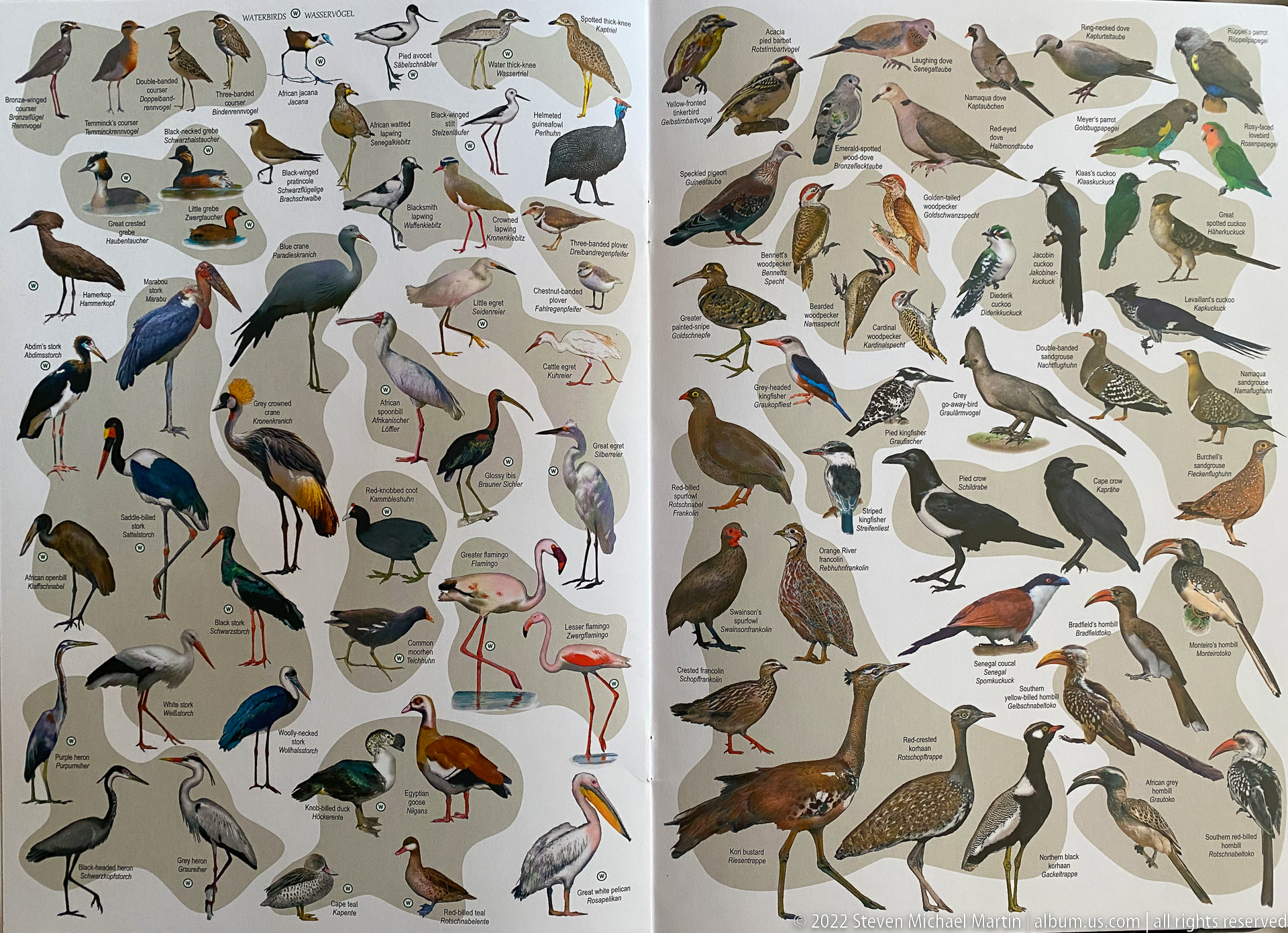
Two densely illustrated bird-identification plates present a wide range of Etosha avifauna in profile. The left page is dominated by long-legged waterbirds and waders, including crane-, stork-, and flamingo-like forms, while the facing page shifts to a broader assortment of terrestrial and wetland birds. Individual labels turn the spread into a compact visual key for field recognition.
Caption
Two densely illustrated bird-identification plates present a wide range of Etosha avifauna in profile. The left page is dominated by long-legged waterbirds and waders, including crane-, stork-, and flamingo-like forms, while the facing page shifts to a broader assortment of terrestrial and wetland birds. Individual labels turn the spread into a compact visual key for field recognition.

The cover of an Etosha wildlife-identification guide combines illustrated mammals and birds with the bilingual title “Map of Etosha / Karte von Etoscha.” A lower panel centers elephants and other animals at a waterhole, signaling the guide’s field-identification purpose. The photographed publication provides contextual reference material for recognizing species and navigating wildlife encounters across the Etosha landscape.
Caption
The cover of an Etosha wildlife-identification guide combines illustrated mammals and birds with the bilingual title “Map of Etosha / Karte von Etoscha.” A lower panel centers elephants and other animals at a waterhole, signaling the guide’s field-identification purpose. The photographed publication provides contextual reference material for recognizing species and navigating wildlife encounters across the Etosha landscape.
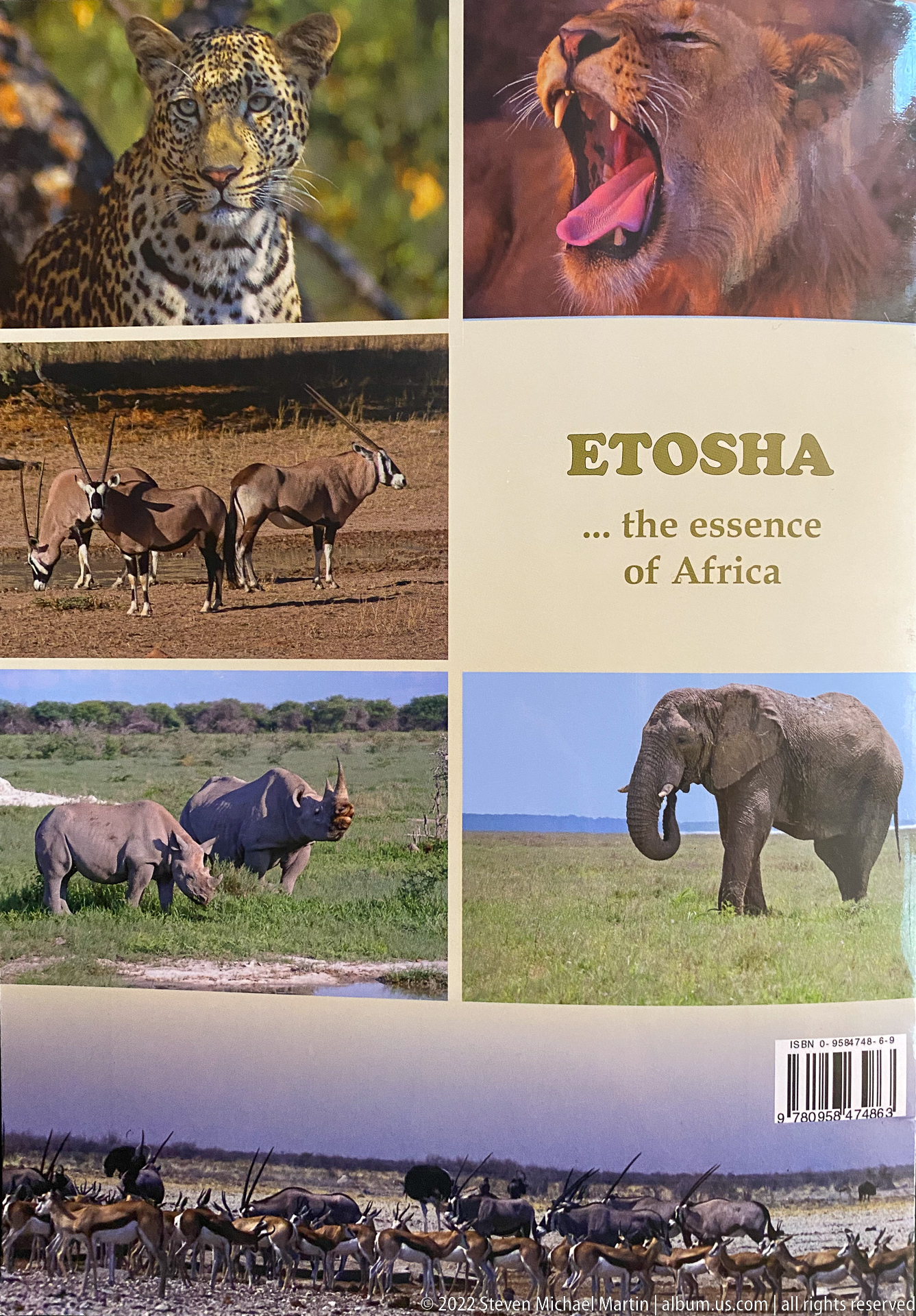
The closing cover of the Etosha guide uses a wildlife collage beneath the phrase “ETOSHA — the essence of Africa.” Separate panels feature close and contextual views of prominent African animals, while a panoramic strip along the bottom shows a large concentration of wildlife across open terrain. The design concludes the field guide by presenting Etosha through the abundance and variety of its fauna.
Caption
The closing cover of the Etosha guide uses a wildlife collage beneath the phrase “ETOSHA — the essence of Africa.” Separate panels feature close and contextual views of prominent African animals, while a panoramic strip along the bottom shows a large concentration of wildlife across open terrain. The design concludes the field guide by presenting Etosha through the abundance and variety of its fauna.

An information spread from the Etosha guide assembles practical park material with natural-history reference: visitor information, timetables, a table of distances, wildlife illustrations, and a color-coded vegetation map. The dense layout shows how field guides integrate route planning with ecological orientation, allowing travelers to relate roads and facilities to the broad vegetation zones that structure wildlife habitat in Etosha.
Caption
An information spread from the Etosha guide assembles practical park material with natural-history reference: visitor information, timetables, a table of distances, wildlife illustrations, and a color-coded vegetation map. The dense layout shows how field guides integrate route planning with ecological orientation, allowing travelers to relate roads and facilities to the broad vegetation zones that structure wildlife habitat in Etosha.
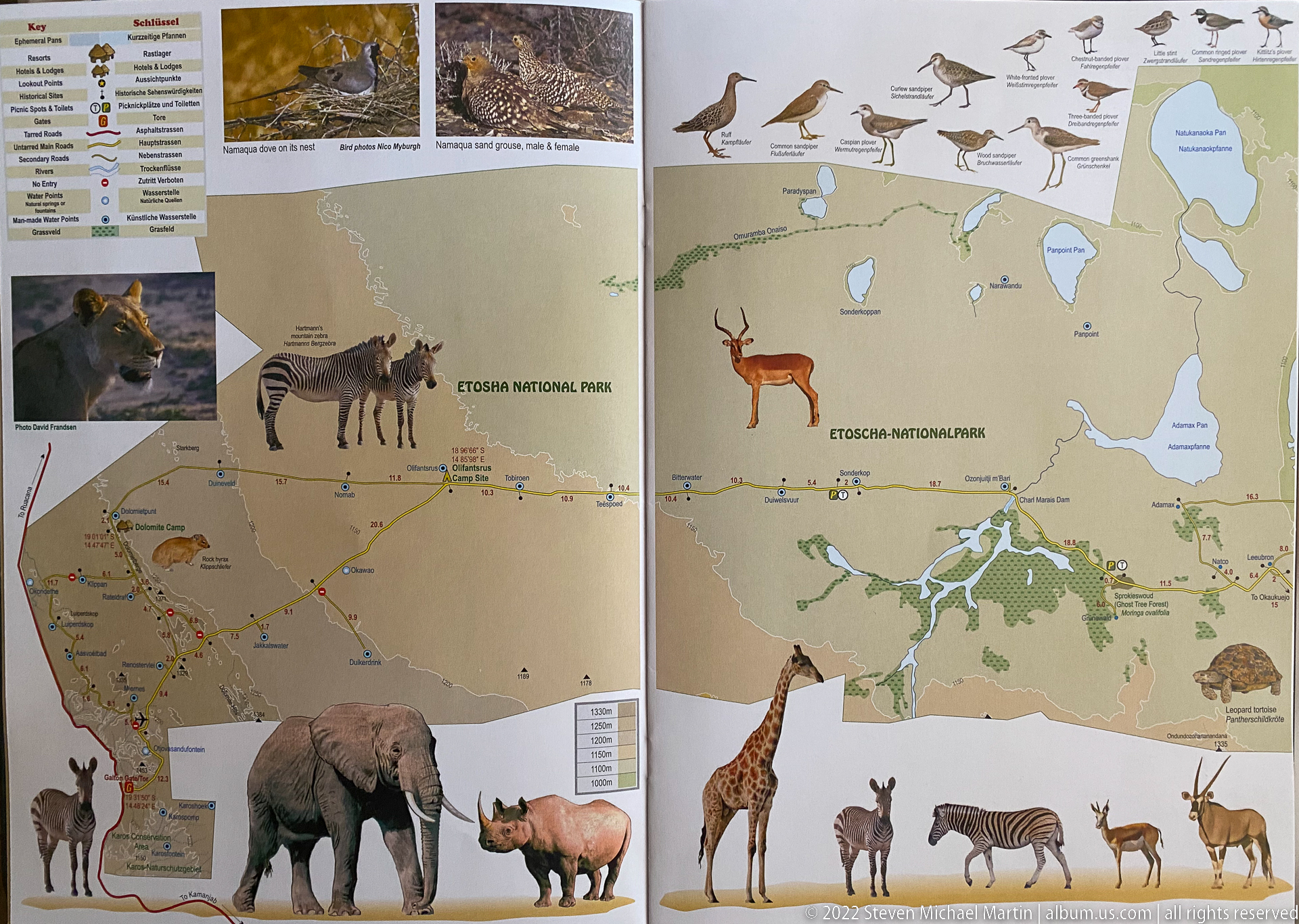
Two facing map pages place Etosha National Park’s road network and water features beneath rows of illustrated wildlife. Large figures of zebra, elephant, rhinoceros, giraffe, antelope, and other species turn the map into a combined navigation and identification aid. The spread visually links animal recognition with the geography of the park, including the broad pale expanse of the Etosha Pan.
Caption
Two facing map pages place Etosha National Park’s road network and water features beneath rows of illustrated wildlife. Large figures of zebra, elephant, rhinoceros, giraffe, antelope, and other species turn the map into a combined navigation and identification aid. The spread visually links animal recognition with the geography of the park, including the broad pale expanse of the Etosha Pan.

A detailed Etosha National Park map spread traces roads, waterholes, settlements, and the margins of the pan across two pages. Wildlife illustrations—including large herbivores and predators—frame the cartography and reinforce the guide’s dual role as route reference and species primer. The layout emphasizes the scale of the protected landscape and the importance of mapped water points to safari movement.
Caption
A detailed Etosha National Park map spread traces roads, waterholes, settlements, and the margins of the pan across two pages. Wildlife illustrations—including large herbivores and predators—frame the cartography and reinforce the guide’s dual role as route reference and species primer. The layout emphasizes the scale of the protected landscape and the importance of mapped water points to safari movement.
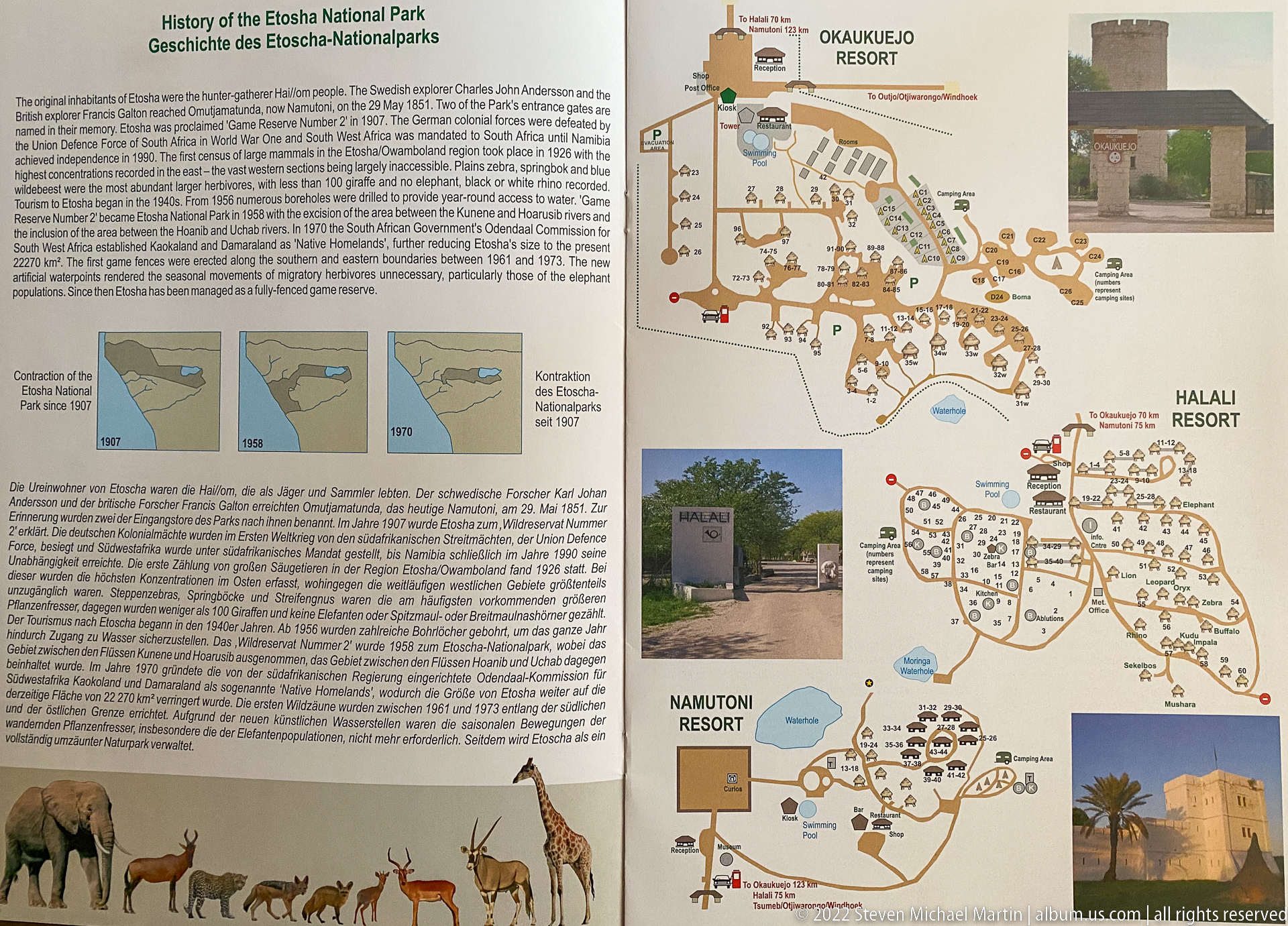
This guide spread pairs a text history of Etosha National Park with schematic plans of three major park resorts: Okaukuejo, Halali, and Namutoni. Small historic and site photographs accompany the maps, while animal illustrations run along the lower margin. The page connects the park’s administrative history with the visitor infrastructure from which many wildlife drives and waterhole observations are organized.
Caption
This guide spread pairs a text history of Etosha National Park with schematic plans of three major park resorts: Okaukuejo, Halali, and Namutoni. Small historic and site photographs accompany the maps, while animal illustrations run along the lower margin. The page connects the park’s administrative history with the visitor infrastructure from which many wildlife drives and waterhole observations are organized.

Photographs and descriptive text survey accommodation and camping facilities associated with Etosha National Park. Separate sections present resort or campsite settings with pools, buildings, shaded grounds, and entrances, giving the spread the character of a practical lodging directory. Rather than wildlife identification, these pages document the visitor infrastructure that supports multi-day travel through the Etosha region.
Caption
Photographs and descriptive text survey accommodation and camping facilities associated with Etosha National Park. Separate sections present resort or campsite settings with pools, buildings, shaded grounds, and entrances, giving the spread the character of a practical lodging directory. Rather than wildlife identification, these pages document the visitor infrastructure that supports multi-day travel through the Etosha region.
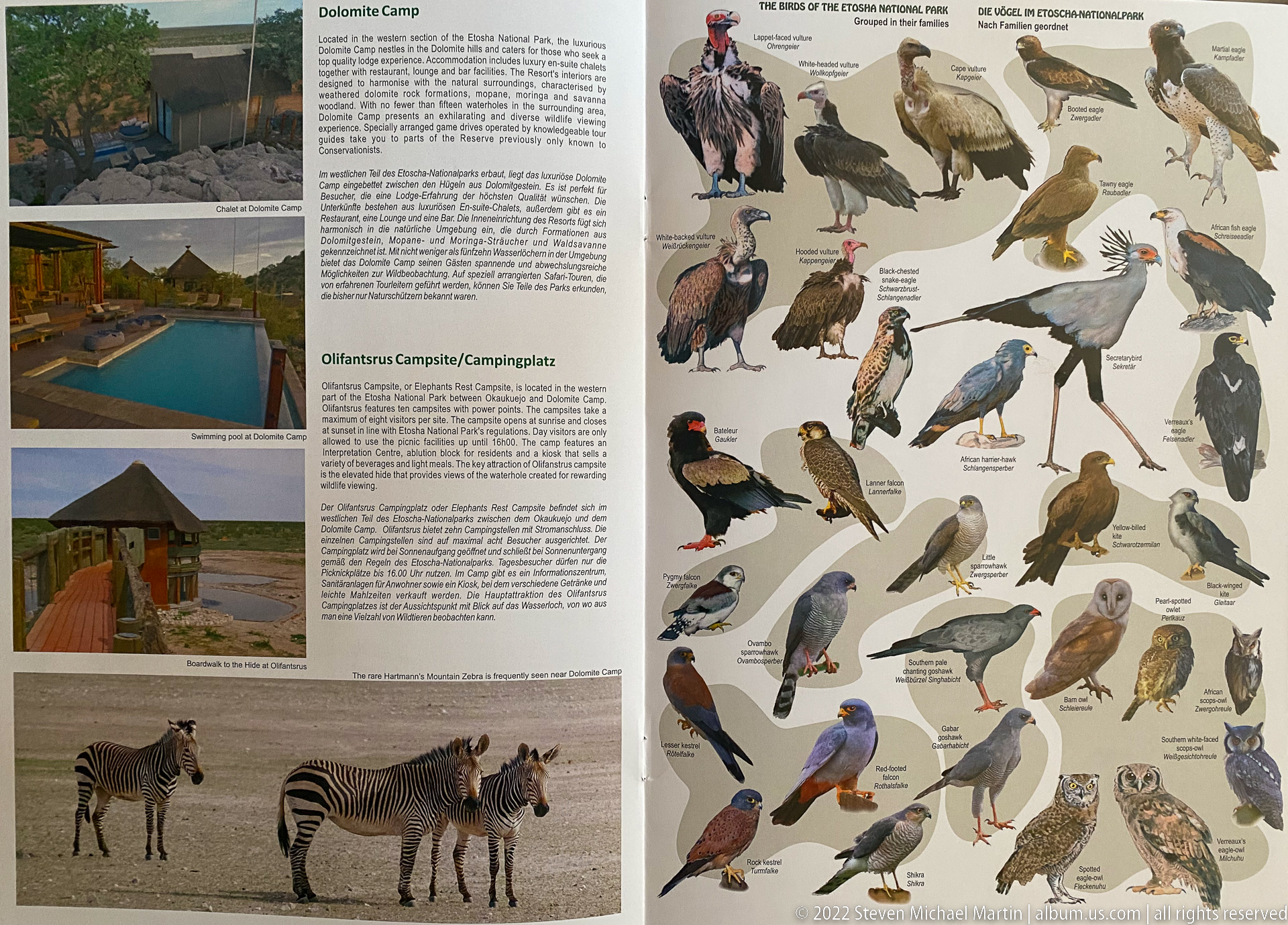
A practical campsite page faces a dense identification plate devoted to birds of prey recorded in the Etosha region. Photographs of lodging, a pool, and zebras occupy the left page, while the right arranges illustrated vultures, eagles, owls, and other raptors with labels. The juxtaposition reflects the guide’s broad scope, moving directly from visitor logistics to field identification.
Caption
A practical campsite page faces a dense identification plate devoted to birds of prey recorded in the Etosha region. Photographs of lodging, a pool, and zebras occupy the left page, while the right arranges illustrated vultures, eagles, owls, and other raptors with labels. The juxtaposition reflects the guide’s broad scope, moving directly from visitor logistics to field identification.
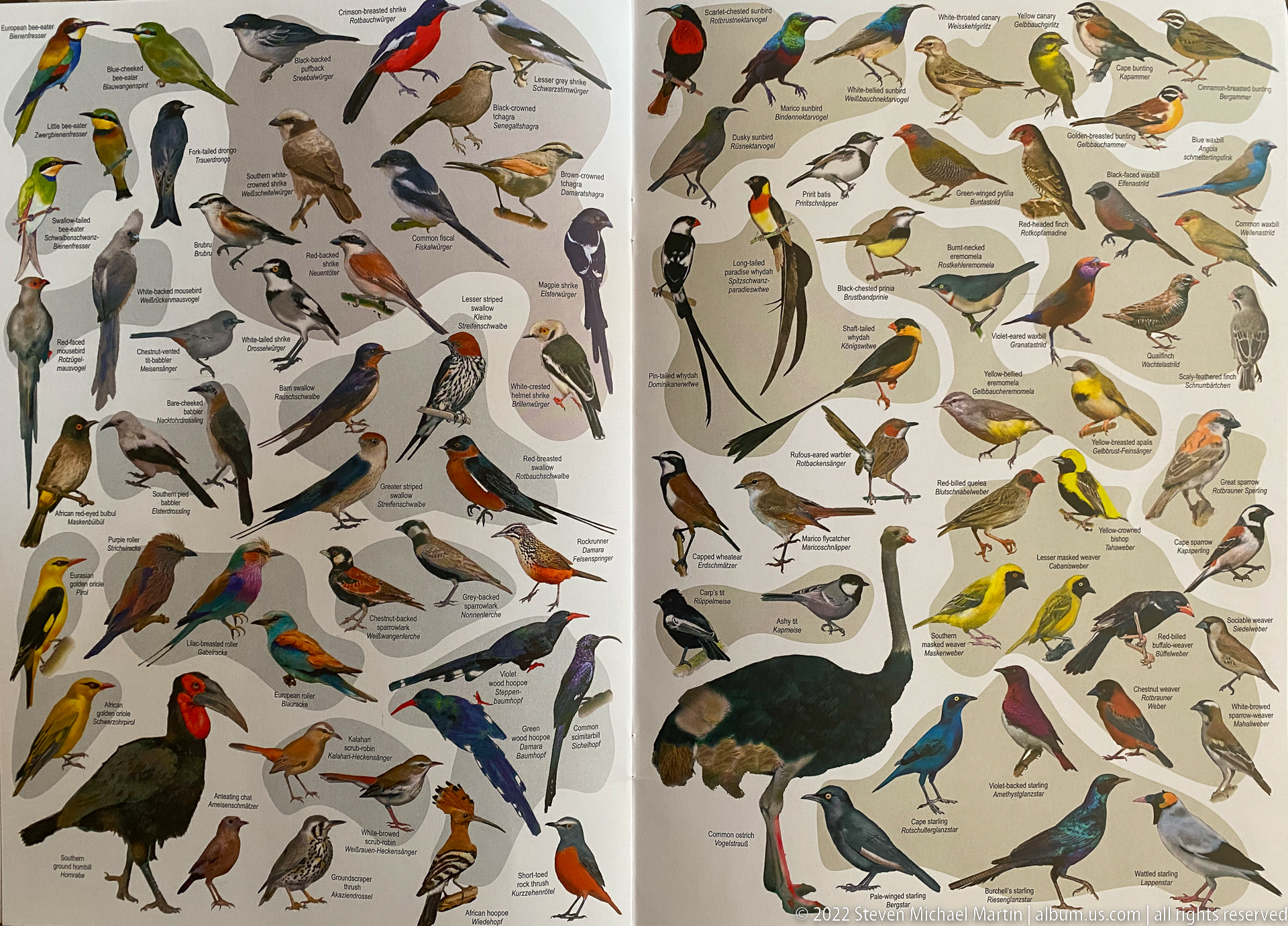
Colorful land birds fill this two-page identification spread, with dozens of labeled species arranged against a pale background. Perching forms dominate, joined by conspicuous larger birds and several vividly patterned species. The compact plate format is designed for visual comparison of plumage, body shape, bill form, and relative proportions—features central to identifying Etosha’s diverse birdlife in the field.
Caption
Colorful land birds fill this two-page identification spread, with dozens of labeled species arranged against a pale background. Perching forms dominate, joined by conspicuous larger birds and several vividly patterned species. The compact plate format is designed for visual comparison of plumage, body shape, bill form, and relative proportions—features central to identifying Etosha’s diverse birdlife in the field.
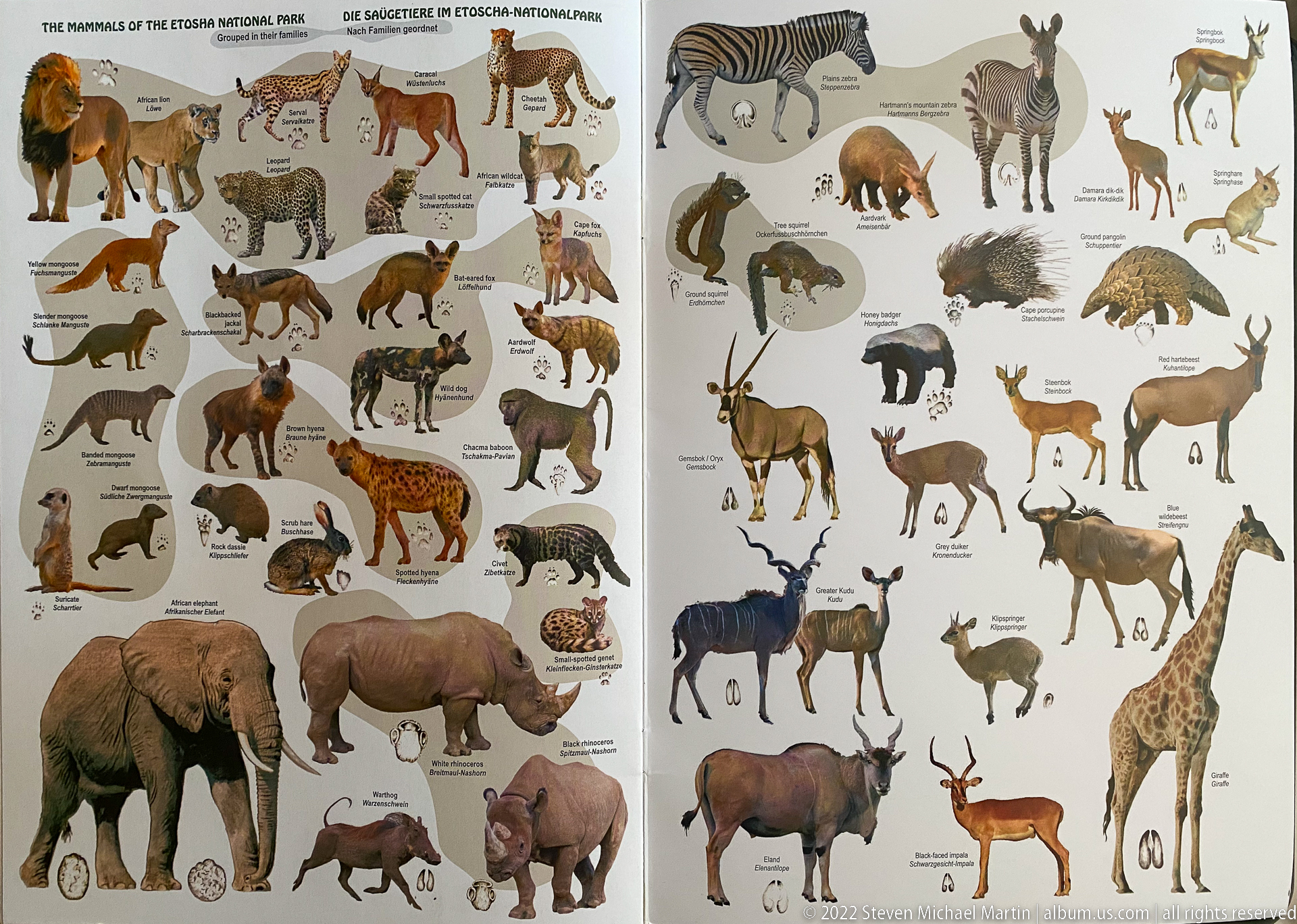
A two-page mammal plate gathers many of Etosha’s characteristic species into a single comparative reference. Carnivores, antelope, equids, primates, small mammals, and large herbivores are shown at differing scales, with elephant, rhinoceros, giraffe, zebra, and wildebeest among the most conspicuous forms. Labeled illustrations emphasize silhouette, coat pattern, horns, and body proportions used in field identification.
Caption
A two-page mammal plate gathers many of Etosha’s characteristic species into a single comparative reference. Carnivores, antelope, equids, primates, small mammals, and large herbivores are shown at differing scales, with elephant, rhinoceros, giraffe, zebra, and wildebeest among the most conspicuous forms. Labeled illustrations emphasize silhouette, coat pattern, horns, and body proportions used in field identification.