Venice – Italy
The remarkable city of Venice rises from a lagoon along the northern coast of the Adriatic Sea. Founded during the early medieval period on a network of small islands, Venice grew into one of the most powerful maritime republics in Europe.
Instead of streets, the city is organized around canals crossed by hundreds of bridges, creating a unique urban landscape shaped by water and trade. For centuries Venice controlled major trade routes between Europe and the eastern Mediterranean, allowing the city to accumulate enormous wealth and artistic patronage.
Today Venice remains one of the most extraordinary historic cities in the world and is recognized as part of the Venice and its Lagoon.

A souvenir print presents St. Mark’s Basilica beside the Doge’s Palace in a softly rendered view of the Piazza San Marco waterfront ensemble. The basilica’s domes and ornate façade contrast with the palace’s long arcaded elevation, while a slender column rises at the right edge. Seen through a shop display, the image shows how Venice’s monumental architecture is reproduced for visitors in portable graphic form.
Caption
A souvenir print presents St. Mark’s Basilica beside the Doge’s Palace in a softly rendered view of the Piazza San Marco waterfront ensemble. The basilica’s domes and ornate façade contrast with the palace’s long arcaded elevation, while a slender column rises at the right edge. Seen through a shop display, the image shows how Venice’s monumental architecture is reproduced for visitors in portable graphic form.

Broad steps climb onto the timber Ponte dell'Accademia, where pedestrians cross beneath tall traditional street lamps. The side view exposes the bridge’s wooden railings, braces, and rising arch rather than the Grand Canal panorama usually associated with the crossing. Trees and a paved approach frame the foreground, presenting the bridge as part of Venice’s everyday pedestrian infrastructure.
Caption
Broad steps climb onto the timber Ponte dell'Accademia, where pedestrians cross beneath tall traditional street lamps. The side view exposes the bridge’s wooden railings, braces, and rising arch rather than the Grand Canal panorama usually associated with the crossing. Trees and a paved approach frame the foreground, presenting the bridge as part of Venice’s everyday pedestrian infrastructure.

A timber footbridge rises in two shallow arches over a narrow canal between cream and terracotta residential blocks. Cross-braced wooden railings and broad stepped approaches give the structure a distinctly utilitarian character, contrasting with Venice’s stone bridges. The near-frontal view shows how the bridge links pedestrian routes on either side of the water.
Caption
A timber footbridge rises in two shallow arches over a narrow canal between cream and terracotta residential blocks. Cross-braced wooden railings and broad stepped approaches give the structure a distinctly utilitarian character, contrasting with Venice’s stone bridges. The near-frontal view shows how the bridge links pedestrian routes on either side of the water.

Golden mosaics cover domes, arches, pendentives, and vaults inside St. Mark’s Basilica, enveloping the interior in continuous narrative imagery. Rows of small windows puncture the base of the central dome and admit light across the shimmering surfaces. The wide upward view conveys the spatial layering of the church, where architecture and mosaic decoration merge across successive domed bays.
Caption
Golden mosaics cover domes, arches, pendentives, and vaults inside St. Mark’s Basilica, enveloping the interior in continuous narrative imagery. Rows of small windows puncture the base of the central dome and admit light across the shimmering surfaces. The wide upward view conveys the spatial layering of the church, where architecture and mosaic decoration merge across successive domed bays.

A monumental side altar is set between tall fluted columns, with a dark painted altarpiece below a broad arched painting and sculpted figures flanking the lower composition. Pale stone architecture contrasts with patterned red wall coverings on either side. The frontal view emphasizes the layered arrangement of painting, sculpture, columns, and entablature within the church interior.
Caption
A monumental side altar is set between tall fluted columns, with a dark painted altarpiece below a broad arched painting and sculpted figures flanking the lower composition. Pale stone architecture contrasts with patterned red wall coverings on either side. The frontal view emphasizes the layered arrangement of painting, sculpture, columns, and entablature within the church interior.

A domed church rises behind a cluster of canal-side residences, its pale masonry, drum, and twin tower-like elements contrasting with brick walls and dark shutters in the foreground. The oblique street-level view emphasizes the dense interlocking scale of Venice, where monumental religious architecture appears suddenly above compact domestic buildings rather than from a formal open square.
Caption
A domed church rises behind a cluster of canal-side residences, its pale masonry, drum, and twin tower-like elements contrasting with brick walls and dark shutters in the foreground. The oblique street-level view emphasizes the dense interlocking scale of Venice, where monumental religious architecture appears suddenly above compact domestic buildings rather than from a formal open square.

A narrow paved lane runs between warm stucco buildings with shuttered windows and stone-framed doors. Stacked café chairs or stools line the right foreground, suggesting a commercial space closed or not yet set for service, while the nearly empty street recedes toward a brighter junction. The scene records the intimate pedestrian scale of Venice away from its major canals and squares.
Caption
A narrow paved lane runs between warm stucco buildings with shuttered windows and stone-framed doors. Stacked café chairs or stools line the right foreground, suggesting a commercial space closed or not yet set for service, while the nearly empty street recedes toward a brighter junction. The scene records the intimate pedestrian scale of Venice away from its major canals and squares.

The enclosed Bridge of Sighs spans the narrow Rio di Palazzo between the pale stone Doge’s Palace and the brick-toned building opposite. Gondolas pass beneath the bridge while another small crossing is visible farther down the canal. The axial view highlights the famous enclosed passage as part of a layered network of bridges, water routes, and institutional architecture beside St. Mark’s Square.
Caption
The enclosed Bridge of Sighs spans the narrow Rio di Palazzo between the pale stone Doge’s Palace and the brick-toned building opposite. Gondolas pass beneath the bridge while another small crossing is visible farther down the canal. The axial view highlights the famous enclosed passage as part of a layered network of bridges, water routes, and institutional architecture beside St. Mark’s Square.

A low arched footbridge crosses a neighborhood canal lined by brick and stucco houses, mooring posts, small boats, and waterside walkways. The long view compresses layers of everyday Venice—laundry balconies, shutters, masonry walls, and boat traffic—into a working urban corridor. A distant bell tower rises above the roofs without displacing the canal itself as the principal subject.
Caption
A low arched footbridge crosses a neighborhood canal lined by brick and stucco houses, mooring posts, small boats, and waterside walkways. The long view compresses layers of everyday Venice—laundry balconies, shutters, masonry walls, and boat traffic—into a working urban corridor. A distant bell tower rises above the roofs without displacing the canal itself as the principal subject.

The Grand Canal stretches into pale haze between rows of waterfront palazzi, with the domes of Santa Maria della Salute silhouetted near the distant opening. Boats appear as small dark forms on the water, reinforcing the scale of Venice’s principal aquatic thoroughfare. The backlit atmosphere softens architectural detail and turns the canal’s long perspective into the dominant feature of the composition.
Caption
The Grand Canal stretches into pale haze between rows of waterfront palazzi, with the domes of Santa Maria della Salute silhouetted near the distant opening. Boats appear as small dark forms on the water, reinforcing the scale of Venice’s principal aquatic thoroughfare. The backlit atmosphere softens architectural detail and turns the canal’s long perspective into the dominant feature of the composition.

Monumental marble figures rise beneath the organ loft inside Santa Maria della Salute, with a painted icon set into the architectural base below. The frontal view reveals the ensemble's theatrical hierarchy more fully than neighboring details: kneeling and standing figures gather around the central upper group while organ pipes form a dark vertical backdrop. Red votive lamps and a sunbeam add points of color and light.
Caption
Monumental marble figures rise beneath the organ loft inside Santa Maria della Salute, with a painted icon set into the architectural base below. The frontal view reveals the ensemble's theatrical hierarchy more fully than neighboring details: kneeling and standing figures gather around the central upper group while organ pipes form a dark vertical backdrop. Red votive lamps and a sunbeam add points of color and light.

A restaurant window in Venice layers everyday dining culture with the city's theatrical traditions. Lettering for Ristorante Dolfin Pizzeria spans the glass above a display of brightly colored carnival masks, while bottles and the interior dining room remain visible through reflections. The composition turns a commercial storefront into a compact study of tourism, food, and mask-making imagery in the historic city.
Caption
A restaurant window in Venice layers everyday dining culture with the city's theatrical traditions. Lettering for Ristorante Dolfin Pizzeria spans the glass above a display of brightly colored carnival masks, while bottles and the interior dining room remain visible through reflections. The composition turns a commercial storefront into a compact study of tourism, food, and mask-making imagery in the historic city.

The bronze figure of Fortuna turns above the former customs house at the entrance to Venice's Grand Canal, balancing on a gilded globe and holding a broad sail to catch the wind. Seen tightly against a cloudless blue sky, the weather-vane sculpture emphasizes Venice's historic dependence on maritime commerce, changing winds, and the movement of ships through the lagoon.
Caption
The bronze figure of Fortuna turns above the former customs house at the entrance to Venice's Grand Canal, balancing on a gilded globe and holding a broad sail to catch the wind. Seen tightly against a cloudless blue sky, the weather-vane sculpture emphasizes Venice's historic dependence on maritime commerce, changing winds, and the movement of ships through the lagoon.

A narrow Venetian canal slips between closely spaced residential buildings whose walls rise directly from the water. Warm stucco, exposed brick, shuttered windows, and a slim pedestrian edge define the enclosed passage, while reflected light brightens the dark green channel. The view shows how waterways function as intimate neighborhood spaces as well as the city's larger transportation network.
Caption
A narrow Venetian canal slips between closely spaced residential buildings whose walls rise directly from the water. Warm stucco, exposed brick, shuttered windows, and a slim pedestrian edge define the enclosed passage, while reflected light brightens the dark green channel. The view shows how waterways function as intimate neighborhood spaces as well as the city's larger transportation network.

A man stands beside a narrow Venetian canal, framed by an iron railing, weathered brick walls, timber mooring posts, and a small arched bridge behind him. Shallow depth of field keeps the portrait prominent while retaining enough of the waterside setting to place the scene within Venice's pedestrian-and-canal street network. The image functions as a personal travel portrait rather than a landmark study.
Caption
A man stands beside a narrow Venetian canal, framed by an iron railing, weathered brick walls, timber mooring posts, and a small arched bridge behind him. Shallow depth of field keeps the portrait prominent while retaining enough of the waterside setting to place the scene within Venice's pedestrian-and-canal street network. The image functions as a personal travel portrait rather than a landmark study.

Fortuna, the wind-driven bronze figure crowning the Dogana da Mar, holds her sail outward above the customs house at Punta della Dogana. This closer side view makes the figure's contrapposto stance, green patina, and rig-like support especially legible. The sculpture's maritime imagery suited a building historically positioned to oversee vessels entering the commercial heart of Venice.
Caption
Fortuna, the wind-driven bronze figure crowning the Dogana da Mar, holds her sail outward above the customs house at Punta della Dogana. This closer side view makes the figure's contrapposto stance, green patina, and rig-like support especially legible. The sculpture's maritime imagery suited a building historically positioned to oversee vessels entering the commercial heart of Venice.

From below, the Dogana da Mar's summit group reads as a dramatic maritime emblem: Fortuna stands above a large gilded globe, extending her sail into the wind, while sculpted figures flank the base. The low viewpoint enlarges the globe and reduces the figure to a silhouette-like presence against the sky, emphasizing the monument's role as a conspicuous marker at Venice's historic customs point.
Caption
From below, the Dogana da Mar's summit group reads as a dramatic maritime emblem: Fortuna stands above a large gilded globe, extending her sail into the wind, while sculpted figures flank the base. The low viewpoint enlarges the globe and reduces the figure to a silhouette-like presence against the sky, emphasizing the monument's role as a conspicuous marker at Venice's historic customs point.
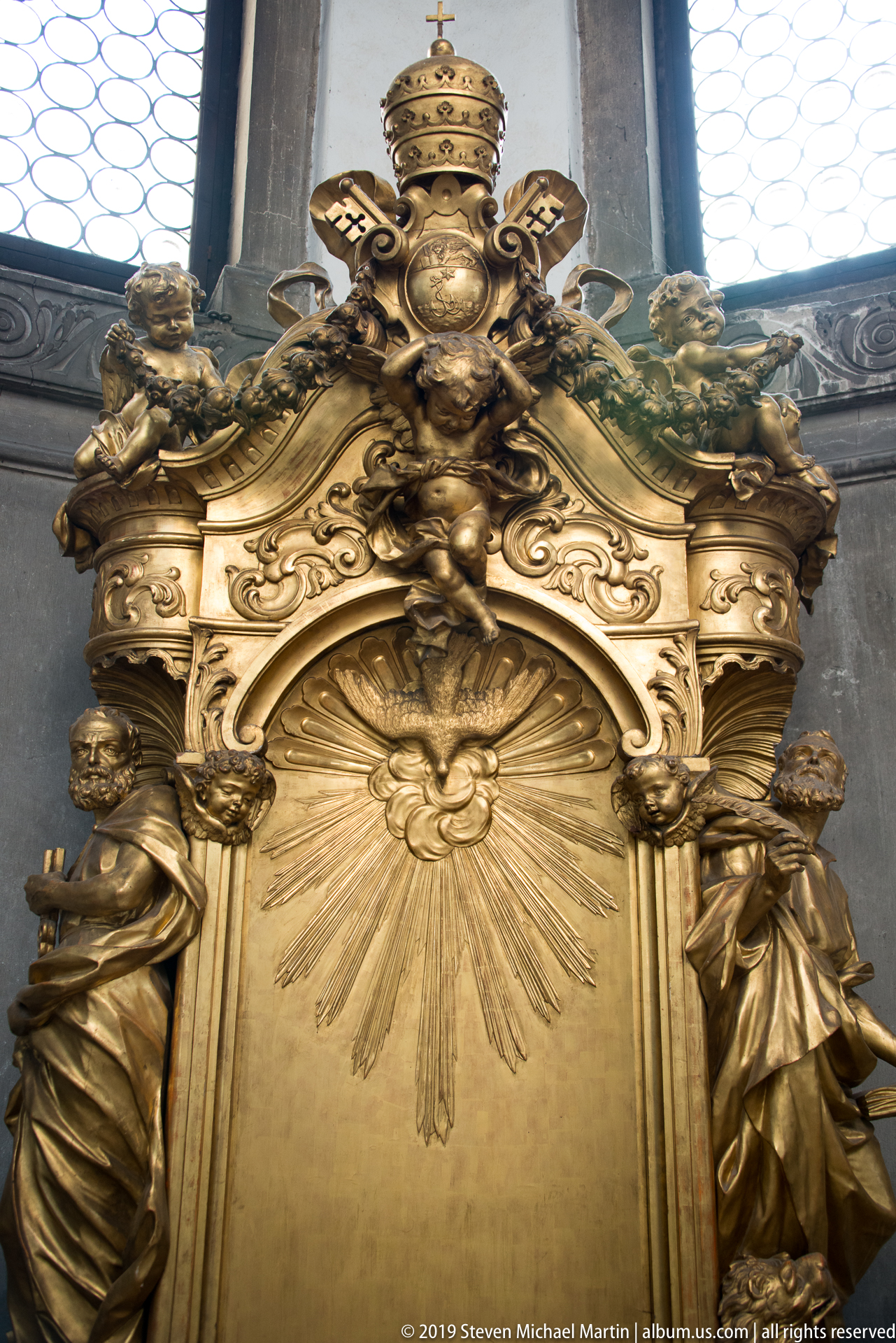
A gilded ecclesiastical ornament combines the papal tiara and crossed keys above a radiant field, surrounded by scrolling foliage and small sculpted figures. The close framing isolates the dense Baroque metalwork from its architectural setting, allowing the layered symbols, modeled drapery, and reflective surface to dominate. The insignia visually connects the decoration with the papacy without requiring an attribution to a specific pontiff.
Caption
A gilded ecclesiastical ornament combines the papal tiara and crossed keys above a radiant field, surrounded by scrolling foliage and small sculpted figures. The close framing isolates the dense Baroque metalwork from its architectural setting, allowing the layered symbols, modeled drapery, and reflective surface to dominate. The insignia visually connects the decoration with the papacy without requiring an attribution to a specific pontiff.

A shaft of daylight cuts through the interior of Santa Maria della Salute, catching pale marble sculpture while red-glass votive lamps hang in the foreground. The side-lit composition emphasizes the church's layered devotional environment: monumental statuary, organ pipes, curtains, columns, and suspended lamps occupy the same vertical field. Light and incense-like haze give unusual visibility to the beam crossing the sanctuary.
Caption
A shaft of daylight cuts through the interior of Santa Maria della Salute, catching pale marble sculpture while red-glass votive lamps hang in the foreground. The side-lit composition emphasizes the church's layered devotional environment: monumental statuary, organ pipes, curtains, columns, and suspended lamps occupy the same vertical field. Light and incense-like haze give unusual visibility to the beam crossing the sanctuary.

The Basilica di Santa Maria della Salute rises at the mouth of the Grand Canal with its great central dome, sculpted buttresses, and richly modeled white-stone exterior. Seen from the open campo, the church's layered massing is especially clear: lower chapels and façades gather around the dominant octagonal body before the dome lifts above them, creating one of Venice's most recognizable Baroque silhouettes.
Caption
The Basilica di Santa Maria della Salute rises at the mouth of the Grand Canal with its great central dome, sculpted buttresses, and richly modeled white-stone exterior. Seen from the open campo, the church's layered massing is especially clear: lower chapels and façades gather around the dominant octagonal body before the dome lifts above them, creating one of Venice's most recognizable Baroque silhouettes.

Inside Santa Maria della Salute, massive gray stone piers and broad arches organize the luminous octagonal space around a patterned marble floor. The view looks toward an altar beneath tall thermal-like windows, with a suspended sanctuary lamp centered in the opening. The restrained stone structure and expansive volume contrast with the more concentrated gilding of the liturgical furnishings.
Caption
Inside Santa Maria della Salute, massive gray stone piers and broad arches organize the luminous octagonal space around a patterned marble floor. The view looks toward an altar beneath tall thermal-like windows, with a suspended sanctuary lamp centered in the opening. The restrained stone structure and expansive volume contrast with the more concentrated gilding of the liturgical furnishings.

An elaborate suspended canopy or baldachin-like furnishing fills the frame with gilded scrollwork, blue-green textile panels, tassels, and a crown of sculpted ornament. Hung within Santa Maria della Salute, the object is photographed from below so that its carved cresting and pendant fringe stand out against pale stone arches. The view records liturgical decoration rather than the basilica's overall architecture.
Caption
An elaborate suspended canopy or baldachin-like furnishing fills the frame with gilded scrollwork, blue-green textile panels, tassels, and a crown of sculpted ornament. Hung within Santa Maria della Salute, the object is photographed from below so that its carved cresting and pendant fringe stand out against pale stone arches. The view records liturgical decoration rather than the basilica's overall architecture.

An ornate hanging lamp is isolated against the stone architecture of Santa Maria della Salute. A pierced metal crown supports multiple red-glass lights around a broad patterned glass bowl, with chains and a small pendant completing the vertical design. The close view makes the furnishing's craftsmanship—scrolls, finials, translucent glass, and suspended structure—more prominent than its liturgical surroundings.
Caption
An ornate hanging lamp is isolated against the stone architecture of Santa Maria della Salute. A pierced metal crown supports multiple red-glass lights around a broad patterned glass bowl, with chains and a small pendant completing the vertical design. The close view makes the furnishing's craftsmanship—scrolls, finials, translucent glass, and suspended structure—more prominent than its liturgical surroundings.

A painted devotional icon occupies the lower center of a sculptural ensemble in Santa Maria della Salute, surrounded by pale marble figures and backed by organ pipes. A diagonal shaft of daylight crosses the scene, separating the warm gold and red of the icon from the cool stone statuary. The framing shows how painting, sculpture, music, and natural light converge within the basilica's devotional interior.
Caption
A painted devotional icon occupies the lower center of a sculptural ensemble in Santa Maria della Salute, surrounded by pale marble figures and backed by organ pipes. A diagonal shaft of daylight crosses the scene, separating the warm gold and red of the icon from the cool stone statuary. The framing shows how painting, sculpture, music, and natural light converge within the basilica's devotional interior.

Suspended on long decorative chains, a broad church lamp hangs before a pale architectural arch inside Santa Maria della Salute. This wider view reveals the furnishing's relationship to the basilica: red-glass lights ring the metal frame, a patterned bowl forms its center, and daylight from a high window silhouettes the upper chains. The composition balances decorative detail with the scale of the surrounding interior.
Caption
Suspended on long decorative chains, a broad church lamp hangs before a pale architectural arch inside Santa Maria della Salute. This wider view reveals the furnishing's relationship to the basilica: red-glass lights ring the metal frame, a patterned bowl forms its center, and daylight from a high window silhouettes the upper chains. The composition balances decorative detail with the scale of the surrounding interior.

A large painted altarpiece fills a side altar framed by paired pale columns and a curved architectural surround inside Santa Maria della Salute. The painting's crowded sacred scene is viewed from below, while altar candlesticks and a small frontal occupy the base. The photograph emphasizes the integration of painting and monumental stone architecture rather than isolating individual figures within the canvas.
Caption
A large painted altarpiece fills a side altar framed by paired pale columns and a curved architectural surround inside Santa Maria della Salute. The painting's crowded sacred scene is viewed from below, while altar candlesticks and a small frontal occupy the base. The photograph emphasizes the integration of painting and monumental stone architecture rather than isolating individual figures within the canvas.

A small bronze statuette presents a muscular male figure in a dynamic stride, one arm extended while drapery twists across his body and trails behind. The dark patina and compact pedestal separate the figure sharply from the pale stone background. Classicalizing anatomy and movement are evident, but the proof-sheet view does not securely establish the figure's identity or original sculptural program.
Caption
A small bronze statuette presents a muscular male figure in a dynamic stride, one arm extended while drapery twists across his body and trails behind. The dark patina and compact pedestal separate the figure sharply from the pale stone background. Classicalizing anatomy and movement are evident, but the proof-sheet view does not securely establish the figure's identity or original sculptural program.

A broad interior view of Santa Maria della Salute shows the patterned marble pavement spreading beneath monumental piers and round arches toward a distant altar. High windows flood the octagonal space with cool daylight, while a suspended lamp marks the central axis. The photograph makes the basilica's geometry and circulation legible, emphasizing spatial order over individual devotional objects.
Caption
A broad interior view of Santa Maria della Salute shows the patterned marble pavement spreading beneath monumental piers and round arches toward a distant altar. High windows flood the octagonal space with cool daylight, while a suspended lamp marks the central axis. The photograph makes the basilica's geometry and circulation legible, emphasizing spatial order over individual devotional objects.

The devotional ensemble beneath the organ loft is seen in a wider architectural setting, with pale marble figures surrounding a glowing icon and red votive lamps punctuating the composition. Strong light enters from the left, illuminating the sculptural group while the organ pipes remain dark above. This view clarifies how the ensemble occupies an entire bay rather than functioning as an isolated sculpture.
Caption
The devotional ensemble beneath the organ loft is seen in a wider architectural setting, with pale marble figures surrounding a glowing icon and red votive lamps punctuating the composition. Strong light enters from the left, illuminating the sculptural group while the organ pipes remain dark above. This view clarifies how the ensemble occupies an entire bay rather than functioning as an isolated sculpture.
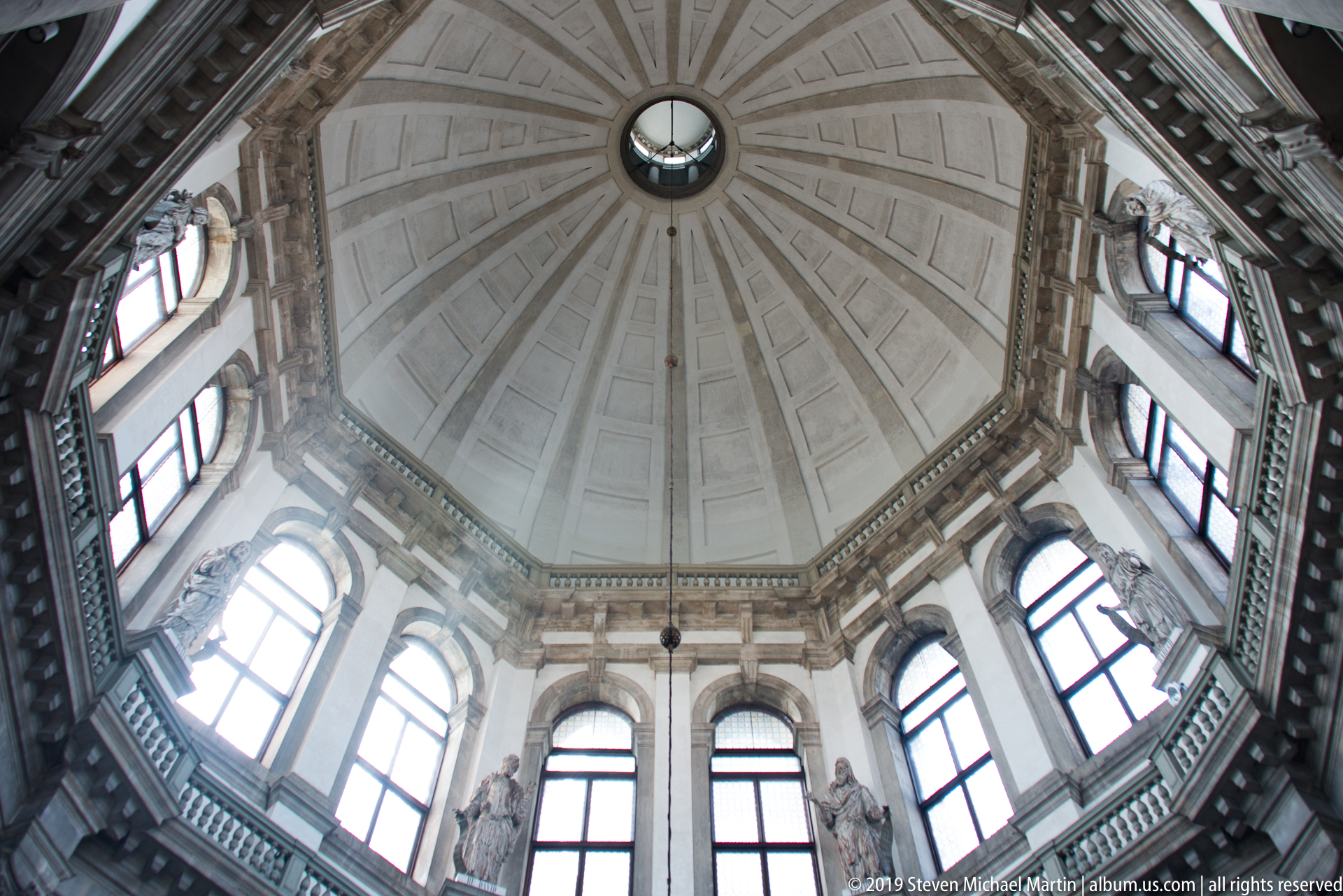
Looking straight upward, the interior of Santa Maria della Salute's dome resolves into a radial pattern of pale ribs converging on the central oculus. Tall windows encircle the drum below, alternating with architectural bays and sculptural accents. The symmetrical upward view shifts attention from the basilica's richly patterned floor and altars to the engineering and light of its soaring central crown.
Caption
Looking straight upward, the interior of Santa Maria della Salute's dome resolves into a radial pattern of pale ribs converging on the central oculus. Tall windows encircle the drum below, alternating with architectural bays and sculptural accents. The symmetrical upward view shifts attention from the basilica's richly patterned floor and altars to the engineering and light of its soaring central crown.

Santa Maria della Salute's monumental entrance façade rises beneath its great dome, combining a deep arched portal, engaged columns, niches, pedimented forms, and a dense crown of sculpture. The low viewpoint from the steps accentuates the church's vertical layering and heavy stone mass. Against the bright sky, the sculptural roofline reads almost in silhouette above the richly articulated white façade.
Caption
Santa Maria della Salute's monumental entrance façade rises beneath its great dome, combining a deep arched portal, engaged columns, niches, pedimented forms, and a dense crown of sculpture. The low viewpoint from the steps accentuates the church's vertical layering and heavy stone mass. Against the bright sky, the sculptural roofline reads almost in silhouette above the richly articulated white façade.

A quieter side of Santa Maria della Salute reveals an altar set between massive stone piers beneath broad arches and high windows. A hanging lamp occupies the open central space, while the geometric marble pavement curves across the foreground. Compared with the basilica's more ornate devotional ensembles, this view emphasizes the disciplined rhythm of architecture, light, and floor pattern.
Caption
A quieter side of Santa Maria della Salute reveals an altar set between massive stone piers beneath broad arches and high windows. A hanging lamp occupies the open central space, while the geometric marble pavement curves across the foreground. Compared with the basilica's more ornate devotional ensembles, this view emphasizes the disciplined rhythm of architecture, light, and floor pattern.

Three stone statues occupy niches and a central aedicule on the exterior of Santa Maria della Salute, framed by Corinthian pilasters, carved swags, and a Greek-key band. The close architectural study removes the dome and overall façade from view, concentrating instead on the basilica's sculptural program and the dense classical vocabulary used to animate its white-stone surfaces.
Caption
Three stone statues occupy niches and a central aedicule on the exterior of Santa Maria della Salute, framed by Corinthian pilasters, carved swags, and a Greek-key band. The close architectural study removes the dome and overall façade from view, concentrating instead on the basilica's sculptural program and the dense classical vocabulary used to animate its white-stone surfaces.

The upper façade of Santa Maria della Salute layers a triangular pediment, circular star-like window, sculpted figures, and the lead-covered dome behind it. Seen from below, statues sit along the cornice and pediment edges while the dome's ribs rise into the pale sky. The detail demonstrates how sculpture mediates between the church's classical façade elements and its immense Baroque dome.
Caption
The upper façade of Santa Maria della Salute layers a triangular pediment, circular star-like window, sculpted figures, and the lead-covered dome behind it. Seen from below, statues sit along the cornice and pediment edges while the dome's ribs rise into the pale sky. The detail demonstrates how sculpture mediates between the church's classical façade elements and its immense Baroque dome.

An oblique low-angle view of Santa Maria della Salute brings its interlocking volumes into relief: the principal dome rises above richly sculpted façades while a smaller domed element and lantern appear beyond. Deep shadows under cornices and window openings sharpen the white-stone ornament against a clear blue sky. The angle emphasizes the basilica as a three-dimensional mass rather than a single frontal composition.
Caption
An oblique low-angle view of Santa Maria della Salute brings its interlocking volumes into relief: the principal dome rises above richly sculpted façades while a smaller domed element and lantern appear beyond. Deep shadows under cornices and window openings sharpen the white-stone ornament against a clear blue sky. The angle emphasizes the basilica as a three-dimensional mass rather than a single frontal composition.

A narrow Venetian calle funnels the eye between warm stucco façades, dark shutters, window boxes, and exposed service lines toward a pale dome in the distance. The close walls and sliver of sky convey the compressed scale of the pedestrian city, where major monuments are often encountered as partial glimpses at the ends of residential passages rather than as isolated objects.
Caption
A narrow Venetian calle funnels the eye between warm stucco façades, dark shutters, window boxes, and exposed service lines toward a pale dome in the distance. The close walls and sliver of sky convey the compressed scale of the pedestrian city, where major monuments are often encountered as partial glimpses at the ends of residential passages rather than as isolated objects.

Rows of glass jars filled with intensely colored powders form a carefully graduated shop display, shifting from greens and blues through earth tones, reds, and yellows. Backlighting makes the transparent jars and pigment colors glow against white shelves. The arrangement evokes Venice's long association with artists' materials and decorative crafts, while the photograph itself records the retail display without asserting the powders' exact composition.
Caption
Rows of glass jars filled with intensely colored powders form a carefully graduated shop display, shifting from greens and blues through earth tones, reds, and yellows. Backlighting makes the transparent jars and pigment colors glow against white shelves. The arrangement evokes Venice's long association with artists' materials and decorative crafts, while the photograph itself records the retail display without asserting the powders' exact composition.

Open trays of powdered color create a bright grid across a Venetian shop window, ranging from ochres and earths to saturated blues, greens, pinks, and reds. A framed view of Santa Maria della Salute anchors the display behind them, while small decorative objects flank the merchandise. The scene links the city's visual identity with the sale of artists' and craft materials.
Caption
Open trays of powdered color create a bright grid across a Venetian shop window, ranging from ochres and earths to saturated blues, greens, pinks, and reds. A framed view of Santa Maria della Salute anchors the display behind them, while small decorative objects flank the merchandise. The scene links the city's visual identity with the sale of artists' and craft materials.

Wooden arches of the Ponte dell'Accademia span the Grand Canal above moored gondolas and a working gondolier. The layered view brings together two defining parts of Venice’s transport landscape: pedestrian bridges linking the city’s islands and narrow boats operating directly from canal-side landings. Warm timber, black hulls, striped mooring poles, and waterside buildings give this view a distinctly Venetian spatial character.
Caption
Wooden arches of the Ponte dell'Accademia span the Grand Canal above moored gondolas and a working gondolier. The layered view brings together two defining parts of Venice’s transport landscape: pedestrian bridges linking the city’s islands and narrow boats operating directly from canal-side landings. Warm timber, black hulls, striped mooring poles, and waterside buildings give this view a distinctly Venetian spatial character.

An ornate canal palace rises directly from the Grand Canal, its façade organized by pointed-arch windows, tracery, balconies, and pale stone ornament against warm ocher walls. A small motorboat passes below, emphasizing the building’s relationship to Venice’s principal waterway. The oblique viewpoint also reveals the continuous line of neighboring palazzi extending along the canal edge.
Caption
An ornate canal palace rises directly from the Grand Canal, its façade organized by pointed-arch windows, tracery, balconies, and pale stone ornament against warm ocher walls. A small motorboat passes below, emphasizing the building’s relationship to Venice’s principal waterway. The oblique viewpoint also reveals the continuous line of neighboring palazzi extending along the canal edge.

A traveler stands at a wooden bridge railing with the Grand Canal opening behind him between tightly packed palazzi. Boats move along the water while façades in white, ocher, and terracotta recede toward a bend. The elevated viewpoint turns the portrait into an environmental study, pairing a human foreground with the dense architecture and water traffic of central Venice.
Caption
A traveler stands at a wooden bridge railing with the Grand Canal opening behind him between tightly packed palazzi. Boats move along the water while façades in white, ocher, and terracotta recede toward a bend. The elevated viewpoint turns the portrait into an environmental study, pairing a human foreground with the dense architecture and water traffic of central Venice.

Framed tightly against the Grand Canal, a traveler in a tan jacket stands before a softly focused corridor of water and historic façades. The shallow depth of field separates the figure from passing boats and the dense canal-side architecture, while the wooden railing locates the viewpoint on a bridge. This closer composition prioritizes the portrait while retaining Venice as a recognizable urban setting.
Caption
Framed tightly against the Grand Canal, a traveler in a tan jacket stands before a softly focused corridor of water and historic façades. The shallow depth of field separates the figure from passing boats and the dense canal-side architecture, while the wooden railing locates the viewpoint on a bridge. This closer composition prioritizes the portrait while retaining Venice as a recognizable urban setting.

A smiling traveler in a dark jacket fills the foreground above the Grand Canal, where boats and multistory palazzi fall softly out of focus behind him. The elevated bridge viewpoint and compressed background convey the close relationship between Venice’s pedestrian routes and its waterways. Strong daylight isolates the face while preserving enough architectural context to locate the portrait within the historic city.
Caption
A smiling traveler in a dark jacket fills the foreground above the Grand Canal, where boats and multistory palazzi fall softly out of focus behind him. The elevated bridge viewpoint and compressed background convey the close relationship between Venice’s pedestrian routes and its waterways. Strong daylight isolates the face while preserving enough architectural context to locate the portrait within the historic city.

Vaporetti and smaller boats travel along the Grand Canal between continuous rows of palazzi, seen from an elevated bridge viewpoint. The broad waterway curves through façades ranging from pale stone to warm stucco, while striped mooring posts punctuate the right bank. This active scene foregrounds the canal’s continuing role as both a public-transit route and a working urban street.
Caption
Vaporetti and smaller boats travel along the Grand Canal between continuous rows of palazzi, seen from an elevated bridge viewpoint. The broad waterway curves through façades ranging from pale stone to warm stucco, while striped mooring posts punctuate the right bank. This active scene foregrounds the canal’s continuing role as both a public-transit route and a working urban street.

A traveler leans against a wooden bridge railing with the Grand Canal extending behind him through a corridor of sunlit palazzi. A vaporetto occupies the lower background, linking the portrait to the everyday movement of Venice’s waterborne transit system. The medium framing balances the person with the canal, architecture, and bridge structure rather than treating the city as a generic backdrop.
Caption
A traveler leans against a wooden bridge railing with the Grand Canal extending behind him through a corridor of sunlit palazzi. A vaporetto occupies the lower background, linking the portrait to the everyday movement of Venice’s waterborne transit system. The medium framing balances the person with the canal, architecture, and bridge structure rather than treating the city as a generic backdrop.

A lone black gondola cuts across luminous green-blue water, viewed almost vertically from above. Red patterned upholstery, passenger seating, the gondolier’s standing position, and the long oar are clearly visible, allowing the vessel’s asymmetrical working arrangement to be read at a glance. With architecture excluded from the frame, the photograph concentrates on the boat itself as a specialized form of Venetian transport.
Caption
A lone black gondola cuts across luminous green-blue water, viewed almost vertically from above. Red patterned upholstery, passenger seating, the gondolier’s standing position, and the long oar are clearly visible, allowing the vessel’s asymmetrical working arrangement to be read at a glance. With architecture excluded from the frame, the photograph concentrates on the boat itself as a specialized form of Venetian transport.

A pipe organ occupies a raised gallery framed by fluted columns, a triangular pediment, and contrasting stone panels. Rows of red seating lead toward the architectural ensemble, while tall arched openings admit soft daylight from above. The composition records the organ as part of a carefully ordered church interior rather than isolating the instrument from its surrounding classical architectural setting.
Caption
A pipe organ occupies a raised gallery framed by fluted columns, a triangular pediment, and contrasting stone panels. Rows of red seating lead toward the architectural ensemble, while tall arched openings admit soft daylight from above. The composition records the organ as part of a carefully ordered church interior rather than isolating the instrument from its surrounding classical architectural setting.

Rows of red chairs extend across a pale stone church interior toward a side altar framed by monumental columns and a curved pediment. A large religious painting anchors the center, while high arched windows illuminate the restrained classical wall surfaces. Seen from farther back than the neighboring details, this view establishes the scale and spatial relationship of seating, altar, and architectural bays.
Caption
Rows of red chairs extend across a pale stone church interior toward a side altar framed by monumental columns and a curved pediment. A large religious painting anchors the center, while high arched windows illuminate the restrained classical wall surfaces. Seen from farther back than the neighboring details, this view establishes the scale and spatial relationship of seating, altar, and architectural bays.

Two gondolas rest side by side along a narrow canal, their black hulls contrasting with elaborate red-and-gold passenger seats and dark carved ornament. A small arched pedestrian bridge crosses the water immediately beyond them, while brick and stucco walls rise directly from the canal. The close view emphasizes the decorative fittings that distinguish passenger gondolas from more utilitarian Venetian craft.
Caption
Two gondolas rest side by side along a narrow canal, their black hulls contrasting with elaborate red-and-gold passenger seats and dark carved ornament. A small arched pedestrian bridge crosses the water immediately beyond them, while brick and stucco walls rise directly from the canal. The close view emphasizes the decorative fittings that distinguish passenger gondolas from more utilitarian Venetian craft.

Ornately furnished gondolas are tied beside a stone canal edge, their raised bows pointing toward a compact arched bridge. Red velvet-like upholstery and gilded seat backs create a ceremonial appearance against the weathered brick and stucco walls. Steps descending to the water at right reveal the practical interface between Venice’s pedestrian lanes and its boat-based circulation network.
Caption
Ornately furnished gondolas are tied beside a stone canal edge, their raised bows pointing toward a compact arched bridge. Red velvet-like upholstery and gilded seat backs create a ceremonial appearance against the weathered brick and stucco walls. Steps descending to the water at right reveal the practical interface between Venice’s pedestrian lanes and its boat-based circulation network.

A gilded crucifix dominates the center aisle of a dim church, its reflective surface standing out against the darker sanctuary beyond. Wooden pews, stone columns, hanging lamps, and clusters of votive candles establish the devotional setting. The frontal alignment draws the eye through the cross toward the altar area, making the liturgical object the visual and spatial focus of the interior.
Caption
A gilded crucifix dominates the center aisle of a dim church, its reflective surface standing out against the darker sanctuary beyond. Wooden pews, stone columns, hanging lamps, and clusters of votive candles establish the devotional setting. The frontal alignment draws the eye through the cross toward the altar area, making the liturgical object the visual and spatial focus of the interior.

A highly detailed metal miniature of St. Mark’s Basilica fills a shop display, its domes, arches, pinnacles, and patterned façade rendered against red fabric. Other metallic souvenirs crowd the foreground and sides, including a tall architectural model. The close view shows how Venice’s best-known monuments are translated into intricate decorative objects for the city’s souvenir trade.
Caption
A highly detailed metal miniature of St. Mark’s Basilica fills a shop display, its domes, arches, pinnacles, and patterned façade rendered against red fabric. Other metallic souvenirs crowd the foreground and sides, including a tall architectural model. The close view shows how Venice’s best-known monuments are translated into intricate decorative objects for the city’s souvenir trade.

A confectionery display combines a tall cone-shaped centerpiece covered with small pale decorations and trays of brightly colored fruit- and vegetable-shaped sweets. The careful arrangement turns edible goods into a sculptural shop presentation, with glossy reds, greens, yellows, and oranges standing out against the wooden counter. The photograph records a commercial food display rather than identifying the exact ingredients or confectionery technique.
Caption
A confectionery display combines a tall cone-shaped centerpiece covered with small pale decorations and trays of brightly colored fruit- and vegetable-shaped sweets. The careful arrangement turns edible goods into a sculptural shop presentation, with glossy reds, greens, yellows, and oranges standing out against the wooden counter. The photograph records a commercial food display rather than identifying the exact ingredients or confectionery technique.

A gondola moves through a narrow canal enclosed by tall residential façades, where shuttered windows, balconies, exposed brick, and water-level masonry create a tightly compressed streetscape. Red-and-white striped mooring poles stand along the right bank near the foreground. The long perspective reveals how minor canals penetrate Venice’s dense urban fabric beyond the broad ceremonial spaces of the Grand Canal.
Caption
A gondola moves through a narrow canal enclosed by tall residential façades, where shuttered windows, balconies, exposed brick, and water-level masonry create a tightly compressed streetscape. Red-and-white striped mooring poles stand along the right bank near the foreground. The long perspective reveals how minor canals penetrate Venice’s dense urban fabric beyond the broad ceremonial spaces of the Grand Canal.

Two partially filled glasses of golden beer flank a small glass Christmas tree ornament on a worn tabletop. The miniature tree, topped by a red star and decorated with tiny colored details, provides a seasonal focal point between the nearly symmetrical glasses. The close composition shifts from Venice’s architecture to an indoor social moment, with the surrounding pub interior reduced to soft background color.
Caption
Two partially filled glasses of golden beer flank a small glass Christmas tree ornament on a worn tabletop. The miniature tree, topped by a red star and decorated with tiny colored details, provides a seasonal focal point between the nearly symmetrical glasses. The close composition shifts from Venice’s architecture to an indoor social moment, with the surrounding pub interior reduced to soft background color.

A dark wooden pub bar is crowded with beer taps, bottles, glassware, signs, and illuminated displays. Stained-glass panels and carved woodwork frame the service area, while Guinness branding and other beer emblems signal the establishment’s pub character. The wide interior view emphasizes the dense visual layering of a neighborhood drinking place rather than any single beverage or decorative object.
Caption
A dark wooden pub bar is crowded with beer taps, bottles, glassware, signs, and illuminated displays. Stained-glass panels and carved woodwork frame the service area, while Guinness branding and other beer emblems signal the establishment’s pub character. The wide interior view emphasizes the dense visual layering of a neighborhood drinking place rather than any single beverage or decorative object.

Backlit bottles and hanging glassware fill a compact section of a pub bar above two brightly colored stained-glass panels. The tighter framing reveals working details—rows of clean glasses, bottle storage, taps, and service equipment—that are less prominent in the wider interior view. Reflections and layered objects create a dense composition characteristic of a heavily stocked traditional bar.
Caption
Backlit bottles and hanging glassware fill a compact section of a pub bar above two brightly colored stained-glass panels. The tighter framing reveals working details—rows of clean glasses, bottle storage, taps, and service equipment—that are less prominent in the wider interior view. Reflections and layered objects create a dense composition characteristic of a heavily stocked traditional bar.

A traveler seated in a red-upholstered pub booth raises a pint of dark beer toward the camera, with a second golden beer resting on the table. Warm wood paneling and the compact booth create an intimate indoor setting. The direct pose and visible drinks turn the frame into a personal record of Venice’s social and hospitality landscape rather than an architectural study.
Caption
A traveler seated in a red-upholstered pub booth raises a pint of dark beer toward the camera, with a second golden beer resting on the table. Warm wood paneling and the compact booth create an intimate indoor setting. The direct pose and visible drinks turn the frame into a personal record of Venice’s social and hospitality landscape rather than an architectural study.

A small stone pedestrian bridge crosses a narrow canal lined by pale façades, shopfronts, and weathered brick at water level. Several gondolas are moored or moving below, their black hulls and bright covers compressed into the tight waterway. Pedestrians on the bridge and walkway reinforce the close overlap of foot traffic, commerce, and boat movement within Venice’s dense central streets.
Caption
A small stone pedestrian bridge crosses a narrow canal lined by pale façades, shopfronts, and weathered brick at water level. Several gondolas are moored or moving below, their black hulls and bright covers compressed into the tight waterway. Pedestrians on the bridge and walkway reinforce the close overlap of foot traffic, commerce, and boat movement within Venice’s dense central streets.

Pastries and packaged sweets fill a glass shop case around bottles of pale and golden liqueur, with handwritten price cards identifying individual products. Rows of baked goods continue into the upper background, creating a dense display of edible souvenirs and local specialties. The warm shop lighting emphasizes textures of sugar, chocolate, pastry, and glass rather than the street outside.
Caption
Pastries and packaged sweets fill a glass shop case around bottles of pale and golden liqueur, with handwritten price cards identifying individual products. Rows of baked goods continue into the upper background, creating a dense display of edible souvenirs and local specialties. The warm shop lighting emphasizes textures of sugar, chocolate, pastry, and glass rather than the street outside.

A freestanding Il Gazzettino newsstand spreads newspapers, postcards, souvenirs, and small goods beneath a broad domed canopy. Its compact circular form sits against brick and brightly painted residential façades, with café seating nearby. The kiosk records a familiar layer of street commerce in Venice, where printed media and visitor souvenirs occupy small footprints within pedestrian public space.
Caption
A freestanding Il Gazzettino newsstand spreads newspapers, postcards, souvenirs, and small goods beneath a broad domed canopy. Its compact circular form sits against brick and brightly painted residential façades, with café seating nearby. The kiosk records a familiar layer of street commerce in Venice, where printed media and visitor souvenirs occupy small footprints within pedestrian public space.

Saint Theodore stands high above Venice with spear and shield, poised over the dragon-like creature beneath his feet. Seen from below, the figure crowns a monumental stone column and is sharply isolated against the pale sky. The compressed viewpoint emphasizes the sculpture’s silhouette, military attributes, and role as a civic emblem in the monumental heart of the city.
Caption
Saint Theodore stands high above Venice with spear and shield, poised over the dragon-like creature beneath his feet. Seen from below, the figure crowns a monumental stone column and is sharply isolated against the pale sky. The compressed viewpoint emphasizes the sculpture’s silhouette, military attributes, and role as a civic emblem in the monumental heart of the city.

A gondola glides toward a low arched pedestrian bridge on a narrow Venetian canal, its dark prow cutting through green water and reflected façades. Passengers sit beneath a red covering while the bridge and nearby masonry compress the route into a tight urban channel. The elevated viewpoint clearly shows how gondolas navigate the city’s smaller waterways.
Caption
A gondola glides toward a low arched pedestrian bridge on a narrow Venetian canal, its dark prow cutting through green water and reflected façades. Passengers sit beneath a red covering while the bridge and nearby masonry compress the route into a tight urban channel. The elevated viewpoint clearly shows how gondolas navigate the city’s smaller waterways.

A crowded souvenir display lines up exaggerated figurines of internationally recognizable sports, religious, and political figures. Visible labels include Ronaldo, Jesus, Francesco, Donald Trump, Putin, and Neymar, while the oversized heads and compact bodies establish a consistent caricature style. The display offers a playful counterpoint to Venice’s architectural souvenirs, reflecting the broad popular culture marketed in visitor-oriented shops.
Caption
A crowded souvenir display lines up exaggerated figurines of internationally recognizable sports, religious, and political figures. Visible labels include Ronaldo, Jesus, Francesco, Donald Trump, Putin, and Neymar, while the oversized heads and compact bodies establish a consistent caricature style. The display offers a playful counterpoint to Venice’s architectural souvenirs, reflecting the broad popular culture marketed in visitor-oriented shops.

An equestrian monument rises above a busy Venetian waterfront, with the mounted king silhouetted against hotel façades and bronze allegorical figures arranged around the stone pedestal. Relief panels and sculptural groups animate the base, while the surrounding architecture places the monument firmly within the dense civic fabric of Venice rather than an isolated ceremonial setting.
Caption
An equestrian monument rises above a busy Venetian waterfront, with the mounted king silhouetted against hotel façades and bronze allegorical figures arranged around the stone pedestal. Relief panels and sculptural groups animate the base, while the surrounding architecture places the monument firmly within the dense civic fabric of Venice rather than an isolated ceremonial setting.

Three elaborately costumed Carnival participants stand beneath traditional Venetian street lamps, their faces concealed by ornate masks and their clothing enriched with feathers, metallic fabrics, braided trim, and sculptural headpieces. The close grouping concentrates attention on the craftsmanship of the costumes and masks, transforming a public street scene into a study of Venice’s continuing masquerade tradition.
Caption
Three elaborately costumed Carnival participants stand beneath traditional Venetian street lamps, their faces concealed by ornate masks and their clothing enriched with feathers, metallic fabrics, braided trim, and sculptural headpieces. The close grouping concentrates attention on the craftsmanship of the costumes and masks, transforming a public street scene into a study of Venice’s continuing masquerade tradition.
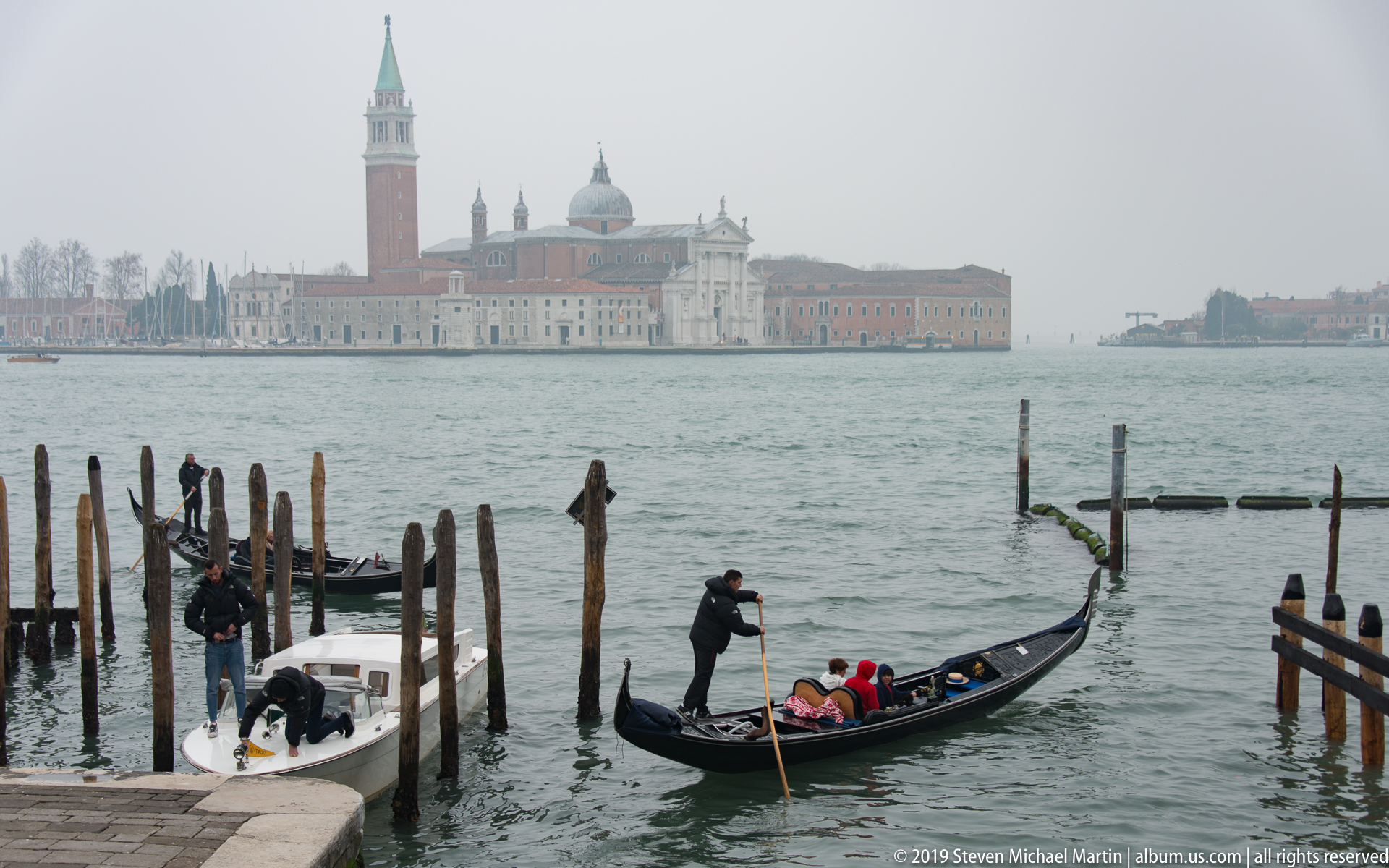
A gondolier guides passengers away from a landing on the Venetian lagoon while the church and campanile of San Giorgio Maggiore emerge through the haze across the water. Mooring posts punctuate the foreground, emphasizing the working edge of the city and the everyday movement between quay and lagoon that defines Venice’s maritime landscape.
Caption
A gondolier guides passengers away from a landing on the Venetian lagoon while the church and campanile of San Giorgio Maggiore emerge through the haze across the water. Mooring posts punctuate the foreground, emphasizing the working edge of the city and the everyday movement between quay and lagoon that defines Venice’s maritime landscape.

The enclosed Bridge of Sighs spans the narrow Rio di Palazzo between pale palace masonry and the heavier rusticated wall of the former prison. Gondolas move through the confined waterway below, giving scale to the bridge’s carved stone envelope and barred openings. The view emphasizes the physical connection between monumental architecture and Venice’s canal circulation.
Caption
The enclosed Bridge of Sighs spans the narrow Rio di Palazzo between pale palace masonry and the heavier rusticated wall of the former prison. Gondolas move through the confined waterway below, giving scale to the bridge’s carved stone envelope and barred openings. The view emphasizes the physical connection between monumental architecture and Venice’s canal circulation.

A close frontal view isolates the upper stonework of the Bridge of Sighs, revealing its paired pierced windows, carved shields, pilasters, and scrolling pediment above the canal arch. Stripped of most surrounding context, the composition makes the bridge read as a carefully articulated architectural façade, with ornament concentrated around openings that admit only limited light.
Caption
A close frontal view isolates the upper stonework of the Bridge of Sighs, revealing its paired pierced windows, carved shields, pilasters, and scrolling pediment above the canal arch. Stripped of most surrounding context, the composition makes the bridge read as a carefully articulated architectural façade, with ornament concentrated around openings that admit only limited light.

Pedestrians crowd the broad steps of the Rialto Bridge as its stone balustrades descend toward the Grand Canal. The side view reveals the bridge’s large central arch and the built commercial range lining its crest, while people seated near the water add a quieter layer of everyday use to one of Venice’s principal crossings.
Caption
Pedestrians crowd the broad steps of the Rialto Bridge as its stone balustrades descend toward the Grand Canal. The side view reveals the bridge’s large central arch and the built commercial range lining its crest, while people seated near the water add a quieter layer of everyday use to one of Venice’s principal crossings.

From a slightly wider canal viewpoint, the Bridge of Sighs closes the upper end of the composition while gondolas travel beneath it along the Rio di Palazzo. Repeated marble arcades on one side contrast with the massive blockwork opposite, making the narrow water corridor read as both a transportation route and an architectural passage through Venice’s historic government complex.
Caption
From a slightly wider canal viewpoint, the Bridge of Sighs closes the upper end of the composition while gondolas travel beneath it along the Rio di Palazzo. Repeated marble arcades on one side contrast with the massive blockwork opposite, making the narrow water corridor read as both a transportation route and an architectural passage through Venice’s historic government complex.

Brilliantly colored blown-glass vessels and sculptural forms fill a Venetian shop display, ranging from broad patterned plates to elongated organic shapes and small figurines. Strong backlighting intensifies the translucent reds, ambers, blues, and clear glass, presenting glassmaking not as an abstract tradition but through the varied forms and decorative techniques offered in the contemporary city.
Caption
Brilliantly colored blown-glass vessels and sculptural forms fill a Venetian shop display, ranging from broad patterned plates to elongated organic shapes and small figurines. Strong backlighting intensifies the translucent reds, ambers, blues, and clear glass, presenting glassmaking not as an abstract tradition but through the varied forms and decorative techniques offered in the contemporary city.

A man pauses at the crest of a small stone footbridge spanning a quiet residential canal. Curving iron railings, short stone posts, and closely packed stucco and brick façades frame the crossing. The intimate scale contrasts with Venice’s monumental bridges, showing how modest pedestrian links stitch together neighborhoods divided by narrow waterways.
Caption
A man pauses at the crest of a small stone footbridge spanning a quiet residential canal. Curving iron railings, short stone posts, and closely packed stucco and brick façades frame the crossing. The intimate scale contrasts with Venice’s monumental bridges, showing how modest pedestrian links stitch together neighborhoods divided by narrow waterways.

A low stone footbridge arcs across still canal water between warm-toned residential buildings, with a lone pedestrian crossing at its center. Shutters, balconies, exposed brick, and waterside walls create a compact neighborhood setting. With no boat in the foreground, the composition emphasizes the bridge as an everyday pedestrian connection and the canal as shared urban space.
Caption
A low stone footbridge arcs across still canal water between warm-toned residential buildings, with a lone pedestrian crossing at its center. Shutters, balconies, exposed brick, and waterside walls create a compact neighborhood setting. With no boat in the foreground, the composition emphasizes the bridge as an everyday pedestrian connection and the canal as shared urban space.

A winged-lion banner hangs above a narrow canal where small covered boats are moored against worn brick and stucco façades. The flag introduces a civic Venetian emblem into an otherwise intimate neighborhood scene, while the bending waterway, low bridge, shutters, and improvised waterside details reveal the layered, lived character of the city beyond its monumental spaces.
Caption
A winged-lion banner hangs above a narrow canal where small covered boats are moored against worn brick and stucco façades. The flag introduces a civic Venetian emblem into an otherwise intimate neighborhood scene, while the bending waterway, low bridge, shutters, and improvised waterside details reveal the layered, lived character of the city beyond its monumental spaces.

Weathered pink and brick façades line a narrow canal crowded with small boats, laundry, shutters, balconies, and patched masonry. Water meets the buildings directly at worn lower walls and arched openings, making the canal edge part of the architecture itself. The view records a dense residential environment shaped by continual contact between domestic life and water.
Caption
Weathered pink and brick façades line a narrow canal crowded with small boats, laundry, shutters, balconies, and patched masonry. Water meets the buildings directly at worn lower walls and arched openings, making the canal edge part of the architecture itself. The view records a dense residential environment shaped by continual contact between domestic life and water.

A long, narrow canal recedes between tall Venetian houses, its surface lined with small moored boats and partially screened by a leafy tree. Weathered masonry, shutters, balconies, and water-level entrances crowd the channel on both sides. The elevated view stresses the remarkable depth of the urban corridor and the limited space shared by buildings, boats, and water.
Caption
A long, narrow canal recedes between tall Venetian houses, its surface lined with small moored boats and partially screened by a leafy tree. Weathered masonry, shutters, balconies, and water-level entrances crowd the channel on both sides. The elevated view stresses the remarkable depth of the urban corridor and the limited space shared by buildings, boats, and water.

Weathered stone animal heads and heavy garlands project from the corner of an architectural base, their exaggerated snouts and deeply cut features creating a vigorous sculptural rhythm. Close framing reveals the darkened surface, chipped edges, and accumulated wear that are difficult to see at building scale. The carving functions as both ornament and a striking visual punctuation within Venice’s masonry architecture.
Caption
Weathered stone animal heads and heavy garlands project from the corner of an architectural base, their exaggerated snouts and deeply cut features creating a vigorous sculptural rhythm. Close framing reveals the darkened surface, chipped edges, and accumulated wear that are difficult to see at building scale. The carving functions as both ornament and a striking visual punctuation within Venice’s masonry architecture.

A quiet canal runs beside a warm terracotta façade articulated by arched windows, green shutters, and a wrought-iron balcony bright with red flowers. Across the water, more closely packed buildings continue the narrow corridor. The composition balances architecture and reflection, highlighting the domestic details that distinguish Venice’s smaller residential canals.
Caption
A quiet canal runs beside a warm terracotta façade articulated by arched windows, green shutters, and a wrought-iron balcony bright with red flowers. Across the water, more closely packed buildings continue the narrow corridor. The composition balances architecture and reflection, highlighting the domestic details that distinguish Venice’s smaller residential canals.

An imposing arched doorway is framed by pale carved stone and filled above the dark green doors by an elaborate wrought-iron fanlight of curling scrollwork. A sculpted bearded head projects from the keystone, flanked by wall lanterns and barred side openings. Tight framing turns the entrance into a study of Venetian craftsmanship in stone, metal, and wood.
Caption
An imposing arched doorway is framed by pale carved stone and filled above the dark green doors by an elaborate wrought-iron fanlight of curling scrollwork. A sculpted bearded head projects from the keystone, flanked by wall lanterns and barred side openings. Tight framing turns the entrance into a study of Venetian craftsmanship in stone, metal, and wood.

A pedestrian walks through a narrow Venetian calle bordered by shopfronts, stone walls, shutters, and projecting building elements. The lane’s compressed width and irregular surfaces create a strong sense of enclosure, while people farther along the passage establish its continuing route through the neighborhood. This street-level view complements the canal scenes by showing Venice’s equally intricate pedestrian network.
Caption
A pedestrian walks through a narrow Venetian calle bordered by shopfronts, stone walls, shutters, and projecting building elements. The lane’s compressed width and irregular surfaces create a strong sense of enclosure, while people farther along the passage establish its continuing route through the neighborhood. This street-level view complements the canal scenes by showing Venice’s equally intricate pedestrian network.

A yellow stucco residential façade rises directly from a canal edge, its green shutters, laundry lines, exposed brick repairs, and peeling plaster recording layers of everyday maintenance. A small boat lies along the water below. Rather than monumental Venice, the view concentrates on the material texture of a lived building where domestic routines meet the city’s aquatic infrastructure.
Caption
A yellow stucco residential façade rises directly from a canal edge, its green shutters, laundry lines, exposed brick repairs, and peeling plaster recording layers of everyday maintenance. A small boat lies along the water below. Rather than monumental Venice, the view concentrates on the material texture of a lived building where domestic routines meet the city’s aquatic infrastructure.

A brick campanile rises above tiled roofs at the end of a narrow Venetian sightline. Its open belfry is capped by a pale domed lantern and weather vane, contrasting with the darker brick shaft below. Framed by close buildings on both sides, the tower acts as a vertical landmark within the compressed scale of the surrounding streets.
Caption
A brick campanile rises above tiled roofs at the end of a narrow Venetian sightline. Its open belfry is capped by a pale domed lantern and weather vane, contrasting with the darker brick shaft below. Framed by close buildings on both sides, the tower acts as a vertical landmark within the compressed scale of the surrounding streets.

Feathered and painted Venetian masks hang in a dense shop display, ranging from delicate white faces to blue-and-gold jester forms and a long-beaked plague-doctor mask. Metallic trim, raised decoration, and contrasting feathers give each piece a distinct silhouette. The close view presents Carnival imagery through the commercial craft objects that fill many Venetian streets.
Caption
Feathered and painted Venetian masks hang in a dense shop display, ranging from delicate white faces to blue-and-gold jester forms and a long-beaked plague-doctor mask. Metallic trim, raised decoration, and contrasting feathers give each piece a distinct silhouette. The close view presents Carnival imagery through the commercial craft objects that fill many Venetian streets.

A purple banner bearing the winged Lion of Saint Mark hangs from an ornate iron balcony against a yellow Venetian façade. Turquoise-green shutters frame tall windows above and beside the banner, while plants soften the metalwork. The tightly composed view links a familiar emblem of Venice with an ordinary residential exterior rather than a formal civic monument.
Caption
A purple banner bearing the winged Lion of Saint Mark hangs from an ornate iron balcony against a yellow Venetian façade. Turquoise-green shutters frame tall windows above and beside the banner, while plants soften the metalwork. The tightly composed view links a familiar emblem of Venice with an ordinary residential exterior rather than a formal civic monument.

A monumental church entrance combines a broad arched green door with layered pale-stone moldings, engaged columns, and colored marble insets. A carved fan-like tympanum fills the arch above the doors, while the surrounding façade uses restrained geometric ornament. The frontal view isolates the portal’s careful composition and the contrast between green wood, white stone, and red accents.
Caption
A monumental church entrance combines a broad arched green door with layered pale-stone moldings, engaged columns, and colored marble insets. A carved fan-like tympanum fills the arch above the doors, while the surrounding façade uses restrained geometric ornament. The frontal view isolates the portal’s careful composition and the contrast between green wood, white stone, and red accents.

A broad white-stone church façade dominates an open campo, organized around a central doorway, layered pediments, niches with statues, relief sculpture, and a curved upper crown. The nearly frontal view makes the symmetrical design legible from base to roofline, while a few pedestrians provide scale. Weathered stone surfaces temper the richness of the sculptural program.
Caption
A broad white-stone church façade dominates an open campo, organized around a central doorway, layered pediments, niches with statues, relief sculpture, and a curved upper crown. The nearly frontal view makes the symmetrical design legible from base to roofline, while a few pedestrians provide scale. Weathered stone surfaces temper the richness of the sculptural program.

A low black boat is moored beside worn stone steps, its cargo area protected by layered tarps and surrounded by flowers, bags, and working gear. The vessel’s practical arrangement contrasts with Venice’s ceremonial gondolas and passenger traffic. Seen close to water level, it illustrates how small boats support routine movement of goods and materials through the canal city.
Caption
A low black boat is moored beside worn stone steps, its cargo area protected by layered tarps and surrounded by flowers, bags, and working gear. The vessel’s practical arrangement contrasts with Venice’s ceremonial gondolas and passenger traffic. Seen close to water level, it illustrates how small boats support routine movement of goods and materials through the canal city.

A deeply carved marble relief fills a rectangular wall panel with a turbulent scene of human figures, animals, drapery, and architectural forms. Strong undercutting creates pronounced shadows across the crowded composition, while the plain surrounding frame contains the movement. The close view prioritizes sculptural modeling and narrative density rather than the larger building to which the relief belongs.
Caption
A deeply carved marble relief fills a rectangular wall panel with a turbulent scene of human figures, animals, drapery, and architectural forms. Strong undercutting creates pronounced shadows across the crowded composition, while the plain surrounding frame contains the movement. The close view prioritizes sculptural modeling and narrative density rather than the larger building to which the relief belongs.

A pedestrian stands on the steps of a small brick-and-stone bridge before a richly articulated Venetian Gothic façade. Pointed arches, quatrefoil-like openings, and pale stone tracery contrast with the red brick wall, while a winged-lion banner adds a distinctly Venetian emblem. The composition layers everyday movement across a canal with the decorative architecture beyond.
Caption
A pedestrian stands on the steps of a small brick-and-stone bridge before a richly articulated Venetian Gothic façade. Pointed arches, quatrefoil-like openings, and pale stone tracery contrast with the red brick wall, while a winged-lion banner adds a distinctly Venetian emblem. The composition layers everyday movement across a canal with the decorative architecture beyond.

A small paved campo opens between weathered residential façades fitted with shutters, flower boxes, and ground-floor doorways. A stone wellhead stands near the center, recalling the communal infrastructure once embedded in Venice’s public spaces. The irregular building line and layered plaster give the square an intimate neighborhood scale distinct from the city’s grand ceremonial piazzas.
Caption
A small paved campo opens between weathered residential façades fitted with shutters, flower boxes, and ground-floor doorways. A stone wellhead stands near the center, recalling the communal infrastructure once embedded in Venice’s public spaces. The irregular building line and layered plaster give the square an intimate neighborhood scale distinct from the city’s grand ceremonial piazzas.

A broad canal fronts a weathered multi-story building whose pale stucco, exposed brick, arched windows, balconies, and green shutters reveal repeated alteration over time. Small boats and timber mooring posts line the water’s edge. The open-water viewpoint allows the façade to be read as a whole, emphasizing Venice’s direct architectural relationship with its canals.
Caption
A broad canal fronts a weathered multi-story building whose pale stucco, exposed brick, arched windows, balconies, and green shutters reveal repeated alteration over time. Small boats and timber mooring posts line the water’s edge. The open-water viewpoint allows the façade to be read as a whole, emphasizing Venice’s direct architectural relationship with its canals.

A red-brick residence is glimpsed through the blurred openings of an ornate stone balustrade, turning architectural ornament into a layered foreground frame. Beyond it, shuttered windows, a decorative chimney, and a planted courtyard remain sharply legible. The deliberately restricted viewpoint contrasts the pale carved stone with the warmer domestic masonry behind it.
Caption
A red-brick residence is glimpsed through the blurred openings of an ornate stone balustrade, turning architectural ornament into a layered foreground frame. Beyond it, shuttered windows, a decorative chimney, and a planted courtyard remain sharply legible. The deliberately restricted viewpoint contrasts the pale carved stone with the warmer domestic masonry behind it.

A pale canal-side palazzo presents an orderly façade of tall windows, green shutters, small balustraded balconies, and a central dark wooden doorway. Iron grilles protect the lower openings while motorboats occupy the waterline. The frontal view emphasizes the building’s layered symmetry and the close relationship between residential architecture, pedestrian edge, and water transport in Venice.
Caption
A pale canal-side palazzo presents an orderly façade of tall windows, green shutters, small balustraded balconies, and a central dark wooden doorway. Iron grilles protect the lower openings while motorboats occupy the waterline. The frontal view emphasizes the building’s layered symmetry and the close relationship between residential architecture, pedestrian edge, and water transport in Venice.

A compact red-stucco building faces the canal through three broad ground-floor arches, while pointed upper windows and a small central balcony introduce Venetian Gothic forms above. Slender decorative trim follows the roofline, and mooring poles rise from the water in front. The composition clearly separates the building’s water-level access from its more ornamental residential upper story.
Caption
A compact red-stucco building faces the canal through three broad ground-floor arches, while pointed upper windows and a small central balcony introduce Venetian Gothic forms above. Slender decorative trim follows the roofline, and mooring poles rise from the water in front. The composition clearly separates the building’s water-level access from its more ornamental residential upper story.

An intricately pierced stone balustrade fills the frame with repeating quatrefoils, trefoils, pointed arches, and circular tracery. Weathering softens the pale stone surfaces while glimpses of trees and brickwork appear through the openings. Isolated at close range, the screen reveals the geometric craftsmanship that gives Venetian Gothic architecture much of its characteristic lightness.
Caption
An intricately pierced stone balustrade fills the frame with repeating quatrefoils, trefoils, pointed arches, and circular tracery. Weathering softens the pale stone surfaces while glimpses of trees and brickwork appear through the openings. Isolated at close range, the screen reveals the geometric craftsmanship that gives Venetian Gothic architecture much of its characteristic lightness.

A gold-toned long-beaked mask is displayed among jewelry and other masquerade pieces, with red and black painted sections around its eyes and raised metallic ornament across the brow. Small euro price tags reinforce the shop setting. Its dramatic beak and richly embellished surface adapt the plague-doctor silhouette into a highly decorative Venetian Carnival souvenir.
Caption
A gold-toned long-beaked mask is displayed among jewelry and other masquerade pieces, with red and black painted sections around its eyes and raised metallic ornament across the brow. Small euro price tags reinforce the shop setting. Its dramatic beak and richly embellished surface adapt the plague-doctor silhouette into a highly decorative Venetian Carnival souvenir.

A weathered brick residence combines a long row of pointed-arch windows with pale stone surrounds, a balustraded balcony, green shutters, and paired wooden doors at canal level. Areas of missing plaster expose the masonry beneath, giving the façade a layered surface history. The straight-on view makes the Gothic rhythm of the principal floor especially clear.
Caption
A weathered brick residence combines a long row of pointed-arch windows with pale stone surrounds, a balustraded balcony, green shutters, and paired wooden doors at canal level. Areas of missing plaster expose the masonry beneath, giving the façade a layered surface history. The straight-on view makes the Gothic rhythm of the principal floor especially clear.

A long-beaked Venetian mask rests in a shop display, its cream surface covered with handwritten-style script and painted motifs around the dark eye openings. The exaggerated beak creates a strong sculptural profile, while nearby decorative objects and a small price card identify the setting as contemporary retail. The design draws on the familiar plague-doctor form used in Venetian masquerade culture.
Caption
A long-beaked Venetian mask rests in a shop display, its cream surface covered with handwritten-style script and painted motifs around the dark eye openings. The exaggerated beak creates a strong sculptural profile, while nearby decorative objects and a small price card identify the setting as contemporary retail. The design draws on the familiar plague-doctor form used in Venetian masquerade culture.

A polished black gondola rests beside wooden mooring posts, its passenger compartment fitted with vivid red upholstered seats and decorative trim. The ferro curves upward at the prow while another boat appears across the water. Seen from slightly above, the composition clearly displays the gondola’s asymmetrical hull, ornamental fittings, and specialized passenger arrangement.
Caption
A polished black gondola rests beside wooden mooring posts, its passenger compartment fitted with vivid red upholstered seats and decorative trim. The ferro curves upward at the prow while another boat appears across the water. Seen from slightly above, the composition clearly displays the gondola’s asymmetrical hull, ornamental fittings, and specialized passenger arrangement.

A red-and-gold Venetian flag billows from a pole against tiled roofs and pale urban façades. The central winged Lion of Saint Mark is clearly visible within an ornate patterned border, making the civic emblem the dominant subject. Wind gives the textile a sculptural fold, while the surrounding buildings locate the symbol within the contemporary cityscape.
Caption
A red-and-gold Venetian flag billows from a pole against tiled roofs and pale urban façades. The central winged Lion of Saint Mark is clearly visible within an ornate patterned border, making the civic emblem the dominant subject. Wind gives the textile a sculptural fold, while the surrounding buildings locate the symbol within the contemporary cityscape.

Motorboats travel along a broad Venetian canal lined with multistory buildings, waterside businesses, and moored vessels. Two arched pedestrian bridges cross the water in succession, creating a strong recession toward the distant city. The elevated viewpoint records the canal as an active transportation corridor where boat traffic and pedestrian routes intersect.
Caption
Motorboats travel along a broad Venetian canal lined with multistory buildings, waterside businesses, and moored vessels. Two arched pedestrian bridges cross the water in succession, creating a strong recession toward the distant city. The elevated viewpoint records the canal as an active transportation corridor where boat traffic and pedestrian routes intersect.

A straight canal recedes between yellow, pink, and brick façades, with small covered boats tied along both edges and pedestrian activity concentrated near waterside businesses. The long perspective reveals the density of Venice’s built fabric while the relatively calm water and stationary vessels give this stretch a more residential character than the busier neighboring channel.
Caption
A straight canal recedes between yellow, pink, and brick façades, with small covered boats tied along both edges and pedestrian activity concentrated near waterside businesses. The long perspective reveals the density of Venice’s built fabric while the relatively calm water and stationary vessels give this stretch a more residential character than the busier neighboring channel.

A broad wooden footbridge crosses the canal in a high arch as pedestrians pause along its cross-braced railings. A bright green motorboat passes beneath, making the separation of waterborne and foot traffic especially clear. Terracotta and yellow residential blocks frame the scene, while another bridge is visible farther down the channel.
Caption
A broad wooden footbridge crosses the canal in a high arch as pedestrians pause along its cross-braced railings. A bright green motorboat passes beneath, making the separation of waterborne and foot traffic especially clear. Terracotta and yellow residential blocks frame the scene, while another bridge is visible farther down the channel.
⭐ Highlights
- City on Water: Built across more than 100 small islands connected by canals and bridges.
- Grand Canal: The main waterway serving as the city’s central thoroughfare.
- St. Mark’s Square: The historic and cultural heart of Venice.
- Gondolas and Boats: Primary modes of transportation throughout the city.
- Maritime Power: Once one of the most influential trading republics in the Mediterranean.
- UNESCO World Heritage Site: Recognized for its unique urban and environmental design.
🚤 Venice Field Guide
Major features observed during this visit:
Venice is one of the most unique cities in the world, built within a lagoon on a network of small islands. Instead of roads, the city is defined by canals, with boats serving as the primary means of transportation. This unusual structure creates a landscape where architecture and water are inseparably linked.
Founded as a refuge and later developed into a powerful maritime republic, Venice became a major center of trade, culture, and art. Today, the city remains a remarkable example of human adaptation to a challenging environment, where centuries-old buildings stand on foundations driven into the lagoon.
🏛️ Signature Landmarks
- Grand Canal – The main artery of the city, lined with historic palaces.
- St. Mark’s Basilica – A richly decorated church reflecting Venice’s global connections.
- Doge’s Palace – The political center of the Venetian Republic.
- Rialto Bridge – One of the most recognizable bridges spanning the Grand Canal.
- Canal Network – A system of waterways replacing traditional streets.
🧠 Historical Significance
- Maritime Republic – Venice controlled major trade routes across the Mediterranean.
- Global Trade Hub – Connections extended to Europe, the Middle East, and Asia.
- Artistic Center – Home to influential artists and architectural innovation.
- Long Continuity – The city has preserved its structure for over a thousand years.
🌄 Urban Landscape & Experience
- Water-Based Movement – Transportation occurs almost entirely by boat or on foot.
- Architectural Reflection – Buildings appear to rise directly from the water.
- Lagoon Environment – The city exists within a fragile and constantly changing ecosystem.
- Surreal Atmosphere – The absence of cars and presence of water create a unique sensory experience.