Delphi
Delphi was regarded in antiquity as the center of the world, a sacred place where the Oracle of Apollo offered guidance to city-states and rulers. The sanctuary occupies a dramatic mountainside location on the slopes of Mount Parnassus, overlooking a valley filled with olive groves. The striking landscape contributes to the sense of importance associated with the religious and cultural activities that took place here.
The archaeological site includes the Temple of Apollo, the theater, the stadium, and numerous treasuries constructed by different Greek city-states. These structures demonstrate both the religious significance of Delphi and the competitive political relationships between ancient Greek communities. Pilgrims traveled from across the Mediterranean to consult the oracle, increasing the sanctuary’s influence.
The combination of monumental ruins and panoramic views makes Delphi one of the most visually memorable locations in Greece. The site illustrates how geography, religion, and political identity were closely connected in shaping cultural traditions of the classical world.

The modern town of Delphi spreads densely across the mountainside, its white and earth-toned buildings clustered beneath red tile roofs. Hotels, houses, and multi-story structures step down the steep slope, illustrating the contemporary settlement’s close relationship with the mountainous terrain. The telephoto view shifts attention from the ancient sanctuary to the inhabited landscape nearby.
Caption
The modern town of Delphi spreads densely across the mountainside, its white and earth-toned buildings clustered beneath red tile roofs. Hotels, houses, and multi-story structures step down the steep slope, illustrating the contemporary settlement’s close relationship with the mountainous terrain. The telephoto view shifts attention from the ancient sanctuary to the inhabited landscape nearby.

The pale-stone exterior of the Delphi Archaeological Museum presents a restrained modern façade framed by pines and clipped citrus trees. Deep-set windows, projecting glazed bays, and a sheltered entrance break the long masonry planes, while the Greek flag marks the institutional setting. The view establishes the museum that houses finds excavated from the sanctuary and surrounding archaeological site.
Caption
The pale-stone exterior of the Delphi Archaeological Museum presents a restrained modern façade framed by pines and clipped citrus trees. Deep-set windows, projecting glazed bays, and a sheltered entrance break the long masonry planes, while the Greek flag marks the institutional setting. The view establishes the museum that houses finds excavated from the sanctuary and surrounding archaeological site.

Massive dressed stone blocks line the ascending route through Delphi, forming stepped foundations and retaining faces beside the ancient roadway. The low viewpoint stresses the scale and precision of the masonry, while the path narrows uphill between successive monument bases. This stretch illustrates how votive buildings and dedications were densely arranged along the Sacred Way’s steep approach through the sanctuary.
Caption
Massive dressed stone blocks line the ascending route through Delphi, forming stepped foundations and retaining faces beside the ancient roadway. The low viewpoint stresses the scale and precision of the masonry, while the path narrows uphill between successive monument bases. This stretch illustrates how votive buildings and dedications were densely arranged along the Sacred Way’s steep approach through the sanctuary.

A visitor in a broad-brimmed sun hat and white shirt sits in the shade within the Delphi archaeological site, looking upward with a relaxed expression. Sunlit stonework and dense greenery recede behind him, creating a human-scale counterpoint to the surrounding ancient remains and mountain landscape. The portrait records the experience of moving through the sanctuary as much as the site itself.
Caption
A visitor in a broad-brimmed sun hat and white shirt sits in the shade within the Delphi archaeological site, looking upward with a relaxed expression. Sunlit stonework and dense greenery recede behind him, creating a human-scale counterpoint to the surrounding ancient remains and mountain landscape. The portrait records the experience of moving through the sanctuary as much as the site itself.

A weathered masonry structure combines reddish brickwork, rubble stone, and a partially surviving vaulted or arched form against the steep Delphic landscape. Trees partly screen the ruin, while the exposed construction reveals multiple building phases or repair techniques. The photograph concentrates on material and fabric rather than a securely identifiable monument, preserving the relationship between ancient masonry and the rocky mountain setting.
Caption
A weathered masonry structure combines reddish brickwork, rubble stone, and a partially surviving vaulted or arched form against the steep Delphic landscape. Trees partly screen the ruin, while the exposed construction reveals multiple building phases or repair techniques. The photograph concentrates on material and fabric rather than a securely identifiable monument, preserving the relationship between ancient masonry and the rocky mountain setting.

A curving wall of large, closely fitted stone blocks rises across the steep archaeological slope beneath the cliffs of Mount Parnassus. Rubble, cut blocks, and dry vegetation occupy the foreground, while pine and deciduous trees frame the masonry. The view emphasizes how Delphi’s built terraces were fitted into difficult mountain terrain, with substantial retaining structures creating usable levels on the sanctuary hillside.
Caption
A curving wall of large, closely fitted stone blocks rises across the steep archaeological slope beneath the cliffs of Mount Parnassus. Rubble, cut blocks, and dry vegetation occupy the foreground, while pine and deciduous trees frame the masonry. The view emphasizes how Delphi’s built terraces were fitted into difficult mountain terrain, with substantial retaining structures creating usable levels on the sanctuary hillside.

A rugged limestone outcrop emerges from dry grass and shrubs within the archaeological landscape at Delphi. Its irregular, fissured surface contrasts with nearby dressed blocks and masonry, distinguishing natural geology from constructed remains. The view records the rocky terrain that shaped the sanctuary’s terraces and circulation routes on the steep slope below Mount Parnassus.
Caption
A rugged limestone outcrop emerges from dry grass and shrubs within the archaeological landscape at Delphi. Its irregular, fissured surface contrasts with nearby dressed blocks and masonry, distinguishing natural geology from constructed remains. The view records the rocky terrain that shaped the sanctuary’s terraces and circulation routes on the steep slope below Mount Parnassus.

A broad view of the Temple of Apollo shows the surviving columns rising from the long rectangular platform beneath the sheer limestone cliffs of Delphi. Massive foundation blocks and stepped courses dominate the foreground, making the temple’s scale and terraced setting legible. The composition links architecture, geology, and topography in a single view of the sanctuary’s central monument.
Caption
A broad view of the Temple of Apollo shows the surviving columns rising from the long rectangular platform beneath the sheer limestone cliffs of Delphi. Massive foundation blocks and stepped courses dominate the foreground, making the temple’s scale and terraced setting legible. The composition links architecture, geology, and topography in a single view of the sanctuary’s central monument.

The Charioteer of Delphi stands upright in a long, finely pleated chiton, one hand extended to hold the surviving reins. The life-size bronze preserves an unusually complete ancient figure, including the calm face, carefully arranged hair, and subtle fall of the garment. Its controlled stance and restrained expression contrast with the implied motion of the chariot team to which it originally belonged.
Caption
The Charioteer of Delphi stands upright in a long, finely pleated chiton, one hand extended to hold the surviving reins. The life-size bronze preserves an unusually complete ancient figure, including the calm face, carefully arranged hair, and subtle fall of the garment. Its controlled stance and restrained expression contrast with the implied motion of the chariot team to which it originally belonged.

A visitor photographs the sculpture gallery of the Delphi Archaeological Museum, where freestanding marble figures line the far wall and a large carved monument occupies the foreground. The layered view conveys the scale and density of the collection, juxtaposing individual statues with architectural sculpture and allowing the museum installation itself to become part of the subject.
Caption
A visitor photographs the sculpture gallery of the Delphi Archaeological Museum, where freestanding marble figures line the far wall and a large carved monument occupies the foreground. The layered view conveys the scale and density of the collection, juxtaposing individual statues with architectural sculpture and allowing the museum installation itself to become part of the subject.

The monumental Sphinx of Naxos dominates its gallery, poised with a woman’s head, lion’s body, and great upcurving wings above an Ionic capital and column support. Visitors at floor level provide a vivid sense of the sculpture’s original scale. Dedicated by the Naxians at Delphi, the archaic monument is one of the museum’s most commanding survivals from the sanctuary.
Caption
The monumental Sphinx of Naxos dominates its gallery, poised with a woman’s head, lion’s body, and great upcurving wings above an Ionic capital and column support. Visitors at floor level provide a vivid sense of the sculpture’s original scale. Dedicated by the Naxians at Delphi, the archaic monument is one of the museum’s most commanding survivals from the sanctuary.

Ancient architectural members are arranged along a low retaining wall beneath mature trees at Delphi. Fluted column drums, capitals, carved blocks, and other marble fragments form an outdoor study display against the steep rocky landscape. Their varied profiles and weathering make this a contextual view of excavated building fabric rather than a reconstruction of a single monument.
Caption
Ancient architectural members are arranged along a low retaining wall beneath mature trees at Delphi. Fluted column drums, capitals, carved blocks, and other marble fragments form an outdoor study display against the steep rocky landscape. Their varied profiles and weathering make this a contextual view of excavated building fabric rather than a reconstruction of a single monument.

A museum case gathers rows of small votive figures from Delphi, many with raised or outstretched arms and strongly simplified bodies. The display mixes different forms and materials, including slender human figures and small animal shapes, emphasizing the range of objects dedicated at the sanctuary. The orange backing isolates their silhouettes and makes differences in gesture and manufacture easy to compare.
Caption
A museum case gathers rows of small votive figures from Delphi, many with raised or outstretched arms and strongly simplified bodies. The display mixes different forms and materials, including slender human figures and small animal shapes, emphasizing the range of objects dedicated at the sanctuary. The orange backing isolates their silhouettes and makes differences in gesture and manufacture easy to compare.

A cast bronze attachment takes the form of a long-snouted fantastic animal with upright ears and a textured, curving neck. The modeled surface, projecting muzzle, and attachment-like upper element suggest a decorative fitting from a vessel or furnishing rather than a freestanding statuette. Its green-brown patina records the long burial history of the metal.
Caption
A cast bronze attachment takes the form of a long-snouted fantastic animal with upright ears and a textured, curving neck. The modeled surface, projecting muzzle, and attachment-like upper element suggest a decorative fitting from a vessel or furnishing rather than a freestanding statuette. Its green-brown patina records the long burial history of the metal.

Three carved female figures stand around a central cylindrical support beneath a broad circular slab. Their bodies function as structural and decorative elements, creating a compact architectural ensemble viewed at close range. The surviving pale stone is worn and fragmentary, but the repeated figures and radial arrangement remain clear enough to show the object’s carefully coordinated sculptural design.
Caption
Three carved female figures stand around a central cylindrical support beneath a broad circular slab. Their bodies function as structural and decorative elements, creating a compact architectural ensemble viewed at close range. The surviving pale stone is worn and fragmentary, but the repeated figures and radial arrangement remain clear enough to show the object’s carefully coordinated sculptural design.

The monumental Sphinx of Naxos combines a woman’s head and breast with the body of a lion and tall, curling wings. Set above a large Ionic capital, the restored sculpture preserves the commanding elevated form of the Naxian dedication at Delphi. Its patterned chest, powerful forelegs, and sweeping wing create a striking synthesis of human, feline, and avian anatomy.
Caption
The monumental Sphinx of Naxos combines a woman’s head and breast with the body of a lion and tall, curling wings. Set above a large Ionic capital, the restored sculpture preserves the commanding elevated form of the Naxian dedication at Delphi. Its patterned chest, powerful forelegs, and sweeping wing create a striking synthesis of human, feline, and avian anatomy.

A circular bronze shield fills the frame, its face organized by concentric raised bands around a central boss-like zone. Repeated angular motifs create a disciplined geometric pattern across the green-patinated surface. Displayed frontally, the object reveals both its symmetry and the corrosion that now softens the crispness of the ancient metalwork.
Caption
A circular bronze shield fills the frame, its face organized by concentric raised bands around a central boss-like zone. Repeated angular motifs create a disciplined geometric pattern across the green-patinated surface. Displayed frontally, the object reveals both its symmetry and the corrosion that now softens the crispness of the ancient metalwork.

Sculptural fragments from the Siphnian Treasury are assembled to show the relationship between a triangular pediment and the long narrative frieze below. Figures occupy the shallow architectural field in dense, overlapping groups, with losses interrupting the surviving sequence. The museum presentation makes the relief program legible at building scale while preserving the fragmentary condition of the original marble.
Caption
Sculptural fragments from the Siphnian Treasury are assembled to show the relationship between a triangular pediment and the long narrative frieze below. Figures occupy the shallow architectural field in dense, overlapping groups, with losses interrupting the surviving sequence. The museum presentation makes the relief program legible at building scale while preserving the fragmentary condition of the original marble.

An Archaic female figure stands beneath a richly carved architectural element, her long hair and layered garment rendered in strongly patterned forms. The frontal pose and supporting relationship to the block above suggest an architectural role. Weathering has softened the facial features, while the surviving folds and ornamental carving preserve the sculpture’s formal, columnar presence.
Caption
An Archaic female figure stands beneath a richly carved architectural element, her long hair and layered garment rendered in strongly patterned forms. The frontal pose and supporting relationship to the block above suggest an architectural role. Weathering has softened the facial features, while the surviving folds and ornamental carving preserve the sculpture’s formal, columnar presence.

Seen from a lower oblique angle, the Sphinx of Naxos rises above the volutes of its Ionic capital. This viewpoint emphasizes the sculpture’s leonine hindquarters, planted forelegs, patterned breast, and the deep curve of the surviving wing. The museum installation allows the dedication’s sculptural mass and its relationship to the supporting capital to be read together.
Caption
Seen from a lower oblique angle, the Sphinx of Naxos rises above the volutes of its Ionic capital. This viewpoint emphasizes the sculpture’s leonine hindquarters, planted forelegs, patterned breast, and the deep curve of the surviving wing. The museum installation allows the dedication’s sculptural mass and its relationship to the supporting capital to be read together.

A bilingual museum panel introduces Delphi’s fame as an oracular center under the title “The Power of the Prophecies.” Greek and English text are arranged in parallel on a dark blue field, turning the interpretive display itself into the subject. The panel provides curatorial context for objects and monuments associated with consultation of the Delphic oracle.
Caption
A bilingual museum panel introduces Delphi’s fame as an oracular center under the title “The Power of the Prophecies.” Greek and English text are arranged in parallel on a dark blue field, turning the interpretive display itself into the subject. The panel provides curatorial context for objects and monuments associated with consultation of the Delphic oracle.

A close view isolates several high-relief figures from the Siphnian Treasury’s architectural sculpture. Two standing male figures confront one another around a central object or architectural form, while additional figures survive at the edges of the triangular field. Broken limbs and joins reveal the fragmentary state of the marble and the extent of modern reassembly.
Caption
A close view isolates several high-relief figures from the Siphnian Treasury’s architectural sculpture. Two standing male figures confront one another around a central object or architectural form, while additional figures survive at the edges of the triangular field. Broken limbs and joins reveal the fragmentary state of the marble and the extent of modern reassembly.

Two armed warriors collide in a tightly compressed battle scene from the Siphnian Treasury’s Gigantomachy. Both carry large round shields; one advances with a crested helmet while a fallen figure lies beneath their feet. Traces of reddish pigment remain visible on the shields, a reminder that the Archaic marble relief was originally enlivened with color.
Caption
Two armed warriors collide in a tightly compressed battle scene from the Siphnian Treasury’s Gigantomachy. Both carry large round shields; one advances with a crested helmet while a fallen figure lies beneath their feet. Traces of reddish pigment remain visible on the shields, a reminder that the Archaic marble relief was originally enlivened with color.

A broader section of the Siphnian Treasury’s Gigantomachy shows multiple figures advancing through a crowded combat narrative. Armed participants, a lion attacking an opponent, and overlapping shields create a continuous rhythm beneath the carved molding. The relief’s dense arrangement demonstrates how the sculptors used shallow space to distinguish successive encounters across the frieze.
Caption
A broader section of the Siphnian Treasury’s Gigantomachy shows multiple figures advancing through a crowded combat narrative. Armed participants, a lion attacking an opponent, and overlapping shields create a continuous rhythm beneath the carved molding. The relief’s dense arrangement demonstrates how the sculptors used shallow space to distinguish successive encounters across the frieze.

The museum label explains the Gigantomachy represented on the Siphnian Treasury frieze, identifying the conflict between the Olympian gods and the Giants and describing individual figures and attributes. Presented as a close documentary view, the text records the curatorial interpretation that accompanies the surviving reliefs and helps connect fragmentary sculptural scenes to their mythological narrative.
Caption
The museum label explains the Gigantomachy represented on the Siphnian Treasury frieze, identifying the conflict between the Olympian gods and the Giants and describing individual figures and attributes. Presented as a close documentary view, the text records the curatorial interpretation that accompanies the surviving reliefs and helps connect fragmentary sculptural scenes to their mythological narrative.

A kneeling warrior braces behind a large round shield in this fragment of the Siphnian Treasury’s Gigantomachy. His bent legs, tilted torso, and overlapping weapons compress the action into a narrow relief field, while breaks across the stone expose the sculpture’s reconstructed condition. The close framing emphasizes both the vigorous pose and the physical survival of the Archaic carving.
Caption
A kneeling warrior braces behind a large round shield in this fragment of the Siphnian Treasury’s Gigantomachy. His bent legs, tilted torso, and overlapping weapons compress the action into a narrow relief field, while breaks across the stone expose the sculpture’s reconstructed condition. The close framing emphasizes both the vigorous pose and the physical survival of the Archaic carving.

This museum text interprets a surviving frieze scene as the Judgment of Paris, the beauty contest among Athena, Aphrodite, and Hera. It describes Athena with her winged chariot, Aphrodite stepping from her own chariot, and the missing continuation that would have included Hera and Paris. The close view preserves the explanatory framework used to read the fragmentary relief.
Caption
This museum text interprets a surviving frieze scene as the Judgment of Paris, the beauty contest among Athena, Aphrodite, and Hera. It describes Athena with her winged chariot, Aphrodite stepping from her own chariot, and the missing continuation that would have included Hera and Paris. The close view preserves the explanatory framework used to read the fragmentary relief.

A fragmentary chariot scene shows a female figure beside a horse while a winged or rapidly moving attendant reaches forward from the left. The relief belongs to the narrative interpreted in the gallery as the Judgment of Paris. Fine incised details survive in the horse’s harness and the figures’ garments despite abrasion and losses across the pale marble surface.
Caption
A fragmentary chariot scene shows a female figure beside a horse while a winged or rapidly moving attendant reaches forward from the left. The relief belongs to the narrative interpreted in the gallery as the Judgment of Paris. Fine incised details survive in the horse’s harness and the figures’ garments despite abrasion and losses across the pale marble surface.

The museum panel titled “The ‘twins’ of Argos” outlines the interpretation of Delphi’s paired monumental kouroi. It discusses their Argive origin, the traditional identification as Cleobis and Biton, alternative association with the Dioscuri, and the sculptor’s inscribed name. A quoted passage from Herodotus recounts the story that helped shape the statues’ modern interpretation.
Caption
The museum panel titled “The ‘twins’ of Argos” outlines the interpretation of Delphi’s paired monumental kouroi. It discusses their Argive origin, the traditional identification as Cleobis and Biton, alternative association with the Dioscuri, and the sculptor’s inscribed name. A quoted passage from Herodotus recounts the story that helped shape the statues’ modern interpretation.

A museum reconstruction illustrates two tall freestanding statues raised on separate columns or high supports, presenting one hypothesis for the original display of an early monumental dedication at Delphi. The diagram is paired with explanatory text below and serves as interpretive evidence rather than an archaeological view. Its symmetrical arrangement stresses the intended pairing of the two figures.
Caption
A museum reconstruction illustrates two tall freestanding statues raised on separate columns or high supports, presenting one hypothesis for the original display of an early monumental dedication at Delphi. The diagram is paired with explanatory text below and serves as interpretive evidence rather than an archaeological view. Its symmetrical arrangement stresses the intended pairing of the two figures.

A monumental Archaic kouros stands frontally with clenched hands, broad shoulders, and the left leg advanced in the conventional pose of early Greek male sculpture. Long beaded locks frame the head, while the powerful thighs and simplified anatomy emphasize mass and symmetry. Displayed at Delphi, the statue belongs to the celebrated pair traditionally known as the “Twins of Argos.”
Caption
A monumental Archaic kouros stands frontally with clenched hands, broad shoulders, and the left leg advanced in the conventional pose of early Greek male sculpture. Long beaded locks frame the head, while the powerful thighs and simplified anatomy emphasize mass and symmetry. Displayed at Delphi, the statue belongs to the celebrated pair traditionally known as the “Twins of Argos.”

The two monumental kouroi known as the “Twins of Argos” stand side by side in the Delphi Archaeological Museum. Their frontal stance, advanced left legs, clenched hands, and patterned hair reveal the shared conventions of Archaic male sculpture, while differences in preservation distinguish the pair. The gallery view restores the visual relationship that is lost when each statue is studied independently.
Caption
The two monumental kouroi known as the “Twins of Argos” stand side by side in the Delphi Archaeological Museum. Their frontal stance, advanced left legs, clenched hands, and patterned hair reveal the shared conventions of Archaic male sculpture, while differences in preservation distinguish the pair. The gallery view restores the visual relationship that is lost when each statue is studied independently.

Fragmentary remains of a luxurious gold-and-ivory figure are mounted against a red display case. Thin sheets of gold preserve portions of drapery and body covering, while pale ivory elements form parts of the head, limbs, and feet. The disassembled presentation makes the composite technique visible and conveys the fragile survival of an exceptionally costly ancient dedication.
Caption
Fragmentary remains of a luxurious gold-and-ivory figure are mounted against a red display case. Thin sheets of gold preserve portions of drapery and body covering, while pale ivory elements form parts of the head, limbs, and feet. The disassembled presentation makes the composite technique visible and conveys the fragile survival of an exceptionally costly ancient dedication.

The panel “The ‘treasuries’ with valuable offerings” explains discoveries of precious objects from the sanctuary, including gold, silver, bronze, ivory, and chryselephantine fragments. It places the finds within the competitive culture of elite and civic dedication at Delphi and describes their recovery and conservation. The close view documents the curatorial context for the adjacent luxury objects.
Caption
The panel “The ‘treasuries’ with valuable offerings” explains discoveries of precious objects from the sanctuary, including gold, silver, bronze, ivory, and chryselephantine fragments. It places the finds within the competitive culture of elite and civic dedication at Delphi and describes their recovery and conservation. The close view documents the curatorial context for the adjacent luxury objects.

Three small human faces are displayed in a row, each preserving a different degree of surface loss and discoloration. Their almond-shaped eyes, straight noses, and stylized mouths remain legible despite cracking and missing material. Shown together, the fragments invite comparison of ancient facial modeling and the fragile preservation of organic or composite luxury materials from Delphi.
Caption
Three small human faces are displayed in a row, each preserving a different degree of surface loss and discoloration. Their almond-shaped eyes, straight noses, and stylized mouths remain legible despite cracking and missing material. Shown together, the fragments invite comparison of ancient facial modeling and the fragile preservation of organic or composite luxury materials from Delphi.

Rows of tiny gold ornaments are arranged with larger leaf-shaped appliqués and colored decorative elements in a museum case. Repetition, symmetry, and the contrast between hammered gold and darker inlays suggest components of an elaborate luxury assemblage rather than isolated objects. The display demonstrates the fine scale and visual richness of precious dedications recovered at Delphi.
Caption
Rows of tiny gold ornaments are arranged with larger leaf-shaped appliqués and colored decorative elements in a museum case. Repetition, symmetry, and the contrast between hammered gold and darker inlays suggest components of an elaborate luxury assemblage rather than isolated objects. The display demonstrates the fine scale and visual richness of precious dedications recovered at Delphi.

A broad curved band of hammered gold is decorated with a row of raised rosettes, each centered by a darker stud, and framed by dense repoussé patterns. Creases and irregular edges reveal the thinness of the sheet metal and its fragmentary survival. The close view emphasizes the technical precision and lavish surface treatment of Delphic luxury metalwork.
Caption
A broad curved band of hammered gold is decorated with a row of raised rosettes, each centered by a darker stud, and framed by dense repoussé patterns. Creases and irregular edges reveal the thinness of the sheet metal and its fragmentary survival. The close view emphasizes the technical precision and lavish surface treatment of Delphic luxury metalwork.

A dark-faced female head is displayed with broad sheets of hammered gold arranged around it like hair, veil, or headdress elements. Additional gold appliqués flank the face and lie below the reconstruction. The juxtaposition of contrasting materials reveals the composite character of a luxury votive image and the painstaking museum effort to present its surviving fragments coherently.
Caption
A dark-faced female head is displayed with broad sheets of hammered gold arranged around it like hair, veil, or headdress elements. Additional gold appliqués flank the face and lie below the reconstruction. The juxtaposition of contrasting materials reveals the composite character of a luxury votive image and the painstaking museum effort to present its surviving fragments coherently.

A bird-shaped gold ornament is shown with wings spread and its body modeled in patterned feathers. Small attachment points and the thin hammered sheet indicate that it was designed as an appliqué or fitting rather than a freestanding sculpture. Reflections from the case partially obscure the surface, but the symmetrical wings and carefully articulated plumage remain clearly visible.
Caption
A bird-shaped gold ornament is shown with wings spread and its body modeled in patterned feathers. Small attachment points and the thin hammered sheet indicate that it was designed as an appliqué or fitting rather than a freestanding sculpture. Reflections from the case partially obscure the surface, but the symmetrical wings and carefully articulated plumage remain clearly visible.

A compact bronze group shows a muscular male figure bearing a large four-legged animal horizontally across his shoulders. The carrier bends under the weight while the animal’s body stretches across the composition, creating a strong silhouette against the orange display backing. The small object condenses narrative action into a vigorous votive or decorative bronze group.
Caption
A compact bronze group shows a muscular male figure bearing a large four-legged animal horizontally across his shoulders. The carrier bends under the weight while the animal’s body stretches across the composition, creating a strong silhouette against the orange display backing. The small object condenses narrative action into a vigorous votive or decorative bronze group.

A marble female figure from the west pediment of the Temple of Apollo stands against a blue museum backdrop. The surviving torso preserves a belted, deeply folded garment and the figure’s carefully modeled face and hair, while the missing arms and lower body reveal the fragmentary state of the architectural sculpture. The work belongs to the sculptural ensemble associated with the Classical temple at Delphi.
Caption
A marble female figure from the west pediment of the Temple of Apollo stands against a blue museum backdrop. The surviving torso preserves a belted, deeply folded garment and the figure’s carefully modeled face and hair, while the missing arms and lower body reveal the fragmentary state of the architectural sculpture. The work belongs to the sculptural ensemble associated with the Classical temple at Delphi.

A museum interpretation panel reconstructs the west pediment of the Classical Temple of Apollo, placing Dionysus at the center among female figures identified as Thyiads. The diagram clarifies the original triangular arrangement of sculptures now surviving only in fragments, while the accompanying text relates the composition to the rebuilding of the temple in the fourth century BC.
Caption
A museum interpretation panel reconstructs the west pediment of the Classical Temple of Apollo, placing Dionysus at the center among female figures identified as Thyiads. The diagram clarifies the original triangular arrangement of sculptures now surviving only in fragments, while the accompanying text relates the composition to the rebuilding of the temple in the fourth century BC.

A carved lion head projects from an architectural ornament framed by symmetrical palmettes and tight spiral volutes. The open mouth would have served as a waterspout, combining a practical drainage function with vigorous sculptural decoration. Close framing isolates the rhythmic vegetal carving and the weathered surface, allowing the relief and drilling of the stone to read clearly as an architectural detail.
Caption
A carved lion head projects from an architectural ornament framed by symmetrical palmettes and tight spiral volutes. The open mouth would have served as a waterspout, combining a practical drainage function with vigorous sculptural decoration. Close framing isolates the rhythmic vegetal carving and the weathered surface, allowing the relief and drilling of the stone to read clearly as an architectural detail.

Fragments of ancient sculpture are arranged in a long museum display against a blue wall, ranging from draped human figures and smaller body fragments to a large reclining animal at the right. The installation makes the fragmentary survival of Delphi’s architectural sculpture visible as a group, while modern supports preserve the original orientation of pieces that no longer retain their architectural setting.
Caption
Fragments of ancient sculpture are arranged in a long museum display against a blue wall, ranging from draped human figures and smaller body fragments to a large reclining animal at the right. The installation makes the fragmentary survival of Delphi’s architectural sculpture visible as a group, while modern supports preserve the original orientation of pieces that no longer retain their architectural setting.

Two fragmentary marble statues of nude males are displayed side by side, inviting comparison of their different proportions and states of preservation. The left torso retains powerful chest and abdominal modeling but lacks its head and limbs; the right preserves the head and much of the torso while both arms and lower legs are lost. Their juxtaposition highlights ancient approaches to the idealized male body.
Caption
Two fragmentary marble statues of nude males are displayed side by side, inviting comparison of their different proportions and states of preservation. The left torso retains powerful chest and abdominal modeling but lacks its head and limbs; the right preserves the head and much of the torso while both arms and lower legs are lost. Their juxtaposition highlights ancient approaches to the idealized male body.

A black-glazed column krater carries a red-figure scene dominated by a large winged figure moving across the vessel’s rounded body. Fine reserved lines articulate feathers, clothing, and anatomy against the glossy dark ground, while the paired horizontal handles and broad rim define the krater’s characteristic form. The close museum view emphasizes both the painted narrative and the vessel’s strong silhouette.
Caption
A black-glazed column krater carries a red-figure scene dominated by a large winged figure moving across the vessel’s rounded body. Fine reserved lines articulate feathers, clothing, and anatomy against the glossy dark ground, while the paired horizontal handles and broad rim define the krater’s characteristic form. The close museum view emphasizes both the painted narrative and the vessel’s strong silhouette.

A life-size marble male figure stands with weight distributed across both legs, its broad torso and heavy musculature preserved more fully than the missing forearms. The head remains attached, allowing the compact hairstyle and calm facial treatment to be read together with the body. A support at the feet and losses at the limbs make the statue’s archaeological condition especially apparent.
Caption
A life-size marble male figure stands with weight distributed across both legs, its broad torso and heavy musculature preserved more fully than the missing forearms. The head remains attached, allowing the compact hairstyle and calm facial treatment to be read together with the body. A support at the feet and losses at the limbs make the statue’s archaeological condition especially apparent.

A headless marble male figure is displayed beside an interpretation panel devoted to ancient drama. The figure’s substantial body survives from shoulders to feet, with a mantle gathered over the left arm and falling in heavy folds beside the hip. Loss of the head and arms leaves the precise identity uncertain, but the gallery context connects the sculpture with theatrical culture at ancient Delphi.
Caption
A headless marble male figure is displayed beside an interpretation panel devoted to ancient drama. The figure’s substantial body survives from shoulders to feet, with a mantle gathered over the left arm and falling in heavy folds beside the hip. Loss of the head and arms leaves the precise identity uncertain, but the gallery context connects the sculpture with theatrical culture at ancient Delphi.

A densely composed sculptural group preserves several overlapping figures, including a central nude youth or child and draped adults on either side. Broken limbs, heads, and projecting elements reveal substantial losses, yet the surviving bodies still convey a crowded, animated scene. The close view emphasizes the depth of carving and the difficulty of reconstructing a narrative from a heavily fragmentary ensemble.
Caption
A densely composed sculptural group preserves several overlapping figures, including a central nude youth or child and draped adults on either side. Broken limbs, heads, and projecting elements reveal substantial losses, yet the surviving bodies still convey a crowded, animated scene. The close view emphasizes the depth of carving and the difficulty of reconstructing a narrative from a heavily fragmentary ensemble.

A bearded male statue wears a short, heavily folded garment wrapped across the torso and gathered at the waist. One arm extends outward while the other is lost, and the weathered face retains a strong beard and closely modeled features. Presented against an excavation photograph, the isolated figure reads as both a work of ancient sculpture and an archaeological object removed from its original setting.
Caption
A bearded male statue wears a short, heavily folded garment wrapped across the torso and gathered at the waist. One arm extends outward while the other is lost, and the weathered face retains a strong beard and closely modeled features. Presented against an excavation photograph, the isolated figure reads as both a work of ancient sculpture and an archaeological object removed from its original setting.

A marble statue of a youthful nude figure survives with its head, torso, and legs but without the forearms. Thick curls frame the downturned face, contrasting with the softly modeled chest and rounded limbs. Modern supports stabilize the ancient fragment against a blue display wall, making the losses at the arms and the preserved stance easy to distinguish.
Caption
A marble statue of a youthful nude figure survives with its head, torso, and legs but without the forearms. Thick curls frame the downturned face, contrasting with the softly modeled chest and rounded limbs. Modern supports stabilize the ancient fragment against a blue display wall, making the losses at the arms and the preserved stance easy to distinguish.

Four ancient statues stand before a large archival excavation photograph in a gallery devoted to drama and performance. The central bearded male figure wears layered drapery, while the flanking figures preserve long garments in differing states of completeness. By pairing sculpture with the historic site photograph, the display connects museum objects with the archaeological context from which Delphi’s material record was recovered.
Caption
Four ancient statues stand before a large archival excavation photograph in a gallery devoted to drama and performance. The central bearded male figure wears layered drapery, while the flanking figures preserve long garments in differing states of completeness. By pairing sculpture with the historic site photograph, the display connects museum objects with the archaeological context from which Delphi’s material record was recovered.

A marble female head and upper torso are presented on a modern pedestal, the face framed by a broad, vertically striated headdress that descends to the shoulders. The frontal pose, symmetrical features, and patterned head covering give the fragment a strongly formal character. Because the lower body and original setting are absent, the display is best read through its preserved facial and costume details.
Caption
A marble female head and upper torso are presented on a modern pedestal, the face framed by a broad, vertically striated headdress that descends to the shoulders. The frontal pose, symmetrical features, and patterned head covering give the fragment a strongly formal character. Because the lower body and original setting are absent, the display is best read through its preserved facial and costume details.

An idealized marble youth is preserved from the upper chest upward, with dense curls sweeping around a smooth, downward-turned face. The missing arms and lower body focus attention on the contrast between the deeply carved hair and softly finished skin. Displayed alone against a neutral wall, the fragment retains the poised, introspective character associated with idealized youthful portraiture in Greek and Roman sculpture.
Caption
An idealized marble youth is preserved from the upper chest upward, with dense curls sweeping around a smooth, downward-turned face. The missing arms and lower body focus attention on the contrast between the deeply carved hair and softly finished skin. Displayed alone against a neutral wall, the fragment retains the poised, introspective character associated with idealized youthful portraiture in Greek and Roman sculpture.

A large relief presents a crowded mythological scene in shallow modeling, with a standing central figure turning toward a reclining woman while additional figures occupy the left side. Drapery, bodies, and overlapping forms create a theatrical composition across the rectangular field. Warm gallery lighting accentuates the relief’s modeled surfaces, though the proof-sheet view does not securely establish the scene’s exact identification.
Caption
A large relief presents a crowded mythological scene in shallow modeling, with a standing central figure turning toward a reclining woman while additional figures occupy the left side. Drapery, bodies, and overlapping forms create a theatrical composition across the rectangular field. Warm gallery lighting accentuates the relief’s modeled surfaces, though the proof-sheet view does not securely establish the scene’s exact identification.

Three pale column shafts stand in a row before reddish masonry and the bare rock of the Delphi hillside. Their vertical rhythm contrasts with the horizontal courses of the ruined wall behind, making the surviving architectural order legible despite the loss of capitals and superstructure. The close site view emphasizes the relationship between freestanding columns, later masonry fabric, and the mountain terrain.
Caption
Three pale column shafts stand in a row before reddish masonry and the bare rock of the Delphi hillside. Their vertical rhythm contrasts with the horizontal courses of the ruined wall behind, making the surviving architectural order legible despite the loss of capitals and superstructure. The close site view emphasizes the relationship between freestanding columns, later masonry fabric, and the mountain terrain.

The sanctuary of Delphi appears at a distance through dense olive foliage, with standing columns and terraced ruins emerging from the mountainside. The compressed telephoto view places the archaeological remains within the cultivated and wooded landscape rather than isolating a single monument. Vertical columns provide the clearest architectural markers amid the layered greenery and stone foundations.
Caption
The sanctuary of Delphi appears at a distance through dense olive foliage, with standing columns and terraced ruins emerging from the mountainside. The compressed telephoto view places the archaeological remains within the cultivated and wooded landscape rather than isolating a single monument. Vertical columns provide the clearest architectural markers amid the layered greenery and stone foundations.

Courses of large, roughly rectangular stone blocks form a substantial ancient wall, interrupted by a small rectangular opening near the right side. Differences in block size and surface finish are visible across the masonry, with smaller stones and repairs concentrated toward the lower courses. Strong side light brings out the joints, tooling, and weathered texture of the construction.
Caption
Courses of large, roughly rectangular stone blocks form a substantial ancient wall, interrupted by a small rectangular opening near the right side. Differences in block size and surface finish are visible across the masonry, with smaller stones and repairs concentrated toward the lower courses. Strong side light brings out the joints, tooling, and weathered texture of the construction.

An official UNESCO panel marks the Archaeological Site of Delphi as a World Heritage property, combining Greek and English text with the UNESCO and World Heritage emblems. The interpretation summarizes Delphi’s inscription on the World Heritage List and its cultural significance. Framing the panel directly records the site’s modern heritage designation and conservation context rather than an ancient monument.
Caption
An official UNESCO panel marks the Archaeological Site of Delphi as a World Heritage property, combining Greek and English text with the UNESCO and World Heritage emblems. The interpretation summarizes Delphi’s inscription on the World Heritage List and its cultural significance. Framing the panel directly records the site’s modern heritage designation and conservation context rather than an ancient monument.

A visitor pauses on broad stone steps climbing through the archaeological site, with low ancient walls and scattered architectural blocks lining the route. The human figure provides scale for the steep ascent and uneven historic fabric. Trees shade portions of the path, while the sunlit masonry shows how movement through Delphi follows the sanctuary’s strongly terraced mountain topography.
Caption
A visitor pauses on broad stone steps climbing through the archaeological site, with low ancient walls and scattered architectural blocks lining the route. The human figure provides scale for the steep ascent and uneven historic fabric. Trees shade portions of the path, while the sunlit masonry shows how movement through Delphi follows the sanctuary’s strongly terraced mountain topography.

Terraced ruins climb the sanctuary hillside in a dense sequence of retaining walls, foundations, column fragments, and standing architectural elements. The oblique view reveals how individual monuments occupied narrow platforms cut into the steep slope, with cypress trees and the rocky mountain rising behind. Rather than isolating one building, the composition records Delphi as a layered archaeological landscape.
Caption
Terraced ruins climb the sanctuary hillside in a dense sequence of retaining walls, foundations, column fragments, and standing architectural elements. The oblique view reveals how individual monuments occupied narrow platforms cut into the steep slope, with cypress trees and the rocky mountain rising behind. Rather than isolating one building, the composition records Delphi as a layered archaeological landscape.

A brick-built arched niche survives within a broad expanse of reddish masonry, with several freestanding column shafts rising in front of the ruin. The arch creates a strong focal point against the terraced hillside and dark cypress trees beyond. Fragmentary walls and reused-looking masonry around the opening show the complex preservation of this part of the Delphi archaeological site.
Caption
A brick-built arched niche survives within a broad expanse of reddish masonry, with several freestanding column shafts rising in front of the ruin. The arch creates a strong focal point against the terraced hillside and dark cypress trees beyond. Fragmentary walls and reused-looking masonry around the opening show the complex preservation of this part of the Delphi archaeological site.

An archaeological-site panel titled “Monuments of the Sacred Way” describes a sequence of votive monuments encountered along Delphi’s principal processional route. The English text identifies dedications including the votive of Lysander, the votive of Marathon, the Trojan Horse, and the votive of the Tarantines. The sign provides modern interpretive context for foundations and sculptural dedications whose surviving remains can be difficult to read on site.
Caption
An archaeological-site panel titled “Monuments of the Sacred Way” describes a sequence of votive monuments encountered along Delphi’s principal processional route. The English text identifies dedications including the votive of Lysander, the votive of Marathon, the Trojan Horse, and the votive of the Tarantines. The sign provides modern interpretive context for foundations and sculptural dedications whose surviving remains can be difficult to read on site.

An interpretive panel explains the role of treasuries within the sanctuary at Delphi, including the celebrated Treasury of the Siphnians and monuments erected by other Greek communities. The dense bilingual-style presentation emphasizes how dedications, sculptural programs, and victory memorials transformed the Sacred Way into a display of civic identity, wealth, and religious devotion.
Caption
An interpretive panel explains the role of treasuries within the sanctuary at Delphi, including the celebrated Treasury of the Siphnians and monuments erected by other Greek communities. The dense bilingual-style presentation emphasizes how dedications, sculptural programs, and victory memorials transformed the Sacred Way into a display of civic identity, wealth, and religious devotion.

A reconstruction drawing depicts the famous serpent-supported victory monument dedicated at Delphi after the Persian Wars. Three intertwined serpent bodies rise from a low base toward the lost upper element, conveying the original vertical character of the monument. The illustration provides architectural context for a dedication now known chiefly through surviving portions and later historical records.
Caption
A reconstruction drawing depicts the famous serpent-supported victory monument dedicated at Delphi after the Persian Wars. Three intertwined serpent bodies rise from a low base toward the lost upper element, conveying the original vertical character of the monument. The illustration provides architectural context for a dedication now known chiefly through surviving portions and later historical records.

A site panel reconstructs a long votive monument populated by standing figures and a horse, supplemented by a historic excavation photograph and an image of an inscribed stone. The diagram helps visitors visualize a sculptural dedication now known chiefly through foundations, fragments, and epigraphic evidence. Greek and English labels connect the reconstruction to the sequence of monuments lining Delphi’s Sacred Way.
Caption
A site panel reconstructs a long votive monument populated by standing figures and a horse, supplemented by a historic excavation photograph and an image of an inscribed stone. The diagram helps visitors visualize a sculptural dedication now known chiefly through foundations, fragments, and epigraphic evidence. Greek and English labels connect the reconstruction to the sequence of monuments lining Delphi’s Sacred Way.

A rectangular stone foundation occupies a terrace at Delphi with the dramatic Pleistos valley and surrounding mountains opening beyond. Large cut blocks define the platform and scattered architectural stones lie around its edges. The elevated viewpoint makes the sanctuary’s landscape setting central to the composition, showing how monuments along the Sacred Way were positioned on narrow terraces above the deep valley.
Caption
A rectangular stone foundation occupies a terrace at Delphi with the dramatic Pleistos valley and surrounding mountains opening beyond. Large cut blocks define the platform and scattered architectural stones lie around its edges. The elevated viewpoint makes the sanctuary’s landscape setting central to the composition, showing how monuments along the Sacred Way were positioned on narrow terraces above the deep valley.

The reconstructed Treasury of the Athenians rises beside the Sacred Way as a compact temple-like building of pale stone, set against Delphi’s steep rocky backdrop. Its block walls, stepped base, and restored entablature make the small treasury unusually legible among the surrounding foundations. The building housed Athenian dedications to Apollo and remains one of the sanctuary’s most recognizable monuments.
Caption
The reconstructed Treasury of the Athenians rises beside the Sacred Way as a compact temple-like building of pale stone, set against Delphi’s steep rocky backdrop. Its block walls, stepped base, and restored entablature make the small treasury unusually legible among the surrounding foundations. The building housed Athenian dedications to Apollo and remains one of the sanctuary’s most recognizable monuments.

A reconstruction drawing presents the Treasury of the Siphnians as a compact Ionic building with a richly decorated pediment and sculptural frieze. Two female figures, shown in the place of conventional columns at the porch, mark the monument’s distinctive façade. The drawing helps translate the fragmentary archaeological remains at Delphi into an architectural form that visitors can readily understand.
Caption
A reconstruction drawing presents the Treasury of the Siphnians as a compact Ionic building with a richly decorated pediment and sculptural frieze. Two female figures, shown in the place of conventional columns at the porch, mark the monument’s distinctive façade. The drawing helps translate the fragmentary archaeological remains at Delphi into an architectural form that visitors can readily understand.

An interpretive panel describes the Omphalos, the sacred stone associated with Delphi’s traditional identity as the center of the Greek world. The text recounts the myth of Zeus’s eagles meeting at Delphi and explains the object’s ritual and symbolic significance. It also notes the net-like surface treatment associated with ancient representations and surviving copies.
Caption
An interpretive panel describes the Omphalos, the sacred stone associated with Delphi’s traditional identity as the center of the Greek world. The text recounts the myth of Zeus’s eagles meeting at Delphi and explains the object’s ritual and symbolic significance. It also notes the net-like surface treatment associated with ancient representations and surviving copies.

An interpretive panel outlines the history, architecture, and restoration of the Treasury of the Athenians. The text describes the small Doric building, its sculpted metopes, inscriptions, and association with Athenian dedications at Delphi. It also discusses the monument’s modern reconstruction, helping visitors distinguish the ancient fabric from the restored architectural whole seen beside the Sacred Way.
Caption
An interpretive panel outlines the history, architecture, and restoration of the Treasury of the Athenians. The text describes the small Doric building, its sculpted metopes, inscriptions, and association with Athenian dedications at Delphi. It also discusses the monument’s modern reconstruction, helping visitors distinguish the ancient fabric from the restored architectural whole seen beside the Sacred Way.

Three standing Doric columns of the Temple of Apollo rise dramatically against the limestone cliffs above Delphi. Their weathered drums and simple capitals occupy the center of the frame, while retaining walls and scattered architectural blocks mark the temple terrace below. The steep mountain backdrop reinforces the sanctuary’s extraordinary placement on the southern slope of Mount Parnassus.
Caption
Three standing Doric columns of the Temple of Apollo rise dramatically against the limestone cliffs above Delphi. Their weathered drums and simple capitals occupy the center of the frame, while retaining walls and scattered architectural blocks mark the temple terrace below. The steep mountain backdrop reinforces the sanctuary’s extraordinary placement on the southern slope of Mount Parnassus.

A conical stone identified with the Delphic Omphalos stands on a low display base within the archaeological site. Its surface is covered by a shallow intersecting pattern that evokes the net-like ornament seen on ancient representations of the sacred stone. The isolated presentation allows the object’s unusual rounded profile and weathered surface to be examined closely.
Caption
A conical stone identified with the Delphic Omphalos stands on a low display base within the archaeological site. Its surface is covered by a shallow intersecting pattern that evokes the net-like ornament seen on ancient representations of the sacred stone. The isolated presentation allows the object’s unusual rounded profile and weathered surface to be examined closely.

The restored Treasury of the Athenians rises beside the Sacred Way as a small Doric building assembled from pale stone blocks. Two columns frame the porch, while the compact rectangular cella and entablature preserve the proportions of a Greek treasury. The reconstruction is one of Delphi’s clearest surviving architectural statements of how city-states displayed dedications within Apollo’s sanctuary.
Caption
The restored Treasury of the Athenians rises beside the Sacred Way as a small Doric building assembled from pale stone blocks. Two columns frame the porch, while the compact rectangular cella and entablature preserve the proportions of a Greek treasury. The reconstruction is one of Delphi’s clearest surviving architectural statements of how city-states displayed dedications within Apollo’s sanctuary.

A color reconstruction presents the Treasury of the Athenians with a vividly painted Doric entablature, sculpted metopes, and dedicatory objects arranged around the façade. The image restores the polychromy and decorative richness that are largely absent from the surviving stonework, offering a useful contrast with the monochrome appearance of the reconstructed monument on the archaeological site.
Caption
A color reconstruction presents the Treasury of the Athenians with a vividly painted Doric entablature, sculpted metopes, and dedicatory objects arranged around the façade. The image restores the polychromy and decorative richness that are largely absent from the surviving stonework, offering a useful contrast with the monochrome appearance of the reconstructed monument on the archaeological site.

An interpretive panel explains the Tholos of Delphi, the celebrated circular monument in the sanctuary of Athena Pronaia. Text, drawings, plans, and historical illustrations summarize the building’s unusual round form and architectural order. The panel places the monument within the lower sanctuary and provides visitors with visual references for reconstructing a structure whose surviving columns and foundations are now fragmentary.
Caption
An interpretive panel explains the Tholos of Delphi, the celebrated circular monument in the sanctuary of Athena Pronaia. Text, drawings, plans, and historical illustrations summarize the building’s unusual round form and architectural order. The panel places the monument within the lower sanctuary and provides visitors with visual references for reconstructing a structure whose surviving columns and foundations are now fragmentary.

Standing and fallen columns punctuate the Temple of Apollo terrace, framed by a massive stone retaining wall and the sheer cliffs of Delphi. The surviving vertical shafts mark the former colonnade while detached drums and blocks in the foreground reveal the monument’s fragmentary condition. The view links the temple remains to the engineered terraces that made construction possible on the steep mountainside.
Caption
Standing and fallen columns punctuate the Temple of Apollo terrace, framed by a massive stone retaining wall and the sheer cliffs of Delphi. The surviving vertical shafts mark the former colonnade while detached drums and blocks in the foreground reveal the monument’s fragmentary condition. The view links the temple remains to the engineered terraces that made construction possible on the steep mountainside.

Rows of ancient Greek letters are cut directly into a weathered stone surface at Delphi. Erosion, mineral staining, and a vertical crack interrupt the text, but numerous letterforms remain legible across the block. The close view emphasizes the dense epigraphic record preserved throughout the sanctuary, where decrees, dedications, and civic documents were carved into architectural surfaces.
Caption
Rows of ancient Greek letters are cut directly into a weathered stone surface at Delphi. Erosion, mineral staining, and a vertical crack interrupt the text, but numerous letterforms remain legible across the block. The close view emphasizes the dense epigraphic record preserved throughout the sanctuary, where decrees, dedications, and civic documents were carved into architectural surfaces.

A fingertip points toward tightly spaced Greek letters incised across a dark, worn stone slab. The oblique light makes the shallow strokes visible while also revealing centuries of abrasion on the surface. By including the pointing hand, the composition conveys both the small scale of the lettering and the close visual attention required to read ancient inscriptions in situ.
Caption
A fingertip points toward tightly spaced Greek letters incised across a dark, worn stone slab. The oblique light makes the shallow strokes visible while also revealing centuries of abrasion on the surface. By including the pointing hand, the composition conveys both the small scale of the lettering and the close visual attention required to read ancient inscriptions in situ.

A modern reconstruction of the Serpent Column rises from a circular base at Delphi, its three intertwined serpent bodies rendered as a tall greenish spiral. The monument’s restored form evokes the celebrated Plataean dedication erected after the Greek victory over Persia. Set against the sanctuary’s stone terraces and mountain slope, the replica helps visitors visualize the lost original monument in context.
Caption
A modern reconstruction of the Serpent Column rises from a circular base at Delphi, its three intertwined serpent bodies rendered as a tall greenish spiral. The monument’s restored form evokes the celebrated Plataean dedication erected after the Greek victory over Persia. Set against the sanctuary’s stone terraces and mountain slope, the replica helps visitors visualize the lost original monument in context.

The reconstructed Serpent Column is seen from the opposite side, standing above scattered architectural blocks with the deep valley and mountain ridges beyond. Its greenish spiral shaft creates a strong vertical accent against the open landscape. This wider view places the commemorative monument within Delphi’s steeply terraced sanctuary rather than presenting it as an isolated object.
Caption
The reconstructed Serpent Column is seen from the opposite side, standing above scattered architectural blocks with the deep valley and mountain ridges beyond. Its greenish spiral shaft creates a strong vertical accent against the open landscape. This wider view places the commemorative monument within Delphi’s steeply terraced sanctuary rather than presenting it as an isolated object.

The paved Sacred Way climbs through a dense cluster of ancient walls, column bases, and standing shafts near the upper sanctuary at Delphi. Tall surviving columns mark major monuments along the route, while the narrow stone path draws the eye uphill between archaeological remains. The composition conveys how closely treasuries, dedications, and sacred buildings once crowded the processional approach toward Apollo’s temple.
Caption
The paved Sacred Way climbs through a dense cluster of ancient walls, column bases, and standing shafts near the upper sanctuary at Delphi. Tall surviving columns mark major monuments along the route, while the narrow stone path draws the eye uphill between archaeological remains. The composition conveys how closely treasuries, dedications, and sacred buildings once crowded the processional approach toward Apollo’s temple.

An alternate frame follows the Sacred Way upward through standing columns and fragmented monuments near the center of the Delphic sanctuary. The paved route is hemmed in by retaining walls, blocks, and column shafts, illustrating the compressed arrangement of buildings on the steep slope. The repeated verticals and receding pavement give this view a pronounced sense of depth and processional movement.
Caption
An alternate frame follows the Sacred Way upward through standing columns and fragmented monuments near the center of the Delphic sanctuary. The paved route is hemmed in by retaining walls, blocks, and column shafts, illustrating the compressed arrangement of buildings on the steep slope. The repeated verticals and receding pavement give this view a pronounced sense of depth and processional movement.

Large fitted blocks form a substantial retaining wall at Delphi, their irregular shapes carefully joined without uniform courses. The masonry demonstrates the sophisticated stonework used to stabilize terraces on the sanctuary’s steep slope. Seen in close perspective, the wall’s varied joints, projecting faces, and weathered surfaces become the primary subject rather than the monuments that rise above it.
Caption
Large fitted blocks form a substantial retaining wall at Delphi, their irregular shapes carefully joined without uniform courses. The masonry demonstrates the sophisticated stonework used to stabilize terraces on the sanctuary’s steep slope. Seen in close perspective, the wall’s varied joints, projecting faces, and weathered surfaces become the primary subject rather than the monuments that rise above it.

A color reconstruction presents the Temple of Apollo as a complete Doric peripteral building, with white columns, dark roofline, and painted architectural details beneath the pediment. The image restores the regular colonnade and enclosed cella that are difficult to grasp from the surviving ruins. It offers a visual counterpart to the fragmentary columns and foundations preserved on the temple terrace today.
Caption
A color reconstruction presents the Temple of Apollo as a complete Doric peripteral building, with white columns, dark roofline, and painted architectural details beneath the pediment. The image restores the regular colonnade and enclosed cella that are difficult to grasp from the surviving ruins. It offers a visual counterpart to the fragmentary columns and foundations preserved on the temple terrace today.

An interpretive panel summarizes the architectural history of the Temple of Apollo, the principal cult building in the Delphic sanctuary. The text discusses successive phases of construction, the Doric plan, the surviving columns, and the temple’s central role in the oracle of Apollo. Its placement beside the ruins provides historical and architectural context for the fragmentary remains visible on the terrace.
Caption
An interpretive panel summarizes the architectural history of the Temple of Apollo, the principal cult building in the Delphic sanctuary. The text discusses successive phases of construction, the Doric plan, the surviving columns, and the temple’s central role in the oracle of Apollo. Its placement beside the ruins provides historical and architectural context for the fragmentary remains visible on the terrace.

A tall rectangular stone pier stands isolated beside steps and terraces near the Temple of Apollo. Built from carefully cut ashlar blocks, it survives to a striking height despite the loss of whatever monument or superstructure it once supported. The rocky Phaedriades cliffs behind the pier emphasize the verticality of this otherwise austere fragment within the sanctuary.
Caption
A tall rectangular stone pier stands isolated beside steps and terraces near the Temple of Apollo. Built from carefully cut ashlar blocks, it survives to a striking height despite the loss of whatever monument or superstructure it once supported. The rocky Phaedriades cliffs behind the pier emphasize the verticality of this otherwise austere fragment within the sanctuary.

A large marble architectural fragment combines a deeply fluted shaft with an ornate Ionic capital, its spiral volutes projecting prominently to either side. Carved vegetal ornament runs beneath the volutes, while weathering and edge losses reveal the fragment’s archaeological condition. Displayed in the open air at Delphi, the piece offers a close study of the craftsmanship once applied to the sanctuary’s monumental architecture.
Caption
A large marble architectural fragment combines a deeply fluted shaft with an ornate Ionic capital, its spiral volutes projecting prominently to either side. Carved vegetal ornament runs beneath the volutes, while weathering and edge losses reveal the fragment’s archaeological condition. Displayed in the open air at Delphi, the piece offers a close study of the craftsmanship once applied to the sanctuary’s monumental architecture.

An interpretive graphic combines an elevation and floor plan of the Temple of Apollo with an illustrated sculptural figure. The paired diagrams clarify the building’s rectangular cella, surrounding colonnade, and façade while also linking architecture to the sanctuary’s religious imagery. Such visual aids help reconstruct the spatial organization of the temple from foundations and isolated standing columns.
Caption
An interpretive graphic combines an elevation and floor plan of the Temple of Apollo with an illustrated sculptural figure. The paired diagrams clarify the building’s rectangular cella, surrounding colonnade, and façade while also linking architecture to the sanctuary’s religious imagery. Such visual aids help reconstruct the spatial organization of the temple from foundations and isolated standing columns.

Six weathered Doric columns stand on the Temple of Apollo platform, their stacked drums and eroded capitals silhouetted against blue sky and mountain ridges. The low viewpoint emphasizes the scale of the surviving colonnade while foreground blocks trace the temple’s ruined stylobate. This is among the clearest surviving architectural signatures of Apollo’s sanctuary at Delphi.
Caption
Six weathered Doric columns stand on the Temple of Apollo platform, their stacked drums and eroded capitals silhouetted against blue sky and mountain ridges. The low viewpoint emphasizes the scale of the surviving colonnade while foreground blocks trace the temple’s ruined stylobate. This is among the clearest surviving architectural signatures of Apollo’s sanctuary at Delphi.

A smiling visitor in a blue shirt stands in the foreground while the surviving columns of the Temple of Apollo recede behind him. The shallow depth of field keeps the person sharply defined and softens the ancient architecture and cliffs beyond. The portrait records the scale and immediacy of visiting Delphi while preserving a recognizable sense of place.
Caption
A smiling visitor in a blue shirt stands in the foreground while the surviving columns of the Temple of Apollo recede behind him. The shallow depth of field keeps the person sharply defined and softens the ancient architecture and cliffs beyond. The portrait records the scale and immediacy of visiting Delphi while preserving a recognizable sense of place.

The ancient theater at Delphi curves across the mountainside in closely spaced tiers of stone seating divided by radiating stairways. From this frontal viewpoint, the orchestra and lower seating are visible beneath the broad semicircular cavea. Its elevated position above the sanctuary allowed spectators to gather for musical and dramatic performances with the Delphic landscape as a backdrop.
Caption
The ancient theater at Delphi curves across the mountainside in closely spaced tiers of stone seating divided by radiating stairways. From this frontal viewpoint, the orchestra and lower seating are visible beneath the broad semicircular cavea. Its elevated position above the sanctuary allowed spectators to gather for musical and dramatic performances with the Delphic landscape as a backdrop.

From an elevated viewpoint, the Temple of Apollo spreads across its rectangular terrace below, with surviving columns rising at the left and the deep Delphic valley opening beyond. The broad composition reveals how the sanctuary was fitted into the steep mountain slope through successive terraces. Architecture and landscape are given equal weight, emphasizing Delphi’s dramatic topographic setting.
Caption
From an elevated viewpoint, the Temple of Apollo spreads across its rectangular terrace below, with surviving columns rising at the left and the deep Delphic valley opening beyond. The broad composition reveals how the sanctuary was fitted into the steep mountain slope through successive terraces. Architecture and landscape are given equal weight, emphasizing Delphi’s dramatic topographic setting.
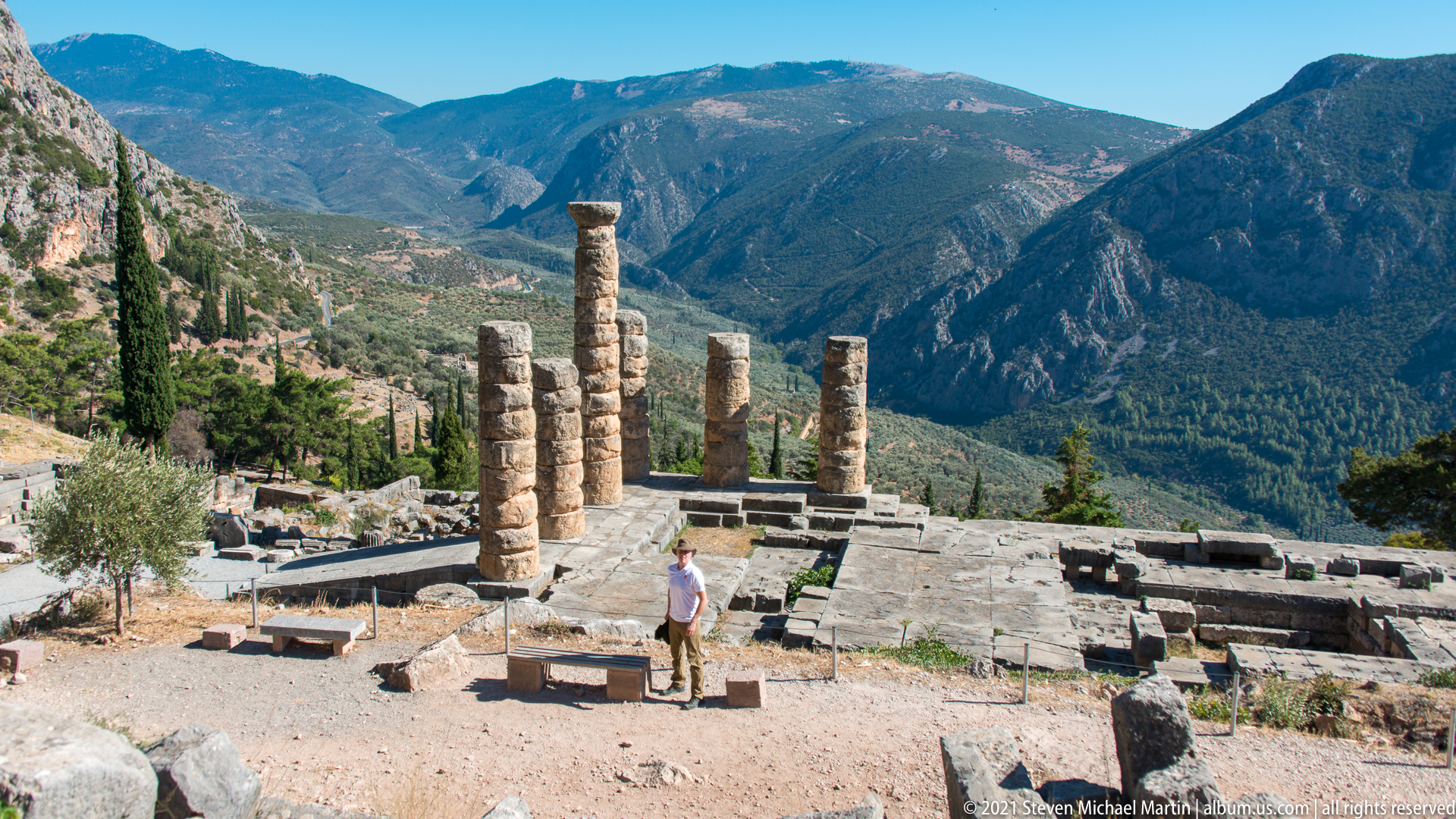
A visitor stands near the edge of the Temple of Apollo terrace, providing scale for the surviving columns and broad foundation platform below. Beyond the ruins, layered mountain slopes descend into the valley. The elevated perspective makes the temple’s footprint easy to read and shows how sharply the sanctuary falls away from the cliffs above toward the landscape below.
Caption
A visitor stands near the edge of the Temple of Apollo terrace, providing scale for the surviving columns and broad foundation platform below. Beyond the ruins, layered mountain slopes descend into the valley. The elevated perspective makes the temple’s footprint easy to read and shows how sharply the sanctuary falls away from the cliffs above toward the landscape below.

Large polygonal blocks fit tightly together in an imposing retaining wall, their irregular joints creating a distinctive interlocking pattern. The close angle emphasizes the precision of the masonry and the contrast between smoother block faces and weathered seams. This construction technique was well suited to the heavy terrace walls required by Delphi’s steep sanctuary slope.
Caption
Large polygonal blocks fit tightly together in an imposing retaining wall, their irregular joints creating a distinctive interlocking pattern. The close angle emphasizes the precision of the masonry and the contrast between smoother block faces and weathered seams. This construction technique was well suited to the heavy terrace walls required by Delphi’s steep sanctuary slope.

Standing column shafts rise above massive terrace masonry beneath the sheer limestone cliffs of Delphi. In the foreground, lower columns and scattered architectural blocks mark successive levels of the sanctuary, while the rugged Phaedriades dominate the background. The layered composition makes clear how monumental buildings were fitted onto engineered terraces along the steep mountainside.
Caption
Standing column shafts rise above massive terrace masonry beneath the sheer limestone cliffs of Delphi. In the foreground, lower columns and scattered architectural blocks mark successive levels of the sanctuary, while the rugged Phaedriades dominate the background. The layered composition makes clear how monumental buildings were fitted onto engineered terraces along the steep mountainside.

A second view centers on a tall weathered limestone mass rising beside trimmed shrubs and scattered architectural fragments. Deep cavities and irregular fractures mark the natural rock, while a small site label at its base indicates that the feature is interpreted within the archaeological landscape. The composition highlights the close interweaving of geology and built remains at Delphi.
Caption
A second view centers on a tall weathered limestone mass rising beside trimmed shrubs and scattered architectural fragments. Deep cavities and irregular fractures mark the natural rock, while a small site label at its base indicates that the feature is interpreted within the archaeological landscape. The composition highlights the close interweaving of geology and built remains at Delphi.

A tall arched recess is built from alternating courses of brick and small stone, with radiating bricks defining the vault. A slender reconstructed column stands within the niche, emphasizing its height and axial symmetry. The masonry differs markedly from the sanctuary’s monumental cut-stone construction and records a later architectural phase represented among the remains at Delphi.
Caption
A tall arched recess is built from alternating courses of brick and small stone, with radiating bricks defining the vault. A slender reconstructed column stands within the niche, emphasizing its height and axial symmetry. The masonry differs markedly from the sanctuary’s monumental cut-stone construction and records a later architectural phase represented among the remains at Delphi.

A long row of slender stone columns defines the edge of an ancient paved area at Delphi, with brick-and-stone walls extending behind them along the slope. Repeated shafts create a strong perspective line through the frame, while partial walls and foundations reveal the fragmentary state of the surrounding structure. The view is especially useful for reading the rhythm and scale of this colonnaded space.
Caption
A long row of slender stone columns defines the edge of an ancient paved area at Delphi, with brick-and-stone walls extending behind them along the slope. Repeated shafts create a strong perspective line through the frame, while partial walls and foundations reveal the fragmentary state of the surrounding structure. The view is especially useful for reading the rhythm and scale of this colonnaded space.

A long wall exposes several distinct masonry techniques, from large irregular stones at the base and ends to tightly packed small stones and horizontal brick courses through the center. The changing materials and bonding patterns make this an instructive view of construction and repair within Delphi’s archaeological remains. Vegetation growing from joints underscores the wall’s weathered condition.
Caption
A long wall exposes several distinct masonry techniques, from large irregular stones at the base and ends to tightly packed small stones and horizontal brick courses through the center. The changing materials and bonding patterns make this an instructive view of construction and repair within Delphi’s archaeological remains. Vegetation growing from joints underscores the wall’s weathered condition.

A shallow metal bowl is densely decorated in repoussé with concentric bands of figures, animals, and ornamental motifs surrounding a central scene. The reflective surface and intricate relief create a layered visual field across the vessel’s interior. Displayed upright in the Delphi Archaeological Museum, the object demonstrates the technical refinement and narrative richness of luxury metalwork preserved from the sanctuary.
Caption
A shallow metal bowl is densely decorated in repoussé with concentric bands of figures, animals, and ornamental motifs surrounding a central scene. The reflective surface and intricate relief create a layered visual field across the vessel’s interior. Displayed upright in the Delphi Archaeological Museum, the object demonstrates the technical refinement and narrative richness of luxury metalwork preserved from the sanctuary.

A compact winged sphinx is shown in profile, with a human head, feline body, and large patterned wings rising behind the shoulders. Incised geometric and feather details cover much of the surface, suggesting that the figure served as a richly ornamented attachment or furnishing element. The isolated museum display makes the hybrid creature’s carefully organized silhouette especially clear.
Caption
A compact winged sphinx is shown in profile, with a human head, feline body, and large patterned wings rising behind the shoulders. Incised geometric and feather details cover much of the surface, suggesting that the figure served as a richly ornamented attachment or furnishing element. The isolated museum display makes the hybrid creature’s carefully organized silhouette especially clear.

A reclining sphinx combines a lion’s body with a human head framed by an Egyptian-style headdress. The figure extends its forelegs forward while the compact body and tail remain close to the display surface. Its hybrid form reflects the broad circulation of Egyptian and eastern Mediterranean imagery represented among objects preserved in the Delphi Archaeological Museum.
Caption
A reclining sphinx combines a lion’s body with a human head framed by an Egyptian-style headdress. The figure extends its forelegs forward while the compact body and tail remain close to the display surface. Its hybrid form reflects the broad circulation of Egyptian and eastern Mediterranean imagery represented among objects preserved in the Delphi Archaeological Museum.

Thin gold ornaments are displayed as paired circular elements above larger embossed plaques with radiating floral and figural decoration. Their hammered surfaces catch the light strongly, revealing concentric ridges and carefully modeled relief. Presented as small precious-metal finds in the Delphi Archaeological Museum, the pieces illustrate the elaborate decorative vocabulary used for elite or sacred objects.
Caption
Thin gold ornaments are displayed as paired circular elements above larger embossed plaques with radiating floral and figural decoration. Their hammered surfaces catch the light strongly, revealing concentric ridges and carefully modeled relief. Presented as small precious-metal finds in the Delphi Archaeological Museum, the pieces illustrate the elaborate decorative vocabulary used for elite or sacred objects.

A rectangular gold plaque bears a finely embossed winged quadruped in profile, framed by a narrow raised border. The creature’s long body, curled tail, feathered wing, and alert head are modeled in shallow relief across the thin sheet. Small dark fasteners or corrosion points at the edges suggest that the plaque was once attached to a larger object or backing.
Caption
A rectangular gold plaque bears a finely embossed winged quadruped in profile, framed by a narrow raised border. The creature’s long body, curled tail, feathered wing, and alert head are modeled in shallow relief across the thin sheet. Small dark fasteners or corrosion points at the edges suggest that the plaque was once attached to a larger object or backing.

A high-relief battle scene centers on a powerful lion lunging across the composition toward a fallen or struggling human figure. Muscular bodies, overlapping limbs, and deeply drilled details create a crowded sense of violent movement, while additional figures survive at the edges of the slab. The fragment belongs to the rich sculptural tradition represented in the Delphi Archaeological Museum.
Caption
A high-relief battle scene centers on a powerful lion lunging across the composition toward a fallen or struggling human figure. Muscular bodies, overlapping limbs, and deeply drilled details create a crowded sense of violent movement, while additional figures survive at the edges of the slab. The fragment belongs to the rich sculptural tradition represented in the Delphi Archaeological Museum.

A small shield-shaped gold ornament is embossed with a frontal winged figure, its arms and legs spread within a scrolling decorative field. The compact composition is framed by a raised border, while the thin sheet preserves crisp relief despite small losses and darkened attachment points. The piece exemplifies the miniature figural metalwork displayed among Delphi’s precious finds.
Caption
A small shield-shaped gold ornament is embossed with a frontal winged figure, its arms and legs spread within a scrolling decorative field. The compact composition is framed by a raised border, while the thin sheet preserves crisp relief despite small losses and darkened attachment points. The piece exemplifies the miniature figural metalwork displayed among Delphi’s precious finds.

A group of thin metal figures forms a lively narrative composition of armed or elaborately dressed people moving together. Patterned garments, separately rendered heads, bent limbs, and overlapping bodies create an animated procession-like scene. The surviving pieces appear assembled as a single museum display, allowing the intricate silhouette and engraved surface decoration to be read as a coherent group.
Caption
A group of thin metal figures forms a lively narrative composition of armed or elaborately dressed people moving together. Patterned garments, separately rendered heads, bent limbs, and overlapping bodies create an animated procession-like scene. The surviving pieces appear assembled as a single museum display, allowing the intricate silhouette and engraved surface decoration to be read as a coherent group.

A bronze lion head fills the foreground, its rounded ears, incised muzzle, and open mouth rendered with compact geometric modeling. A second feline fitting appears softly out of focus behind it, allowing comparison between two related objects. The close focus emphasizes the expressive animal features and green-brown patina characteristic of ancient bronze preserved in the museum.
Caption
A bronze lion head fills the foreground, its rounded ears, incised muzzle, and open mouth rendered with compact geometric modeling. A second feline fitting appears softly out of focus behind it, allowing comparison between two related objects. The close focus emphasizes the expressive animal features and green-brown patina characteristic of ancient bronze preserved in the museum.

A museum panel identifies Antinoos, the Bithynian favorite of Emperor Hadrian, and explains the cult statue found at Delphi. The text describes his deification after his death in the Nile, the statue’s exceptional preservation, and its Hadrianic classicism. A coin portrait at left provides an additional ancient representation of the youthful figure.
Caption
A museum panel identifies Antinoos, the Bithynian favorite of Emperor Hadrian, and explains the cult statue found at Delphi. The text describes his deification after his death in the Nile, the statue’s exceptional preservation, and its Hadrianic classicism. A coin portrait at left provides an additional ancient representation of the youthful figure.

The orchestra of the ancient Theatre of Delphi fills the foreground, paved with large irregular stone slabs and enclosed by the sweeping curve of tiered seating. Radiating stairways divide the cavea into wedges, while the rocky mountainside rises immediately behind the upper rows. The viewpoint clearly reveals the relationship between performance area, seating, and steep sanctuary terrain.
Caption
The orchestra of the ancient Theatre of Delphi fills the foreground, paved with large irregular stone slabs and enclosed by the sweeping curve of tiered seating. Radiating stairways divide the cavea into wedges, while the rocky mountainside rises immediately behind the upper rows. The viewpoint clearly reveals the relationship between performance area, seating, and steep sanctuary terrain.

The Theatre of Delphi spreads across the slope in a broad semicircle of weathered stone seats, with narrow stairways cutting vertically through the cavea. Cypress trees and jagged limestone peaks rise behind the upper tiers, giving the architecture a dramatic natural frame. This wider view emphasizes the theater’s integration into the steep terrain above Apollo’s sanctuary.
Caption
The Theatre of Delphi spreads across the slope in a broad semicircle of weathered stone seats, with narrow stairways cutting vertically through the cavea. Cypress trees and jagged limestone peaks rise behind the upper tiers, giving the architecture a dramatic natural frame. This wider view emphasizes the theater’s integration into the steep terrain above Apollo’s sanctuary.

A smiling visitor wearing sunglasses and a blue T-shirt stands close to the camera, with Delphi’s stone foundations and column remains softly receding behind him. Strong sunlight separates the portrait from the archaeological background while preserving enough context to locate the scene within the sanctuary. The composition provides a personal counterpoint to the portfolio’s architectural documentation.
Caption
A smiling visitor wearing sunglasses and a blue T-shirt stands close to the camera, with Delphi’s stone foundations and column remains softly receding behind him. Strong sunlight separates the portrait from the archaeological background while preserving enough context to locate the scene within the sanctuary. The composition provides a personal counterpoint to the portfolio’s architectural documentation.

A visitor stands beside the Temple of Apollo ruins as six weathered Doric columns rise across the terrace behind him. From this elevated viewpoint, the sanctuary opens toward the deep mountain valley, giving the surviving architecture an expansive landscape setting. The human figure provides scale for the massive column drums and broad stone platform of Delphi’s principal temple.
Caption
A visitor stands beside the Temple of Apollo ruins as six weathered Doric columns rise across the terrace behind him. From this elevated viewpoint, the sanctuary opens toward the deep mountain valley, giving the surviving architecture an expansive landscape setting. The human figure provides scale for the massive column drums and broad stone platform of Delphi’s principal temple.