Cape Cross – Namibia
The windswept shoreline of Cape Cross Seal Reserve lies along the rugged Atlantic coast of Namibia. The reserve is home to one of the largest colonies of Cape fur seals in the world, where tens of thousands of seals gather along the rocky beaches.
Visitors observing the colony encounter a remarkable wildlife spectacle as the animals crowd together along the shoreline and move between the ocean and the sand. The reserve also marks the location where the Portuguese explorer Diogo Cão erected a stone cross during his voyage along the African coast in the 15th century.
Cape Cross remains one of the most distinctive wildlife destinations along Namibia’s Atlantic coastline.
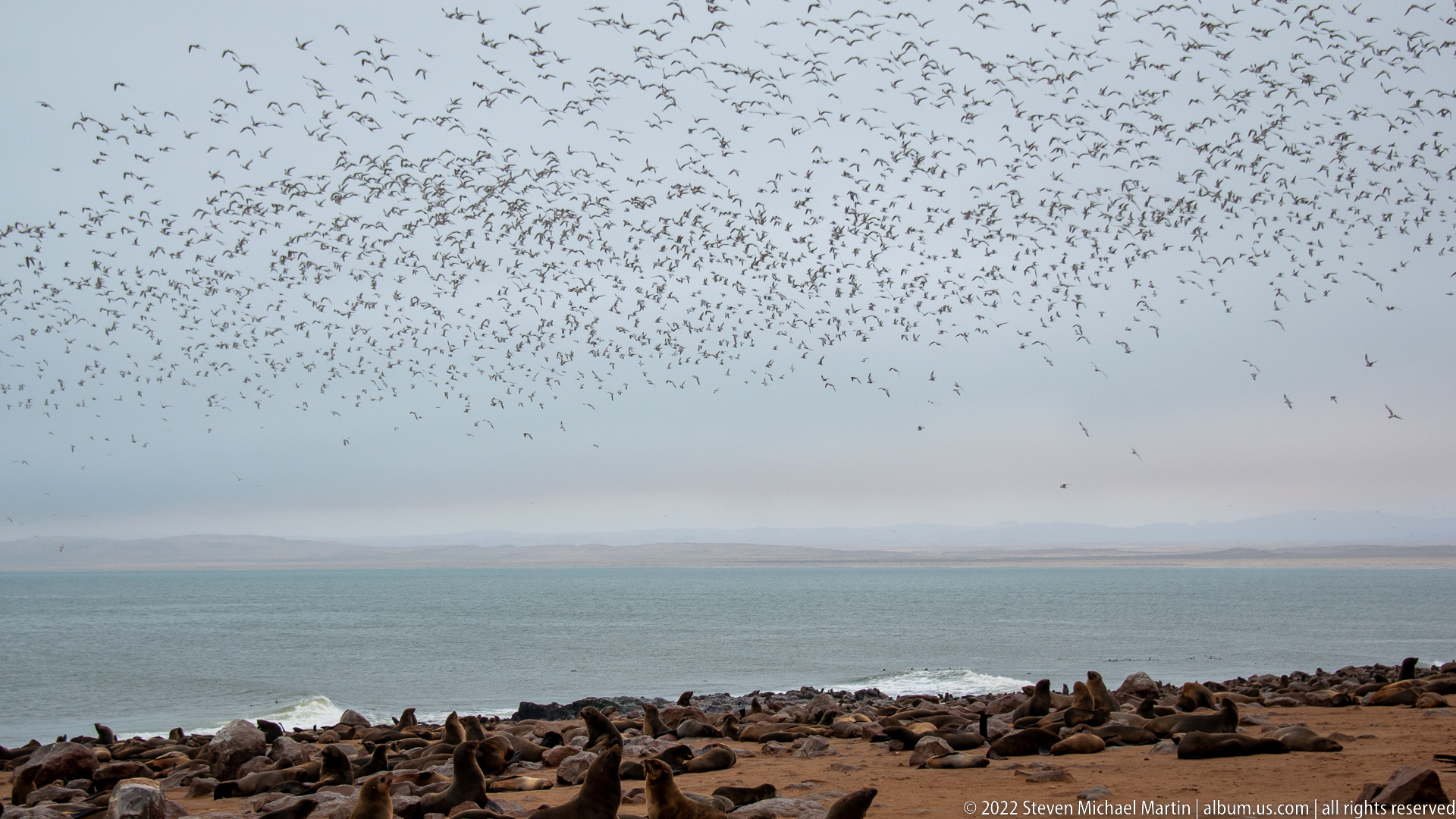
A mass of coastal seabirds wheels above the dense Cape fur seal colony at Cape Cross, Namibia, linking the crowded shore to the rich feeding grounds of the Atlantic Ocean beyond.
Caption
A mass of coastal seabirds wheels above the dense Cape fur seal colony at Cape Cross, Namibia, linking the crowded shore to the rich feeding grounds of the Atlantic Ocean beyond.
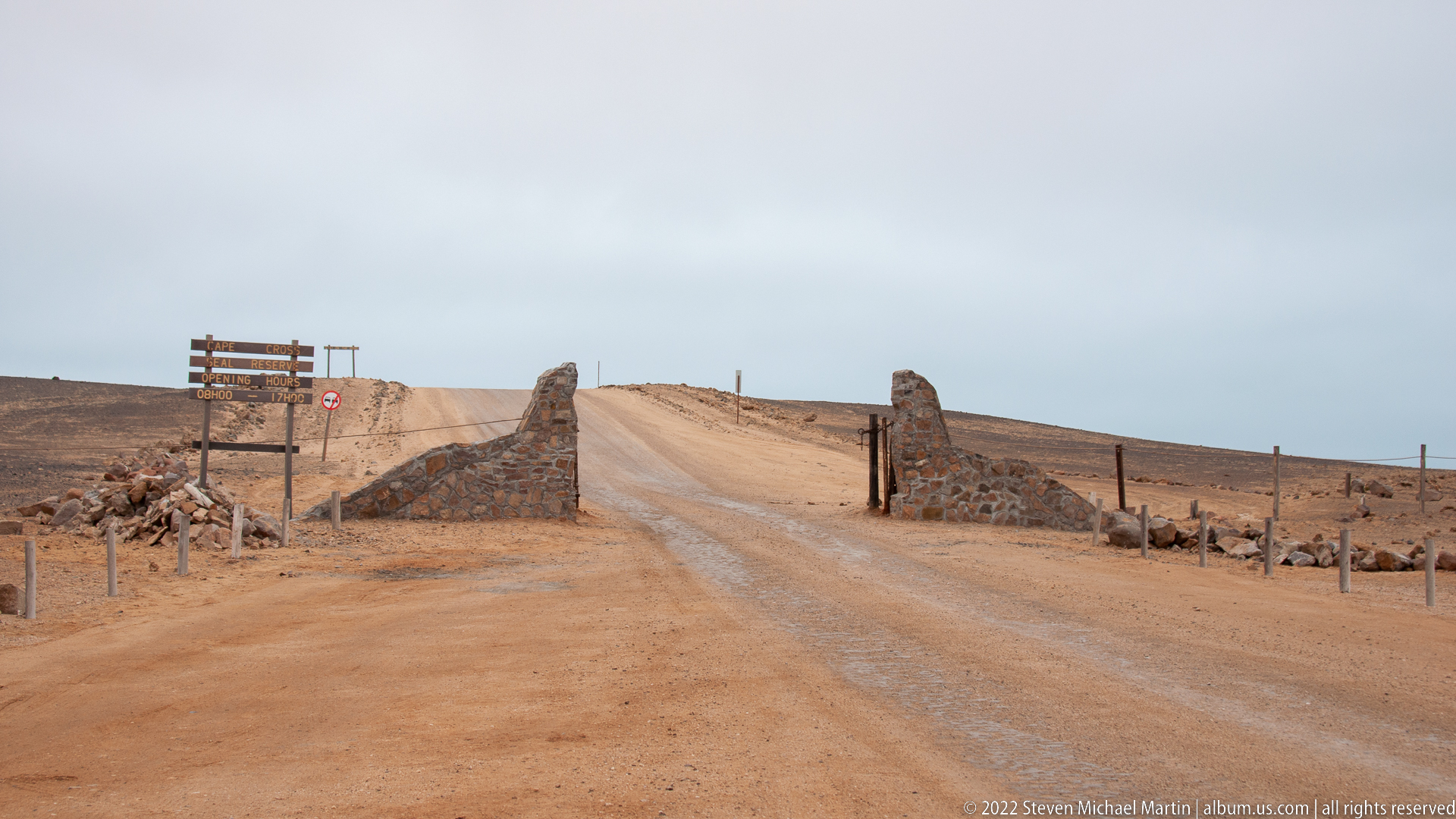
A straight gravel access road leads through low stone gate walls into Cape Cross Seal Reserve, set in the arid coastal landscape of Namibia.
Caption
A straight gravel access road leads through low stone gate walls into Cape Cross Seal Reserve, set in the arid coastal landscape of Namibia.
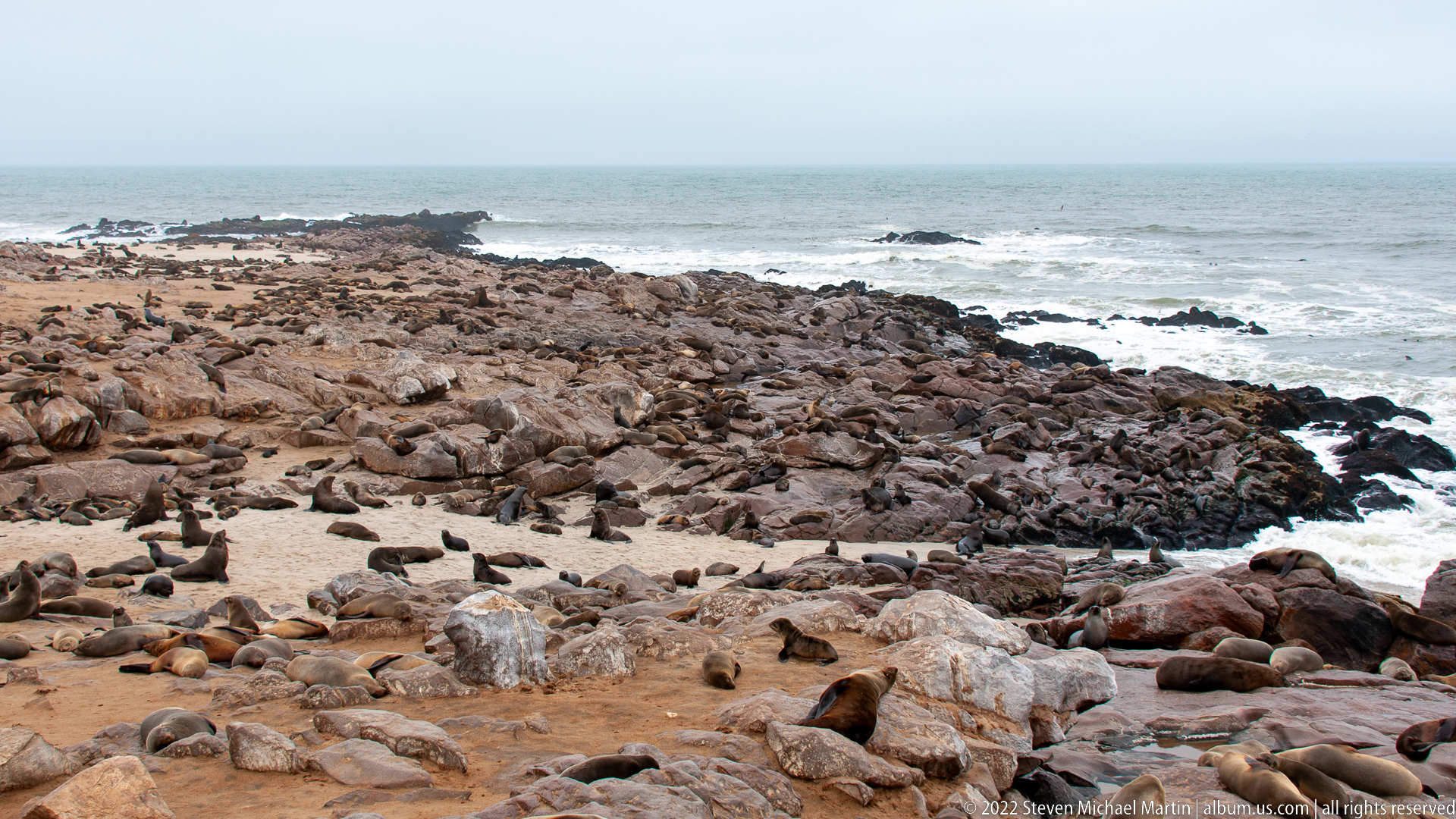
An exceptionally dense Cape fur seal colony blankets the pale rocks and sand of the Cape Cross headland along Namibia’s Atlantic coast, stretching from the foreground to the surf-lined horizon.
Caption
An exceptionally dense Cape fur seal colony blankets the pale rocks and sand of the Cape Cross headland along Namibia’s Atlantic coast, stretching from the foreground to the surf-lined horizon.
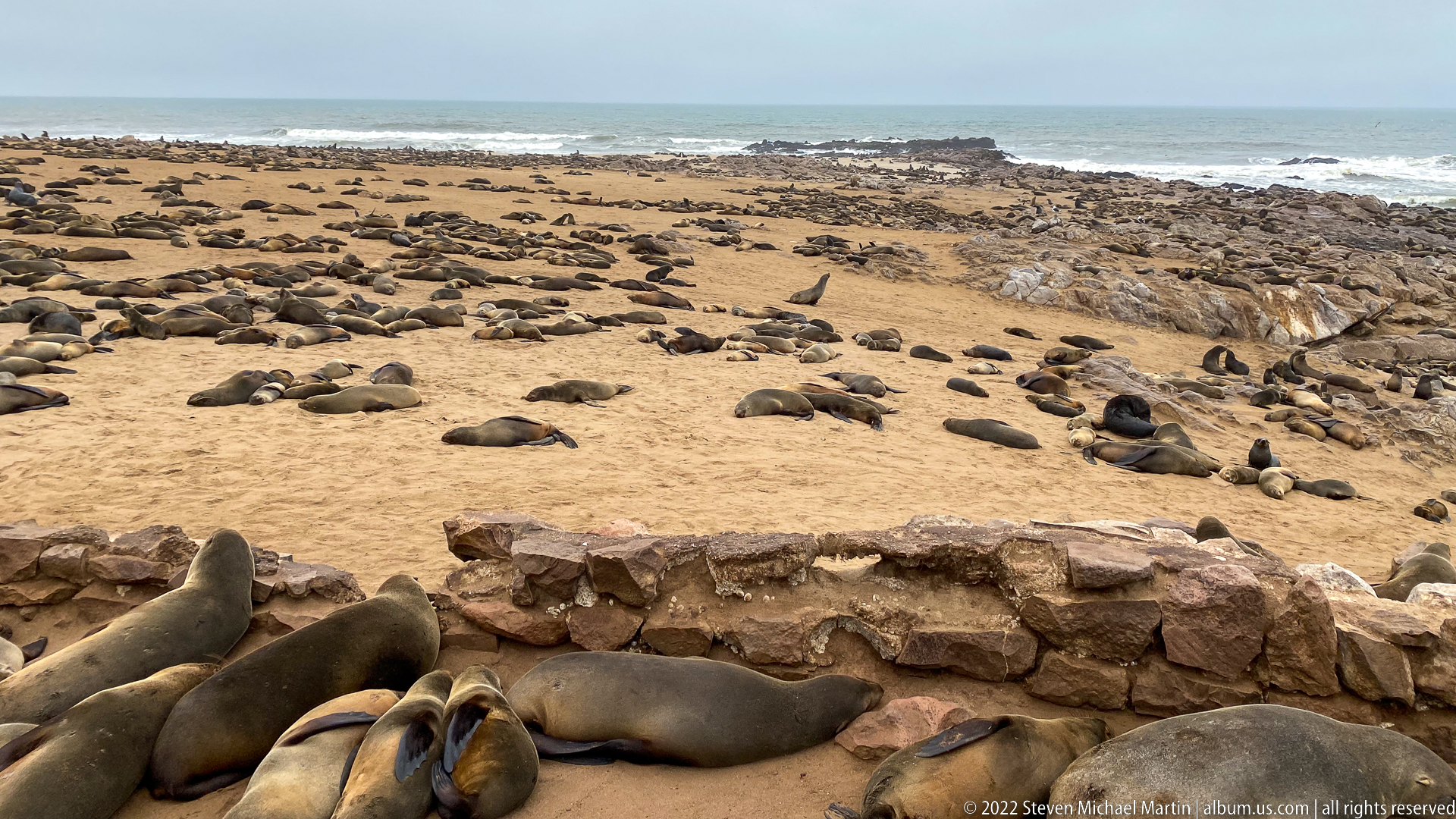
From the low stone wall of the visitor area, a vast Cape Cross fur seal haul-out stretches across the sand to the rocky Atlantic coast, showing how the colony extends seamlessly from built viewing infrastructure to the open shore.
Caption
From the low stone wall of the visitor area, a vast Cape Cross fur seal haul-out stretches across the sand to the rocky Atlantic coast, showing how the colony extends seamlessly from built viewing infrastructure to the open shore.
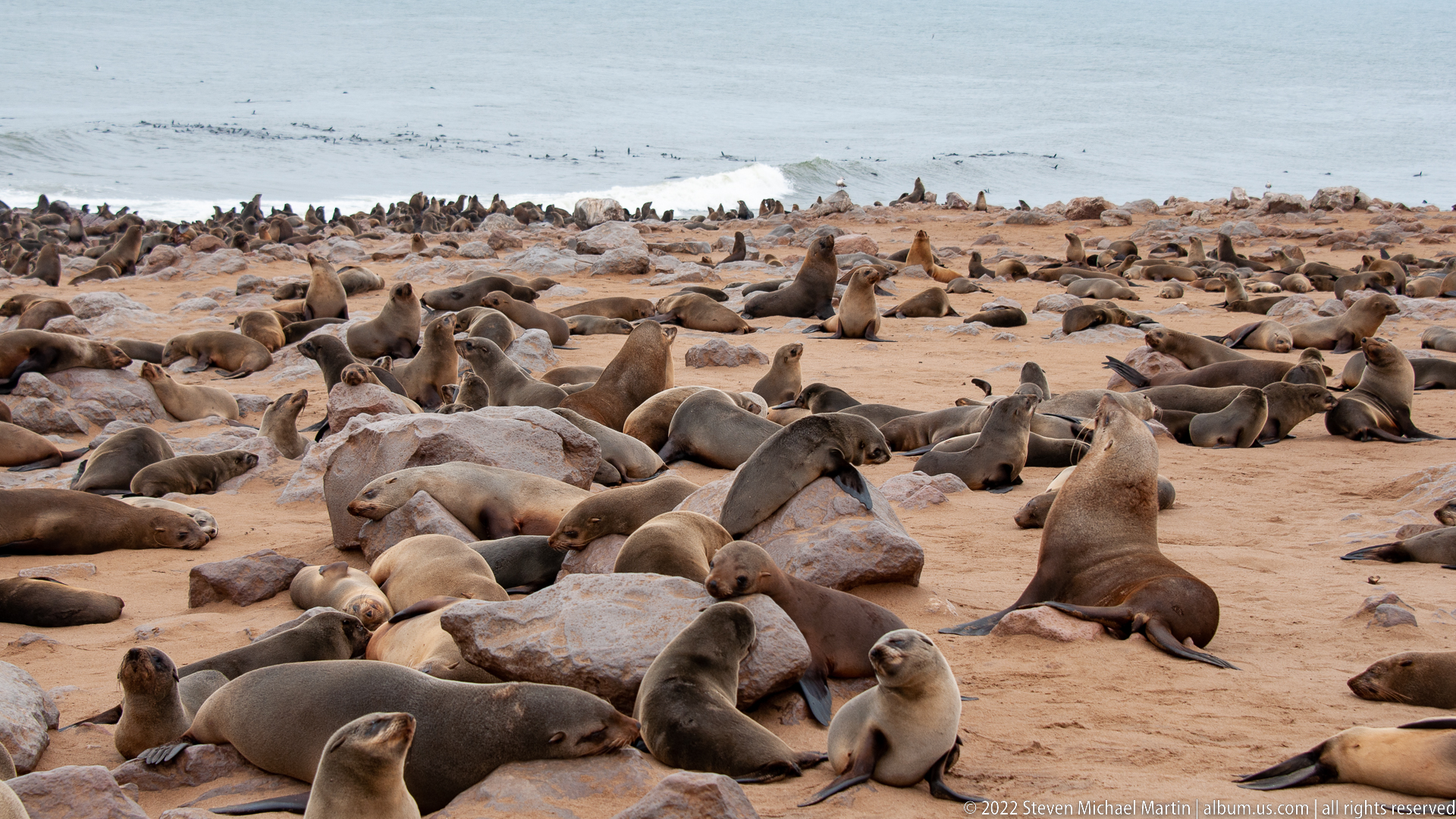
A dense Cape fur seal colony sprawls across the mixed sand and rocks of Cape Cross, where resting animals and upright sentinels overlook the Atlantic shoreline in Namibia.
Caption
A dense Cape fur seal colony sprawls across the mixed sand and rocks of Cape Cross, where resting animals and upright sentinels overlook the Atlantic shoreline in Namibia.
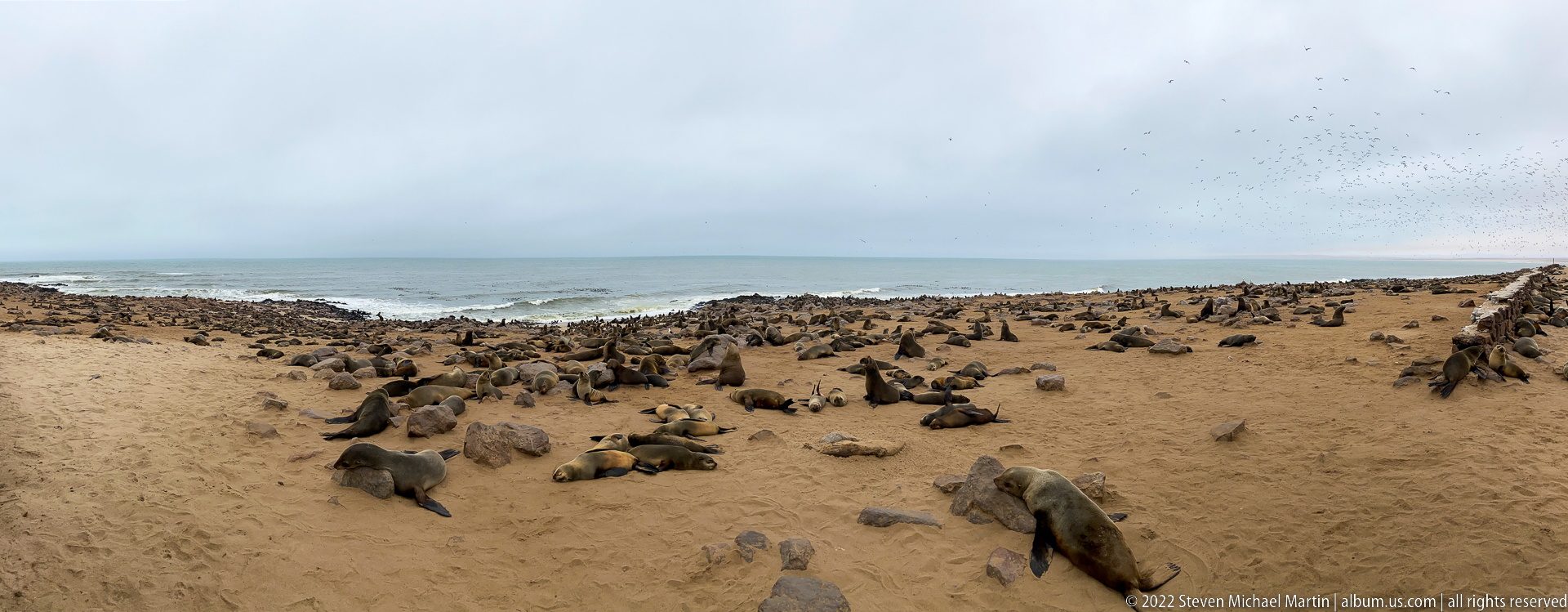
At Cape Cross on Namibia’s Atlantic coast, a vast Cape fur seal haul-out stretches across sand and rocks beneath an overcast sky, revealing the immense scale of the colony and its open coastal habitat.
Caption
At Cape Cross on Namibia’s Atlantic coast, a vast Cape fur seal haul-out stretches across sand and rocks beneath an overcast sky, revealing the immense scale of the colony and its open coastal habitat.
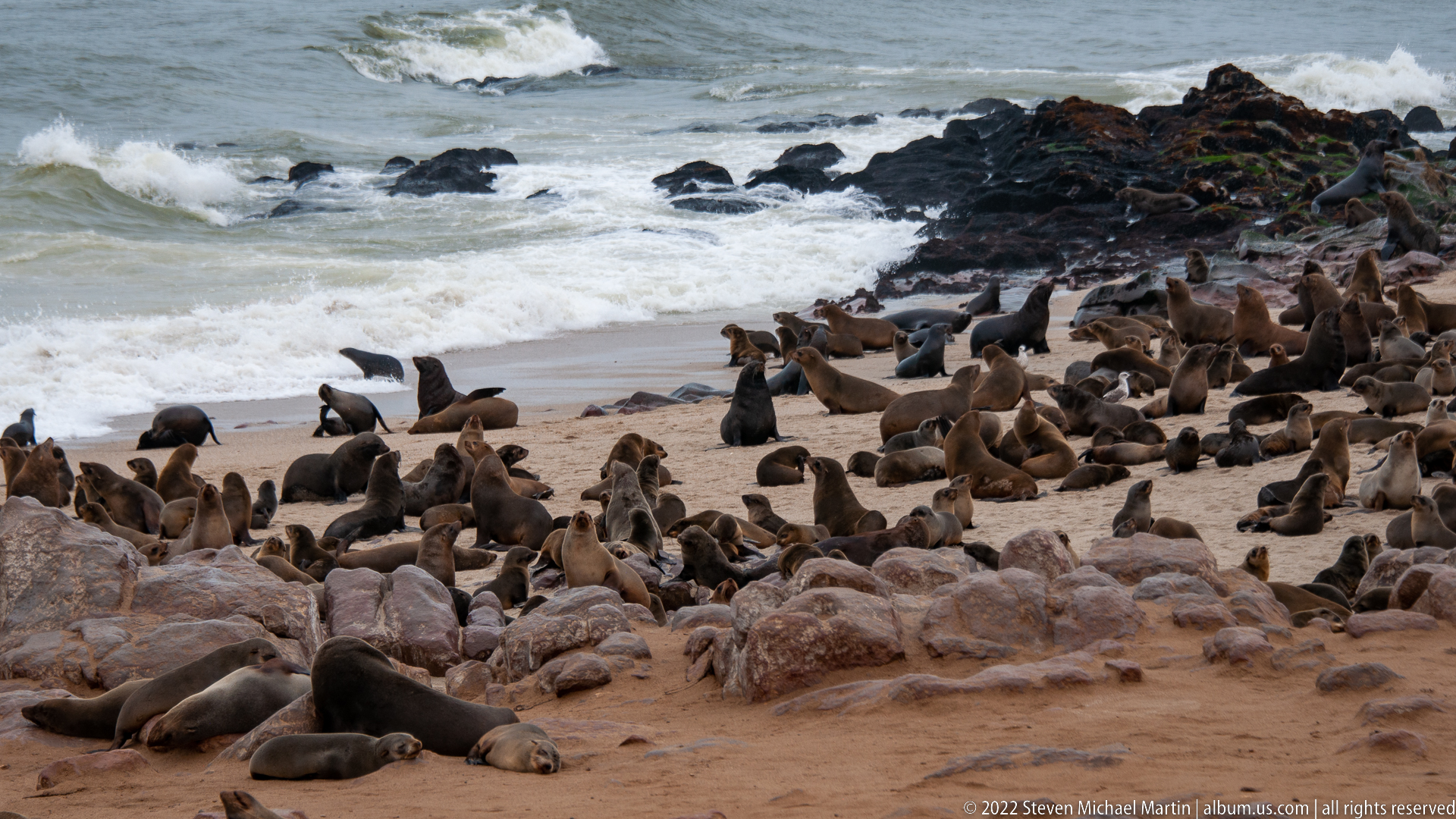
A dense Cape fur seal colony sprawls across the sandy and rocky shore at Cape Cross, directly exposed to the breaking Atlantic surf on Namibia’s coast.
Caption
A dense Cape fur seal colony sprawls across the sandy and rocky shore at Cape Cross, directly exposed to the breaking Atlantic surf on Namibia’s coast.
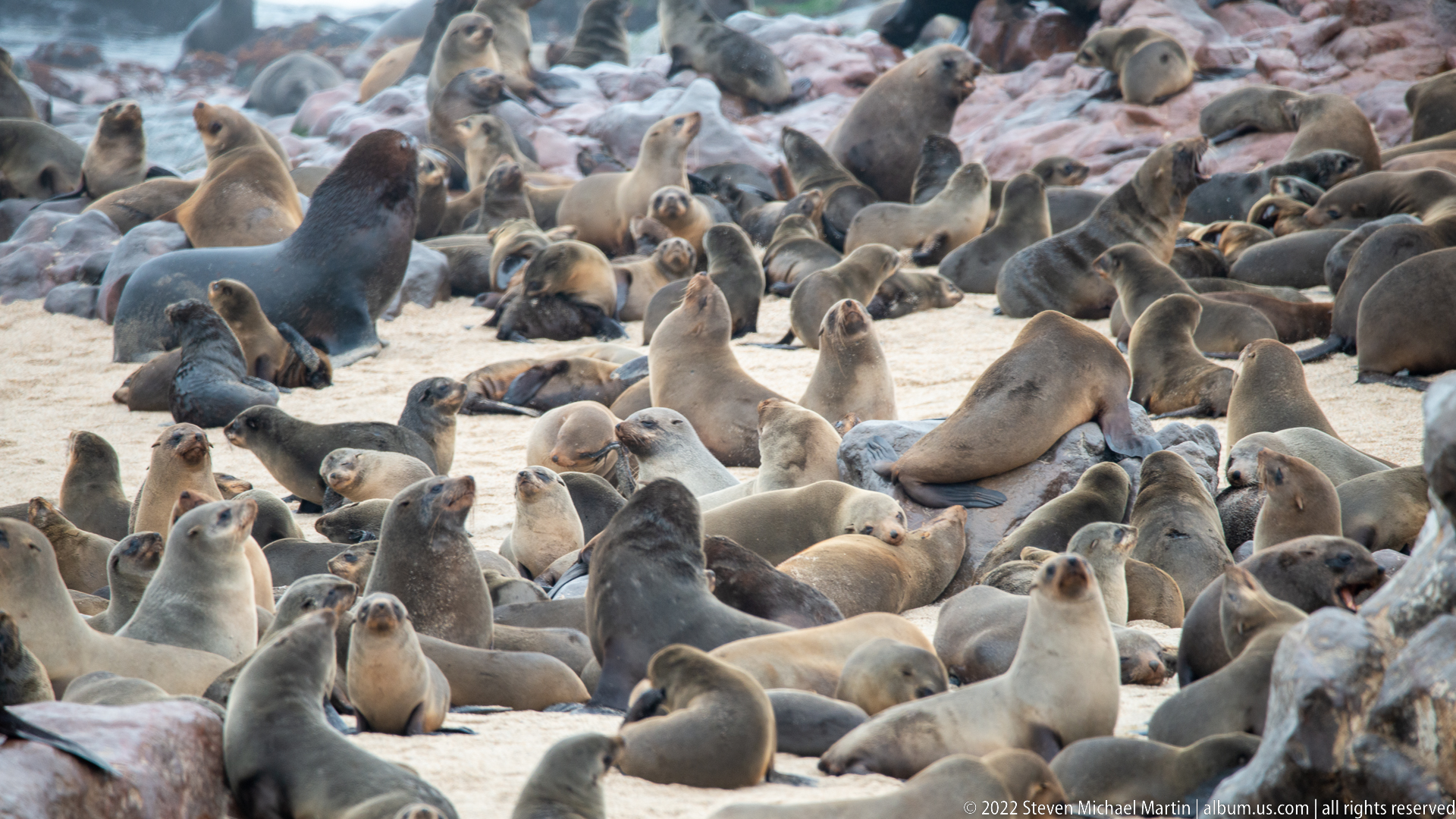
At Cape Cross, an exceptionally dense seasonal aggregation of Cape fur seals carpets the beach in a compressed panorama of mixed ages, sizes, and behaviors.
Caption
At Cape Cross, an exceptionally dense seasonal aggregation of Cape fur seals carpets the beach in a compressed panorama of mixed ages, sizes, and behaviors.
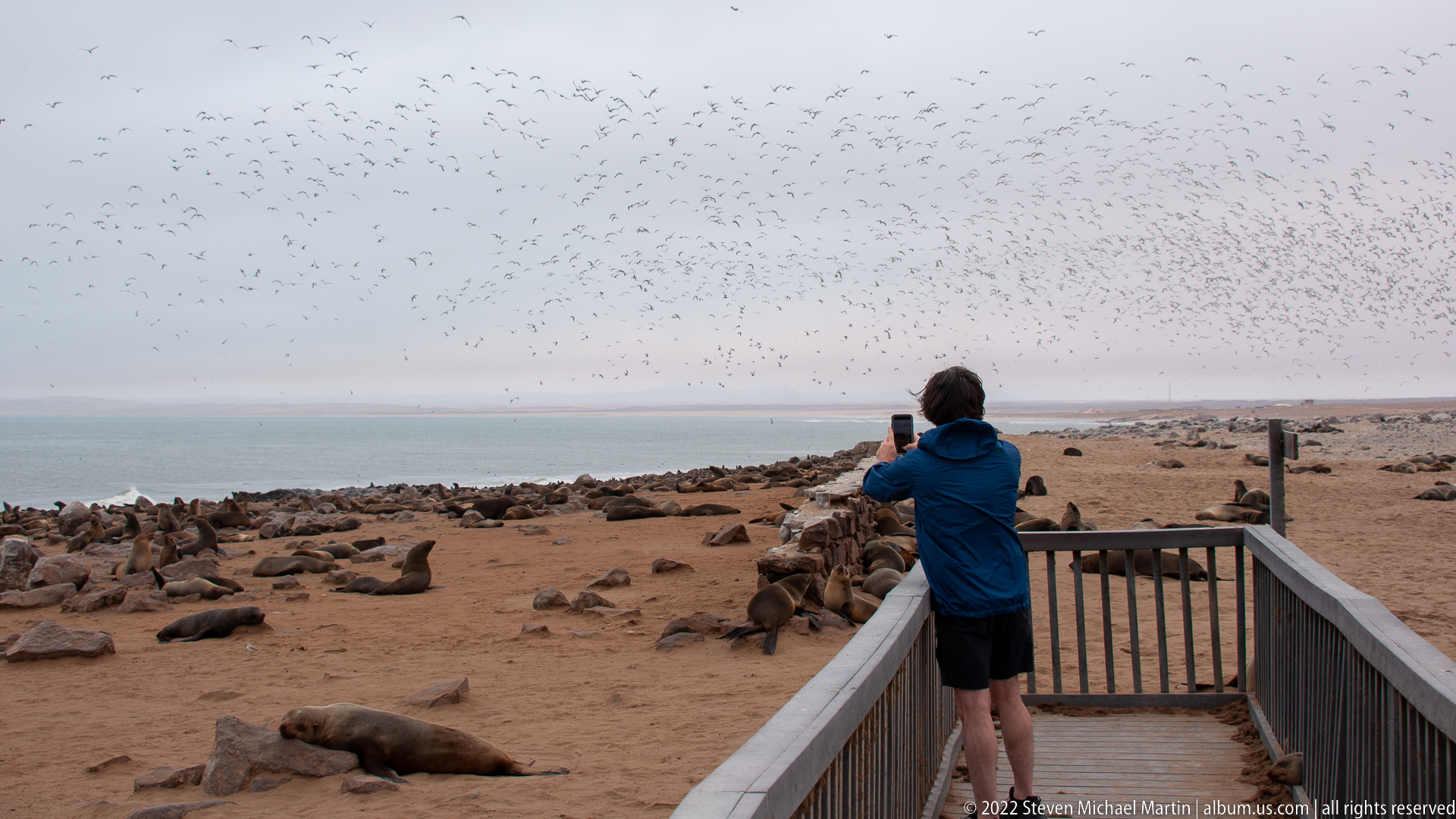
A reserve visitor on the Cape Cross boardwalk raises a phone toward the sprawling Cape fur seal colony and circling seabirds, using the elevated walkway’s controlled vantage to observe the busy shorefront wildlife.
Caption
A reserve visitor on the Cape Cross boardwalk raises a phone toward the sprawling Cape fur seal colony and circling seabirds, using the elevated walkway’s controlled vantage to observe the busy shorefront wildlife.
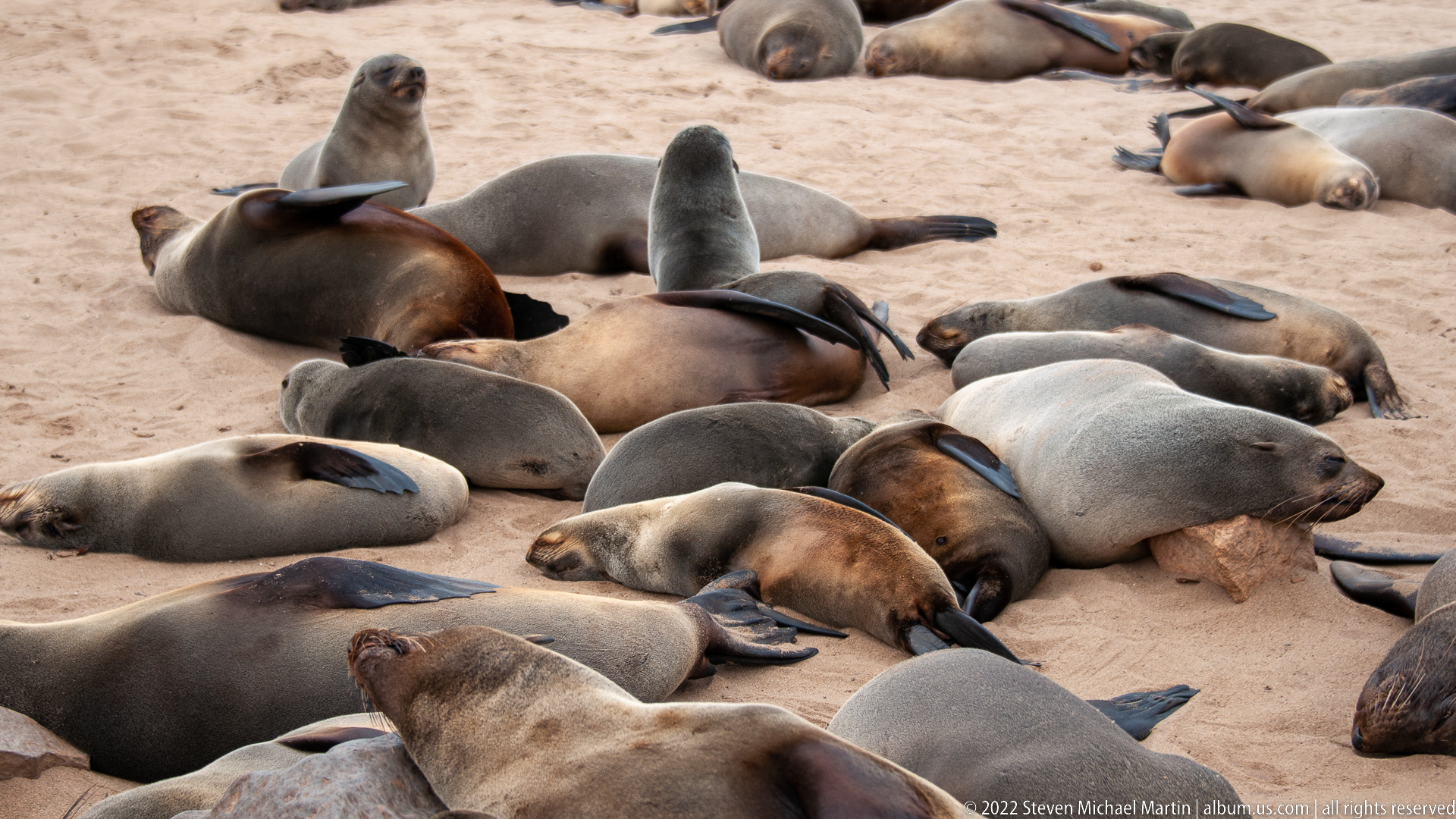
A dense colony of Cape fur seals (Arctocephalus pusillus pusillus) rests shoulder-to-shoulder on the pale sand at Cape Cross, reflecting their habit of gathering in tightly packed shore groups.
Caption
A dense colony of Cape fur seals (Arctocephalus pusillus pusillus) rests shoulder-to-shoulder on the pale sand at Cape Cross, reflecting their habit of gathering in tightly packed shore groups.
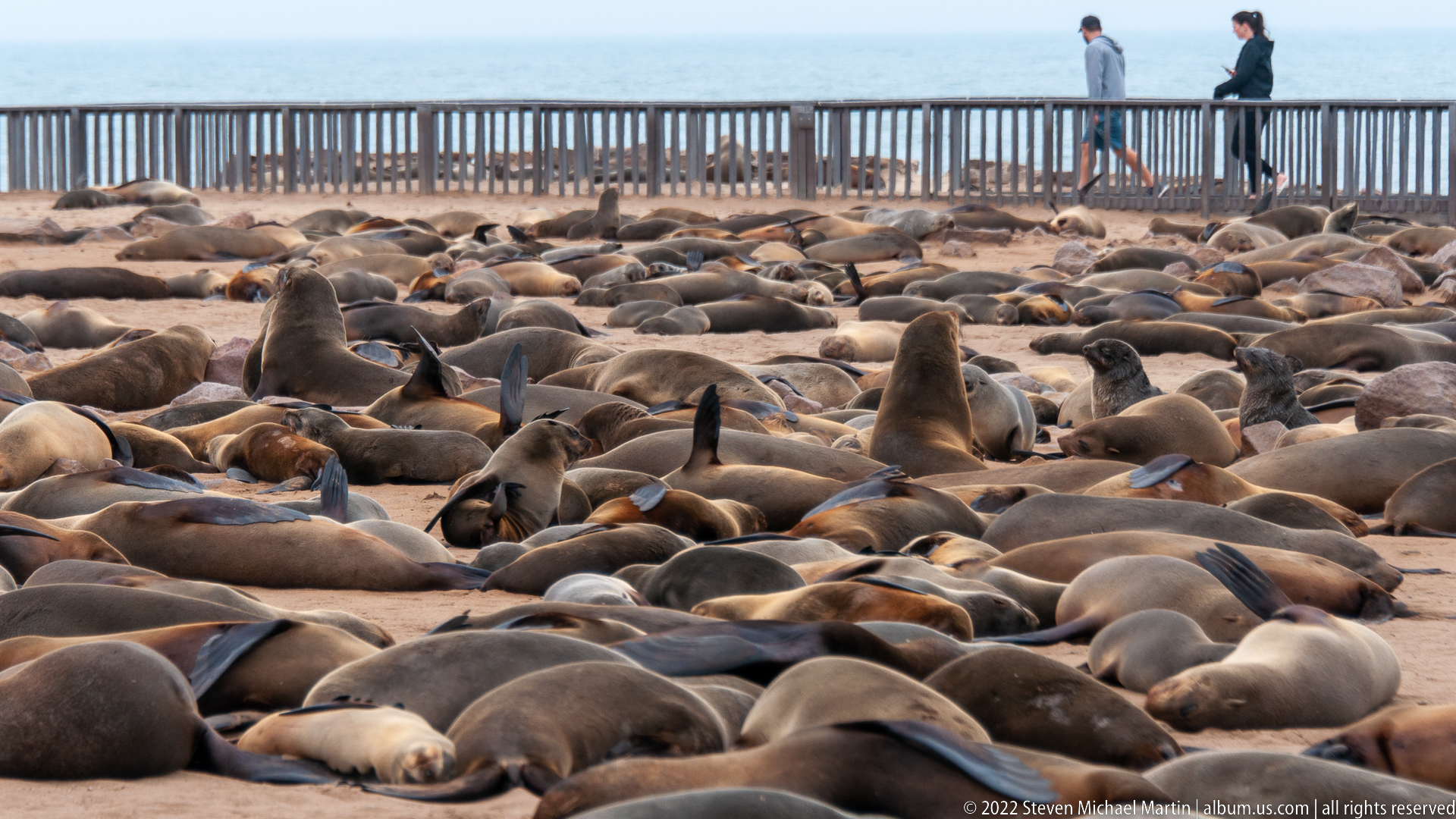
At Cape Cross in Namibia, an exceptionally dense Cape fur seal colony carpets the sand below the raised visitor boardwalk, where people observe the mass aggregation from a safe distance.
Caption
At Cape Cross in Namibia, an exceptionally dense Cape fur seal colony carpets the sand below the raised visitor boardwalk, where people observe the mass aggregation from a safe distance.
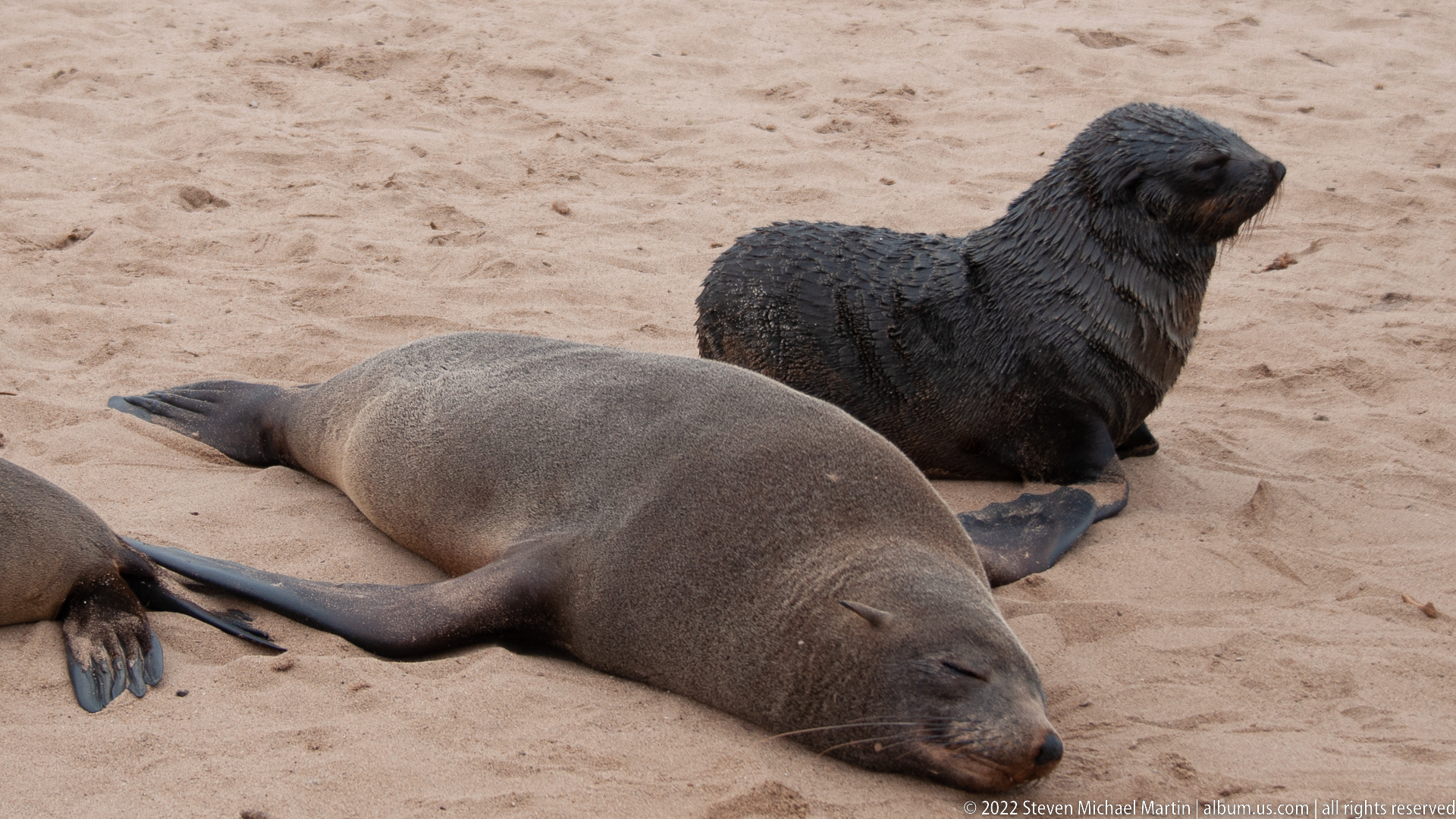
On the open sand at Cape Cross, an adult Cape fur seal reclines in the foreground while a much darker juvenile sits upright behind it, illustrating how size and coat tone shift with age and wet or dry fur.
Caption
On the open sand at Cape Cross, an adult Cape fur seal reclines in the foreground while a much darker juvenile sits upright behind it, illustrating how size and coat tone shift with age and wet or dry fur.
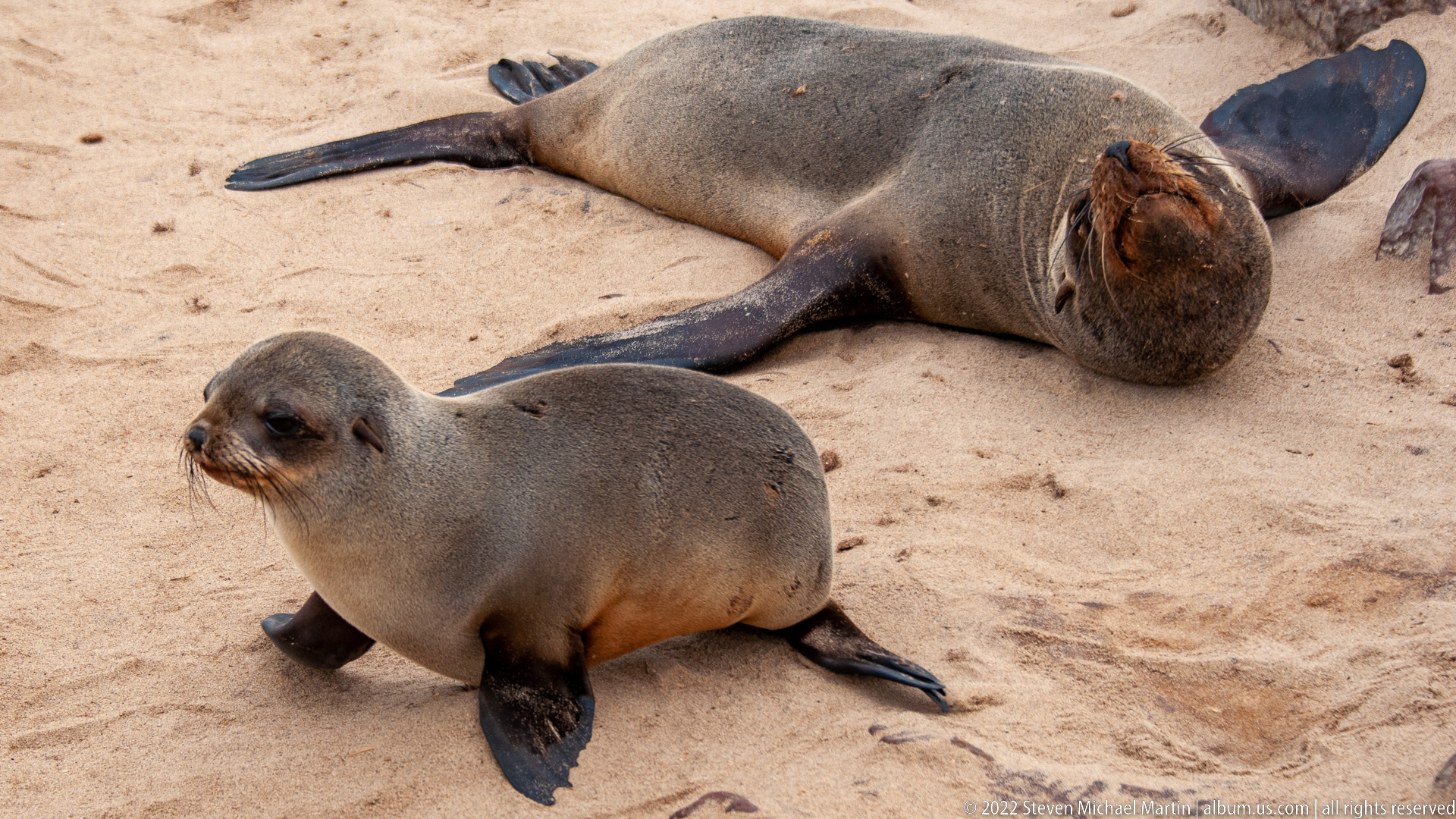
A juvenile Cape fur seal sits upright on the sand at Cape Cross, its long dark foreflippers splayed to either side as it raises head and chest above the shore beside a resting adult.
Caption
A juvenile Cape fur seal sits upright on the sand at Cape Cross, its long dark foreflippers splayed to either side as it raises head and chest above the shore beside a resting adult.
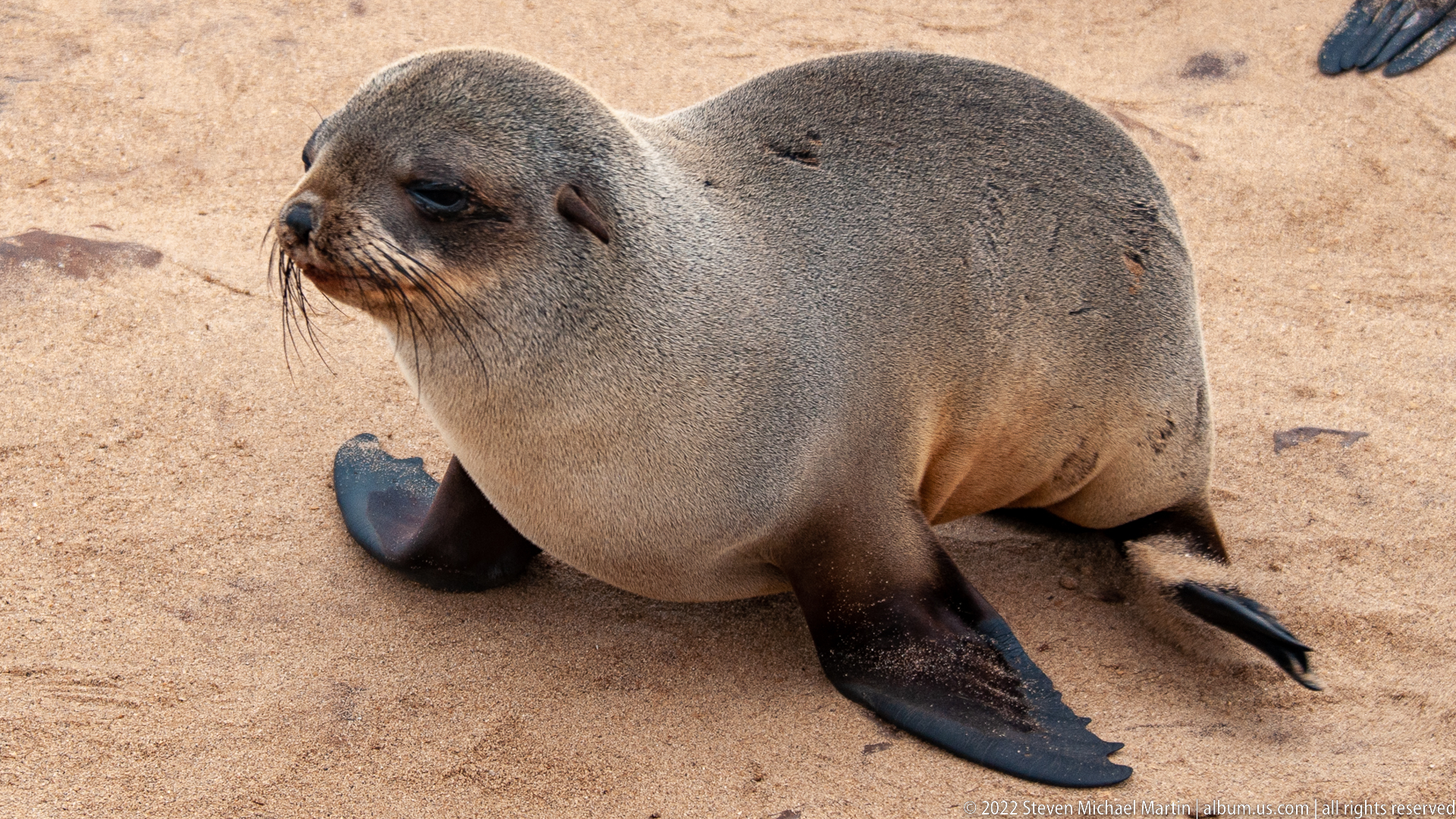
A juvenile Cape fur seal sits upright on the sand at Cape Cross, its compact body, visible ear flap, and long foreflippers emphasizing the eared seal’s strong limbs used for movement on land.
Caption
A juvenile Cape fur seal sits upright on the sand at Cape Cross, its compact body, visible ear flap, and long foreflippers emphasizing the eared seal’s strong limbs used for movement on land.
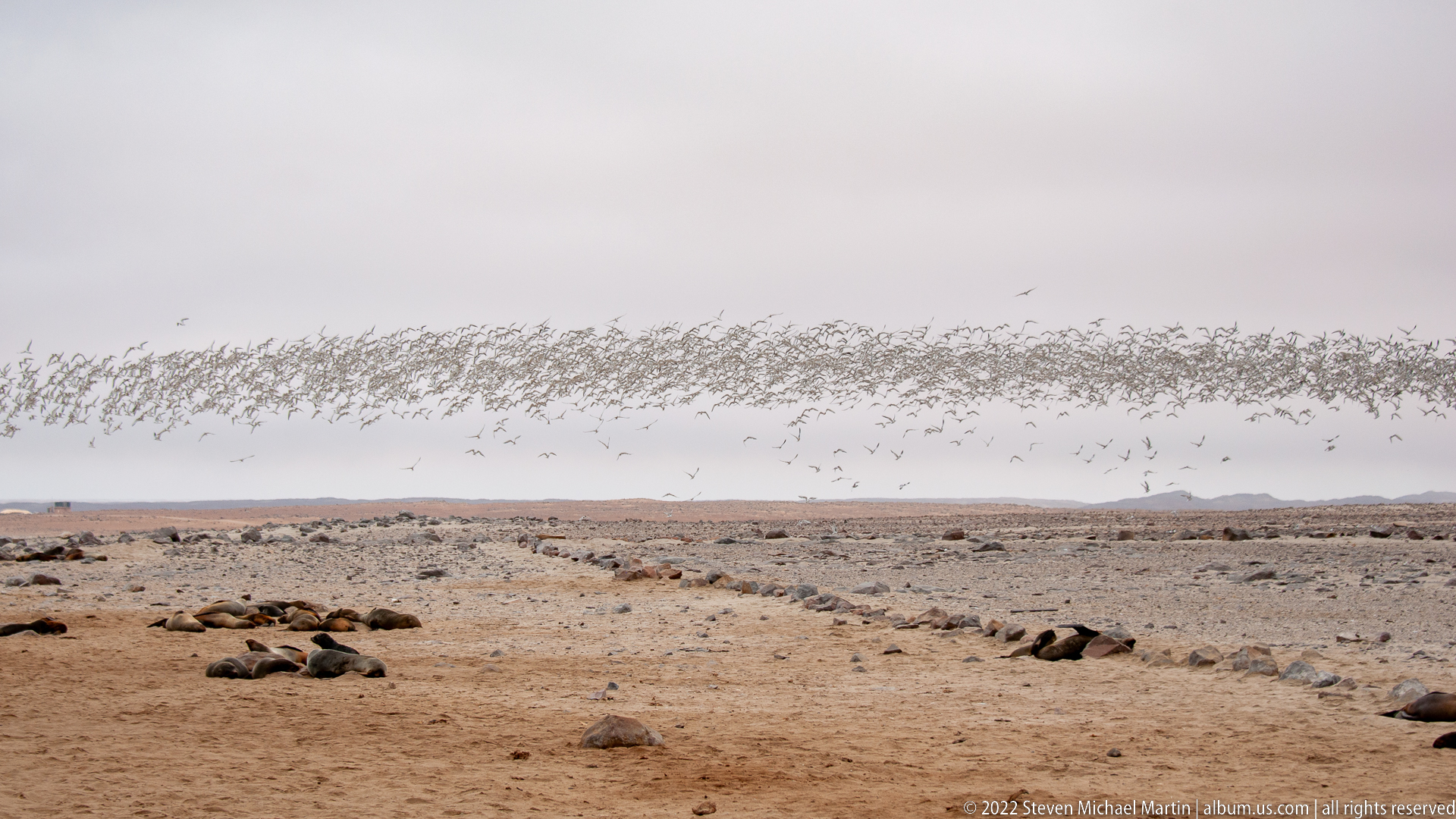
A dense band of coastal seabirds sweeps across the pale sky above scattered Cape fur seals on the barren plain at Cape Cross, where large flocks gather along the productive Benguela Current coast and share the marine environment with the seal colony in Namibia.
Caption
A dense band of coastal seabirds sweeps across the pale sky above scattered Cape fur seals on the barren plain at Cape Cross, where large flocks gather along the productive Benguela Current coast and share the marine environment with the seal colony in Namibia.
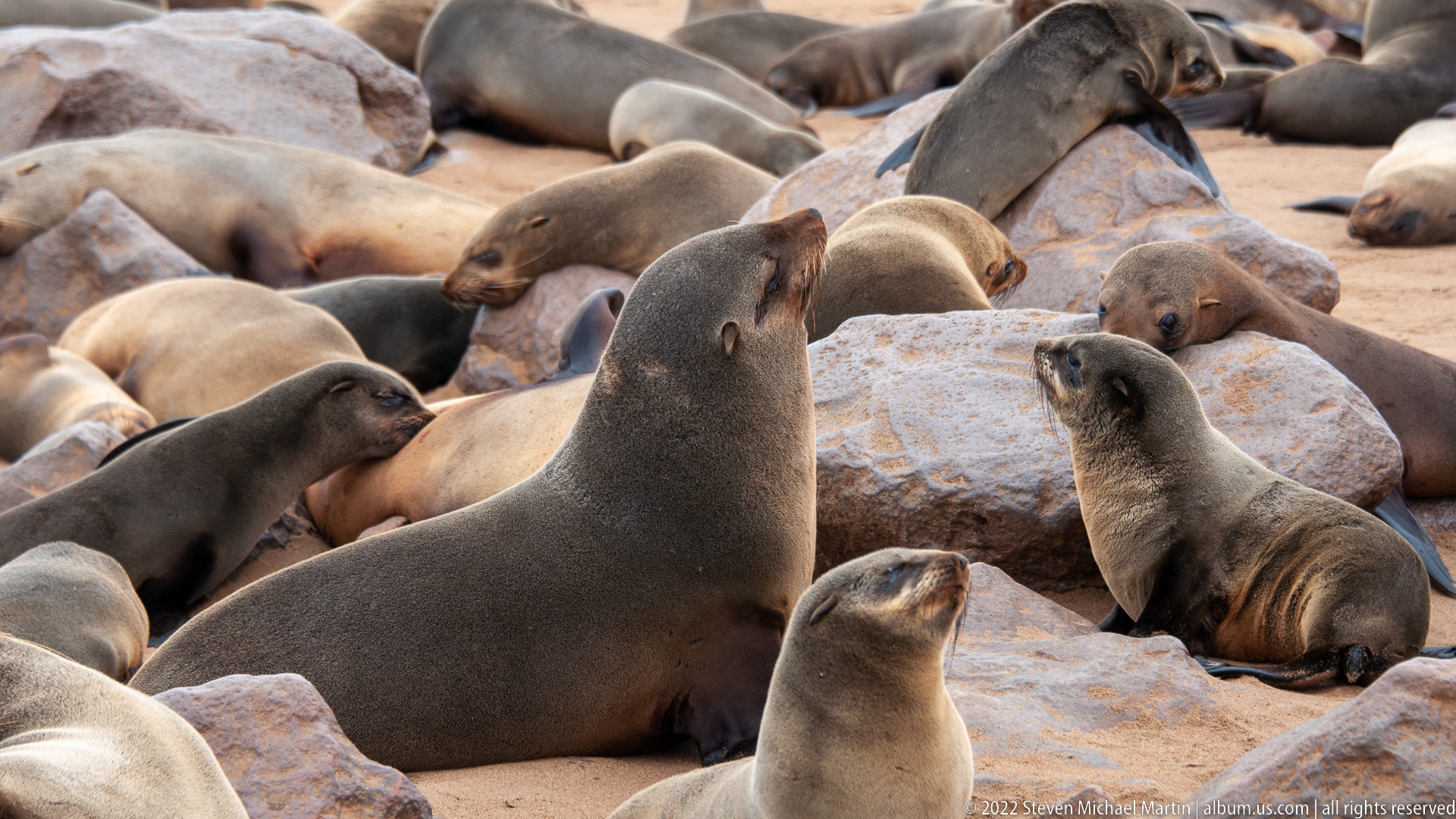
Adult and juvenile Cape fur seals cluster closely together on pale coastal rocks at Cape Cross, Namibia, their mixed ages sharing the elevated, rocky resting ground above the sand.
Caption
Adult and juvenile Cape fur seals cluster closely together on pale coastal rocks at Cape Cross, Namibia, their mixed ages sharing the elevated, rocky resting ground above the sand.
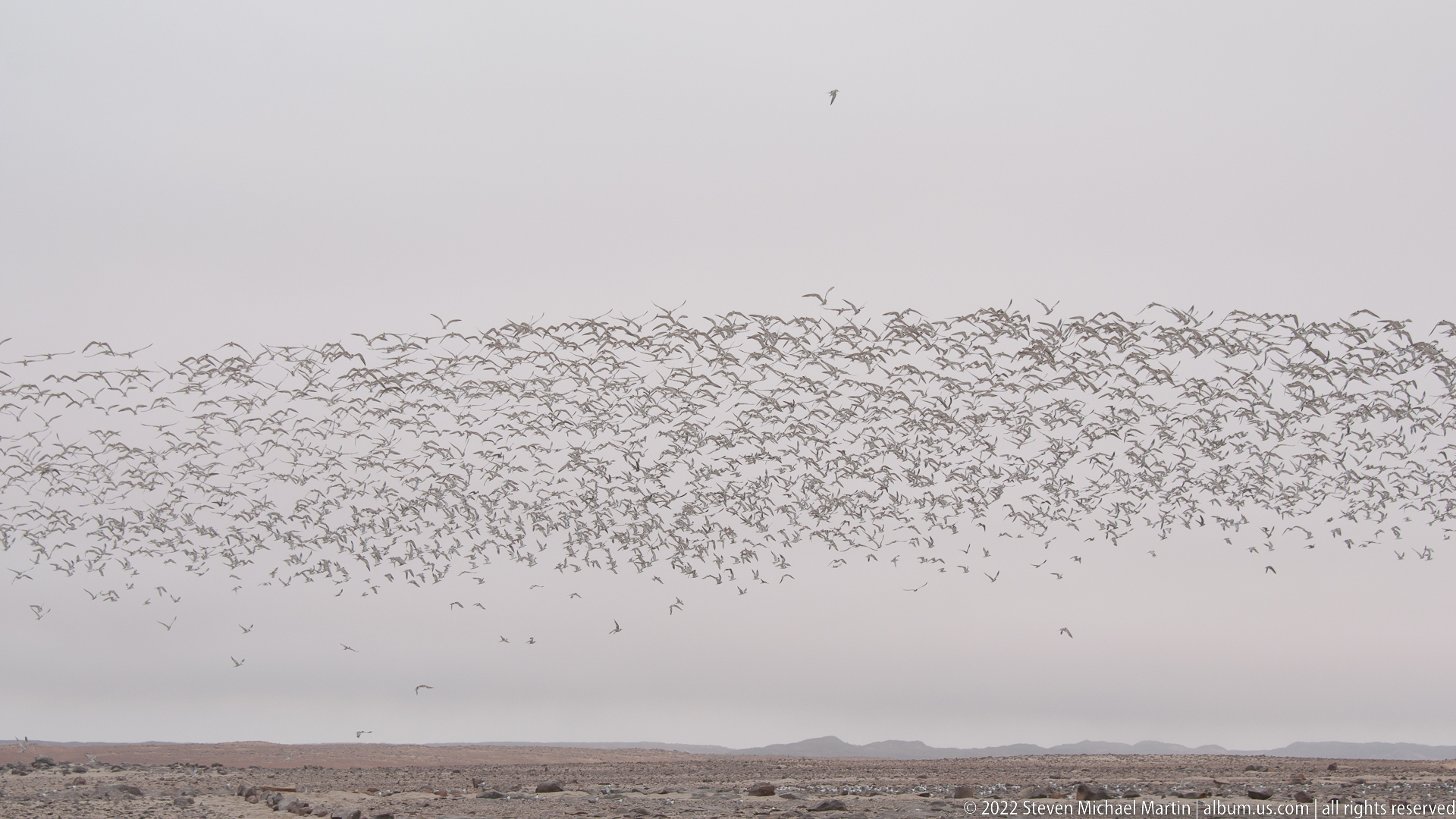
A dense, cloud-like band of coastal seabirds sweeps across the pale overcast sky above the flat Cape Cross coastal plain, where the nutrient-rich Namibian coast draws vast gatherings of marine birds into synchronized flight.
Caption
A dense, cloud-like band of coastal seabirds sweeps across the pale overcast sky above the flat Cape Cross coastal plain, where the nutrient-rich Namibian coast draws vast gatherings of marine birds into synchronized flight.

Cape fur seals move between a crowded Cape Cross shoreline and the gray Atlantic, their dark heads and backs dotting the nearshore water as low profiles at the surface.
Caption
Cape fur seals move between a crowded Cape Cross shoreline and the gray Atlantic, their dark heads and backs dotting the nearshore water as low profiles at the surface.
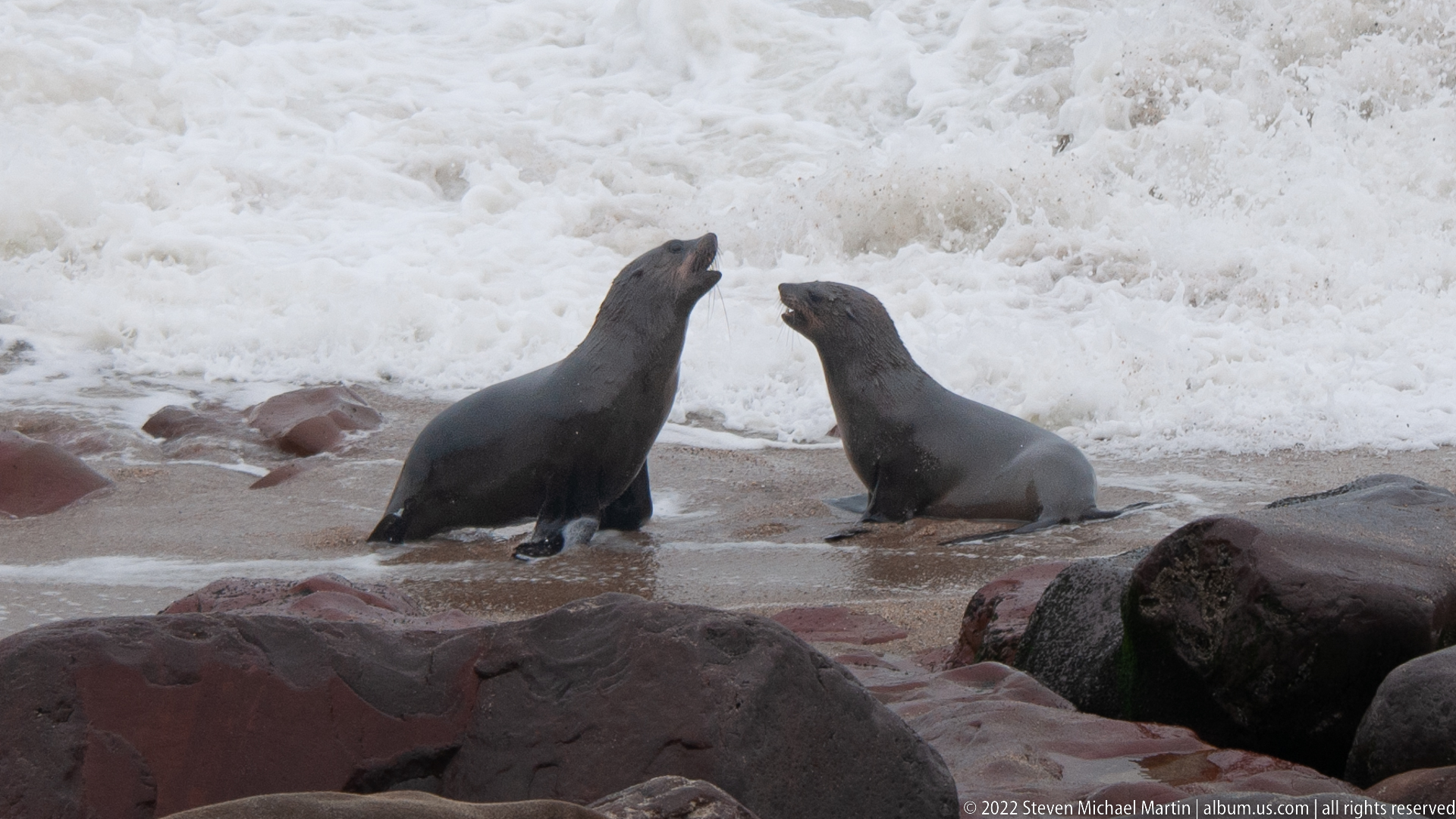
Two Cape fur seals rear up and face one another in the foaming surf at Cape Cross, using vocal and postural displays in the turbulent zone between the colony and the Atlantic Ocean.
Caption
Two Cape fur seals rear up and face one another in the foaming surf at Cape Cross, using vocal and postural displays in the turbulent zone between the colony and the Atlantic Ocean.
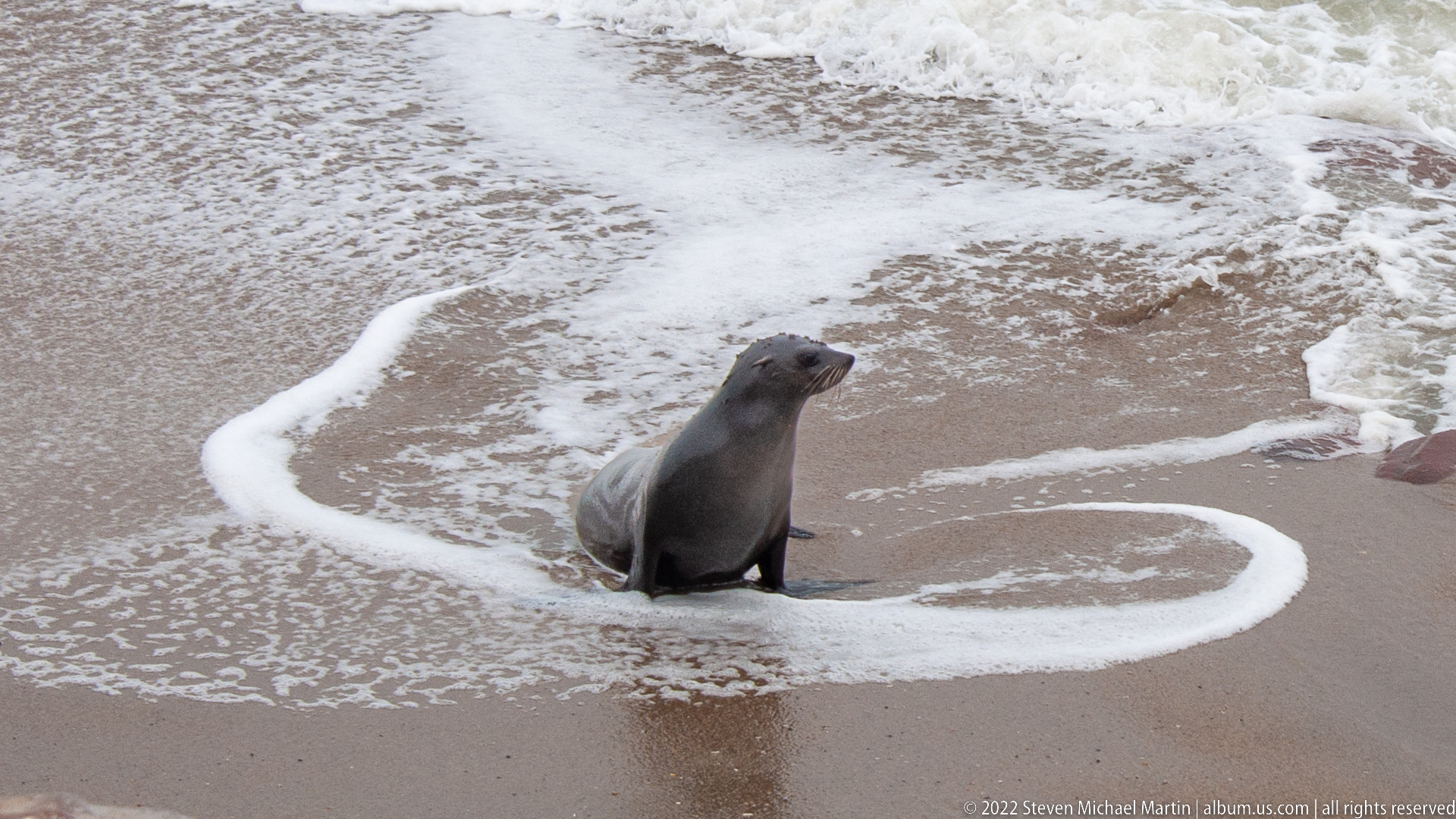
A Cape fur seal pauses upright in the swash zone at Cape Cross, its wet, dark coat framed by a near-circle of retreating sea foam on the Atlantic beach.
Caption
A Cape fur seal pauses upright in the swash zone at Cape Cross, its wet, dark coat framed by a near-circle of retreating sea foam on the Atlantic beach.
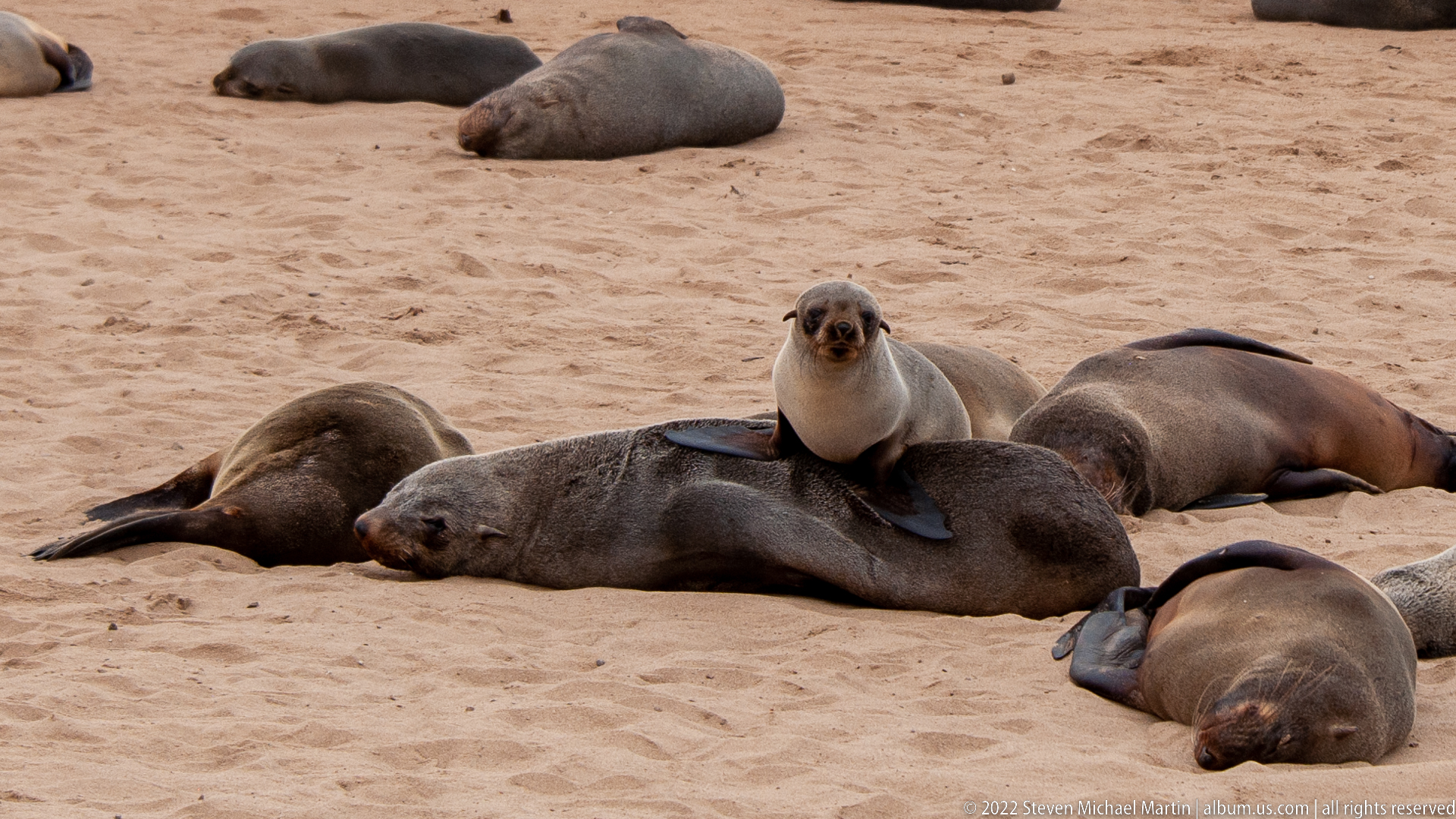
A juvenile Cape fur seal perches across the back of a resting adult amid the tightly packed colony at Cape Cross, Namibia, where close contact is unavoidable in the dense haul-out.
Caption
A juvenile Cape fur seal perches across the back of a resting adult amid the tightly packed colony at Cape Cross, Namibia, where close contact is unavoidable in the dense haul-out.

Two Cape fur seals sleep pressed together on a low rock ledge at Cape Cross, their contrasting reddish-brown and gray coats illustrating the natural color variation within the crowded colony.
Caption
Two Cape fur seals sleep pressed together on a low rock ledge at Cape Cross, their contrasting reddish-brown and gray coats illustrating the natural color variation within the crowded colony.
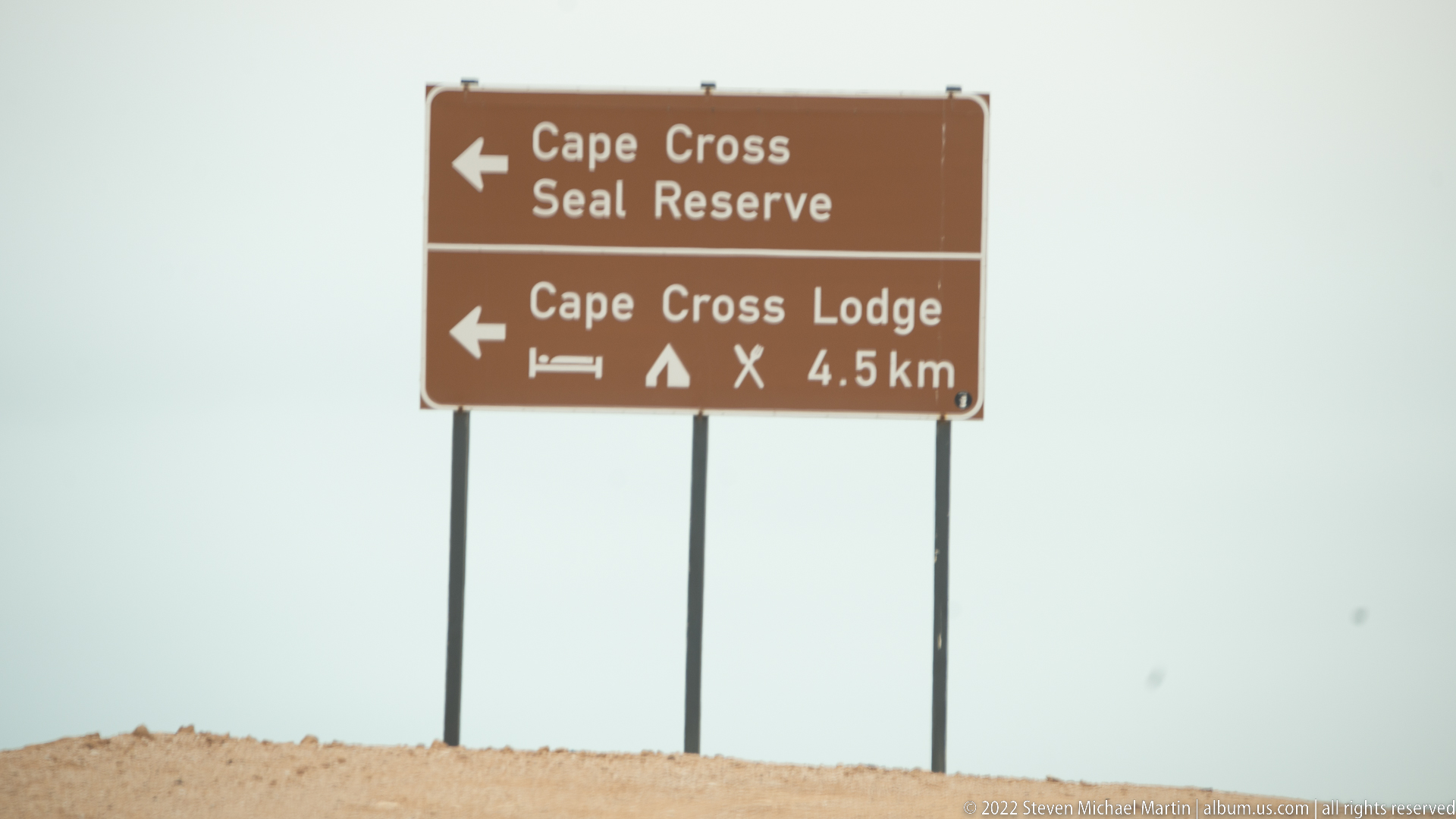
A brown tourism sign stands against a pale sky, directing travelers toward the Cape Cross Seal Reserve and indicating Cape Cross Lodge with camping facilities 4.5 kilometers away.
Caption
A brown tourism sign stands against a pale sky, directing travelers toward the Cape Cross Seal Reserve and indicating Cape Cross Lodge with camping facilities 4.5 kilometers away.
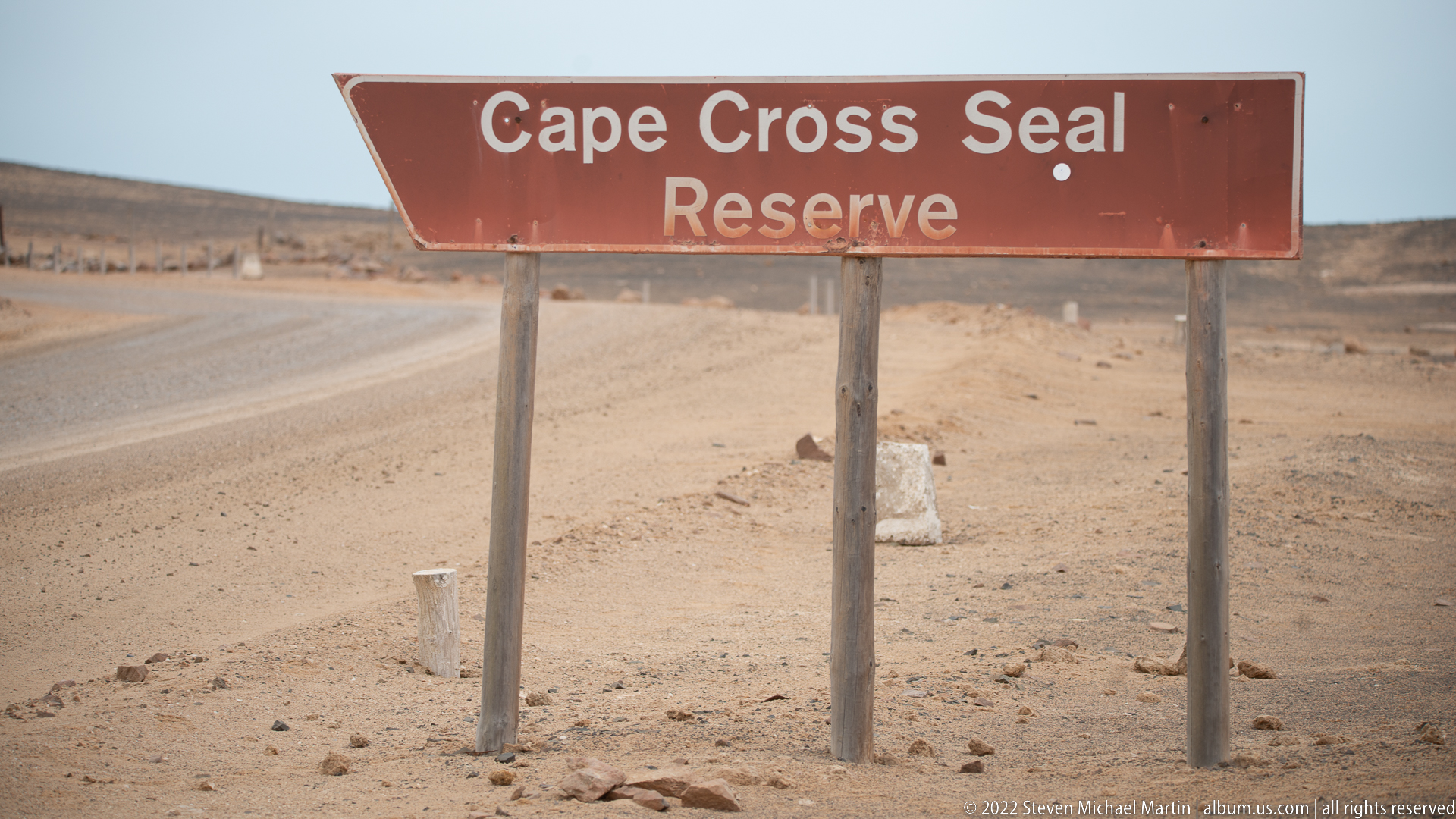
A weathered roadside sign for Cape Cross Seal Reserve stands beside a dusty desert road, marking the entrance area to this arid coastal zone in Namibia and bearing the scars of years of exposure to sun and sand.
Caption
A weathered roadside sign for Cape Cross Seal Reserve stands beside a dusty desert road, marking the entrance area to this arid coastal zone in Namibia and bearing the scars of years of exposure to sun and sand.
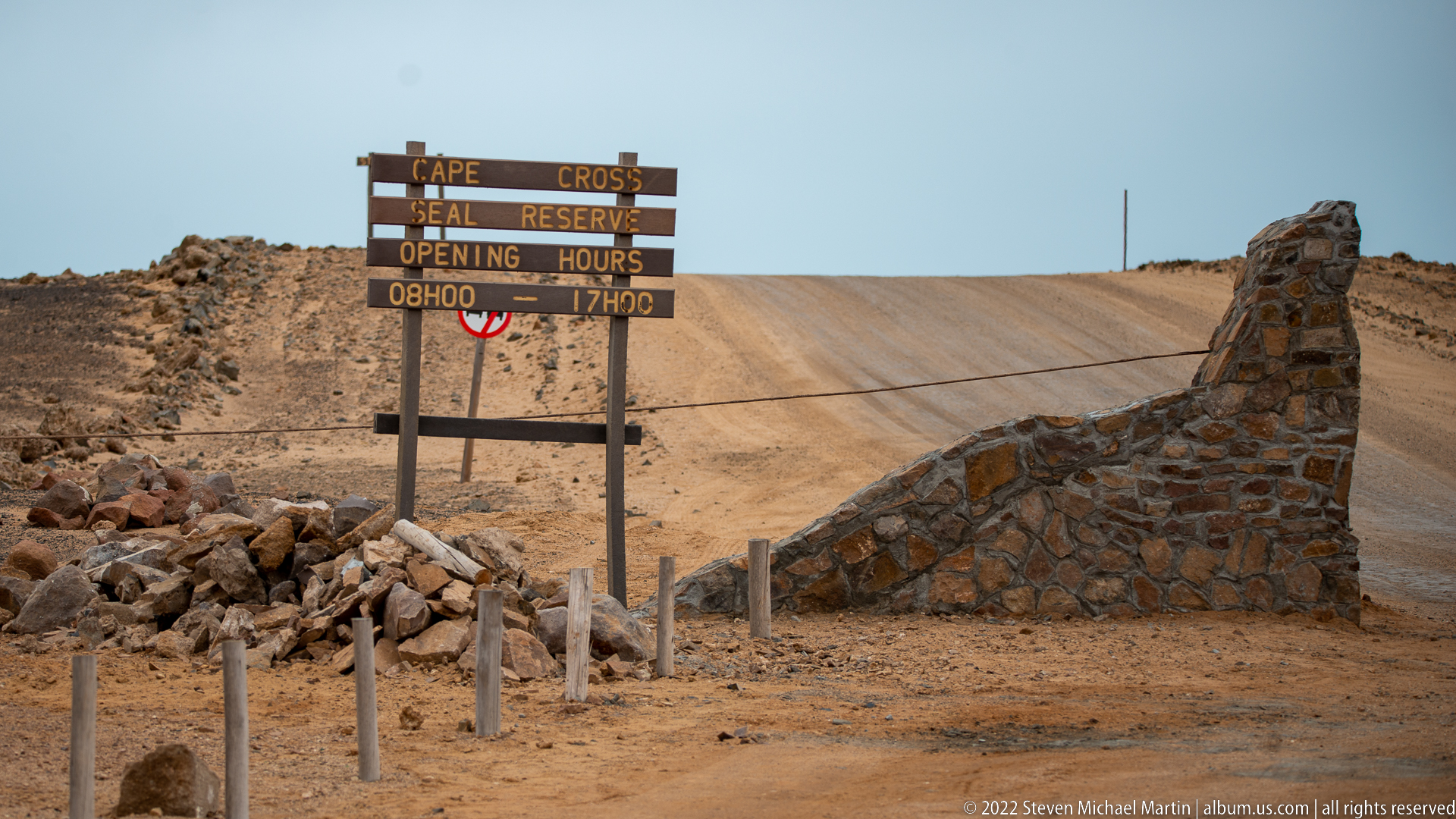
At the gated entrance to Cape Cross Seal Reserve in Namibia, a hand-painted wooden sign centered above the barrier lists daily visiting hours from 08H00 to 17H00.
Caption
At the gated entrance to Cape Cross Seal Reserve in Namibia, a hand-painted wooden sign centered above the barrier lists daily visiting hours from 08H00 to 17H00.
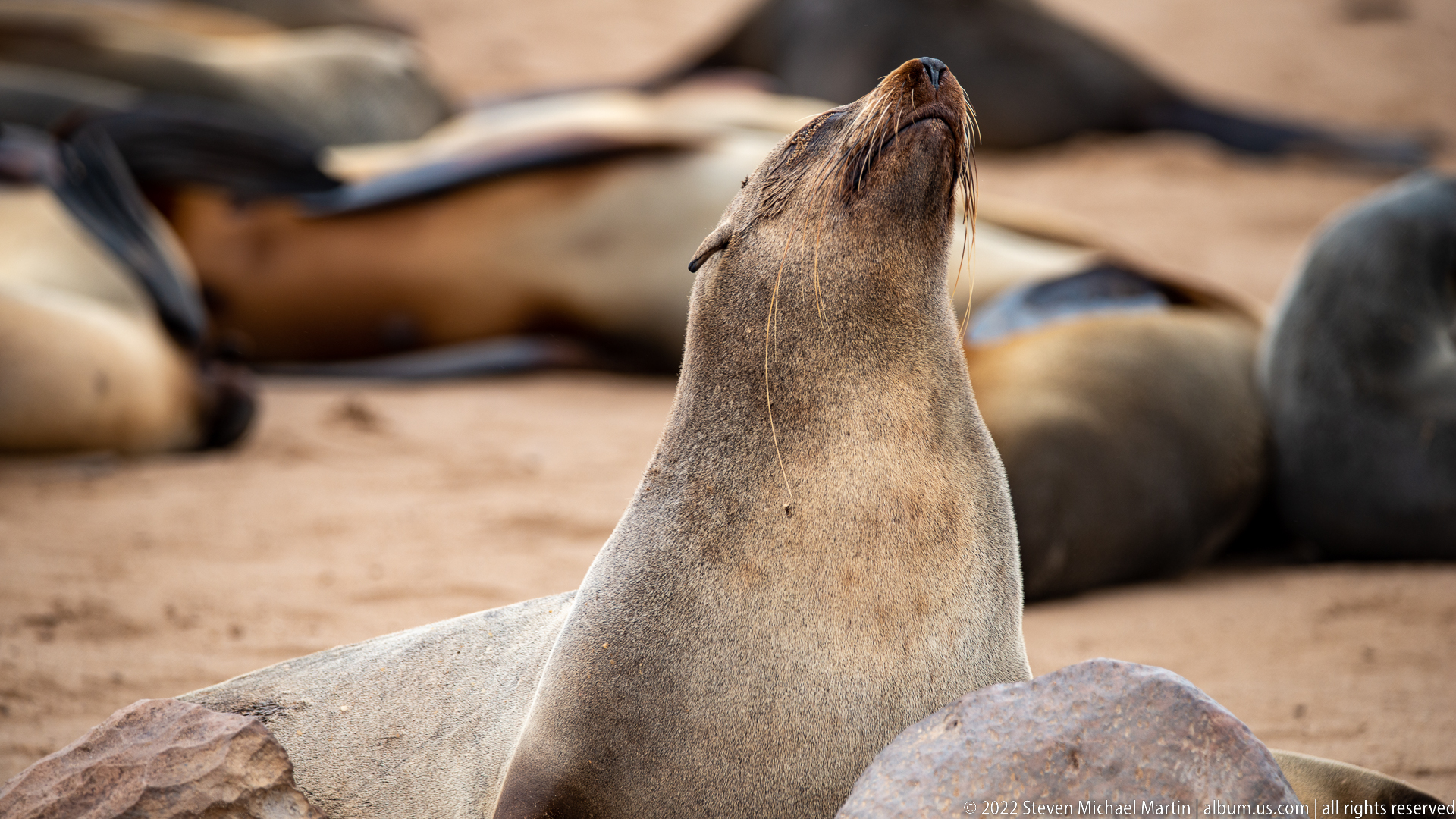
At Cape Cross, a Cape fur seal stretches its long neck and whiskered muzzle upward in an alert, scenting posture, its small external ear marking it as an eared seal against a blur of resting animals and rock.
Caption
At Cape Cross, a Cape fur seal stretches its long neck and whiskered muzzle upward in an alert, scenting posture, its small external ear marking it as an eared seal against a blur of resting animals and rock.
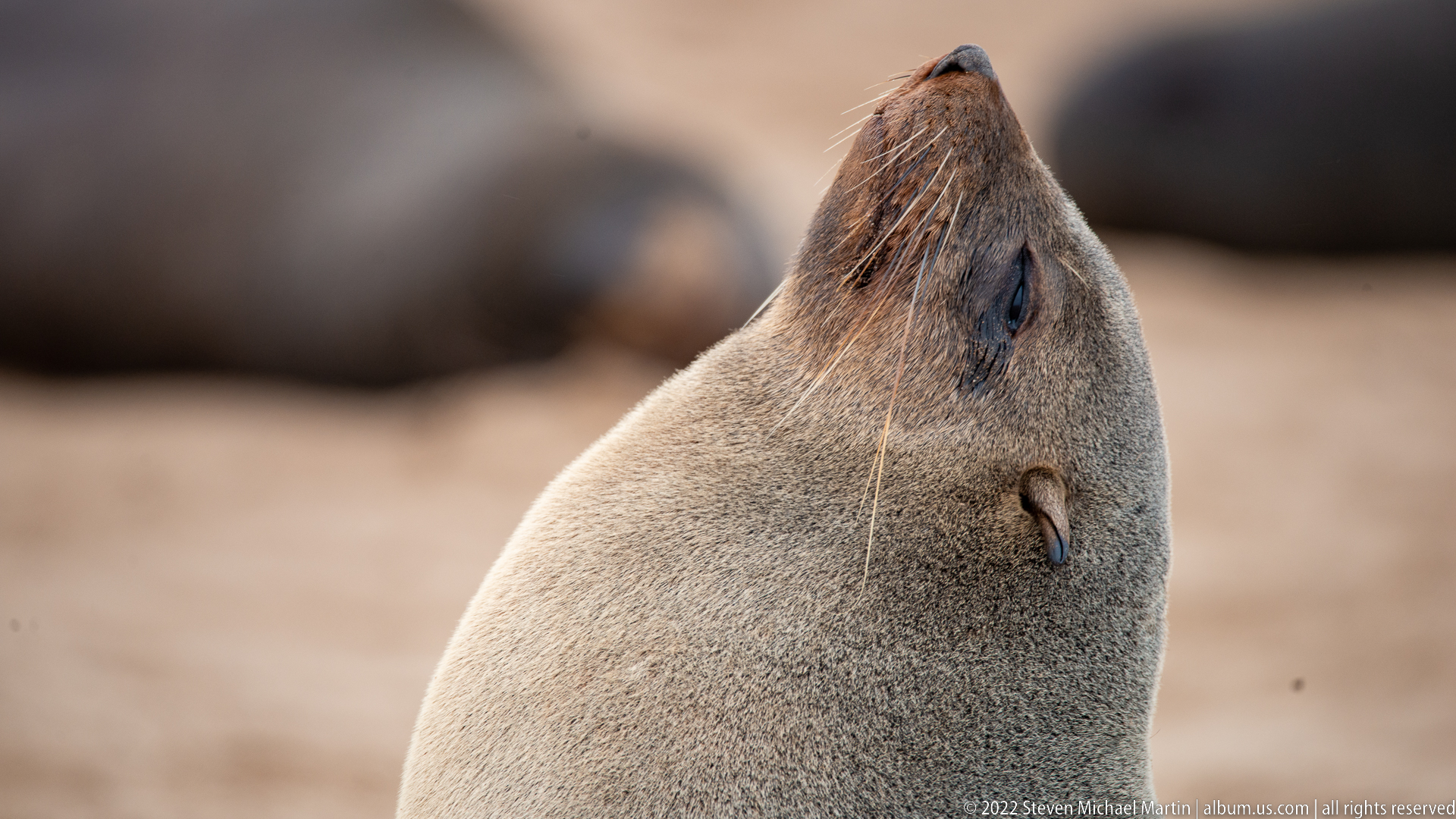
In a tight close-up at Cape Cross, a Cape fur seal lifts its muzzle, revealing the small external ear that distinguishes it from true seals and the long vibrissae that serve as vital tactile sensors.
Caption
In a tight close-up at Cape Cross, a Cape fur seal lifts its muzzle, revealing the small external ear that distinguishes it from true seals and the long vibrissae that serve as vital tactile sensors.
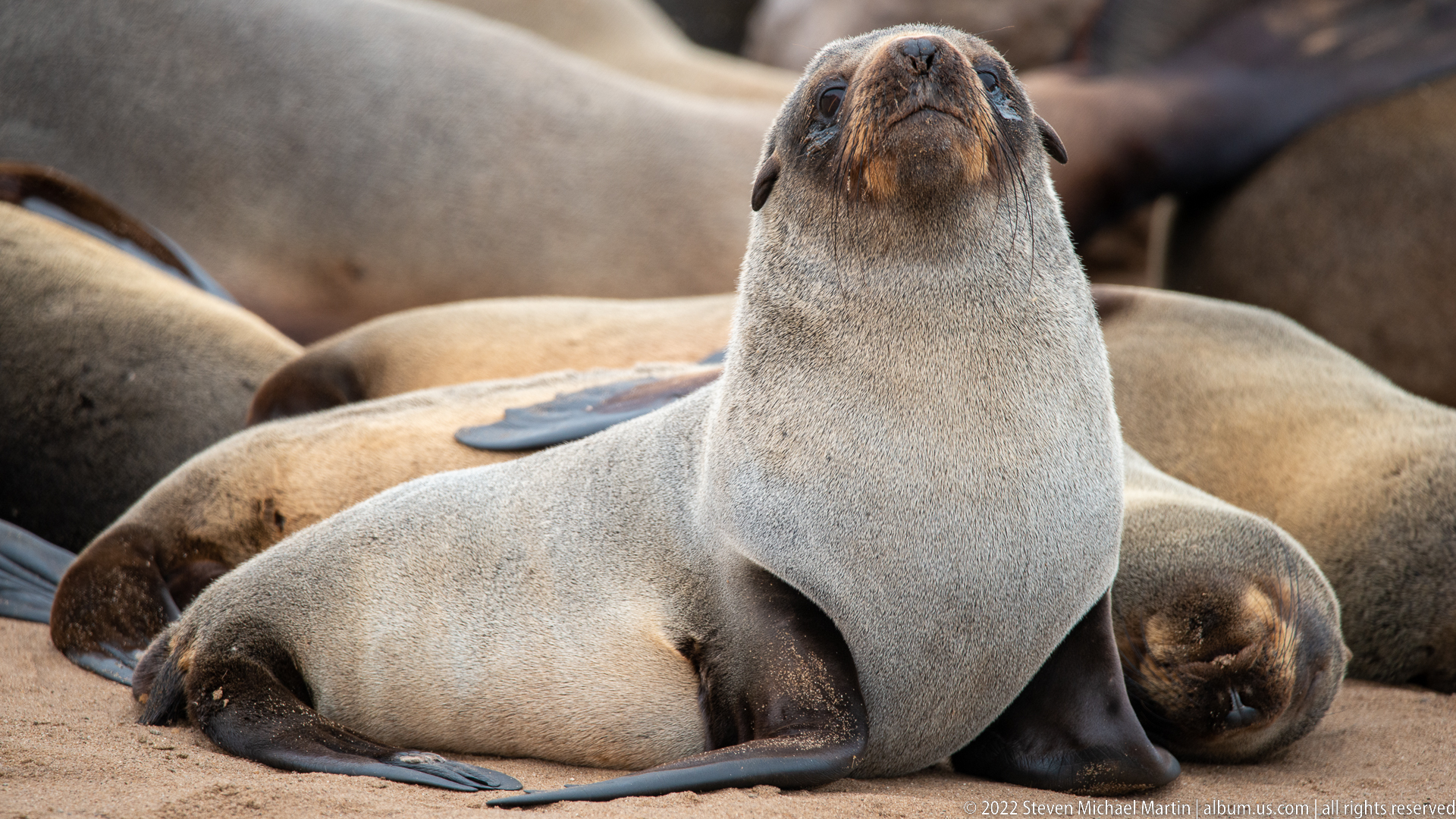
An upright Cape fur seal at Cape Cross, Namibia props itself on its foreflippers amid a dense colony of reclining, sleeping seals, illustrating how some individuals rest alert while others doze around them.
Caption
An upright Cape fur seal at Cape Cross, Namibia props itself on its foreflippers amid a dense colony of reclining, sleeping seals, illustrating how some individuals rest alert while others doze around them.
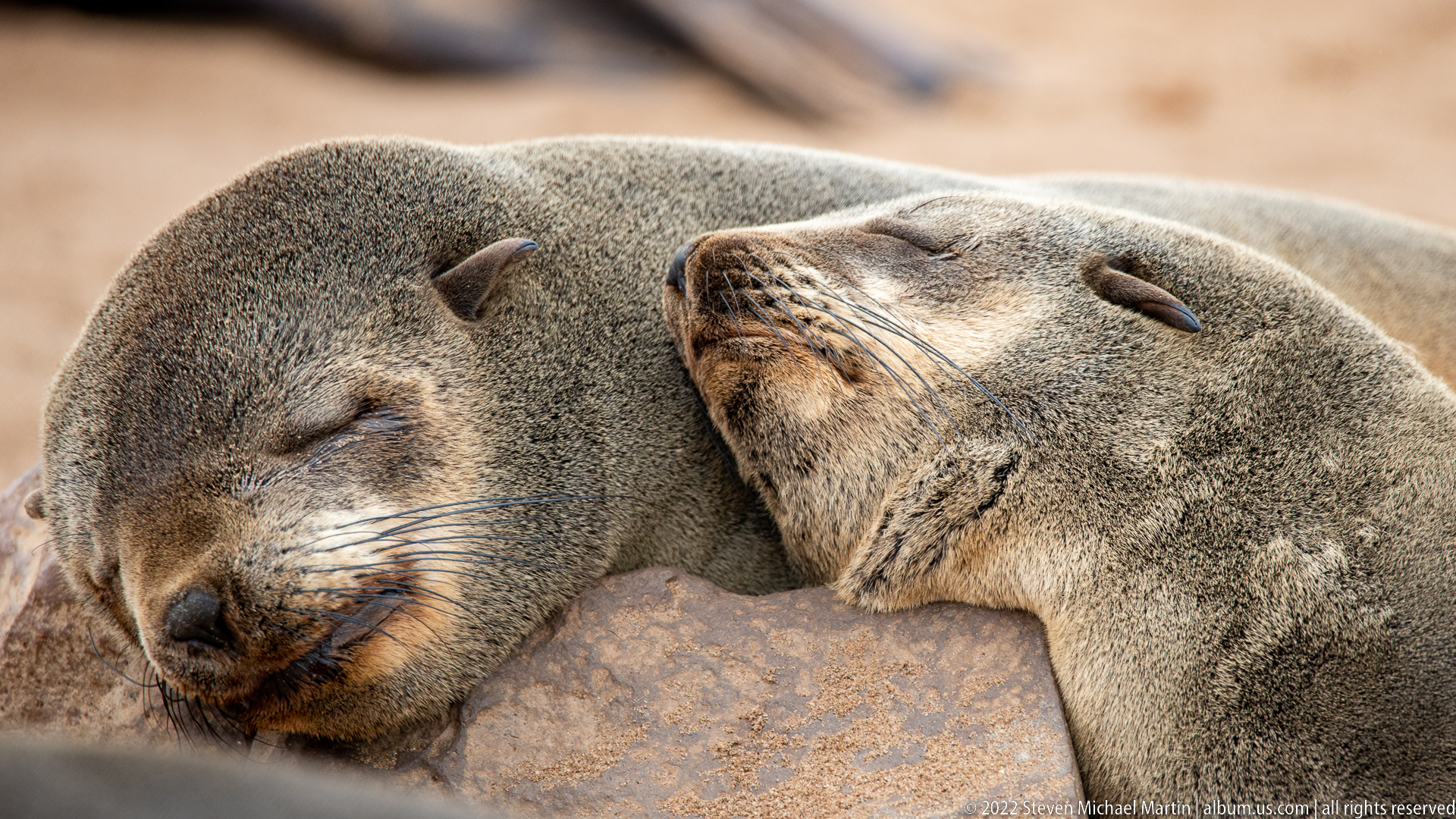
Two Cape fur seals sleep nose-to-neck on a flat rock at Cape Cross, their overlapping heads and closed eyes revealing the dense fur, whiskers, and dark noses typical of the colony’s close-contact resting behavior.
Caption
Two Cape fur seals sleep nose-to-neck on a flat rock at Cape Cross, their overlapping heads and closed eyes revealing the dense fur, whiskers, and dark noses typical of the colony’s close-contact resting behavior.
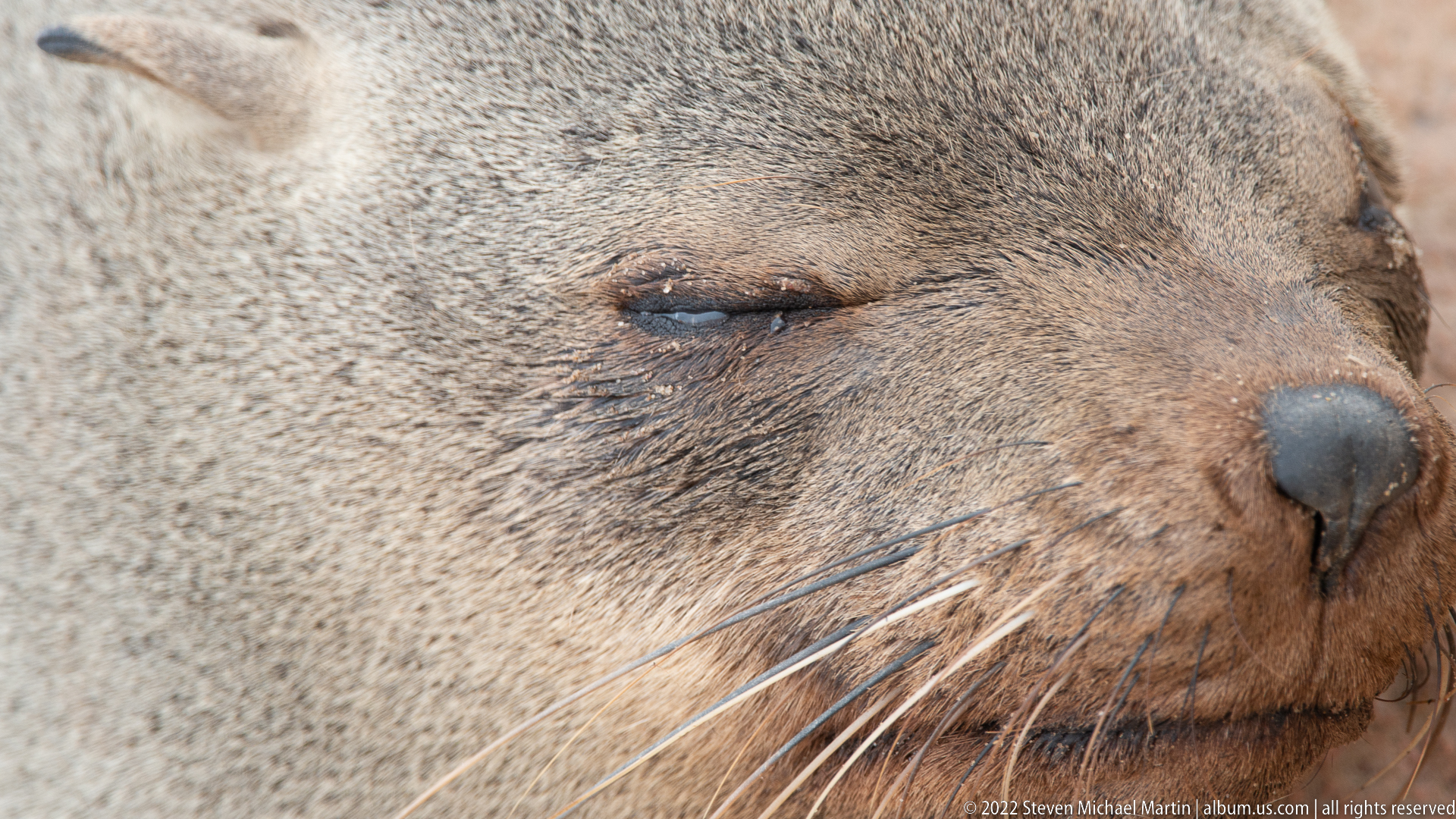
An extreme close-up of a resting Cape fur seal’s closed eye reveals dense insulating fur and long vibrissae that provide sensitive tactile information in water and on land.
Caption
An extreme close-up of a resting Cape fur seal’s closed eye reveals dense insulating fur and long vibrissae that provide sensitive tactile information in water and on land.
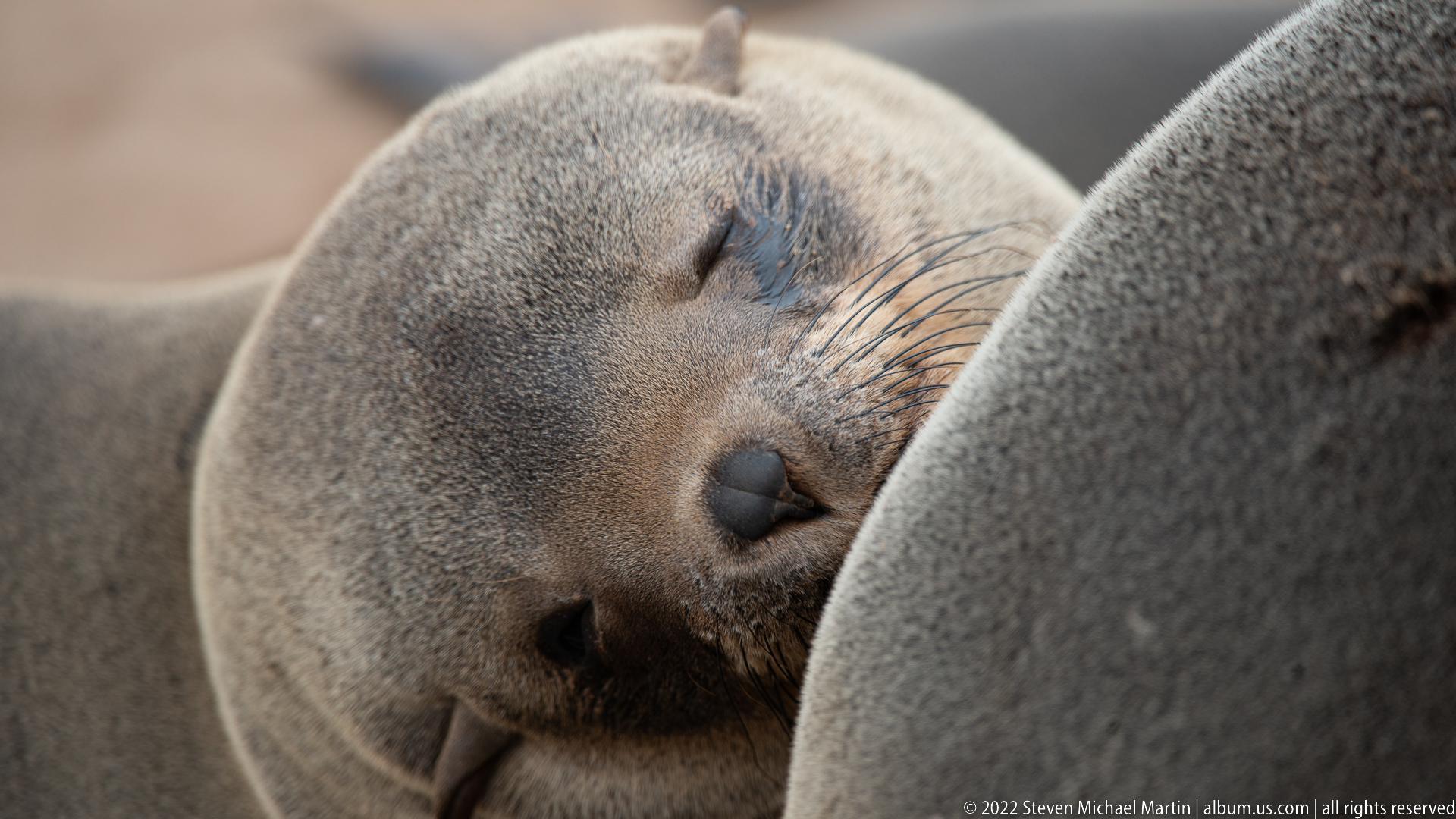
A young-looking Cape fur seal sleeps with its round face nestled against the body of a neighboring seal, reflecting how close-packed resting in the Cape Cross colony leaves little space and creates constant gentle contact.
Caption
A young-looking Cape fur seal sleeps with its round face nestled against the body of a neighboring seal, reflecting how close-packed resting in the Cape Cross colony leaves little space and creates constant gentle contact.
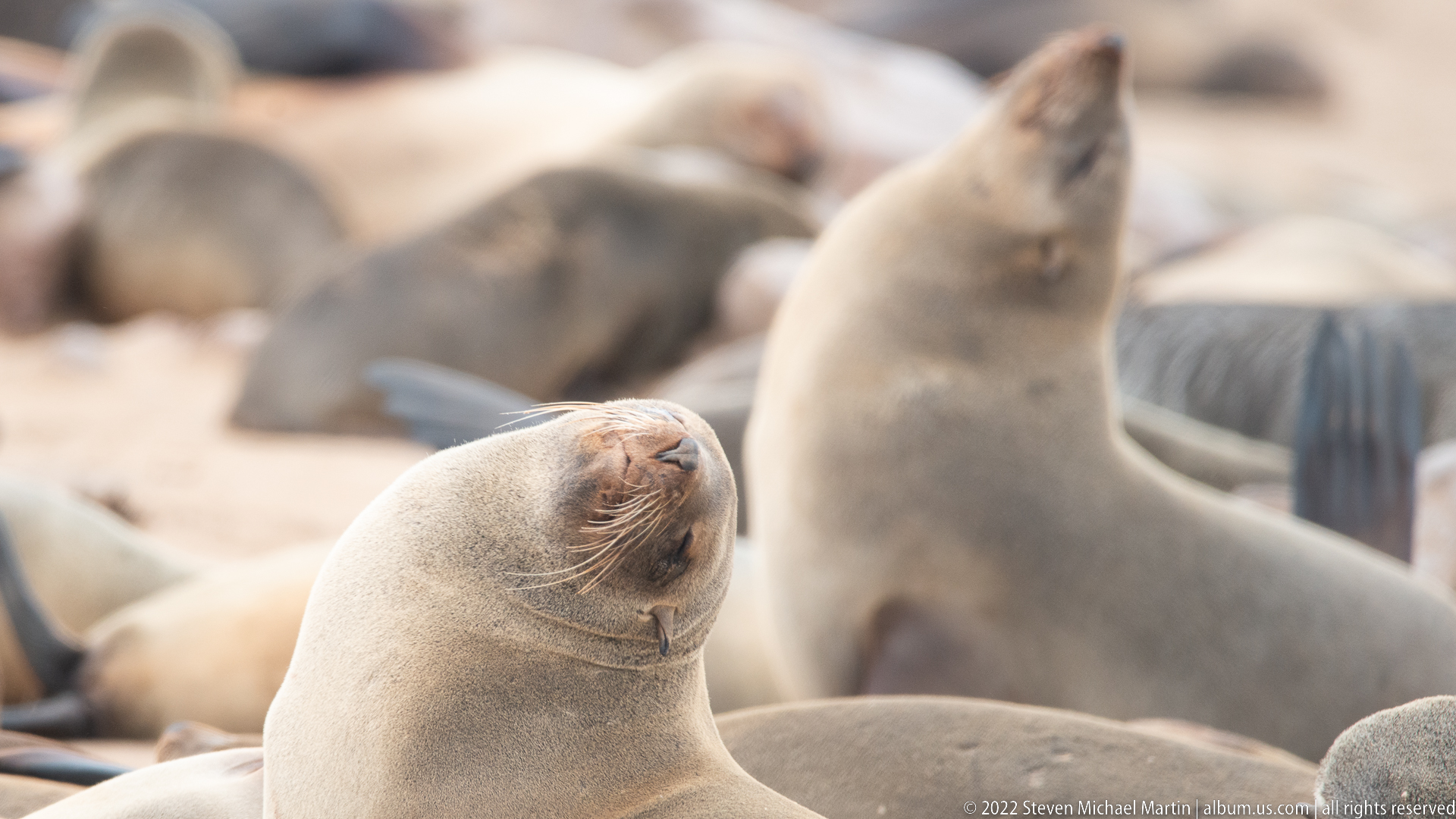
Two Cape fur seals at Cape Cross, Namibia, mirror each other’s raised-muzzle posture, a gesture that may accompany scanning, scenting, or vocal activity and hints at the colony’s constant alertness and communication.
Caption
Two Cape fur seals at Cape Cross, Namibia, mirror each other’s raised-muzzle posture, a gesture that may accompany scanning, scenting, or vocal activity and hints at the colony’s constant alertness and communication.
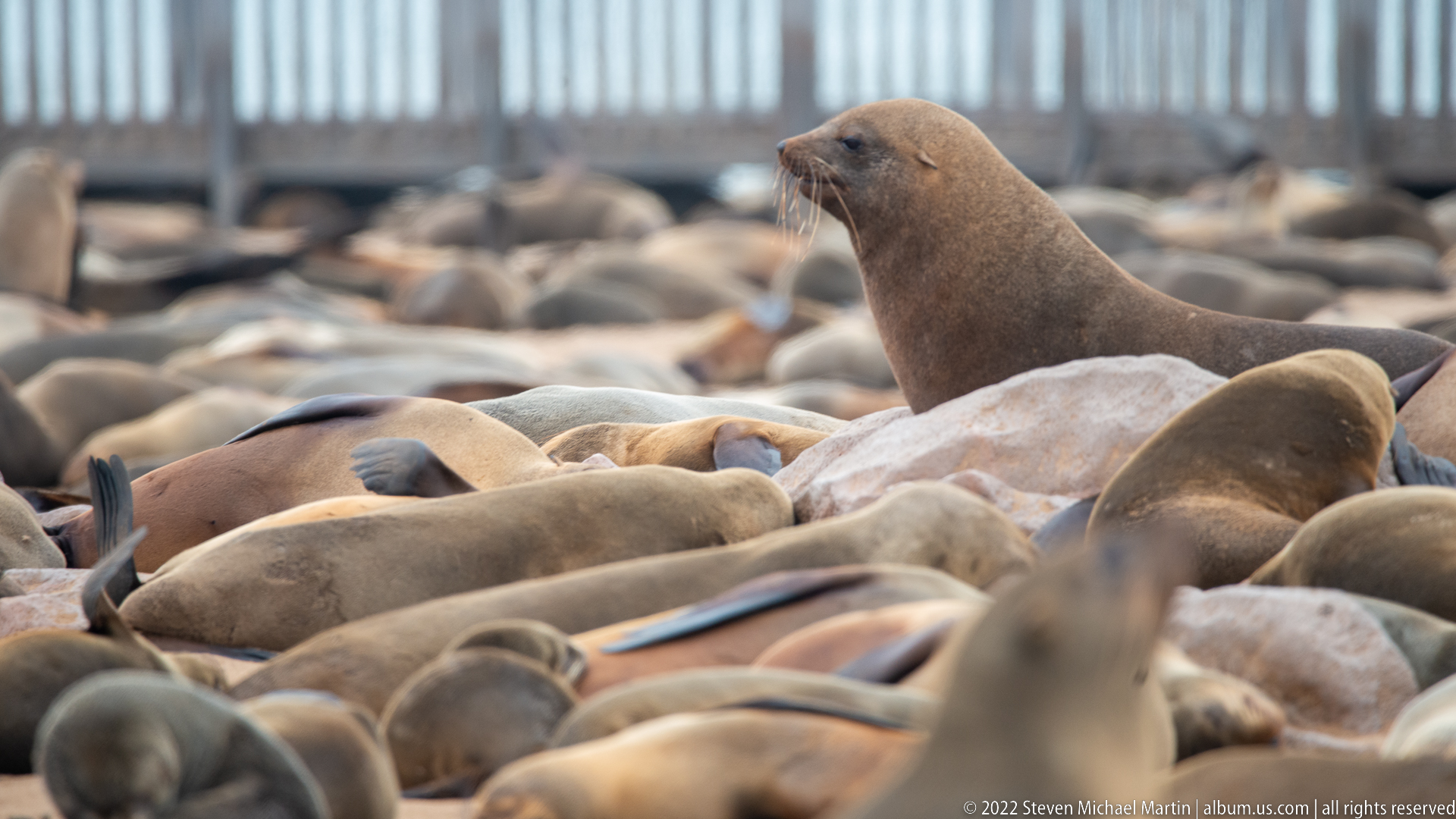
At Cape Cross, a warm brown adult Cape fur seal rises upright above a dense carpet of resting colony members, its elevated posture keeping it visible amid the crowd beneath the distant blur of the visitor boardwalk.
Caption
At Cape Cross, a warm brown adult Cape fur seal rises upright above a dense carpet of resting colony members, its elevated posture keeping it visible amid the crowd beneath the distant blur of the visitor boardwalk.
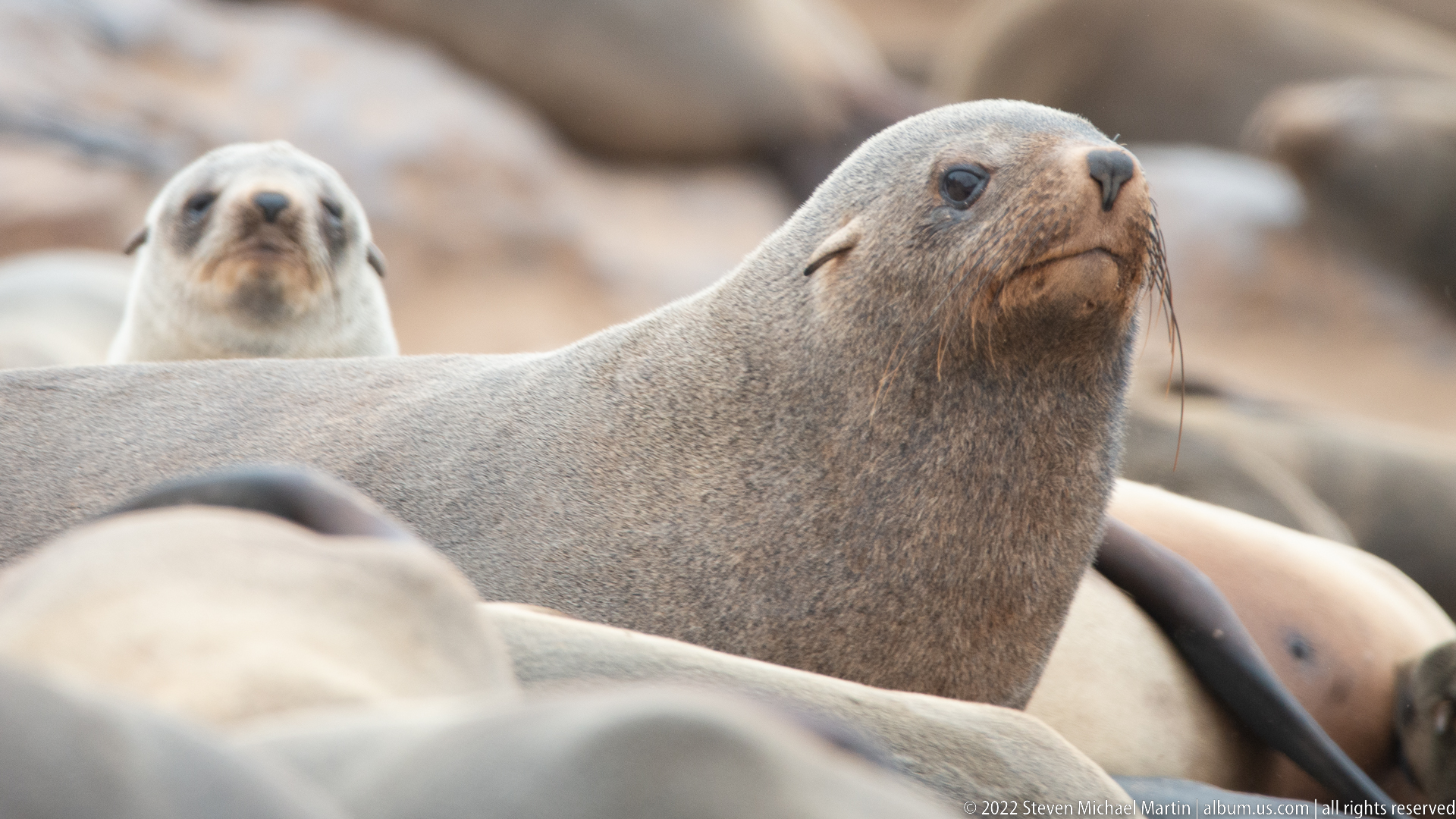
Head lifted in quiet vigilance, a Cape fur seal gazes upward in profile at Cape Cross, its external ear and long vibrissae picked out against the blurred forms of the surrounding colony.
Caption
Head lifted in quiet vigilance, a Cape fur seal gazes upward in profile at Cape Cross, its external ear and long vibrissae picked out against the blurred forms of the surrounding colony.
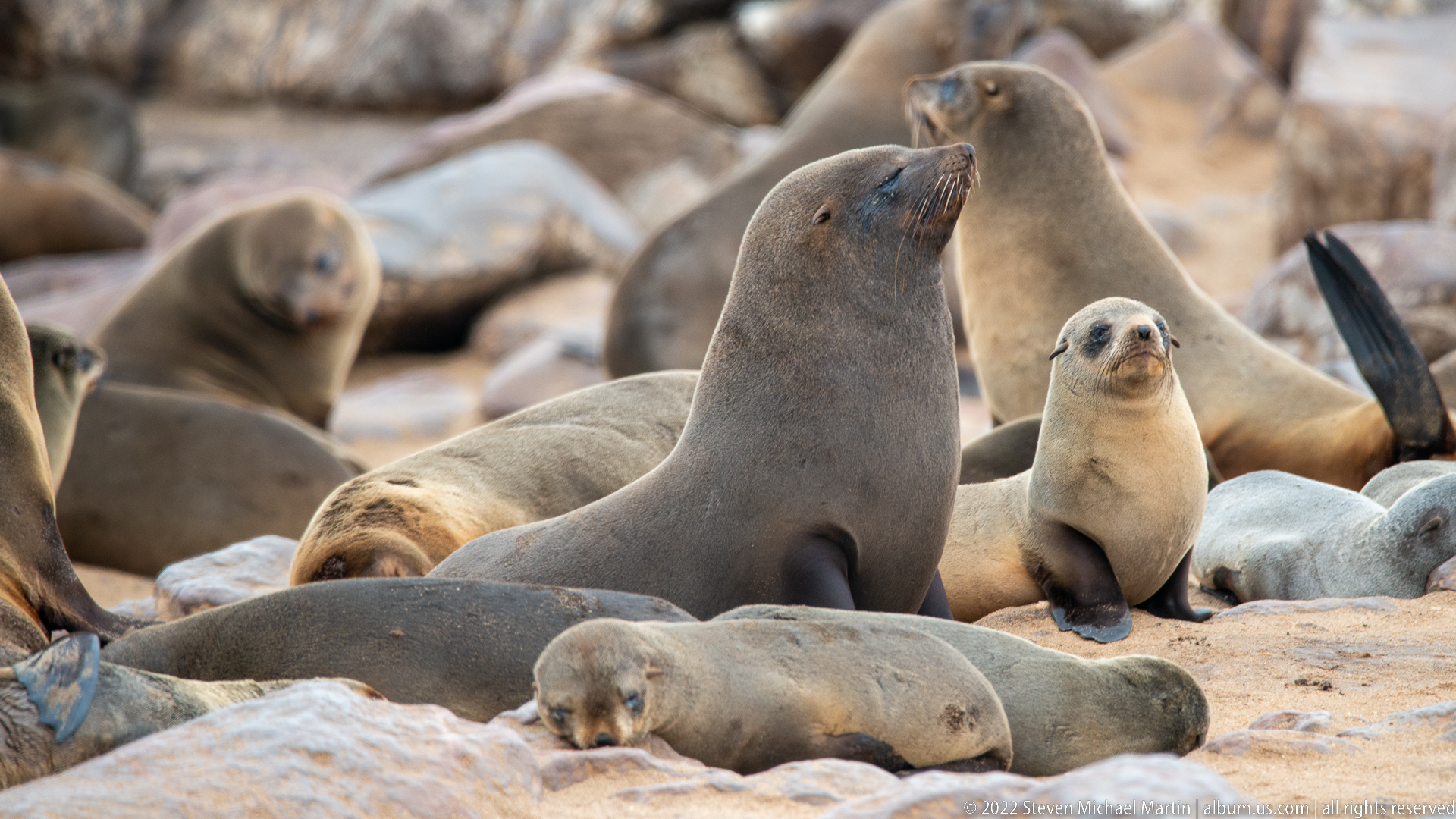
At Cape Cross in Namibia, a mixed-age group of Cape fur seals crowds together on sand and pale rocks, with a small, light-colored young seal nestled among the larger adults.
Caption
At Cape Cross in Namibia, a mixed-age group of Cape fur seals crowds together on sand and pale rocks, with a small, light-colored young seal nestled among the larger adults.
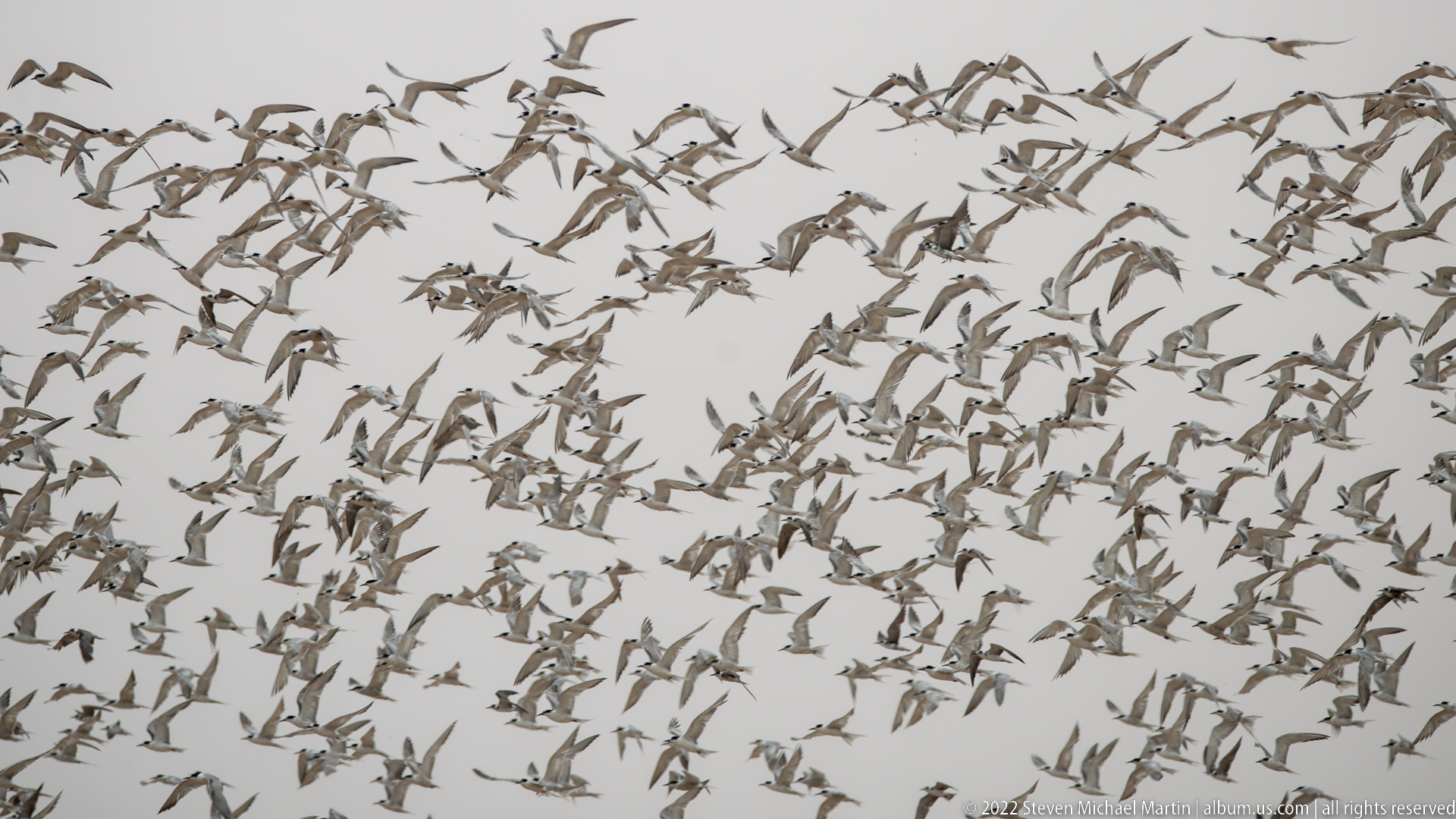
A dense airborne flock of small-to-medium coastal seabirds forms an all-over pattern of wings against a pale sky above the productive waters off Namibia’s Cape Cross coast, though their distance prevents species-level identification.
Caption
A dense airborne flock of small-to-medium coastal seabirds forms an all-over pattern of wings against a pale sky above the productive waters off Namibia’s Cape Cross coast, though their distance prevents species-level identification.
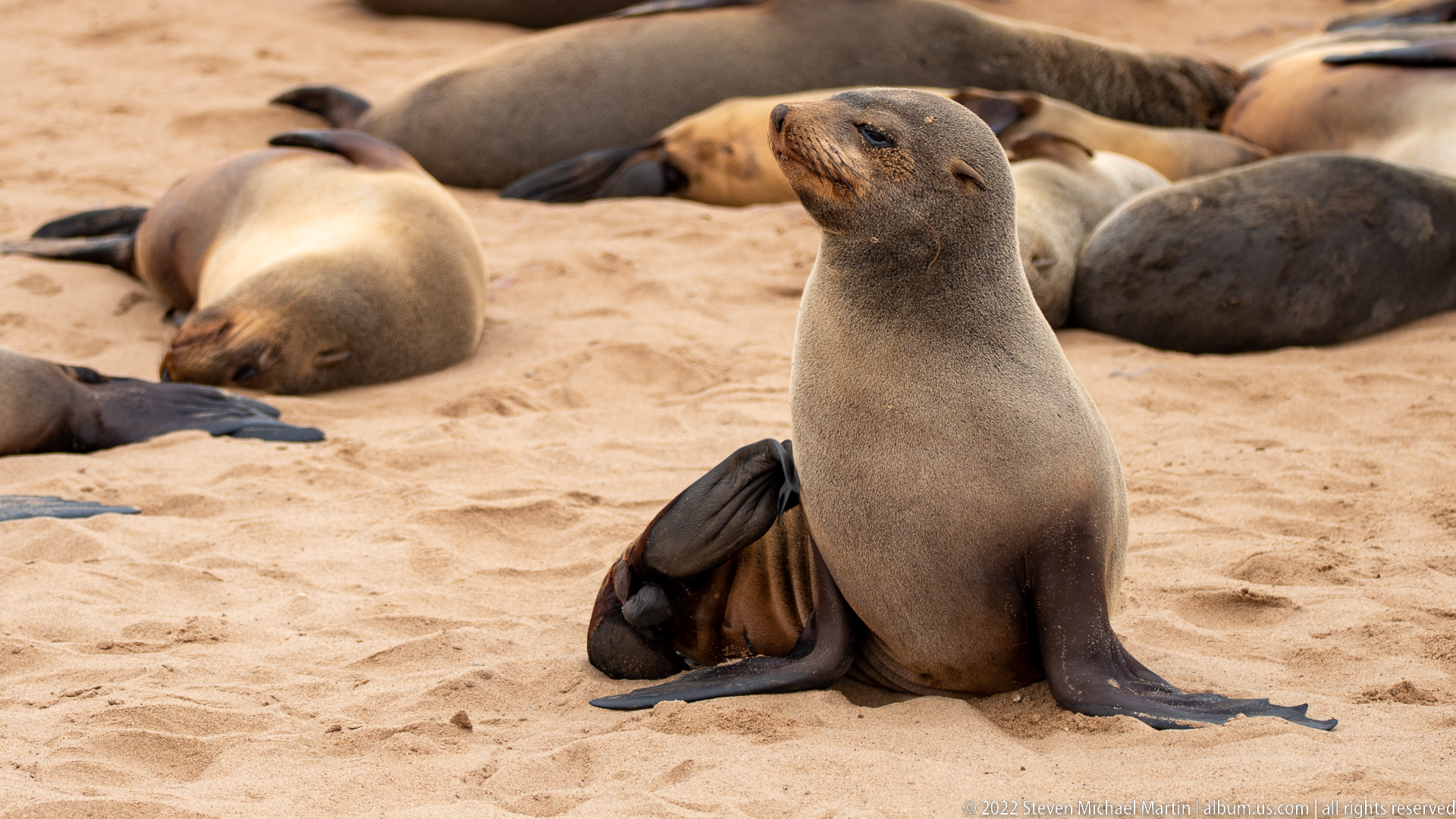
At Cape Cross in Namibia, a large gray-brown Cape fur seal shelters a very small, dark-coated pup on the open sand, emphasizing the striking contrast in size and newborn coat within the breeding colony.
Caption
At Cape Cross in Namibia, a large gray-brown Cape fur seal shelters a very small, dark-coated pup on the open sand, emphasizing the striking contrast in size and newborn coat within the breeding colony.
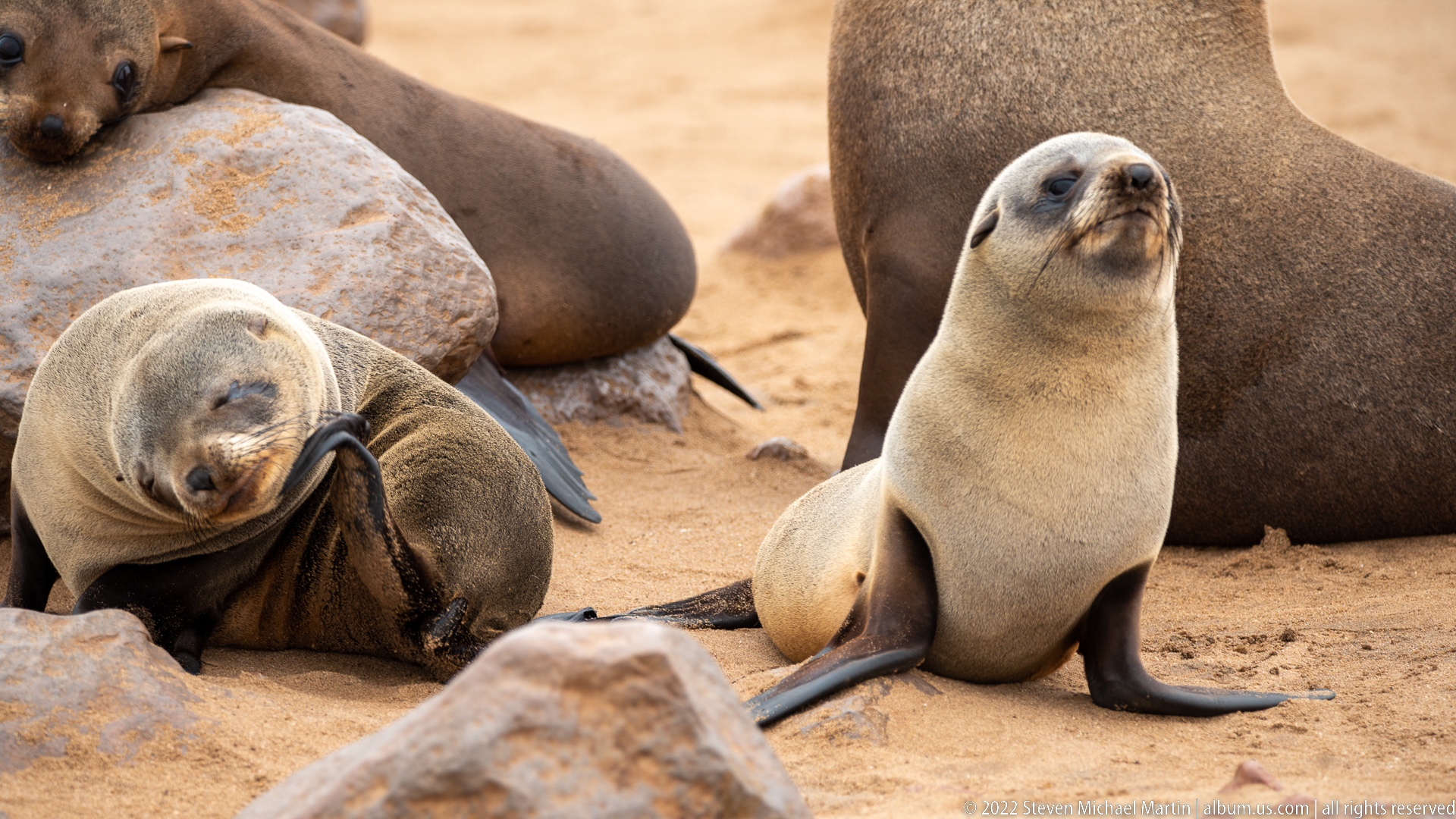
A pale juvenile Cape fur seal sits upright among larger, darker colony members at Cape Cross, its small dry-coated body standing out against the surrounding adults on sand and rock.
Caption
A pale juvenile Cape fur seal sits upright among larger, darker colony members at Cape Cross, its small dry-coated body standing out against the surrounding adults on sand and rock.
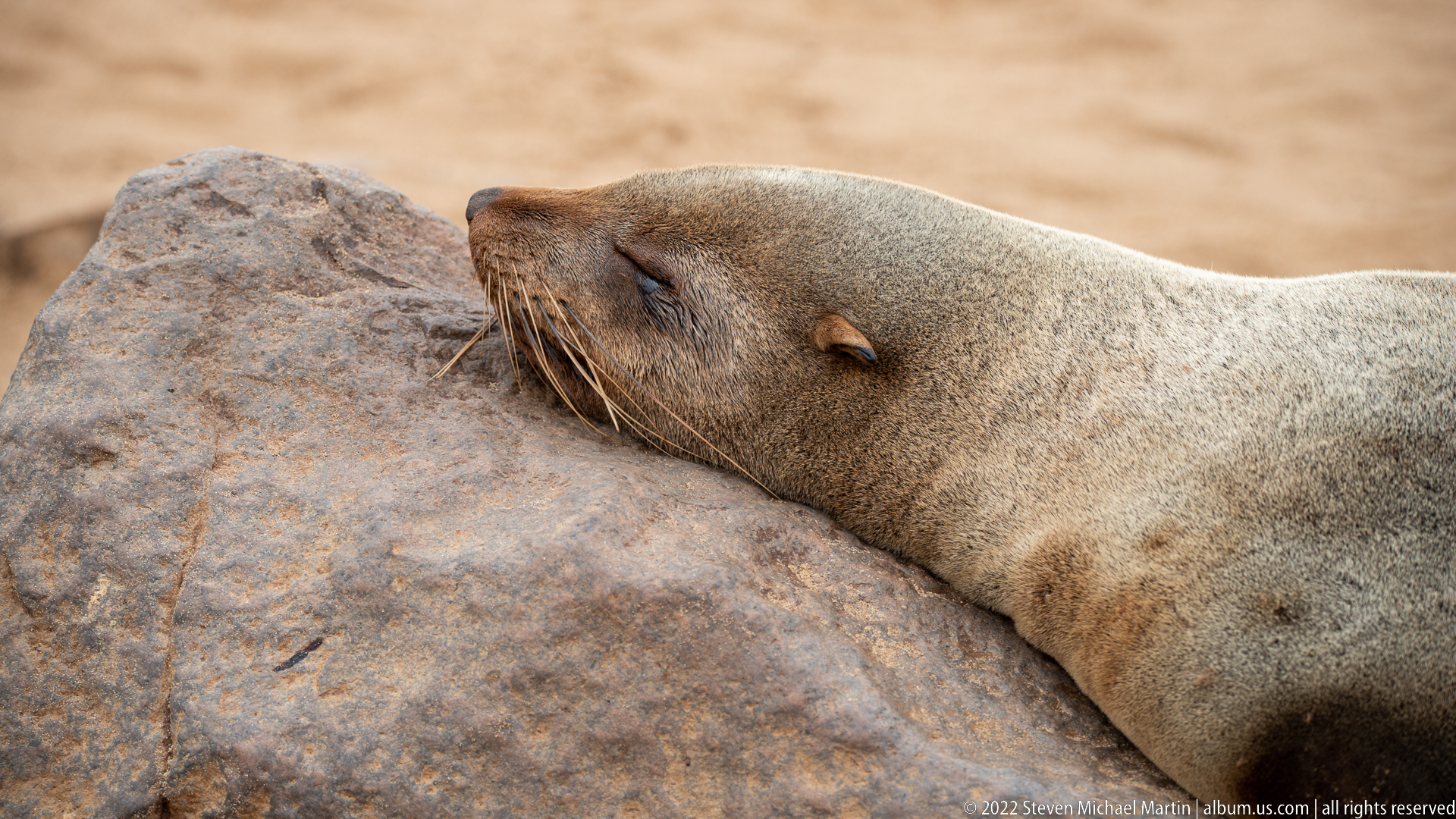
A Cape fur seal sleeps ashore at Cape Cross, its head pillowed on a sun‑warmed rock that offers a firm, elevated resting place between trips to sea.
Caption
A Cape fur seal sleeps ashore at Cape Cross, its head pillowed on a sun‑warmed rock that offers a firm, elevated resting place between trips to sea.
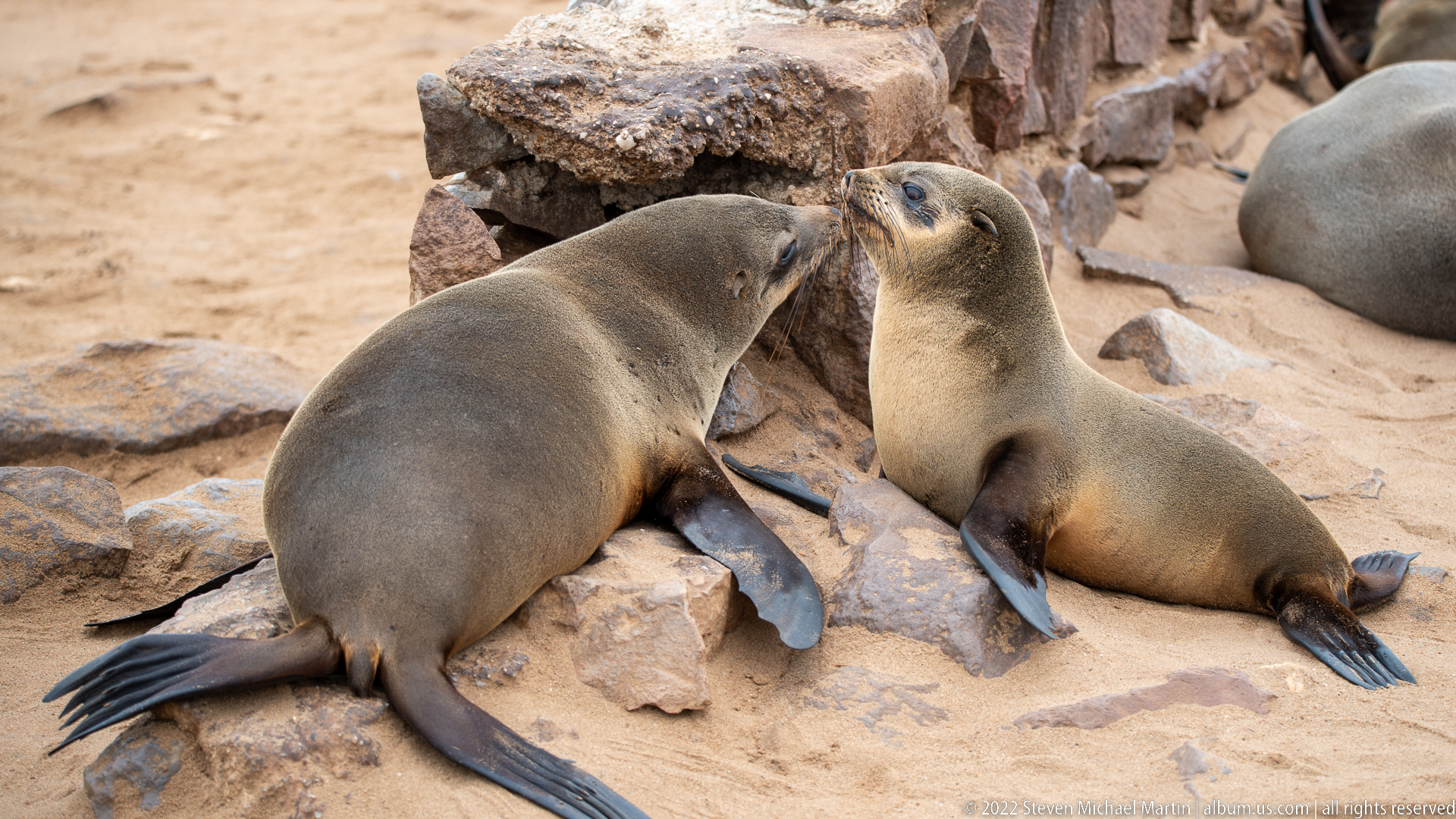
Two young Cape fur seals mirror each other on the rocky beach at Cape Cross, their muzzles touching in a close contact that may be exploratory, social, or olfactory—one of many brief encounters in the crowded nursery areas.
Caption
Two young Cape fur seals mirror each other on the rocky beach at Cape Cross, their muzzles touching in a close contact that may be exploratory, social, or olfactory—one of many brief encounters in the crowded nursery areas.
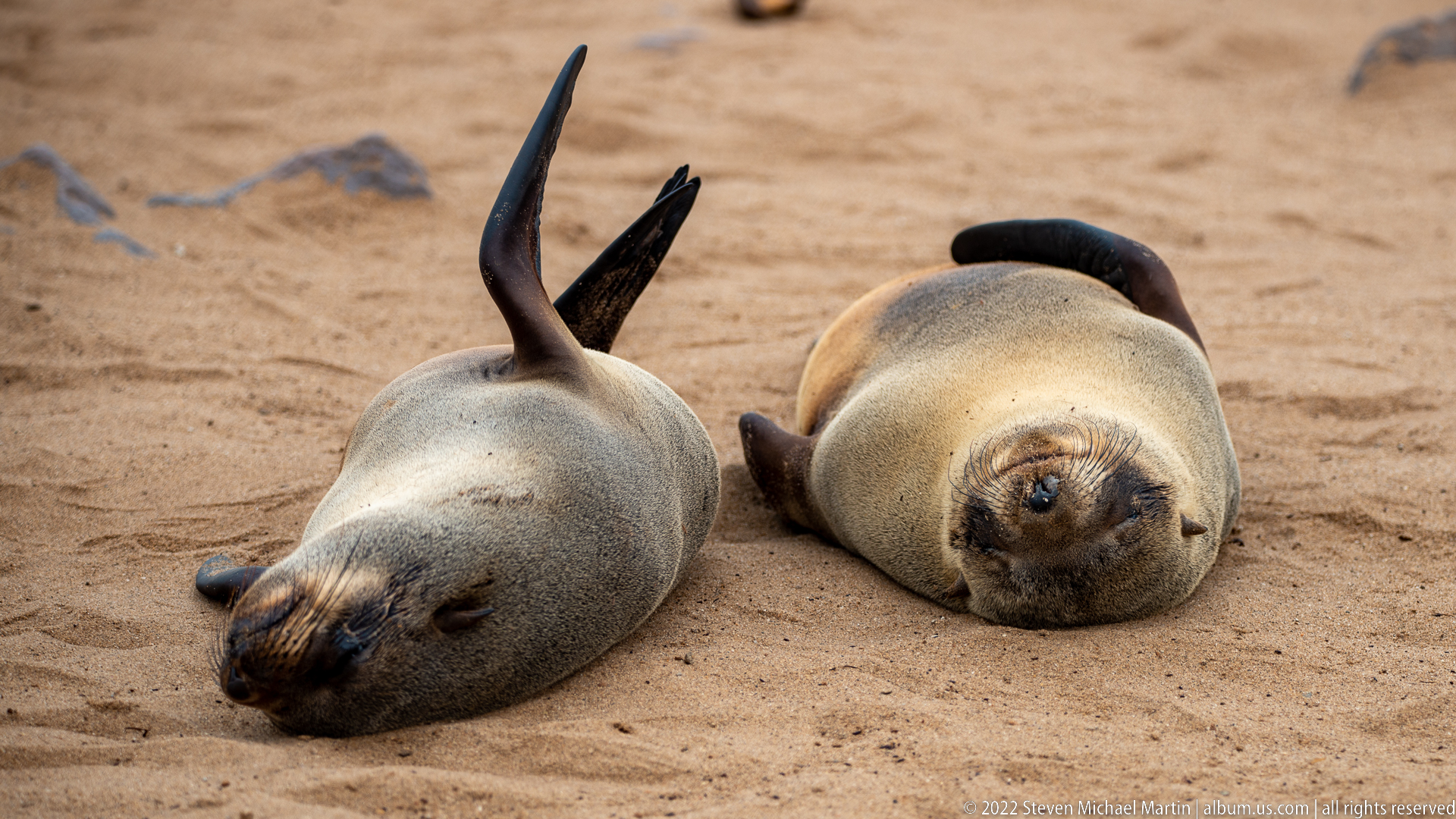
Side by side on the smooth sand at Cape Cross, a pair of Cape fur seals reclines belly-up, one raising its hind flippers in a posture that may aid stretching or thermoregulation, though its purpose is uncertain.
Caption
Side by side on the smooth sand at Cape Cross, a pair of Cape fur seals reclines belly-up, one raising its hind flippers in a posture that may aid stretching or thermoregulation, though its purpose is uncertain.
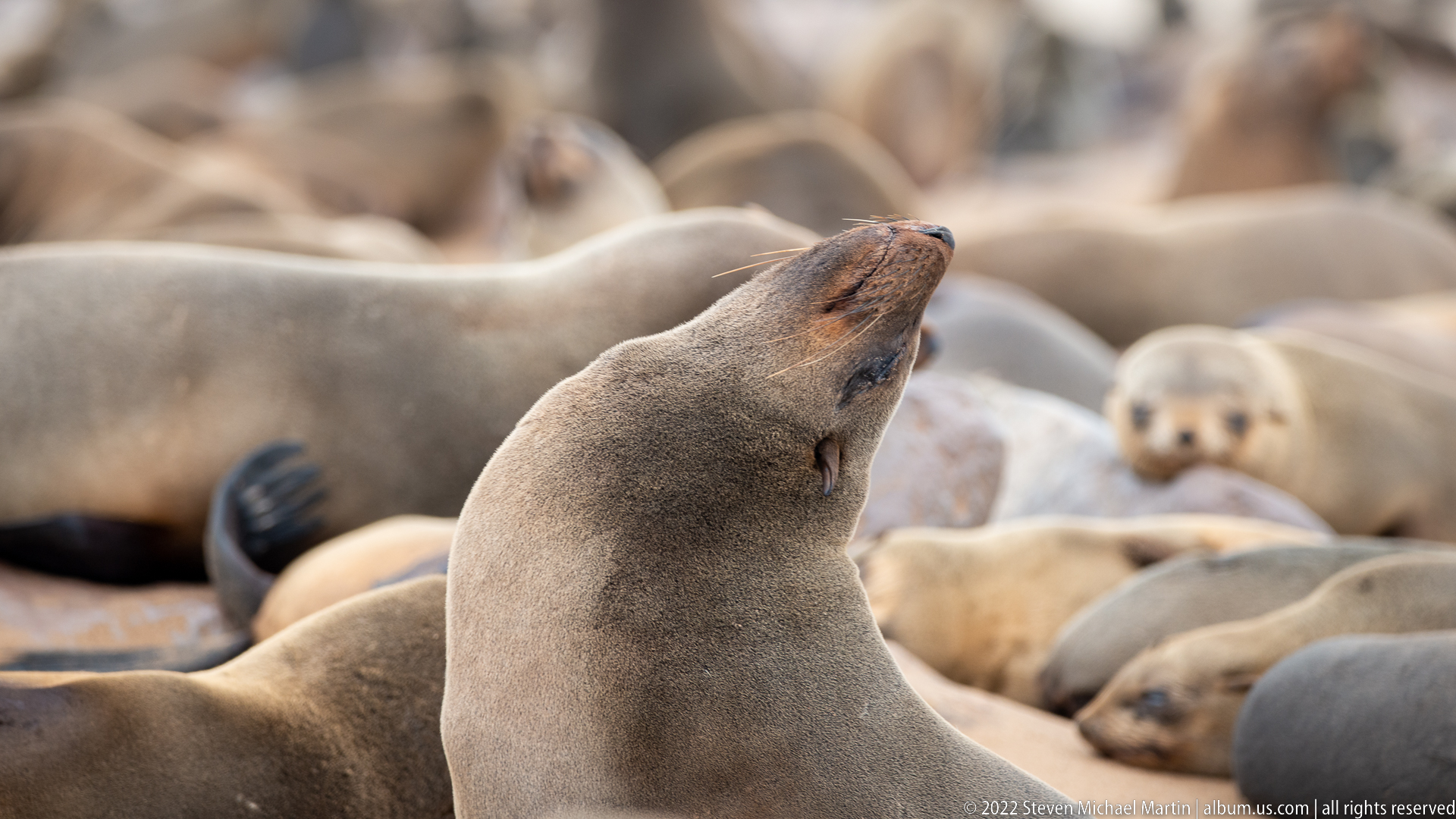
A Cape fur seal at Cape Cross stretches its neck and lifts its muzzle high, a raised-head posture that may accompany scenting, vocalizing, or simple stretching, while the close view highlights classic eared-seal anatomy and long vibrissae against a softly blurred colony.
Caption
A Cape fur seal at Cape Cross stretches its neck and lifts its muzzle high, a raised-head posture that may accompany scenting, vocalizing, or simple stretching, while the close view highlights classic eared-seal anatomy and long vibrissae against a softly blurred colony.
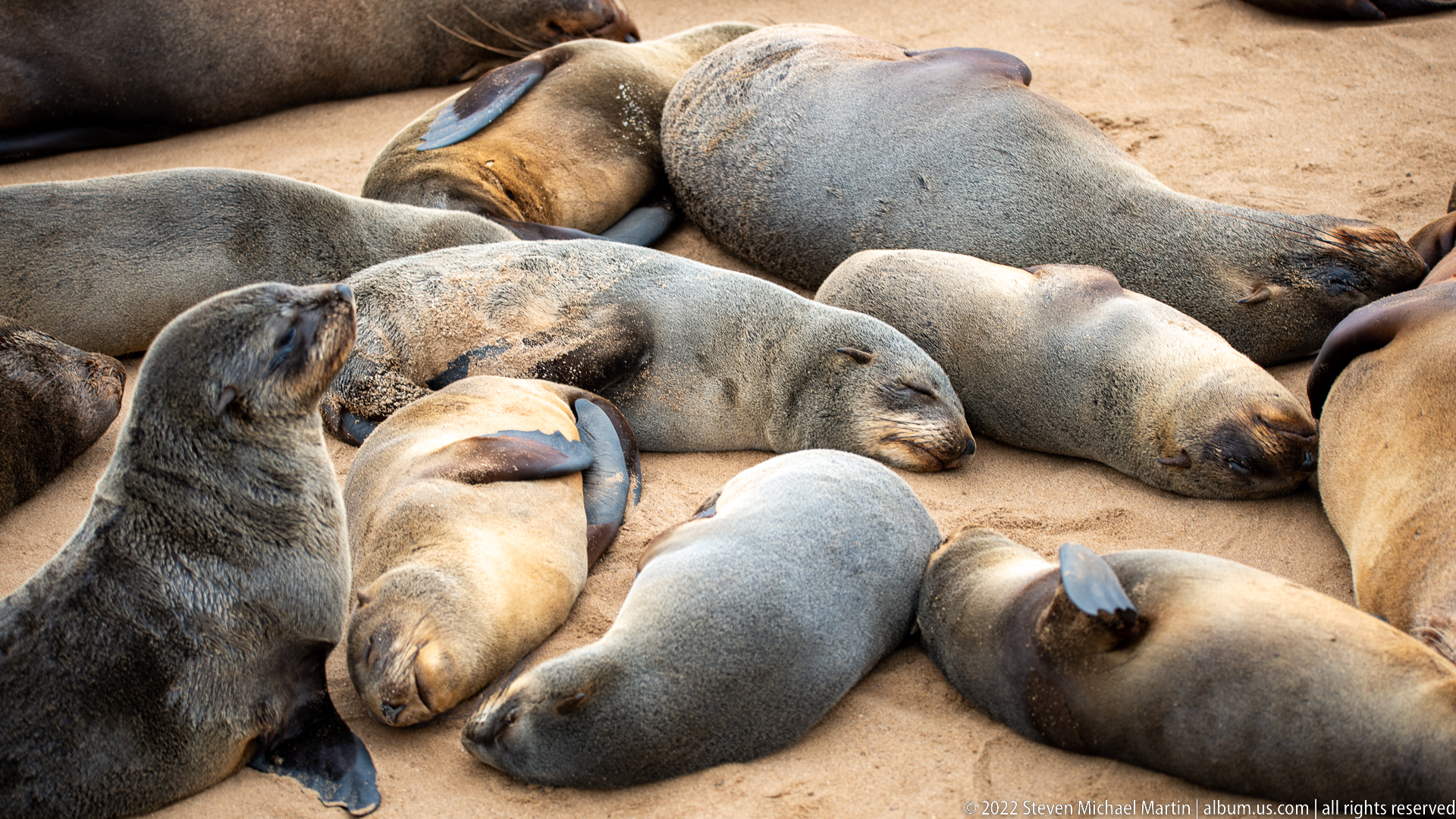
A tightly packed cluster of Cape fur seals sleeps on the sand at Cape Cross, Namibia, their overlapping bodies forming a dense pattern of curves and coat colors that hint at differences in age, sex, wetness, molt, and light.
Caption
A tightly packed cluster of Cape fur seals sleeps on the sand at Cape Cross, Namibia, their overlapping bodies forming a dense pattern of curves and coat colors that hint at differences in age, sex, wetness, molt, and light.
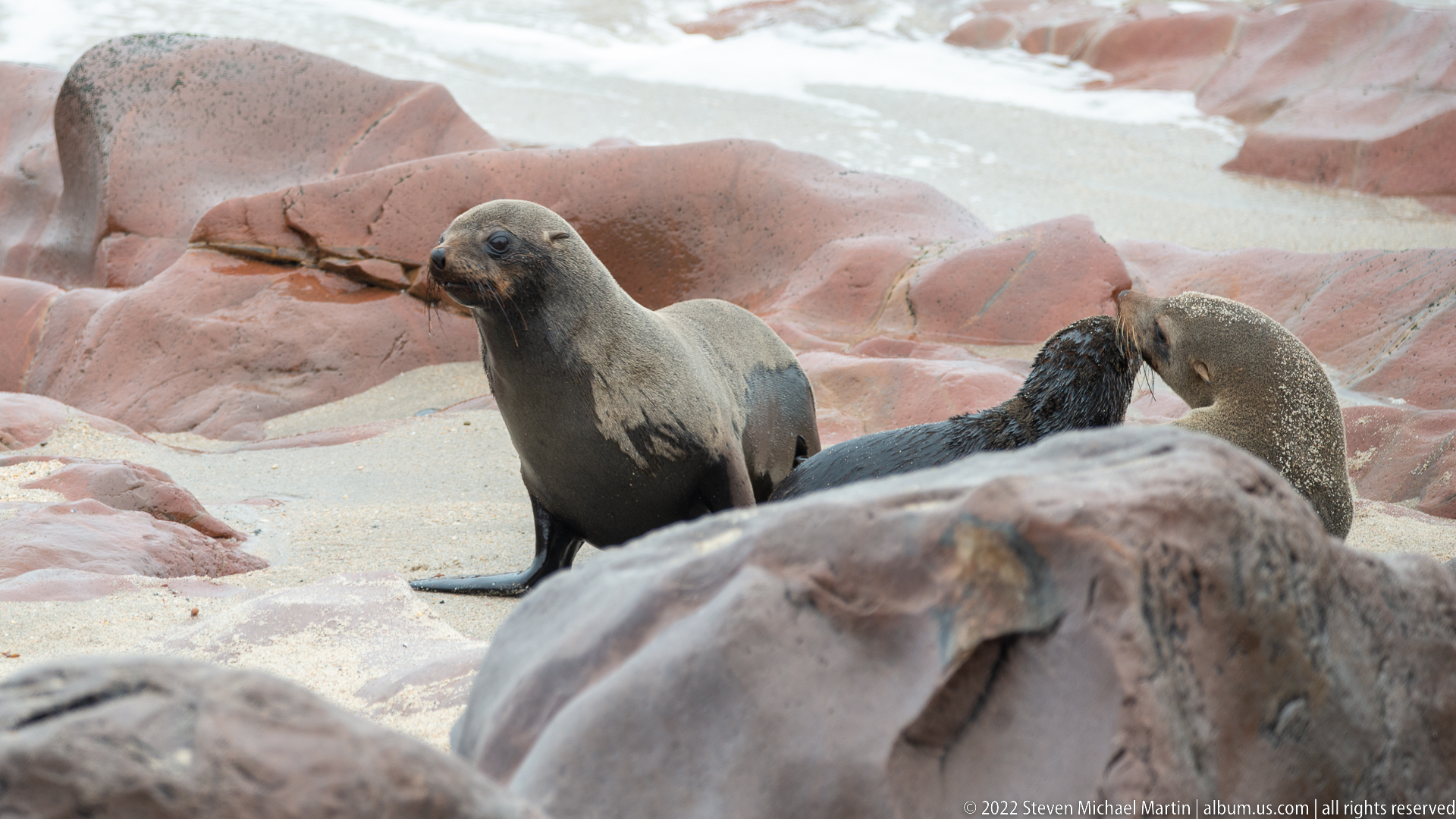
A wet Cape fur seal stands upright in the rocky swash zone at Cape Cross, its dark slick fur clinging to its body as it moves between the Atlantic surf and the shore colony.
Caption
A wet Cape fur seal stands upright in the rocky swash zone at Cape Cross, its dark slick fur clinging to its body as it moves between the Atlantic surf and the shore colony.
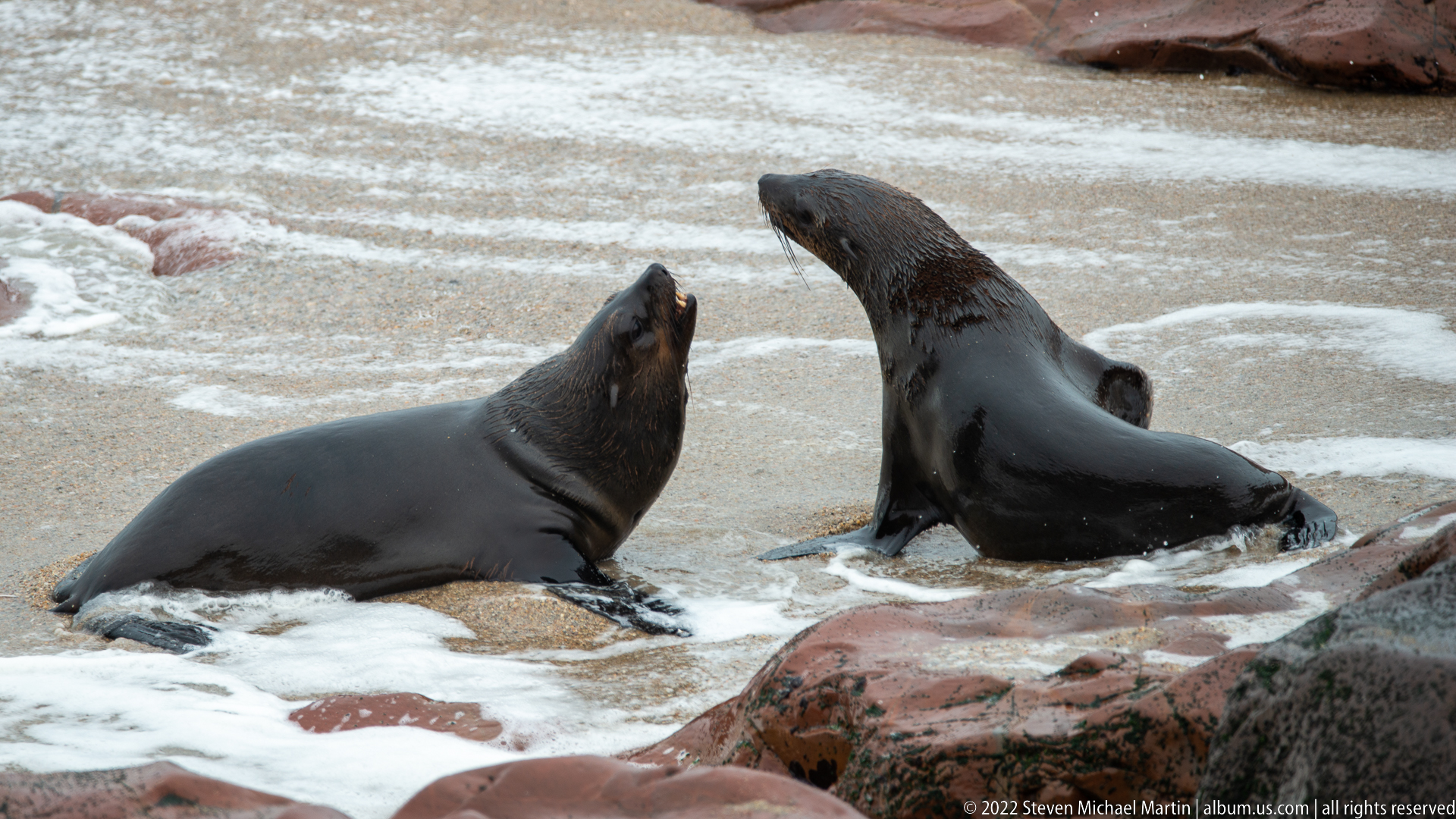
Two nearly black, wet Cape fur seals face each other in a social display amid foamy surf and wave-washed rocks along the Atlantic coast at Cape Cross.
Caption
Two nearly black, wet Cape fur seals face each other in a social display amid foamy surf and wave-washed rocks along the Atlantic coast at Cape Cross.
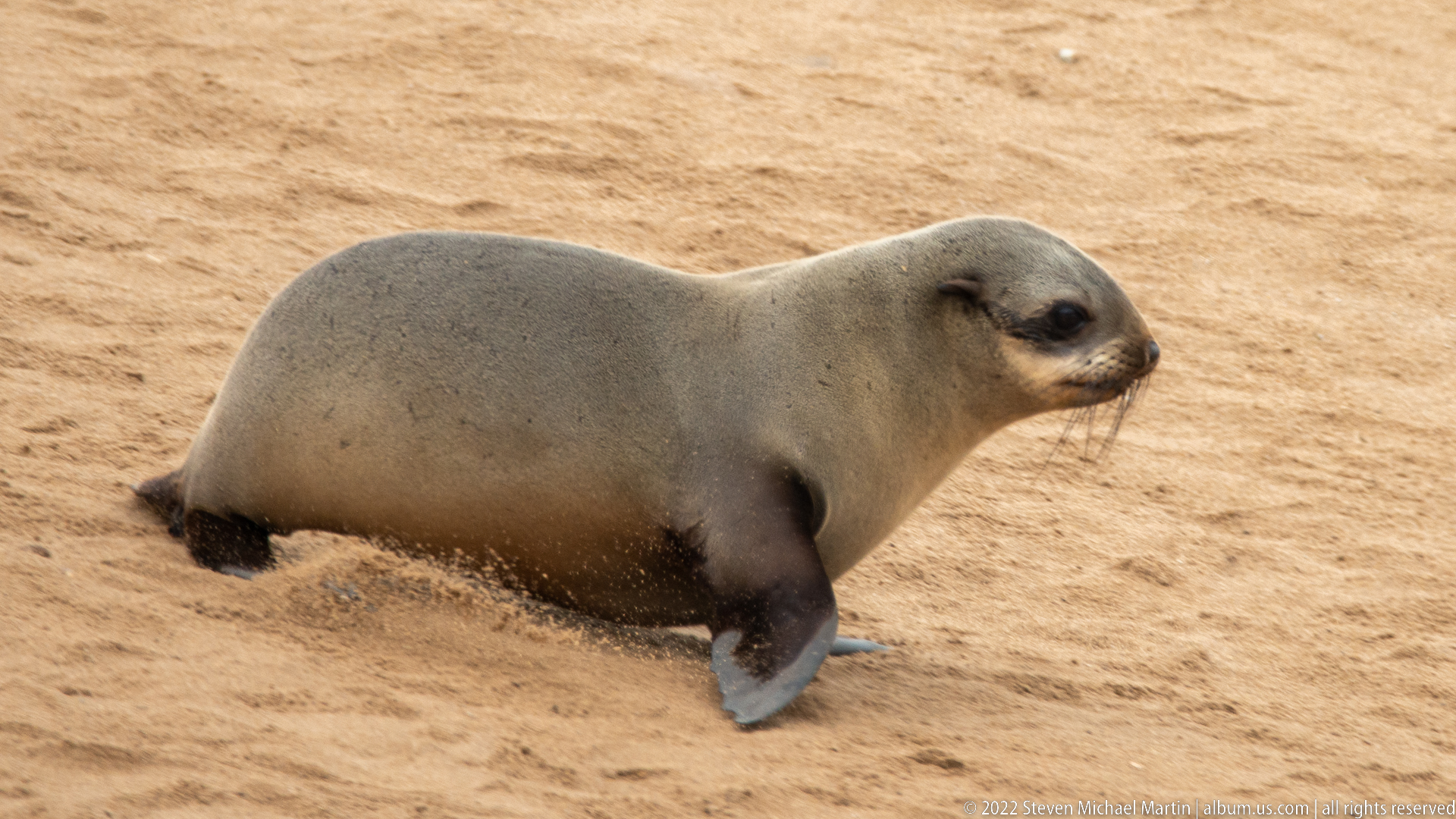
A young Cape fur seal at Cape Cross shuffles across the sand on planted foreflippers, illustrating how eared seals rotate their hind limbs forward to use all four limbs more effectively on land than true seals.
Caption
A young Cape fur seal at Cape Cross shuffles across the sand on planted foreflippers, illustrating how eared seals rotate their hind limbs forward to use all four limbs more effectively on land than true seals.
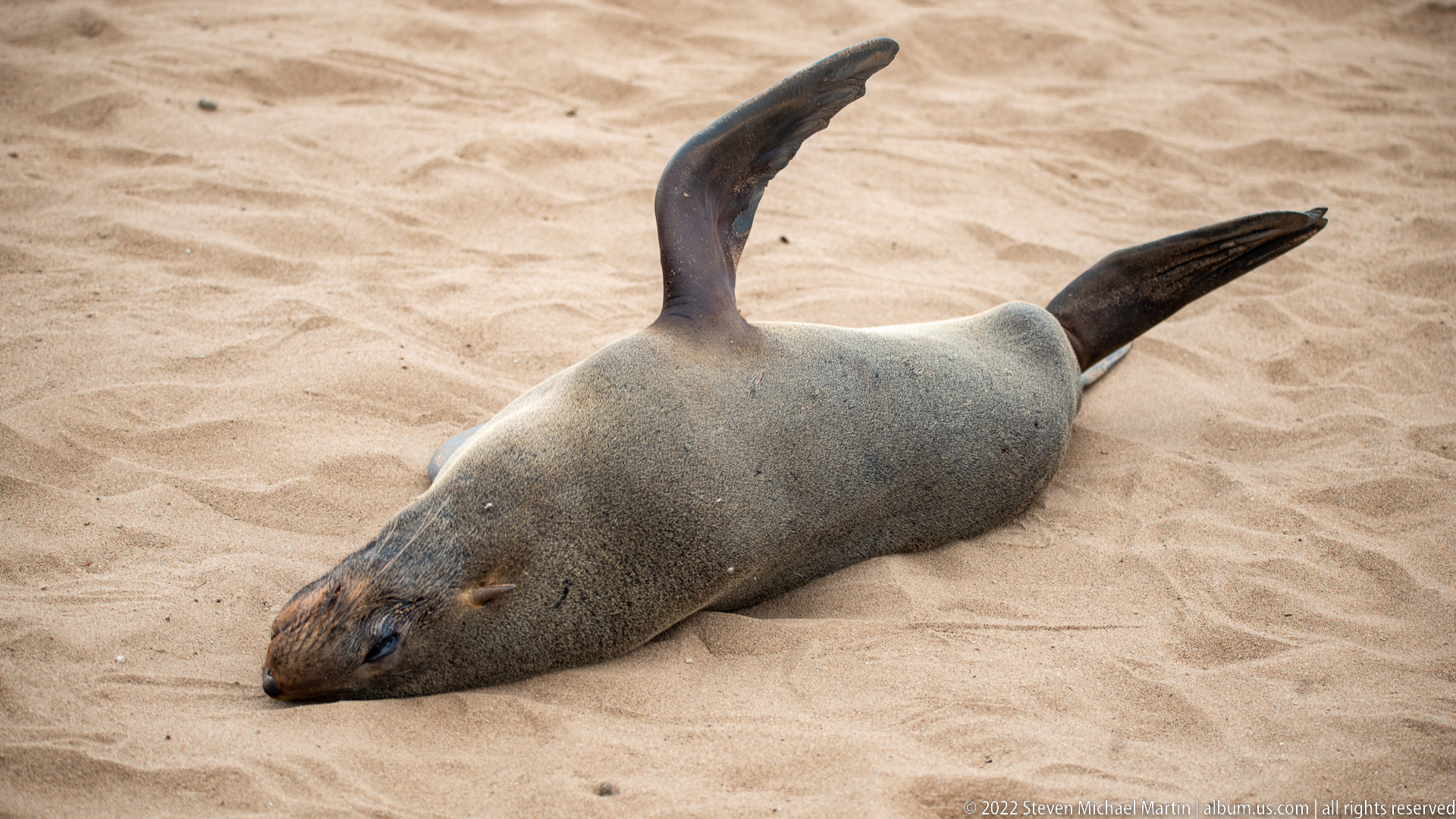
A Cape fur seal lies on its back in the sand at Cape Cross, its long flippers lifted in a supine resting posture that reveals the animal’s flexible body and thermoregulatory pose ashore.
Caption
A Cape fur seal lies on its back in the sand at Cape Cross, its long flippers lifted in a supine resting posture that reveals the animal’s flexible body and thermoregulatory pose ashore.
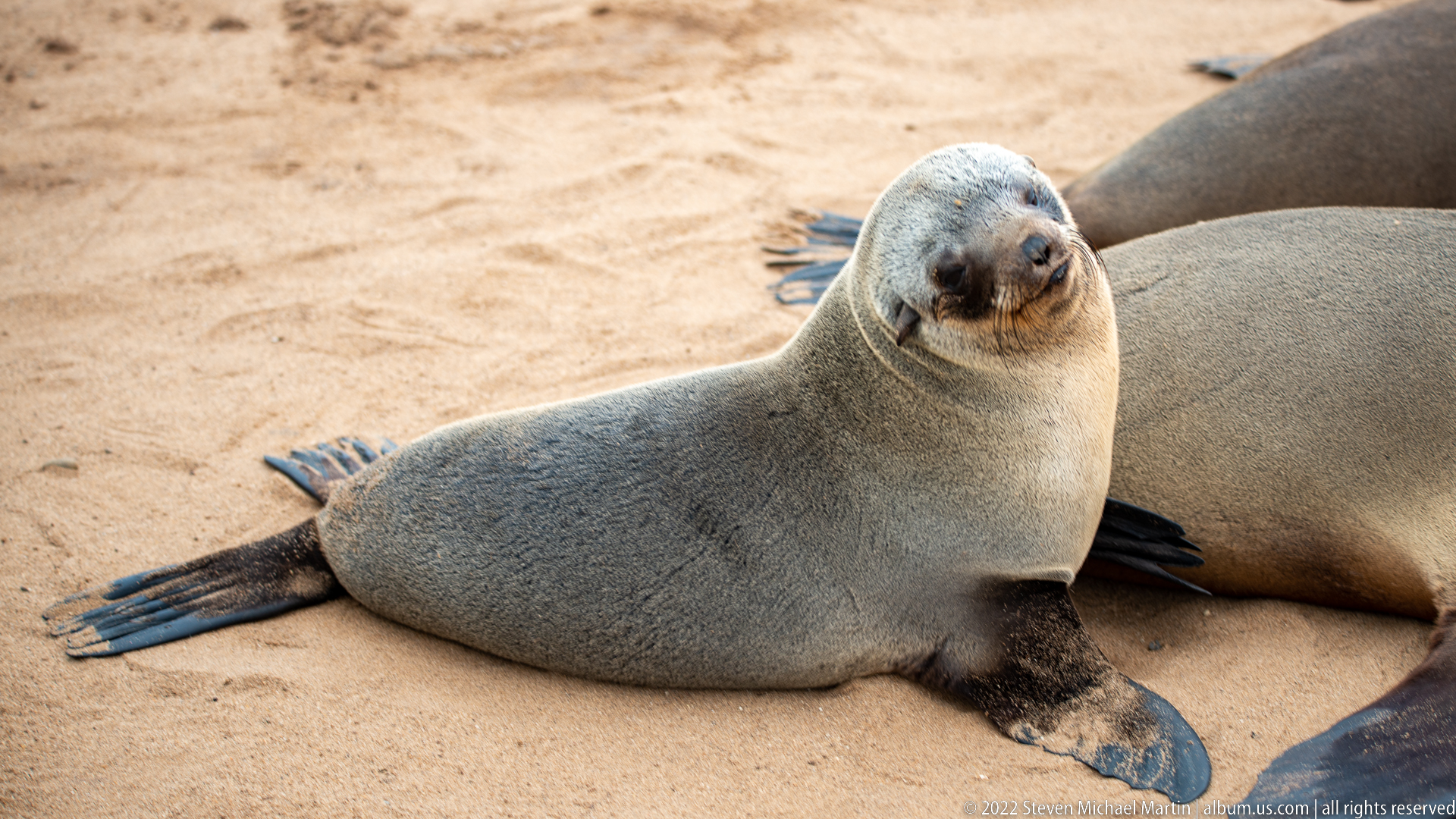
A pale juvenile Cape fur seal sits upright on the open sand at Cape Cross, Namibia, its compact body, pale gray dry coat, and well-developed whiskers and external ears forming a formal wildlife portrait.
Caption
A pale juvenile Cape fur seal sits upright on the open sand at Cape Cross, Namibia, its compact body, pale gray dry coat, and well-developed whiskers and external ears forming a formal wildlife portrait.
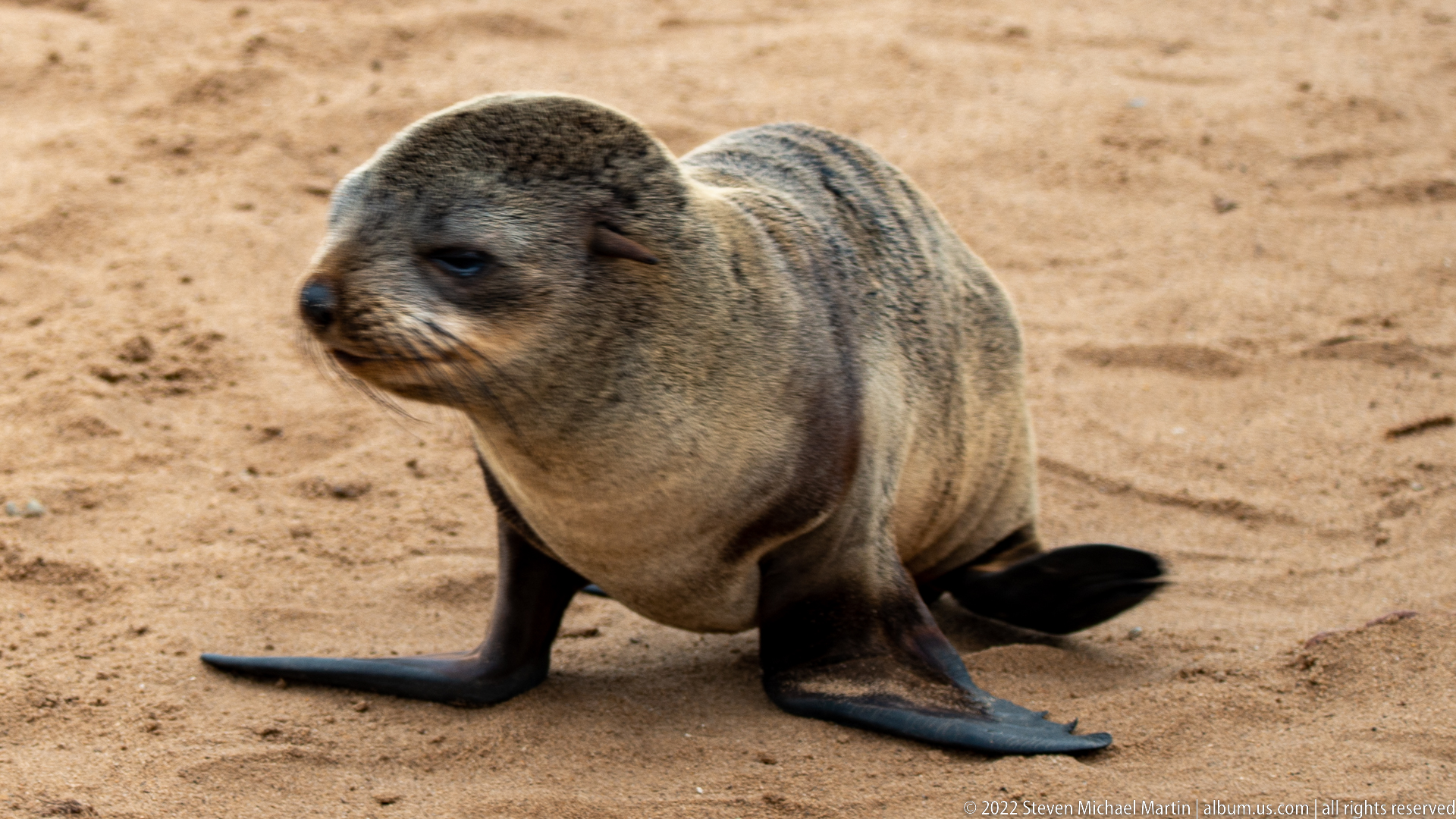
A stocky juvenile Cape fur seal at Cape Cross braces on all four limbs in a quadrupedal stance, its slightly wet fur and compressed folds accentuating the contours of its body, made possible by hind limbs that rotate beneath it for movement on land.
Caption
A stocky juvenile Cape fur seal at Cape Cross braces on all four limbs in a quadrupedal stance, its slightly wet fur and compressed folds accentuating the contours of its body, made possible by hind limbs that rotate beneath it for movement on land.

At Cape Cross, a Cape fur seal drapes itself over a rounded boulder, one foreflipper folded across its face in a posture that may shade its eyes or simply signal deeply relaxed sleep on this rocky resting platform within the colony.
Caption
At Cape Cross, a Cape fur seal drapes itself over a rounded boulder, one foreflipper folded across its face in a posture that may shade its eyes or simply signal deeply relaxed sleep on this rocky resting platform within the colony.
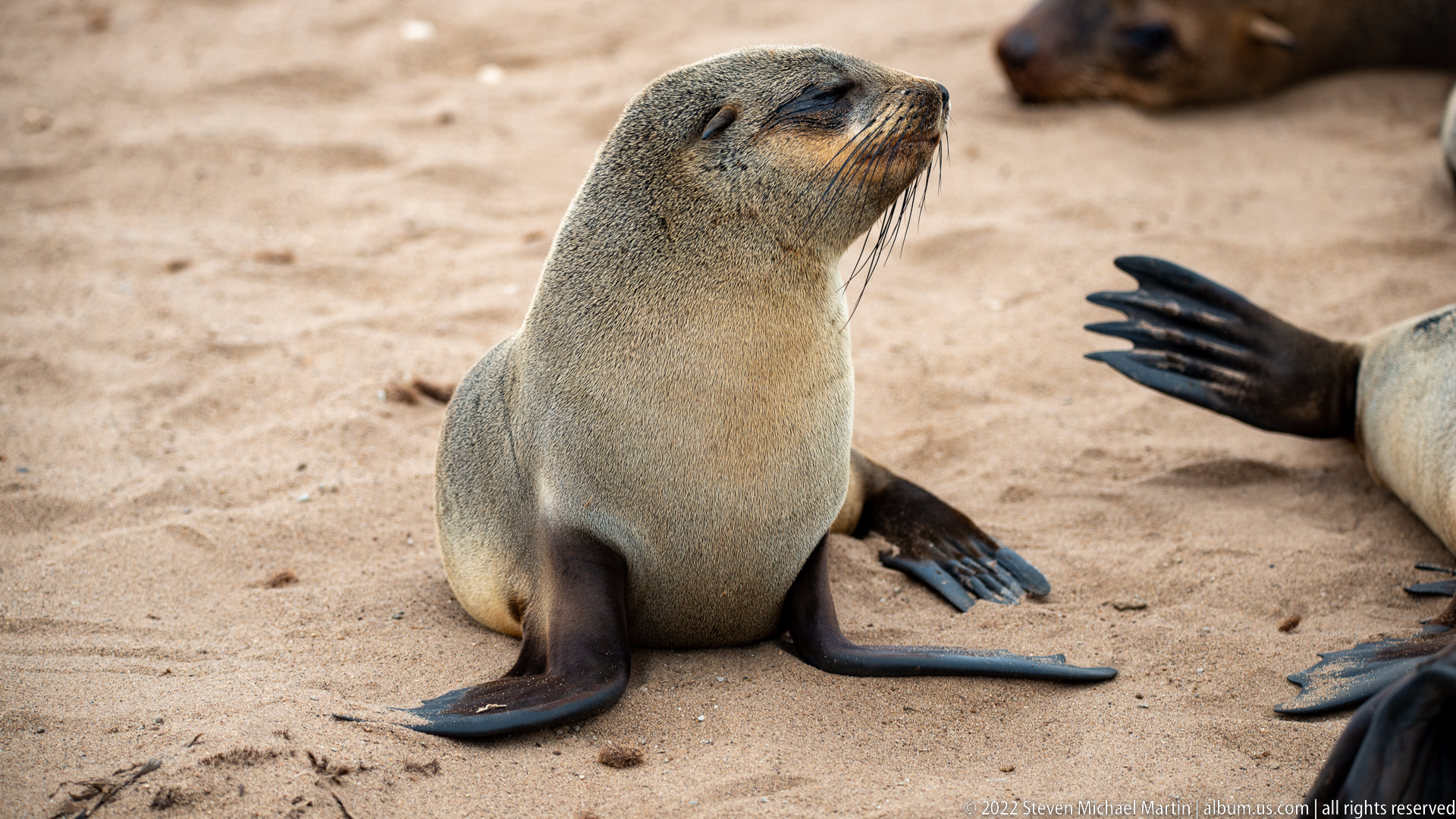
A juvenile Cape fur seal rests upright on the sand at Cape Cross, eyes closed and muzzle raised in a brief pause between bursts of colony activity that may be for scenting, vocalizing, or simple relaxation.
Caption
A juvenile Cape fur seal rests upright on the sand at Cape Cross, eyes closed and muzzle raised in a brief pause between bursts of colony activity that may be for scenting, vocalizing, or simple relaxation.
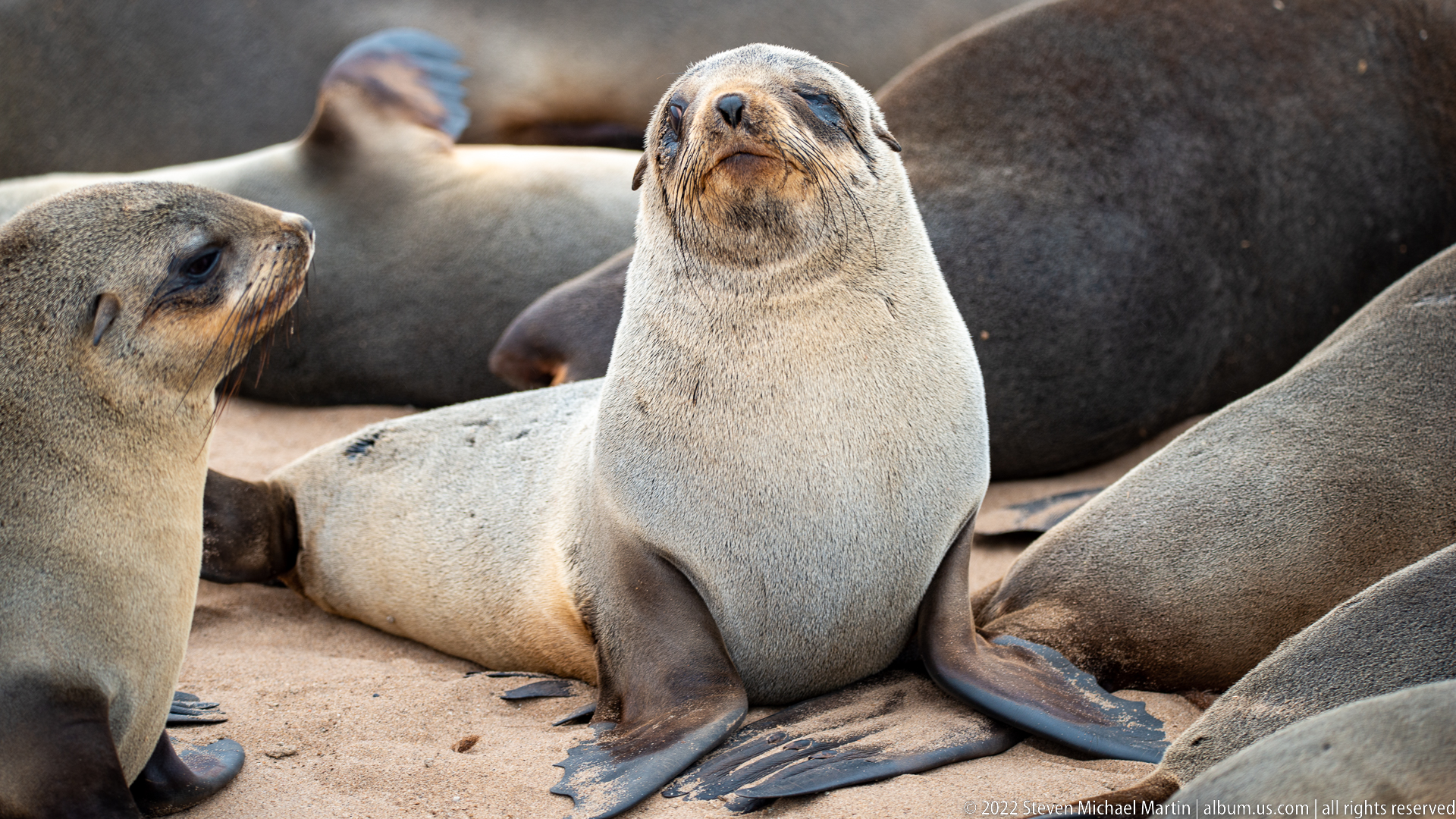
A pale juvenile Cape fur seal sits upright on its foreflippers amid a dense mixed-age colony at Cape Cross, its smaller size and lighter coat standing out against the darker resting adults around it in Namibia.
Caption
A pale juvenile Cape fur seal sits upright on its foreflippers amid a dense mixed-age colony at Cape Cross, its smaller size and lighter coat standing out against the darker resting adults around it in Namibia.

A dense flock of seabirds scatters across the overcast sky above Cape Cross, hinting at the major marine bird concentrations supported by the Benguela ecosystem, though individual species remain indistinguishable at this distance.
Caption
A dense flock of seabirds scatters across the overcast sky above Cape Cross, hinting at the major marine bird concentrations supported by the Benguela ecosystem, though individual species remain indistinguishable at this distance.
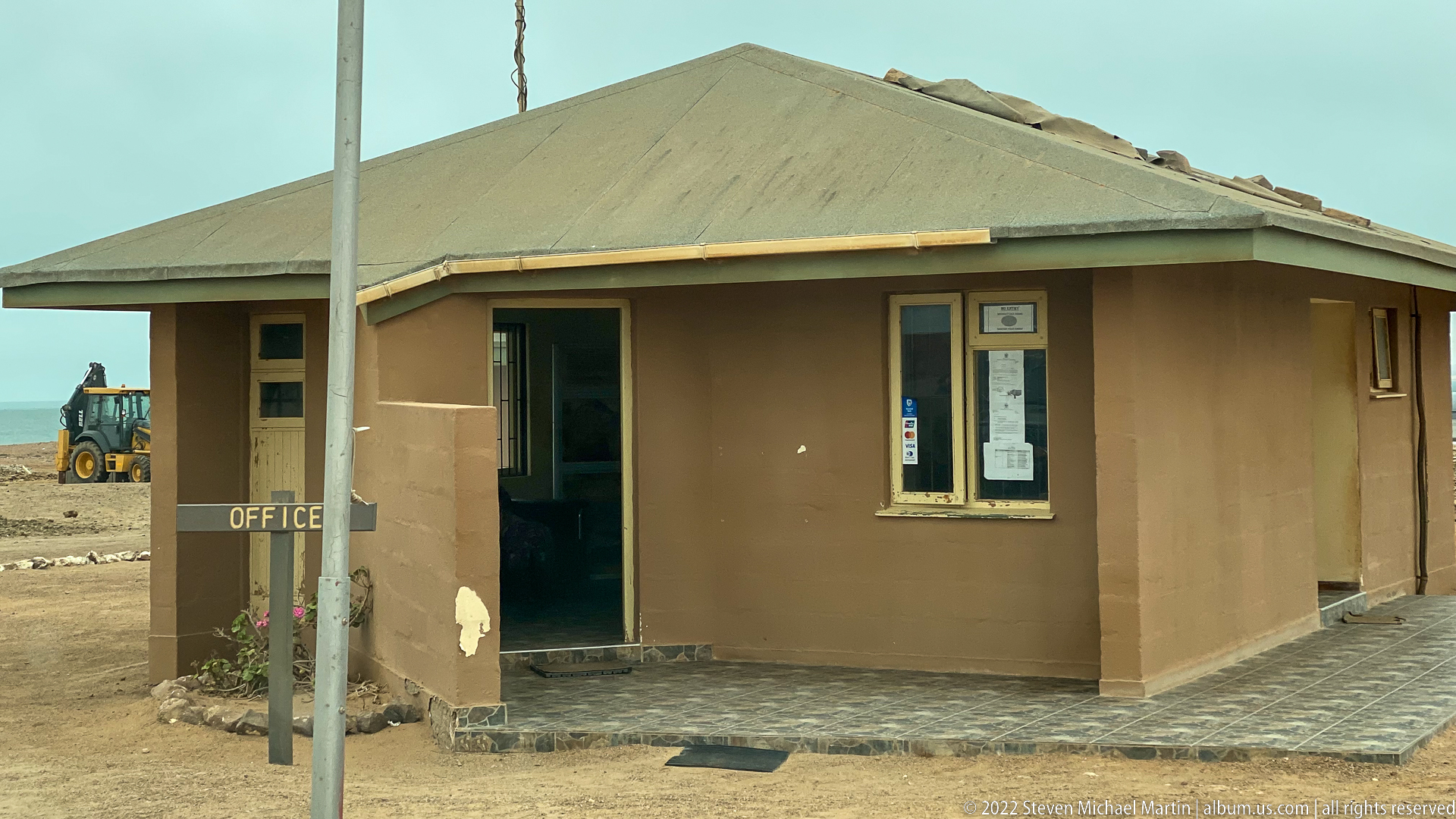
The administrative office at Cape Cross Seal Reserve, a simple single-story building with a hipped roof and OFFICE sign, provides visitor administration and entry services suited to the remote coastal-desert setting.
Caption
The administrative office at Cape Cross Seal Reserve, a simple single-story building with a hipped roof and OFFICE sign, provides visitor administration and entry services suited to the remote coastal-desert setting.

A Republic of Namibia Ministry of Finance receipt records N$350.00 in visitor and conservation fees paid at Cape Cross on 29 September 2022.
Caption
A Republic of Namibia Ministry of Finance receipt records N$350.00 in visitor and conservation fees paid at Cape Cross on 29 September 2022.
Cape Cross Seal Reserve presents one of the most concentrated wildlife spectacles along the Atlantic coast of Namibia. Thousands of Cape fur seals gather along a narrow stretch of shoreline, creating a landscape defined by movement, sound, and density. The experience is striking not only because of the number of animals present, but because of the contrast between the harsh Skeleton Coast environment and the constant activity of the colony.
The setting feels remote and elemental. Wind, surf, sand, and rock shape the coastline, while the Benguela Current supports one of the largest populations of Cape fur seals in the world. The result is a location where wildlife dominates the landscape in both scale and sensory intensity.
Highlights
- One of the largest Cape fur seal colonies in the world
- Thousands of seals covering shoreline rocks and beaches
- Strong sensory experience defined by sound, motion, and environment
- Skeleton Coast setting shaped by wind, ocean, and desert
- Excellent opportunity to observe seal social behavior
Field Guide
📍 Location
Cape Cross Seal Reserve lies along Namibia’s Skeleton Coast, approximately 120 km north of Swakopmund. The reserve protects a section of Atlantic coastline where the cold Benguela Current creates ideal feeding conditions for marine life.
🌍 Geological & Coastal Setting
The Skeleton Coast is known for its stark beauty, shaped by ocean currents, fog, wind, and minimal rainfall. Rocky outcrops and sandy beaches provide habitat for large seal colonies that rely on nearby nutrient-rich waters.
The surrounding desert landscape emphasizes the contrast between land and ocean, making the concentration of wildlife even more visually striking.
🦭 Wildlife
Cape Cross is home to one of the largest breeding colonies of Cape fur seals, with populations often exceeding 200,000 animals during peak season.
The colony is active throughout the year, though November and December represent peak breeding and pupping season when activity levels are especially high.
- Cape fur seals: observed resting, vocalizing, interacting, and moving between land and water
- Pups: visible during breeding season, often clustered near protective adults
- Jackals and scavengers: occasionally seen along the margins of the colony
- Seabirds: present along the shoreline and offshore areas
📜 Historical Context
The site takes its name from a stone cross erected in 1486 by Portuguese explorer Diogo Cão, marking one of the earliest recorded European landfalls along the southwest African coast.
Today, a replica cross stands near the original location, linking the natural landscape with the region’s maritime exploration history.
👣 Visitor Experience
Visitors access the colony via walkways designed to provide close views while protecting both animals and habitat. The experience is highly sensory, defined by constant seal vocalization, strong ocean winds, and the visual density of animals across the rocks and shoreline.
Conditions may include strong coastal winds and a distinct natural odor typical of large marine mammal colonies.
Wildlife Behavior
Colony Dynamics
Large groups of seals gather in tightly packed formations along the rocks and sand. Vocal communication between adults and pups is frequent, creating a continuous soundscape across the colony.
Movement Between Land and Sea
Seals move regularly between the shoreline and the ocean, often navigating through narrow paths formed by the colony itself. This creates constant motion across the landscape.
Social Interaction
Interactions include resting groups, protective adults with pups, and dominant males maintaining territory during breeding periods.
Environmental Contrast
One of the defining visual elements of Cape Cross is the juxtaposition of large animal populations against a stark desert coastline. The surrounding environment appears almost empty, emphasizing the density of life concentrated along the water’s edge.
Story & Experience
First Impressions
The colony becomes noticeable before it is fully visible. Sound carries across the landscape, and the shoreline gradually reveals increasing numbers of seals as the viewing path approaches the coast.
Scale
Photographs capture individual animals, but the overall impression comes from the sheer number of seals occupying the same stretch of coastline. The density of the colony creates an experience that feels very different from typical wildlife viewing.
Skeleton Coast Atmosphere
Wind, fog, and ocean movement contribute to a dramatic setting. The landscape feels exposed and elemental, shaped by natural forces rather than vegetation or human structures.
Natural Patterns
Patterns of repeating shapes, textures, and movement define the photographic character of the site. Groups of seals resting along the rocks create visual rhythms that shift continuously as animals move between positions.
Photography Notes
- Overcast coastal light can help reduce contrast between sand, rock, and fur
- Wider compositions help convey the scale of the colony
- Closer images capture behavior and interaction between seals
- Wind conditions may influence stability and framing
- Repeating patterns of animals create strong visual structure
Quick Facts
- Location: Skeleton Coast, Namibia
- Primary Species: Cape fur seal (Arctocephalus pusillus)
- Colony Size: up to 200,000+ seals during breeding season
- Best Known For: one of the largest seal colonies in the world
- Environment: desert coastline influenced by Benguela Current
- Established: protected reserve proclaimed in 1968