Budapest – Hungary
Budapest stretches along both banks of the Danube River, where the historic cities of Buda and Pest were unified in the late 19th century to form the modern capital of Hungary. The city sits at the western edge of the Carpathian Basin, a vast plain surrounded by mountain ranges.
The skyline of Budapest is defined by grand bridges, domes, and historic buildings lining the riverbanks. Many of the city’s most famous landmarks rise directly above the Danube, creating one of the most recognizable urban riverfronts in Europe.
Because of its rich architectural heritage and dramatic setting along the river, Budapest is often considered one of the most beautiful capital cities in Central Europe.

The entrance to the Gellért Baths is framed by a richly modeled stone arch with sculptural reliefs and grouped figures at either side. Above the doorway, the name of the bath appears in gold lettering on dark glass. The façade combines monumental stonework, figurative decoration, and tall windows characteristic of the celebrated early-twentieth-century complex.
Caption
The entrance to the Gellért Baths is framed by a richly modeled stone arch with sculptural reliefs and grouped figures at either side. Above the doorway, the name of the bath appears in gold lettering on dark glass. The façade combines monumental stonework, figurative decoration, and tall windows characteristic of the celebrated early-twentieth-century complex.

From an upper level, the Great Market Hall opens into a broad nave-like trading floor beneath exposed iron roof trusses. Dense rows of produce, food, and retail stalls fill the lower level, while galleries run along the sides. The lofty industrial structure and busy market activity reveal the hall's combination of nineteenth-century engineering and everyday commerce.
Caption
From an upper level, the Great Market Hall opens into a broad nave-like trading floor beneath exposed iron roof trusses. Dense rows of produce, food, and retail stalls fill the lower level, while galleries run along the sides. The lofty industrial structure and busy market activity reveal the hall's combination of nineteenth-century engineering and everyday commerce.

St. Stephen’s Basilica emerges as a dark silhouette through atmospheric haze, its broad central dome flanked by two bell towers. Rooftops and construction cranes dissolve into the muted foreground, giving the church an almost isolated presence above Pest. The telephoto compression emphasizes the basilica’s dominant role in the city skyline.
Caption
St. Stephen’s Basilica emerges as a dark silhouette through atmospheric haze, its broad central dome flanked by two bell towers. Rooftops and construction cranes dissolve into the muted foreground, giving the church an almost isolated presence above Pest. The telephoto compression emphasizes the basilica’s dominant role in the city skyline.

Autumn foliage frames a sweeping panorama from Gellért Hill over the Danube and central Budapest. Buda Castle occupies the left riverbank while Chain Bridge spans the water below, and Pest stretches across the hazy plain beyond. The high viewpoint reveals the city’s defining relationship between hills, river, bridges, and dense urban fabric.
Caption
Autumn foliage frames a sweeping panorama from Gellért Hill over the Danube and central Budapest. Buda Castle occupies the left riverbank while Chain Bridge spans the water below, and Pest stretches across the hazy plain beyond. The high viewpoint reveals the city’s defining relationship between hills, river, bridges, and dense urban fabric.

A dynamic bronze male figure dominates this supporting sculptural group at the Liberty Statue monument, one arm raised while his body twists above a fallen or subdued form. The low viewpoint intensifies the monument's theatrical movement and reveals the green-brown patina that has developed across the bronze surfaces.
Caption
A dynamic bronze male figure dominates this supporting sculptural group at the Liberty Statue monument, one arm raised while his body twists above a fallen or subdued form. The low viewpoint intensifies the monument's theatrical movement and reveals the green-brown patina that has developed across the bronze surfaces.

Buda Castle glows in the last light above the Danube while Széchenyi Chain Bridge crosses the foreground. The palace complex stretches along Castle Hill beneath a soft pink-blue sky, and the bridge tower anchors the lower center of the composition. The view layers two of Budapest’s defining landmarks into a single dusk panorama.
Caption
Buda Castle glows in the last light above the Danube while Széchenyi Chain Bridge crosses the foreground. The palace complex stretches along Castle Hill beneath a soft pink-blue sky, and the bridge tower anchors the lower center of the composition. The view layers two of Budapest’s defining landmarks into a single dusk panorama.

From Gellért Hill, Elisabeth Bridge cuts across the foreground while the Danube leads north through central Budapest. Riverboats line the Pest embankment and successive bridges draw the eye into the hazy cityscape. The composition uses the river as a strong axis linking the wooded Buda slope to the dense urban waterfront.
Caption
From Gellért Hill, Elisabeth Bridge cuts across the foreground while the Danube leads north through central Budapest. Riverboats line the Pest embankment and successive bridges draw the eye into the hazy cityscape. The composition uses the river as a strong axis linking the wooded Buda slope to the dense urban waterfront.

Budapest’s Liberty Statue appears in silhouette against a deep blue evening sky, the palm-bearing female figure rising above the tall pedestal while subsidiary bronze groups flank the base. The simplified dusk lighting reduces the monument to its most recognizable forms and emphasizes its commanding position on Gellért Hill.
Caption
Budapest’s Liberty Statue appears in silhouette against a deep blue evening sky, the palm-bearing female figure rising above the tall pedestal while subsidiary bronze groups flank the base. The simplified dusk lighting reduces the monument to its most recognizable forms and emphasizes its commanding position on Gellért Hill.

Autumn foliage on Gellért Hill frames an elevated view across the Danube toward central Budapest. Elisabeth Bridge spans the river below, while the dense Pest riverfront recedes into haze beyond. The high viewpoint emphasizes the relationship between the wooded Buda slopes, the broad river corridor, and the historic urban fabric on the opposite bank.
Caption
Autumn foliage on Gellért Hill frames an elevated view across the Danube toward central Budapest. Elisabeth Bridge spans the river below, while the dense Pest riverfront recedes into haze beyond. The high viewpoint emphasizes the relationship between the wooded Buda slopes, the broad river corridor, and the historic urban fabric on the opposite bank.

A monumental sculptural ensemble fills the frame, centered on a large seated figure elevated above a dense procession of standing and kneeling figures below. The pale stone group is set against a modern urban building and trees, creating a striking contrast between commemorative historical sculpture and the surrounding city fabric.
Caption
A monumental sculptural ensemble fills the frame, centered on a large seated figure elevated above a dense procession of standing and kneeling figures below. The pale stone group is set against a modern urban building and trees, creating a striking contrast between commemorative historical sculpture and the surrounding city fabric.

A large patinated bronze lion stands powerfully over a recumbent sculptural form, set before an ornate red-brick historic building. The animal’s raised head, modeled mane, and extended forepaw dominate the composition. The monument’s dramatic grouping suggests commemorative or allegorical intent, while the surrounding architecture firmly situates it within Budapest’s urban fabric.
Caption
A large patinated bronze lion stands powerfully over a recumbent sculptural form, set before an ornate red-brick historic building. The animal’s raised head, modeled mane, and extended forepaw dominate the composition. The monument’s dramatic grouping suggests commemorative or allegorical intent, while the surrounding architecture firmly situates it within Budapest’s urban fabric.

Castle Hill glows above the Danube at night, with the slender spire of Matthias Church rising near the center of the illuminated historic district. A twin-towered church stands closer to the river at right, creating a layered view of Buda’s sacred and civic skyline. Reflections and passing river traffic animate the dark foreground.
Caption
Castle Hill glows above the Danube at night, with the slender spire of Matthias Church rising near the center of the illuminated historic district. A twin-towered church stands closer to the river at right, creating a layered view of Buda’s sacred and civic skyline. Reflections and passing river traffic animate the dark foreground.

A seated visitor is photographed at a Budapest overlook, with clipped hedges, a path, and softly blurred sightseers behind him. The shallow depth of field isolates the portrait from the surrounding hilltop setting while retaining enough context to suggest a busy scenic viewpoint.
Caption
A seated visitor is photographed at a Budapest overlook, with clipped hedges, a path, and softly blurred sightseers behind him. The shallow depth of field isolates the portrait from the surrounding hilltop setting while retaining enough context to suggest a busy scenic viewpoint.

A visitor holding a folded map glances upward in a candid travel portrait. The tilted composition and shallow focus place his face and map in sharp relief against a blurred pedestrian area, conveying the informal experience of navigating Budapest on foot.
Caption
A visitor holding a folded map glances upward in a candid travel portrait. The tilted composition and shallow focus place his face and map in sharp relief against a blurred pedestrian area, conveying the informal experience of navigating Budapest on foot.

A weathered limestone wall of the Citadella rises almost flat across the frame, punctuated by small openings and deep-set rectangular windows. Variations in masonry color and surface wear reveal the layered texture of the fortification, while the close viewpoint suppresses the larger hilltop setting and concentrates attention on defensive construction.
Caption
A weathered limestone wall of the Citadella rises almost flat across the frame, punctuated by small openings and deep-set rectangular windows. Variations in masonry color and surface wear reveal the layered texture of the fortification, while the close viewpoint suppresses the larger hilltop setting and concentrates attention on defensive construction.

Budapest's Liberty Statue rises above its pale stone pedestal on Gellért Hill, silhouetted against a clear blue sky. The monumental female figure holds a broad palm frond overhead, creating the statue's instantly recognizable profile. Seen from below, the steep perspective emphasizes the scale and verticality of the memorial.
Caption
Budapest's Liberty Statue rises above its pale stone pedestal on Gellért Hill, silhouetted against a clear blue sky. The monumental female figure holds a broad palm frond overhead, creating the statue's instantly recognizable profile. Seen from below, the steep perspective emphasizes the scale and verticality of the memorial.

An oblique close view follows the pale stone face of the Citadella, where irregular joints, patched surfaces, and small openings create a dense pattern across the wall. The steep angle accentuates the mass and height of the fortification while reducing the scene to masonry, shadow, and sky.
Caption
An oblique close view follows the pale stone face of the Citadella, where irregular joints, patched surfaces, and small openings create a dense pattern across the wall. The steep angle accentuates the mass and height of the fortification while reducing the scene to masonry, shadow, and sky.

A low-angle view isolates part of the bronze sculptural ensemble surrounding Budapest's Liberty Statue. A muscular male figure extends across the foreground while the principal female figure, high above on the monument, holds a palm frond against the sky. The compressed perspective emphasizes the monument's dramatic upward thrust and dark patinated bronze surfaces.
Caption
A low-angle view isolates part of the bronze sculptural ensemble surrounding Budapest's Liberty Statue. A muscular male figure extends across the foreground while the principal female figure, high above on the monument, holds a palm frond against the sky. The compressed perspective emphasizes the monument's dramatic upward thrust and dark patinated bronze surfaces.

A bronze male figure lunges forward from a stone plinth with both arms thrown wide, his drapery swept behind him. Isolated against the pale sky, the sculpture reads as a study in gesture and movement rather than as part of the larger memorial. Weathered bronze highlights the modeling of the torso, face, and flowing garment.
Caption
A bronze male figure lunges forward from a stone plinth with both arms thrown wide, his drapery swept behind him. Isolated against the pale sky, the sculpture reads as a study in gesture and movement rather than as part of the larger memorial. Weathered bronze highlights the modeling of the torso, face, and flowing garment.

The Liberty Statue is centered high above its tall, tapering stone pedestal, the female figure lifting a palm frond into an uninterrupted blue sky. This more distant low-angle view reveals the full vertical relationship between sculpture and base, emphasizing how the monument was designed to command the skyline from Gellért Hill.
Caption
The Liberty Statue is centered high above its tall, tapering stone pedestal, the female figure lifting a palm frond into an uninterrupted blue sky. This more distant low-angle view reveals the full vertical relationship between sculpture and base, emphasizing how the monument was designed to command the skyline from Gellért Hill.

Liberty Bridge fills the frame from river level, its green riveted trusses, decorative towers, and stone pier stretching diagonally across the Danube. Flags and ornate lamp standards add detail to the ironwork, while the compressed viewpoint emphasizes the bridge as an engineered structure rather than as part of a broad city panorama.
Caption
Liberty Bridge fills the frame from river level, its green riveted trusses, decorative towers, and stone pier stretching diagonally across the Danube. Flags and ornate lamp standards add detail to the ironwork, while the compressed viewpoint emphasizes the bridge as an engineered structure rather than as part of a broad city panorama.

The Great Market Hall presents a richly patterned exterior of brick and stone beneath a steep roof covered in colorful geometric tiles. Large arched windows mark the main market volume, while smaller arcades and decorative masonry animate the façade. The view emphasizes the building's ornamental historicism as strongly as its functional role as a covered market.
Caption
The Great Market Hall presents a richly patterned exterior of brick and stone beneath a steep roof covered in colorful geometric tiles. Large arched windows mark the main market volume, while smaller arcades and decorative masonry animate the façade. The view emphasizes the building's ornamental historicism as strongly as its functional role as a covered market.

Liberty Bridge spans the Danube in a diagonal sweep below Gellért Hill, its green steel trusses and pointed towers forming a strong graphic pattern across the river. The Pest embankment and city blocks extend into atmospheric haze beyond, situating the historic bridge within the larger urban river corridor.
Caption
Liberty Bridge spans the Danube in a diagonal sweep below Gellért Hill, its green steel trusses and pointed towers forming a strong graphic pattern across the river. The Pest embankment and city blocks extend into atmospheric haze beyond, situating the historic bridge within the larger urban river corridor.

A carved stone woman sits with a small child held close against her torso, surrounded by autumn leaves and dark woodland. The rough, pale surface of the sculpture contrasts with the saturated yellow foliage, while the intimate pose shifts the sequence from monumental civic sculpture to a quieter human-scale subject.
Caption
A carved stone woman sits with a small child held close against her torso, surrounded by autumn leaves and dark woodland. The rough, pale surface of the sculpture contrasts with the saturated yellow foliage, while the intimate pose shifts the sequence from monumental civic sculpture to a quieter human-scale subject.

Gellért Hill rises steeply above the Danube embankment, its rocky slopes and autumn trees crowned by the Liberty Statue. The riverside road and retaining wall establish the hill's abrupt relationship to the city below, while the small monument on the summit provides a clear vertical focal point.
Caption
Gellért Hill rises steeply above the Danube embankment, its rocky slopes and autumn trees crowned by the Liberty Statue. The riverside road and retaining wall establish the hill's abrupt relationship to the city below, while the small monument on the summit provides a clear vertical focal point.

A visitor smiles toward the camera with the green steel structure of Liberty Bridge receding behind him. Shallow focus softens the bridge and city background while preserving its distinctive color and tower geometry, combining a personal travel portrait with an immediately recognizable Budapest setting.
Caption
A visitor smiles toward the camera with the green steel structure of Liberty Bridge receding behind him. Shallow focus softens the bridge and city background while preserving its distinctive color and tower geometry, combining a personal travel portrait with an immediately recognizable Budapest setting.

A close architectural detail of Liberty Bridge centers the red-and-white shield of Budapest's coat of arms on ornate green-painted ironwork. Riveted plates, scrolling decoration, and the bridge's larger truss structure blur into the background, revealing the civic ornament integrated into the bridge's engineering.
Caption
A close architectural detail of Liberty Bridge centers the red-and-white shield of Budapest's coat of arms on ornate green-painted ironwork. Riveted plates, scrolling decoration, and the bridge's larger truss structure blur into the background, revealing the civic ornament integrated into the bridge's engineering.

The roadway of Liberty Bridge is viewed straight along its central axis, with cars, tram tracks, overhead wires, and paired green towers drawing the eye toward Pest. Ornamental lamps and structural latticework frame the traffic corridor, showing how the historic bridge continues to function as an active piece of Budapest's transportation network.
Caption
The roadway of Liberty Bridge is viewed straight along its central axis, with cars, tram tracks, overhead wires, and paired green towers drawing the eye toward Pest. Ornamental lamps and structural latticework frame the traffic corridor, showing how the historic bridge continues to function as an active piece of Budapest's transportation network.

A prepared-food stall inside the Great Market Hall is lined with menu boards, drink dispensers, warming trays, and hanging signs. Red-and-white checked coverings and the open counter create an informal cafeteria atmosphere within the larger historic market, contrasting the hall's monumental architecture with its everyday food culture.
Caption
A prepared-food stall inside the Great Market Hall is lined with menu boards, drink dispensers, warming trays, and hanging signs. Red-and-white checked coverings and the open counter create an informal cafeteria atmosphere within the larger historic market, contrasting the hall's monumental architecture with its everyday food culture.

A long grilled sausage is served on a white plate with a generous portion of mustard, set on a red-and-white checked table covering inside the market. Disposable forks inserted along the sausage emphasize its casual, ready-to-eat presentation, offering a close view of the everyday food experience associated with Budapest's market stalls.
Caption
A long grilled sausage is served on a white plate with a generous portion of mustard, set on a red-and-white checked table covering inside the market. Disposable forks inserted along the sausage emphasize its casual, ready-to-eat presentation, offering a close view of the everyday food experience associated with Budapest's market stalls.

The upper structure of the Great Market Hall is framed around its broad arched end windows and dark iron roof trusses. A gallery lined with signs and stalls crosses the lower part of the view, but the composition chiefly records the building's vast industrial interior and the daylight admitted through its monumental glazed openings.
Caption
The upper structure of the Great Market Hall is framed around its broad arched end windows and dark iron roof trusses. A gallery lined with signs and stalls crosses the lower part of the view, but the composition chiefly records the building's vast industrial interior and the daylight admitted through its monumental glazed openings.

Shoppers fill a long central aisle of the Great Market Hall beneath a high iron-and-glass roof. Food counters and retail signs line both sides, while globe lamps repeat down the corridor and the upper gallery bridges the space above. The perspective conveys the scale, density, and active commercial life of Budapest's principal covered market.
Caption
Shoppers fill a long central aisle of the Great Market Hall beneath a high iron-and-glass roof. Food counters and retail signs line both sides, while globe lamps repeat down the corridor and the upper gallery bridges the space above. The perspective conveys the scale, density, and active commercial life of Budapest's principal covered market.

A hand rests against a massive white-painted bridge fitting where bundled suspension cables meet a bolted clamp or anchorage assembly. The close scale makes the hardware almost sculptural, revealing large fasteners, layered metal components, and the physical dimensions of the bridge's load-bearing system.
Caption
A hand rests against a massive white-painted bridge fitting where bundled suspension cables meet a bolted clamp or anchorage assembly. The close scale makes the hardware almost sculptural, revealing large fasteners, layered metal components, and the physical dimensions of the bridge's load-bearing system.

White suspension cables and vertical hangers of Elisabeth Bridge frame the view toward Pest, where the twin Baroque towers of the Inner City Parish Church rise beyond the bridge approach. The compressed perspective layers transportation infrastructure and historic church architecture within one of central Budapest's most characteristic river crossings.
Caption
White suspension cables and vertical hangers of Elisabeth Bridge frame the view toward Pest, where the twin Baroque towers of the Inner City Parish Church rise beyond the bridge approach. The compressed perspective layers transportation infrastructure and historic church architecture within one of central Budapest's most characteristic river crossings.

The monument to Saint Gerard stands on the wooded slope of Gellért Hill, the robed bishop raising a cross above a sculptural group at his feet. A curved stone colonnade sweeps behind the bronze figure, while autumn foliage partly envelops the composition. The hillside setting makes the memorial a prominent landmark above the Danube.
Caption
The monument to Saint Gerard stands on the wooded slope of Gellért Hill, the robed bishop raising a cross above a sculptural group at his feet. A curved stone colonnade sweeps behind the bronze figure, while autumn foliage partly envelops the composition. The hillside setting makes the memorial a prominent landmark above the Danube.

A closer view isolates the bronze figure of Saint Gerard against a clear blue sky, his right arm raised with a cross while heavy robes fall in broad folds around his body. Trees and the edge of the monument's pale colonnade remain low in the frame, emphasizing the saint's commanding silhouette above the hillside.
Caption
A closer view isolates the bronze figure of Saint Gerard against a clear blue sky, his right arm raised with a cross while heavy robes fall in broad folds around his body. Trees and the edge of the monument's pale colonnade remain low in the frame, emphasizing the saint's commanding silhouette above the hillside.

The underside of Elisabeth Bridge forms a broad steel canopy over the view across the Danube toward Pest. Repeating beams, plates, and utility lines create a strong linear ceiling, while riverboats and historic façades appear beyond the shadowed structure. The unusual viewpoint transforms the bridge from skyline landmark into a study of engineering and urban framing.
Caption
The underside of Elisabeth Bridge forms a broad steel canopy over the view across the Danube toward Pest. Repeating beams, plates, and utility lines create a strong linear ceiling, while riverboats and historic façades appear beyond the shadowed structure. The unusual viewpoint transforms the bridge from skyline landmark into a study of engineering and urban framing.

A monumental stone lion guards the approach to Budapest’s Széchenyi Chain Bridge, its open mouth and carved mane sharply defined against the pale suspension-bridge portal behind. The compressed view aligns sculpture and engineering, emphasizing the ceremonial character of the bridgehead and the visual dialogue between its famous lions and monumental stone towers.
Caption
A monumental stone lion guards the approach to Budapest’s Széchenyi Chain Bridge, its open mouth and carved mane sharply defined against the pale suspension-bridge portal behind. The compressed view aligns sculpture and engineering, emphasizing the ceremonial character of the bridgehead and the visual dialogue between its famous lions and monumental stone towers.

The monumental stone portal of the Castle Hill Tunnel opens beneath Buda Castle Hill, framed by heavy rustication and a broad semicircular arch. A red sightseeing bus passes in front, while formal flower beds soften the traffic circle. The composition records the tunnel as both nineteenth-century infrastructure and a continuing gateway between the Danube riverfront and western Buda.
Caption
The monumental stone portal of the Castle Hill Tunnel opens beneath Buda Castle Hill, framed by heavy rustication and a broad semicircular arch. A red sightseeing bus passes in front, while formal flower beds soften the traffic circle. The composition records the tunnel as both nineteenth-century infrastructure and a continuing gateway between the Danube riverfront and western Buda.

A Chain Bridge lion rises above its pedestal on the Buda side, while the Hungarian Parliament Building appears across the Danube in the distance. Autumn foliage fills the left edge and the river opens behind the sculpture, combining one of Budapest’s iconic bridge ornaments with the city’s best-known parliamentary silhouette.
Caption
A Chain Bridge lion rises above its pedestal on the Buda side, while the Hungarian Parliament Building appears across the Danube in the distance. Autumn foliage fills the left edge and the river opens behind the sculpture, combining one of Budapest’s iconic bridge ornaments with the city’s best-known parliamentary silhouette.

A narrow stone stairway climbs between historic buildings on Castle Hill, divided around a small central wall fountain set into pale masonry. Wrought-iron railings, weathered stone, and the steep rise reveal the layered pedestrian routes that negotiate Buda’s hillside topography. The intimate passage contrasts with the monumental riverfront architecture seen earlier in the sequence.
Caption
A narrow stone stairway climbs between historic buildings on Castle Hill, divided around a small central wall fountain set into pale masonry. Wrought-iron railings, weathered stone, and the steep rise reveal the layered pedestrian routes that negotiate Buda’s hillside topography. The intimate passage contrasts with the monumental riverfront architecture seen earlier in the sequence.

Two vivid yellow, trumpet-shaped blossoms open among dark green leaves in a close botanical study. Shallow depth of field isolates the flowers and surrounding buds from the background, providing a small natural-history detail within the urban Budapest sequence and emphasizing color, form, and the texture of the foliage.
Caption
Two vivid yellow, trumpet-shaped blossoms open among dark green leaves in a close botanical study. Shallow depth of field isolates the flowers and surrounding buds from the background, providing a small natural-history detail within the urban Budapest sequence and emphasizing color, form, and the texture of the foliage.

An elaborate rooftop turret rises above red tile roofing, its slender columns supporting a steep metal canopy enriched with finials and scroll-like ornament. The isolated telephoto view reduces the building to its upper silhouette, highlighting the craftsmanship and vertical decorative emphasis of Budapest’s late historicist roofscape.
Caption
An elaborate rooftop turret rises above red tile roofing, its slender columns supporting a steep metal canopy enriched with finials and scroll-like ornament. The isolated telephoto view reduces the building to its upper silhouette, highlighting the craftsmanship and vertical decorative emphasis of Budapest’s late historicist roofscape.

A stone-framed window on a warm ochre façade is crowded with red and pink geraniums, while a street sign identifies Corvin tér. Carved ornament above the opening and weathered masonry trim give the small architectural detail a distinctly historic character. The close framing turns a residential façade into a study of color, texture, and everyday urban decoration.
Caption
A stone-framed window on a warm ochre façade is crowded with red and pink geraniums, while a street sign identifies Corvin tér. Carved ornament above the opening and weathered masonry trim give the small architectural detail a distinctly historic character. The close framing turns a residential façade into a study of color, texture, and everyday urban decoration.

A dramatic bronze figure with outstretched wings or drapery crowns a broad circular stone fountain in a small Buda square. A pale church rises behind, while autumn branches frame the sculpture. The low viewpoint emphasizes the monument’s energetic silhouette and the contrast between dark bronze, light masonry, and the quieter religious architecture beyond.
Caption
A dramatic bronze figure with outstretched wings or drapery crowns a broad circular stone fountain in a small Buda square. A pale church rises behind, while autumn branches frame the sculpture. The low viewpoint emphasizes the monument’s energetic silhouette and the contrast between dark bronze, light masonry, and the quieter religious architecture beyond.

A compact stone footbridge crosses a shallow landscaped hollow on Castle Hill, its low parapet pierced by circular openings. Mature trees, autumn foliage, and groundcover surround the weathered masonry, creating a quiet garden scene. The paired arches and rustic stonework show how small-scale landscape architecture is integrated into Buda’s steep historic terrain.
Caption
A compact stone footbridge crosses a shallow landscaped hollow on Castle Hill, its low parapet pierced by circular openings. Mature trees, autumn foliage, and groundcover surround the weathered masonry, creating a quiet garden scene. The paired arches and rustic stonework show how small-scale landscape architecture is integrated into Buda’s steep historic terrain.

The green-capped twin towers of Saint Anne Church rise above the Buda riverfront, their Baroque forms set against the Danube and hazy Pest beyond. The elevated viewpoint compresses church, river, bridge traffic, and distant city blocks into a layered urban panorama, emphasizing the sacred architecture embedded within Budapest’s dense historic core.
Caption
The green-capped twin towers of Saint Anne Church rise above the Buda riverfront, their Baroque forms set against the Danube and hazy Pest beyond. The elevated viewpoint compresses church, river, bridge traffic, and distant city blocks into a layered urban panorama, emphasizing the sacred architecture embedded within Budapest’s dense historic core.

A symmetrical yellow townhouse façade is enriched with carved stone window surrounds, a balustraded central balcony, sculpted ornament, and a richly framed doorway. Flower boxes add vivid color beneath the windows. The frontal composition records the building as a complete urban elevation and highlights the decorative craftsmanship of historic Buda.
Caption
A symmetrical yellow townhouse façade is enriched with carved stone window surrounds, a balustraded central balcony, sculpted ornament, and a richly framed doorway. Flower boxes add vivid color beneath the windows. The frontal composition records the building as a complete urban elevation and highlights the decorative craftsmanship of historic Buda.

Red brick walls, semicircular windows, and richly patterned roof tiles form a layered rear or side elevation of a Budapest church. Slender metal finials rise above the roof ridges, and mature trees partially frame the masonry. The close viewpoint emphasizes polychrome roofing and Romanesque-inspired architectural forms rather than the building’s overall silhouette.
Caption
Red brick walls, semicircular windows, and richly patterned roof tiles form a layered rear or side elevation of a Budapest church. Slender metal finials rise above the roof ridges, and mature trees partially frame the masonry. The close viewpoint emphasizes polychrome roofing and Romanesque-inspired architectural forms rather than the building’s overall silhouette.

A pale historic church is viewed from close below, its square tower, tall arched windows, decorative gable, and rooftop statues rising against a clear sky. The steep perspective emphasizes the façade’s vertical lines and sculptural details, while the restrained color palette draws attention to the modeling of the stucco and stone ornament.
Caption
A pale historic church is viewed from close below, its square tower, tall arched windows, decorative gable, and rooftop statues rising against a clear sky. The steep perspective emphasizes the façade’s vertical lines and sculptural details, while the restrained color palette draws attention to the modeling of the stucco and stone ornament.

Saint Anne Church presents its full Baroque façade to the square, with twin green-capped towers flanking a richly modeled central bay. Pilasters, arched windows, statuary niches, and curved rooflines create a strongly vertical composition. The frontal view clarifies the church’s architectural organization after the earlier telephoto view of its towers above the Danube.
Caption
Saint Anne Church presents its full Baroque façade to the square, with twin green-capped towers flanking a richly modeled central bay. Pilasters, arched windows, statuary niches, and curved rooflines create a strongly vertical composition. The frontal view clarifies the church’s architectural organization after the earlier telephoto view of its towers above the Danube.

Rows of purple and creamy white ornamental cabbages form a dense patterned planting bed. The repeating rosettes create a textile-like surface of concentric leaves and contrasting color, turning a seasonal urban planting into a close botanical study. The absence of broader context keeps attention on horticultural form, rhythm, and color.
Caption
Rows of purple and creamy white ornamental cabbages form a dense patterned planting bed. The repeating rosettes create a textile-like surface of concentric leaves and contrasting color, turning a seasonal urban planting into a close botanical study. The absence of broader context keeps attention on horticultural form, rhythm, and color.

The rear elevation of a red-brick church rises behind trees, organized around tall narrow windows, projecting buttress-like forms, and a central upper gable with a circular window. Patterned ceramic roof tiles and decorative metal cresting animate the silhouette. This wider view reveals the building’s complex massing more clearly than the preceding close detail.
Caption
The rear elevation of a red-brick church rises behind trees, organized around tall narrow windows, projecting buttress-like forms, and a central upper gable with a circular window. Patterned ceramic roof tiles and decorative metal cresting animate the silhouette. This wider view reveals the building’s complex massing more clearly than the preceding close detail.

White stone religious figures sit and stand around a dark arched portal, crowned by a central robed figure before a large window. Scrollwork, heraldic ornament, and layered moldings concentrate decoration around the entrance, creating a theatrical Baroque composition. The close view records the sculptural program independently of the larger building façade.
Caption
White stone religious figures sit and stand around a dark arched portal, crowned by a central robed figure before a large window. Scrollwork, heraldic ornament, and layered moldings concentrate decoration around the entrance, creating a theatrical Baroque composition. The close view records the sculptural program independently of the larger building façade.

A carved market-hall inscription reading “VÁSÁRCSARNOK” spans the stone façade beneath a heraldic shield supported by two sculpted animals. Large industrial windows rise behind the crest. The close architectural detail links civic symbolism with the commercial function of Budapest’s historic covered-market tradition.
Caption
A carved market-hall inscription reading “VÁSÁRCSARNOK” spans the stone façade beneath a heraldic shield supported by two sculpted animals. Large industrial windows rise behind the crest. The close architectural detail links civic symbolism with the commercial function of Budapest’s historic covered-market tradition.

A richly ornamented rooftop composition combines paired winged figures, a central civic coat of arms, and a radiant triangular emblem set above the pediment. Dark stone sculpture contrasts with gilded rays and the pale sky, creating a striking symbolic crown for the historic façade. The close crop focuses attention on heraldry and allegorical decoration rather than the building as a whole.
Caption
A richly ornamented rooftop composition combines paired winged figures, a central civic coat of arms, and a radiant triangular emblem set above the pediment. Dark stone sculpture contrasts with gilded rays and the pale sky, creating a striking symbolic crown for the historic façade. The close crop focuses attention on heraldry and allegorical decoration rather than the building as a whole.

Parallel tram rails and overhead wires run in a long, nearly vanishing-point perspective along the Buda embankment. The Danube lies to the left behind a railing, while road traffic and historic buildings line the right. The centered composition emphasizes Budapest’s integrated riverfront transportation system and the geometric rhythm of tracks, pavement, poles, and cables.
Caption
Parallel tram rails and overhead wires run in a long, nearly vanishing-point perspective along the Buda embankment. The Danube lies to the left behind a railing, while road traffic and historic buildings line the right. The centered composition emphasizes Budapest’s integrated riverfront transportation system and the geometric rhythm of tracks, pavement, poles, and cables.

An ornate painted-metal bridge railing sweeps diagonally across the frame, its repeating oval openings creating a strong visual rhythm above the Danube. The camera is intentionally tilted, turning the riverfront and distant buildings into a dynamic backdrop. The close view emphasizes decorative bridge furniture rather than the larger engineering structure.
Caption
An ornate painted-metal bridge railing sweeps diagonally across the frame, its repeating oval openings creating a strong visual rhythm above the Danube. The camera is intentionally tilted, turning the riverfront and distant buildings into a dynamic backdrop. The close view emphasizes decorative bridge furniture rather than the larger engineering structure.

A monumental stone carving of the Holy Crown of Hungary fills the foreground in monochrome, its beaded arches and central cap rendered as a sculptural finial. Across the Danube, the Hungarian Parliament Building sits softly in haze. The juxtaposition unites national symbolism with one of Budapest’s defining riverside monuments.
Caption
A monumental stone carving of the Holy Crown of Hungary fills the foreground in monochrome, its beaded arches and central cap rendered as a sculptural finial. Across the Danube, the Hungarian Parliament Building sits softly in haze. The juxtaposition unites national symbolism with one of Budapest’s defining riverside monuments.

A carved stone representation of the Holy Crown of Hungary stands against the sky, complete with beaded arches, central cap, and a small cross at the summit. Warm late-day light reveals the texture of the stone and the repetitive spherical detailing. The close framing isolates national symbolism from its architectural setting.
Caption
A carved stone representation of the Holy Crown of Hungary stands against the sky, complete with beaded arches, central cap, and a small cross at the summit. Warm late-day light reveals the texture of the stone and the repetitive spherical detailing. The close framing isolates national symbolism from its architectural setting.

Warm evening light strikes a richly sculpted stone pier of Margaret Bridge, where monumental carved figures project beside the metal arch structure. Repeating ironwork and the bridge deck create a layered industrial backdrop. The close crop emphasizes how nineteenth-century bridge engineering in Budapest was paired with elaborate figurative and architectural ornament.
Caption
Warm evening light strikes a richly sculpted stone pier of Margaret Bridge, where monumental carved figures project beside the metal arch structure. Repeating ironwork and the bridge deck create a layered industrial backdrop. The close crop emphasizes how nineteenth-century bridge engineering in Budapest was paired with elaborate figurative and architectural ornament.

Margaret Bridge crosses the Danube in warm late-afternoon light, its sequence of low iron arches resting on pale stone piers. The Buda hillside and riverfront architecture rise beyond, while reflections soften the water below. The broad side view reveals the bridge’s repeating structural rhythm and its close visual connection to both riverbanks.
Caption
Margaret Bridge crosses the Danube in warm late-afternoon light, its sequence of low iron arches resting on pale stone piers. The Buda hillside and riverfront architecture rise beyond, while reflections soften the water below. The broad side view reveals the bridge’s repeating structural rhythm and its close visual connection to both riverbanks.

An ornate bridge lamppost is viewed from below, where paired dragon-like creatures curl outward beneath two lanterns around a fluted central column. Dark cast metal and gilded accents stand sharply against the pale sky. The close architectural study records the exuberant decorative metalwork incorporated into Budapest’s historic bridge infrastructure.
Caption
An ornate bridge lamppost is viewed from below, where paired dragon-like creatures curl outward beneath two lanterns around a fluted central column. Dark cast metal and gilded accents stand sharply against the pale sky. The close architectural study records the exuberant decorative metalwork incorporated into Budapest’s historic bridge infrastructure.

Across a broad expanse of the Danube, the Buda riverfront stretches beneath a softly colored evening sky. Church spires, historic façades, and hillside buildings form a low layered skyline, while a long white river vessel lies along the bank. The calm, wide composition emphasizes Budapest’s geography as a city organized around the river and rising western hills.
Caption
Across a broad expanse of the Danube, the Buda riverfront stretches beneath a softly colored evening sky. Church spires, historic façades, and hillside buildings form a low layered skyline, while a long white river vessel lies along the bank. The calm, wide composition emphasizes Budapest’s geography as a city organized around the river and rising western hills.

The Reformed Church in Szilágyi Dezső Square rises above the Buda riverfront, its red-brick walls, steep patterned roof, and exceptionally slender spire forming a distinctive Gothic Revival silhouette. A white excursion boat passes along the Danube in the foreground, linking the church to the active river corridor and surrounding historic city blocks.
Caption
The Reformed Church in Szilágyi Dezső Square rises above the Buda riverfront, its red-brick walls, steep patterned roof, and exceptionally slender spire forming a distinctive Gothic Revival silhouette. A white excursion boat passes along the Danube in the foreground, linking the church to the active river corridor and surrounding historic city blocks.

Széchenyi Chain Bridge spans the Danube at blue hour, its stone tower, suspension chains, and roadway lights reflected in the river. The low oblique viewpoint emphasizes the massive masonry pier and the warm rhythm of lamps receding toward Buda. Twilight separates the illuminated bridge from the darkening city beyond.
Caption
Széchenyi Chain Bridge spans the Danube at blue hour, its stone tower, suspension chains, and roadway lights reflected in the river. The low oblique viewpoint emphasizes the massive masonry pier and the warm rhythm of lamps receding toward Buda. Twilight separates the illuminated bridge from the darkening city beyond.

A glowing historic lamppost and one of the Chain Bridge’s stone lions dominate the foreground, while Buda Castle rises softly illuminated across the river. The bridge’s stone portal appears at right. By combining sculpture, street furniture, and distant palace architecture, the composition turns the bridge approach into a layered portrait of Budapest at twilight.
Caption
A glowing historic lamppost and one of the Chain Bridge’s stone lions dominate the foreground, while Buda Castle rises softly illuminated across the river. The bridge’s stone portal appears at right. By combining sculpture, street furniture, and distant palace architecture, the composition turns the bridge approach into a layered portrait of Budapest at twilight.

Moored excursion and restaurant boats fill the foreground along the Danube, their white hulls and windows reflected in still blue-hour water. Across the river, Buda Castle glows on Castle Hill. The quiet mooring scene contrasts the intimacy of the vessels with the monumental palace skyline beyond.
Caption
Moored excursion and restaurant boats fill the foreground along the Danube, their white hulls and windows reflected in still blue-hour water. Across the river, Buda Castle glows on Castle Hill. The quiet mooring scene contrasts the intimacy of the vessels with the monumental palace skyline beyond.

Budapest sightseeing boats lie moored side by side on the Danube beneath the illuminated Buda Castle district. Bright cabin lights and colorful signage reflect in the dark water, while the palace complex rises above the riverbank. The scene records the active tourism infrastructure of the river against the city’s historic hilltop backdrop.
Caption
Budapest sightseeing boats lie moored side by side on the Danube beneath the illuminated Buda Castle district. Bright cabin lights and colorful signage reflect in the dark water, while the palace complex rises above the riverbank. The scene records the active tourism infrastructure of the river against the city’s historic hilltop backdrop.

Warm streetlights along the Buda embankment form long vertical reflections across the dark Danube. Historic apartment blocks and a slender church tower line the opposite bank beneath a deep blue sky. The restrained composition emphasizes the nocturnal rhythm of river, architecture, and reflected light rather than a single monumental landmark.
Caption
Warm streetlights along the Buda embankment form long vertical reflections across the dark Danube. Historic apartment blocks and a slender church tower line the opposite bank beneath a deep blue sky. The restrained composition emphasizes the nocturnal rhythm of river, architecture, and reflected light rather than a single monumental landmark.

Golden street lighting reveals an elaborate historic façade organized around a deeply modeled arched doorway with paired sculptural figures. Shopfronts occupy the lower level, including visible “Libri” and “ANTIKVÁRIUM” signage. The close frontal view juxtaposes richly carved architectural ornament with the everyday commercial uses of the building at street level.
Caption
Golden street lighting reveals an elaborate historic façade organized around a deeply modeled arched doorway with paired sculptural figures. Shopfronts occupy the lower level, including visible “Libri” and “ANTIKVÁRIUM” signage. The close frontal view juxtaposes richly carved architectural ornament with the everyday commercial uses of the building at street level.

A monumental Neoclassical façade glows behind trees at night, with a broad flight of steps, tall Corinthian columns, and a sculpted triangular pediment. Vertical exhibition banners hang between the columns. The oblique view emphasizes the temple-front composition and the building’s ceremonial presence within Budapest’s cultural landscape.
Caption
A monumental Neoclassical façade glows behind trees at night, with a broad flight of steps, tall Corinthian columns, and a sculpted triangular pediment. Vertical exhibition banners hang between the columns. The oblique view emphasizes the temple-front composition and the building’s ceremonial presence within Budapest’s cultural landscape.

Warm floodlighting brings out the deep carving of a historic stone façade, where giant columns rise between arched windows and sculpted masks occupy the spandrels above. Date cartouches and ornamental reliefs are set into the lower zone. The tight upward view concentrates attention on the building’s theatrical masonry and layered historical decoration.
Caption
Warm floodlighting brings out the deep carving of a historic stone façade, where giant columns rise between arched windows and sculpted masks occupy the spandrels above. Date cartouches and ornamental reliefs are set into the lower zone. The tight upward view concentrates attention on the building’s theatrical masonry and layered historical decoration.

A large illuminated fountain rises against the night, its broad basins ringed by reclining sculptural figures while a mounted or heroic figure crowns the upper pedestal. Water streams from the upper tier into the lower basin. The concentrated lighting isolates the pale sculpture from the dark park setting and accentuates the monument’s layered theatrical composition.
Caption
A large illuminated fountain rises against the night, its broad basins ringed by reclining sculptural figures while a mounted or heroic figure crowns the upper pedestal. Water streams from the upper tier into the lower basin. The concentrated lighting isolates the pale sculpture from the dark park setting and accentuates the monument’s layered theatrical composition.

The Budapest Eye fills the night sky from a steep upward angle, its radial spokes converging on a bright central hub. The illuminated “Budapest Eye” sign spans the lower frame, making the attraction itself part of the graphic composition. The extreme viewpoint transforms the Ferris wheel into a geometric pattern of light and steel.
Caption
The Budapest Eye fills the night sky from a steep upward angle, its radial spokes converging on a bright central hub. The illuminated “Budapest Eye” sign spans the lower frame, making the attraction itself part of the graphic composition. The extreme viewpoint transforms the Ferris wheel into a geometric pattern of light and steel.

The illuminated hub and spokes of the Budapest Eye radiate across the frame like a giant starburst. Passenger cabins form a bright arc around the rim, while the dark sky removes almost all surrounding city context. This tightly framed view emphasizes geometry, engineering, and light rather than the attraction’s setting in central Budapest.
Caption
The illuminated hub and spokes of the Budapest Eye radiate across the frame like a giant starburst. Passenger cabins form a bright arc around the rim, while the dark sky removes almost all surrounding city context. This tightly framed view emphasizes geometry, engineering, and light rather than the attraction’s setting in central Budapest.

Viewed from directly below, the Budapest Eye’s steel supports and spokes converge toward a bright central hub above the glowing attraction sign. The diagonal crop exaggerates the scale of the wheel and turns its structural members into intersecting lines across the black sky. Lighted cabins trace the outer rim.
Caption
Viewed from directly below, the Budapest Eye’s steel supports and spokes converge toward a bright central hub above the glowing attraction sign. The diagonal crop exaggerates the scale of the wheel and turns its structural members into intersecting lines across the black sky. Lighted cabins trace the outer rim.

Margaret Bridge stretches across the Danube at night, its repeating iron arches traced by warm lights and mirrored in the river below. Stone piers divide the spans while traffic and city lights blur into the background. The slightly soft exposure emphasizes the luminous rhythm of the bridge rather than fine structural detail.
Caption
Margaret Bridge stretches across the Danube at night, its repeating iron arches traced by warm lights and mirrored in the river below. Stone piers divide the spans while traffic and city lights blur into the background. The slightly soft exposure emphasizes the luminous rhythm of the bridge rather than fine structural detail.

A yellow Budapest tram moves along a separated trackway above busy street traffic, with cars and taxis passing below and beside it. Overhead wires, green-painted railings, and a long historic stone façade frame the scene. The layered transportation corridor illustrates the dense integration of trams and road traffic in central Budapest.
Caption
A yellow Budapest tram moves along a separated trackway above busy street traffic, with cars and taxis passing below and beside it. Overhead wires, green-painted railings, and a long historic stone façade frame the scene. The layered transportation corridor illustrates the dense integration of trams and road traffic in central Budapest.

A triangular slice of layered cake sits on a delicate white plate, with pale sponge, thick cream filling, dark cherries, and a crisp meringue-like top. Soft window light and shallow focus isolate the dessert from its surroundings, turning a café stop into a carefully observed food still life.
Caption
A triangular slice of layered cake sits on a delicate white plate, with pale sponge, thick cream filling, dark cherries, and a crisp meringue-like top. Soft window light and shallow focus isolate the dessert from its surroundings, turning a café stop into a carefully observed food still life.

Patinated bronze figures surge across the frame in an extreme low-angle view, with muscular bodies, drapery, and an elevated figure behind forming a dense sculptural silhouette against the sky. The close crop suppresses the monument’s base and surrounding setting, concentrating attention on gesture, anatomy, weathered bronze, and the dramatic upward composition.
Caption
Patinated bronze figures surge across the frame in an extreme low-angle view, with muscular bodies, drapery, and an elevated figure behind forming a dense sculptural silhouette against the sky. The close crop suppresses the monument’s base and surrounding setting, concentrating attention on gesture, anatomy, weathered bronze, and the dramatic upward composition.

A pale Baroque church rises against a clear blue sky, its square clock tower capped by a dark green roof and slender cross. The adjoining façade curves into scroll-like gables around a central niche. The clean daylight view emphasizes the asymmetry of tower and nave, along with the restrained stucco ornament of the historic exterior.
Caption
A pale Baroque church rises against a clear blue sky, its square clock tower capped by a dark green roof and slender cross. The adjoining façade curves into scroll-like gables around a central niche. The clean daylight view emphasizes the asymmetry of tower and nave, along with the restrained stucco ornament of the historic exterior.

A gray-haired visitor brings a spoonful of dessert to his mouth in a candid outdoor portrait. The shallow depth of field separates the gesture and facial expression from the softly blurred surroundings, giving the image an informal, personal character within the broader Budapest travel sequence.
Caption
A gray-haired visitor brings a spoonful of dessert to his mouth in a candid outdoor portrait. The shallow depth of field separates the gesture and facial expression from the softly blurred surroundings, giving the image an informal, personal character within the broader Budapest travel sequence.

A square slice of cheesecake rests on a white plate, its thick pale filling set above a crumb base and capped with a glossy red berry topping. A fork and spoon lie beside the plate. The close tabletop view emphasizes the dessert’s layered textures and vivid contrast between cream and fruit.
Caption
A square slice of cheesecake rests on a white plate, its thick pale filling set above a crumb base and capped with a glossy red berry topping. A fork and spoon lie beside the plate. The close tabletop view emphasizes the dessert’s layered textures and vivid contrast between cream and fruit.

The Hungarian Parliament Building extends along the Pest bank of the Danube, its white Neo-Gothic façade punctuated by pinnacles, towers, and the great red-brown central dome. Seen across open water in soft daylight, the full river elevation reads as a unified monumental composition and one of Budapest’s defining architectural silhouettes.
Caption
The Hungarian Parliament Building extends along the Pest bank of the Danube, its white Neo-Gothic façade punctuated by pinnacles, towers, and the great red-brown central dome. Seen across open water in soft daylight, the full river elevation reads as a unified monumental composition and one of Budapest’s defining architectural silhouettes.

A smiling visitor stands in bright daylight with one of the Chain Bridge lions and the pale stone bridge portal softly blurred behind him. The shallow-focus portrait keeps attention on the traveler while retaining enough landmark context to situate the moment unmistakably along Budapest’s Danube crossing.
Caption
A smiling visitor stands in bright daylight with one of the Chain Bridge lions and the pale stone bridge portal softly blurred behind him. The shallow-focus portrait keeps attention on the traveler while retaining enough landmark context to situate the moment unmistakably along Budapest’s Danube crossing.

A visitor leans casually on a riveted metal bridge railing above the Danube, framed by repeating diagonal braces, suspension or support members, and the city beyond. The perspective sends the bridge structure into the distance while keeping the human figure near the center, combining travel portraiture with a study of Budapest’s historic river infrastructure.
Caption
A visitor leans casually on a riveted metal bridge railing above the Danube, framed by repeating diagonal braces, suspension or support members, and the city beyond. The perspective sends the bridge structure into the distance while keeping the human figure near the center, combining travel portraiture with a study of Budapest’s historic river infrastructure.

A quiet station platform on Budapest’s historic Millennium Underground is lined with white glazed tiles edged in red-brown bands, varnished wooden doors, and slender green cast-iron columns. Decorative metalwork and the low ceiling preserve the intimate scale of the late nineteenth-century transit system, markedly different from modern deep-level metro architecture.
Caption
A quiet station platform on Budapest’s historic Millennium Underground is lined with white glazed tiles edged in red-brown bands, varnished wooden doors, and slender green cast-iron columns. Decorative metalwork and the low ceiling preserve the intimate scale of the late nineteenth-century transit system, markedly different from modern deep-level metro architecture.

Bathing pools at Széchenyi Thermal Bath are crowded with visitors beneath the sweeping yellow Neo-Baroque arcades of the complex. Steam and pale turquoise water soften the busy scene, while autumn trees rise above the courtyard. The view records Budapest’s celebrated bathing culture as an active social space rather than simply an architectural landmark.
Caption
Bathing pools at Széchenyi Thermal Bath are crowded with visitors beneath the sweeping yellow Neo-Baroque arcades of the complex. Steam and pale turquoise water soften the busy scene, while autumn trees rise above the courtyard. The view records Budapest’s celebrated bathing culture as an active social space rather than simply an architectural landmark.

A domed corner pavilion of Széchenyi Thermal Bath is viewed steeply from below, with green-patinated sculptural figures projecting from the roofline above a richly modeled pale stone façade. The low angle isolates the building’s exuberant Neo-Baroque ornament and emphasizes the contrast between dark roof, turquoise bronze, and carved masonry.
Caption
A domed corner pavilion of Széchenyi Thermal Bath is viewed steeply from below, with green-patinated sculptural figures projecting from the roofline above a richly modeled pale stone façade. The low angle isolates the building’s exuberant Neo-Baroque ornament and emphasizes the contrast between dark roof, turquoise bronze, and carved masonry.

A circular ceiling mosaic at Széchenyi Baths centers an equestrian figure within concentric bands of blue, gold, and cream ornament. Classical figures, geometric panels, and round medallions enrich the surrounding vaults. The symmetrical upward view transforms the interior into a decorative study of the bath complex’s lavish historicist design.
Caption
A circular ceiling mosaic at Széchenyi Baths centers an equestrian figure within concentric bands of blue, gold, and cream ornament. Classical figures, geometric panels, and round medallions enrich the surrounding vaults. The symmetrical upward view transforms the interior into a decorative study of the bath complex’s lavish historicist design.

A patinated bronze sculptural group stands on a rocky base inside Széchenyi Thermal Bath, with intertwined human figures arranged in an energetic upward movement. A richly patterned blue-green wall forms a decorative backdrop. The composition links figurative sculpture and aquatic imagery to the ornamental interior program of the historic bath complex.
Caption
A patinated bronze sculptural group stands on a rocky base inside Széchenyi Thermal Bath, with intertwined human figures arranged in an energetic upward movement. A richly patterned blue-green wall forms a decorative backdrop. The composition links figurative sculpture and aquatic imagery to the ornamental interior program of the historic bath complex.

An ornate domed pavilion rises above trees in Budapest’s City Park, its pale stone façade enriched with sculptural groups, green-patinated figures, and a dark metal roof. The building’s eclectic historicist design and elaborate rooftop ornament create a theatrical counterpoint to the medieval-revival forms of nearby Vajdahunyad Castle.
Caption
An ornate domed pavilion rises above trees in Budapest’s City Park, its pale stone façade enriched with sculptural groups, green-patinated figures, and a dark metal roof. The building’s eclectic historicist design and elaborate rooftop ornament create a theatrical counterpoint to the medieval-revival forms of nearby Vajdahunyad Castle.

Vajdahunyad Castle rises beyond its moat in Budapest’s City Park, combining stone towers, steep dark roofs, crenellated walls, and picturesque bridgework. Trees partially veil the façade, reinforcing the romantic medieval-revival character of the complex. The waterside viewpoint emphasizes the intentionally varied historic styles assembled within the castle ensemble.
Caption
Vajdahunyad Castle rises beyond its moat in Budapest’s City Park, combining stone towers, steep dark roofs, crenellated walls, and picturesque bridgework. Trees partially veil the façade, reinforcing the romantic medieval-revival character of the complex. The waterside viewpoint emphasizes the intentionally varied historic styles assembled within the castle ensemble.

A richly decorated interior arch frames a large figurative mosaic beneath concentric bands of patterned ornament. Sculpted figures and gilded details flank the composition, while painted medallions and geometric borders continue across the curved ceiling. The close architectural view emphasizes the elaborate historicist decorative program and craftsmanship of the Budapest interior.
Caption
A richly decorated interior arch frames a large figurative mosaic beneath concentric bands of patterned ornament. Sculpted figures and gilded details flank the composition, while painted medallions and geometric borders continue across the curved ceiling. The close architectural view emphasizes the elaborate historicist decorative program and craftsmanship of the Budapest interior.

A long corridor extends beneath repeated yellow barrel vaults, with tall windows admitting daylight along one side and a row of brown chairs lining the opposite wall. Decorative reliefs and pilasters articulate the pale walls, creating a formal institutional interior strongly associated with Budapest’s historic bathing architecture.
Caption
A long corridor extends beneath repeated yellow barrel vaults, with tall windows admitting daylight along one side and a row of brown chairs lining the opposite wall. Decorative reliefs and pilasters articulate the pale walls, creating a formal institutional interior strongly associated with Budapest’s historic bathing architecture.

A square fortified tower of Vajdahunyad Castle rises beside a crenellated wall and arched gateway, its steep pyramidal roof and projecting stonework recalling medieval defensive architecture. The close view concentrates on the castle’s deliberately historicized masonry, arrow-like openings, and picturesque massing rather than the wider park setting.
Caption
A square fortified tower of Vajdahunyad Castle rises beside a crenellated wall and arched gateway, its steep pyramidal roof and projecting stonework recalling medieval defensive architecture. The close view concentrates on the castle’s deliberately historicized masonry, arrow-like openings, and picturesque massing rather than the wider park setting.

An arcaded ground-floor façade at Vajdahunyad Castle combines heavy Romanesque-style arches with traceried windows and carved stone details. A seated green-patinated bronze figure rests in front beneath mature trees. The composition highlights the complex’s deliberate blending of medieval Hungarian architectural references within the park setting.
Caption
An arcaded ground-floor façade at Vajdahunyad Castle combines heavy Romanesque-style arches with traceried windows and carved stone details. A seated green-patinated bronze figure rests in front beneath mature trees. The composition highlights the complex’s deliberate blending of medieval Hungarian architectural references within the park setting.

The Romanesque Revival façade of the Ják Chapel rises within Vajdahunyad Castle, its triangular gable lined with carved standing figures beneath rounded arches. Above, a simple bell opening crowns the pale stone-and-brick composition. The close upward view emphasizes the historicizing sculptural program derived from medieval Hungarian church architecture.
Caption
The Romanesque Revival façade of the Ják Chapel rises within Vajdahunyad Castle, its triangular gable lined with carved standing figures beneath rounded arches. Above, a simple bell opening crowns the pale stone-and-brick composition. The close upward view emphasizes the historicizing sculptural program derived from medieval Hungarian church architecture.

Visitors pass beneath the large pointed-arch gateway of Vajdahunyad Castle, where pale stone voussoirs, crenellated brickwork, and flanking towers create a theatrical fortified entrance. The frontal approach reveals how the complex adapts medieval defensive vocabulary into a public park setting, balancing monumentality with an active pedestrian route.
Caption
Visitors pass beneath the large pointed-arch gateway of Vajdahunyad Castle, where pale stone voussoirs, crenellated brickwork, and flanking towers create a theatrical fortified entrance. The frontal approach reveals how the complex adapts medieval defensive vocabulary into a public park setting, balancing monumentality with an active pedestrian route.

Vajdahunyad Castle is seen obliquely across the moat, with a pointed gateway, conical-roofed towers, crenellated walls, and an ornate multi-story wing rising behind trees. This broader composition shows the intentionally eclectic character of the complex, where medieval-revival fortification forms are combined with later historic architectural motifs.
Caption
Vajdahunyad Castle is seen obliquely across the moat, with a pointed gateway, conical-roofed towers, crenellated walls, and an ornate multi-story wing rising behind trees. This broader composition shows the intentionally eclectic character of the complex, where medieval-revival fortification forms are combined with later historic architectural motifs.

A lavish domed pavilion in City Park is articulated by tall arched windows, sculpted figures, balustrades, and a ribbed metal dome. The rounded corner bay projects forward dramatically, while the warm stone façade and dense rooftop ornament contrast with nearby medieval-revival structures. The view records Budapest’s taste for eclectic monumental architecture around Városliget.
Caption
A lavish domed pavilion in City Park is articulated by tall arched windows, sculpted figures, balustrades, and a ribbed metal dome. The rounded corner bay projects forward dramatically, while the warm stone façade and dense rooftop ornament contrast with nearby medieval-revival structures. The view records Budapest’s taste for eclectic monumental architecture around Városliget.

A gray-haired visitor smiles toward the camera while seated outdoors in Budapest’s City Park. Tree trunks and a glint of water blur behind him, while shallow depth of field isolates the face and upper body. The informal portrait provides a personal pause within the architectural sequence around Vajdahunyad Castle.
Caption
A gray-haired visitor smiles toward the camera while seated outdoors in Budapest’s City Park. Tree trunks and a glint of water blur behind him, while shallow depth of field isolates the face and upper body. The informal portrait provides a personal pause within the architectural sequence around Vajdahunyad Castle.

A monumental arched window fills the center of an ornate historicist façade, flanked by giant columns and crowned by a shield, scrollwork, and lively rooftop sculpture. The low viewpoint compresses the decorative program into a dense composition of glass, carved stone, and silhouetted figures.
Caption
A monumental arched window fills the center of an ornate historicist façade, flanked by giant columns and crowned by a shield, scrollwork, and lively rooftop sculpture. The low viewpoint compresses the decorative program into a dense composition of glass, carved stone, and silhouetted figures.

A weathered tower of Vajdahunyad Castle rises above adjoining steep roofs, its lower brickwork contrasting with pale stone upper walls and pointed corner turrets. The low angle and partial tree canopy accentuate the picturesque vertical silhouette and the deliberately aged appearance of the historicist complex.
Caption
A weathered tower of Vajdahunyad Castle rises above adjoining steep roofs, its lower brickwork contrasting with pale stone upper walls and pointed corner turrets. The low angle and partial tree canopy accentuate the picturesque vertical silhouette and the deliberately aged appearance of the historicist complex.

A weathered stone lion stands upright with its paw resting on a large shield carved with a stylized building façade. Its open mouth, heavy mane, and block-like posture give the figure a heraldic character. Framed by trees and historic architecture, the monument functions as both civic symbol and sculptural ornament.
Caption
A weathered stone lion stands upright with its paw resting on a large shield carved with a stylized building façade. Its open mouth, heavy mane, and block-like posture give the figure a heraldic character. Framed by trees and historic architecture, the monument functions as both civic symbol and sculptural ornament.

A tall double-patty hamburger is stacked with lettuce, tomato, cheese, and sauce beneath a glossy brioche-style bun, accompanied by a generous pile of thin French fries. The shallow-focus close-up concentrates on the textures and layers of the meal while the table setting and drinks dissolve into the background.
Caption
A tall double-patty hamburger is stacked with lettuce, tomato, cheese, and sauce beneath a glossy brioche-style bun, accompanied by a generous pile of thin French fries. The shallow-focus close-up concentrates on the textures and layers of the meal while the table setting and drinks dissolve into the background.

A colorful mixed plate combines sliced cured meats and ham with cherry tomatoes, red onion rings, pale peppers, leafy greens, sprouts, and a dollop of seasoned spread. The tight crop emphasizes the abundance of textures and colors, presenting the meal as a composed restaurant still life rather than a wider dining scene.
Caption
A colorful mixed plate combines sliced cured meats and ham with cherry tomatoes, red onion rings, pale peppers, leafy greens, sprouts, and a dollop of seasoned spread. The tight crop emphasizes the abundance of textures and colors, presenting the meal as a composed restaurant still life rather than a wider dining scene.

A green-patinated bronze chariot group crowns one end of the colonnade at Heroes’ Square, with a winged or draped female figure standing behind a pair of horses. Warm light strikes the pale stone pedestal below, while the clear sky isolates the sculpture’s silhouette. The view focuses on the monument’s allegorical rooftop statuary rather than the full square.
Caption
A green-patinated bronze chariot group crowns one end of the colonnade at Heroes’ Square, with a winged or draped female figure standing behind a pair of horses. Warm light strikes the pale stone pedestal below, while the clear sky isolates the sculpture’s silhouette. The view focuses on the monument’s allegorical rooftop statuary rather than the full square.

A second patinated chariot group stands high above the curved colonnade at Heroes’ Square. Two powerful horses and an upright allegorical figure create a compact silhouette against the blue sky, while the pale stone cornice anchors the sculpture below. This paired view documents the symmetrical rooftop groups that terminate the Millennium Monument.
Caption
A second patinated chariot group stands high above the curved colonnade at Heroes’ Square. Two powerful horses and an upright allegorical figure create a compact silhouette against the blue sky, while the pale stone cornice anchors the sculpture below. This paired view documents the symmetrical rooftop groups that terminate the Millennium Monument.

The Millennium Monument dominates Heroes’ Square, centered on its tall Corinthian column crowned by the Archangel Gabriel. Bronze equestrian groups cluster around the base while semicircular colonnades extend to either side, each terminated by chariot sculpture. The symmetrical frontal view presents the ensemble as a unified national monument.
Caption
The Millennium Monument dominates Heroes’ Square, centered on its tall Corinthian column crowned by the Archangel Gabriel. Bronze equestrian groups cluster around the base while semicircular colonnades extend to either side, each terminated by chariot sculpture. The symmetrical frontal view presents the ensemble as a unified national monument.

Archangel Gabriel crowns the Millennium Column against a deep blue sky, standing on an ornate Corinthian capital with wings outspread. The figure raises the Holy Crown of Hungary and a double cross, national and religious symbols that form the visual summit of the Heroes’ Square monument.
Caption
Archangel Gabriel crowns the Millennium Column against a deep blue sky, standing on an ornate Corinthian capital with wings outspread. The figure raises the Holy Crown of Hungary and a double cross, national and religious symbols that form the visual summit of the Heroes’ Square monument.

The mounted Magyar chieftains gather around the base of the Millennium Column at Heroes’ Square, their dark patinated figures arranged before the pale stone pedestal. Wreaths and commemorative floral tributes appear in the foreground, reinforcing the ceremonial character of the site. The tighter view concentrates on the equestrian founders’ group rather than the full monument.
Caption
The mounted Magyar chieftains gather around the base of the Millennium Column at Heroes’ Square, their dark patinated figures arranged before the pale stone pedestal. Wreaths and commemorative floral tributes appear in the foreground, reinforcing the ceremonial character of the site. The tighter view concentrates on the equestrian founders’ group rather than the full monument.

The Hall of Art, or Műcsarnok, faces Heroes’ Square with a monumental Corinthian portico and richly colored pediment. Exhibition banners hang between the columns, while cars pass along the avenue in front. The frontal view emphasizes the building’s classical temple form and its continued use as a major exhibition venue.
Caption
The Hall of Art, or Műcsarnok, faces Heroes’ Square with a monumental Corinthian portico and richly colored pediment. Exhibition banners hang between the columns, while cars pass along the avenue in front. The frontal view emphasizes the building’s classical temple form and its continued use as a major exhibition venue.

Bronze statues of Hungarian historical figures stand between the tall stone columns of the Millennium Monument’s curved colonnade. Rectangular bronze relief panels run below the figures, adding narrative scenes to the architectural rhythm. The oblique close view highlights the monument’s combination of portrait sculpture, historical storytelling, and classical colonnade design.
Caption
Bronze statues of Hungarian historical figures stand between the tall stone columns of the Millennium Monument’s curved colonnade. Rectangular bronze relief panels run below the figures, adding narrative scenes to the architectural rhythm. The oblique close view highlights the monument’s combination of portrait sculpture, historical storytelling, and classical colonnade design.

Vajdahunyad Castle rises above its moat in a deliberately tilted composition, with a massive square tower, conical turret, crenellated gateway, and steep roofs layered behind trees. The unusual camera angle intensifies the picturesque, almost storybook quality of the historicist ensemble while preserving its relationship to the water.
Caption
Vajdahunyad Castle rises above its moat in a deliberately tilted composition, with a massive square tower, conical turret, crenellated gateway, and steep roofs layered behind trees. The unusual camera angle intensifies the picturesque, almost storybook quality of the historicist ensemble while preserving its relationship to the water.

The Millennium Monument is shown in a broad, nearly symmetrical view beneath a clear blue sky. The soaring central column topped by Archangel Gabriel dominates the composition, while bronze equestrian groups cluster at its base and curved colonnades extend outward to chariot-crowned pavilions. The scale of the open square is conveyed by the tiny figures below.
Caption
The Millennium Monument is shown in a broad, nearly symmetrical view beneath a clear blue sky. The soaring central column topped by Archangel Gabriel dominates the composition, while bronze equestrian groups cluster at its base and curved colonnades extend outward to chariot-crowned pavilions. The scale of the open square is conveyed by the tiny figures below.

An oblique view follows the curve of the Millennium Monument colonnade, where bronze statues of Hungarian rulers and statesmen alternate with tall stone columns. Narrative relief panels line the plinth below. Warm side light accentuates the repeating rhythm of architecture and sculpture, giving the monument’s historical program a strong sense of depth.
Caption
An oblique view follows the curve of the Millennium Monument colonnade, where bronze statues of Hungarian rulers and statesmen alternate with tall stone columns. Narrative relief panels line the plinth below. Warm side light accentuates the repeating rhythm of architecture and sculpture, giving the monument’s historical program a strong sense of depth.
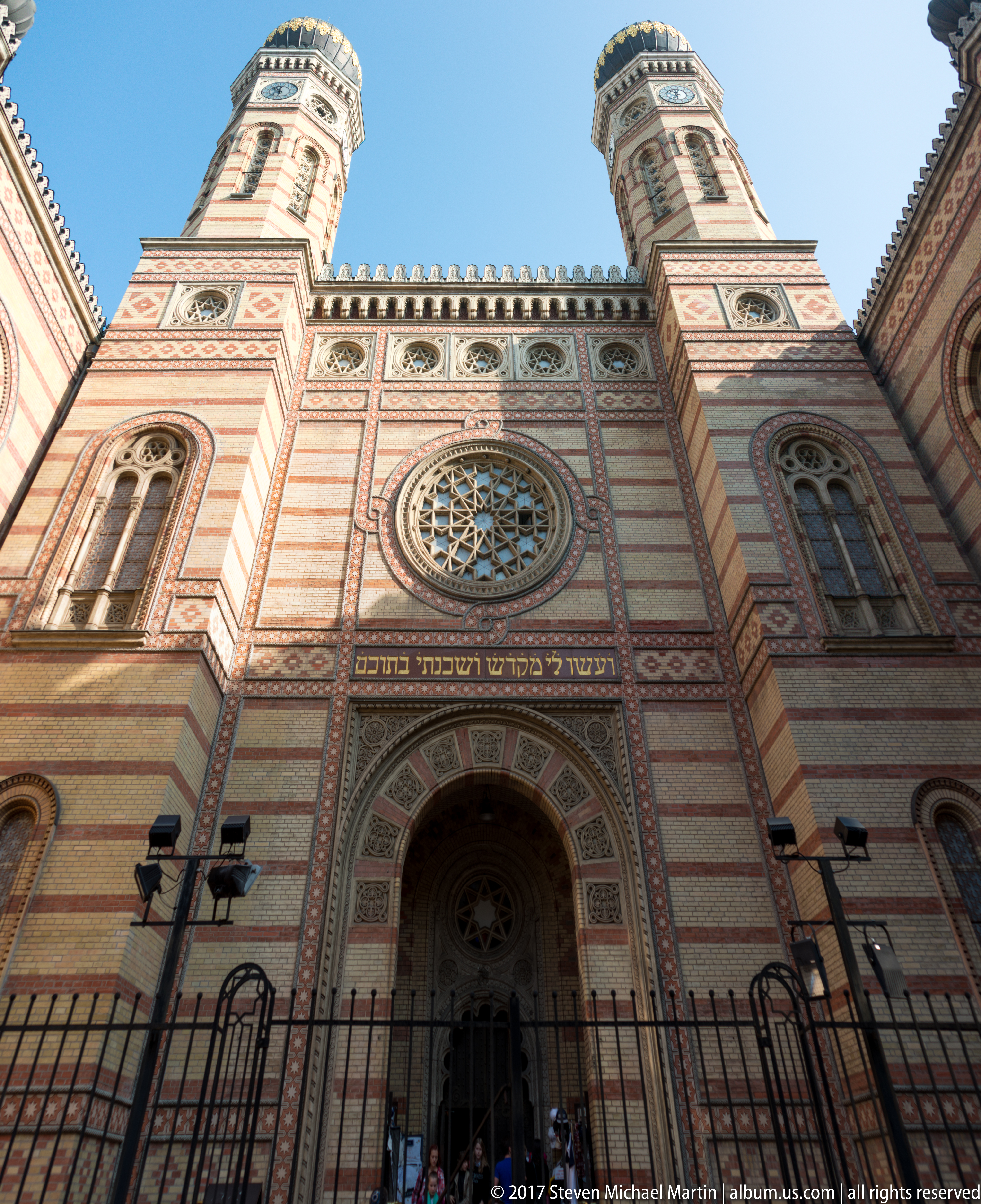
The Great Synagogue on Dohány Street rises dramatically from a low viewpoint, its red-and-cream striped brickwork, large rose window, Moorish arches, and twin octagonal towers creating one of Budapest’s most distinctive sacred façades. Hebrew lettering spans the central entrance beneath the rose window, reinforcing the building’s Jewish religious identity.
Caption
The Great Synagogue on Dohány Street rises dramatically from a low viewpoint, its red-and-cream striped brickwork, large rose window, Moorish arches, and twin octagonal towers creating one of Budapest’s most distinctive sacred façades. Hebrew lettering spans the central entrance beneath the rose window, reinforcing the building’s Jewish religious identity.

A single tower of the Dohány Street Synagogue is isolated against a clear blue sky, revealing the striped red-and-cream masonry, clock face, narrow arched windows, decorative banding, and distinctive onion-shaped metal dome with gilded ornament. The close view highlights the Moorish Revival detailing that gives the synagogue its unmistakable skyline profile.
Caption
A single tower of the Dohány Street Synagogue is isolated against a clear blue sky, revealing the striped red-and-cream masonry, clock face, narrow arched windows, decorative banding, and distinctive onion-shaped metal dome with gilded ornament. The close view highlights the Moorish Revival detailing that gives the synagogue its unmistakable skyline profile.

Interlocking arches and barrel vaults are covered with painted floral panels, gilded rosettes, and classical decorative motifs inside the Hungarian State Opera House. The upward composition strips away furnishings and people, turning the interior into a study of color, ornament, and repeated architectural rhythm across the richly finished ceiling.
Caption
Interlocking arches and barrel vaults are covered with painted floral panels, gilded rosettes, and classical decorative motifs inside the Hungarian State Opera House. The upward composition strips away furnishings and people, turning the interior into a study of color, ornament, and repeated architectural rhythm across the richly finished ceiling.
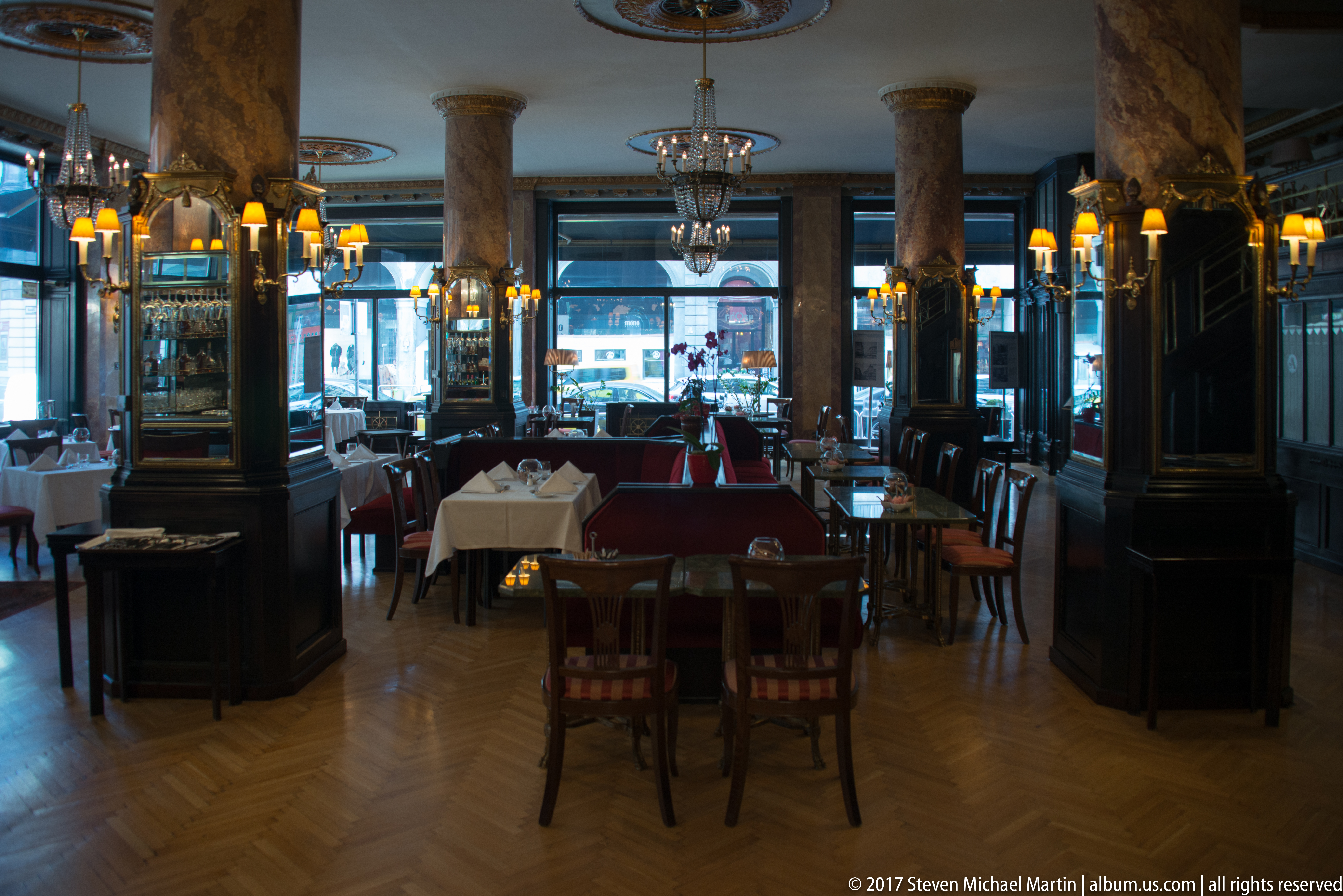
A formal Budapest dining room combines dark wood paneling with marbleized columns, mirrored cabinets, parquet flooring, chandeliers, and tables set with white linens. Warm lamps create an intimate glow through the otherwise subdued interior. The symmetrical view emphasizes the restaurant’s historic elegance and carefully preserved traditional décor.
Caption
A formal Budapest dining room combines dark wood paneling with marbleized columns, mirrored cabinets, parquet flooring, chandeliers, and tables set with white linens. Warm lamps create an intimate glow through the otherwise subdued interior. The symmetrical view emphasizes the restaurant’s historic elegance and carefully preserved traditional décor.

Two arched tablets inscribed in Hebrew rise above the roofline of Budapest’s Dohány Street Synagogue, framed by a row of ornate pinnacles. Their prominent placement identifies the Decalogue as a defining religious symbol within the synagogue’s richly decorated Moorish Revival façade and creates a strong silhouette against the clear blue sky.
Caption
Two arched tablets inscribed in Hebrew rise above the roofline of Budapest’s Dohány Street Synagogue, framed by a row of ornate pinnacles. Their prominent placement identifies the Decalogue as a defining religious symbol within the synagogue’s richly decorated Moorish Revival façade and creates a strong silhouette against the clear blue sky.

A large Star of David fills a circular window on the Dohány Street Synagogue, surrounded by carved stone bands, floral ornament, and warm brickwork. The close architectural study isolates one of the building’s most explicit Jewish symbols and shows how geometric religious imagery is integrated into the richly patterned Moorish Revival exterior.
Caption
A large Star of David fills a circular window on the Dohány Street Synagogue, surrounded by carved stone bands, floral ornament, and warm brickwork. The close architectural study isolates one of the building’s most explicit Jewish symbols and shows how geometric religious imagery is integrated into the richly patterned Moorish Revival exterior.

A richly geometric circular window dominates this close view of the Dohány Street Synagogue. Interlacing star-like tracery radiates from the center, while patterned brick bands and carved stone moldings encircle the opening. The composition highlights the synagogue’s characteristic fusion of Moorish Revival geometry, polychrome masonry, and monumental sacred architecture.
Caption
A richly geometric circular window dominates this close view of the Dohány Street Synagogue. Interlacing star-like tracery radiates from the center, while patterned brick bands and carved stone moldings encircle the opening. The composition highlights the synagogue’s characteristic fusion of Moorish Revival geometry, polychrome masonry, and monumental sacred architecture.

Visitors gather at the central entrance of the Dohány Street Synagogue beneath a band of Hebrew text and an ornate circular window. Striped red-and-cream masonry, Moorish arches, decorative tilework, and narrow arched windows organize the façade. The frontal view connects the building’s Jewish inscriptions and symbolic ornament with its active role as a place of visitation and worship.
Caption
Visitors gather at the central entrance of the Dohány Street Synagogue beneath a band of Hebrew text and an ornate circular window. Striped red-and-cream masonry, Moorish arches, decorative tilework, and narrow arched windows organize the façade. The frontal view connects the building’s Jewish inscriptions and symbolic ornament with its active role as a place of visitation and worship.

The Dohány Street Synagogue rises steeply from a low courtyard viewpoint, revealing twin octagonal towers, striped brickwork, circular tracery windows, and a continuous band of decorative geometric ornament. The compressed upward perspective emphasizes the verticality and patterned surfaces that give the Great Synagogue its distinctive Moorish Revival character.
Caption
The Dohány Street Synagogue rises steeply from a low courtyard viewpoint, revealing twin octagonal towers, striped brickwork, circular tracery windows, and a continuous band of decorative geometric ornament. The compressed upward perspective emphasizes the verticality and patterned surfaces that give the Great Synagogue its distinctive Moorish Revival character.

A close architectural detail isolates a band of repeated eight-pointed stars and interlocking geometric forms in terracotta, cream, and gray. Braided stone moldings frame the pattern above and below, while striped brickwork continues behind. The ornament demonstrates the Great Synagogue’s extensive use of polychrome geometry as an integral part of its Moorish Revival exterior.
Caption
A close architectural detail isolates a band of repeated eight-pointed stars and interlocking geometric forms in terracotta, cream, and gray. Braided stone moldings frame the pattern above and below, while striped brickwork continues behind. The ornament demonstrates the Great Synagogue’s extensive use of polychrome geometry as an integral part of its Moorish Revival exterior.

The Hungarian State Opera House presents its richly sculpted Neo-Renaissance façade beneath a clear blue sky. Arcaded upper openings, statues, balustrades, and a projecting entrance loggia create a ceremonial frontage along Andrássy Avenue, while contemporary performance banners signal the building’s continuing theatrical use.
Caption
The Hungarian State Opera House presents its richly sculpted Neo-Renaissance façade beneath a clear blue sky. Arcaded upper openings, statues, balustrades, and a projecting entrance loggia create a ceremonial frontage along Andrássy Avenue, while contemporary performance banners signal the building’s continuing theatrical use.

Viewed from the stage or stalls, the Hungarian State Opera House auditorium rises in gilded tiers beneath its vast painted dome. Repeated box openings curve around the horseshoe-shaped interior, while the luminous ceiling fresco and central chandelier zone dominate the upper frame. The composition conveys the theater’s richly ornamented nineteenth-century ceremonial interior.
Caption
Viewed from the stage or stalls, the Hungarian State Opera House auditorium rises in gilded tiers beneath its vast painted dome. Repeated box openings curve around the horseshoe-shaped interior, while the luminous ceiling fresco and central chandelier zone dominate the upper frame. The composition conveys the theater’s richly ornamented nineteenth-century ceremonial interior.

Marble columns and a broad red-carpeted staircase define a sumptuous interior hall of the Hungarian State Opera House. Painted vaults, gilded capitals, balustrades, and polished stone surfaces create a layered ceremonial route through the building. The oblique view emphasizes the opera house as a social and architectural experience as much as a performance venue.
Caption
Marble columns and a broad red-carpeted staircase define a sumptuous interior hall of the Hungarian State Opera House. Painted vaults, gilded capitals, balustrades, and polished stone surfaces create a layered ceremonial route through the building. The oblique view emphasizes the opera house as a social and architectural experience as much as a performance venue.

A long vaulted ceiling inside the Hungarian State Opera House is divided into gilded coffers, painted figurative panels, floral borders, and small medallions. A chandelier hangs near the center, drawing the eye along the richly ornamented axis. The symmetrical upward view documents the theater’s elaborate decorative program in a formal reception space.
Caption
A long vaulted ceiling inside the Hungarian State Opera House is divided into gilded coffers, painted figurative panels, floral borders, and small medallions. A chandelier hangs near the center, drawing the eye along the richly ornamented axis. The symmetrical upward view documents the theater’s elaborate decorative program in a formal reception space.

A highly symmetrical ceiling panel combines pale gray-blue painted ornament with gilded medallions, scrollwork, and a central octagonal figurative scene. Dark metal light fixtures intrude at the edges, helping establish the ceiling’s scale. The close view records the dense decorative layering characteristic of the Hungarian State Opera House interior.
Caption
A highly symmetrical ceiling panel combines pale gray-blue painted ornament with gilded medallions, scrollwork, and a central octagonal figurative scene. Dark metal light fixtures intrude at the edges, helping establish the ceiling’s scale. The close view records the dense decorative layering characteristic of the Hungarian State Opera House interior.

The Hungarian State Opera House is seen from street level, where a deep arched entrance loggia, sculpted stone façade, ornate lamp standards, and performance banners define the public approach. The lower, wider viewpoint complements the earlier façade study by emphasizing the entrance sequence and the building’s relationship to Andrássy Avenue.
Caption
The Hungarian State Opera House is seen from street level, where a deep arched entrance loggia, sculpted stone façade, ornate lamp standards, and performance banners define the public approach. The lower, wider viewpoint complements the earlier façade study by emphasizing the entrance sequence and the building’s relationship to Andrássy Avenue.

The great interior dome of St. Stephen’s Basilica fills the frame in a near-symmetrical upward view. Concentric rings of gilded coffers, painted figures, architectural panels, and tall windows surround a central circular scene. The image reduces the basilica to a radiant decorative geometry and shows the scale and intricacy of its dome painting.
Caption
The great interior dome of St. Stephen’s Basilica fills the frame in a near-symmetrical upward view. Concentric rings of gilded coffers, painted figures, architectural panels, and tall windows surround a central circular scene. The image reduces the basilica to a radiant decorative geometry and shows the scale and intricacy of its dome painting.

A long side aisle in St. Stephen’s Basilica recedes through a sequence of dark red marble columns and broad arches toward a softly illuminated altar. Brass candelabra and side furnishings punctuate the otherwise open floor. The perspective emphasizes the basilica’s depth, polished stone surfaces, and monumental scale away from the central sanctuary.
Caption
A long side aisle in St. Stephen’s Basilica recedes through a sequence of dark red marble columns and broad arches toward a softly illuminated altar. Brass candelabra and side furnishings punctuate the otherwise open floor. The perspective emphasizes the basilica’s depth, polished stone surfaces, and monumental scale away from the central sanctuary.

A white reclining figure rests along the curve of an interior arch in St. Stephen’s Basilica, surrounded by gilded moldings, colored marble, and blue decorative panels. The close crop isolates the sculpture from the larger church interior and emphasizes the basilica’s combination of monumental architecture with dense figurative ornament.
Caption
A white reclining figure rests along the curve of an interior arch in St. Stephen’s Basilica, surrounded by gilded moldings, colored marble, and blue decorative panels. The close crop isolates the sculpture from the larger church interior and emphasizes the basilica’s combination of monumental architecture with dense figurative ornament.

The pipe organ of St. Stephen’s Basilica rises above a formal gallery supported by pale columns and framed by red marble walls. Multiple ranks of pipes are enclosed in an ornate architectural case beneath a richly decorated arch. The frontal view emphasizes the organ’s monumental scale and its integration into the basilica’s lavish interior.
Caption
The pipe organ of St. Stephen’s Basilica rises above a formal gallery supported by pale columns and framed by red marble walls. Multiple ranks of pipes are enclosed in an ornate architectural case beneath a richly decorated arch. The frontal view emphasizes the organ’s monumental scale and its integration into the basilica’s lavish interior.

A side altar in St. Stephen’s Basilica is framed by red marble columns and a pale architectural screen with two standing sculpted saints in niches. Gilded ornament, candle stands, and a small altar table create a formal devotional setting. The frontal composition records the basilica’s richly finished subsidiary worship spaces apart from the main sanctuary.
Caption
A side altar in St. Stephen’s Basilica is framed by red marble columns and a pale architectural screen with two standing sculpted saints in niches. Gilded ornament, candle stands, and a small altar table create a formal devotional setting. The frontal composition records the basilica’s richly finished subsidiary worship spaces apart from the main sanctuary.

Painted and gilded vaults rise above a broad clerestory window inside St. Stephen’s Basilica. Figurative scenes occupy framed ceiling panels, while rows of medallions and geometric coffers articulate the surrounding arches. The upward view emphasizes the richly layered historicist decoration that unifies painting, gilding, and architecture across the church interior.
Caption
Painted and gilded vaults rise above a broad clerestory window inside St. Stephen’s Basilica. Figurative scenes occupy framed ceiling panels, while rows of medallions and geometric coffers articulate the surrounding arches. The upward view emphasizes the richly layered historicist decoration that unifies painting, gilding, and architecture across the church interior.

The sanctuary of St. Stephen’s Basilica is framed by massive red marble piers and gilded capitals, opening toward the main altar beneath a richly painted domed apse. Candelabra, balustrades, and layered marble architecture direct attention toward the illuminated central devotional focus. The broad view captures the ceremonial scale and opulence of the basilica’s principal worship space.
Caption
The sanctuary of St. Stephen’s Basilica is framed by massive red marble piers and gilded capitals, opening toward the main altar beneath a richly painted domed apse. Candelabra, balustrades, and layered marble architecture direct attention toward the illuminated central devotional focus. The broad view captures the ceremonial scale and opulence of the basilica’s principal worship space.

Massive red marble piers and gilded capitals frame a deep interior axis in St. Stephen’s Basilica. A broad arched window glows above an altar at the far end, while sculpted monuments and candelabra line the sides. The centered perspective emphasizes the basilica’s monumental spatial rhythm and richly layered marble surfaces.
Caption
Massive red marble piers and gilded capitals frame a deep interior axis in St. Stephen’s Basilica. A broad arched window glows above an altar at the far end, while sculpted monuments and candelabra line the sides. The centered perspective emphasizes the basilica’s monumental spatial rhythm and richly layered marble surfaces.

St. Stephen’s Basilica dome rises above the crossing in a steep vertical composition, revealing the painted cupola, tall drum windows, gilded architectural bands, and large figurative pendentives at the corners. Compared with the preceding centered dome study, this view includes more of the supporting structure and clarifies how the dome is carried above the church interior.
Caption
St. Stephen’s Basilica dome rises above the crossing in a steep vertical composition, revealing the painted cupola, tall drum windows, gilded architectural bands, and large figurative pendentives at the corners. Compared with the preceding centered dome study, this view includes more of the supporting structure and clarifies how the dome is carried above the church interior.

A central figurative painting is set within a richly modeled vault of St. Stephen’s Basilica, surrounded by gilded borders, circular medallions, pale relief panels, and geometric coffers. The close crop treats the ceiling as an independent decorative artwork and highlights the integration of painting, sculpture-like ornament, and architectural framing.
Caption
A central figurative painting is set within a richly modeled vault of St. Stephen’s Basilica, surrounded by gilded borders, circular medallions, pale relief panels, and geometric coffers. The close crop treats the ceiling as an independent decorative artwork and highlights the integration of painting, sculpture-like ornament, and architectural framing.

The principal sanctuary of St. Stephen’s Basilica opens beneath a luminous painted apse, framed by monumental red marble piers with gilded capitals. Side pulpits or sculpted architectural monuments project into the view, while the central altar glows beneath the dome. The wider composition conveys the ceremonial hierarchy and spatial grandeur of the basilica interior.
Caption
The principal sanctuary of St. Stephen’s Basilica opens beneath a luminous painted apse, framed by monumental red marble piers with gilded capitals. Side pulpits or sculpted architectural monuments project into the view, while the central altar glows beneath the dome. The wider composition conveys the ceremonial hierarchy and spatial grandeur of the basilica interior.

A relief bust of a bearded sacred figure appears above the Latin inscription “D.O.M. SVB INVOC. S. STEPHANI” on the façade of St. Stephen’s Basilica. The inscription explicitly invokes Saint Stephen, while carved vessels, scrollwork, and colored stone enrich the architectural frame. The close detail links the basilica’s dedication directly to its exterior ornament.
Caption
A relief bust of a bearded sacred figure appears above the Latin inscription “D.O.M. SVB INVOC. S. STEPHANI” on the façade of St. Stephen’s Basilica. The inscription explicitly invokes Saint Stephen, while carved vessels, scrollwork, and colored stone enrich the architectural frame. The close detail links the basilica’s dedication directly to its exterior ornament.

An expansive decorative pavement design spreads across St. Stephen’s Square in concentric circles of pink, gray, white, and blue-gray stone. Repeating petals, rings, and geometric bands form an ornamental field at pedestrian scale. The elevated angle emphasizes the plaza as a designed civic surface in front of the basilica rather than merely open space.
Caption
An expansive decorative pavement design spreads across St. Stephen’s Square in concentric circles of pink, gray, white, and blue-gray stone. Repeating petals, rings, and geometric bands form an ornamental field at pedestrian scale. The elevated angle emphasizes the plaza as a designed civic surface in front of the basilica rather than merely open space.

A gold-ground mosaic of Christ with outstretched arms fills the semicircular lunette above an entrance to St. Stephen’s Basilica. Angelic figures flank the central figure, while the stone arch surrounding the mosaic provides a monumental frame. The close view emphasizes the basilica’s explicitly Christian iconography and luminous façade decoration.
Caption
A gold-ground mosaic of Christ with outstretched arms fills the semicircular lunette above an entrance to St. Stephen’s Basilica. Angelic figures flank the central figure, while the stone arch surrounding the mosaic provides a monumental frame. The close view emphasizes the basilica’s explicitly Christian iconography and luminous façade decoration.

The monumental entrance of St. Stephen’s Basilica is crowned by a sculpted pediment and the Latin declaration “EGO SUM VIA VERITAS ET VITA” above the central arch. Corinthian columns, carved reliefs, and the gold-ground Christ mosaic below combine classical architecture with Christian text and imagery in the basilica’s principal façade.
Caption
The monumental entrance of St. Stephen’s Basilica is crowned by a sculpted pediment and the Latin declaration “EGO SUM VIA VERITAS ET VITA” above the central arch. Corinthian columns, carved reliefs, and the gold-ground Christ mosaic below combine classical architecture with Christian text and imagery in the basilica’s principal façade.

St. Stephen’s Basilica fills the end of the square in a symmetrical frontal view, with twin bell towers flanking the great central dome. A classical portico and triangular pediment anchor the lower façade, while the broad open plaza emphasizes the building’s monumental scale. Soft evening light leaves the stonework subdued against the bright sky.
Caption
St. Stephen’s Basilica fills the end of the square in a symmetrical frontal view, with twin bell towers flanking the great central dome. A classical portico and triangular pediment anchor the lower façade, while the broad open plaza emphasizes the building’s monumental scale. Soft evening light leaves the stonework subdued against the bright sky.

St. Stephen’s Basilica is centered across the broad expanse of St. Stephen’s Square, its twin towers and dome forming a balanced skyline above the classical façade. Sparse pedestrians cross the open plaza, reinforcing the scale of the architecture. This establishing view emphasizes the relationship between the basilica and the formal urban space laid out before it.
Caption
St. Stephen’s Basilica is centered across the broad expanse of St. Stephen’s Square, its twin towers and dome forming a balanced skyline above the classical façade. Sparse pedestrians cross the open plaza, reinforcing the scale of the architecture. This establishing view emphasizes the relationship between the basilica and the formal urban space laid out before it.

The great dome of St. Stephen’s Basilica rises above a curved colonnaded exterior, with sculpted figures spaced along the balustrade and a lantern crowning the copper-clad cupola. The low-angle composition concentrates on the dome’s monumental mass and the layered classical detailing of the upper church exterior against a clear blue sky.
Caption
The great dome of St. Stephen’s Basilica rises above a curved colonnaded exterior, with sculpted figures spaced along the balustrade and a lantern crowning the copper-clad cupola. The low-angle composition concentrates on the dome’s monumental mass and the layered classical detailing of the upper church exterior against a clear blue sky.

St. Stephen’s Basilica fills a three-quarter street view, combining the towering central dome with one of the twin bell towers and the curved eastern façade. Corinthian columns, arched openings, rooftop sculpture, and pale stone surfaces create a layered monumental composition. The broader perspective places the architectural details of the preceding images back into the scale of the full church.
Caption
St. Stephen’s Basilica fills a three-quarter street view, combining the towering central dome with one of the twin bell towers and the curved eastern façade. Corinthian columns, arched openings, rooftop sculpture, and pale stone surfaces create a layered monumental composition. The broader perspective places the architectural details of the preceding images back into the scale of the full church.

St. Stephen’s Basilica is viewed from below at its rounded eastern end, where the massive dome dominates a richly articulated drum of tall arched windows, pilasters, sculpted figures, and projecting architectural bays. The compressed perspective emphasizes the basilica’s layered masonry and the transition from curved apse-like forms to the great dome above.
Caption
St. Stephen’s Basilica is viewed from below at its rounded eastern end, where the massive dome dominates a richly articulated drum of tall arched windows, pilasters, sculpted figures, and projecting architectural bays. The compressed perspective emphasizes the basilica’s layered masonry and the transition from curved apse-like forms to the great dome above.

A smartwatch rests on fabric with its activity summary illuminated, showing 40,435 total steps and a total distance of 20.71 miles. The close personal detail records the physical scale of a day spent exploring Budapest, translating the itinerary into measurable pedestrian movement rather than architecture or monuments.
Caption
A smartwatch rests on fabric with its activity summary illuminated, showing 40,435 total steps and a total distance of 20.71 miles. The close personal detail records the physical scale of a day spent exploring Budapest, translating the itinerary into measurable pedestrian movement rather than architecture or monuments.

A large Budapest wall mural forms a human portrait from hundreds of brightly colored circular dots arranged like a pixelated mosaic. Faint Hungarian text below includes a reference to the “Rubik-kocka,” or Rubik’s Cube, linking the work visually and verbally to Hungary’s internationally known puzzle. The white wall and exposed neighboring masonry reinforce its urban street-art setting.
Caption
A large Budapest wall mural forms a human portrait from hundreds of brightly colored circular dots arranged like a pixelated mosaic. Faint Hungarian text below includes a reference to the “Rubik-kocka,” or Rubik’s Cube, linking the work visually and verbally to Hungary’s internationally known puzzle. The white wall and exposed neighboring masonry reinforce its urban street-art setting.

An elegant Budapest restaurant interior combines tall mirrors, marbleized columns, crystal chandeliers, warm wall lamps, and formally dressed tables with white linens. Diners and staff animate the room while dark wood, glass, and polished surfaces multiply the light. The scene closes the portfolio on the lived experience of the city rather than another exterior landmark.
Caption
An elegant Budapest restaurant interior combines tall mirrors, marbleized columns, crystal chandeliers, warm wall lamps, and formally dressed tables with white linens. Diners and staff animate the room while dark wood, glass, and polished surfaces multiply the light. The scene closes the portfolio on the lived experience of the city rather than another exterior landmark.
⭐ Highlights
- Buda Castle District: A historic hilltop complex with castles, churches, and panoramic views over the Danube.
- Hungarian Parliament Building: One of Europe’s most iconic government buildings along the riverfront.
- Chain Bridge: The first permanent bridge linking Buda and Pest across the Danube.
- St. Stephen’s Basilica: A major religious landmark and one of the largest churches in Hungary.
- Danube River Setting: The river divides the city into Buda and Pest, shaping its layout and identity.
- Thermal Baths: Budapest is famous for its historic bathhouses built over natural hot springs.
🏙️ Budapest Field Guide
Major features observed during this visit:
Budapest, the capital of Hungary, is one of Europe’s most visually striking cities, formed by the union of Buda, Pest, and Óbuda along the Danube River. The city combines historic hilltop districts, grand boulevards, and monumental architecture into a cohesive urban landscape shaped over centuries. Its position along the river and its mix of architectural styles—from medieval to modern—make it one of the most important cultural centers in Central Europe.
🏛️ Signature Landmarks
- Buda Castle – A historic royal complex overlooking the Danube from Castle Hill.
- Hungarian Parliament – A landmark building along the river and one of the largest in the country.
- Chain Bridge – A 19th-century bridge connecting Buda and Pest.
- Fisherman’s Bastion – A terrace offering panoramic views of the city and river.
- St. Stephen’s Basilica – A major religious and architectural landmark.
🧠 Historical Significance
- Roman Origins – The area was part of the Roman settlement of Aquincum.
- Medieval and Royal Power – Buda served as a royal seat for centuries.
- Unification in 1873 – Buda, Pest, and Óbuda merged to form modern Budapest.
- 20th Century Transformation – The city was shaped by war, reconstruction, and modernization.
🌄 Urban Landscape & Setting
- Danube River – The river divides and defines the structure of the city.
- Hills and Plains – Buda is hilly and historic, while Pest is flat and urban.
- Riverfront Views – Many of the city’s landmarks are aligned along the riverbanks.
- Architectural Variety – Gothic, Baroque, Neoclassical, and modern elements coexist throughout the city.